Tag: JFK

  • David Halberstam, The Best and the Brightest, Part 2

    David Halberstam, The Best and the Brightest, Part 2


    David Halberstam and The Second Biggest Lie Ever Told:

    A Look Back at The Best and the Brightest

    Part Two: Halberstam and Johnson
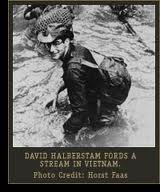

    dh vn
    Halberstam in Vietnam
    L B Johnson Model Khe Sanh
    LBJ with Vietnam model

    As I noted in Part 1 of this retrospective review of The Best and the Brightest, one of the most surprising lacunae in this celebrated book is that David Halberstam never mentions or references National Security Action Memorandum 263. This was President Kennedy’s directive that ordered the beginning of the US military withdrawal from Vietnam. This was to begin in December of 1963 with the removal of a thousand troops, and then continue in a phased way until 1965, when it would be completed i.e. all American troops would be back home. It is quite odd that in a book that spends over 300 pages discussing Kennedy’s policy on Vietnam, Halberstam could not find the space to mention this important directive. Especially in light of the fact that it had been in the works for quite awhile. Halberstam does mention that Kennedy had told John K. Galbraith to give him a report about Vietnam. But he confines this report to the dustbin by saying that Galbraith was mere window dressing and was on the periphery of Kennedy’s administration. (Halberstam, p. 152) When in fact, as mentioned in Part 1, the opposite was true about Galbraith’s report. It was the origin point for Kennedy’s instructions to Bob McNamara to begin a withdrawal plan.

    But there is something equally surprising about what Halberstam leaves out of his discussion of President Johnson’s conduct of the war. Except this lacuna comes at the beginning of his review of LBJ’s policy, not at the end. And because of that, it makes it even more significant. That is this: Halberstam never mentions or references National Security Action Memorandum 273. This is very surprising since as many writers have noted, NSAM 273 altered NSAM 263, at the same time it tried to state that it was not doing so. In his milestone book on the subject, John Newman spends over four pages discussing just how significant a change in policy Johnson’s new directive was. (JFK and Vietnam, pgs. 445-449) To name three of the most significant alterations:

    1. It allowed for direct US Navy involvement in OPLAN 34 patrols off the coast of North Vietnam. This would result in the Tonkin Gulf incident.
    2. It allowed for expanded American operations into Laos and Cambodia.
    3. While saying it would honor the troop reductions in NSAM 263, it did not. They were not carried out and the number of American advisers actually rose in the months after Kennedy’s murder.

    For an author to write nearly 700 pages on Kennedy, Johnson and Vietnam, and to never even mention NSAM’s 263 and 273–let alone discuss them–this is so bizarre as to be inexplicable. Again, it is censorship of such an extreme degree that it distorts history.

    But it is indicative of what Halberstam does to cloud the break in policy that occurred after Kennedy’s death. Take another instance: the first Vietnam meeting after Kennedy’s death. This happened just 48 hours after the assassination, on November 24th. (Newman pgs. 442-45) It is very difficult to locate this meeting in Halberstam’s book. In fact, you will not find it where you would expect to, in Chapter 16, the first one dealing with LBJ’s presidency. Where you will find a mention of it is at the end of Chapter 15, on pages 298-99. Where, ostensibly, Halberstam is wrapping up his view of Kennedy and Vietnam. By placing it there, Halberstam connotes some kind of continuity between the two men. What he does with the meeting constitutes even more censorship and distortion.

    He clearly tries to imply that this meeting was between only Johnson and Saigon ambassador Henry Cabot Lodge. (Halberstam, p. 298) And that Lodge had returned to Washington to give a report on deteriorating conditions in Vietnam. Not so. Kennedy brought Lodge back to Washington for the express purpose of firing him. (James Douglass, JFK and the Unspeakable, pgs. 374-75) Part of the reason for the termination was Lodge’s role in the demise of Ngo Dinh Diem and his brother Nhu. This is a continuation of Halberstam’s misrepresentations about Lodge. For he also says that Kennedy appointed him ambassador so as to involve the GOP in what could end up as a disaster. (Halberstam, p. 260) False. Kennedy didn’t want to appoint Lodge at all. He wanted his old friend Edmund Gullion as Saigon ambassador. This was vetoed by Dean Rusk who wanted Lodge appointed. (Douglass, pgs. 150-52)

    The point is that with Kennedy now dead, Lodge was not fired. He delivered his message to Johnson about how bad things were in Saigon. He then took part in a larger meeting—one that is completely absent from The Best and the Brightest. As John Newman notes, this meeting was attended by Secretary of State Dean Rusk, Defense Secretary Robert McNamara, Under Secretary of State George Ball, National Security Advisor McGeorge Bundy, and CIA Director John McCone. It was led by Johnson. (Newman, p. 442) In other words, the entire national security apparatus was on hand to hear a new tone and attitude on the subject of Vietnam. Phrases that JFK would never have uttered. LBJ said things like, “I am not going to lose in Vietnam”, “I am not going to be the president who saw Southeast Asia go the way that China went” , “Tell those generals in Saigon that Lyndon Johnson intends to stand by our word”. (ibid) The change was so clear that McCone wrote in his notes: “I received in this meeting the first “President Johnson tone” for action as contrasted with the “Kennedy tone”. (ibid, p. 443) Demarcating a break with the past, LBJ also said that he had “never been happy with our operations in Vietnam” (ibid) In his book, In Retrospect, McNamara said that Johnson’s intent was clear at this meeting. Instead of beginning to withdraw, LBJ was going to win the war. (p. 102) This message then filtered downward into each department. Which was a reversal of the message Kennedy had been giving after the May 1963 SecDef meeting in Hawaii. Back then, the generals and everyone else understood that any proposal for overt action would invite a negative Presidential decision. (Probe Vol. 5 No. 3)

    Question: Are we to believe that Halberstam, in his 500 interviews, did not interview any of these men about this meeting?

    Now, Johnson understood that McNamara was the key to securing his desired change in policy. Since McNamara had been the point man behind the scenes and to the media about Kennedy’s intent to withdraw. So in February of 1964, LBJ made sure McNamara would be on board the new train. In a declassified tape that is transcribed in the James Blight book, Virtual JFK, LBJ told McNamara, “I always thought it was foolish for you to make any statements about withdrawing. I thought it was bad psychologically. But you and the president thought otherwise, and I just sat silent.” (Blight, p. 310) For those who have heard this tape, one of the most shocking things about it is McNamara’s near-silent bewilderment as to what is happening. And in another conversation two weeks later, LBJ actually wants McNamara to take back or rephrase what he said in 1963 about the initial thousand man withdrawal. (ibid)

    These conversations completely vitiate another argument that Halberstam likes to make throughout the book. Namely that Johnson was somehow subservient to the advisors left over from Kennedy’s cabinet. In one of the most dubious passages in the book, Halberstam says that LBJ was in awe of these men and judged them by their labels. (Halberstam, p. 303) As he usually does, he then tops this silliness by saying that McNamara was the most forceful figure on Vietnam policy in early 1964. (p. 347) The strong implication being that somehow LBJ bowed to his advisers in making decisions on Vietnam. The evidence adduced above—avoided by Halberstam—completely undermines that thesis. Clearly, by the evidence of this first meeting, and the taped talks with McNamara, Johnson is the one commandeering them. In fact, as we shall see, LBJ often decided to proceed with steps in his escalation plan without their advice at all. And this was one thing that led to the exodus from the White House by McCone, Ball, Bundy and McNamara.

    Virtually all of the above, clearly indicating a break in policy, is notably absent from The Best and the Brightest. In Halberstam’s defense, one can argue that some of these taped conversations had not yet been declassified. But on the other hand, the man said he did 500 interviews. He had to have talked to someone at that November 24th meeting besides Lodge. Did he not even talk to Ken O’Donnell and Dave Powers? They had both been with Kennedy for years, from the beginning of his political career. They were in the White House for these decisions on Vietnam under both Kennedy and Johnson. They could have told Halberstam about NSAM 263, McNamara’s announcement about the thousand-troop withdrawal, and the plans for complete withdrawal by 1965. They also would have told him that Johnson changed all this within days of taking office. How do we know they would have told him so? Because they wrote about all this in their book about Kennedy, Johnny We Hardly Knew Ye. Which was published in 1972, the same year that The Best and the Brightest was published. (O’Donnell and Powers, pgs. 13-18)

    Halberstam covered his tracks well. By not listing the interviews he did, the author prevented anyone from checking on 1.) Whom he actually talked to, and 2.) What they told him.

    II

    As noted above, Halberstam eliminates Kennedy’s NSAM 263, the discussion and announcement about it, and NSAM 273, which LBJ used to partially subvert it. He also, for all intents and purposes, virtually discounts the November 24th first Vietnam meeting held by President Johnson–which also signaled a drastic change in policy. A change that was later noted by McGeorge Bundy: “The President has expressed his deep concern that our effort in Vietnam be stepped up to highest pitch.” (Gordon Goldstein, Lessons in Disaster, p. 105) As Goldstein astutely notes, the changes in tone, attitude, and emphasis were not just rhetorical. Within a little over three months, Kennedy’s withdrawal plan would be more than assigned to oblivion. A whole new plan for waging war would be put in its place.

    Goldstein does a nice job summarizing the steps that Johnson took to get there. He first sent McNamara to Saigon to render a report on the conditions in country. Since McNamara got the message at the 11/24 meeting, and since the intelligence reports had now been altered to reflect true conditions, at Christmas 1963, McNamara brought back a negative report. (ibid, p. 107) One month later, after McNamara relayed this report, the Joint Chiefs sent a proposal to Johnson on how to save the day: bombing of the north and insertion of combat troops. (ibid, p. 108) As Goldstein writes, “Exactly two months after Kennedy’s death, the chiefs were proposing air strikes against Hanoi and the deployment of US troops, not just in an advisory role, but in offensive operations against the North. The Joint Chiefs of Staff were proposing…the initial steps to Americanize the Vietnam War.” (ibid, p. 108) LBJ turned down this proposal. Not for the reasons Kennedy had years before. But because he did not have congress on board as a partner. At least not yet. (ibid, p. 109) But he did order the preparation of NSAM 288.

    First proposed in early March during a discussion between the Joint Chiefs and Johnson, NSAM 288 included both air and naval elements, to directly participate in the targeting of up to 94 military and industrial sites. In addition, it proposed the mining of harbors, imposition of a naval blockade, and in case China intervened, the use of nuclear weapons. (ibid, p. 108) In other words, it was a full order of battle. Thus, LBJ had achieved in a bit over three short months what Kennedy had resisted for three years.

    It takes Goldstein about ten pages to proceed from Kennedy’s assassination to the construction of NSAM 288. It takes Halberstam over fifty pages to do the same. How does he delay this for so long?

    With a very disturbing and recurring characteristic of the book: the insertion of the mini-biography. Often, whether its apropos or not, Halberstam completely stops the narrative flow of the book to insert a biography of someone. Whether or not that person is relevant to the story at that time, or really had any influence over events is not important. Chapter 16 is where the author begins his discussion of Johnson’s presidency. But NSAM 288, even though it was proposed a bit over three months after LBJ took the oath, is not in that chapter. What does Halberstam deem as being more important than LBJ’s plan for American forces to directly attack North Vietnam? Well, for starters, how about a biography of Dean Rusk. This goes on for about fifteen pages. (Halberstam pgs. 307-322) He actually calls Rusk a liberal. (p. 309) He then praises him at Kennedy’s expense. (p. 322) This is a man who JFK was actually going to fire. But then, as he often does, Halberstam tops himself. After this, he segues into a biography of, if you can believe it, Dean Acheson! I yawned and sighed through these biographical pages. To me it was nothing but pointless filler. And it accents a real weakness in Halberstam: He loved hearing himself talk. Whether what he was saying was relevant or not. In reality, what these two mini-biographies do is slow down the impact of Johnson’s fast reversal of policy. Because what LBJ is now planning—direct US attacks on North Vietnam—is something that Kennedy never even contemplated.

    Let me add two points here as to what Halberstam actually does with all this filler and obfuscation. By giving us all this irrelevant biography, he seems to be saying that knowing that Dean Rusk admired George Marshall is somehow more important than describing to the reader NSAM 273. Or showing how this directive impacted NSAM 263. In other words, when writing history, most documents do not matter. Which is the opposite of what most historians think: the documented historical record supersedes an oral recall.

    For two reasons. First, memory can always be faulty. Second, depending on who is doing the remembering, memory can be selective. But by leaving out so many important documents, and by not describing key events, like LBJ’s first meeting on Vietnam, Halberstam can foster absurd tenets. One of the most absurd comes at the very end of Chapter 16, which is supposed to be about LBJ’s early handling of the war. It is not. But the author ends the chapter by saying that 1964 was a lost year, and much of the loss was the fault of Dean Rusk. (p. 346)

    Both of these proclamations—that 1964 was a lost year, and it was attributable to Rusk—are just plain false. Many authors—like Fredrik Logevall– would argue that 1964 was the key year of the war. Johnson was not just stopping Kennedy’s withdrawal, but he was mapping out plans to use American forces in theater. Which amounts to a sea change. Second, Rusk had little to do with this. It was done by Johnson in cooperation with the Pentagon. After LBJ had turned McNamara around.

    As we have seen, and will see, Rusk was not even a major player in what was happening that year. The major player was Johnson. And far from being lost, LBJ was putting his plans together for the Americanization of the Vietnam War.

    III

    Another way that Halberstam camouflages the difference on Vietnam between Kennedy and Johnson is by using another preposterous proclamation. At the beginning of Chapter 16 he writes the following: “The decision in those early months was to hold the line on Vietnam. To hold it down and delay decisions.” (p. 303) Question for Mr. Halberstam: You yourself say that NSAM 288 was constructed in March of 1964. How was that holding the line on Vietnam? It completely broke with Kennedy’s previous policy. How could you not notice that?

    Actually, it is worse than that. NSAM 288 is only half the story. What LBJ did with it afterwards is the other half. This is another part of the story that Halberstam both misrepresents and underplays.

    After NSAM 288 was orally accepted by Johnson from the Chiefs, he then called McGeorge Bundy. (Goldstein pgs. 108-09. In itself that sequence of events tells us something.) Although he had accepted NSAM 288 in principle, he saw two impediments to utilizing it. First, he did not have a congressional resolution on his side. Therefore he had no legislative partner to go to war with. Secondly, he told Bundy, “And for nine months I’m just an inherited—I’m a trustee. I’ve got to win an election. “ (ibid, p. 109) This, of course, is what happened—in that order. Johnson got his resolution. He won his election by campaigning as a moderate peace candidate . After lying to the public about his intentions, he then went to war.

    In reading The Best and the Brightest, these steps all seem haphazard, coincidental, willy-nilly. This impression is achieved because the author never makes clear one of the most important aspects of Johnson’s alterations to NSAM 273. As John Newman points out, when LBJ was presented with the rough draft of the directive, he altered it in more ways than one. Paragraph seven had originally stated that South Vietnam should begin to build a maritime war apparatus . Johnson’s alterations now allowed for the USA to plan and execute its own maritime operations against the North. (Newman, JFK and Vietnam, p. 446) This alteration, specifically requested by Johnson, now paved the way for direct American attacks via a covert action plan called OPLAN 34 A. This was submitted to the White House one month later.. (ibid) This plan included a joint CIA/Pentagon action that allowed for American destroyers to patrol the coast of North Vietnam accompanied by small attack boats piloted by South Vietnamese sailors. The idea was that the smaller boats would fire on the north and the American destroyers would then record the North Vietnamese response to figure out what capabilities the enemy had.

    Clearly, the concept of the idea was a provocation to the North. It was inviting them to attack us in retaliation. As Edwin Moise points out, LBJ approved it because he had already made the decision that NSAM 288 would be carried out in the near future. This was his way of negating any attacks from hawkish GOP presidential contenders like Barry Goldwater or Richard Nixon. (Moise, Tonkin Gulf and the Escalation of the Vietnam War, p. 26) As Moise delineates, LBJ then further refined NSAM 288’s planning to include war campaign time intervals and the passage of a congressional resolution. (Moise, p. 27)

    This was all finalized in May and June of 1964, with the finishing touches placed on it by William Bundy. In June, Johnson began to lobby certain key members of congress for its passage. (Moise, p. 26) It is important to recall, this is almost two months before the Tonkin Gulf incident. In fact, on June 10th, McNamara said, “that in the event of a dramatic event in Southeast Asia we would go promptly for a congressional resolution.” (ibid) But since LBJ had to play the moderate in order to get re-elected, Bill Bundy added that the actual decision to expand the war would not be made until after the election. (Moise p. 44) This, of course, was a lie. With the writing of NSAM 288—something unthinkable under Kennedy–the decision to expand the war was already made. But since it was classified, the lie had wings. The actual campaign to fight the war was delayed only for political reasons. As Newman pointed out, Johnson was concealing his escalation plan so as not to lose his 1964 electoral base in the Democratic Party.

    Just about all of this is either absent from, or seriously discounted by Halberstam. Clearly, these events were not haphazard. They were connected in a straight line: the alterations to NSAM 273 led to OPLAN 34A; the drafting of NSAM 288 led to the lobbying for passage of a congressional resolution. All that was needed now was for the provocation strategy to succeed. That is for the “dramatic event” to take place so the resolution could be pushed through congress.

    This all renders ridiculous Halberstam’s idea that “the decision in those early months” was to hold the line on Vietnam. It also renders superfluous Halberstam’s insistence on giving us biographies of Dean Acheson and John Paton Davies in lieu of what the Johnson administration was really working on in the three months after Kennedy was murdered i.e. planning for America’s entry into the war.

    IV

    As noted previously, with all the above in place, what was needed was a “dramatic event”. Halberstam says that the Gulf of Tonkin incident traces back to January of 1964., when the plans for OPLAN 34A were being worked out. (p. 408) As noted above, this is false. Because those January plans would not have been contemplated under President Kennedy. They actually originated in the alterations Johnson made to the draft of NSAM 273 in November of 1963. Bundy told Newman that these alterations were directed by Johnson since LBJ “held stronger views on the war than Kennedy did.” (Newman, p. 445)

    Halberstam also mischaracterizes the purpose of these covert operations. He writes that they were meant to “make Hanoi pay a little for its pressure on the South, to hit back at the enemy, to raise morale in the South….” (Halberstam p. 408) Again, this is wrong. As Edwin Moise writes, outside of the South Vietnamese sailors on the fast attack speedboats, everything about these so-called DESOTO patrols was American. An important part of the mission was to “show the flag.” (Moise, p. 55) The North Vietnamese knew that the South Vietnamese did not have destroyer ships. Further, the destroyers violated the territorial waters of North Vietnam. Thus, as many authors have written, the design and action of these missions was a provocation. It was a way for the USA to get directly involved in a civil war. (Moise,p. 68) Even people in Johnson’s administration, like John McCone and Jim Forrestal, later admitted they were such. (Goldstein, p. 125)

    Halberstam then completely screws up the tandem nature of the missions. The destroyers and the speedboats worked together. The speedboats made the attacks. The destroyers were then meant to monitor the reactions in order to locate things like radar capability. Halberstam tries to separate the two from each other and he even tries to say the destroyers actually simulated attacks. (Halberstam, p. 411)

    To finish off his poor representation of what happened at Tonkin, he actually tries to insinuate that Johnson wanted to wait for more accurate information about what happened. (Halberstam, p. 412-13) In fact, after taking the August 2nd incident quite lightly, Johnson ordered a second mission the next day, which included violating territorial waters. (Moise, 105) He then marched down to Bundy’s office before he even knew what happened on the second patrol. (Goldstein, p. 126) He told Bundy to take out the draft resolution prepared by his brother William. Bundy told him, “Mr. President, we ought to think about this.” Johnson replied, “I didn’t ask you what you thought, I told you what to do.” (ibid)

    Now, there is another aspect of Tonkin Gulf that demonstrates just how intent Johnson was on protecting his right flank during an election year. Johnson took out the target list from NSAM 288 and picked out what he wanted to hit. It was late at night. But since he wanted to get on national television, he made the announcement on live TV anyway. This announcement alerted North Vietnam to the incoming planes, so they prepared their anti-aircraft batteries. Because of Johnson’s desire to announce the attacks on TV before they took place, two pilots were shot down. (Moise, p. 219) After the air sorties, a jubilant Johnson said, “I didn’t just screw Ho Chi Minh, I cut his pecker off.” (Logevall, p. 205)

    Johnson then lied to Sen. Bill Fulbright of the Senate Foreign Relations Committee. Fulbright was running the hearings on the Gulf of Tonkin Resolution. Johnson told him that OPLAN 34A was a South Vietnam operation. (Moise, p. 227) This did the trick. The resolution sailed through both houses almost without a nay vote. Johnson’s plan to get congress on board as his war partner had worked. LBJ proudly proclaimed about his congressional resolution that it was like grandma’s nightie. It covered everything. (Logevall, p. 205)

    What was the total destruction caused by the North Vietnamese attacks? One bullet through one hull. And the second attack, the one LBJ would not wait to hear about, did not occur. In other words, over one bullet in a hull, Johnson was ready to go to war. This was the man who proclaimed repeatedly that “We seek no wider war.” (Logevall, p. 199)

    How dim is Halberstam on this whole scenario for war? He quotes Walt Rostow as saying that things could not have turned out better if they had been planned that way. (Halberstam, p. 414) The author does not note the irony. They had been planned that way.

    Keeping all this in mind, let us recall what Halberstam wrote in introducing the Johnson administration and their attitude toward Vietnam. He wrote that they decided not to deal with Vietnam in 1964 but to keep their options open. (p. 307)

    He apparently wrote that with a straight face.

    V

    Now, as both Logevall and Goldstein note, Johnson had opportunities to begin negotiations throughout 1964. Goldstein concisely points out that there were other views being expressed at this time about Vietnam. Luminaries like journalist Walter Lippmann, French Premier Charles DeGaulle, and Senator Richard Russell were all pushing for a neutralization plan, something like Kennedy had done in Laos. DeGaulle specifically warned George Ball that the longer the USA stayed in Vietnam, the more painful and humiliating their exit would be. Not only did Johnson ignore their entreaties, as time went on he began to feel personal hostility towards journalists and heads of state who tried to press him on this issue. (Logevall, Choosing War, pgs. 143, 176) He even ostracized people inside the White House who advised him against escalation e.g. Vice President Hubert Humphrey. (ibid, p. 170) All this, even though the North made it clear that it was willing to talk. They actually offered a cease-fire in return for negotiations, which included the NLF—the political arm of the Viet Cong—at the table. (ibid, p. 163) Other countries, like Canada, asked to broker a meeting. Leaders like U Thant at the UN tried to get talks going. Johnson would not seriously entertain these. (Logevall, p. 211)

    As Logevall makes clear in his book, Johnson was so intent on getting America directly involved in Vietnam, he seriously contemplated attacking the North in May of 1964. (ibid, p. 147) But national opinion did not favor such an attack at the time. So Johnson did something that Halberstam either does not know about, or he deliberately ignored. He ordered a propaganda campaign to change attitudes on a US war in Vietnam. Run out of the State Department, it was two pronged. One axis was aimed at domestic opinion, and the other at foreign opinion. It was actually memorialized in NSAM 308. (ibid, p. 152) In other words, the administration was now trying to psychologically indoctrinate the public, and international opinion, into accepting a war climate with Hanoi. In fact, when Halberstam’s liberal, Dean Rusk, visited Williams College in June, he called South Vietnam as important to America and the free world as West Berlin. (Logevall, p. 168) Rusk also tried to pick up international allies for the coming conflict he understood was around the corner. He was remarkably unsuccessful.

    As Logevall makes clear, LBJ and Bill Bundy had already targeted a date for the direct American intervention in Vietnam. It was in January of 1964. (Logevall, p. 217) This, of course, was after the election. Yet, by the summer of 1964, Johnson had reports on his desk telling him just how difficult the war would be. And this is actually something Halberstam does a good job at. There was one report which told him that a bombing campaign would have little effect on the North since there were few industrial centers to hit. ( Halberstam, p. 356) There were two studies concerning the effect of combat troops in country. They both said it would take over 500, 000 men 5-10 years to subdue the enemy. (pgs. 370, 462) In the face of all this, Johnson still refused to contemplate negotiations or withdrawal. And he pressed forward with his propaganda campaign and his plans for war. Being advised in advance, what it would cost and that American air power would not have a deciding impact. And as Logevall acutely notes, Johnson kept all of this from the public so it would not become an election issue. Goldwater became the war candidate and LBJ the peace candidate. In the last days of his campaign Johnson said he wanted to “stay out of a shooting war” and that he was working for a peaceful solution. (Logevall, p. 250) On the campaign trail he also repeated the axiom that he was not going to “send American boys to fight a war Asian boys should fight for themselves.” (ibid, p. 253)

    Of course, the opposite was the case. But Halberstam cannot bring himself to admit that LBJ lied his head off about his true intentions in Vietnam. He makes excuses for him, saying that he misremembered certain details in his book The Vantage Point. Halberstam also says that the changes that took place in 1964 took place “very subtly”. (Halberstam p. 361) There is nothing subtle about lying a country into a war. Logevall manages an honesty that Halberstam cannot match: “If an American president had ever promised anything to the American people, then Lyndon Johnson had promised to keep the United States out of the war in Vietnam.” (Logevall, p. 253)

    The exact opposite happened. In another key event that Halberstam could not find with his 500 interviews, on the day of the election, Johnson’s war planning committee met to begin debating how to implement the plans for an expanded American war in Vietnam. (Logevall, p. 258) This from the candidate who had just said that he was seeking no wider war.

    The truly incredible thing about this is that as late as November of 1964, LBJ could still have gotten out. He had huge Democratic majorities in both houses of congress that would have covered him on this. Many popular and influential senators did not favor American entry e.g. Mike Mansfield, Frank Church, Gaylord Nelson, Bill Fulbright, Richard Russell etc. Lippmann was still advising him from his newspaper column not to attack the North. Knowing LBJ was preparing for war, both England and France advised him not to. Only 24% of the public favored sending in combat troops, while over half favored withdrawal. Most of the major newspapers favored not going to war, including the New York Times and Washington Post. (Logevall, pgs. 277-284) Later on even Bill Bundy admitted that Johnson could have gotten out at this point without taking a huge hit in popularity. (ibid, p. 288) Again, in patching together his phony “inevitable tragedy” scenario, Halberstam ignores all this. The apparent reason being that it does not support his thesis of inevitability.

    What it really tells us is that Vietnam was inevitable because Lyndon Johnson made it so.

    VI

    Halberstam takes every opportunity he can to disguise and obfuscate what was really happening in 1964. In addition to the instances written about above, in a passage describing 1964 as it progressed and ended, he actually begins the paragraph with this: “In the country and in the government, however, there was no clear sense of going to war.” (p. 399) From his 500 interviews, the author still did not understand that yes, most of the country did not understand we were going to war. That’s because President Johnson understood he had to be elected in order to go to war. But Johnson, and his upper echelon, sure as heck knew we were going to war.

    On this same page, Halberstam makes one of the most dubious parallels in this entire book. He says that the planning for Vietnam was derived from the Cuban Missile Crisis. (Halberstam, p. 399. He actually says this more than once.) This makes me wonder if he ever read anything about the Missile Crisis. Because there was no planning for the Missile Crisis. It was an emergency, impromptu thirteen-day crisis situation. And it could have immediately triggered an exchange of nuclear weapons. For as we know today, if Kennedy had decided to invade, the Russians had given Castro tactical atomic weapons. And these were under the control of the Cubans, not the Russians.

    On the other hand, American entry into Vietnam had been talked about by three administrations since 1954 and the Battle of Dien Bien Phu. There was no compelling crisis since Vietnam posed no immediate threat to the USA. For the simple reason that it was so distant and Hanoi had no nuclear weapons. Further, during the Missile Crisis, from the beginning, Kennedy asked for the input of all his advisers about the issue. Realizing that the vast majority of them—most of all the Pentagon—wanted to attack Cuba in some way, he decided on the least provocative action, the naval blockade. He then decided to go around his Cabinet, including Johnson, and arrange a back channel to the Russians to reach a settlement. All in less than two weeks.

    This is almost a negative template of what happened with LBJ and Vietnam. As seen above, from the first meeting, Johnson was not soliciting input. He was dictating what his advisers would do. He then, for thirteen months, exhibited no real desire to negotiate. Instead, he put together a battle plan. And he then tried to indoctrinate the country to it. At the first and slightest provocation, in the Tonkin Gulf, he then used American air power. And in Johnson’s case, the provocation was made by the USA. Kennedy had two opportunities during the Missile Crisis to do this: a U-2 shoot down and a Russian ship firing at an American ship. He did not. Even though the Russians had created the provocation by moving in the missiles. And, of course, there was no American attack, and it all ended peacefully. In fact, many believe it inaugurated a new attempt at détente between Russia, Cuba and the USA.

    Again, Halberstam ignores all these salient points to argue something that seems contrary to the actual facts. I think he does this to imply that somehow there was continuity between Kennedy and Johnson here. In other words, LBJ had not just Kennedy’s advisers, he used his model. Even though he did not.

    Now, as discussed above, the administration had already planned to begin the war in January of 1965. Yet even in January, Sen. Russell made a speech asking for a third country mediator to arrange a settlement. (Logevall, p. 300) At this time, Johnson was actually cabling Ambassador Maxwell Taylor to start getting Americans out of South Vietnam since the war was impending. (ibid) Finally realizing that LBJ was about to begin direct and sustained American offensives, several senators requested open hearings: George McGovern, Mike Mansfield, Richard Russell, Fulbright, Everett Dirksen, Albert Gore, Wayne Morse, Ernest Gruening, Gaylord Nelson etc. (Logevall, p. 305) Johnson sent Rusk to talk to Fulbright in order to stifle any open debate in the Senate. Johnson could not begin his long planned for war with open hearings attracting the attention of the national media. And it was this delay that probably made Johnson miss his January target date by a month.

    Halberstam leaves the above out of his narrative and instead describes the McGeorge Bundy visit to South Vietnam and the famous attack at Pleiku in early February while Bundy was there. (Halberstam, p. 520) This attack by the Viet Cong injured and killed several American advisers, and wounded scores more. (Goldstein, p. 155) Bundy sent back a memo on this incident that recommended air strikes as retaliation. Halberstam makes this Bundy memo into a huge milestone of American involvement in the war. He actually calls it one of the most memorable and important documents on the road to American commitment in Vietnam. In a startling passage, he writes that the paper trail on Vietnam was really not all that important because Johnson liked to use the phone. He essentially discounts use of the Pentagon Papers. (Halberstam, p. 524) But he says the Bundy/Pleiku memo was an exception, and of paramount importance.

    This is simply not true. For two reasons. First, as we have seen, American direct involvement in Vietnam had been decided on months before. Chester Cooper worked on the NSC staff and then under Averill Harriman under both Kennedy and Johnson. He said about this trip, “The problem was Johnson had already made up his mind. For all practical purposes, he had dismissed the option of de-escalating and getting out, but he didn’t want to say that he had, so the rationale for [Bundy’s] trip was this was going to be decisive.” Cooper then adds, but Johnson had “damn well decided already what he was going to do.” (Logevall, p. 319)

    The second problem with Halberstam giving the Pleiku memo so much weight is that Bundy had been a hawk from the beginning. Back in 1961, during Kennedy’s two-week debate over sending in combat troops, Bundy had drafted his “swimming pool memo” to the president. It is called that because Bundy began with this: “But the other day at the swimming pool you asked me what I thought and here it is. We should now agree to send about one division when needed for military action inside Vietnam…I would not put in a division for morale purposes.” (Goldstein, p. 62) Bundy then went on to make an utterly astonishing statement: “Laos was never really ours after 1954. South Vietnam is and wants to be.” (ibid) He then continued by saying that most everyone else, including Johnson, wanted to insert ground troops. Therefore Kennedy’s reluctance puzzled him: “I am troubled by your most natural desire to act on other items now, without taking the troop decision. Whatever the reasons, this has now become a sort of touchstone of our will.” (ibid, p. 63)

    There is little doubt that this memo convinced Kennedy that he had to go around Bundy to accomplish his goal of withdrawing from Vietnam. Which he did. I could not locate this memo in Halberstam’s book. Neither could I find the fact that Bundy had sent a rough draft to Johnson of the February 1964 Pleiku Memo on the second day of his trip. Yet, the attack on Pleiku occurred on the fourth and last day. (Logevall, p. 320) Finally, when Bundy got back to Washington, Johnson had his memo recommending retaliation in his hand. He looked up from his bed at his National Security Advisor and said, ”Well, isn’t that all decided?” (Goldstein, p. 158)

    Goldstein then adds something important that Halberstam completely misses. Johnson recalled all copies of Bundy’s Pleiku report. He in fact told Bundy to lie about its existence. (ibid) Why? Because what Bundy was actually proposing was an air campaign. Johnson did not believe in a war that was based from the sky. As Goldstein writes, Johnson used to say that “Ol’ Ho isn’t gonna give in to any airplanes.” (Goldstein, p. 159) But Saigon Ambassador Maxwell Taylor was opposed to ground troops. (ibid)

    The way Johnson finessed this was to go ahead and begin the bombing campaign in February. He knew two things would follow. First, the air campaign would not be effective. Second, that theater commander Gen. Westmoreland would then request ground troops for air base security. And this is what happened. Therefore, amid great fanfare, the first American ground troops arrived at Da Nang air base in March. Incredibly, as late as February 7th, the day before he approved Flaming Dart, the air retaliation for Pleiku, and a week before he approved the massive air barrage called Rolling Thunder, Johnson said in a speech that he was still not seeking a wider war. (Logevall, p. 346)

    It therefore took just eight months from the Tonkin Gulf incident to begin a full-scale war against North Vietnam. And the only reason it took that long is because Johnson had to lie around the election campaign. How does Halberstam slow this incredible galloping pace into slow motion? His usual technique. The insertion of the biography. Between Tonkin and Flaming Dart come two long biographies. The first is of Lyndon Johnson and takes up almost all of Chapter 20, or nearly thirty pages. The second biography is of Max Taylor and it subsumes almost all of Chapter 21, or nearly 15 pages. (If you can believe it, the biography of Taylor is just about twice as long as Halberstam’s discussion of the key Gulf of Tonkin incident.) With 45 pages of mostly filler, you can sure slow down things. Everything necessary to the narrative about these men could have been told in about five pages.

    After Da Nang the insertion of more combat troops came with amazing speed. Three weeks later Westmoreland requested 20,000 more men. And the mission was altered from base protection to offensive operations. Westmoreland then asked for 82,000 more men. By the end of 1965, less than one year after LBJ’s election, there were 175,000 combat troops in country. Under Kennedy there were none. Incredibly, Halberstam never notes the difference.

    There is another key part of Johnson’s escalation that Halberstam leaves out. It is this: Eisenhower backed him. (Goldstein p. 161) Ike informed Johnson that “he would use any weapons required, adding that if we were to use tactical nuclear weapons, such use would not in itself add to the chance of escalation.” (ibid) As McGeorge Bundy later said, because Johnson was a Cold Warrior and believer in the Domino Theory, he genuinely thought it was crucial to guard South Vietnam for the greater security purposes of Southeast Asia. The two people from whom he gained the most ballast and support from for this mission were Eisenhower and Dean Rusk. (Bundy referred to Rusk as Johnson’s “totally discreet and loyal cultural cousin”. Ibid) But Eisenhower was even more important than Rusk. Johnson felt that with Ike behind him, the dissidents were harmless. And further, Eisenhower stood by Westmoreland’s recommendations from the field. Because Eisenhower was also a believer in the Domino Theory LBJ considered him his most important single political ally. (ibid, p. 162) This is an important part of Johnson’s psychology as he went to war. I think Halberstam leaves it out in order to make it more of a purely Democratic Party affair.

    And there is another key point that Halberstam leaves out. See, 1965 was only the beginning. Because Johnson believed in a land war, he granted the Pentagon each troop request. And as the number began to soar way beyond 175,000 the exodus of former Kennedy staffers began: McCone, Bundy, Ball, and McNamara. This is a phenomenon that Halberstam barely notes. Because it completely undermines one of his theses: That LBJ was in awe of these men and listened to them. (Halberstam, p. 435) This is simply not the case. For instance, even in February of 1964, McNamara questioned a further commitment. (Logevall, p. 127) This is why he had to be talked around by LBJ. As Logevall writes, contrary to what Halberstam postulates, Johnson was not at all intimidated by Bundy, McNamara, and certainly not his pal Rusk. He either overrode them or simply ignored them. For example, Bundy wanted Johnson to be more candid with the public about the true circumstances of the war. Johnson refused. But further, after 1965, when LBJ continued to commit tens of thousands of combat troops, it became clear that Johnson was not listening to his Cabinet. The meetings were pro forma. Because Westmoreland had a secret telegram channel to LBJ. (Goldstein, pgs 214-15) It was through this channel that Westmoreland would make a request, Johnson would grant it, and then he would call a meeting on it. It was all designed to give his advisors the illusion of being heard when they really were not. And this is a main reason why they left one by one.

    VII

    One of the main motifs of The Best and the Brightest is the idea that the collapse of China in 1949 stigmatized the Cold War to such a degree that the USA could not risk losing another Far Eastern country. And the fact that this occurred under President Truman made it a special problem for the Democratic Party. There is little doubt that this is the case for President Johnson. (See Logevall pgs. 76-77) But try and find a quote like this from President Kennedy. Having read several books on the specific subject, that is Kennedy and Vietnam, I cannot recall one by JFK that relates Vietnam to the fall of China. But you can find a slew of quotes that show that Johnson was a dyed in the wool Cold Warrior. For example: “Lyndon Johnson is not going to go down as the president who lost in Vietnam. Don’t you forget that.” (Logevall, p. 77) On February 3, 1964, before Pleiku and Flaming Dart, Johnson told a newspaper reporter that if he chose to withdraw the dominoes would start falling over. “And God Almighty, what they said about us leaving China would just be warming up compared to what they’d say now.” (James Blight, Virtual JFK, p. 211)

    But the great quote on this is what Johnson said in the book Lyndon Johnson and the American Dream. (by Doris Kearns, p. 264) He compared withdrawal in Vietnam to what Neville Chamberlain did at Munich. In other words it would have been appeasement. He then said that, “And I knew that if we let Communist aggression succeed in taking over South Vietnam, there would follow in this country a national debate…that would shatter my presidency, kill my administration, and damage our democracy.” This quite naturally led to a comparison with China and the rise of McCarthyism. And after comparing them LBJ said the loss of Vietnam would have been worse. Kennedy would never have said any such thing. And this is the main reason that Johnson did what he did in Vietnam. But if you discount Kennedy’s early foreign policy views on Algeria, the Congo and Third World nationalism (which I showed Halberstam did in Part 1), and you downplay just what a Cold Warrior LBJ was, then you can further disguise the split in policy.

    In fact, Halberstam glides over an example of this without commenting on it. In 1965, Johnson sent troops to the Dominican Republic to thwart a leftist rebellion against a military junta that had displaced the liberal Juan Bosch. He threatened the rebel leader thusly, “Tell that son of a bitch that unlike the young man who came before me, I am not afraid to use what’s on my hip.” (Halberstam, p. 531) The author makes no comparison comment on this quote. Yet it tells us something about both LBJ and Halberstam. For Kennedy did intercede in the Dominican Republic. It was through diplomatic means and economic sanctions. But it was for Juan Bosch. And it was Kennedy’s actions which, in part, started the rebellion. (Donald Gibson, Battling Wall Street, pgs. 78-79) Johnson sent troops in to back the military junta that Kennedy was against, thereby reversing his policy. Can Halberstam really be ignorant of this? Or does he understand that it undermines his thesis, and this is why he makes no note of it?

    At the end of the book Halberstam tells us that after narrowly beating Gene McCarthy in the New Hampshire primary in 1968, Johnson got the news that he would do even worse in Wisconsin. He then decided to withdraw his candidacy. (Halberstam p. 654) The author then ends the main text of the book by summing up what happened to Max Taylor, Bob McNamara, and McGeorge Bundy. That is, how Vietnam scarred their careers. What he does not say is that none of it would have happened had Kennedy not been assassinated. In fact, that is what all three said later, that Kennedy would not have committed combat troops to Vietnam.

    So as expressed by Mary McCarthy in her January 1973 New York Review of Books critique, the thesis of the book is simply wrong. That is that somehow the Eastern Elitism of the Bundy brothers, combined with the whiz kid can-do mentality of McNamara produced the debacle of Vietnam. The declassified record shows something else. That Kennedy understood that McGeorge Bundy was too hawkish on Vietnam and he decided to go around him. And he had given McNamara the assignment of implementing his withdrawal plan. After he was killed, Johnson then stopped all this and brought in hawks like Walt Rostow and Bill Bundy. By eliminating the primacy of Kennedy and Johnson, what Halberstam is proposing here is sort of like saying that Oliver North ran the Iran/Contra enterprise.

    That was a cover story of course. And what Halberstam does here is essentially a cover story. But it’s a dual cover story. In his book, Halberstam describes a public debate over Vietnam that McGeorge Bundy participated in against LBJ’s wishes. Bundy, the man who Halberstam praises as being so brilliant and perceptive, did not do very well. (Halberstam, p. 620) That is because he really did not understand what was going on in Vietnam. In fact, from the Eisenhower to Nixon administrations, very few men in the whole saga did understand it. There were other people out there who understood what was really happening in Vietnam at a much earlier date. But they were not heard from.

    This fact would have told us something quite telling about the power structure in America and how the Eastern Establishment controlled it. Namely, that many of these men were not nearly as wise, insightful, or perceptive as their sales image said they were. And in fact, they could not be even if they wanted to since this would not advance their careers. In a real way, the Eastern Establishment wanted the Cold War to persist. Even if it produced something as monstrous as Vietnam. And they wanted Vietnam to persist. After all, there were billions to be made.

    President Kennedy, since he had been there as early as 1951, understood what was really happening. Which is why he wanted to get out. Halberstam’s book covers up both these truths: that the cabal entrusted to lead is entirely overrated, and that Kennedy was not one of them. He does so because it’s a truth too radical for someone like Halberstam. Who was never the kind of writer who pushed the envelope. What makes it worse is this: He never tried to amend it. Even after the declassified documents showed that Kennedy was going to withdraw and Johnson stopped it. This, I think, speaks to his intent.

    Michael Morrissey once wrote an essay on this subject which he titled, “The Second Biggest Lie Ever Told”. He explained this as the idea that what Johnson did in Vietnam was a continuation of what Kennedy had done. Morrissey then explained that the biggest lie ever told was that Oswald shot Kennedy. Clearly, the two are inextricably linked.

    The Best and the Brightest played a large role in cementing that second biggest lie. And in my view, as I showed in Part One, the deception was purposeful. Therefore this is not just an obsolete book. It is an intentionally misleading one.


    Back to part One

  • David Halberstam, The Best and the Brightest, Part 1

    David Halberstam, The Best and the Brightest, Part 1


    David Halberstam and The Second Biggest Lie Ever Told:

    A Look Back at The Best and the Brightest

    Part One: Halberstam and Kennedy


    dh ny
    David Halberstam works at his office
    in New York City on May 14, 1993

    David Halberstam died in April of 2007 in Menlo Park, California. He was killed in a three car accident on his way to interview former NFL quarterback Y. A. Tittle for a book he was writing on the famous 1958 NFL Championship game. He was also there to deliver a speech at UC Berkeley about what “it means to turn reporting into a work of history.” (San Francisco Chronicle, 4/23/07)

    Halberstam wrote several books about the sports world, seven to be exact, or about a third of his total output. But he also wrote a number of books that were concerned with contemporary history. For instance, he wrote The Fifties, an examination of that decade, The Children, a chronicle of the Nashville Student Movement of 1959-62, and The Coldest Winter, about America in the Korean War.

    Halberstam won a Pulitzer Prize in 1964 for his reporting on Vietnam. And he wrote two books on that subject: The Making of a Quagmire (1965), and The Best and the Brightest (1972). To read the two books today is a bit schizophrenic. In the first book, the author criticizes the Kennedy administration for, as Bernard Fall wrote, not getting in early enough, fighting smarter, being more aggressive, and therefore making the other side practice self deception. (NY Times, 5/16/65) A major source for that book was Lt. Col. John Paul Vann. Vann had argued very early for the introduction of American combat troops. He had also argued that unless this was done soon, the war was lost since the military was concealing just how bad the Army of South Vietnam (ARVN) really was. For that book, Halberstam was so much in Vann’s camp that he actually seemed to think that the introduction of American forces would actually win the war. (See the Introduction to the 2008 edition by Daniel Singal, p. xi) But in his second book on the subject, he argued the contrary: that America should have never gotten involved in Vietnam, Kennedy should have never sent in advisers, and President Johnson should have never made his huge military commitment.

    The Best and the Brightest clearly made Halberstam’s career. Previewed in two national magazines, between hardcover and paperback sales the book sold nearly 1.8 million copies. When it was first published, with one notable exception, it was met with nearly universal critical acclaim from every quarter. For about two decades, this book served as the standard popular reference work on American involvement in Vietnam. It had such a large impact on the American psyche that it created the way that many Americans saw the war and forged a paradigm through which other authors wrote about it. It would not be much of an exaggeration to say that The Best and the Brightest created a sort of Jungian cyclorama which America stood in front of and visualized the tale of American involvement in Vietnam, which the author wrote was the greatest national tragedy since the Civil War. (Halberstam, p. 667. Unless otherwise noted, all references to the book will be from the original hardcover edition.)

    So how did Halberstam begin writing the book, and how did his perceptions change from 1965 to 1972? In 1967 Halberstam left the New York Times, and went to work at Harper’s. There he wrote a profile of National Security Adviser McGeorge Bundy. In his 2001 preface to the Modern Library edition of this book, the author wrote that it was this article that gave him the idea to do a book about how and why America had gone to war in Vietnam and also about the architects of that involvement. Securing an advance from Random House, he spent the next four years writing the book. In other words, he started his book at the time that Lyndon Johnson’s massive military escalation program was failing in a spectacular way. It was a time when Johnson’s war policies were being criticized by both houses of congress, much of the news media, and by a whole generation of young Americans. The latter were taking to the streets to protest the thousands of young Americans being slaughtered in the rice paddies of Vietnam, before they were even allowed to vote at home.

    Clearly, John Paul Vann’s advice to Halberstam, and those who would listen to him in the Pentagon, was not followed correctly. Obviously, Halberstam took notice, and he altered his viewpoint. Because of that new viewpoint, plus the promotion by Random House, plus the length of the book – well over 600 pages – and its scope, stretching back to the late 1940’s, the book’s publication was a matter of perfect timing. Americans wanted to read about how their country got involved in an epic foreign disaster. And they wanted more than their newspaper’s day-by-day accounts, more than 400 word editorials, more than just grandstanding by ideologues of the left or right.

    Halberstam gave that to them – and more. In its original hardcover printing the book runs to 672 pages of text. It has a six-page bibliography, which is divided up chronologically. But the heart and soul of The Best and the Brightest is the legwork the author did in securing scores of interviews which pepper the book. (The author notes the final tally as 500. Halberstam, p. 669)

    And here emerges one of the first and most serious problems with the volume. The book is not footnoted. Therefore, one does not know where the information one is reading comes from. Does it emerge from a book, magazine article, or an interview? One does not really know. But even worse, Halberstam decided not to even list the names of the people he talked to. Which is really kind of surprising. Especially in light of the fact that so much of the book’s material is based on those sources. This is an important point since Vietnam had become such a controversial subject by the time of the book’s writing. It would have been instructive to know where the author was getting his information, since, in the wake of an epic foreign policy disaster, many people had a lot at stake in covering their tracks.

    Halberstam tried to explain away this curious decision in his Author’s Note at the end of the volume. He first writes that because of the political sensitivity of the subject, a writer’s relation to his source was under challenge. Secondly, he had talked to Daniel Ellsberg, and been subpoenaed by a grand jury in the Pentagon Papers case. What he does not say is that the Pentagon Papers had already been published in book form by the time his work appeared. In other words, the court challenge had failed. Further, from what I can see, there is nothing in his book that came from classified documents. (As we shall see, this is a serious failing of the volume.) Therefore, in any academic discussion of this book, one must weigh Halberstam’s decision to conceal sources against the value of full disclosure. That is, would the reader have benefited from knowing where certain information came from more than the source would have benefited from anonymity. As we shall see, because of the overall thesis of the book, it necessitated full disclosure.

    What is that thesis? As I wrote above, there was one review of the book that was thoroughly and scintillatingly negative.

    This was by Mary McCarthy in the New York Review of Books. (Sons of the Morning, 1/25/73) Let me quote her and then give my refinement to it: “If a clear idea can be imputed to the text, though, it is that an elitist strain in our democracy, represented by the “patrician” Bundy brothers, once implanted in Washington and crossed with the “can-do” mentality represented by McNamara, bred the monster of Vietnam.” As she notes later, what Halberstam was trying to do with his book was to create the image that Vietnam was an inevitable tragedy that America walked into. And by 1966, there was no turning back, since by then the trap had been sprung. LBJ had overcommitted, and he would continue to do so until he had 540,000 combat troops in country. And that huge army would be completely undermined by the shocking effectiveness of the Tet offensive, which some have called the greatest American intelligence failure of the 20th century.

    As we begin to analyze this book, it is important to keep McCarthy’s review in mind. There is no doubt that Halberstam was stung by it. Since he brought it up in his author’s note for the 2001 edition. The key word to remember here is “inevitable.” There can be little doubt that the ultimate effect of the Vietnam War was tragic for both America and Vietnam. But was it inevitable? McCarthy did not think so. Further, she felt that Halberstam had rigged the deck to make it seem that way. She felt that Johnson could have gotten out before he escalated, but that withdrawal for LBJ was never a serious option. She was absolutely right on this point as Fredrick Logevall proved in his fine examination of Johnson’s conduct of the war in 1964-65, Choosing War: The Lost Chance for Peace and the Escalation of War in Vietnam.

    We must note here that McCarthy wrote her withering review in January of 1973. This was after the publication of the Pentagon Papers, but many years before any serious declassification of further documents on the war. That declassification process was accelerated by the release of Oliver Stone’s film JFK. This declassification process has cemented McCarthy’s view of LBJ in regards to Vietnam – he never seriously contemplated withdrawal or a negotiated settlement until 1968. But this declassified record, plus the works built upon that record, shed much light on Halberstam’s discussion of Johnson’s predecessor, President Kennedy, and his conduct of the war. As we shall see, Halberstam’s discussion of Kennedy is as lacking in detail, perspective, and honesty as is his portrayal of Johnson.

    II

    One of the oddest things about The Best and the Brightest is its historical imbalance. The book deals with American involvement in Vietnam from its origins – the aid given to the French in the first Indochina War – up to the Nixon administration, when the book was published. So the book spans a time period of 22 years, from 1950 to 1972. But when one examines its actual contents, the overwhelming majority of pages deal with American involvement under Presidents Kennedy and Johnson. And when I say overwhelming majority, it is literally that. In this entire nearly seven-hundred-page book, the author spends 19 pages on what happened in Vietnam before Kennedy took over; he spends all of three pages on what Nixon did after the election of 1968. (Check for yourself if you don’t believe me: the pages are 79-85, 136-49, 662-65) If you do the arithmetic, this comes to less than three per cent of the book. Yet, as I said, this period amounts to 15 years, twice as long as the Kennedy and Johnson presidencies. And the years before and after contain key parts of the story. It is quite surprising to me that no review of this book that I have seen has ever brought up this important point – not even Mary McCarthy’s. To me, there is really not an excuse for this. The book was published in the middle of 1972. So the author had four years of looking at and reading about what Nixon had done.

    And make no mistake, Nixon had done a lot. The figure of 540,000 combat troops in country came under Nixon, in February of 1969. To aid his Vietnamization program – the turning over of land combat operations to the ARVN – Nixon ordered the expansion of the war with the bombing of Cambodia. He and Henry Kissinger then sent combat troops into that country. This caused the collapse of Prince Sihanouk’s government. And as authors like William Shawcross have shown, it was this overthrow that eventually led to the coming of the Khmer Rouge and the horrible atrocities of Pol Pot. Nixon also sent ARVN ground troops into Laos in 1971. As Jimmy Carter said in his famous Playboy interview, more bombs were dropped on Cambodia and Vietnam under Nixon than under LBJ.

    Further, it was the Nixon administration that did all it could to cover up the fact that the My Lai massacre was part of the huge CIA program of civilian assassination secretly known as Operation Phoenix. This was done by rigging both the military investigation into the atrocity, and by commuting Lt. William Calley’s sentence from life in prison to house arrest. This was done by Nixon himself.

    Finally, as Tony Summers proves in his biography of Nixon, it was Nixon and his backers who deliberately scuttled any kind of peace agreement that Johnson was attempting before he left office. As Jon Weiner notes, this was done for two reasons: 1.) It increased Nixon’s chances of winning a very close election, and 2.) It kept the proxy government alive in South Vietnam, with the contingent promise that they would get a better deal under Nixon. As Professor Weiner notes, this bit of realpolitik treachery probably allowed the war to drag on for years and led to the deaths of around 20,000 Americans and about a million Vietnamese.

    This is some of what Halberstam left out at one end. What about the other end? That is what came before Kennedy and Johnson? This crucial period of early American involvement covers a continuum of eleven years prior to Kennedy’s inauguration. How can one possibly deal with that initial investment in an adequate way in 19 pages? I don’t think any scholar in this field would say that you could. There have been entire books written on just that subject: early American involvement in Vietnam prior to the Kennedy administration. In fact, the entire first volume of the Pentagon Papers, the Gravel Edition, deals with precisely that. It is over 300 pages long.

    The initial American involvement is usually traced from the decision by President Truman and Secretary of State Dean Acheson to recognize the newly propped up French proxy government in Vietnam led by their stand-in Bao Dai. This was done by a letter in February of 1950 which contained both their signatures. (And it also recognized French hegemony in Laos and Cambodia.) As Halberstam points out, this was done in response to the fall of China the year before to Mao Zedong’s communists. With the outbreak in Korea, the commitment was accelerated into a relatively small amount of aid to the French military. As the rebellion against the French, led by Ho Chi Minh and his military chief Vo Nguyen Giap, picked up steam, President Eisenhower and his Secretary of State John Foster Dulles greatly ramped this aid upwards. It is common knowledge today that by 1953, the USA was paying about 75 per cent of the bill to fight the French Indochina War. It was Eisenhower and Dulles who actually gave the French direct aid in air cover in both 1953 and 1954. In fact, at the climactic battle of Dien Bien Phu, 24 CIA pilots flew American planes under French insignia. This mission was a much smaller version of what the French had actually requested from Dulles, and which Vice President Richard Nixon agreed to. As John Prados outlines in his two books The Sky Would Fall, and Operation Vulture, the proposed American plan was to have the Seventh Fleet use 150 fighters to cover the bombing mission of 60 B-29s. The bombing included a contingency plan to use three tactical atomic weapons. How close did it come to happening? Reconnaissance flights were done by the Air Force over the proposed bombing site. President Eisenhower decided he needed approval from London to go ahead with the mission. This was not forthcoming. So, at the last minute, Ike vetoed it.

    From here, it was John Foster Dulles who actually controlled the Geneva Agreements, which ended the First Indochina War in 1954. Dulles coordinated what was essentially a damage control operation. The USA did not sign these agreements, which gave them a fig leaf to violate them. The key point was that the country was to be temporarily divided at the seventeenth parallel and free elections were to be held in 1956 to unify the country under one leader. Dulles knew that the North Vietnamese communist Ho Chi Minh would win these elections in a landslide. So even though Dulles’ representative at the conference read a statement saying that the USA would honor the agreement, and that America would not use force to upset the agreement, this was all a sham. (See Vietnam Documents: American and Vietnamese Views of the War, edited by George Katsiaficas, pgs. 25, 42, 78) Within weeks of the peace conference, Dulles and his CIA Director brother Allen had begun a massive covert operation to guarantee that Ho Chi Minh would not unify the country under communist rule. (ibid, pgs. 26, 73, 132 )They began a colossal propaganda program to scare a million Catholics in the north into fleeing to the south. Why? Because the man the Dulles brothers put in charge of that operation, master black operator Ed Lansdale, decided that the French stand-in, Bao Dai, had to go. Lansdale searched for an American stand-in. He found him at Michigan State. His name was Ngo Dinh Diem and he was a Catholic. He had also been a French sympathizer. Lansdale rigged a plebiscite vote in 1955 to get Diem and his brother Ngo Dinh Nhu into power. As predicted, and instructed, Diem then cancelled the unification election of 1956.

    All of this is absolutely central in understanding what was to come later. For it was these events – Dulles’ play-acting at Geneva, the almost immediate covert operation by Lansdale, the choice of Diem, Lansdale’s fraudulent election that brought him to power – these are what formed the basis of the original direct American commitment. Without them, there very likely would have been no further American involvement in Vietnam. Or if there were, it would have been of a radically different character and degree.

    To say that Halberstam gives these crucial events short shrift is an understatement. And a huge one. If you can believe it, he deals with them in less than two pages. (See pgs. 148-49) Recall, this is a book of almost 700 pages. Yet it grossly discounts what was probably the most important series of events in the growing American commitment to South Vietnam. Why do I say that it was so important? Because Lansdale and Dulles chose a poor long-term candidate for leadership in Diem. Especially when one contrasts him with Ho Chi Minh.

    Many, many writers have described the myriad failures of Diem’s rule: He was a dictator who put thousands of people to death and imprisoned thousands more. He was a blatant nepotist who placed unqualified family members in positions of power. These members then proved to be totally corrupt and enriched themselves at the government trough. As opposed to Ho Chi Minh, he and his family dressed, acted, and worshipped like Westerners. So in addition to the above practices, they could never win over the mass of peasants in the countryside. What antagonized the peasantry even more is that Diem put a halt to the redistribution of land, which had begun after 1954.

    Diem’s unpopularity resulted in two assassination attempts and a coup attempt by 1962. Consequently, with such a leader in place, the American commitment had to mushroom. For the simple reason that Diem inspired very little allegiance to his cause. Mainly since his cause was the perpetuation of his, and his family’s power. This was exhibited by the many cases of election fraud that took place under his aegis.

    By 1960, Diem’s rule posed so many serious problems – for both him and America – that even the American ambassador in Saigon was asking him to make fundamental changes in order to survive. (David Kaiser, American Tragedy: Kennedy, Johnson, and the Origins of the Vietnam War, p.64) For Diem was so unpopular in the countryside that an insurgency was growing against him. The insurgency was called the Viet Cong. In fact, in 1960 the CIA predicted that unless Diem made reforms away from one man rule, secret police forces, and corruption in high places, the Viet Cong insurgency would grow and “almost certainly in time cause the collapse of the Diem regime”, perhaps in as soon as a year or so. (ibid) It got so bad that in October of 1960 Ambassador Durbrow requested permission to speak to Diem about retiring his brother Nhu abroad, and even suggesting that the USA needed new leadership in Saigon. Diem resisted the entreaty and blamed all of his problems on the communists. (ibid, pgs. 64-65) But Durbrow did not relent. He angrily confronted Diem again in December. (ibid, p. 65)

    At this point, the ARVN consisted of about 150, 000 men and the USA had about 700 advisers in country. Yet, even with all that, and as early as October of 1960, the CIA was saying that Diem could not survive much longer. He had to make democratic reforms. Which he resisted.

    Halberstam knew all of this. Because he won his Pulitzer Prize largely based on his early reporting from Saigon, which included much material on how poorly Diem and his family were running the government. In fact, he devoted much of his first book to this subject. But surprisingly, this part of the story – the conditions produced by Diem’s rule in South Vietnam prior to 1961 – is largely absent from The Best and the Brightest. This makes for another instance of imbalance. For one cannot understand the situation the Kennedy administration encountered upon entering office without that information.

    III

    There is a third curious imbalance in The Best and the Brightest. John F. Kennedy served as president for less than three years before he was assassinated in Dallas in 1963. Lyndon Johnson served as president for over five years, from November of 1963 until January of 1969. Further, as everyone who knows anything understands, it was Johnson who oversaw the enormous, almost staggering, military escalations: the rocket and bombing barrages, the buildup of the Republic of South Vietnam Air Force until it was the seventh largest in the world, the digging out of Cam Ranh Bay so it could become a huge Navy and Air Force base, the placement of over 500, 000 combat troops in South Vietnam, and the killing of hundreds of thousands of Vietnamese civilians and soldiers, as well as over thirty thousand American troops. Nothing even resembling this happened while Kennedy was in office, and there is no record of his ever contemplating any of these things. Yet Halberstam’s discussion of Kennedy’s Vietnam policy is 301 pages long. His discussion of Johnson’s policy is 356 pages long. Again, in light of the above, this is inexplicable. Clearly, there was very much more to write about in Vietnam under Johnson, and in every way imaginable. Yet Halberstam chose not to. In fact, after page 588 – after Johnson makes the first big troop commitments – there is very little description of the many further escalations LBJ made. For example, of the bombing campaign that made South Vietnam look like the surface of the moon by 1967. Again, this is a curious editorial decision made by Halberstam.

    In fact, in rereading the book for the second time, I began to take notes on all these rather odd and quirky Halberstam decisions: virtually ignoring the circumstances of the initial commitment, ignoring what Richard Nixon did later, greatly minimizing the deficiencies of the Diem regime, and granting almost equal space to both the Kennedy and Johnson policies. The net effect of all this is to:

    1. Make Vietnam a Democratic Party war, and
    2. To give American involvement under Kennedy almost the same weight as involvement under Johnson.

    The problem with this of course is that it is a complete distortion of history. As detailed above, the original commitment was made under President Eisenhower, and it was engineered by John Foster Dulles. And when President Kennedy was killed, there was not one more combat troop in Vietnam than when he was inaugurated. Johnson reversed that with remarkable speed – in a bit more than one year. And by 1968, LBJ had a half million combat troops in country. Which is something that, as we shall see, Kennedy refused to do at all.

    But this is just the beginning of what Halberstam leaves out in order to make his thesis work, namely that Vietnam was a peculiarly tragic American inevitability. For instance, John Newman begins his masterly book JFK and Vietnam: Deception, Intrigue, and the Struggle for Power, with a memorable scene. Just six days after his inauguration, Assistant National Security Adviser, Walt Rostow hands President Kennedy a pessimistic report on Vietnam. The report was commissioned by the Eisenhower administration but not acted upon by them. It was written by Ed Lansdale, the man who John Foster Dulles sent to Vietnam to prop up Diem. Quite understandably, Lansdale did not see the problems in Vietnam as Elbridge Durbrow did. He saw them as Diem did: it was the Communists fault, and to resist them he needed more American help. (Newman, p. 3) Lansdale agreed with the CIA: If there were not fast and large American intervention, Vietnam would be lost within a year or so. Since he was a total Cold Warrior, Lansdale’s report then added that if Vietnam fell, Southeast Asia “would be easy picking for our enemy.” (ibid, p. 4) So the Ugly American was now invoking the dreaded Domino Theory in order to get Kennedy to act. It is only suitable that it was Rostow who showed the report personally to Kennedy. Because as many commentators have shown, on Vietnam, Rostow and Lansdale were two peas in a pod: They both wanted direct American intervention in Saigon.

    Halberstam also includes this episode in his book. But it appears on page 128. Newman understands its true significance, and since he is interested in demonstrating Kennedy’s true actions on Vietnam, it serves for him as a perfect jumping off point. The young president is confronted with imminent collapse in South Vietnam. The two people pushing this emergency angle on him are trying to get him to eventually commit American forces to the theater. What happens to them? By November of 1961, Kennedy understood what an unmitigated hawk Rostow was and shipped him out of the White House to the Policy Planning Office at State. (Virtual JFK, by James Blight, p. 181) Ed Lansdale, who was covetous of the ambassadorship to South Vietnam, did not get it. (Newman, p. 3) In fact, like Rostow, Kennedy shipped him out of the Vietnam sphere altogether and into running anti-Cuba operations.

    But further, and a point that is almost completely missed by Halberstam, this was the first request in the White House to send combat troops to South Vietnam. In his book Lessons in Disaster: McGeorge Bundy and the Path to War in Vietnam, Gordon Goldstein counts it as the first such request. He then lists seven more such requests for combat troops in the next nine months. Each one was turned down. (Goldstein, pgs. 52-58) This is significant of course for what it tells us about Kennedy. Try and find this information in Halberstam’s book.

    Now, another highlight of Newman’s book is Kennedy’s receiving of the Taylor/Rostow report and the discussion that ensued afterwards. All the 1961 requests for combat troops caused Kennedy to send Rostow and military adviser Max Taylor to Vietnam to report back on the conditions there. As authors Newman and Blight note, this report started a two-week debate in the White House over the issuance of combat troops to save Diem and South Vietnam. Almost everyone in the room wanted to send combat troops. But Kennedy was adamantly opposed to it. So opposed that he recalled copies of the Final Report and then leaked reports to the press that Taylor had not recommended any such thing – even though he had. (Newman, p. 136) Further, Air Force Colonel Howard Burris took notes on this debate. They are contained in the James Blight book. (pgs. 282-83) They are worth summarizing in this discussion of Halberstam.

    Kennedy argued that the Vietnamese situation was not a clear-cut case of aggression as was Korea. He stated that it was “more obscure and less flagrant.” Therefore America would need its Allies since she would be subject to intense criticism from abroad. Kennedy then brought up how the Vietnamese had resisted the French who had spent millions fighting them with no success. He then compared Vietnam with Berlin. Whereas in Berlin you had a well-defined conflict that anyone could understand, Vietnam was a case that was so obscure that even Democrats would be hard to convince on the subject. What made it worse, is that you would be fighting a guerilla force, and “sometimes in phantom-like fashion.” Because of this, the base of operations for US troops would be insecure. Toward the end of the discussion, Kennedy turned the conversation to what would be done next in Vietnam, “rather than whether or not the US would become involved.” And Burris notes that during the debate, Kennedy turned aside attempts by Dean Rusk, Robert McNamara, McGeorge Bundy, and Lyman Lemnitzer to derail his thought process.

    The Burris memo is a pretty strong declaration of Kennedy’s intent not to introduce combat troops into Vietnam. Either Halberstam never interviewed Burris or, if he did, he chose not to include the memo in the book. Whatever the reason, this impressive and defining speech is not in The Best and the Brightest.

    John Newman examined this debate and came to a rather logical and forceful conclusion about it: “Kennedy turned down combat troops, not when the decision was clouded by ambiguities and contradictions…but when the battle was unequivocally desperate, when all concerned agreed that Vietnam’s fate hung in the balance and when his principal advisers told him that vital US interests in the region and the world were at stake.” (Newman, p. 138) As Newman notes, it does not get much more clear than that.

    But Halberstam discounts this certitude. What he tends to concentrate on is the issuance of NSAM 111 on November 22, 1961. Kennedy had turned down the hawks’ request for troops. But he did grant them around 15, 000 more advisers on the ground to see if this would fend off the growing insurgency.

    IV

    At the end of the debate Kennedy did something else that, again, Halberstam completely missed, or chose to ignore. Because it is not in his book. Realizing that his advisers and he were in opposition to each other over Vietnam, he decided to go around them on the issue. He first sent John K. Galbraith to Vietnam to put together a report that he knew would be different than the one that Taylor and Rostow had assembled. (Blight p. 129) He then gave this report to Defense Secretary Robert McNamara in private. The instructions were to begin to put together a plan for American withdrawal from Vietnam. (ibid) The evidence about this is simply undeniable today. In addition to Galbraith, we also have this from Roswell Gilpatric, McNamara’s deputy, who in an oral history, talked about Kennedy telling his boss to put together a plan “to unwind this whole thing.” (ibid, p. 371) In addition to Gilpatric and Galbraith, Roger Hilsman also knew about the plan since another McNamara employee, John McNaughton, told him about it. (NY Times, 1/20/92) It’s clear that McNamara did tell the Pentagon to put together this plan since it was presented to him finally at the May 1963 SecDef conference in Honolulu. (Jim Douglass, JFK and the Unspeakable, pgs. 288-91) He criticized it as being too slow.

    Now, the record of that particular meeting in Hawaii was not declassified until the ARRB did so in 1997. But today it’s there for all to see in black and white. When it was released, even the NY Times and Philadelphia Inquirer had to acknowledge it. So we cannot hold it against Halberstam that he did not have this plan or the records of this meeting. On the other hand, the man says he did 500 interviews. Are we really to believe that he did not talk to Galbraith, Hilsman, or Gilpatric? And that if he did, they all forgot to tell him about this?

    Now, with McNamara finally formulating a withdrawal plan, and the situation in Vietnam getting worse in 1963, Kennedy decided to activate the plan. In late September of 1963, he sent McNamara and Taylor to Saigon in order to make another report to him about the progress of the war. McNamara, of course, understood what Kennedy wanted. In keeping with Kennedy’s wishes, he asked several military advisers if their mission would be substantially reduced by 1965. (Newman p. 402) And as he also knew, Kennedy would have to keep Taylor under guard. And he did. As Newman and Fletcher Prouty (JFK: The CIA, Vietnam, and the Plot to Assassinate John F. Kennedy, pgs. 260-265) have demonstrated, the Taylor-McNamara Report was not really written by them. It was a complete back-channel operation from Washington. And the final arbiter of what went in the report was President Kennedy. One can pretty much say that instead of the two travelers presenting Kennedy with their report, the president presented his report to them. (ibid, p. 401) Consequently, the report delivered a rosy picture of what was going on in Vietnam and stated that because of this, American forces could be withdrawn by the end of 1965. It also said that this withdrawal would begin in December of 1963 with the removal of a thousand American advisers. (Newman p. 402)

    Now, Taylor did not want to include the thousand-man withdrawal in the report. Kennedy insisted on it. (ibid, p. 403) The Bundy brothers objected to completing the withdrawal by the end of 1965. Kennedy, through McNamara, insisted on that also. (ibid, p. 404) In his discussion of this meeting over the report, Newman makes clear that it was Kennedy who applied the pressure to sign on to it to his mostly reluctant cabinet. Predictably, he then sent McNamara to announce the withdrawal plan to the awaiting press. As McNamara proceeded outside to address the media, Kennedy opened his door and yelled at him, “And tell them that means all of the helicopter pilots too!” (Ibid, p. 407) This, of course, became the basis for National Security Action Memorandum 263, Kennedy’s order for the withdrawal to begin.

    What Halberstam does with this crucial information is nothing less than shocking. Here is how he explains McNamara’s escalating role in 1962-63, “He became the principal desk officer on Vietnam in 1962 because he felt that the President needed his help.” (Halberstam p. 214) This is bizarre on its face. But in light of what we know today, it is faintly ludicrous. But Halberstam, as was his characteristic, then doubled down on this unfounded stretch. On the very next page, the author says that McNamara had no different assumptions than the Pentagon did. And further “that he wanted no different sources of information. For all his idealism, he was no better and perhaps in his hubris a little worse than the institution he headed. But to say this in 1963 would have been heresy….” (Halberstam p. 215)

    What McNamara would have said in 1963 was that he was not working for the Pentagon. He was working for President Kennedy and Kennedy had told him to start winding down the war and have us out in 1965. In fact, McNamara did say this to the people mentioned above, he said it to the press in October of 1963 on Kennedy’s orders, and he said it during a meeting with Kennedy and McGeorge Bundy. (Blight, pgs. 100, 124) As noted above, Halberstam missed all of these.

    Or did he? For besides misrepresenting McNamara, the author does something even worse. There is no mention of NSAM 263 to be found in his culminating chapter on the Kennedy administration. Halberstam does mention the debate over the mention of withdrawal in the actual report. (p. 285) But he does not say that the report was the basis for the NSAM ordering withdrawal. And he does not say that the report was supervised by President Kennedy and presented as a fait accompli to Taylor and McNamara. Further, he never mentions that it was Kennedy who got the recalcitrant members of his staff to sign on to the report.

    And Halberstam misses the whole point about the rosy estimate of the American war effort in Vietnam. He tries to write it off as all wishful thinking so Kennedy can put off decisions into the indefinite future. (p. 286) As Newman makes clear in his book, Kennedy understood that the intelligence reports were wrong. But he was using them to hoist the military on its own petard. The military understood this too late, and they tried to change their reports and even backdated them. (Newman, pgs. 425. 441) But there was enough left of them for Kennedy to pull off his bit of subterfuge. In fact, McNamara understood this and asked certain agencies in the State Department to give him more optimistic estimates, which he could use to figure the withdrawal plan around. (Blight, p. 117) Halberstam mentions that the intelligence figures changed in November 1963, but he never makes the connection as to why. (p. 297)

    How does Halberstam sum up Kennedy’s stewardship of Vietnam? He writes that it “was largely one of timidity.” (p. 301) Well, if one eliminates Kennedy’s withdrawal plan and NSAM 263, if one misrepresents what McNamara was doing, if one cuts out the SecDef Conference of May 1963, and the fact that Kennedy stage-managed the Taylor-McNamara Report to announce his withdrawal plan – if one does all that, then I guess you can use the word “timid” to describe Kenendy’s Vietnam policy. But that is also practicing censorship of the worst kind: it is spinning facts in order to arrive at a preconceived conclusion. The one Mary McCarthy characterized as Vietnam being an inevitable American tragedy.

    If it appears that I am being tough on Halberstam here, I’m really not. Because there is no giving him the benefit of the doubt on this one. Halberstam says he read the Pentagon Papers. He writes that, “…they confirmed the direction in which I was going….” (p. 669) Yet in Volume 2, Chapter 3, of the Gravel Edition of the Pentagon Papers, the following sentences appear:

    Noting that “tremendous progress” had been made in South Vietnam and that it might be difficult to retain operations in Vietnam indefinitely, Mr. McNamara directed that a comprehensive long range program be developed for building up SVN military capability and for phasing out the U.S. role. He asked that the planners assume that it would require approximately three years, that is, the end of 1965, for the RVNAD to be trained to the point that it could cope with the VC. On July 26, the JCS formally directed CINPAC to develop a Comprehensive Plan for South Vietnam in accordance with the Secretary’s directive.

    Does it get much more clear than that? These sentences appear right at the beginning of the volume. But they are part of a chapter entitled, “Phased Withdrawal of US Forces, 1962-64.” This chapter goes on for forty pages of the volume, 160-200. The best assumption one can make here is to say Halberstam was just plain lying about reading the Pentagon Papers. On the other hand, if he did read them, he could not have missed this. He had to cut it out precisely for the opposite reason he gives: they did not confirm the direction in which he was going. In fact, they actually contradicted it. Kennedy did have a withdrawal plan going in late 1963, one that Halberstam does not spell out or even seriously mention. And if he had not been assassinated, he may have completed it after his reelection.

    But this would have completely messed up the thesis of the book. And it would have rendered pointless all those boring mini-biographies of the men involved in Vietnam decision-making. (The one on McNamara goes on for 25 pages, 215-240) But this perhaps explains why Halberstam very much soft-peddles – or does not mention at all – Kennedy’s actions in the Congo, where he favored leftist rebel leader Patrice Lumumba; or his speeches going back as far as 1951 assailing the boilerplate Cold War platitudes of both Acheson and John Foster Dulles; or his attacks on French colonialism in both Vietnam and Algeria. If he had not short-changed these, or eliminated them, then Kennedy’s withdrawal plan would make even more sense to the reader.

    But then the epic American tragedy of Vietnam would not have been “inevitable.” And Halberstam would have had to have written another book. One in which he had to give credit to Kennedy for his wisdom and foresight in knowing when to run around his cabinet. In fact, in the taped conversation noted above between Kennedy, McNamara, and Bundy, this point is dramatically illustrated. For when McNamara mentions the withdrawal plan, Bundy reveals that he does not know anything about it. Yet, recall, Halberstam started his book based on a profile of McGeorge Bundy and his influence on the Vietnam War. When, in fact, the truth was that Kennedy understood that Bundy was too hawkish and decided to go around his National Security Advisor. Bundy did not realize what Kennedy had done until he heard the conversation played back to him three decades later. (Blight, p. 125)

    Yet Bundy is the man that Halberstam felt controlled the decisions on Vietnam. This is how flawed The Best and the Brightest was at its inception. The author proceeded anyway. Even when the Pentagon Papers ruined his thesis.


    In Part Two, we will study Halberstam’s treatment of Johnson’s helming of the war.

  • Journalists and JFK, Part 2: The Real Dizinfo Agents at Dealey Plaza


    Intro
    Part 1
    Part 3


    Henry and Clare Booth Luce, C. D. Jackson & Issac Don Levine – That’s LIFE

    In the immediate aftermath of the assassination of President Kennedy a decision was made at the highest levels of government; that, even though the evidence indicating the accused assassin Lee Harvey Oswald was acting at the behest of Cuba was not true, it could be used to strong arm reluctant leaders in the legislative and judicial branches of government to do what the new president wanted.

    Earl Warren later explained in an oral history interview for the LBJ Library, that after he was asked to head the commission, “I told them I thought I shouldn’t do it, and I made some suggestions to them as to people whom they might get who would fill the purpose. And I thought that was the end of it. And then in about an hour I got a phone call from the White House and was asked if I could come up and see the President. And I said, ‘certainly,’ so I went up there. And the President told me that he was greatly disturbed by the rumors that were going around the world about a conspiracy and so forth, and that he thought that it might because it involved both Khrushchev and Castro – that it might even catapult us into a nuclear war if it got a head start, you know, and kept growing.”

    “And he (LBJ) said that he had just been talking to McNamara, who was Secretary of Defense then,” Warren continued, “and that McNamara had told him that if we got into a nuclear war that at the first strike we would lose sixty million people. And he impressed upon me the great danger that was involved in having something develop from all this talk. He said he had talked to the leaders of both parties and that members of Congress – Dick Russell and Boggs on the Democratic side and Ford and Cooper on the other side – and John McCloy from New York and Allen Dulles would be willing to serve on the commission if I was to head it up.” (1)

    And this was not just an off-the-cuff decision, as John Newman puts it, “It is now apparent that the World War III pretext for a national security cover-up was built into the fabric of the plot to assassinate President Kennedy.” (2)

    By threatening nuclear war if it were true, LBJ used the disinformation of Castro and Cuban complicity to convince the Chief Justice and congressmen to join the Commission. The nuclear threat helped persuaded them to go with the Lone-Nut scenario because a conspiracy had to be a foreign one. To accept the Lone-Nut scenario as possible or even plausible, all of the accused assassin’s intelligence connections had to be ignored and the assassin portrayed as a sociopathic loser acting upon unknown psychological motives. (3)
    Life magazine was one of the most prolific supporters of this fairytale. Just as it had been previously in leaking Bay of Pigs, Cuban Missile Crisis and Mongoose intelligence. And as it would after the assassination in anointing the disputed Tonkin Gulf Incident in order to get Congressional authorization for the war in Vietnam. (4)

    As the most popular magazine in America, Life was more influential than radio and TV news at the time. Life was the perfect platform to deliver any disinformation the CIA wanted widely distributed to a mass audience. It was used to influence key policy makers as well as the public, and also to discredit President Kennedy, as it tried to do on numerous occasions.

    Who were these guys? Well in looking at the Life magazine masthead of that era you will find a number of pertinent names – including Henry and Clare Booth Luce, C.D. Jackson and Issac Don Levine.

    Henry Luce, born in China to missionary parents, attended Yale, was a member of Skull & Bones, and with his schoolmate and partner Briton Hadden, quit the Baltimore News to form Time Inc., publishing Time Magazine in 1926, Fortune in 1930 and Life magazine in 1936. He remained editor-in-chief of all his publications until 1964. A powerful Republican Party leader and committed anti-communist, he was a strong supporter of Chiang Kai-shek and “the China Lobby,” and against Castro in Cuba. Although Henry Luce died in 1967, his legacy continues to make an impact today. (5)

    It wasn’t a one-man show. Luce surrounded himself with like-minded publishers, editors, photographers and writers, most notably his second wife, Clare Booth Luce.

    Before dealing with Clare Booth Luce, it should be noted for the record that Henry Luce is also said to have had an affair with Mary Bancroft, one of Allen Dulles’ OSS agents and paramour, while Dulles is said to have been intimate with Luce’s wife. And in retrospect, Clare Booth Luce was in many ways more of a player than Henry Luce himself. (6)

    Before she became a Congresswomen and ambassador (to Italy), Clare Booth Luce had struck up an early friendship with John F. Kennedy, sending him a good luck coin during World War II. (7)

    Clare Booth Luce has been aptly described as, “One of the wealthiest women in the world, widow of the founder of the Time, Inc. publishing empire, former member of the House of Representatives, former Ambassador to Italy, successful Broadway playwright, international socialite and longtime civic activist, Luce was responsible for later ‘leads’ in the JFK assassination aftermath. Luce will later claim that sometime after the Bay of Pigs she receives a call from her ‘great friend’ William Pawley – who wants to put together a fleet of speedboats which would be used by the exiles to dart in and out of Cuba on ‘intelligence gathering’ missions. Luce eventually sponsors one of the boats. She refers to the crew of this boat as ‘my boys.’ Luce will also maintain that it is one of these boat crews that brings back the first news of Soviet missiles in Cuba. JFK, she says, didn’t react to it so she helped to feed the information to Senator Kenneth Keating, who made it public.” (8)

    She sat in the same limo with LBJ on JFK’s inauguration day, and when she asked him why in the world he took the Vice Presidential slot instead of staying in the more powerful position he held in Congress, she quoted him as saying, “Clare, I looked it up; One out of every four presidents has died in office. I’m a gamblin’ man, darlin’, and this is the only chance I got.” (9) Although the true odds were one in five presidents, or twenty percent, died in office, perhaps LBJ knew he could improve those odds, and it wasn’t such a gamble at all.

    With the new Democratic administration, Luce brought aboard a new publisher, C. D. – Charles Douglas– Jackson, an OSS hand and President Eisenhower’s personal administrative assistant on psychological warfare and Cold War strategy. (10)

    While Jackson would remain in the background, devising strategy, Clare Booth Luce wrote a weekly column and an occasional photo feature for Life. The magazineran articles on the impending invasion of Cuba before the Bay of Pigs, and in one column, a week before the Cuban Missile Crisis, Clare Booth Luce chastised the President for ignoring the evidence of offensive missiles in Cuba. (11) She says she had been told this by ‘her boys,’ who ran commando missions in and out of Cuba. But she also apparently saw the U2 photos leaked by the Air Force liaison to the National Photographic Interpretation Center, before they were revealed to the president. The NPIC U2 photos of missiles in Cuba were also shown to Sen. Keating (R. NY) by Col. Philip J. Corso, who later bragged about leaking it in his book The Day After Roswell. (12)

    After the Cuban Missile crisis was successfully resolved, Luce began writing stories about Mongoose, the CIA’s covert operations against Castro, which you could have read all about in Life, as they ran photos and stories about Operation Red Cross (aka the Bayo/Pawley Mission), and other anti-Castro missions. Clare was particularly proud of “her boys,” the team of anti-Castro commandos who ran maritime missions into Cuba in their speed boat, and she financially backed, though they were also supported by the CIA. They were based out of the CIA’s JMWAVE base in Florida, affiliated with the DRE and led by JulioFernandez. (13)

    On the night of the assassination, Clare Booth Luce says she was awakened from sleep by a phone call by Fernandez. He claimed to have exclusive knowledge of the accused assassin, Lee Harvey Oswald, including recordings of him, and other records that appeared to substantiate his pro-Castro leanings i.e. the original Phase One cover-story., Castro did it. Luce told him to call the FBI. But he didn’t, or at least there is no record of him having done so. (14)

    The Luces could have slept soundly that night, knowing that Life was on top of the story. They had people at Dealey Plaza – the scene of the crime of the century. And before the weekend was over they would have sole ownership of the single most desired peace of evidence in the case, the Zapruder film. They would also obtain the infamous Backyard Photos of the accused assassin, his “Historic Diary,” exclusive photos of the Oswald family and then contractually tie up Marina’s story for decades.

    But before the weekend was out, the accused assassin would be killed while in police custody, and then branded the lone assassin. It was just a matter of whether he was going to be portrayed as part of a Cuban Communist conspiracy or as a deranged, lone nut, the answer to which would depend on how it all played out in public.

    Life had a good team working on the assassination. Texas bureau chief, Holland McCombs was in Austin, working on a story about the sex lives of college students. McCombs got the job at Life after giving Henry Luce a raucous tour of Texas, introducing him to cantinas, tequila and hot peppers. After Luce hired him, its rumored that his first job was to get a spy in the office of the president of Mexico, clearly showing Luce’s interests also went south of the border. (15)

    McCombs had served in the Office of Naval Intelligence (ONI) so such an operation was within his wherewithal. McCombs later helped abort Life’s belated 1967 investigation of a domestic conspiracy. McCombs supported his friend Clay Shaw, a suspect in Jim Garrison’s case in New Orleans, even though his own team had developed evidence that supported a conspiracy.

    As early as February 1964 McCombs and Life had developed the fact that the McCurley brothers, who had assisted Oswald in handing out the FPCC leaflets in New Orleans, patronized the Black Lamp, a gay bar in Baton Rouge, Louisiana. At that tavern, there was a bartender named Frankie Hydell. The Warren Report claimed that there was no such person as Hidell, which was the name Oswald used as an alias. And the information McCombs and Life developed went uninvestigated by both Life and the Warren Commission. (16)

    Although McCombs was in Austin at the time of the assassination, he had hired a young intern and stringer, Patsy Swank, who was heels on the ground in Dallas and would come up with the scoop on the Z-film.

    As soon as they heard about the assassination, McCombs, and the west coast editor in Los Angeles Richard Stolley, flew immediately to Dallas, probably under orders or assignment from C. D. Jackson in New York. Stolley brought along photographer Alan Grant. Writer Tommy Thompson, who was from Dallas, also flew in. Stolley set up shop in a room at the Adolphus Hotel, just across the street from the Carousel Club, and where the Secret Service and White House Communications Agency (WHCA) had their base of operations during the President’s visit. (17)

    Although the FBI maintains it had lost track of Oswald when he moved to New Orleans, and he kept a room by himself in Oak Cliff, Oswald had subscribed to magazines that were sent to the Paine home, including The Worker, the official organ of the Communist Party in the USA, the Trotskyite Militant, and Time Magazine. Therefore, at the time of the assassination, Time-Life had Oswald’s address at the Paine home in their files in New York, where their offices were at Rockefeller Center. (18) Which is also where the British Security Coordination was based, and where Oswald’s mother had worked in a retail shop on the first floor of the Empire State Building. While it may have been unknown to some of the authorities who were looking for him, Time-Life had Oswald’s address in their subscription file. And it didn’t take long for the Life team to get there.

    While Thompson and photographer Alan Grant went out to the Paine house in Irving, Patsy Swank was at the Dallas Police Department, where she had been tipped off about a film of the assassination. She called Stolley at the Adolphus on the phone and in a hushed voice so other reporters wouldn’t hear her, told him about the movie of the assassination that was taken by a man whose last name began with a “Z.” Stolley quickly found Zapruder’s name in the phone book, assumed it was him, and called his home every fifteen minutes until Zapruder finally answered. Mr. “Z” had been driving around aimlessly thinking about what he had witnessed through the lens of his camera. Stolley wanted to meet him immediately but Zapruder told him to see him at his office early the next morning. (19)

    Meanwhile, with Grant snapping exclusive photos, Thompson had gotten Marina’s confidence, and with C. D. Jackson persuading her with cash, the wife and mother of the accused assassin agreed to give them their exclusive story if Thompson would take them to see Oswald at the jail. (20)

    Although the Zapruder film, the Backyard Photos, the “Historic Diary,” Thompson’s articles and Grant’s photos that Life published, have all been examined extensively and deserve even further scrutiny, Marina’s story is the clincher. With the death of Oswald, his guilt or innocence in the eyes of the public depended on how she portrayed him for history. But it wasn’t really Marina’s portrait of Oswald in Life. It was the author’s portrait, as described, at least in part, by Marina in Russian, and translated by the author.

    At first it was reported that Marina’s story would be ghost written by Issac Don Levine, its in-house Russian defector and professional anti-communist propagandist. (21) Levine would have been perfect for the job, if they were going to stick with the Cuban Communist Conspiracy Cover-story. But that fell by the wayside as it became apparent that it just was not accurate.

    That didn’t matter to Levine any more than it didn’t matter to LBJ. Levine had previously written The Mind of the Assassin, about Leon Trotsky’s killer Raymond Mercader, who Levine cleverly unmasks as a deep penetration agent of Stalin’s KGB’s assassination directorate SMERSH. Mercader got to Trotsky in exile in Mexico City and stabbed him to death, was convicted for it, served time in prison and was later released. (22)

    Oswald had described himself as a Trotskyite, and subscribed to The Militant, the monthly publication of the Trotskyite party in the United States, which was founded by the father of Michael Paine, Oswald’s chief benefactor at the time of the assassination. Besides providing room and board for Oswald’s wife and two kids, Michael Paine also handled Oswald’s belongings, including the alleged assassination rifle, which was kept in his garage while Oswald went to Mexico. (23)

    It’s still unclear what Oswald did in Mexico City, but with his fascination with Trotsky, one must wonder if he visited the apartment where Trotsky was killed, or knew the details, as written and published by Levine in his book. If you look up Issac Don Levine’s Wikipedia biography, it fails to even mention The Mind of the Assassin, possibly his most important work. (24)

    Marina’s story is not listed there either. But for a different reason. Because he never got the job. Instead, the contract was given to Priscilla Johnson (McMillan). Priscilla, like George DeMohrenschildt, had the unique attribute of having made the acquaintance of both the President and his accused assassin. Oswald’s good friend DeMohrenschildt knew the Kennedys from their support of the Cystic Fibrosis Charity that he established with his second wife, Dr. De De Sharples. Priscilla knew JFK from Massachusetts, where she worked for him in 1954, and a few years later she met Oswald in Moscow at the time of his defection. (25) So she wasn’t entering the drama cold. She was already a player, and an integral part of the disinformation network that promoted the Dealey Plaza operation cover-story and protected those responsible for the murder of John F. Kennedy.

    Notes

    1. LBJ strongarm. LBJ Library Oral History Collection. http://www.lbjlib.utexas.edu/johnson/archives.hom/oralhistory.hom/Warren-E/Warren-e.PDF
    2. See Video: J.E. Hover, L.B. Johnson, and the Warren Commission’s role -1 http://www.youtube.com/watch?v=JZdtTa_164o
    3. Newman, John – Oswald & the CIA (2008 edition); http://droberdeau.blogspot.com/2011/05/page-13.html
    4. Life and Tonkin Gulf Incident. Life Magazine August 14, 1964 p. 21 Special Report – “From The Files of Navy Intelligence Aboard the Maddox” p. 21 – Cover story on LBJ – “The Complex and Extraordinary Man Who Is The President” – In Two Articles – an intimate and revealing portrait. http://books.google.com/books?id=cUkEAAAAMBAJ&pg=PA21&source=gbs_toc_r&cad=2 – v=onepage&q&f=false
    5. Henry Robinson Luce New York Times Obituary, March 1, 1967. http://www.nytimes.com/learning/general/onthisday/bday/0403.html
    6. Bancroft, Mary – Autobiography of a Spy. http://jungcurrents.com/bancroft-sp/
    Also see: http://www.notablebiographies.com/supp/Supplement-A-Bu-and-Obituaries/Bancroft-Mary.html
    7. Clare Booth Luce gives coin to JFK & JFK Letter to CBL
    http://www.loc.gov/teachers/classroommaterials/presentationsandactivities/presentations/timeline/postwar/election/jfklettr.html
    Clare Booth Luce background http://www.lkwdpl.org/wihohio/luce-cla.htm.
    8. Wood, Ira David III. JFK Assassination Chronology.
    9. http://deadpresidents.tumblr.com/post/1054343251/presidents-talk-about-presidents-john-f-kennedy – “I looked it up; one out of every four Presidents has died in office.  I’m a gamblin’ man, darling, and this is the only chance I got.” — Lyndon B. Johnson, to Clare Booth Luce, on why he accepted the Vice Presidential nomination from JFK, January 1961. Also see: Ira David Wood III – JFK Assassination Chronology. http://www.assassinationresearch.com/v2n1/chrono1.pdf
    10. Wood, Ira David III. JFK Assassination Chronology. See above.
    11. C. D. Jackson background “The CIA’s assimilation of old guard fascists was overseen by the Operations Coordination Board, directed by C.D. Jackson, formerly an executive of Time magazine and Eisenhower’s Special Assistant for Cold War Strategy.”
    http://whatreallyhappened.com/RANCHO/POLITICS/MOCK/mockingbird.php
    Before he became an ardent cold warrior, C.D. Jackson was
    http://www.spartacus.schoolnet.co.uk/USAjacksonCD.htm
    According to Carl Bernstein, Jackson was “Henry Luce’s personal emissary to the CIA”. He also claimed that in the 1950s Jackson had arranged for CIA employees to travel with Time-Life credentials as cover.
    11. Clare Booth Luce & Cuban Missile Crisis – Cuba –and the unfaced truth – Our Global Double BindLife Magazine, Oct. 5, 1962, p. 53.
    12. Corso & NPIC Leak – Corso, Philip J. (Day After Roswell, Simon & Schuster , 1997) and Wood, Ira David III. JFK Assassination Chronology.
    http://educationforum.ipbhost.com/index.php?showtopic=15829
    Corso & JFK black prop op – see: “The Zipper Documents,” Gregory.
    13. Clare Booth Luce & Julio Fernandez & DRE Clare Booth Luce and Julio Fernandez:
    http://jfkcountercoup.blogspot.com/2008/01/julio-fernandez.html
    Also see Gary Shaw and John Stockwell: http://images.mitrasites.com/illustration/julio-fern%C3%A1ndez.html
    14. Clare Booth Luce & Julio Fernandez on 11/22/63
    15. Holland McCombs & Luce – Kelin, John – Holland McCombs – “The Investigation that Never Was.”
    http://www.acorn.net/jfkplace/09/fp.back_issues/32nd_Issue/holland.html
    16. Kelin, John – Holland McCombs – The Investigation That Never Was. Also see McCombs archive at University of Tennessee.
    http://www.utm.edu/departments/acadpro/library/departments/special_collections/manus/ms001.htm
    17. Life Team in Dallas Patsy Swank & Z film. Thompson, Josiah. Why The Zapruder Film Is Authentic, JFK Deep Politics Quarterly, April 1999, Vol. 4, No. 3. http://www.manuscriptservice.com/DPQ/dparchiv1.htm – FILM
    18. Oswald address & Time-Life – Education Forum – Life Magazine and the Assassination of JFK – John Dolva post.
    http://educationforum.ipbhost.com/index.php?showtopic=5046
    Stolley bio: http://www.santafe.com/articles/author/richard-b-stolley/ http://www.life.com/image/72386160
    20. Thompson & Marina. Grant, Alan. The Day The President Was Shot – The Kidnapping of the Oswald Family.
    http://www.allangrant.com/oswaldstory.htm For Alan Grant’s photos see: http://www.allangrant.com/newsevents7.htm. Also see: Richard Stolley on Tommy Thompson:
    http://www.people.com/people/archive/article/0,,20087091,00.html
    21. Issac Don Levine (19 January 1892 – 15 February 1981) Scott, Peter Dale,  Deep Politics and the Death of JFK (1996. says C. D. Jackson, on the urging of Allen Dulles employed Issac Don Levine to ghost-write Marina’s story. This story never appeared in print. Levine background:.http://en.wikipedia.org/wiki/Isaac_Don_Levine.
    Also see: http://en.wikipedia.org/wiki/Whittaker_Chambershttp://en.wikipedia….saac_Don_Levine
    22. Issac Don Levine & Trotsky – Levine, wrote the book Mind of the Assassin, that details how the KGB’s agent Raymond Mercader assassinated Trotsky. See Peter Sedgwick’s Review
    http://www.marxists.org/archive/sedgwick/1960/11/assassin.htmhttp://www.goodreads.com/book/show/2139856.The_Mind_of_an_Assassin
    23. Michael Paine, Trotsky & Oswald in MC. Weberman. Nodule X16 http://ajweberman.com/noduleX16-PAINES CIA CONNECTIONS.pdf
    Forbes Family history (Linda Minor): http://www.mail-archive.com/ctrl@listserv.aol.com/msg22399.html
    Michael Paine Warren Commission Testimony: http://mcadams.posc.mu.edu/russ/testimony/paine_m1.htm
    24. Levine & Wiki & “Mind of the Assassin.” Bibliography: http://en.wikipedia.org/wiki/Isaac_Don_Levine
    25. Lee Oswald, Marina and Priscilla Johnson.
    ARRB Testiomony http://mcadams.posc.mu.edu/arrb/index4.htm
    PBS Interview: http://www.pbs.org/wgbh/pages/frontline/shows/oswald/interviews/mcmillan.html

  • 8 Crazy Scenes From The Kennedys


    (Click here if your browser is having trouble loading the above.)

  • Gordon Goldstein, Lessons in Disaster


    Virtual JFK 3


    Part One of this essay reviews the film accompanying this book, which has the same title.

    Part Two of this essay reviews the book accompanying this film, which has the same title.


    See the Virtual JFK web site


    In my discussion of the book Virtual JFK: Vietnam if Kennedy Had Lived I first mentioned the name of Gordon Goldstein. Goldstein was to be the co-author, with McGeorge Bundy, of a book Bundy was going to write about his experiences with Presidents Kennedy and Johnson over the Vietnam War. That book was never completed because Bundy died before it was finished. The two had worked on it together for a bit less than two years. From the description of the travail here, plus what Goldstein was able to salvage, it would have been a real contribution to the literature. After Bundy passed away, Goldstein wanted to complete the book on his own. But Bundy’s widow would not allow it. So what he decided to do was to compose this memoir of his many months working with Bundy, and to also offer his own view on the Vietnam issue. Lessons in Disaster is not the book that might have been, but it’s still an interesting effort that is worth reading. Among other things, it gives us an insight into what one of the people directly involved in an epic tragedy thought of that terrible episode many years later. Or as Bundy said to Goldstein before they started, “I was part of a great failure. My wish now is that we had done less.” (p. 24)

    It is interesting to note how this effort began. In 1995, Robert McNamara published his book In Retrospect. In that book, he admitted to three things: 1.) The Vietnam War was a huge mistake 2.) He had determined by April1966 that it could not be won in a military sense (McNamara p. 261), and 3.) President Kennedy would not have Americanized the war and escalated it as President Johnson did ( ibid p. 96).

    (Let me interject something here as a personal sidelight. Although McNamara does not specifically mention John Newman in that book, Newman told me that he had several talks with McNamara before he started writing it. John was surprised at how many things McNamara had forgotten about, especially from the Kennedy years. I asked him how that could be so: How McNamara could have not recalled how different Kennedy’s plans had been? Newman replied, “Jim, if you were part of a decision that eventually took the lives of over 58,000 Americans and over two million Vietnamese, you would want to forget about the option you discarded too.”)

    When In Retrospect created the controversy it did, Bundy was asked to appear on a TV show to discuss the book. He did so. During the program, one of the other guests spoke up in defense of McNamara. He said, “You have a guest on your program, McGeorge Bundy, who was certainly as complicit as McNamara. I don’t know why McNamara should take all the heat.” (Goldstein, p. 22) A few days later, McNamara called Goldstein, and the book project began. Goldstein had worked with the former National Security Adviser while completing his Ph. D. in International Relations at Columbia. Unfortunately, Bundy died in the fall of 1996 before the book was completed. Before the two started in earnest, Bundy told Goldstein something that was to pithily sum up everything that followed, “Kennedy didn’t want to be dumb. Johnson didn’t want to be a coward.”

    McGeorge Bundy was Boston Brahmin. He was born there in 1919. His mother was related to the Lowell family, which was an institution in the area. His father Harvey was educated at Yale, where he was a member of Skull and Bones, and then went to Harvard Law School. In 1931, Mac Bundy joined his brothers Bill and Harvey Jr., at the famous boarding school of Groton, whose motto was “To serve is to rule.” (p. 7) Past attendees had been people like Dean Acheson and Franklin Roosevelt. After achieving a perfect SAT score, he went to Yale and joined Phi Beta Kappa. Like his father he joined Skull and Bones. After graduating, Bundy went to Harvard for post graduate work. During World War II, he joined the Navy and became an aide to Rear Admiral Alan Kirk. After the war, he co-authored a book with Secretary of State Henry Stimson. In 1948, he worked on the presidential campaign of Tom Dewey as a speech writer. After that he went to the Council on Foreign Relations to do a paper on the Marshall Plan with the help of Allen Dulles and Dwight Eisenhower. (p. 11) In 1949 he took a teaching position at Harvard in the Government Department. In 1953, at the young age of 34, he became Dean of Harvard faculty. It is here that Bundy met Senator John Kennedy, who was a member of the Harvard Board of Overseers. (p. 14) When Kennedy won the election for president in 1960, Bundy became his National Security Adviser. There is little doubt that, as Goldstein mentions, he revolutionized the position. He actually brought it out of the shadows and made it a position of primacy in the Cabinet.

    Bundy left the White House in 1966 to run the Ford Foundation. While there, the Pentagon Papers were published. Two Bundy assistants tried to coax him into making pubic the memos he had written under Johnson expressing the doubts he had about the war at the time. (p. 17) Bundy, out of the loyalty he felt to LBJ, decided not to. ( I should note here something the author leaves out of his outline of Bundy’s career. In a famous article published in the seventies in Penthouse, it was revealed that Bundy was the secretary of the Bilderberger Group, working directly under David Rockefeller.)

    In 1979, Bundy left the Ford Foundation and, amid great controversy—since, due to his involvement with Vietnam, most of the faculty did not want him there—became a professor of history at New York University. While there in 1984 he talked to journalist David Talbot about the subject. He told Talbot that he did have doubts about the war, “and it can be argued that I didn’t press hard enough.” (p. 19) He did not go any farther and told him he would sort it out later. He did with Goldstein.

    II

    One of the reasons I have detailed the remarkable pedigree of Bundy is that it proves the opposite of what one would expect. Namely that things like Ivy League credentials, secret societies, upper class origins, and Eastern Establishment connections really don’t mean that much on their own. Why? Because Bundy was not a good National Security Adviser. Although Richard Goodwin and Arthur Schlesinger tried to talk Bundy out of it, Bundy OK’d the Bay of Pigs invasion to Kennedy. (p. 38) Even though Bundy possessed a memo that the operation would not succeed unless it was fully supported by the CIA and Pentagon, he did not forward it to the Oval Office. (p. 40) Bundy offered to resign in the wake of that fiasco but Kennedy would not accept his resignation. He probably should have. Because later in1961, Bundy was one of the advisers urging Kennedy to commit American troops to Vietnam. Then in 1962, Bundy first backed air strikes to solve the Cuban Missile Crisis. He then switched to McNamara’s suggestion of a quarantine around Cuba during the Missile Crisis. He then switched back to the Pentagon plan for surgical air strikes, 800 of them. (pgs. 72-73) Although he later said that he switched at Kennedy’s request, this reason never surfaced until many years after. As Goldstein notes, at the time, Ted Sorenson said that Kennedy was actually a bit disgusted with his National Security Adviser.

    But as Bundy noted to Goldstein, one thing to note about Kennedy’s management of the Bay of Pigs was this: Under very strong pressure from the CIA and the Pentagon, Kennedy did not commit the American military to save the day. (p.44) Bundy also noted another pattern to Goldstein. During the Laotian crisis of the same year, the Pentagon wanted JFK to commit combat troops because if not, as Admiral Arleigh Burke said, all of Southeast Asia would be lost. (p. 46) Again, Kennedy did not go along. After calling for a high alert on Okinawa, Kennedy instructed Averill Harriman to produce a diplomatic solution. (p. 45) And he was so appalled by the advice he was getting that he now requested both Sorenson and Bobby Kennedy sit in on National Security Council meetings. (p. 46) Bundy told Goldstein that, after the way Kennedy handled Laos, he saw that, unlike many others—for instance, LBJ—President Kennedy had not bought into the Domino Theory. The idea that if one country went communist, it would take several nearby nations with it.

    Goldstein does a nice job at this point in sketching the background of the Vietnam crisis as Kennedy first inherited it. After the French defeat at Dien Bien Phu, Ngo Dinh Diem then rigged the plebiscite in order to succeed the proxy French emperor Bao Dai. But as the communist insurgency in the countryside grew larger, Diem’s security forces, led by his brother Nhu, became more brutal and repressive. Captured rebels were beaten, had their legs broken, and females were raped. (p. 51) In 1959, Diem restored the guillotine. Traveling courts in the countryside were now authorized to behead convicted communists. (ibid) Goldstein sums up the scene upon Kennedy’s ascendancy to the White House: “By 1961, as Kennedy assumed power in Washington, the situation in South Vietnam was characterized by an ascending nationalist and communist movement and an oppressive regime that was progressively losing control of the country and credibility with its people.” (ibid)

    What follows is one of the highlights of the book. Goldstein enumerates the number of times Kennedy turned down requests to commit combat troops to save the day before the White House debate over the Taylor/Rostow mission in November of 1961. He starts out with the request of Gen. Ed Lansdale in January of 1961. (p. 52) In April of 1961, McNamara suggested the same. (p. 53) That same month, Kennedy rejected a backdoor: he refused combat troops as trainers. (p. 54) He was asked twice in May and turned down both requests. (ibid) By July he had turned down a total of six requests. (p. 55)

    On July 15th, Max Taylor and Walt Rostow again requested combat troops. Bundy kept notes on this colloquy which Goldstein prints here. He wrote, “Questions from the president showed that the detailed aspects of this military plan had not been developed … the president made clear his own deep concern with the need for realism and accuracy in … military planning. He had observed in earlier military plans with respect to Laos that optimistic estimates were invariably proven false in the event … He emphasized the reluctance of the American people and of many distinguished leaders to see any direct involvement of US troops in that part of the world.” Rostow and Taylor tried to argue back but Kennedy said, “Gen. DeGaulle, out of painful French experience, had spoken with feeling of the difficulty of fighting in this part of the world.” Vice-President Johnson then called for a firmer military commitment to the region, including Laos. Kennedy resisted by saying, “Nothing would be worse than an unsuccessful intervention in the area, and that he did not have confidence in the military practicability of the proposal which had been put before him.” (pgs 56-57) This now made seven rejections of American direct intervention in seven months.

    On October 11th, Deputy Defense Secretary Alexis Johnson joined the push for combat troops. Again, Kennedy did not agree. But he did authorize a mission to South Vietnam by Max Taylor and Walt Rostow. (p. 57) At this time, the hawks in the White House begin to leak stories that Kennedy would now probably commit troops to Vietnam. When Kennedy saw the stories, he himself leaked a story denying it. (ibid)

    On October 20th, Frederick Nolting, the American ambassador in Vietnam, requested combat troops for flood relief purposes. Taylor was on the scene, and he agreed with the request—if he did not put Nolting up to it. Kennedy consulted with an agricultural expert and turned it down. Taylor then talked to the press about the issue. Kennedy telegrammed Taylor to stop doing so. (p. 58)

    When Kennedy received the Taylor/Rostow report, it again requested the sending of combat troops to Vietnam. And it couched the request in dire terms. It said if such a commitment was not made, the fall of South Vietnam would likely follow. (p. 60) The formal White House debate over the recommendation was taken up on November 7th. In addition to Taylor and Rostow, Defense Secretary McNamara, Secretary of State Dean Rusk, Bundy, and the entire Joint Chiefs of Staff told Kennedy to send combat troops. On November 15th, Kennedy closed the debate. At this point, Goldstein makes two cogent observations. There were only two people in the entire White House who sided with Kennedy on this issue. They were George Ball and John Kenneth Galbraith. When Ball personally approached Kennedy since he thought he might be weakening and could give in, Kennedy replied to him: “George, you’re just crazier than hell. That just isn’t going to happen.” (p. 62) And after this debate, Kennedy told Galbraith he was going to send him to Saigon. He wanted him to render a report also. (p. 61) Knowing what it would say, he would only give it to McNamara. And McNamara would now become Kennedy’s point man on his withdrawal plan. The third result of this debate was Kennedy’s issuance of National Security Action Memorandum (NSAM) 111, which increased the number of advisers to above 15,000, with no provision for combat troops.

    When Bundy reviewed all the above with Goldstein, he was impressed with both Kennedy’s insight and his steadfastness. He also told Professor James Blight, one of the co-editors of the fine book Virtual JFK, that Kennedy simply did not think that combat troops would work in South Vietnam. Because he did not see the struggle as a conventional war but as a classic counter-insurgency conflict. Bundy and Goldstein came to the conclusion that much of this was instilled in Kennedy from his visit to Vietnam in the early fifties during the last throes of the French imperial war there. (p. 235) Another strong influence was his discussion of the issue with Douglas MacArthur. The general told Kennedy it would be foolish to fight a large land war in Southeast Asia. He told him that he could pour a million men into the struggle and still be outnumbered. (p. 235) Alexis Johnson was skeptical of MacArthur’s stance but he admitted that it made a profound effect on President Kennedy. Max Taylor agreed with him. He said MacArthur’s analysis made a “hell of an impression on the President.” (ibid) Kennedy later told Bundy’s assistant Michael Forrestal “that the odds against an American victory over the Viet Cong were 100 to 1.” (p. 239) Since, as Bundy said, Kennedy did not buy into the Domino Theory, those odds were simply not worth it. Consequently, Bundy saw these ten rejections in eleven months as Kennedy’s final decision on the issue. And Bundy described a following meeting in January of 1962 in Palm Beach, Florida where Kennedy emphasized the advice and support role to be played by the Americans. (p. 71) That was a line Kennedy was not going to cross. And he didn’t.

    III

    After receiving Galbraith’s report, McNamara went to work on putting together the withdrawal plan. While he did that, the increased advisory team sent in by NSAM 111 managed to keep the lid on a deteriorating situation. But in 1963, things started going downhill fast. In January of that year, the Viet Cong defeated a regular detachment of the South Vietnamese army at the battle of Ap Bac. (p. 72) As things began to spiral downward, the reactions of the Ngo brothers worsened. Diem demanded that all public gatherings, even funerals, would have to have official state sanction. He even asked for total control over all anti-guerilla operations from the US. Then the epochal Hue crisis broke out in June. In response to a discriminatory edict passed by Diem, a huge Buddhist rally took place in the city of Hue. After a day of speeches, a radio station was bombed with many protesters standing outside. In the resultant chaos, shots were fired into the crowd. Several people were killed and even more were wounded. (The best account of this incident is by Jim Douglass, in JFK and the Unspeakable, pgs. 128-131) As a result of the crackdown ordered by Diem’s brother, Ngo Dinh Nhu, one of the monks leading the demonstration set himself on fire. (Goldstein, p. 75) This horrifying image was captured on both film and photograph and was relayed all over the world. Making it worse was the heinous reaction of Nhu’s wife, Madame Nhu (aka The Dragon Lady). She ridiculed his martyrdom as a “barbecue” and said if any others did the same “we shall clap our hands”. (ibid p. 76) Unfortunately for her, seven others did do the same. (ibid) This chain reaction mushroomed into a huge political crisis since it spawned marches, demonstrations, work stoppages and hunger strikes. (Douglass, p. 133) In reply, Nhu ended up arresting over 1,400 Buddhists.

    It was against the backdrop of this image of a collapsing government and an intractable leader that a small cabal in Washington and Saigon decided to take the next step and remove Diem and his brother from power. Goldstein does a decent job describing the events that led to the eventual coup and deaths of the brothers. (pgs. 76-81) But the best, most detailed description of how it began is by John Newman in his masterful book, JFK and Vietnam. There had been a small group in State and on Bundy’s staff that was waiting for an event like this to get rid of Diem. The group consisted of Averill Harriman and Roger Hilsman at State, and Michael Forrestal of the NSC. While Kennedy was away, Hilsman began sending cables to his ally William Trueheart in the Saigon embassy threatening to ostracize Diem. This was in defiance of Kennedy’s wishes. (Newman, p. 336) But once Henry Cabot Lodge had arrived as the new ambassador in Saigon, this group took an even bolder step.

    As with the sending of the threatening message, they waited until a strategic moment when all the principals of government were out of town. This came on the weekend of August 24-25th. JFK, McNamara, Bundy, Rusk, and CIA Director John McCone were all out of Washington. Three cables came in from Lodge and the CIA officer in contact with the South Vietnamese army, Lucien Conein. The message was that the Army was unhappy with the Ngo brothers and if the USA indicated to the generals that it “would be happy to see Diem and/or Nhu go, and the deed would be done.” Lodge added that he did not think it would be that easy. It could be a “shot in the dark”. (Newman, p. 346) This was all that Hilsman-Harriman-Forrestal needed. They sent a cable back on the 24th. It said that Diem must be given a chance to oust Nhu, “but if he remains obdurate, then we are prepared to accept the obvious implication that we can no longer support Diem. You may also tell appropriate military commanders we will give them direct support in any interim period of breakdown … ” (ibid)

    Forrestal was given the job of getting this cable cleared. He read it to Kennedy over the phone. Kennedy did not understand why it had to be sent that day. But he said to see if others would OK it, especially McCone. Kennedy probably said this because he knew McCone would not approve it. (ibid p. 347) But, in fact, McCone was never shown the cable. (ibid, p. 351) The cabal also fudged getting Chairman of the Joint Chiefs Maxwell Taylor to approve it. Hilsman and Forrestal concocted a story that said that no clearance from the Defense Department was required, meaning McNamara and Alexis Johnson. And further, that Taylor had approved it without question. Neither of these is true. (ibid p. 348) In fact, Taylor never approved the cable. When he saw it he perceptively thought, ” … my first reaction was that the anti-Diem group centered in State had taken advantage of the absence of the principal officials to get out instructions which would never have been approved as written under normal circumstances. ” (ibid p. 349) He also thought it would have never even been passed around if Bundy had been in town. Yet, Taylor did not call Kennedy to tell him what he thought was actually happening. The cable was sent that Saturday night.

    On Monday, Kennedy was upset at what had happened: “This shit has got to stop!” When Forrestal offered to resign Kennedy replied with, “You’re not worth firing. You owe me something, so you stick around.” (ibid, p. 351) But the problem now was that in Saigon, Lodge had immediately jumped on the cable. And, seemingly as if he was part of the plan, he bypassed putting pressure on Diem to fire his brother Nhu, and instead he went straight to the generals. This was on Sunday, the 25th, less than 24 hours after getting the Saturday night cable. (ibid, p. 350) Bypassing Diem was a crucial switch from the original cable, which said that Diem was to be given a chance to oust his brother Nhu. (ibid, p. 346) So now, by the end of Sunday the 25th, the effort to overthrow Diem was in motion with almost irreversible momentum. Even though Kennedy advised Lodge that he was against it and wanted to work with Diem, even though RFK was against it also, Lodge and Conein had cast their lot with the coup plotters. (Goldstein, pgs. 81, 86-88) This ended, of course, with the coup finally succeeding in early November. With the cooperation of Lodge and Conein, the Ngo brothers were not just ousted, they were killed. (Douglass deals with this episode exceedingly well on pgs. 206-210) The death of the brothers deeply troubled Kennedy both morally and religiously. He ordered a complete review of how the August 24th cable was sent, why it was so urgent to do on the weekend, and why it was skewed so much in favor of the generals. (Goldstein p. 90)

    In the aftermath of the coup, Bundy felt that perhaps the USA was now more committed to South Vietnam. But Kennedy did not waver from his withdrawal plan as helmed by McNamara. Goldstein quotes McNamara as saying to his biographer, “I believed that we had done all the training we could. Whether the South Vietnamese were qualified or not to turn back the North Vietnamese, I was certain that if they weren’t it was not for lack of training. More training wouldn’t strengthen them; therefore we should get out. The president agreed.” (ibid p. 84) Therefore in early October, NSAM 263 was issued. This stated that the US would withdraw a thousand advisers by the end of 1963. The White House announcement coupled with this issuance said that it was the first step in the eventual removal of the bulk of American personnel by the end of 1965. (Newman, p. 402) And after November coup, Kennedy said in a speech on November 14th that he did not want the US to put troops in Vietnam. His intent was to bring the Americans home. (Goldstein, pgs 95-96)

    As Goldstein notes, this was all changed by what happened in Dallas a week later.

    IV

    Like most current scholarship, Goldstein describes the sea change that took place on the Vietnam issue after Johnson took over. Bundy told Goldstein that LBJ was not going to jeopardize his election by losing any aspect of the Cold War. (pgs. 98-99) He also told Goldstein that he did not really want to serve under LBJ, but he felt he had to until at least November of 1964. Bundy, and others, felt the real successor to JFK was Bobby Kennedy. (ibid)

    The National Security Advisor states that there is no doubt that, from the first day, Johnson was preoccupied with Vietnam. (p. 105) For instance, Rusk said, “The President has expressed his deep concern that our effort in Vietnam be stepped up to the highest pitch, and that each day we ask ourselves what more we can do to further the struggle.” (p. 105) McCone said, “Johnson definitely feels that we place too much emphasis on social returns; he has very little tolerance with our spending so much time being “do-gooders”. (ibid) Johnson told McNamara that the USA was not doing everything it should in Vietnam. (p. 106) He sent McNamara to Saigon in order to give him a ground level report. Right before Christmas of 1963, McNamara returned with a bad report. (ibid, p. 107) The South Vietnamese had been lying about their progress in the war. A month after that, the Joint Chiefs sent a proposal to the White House recommending bombing the North and the insertion of US combat troops.

    This is quite interesting of course. Not just because of the speed of the reversal. That has been noted by several other authors. But because the fulcrum of Kennedy’s strategy had been to partly base his withdrawal strategy on the false reports he knew he was getting from South Vietnam. In fact, this was one of the main themes of Newman’s milestone book. Namely, that Kennedy knew these were wrong. But he was going to utilize them to base his withdrawal plan on. But the Pentagon and the CIA finally understood what Kennedy was up to and began to change these reports. And they backdated the changes to July, 1963. (Newman, pgs 425, 441) McNamara had to have known this, since Kennedy had appointed him to run the withdrawal plan. But like the others, he understood a new sheriff was in town. So McNamara presented to LBJ the revised figures, the ones done as a reaction to Kennedy’s withdrawal strategy. In light of this, the Joint Chiefs of Staff (JCS) responded with plans for both an American air and land war in Vietnam. On March 2, 1964 the JCS passed a new war proposal to the White House. This one was even more ambitious. It included bombing, the mining of North Vietnamese harbors, a naval blockade, and possible use of tactical atomic weapons, in case China intervened. (Goldstein, p. 108)

    Johnson said he was not ready for this proposal since he did not have congress yet as a partner and trustee. (ibid, p. 109) But he did order the preparation of NSAM 288. This was essentially a target list of bombing sites that eventually reached 94 possibilities. (Edwin Moise, Tonkin Gulf and the Escalation of the Vietnam War, pgs 24-25) By May 25th, with both Richard Nixon and Barry Goldwater clamoring for bombing of the north, LBJ had made the decision that the US would directly attack North Vietnam at an unspecified point in the future. (ibid, p. 26) In fact, the specific campaign, with the steps involved leading to a continuous air campaign, had already been mapped out in time intervals. This plan included the passage of a congressional resolution. (ibid, p. 27) The rough draft of the resolution was drawn up by a young lawyer in the State Department. (ibid) In June, Mac Bundy’s brother, William Bundy, finalized it. That month, Johnson began to lobby certain people in congress in advance. ( ibid, p. 26) On June 10th, McNamara said, “that in the event of a dramatic event in Southeast Asia we would go promptly for a congressional resolution.” (ibid) But Bill Bundy added, the actual decision to expand the war would not be made until after the election. (ibid, p. 44) This is precisely what happened.

    As Goldstein points out, there were other views being voiced at the time. People like Sen. Richard Russell, journalist Walter Lippmann, and French Premier DeGaulle were all pushing for a neutralization plan. It’s interesting to compare Johnson’s reaction to DeGaulle with Kennedy’s. Whereas Kennedy took DeGaulle’s opinion very seriously, Johnson told Bundy to call DeGaulle and get him to take back his appeal for neutralization. (Goldstein, p. 111) Considering all of the above, the only thing Johnson needed now was a casus belli—the “dramatic event” McNamara spoke of. LBJ himself had planted the seed for one.

    As John Newman notes, when Johnson became president, he altered the rough draft of NSAM 273 in more than one way. The most significant alteration was probably to paragraph seven. (Newman, p. 446) In the rough draft prepared by Bundy, it allowed for maritime operations against the north—but only by the government of South Vietnam. (ibid, p. 440) This was changed by LBJ. He struck the sentence specifying that maritime operations be done by the South Vietnamese government. (ibid, p. 446) Probably because this would have taken time, since South Vietnam had no sophisticated navy to speak of. As Newman writes, “This revision opened the door to direct US attacks against North Vietnam, and CINCPAC OPLAN 34-63, which became OPLAN 34A, was promptly submitted to the White House…” (ibid)By December 21, 1963—less than one month after Kennedy was killed—McNamara presented Johnson with a paper entitled “Plans for Covert Action into North Vietnam”. (ibid) One of the actions was to couple OPLAN 34A with DESOTO patrols in the Tonkin Gulf, all along the coast of North Vietnam. OPLAN 34 A consisted of hit and run strikes by small, quick patrol boats manned by South Vietnamese sailors. But outside of that, almost everything else about those missions was American in origin. The DESOTO patrols were completely American. These were destroyers manned with intelligence collecting machines to collect data on where things like North Vietnamese radar installations and torpedo boat harbors were. In other words, they worked in tandem.

    The first naval operations went into effect in February of 1964. (Moise, , p. 6) The destroyer used at that time was called the Craig. The destroyer used for the second set of missions, beginning in July, was the Maddox. An important part of the mission was to “show the flag”. (Moise, p. 55) And part of that was violating the claim the North Vietnamese made about the limits of their territorial waters. They said the limit was twelve miles. Yet on the July/August missions both the attacking patrol boats and the Maddox were in violation of that limit. Not just in relation to the mainland, but also relative to the islands off the coast, which were also attacked. (Moise, p. 68) As many authors have concluded, the design and action of the mission was a provocation. (ibid, p. 68) In fact, people inside the White House, like Forrestal and McCone, later agreed it was. (Goldstein, p. 125)

    There were two incidents that took place in the first week of August, which gave Johnson the pretext to pass his resolution. On August 2nd the Maddox was attacked by three North Vietnamese torpedo boats. Although torpedoes were launched, none hit. The total damage to the destroyer was one bullet through the hull. (Moise, p. 80) When the Defense Department briefed the senators on this first incident, they misrepresented it. They said the North Vietnamese fired first, that the USA had no role in the patrol boat raids, that the ships were in international waters, and there was no hot pursuit. These were all wrong. (Ibid, p. 87)

    At this point, Captain Herrick of the Maddox suggested the missions be stopped. They were not. And the mission was given direct orders to violate the twelve mile territorial waters claim. Which they did. (ibid, p. 95) LBJ himself authorized the new OPLAN 34A attack on August 3rd. (ibid, p. 105) On this particular DESOTO patrol, the Turner Joy joined the Maddox. On August 4th, the Turner Joy reported that torpedo boats were approaching her. This message was relayed to Washington. McNamara used these messages in his discussion with Johnson. The Turner Joy then opened fire, eventually expending 300 shells. It was later discovered that they were firing at nothing. No attack took place that night. And in fact, the records of the Turner Joy were later altered ” to make the evidence of an attack seem stronger than it actually was …” (ibid, p.147)

    The morning he first heard of the second incident, Johnson marched down to his National Security Advisor’s office. Bundy told Goldstein that this, in itself, was quite unusual. (Goldstein, p. 126) LBJ then told Bundy, “Get the resolution your brother drafted.” Bundy replied, “Mr. President, we ought to think about this.” Johnson said, “I didn’t ask you what you thought, I told you what to do.” (ibid) That exchange should throw the final pile of dirt on the myth of Johnson as the “reluctant warrior”

    But it’s actually worse than that. Because today there is a debate on whether this exchange took place after the phony news of an actual attack, or whether Johnson talked to Bundy just upon hearing that the torpedo boats were approaching. According to Goldstein’s chronology, LBJ told Bundy to get the resolution out before any of the phony news of an attack got to him. (ibid pgs 126-127) Which would mean of course that the attack, which did not occur, was superfluous to Johnson. He was going to use the non-event to get his pre-planned resolution through congress. And in fact, during a meeting on August 5th, Bundy actually said that the evidence for the first attack had stood up, but the evidence for the second attack was questionable. (White House Memorandum. 5 August, 1964.) In 2003, the National Security Archive, released a memo saying that on August 4th, Herrick had actually relayed a message to McNamara saying that the evidence for the second attack was doubtful. McNamara later believed that LBJ did what he did because he did not want to be attacked by the hawks as being weak or indecisive. In other words, he was protecting his right flank. (Moise, p. 211) But at the same time, by campaigning with slogans like “I will not send American boys to fight a war Asian boys should be fighting”, he disguised his real designs from his Democratic base. (Goldstein, p. 129)

    Sticking with his plan, Johnson took out the target list prepared by NSAM 288. He ordered air strikes that very day. But before the planes actually hit their targets, Johnson went on national television to announce the retaliation late on the night of August 4th. This alerted the North Vietnamese anti-aircraft batteries. So in the wee hours of August 5th, two pilots were shot down. (ibid, p. 219) But in another sense, the air strikes did the trick. Johnson’s approval ratings on his handling of the war went up drastically. (ibid p. 226) Afterwards, Johnson continued to deceive congress. He told Sen. William Fulbright that OPLAN 34A was a South Vietnamese operation. ( ibid p. 227) The Tonkin Gulf resolution was passed by both houses, almost unanimously. The whole idea in ramming it through was to change the outline of the event from a provocation by the US into America being a victim of North Vietnamese aggression.

    On August 7th, LBJ sent a message to Maxwell Taylor. He wanted a whole gamut of possible operations presented to him for direct American attacks against the North. This was received in the White House two days later. The target date for a systematic bombing campaign against the North was set for January of 1965. (Moise, p. 244) As we will see, Johnson missed this target by one month.

    After Johnson ordered the reprisal bombing for the non-existent second attack, the government of North Vietnam met. They decided that direct American military intervention in the South was on its way. They also concluded that a continuous bombing campaign was also probable. They decided the public had to be made aware of the coming onslaught. In September, they also began to send the first North Vietnamese regulars down the Ho Chi Minh Trail. (Moise, p. 251)

    All the above was made possible by the alterations in NSAM 273, which Johnson made four days after Kennedy was killed. In other words, LBJ was going to war over one bullet in a destroyer’s hull.

    V

    The last part of Lessons in Disaster describes Bundy’s slightly less than two years in the White House as Johnson implemented his plan to Americanize the war. If ever there was a case for dramatizing John Newman’s axiom about 1964, it is in these pages. Newman said that Kennedy was using the 1964 election to disguise his withdrawal plan; Johnson used the election to disguise his intervention plan. In fact LBJ had once said, Vietnam could not be lost before the election, but it also could not blossom into an all-out war before it either. (Goldstein, p. 133) In fact, CIA analyst Ray Cline had told Bundy that if America waited to intervene until after the election, it would still allow time to save the day. (ibid pgs. 136-37)

    For this book, Bundy threw himself into a review of Vietnam policy, especially under Johnson. The State Department had issued a report saying that a sustained aerial war would not be effective there. And it would not stop Hanoi from aiding the Viet Cong. Bundy ignored these warnings. He favored an air campaign. So did Max Taylor. LBJ disagreed. He told Taylor, “I have never felt this war will be won from the air, and it seems to me that what is much more needed and would be more effective is larger and stronger use of Rangers, and Special Forces, and Marines, or other appropriate military strength on the ground and on the scene.” (ibid, p. 151) Gen. William Westmoreland, the commander in South Vietnam, also agreed in a ground war. In February of 1965, Bundy was touring the country. The Viet Cong attacked an officers HQ in Pleiku, where several Americans were killed and even more injured. Bundy recommended air strikes in retaliation. When Bundy got back to Washington, he asked Johnson about his recommendation. LBJ replied, “Well, isn’t that all decided?” (ibid p. 158) And it had been. Operation Flaming Dart quickly escalated into Rolling Thunder, the greatest aerial bombardment campaign the world had ever seen. Johnson wanted Eisenhower’s approval for it first. He got it in spades. Eisenhower even recommended tactical nukes if necessary. (p. 161) The Domino Theory was quite powerful.

    The only person actually arguing with Johnson, in both public and private, was Vice-President Hubert Humphrey. When he addressed a long memo to Johnson arguing against escalation on quite practical grounds e.g. the instability of the South Vietnamese government, LBJ went ballistic. He barred him from any future meetings on Vietnam, and actually wanted surveillance put on him to see who he was talking to. (p. 162)

    Once the air war escalated, Westmoreland argued for troops to protect the air base at Da Nang. Interestingly, Taylor argued against it since it would break the line in the sand that Kennedy had drawn. (p. 163) LBJ sided with Westmoreland. And the first American combat troops arrived in Vietnam in March of 1965. Within two months of his inauguration, Johnson had begun both the air and land war he had been planning for over a year.

    Johnson’s next step was to ask the Secretary of the Army how many troops it would take to win the war. The response was 500,000 men and at least five years, probably more. (p. 165) On April 1st, just three weeks after the Da Nang landing, Johnson began to pour in the combat troops he felt he needed to win. The first contingent was of 20,000 men, and LBJ specifically changed their mission from base protection to offensive operations. By April 20th, Westmoreland was asking for an increase to 82,000 troops. He got them. (p. 171) At this point, Taylor understood what Johnson’s aim was: He was going to give the military all the men it needed as fast as possible to win the war. He was right. Westmoreland asked for more combat troops on June 7th. He got 42,000 more. He then asked for 52,000 after that. He got them also. By the end of 1965, Johnson’s first 11 months in office, there were over 175,000 combat troops in Vietnam. Under Kennedy there had been none.

    Bundy understood by the end of 1965 that Westmoreland was committed to a war of attrition. He felt he did not do enough analysis of what the war was devolving into. He didn’t press the story of what the real prospects for success were. He didn’t measure the strengths and weaknesses of each side. He didn’t ask: What kind of war will this be?, or How many losses will we sustain? (pgs. 178, 182) He had become a staff officer aiding his commander instead of a detached analyst measuring options in advance and giving the president the ups and downs of each option he takes. He felt that one of his greatest failures was that he never commissioned a detailed study as to what it would cost the USA in every aspect to completely secure South Vietnam. He failed to do this because he was initially in favor of intervention. He later told Goldstein that it was a serious error and he failed to ever address it. (p. 185) Bundy felt that another failure of his was that he did not understand that in this kind of war, numerical success did not equal military victory. Therefore Westmoreland’s famous “body count” tally was not a good barometer of how the war was actually progressing. (p. 188) The incredible thing was that the worse it got, the more people like Eisenhower and Rusk urged Johnson on. And the more troops LBJ committed. But yet, Westmoreland wanted still more. By the second half of 1965, he wanted a doubling of the troop commitment, and a tripling of the air war. (pgs. 201-202) This is where Bundy and Johnson began to part company. Another issue where they parted was on how much to tell the American public. Bundy thought Johnson had to sell the war more to keep America committed. Johnson wanted to keep it low profile. (p. 198)

    But there was something else that bothered Bundy about Johnson’s constant escalation. That’s because he found out the reason the military always got what they wanted. It was because the White House debates were nothing but a piece of choreographed stagecraft. The director being Lyndon Johnson, on instructions from Westmoreland. Bundy discovered that Westmoreland had a secret telegram channel to Johnson. Through this he would make a request, and Johnson would then OK it. It was at this point that LBJ would call the meeting on the requested escalation—after it had been approved. (pgs. 214-15) It was all meant to give people like him the feeling that they had a say in the decision, when they really did not. The decision was a fait accompli.

    Bundy felt that both he and Johnson got caught up in the whole war of attrition fallacy: That even if they achieved only a stalemate, that was better than losing because it would show the world the USA was not a paper tiger. (pgs. 221-222) This was the level of sophistication that was guiding the decisions of this great epic tragedy by the end of 1965.

    After it was all over, and the recriminations and many books had been written about it, Bundy decided to look back on his role in the debacle. One of the first books he read was David Halberstams’s The Best and the Brightest. A book in which he figured prominently. Although he thought it was an entertaining and informative read, he concluded that the central thesis was just wrong. (pgs. 148-49) It was not the advisers—the best and brightest—who did the staff work who got us into the Vietnam War. It was the difference in the men who occupied the Oval Office. It was the difference between Kennedy and Johnson.

    And with that, Lessons in Disaster joins a growing list of books that now almost fill up a shelf. In fact, we have now had two in the last year: Goldstein’s and Virtual JFK. It’s a shame it took so long for the truth to arrive. But finally, as Michael Morrissey wrote years ago, the second biggest lie about Kennedy’s assassination can be laid to rest.

  • James Blight, Virtual JFK (Part 2)


    Virtual JFK:  Vietnam if Kennedy Had Lived


    Part One of this essay reviews the film accompanying this book, which has the same title.

    Part Three, Virtual JFK 3: Gordon Goldstein’s Lessons in Disaster


    See the Virtual JFK web site.


    It’s not possible for me to make a joke about the death of John F. Kennedy.

    —Kurt Vonnegut, Jr.


    This Vonnegut quote appears on the first page of Virtual JFK. It was a good signal for me. One of the things it conveyed was that finally, after so many years, the mainstream academic community was going to seriously look at a painful but glaring question: If President Kennedy had lived, would he have withdrawn from Vietnam and not have Americanized that war?

    In 2005, a little less than twenty scholars and former policy makers gathered at a place called the Musgrove Conference Center at St. Simons Island, Georgia. The subject was this very question. All of those involved had a distinct interest in either the Kennedy presidency, the Johnson presidency, or the Vietnam War. Many of them had studied all three. To give you an idea of who was there let me mention who several of the attendees were. Jamie Galbraith is the son of one of Kennedy’s chief advisers and confidantes, John Kenneth Galbraith. He is a Professor of Government and Business relations at the University of Texas at Austin. Inspired by what his father told him about Kennedy and Vietnam, he has been an intelligent, articulate, and authoritative proponent of Kennedy’s desire to withdraw all forces by 1965. Frederick Logevall is a Professor of History at Cornell who in 1999 wrote an extraordinary volume called Choosing War. This was an exhaustive study of Johnson’s decision making from Kennedy’s death until the great escalations of 1965 and beyond. A rather surprising revelation of the book was that, far from stumbling errantly into a colossal debacle, Johnson fully understood and measured what the potential costs in blood and treasure would be. His generals told him in 1965 that the conflict in Vietnam would take 500,000 troops to fight and would last anywhere from five to twenty years. Johnson gave the military 538,000 troops and much more. Chester Cooper was an assistant to National Security Adviser McGeorge Bundy and later worked for Asst. Secretary of State Averill Harriman. He was closely involved in the formation of Vietnam policy under both men and under both presidents. Tom Hughes worked for Chester Bowles, a chief Kennedy adviser during the campaign of 1960. Once Kennedy was elected, Hughes worked first for Bowles and then succeeded Roger Hilsman as director of Intelligence and Research at the State Department. He stayed there for the great escalations of 1965-68. Another policy-maker in attendance was Bill Moyers. Moyers first worked for Lyndon Johnson on his senatorial staff. He then worked for JFK as Deputy Director of the Peace Corps. When Kennedy was killed, he reverted back to being an advisor for Johnson and then rose to Press Secretary. He parted ways with LBJ over Vietnam and left the White House in 1966.

    The point is made. It’s an impressive yet relatively mainstream roster. Some of the other participants are Frances Fitzgerald, author of the Pulitzer Prize winning book about America in Vietnam, Fire in the Lake; Tim Naftali, co-author of One Hell of a Gamble, a history of the Cuban Missile Crisis from the Russian viewpoint; and Marilyn Young, Professor of History at NYU and author of The Vietnam Wars, 1945-1990. The three people who essentially arranged and ran the conference were David Welch, a Professor of Political Science at the University of Toronto; Janet Lang an associate professor at the Watson Institute, and last but not least, James Blight a Professor of International Relations at Brown. Blight has been part of a few books on the Kennedy presidency, especially dealing with the Missile Crisis.

    They have made an interesting volume. It’s uneven, and in the purest sense, not really a book. But it’s interesting, even compelling, nevertheless. When I say it is not really a book, what I mean is that it is more an oral history plus a document annex. But since the discussions are footnoted, the oral history has a real basis in fact. And since all the participants were issued a thousand page briefing book of the most currently declassified documents on the Vietnam War, most of the discussion is state of the art. Further, the conference organizers arranged for audiotapes to be piped into the room so that the latest declassified phone calls and taped meetings could be heard too. Blight did his homework well. Many of the things that I talked about that were missing from the film of the same name, do appear here. And to say the least, the document annex is quite forceful. A matter I will get to later.

    The conference lasted for two days. And the discussion centered on whether or not there was continuity or breakage between Kennedy’s and Johnson’s Vietnam policy. The book acknowledges the fact that, as John Newman noted in Vietnam: The Early Decisions (edited by Lloyd Gardner and Ted Gittinger), the myth of continuity has been chiefly maintained by prominent mainstream academics. (p. 158) So this conference was a milestone in that regard. It was precipitated by the influence of Newman’s compelling and fully documented 1992 book, JFK and Vietnam. (Newman is mentioned at several points in the discussion.) Prior to that volume some writers had talked about this breakage in policy. But it had been sporadic, the evidence mostly anecdotal, and not really sustained. In fact all the material I could summon for my first book Destiny Betrayed, could not even flesh out a moderately sized book. To give these people their due though, they included Roger Hilsman in To Move a Nation, Ted Sorenson in his book Kennedy, Arthur Schlesinger in his long biography Robert Kennedy and His Times, Ralph Martin in A Hero for our Time, and Dave Powers and Ken O’Donnell in Johnny, We Hardly Knew Ye. The last is the most interesting. Although it was published in 1972, the same year as David Halberstam’s best-selling The Best and the Brightest, it took serious issue with that standard reference book which argued for continuity. It went on for several pages (pgs. 13-18, 442-444), sternly denying there was any continuity at all. Actually taking issue at one point with proclamations made by Johnson in his memoirs. (This is a theme, Johnson’s attempt to rewrite the record, that I will take up later.) Like Newman would argue in 1992, that book said that Kennedy had decided not to commit combat troops to Vietnam as early as 1961. They based this on two long discussions Kennedy had on the issue with French Premier Charles DeGaulle and General Douglas MacArthur.

    In another form, the two authors who wrote about this subject in essays prior to Newman were Fletcher Prouty and Peter Dale Scott. Scott based most of his work on the Pentagon Papers. Prouty worked from that, plus his own experience inside the Pentagon. He wrote about Kennedy’s plans to withdraw in his fine book The Secret Team (pgs. 401-416), and in a short essay in High Treason (466-473). Scott wrote two interesting essays on the subject. One was originally published in Ramparts and the other in the Gravel edition of the Pentagon Papers.

    But, as I said, John Newman’s book went much further than any of the above. So much further, that the publisher ditched the book. As Galbraith writes in his fine 2003 essay in Boston Review, 32,000 copies of JFK and Vietnam were initially printed in 1992. After 10,000 were sold, Warner Books ceased selling the hardcover. Even though the book had high visibility because of Oliver Stone’s film JFK, the company never spent anything on promoting the book. Incredibly it was never reprinted in trade paperback. When Newman complained about this in 1993, the company quietly returned his rights. But in spite of this, because the book was so well-documented, contained so much new material, and was so convincing in its argument, it has had a strong influence with both public opinion and with scholars.

    Let me note an important point here in order to give Newman’s book its full due. Even though the books and essays noted above had interesting snippets of information, and Scott and Prouty had serious arguments to make, their cumulative impact was minimal. Outside of those interested in President Kennedy’s assassination, and to a lesser degree, his short presidency, they made the briefest of ripples into the general public, the mainstream press, or the halls of academia. The double impact of the film JFK plus the publication of Newman’s book had the effect of a shotgun blast at close range. Newman had labored over his book for ten years. Completely by coincidence, it was being finished at the time Oliver Stone was filming his movie of Jim Garrison’s book On the Trail of the Assassins. And it fit in perfectly with the film because this is something that Garrison sincerely believed in at the time of his prosecution of Clay Shaw. (He had garnered this from things like the Sorenson book plus another source that I will reveal in Part Five of my review of Reclaiming History, which discusses Vincent Bugliosi’s treatment of both Garrison and Stone.) So in the immense controversy that followed the film—and actually preceded it—Newman’s book figured prominently. For instance, when it came out in 1992, Arthur Schlesinger reviewed it on the front page of the New York Times Book Review.

    After the controversy subsided, Newman’s book began to have an impact in academia. The reason it took awhile is because his book absolutely humiliated many of the previous standard bearers in the Vietnam field. Like say Halberstam, and Stanley Karnow, and William Conrad Gibbons. The book was so clear and logically argued that the question became: How could all of these so called “scholars” have acted like lemmings and missed this easily delineated dividing line? In the aforementioned Gardner book, Newman states that the underlying tow is the collective attempt to deny that the Vietnam War was, contrary to popular belief, not an inevitable tragedy. (p. 158) That who actually occupies the Oval Office does make a difference. (p. 159) And Vietnam if Kennedy Had Lived furthers this argument substantially. Once an historical paradigm is set, it is very difficult to surmount it. Even if it is wrong. That’s because, contrary to popular belief, there is strong pressure in the academic world not to rock the boat, not to break out of preconceived paradigms. That is, to become part of the Establishment. Much of this comes down through the influence of foundations, conservative think tanks, and of course, the CIA’s influence on campus. Two men written about in Probe previously, Thomas Reeves and Max Holland, are good examples of this.

    But, for reasons stated above, JFK and Vietnam could not be denied. Slowly but surely it began to turn the paradigm around. The shocking thing about the book is that, not only did it enrage the conservatives; it also infuriated the so-called Leftist leaders at the time, namely Alexander Cockburn and Noam Chomsky. Galbraith’s 2003 article in Boston Review, using the since declassified record, negates the rather silly arguments of both polemicists. (And I will detail this further in Part Five of the Bugliosi review.) And the great triumph of Newman ‘s work is that the documents declassified by the Assassination Records Review Board (ARRB) only fortify what he wrote. Because of that, other historians who wrote after him, followed in his footsteps: LBJ broke with Kennedy’s policies on Vietnam. This included David Kaiser in American Tragedy, Robert Dallek in An Unfinished Life, and Howard Jones in Death of a Generation. Two other books which should be mentioned in this regard which favor Kennedy not Americanizing the war, but are more equivocal in their judgments, are the works of the aforementioned Logevall and Lawrence Freedman’s ironically titled Kennedy’s Wars. (I say “ironically” because the book comes to the conclusion that Kennedy was determined not to get involved in any wars.)

    II

    This book takes a leap forward. Because at the end of the conference a vote was taken on whether, if he had lived, Kennedy would have Americanized the war. Half the respondents said he would not have and would have withdrawn. Thirty percent said he would have escalated as Johnson did. And twenty percent said it was too difficult to say. (p. 210)

    Let me add here, the discussion of the issue is quite wide ranging. As the film did, the book takes in the other opportunities Kennedy had to get involved in wars, which he refused to do. The authors put great weight on Kennedy’s acceptance of failure at the Bay of Pigs rather than sending in American forces, which Admiral Arleigh Burke wanted him to do. As many commentators do, including myself, they see this as a defining moment in President Kennedy’s presidency. In the document section of the book, they print three memoranda that depict Kennedy’s reaction to the disaster he was led into by the CIA. Clearly, Kennedy went through a definite pattern after the Bay of Pigs: shock and dismay at his advisers, feedback as to what exactly had gone wrong, and how the debacle had now placed America in the eyes of its trusted allies abroad. In other words, he grew from the experience. And the book also notes briefly, the two reports that were issued as a result of the Bay of Pigs: the presidentially commissioned Taylor Report, and the internal CIA report by Inspector General Lyman Kirkpatrick. Both of the reports concluded that the operation was poorly planned and weakly reviewed. As writers like Paul Fay have noted, Kennedy vowed that he would never again accept the advice of his CIA and Pentagon advisers without grilling them at length and in depth.

    What is important about this episode is that it occurs just seven months prior to the first dramatic milestone in Kennedy’s conduct of the Vietnam War. In the fall of 1961, Maxwell Taylor and assistant National Security Adviser Walt Rostow went to Vietnam. They then delivered a report to Kennedy in late October. The recommendation was that, since the Viet Cong were gaining strength and Ngo Dinh Diem’s position was weakening, the time had come for the USA to commit combat troops to the conflict. The debate on this issue lasted for over two weeks. It appears that the only person resisting the siren song of direct military intervention was President Kennedy. One of the real valued documents included in the book is what is probably the only set of notes taken on this debate. They are by White House military aide Col. Howard Burris (pgs 282-283). They deserve to be summarized and paraphrased at length. Here is the gist of it:

    Kennedy stated that Vietnam is not a clear-cut case of aggression as it was in Korea. He says that the conflict in Vietnam is “more obscure and less flagrant.” Kennedy notes that in a situation such as Vietnam, allies are needed even more since the USA would be subject to intense criticism from abroad. He compared the record of the past, where the Vietnamese had resisted foreign forces who had spent millions against them with no success. He then compared the situation in Berlin with Vietnam, saying that in Berlin you had a well-defined conflict whereas the Vietnam situation was obscure. So obscure that you might soon even have Democrats in his own party bewildered by it. Especially since you would largely be fighting a guerilla force, and “sometimes in a phantom-like fashion.” Kennedy said that because of this, the base of operations for American troops would be insecure. At the end of the discussion Kennedy turned the conversation to what would be done next in Vietnam, “rather than whether or not the US would become involved.” I should add, during the talk, Kennedy turned aside attempts by Dean Rusk, Robert McNamara, McGeorge Bundy and Lyman Lemnitzer to derail his thought process. Kennedy had learned his lesson well.

    One of the most important discoveries in the volume is that in the mid-nineties, National Security Advisor Bundy had decided to write a book about his experience with Kennedy and Johnson over Vietnam. His co-author on that endeavor was at the Musgrove Conference. His name is Gordon Goldstein. The two had worked on the book for two years. But Bundy unfortunately passed away in 1996 before it was finished. Goldstein says that one of the great surprises he had in working on the book was that Bundy had virtually no memory of the debate in November of 1961. (p. 76) In fact, Goldstein says that Bundy was actually surprised at 1.) How hawkish he was in the 1961 debate, and 2.) How resistant at all costs Kennedy was. At this time, Bundy actually wrote a memo to Kennedy in which he recommended a force of 25,000 troops be sent because South Vietnam actually wants to be part of the USA! (pgs 280-281) How resistant was Kennedy to all this? When General Max Taylor tried to sneak 8,000 combat troops in for “flood relief” purposes, Kennedy consulted with an agriculture expert to prove you didn’t need them for that purpose. (p. 77) After two years of delving into the record, Bundy had come to the conclusion that Kennedy would not have committed combat troops to Vietnam. As he told Goldstein: “Kennedy very definitely was not going to Americanize the war in Vietnam; and Lyndon Johnson very definitely, from the moment he succeeded Kennedy was going to do whatever it took to win the war in Vietnam, including sending US combat forces in large numbers … ” (p. 53, emphasis added. The phrase in italics is a key point I will return to later.) This now makes it unanimous. The three men in closest proximity to Kennedy concerning military strategy are now on record as saying that Kennedy was not going to commit troops to Vietnam: McNamara in his book In Retrospect, Taylor (pgs. 357, 365), and now Bundy.

    Another point the book makes is that it nails Walt Rostow. As I said, Rostow accompanied Taylor on the Vietnam trip of 1961. Rostow was one of the biggest hawks in the White House up until Kennedy’s 11/61 decision to increase the advisors but not to send in combat troops. This decision was memorialized in NSAM 111, in late November of 1961. Right after this, Kennedy got so tired of Rostow’s memoranda suggesting further American commitment to Vietnam-like invading the north with a million man US army—that he took him out of the White House and placed him in the Policy Planning Department of the State Department. (p. 182) Now, Rostow writes his myriad hawkish memos for Rusk to read. And they seem to have had an effect. Because when Johnson took over, Rusk now became a real hawk on the war. (p. 154) But further, when Bundy decided to resign as National Security Advisor, he suggested two men to replace him: Thomas Hughes or Moyers. Johnson rejected them both. He placed Walt Rostow in the job. Johnson had to have known what he was getting with Rostow. Because he was around for the debates of November of 1961. He knew that the Taylor-Rostow Report recommended American combat troops. He had to have known that Kennedy argued eloquently and soundly against the commitment of combat troops. After all, Howard Burris, the man who wrote the memo containing Kennedy’s arguments—which I quoted from above—was working for Johnson. So when LBJ rescued Rostow from his figurative Siberia in the State Department, he knew what he was getting. And he would have recalled him only if he knew that Rostow’s agenda coincided with his own. Which was to escalate the war. (p. 175) In fact, when Rostow was appointed National Security Advisor, he told Johnson about Kennedy’s “deep commitment to the independence of Vietnam from which he would not have retreated.” (p. 152) According to Chester Cooper, Rostow looked upon negotiations as tantamount to surrender. Rostow wanted a simple goal: an independent South Vietnam. By 1965-66, the actual goal of both Johnson and Rostow was this: “Bringing the Vietnamese communists to their knees via continuously escalating the level of punishment they received from US air and ground forces until the communists gave up.” (p. 179) This was nothing but a delusional fantasy. And Kennedy understood this in 1961 from 1.) His visits to Vietnam during the French imperialist war there in the fifties, 2.) Through his talks with MacArthur, and 3.) His conversations with DeGaulle.

    After this November 1961 decision and the reassignment of Rostow, Kennedy went to Seattle and made a speech. This is the day after NSAM 111 is signed. He talked about how America had to be cautious on the world stage because any crisis might escalate into a catastrophic nuclear war. He specifically mentioned how the massive amount of US firepower could be rendered useless by guerilla warfare and infiltration. He then added that although the US could ship arms abroad, it was up to those peoples to use them correctly and for the right ideals. We could not impose our will on others, and there could not be “an American solution to every problem.” (pgs. 287-288) These were wise and prophetic words, which Rostow and Johnson did not understand or even wish to comprehend.

    III

    One of the most fascinating parts of the book is the discussion of the role of Secretary of Defense Robert McNamara in Kennedy’s administration. When Kennedy sent Rostow and Taylor to Vietnam in the fall of 1961, he seems to have understood what they would come back with. After all, JFK fully comprehended what Rostow was about pretty quickly. What I will discuss next reveals just how wise Kennedy had become and how smart he was at maneuvering the people in his own Cabinet after the Bay of Pigs. Almost concurrently with the trip by Rostow and Taylor, he also sent John Kenneth Galbraith to Vietnam. (p.129) He realized that what Galbraith wrote up would counter the Rostow-Taylor recommendations. It did of course. But Kennedy did not throw this report out for open discussion. He told Galbraith to give it to McNamara only. This becomes crucial in any discussion of Vietnam in the JFK administration. Because as the book notes, after the issuance of NSAM 111, the only person in the Cabinet who seems to understand what Kennedy is headed for is McNamara. And in fact, Howard Jones discovered that Roswell Gilpatric, McNamara’s Deputy Secretary, talked about the fact that Kennedy eventually entrusted his boss with putting together a withdrawal plan. He referred to it as “part of a plan the president asked him [McNamara] to develop to unwind this whole thing.” (p. 371) This began in earnest in 1962 when McNamara went to the Joint Chiefs and told them to put together a plan for withdrawal. As Jim Douglass wrote in his fine book JFK and the Unspeakable, the Chiefs dragged their feet on this one for a year. Finally at the so-called SecDef conference of May 1963, they presented a plan to the Secretary. He criticized it as being too slow. (pgs 288-291) After telling them to hurry it along, he had a taped conversation with Kennedy and Bundy in October of 1963. He told Kennedy the military mission of the US would be completed by 1965, and if it were not, the South Vietnamese would be ready by then to take it over. Bundy then interjects, “What’s the point of doing that?” McNamara replies, “We need a way to get out of Vietnam. This is a way of doing it. And to leave forces there when they’re not needed, I think is wasteful and complicates both their problem and ours.”

    The above ARRB declassified tape was heard and shown on screen in the accompanying film to this book. When played at the conference its effect was startling. (pgs 100, 124) Why? Because mainstream writers like Karnow and Halberstam had always depicted Vietnam as McNamara’s War. Plus much of the documentation showing this as false had been concealed from the public. In fact, Goldstein actually asked, “Who is the Robert McNamara on these tapes?” To me the comment by Bundy—”What’s the point of doing that?”—is the key. As Gilpatric explained, and Galbraith elucidated, McNamara was appointed by JFK to be his point man on the withdrawal. He was going to drive it home with occasional encouragement from Kennedy. This “back channel” idea was endorsed by James Galbraith, who talked about it with his father. John Kenneth Galbraith told his son that JFK often operated like this. In James Galbraith’s words about McNamara at the conference: “Kennedy and he [McNamara] were agreed in advance that this was the course of policy they were going to follow. That was a position they didn’t share … with virtually no one else. They then imposed this, with McNamara playing the role of giving the argument he already knows Kennedy is going to accept, because Kennedy told him to do it.” (p. 129) This concept was posthumously endorsed through Bundy. When co-author Goldstein talked to Bundy about why McNamara switched so quickly from endorsing combat troops in November of 1961 to being so dovish a month later, Bundy said there was only one answer to explain the apparent paradox. Kennedy had asked him to do so. (p. 125) In fact, McNamara was so immersed in making the withdrawal plan work that he asked the State Department intelligence group (INR) to give him more optimistic scenarios of what was happening on the ground. (p. 117) According to Newman, this was probably done because once the CIA and Pentagon realized Kennedy was going to withdraw, they began to change their intelligence estimates from rosy to pessimistic. And further, they backdated the revisions to July of 1963. (Newman, JFK and Vietnam, p. 425, 441 Gardner and Gittinger, p. 172) Realizing Kennedy’s plan to use the false and rosy estimates to hoist them on their own petard—that is, to withdraw US forces since they were not needed anymore—the CIA and Pentagon began to fight back.

    What this all says of course is that, as in the Cuban Missile Crisis, Kennedy understood that his Cabinet and military advisers were not giving him what he wanted fast enough. In October of 1962, he worked secretly through his brother Robert Kennedy, and to a lesser extent with Rusk. This time around he worked with McNamara, and to a lesser extent with Galbraith. With McNamara running interference, NSAM 263, ordering the withdrawal of the first thousand advisers from Vietnam was signed in October of 1963. (It should be added here that the death of the Nhu brothers in November of 1963 had no effect on the withdrawal plan. See page 372) The press release that announced NSAM 263 also stated that this first thousand troop draw down was part of a phased withdrawal of the major part of all US forces. And that withdrawal would be completed by the end of 1965. (p. 300)

    Finally, when Chairman of the Joint Chiefs Max Taylor wrote his memo on NSAM 263 to the service Chiefs, there was no mention about the withdrawal being contingent upon victory. (pgs 106, 110) This is a myth promulgated by anti-Kennedy polemicist Noam Chomsky. Virtually no one at this conference bought it.

    IV

    Ever since the portrayal of Lyndon Johnson’s role in the escalation of the Vietnam War was dramatically depicted in Oliver Stone’s film JFK, there has been an attempt by some e.g. Michael Beschloss and Vincent Bugliosi, to soften that image. What these two try to say is that Johnson was a reluctant warrior who was manipulated by others into plunging America into an epic tragedy that needlessly consumed the lives of over 58,000 Americans and two million Vietnamese. In other words Stone and John Newman (who served as a consultant on the film) got it wrong. They unfairly distorted what Johnson’s real role was in this affair. What this book shows, and with utter finality, is this: it is Beschloss and Bugliosi who have it wrong. If anything, Stone and Newman were being kind to Johnson. The reality is actually worse. And the recall of Walt Rostow to commandeer the escalation is only part of it. The book brings in a new angle: Johnson understood that he was breaking with Kennedy’s policy, and he consciously tried to cover his tracks.

    The story begins with the alterations in NSAM 273. This was the rough draft of a presidential order as assembled by Kennedy’s advisers in Hawaii just prior to Kennedy’s trip to Dallas. The conference there was meant to make any necessary adjustments to Vietnam policy after the death of the Ngo Dinh Diem and his brother. Because of his murder in Dallas, the rough draft of this order, actually written by Bundy, was never signed by President Kennedy. The opening of the draft said that the US mission was still to assist the Government of South Vietnam against the Communist insurgency. It also mentioned that the US intended to withdraw as made clear by the White House announcement of October. Paragraph seven stated that there should be actions against North Vietnam using South Vietnamese resources, especially sea resources. (Newman, p. 440, emphasis added)

    At Johnson’s first Vietnam meeting on November 24, 1963 there was a quite different tone and attitude than anything Kennedy had said with his Cabinet. The new president stated clearly, “I am not going to lose Vietnam. I am not going to be the president who saw Southeast Asia go the way China went.” He ordered South Vietnamese Ambassador Henry Cabot Lodge to “tell the generals in Saigon that Lyndon Johnson intends to stand by our word.” (Newman, p. 442) This is rather an odd thing to say. Because the word prior to Dallas was that the USA was intending to withdraw and turn the war over to South Vietnam. Johnson then said that he was unhappy with our emphasis on social reforms, he had little tolerance for the US trying to be “do-gooders”. (ibid, p. 443) He then added that he had “never been happy with our operations in Vietnam.” (ibid) His intent was clear: it was to win the war. (McNamara, In Retrospect, p. 102) He then issued a stern warning: He wanted no more dissension or division over policy. Any person that did not conform would be removed. (This would later be demonstrated by his banning of Hubert Humphrey from Vietnam meetings when Humphrey advised Johnson to rethink his policy of military commitment to Vietnam.) When the meeting was over, Bill Moyers remained in the room with Johnson. LBJ said, “So they’ll think with Kennedy dead we’ve lost heart … they’ll think we’re yellow …” Moyers asked whom he was referring to. Johnson replied the Chinese and the Russians. Moyers asked his boss what he was going to do now. Johnson said he was going to give the generals what they wanted, more money. LBJ continued by saying that he was not going to let Vietnam slip away like China did. He was going to tell those generals in Saigon “to get off their butts and get out in those jungles and whip the hell out of some Communists.” (Newsweek, 2/10/75)

    It’s hard to believe, but it is imperative to remember: this is just 48 hours after Kennedy’s death. As the book notes, Johnson’s presidential style was completely different from Kennedy’s. And it locked him into his blinkered view of Vietnam. He tended to personalize the war. He was intolerant of dissent. He wanted to intimidate the opposition. Both in the White House, and on the battlefield. (p. 192) By the summer of 1965, Johnson had so cowed any dissent within his Cabinet that after he had already committed 85,000 combat troops to Vietnam, Gen Westmoreland actually requested another 85,000. LBJ called for a meeting and asked for a vote. The minutes of this meeting end with: “There was no response when the president asked whether anyone in the room opposed the course of action decided upon.” (p. 193) Westmoreland got his troops.

    This drastic change in tone accomplished two things. First, it gave the signal to the hawks and closet hawks that, unlike with JFK, they would now have Johnson’s ear. Secondly, the altered intelligence reports about the declining fortunes on the battlefield would now have their intended effect. Bundy now changed the rough draft of NSAM 273 in accordance with Johnson’s “stronger views on the war”. (Newman, p. 445) First, in keeping with Johnson’s “no dissension or division” reprimand, the new NSAM expressly forbade any public criticisms of the war effort. Second, paragraph seven about South Vietnamese operations against the north was rewritten. And it was rewritten in a way that allowed the US to participate in these covert operations against North Vietnam. (ibid, p. 446) Thus began OPLAN 34A, which was submitted to Johnson less than a month later. Johnson approved it on January 16, 1964. This resulted in Operation DESOTO, consisting of US maritime patrols acquiring visual, electronic, and photographic intelligence in the Tonkin Gulf. These patrols began on February 28, 1964. In early August, the second patrol resulted in the North Vietnamese attack on the US destroyer Maddox. And this opened the door to the Tonkin Gulf Resolution, which Johnson vigorously pursued as his approval to begin the US air war against North Vietnam. And these first air strikes were considered by Ho Chi Minh to be acts of war by the USA. (p. 162) As the air war intensified—eventually turning into the colossal Operation Rolling Thunder—the US needed protection for the air bases being built. So in early March of 1965, just seven months after the Maddox incident, the first US combat troops arrived in South Vietnam. And 1965 was the year Kennedy had intended to complete his withdrawal plan—after he was reelected. Johnson did the opposite. He inserted combat troops after his reelection. As Newman notes in JFK and Vietnam, the November 1964 election was used by Kennedy to disguise a withdrawal. Johnson used it to disguise his plan for intervention. (Newman, p. 442) In fact, Johnson essentially said this to the Joint Chiefs in December of 1963. He told them at a Christmas party, “Just get me elected, and then you can have your war.” (Stanley Karnow, Vietnam, p. 326)

    V

    Much of the above is taken from Newman’s 1992 book. In working with John after meeting him in 1993, he told me that one of the problems he had in writing JFK and Vietnam was that the CIA eventually found out what he was doing. And they would visit archival institutions—like the Hoover Institute at Stanford—and remove certain things in advance.

    This problem was alleviated by the arrival of the ARRB. I say alleviated. It was not completely cured. For instance, although the ARRB interviewed several people who attended the Honolulu Conference of November 1963, none of them could produce the stenographic record of the meeting. In late 1997, the Board released the records of the SecDef Conference in May of 1963. This was McNamara’s meeting with his Vietnam advisers in Hawaii. Clearly, at this meeting, McNamara is hurrying the withdrawal plan. And as I wrote in Probe, (Vol. 5 No. 3) “On page after page of these documents, at every upper level of the Pentagon, everyone seems aware that Kennedy’s withdrawal plan will begin in December of 1963 … and this would be the beginning of an eventual complete withdrawal by 1965.” (p. 19) How clear was the message McNamara was carrying for Kennedy? General Earle Wheeler wrote, “that proposals for overt action invited a negative PRESIDENTIAL decision.” (ibid, capitals in original) Compare this to Johnson’s telling the generals to get off their butts and whip hell out of some communists. Also, in the November 26th version of NSAM 273, Johnson ordered “intensified operations against North Vietnam” both overt and covert, covering “the full spectrum of sabotage, psychological and raiding activity.” Further, the intensified operations were also against the country of Laos. These operations could now be made without clearance from the State Department. Concerning Cambodia, the new order was to show that charges of US clandestine operations against that country were groundless—which they were not—with no actual measures taken to show they were. (ibid) The entry into Laos and Cambodia were also added by LBJ and Bundy and were definitely alterations of Kennedy’s policies.

    But Virtual JFK: Vietnam if Kennedy Had Lived goes even further in this regard. At the 11/24 Cabinet meeting mentioned above, McNamara must have gotten the message that the withdrawal plan was now in the crosshairs of a newly hawkish president. And this surely must have been even more evident when Bundy made the appropriate alterations to NSAM 273 that Johnson desired. But in a newly declassified phone call of 2/20/64 the point that there was a new sheriff in town was hammered home. Johnson told McNamara “I always thought it was foolish for you to make any statements about withdrawing. I thought it was bad psychologically. But you and the president thought otherwise, and I just sat silent.” (p. 310) This is stunning. It clearly denotes that Johnson was aware of what Kennedy was planning. And that he was planning it through McNamara. Further, that he was so opposed to it that he thought it was “foolish”. But since he was in a subordinate position he had to suffer through it. But now he was subordinate no more. And now he was telling the guy who he knew was running the withdrawal plan that it was over.

    In another conversation, less than two weeks later, he actually makes McNamara take back what he said in 1963 about the initial thousand-man withdrawal and the eventual complete withdrawal in 1965. He begins to formulate excuses to say that the plan didn’t really mean that “everybody comes back, that means your training ought to be in pretty good shape that time.” And then Johnson tries to soothe McNamara’s silence over this contradiction—read “lie”—by saying that there was nothing really inconsistent in these new statements he wanted McNamara to make. (ibid) LBJ is consciously breaking with Kennedy’s policy and he is getting Kennedy’s point man on board as he tries to cover his tracks. In January of 1965, Johnson continues this strategy with McNamara. Johnson calls McNamara and tells him that at a Georgetown party the Kennedy crowd had got the word out that Johnson was using CIA Director John McCone “to put the Vietnam War on Kennedy’s tomb. And I had a conspiracy going on to show that it was Kennedy’s immaturity and poor judgment that originally led us into this thing, that got us involved … And that this was my game: to lay Vietnam off onto Kennedy’s inexperience and immaturity and so forth.” (p. 306) Johnson then continues by saying that since McNamara was part of Kennedy’s administration, that he did not resent very much what was said or he would have spoken up. (ibid) Johnson later had Rostow collect all of Kennedy’s public statements supporting the war to show there was no breakage in policy between the two men. Johnson’s co-opting of McNamara was now complete. The war that was unfairly tagged as McNamara’s War was really imposed on him by Johnson.

    But even prior to these conversations, on February 3, 1964 LBJ revealed that he knew what he was going to do way before Rolling Thunder and the commitment of combat troops. In a phone call with John Knight of the Miami Herald, he said that there were three options he had. The first was to get out. But he said the dominoes would now start falling over. “And God Almighty, what they said about us leaving China would just be warming up compared to what they’d say now.” So getting out was eliminated. He then said that “you can sit down and agree to neutralize all of it. But nobody is going to neutralize North Vietnam, so that’s totally impractical.” So now, neutralization was eliminated. “And so it really boils down to … getting out or getting in.” (p. 211) Now if you compare the getting out option with the dominoes falling all over Southeast Asia , and even greater historical Red baiting than losing China, which option do you think Johnson had in mind? And further, what kind of foreign policy thinker compares losing a country the size of China with the narrow peninsula of South Vietnam? Answer: A thinker with—unlike Kennedy—no discrimination or sophistication. As Logevall notes here, Johnson was a hawk from the beginning. With him it was “We can fight them in South Vietnam, or we can fight them in San Francisco.” (p. 169)

    But it was actually even worse than that. Johnson was so shallow in his foreign policy views that he actually compared losing South Vietnam with what Neville Chamberlain did with Hitler at Munich! He actually said this to biographer Doris Kearns. (Lyndon Johnson and the American Dream, p. 264) He then added, “And I knew that if we let Communist aggression succeed in taking over South Vietnam, there would follow in this country an endless national debate … that would shatter my presidency, kill my administration, and damage our democracy.” (He was exactly wrong of course. It was his prosecution of the war that destroyed his presidency.) Incredibly, he then compared the loss of China and the rise of McCarthy and the Red Scare with the loss of South Vietnam. After comparing them, he actually said the loss of the latter would be worse! “Losing the Great Society was a terrible thought, but not so terrible as the thought of being responsible for America’s losing a war to the Communists. Nothing could possibly be worse than that.” This is ignorance that is almost beyond description.

    But it is particularly stark when compared with what Bundy told Goldstein Kennedy was planning for in his second term. The goals were 1.) A reduction in East-West tensions 2.) Reduction in nuclear weapons held by the US and USSR 3.) Strict arms control, and 4.) Normalization of relations with China. (p. 227) If anyone thinks Bundy was talking through his hat, Dean Rusk vouched for the China venture.

    Further contravening Beschloss and Bugliosi, Johnson could not wait for a confirmation of the second attack on the Maddox in the Gulf of Tonkin. There was real confusion about whether such an attack occurred. And it turned out that it had not. But in listening to the dialogue between Admiral Sharp, McNamara and Johnson it became clear that Sharp’s efforts to discern the truth “were gradually eclipsed by the need LBJ felt to order some kind of retaliation and to do it quickly.” (p. 379) To me, all the above is indicative of a man who has been thoroughly indoctrinated into the complete, and false, paradigm of the Cold War. As Richard Mahoney showed in JFK: Ordeal in Africa, Kennedy had not been so indoctrinated. So the agony and depression LBJ felt as the Vietnam disaster unfolded was in part because he knew there were other options he could have chosen. And unlike Kennedy, he had not. As Moyers stated, “He knew more than anyone in the room what it was going to cost him: everything, as he kept saying, was on the table. His agenda, and lives, and knowing more than anyone else, he still made the choice. It was his to make; no one made it for him.” (p. 197)

    The book is well worth buying. In my view, it closes the chapter on a debate that has been going on since 1992. As shown here, it’s a debate that should have never started.

  • James Blight, Virtual JFK (Part 1)


    Virtual JFK:  Vietnam if Kennedy Had Lived


    Part Two of this essay reviews the book accompanying this film, which has the same title.

    Part Three, Virtual JFK 3: Gordon Goldstein’s Lessons in Disaster


    See the Virtual JFK web site.


    Virtual JFK: Vietnam if Kennedy Had Lived is introduced by historian James Blight as a “What if” film. That is, it tries to recast and reshape history as if some definite historical event had not happened. For example, what if Robert E. Lee had not invaded the North and met disastrous defeat at Gettysburg? What if Hitler had not overruled his generals and postponed the invasion of Russia until the next April, instead of the delayed June launch in 1941? Would world events have turned out differently?

    The film takes this point of view with President John Kennedy and the war in Vietnam. The question: If Kennedy had lived, would the Vietnam War have escalated into the colossal disaster it did under President Johnson? Director Koji Masutani and James Blight take a rather unique approach to this question. What they do is examine the number of opportunities President Kennedy had to go to war previously in his administration. They then prognosticate what he would have done in Vietnam based upon that record. Although others have done this to a limited degree, I don’t recall anyone else doing it over the expanse of time and multiplicity of instances as Blight and Masutani do here.

    The documentary begins with an aerial view over Vietnam while some statistics are shown to the viewer. They are quite familiar to anyone who has read up on this issue. There were 16,000 advisers in Vietnam during Kennedy’s last year in office. In 1968, right before the Tet Offensive, Lyndon Johnson had committed over half a million ground troops to the conflict. And the air war that raged over the country was the largest in history. Which, considering what the Allies did to Japan and Germany in 1944 and 1945, is saying something.

    From here Masutani cuts to Blight in an image that seems borrowed from Errol Morris, the godfather of the modern documentary. Blight, just about full figure, is standing in front of what looks like a huge cyclorama, which is colored a kind of liquid silver. Blight begins with an explanation of the Cold War. How the accumulation of atomic weapons precluded any direct confrontation between the USA and Russia. Therefore, the American war in Vietnam started out as a proxy war with the Russians and Chinese aiding the north and the USA helping the south. The question then becomes, how did that initial proxy confrontation turn into direct American involvement on such a massive scale? And secondly, would Kennedy have gone along with it?

    Here, Blight and Masutani begin an examination of six instances during Kennedy’s presidency. They posit each of these as incidents that Kennedy could have used as casus belli to escalate into war. In fact, Blight later adds that no other president he knows faced this many temptations in such a short period of time as President Kennedy. Which is probably true. At least I can’t think of another president who was faced with these many tension filled episodes in three years.

    The first was the Bay of Pigs invasion of April 1961. Here was a poorly planned and weakly reviewed operation left over from the Eisenhower administration. CIA Director Allen Dulles and Director of Plans Richard Bissell kept the written blueprints close to the vest. To the point they would not even let JFK take them home with him. And two predictions that the CIA made to Kennedy did not come true and sealed defeat for the invaders. First, there was no general uprising on Cuba to support the exile attack. And secondly, Castro was able to get enough armor into position to stop the beachhead from forming. At this point, Blight points out something that JFK did which sealed defeat for the Cuban exile force. Admiral Arleigh Burke was off the horizon heading a Navy fleet at the time. Realizing all would be lost if the USA did not intervene, he asked Kennedy for permission to intercede. Kennedy called Burke and told him not to. He had no desire to get into a war in a tropical jungle 90 miles away from Florida. Richard Nixon, the action officer for the operation under Eisenhower told Kennedy he would intercede if it were his call. And he later snickered about JFK choosing failure.

    Blight very smartly emphasizes Kennedy’s altered demeanor after this debacle. Those close to him said Kennedy was shocked by what had happened. He would sit through meetings about it and not say anything for 45 minutes. Clearly, during those many days in his private purgatory, Kennedy was reevaluating those around him who had all endorsed the plan. This was a turning point in who he decided to trust from here on in.

    The second incident mentioned is the Laotian Crisis of 1961. This is a subject that had been relatively ignored by most historians. So I am glad it gets brought up here. The best treatment of it that I have seen is in David Kaiser’s volume American Tragedy. When Eisenhower left office, he actually told Kennedy that Laos was more important on the world stage than Vietnam. Kennedy decided to act fast on this and negotiate a settlement with the Russians. The Pathet Lao, aided by both the Soviets and North Vietnamese, was making strong progress against the anti-Communist Prince Boun Oum. In early 1961, the Pathet Lao opened a strong offensive on the Plain of Jars, which the Royal Laotian Army under General Phoumi Nosavan could not contain. Kennedy alerted the Army and Navy units in the Pacific, CinCPac, to go on alert. With this stick in hand, Kennedy then began to extend the carrot of a cease-fire. This was achieved in Geneva, with fourteen nations convening a conference in May of 1961. As Blight notes, not one American combat troop set foot in Laos.

    The third episode was the Berlin Crisis of late 1961. In the summer of 1961, the Russians and East Germans were worried about the great number of emigrants fleeing from East to West Berlin. They began to take up preparations to build the Berlin Wall. On August 13, 1961, the border between the two cities was closed. Then construction teams were sent out to start erecting the wall. On August 30th, JFK called up 148, 000 reservists. The KGB started a wide-ranging diversionary plan to stir up trouble in places like Central America and Africa. The crisis was clearly escalating into high gear. At this point, 10/22/61, Army General Lucius Clay decided to send diplomat Albert Hemsing to East Berlin to see if the Soviets and East Germans would allow him to travel into East Germany as provided for by the 1945 Potsdam Conference. They let him proceed. But the next day, a British diplomat was stopped and his passport was seized. Five days later, Clay asked Hemsing to try again. But, in advance, and without Kennedy’s permission, he sent tanks and an infantry battalion to a nearby airfield. Hemsing was allowed to proceed but the Russians now moved 33 tanks to the Brandenburg Gate. Clay’s tanks now moved opposite the Russian tanks. As the film notes, Kennedy called Clay and told him he wanted the tanks removed. Russian Premier Khrushchev and JFK now talked and decided to mutually remove the tanks. As the film notes, Kennedy ended up being grateful for the Berlin Wall. As historian John Lewis Gaddis notes, Kennedy later stated, “It’s not a very nice solution, but a wall is a hell of a lot better than a war.” (The Cold War: A New History, p. 115)

    The fourth incident took place in November of 1961 and concerned a crucial tactical decision about American involvement in Vietnam. In October of 1961, there was a debate raging within the administration on whether or not to commit combat troops to South Vietnam to support the failing regime of Ngo Dinh Diem. Kennedy decided to send Gen. Maxwell Taylor and National Security Assistant Walt Rostow to Vietnam for an on the ground inspection. While there, Taylor suggested to Diem committing 8,000 US combat troops to the area. Diem enthusiastically agreed. (John Newman, JFK and Vietnam, p. 133) When Taylor and Rostow returned, a two week long drama was enacted over their recommendation. On November 22, 1961 Kennedy issued National Security Action Memorandum (NSAM) 111. It increased the number of advisers, but it committed no combat troops. And further, it made no commitment to saving South Vietnam from communism. As John Newman notes, this NSAM was a milestone in Kennedy’s Vietnam policy. First, it drew a line in the sand: Kennedy was not going to commit combat troops to the area. Even when things looked desperate and the fate of the country was in the balance. Second, learning from the Bay of Pigs, he was now more than willing to buck the opinions of both the generals and his advisers on a subject they perceived as vital to American national security. (Newman, p. 138)

    The fifth episode was, of course, the Cuban Missile Crisis of 1962. Here President Kennedy again refused to take the advice of both his military commanders and his chief advisers. As with Vietnam in November of 1961, when virtually everyone in the room told him to either invade or launch an air attack, he chose not to. Instead he decided to blockade the island. And meanwhile he worked out a back channel with the Russians through his brother Robert Kennedy and Russian diplomat Georgi Bolshakov. A potential attack on the island was averted. As was probably nuclear war. Since, as was later discovered, in addition to the atomic missiles the Russians had transported to the island, they had also given the Cubans tactical nukes which were portable. The Cubans controlled these. And if any American invasion had crossed the Caribbean, Che Guevara was urging Castro to use them.

    The sixth and last incident was the announcement of Kennedy’s Vietnam withdrawal plan in the fall of 1963. This announcement actually began in earnest in May of 1963. Secretary of Defense Robert McNamara made it clear at his conference in Hawaii with State Department and military personnel from Vietnam that President Kennedy wanted to begin a phased withdrawal. And he wanted the South Vietnamese to begin taking over the war. Secondly, he wanted to achieve a thousand man American troop withdrawal by the end of the year. (Newman, p. 359) This was then accelerated by the McNamara/Taylor trip to Saigon in September. And also by Kennedy’s hand in writing the report based on that trip. During which he explicitly told McNamara he did not want a coup attempt against Diem. (ibid, p. 401) The report included the thousand man withdrawal. This recommendation was then formalized in NSAM 263, which was signed on October 11th. The film includes little of the above factual background. It concentrates on a phone conversation between McNamara and JFK in which they discuss the need to find a way to get out of Vietnam. And it then follows this up with the McNamara-Taylor Report as the device to arrange the withdrawal around. Blight then intones that Kennedy was willing to risk failure in Vietnam rather than commit US combat troops.

    The film then cuts to a snippet of the Zapruder film: Kennedy being assassinated in Dallas. We then watch the terrain of Vietnam from B-52’s flying overhead. Blight then says that with the historical models established beforehand, it seems unlikely that Kennedy would have committed to Vietnam.

    The film concludes with what I think is its best section: the Johnson reversal of Kennedy’s policy. It takes a different angle here by saying that due to the landslide election of 1964, Johnson had heavy majorities in both houses of Congress. Therefore he had a wide leeway politically for whatever his policy in Vietnam was going to be. In February of 1965, Vice-President Hubert Humphrey wrote him a memo strongly advising LBJ not to continue the escalation of the war that he had started after the Tonkin Gulf Incident of August 1964. Which, of course, is just eight months after Kennedy’s death. Humphrey wrote that this policy had already damaged America’s credibility with its allies. But further, the South Vietnamese government was a mess, and it seemed the Viet Cong rebels were winning. To escalate further would involve the USA in a war that would be fought without the generals really knowing what they were doing. This was a prophetic warning. What did Johnson do in reaction to these wise words? As the film notes, he did three things: 1.) He had Humphrey blackballed from further policy meetings on Vietnam 2.) He had surveillance placed on him, and 3.) He told National Security Adviser McGeorge Bundy to keep an eye on who Humphrey was talking to.

    One month later, Johnson unleashed Operation Rolling Thunder in earnest. This would later evolve into the greatest air campaign in military history. That same month, the first detachment of 3, 500 Marines would land at Da Nang. This would eventually expand to 538, 000 combat troops at its pinnacle in 1968. The film notes that by the summer of 1965, five months after the Humphrey memo, 500 American troops were dead. By January of 1967 8,000 were dead. By March of 1968, 19, 000 were dead. As Newman notes, Johnson was so befuddled by what had happened, that around this time period he was actually wondering if his error had been waiting too long to commit combat troops! (ibid, p. 449)

    And with this, the film makes an important point. It concludes that Vietnam wrecked Johnson’s presidency, ravaged his personality and character, and made his family rue the day that he ascended to the presidency. But whatever the personal consequences that make Johnson into a sympathetic figure, and no matter how reluctant he was in this new path, once he became president he committed to it completely. To the point that, as with Humphrey, he would harbor no contrary view. And, as the film notes, this was a huge difference with Kennedy. JFK learned his lesson well on those Cuban beaches in April of 1961. He learned not to implicitly trust his military advisers. Since they always thought they would win. And therefore, if unchallenged, would always paint a rosy scenario. And afterwards, he would have to clean up the mess.

    The film is less than ninety minutes long. And I have added a lot of background detail in the above that is not actually in the film in order to flesh it out more for the reader. I actually wish the film had been longer so it could incorporate more of these facts and more of the revelations of the Assassination Records Review Board. Since these all but closed the book on this ersatz debate about JFK and Vietnam. The only two people who probably think Kennedy was not getting out at the time of his death are Noam Chomsky and Alex Cockburn. And they are not historians. They are political polemicists.

    This now makes four mainstream historians who have come around to the view of Kennedy’s intent to withdraw from Vietnam as expressed in Oliver Stone’s film JFK. First there was David Kaiser’s American Tragedy in the year 2000. Second, there was Robert Dallek’s An Unfinished Life in 2003. Third was Howard Jones’ Death of a Generation published in 2004. And now there is Blight in this film and also an accompanying book. (I should also mention in this regard a volume that preceded these, yet was clearly in line with them: 1995’s In Retrospect, by Robert McNamara.)

    Let me take a moment to pay tribute to the man I believe is behind this paradigm shift, which is one of the hardest things there is to achieve in the field of history. Clearly, but without naming him, this film owes its genesis to John Newman’s splendid 1992 volume JFK and Vietnam. That book was packed with so much factual data that no serious and interested person could dismiss it. Newman took ten years to complete that book. And finally it has begun to take hold in the halls of academia. Just three years after that masterly performance, Newman wrote another extremely important book called Oswald and the CIA. Perhaps no author achieved as much in such a short time as John did in this field. I understand he is retired from it now. He is therefore probably leading a much happier life. If so, works like this film are an homage to his earlier effort. We all owe him thanks.

  • Arianna Huffington, Tina Brown and the New Media: Death at an Early Age?


    Readers of this site will recall that in 2008, around this time, I wrote a three part series entitled “An Open Letter to Jane Hamsher and Markos Moulitsas.” In that article I lamented the criticisms of those two bloggers about Caroline Kennedy placing her name in nomination to replace Hillary Clinton as senator from New York. I wrote that their rather shallow, melodramatic and unfounded broadsides actually said more about them than it did her. (Click here to read that piece.) Kennedy eventually withdrew from consideration. Governor David Paterson then appointed the upstate Blue Dog Democrat Kirsten Gillibrand to fill the post. I pointed out that the two bloggers goofy outrage had resulted in the appointment of just the kind of GOP-Lite Democrat they were supposed to be opposed to.

    Later, some sordid revelations surfaced about what the governor had done in the wake of Kennedy’s withdrawal. Paterson told Judy Smith, a political hack on his staff, to start selectively leaking confidential material in order to smear Kennedy. Why? To make it appear that she withdrew because Paterson would not pick her because of ethical problems. When this happened, Hamsher actually used these manufactured smears to attack Kennedy and protect herself against my column! As more objective observers have written, Kennedy dropped out because she felt Paterson was using her to garner media attention for his re-election bid. Smith, a former GOP enforcer, was later forced to resign. Paterson became the subject of an ethics inquiry over the Kennedy smears. Which was later accused of covering up for him. (Click here for that story )

    Paterson’s handling of this episode was so bad that even Republican Mayor Bloomberg questioned why it had happened. In its aftermath a decline in Paterson’s ratings began. It soon became a shocking downward spiral. Less than three months after Kennedy dropped out, Paterson’s rating had dipped from 51% to 19% positive. His negatives soared to 78%. (New York Daily News, 3/23/09) Things have gotten so bad that the White House has tried to talk him out of running again. Not just because they think he will lose, but because they think he will bring Gillibrand down with him. And since the Blue Dog Gillibrand has been scarred, the White house has also tried to talk the more liberal Carolyn Maloney out of running against her in the primary. (ibid, 7/3/09) Which tells us that Rahm Emanuel is in charge.

    Funny how the New Media’s Hamsher and Moulitsas have been hesitant to detail the mess they did so much to cause. They sure flunked that test – all the way down to covering up for Paterson. (For the best article on the Caroline Kennedy affair, click here.)

    During that travesty, Arianna Huffington played both ends of the stick. She originally cross-posted Hamsher’s first salvo against Kennedy, which was clearly meant as a preemptive strike. It was immortally titled, “Caroline Kennedy: Thanks, But no Thanks”. (In light of the above, I would reply with: “Hamsher and Moulitsas: Thanks, But find other jobs.”) Huffington also printed a follow-up post Hamsher penned which tried to link Kennedy with, of all people, Joe Lieberman. But Huffington also printed pieces that defended Kennedy. And she ultimately printed a short essay by Sherman Yellen that roundly criticized Paterson’s pick of Gillibrand as catering to the worst aspects of the Democratic Blue Dog phenomenon. Yellen compared this choice with John McCain’s pick of Sarah Palin. This was accurate and a tonic to Moulitsas who once compared Kennedy with Palin – which shows either how dumb or how off the wall the guy was and is.

    This straddling of both sides has been a clear syndrome of Huffington Post, which is the top-rated news/blog for liberals. The key to profitability for that site has been the utilization of free content. And lots of it. This means that the editors there don’t seem to really care what goes on the site. As long as it’s free, and as long as it either has some kind of celebrity attached to it, or it addresses a topic with name recognition. (Which the editors like to play up with either visuals or flashy headings.)

    I

    Edward Epstein has something of a name as a writer, and the JFK assassination certainly is a topic with high recognition quality. Epstein began his career in 1966 with the book Inquest, a study of the make-up and process of the Warren Commission. One of the underlying themes of the book is that although the Commission was not an in-depth, exhaustive investigation, it was not really a conscious cover-up. The Commissioners were misled by not having certain pieces of evidence available, by having to hew to an unrealistic timeline, and not being fully informed by agencies like the FBI and CIA. The book tried to picture the Commission as performing something like a benign political palliative.

    Volumes by Mark Lane and Sylvia Meagher, which followed Epstein’s, undermined Inquest by indicating that the Commission did understand that it was partaking in a deception. So in retrospect, his first writing performance indicated that there was more to Epstein than met the eye.

    This was confirmed the next year. FBI informant Lawrence Schiller had co-written a book called The Scavengers and Critics of the Warren Report. This book was the first attempt to ridicule and caricature them as odd creatures not deserving to be listened to or heard. It had an accompanying LP record called The Controversy. Epstein can be heard on this album joining in on the lambasting.

    If anyone maintained doubts about where Epstein now was, they dissipated in 1968. He published a long hit piece on Jim Garrison, which would later be issued as a book called Counterplot. According to Garrison’s chief investigator, Epstein had spent all of 48 hours doing research in New Orleans. (Probe Vol. 7 No. 1 p. 15) So where did the author get his information? Documents declassified by the Assassination Records Review Board (ARRB) reveal that Epstein had been in contact with Clay Shaw’s lawyers – Bill and Ed Wegmann – quite often. He was also in contact with the lawyer for both Jack Ruby and Gordon Novel, a man named Elmer Gertz. The work of the ARRB shows just how close Shaw’s lawyers were with the CIA and FBI. (See the essay “The Obstruction of Garrison” in The Assassinations ed. by James DiEugenio and Lisa Pease.) So it is not at all surprising that within one week of publication, Epstein’s hit piece was being circulated worldwide by the CIA to all station chiefs. (CIA Memo numbered 1127-987)

    In 1971, Epstein showed he was an equal opportunity pimp: he now helped the FBI. He wrote an essay that argued that the Bureau had not really killed 28 Black Panthers as their attorney Charles Garry had argued. He added that, contrary to what observers thought, there really was no scheme by the FBI to liquidate the Panthers. He argued this on television with Garry. (FBI memo of 1/20/76) This phony tenet was exploded when the Church Committee exposed the FBI’s illegal COINTELPRO programs, one of which was directly aimed at the Panthers. The declassified record today shows that the FBI – working with state and local authorities – did all they could to destroy the Panthers, including coordinating violent action against their leaders. The most famous instance being the murder of Fred Hampton and Mark Clark in Chicago. (Anthony Summers, Official and Confidential, p. 384)

    If anyone – like the editors at Huffington Post – needed more evidence about who Epstein was, it arrived in 1978 in the form of a book called Legend: The Secret World of Lee Harvey Oswald. The sub-title is the giveaway. Because the last thing you will find here is anything about Oswald’s covert life. Nothing about his activities in the Civil Air Patrol with David Ferrie. Little suspicion about how he got out of the Marines so quickly over a phony family injury to is mother. No questions about how he just happened to meet Marina Oswald right after another ersatz defector had. Nothing about Oswald in the Clinton-Jackson area with Ferrie and Clay Shaw etc. etc. etc. You get the idea.

    At the time, many felt the book was another Epstein put up job. They were right. Again, the ARRB was helpful in proving this. In 1976, Kenneth Gilmore, Managing Editor of Reader’s Digest, got in contact with the FBI about their upcoming serialization of the book. The memo reads that “Gilmore said that the book will be a definitive, factual work which will evaluate, and hopefully put to rest, recurring myths surrounding the Kennedy assassination.” (Probe, op cit) Gilmore was requesting that the FBI give Epstein as much aid and documentation as possible to help with the book. Since the Bureau had been covering up the true circumstances of Kennedy’s murder from about the first day, they obliged. (Click here for proof this was the case.) Clarence Kelley, FBI Director at the time, gave the visit his blessing. (FBI Memo of 4/5/76)

    The timing of this contact and the beginning of Epstein’s research is interesting and relevant. The Zapruder film had first been shown on national television in 1975 and created a public furor. Three bills were then drafted in Congress to reopen the JFK case. The HSCA was about to be formed. Knowing Epstein’s history of fronting for the FBI and CIA, it is safe to say he was trying to get the jump on the formation of the committee.

    Years later, in 1992, Epstein revealed in the introduction to a reissue of the book that Reader’ Digest had promised him extraordinary access to Yuri Nosenko. This was the KGB defector who had given the CIA information about Oswald’s non-recruitment by the Soviets while he was in Russia. This probably came about because a senior editor at Reader’s Digest, John Barron, had been a close friend of CIA Mexico City station chief Winston Scott. (Probe, op cit, p. 24)

    Epstein’s chief source for the book was James Angleton, the CIA’s counter-intelligence chief for over 20 years. (Jerry Policoff called Angleton one evening and he confirmed this was so.) Angleton’s infamous reign included the assassination of President Kennedy and the later imprisonment of Nosenko. Legend was budgeted at two million dollars. Epstein got an advance of half a million. He was also furnished with a research staff. (Probe, ibid)

    Although the book is amorphous to read, it seems to say that the Soviets made a pitch to Oswald when he was with the Marines in Japan. They convinced him to defect to Russia in 1959. Oswald had good information on the U-2. In return, he was given a nice apartment and job. The Russians then directed him to return and they gave him an undisclosed mission in Texas. But the book implies that in 1963, Oswald abandoned his KGB sponsors and moved toward Cuba. This seems to have provoked him to kill Kennedy. In order to detract suspicion from any involvement, the KGB sent Nosenko over to say they had never employed Oswald. The book says that, unfortunately, the Agency ultimately bought into Nosenko. The last part clearly shows the influence of Angleton since he was the one who pushed the Agency to imprison and torture Nosenko. CIA Director Bill Colby disagreed. He, and many others, thought Nosenko was genuine. For as Director Bill Colby asked: If Nosenko was sent over by the KGB to trick the CIA about Oswald, why had he tried to defect before the assassination.

    How bad was Epstein’s approach to the book? When Jim Marrs interviewed a woman who was involved in the making of the volume, he asked her why Epstein never went into Oswald’s ties to the CIA. Which, he correctly added, were at least as obvious as his ties to the KGB. She replied that they were advised to avoid that area. Billy Lord was a traveler on board the ship Marion Lykes, the boat that he and Oswald took to Europe in 1959. After a preliminary meeting with Epstein, and one with his staff, Lord refused any more contacts. He said that Epstein is “a critic of anyone who criticizes the Warren Commission.” Because of this Lord was reluctant to deal with him further and suspected “he may be an agent for, or otherwise connected, with the CIA.” (Probe, ibid, p. 26)

    The releases of the ARRB tell us why Angleton wanted to use Epstein as a mouthpiece. As John Newman notes in Oswald and the CIA, when Oswald defected to Russia, the State Department properly notified the authorities in the USA. That notification was quickly filed in the right place at the offices of the FBI and the Navy. But it was not posted at the CIA for 31 days. And when it was finally filed, it was filed in the wrong place. Instead of going to the Soviet Russia division, it was filed in Angleton’s CI/SIG unit. (See pgs. 25-27) This was a special shop that protected the CIA from penetration agents. Newman’s book demonstrates that it was Angleton who was likely running Oswald as a counter-intelligence agent. And in the 2008 reissue of the book, Newman named Angleton as the designer of the plot. (p. 637) In other words, through Epstein, Angleton was concealing who Oswald was, and who manipulated him.

    Perhaps the most intriguing fact about this deception was Epstein’s association with George DeMohrenschildt. DeMohrenschildt, nicknamed the Baron, takes up a lot of space in Legend. Because of his Russian roots, Epstein tries to insinuate that somehow he was the Russian agent guiding Oswald in his Mission from Moscow. Today, most researchers look at the Baron the other way: He was assigned by Dallas CIA station chief J. Walton Moore to approach Oswald upon his return from Russia. As he put it, “I would never have contacted Oswald in a million years if Moore had not sanctioned it.” (JFK and the Unspeakable, by James Douglass, p. 47) The Baron then introduced Oswald to the White Russian community in the Dallas area. More importantly, he connected Marina and Lee with Ruth and Michael Paine. Once that was accomplished, he slinked off-stage. But the Paines stayed closely involved with Oswald up until and after the assassination.

    On March 29, 1977, the Baron was found dead from a shotgun blast in Palm Beach. He had been staying with his daughter Alexandra at a Florida estate owned by Alexandra’s aunt. Two things happened before he died.. Gaeton Fonzi of the HSCA had been to the home to serve notice that the Committee wanted to talk to him. Second, DeMohrenschildt had just returned from an interview with Epstein at his hotel, about 12 miles away.

    At the time of his death, there were few surviving witnesses more important than George DeMohrenschildt. For one, he could have told the HSCA about the reports that he was filing about Oswald with military intelligence. All of it was of a prejudicial nature. Why? (The Man Who Knew Too Much, by Dick Russell, p. 456, 2003 edition) He could have answered questions about his 1963 relationship with Dorothe Matlack. She was the military intelligence officer who the Baron met with after Oswald left for New Orleans in April. Did she and the CIA help arrange a $285,000 oil exploration contract with the Haitian government for him and his partner Clemard Charles? (Douglass, p. 48) In May, the Baron departed for Haiti. Was the money a payoff for his Oswald assignment? Did DeMohrenschildt also arrange for Oswald’s job at Jaggers-Chiles-Stovall after Lee returned from Russia? It seems odd that a Marxist defector would be working at a shop doing Defense Department assignments. One of which was reportedly map-making the U-2 overflights during the Cuban Missile Crisis. (ibid) These are all intriguing queries that the Baron never got to answer.

    Although DeMohrenschildt’s death was ruled a suicide, the evidence presented at the inquest does not make that verdict altogether convincing. Those who have seen the autopsy photos say that, although DeMohrenschildt was supposed to have stuck a rifle in his mouth, there is no blasted out back of the skull. As Jerry Rose pointed out in The Third Decade (Vol. 1 No. 1), although the maid and cook were in the kitchen directly below DeMohrenschildt’s room, neither of them heard the shotgun blast explosion. Rose also points out that the position of the rifle post-mortem, is weird. It was trigger side up, the barrel resting at his feet, the butt to his left, and the general direction was parallel to the chair he sat in. As Rose writes, “to the layman’s eye it will appear … that the rifle was placed in that position by a living person.” These and other oddities brought out by Rose, suggest foul play.

    One other point needs to be made in this regard. In November of 1977, Mark Lane wrote an article for Gallery. It was based on his attendance at the inquest. He wrote that Alexandra’s aunt told the maid to tape record her favorite soap opera while she was gone. The tape carried the sound of the program and the shotgun blast. The servants had testified that there was an alarm system installed which caused a bell to ring when someone entered. It rang whenever an outside door or window was opened. When the tape played, just after a commercial, a gentle bell was heard, and then the shotgun blast. Did someone enter the house right before the shooting? Was this person involved in the death? The HSCA should have explored that matter thoroughly. It did not.

    Despite all these oddities in the evidence, Epstein, who the Baron had just seen, did not testify at the inquest. He had been staying at the five-star Breakers Hotel. He was paying DeMohrenschildt three thousand dollars for four days of interviews. Lane interviewed David Bludworth, the US attorney on the case. Bludworth said that although Epstein was paying George handsomely for the interview, he let the Baron go after a very short period of time. He commented to Lane: “Why do you think that was?” Bludworth said he knew the long distance calls made from the area and he knew whom Epstein had called. He had also questioned Epstein on the matter. Epstein said he had taken no notes or tape recordings of the DeMohrenschildt interview. Bludworth told Lane he thought this was a lie. Why pay him all that money then? Bludworth continued by adding that DeMohrenschildt left in a car rented by Epstein. But only after Epstein showed him a document indicating that he may be taken back to Parkland Hospital and given electroshock treatments. Bludworth closed with, “You know, DeMohrenschildt was deathly afraid of those treatments. They can wreck your mind. DeMohrenschildt was terrified of being sent back there. One hour later, he was dead.”

    II

    The above is necessary background for the following sad disclosure: On the 2009 anniversary of President Kennedy’s assassination, Epstein did a relatively long article about Oswald for the New Media’s Huffington Post. The editors provided no background to the reader about who Epstein was i.e. his long association with the FBI or the notorious Angleton.

    Apparently, they weren’t even aware that the CIA did an internal study that discounted Epstein’s credibility. Cleveland Cram worked for the Agency from 1949-1975. He was asked to return to do two internal histories. One was a multi-volume study of the counterintelligence unit under Angleton. The other was a smaller study called “Of Moles and Molehunters: A Review of Counterintelligence Literature.” In the latter, Cram reviewed several books about the CIA which were leaked to writers from former employees. Cram appraised books by David Martin, David Wise and Tom Mangold as valuable and accurate. (p. 66) In fact, he thought the Agency was lucky that Martin’s book about Bill Harvey and Angleton was not popular, because it was quite unattractively accurate. He was critical of the work of Thomas Powers, biographer of Richard Helms. But he was even more critical of Epstein. In fact, he makes it clear that Epstein was part of a disinformation campaign constructed by Angleton. Cram knew what he was talking about. What started out as a one-year study of Angleton ended up taking six years. As Cram was allowed access to all that was left of Angleton’s work product.

    Two other points should be made about the Cram study. Like many documents declassified by the ARRB, Cram didn’t think his work would see the light of day. (The Angleton volumes are still classified.) Second, after his painstaking review, he came to the conclusion that Angleton did not fool Epstein. He believed Epstein was a willing and witting accomplice in Angleton’s plan to deceive the American public through the then wildly popular Reader’s Digest. In fact, Cram also concluded that former Angleton staffers Scotty Miler and John Bagley aided Epstein. (Miler figures in Mark Lane’s Plausible Denial as trying to give E. Howard Hunt an alibi he doesn’t have for November 22, 1963) Cram ended referring to Legend as “propaganda for Angleton and essentially dishonest.” (p. 60)

    The title of Epstein’s Huffpo piece was “Annals of Unsolved Crime: The Oswald Mystery”. Which is deceptive right off the bat. Because at the start, through some slick card dealing, Epstein solves the crime. Oswald is the murderer of both President Kennedy and patrolman J. D. Tippit. Epstein begins by asking the reader to ignore the “questions about bullets, trajectories, wounds, time sequences and inconsistent testimony that has surrounded the assassination of President John F. Kennedy”. In other words, the evidence is not important. What, pray tell, is? Well, the guy who’s true identity Epstein has been hard at work trying to conceal for a good part of his life: Lee Oswald. After the set-up comes this: “His rifle, which fired the fatal bullet into the president, was found in the sniper’s nest at the Texas Book Depository.” Actually there are three deceptions in that one sentence. First, we don’t know if that rifle belonged to Oswald. I reviewed all the questions about the ordering of the rifle in the first part of my review of Reclaiming History. Also, with the new work on Buell Frazier, it is an open question if Oswald ever carried either the paper package or the rifle into the Depository. (See Part 6 of that review, Sections 2 and 3) That is also a funny “fatal bullet” Epstein says Oswald fired. As it entered JFK’s head, it split into three parts. The head and tail hurtled through Kennedy’s skull. But the middle part somehow stopped dead at the rear of the skull. Did the tail of the bullet magically elevate to jump over the middle and end up in the front seat? (See review of Reclaiming History, Part 4, Sections 5 and 6.) Finally, was this the first rifle found in the so-called sniper’s lair? Because at least three witnesses reported finding a Mauser there first.

    From here, Epstein goes on to write that Oswald’s palm print was found on the rifle: without saying when it was found. It was not found after the rifle was dusted in Dallas, or sent to Washington to be examined by the FBI. It was found after it was finally returned to Dallas-after being examined twice. This palmprint card was returned to the FBI on November 29th. A week after the murder. (Sylvia Meagher, Accessories After the Fact, p. 123)

    Another lie quickly follows. Angleton’s acolyte writes that Oswald bought the ammunition. The FBI did an investigation of all the gun shops in Dallas. No one recalled selling Oswald the ammo. (Meagher, p. 114) And no such ammo boxes were found in his possessions. (Meagher, ibid) Epstein goes on to write that Oswald’s cartridge cases were found near the body of slain policeman J. D. Tippit. He doesn’t say that the cases did not have the initials of Officer J. M. Poe on them. And they should have since he marked them. (Henry Hurt, Reasonable Doubt, pgs. 153-54) He also does not tell the reader that the cases do not match the bullets. Two of the cases are Winchesters and two are Remingtons. Three of the bullets were Winchesters while one was a Remington. (Hurt, p. 152) Further, Epstein does not reveal that the cases did not show up on the first day evidence report made at the scene of the crime. It took six days for them to appear in the evidence summary. (ibid, p. 155) Maybe because the cases originally reported at the scene were from an automatic, but the handgun attributed to Oswald was a revolver? (ibid)

    If my case rested on evidence like this, I wouldn’t’ want to argue about it either. Because I would lose. Yet the people at Huffington Post had no problem printing this piece of slime penned by a slime artist and designed to confuse matters on the anniversary of President Kennedy’s death. The New Media sure looks like the Old Media doesn’t it?

    III

    But that wasn’t enough for the liberal Huffpo. They also printed an article about one Hany Farid. Farid runs the Image Science Laboratory at Dartmouth. He claims to have solved a great mystery about the famous backyard photos of Lee Harvey Oswald. He says that it is possible to duplicate the weird shadow pattern in the photos and make them originate from just one light source. Even though some have said there had to be two. How did he solve this puzzling problem? The same way that Dale Myers and Gerald Posner explained away the Single Bullet Theory. Farid used the ever-helpful computer simulation. Did anyone tell the professor that, in 1963, people did not have personal computers or photographic software? That a real duplicating experiment would have had to been done using the technology that was extant in 1963? Further, according to the article in Science Daily (11/6/09), Farid is an authority on digital imaging. This is a different technology than the old style chemical process used in sixties cameras.

    But that did not stop Huffpo from running their news summary of this story in advance of the 2009 anniversary. Or from Farid declaring, “Those who believe that there was a broader conspiracy can no longer point to this photo as possible evidence.” (ibid)

    Farid’s great discovery lasted about a week. It turns out that apparently the Dartmouth bigwig conducted his experiment using just one of the photos. This is startling since there could be no comparison and contrast sets done with the others. Which scientifically, leaves a large hole in his methodology. Because today there are four of the photos: the two printed in the Warren Commission, the Roscoe White version, and the one surfaced by George DeMohrenschildt. It’s hard to believe Farid did not know this. Also, if the original light source was the sun, how could one possibly duplicate that natural effect with a computer? Further, in a critique done by Jim Marrs and Jim Fetzer at OPEd News (11/18/09), it appears that the Farid study was also limited by the fact he did not do a full figure duplication. He only modeled the head and shoulder areas of Oswald. And by only using the one photo he eliminated a problem in comparison that the authors point out: Oswald’s face is tilted in different directions in the photos. But the V-shaped shadow under the nose does not vary.

    To show just how eager he was to make his above dubious declaration, Farid apparently does not know that besides not doing a comparison study, the shadows are only one of many problems with the photos. To mention just three others, there is the problem of comparing the relative heights and lengths of Oswald versus the rifle and the two papers he has in his hands; plus the problem of the line across the top of his chin; and the fact that the square chin in the photo is not like Oswald’s rather pointed chin. (For two interesting studies of the photos click here and here.)

    As should have been expected, it turns out that besides specializing in digital imaging, Farid has done work for the FBI. He defends them in court when they are accused of doctoring images. (NY Times, 10/2/07) But there is something even worse underneath it all.

    Informed observers understand that Robert Blakey had an agenda when he took over as Chief Counsel of the HSCA. If he found a conspiracy, he wanted to make it small and limit it to the Cosa Nostra. But second, he wanted to do all he could to discredit the critics who had helped reopen the case and who he had little use for. According to Jerry Policoff, Blakey actually assigned a staffer to find errors in the critical studies of the Warren Commission. Then, when the Final Report was being written, almost everyone was dismissed except Blakey, Dick Billings (who also favored a Mob-did-it scenario) and two other trusted aides. After the report and the 12 volumes on the JFK case were released, Blakey filed away in the National Archives much more material than the Warren Commission did.

    If one reads the section in HSCA Volume VI dealing with the backyard photos, one will see that whoever wrote it was out to debunk the critics and support the Commission. For instance, the author writes that the rifle and revolver in the pictures of Oswald were mailed to him on March 20th. There are no questions raised about those assertions, which today are highly questionable. (See Harvey and Lee, by John Armstrong, pgs 437-484) To explain the horizontal line at the top of the chin, the report tries to say that the line was a water spot. It then says that Oswald quite clearly had a natural line running across his chin. (Para 408) Oh really? I won’t even quote the ludicrous explanation they used to explain away the different chins. (Those interested can read para 410) The report does not even try to explain the strange provenance of the Imperial Reflex camera, allegedly used to take the photos. Why did the police or the FBI not find it until weeks after the assassination? Ruth Paine had the Imperial Reflex camera and gave it, not to the FBI or the police, but to Robert Oswald. No details on how the Imperial Reflex then replaced the Stereo Realist as the American camera in evidence, yet Marina still insisted that the Stereo Realist was the American camera Lee owned. (WC Exhibit 1155) Or how Marina eventually changed her story about the Stereo Realist camera being Oswald’s, and finally Ruth Paine claiming that that camera was hers all along. (WC Vol. 1, p. 118) All very interesting. Yet none of it is in the HSCA report.

    Something else one will not find in the HSCA volumes is a study called “Report on Fake Photography Project” by a man named David Eisendrath. Eisendrath was a consultant to the HSCA. His report was submitted to the committee in November of 1978, right before Blakey and Billings released everyone and started on the final report. Eisendrath was a photographer and lecturer “known for his understanding of photographic principles and techniques.” (NY Times, 5/5/88) He worked in the field for over 50 years. His columns appeared in several photographic magazines and he was “admired for conveying often abstruse subject matter understandably.” (ibid) He was a member of the American Society of Magazine Photographers, the Society of Photographic Scientists and Engineers, and he was a fellow of the Photographic Society of America.

    In 1978, Eisendrath wrote a letter to Mickey Goldsmith, counsel for the HSCA. Referring to his report, he said: “I have already written to you about the photogrammetry of the backyard pictures and after several re-readings still feel that this should be re-edited, re-calculated or destroyed. It’s a bombshell and should not be published in its present form.” It was not destroyed. But why was Eisendrath so worried about the report being published? Because according to John Hunt, Eisendrath’s job was to prepare fake versions of the backyard photos using three different methods. Knowing they were fakes, the panel issued detailed reports on how they were forged. Guess what? They gave the wrong reasons for detecting forgery. Eisendrath’s report spelled out how they were fooled.

    If not for the ARRB, this report would be unknown today. Because Blakey knew it rendered futile and pretentious the whole methodology of how the HSCA proclaimed the backyard photos of Oswald as genuine. This internal exercise proved that the HSCA panel could not properly detect photographic forgery. Eisendrath understood that. He also understood the culture of the HSCA-that the American public had to be protected from the truth – and he was playing the good patriot. Blakey did his best to bury the report for fifty years. If not for the ARRB, it would have worked.

    This declassified report reveals a cover-up inside a cover-up. That’s a real story for Huffpo. Hold your breath until they run it.

    IV

    The Daily Beast is another combination news/blog. It is backed by former movie executive Barry Diller and run by none other than Tina Brown. Brown was born in England and rose to youthful prominence as a tabloid editor there. She was a social climber who understood you had to know powerful people to get ahead. She cultivated what she called “contacts”, not friends. She associated with people like actor Dudley Moore and writer Martin Amis. She eventually wed Harold Evans of the Sunday Times. They were married at the home of Washington Post editor Ben Bradlee and Sally Quinn. Which, of course, tells you a lot.

    In 1984, after Si Newhouse decided to revive the magazine, she became editor of Vanity Fair. She began that magazine’s present obeisance to Hollywood, and its habit of putting movie stars on the cover. Because of his Hollywood connections-he had been a movie producer – she also hired the reprehensible Dominick Dunne. Whatever relationship to and training in the canons of journalism Dunne had were extremely well hidden. But, as one commentator has written, Brown was not really about journalism. As previously noted, she was a social climber who knew about power: “Brown had an instinct and an unrestrained affection for power, and she set about glamorizing it, whether in politics, Hollywood, business, or crime.” Her idea was that a magazine could borrow celebrity power to increase its own. (New York Magazine, 5/31/09)

    In 1992, Brown went to another Newhouse magazine, The New Yorker. She did there roughly what she had at Vanity Fair. She brought in Richard Avedon as the first staff photographer. The magazine now had more color photography and less type per page. She also increased the coverage of celebrities and rich fat cats. Eventually Brown let go of 79 writers while hiring 50 new ones. Many contributors, like Renata Adler, came to believe that Brown had turned a distinguished literary weekly journal-which at one time published the likes of Nabokov, Hersey, Cheever, Salinger, O’Hara, and Roth – into something a bit more literary and high-faluting than People Weekly.

    In 1998, Brown left The New Yorker and started Talk magazine. This time, her employer actually was from Hollywood: Harvey Weinstein of Miramax studios. This was Brown’s first failure. It was so bad it ended up resembling a Mad magazine parody of what Brown would produce left on her own, without guidelines or supervision. It was essentially a grab bag of celebrity glitz, gas and frill – lacking substance, meaning or reason d’Ítre. Talk had the weight and gravitas of a helium balloon. Due to huge losses, Weinstein pulled the plug in 2002.

    After writing a book on Princess Diana, and hosting a talk show for CNBC, she teamed with Diller to launch The Daily Beast. She proclaimed about her latest venture, “I want this to be a speedy read that captures the zeitgeist. We’ll be smart and opinionated, looking to help cut through the volume with a keen sensibility. We’re aiming for a curious, upscale and global audience who love politics, news, and the media world.” (USA Today, 10/6/08) Nothing in there about an alternative web media to counter the failure of the MSM to deal with the sorry state that America has fallen into. If that’s what you want, you came to the wrong person.

    The value of Brown and Daily Beast is epitomized by the hiring of a rather curious figure as their Chief Investigative Reporter: Gerald Posner. This partly indicates Brown’s belief in “contacts”. In 1993, after he was approached by Bob Loomis of Random House, Posner wrote his execrable Case Closed. (The Assassinations, edited by James DiEugenio and Lisa Pease, p. 369) But it was Brown’s husband, Harold Evans, who was then president and publisher of Random House. So it would appear that Brown took a tip from her hubby and hired an investigative reporter who specialized in covering up the murders of John Kennedy and Martin Luther King. For Posner also did a whitewash on the King case with his god-awful Killing the Dream (1998). Also published by Random House, very likely at the request of the CIA friendly Bob Loomis.

    Like Epstein, Posner was up to his old tricks at the anniversary. For Daily Beast he did a review of the TV special called The Lost JFK Tapes. He wrote that watching the immediate reactions of people involved reminded him of the work he had done reviewing film footage for Case Closed. He wrote, “They made it clear how the seeds for conspiracy mongering was laid that very day. Ear witnesses heard shots from different directions at Dealey Plaza. Eyewitnesses had accounts that varied about when the president seemed to be struck by bullets.” He called these first impressions “flashbulb memories” that are subject to change, especially during famous events. For as we watch the event and talk to others the new information melds together “with our own memory and changes the way we recall the event.” In other words, the eyewitnesses in Dealey Plaza somehow got it wrong by running up the grassy knoll when they heard the shots from there. Yawn.

    As I noted in my previous series on Hamsher and Moulitsas, at the start – around 2003 – everyone had high hopes for the blogosphere. We believed that without the pervading pressure of corporate sponsorship, without the inevitable ties to government officials at higher levels, this was a great opportunity to return American journalism to the days that the late Angus McKenzie recalled in his book Secrets. The days of sixties and seventies alternative journalism, hallmarked by Ramparts and the LA Free Press. So far, it hasn’t happened. If one cannot feel free to deal with the bÍte noire of modern American history – the assassinations of the sixties which altered the face of America – what can you be trusted with? And how are you fundamentally different than the MSM? To me, the difference would be at the margins. I mean, Huffpo and Talking Points Memo now want to send correspondents to the White House press room. Why? If there is one thing we have learned from the MSM its that the story is not in the press room. That place is a time and space filler that is meant to indoctrinate reporters into the “conventional wisdom” of the Beltway. Which, more often than not, isn’t what is actually happening.

    The other syndrome being handed over from the MSM to the blogosphere is the fear of the “C” word: Conspiracy. Posner’s presence epitomizes this. In fact, people like Moulitsas and Huffington have sent down orders to discourage visitor postings on things like voter fraud and 9-11. This is ridiculous. Vote fraud in not a marginal issue. Nor is it up for debate. It pervades our present political reality. In the year 2000, a conspiracy took place in broad daylight. Right under the nose of the MSM, Jeb Bush and Katherine Harris stole an election in Florida. They took it from Al Gore and gave it to Jeb’s brother, the overgrown frat boy. This turned into one of the true catastrophes of the post-war era. For Jeb’s brother turned out to be one of the worst, if not the worst, president in history. Not one newspaper, TV station, or radio network launched any kind of field investigation into what really happened down there. Yet, within 24 hours, I knew what had happened. When the networks called the Florida election for Gore, then switched to Bush, then declared a toss-up, I knew something was up. If I knew it, then hundreds of thousands did also. Yet, to name one example, the late Tim Russert didn’t?

    But then how did Greg Palast know? Palast is a British journalist who immediately smelled a rat. He spent months investigating how the plot worked and he exposed it in the pages of his book The Best Democracy Money Can Buy (See pgs. 11-81 of that book for a true piece of investigative reporting). Reading the results of that inquiry, several people should have been indicted. Nobody was. Harris did not go to trial. With the help of the MSM, she went to Congress.

    We all know what happened to the rest of us: the phony war in Iraq, with hundreds of billions dumped there, along with hundreds of thousands dead Iraqis; the cover-up of Plamegate; the Wall Street collapse, and the disappearing two trillion dollars that went with it; the punctured real estate bubble and the billions lost there; and the stealing of another election in Ohio in 2004. That heist was also covered up by the MSM. And it took Robert Kennedy Jr. two years to expose what actually happened in 2006 in the Rolling Stone. In other words, rather than expose a conspiracy, the MSM would rather see the country go to hell. To them, that’s better than being called a Conspiracy Theorist. Even if there was a conspiracy. This is what the USA and the MSM have become: A lawless state, in which criminal conspiracies run rampant while the Powers That Be cry, “You silly conspiracy theorist, you probably believe in alien abductions too!”

    It’s all a diversion, orchestrated with the help of those who commit the crimes. Many hoped that the blogosphere would call a halt to it and end the carnival of decline. With these most recent indications, that won’t be the case. Huffington, Hamsher, Moulitsas, and Brown like being on TV and part of the Media Establishment. They don’t have the guts or instincts to build their own independent alternative. They don’t believe in investigating crimes of state. That could lead to uncovering a conspiracy. So like their predecessors, they provide safe haven for cover-up artists like Epstein and Posner. The more things change …

    Katherine Harris, you can rest easy. With these people in charge, you will never be held accountable for the awful crime you visited on your nation.