Tag: JFK

  • Thurston Clarke, JFK’s Last Hundred Days


    Thurston Clarke has now written three books in a row on the Kennedys. Since 2004, he has written two books on President Kennedy and one on Senator Robert Kennedy. The subtitle of his present book is “The Transformation of a Man and the Emergence of a Great President”. I disagree with the both the title and the subtitle.

    First of all, it would have been grand if Clarke had really just focused on the last hundred days of the Kennedy administration. For Kennedy was doing some remarkable things both at home and abroad in the last three months of his presidency. And although Clarke addresses some of them adequately, he also ignores some of them completely. For instance, there is not one sentence in the book about the epochal Congo crisis. One which both UN chairman Dag Hammarskjold and President Kennedy dealt with – Kennedy for the entire three years he was in office. This is even more bewildering since two years before Clarke published his book, Susan Miller released her milestone volume on the death of Hammarskjold, Who Killed Hammarskjold? That book was so compelling in its argument for foul play that it caused a new United Nations inquiry into the case. That inquiry recommended the case be reopened.

    Clarke also does not mention the name of Achmed Sukarno, the president of Indonesia in 1963. A man who Kennedy understood and appreciated as a leader of the Non-Aligned nations movement. A movement which Kennedy respected and was in agreement with. In fact, with almost no exceptions, there is not anything in the book of any substance about Kennedy’s policies toward these Third World nations in Asia and Africa. Even though there have now been three crucial books written on the subject: Richard Mahoney’s JFK: Ordeal in Africa in 1983, Philip Muehlenbeck’s Betting on the Africans, and Robert Rokave’s Kennedy, Johnson and the Nonaligned World, the last two both published in 2012. And considering the miracles of speed in the publishing world these days, Clarke could have consulted both of the latter for his book. Evidently, he wasn’t interested. Which is surprising since he studied at the University of London’s School of Oriental and African Studies.

    But by largely ignoring these aspects of Kennedy’s life and presidency, he can keep up the idea that somehow Kennedy was “transformed” in his last hundred days. Even though Kennedy broke with Eisenhower’s policies in Congo and Indonesia in 1961. (Destiny Betrayed, Second Edition, pgs. 28-33) Even though, in a rather jarring vacuum, he never explains how or why this alleged transformation took place in those last 100 days. Further, Clarke does not really isolate the last hundred days of Kennedy’s presidency. He often wanders astray from the book’s titled focus. In his discussion of the creation of the back channel to Fidel Castro, which Kennedy was working very hard on toward the end, he flashes back to when it began, which was after the Missile Crisis. (Clarke pgs. 190-92) Another example: In his discussion of Kennedy’s Vietnam policy, he actually flashes all the way back to Representative Kennedy’s visit to Saigon in 1951. (Clarke, p. 54)

    That visit in 1951 to Saigon was a puzzling one for Clarke to include. Because what he is referring to there is the meeting between Kennedy, his brother Robert, and American diplomat Edmund Gullion. Mahoney first depicted this episode in his milestone book. And to his credit, Clarke explains its importance in the development of young JFK’s thinking. For Gullion explained to the young congressman that the French attempt to recolonize Vietnam would not succeed. Mainly because the desire by the Vietnamese to be free of imperial influence was now too strong. Therefore, it could not be muzzled. As Mahoney explained, this discussion had a very strong impact on Kennedy’s thinking. And he now began to rebel against the established orthodoxies of the leading statesmen of the Democrats (Dean Acheson) and the Republicans (John Foster Dulles). But in spite of this, when Clarke then addresses some of the things Kennedy said in the presidential race in 1960, he writes that “Kennedy’s cold war rhetoric was not an act” and that he “subscribed to the domino theory… ” (p. 56)

    Yet to show how muddled his presentation is, directly after this, Clarke says something that contradicts what he just wrote. He notes that, soon after he was elected, it became clear to Kennedy’s staff that, if Kennedy was a cold warrior, “he was a fairly non violent one … ” (ibid) He goes on to add that Kennedy talked tough in certain situations, but when push came to shove, he would not commit combat troops. Which, to most people, would seem to indicate that he was not really a cold warrior. And, in fact, Clarke later uses a revealing quote from National Security Advisor McGeorge Bundy in this regard. Bundy told his assistant Marcus Raskin, “You know there are only two pacifists in the White House, you and Kennedy.” (p. 217) Bundy, who should know, also told author Gordon Goldstein for the book Lessons in Disaster, that Kennedy did not buy into the domino theory. That book was published in 2009. Clarke includes it in his bibliography. Apparently, he missed, or forgot, that important passage. That Clarke wanted to have it both ways on this indicated to me that he was a rather compromised author.

    Another telltale issue in this regard was his use of Ellen Rometsch. Rometsch was born in East Germany and was a member of the communist party there. She then fled to West Germany. She married a pilot who was later stationed to Washington. While there, she began to attend a social club called the Quorum Club. This was set up by Lyndon Johnson’s former aide Bobby Baker. When Baker got into legal trouble with the Justice Department, Rometsch now became a political football between Baker and the Kennedys. Was she really a spy? Did she have an affair with JFK? Clarke keeps up this trail of innuendo throughout a large part of the book. It isn’t until near the end that he finally has to write that an FBI inquiry ultimately found that there was no connection between the woman and anyone in the White House. (p. 267) This is the same conclusion that researcher Peter Vea came to after going through all the FBI papers on the subject he could find at the National Archives. Why did the author waste our time and his if he knew the end result?

    In addition to using Bobby Baker as a source, Clarke also uses people like Traphes Bryant. Bryant was the dog keeper at the White House. He later wrote a trashy book about his days there. But Clarke then goes beyond that. He actually sinks to David Heymann levels. I never thought I would see the day when a mainstream historian would use a book by Tempest Storm, who, no surprise, also claimed she had an affair with Kennedy. But, if you can believe it, Clarke does so. Author Jerry Kroth once wrote that if one bought into all the women who said they had affairs with JFK, one gets into the same problem writers have with James Dean. The actor simply did not live long enough to have all those affairs. Well, Kennedy wasn’t in the White House long enough to have that many affairs. (Kroth checked the number. With Mimi Alford, who Clarke also buys into, its now up to 33.)

    And then there is Ben Bradlee. Clarke has done some fairly extensive archival research. And he also did some notable interviews. So its puzzling why he would also include references to Ben Bradlee’s 1975 book Conversations with Kennedy. First of all, Bradlee had a complex relationship with JFK. Some would call it ambiguous, in the sense that it is hard to figure out. Although Bradlee and Kennedy were supposed to be friends, Bradlee’s book is not really a friendly tome. He begins the book by saying that he thought the effect Kennedy had on the populace was due more to flash and dash than any real substance. (Probe, Vol. 4 No. 6, p. 30) He then says that he thought Kennedy was the recipient of a good press while in office. Both of these assertions are quite specious. For instance, Professor Donald Gibson, in his underrated book Battling Wall Street, examines the kind of stories that appeared in the magazines controlled by Henry Luce: Time, Life and Fortune. For instance, it the last publication which was used by Allen Dulles to get out his self-serving cover story for the debacle at the Bay of Pigs. (DiEugenio, Destiny Betrayed, pgs. 53-55). It was that journal which Dulles and Howard Hunt used to issue the black propaganda that President Kennedy had cancelled the so-called D-Day air strikes. And it was this loss of nerve that had doomed the invasion. When in fact, these strikes had never been approved and were contingent of the Cuban exiles securing a beachhead, which they never did. (ibid, pgs. 45-46) This is only one example among many which belies the idea that Kennedy was the recipient of “good press”.

    Bradlee writes that he did not think that foreign policy was Kennedy’s particular field of expertise. (ibid, Probe, p. 30.) Which was ridiculous for even 1975. Especially considering the horrendous results that occurred after Johnson reversed almost every one of Kennedy’s major policy shifts. (See DiEugenio, pgs. 367-77) But none of this deterred Clarke from using the unreliable Bradlee as a source, sometimes for almost an entire page of material. Even when what the Washington Post editor is saying clearly does not align with the other facts in Clarke’s book.

    Consider what Clarke writes on page 284 about Kennedy and Vietnam and then Kennedy and the Dominican Republic. Concerning the former, Bradlee writes that in looking at a photo of American servicemen dancing with bar girls in Saigon, JFK said, “If I was running things in Saigon, I’d have those G.I.’s in the front lines tomorrow.” Clarke does not ask the obvious question about his source: Mr. Bradlee, your friend Kennedy had three years to put those advisors into the front lines as combat troops and he did not. So why would he say that to you, and to no one else? Bradlee then tops this one. And Clarke dutifully parrots it. Bradlee comments on the coming to power of leftist Juan Bosch in the Dominican Republic. The Washington Post editor says that Kennedy was torn “about whether to order the CIA to orchestrate an antigovernment student demonstration there.” If you can believe it, Bradlee counters JFK by saying, “How would you feel if the Soviets did the same thing her?” Bradlee then tops himself by saying Kennedy had no reply to this. And Clarke buys into all of it.

    That story by Bradlee is even more ridiculous than the one Clarke recited about Vietnam. And like the inclusion of people like Bryant, Tempest Storm and Baker, it shows just how well Clarke knows how to honor the sacred cows of the MSM in order to stay a part of the club. The problem is that when one does this, the historian jettisons what is supposed to be his real task: informing the reader of the true facts about his subject. Someone like Gibson does care about the facts. Therefore in his book, which Clarke does not source at all, Gibson understands that Kennedy actually liked Juan Bosch of the Dominican Republic. He even advised him on how to run his economy. Once Bosch was overthrown by the rightwing powers on the island with the military in cahoots, Kennedy immediately spearheaded a program of diplomatic and economic sanctions against the new regime. It actually began within hours of him hearing about the overthrow. Kennedy actually led this growing hemisphere wide movement which was picking up steam at the time of his death. Within one month, the Dominican Republic was wincing at the isolation Kennedy had condemned them to. (Gibson, Battling Wall Street, pgs. 78-79)

    Like several other policies, this one was actually reversed by President Johnson. When Bosch was threatening to retake his office, Johnson, Dean Rusk and Assistant Secretary Thomas Mann began to justify intervention by saying that communists were involved in the revolt. Bosch denied all this and said there was hardly any communist influence in the Dominican Republic at all. (ibid, p. 79) Therefore, within 18 months, Johnson reversed Kennedy’s policy and invaded the Dominican Republic to prevent Bosch from returning to power. If Clarke had taken a more expansive view of who Kennedy was, and how he looked at the so-called “non-aligned world”, he would not have been a sucker for the likes of the CIA friendly Ben Bradlee.

    II

    To give Clarke his due, there are some good things in the book. For instance, he makes it fairly clear just how important the 1963 test ban treaty was to Kennedy. For Kennedy told Ted Sorenson that he would have gladly forfeited his re-election bid as long as the treaty passed. (p. 30) And later on, Clarke notes just how hard Kennedy worked to make sure the treaty passed. Which it did by a resounding 80-19 vote. (p. 194) Kennedy was so enamored of this achievement that he started to campaign on it, in of all places, the western states. Even at the home of the Minuteman missiles. (p. 198) And once it was secured of passage, Soviet foreign minister Andrei Gromyko wanted more agreements made with the Russians. President Kennedy in turn suggested a mutual cooperation in the space race. (pgs. 101-103) To my knowledge, Clarke is the first MSM author to mention this fact. And he stays with the argument throughout most of the book. In fact, Clarke notes a discussion Kennedy had with James Webb of NASA trying to figure if the space program could achieve just about all that was needed by being unmanned. (p. 175) Finally, Kennedy ordered Webb to seek cooperation with the USSR in space. (p. 308) In furtherance of detente, Clarke also mentions the 1963 wheat deal to the Russians that Kennedy rammed through. Among many, Lyndon Johnson was critical of this move. He actually called it the worst mistake that Kennedy ever made. (p. 221)

    Clarke devotes some time to the fact that, as a senator, Kennedy wrote a brief book (actually a pamphlet) called A Nation of Immigrants. It has been almost completely ignored by just about everyone in the discussion of Kennedy’s presidency. Clarke calls it “possibly the most passionate, bitter, and controversial book ever written by a serious presidential candidate.” (p. 156) The book celebrated the whole idea of the “melting pot” of America. But it also criticized the bias that contemporary immigration laws had toward Europeans, especially Anglo-Saxons. In fact, Kennedy concluded the book with a rapier attack on the 1958 status of American immigration laws. He first quoted the famous words on the base of the Liberty Bell: “Give me your tired, your poor, your huddled masses yearning to breathe free.” Kennedy added to this by saying that until 1921 this was relatively accurate. But after then, it was more appropriate to add, “as long as they come from Northern Europe, are not too tired or to poor or slightly ill, never stole a loaf of bread, never joined a questionable organization, and can document their activities for the last two years.” (p. 157)

    Kennedy understood that the present immigration laws made it difficult for people from eastern and southern Europe to get to the USA, and made it all but impossible for Asians to enter the country. By being blind to race and ethnicity, Kennedy’s immigration bill tried to redress these injustices. It was finally passed after his death. (p. 355)

    Clarke brings up another point that should be well known about Kennedy’s foreign policy. It has been mentioned in some previous books, like James Blight’s Virtual JFK. It was commonly known through Kennedy’s diplomatic corps that, in his second term, President Kennedy had planned on extending an olive branch to communist China. As Clarke notes, “His intention to change U.S. China policy was not a secret. He had told Marie Ridder that it was on his agenda for his second term, and Dean Rusk said they often discussed it, and he thought Kennedy would have reached out to the Chinese in 1965.” (p. 320)

    Clarke also has some incisive commentary on the extremely underrated Walter Heller. Heller was Kennedy’s chair of the Council of Economic Advisors. Kennedy was determined to get the economy into high gear since he thought the Eisenhower years were sluggish in economic performance. He and Heller brainstormed on how to get a Keynesian stimulus into the economy at the lowest possible cost to the consumer and the producer. They first discussed a large government-spending plan. But they figured they would not get the votes in congress for it. (Timothy Noah, The New Republic, 10/12/12) They finally decided on a tax cut on the marginal rates of income. Heller said this might produce a short-term deficit but it would eventually produce a long-term surplus. What made this proposal even more daring was the fact that the economy was already growing when Heller proposed it. Further, unemployment was only at 5%. In other words, many other presidents would have been satisfied with what they had. But as Clarke notes, Kennedy was determined to double the growth rate of Eisenhower, “preside over 8 recession free years, and leave office with the nation enjoying full employment.” (p. 178) The package worked extremely well. It eventually brought down unemployment to 3.8% in 1966. And tax revenue actually increased in 1964 and 1965. Heller’s design worked marvelously until President Johnson decided to greatly expand the Vietnam War without raising taxes. Heller knew this would cause an inflationary spiral. So he resigned.

    I wish Clarke had discussed a rather important historical point here. Since the birth of Arthur Laffer’s “supply-side” fantasies, many Republicans have used the Heller model to advocate tax cuts as being the magic elixir of the economy. Heller would laugh at them. Heller despised Milton Friedman and his acolytes; he used to poke fun at them. When Heller proposed the tax cut, marginal rates were at over 90%. He brought the top rate down to 70%. The bottom 85% got almost 60% of the benefits of the cuts. Therefore, it was not a cross the board tax cut. And it was not supply side oriented; it was demand oriented, since most of the benefits went to the middle and working class. That is a far cry from what Ronald Reagan proposed and passed. In fact, the top rate was twice as high after Heller’s cut than what the Reaganites proposed. Reagan’s cuts really were supply side oriented since most of the benefits went to the top end. (ibid, Noah)

    But with today’s grotesquely lopsided income distribution, any kind of Laffer style across the board tax cut will benefit the rich and ultra rich to a disproportionate degree. Further, there was still an effective corporate tax rate in 1963, and a significant capital gains tax. In other words, with Heller’s plan, the money saved in taxes would really go into consumer spending and investment. Not into Thorstein Veblen type conspicuous consumption. And as Donald Gibson has shown, Kennedy’s other economic policies rewarded the reinvestment and expansion of business. He did not reward globalization. Further, as his confrontation with Johnson showed, Heller was not at all for ballooning the deficit in the long run in order to exercise a short-term stimulus.

    Clarke also addresses a point that needs to be corrected. Lyndon Johnson did not originate the War on Poverty. Kennedy understood that a tax cut would not do the trick with alleviating poverty. In fact, he made the specific point about this in his State of the Union address in 1963. Heller was also concerned with this issue and warned JFK that America was experiencing a “drastic slowdown in the rate at which the economy is taking people out of poverty.” (p. 243) Heller decided this could not be remedied unless a specific program was devised to address it. About this proposed program Kennedy said, “Walter, first we’re going to get your tax cut, and then we’re going to get my expenditure program.” (ibid) He then told Heller, that the attack on poverty would be a part of his 1964 campaign.

    The book also reminds us that Kennedy’s Secretary of Health, Education and Welfare, Anthony Celebrezze, presented a Medicare Plan to congress in November of 1963. (p. 311) And Clarke goes on to add that, in large part, Johnson’s Great Society was a compendium of leftovers from Kennedy’s proposals and initiatives. (p. 355) And contrary to what Robert Caro wrote in his disappointing book The Passage of Power, there really was no mystery about what was going to happen with Kennedy’s agenda. His bills, including the tax cut bill and his civil rights bill, were going to pass. Unlike what Caro implies, Kennedy was good friends with Republican Senator Everett Dirksen, and he had already targeted him as the key vote for the civil rights bill. (p. 356) In fact, this was all known back in 1964. Because Look magazine had done an extensive survey about whether or not Kennedy’s program was going to pass if he had lived. This survey including dozens of interviews and the result showed that the Kennedy program was going to pass in 1964. It may have taken a bit longer, but there was little doubt it was going to pass.

    I should add one other interesting anecdote in the book. In 1961, a man named Ted Dealey was the publisher of the Dallas Morning News. Dealey had gone to the White House that year and told Kennedy that he and his advisors were a bunch of “weak sisters”. He added that “We need a man on horseback to lead this country, and many people in the southwest think you are riding Caroline’s tricycle.” (p. 339) Kennedy replied to this indirectly in a speech a few weeks later. Noting that Dealey had not served in World War II, he said that many people who have not fought in wars like the idea – until they are engaged in it. He added, that they call for a “man on horseback”, since they do not really trust the people. Very acutely, he then said they tend to equate democracy with socialism and socialism with communism. Kennedy concluded with “let our patriotism be reflected in the creation of confidence in one another, rather than in crusades of suspicion.”

    III

    With that anecdote about Ted Dealey included, I was surprised at what Clarke did near the end of the book. He starts to include things about the Secret Service that appear lifted from Gerald Blaine’s book, The Kennedy Detail, a volume that Vince Palamara all but eviscerated on this web site. For example Clarke says that Kennedy refused to place the bubble top on the limousine in Dallas. (p. 341) Yet Clarke does not include things like the attempt to kill Kennedy in Chicago, or the fact that the Secret Service was drinking hard liquor until three in the morning the evening before the assassination at Pat Kirkwood’s after hours bar. To his credit, Clarke does not say that three shots ran out in Dealey Plaza. But he does not say that Kennedy’s body slammed backward and to his left at the moment the fatal bullet struck. (p. 346)

    Clarke also mangles a couple of other events that occurred near the end. Although he is generally sound on Kennedy’s decision to withdraw from Vietnam, somehow he does not mention perhaps the most important find by the Assassination Records Review Board in this regard. Namely the record of the May, 1963 gathering in Hawaii called the Sec/Def meeting. (Probe, Vol. 5 No. 3, p. 18) The record of this meeting showed that Kennedy had already decided to withdraw from Vietnam even before the formal issuance of NSAM 263 in October, 1963. Which is why he himself directed the editing of the Taylor/McNamara report upon which that NSAM was based. (In an offbeat passage, Clarke has Bobby Kennedy editing the report. But both John Newman and Fletcher Prouty say that this was done by Victor Krulak and RFK, but at President Kennedy’s direction. See John Newman, JFK and Vietnam, p. 401)

    Then there is what Clarke does with his handling of the so-called “coup cable” of August 24, 1963, and its attendant results. The two best treatments of this whole episode that I know of are by John Newman in his 1992 book, and by Jim Douglass in JFK and the Unspeakable. Newman is very good on the sending of the cable. Douglass is good on what happened in Saigon between Ambassador Henry Cabot Lodge and CIA officer Lucien Conein to ensure the worst possible result i. e. the killing of both Ngo Dinh Diem and his brother. Clarke is much too brief and sketchy about how the cable to Saigon ambassador Henry Cabot Lodge was sent, and what Lodge’s role was at the other end when he got it. Clarke spends about a page on these matters. (pgs. 90-91) Newman spends about six pages on the issue. (pgs. 345-51) And although Newman does minimal interpreting of the data he presents, he gives the reader enough information to see what was really happening between the lines.

    There was a faction inside the State Department that wanted to get rid of Diem, mainly because he could not control his brother Ngo Dinh Nhu. Nhu was chief of South Vietnam’s security apparatus. He had chosen to perform numerous crackdowns on Buddhist pagodas, and this had caused a national crisis in South Vietnam. It had culminated in the June 11th self-immolation of Buddhist monk Thich Quang Duc. That event was announced in advance and was captured with American news cameras rolling. (Newman, p. 333) This crisis was ratcheted upward by the rather bizarre description of this shocking event by Nhu’s wife as a “barbecue”. That internationally televised event caused many in Washington to lose faith in the ability of Diem to lead his country against the growing effectiveness of the Viet Cong rebellion in the countryside.

    The faction inside the State Department who wished to be rid of Diem was led by Roger Hilsman, Averill Harriman, and Michael Forrestal. But it is clear from Newman’s discussion of the sending of the cable that this group had allies elsewhere e.g. in the CIA and in Saigon. Two South Vietnamese generals had met with CIA official Lucien Conein on the 21st and asked him if the USA would support a move against Diem. And Lodge had talked to both Harriman and Forrestal before leaving for Saigon. He understood they were not satisfied with Diem. Further, the sending of the ‘coup cable’ had been presaged by what Harriman had done the previous year with a peace feeler from North Vietnam. One that Kennedy wished to follow up on through John Kenneth Galbraith in India. In Gareth Porter’s book, The Perils of Dominance, he makes it clear that Harriman had deliberately distorted Kennedy’s instructions to Galbraith in order to sabotage a neutralization solution. (Porter, pgs. 167-69)

    The plotters waited until a weekend when nearly all the major principals in government were out of town. This included Kennedy, Secretary of State Dean Rusk, Secretary of Defense Robert McNamara, CIA Director John McCone, McNamara’s assistant Roswell Gilpatric and Krulak. With those six out of the direct loop, and Lodge in Vietnam, the circumstances were now optimal. On the 24th, Lodge had sent in some cables that seemed to indicate the military wanted to move against Diem. (Newman, p. 346) Once these cables came in, Hilsman, Harriman and Forrestal went to work drafting what came to be known as the Saturday Night Special. This cable said that Lodge should tell Diem to remove Nhu. If he did not, and reforms were not made, “We face the possibility that Diem himself cannot be preserved.” (ibid) The cable said that if Diem would not cooperate, “then we are prepared to accept the obvious implication that we can no longer support Diem.” Then came the kicker, “You may also tell appropriate military commanders we will give them direct support in any interim period of breakdown…” (ibid) It should be noted that Hilsman said that Rusk had cooperated with the drafting of the cable and actually inserted the sentence about support for the generals. Rusk vehemently denied this to author William Rust. (ibid, p. 347)

    When Kennedy was contacted in Boston, Forrestal told him it was urgent to get the cable out that night, for events were beginning to come unglued in Saigon. Kennedy asked that the cable be cleared by the other principals, and he specifically named McCone, probably since he knew McCone would not support it. McCone did not sign off on the cable. But the cabal told Kennedy that he had. Neither did Chairman of the Joint Chiefs Maxwell Taylor. (Ibid, p. 349) In fact, Taylor was not shown Cable 243 until after it was sent to Saigon. Once he saw it, he immediately realized that “the anti-Diem group centered in State had taken advantage of the absence of principal officials to get out instructions which would never have been approved as written under normal circumstances.” (ibid) But yet, Taylor did not call Kennedy to tell him he was being maneuvered into a corner.

    When the cable arrived in Saigon, Lodge ignored the wording about going to Diem and advising him about dismissing his brother. Instead, he went straight to the generals. On the 29th, Lodge then cabled Rusk that “We are launched on a course from which there is no respectable turning back. The overthrow of the Diem government. There is no possibility in my view that the war can be won under the Diem administration.” As Lodge told Stanley Karnow for the PBS special Vietnam: A Television History, Kennedy sent him a cancellation cable on the 30th. He now said that Lodge should not play any further role in encouraging the generals.

    But Lodge, who had just been sent to Saigon as ambassador to South Vietnam, seems to have had his mind made up upon his arrival. John Richardson was the CIA station chief there when Lodge arrived. Since Richardson supported Diem, and understood where Lodge was heading with him, there was tension between the two. Lodge eventually got Richardson removed from his post. (Washington Post, October 6, 1963) As Jim Douglass notes, this paved the way for the coup to go forward in early November, and then for Conein and Lodge to cooperate with the generals on the assassination of the brothers. (Douglass, pgs. 207-10)

    Almost every major point made above is somehow lost on Clarke. From the failure to get McCone to sign on, to the ultimate cooperation between Lodge and Conein to ensure the generals knew where the Nhu brothers were trying to hide and then escape. Which resulted in their deaths.

    Clarke also mangles the last month of Kennedy’s Cuba policy. He says that even in November, after the back channel to Castro was in high gear, Kennedy was still trying to overthrow Fidel. Yet, as many authors have pointed out, the anti-Castro efforts by this time had dribbled down to almost nothing. In the entire second half of 1963, there were five authorized raids into Cuba. The entire corps of commandoes the CIA could call upon totaled 50 men. (Destiny Betrayed, Second Edition, p. 70) Question for Clarke: How does one overthrow a government with 50 men? Desmond Fitzgerald, who ran the Cuba desk in 1963 agreed. He later said that this effort was completely inadequate to the task and recommended it be scrapped. (ibid)

    Further, Clarke also says that Castro was trying to subvert democracy elsewhere in November. And he uses the Richard Helms anecdote from his book, A Look over My Shoulder. This is where Helms goes to, first RFK, and then JFK, with what he says is proof of an arms shipment into Venezuela by Castro. (Helms, pgs. 226-27) Somehow, Clarke does not understand that neither Kennedy was at all impressed with this so-called “discovery”. Probably because, like former CIA officer Joseph B. Smith, they understood that the Agency likely planted the shipment to divert Kennedy’s back channel. (Smith, Portrait of a Cold Warrior, p. 383)

    In summary, this is a kind of odd book. Even for the MSM. Clarke and his cohorts seem to be just catching up to what people in the know understood about Kennedy decades ago. But only now, in 2013 can this be revealed. But even then, it must be accompanied by the usual MSM rumor-mongering and dirt. (In addition to Rometsch, and Storm, Clarke throws in Marlene Dietrich.) I guess, under those restrictive circumstances, this is the best one can expect from someone who trusts the likes of Ben Bradlee.

  • General Giap Knew

    General Giap Knew


    In mid-August 2011, I traveled to India for a short stay of less than a week. I remained in the nation’s capital of New Delhi and especially visited one elderly relative to get his insights before I traveled onward to Vietnam. My relative’s name is Jatindra Nath Chaudhry, and he was India’s first Ambassador to Vietnam, from 1950-1955. Since India had traditionally been in the forefront of the Third World anti-colonial movement (as well as a leader amongst the Non-Aligned nations), India recognized North Vietnam as the official Vietnamese government and Hanoi as its capital. While posted there, Ambassador Chaudhry also happened to be India’s youngest ambassador at the time (in his twenties). He soon formed a long-lasting acquaintanceship with Indian Prime Minister Jawaharlal Nehru who had appointed him.

    I visited Ambassador Chaudhry for over one hour and had an excellent discussion with him about his experiences in Vietnam as well as his advice for my pending trip to Hanoi. He provided me with a handwritten note as well as nearly a dozen historic black-and-white photographs from his time in Vietnam. Some of the priceless photos included images of his officially receiving the International Control Commission delegations that arrived in Hanoi in 1954 after the Geneva Agreement. One such photograph also featured himself standing behind a table at which were seated North Vietnamese Prime Minister Phan Van Dong, Indian Prime Minister Nehru, and the legendary Chairman Ho Chi Minh himself. Another photograph featured Ambassador Chaudhry visiting then-Saigon on a token diplomatic visit to briefly meet South Vietnamese President Ngo Dinh Diem (and to whom, in the photo, he is presenting a small gift as a goodwill gesture). I was delighted with the photographs and the fruitful discussion from Ambassador Chaudhry. Before parting ways, he told me that he had rarely met Ho Chi Minh, and that he met General Vo Nguyen Giap on only a few occasions as well (in the 1950s while as Indian Ambassador, and most recently in 1984 when Gen. Giap visited India himself). He also told me that after he returned to India from Vietnam, he later befriended President Kennedy’s Ambassador to India, the distinguished economist John Kenneth Galbraith. He added that he was invited to dinners and other gatherings with Prime Minister Nehru and Ambassador Galbraith, and that quite often Nehru had verbally cautioned Galbraith to get America out from a dire situation in Vietnam. He said these things with the best intentions for the United States and its young president. I thanked Ambassador Chaudhry for these insights and his gift of vitally historic photographs and soon departed for Vietnam.

    vietnam map

    Vietnam During the Vietnam War

    By late August, I arrived in Hanoi, Vietnam, a city with perhaps the highest degree of humidity I have ever experienced. Nevertheless, it was an eye-opening journey to visit a defiant capital that, through the ages, had been besieged by, but proudly resisted the French, the Japanese, the Americans, and even the long-ago marauding armies of Genghis Khan. Within a few days of my arrival, I managed to visit two different places that would aid me in my goal of trying to contact and meet legendary General Vo Nguyen Giap. Mindful that General Giap’s centenary birthday celebration was in two days time on August 25, 2011, I visited a temporary exhibit in downtown Hanoi featuring photographs of his life and military campaigns. While there, I talked with a young exhibit organizer who got me in touch with an American expatriate who had been in Vietnam since the height of the war in the late 1960s and early 1970s. Her name was Lady Borton and she had come to Vietnam as a Quaker relief worker many decades earlier to assist in humanitarian efforts. First working in South Vietnam, she was eventually trusted enough to be invited across the border into the North and assist in relief efforts there.

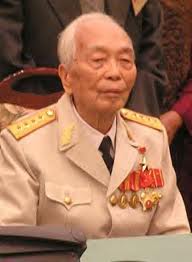
    giap
    General Giap

    I telephoned Lady Borton (her actual name birth name, not a British-sounding title) and soon met her at her office in Hanoi. She gave me guidance about traveling the city but cautioned that meeting General Giap would be nearly impossible. She also mentioned that he had been placed in the permanent care of Military Hospital 108 in Hanoi where the staff could keep a 24-hour watch on his fragile health. When I asked if he was facing life-threatening conditions, she replied no, that he simply needed assisted living. She added that he was still cognizant and often read daily. Thanking her, I nevertheless arrived at my next destination the following day, the Indian Embassy in Hanoi. Armed with full determination as well as Ambassador Chaudhry’s handwritten note and historic photographs, I set out to meet the right authorities who would aid in my quixotic quest to meet General Vo Nguyen Giap.

    At the Indian Embassy, I was initially told to schedule an appointment with the Defense Attache for the following day. I did so and arrived the next day to meet the colonel (name withheld due to his insistence on keeping the arrangement discreet) who was then the current military attache to the embassy. I presented him the personalized note given by Ambassador Chaudhry on my behalf as well as the one dozen historic black-and-white photos from 1950s Vietnam during his official tenure there. The colonel gazed intently at the photos and was both intrigued and pleased with the historic images, commenting that he was seeing many of them for the first time. In fact, he said, even the embassy and its archives did not have many such photos. He asked me permission to have the pictures photocopied on the embassy’s in-house copier and I quickly gave my assent. We then returned to the subject of the purpose of my visit. Beneath a giant framed wall photo depicting Prime Minister Nehru standing with Ho Chi Minh, I conferred with the colonel on how best to approach the possibility of meeting General Giap. He remarked that he had once met the famed general himself a few years earlier when he first arrived as attache to the embassy. However, the general’s health had declined since then and he was thus placed in the care of Hospital 108 by his family. The colonel counseled that it was highly unlikely that I would be able to meet Gen. Giap because the family wanted his health and privacy kept out of the public eye (to such an extent that only the Vietnamese Prime Minister and the nation’s top military leaders were allowed to visit him at his hospital suite). Sensing my disappointment, the colonel did suggest one final option. He mentioned the name of one native Vietnamese employee at the embassy who not only assisted the Indian staff in communications with the Vietnamese local officials and government, but who also happened to be a close family friend of General Giap’s youngest son. I was told once more to arrive at the embassy for a special and discreet appointment with a certain individual to help facilitate the possibility of meeting either General Giap or his family. I held my breath and waited to see how things would unfold.

    I arrived for the final time at the Indian Embassy to meet a middle-aged Vietnamese gentleman who had been a lifelong friend of Vo Hong Nam, General Giap’s youngest son. Throughout our conversation, this helpful gentleman kindly corrected me when I mentioned the names of historical figures in Vietnam’s turbulent twentieth century history (for instance, Diem was pronounced “Xiem” and Giap was pronounced “Jop” or “Zop”). As the appointment ended, this helpful fellow provided me with the email address of General Giap’s son, Mr. Vo Hong Nam, and suggested that I send an email right away explaining my background (such as being related to Ambassador Chaudhry) as well as my intentions for meeting with the family. The rest would be up to the son on whether I would be allowed to visit him at the family home or not. The Vietnamese gentleman wished me good luck as I thanked him and immediately left to compose a proper email requesting a meeting. After sending off the email by evening, I waited in nervous anticipation the next day for any form of reply. Soon enough, it came from Mr. Vo Hong Nam himself, who told me to pay him a visit on the afternoon of September 4, 2011. He also provided me his telephone number and address. I was elated that, at long last, I could now finally meet the immediate family of one of the great military figures in twentieth century world history.

    I set out on Sunday, September 4, 2011, for the home of General Vo Nguyen Giap. Located in a residential area some distance from downtown, my taxi wandered past neighborhoods of people out on their bicycles or taking leisurely walks. I soon arrived at a massive compound with a gated entry. I got out and walked up to the curbside guardhouse booth out of which stepped a fully-uniformed Vietnamese soldier who asked me in halting English my name and the purpose of my visit. I explained my appointment to meet with Gen. Giap’s son. No sooner had he dialed the direct line to the house, that off in the distance I saw a man in slacks and shirtsleeves leaving the home and approaching us via the long oval-shaped driveway that led to the front gates. Soon enough I was waved inside and walked halfway across the driveway to meet up and shake hands with Mr. Vo Hong Nam, the youngest son of General Vo Nguyen Giap. He gave me a quiet welcome and smile and pointed toward the side route by which to enter the house. I glanced once more at the massive driveway and sprawling front lawn, remembering that his had been the residence of the French governor prior to Dien Bien Phu.(1) Arguably one of the largest houses in Hanoi, it was, in the aftermath of the battle, given as a well-earned award from Ho Chi Minh to his victorious general and right-hand man, the ever-loyal and indefatigable Vo Nguyen Giap.

    Once inside, I was taken to a small sitting room decorated with Southeast Asian art and furniture. After initial greetings and pleasantries, Mr. Vo Hong Nam asked me about my interest in Vietnam, etc. Before further explaining my intent of writing a book on President Kennedy’s final year in office, I first opened the packet of photos given to me by Ambassador J.N. Chaudhry. Detailing exactly how the former ambassador was related to me, I also mentioned two other relatives who had served at high levels in India’s previous administrations. One relative from my father’s side, Baldev Singh, had been India’s first Minister of Defense. And another from my mother’s side, Balram Jakhar, had been Speaker of the Parliament before eventually becoming Minister of Agriculture, then retiring as governor of India’s largest province in 2009. Vo Hong Nam then looked with deep interest at the old black-and-white photos, especially the ones depicting the International Control Commission delegations arriving in Hanoi in 1954. I saved the best one for last. Having had it framed, I gave it as a gift to Mr. Vo. It was the photo of Ambassador Chaudhry standing behind the three great anti-colonial Asian legends, and Mr. Vo himself said their names out loud as he pointed to each one from left to right, “Pham Van Dong, Jawaharalal Nehru, and Ho Chi Minh”. He smiled at the framed photo. Unfortunately I did not have one of his illustrious father, but I explained that Ambassador Chaudhry had met him on a few occasions in the 1950s as well as most recently in India in 1984.

    I next asked the key request which had been the main purpose of my entire trip. I asked Mr. Vo if it was in any way possible to visit his elderly father at Hospital 108. He emphatically shook his head and said “no”. Recognizing the tone of finality to his reply, I did not argue the point further. I did, however, congratulate him on the fact that his father had recently celebrated his 100th birthday, and that he was indeed the greatest military figure of the twentieth century. He thanked me for my sincere remarks. We then moved on to the heart of the discussion and the reasons for my visit. I reminded him that I was interested in writing about President Kennedy’s final year in office and how transformational the year 1963 truly was. When I conceded that President Kennedy had not been quite perfect in his earlier foreign policy, Mr. Vo immediately interjected and said with a firm nod of his head, “Cuba!” I was a bit taken aback at his blunt assertion but realized that he was technically right (at least in the context of 1961 and the Bay of Pigs, although this was not the proper time nor place to argue that it had been Richard Nixon’s and Allen Dulles’ plan carried over from 1960). I then moved on and discussed other events from 1963 such as the iconic self-immolation of Buddhist monk Thich Quang Duc as well as the Nov. 1-2, 1963, coup against Ngo Dinh Diem and his brother Nhu. I asked Mr. Vo for his advice about looking through government or newspaper archives for these critical events and he said to hold on for a moment. He picked up a phone and explained that he was dialing the editor of the prominent “Nhan Dan” newspaper, which had been the official paper of record in Hanoi and the North since independence. After conferring with the editor and then interrupting once to ask me specifically, “Do you only need headlines from 1963?” (to which I replied yes), he soon ended the inquiry by phone. I quickly realized that this was the personal power and connections that only the son of someone with the stature of General Giap could carry.

    He then stated in a very clear and firm voice,

    President Kennedy was withdrawing from Vietnam in late 1963.

    I then moved on to the penultimate topic regarding 1963, the change in Southeast Asia policy, specifically for Vietnam, that President Kennedy was carefully but confidently carrying out. When I mentioned this vital policy to Mr. Vo, I said, “President Kennedy was finally changing his foreign policy in regards to Vietnam in 1963”, and before I could even finish my sentence, Mr. Vo interrupted and added, “He was withdrawing from Vietnam.” Momentarily surprised by what I had just heard, I then quickly asked him to repeat what he had just said so as to be sure I had heard right. He then stated in a very clear and firm voice, “President Kennedy was withdrawing from Vietnam in late 1963.” I was beyond a loss for words and sat transfixed at what I had just heard. The son of General Vo Nguyen Giap, sitting just a few feet across from me, had just unequivocally confirmed what many scholars and experts had pieced together and been saying for years, only to be dismissed by the Establishment as “wishful thinkers” and starry-eyed idealists or, in some cases, as “Kennedy apologists”. Some had even been challenged as to the validity of their sources although many correctly cited the available U.S. government record from the Kennedy Administration papers as well as the National Security Action Memorandums (NSAMs) signed by President Kennedy in October 1963. Yet, here was the most astonishing and perhaps unimpeachable source of proof, right in front of my eyes. What could be a more credible and original direct source than the former “enemy”, General Vo Nguyen Giap (represented by his son), confirming that its rival’s leader, U.S. President John F. Kennedy, was indeed logistically carrying out a de-escalation policy for American personnel to withdraw in phases (until there would be virtually no military advisors left by 1965). Most likely General Giap’s military and intelligence operatives and analysts had to have discovered this by tracking the patterns of oppositional foreign (American) troop movements and the quantifiable logistical reductions that were visibly ensuing. It may also be likely that word of President Kennedy’s NSAMs might have somehow leaked and reached North Vietnam, who probably rejoiced with relief at hearing that a potential deadly foe was withdrawing from the embattled homeland (with only future promises of financial aid and war materiel to sustain South Vietnam). Nevertheless, I was both amazed and grateful for Mr. Vo’s candid statement and assessment regarding that most crucial and pivotal period of the Kennedy Presidency.

    As the hour drew to a close, I realized it was time to leave, and I was most satisfied that my discussions with Mr. Vo Hong Nam ended with a most unexpected yet reaffirming statement regarding President Kennedy and his intentions for America and Vietnam. I never knew that I would be leaving the home of Vietnam’s most famous and victorious general with an added insight and gem of historical knowledge. This was more than proof enough for all the naysayers and critics who doubted the slain president’s true peaceful intentions. Although he could not speak beyond the grave for himself, such living participants and legendary foreign figures could bear witness to that era and the dynamic breakthroughs that were in the midst of occurring. As I profusely thanked Mr. Vo for his time and honesty, I rose to shake his hand and then realized that I should definitely snap a photograph of my hospitable host while situated in his historic and noteworthy residence. In Vietnamese, he called out for someone and soon a young woman in her late teens appeared. Likely his daughter, he asked her to hold my camera and take a photograph of us standing next to a large marble bust of his famous father. I thanked her and then he and I proceeded out the door by which we came.

    As we were walking out towards the lush green backyard and landscaping, I again sensed the historical significance of the residence and asked if Chairman Ho Chi Minh had visited here often and if he remembered him. Although he was just a young teen himself at the time of Chairman Ho’s death, he said, “Yes, I remember him well”. Walking back to the front of the house and the enormous driveway, a middle-aged woman appeared in a low front balcony of the house. She said “hello” and was holding a camera herself. I said “hello” as well and then asked Mr. Vo if that was his wife and he nodded yes. He then spoke again in Vietnamese, and she responded by waving us together and to hold still. She then snapped a picture of us together before disappearing back into the balcony. As we passed a gate separating the house from the driveway, I realized I should take one final photo of Mr. Vo myself. He complied and stood at the foot of the gateway, with the fabled house behind him. He then motioned for me to likewise stand where he was, to thus take a similar photo of me standing in front of his house. After that, we walked the length of the driveway to the front gates where he saw me off. He asked for the guard in the booth to call another taxi for me, and then I thanked him one final time for his revealing insights and to give my sincerest regards to his legendary father. We shook hands one last time and then he turned and left.

    Soon enough, a taxi came and as I got in, I took one last look at the brush with history that I had just experienced. I had been fortunate enough to visit the home and son of Dai Tuong Vo Nguyen Giap, the most victorious general of the twentieth century, a man whose starting ambition in life was to be a history teacher until the cruel realities of fate had changed his destiny. And the realization crystallized that we once had a president who was willing to make a truce with these strong and resilient people, whose leader Ho Chi Minh had visited America on the eve of World War I and had even translated our Declaration of Independence into Vietnamese at the end of World War II in an effort to forge a friendship with the United States. How foolish and tragic of us to have rejected his olive branch, only to learn the hard way that these were a people who could not be subjugated. Alas, we once had a young president not so long ago who had come to this realization himself.


    1. Henri Hoppenot, Diplomat and High Commisioner of France in South Vietnam Apr1955 – 21 Jul 1956

  • James DiEugenio, Destiny Betrayed (Second Edition)


    By 1967, Jim Garrison became the Prometheus to the Achesonian Olympus. 

     – Robert Spiegelman 


    I.  Garrison Unbound

    About three years ago, at the Lancer “November in Dallas” conference, Jim DiEugenio gave an address entitled “Historical Revisionism and the JFK Case”, in which he defended his criticism of a few recent theories of the assassination, criticism which some – quite mistakenly, in this writer’s opinion – interpreted as counter to the spirit of free inquiry.  The main point of his presentation was that revisionism should not denote a quest for novelty at the expense of accuracy.  If we are to have any hope of coming to terms with what happened on November 22, 1963, we must take care to remain focused on the evidence.  The reissue of Destiny Betrayed is extremely timely in this respect.  I would fancy that when DiEugenio gave this talk, the need for an updated edition of his 1992 book had already crystallized in his thinking; but as we enter the 50th anniversary year it has become ever more urgent, as his lecture suggested, to revisit the breakthroughs made during the first decade and a half after John Kennedy’s death, and to build on them using the knowledge and insight we have since acquired.  This thoroughly rewritten study does precisely that.

    No single person uncovered as many clues1 in that early period of the JFK investigation as did Jim Garrison.  And it is impossible for the reader not to take away from Destiny Betrayed a sense of indebtedness to those leads. But the reader also cannot help but be impressed by the imposing factual edifice that is erected upon them.  In that same lecture, DiEugenio paraphrased Garrison concerning what an investigator should hope to achieve in this case:  “… a paradigm that would be justified internally by the evidence yet [whose] overall design would fit the shape of the plot.”  This book fulfills Garrison’s prescription by offering an abundance of details – more so than perhaps any other reconstruction of the crime – that fit the players and their activities together into a coherent picture.

    It does so in large part through the constant confrontation of old information with the new.  From the seemingly inexhaustible font of documents declassified by the ARRB have flowed forth revelations in a number of areas explored by the author:  Vietnam, the Bay of Pigs, Mexico City, James Angleton’s role in the setup of Oswald, Shaw and his legal team’s CIA connections, the Clark Panel and HSCA medical cover-ups, the complicity of the media and the federal government in sabotaging Garrison’s investigation – to name just a few highlights from the wide scope of this book.  Further, the author’s own interviews during the mid-90s, his 1994 inspection of the DA’s files (he was the first person outside his staff allowed to copy Garrison’s files), along with the work of John Newman, John Armstrong, Bill Davy, and Jim Douglass, as well as a host of articles published in Probe by others such as Lisa Pease and Donald Gibson: these are all mustered to good effect in support of Garrison’s case.  The corroborative weight of this evidence is quite compelling.  Yet the author never ceases to remind us, as did the twelfth-century schoolmaster Bernard of Chartres, that if we can see farther, it is because we are dwarves standing on the shoulders of giants (and in particular, one giant, jolly and green though he may have been deemed).

    This study not only offers convincing confirmation for Garrison’s hypotheses, but also ratifies Garrison’s more general suspicions concerning the clandestine interference with his investigation, and the direction in which the country was heading.  In preparing this review, this writer had occasion to reread Garrison’s interview given to Playboy magazine in October 1967, and was impressed by the lucidity, force, and uncanny relevance of his final remarks:

    our Government is the CIA and the Pentagon, with Congress reduced to a debating society … We won’t build Dachaus and Auschwitzes; the clever manipulation of the mass media is creating a concentration camp of the mind that promises to be far more effective in keeping the populace in line … I’ve learned enough about the machinations of the CIA in the past year to know that this is no longer the dream world America I once believed in … Huey Long once said, “Fascism will come to America in the name of anti-fascism.” I’m afraid, based on my own experience, that fascism will come to America in the name of national security.

    Recall, this was 1967!2  At a distance of 50 years, where half of one’s readership has no memory of the event, the question of relevance naturally arises; but such relevance is not realized by fishing for links between the assassination and personages responsible for recent political crimes or abuses, as some of the authors criticized in DiEugenio’s lecture do, for these mostly end up having the consistency of gossamer.  As Garrison alerted us, it is to the institutional consequences of the assassination that we must look, because, as Lisa Pease opines in her preface to the book, “the same operational template can be run again” (and indeed has been, repeatedly).  Destiny Betrayed does not bludgeon the reader with this message; it makes the point cogently by showing rather than by telling.

    For a number of reasons, this is not a typical book on the JFK assassination. As DiEugenio himself has declared (see, for instance, his remarks at the beginning of his well-known review of JFK and the Unspeakable), it was already his intention with the first edition to bring assassination research out of the ghetto.  What he had in mind was a broadening of perspective beyond the mechanics of Dealey Plaza or the suspicious goings-on at Bethesda, and this is precisely the manner in which the reader is made to enter the maze:

    The events that exploded in Dallas on November 22, 1963, had their genesis in Washington on a February day in 1947.

    Much as with the traditional novel, one can almost unpack the remaining four-hundred-odd pages from that single opening assertion. The quest for the appropriate context in which to decipher JFK’s presidency and death is one of the principal tasks undertaken by the author.  But his formal choices also transform his engagement with these events from a simple act of sleuthing into a veritable essay in the hermeneutics of history. 

    To illustrate what I mean by this, let me begin by observing that a dialogue of past and present is inscribed in the book through the interplay of narration and commentary. The narrative building-blocks are ordered mainly along chronological lines, leading from the initial post-war articulations of U.S. foreign policy, through JFK’s presidency, the activities in New Orleans and Dallas preceding his death, and the subsequent domestic investigations, to conclude with some reflections about the continuing impact of the assassination and its cover-up on the political climate of the United States today.  This basic organization is, however, selectively adjusted for thematic purposes; for instance, Oswald’s activities in New Orleans (chpts. 5-6) are separated from his return to the U.S. and his final days (chpt. 8) by a flash-back dealing with his early life and defection (chpt. 7), thus lending, by its central position, an explanatory prominence to his intelligence training.  (I should add here that these latter two chapters form the best concise treatment of Oswald I have yet to read.)  The last three chapters also break with the preceding linear progression (more on this below).  But emerging from within this broadly forward sweep are also narrative swirls and eddies where the author interrupts his story in order to indicate a noteworthy nexus which will be handled more fully later, or which involves knowledge we now possess but which was unavailable then.  Far from obscuring or confusing the chain of events, this weaving in and out of strict chronology – and its attendant modulation between points of view – is adroitly handled and lends a sense of continuous integration to the reader’s journey.

    Another narrative technique, related to and often conjoined with the preceding one, is that of the leitmotif.  For instance, we meet a corporation called Freeport Sulphur in the very first chapter with respect to mining concessions in 1950s Cuba.  We return to that company in the context of Garrison’s discovery of a Freeport link between Shaw, Ferrie and Banister (chpt. 10); then again in terms of Gaeton Fonzi’s reinvestigation of those leads for the HSCA (chpt. 15).  And then finally, in the fullest and most crushing context, with that ignoble corporation’s role in the Indonesian coup, related in the penultimate chapter.  Another example of this technique centers on the CIA’s turn to drug-running money after Kennedy defunded Mongoose, which we first read about in Chapter 6, and then again in Garrison’s discovery of the Ruby-Oswald-Cheramie connection (chpt. 10), with further confirmation via reference to Douglas Valentine’s discovery (2004) of the CIA’s infiltration of U.S. Customs, followed by a discussion of the Hubert-Griffin memo (see Section III below), putting Sergio Arcacha Smith, whose name peppers the pages of this book, decidedly in the middle of it all.  Leitmotif is also used with respect to one of the cardinal figures in this story, Bernardo DeTorres.  He is  first discussed in the context of how news of the back channel to Castro was divulged among the Cuban exiles (chpt. 4), then with respect to his infiltration of Garrison’s inchoate investigation (chpt. 11), and then again with reference to his independent discovery by Fonzi through Rolando Otero which led to his wider connection to the probable operational faction of the plot (chpt. 15).

    The artful use of such devices lends to Destiny Betrayed a concern with the intimate connection between meaning and expository process shared by few other books on this subject, the vast majority of which are simply organized by topic.  More specifically, these literary techniques do not serve as mere artifice, extraneously imposed on the material, but emerge naturally from it, as the author winds and unwinds his thread through the Daedalian intricacies of a story that ultimately is revealed to have explicated itself.  For over the retrospective span of the intervening decades, events have indeed disclosed their own significance before our very eyes, not only through documentary releases, but by the repeated pattern of the actions of their protagonists.  One of the theses of the book is that the JFK assassination and the destruction of Garrison were interlocking covert operations, in which some of the same players were involved.  Another theme, which runs in parallel, is that Kennedy’s presidency blocked the progress of economic globalism, which was then restored after his death.  We are made conscious of these relationships, not just through a series of momentary epiphanies, but ultimately through participation in a larger unfolding.  In a profound sense, this book claims that the meaning of November 22, 1963, lies as much in what subsequent occurrences have affirmed as in the case that can be constructed directly from the facts and circumstances of the crime.

    This conviction manifests itself finally in the book’s broadest architecture, one based on recapitulation.  The concluding chapters generate a triad of embedded arches – or perhaps even concentric rings:  the outermost (chpts. 1-4, plus 17) deals with Cold War policy and JFK, echoed by a discussion of foreign policy changes under LBJ; inside that, we have a similar structure (chpts. 5-8, plus 16) addressing the significance of Garrison’s discoveries about New Orleans and Oswald and ending with Mexico City, the importance of which Garrison clearly understood, but the full truth about which was concealed from his view.  This leaves the innermost tripartite (and most drama-like) sequence (chpts. 9-10, 11-13, 14-15) tracing Garrison’s career and entry into the case, the government and media campaign against him, and the actions subsequent to Shaw’s acquittal, including how the same forces deployed against Garrison made a shambles of the House Select Committee on Assassinations. (Chapter 18 completes the composition, serving as a coda to the entire book).

    At the center stands, of course, Jim Garrison, the oracular voice decrying national calamity and a knowing participant in his own professional ruin, whose vindication is as much a part of the story DiEugenio tells as is the exposure of the powers which removed JFK from office.  It is, in fact, this dovetailing of two lives, this fateful encounter of purpose, that gives Destiny Betrayed its dramatic design. The book’s felicitous title, retained for this second edition, suggests an underlying logic impelling actions toward their “dénouement” (the title of the final chapter); a process, to take the author at his etymological word, to be perceived as the untying of a knot.  The book’s title not only implies (somewhat paradoxically) the deliberate theft of what should have been, both in terms of U.S. foreign policy and in terms of bringing (at least one) of the perpetrators to justice; it also hints at how the unraveling of five decades has “betrayed” – that is, revealed – the character of both John Kennedy and Jim Garrison, despite monumental exertions to conceal or distort the truth.


    The Afro-Asian revolution of nationalism, the revolt against colonialism, the determination of people to control their national destinies … in my opinion the tragic failure of both Republican and Democratic administrations since World War II to comprehend the nature of this revolution, and its potentialities for good and evil, has reaped a bitter harvest today—and it is by rights and by  necessity a major foreign policy campaign issue that has nothing to do with anti-communism. 

     – John F. Kennedy, from a speech given during the Stevenson campaign, 1956


    II. JFK, the Cold War Establishment, and Cuba 

    As mentioned in the preceding section, the first four chapters of  the book, along with the penultimate one, raise a fundamental issue:  whether JFK was ever a “Cold-Warrior”, and whether the assassination had any effect on the policies he had been pursuing.  Seriously posing this question has long been anathema to mainstream writers on both the Left and the Right, some choosing to feign perplexity at the so-called “enigma” that was John F. Kennedy.  At the very least we may observe that historians have been burdened by a considerable amount of preconceived baggage regarding what Kennedy’s politics could or could not have been.  Yet I think John Newman put his finger on the crux of the matter in his masterful JFK and Vietnam:  if one concentrates on the rhetorical indirections of his public statements – which JFK felt compelled to practice, for better or for worse, out of fear of vitiating his political efficacy – then one may derive the picture of a man who is mostly in conformity with the ideological matrix of his time.  But as Newman teaches us, that is not the best way to understand his presidency.  For, in the end, it is what he actually did and did not do which tells the more authentic tale.  DiEugenio is not insensitive to the political pragmatist in Kennedy; but speaking of his desire to bolster his anti-communist credentials, especially during the 1960 campaign, the author insists that “below the level of campaign rhetoric, John Kennedy was not simply a more youthful version of Eisenhower” [19]3.  Even James Douglass, with whose marvelous book this one aptly bears comparison (more on this momentarily), can be led astray by this side of JFK into believing that he changed his foreign policy stance in some essential way while he was president. With Destiny Betrayed, I believe we are finally given firmer footing for posing this question properly.

    In order to do so, one must look to origins.  That is where the first chapter, Legacy, begins. From the opening allusion to the request from the British Embassy asking Secretary of State Marshall for aid in quelling insurrection in Turkey and Greece, through the Truman Doctrine, the Marshall Plan, NATO and the National Security Act, we witness the fateful passage from republic to empire as the United States assumes custody of former European colonial interests in the name of containing putative Communist aggression and the Domino Theory.  For DiEugenio, the key which unlocks what follows is this implicit marriage of ideology with economic interest.  Out of that unholy alliance is born, through the midwifery of Allen Dulles, the de facto executive arm of neo-colonialism in the guise of a drastically metamorphosed CIA.  In Dulles, in fact, these two lines – a hard-core view of the Soviet Union (which he shared with Nazi intelligence chief Reinhard Gehlen, whose vast network Dulles, while chief of the Berlin OSS office, helped retain with Gehlen in control), and a globalist perspective held in common with the Rockefeller corporate interests (which he and his brother John served as senior partners at the Wall Street firm of Sullivan and Cromwell) – converged perfectly and literally became one.  To quote DiEugenio, “With Allen Dulles, the acronym ‘CIA’ came to stand for ‘Corporate Interests of America’” [6].  By the time of the Bay of Pigs, so the long buried Lovett-Bruce report tells us, 80% of the CIA’s budget was going to covert operations [49].

    While belief in the necessity of a nuclear deterrent is certainly one component of Cold War ideology, this Dulles-Rockefeller view of the Third World as their own economic protectorate is equally, if not more, critical.  So, too, these two elements should bear at least equal weight when we assess the Kennedy presidency. DiEugenio’s treatment of the assassination plot shares a great deal of ground with that of Douglass’s JFK and the Unspeakable, but it gives us a sharper picture of what made JFK so different from his peers by concentrating much more single-mindedly on this second pane of the Cold War lens. Though Douglass does write incisively about Kennedy’s resistance to the national security agenda in his Cuba and Vietnam decisions, his claim that JFK underwent an Augustinian moment in the garden during the Missile Crisis is, from the wider angle sought by DiEugenio, overstated (and the only feature which mars Douglass’s otherwise convincing treatment of Kennedy).  Rather than conversion, DiEugenio’s chosen trope for JFK’s coming into his own is that of education, which he borrows from Richard Mahoney’s seminal work, JFK: Ordeal in Africa (1984).4  Taking his cue from that study, DiEugenio locates the decisive moment in Kennedy’s 1951 tour of the Far East and his meeting with Edmund Gullion, senior official at the American Embassy in Saigon (and later appointed by Kennedy as Ambassador to the Congo), an encounter which Robert Kennedy said had a major effect on his brother’s thinking [21-22].

    From there the counterpoint between JFK’s views and the actions of the Dulles circle becomes increasingly evident. Kennedy even criticized his own party (Truman and Acheson) for their intellectual indolence in this area. In 1953 he wrote then Secretary of State John Foster Dulles a letter with forty-seven specific questions about what the U.S. aims in Vietnam were, asking how a military solution (including use of atomic weapons) could actually be feasible. While the Eisenhower government secretly conspired to undermine the Geneva accords and have the U.S. assume France’s role in Saigon, Kennedy began to give more speeches about the struggle of African and Asian peoples to throw off the yoke of oppression.  The culminating moment in all this came in 1957 when he defended Algerian independence on the floor of the Senate, much to the disapprobation not only of about two-thirds of the major newspapers, but also of one of the Democrats farthest to the left, for whom he had in fact campaigned in 1956: Adlai Stevenson [22-28].  The author is correct to lament the lack of attention given to this speech in the assassination literature. Where Douglass, with good reason, sees the American University speech delivered in June of 1963 as a pivotal event in JFK’s Cold War diplomacy, DiEugenio is surely also right to consider the Algeria speech the Rosetta Stone for what JFK would later do and not do in the Oval Office.  In fact, it would have been a good idea to excerpt the entire speech as an appendix in order to show just how far out of the mainstream Senator Kennedy was before he became president.

    One of the author’s virtues is his determination to avoid isolating any one foreign policy decision from all the others.  For the total picture eloquently proves Kennedy’s substantial divergence, not just from the Dulles coterie, but also from his own advisers.  It is unnecessary to dwell at length here on what has become familiar since Newman’s 1992 opus, because it has been clamorously confirmed by the ARRB’s declassification of documents:  Kennedy’s plans for withdrawal from Vietnam began in 1962 and were made official in May of 1963.  DiEugenio does a fine job summarizing this “Virtual JFK” material, demonstrating the stark reversal of policy which occurred a mere forty-eight hours after the assassination, and which LBJ strove to disguise [365-371].  What the book adds to all this is a series of before-and-after snapshots from other areas of JFK’s Third-World policy, images which capture the same panorama.

    In the Congo, for instance, Kennedy favored the nationalists against the Belgian and British allies who wished to see the mineral-rich Katanga province secede.  It is more than probable that Lumumba’s assassination was instigated by Allen Dulles to occur just before Kennedy took office [28-29].  President Kennedy thereafter interceded twice with the U.N. to convince them to maintain peacekeeping forces in the region, which they did. Kennedy’s preferences, backed by the U.N., for how to train the Congolese were nevertheless subverted by the Pentagon in its support of eventual dictator Mobutu Sese Seko.  LBJ, on the other hand, clearly allied the U.S. with Belgium, and in 1964 allowed right-wing Rhodesians and South Africans to join in this supposed war on a “Chinese inspired Left”, the economic consequences of which were a tremendous boon to Mobutu and the West but disaster for the Congolese [371-373].

    JFK’s Indonesian policy follows a similar course.  On behalf of Standard Oil and other Rockefeller interests, the CIA had unsuccessfully attempted a Guatemala-like coup there in the late 50s;  Kennedy not only broke with this direction, but went well beyond it, befriending the PKI-allied (i.e., “Communist”) Sukarno, and in a parallel with the Congo, also obtaining U.N. support for the return of West Irian, another mineral-rich region coveted by Euro-American corporations, from the Netherlands to the Indonesians [31-33]. JFK’s Indonesian aid bill was never signed by LBJ.  A chain reaction, begun by LBJ’s siding with the British over the creation of Malaysia, followed by Indonesia’s withdrawal from the World Bank and IMF, finally resulted in a CIA-prompted bloodbath of genocidal proportions foreshadowing Operation Phoenix.  Like Mobutu in the Congo, the new Indonesian government under Suharto brokered mining rights off to the highest bidder [373-375].

    Third in this litany of exploitation unleashed by Kennedy’s death is Laos.  Newman, David Kaiser and others have recounted JFK’s adamant refusal to intervene unilaterally and his support for a coalition government there (this was an even more visibly pressing issue than Cuba in the first months of 1961). The CIA and military consistently undermined this position, particularly through Air America, the CIA’s covert air force. They destabilized the Laotian economy with forged currency and forced the Pathet Lao into retaliatory action, which turned into a civil war responsible for untold decimation.  The economic fruit of all this was an immensely profitable heroin trade [375-377].  One could further include here LBJ’s analogous handling of situations in the Dominican Republic, Brazil, Iran, and Greece.

    This general pattern of reversal is striking enough. But frequently the players involved have a recurring familiarity that is hard to dismiss as coincidental.  For instance, John McCloy is the man who David Rockefeller and the CIA sent in to fix the Brazil situation after Kennedy’s death. Then there is LBJ’s campaign support from Augustus Long and Jock Whitney of Freeport Sulphur, a company with links to Shaw’s International Trade Mart, and which ended up making billions from Indonesian concessions. (Long established a group called the National Independent Committee for Johnson, which included the likes of Robert Lehman of Lehman Brothers and Thomas Cabot, Michael Paine’s cousin.)  But of course, proof of conspiracy does not (and cannot) rest merely at this speculative level.  And while all of this provides a credible background against which to delineate what occurred in Dallas, DiEugenio never claims it as more than that.  From the weight of the evidence, the true catalyst for the assassination still must be considered to be the powder keg of Cuban affairs.

    Which also fits into the foregoing template. The book’s chapters on Cuba are unparalleled in the field.  From their mini-history of Cuba before the revolution, what fairly jumps off the page is the reduction of the island to financial slavery by American corporate interests and Wall Street banking.  This was made possible thanks to Batista’s lifting of taxes, a tremendous negative trade-balance (two thirds of Cuba’s needs were provided by American imports), and a spiraling indebtedness through short-term loans.  We learn that by 1959, American investment in Cuba was greater than in any other Latin American country save oil-rich Venezuela [7-10].  When Castro sets out to rectify this through nationalization of agricultural and mining concerns (like the Moa Bay company), and turns to the Soviet Union in order not to bow to IMF strictures, Eisenhower and the CIA begin to organize against him, recruiting financiers, military leaders and other ex-members of the Batista regime in exile.   It is out of this miasma that the personnel of this drama begins to take shape: the DRE [Directorio Revolucionario Estudiantil], under the auspices of David Phillips; Guy Johnson arranging for Sergio Arcacha Smith’s escape; who joined with José Miro Cardona and Tony Varona into another group which Howard Hunt, authorized to form a Cuban government in exile by Tracy Barnes, augmented with Manuel Artime and turned into the FRD [Frente Revolucionario Democratico] and eventually CRC [Cuban Revolutionary Council] [14-16; 38-39].

    But even more essential is DiEugenio’s exposition of the Bay of Pigs subterfuge. Drawing on several newer books on this topic, along with recently released documents which more than hint at perfidy on the part of the CIA, he outlines how Jake Esterline’s Trinidad plan, originally conceived as a small-scale penetration by a group of guerrilla-trained exiles, morphed into a full-blown D-Day assault under Dick Bissell’s supervision.  It was this mutation, a development that Dulles and Bissell tried to obfuscate, which Kennedy in March 1961 nevertheless saw enough of to ask that it be scaled down.  Dulles clearly understood Kennedy’s reluctance to commit, and tried to use the “disposal problem” (what to do with all these exiles?) as leverage, further offering him entirely false assurances about popular support for an uprising and the ability of the brigade to regroup in the mountains should they get pinned down on the beaches, and all the while denying him vital intelligence and refusing to allow him to inspect the details of the plan.  JFK appears to have committed only because he was convinced of the essentially guerrilla nature of the action.  A new site, the Playa Giron, was in fact chosen because it seemed very unlikely that the landing would encounter resistance there.  Kennedy also added the requirement that any air strikes on the day of the invasion were to be conducted by the Cuban brigade after a beachhead had been secured – that is, from Cuban soil.  He even asked Bissell if the recommended preliminary surgical strikes against Castro’s T-33 fighters were absolutely necessary, and Bissell assured him they would be minimal.  But a CIA memo released in 2005 establishes that Bissell knew from November 1960 onwards that the entire plan was unworkable without the aid of the Pentagon.  That memo was never forwarded to the President’s desk  [34-37; 44-45].

    What happens next is a series of tactical foul-ups followed by efforts to nudge Kennedy into military intervention.  Not all of Castro’s T-33’s were taken out prior to the landing because Castro, who knew the invasion was coming, had dispersed them around the island.  The main forces were crippled by the sinking of two supply ships. The whole operation was very poorly planned, and Castro managed to regain two of the three landing sites by the third day.  At that point Deputy Director Charles Cabell tried to get Victor Marchetti to relay to Kennedy the false story of MiGs strafing the beaches (which Marchetti never delivered).  Kennedy had made clear from the outset his refusal to deploy U.S. military force, but the CIA gave orders anyway to fly bombing missions over Castro’s airfields, which did not occur only because of fog [41].

    Most decisive in its analysis of this episode is a fact which the book makes unequivocal – that Kennedy never withdrew air support, because the so-called D-Day strikes had never been authorized to begin with; they were not part of the revised plan.  McGeorge Bundy reiterated Kennedy’s restriction on them to Cabell the night before the landing, and the next day, he and Bissell tried to argue the point with Dean Rusk.  But when Rusk gave the CIA the chance to phone the White House and request such strikes the morning of the invasion, the CIA declined the invitation.  On the third day, Cabell and the CIA similarly refused to request a naval escort to resupply the brigade with ammunition.  In a conversation with Rusk and Adlai Stevenson the day of the invasion, Kennedy again said he had not approved any such strikes from Nicaragua [44, 46].

    After ordering the Taylor inquiry (during which the Joint Chiefs basically tried to hang all the blame on the CIA) and consulting with Robert Lovett, co-author of the Lovett-Bruce report, who laid bare the true nature of the CIA, convincing him to fire Dulles, along with Bissell and Cabell, it became obvious to Kennedy that he had been snookered. Today we may reasonably share his opinion that the operation was a planned failure aimed at backing him into a corner and coercing him into an all-out invasion.

    It is also patent that a Cuban-driven initiative to oust Castro was transformed into a CIA-controlled enterprise, one with callous disregard for the Cubans themselves, not only in the way they were knowingly turned into so much cannon fodder in a ploy to wrest the island back for American interests, but even in the way the political spectrum of the participants was managed by Hunt so as to exclude the left wing of the exile community, in particular Manolo Ray and JURE – a maneuver which Kennedy challenged by having Bissell explicitly instruct Hunt to include Ray in the CRC; Hunt nominally resigned his position just before the invasion in order to avoid having to deal with him [39-40].  Ray, in fact, was not in favor of the strike-force invasion.  But Hunt and his group had plans of their own.  First, there was the contingency to have the operational leaders imprisoned and the assault taken over by “renegade Cubans”, in case Washington called off further action [47-48]. And then, there was Operation 40, calling for the liquidation of the leftist contingent during the early stages of the takeover of the island [50-51].  After the debacle, this manipulation was given a new, and ultimately deadly, twist:  the incitement of hatred among the Cubans for the Cold War Establishment’s number-one stumbling block.

    And it is another achievement of the book that the author pinpoints how this was done,  because to my knowledge, no one else has.  It was first accomplished by an inflammatory cover story about the so-called cancelled air strikes, a tall tale concocted by Dulles and Hunt. This phony story was reported in Fortune through Dulles’ personal friend Charles Murphy.  The purpose was to take the heat off the CIA by setting the blame for the failure at Kennedy’s door.  Although it was a false story, it nevertheless stirred up hatred among the Cuban exile community for JFK’s supposed “betrayal”.  As CIA anger grew during Mongoose – which William Harvey probably was correct in viewing as the administration’s half-hearted bone tossed to the hard-liners and which was effectively ended by the Missile Crisis – Cuban groups like Alpha 66 were enlisted by the Agency into activities well outside of Mongoose’s purview.  This included raids on Russian ships in the Caribbean, faking an invasion of Cuba, and renewed plans to assassinate Castro.  All these were intended to defeat the no-invasion pledge and to disrupt JFK’s move toward rapprochement [64-66].  Meanwhile, Kennedy’s end-run around his advisors, the CIA and the Pentagon, which he had found necessary in negotiating with Khrushchev, was repeated with Castro. During 1963 there was a sequence of back-channel communications involving journalist Lisa Howard, William Attwood (U.N. aide and former ambassador to Guinea), Cuban ambassador to the U.N. Carlos Lechuga, and French journalist Jean Daniel, with a view to initiating talks on the normalization of Cuban-American relations.  I will not repeat here the full story (or the revealing statement Kennedy made to Daniel about U.S. complicity in Cuba’s enslavement under Batista), but simply stress that the exiles could have gotten wind of this only through their CIA managers, who, despite their having been locked out by Kennedy, had access to the NSA’s wiretaps.  (It is also possible that McGeorge Bundy, who was in on some of these discussions, communicated them to his CIA contacts – he was a friend of Dulles.  Helms also monitored progress in this area, as Douglass has shown.)  Not only did David Morales’s counterintelligence group know of it [71]; as referred to previously, Rolando Otero revealed to Fonzi that he knew of the back channel through Bernardo DeTorres, declaring that at that point, “something big was being planned”.  That this “dangerous knowledge” was held by the anti-Castro Cubans is confirmed by Fabian Escalante’s report of Felipe Vidal Santiago’s statement that the exiles, realizing their cause was doomed, began to hatch a plot to get rid of Kennedy and blame it on Castro.  Vidal spoke with his CIA handler, Col. William Bishop.  Shortly thereafter, a CIA official – very likely David Phillips – addressed a group of exiles in a Miami safe house, saying, “You must eliminate Kennedy” [393].  What is further remarkable about how the evidence for this angle fits together – and once again how symmetrically designed the book is – is revealed earlier [97]:  working independently, Richard Case Nagell also discovered that the Cubans knew of the back channel and that “something big” was in the works.  Attwood’s own fears that news would leak down, through the CIA, to the Cubans, and with dire consequences, appear not to be unjustified.

    III. Many Mansions:  Garrison’s evidence today

    Whatever one may believe about Garrison, it is difficult today to argue that his investigation was marginal.  The early leads he uncovered were all connected with Oswald or Ruby, and demonstrated foreknowledge of, or involvement in, the plot, or at least a concern over Oswald’s arrest.  The sheer number of New Orleans-related incidents is impressive: Rose Cheramie’s story, the Clinton-Jackson incident, 544 Camp Street, Banister thrashing Jack Martin, Clay Bertrand requesting legal assistance for Oswald from Dean Andrews, Ferrie frantically searching for his library card and photos from the Civil Air Patrol, and so forth.  And all of these facts were already known at the time of the first official inquiry, but were “concealed, discounted, or tampered with by the authorities.  And the Warren Commission did nothing with them.  Therefore, they laid dormant for four years,” writes DiEugenio [100].

    A full account of the evidence adduced in Destiny Betrayed cannot possibly be given here.  To do so would mean replicating it nearly page by page, for there is very little fat to trim away.  Moreover, the broad outlines of the conspiracy in New Orleans and Dallas involving the setup of Oswald as patsy is without a doubt already familiar to the present reader.  I think it therefore most useful to pass under review a number of the pieces in the puzzle whose position has been clarified since the DA’s time.  That is, after all, one of the main goals of the book under discussion.  What follows is a short list of fifteen of the more salient points.

    1. In 1993, a photo of Oswald and David Ferrie from the Civil Air Patrol was shown on Frontline.  Let me remind the reader that every newspaper editorial I can recall from 1991-1992 lambasted Oliver Stone’s film by spouting that no such evidence of their acquaintance existed [see DiEugenio’s mini-biography of Ferrie, 82-85].

    2. One of Garrison’s most important findings was Oswald’s presence at Banister’s office at 544 Camp/531 Lafayette Street. Since Garrison, others such as Weisberg, Summers and Weberman have contributed to our knowledge of this node in the conspiracy, but no one tells it with the command DiEugenio has over this material, bringing to it his own field work, enhanced by released HSCA documents and files of the DA’s office (see in particular Chapter 6).  I mention just two points of interest here.  First, he confirms Tommy Baumler’s assertions that Shaw, Guy Johnson, and Banister constituted the intelligence apparatus in New Orleans [209-210; 274-275].  Second, he amplifies Sergio Arcacha Smith’s importance beyond his role in the Rose Cheramie – Jack Ruby drug run.  As Francis Fruge stated to Bob Buras, Smith seems to have been the linchpin between New Orleans and Dallas; maps of the Dealey Plaza sewer system were actually found in his apartment [180-182; 329].

    3. Davy’s and DiEugenio’s legwork has also reinforced Fruge’s and Dischler’s original discoveries about Shaw, Ferrie and Oswald in Clinton-Jackson.  The author cites a large array of witnesses which leave no doubt that Shaw (and not Banister) was there as Oswald stood in line to register to vote.  A sustained discussion of this incident sheds further light on its purpose: to get Oswald a job at the East Louisiana State Hospital (the same psychiatric hospital that Cheramie was later taken to), then switch the records to make it appear he was actually a ward.  Oswald’s familiarity with the names of the doctors may have come through the acquaintance of Tulane Medical School’s chief of surgery, Alton Ochsner, who did LSD and electrode implantation research and was an INCA informant, with both Shaw and Banister; or it could have been through Arcacha Smith [88-93; 156-157; 185-187].

    4. The Oswald chapters make good use of the seminal background research of John Newman and John Armstrong.  I extract here only two nuggets from this very rich vein, having to do with his role as false defector:

      After being given the runaround by CIA and military intel, State Department security analyst Otto Otepka sent Bissell a request for information distinguishing false from real defectors; this got funneled through Jim Angleton to staffers who were told to stay away from certain names; Oswald’s was marked SECRET.  Shortly thereafter, but thirteen months after his defection, the CIA created a 201 file on him.  Had Otepka not inquired, all of Oswald’s files would likely have stayed hidden in the Counter Intelligence/SIG sector under Angleton’s eyes.  Otepka’s safe was later drilled and his career destroyed; he was removed from his post on November 5, 1963 [164-165; see also 143-144].

      Donald Deneselya’s recollection of a CIA debriefing of Oswald in New York was reported on Frontline in 1993, but Helm’s disingenuous denials were there given the last word.  John Newman then found a CIA memo wherein the chief of the Soviet Russia division wrote of such a debriefing as motivated by an “operational interest in the Harvey [Oswald] Story” [149-150].

    5. DiEugenio also casts further light on Oswald’s activities as agent provocateur in New Orleans.    Again, I offer only two of his more telling conclusions:

      From the earliest critiques of the Warren Report (see, for instance, Meagher, Accessories after the Fact), but especially after Harold Weisberg obtained through the FOIA a transcript of the closed-door Warren Commission session discussing Oswald’s potential role as intelligence agent, the claim he was an FBI informant has repeatedly surfaced.  DiEugenio builds a strong case for Warren DeBrueys as Oswald’s FBI handler in New Orleans.  The FBI destroyed the files on Orestes Pena, witness to one of their meetings, just prior to the creation of the HSCA.  It was DeBrueys that Oswald asked to see after his arrest following the leafleting incident. William Walter found an informant file on Oswald with DeBrueys’ name on it.  DeBrueys most certainly knew of Oswald’s association with Banister before the assassination.  FBI agent James Hosty later told Church Committee witness Carver Gayton that Oswald indeed was an informant [109; 158-160].

      The other side of the coin to the FBI’s interest in Oswald is suggested by Hosty’s probable prevarication that he learned Oswald left Dallas for New Orleans in mid-May; Newman has shown there are at least seven instances during this period when the FBI should have known where he was and also about his dealings with the FPCC.  The reason for this sleight-of-hand was that the FBI, which had its own anti-FPCC program, was probably told not to interfere with a parallel CIA-run operation in which Oswald appeared to be a key player.  The existence of such a CIA discreditation program, run by David Phillips and James McCord, was revealed by the ARRB.  This explains why the CIA ordered 45 copies of the first printing of Corliss Lamont’s pamphlet, “The Crime Against Cuba,” in June of 1961; it was either Banister who then requested these from CIA, or someone, perhaps Phillips again, provided them as part of the program he was running with McCord [158-162; also 347-348, 356].

    6. In connection with this CIA-directed anti-FPCC charade, there is evidence that Oswald’s Marine acquaintance, Kerry Thornley – the only one to finger him as a “true believer” –, frequented Oswald and Marina in New Orleans and partnered with him in the leafleting activity.  DiEugenio gives a detailed portrait of this dubious fellow, from his two books about Oswald through his right-wing and intelligence connections, his retraction on the eve of the HSCA investigation of earlier denials made to Garrison concerning his knowledge of Banister, Ferrie, Shaw and the latter’s friend at Time-Life, David Chandler, and his subsequent diversionary yarns about his unwitting involvement in the plot.  Weisberg (Never Again, 1995) tells how the Secret Service was blocked by the FBI from discovering Oswald had an accomplice in New Orleans, and tracked down witnesses identifying Thornley as this person.  Then there is also Thornley’s own curious trip to Mexico City in July/August, just ahead of Oswald’s putative visit there [132; 187-193].

    7. Philip Melanson followed the trail of the ties between the CIA and the White Russian community in Dallas, and more specifically between Dulles and George DeMohrenschildt, who was cleared to meet Oswald through J. Walton Moore, the head of the Dallas CIA office.  Supplementing this discussion with additional information Garrison did not have – drawn in particular from the work of Carol Hewitt, Steve Jones and Barbara LaMonica – DiEugenio makes evident not only the more than casual acquaintance between the DeMohrenschildts and the Paines, but also the numerous links of both Michael’s and Ruth’s families to the CIA and Dulles.  Again, this is a real achievement, since this fascinating information has not appeared in any previous book. Michael’s mother, Ruth Forbes, was close friends with Mary Bancroft, an OSS agent with whom Dulles had intimate professional and personal ties. Michael’s stepfather was one of the creators of Bell Helicopter, while his mother’s family descended from the Boston Forbes and Cabots, executives and board members of United Fruit and Gibraltar Steamship (a CIA front for David Phillips’s Radio Swan).  Ruth Paine’s father and her brother-in-law both worked for AID, another CIA front, and her sister Sylvia Hyde was employed at Langley prior to 1963 as a psychologist.  Both Michael and Ruth were themselves involved in undercover work.  One document released by the ARRB reveals that Michael Paine engaged in infiltration activities at SMU in Dallas similar to those of Oswald; the Warren Commission was aware of filing cabinets found at the Paine residence containing data on pro-Castro sympathizers, which they downplayed in the “Speculations and Rumors” part of the report [193-200].

    8. A “coincidence of cosmic proportions,” as DiEugenio phrases it, is the link revealed by declassified ARRB documents between Robert Maheu, who ran a cover company in D.C. for the recruitment of assassins to kill Castro, and Guy Banister, via Carmine Bellino.  Bellino, who shared offices with Maheu, also partnered with Banister and helped him get started in New Orleans.  Walter Sheridan brought Bellino onto the RFK “get Hoffa” squad.  “It seems a bit ironic that a trusted aide of Robert Kennedy had been the partner of the man who helped set up the fall guy in the murder of his brother,” writes DiEugenio [257-258].

    9. A declassified memo from 1964, written by Leon Hubert and Burt Griffin, stated that “underworld figures, anti-Castro Cubans and extreme right-wing” elements were the most promising leads with respect to a Dallas-based gun-smuggling ring. The memo also suggests that Oswald’s Cuban connections in Dallas were never explored.  Garrison himself was interested in Manuel Rodriguez Orcarberro, the head of the Dallas wing of Alpha 66.  We now know, through Buddy Walthers’ informants, that a group of Cubans met at a safe house at 3128 Harlendale for months up until about a week before the assassination, when they vacated it; Oswald was also seen there [213].

    10. Another declassified HSCA document, a 1977 memo from Garrison to L.J. Delsa and Bob Buras, recounts the story of Clara Gay, a client of Attorney G. Wray Gill whose office David Ferrie shared.  She happened to call Gill right after Ferrie was interviewed by Garrison and the FBI and overheard the secretary deny Gill’s knowledge of Ferrie’s activities. Clara then went to the office, and noticed on Ferrie’s desk a diagram of Dealey Plaza with “Elm Street” on it, which she unsuccessfully tried to snatch in order to turn over to the FBI.  What she recounted to Garrison can be put together with Jimmy Johnson’s claim to have seen a manila envelope, which Ferrie referred to as “The Bomb”, containing a diagram for a Castro assassination, and with the fact that Ferrie had studied the ejection angles of cartridges from various types of rifles.  This suggests that the New Orleans group may have been involved in some of the actual planning of the crossfire, not just Oswald’s framing [215-216].

    11. DiEugenio calls the “most ignored piece of key evidence” a package addressed to Oswald, but bearing a sticker with a non-existent address, which lay around the dead letter section of the Dallas post office unnoticed for twelve days (discussed in Meagher, 63-64).  Surprisingly, the FBI did not apply solvents to the label in order to expose the probable original address beneath.  Inside was a sheet of brown wrapping paper resembling the one recovered at the Book Depository, inside which Oswald supposedly smuggled the rifle into the building.  There were absolutely no latent fingerprints on it.  What is of further interest is the fact that the police found a postage-due notice at the Irving post office for a package sent on November 20 to a Lee Oswald at the Paine’s address, 2515 W. Fifth Street.  Ruth tried to claim this was for magazines; this form is curiously attached to a postage due notice for George A. Bouhe, supposedly one of Marina’s English tutors, and neighbor of Jack Ruby.  DiEugenio surmises that when an attempt to get Oswald’s fingerprints on an incriminating piece of evidence by having him open the package when he went to Irving the evening preceding the assassination failed because of postage due, the non-existent address was applied so as to route the package into oblivion [205-207].

    12. I have already referred to Bernardo DeTorres, who was the first of the Garrison infiltrators. Garrison sent DeTorres to Miami on what turned out to be a fruitless investigation.  Fonzi, Ed Lopez and Al Gonzalez all suspected him of being a conspirator.  He is particularly noteworthy in that he was cross-posted between CIA and military intelligence, and for his link to Mitch Werbell, the arms expert some think designed the weapons used in Dealey Plaza. DeTorres also admitted to having been enlisted [sic!] by the Secret Service to guard Kennedy on his November 1963 Miami trip.  He claimed to an informant of the HSCA that he possessed pictures taken during the assassination [226-228].  I myself wonder if DeTorres was the one who originally leaked news of Garrison’s investigation to reporter Jack Dempsey.  I also wonder, given DeTorres’s coziness with Trafficante, whether the latter’s famous statement that Kennedy would be hit came from the same source.

    13. We now come to one of the “smoking guns” in this case, Mexico City.  Two extremely important documents were declassified by the ARRB in this area: the Slawson-Coleman report and the Lopez-Hardway report. The former shows how the Warren Commission’s investigators obligingly permitted themselves to be guided by the CIA; the explosive content of the latter (which is over 300 pages long) proves why it was censored for fifteen years. (An annex, entitled “Was Oswald an Agent of the CIA?,” has yet to be released.)  A number of authors have more or less successfully navigated this material (John Newman and James Douglass are exemplary), but I recommend Chapter 15 of Destiny Betrayed for the well-lit path it cuts through a murky bit of business.  The long and short of it is that it is doubtful Oswald was even there; but if he was, the appearances at the Cuban Consulate and Russian Embassy were very likely by impostors.  There are, remarkably, no photos of him, despite routine daily takes from CIA surveillance cameras, and the man who spoke with Sylvia Duran does not fit Oswald’s physical description; moreover, this person was reportedly fluent in Spanish, which there is no evidence Oswald knew, but apparently struggled with Russian, of which Oswald had a good command.  But the truly explosive part of the story is what John Newman revealed in his book Oswald and the CIA, and what DiEugenio refers to as “the dog that didn’t bark”. Thanks to the bifurcation of Oswald’s CIA files, the information concerning Oswald’s supposed meeting with Valery Kostikov (in his capacity as head of KGB assassinations) was kept out of his operational dossier, so that the connection between the two would not be made until the very day of the assassination.  Oswald’s undisturbed return to Dallas was further guaranteed by the fact that the FBI’s FLASH warning on him was cancelled on October 9, just hours before the cable from the Mexico City station concerning his visit arrived in Washington.  The story the CIA gave to the FBI about an anti-FPCC campaign in foreign countries may account for this [346-354].  It is not hard to discern here the earmarks of entrapment, which explains Hoover’s immediate cover-up of the FBI’s prior knowledge of Oswald’s activities.5

    14. The post-assassination epilogue to the Mexico City episode is equally scorching in its implications.  It is a cautionary tale that snafus can happen to the most diabolical schemes.  Since a phone call made by Duran to the Russian Embassy did not clearly mention Oswald’s name, a fake call had to be made.  Using a tape of this call was risky, because Oswald had been exposed on the media that summer in New Orleans.  For some reason, Anne Goodpasture, Phillips’s trusted associate at the Mexico City station, sent the tape to FBI agent Eldon Rudd on the evening of the 22nd.  After Hoover was told that the voice on it was not Oswald’s, Goodpasture and Rudd invented a cover story that the tape actually had been routinely erased, a story belied by other sources, and even by the person whom Helms replaced with Angleton as liaison to the Commission, John Whitten.  Luckily, LBJ either did not draw the obvious conclusions from Hoover’s revelations, or decided not to act on them, but instead played along by using this phony evidence of a foreign plot to keep the lid on the investigation.  What was later revealed was that Mexico City station chief Winston Scott had copies of this material, including the tape, in his safe, which Angleton flew down personally to recover when Scott passed away.  All of this newer information serves to endorse Garrison’s opinions as expressed by a memo discovered by DiEugenio. In that memo Garrison wrote that he: 1) Doubts the existence of any photo of Oswald, because it would have certainly appeared in the Report; 2) Asks why consulate employees did not recognize photos of the real Oswald; 3) Notices that Duran’s name is printed in Oswald’s notebook; 4) Wonders why there is no bus manifest for Oswald’s trip; 5) Notes there are no fingerprints on Oswald’s tourist card.  As DiEugenio asserts, Garrison was the only investigator at that stage to recognize the proof of the plot in this Mexican episode [357-364].

    15. The last set of observations has to do with Clay Shaw.  First, Ramsey Clark’s 1967 slip-up to the press about the FBI investigating Shaw in 1963 was based in fact. For the FBI had indeed run a check on Shaw then; it is uncertain whether they ever communicated this to the Commission [388].  Next, and as previously stated, Gaeton Fonzi rediscovered the connection, first uncovered by Garrison, between Shaw, Ferrie and Banister through Freeport Sulphur, Moa Bay and Nicaro Nickel.  Freeport tried to arrange the transport of nickel to Canada from Cuba, with the ore refined in Louisiana. Shaw was on the exploratory team.  When Castro threatened takeover of these concerns, an assassination plot was proposed inside Freeport’s ranks.  Fonzi found that the executive board of Freeport included Godfrey Rockefeller, Admiral Arleigh Burke and the chairman of Texaco, Augustus Long.  Donald Gibson has noted that four of the directors of Freeport were also on the Council on Foreign Relations – as much representation as DuPont and Exxon.  Shaw was not just part of this group, but also of a wider net of globalist concerns such as the International House and the Foreign Policy Association of New Orleans [208-209; 330; 383-384].   On the other side of these corporate connections lay Shaw’s long-time links to CIA.  William Davy discovered from a declassified CIA note that one of the files on him had been destroyed.  In 1994 Peter Vea also uncovered a document in the National Archives dating from 1967 (during the period Garrison was investigating him) giving Shaw covert security approval in the project QKENCHANT.  Victor Marchetti clarified that routine domestic contact service does not require this kind of clearance.  He speculated Shaw was involved in the Domestic Operations Division, one of the most secret subsectors of Clandestine Services, which once had been run by Tracy Barnes, and which Howard Hunt was working for at that time.  We also now possess further confirmation of Shaw’s involvement with Permindex, which had ties to the Schroeder Banking Corporation and thereby with Heinrich Himmler’s onetime network, and which supported the French renegade military outfit, the OAS.  We also know from the declassification process that Shaw’s lawyers had nearly unlimited cooperation from the FBI, the CIA and the Justice Department, and that one of the reasons for their repeated delay tactics was to allow this covert assistance to do its job [383-391].

    It is enlightening to watch as Garrison’s discoveries, transposed through this newer information, are accorded even more strength. It shows how good his and his main investigators’ instincts were, despite the infiltration of his team by CIA plants who tried to lead them astray.


    History may not repeat itself, but often it rhymes. 

    – Mark Twain (attr.)

    It’s Garrison all over again.    

    – Chris Sharrett, HSCA staffer 


    IV. The Rhyme of Two Investigations

    Thanks to declassification, we can now assert with confidence that mass media and government agencies collaborated in a concerted program to sabotage Garrison’s investigation and to damage his reputation so that he would forever after be politically crippled.  We also know that something quite similar occurred when the House Select Committee’s staff started heading down the same path under Dick Sprague’s and Bob Tanenbaum’s able and determined leadership.

    Before addressing this topic, I would like to advert the reader to the chapter presenting Garrison’s biography and early career (Chapter 9).  It is a welcome antidote to the received wisdom about him, which was a product of the lurid portrait painted by the mainstream press.6  I will not deal with that except to state that anyone who reads this material can no longer rationally believe, if they ever did, that Garrison was motivated by pecuniary gain or careerism, or that he was a tool of the Carlos Marcello syndicate with whom he allegedly was in cahoots.  Not always a crusader, and moderate in his political views, Garrison’s consciousness was profoundly altered by the JFK case.

    Garrison made a number of regrettable and costly tactical errors. Not arresting Ferrie earlier had the most conspicuously disastrous consequences.  When the press initially got wind of the investigation, the DA’s reaction was not one of equanimity; he first denied everything, then after no longer being able to deny it, parried the attacks with a bluster about having solved the case which today we may forgive him for but which unfortunately allowed him to play right into the press’s hands [220-224; 260-261].  He was also too trusting when it came to accepting the help of volunteers, which enabled the infiltration of his office.  In terms of the trial itself, his major blunder was not to use all his witnesses.  The number of these who averred that Bertrand was Shaw, for instance, is considerable (see DiEugenio’s review of the DA’s files [290-291]).

    By and large, however, Garrison was undone by forces beyond his control.  Once again, to retrace this story in detail would amount to reproducing the book, so we will concentrate on the larger picture.  But it must be stated here that no one has elucidated this program as clearly or in as much detail previously.  On the basis of interviews and declassified documents, DiEugenio argues that there was a three-stage program to destroy Garrison and his case against Shaw.  First, there were the “singleton” penetrations of his office.  Second, there was a media blitz orchestrated by Walter Sheridan and his intelligence and journalistic assets, such as James Phelan and Hugh Aynesworth, leading up to the NBC special aired on June 19, 1967.  Finally, when Garrison fought back, Angleton and Helms got directly involved [229].

    From CIA documents, the HSCA found that there had been, at one time or another, nine undercover agents in the DA’s office [229].  The first of these, as we already mentioned, was Bernardo DeTorres.  The second was William Gurvich, a local private investigator who offered Garrison his services in late 1966.  Gurvich’s polygraph expert tried to intimidate prosecution witness Perry Russo.  Garrison discovered after several months that Gurvich had been working with Sheridan, and when Gurvich formally defected from the DA’s ranks in June of 1967, he took a copy of Garrison’s master file with him. He later went to work for Shaw’s lawyers. Gurvich may have been recruited by Sheridan,  but the third mole, Gordon Novel, was deliberately put there by Allen Dulles.  Novel was a CIA explosives and electronics expert who had been involved in the Bay of Pigs.  By 1959 he had come to know Ferrie, Shaw and Dean Andrews, and in 1966 he met Dulles.  Once Garrison hired him, Novel started to convene with Sheridan. Novel had direct knowledge of all the principals of Garrison’s case, and Shaw had a phone number of Novel’s in Reno which very few people knew.  When Garrison subpoenaed Novel to testify before the March 16, 1967 grand jury, he fled New Orleans to a safe house in Ohio.  It was at that point that Dulles and Langley inserted Gordon into a network of CIA-friendly journalists, and Sheridan arranged for a phony polygraph test for him to bolster his credibility. On the basis of the latter, Sheridan then launched a propaganda barrage in the major media, furnishing governors and judges justification for ignoring extradition requests and not serving subpoenas originating from the New Orleans DA’s office [230-235].  Sheridan also sent Gurvich to RFK to try to influence his opinion of Garrison. As DiEugenio remarks, what is astonishing is the fact that these three infiltrations began nearly six months before Garrison even accused the CIA of complicity in the assassination [233].

    In terms of the second phase, its impresario, Walter Sheridan, can no longer be taken, as he commonly has been, to be a Kennedy loyalist acting with the sanction of the former Attorney General.  DiEugenio elucidates his true affiliations.  While  at the super-secret NSA, he worked out of the Office of Security, and later as Assistant Chief of the Clearance Division. That  position is roughly analogous to Angleton’s at CIA, and as DiEugenio shows, it is hard to believe they did not know each other.  When he was with the Hoffa squad, the agency they outsourced work to was, according to a Senate investigator, owned by the CIA [256-257].  We have already mentioned his link to Maheu through Carmine Bellino.  From another set of declassified documents we know that Sheridan, through his lawyer Herbert Miller, was in contact with Langley concerning the arrangement of a trip to Washington for Al Beauboeuf, one of Ferrie’s companions on the Houston-Galveston trip the weekend of the assassination. Sheridan’s probable association with Angleton explains his willingness to incorporate the CIA’s perspective into the NBC show he was producing in 1967 [237-238].  Needless to say, NBC, Sheridan’s employer, and its parent company, RCA, had longtime associations through Robert and David Sarnoff with the ONI, the NSA, and the Rockefeller Brothers Fund on foreign policy [255-256].

    Sheridan’s strategy was fourfold:  (1) to “flip” key witnesses; (2) to accuse Garrison of unethical practices; (3) to use allies of Shaw and the CIA to give a very slanted view of the prosecution’s case; (4) to engineer the presentation to look as though Garrison, not Shaw, were on trial.  An affidavit released by the ARRB shows how far he was willing to go in suborning testimony.  Fred Leemans, the final interviewee on Sheridan’s program, signed this sworn statement denying the accusations of bribery he made on the program [240-241].

    Sheridan’s allies in the press also had intelligence ties.  DiEugenio devotes separate sections to both Jim Phelan [243-249] and Hugh Aynesworth [249-255].  He demonstrates their complicity in the cover-up at length, relying in both cases, once again, on recently released documents.  Again, the section on Phelan is a landmark contribution. No one has ever taken this ersatz journalist apart like this before. Phelan’s denials of having communicated with the FBI are clearly disproven by this new information.  The lies he spread concerning Russo’s being drugged, or of Russo’s having retracted his statements to Sciambra – these and other deceptions are now exposed as knowing misrepresentations.  In fact, Phelan also confessed to having tried to convince Russo that he had mistaken Banister for Shaw [309].  Aynesworth’s connections to the CIA have also come out.  We now know that he had an ongoing relationship with J. Walton Moore of the Dallas CIA office, and had applied for a job with the Agency. Another FOIA document obtained by Gary Mack shows Aynesworth informing Hoover and President Johnson of Garrison’s intent to indict the FBI and CIA.  Aynesworth, primed by Gurvich, impeded Garrison’s attempt to interview Sergio Arcacha Smith by suggesting to the Cuban exile that he request the presence of police, along with assistant district attorney Bill Alexander, for an interview with Garrison’s assistant Jim Alcock.  Aynesworth was also in contact with Shaw’s lawyer, Ed Wegmann, through 1971, writing intelligence briefs on Garrison’s witnesses for him.

    The most important revelations to come from declassification, however, have to do with the third stage.  J. Edgar Hoover, according to Gordon Novel, had a counterintelligence operation going on.  He had Garrison’s office under surveillance.  Some of this illegal eavesdropping was certainly being relayed to Shaw’s legal staff via the Wackenhut investigative agency [262-265].  But it is with a September 1967 meeting of Shaw’s lawyers Ed Wegmann and Irvin Dymond with Nathaniel Kossack, an acquaintance of Sheridan’s in the Criminal Division of the Justice Department, that a direct appeal for help went out.  At this point, we see the formation of the “Garrison Group” at CIA, involving Ray Rocca of Angleton’s staff, plus six other high-level officers.  There is no official record of the subsequent meetings, which, according to Victor Marchetti, were moved behind closed doors. But Rocca’s database on Garrison, examined by Bill Simpich, is very extensive [269-271].  One sign of what was going on was the intensified propaganda campaign conducted from early 1968 onward, involving David Chandler, Sandy Smith, Richard Billings and Robert Blakey.  The idea was to smear Garrison by claiming he was tied to the Mafia and Marcello [274-277].  But even more damaging was the subversion of the legal process itself.  Not only were extradition requests (such as for Arcacha Smith) defeated, but subpoenas were thwarted at both ends – New Orleans and Washington – thanks to cooperative judges [271-273].  The documentation mentioned above regarding Sheridan’s collaboration with the CIA showed there was a panel of CIA-cleared lawyers already working in New Orleans, one that was used by Shaw’s lawyers to assign attorneys to Garrison suspects and witnessess, whom they managed to turn;  at this point a clandestine channel was set up directly between CIA and Shaw’s lawyers [277-278].  A final CIA-related penetration also occurred at this time in the figure of William Wood/Bill Boxley. Boxley was responsible for injecting all manner of disinformation into Garrison’s office, from his fingering of Nancy Perrin Rich’s husband as the grassy knoll assassin, to his wild goose chase involving Edgar Eugene Bradley, and his mediation of the Farewell America hoax, whose main sponsor Harold Weisberg discovered to be Philippe de Vosjoli, a double agent who worked for Angleton.  Aside from this waste of valuable time and resources, this low point in Garrison’s investigation is both sad and comically absurd [278-283].

    There were further interventions by federal authorities during the trial itself.  There seems to have been an orchestrated attempt to intimidate witnesses from testifying (for example, Richard Case Nagell and Clyde Johnson).  Another notable intervention involved sending Dr. Thornton Boswell down to clean up the mess created by Col. Finck’s unexpectedly truthful medical testimony.  Boswell had already compromised himself by signing a letter which made it look like the Clark Panel originated from a request he had made. When Boswell revealed his trip to New Orleans to Jeremy Gunn of the ARRB, Gunn memorably wondered:  What was the Justice Department’s jurisdiction in a case between the District Attorney and a resident of New Orleans? [299-305].

    Turning now to the early days of the HSCA: the information passed on to Deputy Counsel Robert Tanenbaum from the Church Committee through Senator Richard Schweiker immediately put them on the trail of CIA collusion.  Tanenbaum organized teams for both New Orleans (L. J. Delsa, Bob Buras, Jon Blackmer) and Miami (Gaeton Fonzi, Al Gonzalez). And their work started to pay off very early on.  What they uncovered were links to the next level of conspirators.  Fonzi identified the Maurice Bishop who was Antonio Veciana’s CIA contact and who Veciana saw with Oswald in Dallas as none other than David Phillips (see The Last Investigation). But, as we have seen, he also traced DeTorres to Werbell and reopened the leads to Freeport Sulphur.  After Fonzi, Delsa, Blackmer, Garrison and others conferred in the late summer of 1977, Blackmer reported: “We have reason to believe Shaw was heavily involved in the anti-Castro efforts in New Orleans in the 1960s and [was] possibly one of the high level planners or ‘cut out’ to the planners of the assassination” [328-332].

    Like Garrison, Sprague recognized he had made some errors of judgment, mostly with respect to how much Congress had his back after the retirement of Rep. Thomas Downing, who had authored the bill to form the House committee upon viewing the Zapruder film [326-327].  But it was no doubt the direction in which the investigation had started to go that brought down the walls around him.  In his book, Fonzi further clarifies that Sprague and Tanenbaum refused to sign any non-disclosure agreements with the Agency, since the CIA was a prime suspect.  From that point on, Sprague was subjected to the same kind of media barrage as Garrison was, even accusing the prosecutor, whose probity was on the same order as Garrison’s, of having mob associates [332-334].  The moment of transition from Sprague to Blakey is also marked by the intriguing death of George DeMohrenschildt.  The author does a fine job in sketching the possible explanations for it; but whether he was hounded by Edward Epstein and Willem Oltmans, or by his own sense of guilt, into taking his own life, or whether he was actually liquidated, the event signals the beginning of the end of the HSCA’s viability [334-338].

    DiEugenio characterizes the second Chief Counsel, Robert Blakey, as exhibiting a “protectiveness towards the CIA”:  he turned over evidence to them and even ignored Agency advice not to use them to clean their own house when their employee Regis Blahut was caught burglarizing the safe containing the autopsy photos.  Blakey, of course, immediately redirected all the committee’s energies into his pet Mafia-did-it theory, making sure that other kinds of leads were not followed, and eliminating or burying some of the evidence which was uncovered.  For instance, he used selective or unreliable testimony to separate Oswald from Banister and Ferrie, and then kept evidence to the contrary classified.  He also severely clamped down on the re-investigation of the Clinton-Jackson incident.  When the New Orleans team polygraphed, at their own expense, a witness supporting Garrison’s claims, Blakey decided to replace them with his own lackeys.  Blakey later admitted that the committee could not find any real underworld links to Oswald other than the extremely thin one through his uncle Dutz Murrett, who actually had gotten out of the bookmaking business in 1959.  One of Sprague’s staff attorneys, Ken Brooten, who resigned in 1977, wrote Harold Weisberg that the committee “had compromised itself to such an extent that their final product has already been discredited” [340-344].  But no matter: the ghosts of 544 Camp Street had successfully been evicted from the halls of the Capitol.


    Human history becomes more and more a race between education and catastrophe.

    – H. G. Wells

    The world’s history is the world’s judgment.

    – Friedrich von Schiller 


    V

    At the end of 1967, Garrison had the following working view of the plot:

    A group at the operational level — the Cuban exiles — with real reasons to want Kennedy dead. A group at the organizational level — the CIA — with resources and experience to plan and execute such an operation.  Both had access to the kind of marksmen necessary to pull off the lethal, military-style ambush in Dealey Plaza.  From this perspective, Oswald’s odd associations with people like DeMohrenschildt, the Paines, and Ferrie fit in.  So did the call from “Bertrand,” and Ruby’s final, culminating murder. [219] 

    In the final chapter of Destiny Betrayed, DiEugenio voices his contention that Garrison “was one step away from the next level of the conspiracy.  This was the real reason for their wanting to stop him” [395].  While in most cases DiEugenio only implicitly signals who the occupants of this level might be (certainly Angleton and Phillips were involved in Oswald’s setup, with very possibly Hunt and Helms monitoring the operational end), he does make one explicit claim:   

    One of the main tenets of this book is that Allen Dulles was one of the top-level active agents in both the conspiracy to kill Kennedy and the disgraceful official cover up of his death.  … Why Lyndon Johnson appointed Dulles to the Warren Commission remains a mystery that has never been satisfactorily solved.  As mentioned in the previous chapter, Johnson had a rather hidden relationship with the Rockefellers, especially Nelson.  As revealed by Donald Gibson in a groundbreaking essay, he was also badgered into creating the Commission by other Eastern Establishment stalwarts like Eugene Rostow, Joe Alsop, and Dean Acheson. [394]. 

    Whether this claim would hold up in a courtroom is of course a moot question; but it is this reviewer’s opinion that the weight of the evidence, circumstantial as it may be, falls on DiEugenio’s side. 

    Destiny Betrayed departs from recent trends in that it does not try to render a totalizing image of the assassination in one epic swoop of a thousand-plus pages, but instead keeps its sights trained on what can be in some manner related to Garrison’s findings.  For example, although DiEugenio does touch on problems presented by the forensic and medical evidence, this occupies only about a dozen pages out of the whole, and arises directly from his exposition of the Shaw trial.  And though what Garrison uncovered in that area was and still is quite extraordinary – namely, that the autopsy was directed by the military chain of command towards pre-established conclusions –, the precise relationship of these orders to those responsible for the operation on the ground is left provocatively suspended.  Similarly, while I believe Garrison had his own misgivings about the role of the Secret Service in Dallas, that aspect of the plot is not explored.  But again, I am sure this was done so as not to lose the focus of the book. 

    For that reason the book is also a tantalizing springboard for further discussion.  One such consideration crossed this writer’s mind while reading the material in the penultimate chapter concerning Johnson’s ramp-up to the Gulf of Tonkin.  As I was reminded of the centrality of the Bundy brothers in this process, my thoughts leapt to Air Force One, en route from Love Field to Andrews Air Force Base, and the famous communiqué from the White House Situation Room (which was under McGeorge Bundy’s control) that the assassination was the work of one person.  Now as DiEugenio notes at the end of his chapter on Mexico City, 

    When Lopez and Hardway digested all these false stories, they discovered that most of them came from assets of David Phillips.  So it would seem that the actual managers of the plot tried to stage an invasion of Cuba in order to head off Kennedy’s attempt at détente with Castro. With his fear of World War III, Johnson put the brakes to this.  In fact, through his aide Cliff Carter, it appears he got the local authorities not to charge Oswald as being part of a communist conspiracy because it could cause World War III. [362] 

    But this point of view may not have been unique to LBJ.  There may have been others who thought it wise to clamp down on the more dangerous element introduced by the players referred to above.  One faction of the plot may have wanted an invasion of Cuba or even an attack on Russia; but another faction, to which the Bundys may have belonged, may have wanted simply to remove JFK, knowing they would eventually get the Vietnam War.  The more radical gambit may thus have been squelched by the “cooler” heads.  I would further point out that both of these conjectured factions link again to Dulles:  Bundy on one side, Hunt on the other.7 

    Over the nearly half century that the assassination has been written about, it has become a commonplace in the literature critical of the official story to conclude with an appeal for truth.8  It is also common to speak of how some large percentage of Americans does not believe the Warren Report, and instead believes in conspiracy.  But what does that belief mean to them?  And what “truth” are we talking about?  The idea that a few underworld figures took care of a president who double-crossed them? That there was a power play, in the manner of some Merovingian palace murder, motivated by the unbridled ambition of a Vice President, as in a latter-day reprise of Macbeth?  The particular truth which books like this one (or Douglass’s) force the citizenry of this country to contemplate is a more difficult one to swallow.  Because it pierces through the mystifications of the high-school civics lesson and all the indoctrination which that entails.  And it does not rely on anecdotal evidence, or the ravings of a senile old man. 

    The author explicitly revisits this rhetorical commonplace when he speaks of how the question of truth (in the sense of the public’s belief) continues to plague our national psyche.  But in so doing he eschews the usual bromides about truth being the daughter of time.  Nor does he engage us with the facile rhetoric of exorcism, the easy promise that we can presently restore the body politic to mythic wholeness by simply casting out this demon.  The stance he adopts in the final pages of this work is more of chronicler than of political advocate.  In relating Garrison’s 1968 warning to Johnny Carson’s audience, he breaks the narrative frame with the urgency of the present tense (“… if they do not demand to know …”), then returns us, through the use of third-person indirect speech, into anticipatory sympathy with them via future-in-the-past (“the country as they knew it would not survive”), but finally ends squarely in the perfect tense which contains the entire moment (“Garrison said … Jim Garrison understood it in 1968”).  The insinuation being that the opportunity for deliverance might actually lie behind us.  For we did not listen to our Cassandra when we were told that indifference would be our nation’s demise.  No doubt, as with Cassandra, it was the powers that be who ensured that most would not take Garrison seriously.  But that is precisely the tragedy of history.

    At the end of his previously mentioned review of JFK and the Unspeakable, DiEugenio wrote that Jim Douglass’ book was the best in the field since Gerald McKnight’s.  The author’s own book has a dual distinction.  It is the best book on Garrison yet written, and it is the best work on the JFK case since the Douglass book.


    Endnotes

    [1] This assessment of course is not meant to diminish the seminal work done by other first-generation critics, most notably Mark Lane, Harold Weisberg, and Sylvia Meagher; Garrison’s contribution, which relied on their painstaking critical evaluation of the Warren Commission Exhibits and Hearings, was to open up new avenues actually capable of leading to a solution of the crime.

    [2] For further reflection on where Garrison was headed with his thinking, see the afterword by Robert Spiegelman to William Davy’s Let Justice Be Done: New Light on the Jim Garrison Investigation(Reston, VA: Jordan Publishing, 1999). It should be noted that one of the first-generation critics, Vincent Salandria, has from the outset been telling us much the same thing.

    [3] Henceforward, square brackets refer, unless otherwise noted, to page numbers in Destiny Betrayed, 2nd ed.

    [4] The titles of the first two chapters of Destiny Betrayed pay tribute to the first two in Mahoney, in reverse order.  The title of Chapter 17 similarly plays off of the titles of the last two chapters, again in reverse order, of JFK and the Unspeakable.

    [5] The proposal by other researchers that Oswald was on a “legitimate” mission in Mexico City which got waylaid by outsiders who knew how the internals of CIA surveillance worked seems rather flimsy from this standpoint. As for the CIA’s FPCC program, whatever it may have been in 1961, by 1963 it seems to have turned into a sham for the benefit of manipulating Oswald and keeping the FBI at bay. Douglass (66 and n. 67; 178-179) suggests that the FBI’s own efforts at discreditation by that time had been so successful that the CIA would have had little to target.

    [6] It is not the purpose of this review to compare this book with the work of Joan Mellen. I would refer the interested reader to DiEugenio’s own appraisals of Mellen’s two efforts, A Farewell to Justice, and Jim Garrison: His Life and Times.

    [7] Today, I would, however, note the following.  A year after writing this review/essay, I attended the AARC 2014 conference. When someone asked if McGeorge Bundy had prior knowledge of the assassination, John Newman said he didn’t think Bundy knew because there is language in NSAM 273 that looks like it was intended for Kennedy, attempting to convince him of a different course of action from NSAM 263.

    [8] Douglass, for instance, ends his book, quite movingly, with an allusion to John 8:32, “You shall know the truth, and the truth shall make you free” (perhaps also as a tacitly ironic acknowledgment of the fact that this very motto appears at the entrance of the CIA’s Langley headquarters, placed there by its founders with much the same cynicism, I dare say, as the “Arbeit Macht Frei” inscription gracing the entrance to Auschwitz I).

  • HSCA Interview with Fidel Castro


    INVESTIGATION OF THE ASSASSINATION OF PRESIDENT JOHN F. KENNEDY MONDAY, SEPTEMBER 18, 1978 HOUSE OF REPRESENTATIVES, SELECT COMMITTEE ON ASSASSINATIONS, Washington, D. C.


    KENNEDY SELECT COMMITTEE ON ASSASSINATIONS
    Name: Fidel CASTRO RuzDate: April 3, 1978 Time: 6: 30 p.m.
    Address: Havana, CubaPlace: Presidential offices
    Interview: Present were President Fidel CASTRO and his interpreter, Senorita Juanita Vera, Captain Felipe Villa, Senor Ricardo Escartin, Zenen Buergo, and Alfredo Ramirez (representing the Government of Cuba). Also present representing the Government of the United States were Congressmen Louis STOKES, Richardson Preyer, Christopher Dodd and staff personnel of HSCA: G. Robert Blakey, Chief Counsel, Gary Cornwell, Deputy Chief Counsel and Edwin Lopez, Researcher/Translator.


    Interview of Fidel Castro Excerpt A

    STOKES: Mr. President, did it come to your attention shortly after the assassination that Lee Harvey oswald, who was the accused assassin, had had contact with your Embassy in Mexico City?

    CASTRO: Yes. In fact, it was after Kennedy’s death that he caught my attention. Because here nobody receives news about anyone filing applications for a visa. These things are always solved through the Office of the Minister of Foreign Affairs. So it never is taken to the government. You know, it is not necessary. This is normal routine work. None of us has anything to do with visas. Some officials knew about it when somebody in particular filed an application there. But tens – or maybe hundreds of thousands of people file applications. But when Kennedy was assassinated and Oswald’s actions were published in the newspapers, the officials who had handled visa applicaitons realized that this Oswald could be the same Oswald who had gone to the Consulate in order to apply for a visa. That is why we had news about it, you know? After Kennedy’s death we learned that a man by the name of Oswald had gone to the consulate and filled out an application for a visa – that he had been told that we did not normally give an intransit visa until the country of destination granted one. And, then we were told that a person had gotten very upset and had protested in an irate manner because he could not receive a visa. This was the news I had, more or less. the rest you know.

    STOKES: We were wondering your…

    CASTRO: There is something I would like to add in that connection. You see, it was always very mcuh suspicious to methat a person who later appeared to be involved in Kennedy’s death would have requested a visa rom cuba. Because, I said to myself – what would have happened had by any chance that man come to cuby – visited Cuba – gone back to the States and then appeared involved in Kennedy’s death? That would have really been a provocation – a gigantic provocation. Well, that man did not come to Cuba simply because that was the norm we rejected visa applications…like that. In those days the mechanism was very rigid because, of course, we had suspicions of anyone who tried to come to Cuba. People in charge of granting visas asked themselves: Why does (this applicant) want to come to Cuba? What kind of counter-revolutionary activity could he carry out in cuba? Maybe the people thought that the person was a CIA or FBI agent, you know, so it was very difficult for a north American, just from his own wishes, to come to Cuba – because systematically we denied the visas. So, I think that there could always be an exception, but in those times it was very, very difficult to have anyone from the United States come into Cuba because there was a tremendous suspicion and because in general permits to (travel to cuba) were denied. Now, if it was a transit visa going toward another country – let’s say had the Soviet Union granted the visa, you may be sure that our Consul would have granted the transit visa because the person would not be coming to Cuba only, but would be going to another country. The person would have to come (here) and if the Soviets would have granted the visa, then that would have accredited the person..like, you know, the person would have been given a transit visa because I feel that if the Soviets had granted the visa, then he would have come here. (In that era) it was not so crazy (that he tried) to come to Cuba because if he had obtained the visa from another country, it would have been for certain that our Consul would have granted him the visa to stop here. Now, can you imagine if that person had been to Cuba in October and then in November the President of the United states would have been killed? That is why it has always been something a very obscure thing – something suspicious because I interpreted it as a deliberate attempt to link Cuba with Kennedy’s death. That is one of the things that seemed to me very strange…

    STOKES: Let me ask you this question, Mr. President. One of the persons that we have talked with since we have been here in Havana has been your former Consul, Mr. Azcue, who was produced at our request by your officials here. He told us that with reference to the man who appeared at your Embassy and who filled out an application for an intransit visa, that the photograph which appears on the visa application is the photograph of the man who died in the United States as Lee Harvey Oswald, but, that this man was not the individual who had appeared at your Embassy in Mexico City. And, my question would be in two parts: One, have you had an opportunity to talk with Mr. Azcue? And secondly, from all the information available to you, would this be your opinion alsothat the man who appeared at the Embassy was an imposter?

    CASTRO: Actually, I don’t have an opinion about that. I wouldn’t be able to say whether I’ve met Azcue once. I don’t remember now. I have no recollection at present of having met Azcue. Because I had been given the information about all that, I myself did not know whether he was in Mexico or here. It is very likely that I have seen him some time; however, I don’t recall having met Azcue those days. Secondly, about the idea of an imposter, I have no special theory on that. As far as I have understood, Azcue has an idea on that. I’ve heard those comments before comments about the possibility of a difference, that he noticed the difference between the person who appeared requesting the visa and the person known as Oswald. But, I don’t have a theory on that. It is likely that there could be two different people. But, now I am thinking if the person had obtained the visa, would he have visited Cuba? That is a hypothesis. What did he want the visa for? From my point of view, the individual could have come to Cuba and compromised us. He would have us compromised. It seems to me that to apply for the visa had the purpose of having the individual come to Cuba. Now, we would have to enter into many conjectures to reach a conclusion on that. Because where did he get the passports? Where did he find the passports that he was taking there? Where was Oswald’s passport? What became of Oswald’s passports? Those papers should be somewhere. I don’t know what could have been the sense of sending another man, but I wouldn’t dare deny that posibility. Actually, we would have to know what would have been the purpose. Why would another person have been sent? I don’t know whether you would have a theory about that. Personally, I don’t have a theory.

    Villa: About the possibility of an imposter, in public sources we have read that the possibility exists that there could be a double that carried out some actions that the real Oswald did not on some occasions in 1963.

    CASTRO: There is something that I can guarantee. The Cuban government believes that Azue is a serious and honest man; and that he has never said something differently from what he said the first time. He has more or less kept his story as far as I know. I mean, he is a person you can trust. He is a trustful man. That is all I can say about Azcue. But, I amy say that if many people have elaborated theories, I am not among them.


    EXCERPT B

    Comer Clark’s Allegation

    Cornwell: One passage reads as follows: An interview in July 1967 with a British journalist, Comer Clark…do you have the translation of it there?

    Villa: Yes.

    CASTRO: Let me see it. I have it here.
    Pause: (Approximately one minute while President CASTRO reads it.)

    CASTRO: This is absurd. I didn’t say that.

    Cornwell: Did the interview ever occur?

    CASTRO: It has been invented from the beginning until the end. I didn’t say that. How could I say that? It’s a lie from head to toe. If this man would have done something like that, it would have been our moral duty to inform the United States. You understand? Because if a man comes here, mentions that he wants to kill Kennedy, we are (being provoked), do you realize that? It would have been similar to a mad person. If somebody comes to us and said that, it would have been similar to a mad person. If somebody comes to us and said that, it would have been our moral responsibility to inform the United States. How could we accept a man from Mexico to Cuba who tells us that he is going to kill President Kennedy? If somebody is trying create provocation or a trap, and uhwe would have denounced him. Sure, a person coming here or even in one of our embassies saying thatand that never happenedin no part, as far as I know.

    Escartin: That refers to the interview you spoke about in the beginning.

    CASTRO: But how could they interview me in pizzeria? I never to to public restaurants and that man invented that. That was invented rom the upper to the bottom. I do not remember that. And, it is a surprise for me to se because I couldn’t have said that. You have to see who wrote it. And, what is the job of that journalist? What is engaged in? And, what prestige has this journalist? Not the one that wrote that book, but the origin of that version. You should have to find who he is and why he wrote it, and with whom he is relatedand which sense they have to attribute those words which are absolutely invented. I think it is possible that you would be able to find out who that journalist was. Do you have some news about about that journalist in that newspaper?

    Villa: He was in Cuba and tried to carry out an interview with you.

    CASTRO: Let me tell you. of every one hundred interviews that are requested of me I only grant one because if I were to give all the interviews that I am requested to, you can be sure that I would not be able to have anything but twenty-four hours of my life to have interviews. I would not have enough time to do anything else. Barbara Walters waited three years for an interviewjust almost three years. And even that of Moyers. I didn’t want to have that Moyers interview. He started talking and the truth is that he was very insistent form the time he came down from the airplane and in spite of the fact that there was no commitment from me regarding the interview. I granted one. There are a lot of interview. I granted one. there are a lot of interview requests and it is very difficult, but I would never have given a journalist an interview in a pizzeria.

    Dodd: I don’t even give interviews in a pizzeria. (back)

    Villa: Another element commander. That interview was published in a sensationalist or yellow press from the United States. It is a non-serious newspaper.

    CASTRO: Especially at that time, a lot of barbaric things were publisheda lot of lies.


    EXCERPT C

    Use of Assassinations As a Political Weapon

    CASTRO: ……………….It was really something inconceivable – could have the idea of killing the President? First, because that would have been a tremendous insanity. The Cuban Revolutionaries and the people who have made this Revolution have proven to be intrepid and to make decisions in the right moment. But, we have not proven to be insane people. The leaders of the Revolution do not do crazy things and have always been extremely concerned to prevent any factor that could become a kind of an argument or a pretext for carrying out agression against our country. We are a very small country. We have the United States 90 miles from our shore which is a very large, powerful country economically, technically, militarily. So, for many years we lived concerned that an invasion could take palce..I mean, indirect and at the end a direct aggression. We were very close to that. Yet look at the conclusions we draw. If the elections of 1960 had not been won by Kennedy, but Nixon instead, during the Bay of Pigs, the United States would have invaded Cuba. We mean that in the midst of the fight that Kennedy followed the line that had been already traced.

    There is no doubt that we appreciate very highly the fact that Kennedy resisted every kind of pressure not to have the Marines land in our country. Because, there were many people who wanted the Marines to land here. Nixon himself was in favor of that. Had Nixon been President during the Bay of Pigs invasion, a landing by the military army of the United States would have taken place. We are absolutely convinced of that. However, Kennedy resisted all the pressures and he did not do that. What would that have meant for us? The destruction of the country? Hundreds of thousands, maybe millions of deaths? Because, undoubtedly the people would fight. The people I am absolutely sure about. An invasion of Cuba by the United States would have cost hundreds of thousands of lives, maybe millions of lives. We were aware of that. We have an American military base in our territory, by force. And, it is not assumed that anyone is going to have a military base on someone else’s territory, if it is not on the basis of an agreement. However, the United States has military bases in many places of the world, but here, it is by force. From that base, many provocations have been carried out against Cuba. There were people wounded..there were people killed. What did we do?

    We brought our guards away from the lines, from the fence. We never shot at them. Why? Because we made every possible effort so that an incident of that kind would not become a pretext to be attacked. So, we have followed the policy. We had an American boat just three miles away from us for years, a warship full of electronic communications equipment and never a hostile action was carried against that warship. So, there are many events that have proven how careful Cuba has always been to prevent the perpetration of an invasion. We could have died heroically – no doubt about it. Now, that would have been a victory for our people. They’re willing to be sacrificed and to die. Yet, it would have been just another page in history..nothing else. So, we have always been very much aware to not give The United States the pretext..the possibility..for (an invasion.) What was the cause of the missile crisis? The need we had to seek protection in case of an (invasion) from the United States. We agreed on the installation of the (stategic) missiles, because undoubtedly that diminished the danger of direct aggression. That became a danger of another kind, a kind of a global danger we became, but we were trying to protect our country at all times. Who here could have operated and planned something so delicate as the death of the united States President. That was insane. From the ideological point of view it was insane. And from the political point of view, it was a tremendous insanity. I am going to tell you here that nobody, nobody ever had the idea of such things. What would it do? We just tried to defend our folks here, within our territory. Anyone who subscribed to that idea would have been judged insane..absolutely sick. Never, in twenty years of revolution, I never heard anyone suggest nor even speculate about a measure of that sort, because who could think of the idea of organizing the death of the President of the United States. That would have been the most perfect pretext for the United States to invade our country which is what I have tried to prevent for all these years, in every possible sense. Since the United States is much more powerful than we are, what could we gain from a war with the United States? The United States would lose nothing. The destruction would have been here. The United States had U-2 air surveillancing for almost fifteen years. The planes flew over our territory every day. The women said that they called not go over their terrace naked for the U-2 would have taken a picture of them. That thing we could not allow to happen, you know, because it was demoralizing. So, there were, you know, those flights just fery close to the soil. Those kind of flights was really demoralizing for our people. It was impossible to let them continue to do that, so we had to shoot at them. On the following day after the missile crisis, we had the need to shoot at those planes, because to have allowed that would have created a demoralization among our people. And, I say that if we allowed that, you wouldn’t have been able even to play baseball here. Because those planes came just twenty meters from here, so it was really demoralizing. See, the U-2 came very high, you know, and I tell you, Cuba has been characterized by following a firm policy, a policy of principles. Our position was known after the missile crisis. We were not in a position to make any concessions. That is a known position, but Cuba, the leaders of the Cuban Revolution, have never made that kind of insanity, and that I may assure you. And the biggest kind of insanity that could have gone through anyone’s mind here would have been that of thinking of killing the President of the United States. Nobody would have thought of that. In spite of all the things, in spite of all the attempts, in spite of all the irritation that brought about an attitude of firmness, a willingness to fight, that was translated by our people into a spirit of heroism, but it never became a source of insanity. I’ll give you practical reasons. Apart from our ideology, I want to tell you that the death of the leader does not change the system. It has never done that. And, the best example we have is Batista. Batista murdered thousands of our comrades. If there was anyone in which that kind of revenge was justified, it was Batista. However, our movement did very difficult things, but it never had the idea of physically eliminating Batista. Other revolutionary groups did, but never our movement. We had a war for twenty-five months against Batista’s army and spent seven years under Batista’s dictatorship with thousands dying. But, it never came to our minds..we could have done it, very well, but we never thought about that, because it was different from our feelings. That is our position. That is why we are interested. That is why I was asking you whether you are really hopeful to give serious conclusions on this. On your part, if there is something we could give you, we would, without any kind of precondition. The information we have offered you is not conditioned to anything. In spite of the fact that the problem is thorny, that doesn’t stop this Committee here from giving the impression that we are being judged here, that we are being tried.


    EXCERPT D

    Statements Made By Fidel CASTRO At the Brazilian Embassy on September 7, 1963

    CASTRO: ……………….Then a journalist asked me…and the purpose I had…I don’t remember literally what I said, but I remember my intention in saying what I said and it was to warn the government that we know about the (attempted) plots against our lives. I mean, in one way or the other to let the United States government know that we knew about the existence of those plots. So, I said something like those plots start to set a very bad precedent, a very serious one that that could become a boomerang against the authors of those actions…but I did not mean to threaten by that. I did not mean even that..not in the least..but rather, like a warning that we knew; that we had news about it; and that to set those precedents of plotting the assassination of leaders of other countries would be a very bad precedent..something very negative. And, if at present, the same would happen under the same circumstances, I would have no doubt in saying the same as I said (then) because I didn’t mean a threat that. I didn’t say it as a threat. I did not mean by that that we were going to take measures – similar measures – like a retaliation for that. We never meant that because we knew that there were plots. For three years we had known that there were plots against us. So, the conversation came about very casually, you know, but I would say that all these plots or attempts were part of the everyday life.

    I do remember about being in the Brazilian Embassy at that time..that I did make a statement in that sense…in the sense that I was informed of the plots and that that was a very bad precedent to form the various principles in relation to..


    KENNEDY SELECT COMMITTEE ON ASSASSINATIONS
    Name: Fidel CASTRO Ruz
    Date: April 3, 1978 Time: 6: 30 p.m.
    Address: Havana, CubaPlace: Presidential offices
    Interview: Present were President Fidel CASTRO and his interpreter, Senorita Juanita Vera, Captain Felipe Villa, Senor Ricardo Escartin, Zenen Buergo, and Alfredo Ramirez (representing the Government of Cuba). Also present representing the Government of the United States were Congressmen Louis STOKES, Richardson Preyer, Christopher Dodd and staff personnel of HSCA: G. Robert Blakey, Chief Counsel, Gary Cornwell, Deputy Chief Counsel and Edwin Lopez, Researcher/Translator.
    The meeting opened and President CASTRO stated:

    CASTRO: Do you have the supposed statements that I have made? I have tried to remember. There is an individual who says that he interviewed me in a restaurant. That is very strange. I tried to recall him, you know. I tried to recall (the proposed) interview and on one occasion (he) said that it was in a (pizzeria). I just reached a conclusion not only because of the circumstances in which he says the interview was made, but also because of the content of the interview…or the alleged interview. I am absolutely certain that that interview never took place. Now, I will have to check that about the (alleged interview at the Brazilian Embassy) because that is true. I mean it’s true that I went to the Brazilian Embassy. I’ve been trying to remember, and I recall the following: It is not that I found out that an attempt was being plotted. Villa, when did the interview occur?

    Villa: On September the seventh, 1963. You spoke about the topic with Bill Moyers.

    CASTRO: Then I had know for a long time. It was not recent because the attempt against our lives started to be planned here a long time before that. I could say that from 1959 that was known to us. We were constantly arresting people trained by the CIA and being provided equipment by the CIA that would come to the country with explosives, with the telescopic target rifles, even bazookas every kind of weapon. Here they organized, since very early, plots at Grantanamo base. So, that was very well known to us. Then a journalist asked me..and the purpose I had…I don’t remember literally what I said, but I remember my intention in saying what I said and it was to warn the government that we know about the (attempted) plots against our lives. I mean, in one way or t he other to let the United States government know that we knew about the existence of those plots. So, I said something like those lots start to set a very bad precedent, a very serious onethat that could become a boomerang against the authors of those actions…but I did not mean to threaten by that. I did not mean even that..not in the least..but rather, like warning that we knew; that we had news about it; and that to set those precedents of plotting the assassination of leaders of other countries would be a very bad precedent..something very negative. And, if at present, the same would happen under the same circumstances, I would have no doubt in saying the same as I said (then) because I didn’t mean a threat by that. I didn’t say it as a threat. I did not mean by that that we were going to take measures – similar measures – like a retaliation for that. We never meant that because we knew that there were plots. For three years we had known that there were plots against us. So, the conversation came about very casually, you know; but I would say that all these plots or attempts were part of the everyday like.

    I do remember about being in the Brazilian Embassy at that time…that I did make a statement in that sense…in the sense that I was informed of the plots and that that was a very bad precedent to form the various principles in relation to…I remember (another nefarious precedent) was that of the hijacking of planes. The first planes hijacked in this area were Cuban planes, and the hijacking of the planes was encouraged by the United Stated government. Even an amount of money was offered as a reward to the people that hijacked a Cuban plane. And later what happened? well, it was all the way around terrorist elements and insane elements and every kind of people. (Once) the precedent was established, these people started to hijack planes. And that is what I may tell you is part of that experience. And I repeat again that if a similar situation would come about, I could say just the same words I could say just just same. Now, I cannot guarantee because I don’t have the exact recollection. I don’t have the exact copy of what I said literally. And, of course, one always has to be careful with the versions even on a given statement. But that he had interviewed me in the restaurant, and writing the things he wrote? There was a deliberate purpose of creating confusion, of planting confusion and trying to have Cuba involved in these events.

    STOKES: Mr. President, as a result of the statements or the conversation you had with this gentleman at that time, did you ever hear from President Kennedy?

    CASTRO: I am trying to recall the date. I can tell you that in the period in which Kennedy’s assassination took place Kennedy was changing his policy toward Cuba. I mean by that he was not adopting measures, not in fact. The whole style and aggressive measures against Cuba existed for many years. First of all, the Bay of Pigs; then the missile crisis; then the pirate attacks those attacks which were organized in central America and Miami, at a time at which they sent the mother boats to attack the refineries, the warehouses, boats, merchant ships, port installations and even the (innocent) population was also attacked in those days by these people. It has been known later – more or less – for how long these actions lasted. Now at that time, Kennedy was starting to question all these things. One of the facts, one of the events, was that an American official from the United Nations called my house. I don’t speak English, so he spoke to one of my comrades who was with me there. After that, I’ve been able to go with more accuracy through those things. And, I think it was Atwood. I think it was Atwood because later he was appointed Ambassador to Guinea, and that was very significant because it was the first time such a thing happened – – the first time such a gesture came about. And, you could see undisputably that a new trend was coming (into) existence in the sense of established contacts. So, it was a sort of a change (in) policy. I don’t recollect exactly what month it was. Have you been able to reconstruct the time at which Atwood (phoned me) at my house?

    Escartin: We have been able to reconstruct that date around (inaudible).

    CASTRO: Well, that was after the missile crisis, I think. That was after the Bay of Pigs and the missile crisis. I was of the opinion that the only man who could change that policy was Kennedy himself, because it seemed to me that at that time it was not a time of the Bay of Pigs. At that time he had more experience. And, he had much more authority. Maybe after the missile crisis, he had much more influence. I was convinced that Kennedy was the man with enough talent and enough courage to question and change that policy. And, people started to (feel) about it. And I felt that a positive act was that famous speech he made at the American University. It was a speech about the need for peace, the need for prevention of war, the destructions that Hitler’s invasion on the Soviet Union had caused. (He expressed this) in terms that he had not used for a long time that had not been used in the American theory for a long time. I have read all over that speech again. I cannot say that that’s a perfect (speech), I feel that it had some gaps, but if you bear in mind what he said, at the moment he said it, in the midst of the cold war, there is no doubt that those statements were of a tremendous value. Now, in addition to that, the unfortunate circumstance happened that in the days previous to Kennedy’s death a french journalist visited our country Jean Daniels. Then he told me..he said that he was interested in having a discussion about a special topic with me. I remember that I took him with me to Veradero. Then, in the morning it was the morning on the way to Verado and also at the beach he was explaining to me his purpose. We were taking about all this. And, I would say that he was bringing a kind of message from Kennedy. In substance, as far as I remember now, he himself has spoken about this on several occasions. But, the most important thing was he told me that Kennedy had explained to him the great danger that existed during the missile crisis, and that Kennedy asked himself whether I (also) was aware of the whole danger that was announced at the time of the missile crisis. But, he was (somewhat) traumatized with all the remembrances of those days. When Kennedy found out that this journalist was coming to Cuba – he had a long talk with this journalist. (He asked the journalist to talk with me, and then return to Washington with a response). We were just talking in those terms. He had to finish explaining to me everything he had talked about with Kennedy and I had to give him an answer about all this. But then at lunchtime or after lunch I don’t remember quite well the first news started to arrive by radio that an attempt against Kennedy had taken place and that he had been seriously wounded precisely at the moment that we were having that talk and that came to be another symptom, that Kennedy was questioning the policy that had been followed so far. Maybe he was elaborating some formula in order to have that policy changed. (From our) point of view, Mr. Kennedy was the only man that at that point had the authority and enough courage in order to bring about the change in that policy. That was my opinion at that time.

    STOKES: Do you remember the name of the journalist?

    CASTRO: Jean Daniel, a french journalist very well known enjoys prestige. He (had) met with Kennedy for some time, and he was well impressed with Kennedy and he was precisely letting us know (about) the whole interview with Kennedy, and the things that he had talked about with Kennedy regarding Cuba. It was assumed that I had to tell him something so that he would go back and convey it to Kennedy. But, before we had just finished with our conversation, the news arrived of the attempt against Kennedy’s life. Actually, we were very much concerned and immediately we suspected that an effort could be made in order to try to link us…to link that death attempt with the Cuban problems. Because immediately, you know, it seemed to (us that) also within that atmosphere of a cold war, some people could try to have us linked with Kennedy’s death to the point that we were very concerned and we thought about the measures that we could take in the face of a danger of that sort.

    STOKES: Mr. President, I think perhaps in that respect that it might be good for you to tell us what your reaction and that of the Cuban people was to the assassination of President Kennedy.

    CASTRO: I have no objection in telling you my reaction. It was a natural and logical reaction. Actually, I felt sad about it. I received that news with bitterness. Reasons? First, I think an event of that nature always produces that reaction even when it is a political adversary. It’s kind of a repulsion, a rejection. In the second place, I think I have said before that Kennedy was an adversary that we had sort of become used to. I mean that political, a strong political struggle existed. But, he was a known adversary. He was somebody we knew. We had (undergone) the Bay of Pigs, we had had the missile crisis so many things had happened. And, at least he was an adversary we knew about. And all of a sudden, you have the impression that something is missing…that something is missing. (Thirdly,) on the basis of very deep political feelings, I think the first thing I learned from Marxism was the idea that situations, societies and social processes do not depend on men, but rather that there is a system; and the system cannot be changed by changing the men even on the basis of an old controversy. For the very past century among revolutinaries, between these who thought that the Czar should be eliminated or that the emperor had to be eliminated because they were the chiefs. That was the theory of dictatorships. Marxists always have been opposed to the idea of killing or having a person killed. That was a very much debated topic among the Marxist (elements). That is one of the first things the Marxists learned; and that it doesn’t make sense to kill the political leaders…to such an extent that in our own experience here (in Cuba) it never came to our minds the idea that Batista’s regime could be eliminated by eliminating the person. We attacked a regiment with 120 men…over 120 men…one of the strongest regiments of the country…in order to take hold of the weapons and to start a struggle against Batista. And, it never came to our minds the idea of killing Batista. If we had wanted to eliminate Batista, we would have been able to. Later 82 men came back to the country from Mexico in a boat that was barely 60 feet long. We traveled 1500 kilometers. We started a war in Sierra Maestra and it never came to our minds the idea of eliminating Batista physically. (Some) people thought that killing Batista would change the system.

    And finally, maybe one of the things that I regretted the most was that I was convinced that Kennedy was starting to change, himself. And, I was going by the (impression) that I was here talking to that man who was bringing a message from him. Actually, I was sad. I was very badly depressed. The impression I got was very bad. I was very sad about it. He was an adversary; a man with his personal characteristics..being intelligent..you may always have the adversaries, but you have an assessment of them as a person, as an intellectual, as political leaders. To a certain extent we were honored in having such a rival. He was not mediocre. He was an outstanding man. And, that was my reaction.

    STOKES: Mr. President, did it come to your attention shortly after that assassination that Lee Harvey Oswald, who was the accused assassin, had had contact with your Embassy in Mexico City?

    CASTRO: Yes. In fact, it was after Kennedy’s death that he caught my attention. Because here nobody receives news about anyone filing applications for a visa. These things are always solved through the Office of The Minister of Fieign Affairs. So it never is taken to the government. You know, it is not necessary. This is normal routine work. None of us has anything to do with visas. Some officials knew about it when somebody in particular filed an application there. But tens – or maybe hundreds of thousands of people file applications. But when Kennedy was assassinated and Oswald’s actions were published in the newspapers, the officials who had handled visa applications realized that this Oswald could be the same Oswald who had gone to the Consulate in order to apply for a visa. That is why we had news about it, you know? After Kennedy’s death we learned that a man by the name of Oswald had gone to the Consulate and filled out an application for the visa – that he had been told that we did not normally give an intransit visa until the country of destination granted one. And, then we were told that a person had gotten very upset and had protested in an irate manner because he could not receive a visa. This was the news I had, more or less. The rest you know.

    STOKES: We were wondering your…

    CASTRO: There is something I would like to add in that connection. You see, it was always very much suspicious to me that a person who later appeared to be involved in Kennedy’s death would have requested a visa from Cuba. Because, I said to myself – what would have happened had by any chance that man come to Cuba – visited Cuba – gone back to the States and then appeared involved in Kennedy’s death? That would have really been a provocation – a gigantic provocation. Well, that man did not come to Cuba simply because that was the norm we rejected visa applications … like that. In those days the mechanism was very rigid because, of course, we had suspicions of anyone who tried to come to Cuba. People in charge of granting visas asked themselves: Why does (this applicant) want to come to Cuba? What kind of counter-revolutionary activity could he carry out in Cuba? Maybe the people thought that the person was a CIA or FBI agent, you know, so it was very difficult for a North American, just from his own wishes, to come to Cuba because systematically we denied the visas. So, I think that there could always be an exception, but in those times it was very, very difficult to have anyone from the United States come into Cuba because there was a tremendous suspicion and because in general permits to (travel to Cuba) were denied. No, if it was a transit visa going toward another country – let’s say had the Soviet Union granted the visa, you may be sure that our consul would have granted the transit visa because the person would not be coming to Cuba only, but would be going to another country. The person would have to come (here) and if the Soviets would have granted the visa, then that would have accredited the person..like, you know, the person would have been given a transit visa because I feel that if the Soviets had granted the visa, then he would have come here. (In that era) it was not so crazy (that he tried) to come to Cuba because if he had obtained the visa from another country, it would have been for certain that our Consul would have granted him the visa to stop here. Now, can you imagine if that person had been to Cuba in October and then in November the President of the United States would have been killed? That is why it has always been something a very obscure thing something suspicious because I interpreted it as a deliberate attempt to link Cuba with Kennedy’s death. That is one of the things that seemed to me very strange. (The facts of the events) seemed very strange also. As it was published, Oswald would have shot several times at a car that was moving with a telescopic (rifle). (I remember) when he trained in Mexico in order to come to Cuba to make revolution we had several guns like that and it could be that we learned almost everything that could be learned about telescopic pistols, even the differences between different pistols; a normal pistol with a trigger, an automatic pistol and a telescopic (rifle). It is much more practical if you use a normal sight…when you try to focus a moving target and you (do it) more accurately..with that kind than with a telescopic sight. A telescopic sight view gun should be used against a fixed target not a moving one It is very difficult. And, I tell you it seemed very strange that he used that weapon and that those shots could have been made with that kind of weapon. Because, when you shoot the first charge you have to take the weapon away from your face to (focus) it again, to try to find the object again..the target..and you lose time it is quite difficult. I don’t know whether later things were technical proof – technical tests were made to see whether – just a normal shooter at that distance and at that speed of the car could have (accurately made such shots). That was something else that was very suspicious to me. But, as far as we are concerned, what was most strange was Oswald’s attempt to visit Cuba.

    STOKES: Realizing, Mr. President, the enormity of the appearance of Oswald at your Embassy and realizing the significance that it had relative to the assassination itself, was it important enough that you summon individuals who would have knowledge about his appearance to talk with you or to submit written reports relative to this matter?

    CASTRO: I think what happened was the following: Nobody knew that. The comrades who had news of that, after the events took place, they reported it, I think, to the Minister of Foreign Affairs. So, the only thing we did was when the Warren Commission was created and it requested information bout this, it was agreed to send all the information we had at that time…I recall that we were consulted with something about the visa application and we were willing to offer all the information they wanted. Now it was assumed that they were conducting the investigation. If they had wanted some additional action on our part (material from us), they should have (requested) it. But, they did not request any other (information) since…as far as I have understood…here we spoke with the people (our people) who had been in Mexico and our people went into the details of what really happened. And, that was very well clarified. Beyond this, there was not much more that we could do. You can imagine there was not much that we could contribute. As far as I have understood, the Mexican lady who used to work at the Consulate was later the object of many pressures even some kind of persecution.

    Villa: She was arrested by the Mexican police with the purpose of finding out what he had said at the Consulate.

    CASTRO: All that they said it was assumed that they wanted her to say that also while at the Embassy he had made reference to killing Kennedy. So the Mexican police had the purpose of having the Mexican declare that.

    Villa: Exactly.

    CASTRO: And, who were the people interested in that? Who could be the people interested in that?
    Villa: To us that is very clear.

    CASTRO: But, that is something worth to be taken into account. Why would that lady become the object of that oppression? What do you know about this lady now?

    Villa: She lives in Mexico at present. She used to work in the Consulate and she was sympathetic of the Cuban revolution.

    CASTRO: She, of course, has a very high meritand that after that, knowing how these things are, a person that did not enjoy the diplomatic immunity could have been coerced. She could have been blackmailed and she could have been submitted by fear, you know, in order to have her make a statement that would be against Cuba harmful to Cuba. So, it was a tremendous merit that this Mexican lady did behave the way she did because you know how the people are in some countries of the world. They take a helpless woman without any kind of protection and then she can be forced to say anything. One question I would like to raise with you because we are speaking about that topic about which we are very pleased to give you all the opinions and all the cooperation that you might request that is in our hands. Now, do you think you are going to be able to bring out something really clear on the whole work you’re doing? Do you think you are going to be able to reach a clear conclusion?

    STOKES: Mr. President, that is the precise reason why we are here in your country. One of the things we said to your top officials Friday morning at our first session was that we came to your country without any preconceived ideas or notions or conclusions of any type. We have tried to pursue the entire investigation in a fair and objective manner, searching only for the truth. The assassination of President Kennedy was a traumatic experience for the American people. And in addition to the trauma which was incurred by them, we found that a Gallup Poll in January of 1977 revealed that 81% of the American people believe that someone other than Lee Harvey Oswald participated in the assassination of President Kennedy. Only 19% believe that he was a lone assassin. Consequently, the mandate given this Committee by the House of Representatives was for us to investigate all of the facts and circumstances surrounding the assassination of President Kennedy. Precisely, it is our job to ascertain who killed the President. Did such a person have help either before or after that assassination? And then to ascertain in that respect whether there was or was not a conspiracy to kill the President. Additionally, we are charged with the responsibility to ascertain the performance with the responsibility to ascertain the performance of our own agencies in the United States; that is, the FBI, CIA, Secret Service, all of the American agencies that participated in some way in the investigation conducted by the Warren Commission. And then lastly, our mandate is to make recommendations to the United Stated congress based upon our findings as a result of the total investigation. So we have approached the investigation in that way hoping that we will be able to ascertain the truth of these facts and then be able to put to bed the theories, the rumors, the speculation that presently exists around the assassination of President Kennedy.

    CASTRO: Have you had a broad access to all the pollible sources of information?

    STOKES: Yes, we have. If you have reference to our own agencies and our own files, the answer is yes, we have.

    CASTRO: Are you optimistic about the fact that you’ll be able to reach a sound conclusion on this problem? Are you optimistic about it?

    STOKES: We are optimistic that even though the job is an awesome responsibility for the eleven men and one woman who are members of this committee, along with the staff of 115 people, all of whom we feel are dedicated to this task, our final report will be one that will be a highly professional and competent job.

    CASTRO: Any other question that you would like to raise I would be pleased to answer.

    STOKES: Could we for a moment, Mr. President, go back to the moment you learned about Lee Harvey Oswald having been at your Embassy in Mexico City? Do you recall a speech that you made on the 23rd of November?

    CASTRO: This is on the twenty…the speech on the 23rd. Did we have the data at that time that Oswald had been at the Embassy?

    Villa: No. No.

    CASTRO: So very likely we did not have it. I think I learned about that some days later and not immediately.
    Villa: You mentioned that in the speech on November the 27th.

    STOKES: 27th – all right. Then my question would be firstly in two parts. One, if he remembered the speech he made on November 27th, and then secondly….

    CASTRO: But, you should not confuse the man with the system.

    STOKES: Yes, right, right. That’s what you told us earlier, right.

    CASTRO;That would be a negative fact for the interest of humanity. These ideas I’ve always had about this.

    STOKES: And with reference to the second part of my question regarding the matters which occurred at the Cuban Embassy in Mexico City which you referred to in the November 27th speech. Do you recall from whom you learned what had transpired at your Embassy?

    CASTRO: I cannot recall. It should have been through foreign Relations or maybe the Minister of the Interior. Somebody reported to me. We were just reported to about the facts that a gentleman had appeared at the Embassy requesting a visa by the same name as the man accused of having assassinated Kennedy. I don’t remember how it was told to the American authorities. I remember the Warren commission requested through the Swiss Interest Section all the information we had about it. And, immediately, we put at their disposal all the materials we had. Because of course, we were interested more than anyone else in those events being clarified. We were more interested than anyone. At the first moment we were somewhat, you know, uncertain about what was behind this whether there were some people that wanted to use that in order to promote an aggression against Cuba. We had many reasons to suspect that because tremendous things had happened in that sense. We thought that maybe some very reactionary element could have wanted to eliminate Kennedy and just on the way try to eliminate Cuba, you know. That’s why we were observing the whole development of events. But, some days later it started to be clearly seen that it was not a campaign orchstrated against Cuba. But, I’m not – I have no doubt in the least that if they had had the least evidence to link Cuba, that would have been done. A tremendous campaign would have been made and a very dangerous situation would have been created for us. But, now you have to bear in mind, at least to the extent that we know, that the Warren Commission did not make any charge against Cuba, nor did it conduct any effort in that sense. We were under the impression though, that they were working objectively or that if they were able to discover something, they would handle it. They would expose it. But, we thought that the danger that we were concerned about in the very first moments were then no longer so bad. The fact that somebody went to the Embassy was what brought about the suspicion that somebody had tried to link Cuba. The other theory is that this individual decided himself just because of his initiative to visit Cuba – with what purpose? That nobody knows. You would have to have good doses of naivete to think that he was the one who planned the trip to Cuba that he planned the trip to the Soviet Union himself. Actually, all of that is very strange, you know, very rare that he tried to go to the Soviet Union; that he tried to go through Cuba no other place, but through Cuba; because to go to the Soviet Union you don’t have to go to Cuba necessarily. And to this we could add the further event that this individual who could have been able to clarify all because who could have shed more light on this than he himself – Oswald – 24 or 48 hours later. How many hours after the event?

    Villa: 28 hours.

    CASTRO: He was killed 28 hours after the event. And the only explanation given by the assassin was a sentimental reason. As far as I recall from what I read at that time he said that he had seen Kennedy’s widow crying and seen the whole drama. He decided to take revenge with his own hand. And later on it was known that he was not a kind of a sentimental man; I mean to say he’s a psychotic character and in the very face of the policemen – killed the supposed author of Kennedy’s death. Because, who could have verified that better? Why was this man killed? I do know that you have more information than I do much more information than I may have on Jack Ruby’s personality..and, if Jack Ruby for a kind of strictly sentimental reason would have gone there to the very police station and in the face of the policemen killed the supposed author of Kennedy’s death. All this seemed to us very strange. And that is why we have such importance to the effort he made in the Cuban Embassy. It was a kind of an attempt by somebody to have Cuba involved in the whole affair, in the whole issue. Another reasonable fact which I think deserves attention, a fact that deserves attention – and that is something that was known after wards when the Senate Committee conducted their investigations was that practically the same day that Kennedy was killed, a CIA agent was going to have an interview. I do not know whether he had planned that interview with an important agent (Cubela) in order to assassinate me. I felt that a poison was going to be given to that person who was supposed to kill me. So, that is another element which is very suspicious. The same day Kennedy is killed, well about those same days, I get an attempt, a very urgent attempt by an individual with a plan to assassinate me. The Senate (Intelligence Committee) did not give his name, but we know who he was. And, there is no doubt that if one person had the possibility to carry out that attempt, it was that person. Because, he was a man who came from the revolutionary ranks and he had very much good relations with us. So, I would say that among the very many attempts, plans, plots, collaboratins of the CIA, this was one that had many possibilities of success because that individual had access to us. And that visit practically coincided that’s a very suspicious coincidence with the Kennedy assassination – very..We did not learn this until the Senate Committee investigation was conducted. Now, in connection with this Embassy, what were you interested in in connection with the Embassy and the visit?

    STOKES: Let me ask you this question, Mr. President. One of the persons that we have talked with since we have been here in Havana has been your former Consul, Mr. Azcue, who was produced at our request by your officials here. He told us that with reference to the man who appeared at your Embassy and who filled out an application for an intransit visa, that the photograph which appears on the visa application is the photograph of the man who died in the United States as Lee Harvey Oswald, but, that this man was not the individual who had appeared at your Embassy in Mexico City. And, my question would be in two parts; One, have you had an opportunity to talk with Mr. Azcue? And secondly, from all the information available to you, would this be your opinion also that the man who appeared at the Embassy was an imposter?

    CASTRO: Actually, I don’t have an opinion about that. I wouldn’t be able to say whether I’ve met Azcue once. I don’t remember now. I have no recollection at present of having met Azcue. Because I had been given the information about all that, I myself did not know whether he was in Mexico or here. It is very likely that I have seen him some time; however, I don’t recall having met Azcue those days. Secondly, about the idea of an imposter, I have no special theory on that. As far as I have understood, Azcue has an idea on that. I’ve heard those comments before comments about the possibility of a difference, that he noticed the difference between the person who appeared requesting the visa and the person known as Oswald. But, I don’t have a theory on that. It is likely that there could be two different people. But, now I am thinking if the person had obtained the visa, would he have visited Cuba? That is a hypothesis. What did he want the visa for? from my point of view, the individual could have come to Cuba and compromised us. He would have us compromised. It seems to me that to apply for the visa had the purpose of having the individual come to Cuba. Now, we would have to enter into many conjectures to reach a conclusion on that. Because where did he get the passports? Where did he find the passports that he was taking there? Where was Oswald’s passport? what became of Oswald’s passports? Those papers should be somewhere. I don’t know what could have been the sense of sending another man, but I wouldn’t dare deny that possibility. Actually, we would have to know what would have been the purpose. Why would another person have been sent? I don’t know whether you would have a theory about that. Personally, I don’t have a theory.

    Villa: About the possibility of an imposter, in public sources we have read that the possibility exists that there could be a double that carried out some actions that the real Oswald did not on some occasions in 1963.

    CASTRO: There is something that I can guarantee. The Cuban government believes that Azcue is a serious and honest man; and that he has never said something differently from what he said the first time. He has more or less kept his story as far as I know. I mean, he is a person you can trust. He is a trustful man. That is all I can say about Azcue. But, I may say that if many people have elaborated theories, I am not among them. I have not operated on a theory like that. I just see many strange things that are not logical. It started with the very attempt of the person to come to Cuba; the calibre of weapon used, the absolutely abnormal way in which those people behaved. I mean there have always been many strange things that made me (suspicious) about other people. I tell you, I read the book. I read that book “The Death of the President” written by Manchester. Manchester had the theory that this man acted alone and he argues a lot. He makes a kind of psychoanalytical (study) of Oswald and he defends the (lone assassin theroy). Many people have a different theory. So, I have not been able to elaborate I wouldn’t dare elaborate a theory for with me, everything would be speculation. On our account and because of our interest, some time ago we started gathering elements in order to have a better founded idea, you know. And, that is why our people started to gather materials and information. A group of comrades has been working in this direction. But, I am very much aware that we don’t have access to (sources: of information which are fundamental. We have no access to the CIA archives or the FBI archives. We don’t have access to the Warren Commission’s files. How could we do something really well founded? When the Cuban government saw the senate Committee Report, it was something real and it was that that individual who was the man to be given the weapon to kill me in Paris. This man never spoke about that. He was tried and was sentenced on account of the attempts, the plots against our lives. Those plans (had been continuous) and he sent weapons to Cuba until he was discovered. He confessed and told us the truth, but he never spoke about that interview in which he was going to be given the weapon to kill me and that was published by the Senate Committee. He never made reference to that. That person is alive because I had to request some leniency. I mean, because his crime was very serious. It was a tremendous betrayal. It was treason, and at that time to participate in such an action was very severely sanctioned. And, following a tradition with individuals that had participated in the revolution, whenever it has been possible to prevent drastic measures, we have done so. This gentleman had been a revolutionary leader. He had been a good revolutionary fighter, and the public opinion was very irritated about it. His crime was really very serious. I wrote a letter to the Cuban Tribunal morally condemning him (but asking for leniency). I did it for the public opinion…That is Cubela’s case. We learned that later when the Senate committee report appeared. But, all these elements made us think about the advisability or organizing some investigation on our account. We had hoped that being in contact with your Committee could give us some elements of judgment for our own information. But, as far a I know, you don’t contribute many elements of judgment because as I have been told you cannot make use of most of the information you possess. I have been told that one of our hopes was to receive some information. We are giving as much information as we have and we are receiving nothing.

    STOKES: One thing I would like to say and I think you ought to know is that many Americans are ashamed of the CIA and the degrading attempts that they’ve made on your life. And, that’s something that disturbs many, many decent Americans and I think you ought to know that. Mr. President, with your permission I’d like to defer to my other colleagues, if they have any questions, if that is agreeable to you.

    CASTRO: Yes, please.

    STOKES: Mr. Preyer?

    Preyer: Mr. President, you mentioned that you believe that you could transfer power of chains of government without killing the head of the government. That is the tradition of our country also. I speak personally and not forour government, but I join Chairman STOKES in saying that when I read about AMLASH, Cubela and the church Committee reports I was shocked and outraged. I am confident that is the overwhelming reaction of the American people. I am convinced that the President did not know about that; the head of the CIA, John McCone, did not know of that; or our other high officials; and that this was an aberration of small group and that it would have shocked our high officials just as it shocks me if they had known of it. The fact that the Church Report on AMLASH came from the Agency from the government itself rather than being leaked through a newspaper story or something of that sort.

    Interpreter: Excuse me, I didn’t get that last part. I am sorry.

    Preyer: Well, the fact that the information on AMLASH and Cubela was revealed by our government agencies themselves and was now brought out against their will through a leak or newspaper story, I think, indicates the strong feeling in our government that this kind of thing must never happen again. And, we have set up now a House Intelligence Committee and a Senate Intelligence Committee, both new, to insure that it does not.
    On the question of our not giving information, but receiving it, let me say we have a common interest in arriving at a final answer, a clear answer, to the question of the assassination of President Kennedy. We are seeking your help in that and your officials have indicated to us they are willing to continue working to help on that. Our Committee goes out of existence at the end of this year. When we file our final report, there will be a great deal of information in it.

    CASTRO: Is it going to be public?

    Preyer: It will be public which will be of interest to you. Until that time, because of our different jurisdictional problems, there is some evidence which does not belong to us which we cannot release. But in the final analysis, the full report will make available much information of interest to you and may answer many of the rumors. In the meantime, one reason we press so hard for information is that this is the last opportunity that will probably be made in our country to reach a final answer. The last chance where an official body of Congress an official governmental body will make a judgment on this question. That is why we hope that any information that bears on this subject that may come up in the next few months and any effort that could be made, even strenuous effort, would be justified because this opportunity may not come again. And I hope very much that we will be able to give clear answers to the questions. Your help will assist very much.

    CASTRO: I think you are right in what you are saying. When I spoke about the hope of obtaining some information, it was not but a hope. It is absolutely our curiosity, you know. But, it is absolutely evident that we have the duty of handling over all the information we may gather. We are very much interested in having Kennedy’s assassination clarified because in one way or the other attempts have been made to try to have Cuba involved in it. We have our conscience clear. There is nothing so important as having your conscience clean absolutely clean. That’s why it is not a matter of conscience, but rather a matter of political, historical interest to have all these problems clarified. It is also true that the fact that the United States has conducted an investigation on the (attempts on our people) and the fact that (it) has been made public is a very correct thing to do very right. Of course, I (hear) that in that publication many names were not disclosed on reasons of safety. When we conduct an investigation, in general, we publish everything because..anyway..but I would have liked for the Senate report to have been more complets. It should have not protected so many people in the interest of the national security because that, you know, diminishes its moral value. It diminishes the moral value of the publication. However, I coincide with you that the fact that the investigation had been conducted and that all those materials were released is something highly positive. Now, you see, I was recalling Bill Moyers’ report. Bill Moyers made a very important report of all these attempts all these logs on terrorist groups. Now, then, there is one point in which an intimation is made that Kennedy’s death could have been a result of all these attempts against our lives. It is to say to a certain extent Moyers’ report which has many positive things can leave the doubt that Cuba could have had some participation in that because there is a Representative of Congress speaking I thing I spoke later, and at the end a senator spoke that said that he had no doubts about that topic. So, we are very much..we are highly interested in that party being satisfied. Because, even when the Senate Intelligence Report was released, in some people the idea could have become stronger that Kennedy’s death could have been our revenge for all that had been planned against us. If Cuba had something to do with Kennedy’s death, it would have been indirectly because many people were trained in hanling weapons and many things that were not normal were done, and under the shade of these irregularities, terrorism (arises and) develops, so (that) all these acts become the (norm). It was precisely in that sense that I said that it was a nefarious precedent. Can you imagine that in the (entire) world I was one of the naive people who thought that these things could not happen. Not in the Middle Ages, but now in this era in which the whole apparatus of the government can remain very quiet and promote the killing of leaders of other countries? What is to happen to the world in the nuclear era if that becomes a practice? Now we are lucky that all those plans were a failure. We have not had to (regret the) death of any comrade leader of the revolution. Our attitude is not given that of hatred or resentment. On very rare occasions do we talk to visitors about these problems. That belongs in the past. It happened a long time ago and still the prints existstill the poor things exist. You have to see he terrorist attack against a Cuban plane in flight a plane that exploded. Before that plane fell down, all the people got burned alive. Seventy-four people died. Who perpetrated that crime but people who ere trained by the CIA? We suspect that some CIA agent had to do with that terrorist act. It’s very strange, because that happened after Angola. The United States had adopted a very violent attitude towards us and Nixon made forceful statements against us. One of the individuals who was recently arrested in Miami because he was involved in the preparation of terrorist activities was just declared non-guilty in a trial and he defended himself by saying simply that he had been in the White House. He said who he had spoken with and who gave him the weapons, and precisely those facts, those events, took place a week before the attempt before the sabotage on the cuban plane in flight. And, he is just defending himself by saying that in the trial. He is one of the persons that was in the group who perpetrated the sabotage. Now, I am going to tell you something. I think that now Carter is – I don’t know what Party you belong to – and it is not interesting to the part of what I’m going ot say, if I hurt someone’s sensitivity I apologize for that, but I would have not trused Johnson. I may say sincerely, I sincerely believe that Johnson would have followed that line, of the attempts against people’s lives, terrorism, subversion. I have no doubt that Nixon was a man without scruples. I was always under a bad impression. I was convinced of that. But now, I see that this President of the United States would not be capable of resorting to that kind of action. There are two things in this connection: One, I think there is an attitude in the public opinion as to that Watergate affair, and the Senate investigations have contributed to create a sort of consciousness. I also think that the politicians have taken that into account, and I think also that personally Carter is a man of a differently mentality. If I am asked whether I think Carter would be capable of plainning these kinds of actions, I would say no. I would say I don’t think him capable of doing such a thing. I am quite convinced. In that sense, we feel more relaxed. We had to defend ourselves from these actions for many years. You should not think that I like to be surrounded by people. I think you have to be alone. I would like to have a normal life. We have taken many measures in all these years preventing attempts with different kinds of explosives and weapons, attempts with poison, and actually we are not saying all. I will tell you something. I would even say that I underestimated the CIA somewhat because I thought them capable of many things, but when I read the Senate Committee Report, I confess that I had not thought so much. because, all that from bacterias, viruses, poisons, a shell with explosives, I don’t know how many tremendous things. But it was not only that. I want you to know that if we would have been careless, they would have brought a microphone and put it over there in one of the ashtrays and one mike over there in that seat and everything. There were not only subversive activities, but also espionage. There were many activities related to espionage. I remember that around the day in which the sabotage against our plane took place, the CIA asked in a question, to one of their agents here, whether I was going to travel to Africa, whether he could find out what place I was going to visit, what means of transportation I was going to use, I mean, a whole set of investigation which was not political, but rather that could be used for anything else. Now, going back to this topic, one of the things I’ve gone into recently with some people, is why Cuba – it was realy something inconceivable – could have the idea of killing the President?

    First, because that would have been a tremendous insanity. The Cuban Revolutionaries and the people who have made this Revolution have proven to be intrepid and to make decisions in the right moment. But, we have not proven to be insane people. The leaders of the Revolution ot not do crazy things and have always been extremely concerned to prevent any factor that could become a kind of an argument or a pretext for carrying out aggression against our country. We are a very small country. We have the United States 90 miles from our shore which is a very large, powerful country economically, technically, militarily. So, for many years we lived concerned that an invasion could take place. I mean, indirect and at the end a direct aggression. We were very close to that. Yet look at the conclusions we draw. If the elections of 1960 had not been won by Kennedy, but Nixon instead, during the bay of Pigs, the Unites States would have invaded Cuba. We mean that in the midst of the fight that Kennedy followed the lined that had been already traced. There is no doubt that we appreciate very highly the fact that Kennedy resisted every kind of pressure not to have the Marines land in our country. Because, there were many people who wanted the Marines to Land here. Nixon himself was in favor of that. Had Nixon been President during the Bay of Pigs invasion, a landing by the military army of the United States would have taken place. We are absolutely convinced of that.

    However, Kennedy resisted all the pressures and he did not do that. What would that have meant for us? The destruction of the country? Hundreds of thousands, maybe millions of deaths? Because, undoubtedly the people would fight. The people I am absolutely sure about. An invasion of Cuba by the United States would have cost hundreds of thousands of lives, maybe millions of lives. We were aware of that. We have an American military base in our territory, by force. And, it is not assumed that anyone is going to have a military base on someone else’s territory, if it is not on the basis of an agreement. However, the United States has military bases in many places of the world, but here, it is by force. From that base, many provocations have been carried out against Cuba. There were people wounded..there were people killed. What did we do? We brought our gruard away from the lines, from the fence. We never shot at them. Why? Because we made every possible effort so that an incident of that kind would not become a pretext to be attacked. So, we have followed the policy. We had an American boat just three miles away from us for years, a warship full of electronic communications equipment and never a hostile action was carried against that warship. So, there are many events that have proven how careful Cuba has always been to prevent the perpetration of an invasion. We could have died heroically – no doubt about it. Now, that would have been a victory for our people. They’re willing to be sacrificed and to die. Yet, it would have been just another page in history..nothing else. So, we have always been very much aware to not give the United States the pretext..the possibility.. for (an invasion.) What was the cause of the missile crisis? The need we had to seek protection in case of an (invasion) from the United States. We agreed on the installation of the (strategic) missiles, because undoubtedly that diminished the danger of direct aggression. That became a danger of another kind, a kind of a global danger we became, but we were trying to protect our country at all times. Who here could have operated and planned something so delicate as the death of the United States President. That was insane. From the ideological point of view it was insane. And from the political point of view, it was a tremendous insanity. I am going to tell you here that nobody, nobody ever had the idea of such things. What would it do? We just tried to defend our folks here, within our territory. Anyone who subscribed to that idea would have been judged insane..absolutely sick. Never, in twenty years of revolution, I never heard anyone suggest nor even speculate about a measure of that sort, because who could think of the idea of organizing the death of the President of the United States. That would have been the most perfect pretext for the United States to invade our country which is what I have tried to prevent for all these years, in every possible sense. Since the United States is much more powerful than we are, what could we gain from a war with the United states? The United States would lose nothing. The destruction would have been here. The United States had U-2 air surveillancing for almost fifteen years. The planes flew over our territory every day. The women said that they could not go over their terrace naked for the U-2 would have taken a picture of them. That thing we could not allow to happen, you know, because it was demoralizing. So, there were, you know, those flights just very close to the soil. Those kind of flights was really demoralizing for our people. It was impossible to let them continue to do that, so we had to shoot at them. On the following day after the missile crisis, we had the need to shoot at those planes, because to have allowed that would have created a demoralization among our people. And, I say that if we allowed that, you wouldn’t have been able even to play baseball here. Because those planes came just twenty meters from here, so it was really demoralizing. See, the U-2 came very high, you know, and I tell you, Cuba has been characterized by following a firm policy, a policy of principles. Our position was known after the missile crisis. We were not in a position to make any concessions. That is a known position, but Cuba, the leaders of the Cuban Revolution, have never made that kind of insanity, and that I may asssure you. And the biggest kind of insanity that could have gone through anyone’s mind here would have been that of thinking of killing the President of the United States. Nobody would have thought of that. In spite of all the things, in spite of all the attempts, in spite of all the irritation that brought about an attitude of firmness, a willingness to fight, that was translated by our people into a spirit of heroism, but it never became a source of insanity. I’ll give you practical reasons. Apart from our ideology, I want to tell you that the death of the leader does not change the system. It has never done that. And, the best example we have is Batista. Batista murdered thousands of our comrades. If there was anyone in which that kind of revenge was justified, it was Batista. However, our movement did very difficult things, but it never that the idea of physically eliminating Batista. Other revolutionary groups did, but never our movement. We had a war for twenty-five months against Batista’s army and spent seven years under Batista’s dictatorship with thousands dying. But, it never came to our minds..we could have done it, very well, but we never thought about that, because it was different from our feelings. That is our position. That is why we are interested. That is why we are interested. That is why I was asking you whether you are really hopeful to give serious conclusions on this. On our part, if there is something we could give you, we would, without any kind of precondition. The information we have offered you is not conditioned to anything. Inspite of the fact that the problem is thorny, that doesn’t stop this Committee here from giving the impression that we are being judged here, that we are being tried.

    STOKES: We certainly don’t want in any way to convey that, in fact, uh,…

    CASTRO: No, no, no. I mean not you. I am not thinking of you. I mean that some people could see it that way; that Cuba has been investigated by the Committee.

    STOKES: Well, Mr. President, one thing we have done in that respect, we even said to your Cuban Interest Section in Washington when we first began that we wanted to come down here and do this part of the investigation very quietly without any fanfare, without any publicity, and this is the overall way we have tried to conduct our whole investigation.. everything is being done quietly in executive session until such time that we compile all he data so that we don’t in any way declaim or degrade anyone. Then, hopefully, at the end we can come out with a report that everyone will respect.

    CASTRO: There is something which is not secret. If I may ask you, is there anything true, or how much could be true about those publications which state that many people who could have had a part in Kennedy’s death have died in accidents and things like that?

    STOKES: This is one of the difficulties of attempting to conduct an investigation thirteen years after the event has occurred. Obviously, there are people who in the normal course of the investigation we would have wanted to talk with, we cannot talk with because they are now deceased. This is one of the difficulties that we face. I yield to Congressman Dodd.

    Dodd: Mr. President, I won’t take much time. I think most of the questions have been asked. I wish we had…

    CASTRO: I have time. Please don’t mind about my time. I made no other commitment today, so I would have time. Nobody is waiting for me.

    Dodd: I wish we had an evening just to talk about the Peace Corps, but we will save that for another time. A tape is played?

    There are a couple of things here. The question you asked of Chairman STOKES – the one regarding the optimism we have over reaching a final conclusion in regard to this effort is one that I think we all ask ourselves almost every day. It is the question that is very important in the minds of many, many people, not only in government, but also of course, the American people are concerned about our efforts. I said today in one of our meetings that I strongly suspected that your grandchildren and my grandchildren will be reading books about the assassination, just as we read them today about the assassination, just as we read them today about the assassination of Lincoln, another historical figure that had been assassinated, and where the suspicion of conspiracy has existed. I think we would be fooling ourselves if we tried to suggest that at the conclusion of our hearings we were going to end once and for all, all of the speculation for all time. I don’t think that is possible.
    But, what we are going to try and do, and I think that what we have done successfully over the past year and a half, is to approach this case with an open mind and not prejudge the case. And, the temptations are great to do that. For every day we almost see a new theory. But, we are determined to proceed through this process listening to all sides and then using that evidence that we are able to collect, to reach as definitely as we can, regarding those points that have been nagging at the consciences and minds of the people all across the earth.

    Two other points: One is that we intend not only to publish our hearings and the conclusion that we reach. We also intend to use every available means of communication in the United States, hopefully television, radio, to conduct open public hearings, not only showing our conclusions, but how we arrived at those conclusion. We suspect that many, many people do not want to read a boring report, but would rather be better informed by radio and television and newspapers. We intend to hide nothing, to release all information without any fear whatsoever as to where that information leads or what our conclusions would be. I think, I know I can speak for myself, and I’m sure I can speak for everyone else on this Committee. I wouldn’t serve on this committee if I didn’t think in the end that I could say to my constituents that I had done an honest and thorough job and that I wasn’t hiding anything from them. And, my last point is, Mr. President, that had some of your government officials not mentioned it today, we would have, but it was very encouraging to hear it come from them, that they would like to continue to keep the lines of communication open between themselves, your government and our Committee. And, as that old Chinese proverb goes – a journey of a thousand miles begins with a single step. And I think this is a good beginning and I want to just say here and now that I have been deeply impressed by your statements. I find your logic compelling and I gurantee you that we will do the very best job we can, including the final report.

    CASTRO: How many legislators do your have on this committee?

    STOKES: There are twelve in all, one lady and eleven men.

    CASTRO: Don’t you all have to be involved in elections at the end of this year now?

    STOKES: Uh huh. Yes, we do.

    CASTRO: And how would you be able, how would you manage to carry out all this work, and take care of the election campagins at the same time? How would you?

    Dodd: He doesn’t have any trouble at all. (About another Congressman.) (Laughter)

    CASTRO: And you work personally in the campaigns, don’t you? I mean, with all this? The twelve, I mean the twelve people on the Committee work together, perticipate in all hearings and all the interviews and all that?

    STOKES: The committee…I have been in Congress ten years, Mr. President, and I serve on several other committees in the House. And, I know in general they are hard working committees. but, I have never seen twelve people who have worked together the way this committee has. We work extremely long hours, we have worked into the night when the occasion necessitated it. We have worked Saturdays and Sundays when it was necessary and remained in Washington to work on Committee matters. We just have twelve people who are dedicated to the fact that this is an opportunity to do something of historic nature and they are dedicated to devoting the time that it requires. In addition to the twelve Members of Congress, we have a staff of 115 people. The staff is headed up by Professor Blakey. You might be interested in knowing that we spent three months searching for a director of the staff. And, we were extremely concerned that we get a person of the highest professional ability, along with integrity that cannot be compromised in any respect, and one who would direct the staff in a way that we would let the chips fall where they may in the final analysis. And to that degree, I am sure…

    CASTRO: Now he as to continue working while you run the reelection campaign.
    (Laughter)

    STOKES: But, when we go home he has to keep on working right here.

    CASTRO: You would have to go to meet your constituents and then..that would be the most important moment of all these efforts, you know? The moments to draw the conclusions…Would it be possible for you to finish up the report when due? Don’t you need more time?

    STOKES: We promised the House of Representatives (laughter) that there would be no further requests for time. I am not worried about time; it is the money part. The House is appropriating about five million dollars over the two-year period forus to complete this investigation…and

    CASTRO;And only 115 people?

    STOKES: Well, Mr. Barber of Maryland who watches the purse strings of the House says it involves a lot of money. We have had to face that kind of opposition on the floor of the House of Representatives.
    Blakey: Mr. President, I have no questions to ask of you, but less we as guests only asked questions and did not respond to any of yours, let me answer at least in part that question you asked.

    You expressed some interest in what we call the mysterious death projects. The literature about the Kennedy assassination is filled with instances of people who have in some way been connected to the assassination and have themselves died under mysterious circumstances. We are looking into those deaths and seeing whether there are sinister explanations for them. Let me comment on one of them: Now, this is not from our investigation, but from my own information, and he may be a man of some interest ot you. Let me put it in context for you. I cannot comment on many of the facts in the investigation. As you put it, much of the information is limited by matters of national security. For example, in our country, it has never been officially acknowledged that AMLASH was Rolando Cubela and nothing that we say here today should be read as an indication on our part that that is true or not true. But to continue..Sam Giancana, who was a Mafia leader in Chicago, who according to the Senate Intelligence Report, directly plotted on your life, was a person who was under investigation by myself in the department of Justice and ironically on November 22nd, 1963, I was with the Attorney General, Robert Kennedy, in a meeting of the Organized Crime session and among the subjects taken up at that time was the Attorney General’s personal interest in my work in seeking to prosecute Sam Giancana. I bring this to your attention for two reasons: First, to express to you the feeling of one who has spent a great deal of his life working to see to it that members of the Mafia in the united States consistent with due process receive justice. I know from personal knowledge that Robert Kennedy shared those concerns. He would never have been knowingly involved in using those people to plot an assassination of you. And, while I cannot speak of personal knowledge of the President of the United States, there was not difference between them. I say that to express my sense of shame and outrage that members, according to the Senate intelligence Report, of the CIA were involved in that. Those people who were in charge of our government at that level in my judgment had no knowledge. But to respond more particularly to your question, it is unlikely that Sam Giancana died because he testified before the Senate Intelligence committee. As I indicated to some of the members of your staff, Mr. Giancana was responsible for the death of hundreds of people in Chicago, and the remarkable thing is not that he died then, but that he had not been killed much earlier.

    STOKES: The last gentleman here, Mr. President, is Gary Cornwell. Gary is the deputy Chief Counsel for the Kennedy Subcommittee and he would have direct responsibility in terms of the final work product related to the Kennedy investigation. I separate out the Kennedy assassination because as you know we are investigating also the assassination of Dr. Martin Luther King. Two murder investigations are going at the same time.

    CASTRO: The five million dollars is for both?

    Blakey: You ought to also know, Mr. President, that this is the budget attributable to the Committee itself. In fact, the United States Senate, particularly the people who were responsible for the Church Committee investigation, have been helping this Committee. The Federal Bureau of Investigation ahs a relatively large staff devoted to getting their foles made available to us. We have actually received cooperation form the Central Intelligence Agency. Some members of the staff would say not as fast and as full as we might like, but the final report is not in. The police departments in Dallas and in Memphis have been helping us and if you consider the work that was done in 1963 and 1964, the actual available resources in the United States devoted to these investigations are considerable more than five million dollars.

    CASTRO: May I suggest something? Why don’t you investigate also Oswald’s personality in one sense, whether Oswald was also a member of any intelligence agency in the United States?

    Blakey: That is among the issues that we are looking into.

    CASTRO: I think that is a very important thing. Because, for me, Oswald’s personality – it’s a mystery.. that first he was in the Army, the Navy,[Marines] and later he appears in the Soviet Union. He married a Soviet citizen. He came back to the States. I still get the impression that this individual’s personality is that of a spy. It is the typical way you recruit a spy and send him to another country. This seems to me very important. I think it is very important to go very deeply into his past, to see if at any time it was possible to really know about his personality. That would be very important.

    Blakey: Of all the questions I think we will answer, that I feel with a degree of certainty, we will. I should also add, Mr. President, that if you consider the resources that your staff has also devoted to this organization and the time and effort they have put into it, the five million dollars grows even more.(laughter)

    CASTRO: Sure, they have been working. But as you know, our contribution is very modest because I think that the fundamental things for the investigation could be conducted only in the United States. And, what we can do is very little, very little. But from the first moment we made the decision to make available anyone you wanted to talk with. I think that your task is a hard one. Hard, because your prestige is at stake with the investigation. You face a task of tremendous responsibility and in that sense I think avery hard job has been assigned to you.

    STOKES: We share your feelings on that, Mr. President.

    Blakey: Their job is harder. They are politicians. They must run for reelection. I can always go back and teach.

    CASTRO: Will the report be many volumes?
    (Laughter)
    How big is the Warren Committee Report? When will the Warren Committee Report be published?

    Blakey;The Warren Commission has already been published.

    CASTRO: Warren Commission?

    Blakey: Commission. Yes.

    CASTRO: Warren Commission, what was it?

    Villa: It was twenty-six volumes. We had two copies of the summary, but we have not seen the twenty-six volumes.

    CASTRO: Have you read all that?

    Villa: Yes, we have.

    CASTRO: We have to say that the Warren Commission was objective. They did not try to commit Cuba. You were a Federal Judge. Then, are you the man with the most experience in this kind of business.

    Preyer: Well, in the federal courts we didn’t have to deal with anything as complex as this with so many remors and so many facets to it. Usually, we had a narrow question, so this is really a new experience for me.

    CASTRO: They would give their lives to discover something decisive, you know?
    (Laughter)
    Is there anyone else you would like to meet?

    Villa: Piniero. Piniero worked at the Ministry of Interior at that time. They are interested in speaking to Piniero because he met with Santo Trafficante in the early sixties and gave him 24 hours to leave the country, and also because he met with Ascue.

    CASTRO: We did not even have a Ministry of Interior at that time. He worked as some kind of investigator, but at that time we did not have a Minister of Interior. I think it was for the Army. Some things we have now that w e did not have then. They were created, you know, in the course of the years. The first year everybody did whatever they wanted. There was chaos, you know. The state was not organized, so the people came in and out, absolutely free. There were not the controls that existed later, that were created later, especially in the first year of the revolution. I recall a social problem. All the casinos were closed and thousands of people were unemployed without a solution to the problem. So, we had to take back that measure to gain time to find an economic solution for the people who would remain unemployed when the casinos were closed. So, the state had to cover the salaries of all the people who worked there. And, I want to tell you something else: As you know, recently there was a television conference where efforts were being made in order to have the Cuban government involved in drug traffic, smuggling drugs. That is very curious, you know. I don’t know why that theory is expounded now. It is a very recent invention. It happens that we are the one country in this hemisphere that has cooperated the most with the United States without any purpose, I mean, we have no intention of doing the United States a disfavor. but, anyway, on the basis of Cuba’s belief with regard to drugs, very severe measures were implemented to prevent them. We have become the number one cooperators of the United States in this area. You don’t know how many boats we have captured here that come along Cuban coasts carrying drugs. You don’t know how many planes we have taken here carrying drugs and, of course, over the past twenty years the individuals who have been involved in drug traffic have always been sentenced, always. These were not people that could affect us. They were just going and coming from South America and Central America to the Untied States. And, they just happened to come here by chance. Dozens of people have been searched on account of drug traffic, on account of the international drug traffic laws. We have eliminated drug use in cuba and I myself wonder why it is we have to cooperate with the United States if when the embargo was imposed on our country we could have planted ten thousand acres of marijuana and become the largest supplier of marijuana to the United States in combination with all those people. We did not do that since we were blockaded and knowing that in the United States there is a market for marijuana even though the government in this country has fought the most against drugs. Besides in Cuba we don’t have drug problems, but we had to even uproot the last plants of marijuana planted in the mountains. And actually, look at how we’re being paid back now; they pay us back by trying to link us into the drug traffic. It’s incredible, you know. We can say it like that; this is the government that has fought the most against drug traffic in this hemisphere. No discussion about it. And, we are lucky that we don’t have that problem ourselves because unless the State imported cocaine and marijuana, that problem has almost disappeared.
    (Laughter.)

    Translator left; said she would be around.
    Second translator arrives.

    CASTRO: Well, we have almost finished.

    Escartin: Who was the one who made that impeachment about the drug problem where Reprsetative Wolff participated?
    He was the head of the Committee.

    CASTRO: Why did he do that? Do you know the address, because I am going to write them a note.

    (Laughter. )

    CASTRO: And, I am going to ask a budget for stamps and paper. I’m going to sabotage the next election.

    Escartin?Even though he made some political statements with a certain prestige, he is deceitful. It seems that there are some statements made by him on the basis of an investigation and that this man used them as he wished trying to attain certain political objectives of propaganda because you have explained our stand regarding that. And, there is something strange there: A Cuban Counter-Revolutionary was mentioned who made an operation with Columbia which seems to have serious drug problems…and they tried to link him with us. Afterwards, Hernandez-Cartaya who was a Counter-Revolutionary, particiated in the Bay of Pigs. He made some declaration saying that he was anti-CASTRO and that he had nothing to do with this.

    CASTRO: Just two old friends down there defended me. The President of Columbia defended me also, so I have to thank some two persons who defended me.

    Escartin: It is interesting that Hernandez-Caraya was retained there by the FBI. It seems that somebody is trying to solidify this story…that’s the situation.

    STOKES;Mr. President, before we continue, Gary Cornwell, I think, has a couple of questions to ask you.

    Cornwell: Mr. President, there was a book published by Daniel Schorr called “Clearing the Air”. If you haven’t read the book, I would like to read one passage.

    CASTRO: I haven’t read that. You know about that book?

    Villa: I haven’t.

    Cornwell: One passage reads as follows:

    “An interview in July 1967 with a British journalist, Comer Clark..”, do you have the translation of it there?

    Villa: Yes.

    CASTRO: Let me see it. Yes, I have it here. This is absurd.

    Pause: (approximately one minute while President CASTRO reads it.)

    CASTRO: This is absurd. I didn’t say that.

    Cornwell: Did the interview ever occur?

    CASTRO: It has been invented from the beginning until the end. I didn’t say that. How could I say that? It’s a lie from (head to toe). If this man would have done something like that, it would have been our moral duty to inform the United States. You understand? Because if a man comes here, mentions that he wants to kill Kennedy, we are (being provoked), do you realize that? It would have been similar to a mad person. If somebody comes to us and said that, it would have been our moral responsibility to inform the United States. How could we accept a man from Mexico to Cuba who tells us that he is going to kill President Kennedy? If somebody is trying to create provocation or a trap, and uh…we would have denounced him..sure, a person coming here or even in one of our embassies saying that..and that never happened..in no part, as far as I know.

    Villa: That refers to the interview you spoke about in the beginning.

    CASTRO: But how could they interview me in a pizzeria? I never go to public restaurants and that man invented that. That was invented from the upper to the bottom because you asked me about the Brazilian Embassy and I have no obligation to that and never said it was true. That in the Brazilian Embassy I talked about this problem of the attempt. That was true. I could deny it, but I don’t because it was strictly the truth. I didn’t remember who the journalist was nor…but I have the idea that something like that was discussed and that there was a declaration at the Brasilian Embassy. I can’t assure it because I don’t remember it, but it probably occurred…Later on they tried to present it as a threat and I didn’t do it with that intention. Of course, I didn’t do it with that intention. But, not that other interview. I do not remember that. And, uh, it is a surprise for me to see because I couldn’t have said that. You have to see who wrote it. And, what is the job of that journalist? What is he engaged in? And, what prestige has this journalist? Not the one that wrote that book, but the origin of that version. You should have to find who he is and why we wrote it, and with whom he is related….and which sense they have to attribute those words which are absolutely invented. I think it is possible that you would be able to find out who that journalist was. Do you have some news about that journalist in that newspaper?

    Villa: He was in Cuba and tried to carry out an interview with you.

    CASTRO: Let me tell you. Of every one hundred interviews that are requested of me I only grant one because if I were to give all the inteviews that I am requested to, you can be sure that I would not be able to have anything but twenty-four hours of my life to have interviews. I would not have enough time to do anything else. Barbara Walters waited three years for an interview..just almost three years. And even that of Moyers..I didn’t want to have that Moyer interview. He started talking and the truth is that he was very insistent from the time he came down from the airplane and in spite of the fact that there was no commitment from me regarding the interview. There are a lot of interview requests and it is very difficult, but I would never have given a journalist an interview in a pizzeria.

    Dodd: I don’t even give interviews in a pizzeria.

    Villa: Another element commander…That interview was published in a sensationalist or yellow press from the United States. It is a sensationalist newspaper.

    CASTRO: Especially at that time, a lot of barbaric things were published. They are still being written. Yesterday I was reading an English paper, I don’t remember its name, speaking about Angola, and saying that we in military operations against the blacks killed thousands of women and children and so forth. And, I also mentioned before the declaration of that Representative about the drug traffic. Previous to that incident they tried to implicate us in that. If there is somebody in this world that has accustomed himself to listen to the worst things without losing sleep, it is us. The campaigns that were carried out, directed campaigns that were carried out throughout the world – in western continents and also in the United States – against Cuba and all of us had no precedents. There are a lot of people that are badly informed about Cuba, and we have nothing to hide, nothing. They have spoken about tortures in Cuba, and that was a tradition from the war..during the Revolutionary War. We never put a finger on another person because we created an awareness in our people. We condemned torture and I can assure you that this is a principal that knows not a single exception in our country, because it would have the repulsion of all the world..Why are our policemen so efficient..especially the security policemen who protected all of us? Do you know why? Because, it was precisely a police which did not carry out torture. There are a lot of countries where they apply torture and they never discover anything. They never became policement in themselves. Now our people couldn’t be able to receive any information by means of torture, and they develop intelligence, and the technique of investigation and of prevention. There is a time in which we had more than one hundred counter-revolutionary organizations and all of them were penetrated. We knew more than the counter-revolution armies when a person was arrested because there were some things that he didn’t remember: who he met, which places and so forth. I’m going to tellyou, there was a time in which penetration of our people increased so much that in turn they became the heads of some of those counter-revolutionary organizations. The police wouldn’t be able to develop a technique of investigation and they wouldn’t have investigated anything if they just took one person and tried to destroy him. That tradition will never serve. A true police is one which is developed and that will seek intelligent ways of obtaining information. Batista’s policement tortured and didn’t discover anything. And, for us there is no problem. Security has a lot of advantages because all of the people are militants within the Revolution – country people, children, neighbors, students, peasants and the women. Everybody is organized and, that is why. Through the agents we know everything that is going on. Let me tell you something. One day a parrot was lost. In Havana, we told this to the Committees for the Defense of the Revolution – about trying to find out where this parrot was, and they found the parrot. Some other time, a woman was at the hospital. She had a daughter. Her daughter was robbed from the hospital, so we had to find the girl. Everybody assumed that it was a mental case of somebody. Of course, that was not published in the newspapers. Why not? We did not want any panic. We called up all the CDRs and forty-eight hours later, the girl appeared. One person in one place had a child and they hadn’t seen that she was pregnant. That woman was obsessed about having a child and she went to the hospital dressed up like a nurse and she took the girl. And, after forty-eight hours, they found her. There was something else: Here we never have a political kidnapping. Here we never have a terrorist activity. We find out earlier. There were some counter-revolutionaries. But, there is something. The greatest part of them went ot the United States, especially the wealthy people. The social base of the counter-revolution was transferred to the United States. The United States wanted to take from us the doctors and the professions – they got half of the doctors. Out of six thousand doctors, they got three thousand. But then that forced us to concentrate on a school of medicine. Now we have twelve thousand doctors – almost one thousand are abroad in different countries working. We have thirty-five hundred students at the Cuban Medicine School. By 1985 with the new facilities now in progress we will enroll some seven thousand students every year. We are going to train thirty-three thousand students at the University. Our doctors are distributed throughout the country, and before they were all located in the Captiol. So, if the United States wanted to take our professional personnel, they forced us to develop a new system. Fortunately, they didn’t take only technical people, but also wealthy people, deliquents, pimps…
    (Laughter).

    and exploiters of vices such as drugs, gangsters and all that type of people. They went to the United States. They opened the doors because before the Revolution they had a limit. The United States couldn’t receive more then ten thousand and there were a lot of people who wanted to go there trying to find some jobs or social programs. Then, when the Revolution triumphed, the United States opened its doors. Can they repeat that procedure with some other countries? No, they can’t. What would happen if the United States opened the way for all those Mexicans who want to go to the United States trying to find jobs? What about all the Brazilians, Colombians, Peruvians..? They opened the doors and they took the social ground work of the Counter Revolution. So, they left the houses. Those houses were turned into schools and dwelling houses for humble people. You understand? And all those who left here, they left these houses for humble people..and, in the country, the most humble people stayed. You understand? What resources they need to carry on the Revolution and what social ground work they need for making Counter Revolution, they don’t have. That is why the country is defending itself. And that is why we were able to depend on intelligence, and not torture. Thousands of times, they have sid that in Cuba we torture. It is like that, but people of all nations know how things were and are in Cuba. We never had any persons disappear. It wasn’t a new invention. We would never have that. We never found a dead man in the street. We were forced to legisate tough laws, but nobody was ever sanctioned except through the courts and through previous law. Since we were in the Sierra Maestra, we started making the first law. We said to the people..Well, the assassins and torturers are going to be punished. Nobody will take revenge in their own hands. That was a promise we made to the people. The torturers were punished and also the criminals, who generally are not punished. You can see now that things are going on in Chile and in some other countries. They are doing unbelievable things. Sometimes I have heard some stories about things going on there, and they are unbelievable. That is why we are not in agreement with their thinking. We have been accused of denying a man his human rights; that is to say that things are worse here then in Chile, Brazil and so forth. Who are they going to tell that story in this case? But, in spite of it all, we have survived. And the campaigns did not manage to destroy us.

    REST OF INTERVIEW CONSISTS OF PERSONAL REMARKS

  • Noam Chomsky’s Sickness unto Death

    Noam Chomsky’s Sickness unto Death


    ChomskyNoam Chomsky’s attempt to obfuscate President Kennedy’s policy to withdraw from Vietnam turned out to be rather unsuccessful. If one recalls, at the time that Oliver Stone’s JFK was released, Chomsky wrote an article for Z Magazine and then published a book called Rethinking Camelot. Beneath all the excess verbiage, Chomsky was saying the following:

    1. That NSAM 263, issued in October 1963, did not actually mean what it said. Namely that Kennedy was planning on removing all American advisors from Vietnam.
    2. NSAM 273, signed by LBJ after Kennedy’s death, did not actually impact or alter NSAM 263.
    3. All the witnesses that John Newman, Fletcher Prouty and Peter Scott adduced to bolster the fact that Kennedy was withdrawing from Vietnam, these men were all either biased or wrong.
    4. Vice-President Johnson was not really all that bad of a guy. And there was no real break in Vietnam policy when he took over. After all, he and Kennedy were essentially the same man in the sphere of foreign policy.

    To put it mildy, Chomsky’s attempt to promulgate this line was not effective. Especially when the Assassination Records and Review Board unearthed even more documents supporting Kennedy’s plan. These were enough to influence even the mainstream media into writing news articles about Kennedy’s plan to withdraw from Vietnam. (Probe Vol. 5 No. 3 pgs. 19-21) These new documents were released by the ARRB on December 22, 1997. Within days, the New York Times headlined a story with, “Kennedy Had a Plan for Early Exit in Vietnam.” The Associated Press story read, “New Documents Hint that JFK Wanted U.S. out of Vietnam.” The Philadelphia Inquirer story was bannered, “Papers support theory that Kennedy had plans for a Vietnam pullout.”

    The work of the ARRB on the Vietnam issue also influenced academia. Scholars like Howard Jones, David Kaiser and Gordon Goldstein wrote a number of new books. Each of them ignored Chomsky and endorsed the Newman/Prouty/Scott view as expressed in the Stone film. This culminated in a milestone event. In 2005 a group of nearly 20 authorities on the subject met at St. Simons Island off the coast of Georgia. After two days of reviewing documents and debating the subject, a vote was taken. Half the attendees said Kennedy would not have escalated in Vietnam as Johnson did. (Virtual JFK, edited by James Blight, p. 210) This conference resulted in both a book and film, Virtual JFK, which argued that President Kennedy and Vice-President Johnson had different views on the war. Wisely, and pointedly, Chomsky was not invited to this conference.

    Soundly defeated on this issue, Chomsky did not retreat with his tail between his legs. Instead, he has now navigated to a different aspect of Kennedy’s foreign policy: Cuba.

    JFK

    President John F Kennedy in his office during a meeting with Secretary of Defense Robert McNamara and Vice-president Lyndon B Johnson, at the White House in Washington, DC, 1961.

    Photograph: Henry Burroughs/AP

    This year is the fiftieth anniversary of the Cuban Missile Crisis. Chomsky has chimed in with an article for The Guardian of London. (It can be read here). This article confirms what has been clear to many for a long time. Chomsky is not a historian. And when he gets anywhere near having to deal with the Kennedy assassination, or Kennedy’s presidency, his work is so bad as to be embarrassing. In that regard, he is really a polemicist. Polemicists, by definition, can’t write good or accurate history. And for anyone who did not understand that, this useless article proves it once more.

    Today, there have been at least three books published based upon the actual transcripts of the deliberations of the so-called ExComm. That is, the committee of Kennedy’s advisers assembled to discuss paths of action during the thirteen days that constituted the crisis. The first was The Kennedy Tapes by Ernest May and Philip Zelikow. The second, Averting ‘The Final Failure’ is by Kennedy archivist Sheldon Stern. The third is called The Presidential Recordings, edited by May, Zelikow and Tim Naftali.

    These books are absolutely essential to understanding who President Kennedy really was. Because in this instance, you actually do not have to rely upon memoirs, or memoranda written later. You actually have the words of the participants as spoken right in front of you. And for any objective person, these discussions show just how different Kennedy was from the vast majority of his advisors. This includes Vice-President Johnson, National Security Advisor McGeorge Bundy, and Secretary of State Dean Rusk. At one stage or another these three men all advocated armed intervention to resolve the crisis. And Johnson did not even like the ultimate resolution to the crisis: withdrawal of the American Jupiter missiles from Turkey in exchange for the Russian withdrawal of the missiles from Cuba. He talks about it as leaving the impression “that we’re having to retreat. We’re backing down.” (May and Zelikow, p. 586) Johnson said this even though the Polaris missiles–which were to later serve the same purpose as the Jupiters–were much more modern in both range and accuracy. And since they were submarine launched, they were more difficult to detect and preemptively target. Towards the end of the crisis, Johnson was actually using Kennedy’s nationally televised speech of October 22nd–in which he alerted the pubic to the danger of the Russian installed missiles–against him. The vice-president was saying that the public was going to be disappointed in Kennedy’s performance when compared to his words: “The president made a fine speech. What else have you done?” Even Johnson’s rather friendly biographer, Bob Caro, points out in The Passage of Power that, compared to JFK, during these discussions, Johnson was much more militant in tone and confrontational in approach.

    What does Chomsky say about this most important Kennedy/Johnson juxtaposition? Not a word. Which is about what he said in comparing the policies carried out by President Johnson in Vietnam after Kennedy was killed. In the game of poker, this is called a ‘tell’. Or as Peter Scott terms it, it’s a negative template. Chomsky won’t touch this evidence since it pretty much disintegrates his argument that there was no difference between Kennedy and Johnson in foreign policy.

    So Chomsky now devises another way to attempt to explain why Kennedy sounded so much more dovish during these debates than nearly anyone else in the room. He says that since Kennedy had ordered the installation of the taping system, he knew they were being recorded while the others did not. Again, Chomsky leaves out two important points here. The first is the reason Kennedy ordered the recording devices installed in the first place. As professor Ernest May has stated more than once–for example on ABC’s Nightline–he installed the system because he was upset about how many participants had misrepresented what they said during the discussions leading up to the Bay of Pigs invasion. With the taping system, there could be no argument about who said what and when. Secondly, these tapings were not made public for nearly four decades after Kennedy’s death. If there was some kind of plan to get them out sooner–and show how statesmanlike JFK was compared to everyone else–it was not very effective.

    But the point which Chomsky again avoids is this: Kennedy sounds dovish and level-headed here just as he did during the debates in November of 1961 over whether or not to send combat troops into Vietnam. (See the notes of military attaché Howard Burris dated 11/15/61 in the book Virtual JFK, pgs. 281-83) In other words, it is all of a piece, because it’s the same man. And the taping system is irrelevant to the issue. Why? Because it was not installed in 1961. In that instance, as he was during the Missile Crisis, Kennedy was virtually alone in holding out against the commitment of combat troops to Southeast Asia. And almost every commentator has noted this point, from David Kaiser to Gordon Goldstein. For his own personal, polemical reasons, Chomsky cannot.

    Another piece of flapdoodle that Chomsky tries to peddle here is the actual cause of the crisis. He says that the Russians moved the missiles onto the island in reaction to Operation Mongoose, the secret war against Cuba. To preserve this mythology, Chomsky ignores two pieces of evidence. First, the subterfuge Khrushchev practiced in transporting the weapons across the Atlantic, and second the size and scale of the deployment. Concerning the latter, the eventual arsenal was to consist of the following: 40 land based ballistic missile launchers and sixty missiles. The missiles were of both the medium (1,200 miles) and long–range variety (2,400 miles). These missiles were much more powerful than those used against Hiroshima and Nagasaki. The 9 missile sites were to be protected by 140 air-defense missile launchers. In addition there were to be 40 IL-28 bombers, each capable of carrying a nuclear weapon. This air arm would be supplemented by a submarine pen made up of 11 subs, 7 of them capable of launching nuclear missiles. In other words, the Russians could now threaten America with a nuclear missile arsenal capable of hitting the 100 largest American cities by land, sea and air.

    In addition to this, there was to be a Russian army of 45, 000 troops, with 250 tanks, supplemented by a wing of the latest Russian fighter aircraft, the MiG 21. There were also 80 nuclear-capable cruise missiles for coastal defense. Each of these had the explosive capability of the bombs dropped on Japan in 1945. (May and Zelikow, pgs. 676-77) And, as Kennedy later discovered through U2 photography, the Russians had even given the Cubans a number of Luna ground to ground rockets with a 30 mile range and 2 kiloton warheads. Because of their short range these were termed tactical nukes since they could be used in battlefield circumstances. (ibid, p. 475)

    With these facts on the table, here is my question to the former MIT professor: What use would these nuclear weapons be against a speedboat full of Cuban exiles with rifles, grenades and dynamite sent in to blow up a power plant? Would this not be equivalent to the antique analogy of using a cannon to kill a fly in your house? Why blow up your house trying to kill a fly? Could the Russians and Cubans be this stupid?

    Which relates to the subterfuge. What made Kennedy so suspicious about the deployment was the secrecy surrounding it. Multiplying that was the Russians lying about it. For instance, to choose just one instance, Russian Foreign Minister Andrei Gromyko lied to Kennedy on October 17th by saying that this was only a defensive deployment. If the aim was simply to try and neutralize Mongoose, then all that was needed was the conventional forces. And Khrushchev would have won a great international propaganda victory by announcing a Cuban-Russian military alliance in public, for instance at the United Nations. He could have claimed the diplomatic high ground by saying that this was purely a defensive alliance to defend Cuba from external aggression. If the idea was to fend off a possible invasion then the tactical nukes would have done the trick. And again, an alliance made in public would have been sympathetic to most of the world.

    But he did not. There is no evidence he even contemplated such a public announcement. Why? Because the real motive behind the massive deployment was much wider in scope. It was a way for the Russians to close the missile gap. At the time, only twenty of the Soviet long-range missiles could hit the USA from Russian territory. With what was going into Cuba, the Russians now had a formidable first-strike effort stationed 90 miles away from Miami. And anyone who understands the nuclear terminology of that day will understand how important a credible first strike force was. Secondly, once the secret installation was complete, Khrushchev could then announce it and ask for the thorn in his side to be removed: namely West Berlin. (See Slate, “What the Cuban Missile Crisis Should Teach Us”, by Fred Kaplan. See also May and Zelikow, pgs. 678-79, 691)

    This had been something that had seriously bothered the Russians since the days of the Berlin Airlift of 1948-49. And, more recently, Khrushchev had hectored Kennedy about it at their summit meeting in Vienna in 1961. This would be a significant change in the political calculus of Europe. What Chomsky does by covering up these key facts is to falsely blame President Kennedy while excusing some very irresponsible and reckless gambling by Nikita Khrushchev.

    Chomsky continues in this jingoistic mode when he then names what he thinks should be called the most dangerous moments of the crisis. One of them is on October 27th, when the U. S. Navy, trying to enforce Kennedy’s blockade, had orders to make the Russian submarines surface before they violated the quarantine line. Each Russian submarine carried a nuclear tipped torpedo. American destroyers were to drop depth charges to make the subs surface. Naturally, Chomsky does not reveal the actual instructions given to the American destroyers. They first were to drop “four or five harmless explosive sound signals”, after which the subs should emerge and proceed due east. And, in fact, the State Department told European governments about this technique, including the Russians, in advance. (National Security Archive, Briefing Book No. 399) The problem was that the Russian subs were not getting much information from Moscow and never got this message. They were monitoring Miami stations instead, which of course were carrying much more militant messages. (New York Times, 10/22/12)

    The other moment that Chomsky details is the round the clock B 52 bombers holding their fail safe points in the sky in case of an attack. He states that one pilot, Don Clawson, revealed that there was little control over these flights from Strategic Air Command, and that a rogue pilot could have easily started nuclear war. Chomsky does not say that his source for this is an almost do it yourself book published nine years ago by Clawson himself. The book is a rollicking memoir written 40 years after the fact. In other words, there was no formal input from SAC HQ about what measures really were in place in case this occurred. And Chomsky did not crosscheck his source to see if there was. (This last is a recurrent polemical practice of Chomsky’s.)

    If anyone were to list the most dangerous moments of the crisis, they would have to include three events that need no cross checking. For they have been in the record for decades. The first would be the episode that caused the only fatality by enemy fire during the entire 13-day crisis. That would be the death of Rudolf Anderson. Anderson was America’s top U-2 pilot in 1962. The plane he was flying was clearly marked with Air Force insignia. Khrushchev had assured Kennedy that the Russians would only fire if fired upon. (May and Zelikow, p. 571) The U-2 was a surveillance plane. It was not furnished with missiles or machine guns, only cameras under its wings. And everyone knew that. But, apparently, the Cubans decided to use their Russian furnished surface to air missile sites (SAM’s) near Banes, Cuba to knock the plane down and kill Anderson.

    The information about Anderson’s death was turned over to President Kennedy during an ExComm meeting at 4 PM on October 27th, the day before the crisis ended. (ibid) It gave needed ballast to the hawks in attendance, e.g. General Maxwell Taylor and Assistant Secretary of Defense, Paul Nitze. (ibid, pgs. 571-73) It also seems to have been one of the reasons why Defense Secretary Robert McNamara became more militant during the last two days of the crisis. (The other factor influencing McNamara seems to be Johnson’s not very subtle war mongering.) Following the news of Anderson’s death, there were pleas by Taylor, Bundy and Nitze to immediately take out the SAM sites. (ibid, pgs. 571-72) McNamara moved to take out the Banes SAM site and begin a much larger air attack against the island on the 31st. (ibid, pgs. 571, 575) Kennedy dutifully listened to these proposed courses of action due to this provocation. He then skillfully bent the discussion around to formulating a reply to Khrushchev’s letter requesting a deal for the Jupiters. (ibid, p. 576) There ended up being no retaliation to this reckless shoot down of an unprotected surveillance pilot. (Which, one could argue, was really tantamount to murder.) In fact, there was actually a contingency plan in place which necessitated an agreed upon retaliation. Kennedy overruled that plan and held back the air strike. (ibid, p. 695)

    Another dangerous moment came when Castro actually wanted to launch nuclear missiles against the USA. (ibid, p. 688) In other words to strike first, therefore surely starting a chain reaction leading to nuclear Armageddon. Or as Fidel Castro put it none too subtly to the Russian representative, he was ready to launch against the USA and risk incinerating Cuba in a counter attack. Alexander Alekseev was shocked. But he dutifully relayed the message to Moscow. (The Armageddon Letters, edited by James Blight and Janet Lang, p. 116) At the conclusion of the crisis, Khrushchev chastised Castro for even proposing such an act under these circumstances. He characterized such a proposal to carry out a nuclear first strike against enemy territory as “very alarming”. He continued with: “Naturally you understand where that would lead us. It would not be a simple strike, but the start of thermonuclear world war.” (May and Zelikow, op cit.)) Apparently, since Castro was and is a Marxist, in Chomsky’s book, these kind of inexcusable acts are to be ignored. To dramatize the polemicist’s double standard: Imagine what Chomsky would say if President Kennedy was on record uttering such a thing. But not only does Chomsky not comment on this nutty request by Castro, he does something even worse. He does not tell the reader about it. That act of censorship tells you all you need to know about Chomsky’s fairness and honesty in this article.

    There was another nominee for most dangerous moment. And again, you will not find it in Chomsky’s article. During the crisis, CIA officer William Harvey—a man who despised the Kennedys—secretly dispatched several teams of Cuban exile paratroopers onto the island. (Larry Hancock, Nexus, p. 80) Harvey never fully revealed what the mission of these men actually was. But since he constantly assailed the Kennedys for not having the guts to get rid of Castro once and for all, one can imagine what he had in mind. Furthering this thesis was the fact that these men were on a secret radio frequency, so that when Bobby Kennedy found out about it, he could not recall them directly. (ibid, p. 70) RFK was enraged when he found out what Harvey had done. And this was the beginning of the end for Harvey’s storied CIA career. The reason Chomsky will not touch this incident is that it violates another aspect of his special and peculiar ideology. Namely, his belief that the CIA only performs functions requested by the president. Yet, under Kennedy, the CIA often enacted autonomous actions.. (And there are many examples in both Hancock’s book and Jim Douglass’ JFK and the Unspeakable.) But Chomsky cannot admit this, no matter how foolish it makes him look. Because it would indicate that, 1.) The CIA and President Kennedy had different aims, and 2.) The Agency did not just enact policy. At times, it made its own.

    Let us continue with just how bad the Marxist leadership was leading up to and during the crisis. On September 4th, after getting preliminary intelligence reports about construction on Cuba, Kennedy had specifically warned the Russians about using the island as a forward base in the Americas. And he told Russian ambassador Anatoly Dobrynin that he would not tolerate purely offensive weapons in Cuba. He then said the same in public. (Blight and Yang, pgs. 58-59) In his reply to Kennedy’s warning, Khrushchev again lied. He said the only nuclear missiles he had trained on the USA were based in Russia. (ibid, p. 62) In July of 1962, Castro asked him: What would happen if the USA discovered the installation in progress before it was completed? Khrushchev responded with a reply so ridiculous that it must have disheartened Fidel. The Russian premier said he would send out the Baltic fleet as a show of support. (May and Zelikow, p. 677) This silly response, from a man who held the fate of the world in his hands, showed that Khrushchev had not thought through all the possibilities the dangerous installation entailed. To top it all off, the premier tried to end game the worst scenario. That is the Americans launching a counterforce attack on the Cuban missiles. The premier felt that even if this was 90% effective, “even if one or two big ones were left—we could still hit New York, and there wouldn’t be much of New York left.” When Khrushchev was ousted from office in 1964, his irresponsible actions before and during the crisis were named as prime reasons for his removal. (May and Zelikow, p. 690) Again, none of this is deemed worth mentioning by Chomsky. Probably because in his world no Marxist can do anything wrong.

    Chomsky also tries to imply that the resolution to the crisis was done by the Russians alone. He mentions the arrival of Khrushchev’s letter of October 26th at the State Department. This letter outlined a deal that would entail the removal of the Russian missiles in return for a pledge by Kennedy not to invade Cuba. The Russians later added that they also wanted the Jupiter missiles removed. Kennedy agreed to both parts of the deal. But what Chomsky leaves out is that Kennedy himself proposed the Jupiter swap more than a week before. At an ExComm morning meeting of October 18th he specifically proposed a direct trade of the Jupiters in Turkey for the Russian missiles in Cuba. (May and Zelikow, p. 137) On October 23rd he authorized his brother Robert to create a back channel to Russian Ambassador Dobrynin through Russian representative Georgi Bolshakov. (ibid, pgs. 343-46) This culminated in a formalization of the Jupiter deal as an adjunct to the no-invasion pledge. Chomsky criticizes Kennedy for not announcing this at the time. He leaves out the fact that JFK anticipated that Castro would create problems with verifying the removal of all arms of the nuclear triad from Cuba. And therefore it would take awhile for the Russians to complete their part of the deal. He was correct about this. It took over a month to complete the negotiations for verification. (May and Zelikow, pgs. 664-66)

    Chomsky’s failings as a historian are nowhere more obvious then in his discussion of Cuban-American relations in 1962-63. For instance, he writes that a plot to assassinate Castro was apparently initiated on the day of Kennedy’s murder. Chomsky is referring to the so-called AM/LASH plot. This maneuvering of the CIA with disenchanted Cuban national Rolando Cubela was not initiated in November of 1963. It had been going on for many months. And it had nothing to do with the Kennedys. (James DiEugenio, Destiny Betrayed, Second Edition, p. 73) The CIA deliberately kept it secret from JFK since they knew he would not approve it. Chomsky cannot admit this, even though it’s true, because it again shows the CIA and Kennedy at cross-purposes. He follows this by saying Mongoose was terminated in 1965. Wrong again. Mongoose was ended on November 29, 1962 at an NSC meeting of that day. (See Volume XI of Foreign Relations of the United States, Document 217) Chomsky mentions an attack on Cuba of November 8th. What he does not say is this was a response to a devastating Cuban attack in Venezuela that “had reportedly destroyed or disrupted one-sixth of the [oil] refining capacity of Venezuela….” (May and Zelikow, p. 639. Chomsky adds a reference to a contemplated invasion of Venezuela here. This appears to be fabricated since there is no such mention of any such event in the transcripts.)

    But the real point is that Kennedy began to dismantle Mongoose almost immediately after the Russian removal was verified. Cuban exile operations were severely curtailed, stipends were withdrawn, and groups were disbanded. By mid-1963, for all intents and purposes,Mongoose had been all but eliminated. As CIA official Desmond Fitzgerald wrote to President Johnson in 1964, in the second half of 1963 there were all of five raids against Cuba. The entire commando force consisted of fifty men. (Op, cit. DiEugenio, p. 70) Kennedy had clearly decided to pursue back channel negotiations with Castro with the goal of achieving normalization of relations with Cuba. The goal appeared to be in sight when Castro got the news of Kennedy’s death. He then turned to Kennedy’s representative Jean Daniel and said, “Everything is changed. Everything is going to change.” Castro was correct. Johnson showed no interest in continuing Kennedy’s goal of détente with Cuba. (ibid, pgs. 73-75) When Chomsky writes that the majority of Americans favor normalization of relations with Cuba, yet our leaders dismiss this opinion, one does not know whether to laugh or cry. Johnson cut off Kennedy’s eleven months of negotiations to achieve just that. And no American president since has ever come as close as JFK did to doing just that. And Castro himself admitted this at the time.

    The silliest part of this all too silly article is toward the end. Chomsky writes that war was avoided in 1962 “by Khrushchev’s willingness to accept Kennedy’s hegemonic demands.” When he writes something like that, one wonders if, unawares, Chomsky has Alzheimer’s disease. It was Khrushchev’s attempt to establish hegemony over West Berlin that originated the crisis. It was his insistent ignoring of Kennedy’s warnings over this first strike capability that brought the crisis to fruition. It was the premier’s lies about his intent that exacerbated it all. It was Castro’s orders to kill an American pilot that almost escalated the crisis beyond saving. And it was Castro who wanted to launch a first strike that would have led to Armageddon. The deal that Kennedy had contemplated all along was a good one for the Russians. Cuba stayed protected as a Marxist bastion, as it has to this day. After negotiations with NATO ally Turkey the Jupiters were removed. All that the USA got was the removal of a first strike threat—one which should have never been installed. And needless to say the Russians eventually caught up and actually surpassed America as a nuclear power. Gaining no real advantage at a great financial cost.

    Chomsky has now been proven both wrong and misleading on both Kennedy and Vietnam, and the Missile Crisis. But it’s worse than that. Chomsky simply has no regard for facts or evidence in the two cases. The mark of a good historian is that he provides balance and proper context first. He then produces the totality of the evidence, or close to it. His conclusion then follows inductively from the evidence. Chomsky violates each one of these strictures. Which is why his conclusion is so easily reduced to absurdity. In fact, his performance here is so bad, that when linked to his record in defending Pol Pot, his friendly ties to Holocaust deniers, and his flip-flop on the question of Kennedy’s assassination, the best thing his friends and colleagues can do is advise him to retire. The man is 84 years old. And his mental faculties seem to be failing him. Rather than embarrass himself further, it would be better if he spent the twilight of his life fishing off the Massachusetts coast. That would be better for him, the historical record, and us.

  • Clint Hill, Mrs. Kennedy and Me

    Clint Hill, Mrs. Kennedy and Me


    MRS. KENNEDY & ME: A Very Good Book with a Few pages of Trouble


    I. Introduction: Bad precedent

    I so wanted to dislike this book. As the leading civilian literary expert on the Secret Service, I had previously—-and rightfully—lambasted Lisa McCubbin’s prior effort entitled The Kennedy Detail for its rewriting of history, blaming JFK for his own death and putting words in the late president’s mouth that he never once uttered, as verified by the prior accounts of numerous top agents and White House aides, many of whom WERE there in Dallas (unlike former agent Gerald Blaine). As previously stated, it was my 22-page letter to former agent Clint Hill that angered him and his best friend to whom I had also spoken to, the aforementioned Blaine, that directly led to the writing of The Kennedy Detail and, by extension, the need to write a follow-up tome, Mrs. Kennedy & Me (whenever a book is even a mild best-seller, which their first effort was, it is almost a guarantee that, if there is any gas left in the tank, so to speak, a further literary work will be forthcoming). In fact, both agents Blaine and Hill debated the merits of my research on television and, if that weren’t enough, I was mentioned on pages 359-360 of The Kennedy Detail (without naming me, of course). One could argue several other pages refer to my work, directly or indirectly, but I digress from the matter at hand.

    II. My initial review: honesty prevails

    Simply put, Mrs. Kennedy & Me is excellent: a literary home run, second only to another brand new work, the outstanding 2012 book Within Arm’s Length by former agent Dan Emmett, as attaining the mantle of being the best book on the Secret Service by a former agent ever to date (1865-2012 and counting). I have to say in all honesty: Mr. Hill and Ms. McCubbin have a lot to be proud of in this book. it is consistently everything The Kennedy Detail is not: truthful, honest, no axe to grind, not dry or boring, well written, and coming from the perspective of a brave and dedicated public servant who WAS truly there. (To be fair, even The Kennedy Detail,and certainly the documentary it was based on, had its moments, although my judgment is rightfully clouded by what I and others feel are the purposeful untruths and propaganda contained throughout, as well as the exasperating third-person narrative interwoven throughout the book, making it hard to pin down exactly WHO was responsible for specific passages. President Kennedy did NOT order the agents off his limousine in Tampa, in Dallas, or anywhere else, for that matter- SAIC Behn, ASAIC Boring, ATSAIC Godfrey, many of their colleagues, and several prominent White House aides said so).

    Do I still have misgivings about some of the agents on the Kennedy detail? Sure; that will never change. Am I also an ardent admirer of the Secret Service? You bet: the agency has a whole lot to be proud of. Clint Hill at least TRIED to do something that fateful day in Dallas and carried much guilt and depression over the sad events of that time and place. That is a whole lot more than several of his colleagues can lay claim to.

    That aside, Mrs. Kennedy & Me is highly recommended to everyone for its honesty and rich body of true, first-hand accounts of guarding First Lady Jacqueline Kennedy. Too bad this book wasn’t even longer and The Kennedy Detail did not exist, but one cannot ask for everything.

    III. On second thought

    The assassination-related part of this book aside, I obviously quite liked this book- there are no if’s, and’s, or but’s about it. However, upon reflection, there are several items in the assassination-related section (and elsewhere) that should be duly noted. (Indeed, I later added a disclaimer to my online review noting this dissent). On pages 55-56, Hill talks about the benefits of Jackie Kennedy keeping a low profile during her trip to New York as beneficial to security: “The fewer people who know your intended destination or route, the better. A police escort would have just drawn attention to us, so we kept the motorcade to as few vehicles as possible.” Indeed, on yet another trip to New York in early 1963, this one involving both Jackie and JFK, Hill records Jackie as stating: “We want to keep it private…No police escorts, no motorcades, no official functions. We just want to enjoy the city like we used to.” However, this very same situation for President Kennedy in New York, the very same city, in mid-November 1963 was viewed not as a virtue but as a detriment to his safety and welfare by several writers after his assassination.[1] Today, these kinds of trips are known by the Secret Service as “OTR”s, or “off the records”, and they are quite effective, now as then, in their element of surprise from potential assassins. Indeed, Hill writes: “It was a real challenge for the Secret Service agents to keep these presidential movements private yet still maintain an adequate amount of protection, without police escorts or blocking the streets, but we managed.” That was their job and they did it well…until November 22, 1963.

    In addition, this book vividly demonstrates that Jackie DID indeed travel with JFK on many trips other than the fateful Texas venture in November 1963: New York, Florida, Boston, Mexico, Costa Rica, Canada, Germany, etc.

    Page 136 has an item of much interest to those contrasting the measures used in Dallas: “The lead vehicle in the motorcade was a press truck—an open flatbed truck with rails around the outside—filled with about a dozen photographers. This was typical when you expected large crowds along a motorcade route for a president, but I’d never seen it, prior to this trip [Pakistan], for a first lady (Hill’s emphasis).” Dallas Morning News reporter Tom Dillard testified to the Warren Commission:

    “We lost our position at the airport. I understood we were to have been quite a bit closer. We were assigned as the prime photographic car which, as you probably know, normally a truck precedes the President on these things [motorcades] and certain representatives of the photographic press ride with the truck. In this case, as you know, we didn’t have any and this car that I was in was to take photographs which was of spot-news nature.”[2] (Emphasis added)

    On page 202, there is a photo of the agents surrounding the presidential limousine at the Orange Bowl in Miami in December 1962: agents Gerald Blaine (of Kennedy Detail infamy), Ken Giannoules, Clint Hill, Paul Landis, Frank Yeager (uncredited), Ron Pontius (uncredited), and Bob Lilley (also uncredited). Hill writes: “I and the other agents jogged alongside the car, constantly scanning the crowd for any sign of disturbance or disruption, as we headed toward the waiting helicopter outside the arena.” On page 212, Hill says: “There would always be at least five or six Secret Service agents around the president, and trailing close behind the president’s limousine was the not so unobtrusive follow-up car.”

    IV. Déjà vu All Over Again

    Still, all things considered, pretty smooth sailing so far- a good book about Jackie Kennedy and Clint Hill; great human interest anecdotes and dialogue. However, the party ends briefly on pages 270-271, wherein Hill does his best Gerald Blaine “imitation” and seeks to rewrite a little history to suit his own ends. Hill states that it was November 20, 1963, when he saw ASAIC Floyd Boring (the planner of the Texas trip[3]) and, conveniently[4], fellow ASAIC Roy Kellerman (the agent nominally in charge of the Dallas trip) by the Secret Service office in the White House, as he correctly notes that SAIC Gerald Behn was on vacation at the time. It was here that Boring—with Kellerman strangely silent by his side—conveyed to Hill that JFK allegedly ordered the agents off the limousine in Tampa on 11/18/63, something this author is adamant, based on years of research and interviews with Boring, Behn, and many of their colleagues, never happened.

    When asked if Hill was aware of what allegedly went down in Tampa, Hill states: “I didn’t recall anything out of the ordinary [on the radio].” Hill, “quoting” Boring (who passed away 2/1/08), writes: “(as Boring) We had a long motorcade in Tampa, and it was decided that we should keep two guys on the back of the car for the entire route—just for added precaution.” Hill further writes (as himself): “I nodded. That wasn’t all that unusual.” Then, in a little jumbled thought/ sentence, Hill (once again as Boring), adds: “So, we had Chuck Zboril and Don Lawton on the back of the car the ENTIRE way,” Floyd said. “But PARTWAY through the motorcade, in an area where the crowds had thinned, the president requested we remove the agents from the back of the car (emphasis added).” On page 271, Hill writes: “Really? I asked. I had NEVER heard the president ever question procedural recommendations by his Secret Service detail (emphasis added).”

    Hill writes: “What was the reason?” Writing “as” Floyd Boring again (with, again, a strangely silent Roy Kellerman, assuming he was really there and this really took place as written): “He said now that we’re heading into the campaign, he doesn’t want it to look like we’re crowding him. And the word is [FROM WHOM?], from now on, you don’t get on the back of the car unless the situation absolutely warrants it.” “Okay,” I said. “Understood.” Nothing is in writing, Kellerman is silent, Behn is on vacation, and we are to just take Hill at his word that this 2012 reconstruction is the gospel.

    Congressman Sam Gibbons, who actually rode a mere foot away in the car with JFK, wrote to me in a letter dated 1/15/04: ““I rode with Kennedy every time he rode. I heard no such order. As I remember it the agents rode on the rear bumper all the way. Kennedy was very happy during his visit to Tampa. Sam Gibbons.” Also, photographer Tony Zappone, then a 16-year-old witness to the motorcade in Tampa (one of whose photos for this motorcade was ironically used in The Kennedy Detail!), told me that the agents were “definitely on the back of the car for most of the day until they started back for MacDill AFB at the end of the day.” (Emphasis added) Win Lawson wrote to this reviewer on 1/12/04, before this book was even a thought, and said: “I do not know of any standing orders for the agents to stay off the back of the car. After all, foot holds and handholds were built into that particular vehicle… it never came to my attention as such.” (emphasis added). FLOYD BORING himself told me “[JFK] was a very easy-going guy … he didn’t interfere with our actions at all.” In a later interview, Boring expounded further: “Well that’s not true. That’s not true. He was a very nice man; he never interfered with us at all.” If that weren’t enough, Boring also wrote the author: “He [JFK] was very cooperative with the Secret Service.”

    As for ASAIC Floyd Boring, this reviewer has no doubt that Boring DID INDEED CONVEY the fraudulent notion that JFK had asked that the agents remove themselves from the limo between 11/18-11/19/63, but that the former agent was telling the TRUTH of the matter when he spoke to me years later. You see, Clint Hill wrote in his report:

    I … never personally was requested by President John F. Kennedy not to ride on the rear of the Presidential automobile. I did receive information passed verbally from the administrative offices of the White House Detail of the Secret Service to Agents assigned to that Detail that President Kennedy had made such requests. I do not know from whom I received this information … No written instructions regarding this were ever distributed … [I] received this information after the President’s return to Washington, D.C. This would have been between November 19, 1963 and November 21, 1963 [note the time frame!]. I do not know specifically who advised me of this request by the President. (emphasis added)

    Mr. Hill’s undated report was presumably written in April 1964, as the other four reports submitted to the Warren Commission were written at that time.[5] Why Mr. Hill could not “remember” the specific name of the agent who gave him JFK’s alleged desires is very troubling. He revealed it on March 9, 1964, presumably before his report was written, in his (obviously pre-rehearsed) testimony under oath to the future Senator Arlen Specter, then a lawyer with the Warren Commission[6]:

    Specter: Did you have any other occasion en route from Love Field to downtown Dallas to leave the follow-up car and mount that portion of the President’s car [rear portion of limousine]?

    Hill: I did the same thing approximately four times.

    Specter: What are the standard regulations and practices, if any, governing such an action on your part?

    Hill: It is left to the agent’s discretion more or less to move to that particular position when he feels that there is a danger to the President: to place himself as close to the President or the First Lady as my case was, as possible, which I did.

    Specter: Are those practices specified in any written documents of the Secret Service?

    Hill: No, they are not.

    Specter: Now, had there been any instruction or comment about your performance of that type of a duty with respect to anything President Kennedy himself had said in the period immediately preceding the trip to Texas?

    Hill: Yes, sir; there was. The preceding Monday, the President was on a trip to Tampa, Florida, and he requested that the agents not ride on either of those two steps.

    Specter: And to whom did the President make that request?

    Hill: Assistant Special Agent in Charge Boring.

    Specter: Was Assistant Special Agent in Charge Boring the individual in charge of that trip to Florida?

    Hill: He was riding in the Presidential automobile on that trip in Florida, and I presume that he was. I was not along.

    Specter: Well, on that occasion would he have been in a position comparable to that occupied by Special Agent Kellerman on this trip to Texas?

    Hill: Yes sir; the same position.

    Specter: And Special Agent Boring informed you of that instruction by President Kennedy?

    Hill: Yes sir, he did.

    Specter: Did he make it a point to inform other special agents of that same instruction?

    Hill: I believe that he did, sir.

    Specter: And, as a result of what President Kennedy said to him, did he instruct you to observe that Presidential admonition?

    Hill: Yes, sir.

    Specter: How, if at all, did that instruction of President Kennedy affect your action and—your action in safeguarding him on this trip to Dallas?

    Hill: We did not ride on the rear portions of the automobile. I did on those four occasions because the motorcycles had to drop back and there was no protection on the left-hand side of the car. (Emphasis added throughout)

    However, keeping in mind what Boring told this reviewer, the ARRB’s Doug Horne—by request of this author—interviewed Mr. Boring regarding this matter on 9/18/96. Horne wrote: “Mr. Boring was asked to read pages 136–137 of Clint Hill’s Warren Commission testimony, in which Clint Hill recounted that Floyd Boring had told him just days prior to the assassination that during the President’s Tampa trip on Monday, November 18, 1963, JFK had requested that agents not ride on the rear steps of the limousine, and that Boring had also so informed other agents of the White House detail, and that as a result, agents in Dallas (except Clint Hill, on brief occasions) did not ride on the rear steps of the limousine. Mr. Boring affirmed that he did make these statements to Clint Hill, but stated that he was not relaying a policy change, but rather simply telling an anecdote about the President’s kindness and consideration in Tampa in not wanting agents to have to ride on the rear of the Lincoln limousine when it was not necessary to do so because of a lack of crowds along the street.” (emphasis added)


    Hill on limo
    SS Agent Clint Hill rides on the rear of the Presidential
    limousine during the Dallas motorcade, 11/22/1963.


    This reviewer finds this admission startling, especially because the one agent who decided to ride on the rear of the limousine in Dallas anyway—and on at least four different occasions—was none other than Clint Hill himself.

    Returning to Hill’s book, Hill writes on pages 276-277: “What was most useful, from the Secret Service standpoint, were the special handles on the trunk and the steps on the rear bumper area where two additional agents could ride, and have immediate access to the occupants, should the need arise.” Then, in an awkward sentence, Hill continues: “But, as I’d been told the day before, the president did not want us there, on the back of the car.” Lisa McCubbin was also the co-author of Gerald Blaine’s The Kennedy Detail : boy, does this stuff sound familiar—the mantra of JFK-is-to-blame.

    V. Other items of interest

    After noting that President Kennedy trusted Kellerman “completely” (page 274) and wrongly noting that the SS-100-X was in service since March 1961 (page 276; it was actually in service since June 1961, 3 months later), Hill totally gleans over the infamous drinking incident of 11/21-11/22/63 involving NINE agents of the Secret Service, including Clint Hill himself, Paul Landis, Glen Bennett, and Jack Ready! Interestingly, they were all from Shift Leader Emory Roberts’ particular shift. Significantly, none of the agents from the V.P. LBJ detail were involved in the drinking incident.[7]

    Regarding the issue of the bubbletop, although Hill states (on page 284) that agent Lawson conveyed to Sam Kinney, the driver of the follow-up car, that the bubbletop was to be removed in Dallas, Sam told this reviewer on 10/19/92 and, again, on 3/4/94 and 4/15/94: “It was my fault the top was off [the limousine in Dallas]—I am the sole responsibility of that.”[8] In addition, Kinney’s oft-ignored report dated November 30, 1963 confirms this fact[9], as does the former agent’s recently-released February 26, 1978 HSCA interview:

    “… SA Kinney indicated that he felt that his was the responsibility for making the final decision about whether to use the bubble-top.”[10]

    Hill, in his zeal to show how “normal” it was for JFK not to use the bubbletop, makes an error, as well as many omissions- he writes:

    “It was the same whether he was in Berlin, Dublin [wrong-JFK used the top on part of this trip, in bad AND good weather!], Honolulu, Tampa, San Antonio, or San Jose, Costa Rica.”

    What Hill omits are the many times JFK used a PARTIAL top (just the front and back with the middle open) OR the FULL top (New York Spring 1963, several motorcades in D.C., Venezuela, and many other trips). [11]

    On page 286, Hill states that Bill Greer, the driver of JFK’s car, was “a Catholic”, yet his own son Richard told me on two occasions that his father was a Methodist. (When asked, “What did your father think of JFK?”, Richard did not respond the first time. When this author asked him a second time, Greer responded: “Well, we’re Methodists … and JFK was Catholic.”)![12] In addition, Hill states that Greer “spoke with a bit of a brogue”, something not in evidence on his lengthy 1970 interview available on my You Tube Channel.[13]

    VI. VERY interesting

    On page 287, Hill describes the makeup of the follow-up car and writes: “Glen Bennett from the Protective Research Section, handling intelligence (emphasis added).” Oh, really? Thanks for the confirmation, Clint. Officially-speaking, he was NOT acting as an active PRS agent that day…well, at least according to your own colleagues who spoke to me.[14] For his part, former WHD agent J. Walter Coughlin, who assisted fellow agent Dennis R. Halterman on the advance for the San Antonio part of the Texas trip (November 21, 1963), wrote the author: “I can only add the following—I was not in Dallas so my knowledge is hearsay from good friends who were there.” Glen Bennett was on all these trips [second New York, Florida, and Texas] not as a member of PRS but as a temporary shift agent in that so many of us (shift agents) were out on advance. “This I do know to be a fact and read nothing more into it.”

    Furthermore, the author must have touched a nerve in Coughlin. Winston Lawson wrote the author:

    I understand from my friend Walt Coughlin that you wondered why Glen Bennett from PRS was on the trip [note: the author did not tell Coughlin, who lives in Texas, about the author’s contact with Lawson, who lives in Virginia, regarding this or any other question]. Nothing sinister about it and had nothing to do with threats or intelligence. There were so many trips, MD and FL, just prior to TX and so many stops in TX that the small WH Detail was decimated supplying advance people. A number of temporarily assigned agents were on all 3 shifts in TX … I believe Walt had been on an advance before he went to his stop in TX.”

    Clearly, we have a conflict: the written record, my research, and Clint Hill’s account versus Walt Coughlin’s and Win Lawson’s statements to myself.

    Was PRS Agent Glen Bennett monitoring mortal threats to JFK’s life, made in the month of November, and was this covered up afterwards? Is this the reason for the conflicting accounts—and the timing—of Bennett’s participation in the second New York trip, the Florida trip, and the Texas trip?

    Did Bennett ride in the follow-up car and participate on these trips for this purpose? I strongly believe this to be the case. Thanks again, Clint, for the confirmation.

    VII. And another thing (or two)

    On pages 288-289, Hill mentions that JFK looked back at him on two different occasions during the fateful Dallas motorcade–when Hill briefly rode on the rear of the car on Main St, as depicted in the photo on page 289– yet did not say anything. JFK not saying anything speaks volumes, in and of itself. Mainly, that he did not care, one way or the other, if the agents were there doing their duty or not. But what is most troubling is the fact that no films or photos this author has ever seen reveal JFK allegedly turning to look at Hill in the first place! Hmmm…

    Just to reiterate the point of SAIC Behn’s absence from the Texas trip and its importance further, Hill writes (on page 297): “Jerry Behn…was with the president all the time, just like I was with Mrs. Kennedy. They had a great relationship. The president loved him, trusted him…Jerry decided to take a week off…His first annual leave in three years.” Kind of convenient.

    VIII. Another mantra: the back of the head

    On pages 290, 291, 305, and 306, Clint Hill states firmly, as he has many times in the past[15], that the BACK of JFK’s head was gone, thus indicating that President Kennedy was shot from the front, as entrance wounds leave small holes, while exit wounds leave large holes. Page 290: “…blood, brain matter, and bone fragments exploded from the back of the president’s head. The president’s blood, parts of his skull, bits of his brain were splattered all over me—on my face, my clothes, in my hair.” Page 291: “His eyes were fixed, and I could see inside the back of his head. I could see inside the back of the president’s head.” Page 305: (at the autopsy) “the wound in the upper-right rear of the head.” Page 306: “It looked like somebody had flipped open the back of his head, stuck in an ice-cream scoop and removed a portion of the brain…”

    IX. In the final analysis

    Unlike The Kennedy Detail, Clint Hill has written (again, with Lisa McCubbin) a fine book. That said, it is best to take some of his pre-assassination “reenactments” of statements made by others (“faction”?) with a huge grain of salt, while also noting—with interest—those assassination and post-assassination revelations and statements that do ring true and are of interest to all.

    POST SCRIPT

    It was recently announced that the first book Clint Hill was involved with, Lisa McCubbin’s and Gerald Blaine’s The Kennedy Detail, will be made into a movie, set for release in 2013, the 50th anniversary of the assassination.[16] The movie should be about Abe Bolden.  That is a great story and a truthful one. That said, Mark Lane’s movie, that will include former Secret Service agent Abraham Bolden, is set to be released soon.[17] That should even out the playing field a little more. Lane’s movie with Bolden will hopefully fill in the blanks left by the Secret Service destruction of records.

    According to Ch. 8 of the ARRB’s Final Report (1998):

    Congress passed the JFK Act of 1992. One month later, the Secret Service began its compliance efforts. However, in January 1995, the Secret Service destroyed presidential protection survey reports for some of President Kennedy’s trips in the fall of 1963. The Review Board learned of the destruction approximately one week after the Secret Service destroyed them, when the Board was drafting its request for additional information. The Board believed that the Secret Service files on the President’s travel in the weeks preceding his murder would be relevant.

    As the ARRB’s Doug Horne wrote in a memo dated April 16, 1996: “The ‘final decision’ to approve the Texas trip made ‘late Tuesday night’ indicates that decision came on September 24, 1963 … the Secret Service Protective Survey Reports … which were destroyed in 1995 commence with trip files starting on this same date: September 24, 1963.”

    In addition, the ARRB’s Joan Zimmerman noted in a May 1, 1997 Memorandum To File:

    “Thus far, the US Secret Service collection is in 6 gray archive boxes for documents, 7 large, flat gray boxes with newspapers and clippings, and 1 small box with a tape cassette … In Box 5 there are three folders marked “trip file”. All are empty.” The chairman of the ARRB, Judge Jack Tunheim, stated: “The Secret Service destroyed records after we were on the job and working. They claimed it was a mistake that it was just by the normal progression of records destruction.”[18]

    More important are the Florida/Chicago Secret Service Advance reports that the Secret Service intentionally destroyed after being asked for them by the ARRB, and that, according to The Kennedy Detail, Gerald Blaine has copies of and preserved.[19] The largest number of known destroyed JFK documents for the U.S. Secret Service was implemented by James Mastrovito, publicly recorded in the ARRB Collection, Joan Zimmerman Correspondence File, Created 04/01/97 CALL REPORT/PUBLIC. USSS Records.

    Mastrovito destroyed a vial containing a portion of JFK’s brain, along with 5 or 6 file cabinets of material, according to the two page document.[20]

    JAMES MASTROVITO WENT ON TO A CAREER IN THE CIA AND HE WAS A FORMER MEMBER OF JFK’S WHITE HOUSE DETAIL![21] (emphasis added)


    NOTES

    [2] 6 H 163. As the author presented at the COPA ’96 and JFK Lancer ’97 conferences, the press photographers frequently rode in a flatbed truck in front of the motorcade pro-cession [films courtesy JFK Library; see also John F. Kennedy: A Life in Pictures, pp. 178–180, 183, 231]. Photographer Tony Zappone confirmed to the author on December 18, 2003 that a flatbed truck was used for the photographers in Tampa, Florida, on November 18, 1963.

    [3] See my review of “The Kennedy Detail”

    [4] Ibid; Kellerman was conveniently absent from Blaine’s alleged 11/25/63 meeting

    [6] 2 H 136-137

    [9] 18 H 730

    [10] RIF#180–10078–10493

    [11] See the images on my blog and on my You Tube channel videos. See also http://www.assassinationresearch.com/v4n1/v4n1chapter03.pdf

    [15] Hill’s November 30, 1963 report: 18 H 740–5. WC testimony: 2 H 141, 143 (See also the 2004 National Geographic documentary, Inside the U.S. Secret Service). See also “The Kennedy Detail”, pages 216-217, 266+ media appearances

    [18] CBS News, December 13, 1999.

    [19] E-mail from researcher Bill Kelly 4/18/12

  • Peter Janney, Mary’s Mosaic (Part 2)

    Peter Janney, Mary’s Mosaic (Part 2)


    Mary’s Mosaic, Part 2: Entering Peter Janney’s World of Fantasy

    Part One by Lisa Pease


    Mary Meyer
    Mary Meyer

    The first two people to inform me of Peter Janney’s upcoming book on Mary Meyer were Lisa Pease and John Simkin. Many years ago I wrote a two-part essay for Probe called “The Posthumous Assassination of John F. Kennedy” (This was later excerpted in The Assassinations.) The first part of that essay focused on the cases of Judith Exner and Mary Meyer giving me a background and mild interest in the subject. Consequently, when Lisa Pease told me about Peter Janney I wondered what kind of book he was going to write. After Lisa exchanged e-mails with him she told me not to expect much, since Janney had bought into Timothy Leary hook, line and sinker.

    JFK forum owner John Simkin’s backing was a real warning bell. For two reasons: first, Simkin is an inveterate Kennedy basher. He once wrote that Senator Kennedy was the choice of the so-called “Georgetown crowd” for the 1960 presidential election. Most accurately described as Georgetown, which seemed to house half the hierarchy of the State Department and the CIA and the journalistic establishment, many of whom gathered for argumentative high-policy dinner parties on Sunday nights (‘The Sunday Night Drunk,’ as one regular called it.” Smithsonian magazine, December 2008) This shows that Simkin is the worst kind of Kennedy basher: the kind that knows next to nothing about Kennedy. If Simkin was backing Janney’s book then I naturally figured the plan would be to aggrandize Meyer and diminish Kennedy. (Which, as we shall see, is what happened.) Second, Simkin said that Janney would be taking up the late Leo Damore’s work on Meyer. The dropping of Damore’s name and work really raised my antennae. Although Simkin praised Damore with Truman Capote type accolades, I discounted all of them. Why? Because I had read Senatorial Privilege, Damore’s book about Ted Kennedy and the Chappaquiddick tragedy. (Senatorial Privilege: the Chappaquiddick Cover-Up, Regnery Gateway 1988) I knew about the controversy surrounding that book. In addition to being sued by his original publisher to get their advance back, Damore was also sued by one of his interview subjects, Lt. Bernard Flynn. Flynn declared that Damore had an agreement with him in which he was promised $50,000 for his cooperation in writing the book. (Sarasota Herald Tribune, 7/10/89) Checkbook journalism was almost to be expected for that book and so was Damore’s excuse for why Random House had declined his manuscript, namely that the Kennedys were behind it. (A premise, as Lisa Pease noted, which the judge did not accept.)

    Rejected by Random House, Damore was then picked up by rightwing political operative Lucianne Goldberg. With her leading the way, Damore signed with the conservative oriented publishing house Regnery. This move showed that Random House was correct in divorcing themselves from Damore because, unlike Random House, Regnery did not review the book’s facts or interpretations. As James Lange and Katherine DeWitt show, Damore distorted his book so much that its main theses were not supportable. (Chappaquiddick the Real Story by James Lange and Katherine Dewitt, July 1994)

    Damore
    Leo Damore

    Damore picked up John Farrar’s unlikely theory that the drowned Mary Jo Kopechne could have survived for hours in the overturned car by means of an “air pocket”. The problem is that Farrar was not in any way a forensic pathologist or experienced crime scene investigator. He was the manager of the local Turf ‘N Tackle Shop and supervisor of the local Fire and Rescue unit where he did have experience with scuba searches and rescues. For as Lange and DeWitt show, three of the four windows in the car were either blown out or open as the car drifted underwater. (ibid, p. 89) Since Kopechne was in the front seat, the current was raging, and water pouring in, how could she have survived in an air pocket? Second, Farrar and Damore ignored the danger of hypothermia, which is the cooling of body temperature from water that can lead to death. (ibid, p. 83) Further, as Lange and DeWitt show, there was no collusion by the Kennedys to gain favorable treatment. Damore misquoted the laws of Pennsylvania where Kopechne was buried in order to make that faulty impression. (ibid, p. 156) Relying on an estranged and embittered Kennedy cousin Joe Gargan, Damore tried to say that Ted Kennedy wanted him to state that someone else drove the car. (ibid, p. 81) As more than one commentator has written, the problem with this is that Ted Kennedy never made this request at any time. It comes from Gargan and Gargan himself did not say it until 14 years after the fact. Damore bought it whole.

    The worst part of Senatorial Privilege is the title. Because, as Lange and DeWitt demonstrate, Ted Kennedy did not get preferential treatment. He got what any other citizen would have gotten back in 1969 if he could afford a good lawyer. Lange was an attorney who specialized in these types of cases, personal injury and car accidents. On the criminal side, Kennedy was liable for the charges of leaving the scene of an accident and reckless driving. On the civil side, he and his insurance company paid out $140,000 to settle with the Kopechne family for wrongful death. (About a half million today.) And that was what anyone else could expect under these circumstances. Keep in mind this incident preceded the formation of Mothers Against Drunk Drivers and the escalating penalties for DUI’s. There simply was no other credible evidence to sustain any other charges. Consider what Joseph Kopechne, father of Mary Jo, said in this regard, “I can understand shock, but I cannot understand Mr. Gargan and Mr. Markham. They weren’t in shock. Why didn’t they get help? That’s where my questions start.” (ibid, frontispiece)

    This comment cuts to the heart of the matter. Gargan and Markham were the two people who Kennedy went to after he tried repeatedly to rescue Kopechne from the car. There is no doubt that Kennedy was suffering from a concussion. It was so bad that his doctors were thinking of doing a lumbar puncture (spinal tap) to see if there was brain damage. (ibid, pgs. 47, 72) This explains his shock, disassociated state, and his retrograde amnesia. And this is where Gargan and Markham should have stepped into the breach and gotten Kennedy to a hospital, or called the Coast Guard or police. They did neither.

    For me, the Lange and DeWitt volume is the best book on that subject and they, not surprisingly, had some unkind words for Damore as an author. They said the problem with Damore was that he believed anyone. Without checking up on what they said – even when it was easy to do so. They were also specific about two serious background defects Damore had as a writer. He was very weak on the legal research side and his knowledge and skill in forensic science left much to be desired. (ibid, p. 269)

    As stated, Damore was working on a book about Mary Meyer when he died. The late Kennedy researcher and author John H. Davis was briefly associated with the project, but he did not proceed. Peter Janney then decided to pick up where Damore left off. A major problem with Janney is this: He never questioned anything that Damore did previously even though Senatorial Privilege tended to show that Damore was an agenda driven kind of an author who did not do his necessary homework. Further toward the end of his life Damore was suffering from some serious psychological problems that were manifesting themselves in visible ways. Both areas should have been addressed by Janney.

    Before leaving Damore for now, let me note one more important fact about both him and Janney. The text of Janney’s book runs for almost 400 pages yet you will not see the quote that Damore gave to The New York Post about where his book was headed: “She (Meyer) had access to the highest levels. She was involved in illegal drug activity. What do you think it would do to the beatification of Kennedy if this woman said, ‘It wasn’t Camelot, it was Caligula’s court.’” (Damore biography at Spartacus Educational site.) Caligula was the ancient Roman Emperor who was said to have had incest with all three of his sisters, opened a brothel in a wing of the imperial palace and wanted to make his horse into a consul. This revealing statement illustrates the complaints that Lange and Dewitt had about Damore as an author. That is, he believed anyone without doing any checking or homework because, as we will see, there is virtually no credible evidence to support any of that statement.

    II

    There are two reasons I spent some time on Leo Damore. First, as stated, much of what Janney writes derives from Damore. Second, the portrait drawn of Damore as an author is seriously skewed by both Janney and his promoter Simkin. (Simkin actually pushed Janney’s work on writer David Talbot, and he included it in his book Brothers: The Hidden History of the Kennedy Years. A segment that seriously flawed a fairly good book.) This skewing of Damore is echoed throughout Mary’s Mosaic. Janney’s book is so preconceived, so agenda-driven, so monomaniacal, that the character portraits the author draws can kindly be called, stilted. Unkindly, one could say they are distorted, almost grotesque. Before getting into this baroque gallery of caricature, let me briefly summarize the story that Janney is at pains to portray.

    Mary Pinchot was the sister of Antoinette Pinchot. Antoinette was the wife of Ben Bradlee, future editor of the Washington Post. Mary Pinchot married Cord Meyer, a rising star in the World Federalist movement who eventually joined the CIA and rose to an officer’s status. The Meyers divorced in the late fifties after having three sons. Mary then began to cultivate what appears to have been a hidden but real talent for painting. Due to the fact that her sister was friends with the First Lady, and Ben Bradlee was friends with President Kennedy, she was often invited to the White House. Less than a year after Kennedy was assassinated, Mary Meyer was killed while jogging. The accused assailant, for whom there was plentiful probable cause, was Ray Crump. Crump was acquitted due to the services of a bright and skillful lawyer named Dovey Roundtree. It is important to note that, up to this point, 1964-65, there was nothing more to this story. Mary Meyer was killed, the only suspect was acquitted and that was that. It was not until 12 years later that the story began to mastasize itself. Through former Washington Post/Newsweek reporter James Truitt, The National Enquirer now wrote that Mary was having an affair with JFK and this included a claim of them smoking grass in the White House. This revelation was not enough for Timothy Leary. Several years after the National Enquirer story surfaced, Leary then added to it by saying that Meyer and Kennedy were not just toking weed, but dropping LSD. And that he supplied it to Mary. Although according to Leary, Mary never named JFK, Leary adduced that Kennedy was killed because Mary had given him LSD and this had turned a cold warrior into a peace seeker.

    This was the tale that Damore picked up and Janney then completed. They add to it that Mary had somehow become disenchanted with the national security state, and had become some kind of foreign policy maven. She was therefore advising former cold warrior Kennedy in 1963. After Kennedy was killed, she suspected that it was a high level plot. She also figured out that the Warren Report was a cover up. The CIA learned about this and decided to have her eliminated in an elaborate, commando type of plot in which Ray Crump was an innocent bystander.

    The reader is familiar with the old saying that extraordinary claims demand extraordinary evidence. If not, they are reduced to empty bombast. This book is filled with claims and revisionism that are so extraordinary that they are startling. The problem is that there is a paucity of evidence for them that is simply appalling. It is so appalling that, for the experienced and knowledgeable reader, one has to wonder why Janney wrote the book. After reading it, and taking 15 pages of notes, I think I figured it out. And it relates to the problem of his skewed portrayal of Damore.

    Peter Janney
    Peter Janney
    marysmosaic.net

    When the Meyers were married and Cord worked for the CIA, their family became friends with the Janney family. Peter Janney’s father was a CIA analyst. The Janney children therefore knew the children of Cord and Mary Meyer. It is fairly clear from his description of her that young Peter Janney became enamored with Mary Meyer early in life. While playing baseball at her house he raced around to retrieve the ball and discovered her sunbathing nude. This is how he describes the scene: “She lay completely naked, her backside to the sun. I was breathless… and I stood there for what seemed to me a very long time, gawking. At the time, I had no words for the vision that I beheld….” (Janney, p. 12) If this is not enough, he then adds to it by saying this experience had left him “somehow irrevocably altered, even blessed.” (ibid) So, for Janney, seeing Mary Meyer’s nude backside was a quasi-religious experience that altered him permanently. To make this point even more clear, it is echoed when Janney learns that Mary Meyer is dead. He says he crawled up into bed in a fetal position. He adds that his sleep was fitful that night as he wrestled with the fact of her death. (p. 14) The problem with this early infatuation is that Janney kept and nurtured it his entire life. Anyone can see that by the way he approaches her. He doesn’t write about the woman. He caresses her in print. This is not a good attribute for an author. For it causes the loss of critical distance. As Dwight MacDonald once wrote about James Agee, a far superior writer to Janney, “The lover sees many interesting aspects of his love that others do not. But he also sees many interesting ones that aren’t there.” This is clearly the case here. For the aggrandizement of Mary Meyer in this book is both unprecedented and stupefying. If Janney could back it up with credible evidence, it would be one thing. He doesn’t. Therefore it gets to be offensive since it says more about Janney’s childhood wish fulfillment than it does about Mary Meyer.

    But there is something even worse at work here. Since Mary Meyer is to be the exalted center of the book’s universe, this means that all the other personages rotating around her will be defined by Janney’s blinding portrait of Mary. Cord Meyer is insensitive, brooding, and worst of all, no fun. James Truitt, Mary’s friend who started it all off, has been maligned. Ron Rosenbaum and Philip Nobile, who wrote an extended essay on the search for Mary’s “diary”, are independent, and searching authors wedded to the truth. Ray Crump is an innocent naïf who just happened to be at the scene of a CIA hit. And, worst of all, John Kennedy was an empty playboy who needed to be guided to his vision of world peace by Mary Meyer and, of all people, Timothy Leary.

    The problem with all the above is not so much that its wrong – it is. But that, as with his portrait of Damore, Janney tries to juggle and curtail and borrow from certain sources in order to make it seem correct to the novice reader. Most readers, of course, are not aware of the juggling, curtailment, and borrowing, or the reliability of the sources. To demonstrate, let us start with the two most important people in the book: Meyer and Kennedy. As I noted, Janney tries to portray the young Mary Meyer as something like a supernatural being who is not so much headed for Vassar as Valhalla. Consider this: “Was it encoded in Mary Meyer’s DNA to be so independent, strong-willed, even courageous? Quite possibly yes.” (Janney, p. 145) Or this: “For her life’s mosaic only begins to reveal the complexity and uniqueness of a woman…. This remarkable odyssey… reveals a glimpse of a strikingly rare and exceptional woman….” (Ibid, p. 144) Oh my aching back. After reading this I wrote in my notes: “Is he serious? The reason we are talking about Mary Meyer is twofold: her brother-in-law was Ben Bradlee and her husband was Cord Meyer.” That might seem cold, but it’s a lot closer to the truth than the hot air Janney spews.

    Why do I say that? Because there is no credible evidence to show that Mary Meyer was the foreign policy maven that Janney wants – needs – her to be. The closest that anyone can come is to say that she once worked as a reporter for both NANA and UPI. (Janney, p. 159) She also freelanced articles to Mademoiselle on things like sex education and venereal disease. (New Times, July 9, 1976) This was in the early to mid forties. So what does Janney do to fill in the breach of the intervening years? He tries to say that Mary, the housewife and mother, furthered this interest while married to Cord Meyer while he was president of United World Federalists (UFW). So I went to Cord Meyer’s book Facing Reality to see if there was any proof of this. There isn’t. For example, while on a working holiday, Mary was not helping him write, she was fishing. (Meyer, p. 39) In fact, Cord Meyer actually writes that his position in UWF had created a distance between him and his family and this is one reason he resigned. (Meyer, pgs. 56-57) Cord then went to Harvard on a fellowship in 1949-50. If Mary had any special interest in foreign affairs, this was the place to develop it. Yes, she did take classes, but they were in design. And this is where she first discovered her painting ability. In 1951, Cord Meyer is about to join the CIA. If Mary had really been helping Cord in his UFW work, wouldn’t she have said “No, that is not what we believe in.” Again, the opposite happened. Mary was all in favor of him joining the CIA. (Ibid, p. 65) But further, Cord Meyer kept a journal. In his book, when he is discussing their decision to divorce, the split in not over the nature of his work. Its simply because he spends too much time on it and therefore is not a good husband since he doesn’t take enough interest in her. (ibid, p. 142) This, of course, is a common complaint among housewives.

    After this, when the two separated and then divorced in the late fifties, Mary got custody of the two sons. Therefore, she raised them and worked on her painting. She was under the instruction of one Ken Noland. Noland was not just her instructor, she also slept with him and their relationship went on for a while. But he was not the only one for Mary Meyer was involved with several men after her divorce. (ibid, New Times) So, as unconventional as Mary’s life seemed to be, where did she get the time and knowledge to become, in Janney’s terms, Kennedy’s “visionary for world peace”? While Meyer was quite intelligent and studied, the evidence for this is simply not there. This is the price a writer pays when he idealizes his subject beyond recognition.

    But it’s worse than that. As I said, Mary is Janney’s sun, everything else in the book revolves in a direct relationship around her. Therefore to fulfill his childhood dream of Mary as JFK’s muse, not only does Janney exalt Mary, he must then diminish Kennedy beyond recognition. I was a bit surprised as to how he accomplished this. In this book, any kind of CIA source, including Janney’s father, is suspect in regards to Mary, as is the Washington Post. But yet, this standard is reversed with Kennedy. For Janney now uses authors like Post favorites Peter Collier and David Horowitz to characterize the young Kennedy as the empty young playboy who first encounters Mary Meyer when he was a college freshman. He also trots out, of all people, CIA asset Priscilla Johnson. But that’s just the beginning. Janney is so intent on reducing Kennedy to Hugh Hefner that he then hauls in books like Kitty Kelley’s biography of Jackie Kennedy, and even Edward Klein, who has been convincingly accused of manufacturing quotes. Seeing this pattern, I waited for Janney to drop the neutron bomb. That is, Seymour Hersh’s piece of discredited tripe, The Dark Side of Camelot. He didn’t disappoint me. It’s there at the end of Chapter 8, with all the other rubbish.

    Janney has to do this because he simply will not let anything – like facts or evidence – counter his agenda. For if he did try to present the true facts about young John Kennedy it would undermine the picture he is laboring so hard to etch. For instance, Janney writes, “Jack Kennedy entered his presidency as an avowed Cold Warrior.” (Janney, p. 234) He says this because he needs to portray Mary as Kennedy’s guide to a different world. There’s a big problem with this: It’s a lie.

    John Kennedy did not need a Mary Meyer to tell him anything about what his foreign policy vision was. As anyone who has read good books about Kennedy knows, his unusual ideas about the United States, Russia, the Cold War and communism did not begin with the Truitt/Leary fantasy about drugs in the White House. Kennedy’s education went back over a decade earlier. This was when young congressman Kennedy visited Saigon in 1951 to find out what the French colonial war there was actually about. There he discovered a man named Edmund Gullion. Gullion worked in the State Department and understood what was really happening in Indochina. He told Kennedy that the conflict was not about communism versus democracy. It was about national liberation versus European imperialism. And the French could never win that struggle since Ho Chi Minh had galvanized the populace so much around the issue that thousands of young men would rather die than stay under French rule. (Richard Mahoney, JFK: Ordeal in Africa, pgs. 14-15.) This visit was the key to turning Kennedy’s views around on this issue. Kennedy never forgot Gullion, who was his real tutor on the subject. Once he became president, Gullion came into the White House. Predictably, you will not find Gullion’s name in this book.

    Now, if Janney were really interested in finding out the truth about Kennedy, after establishing this fact, he would have then done two things. First, he would have asked: Why did the congressman do what he did in Saigon? He didn’t have to go off the beaten track like that. He could have just swallowed the hokum about communism, the domino theory and the Red Scare. How do you explain what he did as he was now about to embark on a race for the Senate? Secondly, the author then would have traced the speeches Senator Kennedy gave pummeling the Dulles brothers, Eisenhower, Nixon and the Establishment’s view of the Cold War. These speeches are plentiful and easy to find. One can locate them in the Mahoney book or in Allan Nevins’ The Strategy of Peace. Kennedy continually railed against John Foster Dulles’ hackneyed and Manichean view of the Cold War. In 1957 Kennedy said, “Public thinking is still being bullied by slogans which are either false in context or irrelevant to the new phase of competitive coexistence in which we live.” (Mahoney, p. 19) In 1956, he made speeches for Adlai Stevenson in this same vein. Stevenson, the darling of the liberal intelligentsia, thought they were too radical and told him to stop. (ibid, p. 18) Then, in 1957, Kennedy rose in the Senate to make his boldest attack yet on the White House and it’s backing of European colonialism. This was his blistering speech concerning the administration’s inability to talk France out of a second colonial civil war, this time in their North African colony of Algeria. (ibid, pgs. 20-21)

    Janney cannot present Kennedy honestly – even though this information is crucial to understanding the man – because that would make him too interesting and attractive to the reader. For the enduring attraction of John F. Kennedy is this: How did the son of a Boston multi millionaire sympathize so strongly with the Third World by the age of 40? For that is how old Kennedy was when he made his great speech about Algeria. That seeming paradox seems to me much more important and interesting than any aspect of Mary Meyer’s life. But beyond that, it would show that Kennedy was anything but a Cold Warrior when he entered office in 1961. This is all demonstrable because it was this decade long education that made Kennedy break so quickly with Eisenhower/Dulles in 1961 and on so many fronts e.g. Congo, Indonesia, Laos, Vietnam, and Iran.

    So this whole idea that Janney is peddling, that somehow a single mom and fledgling painter like Mary Meyer was going to teach the sophisticated John Kennedy what the likes of Gullion, John K. Galbraith or Chester Bowles could not, this is simply not tenable. It can only exist in utter ignorance of who Kennedy really was, way before he got to the White House. So when Janney tries to pull off a rather cheap trick, as he attempts to do on pages 259-74, for anyone who knows Kennedy, it’s transparent. What he does here is set up Jim Douglass’ JFK and the Unspeakable on one side of the table. On the other he has a calendar of when Mary was at certain presidential functions in 1963. He then tries to argue that, somehow, if she was there when such a thing happened, then she had advised JFK to do it. Once you understand the method, it gets kind of humorous to watch. For instance, when Kennedy goes to the Milford, Pennsylvania Pinchot estate for a family dedication in September of 1963, he is about to announce NSAM 263, the withdrawal order from Vietnam. Also, the back channel with Fidel Castro is heating up with Cuban diplomat Carlos Lechuga, ABC reporter Lisa Howard and American diplomat Bill Attwood. Presto, Mary is again responsible. (By the same logic, Kennedy’s limo driver could have been advising him also, since he was there too.) What Janney doesn’t tell you is that Kennedy’s withdrawal plan began two years earlier, in the fall of 1961. That’s when he sent John K. Galbraith to Saigon in order to present a report to Secretary of Defense Bob McNamara recommending a draw down in American forces. (James Blight, Virtual JFK, pgs. 72-73) The back channel actually began in late 1962 and early 1963, when New York lawyer James Donovan was negotiating the release of the Bay of Pigs prisoners. (See Cigar Aficionado, “JFK and Castro”, September/October 1999.) An author should not deprive the reader of important information like that. But this is how intent Janney is to abide by his Mary Meyer social calendar so he can make something out of nothing. Its also how intent he is on diminishing Kennedy. In reality, this information proves the Timothy Leary part of this fairy tale is an utter fabrication and that Janney and Damore were suckers to buy into it. Kennedy needed nothing from Leary’s psychology or mind enhancing to achieve his goals.

    First, Leary had written literally dozens of books prior to his 1983 opus Flashbacks. (In Flashbacks, Leary said he slept with Marilyn Monroe. I have little doubt Janney buys that also.) For my earlier essay, I waded through the previous books one by one trying to find any mention of the episode that – mirabile dictu – first appeared there. For it was in 1983 when Leary first wrote about a scene in which this striking looking woman comes to see him back in the early sixties. Her goal is to turn on some powerful people in Washington. So Leary supplies Mary with mind-altering drugs. Then, in early 1964, she comes in looking sad. She says words to the effect: “he was changing too fast”. The implication being that somehow the combination of Mary’s (phantom) knowledge and Leary’s drugs made JFK see the light. Leary was so desperate to sell his book Flashbacks that he didn’t do his homework. He didn’t notice that even though he had written over 20 books previously, and had 21 years to do so, he never once mentioned this unforgettable and crucial incident in the thousands of pages he had already published. Somehow it slipped his mind. Maybe because it didn’t happen?

    Second, Kennedy did not need either him or Mary Meyer to construct a vision of how he was going to alter American foreign policy. As I have shown above, he had been preparing for that well in advance and immediately got to work on it in 1961. The exposure of Leary as a fabricator, along with the facts about Kennedy’s real foreign policy ideas, this combination obliterates one of the book’s main theses and with it, two entire chapters: 9 and 10.

    III

    Janney needs to have a reason for Meyer to be killed by someone besides Crump. So what did he and Damore dream up as a motive for a precision commando team to do away with the single mom who was trying to be a painter? According to the two sleuths it was this: Mary doubted the Warren Report. (Janney, p. 329) Yep, that’s it. We are supposed to believe that the CIA so feared the single mom’s Vincent Salandria-like forensic skills that they decided to kill her. The problem with this is that there isn’t any credible evidence for it. But that’s no problem for Janney and Damore. They find a way around it. According to Janney, Mary must have read Mark Lane’s critical essay about the Commission in The Guardian in December of 1963. She must have read the New Republic piece called Seeds of Doubt by Staughton Lynd and Jack Miniss also. And, of course, Mary had to have read the article by Harry Truman in the Washington Post, which really is not about Kennedy’s assassination, but about how Truman felt the CIA had strayed from its original mission. I think this is what Janney is saying. Since he spends six otherwise unnecessary pages describing these 3 essays. (pgs. 297-302) The problem is there is no evidence, let alone proof, she did any of this, or was even interested in it. Just as there is no proof that Mary discussed the assassination with William Walton. Even though, if you can believe it, Janney spends five pages on that possibility. (pgs. 302-06) Janney apparently thinks that if he describes something long enough we will be convinced that Mary read it. Not so. For anyone who sees through that tactic, this material is empty filler.

    But then comes something that had me agog. It was bold, even for Janney. Janney writes that, when the Warren Report was published, Mary rushed out and bought it. She read it carefully and she became fully enraged by the cover up taking place. She even had notes in the margins, with many pages dog-eared for future reference. Now, let us step back from this construct for a moment. The report was issued on September 28, 1964. Meyer was killed on October 14th, about two weeks later. Janney wants us to believe that the fledgling painter with two kids and a number of boyfriends read the 888 page Warren Report, fully digested it, and thoroughly deconstructed it in two weeks. As someone who has actually studied the Warren Report, I found this quite far-fetched. So much so that it made me wonder if Janney had actually even read that volume. I really don’t think he has. Because the Warren Report has over 6,000 footnotes to it. Almost all of them are to the accompanying 26 volumes of hearings and exhibits. And those were not issued until after Mary was killed! It would have been difficult for anyone to understand the report enough to be “enraged at the cover up” without seeing the back up evidence. The first person to actually do this was Vince Salandria, an experienced lawyer, and it took Salandria months to assemble and break down the evidence in the volumes. Unless there were evidence showing she was in communication with someone who was following the government’s investigation closely, are we really to believe that painter Mary could do in a flash what it took lawyer Salandria months to achieve? Please.

    But let us grant Janney his miracle. Maybe Mary took Evelyn Wood classes in speed-reading. Maybe she made secret trips to Dallas. Maybe, through her ex-husband, she got Warren Commissioner Allen Dulles to give her an advance copy of the Warren Report and the volumes. Let us grant Janney any or all of these necessary illusions. How was this single mom, this private citizen with no official position anywhere, going to do anything about the media’s embrace of the Commission? If we are old enough, let us think back to the release of the Warren Report. Every single arm of the mainstream media was broadcasting how great the report was, and in the most thunderous and unqualified terms. It was a coordinated propaganda operation run out of the White House, with help from the United States Information Agency. Was Mary going to march into the local CBS affiliate and demand airtime? Was she going to fly to New York and request a coast-to-coast hook up from NBC? While there, would she demand a front-page article in the New York Times? That was not going to happen in 1964 or 1965. Not with people like Bill Paley (CBS) and David Sarnoff (NBC) in charge. Was she then going to go to her brother-in-law, Ben Bradlee, then of Newsweek, later the Washington Post? Because Bradlee obviously didn’t publish anything suspicious of the Warren Report regardless of his relationship with JFK, for he knew it would endanger his power base. (David Talbot, Brothers, p. 393) And if this is not the point, then what is? That Mary was going to talk about her doubts with her sons, or her friends? What would that achieve? Especially with the mass media smothering all attempts to raise any doubts. And again, where is the proof of this? Once we realize that Janney has built on a base of unfounded assumption, then the reason d’être for the book evaporates. There simply was no motive for the CIA to kill Mary Meyer. And they didn’t.

    IV

    When Dovey Roundtree was first approached about the case of Ray Crump she was an accomplished attorney who was one of the few females to graduate from Howard University Law School. Quite naturally, the whole issue of race formed a big part of her life. Consider this passage from her book Justice Older than the Law where she describes her feelings about going to Spelman College in Atlanta: “I was nearly paralyzed by my pain in those years. Decades would pass before I finally let go of the seething rage I harbored toward every white person who had ever wronged me, toward the whole faceless mass of white humanity who might someday wrong me for the mere fact of my blackness.” (p. 30, Roundtree and Katie McCabe) This is why, after she became a lawyer, she then became an ordained minister at Allen Chapel African Methodist Church in Washington D.C. I note this because, although Crump was black, even Roundtree was hesitant to take his case at first. As she writes, “I was dubious about his innocence, so persuasive were the facts the government had arrayed against him.” (ibid, p. 190) What then pushed her into taking on his cause? Through her own minister, Crump’s mother decided to make a personal plea to Roundtree. Predictably, she said her son was a “good boy.” And, of course, he would never do anything like what he was accused of doing here. With her background, this plea emotionally resounded with Roundtree. As she writes, “I compared her, consciously, to my grandmother, fighting ever so ferociously for Tom and Pete and all us “chillun” against onslaughts of every sort.” (ibid, p. 191) Since her grandmother had just died, this vaulted her to defend Crump “with a force I would not have thought possible.” (ibid, p. 194)

    The prosecutor, Alan Hantman, made two tactical errors which allowed Roundtree to raise the issue of reasonable doubt. Since the police arrived within minutes of the attack, and sealed the publicly known egresses, there was no exit from the towpath area where Mary was killed. Therefore, Hantman deduced that Crump, who had been hiding in the undergrowth next to a culvert, had to be the assailant. The problem is that the mapmaker, Joseph Ronsivale, had never actually walked the area himself. The well-prepared Roundtree had. On cross-examination, she indicated there were possible areas of exit not on the map. (Nina Burleigh, A Very Private Woman, p. 263) Secondly, there appeared to be a discrepancy in the chief witness’ estimate of the height of the assailant. (Although, as Lisa Pease noted, jut about everything else in his identification was spot on.) Roundtree harped on the point to establish reasonable doubt. It was not until the end of the trial that Hantman was alerted to the fact that Crump had worn shoes with two-inch heels that day. Therefore, the prosecutor only brought this up in his summation and could not restore Henry Wiggins while he was on the stand. (Ibid, pgs. 272-73) But Wiggins saw the assailant slip something dark into his jacket pocket as he stood over the fallen body. And the moment he saw the apprehended Crump he exclaimed, “That’s him!” (New Times, 7/9/76)

    Crump
    Ray Crump

    Hantman also made a strategic error. He thought Crump would testify on his own behalf. When Crump was apprehended, he was soaking wet. He was wearing a t-shirt with torn black pants. He was covered with bits of weed. He had a bloody hand and a cut over his eye. The police later discovered a jacket near the scene. Along with his cap, Crump had ditched it, and his wife confirmed it was his. (Burleigh, p. 234) There was no one else in the area in this condition. Hantman looked forward to cross-examining Crump, not just about his condition at the time, but all the lies he had told to explain his incriminating state away. For example, he said he was in the area to go fishing. Except he didn’t bring his pole. He said he cut his hand on a bait hook – which he also left at home. How did he explain having his fly down? An officer did it. Why was he soaking wet? Crump first tried to explain this by saying that he had slipped into the river from his fishing spot. When that lie was exposed, he said he had fallen into the river while asleep. (ibid, p. 265) Did his hat and jacket fall off his body as he slipped? Once these lies were exposed for what they were, Hantman would then be able to show that Crump’s condition had all the earmarks of a man who had been involved in a sexual attack. It had been resisted, and Crump had then tried to wipe away the nitrates in the water, and bury the weapon in the soft dirt. Once he was under cross-examination, Crump would wither and weep and say, as he did to the police, “Looks like you got a stacked deck.” (ibid, p. 234) Justice would be done.

    Hantman never got his opportunity to expose Crump. Roundtree was too smart and experienced for that. She knew Hantman would demolish her client. (Ibid, New Times.) So she declined to put him on the stand. Roundtree did what a good defense lawyer does. She raised the specter of reasonable doubt. Crump was acquitted.

    And that is a shame. For Crump had serious problems prior to Meyer’s murder. He had been arrested for larceny. And he had a bad drinking problem. He suffered from excruciating headaches and even blackouts. His first wife despised his drinking problem. When drunk, he became violent toward the women around him. (ibid, p. 243) And there was evidence Crump had been drinking that day. As Nina Burleigh demonstrated in abundance, Crump went on to become a chronic criminal, a real menace to society. He committed a series of violent crimes, many of them against women. Roundtree and Janney understand what a serious problem this is for them. No lawyer wants to admit they helped a guilty man go free. So she came to say that it was Crump’s incarceration while under arrest, and the pressure of the trial, that did this to Crump. This ignores his record prior to the arrest. And it begs the question: If Crump was really the put upon naïf they make him out to be, he would not have been arrested 22 times afterwards. The record indicates the opposite: a budding sociopath was now free to terrorize many more innocent people

    Lisa Pease did a neat job rendering absurd the scenario Janney tries to conjure for his version of what happened on the towpath. We are supposed to believe that this was a precision commando team plot:

    1. One of the trial witnesses who identified Crump, William Mitchell, was actually a deep cover CIA hit man, the actual assassin. As Lisa points out, in Janney’s world, Crump was picked out that morning.
    2. Apparently one of the platoon was stationed outside of Sears or Penney’s with a walkie-talkie. (Janney actually says they were delivered by CIA technical services.)
    3. When Crump was located near the scene, his clothes description was relayed to this person via radio.
    4. The person bought clothes that perfectly fit Crump.
    5. The clothes were then delivered to Mitchell. And Mitchell actually killed Meyer.

    The reader should note: this James Bond scenario has two problems with it. First, it is so precise and intricate it makes the Mossad look like Keystone Cops. Why go through all of in the first place? Why not just kill Mary from any of the concealed areas nearby with a sniper, a silenced rifle and sabot? This would take care of any witness contingencies, or any possible friends joining Mary for her jog. And, in fact, Helen Stern had arranged to meet Mary that day for a run. (Burleigh p. 230. You won’t find Stern’s name in Janney’s book.) Secondly, would not such a precise commando team realize that there was a big problem somewhere along the way? Namely that Crump was black and Mitchell was white? So I imagine that after all the clothes were ordered, then delivered to the crime scene, some Navy Seal put on his color corrected glasses, looked up and said: “Oh shit! The guy’s black!” We are supposed to believe that with its enormous reach, and realizing this was Washington D.C., the CIA could not find one black covert operator in all of its worldwide operations.

    As is his bent, Janney shoves that lacuna under the rug. What he does to paper it over is startling. I had to read this section over twice to make sure I did not misread it the first time. Mary was shot twice. There is evidence her body was also dragged about 20 feet. Janney writes that this was done in order to be sure there was a witness! (Janney, p. 335) But why would you do that if Mitchell was white and Crump was black? Well see, the CIA had ways to alter skin pigmentation. (ibid, p. 332) Apparently the chemical process could be done on the scene and was effective instantaneously. In a matter of minutes, Mitchell went from Caucasian to African-American. It must have been an amazing sight to watch. (And Michael Jackson’s doctor was way behind the times.) But Janney’s pen cannot keep up with the constant convolutions of his imagination. Because three pages later he now says that Mitchell escaped after the killing and was replaced by a stand-in for Crump. (ibid, p. 335) Janney never asks himself: “Why would the CIA do that?” Why not just have the African-American stand in kill Mary in the first place? Maybe because someone just wanted to see if Mitchell could transform himself from a white guy to a black guy in front of your eyes?

    As the reader can see, in his unremitting effort to fit a square peg into a round hole, Janney has ascended into the heights of dreadfulness. And he spared himself no embarrassment in getting there.

    V

    If I did not mention the reports about Mary’s “diary”, I would be remiss. In 1976, James Truitt was the source for an article in The National Enquirer. The article said that Meyer had been having an affair with JFK in 1962 and 1963 but that wasn’t enough for Truitt. He added that Kennedy and Meyer smoked weed in the White House, but Kennedy had told Mary she should try cocaine. Truitt actually said he supplied the joints and that Mary had kept a diary about the affair. The original article supplied almost nothing about why Truitt should reveal this at the time about two people who had been dead for over a decade. But there were some strong indications as to why. And the Enquirer was not at all forthcoming about them. Ben Bradlee was promoted to executive editor of the Post in 1968. One year later he fired Truitt. According to Nina Burleigh, Truitt had developed a drinking problem by this time and had also begun to show signs of mental instability, perhaps a nervous breakdown. (Burleigh, p. 284; Washington Post 2/23/76) Therefore, Bradlee forced him out with a settlement of $35,000. (Burleigh, p. 299) Truitt’s problems now grew worse. It got so bad that his wife Anne sought a conservatorship for him based on a physician’s affidavit that he was suffering from mental impairment. (ibid, p. 284) The actual words used in the affidavit were that he was incapacitated to a degree “such as to impair his judgment and cause him to be irresponsible.” (ibid, italics added) In 1971, Anne divorced him. A year later, so did the conservator. All this left Truitt in a sorry state with nowhere to turn. He wrote to Cord Meyer and asked for a job with the CIA. When the job did not materialize he moved to Mexico. He remarried and lived with a group of expatriates, which included many former CIA agents. And he now began to experiment with psychotropic drugs. (ibid) If this was your source for a front-page story, I can understand not revealing the man’s background.

    The upshot of The National Enquirer story was that Ron Rosenbaum and Philip Nobile later wrote an article for New Times in which they tried to trace what happened to Mary’s incriminating “diary”. It is hard to decipher this story because you have to understand the personal relationships at work. Ben Bradlee was at loggerheads with CIA counter-intelligence chief James Angleton. Angleton thought that Bradlee had blown his cover when writing a review of a book by Kim Philby, a high-ranking member of British intelligence who was exposed as a double agent. (Burleigh, p. 283)

    As we have seen, Truitt had serious problems, was doing psychotropic drugs, was involved in a CIA expatriate community, and was clearly closer to Angleton than he was to Bradlee. Truitt also seems to have had an anti-Kennedy bias from the beginning. (See Bradlee’s Conversations with Kennedy, pgs. 43-49) I won’t go through the whole morass of testimony on the “diary” issue. I already did that in my previous article. (For those interested, see The Assassinations, edited by James DiEugenio and Lisa Pease, pgs. 339-44) Further, contrary to what Janney tries to imply, the two people who wrote the 1976 New Times essay, Ron Rosenbaum and Philip Nobile, were not paragons of honest and indefatigable reporting. In fact, one could argue they were much too close to both the CIA and the Post. I once wrote a short article about Rosenbaum for Probe revealing what a CIA lackey Rosenbaum went on to be. (Probe, Vol. 4 No. 6, p. 28) And further, how he had been co-opted by Angleton and his acolyte Edward Epstein. To the point that Rosenbaum actually argued that Kim Philby had not snookered Angleton. Instead Angleton had let Philby escape to Russia so that he could relay back to him secrets of the KGB! Rosenbaum’s sources for this one? Epstein and Howard Hunt. Need I add, that along with his pro-Angleton tendencies, a clear anti-JFK coloring also marked his work. (ibid) In other words, if Angleton could have picked a writer to follow up on the Truitt tale, he could hardly have done better than Rosenbaum.

    But the bottom line is this: Even considering all the relationships and biases, there is no credible evidence that any diary, in the normal sense of that term, was found. What was found was a sketchbook that had traces of Mary’s relationship with Kennedy in it. (ibid, p. 343) Toni Bradlee, Mary’s sister, destroyed it, which was the natural choice.

    After sifting through this whole “diary” imbroglio, I came to a conclusion in this regard as far as Angleton went. If the diary had depicted what Truitt told The National Enquirer, wouldn’t Angleton have found a way to get it into the press? With his connections? But he never did that, did he? And he had 23 years to do so. So he did the next best thing. Recall, Angleton had been fired at the time of The National Enquirer story’s appearance. In regards to Kennedy’s assassination he was now becoming “a person of interest” to both the Church Committee and the House Select Committee on Assassinations. Realizing this, he was starting to map out defenses. One of these, apparently worked out with Dick Helms, was a veiled threat to discredit and smear JFK personally. (Dick Russell, On the Trail of the JFK Assassins, p. 57) What I believe happened is that after Angleton was ousted he contacted his friend Truitt. Due to his social and emotional state, and his animus toward Bradlee, Truitt was now easy prey. Angleton got the poor guy to say things Angleton wished the “diary” had said, but it didn’t. (But, in fact, Truitt was now actually doing those things himself.) It is also important to note that, at this point in time, Angleton told these kinds of bizarre stories to anyone who would listen to them. He once told reporter Scott Armstrong that Truitt was not just doing peyote and mescaline in Mexico but that he had done LSD in America. Who was his acid trip partner? Phil Graham, previously the publisher of the Post. He also told Armstrong that Mary Meyer had had an affair with Graham, among several other men. (Burleigh, p. 299) Of course, these posthumous libels never got into print. But, the Enquirer was a different story as far as evidence and credibility went.

    Let me touch on one more method that Janney uses to further his unremitting agenda. As noted by Lisa Pease, like Truitt, Leo Damore was a very troubled man towards the end of his life. But knowing that, the indiscriminate Janney still sources many of his footnotes to “Interview with Leo Damore”. No documents, no exhibits, no independent corroboration. Just Janney talked to Damore. In the echelons of academia, this technique is called the self-reinforcing reference. And Janney does not just use the technique with Damore. For instance, I have pointed out why Timothy Leary is a dubious witness. To bolster Leary’s credibility, who does Janney use? More Leary. Maybe Janney thinks if he makes a walking, talking hologram of Leary that will make him believable.

    Well, Janney’s piece de resistance in this regard is a set of notes made by Damore’s lawyer, Jim Smith, about a phone call Damore had with him in 1993. Damore called Smith and said he solved the Meyer case. Damore said he sent a letter to a CIA safe house to one William Mitchell. Recall, this is the guy who used a chemical process to turn himself from white to black to fake out Wiggins in the murder. Well, if you can believe it, Mitchell replied to Damore’s letter.

    Again, it is necessary to step back from the construct. I have been doing field research in this case for a long time. I have encountered CIA safe houses. The reason they are called that is that they are run, monitored, and controlled by the Agency. The idea that a journalist like Damore would write a letter to one, it would get through, the hit man would reply, and they then would talk for hours on the phone, this is all quite foreign to my experience. But that is what Janney wants us to believe happened. (Janney p. 407) Janney even writes that Damore supposedly met the man in person. (ibid, pgs. 378, 404) Now, just this would be enough for me to arch my eyebrows and close my eyes. But further, there are no tapes or transcripts of any part of the call. Even though Damore said he taped the whole thing. (ibid, p. 408) Even though Damore said he was up most of the night talking to the man. (ibid, p. 404) Further, none were produced either at the time of the call in 1993, after Damore’s death two years later, or in the intervening 17 years. Any writer worth his salt who had been working on a project as long as Damore had would have:

    1. Taped the call
    2. Had it transcribed almost immediately
    3. He would then have had the tape and transcripts duplicated.
    4. The originals would have been placed either in a personal safe or in a safe deposit box at a bank. Not just to prevent them from being purloined. But because they were worth money. They would be instrumental in negotiating a large book contract from a major publishing house.

    What does Janney say in this regard? That Damore’s book agent told him “he thought he remembered Damore talking about certain aspects of this call.” (ibid, p. 412, italics added) Under normal conditions, once Damore told the agent about every aspect of the call, the agent would have requested the copies be sent to him special delivery. He then would have begun working the phones. Within a week or so, he would have had a substantial contract for Damore to sign. Yet, none of this happened, or even came close to happening. Damore had two years to come up with this proof, or to meet with Mitchell, attain his photo, and ascertain his precise living conditions. Yet none of this information exists.

    But Janney now goes further in using Damore. The notes say that Damore talked to Fletcher Prouty. Prouty helped Damore put some pieces of the puzzle together and identified Mitchell as an assassin. (ibid, p. 420) This jarred me. Knowing the life and work of Prouty as I do, it was out of character for him. Fletcher never identified a black operator unless he had a high public profile e.g. Ed Lansdale, Alexander Butterfield. I knew this not just from his work but also from the patron of his work, Len Osanic. So I talked to Len about this point: Did you ever know Fletcher to expose an undercover black operator? He replied in the negative. In fact, he even sent me a radio show in which a host was badgering Prouty to do just that. Fletcher would not. I then asked him if Fletcher had ever mentioned Damore, Janney, or Mary Meyer to him. He said no. I asked if, since Fletcher’s death in 2001, Janney had called him to confirm anything? He said no he had not. I then asked him when Fletcher had resigned his position in the Pentagon. Len said it was in January of 1964. (E-mail communication with Osanic of 6/22/12) I now started to scratch my head. Mary Meyer was killed in October of 1964. How could Fletcher have known about the Damore/Janney “operation” if he wasn’t in the Pentagon anymore?

    But that’s not the worst about Damore. For Damore, his most obstinate obsession was his protean attempt to turn Mary Meyer into a combination of Sylvia Meagher and Madeleine Albright. And the key for that was the existence of a “diary”. One that would say more than what the Bradlees said it did. Well, for that poor soul Damore, this became his equivalent of the Holy Grail of Arthurian legend. And according to those notes Janney finds so bracing, Damore found it. But I think the notes overdo it. Because he didn’t find it just once. Not even just twice. But three times. (See pgs. 325, 328, 349) Even Mitchell had a diary. Did he break into her apartment after killing her? (What skin pigment did he use this time? Maybe Native American?) But guess what? None of these are around today. As the reader can see by this sorry trail, Lange and DeWitt were correct. Damore’s problem is that he believed anyone – without doing any checking. But Janney then multiplied this problem. Because, in turn, he believed anything Damore told him. And as shown above, he also didn’t check it. Even, it appears, when Damore was in a questionable mental state.

    VI

    From the above analysis, it is difficult to find a credible source that Janney uses to further his rather leaky conspiratorial construct. Or a credible document. And this brings us to a man whose name I thought I would never again have to type: Gregory Douglas. As Lisa Pease pointed out, Douglas has many names he goes under e.g. Peter Stahl and Walter Storch. And in fact, it appears his son might us one of them. He also has a proven record of being involved in past forgeries, including Rodin statuettes. But Janney is going to minimize the past history of this scoundrel. In fact, he actually begins his section on the man by praising his knowledge of the Third Reich and his book Gestapo Chief: The 1948 Interrogation of Heinrich Muller. (Janney, p. 352) Again, this is disturbing because that book is certainly a forgery. In it, it is claimed that the wedding between Hitler and Eva Braun in the Berlin bunker was a staged production. The real Hitler was planning to escape so he poured through Berlin to find a stand-in for himself. (Reminds one of Janney’s Crump stand-in.) Hitler staged this bit of theater and then had the stand-in killed to mislead the Russians. Hitler then escaped Germany in April of 1945 for Spain. In other words, the stand-in, who, apparently, even talked like Hitler, fooled all the seven – actually even more – witnesses who were in the bunker. Another giveaway is that Douglas claimed to have the original interrogations of Muller. Yet he needed to get these translated into German for German publication. The problem is that, according to the American version of the book, these already were in German. (When you lie as often as Douglas, it’s hard to keep track of them all.) Douglas also has been known to modify bad forgeries. In other words, after the first run through, someone will point out that, say, the heading on the letterhead is wrong. He will then correct that technical error. But he keeps the fabricated information the same. Douglas also tried to pass off a letter to David Irving and Gitta Sereny showing that Hitler knew nothing about the Holocaust. (http://www.fpp.co.uk/Legal/Observer/Sereny/Independent291191.html)

    Why is a discredited person with no credibility important to Janney? Because of the so-called Zipper Documents. These were part of a group of papers that Douglas alleges were left to him by former CIA officer Robert Crowley. Crowley knew Angleton. If one believes Douglas, Crowley likely had foreknowledge of the JFK assassination and Angleton left him a set of papers, which depicted his planning of the murder. This is ridiculous in and of itself. The idea that a man like Angleton would keep such a record in his possession is laughable. That Crowley would be left a copy is even more so. But the worst thing about the Douglas dubbed “Zipper Documents” is that, like the Muller book, they have been demonstrated to be near certain forgeries. (Click here for one demonstration http://www.ctka.net/djm.html). In 2002, when Douglas used these to publish his book Regicide, more than one person began to examine them. Finding serious problems with them – like Lyman Lemnitzer being Chairman of the Joint Chiefs in 1963, when he was not – they began to do some background work on the author. They discovered his long and sorry history of flim-flammery. But Janney wants to minimize this key fact. Why does he want us to do such a thing? Because Douglas included a couple of paragraphs about Mary Meyer in his faked book.

    But it’s even worse than that. Because Janney seems to have developed a friendly relationship with the forger. As noted in the above referenced article I wrote about Douglas, journalist Joseph Trento and Douglas got into a dispute about Crowley’s papers. To the point that Trento and Crowley’s surviving family thought of filing legal action against Douglas/Stahl/Storch. (This seems to have stopped Douglas from setting up a web site based on his phony documents.) Janney seems intent on making this confidence man credible. So he allows Douglas to produce an email exchange between him and Trento in which Trento asks Douglas to produce some documents from the Crowley papers. (Janney, p. 360) Janney then says that this email reveals that Douglas actually had the actual Crowley papers. What can one say about such logic? Except that Janney never asked himself this question: If a man is going to forge a four volume set about Hitler’s Gestapo chief Muller, then what does it take to fake a one paragraph email? And when I called Trento, and read him this e-mail he stopped me about four lines into it and said, “No, I never sent him an email like that at all. And anyone who believes I did is a fool.” (Phone interview with Trento, 7/3/12. Also, there are web sites devoted to the subject of faking e mails.)

    Let me close this section by addressing another significant point in this rather sorry excuse for a book. In Janney’s obsession, he is willing to actually say that his father, Wistar Janney, was somehow part of a conspiracy involving Mary Meyer. Wistar’s crime: He was listening to the radio at work and heard about a murder in the towpath area which Mary frequented. From the description, the victim was likely Mary. So Wistar called his friends Cord Meyer and Ben Bradlee and told them about it. Let us see how this is dealt with by the man on the other end of the line, Bradlee: “My friend Wistar Janney called to ask if I had been listening to the radio. It was just after lunch, and of course I had not. Next he asked if I knew where Mary was, and of course I didn’t. Someone had been murdered on the towpath, he said, and from the radio description it sounded like Mary. I raced home.” (Bradlee, A Good Life, p. 266) What could be suspicious in that? Further, if one believes Rosenbaum and Nobile, this is how Angleton also first heard about the possibility that Mary may have been the victim. His wife called him after listening to the radio. But not taking it seriously, he shrugged it off and went back to a meeting. (Ibid, New Times.) Further, Cord Meyer writes about the call he got from Wistar in his book also. (Facing Reality, p. 143) Some conspiracy. But further, why would the plotters need Wistar to be listening to the radio and make the calls if this was some kind of ultra precision CIA elimination? According to Janney there were about a half dozen people involved in the crack commando team right there on the scene. Shouldn’t one of them have contacted a relay center? Makes a heck of a lot more sense than a desk guy listening to his radio.

    But further, in most states, the definition of a criminal conspiracy is this: two or more people agree to perform a crime and there is one overt act committed in furtherance of the enterprise. Mary was already dead at the time of this call. So what was the overt act Wistar committed? But beyond that, what was the crime in Wistar alerting Mary’s brother-in-law and former husband that she may have been the victim of an attack? Wouldn’t her sister and children be the most impacted people if it was her on the towpath? Therefore, weren’t Ben Bradlee and Cord Meyer the right people to call? But let us consider this also: What if Wistar had not made the contact? Would not the two men have found out about it later that day anyway? Yes they would have. In fact, Bradlee’s home was notified by the police to identify the body. So if Wistar had not made the call, what would have ended up differently? The Bradlees still would have been at Mary’s apartment that night, and so would the Angletons, since they had a previous engagement with Mary that night. (Ibid, New Times)

    VII

    After long and careful textual and source analysis, what does this book rely on to advance its theses? It relies on people like Damore and Truitt who, as shown here, simply were not reliable in the state they were in. It relies on a chimerical “diary” that does not exist, and which the best evidence says was really a sketchbook. It relies on so-called CIA documents that are demonstrative fakes originating from a proven forger. It relies on a man like Leary whose story only surfaced 21 years later after he had somehow missed 25 opportunities to tell it.

    Like a contemporary Procrustes, the author then distorts the major characters to fit into his agenda. If one recalls from Greek mythology, Procrustes was a bandit from Attica who would abduct people and then either stretch them or crush them to make them fit into an iron bed. This book stretches Mary Meyer beyond recognition, and crushes JFK beyond recognition. It elongates Crump and then crushes Mitchell to fit into that iron bed. The combination of its dubious information plus the distorted character portraits makes the volume look less like a book than a 17th century phantasmorgia.

    But as bad as the book is, it might have been worse. Because in its original form, Janney’s book was not just going to be Mary leading the neophyte Kennedy to worldwide détente. But she also was leading him to the hidden secrets about UFO’s! (Was this is one of the versions of the “diary” Damore found?) Therefore, Kennedy and the USA were not just going to achieve world peace, but Spielberg-like, Mary would also help him make peace with the creatures from the outer space. Although, as Seamus Coogan points out on this site, this whole UFO thing appears to be another Douglas like hoax. (Click here as to why http://www.ctka.net/2011/MJ-12_Preamble_I.html)

    And further, Janney was going to use another spurious major source, namely the late David Heymann. In fact, Janney and Simkin talked about spending hours on end talking with Heymann years ago. It was not until Lisa Pease and myself exposed Heymann as the serial fabricator he was that they realized he was a liability and separated themselves from him.

    The worst part about this whole sorry spectacle is that, as with David Talbot, Janney has somehow convinced some people they should take him and his book at face value. What can one say when Doug Horne jumps on Amazon.com to praise Mary’s Mosaic? Or when Dick Russell writes an introduction for the book? Or Jim Marrs gives Janney a blurb? Because someone knows the JFK case, or thinks they know it, does not mean they know the Meyer case, and this is one of the very worst things about this book. Janney often navigates back and forth between the really fine work done in the JFK case and people like Leary and Douglas and Damore. Unlike what Janney tries to imply, these are two distinct and separate entities. They contain two separate databases of evidence, two separate lists of source literature, and, for the most part, two separate casts of dramatis personae. To say that if one is familiar with JFK, that you then have the credentials to pronounce judgment on a book about Mary Meyer, that is simply a fallacy. And what is worse, it appears that none of these people did their homework. They just rushed out to create unwarranted accolades and now are left with custard pie on their faces.

    If we actually place any value in Mary’s Mosaic, then we simply become a reverse mirror of the MSM. They think almost no history-altering event is a conspiracy. Our side replies, “Well look, if you are imaginative enough, dedicated enough, and work long enough, anything can be a conspiracy. And a high level, dastardly one too.” As long as you don’t scratch it too much. After nearly 49 years, we have to be better than that. The fact that Janney’s book has been accepted by some in the critical community indicates to me the continuing ascendancy of the Alex Jones, “anything goes” school. That is, an alternative media with no standards; one which accepts any conspiracy theory as long as its contra the official story. To me, as the USA declines further and further, this is just another form of distraction to entertain the masses in the coliseum. Pity the country that has to choose between Jones and say Chris Matthews. If that’s the choice, to paraphrase W. C. Fields, I’d rather be in Costa Rica.

  • Journalists and JFK, Part 3: The Real Dizinfo Agents at Dealey Plaza

    Journalists and JFK, Part 3: The Real Dizinfo Agents at Dealey Plaza


    Intro
    Part 1
    Part 2


    Besides their reporting on the assassination of President Kennedy, Hugh Aynesworth, Priscilla Johnson and Gordon McLendon share an interesting common trait in that they applied for jobs with the CIA and didn’t get them. But rather than become full fledged agents, it appears they were assigned a contact officer and served as CIA assets for decades, which is especially interesting in how their CIA associations affected their activities related to the assassination.


    HUGH AYNESWORTH

    As a local reporter for George Bannerman Dealey’s Dallas Morning News, Hugh Aynesworth was all over the place during the assassination weekend. He was at Dealey Plaza, the Tippit murder scene, the Texas Theater where the accused assassin Lee Harvey Oswald was arrested, the house in Irving where Oswald’s wife lived, the rooming house where Oswald lived and the Dallas Police Department where he was killed.[1]

    It’s important to mention Aynesworth’s background and his presence at so many crime scenes because while it always seemed suspicious, and his CIA ties were confirmed with the release of CIA records by the JFK Act.

    As Jim DiEugenio notes, “many more pages of documents have been released showing how tightly bound Aynesworth was with the intelligence community. It has been demonstrated that Aynesworth was – at the minimum – working with the Dallas Police, Shaw’s defense team, and the FBI. He was also an informant to the White House, and had once applied for work with the CIA. As I have noted elsewhere, in the annals of this case, I can think of no reporter who had such extensive contacts with those trying to cover up the facts in the JFK case…”[2]

    Rex Bradford, the web master of Mary Ferrell’s extensive files on the case wrote, “Declassified documents show that Dallas reporter Hugh Aynesworth was in contact with the Dallas CIA office and had on at least one occasion ‘ offered his services to us.’ The files are chock full of Aynesworth informing to the FBI, particularly in regard to the Garrison investigation….Also of note is a message Aynesworth sent to…LBJ’s White House, in which Aynesworth wrote that ‘My interest in informing government officials of each step along the way is because of my intimate knowledge of what Jim Garrison is planning.’” [3]

    Most incredible however, is the CIA report written on October 10, 1963 when J. Walton Moore, the head of the Dallas CIA Domestic Contacts Division reported to the Chief of the Contact Division on “the possibility of Hugh Grant Aynesworth making a trip to Cuba.”[4]

    One month before the assassination J. Walton Moore – the same CIA agent who has been meeting regularly with the accused assassin’s best friend George DeMohrenschildt, is also meeting with Hugh Aynesworth about going to Cuba.

    Moore’s first mission with the OSS during Word War II was to China with Charles Ford, who later became the CIA agent assigned to work with RFK at JMWAVE. Using an Italian alias, Ford worked with John Rosselli, the mafia boss the CIA previously recruited to kill Castro. In his interview with the Church Committee, Ford said they were trying to overthrow, not kill Castro, but those who have it in for RFK use Ford as a lynchpin to crucify Bobby, as we have seen with Sy Hersh in the Dark Side of Camelot, Evan Thomas in Robert Kennedy – His Life , and David Kaiser in The Road to Dallas , and Max Holland. But with the release of Ford’s records by the JFK Act, they have all gone silent. [5]

    However there could be an association between Hugh Aynesworth, J. Walton Moore, Charles Ford and David Atlee Phillips, especially in regards to the timing of Moore’s memo and Phllips’ travels, not just as it relates to Cuba, but to what happened at Dealey Plaza. This is especially so since J. Walton Moore – the CIA contact agent to the accused assassin’s best friend, served in the same capacity with Hugh Aynesworth about a trip to Cuba a month before the assassination. And the day before Aynesworth met with Moore, David Phillips was at JMWAVE, the CIA’s Miami, Florida base, where anti-Castro operations were planned and carried out.[6]

    How did these damning records get released? And if this was released, what’s in the thousands of documents that are totally redacted or are still partially withheld for reasons of national security? Many of these withheld records include many pages of the files of Hugh Aynesworth, Priscilla Johnson and Gordon McLendon.

    As David Talbot points out, “…some of these journalists did the CIA’s bidding: see, for instance, a January 25, 1968 CIA memo on Hugh Aynesworth, who covered the JFK assassination, first for the Dallas Morning News and then Newsweek . Aynesworth – who at one time, according to the memo, ‘expressed some interest…in possible employment with the Agency’ – was considered by the CIA to be a solid ‘Warren Commission man on the assassination.’”[7]

    And indeed he was. He eagerly did the agencies bidding to squash the Garrison investigation, and he doesn’t consider the Kennedy assassination among the unsolved homicides in his 1994 book Murders Among Us: Unsolved Homicides, Mysterious Deaths and Killers at Large .[8] But his article, “The Strangest Story I Ever Covered,” details how he came to expose the head of the local crime commission was himself a criminal who had crafted a new identity to hide his past. So Aynesworth is capable of uncovering conspiracies when he wants to. If he applied the same investigative skills to the homicide at Dealey Plaza, perhaps he would have helped uncover the truth instead of promoting the cover story and blaming the murder on the patsy.[9]

    Joseph Goulden was one of Hugh Aynesworth’s colleagues who also covered the events in Dallas and also pushed the lone-nut myth. When rumors began to circulate that Oswald was an FBI informant, and was even assigned an informant number, Aynesworth, along with Houston reporter Lonnie Hudkins and Goulden, floated the story that they had made up an informant number to make it seem real. The Warren Commission held a closed door executive session to discuss it, and former CIA director Allen Dulles explained that even if Oswald was an informant, there would be no record of it, though there was a record of Jack Ruby being such an FBI informant.[10]

    Just as there was a lot of friction between the FBI and the Dallas Police, there was also friction between the FBI and the Secret Service and the FBI and the CIA. So Goulden’s story actually took some of the heat off the CIA, especially in regards to Oswald’s defection to the Soviet Union and his trip to Mexico City, both of which called unwanted attention to CIA operations they wanted to keep secret.

    It was also a diversion that appeared to dissipate when Aynesworth and Goulden acknowledged the story was bogus. So the idea of Oswald as intelligence operative went south and the public image now became one of the deranged loser, and lone nut assassin.

    Today, both Aynesworth and Goulden write for the Washington Times newspaper, founded by Sun Myung Moon and owned by the Unification Church, who some suspect acts as a front for the CIA.[11]

    When Priscilla Johnson McMillan testified before the House Select Committee on Assassinations (HSCA), she said that in the course of researching Marina’s story, she discovered who actually obtained and leaked Oswald’s “Historic Diary” to the Dallas Morning News and Life magazine.[12]

    Who was it? Hugh Aynesworth.


    PRISCILLA JOHNSON MCMILLAN

    mcmillanAt a fairly young age, Priscilla Johnson developed an interest in all things Russian. After attending Bryn Mawr College in Philadelphia, she studied Russian at Middlebury School, and worked for John F. Kennedy before embarking on a career as a journalist and correspondent based in the Soviet Union.[13]

    According to the official records, Johnson applied for employment with CIA in 1952.

    Thanks to the JFK Act, we now know what that her CIA Security File (ID #71589) reads, “During the course of the current investigation, thirteen-developed informants were contacted. She is generally described as stable, intelligent, well-informed, mature, of excellent character, morals, and reputation, and a loyal American citizen. Subject is further described as liberal, internationally minded and overly polite to such a point that it was thought that she was putting it on…”[14]

    Johnson said she withdrew the CIA job application in January 1953, but then was officially denied a security clearance in March 1953. The denial was said to be based on her attendance at Middlebury, an institution listed among those officially deemed subversive by the government, and her participation with the World Federalists, who advocated support for the United Nations and the establishment of a world wide government. From the documentary records it is apparent that she was a member of the World Federalists while at student at Bryn Mawr, in Philadelphia, and was affiliated with the Pennsylvania state World Federalists and the national and international World Federalists, founded by her Locust Valley, New York neighbor Cord Meyer.[15]

    Although Priscilla Johnson was never officially asked if she knew Michael Paine’s mother, Ruth Forbes Paine Young, they were both active in the World Federalists in Philadelphia, in the same city at the same time. It makes one wonder if, from their mutual association with the World Federalist in Philadelphia, if Priscilla Johnson knew Michael Paine’s mother at such an early date in the proceedings?[16]

    According to CIA files Johnson was rejected because some of her associates would require more investigation. The document was signed by  Cord Meyer, who was then chief of CIA Investigations and Operational Support, and incredibly enough, the founder of the World Federalists, one of the subversive organizations that the CIA’s Office of Security considered suspicious.[17]

    On 17th March, 1953, W. A. Osborne, sent a memo to Sheffield Edwards, head of CIA security, saying that after checking out Johnson’s associates he “recommended approval.” However, on 23rd March he sent another memo saying that “in light of her activities in the United World Federalists” he now “recommended that she be disapproved”.[18]

    That Priscilla would be disqualified from joining the CIA because of her association with the World Federalists is hard to believe since that organization was founded by her friend and former neighbor Cord Meyer, who was one of Allen Dulles’ top deputies at the CIA. He later controlled the International Organizations Division of the CIA that included the World Federalists.

    When Priscilla Johnson was questioned by the House Select Committee on Assassinations (HSCA), and was asked if she worked for the CIA, she denied even knowing anyone in the CIA. She failed to mention her friend and neighbor Cord Meyer, Dulles’ deputy and head of the CIA’s International Organizations Division, who signed her security check.[19]

    As Priscilla Johnson herself admitted when questioned by the HSCA, there is one inherent difference between an independent journalist and a covert intelligence agent posing as one: you can’t depend on the agent to tell the truth or give an accurate appraisal of the situation because of their hidden allegiances.

    Priscilla Johnson told the congressional investigators that she withdrew her application for employment with the CIA before they determined that she wouldn’t pass muster because of her affiliations with the subversive World Federalists.

    They still considered her a valuable asset however, as the records reflect she was later given a conditional clearance in 1956 and continued meeting with CIA officials throughout her career. From the records released under the JFK Act, it is apparent she maintained contact with a CIA liaison officer for years, and was passed off from one contact officer to another.[20]

    Instead of officially working for the CIA however, Priscilla Johnson was hired by the North American Newspaper Alliance (NANA), the organization she was officially working for in Moscow when she interviewed the American ex-marine defector, Lee Harvey Oswald.

    The North American Newspaper Alliance doesn’t exist today as a corporate entity, but over the years NANA was owned by American and British intelligence officers and employed correspondents that have repeatedly become entangled in clandestine affairs.

    Priscilla Johnson didn’t have to work for the CIA if she worked for NANA, an allied agency whose intelligence associations were cemented by Ernest Cuneo, Ivar Bryce and Ian Fleming. In his official biography The Life of Ian Fleming, John Pearson relates “During the next few years Bryce (and Cuneo)…. were to play their part in the story of James Bond and the life of his creator…Bryce had bought himself an oil well in Texas which had just started to produce, and out of the proceeds he had decided to acquire a controlling interest in the North American Newspaper Alliance. NANA was one of the big American agencies specializing in syndicating feature articles, but by the time Bryce bought it its prestige was not what it had been. He and his associate, Ernest Cuneo, were planning to restore NANA to its former glory, and… Fleming was drawn into the project.”[21]

    Cuneo was a former aid to both New York Mayor LaGuardia and President Franklin Roosevelt, served as an OSS officer during WWII, and as Pearson puts it, was “one of the group around General Donovan and William Stephenson who formed the basis of close U.S. and British cooperation during World War II and the Cold War that followed. Cuneo served as official wartime liaison between British Intelligence, the OSS and the FBI.”[22]

    According to Pearson, the purchase of NANA was Cuneo’s idea. “For Bryce it was never more than a rich man’s hobby. Cuneo was more interested, and Fleming was invited to help. More than this, he was asked to take charge of the European end of the operation, with the resounding title of European vice-president.” Fleming recognized the attributes of a good reporter were the same as those of a good spy.

    Sidney Goldberg, who worked for Fleming at NANA, agreed that there was a thin line between Fleming’s responsibilities as an editor and his espionage operations. NANA, notes Goldberg, had a reputation for hiring beautiful, young women as NANA correspondents – such as JFK’s World War II paramour Inga Arvad, Cord Meyer’s wife Mary Pinchot Meyer, Latin American correspondent Virginia Prewett and Priscilla Johnson.[23] As a foreign correspondent working for NANA in Moscow, Priscilla Johnson was one of the first American reporters to interview Lee Harvey Oswald. In what was later characterized as “an ironic twist of fate,” she later obtained the exclusive rights to the story of Oswald’s wife after the assassination.

    She learned about the young ex-Marine defector from John McVickar, a US embassy assistant who concluded that Oswald “…was following a pattern of behavior in which he had been tutored by [a] person or persons unknown…, it seemed to me that there was a possibility that he had been in contact with others before or during his Marine Corps tour who had guided him and encouraged him in his actions.”[24]

    After meeting with Oswald in a Moscow hotel room, Johnson filed her story to NANA the next day. But most of it wouldn’t be published until after the assassination. In her two year stay in Moscow, Priscilla Johnson filed over 100 reports to NANA, although not all of them were published. According to Goldberg, “…The primary reason we chose not to publish Priscilla’s Oswald story in 1959 was because it was a marginal operation, picking up and distributing free-lance stories here and there…I suspect that by their very nature, these outfits could have been easy vehicles for providing journalist ‘cover’ to CIA operatives, although I do not know this to be a fact.”[25]

    John Newman, who interviewed Priscilla Johnson for his book, Oswald and the CIA, noted in a footnote: “Years later, rumors would surface that NANA was associated with the CIA…NANA was run by Ernie Cuneo and Priscilla’s editor was Sidney Goldberg. Priscilla had no inkling of any NANA-CIA relationship at the time. Today she has heard the rumors.”[26]

    In more recent times, Sidney’s wife Lucianne Goldberg, a New York literary agent and former NANA correspondent herself, advised Linda Tripp to secretly and illegally tape record Monica Lewinsky about her affairs with President Clinton.[27]

    Priscilla Johnson also revealed to Newman that she was a friend and neighbor of Cord Meyer, a CIA officer who “was waiting for her to grow up,” and after she grew up, she knew him through her application for a job with the CIA and their mutual association with the World Federalists.[28]

    According to her HSCA testimony, upon her return to the United States from Moscow in November 1962, Priscilla Johnson was debriefed “for the first time” by an agent of the CIA at the Brattle Inn in Cambridge, Massachusetts. On 11th December, 1962, a CIA memo (declassified in August, 1993) reported: “I think that Miss Johnson can be encouraged to write pretty much the articles we want. It will require a little more contact and discussion, but I think she could come around… Basically, if approached with sympathy in the cause she considers most vital, I believe she would be interested in helping us in many ways. It would be important to avoid making her think that she was being used as a propaganda tool and expected to write what she is told.”[29]

    Another CIA document dated 5th February, 1964, reports on an 11 hour meeting with Johnson, the main objective was to debrief her “on her flaps with the Soviets when she was in the USSR, notably at the time of her last exit.” She was also asked if she “would be interested in writing articles for Soviet publications.” Gary Coit, the CIA officer who conducted the interview reported that “no effort was made to attempt to force the issue of a debriefing on her contacts”. However Coit told her he would “probably be back to see her from time to time to see what she knows about specific persons whose names might come up, and she at least nodded assent to this.”[30]

    Apparently she did not have to be debriefed after interviewing Oswald in Moscow because everything they needed to know was contained in her November, 16, 1959 report to NANA, including the parts not published in the newspapers. Besides Priscilla Johnson, one of the CIA’s more prolific media assets was NANA correspondent Virginia Prewett, who covered Cuban and Latin American affairs during the height of the CIA’s war against Castro.

    After Antonio Veciana told Congressional investigator Gaeton Fonzi that his CIA control officer was “Maurice Bishop,” whom he had once seen with Oswald in Dallas, another journalist, Anthony Summers, located Vecina’s former secretary. This new witness recalled that “Bishop” was also associated with an American journalist named “Prewett.” Summers located Virginia Prewett in Washington and arranged to meet her with a Washington Post reporter from England, David Leigh. As a NANA correspondent Virginia Prewett recalled writing about Alpha 66 and anti-Castro operations in the Sixties, and knew both Veciana and “Mr Bishop.” When asked about them she said, “You had to move around people like that.” Indeed.[31]

    NANA owner Ernest Cuneo, NANA correspondent Virginia Prewett and Life magazine’s Clare Booth Luce were among the founders of the Citizens Committee to Free Cuba (CCFC), one of the anti-Castro groups backed by the CIA whose operations entwined with the events surrounding the assassination of President Kennedy. Top heavy with media types proficient in psychological warfare, the CCFC group was just one arm of the CIA’s propaganda network that conducted operations related to the assassination of President Kennedy.[32]

    While Hugh Aynesworth, Priscilla Johnson McMcillan and those publishers, editors and writers at Scrips-Howard New Service (SHNS) and Life were part of the Dealey Plaza clean-up crew, radio mogul Gordon McClendon was closer to the action, especially in regards to the murder of Oswald, the designated Patsy.


    GORDON MCLENDON

    JFKmcLendonIn 1967 former CIA director Allen Dulles wrote a letter to a CBS executive suggesting an idea for a television program, saying that, “something should be done in the field of television with regards to intelligence which would be somewhat comparable to what the FBI is now doing effectively in that field…I feel there is now in the public domain as the result of a series of publications, book articles, and newspaper reports relating to various phases of intelligence which could furnish the background material which might be used without a formal sponsor.” [33]
    Shortly thereafter, two Texas men – former CIA officer David Phillips and Dallas broadcast millionaire Gordon McLendon began planning the production of a television series based on the exploits of CIA agents.  Phillips initiated the project, pitching it to CBS executive producer Larry Thompson, who developed a pilot program with Phillips and Don Penny, Gerald Ford’s former speech writer. Thompson was quoted as saying, “Ideally, we’d like to show that people in the CIA are American citizens with families and a job to do.”

    One possible true-to-life script they could have used is how all thee men – Allen Dulles, David Phillips and Gordon McLendon became entwined in the events surrounding the assassination of President Kennedy.

    After being forced out as head of the CIA by Kennedy following the Bay of Pigs, Allen Dulles served on the Warren Commission. He didn’t bother informing the other members of the commission that the CIA plotted to kill Fidel Castro. Although the Warren Commission concluded Lee Harvey Oswald acted alone in murdering the President, the House Select Committee on Assassinations (HSCA) and other independent investigations have concluded there is evidence of conspiracy in the assassination of the President, a conspiracy with distinct Cuban connections.

    Both Gordon McLendon and David Phillips, the men behind the CBS-CIA TV show, were questioned by HSCA investigators. McLendon denied knowing Jack Ruby very well. Even though it had already been established that Ruby listed McLendon as one of his six closest friends, patronized his radio stations, repeatedly made phone calls to McLendon’s home, and visited his radio station studio on the weekend of the assassination.[34]

    David Phillips, figured prominently in both the Church Committee and House Select committee probes. Phillips worked at the Mexico City CIA station and was personally responsible for monitoring the Cuban embassy when Oswald was said to be there a few months before the assassination. Phillips is also suspected of being the mysterious “Maurice Bishop,” a clandestine case officer who directed the activities of a network of anti-Castro Cubans led by Antonion Veciana Blanch of Alpha 66. Veciana said “Bishop” met with Oswald in Dallas shortly before Oswald went to Mexico City. Immediately after the assassination, Gordon McLendon avoided questioning by going to Mexico himself.[35]

    Born in Paris, Texas, McLendon covered sports events in school, graduated from Kemper Military Academy, was a Skull and Boner at Yale and served as an intelligence officer in the Office of Naval Intelligence during World War II. In 1943 he married Gay Noe, daughter of the former governor of Louisiana. McLendon left Harvard Law School to take over interest in a Texas radio station he purchased with his father.[36]

    Nicknamed “The Old Scotsman,” McClendon founded the Liberty Radio Network and broadcast major league baseball games over 400 affiliated stations. With Clint Murchison, he broadcast Radio Nord, a pirate radio station off Sweden. In 1947 McLendon founded KLIF (The Mighty 1190) in Oak Cliff, and introduced the Top 40 format that became standard AM radio programming in the 1950s. He is also credited with establishing the first mobile news units in American radio, the first jingles, traffic reports, all news and the “easy listening’ format.

    McClendon also aired a politically oriented radio show financed by H. L. Hunt called “Life-Line,” which aired conservative anti-communist programs that affected the opinions of many people, including Jack Ruby.[37]

    Jack Ruby knew McLendon, called his unlisted home phone number on the day of the assassination, visited the KLIF studios, and arranged interviews with Dallas officials for KLIF reporters from the Dallas Police Department. Ruby appeared to pose as a reporter at the Dallas jail, even though most of the Dallas cops knew him as a nightclub owner.[38]

    The day after the assassination Ruby bought dozens of sandwiches from a deli and delivered some of them to KLIF studios and the rest to the Dallas police, using the sandwiches as an excuse to get into the building and stalk Oswald. After a number of tries, Ruby finally did get close enough to kill Oswald, leaving his dog and a pile of “Life-Line” radio show scripts in his car. The scripts found in his car were on the subject of heroism, and written by Warren H. Carroll, a former CIA propaganda analyst.[39]

    McClendon was also the first person Ruby asked to see in prison. Ruby told McClendon that he thought his jailers were trying to poison him, and later told the Warren Commission that McLendon was his “kind of intellectual.”[40]

    From among the government records released under the JFK Act, we learn that like Hugh Aynesworth and Priscilla Johnson McMillan, Gordon McClendon was also considered for work with the CIA. But like the others, he too was denied a security clearance.

    While it isn’t clear whether the millionaire media mogul actually applied for a job with the CIA, as Aynesworth and Johnson both did, someone at the agency requested he receive a clearance so he could be used as an agent, asset or source. They went by the books, not only to get a security clearance for him, but to “run a trace,” so as not to violate tradecraft, making sure that he wasn’t already being used by another agent or agency. As with Aynesworth and Johnson, many of McLendon’s records are sill classified, nearly fifty years after the assassination.[41]

    One thing that is clear however, when David Phillips resigned from the CIA in the mid-70s, he did so to try to counter the negative publicity about the CIA being generated by the Congressional investigations by forming the Association of Former Intelligence Officers (AFIO). He did this with his old friend Gordon McLendon.

    In a telephone interview shortly before he died Phillips denied being the mysterious “Maurice Bishop” or knowing Oswald. But he said he knew Gordon McLendon in Washington D.C. during World War II, and then lost track of him and didn’t hook up with him again until he left the CIA.[42] When they reunited, they decided to try to promote the CIA with the suggested TV program, and in 1977 formed the Association of Former Intelligence Officers (AFIO).

    Just as Ian Fleming used Ernest Cuneo as a character in one of his spy novels, E. Howard Hunt and David Phillips also used people they knew in their spy fiction. Hunt claimed he didn’t know Frank Sturgis before the Watergate operation, but he had used his name and profile as a Cuban soldier-of-fortune in Bimini Runa 1949 pulp paperback novel.[43] Then Phillips created the fictional character of “Mac McLendon” as the chief protagonist in his novel The Carlos Contract, portraying him as a refined intelligence operative called out of retirement to catch a notorious terrorist.[44]

    As the former chief propagandist for the Guatemala coup of 1954 and also the Bay of Pigs, Phillips himself was sent off into retirement in order to orchestrate the CIA’s public relations campaign in the wake of a series of Congressional investigations. Both the Senate Church Committee and the Pike Committee of the House of Representatives, exposed CIA scandals that fueled the fire that created the House Select Committee on Assassinations (HSCA).

    Gaeton Fonzi was an investigator with the Schweiker/Hart Sub-Committee of the Church Committee when he first interviewed Antonio Veciana. The anti-Castro Cuban and leader of the Alpha 66 terrorists group told Fonzi about his CIA handler, the mysterious “Maurice Bishop,” who he saw with Oswald in Dallas shortly before Oswald went to Mexico.[45]

    Fonzi was later hired by the HSCA and suspected that David Atlee Phillips was “Marucie Bishop.” To confirm or refute his suspicion, Fonzi arranged for Veciana to meet Phillips at a conference of Phillps’ Association of Former Intelligence Officers in Washington DC. The last time Veciana met “Mr. Bishop,” he was handed a suitcase full of cash, ostensibly his salary accumulated over the years for his work as one of Bishop’s primary agents.[46] At the time Phillips was head of the entire Western Hemisphere Division of the CIA, and was being considered to head the agency as director.

    When Fonzi introduced them, Veciana studied Phillips carefully, while everyone else listened the AFIO keynote speaker, our old friend from Life, Clare Booth Luce.

    But Veciana was reluctant to positively identify Phillips as “Bishop,” because according to Fonzi, Veciana wanted to resume his association with “Bishop” and his anti-Castro activities.

    Fonzi later recounted what happened when he was asked in an interview,

    “How did you reconcile, in your own mind, when you had the confrontation at that luncheon, with Veciana meeting face to face with David Atlee Phillip, that Veciana basically could not identify Phillips as Maurice Bishop?”

    Fonzi replied, “WOULD NOT identify him….At the time I was terribly confused, because I sat there for quite a long period of time watching him and watching Phillips shaking, literally shaking, avoiding Veciana’s eyes while Veciana was staring at him from across the table. Phillips was re-lighting cigarettes, and then the encounter in the hallway, where he was a terribly shaken man, so much so to the point that when we asked him if he didn’t remember Veciana’s name, he said ‘no.’ In fact, he asked Veciana again, ‘What did you say your name was?’”

    “Veciana, said, ‘You don’t know me?’”

    “And he said, ‘No.’”

    Later in his testimony before the committee, Phillips had to explain how he, as the head of the CIA’s Cuban operations did not know the leader of the largest anti-Castro organization.
    As Fonzi explained,

    “It was an interesting experience, and at the end of it, walking out of it, I was confused, and I asked Veciana,

    ‘Isn’t he Bishop?’”

    “And Veciana didn’t answer right away, didn’t say ‘no,’ instead, he first said,

    ‘He knows.’”

    “I remember walking back to the car, during this discussion, repeating, “He knows?  What do you mean, ‘He knows’?”

    “’He knows’.”

    “And I said, ‘He knows WHAT’?”

    “I asked, ‘You mean he knows who Bishop is’?”

    “And he said, ‘Yeah’.”

    “So it was a very interesting experience, and at the time I was confused, until I figured it out.”

    Fonzi figured out that Phillips really was “Bishop,” and thought he was given the run around by Clare Booth Luce, Tony Veciana and David Atlee Phillips, as they all had their own interests at stake, and they certainly weren’t interested in figuring out what really happened at Dealey Plaza.

    Then at a roundtable discussion between Cuban intelligence officers and JFK researchers, at one point in the proceedings, it is noted that: “….We got some information before the very first national conference of the Coalition of Political Assassinations (COPA) about a luncheon meeting between top former CIA officials …Ted Shackley and William Colby…Gus Russo was apparently there and he told some people that they had a concern about what was going to be presented in our conference and one of their main concerns, they said, was with how we were going to deal with their friend David Atlee Phillips…Joe Goulden was also present at that meeting and he was exceptionally close to Phillips. And, in fact, is executor of David Phillips’ estate. And his history with Phillips goes way back, they are both from Texas and I believe Goulden grew up in the same town that David Phillips’ father was from – Marshall, Texas. Anyway, it was a long time relationship between Goulden and Phillips. And Goulden has been extremely concerned about Phillips’ legacy…”

    Most of those who were involved in these affairs are now dead, but Joe Goulden today is the custodian of the official papers of David Phillips. [47] And you can still read Goulden’s articles in the Washington Times and analysis in The Intelligencer – the Journal of US Intelligence Studies, the official publication of the Association of Former Intelligence Officers.[48]


    NOTES

    HUGH AYNESWORTH

    [2] DiEugenio, James. “Hugh Aynesworth Never Quits”. Also See: James DiEugenio “These are Your Witnesses?”

    [3] Bradford, Rex. On Aynesworth. Bradford, Rex. Kennedy’s Ghost. http://www.maryferrell.org/wiki/index.php/Essay_-_Kennedys_Ghost – fn_2

    [4] Moore, J. Walton. Aynesworth to Cuba. Offers Services to CIA: On October 10, 1963 J. Walton Moore wrote to the Chief, (Domestic) Contact Division on the possibility of Hugh Grant Aynesworth Making Trip To Cuba. http://www.maryferrell.org/mffweb/archive/viewer/showDoc.do?absPageId=594957

    [5] 5) Moore, J. Walton and Charles Ford, Ford Report Sept. 28, 1962 http://www.maryferrell.org/mffweb/archive/viewer/showDoc.do?docId=55224&relPageId=43; Ford & Bobby, – Sy Hersch in the Darkside of Camelot, Evan Thomas Robert Kennedy – His Life (p. 178), and David Kaiser in The Road to Dallas notes (47-48 p.446). Max Holland writes about “The Paper Trail” in his Washington Decoded blog: http://www.washingtondecoded.com/site/files/conspiracy_theories_keep_coming_but_under_scrutiny_the_plot_gets_thinner.pdf

    [6] 6) Scott, PD. – Phillips at JMWAVE. Oct. 63. PDS Deep Politics III – http://www.history-matters.com/pds/DP3_Overview.htm – _ftn196 From about October 1 to October 9 Phillips made a quick trip, authorized by the Special Affairs Staff, to Washington and then Miami.[193]  On October 1 the Mexico City CIA station also sent a cable directing that a diplomatic pouch, sent on October 1 to Washington, should be held in the registry until picked up by “Michael C. Choaden” (i.e. Phillips) presently TDY (temporary duty) HQS.”[194][195]  The  date October 1 catches our eye, in as much as it is the date of the alleged Oswald-Kostikov intercept. One is also struck by Phillips’ presence in the Miami JMWAVE station from October 7-9. There are reports that Rosselli, who had good standing in the JMWAVE station, met on two occasions in Miami in early October with Jack Ruby.[196]

    [7] Talbot, David. Re; Aynesworth. Talbot, David Brothers: The Hidden History of the Kennedy Years . (P. 445 Notes: 390) …Talbot Note: NARA record number 104-10170-10230. Offers Services to CIA: http://www.maryferrell.org/mffweb/archive/viewer/showDoc.do?absPageId=594957

    [8] Aynesworth, Hugh. Murders Among Us: Unsolved Homicides, Mysterious Deaths and Killers at Large (signet & Onyx True Crime, 1994 w/Stephen Michaud) http://www.fishpond.com.au/Books/Murderers-Among-Us-Stephen-G-Michaud-Hugh-Aynesworth/9780451170576

    [9] Aynesworth, Hugh. “Strangest Story I Ever Covered”. http://www.dmagazine.com/Home/1983/08/01/The_Strangest_STORY_1_Ever_Covered.aspx

    [10] Meagher, Sylvia.  Accessories After the Fact  (p. 348) Oswald FBI Informant. Also see Spook Journalist Goulden: http://www.dcdave.com/article1/081198.html

    [11] Aynesworth and Goulden at Washington Times .

    [12] Priscilla Johnson and Oswald’s Diary. PJM on Aynesworth got it from John Thorne, Esq. and Martin. http://www.maryferrell.org/mffweb/archive/viewer/showDoc.do?docId=95330&relPageId=27

    PRISCILLA JOHNSON MCMILLAN

    [13] PJM Background Parents: Stuart H. Johnson – Brooklyn 7/16/92 Locust Valley, NY. Eunice Clapp – Germantown 5/27/96

    http://www.maryferrell.org/mffweb/archive/viewer/showDoc.do?docId=103934&relPageId=69/   

    • CIA Security File on Priscilla Johnson MacMillan – p. 44 #71589

    http://www.maryferrell.org/mffweb/archive/viewer/showDoc.do?docId=103934&relPageId=44

    [14] Applied for employment with CIA in 1952 and withdrew application in Jan. 53. Denied security clearance in March 53

    http://www.maryferrell.org/mffweb/archive/viewer/showDoc.do?docId=95330&relPageId=28

    [15] Priscilla Johnson in World Federalist: Bryn Mawr College 1950, Member of the National Chapter of the World Federalist – College Chapter and Penn State Chapter

    http://www.maryferrell.org/mffweb/archive/viewer/showDoc.do?docId=103934&relPageId=54 Also see: As a student she was a member of the United World Federalists, an organization run by Cord Meyer.” http://www.spartacus.schoolnet.co.uk/JFKjohnsonPR.htm

    [16] Ruth Forbes Paine Young in World Federalists. “Believing every citizen who was able should act to help prevent further catastrophic war, she joined the World Federalists…” http://www.arthuryoung.com/ruth.html.

    Also See: Carol Hewett, Esq: http://www.acorn.net/jfkplace/09/fp.back_issues/13th_Issue/copa_paines.html

    [17] Cord Meyer doc re: PJM security clearance. According to CIA  files she was rejected because some of her associates would require more investigation. The document was signed by Cord Meyer who was now chief of CIA Investigations and Operational Support. http://www.spartacus.schoolnet.co.uk/JFKjohnsonPR.htm

    [18] Osborne doc re: PJM On 17th March, 1953, W. A. Osborne, sent a memo to Sheffield Edwards, head of CIA security, that after checking out Johnson’s associates he “recommended approval.” However, on 23rd March he sent another memo saying that “in light of her activities in the United World Federalists” he now “recommended that she be disapproved”. http://www.spartacus.schoolnet.co.uk/JFKjohnsonPR.htm

    [20] 1956 Granted Clearance “In 1956 she was granted by the Office of Security an Ad Hoc Clearance through the status of “Confidential” provided that caution was exercised.” – Jim DiEugenio “Priscilla Johnson McMillan … She can be encouraged to write what the CIA want”.

    [21] Pearson, John. Ian Fleming – The Authorized Biography (McGraw Hill, 1966 ) Re: NANA and Fleming, Cuneo and Bryce. http://www.ianfleming.com/pages/content/index.asp?PageID=164

    Also see: “The Cuneo Era: by the early 1950’s the syndicate…was purchased by a small group of investors led by Ernest Cuneo, formerly associated with British Security Coordination and the OSS and Ivar Bryce. They gave the job of European Vice President to the writer and their mutial friend Ian Fleming…Because of Cuneo’s association with former members of American and British intelligence,…critics have suggested that NANA under his tenure was a front for espionage…” http://en.wikipedia.org/wiki/North_American_Newspaper_Alliance

    [22] Stevenson, William. Man Called Intrepid . Re: William Stephenson (INTREPID)

    Also see: http://en.wikipedia.org/wiki/William_Stephenson

    [23] Goldberg, Sidney – Phone conversation with William Kelly.

    Also: http://en.wikipedia.org/wiki/Lucianne_Goldberg

    [25] Goldberg, Sidney – Phone conversation w/ William Kelly
    Also see: EIR, Vol. 25, #44, Nov. 6, 1998
    https://www.larouchepub.com/eiw/public/1998/eirv25n44-19981106/eirv25n44-19981106_063-new_light_on_transatlantic_assas.pdf

    [26] Newman, John. Oswald & the CIA (p. 540) Re: No inkling NANA & CIA. Priscilla McMillan, interview with  John Newman, July 15, 1994. 5. See NARA JFK files, . “…Priscilla had no inkling of any   NANA CIA  relationship at the time. ”

    [27] Lucianne Goldberg and Linda Tripp – Literary Agent Was Behind Secret Tapes”. Washington Post, Jan. 24, 1998, by David Steitfeld and Howard Kurtz http://www.washingtonpost.com/wp-srv/politics/special/clinton/stories/story012498.htm
    Also see: http://www.eurekaencyclopedia.com/index.php/Category:Lewinsky_Affair

    [28] Newman, John. Oswald and the CIA: the documented truth about the unknown relationship between the US government and the alleged assassin of JFK (Skyhorse Pub., 2008 p. 65) Johnson said, Cord Meyer was “waiting for me to grow up.”
    http://books.google.com/books?id=tfJBrSFNUNkC&printsec=frontcover&source=gbs_ge_summary_r&cad=0 – v=onepage&q&f=false

    [29] Whitmey, Peter R. “Priscilla Johnson McMillan and the CIA”. Re: CIA debriefing in Mass. http://www.clintbradford.com/pjm-cia.htm

    [30] CIA Coit memo. See: Peter Whitmey on Priscilla and Lee – http://www.jfk-info.com/pjm-4.htm “Reference was made to a reporter/translator named Victor Louis associated with both McGraw-Hill and NANA, whom Priscilla felt had a ‘…lousy reputation in Moscow;’ she attempted unsuccessfully to get NANA to ‘drop Louis.’ She also encouraged NANA to hire ‘…Ruth Danilov, the wife of another correspondent’ (possibly Victor Danilov, author of Rural Russia: Under the New Regime (Univ. of Indiana Press, 1988), but more likely Nicholas Daniloff, a Newsweek correspondent who wrote Two Lives: One Russia (Avon Publishing, 1990) – Coit might have misspelled Ruth’s last name.) However, the Soviets refused to accredit her. Priscilla pointed out that NANA subsequently hired Dick Steiger who was immediately accredited, due to his ‘left wing past.’ Brief reference was also made to Frieda Lurye, a liberal Russian who had spoken at Harvard, as well as Yelena Romanova,…”http://www.clintbradford.com/pjm-cia.htm

    [31] Summers, Anthony. Conspiracy (1980, Afterword) Virginia Prewett – See “Afterword: the search for “Maurice Bishop.” From Lobster http://www.lobster-magazine.co.uk/online/issue10/lob10-03.htm #10 (Jan, 1986) and reprinted here: http://jfk.hood.edu/Collection/Weisberg Subject Index Files/S Disk/Summers Anthony/Item 47.pdf

    Note: British reporter David Leigh accompanied Summers when he interviewed Prewett and wrote an article for the Washington Post that was never published.

    [32] Citizens Committee to Free Cuba: http://cuban-exile.com/doc_051-075/doc0052.html

    GORDON MCLENDON

    [33] CBS TV program on CIA Proposes Weekly TV Show on CIA like FBI show.

    http://www.maryferrell.org/mffweb/archive/viewer/showDoc.do?docId=103959&relPageId=4 Also note: Washington Post. Wed. March 22, 1978 p. A12 by Bill Richards

    [35] Veciana & Bishop http://www.jfk-online.com/daphscavec.html

    McLeondon in Mexico: Scott, Peter Dale. 20 WH 39 (Ruby). Scott notes: The information about the McLendon family trip I owe to Mary Ferrell, a close friend of some of McLendon’s children. http://www.history-matters.com/pds/DP3_Overview.htm – _ftn196

    [36] McClendon Background: http://gordon-mclendon.co.tv/

    [37] McClendon & Hunt, Gordon McClendon Gave Ruby “free plugs” http://users.aristotle.net/~mstandridge/mclyndn.htm

    [38] Ruby and McLendon “Ruby called McLendon’s home the night of the assassination. (5 H 188). Ruby’s WC Testimony:
    http://karws.gso.uri.edu/jfk/issues_and_evidence/jack_ruby/Ruby_WCR_testimony_1.html

    [39] Ruby and KLIF – Texas Monthly April 81; Texas Monthly Nov. 1975 “Who Was Jack Ruby?” Cartwright, Gary, http://www.facebook.com/note.php?note_id=122829201077790, Warren Carroll and CIA and Lifeline. http://en.wikipedia.org/wiki/Warren_H._Carroll Also see: http://www.larouchepub.com/other/2002/2915nghbrs_kttns.html and Mae Brussell http://www.think-aboutit.com/conspiracy/INSIDETHEHEARSTKIDNAPPING.htm

    [42] Phillips’ phone interview with Bill Kelly.

    [43] Hunt, E. Howard, Bimini Run

    [44] Phillips, David, A. The Carlos Contract .

    [45] Fonzi & Bishop: Gaeton Fonzi, The Last Investigation, (p. 320) http://www.maryferrell.org/wiki/index.php/The_Last_Investigation

    [46] Veciana & Bishop – The HSCA on – www.jfk-online.com/daphsavec.html Also: Steve Bochan interviews Gaeton Fonzi http://cuban-exile.com/doc_001-025/doc0007.html

    [47] Goulden & Phillips papers. “was given by Joseph C.   Goulden  in 2003. Processing History: The  papers  of   David Atlee Phillips  were arranged and described in 1995. http://frontiers.loc.gov/service/mss/eadxmlmss/eadpdfmss/uploaded_pdf/ead_pdf_batch_15_September_2009/ms009050.pdf

    [48] Goulden & Intelligencer – Journal of U.S. Intelligence Studies http://www.afio.com/publications/INTL_TableOfContents.pdf

    Other books and articles by Goulden: http://intellit.muskingum.edu/alpha_folder/g_folder/goulden.html

  • Journalists and JFK, Part 1: Real Dizinfo Agents At Dealey Plaza

    Journalists and JFK, Part 1: Real Dizinfo Agents At Dealey Plaza


    Seith Kantor, Hal Hendrix and the Scripps Howard News Service (SHNS)

    kantorSeith Kantor, a local Dallas reporter who was in the Press Bus in the motorcade, knew something was wrong as they rode through Dealey Plaza, but the bus driver refused to follow the rest of the motorcade to Parkland Hospital and instead drove to their original destination, the Dallas Trade Mart. [1–Kantor] Once there however, Kantor got a ride to Parkand Hospital, where he interviewed a number of local Dallas officials and had a brief conversation with Jack Ruby, who had frequently fed Kantor interesting leads he developed into feature articles. [2–WCT]. While the Warren Commission rejected Kantor’s sworn testimony that Ruby was at Parkland, Kantor did make some phone calls, including one to his editor at the Scripps-Howard News Service (SHNS), and there are records of these calls. [3–Records]

    Years later, in 1975, Kantor learned that the records of one of the phone calls on that day was classified for reasons of national security, so he filed a Freedom of Information Act (FOIA) request and obtained them to find out the big secret. He discovered that after taking to his editor, he was told to call another SHNS correspondent in Florida, Harold “Hal” Hendrix. [4-Classified Records] From Florida, Hendrix supplied Kantor with detailed background information on Lee Harvey Oswald, who had just been arrested and named as the chief suspect in the assassination. Hendrix had more information in Florida than Kantor did at the scene of the crime, and we later learn why Kantor’s call to Hendrix was considered worthy of being classified for reasons of national security. [5-Hendrix]hendrix

    One of the first international crises that faced Lyndon Johnson as President was a coup in the Dominican Republic, where David Atlee Phillips had just been assigned the new CIA Chief of Station. In September 1963 Hendrix had written about a regime change in a story that came out before it actually happened, and a scoop that earned Hendrix his nickname, “Spook.” [6–Spook]

    After covering Latin American affairs for SHNS, Hendrix took a job in public relations with International Telephone and Telegraph (ITT), and was sent to Chile where another coup transpired, and where David Atlee Phillips was once again working on CIA operations in the country where he was originally recruited into the CIA while working as a newspaper publisher. [7-DA Phillips]

    As a CIA intelligence officer, Phillips specialty was psychological operations, and one of his early assignments was to head the psychological aspects of the operation codenamed SUCCESS, the 1954 overthrow of the government of Guatemala. The success of that mission led to the attempted application of the same tactics to Cuba, which developed into the Bay of Pigs fiasco. [8–Guatemala & Bay of Pigs]

    Hal Hendrix, who won the Pulitzer prize for his reporting on the Cuban Missile Crisis, was just one of many working journalists that David Atlee Phillips used as an asset in the course of coups and covert operations, from Dealey Plaza to the Dominican Republic and Chile. And the Scripps-Howard News Service (SHNS) served as a network that distributed designated disinformation on behalf of the government intelligence agencies as part of the so-called “Mockingbird” network. [9-Mockingbird]

    As Carl Bernstein reported in Rolling Stone years ago,

    “The history of the CIA’s involvement with the American press continues to be shrouded by an official policy of obfuscation and deception …Among the executives who lent their cooperation to the Agency were William Paley of the Columbia Broadcasting System, Henry Luce of Time Inc., Arthur Hays Sulzberger of the New York Times, Barry Bingham Sr. of the Louisville Courier-Journal and James Copley of the Copley News Service. Other organizations which cooperated with the CIA include the American Broadcasting Company, the National Broadcasting Company, the Associated Press, United Press International, Reuters, Hearst Newspapers, Scripps-Howard, Newsweek magazine, the Mutual Broadcasting System, The Miami Herald, and the old Saturday Evening Post…CIA files document additional cover arrangements with the following news gathering organizations, among others: the Saturday Evening Post, Scripps-Howard Newspapers, Hearst Newspapers, Associated Press, United Press International, the Mutual Broadcasting System, Reuters and The Miami Herald…” [10a Rolling Stone, Bernstein, Carl]

    If people were shocked and appalled at the more recent Rolling Stone magazine report that the US Army used psychological warfare procedures on Congressmen to get their support to finance their operations, then they should be mildly amused by the fact that the even more sophisticated psych-war operations were used against American citizens in regards to the assassination of President Kennedy. [10b –Rolling Stone, 2011]

    The very fact that such psych-war, black propaganda and disinformation were used at all in the reporting of what happened at Dealey Plaza is evidence itself that the murder was not just the work of a lone, deranged assassin, but part of a covert intelligence operation that continues to protect the actual perpetrators of the assassination today.

    Any study of psychological warfare and disinformation would have to include the work of Paul Linebarger, a professor at the School for Advanced International Studies at John Hopkins University, who also taught the black arts of propaganda and psychological warfare operations to CIA agents, and among his best students were E. Howard Hunt, Ed Lansdale and David Atlee Phillips. [11-Smith, Joseph B.]

    According to Linebarger, “Psychological warfare consists of the application of parts of the science called psychology to the conduct of war; psychological warfare comprises the use of propaganda against the enemy, together with such military operational measures as may supplement the propaganda. Propaganda may be described in turn, as organized persuasion by non-violent means. War itself may be considered to be, among other things, a violent form of persuasion. War is waged against the minds, not the bodies of the enemy.” [12-Linebarger]

    “Specifically defined,” says Linebarger, “propaganda consists of the planned use of any form of public or mass produced communication designed to affect the minds and emotions of a given group for a specific public purpose, whether military, economic or political. Military propaganda consists of the planned use of any form of communications designed to affect the minds and emotions of a given enemy, neutral or friendly foreign group for a specific strategic or tactical purpose.”

    Linebarger warned his students not to use such techniques against Americans. “I hate to think what would ever happen,” he once said with a prophet’s voice, “if any of you ever got out of this business and got involved in U.S. politics. These kinds of dirty tricks must never be used in internal U.S. politics. The whole system would come apart.” Well, they were used and are being used today, and the whole system did come apart. [13 – Smith, Joseph B.]

    Note that if the communication is not planned, it cannot be called propaganda, and if it does not originate from an intelligence agent, agency, service or network, it is not disinformation, as it is classically defined: Deliberately misleading information announced publicly or leaked by a government or especially by an intelligence agency in order to influence public opinion or the government in another nation. [14-Diz-Definition]

    Some of the information that real disinformation agents dish out is classified as “black.” According to Ladislas Farago such, “Black Propaganda is a fundamental intelligence operation,…because it never identifies its real source and pretends to originate within or close to the enemy.” [15-Farago]

    Security is designed to keep useful information from reaching the enemy, while propaganda operations are designed to get information to him. The term propaganda stems from the name of the department of the Vatican which had the duty of propagating the faith. And Black Propaganda must clearly be labeled as an act of the enemy.

    In his book on propaganda, Linebarger says that such disinformation, by its very nature, can be identified as such and traced back to its source, using his formula for doing so. Therefore, the real disinformation and propaganda on the assassination can be traced back to its source, which should be very close to those who were actually responsible for the assassination.

    Linebarger developed the STASM formula for spot analysis, in which propaganda can be distinguished by the consideration of five elements:

    1. Source
    2. Time
    3. Audience
    4. Subject and
    5. Mission.

    According to Linebarger, “This formula works best in the treatment of monitored materials of which the source is known. First point to note is the character of the source – the true source (who really got it out?), the ostensible source (whose name is signed to it?); also the first use source (who used it the first time?) and the second source (who claims merely to be using it as a quotation?). It is soon evident that the mere attribution of source is a job of high magnitude.” [16-Linebarger]

    It is apparent that the roots to many of the black propaganda operations related to Dealey Plaza, especially those that try to falsely implicate Castro in the assassination, stem back to David Atlee Phillips, one of Linebarger’s protégés.

    At the time of the assassination, David Phillips was working for the CIA in Mexico City, responsible for monitoring the Cuban and Russian embassies there, as well as keeping tabs on the activities of the Fair Play for Cuba Committee (FPCC) “in the hemisphere.” In August, 1963, the New Orleans representative of the FPCC, Lee Harvey Oswald, was seen with Phillips, aka “Maurice Bishop,” in the lobby of a Dallas office building, and shortly thereafter Oswald went on his mission to Mexico City. [17-HSCA]

    In the immediate aftermath of the assassination, Phillips interrogated a Nicaraguan intelligence agent who said that he had seen Oswald with Cuban Communists in Mexico City, and though Phillips knew this information was wrong, he promoted it within CIA as plausibly possible, and tried to get other Cubans to confirm Oswald’s false Communist associations.

    The idea that Fidel Castro was behind the assassination at Dealey Plaza was set up as part of the original cover-story for the operation, and was heavily promoted by CIA disinformation sources, as recounted in the book The Second Plot by Mathew Smith. [18-Smith, M.]

    What if the second plot against JFK succeeded and a guilty-looking Oswald was connected to Havana? Matthew Smith, Jim Marrs and others suggest the failed second plot against JFK, if successful, would have been World War Three, and was used by LBJ to convince the Warren Commission to adopt the “deranged lone-nut” scenario for what happened at Dealey Plaza. [19-WC]

    In the magazine article “Fidel on the Grassy Knoll,” Jeff Cohen and Donald Freed wrote, “Brothers Jerry and James Buchanan, CIA propaganda assets, began promoting the Castro-did-it theme immediately. The source of the Buchanan’s tales was the leader of the CIA supported International Anti-Communist Brigade (IAB). [20-Cohen, Freed]

    “Back in Miami,” Cohen and Freed wrote, “a high powered propaganda machine was cranking out stories that Oswald was a Cuban agent…” Frank Sturgis is quoted in the Pompano Beach Sun-Sentinel as saying that Oswald had talked with Cuban G-2 agents and fracassed with IAB members in Miami in 1962. The same “propaganda machine” was still pumping out the same lines in 1976 when Gaeton Fonzi interviewed Sturgis, who said that he had recently ran into a friend who worked for the “company” who reminded him of an incident he had completely forgotten about. Sturgis suddenly recalled, “… he had heard about a meeting in Havana about two months before the Kennedy assassination. At the meeting there were a number of high-ranking men, including Castro, his brother Raul, Ramiro Valdez, the chief of Cuban intelligence, Che Guevara and his secretary Tanya, another Cuban officer, an American known as ‘El Mexicano,’ and, …oh, yeah; Jack Ruby. And the meeting dealt with plotting the assassination of President Kennedy.”

    Peter Dale Scott calls blaming Castro and Communists for the assassination the Phase One part of the cover-story. Scott’s accuracy in labeling this a cover story has been borne out by Jean Daniel (See Jim Douglass, JFK and the Unspeakable) who was with Castro at the time they received news of the assassination, as well as other sources (ie. NSA monitoring). [21-Scott] For anyone who has read Daniel’s description of Castro’s reaction to the news of Kennedy’s death, the description renders any Phillips generated cover story as untenable.

    This Phase One cover-story, although regurgitated and re-floated every few years, was eventually replaced by the Phase Two cover-story, that the assassination was the work of a deranged, lone-nut case. The Phase Two cover-story, while still the officially accepted version of events, is generally rejected by most people. Therefore a Phase Three cover-story has been propagated – that of the mob and renegade CIA/Cubans were responsible for the assassination, which I will deal with separately.

    The original Castro-Cuban-Commie cover story occasionally resurfaces every once in awhile, as it has with Gus Russo, who makes this case in Live By the Sword, and a German film documentary based on his work. [22-Russo]

    Russo was one of those who attended early Congressional meetings in DC that resulted in the JFK Act. He was considered one of the independent researchers whose work was based on the release of the secret records being declassified and released. Russo worked as a researcher and investigator on a number of major projects, debunked and dismissed a number of suspects and witnesses, like Jean Aase, Chauncey Holt and the 3 Tramps. He also chummed up an acquaintance with some top CIA officials and began having lunch with them, and then decided that Oswald was Castro’s pawn after all.

    That these black propaganda operations to blame Castro’s Communists for the assassination were conducted at all, indicates that the assassination was carried out by trained covert intelligence operatives, and not by a lone, deranged nut case, or the Mafia.

    The idea that Fidel Castro was behind the assassination is traceable disinformation, a deception plan conducted in concert with the President’s murder that also leads back to those responsible for the Dealey Plaza operation. Over a dozen incidents, most if not all of which can be traced back to the same source, attempt to portray the assassination as the work of Castro. [23-List–see below]

    Tracing the deceptive disinformation back to its exact source should also give us the mastermind(s) of the operation that resulted in what happened at Dealey Plaza. Since disinformation, propaganda and psychological warfare operations utilize explicit techniques, they can be identified, isolated and studied as to their content, intention and source, and thus provide a window into the network of the responsible party.

    An Example of Continuing Black Prop Ops and the JFK Assassination.

    Please note that the original source of this article is the Scripps-Howard News Service and based on a leaked National Security Agency (NSA) document. When the Assassination Records Review Board requested all NSA documents related to the assassination, this was not included. Why weren’t the records of this incident released by the NSA under the JFK Act? [24-ARRB Final Report]

    Scripps-Howard News Service – By R. H. Boyce.
    Thursday, March 12, 1981

    Washington – The National Security Agency has alerted the CIA, the White House and State Department to a Latin American newspaper report saying Cuban President Fidel Castro is plotting the assassination of President Reagan, Scripps-Howard News Service has learned.

    The NSA, which monitors published and broadcast information around the globe, does not makes such “alert” messages available to the press. But SHNS obtained a copy, which was marked “for official use only.” It included the text of the newspaper report as well as a garbled message about the news story directed to the head of Castro’s controlled news agency, Presna Latina.

    Without revealing its sources, the news report, published yesterday in the Caracas, Venezuela, newspaper El Mundo, asserted the assassination plot called for the slaying to be carried out by Illich Ramirez Sancho, an international terrorists known as Carlos the Jackal. Carlos is said to have organized the massacre of Israeli athletes at the 1972 Olympic Games in Munich, West Germany, and has been involved in dozens of terrorists acts.

    U.S. officials said the NSA’s action in alerting the U.S. intelligence community “suggests that while they are not necessarily ready to believe the report of an assassination plot, nevertheless they (NSA) find it at least worthy of looking into.”

    The Caracas newspaper story said the assassination plan, “was discussed in a meeting of the International Trust of Crime in Cojimar, an exclusive beach club east of Havana, with the participants of Montonero and Tupamaro thugs, Illich Ramirez, Ramiro Valdez, Cuban Police Minister Carlos Rafael Rodriguez and Fidel Castro.”

    Presna Latina (Latin Press) often has been used by Castro for political ends. The Pressa Latina correspondent in Caracas, at 9:47 a.m. EST yesterday, began transmitting the El Mundo article by cable to Prensa Latina headquarters in Havana. NSA monitored it. At the close of the text, Prensa Latina Caracas began adding what appears to be commentary on the El Mundo report. It reads:

    “Everything seems to indicate that Fidel Castro is planning the assassination of U.S. President Ronald Reagan in the same way that he previously ordered the assassination of John F. Kennedy and whose participation the high-ranking U.S. government circles hid…”

    There the Prensa Latina cable transmission stopped. Had it been ordered broken off by the Venezuela government, say U.S. officials, NSA would have added the words: “transmission interrupted,” to show Venezuela’s action. There was no such NSA notation. Officials provided no explanation of why the transmission ended in mid-sentence. [25-SHNS]

    END of PART 1.


    Back to top

    NOTES Part 1:

    [1] Seth Kantor: http://www.spartacus.schoolnet.co.uk/JFKkantorS.htm

    [2] WC Testimony 15H71: http://mcadams.posc.mu.edu/russ/testimony/kantor.htm

    [3] Kantor Records, Hendrix and SHNS: Kroth, Jerome, in A Conspiracy in Camelot: the complete history of the assassination of John F. Kennedy, writes “Kantor investigated, tried to get copies of his own phone records made in the hours after the assassination. He was unable to obtain them until 1975 and discovered the reasons they were withheld for so long was that he had called Hal Hendrix at 6 pm on the day of the assassination, and Hendrix’s number was the ‘national security’ matter….”

    [4] For Classified Records see: http://www.mail-archive.com/ctrl@listserv.aol.com/msg85392.html

    “In 1975, Seth Kantor, a Scripps-Howard reporter and one of the first journalists to report on Oswald’s background immediately following the assassination, noticed that one of the Warren Commission documents still being suppressed from the public was a record of his own calls the afternoon of the assassination. Kantor was curious what could have been so sensitive among those calls to require such suppression, and starting actively seeking the document. Listed in the FBI report he finally got released-but not listed in the report of his calls published in the Warren Commission volumes – was a call Kantor made, at the request of his managing editor in Washington, to another reporter named Hal Hendrix, then working out of the Miami office. Hendrix was about to leave for an assignment in Latin America but had told the Washington office he had important background information on Oswald to relay. Kantor received from Hendrix a detailed briefing of Oswald’s defection to the Soviet Union, his pro-Castro leafleting activities and other such details. Kantor didn’t think, at the time, to ask Hendrix where he got his information. Years, later, he wished he had, as Hendrix was quite an interesting character.”

    [5] Hendrix, Hal : http://www.spartacus.schoolnet.co.uk/JFKhendrixH.htm/ http://educationforum.ipbhost.com/index.php?showtopic=4905

    Spartacus: In September, 1963, Hendrix joined Scripps-Howard News Service as a Latin American specialist. Instead of moving to Washington he remained in Miami “where his contacts were”. In an article on 24th September, 1963, Hendrix was able to describe and justify the coup that overthrew Juan Bosch, the president of Dominican Republic. The only problem was the coup took place on the 25th September. Some journalists claimed that Hendrix must have got this information from the CIA. A few hours after John F. Kennedy had been killed, Hendrix provided background information to a colleague, Seth Kantor, about Lee Harvey Oswald. This included details of his defection to the Soviet Union and his work for the Fair Play for Cuba Committee. This surprised Kantor because he had this information before it was released by the Federal Bureau of Investigation later that evening. Hendrix left the Scripps-Howard News Service in 1966 and went to work for the International Telephone & Telegraph Corporation, as director of inter-American relations in Buenos Aires. Officially, Hendrix worked in public relations but according to Thomas Powers, “he was something in the way of being a secret operative for the company”. Later Hendrix moved to ITT’s world headquarters in New York City. In 1970 ITT sent Hendrix to represent the company in Chile. On 4th September, 1970, Salvador Allende was elected as president of Chile. Hendrix was disturbed by this development as Allende had threatened to nationalize $150 million worth of ITT assets in Chile if he won the election. It later emerged that Hendrix worked with the CIA in the overthrow of Allende. His CIA contact during the Chile operation was David Atlee Phillips.

    [6] The Spook – Bill Baggs – Miami News Editor 1957-1969 http://en.wikipedia.org/wiki/Bill_Baggs – “Baggs also conferred with South Florida C.I.A. case officers like David Atlee Phillips and E. Howard Hunt on various topics related to the intrigue among South Florida anti-Castro Cuban exiles. One of his reporters, Hal Hendrix known as ‘the spook’ at The Miami News, once broke the story about the alleged coup d’état against Juan Bosch of the Dominican Republic, the day before it actually happened which was an obvious embarrassment for both the C.I.A., and The Miami News but especially for Hal Hendrix…”

    [7] Phillips, David Atlee. HSCA Security Classified Testimony – http://www.history-matters.com/archive/jfk/hsca/secclass/Phillips_11-27-76/html/Phillips_0007a.htm

    [8] Guatemala & Bay of Pigs. See Kate Doyle’s Guatemala- 1954: Behind the CIA’s Coup http://www.consortiumnews.com/archive/story38.html “But the myths about PBSUCCESS took hold…The Guatemalan coup became the model for future CIA actions…, including the disastrous Bay of Pigs invasion in 1961.”

    [9] Mockingbird – Mockingbird: See:Sparticus: http://www.spartacus.schoolnet.co.uk/JFKmockingbird.htm
    And Mary Louise’s Operation Mockingbird: CIA Media Manipulation: http://www.prisonplanet.com/analysis_louise_01_03_03_mockingbird.html

    [10a] Rolling Stone. Michael Hastings. Feb. 23, 2011. Another Runaway General: Army Deploys Psy-Ops on US Senators. “According to experts on intelligence policy, asking a psy-ops team to direct its expertise against visiting dignitaries would be like the president asking the CIA to put together background dossiers on congressional opponents. Holmes was even expected to sit in on Caldwell’s meetings with the senators and take notes, without divulging his background. “Putting your propaganda people in a room with senators doesn’t look good,” says John Pike, a leading military analyst. “It doesn’t pass the smell test. Any decent propaganda operator would tell you that.

    [10b] See: The CIA and the Media – How America’s Most Powerful News Media Worked Hand in Glove with the Central Intelligence Agency and Why the Church Committee Covered It Up”, by Carl Bernstein Rolling Stone, (Oct. 20, 1977, p.63)
    http://www.rollingstone.com/politics/news/another-runaway-general-army-deploys-psy-ops-on-u-s-senators-20110223?page=2

    And: http://danwismar.com/uploads/Bernstein – CIA and Media.htm

    [11] Smith, Joseph Burkholder; Portrait of a Cold Warrior (G. Putnam Sons, N.Y)

    [12] Linebarger, Paul, Psychological Warfare – International Propaganda and Communications (Arno Press, 1948, 1952, 1972, Duell, Sloan and Pearce, N.Y.)

    [13] Smith, Joseph B.. Portrait of a Cold Warrior (1976, G. P. Putnam)]

    [14] Diz-Def. http://www.answers.com/topic/disinformation (dĭs-ĭn’fər-mā’shən) n. 1. Deliberately misleading information announced publicly or leaked by a government or especially by an intelligence agency in order to influence public opinion or the government in another nation: “He would be the unconscious channel for a piece of disinformation aimed at another country’s intelligence service” (Ken Follett). 2. Dissemination of such misleading information.

    [15] Farago, Ladislas Burn After Reading (1961); The Game Of The Foxes (1971);http://en.wikipedia.org/wiki/Ladislas_Farago (Note: DeMohrenschildt’s uncle is mentioned in Foxes. – BK)

    [16] Linebarger – STASM Forumula. “Psychological Warfare.” See: [11]

    [17] HSCA Volume X Page 41 – Veciana Testimony. http://www.history-matters.com/archive/jfk/hsca/reportvols/vol10/html/HSCA_Vol10_0021a.htm

    [18] Smith, Mathew, The Second Plot. (Mainstream Publishing, Ltd. 1992) http://educationforum.ipbhost.com/index.php?showtopic=4896

    [19] See: http://www.changingthetimes.net/samples/coldwar/second_plot.htm

    “What if the second plot against JFK succeeded and a guilty-looking Oswald landed in Havana? Matthew Smith and Jim Marrs suggest a failed second plot against JFK to understand the confusing events in Dallas. In this conspiracy theory, Oswald is a CIA Agent. Framed by rogue operators in the Agency, Oswald was to fly to Cuba with the visa he had collected in Mexico City. Smith and Marrs conclude that the consequence would have been World War Three, and we should be grateful the second plot failed…”

    [20] Cohen Jeff and Freed, Donald. “Fidel on the Grassy Knoll,” Liberation Magazine (1977)

    [21] Scott, Peter Dale. http://www.assassinationresearch.com/v1n2/times.html

    “I’ve said all along there were two phases to the early cover-up: false stories linking Oswald to Cuba and Soviet Union and phase two, which substituted the myth of Oswald as the KGB assassin with the story that he was a lone nut, which is no more true than the phase one story, but was a lot less likely to risk World War III.”

    Also see: “JFK Assassination as an engineered provocation-deception plot.” –http://politicalassassinations.com/2010/11/peter-dale-scott-the-jfk-assassination-as-an-engineered-provocation-deception-plot/ “To begin with, we know that in Dallas, on November 22, there were people inside the military who falsified their reporting of the Kennedy assassination to create the false impression (or what I have called the “phase-one story”) of an enemy attack. I have written before about these phase-one stories from Dallas concerning the JFK assassination, but I did not realize until recently that all of them came from a single Army Intelligence Reserve unit.”

    [22] Russo, Gus. Live by the Sword – The Secret War Against Castro and the Death of JFK (Basncroft Press, 2002) http://www.bancroftpress.com/grusso_bio.html
    Also see: Michael T. Griffith’s Errors and Omissions in Gus Russo’s Live By the Sword. http://www.mtgriffith.com/web_documents/russo.htm

    [23] List of Black Prop. Ops blaming assassination on Castro. See: Below. 1-14.

    [24] ARRB Final Report http://www.history-matters.com/archive/jfk/arrb/report/pdf/ARRB_Rpt_6A_Quest.pdf

    [25] Scripps Howard News Service (SHNS) – Report, March 12, 1981, Reprinted in full.

    LIST: Black Propaganda Operations affiliated with the Assassination of JFK:

    1) A leaflet was distributed to the Florida Cuban community in November, 1963 that warned of an “Act of God” that would put a “Texan in the White House.”

    2) Lee Harvey Oswald’s Fair Play for Cuba Committee activities in New Orleans in the summer of 1963.

    3) Oswald’s visit to the Cuban and Russian embassies in Mexico City in Sept., 1963.

    4) The photographs of Oswald brandishing a rifle and pistol and copies of two leftest but contradictory magazines in his back yard.

    5) The last two issues President Kennedy dealt with before leaving the White House for Texas concerned his backchannel negotiations with Fidel Castro at the UN and the discovery of a cache of weapons in Venezuela that appeared to have come from Cuba. The weapons story was later discovered to be over a year old and planted by the CIA to falsely implicate Cuba.

    6) Julio Fernandez, one of three anti-Castro Cubans whose boat was financially supported by Clair Booth Luce, called Luce, wife of the publisher of Time-Life on the evening of the assassination to report information on Oswald’s activities in New Orleans. Fernandez, a former Cuban publisher, was married to an attorney who worked for Catholic Welfare Services in Miami.

    7) In Miami, shortly after the assassination, Dr. Jose Ignorzio, the chief of clinical psychology for the Catholic Welfare Services, contacted the White House to inform the new administration that Oswald had met directly with Cuban ambassador Armas in Mexico.

    8) In Mexico City, David Atlee Philips of the CIA debriefed a Nicaraguan intelligence officer, code named “D,” who claimed to have seen Oswald take money from a Cuban at the Cuban embassy.

    9) In New Zealand, U.S.A.F. Col. Fletcher Prouty read complete biographies of Oswald in the local papers hours after the assassination, indicating to him that a bio of Oswald was pre-prepared.

    10) Brothers Jerry and James Buchanan, CIA propaganda assets, began promoting the Castro-did-it theme immediately. According to Donald Freed and Jeff Cohen (in Liberation Magazine), the source of the Buchanan’s tales was the leader of the CIA supported International Anti-Communist Brigade (IAB). “Back in Miami,” they wrote, “a high powered propaganda machine was cranking out stories that Oswald was a Cuban agent…” Sturgis is quoted in the Pamparo Beach Sun-Sentinel as saying that Oswald had talked with Cuban G-2 agents and fracassed with IAB members in Miami in 1962.

    11) Jack Anderson used Sturgis and mobster John Rosselli to keep the Castro plot propaganda story going well into the 1970s.

    12) The same “propaganda machine” was still pumping out the same lines in 1976 when Gaeton Fonzi interviewed Sturgis, who said that he had recently ran into a friend who worked for the “company” who reminded him of an incident he had completely forgotten about. Sturgis suddenly recalled, “that he had heard about a meeting in Havana about two months before the Kennedy assassination. At the meeting there were a number of high-ranking men, including Castro, hs brother Raul, Ramiro Valdez, the chief of Cuban intelligence, Che Guevara and his secretary Tanya, another Cuban officer, an American known as ‘El Mexicano,’ and,…oh, yea; Jack Ruby. And the meeting dealt with plotting the assassination of President Kennedy.”

    13) Seith Kantor, a Scripps-Howard News Service Reporter in Dallas during the assassination, couldn’t understand why his telephone call records from Parkland Hospital were being withheld because “disclosure would reveal confidential source of information.” The source was Hal “the Spook” Hendrix.

    14) While other major news organizations have been exposed as CIA media assets, such as CBS News, Life Magazine, the North American Newspaper Alliance and the Copley Newspaper chain, the Scripps-Howard News Service (SHNS) stands out not only because of the Kantor-Hendrix connection, but because of the March 12 news report out of Washington. An obvious black propaganda operation that stems from NSA intercepts, and continues to implicate Castro in not only the assassination of President Kennedy, but in the planning of an assassination on President Reagan. Also please note that two weeks after this obvious piece of black propaganda disinformation was published, President Reagan was shot in front of the Washington Hilton by John Hinkley, using a gun he purchased at a pawn shop near Dealey Plaza.

  • Journalists and JFK, Introduction: How to Succeed in the News Media


    Part 1
    Part 2
    Part 3


    How about we start our article with a fascinating question. What is the single most fascinating aspect of the Kennedy mystery to you? Not necessarily a smoking gun or a case solver, just something about the case that causes you to stop for a moment of wonder and fascination. Mine, hands down, would be the fact that George de Mohrenschildt, who of course was Oswald’s closest friend in Dallas, was known to the child Jackie Kennedy as Uncle George. She had a beautiful French name, Jacqueline Bouvier. She actually sat on his lap at the age of 5 while Uncle George dated and almost wed Jackie’s aunt…. on top of that, sly George D went out with her mother as well! Is that bizarre or what?

    Second on my fascination list and the subject of this particular article are the newsmen who were in Dealey Plaza November 22nd, 1963 or involved very closely thereafter. The Earth has orbited the sun 47 times and most are still parroting the lone nut, single bullet theory. Growing fascination seems to be limitless in this case… Interest has proven only to be directly proportional with the passage of time with no end in sight. The fight against good and evil has only intensified as the 50th anniversary boiling point looms near panic levels. It seems the generational propaganda war has largely been fought through illusionary cheap trick disinformation campaigns over the years. Reminiscent of Russia quietly installing missiles in Cuba, it seems Hollywood is where rockets of disinfo are on the drawing board in preparation for the half-century milestone onslaught. How unlikely after nearly fifty years that the establishments newest warriors would be actors? Actors like Forest Gump, I mean Tom Hanks??? And Leonardo DiCaprio (getting that sinking feeling?) Are they witting? Unwitting? It’s hard to tell. Why not try actors? It’s obvious the newsmen weren’t that successful.

    Lets take a closer look at the

    The Newsmen in Dallas Texas 11/22/1963

    Of course, the most widely known is Dan Rather, whose job it was that day to wait at the end of the motorcade, snatch up the news reels and hustle them back to the developing room. Thanks to the amateur moviemaker, Abraham Zapruder, word quickly spread that the assassination had been caught on his Bell & Howell Zoomatic. As expected an outcry for access to the home made 8mm Kodachrome film followed. I would like to know who’s bright idea it was to allow a single newsman to view the most valuable piece of evidence in the entire case and describe it’s contents to the world. Of all the people on the face of the earth, Daniel Irving Rather was the one chosen to view it. Almost like an NFL referee going under the curtain to review a play, then trots back on the field to tell us what happened. I’m not sure if the film was tampered with, or if he sold his soul then and there, but Dan described it to fit the lone nut, shot from the rear hoax by saying the president’s head was thrown violently forward! (http://www.youtube.com/watch?v=sXi0usMq30E&feature=related)

    If Dan’s soul was not purchased by the devil in 1963, it sure was purchased by 1967. And so was Walter Cronkite’s. Because in 1967, the dynamic duo cooperated on a four night special entitled A CBS News Inquiry: The Warren Report. (Click here to view this fiasco) This pitiful program provided a template to be followed by irresponsible journalists for years to come. And Mr. Rather went on to make 4 more documentaries essentially saying the same thing! Yet, in a careless financial decision, CBS could have saved a lot of time and money by simply running the same one over and over. I wonder now, in the twilight of his life, when sitting alone, if Rather feels it was worth it. Especially after being unceremoniously kicked to the curb by CBS management over a document questioning George W. Bush’s military service. Dan Rather succeeded Walter Cronkite as the top anchor for the CBS Evening News, News Director for CBS, and chief bottle carrier for the Warren Commission. We can all agree that Dan Rather rode as high as he could carrying water, and then when he stopped carrying it, he fell like a roller coaster in 2005.

    Though widely known to most people, but not often associated with the Kennedy assassination, is Bob Schieffer. Schieffer was in a rather low post at the Fort Worth Star newspaper at the time. His assignment that day was to be told to stay back and answer the phones while 16 other staff reporters covered the biggest local news event of the century. While faithfully manning the phones a woman called in asking for a ride into Dallas. He responded by telling her “Lady, the President has been shot and besides, we are not a taxi service.” Sensing the scoop a lifetime’after discovering she was the mother of the accused assassin’the underdog reporter suddenly found the nearest phone booth, transformed himself into a taxi cab driver, and flew downtown at the speed of sound to the Dallas Police Station. He keenly kept the enemy reporters at bay by masquerading as a detective, marching right past the entourage like a super spy wearing a detective style brim hat as camouflage (Follow this link and see it for yourself) Bob later admitted to selling the “Extra! Extra! Read all about it!” copies of the assassination in Dealey Plaza for a dime apiece. That’s a long rise to the top from being the first peddler of JFK info in Dealey Plaza to Chief Washington correspondent for CBS. Bob can be seen to this very day, 47 years after the assassination, hosting Face the Nation. Bob was also the host of the McCain/Obama Presidential debates.

    I feel sorry for Bob though. He seems like an above-board human being as well as newsman. It’s hard to watch him parrot the lone nut story when we all know better. You can tell he doesn’t want to lie…. but for the betterment of himself, his family and friends, alas he must….

    Next we have Peter Jennings, the first Canadian reporter on the ground in Dallas, Texas 11/22/63. It’s hard to believe Peter Jennings was rubbing elbows at the station with folks like Lee Harvey Oswald, Marina Oswald, Jack Ruby, Will Fritz, Jessie Curry, Roger Craig, Henry Wade, (Remember the landmark abortion case Roe vs Wade? Well, that is Henry.) Peter Jennings, our 10th grade dropout, clearly rose to the highest levels in news broadcasting. And unlike Bob Schieffer, it wasn’t enough to just stay quiet and keep a low profile about JFK. Peter is guilty of narrating in my opinion, one of the worst TV specials ever on the JFK case, Beyond Conspiracy. This documentary was actually organized by Gus Russo, whose name was taken off the piece when ABC was alerted to the fact that Russo misrepresented his mythological ‘Pulitzer Prize nomination’. It featured such witnesses and experts as Nicholas Katzenbach. Gerald Posner, Robert Dallek, Hugh Aynesworth, Priscilla Johnson, Ed Butler, Dale Myers, and Ruth Paine among others. The computer-generated recreation of the assassination by Dale Myers must rank near the top of the most pathetic pseudo-scientific attempts of grasping at straws to hold together the Warren Commission Report in history. Jennings, of course, held the top anchor job for ABC until his death from cancer in 2005. Looks like 2005 was a bad year for Dan and Peter. (Click here for CTKA’s methodical demolition of this sorry program.)

    Believe it or not the hosts of the MacNeil/Lehrer News Hour, now in its 41st year, were in such close proximity as to actually hear the gunshots that stunned the world.

    Robert MacNeil supposedly bumped into Oswald right in front of the Texas School Book Depository. He can be seen in a picture up on the Grassy Knoll looking for the gunman. Hmm, I wonder why he didn’t run towards the sixth floor sniper’s nest? However, I must credit Robert MacNeil. As far as I know, he always maintained the possibility of conspiracy. Jim Lehrer, however, has appeared in a few ‘Oswald did it’ shows. As soon as I hear a journalist utter the term “lone nut”, I know all I need to know. Jim Lehrer is guilty of that offense. MacNeil has passed on, but his colleague still works for PBS with the Jim Lehrer News Hour.


    Get ready now for the infamous Hugh Aynesworth. Hugh was the most peculiar of the newsmen in Dallas. He was a science and technology reporter who had no assignment that day. By his own recollections, Hugh is the Superman reporter of the case. He was literally everywhere. Hugh says he was 1.) A witness to the assassination being present in Dealey Plaza 2.) At the arrest of Lee Oswald at the Texas Theater 3.) First reporter on the seen of the Tippit murder and 4.) Johnny-on-the-spot at the execution of Lee Harvey Oswald in the basement of Dallas police station. On top of all that he was the first print reporter to interview Marina Oswald. Wow, better have some kryptonite around to fight this guy off.

    Now, Rather, Jennings, Schieffer and Lehrer, when called upon, certainly did their duty to prop up the official lie. Aynesworth, however, literally made a career out of the assassination. In Dallas, he made it his job to criticize early books attacking the Krazy Kid Oswald view of the case. He was in on the heist of the alleged “Oswald Diary” from the Dallas Police property room. He then managed to get a job with the Life magazine team investigating the Kennedy case in 1966.

    And, of course, he was one of the major players in sabotaging Jim Garrison’s attempts at uncovering part of the conspiracy in New Orleans. There is evidence of him feeding information directly to the FBI and LBJ, keeping them abreast of Jim Garrison’s investigation. And much more recently, in 2008, he appeared in Robert Stone’s one-sided documentary on the JFK case, Oswald’s Ghost. (See here)

    So from day one, Hugh Aynesworth has squealed”‘Oswald did it!”’ And he has not deviated one millimeter from that in the earth’s 47 trips around the sun since then. Maybe that has something to so with his application for a CIA position in 1963, just six weeks before Kennedy’s murder. (The Assassinations, edited by James DiEugenio and Lisa Pease, p. 25). It seems he was eventually accepted by the Agency. Why? Because at the time of the Garrison investigation, he was bribing the Clinton witnesses with positions in the CIA. He tried to buy off Sheriff John Manchester with the following: “You could have a job as a CIA handler in Mexico for $38,000 a year.” Hugh added that all John would have to do is leave the state and not testify at the Clay Shaw trial. I liked Manchester’s rather pithy and earthy reply: “I advise you to leave the area. Otherwise I’ll cut you in a new asshole.” Aynseworth was and is a scoundrel. But not a stupid one. He left. (Joan Mellen, A Farewell to Justice, p. 235.) For more on just how bad Aynseworth was and is, click here.

    Now, just where does a reporter who is so eager to fall in line and parrot a nonsensical deception seek employment? Well, how is this for starters: Newsweek, Life Magazine, US News and World Report, and CBS. Or an application for White House correspondent might be a good place to start. Hey, it worked for a guy nicknamed “the Wicker Man”. Every researcher I have spoken to simply detests this man.

    Tom Wicker can be seen in an old school reporters’ huddle outside of Parkland Hospital with pad and pencil, scribbling down the world-altering events of that fateful day. Tom rose to highest levels at the New York Times. An otherwise serious newsman, Tom seems a bit goofy today by attempting to discredit our hero’s investigation in light of what we know today. Today, most hardcore researchers I have spoken to look upon the mighty 6 foot, 6 inch Jim Garrison’aka the Jolly Green Giant’as something of a personal hero. The list of heroes in this sorry saga is quite short indeed. (How many heroes can you name who investigated the JFK case? That is, people who lost something significant as part of an official inquiry.) Here is a direct quote from Tom Wicker concerning the trial of Clay Shaw, taken from Oliver Stone’s DVD director’s cut bonus material:

    “That was a frivolous prosecution of Clay Shaw. It was dismissed almost immediately. No one other than Jim Garrison has ever tried to revive it., No one has said, other than Jim Garrison, this is what happened. It is a thoroughly discredited investigation.”

    Thanks Tom. Apparently you have not kept up with the JFK case one bit. You never picked up books by people like Joe Biles, Jim DiEugenio, Bill Davy, and Joan Mellen. You again look like a typically biased, self-serving shill in the face of each and every declassified document.

    It’s hard to measure how much these men helped their careers by being in Dallas on 11/22/63. However, it is easy to prove that if they planned on keeping their six and seven figure dream jobs and their high profile status, it was mandatory to learn to back the Krazy Kid Oswald myth. With well over 900 books written about this case, tireless private investigation, and 26 volumes known as the Warren Commission Report, it seems that as far as the MSM goes, all can be explained with three magic words: Oswald did it.