by Avner Cohen and William Burr
Tag: JFK
-

Hillary Clinton vs JFK: An Addendum
Dr. Jeffrey Sachs has once again written a generally sound piece of criticism on this issue. And once again, he is to be saluted for it. It is indeed encouraging that he gets such pieces into the new MSM, represented by The Huffington Post.
But even if this editorial is actually better than the first, it still seemed to me fitting to remind our readers of what I originally posted back in November, when “Hillary Clinton and the ISIS mess” appeared. So CTKA has decided to repost it.
Like his book on Kennedy’s sponsorship of the Partial Nuclear Test Ban, it does not go quite far enough. (See our review)
He is correct about the CIA beginning its sponsorship of the mujahedeen in 1979 to battle the Soviets in Afghanistan. But he fails to add that one of the Moslem volunteers who went to Afghanistan to fight the Russians was Osama Bin Laden. And most commentators trace the beginning of the Al Qaeda movement from Bin Laden’s experience there. (See the sterling documentary on this subject, The Power of Nightmares.)
But beyond that, 1979 was the year of the first explosion of Islamic fundamentalism in the Middle East. It took place in Iran. It was fueled by the brutal regime the CIA and Allen Dulles installed there when they overthrew the nationalist leader Mossadegh. Every American president — save one — coddled up to the Shah of Iran. All the way until the Islamic Revolution.
The man who paved the way for Sharia Law to take hold in Iran was none other than Warren Commissioner John McCloy. As Kai Bird noes in his book, The Chairman, President Jimmy Carter resisted letting the Shah into the country for medical purposes. When he did, David Rockefeller started a lobbying campaign, which was spearheaded by attorney John McCloy. McCloy knew he could not convert Carter. So, one by one, he picked off his advisors. Until finally, Carter was alone and cornered. But before he caved, he turned and asked: I wonder what you guys are going to advise me to do if they invade our embassy and take our employees hostage?
Therefore, it was McCloy who directly caused the Islamic Revolution to begin in the Middle East. And it was he who greatly influenced the coming to power of Ronald Reagan.
As noted above, there was one president who did not toady up to the Shah. As James Bill chronicles in his book, The Eagle and the Lion, the Kennedy administration actually commissioned a State Department paper on the costs and liabilities of returning Mossadegh to power in Iran. The Shah took this seriously and started the White Revolution in order to make his administration more progressive and egalitarian. Once Kennedy died, this did not continue. President Johnson was quite friendly with the Rockefeller brothers, and Henry Kissinger, Richard Nixon’s National Security Adviser, owed his career to Nelson Rockefeller. Unlike these other presidents, Kennedy understood the dangers of an explosion of Islamic Fundamentalism. In fact, he had warned about it since 1957, and his famous speech encouraging the French to abandon their colonial empire in Algeria.
But there was one other element to this story of Carter changing his mind. During the revolution, before Carter allowed the Shah entry, he was in Los Angeles for a speaking engagement. Both the Secret Service and LAPD detected an assassination plot against him. One of the alleged plotters’ was named Raymond Lee Harvey. Raymond said an accomplice was named Osvaldo Espinoza Ortiz. No one as smart as Carter could have missed the significance of that. (See this Wikipedia article)
There is another point about the Sachs’ article and the Clinton agenda that needs to be elucidated. That is America’s growing coziness with Saudi Arabia. As scholar Philip Muehlenbeck noted, President Kennedy had little time or use for the monarchy of Saudi Arabia. He disdained its disregard of civil liberties, democracy and women’s rights. When King Saud flew to a Boston area hospital in 1961, Kennedy was urged to visit him by his State Department advisors. Not only did he not visit him, he avoided going to Boston and instead went to his vacation home in Palm Beach Florida. When the monarch was released and went to a convalescent home nearby, Kennedy finally relented. But on the way there, he muttered: Why am I seeing this guy? (Muehlenbeck, Betting on the Africans, p. 133)
Kennedy favored the country that DCI Allen Dulles and his brother, Secretary of State John Foster Dulles, decided to abandon – Egypt – because its socialist leader, Nasser, would not toe the line on Red China during the Cold War. During the civil war in Yemen, where Saud backed the monarchy and Nasser backed the revolutionaries, Kennedy decided to back Nasser, at great political expense to himself — including the enmity of Israel’s foreign secretary Golda Meir. (See Muehlenbeck, pp. 132-37)
When John Kennedy was killed two things happened in the Middle East to create the mess that exists today. First, there was a tilt away from Egypt and pan Arabism; second, a bias toward Saudi Arabia and Israel began. As Stanford professor Robert Rakove notes in Kennedy, Johnson and the Nonaligned World, Nasser immediately understood what was happening. On November 23, 1963, Nasser declared a state of mourning. He then ordered Kennedy’s funeral to be shown on Egyptian television four times. One diplomat said Cairo was “overcome by a sense of universal tragedy.” Nasser eventually broke relations with the USA in 1967. (Rakove, pp. xvii ff)
Although Sachs’ article is good, the record of John Kennedy is even better. And, in fact, a piece like this one would probably not get past the moderators, especially in light of their decision to publish an utterly ignorant and repugnant article by Peter Dreier at around the same time. Arrogantly entitled “I Don’t Care who Killed JFK”, it did not mention one word about any of the history chronicled above. It did not mention any of the books I referenced. It did not refer to Nasser, the Iranian coup, John McCloy and the assassination attempt on Carter, or Kennedy’s disdain for Saudi Arabia. And since it did not mention any of those, it could not list the reversals that occurred in the Middle East afterwards.
Peter Dreier should stick to urban planning. His article on JFK proves that underneath arrogance there is always a whiff of stupidity.
(Originally posted November 23, 2015 Reposted February 15, 2016)
-
John T. Shaw, JFK in the Senate
As readers of this site know, the last few years have been a very interesting time for the developing scholarship on the foreign policy of President John F. Kennedy. Indeed, the picture that emerges from this new scholarship has done much to alter the portrait of who President Kennedy really was. That adjustment has in turn both highlighted the deficiencies in the prevailing view of Kennedy, and perhaps also illuminated the question of why he was killed.
To trace some of this new and valuable literature: there was the book and the film entitled Virtual JFK. Those two efforts depicted John F. Kennedy leading a withdrawal from Vietnam in 1963. And the book showed that this concept had actually accumulated some momentum in the hardest arena to impact: that of academia. (click here)
Related to this, we also had the work of Gordon Goldstein. Goldstein was a scholar who was working with Kennedy’s National Security Advisor McGeorge Bundy. They were at work on a volume that would be Bundy’s equivalent to Robert McNamara’s In Retrospect. (click here) That is, a book that would show that Bundy had been wrong in his advice to JFK on Vietnam, and Kennedy had been correct in his attempt to withdraw, which culminated in the issuance of NSAM 263 in October of 1963. Unfortunately, Bundy passed away before the work was finished. But Goldstein later published it on his own. Lessons in Disaster was a milestone book in the field, because Bundy, even more than McNamara, made it clear that Kennedy was not going to order combat troops into Vietnam. After reviewing the entire declassified record, Bundy was utterly convinced of that fact. It was such an important book that the presidential staffers who were against the USA entering the Afghanistan theater of war passed it around the White House in 2009 (click here).
These works were all welcome and well done. And they further certified facts and truths that previous scholars had already made obvious to all but the most skeptical – namely, that President Kennedy was not going to enter American combat troops into the morass of a civil war in Vietnam, and that at the time of his death, he was implementing a withdrawal plan. Jim Douglass’ book, JFK and the Unspeakable, did a nice job summarizing the scholarship pertaining to Kennedy’s policies in Cuba, Vietnam and toward Russia, demonstrating, with ample evidence, that Kennedy was working on a rapprochement with Castro, getting American personnel out of Vietnam, and constructing a détente with the USSR.
Douglass’ book touched on the subject of Africa, as did this reviewer in his 2012 edition of Destiny Betrayed. But in March of 2014, Philip Muehlenbeck published Betting on the Africans, an overall review of Kennedy’s policy on that continent. It turns out that Kennedy was essentially overthrowing the previous administration’s policy on Africa. As the head of African affairs in the State Department said, Kennedy’s administration wanted no part of colonialism or imperialism. What it wanted was – as much as possible – for Africans to own and run their own national affairs. This was a revolutionary departure from the policies of President Eisenhower and Secretary of State John Foster Dulles. And it was crystallized by Kennedy’s stance in the struggle of Congo to be free from European imperialism. (click here)
About a year before Muehlenbeck, Robert Rakove published Kennedy, Johnson and the Non-Aligned World. This work was similar in its findings to Muehlenbeck. But its scope was broader, extending from Africa to the Middle East, all the way to India. After some serious archival study, Rakove agreed with Muehlenbeck. Kennedy had consciously reversed the previous administration’s policies toward the Third World. And this reversal did not happen in 1963. It started right out of the gate, in 1961. (click here for summaries of these books)
But further – and just as interesting – both authors found that, unlike what one would expect, the Democratic Vice President under Kennedy did not hew to the paths JFK had forged. In almost every case, Lyndon Johnson slid backwards into the heritage of Dulles and Eisenhower. For this reason, the legacy of Kennedy’s revolution in foreign policy was lost within about 18 months of his assassination.
In other words, today, there is a lot of new information about who President Kennedy really was. And this newly discovered information demonstrates that JFK’s new approach to foreign policy did not really begin to assert itself in 1963. It started right after Kennedy’s inauguration. If that is so, then Kennedy must have been gestating his new ideas many years in advance. A new look at his senatorial career would therefore be in order, because many of the more standard biographies of Kennedy do not prepare us for what he actually did in the White House in 1961. In fact, to a large degree, they ignore it (for example, the works of Robert Dallek, Richard Reeves, and Herbert Parmet).
II
In light of all the above, John T. Shaw’s JFK in the Senate seemed like a good idea for a book. If one thoroughly traced Kennedy’s career in the Senate, one could get a very good idea of who he was and what he was going to do in the White House, since, as many have noted – including Tip O’Neill –, very few men grew the way Jack Kennedy did in his years in the Senate. (Shaw, p. 6) Shaw’s book is not without its virtues. Foremost among them is its originality. For, as the author notes early on, there is no other book about Kennedy that focuses solely on his Senate career. But when all is said and done, what I think Shaw has written is sort of a Cliff Notes version of what a senatorial study of Kennedy should have been at this point in time.
The book begins with a presentation in 1959 in the Senate Reception Room. The presentation was for the results of a poll taken by a special committee headed by Senator John Kennedy. Vice-President Richard Nixon was there, as was Senate Majority Leader Lyndon Johnson. The committee’s job was to find the five most important and accomplished senators in the chamber’s history. Lyndon Johnson had first headed the assignment, but he bowed out due to health reasons. (ibid, p. 3)
The first of the featured speakers was Nixon, the titular head of the Senate. The second speaker was Johnson, the actual leader of the body. The third speaker was Kennedy, the man who had set up the committee and managed it through its long life to its ultimate conclusions. The five senators that Kennedy’s committee decided to honor were Henry Clay of Kentucky, Daniel Webster of Massachusetts, John Calhoun of South Carolina, Robert LaFollette Sr. of Wisconsin, and Robert Taft of Ohio.
As Shaw sees it, this presentation was both a coming of age and a notice of leaving event for Senator Kennedy. (p. 5) It was the former because it was the only committee of any long life – it took three years – which Kennedy ran during his Senate years of 1952-60. And, as Shaw notes in his book, almost anyone would have to admit that Kennedy did a fine job in helming this rather difficult and thankless task. But Shaw also points out that this may be the only committee Kennedy helmed because he did not feel like the Senate was going to be his home base, and this may have been the cause of his “reluctance to immerse himself in the drudgery of legislative affairs.” (p. 6)
Shaw uses this unveiling in the Senate Reception Room as a sort of preview of what will come. He then begins the book proper with Chapter Two. Here he gives us a short synopsis of Kennedy’s life before he entered the Congress as a representative. Young Kennedy subscribed to the New York Times at age 14. And after a long discussion about politics with family friend and political science professor William Carleton, Carleton came away quite impressed. He later said about this conversation, “It was clear to me that John had a far better historical and political mind than his father or elder brother; indeed that John’s capacity for seeing current events in historical perspective, and for projecting historical trends into the future, was unusual.” (pp. 12-13)
Shaw now summarizes the major events in Kennedy’s life before running for Congress. This would include his graduation from Harvard with the manuscript thesis that would end up constituting the 1940 book Why England Slept. Shaw briefly mentions Kennedy’s years of service during World War II, and his adventures in the Pacific on PT boat 109. When Kennedy was released he thought about going into journalism as a career. He worked for both the Chicago Herald American and International News Service. But he ultimately decided not to be a reporter. As Shaw states it, “He found it too reactive; he wanted to make decisions, not write about those made by others.” (p. 14)
And this, of course, becomes the segue into Kennedy’s decision to run for John Michael Curley’s empty Massachusetts congressional seat. He formally announced his candidacy in April of 1946. He was 29 years old. During this campaign, Kennedy vowed to strive for peace, provide housing for veterans, work for national health care, advocate the rights of workers, provide a fair minimum wage and to secure the survival of the United Nations as the best hope for tranquility in the world. (p. 16) Concerning the last, Kennedy regretted that the USA had given in to Soviet demands to provide veto power to members of the UN Security Council. And, as Shaw notes, Kennedy “even envisioned a scenario in which the atomic bomb might be turned over to the United Nations.” This last is rather important since it shows just how early Kennedy was declaring himself to be an internationalist in the field of world affairs. And further, that he was willing to give up certain aspects of state sovereignty to the United Nations.
Kennedy won the Democratic primary by a large margin, outpolling his closest opponent by a margin of 2 to 1. He then won the general election in a huge landslide. When he entered the House of Representatives, Kennedy was a mini-celebrity. He was a well-publicized war hero and a published author (Why England Slept sold 85,000 copies). Or as Shaw puts it, “He was the glamorous young bachelor, the most enticing new figure on Capitol Hill in many years.” (p. 18)
As Shaw writes, the issue that Rep. Kennedy really fought for, and spent a lot of time on, was more and better housing for returning veterans. (Shaw, p. 19) There was a huge shortage of this commodity for returning vets and Kennedy wanted to move fast to correct it. JFK hammered the GOP for stalling eventual approval of a housing bill that he backed. He particularly hit hard at the American Legion which, he claimed, was being used as a stooge for the real estate lobby. He actually said that the leadership of the American Legion had not had a constructive thought since 1918. (p. 21)
Shaw points out a little known fact about Kennedy at this time. There had been a wave of strikes in America from 1945-47. Even President Truman thought the power of unions at this time was too dominant. Kennedy was for some labor reform, but he was against the Taft-Hartley Act. As he commented, “In seeking to destroy what is bad, they are also destroying what is good.” (p. 23) During the raging controversy over the draconian Taft-Hartley Bill – which would seriously weaken unions – Kennedy debated fellow representative Richard Nixon in McKeesport, Pennsylvania over the issue. As Shaw notes, this is unusual today because neither man was from Pennsylvania, let alone McKeesport. As most of us know, Truman vetoed Taft-Hartley, but it was passed over his veto. Kennedy, of course, voted against it. (ibid)
Shaw notes two other issues Kennedy acted on in the domestic arena. Kennedy was quite interested in federal aid to education, but he was against direct public support for parochial schools. He was also a member of the House’s District of Columbia committee, and he supported home rule for DC. (p. 24)
Shaw briefly outlines Kennedy’s foreign policy views as they were discernible at this time. According to the author, Kennedy backed the George Kennan concept of containment of the Soviet Union. This had been fully adopted by Truman and his Secretaries of State George Marshall, and Dean Acheson, although not in the form that Kennan had envisioned it. Kennan always insisted that he never wanted this policy to be accented by a military build up. But, in 1950, it was so accented with NSC-68. Which, as Mike Swanson shows in his fine book The War State, was pushed through by Paul Nitze. According to Shaw, Kennedy also did not like the loss of China to the communists, and he criticized Truman and the State Department for it. At this time, Shaw notes that Kennedy seemed to believe in the Domino Theory.
In this reviewer’s opinion, Shaw should have made more of this than he does. Or, at least, he should have flashed a preview card here as to the change that was coming around the bend. Because, as a senator, and then president, these views about the Domino Theory and containment were going to be altered. In fact, Kennedy would become a real maverick in that regard – especially as opposed to his predecessors, Truman and Eisenhower, and the man who followed him into the White House, Lyndon Johnson.
III
In preparing to run for the Senate, Kennedy tried to visit every major city and town in Massachusetts. He almost never turned down an invitation. And every association or agency was glad to have him because he never charged for an appearance, not even for expenses. (p. 30) On these weekend trips, the millionaire’s son got by with hamburgers and milkshakes, and he once shaved in a bowling alley rest room. Because of his bad back, he was often on crutches and at night he would soak in a warm bath in a hotel room. Finally, in April of 1952, Kennedy announced he would run for the Senate against the formidable Henry Cabot Lodge. In this race, after Joe Kennedy fired Mark Dalton, Bobby Kennedy served for the first time as his brother’s campaign manager. (p. 36)
Lodge wasted a lot of time in this race, because he was dedicated to convincing Eisenhower to run as a Republican for president. He needed to do that for the simple reason that he felt the early favorite, Robert Taft, would lose a national race. After he convinced Eisenhower to run, Lodge was then instrumental in advising his campaign. (p. 40) As many have noted, Lodge underestimated both John Kennedy, and the apparatus that Bobby Kennedy and Larry O’Brien had constructed with the money given to them by Joseph Kennedy. Towards the end, Lodge did something that an incumbent rarely does: he demanded a debate with Kennedy. Kennedy and he debated twice. (Shaw, p. 42) But this did not strongly impact the head start Lodge had given young Kennedy. Kennedy won with about 51.5% of the vote.
When Kennedy entered the Senate, Eisenhower and Secretary of State John Foster Dulles were proffering the New Look for the Pentagon. That is, an arsenal with smaller conventional forces, but a much larger atomic stockpile. The number of atomic weapons under these two men went from less than a hundred to 18,000. (Shaw, p. 50)
In South Vietnam, Eisenhower and Dulles eventually budgeted a billion dollars per year and 1,000 advisors to prop up the remnants of the French colonial empire. (p. 51) Much of this was given to the CIA, run by Foster Dulles’ brother, Allen. The field advisor to the enormous agency mission was Edward Lansdale.
The Democratic leader of the Senate was LBJ. He was first elected whip in 1951, and Democratic leader in 1953. He then became Majority Leader in 1955. Senator Robert Taft helmed the GOP leadership. But on the floor, Robert Kerr and Styles Bridges usually led the Republicans in debate. Southern senators controlled seven of the nine most important committees. The old joke was that the Senate was “the only place in the country where the South did not lose the war.” (p. 59) There was an informal insiders’ club made up of southern Democrats and conservative Republicans from the Midwest. They met frequently and had much control over the agenda.
As Shaw notes, Kennedy never showed any interest in being a part of this club. And, almost from the start, he began to dismiss Eisenhower’s leadership as slow-moving and backward looking. (Shaw, p. 52)
IV
Kennedy in the Senate took on some of the domestic issues that he was interested in in the House: subjects like labor reform, education and housing. He was also interested in the Hoover Commission reforms to make the actual government apparatus run more efficiently. (p. 65) He promoted about a dozen of these reforms. He was interested in lowering the voting age to 18 and repealing the requirement of taking a loyalty oath, something that Truman had installed.
One of the biggest issues Kennedy advocated for on the domestic side was his New England economic plan, which was directly related to the St. Lawrence Seaway proposal by Canada. The former was an attempt to diversify the economy of New England in order to revivify and renew what Kennedy perceived as an economic decline. The aim was to stop the flow of business relocation and to help those hurt by chronic unemployment. (p. 67)
Kennedy’s ideas on this were rather forward leaning. He wanted to create regional industrial and development corporations, practice job retraining, and teach technical assistance programs, among other ideas. But he also wanted to practice something he called fair trade. And he thought the federal government had a role to play in keeping a level playing field among states and regions in the national economy. (p. 68) For instance, Kennedy pointed out the natural advantages southern states had in the textile industry, which was now declining in New England due to those advantages. (p. 69)
Kennedy organized a bloc of 12 senators from New England. He met with them bimonthly to pass legislation on important area industries like textiles, fishing and small business expansion. He also recommended programs to help farmers, veterans and senior citizens. Kennedy drafted over 300 pieces of legislation based on his working relationship with this group. As Shaw notes, dozens of them eventually became laws. (p. 70) As he further relates, this took up an enormous amount of his time. It was not uncommon for Kennedy to be found working as late as 7 or 8 in the evening. (p. 72) This, along with his extensive travel schedule, prevented him from belonging to any of the cliques that formed in the Senate.
The St. Lawrence Seaway project was a large construction project meant to link all of the Great Lakes through a system of canals, locks and channels. The idea was to be able to float a ship all the way from the Atlantic Ocean to the furthest, northwest reaches of Lake Superior. President Eisenhower had endorsed it when it was first introduced. As a congressman, Kennedy had opposed it. (pp. 73-75)
As Kennedy first saw it, by making it possible to navigate the entire Great Lakes region, the project could hurt the port of Boston and other New England harbors. But the problem was that 1.) It would help the economy of the Northeast as a whole, and 2.) Canada was going to build it if the USA went along or not. Therefore, Kennedy changed his mind. But he did some horse-trading in order to get votes for his New England economy program. (p. 78) Thus Kennedy was instrumental in getting programs of unemployment insurance to last 39 weeks. He also proposed a bill to have participants in welfare and pension plans be given annual reports upon request. (p. 80)
Sen. Kennedy also served on the McClellan Committee. This was a Senate investigatory body that explored the issues of management malpractice, labor corruption and organized crime influence in unions. Bobby Kennedy was the lead counsel on this committee, and it captured a lot of sensational headlines – especially when Teamster leaders Dave Beck and Jimmy Hoffa were called to testify. Sen. Kennedy was asked to design legislation based on its recommendations. Kennedy brought in authorities like Archibald Cox and Arthur Goldberg to write these bills. (Shaw, p. 80) But although Kennedy’s bill passed the Senate, it was thwarted in the House. The next year, he tried to pass it again. This time, the House attached so many counter amendments to it that Kennedy had to chair a conference committee. The ultimate bill that emerged was so different than the one Kennedy proposed that he eventually took his name off the bill. (p. 85)
I was rather disappointed with Shaw’s treatment of Kennedy and civil rights in this book. He calls Kennedy’s views on the issue tactical, and even timid, although unlike Fox News, he does say that Kennedy did support the 1957 Civil Rights Act.
As I have noted before – in my review of The Kennedy Half Century by Larry Sabato – it’s true that Kennedy did break with some of his fellow liberal senators who did not want the bill to go to James Eastland’s Judiciary Committee. They did this for the simple reason that Eastland was a strong segregationist. JFK opposed this, not because he was against the bill – he was for it – but because he thought this procedural tactic could then be used against people like himself to block future progressive legislation. Kennedy always felt that if Eastland bottled up the bill, the Democrats could just use a discharge petition to get it onto the floor for a vote. In fact, in a letter he wrote at the time, he actually said he would lead the discharge petition himself. But further, in that letter – addressed to one Alfred Jarrette – he also said he was one of a minority who voted for an extraordinary Title III clause. This allowed the Attorney General to step in in cases of discrimination, not just in voting rights, but also in cases of school segregation. It also allowed the use of civil actions against towns and cities if a pattern of discrimination could be established.
So, unlike Shaw’s characterization, as Kennedy wrote to Jarrette, he wanted a good, strong civil rights bill. Shaw compounds this misjudgment when he also writes that Kennedy was timid and tactical because he wanted to retain support in the South. One can argue the opposite was the case. As Harry Golden pointed out in his book Mr. Kennedy and the Negroes, Kennedy was so outspoken about Title III that it actually started to erode his support in some states in the formerly Solid South. (See Golden, p. 95) And, of course, it was Title III which the president and his brother Bobby used to begin to file lawsuits in the South to bring down the walls of segregation. (See Golden, pp. 100-105)
V
Shaw devotes a chapter in his book to Kennedy’s evolving foreign policy views while in the Senate. He calls it “The High Realm of Foreign Affairs”. In some ways Shaw is fair and insightful on this important issue. For example, he mentions Kennedy’s trips to Western Europe and to Asia and the Middle East in 1951. He also notes that, while there, Kennedy met with some men who did not agree with the Dulles/Eisenhower position on Vietnam.
For instance, the author mentions Kennedy’s meetings with men like Seymour Topping of the Associated Press and Edmund Gullion of the State Department. He also adds that, armed with this new information, Kennedy had difficult, confrontational meetings with American diplomat Donald Heath and the French military commander, Jean de Latre. He also mentions a radio address Kennedy made about our precarious position there, and how the USA was becoming a colonialist in the minds of the populace abroad. (Shaw, p. 92)
Shaw also details the debate in 1954 over the expected collapse of the French position at Dien Bien Phu. Shaw quotes some of Kennedy’s speeches at this time, and how they attracted a lot of attention both in the press and by his colleagues. Kennedy assailed the administration for offering years of rosy predictions about the French position there, while extending aid and succor to France. He predicted that all this was now about to come naught. Which was an accurate prophecy.
But Shaw scores Kennedy for not fully thinking through the French dilemma. He says that France could not stay engaged in a war where its ultimate aim was withdrawal. (p. 97) Therefore, the alternatives were either defeat or surrender. But this disallows what, for example, France did in Africa when it withdrew its formal colonial apparatus. There, France set up a commonwealth, or federation, in which it granted limited independence at first with trade privileges, and then ultimate freedom. That would have been a much less expensive and bloody alternative than France fighting an eight-year war in Indochina.
Shaw follows what happened in South Vietnam after the collapse of Dien Bien Phu – that is, the creation of the American role there at the Geneva Conference of 1954. The author then states that Kennedy at first backed the government of Ngo Dinh Diem. Shaw then asks: How did Kennedy lose his skepticism when it came to how the USA would fare in Indochina after the French defeat? (p. 100)
As John Newman notes in is masterly book JFK and Vietnam, Kennedy was acutely aware of the political dimensions of that struggle. Therefore, he understood that, even if Diem was not a good choice to lead the fight against Ho Chi Minh – and he was not – we were stuck with him for the interim. Therefore, the fair and wise thing to do was to give him an opportunity to succeed at first. To call for his abandonment, without giving him any time to fortify his position – this would be a dangerous political stance to take in 1957. Further complicating things, by this time, Kennedy had already thrown his hat in the ring for Vice-President at the 1956 convention. And he almost won. Hence he would not want to have to defend prematurely abandoning Diem in the 1960 primaries. This is an unfortunate fact of our political system, one which Kennedy did not like, but was acutely aware of.
From here, Shaw goes on to note Kennedy’s further stance against Foster Dulles on the subject of Algeria in his remarkable speech of July, 1957. (p. 101) He does an adequate job on this immense issue. But he also stresses Kennedy’s policy ideas on the Eastern Bloc nations. Which was a parallel to his ideas about French colonialism. In other words, he wanted to offer aid to Poland, behind the Iron Curtain. (pp. 108-09) He even wrote a letter to Foster Dulles extending that idea to him. He also brought a motion to the floor of the Senate on this issue. It failed to pass by one vote. But in 1959, Kennedy managed to push it through. (p. 110) This allowed the extension of loans and grants “to Poland or other communist satellites seeking to resist Soviet and Chinese domination.” Shaw praises him for this. He says that it showed “Kennedy’s ability to find tangible ways to break free from rigid Cold War thinking.” (p. 110)
Shaw concludes this chapter by writing, “John Kennedy used the Senate as a platform to challenge the Eisenhower administration’s foreign and national security policy and to outline his own vision of America’s role in the world.” He continues with, “As his stature grew, he became one of the Democratic Party’s most visible spokesman on national security issues.” (p. 110)
In sum, this is not a bad book. And I think some of its faults can be explained by Shaw’s association with the Wall Street Journal and the Hoover Institute.
But in my opinion it could have been much better. For instance, the author did very few original interviews for the book. As a matter of fact, I counted less than ten of them. Yet, in my opinion, that process would be necessary in order to understand what was happening to Kennedy during these formative years. Also, in what amounts to a shocker, Shaw does not list Richard Mahoney’s landmark book, JFK: Ordeal in Africa in his bibliography, when, in my view, there is no better book on Kennedy’s evolving foreign policy ideas from 1950-59.
In fact, I would have to say that the vast majority of the book’s references are to secondary sources. And some of those secondary sources are ones I would not consult if I had been writing such a book. For example, the works of Robert Caro are not even really about Kennedy. Robert Dallek’s books on Kennedy do not even mention either his transformation in the Senate, or Edmund Gullion. Christopher Mathews’ books on JFK are pretty much useless, as is Richard Reeves’ book on the JFK presidency. These very questionable secondary sources are all in Shaw’s bibliography. Yet he couldn’t find time for Mahoney’s book? I let the readers make up their own mind on that point.
As I said, this book amounts to a decent enough starting point for the next author to build on.
-
Andrew Cohen, Two Days in June: John F. Kennedy and the 48 Hours that Made History
Introduction
Andrew Cohen had a fine idea for a book. How many people realize that John Kennedy’s famous “peace speech” at American University—in which he tried to break the vise-like grip of the Cold War– was followed up the next evening by his nearly as famous address on race. In this one he made the first moral appeal to break the bonds of racism and segregation since Abraham Lincoln. I would be willing to wager that even most informed readers did not recall that the two milestone speeches were made in such close proximity to each other. In fact, this reviewer—who knows a thing or two about Kennedy’s presidency– did not realize the two speeches were delivered within 48 hours of each other. Yet they were.
The first one was delivered at around midday on June 10, 1963. (Click here http://www.americanrhetoric.com/speeches/jfkamericanuniversityaddress.html) Kennedy’s equally epochal address, making segregation a moral issue, was delivered the following evening at 8 PM in the east. In other words, Kennedy became both the first president to publicly try and soften the grip of the Cold War by proposing rapprochement with the Soviet Union; the next day he was the first president in a century to publicly say America had a serious race problem, and that he was now sending legislation to congress to break the barriers of segregation everywhere. (Click here to read that speech http://www.americanrhetoric.com/speeches/jfkcivilrights.htm)
But as Cohen points out, it was not just Kennedy’s courage and boldness in addressing these two highly charged issues that make their closeness to each other so remarkable. It is not even the fact that Ted Sorenson was the major wordsmith in crafting each address. What really makes them notable is the fact that they were not just examples of the president using the bully pulpit; they weren’t just speeches. In both cases, Kennedy acted upon the sentiments he was expressing. And he did so with alacrity. By the end of the year, Kennedy had signed onto the Nuclear Test Ban Treaty, gotten the Russians to do the same, and shepherded the treaty through congress. By the time of his death, Kennedy had submitted his civil rights bill to the House of Representatives, gotten it through committee, and was arranging for a full vote there. After his assassination, the bill was passed. The first proved that arms control limitations could be negotiated and signed with the Russians. The second began to methodically and legally break the grip of the nearly hundred-year reign of Jim Crow in the south. To my knowledge, no president–before or since–had ever matched such a large domestic landmark with an equally monumental foreign policy landmark in anywhere near such a brief period.
I

Kennedy leaves Hawaii Cohen begins the book with a talk President Kennedy gave in Hawaii to a conference of mayors on Sunday, June 9th. It had been his first visit there as president. That little noticed speech was very much about the civil rights struggle. Governor John Burns had declared June 9th President’s Day in the islands. He had hoped Kennedy would make a “policy statement of major significance” during his brief visit there. (Cohen, p. 18) Kennedy did not disappoint the governor.
Kennedy had arrived in Hawaii on Saturday night. Ten thousand jubilant residents greeted him at the airport. On Sunday, he attended mass, and then laid a wreath at the Pearl Harbor memorial. On his way back, over a quarter of a million people stood on either side of his motorcade to cheer him on. Congressman Spark Matsunaga declared that never in the history of the islands “has there been such a reception for anyone, barring none.” (ibid) Not bad for what had been a last minute addition to a western tour culminating in Los Angeles. (ibid, p. 17)
That Sunday, at the Hawaiian Village Hotel, Kennedy addressed what he referred to as a growing national problem. He asked the audience, “The question is whether you and I will do nothing, thereby inviting pressure and increasing tension, and inviting possible violence; or whether you will anticipate these problems and move to fulfill the rights of your Negro citizens in a peaceful and constructive manner.” (ibid, p. 19)
He then moved on more dramatically, “It is clear to me that the time for token moves and talk is past…” He then said that the rights of black Americans are going to be won, “…and that it is our responsibility–yours and mine–to see that they are won in a peaceful and constructive way, and not won in the streets.” (ibid) He then called on the mayors in attendance to begin to form biracial local committees to eliminate all segregation laws, to promote equal opportunity in hiring practices, and to also create high school dropout prevention programs.
He ended his speech with what can only be called a peroration. He said, “Justice cannot wait for too many meetings. It cannot wait for the action of the Congress or the courts. We face a moment of moral and constitutional crisis, and men of generosity and vision must make themselves heard in every section of this country.” (ibid) He then concluded that all men “should be equal in their chance to develop their character, their motivation, and their ability. They should be given a fair chance to develop all the talents that they have, which is a basic assumption and presumption of this democracy of ours.” Cohen deserves credit for pointing out this obscure but powerful and important address. It serves as a neat prelude to his book.
From here, the author moves to the creation of the peace speech delivered the next day at American University. Cohen credits Saturday Review editor Norman Cousins with the originating impetus for Kennedy’s decision to make the speech. Like Jim Douglass, whose JFK and the Unspeakable he does not credit—a point we shall return to later—Cohen notes the role of Cousins in creating a non-official back channel between Kennedy and Russian premier Nikita Khrushchev. This began a month after the Missile Crisis when Cousins alerted the White House that he would be making a journey to the USSR and probably talking to high officials there, including Khrushchev. Kennedy assigned presidential assistant Ralph Dungan to the matter. (Cohen, p. 50) Before Cousins left for Russia in December, Dungan invited him to meet with the president.
Kennedy knew that Cousins had been a lifelong crusader for nuclear arms reduction. So he realized that, in the shadow of the Missile Crisis, the subject would come up when Cousins arrived in Moscow. Kennedy advised Cousins to tell the premier that, “…I don’t think there’s any man in American politics who’s more eager than I am to put Cold War animosities behind us and get down to the hard business of building friendly relations.” (ibid) When Khrushchev heard this from Cousins, he said that if such was the case, then the first thing they should do is to negotiate a treaty limiting nuclear weapons testing. They then should start work on limiting their proliferation.
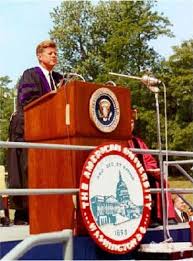
Kennedy at American University When Cousins returned to Russia in April of 1963, he brought news that Kennedy would do all he could to get the treaty signed. The Russian premier was ready to sign on to a total test ban if it allowed a minimum amount of on site inspections. Kennedy favored that kind of ban also. But his problem was that he knew he could not get that through the senate, where you needed a two-thirds vote to ratify a treaty. The extremists in America wanted much more inspection. (ibid, p. 51) Therefore, the two men had to settle for a partial ban. This one banned testing in the atmosphere, outer space, and underwater, but still allowed for testing underground. Khrushchev was disappointed in the compromise. Kennedy understood the disappointment. He told Cousins, “He would like to prevent a nuclear war but is under severe pressure from his hard-line crowd, which interprets every move in that direction as appeasement. I’ve got similar problems.” Kennedy then continued in this vein by saying, the lack of progress “gives strength to the hard-line boys…with the result that the hard-liners in the Soviet Union and the United States feed on one another, each using the actions of the other to justify its own position.” (p. 52)
Cousins replied that it was not just the hard-liners in the USSR. The Chinese also felt that Khrushchev’s efforts at conciliation were unrealistic. And that once the negotiations broke down, they thought there would be a move towards closer friendship between China and the USSR. In fact, a delegation from Bejing was scheduled to visit Moscow in June. Kennedy understood this and was worried about it. He saw the test ban as a way to derail it. (ibid)
Cousins told the president that “what was needed was a breathtaking new approach toward the Russian people, calling for an end to the Cold War and a fresh start in American–Russian relationships.” This kind of approach would insinuate that “the old animosities could become the fuse of a holocaust.” Kennedy took all of this in, digested it and understood it. He told the editor to write him a memo on both their meetings and his visit with the Russian premier. Which Cousins did. (ibid, p. 53) Two weeks later, in early May, Ted Sorenson–Kennedy’s main speechwriter–called him to his office. Sorenson told him that Kennedy was going to use some of his arguments and he wanted some more notes. The Kennedy/Cousins connection was the beginning of the American University address.
Sorenson wrote a rough draft first. It was reviewed by National Security Advisor McGeorge Bundy, Bundy’s assistant Carl Kaysen, fellow speechwriter Arthur Schlesinger, and Adrian Fisher from the Arms Control and Disarmament agency. On June 6th, Sorenson took all the suggestions and turned out a second draft overnight. After another go-round with the same circle he refined it again. On June 7th, he gave that final draft to Kaysen for the necessary security clearances. Kennedy advised Kaysen on this process. When handed the speech, the Chair of the Joint Chiefs, Maxwell Taylor decided not to show it to the other service branch chiefs.
On the return plane ride back from Hawaii, Sorenson showed the speech to Kennedy. JFK suggested some changes but, overall, he liked it. Kennedy also showed the speech to Senator Mike Mansfield and Averill Harriman from the State Department, who he would later choose to negotiate the test ban treaty. (ibid, pgs. 26-27) It was ratified in the senate in late September of 1963 and took effect on October 10th.
After JFK arrived at the White House from Hawaii at a little after nine in the morning, Bobby Kennedy called his brother. He congratulated him on his speech in Hawaii. The Attorney General then asked him when he was speaking at American University. The president replied that it would be at 10:30 that morning. Bobby asked if he could come to the White House after that. He needed to talk to him about the crisis at the University of Alabama.
II
Meridith at Ole Miss This is another point that most of us have forgotten about. Sandwiched between these two epochal speeches, a gripping televised drama was playing itself out. The University of Alabama was the last major institution of higher learning in the south to remain segregated. At Ole Miss, the previous year, President Kennedy had to send in federal troops when Governor Ross Barnett had resisted admitting black student James Meredith. During that violent conflict, two people were killed, cars were burned, and federal marshals were pelted with rocks. Barnett resisted even though Meredith’s case had been ruled upon by both a federal appeals court and the U.S. Supreme Court. When he did so, the governor was then found in contempt of court. He was given five days to comply or he would be arrested and fined. The problem for Barnett was that he had proclaimed, “No school will be integrated in Mississippi while I am your governor.” Therefore, the Kennedys and the legal system had to go into high gear to gain entry for Meredith. And because Barnett wanted to satisfy the racist element of the electorate, he resisted until the end. Because of this, violence ensued. RFK later came to the conclusion that if Barnett could not stop Meredith from registering, his fallback plan was to make it appear that only the Kennedys sending in thousands of federal troops made him do so. And for Meredith’s protection, troops stayed on campus for eight months. In other words, as in the Civil War and Reconstruction, the North was occupying the South. Afterwards, Bobby Kennedy understood that this had been Barnett’s plan from the start. (Robert Kennedy in His Own Words, edited by Ed Guthman and Jeffrey Shulman, p. 160)
In Alabama, Governor George Wallace had taken a similar pledge. His was to stand in the schoolhouse door to stop the University of Alabama from being integrated. The last thing the Kennedys wanted was another Ole Miss conflagration. But as with Meredith, two young black students–Vivian Malone and James Hood–had been cleared by the courts to attend the publicly financed state university. In addition to his public pledge, Wallace had made a political calculation after he lost the 1958 race for governor to the rightwing, Klan backed John Patterson. Prior to that loss, Wallace had been–comparatively speaking–rather moderate on civil rights. As both a state representative and circuit judge, he had done things that would not pigeonhole him as a racist, like granting probation to black prisoners.
But after he lost to Patterson he reportedly told aide Seymore Trammell, “Seymore, you know why I lost …..? I was outniggered by John Patterson. And I’ll tell you here and now, I will never be outniggered again.” (Dan Carter, The Politics of Rage, p. 2; this incident is also depicted in John Frankenheimer’s award winning TV film, George Wallace.) In other words, like Barnett, Wallace was putting on what was partly a theatrical performance. He was playing to his constituency. And his constituency was the Democratic Party in Alabama, just as Barnett’s was the Democratic Party in Mississippi. In other words, the Kennedys were bucking up against what was supposed to be their own political colleagues. I wish Cohen had given us a bit of historical background on how this happened. He does not. (Which is a shortcoming of the overall book I will elaborate on later.)
In a nutshell, it was Lincoln, a Republican, who had declared the Emancipation Proclamation. He then passed the Thirteenth Amendment. And it was the Radical Republicans who had then passed the Fourteenth and Fifteenth Amendments. Further, Andrew Johnson, a southerner, had been nearly impeached and removed from office by the Radical Republicans when he resisted their program for military occupied Reconstruction.
Therefore, when the Klan began to organize around the remnants of the Confederacy and the southern army, their natural allies were the local and regional Democrats. To their everlasting shame, those Democrats made a decision based upon nothing but arithmetic–as if the Civil War and its hundreds of thousands of casualties had never happened. They casually and simply added up the number of white residents in the various states and compared them with the number of black residents. Since the former outnumbered the latter by a margin of at least two to one, it was easy to see where political success lay. Therefore, the local Democratic authorities united with the local racist groups and put together what historians today call the Mississippi Plan. In its most extreme form, on the eve of elections, white paramilitary groups would ride on horseback, processional style, through the center of towns and villages carrying torches, with weapons in their saddles. The message was clear: if the newly liberated black slaves tried to vote they would do so at their own risk. And the fact that these processions openly rode through towns certified that the local legal authorities would do nothing about enforcing federal laws, like the Fourteenth and Fifteenth Amendments.
This was followed by the infamous Compromise of 1877. In that backroom deal, the presidential victory of Democrat Samuel Tilden was negated. Republican Rutherford B. Hayes became president. The Democrats again were practicing arithmetic. In this horse trade, the Republican Hayes and his predecessor President Grant now removed the last northern armies from the south. Reconstruction was now ended. When that occurred, the last Republican governments in the south collapsed. That geographic area now become a bastion of Democratic electoral strength in national elections. It came to be called the Solid South. With these two events, things like the Black Codes now morphed into Jim Crow. Jim Crow then became a systematic and methodical plan of complete segregation. No American president had seriously challenged this system before Kennedy. And since he had spoken out on the issue as a senator and a candidate, he had lost six states in the Solid South in the 1960 election—before he was even inaugurated. Most historians see this as the beginning of the great transformation of the south from a Democratic to a Republican stronghold.
What made it all the worse was that the presidents who should have done something about this appalling situation did little or nothing. That is, the so-called Progressive presidents (Taft, Teddy Roosevelt, Woodrow Wilson), and Democratic liberals like Franklin Roosevelt, and Harry Truman. The last two understood something should be done. But they both made the practical decision that if they acted on the subject in any real or forceful way, the other parts of their political agenda would be torpedoed by the power of the so-called Dixiecrats in the House and especially in the Senate i.e. the southern Democrats who controlled the chairmanships of so many committees in congress. Therefore Roosevelt did as much as he could symbolically by appointing black Americans to his administration. Truman integrated the military services.
But what is the excuse for Dwight Eisenhower? The reason I express the question that way is because he had the sanction of the Supreme Court. In 1954, the Warren Court passed down the Brown vs. Board decision. This crucial case reversed the 1896 Supreme Court decision in Plessy vs. Ferguson, that had sanctified local Jim Crow laws, and therefore separate facilities were now deemed equal before the law. The Supreme Court had ratified segregation. But the 1954 decision very clearly overturned that case and dictated that the system of segregation should be now taken apart with all due speed. But as many commentators have stated, the Eisenhower/Nixon regime proceeded with the speed of a turtle with arthritis. For instance, Eisenhower’s Justice Department never filed a civil rights case in Mississippi during his entire administration. In the six years after Brown vs. Board, Eisenhower filed a grand total of ten civil rights cases based up on either equal accommodations or voting discrimination. To say this was a snail’s pace is an insult to snails. As many commentators have pointed out, this hesitance was the beginning of Vice President Richard Nixon’s Southern Strategy: the deliberate courting of the racist element in the south for political gain. In other words, the Republicans were–not very subtly–reversing the heritage of Lincoln. (The one exception in the six year span was the 1957 crisis at Central High in Little Rock, Arkansas.) Therefore, because of the political calculation of Eisenhower and Nixon, Kennedy had an even more uphill climb in front of him. He had to overcome the nearly one hundred year institutional basis of segregation, which had now become ingrained in southern culture in every way: socially, politically, and psychologically. But further, he had to find a way to get around the Dixiecrat control in congress e.g. Senator James Eastland of Mississippi.
I wish Cohen had detailed some of the above in his text. It would have placed the dramatic reversal President Kennedy was about to enact in a more accurate context.
III
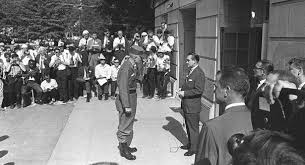
Wallace in Tuscaloosa As authors Irving Bernstein, Harry Golden and Harris Wofford have noted, Kennedy understood that there were simply not enough votes in congress to get a civil rights bill enacted his first year. Therefore, in 1961, the White House did what Eisenhower and Nixon had not done. Attorney General Bobby Kennedy concentrated on school integration with the Brown vs. Board decision backing him. (Guthman and Shulman, pgs. 147-48) The Kennedys sent Justice Department officials like Ramsey Clark, Burke Marshall and John Siegenthaler to local districts where they thought black families would have difficulty registering their children in public K-12 schools. As Bernstein notes in Promises Kept, in 1961, Kennedy proceeded to do as much as possible through executive orders in order to build momentum, instead of sustaining a legislative defeat or filibuster. In 1962, the administration did send up a modest voting rights bill. As Bobby Kennedy later said, it went nowhere. It was filibustered and the White House did not have anywhere near the votes to get cloture. (Guthman and Shulman, p. 149) So the White House continued with administrative actions, like local lawsuits under Brown vs. Board and Title III of the 1957 Civil Rights Act, and equal employment through the Equal Employment Opportunity Commission. With the last, the Kennedys were determined to make sure that companies doing business with the government were active in hiring minority groups.
Then came the Birmingham spectacle, with Sheriff Bull Connor facing off against Martin Luther King and the Southern Christian Leadership Conference. The sight of white firemen slamming black children against buildings with fire hoses, of German Shepherds leaping and biting innocent civilians, of police officers smashing demonstrators’ skulls with billy clubs, these nightly TV images created a sensation. As JFK told his brother and Dr. King, the bill he sent to congress should have been called Bull Connor’s Bill. (Guthman and Shulman p. 171) Washington watched and listened as people in the north were now repulsed by what a century of segregation had done to Americans in the south—even after the Civil War amendments had legally made former slaves equal to whites. Such was simply not the case; not even close. The actions of Ross Barnett in Oxford, and Bull Connor in Birmingham now formed the background for President Kennedy versus Governor Wallace in Tuscaloosa.
Cohen uses what is today a little known source for the backbone of his description of this conflict. The late Robert Drew was a committed documentary film director who was one of the first—along with Emile de Antonio—to make cinema verite films. That is, documentaries that did not use the device of breaking up the action of the story with a posed and well lighted sit down interview with a subject. Drew had previously made the film Primary in this way. That was about the Wisconsin Democratic primary election of 1960, which featured Kennedy against Senator Hubert Humphrey. (The only author in the JFK assassination field who has mentioned that film to any degree is Joseph McBride in his book Into the Nightmare.) Kennedy had seen the film and liked it. He asked Drew what he wanted to do next. Drew said he wanted to make a film about his administration during a particularly stressful period of time. (Cohen, p. 78) They eventually decided upon the racial crisis between Kennedy and Wallace over the integration of the University of Alabama. In addition to filming the Kennedy brothers and the two students, Governor Wallace agreed to allow cameras to follow him around also. The film, naturally entitled Crisis, aired on ABC in the fall of 1963. Its candor created quite a controversy. Two of the points the film makes are that 1.) It was Kennedy who was pushing for sending a civil rights bill to congress ASAP, and 2.) It was RFK who was pushing his brother to make a national speech in primetime before he did that. (Cohen, pgs. 82-83) Cohen not only saw the film, he saw hours of outtakes from it.
The confrontation at the schoolhouse door was weeks in the making. In April, Robert Kennedy had visited Wallace in Birmingham to try and ward off another violent, life threatening spectacle as with Barnett. As Bobby said later, that meeting was “unhelpful….We really didn’t get very far.” (Guthman and Shulman, p. 185) In May, another meeting took place between the AG and Wallace, again with no real result. Wallace was intent on being as unhelpful, and as unpredictable, as possible. Even though the university’s board of trustees wanted to let the students register, since Wallace was the titular head of the board, they could not overrule him. (ibid, p. 187)
To give an example of this, on the evening of Saturday June 8th, Wallace had sent the White House a telegram telling the president that “out of an abundance of caution” he was calling up about 500 state guardsmen. Kennedy replied that he was “gratified by the dedication to law and order expressed in your telegram” informing him of the potential use of the National Guard at Tuscaloosa. But, the president continued, the only foreseeable threat of violence came from Wallace’s “plan to bar physically the admission of Negro students in defiance of the order of the Alabama Federal District Court, and in violation of accepted standards of public conduct.” (Cohen, p. 74) On Tuesday June 11th, Wallace flew from Montgomery to Tuscaloosa. He had a motorcycle escort to the Hotel Stafford where he constructed his headquarters. Wallace was going to make real his promise to stand in the schoolhouse door. The problem for the White House was that the courts had ruled on May 21st that the students had to be enrolled for the summer session, which began on June 11th. (ibid, p. 236)
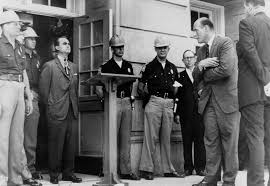
Katzenbach and Wallace On the scene, the point man for the White House was Deputy Attorney General Nicolas Katzenbach. He had arrived on Monday, and set up his office on campus. RFK and he had decided that Malone and Hood would not accompany Katzenbach to the gate. Since the two had already been admitted he decided to escort them to their rooms. The problem was the actual registration, which Wallace was holding up. (Cohen, p. 85) The White House had out manned Wallace. President Kennedy had 3,000 soldiers on the scene if Wallace refused to yield, was arrested, and violence broke out. They were under the command of General Creighton Abrams who was in dress clothes so as not to suggest a military commander. Colonel Albert Lingo, Alabama’s director of public safety, raised a force of 825 law enforcement officers.
One of the valuable insights Cohen brings to the fore in his analysis of the Tuscaloosa showdown is the role of Louis Martin Jr. Martin was a longtime reporter and editor for black newspapers like the Chicago Defender. He was recruited into Kennedy’s campaign by his brother-in-law Sargent Shriver. He became one of the president’s main advisors on race issues. And Kennedy consulted with him in the early days of the conflict. (Cohen, p. 226) Kennedy was trying to decide just how wide his civil rights bill should be. He originally wanted a bill that included integration of public accommodations, school desegregation, and voting rights. Some Republicans, like Senator Everett Dirksen, wanted to stop short of privately owned facilities like restaurants. Previously advised by Martin, President Kennedy disagreed with this. Martin had told him the bill had to include all public accommodations or “we’re going to have one hell of a war in this country.” (ibid, p. 227) Therefore, at a private conference with Kennedy, when the Republicans objected to this aspect, Kennedy replied that all restaurants must be integrated. Martin also recommended a billion dollar program for job creation and development of job skills for inner city youth.

Katzenbach, LBJ, RFK Cohen also deals with the role of Lyndon Johnson in all this. Kennedy included LBJ in a meeting with Republican leaders on Monday, the tenth. And he also describes the long discussion that many authors have mentioned between Sorenson and Johnson from a week before, which was taped by the vice-president. Johnson also recommended that the president get on national television to push the issue. But he was not sure that this was the proper time because, like Larry O’Brien and Ken O’Donnell, Johnson thought that pushing the issue might endanger the rest of Kennedy’s program. (ibid, pgs. 227-29) In light of that, the subtext of Cohen’s work in this regard is that it was really Robert Kennedy who was the driving force in the Wallace crisis and also the speech on race.
The Kennedys had two tactical advantages over the governor. The first was that Frank Rose, the president of the university, was in favor of admitting the students. (ibid, p. 239) Therefore, he was providing the Kennedys with inside information about what Wallace was doing. Secondly, if Wallace resisted admittance, the White House could attempt to nationalize the state national guard. This was the step that the Kennedys realized they had to take before sending in federal troops under Abrams, which the White House always looked upon as a last resort. (ibid, p. 249) With over 300 journalists in attendance from all over the world, and a national TV broadcast, that is the way the conflict played out. President Kennedy made the decision to nationalize the guard. (ibid, p. 267) Therefore Brigadier General Henry V. Graham asked Wallace to step aside upon orders of President Kennedy. Katzenbach and his assistant on civil rights John Doar now had the students registered. Graham and his detachment stayed on campus, actually in the students’ dorms, for protection purposes.
It was with the peaceful conclusion of this conflict that President Kennedy decided to go ahead with the speech that evening. Or as Ted Sorenson later related: as Wallace left the gate, JFK turned to him and said, “I think we’d better give that speech tonight.” The problem was that Sorenson had not prepared a speech. What existed were some notes put together by RFK and the Justice Department. And here, Cohen inserts something that was new for this reviewer: the figure of Richard Yates.
Today, Yates is known as one of the most distinguished novelists of his era. But like many other fiction writers, his fame and recognition only arrived after his death in 1992. While alive, none of his books ever sold more than twelve thousand copies. His most famous novel, Revolutionary Road, was made into a film in 2008 by director Sam Mendes. In 1963, Yates was freelancing as a speechwriter for Bobby Kennedy. Anticipating, and in fact, pushing his brother to make a forceful nationally televised address on race, Bobby had told Yates to prepare a speech on the subject. At the time the speech was telecast, June 11, Yates had only been working for RFK for a couple of weeks. (Cohen, p. 287) On the evening of June 9th, Yates began working on a speech. He completed in two days later, the day JFK went on television. Sorenson did not hand the president a speech until less than an hour before he went before the cameras. As Cohen notes, there is no evidence that Sorenson used the Yates draft in his work. But there is evidence that he used some of the themes that Yates sounded. (ibid, p. 289)

JFK Civil Rights Speech June 11, 1963 As Cohen notes, Kennedy only had a few minutes to look over the speech before going on camera. He delivered it without a teleprompter. (ibid, p. 331) And he actually extemporized the last four paragraphs. Kennedy chose to accent the events of the day, the showdown with Wallace, as the lead. And he especially wished to highlight the facts that it was an Alabama guardsman who removed Wallace, and it was an Alabama judge who wrote the order to do so. And they did this so that two Alabama citizens could enter the university. Although Cohen includes a neat and incisive summary–impressing the fact that Kennedy was the first president since Lincoln to make race a moral, not a legal issue–I cannot do better than to recommend the reader watch this milestone speech for himself. (http://abcnews.go.com/Archives/video/june-11-1963-jfk-promises-civil-rights-bill-9295675) In my opinion, among Kennedy’s several memorable speeches, it seems to me to be significantly underrated: both as a speech, and as part of the fabric of a dramatic historical revolution. It is almost impossible to imagine Eisenhower or Nixon making such a speech. In fact, as Cohen notes, Martin Luther King was overjoyed after he heard it. He told Walter Fauntroy, a friend he was watching it with, “Walter, can you believe that white man not only stepped up to the plate, he hit it over the fence!” (ibid, p. 339)
But there were some who detested the speech, and the movement that had brought it on. Cohen closes the book proper with the wife of Medgar Evers watching the speech with her children in Jackson, Mississippi. (Cohen, p. 350) She was riveted by the things the president was saying. Evers himself was at a mass meeting at the New Jerusalem Baptist Church. In the very early minutes of June 12th, as he was driving up his driveway, he was shot and killed by Klansmen Byron de La Beckwith. At his second trial for murder, which ended with a hung jury–as did the first–Ross Barnett approached Beckwith at the defense table and shook hands with him, as his wife Myrlie was testifying from the stand. As with the Civil War and Reconstruction, the forces of segregation and Jim Crow were not going down without a fight. De La Beckwith was not convicted for another thirty years.
But it was this speech that really turned the conscience of America. Because it was spoken by a president who was a wealthy white man. Kennedy used it to submit his Civil Rights Bill. Bobby Kennedy attended the funeral of Medgar Evers. After which the president invited Evers’ family to the White House.
IV
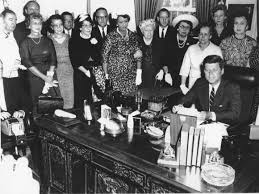
JFK signs Equal Pay Act with American Association of University Women I don’t wish to leave the impression that these two speeches and their immediate background are all the author covers in the book. He also touches on other significant accomplishments during Kennedy’s brief presidency. For example he deals with the Equal Pay Act for women; Kennedy’s very close ties to the labor movement ( as one labor lobbyist noted, “We lived in the White House” p. 113). He also deals with Kennedy’s attempt at stressing physical fitness programs, reforming immigration, and even touches on Kennedy’s attempt to soften the exit of some industries from Indonesia, American industries that President Sukarno had expelled. (p. 310) And the author also notes that Kennedy held a press conference almost every sixteen days. Which is amazing in light of their frequency today.
At the beginning I said that Cohen had a fine idea for a book. And as noted above, the volume has some good (and some new) attributes to it. But ultimately I cannot fully endorse it like I did Robert Rakove’s Kennedy, Johnson and the Nonaligned World, or Philip Muehlenbeck’s Betting on the Africans. There are two reasons for this.
As touched upon previously, Cohen is not really an historian. So unlike Rakove and Muehlenbeck, he does not give you the historical backdrop to either the race issue or the rapprochement with the Soviets issue, which are his two main topics. Above, I tried to barely outline the backdrop to the race issue. The latter is even more complex. And unlike the former, the scholarship in this area—how the Cold War originated and then aggrandized itself—is still growing. Cohen does not even try to map any of this out. To give just one example: it is hard to believe, but you will not see the name of either of the Dulles brothers—neither John Foster, nor Allen—in the entire book. Any true historian—like Rakove or Muehlenbeck, if they had been writing this book– would have included them. In one central aspect, history is finding a through line. That is a combination of balanced background, cause and effect relationships, and, from there, searching for patterns and origins of new behavior and actions. From all this one then finds, as Arthur Schlesinger once said, “currents”. There definitely were shifting currents in JFK’s presidency, especially on these two issues. And if Cohen had done a fuller job as historian, the reader would more fully understand the quantum leap that Kennedy was making in both areas. And why it was so difficult? Along with this failing, there is also a lack of information as to the central mystery: Why, psychologically, did Kennedy do both of these things? Again, the answer to that question is also in the record, but Cohen fails to excavate it for the reader.

Kennedy in Dallas Because of these shortcomings, it leads to what I believe is the flawed conclusion he makes in his epilogue. Cohen writes there that because of these two speeches, “For the first time in his whiplashed presidency, he came to inhabit his office.” (p. 373) This is echoed on the rear cover: a description reads, that in “Kennedy’s crowded hour, he begins to see things differently.” I could not disagree more. On both points. The reason Kennedy’s early presidency was “whiplashed” was that he was being duped by the CIA over the Bay of Pigs issue, and he was starting a truly revolutionary program in foreign policy. And an only slightly less revolutionary one in domestic policy. There was no way that was going to be easy, especially at the start. Because there was no way the opposition was not going to resist strongly.
On the second point, I would say that Kennedy came to inhabit his office almost immediately. In the sense that he knew what he wanted to accomplish at the start. And he set out to achieve it. The first and, I think, foremost example is one Cohen ignores: the situation in Congo. Again, you will not see the name of Patrice Lumumba in this book. Even though he was a black man striving to free his country from imperialism. Describing that struggle—even briefly—would have highlighted and dramatized the conflict Cohen is describing domestically. I have explained in my review why Kennedy’s bill was not sent up until 1963; it would have been filibustered effectively. The reason the attempt at détente took place in 1963 was due to the Bay of Pigs drama; which as many have noted was due to Allen Dulles misleading President Kennedy. This is called creating a balanced historical backdrop.
Which relates to another failing of the book. Like Thurston Clarke, Cohen is and wants to be an upstanding member of the MSM. He has written for Time, UPI and, since he is a Canadian, the Globe and Mail, which is the USA Today of Canada. He has been described by the New York Times as one of “Canada’s most distinguished authors.” In his book he actually praises Sally Bedell Smith’s Grace and Power as “groundbreaking”. Which is about the last word I would use to describe it. I would call John Newman’s JFK and Vietnam, groundbreaking. I would describe Richard Mahoney’s JFK: Ordeal in Africa as groundbreaking. I would also call Irving Bernstein’s Promises Kept and Donald Gibson’s Battling Wall Street groundbreaking tomes. No surprise, you will not see any of those books in his bibliography. But there you will see Ben Bradlee’s worthless book Conversations with Kennedy, and you will also see the late (and lying) David Heymann’s even more worthless biography of Robert Kennedy. See, real historians like Robert Rakove and Phil Muehlenbeck are academics. They are not part of the MSM propaganda machine. Therefore, they are not beholden to it for favors. Cohen is a part of it. Therefore he dutifully spends a senseless amount of space on Mary Meyer. (Although, thankfully, he does not buy the Timothy Leary aspect of that story.) We are also told—Bradlee like–that Kennedy was endlessly interested in the John Profumo sex scandal in England. The author actually gives space and credibility to Mimi Alford. Even though Australian researcher Greg Parker has shown her story to be, at best, dubious. (Click here http://www.reopenkennedycase.net/reopen-blog/a-storm-in-a-mini-teapot) If you can comprehend it, as with Heymann, even stripper Tempest Storm makes an appearance in Cohen’s pages. What any of this has to do with race relations or nuclear arms control is Cohen’s secret. (Or maybe Tempest Storm’s?)
This is all part of a publishing industry subdivision I have called the “Posthumous Assassination of John F. Kennedy”. It’s a way of demeaning Kennedy’s character and legacy and, as a byproduct, killing off interest in his assassination. As we shall see–and as I mentioned in that essay—Bob Loomis of Random House was one of its ringleaders. (The two-part essay “The Posthumous Assassination of John F. Kennedy” is available on the Probe CD collection, and in the book The Assassinations. Many readers considered it one of the finest essays Probe ever published.)
The problem for Cohen is his book was distributed by a subsidiary of Random House. It was Random House and the notorious Loomis who originated the work of Gerald Posner on the JFK murder. To the point of having CIA asset Loomis actually arrange interviews for Posner with the likes of Yuri Nosenko. (Loomis was in prime position to do that. When I called his office in 1997, his secretary said he was in Washington, since he spent about two days a week there.) As anyone who has followed the Kennedy saga knows, Loomis has been one of the most pernicious behind the scenes operators in the field. Some of his and his company’s clients—besides Posner—have included James Phelan, Sy Hersh, Alford, and Norman Mailer. (The Assassinations, edited by James DiEugenio and Lisa Pease, pgs. 369-70. See Destiny Betrayed Second Edition, p. 244, for Loomis’ handiwork on the MLK and RFK cases.) And as Sally Bedell Smith herself once admitted—as was the case with Posner—her book was not her idea. It was pushed on her by the bigwigs at Random House—while Loomis was still there. (See SF Gate, May 23, 2004, interview with Carolyne Zinko) Therefore I have little doubt Loomis helped stage interviews for Vanity Fair’s answer to Kitty Kelley. And as we have learned about this cottage industry—with both Kelley and Heymann—some of these “interviews” did not happen. And that is why Smith’s book got such a big sendoff. Just like Loomis gave Posner a huge publicity binge. (Another Loomis client, Robin Moore, had his book, The Hunt for Bin Laden, partly fabricated by a false witness. The fabrication was done with direct authorization by Loomis.) As they say in that industry, you scratch my back and I’ll scratch your book. Cohen wanted to get his ticket punched. So he played the game. No matter how badly it marred his work.
Therefore what could have been an important and sterling volume is seriously compromised with a lot of litter. Instead of being up there with Rakove and Muehlenbeck, it stands a couple of steps downward, with Thurston Clarke’s mixed bag of nuts.
-
David Heymann Haunts us from the Grave
Correcting An ‘American Legacy’
by Anne Johnson, At: NPR Ombudsman
-
Introduction to JFK’s Foreign Policy: A Motive for Murder
In a little over a year [2013-2014], I have spoken at four conferences. These were, in order: Cyril Wecht’s Passing the Torch conference in Pittsburgh in October of 2013; JFK Lancer’s 50th Anniversary conference on the death of JFK, in Dallas in November of 2013; Jim Lesar’s AARC conference in Washington on the 50th Anniversary of the Warren Commission in September of 2014; and Lancer’s Dallas conference on the 50th anniversary of the Commission in November of 2014.
At all four of these meetings, I decided to address an issue that was new and original. Yet, it should not have been so, not by a long shot. The subject I chose was President Kennedy’s foreign policy outside of Vietnam and Cuba. I noted that, up until now, most Kennedy assassination books treat Kennedy’s foreign policy as if it consisted of only discussions and reviews of Cuba and Vietnam. In fact, I myself was guilty of this in the first edition of Destiny Betrayed. My only plea is ignorance due to a then incomplete database of information. I have now come to conclude that this view of Kennedy is solipsistic. It is artificially foreshortened by the narrow viewpoint of those in the research community. And that is bad.
Why? Because this is not the way Kennedy himself viewed his foreign policy, at least judging by the time spent on various issues—and there were many different topics he addressed—or how important he considered diverse areas of the globe. Kennedy had initiated significant and revolutionary policy forays in disparate parts of the world from 1961 to 1963. It’s just that we have not discovered them.
Note that I have written “from 1961 to 1963”. Like many others, I have long admired Jim Douglass’ book JFK and the Unspeakable. But in the paperback edition of the book, it features as its selling tag, “A Cold Warrior Turns.” Today, I also think that this is a myth. John Kennedy’s unorthodox and pioneering foreign policy was pretty much formed before he entered the White House. And it goes back to Saigon in 1951 and his meeting with State Department official Edmund Gullion. Incredibly, no author in the JFK assassination field ever mentioned Gullion’s name until Douglass did. Yet, after viewing these presentations, the reader will see that perhaps no other single person had the influence Gullion did on Kennedy’s foreign policy. In a very real sense, one can argue today that it was the impact of Gullion’s ideas on young Kennedy that ultimately caused his assassination.
These presentations are both empirically based. That is, they are not tainted or colored by hero worship or nostalgia. They are grounded in new facts that have been covered up for much too long. In fact, after doing this research, I came to the conclusion that there were two cover-ups enacted upon Kennedy’s death. The first was about the circumstances of his murder. That one, as Vince Salandria noted, was designed to fall apart, leaving us with a phony debate played out between the Establishment and a small, informed minority. The second cover-up was about who Kennedy actually was. This cover-up was supposed to hold forever. And, as it happens, it held for about fifty years. But recent research by authors like Robert Rakove and Philip Muehlenbeck, taking their cue from Richard Mahoney’s landmark book, JFK: Ordeal in Africa, have shown that Kennedy was not a moderate liberal in the world of foreign policy. Far from it. When studied in its context—that is, what preceded it and what followed it—Kennedy’s foreign policy was clearly the most farsighted, visionary, and progressive since Franklin Roosevelt. And in the seventy years since FDR’s death, there is no one even in a close second place.
This is why the cover-up in this area had to be so tightly held, to the point it was institutionalized. So history became nothing but politics. Authors like Robert Dallek, Richard Reeves, and Herbert Parmet, among others, were doing the bidding of the Establishment. Which is why their deliberately censored versions of Kennedy were promoted in the press and why they got interviewed on TV. It also explains why the whole School of Scandal industry, led by people like David Heymann, prospered. It was all deliberate camouflage. As the generals, in that fine film Z, said about the liberal leader they had just murdered, Let us knock the halo off his head.
But there had to be a reason for such a monstrous exercise to take hold. And indeed there was. I try to present here the reasons behind its almost maniacal practice. An area I have singled out for special attention was the Middle East. Many liberal bystanders ask: Why is the JFK case relevant today? Well, because the mess in the Middle East now dominates both our foreign policy and the headlines, much as the Cold War did several decades ago. And the roots of the current situation lie in Kennedy’s death, whereupon President Johnson began the long process which reversed his predecessor’s policy there. I demonstrate how and why this was done, and why it was kept such a secret.
It is a literal shame this story is only coming to light today. John Kennedy was not just a good president. Nor was he just a promising president. He had all the perceptions and instincts to be a truly great president.
That is why, in my view, he was murdered. And why the dual cover-ups ensued. There is little doubt, considering all this new evidence, that the world would be a much different and better place today had he lived. Moreover, by only chasing Vietnam and Cuba, to the neglect of everything else, we have missed the bigger picture. For Kennedy’s approach in those two areas of conflict is only an extension of a larger gestalt view of the world, one that had been formed many years prior to his becoming president.
That we all missed so much for so long shows just how thoroughly and deliberately it had been concealed.
{aridoc engine=”google” width=”400″ height=”300″}images/ppt/JimDFP-Wecht2013.pptx{/aridoc}
{aridoc engine=”google” width=”400″ height=”300″}images/ppt/JimDFP-Lancer2014.pptx{/aridoc}
Version given at November in Dallas, November 18, 2016
{aridoc engine=”google” width=”400″ height=”300″}images/ppt/JimDFP-Lancer2016.pptx{/aridoc}
Revision, presented on March 3, 2018, in San Francisco
{aridoc engine=”google” width=”400″ height=”300″}images/ppt/JimD-JFK-FP-2018.pptx{/aridoc}