, At: CNN Politics
Tag: JFK
-
An Introduction to the Book Excerpt: The Incubus of Intervention
CTKA is proud to excerpt a chapter from Greg Poulgrain’s new book about the Indonesia coup of 1965. The full title of the volume is The Incubus of Intervention: Conflicting Indonesia Strategies of John F. Kennedy and Allen Dulles. Poulgrain is a professor of History at University of the Sunshine Coast in Australia. In 1998, Poulgrain wrote The Genesis of Konfrontasi. That book was about the conflict between President Achmed Sukarno of Indonesia and the proposed union of Malaysia in 1963. There, Poulgrain unfolded a new thesis about that conflict: namely, that it was not motivated by Sukarno’s desire to dominate the Southeast Asian archipelago area. Rather, it was a conscious provocation, created largely by the British to both strengthen their brainchild of Malaysia, and weaken Sukarno. By doing so, they expected to benefit financially. They succeeded spectacularly in both aims.
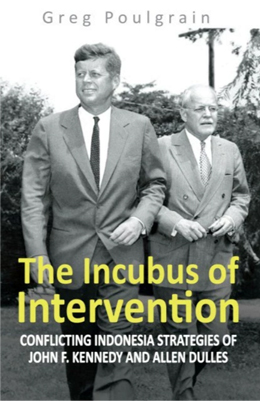
Poulgrain has now published an even more important book. It deals directly with the epochal, yet underreported, Indonesia coup of 1965. That overthrow is commonly referred to as the bloodiest CIA coup in history. To this day, no one knows how many people perished as a result of it. Various estimates range from 350,000 to 500,000. It was not until 1996 when Lisa Pease wrote her milestone articles about Freeport Sulphur (today called Freeport McMoRan) that anyone focused attention on how the murder of President Kennedy paved the way for this horrendous operation. (Click here for that memorable essay: http://www.thesecrettruth.com/freeport-indonesia.htm)
What Lisa did was to examine American foreign policy towards Indonesia and its leader Sukarno through three presidents: Dwight Eisenhower, John Kennedy, and Lyndon Johnson. Through that examination, it was obvious that a familiar pattern manifested itself: the Dulles brothers and Eisenhower were hostile to Sukarno (actually attempting to overthrow him in 1958); Kennedy tried to establish better relations and had planned a state visit in 1964; Johnson then halted Kennedy’s policy and decided to revert back to 1958 and the coup attempt. Except, this time, it was successful.
Since that excellent essay was published in Probe magazine, others have built on it. This includes Denise Leith’s book The Politics of Power: Freeport in Suharto’s Indonesia. Jim Douglass treated the subject in his fine JFK and the Unspeakable, and I discussed the issue in the second edition of Destiny Betrayed.
But Poulgrain’s new book goes further than anyone has before. In fact, it appears to be a milestone on the subject. Through extensive research into books and documents, plus new in-depth interviews, this book seems to have rearranged the calculus on what happened in Jakarta in 1965. And, rather appropriately, Poulgrain sees that massive slaughter through the prism of two personal profiles: CIA director Allen Dulles and the fallen president John F. Kennedy.
To show just how rich this book is, and how new and unique its perspective is, I beg the reader to take note of just three highlights in this one chapter.
First, Poulgrain reveals that Kennedy was working with United Nations Secretary–General, Dag Hammarskjold. Not just on the Congo crisis, but on a solution to the Indonesia problem. This was new and I consider myself pretty well informed on Kennedy’s foreign policy. This is arresting in two ways. First, Hammarskjold must have appeared to be an even greater threat to the power elite in this light. Second, we all know how reluctant contemporary American presidents are to work with the UN, especially GOP ones. But here you have JFK working with Hammarskjold on two key fronts in the third world.
Second, he reveals that, as with the Kennedy assassination, Harry Truman clearly suggested that he did not buy the airplane accident story about Hammarskjold’s death. In fact, he even went further in the Hammarskjold case than he did with Kennedy. He actually said he had been murdered. In other words, Truman knew what happened to Dag, and he likely knew what happened to Kennedy. In the case of Kennedy, he wrote a timely and suggestive editorial about the CIA which Allen Dulles tried to get him to retract—but he did not. In the Hammarskjold case, when asked to elaborate, he said in effect, I will let you guys figure that all out. In other words, he was not going to go further, hoping they would.
Third, through information in Susan Williams’ book, Who Killed Hammarskjold? it appears that Dulles’s name was on some documents secured by Desmond Tutu through the Truth and Reconciliation Commission in South Africa. These indicate that he would be willing to cooperate in a plot against the UN leader. He was even offering information about the type of plane the UN chief would be flying and the date Hammarskjold would arrive. If Dulles was willing to cooperate in a plot against Hammarskjold in 1961 over Congo, why would he not do the same in 1963 over both Congo and Indonesia? Since as we know, Kennedy continued the struggle for a free Congo after both Patrice Lumumba and Hammarskjold were murdered.
Poulgrain’s work is part of a new path in Kennedy studies. This began with Richard Mahoney’s landmark volume JFK: Ordeal in Africa. It continued with Philip Muehlenbeck’s Betting on the Africans, and Robert Rakove’s Kennedy, Johnson and the Nonaligned World. Now, Poulgrain extends that horizon line even further, one which finally shines light on who Kennedy really was and why he was killed.
Chapter 2: The Incubus of Intervention | Buy The Incubus of Intervention on Amazon
-
The Kennedy Films of Robert Drew and Associates
The Criterion Collection is quite literally an invaluable asset in the world of modern day DVD releases. Criterion pioneered both the audio commentary track and the use of supplemental features per DVD release. The last film I saw of theirs was the excellent three disc DVD of The Battle of Algiers.
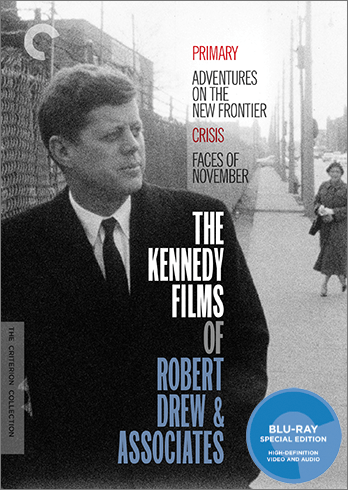
They have now released another valuable production. This one is called The Kennedy Films of Robert Drew and Associates. It consists of four documentary films: Primary, Adventures on the New Frontier, Crisis, and Faces of November. Robert Drew was a reporter and photographer for Time Inc. While on a study break at Harvard he began to explore why documentary films were so dull and uninvolving. When he returned to Time Inc. he began to attempt to break out of the confines that documentary film had slid into.
What Drew wanted to do was to make a revolution in technique. He wished to dump the reliance on narration, on music and slick camera work that consisted largely of long takes or tracking shots. He also wanted to jettison the device of the interview. In fact he wanted the filmmaker to ask no questions of his subjects at all. And further, he did not want to even tell them where to sit while he was filming. This type of documentary film came to be known as cinema verité, or direct cinema. The revolution in documentary style that it created roughly corresponded to the revolution that French feature film directors like Francois Truffaut and Jean-Luc Godard had manufactured with the Nouvelle Vague or New Wave.
Drew managed to create a unit at Time Inc. He then brought in other film-makers who shared his same goal: to help perfect this new aesthetic. These men included D. A. Pennebaker, Albert Maysles, and Richard Leacock. To say that they succeeded in their aim does not begin to describe their achievement. Consider some of the films these men were later responsible for: Gimme Shelter, Salesman, Grey Gardens, Don’t’ Look Back, Monterey Pop, The War Room, Startup.com, Ku Klux Klan—Invisible Empire.
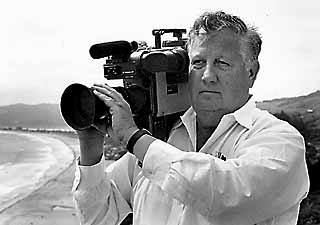
Robert Drew To achieve what they set out to do there were two technical barriers to surmount. First, there had to be smaller cameras so that they could do handheld shots. That is, the camera would not be attached to a tripod, or be placed on a dolly. It was portable and could follow the subject in the shot. Second, there had to be a way to record live dialogue in sync with what the camera was seeing. By early 1960, when Drew made Primary, both those problems had been solved.
At the same time Drew was getting ready to create his revolution in film style, Senator John Kennedy was also about to create a milestone in politics. Prior to 1960 no major candidate for president had decided to lay his claim to the office by running the gamut during the primary season. Kennedy did so out of necessity. He did not have the party standing that his top three opponents—Stuart Symington, Hubert Humphrey, and Lyndon Johnson—commanded. Up until 1960, the way to win the nomination was through currying favor with the party honchos. Both on the national and state level. Kennedy decided he could not win that way. But since he was photogenic, a good speaker, and his father was willing to spend a lot of money, he could win by dominating the primary season.
So Drew approached Kennedy one day as he emerged from his townhouse in Washington. JFK asked him what he wanted. Drew said words to the effect: I want to follow you around during the Wisconsin primary with a movie camera. Kennedy asked him: why should I agree to that? Drew played his ace card. Aware of Kennedy’s writing career and his interest in history, Drew replied because if he did Kennedy would be part of a new kind of history. The candidate thought it over and said that if he did not call Drew tomorrow, then he could do it. JFK didn’t call. Drew then got in contact with Humphrey’s camp and got a similar approval. The four men were allowed to film the last five days of the Wisconsin race.
In fact, they did create something extraordinary. The film Primary is not just exceptional because of its stylistic originality. But in watching we are transported back to what seems like a different universe, one that used to be called retail politicking. In the first scene we see Humphrey emerging from what looks like a corner grocery story, where he could not have been talking to more than 8-9 people. He then shakes hands with someone outside and actually exchanges a few lines of dialogue with him.
We observe both candidates driving down barren country roads and into sparsely populated rural areas—which is where Humphrey was supposed to run strong. We see JFK standing outside a factory gate in the morning with an overcoat, shaking hands with the workers, one of whom doesn’t even look at him. We even see Kennedy signing autographs for young schoolchildren who don’t vote. (When later asked why he did such a thing during a short campaign, Kennedy replied because those kids go home and talk to their parents.) One can argue that this kind of politics does still exist today in the Iowa and New Hampshire primaries. But today even those kinds of events are well planned and then orchestrated for media effect. That was not the case back then. Because both candidates were relying on the local and state representatives to prepare the events. Therefore it was very much a hit and miss process.
The big hit for Kennedy was a large auditorium rally at a Polish Catholic Church in Milwaukee the night before the election. This scene begins with what has now become an iconic shot of JFK. The camera is behind Kennedy: a wide angle shot from behind him and above. We see him go through the crowded entrance to the stage as the crowd applauds and sings “High Hopes”. Acknowledging he was late, Kennedy quips, “You’ve been standing there quite awhile, I’ve been standing for three months.” Some have written that this was a planned shot. In one of the disc supplements, it is revealed that the wide-angle lens was a last minute suggestion, and that the cameraman decided to hold the camera over his head to avoid the crowd. In other words, it was accomplished willy-nilly.
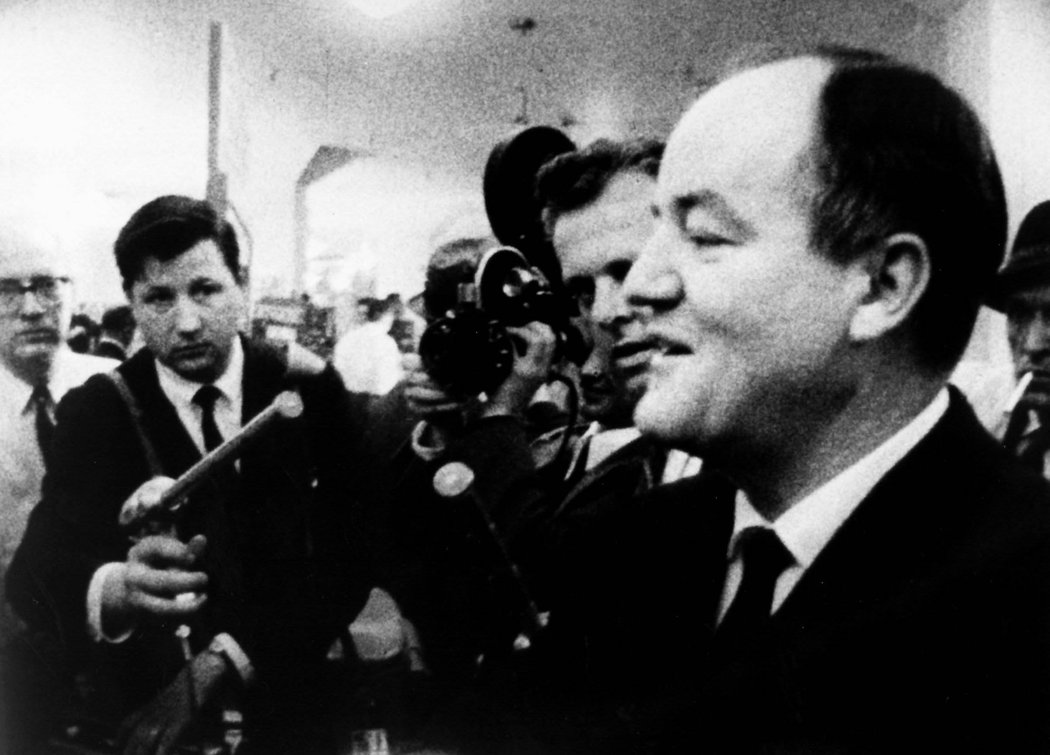
Hubert Humphrey during Wisconsin primary The film is spotted with various human-interest angles. For example, we watch as Humphrey does a radio interview. During the interview, the host tells the candidate he thinks he will win. After Humphrey leaves the station, the host says that he actually thinks Kennedy will win. During that rally in the church auditorium, Jackie Kennedy addresses the crowd in Polish. The camera focuses on her twisting hands, which reveal her nervousness.
The film concludes with Election Day, April 5th. We first see citizens coming into voting precincts. We watch as they enter booths, and the camera stays on their feet as they vote, commemorating their privacy. We then cut to a hotel room as the Kennedy camp watches the returns on television. Kennedy is relaxed, jacketless, slowly smoking a cigar. The early returns favor Humphrey by a 2-1 margin. But as the city of Milwaukee begins to count its votes, Kennedy makes up the difference and then surpasses his opponent. JFK ended up winning by a 56-44% margin. As he says in the film, the margin of victory was disappointing. It was not the knockout blow he was hoping to deliver in Humphrey’s backyard (Hubert was from Minnesota). Which meant they would have to go through the same exercise again in Illinois and then West Virginia. Humphrey ended up sticking around for another month.

Wisconsin primary election day This hotel scene achieves the purest form of cinema verité. One really does feel as if one is eavesdropping. First, there does not appear to be any kind of cinematic lighting. Second, the filmmakers placed the tape recorder behind the sofa, and the microphone in the ashtray. Therefore, their presence was eliminated.
The very last scene begins with a close up on a Humphrey for president sticker on the rear bumper of a car as it pulls out and then proceeds down a lonely country road. It’s a nice metaphor for the battle continuing—but the odds now being against Humphrey. The final results of the primary season were that Kennedy garnered nearly 2 million votes, Humphrey about 600,000. Which gave JFK a large advantage in delegates at the Los Angeles convention. One which neither Johnson nor Symington—who both decided to go the traditional back room route—could overcome.
It’s hard to believe, but Primary did not get a wide release in America. Time-Life owned about six TV stations, and that was the extent of its public showing in the USA. Which tells the reader a lot about the sorry domestic distribution of culturally significant films. For, as I have shown, the film constituted an aesthetic revolution depicting a political milestone. For now the primary route would be the way to the White House for both parties. It was not until the film was exhibited in France that it garnered the recognition it deserved.
II
But a most important person in America did like it. That was President Kennedy. So much so that he agreed to do two more films with Drew. The first one was called Adventures on the New Frontier. Shot in the same cinema verité style, this is a fascinating combination of the Wisconsin primary footage, inauguration day footage, and concludes with a day in the life of President Kennedy. Because of a technical failure, we don’t actually see Kennedy’s inauguration. But we do see conversations about that famous speech between John K. Galbraith and Gov. Mennen Williams of Michigan. This is then followed by a conversation in a car between Galbraith and author John Steinbeck. The latter is fascinating, because these two experienced authors were very much impressed by the style and technique of the actual writing of the speech. And that is what they actually talk about in specifics.
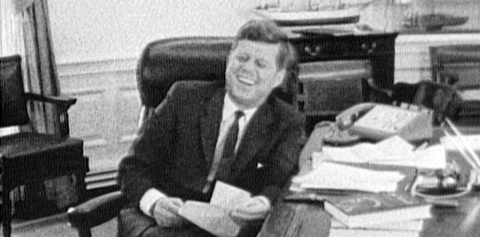
During the filming of Adventures on the New Frontier Once in office for about six weeks, Kennedy let Drew and his associates film him doing his job in the Oval Office. We see him meeting with John McCloy who he has appointed to do preliminary talks with the Soviets on atomic weapons reduction. He then meets with Arthur Goldberg, his Secretary of Labor. Goldberg had been an attorney for the Congress of Industrial Organizations, and had been influential in the merger of the CIO with the American Federation of Labor. At this time, Kennedy and Goldberg discuss a solution to an airline strike of flight engineers, and also certain strategies to counter unemployment rates. They concentrate on unacceptably high unemployment in West Virginia. Kennedy wants to rush in government surplus food supplies for any family in dire straits. After this, Kennedy meets with his chief economic advisor Walter Heller. The president wants his forecast about the future trends on the unemployment horizon. Heller tells him that unless they take some kind of action, he does not see it improving on its own.
The most fascinating part of this film now follows. First, we see Kennedy working on the creation of the Peace Corps with Williams and Richard Goodwin. Which is logical, considering the fact that the former would helm his Africa policy, and the latter would be his special advisor on Latin America. Kennedy briefly talks about how America had ignored Africa, and in the midst of the decolonization process, he wants those new countries to maintain their independence.
We then watch Williams as he meets with some leaders in the senate, including Al Gore Sr. They advise him to proceed slowly. But Kennedy is worried that if they don’t engage quickly they will be too far behind the pace of change going on right then. (If the reader has acquainted himself with the reviewer’s two essays, “Hammarskjold and Kennedy vs. the Power Elite” and “Dodd and Dulles vs. Kennedy in Africa”, the evidence reveals that Kennedy was correct in his estimate.)
Drew then follows Williams to a meeting in Addis Ababa to meet with various African leaders, including Haile Selassie. While there, Williams made his famous quote. In response to what he saw his function there as, he replied, “What we want for the Africans is what they want for themselves.” This was slightly altered by the press to him saying, “Africa for the Africans.” Since there were still certain white supremacist nations in Africa, countries like England and the Union of South Africa took offense. When Kennedy was asked about this now controversial comment at a Washington press conference, he did not back away from it. He said, “I don’t know who else Africa should be for.”
This film is a good visual bookend to Helen Fuller’s volume, Year of Trial. That valuable work is unfortunately out of print today, although one can still buy it on Amazon and E bay. But Fuller’s work, like this one, was a snapshot of the New Frontier in its first year.
III
The other request that Drew made was for a film of Kennedy’s administration in a crisis situation. Kennedy liked the idea. He replied that such a film should have been made of Franklin Roosevelt the day after Pearl Harbor. At first, Drew asked to film the deliberations of the ExComm during the Cuban Missile Crisis. But press liaison Pierre Salinger told him that would not be possible due to national security reasons. So in 1963, Kennedy suggested that Drew film what he perceived to be an upcoming showdown with Governor George Wallace of Alabama. Wallace was resisting integrating the University of Alabama, located in Tuscaloosa. This was in spite of a court ruling, based on Brown vs. Board of Education, that had gone against him. Wallace had sworn to defy the court by standing in the “schoolhouse door” in order to block entry of the two students who had been accepted by the university: James Hood and Vivian Malone.
And that was a key point: the university had accepted the two well qualified African-American students. Wallace was literally trying to hold up the court ordered admittance on his own, essentially unilaterally. Learning from what had happened at the University of Mississippi the year before, Wallace understood the political value of making the federal government act against a state governor. He also knew that the media would be out in force for the event. Therefore, there would be millions of people watching it unfold on live television. In its political impact, the confrontation had the potential to catapult Wallace onto the national stage. Which it did.
The Kennedys also learned a lesson from their experience with Governor Ross Barnett at Ole Miss in 1962. They had made a mistake and trusted Barnett’s word about the campus being secure for the entry of James Meredith. Then, when the rioting began, it took too long to get federal troops onto the scene. Two people were killed, and dozens were injured. So this time, Attorney General Robert Kennedy had tried to talk to Wallace on his home turf at the state capital in Montgomery in April and May of 1963. According to the AG, the discussions did not get very far. RFK felt that Wallace was being deliberately obscure in order to hide what he was actually planning to do. (See Robert Kennedy in his own Words, p. 185, edited by Edward Guthman and Jeffrey Shulman)
What made the potential danger more ominous was that Wallace had wired the White House the first week of June. He said that in order to keep the peace, he was bringing along 500 state guardsmen with him on the 11th. That was the date the two students were going to register for the summer session. President Kennedy wired back thanking him for the notice, but he added the only threat of violence came from the governor’s defiance of the Alabama federal court ruling. (Andrew Cohen, Two Days in June, p. 74) By the time of the confrontation, Wallace would have 825 state troopers on campus.
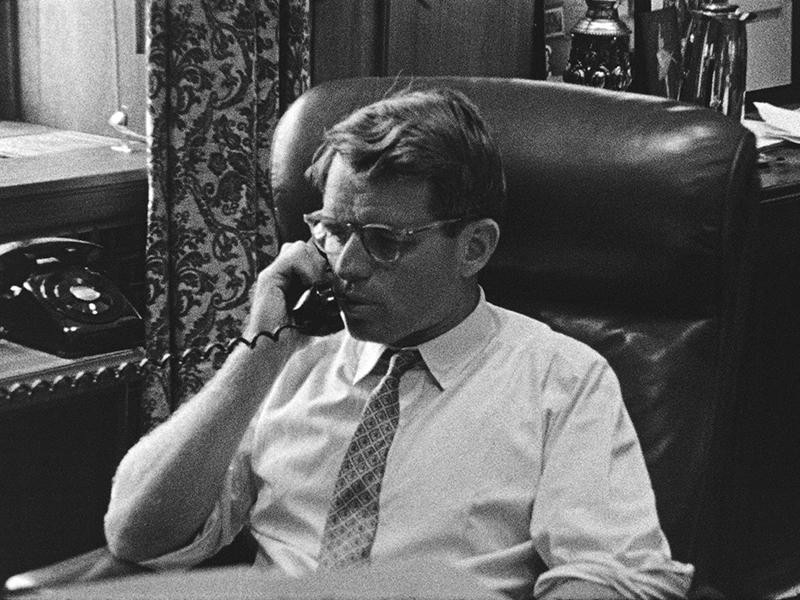
RFK getting reports from Alabama Robert Drew’s film Crisis begins with a triangularly intercut sequence. We first view Wallace leaving the governor’s mansion in Montgomery by limousine for Tuscaloosa. This is followed by the two students being escorted onto the campus. We then watch Bobby Kennedy in his office getting phone reports as to what is happening in real time. As the scenes shift, the background music modulates from the southern standard “Dixie” to the national standard “The Battle Hymn of the Republic.” A nice thematic touch, which accents the threat of military force.
For in light of what happened at Ole Miss, the White House had decided to mass 3,000 troops outside the campus in advance. They were under the command of General Creighton Abrams, who we see in the film on the phone with RFK, and discussing circumstances on the scene with Bobby Kennedy’s deputy Nicolas Katzenbach. For contrary to what some have written, the White House did not know what Wallace would do. And, in fact, during the film one can hear Bobby Kennedy telling his brother that they might have to just push the governor aside. And RFK had mulled over that contingency. All the way down to taking into consideration how many doors were at the entrance and breaking them down. In other words, while shoving Wallace aside, the students could enter the furthest door. But that might have provoked the spark that turned a physical altercation into a riot.
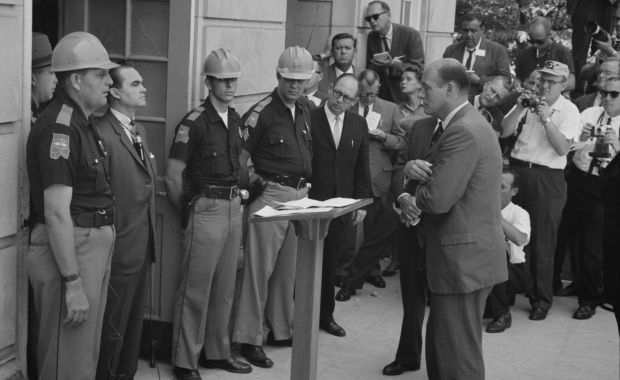
Katzenbach confronts Governor Wallace As the film shows, the ultimate strategy decided upon was the White House nationalizing the state national guard. But first, Katzenbach approached Wallace without Hood and Malone, who had gone up to their dorm rooms. Katzenbach then asked Wallace to stand aside so the students could register for their classes. Not only did Wallace refuse to do so, he even interrupted Katzenbach as he was speaking. Therefore, Kennedy nationalized the guard. Brigadier General Henry V. Graham, with a motorized detachment of 100 of his 17,000 men, then drove up to the entrance. Graham asked Wallace to stand aside upon the orders of President Kennedy. Realizing he was completely outmanned now, Wallace did so. The students were registered under the guidance of Bobby Kennedy’s lead civil rights lawyer John Doar. Graham and his detachment stayed on campus, in the student’s dorms, for several weeks. On national television that evening, President Kennedy made his epochal speech on the issue of civil rights. The most important and compelling speech on the subject by an American president since Lincoln. Drew intercuts that speech with shots of Wallace, the students, and Bobby Kennedy watching it.
The film ends with an appropriate coda. Katzenbach calls Bobby Kennedy three days later and tells him that another black student had entered the University of Alabama at Huntsville. It happened without any repercussions. Bobby Kennedy then calls JFK and tells him about it. We watch as the Attorney General now leaves his office for the day. The battle over integrated colleges and universities had been won.
But the film depicts an interesting quote by Wallace toward the end, which informs us of the price that had been paid. Due to this piece of televised resistance, Wallace states that the south will decide the next president. This was not technically true in 1964. But Wallace’s prediction did come true in 1968—and beyond. Kennedy’s struggle for civil rights turned the south from a reliable Democratic base for presidential elections to the bastion of future Republican political power. In that way, Crisis is an historically important film.
The fourth film on the DVD set is Faces of November. This is a brief visual reverie depicting the grief which overtook Washington after Kennedy’s assassination. Drew includes here photos of Kennedy’s tomb being visited by the public in the Capitol rotunda, shots of the funeral procession, and Kennedy’s military salute at Arlington.
Criterion made its reputation by the addition of interesting and educational supplements to their DVD packages. They added four of them for this collection. Far and away the most valuable one is a joint interview with former Attorney General Eric Holder and his wife Sharon Malone. Sharon is the sister of the late Vivian Malone who has since passed away. This interview gives us some personal insight into why Vivian did what she did and what gave her the courage to persevere through it. There is also a panel presentation on Primary done in 1998 at the Simon Wiesenthal Center in Los Angeles. This includes Leacock, Maysles, Pennebaker and Drew. Something like this will never happen again, since all but Pennebaker have passed away. Finally, there are interviews with authors Andrew Cohen and Richard Reeves. The former offers some insights into the film Crisis, since he used outtakes from the film for his book Two Days in June. Although Reeves is not as offensive as he usually is, still Criterion could have chosen someone else, like say Harris Wofford. Wofford worked for Kennedy in his civil rights division and authored a good book about that struggle called Of Kennedys and Kings.
Overall, this two-disc set is much worth purchasing and watching. How many DVD sets chronicle three history-making events? One dealing with our political system, one dealing with the struggle for American civil rights, and one with a stylistic revolution in film technique. This one does, which makes it unique.
-
More on the Congo from Susan Williams
Spies in the Congo: America’s Atomic Mission in World War II, by Susan Williams
Reviewed by Dan Alcorn, At: AARC
-
Hammarskjold and Kennedy vs. The Power Elite

As many CTKA readers and observers of JFK symposiums will know, since the 2013 Cyril Wecht conference in Pittsburgh, one of the topics I have been researching and talking about is John F. Kennedy’s reformist foreign policy. To some people this seemed kind of pointless. After all, in virtually every JFK assassination book Kennedy’s foreign policy boiled down to Vietnam and Cuba. What else was there?
Quite a lot. What was new in my speech mostly came from Philip Muehlenbeck’s volume, Betting on the Africans, which had been published the year before. (Click here for a review) Later, I discovered Robert Rakove’s book, Kennedy, Johnson and the Nonaligned World. That book serves as a fine compliment to Muehlenbeck. (Click here for the CTKA review) I used much of the Rakove material to present my altered versions of the 2013 presentation at both the JFK Lancer in 2013 and 2014 and the AARC Conference in 2014.
These two books form a thematic line that extends back to Richard Mahoney’s landmark volume JFK: Ordeal in Africa. That book was a trailblazing effort in the field of excavating what Kennedy’s foreign policy really was, and where its intellectual provenance came from. It was published in 1983. Even though it bore the Oxford University Press imprimatur, it had little influence. It virtually had little or no impact in the categories of Kennedy biography, studies of the Kennedy presidency, or the JFK assassination field. Which, in retrospect, is stunning. Because what Mahoney did in that book was revolutionary. In a systematic way, he traced the beginnings of President Kennedy’s foreign policy ideas. He did this with a wealth of data he garnered from weeks spent at the JFK Library. He used this ignored information to show how Kennedy’s ideas on the east/west struggles in the Third World originated, why they were different than President Eisenhower’s, and how they manifested themselves once he became president. No other book I had read elucidated this progress in such a detailed and rigorous way. In fact, when I was done with the book I actually felt like I had been snookered by relying on historians like Herbert Parmet, William Manchester, and Richard Reeves for my information on Kennedy’s presidency and foreign policy. Mahoney made them look like hacks.
It became clear to me that there was, quite literally, a war going on. And as unsatisfactory as the Parmet, Reeves, and Manchester books were (with Manchester I am referring to his presidential profile book Portrait of a President) these would be superseded by even worse JFK books later: biographies by John H. Davis, Robert Dallek, Thomas Reeves, and worst of all—perhaps the worst imaginable—Sy Hersh’s pile of rubbish The Dark Side of Camelot.
In 2008 Jim Douglass made a clean break with all the calculated trash. His fine volume, JFK and the Unspeakable, has become something of a classic. It has actually crossed over and is sourced in books outside strictly the JFK assassination or JFK presidency fields. I wrote a very approving essay about Jim’s book. (Click here)
Douglass did an exceedingly good job in elucidating Kennedy’s Vietnam and Cuba policies between the covers of one book. But with the new scholarship by Rakove and Muehlenbeck, the Douglass book seems rather narrowly focused today. And with the even newer book by Greg Poulgrain, The Incubus of Intervention (see my recent review), we can now add Indonesia to Africa and the Middle East as objects of Kennedy’s reformist foreign policy. In fact, Douglass is on to this. He actually pointed out that I should read and review the Poulgrain book.
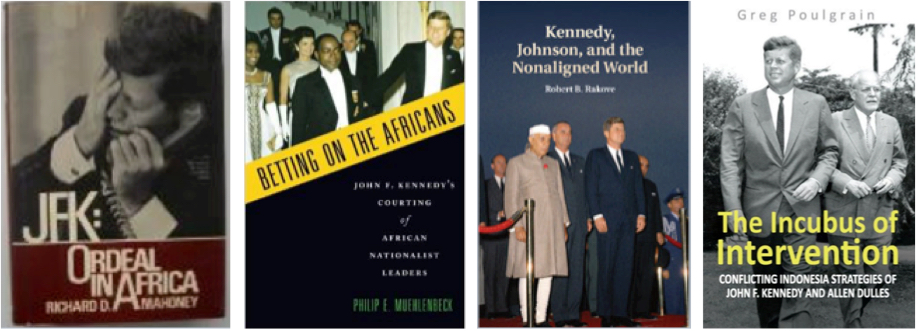
Four trailblazing books on Kennedy’s foreign policy But the Kennedy Enlightment really began with Mahoney. And although his book dealt with three African trouble spots, the majority of the book was focused on the colossal Congo crisis. Which, like other problems, Kennedy inherited from President Eisenhower. As we learn more about the Congo conflagration, we begin to see how large and complex that struggle was. Large in the sense that, in addition to the UN, several nations were directly involved. Complex in the sense that there were subterranean agendas at work. For instance, although England and France ostensibly and officially supported the United Nations effort there, they were actually subverting it on the ground through third party agents. In fact, when one studies the seething cauldron that was the Congo crisis, there are quite a few villains involved. There are only three heroes I can name: Patrice Lumumba, Dag Hammarskjold and John F. Kennedy. All three were murdered while the struggle was in process. Their deaths allowed the democratic experiment in Congo to fail spectacularly. Ultimately, it allowed one form of blatant exploitation, colonialism, to be replaced by another, imperialism.
II
To sketch in the background: In 1960, Belgium was going to leave Congo after brutally colonizing the country for generations. But their plan was to leave so abruptly that the nation would collapse inwardly for lack of leadership. Belgium would then return in order to protect the Belgian assets still there. As we shall see, the CIA was in agreement on this. Especially when Patrice Lumumba was democratically elected as Prime Minister. As Jonathan Kwitny noted, Lumumba was the first democratically elected leader of an African nation emerging from the long era of European colonialism. Ideally, Lumumba could have set a precedent. That did not happen. And the reason it did not happen was largely because of outside interference.
Within days of June 30th, Congo independence, the Belgian plan began to work. Rioting took place and Belgian soldiers began to fire into crowds. On July 11th, the regional governor of the immensely wealthy Katanga province, Moise Tshombe, declared his state was seceding from Congo. Tshombe was egged on by the Belgians and British who wanted mineral rights. In exchange, they promised him military aid and mercenaries if Lumumba attacked Katanga. (Kwitny, p. 55)
As Kwitny notes in Endless Enemies, the CIA and the National Security Council did not like Lumumba. After all, he had the gumption to ask for aid in kicking out the Belgians, who were now parachuting troops back in. Lumumba asked for aid from the USA, the USSR and the United Nations. The first declined, the second seemed amenable to sending arms, and Secretary General Dag Hammarskjold decided to send in a UN expeditionary force. The fact that Lumumba went to the USSR was enough for CIA station chief Larry Devlin to portray him as a communist. On August 18th he wired DCI Allen Dulles that Congo was experiencing a classic communist takeover. He then added that anti-West forces were rapidly gaining power and Congo was on the verge of becoming another Cuba. (ibid, p. 59)
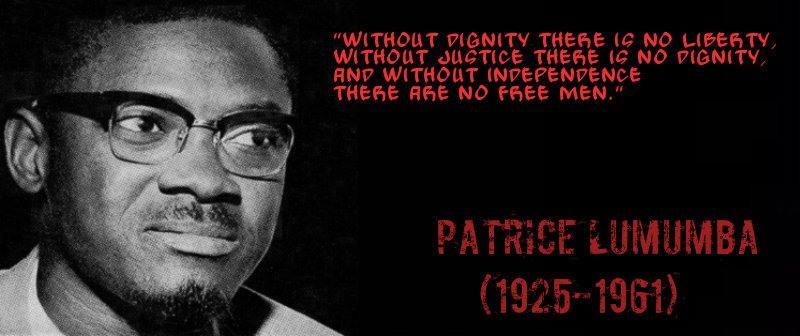
This was preposterous. There was no “anti-West force” build-up in Congo. In fact, England and Belgium were sending in troops and mercenaries. These were later joined by the French, who also wanted a stake in Katanga. But Devlin concluded by saying that Lumumba should be “replaced” by a pro-Western group. (ibid) This is just days after Lumumba visited the USA asking for help to expel the Belgians. Ambassador Clare Timberlake contributed the same kind of utter distortion. He told Washington that Lumumba wanted troops in order to expel the Belgians and then nationalize all industry and property. Lumumba would then invite communist bloc experts in to run the economy. (ibid, pp. 59-60)
The Devlin/Timberlake cables had their intended impact. Within 48 hours DCI Allen Dulles and President Eisenhower agreed that Lumumba had to be neutralized. (ibid, p. 62) The CIA took two tracks to achieve this aim. First, Timberlake and his deputy Frank Carlucci tried to get President Kasavubu to stage a coup. He said no. So Devlin went to military colonel Josef Mobutu and asked him to eliminate Lumumba. In September, Kasavubu finally relented and dismissed Lumumba. Lumumba then said he was dismissing Kasavubu. With a Mexican standoff holding, Devlin then went to Mobutu and asked him to arrest Lumumba. But the UN emissary there, Rajeshwar Dayal, prevented the action. And Lumumba now became somewhat of a prisoner in his own home. Kasavubu then dissolved parliament, which had backed Lumumba. (p. 66) The second track of the CIA’s program now kicked in: assassination plots to kill Lumumba. (ibid, p. 67)
As the reader can see, in the space of two months, the Americans and Europeans had pretty much destroyed whatever hope there was for the first democratic nation to emerge and survive in post-colonial Africa. In fact, one could fairly say that they strangled African democracy in the cradle. From here, it got worse. Devlin now wanted Mobutu to eliminate not just Lumumba, but his deputy Antoine Gizenga. (ibid) But Dayal and Hammarskjold kept him protected also.
When Mobutu’s troops began to battle with the UN mission, Lumumba made an impulsive, perhaps reckless, decision. He escaped from Dayal’s protection and tried to flee to Stanleyville, his political base. With Devlin’s help, Mobutu captured him. And after severely beating him, returned him to the capital of Leopoldville.
Three things then happened that sealed Lumumba’s fate. First, Russian planes carrying supplies and arms started arriving in Stanleyville. Second, two CIA assassins also arrived on the scene. And third, John F. Kennedy was about to be inaugurated. Because of these factors, , instead of having Lumumba killed by the CIA agents, or risk a more sympathetic policy under Kennedy, on January 13, 1961, Mobutu had Lumumba shipped to Moise Tshombe in Katanga. As Devlin must have known, this meant he would be killed soon. Four days later, he was. (ibid, p. 69)
The information about his death was kept from President Kennedy for almost a month. He did not learn about Lumumba’s murder until February 13th. He learned of it on a phone call with UN Ambassador Adlai Stevenson. White House photographer Jacques Lowe captured the moment in a crystalline photograph:
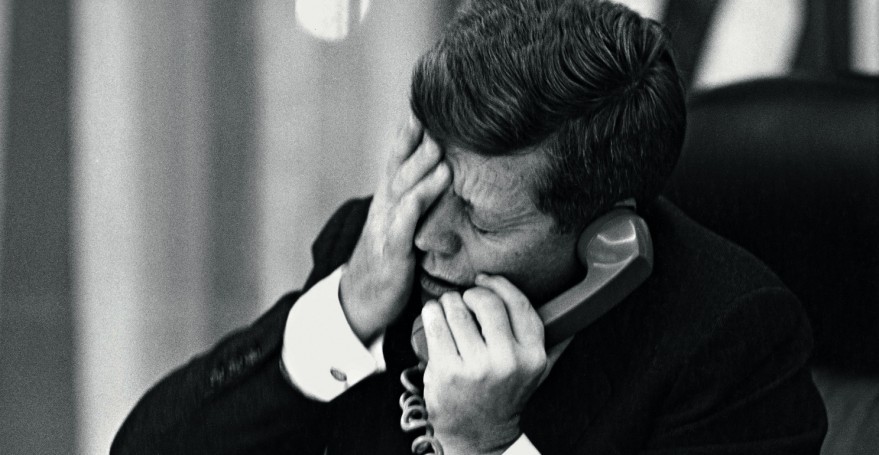
Kennedy hears of Lumumba’s murder from Adlai Stevenson
(photo by Jacques Lowe)Perhaps no photo from the Kennedy presidency summarizes who Kennedy was, and how he differed from what preceded him and what came after him, than this picture.
III
In the wake of Lumumba’s murder, Dag Hammarskjold was not about to give up. Secretary General Hammarskjold was from Sweden and his family had a long history in public service. His father had been a regional governor and then Sweden’s prime minister. Two of his older brothers had also spent time in government service, one as a governor and the other working with the League of Nations. As an economist, Dag worked for the Finance Ministry and coined the term “planned economy”. He and his brother Bo helped launch the Swedish welfare state.
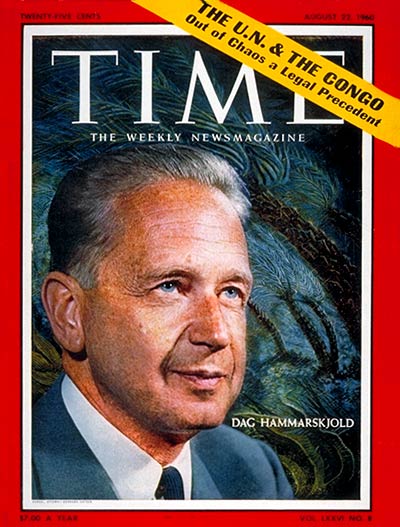
Dag Hammarskjold
August 27, 1960Hammarskjold first worked with the Swedish delegation at the United Nations. He then, rather unexpectedly, was voted its second Secretary General in 1953. As writer Susan Williams notes, his ascendancy coincided with the beginning of the de-colonization process in Africa and Asia. By 1960, 47 of the 100 UN members came from this Afro/Asia bloc. (Williams, Who Killed Hammarskjold? p. 23) In 1960 alone, 16 African nations had joined the UN. Hammarskjold decided to tour the continent in late 1959. He had harsh words for the apartheid regime of the Union of South Africa. Therefore, he became an enemy of white supremacists on that continent. And with those nations who still held colonies there, or were trying to unduly influence their former colonies e.g. France, England, Portugal and Belgium. (ibid, p. 24)
Because of his Swedish background and his work in civil service and planned economies, Hammarskjold had a special sensitivity to these new and awakening nations. He understood that, individually, these states felt weak and isolated. But as members of the UN, they felt part of a world community that could elevate their stature. Or, as he put it, the function of the UN was to protect the weak against the strong. (ibid)
Hammarskjold suspected what the Belgian secret agenda was before they pulled out of Congo. Therefore he sent Ralph Bunche, part of the American delegation, there as independence was enacted. King Baudouin of Belgium was there for the official proceeding. He actually praised what Belgium had done for Congo and specifically singled out Leopold II for praise. Which would be like giving credit to John Calhoun in the struggle for civil rights for Black Americans. Lumumba felt he had to respond. He said, words to the effect, “we are your monkeys no more”. (Williams, p. 31)
There can be little doubt that tensions began to build because of this exchange. Also because, in the ranks of the army, Belgians still remained in command centers. When violence broke out, Lumumba blamed it on the Belgians in the military and accused the former mother country of trying to recolonize Congo—which was accurate. As civilian Belgians tried to leave the country, Baudouin sent in troops to protect them. A week later, Tshombe announced the Katanga secession. Katanga contained about 60% of Congo’s mineral wealth. Tshombe was clearly in alliance with the giant mining conglomerate Union Miniere, a Belgian/British transnational. For immediately after this announcement, the company said it would not pay its corporate taxes to the Congo capital of Leopoldville anymore. It would now pay them to Elisabethville, the capital of Katanga. (ibid, p. 33) The company also extended Tshombe a large loan. Further, Belgian advisors began to flock to Katanga as well as British mercenaries from nearby Rhodesia. Congo was going to be stillborn.
Lumumba now turned to Hammarskjold for help. The Secretary General immediately passed UN Resolution 143. This demanded that the Belgians leave Congo and promised assistance to Lumumba until the nation was able to defend itself. Within 48 hours, there were 3,500 UN troops on the ground in Congo. Although he was now being accused of acting too late by the USSR, Hammarskjold proclaimed he would not recognize either Mobutu or Kasavubu as the leader of Congo. (Williams, p. 39) But when Lumumba was murdered, the Russians again criticized the Secretary General for doing too little, too late.
Hammarskjold replied by passing resolution 161. There were now 15,000 UN troops in Congo, they were now allowed to use military force. The mission was to expel all foreign troops, and Parliament would be reconvened under UN protection. The Secretary General clearly saw Congo as a defining moment for both the UN and his leadership. (ibid, p. 41)
The UN commander on the ground, Conor Cruise O’Brien, demanded Tshombe step down and Katanga rejoin Congo. To strengthen himself, Tshombe now recruited French veterans of the OAS, the terrorist group of army veterans who had split off from French president Charles DeGaulle over Algerian independence.
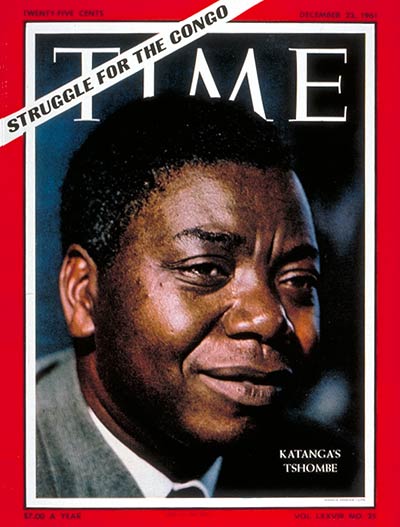
Moise Tshombe
December 22, 1961In the face of this, O’Brien launched two offensives into Katanga. The first was called Operation Rumpunch, and the second was named Operation Morthor. The first operation was quite successful, the second was not. About half of Elisabethville was still under Tshombe’s control. (ibid, p. 49) By this time, the British premier of the African Federation—Roy Welensky— was clearly favoring Katanga, as was the Union of South Africa. Welensky, working with his colleague on African Affairs, Baron Cuthbert Alport, was also secretly supplying mercenaries from Rhodesia to Tshombe. (ibid, p. 51)
As a result of this secret policy, Welensky now shifted troops into Ndola, the main airport for Rhodesia, which was just a few miles from the border with Congo. Welensky shipped in food, supplies and arms from as far away as Australia. (ibid, p. 53) Rhetorically, Welensky went as far as to compare the UN troops in Congo to the Nazis.
This information is important. Since we are about to discuss the second high profile murder over the Congo Crisis: that of Dag Hammarskjold. Today I, and many others, call it a murder, not a suspicious death. The state of the evidence seems to me to clearly denote that this was a planned assassination. After considering some of the work of Susan Williams and others, the reader will likely agree.
IV
Hammarskjold flew into Congo on September 13, 1961. He was surprised to hear about Operation Morthor, since he maintained he had not authorized it. While there, the Battle of Jadotville began. This was fought between a company of Irish UN troops and mercenaries employed by Tshombe. During the battle, Tshombe requested a meeting with Hammarskjold.
This was to occur on September 17th, in Ndola, a city in British controlled Rhodesia. Tshombe requested no reporters be alerted. But, Baron Alport was there. He stationed himself in the airport manager’s office, right below the control tower. As previously stated, also on hand was a temporary arm of the Rhodesian Ministry of Defense set up by Welensky. Hammarskjold was to arrive aboard a DC6 piloted by a Swede. Below him, on the runway, were 18 Rhodesian planes and two American DC3’s. (ibid, p. 68) In referring to the last, a Rhodesian air squadron leader told the UN Commission that there were “underhand things going on” at the airport, “with strange aircraft coming in, planes without flight plans and so on. There were American planes sitting on the airfield with engines running, likely transmitting messages.” (Lisa Pease, “Midnight in the Congo”, Probe, Vol. 6 No. 3 p. 20) Further, another witness said the American planes were full of sophisticated communications equipment. (Williams, p. 188)
Hammarskjold’s flight never landed at Ndola. And there is no tape recording of the approach of the plane. But there were notes kept. According to the written record, the last message from the plane was that the pilot was descending from 16,000 to 6,000 feet. (Williams, p. 70) At this point, Ndola lost contact with the plane. Because it was around midnight, no search party was sent out. Alport made a comment that the plane must have landed elsewhere. He then suggested the control room staff retire at around 3:00 AM. Yet, there were reports being filed around this time that several witnesses had independently seen a large ball of fire go off in the sky in the nearby vicinity. (ibid, p. 72) At 7 AM, a UN plane flew into Ndola to begin a search for Hammarskjold and the 15 other lost passengers of the Albertina. The pilot was arrested upon touching down. (ibid, p. 73)
The airport manager did not return until 9 AM, three hours after dawn. The search did not start until an hour later. The wreckage of the plane was found at about 3 PM, eight miles from the airport. There was one survivor, Harold Julien. He would pass away six days later. But not before he said the plane was in flames before it hit the ground. Further, the plane was determined to be under power, and the landing gear was lowered. Although all the passengers were severely burned, Hammarskjold was not—at all. Further, in something that simply cannot be explained, there was a playing card stuffed into his ruffled tie. Although it is not possible to determine what the card is from the photos, a witness at the scene said it was the ace of spades. (Williams, p. 7) Another oddity, Alport ended up with Hammarskjold’s briefcase. (ibid, p. 85) These anomalies suggest someone was at the crash scene before the official first responders arrived. As we shall see, the evidence for this is more than circumstantial.
Two of the security guards on the plane had bullets in their bodies. This was officially explained by saying that the heat of the crash had caused ammunition to explode. But a Swedish expert who had done experiments on this topic said that, even if this were so, the projectiles would not have enough force to penetrate the bodies. (See Pease, and Williams, p. 6) What makes this even more fascinating is the testimony of Major General Bjorn Egge. Egge had been the head of the UN military information mission in Congo. He had flown to the Ndola hospital, where the victims had been transported. When he saw Hammarskjold’s body he noticed what appeared to be a bullet hole in his forehead. (Williams, p. 5) That hole is not apparent in the autopsy photos Williams saw. But when the photos were shown to forensic experts, two of them said it appeared the photo had been retouched at the forehead. (ibid, p. 9)
Let us now consider sole survivor Julien’s crucial testimony: that the plane was in flames before it hit the ground. (Williams, p. 94) There is much evidence to corroborate this key point. Charles Southall was a Navy intelligence analyst in 1961. At the time, he was attached to the NSA base on the island of Cyprus. On the night of the crash, he was at home. His commanding officer called him and said he should come out and listen to a recorded communication intercept he had captured. This was the only time such a thing happened while he was in Cyprus, so Southall did so. He said that, on the recording, he heard a pilot say he was descending on the DC6. He then heard what he thought was the sound of a cannon firing. Then, the pilot said, “I’ve hit it…It’s going down.” (Williams, p. 143) Someone in the office recognized the pilot’s voice, and the NSA had a dossier on him. When the Swedish government reopened the case in 1992, Southall tried to communicate with them through the American State Department. But the Swedes found out about him through an independent source and he was interviewed more than once. (ibid, p. 147)
Southall’s testimony is echoed by the words of Swedish flying instructor Tore Meijer. He was stationed as a flight teacher to the Ethiopian Air Force in 1961. On the night of the crash, he was listening to a short wave radio he had just bought. Therefore, he was testing various frequencies. (ibid, p. 152) He picked up a conversation that included mention of the Ndola airport. In his own words, he then described the following: “The voice says, he’s approaching the airport, he’s turning—he’s leveling—where the pilot is approaching the actual landing strip. Then I hear the same voice saying, “another plane is approaching from behind, what is that?” The voice then said, “He breaks off the plan…he continues.” Meijer said he lost the contact at this point.
The idea that another plane intercepted Hammarskjold’s is corroborated by at least seven witnesses on the ground. (Pease, p. 20) For example, Dickson Buleni said he saw a smaller plane above the larger plane dropping something that looked like fire on it. (Williams, p. 117) This testimony is similar to that of Timothy Kankasa and his wife. (ibid, pp. 93, 122) But the Kankasas revealed something that may be even more interesting. They said that the crash was not initially discovered at around 3 PM on the 18th. Timothy and a few other residents of Twapia Township discovered it about six hours earlier. Further, the couple stated that this information was reported to local officials. Timothy also said he had reported it to the first investigating body from Rhodesia, but it had been edited out of his testimony. (ibid)
Again, there is independent corroboration for this earlier successful search, which punctures the 15-hour official lag time between the crash and the discovery of the plane wreckage. Colonel Charles Gaylor had been instructed by the USAF to fly to Ndola to help escort Hammarskjold to any other destination he wished to fly to as a result of his work there. Therefore, he was awaiting the landing of the Albertina that night. When Hammarskjold’s plane did not land, Gaylor retired so he could wake up and begin searching for the lost plane. He found it the next morning and relayed the information to the Ndola airport. Gaylor said that the Rhodesian planes did not show up until four hours later. (ibid, p. 188)
Another witness, who also saw a second plane in the sky, built on this disturbing indication of a deliberate and immediately enacted cover up as to the discovery of the wreckage. He saw two Land Rover type vehicles rushing at high speed toward the scene within an hour of the crash. (See Pease, “Midnight in the Congo”, p. 20) He and another witness then saw the vehicles return after they saw and heard a large fireball explosion. (Williams, p. 105)
One should note in regards to this testimony: when studying the photos of the wreckage of the Albertina, it certainly does not look like the plane simply crashed. Because the damage is just too extensive. It does appear that there was at least one explosion. But further, there do not seem to be any photos taken of Hammarskjold in situ. (Williams, pp. 13, 111) Because of this lack, because of the delay in the “discovery”, because of the testimony of Bjorn Egge about a bullet hole in Dag’s forehead, because of the experts who detected signs of tampering with the photos, because of the lack of any burns, because of all this, some have suggested that Hammarskjold may have survived the crash. And I should add one more point on this issue. Williams could not find any official autopsy reports. There are only summaries and conclusions. (p. 8)
From just this brief précis of the evidence, the reader can see that the original story, which said the crash was due to pilot error, is simply not credible today. The evidence indicates that Hammarskjold’s plane was sabotaged. A cover up, which seems preplanned, then ensued. The motive—as with Lumumba’s murder— was to make sure that Congo would not be an independent country. One in which the citizenry would be able to enjoy the fruits of its own prodigal resources. Which is what Lumumba had promised his followers during his campaign. With both Lumumba and Hammarskjold done away with, that aim now seemed unattainable.
V
As Susan Williams writes in her book, John Kennedy was an unflinching admirer of Hammarskjold. After his death, Kennedy summoned one of his assistants into the oval office. The president told Sture Linner that, compared to Hammarskjold, he was a small man. Because, in his view, Dag Hammarskjold was the greatest statesman of the 20th century. (p. 239)
When Kennedy came into office, one of the reversals he made of President Eisenhower’s foreign policy was in Congo. He had tried to make the issue of the rising tide of African nationalism part of the 1960 campaign. For he attempted to differentiate himself from his opponent Richard Nixon on the point. (See Philip Muehlenbeck, Betting on the Africans, pp. 37-41) This was a legitimate point of difference. At a National Security Council meeting, the vice-president once claimed that “some of the people of Africa have been out of the trees for only about fifty years.” Budget Director Maurice Stans replied that he “had the impression that many Africans still belonged in trees.” (ibid, p. 6) Kennedy did not at all share in this view. From at least 1957, with his powerful Senate speech on the French/Algerian crisis, Kennedy had become a staunch advocate of favoring African nationalism and liberation over the concerns of our European colonialist allies. (ibid, p. 36) For in that speech he actually stated that a true ally of France would not have done what Eisenhower and Nixon had with Algeria. Which was to either remain silent on the conflict, or even supply France with weapons. A true friend would have pointed out the folly of the colonial struggle. And then escorted France to the bargaining table to foster her exit from a hopeless and expensive civil war. (The full text of this visionary speech is in the book The Strategy of Peace, edited by Allan Nevins, pp. 66-80)
When Kennedy was inaugurated, he immediately enacted policies to carry out these differing views on Africa. As Muehlenbeck demonstrates, he did so on a number of different fronts. But the policy reversal that was done fastest was in Congo. Which he requested his first week in office. And which he approved on February 2nd. (See “Dodd and Dulles vs. Kennedy in Africa,” by James DiEugenio, Probe, Vol. 6 No. 2, p. 21) Upon hearing of this, Ambassador Timberlake sent word to Allen Dulles that Kennedy was breaking with Eisenhower, and his new program was more or less a sell-out to the Russians. When Hammarskjold got wind of the reversal, he told Dayal that they could soon expect an organized backlash to Kennedy’s reformist policy. Which, in large part, backed Lumumba—not realizing he was dead—and was open to negotiations with Russia over a militarily neutralized Congo. Kennedy also opposed the secession of Katanga and was willing to cooperate with the UN in an attempt to keep Congo free and independent.
In other words, for all intents and purposes, Kennedy agreed with the outlines of what Hammarskjold was doing. To make the distinction clear, he recalled Timberlake. (ibid, p. 22) Then, in September, Hammarskjold was killed.
At this point two remarkable things occurred in the immense Congo struggle. First, former President Harry Truman made a stunning comment. He said, “Dag Hammarskjold was on the point of getting something done when they killed him. Notice that I said, ‘When they killed him.’ ” (Williams, p. 232) Author Greg Poulgrain later shed some light on the origins of this surprising comment. He interviewed Hammarskjold’s close friend and colleague at the UN, George Ivan Smith. It turns out that Hammarskjold and Kennedy were cooperating, not just on Congo, but on the problem of the Dutch occupation of West Irian, which Indonesian leader Achmed Sukarno felt should be part of Indonesia. (Poulgrain, The Incubus of Intervention, pp. 77-78) Smith also added that Kennedy had let Harry Truman know about these discussions. Which seems logical, since Truman was the only previous Democratic president still alive.
The second remarkable development was that Kennedy decided to shoulder on with what Hammarskjold had begun in the Congo. In other words, by himself, he was going to oppose the imperialist forces of England, France, and Belgium. Which all desired to split Katanga away from Congo. And then make both states pawns for European multinational corporations. There can be very little doubt that this was Kennedy’s aim. Why? Because, after Hammarskjold’s demise, he went to the UN to pay tribute to his legacy. He then appointed Edmund Gullion as his ambassador to Congo.
Anyone who knows anything about Kennedy will realize, it was Gullion who first altered JFK’s consciousness on the subject of the appeal of communism in the Third World. This occurred on Senator Kennedy’s visit to Saigon in 1951. JFK never forgot the prediction that Gullion made at that time. Namely that France would not win the war in Indochina. When Kennedy gained the White House, he brought Gullion in as an advisor on colonial matters. And now he sent him to Leopoldville to attempt to compensate for the loss of Hammarskjold. As Richard Mahoney wrote, this indicated just how important Kennedy thought the Congo was. Because no ambassador in the entire administration had more secure access to the oval office than Gullion. (Mahoney, JFK: Ordeal in Africa, p. 108) Kennedy then went further. He made George Ball his special advisor on Congo inside the White House. Ball later became famous as the one man willing to argue against President Johnson during his disastrous escalation of the Vietnam War. But even in 1961 Ball had a reputation as something of a maverick on foreign policy.
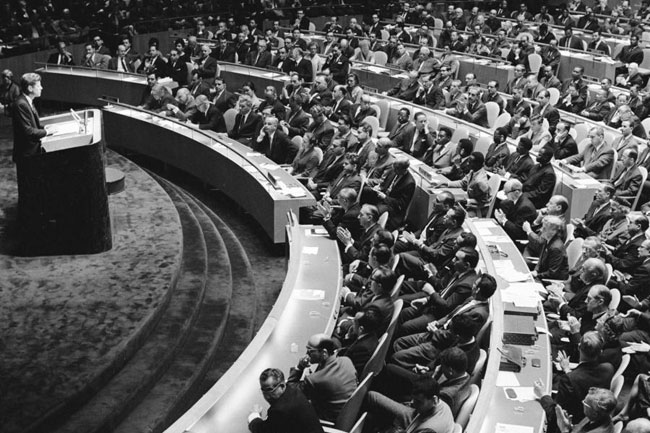
Kennedy addresses U.N. General Assembly
September 25, 1961Addressing the General Assembly at the memorial for Hammarskjold, Kennedy said, “Let us here resolve that Dag Hammarskjold did not live or die in vain.” He backed this up by having his UN delegation vote for a use of force resolution to deport the mercenaries and advisory personnel out of Katanga. (DiEugenio, p. 23) In doing so, Kennedy was militarily moving against his formal allies, the British, French and Belgians. For those nations were all paying lip service to the UN forces. But not so clandestinely, they were undermining the mission. Therefore, Kennedy was not just honoring Hammarskjold rhetorically. He was continuing his policies—and pushing the UN into following him. In fact, when hostilities broke out in Katanga with Tshombe trying to block highways used by UN troops, Kennedy told the new UN leader U Thant, who was wavering on the commitment, not to worry at all about European reaction. He would take care of that. He then said in public, these leaders should spend less time criticizing the UN and more time convincing Tshombe to negotiate a truce with the new leader of Congo, Cyrille Adoula. (Mahoney, p. 117)
Kennedy also had to deal with the big guns of the MSM who seemed to favor Tshombe. That is: Time magazine, who put him on their cover; William F. Buckley, who (incredibly) compared Katanga’s secession to the Hungarian uprising of 1956; and Sen. Thomas Dodd, who actually visited Tshombe in Katanga to show his support. In the face of this, Kennedy decided to use economic warfare. He told the representatives of the giant Union Miniere mining corporation that unless they significantly cut their monthly stipend to Tshombe, he would unleash a terrific attack on Katanga, and then turn over the company’s assets to Adoula. This achieved its aim. The stipend was significantly reduced. (DiEugenio, p. 24)
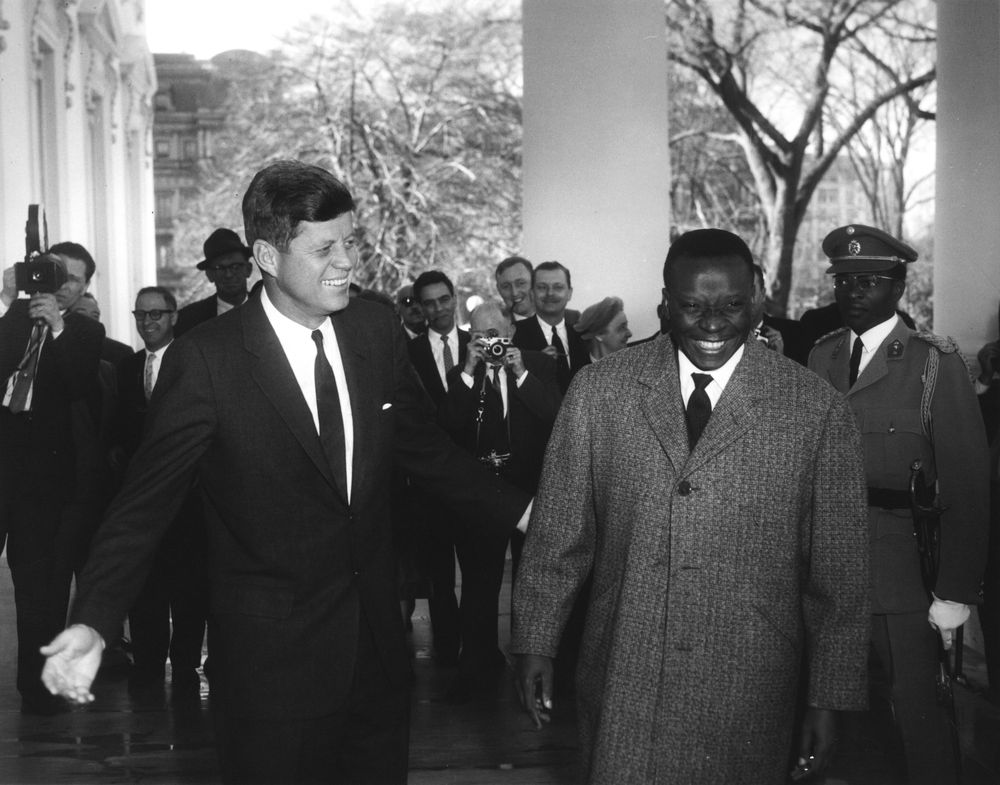
Kennedy and Cyrille Adoula at the White House Kennedy then brought Adoula to New York. In his address to the United Nations, the African leader criticized Belgium and praised Congo’s national hero, Patrice Lumumba. (Mahoney, p. 134) In reaction, Tshombe’s supporters then wanted to bring him to the USA to counter this appearance. Gullion argued against it. He suggested denying Tshombe a visa on the basis that he was not a real representative of Congo. Kennedy listened to arguments for and against the denial. He then sided with Gullion and denied the visa. (DiEugenio, p. 24)
On the day before Christmas of 1962, Katangese troops fired on a UN helicopter and outpost. Kennedy had previously forced the issue on his White House staff by demanding a unanimous vote to back the military invasion of Katanga. George Ball, who was holding out for more negotiations, came over to the Kennedy/Gullion side. So now the USA fully backed Operation Grand Slam, the UN attempt to finally take Elisabethville, capital of Katanga. By January 22, 1963 Grand Slam had succeeded on all fronts. Tshombe, predictably, fled to Rhodesia. As Adlai Stevenson, Kennedy’s representative to the United Nations wrote, it was that body’s finest hour.
VI
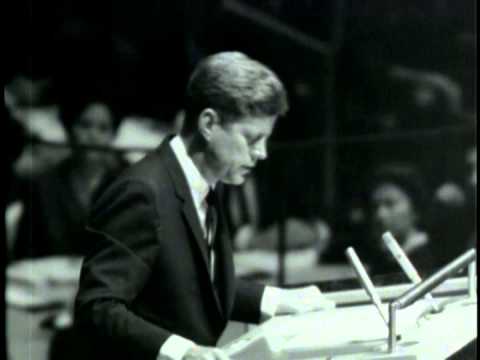
Kennedy addresses U.N. General Assembly
September 20, 1963The UN had never before done what Hammarskjold had committed it to in Congo. That is, send a large military force into an independent nation to put down an internal civil war. But Hammarskjold had done so at Lumumba’s request. Both men had been murdered over that struggle. With Hammarskjold gone, the United Nations did not want to stay after Grand Slam was completed. In fact, it’s an open question if Grand Slam would have been launched without Kennedy’s visit to the UN the year before. But because of the expense, controversy, and length of the expedition, the UN leadership wanted to leave Congo in 1963. Even with Adoula’s position precarious and the Congolese army a rather unreliable force. Again, Kennedy took it upon himself to go to New York. On September 20, 1963 Kennedy addressed the UN General Assembly on this very subject. He said he understood how a project like this would lose its attraction after its initial goals were met. Because then the bills would come due. But he urged the UN to do what it could to preserve the gains they had made. He also asked that they do all in their power to maintain Congo as an independent nation in its fragile state. He concluded the UN should complete what Hammarskjold had begun.
Kennedy’s speech turned around the consensus opinion to depart. The UN voted to keep the peacekeeping mission there. But later in 1963, things began to unravel. Kasavubu decided to disband Parliament. This ignited a leftist rebellion from Stanleyville. There was an assassination attempt on Mobutu. With this, Mobutu, already a darling of the CIA, now became the Pentagon’s poster boy at Fort Benning.

Mobutu Sese Seko
with Prince Bernhard of the Netherlands
(1973)After Kennedy’s murder, President Johnson sided with the CIA and the Fort Benning crowd. As the Stanleyville rebellion picked up steam, the CIA now descended on the American embassy and took it over. It became the base for an air operation run by Cuban exile pilots. Incredibly, Belgium now became an ally of the USA. Tshombe was asked back to Congo by Mobutu. Tshombe immediately found a treasure trove of Chinese documents and a defector who now said China was behind the leftist rebellion. (Kwitny, p. 79) Needless to say, within 18 months, Johnson and the CIA had reversed the Kennedy/Hammarskjold program. Adoula and Kasavubu were dismissed or forced out; Gullion left. In 1966 Mobutu installed himself as military dictator. The riches of the Congo were now mined by the European forces Lumumba asked Hammarskjold to remove. Like Suharto in Indonesia, Mobutu became one of the richest men in the world. His holdings in Belgian real estate alone topped 100 million dollars. (Kwitny, p. 87) Like Suharto, he reigned for three decades. And like the Indonesia dictator, when he fell, he left his country in a destabilized, anarchic state with poverty predominating. In other words, where they were at the beginning.
One of the most fascinating revelations in Greg Poulgrain’s The Incubus of Intervention was this: In addition to JFK working with the Secretary General Hammarskjold on Congo, the two were also working on a design for Indonesia. (Poulgrain, p.77) They were planning on a solution to the West Irian problem. Which was part of the former Dutch Empire that Netherlands did not want to let go. Probably because of the great mineral wealth there, which likely even surpassed that of Katanga. Further, the two men were also working on a plan to aid countries coming out of colonialism. This was called OPEX. This was a UN group that would send professionals of all kinds into these areas to aid their development. Not as advisors, but as servants of the new country. This is the plan Hammarskjold had in mind for West Irian. In their original concept, Hammarskjold would play the lead role in both Congo and Indonesia, with Kennedy supporting him. With the Secretary General’s 1961 murder, Kennedy had to soldier through both situations himself. He was doing a fairly good job, until he too was assassinated. In fact, he had planned on a state visit to Jakarta in 1964, a first for an American president.
As one can see from this discussion, and also Poulgrain’s book, Kennedy’s policies were reversed in both countries shortly after his murder. (See again the above-cited review; also, this interview with the author) The results were horrendous for the citizens of both countries. For when Mobutu and Suharto took over, any idea of having the prodigal natural resources of both states aid in fostering its citizenry was lost. Because of the two overthrows, Lumumba and Sukarno did not funnel the money into improvements for the daily lives of their citizens, through building infrastructure, energy sources, hospitals, primary and secondary schools etc. Instead it went to the shareholders of the exploiting companies and into the pockets of Mobutu and Suharto.
As Jonathan Kwitny has noted, Congo could have been a sterling example of a nation crippled by colonialism, now being set free. And aided by the USA, allowed to grow and nurture, and thereby be a model—for not just Africa—but the rest of the world. That is what Hammarskjold and Kennedy had hoped for. Just as they had imagined for Sukarno and Indonesia. Instead, something contrary to that occurred. Or as Kwitny wrote:
The democratic experiment had no example in Africa, and badly needed one. So perhaps the sorriest, and the most unnecessary, blight on the record of this new era, is that the precedent for it all, the very first coup in post-colonial African history, the very first political assassination, and the very first junking of a legally constituted democratic system, all took place in a major country, and were all instigated by the United States of America. (Kwitny, p. 75)
Kennedy and Hammarskjold understood this moral and practical quandary. It was not until recently that the importance of the Hammarskjold/Kennedy relationship has been highlighted. I and others have also tried to show that Kennedy’s foreign policy should be seen not just as a series of individual instances, but in the gestalt. That is, as part of an overall pattern. Largely because of his sensitivity to these Third World issues—which was not at all the case with Eisenhower, Johnson and Nixon. But this gestalt concept has been very late in arriving. Because the cover up about the facts of Kennedy’s real foreign policy has been more stringent and assiduous than the cover up about the facts of his assassination.
Too often we think of that foreign policy in terms of just Cuba and Vietnam. As seen above, that view foreshortens history. It’s the way the other side wants us to see Kennedy—a view without Hammarskjold. Constricted by this deliberate obstruction, we fail to see who Kennedy really was. Not only does that foreshortened view cheat history, it cheats Kennedy—and helps conceal the secrets of his assassination.
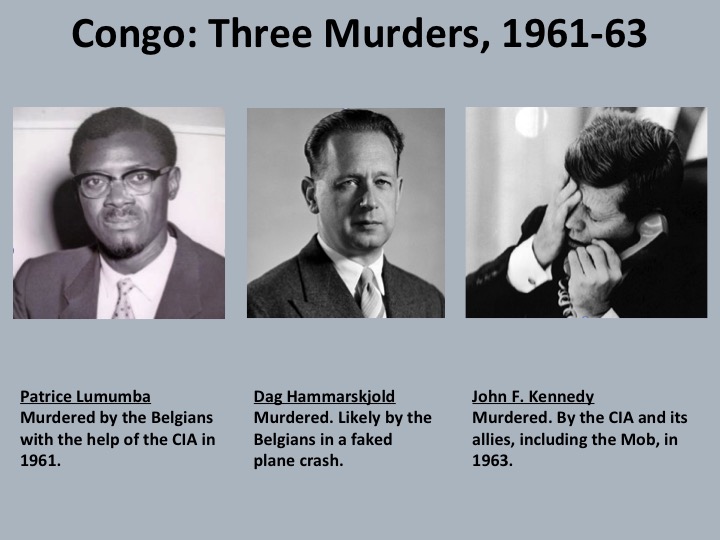
from “JFK’s Foreign Policy: A Motive for Murder”
JFK Lancer conference, November 2014
Addendum
See now U.N. to Probe Whether Iconic Secretary-General Was Assassinated for the discovery of the original SAIMR documents.
-
US Senate creates commission to honor 100th anniversary of JFK’s birth

by Olivia Quintana, At: The Boston Globe
-
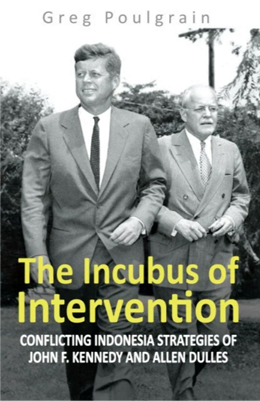
Greg Poulgrain, The Incubus of Intervention
The sub-title of Professor Poulgrain’s book is “Conflicting Indonesia Strategies of John F. Kennedy and Allen Dulles.” In this author’s opinion it is a valuable book because, although it does not deal directly with the 1965 CIA-inspired coup against Achmed Sukarno of Indonesia, it traces the major events and crises that caused that epic slaughter, which is usually labeled the bloodiest CIA coup in history.
To this day, no one can say for certain how many people perished in the overthrow of Sukarno. The estimates range from 350,000 to a million. But almost everyone who has written about that event agrees that it was the most cleverly disguised coup d’état the Agency ever executed in a foreign country. It literally took years to even begin to really understand what had happened. Over fifty years later, there is still much to be uncovered about what happened, and why, on September 30, 1965, and how this caused the mass murders that were then enacted all the way into the summer of the next year.
As former CIA officer Ralph McGehee once said, the Agency very much guarded how it achieved the overthrow of Sukarno. They considered it such a near masterpiece of covert action that they used it as a model to teach certain tactics and strategies. (The Nation, April 11, 1981) In fact, the Agency has so clouded its own role in the twisted affair that to this day there is no single book that comes close to constituting a definitive study of the coup, which is not the case with say, the overthrow of Arbenz in Guatemala or Mossadegh in Iran.
In fact, one of the first hints of what really happened in Indonesia in late September of 1965 was almost inadvertently delivered by James Reston in the New York Times. On June 19, 1966, Reston was trying to defend Lyndon Johnson’s escalation of the Vietnam War and the failure of that escalation to achieve its goals. Therefore, he wrote that this should be balanced by more “hopeful political developments elsewhere in Asia.” Reston then pointed to the “transformation of Indonesia from a pro-Chinese policy under Sukarno to a defiantly anti-Communist policy under General Suharto.” Reston, of course, was lying about Sukarno being a pro-Chinese communist; he was nothing of the sort. But, as with Patrice Lumumba in Congo, this is what the CIA used to justify the overthrow of his government. Reston then hinted that such was the case when he wrote, “Washington is careful not to claim any credit for this change…but this does not mean that Washington had nothing to do with it.” If the reader can comprehend it, Reston’s column was entitled “A Gleam of Light in Asia.” No comment can underscore the sick inappropriateness of that rubric.
In his introduction to the book The Silent Slaughter, Bertrand Russell wrote that according to two witnesses he knew, the 7th Fleet was in the waters off the coast of Java at the time, and General Nasution, who led the communist crackdown along with his colleague General Suharto, had a mission in Washington; therefore, the US “was directly involved in the day to day events.”
On February 12, 1965, the New York Times, almost eight months before the cataclysm, partly explained why the USA was determined to overthrow Sukarno. They wrote that when “Sukarno threatened the Federation of Malaysia, he placed himself in the path of U.S. and British interests to contain communist China. Washington has left active defense of Malaysia to the British Commonwealth…” but seeks to influence Indonesia by aiding her army “against the expected Communist bid for power.” Again, this is another deception. There was no bid for power by the communist party on the archipelago called the PKI. But the CIA used this specter–first conjured up by CIA Director Allen Dulles and his brother Secretary of State John Foster Dulles–to begin the planning for the coup.
And, in fact, that planning may have begun the year before. Peter Scott in an article for Lobster, (Fall 1990), quoted a letter from a former researcher who had seen a certain letter from a former ambassador who had a conversation with a Dutch intelligence officer assigned to NATO. According to the researcher’s notes, the ambassador’s letter was dated from December of 1964. It said that Indonesia would soon fall to the west like a rotten apple. Western intelligence agencies would organize a “premature communist coup [which would be] foredoomed to fail, providing a legitimate and welcome opportunity to the army to crush the communists and make Sukarno a prisoner of the army’s goodwill.”
According to several writers, in the early spring of 1965, the Agency sent in the so-called first team. And according to at least one author–Donald Freed–David Phillips was part of this advance team. One of the things they did was to organize an informal alliance of conservative generals–led by Nasution and Suharto among others. It eventually numbered over two dozen. As the months went by, it was formally called the Council of Generals. It was this body that reportedly plotted against Sukarno. Part of the point of this subterfuge was to try and provoke a response by the PKI. In anticipation of that response, Bradley Simpson has written, “the CIA organized covert operations and propaganda efforts for the better part of a year.” As he also notes, the CIA had a role in encouraging and aiding the mass killings of PKI supporters through Moslem groups, youth gangs, and other anti communist forces. (For a gripping recreation of how this was done locally, see the acclaimed documentary film The Act of Killing)
But Washington’s covert aid was consciously kept as secret as possible, since it would have provided a great propaganda boon to Sukarno in reining in the bloody chaos that was consuming his country. In the face of the massacres, National Security Advisor Walt Rostow recommended a policy of silence by the White House. But secretly the CIA was sending cash, small arms and communications equipment to aid the slaughter, since Nasution and Suharto had requested them. If that wasn’t enough, the American Embassy was furnishing the army with lists of PKI members. (See Monthly Review, December 2015)
After placing Sukarno under house arrest, the Council of Generals eventually took complete power in 1966. Once the PKI was liquidated, the Council sold off their fabulously rich country to American and European imperialists. Suharto, for one example, became a billionaire; while the great mass of Indonesians lived in brutal, grinding poverty.
As I said, I am not going to attempt to elucidate in any serious detail the chilling events that occurred in September and October of 1965 in Indonesia. Authors who have studied it for years still have yet to convincingly explicate all of its complications. And that is not Poulgrain’s aim either. What his book does is explain the long back-story as to why the horror of 1965 happened. And it does so mainly through the figure of Allen Dulles.
II

In narrating this discouraging, sometimes depressing, tragic epic, it is imperative to understand that it was Sukarno who convened the first conference of non-aligned nations in Indonesia in 1955, which was actually arranged by his foreign minister and held in Bandung. For Sukarno, the term “non-aligned” meant just that. These were nations that did not want to commit themselves one way or the other to the Cold War competition between the U.S. and Russia. They wanted to be neutral and to stay neutral. They also wanted to be free to accept aid from both superpowers without the acceptance showing a commitment to Moscow or Washington.
This was not satisfactory with the Eisenhower administration, especially with Secretary of State John Foster Dulles and his brother, CIA Director Allen Dulles. Yet the irony is that Sukarno and many of his allies like Nasser of Egypt staged the conference for the specific reason that they did not trust the Dulles brothers. (Robert Rakove, Kennedy, Johnson and the Non-Aligned World, p. 3) One could understand that readily after watching what happened in Iran and Guatemala in 1953 and 1954. Foster Dulles’s State Department issued a paper calling Sukarno’s conference and the growing non-aligned movement, “one of the most dangerous political trends of the fifties.” (ibid, p. 6) The Secretary seriously contemplated staging a shadow Bandung conference with conservative, sympathetic American allied nations. (ibid, p. 9) In a speech Foster Dulles gave in Iowa in 1956, he called neutrality in the Cold War a false pretense and he said he had constructed his string of alliances across the world, such as SEATO, the Baghdad Pact, to eliminate neutrals. Because of this, Allen Dulles began secretly funding the Masjumi Muslim party to the tune of a million dollars in one year. In fact, the Church Committee did find some evidence that the CIA may have been behind the assassination attempt of Sukarno in 1957. (op. cit. Scott)
This was one point of contention between Sukarno and the Eisenhower administration. Another one was the dispute between the Netherlands and Sukarno over the territory of West Irian (also called Irian Java, West Papua and West New Guinea). This was part of an island territory that the Dutch maintained control of after Indonesia won its independence a few years after World War II. As Rakove notes, although Foster Dulles was neutral about this dispute in public, privately he did not want to give the territory over to Sukarno. (p. 15)
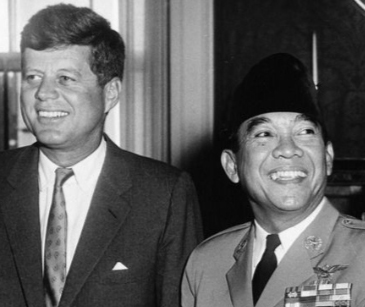
Kennedy and Sukarno meet at the White House The first researcher to fully integrate this dispute over West Irian into a comprehensive essay on the Indonesia overthrow of 1965 was Lisa Pease. She did this in her landmark essay entitled “JFK, Indonesia, CIA and Freeport Sulphur.” That scintillating essay was first published in the May/June 1996 issue of Probe magazine. It was Part Two of her series on the huge mining company Freeport Sulphur, today called Freeport McMoran. And although some have said that her essays are in the book The Assassinations, they are not. One has to purchase the Probe CD to read that excellent series. (Oddly, Poulgrain does not source Lisa’s work in his notes or bibliography.)
In her essay, Lisa was one of the first to point out the importance of the Ertsberg lode and how it figured into the dispute between the Dutch and Sukarno. And further, how it later figured into the overthrow of Sukarno’s government, which he called a “guided democracy.”
In 1936 a Dutch geologist named J. J. Dozy discovered two enormous mineral deposits in West Irian. One was called the Ertsberg and the other, only two kilometers away, was called the Grasberg. The former was a mountain, the latter an elevated meadow. (Poulgrain, p. 6) The political ramifications of this find have extended over the decades to this very day because the Dozy report was both kept hidden and also deliberately distorted. One of the reasons for this is that Dozy discovered that the concentration of gold ore at Ertsberg was twice as rich as the wealthiest gold mine in the world at that time, which was located in South Africa. But further, the same gold ore at the Grasberg appeared to be even richer than the Ertsberg. (Ibid, pgs. 6,7)
Needless to say, this discovery significantly altered the geopolitical importance of Indonesia—especially for the so-called Power Elite. A central reason for this was that one of the main architects of the Dozy expedition was Allen Dulles through his law firm Sullivan and Cromwell. (Poulgrain, p. 7) Dozy was instructed not to formally announce the results of his findings for the simple reason that the Dutch control of West Irian was weak. But further, the consortium of companies that arranged and financed the three-man expedition was a dual Dutch/American operation. On the American side, the two partners were two divisions of the Rockefeller-controlled petroleum colossus, Standard Oil. Since Sullivan and Cromwell organized the expedition, it was Standard that had a 60% controlling interest in the enterprise. (ibid, p. 17)
As the author notes, in its decades long struggle to hang on to West Irian, the Dutch never made public the true facts of what Dozy’s expedition had discovered. But also, the American side of the consortium never accepted the Dutch offer to begin to actually break ground and exploit the mining potential of both areas. As Poulgrain postulates, the Ertsberg and Grasberg were at high elevations (about 14,000 feet) and in difficult locations for mining operations. The Dutch did not have the wherewithal at the time to pull off such an engineering feat. In fact, as Lisa Pease points out, when Freeport Sulphur finally did break ground, they had to go to Bechtel Corporation to construct the engineering aspects of the mining.
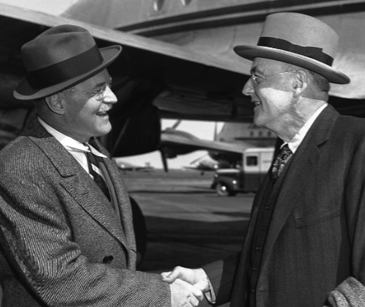
The Dulles brothers In a subsequent report about the expedition that was technical in nature, the gold potential of the Ertsberg was greatly discounted, while its copper content and remoteness was played up. (ibid, p. 24) With this camouflage in place, the next objective for Sullivan and Cromwell was to force the Dutch out of the deal. By refusing to cooperate with them on the mining engineering, Standard was attempting to do just that.
In 1962, a second expedition ascended the Ertsberg. This was on the occasion of Sukarno and Indonesia taking control of the area. This second mission actually discovered a notebook deliberately left behind by Dozy but again, the content of this notebook was kept shrouded in secrecy. In fact, Dozy lied to Poulgrain about it being returned to him. (p. 31) Even at this late date, both Dozy and Freeport Sulphur’s geologist Forbes Wilson continued to discount the gold and silver deposits there and to exalt the copper deposits. Dozy’s secret report said that the gold at Ertsberg amounted to 15 grains per ton. In reality it was 15 grams per ton, which makes for a large difference. (ibid, p. 37)
Around this time, something else was afoot. In interviews Poulgrain did with two Indonesian officials, they both revealed that secret money began to be siphoned to the Indonesian government. It was earmarked for the struggle with the Dutch over West Irian. The funds were from American sources. (p. 33) As Standard did not want to help the Dutch mine the area, the Americans did not want the Dutch to take permanent control of West Irian. Standard Oil could find its own partners and the mining company Freeport Sulphur was another Rockefeller-controlled company.
III
One of the most interesting parts of the book is the chapter concerning John Kennedy’s relationship with United Nations Secretary General Dag Hammarskjold. Until reading Poulgrain, much of what most observers knew about this relationship was based upon the pair’s interplay in the monumental Congo crisis. Author Richard Mahoney had made that conflict the basis for his milestone book on Kennedy, JFK: Ordeal in Africa. Kennedy had developed a strong interest in the issues of colonialism and Africa while he was in the Senate. His stance on the two was quite different than the Eisenhower administration’s, for he did not see the emerging countries of the Third World through the “with us or against us” lens that the administration did. For instance, he understood why Nasser did not join the Baghdad Pact. And Kennedy looked at Foster Dulles’ reaction to this–his attempt to isolate Nasser, favoring Saudi Arabia, and pulling out of the Aswan Dam project–with disdain, since, for one thing, it threw Nasser into the arms of the Russians to get funding for the dam. But Kennedy also thought that America should actually favor someone like Nasser who was more of a socialist/secularist rather than the Saudis who were more Moslem fundamentalists. (See Philip Muehlenbeck’s Betting on the Africans, p. 10ff)
Dag Hammarskjold was a Swedish economist who worked on the Marshall Plan for Europe. He later became chair of the Swedish delegation to the UN General Assembly. In 1953 he was elected Secretary General of that body. Kennedy had nothing but respect and admiration for Hammarskjold. Upon his death in 1961, he called him the greatest statesman of the 20th century. As Mahoney pointed out at length and in depth, the two men had much in common during the Congo crisis, and Hammarskjold’s death in a suspicious plane crash in 1961 seemed to galvanize Kennedy on that front. He was determined to back the followers of Patrice Lumumba and to prevent the mineral rich province of Katanga from splitting off from the country. He backed a UN military action to prevent the latter. Kennedy’s Congo policy was drastically altered after his death.
What Poulgrain adds to this equation is that Kennedy and Hammarskjold were also working on a plan for Indonesia. (p. 77) In interviews the author did with Hammarskjold’s friend and colleague at the UN, the late George Ivan Smith, Smith told Poulgrain that JFK and Hammarskjold were discussing a solution to the West Irian crisis; the Netherlands wanted to hang onto the territory, while Sukarno thought it should be part of Indonesia. Considering the contents of the Dozy report, one can understand the motivation of the Dutch.
But further, Smith revealed that those discussions included a back channel by Kennedy to former president Harry Truman. (ibid) In fact, Truman was well informed enough about the progress that upon hearing of Hammarskjold’s plane crash, he commented: “Dag Hammarskjold was on the point of getting something done when they killed him. Notice that I said, ‘When they killed him.’” When asked to develop that point, Truman replied with, “That’s all I’ve got to say on the matter. Draw your own conclusions.” (ibid, p. 78) In itself, this is remarkable, but it is even more so when coupled with Truman’s famous editorial in the Washington Post a month after Kennedy’s assassination. That column was about how the CIA had strayed too far from what Truman imagined its original mission was. (James DiEugenio, Destiny Betrayed, pgs. 378-79) With this new revelation about Indonesia, it now becomes apparent that Truman knew something–and if the Warren Commission had been a true fact finding body, which it was not, he would have been a witness before it.
As readers of the second edition of Destiny Betrayed know, Allen Dulles visited Truman in April of 1964. Although Dulles was sitting on the Commission at the time, the visit was not formally related to that body. Dulles was there to try and get Truman to retract his editorial about the CIA becoming a rogue agency. By the end of the conversation, it had become apparent that the former CIA director suspected that Truman had written the column because he felt the Agency was involved in the JFK murder. (ibid, pgs. 379-81)
Poulgrain, using Susan Williams’s book Who Killed Hammarskjold?, adduces evidence that Dulles was involved with the murder of Hammarskjold. During the proceedings of the Truth and Reconciliation Commission in South Africa, Desmond Tutu discovered documents concerning a covert project called Operation Celeste. This appears to be a plan to murder the UN Secretary General and there were records of communications from Dulles in the file. The proposed plot machinations included planting a small bomb to disable the outside steering mechanism. One of the communications stated that the UN had become troublesome and it is felt that Hammarskjold should be removed. Dulles agreed and “has promised full cooperation from his people…” (Poulgrain, p. 74) And as Williams pointed out, there were two CIA planes on the same runway Hammarskjold was supposed to land on that night. Congruent with this, Dulles had also forwarded information describing the plane the Secretary General would be traveling on and the date of his arrival. Smith, needless to day, told Poulgrain that he thought Hammarskjold was murdered.
There was one other project Kennedy was working on with Hammarskjold. This was something called OPEX. Hammarskjold was determined to help colonized peoples free themselves, but as an economist, he was also going to try and aid their development once they were free of colonialism. OPEX was a UN group that would send professionals into newly freed states to aid their development–not as advisors, but as adjuncts to the new governments. (ibid, p. 80) Poulgrain writes that this was the concept Dag had in mind for West Irian. He was planning on turning over the territory to the natives on the island called Papuans. After Dag’s death, Kennedy had to soldier both the Congo and Indonesia crises more or less alone.
In this author’s opinion, the Hammarskjold assassination (I will not call it a plane crash anymore) has been gravely overlooked by JFK researchers and with the work of Williams, Poulgrain, and Lisa Pease, it should not be. (https://consortiumnews.com/2013/09/16/the-mysterious-death-of-a-un-hero/) Dag’s assassination, and the Congo crisis, are of key importance in the saga of John F. Kennedy’s career and his murder.
IV
Allen Dulles had been working the Indonesia terrain with covert operations for six years when Kennedy became president. It is strongly suspected that the Agency was behind the use of the Moslem extremists Darul Islam in an attempt to assassinate Sukarno in 1957. As Poulgrain notes, it is important to understand that Darul Islam later morphed into Jemmah Islamiah, the terrorist group linked to the Bali bombing of 2002. (p. 86) In other words, the work of the Dulles brothers in backing Saudi Arabia against Nasser, and Darul Islam against Sukarno, had sinister and pernicious future consequences.
In his work on the background of Allen Dulles, Poulgrain found that in working for the State Department in 1920, one of his functions was to monitor the progress of the Russian Civil War. One reason for this was American interest (read Standard Oil) in the great oil fields at Baku. (ibid, p. 97) It was here that Dulles met Sergius Alexander Von Mohrenschildt. Sergius was a director of the Nobel family oil fields in Baku, and he was also modernizing the Russian army. Sergius was the father of George DeMohrenschildt. At the time, George and his mother were living in Baku at the domicile of Sergius. George’s brother Dimitri was in the Russian navy and would soon emigrate (actually escape) to the United States.
Since Sergius was a White Russian, he was arrested by the Reds but he escaped to Poland with his wife and George. They lived on a large estate in Poland, but George’s mother died soon after the move. George served in the Polish cavalry for a period of 18 months. He then went to Belgium for university studies. (p 98) In 1938, like his brother, George also emigrated to the U.S. He changed his name by dropping the Von and changing it to “de.”
Standard Oil had targeted the petroleum in the Dutch East Indies since the twenties. They even established a phony Dutch front company to do so. But it was not until 1928 when Standard got concessions for exploration from the Netherlands. Allen Dulles worked on this by telling the Dutch they might lose everything to an outside force, like Japan, because their hold of the archipelago was tenuous.
During World War II, Dulles arranged for Standard Oil to sell petroleum to Vichy France, effectively selling it to the Germans and that case involved George DeMohrenschildt. (p. 110) In 1938, George lived with Dimitri on Park Avenue in New York. It is there that he met Mrs. Bouvier, the mother of Jackie Kennedy.
The International Cooperation Administration (ICA) was frequently used for CIA cover duties. It was established by Allen and his brother in 1955. DeMohrenschildt worked for this unit when he went to Yugoslavia as an oil and gas specialist. His job was to recruit workers for a job in Egypt using American equipment.
Poulgrain makes the case that because of some of his controversial work for Standard Oil (like with Vichy France), Dulles got DeMohrenschildt out of the country and working for another Rockefeller oil subsidiary called Humble Oil. He makes a circumstantial case that George was transferred to West Irian in the Dutch East Indies to work on Standard’s oil drilling there. It turned out that in addition to the Ertsberg and Grasberg, West Irian was the home of what turned out to be the largest oil deposit in all of New Guinea. (p. 121) It was called the Vogelkop, and again, the Dutch tried to keep this hidden. Humble Oil did some preliminary drilling and thought the prospects were promising. But as Poulgrain shows, this was kept a secret among the Power Elite. Like the Ertsberg and Grasberg, the idea was to not let Sukarno know about these deposits. In fact, the author makes the case that not even Kennedy knew about them; it puzzled him that the Dutch would want to hang on to what he thought was such a desolate area as West Irian.
V
Poulgrain has written a book about the CIA-aided rebellion of the Outer Islands military forces against Sukarno and the central government located at Jakarta. I have not read the book yet, but he incorporates some of that work into his chapter on the rebellion. The ostensible cause of the uprising was the fact that, for example the island of Sumatra was responsible for about 70% of GDP, but only got about 30% of it back in revenues. In fact Mohammad Hatta, who was Sukarno’s second in command when Indonesia was set free in 1949, resigned from the government in late 1956 over this issue.
Another perceived problem for the military was the growing influence of the PKI. Which by 1955 was the fourth largest party in Indonesia. (p. 142) Sukarno did not really perceive the party as being communists and thought they were more nationalists; this is what he told President Kennedy later. But what accented this for Allen Dulles was Sukarno’s turn toward what he called Guided Democracy. This amounted to taking advice from certain groups in society like veterans and laborers. (p. 148) which to Dulles, looked like a class-oriented government, and not, as he preferred, from the Power Elite down.
Guy Pauker, a professor at Berkeley and an expert of Southeast Asia, was a consultant for Dulles on Indonesia. He recommended using the Outer Island dispute to play up the threat of the PKI. (p. 152) The problem for Allen Dulles was John Allison who was the American ambassador in Jakarta. He did not see the PKI as a real threat to take over and he did not see Sukarno as a communist or even a pinko. The problem was that many of his reports never got through to John Foster Dulles. In fact, Allen Dulles had installed his man at a new position called the Bureau of Research and Intelligence at State. This is where the directives inside the department came to support the rebellion (p. 153) and there was a working group set up inside this agency that included navy admiral Arleigh Burke that was in direct communication with Sullivan and Cromwell. (p. 155) Finally Allen Dulles sent a friend and colleague in the Agency named Al Ulmer to visit Jakarta. He came back and told Foster Dulles that Allison was soft on communism. Allison was now removed as ambassador and sent to Czechoslovakia. (p. 159)
Allison was removed in January of 1958. The rebellion began in February. The story of the rebellion, and its failure, was well told in the book Subversion as Foreign Policy back in 1995. Poulgrain has clearly read that book, as he refers to it often. But his thesis is different and revisionist. He argues that Allen Dulles never really wanted the rebellion to succeed for the simple reason that the Dutch still controlled West Irian. His plan was to have Indonesia take control of West Irian first, and then dislodge Sukarno and decimate the PKI. For that to happen, the main tool would be the army. Dulles felt the army was not a unified force at this time, as exemplified by the dissidents on the outer islands. Therefore, he would use the rebellion to centralize the army in Jakarta. Once that was done, the possibility of dislodging the charismatic Sukarno was much stronger but only after West Irian was part of Indonesia.
Poulgrain argues this thesis vigorously with some interesting points that have either been ignored or which he dug up on his own. For instance, Dulles helped General Nasution (who led the counter attack for Sukarno) recover a huge weapons drop originally meant for the rebels. (p. 148) Also, there was never any serious discussion about rescuing American personnel. Third, a CIA officer named Sterling Cottrell called Nasution four times in one night. The reason? To be sure he was aware that there was an arms drop for him at Pekanbaru airfield on Sumatra. (p. 204) Dulles then camouflaged this to the National Security Council by saying the arms were delivered by an unknown third country.
But further, after the rebellion was defeated, Dulles kept supplying it at a low level even though it had no chance of success. Poulgrain argues that the aim of this was to 1) Maintain martial law, which Sukarno had declared at the outbreak; and 2) Stop any elections from being held so the PKI could not increase its power in the government.
VI
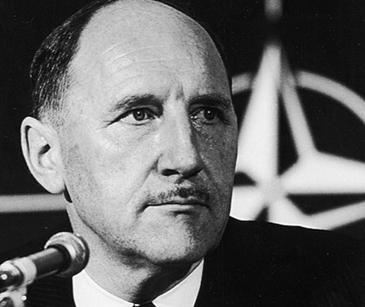
Joseph Luns In January of 1961, Nasution was in Moscow reviewing a large arms purchase from the Russians. The purchase included bombers, fighters, torpedo boats, submarines, warships and cruisers. (p. 213) These were to be used in an amphibious assault against the Dutch on West Irian. At the same time, Nasution was talking to Australia who owned the eastern part of New Guinea. He and Sukarno wanted Australia to stay neutral in the coming conflict which they agreed to do. And finally to round off the triangular arrangements, Nasution wires Washington that there is nothing more to his visit to Moscow than an arms deal and he has no sympathies towards the Soviets. (p. 215)
Dutch foreign minister Joseph Luns visited Washington in April of 1961. He told President Kennedy that Foster Dulles had told him that the U.S. would support the Netherlands if it came to a military confrontation. Kennedy clearly was not sympathetic to this at all. As stated previously, he could not understand why the Dutch were so determined to maintain such a faraway and desolate island. Luns, of course, was not going to tell him about the Dozy mission and what they found there. (p. 219)
Luns later proposed a trusteeship that would be administered by the Netherlands. Kennedy and Hammarskjold had discussed a genuine trusteeship, one that would be administered by a neutral third party. They would then allow the Papuans to vote on what they wanted in a referendum. (p. 220) In fact, Kennedy wanted Hammarskjold to handle the issue. But when the Secretary was killed in September of 1961, the issue fell to him.
In November of 1961, an event occurred which worked against the trusteeship/referendum concept. Nelson Rockefeller’s son Michael disappeared off the coast of New Guinea. His body was never found after his boat overturned. Although he was collecting primitive art artifacts, Michael was in direct contact with a Standard Oil exploration team. They started a rumor that Papuan cannibals had eaten him. (p. 223) Since the story was front-page news, it seriously damaged the image of the Papuans.
Kennedy now wrote Sukarno and told him to hold off on any military attack but Sukarno did call for a general mobilization and launched a small torpedo boat attack, which was met by two Dutch destroyers. How did they know this was coming? In a preview of his role in the future, General Suharto relayed the information to Clark Air Base in the Philippines. The military wanted their NATO ally, the Dutch, to be prepared. (p. 232)
Kennedy now arranged a conference in New York in which the U.S. would moderate between the two sides. The two representatives for the U.S. were veteran diplomat Ellsworth Bunker and Attorney General Robert Kennedy. Luns later reported on how vociferous the U.S. was in favor of Sukarno, especially Robert Kennedy.

Click image to see larger version
Two notes should be added about the New York Agreement. First, President Kennedy insisted on a clause maintaining a plebiscite for the Papuans in 1969. At that time, they would choose to be independent or stay a part of Indonesia. Since Suharto had taken control of Indonesia by then and signed a deal with Freeport Sulphur in 1967, this vote turned out to be a military-controlled sham. Second, although Indonesia was not supposed to take over the territory until 1964, they actually took control in May of 1963. This may have been to ensure that the official lease on the Ertsberg expired when it was outside of Dutch control. This was probably urged on by the numerous American allies and CIA agents inside Sukarno’s entourage, like Suharto and diplomat and economist Adam Malik, a highly paid CIA agent.
After the New York Agreement was signed, Kennedy sent out memos to every relevant agency of government. He wanted a full-court press in sending as much developmental aid as possible to Sukarno. (p. 236) He wanted the economy stabilized and growing in order to keep Sukarno friendly with the west.
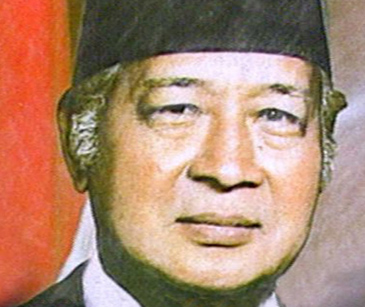
A painting of Suharto But these good relations were short-circuited by Sukarno’s enemies in government, in Congress, and in the UK. Specifically, these included Dulles’ friend General Lucius Clay and Representative Gerald Ford. They used Sukarno’s confrontation with the British over the creation of the state of Malaysia to begin to criticize Sukarno over his belligerence with our British friends. Sukarno now began to expel and expropriate foreign businesses, including Standard Oil’s Caltex and Stanvac. Kennedy insisted that they stay, but they negotiate profit sharing deals with Sukarno on a 60/40 basis favoring Indonesia. Kennedy sent two trade representatives to successfully negotiate the deal. (p. 242) In comparison, after Suharto, the split Freeport McMoran has with Indonesia today is reportedly 90/10 in Freeport’s favor. The reader can only imagine what Sukarno could have done for the people of Indonesia with the tens of billions he would have gotten in a 60/40 split over the Ertsberg and Grasberg mines.
The Malaysian confrontation started riots in Jakarta at the British embassy. Kennedy insisted that this should not influence congressional approval over how much aid should go to Sukarno. (p. 244) But it did and the aid package started to be pecked apart. Sukarno now told the American ambassador in Jakarta, Howard Jones, that he thought the CIA was out to topple his regime. To try and save the situation, Kennedy and Sukarno arranged a state visit for the president to Jakarta in 1964. One of Kennedy’s goals was to wind down the tensions between Malaysia and Indonesia. In fact, he stated, why stop aid to Indonesia ”because of its attitude toward Malaysia, when three months from now it may or may not be the same as it is today?” (p. 247)
Kennedy, of course, never got to visit Indonesia or halt the Malaysian crisis. Without Kennedy’s help, Sukarno’s prediction to Jones about the CIA toppling him came true. Sukarno said about JFK’s murder: “Kennedy was killed precisely to prevent him from visiting Indonesia.”
Greg Poulgrain has written a provocative revisionist history of why the epochal coup in Indonesia happened as it did in 1965. Along the way he has enlightened us on the crucial figures of Allen Dulles, Sukarno, Dag Hammarskjold and John Kennedy and how they played with and against each other and how this nexus led to a horrible tragedy.
-
The Incubus of Intervention – Chapter 2
Kennedy’s Planned Trip to Jakarta
In the Foreword to my book on Malaysian Confrontation, Pramoedya Ananta Toer, one of Indonesia’s leading writers, commented on President Kennedy’s anticipated visit to Jakarta in early 1964:
Kennedy’s plans to meet Sukarno in Indonesia never came to pass: that we all know, for he was murdered….
Pramoedya drew attention to the planned visit without elaborating, apart from saying that Kennedy, and Indonesia’s President Sukarno, had to disappear from the stage of history. Half a century has elapsed since these two leaders ‘disappeared’ and with them the political positivity of the now forgotten plan to visit Jakarta. Instead, in the mid-1960s, a proliferation of violence and military mentality suffused the nation. Indonesia still bears the scars. This outcome was in stark contrast to the ‘Indonesia strategy’ Kennedy was planning in 1963. Working in conjunction with Sukarno whose perennial aim was to unify his nation, JFK’s intended visit was lost in the turgid history of that time.
Kennedy’s proposed visit to Jakarta ‘in April or May of 1964’ according to the long serving US ambassador in Indonesia, Howard Jones, was a strategy to end Malaysian Confrontation. This period of hostility between Indonesia and Malaysia, involving armed skirmishes and provocative political posturing, fell short of war. It started in early 1963 as Indonesian ‘protest’ against the British format of decolonisation which was simply lumping together its disparate colonial possessions in Southeast Asia to ensure the numbers of Chinese overall were in the minority. The reaction in Washington to Confrontation resulted in US aid to Indonesia being reduced to a trickle. Reopening these aid channels was part of Kennedy’s rationale in making the trip because Indonesia was a vital component of his larger strategy in Southeast Asia. Planning the visit to Jakarta involved several months of negotiation before Kennedy and Sukarno reached an agreement; then on November 20th the visit was formally announced. Because of the tragedy in Dallas a few days later, the visit did not occur. ‘The assassin’s bullet put an end to our plans and disposed of the immediate prospects for settlement of the Malaysia dispute,’ wrote Jones.1 Confrontation continued up to 1965/6 when President Sukarno was ousted by General Suharto.
As shown in my book The Genesis of Konfrontasi, from archival evidence and interviews, Sukarno was not the instigator of Malaysian Confrontation. Instead, the principal Indonesian player was the Foreign Minister, Subandrio, who ran the largest intelligence service in Indonesia and fully expected to be the next president. As well, Confrontation did not start without various covert actions by persons linked to both British intelligence (MI6) and American intelligence (CIA), centered in Singapore and operating outside the aegis of government.
President Sukarno’s role in Confrontation underwent a change after Kennedy’s assassination. Initially, when Indonesia became embroiled in the conflict not of his doing, Sukarno’s public statements were designed to steer a course through dangerous political currents beyond his control, whereas after November 1963 he was attempting to regain leadership of this anti-British, anti-colonial campaign. This change in Sukarno was reflected in the expression ‘Ganjang Malaysia’, popularised in Western media as ‘Crush Malaysia’. Earlier, Sukarno had disagreed with this interpretation, and actually performed for the media to demonstrate his meaning. ‘Ganjang’, he explained, was like nibbling food in your mouth to check it for taste – as would a politician, checking for any disagreeable taste of colonialism – then spitting it out! Territorial acquisition was not on the menu in Malaysian Confrontation. Nevertheless critics of Indonesia2 readily depicted Confrontation as expansionism because it came hard on the heels of Sukarno’s sovereignty dispute over Netherlands New Guinea, a dispute in which President Kennedy’s role had proved crucial. Sukarno commanded great respect as the founding father of Indonesian independence, but he himself was unable to halt Confrontation because it was driven by domestic political rivalry.
Having ousted the Dutch from New Guinea, Indonesia in 1963 was still seething with anti- colonial venom. There were three rival streams of Indonesian opposition to Malaysia – one linked with Subandrio, another with the Indonesian communist party (PKI) and another with the Indonesian army. These three disparate groups were involved in the initial border skirmishes with Sarawak in east ‘Malaysia’ being defended by British troops, in the throes of decolonisation. The intermittent conflict drew criticism from Washington through the US ambassador in Jakarta who explained that the US government agreed that ‘Malaysia’ was the best format for decolonisation. Then, in September 1963, after the burning of the British Embassy in Jakarta, bilateral relations with USA were strained to the point where aid for Indonesia was reduced to a minimum. Kennedy’s efforts to ensure his aid program would not falter now attracted criticism from British officials who ‘told the White House with increasing frequency that UK and US interests regarding Indonesia were beginning fundamentally to diverge.’3 Republican Congressman William S. Broomfield claimed that Indonesia was misusing US assistance. Support to cut US aid came from a clique of other Congressmen including Mathias, Gross and Findley.
Senator Wayne Morse of Oregon then endorsed the ‘Broomfield amendment’, demanding that Indonesia be dropped from the list of recipients of US aid. ’I say we should wipe it off the aid program’, he declared.4
Kennedy’s planned visit to Jakarta was a radical move to re-open all funding as this was a vital part of the ‘follow-up strategy’ he had set in place after intervening in 1962 in the anti-colonial dispute with the Dutch. In Indonesia, Kennedy’s intervention had stirred popular euphoria in his favour, and this continued into 1963, such was the young American president’s charisma. The Bay of Pigs, the Congo, Berlin, Laos, Vietnam, the Cuban missile crisis – the Cold War crises confronting him were making global headlines which for Indonesian readers kept ‘JFK news’ current, well past the highpoint of the New York Agreement in August 1962. In terms of implementing his ‘follow-up strategy’ to the sovereignty crisis, the ideal time to exploit pro-JFK sentiment was in 1963, yet the proposed date for the visit to Jakarta in early 1964 would still benefit from the kudos surrounding President John F. Kennedy. His ‘footprint of fame’ had been greatly enhanced by intervening in the New Guinea dispute: unresolved since independence in 1949, it had created its own anti-colonial niche in Indonesia’s collective psyche.
Malaysian Confrontation in 1963 had caused the delay and then the Bloomfield Amendment, cutting the funding for his Indonesia strategy, left JFK no alternative. Only then did he resolve to make the Jakarta visit and employ his charisma as the last political weapon at his disposal. Success for Kennedy’s visit to Jakarta depended upon the response of the Indonesian populace; and this (in late 1963) was still very positive. So it seemed a forgone conclusion that he would have achieved his goal because of the degree of veneration for JFK in Indonesia, combined with the eloquence of Indonesia’s President Sukarno for whom there was still widespread adulation. The politics of personality was the only weapon at the disposal of both Kennedy and Sukarno to bring Confrontation to a stop, and it was their intention to employ it jointly, and to the full, once the US president was in Jakarta. During his three years in office, Kennedy’s image and reputation had acquired a very positive aura throughout Asia and Africa far surpassing his predecessor, President Eisenhower. The 43-year old president was seen as pro-Indonesian – his new political stance and willingness to act decisively, capped off by his intervention in the sovereignty dispute, was in stark contrast to the blatant political interference of his 70-year old predecessor.
Indonesians and especially Sukarno, whose oratorical skill was well-honed over four decades, welcomed the new style, the new era, as heralded in the inaugural address.
…Let the word go forth from this time and place, to friend and foe alike, that the torch has been passed to a new generation of Americans – born in this century, tempered by war, disciplined by a hard and bitter peace….
JFK’s political opponents ensconced in Washington throughout the 1950s were unaccustomed to a president asserting such personal control. It was his forte, especially in foreign policy. ‘Kennedy’s instinctive style which was one of personal and intimate command’5 took on unprecedented importance and became a threat to the political strategy of his opponent because it meant he was highly likely to implement the aims of his Jakarta trip.
Kennedy was aiming for a seismic shift of Cold War alignment in Southeast Asia – bringing Indonesia ‘on side’. As Bradley Simpson stated (in 2008):
One would never know from reading the voluminous recent literature on the Kennedy and Johnson administrations and Southeast Asia, for example, that until the mid-1960s most officials [in the US] still considered Indonesia of far greater importance than Vietnam and Laos.6
Kennedy wanted to ensure that Indonesia was secure before implementing any policy decision regarding the US presence in Vietnam. The two interrelated parts of his action plan after the New Guinea sovereignty dispute involved utilising the predominantly pro-US Indonesian army, and large-scale US aid for development projects in Indonesia. Both Kennedy and his opponents in Washington pursued a paradigm of modernisation which had emerged in the late 1950s using the military as the most cohesively organised group in undeveloped countries. Simpson has outlined how the ‘US government’s embrace of military modernization’ in the early 1960s followed on from the March 1959 Draper Committee Report which called for using the armed forces of underdeveloped countries ‘as a major transmission belt of socio-economic reform and development’.
Admiral Arleigh Burke and CIA director Allen Dulles argued at a June 18 NSC meeting [1959] that the United States ought to expand military training programs in Asia to include a wide range of civilian responsibilities and to encourage Military Assistance Advisory Groups (MAAGs) to ‘develop useful and appropriate relationships with the rising military leaders and factions in the underdeveloped countries to which they were assigned’. A few months later the semi-governmental RAND Corporation held a conference at which Lucian Pye, Guy Pauker, Edward Shils, and other scholars expanded on these ideas.7
Admiral Arleigh Burke, Dulles and Pauker were ‘promoting the Indonesian armed forces as a modernizing force’ (a strategy linked to Dulles’ role in the 1958 Outer Islands Rebellion – see Chapter 4) and, continues Simpson:
the army simultaneously pursued a counterinsurgency strategy against internal opponents while greatly expanding its political and economic power following the 1957 declaration of martial law and the takeover of Dutch enterprises.
By the time Kennedy came to office, much of Southeast Asia-related US policy was infused with military modernisation theory. Civic action programs figured highly in Kennedy’s strategy in Indonesia, utilising the army but also the police, designed to counterbalance the attraction the PKI had for impoverished farmers – like moths to a light in the hope of salvation. The infrastructure and poverty reduction programs were tied to US funding and framed around the assessment made by Tufts University Professor Donald Humphrey. He recommended that US aid to Indonesia starting in 1963 should be in the order of US$325–390 million. Europe and Japan were to have contributed almost half of this, but Kennedy’s aid program soon encountered difficulties in the Congress.
While still acutely wary of policy interference as occurred with the Bay of Pigs like an inaugural ‘wake-up call’, Kennedy had no way of ascertaining how his Indonesia strategy actually threatened the Indonesia strategy of his opponents. Nevertheless, the fact that JFK insisted on denying the CIA any part in his own negotiations with Sukarno is an indication of the serious distrust he held by 1963. Earlier in 1961, when Dulles was at the height of his power and JFK had been in office only a few months, he had requested a Briefing Paper from the CIA, prior to President Sukarno’s visit in April 1961. The advice given President Kennedy was that ‘we should not now entertain any major increases in the scale of economic or military aid to Indonesia’. Mindful of Allen Dulles and Guy Pauker as the mouthpiece of military modernisation, Kennedy must have interpreted such advice as hypocritical. Similarly, the CIA advice on whether or not Kennedy should support Sukarno’s quest to oust the Dutch from New Guinea lacked not so much insight as vision; it offered only a bleak prospect, saying that whichever way the President moved it would not alter the inexorable rise to power of the PKI.
It would be gratifying to be able to propose an alternative course of action by the United States which would stand a good chance of turning the course of events in Indonesia in a constructive direction. Unfortunately, this is a situation in which the influence that the United States can exert, at least in the short run, is extremely limited, if (as must be assumed) crude and violent intervention is excluded.8
Kennedy chose to support Sukarno’s claim to the Dutch territory and follow through with precisely the opposite to what the CIA had advised – an economic aid program to counter the PKI by addressing poverty through civic aid and development projects. When the funding restrictions imposed by Congress brought JFK’s follow-up plan to a standstill and he resolved to make an historic visit to Jakarta to restart the US aid project, the threat to Dulles’ strategy left no option. In the same way that Dulles had offered Kennedy no option in the 1961 Briefing Paper, in 1963 Kennedy’s decision to visit Jakarta left no option for Dulles (whom JFK had already ushered to the political sidelines). We can surmise how the exit of Dulles in 1961 may have seemed a positive move for Kennedy and one that should have helped him in 1963 implement the Indonesia policy he wanted. While Dulles’ removal from office did little to diminish his influence, it could only have exacerbated the threat created by Kennedy’s plan to visit Jakarta. Dulles simply had no answer to counter Kennedy’s dramatic personal initiative to visit Jakarta: or to re-contextualise the same comment from the 1961 Briefing Paper given Kennedy, Dulles had no answer in 1963 ‘if (as must be assumed) crude and violent intervention is excluded’.
In two crucial aspects, Kennedy’s plan clashed with the ongoing strategy of ‘regime change’ which DCI Dulles had set in motion six years earlier. Firstly, JFK intended to utilise the Indonesian army as ‘servants of the state’ of Indonesia, not for the army to assume power. And secondly, Kennedy’s intention was to maintain the presidency of Sukarno. Unbeknown to Kennedy, his plan to use the army was in effect commandeering the same asset intended by Dulles to implement regime change. Not only was JFK usurping the benefits of the transformation occurring as a result of US training of Indonesian army officers – a process which David Ransome labelled with the pithy description, a ‘creeping coup d’etat’9 – but ensuring Sukarno remained president would prevent the full military option. Kennedy would not simply have overruled his opponent but, in addition, keeping Sukarno as president would have prevented gaining untrammelled access to natural resources, a project which had been many years in the planning. We may surmise Kennedy was partially aware that his overall plan was making use of a military option still in its preparatory stage, simply from the large number of Indonesian army officers being trained in the US. Their common ground was ‘the ideological focus of US officials on the military as a modernizing force’, but where Kennedy was starkly at odds with his Washington opponents was his determination to retain Sukarno as President of Indonesia.
The visit to Jakarta was premised on an understanding between Kennedy and Sukarno to bring Malaysian Confrontation to an end, while JFK was in Jakarta. Howard Jones, US Ambassador in Jakarta from 1958, was well acquainted with Sukarno and fully aware that the key to achieving this important political change was Kennedy’s charisma, combined with the adulation and respect he commanded. Together, Kennedy and Sukarno could bring about a cessation of Malaysian Confrontation but, as Jones observes in his book Indonesia: the Possible Dream, ‘Sukarno could not initiate a settlement of the dispute himself ’.10
JFK’s Secretary of State, Dean Rusk, in personal correspondence with me (January 8, 1992)11 wrote: ‘President Kennedy made it clear that confrontation between Indonesia and Malaysia should be stopped….’ Only after several months of negotiation with the Indonesian President did Kennedy agree to the proposed visit, after three requests by Sukarno. The one precondition set by Kennedy was his insistence on achieving a ‘successful outcome’. Rusk confirmed in writing the arrangement with Sukarno: ‘President Kennedy made it clear that confrontation between Indonesia and Malaysia should be stopped, not merely for the duration of Kennedy’s visit but on a permanent basis’. However, it was not confrontation that was stopped but rather, the visit by Kennedy himself.
For Sukarno, Kennedy’s precondition meant declaring a permanent cessation of hostilities during the actual visit of the American president; while for JFK himself, a ‘successful visit’ meant ending the hostilities which were jeopardising the Indonesia strategy he had initiated in 1962 and which Malaysian Confrontation in 1963 was threatening to turn into just another ‘Cold War fatality’.
As part of a wider Southeast Asian tour, the visit was described by JFK as one that would provide a much needed boost to his chances for re- election. This tongue-in-cheek explanation understated the real political significance which the visit held for Kennedy himself. Now with a half- century of hindsight, the adverse repercussions of not making that trip to Jakarta are more clearly delineated in terms of the tragedy that befell Indonesia in 1965. In Cold War terms, Kennedy’s Indonesia strategy held every chance of success – indeed, the very likelihood of success compelled the decision to prevent the trip. For Dulles’ Indonesia strategy, Kennedy’s intention to support and prolong the Sukarno presidency was political anathema.
Why Kennedy Retained Allen Dulles
Between election and inauguration, John Kennedy had 72 days to survey the tumult of domestic and international issues soon to be encountered as the 35th President. Some of these, among other issues, included political unrest in the Congo, Laos, Vietnam and Berlin. Two such issues actually ballooned into potential crises during his time as President-elect. One of these involved Cuba, the other Indonesia and both involved Allen Dulles as Director of Central Intelligence (DCI). President Kennedy for various reasons had retained Dulles from the Eisenhower administration, a fateful inheritance from the ailing incumbent.
When Kennedy began organising his administration as President- elect, the first press announcement he made was that Allen Dulles would remain as DCI. In finding ‘the best person for the job’ to meet the multifarious demands of staffing the new administration, staff which finally included fifteen Rhodes scholars, Kennedy often adopted a bipartisan approach. Surely, choosing Dulles indicated that Kennedy did not regard him as being among the ‘opponents in Washington’? Yet within the first three months of the Kennedy presidency, Dulles had inflicted so much political damage this question does not bear answering, but simply prompts another: why, then, did Kennedy retain Dulles as DCI? Dulles was an icon of US intelligence. Since 1916 – before John Fitzgerald Kennedy was even born – Dulles had served in that specialised field under every US president since Woodrow Wilson.
Another reason for retaining Dulles was linked to the narrow victory over Republican presidential contender, Richard Nixon. The winning mar- gin of votes – only 120,000 out of a total of 69 million12 – was attributed to Kennedy’s success in the televised debates. Theodore Sorensen, Kennedy’s speechwriter and special counsel throughout most of his political career, from Congressman to Senator and then President, described the debates as ‘the primary factor in Kennedy’s ultimate victory’.13 The televised debates in October 1960 were the first time such an event was held although nowadays televised debates between presidential candidates are the norm. For Kennedy and Nixon, there were four debates, four unprecedented opportunities to reach millions of Americans, and the first (which was on domestic policy) had an audience of 70 million. The second and third debates were questions and answers, while the fourth debate was on foreign policy, and this was where Allen Dulles played his hand. Castro and Cuba ‘only 90 miles from our shore’ had been much in the news during the year of presidential campaigning and claimed an important part of the fourth debate. Nixon already knew that the CIA was planning an invasion of Cuba, but of course could not mention this during the debate; but Dulles had provided Kennedy a strategically timed briefing on Cuba shortly before the debate. Dulles did not divulge information about the invasion – that would come at Palm Beach when he was President-elect and during his first week of office – but at this stage Dulles gave Kennedy the edge with other intelligence which proved crucial during the debate. And crucial too, it seems, when the time came for Kennedy to decide whether or not to retain Dulles as DCI. Dulles’ briefing must have seemed like a godsend when Kennedy was analysing the votes that won him the presidency.
There was still another reason for Dulles being included in the President-elect’s first announcement. After winning the Democratic nomination, Kennedy had requested two persons to prepare separate reports on the anticipated transition from Republican to Democratic administration. These two persons were Columbia professor Richard Neustadt and Clark Clifford whom Sorensen described as ‘a Washington attorney’. His former experience, however, included special counsel to President Truman during the 1948 presidential campaign against Thomas E. Dewey. Special counsel for Dewey was Allen Dulles who was also ‘the confidential link on foreign policy matters between the Truman administration and the Dewey campaign’.14 So in 1960, bipartisanship in relation to Allen Dulles was revisiting Clifford’s earlier contact with Dulles. In both reports, Kennedy was advised to retain Dulles as DCI (and J. Edgar Hoover as director of the FBI).15 Ironically, in May 1961 after the Bay of Pigs fiasco, Kennedy invited Clifford into the President’s Foreign Intelligence Advisory Board to ensure the accuracy and unbiased nature of the intelligence being supplied to the President. Neustadt had recommended the directors of five ‘sensitive positions’ remain unchanged, but of these only Dulles and Hoover were retained. Sorensen quipped that, of the five, ‘Kennedy kept only the first two, whom the dinner guests the previous evening had reportedly suggested be the first to be ousted’.16
The intelligence on Cuba, which Dulles provided to Kennedy before the crucial debate with Nixon, gave the Democratic candidate a clear advantage over his Republican rival. More than just highlighting Dulles’ familiarity with Cuba, this showed Dulles was investing in the possibility of Kennedy winning the presidency. Perhaps even more than this, it showed Dulles (who through family and social connections knew ‘Jack’ Kennedy, his wife and the extended family) already had his measure of the man. Dulles knew that Kennedy would not leave this debt unpaid. As it turned out, the narrower the margin of winning votes, the greater seemed the debt, and if Dulles’ briefing before the historic debates could be described as a pre-election psychological strategy, it worked perfectly. Kennedy’s perceived familiarity with the issue of Cuba may have proved crucial in winning the debate, but Dulles’ duplicity soon became apparent. In Kennedy’s first week in office, it was his unfamiliarity with the issue of Cuba, or rather, the CIA’s half-baked invasion of Cuba, that proved to be an international embarrassment for the new president. Sorensen commented: ‘The Bay of Pigs had been – and would be – the worst defeat of his career’.17
Fidel Castro’s Cuba, not Indonesian Papua, became the bête noir of US foreign policy after the CIA invasion force foundered in the Bay of Pigs on April 18, 1961. Castro’s declaration of a socialist state and the importing of Soviet missiles led to a nuclear standoff. While Kennedy negotiated with Khrushchev, the world, collectively, held its breath. Cuba, however, had not become the touchstone of Cold War tension without the initial input from Allen Dulles.
Apart from the generational difference, JFK and Dulles both were in office alongside their siblings, JFK’s younger brother Robert as Attorney General and DCI Dulles’ elder brother John Foster Dulles was Eisenhower’s Secretary of State. The depth of experience in the two Dulles brothers was unprecedented, starting from the Versailles Treaty with John Foster drawing up the reparations agreement and Allen in the intelligence section. Between them was always a fierce sense of rivalry to achieve results in international affairs, continuing the sibling rivalry that had persisted throughout their childhood. John Foster was firstborn and favourite whereas Allen, born seven years later with a clubfoot, was always trying to prove he was as good as Foster, if not better. It was Allen, not Foster, who had always wanted to be Secretary of State. There had already been two family members in that office – an uncle in the Wilson presidency and their maternal grandfather, in the Harrison presidency – yet it was John Foster not Allen who achieved that goal when Eisenhower became president in 1953.
If there was any similar in-family rivalry in the Kennedy clan, it disappeared after the deaths of the eldest son during the war and the eldest daughter soon after the war. In the case of John and Robert Kennedy when JFK was president, the two brothers were intensely reliant on each other’s abilities and tended to act as one unit, as in Robert’s negotiations with President Sukarno and Dutch Foreign Minister Luns in the New Guinea sovereignty dispute. In Kennedy’s various elections starting in 1952, culminating in the presidency, Robert was his trusted campaign manager. In the first Eisenhower administration, the link between John Foster as Secretary of State and Allen as Director of Central Intelligence, on both official and family levels, was seen by the media as beneficial to the national interest. The Dulles brothers were perceived as having created their own legend even before serving together under Eisenhower. While acting together, however, they were not one unit as the Kennedys were in the 1960s. The media reaction to this was often expressed in religious terms, JFK being the first Catholic to reach the office of president. John Foster followed his father in the Presbyterian faith, attending church every Sunday, whereas Allen had adulterous affairs for most of his working life without jeopardising his lifelong role in intelligence.
Similar indiscretion by John Kennedy may have led to the political pressure referred to by Frederick Kempe18 for retaining Allen Dulles and J. Edgar Hoover. Allen revelled in intelligence whereas John Foster ‘often chose to adopt the State Department mentality of knowing as little as possible about sordid operational details of intelligence’. Grose expounds this point further, saying that Allen always claimed his duty was intelligence, and policymaking was John Foster’s responsibility but ‘Allen was ever imaginative in devising intelligence operations that by their very nature determined the shape of national policy’.19
When John Foster Dulles passed away in April 1959, after two years of failing health because of colon cancer, Allen’s covert intelligence operations entered an even more radical stage. Allen began taking bigger risks. John Foster had not wanted Allen to succeed him as Secretary of State and bluntly told him so, closing the door on that lifelong ambition. He recommended that his successor be Christian Herter who was reliant on crutches because of osteoarthritis. Christian Herter and Allen Dulles were not close friends, despite being acquainted since the First World War. With a new Secretary of State for the remaining twenty-one months of the Eisenhower administration, the change in dynamic in the upper echelon of power influenced Allen’s mode of operations. As well, John Foster’s death no doubt served as a reminder to Allen of his own mortality. He was, after all, almost 67 years old when retained by Kennedy as Director of Central Intelligence. He was reaching the end of his career and the culmination of a major project centred on the Indonesian archipelago which had first caught his attention years earlier. The CIA- assisted ‘covert operation’ in Indonesia, the Outer Islands rebellion (otherwise known as the PRRI-Permesta rebellion which is examined in Chapter 4) was but one part of this major project. Allen Dulles has been openly linked with this rebellion which started in February 1958. It ended almost immediately, although for the next few years he maintained a supply of weapons for the rebels because continuing conflict ensured the officially declared ‘state of emergency’ also continued. This effectively delayed the holding of elections in Java and precluded the possibility of the Indonesian communist party attaining any increased representation or political power through the ballot box.
As a result of his vast experience in diplomacy, oil, intelligence and state affairs, Allen Dulles had at his disposal a network of contacts which he used in his Indonesia project. Ultimately, he was aiming for regime change, the essential ingredient of which was a central army command. Aware of the immense potential of natural resources in Netherlands New Guinea since pre-war days, Dulles wanted the Dutch territory to become part of Indonesia. While this was achieved on Sukarno’s watch, it was done only because the central army command was already amassing in the corridors of power awaiting regime change.
When Kennedy officially ended Dulles’ role as Director of Central Intelligence on November 29, 1961, Allen’s network of contacts was like an intelligence tsunami held in abeyance. The president described the departing DCI in prophetic terms:
I know of no other American in the history of this country who has served in seven administrations of seven Presidents – varying from party to party, from point of view to point of view, from problem to problem, and yet at the end of each administration each President of the United States has paid tribute to his service – and also has counted Allen Dulles as their friend. This is an extraordinary record, and I know that all of you who have worked with him understand why this record has been made. I regard Allen Dulles as an almost unique figure in our country.
Yet Dulles still commanded enormous influence. The newly appointed director, John McCone, with legions of staff moved into the new building at Langley. Ironically, in the design and construction of the new head- quarters, Dulles had played a prominent role, but he never occupied the new building. He still kept his former office and, as well, took up another with Sullivan and Cromwell, the legal firm in which he had worked with John Foster in the 1930s, representing Rockefeller oil interests and the myriad of subsidiaries. Allen had not actually married into the Rockefeller family as John Foster had done, but nevertheless his lifelong association with Standard Oil made him an essential member of the extended family. In the years between the First and Second World Wars, there was no legal restriction on someone like Allen Dulles sharing his expertise between private enterprise and the State Department as mentioned by John D. Rockefeller, at 98 years of age, openly expressing his thanks in his pre-Second World War publication, Random Reminiscences of Men and Events:20
We did not ruthlessly go after the trade of our competitors and attempt to ruin it by cutting prices or instituting a spy system…. One of our greatest helpers has been the State Department in Washington…. I think I can speak thus frankly and enthusiastically because the working out of many of these great plans has developed largely since I retired from the business fourteen years ago.
Rockefeller’s reputation as ‘the richest man in history’ was not achieved without the acumen of Dulles gaining entry into oil rich regions, from the ‘Near East’ to the ‘Far East’, when European colonial power was still dominant. The important mining and oil exploration conducted in Netherlands New Guinea shortly before the Second World War (as revealed by Jean Jacques Dozy in Chapter 1) was an important part of the ‘oil-intelligence project’ which focused on Indonesia in its entirety. Ensuring West New Guinea changed hands, from Dutch to Indonesian control, became an integral part of Allen Dulles’ political strategy which then proceeded with the already advanced plan for ‘regime change’ in Indonesia. The problem was: for Dulles’ strategy, JFK’s notion of visiting Jakarta to support Sukarno, ensuring he would remain president, was political anathema.
Pre-war development in the New Guinea territory was meagre – with half a dozen small colonial settlements, scattered around the far-flung coastline. These had begun as a cluster of army encampments at the turn of the century in response to the US gaining control of the nearby Philippines. Within a few years, the giant US company, Standard Oil, which then was inseparable from the name Rockefeller, had initiated a takeover bid for Dutch oil interests in the Indies. The Dutch responded by joining forces with the British in 1907 to form Royal Dutch Shell. This started decades of pressure from Rockefeller oil interests to gain exploration rights in the vast, unmapped Dutch territory of New Guinea. Ultimately, in May 1935, with the formation of the Netherlands New Guinea Petroleum Company21 which had 60% controlling US interest, Standard Oil was successful, but only with the help of their top European- based lawyer, Allen Dulles. NNGPM, as the company was called, was formed with the approval of Sir Henri Deterding, general manager of the Royal Dutch Shell group of companies since 1900. Deterding and Rockefeller, in former days, had been fierce opponents in the global oil business. When Allen joined his brother John Foster Dulles in Sullivan and Cromwell, the top Wall Street legal firm, his first big case in 1928 brought him face to face with Deterding. Despite the silver hair and penetrating black eyes which helped to create a Napoleonic presence, Deterding backed down and Allen Dulles won. Yet by the mid-1930s, when NNGPM was formed, Dulles and Deterding shared a common interest in the new leader of Germany, Adolf Hitler. Dulles had wasted no time in arranging to speak with Hitler personally, soon after he came to power in 1933, and Deterding’s friendship with Hitler led to million dollar donations. However, the key element which swayed Dutch opinion in the formation of NNGPM was the evidence that Japanese units were secretly conducting oil exploration in New Guinea territory. Without American assistance the Dutch could do little to assert colonial control and Dulles used the political tension generated by the Japanese incursion of colonial sovereignty to push through the 60% US controlling interest in NNGPM.
Leading up to the Second World War in the Pacific, the Japanese Navy formulated a grand theory of expansion, not merely as an answer to the problems the Japanese army was facing in its program of expansion in China, but as a grand theory of new development. It was called ‘the march to the South’ or Nanshin-ron. Here lay the wealth of the Netherlands East Indies; here there was oil, and in populous Java a market for the Japanese product. For natural resources, the eyes of the Japanese Navy turned to New Guinea. They envisaged this vast island (more than twice the total area of all the islands of Nippon) becoming the source of raw materials for a new imperial Japan. Nanshin-ron took shape with industrial speed in the upper echelons of Japanese Naval Intelligence which used a vanguard of fishing ships estimated by Dutch Intelligence to number as many as 500. Admiral Suetsugu, Commander of combined Japanese fleets and later Minister of Home Affairs, described these ‘fishermen’ as an integral part of the ‘March South’. Japanese anthropologists were dispatched to collect information on the tribespeople of New Guinea. The concern about Japanese intrusion as expressed by Jean Jacques Dozy (in the interview in Chapter 1) was part of this pre-war expansion utilised by Allen Dulles to gain the 60% US controlling interest in NNGPM.
After the Pacific War, geologists attached to General Douglas Mac- Arthur’s forces remained in the Dutch territory for most of the next decade conducting exploration. Only some of their findings were released, such as nickel on Gag Island, which (as mentioned above) was 10% of world nickel reserves. There was no mention of Dozy’s gold discovery. During the 1950s, neither Dulles nor the Dutch political hierarchy was willing to admit that the real issue at the centre of the sovereignty dispute, which so loudly proclaimed the territory had no natural resources, was how to gain control over the gold, copper and oil that lay waiting to be discovered. During the 1950s, using the Cold War to his advantage, Allen Dulles’ strategy took shape.
At the same time as the Bay of Pigs another crisis was occurring in Indonesia, lesser known but with the same potential for superpower conflict. This dispute between Indonesia and the Netherlands, over sovereignty of the western half of New Guinea, pitted the US-Dutch NATO alliance against Soviet support for Indonesia. Kennedy’s settlement of this crisis and his follow-up strategy to bring Indonesia ‘on side’ in the Cold War came under threat with Malaysian Confrontation – hence the planned visit to Jakarta.
Introducing Indonesia
Before looking at Kennedy’s role in the sovereignty crisis, let me re-introduce Indonesia which after China, India and USA now has the fourth largest population in the world. Indonesia had emerged from the ‘colonial era’ only a decade before Kennedy’s involvement. When he expressed criticism of colonial rule (as he did at the UN General Assembly, September 25, 1961, upon the death of UN Secretary-General Dag Hammarskjöld) he chose his words carefully to apply not only to the colonised peoples of Africa generally but also to Indonesia specifically.
He spoke of the exploitation and subjugation of the weak by the powerful, of the many by the few, of the governed who have given no consent to be governed, whatever their continent, their class, or their color.22
European dominance in navigation, military technology and trade ensured the peoples of the Indonesian archipelago for centuries remained at the beck and call of colonial powers. As described by George Kahin, one of America’s most prominent Indonesia specialists, it was ‘probably the world’s richest colony … (or) ranked just after India in the wealth it brought to a colonial power’.23
It is our collective unfamiliarity with this vast country which has led to our failure to ascertain how closely intertwined it was with the fate of President Kennedy. He very early recognised the significance of Indonesia not only in the political destiny of Southeast Asia but also in the outcome of the Cold War.
Indonesia is by far the largest country in Southeast Asia, both in population and in area. Forty-eight degrees of longitude on the equator, Indonesia covers almost one-seventh of the circumference of the globe and has long been prized for its abundant natural resources. Over a timeframe of three and a half centuries, the archipelago gradually came under Dutch colonial control, region by region. As a reflection of Dutch colonial wealth, the 17,000 islands were once described as a ‘belt of emeralds’ slung around the equator. Sulawesi, Kalimantan and Sumatra – three of the five main islands – are intersected by the equator but the other two, Java and Papua, are entirely in the southern hemisphere.
Not until the 20th century did Bali become part of the Dutch Realm and, after thirty years of war in the western extremity of the archipelago, so too did Aceh. In the eastern extremity, the territory of Netherlands New Guinea was twenty-three percent of the total area of the Indies and virtually untouched – a wilderness with jungle and precipice (in one location 3000m of sheer cliff) rising to cloud-forest, snow-capped mountains and glaciers, just below the equator – yet on international maps ‘Dutch’ since Napoleonic times. Colonial administration in Netherlands New Guinea, according to the official Dutch historian on the eve of World War Two (WW2) when the Japanese Imperial Army occupied the Indies, covered only five percent of the territory. So on August 17, 1945 when Sukarno declared independence, and General Douglas MacArthur’s troops had already re-occupied Netherlands New Guinea, we can say approximately 95% of the territory was occupied by the indigenous Papuan people. It was still ‘the land of the Papuas’24 as named by the Portuguese when they had unsuccessfully attempted to colonise the territory in the early 16th century.
During the four years after Sukarno proclaimed independence, Indonesians (mainly in Java and parts of Sumatra) desperately opposed all attempts to recolonise. On December 27, 1949, the Dutch relinquished sovereignty of the Netherlands East Indies but retained the territory of New Guinea, announcing a plan to develop it further and bring the indigenous people to independence. However, a campaign to oust the remnant colonial Dutch presence from New Guinea began in the early 1950s. Indonesia claimed the rightful extent of its territory was from Sabang Island, the western extremity of the Indonesian archipelago, to Merauke in the east, a distance of 5390 kilometres (3350 miles).
Ironically the anti-colonial campaign was focused on the continuing Dutch presence in New Guinea rather than the continuing Dutch presence in Indonesia, as pointed out by Herbert Feith.25 In newly independent Indonesia, he explained, referring to Indonesia at the start of the 1950s, ‘the largest chunks of economic power’ were still mainly in Dutch hands – ‘estate agriculture, the oil industry, stevedoring, shipping, aviation, modern-type banking … internal distribution, trade, manufacturing and insurance’ as well as exporting and, to a lesser degree, importing. It was no wonder that Sukarno often declared that the struggle for indepen- dence was ongoing, his ‘revolution’ not yet finished. Nevertheless, former Foreign Minister Sunario26 pointed out that, in the late 1950s, ‘US sources’ were providing covert funding for the Indonesian army to promote the anti-colonial campaign against the Dutch in New Guinea. Even though Sunario did not confirm the identity of the ‘US sources’, it should be pointed out that the Indonesian army by 1959 had benefitted immensely from Sukarno’s seizure of Dutch assets in Indonesia, as part of the New Guinea campaign. (Consequently, the Dutch companies pressured the Dutch government to relinquish sovereignty in New Guinea, so they could resume business as before in Indonesia.) The money from ‘US sources’ was not simply to assist the army as an investment against the PKI, but was explicitly for the anti-Dutch campaign to ensure it was not unduly influenced by the effusive campaign mounted by the PKI, even though these two anti-colonial streams ran in parallel. Sunario’s information was in the same vein as the concern expressed at that same time in the late 1950s by a prominent Australian politician, Dr Evatt, Leader of the Opposition in the Australian parliament and former President of the UN General Assembly. Evatt pointed to the possible involvement of US oil interests in the Indonesian quest to oust the Dutch from New Guinea, when he declared on November 14, 195727: ‘Surely we are not going to have an argument as to who should have the sovereignty of Dutch New Guinea unless the exploitation of that territory by certain interests is involved’.
After losing the Indies temporarily to Japan in 1942 and then losing the Indies permanently to Indonesia in 1949, it was not until the 1950s that the Dutch attempted to impose their stamp of colonial rule on the New Guinea territory. This brief period has been recalled in a positive light by many elderly Papuans in the coastal, urban areas because they enjoyed a vast improvement in health and education, but as the Dutch presence increased so did the anti-colonial cry of Indonesia. The claim that the territory should not have been excluded from being part of Indonesia in 1949 only grew louder. The dispute reached crisis level when Indonesia had acquired a centralised army command and arms from the Soviet Union, two of the three things that led to a settlement of the dispute. The third was US intervention.
A centralised command was an historic step forward for the Indonesian army. Prior to the CIA-assisted 1958 rebellion, the Indonesian army command system across the archipelago was a fractured patchwork of regional commanders fending for their troops. Sukarno himself was in part responsible for creating this disjointed army command in response to an attempted coup in 1952. With little financial support from Jakarta, the head of the army General Nasution had less control over his far- flung battalions than the respective colonels in the Outer Islands, and the CIA exploited this ‘tyranny of distance’. The dramatic change in army command structure, which was brought about by the PRRI/Permesta or Outer Islands Rebellion was engineered on a grand scale by Allen Dulles during the second Eisenhower administration.
Yet the end result of CIA interference in Indonesian internal affairs via the 1958 Rebellion was depicted as failure at the time, and has consistently been depicted as failure since that time. This holds true only if the stated goal of the CIA was the same as the actual goal. Even more than five decades later, media analysis of the goal of the Outer Island rebels is still portrayed as secession, as covert US support for ‘rebels in the Outer Islands that wished to secede from the central government in Jakarta’.28 The actual goal of Allen Dulles had more to do with achieving a centralised army command in such a way as to appear that the CIA backing for the rebels failed. Dulles was able to deceive, or was capable of deceiving, friend and foe alike, all those who were monitoring the ‘covert operation’ with secession in mind as the stated goal. In the opinion of Howard Jones written more than a decade after he was the US Ambassador in Jakarta in 1958: ‘To the outside world, the conflict was pictured as anti-Communist rebels against a pro-Communist government in Jakarta. In fact, it was a much more complex affair, involving anti-Communists on both sides’.29 In reality, Dulles’ aim was the formation of a central army command from the very start of the rebellion, while the perception of failure served as a lure to his Cold War opponents in Moscow. From the Cold War perspective, the perceived failure of the CIA operation offered Moscow an opportunity to increase its influence, which it did through an arms deal so large that it forced a conclusion to the Netherlands New Guinea sovereignty dispute.
The chief intelligence officer for the rebels was Colonel Zulkifli Lubis and the army commander under Sukarno was General Nasution. My extended interviews with both Lubis and Nasution (which began in Jakarta in 1983) have led to this completely different explanation for the so-called ‘CIA defeat’ in 1958. (As mentioned above) when Lubis declared ‘the Americans tricked us’, he was referring to the executive branch of government, not those in Sumatra. Nearly all the Americans who were involved onsite in Indonesia, genuinely helping the rebels, did not realise the rebellion was only the first stage of a larger intelligence scenario and their perception that the rebellion failed became an integral part of Dulles stratagem. In short, this 1958 operation (which is more fully explained in a later chapter) was an example of Dulles’ genius in intelligence. Another example was when Soviet penetration was suspected in the intelligence service of the British in the 1950s. It was Allen Dulles who first doubted the allegiance of Kim Philby before he finally defected to Moscow in 1963, an insight that may have helped generate Dulles’ failsafe stratagem in the Indonesian Outer Islands.
The combination of John Foster as Secretary of State and Allen as DCI during the Eisenhower presidency brought the surname ‘Dulles’ into the public limelight in the early post-war years, so much so that Allen Dulles became the face of US intelligence. This official appointment was acknowledgement of Allen’s known achievements and brought into play his vast underlying experience. There was implicit trust that his private networks and host of contacts (not only from the Second World War but also as far back as the First World War) would somehow be used in the service of the nation. This was not to be the case. Allen Dulles, the Cold War warrior par excellence, used these ‘unknown capabilities’ to achieve his own ends, which ultimately for the nation was a disservice. Many of his friends from the wartime Office of Strategic Services (OSS) utilised their skills when re-employed under DCI Dulles in the 1950s and 1960s. Earlier, with the Cold War looming when Dulles was OSS station chief in Berlin, working alongside him was a young Henry Kissinger.30 Allen had already acquired a legendary status as OSS station chief in Berne during the Second World War, and (as I mentioned in the Introduction) it was Allen Dulles whom the Japanese approached with the first indication of surrender. Perhaps the highest accolade, however, came from Sir Kenneth W.D. Strong who ‘dominated Britain’s spy services for twenty-five years’ and who was the top British representative in the surrender of German forces in Italy after initial negotiations conducted by Dulles. Strong declared Allen Dulles was the ‘greatest intelligence officer who ever lived’.31
Allen Dulles – Accused
From the First World War to the Warren Commission, Allen Dulles’ life was immersed in the world of intelligence, dealing with issues that ranged from empire to armaments, national security to regime change, oil, military and many other matters. In Berne during the Second World War, the assistance he provided the Allied war effort from contacts within Germany and his own expertise was nothing less than extraordinary; so much so that in the following decade, Dulles was regarded as an icon of US intelligence and any accusation to the contrary was readily dismissed. However, six years after his death in 1969, a US investigation chaired by Senator Frank Church produced a different profile of Allen Dulles. As part of fourteen reports on US intelligence activities, the Church Committee revealed that some of the activities former DCI Allen Dulles engaged in were nefarious in the extreme and these included the assassination of foreign leaders.
The Church Committee found that the political assassination of Patrice Lu- mumba in the Congo, which occurred three days before Kennedy’s inauguration, was directly instigated by Dulles. In arranging for an agent to kill Lumumba, Dulles had left a paper trail revealing his role in the form of a telegram to Leopoldville, September 24, 1960:
We wish [to] give every possible support in eliminating Lumumba from any possibility resuming governmental position….
The Church investigation found that two days later the Congo CIA station officer (Hedgman) contacted a CIA go-between named Joseph Scheider (alias Joseph Braun) who did not himself kill Lumumba but was responsible for the group of persons who did. Answering a Church Committee question, Hedgman replied:
It is my recollection that he (Dulles) advised me, or my instructions were, to eliminate Lumumba.
By eliminate, do you mean assassinate?
Hedgman: Yes.32
The killing of Lumumba, before he had served three months as the first Prime Minister of the Congo, involved much brutality and torture. This was public knowledge at the time; later, when added to the heinous role of Dulles as outlined in the findings of the Church Committee, it shocked the nation, indeed, shocked the world.
Political instability, created by the mineral rich province of Katanga wanting to break away from newly independent Congo, was fuelled by the killing of Lumumba. In September 1961, in the wake of the violence that erupted after Lumumba’s death, the UN Secretary-General, Dag Hammarskjöld, became involved in mediation between the Democratic Republic of the Congo and Katanga. A few minutes after midnight on Sunday, September 17, 1961, as the UN plane carrying the Secretary- General and 15 others was approaching the Ndola airstrip in Northern Rhodesia (today Zambia), it crashed, killing all.
Two Rhodesian enquiries in early 1962 concluded ‘pilot error – a misreading of the altimeters’ – had brought down the DC6, known as the ‘Albertina’. However, in March 1962, an investigation by the United Nations did not rule out sabotage although it fell short of stating officially that assassination was suspected. The Church Committee in 1975 did not make any links between Dulles and Hammarskjöld, and a 1993 investigation by the Swedish Ministry of Foreign Affairs concluded the pilot had made an error in judging altitude. Persistent investigation by George Ivan Smith, who was the Secretary-General’s spokesman and close friend, unearthed a disturbingly vital clue that the plane was forced down as a result of interference by hostile aircraft. Whether this caused the crash remained inconclusive. In 1997, more documentary evidence on the death of Dag Hammarskjöld emerged – whether accidentally or deliberately, we may never know – attached to another document, but otherwise unrelated to the widespread investigation carried out by the South African Truth and Reconciliation Commission (TRC). This chance discovery provided the impetus for a new enquiry which was started in 2012 by the Hammarskjöld Commission. It acknowledged the TRC and examined the documents and letters in some detail to decide if any new evidence justified re-opening another investigation into the death of the Secretary-General. The report of the Hammarskjöld Commission was published in September 2013, fifteen years after the TRC documents had first emerged, and a Report tabled in the UN.33
In August 1998, the TRC Chairman, Archbishop Desmond Tutu, had called a press conference and released eight documents.34 These papers and letters were additional material discovered in a folder from the National Intelligence Agency. A member of the TRC had requested the folder, seeking information on a 1993 assassination in South Africa, and the additional material happened to be in that same folder the TRC received. The additional sheets of paper referred to an ‘Operation Celeste’ – a plan to assassinate Dag Hammarskjöld – and the letters showed Allen Dulles was involved. Details were included about a small bomb to disable the outside steering mechanism on the underside of the plane carrying the UN Secretary-General in September 1961. The documents bore the letterhead of the South African Institute for Maritime Research (SAIMR) and the name of Allen Dulles was specifically mentioned.
UNO [United Nations Organisation] is becoming troublesome and it is felt that Hammarskjöld should be removed. Allen Dulles agrees and has promised full cooperation from his people….35
Information from Dulles included the type of plane the UN Secretary- General would use and the date he would arrive. More importantly, even though the letter was signed by a person at SAIMR, it was directly conveying the words of DCI Dulles. As mentioned above, when Dulles initiated the killing of Lumumba, the evidence brought before the Church Committee was written by Dulles: ‘We wish [to] give every possible support….’
The wording here seems relatively innocuous but in the context of the Church Committee investigation, the sinister import in Dulles’ euphemism acquires a meaning far more significant. It is the order to kill – but not read as such without the explanation from the CIA station chief in the Congo that Dulles requested him to kill Patrice Lumumba. Otherwise the euphemistic expression ‘give every possible support’ might well have been interpreted as if Dulles had played a secondary role when, in fact, he initiated the action that led to the assassination of Patrice Lumumba. In the case of Hammarskjöld, the TRC document states that Dulles promised ‘full cooperation’ but this was written by a ‘commander’ of SAIMR, the intelligence organisation mentioned in the documents. The same commander then states:
I want his [Hammarskjöld’s] removal to be handled more efficiently than was Patrice.
This sentence also links SAIMR with Dulles, whom we know already initiated the killing of Patrice Lumumba. Up until the Church Committee proved otherwise, Lumumba’s death had been regarded as the tragic outcome of violence initiated by local tribespeople. But the order to kill Lumumba was given by Dulles, to be carried out by SAIMR, and local people were involved only in the final act. Using the similar euphemistic term of ‘promising full cooperation’, an equivalent scenario for Operation Celeste would have Dulles (from his office in Washington) initiating the killing of the UN Secretary-General, and for the operators, SAIMR (as revealed in the TRC documents) to carry out the assassination using lo- cally based European mercenaries including a pilot or two in the final act.
The ‘Operation Celeste’ documents were examined in 2011 by Susan Williams in her book Who Killed Hammarskjöld with extensive research into SAIMR. She concluded that it was involved in covert action over many years, and that its structure was in ‘cells’ which operated independently. This raises the possibility that ‘Operation Celeste’ involved SAIMR cells for three separate actions against Hammarskjöld’s plane involving hostile aircraft, a 6kg bomb to disable the steering mechanism and the altimeters.
There is a strong possibility that the altimeters were sabotaged as one way of bringing about a crash. The 2013 Commission presented reliable evidence that incorrect barometric readings (QNH) were given to the Albertina by Ndola air traffic control. Attention was drawn to the fact that the voice recordings of the air traffic controller at Ndola were turned off, possibly deliberately. As well, before the Albertina (Hammarskjöld’s plane) departed for Ndola, where it crashed, there was a four-hour period when the plane was left unattended. If altimeters in the cockpit of the Albertina were sabotaged, how was it possible sabotage was not detected in subsequent testing of the altimeters? In the ‘Comments from the United Nations’ (attached to the 1962 crash report) it was stated there could have been a ‘misreading of the altimeters’36 as the DC6, just after midnight descended to 5000ft and was doing a procedural turn in preparation to land when it clipped trees and crashed at 4357ft. The action of a small fighter plane, which began to harass the DC6 in the final few minutes of descent, made the advice coming from Ndola air traffic control vitally important because the pilot at that moment would have been relying entirely on air traffic control and his own reading of the altimeters.
Immediately after the crash in September 1961, one of the first actions was removal of the altimeters. There were two CIA planes waiting at Ndola airport, ready to offer assistance. The altimeters were checked in the USA and the all clear was given by J. Edgar Hoover whose FBI intelligence network often overlapped with Dulles’ CIA. The 2013 Commission findings do not seem to have even considered the possibility that the ‘official check’ on the altimeters might have been fraudulent.
Although it has been suggested that a false QNH was given to the Albertina on its approach to Ndola, all three altimeters were found after the crash to be correctly calibrated.37
The Commission tended to dismiss reliable evidence that the Albertina was given a false QNH on its approach simply because they did not consider the possibility that J. Edgar Hoover’s check on the altimeters might have been fraudulent. J. Edgar Hoover’s affiliation with Dulles needs no explanation (other than to say Kennedy re-appointed them both together). Because the Celeste documents refer to Allen Dulles in the plot to assassinate the UN Secretary-General, the reliability of the check on the altimeters must be seriously questioned.
In the United Kingdom in 1983, I interviewed two UN officers, Conor Cruise O’Brien who was in the Congo at the same time as Hammarskjöld, and George Ivan Smith who was there soon after the crash. Both UN officials expressed their belief that the Secretary-General was assassinated, despite the inconclusive evidence of the official investigations. Three times I visited George Ivan Smith38 who lived at Stroud in Gloucestershire.
He had at first worked also alongside Hammarskjöld’s predecessor, Trygve Lie, a Norwegian. The first Secretary-General of the United Nations resigned in 1953, making way for Dag Hammarskjöld from Sweden. He and George Ivan Smith worked together over a period of eight years, becoming close friends. Ivan Smith was a trusted associate of Hammarskjöld, at times taking on a dual role as spokesman and confidant. It was in this role, Ivan Smith explained to me, discussing hopes and aspirations, the Secretary-General referred to an impending UN announcement which Hammarskjöld had been formulating in the preceding months of 1961. He fully intended to implement his plans upon his return from the Congo, but he never did and the announcement died with him! The Secretary-General arrived in Leopoldville on September 13, 1961, a few days before the fatal flight to Ndola where the plane crashed shortly after midnight on September 17/18th.
Before Dag Hammarskjöld departed on the mission of mediation which claimed his life, George Ivan Smith noted that the Secretary- General was very much focused on the plan he intended to launch at the UN General Assembly after dealing with the unrest in the Congo. Hammarskjöld had been conducting private talks with President Kennedy about the long running dispute between Indonesia and the Netherlands over sovereignty of West New Guinea. Leading up to the General Assembly meeting in 1961, these talks had crystallised into new UN policy. At the same time, Kennedy had also engaged in confidential discussion on this and other issues with former president, Harry S. Truman (who one year earlier had doubted whether the youthful JFK had the foreign policy experience that was needed in the White House.) During his first year in office, Kennedy and his wife, Jacqueline, so much won the approval of Mr and Mrs Truman that they were known to stay overnight with the Kennedy family in the White House.
In terms of wending one’s way through Cold War issues, Kennedy’s understanding with Hammarskjöld over the proposal to resolve the New Guinea sovereignty dispute, which now held the potential for conflict with Moscow, no doubt had Truman’s support. Hammarskjöld’s resolve to implement a policy of ‘Papua for the Papuans’ was in effect a countermeasure to rising Cold War tension, an example of his Swedish- style ‘third way’ proposing a form of ‘muscular pacifism’.39 His plan was to annul all claims to sovereignty other than the indigenous inhabitants and to announce this at the UN General Assembly in October/November 1961, but his death occurred in September.
Surprisingly, Harry S. Truman, expressing his opinion on the tragic news to reporters of the New York Times on September 20, 1961, commented enigmatically:
Dag Hammarskjöld was on the point of getting something done when they killed him. Notice that I said ‘When they killed him’.
The report in the New York Times continued:
Pressed to explain his statement, Mr Truman said, ‘That’s all I’ve got to say on the matter. Draw your own conclusions’.
The Hammarskjöld Commission in 2013 commented on the statement to the press made by Harry S. Truman:
There is no reason to doubt the accuracy of the New York Times’ report. What we consider important is to know what the ex-President, speaking (it should be noted) one day after the disaster, was basing himself on. He is known to have been a confidant of the incumbent President, John F. Kennedy, and it is unlikely in the extreme that he was simply expressing a subjective or idiosyncratic opinion. It seems likely that he had received some form of briefing.40
The UN Secretary-General had Kennedy’s support in formulating a plan to make the UN a central player in the sovereignty dispute over Netherlands New Guinea. From Kennedy’s perspective, Hammarskjöld was proposing a welcome initiative because it would preclude the inevitable criticism of the alternative decision Kennedy himself would be forced to make: that is, if the UN did not assume full responsibility for the Papuan people in the disputed territory of West New Guinea, then Kennedy would be forced to choose between Indonesia and the Netherlands. Hammarskjöld no doubt was aware there would be opposition to his planned intervention in the Dutch-Indonesian sovereignty dispute, not only from the two principal disputants, the Netherlands and Indonesia, but also from both the Soviet Union and China, both of whom supported Indonesia’s quest to expel Dutch colonial power from New Guinea. While it cannot be said that the UN Secretary-General or President Kennedy were oblivious to the personal and political risk they were taking in pursuing this approach to the New Guinea sovereignty issue, neither of them seemed fully aware of how high the stakes were; or rather, how high the stakes were for others who were involved – such as Allen Dulles. The battle for sovereignty of Netherlands New Guinea, from Dulles’ perspective, involved far more than the plight of the indigenous inhabitants: it had become a key issue in the struggle to ‘win’ Indonesia and so (by virtue of Indonesia’s internal politics centred on the PKI, and the offer of Soviet arms to oust Dutch colonial power) also an issue in the Sino-Soviet dispute. Papua, the PKI and Indonesia itself was all part of the ‘wedge between Moscow and Beijing’. Hammarskjöld’s radical initiative to reclaim Papua from past and future colonial rule – upgrading in the process the status of the UN to protect indigenous peoples – would have totally disrupted the Indonesia strategy of Allen Dulles.
In terms of the totality of the disruption, both the UN Secretary- General and the US President were mostly oblivious to Dulles’ geopolitical machinations. The effect of Hammarskjöld’s plan bears a striking similarity to the effect which JFK’s planned visit to Jakarta would have had on Dulles’ Indonesia strategy. Because of this similarity, Dulles’ alleged involvement in the death of Hammarskjöld (through ‘Operation Celeste’) can be seen as a precedent for Dulles’ involvement in the death of Kennedy.
OPEX
Hammarskjöld’s planned intervention to settle the New Guinea dispute peacefully was following ‘unchartered UN guidelines’ but generally came within the ambit of the 1960 UN Declaration. This was a call for ‘the speedy and unconditional granting to all colonial peoples of the right of self-determination’. There were still 88 territories under colonialist administration waiting to become independent national states. Had the UN Secretary-General succeeded in bringing even half of these countries to independence, he would have transformed the UN into a significant world power and created a body of nations so large as to be a counterweight to those embroiled in the Cold War. Cameroon, for example, with a land area the same as West New Guinea, had formerly been under French and English administrations. In March 1961, the people of Cameroon conducted voting under the auspices of the United Nations Plebiscite Commissioner for Cameroons. The people of the Northern Cameroons decided to achieve independence by joining the independent Federation of Nigeria, whereas the people of the Southern Cameroons similarly decided to achieve independence by joining the independent Republic of Cameroon.
Hammarskjöld was especially concerned about indigenous tribes- people. In the case of West New Guinea, Hammarskjöld’s intention was to declare both the Dutch and the Indonesian claims to sovereignty of the territory as invalid. He proposed to assist the Papuan people by declaring a role for the United Nations alongside an independent Papuan state, using UN officers to advise the main government departments. A United Nations Special Fund had been established, as he explained in an address to the Economic Club of New York on March 8, 1960, where he outlined this revolutionary approach already being implemented in some former colonial territories in Africa:
We have recently initiated a scheme under the title of OPEX – an abbreviation of ‘operational and executive’ – whereby the UN provides experienced officers to underdeveloped countries, at their request, not as advisers, and not reporting to the UN, but as officials of the governments to which they have been assigned and with the full duties of loyal and confidential service to those governments. OPEX officials have already been requested by, and assigned to, several newly-independent countries, and I hope that we may be able to use the scheme much more widely in the years to come.
As Williams has noted: ‘The activities of the UN in New York were vigorously scrutinised by the CIA’.41 Applying OPEX in West New Guinea, Hammarskjöld was threatening to take the territory and its natural resources out of the hands of all aspiring colonial powers and out of the hands of Rockefeller Oil which had first staked its claim before the Second World War. This solution to the sovereignty dispute was the antithesis of what Dulles had planned, using the Cold War to his advantage, by encouraging Jakarta to purchase Soviet armaments for the Indonesian Navy and Air Force. Hammarskjöld was constructing a solution for the Papuan people capable of withstanding Cold War pressure because he had Kennedy’s support.
Criticism of Hammarskjöld came from both Cold War blocs. In the ensuing turmoil, both East and West seemed to have their own motives to ‘remove Hammarskjöld’. The CIA was working conjointly with British intelligence, according to the Celeste documents, a precursor of the joint force used to spark Malaysian Confrontation. Given the political situation in mineral rich Katanga, there was no shortage of mercenaries but the overriding motive was that ultimate responsibility for the (Irish) UN troops who were pitted against Katanga lay with the UN Secretary- General (rather than Conor Cruise O’Brien). The killing of Lumumba had already displayed a willingness to resort to murder and mayhem, and no doubt the radicalised mercenary element was capable of taking the life of the UN Secretary-General. Two mercenaries (according to the 2013 Commission Report) were at the Ndola airport in the group awaiting the arrival of Hammarskjöld on the night of the crash.
However, the primary motive for Dulles’ participation was not the same as other participants in this tragic episode. His involvement in the assassination seemed driven by Cold War issues whereas the Belgian and British interests were more directly tied to the Katanga dispute. In the eyes of some, this may have added credibility to the secondary position Dulles seemed to adopt in ‘Operation Celeste’ – offering ‘…every possible support…’ but in reality Dulles’ motive to eliminate Hammarskjöld for interfering in the New Guinea dispute was far greater than any apparent motive Dulles may have had in the Congo. He was so far ahead of his contemporaries they did not suspect him of pushing a button, or causing a death, on one side of the world to benefit a covert strategy of his on the other side of the world.
When I spoke with George Ivan Smith, he raised two important points which (in the context of ‘Operation Celeste’) now link Dulles to Ndola. The first (as mentioned above) was that Hammarskjöld was going to announce at the General Assembly in New York his solution to the West New Guinea sovereignty dispute; and secondly, there was a CIA plane full of communication equipment, its engines operating but stationary on the Ndola airstrip, the same night that Hammarskjöld’s plane was due to land. Two such planes had just arrived at Ndola but only one of these was operating on the night, its engines running to provide power for the communications equipment that the CIA personnel were using inside the plane. The Commission Report drew attention to the CIA communication planes:
Also on the tarmac at Ndola on the night of 17 September were two USAF aircraft. Sir Brian Unwin’s recollection, in his evidence to the Commission, was that one had come in from Pretoria and one from Leopoldville, where they were under the command of the respective US defence or air attachés. Of these aircraft he said: ‘Those planes we understood had high powered communication equipment and it did occur to us to wonder later, whether there had been any contact between one or other of the two United States planes with Hammarskjöld’s aircraft, as they had, we understood, the capability to communicate with Hammarskjöld’s plane. …I do recall that when we saw these two planes on the ground we were … saying ‘Wonder what they’re up to’.
One of the conclusions of the Commission Report was to seek the voice transmissions from the cockpit of the Albertina in the minute or so before the fatal crash. The CIA communications plane on Ndola airstrip, as shown above, had the capacity to communicate with the Albertina and may well have made a record of the final words coming from the Albertina. But given the level of involvement of Allen Dulles, it is highly unlikely that self-incriminating evidence would ever be made available.
The Commission Report has drawn attention to several possible causes of the fatal crash – the presence of another plane that fired at Hammarskjöld’s DC6, the altimeters and a small explosive device to render the Albertina’s steering mechanism inoperable. It is possible (as mentioned above) that SAIMR tried to utilise all three. The Commission alluded to the possibility of igniting the explosive device by radio control, but it remained unclear whether this could have been done from another plane flying near the Albertina or from the Ndola airstrip.
Earlier in his eight-year span as UN Secretary-General, during the McCarthy era, Hammarskjöld had forcefully evicted Hoover’s FBI men from the UN building, but in September 1961 the tables had turned and Hammarskjöld was ousted – by assassination.
As a senator, Kennedy had first met UN Secretary-General Dag Hammarskjöld several years earlier, and as President-elect they met again to discuss the more urgent problems of the world. During 1961, Hammarskjöld’s proposed intervention in the New Guinea sovereignty dispute was the solution JFK preferred to solve an unwanted dilemma. OPEX implemented for the Papuan people meant Kennedy would not be forced to decide between supporting the colonial administration of a NATO ally or supporting the Indonesian administration over the Papuan people against the wishes of a NATO ally. With Hammarskjöld’s death, the pro-Papua plan was abandoned.42 So the Papuan people in the western half of New Guinea, who were on the verge of becoming an independent state under the auspices of the United Nations, were left hanging in history. Hammarskjöld’s death left Kennedy one of two options, the Dutch or the Indonesian, but Dulles’ preparation ensured Kennedy chose the latter.
Hammarskjöld positioned himself (and the role of the UN) between or above the Cold War blocs. He intended implementing OPEX to resolve the New Guinea sovereignty dispute but did not take into account the extent of covert involvement by Standard Oil and Allen Dulles. At the funeral of Dag Hammarskjöld, September 29, Kennedy described him as ‘the greatest statesman of the 20th century’.
Notes
- Howard Palfrey Jones, Indonesia: The Possible Dream, Gunung Agung, Singapore, 1980, p. 298. (First ed. 1971, Hoover Institution Publications).
- Nor were critics simply along East-West lines in the Cold War conflict, as Beijing fully supported Confrontation but Moscow did not. Continued hostilities delayed Indonesian elections which Moscow wanted in order to open the door to government for the Indonesian Communist Party (PKI). Moscow’s disapproval of Confrontation was strong but subdued to avoid Sino-Soviet rivalry which – as the PKI were already involved in Confrontation – would advantage only Beijing.
- Bradley R. Simpson, Economists with Guns, p. 98.
- Baskara T. Wardaya, SJ, Cold War Shadow – United States Policy toward Indonesia, 1953–1963, Galang Press, Yogyakarta. 2007, p. 377.
- Thomas Preston, The President and His Inner Circle Leadership Style and the Advisory Process in Foreign Policy Making, Columbia University Press, 2001, pp. 113–114.
- Bradley R. Simpson, Economists with Guns, Stanford University Press, 2008, p. 5.
- Simpson (p. 69) has incorporated quotations from the Memorandum of Discussion at the 410th Meeting of the NSC, Washington. FRUS, 1958–59, Vol. XVI, pp. 97–103.
- FRUS, Vol. XXIII, Southeast Asia, Doc. 155. ‘Memorandum from the Deputy Director for Plans, Central Intelligence Agency (Bissell) to the President’s Special Assistant for National Security Affairs (Bundy)’. Attachment ‘Indonesia Perspectives’, see paragraphs 9 & 10. https://history.state.gov/historicaldocuments/ frus1961-63v23/d155
- David Ransome, ‘The Berkeley Mafia and the Indonesian Massacre’, Ramparts 9, 1970, pp. 26-49.
- Howard Palfrey Jones, Indonesia: The Possible Dream, Gunung Agung, Singapore, 1971, p. 296.
- Personal correspondence with Dean Rusk when he was retired, at the School of Law, University of Georgia. This letter was signed January 8, 1992, although Rusk and I corresponded over a decade starting October 25, 1982.
- The electoral margin was 303–219.
- Theodore C. Sorensen, Kennedy, Harper & Row, NY, 1965, p. 197.
- Peter Grose, Gentleman Spy – The Life of Allen Dulles, Andre Deutsch, London, 1994, p. 288.
- Frederick Kempe suggests another reason (for Kennedy’s ‘unconventional decision’ to retain Allen Dulles and J. Edgar Hoover) was ‘perhaps to prevent release of damaging intelligence about his past’. Without supporting evidence and as the nature of the intelligence is not specified, one must assume this is conjecture. Frederick Kempe, Berlin 1961: Kennedy, Khrushchev, and the Most Dangerous Place on Earth, G.P. Putnam’s Sons, New York, 2011, p. 52.
- Sorensen, p. 230.
- Sorensen, p. 308. Subsequent assessment of the Bay of Pigs fiasco by General Maxwell Taylor concluded it was ‘militarily marginal’. The Taylor Committee (which included Admiral Arleigh Burke, Allen Dulles and Robert Kennedy) found that ‘the invasion plan had become quite specific well before the Kennedy administration took command’. Using only 1400 Cubans on the beachhead meant that ‘victory was never a possibility’. Providing US air support was tantamount to US invasion which Kennedy refused. The net outcome was heightened Cold War tension. From this perspective the Bay of Pigs, win or lose, was not averse to Dulles’ wider strategic interests.
- See note 15, p. 58.
- Grose, p. 341.
- John D. Rockefeller, Random Reminiscences of Men and Events, Doubleday, Doran & Co. Inc., Garden City, New York, 1937, p. 57.
- Nederlandsche Nieuw Guinea Petroleum Maatschappij, NNGPM was comprised of Royal Dutch Shell (40%), Standard Vacuum Oil and Standard Oil of California (60%).
- President John F. Kennedy’s address in the United Nations General Assembly, September 25, 1961, following the death (now deemed assassination) of UN Secretary-General Dag Hammarskjöld. http://www.state.gov/p/io/potusunga/ 207241.htm
- Audrey R. Kahin and George McT. Kahin, Subversion as Foreign Policy: The Secret Eisenhower and Dulles Debacle in Indonesia, The New Press, New York, 1995, p. 20.
- The Portuguese, who came mainly for spice and gold, used to delineate the (Indonesian) archipelago with a rhyming expression, ‘from the Nicobars to the Papuas’. The Nicobar Islands (now part of India) and the Andaman Islands were north-west of Sumatra, and south of Myanmar (Burma) in the Bay of Bengal. The Spice Islands were west of the ‘land of the Papuas’.
- Herbert Feith, The Decline of Constitutional Democracy in Indonesia, Cornell University Press, Ithaca and London, 1962, p. 104.
- Personal interviews in the house of Sunario, January 1988. See footnote 14, Chapter 1, Roeslan Abdulgani also referred to this source of US funding.
- Hansard Reports, 1957, p. 882.
- Kyle C. de Bouter, ‘Curbing Communism: American motivations for intervening militarily in Indonesia and Dutch Newspaper Representations, 1953–1957’. Erasmus School of History, Culture and Communication, Erasmus University Rotterdam, November 2013, p. 3.
- Howard Palfrey Jones, Indonesia: The Possible Dream, p. 71.
- Kissinger was involved with Allen Dulles and the Rockefeller Brothers Panel in the late 1950s investigating the Sino-Soviet dispute, and he helped formulate the goal to ‘drive a wedge between Moscow and Beijing’. He was on the Freeport McMoRan board 1988–95.
- Srodes, James, Allen Dulles — Master of Spies, Regnery Publishing, Washington DC, 1999, p. 6.
- US Senate, An Interim Report of the Select Committee to Study Governmental Operations with Respect to Intelligence Activities, ‘Alleged Assassination Plots Involving Foreign Leaders’, W.W. Norton & Co. Inc., N.Y. 1976, p. 24.
- See: United Nations General Assembly, Sixty-eighth Session A/68/800, 21 March 2014, Agenda item 175, ‘Investigation into the conditions and circumstances resulting in the tragic death of Dag Hammarskjöld and of the members of the party accompanying him’.
- He handed the originals over to the South African Minister of Justice, Dullah Omar, who commented no further on this matter before dying of cancer in 2004.
- Susan Williams, Who Killed Hammarskjöld? The UN, the Cold War and White Supremacy in Africa, Hurst & Co., London, 2011, p. 200.
- See: 1962 UN Crash Report (Appendix 1).
- See paragraph 6.5, 1962 UN Crash Report.
- George Ivan Smith (the ‘Ivan was short for Sullivan) came from Brisbane, my own home town, so part of our meetings involved some reminiscing. His brother was in charge of the Boggo Road Prison, which no longer operates, but the memory in silhouette of guards patrolling along the high imposing walls on Annerley Road was one of the more enduring images of my childhood. George Ivan Smith died in 1995.
- See: Robert Skidelsky, ‘Dag Hammarskjöld’s Assumptions and the Future of the UN’, http://www.skidelskyr.com/site/artic…sumptions-and- the-future-of-the-un/
- UN General Assembly, March 21, 2014, Sixty-eighth session, Agenda item 175, ‘Investigation into the conditions and circumstances resulting in the tragic death of Dag Hammarskjöld and of the members of the party accompanying him’. Annex: Report of the Commission of Enquiry, Paragraph 11.5.
- Declassified CIA document, ‘Memorandum for the Record. Subject: Information concerning the Accidental Death of Dag Hammarskjöld’, January 17, 1975, C00023116, DDRS, cited in Williams, Who Killed Hammarskjöld?, p. 151.
- In its wake came the ‘Luns Plan’, in which the Dutch Foreign Minister proposed a similarly prominent role for the UN but without the Dutch administration exiting, as envisaged by Hammarskjöld. According to the son of Joseph Luns, Huub Luns (whom I interviewed in Amsterdam) explained that before his father announced the ‘Luns Plan’ to the General Assembly, he knew it would not be approved. We may well ask: why, then, did he proceed?
-
JFK Vigil on May 29, 2016 in Washington, D.C.
by Karl Golovin, At: Eventbrite
-

Bridge of Spies: Spielberg and the Coen Brothers Punch Up History

The mythology about Rudolf Abel survived for decades on end. It began when he was captured and then tried as a Russian espionage agent in a New York City court in 1957. The legend was furthered by not one, but two hearings before the Supreme Court concerning whether or not the arrest of Abel was done within the boundaries of a legal search and seizure. It reached its apogee when President Kennedy approved an exchange of Abel for captured U-2 pilot Francis Gary Powers in 1962. Abel’s American lawyer, a man named James B. Donovan, carried out that exchange in Germany. In 1964, Donovan wrote a book on the Abel case and the later prisoner exchange. Strangers on a Bridge became a national best seller. Now even more people were exposed to the Abel myth.
What do I mean by the “Abel mythology?” First off, there was no such Russian spy born with that name. He borrowed that name from a deceased Russian colonel. Abel’s real name was Willie Fisher. And as one can guess by that moniker, he wasn’t Russian. He was born in 1903 in Benwell, Newcastle upon Tyne, in the north of England. When his family moved to Russia in the twenties, Fisher became a translator since he had an aptitude for language acquisition. He later developed an affinity for electronics and radio operation. And this was what the NKVD, precursor to the KGB, used him for during World War II.
Another myth is that the FBI uncovered Fisher and then cracked the case. This is not at all accurate. Fisher was caught through the betrayal of his assistant. That assistant was named Reino Hayhanen. Moscow had sent Hayhanen to help Fisher. But Reino turned out to be a very bad assistant. He was both a drunkard and a womanizer—he squandered some of the money given to him by Fisher on prostitutes. When Fisher had had his fill of him, he sent Reino back to Russia. Sensing that he would be disciplined upon his return, Hayhanen stopped at the American Embassy in Paris. There he turned himself in as a Soviet spy. And this is how Fisher was uncovered.
A third myth is that he was a master spy, somewhat on the level of Kim Philby. As several latter day commentators who have studied the Fisher case have concluded, there is simply nothing to even approximate such a lofty comparison. To use just one example: there is no evidence that, in the entire nine year period that Fisher was in America, he even recruited one agent, or source, on his own. But further, once the KGB got the news of Hayhanen’s betrayal, Fisher had an opportunity to dispose of much of the incriminating evidence in his flat. He did not. But further, although he had used a false name with Hayhanen, he had taken him to his home. By casing the building, by following some of the residents who fit Reino’s description, and then snapping a picture of the man Hayhanen knew as “Mark,” this is how Fisher was caught. Through his own carelessness and errors in tradecraft.
Fisher’s cover while in the United States was that of a painter/photographer. Steven Spielberg begins his film Bridge of Spies with a clever and adroit composition. The spy is painting a self-portrait in his studio. Shooting from behind, we see then a dual image of the man: one in a mirror, and the other on the canvas–with the real subject in between, his back to us. This makes not just for an interesting composition, but it’s a nice symbolic précis of who the man is. We then watch as the FBI begins to follow Fisher around New York as he paints and takes photos. They then break into his hotel room. Fisher asks for permission to secure his palette of colors, and as he does he hides a coded message he had just secured from a drop point.
From here, the film now cuts to the man who will be the main character, attorney James Donovan. Once Fisher was caught, the FBI had planned on deporting him, since he was in the country illegally under various aliases, and had not registered as a foreign national. Which is why the INS was in on the raid. They shipped him to a detention center in Texas. There, they tried to turn him into a double agent. (Donovan, Strangers on a Bridge, pgs. 16, 45) Fisher turned down the offer. Since the Bureau discovered so much incriminating material in both his hotel room and his apartment, they switched strategies. Instead of deporting him, they now decided to place him on trial. Which was a rather unusual decision. Because, as Donovan wrote, there was no case he could find of a foreign spy being convicted of peacetime espionage. (Donovan, p. 19) The actual indictment contained three charges: 1.) Conspiracy to transmit atomic and military secrets to Russia; 2.) Conspiracy to gather classified government information; and 3.) Illegal residency in the U.S. as a foreign agent. (ibid, p. 20)
The Brooklyn BAR association decided to ask Donovan to represent the defendant. (ibid, p. 9) Donovan was at this time, 1957, mainly an insurance lawyer. But he had worked for the OSS during the war, and was one of the lawyers at the Nuremburg trials. Although the film only shows Donovan with one assistant, he actually had two. (Donovan, pgs. 34, 54) Some affluent law firms through the BAR furnished these. To his and their credit, the local legal establishment was determined to give the spy a decent defense team. (In a rather odd departure, the film does not portray Reino Hayhanen on screen.)
Rather early in the case, Donovan discovered that his best hope in defending Fisher were problems with the original search and seizure. Donovan concluded that this process was legally faulty due to the fact that the original strategy was to use the threat of deportation to turn Fisher. In other words, the FBI wanted to keep the profile of the raid low, so that the KGB would not understand that they had turned Fisher into a double agent. Therefore, they had not secured the properly designated warrants. But once they failed to turn the man, they now wished to prosecute him as if they had the proper warrants. (Donovan, pgs. 109-110)
The original trial judge would not accept Donovan’s motion to suppress evidence based on this issue. If he had, the prosecution’s case would have been gravely weakened. So once Fisher was convicted, Donovan raised the motion in an appeals court hearing. Once it was denied there, he went to the U.S. Supreme Court. That court heard the case twice. They eventually denied the appeal on a 5-4 vote. The film does not include the original appeals court case. It then collapses the two Supreme Court hearings into one.
Spielberg apparently wanted to cut down on these legal procedures to add more about Donovan’s family life, specifically under the pressures applied during the case; and also to make more screen time for the Gary Powers aspect of the story. The assumptions being that the former will add more human interest for the audience; the latter more action and opportunity for visual imagery. But there ends up being a problem here. For me, it’s at about these points that the film starts to slide off the rails as far as dramatic license goes. For example, in his book, Donovan does note that he got some crank calls because of his defense of Fisher. He then changed his phone number. (Donovan, p. 50) That wasn’t enough for Spielberg. This gets changed to an actual shooting attempt on Donovan’s daughter as she is quietly watching television alone in the living room. Now, I am sure if this had actually happened, Donovan would have written about it. It probably would have been front-page news in New York.
This is paralleled by what Spielberg does with the shoot down of Powers over Russia in the U-2. As Philip Kaufman proved so memorably in his fine film, The Right Stuff, high altitude aviation can be viscerally exciting; it’s an excellent subject for cinematography. But again, that in and of itself was apparently not enough for Spielberg. After Powers ejects from his plane, we actually see him hanging onto the tail and working himself around to try and push the “Destruct” button on the front control panel. Which, of course, he fails to do. Then as he parachutes downward, we watch as the plane actually brushes alongside his chute. In no account I have read of this incident have I seen any of this mentioned. Why was it necessary? Powers had serious trouble ejecting anyway because he couldn’t separate from his oxygen tank. Secondly, one of the pursuing planes was shot down by friendly fire.
I was kind of taken aback—again. First, the CIA director does not represent the “highest levels” of government, at least not overtly. But second, Dulles had left the CIA in November of 1961. The new director was John McCone.
But beyond that, there are two other aspects that the director and writers could have used for dramatic effect. First, Lee Harvey Oswald was in the USSR at the time of the Powers shoot down. There are even some writers who think he may have been in the gallery during Powers’s trial. Secondly, it was this incident that scuttled the Paris summit conference scheduled for just two weeks later. President Eisenhower tried to deny it happened. But the Russians kept Powers confined and hid the wreckage that they found of the plane. So Eisenhower was blindsided.
From what I have been able to garner about the screenplay, it was originally written by Matt Charman. Spielberg then brought in the Coen brothers (Joel and Ethan) to, as they say, “punch it up.” To put it mildly, if I was doing an historical film, about the last writers I would bring in to “punch it up” would be the Coen brothers.
Because what I have mentioned above is just the beginning of the pushing the limits of dramatic license. After the Supreme Court ruling went against Donovan, and Fisher started serving his sentence, the White House decided to seriously move for a prisoner exchange between the Russian spy and Powers. Donovan writes about it in his book’s last chapter. But he prefaces it with a warning that it was secret and he cannot reveal all of its elements. (Donovan, p. 371) But he does reveal two important things about the mission. First, it began on January 11, 1962 when he attended a meeting in Washington with several other persons, including a Justice Department lawyer. (ibid, pgs. 373-75) Secondly, at this meeting, he was told that this prisoner exchange had been approved at the highest levels of the government. Is that not kind of unambiguous? The highest level of the government would be the White House, right?
Again, this was not enough for Spielberg and the Coen brothers. In the film, Donovan (played by Tom Hanks) goes to Washington to meet CIA Director Allen Dulles. I was kind of taken aback—again. First, the CIA director does not represent the “highest levels” of government, at least not overtly. But second, Dulles had left the CIA in November of 1961. The new director was John McCone. As I said, Donovan’s book places this meeting two months after Kennedy had forced Dulles to resign. Again, I don’t see what was gained by this.
But during this meeting, Dulles tries to tell Donovan that he will be getting very little support on this mission. He will be largely on his own. This is not true even in the film’s terms. But it is certainly not true according to Donovan’s book. In the film, we watch as Hanks is escorted around West Germany by various American agents. They give him a safe house and a phone number to call. (The film actually has Donovan memorize this phone number when, in reality, he kept it on a card as he went to East Germany.)
In fact, in every step of Donovan’s trip—including the flight over on a MATS plane—he was escorted and assisted by American agents. The only part of his mission where he was alone was when he crossed over into East Germany. And that, of course, was pretty much unavoidable. Again, in this aspect, we see Donovan spending time in a holding cell at the hands of those brutal East Germans. Not only did that not occur, but also the incident that causes it did not happen either (e.g., the Abel family lawyer Wolfgang Vogel, speeding at over a hundred miles per hour in his sports car).
Let us close with three more points of divergence. The film makes much of the dealings between Donovan and the Russian Embassy official Ivan Schischkin, and the family lawyer, Vogel. This is because Donovan wants to release both Abel and an American economics student imprisoned in East Germany, Frederic Pryor. This led to a much longer mission than planned. Two days stretched into over a week. But this is not really accurate either. For Donovan actually was trying to release three prisoners. In addition to Pryor and Abel, he tried to release a man named Marvin Makinen. At this he did not succeed. But he did extract a promise that the Soviets would let him go later if super power relations improved. They did, and in October of 1963, Makinen was freed.
The film shows Donovan having his coat stolen from him under threat from a small gang of East German thugs. Again, this is not in Donovan’s book. The arrest of Frederic Pryor is made while the Berlin Wall is being constructed. As Pryor later revealed, he was not even in Berlin when the wall was going up. (Click here for more from Pryor).
I could go on further, but here is my question: Where are the history defiler zealots? You know, those screaming fanatics who come out of the woodwork whenever Oliver Stone makes a history film and uses elements of dramatic license? This highly praised film got very little of that kind of criticism as far as I could see. The Washington Post did allow David Talbot a brief column pointing out the Dulles fallacy and the actual primacy of President Kennedy over the mission. (See 10/28/15) But that was about it as far as I could tell. I made this same distinction in my review of Clint Eastwood’s poor film J. Edgar. There really does seem to be a double standard for people in the club, and those not in the club—that is the Washington/Hollywood nexus. It is a slice of pernicious hypocrisy that seems ingrained into our society.
But let me add something here. In Oliver Stone’s case, he is working in fields in which there are many unknowns (e.g., the JFK assassination, Nixon and Watergate). In other words, he is pushing the envelope. I don’t think that applies in this case.
As per the aesthetic elements of the film, Spielberg had a very long apprentice period as a director. It was over ten years from when he began making his amateur films in Arizona until he made his first really well directed feature film, Close Encounter of the Third Kind. Since then, his films have generally been quite well made. As noted above, he has a good pictorial eye, knows what he wants lighting wise, and his films are acutely edited. As he himself has said, he doesn’t really have a directorial style. He tries to serve the material at hand as well as possible. And, most of the time, he does. (Who can forget the disasters of Hook and 1941?)
I have always thought Tom Hanks was a gifted comic actor. He proved that on television in Bosom Buddies, and then furthered that reputation in Splash. In comedy he has energy, timing, and technical command. I have never been very much enamored of him outside of comedy. And when he tried to really stretch himself in Road to Perdition, playing a heavy, he fell on his face. (Whereas Michael Caine, who also is good in comedy, pulled off a similar role quite well in Get Carter.) Hanks is passable here. He doesn’t really act. He flexes certain aspects of his personality to fit the moment. Sort of what someone like Gary Cooper would have done in the fifties, before the Actor’s Studio revolution took hold.
On the other hand, British actor Mark Rylance as Fisher/Abel really does act. It’s a subtle, understated performance. One that is full of delicate secrets untold hidden inside the character. From the start, Rylance is in that very low emotional register and he not only sustains it throughout, he manages to articulate the character without ever breaking out of that key. It’s a union of both the British tradition of technical surety, combined with the American revolution of method acting.
As I noted in my book Reclaiming Parkland, Hanks and Spielberg have definite ambitions in doing historical subjects. They both fancy themselves amateur historians. Their idol in the field was the late Stephen Ambrose. Bridge of Spies is a well-made film. I just wish it had dispensed with a lot of the dramatic license, which I do not think was really necessary. It would also be nice to see these two men do something a little gutsy concerning American history. Like what Jeremy Renner did with his film about Gary Webb, Kill the Messenger. But as I also showed in my book, because of personal reasons, that doesn’t seem possible. At least not right now.
