Bernard Wilds’ site of freely available, restored and re-compiled PDFs collected from the internet, has a new home.
Tag: JFK
-
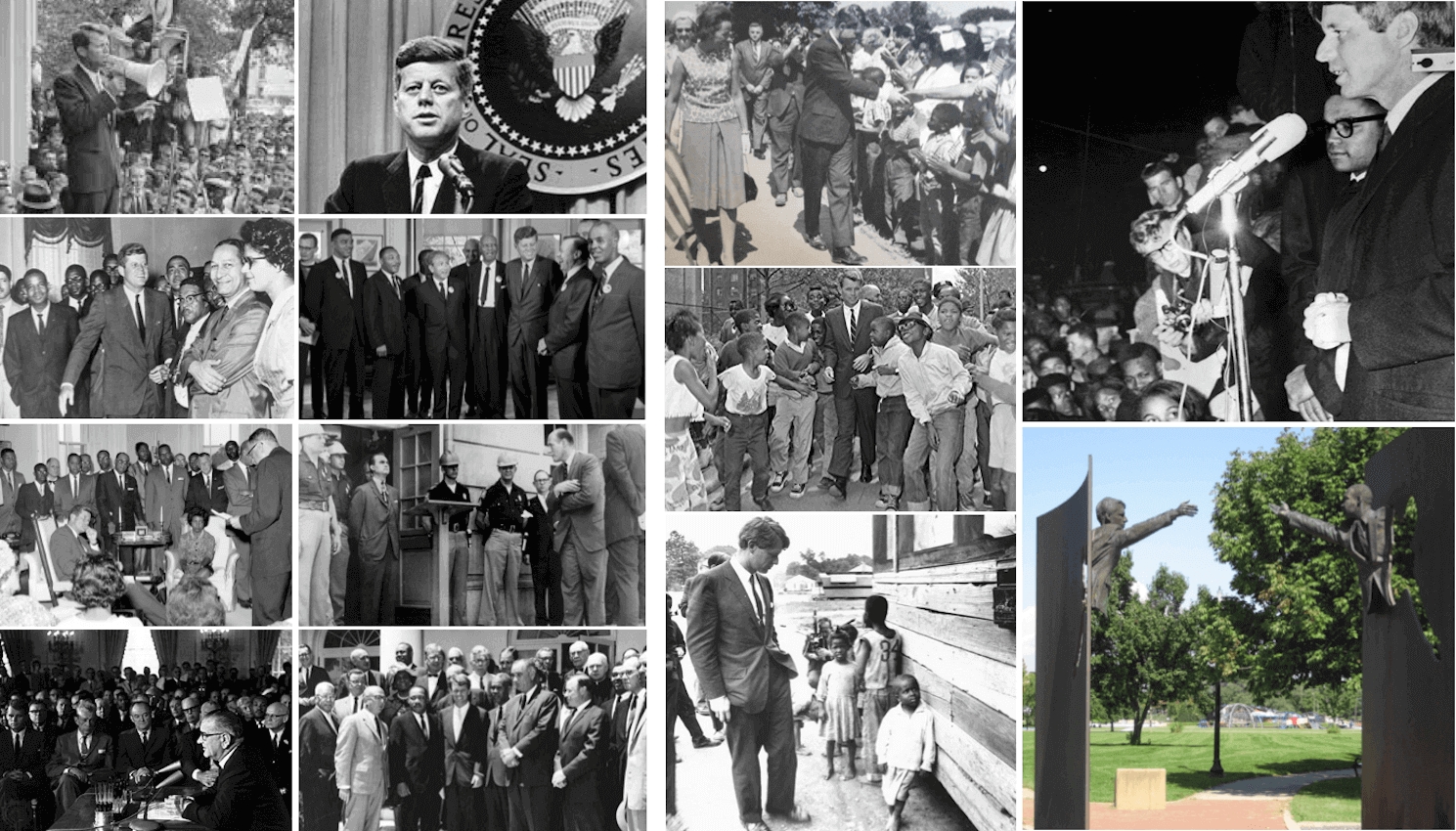
The Kennedys and Civil Rights: How the MSM Continues to Distort History, Part 3
Part 3: The Kennedys Tear Down Jim Crow
John F. Kennedy “literally shook his head with incredulity” when he learned that Prince Edward County abandoned public education.
~ Brian E. Lee, A Matter of National Concern
In speaking of the years 1961-64, there can be little doubt that the major impetus for the monumental Civil Rights Act of 1964—which eliminated Jim Crow laws in the South—was President Kennedy at the White House, and Robert Kennedy and his assistant Burke Marshall at Justice. In close support was a group of individuals who—like Philip Randolph and Charles Houston—almost never get the recognition they deserve. These were the judges of the Fifth Circuit Court of Appeals. That court encompassed six former states of the Confederacy: Alabama, Mississippi, Florida, Georgia, Louisiana and Texas. They worked in concert with RFK and Marshall to overturn lower court rulings that went against the attorney general, and to cite individuals—including governors—for contempt when they disobeyed court orders. The men on that circuit are so important that at least four books have been written about them. It is a measure of the historical value of the four volumes under review that I could find no reference to that court in any of them. Yet it was their cooperation with and support of the attorney general that kept the pressure on until 1963 when the tactics of Sheriff Bull Connor ignited the issue into national consciousness in Birmingham. By that time, May of 1963, JFK already had a civil rights bill in process.
I
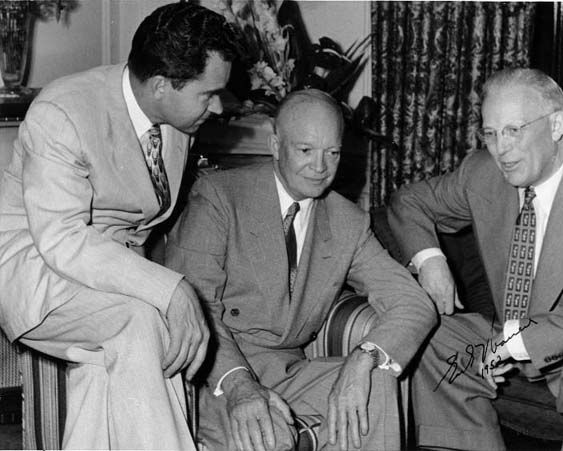
Eisenhower tried to persuade Earl Warren
not to decide in favor of BrownHarris Wofford was an assistant to the Civil Rights Commission set up by the Johnson/Eisenhower bill of 1957. As he writes in his book, Of Kennedys and Kings, President Eisenhower resisted enacting every recommendation that the commission suggested. (p. 21) As we have also seen, both Eisenhower and Nixon failed to back the Brown v Board decision of 1954. In fact, Eisenhower actually tried to discourage Chief Justice Earl Warren from deciding in favor of the plaintiffs in the Brown case. As we have seen, the only time that Eisenhower acted to apply the decision was in Little Rock, Arkansas in 1957. In that case, Eisenhower had to be asked to join the case. And he waited three weeks to send in troops to protect the students after being badgered by the mayor to do so. (Brauer, p. 4) In the Autherine Lucy case at the University of Alabama in 1956, Eisenhower failed to back the NAACP court order that allowed Lucy to continue her education in graduate school. The college and the student body literally ran her off the campus. Eisenhower did not send in marshals to escort her to class, nor did he federalize the National Guard to maintain order on campus. (Bernstein, p. 97; Jack Bass, Unlikely Heroes, p. 64)
This nod and wink by Eisenhower to the South encouraged their power brokers to find ways to dodge the court order or scheme around its objective. And this was something they were primed and ready to do. For example, in 1955, Senator James Eastland of Mississippi stated that the Brown decision wrecked the Constitution because it disregarded the law in deciding integration was right. He then closed with, “You are not required to obey any court which passes out such a ruling. In fact, you are obligated to defy it.” (Bass, p. 17) That kind of plea was made viable because Eisenhower had never stood up for the issue. For a Republican, Eisenhower had done well in the South in the 1952 election, and even better in 1956. As Charles Houston and Thurgood Marshall were closing in on Plessy v Ferguson, the Southern solution had been to build newer, nicer, separate schools for African American students. But when the Supreme Court restated the 1954 decision in 1955, it stressed that public schools should be integrated and there was no point in building new schools and arguing that these schools were equal.
As we have seen, President Kennedy was already on record as supporting the Brown decision. After he was inaugurated, there were two specific cases that Eisenhower had dawdled on which fell to him. One was in New Orleans, the other in Prince Edward County, Virginia. As we shall see, the contrast with Eisenhower—who called these issues a local problem—could not have been more dramatic. Even in 1956—after the Brown restatement—when the governor of Texas called out Texas Rangers to stop African American children from registering at court-ordered integrated Mansfield High School, Eisenhower failed to act. (Bass, p. 122)
Led by Senator Harry Byrd and columnist James Kilpatrick, Virginia was urged to abandon public education altogether. The state now passed laws decreeing any district that obeyed Brown would have funding ceased. (Nancy McLean, Democracy in Chains, p. 25) In January of 1959, higher courts overturned this action. (p. 65) The state schemed again, this time by using state vouchers for a segregated private system. This ultimately failed due to another court challenge. But in the meantime, 1,800 African American children in Prince Edward County had no schools to attend. What made this most notable was that Prince Edward was one of the five counties that Charles Houston had targeted to overturn Plessy v Ferguson. As Brian Lee wrote in his Ph. D. thesis, A Matter of National Concern, Eisenhower actually encouraged this scheme by saying that states were not required to maintain a system of public education, and therefore the president was “powerless to take any action.” (Lee, p. 50)
The Kennedys disagreed. The attorney general called Prince Edward “a blight on Virginia” and “a disgrace to our educational system and to our country”. (Lee, p. 22) President Kennedy now began to remake the 4th Circuit Court of Appeals, governing Virginia and nearby states, altering Eisenhower’s composition in order to strike down these schemes. (Lee, p. 6) In the meantime the White House did something that is probably unprecedented. While the president altered the court, the attorney general asked William Vanden Heuvel to raise money to build a free school system to educate the Prince Edward African American students left behind. Further, Burke Marshall attempted to join the NAACP legal action in Virginia, not as a friend of the court, but as a plaintiff. This had never been done by Eisenhower in six years. (Lee, pp. 145-150)

New Orleans: Ruby Bridges was the only
student left at the schoolThis unprecedented action in Virginia was paralleled by what the administration immediately did in New Orleans. That school district, after a successful lawsuit to integrate schools, at first stalled and then schemed. Finally, federal Judge J. Skelly Wright ordered integration to proceed in September of 1960. The state legislature now passed laws circumventing Wright’s order. The Eisenhower administration asked Wright to delay issuing his new order declaring the state laws unconstitutional until after the November elections. They did not want to deal with another Little Rock. (Bass, p. 132)
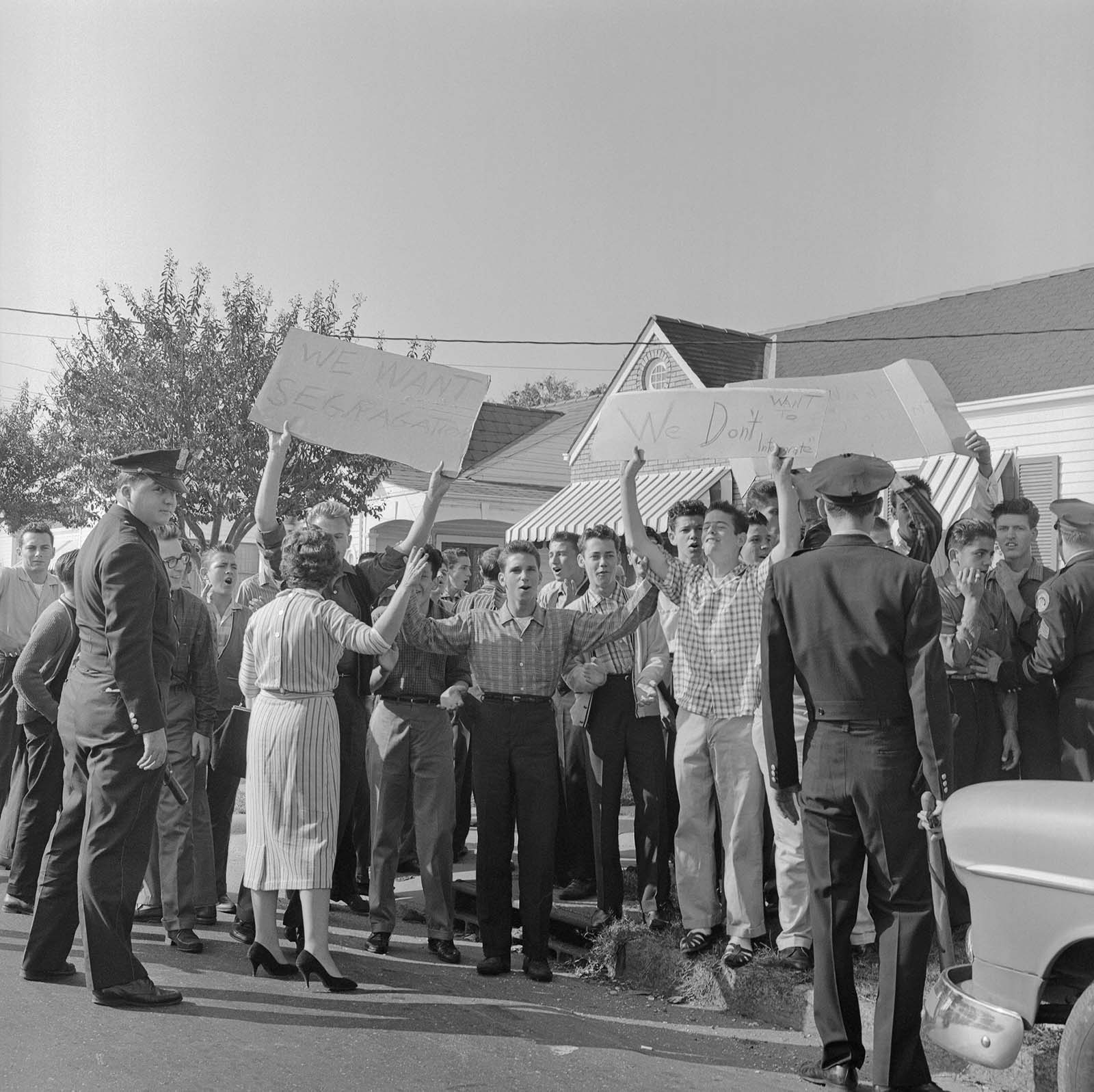
Across from the school:
this is what she was being protected fromThe pathology sanctioned by the White House continued. The state legislature passed laws to oust school board members and to even fire teachers who agreed to work with black students. (New Orleans Magazine, “The Struggle for Education”, January 2016) Wright again struck them down. The judge then asked for federal marshals to escort the students of color to their new schools. Louisiana now took up a scheme inspired by Orval Faubus in Arkansas. The schools ended up being largely empty, since the white students boycotted them and their parents picketed them. (Bass, p. 129)
As in Virginia, the legislature threatened to close down schools by withholding funds. Wright now called RFK’s assistant Burke Marshall. Marshall advised Bobby Kennedy of the situation. The attorney general replied, “We’ll have to do whatever is necessary.” (Bass, p. 131)
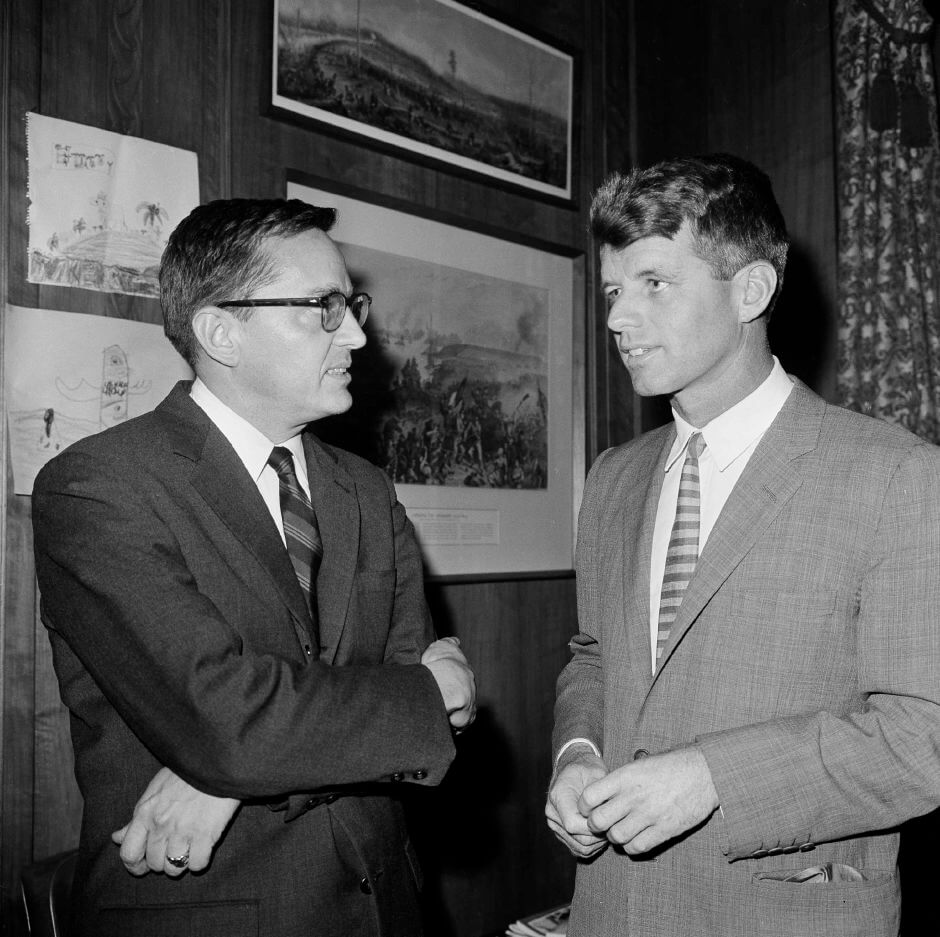
Burke Marshall & RFK The Kennedy administration again did something unprecedented. In February of 1961, Burke Marshall filed charges against the state secretary of education, Shelby Jackson. Marshall’s aim was to block the attempt by the governor to cut off funding for integrated schools. (Bass, p. 135) Wright set a trial date to begin proceedings against the secretary for contempt of court. Jackson backed off and said he would not interfere. He avoided a prison sentence by pleading he had a weak heart.
Steven Levingston does not mention Shelby Jackson. Nor does he note the New Orleans schools case or Judge Wright. You will also not see the Prince Edward Free Schools listed in his index. But I should also note, these two cases were done without any consultation with King, though he would have endorsed them both, as other civil rights leaders did. Thus Levingston’s twin themes—that somehow King was the only focus of the race issue, and the Kennedys were denying his requests and did not understand his message—are simply not substantiated by the record. And this is in early 1961!
The administration also began to finish up Charles Houston’s work that, again, Eisenhower had abandoned. Bobby Kennedy made it a point to speak at the University of Georgia Law Day on May 6, 1961. As historian Carl Brauer wrote, this was the first time in memory that an attorney general had directly addressed the civil rights issue in the South. (Brauer, p. 95) He did this partly in order to congratulate the university for its efforts in integrating the college with relatively little violence in January of that year; partly to aid the efforts of the Fifth Circuit, for they had completed the process of integration at that university. (Bass, p. 136) In that address, the attorney general said that he planned on abiding by and enforcing the Brown decision. He spent half the speech talking about civil rights. The Kennedys would also make good on the Charles Houston goal of completing integration of higher education—a goal Eisenhower abandoned with the Lucy case—and this address was part of achieving that goal.
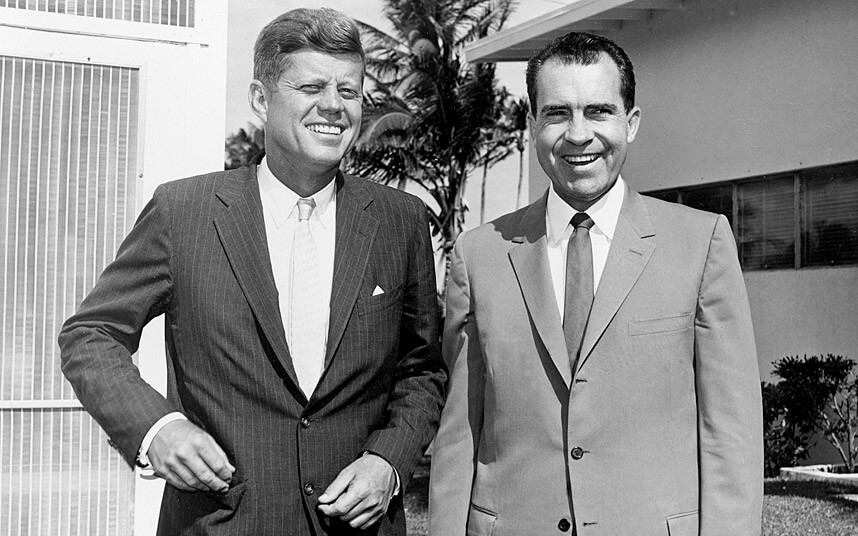
Senator Kennedy compared his
civil rights record to Nixon’sIn a larger sense, these were the first steps toward fulfilling a campaign promise that Senator Kennedy made on November 1, 1960 in Los Angeles. Neither Levingston nor Margolick deal with this speech, so we are left with the impression that civil rights were not an issue in that race. That is not accurate. In that speech, Senator Kennedy compared his congressional record with Richard Nixon’s on civil rights. He also compared his stand on the minimum wage, which when boosted would help many African Americans. He concluded by saying that although not everyone can have equal abilities, “everyone should have the same chance to develop their talent.” Which was something he was trying to do with education.
II
In Part 2, we discussed the Freedom Rides of May, 1961. The end result of all this was that two lawyers from the attorney general’s office filed a petition to the Interstate Commerce Commission. In the latter part of May, a request went up to issue regulations eliminating segregation at bus terminals. Under pressure from Burke Marshall, the ICC issued these in September. Marshall convinced Senator John Stennis to get the last three towns in Mississippi to remove their discriminatory signs. (Brauer, p. 109) By the end of 1962, Jim Crow was eliminated in interstate transportation. (Bernstein, p. 68)
In Wofford’s memo of December 1960, he wrote, “Ending discrimination in voting is the point of which there would be the greatest areas of agreement and the greatest progress could be made.” (Bernstein, p. 68) This was a primary goal of candidate Kennedy as opposed to Richard Nixon. In October of 1960, JFK proposed to his civil rights advisory group that they use access to voting records that the Civil Rights Commission had gained to file lawsuits in court based on voting discrimination. On the day Bobby Kennedy was confirmed as attorney general, the judiciary chairman, James Eastland of Mississippi, commented that his predecessor had never filed a civil rights case in Mississippi. This was true. It was also an understatement. During Eisenhower’s two terms, his administration had filed a total of ten civil rights lawsuits. Two of those were posted on his last day. (Golden, pp. 100, 104) The day after RFK’s confirmation, his brother sent him a note saying, “Get the road maps—and go!” Which meant: start sending your men into the backwoods of the South to secure those records and file cases.
In one year RFK doubled the amount of lawyers in the civil rights section. During that same year he doubled the amount of cases that Eisenhower had filed in two full terms. By 1963, the number of attorneys in that section had quintupled. (Golden, p. 105) RFK then hired 18 legal interns to search microfilm records in suspect districts. That opened 61 new investigations—in just a year. Prior to the Kennedy administration, it is clear that neither the Brown decision nor the strictures of the Civil Rights Commission were being obeyed. To increase the tempo, Bobby Kennedy went from suing districts to filing against a whole state, e.g., Mississippi. Although the president got regular reports on this tactic, he memorably scrawled across the bottom of the Justice Department report for 1962, “Keep pushing the cases.” (Golden, p. 111)
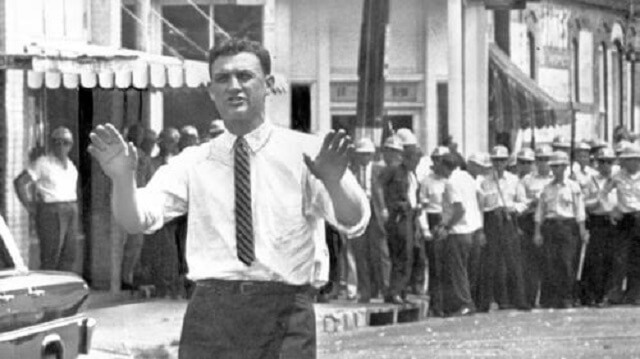
John Doar The weight of the residue of the previous administrations was staggering. When attorney John Doar attempted to interview people in Tennessee, he found that in 13 counties, none had registered. (Bernstein, p. 68) To show just how intent southerners were to stop this effort, some of the people who talked to the Justice Department were then evicted from their lands as tenant farmers. The White House then organized an effort to send aid to those who were evicted. (Brauer, p. 72)
Useful in the voter registration regard was another mission that the Eisenhower administration never attempted. This was the voter registration drive. This presented a huge challenge. For example, in 1960, in the parish of East Carroll in northeast Louisiana, there were more African Americans of voting age than whites. But there were 2,845 whites registered to vote, and no African Americans. In the northwest parish of Bienville, almost every white voter was registered. Of the over 4,000 African Americans, only 25 were registered. (Golden, 136) The emerging problem was that these kinds of field projects are expensive, since one must send workers out with canvassing lists to knock on doors and get both information and documentation. The government itself could not supply the funds. So Marshall and Wofford went to various foundations in the north to get the money. (Bernstein, p. 72) They then parceled it out to the various civil rights groups like the NAACP, SCLC and CORE. The overall title given to the drive was the Voter Education Project (VEP). It cost $870,000, or about 7 million today. The VEP lasted until 1964. As one commentator noted, it gained an increase in its short duration that would have taken ten years to achieve under normal conditions. But more important, “It moved Negro registration off dead center, where it had been for most of the previous decade, and reestablished momentum.” (Bernstein, p. 73)
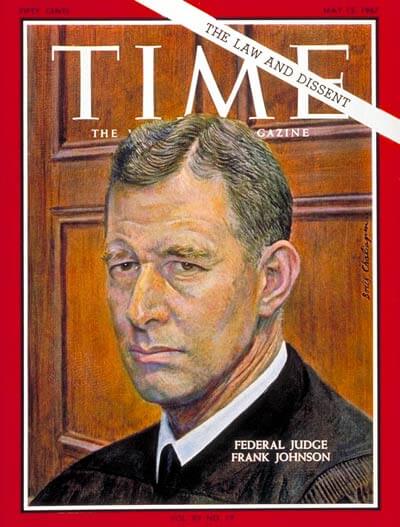
Judge Frank Johnson In this regard, Kennedy and Marshall did something that most people would have found next to impossible. They actually got the FBI to help investigate cases of voting rights violations. This appears to be some kind of milestone for J. Edgar Hoover. (Brauer, p. 117) Extensive research in voting rights abuses were then presented to the judges of the Fifth Circuit Court. In Louisiana, with the help of Judge Minor Wisdom, the attorney general got the voting test requiring an interpretation of the Constitution thrown out in 21 parishes. That figure made up a third of the state. (Golden, p. 137) It was the Fifth Circuit’s Frank Johnson—who had worked with Robert Kennedy during the Freedom Riders crisis—who gave the attorney general his first win in a voting rights case. With Johnson’s help, the number of registered African American voters went from 13% to 42% in Macon County, Alabama. (Brauer, p. 118, 120) As Judge Johnson later said to his biographer:
The Macon County case would be the one that began to erode Southern voting discrimination … The Middle District of Alabama federal court took the lead in voting rights and the Fifth Circuit and the Supreme Court consistently upheld those rulings. When the Selma demonstrations started in 1965, the black citizens in my section of the state of Alabama had already won the right to vote. (Frank Sikora, The Judge, e-book, chapter 12)
Utilizing the Fifth Circuit, with judges like Johnson and Wisdom, plus the evolving Fourth Circuit in the upper South, and the Supreme Court sustaining their decisions, Bobby Kennedy thought he would be done securing voting rights in the South by 1968. (Golden, p. 131) The Selma demonstration, which caused the Voting Rights Act, hurried that up by three years. But as Johnson points out above, it was already happening. Clearly, this was a deliberate strategy by the attorney general. In his book on the Fifth Circuit, Jack Bass wrote that Bobby Kennedy urged civil rights groups to use the judicial process as a way to get them to their ultimate goal. (Bass, Unlikely Heroes, p. 25)
That Levingston never mentions this crucial Fifth Circuit aspect shows the worthlessness of his book. As Judge Johnson later said, no one in Washington was doing anything substantial on civil rights in the fifties, including Eisenhower. He added that when Kennedy came in, “there was almost an immediate and dramatic change. He was like electricity compared to Eisenhower … [He] put the nation on notice that there were changes that were long overdue.” (Sikora, chapter 6)
III
Related to this, the administration tried to get a voting rights bill through Congress in 1962. Eisenhower called a press conference and labeled this modest proposal for voting rights “unconstitutional”. (Brauer, p. 135) As with Johnson in 1960, there were problems with the Southern bloc in the Senate. Due to their filibuster, the effort failed. (Edwin Guthman & Jeff Shulman, eds., Robert Kennedy in His Own Words, p. 149) But this did help inspire the 1962 congressional proposal to do away with the poll tax by amendment. The 24th amendment outlawing the poll tax was ratified in January of 1964. (Brauer, p. 132)
In one of his lesser-known achievements, it was President Kennedy who began the idea of affirmative action. And it started on inauguration day. Kennedy noticed that, during the parade, there were no black faces in the Coast Guard detachment. That night he called Treasury Secretary Douglas Dillon and asked that something be done about it. (Bernstein, p. 52) Two days after Kennedy’s phone call, the academy began an all-out effort to recruit African Americans. One year later, the streak was broken and an African American student entered the academy. (Bernstein, p. 52) In 1963, the Coast Guard made it a point to visit 199 high schools, addressing 11,000 students and then interviewing 561 African American candidates. (Golden, p. 114)
That was just the beginning. At his first cabinet meeting, Kennedy brought up the incident and told each member that he wanted the figures on the racial balance in his respective department. He did not like the results. For instance: at the Department of Justice, only 19 of nearly 1700 lawyers were African American. Kennedy also discovered that most of the people of color were at the lower rungs of the hierarchy. The president now told everyone that he wanted the situation remedied and he also wanted regular reports on their progress. (Bernstein, p. 53) Kennedy got so involved in the process that his administration became the first to appoint an African American ambassador, Clifton Wharton, to a European country. As Roy Wilkins later said, “Kennedy was so hot on the Department heads … that everyone was scrambling around trying to find himself a Negro in order to keep the president off his neck.” (Bernstein, p. 53) In fact, Kennedy assigned a civil rights officer to manage hiring and complaints for each department. He then advised the Civil Service Commission to begin a recruiting program to target historically black colleges and universities. (Brauer, p. 72, 84)
The president then set up two interagency groups in order to monitor and push the issue forward. One was headed by Harris Wofford and it oversaw the entire federal government; Fred Dutton’s concentrated on the cabinet positions. On March 6, 1961—45 days after his inauguration—Kennedy issued an executive order outlawing discrimination in the workplace and making sure that affirmative action employment practices were followed.
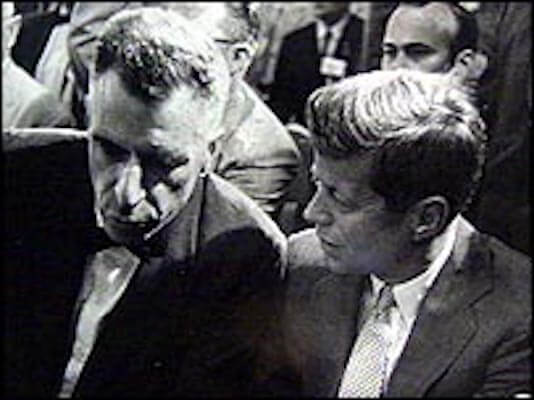
Galbraith & JFK This concept of seeking out qualified people of color to serve in the government was complemented by another action. Together with his longtime friend, John Kenneth Galbraith, Kennedy decided to protest the color barrier at two posh clubs in the Washington, DC area, namely the Metropolitan and Cosmos clubs. (Richard Parker, John Kenneth Galbraith, p. 387) At the Metropolitan, Galbraith sponsored Kennedy as a member. But Kennedy refused to join when they declined service to a visiting African diplomat. At the Cosmos Club, Kennedy withdrew his application when the club refused to admit federal employee Carl Rowan. Kennedy got other government members and friends to follow suit and resign membership. Due to the bad publicity, both clubs later reversed policy. The notable thing about these episodes is that both were private clubs. (Washington Daily News, January 15, 1962, p, 21; Wofford, pp. 149-50) Kennedy then announced that neither he nor any member of his administration would attend functions at segregated facilities. (Bernstein, p. 53) To top it off, some of the members who resigned in protest then banded together to form a non-discriminatory club called the Federal City Club. (Brauer, p. 70)
But Kennedy wanted to go beyond just the direct reach of government employment and the upper classes of Washington, DC. As noted previously, President Truman could not sustain the Fair Employment Practices Committee that Philip Randolph had pressed on Franklin Roosevelt. So first Truman, and then Eisenhower, set up advisory committees on the issue. The aim was to make the companies that won federal contracts adhere to non-discriminatory employment practices. In reality, if, say, the army contracted out to a textile company to manufacture rolls of cloth to make uniforms, that company would have to show that it hired some people of color. Kennedy established the Committee on Equal Employment Opportunity (CEEO) as part of his March 6, 1961 Executive Order on affirmative action. (Golden, p. 59)
Under Eisenhower, Nixon had run their employment program, so President Kennedy put Lyndon Johnson in charge of the CEEO. Again, the contrast in activity is startling. In seven years, Nixon filed six suits. In a bit over two years, the CEEO heard almost four times as many complaints—1700—as Eisenhower and Nixon did in seven years, and acted favorably on over 70% of them. For example, there was a desegregation lawsuit filed against Socony in Texas. (Golden, p. 60; Bernstein, p. 59) Kennedy’s plans for retaliatory action went beyond Eisenhower and Truman. The CEEO allowed for the publication of the names of those who were violators, lawsuits by the attorney general, cancellation of the contract, and the foreclosure of future contracts. (Bernstein, p. 56) As a result, by 1963, you had people of color working alongside whites in the carding rooms of textile mills in the South. As a mill supervisor explained, “We work together for the simple reason we must if we want the government contracts. Without those contracts, we close down.” (Golden, p. 61) Its greatest achievement under Johnson was a settlement with Lockheed to integrate all of its facilities and begin a program of affirmative action in hiring. This was important since Lockheed was a large employer in Georgia. (Bernstein, p. 58)
Kennedy’s stricter program also extended to funds given to institutions of higher learning. As Melissa Kean noted in her 2008 book:
With the election of John F. Kennedy, the reach of federal nondiscrimination requirements in contracting finally extended into the admissions policies of private southern universities. Failure to comply meant ineligibility for the federal grants and contracts that were the life-blood of the advanced programs at these schools. (Kean, Desegregating Private Higher Education in the South, p. 237)
As a result of Kennedy’s more rigorous policies, large private universities like Duke and Tulane chose to quietly and peacefully admit African Americans.
The CEEO also developed a parallel program for non-discrimination in labor unions. This was called the Programs for Fair Practices. The AFL-CIO, covering about 11 million members, chartered it. (Bernstein, p. 60)
Since Johnson ran the program, the sternest critic of the CEEO was Robert Kennedy. He thought Johnson was not aggressive enough. For instance, RFK filed a lawsuit in December of 1961 against hospitals who received federal funds but discriminated against doctors or patients. (Golden, p. 113) President Kennedy felt so strongly about this issue that in June of 1963 he issued another executive order that both strengthened and extended the mandate of the CEEO. This agency later became a permanent part of the government and was renamed the Equal Employment Opportunity Commission. Kennedy had achieved what Truman could not and what Eisenhower and Nixon simply were not interested in.
IV
At this point we should address an issue that some professional writers on the Left, like Paul Street, have brought up: the idea of federal protection for those struggling for rights. This was obviously an issue in the 1963 RFK/Marshall meeting with James Baldwin and Jerome Smith. In addition to the violence during the Freedom Riders demonstrations, there was also the riot at Ole Miss in 1962, which we shall discuss, and the nationally televised tactics used by Sheriff Bull Connor in 1963 at Birmingham which Baldwin mentioned in one of his telegrams to Robert Kennedy before the meeting. (Dyson, p. 25) As Robert Kennedy later said, in addition to Jerome Smith throwing the meeting off subject, the other problem was how little Baldwin and the others knew what the law was. (Guthman and Schulman, pp. 224-25)
Burke Marshall had studied this entire field and examined the legislation that was on the books and how it fit into the system of federalism. In 1964, he wrote a brief book on the subject called Federalism and Civil Rights. To indicate his quality of scholarship, Michael Eric Dyson never mentions it anywhere in his book. Neither does Levingston. Professional historians Arthur Schlesinger and Carl Brauer do more than mention it: they spend several pages explaining Marshall’s book.
No one can deny that the Birmingham images of youngsters being attacked by rabid dogs and bounced around by fire hoses were shocking to behold. Yet no one can deny that RFK and Marshall were on the protesters’ side. So the question then became: Why didn’t they do anything to preempt it?
The answer that Marshall got sick and tired of giving was simple: America does not have a national police force. The police function is a local function. With very rare exceptions, the FBI is an investigative force, one that is supposed to help and support local and state police. Marshall then added, “There is no substitute under the federal system for the failure of the local law enforcement responsibility.” (Letter from Marshall to R. H .Barrett, 1/3/64) None other than Thurgood Marshall backed him in that judgment. The man who argued Brown v Board said that the police authority does not lie with the federal government, but within the states. That was a point that he, as a civil rights lawyer, could understand, “but the average layman cannot understand it.” (Schlesinger, Robert Kennedy and His Times, p. 318)
What both men were saying amounts to this: Robert Kennedy could not go in and arrest Bull Connor and the entire Birmingham police force. There simply was no federal mechanism that allowed him to do so. But beyond that problem, there was also the matter that, before the Civil Rights Act of 1964 was passed, Connor was abiding by the state and local laws. In that regard, we must recall Part 1 of this series, where the author explained how the Supreme Court had neutered the Reconstruction laws and amendments. In addition to that, each locality has municipal laws guiding the administration of demonstrations. Fred Shuttlesworth, father of the Birmingham demonstrations, knew he was violating them. That was his point: to use civil disobedience and moral suasion to defeat misguided power.
There was an exception in the law. And this allowed the White House ultimately to send in federal marshals and troops to Oxford, Mississippi and also to Alabama during the Freedom Rides. Sections 332-334 of Title 10 of the US Code allows the president to send in troops in instances of a large scale failure of law and order. Burke Marshall was hesitant to use Title 10. As the famous legal scholar Alexander Bickel once wrote, “As a regular and more or less permanent device, it is something from which we recoil, deeming it destructive of a free society.” John Doar also found that route to be a dangerous one: the federal government should not be a police state. (Schlesinger, p. 318-319)
A good point of comparison would be the famous incident when Robert Kennedy heard that local police had arrested a Chicano demonstrator in Delano, California before he broke any laws. This was during the time that Cesar Chavez was trying to organize fruit pickers in the central valley area. Kennedy had flown there for a hearing on their organizational rights. When he heard that, RFK advised the police officer to read the Constitution during the lunch break. (Schlesinger, p. 826) As Attorney General Kennedy had said to Anthony Lewis, the investment of dictatorial powers in the executive branch might seem convenient or expedient during times of stress. But it should be resisted, since it would boomerang later. (Schlesinger, pp. 319-20)
Today, living in the shadow of Dick Cheney, water boarding, drones, Edward Snowden and Guantanamo, I think we all understand what the attorney general meant. But the meeting with Baldwin and Smith was not the most appropriate time for Burke Marshall to take out a chalkboard and play law professor.
V
In addition to attempting to pass a voting rights act in 1962, the Kennedy administration was also working with the NAACP and the Fifth Circuit to complete the integration of colleges and universities in the South. As noted above, President Kennedy used restrictions on grants to private universities to shoehorn integration. With public universities, Burke Marshall decided to work with the NAACP to attain court orders from the Fifth Circuit. In 1963, Clemson and South Carolina integrated peacefully. Such was not the case with Ole Miss and Alabama.
The day after JFK was inaugurated, James Meredith decided to become the first African American student at Oxford. Both the NAACP and Burke Marshall decided to take part in his attempt. (Brauer, pp. 180-81) Governor Ross Barnett now invoked a policy that southern universities had used many times before. He offered to pay for Meredith to go elsewhere. When that did not work, he started shouting “states rights” and John Calhoun’s specious claims about interposition.
Robert Kennedy formally entered the Justice Department into the legal proceedings. President Kennedy began to lobby business leaders in the state. (Brauer, pp. 182-83) When the university tried to deny Meredith’s application, the Fifth Circuit, in an opinion written by Minor Wisdom, overruled the denial. (Bernstein, p. 77)
But now, the trustees of the college transferred power over to Barnett. The Fifth Circuit first charged the trustees, then Barnett, with contempt. (Brauer, p. 184) At Millington air base in Memphis, the president now began to build up a force of federal marshals and draw up a military contingency plan which would eventually include 20,000 troops. (Bernstein, p. 81)
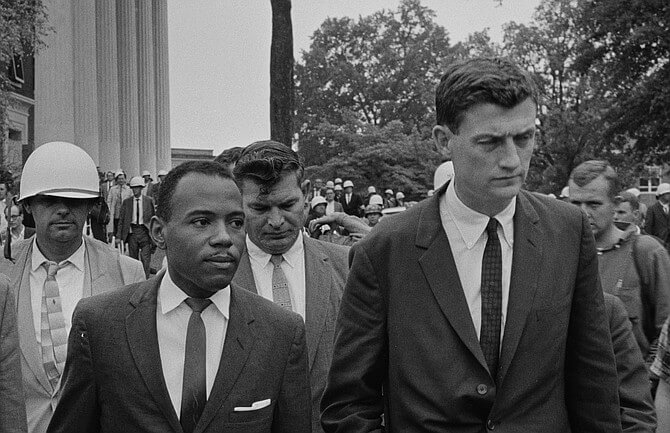
James Meredith & John Doar Ross Barnett ended up double-crossing the White House. And his stalling tactics had allowed General Edwin Walker to build up an angry crowd estimated at anywhere from two to three thousand rabid segregationists, including Klansmen. On the Sunday evening of September 30th, Deputy Attorney General Nicolas Katzenbach headed the escort to prepare for Meredith’s next day registration. Just before that was to occur, Barnett pulled the state troopers who were supposed to maintain order until Meredith was processed. (Bernstein, p. 83) A riot ensued and Walker’s crowd outnumbered the federal marshals. What made it worse was that Katzenbach’s communications network went down, and the troops that were supposed to arrive in a contingency failed to arrive when they were scheduled. Two bystanders were killed, scores of marshals were injured and 13 men were indicted. President Kennedy had marshals escort Meredith constantly until he graduated. (Brauer, pp. 195-97)
The next year, at the University of Alabama, things went smoother. This was part of perhaps the most groundbreaking three days any president has had since FDR. On June 9th, President Kennedy had made a strong speech for civil rights at a mayor’s conference in Hawaii. (Andrew Cohen, Two Days in June, pp. 18-19) Coming back from Hawaii, on June 10th, the president announced his plans for détente with the Russians in his speech at American University.
The next day, President Kennedy had his showdown with Governor George Wallace in Tuscaloosa. Robert Kennedy had tried to talk to Wallace in order to prevent anything like Ole Miss from happening. (Cohen, p. 235) Again, an associate of Frank Johnson, Judge Seybourn Lynne, had written the order for two African American students to enter the university. (Cohen, p. 236) Wallace had arranged for a combined force of 895 state troopers and police to back him. The White House brought in 3000 troops; this time they were only minutes away. (Cohen, pp. 243-47)
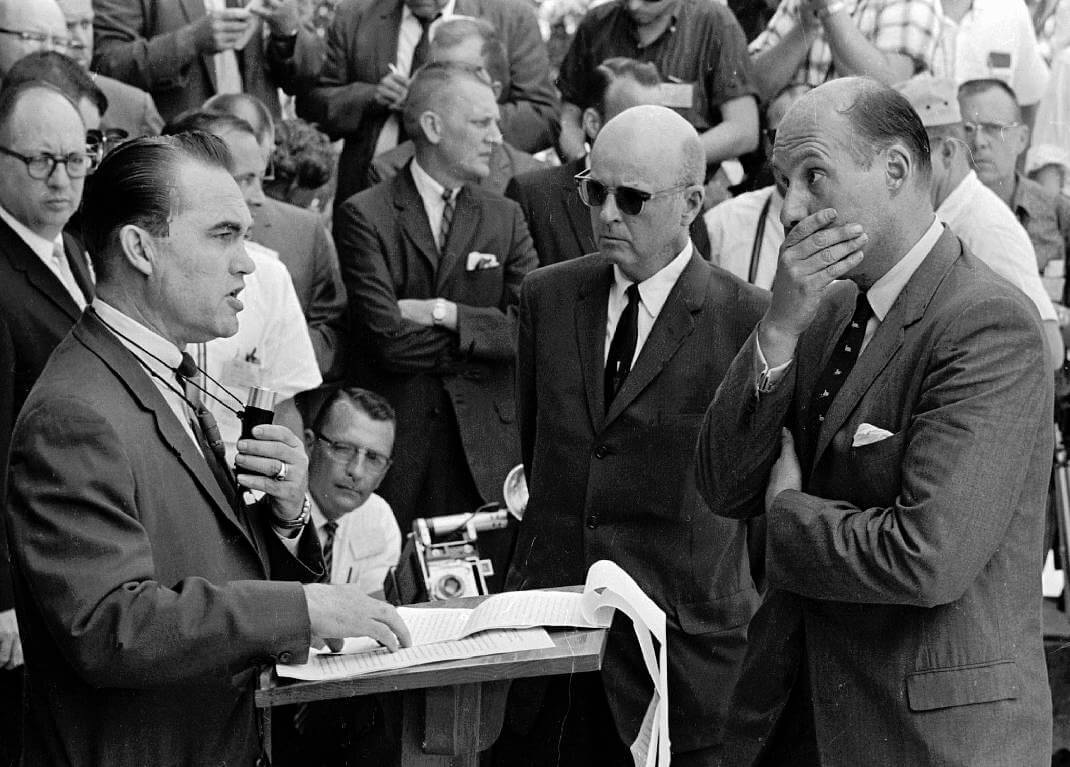
Wallace confronted by Katzenbach Contrary to what MSM hacks like Evan Thomas claim, no one knew what Wallace was going to do that day. The proof of this is that in the documentary film made of this event, Robert Drew’s Crisis, Bobby Kennedy is suggesting that they may have to shove the students through the furthest door at the main entry. That discussion went on as Katzenbach was preparing to confront Wallace. Andrew Cohen, who has written one of the longest and most detailed studies of the event, agrees with that view. According to Cohen, the plan was only finalized that morning. (Cohen, pp. 247-49) When Wallace refused to leave, President Kennedy nationalized the state guard. General Henry Graham threatened to arrest Wallace, so he stepped aside. The other point that had an impact on Wallace’s decision was that Lynne had promised to cite Wallace for contempt if he obstructed the students’ entry. (Bernstein, p. 97)
That evening, President Kennedy gave what many believe was the finest speech given on the race issue since Abraham Lincoln. As Cohen writes, what makes that speech even more impressive is that it was written in two hours. (Cohen, p. 321) After King heard it, he told the person he was watching it with, Walter Fauntroy, “Walter, you believe that white man not only stepped up to the plate, he hit it over the fence.” (Cohen, p. 339)
But Wallace was not finished. On July 22, 1963, Judge Johnson signed an order for 13 African American students to attend Tuskegee High School in Macon County, Alabama. In addition, the same would happen in Mobile and Birmingham. (Sikora, chapter 22) On the day those 13 students were supposed to be in attendance, there was a large force of state troopers awaiting them. Wallace also sent an order to the superintendent that the school would not open.
Bobby Kennedy now convened a five-man panel of the Fifth Circuit to issue a restraining order enjoining Wallace from interfering with the integration of the three schools. Wallace tried to get around that by now sending the National Guard in to stop the students from entering. That afternoon President Kennedy ordered the guard to be nationalized, that is, placed under his control. (Sikora, chapter 23)
VI
At the end of 1962, President Kennedy issued his executive order to integrate housing. It inserted nondiscrimination clauses for all new public housing developments and urban renewal projects, and took action against housing contractors who practiced discrimination. Because it was an executive order, its scope was limited. (Brauer, p. 210) This relates to a criticism made by several writers, such as King biographer Taylor Branch, and which Levingston continues. (pp. 205-06, 213, 226) King wanted Kennedy to issue an executive order in 1963 as a new Emancipation Proclamation to strike down segregation in the South. Kennedy did not and writers like Branch and Levingston imply that this was some kind of missed opportunity that King offered the president.
This author decided to get into contact with the Dean of the law school at Cal Berkeley, Professor Erwin Chemerinsky. I queried him, since he is one of America’s most illustrious constitutional scholars and has a liberal reputation. He replied that if Kennedy had done that, it would have only applied to the executive branch of government, not to private businesses and not even to state and local governments. (email communication, October 15, 2018) Since, as we have seen, Kennedy was already integrating the executive branch by other means, the Levingston/Branch implication is baseless.
As noted previously, President Kennedy submitted a civil rights bill to Congress on February 28, 1963. (Risen, p. 36) He accompanied this with an address. That address, like other statements he had made on the subject—going all the way back to when he was a senator, and during the 1960 campaign—had a moral dimension to it. Which counters the idea of playwright Levingston: that JFK only understood the moral dimension in his June 1963 televised address. (Levingston, p. 405) The February bill was significantly revised as the year went on due to media pressures which finally made civil rights a continuing front page/TV news lead story.
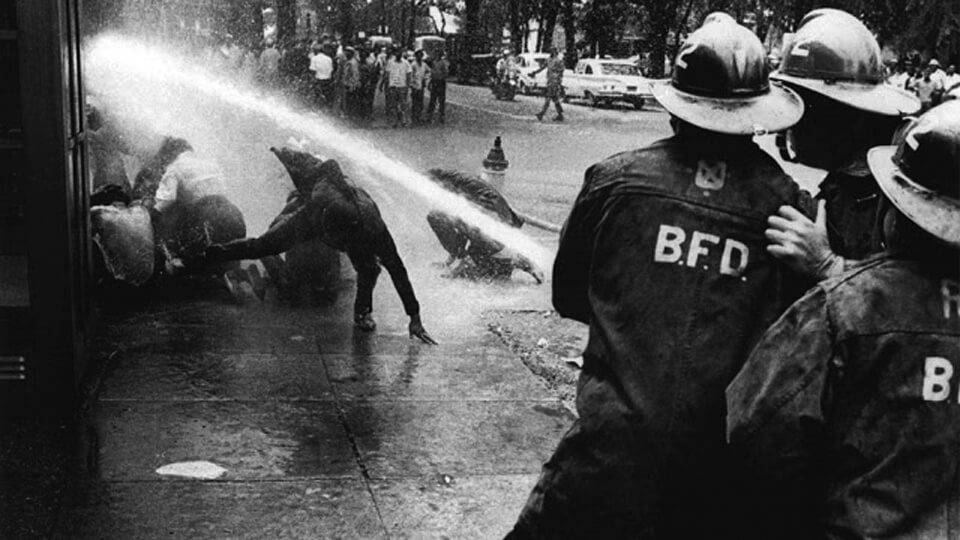
Birmingham, May 1963 As the conflict in Birmingham took hold and the media began to report on it, the opportunity presented itself to make the bill even stronger. The masterstroke at Birmingham was using schoolchildren in illegal demonstrations, knowing that Bull Connor would overreact. Which he did, using powerful fire hoses and attack dogs. It was those newspaper and TV images that altered the consciousness of this issue in the north. It also made John Kennedy understand the sick pathology of many of the power brokers in the South, and that he had been wrong in his characterization of Thaddeus Stevens in Profiles in Courage. (Brauer, p. 240)
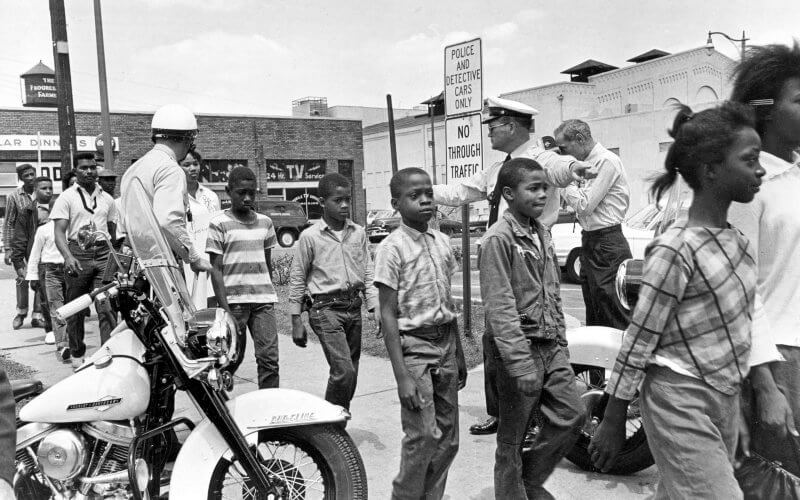
It was James Bevel who organized
Birmingham school childrenThat maneuver was not proposed or executed by King. In fact, at this point, on his own, King could not get enough demonstrators in the streets. It was James Bevel who went on local radio and gathered scores of school kids in a church on April 24th, a move that King actually opposed at the time. (McWhorter, p. 361) Then, with King out of town, Bevel began to work with and organize the students. He told them to listen to a secret code word he would use on the radio. And on May 2nd, with King still mulling the idea over, Bevel launched his first student wave. Six hundred kids went to jail. But Bevel continued it a second day, with even more students involved. (McWhorter, pp. 368-71) The ugly media exposure was a body blow to the power structure in Birmingham. Vincent Townsend, CEO of the local newspaper, got someone in the sheriff’s office to call Burke Marshall. He flew down and that was the beginning of the city-wide settlement. (McWhorter, pp. 380-81)
Both the president and Bobby Kennedy now realized that this was the time to stamp out Jim Crow in the South. In 2003, in an interview with Dick Gregory on the Joe Madison show, he said that President Kennedy had called him after he had visited Birmingham. After Gregory described just how bad it was, Kennedy replied: “We got those bastards now!” Consequently, the February bill was overhauled by the Justice Department to focus on public accommodations. (Risen, pp. 45-49) Once that was decided, the president now began an unprecedented, massive lobbying effort. He brought to Washington dozens of groups of people: lawyers, mayors, governors, business leaders and, most important of all, the clergy. This effort lasted from May 29 through June 22nd: in other words, right up until when the bill was presented to Congress. (Risen, p. 63) From those meetings, which were attended by 1,558 persons, spin-off groups back home were created. And those groups now traveled to Washington to lobby Congress during the long debate on the bill. Senator Richard Russell later noted it was this impact that won in the end. What JFK had done was something King could not do. He got a wide array of church leaders to back his bill. (Risen, pp. 96-97, 148-49) As Russell put it, “We had been able to hold the line until all the churches joined the civil rights lobby in 1964.” (Risen, p. 5) As Risen notes, King had little or nothing to do with the passage of the bill. (pp. 83-84)
The even bigger myth is that it was LBJ who got the bill passed. This was a deception first advanced by Kay Graham and the Washington Post in order to aggrandize her friend and mentor President Johnson. It was then furthered by Robert Caro in The Passage of Power. Caro pretty much followed what his subject Johnson had written. (The New Republic, “The Shrinking of Lyndon Johnson”, February 9, 2014) The people who really got the bill passed were Hubert Humphrey, Bobby Kennedy and his Justice Department team, and Senator Thomas Kuchel. This is why RFK did not resign as attorney general until the bill was passed.
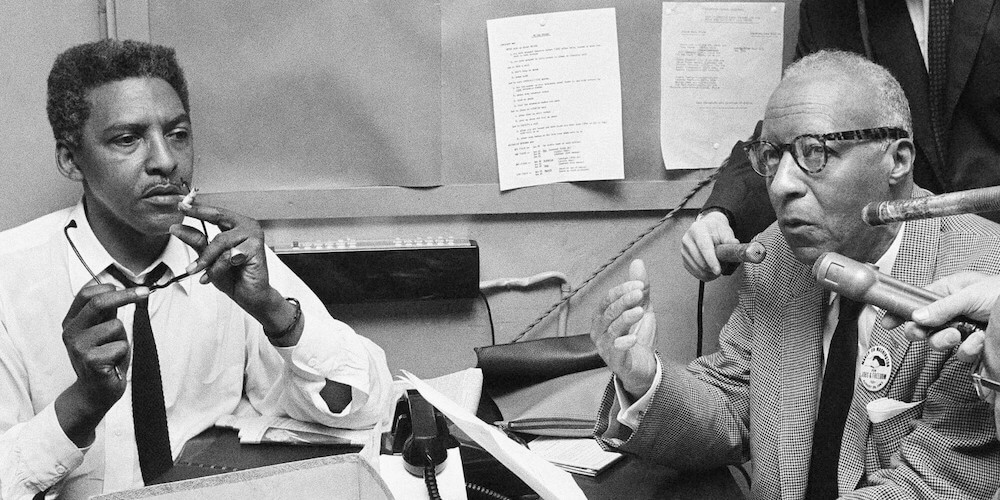
Bayard Rustin & Philip Randolph King made a charge at this time that was simply wrong. He said that President Kennedy wanted to call off the proposed March on Washington. (Risen, p. 83) Levingston’s lousy book takes a little lighter approach and tries to insinuate that JFK had nothing to do with the march. (Levingston, p. 423) First, as several books have pointed out, the March on Washington was not King’s idea or a product of the SCLC. It was the proposal of Philip Randolph and Bayard Rustin. (Charles Euchner, Nobody Turn Me Around, pp. 17-18; Patrick Henry Bass, Like a Might Stream, p. 107; Bernstein, pp. 112-13) It was meant as a fulfillment of what Randolph had negotiated away to FDR and Truman. Kennedy was not opposed to the idea. He was opposed to the first draft design. Rustin’s concept was to have a two-day mass demonstration aimed at Capitol Hill. Arthur Schlesinger was at the early meetings where it was presented to President Kennedy. (Schlesinger, A Thousand Days, pp. 969-972) Kennedy’s objection was that this was the wrong approach, it was too confrontational. Both Whitney Young and Roy Wilkins agreed with JFK. (Euchner, p. 77) So after the president got some of his own people on the organizing committee, like Walter Reuther, it was scaled back to a one-day event, and centered in front of the Lincoln Memorial. Rustin insisted he could live with these revisions since the important factors were the size of the live audience and the scope of the televised audience. (Euchner, pp. 77-78) Once that was done, President Kennedy became the first white politician in Washington to endorse the march. He then had his brother Robert assign men from the Justice Department to assist with the logistics and to arrange security. It is doubtful that the event could have come off as well as it did without that help. (Bernstein, pp. 114-16)
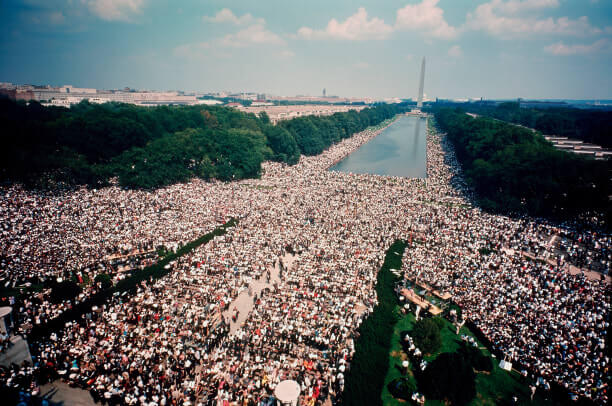
The March on Washington One last point on this event. Some have questioned why President Kennedy did not speak that day. The answer is simple: the principal organizer, Bayard Rustin, did not want him there. Not because he did not like Kennedy—he did. But because he thought it would detract from it being their moment, that is, the civil rights leaders’ time in the sun. So he and Wilkins made up an excuse that his life would be endangered, and they would see him afterwards instead. (Euchner, pp. 79-80)
Kennedy realized his presidency was on the line with the civil rights bill. He had now become hated in the South. The joke after his showdown with Wallace was: Why does Alabama have so many Negroes and Massachusetts so many Kennedys? Because Alabama had first choice. (McWhorter, p. 380) By June of 1963, his approval rating there had plummeted from 60 to 33%. He was losing votes on his other programs because of his stand for civil rights. But as Kennedy told Luther Hodges, “There comes a time when a man has to take a stand and history will record that he has to meet these tough situations and ultimately make a decision.” (Brauer, pp. 247, 263-64)
When the bill first went up, Humphrey had 42 votes, well short of the 67 he needed to force a cloture on the filibuster. (Brauer, p. 269) It was the full court press done by the president and then by the Department of Justice that finally turned it around through pressure on conservative Midwest Republicans. (Risen, p. 97) It is hard to exaggerate the impact of this bill. “It reached deep into the social fabric of the nation to refashion structures of racial order and domination that had held for almost a century—and it worked.” (Risen, p. 12)
As the reader can see, no president before Kennedy ever confronted the civil rights issue as he did. No one was even close. It was the preceding century of near inertia that created the immense problem that President Kennedy faced in 1961. But to his credit, Kennedy pressed the issue from the outset. Finally, the pressure from his administration, and the inspiration and support he gave the civil rights movement, provided the opportunity to pass what Clay Risen has called the “bill of the century”. What JFK achieved in three years is remarkable, especially when compared to his predecessors. As historian Carl Brauer wrote, what President Kennedy did was to pick up the narrow trail that Truman attempted and widen it into broad avenues. (Brauer, p. 315) And those avenues are still being traversed today. Yesterday (November 2, 2018), Kristen Clarke, the president of the Committee for Civil Rights Under Law, announced a victory for the Democrats in Georgia. Agreeing with Clarke, the court made a ruling weakening the state’s attempt to limit voting among the poor and minority groups. Clarke’s activist committee was founded in 1963 by President Kennedy for the express purpose of counteracting attempts at discrimination in the Deep South. (On the list of achievements following this essay, the reader can see it at number 20.)
When the news of President Kennedy’s assassination reached Atlanta, King grew very quiet, thinking that a similar fate awaited him. During the funeral his six-year-old son asked him, “Daddy, President Kennedy was your best friend wasn’t he?” Coretta King replied, “In a way, he was.” (Wofford, p. 175)
Four Presidents: A Comparison of Civil Rights Actions and Achievements
FDR
(13 years in office)
TRUMAN
(7 years in office)
EISENHOWER
(8 years in office)
KENNEDY
(3 years in office)
1
Fair Employment Practices in Defense Plants (FEPC)
Integrated the Military
Sent troops to Little Rock in 1957
Orally committed to backing the Brown decision
2
Appointed African Americans as policy advisors
Tried to pass a civil rights bill
Established Civil Rights Commission
Indicted school officials who defied court orders on Brown
3
Made speeches on civil rights in 1952
Created a Free Schools district when Virginia decided to drop public education
4
First administration to join civil rights cases as a plaintiff, not a friend of the court
5
Petitioned the ICC to integrate interstate busing and terminals
6
Systematically began to file cases to break down denial of voting rights in the South
7
Financed voter registration drives in the South
8
Began the drive to ban poll taxes with the 24th amendment
9
Started a massive and rigorous affirmative action program in all branches of federal government
10
Announced that no member of his administration would join a segregated establishment or speak at a segregated event
11
Revived FDR’s FEPC with the CEEO
12
Established rigorous contract and grant requirements to integrate private colleges in the South
13
Established a program to make federal contractors follow non-discriminatory hiring practices
14
Carried out court orders to integrate the last public universities in the South
15
Exploiting an exception to the law, sent in federal marshals and troops to Oxford, Mississippi and to Alabama during the Freedom Rides
16
Signed the Housing Act of 1962
17
Negotiated a settlement to the Birmingham demonstration in 1963
18
Endorsed the March on Washington in 1963
19
In a nationally televised address of 6/11/63, made the most forceful presidential address on civil rights since Lincoln
20
Established the Lawyers’ Committee for Civil Rights in 1963 to represent victims of civil rights abuses in the South
21
Submitted the epochal Civil Rights Act of 1964 and began a massive lobbying program to pass it
So much for the received wisdom that the Kennedy administration “moved cautiously on civil rights” until they were pushed into it.
Go to Part 1
Go to Part 2
Go to Part 4
-
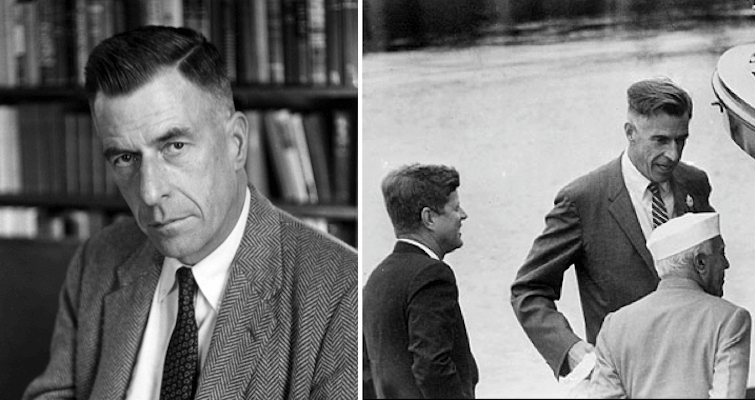
John Kenneth Galbraith: A Hero in our Time
As many who are interested in the JFK case know, John Kenneth Galbraith was truly A Man for All Seasons. There are few men in public life who pulled off the triple crown like he did: serving with distinction as a public figure, an academician, and as a man of letters. Specifically, Galbraith was an advisor to Presidents Franklin Roosevelt, Harry Truman, John Kennedy and Lyndon Johnson; he served as an instructor at Harvard for over 25 years; was a writer and editor at Fortune and, all told, wrote over forty books. Two of them are considered classics: The Great Crash and The Affluent Society. To have performed just one of those endeavors would make an individual a significant figure in American life. To have done all of them is a remarkable achievement. To have done them with the wit and style that Galbraith possessed makes what he did just about unique in modern American history.
Galbraith was born in Ontario, Canada in 1908. He was granted an undergraduate degree at a branch of the University of Toronto in 1931. He then went to the University of California, Berkeley to attain his Masters and Ph. D. in agricultural economics. After graduation he taught at both Harvard and Princeton from 1934-40. He worked in the Office of Price Administration for Roosevelt, and then as one of the directors of the Strategic Bombing Survey under Truman. In the last position, he disagreed with his boss, the eternal hawk Paul Nitze, on the effectiveness of the bombing over Germany in reducing war production. After this he went to work at Henry Luce’s Fortune and then in 1949 he was appointed a full professor in economics at Harvard.
Galbraith had a role in writing the summary reports for both the bombing survey of Germany and Japan. He concluded that war production had expanded during the bombing of Germany. Some strategic targets were impacted; others were not. But bombing had not decided the war in Europe. The air war cost America more than it did the Germans; it was just that the USA could afford it at the time. The real value of the bombing was in support of ground troops. They had won the war. (Richard Parker, John Kenneth Galbraith, p. 183)
Galbraith’s input into the summary survey of the bombing of Japan was probably even more important at dispelling myths. He described the terrible fire bombings of Japanese cities that sometimes consumed as many as 16 square miles, causing massive numbers of civilian deaths, but barely touching industrial production. He then wrote that in all probability, Japan likely would have surrendered in December of 1945, or maybe even in November, without the two atomic bombs being dropped. (Summary Report, Pacific War, July of 1946, p. 26)
These insights by a skilled economist like Galbraith seem to be quite valuable, especially in light of the later emphasis placed on bombing in both the Korean War and especially the war in Indochina. The tons of bombs dropped over Indochina exceeded the tonnage dropped over both Germany and Japan during World War II. In fact, it was not even close. Yet none of the countries in Indochina—Laos, Cambodia and Vietnam—had a real industrial base as did Japan and Germany. Most of the population made its living from agriculture. So Galbraith had a real perspective on this issue during his advisory years with President Kennedy.
It was during his first stretch of employment at Harvard that he met young John Kennedy. From 1936-39, Galbraith tutored JFK at Winthrop House. (Parker, p. 324)
It is difficult to overestimate how much Galbraith liked writing and being on the faculty at Harvard. For instance, in 1946, he turned down an offer from Nelson and David Rockefeller to become chief economist for the Rockefeller family. (Parker, p. 222) I should not have to inform our readers the kind of money and status that position would have offered him.
In 1956, Senator Kennedy sought his advice on an agricultural issue. After that, Kennedy developed a rather close relationship with Galbraith as an unpaid advisor. The relationship deepened after the launch of Sputnik in 1957. The two would often meet in Cambridge when Kennedy was in Boston. Kennedy came to rely on Galbraith briefing him before his major appearances. (Parker, p. 325)
In 1960, Galbraith was one of candidate Kennedy’s floor managers at the Los Angeles Democratic convention. He then wrote several speeches for the nominee during the campaign and prepped him for the third debate with Richard Nixon. He was at Kennedy’s campaign headquarters the night of the election. (Parker, p. 336)
As most people who have studied Kennedy’s political career know, he had a genuine interest in the huge country of India. He felt that being the largest democracy in the world, and sitting in south Asia, it was of large strategic importance. In the late fifties, he wrote an article for The Progressive on the subject. With Senator John Sherman Cooper, he drew up an aid bill for the country. (Cooper had been President Dwight Eisenhower’s ambassador to India.)
But another reason Kennedy viewed India to be of central importance is because of its proximity to Red China, and also to the former countries of French Indochina. If there were tensions in that area—as there were bound to be—then India could be both a counterweight, and also a nearby emissary. If such were the case, Kennedy would need a man whom he trusted implicitly to be the ambassador there. Which is why he chose Galbraith for the position.
But with the kind of relationship the two men had, Galbraith was still advising Kennedy on a wide variety of subjects. On economics, Galbraith was a disciple of the great Englishman John Maynard Keynes. So he urged Kennedy to adapt an expansive economic policy in order to encourage growth. As almost any observer of the Kennedy presidency knows, the years 1961-66 were probably unmatched in post-war American economic history. Gross National Product averaged 5% growth each year, employment grew 2.5% each year, unemployment receded to 3.9%, poverty declined by a third and inflation was at a quite manageable 2 per cent. All of this was done with no significant budget deficits and a positive balance of payments.
To show how in sync Galbraith was with Kennedy, during his confirmation hearings, the economist suggested that the USA recognize Red China. This created quite a stir on the committee. (Parker, p. 351) But as our readers know through the recently posted interviews with State Department official Roger Hilsman, this is what Kennedy had discussed with Hilsman as early as 1961.
Galbraith tried to warn Kennedy about committing to the Bay of Pigs operation. He also warned about using American ground troops in Laos. (Parker, pp. 354-56) Kennedy agreed with this and told Richard Nixon, “I just don’t think we ought to get involved in Laos, particularly where we might find ourselves fighting millions of Chinese troops in the jungle.” (Galbraith, Ambassador’s Journal, pp. 45-48)
And, of course, there was Vietnam. Kennedy had been advised by the likes of Edmund Gullion, Nehru of India, and General Douglas MacArthur on the subject. They all advised him not to send in combat troops. Galbraith agreed with them. Inside the Kennedy White House, he sided with Chester Bowles and George Ball for non-intervention. In prior treatments of precisely what Galbraith’s role was in these debates, the picture painted of it was, to say the least, a bit murky.
For instance, in David Halberstam’s long book The Best and the Brightest, Galbraith is portrayed as being some kind of outsider, on the periphery of Kennedy’s circle. (Halberstam, p. 152) To state it kindly, Halberstam’s book has not aged well. To be unkind, today it seems quite misleading; so much so that this author would call it pernicious. In addition to getting the role of Robert McNamara wrong, the highly praised Halberstam also mischaracterized Galbraith’s part.
John Newman came closer to what the true facts and characterizations were in his milestone book JFK and Vietnam, first published in 1992. There, Newman wrote that Galbraith had written Kennedy in March of 1962 after visiting Vietnam. He was quite derisive about America being involved there at all. He suggested a neutralist political solution, similar to what the administration was negotiating for in Laos. (Newman, p. 236) This is more accurate but is still unsatisfactory since it is incomplete.
Galbraith’s role in all this began even before the famous two week long November, 1961 debate over committing combat troops to Saigon. In July of 1961, Galbraith wrote the president, warning him about the information he was getting about Indochina. He said that President Ngo Dinh Diem was not the right man to lead South Vietnam. He had alienated the public to a much further degree than the newspaper reporters have let on. (Galbraith, Letters to Kennedy, pp. 76-77) But it turns out that Galbraith was directly involved in the November debates.
The ambassador was in Washington to accompany Prime Minister Jawaharlal Nehru on a state visit. Galbraith had already heard about the mission President Kennedy had sent General Max Taylor and Deputy National Security Advisor Walt Rostow on in October. The ambassador feared America’s entry into a war in Vietnam would be a disaster. It could endanger Kennedy’s domestic programs, tear the Democratic Party apart, and perhaps provide the opening for a new conservative era in American politics. (The Nation, February 24, 2005, “Galbraith and Vietnam”)
Galbraith had arranged the luncheon to be at the Newport Rhode Island home of Jackie Kennedy’s mother, so no other State Department representative would be there. Kennedy and Galbraith asked the Indian leader to participate in a neutralist solution for Vietnam. They even asked him to talk to Ho Chi Minh about forming a UN observer team as a first step in that direction. Nehru was non-committal except for saying that America should not get into a shooting war in Indochina. (Galbraith, A Life in our Times, pp. 470-77)
The next day in Washington, Galbraith made a beeline for Rostow’s office. He questioned Rostow about the actual contents of the report. Rostow said it was highly classified. Then the phone rang. With Rostow distracted, Galbraith stole a copy of the report from his desk and left. (The Nation, 2/24/2005)
Reading it back at his hotel, the ambassador was stunned. He realized that this report and its recommendations would create the first commitment of combat troops to Saigon and that would then be the pretext for an open-ended conflict. The first group of 8,000 men were to go in under the guise of “flood relief workers”. The report recommended deepened cooperation between the CIA and Saigon’s intelligence, more covert operations and massive training of Vietnamese soldiers. Plus the use of a sprayed herbicide which Secretary of State Dean Rusk told Kennedy was really a weed killer. (At first this was called Agent Purple, it later turned into Agent Orange.)
Kennedy had seen Galbraith the day before the Newport meeting. Realizing there was going to be a long debate over the Taylor-Rostow report, he had asked him to prepare a paper to contest direct American involvement. This now became the basis for his memo to the president. JFK read both documents and then postponed the meeting on Vietnam. Meanwhile, Galbraith did something that the president had already done. (Jim Douglass, JFK and the Unspeakable, p. 107) The ambassador started leaking stories to the press that Kennedy was opposed to the escalation his advisors were pressing on him. Before Galbraith left to return to India, he told Kennedy it would be a good idea if he stopped off in Saigon. JFK agreed and then instructed the ambassador to report back to him alone. (The Nation, 2/24/2005; Parker, p. 370-72)
At the crucial meeting, which occurred on November 11, Galbraith’s biographer Richard Parker notes something that Newman did not mention, namely that Bobby Kennedy was in the room. Later, authors like David Kaiser and Gordon Goldstein did write about this information, based upon recovered notes. In what appears to be a mapped out plan, the Attorney General would repeatedly deny any suggestion of ground troops by saying flatly, “We are not sending combat troops. Not committing ourselves to combat troops.” (David Kaiser, American Tragedy, p. 113) Then the president would add that if there was ever going to be a troop detachment sent in it would be a multilateral mission, under the aegis of the UN or SEATO. (Parker, p. 371)
As most of us know, this two week long debate ended with Kennedy issuing NSAM 111. That order significantly increased the number of American advisors to over 15,000 and it sent in more equipment, like helicopters. But this is as far as Kennedy was going to go. He was going to aid Saigon, but he was not going to fight their war for them. He never allowed combat troops into theater. In fact, there was not one more combat troop in Vietnam on the day Kennedy was killed than on the day he was inaugurated. The president even wanted to replace Frederick Nolting as ambassador to Saigon with George McGhee, who he knew was opposed to intervention. But Dean Rusk, who had been one of the leaders for troop insertion during the debate, nixed this idea by saying Nolting should stay since he had Diem’s confidence. (Parker, p. 376)
It seems to this author that with the information about Bobby Kennedy’s role in the November, 1961 debates, the attempt by Kennedy to replace Nolting, and the now fully revealed role of Galbraith, this episode is even more clearly a demarcation line than before. Kennedy simply was opposed to transforming Vietnam into America’s war, and he knew that was what it would become if ground troops were placed in theater. As the president had told Arthur Schlesinger:
They want a force of American troops. They say it’s necessary in order to restore confidence and maintain morale … The troops will march in; the bands will play, the crowds will cheer, and in four days everyone will have forgotten. Then we will be told we have to send in more troops. It’s like taking a drink. The effect wears off and you have to have another … The war in Vietnam could be won only so long as it was their war. If it were ever converted into a white man’s war, we would lose as the French had lost a decade earlier. (Gordon Goldstein, Lessons in Disaster, p. 63)
Upon Galbraith’s return to Asia, he did file a report from Saigon. In fact, he eventually filed three of them. These all ended up being back channel cables, meaning they bypassed the usual State Department protocols. They were laced with Galbraith’s blend of impatience and sarcasm: “Who is the man in your administration who decides what countries are strategic? I would like to … ask him what is so important about this real estate in the Space Age.” (The Nation, 2/24/2005) And again, Halberstam was wrong about what happened as a result of these, just as he was wrong about how Kennedy regarded his advice in November of 1961. For Galbraith was not on the periphery, he was at the center of the story—in two ways.
First, Kennedy attempted to follow up on the ambassador’s proposal to open negotiations for a neutralist Vietnam settlement through India. Unfortunately, he tasked the wrong person with the mission. Averill Harriman was Kennedy’s point man on the attempts to defuse the Laotian situation with a coalition government. Apparently he did not feel the same way about Vietnam. In December of 1961, Harriman had been appointed to Assistant Secretary of State for East Asian and Pacific Affairs. Kennedy asked Harriman to send instructions to Galbraith about pursuing a peace plan by having Indian and Russian diplomats approach Hanoi. Harriman suggested a delay, which the president agreed to. But Kennedy concluded “that instructions should nevertheless be sent to Galbraith, and that he would like to see such instructions.” Harriman said he would send them. (Douglass, p. 119) Harriman did send instructions, but “he struck the language on de-escalation from the message with a heavy pencil line.” The diplomat dictated a memo to his colleague Edward Rice which changed the de-escalation approach to a threat of escalation of the war unless Hanoi accepted American terms. When Rice tried to rewrite the memo with the original instructions, Harriman again struck Kennedy’s language. He then simply killed the telegram altogether. (Gareth Porter, Perils of Dominance, pp. 158-59)
Galbraith’s other attempt at de-escalation was more successful. In early April of 1962, the ambassador was visiting the Kennedy family for a weekend at Glen Ora, their rented estate in the Virginia countryside. Jackie Kennedy had just made an official visit to India and they were watching a TV special about it. He then told the First Lady about his talk with the president about the situation in Saigon, his later visit to Defense Secretary Robert McNamara, and the memo he left behind. (Parker, p. 389)
It turned out that Kennedy had been giving the Galbraith memos about Vietnam a lot of attention. He wanted the ambassador to put his thoughts in writing and give a copy to McNamara. In that memo, Galbraith stated American policy should keep the door open for a political solution. We should also measurably reduce our commitment to the present leadership of South Vietnam. He then added that the advisors who were already there should not be involved in combat and kept out of any combat commitment. Their roles should become as invisible as the situation allowed. (Newman, p. 236)
As described in JFK and Vietnam, this memo was mightily resisted by the Pentagon, because, just five months after sending in advisors and equipment, Kennedy now had an alternative. Newman also notes that Kennedy had said at that time “he wished us to be prepared to seize upon any favorable moment to reduce our commitment, recognizing that the moment might yet be some time away.” (Newman, p. 236) In other words, Galbraith had just given Kennedy support for what he really wanted to do in Indochina. As both Douglass and Newman have written, Galbraith’s visit to Washington and the handing off of his memo to McNamara were the beginning of Kennedy’s withdrawal plan from Vietnam. (Newman, p. 237; Douglass, p. 119)
The very next month, in May of 1962, Robert McNamara now delivered a surprising message to his subordinates in Vietnam. Arriving in Saigon for one of his so-called SecDef meetings, McNamara asked some of the higher-ups to stick around after the formal meeting ended. The defense secretary now echoed what the president had told Arthur Schlesinger: “It was not the job of the U.S. to assume responsibility for the war but to develop the South Vietnamese capability to do so.” (Douglass, p. 120) He then asked when they thought Saigon would be able to assume sole responsibility for all actions. The secretary got no satisfactory reply, since everyone was shocked by the question. So he proceeded to tell the commander in charge of the American advisory command, General Paul Harkins, “to devise a plan for turning full responsibility over to South Vietnam and reducing the size of our military command, and to submit this plan at the next conference.” As Jim Douglass notes, Kennedy and McNamara only wanted a plan for withdrawal at this time. For as he had told Galbraith in November of 1961, “You have to realize that I can only afford so many defeats in one year.” (Galbraith, A Life in Our Times, p. 469) The president was referring to the Bay of Pigs and Laos, the latter of which he knew the Pentagon would consider a defeat.
It took quite a long time for the commanders of all departments in Vietnam to prepare their withdrawal schedules for McNamara. More than a year to be exact. But finally, in May of 1963, at a SecDef meeting in Hawaii, they were presented to McNamara. McNamara said they were not fast enough and requested they be accelerated “to speed up replacements of U.S. units by GVN units as fast as possible.” (Douglass, p. 126) This plan was then coordinated with Kennedy’s NSAM 263 order and its accompanying report, which dictated that a thousand men would be withdrawn from Vietnam by the end of 1963, and all American advisors would be removed by 1965. So much for Galbraith being at Halberstam’s “periphery”. In a very real sense, the ambassador had provided the rationale for Kennedy’s withdrawal plan.
Galbraith always said that he would only serve under Kennedy for a bit more than two years since he had to get back to Harvard in order not to lose tenure. How badly did Kennedy want him to stay? He offered him the ambassadorship to the USSR. (Parker, p. 406) If Kennedy had lived, and Galbraith had taken that position, one can only imagine how relations between the two superpowers would have turned out. But the fact that JFK offered him the position shows what the president had in mind for the future. He saw how visionary Galbraith was on Vietnam, and he wanted to try more of that with Russia.
Galbraith continued to be an advisor to the White House after Kennedy’s assassination. But he and President Johnson simply did not agree on Indochina policy, and Galbraith really did not like how the escalation of the Vietnam War began to downsize the War on Poverty. In January of 1966, he wrote a memo to Johnson saying that America had no national interest at stake in Vietnam. A few months later he tried again. He offered to write a speech that would set the stage for American withdrawal. Johnson did not appreciate the advice. And that was about it for their relationship. (Parker, p. 431)
But about four months before that happened, and probably provoking the exchange, Galbraith had shared a dinner with Richard Goodwin, Carl Kaysen, Arthur Schlesinger, and Defense Secretary McNamara. By this time, January of 1966, each of these men, except for McNamara, had left the White House. Galbraith described the meeting as jarring. McNamara was extremely emotional as he described what was happening in Indochina and at the White House. The Defense Secretary said the war was spinning out of control. Rolling Thunder, the bombing campaign Johnson had banked on, was not effective. Johnson was getting depressed over the results. But he still seemed insistent on victory, even if it meant more escalation. If America did not find a way out soon, we would lose the war. (Kai Bird, The Color of Truth, p. 345; Galbraith, A Life in our Times, pp. 482-83) This is why he wrote to LBJ. Instead, Johnson escalated the war further. He then pushed McNamara out of office. But it was very likely that dinner which caused McNamara to begin the task of writing the Pentagon Papers.
Galbraith now wrote a book entitled How to Get out of Vietnam. It sold 250,000 copies. Along with Schlesinger and Goodwin, he organized a protest group called Negotiations Now. He had concluded that if LBJ would not end the war, someone who would must run against him in 1968. Things go so bitter between the two men that Johnson told White House advisor John Roche to start attacking Galbraith in the press. (Parker, p. 432)
Galbraith finally did find someone to run against Johnson. It was Senator Eugene McCarthy. When Bobby Kennedy later announced he was also in the race, Galbraith was in a sticky position. But he felt he should be loyal to his first choice, so he stuck with McCarthy, even though after Johnson made his shocking announcement not to run, it was apparent RFK was the stronger candidate with a better chance to defeat Richard Nixon in the fall.
After Robert Kennedy was assassinated, McCarthy, for all intents and purposes, dropped out of the race. After Kennedy’s funeral, Galbraith visited him in Washington. He later wrote the following about that meeting:
Gene was deeply depressed; the death of Robert Kennedy showed the hopelessness of the game. What had been real would now be pretense; what had been pleasure was now pain … I pleaded that he carry on. The banality of my argument still rings flatly in my ears. Gene remained sad and unmoved, but proposed another talk in Cambridge a few days later. This we had with Coretta King and a number of McCarthy’s local supporters present. His mood was better … but I don’t believe that Eugene McCarthy’s heart was ever again wholly in the battle. (Galbraith, A Life in our Times, p. 499)
The Kennedy administration was responsible for being the first to bring some remarkable men into the White House, or promoting them to their highest positions. These individuals were not just outstanding civil servants; they were extraordinary men in their own right. People like Robert Kennedy, George Ball, Richard Goodwin, Harris Wofford, Ted Sorenson, Sargent Shriver, Arthur Schlesinger, Edmund Gullion, Adam Yarmolinsky and G. Mennen Williams were all distinguished individuals and personalities who have yet to be surpassed in talent and achievement by those who followed. As a group no other administration comes close.
John Kenneth Galbraith is one of the most distinguished of them all.
-

The Kennedys and Civil Rights: How the MSM Continues to Distort History, Part 2
Part 2: The Media Spin-Dries JFK on Civil Rights
I. The MSM Vitiates the Record on JFK
As I said in my introduction to Part 1, from the work of Larry Sabato in 2013, I suspected the MSM would attempt a preemptive strike against President Kennedy’s civil rights achievements at the 50th anniversary of the MLK/RFK assassinations, for the obvious reason that both of those men were strongly involved in that struggle. Steven Levingston, of the Wall Street Journal and Washington Post, led it off. I would like to give Levingston some career advice. He missed his calling. He should have been a playwright. His 2017 book Kennedy and King is such a carefully crafted confection it would have done Tennessee Williams or Edward Albee proud. As history, it is worthless; but that is not what Levingston is interested in. At the outset, he sets up an external dramatic agon between Martin Luther King and John F. Kennedy, declaring that “King had to overcome White House mistrust, disregard, and stonewalling before his message sank in.” (Levingston, p. xi)
Steve Levingston:
Missed his callingThis is utterly false. As opposed to Eisenhower, the Kennedys began working on the racial issue quite quickly—without King. And they did not stop until they did something that neither Eisenhower nor Truman came close to doing—they got an omnibus civil rights bill into Congress and worked hard to see it through. (As we shall see, the idea that Lyndon Johnson got the milestone Civil Rights Bill of 1964 passed is a myth.)
In Part 1, I described the terrible conditions that existed in the South due to the failure of Reconstruction. This created a huge obstacle in trying to correct the immense problem, since the power structure of the South was built upon it. How does Levingston assess this horrendous record that confronted the Kennedy administration? About all the horrible things done in the South from Reconstruction onward, Levingston is rather dismissive. He writes, “So far from being modernized, in many ways the Southern Mind has actually always marched away from the present toward the past.” (p. 16) Well, that is one way of dealing with the torture murder of Sam Hose, the massacre at Rosewood, and the destruction of a whole section of Tulsa. But as far as establishing a historical backdrop, it means zilch. On top of that, there is next to nothing about the paltry record of FDR, Truman and Eisenhower.
Another part of the plan is to make Kennedy out to be rather timid on a number of issues, not just race. Like every other cheapjack writer on the scene, Levingston does what he can to make the worst of the Joe McCarthy episode for Senator Kennedy. He tries to say that somehow Kennedy’s failure to show up and vote during the censure roll call against Joe McCarthy in December of 1954 exhibits this character flaw. But he also acknowledges that Kennedy was in the hospital at the time, seriously ill, lapsing in and out of consciousness. (Levingston, pp. 22-23) As Harris Wofford relates in his book, Of Kennedys and Kings, Senator Kennedy had been through a near-death experience—he was given last rites—due to a back operation at this time. (Wofford, p. 35) Should he have been wheeled onto the Senate floor, with his doctor next to him? The vote was overwhelming for censure anyway; the final tally was 67-22. This makes the idea that somehow Kennedy should have called in and “paired” his vote with someone who was against censure silly. Why? In order to add one more vote to the landslide? But further, in his weakened state, his assistant Ted Sorenson had written a speech for him to give in favor of the censure vote. So there is no doubt where he stood on the issue.
A key point Levingston completely leaves out is that it was the senator’s brother, Robert Kennedy, who had started the movement to censure McCarthy in the first place. Bobby Kennedy had been on McCarthy’s committee. He resigned since he did not like the direction in which Roy Cohn, McCarthy’s chief counsel, was taking that body. The Democratic minority later asked him back to be their chief counsel. In the summer of 1954, after both McCarthy and Cohn imploded during the Army-McCarthy hearings, Bobby Kennedy essentially took over that committee. He retired the cases against Irving Peress and Annie Lee Moss, dismissed the accusations of mass infiltration of defense plants, and then authored a report that was so critical of McCarthy and Cohn that some Democrats would not sign on to it. It recommended the Senate take action for their abuses. It was this report that led to the censure vote against McCarthy in December of 1954. (Arthur Schlesinger, Robert Kennedy and His Times, pp. 118-19)
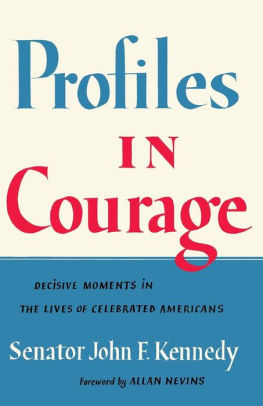
But that’s not enough for Levingston. He now does something worse. He says that Senator Kennedy wrote his book Profiles in Courage to somehow apologize for not showing up on a gurney to mark the 68th vote to censure McCarthy. (Levingston, p. 25) Even for a reporter who worked for the Wall Street Journal, this is really out there. Profiles in Courage is about men in politics who did things that had no political advantage for them; they did them anyway since they thought they were right. Now, since 1951, John Kennedy had been out there by himself—in both the House of Representatives and the Senate—harping away against the Truman/Eisenhower approaches to communism in the Third World. In other words, he was, in part, criticizing his own party. It may have been crowd-pleasing and popular to suggest that the communist threat was the monolithic monster that the domino theory suggested, but Kennedy said that was not true. The force of nationalism, the desire to be free from European colonialism, was really responsible for much tumult in the Third World. (See my Destiny Betrayed, pp. 17-25) Senator Kennedy made speeches on this subject, gave radio interviews, and wrote letters to his electorate about it. But he had no Capitol Hill or White House followers in this crusade at the time. Would it not therefore be logical to assume that this is what motivated him to write the book? I mean, was he not doing something that garnered him little if any political favor simply because he felt it was the right thing to do?
But Levingston can’t go there. He can’t even mention it. First, it would illustrate the political and moral courage that Levingston wants to strip away from Kennedy. Second, it would also show that, from early in his political career, Kennedy had some understanding of the conditions of colonialism and imperialism that were imposed on people of color in places like Africa.
In keeping with his preplanned construct, Levingston does not begin to address Kennedy’s actual involvement with the whole race issue until 1959 and his preparations to campaign for the Democratic presidential nomination. This eliminates a rather important fact: namely, that, unlike Eisenhower or Nixon, neither of whom endorsed the epochal Brown decision, Senator Kennedy did so in 1956:
The Democratic Party must not weasel on the issue … President Truman was returned to the White House in 1948 despite a firm stand on civil rights that led to a third party in the South … We might alienate Southern support but the Supreme Court decision is the law of the land. (NY Times, 2/8/56, p. 1)
That speech was made in New York, a liberal city and state. But in 1957, Kennedy went south to Jackson, Mississippi. He said the same thing: the Brown decision must be upheld. (Harry Golden, Mr. Kennedy and the Negroes, p. 95) The fact he did this in the Deep South would seem to denote the courage Levingston said Kennedy lacked. For, as author Harry Golden notes, it was at this point that Kennedy began to lose support in the South and even get angry letters about his advocacy of the Brown decision. But by not mentioning these incidents, Levingston can say that Kennedy exhibited little courage or morality on the issue. What makes it worse is that when one turns to his bibliography, Levingston lists Harry Golden’s book, which noted the incident way back in 1964. This is what I mean about being a playwright.
In passing, the author mentions Senator Kennedy’s vote on the bill constructing the 1957 civil rights commission. Levingston writes that Kennedy sided with the segregationists on a complicated procedural matter that watered down that bill. (p. 58) Even for Levingston, this is sorry. What watered down the bill was the removal of something that Kennedy voted for. This was called Title III. It allowed the attorney general to sue cities in civil court over voting rights and school integration. Kennedy backed that part of the bill. So how does being for that aspect jibe with siding with the segregationists? That part of the bill was voted down. (Golden, p. 94) And as anyone who has read anything about that vote understands, the man who engineered its defeat was Majority Leader Lyndon Johnson.
The bill originally sent up by Eisenhower’s attorney general was completely commandeered by Johnson, to the point that, when it was completed, it was really Johnson’s bill. He planned it that way because he observed the fate of his mentor, Senator Richard Russell of Georgia. Due to his segregationist stance, Russell could not advance his presidential ambitions on the national scene. Noting this, Johnson was intent on broadening his profile beyond the South; he did not want to be pigeonholed as a regional candidate. (Rowland Evans and Robert Novak, Lyndon B. Johnson: The Exercise of Power, pp 122-25) So he took over this bill, made it his own, and made sure it would pass the Senate. How did this occur?

Strom Thurmond and Richard Russell Johnson made a deal with Russell and Senator Strom Thurmond: if he defanged the bill, they would not filibuster it. One way he did so was eliminating Title III. The other way was by adding a jury trial amendment. This meant that if there was an obstruction of voting rights, the accused would be tried by a jury. Which at that time in the South meant the defendant would very likely be acquitted. Johnson had specifically targeted Kennedy as a northern vote and he sent two people to convince him to vote for it. When Kennedy resisted, LBJ himself went to his office to lobby him. The issue was presented as follows: the amendment must be added or the bill would fail. Kennedy then consulted with some Ivy League lawyers and they told him that having some kind of a Civil Rights Commission—which was largely what was left of the bill—was at least a step in the right direction. (Evans and Novak, pp. 136-37)
In contradistinction to what Levingston claims, what happened was not Kennedy siding with segregationists; it was a first term senator siding with the majority leader in order to get half a loaf instead of none. It should be added: even with Johnson’s severe alterations, Senator Strom Thurmond broke his agreement with him. He enacted a one-man record-setting filibuster. This was meant as a warning to LBJ: this was a one-time exception; don’t try it again.
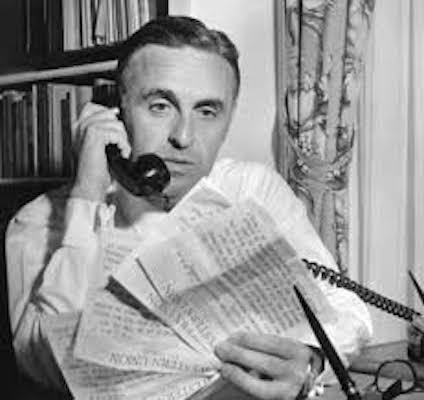
Abraham Ribicoff, JFK’s
first choice for attorney generalOne of the silliest contentions in Levingston’s volume is that as president JFK appointed his brother Robert as attorney general because of his habit of turning to his older brother Joe in childhood tussles. In other words, he depended on his brothers to fight his battles for him. (p. 7, p. 168) Again, this fruitiness can only survive by not consulting the record. Bobby Kennedy was not JFK’s first choice for attorney general. Kennedy’s first choice was Senator Abraham Ribicoff. (Schlesinger, p. 237) So what would have become of Levingston’s argument if Ribicoff had accepted the position? And to show what a careful playwright the author is, Ribicoff is not mentioned in his book.
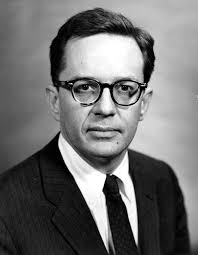
Burke Marshall But even more damaging to Levingston’s attempt at pop-psychology is the following. President Kennedy’s first civil rights advisor, Harris Wofford, had written a long memo to him before the inauguration. That memo stated that since the upcoming civil rights battles would largely take place in court, the Department of Justice should be the focal point of the conflict. He therefore pointed out that the key spots in the administration on civil rights would be the attorney general, and his civil rights deputy. This prediction by Wofford ended up being correct. From this standpoint, Kennedy may be said to have been following Wofford’s memo, which turned out to be farsighted, especially when RFK made the fine choice of Burke Marshall as his deputy on civil rights. (Irving Bernstein, Promises Kept, pp. 40-41)
The main body of Levingston’s confection relies on a thesis he borrows from one of the most bizarre, eccentric books on the Kennedy administration ever published. This is BBC reporter Nick Bryant’s 2006 volume entitled The Bystander. Both Levingston and Bryant argue that Kennedy should have moved for a civil rights bill faster then he did. Which would mean in 1961 or 1962. (Levingston, pp. 120-21)
The problem with this idea is that there is simply no empirical evidence to sustain it. From the 1870’s to the late 1950’s, no civil rights bill had ever gotten through the southern bloc in Congress. (Evans and Novak, p. 121) And just from 1917 forward, there had been nine different attempts to do so. They all failed. (Bernstein, p. 39) As noted in Part 1, the Truman administration had tried in 1949. They were routed. As also noted, the only reason the 1957 bill got through was because Johnson had pretty much denuded it and told the southern Senate leadership—made up of Russell, Thurmond, and Sam Ervin of North Carolina—that he would do so in advance. But in 1960, when the administration tried to add to that bill to strengthen voting rights, Johnson could not defeat the filibuster. He did not even come close. (Evans and Novak, p. 221) If Johnson, the man who was the maestro, the Toscanini of the Senate, could not come close to breaking the filibuster in 1960, how could Kennedy in 1961?
On top of that, Kennedy was assured this was indeed the unfortunate state of affairs by his advisors. In his long memo planning a civil rights strategy submitted in late December of 1960, Harris Wofford did not even mention passing a bill as a possibility. (Bernstein, p. 48) Joe Clark of Pennsylvania, one of the most liberal senators in the body and a strong advocate for the issue, also told Kennedy it was not possible. (Bernstein, p. 50) The president’s chief vote-counter in Congress, Larry O’Brien, also said the votes were not there, even in 1962. (Andrew Cohen, Two Days in June, p. 82) The new Senate majority leader, Mike Mansfield, did not think a civil rights bill would pass, and this was in 1963. At that time, Vice President Johnson felt the same way; further, he thought the very attempt would kill off other parts of President Kennedy’s program. (Carl Brauer, John F. Kennedy and the Second Reconstruction, p. 245) Yet we are supposed to think that a British BBC reporter today, like Bryant, knows better than the experts on the scene did at the time.
But the ultimate proof that both Bryant and Levingston are wrong on this point emerges from the list of events that had to occur for the bill finally to pass in the summer of 1964.
- The Democrats gained four more seats in the Senate in 1963, all outside the South.
- The May 1963 televised violent demonstration in Birmingham, Alabama.
- The Kennedys’ televised showdown with Governor Wallace at the University of Alabama the following month.
- JFK’s televised watershed speech on civil rights in June of 1963.
- The murder of civil rights leader Medgar Evers on that same day.
- The televised Randolph/Rustin March on Washington in August of 1963.
- JFK’s massive, unprecedented White House lobbying effort for the bill.
- The president’s assassination in a southern city in November of 1963.
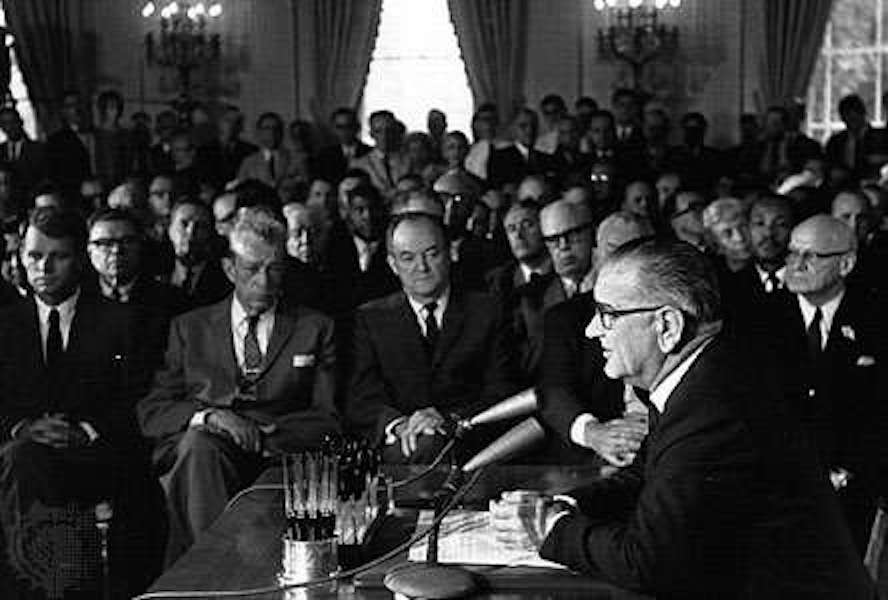
Signing the 1964 Civil Rights Act Even with all of those momentous events, it took one year to pass Kennedy’s civil rights bill. It was the lengthiest debate in congressional history, featuring the longest filibuster in Senate history. This is how determined the South was to block it, since they knew it would mark the beginning of the end of the system this author outlined in Part 1. How do Levingston and Bryant surmount this overwhelming evidence that they are wrong? They don’t deal with it. Talk about profiles in courage. Levingston mentions the passage of the bill in one sentence (Levingston, p. 432), while Bryant does not even refer to it. In fact, in his usual manic, over-the-top manner, Bryant says that Kennedy was not really concerned with the bill’s passage at the time of his death. (Bryant, p. 452) This is completely contradicted by the record produced in Clay Risen’s book, The Bill of the Century, describing the passage of that act. (See pages 97-134) Need I add that playwright Levingston listed the Risen book in his bibliography?
To characterize the value of the efforts of Levingston and Bryant: If the main thesis of your book—that Kennedy could have gotten a civil rights bill through earlier—is so weak and unfounded that you cannot even present the evidence that counters and neutralizes it, then, 1) How honest are you being with the reader? And 2) What is your book worth? I would add a third question: Why would you write such a book? Because to anyone familiar with the issue, the person who dawdled on civil rights was not Kennedy, it was Eisenhower.
II. Taking Aim at RFK
David Margolick David Margolick’s The Promise and the Dream and Michael Eric Dyson’s What Truth Sounds Like, deal much more with Bobby Kennedy than with President Kennedy’s role in civil rights. One of the strangest parts of Margolick’s book is where he actually seems to endorse Levingston’s flatulent volume as being accurate about JFK’s role in that cause. He calls President Kennedy’s position passive for the first two years. (Margolick, p. 112) As we shall see, this is not supported by the record.
But in keeping with these questionable characterizations, Margolick, as with Levingston on JFK, wishes to shrink Bobby Kennedy in relation to King. So Bobby is represented as a committed Cold Warrior (similarly to the appraisal of his brother which has mistakenly prevailed), and that somehow, “like him and so many others, [RFK] had seen Vietnam as a place to take a stand against communism.” (Margolick, p. 235) His main source for this is a nearly fifty-year old book by David Halberstam. It is notable that he ignores the more recent research by Richard Parker which reveals that Bobby Kennedy was in the room during the November 1961 debates about committing combat troops to Vietnam. In newly discovered notes, Bobby kept insisting, “We are not sending combat troops.” This was clearly meant to back up his brother, who then said that if troops were ever sent it would only be as part of a multilateral force under the aegis of the United Nations. (The Nation, 2/24/2005, “Galbraith and Vietnam”)
Bobby Kennedy’s role in 1961 is bookended by the fact that, in 1963, he served as the liaison between his brother and the writing team of General Victor Krulak and Colonel Fletcher Prouty, who actually composed the McNamara/Taylor trip report in Washington. When it was finished, it was then bound and sent to Hawaii so Secretary of Defense Robert McNamara and General Maxwell Taylor could read it on their return trip from Saigon, on the plane flight to Washington. RFK knew that this dictated report would serve as the backing for NSAM 263, Kennedy’s order for a military withdrawal from Vietnam. (John Newman, JFK and Vietnam, p. 401) Why Margolick would use the 1969 work of a man like Halberstam, whose writing on Vietnam is pretty much obsolete, and ignore Parker, is kind of odd.
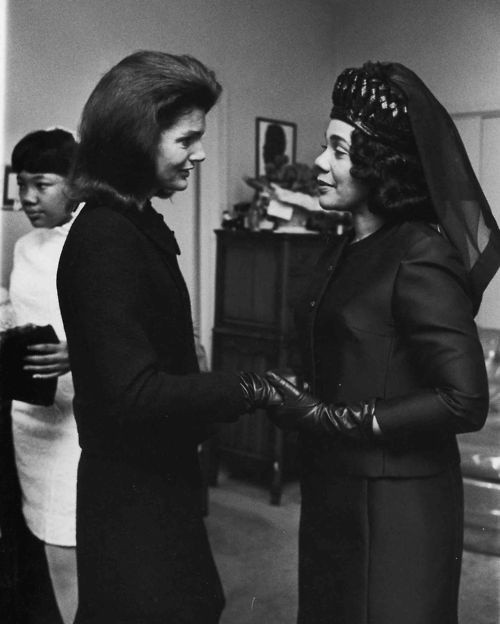
But there is some creditable work in Margolick’s book. He produces clear evidence that when Bobby Kennedy was killed in Los Angeles in June of 1968, both Jackie Kennedy and Coretta King journeyed to California to be on the plane that carried his body back to New York with Ethel Kennedy. It is as if they knew that with the murder of RFK, what their two husbands had done so much to build was now going to be dissipated. What makes this even more tragic is that Jackie Kennedy did not want RFK to run for president in 1968, because she felt he would also be killed. (Margolick, p. 312) On the plane back, Jackie said to RFK’s aide Frank Mankiewicz, “Well, now we know death, don’t we, you and I. As a matter of fact, if it weren’t for the children, we’d welcome it.” (Margolick, p. 380)

The fact that Coretta King was there may partly be due to what her husband had said a few months before, namely that Bobby Kennedy would make a great president. (Margolick, p. 295) It may also owe to what RFK did in her time of need. After her husband had been killed two months previous in Memphis, Bobby called her and asked if she needed anything. She asked if he could arrange to have King’s body transported back to Atlanta. He said he would do so but he wanted no publicity about it. He then paid for more phone lines to be tied into her home, arranged for a jet to fly her to Memphis, and booked dozens of hotel rooms for celebrities and dignitaries flying in to attend the funeral. (Margolick, p. 347) When that was done, as he previously promised, he went and met with the youths who had organized his aborted rally in Indianapolis that evening. They called themselves the Radical Action Program. (Margolick, p. 348)
I should add one more detail about RFK and the death of King. When Bobby first heard that King had been shot, he was in Muncie, Indiana. He heard about it as he was boarding a plane to fly to Indianapolis. He was not sure King was dead. But on the plane he already looked bereaved and ashen. He rejected the drafts for speeches offered by Mankiewicz and Adam Walinsky. Those were his own words he delivered. As many have said, it was probably the most memorable speech he ever gave. (Margolick, pp. 337-39) That night, as he spoke, he was wearing his brother’s overcoat.
Kennedy & King Park, Indianapolis IN
Plaques commemorating RFK’s speech
delivered on this spot on April 4, 1968
Kennedy & King Park, Indianapolis INLandmark for Peace Memorial
artist Daniel Edwards, design by Greg R. PerryCommenting on what RFK did that evening, the great decathlon athlete Rafer Johnson said, “Bob Kennedy knew better than anyone else, better than Martin Luther King, that if something wasn’t done … to somehow solve the racial strife, then we’re in deep trouble.” He continued by saying that no African American could have brought black militants and moderates together as Robert Kennedy could have, and no American could have spoken to both races as he did. He then concluded:
Senator Kennedy proved that color doesn’t make any difference. He was—in terms of the Negro—as much a Negro as Adam Clayton Powell … As Ralph Bunche or Senator Brooke. He was as much a Negro as Jesse Owens or Joe Louis because he did right by people. (Margolick, p. 349)
I should add that Margolick’s book is profusely illustrated with some powerful and rarely seen pictures. If one can discount the several specious passages, such as those quoted above, then the book is readable. If for some reason I had to recommend one of these four volumes, Margolick’s would be the one. But only with severe reservations—most importantly, concerning his statements that James Earl Ray killed King and Sirhan Sirhan shot Kennedy. But he worked for the NY Times for a number of years, so he has to say these things.
III. Michael Eric Dyson Commits an Atrocity
Michael Eric Dyson Michael Eric Dyson’s book might be the worst of the bunch, which is saying something. First of all, it is not even a book. Dyson slapped a series of disconnected essays together, put them into a small format book with large spacing between lines, and the publisher somehow had the temerity to call this a book.
Dyson begins his confection with a description of Martin Luther King’s funeral in Atlanta. Right there, on pages 2 and 3, I sensed something was upside down. Why? Because he mentions some of the luminaries who were there, like Thurgood Marshall and Richard Nixon. But he does not mention Bobby Kennedy being in attendance. And he does not note RFK’s role in arranging the ceremony, as Margolick outlined above. Dyson then adds that President Johnson was not there since he did not “want to drape the service in the controversy of the Vietnam War …”
These are hints of what Dyson is up to. Two of the goals driving his manufactured history are to do everything possible to smear RFK, and to be as soft as possible on Lyndon Johnson. For Dyson to write that Johnson was not in Atlanta because of some personal abnegation is simply not being honest about the relationship between King, Johnson and RFK, not only by 1968, but even before that. By this time, Johnson was involved in a bitter feud with both RFK and MLK. It was not just over what he had done with the Vietnam War. As we shall see, it was also over what Johnson had done with JFK’s plan to attack the problems of African Americans through a “war on poverty”, something which Bobby Kennedy had been at work on since 1961. In fact, according to Harris Wofford, the reason LBJ did not attend is because he thought he would be overshadowed by Robert Kennedy. Which is precisely what happened. According to Wofford, at the funeral, everyone understood that with King dead, RFK was their last best hope, since LBJ had blown it. (Wofford, pp. 221, 227)
Peter Kunhardt’s film, King in the Wilderness, opens with King calling Johnson from the scene of the Watts riots in 1965. It is a tense, desperate call, with King telling the president that he has to do something about the economic aspects of the race problem in order to give youths in the ghetto some hope. As we shall see, by 1968, LBJ had all but abandoned the concept begun by JFK in 1963.
But further, it is instructive to compare what King said about that riot with what Bobby Kennedy said. King saw it as a stirring of those in society who had been bypassed by the prosperity of the decade; he wished to minimize the racial aspect, since it was more the rumblings of the “have nots” inside of the affluent society. (LA Times, 8/12/15, “Viewing the Watts riots through different eyes”) Rhetorically, Bobby Kennedy went beyond King. When Eisenhower and Johnson used the word “lawbreakers” in regard to the riots, RFK replied with this: “There is no point in telling Negroes to obey the law. To many Negroes the law is the enemy. In Harlem, in Bedford Stuyvesant, it has almost always been used against them.” (Schlesinger, p. 815) Kennedy also said that too many civil rights leaders had ignored the problems in the north, so the larger population of the deprived in the north had no real leadership. He also stated that the tactics used in the south—marches and sit-ins—would not work in the northern cities. (LA Times, 8/12/15)
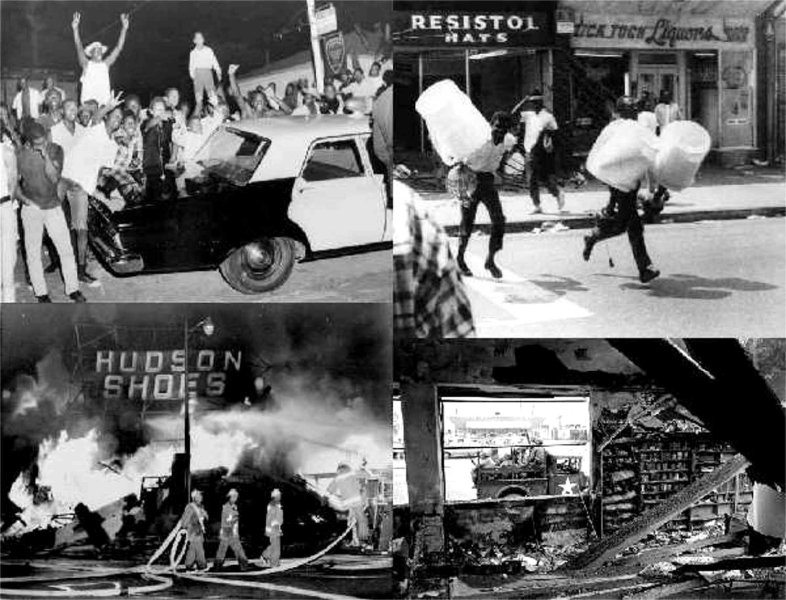
Images of the Watts Riots The last observation by RFK is directly relevant to Dyson’s principal subject. So it makes perfect sense that he would ignore it. For besides RFK and Lyndon Johnson, the third main character Dyson deals with is author James Baldwin. And as we shall also see, because Dyson is intent on smearing RFK, he correspondingly inflates and elevates Baldwin.
James Baldwin Dyson’s series of essays is superficially based on a meeting that was held in May of 1963 between Attorney General Bobby Kennedy and a group of African American intellectuals, writers and artists. It is a meeting that became famous when Baldwin revealed it afterwards to a reporter from the New York Times. (Dyson, p. 11) And it has been used by hack writers like Levingston and Larry Tye to disparage RFK. After reading further on the meeting and on Baldwin, I have come to a different point of view on this matter than the MSM, and certainly Mr. Dyson.
Fred Shuttlesworth In setting the stage, Dyson shows what a poor historian he is. He says the Birmingham demonstrations were led by King. (Dyson, p. 12) Not so. Local leader Fred Shuttlesworth began the Birmingham demonstrations months before King’s group, the SCLC, ever got there. They were carried out by a group of students from nearby Miles College who were inspired by Shuttlesworth. (Diane McWhorter, Carry Me Home, pp. 265-72) It was Shuttlesworth who, in the summer of 1962, first suggested that the SCLC go to Birmingham to extend the protests. He suggested this because he thought (correctly) that Sheriff Bull Connor would play into their hands. Then, in June of 1963, Shuttlesworth pushed it on the SCLC again, but King was still noncommittal. Finally, the Birmingham leader made an impassioned plea: “We’ve been hammering away for 7 years with no impact. If segregation is going to fall, we’ve got to at least crack the wall in Birmingham!” That is what finally made the SCLC move. (McWhorter, p. 307)
Dyson follows this up with another faux pas. He writes that it was Birmingham that forced JFK to submit a civil rights bill to Congress. On February 28, 1963, well in advance of the SCLC beginning its Birmingham action, President Kennedy made a speech on civil rights. He concluded by saying that action must be taken for the simple reason that it is the right thing to do. He also said that he had gone about as far as he could with executive orders. It was time for Congress to step in and fulfill its obligations. (Clay Risen, The Bill of the Century, p. 36) He then outlined a bill he was going to send to Congress. It was the draft of this bill, praised by leaders like Whitney Young and Roy Wilkins, which formed the basis of the Civil Rights Act that was passed in 1964. Again, Risen’s book was published four years before Dyson’s. If Dyson were serious about his subject, he would have consulted that book.
But he didn’t. Dyson is only interested in polemical smears. From here, he writes one of the most preposterous passages I can recall in the literature. He says that:
… the brothers claimed interest in race but let the moment pass, and they spoke out of both sides of their political mouths, to black leaders and conservatives alike, doing little to move the racial needle. (Dyson, p. 15)
What a pile of bird dung. By the fall of 1962, with the calling in of 20,000 federal troops to quell the insurrection, partly organized by General Edwin Walker, at Ole Miss over the admittance of James Meredith, the Kennedys were now seen as the hated enemies of the South. During that battle, the rallying cry of the Klansmen was “2-4-1-3 we hate Kennedy”. Another one was “Go to Cuba, nigger lovers”. (Brauer, p. 192) The right-wingers in Alabama, knowing another showdown would occur there the next year, tried to vote out moderate Democrats who would side with the Kennedys; they had to “show the Kennedys we will not be kicked around any longer.” (Brauer, p. 201) This is why John Bohrer notes in the introduction to his book The Revolution of Robert Kennedy that the attorney general was writing a letter of resignation to his brother in November of 1963. He thought that by being too far out there on civil rights, he had lost the entire South for the 1964 election. How is this playing both sides?
What on earth is Dyson saying when he asserts that JFK had “let the moment pass” on civil rights? President Kennedy was right about the filibuster issue, as proven with abundant evidence above. The spring of 1963 was the correct moment to submit a bill, since the issue was dominating the air-waves. As per the concluding remark, how any writer can say that the Kennedys “did little to move the racial needle” is absurd. What the Kennedys did with Brown v Board in 1961, at Ole Miss in 1962, at Tuscaloosa, Alabama in 1963, and with the Civil Rights Act of 1964—just those four achievements were enough to surpass any previous administration. But there is much more, and I will enumerate it in Part 3. What can be stated here is that with this kind of junk, Dyson already acquires little credibility for the informed reader, even before he gets to the main topic of his concoction.
Baldwin had been sending telegrams and letters to RFK. (Dyson, p. 25) In May of 1963, Robert Kennedy met with Baldwin briefly at Kennedy’s home in Hickory Hill. Kennedy then asked him to bring some people he knew to his apartment in New York the next day. He would be there since he was lobbying some department store executives to give more positions in their southern stores to black applicants. (Schlesinger, p. 345) What RFK told Baldwin he wanted to discuss were ideas about attacking the racial problem in the north. (Robert Kennedy in his Own Words, Ed Guthman & Jeff Shulman, eds., p. 223)
There is some confusion about who was at the meeting. But to be fair to Dyson, this is his roster of African Americans:
- Clarence Jones—King’s attorney
- Edwin Berry—member of the Chicago Urban League
- Kenneth Clark—an illustrious social scientist studying urban poverty
- Harry Belafonte—celebrity singer and actor
- Lena Horne—celebrity dancer, actress and singer
- Lorraine Hansberry—reporter and playwright, author of A Raisin in the Sun
- Jerome Smith—activist for the civil rights group CORE, rode on the Freedom Rides
There were four white persons there. Baldwin had invited the actor Rip Torn, and Kennedy was accompanied by two assistants, Burke Marshall and Ed Guthman.
Since it was an informal meeting, there was no stenographic record. We are thus reliant upon people who were there to convey what happened. By most accounts, Kennedy started the meeting trying to state what the administration had done in the South up to that time. This was clearly meant as a segue to what he wanted to talk about now: addressing the urban cities in the north. Which, considering the series of devastating and deadly riots that occurred from about 1965-1967, seems rather prescient.
By almost every account, the discussion never got that far. Smith shattered any kind of profitable discussion by saying that being in the room with Robert Kennedy made him want to vomit. (Risen, p. 51; Dyson, p. 43) Before we get to why Smith said something like that and why he was wrong in saying it, I wish to ask a pertinent question no one has ever posed before, namely: What was Smith doing there? If the discussion was to be about countering racism in the north, what did Smith know about that? Smith was born in the South and joined the CORE [Congress of Racial Equality] faction in New Orleans. The bill the Kennedys were revising for congressional passage was aimed at the eradication of Jim Crow in the South. As noted above, Bobby Kennedy stated, in his response to Eisenhower and Johnson about the Watts riots, that he knew it would take different leadership and tactics to address problems in the north. So what were Smith’s qualifications in this regard?
Needless to say, Smith completely sidetracked the conversation. He seemed to be striking out at RFK personally because he had been attacked during the Freedom Rides in 1961. And this managed to turn the conversation into a kind of competition. Reportedly, Clark and Berry had come to discuss what Bobby Kennedy wanted to talk about. (Schlesinger, p. 345) But that all went out the window with Smith’s sideswipe and Baldwin’s encouragement of it. In fact, Hansberry actually said that the man RFK should be listening to was Smith, in spite of the fact that JFK’s bill was designed to eliminate discrimination in the South. (Schlesinger, p. 345)
Dyson is such a cheerleader for Baldwin that he never even ponders the fact that Smith may have been wrong in his vindictiveness. For instance, one of the things that Smith reportedly said was that Bobby Kennedy’s men stood around taking notes while he was getting beaten up. This is not accurate. It was the FBI that stood around. And what makes it worse is that the informant the Bureau had inside the Klan cadre that performed the assault had actually told them a week in advance that the Freedom Riders attack was coming. That information never got to the attorney general. (Schlesinger, p. 307; Wofford, p. 152) When Bobby did learn about the attacks, he sent two of his men to the scene: John Siegenthaler and John Doar. Siegenthaler tried to help a fleeing victim who warned him he was going to get hurt. He was then clubbed unconscious and sent to the hospital. Doar was on the phone from Montgomery telling RFK what was happening. When Kennedy learned that the local authorities were not doing anything to keep order, the attorney general sent in five hundred marshals under the command of his assistant Byron White. (Schlesinger, p. 309)
As Bobby Kennedy said more than once, he did not know the Freedom Riders were going to test the interstate buses when they did. (Schlesinger, p. 307) During an oral history interview for the JFK library, he once said that he first learned about it in the papers. And in fact, while the Riders had been in the upper South, there were no notable disturbances. But once they entered the Deep South, things got brutally violent. As the attorney general said, a mobile demonstration like this was pretty much unprecedented. He and Burke Marshall were working the phones willy-nilly trying to find ways to save the situation.
But the attacks could have all been prevented. And it was not just J. Edgar Hoover’s fault. The organization Smith worked with, CORE, had chosen to make it a dramatic confrontation. As Harris Wofford wrote in his book, Bobby Kennedy had met with some civil rights leaders at his office in April. They had asked him about this very issue: when interstate transportation would be straightened out and the segregation signs pulled down at the terminals. A Supreme Court case had been decided in that regard two months prior. The attorney general said he was working on it at the time but the body involved with the details, the Interstate Commerce Commission, was slow in issuing its orders. CORE was one of the groups in attendance at that meeting. They did not tell Kennedy about their planned Freedom Rides scheduled for the next month. Why? As their leader James Farmer later explained, “Our philosophy was simple. We put on pressure and create a crisis and then they react.” (Wofford, p. 151) The first edition of Wofford’s book was released in 1980. Are we to believe that Dyson never read it? This is why his book is so mistitled. Smith’s outburst was not based on truth. Not even close. So the book’s proper title is: What Ignorance Sounds Like.
Based on this false information, most everyone in the room either joined Smith’s side or stayed quiet, even when Bobby Kennedy said things that were clearly correct. For instance, that his department had helped King in Birmingham—which they had done by raising bail money and monitoring King’s treatment while he was arrested and imprisoned. They also sent Burke Marshall to arrange a settlement between the city and the civil rights demonstrators to begin integration. When RFK brought this up, they laughed and jeered. (Schlesinger, pp. 342-43, 47) After the meeting was over, Clarence Jones tried to make amends to RFK since he knew that this was the case. Belafonte also tried to explain his silence. His excuse was that if he sided with RFK he would forfeit his position with the others, whom he still had a chance to influence. (Schlesinger, p. 347)
Some have tried to say, as Dyson does, that this meeting somehow helped the attorney general by sensitizing him. I disagree. By this point, Bobby Kennedy had been at this for going on three years. He understood the situation, and as Belafonte had told him, he had done more for civil rights than any prior attorney general. What this meeting did was convince RFK that he had to consult with men like King and Wilkins, and later Cesar Chavez, on minority rights, because those men had a degree of understanding, knowledge and vision about them. Baldwin was so misinformed on the racial issue that he once verbally attacked the perennial champion of that cause, Washington lawyer Joe Rauh, in his own house. (Michael Parrish, Citizen Rauh, p. 155) Even someone as moderate as Henry Louis Gates, who liked Baldwin and is featured in the writer’s last play, has said that as a civil rights leader Baldwin had neither a grasp on his role nor an unambiguous message. And when this was discovered later, “he was relieved of his duties and shunted aside as an elder and retired statesman.” (Herb Boyd, Baldwin’s Harlem, p. 156)
After reading three books on Baldwin, I would have to agree. Baldwin simply did not possess the emotional or mental stability to be any kind of a political leader. Even his sympathetic biographer, David Leeming, understood this. He begins his volume by describing Baldwin as somewhat paranoid and not always psychologically or emotionally stable. (James Baldwin: A Biography, p. xii) He further notes that, by 1967-68, Baldwin thought that people like Stokely Carmichael, Huey Newton and H. Rap Brown were the new hope of the black movement. If the reader can comprehend it, Baldwin predicted that this new emerging black consciousness meant the beginning of the end of America. (Leeming, pp. 292, 311) This is why the celebrated African American journalist Ralph Matthews once called Baldwin the Genghis Khan of the civil rights movement. (Schmitt, p. 57) I could go on about Baldwin, but I really don’t think pointing out all of his personal and public failings is worth it, except to show that Dyson is intent on concealing them.
Let me gladly conclude my discussion of Dyson’s sorry pastiche by addressing his points about Lyndon Johnson and civil rights. He gives Johnson credit for the Civil Rights Act of 1964, the Voting Rights Act of 1965 and the Fair Housing Act of 1968. (Dyson, p. 56) This makes Dyson one of the worst historians ever. As mentioned previously, Clay Risen’s book proves that Johnson did little to pass the 1964 act. The men who were most responsible for breaking the filibuster were Robert Kennedy, his Department of Justice team, Senator Thomas Kuchel, and Senator Hubert Humphrey. (Risen, pp. 222-23)
As per the Voting Rights act of 1965, Johnson told King that he did not have enough capital left after the 1964 act to get that bill passed—unless King did something. So King did something in Selma. (Louis Menand, “The Color of Law”, The New Yorker, July 8, 2013) For this writer, that was King’s most significant achievement. For Dyson to give the credit to Johnson shows just how agenda-driven he is.
As per the 1968 Fair Housing Act, this was an expansion and extension of what President Kennedy had signed into law in late 1962. Johnson sent this bill up in 1966. But it only passed in 1968, as a result of King’s assassination.
Lorraine Hansberry
reporter, playwright, authorThe rest of Dyson’s screed is just as useless as the first part. Since he has to fill out a couple of hundred pages, he now attempts to relate the African Americans at the meeting to modern day equivalents. Anybody who would parallel the work of someone like Hansberry with the films Black Panther and Get Out! is an even worse cultural critic than historian. He gets even sillier when he tries to say that Muhammad Ali—who was not there—was some kind of civil rights leader of the sixties. The man who really fits that bill is the great NFL running back Jim Brown. But Dyson does not want to go in that direction, since Brown has little but disdain for most of the black athletes of today.
The worst thing about Dyson’s mess is that Amy Goodman of Democracy Now chose to feature it on the anniversary of Robert Kennedy’s assassination this year. In other words, the individual who did so much to get the 1964 Civil Rights Act passed, who came out strongly against Johnson’s mad pursuit of the Vietnam War, who faced off against Governor Wallace at the University of Alabama, who encouraged the peasants of Brazil to overthrow their government in 1965, who ran the incandescent progressive campaign of 1968—this figure was entirely ignored. On the fiftieth anniversary of Bobby Kennedy’s assassination, Amy Goodman wanted her listeners to remember RFK through Dyson’s completely lopsided view of his dispute with James Baldwin and Jerome Smith. And to also ignore the good that could have come out of that meeting if Smith and Baldwin had not been there.
What a disgrace.
Go to Part 1
Go to Part 3
Go to Part 4
-
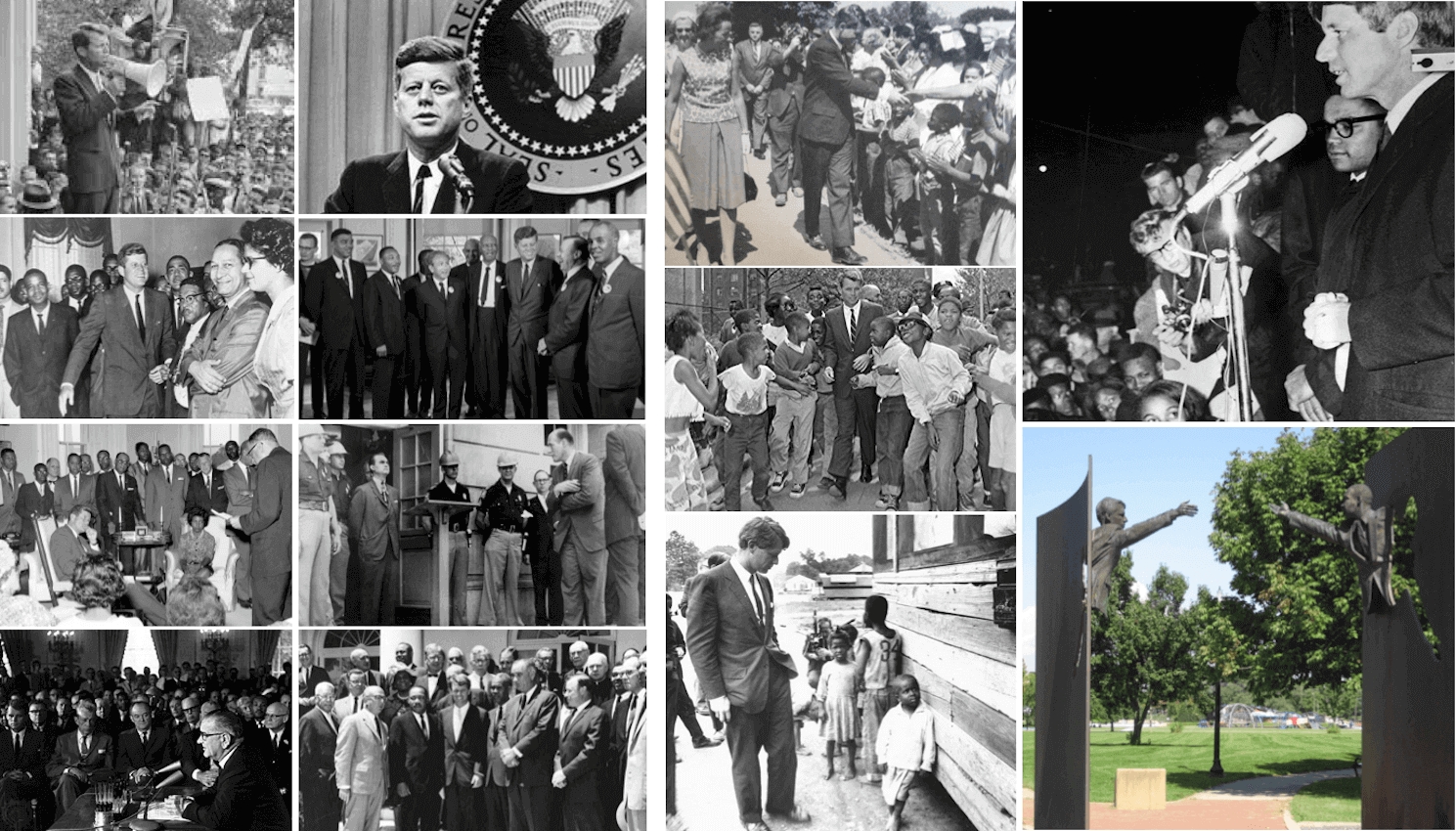
The Kennedys and Civil Rights: How the MSM Continues to Distort History, Part 1
Part 1: The Rebel Yell Will Rise Again
Books reviewed in this essay:
- The Bystander, by Nick Bryant, 2006
- Kennedy and King, by Steven Levingston, 2017
- The Promise and the Dream, by David Margolick, 2018
- What Truth Sounds Like, by Michael Eric Dyson, 2018
Causes of the Civil Rights Movement
Approximately five years ago, on the fiftieth anniversary of President Kennedy’s death, I reviewed Larry Sabato’s book, The Kennedy Half Century. In that review, I wrote about something that I had not really noted before in book form. One expects an MSM shill like Sabato not to recognize any of Kennedy’s clear alterations to President Eisenhower’s foreign policy: e.g., in the Congo, or with the Alliance for Progress. That would be par for the course. But Sabato did something that I had not really observed before. At length, the author tried to revise downward Kennedy’s record on civil rights. This was disturbing since Kennedy’s record on that issue was far superior to not just Eisenhower’s, but to all the presidents who had preceded him—both during and after Reconstruction. In my review of Sabato, I showed how silly this was by spending a few pages countering the obtuse arguments he had made (see section three of this review).
Read more interesting civil rights movement facts here!
At the end, I noted that this weird spin indicated once more that it was not enough for the MSM to deny the true facts of Kennedy’s murder. There was a concomitant effort to discount his achievements in the White House. In the back of my mind I was wondering: was Sabato’s goofiness on JFK and civil rights a preview of what was to come? After all, the next big milestone would be the dual anniversary of the murders of Martin Luther King and Bobby Kennedy. That would be made to order for the issue.
Well, I was largely right, but a little wrong. That dual anniversary did produce at least three books on the matter. These are Steven Levingston’s Kennedy and King, David Margolick’s The Promise and the Dream, and Michael Eric Dyson’s What Truth Sounds Like. They all pretty much traversed the same path that Sabato did. And they all used the same tactics that Sabato employed: downplaying or completely eliminating the record, and/or not contrasting it with Kennedy’s predecessors. (But I should say from the outset: unlike the other two, Margolick’s book has some saving graces, since he actually did some research.)
This last point, concerning contrast and presidential comparison, is crucial. Presidents should not be evaluated in isolation. In discussing their records, it is necessary to detail what came before and, at times, what came after. There can be no absolute value given to what a president says or does—as, say, there might be with anti-war leaders, or civil rights leaders—the reason being that the latter two groups are not running for office. A true presidential historian attempts to delineate and characterize words and actions in relation to other presidents, first by gathering as much of the pertinent data as necessary; then by sifting through it in order to find origins and patterns and to measure achievements; and finally by trying to make accurate comparisons with chief executives who came before and after. None of the authors mentioned even came close to doing this.
Before comprehensively addressing this issue, it should be said that the struggle for civil rights is even larger and more complex than, say, the issue of the Vietnam War. This is simply because it extended back even farther in its origins, and therefore involved more major factors and participants. None of these books under review pays any respect to that backdrop either. One ought to deal with it nonetheless, for in my opinion, it provides one explanation as to why so many previous presidents did nothing about the serious problem the issue presented. (As we shall see, some of them in fact exacerbated the problem by symbolically allying themselves with the image of the Confederacy.) It also helps explain why, with the stirrings of the civil rights movement—which did not begin with Martin Luther King—presidents like Franklin Roosevelt, Harry Truman, and Eisenhower did so little. What that sorry record of inaction did was to create an abyss the size of the Grand Canyon that John Kennedy faced when he entered the White House.
I would have more respect for these authors if they spent just a few paragraphs elucidating this crucial background. After all, that is the way the practice of history works. Recording accurate history is not, however, why these books were produced. But since this review will encompass all three of these volumes—plus a fourth that Levingston uses and relies on as a credible source—this author will first supply that missing background. This will help make clear both the failure of previous presidents in the face of this large and painful issue, as well as the reasons for it—presidents who, in other ways and on other fronts, have been praised by many authors (for instance, Teddy Roosevelt and Woodrow Wilson).
I. A Hideous History of Shame and Horror
Our exposition of this backdrop will not go all the way to the origins of the slave trade. What I will outline here is what happened during Reconstruction, since that created the historical foundation for the conditions of segregation, discrimination, and landless poverty that enveloped the existence of African Americans in the South after the Civil War. (I will not footnote this section, since it only pretends to offer a greatly abridged synopsis of what has been established in depth by an array of illustrious historians, such as John Hope Franklin, C. Vann Woodward, W. E. B. DuBois, Herbert Aptheker, Kenneth Stampp, and Eric Foner, among others.)
It is an open question as to whether Reconstruction would have succeeded if Lincoln had lived. But there is little doubt that what did happen was a calamity for the newly freed slaves. President Andrew Johnson’s actions in pardoning so many of the former political and military leaders of the Confederacy outraged many of those who were against what the South stood for and was based upon. Johnson’s actions almost allowed the former vice president of the Confederacy, Alexander Stephens, to take a seat in Congress right after the war. Stephens was the man who, in 1861, declared that the cornerstone belief of the South was that the African American was not equal to whites and “that slavery—subordination to the superior race—is his natural and normal condition.”
This was too much for the Radical Republicans in Washington. Men like Senator Charles Sumner of Massachusetts were simply not going to let Johnson do that. So they went to war with him. For a relatively brief period of time, these men passed several laws over Johnson’s veto in an attempt to aid the freedmen in the South and make it harder for former rebel states to return to the Union. The Civil Rights Act of 1866 and the fourteenth and fifteenth amendments were examples of laws they passed aimed at making the former slaves citizens who would be protected by the government. They also made it possible for teachers to go to the South, the creation of public schools there, the stationing of Union troops in the former Confederacy and the extension of the Freedmen’s Bureau—the only arm of government that gave direct aid to the newly freed slaves and their families.
Thaddeus Stevens It is puzzling today as to why men like Senator Sumner, congressman James Hinds (who was murdered by the Klan in 1868), Senator Benjamin Wade and, of course, congressman Thaddeus Stevens, were called radicals. They were clearly correct in their ideas about what it would take to incorporate the Confederacy back into the Union. But they were opposed by formidable enemies in Washington and outside it, like the Ku Klux Klan. As DuBois first pointed out, the Union never had enough troops in the former insurrectionist states to occupy that wide expanse of territory. Consequently, former Confederate forces were allowed to roam free and organize militias to thwart the actions of those who wished to carry out a reconstruction of the South. The Klan was only one of these terrorist organizations. There were also groups like the White League, the Red Shirts, and the White Line in Mississippi. They constituted something called the Redeemer Movement, whose goal was to restore pre-war white supremacy to state power. As African Americans took office—a mere 17 in Washington during the period of 1870-76, but many more on the state and local level—these terrorist groups began to rise in reaction.
Since they were well armed and organized, the only way to control them was by maintaining a much larger occupying force in the South for a longer period of time. That did not happen. The Reconstruction Act of 1867 allowed only 20,000 men to occupy ten former states. This included areas as large as Texas and Louisiana. President Ulysses S. Grant had to send additional military forces into the South for elections in 1870 and 1876.
No high-school textbook, and very few American history college texts, detail the horrors perpetrated by the Redeemer Movement, so much of the brutality and ugliness in the following account will likely be new to the reader. But as shameful and hideous as that chronicle is, the historian must describe it in order for the reader to begin to approximate the extreme pathology—imbued by centuries of slavery—that possessed these men. It is the only way to explain the shocking outbreaks of violence that took place at this time: the Opelousas Massacre of 1868; 1871’s Meridian Race Riot; the Colfax Massacre of 1873; New Orleans’ Battle of Liberty Place in 1874; and the Hamburg Massacre of 1876. In the Meridian and New Orleans instances, the Redeemers’ aim was to overthrow, respectively, the local and state government. In Meridian Mississippi, the Redeemers shot and killed a judge during a trial, and massacred as many as thirty freed slaves, ultimately driving the mayor from office. A force of three hundred Redeemers then escorted the mayor to a train and literally packed him off to New York, thereby achieving their goal of overthrowing the municipal government.

The Battle of Liberty Place The Battle of Liberty Place was enacted on Canal Street in New Orleans. It was a large-scale military insurrection. The Redeemers’ White League organized an army of five thousand men to force the Republican governor, William Pitt Kellogg, to resign. The governor was defended by a combined force of about 3,500, made up of state militia and local police. The White League defeated Kellogg’s forces, thereby overthrowing the governor. President Grant finally sent in federal troops, the White League dispersed and Kellogg was restored. But no one was arrested or tried. This paved the way for the White League to control the state once the Union army left.
It is worth describing a smaller scale event in more detail in order to understand the murderous mania that possessed the Redeemers. In September of 1875, in Hinds County Mississippi, the Republican Party decided to hold a combination barbecue and rally for the upcoming elections. Freedmen had been voting for about eight years there, so this type of event was not uncommon. For purposes of policy debate, they invited the Democrats to attend. The Democrats sent a spokesman, accompanied by about 75 White Line men with concealed weapons. The Democrat spoke without interruption. The Republican speaker thanked and congratulated his opponent. But as he began to address the crowd, he was heckled. He was then accused of being a liar. The leading black politician in the area, Charles Caldwell, stood up and asked the former slaves not to let themselves be goaded into a confrontation. Then a Republican freedman, Lewis Hargraves, was shot in the head at point blank range. In what appeared to be a choreographed action, the White Line men let loose with a series of volleys. The Freedmen, some whom came armed, fired back. Mothers began gathering up their children and running for cover in the nearby woods. At the end of the first day, three White Liners and five freedmen were dead.
The Redeemers called in reinforcements. In a move that had to be planned in advance, hundreds came in by rail. As one witness noted, they began to hunt down every black man they could see: “They were shooting at him just the same as birds.” Many freedmen were stalked to their homes, taken from their domiciles, shot to pieces, and their mangled corpses tossed into swamps. One of the victims was an old enfeebled grandfather. Some freedmen were forced to stand on tree stumps before they were killed. Caldwell escaped, but the posse told his wife that no matter how long it took, they would find him and he would perish like the rest:
We have orders to kill him and we are going to do it, because he belongs to this Republican Party and sticks up for these negroes … We are going to have the South in our own charge … and any man that sticks by the Republican Party, and he is a leader, he has got to die.
This anarchy and bloodlust eventually resulted in the infamous Mississippi Plan. What happened in Hinds County was repeated throughout the South by different terrorist groups. Once the violence had achieved its goal—which was to cower and intimidate the potential Republican voters—that result was often sealed by a bizarre, symbolic ritual. On the eve of an election, the Redeemers would mount up armed on horseback, usually in some sort of costume. At night, they would then parade through the main street of town with torches in hand. The idea was to remind any former slave or white sympathizer that there was no political order, no escape, and therefore that the Reconstruction amendments did not apply. The Redeemers held all power, and the opposition was not to be seen at the polls. The impact was overwhelming. During the peak years of Reconstruction, when the Republicans controlled parts of the South and freedmen were part of the state governments, African Americans had voted 90% of the time. Once the Redeemers took power, in some Mississippi townships, no Republican votes were tallied at all. In less controlled counties, the percentage declined by 75%.
Due to the disputed presidential election returns from three states of the South in 1876, both parties agreed on a political compromise. This allowed the Republican, Rutherford B. Hayes, to become president. In this shameful bargain, neither political party had clean hands. In return for the White House, Hayes agreed to remove the last of the Union armies from the Confederacy. Hayes also agreed not to intervene in the future. The GOP now began to devote itself to the interests of big business in the north. As a result, the Democrats took over what would later be called the Solid South. As the Reconstruction governor of Mississippi, Adlebert Ames, wrote to his wife on November 4, 1874:
What sorry times have befallen us! The old rebel spirit will not only revive, but it will make itself felt. It will roam the land, thirsty for revenge, and revenge it will have … the war is not over yet.
II. The White House and Supreme Court Back the Redeemers
Once Hayes agreed to remove the Union army, and the Mississippi Plan held, the Redeemers began to construct a social, political, and economic system that would approximate the ante-bellum South. To understand why, one must not just acknowledge the racial pathology prevailing there, but also slavery’s economic underpinnings. As one historian has noted, “the economic value of property in slaves amounted to more than the sum of the money invested in railroads, banks and factories in the United States.” (Eric Foner, Forever Free, p. 11) The former Confederacy did not want to develop a new economy to replace what they had. So local and state laws called Black Codes were inscribed. These stated, among other things, that the freedmen had to show evidence of employment while in the city. If not, this constituted proof of the crime of vagrancy. The codes were designed to force the former slaves out of the city and back into the rural areas. There, a new plantation plan was enacted: sharecropping. This system nearly guaranteed that the sharecroppers would never own their own land. The clear alternative to this new form of peonage was to have divided up the great plantations and given them to the newly liberated slaves. In one stroke of justice, this would have gravely weakened the fallen regime and given their former subjects a viable economic future, one which would have provided for the upward social mobility of future generations. This is what the freedmen thought would happen. As Eric Foner has shown, in very, very few instances did it occur. (Foner, p. 60) The Black Codes would later evolve into Jim Crow laws, and those laws would construct a new social system that would make the former slaves into third class citizens—if that. The sharecropping plan would provide much of the new economic system. It would keep the former slaves in the countryside, in debt, and unable to assert any claim to their rights.
As DuBois wrote in his 1935 book, Black Reconstruction in America, the ultimate defeat of the Radical Republican version of Reconstruction was not just a national tragedy. It went further than that. It set an example for subjugation as far away as South Africa and Australia. For now, in a democracy, a standard was set to deprive nonwhite peoples of their political rights simply on racial grounds. (“Why Reconstruction Matters”, NY Times, 3/28/15)
At this point, we come to an episode that resembles a dark fantasy. The Supreme Court of the United States now began to further the Redeemers’ goal in a political manner. Piece by piece, the high court undid what the Radical Republicans had achieved. That is, they neutralized the 14th and 15th amendments, and also the laws the Radicals passed making it illegal to obstruct the rights of the freedmen. The Supreme Court would, over a period of 20 years, in a methodical and systematic manner, negate it all. By doing so, it would reverse Alexander Hamilton’s dictum in the Federalist Papers. There, he wrote that the court would be the last bastion of protection for the weak against the strong. He then added that the lifetime appointment and lack of accountability would constitute a saving grace for liberty. To put it mildly, he was wrong. (Lawrence Goldstone, Inherently Unequal, pp. 10-13)
Thaddeus Stevens had passed on in 1868, and Charles Sumner in 1874. As several authors have noted, partly due to that, the GOP began to drift away from any further interest in Reconstruction and more toward its ultimate business orientation. The Radicals had favored plantation confiscation and redistribution of land to the freedmen. But the moderate Republicans would not stand up for it. (Goldstone, pp. 28-36) Meanwhile, with their growing interest in big business, the Republicans became enchanted with the writings of Herbert Spencer and Yale professor William Graham Sumner (no relation to Charles). Both writers advanced the ideas of Social Darwinism, which, to put it in simplified terms, postulated that the rich were rich because they deserved to be. As author Lawrence Goldstone notes, it was this philosophy’s growing influence on the Republican Party that forged a spurious intellectual link between the northern industrialists and the planter class in the South. This was furthered by the fact that President Grant appointed two corporate lawyers to the Supreme Court who had both formerly represented railroads. Hence, over a period of 20 years, from 1876 to 1896, the Supreme Court certified and upheld the beliefs of the Redeemers. (Goldstone, p. 72)
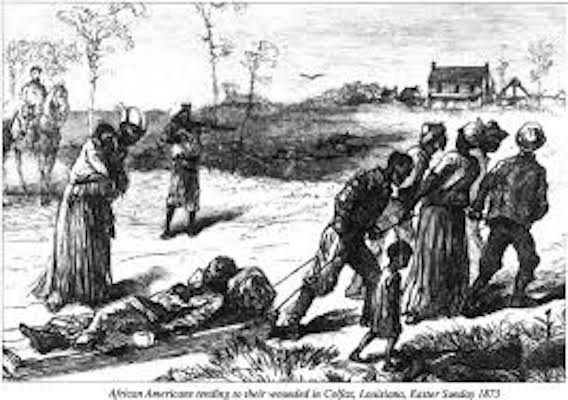
The Colfax Massacre The two cases that began this reversal were U.S. v Cruikshank and U.S. v Reese, both in 1876. The first case arose from the aftermath of the terrible Colfax Massacre, where an estimated 105 freedmen were killed. The Cruikshank decision set free the only three men who had been brought to justice for those killings. In a decision begun by one of the high court’s railroad lawyers riding circuit, the Supreme Court nullified the convictions. The basis for this, the court held, was that the 14th amendment, with its equal protection clauses, only applied to state actions, not to those taken by individual citizens. (Goldstone, pp. 91-96) In other words, if the Klan or any other terrorist group was going to harass, injure or kill anyone, the state would have to bring them to justice—something that, with the Union army gone, was not likely to occur. The Reese case had a parallel effect on voting rights. In that instance, a former slave tried to exercise his right to vote but was denied due to his alleged failure to pay a tax. The Supreme Court upheld the circuit decision against the plaintiff. This decision severely qualified the 15th amendment, which had granted the rights of citizenship to all, no matter of what race. It paved the way for states in the south to use all kinds of qualifying barriers like poll taxes, literacy tests and grandfather clauses to limit, or eliminate, freedmen from exercising the ballot. (Goldstone, p. 97)

Justice Joseph P. Bradley Two more mortal blows followed. In 1883, the court gathered five cases that had been awaiting a hearing and combined them into one: The Civil Right Cases. These cases all concerned discrimination in public accommodations, which had been outlawed by the Civil Rights Act of 1875. Once more, the court ruled against the plaintiffs, even though the act was grounded in the 13th and 14th amendments. The opinion in this case was again written by former railroad lawyer, Joseph Bradley. His contention against the 13th amendment was that discrimination did not necessarily translate into a form of subjugation. With the 14th amendment, which provided equal protection to all citizens, Bradley wrote that Congress did not have the power to nullify private discrimination or overrule a state if it chose to ignore such a private or local law. Consider this statement: “Individual invasion of individual rights is not the subject matter of the amendment.” (Goldstone, p. 124)
If the reader can believe it, the NY Times endorsed the decision (Goldstone, pp 127-28), even though the supposition would be that only when a state announces its intent to discriminate against a particular race, only then could the federal government step in. What was so bizarre about all this was the following: as the justices were diminishing the 14th amendment’s efficacy to maintain rights for the freedmen, which was its original intent, it was expanding the amendment for the purposes of corporations—which had nothing to do with its original purpose. (Goldstone, pp. 144-45)
The coup de grâce in all this was the Plessy v Ferguson case of 1896. As everyone understands, this case concerned the rights of African Americans to travel on the same facilities as everyone else. The case arose out of state law that was inspired by the 1883 decision that segregated races in Louisiana on rail cars. The case went up to the Supreme Court where, once again, the high court decided against the plaintiff. This case established that separate facilities were not necessarily unequal. It was clearly a racist decision. One of the judges wrote, “If one race be inferior to the other socially, the Constitution of the United States cannot put them upon the same plane.” (Goldstone, p. 167)
There were other cases, but these four politically nullified the post-Civil-War amendments and laws meant to correct the conditions in the South that caused that conflict. Goldstone writes that with these in place, the Redeemers’ aims were now achieved. Jim Crow, the separation of races in every respect, was now legal. For the freedmen, civil order in the South was neutralized. There was little fear of retribution or justice. Given these precedents, something like the torture execution of Sam Hose could take place—in public. In 1899, the African American Hose killed his boss in self-defense. The two had argued over money Hose felt he was owed, and the next day the employer came at Hose with a gun. The employee was chopping wood and threw his axe at him, killing the man. Quite naturally, Hose fled. The dead man’s wife now said that Hose had also raped her. A huge manhunt captured the accused and he was brought back to the jail in Newnan, Georgia.
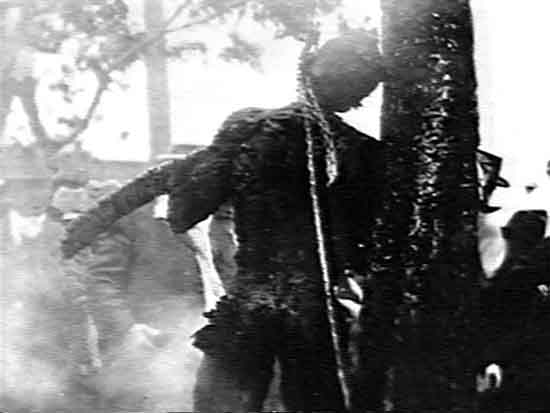
Lynching of Sam Hose (Wilkes) A large crowd estimated at almost 2000 people gathered around the jail and demanded the sheriff turn over his prisoner. Fearful of an assault on the building, he did. The wild, violent crowd marched Hose several blocks to the public square, yelling, “Burn him.” The governor, who lived there, and a judge pleaded with the crowd to return him to the sheriff. They refused. They then marched outside the town. He was roped to a pine tree and three or four men came at him with knives pulled. One man severed one ear and another the other. His body was stripped and mutilated further. He was dowsed with oil. He was then set afire, and as his body fell loose from the tree, he was kicked back into the flames. When the flames died out, his heart was carved into pieces and sold off as souvenirs. (Goldstone, pp. 5-8; also see this article)

The Rosewood Massacre This was not the end of it. Not even close. The Supreme Court had unleashed a peculiar mass psychology that, for some, knew no bounds. What happened to Sam Hose was repeated on a much larger scale at places like Rosewood Florida, where an entire village was virtually incinerated; Tulsa Oklahoma, where a whole section of the city was charred in flames and perhaps 300 African Americans were killed; and in Ocoee, Florida, where approximately sixty African-American were killed, 330 acres were burned, and the survivors were forced to leave town. At Ocoee the crime was trying to vote. Whenever one hears a speaker droning on about American Exceptionalism, the reader should mention these incidents, and these Supreme Court decisions. In this author’s opinion, the pattern of these atrocities resembles the first outbreaks of violence against the Jews in Nazi Germany.
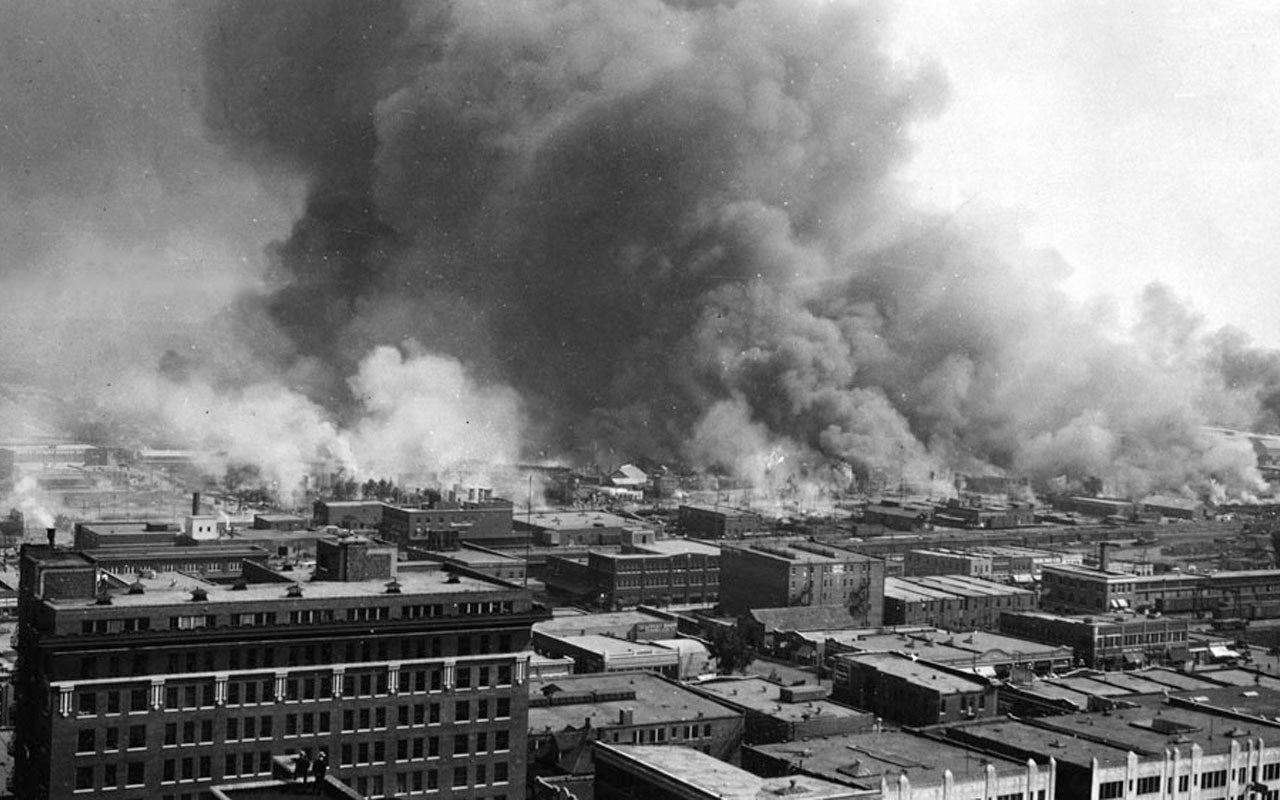
The Tulsa Massacre (The following article from The Atlantic also reviews how a Republican dominated Supreme Court nullified, step by step, the achievements of Reconstruction, aiding the Redeemers. It then draws a parallel with the Roberts court and its approach to minority groups, including Muslims. See “The Supreme Court is Headed Back to the Nineteenth Century”.)
But the myth of American Exceptionalism had to live on, at least with the masses. So a cover-up about Reconstruction was snapped on. It worked on two levels: one with the mass media, and one in academia. On the first level, best-selling authors, like Thomas Dixon and Claude Bowers, began to turn what had happened into an antiseptic fairy tale. The African Americans who briefly played political roles during the era were caricatured as aimless wastrels who bankrupted certain states. The Redeemers were glorified as the rescuers of southern sanctity. Thus the “Lost Cause” mythology was constructed. Dixon did this with a trilogy of novels called the The Leopard’s Spots, The Clansman and The Traitor. How bad were these books? Consider this: “The Negro is the human donkey. You can train him, but you can’t make of him a horse … What is called our race prejudice is simply God’s first law of nature—the instinct of self preservation.” (The Leopard’s Spots, p. 237)
The Clansman was made into a popular play. In 1915, D. W. Griffith transformed it into a spectacularly successful film (Birth of a Nation). Former history professor and then President Woodrow Wilson screened the film at the White House. In the novels, play and film, the facts of Reconstruction are turned upside down. It is the white citizens who are preyed upon by the imperious blacks, and it is the Klan who rescues these poor people from the clutches of the primitives who—according to Dixon—had now descended into their natural state and ruined the South. The Klan saved them. (Foner, pp. 217-18)
The other level of the cover-up was constructed through academics like John W. Burgess, James Ford Rhodes and, above all, William Dunning. The views of these authors were not as melodramatic as Dixon’s, but the picture was pretty much the same. For, as Burgess once wrote, “… a black skin means membership in a race of men which has never of itself succeeded in subjecting passion to reason, and has never therefore created any civilization of any kind.” (Foner, p. xxii) For Burgess, both the Mali and Songhai empires of Africa did not exist. From what was later termed the “Dunning school”, the dominant portrait of Reconstruction was a colorful tableau full of southern Scalawags, northern Carpetbaggers, and incompetent Negro legislators. They combined to run their state economies into the ground. The mad, homicidal mass murders of the Redeemer cause were nowhere to be seen. Because Dunning came from an Ivy League college, namely Columbia, and had his graduate students do advanced work on different aspects of Reconstruction, he was enormously influential. His work became the standard for adopted college and high school textbooks. In fact, author John F. Kennedy used Dunning’s foreshortened portrait of Stevens in his book Profiles in Courage. As we shall see, after a three-year ordeal with the modern Redeemers, Kennedy realized he had been taken.
III. Houston Alters the Current
This sorry record could not have continued unless one had a series of presidents who were willing to ignore it. Woodrow Wilson was not just willing to ignore it. He exulted in it. Birth of a Nation was not just screened at the White House; Griffith used quotes from Wilson’s history books as subtitles. (Foner, p. xxii) Another progressive president, Teddy Roosevelt, was not much better. Roosevelt once wrote (falsely) that, during the Spanish American War he had to fire a gun at his own African American troops to get them to join the battle in Cuba. There was also the Brownsville Affair where, after the shooting of a white bartender, Roosevelt dismissed all the African American troops stationed in three companies of the 25th Infantry Regiment. This amounted to discharging without honor 167 men who now lost their pensions and any opportunity for civil service jobs. Roosevelt’s idea of progress in race relations was to dine at the White House with Booker T. Washington. Washington was the man who urged African Americans to he happy with their lot and learn self-subsistence.

Coolidge with Confederate veterans William Howard Taft, the third progressive president, also befriended Booker T. Washington. Taft once told a college graduate class at a historically black college, “Your race is meant to be a race of farmers, first, last and for all times.” Campaigning in the South, he said he would never enforce “social equality”. He then told a primarily African American audience that the white Southern man was their “best friend”. Later on, Republican presidents Harding and Coolidge failed to stop, or even criticize, parades of Klansmen before the White House. Herbert Hoover accepted covert backing from the Klan. So much for the party of Lincoln.
The man who began to turn this sorry record around is someone who few people know about. But it was he, not Martin Luther King, who really started the modern civil rights movement. So important a figure does he seem to me that if I had the power, I would level every last Confederate monument and replace each with his image. His name was Charles Hamilton Houston. Because Houston worked in a much less spectacular manner than King, he does not get the attention he deserves. This is a failure of both our media and academia. Every person concerned with this issue should know who he was. He was that crucial.
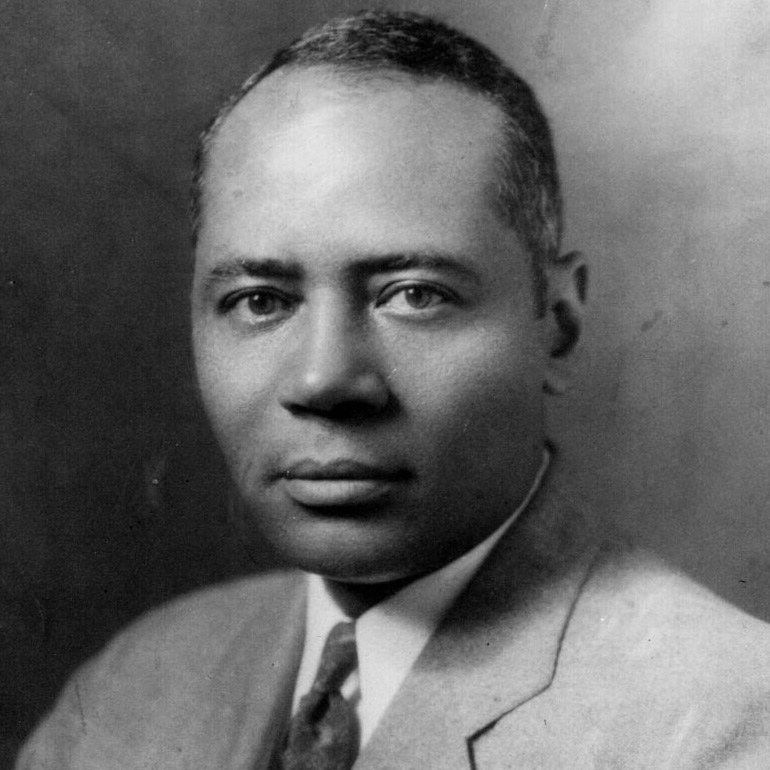
Charles H. Houston Houston graduated from Amherst and then served as an officer in World War I. He was greatly disappointed by discrimination in the military, so he decided upon returning to the USA that he would do something about it. As he noted, “My battleground is in America, not France.” He was accepted by Harvard Law School and wrote for the Harvard Law Review. Upon graduation, he decided to create his own version of Harvard at Howard School of Law. His objective was to train a generation of lawyers in order to—piece by piece—reverse the mockery of justice the Supreme Court had decreed in the cases described above. Houston visited the major cities of the southeast and decided his students should go there after graduation, since there were not nearly enough African American attorneys to defend all the cases that needed to be adjudicated.
Houston’s reputation drew him to the attention of NAACP leader Walter White. He became, first, their unofficial lead attorney, and then their special counsel in civil rights proceedings. After participating in the famous Scottsboro Boys case, Houston set his goal as dismantling Plessy v Ferguson. He planned on doing this through challenging the underlying thesis of that decision: that facilities for his race were equal to those for whites. He decided to concentrate his efforts in the field of education. Houston felt that poor schools, especially in the South, were designed to make their students meekly accept an inferior lot in life.
Houston knew he could not directly confront Plessy v Ferguson without creating his own precedents. He began his methodical campaign by attacking the wretched acceptance policies and study conditions for African Americans in graduate and professional schools. Houston observed that in 17 of 19 southern and border state universities there were no students of color in those graduate schools. Two of those states—Missouri and Maryland—paid to have African American students attend schools in the north instead. From 1936 to 1950, in a series of carefully chosen and cogently argued cases, Houston and his student Thurgood Marshall, among others, won a series of cases—e.g. Sweatt v Painter—that set the stage for the objective that Houston had planned for: a reversal of Plessy v Ferguson. Unfortunately, Houston would not live to see the ultimate justification of his life and career. In 1950, his heart failed him due to exhaustion and overwork. Thurgood Marshall paid Houston the ultimate compliment, “We’re just carrying his bags, that’s all.” (see this profile)
There seems little doubt that, as circulated through the scores of African American newspapers—Chicago Defender, Pittsburgh Courier, Roanoke Tribune, among others—what Houston and the NAACP had begun was to awaken the conscience of many intelligent citizens, both black and white. And this national stirring—after 75 years of dormancy or worse—had an effect on the White House.
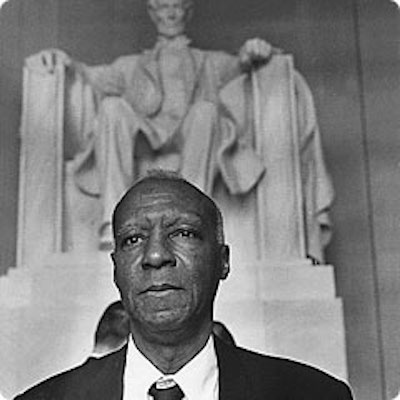
A. Philip Randolph In 1941, union steward A. Philip Randolph and civil rights leader Bayard Rustin organized a large demonstration in Washington. The protest was about passing an anti-lynching law, integrating the military, and fair employment practices in the defense industry. After meeting with President Roosevelt, the latter agreed to issue an executive order for the last demand. Randolph and Rustin reluctantly called off the demonstration.
As a young man, President Harry Truman was quite prejudiced. But he managed to rise above it, at least in public, after FDR passed. He asked a panel of prominent authors and activists to present a series of reforms the government could take to break down the barriers of segregation. The report was called To Secure These Rights. Truman tried to get it passed as a civil rights bill. He was crushed by the southern bloc in both the House and Senate. (See William Berman, The Politics of Civil Rights in the Truman Administration, pp. 148-9; 162) The southern Democrats had decades of seniority in key committees of both the House and Senate. They had set up a system of barriers, especially in the Senate, to block any civil rights bill from making it through both houses. In the upper house, they had a very strong and disciplined corps that would filibuster any such bill to certain abandonment. This is what happened to Truman. But Philip Randolph managed to salvage one of the aims he lost with Roosevelt by doing the same thing to Truman as he did to FDR. He threatened the president and Congress with a massive display of civil disobedience in Washington unless the military was integrated. Truman signed the order. (Berman, p. 102)
Dwight Eisenhower was never one to inspire the public with his belief in equal rights. Knowing this, Truman made some very strong speeches against Eisenhower in the 1952 presidential election. (Berman, pp. 226-28) Eisenhower even resisted Truman’s integration order by suggesting the army should just integrate intact African American platoons into white companies. (Berman p. 205) Eisenhower also did not like what FDR had done with the fair employment statute. (New York Times, 6/6/1952, p. 1) Commenting on it, he said, “I do not believe that we can cure all of the evil in men’s hearts by law … ” Which may be true, but at least a law could prevent that evil from killing someone.
There was a civil rights section in the Justice Department when Eisenhower and Vice President Richard Nixon were in the White House. As Burke Marshall, Bobby Kennedy’s assistant on civil rights, later said, the section was small and seldom used. (Marshall interview with LBJ Library, 10/28/68) Eisenhower and Nixon only filed ten civil rights lawsuits in eight years, and two of those were filed on the last day of his administration. What makes that record so bad is that, for six of those years, the epochal 1954 Brown v Board case was in effect. (Harry Golden, Mr. Kennedy and the Negroes, p. 104) With Brown, Houston’s successors had succeeded in overturning Plessy v Ferguson. Separate facilities were not equal and the court ordered public schools to be integrated with deliberate speed.
That decision sent a shock wave through the South. Segregated public schools and undergraduate education had been twin keystones of Jim Crow. But Eisenhower paid no real heed to the Brown case. In fact, he once told a reporter that the decision had set back progress in the South at least 15 years. (John Emmet Hughes, The Ordeal of Power, pp. 200-1) Nixon pretty much agreed. He said, “… if the law goes further than public opinion can be brought along to support at a particular time, it may prove to do more harm than good.” (Golden, p. 61) This was a self-fulfilling prophecy. The law was not going to go very far since the administration was not supporting it to any real degree. In the six years after the Brown case, neither man ever stated publicly that they were behind the decision.
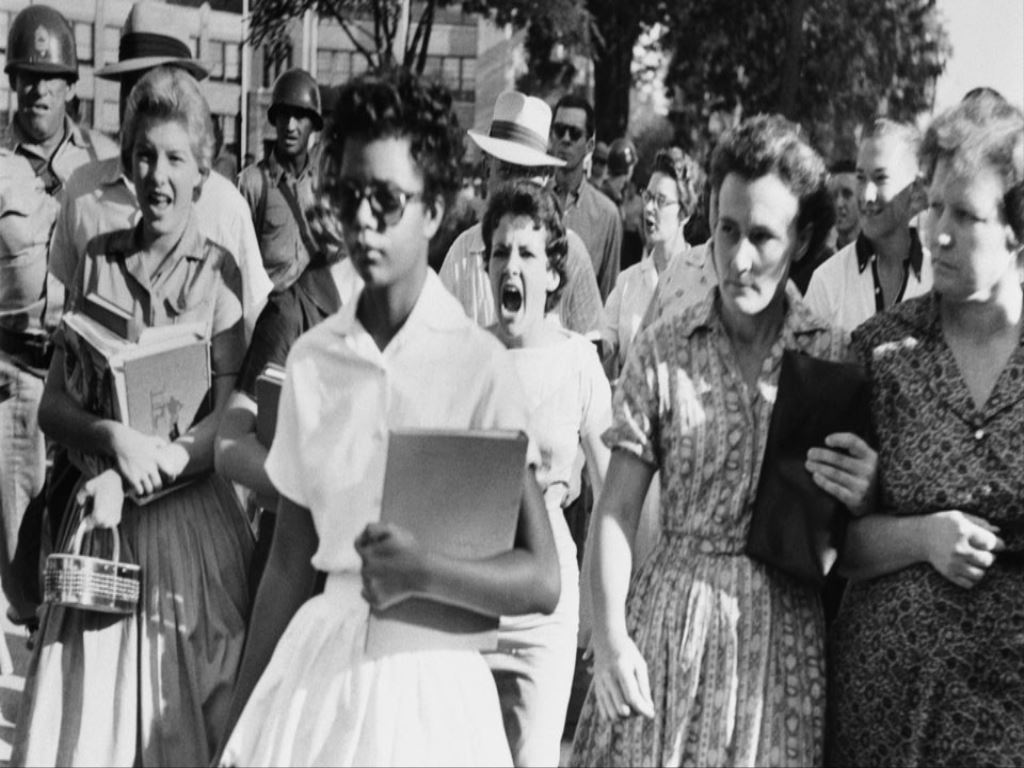
Elizabeth Eckford, one of the “Little Rock Nine” During Eisenhower’s two terms, two explosions ripped through the South: Brown v Board and the Rosa Parks/Martin Luther King Montgomery bus boycott. During those eight years, Eisenhower had two achievements in the civil rights field. In 1957, acting on the Brown decision, the Little Rock School Board voted to integrate Central High. Governor Orval Faubus decided to defy the board. On September 3rd, the first day of class, Faubus stationed the National Guard around the school to keep the designated African American students—called the Little Rock Nine—outside. While the court and the board were being defied, Eisenhower did not blame the governor and he did not consider the event Washington’s business. In fact, he went on vacation to Newport, Rhode Island. (LA Times, 3/24/1981, “Is Eisenhower to Blame for Civil Rights Explosion?”)

Bill Clinton with Orval Faubus (1991) As the spectacle dragged on for days on end, Faubus visited Eisenhower in Newport. The president thought the governor understood he had to pull out the National Guard. He did not, and the nine students were left ostracized. Under threat of a court injunction, Faubus pulled out the Guard on Friday, September 20th. On the following Monday, with no authorities there, as the nine students tried to go inside, they were assailed, jeered and spat on by the angry crowd outside. It was not until the 25th that the White House finally decided, with the state authority gone, to send in federal troops to control the mob. The school was now integrated. (LA Times, “Is Eisenhower to Blame”)
That 22-day standoff helped convince many people of color that the Republican Party did not have their interests at heart. As Robert Shogan wrote in the LA Times, Eisenhower was in a strong position to do something about the racial issue. He had won two landslide elections. He enjoyed strong popularity and trust in both the North and South. He could have assured everyone that this move towards reconciliation was in their interest. Ideas about the issue were in an emerging, moldable form. (LA Times, “Is Eisenhower to Blame”) What did he choose to do at this fateful crossroads?
Not much. In 1957 his Attorney General, Herbert Brownell, sent a bill to Congress creating something called the US Civil Rights Commission. This was a six-person panel furnished with a chief counsel. It was supposed to submit a report on its racial findings to the White House. In its final form it was as much Senate Majority Leader Lyndon Johnson’s bill as it was Brownell’s or Eisenhower’s. Knowing that the bloc of southern Democratic senators would derail the bill in its original form, Johnson agreed to remove its most potent aspects. LBJ saw this as an opportunity to keep his own party united while making himself more palatable to northern and western liberals for a possible run at the White House in 1960. (Rowland Evans and Robert Novak, Lyndon B. Johnson: The Exercise of Power, pp. 122-25) Although it concentrated on voting rights, most informed commentators considered the bill largely symbolic, since it had little power to enforce its own recommendations. The bill also turned the Justice Department’s civil rights section Truman had established into a formal division. Later on, in 1960, the act was slightly modified by giving the Justice Department the power to inspect local voting rolls and introducing penalties for anyone who obstructed a citizen’s attempt to vote. Again, this was all Johnson could get through since he could not halt the filibuster. (For a chronicle of what the commission accomplished, see Harris Wofford, Of Kennedys and Kings, pp. 461-83) Many accused Eisenhower of leaving the whole civil rights imbroglio, now highlighted by bombing and assaults over the Brown decision, to his successor.
To summarize: under pressure from Philip Randolph, Roosevelt issued a fair employment order for the defense industry and Truman integrated the military. (The former lapsed when Truman could not get it renewed.) After three weeks of state military resistance, Eisenhower sent troops to integrate Little Rock. He then, along with LBJ, created a civil rights commission with little enforcement power. This was the sum total of what had been done in 84 years for the sorry plight of African Americans in the South since the Redeemers’ bloody triumph in 1876.
Go to Part 2
Go to Part 3
Go to Part 4
-
MacArthur’s Last Stand Against a Winless War
He leaned on JFK to stay out of Vietnam. Had Kennedy survived, might history have been different?
By Mark Perry, At: The American Conservative
-

Robert A. Wagner, The Assassination of JFK: Perspectives Half A Century Later
In the Courtroom with Robert Wagner
by David W. Mantik, MD, PhD
February 18, 2018
Revised August 27, 2018
NOTE: This is my second review of Wagner’s 2016 book; the first was dated December 4, 2017.1
My first review, and Wagner’s response to it, can be found at my website: http://themantikview.com/pdf/Wagner_Response_1.pdf2
“German judges, very respectable people, who rolled the dice before sentencing, issued sentences 50% longer when the dice showed a high number, without being conscious of it.”
~ The Black Swan: The Impact of the Highly Improbable (2010), Nassim Nicholas Taleb
“If logic and reason, the hard, cold products of the mind, can be relied upon to deliver justice or produce the truth, how is it that these brain-heavy judges rarely agree? Five-to-four decisions are the rule, not the exception. Nearly half of the court must be unjust and wrong nearly half of the time. Each decision, whether the majority or minority, exudes logic and reason like the obfuscating ink from a jellyfish, and in language as opaque. The minority could have as easily become the decision of the court. At once we realize that logic, no matter how pretty and neat, that reason, no matter how seemingly profound and deep, does not necessarily produce truth, much less justice. Logic and reason often become but tools used by those in power to deliver their load of injustice to the people. And ultimate truth, if, indeed, it exists, is rarely recognizable in the endless rows of long words that crowd page after page of most judicial regurgitations.”
~ How to Argue and Win Every Time (1995), Gerry Spence
“There is no such thing as justice—in or out of court.”
~ Clarence Darrow3
“Initially, Admiral Burkley said that they had caught Oswald and that they needed the bullet to complete the case and we were told initially that’s what we should do, is to find the bullet.”
~ J. Thornton Boswell, Testimony before the HSCA Medical Panel (9/16/1977)4
In my first review, twenty specific Wagner statements were taken to task. This second review raises more fundamental questions about Wagner’s overall approach, discusses a host of specific JFK issues, cites Wagner’s many logical fallacies, and (again) lists many corrupted evidence items. Wagner’s response to my first review is addressed in the text below. The plan is to also post his response to this second review at my website.
I shall first describe fundamental flaws in Wagner’s model (the legal system), and then explicitly address Henry Wade’s personal travesties in the Texas justice system. Wade was the District Attorney who would have prosecuted Oswald. I then summarize my personal encounters with the legal system—they are consistent with Darrow’s opening quote (above). We begin with a real case.
Incompetent prosecutors and judges in the courtroom
The Innocent Man (2006) by John Grisham relates a case in which Pontotoc County District Attorney Bill Peterson was woefully ignorant of science and was eventually voted (by the Bennett Law Firm) one of “The 10 Worst US Prosecutors of 2007.”I have written a detailed critique of this egregious miscarriage of justice.5 Grisham describes the hostile and foolish mission of the Ada (city), Oklahoma Police Department and Attorney Peterson to solve a murder case at all costs. Peterson and the police used forced “dream” confessions, untrustworthy witnesses, and hair evidence to convict Ron Williamson and Dennis Fritz. The Innocence Project aided Williamson’s attorney, Mark Barrett, in exposing the prosecution’s far-fetched case. Frank H. Seay, a US District Court judge, ordered a retrial. After eleven years on death row, Williamson and Fritz were exonerated by DNA evidence and released on April 15, 1999. According to Wikipedia, Williamson was the 78th inmate released from death row since 1973.
Science in the courtroom
Based on DNA evidence, the work of the Innocence Project has led to freedom for 351 wrongfully convicted persons and the discovery of 150 real perpetrators. The Innocence Project was established after a landmark study, which found that incorrect identification by eyewitnesses was a factor in over 70% of wrongful convictions. The original Innocence Project was founded in 1992 by Barry Scheck and Peter Neufeld (of O. J. Simpson fame), as part of the Cardozo School of Law of Yeshiva University in New York City.
Reversals on appeal
How can we decide whether the courts serve justice and truth? Well, we can ask a simple question: What happens during appeals? Here is a startling statistic: The Supreme Court reversed about 70 percent of the cases it took during 2010-15. Among cases it reviewed from the 9th Circuit Court of Appeals, it reversed about 79 percent. The reversal rate for defendant appellants (typically the so-called guilty party) was 40 percent, compared to 20 percent for plaintiff appellants. So, given this shocking rate of reversal, we can immediately question the legitimacy of Wagner’s model for discovering Truth.
Since Wagner is concerned about Texas courts, we shall ask this: How well is Texas doing now? According to a new study, appeals court judges in Texas have become increasingly hostile to jury verdicts in civil cases, especially when the jurors rule in favor of plaintiffs.6 The report, which examined a full year of decisions during 2010-11 by the state’s 14 courts of appeals, found that these judges reversed more than one-third of all civil jury verdicts, and that they are more likely to overturn jury verdicts that favor plaintiffs than verdicts that favor defendants.
The Texas courts of appeals also reversed 50 percent of the jury verdicts that favor plaintiffs in consumer fraud and general tort cases, but the judges overturned only 11 percent of the jury verdicts that favored defendants. This study was titled “Reasons for Reversal in the Texas Courts of Appeal.”
Death sentences in Texas
In the past year, the Texas Supreme Court heard three appeals from inmates on death row, and in each case the prosecutors and the lower courts suffered stinging reversals.7
But what about Henry Wade, the man who would have prosecuted Oswald? We also know this answer, thanks to Mary Mapes:8 “When Henry Wade Executed an Innocent Man,” in D Magazine (May 2016).9 The legendary Dallas DA ran a conviction machine that was results-oriented (i.e., not truth oriented).10 In 1954, he persuaded a jury to send Tommy Lee Walker to the electric chair just three months after his arrest. But a new look at the case uncovered one of the worst injustices in Dallas history.
Then there are the 19 convictions obtained by Wade that were later overturned. Oswald might well have been #20.11 Here is a quotation from the Associated Press.12
DALLAS — As district attorney of Dallas for an unprecedented 36 years, Henry Wade was the embodiment of Texas justice. A strapping 6-footer with a square jaw and a half-chewed cigar clamped between his teeth, The Chief, as he was known, prosecuted Jack Ruby. He was the Wade in Roe v. Wade. And he compiled a conviction rate so impressive that defense attorneys ruefully called themselves the 7 Percent Club.13
But now, seven years after Wade’s death, The Chief’s legacy is taking a beating.
Nineteen convictions — three for murder and the rest involving rape or burglary — won by Wade and two successors who trained under him have been overturned after DNA evidence exonerated the defendants. About 250 more cases [in Texas] are under review [emphasis added].
No other county in America — and almost no state, for that matter — has freed more innocent people from prison in recent years than Dallas County, where Wade was DA from 1951 through 1986.
Current District Attorney Craig Watkins, who in 2006 became the first black elected chief prosecutor in any Texas county, said that more wrongly convicted people will go free.
“There was a cowboy kind of mentality and the reality is that kind of approach is archaic, racist, elitist and arrogant,” said Watkins, who is 40 and never worked for Wade or met him ….
The new DA and other Wade detractors say the cases won under Wade were riddled with shoddy investigations, evidence was ignored, and defense lawyers were kept in the dark. They note that the promotion system under Wade rewarded prosecutors for high conviction rates [emphasis added].
“Now in hindsight, we’re finding lots of places where detectives in those cases, they kind of trimmed the corners to just get the case done,” said Michelle Moore, a Dallas County public defender and president of the Innocence Project of Texas. “Whether that’s the fault of the detectives or the DA’s, I don’t know.”
John Stickels, a University of Texas at Arlington criminology professor and a director of the Innocence Project of Texas, blames a culture of “win at all costs.”“When someone was arrested, it was assumed they were guilty,” he said. “I think prosecutors and investigators basically ignored all evidence to the contrary [emphasis added]14 and decided they were going to convict these guys.”15
And this same Henry Wade, in Wagner’s model for Truth, would have prosecuted Oswald.16
About majority decisions
Wagner routinely decides an issue via majority vote.17 But as a scientist I am dumbfounded—and horrified—at the fantasy of the American Physical Society voting on whether the 2012 Higgs particle was the real thing—or merely a masquerade. In this nightmare, whatever happens to objective data?
But can we trust the majority to be right? In Indonesia the majority would vote for Islam, but in America, Christianity would win hands down. So, who is right? How does a majority vote help us here?
Of course, the most notorious case of science on trial occurred on April 12, 1633. For espousing “heresy,” physicist Galileo Galilei was found guilty by a majority vote under the reign of Pope Urban VIII. The Catholic hierarchy finally cleared Galileo on October 30, 1992. (This date is not a joke.) The red-hot issue now though is whether his chief inquisitor, Father Vincenzo Maculano da Firenzuola, should be tried (in absentia) for “heresy.” The Church has yet to address this issue.
Papal infallibility
Ironically enough, this was another majority decision! Infallibility was formally defined in 1870, but bishops Aloisio Riccio and Edward Fitzgerald dissented. Before 1870, belief in papal infallibility was not a requirement for Catholic faith. Here is a painting to commemorate papal infallibility, following the definition of 1870 (Voorschoten, 1870).

Right to left: Pope Pius IX, Christ, and Thomas Aquinas Following the First Vatican Council (1869–1870) a few Catholic dissenters arose among some Germans, Austrians and Swiss. This resulted in the formation of communities in schism with Rome, so they became known as the Old Catholic Churches. The dogma of papal infallibility is rejected by Eastern Orthodoxy. The Church of England and its sister churches also reject papal infallibility—so unanimity is surely lacking. Even a few contemporary Catholics, such as Hans Küng (author of Infallible? An Inquiry) and historian Garry Wills (author of Papal Sin) deny papal infallibility. Küng has been sanctioned by the Church, but Wills has escaped (so far).
American history
During reconstruction, and for decades afterwards, southern juries excluded persons of color, yet these jury verdicts of murder (typically against black men) stood unchallenged—and unappealed. This was also rule by majority, just as Wagner prefers.18
During the Vietnam War, LBJ’s “Wise Men” persistently voted (essentially unanimously) to continue the war. Meanwhile, even the protestors on the streets knew better.19 This illustrates the logical fallacy of deferring to so-called authorities, a trait often displayed by Wagner.
Can we trust the courtroom? Some personal experiences
Wagner overtly admits that his model for discovering Truth is the courtroom.20 So, Wagner and I are immediately at loggerheads. My model is distinctly not the courtroom. Rather, it is science—which is very different indeed. In this review I examine where such a courtroom approach might take us, especially in Texas, but first some personal comments.
I have served several times as an expert witness—both in physics and in medicine. I have seen my mother win a modest sum in a malpractice case (against her radiation oncologist), in which expert witnesses testified on both sides. I have been a plaintiff in a civil lawsuit against a subcontractor—in which my general contractor sided with me—but I still lost the case. I have protested two traffic tickets. In the first one, I presented my phone bill, which proved that I had not used my cell phone. Such hard evidence did not matter to the judge; I still had to pay the fine. I eventually won the second case (with a generous refund from the state of California), but only after the Appellate Court recognized the lower court’s frivolous decision. That appeal should never have been necessary, and I am still trying to get my well-deserved DMV refund. With the legal aid of Bill Simpich, I have assisted my son in a suit against his landlord, which ended in a draw.21 Based on personal experience, I can say—without a moment’s thought—that justice is oddly rare in the halls of justice. Too often, basic common sense—and even truth—are deliberately excluded. Just ask any attorney what they learned about truth and justice from their philosophy courses while in law school. They will respond with blank gazes. Instead, they are primed to advocate for the views of individuals and diverse interest groups within the context of the legal system.
Junk science in the courtroom
In my acerbic, online critique of John McAdams, I have summarized the (dishonest) use of fingerprints in the courtroom, with special emphasis on its abuse in the Oswald matter.22 Very recently we have learned even more about junk science in the courtroom: forensic scientists have often overstated the strength of evidence from tire tracks, fingerprints, bullet marks, and bite marks.23 This is the very same evidence that Wagner so desperately wants us to accept. It is indeed noteworthy that some of this information became known while he was writing his book, but some was even known well before that. Why did he fail to inform his readers of these remarkable new developments? And John McAdams committed the same fallacy in his book.
To illustrate the issue about bullet grooves (which Wagner heavily relies upon in the Oswald case), consider this. In 2000, Richard Green was shot and wounded in his neighborhood south of Boston. About a year later, police found a loaded pistol in the yard of a nearby house. A detective with the Boston Police Department fired the gun multiple times in a lab and compared the minute grooves and scratches with the casings at the crime scene. They matched, he said at a pretrial hearing, “ … to the exclusion of every other firearm in the world.” So how could the detective be so certain that the shots hadn’t been fired from another gun?
The short answer, if you ask any statistician, is that he couldn’t. There was an unknown chance that a different gun could cause a similar pattern. But for decades, forensic examiners have claimed in court that close, but not identical, ballistic markings conclusively link evidence to a suspect—and judges and juries have (gullibly) trusted their so-called expertise. Examiners have made similar statements for other pattern-type evidence, e.g., fingerprints, shoeprints, tire tracks, and bite marks.24
In 2009 a committee at the National Academy of Sciences (NAS) concluded that such claims were ill-founded. “No forensic method has been rigorously shown to have the capacity to consistently, and with a high degree of certainty, demonstrate a connection between evidence and a specific individual or source.” In other words, judges and juries have sent (many) people to prison (and some to their deaths) based on bogus science.25 And this is the kind of evidence that Wagner wants us to accept.
My conclusions, on the other hand, rarely rely on majority votes. Rather, actual data are preferred, such as optical density data. And if I say that an issue has been (essentially) decided, as I do in my first review of Wagner, then that conclusion is not based upon a majority vote, but rather on fundamental scientific data. (Wagner seems unaware of this distinction, or perhaps is unable or unwilling to grasp it.) A good example, of course, is the 6.5 mm (fake) object on JFK’s frontal X-ray. It matters not a whit what so-called experts say—especially since they routinely evade the actual data. But I do care about genuine experts, such as Kodak physicists.26 For example, the phrase “optical density” does not even appear in Wagner’s book. Despite this, Wagner quickly disposes of this OD data, which was taken directly from the extant X-rays at the Archives.27 Furthermore, in Wagner’s comments about my work, this distinction (i.e., majority vote vs. scientific data) persistently eludes him. Now, because neurologist Michael Chesser, MD, has validated so many of my OD data,28 we should soon be able to separate believers in science from the post-modernists. So far, Wagner has been very careful not to comment on Chesser’s observations.
What about Wagner’s scenario for his own Marvelous Bullet?
He is jubilant about rejecting the Magic Bullet of the Warren Commission (WC), but then instead proposes an even more marvelous (and hitherto unknown) trajectory of his own.29 (Ironically, by doing so he leaves the notion of a majority vote in the closet—his is, after all, a highly iconoclastic speculation.) He suggests that a bullet struck JFK’s back, then somehow (no cause is stated) was deflected upward, exited the throat, flew over the windshield, struck the curb, after which some particle found its way to Tague’s face, but then that bullet got lost. There are some problems with this:
- The pathologists, via probing, found only a superficial wound in the back. James Jenkins watched this probe as it indented the pleura—but did not penetrate the pleura.30
- The pathologists found no pneumothorax, i.e., the lung was not deflated by external air due to penetrating trauma of the lung.
- X-rays showed no pertinent damage to vertebrae or ribs.
- The WC printed photographs31 that showed the remarkable penetrating power of Western bullets fired from the Mannlicher-Carcano. These bullets were fired through 72.5 cm (29 inches) of gelatin blocks. The bullets passed through 1.5 blocks (22 inches) in a straight line, before the trajectory curved. So, in view of this remarkable stability, especially without striking either lung or bone, how exactly was Wagner’s Marvelous Bullet deflected to the throat? Did the thymus gland deflect it?
- No copper was discovered on the curb. So, where did the copper jacket go? The only reasonable possibility is that the copper was left inside of JFK’s chest or throat. Unfortunately for Wagner, the X-rays show no copper (or any other metal).
But perhaps, in view of Wagner’s (likely limited) science background we should not be surprised by his indifference to these issues.
Then there is Josiah Thompson’s alternate proposal (made in 1967 in Six Seconds in Dallas, and possibly no longer supported by him): the curb was struck by a fragment from the headshot. Wagner initially considers this option, but then ultimately rejects it (or maybe not—as Wagner seems ambivalent32), but without ever offering a detailed analysis. There are good reasons to reject it:
- This is the same bullet that (purportedly) deposited the 6.5 mm cross section on the back of JFK’s head.
- The nose and tail of this same bullet were found inside the limousine—meaning that these two (large) fragments did not fly far.33
- On the other hand, if a (separate) metal fragment struck the curb, it first had to fly through JFK’s head, zoom over the windshield, and alight on the curb. But we know that smaller fragments (which this must have been) do not travel very far through tissue, so why would that 6.5 mm “fragment” stop abruptly (at the back of JFK’s head), while this smaller Tague “fragment” flew through JFK’s brain—and well beyond?
- This same bullet (in this madcap scenario) must have produced the metal fragment trail across the top of the head. If that bullet entered at the cowlick site—as selected by the HSCA34—then it likely exited through the forehead! (After all, that trail intersects JFK’s forehead on the lateral X-ray.) But any rational WC loyalist would give up at this point—these loyalists see no forehead wound.
- Since no copper was found on the curb, the entire copper jacket must have been left inside of JFK’s head—or inside the limousine. But none was found in the limousine, and none is visible on the X-rays.
Wagner’s basic premise.35
As he argues for Oswald’s guilt, he is indeed a clone of Vincent Bugliosi.36 After “proving” Oswald’s guilt, Wagner (like Bugliosi) then uses this conclusion to insist on many other items:
- Oswald carried a package into the book depository.
- The wrapping paper fit the disassembled weapon.
- Handwriting analysis (more junk science) proved that Oswald ordered the weapon.
- Marina confirmed that Oswald owned a rifle (even though she never saw a scope).
- Oswald killed Tippit.
- Oswald shot at General Walker.
- The palm print (more junk science) belonged to Oswald.
By taking this approach, Wagner’s house rests on very thin reeds indeed. Should only a few of his initial premises (of Oswald’s guilt) be refuted, his house would promptly collapse. Moreover, we know that much of the Oswald evidence is corrupted (although this is mostly overlooked by Wagner). So, if the reader can first accept Oswald’s guilt, then the remainder of Wagner’s book may appear conceivable. On the other hand, many readers will promptly be derailed by this approach—of overt circular reasoning.
Wagner’s Grand Pronouncements
The initial statements (at each number) are direct quotations from Wagner’s book. For each, my response follows.
- It is clear, however, that this record can be properly arranged in such a way that reconciliation occurs, so certain truths can be stipulated to by reasonable minds.
RESPONSE: This is the lawyers’ approach. For this JFK case, on the other hand, I am only concerned with the truth, but never with reconciliation. Reconciliation is strongly recommended for social and political causes, e.g., racial injustice in South Africa. But it is grossly inappropriate for science.
- Oswald had visited the Cuban and Russian embassies in Mexico City.
RESPONSE: It is quite unclear how Wagner decided so effortlessly that these Mexican appearances were the genuine article. Even J. Edgar Hoover knew that an imposter had played a role: “We have up here the tape and the photograph of the man who was at the Soviet Embassy using Oswald’s name. That picture and the tape [sent by the CIA] do not correspond to this man’s voice, nor to his appearance. In other words, it appears that there is a second person who was at the Soviet embassy down there.”37 According to Mark Lane (who had interviewed Marina), she was incredulous when FBI agents told her that Lee had been in Mexico from September 26 until October 3, 1963. She added that she had been in contact with Lee during that entire period.38 Moreover, a recent record release (too recent for Wagner’s book) states that the CIA had two informants inside the Cuban embassy. Each one told the CIA that neither had seen Oswald there during any of his supposed visits.39 Even if some of these appearances were by an authentic Oswald, most likely not all were—and that alone reveals fingerprints of an intelligence operation. It implies that Oswald was being framed as a patsy.
- It [Bugliosi’s book] is a well-done and impressive work, and I think for the most part, it’s right on the mark ….
RESPONSE: It is merely a lawyer’s brief, with science mostly omitted. Many critical reviews besides mine40 concur with this conclusion. Bugliosi’s knowledge base (outside of politics and the law) was unmasked in my critical review41 of his Divinity of Doubt. His mistakes there are legion.
- Pure chance placed Oswald at the Texas School Book Depository (TSBD) in perfect position to kill the president …. Mrs. Paine made a phone call on Oswald’s behalf.
RESPONSE: Marina said the reason she was advised by the Secret Service to stay away from Ruth Paine was that “she was sympathizing with the CIA.” Ruth Paine was asked more questions by the WC than anyone else. She failed to advise Oswald that he could have had a better job than the TSBD. Allen Dulles was a close friend of Michael Paine’s mother, Ruth Forbes Paine. Michael Paine worked for Bell Helicopter, where his stepfather had designed the first commercial helicopter. The Minox camera (a spy camera not available to the public) found in the Paine garage belonged to either Lee Oswald or to Michael Paine, so one of them must have had ties to American spies. On October 23, 1964, Hoover wrote the WC: “Making … such documents [about the Paines] available to the public could cause serious repercussions to the Commission.” Another potential scapegoat (see below), Thomas Arthur Vallee (most patsies have three names), also had a job that placed him directly above a presidential motorcade. What is the probability that two potential scapegoats were both positioned randomly above such a route?42
- Oswald hid the rifle because he knew it was easily traceable to him.
RESPONSE: See my first review—most likely he knew nothing about the weapon. Imputing motive here demonstrates the logical fallacy of the argument from motives.
- If innocent, why would he immediately flee the depository to his room, collect a pistol, “go to the movies,” and then at the theater draw the pistol on arresting officers?
RESPONSE: Possibly because he quickly realized that he had been set up? By this time, Oswald was likely merely trying to survive the day. He got his weapon from his room, but started walking five blocks south, probably to ascertain that he was not walking into a trap.
- WC members took the position on the fifth floor and could easily hear shell casings drop to the floor directly above them. This fact alone confirms that shots were fired from the sixth-floor window and that no planting … occurred.
RESPONSE: Here we see another logical fallacy. Without a visual sighting, Wagner cannot possibly know whether the shells were dropped by conspirators or by Oswald. And hearing such shells surely can tell us nothing about planting of evidence.
- There is little question that Oswald killed Tippit.
RESPONSE: So, in a few short sentences, Wagner dispenses with Joe McBride’s entire 674-page tome, Into the Nightmare (2013), which focuses on the Tippit murder. As expected, this book is not listed in Wagner’s “Selected Bibliography.” (If only McBride had known he could have saved himself years of hard labor.) On the other hand, WC counsel David Belin wrote: “The Rosetta Stone to the solution of President Kennedy’s murder is the murder of Officer J. D. Tippit.”43 If so, perhaps McBride was right, after all, to focus so intently on this case. After 674 pages, McBride does not accept Oswald as Tippit’s murderer. On the other hand, after a few sentences, Wagner finds Oswald guilty.
- … strong circumstantial evidence supports HSCA medical panel report findings that the Kennedy assassination research community has largely ignored.44
RESPONSE: On the contrary—I have focused squarely on their findings; so also has my colleague, Gary Aguilar, MD. The panel’s conclusions, of course, were critically based on a single autopsy photograph, in which the panel placed the wound at the “red spot,” the same one that none of the pathologists saw! Furthermore, the camera/lens combination (which was located by the HSCA) did not match the photographs.45 Even worse, the panel was not told about this lack of provenance! The HSCA also claimed that all the Bethesda witnesses confirmed an intact back of the head. Only via the Assassination Records Review Board (in the 1990s) did we learn that this was a complete fabrication. On the contrary, these witnesses, via their words and their diagrams, reported a large posterior hole in the skull. Of course, based on my observations at the Archives (of JFK’s back), we also now know that at least one autopsy photograph must be a copy. But if one is a copy, the door is opened wide to more copies, especially that astounding photograph of the intact back of JFK’s head.
- … there is absolutely no corresponding explanation of what happened to that bullet upon its entering President Kennedy’s throat if it was fired from the front.
RESPONSE: This is clearly false, as Wagner should have known from my work. Long ago, I proposed a glass shard from the windshield as the cause of the throat wound, and I offered several lines of evidence for this, including the perforations of JFK’s right cheek. The recently reported (additional) bullet in the limousine (i.e., described in the Dr. John Young document) may represent the windshield bullet. Furthermore, other bullet holes were seen in the presidential limousine (my roommate’s father is one source for these reports).
- … the bullet fragments later recovered from the presidential limousine were indisputably tied to Oswald’s rifle ….
RESPONSE: This conclusion was based on the junk science of bullet grooves (discussed above). And now there is Dr. John Young’s bullet, found in the back of the limousine, whose grooves are unknown. (This Young document became public after Wagner’s book was published.) I have already cited Floyd Boring, who could not even initially recall finding these very same bullet fragments!
- The theory that a bullet was planted at Parkland Hospital is thus a highly interesting bit of intrigue but falls apart rather quickly ….
RESPONSE: Of course, that bullet could have entered the scene well after Parkland, so this is another logical fallacy. See the brilliant analysis by John Hunt46 (of two bullets at the FBI that night), and also note the distinguished detective work of Thompson and Aguilar on the (sharp-tipped) bullet that Darrell Tomlinson found at Parkland.47 Wagner does not even cite Hunt’s work, and he simply refuses to accept the research results of Thompson and Aguilar. As expected, Hunt’s and Tomlinson’s names appear nowhere in Wagner’s book.
- There is no reasonable doubt that Oswald [alone] fired a rifle from the depository’s sixth-floor window.
RESPONSE: If so, then why do American polls still strongly suspect a conspiracy? If Oswald acted alone, why then are his tax returns still being withheld for “national security reasons”? And, why did Gerald R. Ford, my fellow Michigan alumnus and fellow resident of Rancho Mirage,48 tell the former French president (Valery Giscard D’Estaing) in 1976 that “It wasn’t a lone assassin. It was a plot. We knew for sure that it was a plot. But we didn’t find who was behind it.”49 Even Dallas Police Chief Jesse Curry became a vocal doubter of the single-gunman theory: “We don’t have any proof that Oswald fired the rifle, and never did. Nobody’s yet been able to put him in that building with a gun in his hand.”50
“We’ve never, we’ve never been able to prove that, but just in my mind and by the direction of his blood and brain from the president from one of the shots, it would just seem that it would have to [have] been fired from the front rather than behind,”51
- There is simply no reasonable evidence of Dealey Plaza assassins other than Oswald.52
RESPONSE: So why did Admiral George Burkley, MD, refuse to admit that there had been only one shooter?53 Furthermore, Wagner initially admitted that he had overlooked my e-book, JFK’s Head Wounds, which contains a rather long discussion of frontal head shots. And what about that second arrest (of an Oswald doppelgänger) at the Texas Theatre? (See more discussion below.) During the Assassination Records Review Board (ARRB), Noel Twyman discovered a receipt for a 7.65 Mauser shell recovered from Dealey Plaza. And, of course, the first reported weapon in the depository was a 7.65 Mauser.54 Or was Oswald so skilled that he fired two weapons that day? Then, in 1975, a maintenance worker found a spent (and rather old) 30.06 shell casing on the roof of the Dallas County Records Building, facing Dealey Plaza. It appeared to have been used as a sabot slug, which can be used to fit smaller bullets into larger shells (e.g., a 6.5 mm bullet inside a 30.06 shell). Of course, we now also have Dr. Chesser’s recent observations of tiny metal fragments just inside the forehead bone (on the extant JFK X-rays)—surely Oswald did not fire that bullet. In corroboration of this forehead wound, Tom Robinson saw a tiny wound at precisely this site, as did Quentin Schwinn in a possible missing autopsy photograph.55 Immediately after the assassination, Robert Knudsen and Joe O’Donnell also saw such a hole in photographs. In view of these many extant clues, we would expect Wagner to be more circumspect about claiming “no reasonable evidence” of assassins other than Oswald.
- … most [doctors] have differing recollections and opinions on the critically important question of Kennedy’s head wounds.
RESPONSE: This is surely false. Gary Aguilar, MD, and Robert Groden have convincingly shown the remarkable agreement among Parkland witnesses about the large posterior hole. And many Bethesda witnesses concur with these Parkland witnesses. My e-book lists up to eight Bethesda physicians who recalled a large posterior defect. And the recent documentary “The Parkland Doctors” (which Wagner viewed at the same time I did), provides overwhelming evidence that these doctors are still bewildered by that autopsy photograph (of the intact back of JFK’s head). For Wagner to claim that doctors had differing recollections about the wounds is disinformation, at the very least.
- … there can be no definitive account such that common ground can be found for all reasonable people.
RESPONSE: Hmm, isn’t this the opposite of #1?
- Oswald had attempted to kill Major General Edwin Walker.
RESPONSE: This is the logical fallacy of the a priori argument. In fact, the Walker ballistics evidence is very much in doubt. Walker himself claimed repeatedly that CE-573, the bullet fragment supposedly retrieved from the scene of the shooting, was not the fragment he had held in his hand and examined.56 Furthermore, how could Oswald miss such an easy shot, but then be so precise with much more difficult shots on November 22?57 Was he trying to miss on purpose, so as to create his own legend? Or had he practiced in the interim (between these two events)? Most likely, he had not. Between May 8, 1959, and November 22, 1963, despite diligent efforts by the FBI, no evidence was ever unearthed to show that Oswald fired a weapon during those 1,600+ days (which is even longer than US involvement in WW II).58 Moreover, Marine Colonel Allison Folsom,59 testifying before the WC, characterized Oswald (while he was in the Marines and using a Marine-issued M-1) as “a rather poor shot.”
- Oswald meticulously planned his act as much as he could in the few days available …. Oswald also planned his escape.
RESPONSE: Here Wagner displays his ESP (as he often does). Since I have no ESP, it is difficult to critique this. Perhaps someone who has such ESP talents can do so.
- As of early November 1963, Oswald did not intend to kill the president.
RESPONSE: How does Wagner know something that no one else knows? Did he conduct a séance—or is this just more supernatural ESP? Or does Wagner mean to suggest that Oswald killed JFK by accident? In any case, did Oswald misguidedly divulge to a fair number of individuals, well in advance, that he was planning this escapade?60 This eccentric throng includes John Martino, Silvia Odio, Joseph Milteer, Richard Case Nagell, Rose Cherami (prostitute), Adele Edisen (PhD in physiology from the University of Chicago61), and others.
- … Oswald hid in a theater until he was apprehended ….
RESPONSE: Wagner fails to tell us about the second person (an Oswald doppelgänger), who was also captured by the police, and led out the rear door of the Texas Theatre—in handcuffs!62 This is the logical fallacy of availability, i.e., the use of easily available information, while ignoring other critical evidence. Furthermore, Oswald migrated from person to person while in the theatre, as if trying to reach his contact. Many would say that, rather than hiding, he made himself painfully obvious. James Douglass reports the following details, based on his personal interviews. Butch Burroughs saw Oswald’s arrest, but then saw a second arrest of an Oswald lookalike “three or four minutes later.” The latter was taken out the rear door, while Oswald was taken out the front door. Bernard Haire stood outside the rear door, and saw the double come out. In 1987, he was finally shocked to learn that Oswald had gone out the front door; before that, he had always thought that he had seen Oswald at the rear door. According to the Dallas Police Department’s official report (on J. D. Tippit), “Suspect was later arrested in the balcony of the Texas Theater at 231 W. Jefferson.”63 Furthermore, police detective L. D. Stringfellow also reported to Captain W. P. Gannaway: “Lee Harvey Oswald was arrested in the balcony of the Texas Theater.”64 Of course, the official version is that Oswald was arrested in the orchestra, not in the balcony.
- A fatal flaw overlooked by assassination researchers who promote the patsy theory is that framing a patsy requires that the patsy have no plausible or solid alibi.
RESPONSE: Surely Wagner knows about the Chicago (patsy) plot against JFK.65 But a search of Wagner’s book fails to find “Chicago.” If other patsy plots existed against JFK, why is it so difficult to believe in yet one more?66 Furthermore, given the lies often told by many witnesses while under government duress (e.g., Kenny O’Donnell, Malcolm Perry, Sam Kinney67), and the FBI’s pastime of materially altering witness statements, why would Oswald even need an alibi?
- I have nothing to add to the question of Oswald’s motivation.
RESPONSE: Did Wagner fail to read Oswald’s speech (July 1963) at the Jesuit House of Studies at Spring Hill College near Mobile, Alabama? In this rather private setting, where he presumably shared his real opinions, Oswald has little good to say about communism or communists, whom he describes as “a pitiful bunch.”68
- The Walker incident obviously revealed a murderous mindset (further on display with the Tippit slaying) ….
RESPONSE: This is more ESP; see prior comments about Walker and Tippit, which come close to exonerating Oswald of both murders. This is the logical fallacy of the a priori argument.
- … there is no evidence of this third bullet.
RESPONSE: My (University of Michigan) medical school roommate recently visited us. He reminded me that his father had worked at the Ford plant, where JFK’s limousine had been delivered shortly after the event. His father reported that several bullet holes were found in the limousine. Furthermore, we now have the newly discovered report of navy Dr. John Young: another bullet was found in the back of the limousine.69 In Wagner’s response to my first review, he admits that this could be the missing bullet. And what about the recollections of Sheriff Roger Craig: “One .45 mm slug was found on the south side of Elm Street, outside on the grass. It was lying amongst … part of the hair, and blood, and bone matter.”70 As expected, “Craig” does not appear in Wagner’s book.
- If the entire case against Oswald boils down to proving each and every facet of the case beyond a reasonable doubt, I have to acquit.
RESPONSE: So be it.
- No evidence of any bullets not fired from Oswald’s rifle was located in the body of Kennedy or Connally, or in the limousine.
RESPONSE: Well, what about Dr. Chesser’s recent observation of a hole in JFK’s forehead (on the X-ray at the Archives)? And what about Dr. Young’s bullet? What about the Belmont (FBI) memo (also missing from Wagner’s book) of a bullet found behind the ear?71 What about Tom Robinson’s report (to the ARRB) of about 10 bullet fragments removed from JFK’s head?72 What about Dennis David’s typed memo about four bullet fragments? What about that transparent plastic bag of bone and bullet fragments that James Jenkins saw lying next to JFK’s head during the autopsy? You will not learn any of this from Wagner. Neither Dennis David nor James Jenkins appears in the book,73 and Robinson’s account (of bullet fragments) is also missing. Wagner tried to use an argument from silence (i.e., absent evidence) but instead fell victim to the logical fallacy of the argument from silence (the fallacy that if sources are silent then that offers good proof of absent evidence).
- The question of an assassination conspiracy can be conclusively settled by determining whether three shots or more than three shots were fired, assuming that Oswald himself fired three shots.
RESPONSE: What? —the first step is to assume that Oswald fired three shots? Some might suspect circular reasoning here.
- Wagner quotes Clint Hill: “I jumped from the follow-up car and ran toward the Presidential automobile. I heard a second firecracker type noise but it had a different sound … I saw the President slump more toward his left.”
RESPONSE: Although Wagner seems oblivious to this paradox, it is a real zinger for him. Hill speaks loudly and clearly: he hears (and sees) JFK hit by a bullet well after Z-313.74 Unfortunately for Wagner, by this time Oswald has long since shot his wad (of three bullets). Yet Wagner (and Hill, too) overlooks this major paradox. My e-book includes an extensive review of the arguments for a shot well after Z-313. This includes documents, sketches and data tables—contained in the WC files! Many eyewitnesses also corroborate such a scenario. Wagner ignores all these ancient data sources.
- Wagner quotes David Powers: “ … there was a third shot which took off the top of the President’s head.”
RESPONSE: Like virtually all the Dealey Plaza witnesses, Powers saw no head snap! Tip O’Neill added his own striking comments, which strongly suggest conspiracy.75 For what actually occurred, listen to James Altgens,76 who saw JFK struck while he was sitting erect! This is clearly not JFK’s orientation at Z-313. This issue is extensively discussed in my e-book. Furthermore, many witnesses saw JFK struck well after Z-313. (See footnote 75 in my e-book.)
- The president was struck in the head at frame 312.
RESPONSE: No shot at Z-312—from the front or from the back—is consistent with the bullet trail on the X-rays. I have explored this issue, with detailed images in my Nalli critique. So far Wagner seems not to have grasped the spatial concepts in this argument.77
- Josiah Thompson refers to Milton Helpern, a prominent New York City pathologist, who said that if he were permitted to see the X-rays, he “would look for traces of metal indicating the presence of another head wound.” Wagner adds this: There is simply no evidence of a bullet entry wound to the front portion of the president’s head.
RESPONSE: Of course, there was another head wound—an entry at the hairline, above JFK’s right orbit. This is discussed in detail in my e-book (which Wagner initially had not read). More importantly though, Mike Chesser, MD, has recently discovered precisely what Helpern had suggested: many tiny metal fragments just inside JFK’s forehead bone. Wagner was in the audience at Oswald’s Mock Trial in Houston in November 2017, when Chesser presented his findings. What Wagner thought about this amazing discovery (made directly on the extant X-rays at the Archives) remains a mystery.
- Wagner quotes the HSCA: “It is the firm conclusion of the panel members … there is no bullet perforation of entrance any place on the skull other than the single one in the cowlick area.”
RESPONSE: This conclusion, of course, was based on autopsy photographs that had no legal provenance. Even worse, the panel members did not know this.78 Of course, we now also know that the HSCA lied about what the Bethesda witnesses saw, i.e., in fact they reported a large posterior hole in the skull, like the Parkland wound.79 Wagner never tells his readers about the abysmal provenance of the autopsy photographs. This is the logical fallacy of deliberate ignorance. Furthermore, Chesser has noted a hole in the forehead bone, consistent with the tiny metal fragments that he saw.
- Thus, by all appearances, Agent Frazier had possession of the pristine bullet before there was an opportunity for the FBI to fire Oswald’s rifle to recover a bullet to illicitly substitute for the alleged pointed-tip bullet.
RESPONSE: This is merely a straw man argument—and it is unintentionally hilarious. Wagner has committed another logical fallacy—he merely assumes that the cover-up had no planning (because he is overly focused on Oswald). On the contrary, perhaps this bullet substitution was an original back-up plan, i.e., the bullet had already been prepared, so that no last-minute antics were required.
- There is no reasonable conclusion other than that Kennedy’s back wound—and the throat wound were the result of the same bullet.
RESPONSE: First, many professional observers recalled that the back wound was far too low to exit the throat. Second, this is true poverty of imagination and illustrates the logical fallacy of the either-or argument (the false dilemma). As I have already suggested, the throat wound may have been caused by a glass shard from the windshield. The evidence of a penetrating hole in the windshield derives not only from four reliable Parkland witnesses (and one Secret Service witness), but also from the Ford Motor Company supervisor, George Whittaker, who received the windshield.80 Of course, neither “Whitaker” nor “Whittaker” appears in Wagner’s book. The back wound, of course, was likely caused by shrapnel from the street. Several WC witnesses reported that something had struck the street.81 Furthermore, clothing on JFK’s back—but not his front—tested positive (via low energy X-rays) for metal.
- If the X-rays were faked, how could they have been faked?
RESPONSE: Wagner obviously failed to review my online JFK Lancer lecture (2009).82 These are indeed JFK’s X-rays, but they have been critically altered at precisely known sites. This omission by Wagner (again) demonstrates the logical fallacy of deliberate ignorance.
- As Dr. McDonnel explained to the HSCA, this almost inconceivable feat could not have occurred; the president’s head X-rays are authentic.
RESPONSE: That is mostly true; the JFK X-rays are, after all, only altered at specific sites—but it is far from an inconceivable process, as I have shown. Unfortunately, McDonnel (who worked in downtown Los Angeles, only miles from me) died shortly before I entered the case, or we would have had a most interesting discussion about optical densitometry, which he never mentioned (and likely never considered). He was, after all, not a medical physicist. The argument invoked here by Wagner is the logical fallacy of the argument from incredulity (rejecting an argument merely because it initially appears incredible).
- There is no reasonable basis to claim that Zapruder was demonstrating the location of an entry wound.
RESPONSE: Elsewhere Wagner seems to side with the HSCA, which concluded that the posterior bullet exited through the top of the skull. But here, paradoxically, Wagner seems to imply that a bullet exited through JFK’s temple. He can’t have it both ways. More importantly though, many, many witnesses reported an entry wound in the right temple. (See Headshot #3 in my e-book.) As expected, Wagner ignores these witnesses.
- The doctors [up to nine altogether] said they saw cerebellum tissue, which the autopsy photographs and X-rays indicate would have been impossible.
RESPONSE: Wagner should view Figure 34A in my e-book. Even John Ebersole, the official autopsy radiologist (who does not appear in Wagner’s book), disagrees here with Wagner. Ebersole told me83 that he saw the posterior hole in the skull; he would also have agreed about seeing cerebellum, but Wagner ignores him. Wagner does not even disclose that Ebersole saw the posterior defect. This is the logical fallacy of the a priori argument (beginning with a false premise to reach a wrong conclusion).
- We know that the president’s body was not altered prior to the autopsy.
RESPONSE: In that case, it is incumbent on Wagner to explain the astounding evidence for three different casket entries.84 Of course, he fails to do this. This is the logical fallacy of the a priori argument again (assuming a false premise to reach a conclusion). Wagner would have had a very interesting discussion about wound alteration with Robert Knudsen. According to Popular Photography (August 1977), Knudsen photographed the autopsy. He was deposed by the HSCA in 1978, and the ARRB later interviewed his family. His son Bob reported that his father told him that “hair had been drawn in” on one photograph to conceal a missing portion of the top-back of JFK’s head. Knudsen’s wife added that her husband saw wounds [in photographs] that did not represent what he had seen. Knudsen’s name does not appear in Wagner’s book.
- The autopsy doctors never wavered in confirming the authenticity of that photograph.
RESPONSE: Well, not exactly. None of them recognized the “red spot” near the cowlick area.85 And they all placed the posterior entry wound far inferior to the red spot (where the photograph showed no wound) so how exactly does that authenticate the photograph? Furthermore, Humes (for the ARRB) oriented the mystery F8 photograph so that the large skull defect was located posteriorly. Consistent with that, even if the photograph (of the back of the head) shows intact scalp, that does not mean that the bone was intact. In fact, it is far more likely that both scalp and bone were absent. Wagner persistently evades this issue as well.86
- Boswell testified [a better word would be “speculated,” since he made this claim to the ARRB on February 26, 1996—about 32 years after the event] that the scalp was pulled forward to demonstrate the entry wound.
RESPONSE: What entry wound is he citing? Surely not the “red spot.” But there is no other wound in the photograph! And why would anyone manipulate the scalp so that it obscured the critical missing tissue? Furthermore, it is absurd to believe that Boswell could have done that so seamlessly as to leave absolutely no trace of the large defect. Finally, we know that Boswell later elevated the back wound to please his interrogators—so how do we know that this odd statement (about pulling the scalp) is not just another sycophantic obeisance—made 32 years later? When asked if there was any scalp remaining in the right rear of the head behind the ear, Jan Gail Rudnicki (Boswell’s assistant) said, “That was gone.”87 He had previously told Mark Flanagan (05/02/1978) of the HSCA that the “back-right quadrant of the head was missing.”88
- Indeed, reliance on whatever Humes and Boswell said or represented through the years—after the night of the autopsy … is nothing short of perilous. [This statement appears in Wagner’s response to my first review.]
RESPONSE: This is a stunning reversal for Wagner (who otherwise accepts their statements). It is totally inconsistent with Boswell’s speculation about pulling the scalp over the wound! It also negates Bowell’s subsequent elevation of the back wound. In Wagner’s reply to my initial review, he also admits that Humes and Boswell succumbed to political pressure. So why should we believe that Boswell was not again under political pressure—when he speculated about pulling the scalp over the large defect?
- … for many the HSCA’s expert panel was wrong.
RESPONSE: No, they were merely misled. That is quite another matter. Wagner has just committed another logical fallacy (the false dilemma). The photographs, whose provenance was never established, had been altered to cover the posterior hole—as shown by stereo viewing at the Archives. Robert Groden (the photographic consultant for the HSCA) and I have both observed this in the photographs of the back of JFK’s head—at the Archives. Given Groden’s magnificent collection of photographs it is stunning that his name is also absent from Wagner’s book.
- … the three pathologists … were unaware of … a gunshot wound in Kennedy’s throat.
RESPONSE: That is surely false. My good (now deceased) friend, Robert Livingston spoke to Humes on the telephone well before the autopsy—and specifically emphasized this fact. (Livingston testified to this—under oath—for the JAMA lawsuit brought by Dr. Charles Crenshaw.) In a telephone call with me, John Ebersole (the autopsy radiologist) stated that they knew about the throat wound during the autopsy—based on a telephone call with Dallas. In addition, a rather long list of evidence contradicts this disgraceful misstatement. (See footnote 101 in my e-book.) This can only be feigned ignorance by Wagner. Furthermore, Boswell himself admitted that they knew about a bullet-related wound to the throat (i.e., not just the tracheostomy).89 But it is even worse than that for Wagner. Richard Lipsey recalled that, during the autopsy, the pathologists speculated that a fragment had exited from the throat. This makes absolutely no sense unless they were aware of a throat wound. Furthermore, in a WC Executive Session,90 J. Lee Rankin (General Counsel for the WC) stated: “We have an explanation there in the autopsy [report] that probably a fragment came out the front of the neck …. ” What more needs to be said?
- Pathologists … were the only medically trained witnesses to examine the president’s body ….
RESPONSE: This is clearly false. Wagner, as usual, has forgotten the official radiologist, John Ebersole, who told me, despite being the only physician responsible for reading the X-rays, that he saw a large hole at the back of JFK’s head. This can only be more deliberate ignorance by Wagner.
- Down in the morgue, the president’s casket was opened, and the autopsy began around eight p.m.
RESPONSE: This is an astounding statement, which overlooks much contrary evidence that the casket first arrived at about 6:35 PM. Does Wagner not believe Custer and Reed that they were en route to the radiology suite on the fourth floor (to develop X-rays) when they saw Jackie Kennedy enter the lobby around 7 PM? (I interviewed Custer in person and on the telephone multiple times.) Does Wagner not believe Pierre Finck, who recalled that he arrived after X-rays had already been taken—or that Humes had called Finck at 8 PM and told him that they already had skull X-rays (and had viewed them)?91 And if Wagner accepts only one casket entry, which one is it? And then, how does he explain away the other two? Finally, he must account for Humes’s admission to the ARRB that the body arrived at about 6:45 PM.
- In total, O’Neill and Sibert’s 302 report lists twenty-six people in the autopsy room at some point during the night.
RESPONSE: And none of them saw the 6.5 mm object on the X-rays? In his response to my first review, Wagner admits that Larry Sturdivan and I have been correct—that the 6.5 mm object was not a bullet fragment. However, he still argues that it was on the X-ray that night (as an artifact), but that none of these 26 witnesses saw it. This is sheer nonsense. Even my 5 and 7-year old children promptly identified it. I have already noted that John Ebersole, the official radiologist, abruptly curtailed our conversation as soon I asked him about this forgery.
- After he found the fragment, Harper took it to his uncle, who happened to be a medical doctor ….
RESPONSE: Dr. Harper was not merely a doctor—he was a pathologist. Furthermore, he—and two other professional pathologists—confirmed that this Harper bone derived from the occiput, exactly where the large posterior hole existed. Of course, Wagner is reluctant to tell us what these pathologists concluded. I have spoken to one of them (Noteboom), who confirmed his initial findings. My e-book is focused mostly on this critical Harper fragment. For Wagner to minimize Dr. Harper’s role (and then also to omit the other two pathologists), in such a central issue, can only have been deliberate. None of these three pathologists (Harper, Cairns, and Noteboom) is cited in Wagner’s book.
- They made paper cutouts and fit four pieces together … such that one of the three fragments … was shown to have adjoined the Harper fragment.
RESPONSE: Only three pieces (officially) arrived late in the autopsy. The Harper fragment was not present, but the large triangular piece (sometimes called “delta”) was present. However, it is pure inspired nonsense that these pieces fit together. Read my e-book (with images) about what an incredible misfit this proved to be.92
- Like so many aspects of this case, that four-inch error is more than a minor matter.
RESPONSE: Of course, it was not a mere error—it was a deliberate obfuscation. Even my 5 and 7-year-old children would not have missed this. It is simply not conceivable that three trained pathologists would—simultaneously—make such a shameful error on an issue that is manifestly obvious on immediate inspection. At this point, Wagner has left the universe I know.
- The autopsy doctors simply never entertained the notion that an exit wound had been obscured by a tracheostomy.
RESPONSE: So, why did Boswell tell the HSCA that they did know about the throat wound at the autopsy?93 And was my friend Robert Livingston lying when he recalled (under oath during the JAMA lawsuit) that he had told Humes about the throat wound? Was Ebersole senile when he told me about phone calls with Dallas during the autopsy? And was J. Lee Rankin fantasizing during the WC Executive Session when he noted a throat wound in the autopsy report? Furthermore, we now know that Malcolm Perry lied to the WC—he had seen an entrance wound, as recently reported by his colleague, Donald W. Miller, Jr., MD, of the University of Washington.94 In fact, Perry had previously told Robert Artwohl, MD, the same story.95 We also know that nurse Audrey Bell, a close colleague of Dr. Perry, reported her conversations with him to the ARRB.96 He had complained on Saturday morning, November 23, that he had had phone calls all night to persuade him to change his statement about the throat entry wound. Perry even initially recalled that he had spoken to Bethesda on Friday, November 22!97 Also see my first Wagner review for threats made to Perry.
- … the burning of the notes was nothing nefarious.
RESPONSE: This is more mind reading by Wagner—how would he know what Humes was thinking? On the other hand, Douglas Horne has shown that three different versions of the autopsy report once existed, likely done on different dates. This is not nefarious? And, if not, why was this information deliberately kept hidden?98
- The FBI Director, Hoover, was interested in solving the crime.
RESPONSE: Nothing, but nothing, could be more preposterous than this statement. Many agents afterward confessed that Hoover had only one goal—which was to indict Oswald. Furthermore, Nicholas Katzenbach issued a prompt statement (within hours of the murder) to Bill Moyers: “The public must be satisfied that Oswald was the assassin; that he did not have confederates who are still at large; and that evidence was such that he would have been convicted at trial.” Did Hoover fail to notice this?
- … the facts indicate that the Humes autopsy report was not fabricated after the fact.
RESPONSE: So, why the three different (and secret) versions—with at least one written well after that weekend? Of course, Wagner does not tell us any of this.
- The brain was not properly examined and sectioned.
RESPONSE: That is not what John Stringer said about the brain autopsy he attended; he recalled sections!99 And what about that report of a section of JFK’s brain at the Armed Forces Institute of Pathology?100
- … most of the seven members of the commission had full-time jobs.
RESPONSE: This is all too reminiscent of the government’s investigation of the Challenger disaster. Perhaps solely due to the fearless and private efforts of physicist Richard Feynman, the culprit O-ring was exposed—on national television, no less. Feynman’s account of his detective adventures while in government land goes far to explain what happens when lawyers lead the charge. Feymann’s behavior was many standard deviations outside the usual government pattern—and that explains why the WC and the HSCA both failed so disastrously. It should always have been science, not consensus, but with layers of lawyers perpetually hovering about, the only target they could see was consensus.101 To really nail this to the church door though, think about this: Feynman—often proclaimed as the successor to Einstein—literally had to rewrite his own addendum (for the Challenger report) zillions of times before government officials found it acceptable.102 (And we know that Feynman can write just fine.) That is all you really need to know about government investigations. Naturally, the 9/11 Commission displayed the same mind-numbing mischief many times over. One thing is certain: the next government investigation (independent of political party) will surely repeat this process, which is happening even as I write. It will always be consensus—and so Wagner will always get his wish.
- … how could any conspirator assume that the crime could be made to look like it was the responsibility of just one shooter … ?
RESPONSE: Here we have another logical fallacy: how does Wagner know what the goals of the conspirators were? What if they wanted the world to know that it was a conspiracy (as some have claimed)—in order to serve as a lesson to future American leaders? Their goals may well have been very different from those imagined for them—by the WC, or by researchers, or even by the media. This is simply more mind reading by Wagner. Imputing motives in this case demonstrates the logical fallacy of the argument from motives.
- … the medical evidence is not subject to error …
RESPONSE: This is a truly bizarre statement, especially since Wagner admits that Boswell “corrected” his placement of the back wound (he elevated it—years afterwards, as if his memory had improved). If Wagner here refers to the photographs and X-rays (he doesn’t say), then that would be false—because both were subject to alteration in that era, which is another matter entirely. But Wagner evades the evidence for alteration, in which case his job becomes rather trivial. Here we see (again) the logical fallacy of the a priori argument, along with echoes of the false dilemma fallacy.
- No, a government-wide conspiracy was not responsible for President Kennedy’s assassination.
RESPONSE: “Hoover knew that Nagell knew the CIA was planning to kill Kennedy in Washington around the end of the month. Nagell said he had secretly taped a meeting he attended in late August 1963 with three other low-level participants in the plot to kill Kennedy. He identified the three voices on the tape beside his own as those of Oswald, Angel, and ‘Arcacha’—very likely Sergio Arcacha Smith.”103
“We have no evidence as to who in the military-industrial complex may have given the order to assassinate President Kennedy. That the order was carried out by the Central Intelligence Agency is obvious. The CIA’s fingerprints are all over the crime and the events leading up to it.”104
“We know the CIA was involved, and the Mafia. We all know that.” ~ Richard Goodwin, former Deputy Assistant Secretary of State for Inter-American Affairs.105
- We should remember that even after half a century, there is still no hard evidence of a conspiracy.106
RESPONSE: Well, if we take that tack, then there is still no hard evidence of Oswald’s guilt either. More to the point though, here is how Gregory Henkelmann, MD (a physics major and practicing radiation oncologist for 30 years) reviewed my e-book: “Dr. Mantik’s optical density analysis is the single most important piece of scientific evidence in the JFK assassination. Unlike other evidence, optical density data are as ‘theory free’ as possible, as this data deals only with physical measurements. To reject alteration of the JFK skull X-rays is to reject basic physics and radiology” [emphasis added]. Since Wagner had not read my e-book he also missed this crisp summation. Moreover, if optical density (obtained directly from the extant JFK X-rays at the Archives) is not “hard evidence” then what is?107
Conclusions
Although Wagner relies heavily on many of the following evidence items, they should never be admitted into the courtroom.108 Their provenance is highly questionable—or else they manifest outright corruption:
- Autopsy photographs
- Autopsy X-rays
- Oswald items (including the weapon and the Magic Bullet)
- Palm prints on the Mannlicher-Carcano109
- The Zapruder film110
For many critics of the lone gunman theory (it is, after all, only a theory), the question of Oswald’s guilt is not primary. Most of us suspect instead that US intelligence was involved (with or without Oswald), so that is why we care about this case. That also explains why Wagner’s book is anathema to many knowledgeable researchers, i.e., they loathe his (probably naive) role as the currently fashionable Exculpator-in-Chief for the wayward American intelligence services of the 1960s.111
ADDENDUM 1: Eighty persons and/or items missing from Wagner’s book112
- James Jesus Angleton
- John Armstrong
- Guy Bannister
- Belmont memo
- Russ Baker (M. L. was located)
- Richard Bissell
- Malcolm Blunt
- Abraham Bolden
- Floyd Boring
- Walt Brown, PhD
- Michael Chesser, MD
- Chicago (plot)
- John Costella, PhD
- Roger Craig
- Milicent Cranor
- Charles Crenshaw, MD
- Dennis David
- James DiEugenio
- James Douglass
- John Ebersole, MD
- Fabian Escalante
- Sam Giancana
- Robert Groden
- Larry Hancock
- Drs. Harper, Cairns, and Noteboom
- William King Harvey (i.e., not the medical scientist)
- Richard Helms
- Gerry Patrick Hemming
- E. Howard Hunt
- John Hunt
- James Jenkins (Dr. M. T. Jenkins was located)
- George Joannides
- Robert Knudsen
- Edward Lansdale
- Meyer Lansky
- William Law
- Robert Livingston, MD
- JM/WAVE
- Joe McBride
- Joan Mellen
- Minox camera
- Mary Moorman
- David Sanchez Morales
- Jefferson Morley
- Marie Muchmore
- Richard Case Nagell
- Fred Newcomb
- Bill Newman (John was located)
- Orville Nix
- Yuri Nosenko
- Paul O’Connor
- Joe O’Donnell (Kenny was located)
- Bardwell Odum
- Optical Density (OD)
- Michael Paine (Ruth was located)
- Vincent Palamara
- Lisa Pease
- Gary Powers (Dave was located)
- Fletcher Prouty
- Johnny Roselli
- Dick Russell (Richard Russell, Jr., is also absent)
- Quentin Schwinn
- Peter Dale Scott
- Theodore Shockley
- Bill Simpich
- Wayne Smith
- Larry Sneed
- Pat Speer
- John Stringer
- Larry Sturdivan
- David Talbot
- Tampa (plot)
- Don Thomas
- Darrell Tomlinson
- Noel Twyman
- Thomas Arthur Vallee
- Jack White
- George Whittaker
- O. P. Wright
- David Wrone
ADDENDUM 2: More about that hole in the windshield …
On August 3, 2018 at 7:44 PM, Vince Palamara said:
JFK Secret Service Agent Joe Paolella, who passed away in 2017, admits that he saw a bullet hole in the windshield of President Kennedy’s bloody limousine the night of the assassination AND that Gerald Blaine [Secret Service agent] omitted this from his book, The Kennedy Detail!!! Author William Law is coming out with the book they were working on—Paolella thought there was a conspiracy, questioned Oswald’s abilities, and was no fan of Blaine’s book.
Paolella’s video interview is here:
And here are the Altgens photographs:


NOTES
1 Also see Martin Hay’s brilliant and caustic review at the “Kennedys and King” website: https://kennedysandking.com/john-f-kennedy-reviews/robert-a-wagner-the-assassination-of-jfk-perspectives-half-a-century-later. It is unique for me to write a second review, but too much remained unsaid after the first review. Wagner’s book clearly required more attention, especially since his profound mistakes are so often duplicated by the unenlightened mainstream media.
2 With deepest appreciation to Bernard Wilds, who maintains the website from the UK.
3 Associated Press, “Law is ‘Horrible,’ says Darrow, 79,” New York Times, April 19, 1936.
4 7HSCA263; this is volume 7, page 263 of the report of the House Select Committee on Assassinations.
5 Now in my personal files.
6 https://www.dallasnews.com/business/business/2012/04/30/texas-appellate-courts-often-reverse-civil-jury-verdicts-study-finds.
7 “Death Sentences in Texas Cases Try Supreme Court’s Patience,”
8 Mapes broke the Abu Ghraib prison story (which won a Peabody Award) and the story of Strom Thurmond’s unacknowledged biracial daughter. In 2005, she was fired from CBS (Dan Rather was later fired, too) for her role in essentially proving the misadventures of the junior George Bush while he was (occasionally) in the National Guard.
9 https://www.dmagazine.com/publications/d-magazine/2016/may/henry-wade-executed-innocent-man/. “There is no way to know the exact wrongful conviction error rate. But several studies put the lower estimate in the 2%-5% range. In Texas, that could mean hundreds of wrongful convictions each year” (https://www.innocencetexas.org/the-problem/). We can only imagine the rate under Henry Wade.
10 Wade had obviously forgotten (or more likely had never learned) the Canons of Professional Ethics, Canon 5 (1908): “The primary duty of the lawyer engaged in public prosecution is not to convict, but to see that justice is done.”
11 Or maybe not! “Preliminary reports indicated more than one person was involved in the shooting.” ~ Dallas District Attorney Henry Wade (6 PM, November 22, 1963).
12 http://www.nbcnews.com/id/25917791/ns/us_news-crime_and_courts/t/after-dallas-das-death-convictions-undone/.
13 In Arthur Conan Doyle’s “The Sign of the Four,” Sherlock Holmes describes his cocaine injection as “a seven-per-cent solution.” So, are these (frequently losing) defense attorneys hinting at cocaine use here? Or: defense lawyers in combat against Wade achieved one of the lowest acquittal rates in the country—was this about 7%?
14 Government commissions on the JFK case often used this same tactic—of ignoring contrary evidence. Wagner makes a great spectacle of claiming to correct this error, but inevitably he falls victim as well.
15 From the movie, The Thin Blue Line (1988, Errol Morris): “Prosecutors in Dallas have said for years—any prosecutor can convict a guilty man. It takes a great prosecutor to convict an innocent man.” Henry Wade was District Attorney when Randall Dale Adams, the subject of this documentary film, was (wrongfully) convicted in the murder of Robert Wood, a Dallas police officer. Adams, who received no compensation (as often happens in these cases), died of a brain tumor on October 30, 2010, nine years after the death of Wade. Due to the taxpayer-supported efforts of Wade, Adams had spent twelve (unnecessary) years in prison. Despite this (and other atrocities), the Henry Wade Juvenile Justice Center was named in Wade’s honor; wronged victims were not consulted about this. Mother Nature ruled differently, however; in 2000, she gave Parkinson’s disease to Wade. Incidentally, one of Wade’s convictions was Jack Ruby; as expected though, the appeals court also threw this one out, but Ruby died before a new trial could be held.
16 Including his three years as assistant district attorney, he asked for death sentences 30 times, and got them in 29.
17 “The father of liberalism: Against the tyranny of the majority. John Stuart Mill’s warning still resonates today,” The Economist, August 4, 2018 (https://www.economist.com/schools-brief/2018/08/04/against-the-tyranny-of-the-majority). Mill favored wide exposure to ideas (contrary to today’s extremes on the right and on the left), supported the vote for women, and espoused free trade, but worried that individual freedom could become more restricted under mass democracy than under the ancient despotic regimes. Mill famously referred to this as “the tyranny of the majority.”
18 For a more recent example, read Just Mercy: A Story of Justice and Redemption (2014) by Bryan Stevenson. In 1983, a 23-year-old Harvard Law School student encounters a black man (who is innocent) on death row in Georgia.
19 I have written a long critique of In Retrospect (1995) by Robert McNamara. In this astonishing confessional, he essentially admits that JFK would not have gone to war in Vietnam.
20 For the Warren Commission (WC), J. Lee Rankin (the general counsel) chose twelve lawyers to lead the investigation—but no MDs, no PhDs, no engineers, and no scientists were considered worthy.
21 Despite persistent appeals to his landlord, orally and in print, about the nightlong ruckuses of his overhead neighbors (often just before long and critical trips for medical school interviews), the revelry persisted. Ultimately, sleeping became impossible—especially after physical threats from these neighbors—so my son moved out before his lease had expired. As a result, his landlord sued him. That is called justice in America.
22 https://kennedysandking.com/john-f-kennedy-reviews/mcadams-john-jfk-assassination-logic-how-to-think-about-claims-of-conspiracy-1. Regarding fingerprints, for Frontline in 1993, Vincent Scalese (the HSCA fingerprint expert) offered the perfect example of misleading testimony, when he used the word, “definitely”: “ … we’re able for the first time to actually say that these are definitely [sic] the fingerprints of Lee Harvey Oswald and that they are on the rifle. There is no doubt about it.” To make matters even worse, John McAdams’s oxymoronically titled book endorses this view even though, given the state of the literature in 2011, he should have known better: JFK Assassination Logic: How to Think about Claims of Conspiracy, p. 161, note 27.
23 “Reversing the legacy of junk science in the courtroom,” by Kelly Servick, March 7, 2016: http://www.sciencemag.org/news/2016/03/reversing-legacy-junk-science-courtroom.
24 Just this week (August 23, 2018) I observed a supposed expert on a forensic television program touting his ability to identify a criminal based on his shoeprints. In fact, he had no idea of the total universe of possible footprints. Worse yet, he was oblivious to this critical fact.
25 “When somebody tells you, ‘I think this is a match or not a match,’ they ought to tell you an estimate of the statistical uncertainty about it.” ~ Constantine Gatsonis, Brown University statistician. We have seen this scenario before; for the HSCA, Robert Blakey once declared that neutron activation analysis was the “linchpin” of the ballistic evidence against Oswald. Unfortunately for Blakey, that evidence is no longer even permitted in the courtroom.
26 Wagner seems to cite Randy Robertson, MD, as an expert on optical density (OD). Robertson has, however, never published anything (for the lay public—or for the peer reviewed literature) about optical density, so Wagner has thereby committed a logical fallacy (citing an opinion as authoritative). The expert opinion he should seek is from physicists at Kodak. I have discussed my (fruitful) encounters with them in Assassination Science (1998), edited by James Fetzer. Another authority he could consult (but has not cited) is Michael Chesser, MD, who spoke at the 2015 JFK Lancer Conference, well before the 2016 publication of Wagner’s book. He has corroborated my OD data on the extant JFK X-rays (while at the Archives), but Robertson has never taken even one OD measurement—despite many opportunities to do so. Furthermore, one would not expect a diagnostic radiologist to be an expert in optical density analysis; such expertise would more likely characterize a medical physicist. As obvious proof of this, none of the very many diagnostic radiologists for the government ever raised the possibility of optical density measurements (or even considered it)—and no medical physicist was ever consulted. Robertson clearly wants no part of optical density data either.
27 Wagner, chapter 9.
28 http://assassinationofjfk.net/category/by-dr-michael-chesser/.
29 Wagner, chapter 5.
30 John Stringer, the autopsy photographer, watched as Humes jabbed his finger into the back wound, but could not advance it very far (ARRB Testimony of July 16, 1996, pp. 191-192). James Sibert (FBI) also specifically recalled that pathologist Pierre Finck palpated the deep end of this wound and likewise could find no exit.
31 Warren Report (2004) p. 421. See Commission Exhibit 844 (https://www.history-matters.com/archive/jfk/wc/wcvols/wh17/pdf/WH17_CE_844.pdf).
32 This is the logical fallacy of “Equivocation.” Here is another curiosity from Wagner: “I wish there was [sic] more to sink our teeth into to definitively answer this important question.” Nonetheless, Wagner concludes that, one way or another, only Oswald could have caused Tague’s injury.
33 Oddly enough, the man who found these critical fragments in the limousine (Secret Service Agent Floyd Boring) could not recall doing so! See Douglas Horne’s personal interview with Boring (Inside the ARRB, Volume IV, p. 1097). Horne also recounts that Boring found a skull fragment in the follow-up car, but then the next day, Boring’s memory had improved—he then recalled that he had instead found the fragment in the presidential limousine! Since Wagner relies heavily on these two limousine fragments, it is striking that Boring’s name does not appear in his book. According to my Kindle, “boring” occurs in the phrase “ … that Oswald was surely no boring nine-to-fiver.” Likewise, Vincent Palamara, renowned Secret Service historian, is absent from Wagner’s book. And, regarding Oswald’s less than boring career, Paul Bleau shows that Oswald had either plausible, probable, or definite intelligence links to at least 64 individuals. Does that seem like more than average? See https://kennedysandking.com/john-f-kennedy-articles/oswald-s-intelligence-connections-how-richard-schweiker-clashes-with-fake-history. Senator Richard Schweiker (The Village Voice, 1975) had stated: “We do know Oswald had intelligence connections. Everywhere you look with him, there are fingerprints of intelligence.”
34 This was the House Select Committee on Assassinations (1976-1979).
35 Wagner repeats his mantra so often that he might well be accused of the logical fallacy of confirmation bias.
36 Bugliosi adores the a priori logical fallacy, i.e., beginning with a false premise to reach a wrong conclusion. Here is an example: “Because we know that Oswald was the sole gunman, we know that that there were no frontal shots.” Wagner often follows his example. Bugliosi and Wagner both present ponderous, tendentious prosecutor’s briefs. Where data is fundamentally irrefutable (e.g., OD data and Chesser’s observations) they typically ignore or trivialize it. After all, in the face of such data, no honest approach would suffice. Bugliosi is the example par excellence: he evaded nearly all my critical observations, even though he promised his readers that he would never duck serious issues. Wagner does the same with the 6.5 mm object on the AP X-ray; he is simply unable to face the issue head on.
37 https://whowhatwhy.org/2017/11/13/jfk-files-new-light-oswald-mexico-city/. Rex Bradford notes that this portion of the tape has been erased, although LBJ’s conversations before and after this are still intact. Also see JFK and the Unspeakable: Why He Died and Why It Matters (2008) by James W. Douglass, chapter 2. Many students of the case regard this book as foundational for understanding the historical origins of the assassination—just as The Federalist Papers provide the backdrop for the founding of the US republic. Oddly enough, considering its central role, the book does not appear in Wagner’s “Selective Biography.” As I wrote this, Douglass’s book had 730 reviews while Wagner’s had 4 (counting mine). Douglass’s book was endorsed by Robert F. Kennedy, Jr.; Wagner’s was not.
38 See footnote 686 in the book by James W. Douglass, who did not begin his twelve-year journey (of writing his book) as a believer in conspiracy. According to Wikipedia, he is a theologian and Catholic worker; he was formerly a professor of religion at the University of Hawaii.
39 https://kennedysandking.com/john-f-kennedy-articles/max-holland-says-enough.
40 https://www.assassinationscience.com/v5n1mantik.pdf.
41 http://jamesfetzer.blogspot.com/2011/07/doubts-about-bugliosis-divinity-of.html and http://www.assassinationscience.com/DoubtReview.pdf.
42 For more on (multiple) patsies in this case, see “The Three Plots to Kill JFK,” by Paul Bleau: https://kennedysandking.com/john-f-kennedy-articles/the-three-failed-plots-to-kill-jfk-the-historians-guide-on-how-to-research-his-assassination. His detailed table of patsy comparisons is particularly impressive.
43 November 22, 1963: You Are the Jury (1973), David W. Belin, p. 466.
44 Preface, Wagner’s book. He repeats this argument so often that it might be called the logical fallacy of “The Big Lie Technique.”
45 https://history-matters.com/essays/jfkmed/How5Investigations/How5InvestigationsGotItWrong_1a.htm.
46 http://www.jfklancer.com/hunt/mystery.html.
47 https://www.history-matters.com/essays/frameup/EvenMoreMagical/EvenMoreMagical.htm and https://www.youtube.com/watch?v=aJ1ecDXbkRs. WC Exhibit 2011 (a memo) asserts that both Darrell Tomlinson and O. P. Wright told Agent Bardwell Odum that the bullet “appears to be the same one” they found on the day of the assassination, but that neither could “positively identify” it. On the other hand, Odum told Aguilar, “I didn’t show it to anybody at Parkland. I didn’t have a bullet …. I don’t think I ever saw it even.” Nonetheless, the WC relied on Exhibit 2011, so … case closed.
48 http://jfkfacts.org/president-ford-spoke-jfk-plot-says-former-french-president/. I asked Ford to autograph his Oswald book for me, which he promptly did, reminding me (while he signed with his left hand) that he was the last surviving member of the WC. Perhaps I got lucky—he did not seem to recognize me.
49 https://www.facebook.com/killjfk/posts/586489194733140.
50 Dallas Morning News, November 6, 1969, Tom Johnson. Curry’s interview is on YouTube: https://www.youtube.com/watch?v=ImNhmLcrXi0.
51 https://www.dallasobserver.com/news/declassified-jfk-documents-show-show-feud-between-fbi-and-dallas-police-10015830.
52 Even LBJ was quoted: “I never believed that Oswald acted alone …. ” He added that the government “had been operating a damned Murder Inc. in the Caribbean”: https://www.theatlantic.com/magazine/archive/2013/08/lbj-oswald-wasnt-alone/309486/. Despite Wagner’s protests, my essay (“The Medical Evidence Decoded”) in Murder in Dealey Plaza (2000, edited by James Fetzer) includes a long list of well-informed individuals who have believed in conspiracy. Does Wagner truly know more than each one of these individuals?
53 George Burkley’s attorney, William F. Illig, told Richard A. Sprague (1977) “ … that he has information in the Kennedy assassination indicating that others besides Oswald must have participated”: https://www.history-matters.com/archive/jfk/hsca/numbered_files/box_23/180-10086-10295/html/180-10086-10295_0002a.htm.
54 Reclaiming Parkland (2013), James DiEugenio, p. 92.
55 This image (a reconstruction) appears in my e-book.
56 For his correspondence, see Justice Department Criminal Division File 62–117290–1473.
57 http://22november1963.org.uk/lee-oswald-speech-in-alabama.
58 As a more current example, Tiger Woods has now gone 1700+ days without a major tournament win.
59 Frazier, R.A.: Testimony of Robert A. Frazier before the Warren Commission (http://mcadams.posc.mu.edu/russ/testimony/frazr1.htm).
60 https://www.maryferrell.org/pages/Foreknowledge_of_the_Assassination.html.
61 Dr. Edisen’s strange encounter occurred in April 1963, seven months before November. See A Secret Order: Investigating the High Strangeness and Synchronicity in the JFK Assassination (2013), H. P. Albarelli, chapter 3.
62 https://ratical.org/ratville/JFK/Unspeakable/TwoLHOs.html#fn444; especially see footnote 444.
63 Dallas Police Department Homicide Report on J. D. Tippit, November 22, 1963. See With Malice: Lee Harvey Oswald and the Murder of Officer J. D. Tippit (2013), Dale K. Myers, p. 447.
64 Letter from Detective L. D. Stringfellow to Captain W. P. Gannaway, November 23, 1963, Dallas City Archives. See Harvey and Lee (2003), John Armstrong, p. 871.
65 http://22november1963.org.uk/jfk-assassination-plot-chicago.
66 The patsy was to be Thomas Arthur Vallee: http://22november1963.org.uk/jfk-assassination-plot-chicago. “Vallee” does not appear in Wagner’s book, but Vallee (like Oswald) had served at U-2 bases in Japan as well as in other covert operations in Asia. Both of their U-2 bases were prime recruitment stations for the CIA. Both men had recent intelligence connections with anti-Castro Cuban exiles. Both had relocated in the late summer and fall, and each potential scapegoat found a new job in a building overlooking an upcoming presidential motorcade route—near a dogleg turn. The registration for the New York license plate on Vallee’s car (a 1962 Ford Falcon) at the time of his arrest was classified—restricted to U.S. intelligence agencies. In January 1995, the Secret Service promptly and deliberately destroyed all records of the Chicago plot to kill JFK—even though the ARRB had previously requested access. (See chapter 5 in the book by Jim Douglass.) This was not a random act of record destruction—as duly noted by the ARRB in their final report.
67 Gary Loucks, a former marine, first met Sam A. Kinney [Secret Service agent and driver of the follow-up limousine], in October of 1980 when he moved next door to him in Palm Springs, FL. Sam stated that he had “no doubt that a shot came from the grassy knoll and it did happen just as many witnesses described.” He said, “I saw it (the smoke) and heard it (the sound of the shot).” See https://www.intellihub.com/jfk-ss-agents-deathbed-confession/.
68 http://22november1963.org.uk/lee-oswald-speech-in-alabama.
69 https://whowhatwhy.org/2017/10/06/navy-doctor-bullet-found-jfks-limousine-never-reported/.
70 Inside the ARRB, Douglas Horne (2009), Volume IV, p. 1107.
71 http://hollywood-elsewhere.com/2013/08/out-of-the-past-the-belmont-memo/.
72 https://www.aarclibrary.org/publib/jfk/arrb/master_med_set/pdf/md180.pdf.
73 James Jenkins will publish his own book in October 2018: https://www.amazon.co.uk/Shoulder-History-James-Curtis-Jenkins/dp/1634242114/ref=sr_1_fkmr1_1?s=books&ie=UTF8&qid=1534799047&sr=1-1-fkmr1&keywords=Standing+at+the+cold+shoulder+of+History.
74 http://jamesfetzer.blogspot.com/2011/01/whos-telling-truth-clint-hill-or.html and http://www.youtube.com/watch?v=lYpY8zI_wwA. In this video, Hill clearly describes such a late shot. Z-343 is when the FBI said that Clint Hill first placed his hand on the limousine—30 frames (nearly two seconds) after Z-313. According to the FBI, his foot did not reach the bumper until Z-368; both feet reached at Z-381.
75 From Man of the House, Tip O’Neill (1987), p. 178: “I was never one of those people who had doubts or suspicions about the Warren Commission’s report on the president’s death. But five years after Jack died, I was having dinner with Kenny O’Donnell and a few other people at Jimmy’s Harborside Restaurant in Boston, and we got to talking about the assassination. I was surprised to hear O’Donnell say that he was sure he had heard two shots that came from behind the fence.”
“That’s not what you told the Warren Commission,” I said.
“You’re right,” he replied. “I told the FBI what I had heard, but they said it couldn’t have happened that way and that I must have been imagining things. So, I testified the way they wanted me to. I just didn’t want to stir up any more pain and trouble for the family.”
76 https://www.youtube.com/watch?v=wNQeEClGSDc. (Begin viewing Altgens at about 4:22 minutes.) Of course, neither witnesses in Dealey Plaza, nor early viewers of the Zapruder film, reported a head snap. Altgens was hardly alone in not seeing this dramatic event. Moreover, many, many witnesses reported that JFK was erect when hit. (See Assassination Science, p. 285, for my 1998 compilation.) The head snap only appears in later versions of the film.
77 Before completing this second review, my critique of Nicholas Nalli appeared here: https://kennedysandking.com/john-f-kennedy-articles/the-omissions-and-miscalculations-of-nicholas-nalli. Figure 10 (composed by David Josephs) contains a composite image that emasculates the WC verdict of one shot to the skull. Perhaps Wagner will grasp the overt paradox when he views this. My Nalli review was a chief cause for the delay of this second review, although during that time interval I also saw way too many cancer patients.
78 Even worse, the HSCA panel employed no experts on forged X-rays and only rather few experts on forged photographs. Unfortunately, in 1963 (the pre-digital era) there were no experts on X-ray forgery (and few experts on photographic forgery)—especially in human forensic cases. On the other hand, if Rembrandt paintings had been in doubt (or forensic documents, for that matter), the HSCA could have located many forgery experts. For example, of Rembrandt’s supposed original 600 paintings, only 300 are now considered authentic. Even today as I write, my online search fails to identify forensic classes on detection of X-ray forgery, e.g., search on “forgery of X-rays.” So, when my critics complain that I have no forensic experience in identifying forged X-rays, who exactly do they cite instead? Surely not diagnostic radiologists, who have no training (or experience) with such forgeries. In fact, some years ago, when a patient X-ray in a trauma case was questioned as a possible forgery, Cyril Wecht asked me to visit Nebraska to view it. Surely, he would have asked someone well known in the field of X-ray forgery detection, but clearly no such experts exist. (That X-ray turned out to be authentic.)
79 http://www.assassinationweb.com/ag6.htm.
80 https://www.youtube.com/watch?v=ShWMSkNwNug. Evalea Glanges, MD (once the Chairperson of the Department of Surgery at John Peter Smith Hospital in Fort Worth, Texas) can be seen in the DVD, The Men Who Killed Kennedy (2003). In this live interview, she describes a through-and-through bullet hole in the windshield. In this same DVD, my friend, Bob Livingston, MD, also describes his telephone conversation (about the throat wound) with James Humes. The actual hole in the windshield can be seen in this same DVD: go to “The Smoking Guns” episode, between times 14:02 and 14:04. This consists of 84 video frames. The hole is best seen with a high definition screen, via frame by frame advance. This cannot be appreciated via YouTube. Douglas Horne comments here: https://www.lewrockwell.com/2012/06/douglas-p-horne/photographic-evidence-of-bullet-hole-in-jfk-limousine-windshield-hiding-in-plain-sight/.
For those who still doubt, I have cited the recollections of the father of my University of Michigan Medical School roommate, i.e., JFK’s limousine indeed did go to the Ford plant (where George Whittaker worked, and where he might well have seen it). For an introduction to the windshield issue, see “The Kennedy Limousine: Dallas 1963,” by Douglas Weldon, JD, in Murder in Dealey Plaza (2000), p. 129ff. Finally, if glass shards did not cause the tiny holes in JFK’s right cheek, then some other explanation must be forthcoming. What will it be?
81 Warren Report, p. 116 and 7H508. The latter is Volume 7, p. 508 of the accompanying WC volumes. Altogether about five witnesses recalled that something struck the street. One final comment about the windshield: my friend Robert Livingston, MD, while director of two NIH agencies (in Bethesda, MD) heard stories about multiple windshields being ordered—when only one replacement windshield was actually needed.
82 https://www.assassinationscience.com/JFK_Skull_X-rays.htm. For a correction, see http://assassinationofjfk.net/wp-content/uploads/2014/03/Correction-David-Mantik.pdf. My presentation for the Mock Trial is here: https://statick2k-5f2f.kxcdn.com/images/pdf/david-mantik-houston-2017.pdf. I discuss the three major clues to alteration of the JFK skull X-rays (typically overlooked by government investigators): The White Patch, the 6.5 mm object, and the T-shaped inscription.
83 Wagner admits to speaking to no witnesses.
84 There were three mutually exclusive casket entries—with different actors at different times. Furthermore, a Coast Guard corpsman made contemporaneous notes about a wild goose chase (several times around the hospital).
85 James Humes said, “I don’t know what that [red spot] is. It could be to me clotted blood. I don’t, I just don’t know what it is, but it certainly was not a wound of entrance” (7HSCA254).
86 Of course, according to J. Thornton Boswell, the occipital bone was not intact under this scalp. See Boswell’s diagrams for the HSCA. John Hunt’s high-resolution photographs (of Boswell’s drawings on a skull) appear in my e-book (Figure 8B). So, the issue then reduces to a simple question: Which is more important for assessing damage from a bullet—the scalp or the bone? Supporters of the lone gunman, such as Wagner, persistently evade this question. In fact, of course, scalp was also missing—photographic alteration merely covered this defect, but it could not erase Boswell’s recollection of missing bone—nor the absence of right occipital bone on the X-rays.
87 High Treason II (1989), Harrison Livingstone, p. 207.
88 HSCA rec # 180-10105-10397, agency file number # 014461, p.2.
89 Inside the ARRB, Douglas Horne, Volume III, Chapter 11.
90 Whitewash IV: The Top Secret Warren Commission Transcript of the JFK Assassination (reissued 2013), Harold Weisberg. Also see Inside the ARRB, Douglas Horne, Volume III, p. 865. This is also available at the Mary Farrell website (search on Inside the ARRB: Appendices).
91 See my e-book, JFK’s Head Wounds.
92 Ibid.
93 https://www.maryferrell.org/showDoc.html?docId=601#relPageId=1&tab=page. Also see Horne’s (confirmatory) comments in the next footnote. Boswell also confirmed their suspicion of a bullet exit via the throat wound in his ARRB testimony. Richard Lipsey, who was at the autopsy, recalled a three-shot scenario (discussed by the pathologists during the autopsy), with a bullet exiting through the throat. So, almost certainly, the pathologists were aware of the throat wound at the autopsy, although they were embarrassed to admit this.
94 https://www.lewrockwell.com/2013/11/donald-w-miller-jr-md/jfk-thought-control-and-thought-crimes/.
95 Gary Aguilar reports: “On 2-14-92 an emergency room physician in Baltimore, Robert Artwohl, M.D., told an interesting tale in a ‘Prodigy’ on-line post: Dr. Artwohl said that he had had a private conversation with Dr. Perry in 1986 …. speaking with Dr. Perry that night, one physician to another in [sic] Dr Perry stated he firmly believed the wound to be an entrance wound.” See https://kennedysandking.com/obituaries/malcolm-perry-md-falls-into-the-kennedy-vortex.
96 For a wonderful summary of the medical evidence, with sources, as compiled by Rex Bradford, see https://www.history-matters.com/medcoverup.htm.
97 https://history-matters.com/archive/jfk/wc/wcvols/wh3/html/WC_Vol3_0194b.htm
98 Inside the Assassinations Review Board (2009), Douglas Horne, Volume III, Chapter 11, “Three Autopsy Reports—a Botched Coverup.”
99 http://mcadams.posc.mu.edu/russ/testimony/stringer.htm, p. 150. Finck, on the other hand, recalled no sections, which is consistent with two different brain examinations (on two different dates). In his report to General Blumberg, he specifically stated that no sections had been taken. In yet one more bizarre event, Finck complained privately that his autopsy notes had disappeared (forever) immediately afterwards. In a private conversation with Cyril Wecht, he clearly suggested that events that night were a bit surreal—the implication was that all was not quite standard operating procedure. He was, however, not forthcoming about precisely what he meant. Stringer also noted that the (extant) brain autopsy film was not the brand he had used; this is also consistent with two different brain examinations.
100 http://www.aarclibrary.org/publib/jfk/arrb/master_med_set/pdf/md260.pdf.
101 Recall those silicone breast implants and the Dow Corning bankruptcy—which was facilitated by our “justice” system. Dow Corning ended up in bankruptcy for nine years, ending in June 2004. Eventually, several independent reviews (fortunately not managed by lawyers) showed that silicone breast implants do not cause breast cancers—or any identifiable systemic diseases. This scientific result led to a great loss of income for these lawyers.
102 https://motherboard.vice.com/en_us/article/nz7byb/the-challenger-disasters-minority-report. See What Do You Care What Other People Think? (1988) by Richard Feynman, who wrote from the perspective of science and engineering, while the Rogers Commission wanted a (much more favorable) political conclusion. William P. Rogers, the chairman, concluded that Feynman, for telling the truth, had become “a real pain in the ass.”
103 Richard Case Nagell had been a US counterintelligence officer from 1955 to 1959. Oswald’s path converged with Nagell’s in Tokyo, where both worked in an operation code named “Hidell.” In 1963, Nagell worked with Soviet intelligence in Mexico City. (See chapter 4 in the book by Jim Douglass.) On October 31, 1995, the ARRB mailed Nagell a letter from Washington, DC, seeking access to documents about the JFK conspiracy. The very next day (November 1, 1995) Nagell was found dead in the bathroom of his Los Angeles house. For more about Nagell (and his remarkable parallels with Oswald), see The Man Who Knew Too Much (1992), by Dick Russell (i.e., not Richard Russell, Jr., the WC member).
104 Douglass (2008), Chapter 4.
105 Brothers (2007) by David Talbot, p. 303.
106 Major Ralph P. Ganis has just published The Skorzeny Papers: Evidence for the Plot to Kill JFK (2018), in which he identifies Otto Skorzeny as the long-mysterious CIA operative QJ/WIN. The latter was identified by the top-secret CIA Inspector General’s Report as the “principle asset” in the CIA’s assassination program ZR/RIFLE. Skorzeny was Hitler’s Chief of Special Forces; in that role, he often consulted directly with Hitler. At Hitler’s request, he led the famous rescue of Mussolini after “Il Duce” was deposed. After the war, he offered his services to the US. President Eisenhower was so impressed that he kept Skorzeny’s photograph on his White House desk. Ganis reports: “William Harvey and James Angleton [both counterintelligence experts] wove Otto Skorzeny into their tangled web …. ” Allen Dulles and John J. McCloy (both WC members) helped Skorzeny establish his secret network. Ganis also shows that the OAS assassin, Jean Rene Souetre (most likely the leader of the nearly successful assassination of DeGaulle), worked as one of Skorzeny’s trainers. (Since his earliest days in the Senate, JFK was publicly and passionately in favor of Algerian independence, which made him a natural enemy of the OAS.) In March-April 1963, Souetre met with E. Howard Hunt in Madrid, which was Skorzeny’s home base. In April-May 1963, Souetre probably met with Gen. Edwin Walker in Dallas. According to a May 1963 memo from CIA Deputy Director for Plans (Richard Helms), Souetre approached the CIA as the OAS “coordinator of external affairs.” It has been reported that Souetre met with William King Harvey at Plantation Key, Florida some months before JFK was killed. Credible sources suggest that Souetre trained that summer with Alpha 66, in which Antonio Veciana and David Phillips were both active. Finally, Souetre was apparently in Dallas during the main event and (per a dentist, Dr. Lawrence Alderson) was promptly deported by the FBI via private plane to Canada or Mexico. Ganis also demonstrates that the person who met with Thomas Eli Davis (who often used the alias “Oswald”) a few weeks before November 22 was Skorzeny’s business partner. And the man who assisted Davis’s escape from a North African prison was QJ/WIN (i.e., quite possibly Skorzeny himself). For a brief biography of Davis (and his gun-running connection to Jack Ruby) see http://spartacus-educational.com/JFKdavis.htm. For a judge’s recent refusal to release CIA records on Souetre, see https://www.courthousenews.com/cia-need-not-release-files-on-kennedy-assassinations/.
107 For the history of optical density as a science, see Appendix 10 in my review of John McAdams: https://kennedysandking.com/john-f-kennedy-reviews/mcadams-john-jfk-assassination-logic-how-to-think-about-claims-of-conspiracy-1
108 “Most JFK Medical Evidence Would Not Be Admissible at Trial,” by Douglas P. Horne: http://assassinationofjfk.net/most-jfk-medical-evidence-would-not-be-admissible-at-trial-doug-horne/.
109 When the FBI asked Dallas Police Lt. J. C. Day to sign a statement about finding this palm print (on the Mannlicher-Carcano), he refused to do so (26H289). Day would not even claim that this palm print dated to November 22, 1963. In fact, he labeled it an “old dry print” that “had been on the gun several weeks or months” (26H831 and Conspiracy (1980), Anthony Summers, p. 54). No matter, Wagner relies heavily on this print. So did Vincent Scalese.
110 Among the throng of suspicions about an altered Zapruder film, audio interviews from 1971 by Fred Newcomb (with four motorcycle men near JFK during the motorcade) report specific events no longer seen in the extant film: http://jamesfetzer.blogspot.com/2015/09/jfk-escort-officers-speak-fred-newcomb.html. Also see Murder from Within: Lyndon Johnson’s Plot Against President Kennedy (originally 1974), by Fred Newcomb.
111 That the CIA was indeed ill-disciplined, reckless, and habitually ineffective is documented extensively in Legacy of Ashes (2008) by Timothy Weiner. Also see Secrecy and Democracy (1985) by Stansfield Turner, former CIA director (under Jimmy Carter). The case of Oswald’s would-be acquitter, Yuri Nosenko, as well as Nosenko’s amoral and enigmatic accuser, James Jesus Angleton, are highlighted by Turner. Despite Angleton’s unrelenting and ruthless punishment of Nosenko (three years of solitary confinement), in the end Nosenko was formally acknowledged to be a genuine defector, and was released (with financial compensation) from the CIA. Despite Angleton’s suspicions, Nosenko always claimed that the Soviets never tried to recruit Oswald.
112 This is based on my Kindle searches. Wagner’s book contains a reading list and footnotes, but no index.
-

Clete Roberts interviews Roger Hilsman on Vietnam (1983)
The following is a transcript of an interview at the 1983 USC conference entitled “Vietnam Reconsidered”. Clete Roberts was a local newscaster in Los Angeles. This interview occurred a year before his death. The cameraman for the interview was the Oscar-winning activist cinematographer Haskell Wexler. This interview is important because it took place almost ten years before the publication of John Newman’s book, JFK and Vietnam. But it shows Kennedy’s attitude toward that conflict was just as Newman depicted it.
Clete Roberts, correspondent
Ian Masters, Producer, Director
Michael Rose, Producer
Haskell Wexler, Camera (along with others)
Susan Cope, Sound
Eric Vollmer, Coordinator
Anne Vermillion, CoordinatorVietnam Reconsidered Conference, USC, 1983
Clete Roberts:
Let’s see. When you were Assistant Secretary of State for Far Eastern Affairs what was going on in Vietnam at that particular time?
Roger Hilsman:
Well, I started off with the Kennedy administration as being Assistant Secretary for Research and Intelligence, and then when Averell Harriman was promoted to be Under Secretary, I became Assistant Secretary for Far Eastern Affairs. So the last 14, 15 months of the Kennedy administration, I was head of the Far East. What was going on was that Kennedy had followed the Eisenhower policy of giving aid and advisors to the South Vietnamese, but Kennedy was absolutely opposed to bombing North Vietnam or sending American troops. Kennedy was killed, I stayed on and I pursued Kennedy’s policy and Mr. Johnson, President Johnson disagreed. He and I quarreled about this, he wanted to bomb the North and send American troops in, I was opposed to it. As it happened, I resigned, but I beat him to the punch by about two hours. I think he would have fired me if I hadn’t resigned. So that gives you the basic picture.
Roberts:
Well, I suppose this question ought to be asked. Who got us into the Vietnam War?
Roger Hilsman:
Well, you can … If you start at the very beginning, in the middle of World War Two, OSS, which I was a member of, had liaison officers with Ho Chi Minh and we were helping Ho Chi Minh. Then as the Cold War heated up, or the Cold War got involved, increasingly Vietnam got involved with the Cold War. And during the Truman administration, we began to help the French and so on. In the Kennedy administration, Kennedy started off something of a hawk, but as things progressed, he became convinced of two things. One is that it was not a world communist thrust, that it was a nationalist Vietnamese anti-colonialst thing, and that therefore we should help the South Vietnamese with aid and maybe advisors, but that we should never get American troops involved.
When Kennedy was killed the balance of power shifted to a group of people, Lyndon Johnson, Walt Rostow, Dean Rusk, Bob McNamara, who saw it not as an anti-colonialist nationalist movement, but as a world communist movement, you see. And they, for ideological reasons or, I would argue, for a misunderstanding of the nature of the struggle, made it an American war. So is that a capsule version?
Roberts:
You spoke a moment ago of being at odds, at loggerheads, with President Johnson, but what does a State department official, an official in the position you were in, what do you do when you get to loggerheads with the administration or with a policy you can’t live with? Do you just quit or do you take it to the press, to the public? Now you could have done it, but you’re arguing with the President of the United States, I understand that.
Roger Hilsman:
That’s right. Well, I want to be responsive to your question and how to do so. Averell Harriman was Assistant Secretary of State for Far Eastern Affairs and I was Assistant Secretary for Research and Intelligence, and Kennedy promoted him to be Under Secretary of State and promoted me to Averell’s job. And I remember a press man said to me that I think this is a wonderful appointment. And I said, “Well, why? Do you admire us that much?” And he said, “No. Both you and Averell are free men. Averell is a free man because he’s got $500 million. You’re a free man because you’ve got a PhD in International Politics and you can always go back to teaching at a university.” So he said, “I am confident that you guys will quit if push comes to shove, and you’ll do so publicly.” And I think this is true.
For example, one of the best Foreign Service officers, I’ve never said this publicly, but I’m willing to do so now, one of the best Foreign Service officers in my day was Marshall Green in the Far East. He was Consul General at Hong Kong and I think that I can prove that I thought he was good because I brought him back to be my deputy. But some years later, in the Nixon administration he was made Assistant Secretary. I thought that was a terrible mistake.
Roberts:
Because he was a career man?
Roger Hilsman:
Because he was a career man, you see. Now when Nixon worked the rapprochement with China, the Assistant Secretary of State, Marshall Green, read about it in the newspapers. He had no alternative career. You see, if I had been Assistant Secretary at the time, or Averell Harriman, Nixon wouldn’t have dared to have done this without consulting the State department because he would know that either Averell or I would have marched out of our office, we’d have gone down to the first floor, we’d have called a press conference in front of TV, and we’d have resigned publicly with a blast. It would have cost him. Marshall Green can’t do that, a career Foreign Service can’t do that.
So I think what I’m saying is that an Assistant Secretary who is a political appointee, who is the President’s man, yes, but because he’s the President’s man, he can say to the President, “You can’t do this without consulting the experts. You can’t go off on your own, you’ve got to consult the experts. If you don’t consult the experts, I’ll blast you and I’ll blast you publicly.” And I think it’s important that people at that second level, or third level, you see the Assistant Secretary of State level, be free men, be people who are able to blast and the President has to know. You see, he stands between the experts and the President so that the President has to consult the experts or otherwise he’ll pay the price.
Roberts:
And that is done only by going to the press?
Roger Hilsman:
I think it’s true.
Roberts:
No other way?
Roger Hilsman:
There’s no other way. This is … The press are perhaps being used in this sense, but not unfairly.
Roberts:
Talking earlier with George Reedy who was Press Secretary, as you know, for President Johnson, he told us that after Johnson came into office, into Washington D.C., that he felt that he was at a loss of what to do about Vietnam. And there was a meeting …
Roger Hilsman:
That Vietnam was … That Johnson was at a loss?
Roberts:
At a loss initially in what to do about it.
Roger Hilsman:
I don’t think that’s true.
Roberts:
That he felt it … At a meeting that he attended, that he was looking, he, Johnson, was looking for signals from the Kennedy people about which way to go. And he felt that perhaps Johnson had misinterpreted what the Kennedy people were saying to him.
Roger Hilsman:
Well, George Reedy is a very old friend, I’ve known him for 25 years, I respect him a great deal, but I would have to say that George was, he was the public relations guy, so he was not involved in the substantive discussions and therefore I beg to disagree. When Johnson was Vice President, he attended a number of meetings, National Security Council meetings at which I was the Assistant Secretary. You see, I was responsible for all of Asian policy. The President made the decisions, the Secretary of State made the decisions, but I was the person who made the recommendations and who carried out their decisions. So I was in a key position.
And I would say that those meetings, George was not at those meetings, and long before the President was killed, when LBJ was Vice President, it became very clear to us that LBJ had a viewpoint, a position, that he was a hawk if you will. That he thought that, whereas Kennedy felt we should support the South Vietnamese with aid and with advisors, but that it was basically not a world communist struggle, it was not the communist bloc against America. It was a nationalist anti-colonialist movement, we should help them certainly, but we should not get any Americans killed, we should not make a war out of it. Johnson had a world ideological view of it that this was a struggle between the communist world and the West, and I think he’s been proved wrong because they won, and the world hasn’t changed that much, we’re still here, thank God. But I think that Johnson, long before Kennedy was killed, a year before, in those meetings, made it very clear that he saw it as a cataclysmic struggle between good and evil, that he saw it in ideological terms.
Johnson saw Vietnam as a struggle between the communist world and the non-communist world; whereas Kennedy saw it, I think correctly, as history will show us, as a nationalist anti-colonialist movement, which really had no effect on the survival of the United States. Johnson saw it as Armageddon, you see, and I think Johnson clearly was shown to be wrong.
Roberts:
After you left your position in the administration and you watched Vietnam, what did you think of the quality of the reporting that was coming out of there?
Roger Hilsman:
I’m moved to not answer your question just yet, but another question first. One of the things that has troubled me all my life is that, you see, Bobby Kennedy, Jack Kennedy, George Ball, me, Mike Forrestal, saw this as a nationalist anti-colonialist movement, whereas a lot of others saw it as this world shaking event where the communist world was going to dominate and dominoes and all the rest. And one of the things that has bothered me ever since, and that was the question I thought you were asking, was have you examined your soul? Was there anything that you could have done? ‘Cause you see, with hindsight it turns out we were right. Is there anything I could have done to have stopped this that I didn’t do? If I had been successful, there would be 55,000 Americans alive that are not alive, and about a million Vietnamese. And that one I have struggled over. I can’t think of what I could have done. It was … I tried, I tried endlessly to try to convince Johnson that this was not Armageddon, this was not something that we should spend all these American lives on, and I failed. I don’t know what I would have done otherwise.
Roger Hilsman:
But now to go to your question, could the press have done anything differently?
Roberts:
My question, yes. And what they did do, what do you think of it?
Roger Hilsman:
Well, to tell you the honest to God truth, I don’t think any of us did a good job. I mean, I think there were a few of us in government who saw it as history shows it was. It was not ordered by Moscow or Peking. It was not Armageddon. There were some of us who saw it that way. We failed in convincing Lyndon. Now Jack Kennedy saw it that way, we didn’t need to convince him, he convinced us. He deserves the most credit. So I think that some of us saw it that way, there were a few in the press, but basically I think that it can be said equally of the press, the policy makers, the foreign service, the CIA, anybody you name, that they failed to understand what was going on.
The press, in my judgment, never addressed themselves to the question of what is the nature of this struggle? You see, they assumed that it was a world communist movement. It wasn’t, it was a nationalist anti-colonialist movement. The press got themselves involved in the day by day business. What happened yesterday? How many Americans were killed? It was the Ernie Pyle sort of thing, you see. They accepted the overall rationale of the war, the press did, without question, and they concentrated on the Ernie Pyle level of the grunt, of the soldier. And I think they failed the American people, I think they failed the American policy makers, they didn’t ask the right questions. They didn’t ask the fundamental questions. I think that’s true of the press, I think that’s true of the policy makers. I’m not focusing on the press, I don’t think the press caused the war or the press is responsible. I just think the press, like the CIA and the foreign service and the policy makers, failed to ask the right questions. I can understand why the press did because they’ve got to make the next deadline, they’ve got to make the next thing. But there’s a tendency in the press to hype things, to push it up.
And by the way, the most severe critics of the press are the press. For example, go to the Iran hostage situation. We now know that the militants who seized the embassy didn’t intend to hold it for more than 24 hours. They held it for 444 days. The reason they held it was because the press hyped it, and they got world publicity that they never dreamed of. And Scotty Reston is the man who is the most critical of this. As he says, it was the sonorous toning of the days on the evening news, “This is the 344th day of the captivity of the hostages.” As my … As Scotty Reston, I’m quoting Scotty Reston. And who was saying this? It was the Ayatollah Cronkite, you see. And there’s a real reason to believe that those hostages stayed 442 days more than they should have because guys like Cronkite hyped it. I think this is a fair criticism.
So what I’m saying is that I think we’re all culpable. We all failed to analyze Vietnam correctly. I think the press has a peculiar guilt in that they hyped it, they blew it up.
Addendum
This interview from 1969 contains, among other things, two very important pieces of information. On page 7, Hilsman says Bobby Kennedy wanted to negotiate out of Vietnam in 1963. On page 21, he states JFK was thinking of recognizing Red China in 1961.
(Click here if your browser is having trouble loading the above.)
-

Ken Silverstein and Jeffrey St. Clair Get Counterpunched
 As more than one commentator has observed, generally speaking, the Right has so much power in America that it does not have to worry about things like accuracy and morality. A good example was the journalistic trumpeting about the false charge that Iraq had Weapons of Mass Destruction. After all, people do not go to conservative martinets like Rush Limbaugh and Sean Hannity for facts and honesty in reporting. Usually it’s the left-of-center writers and reporters who are relied upon for such things. For, as Michael Parenti once noted, reality tends to be radical. Which is the reason that it sometimes has to be propagandized. Or else how does one provoke something as stupid as the 2003 American invasion of Iraq? Those on the Left insisted there was no reliable evidence for that invasion, while the MSM pretty much accepted the (ersatz) words of Colin Powell at the United Nations.
But what happens when the Left abandons its concern for such things as accuracy, morality and fact-based writing? What does one call such reporting then? Does it then not become—for whatever reason—another form of propaganda?
The above reflection was instigated by the comments of a couple of the former founders of Counterpunch magazine, namely, Jeffrey St. Clair and Ken Silverstein.
Counterpunch was started by Silverstein back in 1994. It was then based in Washington D. C. Silverstein was later joined by St. Clair and Alexander Cockburn. At this point, in 1996, Silverstein left and Cockburn and St. Clair became the co-editors. Silverstein stayed on as a regular contributor. The magazine’s headquarters now shifted to northern California.
At times, Counterpunch does good work. This writer used some of its work about the Hollywood film industry for the The JFK Assassination: The Evidence Today. But owing to the influence of the late Alexander Cockburn, when it comes to anything dealing with the Kennedys, they begin to abuse the profession. That is, the guidelines of accuracy, morality and fact-based reporting go out the window. Counterpunch becomes the left-wing version of Fox News.
This is clearly a recurrent syndrome for that journal. About three months ago, I reported on their last attack on JFK. About three months prior to that, I answered the falsities in another article, this time by a man named Matt Stevenson. In that piece, Stevenson actually tried to say that President Kennedy’s withdrawal plan for Vietnam was just “speculation”. Stevenson then said that President Johnson’s colossal escalation in Indochina was merely a continuation of Kennedy’s policies there; or as he wrote, Johnson was “singing from Kennedy’s hymnal together with his choir.” As I noted in that article, the declassified records on this issue show that this is utter nonsense. And we have the evidence now in Johnson’s own words—on tape.
So what makes Counterpunch, an otherwise respectable journal, debase itself on this issue? As noted above, it is most likely the influence of the late co-editor Alexander Cockburn. As most of us know, when Oliver Stone’s film JFK came out in late 1991, the Establishment went completely batty. This included what I consider to be the Left Establishment, i.e., Noam Chomsky at Z Magazine and Cockburn at The Nation. The Cockburn/Chomsky axis reacted to the film pretty much as the MSM did. The Dynamic Duo wrote that the central tenets of Stone’s film were wrong: Kennedy was not withdrawing from Indochina at the time of his assassination; JFK was not killed as a result of any upper level plot; and the Warren Commission was correct in its verdict about Oswald acting alone. For the last, Cockburn brought former Warren Commission counsel Wesley Liebeler onto the pages of The Nation. As if he was being interviewed by Tom Brokaw for NBC, Liebeler was allowed to pontificate on the fascinating flight path of CE 399, that is the Magic Bullet, as well as on how Oswald got off three shots in six seconds with a manually operated bolt-action rifle, two of them being direct hits. When an allegedly muckraking journalist softballs an attorney who later became a member of the Charles Koch funded George Mason School of Law, something is bonkers someplace (see NY Times, May 5, 2018, “What Charles Koch and other donors to George Mason got for their Money”).
What made that spectacle even worse was the fact that Cockburn had previously co-written an essay on the Robert Kennedy assassination. That piece was penned with RFK investigator Betsy Langman. It ran in the January 1975 issue of Harper’s. The article carefully laid out the problems with the evidence in the RFK assassination and how those problems tended to exonerate the convicted killer, Sirhan Sirhan. But now, in 1991-92, Cockburn gave his previous essay the back of his hand. He now wrote that Bobby Kennedy had turned his head, and this is how Sirhan, standing in front of RFK, shot him from behind in the back of the skull.
In typical MSM manner, Cockburn never commented on the following:
- If that was so, why did no one see it?
- How did Sirhan get within one inch of Senator Kennedy’s rear skull from a distance of about five feet away?
- How could Sirhan shoot Kennedy in the head with hotel maître d’ Karl Uecker holding his gun hand down on a table? Wouldn’t Uecker remember such a thing?
- Who delivered the other shots into Kennedy’s back then?
As the reader can see, by this time, Cockburn had joined up with his friend Chomsky—who had once harbored doubts about the JFK case. They had now both learned that discretion was the better part of valor in the murders of the Kennedys. After all, look what happened to Oliver Stone. Both men now joyfully threw overboard the Left’s shibboleths about accuracy and morality. I mean, what kind of morality is it to give safe harbor to someone like Wesley Liebeler?
It would have been one thing to have just ignored the issue. After all, if one did not think President Kennedy’s assassination was important, all right, just let it pass by. But Cockburn and Chomsky deliberately went out of their way to attack and ridicule anyone who thought differently. And they did this on numerous occasions. Since Cockburn wrote regularly for The Nation, and Chomsky was widely distributed by Pacifica Radio and Z Magazine, many on the Left were exposed to their false assumptions and smears. And that impact persists until this day.
In the August 10th issue of Counterpunch, St. Clair has a kind of round-up column that he labels, “Roaming Charges: The Grifter’s Lament”. In that string of paragraph-long notices about current events, the reader finds the following:
“Barack Obama is about to be presented with the Robert F. Kennedy Award for Human Rights. RFK, the red-baiting, anti-communist zealot who desperately wanted to assassinate Fidel? Sounds about right for the President of Drones.”
This is an excellent and made-to-order example of what I mean about the Left losing its moorings on the cases of John and Robert Kennedy. As more than one commentator has noted, both of these charges about Robert Kennedy are simply false. But St. Clair decided that he was not going to do any research. In order to stay the Cockburn/Chomsky course, he would just play the mindless stooge for them.
As William Davy noted in his fine talk at VMI University last year, the declassified version of the CIA’s Inspector General Report about the CIA/Mafia plots to kill Castro admits that the Agency had no presidential approval for enacting those attempts to kill Castro. In those pages, it is easy to see this is especially clear with regard to Attorney General Robert Kennedy, since the CIA sent two men to brief him on the plots when J. Edgar Hoover found out about them in 1962. The obvious question is: Why did Kennedy have to be briefed if he had approved them? The answer is that he had not—that is why the CIA had to tell him about them. But even more egregiously, the Agency briefers told RFK that the plots had been terminated when in reality they had not been. Again, why would they lie if they did not have to?
As the reader can see from the link above, this document has been declassified for a number of years. It is available on the web in more than one place. If St. Clair had any qualms about not being a dupe or, on the other hand, if he had thought, “Maybe I shouldn’t smear a dead man without checking the record?”, he could have easily consulted the adduced facts in the case without doing very much work at all. He chose not to.
But it’s actually even worse than that, because as part of the record that St. Clair chose to ignore, one of the authors of that report left behind his own comments on their investigation. This man was Scott Breckinridge, who testified to the Church Committee about this issue. He stated that they simply could not find any credible evidence that the CIA plots had any kind of presidential approval. When asked who gave the approval to lie to Bobby Kennedy about the ongoing nature of the plots, Breckinridge said that this went all the way up to Richard Helms, the CIA Director at the time. (see Davy’s talk)
In other words, in this case, St. Clair is actually siding with the cover-up about these plots that was supposed to save the CIA’s skin. It kept them ongoing by concealing them from Bobby Kennedy. And then later, through his trusted flunky Sam Halpern, Helms could put out a disinformation story saying that the Kennedys knew about them. (David Talbot, Brothers, pp. 122-24) Helms knew he could get away with this since the documents revealing the actual facts were classified. But today, such is not the case. Which leaves Mr. St. Clair with no excuse, not even a fig leaf, for writing what he did about RFK. Helms and Halpern would have been smiling at their dirty work.
The other half of the smear concerns Bobby Kennedy’s service on the Senate’s Permanent Subcommittee on Investigations. This was done at his father’s request to his personal friend Senator Joe McCarthy. McCarthy had appointed attorney Roy Cohn as the committee’s chief counsel. Kennedy violently disagreed with the way that Cohn and McCarthy ran the committee. And as anyone can see, he steered clear of their finger pointing tactics at certain targets like Annie Lee Moss and Irving Peress. The work that Kennedy did was actually praised even by the committee’s critics. This was a study of how the trade practices of American allies helped China during the Korean War, thereby increasing aid to our opponent North Korea. (Arthur Schlesinger, Robert Kennedy and His Times, pp. 104-11)
Kennedy resigned over his disagreements with Cohn after six months. He then was asked back by the Democrats on the committee when they were in a stronger position. He now became their chief counsel. He retired the Moss and Peress cases, dismissed the unfounded charges of defense plant infiltration, and furnished questions for the senators in their examination of Cohn and McCarthy. He then played a large role in writing the Democratic report, which strongly attacked both men. In fact, that report was so critical that some Democrats would not sign on to it. (Schlesinger, pp. 114-19) It constitutes the beginning of the Senate’s maneuvering to censure McCarthy. In other words, the actual record states that it was RFK who helped exculpate the victims of Cohn and McCarthy. And it was RFK who began their toboggan ride to ruin. The Democrats knew this would be the case, which is why they hired him as their chief counsel.
This information has been out there since 1978. Anyone could have availed themselves of the facts, instead of MSM malarkey. That St. Clair decided not to print the facts—for the second time—shows us how worthless his writing is on the matter. This is nothing but playing to the crowd. That, of course, is what the Right (e.g., Ann Coulter) is famous for doing.
Which brings us to the third founder of Counterpunch, Ken Silverstein. Previously, I have reviewed for this site the fascinating volume by Robert Kennedy Jr., entitled Framed. That book was about the MSM hysteria over the Michael Skakel case, a hysteria induced by Mark Fuhrman and the late Dominick Dunne. In that review I tried to show how Dunne had enlisted in the ranks of the right-wing echo chamber in order to find a way to convict a Kennedy, or any Kennedy relation, in the unsolved 1975 murder of Martha Moxley. (Michael Skakel was Kennedy’s first cousin from Ethel Kennedy’s family.) Dunne assiduously worked toward this goal for years, through a variety of flimsy and dubious methods, which I detailed in that review. Dunne then enlisted Fuhrman into the quest. He obediently did the same. Since both men had high profiles with both the MSM and the Right-wing Noise Machine, and across all platforms—radio, TV, magazines, and book publishing—they now managed to transform Michael Skakel into their prime target in the Moxley murder, despite the fact that at the time of her murder, Skakel was not considered a suspect.
Bowing to the unremitting pressure of Dunne and Fuhrman, the local Connecticut authorities then employed some rather bizarre techniques in order to indict Michael Skakel. For example, they used a one-man grand jury, rewrote the state law as to the statute of limitations, and then tried Michael as an adult even though they said he committed the crime as a youth. Throughout all of this, the MSM followed the spectacle like a herd of lemmings, even though Dunne was really not an investigative reporter (he more closely resembled an exalted gossip columnist). And, to put it mildly, Fuhrman had a somewhat checkered past as a detective. In spite of all this, not one journalist cross-checked their work. Meanwhile, the supermarket tabloids egged the spectacle on. Because of the compromising publicity and an incompetent defense attorney, in 2002 Michael Skakel was convicted.
Finally, Robert Kennedy Jr. decided this was enough bread and circuses in the Colosseum. In early 2003, he penned a long and detailed magazine essay on the case. Incredibly, this was the first public questioning of the writings of Dunne and Fuhrman in the twelve years they had been writing on the case. Kennedy’s essay made Dunne look like the aggrandized celebrity gossip columnist that he was; in some ways, it made Fuhrman look even worse.
Robert Kennedy Jr. cooperated with the series of defense attorneys who helped to air the problems with the Dunne/Fuhrman posturings. In 2016, he wrote his book on the case. That book clearly had an impact on both the public and the legal system in Connecticut. It was really the first full-scale forensic study of both the murder and the (ersatz) work of the Dunne/Fuhrman team. It made them look like the Keystone Kops—perhaps even more asinine. This evidence was so compelling that the state Supreme Court has now decided to free Skakel because his defense attorney ignored a credible alibi witness who placed him far away from the crime scene.
Returning to Counterpunch founder Ken Silverstein: When Bobby Kennedy Jr. was finishing up his book on the case, he wanted someone to review it to see if everything was in place. Through David Talbot, he asked Silverstein if he wanted to act as his researcher and offered to pay him $12,500 dollars for a month’s work.
Silverstein turned down the offer. But with typical St. Clair/Cockburn snarkiness he decided to go public. And by doing that he made himself look like an ignoramus. He said that Michael had been the boyfriend of Moxley, which was wrong. But that was not enough for Ken. He then had to add that Skakel was obviously guilty. What is so incredible about that statement is that he made it without reading the Kennedy book! Again, this is just what the so-called Left is not supposed to do.
But that still was not enough. Without reading the book, Silverstein now said that there was “a wealth of evidence demonstrating beyond a reasonable doubt that Skakel is guilty”. To show just how far Silverstein had bought into the Dunne/Fuhrman paradigm, he actually recommended for reading Dunne’s book on the case, A Season in Purgatory. Can the man be real? Dunne’s book is a novel that insinuated that John Kennedy Jr. was Moxley’s killer. With a straight face, Silverstein called the book “amazing”. What is amazing is that Silverstein could be that much of a sucker for Dunne.
But even that ludicrous display was not enough for Silverstein. He then attacked Robert Kennedy Jr. personally. How? He goes all the way over and uses a book by Jerry Oppenheimer to do so. Oppenheimer is the equivalent of, say, Randy Taraborrelli, or perhaps even David Heymann, in the field of literary biography. After all, who else would write a book entitled The Kardashians: An American Drama?
Back in 1992, when Cockburn bowed down to the Allen Dulles/John McCloy led Warren Commission and softballed Wesley Liebeler, The Progressive posed the question: Why is Alexander Cockburn shaking hands with the Devil? As the record shows, these are the kinds of people—Dunne and Oppenheimer—a writer has to jump into bed with once one discards one’s code of honor and enlists in the Cockburn/Chomsky abasement program. After all, Dulles and McCloy were two of the worst Americans of that era, and in his mad mania to trash Oliver Stone’s JFK, Cockburn ignored all the evil they had done. Silverstein and St. Clair cannot go back and say: “Well Alex was really all wrong about that film JFK. He made a mistake and we apologize for that.” No, that would be admitting too much. So instead, they take the easy way out and continue to use spurious information and cheesy New YorkPost type writers. To the point that they not only discard any standards of scholarship, but also rub noses with the worst parts of the MSM. This is how much Chomsky and Cockburn scorched the earth on this issue: up is down, Left is Right, and we don’t care who we mislead or smear.
See also this provocative article from 2012 by author Douglas Valentine.