Tag: JFK
-

Truthdig, Major Danny Sjursen and JFK
 On April 6, 2019 Truthdig joined the likes of Paul Street and Counterpunch in its disdain for scholarship on the subject of the career and presidency of John F. Kennedy. To say the least, that is not good company to keep in this regard. (see, for instance, Alec Cockburn Lives: Matt Stevenson, JFK and CounterPunch, and Paul Street Meets Jane Hamsher at Arlington) What makes it even worse is that the writer of this particular article, Major Danny Sjursen, was a teacher at West Point in American History. In that regard, his article is about as searching and definitive as something from an MSM darling like Robert Dallek. The problem is, Truthdig is not supposed to be part of the MSM.
Sjursen’s article is part of a multi-part series about American History. The title of this installment is “JFK’s Cold War Chains”. So right off the bat, Sjursen is somehow going to convey to the reader that President Kennedy was no different than say Dwight Eisenhower, Harry Truman, or Richard Nixon or Lyndon Johnson in his foreign policy vision.
Almost immediately Sjursen hits the note that the MSM usually does: Kennedy was really all flash and charisma and achieved very little of substance in his relatively brief presidency. And the author says this is true about both his foreign and domestic policy. Like many others, he states that Kennedy hedged on civil rights. I don’t see how beginning a program the night of one’s inauguration counts as hedging.
On the evening of his inauguration, Kennedy called Secretary of the Treasury Douglas Dillon. He was upset because during that day’s parade of the Coast Guard, he did not see any black faces. He wanted to know why. Were there no African American cadets at the Coast Guard academy? If not, why not? (Irving Bernstein, Promises Kept, p. 52) Two days later, the Coast Guard began an all-out effort to seek out and sign up African American students. A year later they admitted a black student. By 1963 they made it a point to interview 561 African American candidates. (Harry Golden, Mr. Kennedy and the Negroes, p. 114)
This was just the start. At his first cabinet meeting Kennedy brought this incident up and said he wanted figures from each department on the racial minorities they had in their employ and where they ranked on the pay scale. When he got the results, he was not pleased. He wanted everyone to make a conscious effort to remedy the situation and he also requested regular reports on the matter. Kennedy also assigned a civil rights officer to manage the hiring program and to hear complaints for each department. He then requested that the Civil Service Commission begin a recruiting program that would target historically black colleges and universities for candidates. (Carl Brauer, John F. Kennedy and the Second Reconstruction, pp. 72, 84) Thus began the program we now call affirmative action. Kennedy issued two executive orders on that subject. The first one was Executive Order 10925 in March of 1961, three months after his inauguration.
Kennedy’s civil rights program extended into the field of federal contracting in a way that was much more systematic and complete than any president since Franklin Roosevelt. (Golden, p. 61) In fact, it went so far as to have an impact on admissions of African American students to private colleges in the South. As Melissa Kean noted in her book on the subject, Kennedy tied federal research grants and contracts to admissions policies of private southern universities. This forced open the doors of large universities like Duke and Tulane to African American students. (Kean, Desegregating Private Higher Education in the South, p. 237)
I should not have to inform anyone, certainly not Major Sjursen, about how this all ended up at the University of Mississippi and then the University of Alabama. The president had to call in federal marshals and the military in order to escort African American students past the governors of each state. In both cases, the administration had helped to attain court orders that, respectively Governors Ross Barnett and George Wallace, had resisted. That resistance necessitated the massing of federal power in order to gain the entry of African American students to those public universities.
After the last confrontation, where Kennedy faced off against Governor Wallace, he went on national television to make the most eloquent and powerful public address on civil rights since Abraham Lincoln. Anyone can watch that speech, since it is on YouTube. By this time, the summer of 1963, Kennedy had already submitted a civil rights bill to Congress. He had not done so previously since he knew it would be filibustered, as all other prior bills on the subject had been. Kennedy’s bill took one year to pass. And he had to mount an unprecedented month-long personal lobbying campaign to launch it. (Clay Risen, The Bill of the Century, p. 63) When one looks at Kennedy’s level of achievement in just this one domestic field and locates and lists his accomplishments, it is clear that he did more for civil rights in three years than FDR, Truman and Eisenhower did in nearly three decades (see chart at end).
The reason for this is that the Kennedy administration was the first to state that it would enforce the Brown vs. Board decision of 1954. The Eisenhower administration resisted enacting every recommendation sent to it by the senate’s 1957 Civil Rights Commission. (Harris Wofford, Of Kennedys and Kings, p. 21) As Michael Beschloss has written, Eisenhower actually tried to persuade Earl Warren not to vote in favor of the plaintiffs in that case.
Kennedy endorsed that decision when he was a senator. In fact, he did so twice in public. The first time was in New York City in 1956. (New York Times, 2/8/56, p. 1) The second time he did so was in 1957, in of all places, Jackson, Mississippi. (Golden, p. 95) Attorney General Robert Kennedy then went to the University of Georgia Law Day in 1961. He spent almost half of his speech addressing the issue: namely that he would enforce Brown vs Board. Again, this speech is easily available online and Sjursen could have linked to it in his article. So it would logically follow that in 1961, the Kennedy administration indicted the Secretary of Education in Louisiana for disobeying court orders to integrate public schools. (Jack Bass, Unlikely Heroes, p. 135)
Once one properly lists and credits this information, its easy to see that the Kennedy administration was intent on ripping down Jim Crow in the South even if it meant losing what had been a previous Democratic Party political bastion. (Golden, p. 98) Kennedy’s approval rating in the South had plummeted from 60 to 33% by the summer of 1963. He was losing votes for his other programs because of his stand on civil rights. But as he told Luther Hodges, “There comes a time when a man has to take a stand….” (Brauer, pp. 247, 263-64)
In addition to that, Kennedy signed legislation that allowed federal employees to form unions. (Executive Order 10988 , January 17, 1962) This was quite important, since it began the entire public employee union sector movement, today one of the strongest areas of much diminished labor power. In March of that same year, Kennedy signed the Manpower Development and Training Act aimed at alleviating African American unemployment. (Bernstein, pp. 186-87)
On April 11, 1962 Kennedy called a press conference and made perhaps the most violent rhetorical attack against a big business monopoly since Roosevelt. Thus began his famous 72-hour war against the steel companies. Kennedy had brokered a deal between the unions and the large companies to head off a strike and an inflationary spiral in the economy. The steel companies broke the deal. Robert Kennedy followed the speech by opening a grand jury probe into monopoly practices of collusion and price fixing. He then sent the FBI to make evening visits to serve subpoenas on steel executives. No less than John M. Blair called this episode “the most dramatic confrontation in history between a President and corporate management.” (Donald Gibson, Battling Wall Street, p. 9) When it was over, the steel companies rescinded their price increases.
Three months later, Kennedy tried to pass a Medicare bill. It was defeated in Congress. But on the day of his assassination, he was working with Congressman Wilbur Mills to bring the bill back for another vote. (Bernstein, pp. 256-58) In October of 1963, Kennedy’s federal aid to education bill was passed. This was the first such bill of its kind. (Bernstein, pp. 225-230)
At the time of his assassination, due to the influence of Michael Harrington’s The Other America, Kennedy was working on an overall plan to attack urban poverty. As careful scholars have pointed out, the War on Poverty was not originated by Lyndon Johnson. Kennedy had been working on such a program with the chairman of his Council on Economic Advisors, Walter Heller, for months before his murder. (Edward Schmitt, The President of the Other America, pp. 92, 96) As more than one commentator has written, what Johnson did with the Kennedy brothers’ draft of that plan was quite questionable. (Wofford, p. 286 ff.) To cite just one example, LBJ retired the man—David Hackett—who the Kennedys had placed in charge of the program.
I could go on with the domestic side, pointing to Kennedy’s almost immediate raising of the minimum wage, his concern for lengthening unemployment benefits, his establishment of a Women’s Bureau, the comments by labor leaders that they just about “lived in the White House”, etc., etc. In the face of all this, for Sjursen to write that Kennedy’s administration contained “so few tangible accomplishments” or did nothing for unemployed African Americans, this simply will not stand up to a full review of the record.
Sjursen’s discussion of Kennedy’s foreign policy is equally obtuse and problematic. He begins by saying that Kennedy fulfilled “his dream of being an ardent Cold Warrior.” He then writes that “Kennedy was little different than—and was perhaps more hawkish than—his predecessors and successors.”
In the light of modern scholarship, again, this will simply not stand scrutiny. Authors like Robert Rakove, Philip Muehlenbeck, Greg Poulgrain, and Richard Mahoney—all of whom Sjursen ignores—have dug into the archival record on this specific subject. They have shown, with specific examples and reams of data, that Kennedy forged his foreign policy in conscious opposition to Secretaries of State Dean Acheson, a Democrat and Republican John Foster Dulles.
This confrontation was not muted. It was direct. And it began in 1951, even before Kennedy got to the Senate, let alone the White House. His visit to Saigon in that year and his meeting with a previous acquaintance, State Department official Edmund Gullion, about the French effort to recolonize Vietnam, was the genesis for a six-year search to find a new formula for American foreign policy in the Third World. Congressman Kennedy was quite troubled with Gullion’s prediction that France had no real chance of winning its war against Ho Chi Minh and General Vo Nguyen Giap. Upon his return to Massachusetts, he began to make speeches and write letters to his constituents about the problems with America’s State Department in the Third World. In 1954, Senator Kennedy warned that
… no amount of American military assistance in Indochina can conquer an enemy which is everywhere and at the same time nowhere, an enemy of the people which has the sympathy and covert support of the people.
In 1956, he made a speech for Adlai Stevenson in which he criticized both the Democratic and Republican parties for their failures to break out of Cold War orthodoxies in their thinking about nationalism in the Third World. He stated that this revolt in the Third World and America’s failure to understand it, “has reaped a bitter harvest today—and it is by rights and by necessity a major foreign policy campaign issue that has nothing to do with anti-Communism.” (Richard Mahoney, JFK: Ordeal in Africa, pp. 15-18) Stevenson’s office wired him a message asking him not to make any more foreign policy statements associated with his campaign.
My question then to Mr. Sjursen is: If you are too extreme for the liberal standard bearer of your party, how can you be “little different than” or even “more hawkish” than he is?
This was all in preparation for his career-defining speech of 1957. On July 2 of that year, Kennedy spoke from the floor of the Senate and made perhaps the most blistering attack on the Foster Dulles/Dwight Eisenhower Cold War shibboleths toward the Third World that any American politician had made in that decade. This was Kennedy’s all-out attack on the administration’s policy toward the horrible colonial war going on in Algeria at the time. He compared this mistake of quiet support for the spectacle of terror that this conflict had produced with the American support for the doomed French campaign to save its colonial empire in Indochina three years previously. He assaulted the White House for not being a true friend of its old ally. A true friend would have done everything to escort France to the negotiating table rather than continue a war it was not going to win and which was at the same time tearing apart the French home front. In light of those realities, he concluded by saying America’s goals should be to liberate Africa and to save France. (John F. Kennedy, The Strategy of Peace, pp. 66-80)
Again, this speech was assailed not just by the White House, but also by people in his own party like Stevenson and Harry Truman’s Secretary of State Dean Acheson. (Mahoney, p. 20) Of the over 130 newspaper editorials it provoked, about 2/3 were negative. (p. 21) A man who was “little different” than his peers would not have caused such a torrent of reaction to a foreign policy speech. To most objective observers, this evidence would indicate that Kennedy was clearly bucking the conventional wisdom as to what America should be doing in the Third World with regards to the issues of nationalism, colonialism and anti-communism. As biographer John T. Shaw later wrote about these speeches, what Kennedy did was to formulate an alternative foreign policy view toward the Cold War for the Democratic party. And this was his most significant achievement in the Senate. (John T. Shaw, JFK in the Senate, p. 110) But for Mr. Sjursen and Truthdig, this is all the dark side of the moon.
By not noting any of this, Sjursen does not then have to follow through on how Kennedy carried these policies into his presidency. A prime example would be in the Congo, where Kennedy pretty much reversed policy from what Eisenhower was doing there in just a matter of weeks. The man who Kennedy was going to back in that struggle, Patrice Lumumba, was hunted down and killed by firing squad three days before the new president was inaugurated. Eisenhower and Allen Dulles had issued an assassination order for Lumumba in the late summer of 1960. (John Newman, Countdown to Darkness, p. 236) After he was killed, the CIA kept the news of his death from President Kennedy until nearly one month after Lumumba was killed. But on February 2, not knowing he was dead, Kennedy had already revised the Eisenhower policy in Congo to favor Lumumba. (Mahoney, p. 65) In fact, this was the first foreign policy revision the new president had made. Some have even argued that the plotting against Lumumba was sped up to make sure he was killed before Kennedy was in the White House. (John Morton Blum, Years of Discord, p. 23)
How does all of the above fit into the paradigm that Sjursen draws in which the Cold War heightened under Kennedy and his vision had no room for nuances of freedom and liberty? Does anyone think that Eisenhower would have reacted to Lumumba’s death with the pained expression of grief that JFK did when he was alerted to that fact? Eisenhower was the president who ordered his assassination. (For an overview of this epochal conflict and how it undermines Sjursen and Truthdig, see Dodd and Dulles vs Kennedy in Africa)
One of the most bizarre statements in the long essay is that Kennedy was loved by and enamored of the military. The evidence against this is so abundant that it is hard to see how the author can really believe it. But by the end of the 1962 Missile Crisis, the Joint Chiefs of Staff were openly derisive of JFK. They told him to his face that his decision to blockade Cuba instead of attacking the island over the missile installation was the equivalent of Neville Chamberlain appeasing Hitler at Munich. (James DiEugenio, Destiny Betrayed, Second Edition, p. 57) They were also upset when he rejected the false flag scenarios outlined in their Operation Northwoods proposals, e.g., blowing up an American ship in Cuban waters. These were designed to create a pretext for an invasion of the island. He also writes that Kennedy deliberately chose the space race since it was a popular way to one-up the Russians. This ignores the fact that Kennedy thought it was too expensive and wanted a joint expedition to the moon with the Soviets. According to the book One Hell of a Gamble by Tim Naftali and Aleksandr Fursenko, Kennedy actually attempted to do this earlier, in 1961, but was turned down by Nikita Khrushchev.
Sjursen blames the failure of the Bay of Pigs on Kennedy. First of all, the Bay of Pigs invasion was not Kennedy’s idea. And anyone who studies that operation should know this. It was created by Eisenhower and Allen Dulles. Dulles and CIA Director of Plans Dick Bissell then pushed it on Kennedy. They did everything they could to get Kennedy to approve it, including lying to him about its chances of success. The important thing to remember about this disaster is that Kennedy did not approve direct American military intervention once he saw it failing. This had been the secret agenda of both Dulles and Bissell, who knew it would fail. (DiEugenio, p. 47)
Kennedy later suspected such was the case and he fired Dulles, Bissell and Charles Cabell, the CIA Deputy Director. There is no doubt that if Nixon had won the election of 1960, he would have sent in the Navy and Marines to bail out the operation. Because this is what he told JFK he would have done. (Arthur Schlesinger, A Thousand Days, p. 288) And today, Cuba would be a territory of the USA, like Puerto Rico. Again, so much for there being no difference between what came before Kennedy and what came after.
Sjursen then tries to connect the Bay of Pigs directly to the Missile Crisis. As if one was the consequence of the other. Graham Allison, the foremost scholar on the Missile Crisis, disagreed. And so did John Kennedy. After the Bay of Pigs, Kennedy had a meeting with Khrushchev in Vienna. He found the Russian leader obsessed with the status of Berlin. So much so that during the Berlin Crisis in the fall of 1961, the Soviets decided to build a wall to separate East from West Berlin. In the fine volume The Kennedy Tapes, still the best book on the Missile Crisis, it is revealed that Berlin is what Kennedy believed the Russian deployment was really about. (See Probe Magazine, Vol. 5, No 4, pp. 17-18) That whole crisis was not caused by Kennedy. It was provoked by Nikita Khrushchev. And again, Kennedy did not take the option extended by many of his advisors, that is, using an air attack or an invasion to take out the missiles. He insisted on the least violent option he could take. One person died during those thirteen days. He was an American pilot. Kennedy did not take retaliatory action.
I should not even have to add that Sjursen leaves out the crucial aftermath of the Missile Crisis: that Kennedy developed a rapprochement strategy with both Fidel Castro and Nikita Khrushchev. Both of these are well described by Jim Douglass in his important book JFK and the Unspeakable. (see pp. 74-90 for the Castro back-channel; pp. 340-51 for the Kennedy/Khrushchev détente facilitated by Norman Cousins) The rapprochement attempt with Russia culminated with Kennedy’s famous Peace Speech at American University in the summer of 1963. Which, like Kennedy’s Algeria speech, Sjursen does not mention.
Predictably, Sjursen ends his essay with Kennedy and Vietnam. He actually writes that Kennedy’s policies there led the US “inexorably deeper into its greatest military fiasco and defeat.” What can one say in the face of such a lack of respect for the declassified record?—except that all of that record now proves that Kennedy was getting out of Vietnam at the time of his murder. (Probe Magazine, Vol. 5 No. 3, pp. 18-21) That Johnson knew this at the time, and he consciously altered that withdrawal policy, and then tried to cover up the fact that he had. And we have that in LBJ’s own words today. (Virtual JFK, by James Blight, pp. 306-10) There was not one combat troop in Vietnam when Kennedy was inaugurated. There was not one there on the day he was killed. By 1967, there were over 500,000 combat troops in theater.
Many informed observers complain about the censorship and distortion so prevalent on Fox News. But I would argue that when it comes to this subject, the journals on the Left do pretty much the same thing, ending up with the same result: the misleading of its readership. I would also argue the very process—from the editor on down to the choice of author and sources used—skews the facts and sources as rigorously and as stringently as Fox. On two occasions, I have asked Counterpunch to print my reply to anti-Kennedy articles they have written. I sent an e-mail to Truthdig to do the same with this essay. As with Counterpunch, I got no reply. This would suggest that there is a Wizard of Oz apparatus at work, one which does not wish to see the curtain drawn. Such a contingency reduces this kind of writing to little more than playing to the crowd. With Fox, that crowd is on the right. With Counterpunch and Truthdig, it is on the left. In both cases, the motive is political. That is no way to dig for truth.
-

John Newman, Countdown to Darkness, Volume 2
John Newman has just released the third part of his series on the murder of John F. Kennedy. Titled Into the Storm, we are running an excerpt from it on our site, while linking to another excerpt. This review deals with the second volume, Countdown to Darkness. It is indefinite as to how long this series will be. I originally heard it would be a five-volume set. But now I have heard from other sources it may be six. (I will comment on this length factor later.)
Countdown to Darkness assesses several subjects. Some of these the author deals with well. Some of his treatments disappoint. The point is the book is wide-ranging in scope, as I imagine the rest of the series will be. It does not just deal with topics relating to the JFK murder. There are subjects dealt with that are more in keeping with a history of Kennedy’s presidency. Therefore, the book is broad based.
Countdown to Darkness begins with the peculiar arrangement surrounding the dissemination of Oswald’s file at CIA. This valuable information is a combination of Newman’s examination of the file traffic, plus insights gained by the estimable British researcher Malcolm Blunt. Those insights were achieved through Blunt’s discussions with the late CIA officer Tennent Bagley. In this analysis, Newman repeats his previous thesis that although the first Oswald files went to the Office of Security, they should have gone to the Soviet Russia Division. (p. 3; all references to the e-book version) He expands on this by saying this pattern appears to have been prearranged. The mail distribution form was altered in advance to make this happen. (p. 2) One effect of this closed off routing was that there was little chatter about Oswald’s implied threat to surrender radar secrets. When Blunt talked to Bagley, Malcolm told him about this dissemination pattern. Bagley asked Blunt if he thought this was done wittingly. When Malcolm said he was not sure, the CIA officer replied he should be—because it was set up that way in advance. Blunt said that this disclosure was “a significant departure from Bagley’s normal cautious phrasings.” (p. 30)
II
From here, the book turns to Cuba and President Dwight Eisenhower’s intent to overthrow Castro. CIA Director Allen Dulles with Vice President Richard Nixon first discussed this idea in 1959. The initial planning on the project was handed to J. C. King and Richard Bissell; the former was Chief of the Western Hemisphere, the latter was Director of Plans. (p. 32) The author traces the familiar story of how the original idea—to integrate a guerilla force onto the island to hook up with the resistance—began to evolve into something larger in January of 1960. This was coupled with the Allen-Dulles-inspired embargo, which extended to include weapons from England. This was meant to force Castro to go to the Eastern Bloc and the USSR for arms. (pp. 36-37) Dulles also wanted to sabotage the sugar crop, but Eisenhower turned that request down.
Bissell turned over the architecture of the overthrow plan to CIA veteran officer Jake Esterline. (p. 48) Esterline had been a deputy on the 1954 task force in the coup against Arbenz in Guatemala. Like David Talbot before him, the author points out the fact that warnings about the overall design problems, and how the objective differed from Guatemala, were deep-sixed. (p. 55) By March of 1960, Eisenhower started talking about a different approach, a strike force type invasion. The president wanted OAS support for this plan. And here the author introduces something new to the reviewer: his concept of Eisenhower’s Triple Play. That is, in order to achieve such outside support, the White House and CIA would rid Latin America of a thorn in its side, namely, the bloodthirsty dictator of the Dominican Republic, Rafael Trujillo. (p. 90) This will later expand into an attempt to also get NATO behind the overthrow. Hence, Ike’s Triple Play will include the assassination of Patrice Lumumba of Congo.
One of the contingencies upon which Eisenhower based his overthrow of Castro was the establishment of a government in exile. This consisted of the banding together of several individual groups of Cuban exiles under an umbrella called the Revolutionary Democratic Front, or FRD. (p. 127) This endeavor ended up being quite difficult, for two reasons. First, some prominent exile members, like Tony Varona, did not want to join. Second, a principal officer involved for the CIA, Gerry Droller (real name Frank Bender), had rather poor organizational skills. The author gives us more than one example of this trait. (pp. 129-32)
As the operation morphed from a guerilla-type incursion into a brigade invasion concept, more managers were grafted onto the project. The author first names Henry Hecksher. (p. 140) Hecksher worked with David Phillips on the Arbenz overthrow, then went to Laos, and then was assigned to Howard Hunt’s favorite exile, Manuel Artime, in 1963-64. (pp. 142-44) Another person named by the author as part of this expansion is Carl Jenkins.(p. 147) Jenkins worked at the Retalhuleu military base in Guatemala. A base was also set up in Nicaragua and some of the Alabama National Guard pilots were enlisted.
As the brigade concept was escalating, false information was entered into the information flow. Undersecretary of State Douglas Dillon said only 40% of the Cuban populace would end up supporting Castro. (p. 170) Which, to put it mildly, turned out to be almost ludicrously wrong. Castro now began to import a flow of Eastern Bloc arms through Czechoslovakia. (p. 171) As this occurred, Eisenhower, through Dulles, began to activate the Trujillo aspect of the Triple Play. This appears to have been set in motion between February and April of 1960. (p. 172)
When Castro began to seize oil companies like Texaco, Esso and Shell, Vice President Nixon began to urge Eisenhower into action. He recommended “strong positive action” to avoid becoming labeled, “uncle Sucker” throughout the world. (p. 174) National Security Advisor Gordon Gray said much the same thing: “… the U.S. has taken publicly about all it can afford to take from the Castro government ….” (p. 174)
On July 9, 1960, Nikita Khrushchev threatened the USA with ICBMs over Cuba. Eisenhower replied that America would not be intimidated by these threats. (p. 176) The author mentions that at this time there was an attempt by the Agency to solicit a Cuban pilot to assassinate Raul Castro. Newman scores author Evan Thomas for distorting this as the pilot’s idea, when the impetus was clearly from the CIA. (p. 182) General Robert Cushman, working on the staff of Richard Nixon, urged Howard Hunt to use as much skullduggery as possible to get rid of Castro. (pp. 184-85)
But as the Inspector General report by Lyman Kirkpatrick later revealed, the attempt to arm and supply the dissidents on the island was not working. In fact, at times, it was counter-productive, since Castro’s forces would recover the supplies and arms. As the threat grew, Russia sent in more arms to the island: tanks, mortars, cannons. With these advantages Castro began to close in on the resistance. And this was another reason the original guerilla plan was modified into a brigade-sized invasion. (p. 185)
III
We now come to what this reviewer feels is probably the highlight of the first two books in the series: the author’s work on the assassination of Patrice Lumumba of the Congo. Newman devotes four chapters to this subject. In my opinion the result is one of the best medium-length treatments of the Congo crisis I have read. As noted above, Eisenhower felt that by getting involved in Belgium’s colonial problems, this would encourage NATO allies to stand by him in his attempt to overthrow Castro. After all, the NATO alliance began in 1948 with the Brussels Treaty.
As early as May 5, 1960 Allen Dulles was aware that Belgium was attempting to set up a breakaway state in the Congo called Katanga. This was two months before the ceremony formalizing the Belgian withdrawal from its African colony. (p. 153) Katanga was the richest region in Congo, and perhaps one of the richest small geographical areas in the world. If the Katanga secession were successful, it would do much to benefit Belgium and its covert ally England, at the same time that it would damage the economy of the new state of Congo.
Dulles was predisposed to favor Belgium because of his prior career as a corporate lawyer with the global New York law firm of Sullivan and Cromwell. That firm represented many companies that benefited from low wage conditions in the Third World. Therefore Dulles and his deputy Charles Cabell began to smear independence leader Patrice Lumumba at National Security meetings in advance of his assuming power. Combined with the fact that the Belgian departure was not total, this pitted Lumumba against both the former imperialists and the growing malignancy of the USA. (p. 154)
Lumumba’s stewardship was not just hurt by the Katanga secession, but also by the fact that Belgium had removed Congo’s gold reserves and placed them in Brussels prior to independence being declared. (p. 155) With little cash on hand, Lumumba’s army mutinied and spun out of control. This created the pretext for Belgium to send in paratroopers. The Belgians now began to fire on the Congolese. On July 11th, Katanga declared itself a separate state. By July 13, 1960, two weeks after independence, the Belgians occupied the Leopoldville airport and Lumumba decided to break relations with Brussels. The next day the United Nations, under Secretary General Dag Hammarskjold, passed a resolution to send troops to Congo. In the meantime Allen Dulles was working overtime to tell anyone on the National Security Council and in the White House that Lumumba would tie Congo to Egypt’s Gamal Abdel Nasser, Castro and the Communist Bloc. (pp. 162-63)
This tactic worked. When Lumumba arrived in Washington to ask for supplies, loans and aid in expelling the Belgians, Eisenhower was not on hand to greet him. Instead, Lumumba talked to Secretary of State Christian Herter and Under Secretary Douglas Dillon. They lied to him by saying they were working through Hammarskjold. (p. 220) This left Lumumba little choice but to ask Russia for supplies. The USSR sent him transport planes and technicians. (p. 222)
When the Russians sent Lumumba the military aid, it sealed his fate. On August 18, 1960 Leopoldville station chief Larry Devlin sent a cable that was drawn in the most hyperbolic terms imaginable. Devlin told CIA HQ that Congo was now experiencing a classic communist takeover, and there was little time to avoid another Cuba. (p. 223) This was clearly meant as a provocation. It worked. On the day this cable arrived, Eisenhower instructed Dulles to begin termination efforts against Lumumba. This was kept out of the meeting record. It was not revealed until the investigations of the Church Committee. The recording secretary to the meeting, Robert Johnson, told the committee that it was too sensitive to be included in the minutes. (p. 227)
The plot began the next day. Director of Plans Dick Bissell told Devlin to begin action to replace Lumumba with a pro-Western leader. On August 26, Allen Dulles sent an assassination order to Devlin that authorized a budget of $100,000 to terminate Lumumba, the equivalent of close to a million dollars today. (p. 236) Bissell now called in the head of the Africa Division, Bronson Tweedy, and they began to assemble a list of assets they could employ in order to do the job. (p. 246) One of these was the infamous Dr. Sydney Gottlieb, who began to prepare poisons for use in the assassination. Devlin also got President Joseph Kasavubu to remove Lumumba from his position as prime minister. At this point Hammarskjold sent his own emissary, Rajeshwar Dayal, to Congo to protect Lumumba.
This was necessary because, in addition to Gottlieb, Devlin now bribed the chief of the army, Josef Mobutu, to also assassinate Lumumba. (p. 265) At around this time, two CIA-hired killers, codenamed QJ WIN and WI ROGUE, both arrived in Leopoldville. Not knowing each other, they both stayed at the same hotel. Gottlieb then arrived in Congo. (p. 268) In September of 1960, with a multiplicity of lethal assets on hand, Tweedy now cabled Devlin to produce an outline of how he planned on terminating Lumumba.
The use of the two codenamed assassins in Congo marks the beginning of the ZR/Rifle program. This was the CIA’s mechanism for exterminating foreign leaders. It began under Eisenhower in September of 1960. (p. 280) The next month it was taken over by CIA officer William Harvey. ZR/Rifle was sort of like the reverse side of Staff D, which was a burglary program to break into embassies and steal codebooks. Harvey and his assistant Justin O’Donnell recruited safe crackers, burglars and document forgers for that part of the program. (pp. 284-85) When Harvey testified before the Church Committee, he lied about the use of ZR/Rifle in the Lumumba case. He was fully aware of what the two men were doing in Congo. (p. 290)
Mobutu now tried to arrest Lumumba, but Dayal blocked the attempt. Three things happened in November of 1960 that penned the final chapter. CIA officer Justin O’Donnell arrived in Congo to supervise the endgame. John Kennedy, who the CIA knew sympathized with Lumumba, was elected president. And third, America and England cooperated in seating Kasavubu’s delegation at the United Nations. This last event provoked Lumumba into escaping from Dayal’s house arrest. O’Donnell had decided that the CIA should not actually murder Lumumba. But they would help his enemies do the deed. Therefore, Devlin cooperated with Mobutu to cut off possible escape routes to Lumumba’s base in Stanleyville. He was captured, imprisoned and transferred to Elizabethville in Katanga. (p. 295) Lumumba was executed by firing squad and his body was soaked in sulphuric acid. When the acid ran out, his corpse was incinerated. (p. 296) Thus was the sorry end of the first democratically elected leader of an independent country in sub-Saharan Africa.
As I said, for me, this section on Lumumba is the highlight of the first two volumes.
IV
Another topic that the author spends significant time on is the CIA/Mafia plots to kill Castro. The author traces this idea from Allen Dulles to Dick Bissell. He believes that Eisenhower gave his tacit approval to the plots. He also believes that Bissell dissembled in his testimony on how the plots were hatched, and he mounts several lines of evidence to demonstrate this. (p. 327) Bissell dissembled in order to conceal the fact that it was he who approved of giving the assignment to the Mafia through CIA asset Robert Maheu. By mid-August of 1960, the CIA’s Technical Services Division was at work manufacturing toxins to place in Castro’s cigars.
Maheu offered gangster Johnny Roselli $150, 000 to kill Castro. (p. 331) Both Allen Dulles and his deputy Charles Cabell were briefed on this overture in late August by Chief of Security Sheffield Edwards, who was part of the Mafia outreach program. Meetings were arranged with Roselli in Beverly Hills and New York City. Maheu and CIA support officer Jim O’Connell masqueraded as American businessmen who wanted to protect their interests by getting rid of Castro. But Maheu eventually told Roselli that O’Connell was CIA. Therefore, the veneer of plausible deniability was lost. (p. 333) Roselli now began to recruit Cubans in Florida for the murder assignment. He also arranged a meeting in Miami for Maheu to be introduced to Sam Giancana and Santo Trafficante, respectively the Mafia dons for Chicago and Tampa. When this occurred the author writes that, because of the reputations and history of these two men, the plots and the association should have been reassessed and approval cancelled. They were not.
They should have been. Because the recruitment of Giancana was a huge liability. Not just because of his history of being a hit man; but also because of his inability to keep a secret. Feeling emboldened, since he was now in the arms of the government, he bragged about his role in the plots to at least two people. From there the word spread to others, including singer Phyllis McGuire. Giancana revealed both the mechanism of death—poison pills—and the projected date of the assassination—November of 1960. (p. 334-35) Through his network of informants, FBI Director J. Edgar Hoover found out about Giancana’s dangerous chatter. But Hoover did not know that the CIA had put him up to it. The Director told Bissell about it, but Bissell did not inform Hoover about his role as recruiter.
Maheu now arranged to have McGuire’s room wired for sound in Las Vegas. This was done for two reasons. First, to see if she was talking about the plots; and second, as a favor to Giancana, who suspected she was cheating on him with comedian Dan Rowan. The police discovered this illegal bugging. In addition to the security problem, this all had disturbing repercussions when Attorney General Robert Kennedy began his crusade against organized crime in 1961. (p. 336)
Along with these assassination plots, on November 3, 1960, National Security Officer Gordon Gray came up with the idea of using Cuban exiles dressed as Castro soldiers to stage an attack on Guantanamo Bay as a pretext for an invasion. (p. 346) As the author suggests, the very fact that the murder plots and this false flag operation were contemplated show that those involved in managing the strike force invasion understood that its chances for success were low. (pp. 345-46) To further that miasma of doubt, at this same meeting, a question was asked about “direct positive action” against Fidel, his brother Raul and Che Guevara.
There was good reason for both the doubt and the fallback positions, because about two weeks later, CIA circulated a memo admitting that there would not be any significant uprisings on the island due to any incursion, and also that the idea of securing an air strip on the island was also not possible unless the Pentagon was part of the attempt. (p. 348) This memo was not shared with the incoming President Kennedy. The author deigns that it was not shared because the internal uprising myth was used to manipulate Kennedy into going along with the operation. It thus became part and parcel with the new “brigade strike force” concept. (pp. 352-53)
On January 2, 1961, Castro broke relations with the United States. The favor was returned two days later. These actions caused the training of the exiles in Central America to be expanded, and also for the action against Trujillo to be accelerated. (p. 355) On January 4th, Chief of the CIA paramilitary section wrote a memo to one of the operation’s designers, Jake Esterline. The memo said the invasion would be stuck on the beach unless an uprising took place or there was overt military action by the USA. (p. 355) As the author notes, this is another indication that the people involved at the ground level understood that, left to its own devices, the prospects for the invasion were fey. Hawkins added that Castro’s military forces were growing. They would soon include featured tanks, artillery, heavy mortars and anti-aircraft batteries. Given those facts, Hawkins warned that:
Castro is making rapid progress in establishing a communist-style police state that will be difficult to unseat by any means short of overt intervention by US military forces. (p. 356, Newman’s italics)
Since Bissell was a supervisor of both the assassination plots and the invasion, one wonders if he was banking on the murder of Castro to bail out what looked like an upcoming failure on the beach. In fact, as the author notes, at NSC meetings of January 12 and also January 19, the idea of overt intervention was brought up again. What made the time factor even more pressing was that the CIA had information that the shiploads of these munitions would reach Cuba in mid-March and continue with daily arrivals after that. This is why Hawkins urged that the invasion be launched in late February and no later than March 1. (p. 356) This would not happen, since Kennedy rejected the first proposal for the operation, namely the Trinidad landing site.
V
Kennedy had two meetings on the subject during his first week in office. At neither did he appear enthusiastic about it. On February 3, 1961 the Joint Chiefs wrote a ten-page report in which they viewed the plan favorably. This was something of a reversal from their previous assessments. But they cautioned that the plan was reliant on indigenous support from the island, meaning defections from Castro. They foresaw that if the force retreated to the mountains it might need overt American intervention. But even with these reservations, the executive summary at the end was positive. (pp. 363-64) Newman comments that one way to explain this reversal is that the Joint Chiefs felt that if the CIA plan failed, they would be called in to save the day and collect the glory.
Kennedy now chimed in with his reservations about having the operation look too much like a World War II amphibious assault. He asked if it were possible to configure it more like a guerilla operation. (p. 366) This was a harbinger of what was to come from the president, who clearly never liked the operation in the first place. Knowing this, those pushing the plan tried to convince Kennedy that the strike force would ignite a rebellion on the island, even though they knew that such was not the case. (p. 383) Newman writes that this manipulation was done so that JFK would not cancel the operation—the gamble being that he would feel obligated to send in the Pentagon once he saw the invasion faltering. This hidden agenda to the Bay of Pigs episode was pretty well established in 2008 by Jim Douglass in his fine book JFK and the Unspeakable.
At White House insistence, the location of the plan was moved away from Trinidad, 170 miles southeast of Havana, at the foothills of the Escambray Mountains. (p. 389) The reason for the switch was that Trinidad had a population of about 26,000 people. This decreased the odds of surprise and opened up the possibility of civilian casualties. Trinidad also did not have a proper length airfield for B-26 bombers. For these reasons, the locale was shifted to the Bahia de Cochinos (Bay of Pigs), east of the Zapata Peninsula. The CIA now went to work tailoring a plan for the new location.
There was a serious problem with these delays. The longer it took to launch the operation, the more time Castro had to import weaponry from the USSR. The arms supplies began arriving in earnest on March 15. After that, one or two ships would unload per day. (p. 392) At this point, both Esterline and Hawkins wanted to leave the project.
As the author notes, another important alteration was that the air cover and assaults were gradually whittled down in frequency and scope. This was owed to the reluctance of Kennedy and Secretary of State Dean Rusk to reveal the hand of American involvement. The first Hawkins-Esterline plan featured well over one hundred sorties in five different waves. (p. 390) When Kennedy asked Bissell how long it would take for the invasion force to work its way off the beachhead, he replied about ten days. In light of what actually happened, this was absurd, since no beachhead was ever established to break out of.
As late as an April 4 meeting, Kennedy was still trying to argue for an infiltration plan. Inserting groups of 200-250 men and developing a build-up from there. Kennedy was trying to make it appear less as an invasion and more as an internal uprising. The CIA replied that this would only alert Castro, and each group would then be eliminated. (p. 394) The next day Kennedy asked assistant Arthur Schlesinger what he thought of the project. Schlesinger said he opposed it. He felt that Castro was too entrenched to be displaced by a single landing force. And if the landing did not cause uprisings, logic would dictate American intervention. The author notes the late date of this cogent observation: ten days before the launch from Central America. Newman also notes the fact that no one from the Pentagon pointed this out at the meeting; just as there was no real discussion of the air cover plan. Making it all the worse: Kennedy had instructed Bissell to tell the brigade leaders that no American military forces would participate or support the invasion in any way. (p. 393)
But further, Kennedy drastically cut back on the amount of air sorties he would allow. And this is what had Esterline and Hawkins ready to depart the project. (p. 396) As stated previously, they insisted there had to be five waves of air strikes and over 100 individual sorties. Kennedy and Rusk opposed this aspect. Newman blames the Joint Chiefs for not stepping in and pointing out the difference between the Esterline/Hawkins design and what was happening to it. The author, citing Bissell, now says that what was left was the strikes scheduled the day before, and also the D-Day air strikes. Newman, citing Bissell, says that Kennedy then cancelled the latter the day before they were scheduled. (pp. 399-400) I was surprised to see the author adopt this interpretation of the controversial issue. This is a point of dispute which I will delve into later.
The invasion was an utter failure and the battle was decided within the first 24 hours. There was no surprise. There were no defections. And in the first 24 hours there was no Allen Dulles. Bissell had encouraged him to keep a speaking engagement in Puerto Rico. Dulles did keep it. Newman makes an interesting observation about this. Dulles kept the engagement to give the appearance that the operation was really Bissell’s. Therefore, after the Navy saved the day, he should be forced to resign while Dulles kept his job. (p. 402)
What no one thought would happen did happen at midnight on April 18. Joint Chiefs Chairman Lyman Lemnitzer and Navy Chief Arleigh Burke tried to convince the president that he must intervene. (p. 403) Kennedy turned down this last attempt to get him to commit American power into the failed beachhead. Dulles’ plan to overthrow Castro and save his position had failed.
Burke was relieved of duty in August of 1961. Later in the year, Dulles, Bissell and Cabell were also terminated. Lyman Lemnitzer was moved to NATO command and replaced by General Maxwell Taylor. In a conclusion, the author writes that after doing the research for this book, he has now downgraded his opinion about Eisenhower as a president. (pp. 404-405) After doing my own work on the man, I would have to agree. But I would make this judgment not just on foreign policy but also with civil rights. Eisenhower had some remarkably good circumstances accompanying his presidency; for instance, a growing economy, positive net trade balance in goods and services, a great military advantage over the USSR, and a unified populace behind him. In retrospect, he had a lot of political capital to make some daring decisions with, both abroad and on the domestic scene. For whatever reason, he chose not to. He passed those decisions on to his successor.
VI
I might as well begin the negative criticism with the subject of the Bay of Pigs. As the reader can see from my above synopsis, the author advocates for the stance put forth by Allen Dulles and Howard Hunt in their Fortune magazine article, saying that Kennedy cancelled the D-Day air strikes. (September, 1961, “Cuba: The Record Set Straight”) And that somehow this was the fatal blow delivered to the enterprise. (Newman, p. 400)
I would have thought that by now, this stance would have been discredited. In the penetrating report delivered by CIA Inspector General Lyman Kirkpatrick, he poses the hypothetical: Let us assume that Castro’s air corps had been neutralized. That would have left about 1,500 troops on the beach against tens of thousands of Castro’s regular army, reinforced by a hundred thousand or more men in reserve. And the Russians had been delivering shiploads of artillery, mortars and tanks every day for over a month, the very weapons one uses to stop an amphibious invasion on the ground. (Peter Kornbluh, Bay of Pigs Declassified, pp. 41, 52. This book contains most of the Kirkpatrick Report and its appendixes.) What made this aspect even worse is something Newman barely mentions: the element of surprise. One reason Kennedy moved the operation out of Trinidad is that the area was too populated, which would mitigate against that element. The Zapata peninsula was sparsely populated and the CIA said there was no paramilitary patrol there. This turned out to be false. There was a police force at Playa Giron beach the night of the landing. (Kornbluh, p. 37) They alerted Havana. Castro had his troops, with armor and artillery, on the scene within ten hours. But it’s actually worse than that. Castro had so thoroughly penetrated the operation by his intelligence sources that he knew when the last ship left Guatemala. (Kornbluh, p. 321) Therefore, on high alert, he was literally waiting for the landing. To top if off, the other element that the CIA said would be important to the invasion’s success, mass defections from the populace, was non-existent. In fact, Castro later crowed about how even the small number of people on the scene had backed him against the exiles. (Kornbluh, pp. 321-22) Therefore, with no defections, no surprise, being massively outnumbered, and with mortars, tanks and artillery shelling the force on the beach, as Kirkpatrick wrote: What difference would it have made with or without Castro’s air corps in operation?
But I would further disagree with the author’s presentation. There is today an ample body of evidence that the so-called D-Day air strikes were not actually cancelled. They were contingent on being launched from an airfield on the island, which is one reason the Zapata Peninsula was chosen. Prior to the invasion, the CIA had agreed to this in their March 15th outline of the plan. In fact, they mention the issue three times in that memo. (Kornbluh, pp. 125-27) Further, both the Kirkpatrick Report and the White House’s Taylor Report mention this stipulation. (Kornbluh, p. 262; Michael Morrisey, “Bay of Pigs Revisited”, The Fourth Decade, Vol. 1 No. 2, p. 20) In the latter, the report states that National Security Advisor McGeorge Bundy explicitly told CIA Deputy Director Charles Cabell that such would be the case. (p.23)
This speaks to another issue directly related to the alleged cancellation of the D-Day air strikes. Newman says that both Cabell and Bissell went to the office of Dean Rusk and pleaded their case for the strikes. Rusk was against it and he then got Kennedy on the line and he was also against it. This disagrees with both Dan Bohning’s book, The Castro Obsession, and Peter Kornbluh’s fine volume, Bay of Pigs Declassified. Both of those works say that Rusk offered to get Kennedy on the line, but the offer to talk to JFK in person was turned down. (Bohning, p. 48, Kornbluh p. 306) There is a good reason why Cabell would not want to talk to Kennedy about this subject. It comes from an unexpected source, namely Howard Hunt. In his book on the subject, Give Us this Day, he describes being at CIA headquarters monitoring the operation. He writes that Cabell actually stopped the D-Day strikes from lifting off. Cabell did so because he knew this was not part of the final plan! (Hunt, p. 196)
Newman’s source for much of this rather controversial material is Dick Bissell’s memoir, Reflections of a Cold Warrior. To put it mildly, between his role in the CIA/Mafia Castro plots and the Bay of Pigs—and his dissembling about both—one would think that any author would look at what Bissell had to say about those topics with an arched eyebrow. Larry Hancock, who is quite familiar with the Bay of Pigs, actually called Bissell an inveterate liar on the subject. For instance, he kept on lying to Esterline and Hawkins about his meetings with Kennedy and about the cutting down of the air strikes. He also told them that if there was too much cut back, he would abort the project. He did not. (e-mail communication with Hancock, 2/23/19)
If for some reason the author feels all of this information is wrong and Bissell was correct, then he should have at least acknowledged the discrepancy and explained why he felt such was the case.
But probably worse than this are the two chapters Newman devotes to Judith Exner, Sam Giancana and Kennedy. Before I read this book, I would have thought I would have never seen anything like that topic in a book penned by Newman, for the simple reason that he has almost always been circumspect about the sources he uses for his writing. What caused him to drop his guard on this topic is inexplicable to this reviewer. But whatever the reason, he did.
And he dropped it all the way down. He buys into just about everything Exner ever authored. To the point that he actually writes that the Church Committee allowed her to get away with lying to them. But that somehow, some way, she did tell the truth to—of all people—Seymour Hersh for his hatchet job on JFK, The Dark Side of Camelot. (p. 203) And I should add, it is not just Hersh. The author’s sources for these two chapters include people like Tony Summers on both Exner and Frank Sinatra, and Chuck Giancana on Sam Giancana. I don’t know how he missed the likes of Randy Taraborrelli and Sally Bedell Smith.
If one is going to buy Exner’s stories, one has to examine them in order and be complete about the inventory, or relatively so. The first time she ever spoke in public about her affair with JFK was in her book, My Story, published in 1977. That book was co-authored by Ovid Demaris, an experienced crime author who wrote a fawning book about J. Edgar Hoover called The Director. He also co-wrote a book called Jack Ruby, which pretty much takes the stance toward Oswald’s killer that the Warren Commission did. In that work, he also went out of his way to criticize the Warren Commission critics, like Mark Lane. So right from the beginning, one could at least find evidence that Exner was being used as a vehicle.
My Story was 300 pages long. Demaris was anti-JFK, and he made this clear in his own introduction. If Exner had anything significant to say beyond her Church Committee testimony, she had the opportunity and, in Demaris, the correct author to do it with. She did not. But eleven years later, she did. In a February 29, 1988 cover story for People magazine, Exner was now billed as “the link between JFK and the Mob.”
What did that title signify? Exner was now telling America that, since she knew both Giancana and Kennedy, they were using her as a messenger service for things like buying elections and also the CIA/Mafia plots to kill Castro. But this was all done with Exner being unaware of what she was doing. Newman writes that Exner likely first talked about this in 1992 with talk show host Larry King. (Newman, p. 203) The author apparently never looked up this 1988 story. This allows him to miss some important aspects of the Exner saga.
There was another key point in the Exner tales. This came in 1997 with a double-barreled blast from both Liz Smith in Vanity Fair and Hersh in his hatchet job. All one needed to do is compare the installments for an internal analysis to see if they were consistent with each other. One easily finds out they are not. For instance, in 1977 Exner said the idea that she had an abortion was a lie spread about her by the FBI. She denies it in the most extreme terms. She actually said she wanted to kill the agent for slandering her. (The Assassinations, edited by James DiEugenio and Lisa Pease, p. 336) But in 1997, she now said she did have an abortion and beyond that, it was JFK who impregnated her. Major revisions like that should raise serious doubts in anyone’s mind about Exner and how she was being used.
But that’s not all. For People magazine, Exner said she was not cognizant of her role as a message carrier. She never bothered reading any of the messages between Giancana and Kennedy, or opening any of the containers. But as Michael O’Brien later wrote, this was contradicted in 1997 for Smith, to whom she said that Kennedy showed her what was in one of the large envelopes. Supposedly it was $250,000. Somehow, in 1983, she forgot about being shown that much money. (Washington Monthly, December 1999, p. 39)
There is another whopper in this trail of horse dung. In 1992, when asked by Larry King if Bobby Kennedy had anything to do with this message-carrying service or if she had any kind of relations with him at all, she said no she did not. Either Exner lost track of all the lies she told, or her handlers didn’t give a damn, because in 1997 this was reversed. Now she said that when she was at the White House having lunch with JFK, Bobby would come by and pinch her on the neck and ask if she was comfortable carrying those messages back and forth to Chicago for them. (Washington Monthly, p. 39)
If Newman had done his homework on this, he would have discovered just how and why the 1983 fantasy version started. Exner knew she could make money off her story. Contrary to what Newman writes, she ended up making hundreds of thousands of dollars selling her tall tales to the anti-Kennedy press. (DiEugenio and Pease, p. 330) She was paid $50,000 to sit down with Kitty Kelley for the People story in 1983. (O’Brien, p. 40)
As biographer George Caprozi later revealed, the two did not get along at all. The problem was that Kelley kept on trying to pump Exner for information about Frank Sinatra. She was preparing one of her biographies about him at the time. Exner did not like this and so the two fought like cats and dogs. Nothing productive came out of the meetings. Since they had to pay both women, the editors decided that they themselves would pen the story. (DiEugenio and Pease, p. 334) I should not have to ask Newman, or anyone reading this review, who owns People magazine. The purview of the cover story would come under the aegis of Time-Life. The people who hid the Zapruder film for eleven years; who edited the stills from the film so as not to reveal the head snap; the same people who, on February 21, 1964, placed a dubious photo of Oswald on their cover with the alleged weapons he used to kill Officer Tippit and JFK. In 1983, the time of the story’s publication, the principals were all dead: Sam Giancana, John Roselli and John F. Kennedy. With Exner bought off, the story was libel-proof.
Finally, to prove that Exner was being used as an anti-Kennedy vehicle, consider the Martin Underwood appendage to the saga. By 1997, Exner had gone hog-wild with her mythology. She now said she was carrying money and messages to Chicago from the White House and she would deliver them to a train station with Giancana waiting for her. This was so silly on its face that Hersh knew he needed a corroborating witness for it. So apparently, with help from Gus Russo, he tried to recruit Martin Underwood to accompany Exner in this film noir scenario. Underwood had worked for Mayor Richard Daley in Chicago and then did some advance work in 1960 for the Kennedy campaign. But the Exner follies now collapsed. Under questioning from the Assassination Records Review Board, Underwood would not go along with the scheme and said he knew nothing about such train travel or Judith Exner. (O’Brien, p. 40; see also “ Who is Gus Russo?”)
I could go on and on. But I think the above is enough to expose Judy Exner for what she was: a lying cuss. Someone who would sell her soul for money and tinsel to the likes of Hersh, Smith and Time-Life. She did not deserve one sentence in this book, let alone two chapters.
Let me make one final overall criticism. I have reviewed parts one and two of the series. Countdown to Darkness ends with the debacle at the Bay of Pigs. That took place in April of 1961. Kennedy had been in office for all of three months. I don’t have to tell the reader how long this series could be if the author keeps up this pace. The overall title of the series is The Assassination of President Kennedy. That is not what the series is really about. The book is really about the Kennedy administration. For instance, Volume 3, Into the Storm, features chapters on the association of the Kennedy administration with Martin Luther King. Unless the author is going to say the Klan killed Kennedy, I fail to see how that fits the overall rubric.
When I was talking about and reviewing Vincent Bugliosi’s elephantine Reclaiming History, I wrote that because something is bigger does not make it better. In my opinion, with an astute and sympathetic editor, these first two volumes could easily have been collapsed into one—with the Exner garbage completely cut. More does not automatically connote quality. Sometimes it’s just more. I had the same complaint about Doug Horne’s five volumes series. Our side does not have to compete with the late Vince Bugliosi to exhibit our knowledge or bona fides. This is a long way of saying that I really hope Newman contains himself, or finds a decent editor who he respects and will listen to. He should stop at five volumes.
There is a saying among actors: Sometimes, less is more.
SEE ALSO:
- Our review of volume 1, Where Angels Tread Lightly
- “Berlin 1961—The Most Dangerous Place on Earth” (excerpt from Chapter 5 of volume 3, Into the Storm)
- “When Fiction is Stranger Than Truth: Veciana and Phillips in Cuba — 1959-1960” (excerpt from Chapter 3 of volume 3, Into the Storm), at WhoWhatWhy
-

The Canadian Archives, Michele Metta, and the latest on Permindex
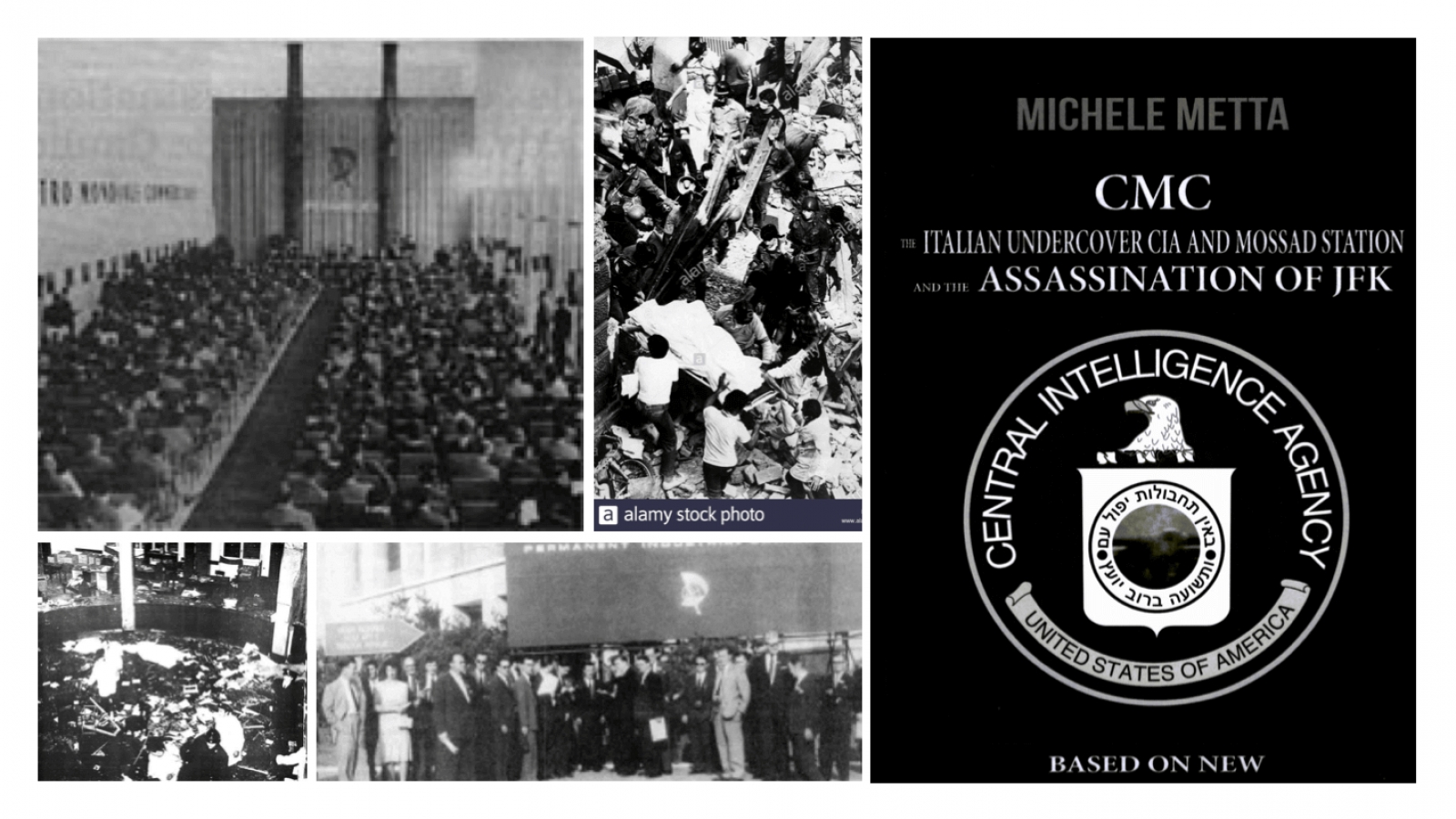 A review of
CMC: The Italian Undercover CIA and Mossad Station and the Assassination of JFK
by Michele Metta
with two Appendices
In his book, Michele Metta has provided his readers with a glimpse into the world of Centro Mondiale Commerciale (CMC). But along with that, the author gives us an insight into the politics of post-war Italy that is quite encompassing and incisive. It’s very clear that Italy was a hard target of American interests in the Cold War. With the help of some books published in Italy that would not normally be available to an Western audience, Metta takes us further into those attempts to control Italian politics.
Centro Mondiale Commerciale came to the attention of Jim Garrison’s investigation into John F. Kennedy’s assassination because Clay Shaw, the man he would accuse of participating in a plot to murder Kennedy, was a member of its board of directors. As more than one author had noted, that shadowy corporation had a rather curious background prior to opening in Rome amid much hoopla. They had previously been thrown out of Switzerland due to the controversial nature of some of its members, and also due to the mystery surrounding the company’s financial backing.
The charge made by Garrison against Shaw is one of the reasons why there is so much discussion on the internet about CMC, located in Rome Italy, and its associated company Permindex, located in Basel, Switzerland. The discussion has also included much unreliable and/or unverified information that is rooted in accusations made by Lyndon Larouche’s Executive Intelligence Review (EIR) and David Copeland, aka William Torbitt, who wrote Nomenclature of an Assassination Cabal. This includes stories depicting Permindex as a front company operated by Montreal lawyer, Louis M. Bloomfield, from which Bloomfield supervised assassinations. These stories have been circulating for many decades and for some people these stories about Bloomfield and Permindex are considered as fact.
When I discovered that an Italian journalist, Michele Metta, had done research on CMC, I was hopeful. Finally, a study of this company that would not build on the falsehoods created by Larouche and Copeland, and instead would provide the reader with a narrative supported by actual evidence. What I found however, was a bit of both. Metta provides evidence that actually proves that Shaw was on the board of directors of CMC, that CMC member Ferenc Nagy was a CIA asset, and that another CMC member, Georges Mandel, aka Giorgio Mantello, was connected to Israeli intelligence. The author further describes connections between CMC and the notorious Italian organization, Propaganda Due (P2), that is linked to the “Strategy of Tension” that was responsible for a wave of bombings and violence in Italy. He also provides connections to persons involved in Kennedy’s assassination. But the book falls short in another aspect of its story. Metta attempts to link CMC to the “Strategy of Tension” and the assassination of John F. Kennedy. Although he makes some interesting connections in those regards, he does not really achieve his aim.
The book however does an excellent job at showing connections. Metta’s research links many members of CMC to Mussolini’s old fascist guard and neo-fascists associated with the “Strategy of Tension.” He does this by providing names of CMC members and then describing their personal histories. He demonstrates that these ardent cold warriors dreaded socialist and communist parties controlling the Italian government, and were prepared to go to great lengths, including violence, to stop them from achieving power. These are the same people who would also oppose Kennedy’s soft-on-communism foreign policy, including his conciliatory attitude towards leftists in the Italian government. These numerous right-wing connections to CMC make it apparent that it could be used as a vehicle for promoting subterfuge in Italian politics and perhaps even play a role in Kennedy’s assassination. But connections alone do not constitute proof. The fact that one person knows another, and that person is somehow connected to CMC is not proof that CMC played a role in the Dallas plot. These numerous right-wing connections, however, create a lot of suspicion about this company’s activities, a suspicion so great that it demands further investigation into its operations. It also shows that Garrison’s interest in the organization was merited and that later attempts to somehow demonstrate that this was all a KGB disinformation ploy are not founded. But more research is needed to provide the actual details of how CMC participated in Kennedy’s assassination. Metta does not provide this important evidence. For example, when he attempts to link the financing of the plot to Valerio Borghese and CMC, he offers only more connections, instead of how money went into CMC’s bank account and then out to the assassination team.
The author informs us of other events he tries to link to the members of the CMC: for example, interfering with President Jimmy Carter’s re-election bid in 1980 and an assassination attempt on his life. He also tries to tie CMC to the assassination of Italian politician, Aldo Moro, in 1978. But again Metta offers only connections between people as proof that CMC played a role in these events.
Before examining his book in more detail, we must first examine the question mentioned earlier: why all the interest in CMC/Permindex, and why it has continued to be a topic of interest for Kennedy researchers for such a long time.
II
As previously stated, this interest in CMC began with Jim Garrison’s prosecution of Clay Shaw for conspiracy in the death of President Kennedy. In his investigation he found out that Shaw, who had been the manager of the International Trade Mart (ITM) in New Orleans, had also served on the board of directors of CMC. To the casual observer, Shaw’s appointment made sense. CMC, like Permindex and the ITM, were both created to provide a showcase for goods produced by different companies. Given his many years of experience managing the ITM, he appears to have been a good candidate for work with CMC. But Garrison’s suspicions were raised when he discovered that Montreal lawyer, Louis M. Bloomfield, who he believed was a former member of the Office of Strategic Services (OSS), a precursor to the CIA, was a major stockholder in CMC.1 Garrison also indicated in his book that Le Devoir, a French-language Canadian newspaper, had published an article in 1967 that stated that Bloomfield had done espionage work for the United States government and was a major stockholder in Permindex.2 While I have yet to see credible evidence that Bloomfield was an OSS agent, Garrison was right about his suspicions regarding CMC. Once the public found out about them it was only a matter of time before stories, ever the more wild, began to circulate about both Permindex and Bloomfield. These accusations came to Bloomfield’s attention, and in a letter to I. G. Alk in 1979 he lamented:
There is an outfit calling itself the North American Labour Party run by some fellow called Larouche, apparently whose propaganda is not treated seriously, but whose propaganda accuses me and other prominent Canadians of all sorts of heinous crimes. (Exhibit 13 )
These attacks and the perceived damage to his reputation, along with other misinformation about him, were the probable reasons for his wife to ask Library and Archives Canada (LAC) not to release his papers to the public. The archive’s compliance with her wishes resulted in two lawsuits against them. (A discussion of these two lawsuits and a third one brought by me can be found in Appendix 1.)
Metta continues in this vein. He believes Bloomfield to be a stockholder in the companies and states that he founded Permindex. (p. 7) The evidence from LAC does not support these statements. He is not a direct shareholder nor a founder of Permindex. (A description of his actual role with these two companies can be found in Appendix 2.)
III
One of the insights I gained about the anti-Kennedy forces in Metta’s book is found in a pact made between Italian and American Freemasons against Kennedy, which included a member of CMC and the CIA. This is an important assertion, since it is implying that CMC is involved in an anti-Kennedy plot. It also shows a connection between a member of CMC’s board of directors and the CIA. (p. 10) This pact involved Dr. Gigliotti, who was a CIA agent, and was organized by Giuseppe Pièche. (p. 13) Pièche was a member of CMC’s board of directors. (p. 15) The purpose of this pact was to oppose Kennedy’s bid for the 1960 presidential election. In a letter from the Grand Master of the Freemasons, Enzio Milone, to the Christian Democratic Member of Parliament, Elio Rosati, dated September 24, 1960, he told them to:
… propagate as much as possible the protestant idea—influence Italian immigrants in the USA to vote against Kennedy … (p. 10.)
But is the pact subversive? To many people, including this reviewer, it looks like typical election politics: encouraging a certain ethnic group to vote a certain way. The fact that it stemmed from a foreign country, Italy, is also not that unusual.
Giuseppe Pièche, who organized the above-mentioned anti-Kennedy pact, also provides a link between CMC and far-right Italian politics. This connection is important because CMC has always been a suspicious entity, the suspicion being that the company owed its existence to a motive other than profit. And Metta does provide the reader with reasons to be suspicious. Pièche was a general in Mussolini’s army. If this isn’t enough of a fascist credential, Metta goes on to state that he and Mario Scelba “created and directed” the Servizio Antincendio [Fire Service]. He was assisted in the Fire Service by Edgardo Sogno who was connected to P2 and who later told the press that the Fire Service was a NATO organization linked to the Gladio network. (p. 13.4) The author also informs the reader that Pièche and Sogno created and ran an organization called “Pace e Libertà” [Peace and Freedom], which received funding from Allen Dulles. (pp. 14-15) These are credentials that should make any reader be wary. But then Metta makes a strained conclusion. He states that Pièche was a member of the CMC Board of Directors; that Antonio Trabuchi, who was present at the signing of the Freemasons’ pact, was a also a member of the government led by Fernando Tramboni, who wanted to make Italy into a dictatorship (pp. 9, 15); and finally, that Tramboni’s son-in-law, Franco Micucci Cecchi, was also a member of CMC (p. 15).
From these facts he concludes: “Therefore, there is ample evidence so far to sustain that CMC was behind the pact against JFK.” (p. 15) Yet, he has already told us that the pact against Kennedy was between American and Italian Freemasons. (p. 9) If CMC was the catalyst for the pact, he should have demonstrated how CMC’s board of directors had created and implemented it.
IV
Metta then introduces a new statement into his narrative. It is an assertion which is truly sinister, one that implies Freemason participation in Kennedy’s death. At a meeting of the Sacro Collegio del Rito [Sacred Panel of Rites] held on December 5, 1981, which Metta describes as “… the high assembly of top Italian Freemasons,” there were concerns about a document in the possession of Enzo Milone, whose letter described the anti-Kennedy pact of 1960 mentioned above. (p. 16)
At this meeting, Milone stated: “Everything happening [today] had its matrix in what occurred in 1962.” (p. 18) During this meeting, Franco Nataloni stated that: “If these papers were to get into the hands of the D.C. Tina ANSELMI, this could put all of us in trouble.” (p. 19)
The Freemasons had a good reason to be concerned about Tina Anselmi. She led an Italian government commission of inquiry that could connect Italian Freemasons to P2 and other subversive activities. (p. 9) Metta then reminds us that the statement regarding what happened in 1962 was after Kennedy was elected and was residing in the White House at the time, so it does not have anything to do with their pact to block his election to the presidency. He goes on to state: “Milone says 1962; when Kennedy is already in the White House, and to stop him means something else; it means things like Dallas.” (p. 18)
Is he implying that 1962 was the year that the Freemasons began their plot to assassinate Kennedy? It certainly seems like it because he mentions Dallas. But what actually did occur was a lot less sinister. The author also states: “Besides, in 1962 the plot against JFK started involving a key figure of the Italian Intelligence and Freemasonry: Giovanni De Lorenzo, an individual who was closely linked to the CMC …” ( p. 24)
But the plot was not an assassination plot; it was a five-point plan to oppose left-wing parties in Italy. These are enumerated by Metta (pp. 34-35):
- Point 1. Program diverse actions for possible emergency situations.
- Point 2. Intensify finances to the forces which oppose the political swing [to the left].
- Point 3. Support single leaders in the Christian Democratic Party (DC) and political lobbies willing to rally around the new President of the Republic Antonio Segni (Segni, like Gronchi before him, placed full trust in General De Lorenzo), who did not like the party’s opening to the left.
- Point 4. Support any action which seeks to weaken the structure of the Socialist Party and favor any kind of internal split.
- Point 5. Strengthen voices in the media who are able to influence public opinion in the field of economics and politics.
As can be seen, this was a plan to disrupt the attempt being made by left-wing parties to gain the confidence of Italian voters. As David Talbot mentioned in his book on Allen Dulles, The Devil’s Chessboard, Kennedy thought that the ruling party in Italy, the Christian Democrats, should open itself up to the Socialists. This “plot against Kennedy” thus was in opposition to “l’apertura a sinistra”, the opening to the left that Kennedy would propose on a trip to Rome the next year. (Talbot, p. 464)
V
Metta does however create some suspicion about CMC’s connections to the Masonic Lodge P2. P2 was, according to the author, linked to the “Strategy of Tension,” which was responsible for much violence in Italy, including the Bologna railway station massacre that killed 85 people and injured over 200 people in 1980. The goal of these attacks was to terrorize the Italian public into accepting an authoritarian government. (p. 21) Led by Licio Gelli and financier Michele Sindona, P2 was declared by the Anselmi Commission to be a criminal organization. P2 was a remarkably dangerous and secret society. Their influence extended beyond Italy, as far away as Argentina. As a result of the Anselmi Commission, it was eventually outlawed.
Metta believes that the P2 lodge and CMC were so closely linked that: “In fact, we are now about to discover in how many infinite ways the CMC is indistinguishable from the Masonic Lodge P2 …”(p. 21)
The evidence he cites to connect CMC to P2 is a company called IAHC, which was a subsidiary of CMC. (p. 21) He then tells us that its board of directors meetings were held at the office of Roberto Ascarelli, whom he also links to Licio Gelli, found guilty of the Bologna massacre. (pp. 21-22) Anselmi’s commission stated that P2 also met at Ascarelli’s office. (ibid)
This is important evidence. It certainly creates a link between P2 and CMC’s subsidiary IAHC, and therefore to CMC itself. Sharing the same offices is similar to the situation Lee Harvey Oswald found himself in, sharing office space with Guy Banister at 544 Camp Street in New Orleans. But while this is evidence of possible collaboration between CMC and P2 through its subsidiary, IAHC, it does not prove conclusively that CMC is indistinguishable from P2. Metta is relying on a connection, and while that is important, it does not tell the reader what subversive activities IAHC participated in. Although this is definitely a step forward in describing CMC, more research is needed to show how IAHC participated in P2 operations and how it participated in the Dallas plot.
VI
Metta also tries to explain to the reader another aspect of the assassination plot; how it was financed. His attempt to link Valerio Borghese to the Dallas plot gets mired in a large number of connections. It does create suspicion that certainly warrants further research, but does not prove that CMC was somehow connected to Kennedy’s murder.
Borghese was a naval officer under Mussolini. After the war he was rescued and then mentored by James Angleton. Nicknamed the Black Prince, he became a hardline fascist political figure in postwar Italy. He took part in an attempted coup in 1970. After it failed, he fled to Spain where he lived out the last years of his life.
Metta introduces the reader to a bank called Credito commerciale e industriale, which is abbreviated to Credicomin. Credicomin was bought by a company called Società finanziara italiana (SFI). On the board of directors of SFI is a man named Antonio Covo, whose brother-in-law is Giovanni Gronchi, who is linked to CMC members, (p. 47). He then tells us that Credicomin came into the hands of Ramfis Trujillo (p. 50), the son of Rafael Trujillo, the former dictator of the Dominican Republic. Borghese then became Credicomin’s president and Trujillo deposited 10 billion lira into Credicomin. This money promptly disappeared. (p. 50) He also adds to the mix the story Gerry Hemming gave to a newspaper in 2005, in which he said that Ramfis Trujillo and Johnny Abbes Garcia, Rafael Trujillo’s former intelligence director who tried to assassinate Fidel Castro, met in Haiti in February 1963 to finance Kennedy’s assassination. (p. 49) He also mentions that the telephone number of Marcella Borghese, a cousin of Valerio Borghese, was found in Clay Shaw’s telephone book. (p. 50)
Though some have doubts about Hemming, if this is all accurate, it does look sinister. Shaw, the accused Kennedy plotter, knows Borghese’s cousin. Money is disappearing from a bank controlled by Ramfis Trujillo, who Hemming accused of meeting in Haiti to finance the Dallas plot. These are certainly interesting links; but there is a problem. Metta does not tell us how CMC participated in the financing of the assassination. Yes, Shaw was on CMC’s board of directors and Gronchi is connected to CMC, but what exactly did CMC do to facilitate the financing of Kennedy’s murder? These connections between SFI, Credicomin, Borghese, Trujillo and Shaw also do more to implicate Credicomin than CMC in Kennedy’s assassination, because money disappeared from a Credicomin bank account, not from CMC’s bank account.
VII
Metta does however produce real evidence that links CMC to the CIA. Here he provides a document from which the following facts emerge: Dr. Ferenc Nagy, President of Permindex, had asked the CIA to place an American businessman on the board of Permindex and also that a CIA agent be placed on the staff of Permindex. Nagy then goes further. He even asks CIA to invest money in Permindex so that it can have input into the management of the company. (p. 87 fn. and p. 88, Exhibit 25) This evidence is very important because it confirms that this company’s purpose was not just to provide an exhibition hall for companies wanting to sell their products, but that there was also an intelligence aspect to it. This evidence is further corroborated by a document provided by Metta that shows that CIA asset Clay Shaw was a member of CMC’s board of directors.6
Metta establishes another link between CMC and an intelligence agency. Georges Mandel, aka Giorgio Mantello, a member of CMC, was connected to the Israeli Intelligence Service (ILS). Quoting a CIA memorandum, the author states: “ … at Point 5, makes a very detailed but also formidable revelation: witnesses identified Georges Mandel alias Giorgio Mantello, as belonging to the Israeli spy network.” (p. 114) He also informs us that he was employed by the Banque Pour le Commerce Suisse-Amérique Centrale in Geneva that hired ILS agents. (p. 114)
There are now three persons linked to Permindex and CMC—Nagy, Shaw and Mandel—who have or had intelligence connections. It is getting harder to believe that this company’s only purpose was commercial. But once again it must be said that these intelligence connections alone do not support Metta’s theory that CMC played a role in the Dallas plot. What is needed is evidence that the intelligence assets used CMC as a conduit to carry out the plot.
VIII
In his narrative Metta tries to link the Organisation de l’Armée Secrète (OAS) to Kennedy’s murder and CMC. The challenge here is to see if he offers proof that the OAS, the same organization that was behind assassination attempts on Charles de Gaulle, was involved in Kennedy’s murder, and then connect the dots to CMC.
He does offer some proof about a possible OAS involvement in the Dallas plot. He provides the reader with the contents of a CIA memorandum which states that Jean Souetre was:
… in Fort Worth the morning on 22 November and in Dallas in the afternoon. (p.128)
The memorandum also states that Souetre: “… is believed to be identical with a Captain who is a deserter from the French army and an activist in the OAS.”
He then presents us with more incriminating information. He reminds us that Fernando Tamborini, who was linked to the masonic pact against Kennedy and whose son-in-law, Franco Micucci Cecchi, was a member of CMC, had a “special office” that was, quoting SISMI papers: “… probably, also the headquarters for OAS activities in Italy (at least at the high level).” (p. 131)
The Souetre presence in Dallas on November 22, 1963 has always been fascinating, for more than one reason. For instance, the OAS had been bitterly opposed to Kennedy since 1957, when he advocated for Algerian independence. Metta does make a connection between the OAS and Tamborini, but this connection is attenuated because the SISMI paper qualifies the identification of Tamborini’s office with “probably”. He then attempts to connect the OAS to CMC using Tamborini’s son-in-law but does not provide evidence to show how Cecchi involved CMC in the Dallas plot. Again, this is new and interesting evidence, but it does not go as far as it should in the details.
IX
Connections, connections, connections; this is the core of Metta’s book. He attempts to show that a myriad of connections between the far-right of Italian politics, the CIA, Israeli intelligence and CMC all came together to plot and carry out the assassination of John F. Kennedy. The author even states after describing still more connections between members of CMC and various right-wing personalities: “Yes, for the umpteenth time, everything is connected.” (p. 139)
But connections are a double-edged sword. Connections can draw the attention of the reader to important relationships between members of the CMC and fascists, and perhaps even to the Dallas plot because the likely suspects were members of the far-right. But connections alone are not enough, because they do not show the crucial details of how Kennedy was murdered: who gave the orders, how the plot was organized, how the snipers were recruited, and what role CMC played in this tragic event.
Metta does make an interesting connection between the P2 and CMC subsidiary IAHC, but this needs more work because he does not tell the reader what subversive activities it was involved in.
He also fails to show the reader how CMC was used as a conduit in the Dallas plot. For example, he attempts to link the financing of the assassination to Borghese, Trujillo, Credicomin, Shaw and CMC, but here again we have that double-edged sword. These connections are interesting: missing money, Shaw on the board of directors of CMC and Shaw with Borghese’s cousin’s telephone number. But he does not show how the money went from Credicomin’s bank account to CMC’s bank account and from there to the actual plotters. These connections do raise suspicions, and they should be investigated further. But by themselves they do not prove that CMC acted as financier for the Dallas plot.
He also provides evidence to establish that there were at least three people, Nagy, Shaw and Mandel, who were connected to intelligence agencies. This is important because it confirms the suspicions of the newspaper Paesa Sera that there was more to CMC than just providing exhibition space for companies to sell their products.
Metta also includes CMC links to events that occurred after the assassination. He attempts to connect CMC to election meddling by participating in a plot to scandalize President Carter’s brother and to an attempt on Jimmy Carter’s life. He also tries to connect CMC to the murder of Aldo Moro, but CMC’s alleged role in these two events does not inform us about the events of 1963 in Dallas.
Metta’s book also has a problem with its format: the book does not have an index. This creates a lot of difficulty for the reader because so much of what the author writes about is connections. Attempting to follow the histories of different persons mentioned in his book is difficult without knowing on which pages a person is mentioned. This requires the reader to re-read whole sections of the book to locate information about an individual and this is frustrating. Particularly for a reviewer. Hopefully, this will be improved in a later edition.
Appendix 1: The Bloomfield Papers Law Suits
In 1978, Montreal attorney Louis M. Bloomfield donated his personal papers to Library and Archives Canada (LAC). His papers contained a wide variety of items, including a large number of his letters, articles and manuscripts written by him, including photographs. A complete list of what he donated to LAC can be found in the archives finding aid. (Exhibit 3)7 When he donated his papers to LAC he stipulated that all items donated by him were to be released to the public, without any restrictions whatsoever, 20 years after his death. In the intervening years, between the time of his death and the papers’ release date, his wife, Mrs. Justine Cartier, now remarried, would act as literary executrix. Her control of the documents would cease 20 years after his death.
In 1984, while on a trip to Israel, Bloomfield passed on. In 2004, Maurice Philipps, author of a book about Kennedy’s assassination called De Dallas à Montréal, asked LAC to grant him access to Bloomfield’s papers. According to his will, this should have been done automatically because 20 years had elapsed since his death. The archives consulted with Bloomfield’s widow and asked her about granting Philipps access to her husband’s papers. She told them to deny Philipps access. The archives complied with her wishes, even though her request contravened her husband’s stipulation. Philipps, after being informed that he could not access Bloomfield’s papers, asked the Federal Court of Canada to review the archive’s decision to not allow him to review Bloomfield’s papers. In 2006 the Court ruled in Philipps’ favour and ordered LAC to review their decision.8
In 2007, after consulting with Mrs. Cartier, the archives made a decision to release some of Bloomfield’s papers, and to hold others back. The papers that were held back were those deemed by LAC to be subject to “solicitor-client privilege” (SCP). This was due to Bloomfield’s status as a lawyer, and they would therefore be released 50 years after the last date in the file in which those papers were contained. The archives created a document that listed all items in the Bloomfield papers and indicated which ones were open for public review and which ones would only be released when the documents were 50 years old. (Exhibit 4) Philipps appealed this decision and asked that all files be released immediately. This time the Court ruled in favour of the archives. Their decision to hold certain files back for 50 years would stand.9
As a result of his actions, Philipps was finally able to review some of Bloomfield’s papers. He created a website called “I Have Some Secrets for You” in which he provided copies of letters written by Bloomfield in regard to his work with Permindex. Philipps discovered some interesting communications in this first release, specifically between Bloomfield, Permindex and David Rockefeller. Apparently, Ferenc Nagy was trying to solicit funds for Permindex from one of the richest men in America. There was also a CIA connection since Nagy had invited the Agency to use this new company in Rome for any purposes it wished. There is more, as the reader can see by clicking through to his web site.
I began my own research into Bloomfield’s papers in 2012. The examination began with those files that were already open and then continued with those papers that could only be reviewed after they were 50 years old. This required me to return to LAC as different papers, which had reached 50 years of age, were opened by LAC for review by the public. I accessed them on a number of occasions, and as late as 2017 had been granted access to them. In January 2018, I asked for those papers that were now available for review and was told by the archives that they could not be viewed by the public. The reason given by LAC was that those files were considered to be covered by SCP. In an email from Guy Berthiaume, Librarian and Archivist of Canada, he stated that it was not Mr. Bloomfield’s prerogative to donate his legal papers to the archives because SCP protects communications between a lawyer and his client from being divulged to the public. In response to this decision by LAC to not release his papers to me I submitted an “Application for Judicial Review” to the Federal Court of Canada asking the Court to review the archive’s decision.10 In my case I argued that Bloomfield’s papers were not subject to SCP because they did not meet the legal test for privilege that can be found in Canadian case law. The archive agreed to do a second review of those files they deemed to be subject to SCP. They subsequently released over 2,000 documents to me and held back just 69 documents. The archives also agreed to update the access forms on their website so future researchers would be aware that, except for the 69 documents held back by them, his papers can now be accessed without waiting for them to reach 50 years of age.
But what would cause the archives, after two previous court cases, to again try to block public access to Bloomfield’s papers? I do not have a definite answer to this question but do have a theory. The most likely cause of this problem was the October 2017 release of Kennedy assassination documents as stipulated by the Assassination Records Review Board in Washington. The release of these documents is rooted in the decision by the United States government, taken in the 1992 President John F. Kennedy Assassination Records Collection Act, to declassify all documents pertaining to Kennedy’s murder in 25 years. Therefore all documents were to be released in 2017. When the time came for the documents to be open to the public, the media was full of stories about the releases. I was still able to access Bloomfield’s documents as late as November 2017, but with all of the media attention given to the JFK documents release, a decision was made to block access to them. The reason for blocking access to them, using the excuse that they were subject to SCP, was most likely caused by all of the media hoopla in America.
II
On December 18, 2018, LAC released to me over 2,000 documents previously deemed subject to SCP. These files had been reviewed by the archives and deemed to be not subject to SCP. Only 69 documents from the Bloomfield papers were not released because LAC claims they are subject to SCP. A list of Bloomfield’s correspondence that will not be released is in Exhibit 5.
A review of the papers that were released did not reveal anything new. The documents found there were the same ones that had previously been considered subject to SCP and held back for 50 years, and these I had reviewed on a number of occasions since 2012. The papers released in 2018 are comprised of letters and cablegrams from Bloomfield to his business associates and other personal contacts. The fact that interesting connections were found but nothing incriminating is not surprising because it appears that Bloomfield was not actually a shareholder in either Permindex or Centro Mondiale Commerciale. His role with these two companies was to protect the interests of certain other shareholders who may have been from the class of the Power Elite. If he had dealings with Director Clay Shaw, or was aware of the company’s intelligence connections, he did not include these documents with the papers he donated to the archives. A review of the correspondence in Exhibit 5 also reveals that important Permindex and Centro Mondiale Commericale figures such as Georges Mantello, Joseph Slifka, Hans Seligman and others, do not appear as recipients on the list of 69 documents that will not be released.
Appendix 2: Bloomfield’s Role in Permindex and Centro Mondiale Commerciale
For a long time Bloomfield has been the object of suspicion on many internet forums, and also in some books. Some have insinuated he was the mastermind behind the creation of Permindex, which has allegedly organized a few assassinations. These rumours began during the Jim Garrison investigation. Garrison had been given articles written about Permindex by writers like Ralph Schoenmann and the late Paris Flammonde. But Garrison, for whatever reasons, never brought this information up at the trial of Clay Shaw. After the acquittal of Shaw, a man named David Copeland, using the alias of William Torbitt, wrote a pamphlet called Nomenclature of an Assassination Cabal. This pamphlet began to circulate widely in the research community. And it was here, for the first time, that both Bloomfield and Permindex were accused of being part of the JFK assassination. In fact, the very first chapter of the pamphlet focuses on Permindex and names Bloomfield as the top supervisor of the plot. As Jim DiEugenio, in his book Destiny Betrayed, Second Edition notes, there are many, many scholarly problems with this pamphlet, one being that its few references do not check out.
Years later, in 1981, Lyndon Larouche—in an issue of Executive Intelligence Review written by Jeffery Steinberg and Peter Goldman—published at length about Permindex. Again, Bloomfield was a central focus of that long essay. For the most part, author Michele Metta thankfully does not go that far. He does not accuse Bloomfield of being the leader of an assassination team, but the evidence does indicate that he made some skewed assumptions about Bloomfield’s role with Permindex. He also raises some suspicions about him because he corresponded with the late George H. W. Bush.
In his book, he states that Bloomfield was the founder of Permindex. But he does not supply a source for the statement. Without evidence from the author to support it, we need to look to the Bloomfield papers for an answer. What does Bloomfield have to say about his relationship to Permindex?
In a letter from Bloomfield to J. Metzger dated April 8, 1960, he informs him: “…I am not the Treasurer of Permindex but am acting solely in the capacity of lawyer for certain shareholders.” (Exhibit 611 ) Who these shareholders are, he does not tell us, but we now know he is stating that he is not an investor in Permindex.
In a letter to Enrico Mantello dated January 21, 1960 he writes: “I would have never undertaken this job if I had not been assured of your cooperation.” (Exhibit 712 ) Those are not the words of a founder, they are a statement being made by a representative.
In a letter to Tibor Rosenbaum dated July 12 1961, Bloomfield discusses ownership positions in a syndicate created to buy the shares of a development called Marina Reale (Exhibit 813 ):
… so the position today…
George Mantello 25% Enrico Mantello (and Tim Fales) 25% Dov Biegun 10% Joseph Slifka 15% L.M. Bloomfield (in trust for clients) 10% Max and Moe Pascal 7 ½% Nate Dolin 7 ½% Total 100%. Again it appears from the evidence that Bloomfield is acting on his client’s behalf and does not have a financial stake in Marina Reale.
Metta also tries to raise suspicion about Bloomfield’s correspondence with George H. W. Bush, a director of the CIA, who later became both Vice President and President of the United States. His cites as evidence Bloomfield’s connection to Bush, the implication being that since they knew each other, there must be wrong-doing here. He also states that the correspondence between Bloomfield and Bush has been blocked from public access. This is not accurate today. The files are available for public review because LAC only blocked access to those files that they deemed to be subject to SCP. Given that Bloomfield was not Bush’s lawyer, their correspondence is open for review. He also states that the correspondence is “dense”, suggesting that they exchanged many letters. (p.110.) This writer could find only 18 items in Bush’s file and they do not discuss Permindex or CMC, or conspiratorial matters. All of these items can be found in Exhibit 9.14 This does not mean that we can automatically excuse President Bush, or Bloomfield for that matter. It is simply stating that the evidence is not there in these files.
A question that must also be posed is why Larouche and Copeland would accuse Bloomfield of such major crimes. In Copeland’s case the reason seems to be to simply obfuscate the Kennedy case. At the early date he began to circulate his pamphlet, very little was known about Permindex or the CMC. Thus the field was wide open to attribute all kinds of illicit actions to those bodies. A review of available literature can provide some insights into Larouche’s motivation. His organization and much of his writing tends to accuse the United Kingdom for many international problems. It is not an exaggeration to say that, to the editors of Executive Intelligence Review, Great Britain is the locus of much of the evil in the world. In the 1981 article we mentioned earlier, the authors attempted to connect Bloomfield to the legendary Canadian/British intelligence officer William Stephenson. In 1940, Winston Churchill sent Stephenson to New York as the chief of British Security Coordination. He was also the chief liaison to American intelligence during that conflict. His office was located in Rockefeller Plaza in New York City. There is no evidence in Bloomfield’s war file that he worked with Stephenson; his correspondence, however, indicates that he may have known Stephenson in the 1950s. (Exhibit 10)15 Bloomfield felt that there was also a tinge of anti-Semitism in these accusations. For instance, the Anti-Defamation League had written that, “The LaRouche operation has been marked since 1978 by continuous emanations of anti-Semitism. Its publications single out prominent Jews, Jewish families, and Jewish organizations for particular abuse.”16
Bloomfield was affected by this anti-Semitic campaign because only a year later, in 1979, in a letter to I. G. Alk, he told him what Larouche was saying about him and other prominent Canadians. (Exhibit 1)
Exhibits
Exhibit 1 – Bloomfield letter to I. G. Alk
Exhibit 2 – Nagy asks CIA to make Permindex a CIA front company
Exhibit 3 – Bloomfield collection finding aid
Exhibit 4 – Bloomfield collection file release dates
Exhibit 5 – Bloomfield collection files not released by Library and Archives Canada
Exhibit 6 – Bloomfield role with Permindex/CMC
Exhibit 7 – Bloomfield role with Permindex/CMC
Exhibit 8 – Bloomfield role with Permindex/CMC
Exhibit 9 – Bloomfield Bush Correspondence
Exhibit 10 – Bloomfield connection to William Stephenson
Notes
1 Jim Garrison, On the Trail of the Assassins, Warner Books Edition, New York 1991, p. 101.
2 Garrison, p. 102.
3 Library and Archives Canada, Louis M. Bloomfield, MG 31-E25, Container 29 File 16, General Business Correspondence 1979.
4 Gladio in Italy was part of a larger group of secret armies under the command of NATO that operated in different countries using different names. In Denmark it was called “Absalon”, in Norway it was called “ROC” and in Belgium it was called ‘SDRA8.” They were set up by the CIA and MI-6, and their job was to act as a stay-behind orce that would operate in countries that might be occupied by the Soviets after an invasion of Western Europe. Their objective was to help local resistance movements in occupied territories, evacuating pilots who were shot down and sabotaging enemy supply lines. This network was modeled on the British Special Operations Executive that sent soldiers behind enemy lines during World War II to fight a secret war. Daniele Ganser, NATO’s Secret Armies: Operation Gladio and Terrorism in Western Europe, Frank Cass, London 2005, pp. 1-2.
5 Metta’s source for this document is CIA. HSCA Segregated CIA Collection, (microfilm—reel 17: Ruiz-Webster), Memorandum: Subject—Trace results on persons connected with Centro Mondiale Commerciale (World Trade Center). NARA Record Number: 104-10181-10114. The document in exhibit 2 was sourced from The Black Vault website.
6 On p. 8 of Metta’s book is a link to a website that contains documents provided by the author. One of the documents shows that Clay Shaw was on CMC’s board of directors.
7 Library and Archives Canada, Louis M. Bloomfield, MG31-E25.
8 Philipps v. Librarian and Archivist of Canada, Date: 2006-11-14, File numbers: T-1517-05. A copy of the Court’s decision, including the facts of Philipps’ case and legal issues can be found on the Federal Court’s website.
9 Philipps v. Librarian and Archivist of Canada, Date: 2008-09-16, File numbers: T-1192-07. A copy of the Court’s
decision, including the facts of Philipps’ case and legal issues can be found on the Federal Court’s website.
10 John Kowalski v. Guy Berthiaume, Librarian and Archivist of Canada, File numbers: T-381-18. While documents have been released, the facts of this case and legal issues has not been published on the Court’s website.
11 Library and Archives Canada, Louis M. Bloomfield, MG 31-E25, Container 23, File 1, Letter Book 14, 1960.
12 Library and Archives Canada, Louis M. Bloomfield, MG 31-E25, Container 23, File 1, Letter Book 14, 1960.
13 Library and Archives Canada, Louis M. Bloomfield, MG 31-E25, Container 23, File 3, Letter Book 16 1960-1961.
14 Library and Archives Canada, Louis M. Bloomfield, MG 31-E25, Bush, George (Sr.)—Correspondence 1976-1984, Container 16, file 1.
15 Library and Archives Canada, Louis M. Bloomfield, MG 31-E25, Container 19, File 1, Letter Book 3, 1953-1954.
16 The LaRouche Political Cult: Packaging Extremism A case study, Anti-Defamation League of B’nai B’rith, New York, Spring 1986, p.2.
-
The Murder of Hammarskjold
 For a long time this site has tried to point out that the Congo struggle was one of the most important, yet underreported, foreign policy episodes that took place during the Kennedy administration. Sloughed off by the likes of MSM toady David Halberstam, it took writers like Jonathan Kwitny and Richard Mahoney to actually understand the huge stakes that were on the table in that conflict, namely European imperialism vs African nationalism. Kennedy had radically revised America’s Congo policy from Dwight Eisenhower to favor the latter. Not knowing he was dead, JFK was trying to support Congo’s democratically elected leader Patrice Lumumba. JFK was also one of the few Western leaders trying to help UN Secretary General Dag Hammarskjold stop the Europeans from crushing Congo’s newly won independence.
In September of 1961, just eight months after Lumumba was murdered, Hammarskjold died in a plane crash. It was officially ruled an accident. But there were doubts from the beginning. For example, Harry Truman told the New York Times, that Hammarskjold was on the verge of getting something done “when they killed him.” It now turns out that Kennedy’s ambassador to Congo, Edmund Gullion, also suspected Hammarskjold’s plane was shot down. And he suspected it the night it happened. This key fact was not revealed for fifty years.
Below we link to three stories in the press of late that have finally circulated about the true circumstances of what happened to the Secretary General, the man who Kennedy called, “the greatest statesman of the 20th century.”
- RAF veteran ‘admitted 1961 killing of UN secretary general’
- Coups and murder: the sinister world of apartheid’s secret mercenaries
- Dag Hammarskjöld’s plane may have been shot down, ambassador warned
It is nice that the MSM is finally catching up to what we wrote about 20 years ago in Probe Magazine. In particular:
- Dodd and Dulles vs. Kennedy in Africa
- Midnight in the Congo: The Assassination of Lumumba and the Mysterious Death of Dag Hammarskjold
In the first of these two articles, Jim DiEugenio lays out the overall struggle of Kennedy and Hammarskjold to keep Congo free and united against the imperial forces of Belgium and England. In the second, Lisa Pease examines the murders of Lumumba and Hammarskjold within eight months of each other. Those assassinations left Kennedy standing alone. When he was killed, the imperialists triumphed.
During the ensuing decade, CTKA continued to focus on this important story, again underscoring the links between Kennedy and Hammarskjold, but now reinforced by the work of historian Greg Poulgrain with regard to their cooperation over Indonesia. See:
Finally, two decades later, the MSM is acknowledging that work. We don’t like to toot our own horn, but … Honk! Honk!
-
JFK Assassination: Still Searching for Answers

WhoWhatWhy hosts a podcast produced for The Ripple Effect featuring Russ Baker, Jefferson Morley and Jim DiEugenio.
-
The Past American Century
Mike Swanson has inaugurated a new website, The Past American Century, to host materials on the JFK assassination and other topics.
Check out this recent video on the Schlesinger memo from June, 1961 about eliminating/restructuring the CIA.
-

The Kennedys and Civil Rights: How the MSM Continues to Distort History, Part 4
Part 4: Assaulting the Ghetto: LBJ vs. the Kennedys
As I have tried to show in this series, the gestalt message contained in the books under discussion—that President Kennedy had no vision of what he wanted to do in regards to civil rights—is not supported by the record. (For an expression of that idea, see Bryant, pp. 471-73) John F. Kennedy did have a vision. It was articulated as far back as 1956, when he stated in a New York City speech that Harry Truman must be given credit for trying to pass a civil rights bill and added that Democrats must not waver on the issue. (NY Times, 2/8/56) It was reiterated when he voted for Title III of the Civil Rights Act of 1957. He advocated for that part of the bill because it would have given the attorney general expansive powers to file lawsuits on both voting rights and school integration issues. (Golden, pp. 94-95) In 1960, he told his civil rights advisory team that they could use information garnered by the Civil Rights Commission to break the back of voter discrimination in the South. (Golden, p. 139)
That goal was also contained in Harris Wofford’s memo, which was delivered to JFK in late December of 1960. (Nick Bryant writes that this was a thousand word memo; Wofford says it was 30 pages long, a rather significant difference. Since Wofford wrote it, I think we can trust him. See Bryant, p. 225; Wofford, p. 130) That memo advised he do as much as possible with executive orders and the judiciary, with the idea that this pressure would eventually cause something to break in the legislature. As we have seen, that is what President Kennedy did. When he placed an omnibus civil rights bill before Congress in February of 1963, he stated he felt he had gone as far as he could with executive orders; it was now time for the legislature to do its part. (Risen, p. 36) Contrary to what Bryant implies, the president then conducted one of the longest and most comprehensive lobbying actions ever in order to get the bill passed. (Bryant, p. 410; Risen, pp. 62-63) Based upon the actions of Bull Connor in Birmingham, and the president’s conversation with Dick Gregory, the February 1963 bill was revised and fortified. Again, contrary to what Bryant writes, the president did not lose interest in the bill that fall. (Bryant, pp. 450-52) He directly intervened in the legislative process in October. (Thurston Clarke, JFK’s Last Hundred Days, p. 249) He also told Philip Randolph, “I know this whole thing could cost me the election but I have no intention of turning back, now or ever.” (Golden, p. 98)
Michael Harrington 
At this point in the discussion, we should pay particular attention to the last part of that statement, as it is one more indication that Kennedy did have a vision. And he and his brother were ahead of almost everyone—as we shall see, most certainly James Baldwin and Jerome Smith. For as his bill was moving through Congress, he was already thinking beyond its parameters. In June of 1963, Kennedy told a group of labor leaders that something would have to be done for the Negro. He continued by saying that we all owed them a debt of gratitude for being “in the streets” and calling our attention to the American Dream. (Golden, p. 131) What did JFK mean by this?
Walter Heller & JFK As several authors have written, earlier in the year, the president had read Dwight MacDonald’s 13,000-word review of Michael Harrington’s book about the poor, The Other America. It left an indelible impression on him. In October of 1963, Homer Bigart had written a long article in The New York Times about pockets of poverty in Kentucky. The impact of those two articles caused a series of discussions between the president and his chief economic advisor, Walter Heller. (Clarke, pp. 242-43) Heller had written him a memo well before the Bigart article appeared. In it he stated that although the economy was expanding overall, there were pockets of poverty that were resistant to growth. Over months of discussion, the staunch Keynesian economist had to admit that in those pockets, people were “caught in a web of illiteracy, lack of skills, poor health and squalor.” After giving the president some statistics on the matter, Heller suggested what he called an “attack on poverty”. Kennedy told Heller that he was going to make this an election issue and he would visit some blighted areas in order to enter it onto the national stage.
In other words, the “War on Poverty”, or as some call it, the “Second Reconstruction”, was not President Johnson’s idea. But beyond that, there is something else lurking here as a back-story. Something that Thurston Clarke did not touch upon. And, in fact, few authors have ever discussed it. This back-story concerns the figure of David Hackett.
II
David Hackett & RFK Like William Vanden Heuvel with the Prince Edward Schools crisis, Hackett was a friend of the Kennedy family. Specifically, he attended prep school with Robert Kennedy. He was such a good athlete that novelist John Knowles modeled the charismatic figure of Phineas in A Separate Peace on him. (See this bio)
Influenced by the work of his sister Eunice Shriver, one of the first things Robert Kennedy did as attorney general was to take a dual interest in the rights of the poor to have attorneys and also the problems and causes of juvenile delinquency. (Edward R. Schmitt, President of the Other America, p. 68) The siblings convinced President Kennedy to issue an executive order creating the President’s Committee on Juvenile Delinquency. The committee had a three-year life span and JFK made Hackett the executive director. Hackett had a wide mandate. The attorney general wanted his friend to explore the issue in all of its dimensions and manifestations. Which he did. Sometimes he and RFK would just take a stroll through Harlem or the slum areas of Washington DC. Hackett would then introduce Kennedy to someone he knew, preferably a gang member, and the three would talk. Other times, Hackett would show RFK the shabby conditions of schools or recreation areas. The attorney general was moved by these and so he invited celebrities—Cary Grant, Chuck Connors, Edward R. Murrow—to come into those blighted neighborhoods to give talks to the kids who lived there. (Schmitt, pp. 69-70) The attorney general would also attain appropriations to repair some of these facilities.
The question that Hackett eventually began to hone in on was this: What caused the problem of delinquency? In doing so, he first reviewed the literature. He then interviewed some of the authorities in the field: for instance, sociologist Lloyd Ohlin and psychiatrist Lawrence Kumrie. He then traveled outside the east coast to the Watts ghetto and East LA barrio. (Schmitt, pp. 71-72)
Lloyd Ohlin After doing this research and field investigation, Hackett formulated two broad conclusions. First, he agreed with Ohlin and his approach to the subject. Ohlin co-wrote a book called Delinquency and Opportunity. That volume challenged the accepted paradigm that the problem was one of individual adjustment. It made the case that the real underlying problem was the poverty of the slum area and how that constricted opportunities for youth. To remedy the situation, one therefore had to supply more and better opportunities for youth in blighted areas. The second conclusion that Hackett came to was that this was not a simple phenomenon. What made it worse was the paucity of past efforts in the field, rendering it difficult to ensure that new programs would work. After all, Ohlin’s book had just been published in 1960. It was thus unlikely a solution could be found by the traditional remedy of starting up a series of FDR/New Deal-type programs. (Schmitt, p. 72)
Leonard Cottrell In the latter part of 1961, President Kennedy proposed a bill that would create 16 demonstration projects funded at 30 million dollars and provide Hackett a staff of 12 full-time employees. (Allen Matusow, The Unraveling of America, pp. 111-112) A year later, when Harrington’s book came out, Eunice Shriver recommended forming a domestic version of the Peace Corps. (When Johnson enacted his War on Poverty this ended up being called VISTA.) But there was one point that Hackett disagreed with Ohlin about. The sociologist suggested a top-down schedule of opportunities that those in the community could choose to participate in, e.g., jobs for teenagers, legal services, day care centers, or local centers offering government services. Hackett brought in a new expert, Leonard Cottrell of the Sage Foundation. They decided that the choice of options should not originate from the top down, but from the bottom up. In other words, the poor should choose what they wanted to pick from. Hackett called this “the competent community”. (Matusow, p. 117)
With respect to this proposal, there are two points the reader should keep in mind. First, after doing his study, Hackett understood that there was no established meme via which to frame the problem—let alone cure it. Until the day he died, he always insisted that there needed to be continual assessment as to what was working and what was not. (Schmitt, p. 92) Related to this, Hackett wanted to expand the number of demonstration projects. He reasoned that it was necessary to test what would work with differing ethnic groups; that is, what worked in East LA might not work in South Central. After he expanded his focus from delinquency to the circumstances of poverty, he knew there was more work to be done. (Matusow, p. 121) Second, he also insisted that a pure influx of funds would not solve the problem. There needed to be research and planning behind it. He convinced Bobby Kennedy on that point. (Schmitt, p. 84)
Both men understood the urgency of the problem. From what they had read and seen, America was sitting on a ticking time-bomb. This is not after-the-fact revisionism. While everyone was concentrating on the South, Hackett and Bobby Kennedy were examining sociological predicaments elsewhere that could not be solved by an accommodations bill or a voting rights act. In these places, the problems were not simple and the remedy was not as direct. In fact, RFK predicted that riots would erupt soon if nothing was done. (Schmitt, p. 86) He told a Senate committee in February of 1963 that America was “racing the clock against disaster … We must give the members of this new lost generation some real hope in order to prevent a shattering explosion of social problems in the years to come.”
Two and a half years later, when Martin Luther King visited Watts after the riots, that was the message he had for President Johnson. (See the film King in the Wilderness) As we saw in Part 2, this was the subject—northern race relations—that Bobby Kennedy wanted to discuss with James Baldwin and his friends at their meeting in New York in May of 1963. Through the work of Hackett, the attorney general understood that the problems of discrimination in the northern ghetto were not the same as segregation laws in the South. After the riot at Ole Miss, in the fall of 1962, he told Arthur Schlesinger words to the effect: if you think this is bad, wait till you see what we are headed for up north. (Ellen B. Meacham, Delta Epiphany, chapter 3) Because the circumstances were so different, he and Hackett knew that creative ideas were needed. That is what he wanted from people like Baldwin, Lorraine Hansberry and Lena Horne. He and Burke Marshall were lawyers; they did not need any advice on whether or not they could arrest the likes of Bull Connor. But they were now about to set sail on uncharted waters and they wanted some input. The fact that authors like Larry Tye and Michael Eric Dyson completely miss the hidden epic tragedy of that wasted opportunity demonstrates the kind of writers they really are. The real truth of Dyson’s pitiful book could be illustrated with an aerial picture of the Watts riots on the front cover with RFK’s words of warning on the back. That, Mr. Dyson, is what truth really sounds like.
III
Needless to say, no other administration had ever gone this far in this specific field. As author David Farber has noted, Harrington’s book—which eventually sold over a million copies—surprised America. This is one of Harrington’s most quoted passages:
The other America … is populated by failures, by those driven from the land and bewildered by the city, by old people suddenly confronted with the torments of loneliness and poverty, and by minorities facing a wall of prejudice. (The Age of Great Dreams, p. 18)
As Farber observed, the reason the book had such an impact was that during the forties, fifties and early sixties, the topic of poverty was pretty much non-existent. But in 1943, the mechanical cotton-picker displaced tens of thousands of workers, mostly African Americans, in the south. The problem was that since these laid-off workers had little skill and less education, there was no real future for them in the north. This may have been what Richard Russell had in mind when he told his colleague Senator Harry Byrd that what he feared if John Kennedy got elected was that he would go beyond even the Democratic platform. (Brauer, p. 53) The insight may have originated from Russell’s personal exposure to Kennedy while they were in the Senate. And indeed, as we have seen, that is what the president was doing at the time of his death, before his civil rights bill passed.
To crystallize how the Kennedys conceived the dilemma they would eventually face, let me quote Robert Kennedy:
You could pass a law to permit a Negro to eat at Howard Johnson’s restaurant or stay at the Hilton Hotel. But you can’t pass a law that gives him enough money to permit him to eat at that restaurant or stay at that hotel. I think that’s basically the problem of the Negro in the North. (Guthman & Shulman, p. 158)
That was not the entire problem of course. But the basic idea was that the matter was more complex and insidious once you got out of the South. As the president told Heller at their last meeting on the topic, “Yes, Walter, I am definitely going to have something in the line of an attack on poverty … I don’t know what yet.” (Schmitt, p. 93) To show how interested he was, at his final meeting with his cabinet, President Kennedy mentioned the word “poverty” six times. After his death, Jackie Kennedy took the notes of that meeting to Bobby Kennedy. The attorney general had them framed and put up on his wall. (Schmitt, pp. 92, 96)
As with many of President Kennedy’s policies, once it was assumed by Lyndon Johnson, it was changed. One of the underlying traps was what Hackett warned the Kennedys about. This problem could not be solved by constructing a New Deal program and blindly throwing money at it. As intimated above, the reason for this was that an unambiguous or certain remedy for it had not been identified. Hackett was still managing and evaluating his experimental projects, and JFK was not ready to commit to a specific program either. He wanted to do something, but he was not sure what it was.

FDR & LBJ A significant difference in the backgrounds of Lyndon Johnson and John Kennedy is that Kennedy did not arrive in Congress until after Franklin Roosevelt’s death, while Johnson was there in the thirties. He prided himself on being a New Dealer. He ran the National Youth Administration in Texas, which meant he supervised 20,000 youths. One of his proudest moments occurred during FDR’s visit to Galveston, when Johnson had all of his boys lined up for the president’s visit. (Nancy Colbert, Great Society, pp. 36-38) Unlike what Ohlin and Harrington were writing about—and what Heller was describing to the president—Roosevelt was not facing peculiar pockets of poverty amid a generally thriving economy. FDR was confronted with a massive, nationwide economic blowout that covered almost the whole country. He was facing a macroeconomic problem: how can I revive the entire economy by using Keynesian solutions? In the meantime, he had to provide aid to literally millions of people who were unemployed. And those people crisscrossed all kinds of economic, ethnic and racial boundaries. FDR’s New Deal was like a combination giant fire engine, ambulance corps, and cafeteria truck dropping supplies and services throughout the country in an attempt to stimulate the economy, give people jobs, and provide relief programs so they would not starve.
As Hackett told RFK, this was not the situation America faced in 1962. It was much more localized and much more complicated. As we have seen, Kennedy was going to run on it in 1964 in order to transform it into a national issue. He did not plan on starting his program until after the 1964 election. (Bruce J. Schulman, Lyndon B. Johnson and American Liberalism, p. 71) What happened after his death shows how important one man can be in determining the currents of history.
Walter Heller met with Johnson the day after Kennedy’s murder. The economist told the new president about the ideas he and JFK had reviewed for relieving poverty. Johnson told him that it sounded like his kind of program and he wanted to go full tilt on it. He then added that John Kennedy was a bit too conservative for his taste. (Schmitt, p. 96) When Heller got back to him with the demonstration projects that were running under Hackett, Johnson almost eliminated the entire program. In his eyes, such a project had to be big and bold in order to win congressional approval and make a rhetorical impact with the public. (Schulman, p. 71; Matusow, p. 123)
But there was another aspect to why LBJ trotted the program out before it was ready. The new president understood that the civil rights act making its slow way through Congress was really Kennedy’s. As I have noted, Clay Risen’s book, The Bill of the Century, proves that point. But Kennedy’s poverty program had not been formally announced or written up. Therefore, Johnson could present it as his own. (Evans and Novak, pp. 431-33) Also, like a star athlete in sports, LBJ wanted to set records in getting bills passed. (Farber, p. 106) He ended up doing both.
Just six weeks after he met with Heller, Johnson now appeared before the nation in an evening version of the State of the Union address. He announced to that nationwide audience that:
This administration, today, here and now, declares unconditional war on poverty in America … It will not be a short or easy struggle, no single weapon or strategy will suffice, but we shall not rest until that war is won. The richest nation on earth can afford to win it. We cannot afford to lose it.
This kind of rhetoric about a program whose specific points had not even been worked out yet! A bit over four months later, Johnson would announce the Great Society. Most analysts have differentiated the Great Society from the War on Poverty. The main agency for the latter was called the Office of Economic Opportunity (OEO). In five years, from 1965-70, OEO was granted 1.5% of the budget for all of its programs. Had that money been instead sent to each person living in poverty in America, the total would have come to about seventy dollars a year. (Maurice Isserman & Michael Kazin, America Divided, p. 192) How can you lift someone out of poverty spending that small sum? As many have said, the latter got lost and distracted by the former.
The greater expenditure on the Great Society was of particular consequence in this regard, because programs like Medicare, highway beautification, the National Endowment for the Arts, the creation of the Department of Transportation, and public broadcasting generally favored the middle class. Programs like air and water purification, and consumer protection, these favored almost all citizens. The problem with this panoply of programs was that when Johnson announced the Great Society at the University of Michigan on May 22, 1964, he did it with the same, if not more, extravagant language that he did his War on Poverty. In retrospect, what makes that even more shocking is this: Johnson had not run for president yet! For that matter, he had not even been formally nominated as the candidate of his party in the 1964 election. That would not occur for three more months, in August at Atlantic City.
In Johnson’s almost manic attempt to differentiate himself from his predecessor, what Hackett warned against was now going to happen. Johnson was going to play the New Dealer. He was going to create and pass an anti-poverty program well before the 1964 election. Yet before that was even passed, he was going to announce something even bigger: the Great Society. Needless to say, all this hubbub necessitated that the cautious Hackett be retired to the sidelines. Which he was. While Johnson was putting together his package, David Hackett—the man who ran the program for three years, who knew more about it than anyone—was now working on Bobby Kennedy’s senatorial campaign in New York. RFK tried to intervene. In January of 1964, he wrote the president a memo: “In my opinion, the anti-poverty program could actually retard the solution of these problems” unless Hackett’s basic approach was used. (Matusow, p. 123) At the time he was shunted aside, Hackett was working on something he called “competence and knowledge”. Using Ohlin’s opportunity approach, he wanted the people in these affected areas to have a complete knowledge of the opportunities at their disposal. And he wanted them to be able to designate their own leaders who could then competently use those opportunities in order to improve the lives of those they represented. It is safe to say that this was a continuation of Hackett’s dispute with Ohlin and his siding with Cottrell. Hackett wanted what he called his “community action experiments” to resemble something like a socialist democratic laboratory.
It didn’t end up that way.
IV
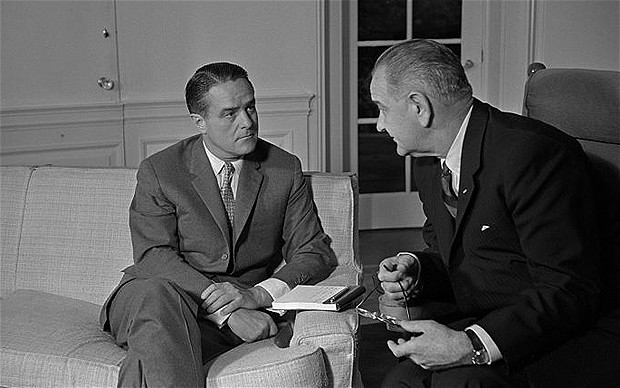
Sargent Shriver & LBJ With unwise alacrity, Johnson sent his program to Congress in March of 1964. (Matusow, p. 125) As Harris Wofford notes in his book, the choice Johnson made to replace Hackett with as supervisor of his War on Poverty surprised many people. On February 1, 1964, he appointed Sargent Shriver to lead it. (Wofford, p. 286) As Wofford further writes, what was so surprising about this was that Shriver already had a position in the administration. He was running what many saw as a great success: JFK’s Peace Corps. Why have him running two programs? Why not make directing the War on Poverty a full-time job? With someone like, say, Bill Moyers running it?
Later in the year, Heller would also leave the White House. What made that decision worse was that Heller wanted to preserve much of what Hackett had done, whereas Shriver did not believe in the community action program, which was Hackett’s central idea. Shriver memorably said, “It will never fly.” (Wofford, p. 292) But he couldn’t kill it, since Robert Kennedy was still attorney general. Instead, he added other elements to it: a job training program, a summer jobs program, a work-study program, assistance to small farms and small business, and the aforementioned VISTA program. This brought in other parts of the administration, like the Department of Agriculture and the U. S. Office of Education. Bobby Kennedy had targeted help for pre-school children that would bypass the regular school system. This is how Head Start and Upward Bound entered into the overall program. (Schmitt, p. 114) These were probably the two best parts of the entire OEO schedule.
But what quickly became one of the problems with the overall program was a lack of administrative oversight. When Johnson turned it over to Shriver, he said, “You just make this thing work. I don’t give a damn about the details.” (Isserman & Kazin, p. 109) As Bruce J. Schulman noted in his book about Johnson, the president did not speak very much or spend any amount on the oversight or administration of the Great Society or the War on Poverty. (Schulman, p. 95) He argues that Johnson understood that the sooner underlying problems were exposed, the sooner Congress would cut back on them. So, in essence, he tried to ignore them. The other problem was the visible and vocal disagreement about Hackett’s ideas for community action.
As almost every commentator on the subject has observed, what came to be called the Community Action Program (CAP) fell prey to forces on the right and left. Hackett always said that he was not done fully defining what the program should be at the time he left. But he and Bobby Kennedy did agree on a stricture called “maximum feasible participation.” (MFP) This was their way of keeping the CAP democratic and also out of the hands of the local and state bureaucracies that had already failed their citizens in these areas. Another reason Kennedy tried to push MFP was that he knew that veteran local politicians would see the OEO money as simply a bounty they could get to and then spend on their own favorite programs, which did not benefit the people he and Hackett wanted to help.
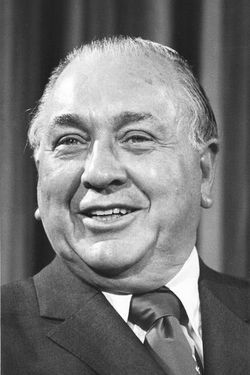
Richard Daley He was correct. Mayor Richard Daley said, “We think the local officials should have control of this program.” (Matusow, p. 125) Another city official said, “You can’t go to a street corner with a pad and pencil and tell the poor to write you a program. They don’t know how.” (Farber, p. 107) That last comment was nonsense. Hackett did not envision the citizenry writing the programs. He wanted the local poor to be able to vote on what kind of opportunities they should have through their community action grant. But it showed why Hackett and Kennedy feared that CAP would be taken over by already standing local agencies.
When RFK arrived in the Senate, he had the opportunity to debate one of Daley’s cronies on this issue. Like Daley, the Chicago schools superintendent argued that the education programs of OEO should be taken over by his school district. Senator Kennedy then asked, if that occurred, what would safeguard the targeted children’s rights to get the benefits of the grants? The superintendent’s answer was that it would be the school community in the form of local groups of parents. From his experience in walking the streets of Harlem with Dave Hackett, the senator replied thusly:
Many of them do not have parents. They do not have two parents anyway. They might have one parent, and maybe they have a group in the community that is going to come down and make their protest known; but a lot of times that is very difficult. They are working for seven or eight dollars a day and making forty or fifty dollars a week. It is difficult to take off and go down and protest … I think we have a special responsibility to those people who are less fortunate then we are, to make sure that the money that is being expended is going to be used so that the next generation will not have to have these kinds of hearings. (Schmitt, pp. 115-16)
Later, RFK continued in this vein by saying:
The institutions which affect the poor—education, welfare, recreation, business, labor—are huge, complex structures, operating outside their control. They plan programs for the poor, not with them. Part of the sense of helplessness and futility comes from the feeling of powerlessness to affect the operation of these organizations. (Matusow, p. 126)
What Kennedy and Hackett were saying was rather simple: How can we trust the same people who allowed these inequities in the first place with the millions meant to cure them? (Schulman, p. 94) Author Schulman then listed a few examples that proved the Hackett/Kennedy warning. To cite one: a Camden New Jersey physical education program was subsidized with OEO money, yet it was a class for middle class students. I can also state from my own experience that such was the state of affairs. At the high schools I worked at which were entitled to what is called Title 1 funds, the administration tries to get the faculty behind a program that will benefit the majority of the students. As I recall, there was never any consideration given to targeting the students that Hackett and Kennedy wanted to single out and help. Many commentators concluded that this problem stemmed from the lack of oversight Johnson built into the program. (Schulman, p. 95)
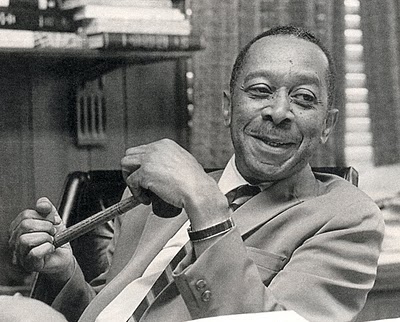
Kenneth Clark The other problem was something that was not foreseen by Hackett and Kennedy. In some cities, the CAP was taken over by, let us say, some persons on the left who also did not understand its original aims. In Harlem, respected sociologist Kenneth Clark was forced out and Livingston Wingate spent a lot of money producing the street plays of Leroi Jones. When the board argued about these productions, Wingate brought in some thugs to intimidate them. (Matusow, pp. 257-59) Wingate paid himself 25 grand a year, close to two hundred thousand today. When Kenneth Marshall, a civil rights worker who worked with Clark, examined the program records, he said he simply did not think that many of the offerings were useful. And most of the 20 million disappeared without a trace left behind. (Matusow, p. 260)
V
This is not to say that the whole thing was a boondoggle, as, for reasons of agitprop, some on the right have claimed. As noted, there were some good programs designed for the poor and underprivileged: Head Start, Upward Bound, and Legal Services, for example. And in some places, the CAP concept did succeed as it was designed. For instance, in Ellen Meacham’s book Delta Epiphany, she describes a community action center she was familiar with. It was in Mississippi and it was called Coahoma Opportunities. It offered what Hackett had envisioned. It maintained an array of services that would aid those who needed them: tutors who could help young children learn to read, Legal Services as a way to claim Social Security benefits, help with emergency food aid, placing a child in Head Start, a guide to gaining a summer job, job training that paid while you were learning, and help in finding a credit union. The reason it worked was because it had fine leadership. Aaron Henry was the head of the state branch of the NAACP, and his partner was a local white businessman who saw the program benefiting the business community and contributing to racial harmony. (Meacham, chapter 8) That is what Hackett wanted the CAP to be. The problem, as I have tried to state, was not so much the concept as its execution.
Eventually the administration gave in to the local and business leaders on CAP. By 1967, Johnson had folded his cards on community action. He allowed them to be taken over by the local entities Hackett feared. Shriver left to become ambassador to France. In the end, LBJ had lost all faith in it and said it was being run by “kooks and sociologists”. (Matusow, p. 270)
The beginning of Johnson losing faith started in Watts in the late summer of 1965. To his credit, I have never read anything that states that Bobby Kennedy had his “I told you so” moment at this time, even though, as we have seen, he did predict it. On August 11, 1965, a slightly drunken motorist, Marquette Frye, who was on parole for robbery, was stopped and pulled over by a highway patrolman, Lee Minikus. Frye resisted arrest. As he did, a crowd began to gather at the intersection of Avalon and 116th Street. It quickly swelled to a thousand. The police had to call in reinforcements. The crowd began hurling rocks and bottles. They then began to shout the chant that became the chorus to the hundreds of riots that would soon follow: “Burn, baby, burn.” (Matusow, p. 360)
Watts 1965 During the next six days, a 46-square-mile section of Los Angeles turned into a battle zone. The conflagration raged for the better part of this period. At one time or other, nearly 30,000 residents participated in the looting, sniping and torching. A crowd estimated at 60,000 cheered them on. The local authorities called in 2,300 National Guardsmen. They were sent in on the fourth day and this started to bring things under control. (Matusow, p. 361) They joined a force of about 1,700 local and state police. When it was all over, there were 34 dead, 1,072 injured, 977 buildings damaged, and nearly 4,000 arrests.
Johnson was stunned by Watts. It exploded just one week after he had signed into law the Voting Rights Act of 1965. It was King’s Selma demonstration that had made that act possible. But both men had cooperated in the process. According to his chief domestic aide, Joe Califano, after Watts, LBJ refused to take King’s calls for a period of 24 hours: “He just wouldn’t accept it. He refused to look at the cables from Los Angeles describing the situation.” (Schulman, p. 112) When he came out of it, Johnson asked, “How is it possible, after all we’ve accomplished? How could it be?” (Schmitt, p. 120) Politically, the riots handcuffed the president. He had to issue a statement condemning the looting and lawlessness, but he also understood that if he went too far, a backlash would now ensue against the War on Poverty.
Why did Watts explode? To its residents, the arrest of Frye seemed to symbolize what the white community of Los Angeles thought of the neighborhood. Nearly 2/3 of Watts high school students had flunked at least one grade; almost that many had dropped out. Forty per cent of its residents had no cars, which in a commuter city made it tough to find a job. African American unemployment was three times that of whites. (Farber, p. 113) Bobby Kennedy commented on this police symbolism when he said the law did not protect those in the ghetto from paying too much for inferior goods; from having their furniture repossessed, or “from having to keep lights turned on the feet of children at night to keep them from being gnawed on by rats.” (Schmitt, p. 120)

Detroit 1967 The volcanic eruption in Watts initiated an annual series of rolling explosions of summer riots, most of them in the north. In 1966, 43 urban ghettoes went up in flames, in 1967 there were 167 incinerations, in 1968, there were over 125. (Farber, p. 115; “The Legacy of the 1968 Riots,” The Guardian, April 4, 2008) In 1967, eight American cities were occupied by the National Guard. (Matusow, p. 362)
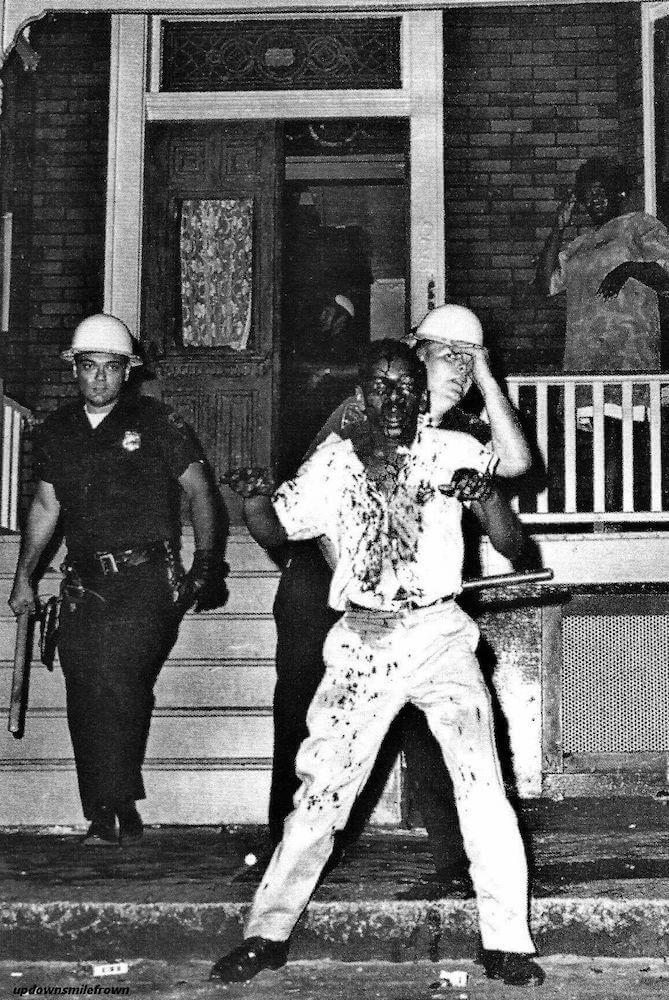
Newark 1967 The 1967 Newark and Detroit riots actually surpassed Watts in their ferocity. In Newark, the violence resulted in a maelstrom: the Guardsmen were firing on police and the police returned fire. The Guardsmen then fired into a housing project, killing three women. The governor called in SDS leader Tom Hayden, who had done a study of inner-city Newark. Hayden told him to withdraw the Guard. A few hours later, things calmed down. (Matusow, pp. 362-63) One week later, on July 23, 1967, the worst riot in a century broke out in Detroit. Governor George Romney had to request the White House send in the army to quell the insurrection. It ended with 43 dead, 7000 arrested, 1,300 buildings burned down and 2,700 businesses looted. (Matusow, p. 363)
Tom Hayden By 1966, both King and longtime civil rights lawyer Joe Rauh had split with Johnson. (Randall Woods, LBJ: Architect of American Ambition, p. 699) One reason for this was that Johnson—with America going up in flames—continued to escalate in Vietnam, thereby contributing to student unrest and devoting a huge amount of money to a senseless war that neither Rauh nor King could understand. A war that, at that time, was killing or wounding an inordinate number of men of color. King later decided to memorialize the War on Poverty:
A few years [ago] there was a shining moment, as if there was a real promise of hope for the poor. Then came the build-up in Vietnam, and I watched the program broken and eviscerated as if it were some idle political plaything of a society gone mad on war … So I was increasingly compelled to see the war as an enemy of the poor and to attack it as such. (Isserman & Kazin, p. 192)
But Johnson insisted that he could still do all three; that is, wipe out poverty, build his Great Society and fight a large land war in Indochina—and win all of them. He said as much in his January 12, 1966 State of the Union address. This contributed to his growing credibility gap—for the simple reason that very few people saw it that way, especially with more and more cities being incinerated while more and more troops were coming home in body bags. All of this caused another sociological and historical milestone to manifest itself.
Stokely Carmichael & H. Rap Brown As the country seemed to be spinning out of control, not only did this contribute to the rise of rightwing backlash and demagoguery (e.g., Alabama Governor George Wallace entering the national scene); it also contributed to the rise of a leftwing militancy, both in the civil rights movement and the student protest movement. We thus witnessed the appearance on the scene of people like Stokely Carmichael and H. Rap Brown in the former and Bernardine Dohrn and the Weathermen group in the latter. In 1966, Carmichael directly confronted King on a march in Mississippi with his new slogan, “Black Power”. He later said that integration was a “subterfuge for the maintenance of white supremacy.” He then added that people of color would not be beaten up anymore: “Black people should and must fight back.” (Matusow, p. 355) Carmichael, and later Brown, meant this to be their version of the militancy and separatism of the late Malcolm X. First Carmichael and then Brown used this extremism to take over the Student Nonviolent Coordinating Committee. (Isserman & Kazin, pp. 174-75) Apparently, few members noticed that this approach contradicted what their acronym stood for. Carmichael—who wanted to start an “anti-imperialist guerilla war in the ghetto to free the Afro-American colony”—was directly responsible for inciting riots after speaking engagements. (Matusow, p. 365)
Johnson responded to this by going first to the CIA and starting up Operation MH/CHAOS. When he did not like the results he got there, he went to the FBI, and reactivated COINTELPRO. These were illegal spying programs on these two groups, which also utilized subversive operations to destabilize them. (Schulman, p. 146) Coupled with this, in the fall of 1967, he also made an appearance in Kansas City for the International Association of Chiefs of Police. (Matusow, p. 215)
Bobby Kennedy was not taking that path. In early 1967, he met with SDS founder Tom Hayden for an exchange of ideas. Hayden later said that Kennedy wanted to get the networks to run documentaries on what life was really like in the ghettoes. He also wanted them to broadcast what the real poverty statistics there were. (Schmitt, p. 175) Six months later, when Detroit erupted, Kennedy predicted this would be the death knell of the Great Society. When Senator Kennedy tried to propose a new package of bills, the White House refused to back it. (Schmitt, p. 190)
The White House also failed to back its own proposals. In the wake of Newark and Detroit, Johnson had appointed what he called the National Advisory Commission on Civil Disorders. This was helmed by Illinois governor Otto Kerner and was therefore referred to as the Kerner Commission. It was composed of some visionary personages, for example Senator Edward Brooke of Massachusetts and Congressman Jim Corman of California. On February 29, 1968, they handed in their remarkable report. Its most quoted passage asserted that America was becoming “two societies, one black and one white—separate and unequal.” (Joseph A Palermo, In His Own Right, p. 161) One of its recommendations was to adopt ideas similar to RFK’s: a triangular union of private business, government grants and community leadership to rebuild impoverished communities. Both Robert Kennedy and Martin Luther King were disappointed that Johnson pretty much ignored the report and its guidelines. (Palermo, pp. 161-62)
As many have commented, it was this splitting of the Democratic/liberal coalition over the issues of Vietnam and urban rioting which gave the GOP/conservative coalition their golden opportunity to break it asunder. Conservative strategists like Kevin Phillips and Pat Buchanan began to write up plans to do so. (Isserman & Kazin, pp. 216-17, 272-73) In 1967-68, the promise of 1963-64 became a distant memory. Politicians like Ronald Reagan and Richard Nixon now went to work on their “law and order” themes in the shadows and smoke of Watts, Detroit and Newark while the Living Room War raged each night on TV and the police clubbed SDS protestors in the streets. What caused it all to be even more made-to-order for the right wing is reflected in a comment by Johnson to Bill Moyers after he signed the Civil Rights Act of 1964. The president remarked, “I think we just delivered the South to the Republican Party for my lifetime and yours.” (Schulman, p. 76)
Inspired by the example of George Wallace, Republicans like Nixon and Reagan strove to siphon off the racist vote in the South. This resulted in Nixon’s infamous Southern Strategy, and Reagan’s equally infamous appearance at the Neshoba County Fair in Mississippi in 1980 to kick-start his campaign. The location of that fair was just seven miles from the site where the bodies of three murdered civil rights workers had been found sixteen years prior (Read further about this here). This technique has been a standby for the GOP ever since, and has been amplified to new levels by Donald Trump.
VI
We will oppose … with every facility at our command, and with every ounce of our energy, the attempt being made to mix the white and Negro races in our classrooms. Let there be no misunderstanding, no weasel words, on this point: we dedicate our every capacity to preserve segregation in the schools.
~Virginia Governor James L. Almond Jr.
I would like to close this series by discussing two fascinating and important projects that get little detailed attention, either by the MSM or even in academia. The first deals with a topic that we discussed in passing in Part 3: the Prince Edward County Schools crisis. The second is a subject not addressed yet: Robert Kennedy’s Bedford Stuyvesant restoration.
As I, and many others, have shown, President Eisenhower and Vice-President Nixon did next to nothing to support or enforce the Brown decision. This holds true when it was first announced in 1954, and when it was restated in 1955. The decision made by the Republican administration was unfortunate, since without any enforcement, the Brown case now became a rallying cry for the rightwing establishment in the South. What is worse, as we have also shown: when Eisenhower and Nixon did mention it, it was with disdain.
In Virginia, the state legislature mounted a policy of “massive resistance”. In 1958, following the Orval Faubus example in Arkansas, schools were closed rather than allow African American students to register. When this policy was overturned by the courts, Prince Edward County officials defied the decision. The County Board of Supervisors decided to cut off funding to the Prince Edward Schools altogether. Private academies for white students now opened which excluded pupils of color. This policy was upheld by Richmond newspaper columnist James Kilpatrick and his good friend William F. Buckley.
As a result, Prince Edward’s African American students had no schools to attend. In other words, rather than integrate and obey the law, the power brokers in Virginia, egged on by Kilpatrick, resurrected the claims of John C Calhoun: interposition can override the central government. What made this all the worse was that, as Nancy Mclean notes in her book Democracy in Chains, it was a 1951 walk-out protesting segregated schools that caused Prince Edward to be included in the Brown v Board filing. (Mclean, p. 6)
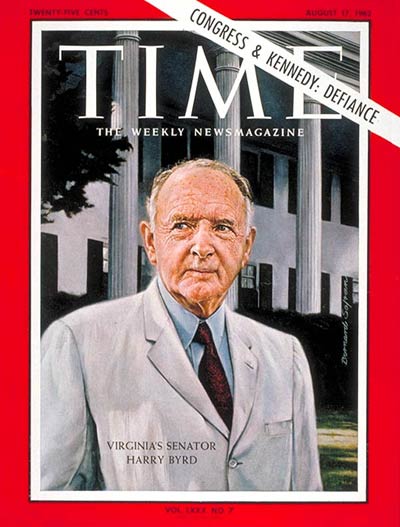
Harry F. Byrd Consequently, students of color decided to cross over into North Carolina, or find relatives elsewhere who would let them move in, to continue their education. (Lee, p. 2) At this time, Senator Harry Byrd was one of the dominant forces in Virginia and he vigorously opposed the Brown decision. Along with Governor Almond, this made Virginia—even though it was in the upper South—quite reactionary. As analyst V. O. Key wrote at the time, “Compared to Virginia, Mississippi is a hotbed of democracy”. (Lee, p. 14) Local liberal leaders appealed to the White House to enter the fray in some way. Eisenhower actually encouraged the creation of the white private schools. (Lee, pp. 49-50)
The Byrd/Almond nexus was quite powerful. Religious ministers did not speak out for fear of being transferred. When an education administrator complained, he was forced to resign. When Almond tried to sell the former schools, which were now empty, half the school board resigned. (Lee, pp. 68-74) Professors who wrote against these decisions were spied upon, harassed and sometimes fired. (Lee, p. 78) But that still was not enough. With the likes of Kilpatrick leading the way, laws were now passed to outlaw the NAACP in the state. And the agency was now forced to turn over its membership rolls. (Lee, p. 79) In 1960, when a 13-year-old who had been out of school for a year wrote the White House, the reply was he should express his feelings to the local officials. (Lee, p. 90)
Two months after President Kennedy’s inauguration, Robert Kennedy called the Virginia attorney general to Washington for a meeting. When that did not get very far, a month later RFK and Burke Marshall filed a suit to join the legal action. As one commentator has written, the filing of the Kennedy/Marshall lawsuit all but stopped the Byrd/Almond movement to close down all public schools. (Lee, p. 156) The problem was that the Fourth Circuit Court of Appeals was not as law-abiding as the Fifth Circuit in the Deep South, so the progress in gaining favorable decisions was much slower, at least until President Kennedy was allowed to appoint two of his choices to that court. (Lee, p. 100)
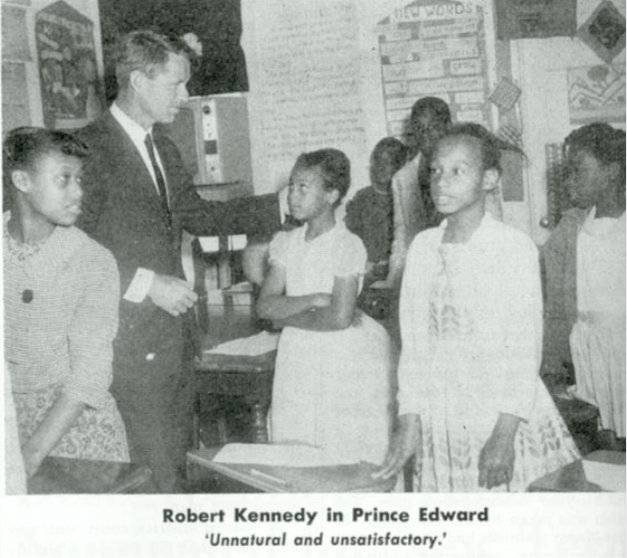
While all this stalling was going on, the Kennedys decided to make a bold, unprecedented move. JFK had told Burke Marshall he wanted to make Prince Edward a high priority. (Lee, p. 258) In February of 1963, after President Kennedy mentioned the Prince Edward case in his civil rights speech, the Kennedys decided to erect a new school system in Prince Edward, from grade school through high school. (Lee, pp. 33-34) As he did with Dave Hackett, Bobby Kennedy recruited a friend, William Vanden Heuvel, and gave him the assignment of creating the Free Schools system out of nothing in Prince Edward. (Lee, p. 292) By this time, four years had gone by. Some students did not even know how to hold a pencil. (Lee, pp. 314-15)

William Vanden Heuvel Vanden Heuvel, with Bobby Kennedy and the president backing him all the way, did the seemingly impossible. He secured 1.2 million in grants and hired an integrated school faculty and staff with Dr. Neil Sullivan as his superintendent. Sullivan got threatening phone calls, and his car was shot at. Some children were afraid to come to school since they had no shoes or proper attire. Vanden Heuvel got them the clothes. There was a remarkable class ratio of 12-1 in the high school. The system opened on September 16, 1963 with nearly 1,600 students, including four whites. The Free Schools were an oasis in the desert. It showed what could be done in the face of complete adversity.
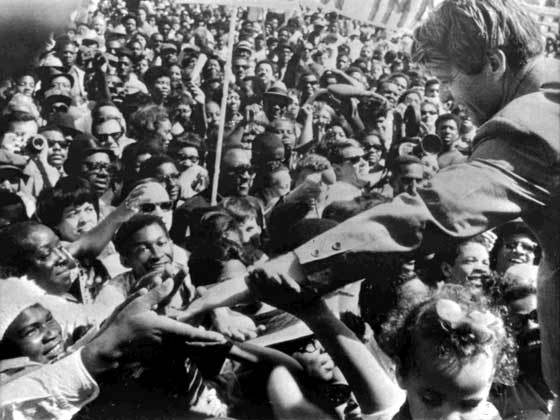
RFK in Watts RFK visited Watts in November of 1965. When he returned, he told a couple of his staffers, Ed Edelman and Adam Walinsky, to continue with Hackett’s research, but to take it a step further. He wanted ideas on how to address the entire phenomenon of the urban ghetto and how to structurally transform it. They did so, and in January of 1966, the senator gave three speeches on the subject of race and poverty. (John Bohrer, The Revolution of Robert Kennedy, pp. 255-61) Those speeches marked the birth of the Bedford Stuyvesant Restoration project. It was RFK’s answer to Lyndon Johnson and the New Deal.
Bedford Stuyvesant was a ghetto in the Brooklyn area of New York. It had a population of 400,000. This made it the second largest ghetto in America outside the south side of Chicago. It covered 9 square miles. There was no hospital, college or local newspaper. After he gave his speeches, the senator asked Walinsky and Edelman to start fashioning a project for Bedford Stuyvesant that would put those ideas into action. Bobby Kennedy’s idea was to form a tripartite partnership between the federal government, businesses and foundations, and the residents, to transform the area and revive it.
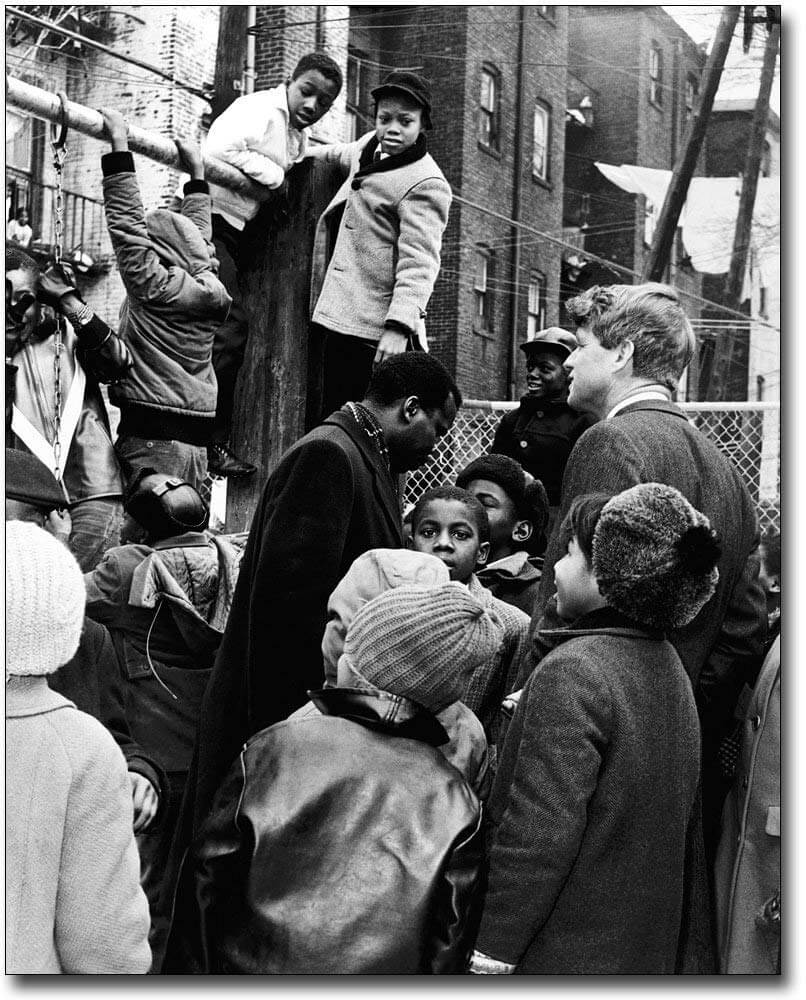
RFK in Bedford Stuyvesant He first got the business community to chip in by going to people like financier Andre Meyer and IBM chairman Tom Watson. He also secured foundation grants. (Schmitt, p. 151) He used that money to hire the local unemployed to do restoration for the fronts of local homes, a program that ended up being exceedingly popular. (Schmitt, p. 162) The plan’s next step was to push for tax incentives in order to get businesses to move there. He also attained a mortgage pool of money that allowed residents to secure low down payment FHA loans to finance real estate deals. He brought in a Dodge car lot. He got Watson to locate a factory there. He even convinced the City University of New York to open a branch, which was later named Medgar Evers College. (Schmitt, p. 165) John Doar became the chief executive officer of the restoration.
Restoration Plaza
The Bedford Stuyvesant Restoration Corporation
was established in 1967 as one of the first community
development corporations in the United States.He announced the formation of what he called the community development corporation on December 10, 1966 at Public School 305 in Bedford Stuyvesant. He said that he was now going beyond community action in order to gain the power to act with “the power to command resources of money, mind and skill.” (Schmitt, p. 155)
The Bed-Stuy project was a qualified success, not a total success as the Prince Edward School District was. The reason it did not attain that instant stature was that Bobby Kennedy got involved in the 1968 race for the presidency. Yet, apart from whatever may currently be occurring there, no less than Michael Harrington once stated concerning this project, “It is extremely satisfying to witness a social idea that works.” (Schmitt, p. 166) The CDC idea was in fact widely imitated. Today there are over 4000 of them, and companies that specialize in that field. Bobby Kennedy and Dave Hackett made a formidable reply to Johnson’s New Deal. One that has echoed down through the decades.
VII
Whatever the ambitions of these four authors were, as the reader can see, their efforts to belittle what the Kennedys did for civil rights do not stand up to scrutiny. Instead, upon actual inspection, they simply reveal their own poverty. (Again, I would make a mild exception in this regard for David Margolick.)
As Harrington said of RFK, “As I look back on the sixties, he was the man who actually could have changed the course of American history.” (Wofford, p. 420)
Journalist Pete Hammill wrote RFK before the presidential race of 1968:
I wanted to remind you that in Watts, I didn’t see pictures of Malcolm X or Ron Karenga on the walls. I saw pictures of JFK. That is your capital in the most cynical sense. It is your obligation in another, the obligation of staying true to whatever it was that put those pictures on those walls. (Schmitt, p. 221)
As Brenda Luckett, one of the young African Americans Bobby Kennedy saw in the impoverished Mississippi delta in 1967, said after his death, “We felt like Kennedy was purged. He should have gotten out. It’s like we knew they were going to kill him for helping black people.” (Meacham, chapter 12)
Charles Evers, brother of the murdered Medgar, said of him, “Mr. Kennedy did more to help us get our rights as first class citizens than all of the other US attorney generals put together.” (Arthur Schlesinger, A Thousand Days, p. 976)
But this sentiment had been previewed several years earlier. During the Freedom Riders’ episode, when King arrived in Montgomery, the citizens rallied to him and realized that something new was afoot. One youth said, “President Kennedy is on our side.” A woman said, “Bless God! We now have a president who’s going to make sure we can go anywhere we want like the white folks in this country.” (Brauer, p. 103)
Unfortunately, it did not last very long. One is left to imagine what America would be like today if President Kennedy had lived, and Bobby Kennedy and Dave Hackett had run the War on Poverty. Without Vietnam, and those men in charge, it is even possible that America would not have burned.
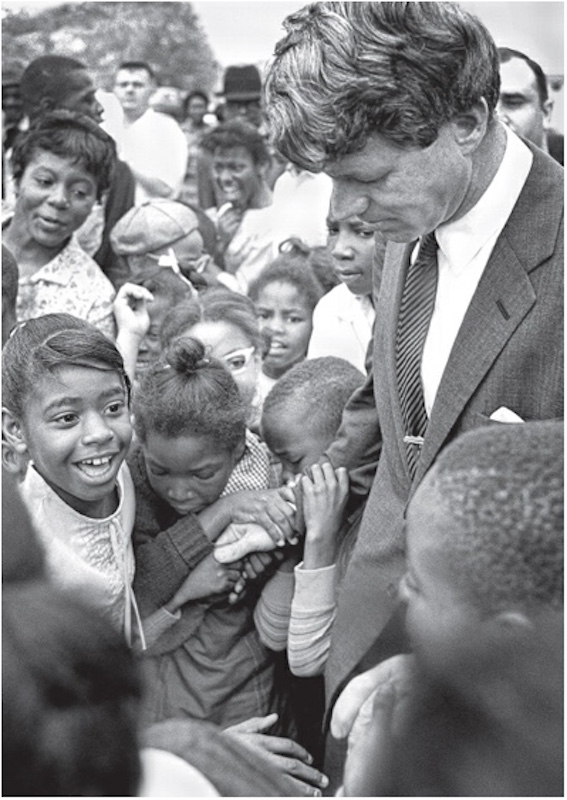
A Summary of Major Points Made by this Essay
- Reconstruction ended up as a failure for the liberated slaves of the South. And due to several odd and adverse Supreme Court decisions afterwards, the Reconstruction laws and amendments were neutralized. (Part 1, section 1)
- From 1876 to 1932, no president did anything to alleviate what had occurred in the South thanks to the rise of the Redeemer movement. In fact, some of them clearly sided with that movement. (Part 1, section 2)
- Franklin Roosevelt and Harry Truman, respectively, passed the FEPC law and integrated the military under pressure from the prominent civil rights leader Philip Randolph. But they were constricted from doing much else by the southern bloc in Congress and the threat of a filibuster. (Part 1, section 3)
- Charles Hamilton Houston began the modern civil rights movement by initiating a systematic challenge to the Supreme Court decision in Plessy v Ferguson. This ended in the epochal Brown v Board decision. (Part 1, section 3)
- Because of the Brown decision, Dwight Eisenhower had an opportunity to move in a major way on the issue, since he won two resounding victories in 1952 and 1956. For political purposes, he and Richard Nixon largely avoided the issue. (Part 1, section 3)
- Senator John Kennedy was not enthralled by southern interests on the race issue. This is shown by his 1956 public statement of support for Truman’s civil rights bill; his speech declaring his support for the Brown decision in 1957; his vote for Title III of the civil rights bill, also in 1957, and his reference to the issue in several speeches in the 1960 campaign. (Part 2, section 1)
- Senator Kennedy addressed the issue during the 1960 campaign several times, accentuating its moral dimension. He spent several moments criticizing the Eisenhower administration on their performance during his second debate with Richard Nixon. (Go to the 13:45 mark here)
- President Kennedy did not delay in addressing the problem once he got into office. In fact, he got to work on it his first day, originating an affirmative action program that would eventually spread across the entire expanse of the federal government. (Part 2, section 3)
- It was not possible to pass an omnibus civil rights bill in 1961. The evidence in support of that conclusion is overwhelming. (Part 2, section 1)
- It was also not possible to alter the filibuster rules in 1961. The Democrats had tried to do this prior to Kennedy, and they tried to do it several times after Kennedy’s death. It was not achieved until 1975. (See pages 6 and 7 of this paper)
- Attorney General Robert Kennedy took on school desegregation within weeks of entering office and did things in that regard in New Orleans and Prince Edward County, Virginia that Eisenhower had never done. (Part 3, section 1)
- The Kennedys worked closely with the Fifth Circuit Court of Appeals in order to ensure voting rights, integrate colleges and enforce the Brown decision. Again, this had not been done prior to 1961. (Part 3, sections 2 & 5)
- JFK extended fair hiring practices to contracting companies who did work for the federal government and private colleges which got research grants from Washington. This helped integrate business and higher education in the South. (Part 3, section 3)
- The Kennedy administration did more to advance civil rights in three years than the prior 18 did in nearly a century. This is simply a matter of record. (See the chart at the end of Part 3.)
- Kennedy tried to get a civil rights bill on voting rights in 1962 but he could not defeat the filibuster. (Part 3, section 3)
- In February of 1963, Kennedy announced he had gone as far as he could through executive orders and the judiciary, and that he was submitting an omnibus civil rights bill to Congress. (Part 3, section 6)
- The implications of the encounter between RFK and James Baldwin in May of 1963 have been wildly distorted and pulled out of context. The discussion Kennedy wanted to have with those attending that meeting concerned what he had been working on with David Hackett: ways to approach racism and discrimination in the north. Baldwin and Jerome Smith hijacked the agenda and thereby wasted a golden opportunity. The danger of an eruption of inner-city violence, which Kennedy predicted and wished to talk about, was confirmed 27 months later with the Watts riots. (Part 2, section 3; Part 3, section 4; Part 4, section 2)
- Due to Fred Shuttlesworth’s highly publicized demonstrations in Birmingham, JFK’s confrontation with George Wallace in Tuscaloosa, and his televised speech on the subject, the February 1963 bill was redrawn and strengthened. It eventually passed in 1964 due to the efforts of RFK, Hubert Humphrey and Thomas Kuchel, not LBJ. This eliminated Jim Crow. (Part 3, sections 5 & 6)
- John Kennedy was working on an attack on poverty before his civil rights bill was sent to Congress. This effort had begun in 1961 with the research of David Hackett on the issues of poverty and delinquency. (Part 4, sections 1 & 2)
- LBJ appropriated that program as his own, and retired Hackett. He started it up before the research was completed. It ended up being taken over by interests who did not center it on the people it was designed for. The mishandling of this program, it could be argued, exacerbated the issue, and, as Bobby Kennedy predicted, America descended into a nightmare of riots and killings for four straight summers, 1965-68. (Part 4, section 5)
- Republican strategists Kevin Phillips and Pat Buchanan advised candidates on how to use this violence to manipulate white backlash and break up the Democratic Party coalition. Richard Nixon and Ronald Reagan did so, and this strategy, which has been used ever since, has risen to new heights under Donald Trump. (Part 4, section 5)
A Selected Bibliography
- Jack Bass, Unlikely Heroes. New York: Simon & Schuster, 1981.
- Patrick Henry Bass, Like a Mighty Stream. Philadelphia: Running Press, 2002.
- Michael Berman, The Politics of Civil Rights in the Truman Administration. Columbus, OH: Ohio State University Press, 1970.
- Irving Bernstein, Promises Kept. New York: Oxford University Press, 1991.
- John Bohrer, The Revolution of Robert Kennedy: From Power to Protest after JFK. New York: Bloomsbury Press, 2017.
- Herb Boyd, Baldwin’s Harlem. New York: Atria Books, 2008.
- Carl M. Brauer, John F. Kennedy and the Second Reconstruction. New York: Columbia University Press, 1977.
- Thurston Clarke, JFK’s Last Hundred Days. New York: Penguin Press, 2013.
- Andrew Cohen, Two Days in June. Toronto: Signal, 2014.
- Nancy A. Colbert, Great Society. Greensboro, NC: Morgan Reynolds, 2002.
- Charles Euchner, Nobody Turn Me Around. Boston: Beacon Press, 2011.
- Rowland Evans & Robert Novak, Lyndon B. Johnson: The Exercise of Power. New York: New American Library, 1966.
- David Farber, The Age of Great Dreams. New York: Hill & Wang, 1994.
- Eric Foner, with Joshua Brown, Forever Free. New York: Knopf, 2005.
- Harry Golden, Mr. Kennedy and the Negroes. Greenwich, CT: Fawcett, 1964.
- Lawrence Goldstone, Inherently Unequal. New York: Walker and Company, 2011.
- Edwin Guthman & Jeffrey Shulman, Robert Kennedy in His Own Words. Toronto: Bantam, 1988.
- Maurice Isserman & Michael Kazin, America Divided. New York: Oxford University Press, 2000.
- William P. Jones, The March on Washington. New York: W. W. Norton, 2013.
- John F. Kennedy, Profiles in Courage. New York: Avon, 1956.
- Brian E. Lee, A Matter of National Concern. Unpublished Ph. D. thesis. Chapel Hill, NC: University of North Carolina, 2015.
- David Leeming, James Baldwin: A Biography. New York: Knopf, 1994.
- Nicolas Lemann, Redemption. New York: Farrar, Straus & Giroux, 2005.
- Nancy MacLean, Democracy in Chains. New York: Viking, 2017.
- Allen J. Matusow, The Unraveling of America. New York: Harper & Row, 1984.
- Ellen B. Meacham, Delta Epiphany. Jackson, MS: University Press of Mississippi, 2018.
- Diane McWhorter, Carry Me Home. New York: Simon and Schuster, 2001.
- Joseph Palermo, In His Own Right. New York: Columbia University, 2001.
- Clay Risen, The Bill of the Century. London: Bloomsbury Press, 2014.
- Arthur Schlesinger, Robert Kennedy and His Times. New York: Houghton Mifflin Company, 1978.
- Arthur Schlesinger, A Thousand Days. New York: Houghton Mifflin, 1965.
- Edward R. Schmitt, President of the Other America. Boston: University of Massachusetts Press, 2010.
- Bruce J. Schulman, Lyndon B. Johnson and American Liberalism. Boston: Bedford Books, 1995.
- Frank Sikora, The Judge. Montgomery, AL: River City Publishing, 1992.
- Theodore Sorenson, Kennedy. New York: Harper and Row, 1965.
- Harris Wofford, Of Kennedys and Kings. Pittsburgh: University of Pittsburgh Press, 1980.
- Randall Woods, LBJ: Architect of America Ambition. New York: Free Press, 2006.
Go to Part 1
Go to Part 2
Go to Part 3

