Tag: JFK

  • Oliver Stone amid the Trolls:  Tom Fordy and The Telegraph

    Oliver Stone amid the Trolls: Tom Fordy and The Telegraph


    Unless you are aware of the timely release of Oliver Stone’s autobiography, Chasing the Light, then you will be blindsided by the most recent attack article on the famous film director.

    The Telegraph is a notoriously hard right newspaper, so much so that it is sometimes called The Torygraph. From 2018 to 2019, its popularity declined to the point that it withdrew from newspaper circulation audits. From 1980 to 2019, it has been estimated that the publication lost about 80% of its readership. It was fined in 2015 for emailing readers and urging them to vote conservative. The reason for this is, perhaps, because the publication has been owned by Conrad Black from 1986–2004 and the Barclay Brothers since 2004. Business has been so poor of late that the billionaire brothers have reportedly been looking for a buyer.

    On July 15th, The Telegraph featured an article by one Tom Fordy. Fordy is essentially a writer on films. Yet The Telegraph billed his piece, “Why Oliver Stone’s JFK in the greatest lie Hollywood ever told.” The problem with that pompous and self-righteous title is this: Fordy has no grasp of the facts he is about to address. As we shall see, he is a Warren Commission shill who might as well be writing in 1967.

    Yet in some cases, he is even worse than that. As everyone knows, the 1991 film JFK was based largely on Jim Garrison’s 1988 book On the Trail of the Assassins. That book was essentially Garrison’s memoir of his investigation into the murder of President Kennedy which he conducted through his position as DA of New Orleans Parish. Stone’s film was so cinematically powerful and its intellectual effect so shocking that it provoked the creation of a new agency of government: The Assassination Records Review Board. That board was in session from 1994–98 and declassified 2 million pages of previously redacted papers; 60,000 documents in all. It then declassified, on a timed-release schedule, thousands more.

    How uninformed is Tom Fordy? He actually writes the following:

    1. George Bush established the Assassination Records Review Board (ARRB)
    2. Which led to the release of more than 3,000 documents
    3. In 2017
    4. Though there were no major revelations

    When you can write a sentence packed with four errors in it, that tells you how trustworthy Fordy is. Plus, this: The Telegraph has little or no fact checking apparatus.

    George H. W. Bush did not establish the Board. He tried to sandbag that establishment. He let the clock run out on his appointments, so they could not be approved by Congress and begin their work of declassification. When Bill Clinton took office, he had to start the process all over. Therefore, it was he who actually established the Board and it began work in 1994.

    As mentioned, the ARRB released about 60,000 documents containing 2 million pages in four years. In other words, about 20 times more than the number Fordy lists. But it’s even more than that, since there was a “timed-release” program that allowed other documents to be declassified after 1998.

    The significance of the year 2017 is that this was when all the JFK documents were supposed to be finally declassified en toto. This meant no redactions at all. Fordy is so uninformed that he does not even understand the significance of what happened that year. Because, as he could have figured out from journalist Jeff Morley or archivist Rex Bradford, today there are still 15,000 pages still being withheld in whole or in part—in defiance of the JFK Act. That law stated that if there were any withholdings in place in 2017, there had to be a presidential explanation for doing so. Well, the government is withholding a lot of pages. There has been, to my knowledge, no presidential explanation for doing so. What is worse is that with hapless writers like Fordy, the public will never know that this is happening.

    The idea that, amid all of those hundreds of thousands of pages of documents, none of them offered any major revelations, this is either pure ignorance or pigheaded bias. And it implies that either Fordy or one of his authorities actually read all those pages. To show just how false that assumption is and how misleading Fordy’s instantly obsolete article is, consider this: the author is apparently not familiar with the Lopez Report. This was the 300 page report prepared by Dan Hardway and Ed Lopez for the House Select Committee on Assassinations. That report had access to documents and CIA officials that no one ever had access to before. Clearly, Fordy never read it. In fact, from what he writes, he never even heard of it. It had been secret up to the coming of the ARRB. It was one of their prime objectives to have it declassified.

    The so-called experts that Fordy summons on this issue are just as ignorant about that landmark report as he is. In fact, if one has read the Lopez Report, it is almost embarrassing to read what they say. Two non-entities in the field, Tom Stone and Michel Gagne, say that Oswald made mysterious visits to the Cuban and Soviet Embassies in Mexico City. They then add that perhaps someone he talked to while at those places influenced Oswald’s later actions. Tom Stone actually says, “If we could ever know who said what to Oswald in Mexico City, we’d have a solution to the case.” Stone teaches a class on the JFK case at SMU. Evidently, part of that curriculum does not consist of the Lopez Report. Because the main question one is left with after reading that report is this: Was Oswald ever in Mexico City? Why do we ask?

    1. The CIA had a number of cameras outside the Soviet and Cuban consulates. They should have captured Oswald entering and exiting those places ten times. In 57 years, the Agency has yet to produce even one picture of Oswald doing so.
    2. The Mexico City tapes capturing Oswald speaking, these are not his voice. The FBI agents in Dallas heard these CIA tapes. They were talking to Oswald at the time, they knew his voice, these tapes were not him.
    3. Virtually none of the people in the Cuban consulate who should have been able to ID Oswald were able to do so. This includes receptionist Sylvia Duran and diplomat Eusebio Azcue. Outside the consulate, student organizer Oscar Contreras also failed to identify him.
    4. The CIA had two undercover agents in the Cuban consulate. After the assassination, the CIA asked them if they had seen Oswald there. They said not they had not. This information was declassified in 2017.

    Somehow Fordy did not read any of these declassified documents and neither did any of his “experts”. They do not indicate any kind of “solution to the case”. They create a puzzle about Mexico City that Fordy wants to avoid telling his readers about.

    Ken Drinkwater has an advanced degree in philosophy. He is another of the “experts’ Fordy consulted. Drinkwater is also passing Fordy howlers, which he then prints. Drinkwater’s foot in mouth moment is when he says that Kennedy signed off on an attempted assassination of Fidel Castro. Again, this shows that neither Fordy nor Drinkwater ever read the declassified documents of the ARRB, because, in 1995, the Board issued an unredacted version of the CIA’s Inspector General Report on the plots to kill Fidel Castro. On several pages of that report, one will see the issue of presidential authorization of the Agency plots addressed. In every instance, the reply comes back in the negative. In other words, the CIA had no such presidential authorization from Kennedy or any other president, i. e. Dwight Eisenhower or Lyndon Johnson.

    As noted, Fordy writes that there were no major revelations declassified by the Review Board. I would say that the two matters I mentioned above qualify as “major revelations”. And he and his “authorities” got them both wrong. You can have little doubt about why this is so. In a November 20, 2003, article at CNN.com, Tom Stone revealed he was in the Warren Report camp. At that time at least, he thought Oswald had shot Kennedy.

    But that is in keeping with all the authorities that Fordy uses for his propaganda piece. For instance, he called up Don Carpenter for his views on Jim Garrison and Clay Shaw. Again, in writing his book on Shaw, Carpenter managed to avoid the ARRB documents on the subject. (Click here for details) His other authority on New Orleans is the late Patricia Lambert. Malcolm Blunt has recently discovered letters from Lambert to the CIA saying she was going to do all she could to explode Jim Garrison. And she needed their help on Shaw’s covert background. If she got any, it did not aid her book. (Click here for details)

    But perhaps the worst example of Fordy stooping to a source in order to attack Stone’s film is his use of the late Vincent Bugliosi. Fordy actually writes that, in his chapter on JFK, Bugliosi dismantled the film’s claims “with convincing ferocity”. One doesn’t know whether to laugh or cry at that statement. Although, with Fordy, I tend towards laughter.

    This author wrote a book length review of Bugliosi’s elephantine Reclaiming History. Elephantine is putting it mildly. For when one adds in the material on the attached CD, that book clocks in at over 2,600 pages. I was one of the very few people who read all of them and took notes. One of the worst chapters in Bugliosi’s door stop of a book is the one on New Orleans and Jim Garrison. And that chapter is even worse in light of the declassified records of the ARRB. In my volume, I minutely examined the opening third of Stone’s film in light of that newly released record. Bugliosi questioned it all. Like Fordy, he takes a carpet-bombing approach to the film. In my book, I went through the first 16 scenes in the film. I described the action in each of those scenes. I then commented on the evidence we have today for what was presented. (See The JFK Assassination: The Evidence Today, pp. 190–93) As I concluded in my scene by scene by scene analysis, there is nothing in those first 16 tableaux that one can term an excessive use of dramatic license. In fact, in a couple of instances, in light of what we know today, Stone understated the case.

    Bugliosi indulged himself in so much hyperbole and grandstanding that it is almost embarrassing to read his book today. Reclaiming History is an argument by length and invective. What Fordy used from Bugliosi is simply not supported by the factual record, for instance, on Oswald’s marksmanship. By the time Lee Harvey Oswald left the Marine Corps, he was not a good marksman. In fact, he was something of a joke at that time. This information comes from eyewitnesses who saw Oswald shoot. For example, Sherman Cooley said there was no way Oswald could have pulled off what the Commission said he did. (Henry Hurt, Reasonable Doubt, pp. 99–100)

    Fordy then says that one of the marksmen that the Commission used actually improved on what the Warren Report says Oswald did. Again, do you laugh or cry? As has been exposed since the days of Sylvia Meagher and Mark Lane, the Commission knew that duplicating the shooting sequence in Dealey Plaza was going to be quite difficult. Therefore, they cheated on their tests. Their marksmen—and, unlike Oswald, they really were expert shots—did not fire from sixty feet up, but thirty feet. And they did not fire at a moving target, but at stationary targets. Therefore, the so-called tests were invalid from the beginning. (See Sylvia Meagher, Accessories After the Fact, pp.106–09; Mark Lane Rush to Judgment pp. 125–27)

    When it comes to the presentation of Vietnam in the film, again the English professor chimes in. Tom Stone says he does not think it’s possible to know what Kennedy was going to do about Vietnam. At the beginning, Fordy writes about the long sequence with Donald Sutherland as Mr. X depicting the withdrawal from Vietnam as a piece of “hokum”. Again, Fordy has a big problem here. He is either ignorant of the ARRB work on this or he is ignoring it.

    In 1997, the Review Board declassified the records of the May 1963 Sec/Def Conference. That meeting was one of a series that Secretary of Defense Robert McNamara held on progress in Vietnam. This one was in Hawaii and all the representatives of departments from Saigon were in attendance: State, CIA, Pentagon etc. At that meeting, McNamara had alerted the attendees in advance to bring withdrawal schedules with them. McNamara then collected them and read them. He then turned around and said that the schedules were too slow. (See Probe Magazine, Volume 5 No. 3, p. 19) That batch of documents was so compelling that even the MSM was forced to admit that Kennedy had an early exit plan for Vietnam (e.g. The New York Times and Philadelphia Inquirer). From the document release, it was clear that everyone in attendance knew that Kennedy was getting out of Indochina. That withdrawal would begin in December of 1963 with a pullout of a thousand men and be completed in 1965, when all advisors would be out. (ibid)

    But Fordy, as he usually does, now gets worse. He writes that NSAM 273, which the film claims would give the military its war, by reversing Kennedy, was actually drafted before Kennedy’s assassination. What Fordy leaves out, and it is hard for him to claim ignorance, is this: NSAM 273 was not drafted by Kennedy. He never even saw it. It was drafted by National Security Advisor McGeorge Bundy and it was then modified by President Johnson. (John Newman, JFK and Vietnam, 1992 edition, pp. 445–49) It was those modifications which allowed for direct American intervention and cross border raids, allowing for expansion into Cambodia and Laos. (DiEugenio, The JFK Assassination, p. 188, op. cit. Probe Magazine, p. 19)

    But further, Fordy never mentions NSAM 288. That memorandum was signed in March of 1964. It contained a bombing list of sites in North Vietnam that numbered over 90 targets. That document was really a plan to carry the war to Hanoi, it was the design for a full scale war in Indochina. In other words, what Kennedy never even contemplated in three years, Johnson was now planning for in just three months. (DiEugenio, p. 189) Those plans were first activated five months later, after the Gulf of Tonkin incident.

    Fordy then continues by saying that Kennedy was late to civil rights. As I explained, in detail, in my four-part essay on this subject, this is a myth that the MSM has created to disguise the fact that JFK did more for civil rights in three years than FDR, Truman and Eisenhower did in nearly three decades. The truth is that Kennedy went to work on civil rights his first day in office. And the Kennedy program went down several paths until they were reasonably certain they could pass an omnibus bill. (Click here for details) He then says that Kennedy had ties with mobsters. This is another piece of malarkey that has come down the pike mainly through the horrendous book Double Cross. This has also been exposed. (Click here for details)

    Gagne then adds that, unlike what is presented in the film, if one reads the Warren Report one can see that the Single Bullet Theory trajectory is really a straight line.  How Gagne can say this is so, based upon the Warren Report, is baffling, because that report misrepresents Kennedy’s back wound by placing it in neck. Like most of the stuff in this article, this is incomprehensible, because one of the major releases of the ARRB was the final draft of the report. That draft showed that Commissioner Gerald Ford had moved up the wound in Kennedy’s back to his neck. (Click here for details) Again, this made the Associated Press and NY Times. How could a bullet fired right to left, at a downward angle, into Kennedy’s back move up through soft tissue to exit his throat? And then move right to hit Connally on the extreme right of his scapula?  Ford himself knew that the Single Bullet Theory—that one bullet went through Kennedy and Connally making seven wounds and smashing two bones—was simply not tenable. So, he altered it. Because he knew it betrayed more than one sniper.

    But perhaps the silliest part of this article is Gagne’s complaint that Oliver Stone did not “consult mainstream historians”. Thank God. If Oliver Stone had not found John Newman, he might never have known about Kennedy’s withdrawal plan. And if he had not depicted it in his film, the world might never have known about Johnson’s treachery. What is so impressive about what Newman and Stone did is that it influenced a whole fleet of modern historians who unearthed more about the withdrawal plan and other aspects of Kennedy’s reformist foreign policy (e.g. David Kaiser, Howard Jones, Robert Rakove, and Philip Muehlenbeck).

    When one encounters a point of censorship this extreme, one is not practicing journalism. This is just plain hackery, performed to bamboozle the reader.


    Addendum

    There was an equally nutty article written a bit before Fordy’s fiasco. This was by rightwing talk radio shill Howie Carr. His column was printed on July 4th in The Boston Herald.

    As everyone knows, as a result of the George Floyd murder in Minneapolis, a series of monuments and statues were torn down to reflect the public’s rage at the state of the race issue in America. Statues of historical figures like Columbus, Albert Pike, Stonewall Jackson, Jefferson Davis, and Robert E. Lee were defaced, toppled, or removed by government action. The vast majority of these were monuments to the Confederacy or their representatives. Most of the monuments were constructed during the Gilded Age. They accompanied the rise of Jim Crow in the south. And most all of them are located in the south. (Click here for details)

    In other words, as many historians have written, they were constructed as a reminder to African Americans that, although the Confederacy had lost the war, they had won the peace. Which was true. The system that was allowed to spring up in the South—Jim Crow and tenant farming—was as close as the southern plantation owners could get to slavery after the Civil War amendments were passed.

    As I, and many others, have written, this replacement system owed itself to the utter failure of Reconstruction. (Click here for details) The Republican Party controlled Reconstruction. The GOP had sprung up as an anti-slavery reaction, but generally their attitude toward the defeated Confederacy at the presidential level was grievously weak. Let us be plain:  The Confederate States of America had decided to split off from the USA and create its own nation, with its own government. Robert E. Lee made a conscious decision to stay loyal to the slave state of Virginia. Let us be plain again:  the war was about the slavery issue. The economy of the South, and its Power Elite, knew how valuable the peculiar institution was to them. The Vice President of the Confederacy, Alexander Stephens, had stated this in his famous Cornerstone Speech. He made that speech in March of 1861 in Savannah. He said “that the Negro is not equal to the white man; that slavery—subordination to the superior race—is his natural and normal condition,” to which the crowd applauded. He then went on to say that this was a scientifically proven fact. (Click here for details)

    I could go on and on, but contrary to any kind of Lost Cause mythology, this is what the Civil War was about. That Ken Burns allowed the late Shelby Foote, a southern apologist if there ever was one, by far the most talking head time on his PBS series The Civil War was a disgrace. But it was this kind of cinematic blurring of history (e.g. Gone with the Wind), that has allowed—with few exceptions—the real horror of what the South was to escape both our media and our history books. The most remarkable example being the fact that Woodrow Wilson supplied the captions for D.W. Griffith’s smash hit cinema consecration of both the South and the Klan in Birth of a Nation.

    In this author’s opinion, what should have happened after the Civil War was the following:

    1. The entire upper level of the Confederacy should have been arrested and placed on trial for treason and insurrection.
    2. The large plantations should have been divided up and given to the former slaves.
    3. An occupying army of at least 100,000 men should have been sent into the south and stayed there for 30–40 years.

    These are not at all drastic, not considering what the Confederacy had done, which resulted in about 700,000 dead. (Click here for details) As it was, during Reconstruction, the Union never had more than 20,000 troops in the South. This is what allowed the former Confederate soldiers to organize the Klan, which then turned into the Redeemer Movement. When the Compromise of 1876 occurred, the last soldiers left the South. The Redeemers were in control. They won out, through terror and lynchings and other forms of intimidation and murder. If the three steps above had been taken, that would not have happened.

    Carr is a leading rightwing author and talk radio host operating out of the New England area. Conservative talk has somehow convinced a vast stretch of Middle America and working-class America that their interests coincide with the Power Elite—the connecting point being the GOP. This is the same GOP that has practiced voter suppression to keep themselves in power by constricting the minority vote.

    Howie’s column on the leveling of Confederate monuments pulled a neat trick. It managed not to mention one single Confederate. Not Lee. Not Jackson. Not Jeff Davis. Not Stephens. No Cornerstone Speech. I am not kidding. Don’t ask me how he did it, he did it. He also never mentioned Mr. Floyd. He also never mentioned all the demonstrations or the military deployed against the peaceful demonstrators in Lafayette Park. (Click here for details)

    But then what was Howie’s column about? Are you sitting down? Good. Howie said that in all this anger and fury at tearing down remnants of the past evils of American history, somebody forgot something: the Kennedys. Yep, this is how bad conservative talk radio has become. The first president and attorney general to take real action for the civil rights of African Americans should somehow be grouped with Robert E. Lee.

    What does he base this upon? It’s the usual MSM, and rightwing BS bandied about by the likes of Sy Hersh—who he actually names in his article as a reference point.  Against all the recent scholarship in the field, he calls Kennedy a Cold Warrior and says he attempted to kill Fidel Castro, a deception I just dealt with.  He then repeats the Timothy Leary baloney about Mary Meyer giving JFK acid in the White House. This is more rubbish and I exposed it as such years ago. (The Assassinations, edited by James DiEugenio and Lisa Pease, pp. 341–42) In other words, Howie’s column is a litany of the conservative and politically motivated vendetta that is trotted out every time the reactionaries think: “Hey, things have gotten so bad that the public might be reminded of how much progress was made during the Kennedy presidency.” If you can believe it, Howie never mentions James Meredith at Ole Miss or Vivian Blaine at the University of Alabama. When Blaine was asked why she risked integrating that college with George Wallace and 900 state lawmen standing in her way, she said that she knew the Kennedys would protect her. Right after that event, JFK want on TV to deliver what many considered the greatest civil rights speech since Lincoln. Somehow Howie forgot that speech and the fact that Bobby Kennedy suggested his brother do it that night.

    Sorry Howie, not buying your baloney. Most of us do remember. With sorrow and regret. (Click here for a video of that speech)

  • Gary Hill’s The Other Oswald:  A Wilderness of Mirrors

    Gary Hill’s The Other Oswald: A Wilderness of Mirrors


    Summary

    This book is a worthwhile read for a mature JFK assassination research audience.

    The author is quite knowledgeable and has shown himself to be proficient at information gathering from mostly a smart selection of credible work performed by serious JFK assassination researchers, documentary proof, collaborations with other solid researchers, and adding his own personal sleuth efforts in the form of interviews of people of interest.

    Gary Hill’s instincts and logical construction are mostly solid, but at times flawed.

    The book is important, because of its focus on “defector” Robert Webster and his comparative analysis value to Oswald, as well as the author’s attempts to explain the murder in an all-encompassing manner based on some of the most recent information available.

    The author offers many footnotes and presents a large number of photos as well as documents that support his writings. A number of the footnotes, however, do not really help researchers access key sources and some important points that are made are written in a vague manner. The basis on which the author forms his conclusions are at times tenuous and hard to follow.

    There are a large number of chapters that barely mention Webster.

    Because the book is so full of information, which is sometimes put out without proper context, seasoned researchers may learn a lot, beginners, however, may be confused.

    Gary Hill exposes himself to criticism by at times referencing controversial writers and anecdotes that have been mostly discredited—which could be used to undermine his mostly solid rationale.

    Like most of us who have written about the case, the author could have used additional layers of editing to weed out errors of grammar, minimize risky affirmations, and add clarity to certain explanations.

    In terms of understanding the big picture of what really happened on November 22, 1963, Warren Commission apologists including most journalists and history book writers deserve a score of 0 on ten, Gary Hill deserves at least an 8.

    Introduction

    When I was asked to review this book, I was intrigued by the subject matter. My knowledge of Robert Webster was sketchy at best, yet I always felt that his story could be important. There were only a handful of Americans who set foot on Soviet soil before the early sixties and there was a false defector program going on that most likely included Oswald:  the fact that Webster entered and departed Russia at around the same time as Oswald is significant. This book could perhaps reveal similarities or differences between the two that could bolster the case that Oswald was an intelligence asset.

    While writing one of my articles for Kennedysandking.com, I came upon an interesting piece about how U.S. intelligence reacted when two genuine defectors, National Security Agency (NSA) officials Bernon Mitchell and William Martin, committed treason against their country and defected to Russia. They left no stone unturned in their investigation that required thousands of man-hours in detective work and damage control. Even though Oswald worked at the Atsugi intelligence base in Japan as a radar operator for the prized U2 spy planes, the post defection investigation of him was cursory at best—a sure sign that something fishy was going on.

    Was Webster an intelligence asset? Had he really met and associated with Marina Prusakova? What were his background and M.O.? What became of him upon his return? Who, if anyone, was running him?

    Otto Otepka was kicking a hornet’s nest when, in 1960 as head of the State Department’s Office of Security, he began querying the false defector program. The Oswald file was a hot potato. Otepka’s career spiraled downwards shortly after his insistent efforts. What could we find out about the other false defectors? According to Mary Ferrell: “The CIA did admit privately to HSCA staff that at least one officer named Thomas Casasin had ‘run an agent into the USSR’ and, like Oswald, this agent had come back with a Russian wife.”

    Like the author, I strongly believe in the common threads approach to solving who was behind the Kennedy assassination. This is why the analysis of prior plots and alternative patsies has occupied a large part of my analysis and writing. I am of the opinion that there is a template that points to the same puppeteers who were stringing Oswald along.

    This rationale applies elsewhere:

    If Oswald was an informant and infiltrated the FPCC like many others…find out who was behind the FPCC infiltration program;

    If Oswald was being overseen by Clay Shaw, Guy Banister, George de Mohrenschildt, Ruth Paine, and others, find who they were connected to;

    If there were other similar political assassinations, internal or abroad, find out where they lead;

    If witnesses were being eliminated or threatened to keep silent, solve these crimes and you may discover axes that intersect;

    Find out how the media and investigative cover-up is orchestrated and you may zero in on the usual suspects;

    Gary Hill uses similar case analysis and entity linkage around the false defector program, that Oswald was most likely part of, in his contribution to fully solving the case. For advancing this area of research forward, the research community can thank him and should build on this promising area by shining the spotlights on every other defector, false or genuine, of this era so as to find out exactly how Oswald fit into a template here also and who designed and oversaw it.

    Gary Hill… The researcher

    I hadn’t heard much about Gary Hill, so I tried to find out a bit more about his background and came upon an article about him and his book which was quite impressive and showcased solid credentials:

    Hill has spent 50 years of his life researching the Cold War in general and the assassination of JFK specifically. He has appeared on talk shows, published articles, and given lectures on the topic.

    His substantial JFK library consists of hundreds of books, articles, and photos and thousands of documents obtained from the CIA, FBI, Military, and NARA via the Freedom of Information Act. He has interviewed witnesses and published articles in local newspapers and journals such as The Fourth Decade and JFK/Deep Politics Quarterly and local newspapers such as the Cranberry Journal and New Castle News.

    He was a charter member of the Citizens for Truth about the Kennedy Assassination (CTKA), Cyril Wecht’s Coalition on Political Assassinations (COPA), and JFK Lancer. He is listed in the Master Researcher Directory.

    The preface of his book is by Bill Simpich and the foreword by Walt Brown, two JFK assassination researchers of repute who put the book on a solid foundation before even reaching the first chapter. I was further reassured when I read the bibliography:  Many of my favorite authors and books were listed, I was even surprised to see one of my articles referenced. Four books that I noticed that were not in his impressive list are Destiny Betrayed and JFK; The Evidence Today (though Probe articles and Lisa Pease are referenced); Nexus; and On the Trail of the Assassins, which are must-reads in my view.

    Over and above being very well-read, the author received support from super investigators Carol Hewitt and Dick Russell, who were able to visit a mostly unresponsive Robert Webster. Hill himself interviewed some of Webster’s family members, friends, and ex-work colleagues. He was able to obtain photos, writings, and Webster’s detailed life and professional chronology based on solid primary source documents.

    The book is filled with anecdotes, claims, and facts and is quite well documented and footnoted, but with some inconsistencies. I found that some of the points that were very interesting were either not referenced or at times based on shaky evidence (I will give examples later). However, the overall construction is quite tight.

    There is no doubt that the author is experienced, connected, dedicated, and driven. The challenge authors who cover this subject always face is how to make such a complicated case easy to digest and interesting while avoiding pitfalls.

    Robert Webster

    This book has been recently released, so it is not my intention to reveal everything about the lead protagonist. That would lower the need to read it. I have read some 40 books about the assassination, as well as over 100 articles, and I can attest that this reading enriched my knowledge about the case and will add to some of the areas I have been researching. Let me suggest the leading reasons to add this book to your collection based solely on the subject of the lead character.

    The author presents a strong case that Webster and Marina likely knew one another, which, of course, leads us to speculate that Marina may have been a Russian intelligence asset. The author does a good job of describing Russian brides becoming sleeper agents through their marriage to foreigners.

    We also find out that police forces in the U.S. took a special interest in Webster on the very day JFK was assassinated and that he may have been using Oswald’s name.

    Readers get to see striking similarities in Webster’s work history and Oswald’s. Both simply cannot be tied down. Oswald and Webster both joined the Navy where the ONI played a leading role in the false defector program.

    The parallels don’t stop there:  Webster worked for intel-connected The Rand Development Company; he possessed important plastics technology experience he could tease the Russians with; he married a Russian with whom he fathered a child; his sojourn in Russia had a number of similarities with LHO’s.

    I found Hill’s research around the reactions to the defection in Webster’s ultraconservative community and how it was closely held by his friends to be very interesting.

    Hill reveals to us how Webster left his American wife and kids under financial stress, met a Russian girl, who could very well have been an intelligence asset, ended up marrying her and fathering a child, both of whom he eventually left behind when he returned to the U.S.

    Hill argues soundly that Webster, contrary to Oswald, was a genuine defector who moved to Russia not for ideological reasons, but to escape his family problems, marry his Russian sweetheart, and exploit a business opportunity around bringing Russia up to speed in plastics technology. These affirmations are backed by witness descriptions of him, as well as CIA profile reports.

    He makes the point that, before 1959, there had only been two U.S. defectors to the Soviet Union and then, in an eighteen-month period between 1959 and 1960, there were nine who all had military backgrounds and were privy to sensitive information.

    Like a number of other “defectors”, Webster followed Richard Snyder’s advice to renounce citizenship on a Saturday, when it was technically not possible to do so. (Snyder was a CIA asset under diplomatic cover in the Moscow embassy). This made it easier to return to the U.S. Curiously, Webster was accompanied by his intel-connected bosses from Rand during his defection visit.

    Hill underscores that Webster was codenamed Guide 223 and was linked to a project related to the mechanization of documents called Longstride. Very interestingly, Hill points out a link here to Ruth Paine’s sister of all people, a psychologist with strong intel relations, employed by the Air Force.

    Rand has a number of similarities to some of Oswald’s employers in that it is clearly a CIA-friendly company. It would be interesting to see if there is a 301 file on it. There was a 201 file on its president H. G. Rand. Rand’s Washington representative was ex-CIA agent and psy-war specialist Christopher Bird.

    One of the key points Hill makes is that Webster upon his return to the U.S. testified intensely for two weeks before the Senate Internal Security Subcommittee… a fate Oswald avoided. This, on its own, is worth the price of admission. Does anyone really believe that Oswald was not debriefed? Can anyone explain why Webster’s debriefing was done openly and Oswald was given special treatment? But there is more… Webster could no longer work at Rand, because of the classified projects it was involved in, whereas Oswald was parked at Jaggars-Chiles-Stovall where he was involved in sensitive work.

    From all of this, Gary Hill presents a strong case for who oversaw both Oswald and Webster’s files. To find out who: Read the book! I can confirm that the case makes sense.

    The above wealth of information is presented to the reader by the fourth chapter… Need I say more?

    The fourth chapter focuses on the false defector program and Oswald’s defection. While the author does a good job here of comparing the two defections, he is less convincing when he tries to argue that Oswald was suddenly rushed into the Soviet Union because of Webster’s defection so that he could be part of a double dangle by the CIA, that they were both being “manipulated” by U.S. Intelligence while in Russia, and that they could confuse the KBG because they were lookalikes. I had to read this chapter more than once and still had trouble following the line of reasoning. It is also in this chapter that he discusses links between MKULTRA mind control and Oswald, which he will later include Webster as a probable victim. The author claims that there are many indications that Oswald was under psychic driving conditioning (e.g. at his stay in Atsugi well before his defection). He also indicates that there could be a smoking gun document that proves Webster was an MKUTRA subject. We will get to this later.

    A 50 year research veteran’s view of the case

    By chapter 5, the author shifts sharply to another theme, where information around Webster and false defector programs is minimal.

    I have to say, I would have liked to see more around the original subject matter. He does mention that at one point in the early sixties, six out of seven ex-marine defectors returned to the U.S. like Oswald and Webster. What were their stories? How do they compare? What conclusions can be drawn? Unfortunately, this area was not developed.

    The cases of Bernon and Martin, two real defectors, are also quite well documented. This would also have bolstered his analysis.

    Instead, for some ten chapters, we get to hear Hill’s take on the whole JFK assassination, and I mean everything: Mockingbird, MKULTRA, Mexico City, Garrison, Tippit, Rose Cheramie, LBJ, RFK, prior plots, Oswald doubles, the cover-up, who is behind the assassination and a lot more. His focus on Webster only comes back in the very last chapter.

    If you go on the basis that even one new piece of information was gained by reading a book and that you are better off for that experience, then almost anyone who reads these ten chapters will be winners, because there is bound to be new knowledge to be gained from a well-read old-timer who is passionate about the subject. Gary Hill, now seventy-two, passes on his conclusions from fifty years of research to the next generation of researchers. This project is ambitious and not without risk, however. While I feel much of the author’s research and conclusions are solid, I also feel there is, at times, overkill, overreach, questionable sources, faulty reasoning, and potential for confusion.  If ever Mr. Hill would like to write a second edition, let me provide some constructive criticism. But first let’s cover some of the interesting points he makes.

    The overall case chapters 5 to 13:  The Good

    Hill emphasizes how the HSCA contradicted the Warren Commission by underscoring Charles Murret’s, Oswald’s uncle, links to organized crime including Marcello and Jack Ruby.

    He shines a light on LHO’s cousin Dorothy Murret who, like LHO, travelled around the world on a dime. He presents evidence that she may have been connected to intelligence.

    One of the areas where the author is at his best is when he describes how intelligence departments of police forces are intertwined with the CIA. This goes a long way in explaining the suspicious behaviors of key players in the police forces in Dallas pertaining to the JFK assassination, Chicago related to the failed plot in early November 1963, L.A. with respect to the RFK assassination botched investigation, and even Mexico City where key witness Sylvia Duran was tortured.

    You will also find in this book a nice summary of the MKULTRA program and its roots.

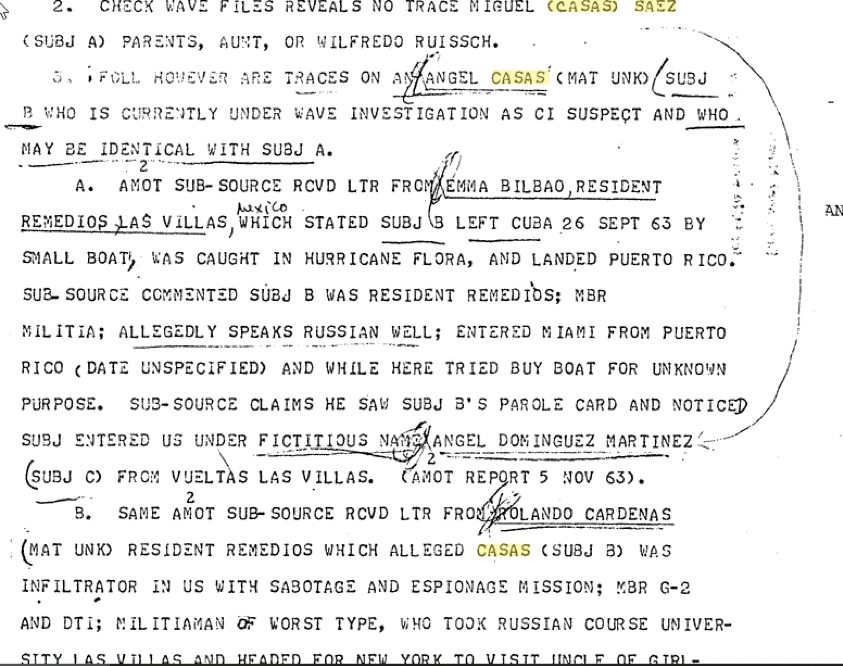
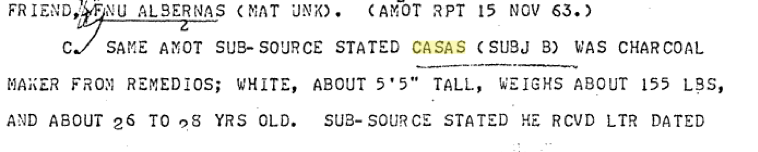
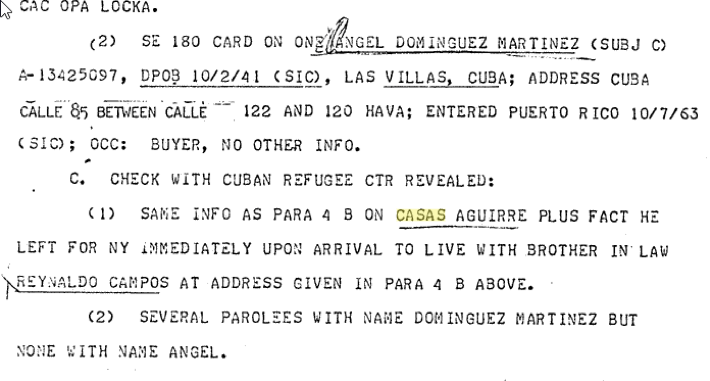
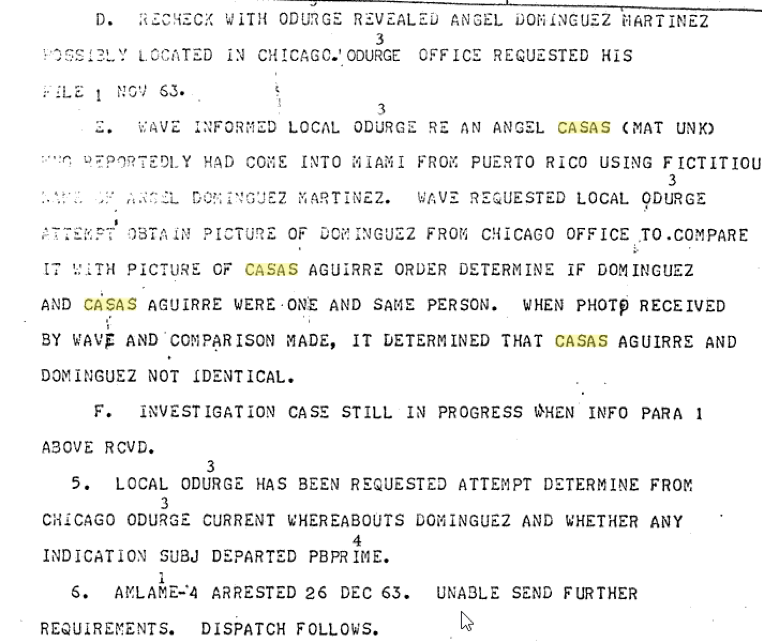
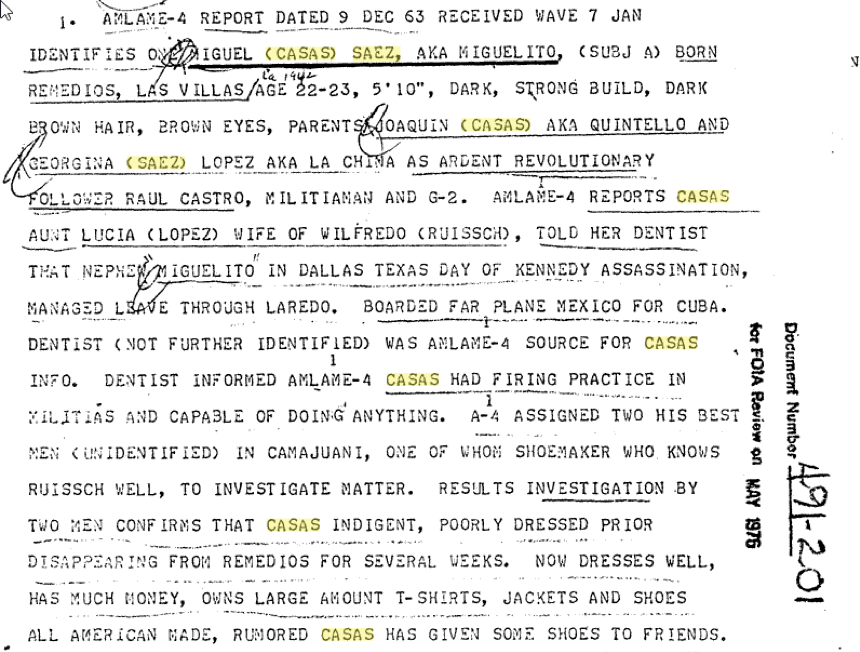
    Because I have written pretty extensively about failed plots to assassinate JFK and potential patsies, I was especially interested in his prior plots chapter. He covers the subjects of Vallee (Chicago), Lopez (Tampa) and Powers (San Antonio) pretty well the way I had, which is normal as we have similar sources. When I wrote about FPCC infiltrator John Glenn of Indiana, I saw nothing to convince me that he was implicated in a failed plot, nor any evidence of plans to frame him. What I did observe is a clone of Oswald the informant, in this sense his inclusion in this chapter could create confusion. I was happily surprised to find out about the name of yet a new suspicious character named Miguel Casas Saez, whom the author describes as a Cuban agent with FPCC links and who may have tracked JFK in Chicago and Tampa, before being in Dallas the day of his assassination. He then ran into money, made his way to Mexico through Laredo, and was flown to Cuba with special seating arrangements in the cockpit of a Cuban plane that had been held up for hours awaiting him.

    Wow! This to me sounded very much like a report on another potential FPCC-marked patsy, Policarpo Lopez, who would have made a similar escape and was allegedly flown to Cuba as the lone passenger on a Cuban passenger plane: a sure sign of a template!

    It smacks of yet more Castro was behind it malarkey… Coming out of JMWAVE’s David Morales’ network.

    I was frustrated here, however, by his footnote to the intel document which is limited to 104-10021-1004.

    So, on my own, I eventually found the document at Mary Ferrell and upon closer perusal, this anecdote ended up being somewhat of a wet firecracker.

    1. He claims that Saez was reported to be at an FPCC meeting in Tampa on November 17—yet after scouring files, talking to Larry Hancock (who is referenced in this section), and reading the writings of John Newman and others about Saez, I could find nothing to back this up. If the author can show evidence of this, I strongly urge him to reveal his sources as it would be, in my opinion, quite important.
    2. The author relies on Lamar Waldron to state that Saez (similar to Policarpo Lopez) received the red-carpet treatment by being seated in the cockpit on a Cuban plane for his escape out of Mexico. The intel. document reveals no such thing. Is there another solid source? Larry Hancock and I discussed this point and he believes that with time some authors mixed up the alleged Saez escape M.O. with Policarpo Lopez’.
    3. Larry also pointed out the weakness of the source (and sub-sources), in that it comes from a likely biased Cuban exile, who got this from a Cuban source in Cuba, who got his info from a dentist, who got it from Saez’s aunt, who got it from lord knows where.
    4. Larry, having seen many wild Cuban stories to try and frame Castro, stated that this one was too amateurish to be even a CIA planted story. “Think about Cuban agents coming into the U.S. after battling a hurricane, one then heads up to New York to visit an ex-girlfriend’s uncle, and then after involvement in killing JFK, Saez ends up back in his village showing off American made T-shirts and shoes.”

    The following is the intel document, which is hardly a smoking gun but is not entirely insignificant:


    Intel document: 104-10021-1004

    No mention of the FPCC, sitting in a cockpit, and very weak sources and sub sources! It does not even come close to the CIA documents on Policarpo Lopez in terms of explosiveness. The two elements that I feel are suspicious, however, are the mention of an agent being present in Chicago on November 1 during the Vallee incident and the entering of Mexico through Laredo as had Lopez and Oswald, which would have been known by very few at the time the report was written, and could suggest that the supposed sources were being given inside information. One could also ask why this document just floated around all these years without closure. Was it kept in the plotters’ back pockets for future consideration and then kept hidden because it became more embarrassing than anything else? So, mark this section of his book down as a mixed bag.

    Let’s get back to some of its strengths.

    The whole picture of Oswald being part of a network of informants is becoming crystal clear, when you consider his FPCC behavior and the company he kept with the Paines, Guy Banister, Clay Shaw, David Ferrie, the FBI, White Russians, and Cuban exiles. Hill nails this point down and adds a few delicious observations I had not been aware of. Consider this beautiful quote: “Dan Hardaway (sic) may have discovered a slip-up [David] Phillips inadvertently made in a footnote of a self-published book entitled Secret War Diary. Phillips wrote, ‘I was an observer of Cuban and Soviet reaction when Lee Harvey Oswald contacted their embassies.’ According to Hardaway (sic), ‘One of the purposes of an intelligence dangle is to observe the reaction, and from the observation, identify roles, procedures, and processes of the enemy.’”

    The author goes on to describe interesting links between the De Gaulle assassination plots and persons of interest in the Kennedy assassination. However, some of his writings in this section are based on the research of Steve Rivele, whose work is far from being unanimously accepted.

    From Spartacus:

    “Rivele’s material was used in the 1988 television documentary, The Men Who Killed Kennedy. As well as Lucien Sarti, he also named Sauveur, Pironti, and Roger Bocognani as being involved in the killing. However, Pironti and Bocognani both had alibis and Rivele was forced to withdraw the allegation.”

    In his babysitters section, Hill goes over many of the connections that have come out through the years between the people who were close to Oswald (the Paines, de Mohrenschildt, etc.) that completely destroy the Warren Commission’s description of Oswald as a lone nut.

    We also get a pretty good snapshot of the Tippit murder and the controversies that surround that investigation.

    The author’s exposé culminates with what seems to be a growing consensus among the most serious researchers:  that there was, what Hill calls, a three-headed monster made up of the Cuban exiles, the Mafia overseen by Intelligence that was behind the assassination with a cover-up led by LBJ, enabled by the media, the Warren Commission, and Hoover.

    Many of the villains he points the finger at are becoming usual suspects. The author, however, ventures even further in an area that does not get enough attention:  The role of the 488th Military Detachment. His focus on Pappy Bush buddy, Jack Crichton, is potentially important. His role in the motorcade logistics, security lapses, and the cornering of Marina with his own hand-selected translator should be of interest.

    So overall, I would say that this is a solid read with lots of substance and interesting information about Webster and the case overall.

    But it is not without pitfalls.

    The overall case: The Bad

    One of the theories the author puts forth is that both Webster and Oswald were subjects of MKULTRA mind control programs. In the case of Oswald, he points to his ability to face interrogations after capture, his aversion to doctors and dentists, that he was secretive towards Marina, that he had been in Atsugi (one of two CIA bases involved in MKULTRA), that his loner, rebel personality with a dark side made him a great candidate for mind control (sounds a bit Warren Commission apologetic), he was at the right place, at the right time, and had all the qualifications! One witness noticed a change in personalities in Oswald after his stay in Atsugi. Marina stated that he had two personalities. Oswald once made an inquiry about LSD.

    This is all interesting but highly speculative… Where is the beef?

    This already highly tenuous path opens the door to the author’s next even more tenuous deduction: “If Oswald was part of a behavioral-changing project aimed at creating false defectors, who, in fact, believed themselves to be genuine, and Oswald and Webster’s stories are nearly identical in every other facet including like personalities which fit the desired mold perfectly, was Webster also part of MKULTRA?”

    I have many problems with this line of logic:

    1. It is far from demonstrated that Oswald was part of MKULTRA.
    2. There is at least one major difference between Oswald and Webster that the author himself pointed out earlier: Webster was a genuine defector and Oswald was not! So why even talk about creating a false defector with Webster? But this particular part of his book gets worse!

    While the links the author makes between Webster’s employer and Rand’s Christopher Bird with mind control experimentation and a reference to Webster’s psychiatric help are interesting, he posits that perhaps Oswald and Webster were being programmed during their hospital stays… in Moscow. For me this is where this whole theory is guilty of overreach. It was so difficult to get a spy into Russia in the first place, how in the heck are you going to pull off an LSD/hypnosis treatment of your subjects there, one of whom is a genuine defector… over a two-year period!

    Let me play the devil’s advocate on another opinion that is dear to Gary Hill:  That Webster would have been the patsy had there been a motorcade in Cleveland. While I agree that Webster’s eccentric personality and odyssey could put him on a long list of candidates, he may have had some disqualifying characteristics:

    1. Many, if not all, of the other potential patsies including Oswald were either willing informants, intel pawns, or mafia-linked, who were therefore easy to give marching orders to. This is not the case for Webster.
    2. We do not know that his personal or professional relations could have synergistically nudged him in the right direction the way Oswald’s babysitters and others did.
    3. The two weeks of senate hearings he attended may have shone too much light on him thus staining him for any strategic manipulation. So, while plausible, Webster’s potential for being an ideal patsy is far from a slam dunk.

    Like other authors, Hill expresses the opinion that the assassination strategy was so brilliant that it even placed the CIA in a bind and that it was made purposefully confusing with an overabundance of evidence, so as to have investigators running in circles:  A wilderness of mirrors. I had a nice discussion with Larry Hancock about this. My take is that there is so much evidence because of two quasi-catastrophic glitches that occurred:

    1. The plotters fully expected that the assassination would be blamed on Castro and lead to an invasion of Cuba. They were completely blindsided when they suddenly had to go the lone nut route:  Had Plan A gone ahead, there would have been no problem with front shots, Oswald associates, the Zapruder film, witnesses, etc. Instead, they had to bring in Mockingbird, intimidate and remove witnesses, hide the Mexico City charade, put the Warren Commission in place, concoct a slap-happy autopsy, push the single-bullet theory, contain the Cuban and Mafia partners, destroy subsequent investigations, hide files, and everything else that goes with putting the genie back in the bottle!
    2. The second problem was that Oswald survived 48 hours! He began talking and had to be silenced by a Mafioso. This, of course, opened up a whole other flank… and forced an equally ridiculous cover story. This is why there is so much evidence. This is why the case has been largely solved. This is why there is so much mistrust of the media, politicians, and other cornerstones of the U.S. There was nothing brilliant about it!

    Another problem that should be underscored is that a volume this ambitious is also very risky and should get many layers of vetting and editing. While I am convinced that Gary Hill is quite knowledgeable and performed a lot of research, I believe that he could have added a few extra waves of fact checking and quality control. Some of the things he has written will undoubtably present openings for critics to pounce on, while unfairly omitting to point out the quality of much of the book’s contents.

    According to the index, there are approximately 750 names of places, people, projects, organizations, etc. in the book. This is certain to cause confusion among readers and create a monster for even the writer when it comes to fact checking.

    I cannot tell you how many times people like Jim DiEugenio, Albert Rossi, Chris Lamay (who sadly departed us last year), Larry Hancock, Steve Jaffe, Vince Palamara, Dick Russell, and others pointed me in the right direction, had me remove unsound evidence and corrected my grammar. Despite all this, I find myself cringing sometimes when I read some of my earlier writings whenever I see a spelling error or a false fact.

    In this book, there are a number of grammar errors:  Poor Dan Hardway sees his name spelled Hardaway no fewer than seven times (this is the second book review I write where this has happened). Dealey Plaza is spelled correctly some twelve times and Dealy three times; Bathesda should be spelled Bethesda, Marsaille should be spelled Marseille… add a number of typos to these errors and good work like this will take a credibility hit. My suggestion is to proofread the document yourself only when alert, use Antidote software, and get two wordsmiths known for their pickiness to go over your work.

    My editor would have recommended against bringing up Tosh Plumlee, Steve Rivele, Barr McClellan, Judith Vary Baker, and referring to the whole Joseph Kennedy Mafia-double-cross saga, because of the doubts they evoke in the minds of many. I am certain that his friends Walt Brown and Carol Hewitt would have urged caution.

    Though I found most of the sources the author refers to reassuring and clear, at times I felt that he too often went with other authors’ writings rather than examining the original source documents, the Saez files being a good example. At times the author refers to documents with no way for the reader to find them: “Documents unearthed in the 1970s show the FBI had suspected Osborne as a major suspect in its massive JFK assassination investigation”; “According to testimony given by a witness in an assassination attempt on a district judge to assistant attorney Bill Alcorn, on November 22, 1963, Osborne and ten riflemen were living at 3126 Harlandale Street”; “New forensic evidence suggests that two individuals known as Lee Harvey Oswald enlisted in the Marines in 1956.”

    Generally speaking, I think Gary Hill would have been better served by focusing more on Webster and false defectors and by staying clear of some of the more debatable stories that have popped up over the years. This, however, is a personal opinion and I do understand the temptation to broaden the scope, as many authors end up doing.

    Final thoughts

    The JFK assassination was arguably the most important one in the last century. We are still feeling the aftershocks, quite intensely actually. The pillars of U.S. democracy cracked at the seams in 1963. An elected and popular president was taken out, for the benefit of so few. A masquerade of law and order was put in place by the benefactors. The fourth estate shamed itself by choosing the side of the winners. Historians brainwashed decades of young students by parroting the Warren Commission fairytale. In power behind the scenes and emboldened, the perpetrators were pulling the strings on a number of political assassinations that followed, unholy drug and arms deals, political dirty tricks, coups and wars, Wall Street money games, and other major scandals that came in waves and went unpunished. You know something is wrong when the people responsible for millions of deaths in Vietnam alone, trillions of dollars in damages and inequalities in the world’s most powerful country are living the life of Riley, while at the same time four white cops took George Floyd’s life because of a fake 20 dollar bill.

    While most people believe there was a conspiracy in the murder of JFK, those who have a pretty good idea of what actually happened probably number under 1000 worldwide. Gary Hill is one of them. While some of the details in his book are debatable, he understands the large picture.

    The U.S. and much of the world is disease-ridden right now with punch-drunk leadership that seems clueless. The pandemic is not just one of COVID-19. It is one of intolerance, inequality, distrust, brutality, weaponized citizens, climate threats, stress, and division.

    There is mobilization going on right now, all around the world that is seeing people of all ages and all races demanding change from their leaders. It is reminiscent of how Vietnam was finally forced to an abrupt end by young, concerned citizens on a mission. Ordinary people are demanding much more than the end of chokeholds by police. They are asking for meaningful and just progress. If change is to be long-lasting, they need to get at the root of what has caused these problems in the first place, which begins with understanding the real political systems we live under. Why does everyone want sensible gun laws, climate policies, and health care, but cannot get it? Find out who the real power brokers are and you will understand how your country really does govern itself.

    Which brings us back to understanding 1963. Within a few months, two major pieces of work will be released that will shed even more light on the JFK assassination, which will bring us very close to a complete picture of what really took place and its impact on the world we live in. One is Oliver Stone’s new documentary JFK: Destiny Betrayed, the other, based on a preview I have received, is a paper written by Larry Hancock which will appear on the Mary Ferrell site.

    Gary Hill solved the case to his content after fifty years of reading, researching, and networking. He did not sit on this. He decided to pass on his knowledge and opinions about the overall case to the rest of us and to document what he found about Robert Webster and he shares these findings. He did not do this for money or glory. His book is not perfect, but it is good and he deserves our gratitude for doing his share in fitting in small pieces of the puzzle.

  • Trump and Kennedy? Is Politico for Real?

    Trump and Kennedy? Is Politico for Real?


    Politico was started back in 2007 by two veterans of the Washington Post, John F. Harris and Jim VandeHei. It was reported at the time that Post management, including Ben Bradlee, did not wish to fund an online venture. Therefore, the partners went to Albritton Communications, specifically Robert L. Albritton, for startup costs. The Albritton family had consolidated and salvaged what was left of the Washington Star conglomerate. With the millions on hand, Politico began hiring MSM fellows like Mike Allen from Time, and commentators like Mike Kinsley and Joe Scarborough. Due to sites like Politico, what promised to be an online revolution in journalism was stillborn. Considering what Politico turned out to be, it’s hard to see what people like Bradlee could have objected to.

    An example would be the book published in 2008 by Harris and ABC correspondent Mark Halperin. It was titled The Way to Win: Taking the White House in 2008. That book focused on the Bush and Clinton families, father and son, husband and wife, and how they had won election sometimes using each other’s techniques. It also spent time on Karl Rove, in appreciative aspects, as being a smart presidential campaign manager. After the election, Harris and Halperin had custard pie all over their faces, because Barack Obama had won both the primary and the election, with a team not at all owed to either the Bush or Clinton camp. And Rove, since he was forcefully retired due to the Valerie Plame scandal, has not run a presidential campaign since. If nothing else, the book showed just how much Harris had invested in the status quo, i.e. in a very conservative GOP and a centrist/right Democratic Party.

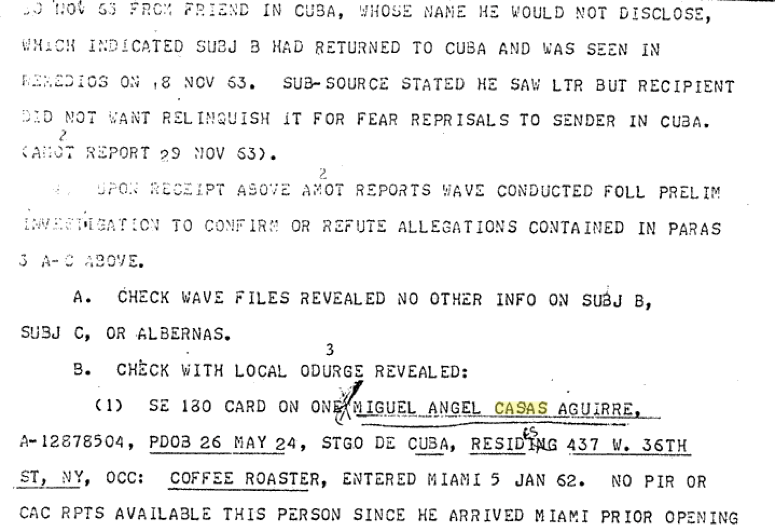
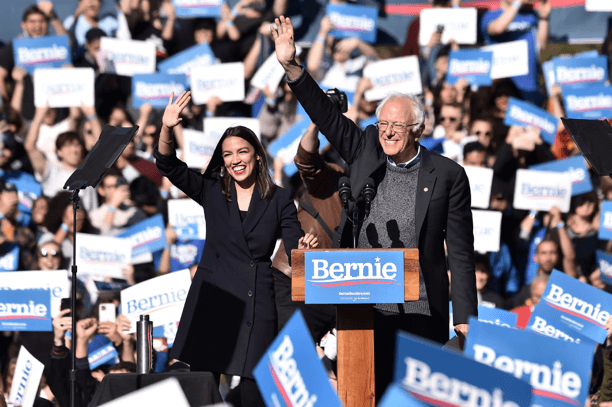
    Bernie Sanders campaigning with Alexandria Ocasio-Cortez

    From the above example, one could predict that Politico, like much of the MSM it represents, was intent on being critical of the Bernie Sanders candidacy. This was both before and after he dropped out of the race this year. (Click here and here)

    In fact, in surveying the way they headline certain events, it is hard not to write that they almost celebrate the losses of progressive candidates. (Click here for an example) They are also eager to cast many topics, issues, and political races as left vs. right, or center vs. right. (Click here for an example) In other words, the idea is to keep America divided, as Harris tried to do in his 2008 book. Consequently, there is almost no vision, insight, and too little in-depth reporting as to what the underlying truth (or truths) of these matters may be. Media Matters, for example, has frequently been critical of Politico. (Click here for details)

    Of course, this quite naturally means that Politico cannot be fair, objective, or honest about the Kennedys. Because JFK, RFK, and Ted Kennedy were trying to get at the underlying truths of many of the problems with America (e.g. race, economic inequality, education, and health care). A good example of this targeting occurred in April of 2018, when the film Chappaquiddick was released. Politico could not just review the film. They used the picture’s release to fill a huge top headline on their site, for two days. Peter Cannelos’ long essay was so negatively tilted that, in reference to the concurrent documentary mini-series The Kennedys, he implied that the series was complimentary to the family. (Click here for a more realistic view) In another example, consider their take on Robert Kennedy. On the 50th anniversary of his assassination, they ran an article entitled “The Bobby Kennedy Myth.” (Click here for the article)

    They are at it again; this time concerning John Kennedy. On June 13th, they printed an article by someone named Peter Keating. They billed Keating as an “investigative reporter”. In establishing that credential, they did not say what he investigated. It turns out that Keating is a sports writer. He writes mainly for ESPN, and his central beat is something called sabermetrics. (Click here for an example) If one does not know what that term means, please watch the Brad Pitt film Moneyball. How this area of study made Keating an authority on John Kennedy’s political career escapes this author—as it does probably many others. In fact, it shows that Politico does not mind who authors their Kennedy hit piece articles. They will bend over to cloud the author’s lack of established credentials.

    The title of Keating’s essay is “How JFK Paved the Way for Donald Trump.” I am not kidding. Just when one thinks American journalism cannot get any worse, you can rely on Politico to give us a further piece of flapdoodle. What is the point of the article? Keating is trying to insinuate that, somehow, Kennedy’s 1960 campaign for the presidency had something to do with the election of Donald Trump in 2016. To say that this is far fetched is not accurate. To anyone familiar with Kennedy’s career it’s a bunch of horse feathers. The idea is to suggest that somehow Kennedy’s campaign in 1960, particularly the primary, exemplified how Trump could win the presidency in 2020.

    The primary system had been around since the early 1900’s. It had been a reform of the Progressive Era to give the public more of a say in the nominating process, instead of exclusively being the role of the state party leaders. They were not as widespread as they are today, so they were not as definitive. But to say they had no impact at all is simply wrong. For instance, William McAdoo swept the Democratic primaries in 1924 and almost won the nomination. He had to be stopped at the convention, because he was backed by the Klan. It took 99 ballots to get rid of him.

    Amazingly, but predictably, the sportswriter completely passes over the 1952 GOP primary. There were four major candidates that year:  Earl Warren, Harold Stassen, Robert Taft, and Dwight Eisenhower. The battle winnowed down to Taft and Eisenhower and it was quite close. But Thomas Dewey, who many thought was going to run, did not. And he ended up supporting Eisenhower through his influence in New York which did not have a primary. To show how far American has come, at that time, many people in the Republican Party thought that Taft was simply too conservative to win. (Richard Bain and Judith Parris, Convention Decisions and Voting Records, pp. 280-86) In 1956, in the Democratic primary race, Governor Adlai Stevenson won out in the primary season over Senator Estes Kefauver. So to somehow say that Senator John F. Kennedy suddenly discovered the primary season as a way to the White House is simply tapering history.

    And that’s not all Keating does to fulfill his agenda. In 1956, there ended up being an intrastate battle in Massachusetts for control of the Democratic machinery for the upcoming nominating convention. Kennedy sensed, correctly, that the state pols—Congressman John McCormack and local hack William Burke—were going to try and block the nomination of Stevenson. Kennedy had supported Stevenson, would end up speaking at the 1956 nominating convention, and then placed him in his administration as representative to the United Nations. McCormack had opposed Stevenson in the primary and actually won by a write-in vote. Mr. Burke boasted about this victory and even personally insulted Kennedy for supporting the losing Stevenson. After that, JFK had no choice but to go after the duo, for both Stevenson’s sake and the personal insult. So, Kennedy, through his proxies, fought this move and, as Dave Powers and Ken O’Donnell have written, it ended up being a “Boston Irish political brawl.” Kennedy was outnumbered on the state committee, but there were enough uncommitted for him to lobby them and turn them to his side. He told Powers and O’Donnell he would call them and even ring doorbells if he had to and he did. At the end, Burke was out. (For a complete chronicle of this episode, see Johnny We Hardly Knew Ye, by O’Donnell and Powers, pp. 124-32)

    The idea that this episode taught Kennedy how to control his own delegation is undermined by the facts that Kennedy allowed McCormick to run as a favorite son at the convention and, contrary to what Keating/Sabermetrics writes, Kennedy did not appoint his own man to the state chairmanship. Pat Lynch was so unknown to him that he needed a personal audience with him to remember who he was. (ibid, p. 127) And even then, he still did not accept him. It was O’Donnell and Powers who pushed his candidacy on him.

    This was all part of Kennedy staying true to Stevenson, who was the national leader of the party. The idea that the state party, without this, would not have supported him in 1960 when he ran is a bit silly—even for sabermetrics. But Kennedy first really made a name for himself on the national level when Stevenson threw open the vice-presidential nomination to the convention that year. (ibid, p. 134) Although he did not win, most attendees were surprised at how strongly JFK ran.

    That is because, unlike Trump, the senator had already been around for ten years. In his valuable book, JFK: In the Senate, John T. Shaw chronicles his entire congressional career. (Click here for a review) And the very next year, Kennedy was going to indelibly imprint himself on the national consciousness with his famous, powerful Algeria speech, which he had been headed for ever since his visit to Saigon in 1951. (See Shaw, p. 101) If you did not know who Kennedy was before that speech, you sure as heck knew who he was afterwards. As Richard Mahoney wrote, there were 138 newspaper editorials printed over that highly controversial speech. The vast majority were negative. (Mahoney, JFK: Ordeal in Africa, p. 21) As both Mahoney and Shaw write, this speech made Kennedy the titular leader on foreign policy in his party. (Shaw, p. 110) Partly because he had deliberately singled out and criticized President Eisenhower, Secretary of State John Foster Dulles, and Vice-President Nixon in his speech and said there had to be a different approach to Third World nationalism rather than supporting European colonialism. In fact, Kennedy now made the cover of Time Magazine for December 2, 1957. The story’s title was “Man out Front.” (Mahoney, p. 29)

    As the British commentator Alistair Cooke had stated, by his purposeful attack on the White House, Kennedy had positioned himself as the man the Republicans now had to do something about. The presidential hopeful that the GOP now had to scorn: “It is a form of running martyrdom that Senators Humphrey and Johnson may come to envy.” (Mahoney, p. 29) None of this is in Keating’s article. Yet this is the way JFK had now become a national figure.

    I don’t see how much more of a contrast with Donald Trump that could be. By the time of the 1960 primary, Kennedy had been in office for 14 years. He was a prominent member of the senate not just through his high profile in foreign affairs, but also because of his service with his brother Robert on the Senate rackets committee and their opposition to Teamsters leader Jimmy Hoffa. And there was no real brilliance, Keating’s word for it, to his 1960 primary campaign. It was pretty fundamental in its planning. Kennedy got in early, had a good manager in his brother Robert, and spent a lot of money in defeating Senator Hubert Humphrey. But even here, Keating gets it wrong. As everyone but Keating knows, the man Kennedy was worried about was Lyndon Johnson. He wasn’t quite sure he could beat the Senate Majority Leader. So, he sent RFK to Texas to sound him out. Johnson told Bobby he was not going to run. This is something that even Chris Matthews knows. (See Bobby Kennedy, pp. 162-63) This assured JFK, since he thought that if either Stu Symington or LBJ won, it was going to be the same old Acheson/Dulles Cold War foreign policy all over again. (Harris Wofford, Of Kennedys and Kings, p. 37) As we have seen, Kennedy had charted out a different course that had put him near the forefront of the leadership in his party. This, as we have seen, was an important motivation for his running that year.

    But for whatever reason, Johnson did get in the race. He announced on July 5th, which was a week before the convention opened. To this day, no one knows why Johnson waited so long to announce his candidacy. But the amazing thing about it is this:  entering just one week before, he amassed more delegates than every other competing candidate combined. And it was not really close. In fact, Johnson’s late candidacy was so strong that Bobby Kennedy now had to switch tactics. He now had to pull out all the stops in order to make sure his brother won on the first ballot. He placed his agents on the floor to make sure no one was going to switch their votes to LBJ. Since if it went beyond a first ballot, there was a real danger that Johnson would outlast Kennedy. (Arthur Schlesinger, Robert Kennedy and his Times, pp. 213-15) Again, how does this resemble the Trump coronation in Cleveland? Who is to say that if Johnson had gotten in early, with all of his Texas backers, he might not have won?

    President Trump’s photo-op in front of the historic St. John’s Church

    In comparison to this, Trump never held any political office before his run for the presidency. And, in large part, that is the issue that he ran on. The public in 2016 was so sick of the political establishment on both sides that they voted for Trump and almost voted in Bernie Sanders. It was a different political universe in 2016. But further, as anyone with any knowledge of recent political history understands, the primacy of the political primaries was not forged in steel until after 1968, due to the famous McGovern-Fraser reforms. (Click here for details)

    Johnson could not have done what he did after those reforms. They were established partly as a result of what happened to RFK’s constituency after his assassination. Those changes eventually ended up mandating that each state have a primary or a caucus. The man who commandeered this new system, thus setting an example which has been mimicked by many, was Jimmy Carter in 1976. I, for one, am not convinced Trump would have made it without McGovern-Fraser, for the simple reason that almost all of the GOP establishment was opposed to his candidacy.

    Military presence in Washington, D.C.

    As the reader can see, there is no real efficacy to Keating’s article. It is just a part of the Harris agenda. And it’s not possible to fail to take note of the timing. As everyone knows, the Trump presidency, to put it mildly, has now confronted some tough times. Between COVID-19 and the George Floyd shooting in Minneapolis, things have gotten quite rocky. And between his denial of the first and his rather inept staging of a Bible pledge in Lafayette Park, he has not reacted well to either one. The Trump ally, Senator Tom Cotton, has tweeted that the Floyd protesters should not just face combat troops, but death from the skies: “Let’s see how tough these Antifa terrorists are when they’re facing off with the 101st Airborne Division.” And if that were not enough, Cotton then drew up his own battle order: “And, if necessary, the 10th Mountain, 82nd Airborne, 1st Cav, 3rd Infantry—whatever it takes to restore order. No quarter for insurrectionists, anarchists, rioters, and looters.” We all know what “no quarter” means do we not? (Fintan O’toole, NY Review of Books, 7/23/20)

    Deputy Attorney General Nicholas Katzenbach confronting Governor George C. Wallace

    As O’toole continued, that was not just bombast, because seven hundred soldiers from the 82nd Airborne did go to Washington. They were in the streets of the capitol, as were the low-flying helicopters and sand-colored Humvees. (ibid) And recall, the demonstrators in Lafayette Park who got tear gassed and clubbed were peaceful protesters. This makes for a vivid and continuing comparison with President Kennedy—which Keating does not mention. During the days of the civil rights demonstrations, Kennedy never wanted to call out troops. If needed, his graduated policy was to go from federal marshals, to the National Guard, with federal troops only called in as a last resort. And this was in aid of the civil rights cause and against the right-wing forces opposing them. For example, when governors Ross Barnett and George Wallace refused to uphold court orders to integrate, respectively, Ole Miss and the University of Alabama, Kennedy relied on federal marshals, only calling in troops—at Ole Miss—when the organized rightwing demonstration to stop James Meredith from registering grew violent. At Alabama, in addition to the National Guard, he had 3000 troops in reserve to oppose the 900 state troopers and police that Wallace had summoned to the scene. Kennedy had the National Guard handle the Alabama conflict.

    John F. Kennedy’s historic civil rights speech

    As I have demonstrated with facts, President Kennedy did more for civil rights for African Americans than any president since Lincoln. And it was not even close. He did more than Roosevelt, Eisenhower, and Truman combined in about one tenth the time. As O’toole writes, for Trump to say that he has done more in that cause than anyone since Lincoln, completely overlooking Kennedy, that is just self-promotion as well as being ahistorical. (For the evidence, click here and scroll to the chart at the end) It is startling that Trump could somehow miss Kennedy’s 1963 civil rights speech, which JFK made right after his confrontation with Wallace. But alas, Trump is the president who said there were good people on both sides at Charlottesville. In a phone conversation with Dick Gregory during the Birmingham crisis, Kennedy referred to the rightwing racists as “bastards”. In fact, some make the argument that Trump’s policies have exacerbated the impact of COVID-19 on the African American community. (Click here for details)

    It’s even more shocking that Trump can say this at a time when, as Alan Mcleod has written in MintPress, “A record 36 million Americans have filed for unemployment insurance, with millions losing their employer based healthcare plans and around a third of the country not paying its rent.” In the midst of this, working class Americans get a $1,200 check, while the Federal Reserve has given about $4.25 billion to big banks and corporate America. As Mcleod further wrote, the fact that the very upper class has risen in riches so rapidly signifies that their wealth “is barely connected to productive forces anymore and has more to do with how much wealth one can take from public coffers.”

    In reaction to all this, the man who President Trump is starting to resemble is Richard Nixon. As O’toole notes, on June 2nd, Trump issued one of his sparsely worded tweets: “SILENT MAJORITY!” If the reader recalls, with hundreds of thousands of demonstrators in the streets against the Vietnam War, Nixon used that phrase in a November 1969 speech. It was specifically about the war. Nixon was appealing to “the great silent majority of my fellow Americans” to stand with him against the demonstrators. That brief message echoes Trump’s earlier tweets in which he requested that his followers “LIBERATE MICHIGAN,” “LIBERATE VIRGINIA,” and then save your great 2nd amendment. It is under siege.” (Click here for details) How can anyone not interpret this as a call to the rightwing militias to bear arms, if they have to, in order to stop the COVID-19 lockdowns? That appeal to armed extremists has also provoked confrontations with George Floyd protestors. (Click here and here for details)

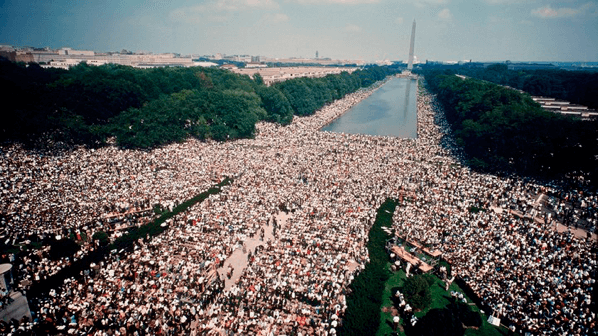
    August 28, 1963 – 300,000 people peacefully demonstrating for justice and jobs

    Richard Nixon was expert at dividing Americans along political fault lines:  Vietnam and his Southern Strategy on race. JFK tried to unite those of different races and classes. One great example being his sponsorship of the March on Washington. (See Irving Bernstein, Promises Kept, pp. 113-17) Kennedy was the first white politician to approve of this rally, on July 17, 1963. He then assigned his brother to make sure it came off perfectly and no extremists would upset it in any way. The Kennedys then got UAW chief Walter Reuther to bus in union workers, so the attendance would be both large and diverse. As many have said, that demonstration was probably the high point of post-World war II liberalism. It followed by two months, what many consider the greatest presidential civil rights speech since Lincoln.

    Make no mistake; none at all. Politico wants us to forget all about an example, so long ago, when a president and his brother were actually leading the country on civil rights. For me, it’s pretty transparent:  that is what the publication of this piece of malarkey is really about. It’s to throw sand in your eyes in hopes the public doesn’t notice how far we have fallen.

    Peter Keating should be ashamed of himself.


    Addendum:

    Click here or on the image below to see just how far Trump will go to polarize the racial issue:

  • Soledad O’Brien meets Mary Meyer

    Soledad O’Brien meets Mary Meyer


    Back in 2008, on the anniversary of the assassination of Martin Luther King, Soledad O’Brien hosted a 2-hour special on the King case. As I recall, it was the only such new programming that year, which was rather predictable, but still disappointing. Considering the quality and investigatory attitude of O’Brien’s program, one was more than enough. In fact, we would have been better off without it.

    CNN broadcast her program the evening before the actual anniversary. Recall, at this time, a jury verdict in a civil lawsuit had already been adjudicated in favor of the King family. They had concluded that King was killed as a result of a conspiracy. The media had done all they could to ignore that trial in Memphis. With almost no one reporting on it, except Chuck Marler for Probe Magazine, the MSM sent Gerald Posner out to tour the media in order to denounce the verdict as being irresponsible and not to be taken seriously.

    The 40th anniversary would have been a good opportunity to revisit that trial and interview people like Chuck Marler, among others. O’Brien did not do that. Her show was, at best, a limited hangout. And as one reads the review below, even that is being too kind.

    O’Brien left CNN after ten years. Prior to that, she worked for NBC for over a decade. She now has her own production company called Starfish Media Group. Incredibly, of late she has made a name for herself as a media critic by going after, of all people, Brit Hume and Chris Cillizza. We will take Robert Parry any day of the week. He aimed much higher, but he also paid a price that she has not.

    Looking at her background, it’s fair to say that her upcoming 8 part podcast on the Mary Meyer case will be, at best, a superficial look at the whole Ray Crump/Dovey Roundtree/Mary Meyer affair. Even the likes of Christopher Dickey could not help ponder that case early this year. (The JFK Mistress Gunned Down in Cold Blood) If there was anything new to offer on the case, that would be one thing. But there has been nothing new, except a cheapjack romantic novel by, of all people, Jesse Kornbluth. Before that, there was Peter Janney’s thunderously disappointing Mary’s Mosaic, which the reader will hear about in our upcoming series.

    O’Brien’s podcast will stretch over eight weeks. We will match it and then sum it up at the end. If you do not know anything about that case, it’s safe to say that the reader will learn more about it from us than he or she will from Soledad.

  • The Marilyn Monroe/Kennedys Hoax – Part 2:  The Mythology Soars into Outer Space

    The Marilyn Monroe/Kennedys Hoax – Part 2: The Mythology Soars into Outer Space


    VI

    Robert Slatzer first brought up the idea of Marilyn’s Red Diary of Secrets and that Bobby Kennedy was involved with Murder Incorporated. (DiEugenio and Pease, p. 362) This was ludicrous on its face. Murder Incorporated—Mob contracted killings—began in New York and first operated in the thirties and forties under Bugsy Siegel and Meyer Lansky. It was passed on to Louis Lepke and Albert Anastasia. It was exposed by prosecutor Thomas Dewey and was effectively finished by the mid-forties. In 1940, Bobby Kennedy was 15 years old, he enlisted in the Navy in 1943, he attended Harvard and then the University of Virginia for his law degree. This is more Slatzerian junk. Especially in light of what we know about RFK’s feelings about the Mob.

    But what of the diary? As McGovern notes, no one ever heard of this red diary until years after Marilyn was dead. Neither Mailer nor Capell used it. But Robert Slatzer says that Marilyn allowed him to read parts of it. It was from that diary that Slatzer heard things like references to Murder Incorporated; that Bobby had promised to marry Marilyn; and even references to the Bay of Pigs. Slatzer has Marilyn saying that, since the president’s back was bothering him that day, Bobby was handling the Cuban invasion. (DiEugenio and Pease, p. 362)

    Again, I wish that was a joke. But it’s not. Even back in 1974, one could easily discover that Bobby Kennedy had little at all to do with the Bay of Pigs. That operation was run by the CIA, much to President Kennedy’s chagrin. It was not until after that debacle that Bobby Kennedy became involved with President Kennedy’s foreign policy management and also in supervising the CIA.

    But then what of another diary Marilyn allegedly kept? The one that Ted Jordan saw. Jordan was mostly a TV actor who, like Slatzer, claimed he knew Monroe over a number of years. But like many in the field, he did not write about the relationship until much later, twenty-seven years after her death. There are as many problems with Jordan’s story as there are with Slatzer’s.

    As McGovern notes, Jordan could not have met Marilyn as he says he did, through the Blue Book Modeling Agency in 1943. She did not work there until 1945. (McGovern, pp. 105-110) In 1943, Monroe was a housewife in Van Nuys married to Jimmy Dougherty. And Jordan could not have picked her up at her Aunt Gracie’s home, since her aunt was living in West Virginia at that time. (McGovern, p. 109) I could go on in this vein for pages, since McGovern slices and dices Jordan’s work like a Veg-o-matic.

    Jordan’s book is also heavy on character assault. Grandison turns Marilyn into Mata Hari. Jordan turns Marilyn into a low life barroom prostitute, who is also addicted to drugs and alcohol. (McGovern, p. 113) Jordan married the stripper Lili St. Cyr in 1955. Jordan writes that Marilyn joined the couple in a three way bed romp. (ibid)

    After Jordan was divorced, he was living off of Doheny Drive. One night, in the summer of 1962, Marilyn showed up at his apartment. Jordan characterizes her as looking awful and living in a fantasy world. She walked to his place from Brentwood—a distance of several miles—in a kimono with a bottle of champagne in her hand. And she dropped off her diary. (McGovern, pp. 117-19) The question then becomes, if her diary was with Jordan—as he says it was, since he did not give it to the authorities—then what was Grandison reading? Because, according to Jordan, the contents of the diary he read were much more prosaic than what Grandison said it was.

    As noted, Robert Slatzer began this whole diary farrago. But as was often the case, he changed his story about it. In his first book, published in 1974, he said that Marilyn told him he was the only one she allowed to look at her diary. But then, in 1992, in The Marilyn Files, he accommodated a newcomer to the follies, a woman named Jeanne Carmen. (McGovern, p. 254) What is weird about this is that Carmen is not mentioned in Slatzer’s first book. One may also wonder:  if Slatzer was her male best friend and Carmen her best female friend, should they not have run into each other? Yet she is not in Slatzer’s 1974 book and he is not in her 2006 book. (McGovern, p. 131)

    In her first descriptions of the diary, it was not the little Red Book of Secrets as described by Slatzer. It was more like a notebook. But then, in 2006, in her memoir, she reverted to the Slatzer version of what it looked like. And now she said she had seen it laying around Marilyn’s place many times. Her version of what was in the diary went beyond Slatzer’s and approached Grandison in sheer bombast. Carmen noticed references to the Mob, Sam Giancana, John Roselli, J. Edgar Hoover, and Jimmy Hoffa. For the same reasons I faulted Grandison, I consider Carmen’s version a fabrication also. Needless to add, Summers used Carmen’s name over 60 times in Goddess. Incredibly, with all the holes we have exposed in Slatzer’s pile of bird droppings, Summers was also vouching for Slatzer as late as 2006. (McGovern, p. 348)

    But the diary tale is actually worse than all the above. Because it turned out that Marilyn did have a diary. It was recovered in one of her storage boxes years after a dispute was resolved over her estate. It was nothing like Grandison, Slatzer, or Carmen said it was. The bulk of her estate was given over to the Strasberg family, since Monroe greatly appreciated what her acting coach, Lee Strasberg, had done for her. Those notebooks were compiled in a book called Fragments in 2010. There is no mention of Giancana, Roselli, Hoover, or Tony Accardo. Frank Sinatra is not in there and neither is Castro. Nothing about any romance with the Kennedy brothers or her desire to be First Lady. The only mention of the Kennedys was in notes she made for an interview, in which she said she admired them, as she did Eleanor Roosevelt, because they represented hope for young people. (McGovern, pp. 264-71)

    But to show the reader just how off the cliff our culture is on this matter, Grandison’s book was published in 2012. Two years after Fragments. We have now entered the world of high camp.

    VII

    As the reader can see, the whole charade about the diary was really about a necessary stage prop, one that fit in with the original 1964 scenario concerning Capell’s baseless story about Robert Kennedy being exposed by Monroe. The two playwrights, Capell and Slatzer, refined it as a fictional device in 1974 for the latter’s book.

    Grandison then surpassed himself. Not only did he find the diary, but there was also a publicity release in her purse. The release said that there would be a press conference at the LA Press Club. Marilyn would answer questions based upon her Diary of Secrets. I am not kidding. That is what it said and McGovern reproduces it in his book. (p. 557) Of course, no one ever saw it except Grandison. One wonders, since there was no such Diary of Secrets, what was the conference going to be about? Her failed marriages? Her thoughts on her acting career? Because, as one can see, that is what she wrote about in her diary, her real one, not the Slatzerian creation.

    The diary was a dramatic necessity, because it would provide ammo for the press conference. But in addition to there being no such diary, according to Mike Selsman, there was no such press conference scheduled for Monday August 6th. Selsman worked for Arthur Jacobs and his firm ran Marilyn’s public relations. Selsman said that if any such press conference would have been called, he or Jacobs, who were handling her account, would have heard about it. Either through a typed up press release or through one of the big name Hollywood reporters, like Vernon Scott of UPI or Jim Bacon of the AP. (McGovern, p. 564) Selsman knew Pat Newcomb, who was Monroe’s press contact, so if there was a press release, she would have given it to him.

    And what about Newcomb? When one of Marilyn’s photographers, Bruno Bernard, phoned her years later for an article he was writing, he asked her if she knew anything about Robert Slatzer, supposedly her ex-husband. Newcomb said she never heard of him. Bruno went on to detail Slatzer’s ideas about a murder plot involving a cover up by the LAPD, Robert Kennedy and the FBI. A stony silence now ensued for about 2 minutes. Bernard asked if she was still there. Newcomb replied: “Bruno, if I hadn’t known you for such a long time, I would have hung up long ago listening to that trash.” Bernard then described what happened next:  “She banged down her receiver with a discernible thud.” (Susan Bernard, Marilyn: Intimate Exposures, pp. 180-81)

    But then what about assistant DA John Miner and his “tapes”? Miner had a veneer of respectability to him and his story was heavily promoted by the LA Times. In 1962, Miner was part of the Los Angeles District Attorney’s office medico-legal division. He observed Monroe’s autopsy and allegedly interviewed Dr. Greenson. Greenson revealed to Miner that Marilyn had made two streams of consciousness type tapes for him in the weeks before her death. Miner asked the doctor to play them for him. Before he did, Greenson made Miner promise never to reveal their contents. Miner so complied and the lawyer said he made extensive notes on them. (McGovern, pp. 458-59)

    There were two things that were odd about his story. First, in the summer of 1962, Greenson was talking to Monroe every day, sometimes twice a day. So why would she need to make stream of consciousness tapes for him?

    In 2005, Miner released the notes to the LA Times. They treated it as a major feature story—posing no serious questions to the attorney. It was done so credulously that even someone as smart and experienced as Debra Conway of JFK Lancer bought it.

    If one reads that story, one would believe that Miner presented tapes or documents; the latter would be a transcript of the tapes that could be checked. This was not the case. All Miner had were notes. And the point here is that Miner told three stories about when he composed them. And here is the second problem inherent with Greenson:  if the doctor made Miner promise not to reveal their contents, why would he let him take contemporaneous notes? That would indicate Miner intended to make them public, which would be a violation of doctor/patient privilege. So Miner switched to, well, he did not make them in Greenson’s presence, but later that day. He then changed it to he made them many years after. But then, how could one recall them that closely? (McGovern, p. 461)

    It turned out—as it almost always does—there was a cash motive behind Miner’s late arrival on the Monroe scene. In 1995, Miner had attempted to sell his notes to Vanity Fair. But in that version, he had only a few pages on a legal pad, which implies he made no contemporaneous notes and it is unlikely that he did them the same day. (Lois Banner, Marilyn, eBook edition, p. 419; McGovern, pp. 463-64) Even at that, Miner tried to incite a bidding war by saying he had been offered six figures by a competitor. This was obviously not true. But it’s even worse than that. Miner had fallen on hard times. He had been terminated from the DA’s office, had his license suspended—for more than one reason—and declared bankruptcy (McGovern, p. 465; Banner, p. 419) This is why he needed payment for the notes. Further, although he told others he had interviewed Greenson, he likely had not. (Banner, p. 419) After further discussion, and further revelations about his history of sexual harassment and obsession with enemas, Lois Banner concluded Miner had created the notes. (ibid, p. 422) Are we to believe that the LA Times did not know any of this in 2005? When even on their face, there were real problems with the Miner notes? (Click here for details)

    But let me add one other point about Miner. He was also involved in the inquiry—rather the cover up—of the Robert Kennedy assassination. As anyone who reads Lisa Pease’s book on that case, A Lie Too Big to Fail, the alleged assassin of Robert Kennedy, Sirhan Sirhan, could not have killed the senator. Further, Sirhan showed signs of being hypno-programmed that night. The man who all but admitted to hypnotizing Sirhan was William Joseph Bryan. It turned out that when Bryan died, the attorney for his estate turned out to be none other than John Miner. The night of Bryan’s death, Miner sealed Bryan’s home. (Pease, pp. 67-69, 446)

    VIII

    One of the most telling parts of Murder Orthodoxies is when McGovern uses the calendars of President Kennedy and Attorney General Kennedy and matches them with the two Monroe day-by-day books previously mentioned. (pp. 176-86) Monroe met Robert Kennedy four times, each time was in public with other people around. President Kennedy met with Monroe on three occasions. At one of those, in March of 1962 at Bing Crosby’s desert estate, there is evidence they had some kind of dalliance. And that is it. Biographers Randy Taraborrelli and Gary Vitacco-Robles agree with this record.

    What this means is that for any other encounter—in which the time and geographic calendars don’t match—the evidence must originate with anecdotal sources. To accept anecdotal evidence as superseding the black and white record is usually not an acceptable practice. But further, to accept the most problematic testimony, by “witnesses” who 1.) Clearly have an agenda, and 2.) Pose very serious evidentiary problems, and to expect that to surmount the above record, to me that is a practice that should be looked upon with strong skepticism.

    Jeanne Carmen first appeared in the Monroe literature due to Summers’ 1985 book, Goddess. (McGovern, p. 120) She then made even more prominent appearances in books by Donald Wolfe and David Heymann. As McGovern notes, right off the bat, she poses problems for the discerning reader, since she posited two different places where she met Marilyn. In one version, she met her in Los Angeles; in another, she met her on the opposite coast in New York. What makes it worse is that there is no supporting evidence for either meeting. (Ibid, pp. 124-26) Since the latter meeting was at the The Actor’s Studio, where many people were friends with Marilyn, that makes it even more puzzling.

    Carmen says she knew Monroe for a decade and they became the best of friends, yet she was never able to produce a photo of them together. (McGovern, p. 128) If Monroe had just been an ordinary person, this could be excused. But Monroe was a major movie star during the last ten years of her life. People take pictures on celebrity occasions. I have framed photos of myself with Oliver Stone in my apartment. I have taken photos of people who wanted a picture with Stone. The above factors all raise suspicions about Carmen’s story—and we have not even gotten to that story yet.

    In her memoir, Carmen said that Marilyn had a sexual encounter with John Kennedy at the Democratic convention in Los Angeles in 1960. As the author demonstrates through the method reviewed above, Monroe was not in LA at that time. (McGovern, pp. 146-47) Carmen also had her version of what happened between the president and Monroe after the famous 1962 rally in Madison Square Garden, where Monroe sang Happy Birthday to the president. As McGovern shows, this is also wrong since Monroe’s time before, during, and afterwards is all accounted for by neutral witnesses. She was escorted to the event by her former father-in-law and she kindly met with her New York fan club after the fund raiser. Randy Taraborrelli agrees that no such encounter happened. (McGovern, pp. 217-18)

    Carmen claimed that she once observed Marilyn partaking in sexual activity with Joe DiMaggio and she added that Marilyn liked having witnesses to these types of affairs. This goes against everything we know about how demure Monroe was about her personal life. Carmen also said she used Valium to subdue DiMaggio on one occasion. This was a decade before the FDA approved the drug and it became commercially available. (McGovern, p. 131) I could go on, but the credibility of Carmen is, to say the least, quite questionable.

    Another witness who Summers used was Senator George Smathers. Smathers had been a friend of JFK during his days in the senate. Again, his first appearance in a Monroe biography is in Summers’ Goddess. Smathers told Summers a lot and he was then used by Donald Wolfe, Randy Taraborrelli, David Heymann, and others. According to Summers, he used the Florida senator, because no one else in Kennedy’s circle would talk to him about Monroe. Smathers ended up being the kind of witness no one should use.

    On pages 204-05, McGovern makes out a list of almost 20 Smathers generated quotes, which are risible in their contradictions and/or falsity. For instance, Smathers said that it was really RFK who had an affair with Marilyn first and then JFK. But he later said that RFK and Monroe did not engage in an affair. Like Carmen, he said that Monroe had an illicit assignation with JFK at the Democratic Convention in LA in 1960., something which, as we have seen, could not have happened. Smathers also once said that JFK ended his affair with Monroe after the encounter at Bing Crosby’s estate. But he then said that Kennedy spent the night with Monroe after the Madison Square Garden fundraiser! As noted above, no such thing happened. One could deduce that Smathers told so many whoppers he couldn’t keep track of them.

    But perhaps the biggest howler Smathers ever uttered was that Monroe would often visit the White House and sometimes she would show up unannounced. (McGovern, p. 204) He even said that Monroe visited Washington and took a ride on a presidential yacht with Kennedy and Senator Hubert Humphrey. In rebuttal, I can do no better than quote the author on this point:

    In fact, Marilyn never visited the White House and, in fact, she never appeared there unexpectedly and unannounced, like a waif with her suitcases, night gowns, and tooth brushing gear; and to assert that she did so is, and was, absolutely ridiculous on its face. (p. 217)

    McGovern writes several pages on why Smathers may have told so many BS stories about his alleged former friend. Although Smathers was a Democrat, he was much more conservative than John Kennedy. While Kennedy was endorsing the Brown vs. Board decision in public in 1956 and 1957, Smathers was signing the segregationist Southern Manifesto. Smathers then resisted the civil rights program that JFK started through congress. In 1960, Smathers entered the Florida presidential primary as a favorite son candidate. And he stayed in even after Kennedy requested he withdraw. (McGovern, p. 194) Like Ben Bradlee, Smathers turned out to be Kennedy’s false friend.

    Just how far out into the world of the X-Files do these fantasies go? Well, according to Dr. Donald Burleson, they ascend into outer space. In his 2003 book UFO’s and the Murder of Marilyn Monroe, he offers the theory that President Kennedy had revealed to Marilyn the secrets of space aliens and UFO’s and, like everything else she never knew, Monroe was going to go public with the knowledge. (McGovern, pp. 18-19) How did the plotters know of her plan? Her house was bugged. As McGovern notes, Monroe’s home must have had more wiretaps and surveillance microphones than an NSA listening base, since everyone was bugging her house. Yet, consistent with the diaphanous nature of this case, there are no tapes to be heard. And the two men most often mentioned as doing the bugging—Bernard Spindel and Fred Otash—failed to mention any such thing in their books about their careers. (McGovern, p. 439, 443) Further, intelligence analyst John Newman has shown that certain documents that allege to reveal such ET knowledge by Monroe are forgeries. (DiEugenio and Pease, pp. 360-61)

    IX

    Let us close with the last week of Monroe’s life. As anyone familiar with the tall tale understands, this involves Monroe going through a hellish weekend at the Cal-Neva Lodge in Lake Tahoe. This wild, unbelievable weekend has evolved over time into a veritable phantasmagoria. In the ultimate Heymann/Chuck Giancana form, we have Peter Lawford, Frank Sinatra (who owned the club at the time), and Sam Giancana doing everything they could to stop Monroe from holding the press conference she was not going to hold with the Secret Diary that did not exist. This weekend featured drugs, alcohol, and all kinds of sexual abuse—in some versions, lesbianism. (McGovern pp. 414-19) How and why was Giancana there? Well, he was a major sponsor of Monroe’s career, which is another myth that McGovern exposes as utterly false. (McGovern, pp. 397-408) Why Sam would want to stop Monroe from hurting the Kennedys is part of the illogic that prevails in these fantasies. By 1963, Bobby Kennedy was making Giancana’s life a painful endeavor. The AG had surveillance on the Chicago mobster, both electronic and human, everywhere he went—including the golf course. The idea that Giancana would want to help the Kennedys could only live in the pages of the trashy book Double Cross.

    Marilyn went to Cal-Neva with Joe DiMaggio at the invitation of Dean Martin. She wanted to thank Martin for his support during her struggle with the studio over her last film, Something’s Got to Give. They also discussed a future project. Martin also wanted Monroe to marry DiMaggio again, which reportedly she agreed to do. (ibid, p. 417) But, of course, that won’t sell a lot of books or get you a spot on tabloid TV, which brings us full circle to the day of Monroe’s death again. Summers, Wolfe, Heymann, Matt Smith, and an array of other writers, like Milo Speriglio, have worked triple overtime trying to get Robert Kennedy into Brentwood on August 4th. The problem is that there was compelling evidence that Bobby was in Gilroy, near San Jose at a ranch owned by John Bates, a prominent attorney in San Francisco. But not only did these authors persist in the belief that RFK was at Monroe’s, some writers said he was there twice that day. The solution, as first proposed by Norman Mailer, was that somehow Bobby Kennedy got there by helicopter and landed near Lawford’s home. (McGovern, p. 273) As this book shows, there was no helipad near Lawford’s home.

    What McGovern does with this helicopter tale, as refined by later authors, is worth the price of the book. He gives us a short history of the development of the chopper and summarizes the available models at that time. The average cruising speed of possible 1962 helicopters would be about 105 MPH. Therefore, it would take over three hours to make the journey one way. And you might have to stop for gas outside of Los Angeles. No helicopter could have landed near the Bates ranch, due to the topography and high-tension wires. (McGovern, pp. 288-89) Therefore, a car must have taken Bobby to the San Jose airport. And since there was no helipad at Lawford’s, nor one in Brentwood at that time, Kennedy must have landed perhaps at Fox studio. And someone drove him to Brentwood. As we will see, this could have only happened at night, for the idea that RFK was there in the afternoon is impossible. Yet to fly over the Santa Cruz mountains in darkness in 1962, would be foolhardy. For one thing, the Venturi Effect could cause an altimeter malfunction and a crash. But authors like Heymann need a great dramatic scene in Brentwood with Monroe coming at RFK with a knife, so they insist—against all the evidence and logic—that Kennedy was there. (McGovern, p. 151)

    Bobby Kennedy was going to make a speech in San Francisco on Monday for the ABA. Bates invited him to spend the weekend at his ranch, while he was in the area. (Bernard, p. 185) The FBI liaison to the AG made out two reports covering his itinerary for that weekend. (McGovern, pp. 281-82) Bobby was picked up at the San Francisco airport by Bates and driven to Gilroy late on August 3rd.

    McGovern’s book referenced Susan Bernard’s 2011 volume of photographs, Marilyn: Intimate Exposures. When I turned to pages 186-87, a wave of shock went through me, which quickly changed to disgust. On those two pages, Bernard features ten pictures of Bobby Kennedy at the Bates Ranch on August 4th. He was taking his kids horseback riding, swimming in the pool, a hike up a hill, and partaking in a touch football game. These pictures had existed since 1962. And no one in nearly fifty years ever saw them, or chose to print them? I don’t believe that. It is more likely that they have been suppressed. With these pictures, the nearly dozen witnesses at the ranch, the FBI reports, the article in the local paper on the following Monday about Bobby Kennedy being in church the day before, with that kind of evidence, all the reports about RFK being in Los Angeles that day are tossed into the trash bin. (McGovern, p. 273)

    But, again, let us be fair. After both families arranged dinner for the kids, and then for themselves, Bobby worked on his speech and then retired:  could the helicopter scenario be enacted then? There were two gates to the ranch. Bobby Kennedy would have had to wait for his wife to fall asleep first, therefore it would be about 10:45. One of the men in the arriving car would have had to somehow crash both gates. If we then allow for the drive to the airport, the flight to some kind of landing field in LA, and then the drive to Brentwood, there is a problem, and it’s a big one:  Monroe is already dead. Or at least beyond saving.

    Perhaps the only part of the book better than McGovern’s review of Robert Kennedy in Gilroy is his examination of the Monroe autopsy. After a 21-page analysis, he concludes that the latest time she could have died would have been at 2:30 AM on August 5th. Dr. Cyril Wecht places that time earlier, at 2:00 AM. And she would have been in a comatose state at least an hour earlier. (McGovern, pp. 488-89) Bobby Kennedy would have arrived at about 2:45, and that is making good time.

    In that chapter, the author addresses the questions that people like Slatzer and Wolfe have posed about the autopsy. It was not uncommon to have ingested the pills Monroe did and not have them show up as residue in the stomach. Simply because Monroe’s stomach was empty and the organ keeps on working until the subject has passed on. (McGovern, p. 483). Also, the manufacturer of Nembutal used a color dye that did not bleed from the gelatin capsules once swallowed, which explains why no dyes were found in her stomach. (ibid, p. 482) Not only did Wecht agree with Thomas Noguchi’s autopsy, so did Dr. Boyd Stevens for the DA’s office review of the case in 1982. McGovern also proves through the barbiturate levels in Monroe’s liver and blood that she was not injected or given a “hot shot”. Later on in the book, he also shows that it is highly unlikely that Marilyn was killed through a rectal suppository, as was proposed in Chuck Giancana’s clownish book Double Cross. (McGovern, pp. 514-15)

    Today, after the Elvis Presley and Michael Jackson cases, Monroe’s doctors would have been placed on trial for their irresponsible overprescribing of pills and also for the dangerous combination the prescriptions created:  Nembutal, Chloral Hydrate, Librium, Phenergan, and (most likely) Triavil. The two drugs that killed her are the first two.

    Don McGovern has written a quite commendable book. One that swims against some sick cultural tides. As he shows, no one was “protecting the Kennedys.” Those who used that rubric were engaging in the most outrageous practices of evidence manipulation and character assassination; not just of the Kennedys, but of Marilyn Monroe. Monroe was not a Mafia moll, nor was she a high level intelligence agent. McGovern has shown these to be part of a ludicrous and unfounded sideshow. There is a standard in writing nonfiction: sensational charges necessitate sensational evidence. That rule was completely discarded in this field a long time ago, specifically by Norman Mailer. This opened the door to the likes of Slatzer, Grandison, Carmen, and Smathers. Supporting and aggrandizing each other, they created a three ring Ringling Brothers circus.

    Don McGovern’s book applies the torch to their circus tent.

  • The Marilyn Monroe/Kennedys Hoax – Part 1:  The Mythology is Launched

    The Marilyn Monroe/Kennedys Hoax – Part 1: The Mythology is Launched


    I

    Back in 1997, I wrote an essay for Probe Magazine concerning the Sy Hersh/Lex Cusack affair. This involved an alleged extortion racket, run by Marilyn Monroe to force the Kennedy family to arrange a trust for Monroe’s mother. Lex Cusack’s father had been involved with part of Monroe’s estate and Lex said he found the documents in his father’s papers. Hersh fell for them hook, line, and sinker. The documents were later exposed as forgeries. I found the attendant controversy fascinating and decided to write about it. (Click here for details)

    One of the reasons I did so was that many people within the JFK critical community had taken this MSM meme seriously, e.g. Larry Hancock, Peter Scott, and Paul Hoch. In its totality, that meme went: Monroe had affairs with John Kennedy and Bobby Kennedy; she was more or less a Sam Giancana/John Roselli moll; and to top it off, J. Edgar Hoover actually helped cover up the Kennedy/Mafia role in Monroe’s death! (I’m not kidding.) I found all this to be rather wild. My essay made the argument that is was based on quite dubious grounds. Yet, Medusa-like, this idea persisted in the critical community, even after I wrote my essay—which was one of the most popular articles Probe ever published.

    I am moved to write about the topic again, because of the appearance of a new book on the subject: Murder Orthodoxies: A Non-Conspiracist’s View of Marilyn Monroe’s Death. The book was written by Donald R. McGovern with a foreword by Gary Vitacco-Robles—the latter is one of the better biographers of Monroe. McGovern’s book is salutary in its intent. I say that because, having been exposed to what passes for literature on the subject, I understand just how toxic the waters in the field are. I once compared it to swimming in a sewer and having to be fumigated afterwards.

    That was back in 1997. Since then, with the likes of Donald Burleson, Christopher Anderson, David Heymann, John William Tuohy, and Donald Wolfe, it actually got worse. We are now in the realm of Marilyn and space aliens and Marilyn and the KGB. I wish I was kidding. But, as Don McGovern proves, it’s no joke. Egged on by the expansion of cable television, talk radio, and the rise of self-publishing, the field has now literally reached the Outer Limits.

    McGovern begins his book in a simple, but pointed, way. He describes Marilyn Monroe’s last day, August 4, 1962, at her home in Brentwood. He follows what she did and who was there. This included, Pat Newcomb her assistant and publicist; Larry Schiller a photographer; Eunice Murray, her housekeeper; Norman Jefferies, Murray’s son-in-law who was a handy man; and her psychiatrist Dr. Ralph Greenson, who arrived in the early afternoon. There was a disagreement between Schiller and Newcomb over whether Monroe should pose for pictures for Playboy Magazine and Newcomb left. (McGovern, pp. 3-4) Monroe was also involved in a dispute with 20th Century Fox over her behavior during the production of the film Something’s Got to Give. But this had been resolved on terms favorable to her.

    McGovern describes certain other events of that day: attempted calls by her former stepson Joe DiMaggio Jr, a walk on Santa Monica beach, Murray taking Marilyn shopping, a second visit by Greenson, a phone invitation to Monroe for a dinner gathering by Peter Lawford at his Santa Monica home. Her stepson finally did talk to her, Greenson left at about 7:15, Monroe turned down two Lawford invitations, and Greenson had asked Murray to stay the night with Marilyn due to his concerns about her mental state. (McGovern, pp. 7-8)

    Murray later suspected something was wrong with Marilyn when she woke up past midnight and saw a light on in Marilyn’s bedroom beneath the door. (McGovern, p. 545) She called her name, but there was no reply. This worried her, since it was unlikely she was asleep with the light on. She then knocked on the door, but there was no answer.

    She called Greenson who advised her to look into the bedroom from outside. She did so and then called him back to tell him Marilyn was nude on her stomach, but her body looked strange and unnatural. Greenson dressed and drove over. He pounded on her bedroom door with no answer. He took a fireplace poker outside and broke a pane in the window and then rolled open the sash. He slid through, approached the body and when he saw the hue, he knew she was dead. (ibid)

    As the author notes, this is really all we know that happened that day and night. We cannot, of course, know what happened behind Marilyn’s closed bedroom door. The problem, as the author notes, is simple: some people—like Schiller and Murray—have altered their stories. (McGovern, pp. 7-8, pp. 538-39) The other problem is that many people would not accept the official verdict in the case, which was one of “probable suicide”. But more important to the development of the cottage industry of books on Monroe was the constant expansion of a growing legerdemain about the facts of her life and death. This aggrandizement was performed by people who either greatly exaggerated, or completely invented, their roles in both.

    We can begin by noting two examples dealing directly with the crime scene. Sgt. Jack Clemmons was the first police officer to arrive at Marilyn’s home. When Robert Slatzer talked to him for his book on Monroe in the early seventies, Clemmons was no longer a policeman. He had been forced to resign due to his role in a libel conspiracy case. The target of that plot was California Senator Thomas Kuchel. The idea was to smear Kuchel in a homosexual tryst. Why would Clemmons take part in such an enterprise? Because, as Clay Risen reveals in his book The Bill of the Century, Kuchel had been the strongest Republican ally to Attorney General Robert Kennedy and Senator Hubert Humphrey in their struggle to get John Kennedy’s civil rights bill through the senate in 1964. Obviously, Clemmons was no friend of Kennedy liberalism. And, as the author writes, “Jack Clemmons did not have a problem corrupting the truth.” (McGovern, p. 546)

    Glass is usually cropped in books and on TV shows

    Clemmons was accommodating to Slatzer. The policeman told him that the bedroom scene at Marilyn’s looked staged to him. For example, he said a “drinking vessel was not on Marilyn’s night stand or near her bed.” Further, he could not find a glass in the nearby bathroom either. (ibid, p. 547)

    Clemmons was up to his old tricks, because:

    Police photographs snapped that morning revealed that Marilyn…had a glass at her bedside. One of these photographs depicted a policeman’s hand pointing at Marilyn’s cluttered bedside table, indicating the many prescription bottles resting thereon, and that photograph clearly revealed a glass… (p. 547)

    I do not like policemen who manufacture evidence or deceive the public about key facts in a high-profile case. Being familiar with the RFK assassination, I am fully aware of this type of behavior by the LAPD in 1968. And the Slatzer/Clemmons interview took place after that event.

    But this was not the only alteration that Robert Slatzer elicited about the crime scene at Marilyn’s home. As mentioned previously, Eunice Murray said that what had her worried about Marilyn was being able to see a sliver of light underneath her door after midnight. This indicated to her that the actress—who suffered from insomnia—was not able to sleep. Years later, Murray changed her story. It was not a sliver of light she saw. That was changed into a phone cord. Who helped her change her story? Robert Slatzer again. Twelve years after the tragedy in Brentwood, Slatzer convinced Murray that she could not see anything under the door, because of new carpeting being installed. As the author notes, the idea of having carpeting so thick that it blocked any door clearance is rather dubious. To prevent any light passage usually requires specially designed seals. (McGovern, p. 552)

    Don McGovern will reveal much more about just how pernicious Robert Slatzer was in the Monroe case. In so doing, he achieves something I would not have thought possible. He proves Slatzer was even worse than I thought he was.

    II

    How did the Marilyn mythology begin? And why? As hinted at above with the Clemmons/Kuchel plot, it was politically motivated. No president did more to tear down the walls of segregation in the South than John Kennedy. No one was more instrumental in that destruction than Attorney General Robert Kennedy. (Click here for details). In fact, as Clay Risen notes in his book, The Bill of the Century, the main reason RFK stayed on as Attorney General into 1964 was to make sure his brother’s bill passed through congress. After that happened, the Attorney General resigned and ran for the senate in New York. As he said, his goal was to represent the Kennedy wing of the Democratic Party in the senate.

    There were some conservatives who did not wish RFK to succeed in that race. For the senate seat was perceived as a springboard to the White House. They did not want one Kennedy replaced by another Kennedy, who—because of his epochal stewardship of civil rights—was even more liberal than his brother. They were aided in their cause by journalist Dorothy Kilgallen who, in a column written the day before Monroe died, hinted at some kind of affair between Bobby Kennedy and the movie star. As the author notes, there was no basis for this insinuation. (McGovern, p. 21) Her alleged source was a person, Howard Rothberg, who had no connection to Monroe’s circle. But with the help of this tinder, three arsonists set a fire.

    Maurice Reis ran the Motion Picture Alliance for the Preservation of American Ideals. This group was a leftover from the McCarthy era and it terrorized the movie business in the fifties. (See the film Trumbo.). Reis kept files on anyone in Hollywood suspected of being a communist or a sympathizer. Because Monroe had been married to playwright Arthur Miller—pegged as a sympathizer—Reis had files on her. Sgt. Jack Clemmons, who we have already met, was part of the Fire and Police Research Organization, a similar anti-Communist group. Frank Capell started his Red hunting career in Westchester New York as an officer in the Subversive Activities Department. The three men knew each other and, in the autumn of 1962, Reis informed the other two about his files on Monroe. He then spun a tale: Marilyn thought Bobby Kennedy was going to marry her, but the Attorney General backed out of the proposal. Monroe was angered and threatened to reveal the affair; thus, the Kennedys had her eliminated. As McGovern notes, there was no evidence to back this up. But Clemmons and Capell wrote summaries of this wild theory and forwarded them to J. Edgar Hoover’s pal, columnist Walter Winchell, who printed much of it. (McGovern, pp. 24-25)

    In August of 1964, Capell wrote a pamphlet titled The Strange Death of Marilyn Monroe, the publication of which coincided with RFK’s entry into the New York senate race. It was essentially the Reis concept, padded out with filler: Bobby Kennedy had Monroe killed by communist agents, because he romantically betrayed her and she was going to expose that betrayal. (James DiEugenio and Lisa Pease editors, The Assassinations, p. 360) As more than one biographer has noted, the anti-Kennedy forces circulated this fruity screed in New York to hurt his candidacy. In order to make his spurious thesis credible, Capell criticized both the investigation into Monroe’s death and the autopsy, in order to suggest her death was a murder disguised as a suicide. Capell’s pamphlet did not gain any real traction, but it was the intellectual basis for a similar effort that did gain wide currency. And, as we shall see, Capell also cooperated on a similar effort beyond that.

    Like many American males, Norman Mailer had a liking for Marilyn Monroe. He tried to meet her once but, for whatever reason, she did not want to meet him. (McGovern, p. 31). In 1973, nine years after Capell’s political hit job was issued, Mailer published his own piece of hackery, Marilyn: A Biography. It was a coffee table book, featuring photos by several photographers, including Larry Schiller. Mailer’s accompanying essay suggested that somehow Marilyn’s death was actually a murder. He at least partly formulated this idea through Capell—even though Capell had surrendered on charges in the same libel action against Kuchel that Clemmons had resigned over.

    But Mailer had a different reason for continuing the baseless smear. He admitted to Mike Wallace on Sixty Minutes that he needed the money. Unsaid were his alimony and child support payments. (McGovern, p. 33). What Mailer did was, as McGovern describes it, a use of paralipsis. That is, implying something could be true while knowing you have no basis for postulating it. Mailer even tried out the idea that maybe, if Bobby did not kill her, agents of the FBI or CIA did, in order to make it look like she had killed herself over unrequited love. Mailer could get away with this nutty speculation since JFK, RFK, and Monroe were all dead, so there were no legal consequences involved. The book made the cover of four magazines and became a huge bestseller. (See Norman Mailer: A Double Life, by J. Michael Lennon, pp. 467-68) But as author John Gilmore notes, it might be the worst of the lot. Because Mailer “originated the let’s trash Marilyn for a fast buck profit scenario.” Gilmore continued in his description of the genre:  “There are many others in the line; in fact, most every biography on Marilyn is part baloney sandwich peppered gingerly with so-called invention.” (McGovern, p. 36)

    That description is probably too kind to apply to the next writer to follow in the Mailer/Capell fiction as non-fiction line. He is the previously mentioned Robert Slatzer. Slatzer’s The Life and Curious Death of Marilyn Monroe was published just a year after Mailer’s yarn, so it is hard not to conclude that the publishing company at least partly shaped and modeled their product on the success of Marilyn: A Biography. Especially since, as Michael Lennon points out, Mailer’s book had a combined hard cover and paperback sale of one million copies.

    It turns out that Slatzer knew Kilgallen and, in fact, he wrote her column at times when she was on vacation. (McGovern, p. 38). In that column, he once wrote that he met Monroe in 1947 at Fox. In his book, he changed this to the summer of 1946. But this would only be a minor contradiction in a Slatzerian sea of them.

    Slatzer was born in Ohio in 1927. He worked in the D movie business as a writer and director e.g. Bigfoot. In the seventies, he turned more to writing celebrity biographies: two on Monroe and one each on Bing Crosby and John Wayne. In his books on Marilyn, he depicts himself as her closest confidante. In fact, he maintained that he married her. It was a brief marriage. It lasted about 48 hours on the first weekend in October, 1952, the ceremony being performed in Mexico. (McGovern, p. 42) As the author notes, this poses an obvious question: Why would Slatzer wait until 12 years after Monroe’s death, and 22 years after their wedding, to reveal he had been married to her? This is where McGovern hits a double off the wall in left field. Nobody who reads this book will ever believe Slatzer again. (Perhaps excepting, as we shall see, Tony Summers)

    III

    According to Slatzer, after spending much of the previous day together, he and Marilyn left for Mexico on the morning of October 4, 1952. The couple booked a room at the Rosarita Beach Hotel. They then went to the Foreign Club for dinner and ran into the world-famous matador Carlos Arruza. Arruza happened to be an acquaintance of Slatzer and they shared a drink. At 8:30 that night, they took a cab and went to see a barrister in Tijuana. He informed them he could do the ceremony, but they needed two witnesses. The barrister could supply one, but he would only furnish another for a fee. Slatzer and Monroe happened to stumble upon still another friend of the writer: boxer and actor Noble “Kid” Chissell. The ceremony was performed and the couple then returned to the Foreign Club. They encountered Arruza again, with whom they shared a wedding night dinner. (McGovern, p. 46)

    On the drive back, Marilyn seemed distracted by Joe DiMaggio’s voice announcing the World Series. When they arrived in LA, DiMaggio called Marilyn. Slatzer understood that, even though he was her husband, Marilyn was in love with the Yankee Clipper. Like Sir Galahad, he decided to be noble. On Monday night they returned to Mexico to have their marriage annulled. The same barrister said he could not do so that quickly, since it hadn’t been processed. But for a price he pulled the certification from a pile and burned it in front of the couple. When they returned to Los Angeles, Monroe promised never to say anything about their wedding. (p. 47)

    McGovern slices this story open with a precision and mastery of fact that is riveting. There are two recent calendar type books on Monroe’s day-to-day life in Hollywood; one by Carl Rollyson and one by April VeVea. According to those two books, it is highly unlikely that Monroe was with Slatzer beginning on Friday night as he says he was. (McGovern, p. 49). Further, with the kind of money Marilyn was making at the time, would one not think the couple would buy wedding bands in LA and hire a photographer to shoot pictures of the ceremony? If you were going to marry one of the most famous film stars in Hollywood, would you not wish to have a picture of the ceremony? Slatzer never mentions a photographer and, according to him, they had to buy wedding bands in Tijuana. Need I add that no one ever saw those bands again.

    The retired Carlos Arruza wrote an autobiography in 1955, which was translated into English in 1956. Since Arruza was in some films in his career, one would think that he would have mentioned having dinner with Marilyn Monroe on her wedding night. If only because, by 1955, Monroe was one of the biggest names in Hollywood. Apparently, Arruza did not think that dinner was notable. And somehow, Marilyn forgot all about meeting the great matador twice in one weekend. (McGovern, pp. 63-64)

    Two of the most amazing things about this fairy tale concern Joe DiMaggio. McGovern tried his best to locate the broadcasts of the 1952 World Series. He found out that DiMaggio was not part of the broadcast team. Either on radio or television. (ibid, p. 54) The other utterly baffling part of this DiMaggio story is this: Marilyn was living with DiMaggio at the time. The house was located on Castilian Drive in Hollywood Hills. (Click here for a look) Does anyone believe that the powerful, six foot DiMaggio would let the short, portly Slatzer come over to his house and depart with his live-in girlfriend for a Tijuana weekend?

    But what of Kid Chissell? He was a witness, right? No he wasn’t. The boxer was questioned by Marilyn photographer Joseph Jasgur about the subject. He admitted that, “No, there wasn’t a wedding between Bob Slatzer and Marilyn…I don’t think Bob ever knew Marilyn.” (McGovern, p. 99). Then why did he go along with the charade? Because, like a true con man, Slatzer offered him money for the backup baloney. And like any amoral hustler, Slatzer did not come across with the funds.

    But further, Marilyn could not have been in Mexico on October 4, 1952, because she was on a shopping spree in Beverly Hills that day. She wrote a check for $313, about three grand in today’s currency. (Ibid, p. 100) And the address on the check is the house she rented with DiMaggio. How does it get worse than all this?

    I usually try to give people the benefit of the doubt. But in this instance, there is no doubt. Robert Slatzer was a damned liar. His book took Mailer’s paralipsis and Capell’s suggestions further than either had. It was from Slatzer’s phony book that all the elements of a pseudo conspiracy to kill Monroe emanated: the Red Diary of Secrets; a Monroe milieu of not just Kennedys, but mobsters; Monroe’s inside knowledge of what was going on at the White House etc. But Don McGovern has unearthed information that goes beyond the above.

    IV

    For decades, Will Fowler was a fairly celebrated journalist, news director, and publicist in Los Angeles. His career extended back to the Black Dahlia case. Fowler said that Slatzer approached him in 1972 with an article proposal about the death of Marilyn Monroe. Fowler declined saying that if he had been married to her, now that would make an interesting proposal. Shortly after, Slatzer returned and told Fowler that, he forgot to tell him, but he had been married to her. (Click here for details)

    This much had been known through a 1991 memoir that Fowler wrote about his reporting career. It turns out that it was not the whole story. Apparently, upon his death, Fowler donated his papers to California State University Northridge. In those papers, it was discovered that Fowler did not just walk away from Slatzer after their second meeting. On the promise that Slatzer would provide notes and tapes proving his relationship with Monroe, Fowler agreed to be part of a writing enterprise to produce a book on the Monroe case. (Click here for some of the documents)

    As one can see from the linked documents, the third party to this literary enterprise was none other than Frank Capell. Capell was to produce evidence to ostensibly demonstrate the true character of Bobby Kennedy. This included supplying a pamphlet he had written about the deceased senator originally titled Robert F. Kennedy: Emerging American Dictator. (McGovern, p. 74) The reason I adduce for Fowler’s initial cooperation was his own innate conservativism—he worked on the Goldwater campaign of 1964—combined with the promise that Slatzer would produce tangible evidence of his relationship with Monroe. When such evidence was not forthcoming, Fowler began to have his doubts about Slatzer’s honesty. For if Slatzer did not have any real relationship with Monroe, then what was the point of the book?

    One of the reasons that Fowler left the project is the fact that he was promised by Slatzer full notebooks proving his relationship with Monroe. These were to include letters exchanged between the two. Slatzer also said he had tapes of interviews he did with her. He never came up with either; thus Fowler departed. After he left, the end result was a cooperative writing venture by Pinnacle Books, with some of the writers being paid on a work for hire basis.

    As McGovern points out, it is hard to exaggerate the impact of Slatzer’s business enterprise on the Monroe field. For example, Tony Summers invoked Slatzer’s name 179 times in his 1985 book Goddess. Donald Wolfe went beyond that. In his 1998 book, The Last Days of Marilyn Monroe, he found cause to mention Slatzer 266 times. (McGovern, p. 76). Wolfe did not mention Fowler but Summers did, and in an odd way. In his footnotes, he suggests he did a joint interview with the two and, in his text, he indicates that Fowler was backing up Slatzer as to a long relationship with Monroe extending as far back as 1947. He even has Fowler looking at Slatzer’s marriage certificate in 1952, which no one else has ever seen. Yet in Fowler’s 1991 memoir, he stated flatly that Slatzer was never married to Monroe. (Reporters: Memoirs of a Young Newspaperman, pp. 287-88)

    One way to explain this apparent dichotomy is that Pinnacle and Slatzer threatened litigation against Fowler for voicing his disagreements with the enterprise after he left the project. (McGovern, p. 78). It turns out that the evidence in the Fowler archives strongly suggests that Slatzer forged a letter to Summers which he tried to pass off as Fowler’s. In a letter to TV critic Howard Rosenberg, Fowler said he only recalled one phone interview with Summers. In that call, he clarified that episodes like a description of a marriage certificate and Marilyn dancing nude, these were only anecdotes that were related to him by Slatzer. (Letter of August 7, 1991). In a memo to his file, Fowler recalled this experience further. He wrote that he told Summers that:

    Slatzer informed me about the marriage license and that I had not seen it. And also, that in 1946 or 1947, Slatzer had seen Marilyn walk around at a party in the nude. This became the last interview I would have about Marilyn Monroe, because Mr. Summers, in his book, quoted me as having seen the marriage license and been at the party in the 40’s with Robert Slatzer. Not true. I never even met Marilyn Monroe. (McGovern, p. 81)

    When contacted about this discrepancy, Summers said that he stood by what he wrote in his book. As McGovern notes, that might be fine for him, but it does not explain the material differences. (ibid, p. 85)

    The letter to Rosenberg concerned a TV movie that was made largely out of Slatzer’s first book about the actress, The Life and Curious Death of Marilyn Monroe. The movie was 1991’s Marilyn and Me. If the reader can believe it, and you probably can by now, that production went even further than the book. For instance, there is a scene in Mexico with Marilyn having an abortion of Slatzer’s child on a kitchen table in Tijuana. Which would mean that while she was living with DiMaggio, she was carrying Slatzer’s baby. There were other additions to the film that are also not in the book. McGovern makes a strong case that these were all further deceptions. (McGovern, pp. 87-88)

    V

    The fact that Slatzer made a career—and considerable cash—out of his exercise in literary fraud was a signal to others that there were no boundaries anymore in the field. The fact that ABC made a film of his trashy fabrication and that talk show hosts and documentary film makers featured him on television, this clearly designated that the MSM would not perform due diligence on the subject. Therefore, it now became standard practice to posthumously libel Marilyn Monroe, President Kennedy, and Senator Kennedy. This meant one could construct a meme by utilizing one of the most unreliable—almost ludicrous—stable of witnesses ever gathered in one case. By using this methodology, the MSM allowed tall tales to sprout unchecked and then rise to heights (or sink to depths) of dreadfulness, to the point that they approach a kind of collective cultural dementia. If the reader thinks I exaggerate, let me demonstrate with three examples from McGovern’s book.

    Most readers of this site will recall the whole Lex Cusack/Sy Hersh debacle. In 1997, ABC had purchased the TV rights for Hersh’s book The Dark Side of Camelot. Reportedly, Hersh had spurred interest in his hatchet job by claiming he had documents that proved a legal settlement between Monroe and the Kennedy family. In return for payments well into the six figures to her mother, Monroe would stay silent about an affair she had with John Kennedy and her seeing him associating with known gangsters, i.e. Sam Giancana. This agreement was made in 1960 and was signed by John Kennedy, Robert Kennedy, Marilyn Monroe, Janet DeRosiers (Joe Kennedy’s assistant), and Monroe’s lawyer, Aaron Frosch (DiEugenio and Pease, pp. 365-66). After noticing some problems with the documents, like using zip codes before they existed, ABC had them tested. They were forensically proven to be forgeries. That part of the story was written about at length. For example, by David Samuels in The New Yorker (November 3, 1997)

    In the Samuels article, there was a passage that almost everyone overlooked. But it is important, because Samuels thought it may have given Cusack the idea to create the forgeries. In 1986, Cusack met a woman named Nancy Greene. She conveyed to him a bizarre claim to the Monroe estate, which his attorney father had partly represented. Lex concluded she was not in a well state of mind so he dismissed her.

    The Samuels article upset Nancy to the point that she filed a legal action for defamation. The court found no merit in her claim and dismissed the lawsuit. Nancy later published a book in 2013. In that book, she claimed to be the illegitimate daughter of Monroe and JFK. Her last name was Greene by marriage. She later legally changed her last name to Miracle. But she was born with the last name Maniscalco. How do we know that? Because in the Cusack files there was a note from Jennie Maniscalco. The note said Marilyn Monroe could not be Nancy’s mother, “Because I’m her mother.” (McGovern, p. 230)

    To go through Maniscalco’s story is to be amazed that anyone could listen to it with a straight face. To use just one example: she says Monroe was not born in California, but in Illinois. And the movie star’s name was not Norma Jeane Mortenson, but Nancy Cusamano. I cannot possibly explain how one became the other, but I will just say that mobster Vito Genovese was involved. (McGovern, p. 221). I don’t even think Nigel Turner would have touched that one.

    But Donald Wolfe did. (McGovern, p. 227) He actually tried to prove the story was true. And that Monroe was really Nancy’s mother. This is what passes for investigatory literature in that field. Wolfe is a writer who believes both Robert Slatzer and Nancy Maniscalco. As Sarah Churchwell wrote about Wolfe, “There isn’t a conspiracy theory that Wolfe doesn’t endorse…If someone said it, that seems to be proof enough.” (The Many Lives of Marilyn Monroe, eBook edition, p. 96)

    By now, the reader should understand that the money angle is a recurring theme in the Marilyn industry. We are about to encounter it again.

    In 1982, as the Los Angeles District Attorney’s office was conducting a threshold investigation on the Monroe case, the man supervising that inquiry, Ronald Carroll, received an odd phone call. The caller said his name was Rick Stone and he told Carroll he had a story to tell about the Monroe case. (As we shall see, it was a story he intended to sell also.) He said he had been dispatched, along with his partner, to the Monroe home between the hours of 4-6 AM. When he got there, the body was in the guest house. Further, Monroe was not quite dead yet. He and his partner tried to revive her. But then a doctor arrived with a black bag. He pulled out a hypodermic and plunged it into her heart and that is what killed her. (McGovern, p. 515)

    Stone’s real name was James Hall. He ended up selling his story to The Globe. Which is significantly below the National Enquirer as far as credibility goes. (ibid, p. 516) This story has been used, in one form or another, by various authors, including Slatzer in his 1992 book and Donald Wolfe. Why it would be used is the real question.

    Monroe’s guest house was even more sparsely furnished than her home. As McGovern notes, it contained only a card table and chairs. (McGovern, p. 518) The concept seems to be to build on Sgt. Clemmons’ attempt to make the crime scene into something suspicious. But this story makes Clemmons look conservative in that regard, since not even he said the body was in the guest house. In fact, the first four witnesses at the scene—Murray, Greenson, her internist Dr. Engleberg and Clemmons—said Monroe’s body was in her bedroom. In fact, that Monroe was still alive at the 4-6 AM time frame also clashes with Greenson, Engelberg, and Clemmons. Her body showed signs of fixed lividity and advanced rigor mortis by the time Clemmons got there at 4:35 AM. (McGovern, p. 521) Finally, the idea that the medical examination—done just a few hours later—would not reveal the trail of a hypodermic into the heart, that seems beyond comprehension.

    If one thinks the above two stories are bizarre, the one by Lionel Grandison might take the trophy. By 2012, Grandison had changed his religious affiliation, so his book about the Monroe case was issued under the name Samir Muqaddin. But since we are talking about the 1962 time frame, I will use the surname Grandison. Grandison wrote that, as a member of the coroner’s office, he came across Monroe’s diary in a purse that was retrieved from her home. He read it over two nights, took some notes, and tried to commit it all to memory. But after the second night, it disappeared from a safe he placed it in.

    According to Grandison, we all had the wrong idea about Marilyn Monroe. Like Chuck Barris, she was actually a secret agent. She was originally recruited by the FBI to spy on her husband Arthur Miller. She then became closely associated with John and Robert Kennedy—although the dates he says she met them do not coincide with the actual calendar dates writers have adduced. (McGovern, p. 252) She had to divorce Miller, because her espionage work now advanced to a higher level in the Kennedy White House. She now began to attend high level intelligence briefings with FBI and CIA officers. She also met up with mobsters like John Roselli and Sam Giancana due to her knowledge about the CIA/Mafia plots to kill Castro—and the president was at those meetings. According to Grandison’s notes, one Mafiosi plan proposed shoving a poison pill into Castro’s rectum.

    I really cannot go any further with this—although McGovern does. I have a hard time thinking anyone could dream up, let alone write down this malarkey. One of the biggest film stars in the world at a high-level briefing and no one mentions it—ever? J. Edgar Hoover would have had it in the papers within a half hour. John Kennedy was never at a meeting where the CIA/Mafia plots were discussed, since the CIA deliberately kept them secret from him. (1967 CIA Inspector General Report, pp. 62, 64, 118, 130-32) But beyond that, the CIA emissaries to the Mafia for those plots donned false identities as businessmen and met the mobsters on their home turf: those meetings did not take place in Washington, but in Miami and New York City at private establishments. And finally, Kennedy was not even president when they occurred. (Inspector General report, pp. 16, 18)

    There is no excuse for this kind of publishing irresponsibility. The CIA Inspector General Report on the plots was declassified by the Assassination Records Review Board about 15 years prior to the publication of Grandison’s book. Therefore, this smacks of cheap sensationalism.

    see The Marilyn Monroe/Kennedys Hoax – Part 2: The Mythology Soars into Outer Space

  • Counterpunch, JFK , and Vietnam

    Counterpunch, JFK , and Vietnam

    As readers of this site will understand, Counterpunch has consistently been one of the far left’s bastions of ideological purity. They do some good work from that vantage point. But one of the problems with that point of view is that it tends to sweep up all of history into a sanctimonious vacuum. And one of the things that gets swept up and homogenized is the issue of John Kennedy and Vietnam. (Here is a previous example.)

    Their latest in this vein was posted on April 30, 2020. It is another of their “Letters from Vietnam” series. This one is from an American living in Vietnam named Mark Ashwill. Ashwill is an educational entrepreneur. The occasion for him writing his letter is the 45th anniversary of America leaving Indochina in 1975. This was due to the agreements that were negotiated by Henry Kissinger and Alexander Haig under Richard Nixon’s supervision in Paris.

    Ashwill writes the letter as if he were a citizen of Vietnam (which he may well be) and is preaching to his former countrymen about the evil that they visited on his new nation. I would like to inform the editors of Counterpunch and also Mr. Ashwill that this history lesson is not exactly new. It has been going on at least since the rise of Students for a Democratic Society early in the sixties. It was given popular voice in the pages of Ramparts magazine, and was in book form during that decade through the work of men like William Appleman Williams and historians influenced by him who created New Left studies.

    In fact to go through his rather antique complaint today is kind of boring. Most of us know that Ho Chi Minh declared Vietnam free from French domination at the end of World War II. That he used American historical documents like the Declaration of Independence to do so. Many, many years ago Williams produced the letter that Ho sent to Harry Truman in 1945 asking the American president to cooperate with his cause against France. We also know how that letter was ignored and Harry Truman and his later Secretary of State Dean Acheson decided to side with France. And America ended up bankrolling about 80% of the French war effort. We also know the rest of Ashwill’s litany: how the defeat at Dien Bien Phu led to the Geneva Accords, and how President Eisenhower and Secretary of State John Foster Dulles sabotaged that agreement by not holding elections in 1956. And that this key event inevitably led to the USA getting involved in a second war against North Vietnam. This would have been prevented if the Geneva Accords had been honored.

    Ashwill now makes a large leap to 1961 and President John F. Kennedy. The reason I say this is a large leap is because by leaving out 1956-60, in his own David Halberstam-ish way, the author eliminates a central point. John Foster Dulles clearly ran the American participation at Geneva. The attorney realized that his oral agreement with the Accords could easily be broken if he did not sign them and this is what he advised the president to do. (William Blum, The CIA: A Forgotten History, p. 137)

    Within days of the end of the conference, Foster Dulles and his brother Allen, director of the CIA, began a long series of clandestine actions in order to create a new country called South Vietnam. These actions were supervised by General Edward Lansdale, who was in reality a high-level CIA action officer. It included a psychological terror war in the north to convince the Catholics that they would be persecuted by Ho Chi Minh and they should flee to the south. This helped prop up America’s chosen leader of this new country, the Catholic Ngo Dinh Diem. Once this creation was completed, Foster Dulles made the infamous assertion, “We have a clean base there now, without a taint of colonialism. Dien Bien Phu was a blessing in disguise.” (Blum, p. 139). Leaving out Lansdale and the Dulles brothers is not just reminiscent of Halberstam, it is also what Ken Burns and Lynn Novick did more recently in their long dud of a documentary series called The Vietnam War.

    There was no South Vietnam before this. Eisenhower, the Dulles brothers and Vice President Richard Nixon created it. Once it was created, the USA was committed to propping it up any way it could. It was through Diem that America formally cancelled the scheduled unification elections. (Blum, p. 139) This also meant using the fig leaf of communist infiltration from the north as a pretext to invoke the Southeast Asia Treaty Organization (SEATO) as a mutual defense doctrine. Omitting these details thus ignores the fact that those four men had split the country in half and then fabricated a civil war for their own purposes. It was this threat that gave Ho Chi Minh pause about enforcing the Geneva Accords and forcibly holding the elections––which could have easily been achieved. ((Blum, p. 139)

    The USA now began to send new military advisory units to Saigon in further defiance of the Geneva Accords. Lansdale began to rig elections to keep Diem in power. The Dulles brothers were not furthering democracy. They had installed and now supported a dictator. And they trained his security forces at Michigan State University. (Blum, p. 140) These techniques included torture and imprisonment in the infamous “tiger cages”.

    To skip over all this, plus the large amounts of aid we were giving Diem, is to paper over why it was not easy to get out. The Saigon government was a creation of Washington. And, to say the least, Diem was not a good choice for its leadership. But in doing all this, it created a tactical and strategic commitment that had not existed in 1952. In my opinion, it is not something that can be discounted or ignored, since in historical terms, it is crucial. To make this Bob Beamon leap to President Kennedy and 1961 is bad history, even for an informal letter.

    What makes it all worse is the fact that the editors at Counterpunch then placed a picture of President Kennedy at the top of the article next to a map of a divided Vietnam. As if, somehow, Kennedy was involved in the decision to split up the country. This is misleading not just because he was not involved, but because Kennedy was one of the very few voices in Washington to oppose the Dulles/Eisenhower policy not just in Vietnam, but throughout the Third World. This conflict between the senator and the White House was documented by Richard Mahoney back in 1983 in his important book, JFK: Ordeal in Africa. In that book, Mahoney specifically noted Kennedy’s 1957 landmark speech about the ongoing French colonial war in Algeria. During that speech Kennedy harked back to Dien Bien Phu and said what happened in Indochina will happen in Algeria, and that it would thus behoove America to be on the right side of history this time. (The Strategy of Peace, edited by Allan Nevins, pp. 66-80)

    So there is ample evidence that Kennedy understood the appeal of nationalism in Third World countries emerging from the shackles of colonialism. (For more current scholarship describing Kennedy’s familiarity with the issue, please read Betting on the Africans, by Philip Muehlenbeck, and Kennedy, Johnson and the Nonaligned World, by Robert Rakove.) But further, what Ashwill does with Kennedy’s presidency in relation to Vietnam is, well, the best word I have for it is “minimalist”.

    Ashwill describes a meeting between Kennedy and French President DeGaulle in May of 1961 in Paris where the former French resistance leader warned Kennedy about the quagmire he would be getting into if America intervened in Indochina, that it would be an endless entanglement America could not win. He then quotes DeGaulle as later saying that Kennedy listened to him but that events proved he had not convinced him.

    First of all, this discussion between Kennedy and DeGaulle is again an antique bit of news. To cite just one source, it was already described back in 1972 by Dave Powers and Ken O’Donnell in Johnny We hardly Knew Ye. (p. 13) But Kennedy was not just getting this kind of advice from DeGaulle. He also got it from General Douglas MacArthur. The retired general warned him that even if he placed a million men in Asia, it would not work. (Powers & O’Donnell, pp. 13-14). He also got the same advice from Senator Mike Mansfield. (p. 15) And most importantly, he heard the same thing from his ambassador to India, John Kenneth Galbraith.

    This is why during the debates in the oval office in November of 1961, Kennedy refused to commit combat troops into the theater. And that was a line that he never crossed. (John Newman, JFK and Vietnam, pp. 136-39). But, as Galbraith biographer Richard Parker demonstrates in the above link, Kennedy went further than this. He sent Galbraith to Saigon and asked him to write a report, knowing that the ambassador would advise against any further involvement. (Virtual JFK, edited by James Blight, pp. 72-73). Galbraith did write such a report, and when the ambassador returned to Washington in April of 1962, Kennedy had him hand deliver it to Secretary of Defense Robert McNamara. (Newman, pp. 236-37). One month later, McNamara arranged to meet with all the inter-agency chiefs of all American forces in Vietnam. After going through the regular agenda items and adjourning the meeting, he called aside General Paul Harkins, the overall commander of American forces in Indochina. He told Harkins that it was time to switch responsibility for the war over to the ARVN, the Army of South Vietnam, and he wanted to begin the planning on the reduction of American advisors as soon as possible. This was the beginning of Kennedy’s withdrawal plan. (Newman, p. 254)

    As anyone familiar with the newly declassified record should know, in May of 1963, McNamara called another such meeting, this time in Hawaii. At this meeting the withdrawal schedules were submitted to the Secretary. He said that they needed to be accelerated. He wanted a thousand advisors withdrawn by the end of the calendar year. He directed that those plans be drawn up. (James Douglass, JFK the Unspeakable, p. 126). In October of 1963, Kennedy signed National Security Action Memorandum 263 ordering the first thousand advisors to be withdrawn by the end of the year and the rest by 1965. (Douglass, p. 188). In other words, there was not one more combat troop in Vietnam at the time of Kennedy’s death than there was when he took office. And he was in the process of removing all advisors.

    Somehow, Mark Ashwill missed all of this with a completeness that is astonishing. But the Vietnamese educator also missed a chance to have this confirmed by a source in his adopted country, namely, the son of the late North Vietnamese General Vo Nguyen Giap. If someone visiting Vietnam from the USA could do this, then why couldn’t Mr. Ashwill?

    From here, Ashwill takes another leap forward. This time to 1966. By the end of that year, Lyndon Johnson had committed 385,000 combat troops, with 60,000 sailors stationed offshore. In just that one year, 6,000 Americans would perish and 30,000 would be wounded. Ashwill discusses a speech by Ho Chi Minh in which the North Vietnamese leader says America took “the wrong fork in the road”. Ashwill never explains how America went from having no combat troops in Indochina to having nearly 400,000. The man who took the wrong fork in the road was Lyndon Johnson. And if any president’s picture should be at the top of the article, it should be his.

    As any serious study of the Vietnam War reveals, there were three events that took place––a meeting and two specific orders issued––that overturned Kennedy’s withdrawal plan and replaced it with an escalation plan that was quite apparent by 1966. These were the first Lyndon Johnson meeting on the war on November 24, 1963; the last draft of NSAM 273 signed on November 26th; and NSAM 288 finalized in March of 1964.

    At the November 24th meeting, the principals realized that Johnson’s attitude and style about Vietnam were both quite different from Kennedy’s. He said things that Kennedy never did. For instance: “I am not going to lose Vietnam. I am not going to be the President who saw Southeast Asia go the way that China went.” (Newman, p. 442) Kennedy never expressed these kinds of Cold War sentiments about Indochina. He simply did not think Vietnam was imperative to American security. National Security Advisor McGeorge Bundy agreed with this evaluation in comparing the two presidents. And he expressed those characterizations in discussions with both James Blight and his biographer Gordon Goldstein. (Goldstein, Lessons in Disaster, p. 231)

    NSAM 273 was altered to allow direct American naval involvement in patrols against the North Vietnamese coast. According to Bundy, it was altered by Johnson. (Newman, pp. 445-49) This allowed for the OPLAN 34 A plans and the so called DE SOTO patrols. The former were hit-and-run attacks by speedboats, the latter were American destroyers meant to decipher where return fire from North Vietnamese bases was coming from. In December, Johnson requested these types of covert actions against the North, with the help of Americans forces if need be. The operations ended up being largely American. (Edwin Moise, Tonkin Gulf and the Escalation of the Vietnam War, pp. 5, 7-8, 14) As many commentators agreed , including those inside the White House, these patrols were, in fact, provocations. (Moise p. 68; Goldstein, p. 125)

    NSAM 288 was Johnson’s specific preliminary design to escalate the war, including an air war against North Vietnam. This included 94 bombing targets. In three years Kennedy had never even contemplated this. The combination of the DESOTO patrols with NSAM 288 resulted in the casus belli the White House sought in order to escalate the war. (Moise, pp. 26-28) This was of course the Tonkin Gulf incident. And this is what Ashwill skips over to get to 1966.

    The rest of the article is a listing of all the damage inflicted on Vietnam, in bombs, land mines, defoliants, and so forth. Which, of course, any interested party already is cognizant of. Are we supposed to believe that the editors at Counterpunch do not know that 99% of all this happened after Kennedy’s death? And if his plan had been left intact, we would not be having this discussion? That is not speculation. Today, with the declassified documents of the Assassination Records Review Board, it can be proven.

    Near the end, Ashwill says that the American leaders did not understand what the war was really about. As I have labored to show, President Kennedy did know what it was about. That is why he was getting out. Just ask General Giap’s son.

  • The House of Kennedy, by James Patterson and Cynthia Fagen

    The House of Kennedy, by James Patterson and Cynthia Fagen


    There is no reason for anyone to read this book. On the other hand, there are a lot of reasons not to read it. In its own way, the James Patterson/Cynthia Fagen book, The House of Kennedy, redefines the rubric “hatchet job.”

    This volume portrays itself as telling the entire story of the Kennedy clan from two generations before Joseph P. Kennedy, to the death of John Kennedy Jr. in a plane accident in 1999. It is hard to believe that Patterson, who at least started his career as a detective novelist and has written dozens of those kinds of books, actually wrote and researched it, or even designed it. I write that for two reasons. As many people know, Patterson has become so incredibly successful as a writer that he really does not have to write anything anymore. He sells more books than Stephen King, John Grisham and Dan Brown combined. In fact, the inside joke in the industry is that Patterson can write two novels in 12 hours. Based on that kind of information, I would be willing to guess that the TV producer and print journalist Fagen probably did most of the work on the book. From what I could garner, she worked on Inside Edition, Bill O’Reilly’s old program, and she wrote for the New York Post. The Post is owned by Rupert Murdoch and it is a tabloid. If one recalls, during the Jeff Bezos divorce scandal, it ran the infamous front-page headline “Bezos Exposes Pecker”. Referring, of course, to The National Enquirer’s David Pecker’s role in catching Bezos cheating on his wife.

    The House of Kennedy is written at about the New York Post tabloid level. When an author writes a non-fiction group biography that is supposed to tell the story of an entire clan, each chapter needs to be guided architecturally, in order to create some kind of narrative arc. To be mild, that does not happen here. For all the planning and design in The House of Kennedy,,it might have been clipped from a series of New York Post articles. And that does not include the clumsy composition and graceless writing.

    Yet that is only the beginning of the problems with this weak excuse for a book. Although it spends time on the assassinations of both President John Kennedy and Senator Robert Kennedy, you will learn next to nothing about how each of those two men died. And, in fact, what you will read about those matters is sometimes false in its own terms. That is, Fagen and Patterson abide by the official stories in both cases, but at times they go beyond that, in order to hammer home their verdicts that both Lee Oswald and Sirhan Sirhan acted alone.

    But before we get to that part of the book’s utter failure, let us deal with the three main biographies contained within the covers of the book. Those would be Joseph P. Kennedy and his two sons, John F. Kennedy and Robert F. Kennedy. If you want to learn anything about those three men, you won’t in this book. For the simple reason that I could find no original research in it. For example, in David Nasaw’s biography of Joseph Kennedy, The Patriarch, one will learn—in extraordinary detail—how Joe Kennedy built his enormous fortune, especially how he made millions in the film business through distribution deals and the fact that his success made him much in demand as an executive. He was an executive who could request and receive both a large salary and stock options. Nasaw was very specific about which companies hired Kennedy and what his salary and option plans were. Also, he was allowed to run one company, while investing in other film companies. There is next to none of that in The House of Kennedy. Nasaw also found evidence that countered the recurrent charge that Joe Kennedy was some kind of rabid anti-Semite. Well, you won’t find that here either. This book does not deal in the creation of three-dimensional character portraits. Not even two dimensional. Every person described comes out like a cardboard cut out used as a stage prop.

    But Joe Kennedy is just where this book gets started. The section on John Kennedy is the longest and, in my view, probably the worst. How can anyone today write any kind of sustained narrative about John F. Kennedy without bringing up the topic of Vietnam? I would have thought that impossible. Even Ken Burns and Lynn Novick had to deal with the subject in their crushingly disappointing PBS mini-series on the subject. They had to for the simple reason that Congressman Kennedy visited Vietnam in 1951 and that visit had a strong impact on not just his view of the French Indochina conflict, but his perspective on the Third World in general.

    The House of Kennedy does something I would have thought no writer, or team of writers, could possibly do in 2020. In the long section dealing with JFK, I detected not even the mention of the Vietnam conflict. This is astonishing—for two reasons. First, there have been many important documents released by the National Archives that help define President Kennedy’s intentions and policies in Vietnam. If the authors did not want to read those documents—and it’s pretty clear whoever the team was behind this product did not—then there were books based on those documents that one could consult. Patterson and Fagen did not do that either.

    Here is my question: how on earth can anyone write any kind of biography of John Kennedy, or description of his presidency, and leave that subject out? That leads to my second reason as to why this is hard to fathom, because under Kennedy’s successors—Lyndon Johnson and Richard Nixon—that war escalated beyond recognition and it expanded from Vietnam into Laos and Cambodia. And if one goes by the most current estimates, that Johnson/Nixon escalation and expansion took the lives of close to 6 million people—about 3.8 million in Vietnam, and about 2 million in Cambodia. (See the June, 2008 British Medical Journal study by Zaid Obermeyer for the former, see this link for the latter). The fact that this book ignores all this, I believe that tells us a lot about what its agenda was from the start.

    But what is remarkable about The House of Kennedy is this: except for the appearance of Senator John Kennedy with his brother Robert on the McClellan Committee—commonly referred to as the Rackets Committee—you will not learn anything about what Jack Kennedy did in his 14-year congressional career in this book. That is quite a negative achievement, because author John T. Shaw wrote an entire book about that subject. Although Shaw’s book is called JFK in the Senate, the book covers his house years also. Shaw came to the conclusion that Kennedy’s most important achievement on Capitol Hill was his forging of a new foreign policy toward countries emerging from the bonds of European colonialism. This policy grew directly out of Kennedy’s opposition to what had come before him in the form of both the administrations of Harry Truman and Dean Acheson and that of Dwight Eisenhower and John Foster Dulles. (See Shaw’s book, page 110)

    As everyone who studies that record comprehends, the great schism between Senator Kennedy and Eisenhower/Dulles came in the form of Kennedy’s famous Algeria speech of 1957. In that speech, the senator denounced the Eisenhower administration’s inability to break away from loyalty to France in the colonial war then taking place on the north coast of Africa. (Shaw, p. 101) Kennedy said that the White House did not seem to understand that what was going to happen in Algeria was a reprise of what had just happened in 1954 at the siege of Dien Bien Phu in Vietnam. That is a resounding French defeat, with the USA on the wrong side of history again. Senator Kennedy said that the American objective should be to free Africa and save the French nation, which was coming apart over this war. (See, The Strategy of Peace, edited by Allan Nevins, pp. 66-80) Are we to presume that Patterson and Fagen never heard of the most famous speech Kennedy ever gave in the senate, one that provoked comment—most of it negative—from literally scores of newspapers throughout the country? (For a review of the Shaw book, click here)

    If the reader can believe it, this methodology continues into JFK’s presidency. There is very little discussion of what President Kennedy tried to achieve or what he did achieve. You will not read anything about Kennedy’s stand against the steel companies, his attempt to get Medicare through congress, the signing of the Manpower Training Act, the forging of affirmative action, or Kennedy’s Aid to Education Act. (For a description of what Kennedy did achieve in office, click here). Again, are we to believe that a writer who has sold 300 million books and a publisher as large at Little, Brown could not perform the most perfunctory kind of research as this?

    And when Patterson and Fagen do try to describe one of President Kennedy’s policies, as with Cuba, they get it wrong. In fact, their description of the Bay of Pigs invasion is so bad its risible. They say that the master plan was to attack Castro while he was lounging at a beach, follow this with an air strike, and then culminate with an amphibious invasion. (Patterson and Fagen, p. 95) To be kind, this is not what the final plan entailed. As anyone can figure through any number of books that have been published on the subject, the final plan consisted of preliminary air strikes against Castro’s Air Force, followed by a diversionary amphibious attack, culminating with a real landing at the Bay of Pigs. And contrary to what this book says, it did not all end in one day. (ibid, p. 97) The actual conflagration went on for three days, but the back of the invasion was defeated in about 36 hours. (Peter Kornbluh, Bay of Pigs Declassified, pp. 307-19)

    Our Dynamic Duo of Patterson and Fagen want to include President Kennedy in some kind of plot to kill Castro as part of the invasion. This was not part of the invasion plan and nothing has ever been declassified that says it was. Patterson and Fagen also want to include the myth of the cancelled D-Day air strikes—that is an air attack on the morning of the invasion—as part of the book. (op. cit. p. 97) Again, the declassified files reveal this to be false. Kennedy only permitted these strikes from a strip secured on the island. Since no beachhead ever secured that strip, this is why they did not occur. (Kornbluh, pp. 125-27)

    By now, the reader understands what kind of book this is. So, predictably, it also includes the Judith Exner tall tale story from People Weekly in 1988. That, somehow, Exner was a go between for President Kennedy and Mafia Don Sam Giancana to arrange both the Castro assassination plots and to swing elections, e.g. the 1960 West Virginia primary. That particular story has been discredited in so many different ways that its inclusion contributes to the unintentional humor of this book. First of all, although the references in the book attribute that Exner article in People to Kitty Kelley, this is not accurate. According to author George Caprozi in his biography of Kelley called Poison Pen, she did not write the article. The editors at Time/Life did. Kelly and Exner did not get along, so in order to salvage their sizeable monetary investment, the story was manufactured in New York. Second, most authors—except Patterson and Fagen—realize today that Exner should not be taken seriously. By the time of her death in 1999, she had simply told too many different versions of her ever expanding tall tales, all of which differed from her original book, My Story. (Click here, for a good summary of her credibility problems)

    Third, the Assassination Records Review Board (ARRB) declassified the CIA’s Internal Inspector General Report on the plots to kill Castro. That report dealt with whether or not the Agency had White House or Department of Justice approval for their outreach to the Mafia to kill the Cuban leader. That report concluded, in several places, that such was not the case. In fact, the report concluded that there was a deliberate attempt inside the CIA not to inform the White House or the Attorney General—Robert Kennedy—about the plots. (See pages 62, 64, 118, 130-32) Therefore, the factual basis for what the book is conveying is impugned.

    The authors are so desperate to involve the Kennedys with unsavory characters, that they actually go ahead and use another discredited source: the novel produced by the late Chuck Giancana back in 1992. It was entitled Double Cross. (Patterson and Fagen, p. 85) The idea behind that earlier fabrication was that, somehow, Joe Kennedy was in the bootlegging business and he had Mob contacts, because of that past partnership. Therefore, in order to arrange for Jack Kennedy’s victory in 1960 over Richard Nixon, he had a meeting with Sam Giancana, the Chicago Boss. In return for the Mob stealing votes in the 1960 election—in both the West Virginia primary and the Illinois general election—Joe would get his other son Robert to lay off the Mafia when he became Attorney General. Later, Sy Hersh tried to fill in this design with his hatchet job of a biography of John Kennedy, The Dark Side of Camelot. Predictably, Patterson and Fagen, use the Hersh book as a source, perhaps because it was also published by Little, Brown.

    Hersh’s book was so bad, and used so many dubious sources, that even Garry Wills—no fan of the Kennedys—went after it on those grounds in his long review in The New York Review of Books. (See the article entitled The SecondAssassination in the 12/18/1997 issue.) For example, Hersh relied on a disbarred lawyer, one who was also an ex-alcoholic and who had been convicted of both bribery and forging money orders, as his source for the meeting between Joe Kennedy and Giancana.

    But beyond that, as both Daniel Okrent in Last Call his definitive book on Prohibition and David Nasaw in his previously mentioned biography of Joe Kennedy show, there was never any credible evidence that Joe Kennedy was ever mixed up in bootlegging or knew any mobsters. How do we know this? Because as Okrent demonstrated, every time Joe Kennedy was appointed to a government position—as he was six times in his life—he had to undergo an investigation. Each one of those inquiries occurred after Prohibition was lifted, therefore there was ample opportunity for anyone to reveal Joe Kennedy’s illicit activity. In hundreds of declassified pages that Okrent secured, there is nothing about any such Mob relationship. (Okrent, p. 369)

    If either Patterson or Fagen had read the CIA Inspector General Report I mentioned above, they would have realized another problem with Chuck Giancana’s novel. At a 1959 meeting with the Kennedys, including Jack, Sam Giancana revealed to the senator that he was working with the CIA to kill Castro. (Double Cross, p. 279) This poses a large time continuum problem for that Chuck Giancana novel. For the Inspector General report reveals that the CIA/Mafia plots did not begin until the next year, 1960. (See IG Report, p. 3) With these two facts, furnished by Okrent and the declassified IG report, Double Cross is exposed for what it is: deceitful rubbish. And the question now becomes: Why on earth would Patterson and Fagen use Giancana’s discredited book?

    And this is a serious problem for The House of Kennedy. I detected only one mention of any use of declassified files by the ARRB in the book, which speaks reams in and of itself. The overwhelming number of sources that the authors use are books by the likes of Ron Kessler, Sy Hersh, Edward Klein, John Davis, and Thomas Reeves, among others of dubious merit. As I and others have shown, these books all have serious critical problems. If one relies on this kind of problematic sourcing, one naturally ends up with a problematic book, one that no one should rely upon for factual data or conclusions.

    But there is another point that needs to be made about using this kind of sourcing. One definition of a hatchet job is when a work goes beyond even the official flawed record in order to present a slanted view of the subject. This book does not just wish to present a completely distorted view of the Kennedys. It wants the reader to believe that there is really no question about the assassinations of either John Kennedy or Robert Kennedy. That proposition, on its face, is ludicrous in light of what we know today about those two murders. But to indicate the quality of this book consider what it says about the alleged assassin in the JFK case, Lee Harvey Oswald. The authors say that Oswald was fully aware of the routing and timing of the Kennedy motorcade through Dallas on 11/22/63. Therefore, Oswald was primed and ready to kill JFK that day. (Patterson and Fagen, p. 111) Their ostensible source for this is a general reference to Chapter Four of the Warren Report. In perusing that chapter, I can inform the reader that there is no information at all there about what this book has presented as a fact.

    The same stunt is pulled with Sirhan Sirhan and the Robert Kennedy assassination. Patterson and Fagen say that Sirhan concealed his handgun in a rolled-up poster, while waiting for Bobby Kennedy in the pantry of the Ambassador Hotel. Again, this is not true. Sirhan had no poster to conceal the weapon with. I consulted on this issue with Lisa Pease, who wrote the most recent and best book on the RFK assassination, A Lie Too Big to Fail. (E-mail communication with Lisa Pease on April 20th) Secondly, Patterson and Fagen use the testimony of garbageman Alvin Clark to say that Sirhan had told him in advance he would shoot Robert Kennedy. Again, Patterson and Fagen should have read A Lie Too Big to Fail before including Clark. As Lisa notes in her book, the FBI recruited Clark to testify against his will. But further, the Los Angeles DA’s office worked on Clark, who claimed he was being harassed. But the LAPD found out about certain problems Clark had with the law, including burglary and child molesting which could explain his reluctance to testify. And, as Pease notes, this may have provided some leverage for the police to overcome his reluctance. (Pease, pp. 168-69) Can one imagine using Clark against Sirhan and not providing this important context?

    Since this is a tabloid type of book, Patterson and Fagen write that both John Kennedy and Robert Kennedy were having affairs with Marilyn Monroe up to the time of her death in 1962. Again, this can only be concluded if one ignores the best work in that case, which, predictably, our Dynamic Duo does. In 2018 and 2019, author Don McGovern wrote the first and second editions of his outstanding book on the Marilyn Monroe case entitled Murder Orthodoxies. In that fine piece of objective scholarship, one will see all the Monroe mythology that The House of Kennedy wants to impose of its readers—Fred Otash, Jack Clemmons, George Smathers, Robert Slatzer—disposed of quite cogently.

    There is one other key point about this poor book. As most biographers of Robert Kennedy note, he was the first Attorney General to enforce the milestone Brown vs. Board decision, which banned school segregation. This is saying something, because that case was decided in 1954. This means that President Eisenhower and Vice President Richard Nixon, who were in power for eight years and had two Attorney Generals who could have enforced that law, did next to nothing about it. In a speech Robert Kennedy made at the University of Georgia in 1961, he made it clear that this would not be the case under him. In all the chapters on Bobby Kennedy, you will not see any mention of that important speech in this book. And you will not read anything about Robert Kennedy’s face-off with governors Ross Barnett of Mississippi or George Wallace of Alabama in order to get Ole Miss and the University of Alabama integrated. Nor, as with his duel with the steel companies, do the authors write about John Kennedy’s June 11, 1963 watershed national speech on civil rights. One which many historians agree was the most important speech on the subject since Abraham Lincoln.

    This almost monomaniacal one-sided approach extends to what the authors call “the Kennedy cousins”. This includes the Michael Skakel/Martha Moxley case, about which Robert Kennedy Jr. wrote a book exposing that for the fraud it was. (Click here for a review of that book)

    I could go on and on. Paragraph by paragraph, chapter by its many chapters, this is a worthless book. The agenda behind it is pretty clear. The idea is to present the Kennedy clan as a bunch of useless wastrels, whose two most prominent political representatives were murdered by lone nuts. Therefore, those murders have no political or historic importance. The problem for the authors is that one can only come to that conclusion if one does major alterations in the historical record:  censoring important material, depriving the reader of information he has to know in order to make an informed judgment. When one does those kinds of things, one is not writing history. He or she is producing a dramatic construct, without labeling it as such. And that is really one of the last things this country needs at this time.

  • Goodbye and Good Riddance to Chris Matthews

    Goodbye and Good Riddance to Chris Matthews


    On Monday March 2nd, Chris Matthews, host of the MSNBC program Hardball, announced on the air that he was resigning after 20 years. That resignation was effective immediately. Therefore, he would not be around for the next day’s Super Tuesday primary elections. Which suggests that this was not his idea and he was forced out. Furthering this idea was how he announced his leaving, which he said was not due to his lack of interest in politics. (For the brief sign-off, click here)

    To put it mildly, Matthews has had a pretty bad last couple of weeks. Even for a dyed-in-the-wool MSM zealot, he has made some real bonehead comments. When Bernie Sanders won the Nevada caucuses, Matthews compared that victory to the Third Reich’s successful invasion of France in 1940. After the New Hampshire debate between Democratic candidates, Matthews indulged himself in a diatribe against socialists. During that tirade, in John Birch society mode, he confused socialism with communism and said that if Fidel Castro had won the Cold War, there would have been executions in Central Park and he would have been killed while others were cheering. He then added, “I don’t know who Bernie supports over these years, I don’t know what he means by socialism.” This reveals either extreme bias or a feigned ignorance, since Sanders has held political office for about 35 years.

    In another blunder, last week Matthews confused Jaime Harrison, an African American candidate for the Senate in South Carolina, with another black politician, Tim Scott, who is the GOP incumbent senator from that state. After Harrison corrected him, Chris apologized for the “mistaken identity”. Perhaps the last nail in the coffin was a column by writer Laura Bassett appearing on Saturday in the magazine GQ. In that column she complained about some sexist comments Matthews had made to her while she was in the makeup chair.

    Jimmy Carter
    Jimmy Carter
    Jimmy Carter
    Tip O’Neill

    Matthews began in Washington as an officer with the United States Capitol Police. He then became an aide for four Democratic members of Congress before he failed in an attempt to win a congressional seat in Pennsylvania. After this, he became a speechwriter for President Jimmy Carter. When Carter failed to win reelection in 1980, Matthews signed up with House Speaker Tip O’Neill. Matthews then switched over to print journalism for 15 years.

    Jimmy Carter
    H.R. Haldeman
    Jimmy Carter
    Richard Helms

    It was in his position as a columnist that Matthews now emerged as a rabid, mocking conservative member of the Washington establishment. After Oliver Stone released his film Nixon, Matthews criticized that picture for its use of a passage from H. R. Haldeman’s book The Ends of Power. In that passage, Haldeman had described a meeting with CIA Director Richard Helms in which the Bay of Pigs invasion was discussed. Helms’ reaction was so extreme that Haldeman concluded that Nixon’s use of the incident had been code for the Kennedy assassination. In a December of 1995 column, Matthews said this was all strained interpretation by Stone that Haldeman had blamed on his co-author Joe DiMona. Matthews could write this since he did not visit with DiMona. Dr. Gary Aguilar did so, and he learned why Matthews had not. DiMona told Aguilar that the book had gone through five drafts and Haldeman made many changes, but he never altered that passage. Clearly, Matthews had realized that after his films JFK and Nixon, Stone had become a lightning rod for the MSM. And if he was going to advance up the ladder, he had to join in the assault.

    Therefore in 1996, Matthews published his book entitled Kennedy and Nixon. This was supposed to be a dual biography of these two central political characters. But to anyone who knew who Matthews was, and understood the two men, there was a not so subtle subtext to the volume. Matthews was actually trying to say that, contrary to popular belief, Richard Nixon and John Kennedy had more in common than they had differences. Oliver Stone agreed that this was an unjustified interpretation. The LA Times allowed him to review the book in June of 1996. He took the author to task for his unwarranted assumption that the two were somehow chums and comrades in arms. Two weeks later, on June 30, 1996, the Times allowed Matthews to reply. The columnist said he had nothing but contempt for Stone and all but called him a liar.

    This got his ticket punched and Matthews now made the transfer into television. He first became a commentator for ABC’s Good Morning America, and then he got his own CNBC show titled Politics with Chris Matthews. That program eventually morphed into Hardball and was then placed on MSNBC.

    While the host of this program, Matthews made good on his promise to be one of the foremost bastions of the MSM. How bad could Matthews get? He even visited the disgraced Tom DeLay at his home in Sugarland, Texas after he forcibly left Washington. The alleged Democrat admitted to voting for George W. Bush in 2000. He later defended this admission by saying that he thought Al Gore was kind of strange. Is it only a coincidence that Gore was one of the high-level politicians who had no problem admitting that he thought John F. Kennedy was killed by a conspiracy?

    For, as Doug Horne writes on his blog in the wake of Matthews’s resignation, the Hardball host was one of the foremost defenders of the Warren Commission during his 20-year span. In all of those years, this writer can only recall one small exception to the rigor with which Matthews took pains to mock and ridicule those who held a different view of the JFK assassination than the Warren Report did. This was after Jesse Ventura did an interview for Playboy back in 1999.

    Jimmy Carter
    Jesse Ventura

    At that time, Governor Ventura was making the rounds of talk shows after the controversy caused by his rather bold pronouncements during that interview. One of the interviews he did was with Matthews at Harvard. (Probe, November/December 1999) When Matthews asked Ventura about his opinion of Vietnam, Ventura very soberly said that the United States should have never sided with France in that conflict. This was a mistake that prefigured our own involvement in Indochina. Matthews replied by saying the American buildup actually started under Kennedy. When Ventura stated that there were certain elements in the country that favored us going to war in Indochina, Matthews said that it was Kennedy who was giving them what they wanted from 1961-63. Ventura did not think fast enough to say, “Chris, there was not one more combat troop in Vietnam after Kennedy’s death than when he took office. So please show me the huge expenditures made by Kennedy?”

    Matthews then shifted to the assassination itself. He tried the old chestnut about having to believe in a large conspiracy if one advocated for a plot. Ventura replied that if one thinks the Dallas Police were involved, then their negligence does not denote a wide conspiracy. Ventura turned the tables and asked a question of Matthews: Why didn’t the Commission call all the witnesses who smelled smoke on the grassy knoll? To which Chris finally made his minor exception. He beat a tactical retreat by saying that he would admit the Warren Report was a rush job and he agreed with Ventura’s critique of their work. But this author has to note that Matthews’ retreat was very limited. In his book Kennedy and Nixon, he endorsed the verdict of the Commission and said that Oswald shot Kennedy.

    Towards the end of the interview, Matthews went completely off the rails. He characterized Oliver Stone’s film JFK in a completely nutty, wild manner by saying that somehow Nixon was involved in the plot depicted in the film. Since Nixon does not appear in the film except for the introduction over the credits, this is simply a smear. In fact, even if we expand this to the film Nixon, it is still not true. But Matthews really showed who he was when, near the end of the interview, he said that Stone tried to portray Kennedy as a peacenik when, in fact, he was a Cold Warrior. He then added that no one in JFK’s administration said he was trying to get out of Vietnam. Which is astonishing. For even at that time one had people like Roger Hilsman of the State Department, and Robert McNamara, Secretary of Defense, who both said such was the case. One can also add in Joint Chiefs of Staff Chairman Max Taylor, advisor Ted Sorensen, and assistants Dave Powers and Ken O’Donnell. All of these men said that Kennedy would never have gone into Vietnam with combat troops and direct American military intervention. So what was Matthews talking about?jfk no vietnam

    But this nonsense is consistent with Matthews’ book on Kennedy, titled Jack Kennedy: Elusive Hero. In that book, Matthews never mentioned NSAM 263. This was the order issued by Kennedy in October of 1963 which began a formal withdrawal from Vietnam of a thousand advisors by the end of the year and the rest of the advisors by early in 1965. If one does not mention that document, then one can say the things Matthews does. And I do not for one moment believe that Matthews did not know about it, since it was featured so prominently in Oliver Stone’s film. Matthews chose to ignore it due to his own bias against Stone.

    He is now gone, from at least MSNBC. I cannot help but wonder who will replace him, and if that person will be any kind of an improvement. I would think he or she could not be much worse.


    Link to Jim DiEugenio’s review of Jack Kennedy: Elusive Hero : https://consortiumnews.com/2012/01/03/why-mr-hardball-found-jfk-elusive/

    Link to Jim DiEugenio’s review of Bobby Kennedy: A Raging Spirit: https://consortiumnews.com/2018/06/04/distorting-the-life-of-bobby-kennedy/