Tag: JFK ASSASSINATION

  • Silencers, Sniper Rifles & the CIA


    From the November-December, 1995 issue (Vol. 3 No. 1) of Probe


    “It’s curious that no one seems to have mentioned this characteristic in connection with the John F. Kennedy assassination, in which both the number and direction of shots fired are still debated. If a silencer was used in combination with another, unsilenced rifle, witnesses located in different parts of the caravan and Dealey Plaza would have heard the shots coming from different directions. Unanimity would have been impossible on the subject of the gunfire’s origin.” 

    Jim Hougan, Spooks (New York: William Morrow and Company, 1978.)


    There has been no consideration given by the research community over the past 30 years regarding the possible use of silencers in the JFK assassination. This article hopes to remedy that intriguing possibility. Both conspiracy theorists and lone gun proponents at least agree on one point: that there are differing opinions amongst Dealey Plaza witnesses as to just how many shots were fired on November 22, 1963. All witnesses presumed that having “heard” a given number of shots, then there must have been an equal number of actual shots so as to coincide with what they heard, whether it be 2, 3 or 4 sounds or even more than 4 as some witnesses have claimed.

    If there were 4 or more shots, then it follows that there was more than one gun for even the lone assassin proponents agree that Oswald could not have fired off 4 shots within the given time frame generally accepted. Consequently, a great deal of effort has been expended pinpointing the location of the witnesses in order to determine which ones may have had a better vantage point for discerning the “real” number of shots. For a brief time it was hoped that the dictabelt evidence would settle the matter once and for all. The HSCA spent a significant amount of time and money grappling with this acoustical evidence but to no avail.

    Considering Possibilities

    Three gunshots, of course, is in keeping with a lone assassin theory – or is it? If there exists the possibility that silencers could have been utilized by one or two additional gunmen, then the earwitness testimony may very well become irrelevant no matter how many shots were “heard.” Acting on the assumption that a multi-gunmen crossfire, if one existed, would have to be carefully planned and executed, this researcher considered the means by which ballistic evidence could be manipulated. I tried to imagine how a triangulated gunfire could succeed while implicating one lone shooter in the Texas School Book Depository. My research led to the consideration of silencers and the characteristics of typical sniper weapons available in the year 1963. The results of this research should give pause for thought and cause us to re-examine the ballistics evidence and the medical evidence from a different perspective.

    Manipulating Reality

    It is possible for a shooter to manipulate or eradicate reliable ballistic evidence through a variety of techniques. These include, but are not limited to, the use of barrel inserts, sabots, undersized ammunition, expanding or exploding ammunition, and cartridge conversions. These techniques will impact upon the science of ballistic markings and render matchmaking to a particular weapon impossible. Manipulating the sound of a gun shot can be accomplished in varying degrees through the use of sub-sonic ammunition, suppressors, muzzle flash protectors and silencers. These techniques manipulate the perception of any earwitnesses to a shooting. This article will focus solely on silencers as a manipulative technique.

    Firing a gun results in several distinct and separate noises of various intensity. First there is the detonation itself, followed by the muzzle blast of expanding gases, which is then followed by the shock wave-or sonic boom-created by the bullet’s velocity. Add to this the echo effect created by natural or man-made canyons, i.e Dealey Plaza, and it is hardly surprising that there would be disagreement amongst ear witnesses as to the precise number of shots, as well as the disagreement over the perceived direction of shots. Since one’s position in relationship to the direction of the shot also serves to complicate perceptions, earwitness testimony, especially that coming from Dealey Plaza, is inherently problematic.

    Rifle Silencers?

    Generally, people associate silencers with handguns rather than rifles. This is because the sonic boom of a high velocity weapon such as a rifle, is very difficult to silence and thus handgun silencers have been more prevalent in the past. Even if the muzzle blast sounds from the rifle itself were silenced, that still leaves the sound of the shock wave created by the high velocity bullet as it passes through the air. Silencers are nothing more than bafflers that muffle the sound, much like a muffler on a car. The greater the report or noise generated by a weapon, the larger the silencer needs to be. Silencers can thus be large bulky devices and difficult to conceal. Silencers have been and continue to be illegal for civilian use, although legal for military use. Despite the engineering difficulties in devising silencers for rifles, the utility of silenced weapons was not lost on the U.S. military; a silenced rifle would serve as a most useful instrument for shooting a sentry or guard from a distance.

    Patented Silencer

    designs for rifles appear as early as 1901. But it was not until WWII that our military devoted serious attention to engineering silencers for rifles after observing the Germans making effective use of them. Two silenced sniper rifles emerged from these war efforts: 1) a modified version of the M-1 .30 caliber carbine, standard issue for the U.S. military, and a modified version of the .30 caliber 1903 30.06 Springfield rifle, also standard issue.

    Figure 1: Silenced M-1 .30 Caliber Carbine (top)
    compared to the regular G. I. issue (bottom)

    The silenced M-1 .30 caliber carbine was developed in England for the United States in 1945. It came equipped with an integral non-detachable silencer which had been developed by Bell Laboratory. Its barrel had a 6 groove, right-hand twist rifling pattern. This weapon is pictured in figure 1.

    The modified Springfield rifle was a variation of the standard bolt action which was originally developed in 1903. The silenced sniper version is designated as a Springfield M1903A4 and was developed in the United States in 1947 under a special contract with the Remington Arms Company arsenal in Ilion, New York. This .30 caliber rifle came equipped with a detachable Maxim silencer and had a 4 groove, right-hand twist rifling pattern. See figure 2 (below).

    Figure 2: Silenced Springfield M1903A4

    The M-1 .30 caliber carbine had an effective range of 100 yards while the Springfield M19103A4 rifle had an effective range of 300 yards. Thus both weapons would have readily found their prey in the kill zone of Dealey Plaza. Our Army was nevertheless disappointed in these weapons because neither weapon succeeded in producing a completely silenced shot. The firing of the M-1 carbine, for instance, sounded like a sharp handclap followed by a distinctive hissing sound. Accordingly, the weapons were not manufactured on a large scale basis and it is believed that only 1000 trial weapons were ever manufactured.

    CIA Acquires Silenced Rifles

    Because of their acoustical shortcomings, these silenced weapons were turned over to the CIA. The precise date is unknown, and some gun authorities believe that the English produced M-1 carbine had been developed in the first place for the CIA’s predecessor, the OSS. Whatever the origin, it is clear that by 1963 the CIA possessed these silenced sniper weapons. The rifles added to the CIA’s existing arsenal of silenced handguns. Still highly reliable in 1963 was the High Standard .22 caliber silenced pistol which was standard issue for the OSS during WWII. This silenced handgun was amongst the personal items recovered by the Russians when Gary Powers, a CIA contract agent, was shot down over Russia in 1960 while flying the CIA’s secret U-2 spy plane. (See page 15, figure 3.)

    Figure 3: High Standard .22 Caliber Silenced Pistol

    As of 1963, the best available silenced rifles were still the modified vintage WWII weapons described above. Silencer technology remained at a virtual standstill throughout the Korean War and into the 1960’s. We know this from the results of a 1968 Army study which concluded that the best silenced rifles continued to be the M-1 .30 caliber carbine and especially the Springfield M1903A4. It was after this report that the quest for better silencers developed in earnest. During the late 1960’s and 1970’s, Mitchell Livingston Werbell III, a gun dealer whose name surfaces frequently in assassination research, would become the preeminent designer of the modern day silencer for military weapons and is credited with enabling widespread and effective use of silenced sniper rifles in the Vietnam War.

    The inherent limitations to completely silencing a high velocity weapon means that some measure of sound will remain depending upon where the earwitness is positioned in relationship to the direction of the shot. This is best illustrated by figure 4 (see page 15) which is borrowed from schematics used by Werbell’s arms company, the Military Armaments Corporation.
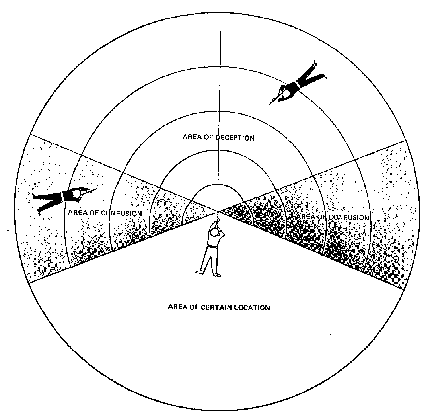
    Figure 4: Chart from Military Armament Corporation.
    The muzzle blast spread from a suppressed weapon
    shows deception and confusion resulting from
    attempts to locate sound origina from
    weak fixed source at various angles
    from the source.

    Other Evidence of Multiple Guns

    Silencers may explain why different witnesses reported hearing differing numbers of gun shots. But what other evidence is there for more than one gunman? At least four pieces of tangible firearm evidence have surfaced since the Warren Commission’s Report which suggest the presence of gunshots in Dealey Plaza on November 22nd from a weapon other than Oswald’s Mannlicher-Carcano. This evidence consists of two bullets, one bullet fragment and one shellcasing. Each of these items of evidence are consistent with one or the other general characteristics of the two CIA sniper weapons discussed above.

    1. The Barbee Specimen: This intact bullet was found imbedded in the roof of a building located at 1615 Stemmons Free-way by William Barbee in the summer of 1966. The building, which was located about a 1/4 mile from the TSBD, happened to be in the line of fire from where Oswald allegedly shot. Mr. Barbee turned the bullet over to the FBI for analysis in December, 1967, when current publicity about the assassination caused him to wonder if this bullet might be relevant evidence. The FBI lab determined the bullet to be a .30 caliber full metal jacketed military bullet. Its rifling pattern of 4 grooves, right hand twist was the same as that produced by the U.S. government .30 carbine. The FBI took little interest in this bullet once having determined that it came from a weapon other than Oswald’s rifle. Apparently, the thought of a second gunmen was never entertained. Yet this bullet is consistent with that which could be shot from the CIA’s silenced M-1 .30 caliber carbine. One can speculate that this bullet was shot out in the suburbs by a hunter engaged in target practice. Consider, however, that M-1 .30 caliber carbines were not prevalent amongst the civilian population as they had only been released by the government for civilian use in mid-1963. Furthermore, it was and continues to be illegal to use full metal jacketed military ammunition for hunting purposes.
    2. The Haythorne Specimen: The second piece of evidence was a bullet found in 1967 on top of the Massey building by Rich Haythorne, a roofer doing work on the building. The Massey Building was located about 8 blocks away from the TSBD in the 1200 block of Elm Street. It has since been torn down. The bullet remained in the possession of Haythorne’s attorney, until it was delivered to the HSCA for examination. The HSCA utilized the services of the Washington, D.C. police department, where it was determined that the bullet was a jacketed, soft-point .30 caliber bullet, weighing 149 grains which was consistent with the .30 caliber ammunition produced by Remington-Peters. Such ammunition was a popular hunting load and many gun manufacturers chambered their rifles to accommodate this ammunition. The 6 groove, right hand twist rifling marks on the bullet indicated that the bullet was not shot from Oswald’s Mannlicher-Cacano.
    3. The Lester Specimen: The third specimen was a bullet fragment found in Dealey Plaza by Richard Lester in 1974. Its precise location was reported to be 500 yards from the TSBD and 61 paces east of the triple overpass abutment. Mr. Lester turned the fragment over to the FBI for analysis in December, 1976. The FBI reported its findings in July, 1977, and concluded that the fragment, which consisted of the base portion of a bullet and weighed 52.7 grains, was consistent with the diameter of a 6.5 mm bullet. It was also determined that the fragment came from a metal jacketed soft point or hollow point sporting bullet. The rifling characteristics did not match those of a Mannlicher-Carcano. Even though the bullet exhibited the same 4 grooves, right hand twist pattern as Oswald’s Mannlicher-Cacano, the lands between the grooves were spaced further apart than his Carcano. Once again, no one ventured to suggest that the fragment might represent the work of a second gunman.
    4. The Dal-Tex Specimen: The fourth piece of firearm evidence consists of a rusted shell casing found on the rooftop of the Dal-Tex Building in 1977 by an air-conditioning repair man. The Dal-Tex Building is just east of the TSBD, across Houston Street. Assassination researchers have long speculated that a second gunman was positioned at that building. Judging by the rusted condition of the shell case, it had been there for quite some time. What was unique about this case was the crimped edges along the neck suggesting that either the shell had been handloaded or had been used in conjunction with a sabot. Specimens 1), 2) and 3) could conceivably have been shot from locations other than Dealey Plaza by some careless hunter. However, this shell casing meant that the rifle was shot where the shell was expended and it is unlikely that deer hunters ever had occasion to position themselves on a rooftop in downtown Dallas.

    One cannot rule out the possibility of a hoax or freakish accident to explain the presence of these specimens. Yet the unresolved questions surrounding the nature of the wounds, trajectory disputes and debate over the number of gunshots require that any evidence of other missiles be taken seriously.

    The ballistic evidence, thus far, falls short of proving beyond a reasonable doubt that Oswald’s Mannlicher-Carcano fired bullets on November 22nd that wounded Governor Connally and killed President Kennedy. The limousine fragments and magic bullet #399 appear to have come from Oswald’s Mannlicher-Carcano. Yet they had no residue of blood or tissue and thus cannot be linked to human wounds. The HSCA’s neutron activation analysis links the wound fragments only to the limousine fragments and to bullet #399 – not to the weapon. The major gap in the chain of evidence, then, is the inability to link the wound fragments to the weapon. Moreover, when one considers the testimony of the HSCA firearms expert Vincent P. Guinn that at least four other types of ammunition shared the same composition of trace elements as the 6.5 Mannlicher-Carcano ammunition, the neutron activation analysis leaves the door open to other realistic possibilities.

    One such possibility is that an expanding bullet with the same composition of trace elements as the 6.5 Mannlicher-Carcano ammunition was shot from a different weapon, perhaps a silenced weapon. Another possibility is that the 6.5 ammunition was fired and recovered from Oswald’s Mannlicher-Cacano and then shot out of another larger bore weapon with the aid of sabots, barrel inserts or cartridge conversions. Yet another possibility is that bullets or fragments from other weapons were in fact recovered from Kennedy’s body but were suppressed following the autopsy. Consider, for instance, the report from a top FBI administrator, Alan Belmont, to Clyde Tolson, Hoover’s second in command, in which Belmont on the night of November 22nd advises that a bullet has been found lodged behind the President’s ear.

    The existence of silenced rifles and the belated discovery of other ballistic evidence in and around Dealey Plaza still does not prove conclusively that more than one gunman was involved in the Kennedy assassination. The point of this article, however, is to encourage researchers to think about other possibilities that are not only realistic and but fall within the capability of the military and intelligence apparatus in the fall of 1963.

    Sources:

    1. Truby, Silencers, Snipers and Assassins: An Overview of Whispering Death (1972)
    2. Minnery, Firearm Silencers, Vol II (1981)
    3. U. S. Department of Army, “Silencers: Principles and Evaluations, Report #R-1896” (August 1968)
    4. War Department Technical Manual, Ordnance Maintenance, U.S. Rifles, Caliber .30, M1. M1C (Sniper’s), and M1D (Sniper’s)
    5. War Department Technical Manual, Ordnance Maintenance, The Springfield Rifle, M1903, M1903A1, M1903A3, M1903A4
    6. Nonte, Firearms Encyclopedia (1973)
    7. Hearings before the U.S. House Select Committee on Assassinations, (1978):
      a) Volume 1, p. 495 et seq re: neutron activation analysis (incredibly the HSCA never asked the firearms expert Vincent P. Guinn to identify the four other types of ammunition that matched Oswald’s 6.5 Western Cartridge bullets.)
      b) Volume 7, p. 357 et seq re: the Lester and Haythorne specimens (The HSCA makes passing reference to the “Walder” bullet that was also submitted for testing; the author could find no other mention of this particular item of evidence. Is it possible that the HSCA was referring to the bullet which Deputy Walthers was rumored to have found in Dealey Plaza?)
    8. The Dal-Tex specimen: The author has never seen a document substantiating this claim and has also heard that the shell casing was discovered on the rooftop of the book depository, not the Dal-Tex building; she would welcome information from other researchers concerning this evidence
    9. FBI Document #62-109060-5898 (12/13/67) re: the Barbee specimen
    10. FBI Document #62-109060-1431 (11/22/63) re: the statement “I told Shanklin FBI has one of the bullets, the other is stuck behind his ear” is consistent with the writing on the Sibert/O’Neill evidence envelope enclosing a “missile” that had been removed from JFK’s body. It is inconceivable that these FBI agents would mistakenly use the word missile or bullet if what in fact was recovered was merely a small fragment.
  • Pierre Finck & the Secret Team: Jim DiEugenio interviews John McCarthy

    Pierre Finck & the Secret Team: Jim DiEugenio interviews John McCarthy


    From the November-December, 1995 issue (Vol. 3 No. 1) of Probe


    In the following pages Probe explores an area of the medical evidence that has been virtually untouched. Many articles and books have been written about the facts of the autopsy. Very little has been revealed about who the medical doctors are. Of late, some interesting facts have come to light about Dr. Luis Alvarez which helps explain his findings and involvement on the Kennedy case. Full disclosure is key in this regard since, as Fletcher Prouty wrote in his milestone book The Secret Team, “there are other military personnel working with the CIA who are really Agency employees” and “who for special reasons” assume a “military uniform” but “are really Agency employees.” This possibility has yet to be explored in relation to the medical practitioners on this case. It should be.

    John McCarthy is a former Army Special Forces Captain who served in various parts of the globe over a long period of time in the service of his country. John’s career encompasses Eastern Europe, China, Okinawa, Vietnam and Cambodia. These last two spots furnish the backdrop for this part of his four hour interview videotaped by a friend of CTKA.

    In Southeast Asia in the mid-sixties, John was involved in the latter stages of a top secret project aimed at destabilizing Vietnam’s neighbor, Cambodia. While John was decommissioning a Cambodian asset, the ally was shot and killed by sniper fire. Inexplicably, John was accused of the killing and forced to undergo a court-martial.

    In a very strange proceeding, of which McCarthy maintains a transcript, John was convicted of the crime. Upon appeal, and the surfacing of new evidence dealing with the autopsy, the government decided to dismiss the charges.

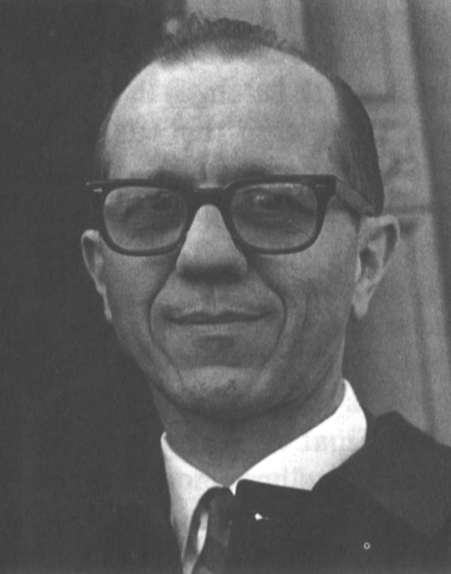
    finckThe case is highly relevant to everyone, including those who care about the Kennedy case since it involves the ubi-quitious Dr. Pierre Finck. At about the same time McCarthy’s appeal process was going on, Finck was prepping to appear at the Clay Shaw trial where, as readers know, he underwent a withering, historic cross-examination by Garrison’s assistant Al Oser.

    With McCarthy’s never before printed revelations, Finck’s background in the accompanying sidebar, and the reproduced withheld HSCA document, we now have enough evidence to truly question who Pierre Finck is. We would also like to ask Robert Blakey why the HSCA did not dig into his background so they could question him on it under oath. The Review Board, which gets Probe, should now reserve his seat and start readying the questions.

    The following is the transcript by Dave Manning of Jim DiEugenio’s interview with John McCarthy concerning McCarthy’s court martial trial for murder, in South Vietnam, January 29-31, 1968 and the involvement of Colonel Pierre Finck in a cover-up of exculpatory evidence. This interview took place on August 17, 1995.


    JD: The Pentagon would actually try and “booby-trap” or sabotage a Special Forces operation because they knew they weren’t in control of it?

    JM: Yes.

    JD: Can you remember any examples?

    JM: Well, my court martial to begin with. There was such glee that there was going to be a court martial for premeditated murder of a captain, Special Forces, that was facing the death penalty, that these people were bending over backwards to get this to trial. And then they went through all the efforts they did to fabricate information in order to obtain a conviction. Then they modified that information to maintain the conviction. We can talk about the way we found out about these things a little later. McKernan’s object in trying to close any or all of the portions of the trial to the public was designed to prevent the exposure of “Project Cherry.” In fact, when the trial did start and the government witnesses mentioned “Project Cherry,” McKernan about had a heart attack. And the judge noticed this and there were many side-bar conferences to discuss what was and what was not classified. And the judge threatened to close even the prosecution side of the case, on numerous occasions. Fortunately, a portion of it was left open.

    JD: So, in other words the truth would have been too terrible.

    JM: Well, the truth in the government’s argument, that it would seriously affect further prosecution of the war, means that had the truth come out, the war in Vietnam may have stopped in January of 1968 and would have inevitably saved thousands of lives on the allied side and hundreds of thousands of lives on the Asian side.

    JD: So, they had to limit the trial to make the case against you stick?

    JM: They had to limit what was held in open court. Fortunately, enough information was held in open court that it showed how little was necessary for a military conviction under the United States military judicial system.

    JD: Let’s talk about Mason’s actual testimony. Mason testified in court that his autopsy showed that the bullet fired into Jimmy had to be either a .22, or at the outside limits a .25. Correct?

    JM: That’s correct.

    JD: If those were his findings, how could they possibly pin it on you?

    JM: By Mason’s expert testimony that the wound was a contact wound. Even though there was an absence of powder burns or powder tattooing at the wound periphery or the entrance wound, there was nothing but microscopic particles that were in the wound track, which we have no idea how they got there. Since Mason didn’t perform a nitrate test (for his own reasons) we don’t know what those black spots were that were in the wound track itself. But, this information allowed Mason to conclude that a weapon firing a .22 was held tightly or loosely against the back of Jimmy’s neck.

    JD: How did they ever connect you with a .22?

    JM: They didn’t ever connect me with a .22.

    JD: How did they try and connect you with a .22?

    JM: By reason of association. The government assumed that since there were .22 caliber devices known as “stingers” that were available, that I most likely must have had one.

    JD: Did you?

    JM: No, I did not have one!

    JD: What was a “stinger?”

    JM: It is an assassination weapon which the Agency contracted an American manufacturer of firearms to construct. It looks like a pipe lighter or a large tube of lipstick. It’s silver in color. It has a threaded barrel which can be unscrewed and a .22 caliber short round is inserted and when the barrel is screwed back on, the whole thing can be held in the palm of the hand and utilized for an assassination at a public place where a lot of noise is occurring, such as a sporting event. It’s an assassination weapon that is provided by the CIA. I didn’t have one.

    JD: Did you ever have one?

    JM: No. I’ve never had one, I’ve never owned one. I saw one in 1969 at Fort Holabird when I went to visit some people who were on “Project Cherry” during 1967. That was the first and only time I’ve ever seen one in my life.

    JD: Did the government ever produce a witness who testified that you had one or who would testify to seeing you with one?

    JM: No.

    JD: So, in other words, Mason’s contention, his theory was basically always just a theory?

    JM: Mason’s theory (for whatever motivation he had) was only that. But, he was an expert. The court, in no uncertain terms recognized that he was an expert witness In fact, when Mason finished his testimony, rather than withdrawing from the courtroom, he took a seat in the spectator section. That was noted by Captain Davis who brought it to the attention of the judge. The judge said, “Well, do you expect him to be brought back to the witness stand?” He asked this question of the prosecutor, Captain Lee and Captain Lee said he did not. Then the judge said (in the presence of the jury), “Well, I consider Dr. Mason a friend of the court. We’ve been on many courts martial before. As far as I’m concerned, he can stay and listen to this the rest of the trial, if he wants to.” And that was that! So, Mason in effect, listened to every other testimony that came about as a result of that court martial.

    JD: Why do you think Mason decided to stay in the courtroom?

    JM: I think he was caught up in this theory of his and was trying to justify it in his own mind. After the trial, there were certain elements taking place by the post-trial review board, which was handled by the Judge Advocate General’s office (the lawyers who worked for USARV). Mason’s theory didn’t work. The post-trial review countermanded Mason’s expert testimony. Captain Lee, in summarizing his case before the jury, said, “It is the position of the United States government that a weapon employing a .22 was used to kill Inchin Lam.” [Note: Inchin Lam or “Jimmy” refers to the victim. – Ed.] The post-trial review said, “Science cannot say under any facts or circumstances, that a .38 could not have caused the wound in question.” Now, which position of the government had we been defending against? The investigator who test-fired my weapon had presented his results before the court. Mason had presented his theory before the court. People of common sense know that you can’t put a .38 through a 5 millimeter hole or a 9mm through a 5mm hole. So, that’s where this thing stood-in limbo-until three or four months after the trial.

    JD: So, Mason was step-by-step, tailoring his testimony to fit the circumstances.

    JM: Tailoring his testimony to fit a theory which provides for my guilt, even though it’s contrary to all of the other evidentiary testimony that’s taking place at trial.

    JD: You don’t think he was under orders to stay there, do you?

    JM: I think he was under some strong influence to come up with this theory to make a conviction possible. I think he was told to come up with something much more substantial, other than a .22 and a 5mm hole, which are not conducive to the .38 that I had, in order to obtain a conviction. Now, who he got this directive from (if he got such a directive) I don’t know.

    JD: What was the excuse overheard outside the courtroom, for convicting you on such flimsy evidence?

    JM: Well, Colonel Entrekin was discussing the fact that this was the first time in history that anybody had been sentenced under those particulars. He made the statement, “We don’t know how he did it but we think he did it.” During this conversation Captain Mason (who testified as an expert witness) the pathologist, was overheard to say to Stewart Davis, “Well, you should have asked me certain questions that you didn’t ask!” And Davis said, “Are you playing word games with me, when we’re talking about a man’s life being at stake?!” And Mason said “Well, you should have talked a little bit more about “formalin.” This is a fixative that is used on these thin slices of tissue that were excised from the wound track. Mason also brought out at court, that he had excised a bullet fragment from the left nasal pharynx of Inchin Lam and he had shipped that to the FBI laboratory in Washington, D.C. for analysis.

    JD: Your attorney did not know that at the time, correct?

    JM: He knew as a result of testimony in court, but he had never been advised before the court that that bullet fragment had been transferred to Washington, D.C.

    JD: As far as you and lawyer Stewart Davis knew, at the time of the trial there was no FBI report?

    JM: That’s true, there wasn’t. It was issued on the 9th of February, 1968.

    JD: Did the prosecution know about the report?

    JM: The prosecution couldn’t have had knowledge about it because it wasn’t issued until the 9th of February, which was ten days after the trial.

    JD: What is the purpose of having the FBI examine the bullet, if their analysis is not going to be introduced at trial?

    JM: Well, they didn’t know what the response was going to be from the FBI. As it turned out, the FBI report could not conclude the type, manufacturer, make or size of bullet that this fragment came from. The report further states, that a particle of quartz was stuck to the tip of the bullet fragment. The FBI shipped this bullet fragment with the particle of quartz attached to it back to Captain Mason, in Vietnam. He, in turn, shipped it to the chief of forensic pathology for the United States military, at Bethesda naval hospital, which was under the command of Colonel Pierre Finck. [Note: Finck’s precise title appears in the “Backstory” appended below.] But, when Richard Mason received this report from the FBI on the 12th or 14th of February, 1968, he didn’t think that report was important enough to let the defense counsel know about it or the fact that there was some quartz on the tip of this bullet fragment.

    JD: So, even after the report is in the hands of the army, neither you nor Stewart Davis see it, right?

    JM: That’s correct. Neither Davis nor myself were aware that the report even existed.

    JD: But, Mason and his commanding officer, Pierre Finck do see it.

    JM: It was in Pierre’s file.

    JD: What was Pierre Finck’s position at this time?

    JM: He was chief of forensic pathology for all the military services of the United States. [Again, note correct title in the “Backstory” below.]

    JD: In 1967 Finck is actually in Vietnam so, he has to know about your case. Then, he has the entire case file (which includes the pathologist’s report) after your trial, correct?

    JM: Mason’s autopsy report and the complete medical file with regards to the testimony was later located in Pierre Finck’s office, under very unusual circumstances.

    JD: And you were not able to see this during the entire time of the trial, during your incarceration, up until the time of your appeal?

    JM: The FBI report which was sent to Mason in Vietnam was then sent to Colonel Finck, by registered mail. Somehow, that bullet fragment with the particle of quartz stuck on the tip of it, was lost. My lawyers were never able to have that fragment tested or analyzed. That information would have been exculpatory. What it really means is that that bullet hit something before it hit Inchin Lam and that fact would have cleared me. This report was found in Pierre Finck’s office files in February of 1970! Two years after my conviction! Also included in this file, was a recantation (in writing) by Dr. Richard Mason wherein he says he was mistaken about the contact wound theory, during his expert testimony at trial.

    JD: And so now he had changed his story to what?

    JM: He had now changed the story to say that the .38 that I had carried could have caused the wound in question, fired from several inches away into the back of Inchin Lam’s neck and that the size of the wound was due to the fact that the epidermis had shrunk between the time that he was killed and the time that Mason viewed the remains.

    JD: As far as you know, is that possible?

    JM: No, as far as I know it is not possible. And those two documents were in a file which also contained copies of letters from Pierre Finck back to Richard Mason in Vietnam, asking Mason to get on board with this .38 theory because the post-trial review had found that a .38 could have caused the wound in question.

    JD: In essence, as Mason’s commanding officer, Finck was directing him to change his story.

    JM: Yes. And to change his story by recanting his sworn testimony which compelled the jury to convict me!

    JD: Now, if there had been a second trial, wouldn’t Mason have had to explain the two different stories or theories?

    JM: Yes, he would have had to explain why he flip-flopped on his theory. Now, a year after the trial Stewart Davis contacted Pierre Finck in an attempt to ascertain the whereabouts of Richard Mason. The last information we had about him was that he was in the San Francisco Bay area. Finck told Davis he had no idea where Mason was, but that he had left the service.

    JD: But Finck had been Mason’s commanding officer, right?

    JM: Yes, he was Mason’s commanding officer.

    JD: And Mason, had been involved in a very important case, about which Finck had recently communicated with him, correct?

    JM: That’s correct.

    JD: So, does Finck’s story about not knowing Mason’s whereabouts make sense?

    JM: Finck’s denial of any knowledge of Mason’s whereabouts or of knowledge of any other information which would have been useful to the defense, is a flat-out lie. A year later, after Davis had left Vietnam and gone back to the Pentagon, I requested he be reassigned to my defense again, because he was so familiar with all the aspects of my case up to that point. Charles Morgan, who was then my civilian attorney agreed, because by that time Davis had been reassigned to the prosecution side of JAG at the Pentagon.

    JD: So, Finck had declared to Davis both that he was unaware of Mason’s location and that there was nothing in the case file which would have been helpful to the defense?

    JM: There was no file!

    JD: He denied the existence of a file?

    JM: He denied the existence of a file. As a forensic pathologist, Pierre Finck had to know and understand the significance of expert testimony at trial, the ramifications of a recantation of that expert testimony and its impact on the judicial system. In the meantime, I was sitting in Leavenworth. In November of 1969, I was released under the first opportunity to exercise military “bail.” I was still under a conviction and I was reassigned to another military post in Arizona. In March of 1970, Stewart Davis was having coffee in the cafeteria at the Pentagon and a lawyer who worked in the forensic pathology department (Colonel Finck’s department, still), approached Davis and asked him if he had seen the McCarthy file. Davis was surprised to say the least, in as much as he had been told no file existed. This attorney escorted Davis over to Finck’s office. He was shown where the file was and then he was told that the copy machine was just down the hall but, that he should be careful because there was also a sergeant there.

    JD: Was Davis then left alone?

    JM: Stewart Davis was left alone with the file.

    JD: A file that Pierre Finck said did not exist?

    JM: That’s correct.

    JD: He’s left alone and the copy machine is pointed out to him?

    JM: Exactly. As he opened the file the first page was Mason’s recantation of his testimony, dated August, 1968. The next pages in the file were letters from Finck to Mason suggesting that he get on board (with the .38 theory) and another letter congratulating him for recanting his testimony. Also in the file was the FBI report dated the 9th of February, 1968, which was exculpatory evidence. So, the FBI knew there was exculpatory information, Pierre Finck knew there was exculpatory information, the prosecutors knew there was exculpatory information and nobody did a damn thing about it.


    Finck Backstory

    Pierre Finck is not the only one in his family to have done high-profile work. His grandfather, a professor of legal medicine, performed the autopsy on Elizabeth, Empress of Austria in 1888. Finck himself gained noteriety as the only professional to attend the autopsies of both President Kennedy and his brother Robert Kennedy.

    Finck served in the US Army Medical Corps from 1955-1975. He was a member of the Academy of Forensic Sciences and at the time of the autopsy was an Army Lieutenant Colonel and Chief of Wound Ballistics Pathology at the Armed Forces Institute of Pathology (AFIP).

    His background shows a deep connection to the national security establishment. He appeared as an expert medical witness before the International Commission of Jurists in Panama, 1964. His role there was to show that the gunshot victims were not killed by American soldiers. In Germany he testified in a case involving the killing of an American officer. He was also a consultant to the FBI.

    The most curious association is Finck’s connection to the International Police Academy (IPA), formerly the Inter-American Police Academy, founded in Panama by the CIA’s station there. Later, the Academy moved to Washington. CIA-controlled and using AID cover, the International Police Academy was engaged in training police forces from the Third World. Finck was a lecturer there.


  • The Formation of the Clark Panel: More of the Secret Team at Work?


    From the November-December, 1995 issue (Vol. 3 No. 1) of Probe


    The Clark Panel was the medical panel convened almost immediately after Ramsey Clark had been approved for his appointment as Attorney General in 1967. The panel was clearly convened to put to rest the growing doubts caused by the exposures of Mark Lane, Harold Weisberg, other researchers and even in late 1966, LIFE magazine itself. All of the above talked about the evidence of conspiracy, and the implication is that the medical evidence would either show conspiracy, or else, signs of tampering. What brought it to a crux was Jim Garrison’s all-out investigation of the assassination, which, in 1967, was making official story proponents very nervous. One of the key questions raised by the New Orleans DA was this: Why hadn’t the Warren Commission members examined the autopsy photographs and X-rays?

    Political Agendas

    To examine what had been brushed over by the Warren Commission, an official panel was created to conduct an inquiry into the medical evidence. The Panel convened in February of 1968 to examine the medical evidence in the case. In only two days of work, the Panel reached what surely seems to have been the preordained conclusion: the X-rays and autopsy photos revealed no evidence of conspiracy. The Report was held back in what can only be construed as a matter of strategic timing. The information was released in early 1969, just as the trial of Clay Shaw was finally getting underway after two years of delays. To call the timing of the release of the Panel’s conclusions, delayed for 11 months, mere coincidence is stretching credulity past the breaking point.

    If one goes under the assumption that the panel’s conclusions were the desired result, how could such results be guaranteed? How were the panelists chosen?

    Ramsey Clark went to four members of the academic community to get their recommendations on the doctors to use for the panel. Those people then nominated the actual panel participants. Close scrutiny of the nominators for the participants reveals a bevy of interesting characters.

    Purely 100% Brazilian?

    “I am particularly concerned with the part you may have played, if any, in encouraging, promoting, or causing that overthrow,” the senator asked Lincoln Gordon, former Ambassador to Brazil, at his confirmation hearings for the office of assistant secretary of state for Inter-American affairs in 1966.

    “The answer to that, Senator, is simple. The movement which overthrew President Goulart was a purely, 100 percent-not 99.44-but 100% purely Brazilian movement. Neither the American Embassy nor I personally played any part in the process whatsoever.”

    Lincoln Gordon may have his own definition of “personal involvement.” But to most, the events indicate that Gordon perjured himself before Congress. “Top Secret” communiquÈs from the Joint Chiefs of Staff told a different story. The Pentagon was relying on Gordon and his staff to direct the U.S.’s role in the coup. Ammunition was stashed and held, awaiting the okay from Gordon. A carrier task force complete with guided missiles, tanks, destroyers, and a helicopter sat offshore and waited on instructions from Gordon.

    If one goes under the assumption that the panel’s conclusions were the desired result, how could such results be guaranteed? How were the panelists chosen? Close scrutiny of the nominators for the participants reveals a bevy of interesting characters.

    In 1964, Lincoln Gordon, together with the CIA station chief in Brazil, very much involved themselves in the plans for a coup against Brazilian President Goulart. The station chief, General Vernon Walters, would later become, if briefly, Deputy Director of the CIA under Nixon. The CIA had spread anywhere from $5,000,000 (according to Gordon) to $20,000,000 (according to Philip Agee) to foment a military coup in Brazil against a popular President. Gordon’s cables to Rusk were also cc’d to J. C. King, Nelson Rockefeller’s great friend and CIA Division Chief of the Western Hemisphere. Gordon was both informing on the coup’s progress as well as requisitioning support in case the CIA-sponsored ‘native’ coup attempt failed. As backup, the CIA and Pentagon put together “Operation Brother Sam,” complete with aircraft carrier, guided missiles, tanks, destroyers, and 6 tons of ammunition to be used if needed. When it became evident that the military was having no trouble ousting Goulart, Operation Brother Sam was ordered to perform a pre-planned cover action instead.

    Gordon’s involvement did not end with the coup itself. Gordon cabled Washington that the coup had been “a great victory for the free world” but suggested “the avoidance of a jubilant posture.” After a victory parade a few days later, Gordon noted that “the only unfortunate note was the obviously limited participation in the march by the lower classes.” He then went on to encourage a popular politician, Juscelino Kubitschek, to persuade the Brazilian congress to give a legal stamp to the coup that had been effected.

    A Question of Character

    Evaluating the character of this Rhodes Scholar, Oxford graduate, Harvard professor, former Ambassador to Brazil, mentor to McGeorge Bundy and President of John Hopkins University is important, since he nominated a doctor to the Clark Panel. What sort of practioner would a man like this nominate? One that might reach a verdict that would shake the official story to its roots? Or one who had a more warped view of “patriotism” that would allow a cover-up to continue for the sake of a cause?

    John Hannah and the CIA

    John A. Hannah, another of the academics chosen by Ramsey Clark to nominate a doctor for the panel, has twice been on record having denied knowledge of CIA participation in two institutions he headed during the time of the involvement. In April of 1966, Ramparts magazine revealed that Michigan State University had been running a police training program for the CIA, a program which also provided cover for key CIA officers. Hannah, then President of Michigan State University, denied all knowledge of CIA involvement in the program. But the CIA’s Inspector General, Lyman Kirkpatrick, said the university had signed the $25,000,000 contract knowing full well that the program was the CIA’s.

    True to form, in the 70’s, Hannah was once again denying knowledge of CIA involvement, this time from his post as Director of the Agency for International Development (AID). Publicly, he denied the CIA had used AID for cover anywhere other than in Laos. In fact AID was providing cover at that time to CIA in Thailand. AID was later exposed to have collaborated with the CIA in many other countries as well.

    Twice Hannah claimed ignorance of the CIA’s involvement with an institution he headed. Again, one must wonder what sort of doctor Hannah would suggest to head a panel whose conclusions, given honestly, might open a path directly to those he had protected in the past.

    More Cold Warriors

    Another Cold War advocate among the nominators was J. Wallace Sterling. Sterling was so rabidly anti-Communist that he went so far as to say that communists should not be allowed to teach in schools since it was inconceivable that they could be operating independent of the direct control of the Communist Party. This disturbing statement came from a President of one of the country’s most esteemed educational establishments, Stanford University. Sterling’s name also shows up in Asia Foundation financial records. The Asia Foundation has long been acknowledged to have provided a conduit for CIA funds for covert activities.

    The Chief Counsel of the Clark Panel and the man who collaborated in the preparation of the Report, Bruce Bromley, was an employee of the Dulles brothers’ infamous law firm of Sullivan and Cromwell.

    The Justice Department had tried to remove Sullivan and Cromwell from defending the oil companies in an anti-trust suit brought against them by the Justice Department because of a variety of questionable activities.The attempt was unsuccessful, thanks in part to the efforts of the newly hired Bruce Bromley.

    It’s clear that the people mentioned so far have a record of integrity that is, to put it generously, questionable. But what of the doctors they chose? No one appears to have dug into their respective backgrounds to see what might come out. At least one of the doctors has a very questionable incident in his past.

    The Curious Death of John Paisley

    Russell S. Fisher, M.D., was both a professor of Forensic Pathology at the University of Maryland, as well as the Chief Medical Examiner of the State of Maryland. In the latter position he ruled on the controversial death of a high-level CIA officer named John Paisley. For the fullest account of the curious life and death of John Paisley, see Widows by William Corson, Susan B. Trento and Joseph J. Trento (New York: Crown, 1989.) A short but well-written summary appears as an appendix in Jim Hougan’s excellent book Secret Agenda (New York: Random House, 1984.)

    Paisley was a high ranking CIA officer with nearly unprecedented freedom within the Agency. Officially reported at the time of his death to be “a low-level analyst,” insiders report he was a high-level counterintelligence operative. Tad Szulc once reported that Paisley was one of Angleton’s recruits, but Angleton vehemently and repeatedly denied ever having met Paisley. In 1976, Paisley was the executive director of “Team B”. At the time of Watergate, Paisley was the liaison between the Office of Security and the infamous Nixon White House “Plumbers.” According to Hougan’s sources, Paisley had been approached at one point by the KGB, reported this to CIA, and was told to work with the Soviets as a double agent, feeding them disinformation and reporting back to the CIA. Paisley had extensive radio broadcasting equipment on his boat and frequently took to sea for long trips alone. What he did there we can only speculate about.

    Paisley was also involved with an individual well known to students of the JFK assassination: Yuri Nosenko. Paisley’s death came on the heels of CIA officer John Hart’s testimony championing Nosenko and his bona fides to the House Select Committee on Assassinations. In the words of his wife, Paisley played a role in the “indescribable debriefing” of Nosenko.

    The facts of Paisley’s death are curious. Paisley was found floating in Chesapeake Bay a few days after he had mysteriously disappeared. He had last been seen taking his boat out to sea. His last radio call to a friend had been calm, with no hint of anything sinister to come. The County Coroner who conducted the autopsy, Dr. George Weems, found that Paisley’s death had been caused by a gunshot wound to the head, behind the left ear. Paisley was right-handed, which makes suicide extremely implausible. In addition, Dr. Weems told reporters that the body had marks on the neck which seemed to indicate a rope had been around it or the neck had been squeezed in some other fashion. The body was also weighted with two straps of diving belts. As one investigator into the case pointed out, shooting oneself and putting on the diving belts is a case of serious overkill, pardon the expression. No evidence of blood, brain tissue or cartridges from a gun were found on the boat, indicating that the gun may have been shot at a different location and the body dumped from there into the sea. To make matters even more muddied, the body was four inches too short to be Paisley, was devoid of features with which he could be positively identified, and his wife was convinced that the body found was not that of her husband’s.

    Incredibly, Dr. Russell Fisher, the Clark Panelist, ruled the death a suicide. The only reasonable justification for such a ruling seems to be that to rule Paisley’s death a murder instead of a suicide would open a can of worms that could necessitate an inquiry into who killed him and why. Or, worse, if it wasn’t really Paisley who was it, and where was Paisley? These areas would have proved highly sensitive and potentially embarrassing to the CIA, which was spared such an inquiry by Fisher’s extraordinary ruling.

    Knowledge of the background of men like Fisher, Gordon, Hannah, Sterling and Bromley make it increasingly difficult to swallow the comment from the Clark Panel’s report that “each has acted with complete and unbiased independence, free of preconceived views as to the correctness of the medical conclusions reached in the 1963 Autopsy Report and Supplementary Report.” More believable is the conclusion that we experienced yet another manifestation of the Secret Team at work.


    Original Probe article

    (Click here if your browser is having trouble loading the above.)

  • The Magician’s Tools


    From the November-December, 1995 issue (Vol. 3 No. 1) of Probe


    “The most important tools of the magician are diversion and timing.”
    ~ Anonymous Victorian conman, inspiring his class of beginning pickpockets with the secrets of a loftier trade.


    Seriously Out of Synch

    Three shells, three shots. When was shot #2? According to the government, Kennedy and Connally, hit by shot #2, are wounded five seconds before the head shot. Yet, shots #2 and #3 have been called “close together.” Shots fired five seconds apart might be called “close together” but never a “flurry.”

    The vast majority of witneses said they heard only one shot before the two or more “close together” shots. Many of these witnesses were not only explicit about what they meant by close together (“simultaneous”), they were also clear about when the flurry occurred – during the time the head exploded. Before that, they heard only one shot, apparently the one that struck Kennedy in the throat. What happened in between?

    By all accounts, the first shot was fired before the limousine disappeared behind the Stemmons Sign (from Zapruder’s viewpoint). Most of us believe he reacts to the throat wound at this time. Kennedy emerges from behind the sign and, as others have noted, he goes forward a few inches – violently. This little movement, obscured by his suddenly rising arms, may indicate a separate shot to the back. Soon after, Connally is hit. Kellerman said he heard only one shot, then no more until the time of the “flurry.” Clint Hill said he heard one shot before the “double sound” he associates with the head wound, and nothing in between. (In the Altgens photo, the equivalent of Z-255, Hill has not yet reacted.) Samuel A. Kinney heard one shot, then a second, and “the second shot was fired and I observed hair flying from the right side of his head.” I’m assuming this second shot was a head shot because of the similarity between his testimony and George Hickey’s: “I heard a loud report…[then] I heard two reports which … appeared to me completely different in sound than the first report and were in such rapid succession there seemed to be no time element between them. The first shot of the second two seemed as if it missed because the hair on the right side of his head flew forward and there didn’t seem to be any impact against his head. The last shot seemed to hit his head…” Again, a second shot associated with disturbing Kennedy’s head. Rather than “hair” flying forward, I think what they saw was the bone flap that appears seven frames before the acknowledged head shot on the Nix film (I describe corroborating evidence for this in “The Magic Skull,” The Fourth Decade, July, 1995).

    Some witnesses seemed unaware of even the first shot. Mary Moorman, for example. She took two Polaroid photos of Kennedy. By the time she took the second picture (the head shot), at least two shots had already been fired. Yet, she said she heard a shot for the first time as she took this second picture. Charles Brehm is another witness who seemed unaware of the shots at first. As noted by David Lifton, Brehm is clapping his hands as the car passes him, a time when at least two shots had been fired.

    An Apparent Contradiction

    Governor Connally said he did not hear the shot that hit him. Neither, apparently, did Mrs. Connally. She said she heard a shot, turned around, saw Kennedy in distress, and kept her eyes on him until her husband was hit.

    “I never again looked in the back seat of the car after my husband was shot. My concern was for him…” The strange thing is, except for a quick glance at Connally as he changes posture, Mrs. Connally continuously stares at Kennedy – for two full seconds of surviving film after her husband has been hit. Another oddity: Governor Connally said he cried out, “Oh, no,no,no,” after he was hit. Mrs. Connally claimed he said it before he was hit.

    I think they were both right.

    Mrs Connally could have meant that before she heard the second shot, Connally cried out. What she really heard was probably the first of the flurry that struck Kennedy’s head.

    Evidence of Subsonic Bullets

    Robert Shaw, MD described the hole through Connally as a “small tunneling wound,” noting the “neat way in which it stripped the rib out without doing much damage to the muscles that lay on either side of it.” Kennedy’s back wound was apparently even less. A supersonic bullet would have done much more damage. One thing that would render a supersonic bullet subsonic is a silencer.

    Perception of Gunfire

    There is usually variation among witnesses in the perception of anything, especially gunfire. Variation in hearing ability, attention span, the location of witnesses compared with the location of the marksmen, all could create apparent inconsistencies. A shot fired from 100 yards away is 20 decibels softer than one fired 10 yards away [20xlogarithm (base 10) of the ratio of the distances], all other factors being equal. Furthermore, loud noises are deafening, just as bright lights are blinding, temporarily. The pupil contracts in bright sunlight and takes time to adjust to a dark room, and muscles supporting the eardrum contract in self defense following a loud noise, making the ear deaf to quieter sounds. Thus, two shots could sound like one, depending on the witness’s location. And one shot can sound like two if the location is conducive to echo. Three shots from the same place, fired five seconds apart, would produce either three echoes, or no echo. That sound follows impact isn’t a factor here because of the distances involved. How to know which sounds go with which wounds? Will Greer said the last two shots were fired “simultaneously,” and that Connally moved at that time. Hit earlier, Connally was probably only flinching, or reacting to yet another shot. Greer’s assumption is probably “witness confusion,” a real phenomenon, but it could mean any testimony that does not agree with your theory.

    Prying Apart the Last Two Shots

    “Close together” could mean “closer together,” if the time between shots #1 and #2 could be lengthened, which may be why some claim shot #1 came as early as Z-160. But another solution to the problem is this hypothetical statement:

    “You only heard an echo. Look at this map. There were only three shots, and witnesses say the car was clear over here near this sign, when Connally fell. That was shot #2. And the car was down here several feet away when the head opened up. That was shot #3. You couldn’t have heard a flurry, the car didn’t move that fast. We even have it on film.”

    Zapruder was on his perch well before the motorcade arrived, and he could have been removed “for security reasons.” And surely they knew in advance that people film such motorcades. Did they want a record of it, one they could edit? One that would record the “second” shot? Bang……..Bang…….Bang?

    BANG…………..BANG-BANG

    The following people heard only one shot before the flurry, which occurred at the time the head exploded:


    Jack Bell (AP): “in quick succession” (NYT 11/23/63, p.5)
    George Hickey: “in rapid succession…no time element between” (18H762)
    Roy Kellerman: “flurry…plane breaking the sound barrier…bang, bang”; (2H76)
    Clinton Hill: “The second shot had “an echo…double sound” (2H144)
    Mary Woodward: “The second two shots were immediate…as if one were an echo of the other… with the second and third shot…I saw the head explode” (A∓E,II )
    Will Greer: “simultaneously” (2H118)
    Glenn Bennett: “A second shot followed immediately and hit the right rear high of the President’s head.” (18H760)
    Rufus Youngblood: “in rapid succession.” Rufus Youngblood (Robert MacNeil’s The Way We Were, 1988, Carroll ∓ Graf)
    Warren Taylor: “in the instant that my left foot touched the ground, I heard two more bangs” (CE1024)
    Seymour Weitzman: “simultaneous” (7H106)
    Linda Kay Wills: “two real fast bullets together” (7H498)
    Lee Bowers: Rapped his knuckles on a table showing the near simultaneity of the last two. (Mark Lane 1966 Tape)
    Junior Jarman: “third shot was fired right behind the second” (3H204)
    Carolyn Walther: “almost at the same time” (C.E.2086)
    Toney Henderson: “in rapid succession” (C.E.208)
    Mrs. Lyndon Johnson: “in rapid succession.” (H565)


    Mr. and Mrs. William Newman who stood on the curb slightly to the left of Zapruder describe the opposite pattern, BANG-BANG, nothing, then BANG. This may be related to location.

    Conclusion

    The purpose of silently creating wounds between audible shots #1 and #2 may not have been to disprove the closeness of shot #2 to shot #3, but one thing seems certain: what did the majority of witnesses hear when Connally was shot? Nothing.

  • The Life & Death of Richard Case Nagell


    From the November-December, 1995 issue (Vol. 3 No. 1) of Probe


    The buzz on the Internet began about the middle of the first week of November. “The Man who Knew too Much” – Richard Case Nagell – was rumored to be dead. The original story said that his body was found in a Los Angeles park.

    The Sad Truth

    On the main point, Nagell’s death, the rumor was correct, although officially he had passed away at his home near the Echo Park area of Los Angeles. The coroner’s office has stated to Probe that Nagell died of heart disease on November 1st at age 65 at his apartment in Silver Lake. Once the staff heard this, they arrived on the scene to survey what was left behind of one of the most important witnesses to the assassination of John Kennedy. It was a melancholy sight. Nagell passed away in a rundown triplex in the lower class area of Silver Lake, near Hollywood. The triplex was on a dead end street right next to an overpass to a busy L. A. freeway. Amazingly, the inside door to the apartment was open and one could look inside. By November 4th, the place appeared to be barren. If Nagell left anything of importance behind, it doesn’t seem to have been there. The landlord had already placed a sign up to lease the apartment.

    Nagell, who in the last two decades of his life, abhorred publicity, certainly seems to have had his wishes fulfilled. The obituary for his death did not appear in the Los Angeles Times until November 10th. Even then, it was the last in a series of four listings on page 34. The writer spent more time discussing Dick Russell’s 1992 book – the paper had done a feature on it when it appeared – than in explaining to its readership the probable significance of Nagell’s life and death.

    The Most Important Witness

    In 1975, on the eve of the HSCA, Jim Garrison stated quite succinctly, “Richard Nagell is the most important witness there is.” Nagell occupies a prominent place in Garrison’s memoir On the Trail of the Assassins. Bud Fensterwald, after the HSCA, in 1981, stated pretty much the same: “Nagell is probably the only vital individual who knew the details of the assassination and is still alive.” Amazingly, there is no record of the Warren Commission ever having interviewed Nagell. This in spite of the fact that there is a December 1963 FBI memo stating that he had met Oswald in Texas and Mexico City. This in spite of the fact that Nagell wrote at least two letters to the Commission telling them he had knowledge of both Oswald and the conspiracy well in advance of the assassination. There are conflicting reports of how Robert Blakey and the HSCA approached Nagell. Although Russell, his biographer, stated on a radio interview program in 1992 that the Committee had ignored Nagell, researcher Gus Russo has stated that there is a tape in the HSCA collection containing a call from an HSCA staffer to Nagell. According to Russo, Nagell hangs up quite quickly. Anna Marie Kuhns-Walko states that the tape is longer but seems to have been altered. To our knowledge, no HSCA records of contacts with Nagell have been declassified by the ARRB or National Archives. They should be made available in transcript form and the ARRB should verify the transcript against the existing tape. Needless to say, now that Nagell is dead, every agency’s files on him should be reviewed by the Board and then released.

    Nagell’s Background

    Nagell’s story is well-known to the research community. He was a longtime intelligence operative who seems to have been working for the CIA in the 1960’s. He had maintained that some in the more moderate part of the Agency had gotten wind of a plot to kill Kennedy. He was assigned to find out if this was true. He did so and found out there was a conspiracy afoot and Oswald was to be the man set up for the assassination. Nagell was then told to foil the plot, even if that included terminating Oswald. Nagell backed out of this assignment, mistimed the plot and ended up getting himself purposefully arrested in El Paso in September of 1963. He tried to inform the authorities of the conspiracy but all of his warnings were ignored.

    Nagell and Garrison

    Nagell’s significance was first revealed in more detail during the Garrison investigation. Nagell managed to get a letter to the DA in early 1967 conveying the kind of information he possessed. Unfortunately for both parties, Garrison could not bring Nagell to New Orleans and was too busy to go to the Medical Center for Federal Prisoners in Springfield, Missouri where Nagell was being held. In April of 1967, Garrison sent an assistant, William Martin to conduct an interview with Nagell. This proved to be a mistake by the unwitting Garrison. Martin had an office in the International Trade Mart and, as documents uncovered by Bill Davy reveal, was a former employee of the Central Intelligence Agency. In a memo dated April 18th, 1967, Martin details his contacts with Nagell. At first, they were promising. Nagell actually confirmed that Garrison was on the right track and revealed the existence of a tape of a conversation he had among some Cuban exiles which would affirm this. But very soon Nagell discovered Martin’s duplicity, and by April 25th refused any more interviews with him. Later, there was an exchange of nasty letters between them. Although he did meet personally with Garrison later, for reasons advanced in his and Russell’s book, Garrison decided not to use him at the trial of Clay Shaw.

    A Question of Credibility

    In the wake of Russell’s book and the revelation of a plane accident Nagell had previous to the assassination, commentators like Mark Zaid and Paul Hoch have questioned Nagell’s utility on the basis of his possible mental instability. Probe has decided not to engage in telepathic psychiatry. We print here, in its entirety, and for the first time, a letter Nagell wrote in his prison days, during the Garrison investigation. We provide a bit of decoding (see the sidebar on page 6) to those unfamiliar with the field and with Nagell’s cynical and biting sense of humor (common among spies.) Let the reader decide if Nagell is in control of his faculties and is in possession of rare and inside information. After reading it, we think the same figure of speech once applied to T. E. Lawrence can also be used with Richard Case Nagell: the poor devil rode the whirlwind. The letter begins on page 5 of this issue. CTKA will soon offer a Richard Case Nagell file in its catalog.

    ~ Jim DiEugenio

  • BPR, eh?


    Some have questioned the value of Nagell’s knowledge on grounds of mental stability, or on grounds of credibility. How much of an insider was he? We direct the reader to the acronym “BPR” which appears on page 5, column 2. This is part of Nagell’s sometimes mysterious and often humorous code. Yet it goes to the heart of this issue. In 1966, the New York Times did a five part series on the Agency which the CIA tried to suppress and was partly successful in doing so. The “BPR” shorthand is illuminated by this excerpt from the 4/26/66 installment:

    While the whitish-gray building is undoubtedly as secure as fences, guards, safes and elaborate electronic devices can make it, the location is hardly a secret. A large sign on the George Washington Parkway pointing to “Central Intelligence Agency” has been removed, but thousands of people know you can still get to the same building by turning off on the same road, now marked by the sign “BPR”-Bureau of Public Roads.

    Most of the ‘code’ Nagell uses is readily apparent to any who know this case. The Young Regent of Yanquis Land is obviously John F. Kennedy, President of the United States. Isle of Cuber is of course Cuba; Big Mother Busher is Castro. You’ve got to hand it to Nagell-he had a keen sense of humor. Cochina Bay is the Bay of Pigs, and Bravo is Alpha 66. Our favorite pseudonym of all time, however, has to be the one he chose for David Ferrie: “Hairy De Fairy.” Runner-up: “Dirty Dick” for Richard Helms. But the big question that remains is important:

    Who is Abe Greenbaum?


    Editor’s note: in the following issue, we revealed that “Bravo” was actually code for Manuel Artime’s MRR group. Artime himself closely connects to E. Howard Hunt. In addition, the name of the actual correspondent to whom Nagell is writing is not the playful Arturo Verdestein, but a person named Arthur Greenstein.

  • The Private Correspondence of Richard Case Nagell

    The Private Correspondence of Richard Case Nagell


    From the November-December, 1995 issue (Vol. 3 No. 1) of Probe


    The following is the text of a letter from Richard Case Nagell to his friend Arturo Verdestein. (It is one of several that CTKA once offered in its catalog along with other documents from our Richard Case Nagell file.) All elipses below are from the original.


    October 8, 1967

    Dear Arturo:

    I’ve received both of your letters, dated 9/26 and 10/4, respectively. Still haven’t seen hide nor hair of the Equipment Times, though. Does it really advertise the likes of machines that nibble steel at the rate of three feet per minute? Now I know why E. T. wasn’t delivered. Should have thought of the reason sooner, last week, when a recent issue of a popular magazine was withdrawn from circulation because it featured a bar-stretching device. Looks like the meticulous inspection-for-microdots-and-sophisticated-cable-arrangement theory will have to be shelved in favor of a more logical premise. Can you imagine the possibilities that E.T.’s next issue might provide to some innate-genius with a penchant for slapping together a facsimile of the Steel Eater, merely by studying the specifications set forth in E.T.? Wow! I can see it now. Built on the Q.T. in the prison library, cranked up and let loose after its christening, like some weird science-fiction monster, easily smashing past 20,000 volumes of Zane Grey, bursting out through the side of the library building, rumbling slowly across the west yard toward the nearest gun tower, bullets bouncing off its impenetrable armor, tear-gas bombs exploding all around it, sirens wailing, bedlam – National Guard called out, still rumbling onward, onward, not to be stopped, finally reaching THE WALL, angry now – completely out of control – spitting gooey blobs of black molten tar at the N.G. Commander running along the top of the wall, now rearing a gigantic head, flashing a single mamouth [sic], keenly-polished incisor, hesitating, momentarily, then suddenly lunging forward, chomping at the wall, bricks and chunks of concrete flying every which way . . . once . . . twice . . and . . through! Daylight on the other side! A gaping hole, 20′ x 20′, appears out of nowhere . . . . two thousand cons stampeding through, on their way to Sacramento.

    After perusing your comments about the First Day’s reporting of the Great Bank Robbery – random shots, 27 centavos, gambling activities, etc. – I am more convinced than ever that you should see the transcripts of the first and second trial record. As for myself, I’ve never read either transcript, though I would bet that I could give a fair account of both without much error. I wrote sis again, this time asking her to send everything.

    Here’s a more up-to-date lead on Abe Greenbaum: “Informant F-HC reports subject handed suspected courier forty pieces of silver on 10/21/62 at Laredo, Mexico, for delivery to nuclear physicist residing in house on 92nd Street, New York City. S/A B. O. Schernnn, Washington, D.C. Field Office, reports subject seen 11/28/62 walking east on Beacon Street, constantly checking for tail, suddenly dashing into parked limousine sporting U.S.S.R. Embassy license plates, which speeds away, runs red light, terminating surveillance as Agent Schernnn forced to brake bicycle to avoid breaking the law. Informant F-111-B reports subject and suspected courier observed at King’s Tavern, Wilmington, Del. on 12/6/62, paying for drinks with strange-looking silver dollars taken from bulging briefcase carried by subject. Subject now suspected of being Mr. Big in Communist plot to disrupt U.S. economy by flooding country with hard cash. /s/ I.M. NEVERWRONG, SAIC, D.C. LAIR.”

    Or, we could furnish Mr. Xerox an even more up-to-date lead, of somewhat different vintage:

    Abe Greenbaum, long suspected leftist is actually confirmed rightist, in deep cover, working plausible denial bit with one of nation’s leading and best-financed foreign policy-making firms. He is driving along highway not far from Langley, Va., peering intently out of jagged hole in windshield of his Volkswagen, searching for sign bearing acronym “BPR”. Date is November 21, 1963. BPR-Bureau of Public Roads-is innocuous designation used by Abe’s firm. “Gee, the Chief must be upset about something,” Abe mutters to self, “he used a rock this time instead of the ol’ soap-the-windshield trick.” Purposefully cruising past BPR sign, Abe makes U-turn in center of highway, barely missed by Fruehauf semi-trailer, then turns right onto road leading to firm’s Main Office Building. “Must not be seen making left turn this close to headquarters,” Abe mutters. Arriving at destination, Abe circles Main Office Building five times, finally enters parking lot abutting wooded area to right rear of building, drives to extreme right end of lot, parks Volkswagen on right side of firm’s undercover utility truck, disguised with Bell Telephone Company markings. Sliding across right-hand seat, he exits from right door of auto, walking long distance to right rear entrance of Main Office Building which is draped with high Quonset-hut type roof. “Hello there,” Abe mutters as he slips by uniformed guard he recognizes as Soviet defector, former KGB light colonel. Abe proceeds down mile-long, musty-smelling corridor, pauses under tiny, inconspicuous replica of firm’s seal which is painted upside-down on right wall, notices that Bald Eagle’s beak on seal is pointing to far left. “Must tell Chief Bald Eagle looking wrong way,” mutters Abe. He then takes elevator to fourth floor, goes directly to Chief’s office, raps out coded knock on unmarked door, enters. Chief is reclining in swivel-chair with feet on desk, arms folded, sleeping. On desk Abe sees torn-up typewritten letter addressed to CHIEF, DIVISION OF DIRTY TRICKS, signed by B. KNOWNOTHING. Chief is balding, slender man, oft referred to by underlings as “Dirty Dick”, albeit behind back. “What’s up, Chief?” asks Abe. Chief blinks eyes, opens them, snaps, “I see you got my message!” Chief smiles. “What’s with this guy Osborne recruited for Fair Play Caper? XYZ man claims he’s being used for wet affair by team we sold out at Cochina Bay.” Abe shifts weight to left foot, uncomfortably. “Don’t know, Chief,” he mutters, “Ozzie seems like good man for penetration of target.” Chief stands and yawns, grins slyly. . “Well, just the same you’d better contact Tidbit and have him execute alternate . . . plan.” Abe stares at Chief with knowing-look. “Right, Chief, I’ll get on it . . . first thing Monday morning.” Abe picks up cloak and dagger conveniently lying on desk, turns to leave, stops dead in tracks. “Incidentally, Chief, Bald Eagle on firm’s seal is pointing left.” Chief grins, sits down in swivel chair, leans back, puts feet on desk, clasps hands behind head, closes eyes. “Really?” He says. Soon Chief is snoring. Abe departs, returns to Volkswagen, worried about jagged hole in windshield. Mutters to self, “Gee, I hope it doesn’t rain tomorrow.”

    nagell
    Richard Case Nagell 1930-1995

    Of course, this lead is utter fiction too, a figment of the imagination . . . still, it may make interesting reading for somebody.

    Are you aware that a Duesseldorf record company has come out with just the thing for any German who wants to relive the heady days of Nazi victory? It is two long-playing phonograph records called, “From the Fuehrer’s Headquarters (Aus dem Fuehrerhauptquartier).” Billed as documentary records, they are comprised of victory announcements and special bulletins from the Nazi high command, military music and soldier’s songs, Nazi songs and speeches. A booming voice discloses the Nazis are fighting for the German nation and the security of Europe “against the . . . plot of the Jewish-Anglo Saxon warmongers . . . and against the . . . Jewish rulers of the Bolshevik central in Moscow.”

    (Now where did he get that? What does all this gobbledygook mean, anyway? Could this be an important lead? . . . I mean there is this thing about doing business with the Military-Industrial Complex, you know.)

    Seriously, Arturo, I had better give with a plausible lead on this Abe Greenbaum fella, in spite of this business about plausible denial, or “they” are liable to drop his name from my approved correspondents list. That would be catastrophic, considering that he is the only other person besides sis who is so approved. And the lead had best not sound too cryptic either, or “they” might ship #83286 [Nagell’s prisoner number] back to the Funny Farm . . . you know, for more “treatment.”

    So let’s try again:

    Young Regent of Yanquis Land is visiting “Little D” to plug for assistant who is fast losing popularity amongst ultra-conservative proletariat of Friendship Province. Date is well-remembered date in fall of ’63. Young Regent is hated by proponents of Secret War (and by director of large pharmaceutical combine specializing in manufacture of cyanide capsules) because word is out he intends to decree curtailment of clandestine operations of various Yanquis Land spook outfits, citing as reasons that regime’s continued reliance on covert methods of achieving political goals widens faith-in-government gap, is corrosive to principles of democracy, etc., especially when spooks get caught in the act. Young Regent feels one spook outfit in particular is exceeding bounds of propriety, has expanded narrow function delegated it by International Security Act of ’47 . . . is becoming TOO POWERFUL . . is unduly influencing both foreign and DOMESTIC policy by its shenanigans . . . thus, must have nefarious activities at home and abroad throttled, or at least have them restricted to endeavors which cannot be accomplished by other, more acceptable means. BANG! BANG! BANG! Young Regent no longer Regent of Yanquis land. Clandestine operations of spook outfits not curtailed. Cyanide capsule market flourishing. Too Powerful One getting MORE POWERFUL . . .

    What has all this got to do with Abe Greenbaum? ANSWER: Nothing. Is it a plausible lead? ANSWER: Not very.

    Wait!

    Before visit to Little D, Young Regent also thinking of effecting rapprochement with Isle of Cuber, establishing nicer rapport with Isle of Cuber’s Big Mother Busher. Strange! . . . Young Regent of Isle of Cuber also thinking of effecting rapprochement with Yanquis Land, establishing nicer rapport with Yanquis Land’s Big Doctrine, Monroe.

    How nice!

    Feelers put out by both Young Regents through “private” channels in July ’63, then quasi-official channels in August ’63, through “official” channels in September ’63.

    Meanwhile, anti-Castor Oilers known as Bravo Club gets wind of feelers . . . doesn’t like smell . . . nohow! There is huddle. There is chant: “Remember Cochina Bay! – Remember Cochina Bay! Soon there is talk (louder than ’62 talk) of giving Young Regent of Yanquis Land Xmas present . . . yo! . . . gonna brow that out to keep situation status quo (at worst) . . . to change status quo for worse (at best).

    Patsy is needed! She is pro-Castor Oiler well-known to Bravo Club. Two Bravo members speak to Patsy, convince her they are boyfriends, buy her Cuber Liber Cocktail (minus rum), get her drunk on glory, tell her they are special emissaries to Yanquis Land personally by Young Regent of Isle of Cuber to give Xmas present to Young Regent of Yanquis Land . . . have “chosen” Patsy to help deliver Xmas present. Will be furnished Safe Conduct Pass to Isle of Cuber by Embassy in Mexico City. Will be given proper treatment on arrival. Oh, joy! Will live happily ever after. Can Patsy join Xmas Present Committee now?

    Uh-uh! Not yet. First must prove self deserving of great honor. Must set up Chapter of Foul Ploy for Isle of Cuber, must stand on street corner . . . pass out pro-Castor Oil tracts, must appear on TV . . . root for Castor Oil products, must rumble with anti-Castor Oil salesman. Above all, must not mention Xmas Present Caper to anybody, not even husband, Ivan.

    Meanwhile, Single-Man named “Snerd” gets wind of Xmas Present Caper and going-on at Bravo Club. Snerd is Isle of Cuber’s Big Mother Busher’s illegitimate son. Snerd gets in touch with Double-Man Abe Greenbaum, working in deep cover at BPR, Division of Dirty Tricks, as Rightist. Actually, Abe is Leftist-turned Middlist. Middlist Abe contacts Triple-Man Zero, sitting on ice because has burned butt. Triple-Man Zero instructed to join Delta Club, which is affiliate of Bravo Club, find out if things real. Zero does just that, craftily, in guise of crossbow expert. Discovers Patsy undergoing hypnotherapy by ex-ferry pilot named Hairy De Fairy. Reports to Abe things are for real, yes siree! Abe passes info on to Dirty Dick (and Snerd). Snerd passes info on to Big Mother Busher. Somebody flashes word back for Zero to let go with well-aimed arrow in Patsy’s rump . . . leave Yanquis Land, hubba hubba! Zero chickens out day he is to arrow Patsy, six days before Xmas present to be delivered. Pens Abe nasty note. Pens Snerd nastier note. Pens Dirty Dick even nastier note. Also pens note to Boss of Yanquis Land’s Main Secret Police Bureau, tattles on Xmas Present Caper, tattles on Patsy, etc. Burns butt again. Searches in vain for cake of ice to sit on. Winds up in Friendship Province Halfway House.

    End of lead? Not hardly.

    Apparently something amiss. Xmas Present Caper does not come off per schedule. Delta Club disintegrates. Bravo Club Xmas Present Committee disintegrates. Abe drops out of sight. Dirty Dick is mum. Snerd crawls back inside Big Mother Busher’s womb, dies. De Fairy puts on falseface, hides at 3330 Clubhouse, gets whipped. Director of large pharmaceutical combine gives order for increased production of cyanide capsules. Boss of Main Secret Police Bureau sits in office, drums fingers on desk, waits. Zero is still in Friendship Province Halfway House, getting older . . . if not wiser.

    End of lead? . . . Not hardly.

    Day of Infamy arrives! Patsy crouched at open window, armed with second-hand crossbow, quiver filled with curare-tipped arrows slung across shoulder. ZIP! ZIP! ZIP! BANG! ZIP! BANG! ZIP! BANG!

    End of lead? . . . Not hardly. (See this sidebar.)

    Patsy awakens from hypnotic trance. Says, “What am I doing here?” Wonders what cyanide capsule is doing clenched between teeth? Wonders what cloak and dagger is doing on window sill? Wonders why floor of room is lettered with pro-Castor Oil pamphlets? Wonders how chicken bones got in lunch pail? Memory returns. Patsy flees. Refuses ride by former Bravo boyfriend driving by in utility truck bearing Bell Telephone Company markings. Catches bus instead.

    End of lead? . . . Not hardly.

    Patsy has gone her way. De Fairy has gone his way. One former Bravo boyfriend now living vicinity M. Cyanide capsule market still flourishing. Dirty Dick promoted within superstructure of BPR . . . is still mum. Snerd reborn as “Terd”. Abe Greenbaum has changed name, retired, resides in mansion protected by pack of snarling German Shepherds, disappears for one hour each night in vault to count huge pile of American silver dollars. Boss of Yanquis Land Main Secret Police Bureau has four-year old secret . . . but is relaxed. Zero out of Friendship Province Halfway House . . . is now in Old Triple-Man’s Home for Aged. More Powerful One now MOST POWERFUL (evidently). End of lead? . . . Not hardly. End of letter? . . . yes.

    Most sincerely yours,

    Richard C. Nagell 83286

  • ARRB: Behind the Curtain

    ARRB: Behind the Curtain


    From the November-December, 1995 issue (Vol. 3 No. 1) of Probe


    arrb

    In our attempt to make our coverage the most current and complete on the Review Board, we are presenting this organizational structure chart sent to us by Board spokesman Tom Samoluk. It reveals who is working with the board, and how the Board is operating below the layer of the five appointed members who make the actual decisions on what and how much will be declassified. We should also note here that the teams denoted at the bottom are the people who first see the incoming records. Each new batch is assigned to a team for preliminary review. Samoluk noted that the newest batch under review are from the HSCA. He also specified that so many records are under review that teams do not have exclusive assignments. There is a crossover.

    Some other ARRB updates: 1) During the federal shutdown, the Board staff still worked due to a technicality in their funding. 2) Although no decision has been made yet on 5 of the fifteen documents the FBI disputed (Probe 7/22 and 9/22), the Bureau seems to have gotten the message. On November 3rd, the Bureau voluntarily released 11,380 pages of documents previously reviewed by the HSCA. These will have to be reviewed further by the Board since some were redacted, but at least they are now in the Archives at College Park. Four of the more interesting files concern Orlando Bosch, Howard Hunt, Carlos Marcello, and Robert Webster. 3) As predicted in our last issue, the Board has increased its pace. At the 10/24 meeting over 400 documents were voted for release. Samoluk states that he expects even more to be voted on at the upcoming December 12-13th meetings. We applaud this new urgency. The Board will stay in business until 9/30/97. We hope and urge and advise readers to help them fulfill their complete mandate. One thing you can do is write your congressman to get increased funding for next year so more investigators can be hired. In that regard, reader Cathy Brown sent us word that the Board has requested some Mob records from an Illinois inquiry that the HSCA reviewed. Even if undermanned, the Board is doing its best in locating obscure and previously unrevealed files. They also designated all post 1/1/60 FBI records on Sam Giancana as “assassination records.”

  • FBI vs. ARRB: Heading Into Overtime


    From the September-October, 1995 issue (Vol. 2 No. 6) of Probe


    The first dispute over release of previously classified documents by the Assassination Records Review Board now continues into a second month. In the July 22nd issue of Probe (“ARRB Meets First Hurdles,” p. 1) we reported that the FBI had chosen to contest the release of 15 previously classified documents that the Board had decided to declassify in full. The ARRB vote on these documents had been unanimous. The Bureau then decided to take their dispute to President Clinton. They asked him to intervene on their behalf to block full disclosure. President Clinton decided to send the appeal back to the FBI and gave them 30 days to further substantiate their original arguments against total disclosure.

    Those arguments centered on the traditional line of protecting sensitive “methods and sources” accompanied by expected collateral damage to intelligence sources and agents inside foreign countries. In this latter part of the FBI plea, the Bureau has enlisted the help of the State Department in defending their position. From our sources in Washington, we understand that State will be helping redraft the FBI plea which is due on September 30th with a decision expected to be announced shortly after.

    Response Significant

    COPA Secretary John Judge has written that the White House was surprised at the volume of faxes, letters, and calls that they received over this issue. At the time of the FBI appeal, there had been little mainstream media coverage of this case. When Melissa Robinson of the Associated Press, who has become the point person for that news organization on this issue, first went with the story, very few newspapers picked up on the dispute. But two things seem to have happened since. First, the FBI refused to take an official position on the issue. Neither Director Louis Freeh, nor Attorney General Janet Reno has acknowledged the debate over the files. Robinson wrote in her original story, “A telephone call to the FBI seeking comment was not immediately returned.” When word of the dispute got into Probe, Open Secrets and the Internet, a buzz was created over the issue. Kennedy researchers like John Newman, Peter Dale Scott, Dr. Gary Aguilar and many others, wrote letters that were published on computer billboards and sent via fax and E-mail to the White House. This took place in late August and early September. Then during Claudia Furiati’s Kennedy conference in Rio de Janeiro (Probe, July 22nd p. 18), Newman played his hole card.

    Carver Gayton & the “Dirty Little Rumor”

    As readers of Probe should know, the FBI has always denied any formal relationship with Lee Harvey Oswald. This denial was upheld by both the Warren Commission and the House Select Committee on Assassinations. Still, there have been serious questions raised about this stance from the beginning. In a famous article in the January 27, 1964 issue of The Nation, Harold Feldman raised some very cogent questions about this point. In researching his recent book Oswald and the CIA, John Newman discovered an affidavit in the files of the Church Committee by one Carver Gayton. In this document Gayton had stated that he had met FBI agent James Hosty when Hosty had been transferred to Kansas City after the assassination. While there, Hosty had told Gayton that Oswald had been a PSI (Potential Security Informant) for the Bureau. While at the Rio Conference, Newman prepared a press release and faxed it to several press organizations. Reporter Sam Vincent Meddis picked up the release and wrote a story for USA Today. That story appeared at the top of page four in the August 30th issue of that national newspaper. In the article, FBI authorities stated that Gayton later denied that Hosty made the statement. This is true. Gayton told the HSCA in a June 1, 1977 interview that Hosty never told him anything at all about Oswald “and certainly not that LHO was an FBI agent.” The problem here is that the Church Committee document was a sworn affidavit. The HSCA report is of an informal interview. There is no evidence that the HSCA ever confronted Gayton with his previous affidavit. It is interesting to note here that the lead that the HSCA was following on this interview was the same one that the Garrison investigation uncovered on Gayton. A man named Jim Gochenaur had written a letter to Garrison stating that when he was renting an apartment from Gayton, Gayton had told him the Hosty anecdote. In his interview with Howard Gilbert and Jack Moriarty of the HSCA, Gayton ridiculed Gochenaur by stating “he is somewhat of a flake and was an assassination buff”.

    Oliver “Buck” Revell

    The article then quotes Oliver “Buck” Revell, former Bureau criminal investigations chief. In what must be termed “damage control”, Revell states that “the PSI designation does not necessarily mean Oswald became an informant. It merely suggests that the FBI had an interest in possibly turning him into one because of his Marxist connections.” This is the same “retired” FBI agent who wrote a fatuous response to the LaFontaine piece in the Washington Post on the John Elrod story. The same Revell who recently threatened legal action against PBS and author Diarmuid Jeffreys for charging him with cooperating with Oliver North in 1) Illegally harassing CISPES, a Central American support group favoring the Sandinistas, and 2) Assisting North’s efforts to obstruct justice during the Iran-Contra Hearings. The same Revell who has become FBI point man on the Oklahoma City bombing, a case the FBI is already having problems with as questions about the explosives used and witnesses against suspect Timothy McVeigh now abound. It is important to note that Revell was also in charge of the FBI Dallas field office and became associate director from 1989-91.

    In light of this information about FBI reluctance, seemingly led by “retired” higher-up Revell, it is relevant to quote Robinson’s AP release: “The FBI has not yet specified reasons for keeping parts of the documents classified but is expected to stress the sensitive nature of work with foreign governments and the need to protect informants’ identities” (emphasis added).

    Although the Newman press release garnered the press coverage and framed the media debate, two other bits of evidence in this regard bolster the original contentions about Oswald by the critical community. Researcher Jeff Caufield has found a report on another HSCA interview with New Orleans FBI employee William Walter, mentioned by Jim Garrison in his book On the Trial of the Assassins. It seems that Walter, in a November 1977 interview, told HSCA investigators that Oswald was an FBI informant. Researcher Anna Marie Kuhns-Walko reportedly has also uncovered similar documents relating to an FBI agent who discovered the same and when FBI Director Hoover learned of this, “he hit the roof.”

    FBI on Trial

    These indications of Bureau obstinacy in the face of the law – and possible obstruction of justice in the Kennedy case – could not have come at a worse time. The FBI is now under siege on several fronts. The new book Fatal Justice, on the Jeffrey McDonald murder case, has exposed the use of “professional” witnesses, a practice that goes back a very long time with the Bureau. The recent hearings on Capitol Hill concerning the shootings at Ruby Ridge bore a resemblance to the O. J. Simpson trial in a significant aspect. In the latter, LAPD officer and star witness Mark Fuhrman took the fifth amendment and refused to testify upon recall by the defense. In the former case, sniper Lon Horiuchi took the fifth before the Senate Committee investigating the Ruby Ridge shooting. His attorney was Earl Silbert, the original Justice Department lawyer involved in the Watergate investigation. Silbert was later replaced by special prosecutor Archibald Cox. A week later, four more FBI officials took the fifth in front of the same committee. The attorney for the four officials was Brendan Sullivan, the former attorney for Oliver North. In a further parallel, the chairman of the investigating panel was Arlen Specter. Specter allowed the five agents to invoke their privilege against self-incrimination in a closed session. He said there was no intent to “humiliate” them.

    Making things even worse for the FBI’s image are the revelations of former crime lab analyst Frederic Whitehurst. In an AP story carried nationwide and on an ABC “Primetime Live” segment, Whitehurst made the following startling revelations: 1) He was pressured to distort findings about the World Trade Center bombing to favor prosecutors. 2) In a Georgia bombing case investigated by current FBI Director Freeh, two agents slanted evidence by testifying about tests that weren’t done and scientific conclusions they could not support. One of the agents, Roger Martz, testified in the Simpson case. 3) During one investigation, he was physically threatened by FBI bomb squad members to make false claims about evidence. 4) On one occasion, an FBI crime lab expert illegally adjusted a forensic testing device in order to alter the results the machine produced.

    In a turn that will be familiar to all JFK researchers, when Whitehurst complained about these practices, nothing was done about his memos. Indeed the FBI’s only reaction has been to declare Dr. Whitehurst’s charges false and then demote him. At the end of the ABC segment, when reporter Brian Ross asked Whitehurst outside his home why he had gone public with the charges, Whitehurst, choking back tears, said that the proudest day of his life was when he became an FBI agent. On that day, he took an oath to uphold the Constitution. That oath did not include a clause to remain silent when other FBI agents broke the law. This genuinely moving moment will remind many readers of the transformation described by Kennedy researcher Bill Turner in his pioneering book Hoover’s FBI.

    In the face of all this, Director Freeh – while acknowledging the accusations as very serious – rejected suggestions for an outside panel review of the FBI. Even though opinion polls show that, in the face of these violent controversies, favorable opinions of the FBI have declined and negative perceptions have risen. To our knowledge, Freeh has taken no public position on the ARRB dispute with the FBI files. In a Los Angeles Times interview, the Director stated that 1) he regarded any matter that affected the FBI’s credibility as serious, 2) that it was essential to acknowledge past mistakes, and 3) that firm action should be taken to correct wrongdoing. If Louis Freeh is serious, a good place to begin on all three is for him to take a public stand for openness on the Kennedy files.

  • Response to Mary La Fontaine’s Recent Letter


    Methinks Thou Dost Protest Too Much!

    Mary La Fontaine’s charges of plagiarism may be worth filing a lawsuit over for defamation of character. But this would only be worthwhile if her book was a blockbuster seller reaping loads of royalties. Mary is so egocentric that it never occurred to her that another human being on the face of the earth might coincidentally be researching the same topic.

    My research into John Thomas Masen began with Dick Russell’s 1992 book The Man Who Knew Too Much. I became intrigued with the identification of a real Oswald look-alike and thought Masen deserved a lot more scrutiny. At the 1993 ASK Women’s Luncheon I met numerous women whose research topics were out of the mainstream and rather provocative. I thought it would be a great idea to organize these women. I don’t recall Mary La Fontaine being at that conference. Consequently I organized a women’s workshop which was hosted by Mary Ferrell and which took place in Dallas in March 1994.

    At this conference the topic of John Thomas Masen and John Elrod came up. Mary Ferrell shared her files on Elrod with me. She had no files on Masen but told me all she knew about him. Anna-Marie Kuhns-Walko was not able to attend the conference but gave us women her index to the newly released documents pouring out of the National Archives. This index contained page after page of references to John Thomas Masen. It was understood that Anna’s index was not available for public consumption and was a monumental work product that she shared with only a few select persons – I was fortunate to be one of them.

    I then asked Anna for all of the files on Masen and Captain George Nonte – which she readily shared. She also provided me with the Frank Ellsworth transcript. Anna also gave some of these same documents to Bill Adams who was working with the La Fontaines. Anna’s philosophy is that public records belong to anyone who requests them. Anna has since told me that Bill Adams never got the complete files because he never asked for them; his request was limited to specifically numbered documents and her involvement with Adams was marginal. Her involvement with the La Fontaines was non-existent. I on the other hand communicate with Anna frequently.

    My appetite whetted, I sent my college aged son to the National Archives for a few weeks in the summer of 1994 to do further research. This trip cost me $2000.00 incidently; David still uses this research assignment on his resume! David Hewett researched Ruby, Masen, Whitter, Miller, Nonte, Bertha Cheek, Nancy Perrin Rich, gunrunning, etc., etc. In addition I had David go to the Library of Congress to obtain a listing of every book that Captain George Nonte ever wrote – a list which I will happily share with the La Fontaines if they like.

    By now, I was hot on the Masen/Nonte story and decided to submit an abstract to the upcoming first annual COPA conference scheduled for October 1994. I had no idea that the La Fontaines were writing a book on the same topic. I was feeling the pressure and was working with Steve Tilly to obtain release of the 14 page classified Whitter document. Tilly would tell me in writing that it was being withheld on grounds of national security. Wow – I really thought I was on to something. Later I learned that Tilly was in error and privacy was the category under which it had remained classified until the La Fontaines’ Washington Post article (dated 8/7/94) triggered its release. Alas, it was only Whitter’s rap sheet. Bill Adams would later slam me anonymously in a journal for claiming that the Whitter document was classified on national security grounds – had he bothered to call me, he would have learned that the error belonged to the Archives, not me.

    I realized I still had lots of work to do regarding the COPA presentation. Of primary importance was the criminal court files on Miller, Whitter and Masen. I made a special trip to Dallas to obtain these files. All I got was the file numbers; the files themselves were in storage at the federal depository in Fort Worth and had to be ordered ahead of time. So I returned to Florida and asked a lawyer friend of mine in Texas to obtain the files for me which she did, including the actual trial transcript of the Miller/Whitter Terrell Armory theft.

    In the meantime Gary Shaw provided me with Masen’s November 22 fingerprint card. Now if the issue happened to be JFK’s ingrown toenails I would defer to a podiatrist’s comments about JFK’s toenail records. And so I would expect a similar sort of acknowledgment on the part of other researchers about my skills as a lawyer who has practiced both civil and criminal law in various jurisdictions. I am in my 21st year of practice in state and federal courts with landmark, headline cases to my credit. I have won every criminal jury trial that I have tried. And so I think I speak from experience when I comment on police or court procedures. And I also know how advocates hide facts that are detrimental to their position. This is just what the La Fontaines did in not revealing the full contents of Elrod’s August FBI reports. And if they knew about the November 22nd fingerprint card, they sure didn’t tell their readers. The card says on it in black and white: DATE PRINTS TAKEN. Moreover, police departments are not in the habit of arresting a person one day then calling him back in the next day after he has bonded out because they forgot to take the suspect’s prints!

    They would also have you believe that jailers keep track of cell assignments by Roman numerals such that Douglas is in Cell No. F-II (i.e. Roman numeral 2) next to Oswald in cell block F when Douglas was really in A-11 next to Elrod who described his cell as No. 10. (See my upcoming article in Probe on the cell assignment dispute.) In the last analysis, the La Fontaines failed to present any credible evidence that Elrod was with Oswald.

    Back to my research methodology: By August 1, 1994 (the designated deadline) I had submitted my COPA abstract on Masen and Nonte. The La Fontaines’ article was still unpublished in the Washington Post. I was notified on August 9th that the committee reviewing the abstracts had accepted mine. As of that date I still did not know of the La Fontaines’ pending book. It was at the October 1994 COPA conference that I first learned of the Washington Post article on Elrod, Masen, Miller and Whitter. It was Paul Hoch, in fact, who gave it to me for I do not subscribe to the Washington Post. I even got to meet Jeff Morley at COPA, the Post reporter who sponsored the article. I was so excited that the La Fontaines were writing a book on this subject. I even mentioned to Hoch that I had done alot of research on this topic and he should tell the La Fontaines about me so we could share information. But the La Fontaines were not at COPA and I had no way of knowing if Hoch ever told them about me.

    I still had lots of work to do. I was having trouble getting some of Nonte’s books through the inter-library loan program. I even went to a gun show at the Tampa Fairgrounds in March 1995 to peruse their book stalls for Nonte books and I struck gold. In addition to Masen and Nonte, I was researching military weapons and assassination weapons and was delighted to discover a convergence with Masen, Nonte, the CIA, silencers, Werbell, the Mendoza brothers, assassination weapons, 6.5 ammo, etc. all of which were overlooked by the La Fontaines. The gun show put me in contact with the book lists of para-military organizations and those were really an eye opener. I now knew that the La Fontaines’ book was imminent and wondered if they had progressed as far as I had with my Delta Force and Soldier of Fortune publications.

    Before Oswald Talked was even published, I promised Probe in the spring of 1995 that I would do a series of articles on Masen and Nonte as well as on weapons in general. My kick-off article was published in July 1995 where I introduced myself to the research community and mentioned my work on gunrunning. I was chagrined that Oswald Talked came out before my particular article on Masen but thought I would just simply combine my research with a book review.

    Needless to say, Oswald Talked was a disappointment as it related to this area of inquiry. I thought there would be more about the whole gunrunning scene and about Elrod, Masen and Nonte in particular. I had no idea that the authors would be digressing on sex-capades with Catholic priests. If only they had called me, for I have Father Machann’s address and that of Daniel Douglas, too! It was evident from their book that they did not bother to get the criminal files on Masen, Miller or Whitter. And they knew precious little about Nonte. Their knowledge of weapons and big time arms dealers was non-existent.

    Researcher Robert Dorf put together a workshop in San Francisco over the last July 4th holiday to discuss Oswald Talked (and the Mexico City aspects of the assassination). He invited me to attend to counterbalance Bill Adams who was also invited to represent the position of the La Fontaines. Actually I felt outnumbered when I learned that attendee Paul Hoch had helped the La Fontaines enormously. The presence of Mary and Ray would have slanted the discussion too much; I would have been all alone in making my case. Also, I was told that Mary had a most obnoxious personality that would put a damper on the workshop. The diatribe against me seems to bear this out. There was nothing secret about this meeting – it was simply restricted to a small group that our host chose to invite. I did the very same thing when I sponsored a Paine workshop in June 1995 and purposely avoided inviting one particular gentleman because I did not want the offensive man in my home. Simple as that. Mary seems proud that she prevented Mr. Jeremy Gunn of the Review Board from attending the meeting. But she shot herself in the foot because the consensus of the attendees was that both sides to the Masen/Elrod debate had valid points which would justify further investigation by the Review Board.

    Sorry folks, but the La Fontaines are full of sour grapes when it comes to the Masen/Elrod/Nonte material. They took a weak story line and inflated it beyond credibility to make a book sell which comes perilously close to tabloid journalism. Now I’m wondering if the rest of their book can hold up to scrutiny.