Tag: JFK ASSASSINATION

  • Hugh Aynesworth Never Quits


    If you do a search of this web site on the name “Hugh Aynesworth,” you will come up with several matches. None of them are complimentary. Probe magazine did a lot of work on Mr. Aynesworth. We discovered that in regards to the JFK case, to call him a “journalist” was, to be kind, rather stretching the term. As Bill Davy notes in his book Let Justice be Done, even journalists in New Orleans covering the Jim Garrison inquiry questioned his practices (and also those of his friend and partner, the late James Phelan).

    Well, it appears that Hugh Aynesworth is still carrying a torch for Clay Shaw. At a time of life when he could be enjoying retirement, the 75-year-old Aynesworth is believed to be the principal source for a screenplay centering on Jim Garrison’s investigation. The screenplay is now being shopped around Hollywood. But unlike Oliver Stone’s 1991 blockbuster JFK, this version of events portrays Clay Shaw in a favorable light.

    The screenplay was written by one Jim Piddock, a writer and actor who is apparently a babe in the woods on the JFK case. He actually takes Aynesworth seriously. Well, worse than seriously. He trots out this golden oldie: that Aynesworth and a few other intrepid reporters protected the world from the deluded Garrison and helped save the saintly Clay Shaw. (Yawn.)

    Just how under the spell of Aynesworth is Jim Piddock? Piddock calls Oliver Stone’s film “entirely fictional” and a piece of “nonsense.” He actually quotes Aynesworth as saying: “Well, at least Stone got two things right about Kennedy’s death: the time and the date.” There’s an objective source.

    Piddock states that the Garrison case against Shaw has parallels with today. These parallels are “in terms of the abuse of power after a national tragedy and the manipulation of the public by powerful but unscrupulous and corrupt men…” Yeah Jim, just look at the guy you’re talking to.

    When Oliver Stone’s JFK came out, Aynesworth went on one of his patented mini-rampages. He was on one of the news networks claiming that he saw Garrison bribing someone. (The reporter didn’t bother to ask: Who was it and for what purpose?) And he wrote a series of articles that appeared in some Texas newspapers basically recycling a lot of the anti-Garrison propaganda that he had originated years before. Clearly, the Stone film disturbed him since Garrison was allowed to make a lot of his case to the public directly, without Aynesworth and Phelan et al biting him in the back.

    None of Aynesworth’s antics in the early 1990s were much different from his assassination work in the 1960s. In 1964 he wrote a hatchet job review of Joachim Joesten’s Oswald: Assassin or Fall Guy?, one of the very first books on the Kennedy assassination. “If you would listen to [Joesten],” Aynesworth sneered, “he would have you thinking that Lee Harvey Oswald was a polite little misunderstood youth who just got mixed up in the wrong company … It’s the same old tripe with some new flavoring.” And in a notorious May 1967 Newsweek article, Aynesworth called Jim Garrison’s investigation “a plot of Garrison’s own making.” He alleged the New Orleans DA offered a witness $3,000 “if only he would ‘fill in the facts’ of the alleged meeting to plot the death of the President.”

    Jim Garrison himself said Aynesworth “seemed a gentle and fair enough man” when Aynesworth interviewed him. But the DA found out different. “As for the $3,000 bribe, by the time I came across Aynesworth’s revelation, the witness our office had supposedly offered it to, Alvin Beaubeouff, had admitted to us it never happened.” If the Newsweek article was typical of Aynesworth’s work, Garrison observed, then it was hard to undertand how he kept getting his stuff published.

    With the work of the Assassination Records Review Board, many more pages of documents have been released showing how tightly bound Aynesworth was with the intelligence community. It has been demonstrated that Aynesworth was — at the minimum — working with the Dallas Police, Shaw’s defense team, and the FBI. He was also an informant to the White House, and had once applied for work with the CIA. As I have noted elsewhere, in the annals of this case, I can think of no “reporter” who had such extensive contacts with those trying to cover up the facts in the JFK case. And only two come close: Edward Epstein and Gerald Posner.

    Whatever Hugh Aynesworth and Jim Piddock might say, it is important to remember the simple fact that Clay Shaw committed perjury. He lied to his own defense counsel in open court about his supposed non-relationship to the CIA. And he lied twice in a 1967 interview with the CBC’s Gordon Donaldson. Donaldson asked Shaw if he ever worked for the CIA and whether he had an affiliation with that agency. To the first question Shaw answered: “No.” To the second question Shaw replied: “None whatsoever.” We know better today.

    Jim Piddock has been involved in some of the worst movies put out by Hollywood of late — which is saying a lot. But take a look, if you can, at things like The Man and An Alan Smithee Film. Piddock says that he knows that films like his Garrison/Shaw opus are not easy to get made. Let’s hope that with his track record — and his sources — it doesn’t. What the world needs now is anything but more Hugh Ayesworth.


    Read some more about Piddock’s project.

    Read some more about Hugh Aynesworth.

  • These Are Your Witnesses?


    Priscilla Johnson McMillan has been against Oswald from the start. But who is she? And why wasn’t the public allowed to know until 1993?

    Hugh Aynesworth The former Dallas newspaper reporter says rejecting a conspiracy in the JFK assassination is his life’s work.

    Gerald Posner As Harold Weisberg once said, “All hail Gerald Posner!” Find more evidence of faulty research on the part of ABC, in a collection of articles examining the author of Case Closed.

    Ed Butler Among the suspect talking heads from the ABC special was an anti-Communist activist with links to Lee Harvey Oswald.

  • Hugh Aynesworth:  Refusing a Conspiracy is his Life’s Work

    Hugh Aynesworth: Refusing a Conspiracy is his Life’s Work


    hugh
    Hugh Aynesworth

    At the time of the assassination, Hugh Aynesworth was a reporter for the Dallas Morning News. He has maintained that on November 22, 1963 he was in Dealey Plaza and a witness to the assassination — although there is no photograph that reveals such. At times, he has also maintained he was at the scene where Tippit was shot — although it is difficult to locate a time for his being there. He has also stated that he was at the Texas Theater where Oswald was arrested — although, again, no film or photo attests to this. Further, he has written that he was in the basement of the Dallas Police Department when Oswald was killed by Jack Ruby. Like Priscilla Johnson, Aynesworth soon decided to make his career out of this event. As we shall see, it is quite clear that he made up his mind immediately about Oswald’s guilt. Long before the Warren Report was issued. In fact, he tried to influence their verdict.

    On July 21, 1964 Aynesworth’s name surfaced in the newspapers in Dallas in a column by his friend Holmes Alexander. Alexander implied that Aynesworth did not trust Earl Warren and therefore was conducting his own investigation of the Kennedy murder. He was ready to reveal that the FBI knew Oswald was a potential assassin and blew their assignment. He also had talked to Marina Oswald and she had told him that Oswald had also threatened to kill Richard Nixon. Alexander goes on to say that these kinds of incidents show the mind of a killer at work. That “of a hard-driven, politically radical Leftist which is emerging from the small amount of news put out by the Warren Commission. If the full report follows the expected line, Oswald will be shown as a homicidal maniac.” Holmes concludes his piece with a warning: If the Commission’s verdict “jibes with that of Aynesworth’s independent research, credibility will be added to its findings. If [it] does not there will be some explaining to do.” Clearly, Aynesworth contributed mightily to the article, had decided Oswald had done it even before the Commission had revealed its evidence, and was bent on destroying its credibility if it differed from his opinion.

    The story about Marina and Nixon was so farfetched that not even the Warren Commission bought into it (Warren Report pp. 187-188). It has been demolished by many authors; most notably Peter Scott who notes that to believe it, Marina had to have locked Oswald in the bathroom to keep him from committing this murderous act; yet the bathroom locked from the inside. Also, as the Commission noted in the pages above, Nixon was not in Dallas until several months after the alleged incident. Further, there was no announcement in any local newspaper that Nixon was going to be in Dallas at this time period — April of 1963. Since Aynesworth was quite close to Marina at this time (he actually bragged to some friends that he was sleeping with her) it may be that he foisted the quite incredible story on her in his attempt to portray Oswald as the Leftist, homicidal maniac he related to Holmes Alexander.

    Aynesworth was also out to profit personally from the tragedy. In late June of 1964, Oswald’s alleged diary from his Russian days appeared in Aynesworth’s newspaper with a commentary by the reporter. Two weeks later it also appeared in U. S. News and World Report. An FBI investigation followed to see how this material leaked into the press. In declassified documents, it appears that the diary was pilfered from the Dallas Police archives by the notorious assistant DA Bill Alexander and then given to his friend Aynesworth. Aynesworth then put it on the market to other magazines including Newsweek. It eventually ended up in Life magazine also. Alexander, Aynesworth and the reporter’s wife Paula split thousands of dollars. Oswald’s widow was paid later by Life since, originally, Aynesworth had illegally cut her out of the deal. In another FBI report of July 7th, it also appears that Aynesworth was using the so-called diary for career advancement purposes. A source told the Bureau that part of the deal with Newsweek was that Aynesworth was to become their Dallas correspondent. As the Bureau noted, Aynesworth did become their Dallas stringer afterward. (It is interesting to note here that the “diary” has been shown to have been not a real diary at all. That is, it was not recorded on a daily basis but rather in two or three sittings.)

    Right after this, in August of 1964, another trademark of Aynseworth’s Kennedy career appeared: his penchant to attack and ridicule anyone who disagreed with him. Aynesworth published a review of Joachim Joesten’s early book on the case entitled Oswald: Assassin or Fall Guy. The review is not really a review at all, it is just a string of invective directed at the author for believing such silly notions that Oswald could have been innocent and that he could have been an agent of the FBI and/or CIA. When rumors circulated that Oswald had been an FBI informant, which he apparently was, Aynesworth went to work discrediting them saying that it was all a joke he had made up — even though he was not the source of the quite specific information.

    In December of 1966, Aynesworth surfaced again on the Kennedy case. At this time Life was doing its ill-fated reinvestigation of the murder led by Holland McCombs and Richard Billings. Somehow, probably through McCombs who was a good friend of Clay Shaw, Aynesworth was a part of this investigation. Aynesworth began informing on the intricacies of the probe to the FBI. For instance on December 12th, Aynesworth informed the Bureau that they had discovered a man who connected Oswald with Ruby. Aynesworth turned over a copy of this report to the FBI. He also then told the Bureau that Mark Lane was a homosexual and had to drop his political career because of these allegations. At the end of the interview Aynesworth “specifically requested” his identity and his sources not be disclosed outside the Bureau.

    Billings’ investigation eventually and perhaps inevitably ran into the initial stages of the secret probe being conducted by District Attorney Jim Garrison. And because a mutual acquaintance of Billings and Garrison, David Chandler, was involved, Aynesworth was one of the first people to discover what Garrison was doing. The unsuspecting Garrison actually granted the duplicitous reporter an interview in his home. After the interview, Aynesworth wrote a note to McCombs that they should not let the DA know they were playing “both sides.” Recall, this was the first time they had met face to face! So much for a modicum of objectivity.

    Almost immediately Aynesworth set out to smear Garrison in the national press, to obstruct him by cooperating with law enforcement agencies who were opposed to the DA, and to defeat him in court by extending his services to Shaw’s lawyers. All of the above is readily provable today as it had not been before the releases of the ARRB. It would not be hyperbole to write that no other reporter in recorded history had as much to do in opposing a DA both covertly and overtly as Aynesworth did in New Orleans from 1967-71. Especially when one extends Aynesworth’s actions to connect with his two allies in this effort, namely James Phelan and the late Walter Sheridan. (Significantly, when the ARRB requested the files of Sheridan on the 1967 NBC special he produced, Sheridan’s family sent them to NBC. And the network refused to turn them over.) Aynesworth’s actions are too lengthy to be discussed here but they are recorded in detail in Probe Magazine (Vol. 4 No. 4) and also in the book The Assassinations: Probe Magazine on JFK, MLK, RFK, and Malcolm X (pp. 24-29). Aynesworth published an attack on Garrison in Newsweek on May 15, 1967 (about a week after Phelan’s broadside had appeared in The Saturday Evening Post.) The “report” was clearly a venomous hatchet job that had one aim: to stigmatize Garrison and, by doing that, to neutralize his investigation by turning the public’s attention away from his discoveries and toward the controversy being manufactured by Aynesworth, Phelan, and NBC’s special which was to follow the next month. The article depicted Garrison as a modern day Robespierre whose investigation had bribed witnesses into making false claims, whose staff had threatened to murder a witness, and finally that Garrison was so possessed he held the entire city in thrall by terrorist tactics.

    We have seen how Aynesworth informed on the Billings investigation with the FBI. On the Garrison case, he extended his reach. Before his article was printed, he forwarded a copy to George Christian who was press secretary for the White House. But not before he had called him and discussed his inflammatory and deceitful article. The actual telegram he sent is interesting in revealing his psychology. He tells Christian that he is informing because he is aware of what Garrison is up to. What, in Aynesworth’s view, is he up to? He is trying “to make it seem that the FBI and CIA are involved in the JFK plot.” But further, “he can —and probably will — do untold damage to this nation’s image throughout the world.” Finally, he tells Christian that although Garrison wants the government to defy him or to pressure a halt to his probe, that is not what they should do, “for that is exactly what Garrison wants.” Of course, he again asked that his role be kept a secret. These last two assertions imply that Aynesworth would serve as the intermediary to obstruct Garrison clandestinely while claiming to be a reporter so that the government could keep its hands clean as he did their dirty work for them.

    Further insight into Aynesworth’s peculiar psychology came in an interview in 1979 on KERA, the Dallas PBS affiliate. He said there, “I’m not saying there wasn’t a conspiracy. I know most people in this country believe there was a conspiracy. I just refuse to accept it and that’s my life’s work.” In other words, what the facts are do not really matter to him. It’s keeping the lid on a conspiracy to commit homicide that matters. (Wouldn’t it have been interesting if Jennings would have confronted Aynesworth with that statement and asked him to explain his view of journalism in light of it?)

    By the 1990’s Aynesworth’s role had been so exposed to those in the know that he couldn’t appear at research conferences. So he did not show up at them himself — as he may have, for surveillance purposes, earlier. Instead he arranged other conferences to eclipse them, as he did in 1993 for the 30th anniversary of the assassination. At this one in Dallas, someone asked him this: Had he ever cooperated with the government on a story prior to its publication? He denied it of course. Then the questioner read him the Christian memo quoted above.

    Why couldn’t Jennings do the same?

  • Interview with H.B. McLain

    Interview with H.B. McLain


    In 1963, H.B. McLain was a veteran motorcycle cop on the Dallas police force, who on November 22 found himself assigned to President Kennedy’s motorcade.

    Officer McLain did not appear before the Warren Commission. But when the House Select Committee on Assassinations re-investigated the case in the 1970s, McLain’s activities in 1963 got renewed attention. The Committee identified McLain as the officer whose police radio was stuck in the “on” position during the assassination, resulting in an audio recording of police transmissions that acoustics experts said included four gunshots. This evidence was central to the Committee’s conclusion that there had been a conspiracy.

    Those acoustics findings have since been disputed, although a 2000 study tends to support them.

    It is not the purpose of this article to re-examine the issues related to the acoustics evidence. Rather, we present an excerpt from a videotaped interview with McLain, in which the by-then retired officer addresses, for the first time, certain issues related to the assassination.

    The interview was conducted at the JFK November in Dallas conference in 2006.

    Officer McLain told the HSCA he only heard one shot.


    Transcript

    H.B. McLain: My thought was, when I heard the shot, and all them pigeons flew out from behind that building, I just said to myself, “Wow, somebody’s shooting at the pigeons today.” It didn’t even dawn on me that they were shooting at him.

    We took him to Parkland. We got her out of the car, and they carried him in. I walked her inside Parkland. I turned around and come back outside.

    Seamus: Do you believe in the Warren Commission’s official version, or do you think something else may have happened?

    H.B. McLain: I don’t think they knew what they were even talking about.

    Seamus: So I don’t need to ask any more questions?

    (I said this because I was fearful of pushing a little too hard. I really felt for the guy, but what I got next was kinda like an explosion).

    H.B. McLain: They did not investigate any thing. They told you what happened and that’s the way they wrote it down

    Seamus: And it doesn’t concur with what you believe happened?

    H.B. McLain: (looking down at his feet) Nope…and it didn’t concur with what did happen!

    Seamus: And it may lead people to say that you believe in a conspiracy … a possible conspiracy.

    H.B. McLain: (Looks away to his left.) …Well, I think there was.

    Seamus: Is that the first time you’ve ever been asked that question?

    H.B. McLain: (Begins smiling.) Nope. It’s just the first time I’ve ever answered it.

    Seamus: Shit, that’s pretty heavy.

    (H.B. McLain starts to laugh at my shock as if a weight has just come off of his shoulders. The transformation was amazing from the man we first saw that evening. I think from how he spoke that he was scared to talk for an extremely long time. I think he saw what happened to Jesse Curry and Roger Craig for speaking their minds..)

  • Elegy for Philip Melanson

    Elegy for Philip Melanson


    The first time I ever encountered Philip Melanson’s name was in the library of California State University at San Bernardino, where I was researching my first book, Destiny Betrayed. I had driven about 65 miles to San Bernardino to borrow copies of American Grotesque and The Second Oswald. While I was perusing the shelves in the Kennedy assassination section, I noticed an oddly titled volume called Spy Saga by Philip Melanson. I had never heard of this book, or its author. But looking it over, I thought it had an interesting and unique premise: an examination of Oswald’s connections to the American intelligence community. So I went home and started reading it–before I read the other two books.

    melanson 2

    Spy Saga, I came to believe, was a crucial contribution to the JFK field, and for two reasons. First, it developed one of the keystones of the case against the Warren Commission. One of the most puzzling aspects of the Commission was its characterization of Lee Harvey Oswald as a communist who knew no other communists. Far from it. Here was an alleged communist who chose to go and live in two of the most rightwing enclaves of the USA , namely the anti-Castro Cuban exiles in New Orleans, and the White Russian community in Dallas. In fact, these two groups would seem an anathema to a real communist, since they actually wanted to overthrow the communist regimes in Cuba and the Soviet Union. Further, Oswald did strange things while in their midst, like distributing provocative literature in broad daylight on major public streets. It was almost like he wanted to provoke them–which he did.

    Although the Commission tried to paint him as a loner, Oswald did have friends. But they were all quite conservative, and some had ties to the CIA, like George DeMohrenschildt, David Ferrie, Kerry Thornley, and Clay Shaw. Spy Saga explained this paradox by showing that it really was not a paradox. Melanson convincingly argued that Oswald was doing his job as an undercover agent for the American government.

    Second, Spy Saga was a milestone in the field. At the time of its publication, there were over 700 books written on the Kennedy assassination, but few of them had Lee Harvey Oswald as their sole focus. The ones that did were clearly clinging to the Warren Commission characterization, like Marina and Lee and Legend. Melanson’s work was the first full scale study of Oswald as an agent provocateur. In that sense it basically cleared the field and superseded the Priscilla Johnson/Edward Epstein myopia. Once you digested Melanson’s careful and well-documented work, it was hard to regress back to the Warren Commissoin’s view.

    If you read my Destiny Betrayed, you can easily see the influence of Spy Saga, in both the footnotes and in my characterization of Oswald. Phil’s book was both elucidating and a pleasure. It was a pleasure because it was well written, well documented, and relatively brief. Melanson was a scholar who could actually write clear and serviceable prose. Although he had not done a lot of original research, he had integrated a lot of previous work into a cohesive, tight, and convincing framework. After reading it, I considered it one of the ten most important books on the JFK case. While others have gone past Melanson’s work today in detail and depth, they are still working in the general framework he established. Which is another way of saying that the book has stood the test of time. For me, it is one of the few classics in the field.

    The amazing thing about Philip Melanson is that not only did he pen a seminal work on the JFK case, he wrote about the King case and the RFK case as well. In fact, to this day, no other critic has published as many books on all three cases as he did. The Murkin Conspiracy is a creditable work on the King case in which Melanson did some original field research. He published two hardcover books on the Robert Kennedy case, The Robert F. Kennedy Assassination and Shadow Play (co-authored with Bill Klaber). While the latter has some interesting information on the trial of Sirhan Sirhan, the former is the better and more comprehensive book.

    The last two books point up what became Phil’s primary focus later in his professional career: the RFK case. At his college, the University of Massachusetts Dartmouth, he developed an RFK archives. This was a valuable academic contribution since it constituted by far the best collection of RFK assassination research materials on the east coast. Phil tried hard to bring more attention to the RFK case, which he felt was pitifully ignored by the public, the media, and the research community.

    In 1992, Phil tried to do something almost unheard of: get the RFK case reopened. He did this through his petitioning of the grand jury in Los Angeles. He put together a very impressive volume of testimony and exhibits he hoped the grand jury would use, as it began hearing witnesses in the case. He got several illustrious names to endorse the idea, including Arthur Schlesinger, Norman Mailer, and Cesar Chavez. He got a long feature story in the Metro section of the LA Times on the petition, an amazing achievement. Since grand jury proceedings are secret, no one really knows what happened behind closed doors. Rumor has it that three consecutive grand juries saw the petition and then passed it on. Since grand juries are controlled by the local DA’s office, this was not surprising, especially since Phil’s work hit hard at the complicity of the local authorities in the cover-up. But Phil never went overboard in that regard. He never wrote things he could not back up. This made him a good commentator for the critical community on both radio and television, which he did many times with distinction.

    Looking at the totality of Philip Melanson’s work (and I am leaving out some of it), there are very few people who contributed as much or as at the high level that he did. And now he is dead at the premature age of 61. Of course, one feels sad for his family and close friends. But the research community will miss one of the very few who represented the highest standard of what a critic was and could be.

    In 1998, Dr. Melanson spoke on the grassy knoll in Dallas at a rememberance ceremony for JFK. “It’s never too late to find the truth, if citizens demand it,” he said. “Until that happens, the original tragedy will be compounded like a bad political debt into the next millenium, and our faith in our system will continue to erode.”

    Goodbye, professor. You will truly be missed.

  • Death of the NAA Verdict


    Since the time of the House Select Committee on Assassinations (HSCA), Oswald-did-it-advocates have trumpeted the neutron activation analysis test as the crown jewel of their case against the accused assassin. Former Chief Counsel of the HSCA, Robert Blakey leaked the results of the NAA testing to the press in advance of its actual presentation in the public hearings in a clear attempt to influence media coverage of his verdict against Oswald. Let me quote from The Assassinations in this regard:

    Guinn’s findings were very important to Blakey. He leaked them to the press early in 1978 as the final nail in the HSCA’s verdict against Oswald. It was the rigorous scientific analysis that he so much admired and enthroned. And it showed that the single bullet theory was not just possible but that it actually happened.

    Yet today, after the peer reviewed and published work of Erik Randich and Patrick Grant (Journal of Forensic Science, July 2006), Blakey is singing a different tune. The work of these two men has been so destructive of both the HSCA analysis and their NAA interpretation that Blakey now has termed the whole exercise “junk science”. Further, the FBI has made the decision they will not use the process in court again. To understand why this astonishing retreat has taken place in broad daylight, let’s go back to the beginning.

    According to the Warren Commission, the FBI had done what was called “spectrographic analysis” on some of the ballistics evidence in the JFK case. According to Henry Hurt’s discussion of this in his book Reasonable Doubt, both the FBI and the Commission were maddeningly vague about the results of the analysis. According to Hurt, this issue was to be addressed by the last witness called by the Commission, who was involved in the spectrographic analysis. Yet, during his interview, the commissioners never asked him a question on the issue. The Warren Report then noted that there were similarities in the metal composition of some of the bullet fragments. With the actual analysis not present and these vague generic terms in play, most considered that what the FBI did was not of any forensic value.

    But it was later revealed that the FBI had gone beyond spectography to a much finer testing of the bullet fragments for trace metal testing of what the lead cores were made out of: namely neutron activation analysis. Yet although this kind of testing is much more exact for analysis of what metals are in the bullet lead and to what degree, according to Hurt, there is no mention of it in the Warren Report or the accompanying volumes of evidence and testimony. But in a later declassified letter from J. Edgar Hoover to the Commission, the so-called 1964 NAA tests were noted. Although Hoover tries to put the best face on the results, the sum total of his letter was that they were inconclusive. (Hurt, p. 81)

    The whole NAA issue seemed to be a dead end. But that did not discourage HSCA Chief Counsel Robert Blakey. Blakey decided to do a “retest” of the compositional analysis of the lead cores of the bullets involved in the case for the HSCA in September of 1977. Dr. Vincent Guinn, a nuclear chemist at Cal Irvine, did the testing and the HSCA called him as a witness at its public hearings. Guinn was called upon on September 8, 1978. The difference between what Hoover had reported, or not reported, in 1964 and what Guinn and the HSCA declared in 1978 was startling. The scientific test called NAA went from being “inconclusive” to showing that:

    1. Only two bullets struck the presidential limo and its occupants, thereby upholding the Warren Commission.
    2. All bullet lead trace metal analysis showed that the ammunition came from Western Cartridge Company’s Mannlicher-Carcano (WCC MC) manufacture. This would seem to link the ammunition to the alleged rifle found on the sixth floor.
    3. Fragments from Connally’s wrist were “matched” with CE 399, or the stretcher bullet that allegedly went through Kennedy also. This would seem to indicate the Warren Commission was right about the single bullet theory.

    In fact, the HSCA went out of its way to take a crack at Cyril Wecht here using Guinn’s testimony. Wecht had passionately argued that one bullet could never have remained as intact as CE 399 if it had done all the damage in two men this bullet was supposed to have done. On the basis of the new NAA testing, counsel Jim Wolf asked Guinn if Wecht was right on this point. Guinn replied: “Well, I think that is his opinion; but like many opinions and many theories, sometimes they don’t agree with the facts.” (HSCA, Vol. 1, p. 505) This was where the matter was left at the conclusion of the HSCA in 1979. Bullet lead analysis by NAA was taken seriously and Guinn and Blakey’s “findings” bolstered the Warren Commission. Advocates like Gerald Posner in his book Case Closed summarized the NAA as such: “Guinn’s finding ended the speculation that CE 399 had been planted on the stretcher, since there was now indisputable evidence that it had traveled through Connally’s body, leaving behind fragments.” Ken Rahn and Larry Sturdivan wrote in an academic journal that, “The NAA results were the most important new physical evidence that surfaced as a result of the House Select Committee on Assassinations investigation. It knits together the core physical evidence into an airtight case against Lee Oswald.”

    The first serious broadside against Guinn and the NAA was issued by Wallace Milam at the COPA Conference in Washington in 1994. Milam questioned the very basis of Guinn’s conclusions. Guinn had said that the metallic make-up of WCC MC could vary widely from bullet to bullet, the term for this being “heterogeneous” or irreproducible. But Guinn also added that the metallic make-up of a single MC bullet was not; the term for this was “homogeneous”. But Milam showed that Guinn’s data did show large variations within a single bullet, especially in the measure of the trace element antimony, which Guinn placed much weight on. He also noted that his testimony on this issue seemed to contradict a paper he wrote that very same year in Transactions of the American Nuclear Society. There he wrote that: “In the U. C. Irvine INAA background studies of the Mannlicher-Carcano ammunition, it was found that this bullet lead is remarkably heterogeneous somewhat within a given bullet.” (Emphasis added) Yet, for the HSCA, Guinn seemed to place the efficacy of the findings on the intra-bullet lead being homogenous or uniform and consistent throughout. And really, if this were not the case, then Guinn’s whole testimony would dissolve.

    Milam’s logic was penetratingly simple on this point. In the 1964 tests the FBI had taken microscopic samples from the same bullet and come up with different concentrations of antimony ranging from 636 parts per million (PPM) all the way up to 1125 PPM. With this wide range of data within one bullet, then it would be possible to match varying PPM values to differing fragments if one were to allow a large enough variance. And it appears that this variance is what led the Bureau to declare the earlier NAA results “inconclusive”.

    Milam’s discussion was well informed, pointed, and well documented. (It is available online at the site Electronic Assassinations Newsletter, under the title “Blakey’s linchpin”.) Later on Art Snyder, a physicist, questioned the statistical analysis used by Guinn. Interestingly, although Guinn prepared such an analysis, when challenged to assign a probability number for the certainty of his work, he declined. (For instance, the two acoustical analysts for the HSCA gave their work a 95% probably certainty statistic.) Snyder later commented that Guinn probably did not assign such a figure because the number would have been too high, signaling a high probability of error due to the high variables involved in his findings.

    In the face of these two trenchant attacks on the Guinn/Blakey analysis, Warren Commission defenders like Rahn and Sturdivan continued to defend the viability of the NAA analysis, saying that somehow Milam had misinterpreted Guinn’s work. (Yet, when Milam challenged Rahn to a simple test comparing heterogeneity and homogeneity in WCC MC bullets, Rahn declined.) Rahn and Sturdivan will not be able to ignore the content of the new work by Randich and Grant. It goes beyond the estimable critiques of Milam and Snyder to question the underlying tenets of Guinn’s NAA analysis.

    This new analysis shows that although the critiques of Milam and Snyder are valid, they don’t go far enough. The reason being that neither of them, or Guinn for that matter, was a metallurgist. Which Randich is. (And as Randich told me, Guinn should have had a metallurgist consulting him in his work.) The following startling facts have been left out of the debate over NAA.

    Randich and Grant declare that a major fault in the HSCA work is Guinn’s tenet that WCC MC lead “was found to differ sharply from typical bullet leads.” This is not the case: WCC MC bullets do not differ sharply from most bullet leads. They are much like other metal-jacketed leads. The MC lead seemed different to Guinn because he compared it to unjacketed handgun rounds. In his talk in San Francisco of July 15, 2006, Randich said that outside of .38 and .22 handguns, most bullet manufacturers use the same lead alloy. (He put the figure at about 75%.) This is shocking. What it says is that the lead alloy for MC ammunition, far form being unique, is the same that say, Remington would use. So one of the pillars of Guinn’s work, the singular identifiability of MC ammunition, has now fallen.

    Randich and Grant also discussed a crucial phenomenon in lead smelting called “segregation”, i.e. how the lead and trace elements distribute themselves through the heating and cooling process. During this process, the lead, because it is heavier, stays in the center, while the antimony “floats” to the edges. So depending on where one draws the sample from, that particular location will determine the levels of antimony. Further, copper tends to coagulate in clumps, so if you drew a sample from just one spot you might get a high concentration of copper. If you drew it from a few millimeters away, you could get a very low concentration. In fact, this is precisely what happened to Guinn. Which is why he tended to ignore his copper findings in favor of antimony and silver.

    Randich and Grant also concluded that Guinn’s sampling number for his conclusions was way too small to allow for the possibility of random matches. Randich said that the FBI held until recently that you could not get random matches with NAA analysis. It was later determined that they had never looked for any. After 2004, when Randich became a witness against them, they did look and they found one.

    Perhaps the most arresting piece of evidence produced by the duo was a chart measuring the trace elements of the five pieces of evidence Guinn analyzed: the bullet left in the rifle at the so-called “sniper’s nest”, the bullet that Oswald allegedly fired at General Walker, and the three samples from the Kennedy assassination. The values varied widely, but especially for the “sniper’s nest” bullet and the Walker bullet. Peter Dale Scott looked at this chart and surmised that it looked like those two bullets came from a different gun or type of ammunition. Right before this chart was placed on the overhead, Randich was talking about how trace metal values can vary widely in a particular run if one of the ingots used for the metals has been replaced on the production line. I asked him if he was then saying that theoretically all of those bullets, with their wide trace metal values, could come from one box. He replied that yes, they could. I then asked him, “Then what’s the basis for this science?” He replied, “You’re talking to the choir.” Today, this new analysis is so convincing that the man that originally sponsored it and then advocated it to convict Oswald, Robert Blakey, has now joined the choir. Unfortunately, like many things in this case, the truth has emerged 28 years too late.

    It is relevant to remind the reader of two other relatively recent discoveries in the bullet evidence field. The work of Josiah Thompson and Gary Aguilar has shown that CE 399 was not positively identified by the two witnesses who the Warren Commission relied upon for their alleged identification. So there is no positive proof that the “magic bullet” was the one found on the stretcher at Parkland Hospital. Secondly, the painstaking work of John Armstrong in his book Harvey And Lee raises the most serious questions about whether or not Oswald actually ordered the alleged murder weapon. That work, when combined with the writings of Randich and Grant, has undone the so-called “core physical evidence” against Oswald. Far from composing an “airtight” case against Oswald, the most serious questions need to be asked about the origins of this evidence, and where the linkage to Oswald can be found. Like the medical evidence in the nineties, these new developments in the bullet and rifle evidence have left both the HSCA and the Warren Commission foundering in a sea of questions and doubt.


    (Stuart Wexler will be writing another article for this site on the dubious validity of Guinn’s NAA study with new evidence and analysis questioning the statistical basis of his work.)

  • Old theory, new doubt


    (from the Pittsburgh Tribune – August 25, 2006)


    Scientists at the Lawrence Livermore Laboratory studying the assassination of President John F. Kennedy have done what many thought impossible — their research suggests that the single-bullet theory is even less credible than it seems.

    And by extension, it further casts doubt on the credibility of Arlen Specter, the U.S. senator who, in another career, invented the magic bullet scenario — a tumbling, direction-changing projectile that long has defied the laws of physics and common sense.

    The Pennsylvania Republicrat, who at the time was an assistant district attorney in Philadelphia, was an assistant counsel for the Warren Commission, charged by President Lyndon Johnson with investigating the crime.

    Pat Grant, director of Livermore’s Forensic Science Center, and metallurgist Erik Randich say that key evidence such as the crime scene bullet fragments might have been misinterpreted. They contend the so-called chemical fingerprints that supposedly identified which bullets the fragments came from are anything but conclusive. Those “chemical fingerprints” are not the equivalent to the one-of-a-kind human fingerprints; they’re more like generic tire tracks.

    And because of that, the scientists say there could have been one to five bullets instead of the three supposedly fired by alleged assassin Lee Harvey Oswald. Mr. Specter’s lone-gunman theory is that much closer to being disproved.

    Librarians always should be prepared to move “Passion for Truth,” Specter’s ironically titled book about finding JFK’s single bullet, to where many believe it always should have been:

    The fiction section.

  • Challenge to lone gunman theory


    (from the Contra Costa Times)

    By Betty Mason


    LIVERMORE – More than four decades after his death, John F. Kennedy’s assassination remains the hottest cold case in U.S. history, and the clues continue to trickle in. Now Lawrence Livermore Laboratory scientists say a key piece of evidence supporting the lone gunman theory should be thrown out.

    A new look at clues gleaned from studies of crime-scene bullet fragments shows they may have been misinterpreted.

    “It basically shatters what some people call the best physical evidence around,” said chemist Pat Grant, director of the lab’s Forensic Science Center.

    Grant and Livermore Lab metallurgist Erik Randich found that the chemical “fingerprints” used to identify which bullets the fragments came from are actually more like run-of-the-mill tire tracks than one-of-a-kind fingerprints.

    “I’ve spoken with people on both sides of the conspiracy divide and there’s no question but that (Randich and Grant’s) work is going to be very difficult, if not outright impossible, to refute,” said Gary Aguilar, a San Francisco ophthalmologist and single-bullet skeptic who has studied the Kennedy assassination for more than a decade. “It looks impregnable.”

    The government’s claim that Lee Harvey Oswald alone killed Kennedy spawned a vitriolic debate between conspiracy theorists and lone gunman supporters that rages to this day.

    In 1964, the Warren Commission, established by President Lyndon B. Johnson to investigate the assassination, concluded that Oswald fired just three shots from the Texas School Book Depository in Dallas: The first missed entirely. The second passed through the president’s neck, into Texas Governor John Connally’s body under his right arm, out through his chest and then splintered his wrist and wounded his left thigh. The third fatally hit Kennedy in the head.

    Single-bullet theory
    Even though three bullets were involved, this scenario became known as the “single-bullet theory” because it requires the second bullet to account for all the nonfatal injuries to both Kennedy and Connally.

    The injuries to Kennedy’s neck and to Connally happened within a split second of each other. So either the injuries to both men came from a single bullet from Oswald or from at least two bullets from more than one shooter. Oswald’s rifle couldn’t have fired two shots in such rapid succession.

    So in order for Oswald to be the lone gunman, it had to be a single bullet.

    Skeptics and believers alike say the bullets amount to the most important piece of physical evidence for the single-bullet theory. Throwing it out is like removing a leg from a four-legged table.

    “Warren Commission defenders consider this evidence central to the single-bullet theory,” Aguilar said.

    But Grant and Randich say the bullet lead analysis was faulty. Both Randich and Grant are forensic scientists at Livermore Lab but researched the JFK case on their own time. Their work is the latest chapter in an ongoing saga.

    Lead impurities
    In the immediate aftermath of the assassination, the FBI analyzed five bullet fragments recovered from the limousine, the governor’s wrist, the president’s brain and from a hospital stretcher.

    The FBI used a technique known as “neutron activation” analysis to find the precise composition of the fragments. By determining the exact amounts of impurities in the lead, such as antimony and silver, they hoped to be able to tell which fragments came from the same bullet. But the FBI decided it couldn’t draw any conclusions from the results.

    In 1976, the U.S. House of Representatives formed an assassination committee to investigate the deaths of JFK and Martin Luther King Jr. The move was largely a response to hundreds of books, documentaries and magazine pieces questioning the government’s version of the JFK assassination, as well as public outcry following the first airing of Abraham Zapruder’s home movie of the assassination on the television show, “Good Night America.”

    The committee called in nuclear chemist Vincent Guinn, one of the world’s foremost experts on neutron activation, to reanalyze the bits of bullet lead.

    Unlike the FBI, Guinn drew a very clear conclusion. He said the antimony in the fragments clearly showed they all came from two, and only two, bullets of the type used by Oswald’s gun, which supports the Warren Commission’s lone gunman theory.

    According to Guinn, one set of fragments from the president’s brain and the limousine in front of the president had around .06 percent antimony, and all came from the bullet that killed JFK. The other set of fragments from the governor’s wrist and a nearly intact bullet found on a stretcher at the hospital had closer to .08 percent antimony and were pieces of the infamous “single bullet.”

    Based on evidence including the bullet lead, the committee concluded in 1979 that both shots had come from Oswald’s gun.

    They did not, however, rule out the possibility of a conspiracy. In fact, they strongly suspected a second shooter was present that day, but based on Guinn’s data, any second shooter had missed the target.

    Or maybe not.

    “It turns out that if you really analyze the results correctly, then the results are wrong,” said Grant.

    Fatal flaw
    Randich and Grant’s study grew out of work Randich did in 2002 that exposed a fatal flaw in the FBI’s use of bullet-lead evidence to connect suspects with crime scenes in thousands of criminal cases during the past three decades.

    The FBI claimed that like a fingerprint, each batch of lead has a unique chemical signature, so the specific amounts of impurities in a lead bullet could match it with other bullets from the same batch. For example, if bullets at a suspect’s house were found to have the same impurity signature as a bullet or fragment found at a murder scene, it was treated as evidence tying the suspect to the crime.

    Randich’s training as a metallurgist told him there was something wrong with this reasoning.

    “I realized these people could put my sons in jail with bogus science,” he said. “I thought I ought to do something about it.”

    By analyzing years of data kept by lead smelters, Randich found that batches are not unique, and bullets from different batches of bullets poured months or years apart could have the same chemical signature. And bullets poured from the start of a batch could differ slightly, but measurably, from those at the end.

    He has testified in about a dozen cases. Because of his work, courts now reject bullet-lead analysis and the FBI no longer uses it as evidence.

    JFK case problems
    The JFK case has similar problems.

    According to Guinn, the type of bullets used by Oswald happened to have highly variable amounts of antimony.

    Guinn said the variation between bullets of this type was so great that he could use it to tell individual bullets apart, even from the same batch of lead.

    Randich and Grant say that assumption is dead wrong.

    They analyzed the same type of bullets and showed that within a single bullet, there is a significant variation in impurities on a microscopic scale. The range of concentrations of impurities in each bullet is large enough to make small fragments from different parts of the same bullet have very different chemical fingerprints.

    Some of the fragments in the JFK case are so small that the differences in antimony could be explained entirely by this microscopic variation, instead of by differences between bullets, they said. Randich and Grant’s study was published in July in the Journal of Forensic Sciences.

    One to five bullets
    “We don’t know if there were two bullets,” said Randich. “There could have been two bullets, but the lead composition data shows there could be anywhere from one to five bullets.”

    The bullet found on the stretcher is missing some lead, but not enough to account for all the other fragments. So there had to be more than one bullet. But Grant and Randich say there is no way to tell how many more, at least from the bullet lead.

    Losing Guinn’s bullet-lead evidence is a major blow to the single-bullet theory.

    That evidence “knits together the core physical evidence into an airtight case against Lee Oswald,” according to a 2004 paper by Larry Sturdivan and Ken Rahn in an issue of Journal of Radioanalytical and Nuclear Chemistry that celebrated Vincent Guinn after his death. “It is, thus, the key to resolving the major controversies in the JFK assassination and putting the matter to rest,” the paper said.

    Rahn, an atmospheric chemist recently retired from the University of Rhode Island, stands by this statement and Guinn’s research despite Randich and Grant’s study.

    He says he believes it is possible that microscopic variation occurs within bullets of this type, but Grant and Randich can’t say for sure whether it happened in the JFK bullets because they didn’t analyze those particular fragments.

    Rahn thinks it is far more likely the fragments fell into two distinct groups, one with .06 percent antimony and the other with .08 percent, because they came from two distinct bullets.

    This fits the Warren Commission’s conclusion that Oswald was the lone shooter, and two of the three bullets he shot hit the occupants of the president’s limousine, Rahn said.

    Grant counters that the two groups of bullet fragments might not actually be that distinct. The margin of error associated with the antimony analysis means that, statistically, the concentrations are too close to separate into groups.

    Although Randich and Grant’s research doesn’t solve the Kennedy assassination, it certainly does weaken the case for a lone gunman.

    “In recent years, the (bullet) fragment evidence has become one of the key struts supporting the single-bullet theory,” Aguilar said. “Randich and Grant have knocked this slat out from under the theory.”

  • Joan Mellen, A Farewell To Justice


    In the JFK assassination community, few works have been labored over longer or been more keenly anticipated than Joan Mellen’s new volume on the late New Orleans DA Jim Garrison, A Farewell to Justice. Mellen reportedly worked on the book for several years. When it was first announced, it was to be a full-scale biography of Garrison and published by a major university press. But on its long voyage to completion, these terms were altered. If you go through the book and count the number of pages that are purely biographical, it comes to about 25. So it is not in any way a biography. Also, the publisher is not NYU Press but Potomac Books. Reportedly, the book got so long that the original publisher opted out.

    This last brings up my first criticism of the book. Many complain today about the lack of editing in the publishing business. And because of the cost cutting pressures, it has become a serious problem. The Kennedy field is no stranger to bloated, turgid, off-balance books e.g. the original version of The Man Who Knew too Much, Ultimate Sacrifice, and many of the efforts of Harry Livingstone. (Ironically, Garrison’s On the Trail of the Assassins was beautifully edited.) Mellen’s book is a hardcover edition. Which means it was expensive to produce. To defray costs it appears to have been whittled down. Not with a scalpel, but a carving knife. There is no way not to describe the book as poorly produced even on the simplest level. As many commentators have noted, the footnotes are out of sync with their proper placement. (And beyond that, some rather controversial claims are not annotated at all, a point I will refer to later.) Even the Table of Contents is off. For example, Chapter 13 is listed as beginning on page 204. It begins on page 205. Further, the book, to say the least, is not well written. Consider this sentence from Chapter 12, p. 187:

    Put in contact with Shaw’s defense team by Walter Sheridan, Miller went on to serve as the liaison between Shaw’s lawyers and Richard Lansdale, a lawyer in Lawrence Houston’s.

    That abrupt and startling fragment would make any sophomore English major wince. But further, as Publisher’s Weekly has noted, Mellen’s overall grip on the narrative is something less than controlled, let alone masterly. It confuses an already complex case with “shifting timelines, authorial voices and locations with seeming little cause.”(As we shall see, this is not an unfair criticism.) The net result is that one does not come away from the book feeling as one has looked at a delicately painted mosaic of the Garrison investigation, a burnished portrait. The result to me seems blocky, and oddly, at the same time, amorphous — both in its overall design, and within its chapters. It is true that many books on the JFK case suffer from similar failings. But Mellen is a tenured professor of English, who teaches creative writing and has published many previous books that were better written than this one. So I assume, and hope, the fault was with the editor.

    Before getting to what I see as some of the book’s serious problems, let me list what I see as its clear, and less clear, achievements.

    1. She pinpoints when Garrison’s curiosity was piqued about the JFK case. It was not with the legendary 1966 plane flight with Russell Long. It was when Garrison picked up the 1965 issue of Esquire with the article on the Warren Commission by Dwight MacDonald. Another source was former Warren Commissioner Hale Boggs. This explains why there are so many memoranda in the Garrison files from throughout 1966. (And if memory serves me right, one or two from 1965.)
    2. Her work on the VIP Room incident at the Moisant Airport appears to be quite solid. Added to the previous work of Joe Biles and Bill Davy, it seems to me to be just about an accomplished fact that Clay Shaw signed the ledger of the Eastern Airlines waiting room as Clay Bertrand. Therefore, by his own hand revealing that he used the alias that Dean Andrews said he did when he phoned Andrews and asked him to defend Oswald.
    3. Her discussion of the famous Clinton/Jackson sighting of Oswald, Shaw and David Ferrie is the longest I have seen and contains some new and interesting details. For instance, it appears that Oswald actually did register to vote, but his name was later erased. And the FBI knew about the incident and about his subsequent attempt to find employment at a hospital in the area and they deliberately covered it all up.
    4. Her writing on the September, 1967 hatchet job in Life magazine accusing Garrison of being in bed with the Mafia is detailed and specific. She names Dick Billings, David Chandler, Jim Phelan, Robert Blakey, Aaron Kohn, and Sandy Smith as all cooperating on the slander. She states that the whole purpose of the two-part piece was to slam Garrison. Like Tony Summers and Davy, she produces evidence showing that Sandy Smith was, in essence, an employee of the FBI. And that Life drove a wedge between Garrison and his political ally Gov. McKeithen by threatening to do the same to him unless he gave Chandler a job in state law enforcement, thereby keeping him out of the D.A.’s clutches.
    5. Her elucidation of the things that William Wood (aka Bill Boxley) snookered Garrison into doing is quite instructive. This includes the indictment of Edgar Eugene Bradley (which the DA came to regret) and the near naming of Robert Lee Perrin as one of the snipers in Dealey Plaza. These were prime pieces of misinformation according to Mellen.
    6. Mellen’s work with former HSCA New Orleans investigators allows her to write several illuminating pages on how Bob Buras and L.J. Delsa were deliberately circumscribed by Chief Counsel Robert Blakey into limiting their investigation into the many leads Garrison was willing to provide the HSCA. It also shows how Blakey’s clear bias on the case created divisions in the ranks of the staff.<
    7. The file David Ferrie called “The Bomb” is minutely described by two people who saw it, Jimmy Johnson and Clara Gay. It is hard after reading their descriptions not to conclude that Ferrie had some advance knowledge of how the actual circumstances of the assassination in Dealey Plaza were going to occur. Her evidence is interesting but much more equivocal on a loan Shaw made to Ferrie to fly to Dallas a few days before the murder.
    8. She writes six well documented pages on David Ferrie’s activities with the Civil Air Patrol. As Delsa told me in 1994, it appears that one of Ferrie’s objectives was recruiting young men, including Oswald, for future consideration in the military. Another appears to be referring them to Clay Shaw for both professional and personal reasons.

    The above is certainly an estimable list of achievements. Standing alone, they would be valuable contributions. The problem is they do not stand alone. They are part of a much larger volume. Altogether the above accounts for significantly less than 20% of the book. If the rest of the more than 80% of the work would have been just bland regurgitation from other books e.g. Garrison’s own book, or Bill Davy’s fine work, that would have been one thing, and the book would have still been commendable.

    Unfortunately, that is not the case. The rest of the book seems to me to be sloppily composed, not proofread for errors of fact, loaded with controversial tenets, in large part assumptive, ideologically biased, has many weighty yet unsupported claims, exhibits a trustworthiness that goes beyond naivetè, and (I believe) deliberately leaves out important details to shape people and events in a certain way. These are serious criticisms. I believe they are merited. Especially for a veteran writer who was producing what was supposed to be a definitive book.

    As I noted earlier, the book suffers from a wobbly structure that consists in part of the shifting of time frames, locations, and viewpoints. For instance on pages 60-61 we begin with Oswald’s Canal Street arrest in 1963; we then go to Francis Martello’s testimony about Oswald’s FBI interview while in custody; we then flash forward to 1967 and David Ferrie — who is not in the Martello report — being interviewed by John Volz of Garrison’s staff; then she describes Garrison requesting the FBI file on Ferrie; and then she mentions the FBI wiretapping of Garrison’s office. All of this jumping around in the space of about five paragraphs. At times, with certain characters like Ferrie and Thomas Beckham she actually tries to place us inside their heads, revealing their thoughts, while having them refer to themselves in the third person: “He is sick, Ferrie says. As a result of rumors of my arrest, I’ve been asked to leave the airport, he says.” (p. 103) At other times she presents a decades old interview in the present tense, throwing in bits of novelistic detail. Consider this interview of Carlos Quiroga by Frank Klein:

    “Well, he [Banister] didn’t have anything to do with arms,” Quiroga says. Then he smiles. Klein thinks: He smiles involuntarily or smirks when he is not telling the truth. (p. 99)

    At times she adapts an omniscient viewpoint. On page 98, she has Banister employee Bill Nitschke looking at a picture of a Cuban who he identifies as Manuel Gonzalez. She then writes, “He was in fact looking at a photograph of longtime CIA operative David Sanchez Morales.” The problems here are that 1) She does not reference the photo 2) She does not footnote the conversation so we can crosscheck it 3) She does not indicate the evidence for her being right and Garrison being wrong about the photo identification 4) Morales never came up in the Garrison inquiry. (Morales’ nickname, “El Indio,” did come up but we do not know that it applied to Morales in this context, or if the photo was of him.) Perhaps the assertion is correct, but it would need more backup than she provides. As I said earlier, the careless and inconsistent use of these near-novelistic devices make it hard to follow an already difficult case. The Garrison investigation of the Kennedy murder is not the killing of the Clutter family in Kansas. And Mellen is not nearly the writer Truman Capote was.

    Then there is another organizational problem: the misnamed chapters. Chapter 5 is titled “The Banister Menagerie,” yet it begins with Andrew Sciambra’s interview of Clay Shaw in 1966. Or consider pages 60-62 which discuss David Ferrie’s association with Oswald, the FBI and Jim Garrison, Sergio Arcacha Smith, and informants in Garrison’s office like Bill Gurvich and Tom Bethell. These come at the end of a chapter entitled, “Oswald and Customs.” Chapter 10 is titled “A Skittish Witness” referring to Richard Case Nagell. Yet only five pages of the chapter, less than a third of its length, actually deals directly with Nagell. Chapter 21 is called “Potomac Two Step,” apparently referring to the charade of the 1976-1978 congressional inquiry into Kennedy’s death. Yet, only a few pages of this chapter discuss the House Select Committee on Assassinations. Most of the HSCA material is in the following chapter entitled “The Death of Jim Garrison.” Again, this betrayed to me a writer with a weak grip on her narrative. (In fairness to Mellen, this may have occurred in the editing process.)

    In addition to the book’s clumsy editing, questions arise about the proofreading. Proofreading does not require exquisite expertise. It just means having someone with an affinity for the subject ask pertinent questions. That didn’t happen here. There are too many errors of fact and interpretation. As Patricia Lambert has pointed out, Mellen seems to have misinterpreted CIA files on one John Jefferson Martin with Banister assistant Jack Martin. So Mellen turns Jack Martin into a CIA officer. I have seen these documents and I agree with Lambert: the two are not the same person. On page 92, she says that an FBI informant told Garrison that rightwing segregationist Joseph Milteer had phoned him from Dallas on the day of the assassination. Jerry Rose, who thought Milteer was in on the plot, produced documents showing that Milteer was not in Dallas that day. On page 105, she discusses David Ferrie’s disclosures to Lou Ivon, first conveyed to Oliver Stone’s researcher Jane Rusconi and depicted in his film. But what she lists here goes beyond not just what Ivon told Rusconi, but to my knowledge, what he told anyone else. On page 169, she writes that not just the CIA, but the Special Group Augmented, Task Force W, the Foreign Intelligence Advisory Board, the FBI and the NSA all knew about the Castro assassination plots in the early sixties. This is an amazing assertion. To say the least, there is much documentation to the contrary. On page 181, she writes that David Atlee Phillips died before Jim Garrison could reach him. Phillips died in 1982. Garrison’s inquiry was effectively ended almost ten years earlier. And there is no evidence that Garrison knew about him at that time.

    Mellen seems confused about the results of the HSCA. After relating the famous Victor Marchetti Spotlight story about the CIA cutting loose Howard Hunt in a “limited hangout,” she adds something to twist that story around. She says Marchetti was mistaken. The CIA’s real scapegoat was Shaw. She then offers the HSCA Report as evidence this was so. She writes in her typical mangled syntax:

    The report calls Shaw a “limited hang out, cut out” to play a role in the conspiracy, the very terms Victor Marchetti had been told were being applied to Hunt … Shaw, the Committee decided was “possibly one of the high level planners or “cut out”to the planners of the assassination.” (pgs 355-356)

    This is another amazing assertion. As anyone who has read the HSCA Report knows this language is not found anywhere in that volume about anyone. And definitely not Shaw. The HSCA cooperated completely with the CIA and identified Shaw as a businessman who cooperated with them, as thousands of others did, by consenting to interviews upon their return from abroad. The report even disguises his presence in the Clinton/Jackson incident by at first saying Shaw was there, and then (p. 145) that Ferrie was there with Oswald, “if not Clay Shaw” thereby smudging the identification. A page later the report lists more evidence of relations between Oswald, Ferrie and Banister, with Shaw notably absent. The report also says that they could not relate any conspiracy to the government. What Mellen seems to be doing here is quoting from a document that was declassified many years later. It was written by HSCA counsel Jonathan Blackmer and was not in the report. It was declassified by the ARRB and first used by Bill Davy in his book Let Justice Be Done (1999, p. 202) where he made the distinction clear. It is hard to believe that Mellen did not read that book and its footnotes, especially since she wrote a jacket blurb for it.

    Then there are what I see as failures of omission, or incompleteness. There is very little new offered on the trial of Clay Shaw. Even in the way that the CIA deliberately obstructed the case. Yet there have been many new documents declassified in this regard, some of them very interesting, especially in regards to James Angleton. This was disappointing since it would reveal the extraordinary lengths the Agency was willing to go to subvert the DA and protect Shaw.

    There is no real chapter that concentrates on the role of the media in the destruction of Garrison. Bits and pieces are scattered throughout without any cumulative effect or focus. Mellen once told me she would have a separate chapter on James Phelan. It’s not here. Neither is there any real vivisection of Hugh Aynesworth, or Edward Epstein. Again, I see this as another missed opportunity to show just how threatened the power structure was by Garrison. To be fair to Mellen, it may have fallen victim to the editing knife. I hope so.

    Then there are New Orleans matters which she explores but not to fruition. In discussing the alleged “child molestation”charges aired by Jack Anderson she attributes their circulation to Layton Martens. After doing some work on this issue with Garrison’s son Lyon, I came to the conclusion that Shaw’s lawyers were involved. Mellen does not even mention them. She discusses the book Farewell America and rightly labels it a fraud. But she seems to end that affair with Garrison investigator Steve Jaffe and Herve Lamarre (one of the book’s authors). But the story is much richer and more interesting than that. Garrison eventually discovered that the book was an elaborate and laborious charade that was worked on by more than just Lamarre. And that Lamarre (under the authorial pseudonym of James Hepburn) was basically a front man in a complex shell game designed for the sole purpose of confusing and delaying his inquiry. Which it did. When all the leads are followed — which Mellen does not seem to have done– it is difficult not to detect the hand of James Angleton in the pie. Again, this may have been an editing decision.

    A curious aspect of the book is the author’s insistence on enumerating in detail several sexual anecdotes. From my experience, there is more sex in this book than the entire library of JFK books combined. Jim Garrison always thought that to discuss Clay Shaw’s homosexual escapades would be out of bounds personally and, for him, unprofessional. Though he had more than one report on this in his files, he never used them to violate Shaw’s privacy. Mellen goes ahead and describes them in rather graphic detail (pgs. 119-124). Including an incident with Shaw “and two colored males on the patio naked and using wine bottles on each other.” (p. 119) But that is not all. Very early in the book, by about page 35, we have been treated to anecdotes about homosexual fellatio, orgies, Garrison’s philandering, and the DA’s favorite sexual practices. On page 101, she excerpts a letter Ferrie wrote describing a dirty movie: “…some dude fucking this broad … he got his nuts jerking under her knee, she blew him, he fucked her in the ass twice…” Mellen saves the capper in this regard for the end. On page 382 we get a description, in her words, of “the shape of Garrison’s genitalia.” I don’t understand what these strained and rather tawdry episodes contribute to the book or why the author was so insistent on including them in a volume that is, ostensibly, about the murder of President Kennedy.

    Let’s jump from the low to the high, from the sexual to the scholarly. Mellen has laid out her footnotes, not in the classic, older way of putting them on the page. Nor has she done it in the later, more common way of superscripting a number next to the sentence and then placing the note at the rear of the book. What she has done is put the notes in the back but equated them with a page and a line. As I said earlier, this is problematic for her since by about page 185 the footnotes do not correspond to the page they are referring back to. So one has to work to match the reference to the page and line. But often that work is in vain, since many important pieces of information are not footnoted at all. And when I say many, I do not mean just several. Nor do I mean a dozen. I would estimate that, at least, about 45 major passages are undocumented. For instance, on page 41, she writes that Garrison learned from a source that Ferrie’s library card had been found on Oswald, but that it had been destroyed. On the same page, she writes that Oswald’s cousin, Marilyn Murrett, worked for the CIA. Three pages later, she takes us into Garrison’s mind while the DA is interviewing Ferrie two days after the assassination. Garrison asks himself why a minor homosexual would have a relationship with Jack Wasserman, Carlos Marcello’s attorney. She adds that this was more intriguing since the Warren Commission concluded there was no “real Mafia motive” in the assassination. So in the space of four pages, there are four pieces of rather important information — which includes Garrison’s thoughts — that should have been annotated but were not. And I am not hunting and picking. On page 135, she writes that the mysterious European business association Shaw was tied to, the Centro Mondiale Commerciale, was by our own government’s admission, a CIA front. Again, this is not sourced. And again, I have read a lot about the CMC and I have never seen this particular claim noted, let alone substantiated. About 100 pages later she writes that Walter Sheridan briefed Johnny Carson for his interview with Garrison. Again, this is quite interesting yet there is no source for it.

    I could go on like this for several pages. I am not saying that everything in a book has to be footnoted. But when one is presenting important things as fact, and it is new information, then at least most of that new information should be footnoted just to establish trust and rapport between the author and reader. Especially if the writer is a university professor and knows the rules of scholarly research. This is a serious failing that strikes at the heart of the book’s credibility.

    I want to segue here to what I see as another failing of the book: her judgment about certain important personages swirling around the Garrison investigation. She spends a great deal of time on Walter Sheridan. There is no doubt that Sheridan had an important role in the Garrison case, and is a complex and fascinating figure in his own right. But I believe her portrait of him is shortsighted. She clearly implies (p. 187) that Sheridan’s infamous NBC special was handed to him as an intelligence agent assignment. I thought this at one time also. Exploring the point, I got documents out of the UCLA library that showed that Sheridan worked for NBC for a number of years. That he produced at least seven documentaries, some of them nominated for awards, and some of them themed around rather attractive liberal causes. So while I agree that it is probably true that Sheridan got the assignment through his intelligence ties, it is not as cut and dried as she portrays it. And in another related, recurrent theme she chalks up Sheridan’s eagerness to wreck Garrison to Robert Kennedy. Yet, about 150 pages later, she has Sheridan still trying to wreck Garrison, this time on tax evasion charges. But by this time, Bobby Kennedy is dead. So who was directing Sheridan then?

    The issue of who Sheridan really was and what master he served is not an easy question to answer. But there is a hint of this in an interview New Orleans P. I. Joe Oster gave to the HSCA. In discussing Guy Banister’s early days, he named a curious working partner he had. It was Carmine Bellino, who would later become a chief investigator for Bobby Kennedy’s Justice Department. This is a very interesting fact which is not in the book. In her haste to blacken RFK, an issue I will deal with later, Mellen discards things like pointed migrations, complex motivations, and multiple allegiances.

    Same thing with Gordon Novel. Novel was an associate of Sheridan who infiltrated the Garrison inquiry, wired his offices, and then supplied the fruits of his work to NBC. In fact, Novel told the press in advance that Garrison would be disposed of like trash via the NBC special. How close was he to the CIA? He wrote letters to Richard Helms at this time reporting on Garrison’s actions. When Garrison subpoenaed him for the grand jury, Novel fled New Orleans to Ohio where he was safe housed by the CIA and protected by the governor from being extradited back to New Orleans. He admitted under oath that he employed multiple lawyers who were remunerated by government agencies. His superiors then asked him to sue Garrison over the DA’s impressive interview in Playboy. During his deposition, he gave out some very interesting information about his history with the CIA going back to the Bay of Pigs, and his New Orleans association with people like Ed Butler, Sergio Arcacha Smith, and David Ferrie, among others. The CIA gave him a rigged polygraph which Novel then used to smear Garrison to, what he admitted were, CIA associated journalists. He was a friend of CIA arms specialist Mitch Werbell, and his electronic wizardry led him to meet Charles Colson during the Watergate scandal. They discussed Novel creating a degaussing gun that would erase the Watergate tapes that eventually brought Nixon down. Around 1976, Novel reportedly got in contact with the HSCA and wanted to talk.

    Mellen leaves almost all of the above out and introduces Novel, on page 65, as a serious witness to the Garrison inquiry. At times she states that the White House and Sheridan, not the CIA, were actually behind his pernicious and well-protected maneuverings. And what I have synopsized above is not a third of what I could say about Novel. But clearly, it would have an effect on how the reader views him in relation to the Garrison inquiry and the Kennedy assassination. Mellen’s foreshortened version reveals a lack of perspective, curiosity, and insight. And let us be blunt: gullibility. (This last is a compelling issue which I will deal with later.)

    Then there is the use of documents and how they relate to character portraits. I have already mentioned the apparent confusion about Jack Martin. About Kerry Thornley, she has stated in public, and repeats here, that Thornley received training in chemical and biological warfare. When I first heard this at the Duquesne 40th Anniversary JFK Conference Mellen gave it so much weight that I thought perhaps Thornley was part of the MK/Ultra program (something he actually claimed to be later in life). She repeats the charge in the book. But Stu WExler described this doucment to Larry Hancock. Hancock explained that many of his fellow soldiers in the military from that decade of the sixites were given the same training; it was quite common during the Cold War. So much for MK/Ultra. Then there is the document she uses in relation to Thomas Beckham. The document itself is not presented in the book. Instead, she quotes from it and paraphrases it. If taken at face value it says that Beckham received special instruction in espionage techniques, in small arms training, and was given a psychological dossier by a combined intelligence force of the government. But what Mellen does with this document in relation to Beckham, Oswald, Garrison, and the JFK case is, in my view, sheer hyperbole. She says that this document proves that 1) Beckham was to be used as an assassin; 2) he was to be a back-up assassin in case the Oswald-as-patsy scenario did not come off; 3) that it reveals ample foreknowledge of the JFK assassination by the government; 4) It proves that those who plotted to kill Kennedy had been grooming an innocent man for a very long time, and 5) that Garrison had uncovered parts of this plot in the Clinton/Jackson incident. (page 374)

    My reaction to all this, as I wrote in the margin of the paragraph which contains these claims, is a simple: “What the F?” From the way I read this document (combined with what I have learned about U.S. intelligence) I surmised there must have been dozens of men each year who got this kind of training. (Which is beautifully demonstrated in the first part of the David Mamet film Spartan.) How she can directly relate this document to the JFK case, to Oswald’s particular role, to a particular agency in charge of the murder, in a particular time frame, these claims all escape me. (Let alone the Clinton/Jackson incident, since as I can see, Beckham was not a part of that and perhaps not even cognizant of it.) Its not that you cannot make this claim with any documents in this case. For instance, there are certain documents pertaining to Mexico City, which I believe are pretty incriminating about Oswald: what he did there, how he was impersonated, and the CIA’s role in that charade. But I did not see that here.

    This relates to her use of Beckham throughout the book. She has clearly relied on him as the spine of the work. Thomas Beckham has been around for a long time. In fact, his name appears in the first positive study of Garrison, Paris Flammonde’s The Kennedy Conspiracy way back in 1969. Garrison was interested in him because of his relationship with Fred L. Crisman, an utterly fascinating character from the Pacific Northwest who Garrison thought was a high level intelligence operative. At the time of the HSCA Garrison wrote an interesting four-page memorandum on Beckham and his relationship to Crisman. The HSCA tracked him down and he did more than one long interview with them. These interviews were declassified by the ARRB early on and a number of people saw them as early as 1994-1995. Gus Russo tracked him down for the 1993 PBS special on Oswald. According to Russo (who Mellen, as we shall see, trusts in other areas) Beckham took back what he said. He told him that he told the HSCA New Orleans investigators what he thought they wanted to hear. He even told him that he cheated on his HSCA polygraph examination, which is how he passed it. Now he has gone back to his HSCA version for Mellen and she takes him at face value with no questions asked. And further, takes the document he has not just at face value, but exalts it to a degree that is, I believe, unwarranted.

    The point is this: many people were exposed to the Beckham evidence before Mellen (e.g. Larry Hancock). Some of them were specialists in the Garrison investigation. None of them have gone as far as she has with him i.e. to make him the centerpiece of a book on the DA. To take just one reason among many: it is hard to corroborate a lot of what he says. Which does not necessarily mean he is not credible. It just means that a more judicious person would not stake her book on a guy like him. In fact, she is the first. I predict she will be the last.

    Which brings us to Gerry Patrick Hemming. Like Beckham, Hemming has been around for a long time. Unlike Beckham, he has talked on the record to many authors and researchers, some of whom I have had questions about e.g. Gordon Winslow. I would have thought he would have gotten everything out of his system on this matter in the nineties when he talked at length to Tony Summers (for a videotape documentary), John Newman, Mark Lane, and Noel Twyman. (Reportedly, Twyman flew him to his home in San Diego for a three-day marathon interview.) His discussions for those four men included inside information on the relationship between James Angleton and Oswald, musings on the possible role of David Morales in the assassination, Guy Banister’s quest for a JFK assassin, and his slight caviling, but ultimate agreement on the “assassination caravan” story as related by Marita Lorenz to Mark Lane. I, and probably others thought that, after thirty years, Hemming was finally tapped out. I was wrong. He has new bits to tell Mellen. One new angle is information on Sylvia Odio. He says he knows who sent the Cuban visitors to see her (p. 87). Like many things in the book, it is not revealed how he knows this. On page 277, Hemming has more insight into Odio. He apparently had a relationship with her in Cuba. Mellen, unaware she’s swimming with sharks, uses Lawrence Howard as a corroborator on this. This is where I began to get suspicious. Because it reminded me of a tactic used by Wesley Liebeler and the Warren Commission on Odio. Namely make her into some kind of “loose woman”so doubts would be raised about her character and credibility. (Mellen does not note this striking parallel even though the HSCA was fully aware of it.)

    The other untapped line of new knowledge by Hemming is about Bobby Kennedy. According to Hemming, RFK met with Oswald in Florida face to face. (How Hemming could have forgotten to say this previously is a complete mystery.) To offer some sort of credence to a wild story, Mellen adds, “The story recalls the scene in the Oval Office witnessed by attorney F. Lee Bailey.”(p. 201) Unfortunately, I couldn’t find a scene in which Bailey was even at the White House in this book. So in addition to the bald assertion by Hemming, Mellen adds a bald parallel by Bailey.

    And the use of Hemming in relation to Odio and RFK really leads to a much larger issue in this book. Mellen is out to rewrite 1) The Odio incident 2) The history of the Castro assassination plots, and 3) Bobby Kennedy’s apparent reluctance to find out the truth about Dallas. To say that she indulges in a rather questionable revisionist history here is much too mild. This is a radical, sensational revisionism. Let’s analyze her rewriting of the Odio incident as a representative sample of what she is up to.

    The outline of Sylvia Odio’s story is well stated in Sylvia Meagher’s classic book, Accessories After the Fact. (Meagher found Odio and her story so compelling she titled her chapter on it, “The Proof of the Plot.”) The incident was further detailed, with new corroborating evidence, in the nineties by Gaeton Fonzi in his fine work, The Last Investigation. Fonzi investigated Odio for the HSCA and he chronicled a lot of his work in his book. In 1993 PBS, in their aforementioned special, interviewed some of Fonzi’s witnesses on camera. The witnesses, including a priest, all bolstered the story told by Sylvia and her sister Annie. So the incident has not just survived the test of time. For most objective people it has been enriched and fortified by further inquiry.

    But not for Joan Mellen. According to her, for 25 years, Meagher, Fonzi, the HSCA, and PBS got it wrong. First of all, Odio somehow overlooked a rather important and salient detail. Oswald, or his double, did not arrive at her door with the two Cubans. He was already at her house! But alas, if Sylvia Odio was wrong about this, so was her sister Annie who was there. And then so were her four corroborating witnesses including people you usually don’t dissemble with e.g. a priest and her psychiatrist. The logic that Mellen uses to try and enforce her bizarre and baffling revision of this is weird. She says that if Odio was able to identify Oswald, then why could she not identify the two Cubans? Well, maybe because Oswald was apprehended and his face was plastered all over television and the newspapers so she could see it? And the Cubans who were escorting him were not apprehended, were not even really looked for by the Warren Commission who tried to brush the whole thing under the rug? If they were never looked for or found, how could she identify them?

    Why does Mellen reject that rather obvious and simple argument? Because again, she has done what no one else did in forty years. Not Fonzi, not PBS, not the HSCA. Through Hemming, she found out who the two Cubans were who visited Odio. (Odio recalled them as Leopoldo and Angelo.) Hemming introduced her to one Angelo Murgado, a Miami Cuban who loved the Kennedys so much he changed his last name to Kennedy (a curious point I will address later). And Murgado/Kennedy told Mellen who Leopoldo was. Hold on to your hats here. Leopoldo was Bernardo de Torres. Yep, the guy who infiltrated Garrison’s investigation and may have been involved in the killing of Eladio del Valle. The guy who was good friends with CIA arms specialist Mitch Werbell. The man who allegedly had photos of the assassination he once thought of selling to Life. The man who was so in bed with the CIA that he later sold arms to South American countries and reportedly got involved in CIA drug trafficking in the eighties. Now right off the bat, this would seem to be a bit puzzling for an obvious reason. Fonzi and the HSCA had picked out Bernardo as a prime suspect for the assassination and they had a plant in his Cuban circle of friends. They even brought him to Washington for an executive session interview. So clearly, Fonzi was familiar with what he looked like. And clearly, as Fonzi writes, he spent many hours with Odio going over her descriptions of the two men. Yet it never struck that blunderbuss Fonzi that Leopoldo was right there in front of him, ripe for the picking. (In Fonzi’s book, p. 111, the Odio sisters give a description of “Angel.” If you compare it with the Mellen description of Murgado, and the photos and description of de Torres, both here and elsewhere, you will see why Fonzi never had his “Eureka” moment.)

    It would seem to me that what Murgado/Kennedy is trying to do is shift responsibility for Oswald from the CIA backed, right-wing Cubans to the leftist, Kennedy backed Cubans (JURE), of whom Odio was allied with. Mellen apparently shuts her eyes to this so she can then not ask the question: Well, if Odio and JURE were associated with Oswald before the assassination–to the point of him being her house guest–why on earth would Odio identify him? Dodging the questions completely, she can then write that if Oswald was with the Cubans driving to Dallas, or if he was already there at the Odio apartment, “the meaning of the incident remains the same.” (Page 381) If the meaning was the same then why did Murgado/Kennedy make a point of getting Oswald out of the car and into the house? Is Mellen really unaware of the significance of this switch? If she is she either has not done her homework on this important issue or she is incredibly careless with what she writes.

    But Murgado/Kennedy is not done. (Let’s call him MK for short from here on in.) He reveals to Mellen just how he knows all this stuff, and why he was with Bernardo at Odio’s house than night. (Although he never reveals how he has escaped detection all these years. And the uncurious Mellen apparently never asked.) See, he and Bernardo were part of a kind of “special team”of Cubans employed by RFK. For what pray tell? Well MK says that they had a dual purpose. One was to try and kill Castro. The other was to patrol around and be on the lookout for plots to kill President Kennedy. One might then have thought, well they did a Keystone Kops kind of a job since one of the “Kennedy protectors,” de Torres, may have been in on the plot to kill him. And RFK must have been pretty stupid to have people like de Torres, MK, and as MK says Manuel Artime around him to protect his brother. Why? Because all these guys were veterans of the Bay of Pigs disaster. Meaning that, like Dave Morales, they were all dyed-in-the-wool CIA loyalists. Consequently, all of them blamed the Kennedys for that debacle. And all of them stayed in the employ of the CIA afterwards. In fact, Artime was Howard Hunt’s Golden Boy, the man who Hunt wanted to replace Castro if the Bay of Pigs succeeded. Further, the CIA and their hard right Cubans had planned to never let the Kennedy Cubans, e.g. Manuelo Ray of JURE, take any power in Artime’s Cuba. They devised a secret operation inside the Bay of Pigs called Operation Forty, which sponsored death squads to eliminate all the Ray/Kennedy Cubans and then chalk it up to accidents, friendly fire, casualties of war etc. MK and Mellen want us to believe that RFK would not know that the very people he was involved with despised him and his brother for ending their dream of a retaken Cuba. This is especially hard to swallow since RFK sat on the secret Taylor Commission that interviewed witness after witness involved in the planning of that so-called “perfect failure.” Reportedly, he and JFK came to the conclusion that the CIA had designed the operation to fail, that they counted on JFK then escalating it with American forces, and when he did not, they blamed the failure on him, covered up their duplicity in the press, and told the Cubans JFK had lost his nerve. Clearly, when Fonzi describes the outburst Morales has at the drop of JFK’s name, and how Morales mentions the bloody revenge they extracted in retaliation for the Bay of Pigs, this is illustrative of the Cuban veterans resentment of Kennedy.

    How could RFK not be aware of this if, for example, I am? In my earlier research days when I did a lot of interviews, I talked to several Cubans. I decided that I would not talk to any more afterward since in every discussion I had about the Kennedys they all blamed JFK for the failure of the Bay of Pigs. Some of them in quite bitter terms. So it would follow then that the actual veterans of that operation would especially despise the Kennedys. And as de Torres may have done, took the sentiments one step further into an act of murderous vengeance. (So why would Murgado change his name in honor of him?)

    Why does Mellen not ask these obvious questions? Why did she not do her homework on this issue? All this information is in the literature today. In fact, there is one rather slim volume that explains the Bay of Pigs fallout in eyewitness detail. And it is not by a “Kennedy idolater” — a smear term which Mellen likes to employ apparently so she does not have to argue the facts, or defend her rather dubious and comical crew of witnesses. That book is called Give Us this Day. It is written by Artime’s friend and sponsor, Howard Hunt. A man who, like de Torres, is suspected of being involved in the JFK assassination. Hunt details all of his disputes with the Kennedys over the Bay of Pigs, how he disliked Ray and thought if the Kennedys installed him in Cuba, it would be “Castroism with out Fidel.” In other words, Ray was a Communist and the Kennedys were backing another Castro. Does Mellen not think that MK, de Torres, and Artime got that message from the Spanish speaking Hunt?

    Hunt was also involved in setting up Sergio Arcacha Smith in New Orleans as head of the CRC. Like the effortlessly gulled Gus Russo, Mellen believes Smith was also a Kennedy friendly Cuban who was actually buddy-buddy with RFK. This is the guy who worked for the Batista government for decades, who made a fortune in industry, who saw it all come to nothing when Castro took over. A man who was personally jetted out of Cuba by the CIA and set up in New Orleans with CIA allies like Ed Butler and Guy Banister. A man who was later identified as one of the two Cubans who threw Rose Cheramie out of the car as they were driving to Dallas discussing how to kill Kennedy. Who according to Richard Nagell was involved in the setting up of Oswald in New Orleans, and who according to Officer Francis Fruge, may have had maps of Dealey Plaza in his apartment in Dallas where he was living at the time of the murder. It is hard to measure who the better indictment in this case would be against: Smith or de Torres. But according to Mellen and MK, they were both “good friends” of RFK.

    I pondered throughout how Mellen could believe such people without reservation. People who some investigators — like Fonzi, Ed Lopez, and the late Al Gonzalez — have thought were actually suspect in the case. It was not until her last chapter that I began to understand why. Her agenda, in large part, coincides with theirs. Mellen was once married to Ralph Schoenmann. And in fact, when her book came out, her former husband did a three-hour radio interview with her on WBAI in New York. Schoenmann was the man who once wrote that Bobby Kennedy was in charge of the 1965 CIA coup in Indonesia against Sukarno. That he ran the operation from a navy ship off the coast. Since RFK was out of the White House and in the Senate at the time, I noted that this irresponsible charge was almost certainly false. But it is part of Schoenmann’s view of America and the JFK case. He sees no important difference between the Kennedys, the Eastern Establishment, and the Power Elite. To him the assassination was a struggle between the Eastern Establishment and the new oil barons of the southwest, or as Carl Oglesby has termed it, The Yankee and Cowboy War. And Schoenmann, against reams of contrary evidence– e.g. Richard Mahoney’s excellent book JFK: Ordeal in Africa — considers the Kennedys part of the Eastern Establishment. Since Mellen’s book is about Jim Garrison, who ended up rejecting Farewell America, she could not quite view it that way. But, like her former husband, she spares no opportunity to carve RFK — if not JFK– into tiny pieces. Looking through my notes, and then the marginalia I wrote in the book, I have little problem writing this next sentence. The book is a hatchet job on RFK; one aimed right between his shoulder blades. And it is hard to believe that it was not planned that way. Especially since, as noted above, she never doubts anything these Cubans and their allies like Hemming tell her, no matter how wild, no matter how illogical, no matter how unsupported. Any time she can take a shot at him, she does. At one point, she writes that Bobby was always given to hero worship of brutal men (p. 187). Really. Like, for instance, Cesar Chavez? And for her there is never a less than sinister reason why RFK could doubt Garrison, or be uncertain about what to do about the death of his brother: the deep melancholia he sank into after JFK’s death, the humiliations LBJ inflicted on him, the naked disdain Hoover felt for him personally. Incredibly — or rather, with Mellen, predictably — these are never even mentioned, let alone given any consideration. At one point she writes that it was RFK who told the family they should not make waves about a conspiracy to kill JFK (p. 344). Yet according to a man who was at this meeting, Peter Lawford, it was Teddy who voiced that sentiment. Bobby was the one who wanted it out in the open for a family discussion. This episode, which I noted in Probe Magazine, will be expanded upon in David Talbot’s upcoming book about RFK. Which, unlike Mellen’s work, promises to be responsible, balanced, and inductive in method. That is, its conclusions will flow from the evidence, and not vica-versa.

    To exemplify just how far her anti-Kennedy rage reaches, let me cite two egregious examples. She uses the notorious Louisiana right-winger and segregationist John Rarick (p. 173) to relate a story about the sad Kennedy sister Rosemary. Previously, it had been reported that she suffered from mental retardation and the family had her institutionalized. Misdiagnosed, she had a lobotomy. Since then the Kennedys have always been in the forefront of special rights for the mentally afflicted. Well, Rarick says that is all wrong. She was misdiagnosed alright. She really was a kleptomaniac who consistently wrote bad checks. (A Kennedy who was hard up for money?) And instead of sending her to one of the better institutions in the northeast, she was sent to Angola in Louisiana which, by some reports, houses much of the pathological prison population of the area. What does Rarick have to support this story? Records that have now conveniently disappeared. And what on earth does it have to do with Garrison’s inquiry? Then on page 200, she drags in the Bernie Spindel tapes. Spindel was a surveillance technician who worked for Jimmy Hoffa. Previously, the only tapes he ever had about the Kennedys were the mythological Marilyn Monroe tapes, which were investigated by the NYPD and found to be apocryphal. (Spindel was in trouble with the law and he was using this blackmail bluff as a bargaining chip.) Now, Mellen uses Kennedy enemy and proven liar Spindel as having “tapes and evidence about the Kennedy assassination that he wished to make public.”Of course, like the MM tapes, these are never revealed. (I wonder why.). With the use of Spindel and Rarick, Mellen descends into the netherworld of the likes of The Clinton Chronicles. And again, this is a book that is supposed to be about Jim Garrison and his inquiry into the John Kennedy murder. If she had not been so single-minded in her near-pathological obsession with Bobby she could have written more and better stuff about Garrison e.g. the chapter on Phelan or the media. And it would have been a better book. As with the discredited John Davis, if I were to go into every dubious accusation she makes about the Kennedys, that in itself would take a small book.

    So, for me, it’s not surprising that in her (unconsciously satirical) final chapter she willingly uses people like MK and Beckham. They help her fulfill her preplanned double arc, namely to support Garrison, and dig a pitchfork — to the hilt– into RFK’s back. In her eagerness to do so she ignores the facts that 1.) Today, you don’t need Beckham to support what Garrison did. There is an abundance of other evidence in that regard, and 2.) The whole story about why RFK remained inactive about his brother’s death is a subtle, shaded, and complex one. And having the likes of Bernardo de Torres pal talk to you about it after he’s made you dinner is not a good way to approach it.

    In sum, the book was a huge disappointment for me. Reportedly, Mellen spent seven years on it and over 150, 000 dollars. So, quite naturally, like others, I was expecting at least a worthwhile effort. If it was not going to be definitive, it would now be at least the best book on Garrison. But that’s not true. Bill Davy’s book is still the best book in the field. Unlike Mellen’s work it is both clearly written and well organized. Further, he does not make statements he cannot support and does not serve as a willing and eager conduit for disinformation from people with obvious agendas. Like covering up their suspect roles in the conspiracy to kill President Kennedy.

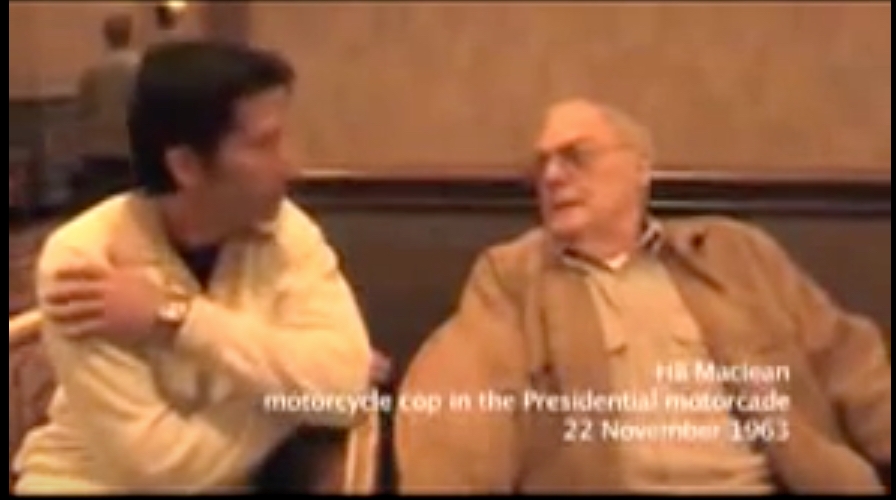
  • Letters to The Nation magazine re: Max Holland


    Pennington, NJ

    I’m the author of A Farewell to Justice: Jim Garrison, JFK’s Assassination and the Case That Should Have Changed History, my seventeenth book, whose credibility is attacked by Max Holland. Nation readers might give pause to Holland’s five-year campaign of outright falsehoods about the investigation into the Kennedy assassination by New Orleans District Attorney Jim Garrison that have appeared in a range of publications from The Wilson Quarterly, The Atlantic, New Orleans and the Washington Post to, now, The Nation.

    Garrison focused on the clandestine service of the CIA as sponsor of the Kennedy assassination as a result of facts he discovered about Lee Harvey Oswald, specifically Oswald’s role as an FBI informant and low-level CIA agent sent to the Soviet Union by the CIA’s Chief of Counterintelligence, James Angleton, as part of a false defector program. What Garrison had not yet discovered was that Oswald also worked for the US Customs Service in New Orleans.

    Contrary to Holland’s assertions of the innocence of Clay Shaw, the man Garrison indicted for participation in the murder of President Kennedy was indeed part of the implementation of the murder and was guilty of conspiracy. That Shaw was acquitted does not exonerate him for history. New documents indicate overwhelmingly that Shaw did favors for the CIA. On his deathbed he admitted as much. Shaw’s repeated appearances in Louisiana in the company of Oswald demonstrate that Shaw was part of the framing of Oswald for Kennedy’s murder. Shaw took Oswald to the East Louisiana State Hospital in an attempt to secure him a job there, one event among many never investigated by the Warren Commission or the House Select Committee on Assassinations (HSCA).

    Holland’s assertion that Garrison based his conclusion that the CIA sponsored the assassination on a series of articles in an Italian newspaper is also incorrect. Garrison had focused on the CIA long before he learned that Shaw was on the board of directors of a CIA-funded phony trade front called Centro Mondiale Commerciale (CMC), based in Rome. Indeed, the newspaper Paese Sera broke the story of Shaw’s involvement after a six-month investigation into CIA interference in European electoral politics, only to discover that Garrison had indicted Shaw a few days before the first article was to appear. Moreover, the new documents reveal that CMC and its parent outfit, Permindex, were indeed CIA fronts.

    The 1992 Assassinations Records and Review Act has disgorged dozens of documents showing that Shaw was a CIA operative. This is directly contrary to what Holland suggests — that Garrison was a willing victim of “the KGB’s wildest fantasy.” To cite one example, Shaw was cleared for a project dubbed QKENCHANT, which permitted him to recruit outsiders for CIA projects. Shaw was no mere businessman debriefed by the CIA. One document reveals that among those Shaw recruited in New Orleans was Guy Banister, former FBI Chicago Special Agent in Charge running an ersatz New Orleans detective agency whose side-door address (544 Camp Street) Oswald used on a set of his pro-Castro leaflets, until Banister stopped him.

    The former editors of the now-defunct Paese Sera, whom I interviewed, from Jean-Franco Corsini to Edo Parpalione, insisted adamantly that neither the Italian Communist Party, nor the Soviet Communist Party, nor the KGB had any influence on the paper’s editorial policy. Outraged by Holland’s accusations, Corsini said that he despised the KGB and the CIA equally.

    The roots of Holland’s charge that Garrison was a dupe of KGB propaganda may be traced to an April 4, 1967, CIA document titled “Countering Criticism of the Warren Report.” In it the CIA suggests to its media assets that they accuse critics of the Warren Report of “Communist sympathies.” In April 1967 Garrison was at the height of his investigation: He is clearly the critic the CIA had in mind.

    In 1961 Richard Helms had already developed the charge that Paese Sera was an outlet for the KGB and for Soviet propaganda. Helms was indignant, but the truth had appeared in Paese Sera: The attempted putsch against Charles de Gaulle by four Algerian-based generals had indeed been supported by the CIA. Holland has merely picked up where Helms, later to become a convicted perjurer, left off — repeating a scenario developed for him by Helms, with the addition of making the accusation of Soviet influence on Garrison.

    My book is hardly a “hagiography of the DA,” as Holland states. I present a flawed man who exhibited great courage in facing down both the FBI and the CIA in his attempt to investigate the murder of the President. Indeed, Garrison family members were dismayed that I did not present him in a more idealized form. I depicted him as an ordinary man who rose to distinction because of his single-minded commitment to the investigation.

    Among the many errors in Holland’s latest diatribe is that Shaw died “prematurely,” as if somehow Garrison’s prosecution hastened his end. In fact, Shaw was a lifelong chain smoker and died of lung cancer. Holland attacks Robert Blakey, chief counsel for the HSCA, for using acoustic evidence to suggest that there was a conspiracy in the Kennedy murder. In fact, the acoustic evidence of at least four shots being fired has been established scientifically by Donald Thomas in the British forensic journal Science and Justice (see also Thomas’s well-documented paper, available online, “Hear No Evil: The Acoustical Evidence in the Kennedy Assassination,” delivered November 17, 2001).

    Blakey certainly can be criticized for his close relationship with the CIA throughout his HSCA investigation. His letters of agreement with the CIA are at the National Archives. The CIA decided how key witnesses were to be deposed, and Blakey acquiesced in all CIA demands and intrusions upon the investigation.

    Before Blakey was hired, former Supreme Court Justice Arthur Goldberg considered accepting the job as counsel. Knowing that the CIA had at the least covered up the facts of the assassination and at worst been involved, Goldberg telephoned CIA director Stansfield Turner and asked him whether, should he take the job, he would have full CIA cooperation. Silence emanated over the wires. Goldberg, naïve perhaps, asked Turner if he had heard the question. “I thought my silence was my answer,” Turner said. Goldberg declined the job. Blakey took it. It is no surprise that Holland, who has consistently defended the CIA, does not raise the issue of Blakey’s cooperation with the CIA during his HSCA tenure but focuses instead on Blakey’s conclusion, forced by the irrefutable acoustic evidence, that there was a conspiracy.

    It is one thing for Holland to spread his disinformation in the CIA’s Studies in Intelligence. It is quite another for The Nation to allow him continued access without debate to its pages to obfuscate, slander authors like myself and deny evidence fully established — in particular about Jim Garrison and how the new documents establish his credibility and reveal how close he came to the truth, and in general about the Kennedy assassination’s sponsors and accessories.

    JOAN MELLEN


    Charlottesville, Va.

    It began with a CIA document classified Top Secret. How do I know that? A decade after the assassination of President Kennedy, with the assistance of the ACLU, I won a precedent-setting lawsuit in the US District Court in Washington, DC, brought pursuant to the Freedom of Information Act. The court ordered the police and spy organizations to provide to me many long-suppressed documents.

    The CIA document stated that it was deeply troubled by my work in questioning the conclusions of the Warren Commission. The CIA had concluded that my book Rush to Judgment was difficult to answer; indeed, after a careful and thorough analysis of that work by CIA experts, the CIA was unable to find and cite a single error in the book. The CIA complained that almost half of the American people agreed with me and that “Doubtless polls abroad would show similar, or possibly more adverse, results.” This “trend of opinion,” the CIA stated, “is a matter of concern” to “our organization.” Therefore, the CIA concluded, steps must be taken.

    The CIA directed that methods of attacking me should be discussed with “liaison and friendly elite contacts (especially politicians and editors),” instructing them that “further speculative discussion only plays into the hands of the opposition.” The CIA stressed that their assets in the media should “point out also that parts of the conspiracy talk appear to be deliberately generated by Communist propagandists.” Further, their media contacts should “use their influence to discourage” what the CIA referred to as “unfounded and irresponsible speculation.” Rush to Judgment, then the New York Times number-one bestselling book, contained no speculation.

    The CIA in its report instructed book reviewers and magazines that contained feature articles how to deal with me and others who raised doubts about the validity of the Warren Report. Magazines should, the CIA stated, “employ propaganda assets to answer and refute the attacks of the critics,” adding that “feature articles are particularly appropriate for this purpose.” The CIA instructed its media assets that “because of the standing of the members of the Warren Commission, efforts to impugn their rectitude and wisdom tend to cast doubt on the whole leadership of American society.” The CIA was referring to such distinguished gentlemen as Allen Dulles, the former director of the CIA; President Kennedy had fired Dulles from that position for having lied to him about the Bay of Pigs tragedy. Dulles was then appointed by Lyndon Johnson to the Warren Commission to tell the American people the truth about the assassination.

    The purpose of the CIA was not in doubt. The CIA stated: “The aim of this dispatch is to provide material for countering and discrediting the claims” of those who doubted the Warren Report. The CIA stated that “background information” about me and others “is supplied in a classified section and in a number of unclassified attachments.”

    With this background we now turn to Max Holland’s Nation article, which states that there was a “JFK Lawyers’ Conspiracy” among four lawyers: former Senator Gary Hart; Professor Robert Blakey; Jim Garrison, the former District Attorney of New Orleans and later a state judge in Louisiana; and me.

    Before I wrote Rush to Judgment I had never met any of the other three “co-conspirators.” I still have not had the pleasure of meeting Senator Hart, and I know of no work that he has done in this area. I met Professor Blakey only once; he had been appointed chief counsel for the House Select Committee on Assassinations, and at that meeting I told him that I was disappointed in his approach and methods. Not much of a lawyers’ conspiracy.

    Each of the other statements as to alleged fact are false and defamatory. Holland states that I am not scrupulous, that I am dishonest and that I spread innuendo about the sinister delay in the Warren Commission investigation, an assertion not made by me but fabricated in its entirety by Holland. As a silent echo of his CIA associates Holland does not point to one assertion as to fact, of the thousands I have made about the facts surrounding the death of our President, that he claims is inaccurate.

    Finally, Holland strikes pay dirt. He uncovers, are you ready for this, the fact that I had asserted that “the government was indifferent to the truth.” I confess. Is that now a crime under the Patriot Act? Isn’t that what The Nation is supposed to be asserting and proving?

    Holland states that the KGB was secretly funding my work with a payment of “$12,500 (in 2005 dollars).” It was a secret all right. It never happened. Holland’s statement is an outright lie. Neither the KGB nor any person or organization associated with it ever made any contribution to my work. No one ever made a sizable contribution, with the exception of Corliss Lamont, who contributed enough for me to fly one time from New York to Dallas to interview eyewitnesses. The second-largest contribution was $50 given to me by Woody Allen. Have Corliss and Woody now joined Holland’s fanciful conspiracy?

    Funds for the work of the Citizens Committee of Inquiry were raised by me. I lectured each night for more than a year in a Manhattan theater. The Times referred to the very well attended talks as one of the longest-running performances off Broadway. That was not a secret. I am surprised that Holland never came across that information, especially since he refers to what he calls “The Speech” in his diatribe.

    Apparently, Holland did not fabricate the KGB story; his associates at the CIA did. There is proof for that assertion, but I fear that I have taken too much space already. For that information, contact me at mlane777@cs.com.

    Am I being unfair when I suggest a connection between Holland and the CIA? Here is the CIA game plan: Fabricate a disinformation story. Hand it to a reporter with liberal credentials; for example, a Nation contributing editor. If the reporter cannot find a publication then have the CIA carry it on its own website under the byline of the reporter. Then the CIA can quote the reporter and state, ” according to…”

    Holland writes regularly for the official CIA website. He publishes information there that he has been given by the CIA. The CIA, on its official website, then states, “According to Holland…” If you would like to look into this matter of disinformation laundering, enter into your computer “CIA.gov + Max Holland.” You will find on the first page alone numerous articles by Holland supporting and defending the CIA and attacking those who dare to disagree, as well as CIA statements attributing the information to Holland.

    A question for The Nation. When Holland writes an article for you defending the CIA and attacking its critics, why do you describe him only as “a Nation contributing editor” and author? Is it not relevant to inform your readers that he also is a contributor to the official CIA website and then is quoted by the CIA regarding information that the agency gave him?

    An old associate of mine, Adlai Stevenson, once stated to his political opponent, a man known as a stranger to the truth — if you stop telling lies about me I will stop telling the truth about you. I was prepared to adopt that attitude here. But I cannot. Your publication has defamed a good friend, Jim Garrison, after he died and could not defend himself against demonstrably false charges.

    You have not served your readers by refusing to disclose Holland’s CIA association. The Nation and Holland have engaged in the type of attack journalism that recalls the bad old days. If I fought McCarthyism in the 1950s as a young lawyer, how can I avoid it now when it appears in a magazine that has sullied its own history? The article is filled with ad hominem attacks, name calling and fabrications, and it has done much mischief. I will hold you and Holland accountable for your misconduct. I can honorably adopt no other course.

    To mitigate damages I require that you repudiate the article and apologize for publishing it. That you publish this letter as an unedited article in your next issue. That you do not publish a reply by Holland in which he adds to the defamation and the damage he has done, a method you have employed in the past. That you provide to me the mailing addresses of your contributing editors and members of your editorial board so that I may send this letter to them. I am confident that Gore Vidal and Bob Borosage, Tom Hayden and Marcus Raskin, all of whom I know, and many others such as Molly Ivins, John Leonard and Lani Guinier, who I do not know but who I respect and admire, would be interested in the practices of The Nation. In addition, I suggest that ethical journalism requires that in the future you fully identify your writers so that your readers may make an informed judgment about their potential bias.

    If you have a genuine interest in the facts regarding the assassination you should know that the House Select Committee on Assassinations (the United States Congress) concluded that probably a conspiracy was responsible for the murder and that, therefore, the Warren Report that Holland defends so aggressively is probably wrong. In addition, the only jury to consider this question decided in a trial held in the US District Court in a defamation case that the newspaper did not defame E. Howard Hunt when it suggested that Hunt and the CIA had killed the President. The forewoman of the jury stated that the evidence proved that the CIA had been responsible for the assassination.

    I have earned many friends in this long effort. Those who have supported my work include Lord Bertrand Russell, Arnold Toynbee, Professor Hugh Trevor-Roper, Dr. Linus Pauling, Senator Richard Schweicker, Paul McCartney, Norman Mailer, Richard Sprague, Robert Tannenbaum and also members of the House of Representatives, including Don Edwards, Henry Gonzales, Andrew Young, Bella Abzug, Richardson Preyer, Christopher Dodd, Herman Badillo, Mervyn Dymally, Mario Biaggi and, above all, according to every national poll, the overwhelming majority of the American people. I have apparently earned a few adversaries along the way. Too bad that they operate from the shadows; that tends to remove the possibility of an open debate.

    MARK LANE


    Washington, DC

    While many thought the 1979 report of the House Select Committee on Assassinations was the final word on President Kennedy’s murder, it wasn’t. In 1992 Congress passed the JFK Act. As a result, a huge volume of new materials are available for study.

    One significant revelation is the extent to which the CIA was a focus of the committee’s probe. Another is the discovery by Jefferson Morley, a columnist for WashingtonPost.com, that the CIA corrupted the committee’s probe. The CIA brought former case officer George Joannides out of retirement to handle the committee’s inquiries about the relationship between Lee Harvey Oswald and DRE, a CIA-funded Cuban exile organization. The CIA never told the committee that Joannides was DRE’s case officer when Oswald and DRE were in contact. Joannides then thwarted committee efforts to obtain CIA records about the DRE-Oswald relationship. Thus, the last official word on the assassination is that of a Congressional committee that was subverted by an agency that itself was a focus of the investigation.

    These facts raise serious issues. The CIA’s conduct undermined democratic accountability and compromised the integrity of Congressional oversight on a matter of national security. Shouldn’t Congress now investigate to determine why the CIA sabotaged the probe? Was it because, as some former committee staffers have said, an element of the CIA was involved in the plot? Or is there some other explanation?

    In 2004 and 2005 the Assassination Archives and Research Center (AARC) held conferences to discuss the JFK assassination. On the issue of conspiracy, two scientists from Lawrence Livermore National Laboratory discredited the last remaining basis for the single bullet theory (SBT), which theorized that both Kennedy and John Connally were hit by the same bullet, fired from Oswald’s Mannlicher-Carcano rifle — the sine qua non for the lone assassin theory. These eminent scientists said that due to scientific advances not only can the SBT not be substantiated but the fragments tested could have come from one — or as many as five — bullets, including a Remington or some other rifle. Holland mentions none of this.

    Holland denounces the acoustics evidence proving there was a conspiracy. He misrepresents acoustics as being the only evidence the committee had of a conspiracy and mistakenly says that it is uncorroborated. In fact, the first acoustics panel was corroborated by the second. Both were further corroborated and strengthened by Donald Thomas’s study. Holland doesn’t mention Thomas, but does obliquely refer to the work of Richard Garwin.Thomas debated Garwin at the AARC conference. But as Pulitzer Prize-winning reporter George Lardner reported, Thomas “upstaged” Garwin, showing “how the noises coincided precisely with frames from the Zapruder film and echoes off buildings in Dealey Plaza reflecting the gunfire.” Lardner also noted that Garwin said he “had not studied the echoes.” Again, none of this is in Holland’s account.

    Holland, winner of a CIA award for Studies in Intelligence, has been working on a book since 1993 defending the Warren Commission. In applying for an Anthony Lukas work-in-progress award in 2001, he said that as a result of his study “the Commission can emerge in a new light: battered somewhat but with its probity and the accuracy of its findings intact.” He also stressed that he had spent a full year researching “the remarkable effort of KGB disinformation on Garrison’s probe.” Holland debated this thesis with Gary Aguilar at the 2004 AARC conference. In my view, Holland lost hands down (a DVD of the conference is available through aarclibrary.org). In advancing his thesis, Holland relies on dubious materials, including the word of former CIA director Richard Helms, who was charged with perjury but copped a plea of withholding information from Congress.

    Holland now uses the AARC’s 2005 conference to theorize that a vast conspiracy of lawyers “less scrupulous” than those at the Warren Commission spread KGB disinformation and convinced Congress and the American people that the Warren Report was wrong. This is a McCarthyite tactic for discrediting the AARC conferences and Warren Commission critics generally. It seems no one ever saw the Zapruder film showing JFK thrown violently to the left rear, no one ever looked at the Magic Bullet and concluded it was so undeformed it could not have done all the damage alleged. No, it was them bloody KGB disinformation lawyers that brainwashed them.

    In 1967 the CIA directed its stations to tamp growing criticism of the Warren Report by discussing it with “liaison and friendly elite contacts (especially politicians and editors)” and “point out that parts of the conspiracy talk appear to be deliberately generated by Communist propagandists.” The dispatch further instructs that stations “employ propaganda assets to answer and refute the attacks of the critics,” saying that “book reviews and feature articles are particularly appropriate for this purpose.”

    Holland’s piece on our conference looks as if it were written to specification. While I had not expected favorable coverage from Holland when I overrode the advice of friends and associates and honored The Nation’s request that he be given journalistic privileges and courtesies, I hadn’t expected an attack of this character. The general opinion of attendees, repeatedly expressed to me personally, was that the 2005 conference was the best ever on the subject. Max Holland echoed this in an e-mail to me: “Having Garwin, Hart and Blakey give presentations made the conference superior to any I’ve attended. I’ll do my best to get an article in.”

    JIM LESAR, president, AARC


    Vallejo, Calif.

    Max Holland has engaged for years in propagating disinformation on behalf of the CIA concerning the investigation of its role in the official execution of John F. Kennedy. Holland’s Nation article expatiates upon his fabricated thesis that Jim Garrison’s evidence of the CIA’s role in the Kennedy murder derived from a series of articles in Paese Sera in 1967.

    I sent those articles to Jim Garrison in my capacity as director of the Who Killed Kennedy? committee in London, whose members and supporters included Bertrand Russell, Hugh Trevor-Roper, Arnold Toynbee, Field Marshall Sir Claude Auchinleck and Lord Boyd Orr. The Bertrand Russell Peace Foundation, of which I was then executive director, had conducted an extended investigation of the role of the CIA in fomenting and coordinating brutal repression, disappearances and assassinations, which culminated in a military putsch in Greece. Our Save Greece Now Committee unearthed concrete data regarding the role of the CIA and the Greek colonels that helped mobilize the movement for which Deputy Grigoris Lambrakis paid with his life. In the aftermath, our committee and its Greek leader, Michael Peristerakis, led a demonstration of more than 1 million that brought down the regime.

    CIA activity across Europe led Paese Sera to undertake a six-month investigation into the role in Italy of the CIA, with its plans for a military coup. The CIA colonels’ coup in Greece unfolded shortly after Paese Sera’s prescient series. Prominent writers and intellectuals, including Rossana Rossanda, K.S. Karol, Lelio Basso, Bertrand Russell, Jean-Paul Sartre and Simone de Beauvoir, supported Paese Sera.

    This investigation was entirely unrelated to events in the United States or the assassination of John F. Kennedy. It was fortuitous that the CIA front organizations in Italy that emerged from CIA plans to overthrow the Italian government included Centro Mondiale Commerciale and Permindex, of which Clay Shaw was a director in New Orleans.

    Jim Garrison was well on the trail of Shaw and his role as a CIA handler of Lee Harvey Oswald before Paese Sera published its series of articles. When I sent them to Garrison, he had already charged Shaw in relation to the murder of Kennedy. Jim found the Paese Sera series confirmatory and important, but the articles were not admissible as evidence in court.

    Holland has written repeatedly that Paese Sera was a “communist” paper and a conduit for KGB disinformation. In fact, Paese Sera was not unlike The Nation before Holland’s infiltration of it as a contributing editor (except Paese Sera was less inclined to defend the leaders of the Soviet Union than was The Nation during the decades since the 1930s). The Paese Sera fiction is real intelligence disinformation arising not from the KGB but from an April 7, 1967, directive by Helms to CIA media assets, “How To Respond to Critics of the Warren Report.”

    What emerged from the investigative work of the Bertrand Russell Peace Foundation and Paese Sera was the full evidence of the forty-year campaign of the CIA in Italy, now known as Operation Gladio, a campaign of terror that included the kidnapping and murder of Prime Minister Aldo Moro and the bombing of the Bologna railway station.

    I worked with Jim Garrison for twenty years and sent him many documents, e.g., Secret Service Report 767, which cites the disclosure by Alan Sweat, chief of the criminal division of the Dallas Sheriff’s Office, of Lee Harvey Oswald’s FBI Informant Number S172 and Dallas District Attorney Henry Wade’s citation of Oswald’s CIA number 110669.

    Finally, Philip Zelikow, national security adviser to both Bush administrations and appointed by George W. Bush to his Foreign Intelligence Advisory Board immediately after the 9/11 attacks, has endorsed Holland’s specious charges in Foreign Affairs, even as he and Holland were colleagues at the Miller Institute. Zelikow, as head of the 9/11 Commission, has been a point man in covering up the role of US intelligence in the planning and implementation of the events of September 11.

    It is fitting that the very individuals who protect the treason at the top that defines the official assassination of President Kennedy are performing that role in relation to the events of 9/11 — a precise correlative to Operation Gladio, first exposed by the investigative work of Paese Sera, which linked the CIA murder apparatus in Italy to the one that murdered the head of state in America.

    Holland seeks to present the investigators into official murder in America not as people of principle and daring but as disinformation tools of an intelligence service. When it comes to being a pimp for the imperium, Mr. Holland, Physician, heal thyself!

    RALPH SCHOENMAN


    Kirtland, NM

    I commend The Nation for publishing Max Holland’s insightful article. In 1963 I worked in New Orleans as a cameraman for WDSU TV, and I met and talked with Lee Harvey Oswald on three occasions. I also knew Jim Garrison, and I knew the Cuban refugee Carlos Bringuier, who scuffled with Oswald on Canal Street on August 9, 1963. Three days later I photographed Oswald and Bringuier coming out of court after their “disturbing the peace” trial, and on August 16, I photographed Oswald handing out pro-Castro leaflets in front of the International Trade Mart on Camp Street.

    In 1968 Garrison phoned me in San Francisco, where I was living, and asked if I would sell him a copy of my Oswald Trade Mart footage. I told him I’d gladly give him a copy. Then he went on to tell me a wild story about how the FBI was keeping WDSU and NBC News from providing him with a copy of the film because the bureau had had secret spies or agents with Oswald at the Trade Mart, directing his activities as part of a government “conspiracy.” Garrison said the Feds didn’t want him to see my film, since he might identify the government spooks with Oswald.

    I was so shocked by that story that a day or so later I called a supervisor at the San Francisco FBI office and asked if he would call an appropriate person at the Washington headquarters to see if they would not want me to release the film to Garrison. I indicated that I might not release it if it involved “national security.” My objective was twofold: to find out if Garrison was wrong about the FBI trying to cover up my film, and to find out if he was right. If he was right, that was indeed a big story. But the supervisor called me back a day or two later and said that the guys in Washington didn’t care whether or not I gave Garrison the film. So I sent it to him, and after several months of studying it, the net result was that neither Garrison nor any of his investigators was able to turn up any FBI or other spooks with Oswald in the footage.

    I worked and talked with Garrison many times when I was a news cameraman, and I always thought of him as an intelligent and sensible man. But after he began working on the JFK case and trying to invent bizarre government conspiracies about it, I came to realize the guy was going a bit bonkers and was apparently in the process of having a long, slow nervous breakdown.

    Thirty-seven years after his phone call to me, a retired history professor found in some archives a copy of an FBI memo about my 1968 telephone call to the San Francisco FBI supervisor, and the professor fraudulently referred to it in his JFK conspiracy book as “documentation” that I had worked as an “FBI informant” in New Orleans in 1963!

    Of course I had not, and the memo does not suggest in any way that I did. The professor’s story was simply fabricated, like hundreds of other phony JFK “conspiracy” stories. I was a young liberal/leftist in 1963, and I didn’t have any feelings of ill will toward Oswald at that time, nor did I have any contacts in the FBI. I thought Oswald was a little goofy and something of a crackpot to be handing out pro-Castro leaflets in a conservative Southern city just ten months after the Cuban missile crisis. But I learned in the news business long ago that crackpots do what crackpots think they need to do to modify the world in some way, and Oswald did what he thought he needed to do.

    As I have carefully studied the JFK case myself, I’ve come to the conclusion that Oswald did act alone, and that President Kennedy might still be alive today if he had never made that trip to Dallas, or if Oswald had still lived in New Orleans on November 22, 1963. But the chance event of President Kennedy riding in an open limousine slowly down a street right in front of a building where a crackpot worked, especially a crackpot who owned a rifle with a telescopic sight, was just too much of an opportunity for the crackpot to pass up.

    I’ve also come to realize that so many of these stupid, inaccurate and idiotic “conspiracy” stories are a waste of time and a distortion of history. Every minute wasted on pursuing a 1963 “conspiracy” while ignoring current important ongoing conspiracies is a minute lost.

    And the conspiracy buffs who condemn honest, hard-working journalists like Holland remind me of the old 1950s film clips of Senator Joe McCarthy. I would hate to think that truth in historical reporting might be adversely influenced today by the use of such McCarthyite tactics against journalists like Holland who stick their necks out to report the truth about the JFK case and Jim Garrison’s ridiculous investigation of it.

    J.W. RUSH


    HOLLAND REPLIES

    Washington, DC

    Apparently, a word needs to be said about the article I wrote for Studies in Intelligence, a journal published by the CIA. The first iteration of this story, which exposed the impact of Soviet disinformation on Jim Garrison’s persecution of Clay Shaw, actually appeared in the Spring 2001 Wilson Quarterly. However, the Quarterly, like The Nation, does not run footnoted articles, and I wanted a fully documented version to appear, since I had conducted extensive interviews and research in Italy, and into CIA documents at the National Archives. There are only four English-language journals that print scholarly articles on intelligence (and if one is so inclined, it is a snap to “prove” they are all CIA-connected). Studies is the oldest, and I went there first. That’s the whole story, except that, yes, the article (available online) then also won an award.

    Now to some brass tacks in the space I have available. Both Joan Mellen and Mark Lane make much of a CIA document that sounds very sinister — until you actually read it and put it into context. The document was written in April 1967, the height of the bout of madness otherwise known as the Garrison investigation. As one of the government agencies now being accused of complicity in the assassination, the CIA was very concerned about having such allegations gain widespread acceptance abroad in the midst of the cold war. “Innuendo of such seriousness affects…the whole reputation of the American government,” observed the CIA. So the agency launched a campaign, using its media assets abroad, to counter criticism of the Warren Report by the likes of Mellen, Lane and others. Is that really shocking?

    Joan Mellen’s penchant for accuracy can be summed up in the fact that she cannot even bother to spell correctly (here or in her book) the names of Gianfranco Corsini and Edo Parpaglioni. Ordinarily, this would be nit-picking, but in this instance her elementary sloppiness is as good a window as any into the miasma of bald lies, misrepresentations and truthiness that she calls a book.

    The claim that Paese Sera’s lies about Shaw were the fortuitous result of a “six-month investigation” is a belated fiction embraced by Mellen and other Garrison acolytes. The co-author of the articles in question, Angelo Aver, claimed no such thing when interviewed in 2000, nor did any Paese Sera editors I contacted (including Corsini).

    I find it illuminating that Lane has taken no legal action (not even in Britain!) against the authors (Christopher Andrew and KGB archivist-turned-defector Vasili Mitrokhin) and publishers of the 1999 volume that revealed “the [KGB’s] New York residency sent [Lane initially] 1,500 dollars to help finance his research” through an intermediary. That doesn’t necessarily mean it came in a lump sum. And neither Andrew/Mitrokhin nor I alleges that Lane was a witting recipient, just a useful one.

    All the reliable forensic and scientific evidence developed around the JFK case either positively supports or does not negate the findings of the Warren Report. An explanation of the so-called acoustic evidence can be found at mcadams.posc.mu.edu/odell.

    Jim Lesar has often attempted to impede The Nation’s coverage of AARC conferences when I have been designated to cover them. On this go-round he hinted (before backing off) that a press credential would not be forthcoming unless The Nation guaranteed there would be an article. After the conference, impressed as I was by AARC’s ability to attract the likes of Dr. Richard Garwin, former Senator Hart and Professor Blakey, I wanted to assure Lesar that I would do my best to submit an article that the editors would deem worthwhile, even though it’s harder than ever to get into the magazine when writing about a largely historical subject. That didn’t mean, however, that I had checked my brains at the door.

    MAX HOLLAND