Tag: JFK ASSASSINATION

  • Yuri Nosenko Dies


    By Walter Pincus

    from The Washington Post

    Yuri I. Nosenko, 81, a Soviet KGB agent whose defection to the United States in 1964 and subsequent three-year harsh detention and hostile interrogation by CIA officials remains immensely controversial, died Aug. 23 under an assumed name in a Southern state, according to intelligence officials. No cause of death was reported other than “a long illness.”

    Mr. Nosenko, a lieutenant colonel in the Soviet secret police and intelligence agency, personally interviewed Lee Harvey Oswald during his time in the Soviet Union from 1959 to 1962. When Mr. Nosenko defected in 1964, he provided the first information that Oswald, the accused assassin of President John F. Kennedy, was not a Soviet agent.

    Senior CIA officers at the time, including James Jesus Angleton, the agency’s counterintelligence chief, and David Murphy of the Soviet division, did not believe Mr. Nosenko was a real defector and ordered his imprisonment. Mr. Nosenko had initially made inaccurate statements about his past, and some of his information conflicted with that provided by another KGB officer, Anatoly M. Golitsin, who had defected the year before. As a result, they considered him a plant sent by Moscow to confuse Washington about Oswald.

    Richard Helms, then CIA director of operations, in 1966 ordered that a conclusion be reached in the Nosenko case. In 1967, after passing multiple polygraphs, Mr. Nosenko was released and in 1969 he was found to be a legitimate defector. He subsequently became a consultant to the agency, given a new identity and provided a home in an undisclosed location in the South.

    Last month several senior CIA officials visited him and presented him with a ceremonial flag and a letter from CIA Director Michael Hayden honoring his service to the United States, a senior intelligence official said yesterday.

    First word of his death came yesterday from Pete Earley, an author of books on the CIA who had been trying for four years to get an interview with Mr. Nosenko. Earley said Mr. Nosenko was bothered by a book released last year called Spy Wars, written by Tennent H. Bagley, a key CIA player in Mr. Nosenko’s defection and arrest. The book continued to argue that Mr. Nosenko was not a bona fide defector, but in fact was sent to cover up the KGB’s influence over Oswald.

    “I was fascinated by Nosenko because in spite of the horrific things that the agency and government did to him — the torture and mental deprivation — in the only public speech that he ever gave at the CIA, he praised the United States as being the world’s best hope for humanity, condemned Communism and Moscow, and said he never regretted his defection nor held a grudge against the officials who had persecuted him,” Earley said.

    During his incarceration, at Camp Perry, the CIA facility in Virginia, the agency kept Mr. Nosenko in solitary confinement in a small concrete cell. He often endured treatment involving body searches, verbal taunts, revolting food and denial of such basics as toothpaste and reading materials.

    Last year, the International Spy Museum in Washington canceled a session during which Bagley was to speak, allegedly because CIA officials objected to having the Nosenko issue raised.

    In his 1992 book Molehunt, author David Wise wrote, “The ‘war of defectors,’ the conflict over Golitsin and Mr. Nosenko . . . split the Agency into two camps, creating scars that had yet to heal decades later.”

    Claire George, a former CIA deputy director of operations who worked in the Soviet division at the time of Mr. Nosenko’s defection, said yesterday that the handling of Mr. Nosenko “was a terrible mistake.” But George added, “You can’t be in the spy business without making mistakes.”

    Yuri Ivanovich Nosenko was born in 1927, in Nikolayev, a Ukrainian town on the Black Sea.

    His father, a naval engineer, rose to minister for shipbuilding under Soviet leader Nikita Khrushchev, while his mother arranged for private tutors to school Mr. Nosenko in classical Western literature from Virgil to Voltaire. He developed an attraction to western culture. Mr. Nosenko served three years in naval intelligence after his 1950 graduation from the State Institute of International Relations in Moscow. He then became a leader within the KGB’s Soviet internal security division.

    According to Tom Mangold’s Cold Warrior (1991), a book about Angleton, Mr. Nosenko’s KGB career specialized in following U.S. agents posted in the Soviet Union and in recruiting turncoats from foreign intelligence services. Mangold’s book said he also oversaw blackmail operations. Mangold asserted Mr. Nosenko eventually grew angered by what he considered hypocrisies of the Soviet system and signaled to U.S. intelligence agents his wish to defect on ideological grounds. He made his first successful contact with U.S. intelligence in 1962, pleading desperation after squandering KGB funds on alcohol. He asked for $200 to repay the money. He later admitted this was a fabrication, and his request later raised doubts within the CIA about his intentions. Would he really sell out his country for $200?

    But his propensity to drink was not a lie, and he was fully loaded when he met CIA officials in Geneva, where he was accompanying a diplomatic mission. He revealed key information about Soviet moles working in the embassies of Western nations as well as Russian intelligence methods. According to Mangold, he pinpointed 52 microphones planted inside the U.S. embassy in Moscow and how the Soviets avoided detection of the listening devices.

    But his most stunning revelations were about Oswald, notably how the Soviet agency felt Oswald was too unstable mentally to be of much service.

    None of this saved Mr. Nosenko from a bitter fate. Golitsin stoked Angleton’s increasing paranoia about double agents in the CIA and the veracity of defectors, and Mr. Nosenko soon began his 1,277 days in custody.

    After Mr. Nosenko’s rehabilitation, he looked up the disgraced Angleton’s number in the phone book in 1975 to confront him.

    It was a brief and fruitless exchange, with Mr. Nosenko rising in his passions and Angelton cool and adamant about his judgment.

    “I have nothing more to say to you,” Angelton said.

    “And Mr. Angelton,” replied Mr. Nosenko, “I have nothing further to say to you.”

  • Robert Maheu Dies at 90


    Robert A. Maheu, who was a powerful aide to reclusive tycoon Howard Hughes and whose cloak-and-dagger exploits included involvement in a CIA and Mafia plot to assassinate Fidel Castro, died Aug. 4 at Desert Springs Hospital in Las Vegas. He was 90 and had cancer and heart ailments.

    Mr. Maheu (pronounced MAY-hew) was a onetime FBI agent who ran a Washington company that he said carried out secret missions for the Central Intelligence Agency.

    Mr. Maheu’s first jobs for Hughes in the 1950s included private-eye snooping on Hughes’s past and prospective girlfriends in Hollywood. Later, as Hughes’s chief adviser, he helped make his boss Nevada’s third-largest landowner, after the federal government and the state power company. After becoming Hughes’s director of Las Vegas operations in 1966, Mr. Maheu was the most influential member of the billionaire’s inner circle and acted as his liaison to leading political figures and the world at large.

    “If he wanted someone fired, I did the firing,” Mr. Maheu wrote in his 1992 autobiography, Next to Hughes. “If he wanted something negotiated, I did the bargaining. If he had to be somewhere, I appeared in his place. I was his eyes, his ears, and his mouthpiece.”

    Before he was abruptly fired in 1970, Mr. Maheu spoke with Hughes as many as 20 times a day on the telephone. But in all their years together, he never met the eccentric mogul face to face. Hughes lived in seclusion on the top floor of the Desert Inn Hotel, with only a few private aides admitted to his presence.

    “He finally told me that he did not want me to see him because of the way in which he had allowed himself to deteriorate, the way in which he was living, the way he looked,” Mr. Maheu said on Larry King Live in 1992. “He felt that if I ever in fact saw him, I would never be able to represent him.”

    Mr. Maheu earned $520,000 a year and was living in one of the largest houses in Las Vegas when Hughes had two other aides fire him in December 1970. In 1972, Hughes broke a long silence by speaking in a telephone news conference, seeking to prove he had nothing to do with a purported autobiography by Clifford Irving, which was later confirmed a hoax.

    During that news conference, Hughes called Mr. Maheu “a no-good son of a bitch who robbed me blind.” Mr. Maheu sued him in federal court for defamation. He initially won a $2.8 million settlement from Hughes, but the decision was overturned.

    The four-month trial revealed many engrossing details about Hughes’s business dealings, his political contributions and his increasingly bizarre private life. Mr. Maheu disclosed that in 1970 he delivered $100,000 to Charles G. “Bebe” Rebozo, a close friend of President Richard M. Nixon’s, in return for possible future favors for Hughes. Mr. Maheu entertained Nixon’s vice president, Spiro Agnew, on his yacht and regularly played tennis with then-Nevada Gov. Paul Laxalt (R), who became a U.S. senator.

    But Hughes spread his political largess to both parties, contributing $100,000 to 1968 Democratic presidential candidate Hubert H. Humphrey. Mr. Maheu said he personally placed a briefcase containing $50,000 cash — from receipts at the Hughes-owned Silver Slipper casino — in Humphrey’s limousine. The contributions were legal at the time because they were considered private donations from an individual, not corporate contributions.

    Mr. Maheu said he twice turned down requests from Hughes to arrange $1 million payments to Presidents Lyndon B. Johnson and Nixon — payable after they left office — if they would agree to stop underground nuclear testing in Nevada, where Hughes lived until moving to the Bahamas in 1970. (He died at age 70 in 1976.)

    “In ’57, when I agreed to be his alter ego,” Mr. Maheu told the San Diego Union-Tribune in 1992, “I thought it would be very challenging: representing him at presidential inaugurals, handling multimillion-dollar deals in his behalf … In reality, you’re living a lie.”

    Robert Aime Maheu was born Oct. 30, 1917, into a French-speaking family in Waterville, Maine. After he graduated from the College of the Holy Cross in Worcester, Mass., he analyzed aerial photographs for the Department of Agriculture before joining the FBI.

    During World War II, the FBI assigned him to monitor a French spy who became a double agent and helped deceive the Nazi high command with false radio transmissions. By the mid-1950s, Mr. Maheu said he did undercover work for the CIA — “those jobs in which the agency could not officially be involved,” he wrote in his autobiography.

    Recently declassified CIA files confirm that Mr. Maheu was present at a 1960 meeting in Miami Beach, Fla., between organized crime bosses Sam Giancana and Santo Trafficante Jr., as part of an abortive CIA effort to assassinate Cuban leader Fidel Castro. The plan was dropped after the failed Bay of Pigs invasion in 1961.

    “If anything went wrong,” Mr. Maheu wrote in his memoir, “I was the fall guy, caught between protecting the government and protecting the mob, two armed camps that could crush me like a bug.”

    After leaving Hughes, Mr. Maheu became a successful real estate investor but was admittedly careless in his bookkeeping.

    “Most people, I have observed, spend 90 percent of their time scribbling notes and keeping records to justify their existence,” he said in 1974. “I prefer to use that time getting things done.”

    Mr. Maheu had expensive tastes and helped found a Las Vegas chapter of a French gourmet society, and as time went on, he reveled in chances to tell of his colorful life.

    His wife of 62 years, Yvette Doyon Maheu, died in 2003. A daughter also preceded him in death. Survivors include three sons; 10 grandchildren; and 10 great-grandchildren.

  • Letter to Rep. Henry Waxman

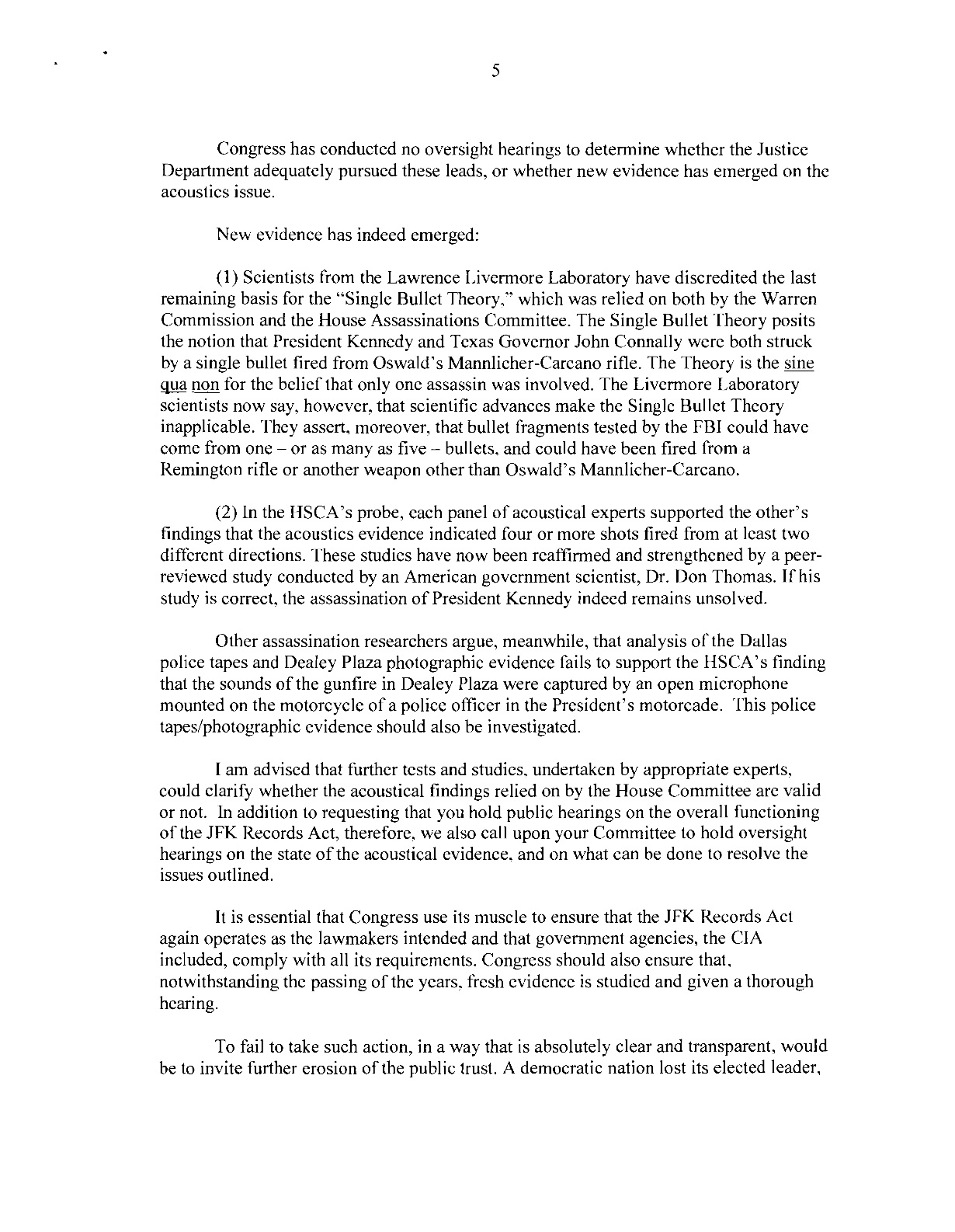
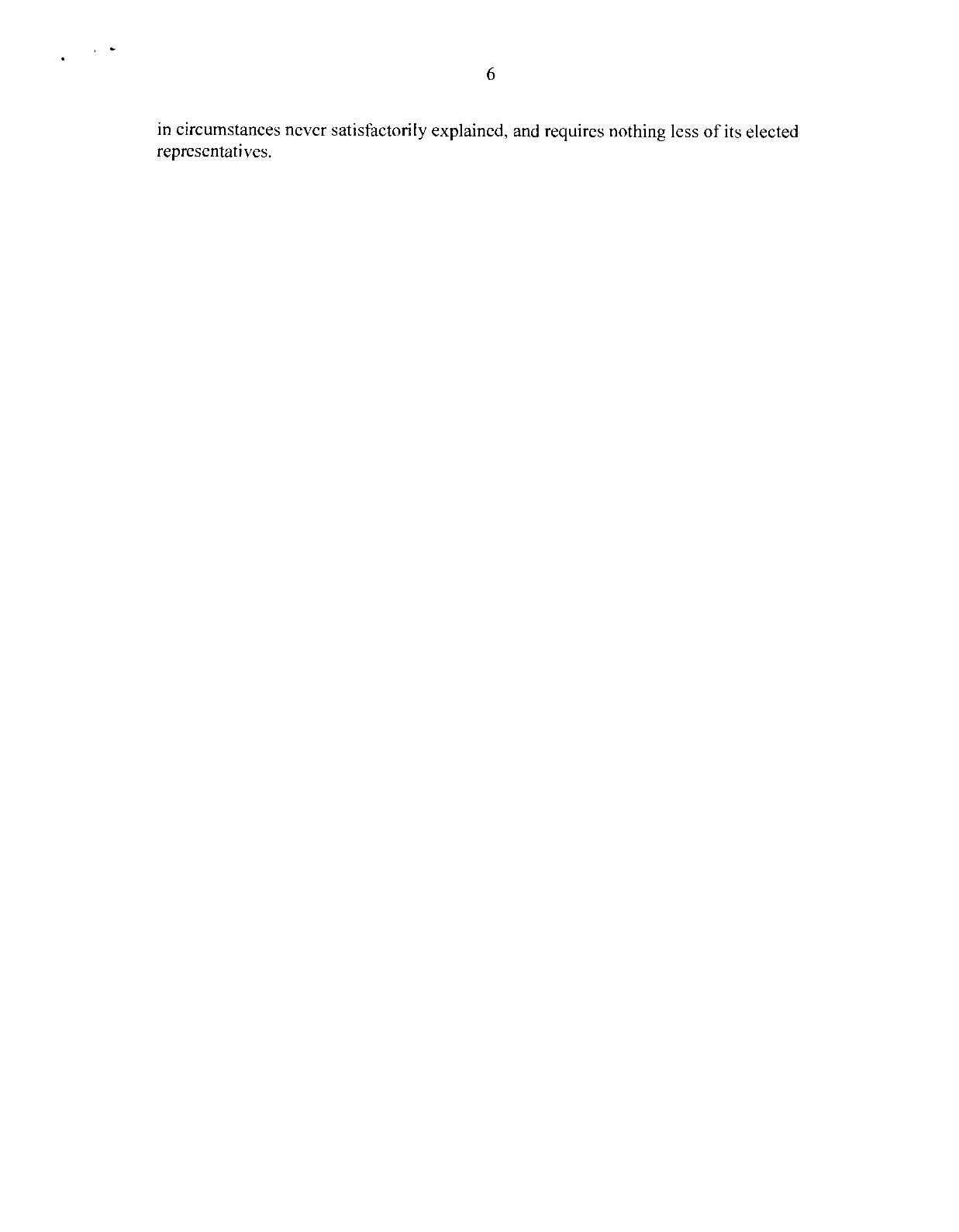
    Letter to Rep. Henry Waxman


    An identical letter went to Sen. Joseph Lieberman, Chairman of the Homeland Security and Government Affairs Committee, which shares these oversight responsibilities.

    “Please spread the word,” Lesar said, in distributing this correspondence over the Internet, “and encourage people to write concise letters in support of this.”


    waxman 1


    waxman 2


  • Update: Beware the Douglas, Janney, Simkin Silver Bullets

    Update: Beware the Douglas, Janney, Simkin Silver Bullets


    Predictably, this article created quite a buzz on John Simkin’s web site. Several members of his forum saw it and privately e-mailed him about it. He then posted the entire article/review on a thread in his forum. It created a mild ruckus, especially since I mentioned one of the habitual posters there — Peter Lemkin — and spent even more space on Mr. Simkin. The remarks by three people are worth replying to.

    1. About as convincingly as Claude Rains in Casablanca, Lemkin was shocked by what I wrote about him. He tried to imply that somehow I got some of the Russell/Lemkin story wrong. He also tried to imply that this was a deep dark secret and that I was invading his privacy and unjustly attacking him. Concerning the first, all the details were noted as right out of Cyril Wecht’s book. So if I got anything wrong, his beef is not with me but with Dr. Wecht. And if anything is significantly wrong then he should get a retraction from Wecht. Secondly, Cause of Death was published many, many years ago. And since Wecht is a celebrity author, tens of thousands of people bought it. So I find it very hard to believe that Lemkin, and many others in the research community, did not know about it. And indeed, I know for a fact that Peter is being disingenuous on this point. Because when the book was published, members of CTKA confronted him with the quotations. He then wrote an outraged letter to Dr. Wecht protesting, not the details, but the fact Wecht had written about them. Third, Dr. Wecht mentioned the episode at the Dallas ASK Conference the following year. This was in front of hundreds of people. And Lemkin was at that conference! So for him to somehow feign a lack of knowledge on this point, or that I was somehow attacking him personally, is just completely unjustified. Can no one now talk about the Roscoe White fiasco, or name the people at that ill-fated press conference? Of course not. It was a matter of public record. As is Wecht’s book.
    2. Charles Drago issued a comment that I thought was unintentionally humorous. The modest and very illustrious Drago opined that, as a writer, I had previously shown little skill. (Drago/Pascal actually called my ability in this regard “third-rate”.) He went on from there to deduce that since this particular essay was well-written, and since there was some trouble with censorship on the Simkin forum, that perhaps someone else had actually written my piece to attack that site. I can assure Mr. Drago that no one else but me wrote that essay. He can check this out with Bill Davy and Lisa Pease, who saw the preliminary draft. And considering my writings over the years, and even in that essay, his not-so-subtle implication — that the CIA put me up to it — is so goofy as to be laughable. Especially since, from my knowledge of the field, Langley is probably not all that worried about what goes on over there. Further, I will gladly match any research essay I ever wrote for Probe with anything Drago has ever done in regards to writing quality, insight, and relevant information.
    3. Simkin’s numerous responses were quite interesting. (I should note here that a couple of his members e-mailed me privately and told me they taken aback by his strong reaction, since they thought it was a good essay.) First of all, he actually defended David Heymann against my attacks on his Kennedy books. He tried to say that if the guy had faked interviews, no one in America would take him seriously anymore or publish his works. He also tried to imply there was some question about this practice.

    First of all, the fact Heymann has done this is beyond dispute. My article is hyper-linked to other sources that prove this. I myself demonstrated at least two instances in which this had to have happened. Simkin somehow missed, or deliberately ignored, all this. Secondly, the idea that this would somehow eliminate Heymann from being published or make him some kind of castoff is preposterous. Everyone in this field — except Simkin– knows that any author who writes a hatchet job on the Kennedys gets welcomed with open arms into the publishing world. And their work is never questioned. Which is how Heymann gets away with it. This of course is because the political/economic milieu today favors the practice. Harris Wofford in his book Of Kennedy and Kings wrote about this phenomenon. Publishing houses asked him to add some dirt to the book or they wouldn’t publish it. I wrote a long two-part essay on the subject called The Posthumous Assassination of John F. Kennedy. (The Assassinations, pgs 324-373) Heymann’s work fits right in with this. In fact, I would not be surprised if he chose this particular path to regain entry after being investigated and fleeing the country due to his problems with the Barbara Hutton book. Another recent example of this trashy genre is Burton Hersh’s godawful piece of tripe, Bobby and J. Edgar. This volume is just as bad as Heymann’s horrors, and actually seems inspired by Heymann and Gus Russo.

    Further, Simkin tried to distance himself from Heymann by saying he had not read his two books on the Kennedys. I find this hard to believe since he had excerpted part of the book on RFK on his site. It was an excerpt, which I mentioned in the essay: Jim Garrison allegedly calling RFK in 1964 to talk about his brother’s assassination. As I showed, this anecdote had to be fabricated since Garrison was not investigating the case at that time. Evidently, Simkin missed this fact. Or maybe not.

    But let us move on to Simkin and Mary Meyer. On the thread he created, Simkin tried to say that accusing him of having Bill O’Reilly type intensity on the subject and/or trying to smack down anyone who disagrees with him was unfounded and not exemplified. Well, how about this for an example? When Ron Williams posted my review of Brothers on Simkin’s site, it began to attract a lot of attention. And people began to excerpt and praise my whole critique about Talbot’s section on Meyer. Which Simkin had lobbied him to include. This criticism from his own flock apparently was too much for Simkin. He went and fished out a previous thread on Meyer that was buried about four pages back of the front page. He reinserted it onto the front page, right next to Williams’ thread about my review. He then began to use that thread to attack what I had written about Talbot. He eventually brought in Peter Janney and they both began going at me. Need more examples? In the past, when someone posted my comments about why Tim Leary is not credible on Meyer, Simkin then posted previous attacks on me by the likes of Gus Russo and Dale Myers and inserted them below my bio. He had been alerted to these by Tim Gratz, a ringer on his site who pushes the work of Russo. This would be like attacking a conspiracy researcher — which Simkin is supposed to be — with the likes of Hugh Aynesworth and Edward Epstein. But Simkin is so obsessed with Meyer he did not see the irony in it. When people complained about this, he said he had removed them. But he really had not. He had just moved them from being under my name to being under Russo’s name.

    But let’s get to the Meyer case itself, specifically Ray Crump. This is the man who was apprehended about 500 feet from the towpath murder scene on October 12, 1964. Crump was apprehended by the police in a clearing area near a culvert that dropped into the Potomac River. He was soaking wet, with a bit of weed on him, torn pants, and a bloody hand and head. (Nina Burleigh, A Very Private Woman, pgs 233-34) As he was walked back toward the crime scene, one of the witnesses identified him as the man standing over Meyer’s body. (Ibid.) When asked what he was doing there, Crump said he was fishing. But his fishing pole was found in a closet at home. Since it is difficult to go fishing without a pole, he later changed his story to having a date with a prostitute. (Ibid, p. 244) This also made his excuse for his bloody hand — he cut it on a fishhook — less than credible. (Ibid. p. 265) Later when his discarded torn jacket and tossed cap were found, he began weeping uncontrollably and saying, “Looks like you got a stacked deck.” (Ibid. p. 234)

    Prior to the Meyer murder, Crump had had a drinking problem and had been jailed because of it. In 1963 he did time for petit larceny. His drinking problems and a head injury caused him extreme headaches, and even blackouts. When intoxicated he had been violent toward the women in his life. (Ibid, p. 243)

    Prior to Burleigh’s book no one knew about this aspect of Crump’s personality. Also, no one had done much work on Crump’s trial. Crump was quite fortunate in that he secured the services of a very good attorney with a razor sharp legal mind, Dovey Roundtree. Like Crump, Roundtree was African-American. And from Burleigh’s book it is hard not to conclude that this is one of the reasons she took the case. From Burleigh’s description of the trial, it is pretty clear that she outlawyered and outprepared the prosecutor, Allan Hantman, who clearly underestimated her. For instance, Roundtree harped on a discrepancy by one of the witnesses who identified the assailant as being 5′ 8″ tall. Crump was 5’6″. Hantman was so unprepared for this that he never countered it until his summation to the jury. And then he had to be prompted by journalists in the courtroom who realized it could allow Crump, who they felt was guilty, to walk. The rather small discrepancy was explained by the shoes Crump wore the day of the murder. They had two-inch heels. (Burleigh, p. 271) But it was too late. The jury acquitted Crump. (I should add here, that when one notes the fact that there were ten blacks and two whites on the jury, Simkin accuses one of racism. Like somehow this does not matter at all. )

    Later in life, Roundtree’s notes on the trial were shipped to Columbia University Law School where her tactics and strategy were taught to law students. (Ibid p. 275) But even she was later forced to admit, her defendant did get into a “little trouble” afterwards. The bright and adroit lawyer said that was really not her concern. She blamed Crump’s later criminally violent behavior on the stress of the trial. As if there were no signs of it before. But one can see why Roundtree would want to minimize and rationalize Crump’s later record. For it strongly suggests she helped a guilty man go free.

    After he walked, Crump went on to be arrested 22 times. The most recurrent charges were arson and assault with a deadly weapon. (Ibid p. 278) His first wife left him before the trial. She fled the Washington area, went into hiding, and in 1998 Burleigh could not find her. She was so eager to be rid of her husband that she left their children with his mother. (Ibid. 278- 279) Crump remarried. And what he did next could explain his first wife’s escape from the scene. In 1974 he doused his home with gasoline. With his family inside. He then set it afire. While out on probation, he assaulted a police officer. In 1972 he pointed a gun at his wife. She injured herself fleeing the home. From 1972-79, Crump was charged with assault, grand larceny and arson. His second wife left him.

    In 1978 he set fire to an apartment building where his new girlfriend was living. Previously he had threatened to murder her. Several months later he took the 17-year-old daughter of a friend on a shopping tour in Arlington. Afterwards he took her to an apartment. There he raped her. Tried on the previous arson charge, he spent four years in jail. (Ibid. p. 280)

    When he got out in 1983, he set fire to a neighbor’s automobile. He was jailed again. He got out in 1989 and married his third wife in North Carolina. While living there he had a dispute over money with an auto mechanic. Crump tossed a gasoline bomb into the man’s house. He was jailed again. (Ibid. p. 280) In the face of all this, it is not at all surprising that when Burleigh wanted to interview him about the Meyer case, he refused the opportunity to praise or defend the verdict. After her investigation of the man and his trial, Burleigh is now convinced to a 90% certainty that Crump committed the crime.

    Simkin and Janney never mention the above. In fact, they actually compare Crump with Oswald! This is incredible. The Warren Commission tried to present Oswald as a lonely and violent sociopath. But as independent investigators delved into his background, they learned this was not true. This was a cover story to disguise the fact he was an intelligence operative. The opposite is true with Crump. The more one delves into his character, the more one begins to understand he actually is a violent sociopath! Except unlike Oswald with the Warren Commission, he had the services of a first rate lawyer at his inquest.

    Let me conclude with another way Janney and Simkin try to create unwarranted intrigue about Crump. When Simkin started spouting all this stuff about the “true” killer actually being a CIA hit man stalking Mary etc etc. I began to think that they must have turned one of the witnesses into this mythological killer. And in fact, I later discovered this is what they had done. How was I able to predict this in advance? Easy. There is no other suspect! So they had to create this out of necessity.

    In my original essay and in my review of Brothers, I showed in great detail that the witnesses that Simkin and Janney advised David Talbot to use — Leary, James Angleton, Heymann, and James Truitt — were, to put it mildly, lacking in credibility. With the above research on Crump and his trial by Burleigh, what is there left to the Meyer case? And let me stress here again, I actually used to believe this legerdemain. Not anymore. I don’t like being snookered. Especially by the likes of James Angleton and Timothy Leary.

    And neither should you.

  • Beware: The Douglas/Janney/Simkin Silver Bullets

    Beware: The Douglas/Janney/Simkin Silver Bullets


    One of the reasons I do not post on JFK forums anymore is due to an experience I had on Rich Della Rosa’s site, JFK Research.com. One of my pet peeves about the JFK field is the spreading of disinformation disguised as insider dope that is meant to “solve the case”. After posting at Rich’s site for a few weeks, I began to do a series on the book Farewell America, which — as I shall explain later — I have come to believe falls into this category. I also posted about a similar fatuous tome, The Torbitt Document. I was surprised at the reaction. I learned the hard way that some people have a difficult time accepting the fact that other authors or investigators could have less than honorable goals. One poster said that by criticizing Farewell America I was defiling Fletcher Prouty’s name, since he liked that book. It got so heated that, although I liked Rich personally, I decided to sign off. I have not been back.

    I don’t think my vigilance about this subject is unwarranted. There have been several of these slick — and not so slick — poseurs who have attempted to supply both the research community and the public a silver bullet in the JFK case: a theatrical deus ex machina, which would finally and magically explain the events of 11/22/63. For example, the late Joe West was involved in two of them: Ricky White’s late discovered treasure trove/footlocker and James Files’ taped “confession”. Another example: at the first ASK Conference in Dallas, a panel of “authorities” attempted to explain who the three tramps really were — and how one of them was a killer who had previously murdered his family.

    Perhaps the most memorable silver bullet is detailed in the first chapter of Cyril Wecht’s 1993 book, Cause of Death. In 1988 a man named Robert Russell got into contact with the eminent pathologist after seeing him discuss the JFK case with Dan Rather. He was a convict turned mob informant who was in a California prison. He began a long correspondence with Wecht and in 1990 sent him a letter in which he linked himself to Jimmy Hoffa. He wrote Wecht that he had access to evidence in the JFK case, namely the JFK autopsy materials: negatives, photos, x-rays, blood and tissue slides — and also Kennedy’s long lost brain. (Wecht, pgs. 48-50)

    Wecht asked Russell for more details. Russell obliged by saying that in 1967 he met a woman who knew an associate of Jack Ruby’s named Ralph Paul. The woman, whose name was Cindy, claimed that on the day of Kennedy’s murder, she drove Paul to the parking lot behind the grassy knoll. Paul carried a violin case. When he returned to the car, they proceeded to an apartment where they met both Jack Ruby and a Secret Service agent. After the two others departed, Cindy looked inside the violin case and found a rifle, ten bullets, a map of the motorcade route, and a check for a hundred grand made out to Ruby. Cindy said she stashed the evidence in a container and drove to New Orleans, which is where Russell met her. While living with the woman, Russell discovered these items, which were hidden in a small room.

    Since it was RFK who had been hunting down Hoffa, Russell got in contact with him. Bobby told him to keep the evidence hidden and secret. Russell learned through RFK that Kennedy had taken the autopsy materials to a small church in upstate New York. Kennedy told the residing priest that if anything should happen to him he should call Russell and give the evidence to him. When RFK was killed in 1968, this is what happened. Wecht had reservations about this part of the story. As he writes, why would RFK “confide all this to a low-life snitch?” (p. 67) Sensing the impending doubt, Russell sent Wecht a home movie on VHS. Filmed in a swampland that looked like Louisiana or Florida, it showed Russell digging up one of the rifles used in the assassination that he had gotten from Cindy. At this point, and after Russell had asked for a loan, Wecht terminated the correspondence.

    But Russell got in contact with others in the JFK research community who were more easily convinced. One was Peter Lemkin. Lemkin talked to Wecht about Russell and asked him if he would at least examine the swampland rifles. Why? Because Lemkin actually paid the ex-convict a hundred thousand dollars for the two rifles. Wecht relates in his book (pgs. 68-69) how Lemkin sadly wrote to him in December of 1991: Russell had turned out to be a fraud and he had lost a fortune in the scam. When Wecht got in contact with Russell’s parole officer, he said, “We traced the guns and found out he bought them from a pawnshop just last year…” Wecht concludes the Russell section of his book by saying that people like Russell are one reason the JFK case may never be solved: “They are true wackos who are not interested in truth or justice, but are greedy con men … ” who “muddy the waters”.

    I agree. This is why I did what I did with Farewell America and the Torbitt Document. To remind people that you have to be on your guard about such things. Especially because the phenomenon has spread to related areas, like the Lex Cusack hoax that Seymour Hersh, and others, fell for concerning Marilyn Monroe. Cusack grossed seven million on that bit of forgery. Or the phony fables of the late Judith Exner, which she sold to People Weekly and Vanity Fair for six figures.

    Another one of these related areas I had written about was Mary Meyer. And I thought that because of the essay I had done on her (The Assassinations. pgs 338-345), plus the work Nina Burleigh did on her murder, that the controversy swirling around the deceased woman would finally quiet down. But then David Talbot’s book came out. When I read it, I noted that he had a few pages on the JFK/Mary Meyer episode. And he used people who I thought I had discredited, like Timothy Leary. And also the notoriously unreliable David Heymann — who I will have more to say about later. There was another JFK book of recent vintage that discussed the Mary Meyer case. And the more I found out about why Talbot had used this material, the more curious I got about this other book. But to explain why, I have to go back in time to describe how I first met Kristina Borjesson.

    II

    Kristina Borjesson is one of the true heroines of contemporary journalism. A veteran and award-winning producer for both CNN and CBS, she was assigned to report on the famous and mysterious 1996 explosion of TWA 800. It was this career altering experience that forms the basis of her intriguing book Into the Buzzsaw (2002). The book is a collection of essays dealing with the problems mainstream media has in telling the truth about sensitive and controversial stories. I met Kristina in 2003. The Assassinations had just come out, and coincidentally we happened to have the same book publicist. As we were going to a gathering in Brentwood on a Sunday afternoon, she asked me about a web site called TBR News. I said I had not heard of it. She said the man who runs it, a guy named Walter Storch, had displayed some of the famous Fox News memos. If the reader recalls, in 2003 a Fox insider had released some company memos showing how higher-ups at the network told staffers how to slant stories. Storch said he had original copies of these memos. Kristina asked to see them. And she e-mailed him that request. He then called her and they discussed the memos. But Kristina told me that there was just something about him that did not inspire confidence in her — something calculating and cagey. So she did not give him her address. But Storch did recommend to her a book he had been involved with. It was about the John Kennedy assassination. The title was Regicide. Kristina asked around about it and she told me there was something weird about Storch’s involvement with the book. Namely, his name is not on it or in it.

    Kristina is correct. The billed author of Regicide is a man named Gregory Douglas. The book was released in 2002. At the time it was published, it was actually highly acclaimed by some in the research community e.g. Jim Fetzer. The subtitle of the book is “The Official Assassination of John F. Kennedy.” Why is it called that? Because it purports to reveal the actual conspirators in the assassination and how they worked together to pull it off. There are four main parts of the book: 1.) A Soviet Intelligence Study of the JFK assassination 2.) A DIA analysis of the Soviet Study called The Driscoll Report (title based upon the actual author of the analysis) 3.) Interpolated commentary by Gregory Douglas 4.) The Zipper Documents.

    The most sensational part of the book is the last. These documents are supposed to be a record of actual meetings held by the conspirators from March to November of 1963. It was quite an extensive meeting. If one believes Douglas, the plot encompassed the CIA, FBI, Joint Chiefs of Staff, Lyndon Johnson, the American Mafia, Corsican hit men, and the Mossad. Talk about a grand conspiracy. And these were all involved before the actual assassination. So we are not just talking about the cover up. The grand master of the conspiracy is allegedly James Angleton, counter-intelligence chief of the CIA. If you know anything about Angleton, you realize how strained the Zipper documentation part of the book is. To believe that someone as secretive as Angleton would recruit all these people into the plot, and then keep an official record of it goes against everything we know about him. But according to Douglas, that is precisely what happened. Angleton kept a log of all meetings he had with his co-conspirators. The log is organized by date, time, and subject matter. And the log is not just of actual meetings. Even the phone calls Angleton made in furtherance of the plot are recorded. For instance, on April 10, 1963 Angleton’s assistant called Sam Giancana about the Mafia Don’s payments in aid of the plot. On October 24th, there was a phone call between Angleton and Giancana about the arrival of the Corsican assassins in Montreal. Angleton even included dates and times when he got reports from Sam Cummings of Interarmco on weaponry to be used in the shooting.

    Besides the incredible thesis, there are other problems with this careless creation. For instance, Lyman Lemnitzer is listed as still being a member of the Joint Chiefs in April of 1963 (p. 92). He was not. Kennedy had replaced him with Maxwell Taylor several months before. If Hoover and the FBI were kept fully informed of the plot, then why was the FBI Director so puzzled by the Oswald machinations going on in Mexico City? To the point where, shortly after the assassination, he told President Johnson that there seemed to be an imposter for Oswald in Mexico. About the Mexico City episode, Douglas can actually write, “In point of fact, it matters not what Oswald did while in Mexico because this trip had no possible bearing on the allegations of assassination heaped onto a dead Oswald.” (p. 99) In light of what we know today, this is incredible. It is clear now that Mexico City was meant to cinch the “Oswald in league with the Communists” angle of the conspiracy. That Johnson and Hoover a.) Did not buy it, and b.) Did not like it — since it risked a war with either Russia or Cuba. And as commentators like John Newman have noted, this is where the fallback position of Oswald as the warped sociopath entered the scenario. And this is what the Warren Commission ended up running with. Just on the above grounds, the book seems a dubious concoction.

    But there is more. The book says that “one of the assassins, the man who fired at Kennedy from nearly point blank range … “. (p. 100) Who can this possibly be referring to? With the present copies of the Zapruder film, it is obvious that no one fired at Kennedy from anywhere near point blank range. According to Douglas, Oswald actually told the Russians he was an intelligence agent and gave them documents purloined by the ONI from the CIA (p. 173). Douglas also knows about documents that show the FBI paid Oswald as an informant. (p. 174) These are documents that no researcher has ever seen. In his description of the DIA analysis of the Soviet report, he has the DIA saying that there were three shots fired that day. And that all three hit either JFK or John Connally, thereby ignoring the hit to James Tague (pgs. 28-29). Yet, the Tague hit was something even the Warren Report was forced to admit. In another howler, Douglas has the Bay of Pigs invasion occurring in April of 1962! In the book’s index, the middle name of Allen Dulles is listed incorrectly as “Welch”, instead of “Welsh”. The book also says that the reason that the Russians moved missiles into Cuba was that they found out about the assassination plots against Castro. (This makes absolutely no sense. Talk about killing a mosquito with an elephant gun.)

    I could go on and on. But the point is made. The book is almost certainly a fabrication. But there is another angle running through the concoction that needs to be pointed out: Its reliance on what I have called elsewhere the posthumous assassination of President Kennedy. That is, the attempt to blacken his character and therefore his historical image. This explains why Regicide names only five Kennedy books in the acknowledgements section. And two of them have nothing to do with the actual murder of JFK. But they have a lot to do with his posthumous assassination. They are Thomas Reeves’ A Question of Character, and Sy Hersh’s infamous and atrocious The Dark Side of Camelot. Early in the book, this angle is clearly pronounced: ” … it was the personality, actions, and family background of John Kennedy that led to his death.” (p. 67) In other words, Kennedy’s assassination was not really an extension of politics by other means: a veto by assassination. Kennedy’s fault was in himself. He egged it on by his irresponsible acts in office. In short, this book tries to blame the victim. In more than one way.

    First, Angleton arranges the whole grand conspiracy because he believes that Kennedy and his brother are giving away state secrets to the Soviets. This is clearly based on the famous Anatoly Golitsyn inspired “mole hunt” conducted by Angleton. The problem with Douglas using this is that it did not start until September of 1963. Which is six months too late for the conspiracy timetable laid out in Regicide. Further, the Russian defector Golitsyn actually met with Bobby Kennedy in 1962. He gave no hint at the time that RFK or his brother was in league with the Soviets. (See Cold Warrior by Tom Mangold, p. 88) Finally, when Golitsyn did make the allegations about a mole, he placed him inside the CIA’s Soviet Division. Not in the White House. (Ibid, p. 108).

    Second, the Zipper documents are supposed to contain professionally done pictures of Kennedy and his adulterous conquests. (p. 83) The CIA got hold of these photos and they were included in the file. And President Kennedy was aware “that a number of these pictures were in Soviet hands … ” The Soviet report also says that Kennedy was a “heavy user of illegal narcotics.” (p. 178) In no book on the Cold War have I ever read anything like this. (Douglas appears to have borrowed the latter charge from the Mary Meyer tale. A point I will refer to later.)

    Third, consistent with the Hersh/Reeves revisionism, Douglas goes after Joseph Kennedy hard. The DIA report says that Joe Kennedy was heavily involved with bootlegging during Prohibition and had been involved with the Capone mob in Chicago. Kennedy and Capone had a falling out over a hijacked liquor shipment. Capone had threatened Kennedy’s life over this and Joe Kennedy had to “pay off the Mob to nullify a murder contract” on himself. (p. 59) Further, RFK started his attack on the Mob at his father’s request to revenge himself for this (p. 60) Need I add that Douglas bases this fantastic charge on Chicago police records that no one but him has seen.

    So not only does the book seem to be an invention, it is also an invention with a not so hidden revisionist agenda. That traitor and libertine Kennedy got what he deserved.

    III

    As I said earlier, one of the things Kristina Borjesson was puzzled about was that Storch was pushing a book that his name was not on or in. That is not really puzzling. Because it appears that Storch is actually Douglas. Another pseudonym for Douglas is Peter Stahl. And this is where the story gets quite interesting. For it appears that, if anyone in the JFK community would have done any digging into the person, they would have found that Douglas/Stahl/Storch has spent a lifetime as a confidence man. He has been reported by some as counterfeiting such exotic items of art as Rodin statuettes. Another of his specialties seems to be faking documents about the Third Reich, which sometimes relate to the Holocaust. In fact, he wrote a four-volume set on Hitler’s Gestapo Chief Heinrich Muller. Some believe the entire set is highly dubious. In fact, a group of people Douglas/Stahl has long been associated with are the Holocaust revisionists at Institute of Historical Review. They are so familiar with him and his past antics that one of them has set up a site detailing many of them. It makes quite an interesting read. And it is a puzzle to me how someone like Fetzer, who originally bought into Regicide — and actually talked to Douglas/Stahl — never found out about his past. (To his credit, Fetzer later reversed his opinion of the book and called it a likely hoax.)

    One of the reasons Douglas was associated with these people is that he had a prior association with Willis Carto. Carto will be familiar to those who have read Mark Lane’s book Plausible Denial (1991). Carto ran a small media conglomerate called the Liberty Lobby for a number of years. But there was a split in the ranks and the dissidents founded the IHR, while Carto’s main publication was The Barnes Review. This is important because the TRB in TRB News, stands for The Barnes Review. As one commentator has noted about the site, although its archives contain some Holocaust revisionist material, a lot of the other stuff comes off as anti-Bush liberalism. But here is the problem. A lot of the material appears to be about as genuine as Regicide. Further, as that book was aimed at a target audience, and the Muller book also appeared aimed at a target audience, some of the “stories” on the site seem aimed at the growing resentment towards President Bush. To the point of making up false stories which are picked up by legitimate outlets but are later discredited. For instance, there was a story there saying that the Pentagon is grossly underreporting the number of casualties in Iraq. The story’s by-line was by one Brian Harring who was supposed to have found a PDF file with the real numbers on them. And this story then spread to places like the liberal Huffington Post. Well, there is a Brian Harring, but as one can see by reading this entry (scroll down to the section entitled “Riots in the Streets”), he had nothing to do with this story and it appears that Stahl/Douglas is using his name against his will.

    I could continue in this vein , but the point is that not only does Stahl/Storch/Douglas partake in what seem to be fraudulent books and stories, but — like a classic confidence man — he seems to aim them at certain audiences he knows will be predisposed to accept them. The latter stories I mentioned seem to be targeted at left/liberal sites in order to fool and then discredit them by the eventual exposure of false information. To stretch a parallel, in intelligence realms, this concept is called “blowback”.

    IV

    What gave Douglas/Stahl/Storch the impetus to write Regicide at the time he did? And what made him think anyone would take it seriously? The apparent pretext for the book is billed on the cover. It says the “documentation” for the work comes from files “compiled by Robert T. Crowley, former Assistant Deputy Director for Clandestine Operations of the CIA.” There was such a person. He passed away in the year 2000. Douglas says that, although he never met him in the flesh, he talked to him many times. And when he died, Crowley went ahead and gave him many documents he had. In the appendix to the book, Douglas inserts a very long list of “intelligence sources” he found in the Crowley papers, which he says was “most likely compiled in the mid-1990’s” (p. 125) The alphabetical list goes on for over forty pages and lists addresses and zip codes. How and why the CIA would list addresses and zip codes in its documents is a question Douglas never addresses. And for good reason. Daniel Brandt of Namebase looked at the list and came to the conclusion that it is almost entirely composed of the publicly available member list of the Association of Former Intelligence Officers.

    The other problem with the alleged “documentation” is even worse. Crowley worked in a small circle of friends which included William Corson, James Angleton, and journalist Joe Trento. When the news got out in 2002 about Regicide being based on files left behind by Crowley, Trento did a double take. How could Douglas be in possession of the Crowley files when Crowley had given those files to him? Further, Trento had published a book in 2001, The Secret History of the CIA, which was largely based on his longtime association with Crowley. And, unlike the long distance telephone relationship Douglas alleged, Trento’s was an in-person relationship. Further, the content of Trento’s book, based on interviews and materials given him by that trio, was also different — especially on the Kennedy assassination. (In that book, Angleton clings to his cover story of Oswald as a Russian agent.) When I called Trento to ask him why Crowley would give his files to two different writers, he replied quite strongly that Douglas was “A complete liar.” And he didn’t “have anything”. (Interview with Trento, 8/14/07)

    So it would appear that Regicide is a concoction from A-Z. But before leaving it, I would like to point out something that struck me as odd about Douglas’ commentary in the book. As many know, there have been several strange and untimely deaths related to the Kennedy assassination. I agree that some people have exaggerated the number of these, but still there are more than several that will not go away. Douglas had the entire spectrum to choose from in this regard. I found his choice rather weird. On pages 100-101 of his confection, he quotes from the DIA Report, “The hit team was flown away in an aircraft piloted by a CIA contract pilot named David Ferrie from New Orleans. They subsequently vanished without a trace. Rumors of the survival of one of the team are persistent but not proven.” Right after this juicily phrased quote, Douglas writes that there was another murder “that bears directly on the Kennedy assassination.” He could have picked from over a dozen documented cases. A few that I find particularly interesting are Gary Underhill, David Ferrie, Eladio Del Valle, John Roselli, Sam Giancana, George DeMohrenschildt, and William Sullivan. Douglas picked none of them. He chose Mary Meyer. And then he writes almost two action-packed and lurid pages about her death. Including this: Crowley saw her mythological diary. It contained “references to her connection with Kennedy, the use of drugs at White House sex parties, and some very bitter comments about the role of her former husband’s agency in the death of her lover the year before.”

    And this is not the only place Storch/Douglas pushes the “mystery” about Meyer.

    V

    There is someone else who is relentlessly pushing the Meyer-as-mysterious-death story. Jon Simkin runs a web site with a JFK forum on it. It is hard to figure out his basic ideas about President Kennedy’s assassination. But if you look at some of his longer and more esoteric posts, they seem to suggest some vast, polyglot Grand Conspiracy. He calls it the Suite 8F Group — which resembles the Texas based “Committee” from Farewell America. And when he discusses it, he actually uses the Torbitt Document as a reference. In a long post he made on 1/28/05 (4:51 PM) he offers an interpretation of Operation Mockingbird that can only be called bizarre. He actually tries to say that people like Frank Wisner, Joe Alsop, and Paul Nitze (who he calls members of the Georgetown Crowd), were both intellectuals and lefties who thought that — get this — FDR did not go far enough with his New Deal policies. (One step further, and the USA would have been a socialist country.) At another point, he writes ” … the Georgetown Group were idealists who really believed in freedom and democracy.” This is right after he has described their work in the brutal Guatemala coup of 1954, which featured the famous CIA “death lists”. He then says that Eisenhower had been a “great disappointment” to them. This is the man who made “Mr. Georgetown” i.e. Allen Dulles the CIA director and gave him a blank check, and his brother John Foster Dulles Sec. of State and allowed him to advocate things like brinksmanship and rollback. He then claims that JFK, not Nixon, was the Georgetown Crowd’s candidate in 1960. Allegedly, this is based on his foreign policy and his anti-communism. Kennedy is the man who warned against helping French colonialism in Algeria in 1957. Who said — in 1954 — that the French could never win in Vietnam, and we should not aid them. Who railed against a concept that the Dulles brothers advocated, that is using atomic weapons to bail out the French at Dien Bien Phu. (Kennedy actually called this idea an act of lunacy). The notion is even more ridiculous when one considers the fact that, according to Howard Hunt, Nixon was the Action Officer in the White House for the CIA’s next big covert operation: the Cuban exile invasion of Cuba. Which Kennedy aborted to their great dismay. Further, if Kennedy was the Georgetown Crowd’s candidate for years, why did the CIA put together a dossier analysis, including a psychological profile of JFK, after he was elected? As Jim Garrison writes, “Its purpose … was to predict the likely positions Kennedy would take if particular sets of conditions arose.” (On the Trail of the Assassins, p. 60) Yet, according to Simkin, they already knew that. That’s why they backed him. At the end of this breathtaking post, he advocates for a Suite 8F Group and Georgetown Crowd Grand Conspiracy (i.e. somewhat like Torbitt), or a lower level CIA plot with people like Dave Morales, Howard Hunt, and Rip Robertson (a rogue operation). Mockingbird was unleashed on 11/22/63 not because the CIA was involved in the assassination — oh no — but to cover up for the Georgetown/Suite 8F guys, or a renegade type conspiracy.

    When I reviewed David Talbot’s book Brothers, I criticized his section on Mary Meyer. Someone posted a link to my review on Simkin’s forum. Simkin went after my critique of Talbot’s Meyer section tooth and nail. (I should add here that Simkin has a long history of doing this. He goes after people who disagree with him on Meyer with a Bill O’Reilly type intensity. Almost as if he is trying to beat down any further public disagreement about his view of what happened to her.) In my review I simply stated that Talbot had taken at face value people who did not deserve to be trusted. And I specifically named Timothy Leary, James Truitt, James Angleton, and David Heymann. And I was quite clear about why they were not credible. At this time, I was not aware of an important fact: it was Simkin who had lobbied Talbot to place the Mary Meyer stuff in the book. Further, that he got Talbot in contact with a guy who he was also about to use to counter me. His name is Peter Janney.

    Janney has been trying to get a screenplay made on the Meyer case for a while. He advocates the work of the late Leo Damore. Damore was working on a book about Meyer at the time of his death by self-inflicted gunshot wound. Janney says he has recovered a lot of the research notes and manuscripts that Damore left behind. Damore had previously written a book about Ted Kennedy and Chappaquiddick called Senatorial Privelege. That book used a collection of highly dubious means to paint Kennedy in the worst light. For instance, Damore misquoted the law to try and imply that the judge at the inquest was covering up for Kennedy. He used Kennedy’s cousin Joe Gargan as a self-serving witness against him, even though Gargan had had a bitter falling out with the senator over an unrelated matter. He concocted a half-baked theory about an air pocket in the car to make it look like the victim survived for hours after the crash. This idea was discredited at length by author James Lange in Chappaquiddick: The Real Story (pgs. 82-89) In other words, Damore went out of his way to depict Kennedy’s behavior as not just being under the influence, or even manslaughter, but tantamount to murder. The book’s combination of extreme indictment with specious prosecutorial brief resulted in its ultimate rejection by its original publisher, Random House. They demanded their $150, 000 advance back. When Damore refused, the publisher sued. The judge in the case decided that, contrary to rumor, there were no extenuating circumstances: that is, the Kennedy family exerted no pressure. He ruled the publisher had acted in good faith in rejecting the manuscript. (In addition to the above, it was well over a thousand pages long. See NY Times 11/5/87) There were also charges that the author had practiced checkbook journalism. But Damore then picked up an interesting (and suitable) book agent: former political espionage operative and current rightwing hack Lucianna Goldberg. The nutty and fanatical Goldberg has made a career out of targeting progressives with any influence e.g. George McGovern, Bill Clinton, the Kennedys. So she made sure Damore’s dubious inquiry got printed. And sure enough, Goldberg got that rightwing sausage factory Regnery to publish Senatorial Privelege.

    Damore’s book on Meyer appeared to be headed in a similar direction. In a brief mention in the New York Post Damore said, “She [Meyer] had access to the highest levels. She was involved in illegal drug activity. What do you think it would do to the beatification of Kennedy if this woman said, “It wasn’t Camelot, it was Caligula’s court.” If you are not familiar with ancient Roman history, Caligula was the demented emperor who, among other things, seduced his sister, slept with a horse, and later made the horse a senator. Which sounds made to order for Goldberg and Regnery. I can just see the split picture cover: JFK and Meyer on one side with Caligula and his horse on the other.

    In his research, Damore interviewed drug guru Tim Leary and apparently believed everything he told him. As I noted in my review of Brothers, for specific reasons, Leary is simply not credible on this subject. But the fact that Damore was going to use him would connote he had an agenda. For instance, in the new biography of Leary by Robert Greenfield, the author concludes that Leary fabricated the whole story about Meyer getting LSD from him to give to JFK in order to spice up the sales for his 1983 book Flashbacks. Which is the first time Leary mentioned it in 21 years, even though he had many opportunities to do so previously. Further, Greenfield notes that Leary made up other stories for that book, like having an affair with Marilyn Monroe, in order to make it more marketable for his press agent. And he told the agent to use the Meyer/Kennedy story to get him more exposure. Leary understood that sex, drugs, and a dead Kennedy sells. Apparently, so did Damore.

    VI

    As I said, Peter Janney entered the picture after Damore died. His father had worked for the CIA, and he had been friends with Michael Meyer, a son of Mary and her husband, Cord Meyer. He has in recent years put together Damore’s research and is now marketing s script called Lost Light based on Meyer’s life and death. From what I have read about it, it should be a real doozy, right up there with Robert Slatzer’s Marilyn and Me. In addition to promoting it in his book Regicide, Douglas/Storch has also pushed it on his web site, TBR News. In fact, there seems to be a kind of strange symbiosis between the two. For instance, when Trento contested Douglas ever having Crowley’s files, Douglas accused Trento of trying to cover up the “Zipper documents”. A post of April 2, 2007 by (the disputed) “Brian Harring” said that Trento and a “Washington fix-lawyer” actually burned the original documents. But somehow, Janney “discovered the original Zipper file and began the lengthy and time-consuming process of authentication.” Which, as I have proved above, would be impossible. Asked about this rather bizarre statement, Storch/Douglas backtracked by saying that Janney had uncovered similar evidence and documents in his inquiry. Whether this is all true or not — and with Douglas you never know — I find it interesting that Douglas finds Janney’s efforts bracing and attractive.

    What Janney is postulating makes the ersatz claims of Tim Leary look staid and conservative. According to him, Mary Meyer had more influence in the Kennedy administration than Hilary Clinton had in her husband’s. Various histories of the Kennedy administration will have to be revised and/or rewritten. According to Janney, Mary was such a powerful force guiding Kennedy that presidential aides feared her because of her influence with him. According to Janney/Damore, Kennedy was so smitten with her that he was going to divorce Jackie after he left office and marry his LSD lovechild guru. (Since Judith Exner also peddled this tale, Kennedy’s agenda after the White House was pretty busy.)

    What were some of the things Mary’s acid love had guided JFK to? Well, apparently we were all wrong about Kennedy’s ultimate disenchantment with Operation Mongoose and the subsequent role of Lisa Howard and others in the Castro back channel of 1963. Mary will have to be written into future versions of how that all started. And no, it was not the nightmare experience of the Missile Crisis that provoked Kennedy into the Soviet hotline and the 1963 test ban treaty. Somehow, historians missed Meyer’s role in all that. Ditto for the American University speech. Plus poor John Newman will now have to revise JFK and Vietnam per Mary’s role in the withdrawal plan. And finally — drum roll please — there is what Janney calls “the crown jewel of American intelligence”: space aliens and UFO’s. Yep. Kennedy was aware of the Pentagon’s suppression of proof we had been visited by alien civilizations. And Kennedy — guided by Mary the Muse — wanted to tell the entire world about it. (Leary on acid would have never dreamt that one up.)

    But this is only a warm-up for Janney/Simkin/Damore. The actual circumstances surrounding her death are even more fantastic. Here it begins to resemble Ricky White’s long lost “foot locker” story. If you don’t recall, in the White affair a late discovered journal revealed that Ricky’s father Roscoe, a Dallas policeman in 1963, did not just shoot JFK. He was also part of a hit squad to eliminate a list of dangerous witnesses who could blow the lid off the Warren Report. (For a summary of the White debacle, see “I was Mandarin” at the Texas Monthly Archives.) Well, if you buy Simkin and Janney, Mary was killed as part of a planned and precise execution plot that was lucky enough to have a nearby fall guy in hand. Since she was one of those dangerous witnesses, the hit team had been monitoring Mary for months and knew her jogging routine. A man and woman walking her path that day were not really a couple. They were actually spotters to let the actual assassin know she was coming. This all comes from an alleged call Damore got from one William Mitchell — except that is not his real name. He was really a CIA hit man with multiple identities. He spilled this all out to Damore after Damore wrote him a letter at his last known address. Which according to the tale was really a CIA safe house. (Why a CIA safe house would forward a letter from a writer to an assassin is not explained.) Damore told all this to a lawyer who made notes on it. Later, Damore killed himself. And no one can find Mitchell because of his multiple identities. In other words, the guy who heard the story is dead and the guy who told the story is nowhere to be found. A jaded person might conclude that it all sounds kind of convenient.

    I should note, it is never explained why the hit man would spill his guts out to Damore thirty years after the fact. After all, Damore was just a writer. He had no legal standing to compel information. People usually do not confess to things like being the triggerman in a murder plot unless they have to. Between facing a writer researching a cold case and a lethal, living, breathing organization like the CIA, I think I would just bamboozle or hang up on the writer. Especially when the Agency can do things like tap my phone and find out if I am leaking dark Company secrets. And then dispose of me if I was. But since Simkin and Janney say this is the key to the case, we aren’t supposed to ask things like that.

    When I criticized the sourcing of Talbot’s book on the Meyer episode, Simkin commented that in two cases I was discounting the sources on insubstantial grounds. The two sources were David Heymann and James Angleton. In this day and age, I would have thought that discrediting these two men would be kind of redundant. In my review, I compared the sleazy Heymann to Kitty Kelley — which on second thought is being unfair to Kelley. To go through his two books on the Kennedys — A Woman Called Jackie, and RFK: A Candid Biography — and point out all the errors of fact and attribution, the questionable interview subjects, the haphazard sourcing, the unrelenting appetite for sleaze that emits from almost every page, and the important things he leaves out — to do all that would literally take a hundred pages. But since Simkin and Janney like him, and since Talbot sourced him, I will point out several things as a sampling of why he cannot be used or trusted.

    In the first book, Heymann writes that JFK’s messy autopsy was orchestrated by Robert Kennedy and some other members of the family. (p. 410) This has been proven wrong by too many sources to be listed here. When describing the assassination of JFK, Heymann lists three shots: two into JFK and one into Connally. Although he is kind of hazy on the issue, he leans toward the Krazy Kid Oswald scenario. He can keep to that myth since he does not tell the reader about the hit to James Tague. (p. 399) Which would mean four shots and a conspiracy. Incredibly, Heymann tries to say that when Jackie was leaning out the back of the car she really was not trying to recover parts of Kennedy’s blown out skull. What she was actually doing was trying to escape the fusillade! (p. 400) One might ask then: How did she end up with the tissue and skin, which she turned over to the doctors at Parkland? Predictably, Heymann leaves that out of his hatchet job.

    The book on RFK is more of the same. Heymann discovered something about RFK that no one else did. Between his time on Joe McCarthy’s committee and the McClellan Committee RFK moonlighted with the Bureau of Narcotics and Drugs. What did he do there? Well on their raids, he would switch from mild-mannered Dr. Jekyll to wild man Mr. Hyde. He seized bags of cocaine and distributed it among his buddies. If the drug suspects were female he would make them serve him sexually before busting them. He would watch idly as some of his cohorts threw drug runners out of windows. (p. 100) Now that he knew about drugs, when Ethel’s parents died in a plane crash, Bobby sent her to a Canadian facility in order to get LSD treatments to cure her grief. (pgs 104-105) Did you know that RFK was secretly a bisexual who both made out and shared a homosexual lover with Rudolf Nureyev? (p. 419) According to Heymann (p. 361), Jim Garrison called RFK up in 1964 to discuss his JFK assassination ideas but RFK hung up on him. (Since Garrison had stopped investigating the case by 1964, this call has to be mythological.) About RFK’s assassination, those who try and explain the many oddities that abound over the crime scene are quickly dismissed as “looking for a complex explanation to what seems a simple story.” (p. 501) Therefore, he puts terms like the Manchurian Candidate, and the girl in the polka dot dress in belittling quotes. (He actually prefaces the latter with the term “so-called”, like she doesn’t really exist in that form.) Unbelievably, Heymann mentions the name of pathologist Thomas Noguchi in regard to his case shattering work on RFK exactly once. (p. 508) And this is in a note at the bottom of the page. In other words with Heymann, Oswald shot JFK, and Sirhan killed RFK. And if they didn’t, it doesn’t really matter.

    Some of the things Heymann’s interview subjects tell him are just plain risible — to everyone except him. Jeanne Carmen was exposed years ago by Marilyn Monroe biographer Donald Spoto (see p. 472) as very likely not even knowing her. Heymann acts as if this never happened. So he lets her now expand on the dubious things she said before. Apparently she forgot to tell Anthony Summers that she herself also had an affair with JFK, “And he wasn’t even good in bed.” (p. 313) Carmen also now miraculously recalls that Bobby, Marilyn and her, actually used to go nude bathing at Malibu. (p. 314) The whole myth about Bernard Spindel wiretapping Monroe’s phone has also been exposed for years. But Heymann ignores that, and adds that it wasn’t just Spindel and Hoffa but also the FBI and CIA who were wiretapping Marilyn’s phone. The whole chapter on Monroe had me rocking in my chair with laughter. It concludes with Carmen saying that the cover up of Monroe’s murder was so extensive that the perpetrators broke into her home too! (p. 324) One of the things Heymann relies on in this Saturday Night Live chapter is an interview he says Peter Lawford gave him. Which is kind of weird. For two reasons. Apparently Lawford told him things he never told anyone else. Second, Heymann says he interviewed Lawford in 1983, which is the year before the actor died. It actually had to be that year. Why? Because Heymann’s book on Barbara Hutton came out in 1983. And there was no point in interviewing Lawford for that book. When it came out, Heymann got into trouble and was actually investigated for charges of fraud. The original publisher had to shred 58, 000 copies of the book. It got so bad Heymann fled the country to Israel and reportedly joined the Mossad. But, amid all this hurly burly he somehow was prescient enough to know that he should interview Lawford before he left since he knew he would eventually be writing about the Kennedys. And Lawford trusted this writer under suspicion with sensational disclosures he never duplicated for anyone else.

    Or did he? One of the many problems with Heymann is his very loose footnoting. Very often he quotes generic sources like “FBI files”, without naming the series number, the office of origination, or even the date on the document. So an interested reader cannot check them for accuracy. This is fortunate for Heymann, since, like with his interviews, he finds things in government files that apparently no one else has — like Secret Service agents writing about the sexual details of JFK’s affairs. In his book on Robert Kennedy, again, people say things that they have said nowhere else. He writes that in 1997 Gerald Ford admitted that, as president, he had suppressed FBI and CIA surveillance files which indicated President Kennedy was caught in a crossfire in Dealey Plaza and that John Roselli and Carlos Marcello had orchestrated it. (p. 361) In 1997 Ford was saying what he always said. That Oswald did it and there was no cover up. He did have to defend against evidence he had moved up the wound in Kennedy’s back to his neck. But during that controversy he never came close to saying what Heymann attributes to him.

    But it gets worse. Apparently either Heymann is clairvoyant, or like the boy in The Sixth Sense he is so attuned to the spirit world that he can speak with the dead. In his RFK book he of course wants to place Bobby amid the plots to kill Castro. And it would be more convincing if he actually got that information from RFK’s friends and trusted associates. So he goes to people like JFK’s lifelong pal Lem Billings and White House counselor Ken O’Donnell. Naturally, they both tell Heymann that RFK was hot to off Fidel. There is a big time sequence problem with both these interviews. Now if you look in his chapter notes, Heymann simply lists people he says he interviewed for a chapter — with no dates for the interview. This is shrewd of him. The RFK book was published in 1998. Lem Billings died in 1981. So we are to believe that while working on a book about Barbara Hutton, Heymann just happened to run into Billings and asked him about RFK and Castro. Even though Bobby Kennedy is never even mentioned in the Hutton book! Further, in Jack and Lem, a full length biography of Billings published this year, there is not even a hint of this disclosure. The O’Donnell instance is even worse. He died in 1977. At that time Heymann was working on a book about the literary Lowell family. Why on earth would he interview O’Donnell for that? Did he know that 20 years later he would be writing a book about RFK? But Heymann has been accused of faking interviews as far back as 1976 for his book on Ezra Pound. (For more evidence of Heymann’s penchant for fabrication, click here.)

    This is the author who Janney has sat and talked with many times. Whom Simkin vouched for as a source for their Mary Meyer/JFK construction. All I can say is that if I ever met Heymann, the last thing I would do is sit and talk with him. I’d leave the room. The fact that Janney and Simkin appear to be ignorant about the appalling history of this dreadful and ludicrous hack says a good deal about their work. But if they did know, and endorsed him anyway, it says a lot more.

    VII

    One of the things that Simkin uses to add intrigue to the tale is the famous Meyer “diary” story. In fact he names the number of people involved in the search for Meyer’s diary as proof that a.) It must be true and b.) The diary must have been valuable. In my essay on Meyer in The Assassinations I minutely examined this whole instance and the various shapes and forms it has taken through the years. I concluded that clearly the people involved have been lying about what happened in this Arthurian quest, and also about the result of it. This, of course, touches on the credibility of the story itself and also shows that there were splits between the parties involved. Most notably James Truitt had an early falling out with Ben Bradlee. The Angletons and Truitts stayed chummy through the years. In fact I concluded that it was Angleton who had alerted Truitt to Meyer’s death in the first place — since he was in Japan — and got him to go along with entrusting the legendary diary to him. (The Assassinations, p. 343) At that time, I wrote that no one knew what was in the diary and that if it contained what it allegedly did, Kennedy’s enemy Angleton would have found a way to get it into the press. At that time I had not read Heymann’s book on Jackie Kennedy. Although it is unadulterated trash, there is one interesting passage in it. It is an interview with James Angleton. Now, as I have warned, Heymann likes to disguise fiction as non-fiction, down to quoting dubious interviews. But this one might be genuine. Angleton died in 1987. The book was published in 1989, so the time frame is possible. Also, unlike with Billings, Lawford, and O’Donnell, the stuff he says sounds like Angleton. (Even though Heymann gets Angleton’s CIA title wrong.)

    Angleton (perhaps) says that Meyer told Leary that she and a number of Washington women had concocted a plot to “turn on” political leaders to make them more peace loving and less militaristic. Leary helped her in this mission. In July of 1962, Mary took Kennedy into one of the White House bedrooms and shared a box of six joints with him. Kennedy told her laughingly that they were having a White House conference on narcotics in a couple of weeks. Kennedy refused a fourth joint with, “Suppose the Russians drop a bomb.” He admitted to having done coke and hash thanks to Peter Lawford. Mary claimed they smoked pot two other times and took an acid trip together, during which they had sex.

    Angleton (perhaps) continues with Toni Bradlee finding the diary. But she gave it to Angleton who destroyed it at Langley. He says, “In my opinion, there was nothing to be gained by keeping it around. It was in no way meant to protect Kennedy. I had little sympathy for the president. The Bay of Pigs fiasco, which he tried to hang on the CIA and which led to the resignation of CIA Director Allen Dulles, was his own doing. I think the decision to withdraw air support of the invasion colored Kennedy’s entire career and impacted on everything that followed.” (pgs 375-376)

    Heymann says that Angleton garnered the details about the affair from Mary’s “art diary”. Yet the details are quite personal in nature, and would seemingly be out of place in a sketchbook. And again, why, if Mary had turned against the CIA, would she entrust these personal notations with Angleton, of all people? Nothing about the diary story makes any sense. But if this interview is genuine, then it would confirm my idea that the diary was apocryphal, or was actually an “art diary”, and that Angleton himself inserted the whole drug angle of the story through his friend and partner in Kennedy animus, Jim Truitt. (Truitt surfaced the drug angle in 1976 with an interview in The National Enquirer.) For Truitt, it was a twofer: he not only urinates on JFK — which he had been trying to do for over a decade — but he also gets to nail Bradlee, who had fired him. In 1976, when this all started, the revelations of the Church Committee were leading to the creation of the House Select Committee to investigate Kennedy’s murder. So it would be helpful for Angleton to get this tall tale started since he had a lot to lose if the truth about Kennedy’s death ever came out. Why?

    As John Newman has shown, Oswald’s pre-assassination 201 files were held in a special mole-hunting unit inside Angleton’s counter intelligence domain. This unit, called SIG, was the only unit Angleton had that had access to the Office of Security, which by coincidence, also held pre-assassination files on Oswald. Angleton staffer Ann Egerter once said that SIG would investigate CIA employees who were under suspicion of being security risks. (The Assassinations, pgs. 145-146). When Oswald “defects” to the Soviet Union, it just happens that Angleton is in charge of the Soviet Division within the CIA. When Oswald returns, he is befriended by George DeMohrenschildt, a man who Angleton has an intense interest in. As Lisa Pease pointed out, shortly before the assassination, Oswald’s SIG file was transferred to the Mexico City HQ desk. (Ibid, p. 173) While there, members of Angleton’s staff drafted two memos: one that describes Oswald accurately, and one that does not. The first goes to the CIA; the other goes to the State Department, FBI and Navy. Ann Goodpasture, who seems to have cooperated with David Phillips on the CIA’s charade with Oswald in Mexico City, had worked with Angleton as a CI officer.

    After the assassination, Angleton was in charge of the Agency’s part of the Warren Commission cover up. One of the things he did was to conspire with William Sullivan to conceal any evidence that Oswald was an intelligence agent. (Ibid. p. 158) He then imprisoned and tortured Soviet defector Yuri Nosenko because he stated that the Russians had no interest in Oswald, and Angleton’s cover story was that Oswald had been recruited as a Russian agent. During the Garrison investigation, the CIA set up a Garrison desk, which was helmed by Angleton’s assistant Ray Rocca. (Ibid p. 45) Garrison investigated the origins of the book Farewell America, which he came to believe was a disinformation tract. He discovered it was an off the shelf operation by an agent of Angleton. When Clay Shaw’s trial was prepping, Angleton did name traces on prospective jurors. (Ibid p. 46) When Angleton was forced out of the CIA in early 1975, he made the infamous self-exculpatory statement, “A mansion has many rooms … I was not privy to who struck John.” Many have presumed that this was a warning that, now that he was unprotected, Angleton would not take the rap for the Kennedy case alone. Especially since, at that time — in 1975 — congress was about to investigate the case seriously for the first time.

    While the HSCA was ongoing, Angleton was involved in two exceedingly interesting episodes: one that seemed to extend the cover up of his activities with Oswald, and one aimed at furthering his not so veiled threat about being a fall guy. The first concerns the creation of the book Legend by Angleton’s friend and admirer Edward Epstein. Written exactly at he time of the HSCA inquiry, this book was meant to confuse the public about who Oswald really was. If anything, it was meant to portray him as a Russian agent being controlled by DeMohrenschildt. At the same time, DeMohrenschildt was being hounded by Dutch journalist Willem Oltmans to “confess” his role in the Kennedy assassination — which he refused to do. Right after he was subpoenaed by the HSCA, DeMohrenschildt was either murdered or shot himself. The last person who saw him was reportedly Epstein. Angleton’s other suspicious action was the1978 article by Victor Marchetti about the famous “Hunt Memorandum”. This was an alleged 1966 CIA memo from Angleton to Richard Helms that said no cover story had been put in place to disguise Howard Hunt’s presence in Dallas on 11/22/63. Trento later revealed that Angleton had shown him the memo. The release of the article through former CIA officer Marchetti was meant to implicate the Office of Plans, run by Helms in 1963. Hunt worked out of that domain. This could be construed as a warning: if Angleton was going down, he was taking Helms and Hunt with him.

    Looking at the line of cover up and subterfuge above poses an obvious question: Why would one spend so much time confusing and concealing something if one was not involved in it? (Or, as Harry Truman noted in another context: How many times do you have to get knocked down before you realize who’s hitting you?) In my view, the Meyer story fits perfectly into the above framework. Angleton started it through his friend Truitt in 1976. And then either he had Leary extend it, or Leary did that on his own for pecuniary measures in 1983. Angleton meant it as a character assassination device. But now, luckily for him, Simkin and Janney extend it to the actual assassination itself: The Suite 8F Group meets Mary and the UFO’s.

    James Angleton was good at his job, much of which consisted of camouflaging the JFK assassination. He doesn’t need anyone today giving him posthumous help.

  • Larry Hancock, Someone Would Have Talked


    I have spoken to Larry Hancock on several occasions. I like him and some of the Lancer Group people he is associated with, like Debra Conway. But Hancock’s book Someone Would Have Talked is a decidedly mixed bag.

    From the title, it tries to circumvent the notion that Warren Commission defenders always trot out. Namely: If there was a conspiracy to kill President Kennedy, why has no one talked about such an enterprise before or since? The book enumerates several people who did do just that. But its real aim is to outline the actual conspiracy as he sees it. And he tries to tilt that conspiracy in a certain way. It’s the way he tilts it that I have some major problems with.

    The first chapter focuses on John Martino. Martino was involved with a Mafia-owned hotel in Cuba prior to Castro’s revolution. He was then arrested and jailed by the revolutionaries. Once he was released in 1962 he began to speak out against Castro, joined up with some para-military types like Felipe Vidal Santiago and Gerry Hemming, and was also a speaker on the John Birch Society circuit. He died in 1975. But before he passed away he spoke about what he had heard of the plot to kill Kennedy to a couple of friends and to his wife. One of the friends, Fred Claasen, went to the House Select Committee on Assassinations. According to Hancock, the HSCA did only a perfunctory investigation of the claims. Later on, in Vanity Fair, (December of 1994) Anthony Summers fleshed out the story more fully. Hancock, on page 16, puts the Martino findings in synoptic form:

    1. Cuban exiles manipulated Oswald in advance of the plot and two of them were snipers in Dealey Plaza.
    2. Oswald was a U. S. government undercover operative who was approached by anti-Castro exiles representing themselves as pro-Castro.
    3. Oswald was supposed to meet an exile contact at the Texas Theater. Oswald thought he would help him escape the country, but the actual plan was to shoot him. Tippit’s killing aborted this. Therefore the planners had to have Ruby murder Oswald.
    4. The motorcade route was known in advance, and the attack was planned thoroughly in advance.

    It is interesting to note here that shortly after this, in Chapters 3 and 4, Hancock begins to summarize the story of Richard Case Nagell, another person who had knowledge of the assassination. I think to any knowledgeable and objective observer comparing the two stories, Nagell’s is more compelling. For by 1975, when the Martino story first surfaced, all of the enumerated points above were realized as distinct possibilities or contingencies by most serious researchers. The one exception being the anti-Castro exiles presenting themselves to Oswald as pro-Castro. But this would be the most speculative part also, since the only people who could actually verify it would be Oswald and the Cubans who approached him. And since I have noted elsewhere, most of the Cubans in this milieu are notoriously unreliable, that would leave Oswald.

    I said that by 1975 Martino’s information was pretty well known to serious investigators. But really, as Hancock relates it, it was known earlier than that. For by the end of 1968, all of the points — except as noted — were working axioms of the New Orleans investigation by DA Jim Garrison. To use just one investigator’s testimony, researcher Gary Schoener has said that Garrison was “obsessed” with the Cuban exile group Alpha 66. At one time, he thought they were the main sponsoring group manipulating Oswald, and that they had pulled off the actual assassination.

    One avenue by which Garrison was led to believe this was through Nagell. And one thing I liked about the book was that it summarized a lot of Nagell’s testimony in more complete, concise and digestible terms than previously presented (see pgs. 39-58). In the first edition of Dick Russell’s book, The Man Who Knew Too Much, Nagell’s story wandered and got lost in a 900-page mountain consisting of much extraneous and tangential elements. Although Hancock leaves out some rather important details — which I will mention later — he does a nice job in distilling and relating its basic outlines. Between the two, because of who he was, his first person testimony, and some evidence he had, I believe Nagell’s story easily has more evidentiary value.

    Consider: Nagell actually tried to inform the authorities in advance. When they did not respond, he got himself arrested. He was then railroaded — along with Secret Service agent Abraham Bolden — because of his attempt to talk. He then wrote letters describing his knowledge to friends while incarcerated (see Probe Vol. 3 No. 1). He then revealed to Garrison assistant William Martin his specific knowledge of two of the Cuban exiles who were manipulating Oswald. One he named as Sergio Arcacha Smith. The other who he only hinted at had a last name beginning with “Q”. This could be Carlos Quiroga, or Rafael ‘Chi Chi’ Quintero. Since Smith and Quiroga were known associates in New Orleans, I lean toward Quiroga. Nagell actually revealed that he had recorded their incriminating talks with Oswald on tape. Since he — as well as Garrison — did not know that Martin was a double agent, it is not surprising that the FBI later broke into his belongings and absconded with the tape, among other things. (Strangely, or as we shall see later, perhaps not, Hancock leaves this intriguing episode out of his book.)

    Now since Garrison was the first law enforcement authority Nagell confided in directly, and the first person to take him seriously, the DA was clearly interested in the Cuban exile aspect. Especially since Nagell’s information was being reinforced to him from multiple angles. For instance, David Ferrie’s close friend Raymond Broshears was also quite specific with Garrison as to the importance of Sergio Arcacha Smith. And when Garrison tried to get Smith extradited from Texas, the local authorities, under the influence of Bill Alexander and Hugh Aynesworth, refused to cooperate. (It is puzzling to me that Hancock, who is so interested in the Cuban groups, seems to try to minimize the importance of Smith.)

    One thing Hancock makes clear is how Nagell originally got involved in the JFK case. Like many foreign intelligence operatives, one of Nagell’s ports of call was Mexico City. As certified by his friend Arthur Greenstein and an FBI memorandum, Nagell was there in the fall of 1962. And at this time, he began acting as a triple agent: “He represented himself to a Soviet contact as a pro-Soviet double agent, while secretly retaining his loyalty to the United States.” (p. 54) It was in this pose that he became known to the KGB. When they approached Nagell they asked him to monitor a Soviet defector and his wife. The second mission they had was to infiltrate a group of Cuban exiles. The Russians had discovered a group of them in Mexico City making threats against President Kennedy for his actions at the Bay of Pigs. The Russians had garnered that part of the scheme was to blame the plot on the Cubans and Russians. This is something that, in the wake of the Missile Crisis, the Russians were desperate to avoid. From here, Hancock summarizes the stories of both Vaughn Snipes and Garret Trapnell, people Nagell suspected as being considered as pro-Castro patsies by the Cuban group (pgs 56-58). And it was this trail that eventually led Nagell to New Orleans and Oswald.

    II

    It is probably a back-handed complement to Hancock to praise him for his neat and precise synopsis on the man who Garrison called the most important witness in the JFK case. For, as noted above, he seems much more preoccupied with Martino. And with that preoccupation, the middle section of the book uses Martino’s more general information to explore what Hancock calls “persons of interest”. But right before this the author makes a most curious statement. He writes, “Knowing that Martino was part of a conspiracy and was in communication with individuals in Texas on November 22… ” (p. 61) Having read the book closely and written over 14 pages of notes on it, I fail to see how Hancock justifies this statement. As summarized above, the information Martino had could have been communicated to him through several of his Cuban exile friends. None of it connotes Martino being part of the plot. And Hancock advances no affirmative evidence to prove that point. (I should also add that the last part of the quoted phrase is ambiguous. It could mean that, after the fact, he was in contact with people who say they were in Dallas that day.)

    It is statements like this that I think seriously mar the book. It is nothing if not an ambitious book. For instance, right after the above statement concerning Martino, Hancock tries to pinpoint the exact moment in time where Oswald began being manipulated by Cuban agents. He says it is while he was in New Orleans on 8/28/63. He marks this by a letter Oswald wrote to the FPCC about a planned move. He then adds that Dallas was not actually in the assassination plan at this time. He says that at the end of August, the hit was planned for Washington in September. This is based on nothing more than a letter Oswald wrote on September 1st mentioning a possible move to Baltimore which, of course, never occurred.

    Now — and this is important — there are all kinds of things Oswald did in New Orleans that, retrospectively, could be seen as part of his frame-up. Too many to be listed here. And there are others, besides the Cuban exiles, who were involved with his manipulation e.g. Ed Butler, Guy Banister, David Ferrie, and Clay Shaw in New Orleans. (Not to mention George DeMohrenschildt and the Paines in Dallas.) For instance, there is the absolutely remarkable journey Shaw, Ferrie, and Oswald took to the towns of Clinton and Jackson which occurred about a week before this letter was written. Also, the House Select Committee on Assassinations discovered that Banister either was thinking of, or actually did send, a dead rat to the White House that summer. These things seem to me to be at least as interesting as this letter for marking purposes. But again, the author does not note them. I mention them here just to indicate how difficult it is to make an extraordinary claim like he does, actually trying to pinpoint when Oswald began being manipulated. I really don’t think this is possible. But, as we shall see, it is par for the course in this book.

    From here Hancock begins to explore those “persons of interest” he mentioned earlier. Some of the people he chooses are interesting, some of them are not. A prime example of the latter is Victor Hernandez who he spends two meandering pages on (pgs 64-65). Some others, like Robert McKeown, seem to me to be more relevant. There is also a section entitled “Oswald in the School Book Depository” (p. 69). And in this section and the pages that follow, Hancock deals with the evidence that exculpates Oswald. He does a good job with the gunshot residue testing. He writes that there was nothing to connect either Oswald’s cheek to the rifle or his hands to the pistol. And that upon hearing word of this, the FBI ordered agents not to make those facts available to anyone in order to “protect the Bureau.” (p. 73) Further in this regard, he uses the work of Harold Weisberg to show that on seven occasions the FBI had fired the rifle with the result being the depositing of heavy powder on the subject’s cheeks. (Ibid)

    Hancock caps this section nicely. After proffering up all this probative evidence, he then quotes Cortland Cunningham’s testimony to the Warren Commission. This testimony states in part, “No sir; I personally wouldn’t expect to find any residues on a person’s cheek after firing a rifle … so by its very nature, I would not expect to find residue on the right cheek of a shooter.” (Ibid)

    Another interesting part of the book is how it deals with the experiences of the late Dallas detective Buddy Walthers. This is based on a rare manuscript about the man by author Eric Tagg. Walthers was part of at least three major evidentiary finds in Dallas. Through his wife, he discovered the meetings at the house on Harlendale Avenue by Alpha 66 in the fall of 1963. Second, he was with FBI agent Robert Barrett when he picked up what appears to be a bullet slug in the grass at Dealey Plaza. And third, something I was unaware of until the work of John Armstrong and is also in this book, Walthers was at the house of Ruth and Michael Paine when the Dallas Police searched it on Friday afternoon. Walthers told Tagg that they “found six or seven metal filing cabinets full of letters, maps, records and index cards with names of pro-Castro sympathizers.” (Hancock places this statement in his footnotes on p. 552.) This is absolutely startling of course since, combined with the work of Carol Hewett, Steve Jones, and Barbara La Monica, it essentially cinches the case that the Paines were domestic surveillance agents in the Cold War against communism. (Hancock notes how the Warren Commission and Wesley Liebeler forced Walthers to backtrack on this point and then made it disappear in the “Speculation and Rumors” part of the report.)

    III

    Since Hancock is dealing in the Cuban exile milieu, he spends a lot of time on the infamous characters of Dave Morales and John Roselli. And this is where I need to mention a couple of volumes the author uses, books which I find unreliable.

    One of them is Ultimate Sacrifice, which I have reviewed at length previously. I won’t go through the myriad problems I have with that book. But as a result of that, I was surprised that Hancock seemed to actually take it seriously. Even its most questionable thesis, about a so-called second invasion of Cuba assembled by the Pentagon and CIA (see p. 200). Unfortunately, Hancock leaves out the fact that Director of Plans Richard Helms didn’t seem to know about that invasion. And neither did Pentagon Chief Bob McNamara or National Security Adviser McGeorge Bundy.

    The other book relied upon here is All American Mafioso: The Johnny Roselli Story. This is by Charles Rappleye and Ed Becker. This book, like Ultimate Sacrifice, makes extravagant claims about Roselli that I find rather strained and poorly sourced, e.g. his alleged involvement in the death of Castillo-Armas in Guatemala. One of the sources for the Roselli book is Jimmy Fratianno, a noted Mafia informant. If one walks around Los Angeles (where I live) often enough, one will eventually meet someone who knew a friend of Fratianno’s. And that person will tell you a tale Fratianno had not revealed in public before about Roselli’s involvement in President Kennedy’s assassination. I know this for a fact since it just happened to me about eight months ago. Unlike Rappleye and Becker I will not be writing about it. As Michael Beschloss has stated, there is no library with the declassified papers of Sam Giancana. Or in this case, John Roselli. So, in large part, one must rely on the word of people like Jimmy “the Weasel” Fratianno. And if you wish to aggrandize and sensationalize Roselli, then you will use a character like him. I would place the Becker/Rappleye effort somewhere on a par with John Davis’ tome on Carlos Marcello. So it was not surprising to me that the authors of the gaseous Ultimate Sacrifice were eager to use both of these works. It did surprise me that Hancock used the Roselli book as much as he did. In fact, about half his chapter on Roselli is sourced to it. He even mentions an alleged meeting between Roselli and Ruby in the fall of 1963. Yet he then adds that this is based on FBI reports that no one can produce.

    I had a similar problem with the following chapter on David Phillips. And it started right on the first page (159). Hancock writes, “Phillips was without a doubt a CIA general.” If we consider that word in its normal sense, with normal examples e.g. Eisenhower, Schwarzkopf etc. then I don’t understand it. At the time frame of the JFK assassination, Phillips was an operations officer. A man in the field supervising things getting done and done right. Not a guy behind the lines planning and approving the overall campaign. In his fine book A Death in Washington Don Freed quotes CIA Director Bill Colby (p. 81) as calling Phillips a great operations officer. So if we go by Colby’s rather authoritative account, Phillips was really a Lt. Colonel at the time — parallel to someone like Oliver North in the Iran/Contra scandal. Hancock then goes further. He applies this same spurious hierarchical title — “general” — to Dave Morales. Yet Morales was Chief of Staff to Ted Shackley at JM/WAVE during this period. I would not even apply the word “general” to Shackley at the time, let alone Morales. Or if I did, it would at most be Brigadier General, not a starred one. It was their superiors at Langley, e.g. James Angleton, who were the generals. People like Phillips and Morales were implementers. (Hancock devotes an entire chapter to Morales. Which is part and parcel of the hubbub that has attended the research community since Gaeton Fonzi introduced him in The Last Investigation. As I noted in my review of the documentary RFK Must Die this has reached the point of actually — and unsuccessfully — implicating him in the murder of Robert Kennedy.)

    Hancock uses Philips’ own autobiography The Night Watch for much of the background material on the man. He then uses one of his timelines to take us up to the famous Bishop/Phillips masquerade episode with Antonio Veciana. But surprisingly, he leaves out some of the most intriguing points about Phillips in Mexico City. Especially his work on the fraudulent tapes sent to Washington to implicate Oswald in the JFK case. For instance, Hancock does not even mention the role of Anne Goodpasture, Phillips’ assistant in Mexico City. There is some extraordinary material on her in the HSCA’s Lopez Report. Neither does he mention the utterly fascinating evidence that John Armstrong advances in his book Harvey and Lee. Namely that Phillips sent the dubiously transcribed Mexico City tapes of Oswald by pouch to himself at Langley under an assumed name. Why would he do such a thing? Well, maybe so that no officers but he and Goodpasture would have the tapes from their origin in Mexico City to their arrival at CIA HQ. This mini-conspiracy was blown in two ways. First, when FBI officials heard the tapes as part of their Kennedy murder investigation and concurred that they were not of Oswald. Second, when HSCA first counsel Richard Sprague showed the official transcripts of the tapes to the original Mexico City transcriber. The transcriber replied that what was on those transcripts was not what he recalled translating. It seems odd to me that these very important points would be left out of any contemporary discussion of Phillips. Even more so since Hancock goes into the Mexico City episode less than a hundred pages later (pgs 275-282)

    IV

    The above leads to a structural criticism of this book, namely its uneven organization. There is almost as much jumping around here as in Joan Mellen’s A Farewell to Justice. But unlike with that book, the fault is not in the editing down of a longer work. It seems here to be part of the ambitious, gestalt-like approach. Hancock the theorist is handling many different threads, and assigning them equal weight. It’s a wide grasp, and Hancock the writer isn’t up to the task. The job of Hancock the writer was to at least try and mold all these separate strands into a clean, clear narrative frame that would keep the reader’s attention and drive him forward to a convincing conclusion. To put it mildly, the book did not succeed on that level. It’s a difficult read. It does not really have a chronological organization, or even a thematic one. Which is why Hancock probably uses all those cumbersome and unhelpful timelines. The thematic approach he attempts is also weak. The chapter titles are supposed to suggest a general framework of what to find. Sometimes this works and sometimes it does not. For instance, he introduces the aforementioned Robert McKeown in Chapter 2. But then his story is not filled in until almost 200 pages later (pgs 189-191) Same with Jack Ruby. Details about him are filled in throughout the book. But they seem to me to be incomplete in themselves, and not completing an intellectual or narrative arc. This organizational problem is multiplied by other technical errors in the book’s production. For example the proper rubric to give the introduction to a book is “Foreword,” not “Forward”. In the index, even though he is mentioned prominently, you will not find the name of Robert McKeown. Conversely, my name is mentioned in the index, but it does not appear on the pages listed.

    The above production flaws accentuate the tilt in the book that I noted earlier. Although it’s a bit difficult to discern, the conspiracy I see Hancock postulating here is a kind of rogue, loosely knit, willy-nilly operation. A set of Cubans is at the bottom committing the crime (he points toward Felipe Vidal Santiago). The supervisor of this plot is Roselli, who Hancock terms the “strategist”. Since Roselli has connections to the CIA, the implication is this is where Phillips and Morales come in. To top the machinations as depicted by Hancock — and in a rather original stroke — he brings in Roselli’s friend and super Washington lobbyist Fred Black. He says Black is the guy who saw President Johnson right after he took office and had some blackmail material on him and this is why LBJ went along with the cover-up.

    Where does this information appear to come from? Newly declassified ARRB files perhaps? Nope. It’s from another rather questionable book that the author uses. This is Wheeling and Dealing, by the infamous Bobby Baker. Now again, to go into all the problems with using a book like this and with someone like Baker would take a separate essay in itself. Suffice it to say, Baker had such a low reputation and was involved with so many unsavory characters and activities that RFK pressed then Vice-President Johnson to get rid of him before the 1964 election. The Attorney General was worried some of these activities would explode into the press and endanger the campaign. Liking the protection his position with Johnson gave him, Baker resisted. He then fought back. One of the ways he fought back was by planting rumors about President Kennedy and a woman named Ellen Rometsch. The resultant hubbub, with daggers and accusations flying about, is the kind of thing that authors like Seymour Hersh and Burton Hersh make hay of in their trashy books. (I didn’t think it was possible, but Burton Hersh’s book Bobby and J. Edgar is even more awful than The Dark Side of Camelot. It is such an atrocity, I couldn’t even finish it.) Suffice it to say, Baker was forced out in October of 1963. Researcher Peter Vea has seen the original FBI reports commissioned by Hoover about Rometsch and he says there is nothing of substance in them about her and JFK. I am a bit surprised that Hancock would try and pin the JFK cover-up on information furnished by the likes of Baker and Black.

    This is all the more surprising since the author includes material from John Newman’s latest discoveries about Oswald, James Angleton, the CIA and Mexico City. To me this new ARRB released evidence provides a much more demonstrable and credible thesis as to just how and why Johnson decided to actively involve himself in the cover-up.

    To make his Black/Baker theorem tenable on the page, Hancock leaves out or severely curtails some rather important and compelling evidence. In 1996, Probe published a milestone article by Professor Donald Gibson entitled “The Creation of the Warren Commission” (Vol. 3 No. 4 p. 8). It was, and still is, the definitive account of how the Warren Commission came into being. And it was used and sourced by Gerald McKnight in the best study of the Warren Commission we have to date, Breach of Trust, published in 2005. According to this evidence declassified by the ARRB, there were three men involved in pushing the concept of the Warren Commission onto the Johnson White House. They were Eugene Rostow, Dean Acheson, and Joseph Alsop. (There is a fourth person who Rostow alluded to but didn’t name in his call to Bill Moyers on 11/24. Ibid p. 27) This trio sprung into action right after Oswald was shot by Ruby. And they began to instantly lobby Moyers, Walter Jenkins, Nick Katzenbach, and President Johnson to create what eventually became the Warren Commission. To say that Hancock gives short shrift to Gibson’s seminal account is a huge understatement. He radically truncates the absolutely crucial and stunning phone call between LBJ and Alsop of 11/25. One has to read this transcript to understand just how important it is and just how intent and forceful Alsop is in getting Johnson to do what he wants him to. (The Assassinations pgs. 10-15.) By almost eviscerating it, Hancock leaves the impression that it is actually Johnson who was pushing for the creation of a blue ribbon national committee and not Alsop! (Hancock pgs 327-328) I don’t see how any objective person can read the longer excerpts and come to that conclusion. So when Hancock states (p. 322) categorically that “President Johnson was the driving force in determining and controlling exactly how the murder of President Kennedy was investigated,” I am utterly baffled at how and why he can write this. The sterling work of both Gibson and McKnight show that this is a wild and irresponsible exaggeration.

    V

    But this puzzling aspect of the work relates to other dubious but just as categorical statements that abound in it. On page 298, Hancock writes that the Oswald as Lone Nut story was created after the fact as a damage control device and was not part of the plot. If that is true then why did Shaw and Ferrie try to get Oswald a position at a mental hospital in Jackson, Louisiana in the summer of 1963? When Garrison studied this incident he concluded its goal was to get Oswald into such a hospital under any circumstances. And then announce after the assassination that he had been there as a patient. Presto! You have the officially deranged sociopath the Warren Commission tries to portray. Also, on and dovetailing with this, multi-millionaire Jock Whitney did a curious thing on 11/22/63. He went to work as a copy editor at the New York Herald Tribune — a paper that he owned. One of the things he did was to approve an editorial that suggested that very Lone Nut scenario. (Probe Vol. 7 No. 1 p. 20) Right after making this unwarranted assumption, Hancock writes about how the plotters actually meant to portray the patsy: “The plotters were presenting Oswald as a paid Castro agent associating with Castro operatives.” (Ibid) Two questions I have about this “presentation.” First, who was paying him and how much? In other words, what happened to the money? Second, who were these pro-Castro operatives? I fail to see them in any study of Oswald. This seems to me to be, outside the fantasy world of Gus Russo, a vacuous and unsupportable concept.

    On another occasion the omniscient Hancock states that the conspirators lacked “a Dallas intelligence network.” (p. 379) Well, if your self-appointed plotters are people like Santiago and Roselli, this might be accurate. But if you unblinker your eyes, people like George DeMohrenschildt, CIA chief J. Walton Moore, Ruth and Michael Paine, and the rather large White Russian community — who, among other things, counseled Marina Oswald on her New Orleans Grand Jury testimony — these suspicious characters might serve just fine as an intelligence network.

    Finally, in a rather revealing statement, Hancock writes that if the cover-up had been pre-planned, “there should not have been the glaring problems we now see in regard to the autopsy.” (p. 299) Again, this is a real puzzler. The medical part of this case held quite strongly until the time of the HSCA. In other words for 15 years. When a strong critical movement arose against the Warren Commission in 1967, Warren Commission lawyer David Slawson — then in the Justice Department — started the move toward an official review of the autopsy. From the beginning, his intent — which he actually wrote about — was to stop the critical community in its tracks with an authoritative medical document supporting the Warren Commission verdict. Slawson’s efforts ended up in the formation of the so-called Fischer Panel, an illustrious panel of forensic pathologists selected by Ramsey Clark. They issued their report in 1968 and it predictably certified that only one assassin was involved and all shots came from the rear. This report was then used to batter both the Warren Commission critics and DA Jim Garrison, who was pursuing his case against Clay Shaw at the time. How did it achieve this aim? Because of its Washington based sanction of secrecy. Only the result was announced. The material and methodology used to attain it was kept hidden. It was not until the HSCA report, and the second generation of books on the case which followed it, that this area of evidence began to be seriously addressed. And this was in the late 70’s and early 1980’s. And it was not until the nineties, with the Assassination Records Review Board releases, that so much was finally declassified that the medical aspect began to be sharply skewered from multiple angles. In other words, what went on at Bethesda — a deliberately incomplete and deceptive autopsy conducted under military control — was not fully revealed until three decades later. Which is quite enough time to keep the cover-up intact. From a conspiratorial standpoint, the only other solution to this problem — disguising the true nature of the shots and the assassin — would have been to actually have a sniper on the sixth floor and to have him perform what the Commission actually said he did. But this could not have been done since we know today that the feat is not possible. So what did happen, the federally sanctioned cover-up, was an operational necessity which did the trick.

    These kinds of blanket yet porous statements occur quite often throughout this book. (There are many others I could have listed but, for reason of rhetorical overkill, I did not.) So although there are some interesting and worthwhile aspects to this book, overall I found it really disappointing. It is spotty, pretentious, unconvincing in its overall thesis, and uses questionable sources and witnesses to advance parts of its presentation, while leaving out more credible evidence that works against that particular presentation. It pains me to write like this, since I like Mr. Hancock and think he and his organization have done some good work. But I have to.


    Also read the update to this review.

  • The Passing of George Michael Evica

    The Passing of George Michael Evica


    On November 10, 2007 longtime writer and researcher George Michael Evica succumbed to lung and brain cancer. He died at his home in Connecticut where he was a Professor Emeritus at the University of Hartford. Evica had taught at Brooklyn College, Wagner College, Columbia University, and San Francisco State before settling at Hartford. He taught there from 1964 until 1992 when he retired.

    evica

    In addition to writing books and articles on the JFK case, he was also associated with the Lancer group in Dallas. He helped edit their quarterly journal Kennedy Assassination Chronicles. He also served as the program chair for their annual November in Dallas conference until his retirement from that position in 1999. Further, he hosted and produced a radio program called Assassination Journal. This was a weekly radio program broadcast live on WWUH in Hartford. Evica broadcast the show from 1975 until July of 2007 when his illness forced him to stop. In the early nineties, Evica was one of the hosts and organizers of the Dallas based ASK conferences which sprung up in the wake of Oliver Stone’s film JFK.

    Evica wrote two books on the John Kennedy murder case. The first was And We are All Mortal which was published in 1978. This volume was a solid all around reference work which was quite creditable considering the time at which it was written i.e. before the published volumes of the House Select Committee on Assassinations, the release of JFK, and the declassification process of the Assassination Records Review Board. That book had several areas of emphasis that the author developed in a sober and scholarly method. Evica was one of the first to seriously look into whether or not the rifle the Warren Commission adduced into evidence could be the one the Commission said Oswald ordered. Writers like Sylvia Meagher had touched on this issue previously, but Evica explored it for five chapters and over sixty pages in this book. After this long and serious discussion, Evica came to the conclusion the rifle ordered was not the one in evidence. His work in this area would not be surpassed until John Armstrong’s even more conclusive dissertation in Harvey and Lee nearly three decades later. In his first book Evica also brought the possibility of John Thomas Masen as an Oswald imposter to the fore. He poked holes in the FBI’s spectrographic analysis of the bullet /lead evidence. Evica did a nice job of profiling David Phillips and his possible role in the plot and he concluded with a thesis that seemed to state that the conspiracy to kill Kennedy originated in the CIA/Mafia plots to kill Castro: They were reversed onto JFK when he pulled the plug on MONGOOSE. And I should add here, Evica did all this in less than 450 pages. Which seems almost nostalgic in these days of Lamar Waldron, Vincent Bugliosi, and Joan Mellen.

    When Evica resigned from Lancer, he said he was planning to write several books on the case. Unfortunately he only published one of them.

    A Certain Arrogance was published in 2006. It was both narrower and broader in scope than And We are All Mortal. It traced the history of U. S. government involvement with religious groups for both infiltration and surveillance purposes. It went back to the 1880’s to what the Rockefeller family did with Christian missionary groups in South America to quell native American unrest against economic imperialism. It then traced this kind of activity forward in time to the activities of Allen and John Foster Dulles and how this intertwined with the mushrooming activities of American intelligence. This practice was used through two world wars and into the Cold War. And in this later manifestation, the practice broadened to Liberal Protestant groups, the Unitarian Church, and the Quakers.

    Evica then connected all this to one of the most interesting and startling releases of the Assassination Records Review Board. On December 13, 1995 the Board voted to release a set of five FBI documents that the Bureau had resisted releasing for over a year. This was due to what was referred to as “third party interests”. The third party was the government of Switzerland. And how the government of Switzerland got involved with the short but epochally impacting life of Lee Harvey Oswald was where A Certain Arrogance found its focus in the JFK case. After Oswald left for Russia in 1959, his mother Marguerite sent him a series of letters with money enclosed. She got no replies. In April of 1960 she complained to the FBI about this and the possibility that Oswald could be lost in Russia. Marguerite told the FBI that she had received a letter from an official at Albert Schweitzer College in Switzerland, a man named Casparis. Casparis told her that Lee had been expected there in April of 1960. And most interestingly, while in the service, stationed in California, he had sent them a deposit and registered for the spring, 1960 session.

    Hoover began a search for the official and the college. He forwarded a cable to FBI legal representatives in Paris to find the college and Mr. Casparis. The FBI officials had no idea where the college was and had to get in contact with the federal Swiss Police. It took the Swiss authorities two months to locate the school. There was no official record of it with federal government records in Bern. As detailed in Probe (Vol. 3 No. 3) the “college” was founded in 1953 by the Unitarian Church and accommodated less than 30 international students, with apparently no Swiss nationals-which is why the Swiss government was unaware of it. Even though it had very few students, it had 68 international representatives of the college. The American representative was Robert Shact of the Unitarian Church in Rhode Island. It was he who had been in receipt of Oswald’s application to the college. Shact told the FBI that Albert Schweitzer was not actually a “college” but an “institution”. Whatever it was, it was closed down shortly after Kennedy’s murder, in 1964. And the FBI had visited again in 1963 to review the records of Oswald.

    The obvious question of course was if the institution was so obscure that neither the FBI nor the Swiss police knew of it, how on earth did Oswald ever hear of it in California? And what prompted him to apply for admittance? Further, why was he accepted and why did he then not attend? Predictably, none of these issues are explored in the Warren Report, which only mentions Albert Schweitzer in passing. (p. 689)

    It was this arresting and unaddressed religious-intelligence phenomenon that formed the focus of Evica’s final work. And I should add here that it relates not just to Oswald but other figures in the assassination landscape, like Ruth and Michael Paine, and Ruth Kloepfer. It had been ignored for too long and it took Evica to open up the issue. He will be missed.

  • Oswald’s Ghost


    It is difficult to understand why Robert Stone made his new documentary on the JFK case, Oswald’s Ghost, which is airing on PBS stations nationwide on January 14, 2008.

    There is good reason to approach this film with great skepticism. For one thing, it contains no new information. The Assassination Records Review Board has been closed down now for several years. There has been abundant time to go through the millions of new pages that have finally been declassified. Yet Stone chose not to do this. Which, of course, seems rather odd. What is even more odd is that although the film mentions Oliver Stone and his film JFK, the ARRB is never even mentioned in the picture. In other words, the body that literally almost doubled the amount of documentation available on the JFK case goes unnoticed in a film on that very case.

    That tells you something about the film. So does Robert Stone’s choice of interview subjects. There are eleven main talking heads in the film. Four of them deal with the historical, political, and sociological backdrop of the era: Tom Hayden, Robert Dallek, Todd Gitlin, and Gary Hart. Seven of them deal with the assassination itself. Two are from the conspiracy camp: Mark Lane and Josiah Thompson. Five of them are Warren Commission advocates: Dan Rather, Priscilla Johnson, Edward Epstein, Hugh Aynesworth, and the late Norman Mailer. And this quintet has a lot more screen time than Lane and Thompson.

    So clearly, with this talking head line-up, Stone basically announces that he has no interest in divulging any new information or exploring any outstanding mysteries of this case. In fact, the very first shot in the film tells us where he is headed. It is of the so-called sniper’s nest window, which the Warren Commission alleged that Lee Harvey Oswald fired from. The end features Mailer’s bloviating voice-over about Oswald’s ghost not being able to talk as we see first the accused assassin’s gravestone and then a photo of a young Lee. So far from being any kind of free form, or even handed piece of investigatory journalism, the film stacks the deck and tries to lead the viewer to a preordained conclusion.

    And if one knows little or nothing about the JFK case, that conclusion may be convincing not just because of the imbalance of the witnesses, but also because of the cinematic skill of the director. Few American documentaries I have seen have been done with the technical brio and facility of this one. In sound, pacing, montage, and use of photographic devices, the film is extraordinarily well executed. And the intermixing of audiotapes, narrative voice-over, archival footage, present day film, and witness interviews is effective at giving the film a well-knitted surface that implies texture and depth to the uninitiated.

    But for someone who is not a novice, the film and its conclusion summon up the famous Chesterton comment. The first time G. K. Chesterton strolled down 42nd Street in Manhattan, he said, “What a wonderful experience this must be for someone who can’t read.” Because as with the first and last shots, the film is a transparent set-up. There is very little discussion of the evidence. The single bullet theory is barely mentioned and is not illustrated. The magic bullet, CE 399, goes unnoticed. The Zapruder film is used, but only in a very limited way. The only time the head snap at frame Z 313 is shown it is not with the Robert Groden, rotoscoped version i.e. enlarged, slowed down, and stabilized. So therefore it does not have its usual visual impact. When Stone does show that version of the film, he cuts right before frame 313, the head snap, to a shot of Oswald walking in the opposite way. To me, this was a clear subliminal message betraying both the director’s sophistication and his bias.

    The structure of the film is essentially chronological. It begins with the events of November 22nd in Dallas. As recited by Aynesworth, Stone depicts the assassination, the shooting of J. D. Tippit, and Oswald’s apprehension and incarceration. We then watch the shooting of Oswald by Ruby and how this then provoked President Johnson into creating the Warren Commission. There is very little discussion of how the Warren Commission worked or how they arrived at their conclusions. The third movement of the film tells us about the wave of books and articles that were published in the wake of the Commission’s findings. But again, there is very little, if any, enumeration of what was in any of these books. For example, Stone creates a scene in which we look down at a kind of black pit. He then drops several of these books from above the camera and we watch them disappear into this bottomless hole. It’s quite an achievement to drop a monograph as well done as Ray Marcus’ The Bastard Bullet and try and tell the audience by visual metaphor that it means nothing.

    The film then goes to a fourth section, which is on the investigation by New Orleans DA Jim Garrison. If there were any doubts about the director having an agenda, they are quickly dispelled here. The two leading witnesses on the Garrison inquiry are Aynesworth and Epstein. This would be like doing a special on Bill and Hillary Clinton and having as your two chief talking heads Ann Coulter and Christopher Ruddy. But director Stone has no qualms about letting these two men expound at length on the DA, with rather predictable results. Aynesworth brings up the Sodium Pentothal (truth serum) session conducted at Mercy Hospital by Dr. Esmond Fatter with Perry Russo. And he dusts off the old chestnut that was used by his friend James Phelan: by rearranging the sessions in time sequence, he makes it appear that Fatter was leading, even implanting, information in Russo’s mind. The film then heightens this impression by using overexposed photography as a background. Lisa Pease previously exposed this distorting technique at length as used by Phelan. (See Probe Vol. 6 No. 5 p. 26). It was also used by Shaw’s defense team, of which Aynesworth was a full-fledged member, an important fact that the film keeps from the viewer.

    The next swipe the film takes at Garrison is his use of a questionable codebreaking device in one of Shaw’s address books to adduce Jack Ruby’s unlisted phone number. The film milks this for all it is worth — which is not very much — as we see both Epstein and Aynesworth talk about it, along with Lane. What the film leaves out, of course, is that when one is dealing with a complex, labyrinthine crime that has been well-disguised, then blind alleys and faulty hypotheses will naturally be encountered. And eventually discarded, as this eventually was. This particular attack on Garrison highlights the imbalance of the piece. For if one is going to skewer the DA about a faulty theory he eventually abandoned, then why not blister the Warren Commission about several of its dubious findings which it never abandoned? To use just one example: the condition of the magic bullet, CE 399. Why didn’t Stone show the comparison photographs of test bullets in the experiments Dr. Joseph Dolce did and then have him testify that it was impossible to get such a pristine result by shooting the bullet into flesh and bone? Dolce was a true authority in the field with no bias involved. Something that cannot be said about Aynesworth and Epstein.

    I was really saddened to see Stone allow Epstein to characterize the discovery of Clay Shaw through Russo’s characterization of Clem Bertrand as a homosexual. This is just wrong of course, as Garrison first got interested in Shaw through Dean Andrews’ testimony in the Warren Commission. (And Andrews’ testimony interested others such as Lane and Sylvia Meagher.) From this faulty assumption, Stone then goes into a segment that actually tries to characterize the Garrison inquiry as some kind of excuse for homosexual persecution. This is so irresponsible as to border on the malicious. Culminating this reckless and wild sequence, Stone allows Clay Shaw to tell us that Garrison is a character out of Machiavelli: he will utilize any kind of means to achieve his end. The message being that Machiavelli/Garrison would even falsely accuse an unfortunate closet homosexual of being a conspirator.

    And this is where I thought the film really started to break down and dissolve into a slick propaganda piece. For to discuss the Garrison inquiry and leave out what is probably his greatest discovery is ridiculous. I am referring to the address on Oswald’s Fair Play for Cuba flyer: 544 Camp Street. Which of course was the location of rabid right winger Guy Banister’s office. But if you watch the film you eventually understand why the director has to leave this crucial piece of information out. It relates to the ludicrously outdated and one-sided portrait of Oswald. Which is lifted right out of the Warren Report, only slightly moderated by Johnson and Mailer. In this film Oswald is the malcontent Marxist loner who wanted to be a Big Man in History, and strike a blow for the cause. But if Stone would have gone into the whole 544 Camp Street mystery and how it leads Oswald to people like Banister, Kerry Thornley, the Cuban exiles, David Ferrie, Clay Shaw and then later to the Clinton-Jackson incident, then the viewer will have something called cognitive dissonance. In other words, he will have to ask himself: What the heck is a Communist doing with all these nutty CIA guys who want to overthrow Castro? And the viewer might then notice another lacunae in the film: If Oswald was a communist, why has the film not produced any communist comrades who were in a cell with him? Maybe because there weren’t any? Perhaps because Oswald wasn’t a communist at all? Which is precisely what Garrison said in his famous Playboy interview.

    Relating to this last point, there is another interesting methodogical paradox with which Stone closes the section on Garrison. He has Epstein say that the DA ended up not just attacking those who defended the Warren Commission, but he then accused his critics in the press of being involved in a coordinated attack on him. At this point, an honest investigator would have asked Epstein the following questions: 1) Did the CIA distribute any of your articles on Garrison? 2) Did you forward any of your research materials to Clay Shaw’s defense team?, and 3) Were you in contact with any of the other lawyers who were defending witnesses or other suspects in the Garrison inquiry? And if Epstein denied any of this, I could have furnished Stone with documents on camera to contravene the denial. It would have been interesting to listen to Epstein’s response. But of course, with the releases of the ARRB, the very same thing could have been done with Aynseworth and Johnson. Which is probably why Stone ignored those releases. And if you do not tell your audience this about the loyalties of your “authorities” what does this then say about your honesty toward them and your own bona fides in making the film?

    After the hatchet job on Garrison, Stone moves onto Gary Hart and the Church Committee investigation. Hart mentions the CIA coup attempts, the assassination plots against foreign leaders, and the plots to kill Castro. But even here, Stone curtails his portrait of the Church Committee by concentrating on serial liar Judith Exner. And I should also note that this is essentially where the story rather arbitrarily stops. I say arbitrarily because the natural progression — both historically and by cause and effect — should have been from the Church Committee to the House Select Committee on Assassinations. The film never even mentions the HSCA. With Stone’s record, one has to postulate that one reason could have been because that body came to the conclusion that there was a conspiracy in the JFK case.

    The last part of the film essentially does two things: it pontificates about there being no real evidence produced for a cohesive and convincing conspiracy scenario, and it then hammers home the misfit portrayal of the accused assassin Oswald. Epstein does most of the former and, of course, if one ignores all the new evidence, one can get away with such a sleight of hand. But before Epstein made this pronouncement, I would have asked Mr. Stone if he ever read any of the new ARRB releases. If he said no, then I would suggest a new documentary to him based on just four areas of evidence. In order: the Clinton-Jackson incident, Oswald in Mexico City, the ballistics, and the autopsy. With just fifteen minutes on each, one could convincingly show that a) Oswald was being manipulated and impersonated in advance of the assassination b) That the “magic bullet” was never identified by the witnesses who discovered it c) That the bullet-lead evidence used to connect Oswald to the crime is phony, and d) That the Bethesda autopsy hid evidence of a blown out back of the head and multiple shooters.

    I think that would contravene Epstein rather nicely.

    The very end of the film intercuts the Mailer/Johnson triteness about Oswald –actually accusing him of shooting at Edwin Walker and killing Tippit — with people visiting Dealey Plaza and buying pamphlets on the case. The film shows us close-ups of money being exchanged in these transactions. So Stone’s parting shot is that while certain gifted writers (he actually labels Priscilla Johnson an historian) know the truth, there are those who still try and confuse the public about the facts of this case. And since the public does not want to believe a loser like Oswald killed a great hero like Kennedy, the business still goes on. You can only do this of course, if you ignore the evidence. And, as I mentioned above, that is the worst part of this whole enterprise. Oswald’s Ghost wants to take us back to 1970. It is as if the HSCA, JFK, and the ARRB never existed. Which makes me wonder about the people at PBS, which helped make this film for the series The American Experience. In 1993 they gave us the outrageously one sided Frontline special on Oswald, and now this: two Warren Commission carbon copies in 14 years.Yet this is not what PBS is supposed to be about. It is supposed to be about alternatives to network offerings. How can you have a special on the Kennedy case which features Dan Rather and call it an alternative to what the networks are offering? It is not any such thing. It is more of the same under a different, slicker disguise. But that does not make the underlying result any less cheap in its approach or worthless in its value.

  • Vincent Bugliosi, Reclaiming History: The Assassination of President John F. Kennedy


    W.W. Norton & Co., New York, NY, 2007. 1612 pages plus CD-rom, $49.95.


    “[A]lthough there have been hundreds of books on the [JFK] assassination,” Vincent Bugliosi writes in the introduction to Reclaiming History, “no book has even attempted to be a comprehensive and fair evaluation of the entire [italics in original] case, including all of the major conspiracy theories.”[1] Indeed, no book has – not even this 1612-page book, supplemented by a CD-rom containing 958 pages of endnotes – although not because it is too short.

    The gigantic swing that Bugliosi takes is easily the most ambitious one-person undertaking ever published on the Kennedy assassination. Bugliosi, the famous Charles Manson prosecutor, devotes more than 1400 pages of text and endnotes to “reclaiming” the lost truth as first set forth by the Warren Commission. He then devotes 900 more pages of text and endnotes to pounding myriad “conspiracy theorists” whose efforts over the years, Bugliosi claims, have wrought a grave injustice on the Commission and performed a “flagrant disservice to the American public.”[2]

    It is not just that critics have convinced 75 percent of Americans (Bugliosi’s figure [3]) to reject the official truth, which he says happens to be the real truth. These critics, Bugliosi contends, are also responsible for a widespread loss of faith in once-respected institutions. Such widespread skepticism, “gestating for decades in the nation’s marrow,” he writes, “obviously has to have had a deleterious effect on the way Americans view those who lead them and determine their destiny. Indeed, Jefferson Morley, former Washington editor of the Nation, observes that Kennedy’s assassination has been ‘a kind of national Rorschach test of the American political psyche. What Americans think about the Kennedy assassination reveals what they think about their government.’”[4] To those who might wonder if more than 1600 pages of text and 900 pages of endnotes were really necessary, Bugliosi says that the problem is so severe that nothing less would have sufficed.

    Although Warren Commission skeptics might not welcome this gargantuan new salvo, there is no denying that Bugliosi’s Herculean effort is an historic and important contribution. It is valuable not only as a reference for the myriad facts in the case and for debunking some of the pro-conspiracy codswallop that has not elsewhere already been debunked (most of it has been, if one has the time to find it). The book’s use also lies in demonstrating that it may not be possible for one person to fully master, or give a fair accounting of, this impossibly tangled mess of a case. In fact, despite Bugliosi’s pugnacious pummeling, he hasn’t laid a glove on major elements of the case for conspiracy.

    And, regrettably, it must be said that the most distinguishing characteristic of this book is its demagogic pugnacity. Bugliosi cleaves the world of opinion holders neatly in two – sensible Warren Commission loyalists and conscious evildoers, the “conspiracy theorists.” He allows, however, for the occasional sincere dupe. Although his prosecutorial, conclusions-driven style is redolent of Gerald Posner’s in Case Closed, the last attorney-written book to defend the Warren Commission, Bugliosi’s endless self-congratulation and his arrogant condescension make his book far more insufferable.

    These traits may have served Bugliosi well as a Los Angeles County prosecutor where, he boasts, he won felony convictions in 105 of 106 jury trials. [5] They may have helped him knock out true-crime books, including his famous book about the Manson murders, Helter Skelter. But his arrogance is of little use in untangling the hopelessly conflicted facts in this 44-year old national tragedy. His incessantly hurling slurs such as “deranged conspiracy theorist,” “crackpot,” “con man,” “kook,” and “huckster” at virtually all critics inevitably carries a whiff of buffoonery and anxious self-promotion about it. And that’s particularly the case when he’s flat-out wrong on the facts.

    A typical example is Bugliosi’s mocking of skeptics who say that Robert Kennedy was, to borrow from Bugliosi, a “conspiracy theorist.” He counters not with an informed discussion, but by producing an RFK quotation of support for the Warren Commission.[6] Ironically, in the very week that Bugliosi’s book premiered, a new best-selling book by David Talbot, Brothers, was published proffering book-length documentation of something skeptics have long known and Bugliosi could have known if he had really looked: While RFK toed the official line in public for the obvious, political reasons, in private, and until the day he died, he remained active as, to borrow from Talbot, “America’s first assassination conspiracy theorist.” [7] But if one peers past Bugliosi’s conclusions-driven narrative, past his errors of fact and interpretation and past his snarky, self-congratulatory tone, there is much to be thankful for in this book. His writing is generally lucid and engaging and his compilation of facts from disparate sources is a remarkable achievement and an astonishing boon to all students of the case. For whether one agrees with Bugliosi or not, he has provided an almost encyclopedic repository of the innumerable facets of the case, particularly those useful to Warren Commission loyalists. But this can be as much a curse as a blessing. For the book is so jammed with endless, repetitive, and often inessential details – especially those implicating Oswald – that the general reader may find it impossible to make out the forest amid Bugliosi’s endless trees.

    A few of words of advice are in order about who should read the book and how to read it. First, this is probably not a book for novices, because Bugliosi provides so many peripheral details that one can easily lose the thread or lose interest in the thread. Second, serious students of the case, and even casual readers, are advised to read the book with the included CD-rom running on a computer. For not only is some of the most important material available only in the CD-rom’s 958 pages of endnotes, but the endnotes occasionally qualify the text so much that the net effect is to eviscerate the sweeping generalizations on the printed page. But one need not read the entire book to find value.

    Bugliosi marvelously chronicles the events surrounding that day in Dallas in a section entitled “Four Days in November.” It may be the best hour-by-hour timeline in print. The 300-plus pages he devotes to the events between 6:30 a.m. on Friday, November 22, the day of the assassination, through Monday, November 25 leave out almost nothing of significance. And his narrative is strengthened by this section’s lack of invective and disparagement. He reserves those features for the remainder of Reclaiming History, turning it into a distracting and tiresome screed more fit for settling scores than history. Few of the remaining 2000-plus pages are free of his cheap shots, his bitter denunciations, and his often silly remonstrations. That is not to say his criticisms are entirely invalid.

    For, as with the sinking of the Maine, the attack at Pearl Harbor, the Gulf of Tonkin incident, Sept. 11, and the events at Roswell, New Mexico, the Kennedy case has attracted its share of the febrile-minded. If such people are looking for a good remedy, then Reclaiming History offers it. Want to know why Jimmy Files, a 20-year old mafia wannabe didn’t shoot JFK from the grassy knoll with a Remington Fireball – a .222-caliber, single shot pistol?[8] Want to know why the father of actor Woody Harrelson wasn’t one of the notorious “tramp” conspirators who were picked up near Dealey Plaza right after the fact? [9] Want to know why Secret Service Agent George Hickey didn’t accidentally shoot JFK while riding in the car behind the President’s? [10] The answers are in Bugliosi’s book.

    But Bugliosi makes scant allowance for the fact that not all crackpot theorizing arises ex vacuo from febrile minds. It wasn’t exactly one of Bugliosi’s “kooks” who kicked off the Vietnam War by spinning the yarn about an unprovoked attack in the Gulf of Tonkin on August 4, 1964. [11] Had the government not initially reported finding a UFO at Roswell, New Mexico, and then changed its story – twice – “con men” would have been deprived some of the juicy grist they used in their mills. [12] And, although there may indeed have been “hucksters” behind the U.S. Environmental Protection Agency’s reassurances that the toxic air at Ground Zero was safe, they were the sort of official hucksters Bugliosi laments that the public no longer trusts in the wake of skeptics having scuttled the Warren Commission’s ship in the public’s mind. [13]

    But it is not just crackpots who have given up the faith; so also has the government itself. Two independent teams of seasoned, government investigators assembled by the Church Committee and the House Select Committee on Assassinations (HSCA) concluded that, as the HSCA put it, “It is a reality to be regretted that the [Warren] Commission failed to live up to its promise.” [14] Bugliosi never mentions this finding. Nor does he mention any of the harshest of the official critiques. Instead he offers only a few of the milder ones, which he then nitpicks and dismisses, in order to stand foursquare with the Warren Commission. The Commission’s key failing was not investigating the murder itself, but instead handing the job over to the FBI, which, the HSCA determined, had “generally exhausted its resources in confirming its case against Oswald as the lone assassin, a case that Director J. Edgar Hoover, at least, seemed determined to make within 24 hours of the assassination.”[15] The Church Committee also discovered that “derogatory information pertaining to both [Warren] Commission members and staff was brought to Mr. Hoover’s attention … .”166 One can only wonder if the notorious Hoover might have sought such information as insurance that the Commission wouldn’t deviate from Hoover’s lone nut theory – one that exculpated the Bureau and Hoover for not shielding JFK from a successful plot. Nowhere in Bugliosi’s 2500 pages will you find any of these official findings.

    Bugliosi also withholds the Church Committee’s most scathing assessments of the Bureau’s efforts and instead offers a quotation from the committee’s report that seems to praise it: “The FBI investigation of the Assassination was a massive effort.” [16] Bugliosi omits a more representative, and telling, assessment that appears on the very same page of the committee’s report: “Almost immediately after the assassination, Director Hoover, the Justice Department and the White House ‘exerted pressure’ on senior Bureau officials to complete their investigation and issue a factual report supporting the conclusion that Oswald was the lone assassin. Thus, it is not surprising that, from its inception, the assassination investigation focused almost exclusively on Lee Harvey Oswald.” [17]

    Bugliosi does not even once mention what may be the Church Committee’s most important, and damning, conclusion about how the FBI, CIA, Secret Service, and other investigative agencies were affected by so powerful a lobby as Hoover, the Justice Department and the White House, all urging that the focus be kept solely on Oswald. The Committee wrote that it had “developed evidence which impeaches the process by which the intelligence agencies arrived at their own conclusions about the assassination, and by which they provided information to the Warren Commission. This evidence indicates that the investigation of the assassination was deficient and that facts which might have substantially affected the course of the investigation were not provided the Warren Commission or those individuals within the FBI and the CIA, as well as other agencies of Government, who were charged with investigating the assassination.” [18] That verdict was reaffirmed in a new book about the CIA, Legacy of Ashes by New York Times journalist, Tim Weiner, who wrote that, in their investigation of the Kennedy assassination, the FBI and CIA’s “malfeasance was profound.”[19]

    In the interests of full disclosure and before addressing specific evidence, I note that I am one of the many people Bugliosi consulted while writing Reclaiming History. He wrote to me on numerous occasions and quotes me in his book, treating me much more gently than he does most non-believers. Comparing our pleasant, prepublication exchanges with what ended up on his cutting room floor was quite an eye opener. To convey to readers just how selective and conclusions-driven Bugliosi’s book is, and because of the impossibility of comprehensively reviewing so massive a book, this review will highlight the bullet evidence – evidence so central that two of Bugliosi’s most favored sources have called it the “Rosetta Stone” of the Kennedy case – evidence that, by itself alone, proves that Oswald did it. [20] I hope that my discussion of the bullet evidence will make clear why this detail-drenched book ultimately falls, and why the case for conspiracy still stands.

    The Bullet Evidence in the JFK Case

    Because only three expended shells were found in the “sniper’s nest” in the Texas School Book Depository, and because it is accepted that one shot missed, it follows that, if Oswald did it, he must have done all of it – inflicted seven wounds in JFK and Governor John Connally – with only two bullets. Bugliosi insists that the evidence shows precisely that – that two bullets, and only two bullets, hit their mark in JFK’s limousine, and both were fired from Oswald’s Mannlicher-Carcano rifle. Bugliosi’s proof is two-part and straightforward.

    First, a bullet, Warren Commission Exhibit #399, mocked by skeptics as the “magic bullet” because it was virtually undamaged after an amazing odyssey during which it supposedly broke three bones in two men, was supposedly found on a stretcher at Parkland Hospital. The FBI reported that the unique pattern of grooves etched onto the surface of #399 had been caused by unique impressions on the inside of the barrel of Oswald’s rifle and so proved that #399 had been fired from Oswald’s rifle, to the exclusion of all other rifles in the world. Second, all the fragments recovered from both victims, JFK and Governor John Connally, were shown by a sophisticated scientific analysis – neutron activation analysis [NAA] – to trace to just two bullets. They came either from #399 or from a second bullet, two large remnants of which were found in the limousine. And FBI tests proved that the second bullet, like #399, had also come from Oswald’s rifle.

    Reflecting its importance to the anti-conspiracy community and himself, Bugliosi devotes great attention to NAA, stating that it confirms that all the smaller recovered fragments came from one or the other of these two bullets alone. The small fragments recovered from Governor Connally, for example, were shown by NAA to have been dislodged from #399, the stretcher bullet. And fragments removed from JFK’s brain at autopsy matched the bullet fragments found in the limousine. Thus, Bugliosi argues, with only two bullets from Oswald’s rifle in play, not only is there is no need for a third bullet, nor a second assassin, but there is no possibility of either. Although Bugliosi does a masterful job of persuasively laying out the NAA case, what he omits cuts the heart out of his thesis.

    Neutron Activation Analysis of Bullet Evidence

    First elaborated before the House Select Committee on Assassination’s re-analysis of Kennedy’s murder in 1977, NAA is a sophisticated scientific technique. Although it has since been abandoned because the results of the technique have been wrongly interpreted in legal cases, NAA had been used by the FBI and police to identify bullets from a crime scene and to match recovered fragments to specific bullets. It turns out that the Kennedy case was the first instance in which NAA was used to make such matches. The technique involves measuring miniscule levels of “impurities” that are commonly found in bullet lead; typically, the levels of antimony (Sb), silver (Ag) and copper (Cu) are measured. Vincent Guinn, an authority on NAA, put JFK’s bullet evidence to the test for the HSCA and, against all expectations at the time, testified that NAA seemed inextricably to tie Oswald to the crime. In recent years, NAA has been championed by only two individuals – whose work Bugliosi endorses – a retired atmospheric chemist, Ken Rahn, Ph.D, and Larry Sturdivan, the coauthors of two papers on the topic in 2004.[21]

    Drawing on the work of Guinn, Rahn, and Sturdivan, Bugliosi explains that NAA proved useful in the Kennedy case only because of an unusual feature of the bullets that Oswald had used. “When subjected to NAA by Dr. Guinn,” Bugliosi writes, “all five of the specimens produced a profile highly characteristic of the Western Cartridge Company’s Mannlicher-Carcano ammunition.”[22] That profile, Guinn had testified, was that with Mannlicher-Carcano (MC) bullets the amounts of trace components varied between bullets, but didn’t vary within a single bullet. To understand what he meant, think of MC bullets as one might think of crayons. Within a box of crayons, although each individual crayon is only one, distinct color, all the individual crayons are distinctly different colors. If one took slivers from different crayons and mixed them up, they would still be traceable to the crayon of origin because each sliver would retain the color of the crayon it came from.

    Based on Guinn’s work, Bugliosi argues that NAA showed that the lead from MC bullets and fragments could be traced the same way one might trace crayons and their fragments. Just as within a given crayon the color is uniform throughout, so, Guinn said, NAA showed that the level of antimony is uniform throughout the lead in each MC bullet. Put another way, NAA can prove whether bullet fragments came from one or more bullets because all the fragments from a single bullet have the same trace amount of antimony – whether they came from the bullet’s head, midsection, or tail – just as slivers from a single crayon have only one color. But if they came from two MC bullets, the NAA would show two groupings of antimony, just as slivers from two crayons would show two groupings of color. If they came from three MC bullets, the NAA would show the fragments falling into three groups, and so on. By contrast, in most other types of bullets, the quantity of antimony does not vary from bullet to bullet. If they were crayons, they would all be of the same color. But “[e]ven more interesting,” Bugliosi elaborates, “the [NAA] results fell into two distinct groups … all five specimens had come from just two bullets. … [T]he large fragment found in the limousine, the smaller fragments found on the rug of the limousine, and the fragments recovered from Kennedy’s brain were all from one bullet.”[23] The limousine fragments, in other words, came from the shot that hit Kennedy in the head. But, Bugliosi continues, Guinn’s “most important conclusion by far, however, scientifically defeating the notion that the bullet found on Connally’s stretcher had been planted, was that the elemental composition and concentration of trace elements of the three bullet fragments removed from Governor Connally’s wrist matched those of a second bullet, the stretcher bullet [#399]. The stretcher bullet, then, had to be the one that struck Connally … .”[24]

    Thus, according to Bugliosi, the NAA “Rosetta Stone” of the JFK case had established three central facts. First, the varying levels of trace components detected by NAA proved that all the fragments came from the type of ammo used in Oswald’s rifle. Second, the fragments recovered from JFK’s brain and from the limousine all came from a single bullet. Third, only one other bullet, #399, could have played a role, and it could not have been planted because NAA showed that all the remaining fragments – those extracted from the governor – had come from #399. Thus, Bugliosi tells us, with NAA’s confirming that only two bullets from Oswald’s rifle were involved, the possibility of a third bullet and a second gunman had been excluded scientifically. But, not only can none of these claims withstand scrutiny, Bugliosi certainly knew of their serious weaknesses but withheld them from his readers.

    Neutron Activation Analysis: Critique

    Regarding the first supposed central fact – that varying trace components prove that the fragments came from Mannlicher-Carcano lead – one obvious problem with this claim is that it fails simple logic – it begs the question. In arguing that the varying levels of antimony in the recovered bullets and fragments proves that the ammo came solely from Oswald’s ammunition, Bugliosi has assumed as true that which is in dispute. The fact that there were varying levels of trace components scarcely eliminates the possibility of different types of bullets. Rather, varying levels is precisely what one would expect if different assassins had fired different types of bullets. [25] In other words, despite NAA’s amazing accuracy in measuring trace components, it did not prove that only one type of bullet had been fired.

    Bugliosi’s science isn’t much better than his logic. In a long endnote, Bugliosi acknowledges several recent studies that have cast such doubt on the value of NAA in matching bullets that the technique has been all but abandoned by crime investigators. [26] Yet he writes that, “no one has successfully challenged the findings of Dr. Guinn in the Kennedy assassination,”[27] as if the very studies he cited had not already eviscerated Guinn’s finding, which, in fact, they had. As is now well known from the very research that Bugliosi cites, the lead found in MC bullets is not at all unique or even unusual. In fact, it’s rather common.

    As two scientists from Lawrence Livermore Lab, metallurgist Erik Randich, Ph.D, and chemist Pat Grant, Ph.D, reported in an article in the Journal of Forensic Science in 2006 (which Bugliosi cites), “The lead cores of the bullets [Guinn] sampled from [Western Cartridge Company’s] lots 6000-6003 contained approximately 600-900 ppm antimony and approximately 17-4516 ppm copper (with most of the copper concentrations in the 20-400 ppm range). In both of these aspects, the … MC bullets are quite similar to other commercial FMJ [full metal jacketed] rifle ammunition.” Thus, the scientists conclude, the JFK bullet fragments “need not necessarily have originated from MC ammunition. Indeed, the antimony compositions of the evidentiary specimens are consistent with any number of jacketed ammunitions containing unhardened lead.” (my emphasis) [28]

    Using exquisite photomicrographs (photographs of enlarged microscopic images) of MC bullets cut in cross-section as proof, Randich and Grant also demolished the second and third pillars of Guinn’s case for NAA – that individual MC bullets have uniform levels of antimony. In fact, like most jacketed ammunition, the antimony in MC bullet lead “microsegregates,” that is, it clumps around microcrystals of lead during cooling, and so variations in antimony from one part of the bullet to another are to be expected. In other words, the bullets are not like single-colored crayons, they said, in effect. Instead, if I may offer yet another metaphor, MC bullets are more like a marbled cut of beef. Just as the amount of fat in a sliver taken from a single piece of marbled beef can vary depending on where it is snipped, so too can the amount of antimony vary in fragments snipped from different parts of a single bullet. Thus, Randich and Grant not only rebutted the claims that Bugliosi made regarding Guinn’s original NAA work; they also upended the published claims made by anti-conspiracists Rahn and Sturdivan. However, unlike Rahn and Sturdivan, Randich and Grant have (they have told me) no opinion on the conspiracy question – both remain entirely agnostic. [29]

    Bugliosi doesn’t ignore Randich and Grant. He dismisses their paper on the sole basis of a personal letter (which he reprints in a long endnote) from the longtime anti-conspiracist, Larry Sturdivan, the very man who came up with the idea that NAA was the JFK “Rosetta Stone” in the first place! Unfortunately, like Guinn and Rahn before him, Sturdivan had no metallurgical expertise. [30] So it was no surprise when, in his “refutation,” Sturdivan repeated Guinn’s apparent error, saying, without offering proof, that JFK’s bullet fragments were identifiable as MC shells because they had the near-unique NAA profile typical of those bullets, [31] a profile that the scientists from Lawrence Livermore Lab say does not exist. “Any number of jacketed” rounds, they said, would have produced the same NAA profile as JFK’s fragments.

    But perhaps the most telling aspect of this story is how Bugliosi, who endlessly touts his high standards of scholarship, dealt with these flatly contradictory analyses. He had to choose between the personal remarks of a longstanding anti-conspiracy NAA proponent with unremarkable credentials and those of two conspiracy-agnostic Lawrence Livermore Lab scientists with superb credentials writing in the peer-reviewed scientific literature, and he chose the former.

    Given the importance that Warren Commission loyalists have attached to this evidence, a scholar of any merit would have checked the claims in Sturdivan’s personal letter with someone in a position to know – if not Randich or Grant, then some other authority on bullet metallurgy. Bugliosi apparently didn’t do that, which I discovered only when I contacted Randich and Grant myself. Both told me that Bugliosi had never once contacted them – whether about their paper, about Sturdivan’s “refutation,” or about anything else. And, in rejecting Randich and Grant to embrace Sturdivan’s conclusions, Bugliosi cites no one but Sturdivan, who is as demonstrably inexpert as he is interested in perpetuating NAA as the “Rosetta Stone” of the Kennedy case.

    Ironically, it might have saved Bugliosi considerable embarrassment if he had gotten a second opinion. For in the very week that Reclaiming History was released, a second scientific report was published – this one by a team led by Texas A&M statistician, Clifford Spiegelman, Ph.D, and a 24-year veteran of the FBI Lab, William Tobin, Ph.D – that added additional doubts to those voiced by Randich and Grant about the statistical model that Guinn, Rahn, and Sturdivan had used in making their NAA case. Calling Guinn, Rahn, and Sturdivan’s statistical analysis “fundamentally flawed,” Spiegelman and Tobin demonstrated that, properly used, statistical models show that Kennedy’s bullet fragments could have come from more than two bullets – even as many as five. Thus, all the pillars undergirding the NAA “Rosetta Stone” have collapsed. Not only does the historic NAA data not exclude the possibility of a second assassin, it can’t even prove that all the fragments came from the MC rounds that Oswald supposedly used. [32]

    In a recent interview, Bugliosi was asked about the new NAA developments. “Can you talk about the new findings on bullet fragments from the scene?” Bugliosi answered, “These former FBI agents [sic] came up with a statement, and people are asking around the country about this new story. Here’s how new it is – it’s in my book. They’re talking about neutron activation analysis. It was simply corroborative.” [33] Indeed, Spiegelman and Tobin’s study was corroborative – but of Randich and Grant, in refuting Bugliosi. And Spielgelman and Tobin’s new study, of course, is not in Bugliosi’s book.

    Warren Commission Exhibit #399 and the Kennedy case

    Bugliosi loses another big round in a second important controversy regarding the bullet evidence, this time involving the bona fides of Warren Commission Exhibit #399. Doubts about the magic bullet have persisted because the official version had it that, despite breaking three bones in two men, #399 nevertheless emerged with no damage whatsoever to the business end of the bullet – the tip – and suffered only a minor flattening of the base of the slug. Bugliosi tackles the subject by focusing on knocking down skeptics “who cling to the belief that the stretcher bullet (#399) was planted” in order to frame Oswald. [34]

    Although there is no denying that #399’s near-pristine appearance had, at one time, sparked speculation it had been planted on the stretcher at Parkland, virtually no one argues that anymore. But what critics argue today instead represents an altogether more menacing opponent that, despite much flailing, Bugliosi never manages to land a blow against. New evidence suggests that the problem with #399 is not that it was planted on a hospital stretcher, but that it may not be the same bullet that was found on a stretcher. In our correspondence, Bugliosi and I explored this issue in some detail, as we will see.

    The story begins when the Warren Commission asked the FBI to chase down #399’s chain of possession. Records show that the Bureau sent the bullet back and forth to Dallas in June 1964, filing a report with the Warren Commission on July 7, 1964, which the Warren Commission published as Exhibit #2011. The report said that Dallas FBI Agent Bardwell Odum had shown #399 to the two Parkland witnesses who had first seen a bullet on the stretcher: Darrell Tomlinson, who discovered it on the stretcher, and O.P. Wright, the hospital personnel director and former police officer whom Tomlinson called over to look at it. [35] The report also said that both had told Odum that, although #399 “appears to be the same one” that had been on the stretcher, neither could “positively identify” it, meaning that they had not carved their initials on the bullet found on the stretcher as positive proof.

    But Exhibit #2011 told an oddly different story about the next two men in the bullet’s chain of possession. Secret Service Agent Richard Johnsen, who collected the bullet from Wright at Parkland, and James Rowley, the chief of the Secret Service, told the FBI that they “could not identify this bullet (#399) as the one” – the bullet found on the stretcher at Parkland. Intriguingly, a declassified FBI memo dated June 24, 1964, from the special agent in charge of the Bureau’s Washington office to J. Edgar Hoover, told the same story as #2011: Johnsen and Rowley “were unable to identify” #399. [36] Neither the June 24th memo nor the Bureau’s July 7th report to the Warren Commission explained what they meant by “unable to identify.” Did the Secret Service agents mean they were merely unable to “positively identify” #399? Or unable identify it at all? There are no extant records, old or new, showing that either the Warren Commission or the Bureau investigated further.

    The mystery deepened two years later when a one-time Yale and Haverford philosophy professor, Josiah Thompson (then working for Time/Life), interviewed O.P. Wright. As Thompson described it in his classic book, Six Seconds in Dallas, “I then showed him photographs of CE 399 … and he rejected all of these as resembling the bullet Tomlinson found on the stretcher. Half an hour later in the presence of two witnesses, he once again rejected the picture of # 399 as resembling the bullet found on the stretcher. … As a professional law enforcement officer, Wright has an educated eye for bullet shapes.”[37]

    And there the conflict lay, undisturbed, until after the passage of the JFK Records Act, when I requested the complete file of FBI reports on #399. If the FBI’s report of July 7, 1964 (#2011) to the Warren Commission was accurate, I was certain that there would be an “FD-302” written by Dallas Agent Bardwell Odum recounting that the Parkland witnesses, Tomlinson and Wright, had told him that #399 looked like the stretcher bullet. This is because 302s are the reports that agents submit after doing field investigations, and Odum would certainly have sent one in after tracking down the witnesses who found one of the most important pieces of physical evidence in the case.

    But after petitioning both the FBI and the National Archives, and after the National Archives conducted a special search on my behalf, I was informed that there was no such report in the files. Nor were there 302s of any kind from Dallas concerning the magic bullet. Worse, in what the National Archives told me was the complete file, there was only a single report from the FBI’s Dallas office about #399. It was written on June 20th – before the FBI’s July 7th report (#2011) that said that Tomlinson and Wright thought that #399 “appears to be the same one” found on the stretcher. But the June 20 report said nothing of either Tomlinson or Wright’s having said that #399 resembled the stretcher bullet.[38] In fact, it suggested precisely the opposite.

    The June 20 report was a formerly suppressed FBI “Airtel” from the head of the FBI office in Dallas (“SAC, Dallas” – i.e., Special Agent in Charge, Gordon Shanklin) to the head of the FBI, J. Edgar Hoover. It reads, “For information WFO [Washington Field Office of the FBI], neither DARRELL C. TOMLINSON, who found bullet at Parkland Hospital, Dallas, nor O. P. WRIGHT, Personnel Officer, Parkland Hospital, who obtained bullet from TOMLINSON and gave [it] to Special Agent RICHARD E. JOHNSON, Secret Service, at Dallas 11/22/63, can identify bullet.”[39] As this was the only Dallas record on #399, one can only wonder where the Washington office got the information that they reported to the Warren Commission on July 7, 1964 that Tomlinson and Wright had said that there was a resemblance between #399 and the stretcher bullet. So what about the field agent, Bardwell Odum, who is named in #2011 as having heard the Parkland witnesses say that there was a resemblance?

    With Josiah Thompson’s help, I tracked Odum down in 2002 and sent him the original July 7th FBI report and the June 20, 1964 FBI Airtel from Dallas. In a recorded call we had the following exchange:

    GA: “[F]rom what I could gather from the records after the assassination, you went into Parkland and showed (#399 to) a couple of employees there.”

    BO: “Oh, I never went into Parkland Hospital at all. I don’t know where you got that. … I didn’t show it to anybody at Parkland. I didn’t have any bullet. I don’t know where you got that but it is wrong.”

    GA: “Oh, so you never took a bullet. You were never given a bullet … .”

    BO: “You are talking about the bullet they found at Parkland?”

    GA: “Right.”

    BO: “I don’t think I ever saw it even.”

    My first inclination was to wonder if Odum might have forgotten his trip to the hospital. But if so, that meant that Odum’s memory was good enough to recall that a bullet had been found at Parkland but not good enough to remember that he had carried it around Parkland himself. I re-reviewed the entire file on #399 and confirmed that Odum’s name was nowhere in it. Unwilling to leave it at that, on November 21, 2002 Josiah Thompson and I both visited Bardwell Odum in his home in a suburb of Dallas. Concerned as to what his age and the passage of 38 years might have done to the 78-year old’s recall, we were both struck by how very bright and alert Odum was. To ensure that there was no misunderstanding, we laid out on a coffee table before Odum copies of all the relevant documents. We then read aloud from them.

    Again, Odum said that he had never taken a bullet – any bullet – to Parkland to show to witnesses. Nor had he ever had any bullet related to the Kennedy assassination in his possession during the FBI’s investigation in 1964 or at any other time. Because a record from the Washington FBI office seems to prove that #399 had indeed been sent back and forth to Dallas in the appropriate time frame,[40] we gently asked Odum whether he might have forgotten the episode. Answering somewhat stiffly, he said that he doubted he would have ever forgotten investigating so important a piece of evidence in the Kennedy case. But even if he had forgotten, he said he would certainly have turned in the customary 302 field report covering something that important and he dared us to find it. The files support Odum; as noted above, there are no 302s in what the National Archives states is the complete file on #399.

    To recap, the FBI’s Washington office advised the Warren Commission on July 7, 1964 that two Parkland Hospital eyewitnesses, Darrell Tomlinson and O. P. Wright, had told Agent Bardwell Odum that #399 looked like the bullet that they had found on a hospital stretcher. No internal FBI records corroborate that, including the two documents (the June 20th Airtel and the June 24th memo) that touch on #399 and that predate the July 7th report. To the contrary: the two June documents contradict the July 7th report in that they say, simply, that neither witness could identify #399.

    Then, in 1966, Wright, who was experienced in firearms, flatly denied that there was a resemblance, and, in 2002, a suppressed FBI file from the Dallas office turned up – the only Dallas file that mentioned Wright – saying only that Wright could not identify #399. Also in 2002, Odum, the FBI agent who was supposed to have originally heard Wright say that there was a resemblance, insisted that Wright had never told him that, that he had never interviewed Wright, and that he had never even seen #399.

    Given that this new evidence suggests that #399 may never have been properly identified and authenticated, it certainly merits the thousand words Bugliosi devotes to it.[41] But, as with NAA, he dodges the core evidence and instead delivers a blizzard of facts and sarcastic comments that serves more to fog the issue than clarify it.

    With his trademark tone of derision and contempt, Bugliosi challenges what he claims is “an article of faith among conspiracy theorists” – the idea that #399 “was ‘planted’ by the conspirators to frame Oswald.” Although a bullet plant at Parkland is hardly an article of faith among most skeptics, particularly in recent decades, it would not have been unreasonable if Bugliosi had presented his counter to that (outdated) argument, if only for the sake of completeness.

    Bugliosi instead sneers, “[If] Commission Exhibit No. 399 was never identified and authenticated as the magic bullet that connected Oswald to the assassination, doesn’t that necessarily knock out the hallowed belief of most of his fellow conspiracy theorists that Exhibit No. 399 was … planted to frame Oswald?” By offering a faux, sarcastic “endorsement” of the new evidence, he is up to his old tricks, begging the question: he has assumed #399’s authenticity, which is the very thing the new FBI evidence raises doubts about. Never once does he even allow for the possibility that the Bureau might have switched a bullet fired through Oswald’s rifle for the one that turned up on a stretcher. That places Bugliosi in the position of having faith in the FBI, whose failings in the Kennedy case were confirmed by the Church Committee, the HSCA, and many responsible historians and skeptics, but having no faith in an individual FBI agent whose reputation is unblemished and whose account is independently corroborated by both a credible witness on the scene, O.P. Wright, and by the FBI’s own internal records.

    Bugliosi regards Odum’s repeated assertion that he had never even seen #399 with skepticism, arguing that, “Unless the July [7, 1964] report is in error as to the name of the agent who showed Tomlinson the bullet, Odum, almost forty years after the fact, has simply forgotten.” Bugliosi then acknowledges that Odum claimed “that if he had shown anyone the bullet [at Parkland], he would have prepared an FBI report (called a ‘302’),” and in this connection Bugliosi cites a letter that I wrote to him on October 13, 2004. [42]

    Indeed, as I recounted to Bugliosi in my October 13, 2004 letter, that is exactly what Odum did tell me. And so where is Odum’s 302 concerning Tomlinson and Wright? Or, if it was a different agent from Odum, where is that agent’s 302? Bugliosi doesn’t ask, doesn’t tell. He simply drops the whole subject of 302s, ignores that Odum’s name is absent from the FBI’s internal files, and he never acknowledges the likelihood that either a 302 covering the Parkland witnesses and #399 is missing from the files, whether written by Odum or someone else, or that the Bureau never interviewed the Parkland witnesses.

    And so, Bugliosi keeps his gaze willfully averted from obvious questions about #399, such as, (1) As Odum was able to remember without my prompting that a bullet was found at Parkland, how was it that, as Bugliosi proposes, it had not only slipped Odum’s mind that he had held that very slug himself, but also that it was he who had lugged it around to witnesses at Parkland?, (2) If Bugliosi’s alternative explanation for Odum’s name showing up in the FBI’s July 1964 letter is right – that the Bureau wrote down the wrong name by mistake – then where are the 302s from the agent who actually did do the Parkland interviews?, and (3) And why didn’t the SAC’s June 20, 1964 Airtel to D.C. convey the important fact that Tomlinson and Wright had told Odum (or another agent) that #399 looked like the stretcher bullet if, indeed, they had originally told the FBI that? These are just the obvious questions, yet Bugliosi ignores all of them. And he ignores other inconvenient evidence as well.

    How, for example, does Bugliosi deal with the fact that Wright, as a former deputy chief of police in Dallas, with considerable experience with firearms,[43] insisted in 1966 that #399 was not the bullet he held on November 22? He doesn’t tell his readers anything at all about it. Even when he mentions my essay that outlines the visit that Thompson and I paid to Odum in his home, Bugliosi withholds from his readers a key point of that essay, namely that Wright’s denial in 1966 is bolstered considerably by the head of the Dallas FBI office telling Washington in June, 1964 what certainly sounds like the same thing: that neither Parkland witness could identify #399. Moreover, Wright’s disavowal of #399 got another boost in 2002 when Odum told us that Wright had never told him that there was a resemblance.

    There is a particular irony in this last oversight, quite apart from Bugliosi’s vowing that he “will not knowingly omit or distort anything” (Bugliosi’s emphasis),[44] and his condemning “the practice of conspiracy theorists knowingly omitting and citing material out of context.”[45] It is not as if, apart from my essay, Bugliosi would have been unfamiliar with Wright’s having disowned #399 to Thompson in 1966. For, in Reclaiming History, Bugliosi mentions Thompson’s book, Six Seconds in Dallas, at least 50 times, and he even cites the very page in the book (p. 156) where Thompson points out that Tomlinson and Wright had “declined to identify” #399. [46]

    The above examples offer but the merest glimpse of the central problem with Reclaiming History: history is not being reclaimed, it is being reframed along anti-conspiracy lines by Bugliosi’s knowingly omitting and citing material out of context. Examples similar to Bugliosi’s selective presentation of the bullet evidence abound.

    One such example occurs when Bugliosi attempts to rebut skeptics who claim that Parkland doctors said that JFK had a rearward skull defect that suggested a rearward bullet exit (whereas any bullets that Oswald fired would have exited the front). Bugliosi counters with a quote from one of the Parkland doctors: “Dr. Charles Baxter testified that the head exit wound was in the ‘temporal and parietal’ area.” [47] The important word here is “parietal,” which is a skull bone that extends from the crown of the head, well behind the hairline, toward the very rear of the skull. When Baxter specified “temporal and parietal,” he was then reading his own handwritten notes into the record before the Warren Commission. But nowhere did Baxter say anything about that being the exit wound’s location. Moreover, as David Lifton first pointed out in his 1980 book, Best Evidence, although Baxter did indeed say “parietal and temporal” when he read the notes he’d written on the day of the murder, that is not what Baxter actually wrote. [48] Anyone with a copy of page 523 of the Warren Commission Report, or access to a computer, can see that on the day of the assassination Baxter had quite legibly written that JFK’s “right temporal and occipital bones were missing.” (my emphasis)[49] A missing occipital bone, or a gaping wound in occipital bone, would offer evidence that a bullet had entered from the front and exited through the rearmost occipital bone.

    Similarly, Bugliosi cites the testimony that autopsy witness and medical technologist, Paul O’Connor, gave at a mock trial of Lee Harvey Oswald in London as evidence that a bullet hit JFK in the rear of the skull and exploded out the front. He writes, “I said to O’Connor, ‘You told me over the phone that this large massive defect to the right frontal area of the president’s head gave all appearances of being an exit wound, is that correct?’ O’Connor [replied,] ‘Yes, on the front.’”[50] Despite indicating that he was familiar with what O’Connor had told the HSCA in 1977, Bugliosi withholds it from his readers. The HSCA reported that O’Connor “believes that the bullet came in from the front and blew out the top.”[51] O’Connor also told the HSCA that JFK’s skull defect was in the region from the “occipital around the temporal and parietal regions.”[52] Furthermore, for Sylvia Chase’s KRON television special on JFK, O’Connor described the wound as an “open area all the way across to the rear of the brain just like that,” and with his hands demonstrated the rearward location of the defect. In his 1993 book, The Killing of a President, Robert Groden reproduced a photograph of O’Connor with his hand over the backside of his head, demonstrating the location of JFK’s skull injury.[53] Bugliosi discloses none of this to his readers.

    But perhaps Bugliosi’s most flagrantly selective and misleading citation of morgue witnesses is that of John Stringer, the Navy photographer who took JFK’s autopsy photographs. Although Bugliosi admits that there have been problems with Stringer’s claims over the years, he expresses full confidence in what the photographer has to say about JFK’s skull injuries. “When I spoke to Stringer,” Bugliosi writes, “he said there was ‘no question’ in his mind that the ‘large exit wound in the president’s head was to the right side of his head, above the right ear.’ … When I asked him if there was any large defect to the rear of the president’s head, he said, ‘No. All there was was a small entrance wound to the back of the president’s head.’”[54]

    Bugliosi surely knows, but withholds from his readers, that Stringer was just as insistent to author David Lifton in 1972 that the major defect in JFK’s skull was rearward. The JFK Review Board published as a major medical exhibit a November 14, 1993 news article by journalist Craig Colgan dealing with Stringer’s flip-flopping on JFK’s skull wound – an article that Bugliosi would certainly have seen. [55] Colgan reveals in the article that, in 1993, Stringer identified his own voice in Lifton’s 1972 recording. Here is the relevant part of Lifton’s interview with Stringer, as it appears on page 516 of Lifton’s book, Best Evidence:

    Lifton: “When you lifted him out, was the main damage to the skull on the top or in the back?”

    Stringer: “In the back.”

    Lifton: “In the back?… High in the back or lower in the back?”

    Stringer: “In the occipital part, in the back there, up above the neck.”

    Lifton: “In other words, the main part of his head that was blasted away was in the occipital part of the skull?”

    Stringer: “Yes, in the back part.”

    Lifton: “The back portion. Okay. In other words, there was no five-inch hole in the top of the skull?”

    Stringer: “Oh, some of it was blown off – yes, I mean, toward, out of the top in the back, yes.”

    Lifton: “Top in the back. But the top in the front was pretty intact?”

    Stringer: “Yes, sure.”

    Lifton: “The top front was intact?”

    Stringer: “Right.”

    Lifton, to eliminate any question about what Stringer meant, then asked him if the part of Kennedy’s head that was damaged was that part that rests against the bathtub when one is lying back in the bathtub. “Yes,” Stringer answered.[56]

    Worse, Colgan disclosed that ABC’s “Prime Time Live” associate producer, Jacqueline Hall-Kallas, sent a film crew to interview Stringer for a 1988 San Francisco KRON-TV interview after Stringer, in a pre-filming interview, told Hall-Kallas that Kennedy’s skull wound was rearward. Colgan reported, “When the camera crew arrived, Stringer’s story had changed, said Stanhope Gould, a producer who also is currently at ABC and who conducted the 1988 on-camera interview with Stringer … . ‘We wouldn’t have sent a camera crew all the way across the country on our budget if we thought he would reverse himself,’ Gould said … . ‘In the telephone pre-interview he corroborated what he told David Lifton, that the wounds were not as the official version said they were,’ Hall-Kallas said.” [57] Unsurprisingly, Bugliosi says nothing about any of this.

    Hundreds of pages could be written detailing similar examples of Bugliosi’s omitting or distorting the evidence. And yet the reviews published in major news outlets have been favorable. The Los Angeles Times’ reviewer, Jim Newton, even hailed Reclaiming History as “a book for the ages.”[58] The mainstream media, relying upon reviewers who have no particular knowledge of the assassination, dependably bow to the official version. This pattern dates to the release of the Warren Report on September 27, 1964 when New York Times reporter Anthony Lewis falsely reassured the public, “The Commission made public all the information it had bearing on the events in Dallas, whether agreeing with its findings or not.”[59] Similarly, The Times’ Assistant Managing Editor, Harrison Salisbury, having read none of the 26 volumes of supporting evidence, nevertheless announced, “No material question now remains unresolved so far as the death of President Kennedy is concerned.”[60] The lead taken by the paper of record from day one has been largely followed ever since. Thus, the national press also gushed over Gerald Posner’s anti-conspiracy book, Case Closed, a book that was savaged in a prescient review by George Costello in the Mar./Apr. 1994 issue of the Federal Bar News & Journal (the predecessor of The Federal Lawyer). I say “prescient” because there is no small irony in the fact that Costello has found stout vindication for his criticism of Case Closed from an unexpected, highly acclaimed expert – Vincent Bugliosi.

    In Reclaiming History, Bugliosi lands a well-deserved barrage of punches on Posner for distortion and misrepresentation, quoting, among other things, a review by Jonathan Kwitney for the Los Angeles Times – one of the few negative reviews besides Costello’s that Posner’s book received.[61] Bugliosi quotes Kwitney’s astute observation that Posner “presents only the evidence that supports the case he’s trying to build, framing this evidence in a way that misleads readers who aren’t aware that there’s more to the story.”[62] Bugliosi then hastens to assure readers that he is no Posner: “I can assure the conspiracy theorists who have very effectively savaged Posner in their books that they’re going to have a much, much more difficult time with me. As a trial lawyer in front of a jury and an author of true-crime books, credibility has always meant everything to me. My only master and my only mistress are the facts and objectivity. I have no others. The theorists may not agree with my conclusions, but in this work on the assassination I intend to set forth all of their main arguments, and the way they, not I, want them to be set forth, before I seek to demonstrate their invalidity. I will not knowingly omit or distort anything. However, with literally millions of pages of documents on this case, there are undoubtedly references in some of them that conspiracy theorists feel are supportive of a particular point of theirs, but that I simply never came across.”[63] Bugliosi’s attempt to cover himself in that final sentence is obviously inadequate, as this review has shown that he has omitted numerous significant but inconvenient points that he had to have come across. Bugliosi, it seems, will always be a prosecutor.

    But Bugliosi’s prosecutorial habits were invisible to the New York Times’ reviewer, Bryan Burrough, who was so smitten with Reclaiming History that he wrote on May 20, 2007 that conspiracy believers should henceforth “be ridiculed, even shunned … marginalized … the way we’ve marginalized smokers … [made to] stand in the rain with the other outcasts.”[65] His slur elicited a remarkable reaction in the form of a letter to the editor published on June 17, 2007. It was remarkable not so much for the facts it laid out, but because the Grey Lady, which has consistently backed the Warren report, for once permitted her readers to see them.

    Washington Post journalist Jefferson Morley, one-time BBC correspondent Anthony Summers, Norman Mailer, and the aforementioned David Talbot wrote: “The following people to one degree or another suspected that President Kennedy was killed as a result of a conspiracy, and said so either publicly or privately: Presidents Lyndon Johnson and Richard Nixon; Attorney General Robert Kennedy; John Kennedy’s widow, Jackie; his special advisor dealing with Cuba at the United Nations, William Attwood; FBI director J. Edgar Hoover [!]; Senators Richard Russell (a Warren Commission member), and Richard Schweiker and Gary Hart (both of the Senate Intelligence Committee), seven of the eight congressmen on the House Assassinations Committee and its chief counsel, G. Robert Blakey; the Kennedy associates Joe Dolan, Fred Dutton, Richard Goodwin, Pete Hamill, Frank Mankiewicz, Larry O’Brien, Kenneth O’Donnell and Walter Sheridan; the Secret Service agent Roy Kellerman, who rode with the president in the limousine; the presidential physician, Dr. George Burkley; Mayor Richard Daley of Chicago; Frank Sinatra; and ’60 Minutes’ producer Don Hewitt.”[66] One could assemble a list of thoughtful and well-known skeptics that is several times as long as this one.

    With the death of JFK fading further and further into history, chances are small that yet another attorney, either pro- or anti-Warren Commission, will step into the ring and knock down Bugliosi the way Bugliosi did Posner. But one certainly could: Bugliosi’s ferocious jaw, it turns out, is made of glass. For, despite the fact he has put out 2500 pages, there aren’t many that a half-decent boxer couldn’t take a good swing at. [66]


    End Notes

    1. Vincent Bugliosi, Reclaiming History. New York: Norton, 2007, p. xiv.

    2. IBID, xv.

    3. Bugliosi’s figure, IBID, p. xv-xvi.

    4. IBID, xvi.

    5. Bugliosi. Flapcover: “In his career at the L.A. County District Attorney’s office, he successfully prosecuted 105 out of 106 felony trials, including 21 murder convictions without a single loss.”

    6. Bugliosi, 1449.

    7. David Talbot. Bobby Kennedy: America’s first assassination conspiracy theorist. Chicago Sun Times, May 13, 2007. On-line at: http://www.suntimes.com/news/otherviews/383811,CST-CONT-kennedy13.article

    8. Bugliosi, p. 917-919, and endnote, p. 510.

    9. . Bugliosi, p. 906 – 907.

    10. Bugliosi, p. 926.

    11. I base this on a suggestion from University of Kentucky historian George Herring. He advised me that perhaps the most thorough, and best, discussion of the manner in which the non-events of August 4, 1964 in the Tonkin Gulf were manipulated to ensure passage of the Gulf of Tonkin Resolution, which paved the way to war, can be found in: Edwin Moise, Tonkin Gulf and the Escalation of the Vietnam War. U. North Carolina Press, 1996.

    12. CNN Interactive, U.S. News Story Page, 6/18/97. On line at: http://www.cnn.com/US/9706/18/ufo.report/ [“Further confusing the issue has been the Air Force’s conduct, first in claiming it had the wreckage of a UFO and then denying it. It contradicted itself again in 1994, saying that the wreckage was in fact part of a device used to detect Soviet nuclear tests.”]

    13. Jane Kay. Ground Zero Air Quality was ‘Brutal’ for Months – UC Davis Scientist Concurs that EPA Reports Misled the Public. San Francisco Chronicle, 9.10.03. On-line at: http://www.commondreams.org/headlines03/0910-07.htm. [Quote: “A UC Davis scientist who led the air monitoring of the smoldering ruins of the World Trade Center said dangerous levels of pollutants were swirling about the site at the same time the U.S. Environmental Protection Agency assured the public that the air was safe to breathe.”]

    14. House Select Committee on Assassinations. Final Assassinations Report, p. 261. On line at: http://www.aarclibrary.org/publib/jfk/hsca/report/html/HSCA_Report_0146a.htm

    15. House Select Committee on Assassinations. Final Assassinations Report, p. 128. On-line at: http://www.aarclibrary.org/publib/jfk/hsca/report/html/HSCA_Report_0079b.htm

    16. Final Report of the Select Committee to Study Governmental Operations, Book V, p. 47. On-line at: http://www.historymatters.com/archive/church/reports/book5/html/ChurchVol5_0027a.htm

    17. Book V: The Investigation of the Assassination of President J.F.K.: Performance of the Intelligence Agencies, p. 32. http://www.aarclibrary.org/publib/church/reports/book5/html/ChurchVol5_0019b.htm

    18. The Investigation of the Assassination of President John F. Kennedy: Performance of the Intelligence Agencies, Book V, Final Report of the Select Committee to Study Governmental Operations with Respect to Intelligence Activities, United States Senate, p. 6. On-line at: http://www.aarclibrary.org/publib/church/reports/book5/html/ChurchVol5_0006b.htm

    19. Tim Weiner, Legacy of Ashes, p. 228. New York, Doubleday, 2007, p. 228.

    20. Larry Sturdivan & Kenneth Rahn, Neutron Activation and the Kennedy Assassination – Part II, Extended Benefits. Journal of Radioanalytical and Nuclear Chemistry, Vol. 262, No. 1 (2004) 215 – 222.

    21. Kenneth Rahn & Larry Sturdivan, Neutron activation and the JFK assassination – Part I, Data and interpretation. Journal of Radioanalytical and Nuclear Chemistry, Vol. 262, No. 1 (2004) 205 – 213.

    22. Larry Sturdivan & Kenneth Rahn, Neutron activation and the JFK assassination – Part II. Extended benefits. Journal of Radioanalytical and Nuclear Chemistry, Vol. 262, No. 1 (2004) 215 – 222.

    23. Bugliosi, p. 814.

    24. IBID.

    25. IBID.

    26. Clifford Spiegelman et al, Chemical and forensic analysis of JFK assassination bullet lots: Is a second shooter possible? Annals of Applied Statistics, May, 2007. On-line at: http://www.imstat.org/aoas/next_issue.html

    27. Erik Randich et al, Metallurgical Review of the Interpretation of Bullet Lead Compositional Analysis, Forensic Science International, 2002, pp.174, 190).

    * Charles Piller & Robin Mejia, Science Casts Doubt on FBI’s Bullet Evidence, Los Angeles Times, February 3, 2003, pp. A1, A16. On-line at: http://centerforinvestigativereporting.org/articles/sciencecastsdoubtonfbisbulletevidence

    * Board on Chemical Sciences and Technology, Forensic Analysis, Lead Evidence, National Research Council, February 10, 2004.

    * Los Angeles Times, February 11, 2004, p. A12.

    * New York Times, February 11, 2004, p. A17.

    * Pittsburgh Tribune Review, November 22, 2003, p.A3)*

    * Erik Randich, Ph.D. & Patrick M. Grant, Ph.D. Proper Assessment of the JFK Assassination Bullet Lead Evidence from Metallurgical and Statistical Perspectives. J Forensic Sci, July 2006, Vol. 51, No. 4, p 728. doi:10.1111/j.1556-4029.2006.00165.x. Available online at: www.blackwell-synergy.com

    28. Bugliosi, endnote, p. 435.

    29. Erik Randich, Ph.D. & Patrick M. Grant, Ph.D. Proper Assessment of the JFK Assassination Bullet Lead Evidence from Metallurgical and Statistical Perspectives. J Forensic Sci, July 2006, Vol. 51, No. 4, p 723. doi:10.1111/j.1556-4029.2006.00165.x. Available online at: www.blackwell-synergy.com

    30. Personal communication with E. Randich and P. Grant.

    31. Bugliosi, endnotes, p. 437, 438.

    32. IBID.

    33. John Solomon. Study Questions FBI Bullet Analysis in JFK Assassination. Washington Post, 5/16/07, p. A03. On line at: http://www.washingtonpost.com/wp-dyn/content/article/2007/05/16/AR2007051601967.html. See also: Clifford Spiegelman et al, Chemical and forensic analysis of JFK assassination bullet lots: Is a second shooter possible? Annals of Applied Statistics, May, 2007. On-line at: http://www.imstat.org/aoas/next_issue.html

    34. Robin Lindley, Why Vincent Bugliosi Is So Sure Oswald Alone Killed JFK (Interview). History News Network. On-line at: http://hnn.us/articles/41490.html

    35. Bugliosi, endnote, p. 438.

    36. Warren Commission Exhibit, #2011. Warren Commission Hearings, vol. XXIV, p. 411 – 412. On-line at: http://www.history-matters.com/archive/jfk/wc/wcvols/wh24/html/WH_Vol24_0215a.htm

    37. Copy of 6/24/64 FBI memo from “SAC WFO” to “Director” available on-line at historymatters.com, in: Gary Aguilar & Josiah Thompson,. The Magic Bullet – Even More Magical Than We Knew? Available on-line at: http://www.history-matters.com/essays/frameup/EvenMoreMagical/EvenMoreMagical.htm. See fig. 6.

    38. Josiah Thompson J. Six Seconds in Dallas. New York: Bernard Geis Associates for Random House, 1967, p. 175.

    39. For additional details, including images of declassified files and information from the National Archives, see: Aguilar G, Thompson J. The Magic Bullet – Even More Magical Than We Knew? Available on-line at: http://www.history-matters.com/essays/frameup/EvenMoreMagical/EvenMoreMagical.htm

    40. Memo available on-line. See: http://www.history-matters.com/essays/frameup/EvenMoreMagical/images/Slide5-1.GIF and http://www.history-matters.com/essays/frameup/EvenMoreMagical/images/Slide5-2.GIF

    41. Copy of this memo is available on line. See: Aguilar G, Thompson J. The Magic Bullet – Even More Magical Than We Knew? Available at: http://www.history-matters.com/essays/frameup/EvenMoreMagical/EvenMoreMagical.htm; or see: http://www.history-matters.com/essays/frameup/EvenMoreMagical/images/Slide12.GIF

    42. Bugliosi, endnote, p. 544-545.

    43. Bugliosi, endnote, p. 545.

    44. Bugliosi, p. 84.

    45. Bugliosi, xxxix.

    46. Bugliosi, p. 385.

    47. Bugliosi, endnote, p. 427; cites page 156 of Josiah Thompson’s Six Seconds in Dallas. New York: Bernard Geis Associates for Random House, 1967.

    48. Bugliosi, p. 403, footnote.

    49. David Lifton, Best Evidence, New York, Carroll & Graf, 1980, p. 330.

    50. Warren Report, p. 523. On-line at: http://www.history-matters.com/archive/jfk/wc/wr/html/WCReport_0274a.htm

    51. Bugliosi, p. 409.

    52. O’Connor-Purdy interview for House Select Committee on Assassinations (HSCA), 8/29/77, p. 5 – 6.. ARRB Master Set of Medical Exhibits, MD 63. On-line at: http://www.history-matters.com/archive/jfk/arrb/master_med_set/md64/html/Image5.htm

    53. O’Connor-Purdy interview, 8/29/77, p. 5 – 6.. ARRB Master Set of Medical Exhibits, MD 63. On-line at: http://www.history-matters.com/archive/jfk/arrb/master_med_set/md64/html/Image4.htm to http://www.history-matters.com/archive/jfk/arrb/master_med_set/md64/html/Image5.htm

    54. Robert Groden. The Killing of a President. New York: Viking Studio Books, 1993, p. 88.

    55. Bugliosi, p. 410.

    56. ARRB Master Set of Medical Exhibits, MD 143 – Newspaper Article from Vero Beach, Florida Press Journal written by Craig Colgan, titled: Body of Evidence: Local Photographer Recalls JFK Autopsy. On line at: http://www.history-matters.com/archive/jfk/arrb/master_med_set/md143/html/md143_0001a.htm

    57. David Lifton. Best Evidence. New York, Carroll & Graf, 1980, p. 516..

    58. Vero Beach Press-Journal, November 14, 1993, p. 1C-3C. See ARRB MD # 143, on-line at: http://www.history-matters.com/archive/jfk/arrb/master_med_set/md143/html/md143_0001a.htm

    58. Jim Newton. Los Angeles Times, May, 14, 2007. Quote reproduced at: http://www.reclaiminghistory.com.

    59. Anthony Lewis. On the release of the Warren Commission Report, New York Times, 9/27/64. Reproduced in: The Report of the Warren Commission on the Assassination of President Kennedy. New York: New York Times edition, October, 1964, p. xxxii.

    60. The Report of the Warren Commission on the Assassination of President Kennedy. New York: New York Times edition, October, 1964, p. xxix.

    61. Bugliosi, Introduction, p. xxxvii.

    62. Bugliosi, Introduction, p. xxxviii.

    63. Bugliosi, Introduction, p. xxxviii – xxxix.

    64. Bryan Burrough. Or No Conspiracy? New York Times, 5.20.07. On line at: http://www.nytimes.com/2007/05/20/books/review/Burrough-t.html

    65. Letter to the editor, New York Times, June 17, 2007. On-line at: http://www.nytimes.com/2007/06/17/books/review/Letters-t-1-1.html?_r=2&oref=slogin&oref=slogin

    66. A collection of informative essays written by skeptics analyzing aspects of Reclaiming History is available at www.reclaiminghistory.org.
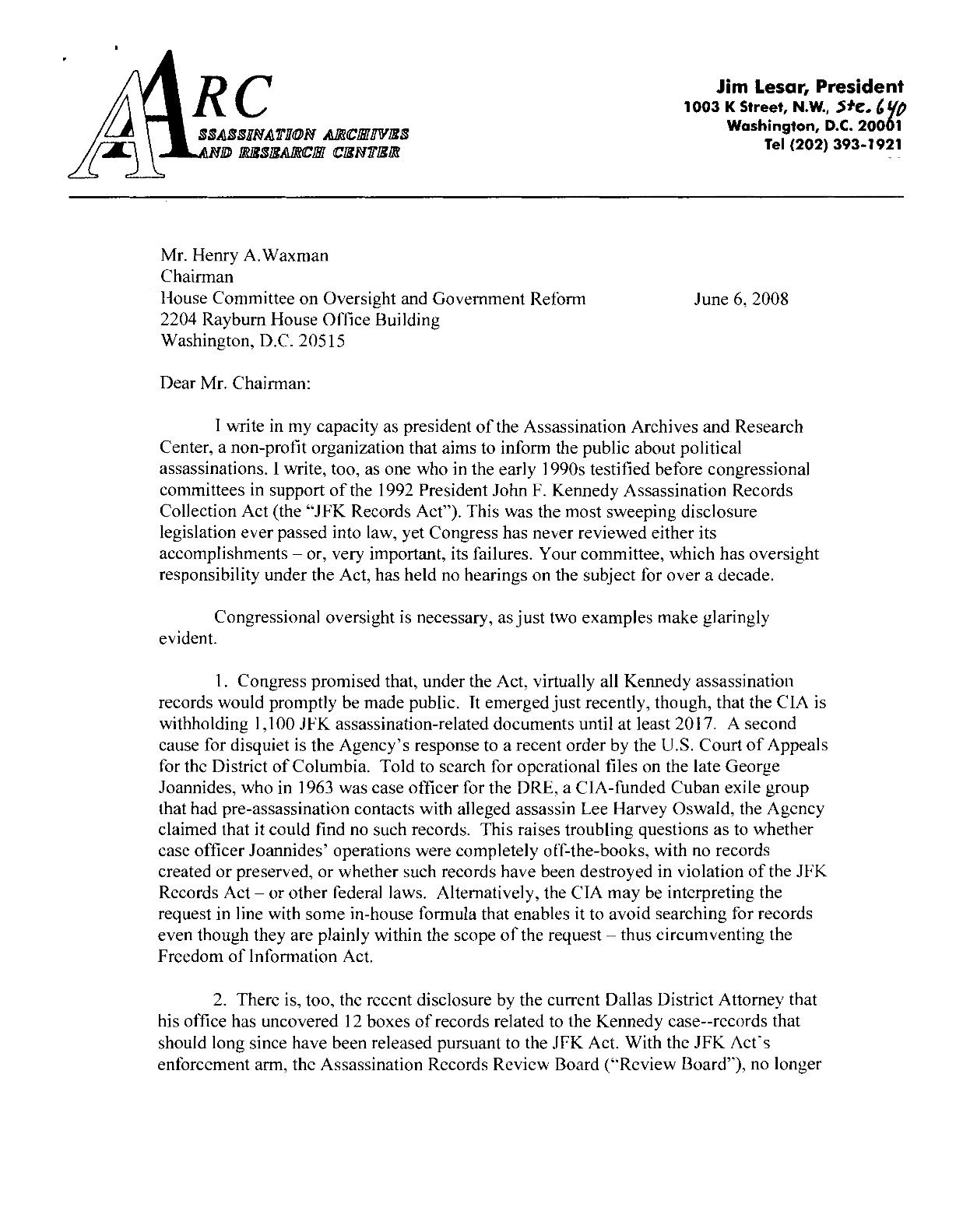
  • Jefferies’ Film and the Bunching of JFK’s Suit Coat

    Jefferies’ Film and the Bunching of JFK’s Suit Coat


    George Jefferies’ recently released film of President and Mrs. Kennedy on Main Street in Dallas taken less than 90 seconds before the assassination has caused some debate due to the bunching of JFK’s jacket seen in the footage. In order to support an Oswald lone gunman scenario, the Warren Commission determined the location of the bullet entrance in JFK’s back was near the base of the neck. This entrance location would allow the bullet to pass through the neck and out the front of the throat in order to continue on to account for the wounds in Governor Connally. Critics of the Warren Commission’s findings have always argued that there was no physical evidence to support this entrance location near the back of the neck and pointed out the bullet holes in the back on JFK’s suit and shirt were located further down in the back. Defenders of the Commission’s findings have always countered that JFK’s suit had bunched up, which accounted for a higher wound in the body despite a lower hole in the suit jacket.

    Let’s look at the facts and evidence. What is the physical evidence to determine the entrance wound to JFK’s back?


    marler


      1. FBI Exhibit 59, JFK’s suit coat, measures the bullet hole in the jacket to be 5 3/8 inches below the top of the collar, and appears to be directly in the middle of the back.
      2. FBI Exhibit 60, JFK’s shirt, measures the bullet hole in the shirt is 5 3/4 from top of collar and about 3/4 inch from center.
      3. Autopsy drawings of President Kennedy conducted by Dr. Humes, shows a bullet hole in JFK’s back that would match the location of the hole in his clothing. Hole is in the middle of back approximately 6 inches down from the neck.
      4. Autopsy photograph of Kennedy’s body shows a bullet hole in Kennedy’s back clearly away from base of neck and matching the location of hole in shirt.
      5. The Jefferies film does show some slight bunching of JFK’s jacket. It is taken on Main Street. Photographs showing JFK on Houston and Elm Street do show a slight crease in the jacket, but no significant bunching.
      6. I have personally conducted several experiments with individuals of JFK’s height and weight (approximately 6 feet and 195 pounds) to determine if waving, moving around, raising shoulders could elevate one’s jacket and shirt to align with an entrance wound near the base of the neck on the right side. Specifically, one is talking about the fabric elevating up 2 3/4 inches and moving to the right 1 3/4 inches. I have never been able to come even close to the necessary bunching necessary to produce an entrance wound necessary to support the lone nut hypothesis. I would strongly encourage skeptics to place a mark on the back of a shirt and conduct their own experiments. Seeing is believing.
        1. The shirt has very little movement. It is buttoned to the neck and tucked into the pants. Even if you unbutton the shirt at the neck area and have someone pull the shirt up, the armpit area prevents any significant movement. Even loose fitting shirts could not come close to producing the Commission’s determination.
        2. The Jefferies film does show JFK’s suit jacket had a tailored fit in that it is snug around the shoulders, arms, and armpit areas. All of this would limit the suit’s upward movement.
        3. The amount of bunching of the suit coat in the Jefferies film is not significant enough to raise the entrance wounds to the base of the neck. It is an experiment that can easily be done. Not only was the upward movement impossible, the fabric twisting or shifting to the right by almost two inches was also impossible.
        4. Given the overwhelming physical evidence of FBI exhibits and autopsy drawing and photographs that show the entrance wound to JFK’s back approximately five inches from the neckline and in the middle of the back, and no other credible evidence to suggest otherwise, it is therefore only reasonable to conclude the entrance wound bullet to the back could not exit JFK’s neck. Without the “magic bullet theory” the lone nut hypothesis fall apart.