Tag: JFK ASSASSINATION

  • Death to Justice: The Shooting of Lee Harvey Oswald – Part 2

    Death to Justice: The Shooting of Lee Harvey Oswald – Part 2


    CIVILIANS OVERLOOKED

    Having laid out the geography of City Hall and the Annex Building basement levels and examining the many points not guarded, therefore could be accessed through, it is now important to focus on the accounts of those present in and around the basement prior to and during Lee Oswald’s shooting.  Given there were just under three hundred statements made regarding the Oswald shooting, it will be useful to group as many present as possible into categories: citizens, law enforcement, and media. And beyond those, specific instances and locations of events. With this approach, we can focus in depth on the many narratives that took place across City Hall during the hours leading up to Oswald’s shooting. 

    The most under-represented cohort of witnesses that day were the civilian employees of both City Hall and the Dallas Police Department. While it is true that none were present to directly witness Jack Ruby shooting Oswald, their testimonies regarding the preparations for the transfer and the aftermath provide important pieces to the overall picture of the puzzle, as it were. However, other than in records of the DPD investigation and the Warren Commission, there is little to no reference to be found regarding these people and their stories – until now. 

    Below is the list of non-Police and media personnel that were at or outside City Hall that morning and who provided at least one statement to the subsequent investigations:


    Fred Bieberdorf – First Aid Attendant

    Wilford Ray Jones – Bystander

    Frances Cason – Dispatcher

    Edward Kelly – Maintenance

    Napoleon Daniels – Former police officer

    Louis McKinzie – Porter

    Nolan Dement – Bystander 

    Johnny F. Newton – Jail Clerk

    Doyle Lane – Western Union Supervisor

    Edward Pierce – Engineer

    Harold Fuqua – Parking Attendant

    Alfreadia Riggs – Porter

    Michael Hardin – Ambulance Driver

       John Servance – Head Porter


       Jerry D. Slocum – Jail Clerk


    Any reasons behind the seemingly random nature of who was and was not interviewed by which investigation remains anybody’s guess particularly when it came to who the DPD did not interview. Consider, for instance, how crucial the testimonies of Dallas locals Fred Bieberdorf, who provided Oswald with first aid after he had been shot, and Michael Hardin, who drove the ambulance that rushed Oswald to Parkland Hospital, ought to have been considered but were not taken. 

    That aside, we will first focus on a group of workers who were employed to ensure the smooth running of all infrastructure across both buildings of the City Hall complex including the basement car park. They were:

    Harold ‘Hal’ Fuqua

    Alfreadia Riggs

    Edward Kelly

    John Servance

    Louis McKinzie

    Edward Pierce

    For the porter and parking workers, their base of work was clearly the car park in the City Hall basement. Their jobs were focused on keeping the area in order, getting police personnel cars parked or ready for use and keeping the general public from parking down there – which was most prevalent when it came to jail inmate arrivals and departures. For the maintenance and engineer workers, their work would take them to all parts of both buildings including the utilities spaces across the sub-basement level. There was also a female standing with the workers who was identified as a telephone operator by the name of Ruth – surname unknown – and it is not evident what her movements were after that point. 

    Once the search of the basement began, all media personnel were apparently cleared out but the City Hall workers remained in the far eastern end of the basement where the stairs and elevators went up to the Annex Building, having already stopped work to watch the comings and goings in preparation for the transfer. To this point, Harold Fuqua even testified to the FBI of observing car trunks being opened and searched.(1)

    Edward Pierce also thought they could stay and watch the proceedings that morning up to and including Oswald’s transfer if they kept out of the way. On the face of it, this was a fair assumption given where they were all positioned: nowhere near the transfer route and out of sight of the television cameras. But they were ordered to clear out of the basement and not just for the time it took police personnel to search it. In his own testimony to the DPD, it was Reserve Officer Brock who gave these orders.(2) And presumably this was done a few minutes after he arrived in the basement for assignment at around 9:30am.

    Collectively, it is clear that the workers followed this directive by taking the service elevator up to the First Floor of the Annex Building. This was because the two public elevators had their power cut and were not functioning. Porter, Louis McKinzie, who was responsible that day for running the service elevator took the group up that way to the First Floor. From there the group would walk across to the City Hall Building to find a place to watch the transfer. Soon, Brock called for McKinzie to bring the service elevator back down so he (McKinzie) could escort, according to Brock’s own testimony to the Warren Commission, ‘one of the TV men over there, (who) wanted to go up the fourth – fifth floor to do some kind of work with the equipment there.’ Both Brock and McKinzie would corroborate that the repair man only spent a few minutes doing whatever it was he was doing up in the upper floors of the Annex Building before being brought back down by McKinzie. There is no testimony from any of the media personnel present that day to explain who this person was and what it was they were doing. After that, Brock told McKinzie to leave the service elevator locked on the First Floor and not bring it back down to the basement. McKinzie did so by locking it in place with a key, then hung it on a hook within as was common practice. In his testimony to the Warren Commission, the time was 10:00am.(3) He then walked along the hallway on the First Floor of the Annex Building to the City Hall Building. McKinzie confirmed in his testimony to the Warren Commission that there were three ‘passageways’ that connected the two buildings. They were on the First (Ground), Second and Third Floor and each could be locked with a metal, accordion-style expanding gate. Over nights and on the weekends, these gates were routinely locked so it is easy to imagine that they were in all probability locked on that day too and that is when Edward Pierce noticed as much and at least unlocked it so he and the others could get through.

    Once in the City Hall Building, the workers, not wanting to miss any of the happenings surrounding Oswald’s transfer, had stayed on the First Floor, and walked to the Commerce Street entrance. From there, behind the locked glass doors they stood and watched the activity outside on Commerce Street and waited to watch Lee Oswald be driven away. This is where Louis McKinzie would rejoin them. 

    It appears that the group stayed together in this location for up to one hour. At which point, Harold Fuqua(4) and Alfreadia Riggs(5) decided to leave to find a television to watch the coverage of the transfer instead. 

    A Circuitous Journey

    Having decided to leave the other workers at the Commerce Street entrance, Harold Fuqua and Alfreadia Riggs set off to find a television. Having both been long-serving employees of City Hall (Fuqua – 6 years, Riggs – 7 years) they would have known that the nearest television was down in the Locker Room in the sub-basement level – two floors directly below. However, given they had been ordered out of the basement as a security measure, and Oswald had still not been transferred, it is understandable that they chose to avoid taking a direct route to the Locker Room as it would have likely resulted in them being turned away or worse, in trouble.

    Instead, they retraced the way they had come with the other workers from the Annex Building. From there, they continued along the First Floor of the Annex Building to the far eastern end where the elevators and stairwell were. As McKinzie had left the service elevator locked on the First Floor, it was in position for them to walk through it and exit through the rear door and out to the fire escape and passage that led directly to the outer door. According to both Riggs and Fuqua in their testimonies to the Warren Commission, it was Riggs who used the keys that McKinzie had left hung up in the elevator to unlock the outer door. He kept them with him but said that he made sure the alleyway door was locked by shaking on the door handle. This is an important point that we will revisit later. 

    Riggs and Fuqua walked through an alleyway to Main Street and began to walk west – along the front of the Annex Building. They then came to the top of the ramp that led from the street down to the basement. This is where Officer Roy Vaughn had been standing guard for at least the last hour. And it was this point where Jack Ruby was most commonly purported as entering the basement in time to shoot Oswald. We will also revisit this location and the comings and goings of people there in more detail. However, Vaughn did confirm in his testimony that ‘some city hall janitorial’ staff approached on foot from the east (6) – which is the direction Riggs and Fuqua would have come from. And they said they stopped at the top of the ramp for only a few moments to look down into the basement before walking on. Vaughn also corroborated this. 

    Riggs and Fuqua rounded the corner of Main and Harwood Streets and stopped below the steps up to City Hall. According to Riggs, Fuqua asked him to go down the steps and check to see if ‘it would be all right for us to go down because we (they) were under the impression they had the police – had a police officer on the door.’ Riggs did so and discovered that there weren’t any officers guarding the basement entrance from there into City Hall so he turned around and told Fuqua to come down. This further reiterates the fact that all public entrances into City Hall that morning were not guarded and therefore secure. Riggs and Fuqua walked down the hallway and got as far as the door before the jail office. There they got close enough to see all of the media assembled. They turned right and headed down the corridor that led to the Records Room, Assembly Room, and the stairs down to the Locker Room. Once down there they encountered someone who was all alone. Let’s pick it up with Riggs’ recollection to the Warren Commission’s counsel, Leon Hubert with what happened next:

    Hubert:  You mean you went down into the locker room? That is where all the policemen have their lockers and there’s a recreation room and television and —

    Riggs:     Yes, sir, and television and – and there was a jail attendant down there, actually he didn’t work in the jail office, he’s not a policeman, but he works in the jail office. 

    Hubert:  What is his name? Do you know?

    Riggs:     No, sir. I really don’t. He told us that he didn’t think they were going to show it on television. He imagined they were going to run a tape and show it later on. Said, “Well, we should have stayed up there. Maybe we could have seen him when they brought him out—”

    Riggs and Fuqua testified to the Warren Commission on the same day – April 1st 1964. This was no coincidence as witnesses were organised into categories, particularly when the WC lawyers travelled to take testimonies. Riggs gave his testimony at 10:30am that day and Fuqua, at 3:55pm. Yet Counsel Hubert, who interviewed both men, did not pursue the question of the unidentified man in the Locker Room with Fuqua. But thankfully, Fuqua corroborated the encounter with the man and that he said he thought the transfer would be shown as reruns only. Yet, Hubert did not ask Fuqua if he could identify him. It can only be chalked up as another thread of questioning that was cut frustratingly early at the quick. So, we are left with some clear questions to consider: 

           Who was the man Riggs and Fuqua encountered in the Locker Room? Per Riggs’ speculation it well could have been any kind of a police officer that he saw or associated with the jail office. And this could feasibly have been any officer from reserve to patrol officer to detective – as all had reason to be there during normal times of operation. But, as we will uncover in later chapters, there is a clear candidate for who the man was that Riggs and Fuqua encountered.

           Why would the man urge Riggs and Fuqua to go somewhere else to observe Oswald’s transfer? The locker room was large enough for them all to sit and watch whatever coverage was broadcast so what was the big deal with redirecting Riggs and Fuqua away?

    Riggs bought a can of chilli from a vending machine, and he ate from it as he and Fuqua left there to go back upstairs. According to both men, they stood in the Harwood Street hallway and were there when Oswald was shot. They both would testify to not seeing it take place, just to hearing and seeing the chaos that broke out. In terms of other people mentioned so far in this book, their position was approximately a couple of metres behind cameraman, James Davidson. 

    After the shooting, Riggs and Fuqua kept out of the way but were able to note that all entrances had been sealed. When things had calmed down, Fuqua testified to the WC that he asked Captain George Lumpkin to escort he and Riggs across the basement car park to the service elevator and stairwell. None of the seven City Hall workers listed earlier in this chapter were interviewed for the Dallas Police investigation, despite being among the most accessible of people to do so. Perhaps, it was because they were all presumed to have not been in the immediate vicinity of the shooting. But Riggs and Fuqua were mentioned in others’ testimony to the DPD such as Roy Vaughn. And others in the basement hallway would have seen them to identify them if only for the uniforms Riggs and Fuqua were wearing. Yet they were still not noted and considered for interviewing. But this does not diminish the fact that their movements reinforce the point of how lax security was across multiple points of the City Hall complex. 

    The Attorney

    Dallas Attorney, Tom Howard’s law firm was situated in one of the buildings across Harwood Street from City Hall. On the morning of Oswald’s transfer, as he would have done, no doubt, many times before, he walked over to the City Jail. On this occasion, he would tell the FBI, he did so because he had received a call from someone in the jail office on behalf of someone else, presumably an inmate.(7) He was able to enter down into the basement level of City Hall from Harwood Street – down the same steps that Harold Fuqua and Alfreadia Riggs had. He did so with the intention of taking the elevator up to the Fifth Floor from the jail office. The obvious inference being that the main entrance from Harwood Street would have been locked – like the ones on Commerce and Main Streets. 

    Having walked down to the jail office, Howard testified that he did get to the elevator there and punch the button to go to the Fifth Floor. He said that he then turned to someone he presumed was a detective and asked if they were ‘fixing to take him (Oswald) out of here?’ Oddly, Howard couldn’t recall if the detective said anything in response. 

    In any event, Howard did not go up in the elevator. Instead, he found his way back out into the hallway. Soon he would notice a ‘sudden jostling and shoving among the newsmen’ and then he heard a shot. He did not see Lee Oswald or Jack Ruby or any of the shooting. Instead, according to his own words, he turned around and simply walked back along the corridor he had entered from, then out onto Harwood Street and stood on the sidewalk. There he would confer with his legal partner, Coley Sullivan, before returning over the road to their offices. 

     Using the testimony of others, we can apply some firm question marks to Howard’s one and only account of his movements in the City Hall basement in the moments prior to Oswald emerging and being shot. 

    Detective Homer McGee told both the DPD(8) and FBI investigations(9) that he was standing inside the jail office. There was an information desk and window which was opposite the elevator that faced out into the hallway. He noticed Tom Howard walk up to the window out in the hallway from either the Commerce or Harwood Street doors. Recall the layout of the basement because, even at that junction, it really was possible to access the basement level from the steps that ran down under both the Commerce and Harwood Street steps. According to McGee, Oswald then emerged from the elevator to be led out for the transfer. As that was happening, McGee said that Howard waved through the window, said that he’d seen all he’d needed to see and walked back up the hallway. Moments later, Oswald was shot. 

    Detective H. Baron Reynolds was the only other person to positively identify Tom Howard in the ‘lobby’ outside of the jail office in the moments just prior to the shooting.(10) And all Reynolds could add was that Howard was standing behind two uniformed officers. Tom Howard is just another case that exemplifies how easy the basement in City Hall was to access, right up to when Oswald was shot. However, what is even more strange about the case of Howard is the fact that, in barely a matter of hours, he would be acting as Jack Ruby’s lawyer. 

    If  Detectives McGee, and to a lesser degree, Reynolds, are to be believed, they put massive holes in Howard’s account of him being in the jail office, getting as far as the elevator, saying something to a ‘detective’ but not recalling what was said to him. So, if Howard was lying about his movements in the crucial moments prior to the shooting, the question must be asked, why? His stake in the events of the day would apparently only come into play after Ruby had shot Oswald. He and his movements were allegedly of no consequence before that point of time. He could have had genuine reason, as a defence attorney, for being at City Hall Jail. His offices were across the road and clients of his were in the jail. But the coincidence of him being there at that point in time and his saying that he had ‘seen everything he had needed to see’ before exiting certainly is curious. 

    We will revisit the matter of Tom Howard in a later chapter but while we are focusing on the vicinity of the jail office, let’s account for the two civilian clerks that were working in there on the morning of Oswald’s shooting.

    The Rest

    Johnny F. Newton(11) and Jerry D. Slocum(12) were not police officers – both were civilian clerks for the jail office. According to their testimonies, that morning was business as usual in terms of the processing of incoming and outgoing jail inmates. Neither testified to venturing away from their workstations, down to the Locker Room for instance, or that they had received any special instructions nor experienced any changes to their workplace. Only Newton would comment about the build-up of police officers and media and his impressions of the shooting aftermath. However, one of his and Slocum’s colleagues, Information Desk clerk, Melba Espinosa, according to Detective Buford Beaty, was not allowed to enter the jail office, where she worked.(13) Frustratingly and confusingly, she would be turned away near the basement car park giving her claim as one of the few people on the receiving end of any kind of strict police guard work that morning. 

    Nolan Dement was one of many civilians who had stopped on Commerce Street across from the ramp opening. It appears that the DPD chose to interview him because he had a camera, and they wanted to ascertain if he had been in the basement and taken any pictures there. He testified that he had not entered the basement and that he did not take any pictures ‘or have anything of worth for the investigation’.(14) He was one of only two bystanders who were interviewed. One can only wonder again why, if Dement was deemed important enough to interview, then why were a multitude of others who witnessed the before, during and aftermath of the shooting overlooked? The other bystander interviewed, Wilford Jones, wandered between the Main Street and Commerce Street ramp openings before and after the Oswald shooting. He was interviewed by the DPD and stated that he was near the Main Street ramp entrance before walking around City Hall to the Commerce Street entrance.(15) When the shooting took place, he walked to a nearby parking lot for no apparent reason before going back to the Main Street entrance where he saw former police officer, Napoleon Daniels, who we will focus on in a later chapter. Interestingly, he recalled then seeing Attorney Tom Howard telling reporters that he heard of the Oswald shooting while on his way home.

    The remaining civilians listed in the table earlier in this chapter will be discussed in the context of what they were interviewed for by at least one of the subsequent investigations. However, as we have already touched on, there are numerous people that witnessed the events that enveloped the shooting of Lee Oswald but were not called on for any of the investigations. So, as we continue to peel back the layer of the onion by scrutinising the many narratives that took place across Dallas City Hall on the morning of November 24, those that have lain obscured will finally be focused on to help piece together more of the overall puzzle. 

  • Randy Benson’s “The Searchers” Now Available for Free Viewing

    Randy Benson has made his documentary film The Searchers available for free on Vimeo. It is well worth watching with people like the late Cyril Wecht, Gary Aguilar, Jim DiEugenio, and the late John Judge. Read more.

  • Review of Film – Fletcher Prouty’s Cold War

    Review of Film – Fletcher Prouty’s Cold War


    The valuable Fletcher Prouty finally has his biographical film. And its also autobiographical; since a good part of it is made up of various interviews with him. 

    Prouty was a military man who interfaced with the CIA for years on end, sometimes speaking directly to Allen Dulles.  After graduating from University of Massachusetts Amherst he began his military career with the 4th Armored Division in Pine Camp, New York. In 1942 he was transferred to the Army Air Force and became a pilot. He began service in World War II in 1943 in British West Africa.  He served as personal pilot to, among others, General Omar Bradley. In October of 1943 he flew a geological survey team into Saudi Arabia  to confirm oil deposits for the upcoming Cairo Conference. He later flew Chiang Kai Shek’s Chinese delegation to Tehran.

    Promoted to captain, he was shifted to the Far East in 1945 and ended up being on Okinawa at war’s end.  When the peace treaty was signed in Tokyo Harbor Prouty flew in Douglas MacArthur’s phalanx of bodyguards and he later shipped out American POWs. All in all, it was a distinguished war record.

    Afterwards Prouty was assigned by the army to start up an ROTC program at Yale. This is where he meet William F. Buckley and he later said he wrote some things for Buckley’s Yale paper. In 1950 he was sent to Colorado Springs to build the Air Defense Command. The mission of this branch was air defense of the Continental United States or CONUS. During the Korean War he served as manager of the Tokyo International Airport during the American occupation.

    In 1955 he began service at the position that would later make him stellar in studies of the John F. Kennedy assassination.  This was as a coordinator for military supplies between the Air Force and the CIA. Which roughly meant that if a CIA covert operation needed an air aspect, Prouty would be the man to consult. His work was so distinguished here that he was promoted to Colonel and became the focal point officer for the Defense Department with the same duties. He retired in 1964 and was awarded a Joint Service Medal by Max Taylor, Chair of the Joint Chiefs. After retirement he worked in banking and the railroad industry.  

    But there was a third area Prouty was involved in after he retired from his long stay in the service.  And that was the writing of books and articles.  Since he did not sign a non-disclosure agreement, unlike others, Prouty did not have to clear in advance what he wrote about his career, his assignments or his knowledge of certain affairs. Therefore, he was one of the first to disclose secret information about men like James McCord and Alexander Butterfield, both involved in the Watergate scandal. The former was not just a technician, and the latter—as Prouty learned from Howard Hunt– was a CIA contact in the Nixon White House. 

    Jeff Carter has now made a film about the fascinating life and career of this unique character.  The first part of Fletcher Prouty’s Cold War deals largely with the man’s military background.  And Carter goes into much more expansive detail than what I have sketched above.  But beyond that the film handles all of this information with skill and agility.  Carter did an admirable job in finding back up pictures and films to fill in the foreground and background of some very important points in Prouty’s career that happen to intersect with modern history. For instance, while at Okinawa, Prouty saw literally tons of equipment being landed and warehoused for a possible invasion of mainland Japan.  But since Japan surrendered before any such invasion, these arms were transferred to Indochina since Ho Chi Minh had been resisting Japan in the August Revolution.

    There are also valuable insights about how Allen Dulles started the Cold war with his part in Operation Paper Clip.  This was the transference of top grade Nazi scientists from Germany to the USA to play a role in designing modern weaponry against Russia. That agreement, of course, was accompanied by General Walter B. Smith with a parallel agreement. This one made between the OSS and Reinhard Gehlen to have the former Nazi spy chief take his information about the Russians from Germany’s eastern front to Washington DC. This was quite natural for the Dulles brothers—Allen and John Foster–since their law firm, Sullivan and Cromwell, was active in business dealings in Germany until 1939. Therefore between the brothers and John McCloy, High Commissioner for Germany, the decision was made to go easy on the former Nazi regime in order to ramp up for our new enemy, Russia.

    The film deals with another subject that was relatively ignored until Prouty repeatedly pointed out its importance. This was the Dulles-Jackson-Correa Report. That 1949 document was 193 pages long and was critical of what the CIA had done so far and also the performance of the Director, Roscoe Hillenkoetter. That report stated the CIA was not coordinated to meet national security interests, did not supply accurate National Intelligence Estimates often enough, and did not have a single office yet for covert and clandestine operations.

    The ultimate impact of this report was that Hillenkoetter resigned over his failure to predict the invasion of South Korea, and Walter B. Smith became the new DCI. One of the authors of the report, William Harding Jackson, became Smith’s deputy. And Smith and Jackson implemented that report into the Agency.  Thus the CIA now became more of a covert action rather than an intelligence gathering group.  And when Dulles became Deputy DCI and then Director, this aspect fully flowered.

    Prouty wrote a series of memorable articles for various publications in the seventies and eighties.  These essays displayed an intimate knowledge of contemporary American history, characters , American conflicts in world affairs and just how the CIA worked, both abroad and domestically. For instance, he was one of the first to point out that the Agency had lists of cleared attorneys and doctors in major cities who could be called upon to cover up certain crimes the CIA committed. A document proving such was the case was later declassified by the Assassination Records Review Board (ARRB, see The Assassinations, edited by James DiEugenio and Lisa Pease, p. 35)

    Along with Peter Scott, Ken O’Donnell and Dave Powers, he was one of the first to argue—contrary to conventional wisdom—that President Johnson had seriously altered Kennedy’s policy in Vietnam.  Fletcher Prouty was aware of this since he worked for General Victor Krulak. And Krulak was very closely involved with Vietnam policy in 1963.  As time went on, Fletcher also became more and more interested in the assassinations of the sixties, especially the murder of President Kennedy.  There was a now famous exchange of letters between Jim Garrison and Prouty over the former DA’s book, On the Trail of the Assassins. Prouty was appreciative of Garrison’s efforts. So as Jeff Carter’s film notes, when Oliver Stone talked to both Garrison and his editor, Zach Sklar—who became co-screenwriter of JFK—those two urged him to get in contact with Fletcher.  

    As Prouty notes in the film, only half-humorously, if he would have known what was about to happen to him, he would have run for the hills.  To understand how this happened one needs to be reminded of the fact that the character of Mr. X, so memorably delineated by Donald Sutherland, was based on Prouty.  And it was through that character that the film JFK exploded the myth that Johnson, after Kennedy’s assassination, had continued Kennedy’s policy in Vietnam. 

    That explosion, quite literally, was a shock to the system. In retrospect we can see that the entire establishment—the MSM, academia, Washington—had cooperated to, not just hide the facts, but to also marginalize the voices that had tried to reveal the truth about this epochal tragedy. And they had done this assiduously for close to thirty years.  The combination of the film presenting the hidden record so dramatically and effectively, plus showing how Garrison was exposed to it at the time—which, as the ARRB proved, was also accurate—was just too much.  Too many people were now shown to be utterly and completely wrong e. g. New YorkTimes journalists David Halberstam and Neil Sheehan. Plus, as the film suggested–because the policy reversal was so abrupt—it could have been the reason for Kennedy’s assassination. For as JFK demonstrated, the Warren Report was a false document. Lee Harvey Oswald had not killed President Kennedy. 

    Sutherland’s role as Mr. X in the film was a tour de force. And during the memorable walk he took in Washington with Garrison (Kevin Costner), the information that X conveyed about the overseas crimes of the CIA was all accurate information. And Prouty was there for much of it e.g. the secret war against Cuba.  

    But it was what Sutherland said about Vietnam that was so disturbing.  One reason being that just four months after the 26 volumes of the Warren Commission were issued, the first combat troops landed in DaNang.  An escalation that Kennedy would simply not countenance. (Lessons in Disaster, by Gordon Goldstein, p. 63) Further, the film took proper notice of NSAM 263.  That October 1963 order was to begin Kennedy’s withdrawal plan in December, to be completed in 1965.  Prouty knew about all this since, through his superior, Krulak, he worked on the withdrawal program. (John Newman, JFK and Vietnam, second edition, p. 408).  As he says in the film, the actual Taylor/McNamara report was ready and waiting to be handed to the visiting delegation upon their return.

    In other words, what Mr. X/Prouty, was saying in the film was this:  if Kennedy had lived, 58, 000 Americans, 3.8 million Vietnamese, and 2 million Cambodians would not have perished. America would have been spared ten more years of civil strife and massive demonstrations.  And the rebuilding of Vietnam would have begun much sooner.  What Stone and Sklar were also saying was this: there had been a cover up about this colossal matter, and just about the entire establishment was complicit in it.

    Because Prouty was the figure in the film that conveyed this rather powerful message, both the information, and the messenger were singled out for attack by the likes of George Lardner, Robert Sam Anson and Edward Epstein. (For my specific reply to Epstein, click here https://www.kennedysandking.com/john-f-kennedy-articles/the-abstract-reality-of-edward-epstein

    What these three journalists all had in common was that they had previously attacked Jim Garrison back in the sixties and seventies. They were not going to stand idly by while they were belatedly proven wrong. So they all attacked Stone’s film, which because of their proven bias, they should not have been allowed to do.  In fact Lardner and Anson did so before the film was actually released. (See The Book of the Film, by Oliver Stone and Zack Sklar, pp. 191-98; 208-229) All three men either went after Prouty or disputed the information that Prouty (and historian John Newman) had supplied to director Oliver Stone about Vietnam.

    But here is the ultimate irony.  The declassifications of the ARRB proved beyond reasonable doubt that the film, and Prouty, were correct. In the documentary film, JFK Revisited, are displayed the records of the May 1963 Sec/Def conference. Those records were so compelling that even the New York Times had to admit that Kennedy was planning to get out of Vietnam at the time of his death. (See the book JFK Revisited, by James DiEugenio, p. 186) So, bottom line, this was all Sturm and Drang about Prouty to disguise the fundamental truth that he and Stone were correct about Kennedy’s withdrawal plan from Vietnam. (For more on what Anson tried to do to Prouty, click here https://www.kennedysandking.com/john-f-kennedy-articles/fletcher-prouty-vs-the-arrb

    The film deals with other controversial subjects which Prouty has special knowledge of, for example, the Suez Crisis of 1956, where Israel, France and England tried to dislodge Nasser as the leader of Egypt. In this episode, Fletcher concentrates on the duplicity of Foster Dulles and how he set up Anthony Eden to take the fall in the affair. His discussion of the U2 shootdown is also quite interesting since he thinks that Gary Powers’ flight was sabotaged.  The motive being to sandbag the upcoming May 1960 Summit Meeting in Paris.  Prouty also discusses how the Bay of Pigs mysteriously morphed from the time it was being planned by Richard Nixon and the CIA—then it was a guerilla action with 300 men—to the time Kennedy was inaugurated, where it was now training almost 3000 men. Prouty has always stressed the importance of the Taylor Commission afterwards, where Bobby Kennedy went after Allen Dulles tooth and nail.  It was here that RFK began to suspect that the operation was never expected to succeed, and that its imminent failure would be used to coax JFK into using the Navy to intercede.

    All in all, this is a worthy tribute to a worthy man. One  who was unjustly smeared, even by those in the critical community. Jeff Carter has interweaved several interviews with Fletcher by people like John Judge, Dave Ratcliffe, Bruce Kainer, and Len Osanic for maximum informational effect.  And there is a concluding interview with Oliver Stone which was done in Vancouver.  Here the director gives Fletcher Prouty the praise he deserves for the solid and valuable information he contributed to his landmark film.  

    From which, the establishment never recovered.

    The film may be watched here:  https://vimeo.com/ondemand/fletcherproutyscoldwar

  • 2024 CAPA Conference

    2024 CAPA Conference

    capa2024 banner 1

    The details of the 2024 CAPA JFK Assasination Conference in Dallas may be found here. Read more.

  • New JFK Assassination Film

    A new piece of film depicting the immediate aftermath of the jfk assassination will go up for auction in three weeks. Read more.

  • Congressman Seeks JFK Document Release

    Congressman Steve Cohen Urges Biden to Release Remaining Documents in the JFK Assassination. Read more.

  • RFK Jr. and the Unspeakable: Why This Historic Moment Matters

    RFK Jr. and the Unspeakable: Why This Historic Moment Matters


    When Bernie Sanders ran for president in 2016, he raised nearly a quarter of a billion dollars in grassroots donations to challenge Hillary Clinton for the Democratic nomination. After he dutifully backed out and endorsed the candidate chosen by the party’s super delegates, a lot of his supporters reportedly ended up voting for Donald Trump in November. When a reporter asked him how he felt about ex-members of his camp voting against Clinton, Sanders answered: “Wrong question.” If so many of his followers had decided to turn to someone whose policies were anathema to his own, he asked, then they must have been pretty angry about something, right? The media, he suggested, should figure out what ordinary voters are so mad about instead of blaming him and his populist movement for Hillary Clinton’s defeat.

    While it’s true that the campaign of Robert F. Kennedy Jr. and Nicole Shanahan has not raised Bernie-levels of grassroots cash, it’s also true that ordinary voters have less disposable income than they did eight years ago. What RFK Jr. did do, however, was gather over a million signatures nationwide through the mobilization of some 100,000 volunteers for access to the ballot in all 50 states and the District of Columbia. Sanders never had to worry about ballot access in the Democratic primaries. For some reason, RFK Jr. was not only shut out of the party’s nominating process; he also had to qualify the “hard way,” as an independent, when he finally gave up on the once-upon-a-time party of his father and uncle. 

    Thus began one of the ugliest and most vicious assaults on a presidential candidate in recent memory. Even though he decided to run as an independent, the Democratic National Committee (DNC)  launched a well-financed “lawfare” campaign through the courts to block him from the ballot in the general election. This was when he was taking more voters away from Trump than Biden! DNC-friendly mainstream media lent this discrimination campaign a helping hand by censoring him from their airwaves as much as possible. Joe Biden disgraced his presidency by denying him Secret Service protection until two days after the assassination attempt on Trump, and nearly 15 months after Bobby announced his own candidacy. Now that he’s formed a coalition with Trump, it’s fair to echo Sanders and say his supporters might have been a bit angry also.

    As someone who has volunteered for Kennedy’s campaign since shortly after he declared his candidacy, I confess to brief shock at the announcement that he was suspending his run, endorsing Trump, and calling on his supporters to refrain from voting for him in about ten “battleground states.” Those ten might include my own, Virginia, where “RFK2”– as he’s sometimes known–polls relatively high. But I’m over it. 

    In 1968, many supporters of his liberal father’s presidential campaign transferred their vote to George Wallace, very possibly in sheer protest at RFK’s untimely and highly suspicious demise. For all his faults, New York real estate mogul Donald Trump is neither the racist Alabama governor nor his running mate, warmongering Gen. Curtis LeMay, who may have been smoking a cigar in the autopsy room during the postmortem exam of President John F. Kennedy, a man he hated. Trump has never smoked, and Wallace would have thoroughly disdained Trump’s Oval Office photo ops with African-American admirers.

    With his stance on tariffs and no taxes on tips or on Social Security, Trump claims the mantle of a populist;  and whether he is or not, elites do not like populists. They did not like Sanders either. But the neocons among the “Never Trump” crowd – e.g. Bill Kristol and John Podhoretz – despise Trump mostly for what they perceive as his “nativism,” which embarrasses them as members of the urban-liberal intelligentsia. Trump’s potential isolationism (he started no new wars) is the worst of it and frightens them to this day. Yet even a populist-nativist isn’t necessarily a “threat to democracy.” I think many people sincerely believe Trump is a threat, and I respect that, but I don’t see it myself. January 6th was a tragedy, and Bobby Kennedy Jr. has described Trump’s actions during that violent, vandalistic riot as “reprehensible.” Personally, I’ve never believed Trump intended or foresaw what happened, even if he bore blame through his recklessness or negligence. 

    Moreover, three and a half years later, we have to ask who poses the greater threat to basic freedoms?  Was it those involved in the insurrection or the authorities cracking down in its aftermath? 

    A recent article by Margot Williams at Jefferson Morley’s JFK Facts (a Substack I write for), explains the excesses of federal law enforcement, which even now is rounding up and arresting people who did no more than enter the Capitol and walk around after a (small) advance mob broke in a door with a battering ram under the eyes of the immobile police. 

    RFK Jr. and the JFK Assassination

    At a fundamental level, ending the toxic polarization of American society over the last decade and figuring out how to end it has always been the main theme of the RFK Jr. campaign. But the causes of our current social crisis are deep-seated, rooted in history, and I think they find their origin in the assassination of President Kennedy in 1963, before I was even born. After much study, I now hold the sincere conviction that this isn’t just a historical issue but an extremely important current one too. Every historic episode is both a cause and an effect, but many of our problems lead through November 22, 1963, when the fundamental nature of our government changed. Jeff Morley, who has done invaluable pioneering research into the JFK assassination, opines that it isn’t the most important issue facing America today: people have bills to pay, jobs to hold down, kids to put through school. When ordinary folks are thinking day-to-day about making ends meet this week, they aren’t thinking about a violent event from generations ago. I understand that.

    But whatever John Q. Citizen is thinking as he goes about his day, I respectfully disagree with the JFK Facts editor-in-chief. It doesn’t necessarily follow that an issue is less important because most Americans think so. The “Great Crime” must stay alive as an issue in current U.S. politics and society until it’s resolved to the satisfaction of serious historians and researchers at large. Only one campaign now pledges to address that: Donald J. Trump and his new ally, Robert F. Kennedy Jr. 

    The murder isn’t just a fetish for conspiracy freaks and assassination hobbyists. It is a seminal event that still affects us. Thanks mostly to the political and media influence of RFK Jr. this election cycle, it is a live issue now as well. It may be a long shot to expect Trump and the GOP to seriously do any justice to it, but a long shot is better than no shot at all. Maybe a re-elected President Trump will have no power to force disclosure on the 61-year-old atrocity;  because maybe, as some believe, all presidents are only cyphers of the national-security state. But while cynicism makes some people feel superior, it doesn’t do it for me.

    Regarding transparency over the still-withheld files related to the assassination of JFK, Trump has already disappointed “bigly.” His postponement of full disclosure in 2017 only aroused more public discomfort and mistrust. Yet if Trump was bad on the JFK files, President Joe Biden has proven to be worse.  He is not only postponing release of the remaining withheld assassination records but also announcing the “final certification” under the JFK Records Act. Congress’s unanimous passage of that law in 1992 prevented President George H. W. Bush from vetoing it, and Biden himself voted for the law as a senator. Worse, instead of honoring the spirit and letter of the law to serve the public interest–as attorney Andrew Iler showed–Biden devised a new scheme to conceal the records and replace the JFK Act. 

    This scheme, known as the “Transparency Plan,” was devised by the CIA-led national security apparatus and essentially guts the 1992 federal statute by burying its timeframes and requirement of periodic review. By executive order, Biden handed all declassification decisions over to the CIA and other unelected agencies in control of relevant records, washing his hands of the process forever. In doing so, Biden not only grievously abused the public trust. He probably didn’t even see any records before making his fateful decision. Already in cognitive decline, he very likely just signed where he was told to sign and forgot about it. At least Trump claimed he saw something, at least according to Judge Andrew Napolitano. It’s just that what he saw was so bad, he felt he had to bow to the will of the national security state and keep it under wraps. 

    But Biden? Nothing. Now his vice president, the Democratic nominee for his job, is eventually going to have to make her own position known on JFK. Does Kamala Harris even have an opinion? Born after the assassination, she has – to the best of my knowledge – never expressed any view at all. With any luck, the subject will come up in the upcoming Trump-Harris debate, but how will Harris “get out in front” on the issue when her boss has already tried to bury it? Trump will be able to comment first-hand, but I see no cause for optimism from Harris. I therefore have little compunction over favoring Trump right now.

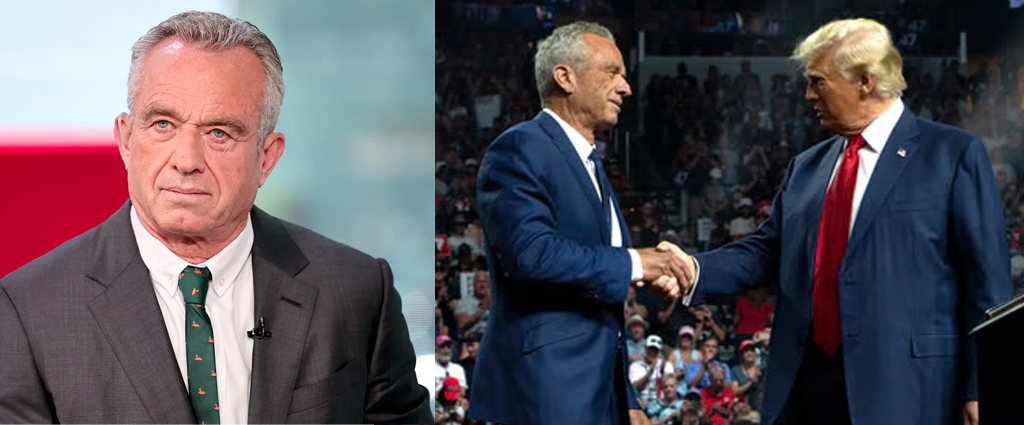
    The issue of transparency in the JFK assassination isn’t the exclusive reason I decided to support RFK Jr. for president, but it’s at least tied for first place. I already knew his position on his uncle’s assassination – as well as his father’s – and that made him a qualitatively different and unprecedented kind of candidate. But on Friday, August 23rd, confronted with the image of him on stage with Donald Trump in Arizona, I admit I trembled a bit. The former president graciously introduced RFK Jr.  as having “lost his father and uncle in service to our country.” He vowed to establish an “independent presidential commission” to revisit the JFK assassination and release all the withheld records. I imagined RFK Jr. standing there, waiting to speak, exhilarated at coming as close as anyone in the last 60 years to doing what Dorothy Kilgallen said she was going to do right before her mysterious death. 

    Maybe Bobby wasn’t thinking that at all, and when he took the podium, he never even mentioned the JFK assassination. He talked, as usual, about public health, endless war, and censorship. But I wanted to believe he was consciously hoping President Trump would speak to that morbid tragedy in Bobby’s own family for him, and that Bobby – like all of us outside the inner circle of the national security state – still put a top priority on finding out what happened to his uncle. This was probably the best chance he had ever had in his lifetime. Whether Trump was only prompted by the recent attempt on his own life seemed immaterial at that moment. The point was: millions of people were watching and listening. It was live.

    Again, full disclosure over JFK’s murder continues to be a matter of vital public interest. Without at least an official rejection of the official history as currently disseminated by government and mainstream media, Americans won’t even have a version of events that is closer to the truth than what their government now peddles to them. We will continue to languish in a social sickness complementary to the physical degradation Kennedy so passionately wants to reverse, and about which he continually warns us. We need the topic of the JFK assassination in the news cycle now more than ever, so that it resonates into the next administration and stays in the public memory, no matter who wins. In Oliver Stone’s JFK, Jim Garrison paraphrases Tennyson: “Do not forget your dying king.” To find out what happened, we have to resist forgetting.

    Kennedy, Trump, and Harris

    Whatever the political fallout from the Trump-Kennedy coalition (liberal MSM commentators quickly united in their attacks), I have no regrets about supporting RFK Jr.’s campaign. The dominant experience of working with other RFK Jr. volunteers was, primarily, an absence of hate. Plenty of fellow campaign workers had voted for Biden in 2020, and plenty of others for Trump. But when handing out campaign literature or soliciting signatures for ballot access, the only hate we ever encountered came from obvious Biden supporters. They would hiss at us, sometimes spitting inadvertently in the process, their faces red as tomatoes, telling us we were a “disgrace” or “dangerous” or should be “ashamed.” Trump supporters would sometimes refuse to sign our petition forms, but they were never mean or unhinged. The “Bidenista” passers-by were manifestly contemptuous, sometimes calling us “nuts” or “crazy” even as they boiled over right in front of us.

    How different from that experience could Bobby Kennedy’s have been at the level of the DNC high grandees? He and running mate Nicole Shanahan both said that the Biden-Harris people had refused even to speak to them, whereas the Trump campaign was at least willing to meet. Under these circumstances, why would anyone blame RFK Jr. for giving up on cooperation with the arrogant Biden-Harris cabal? Would anyone passionate about issues of vital public interest, who meets a brick wall from one side and an ajar door from the other, go on bashing his head repeatedly against the bricks and mortar? 

    Maybe a significant percentage of RFK Jr. supporters now refuse to back him for endorsing Trump as a means of advancing his own agenda of peace, public health, and free speech. I haven’t met any yet. But at the end of the day, faced with the Democratic Party’s well-financed litigation drive to keep him off the ballot, plus censorship by overwhelmingly DNC-friendly mainstream media, Bobby evidently felt he had to choose between doing something or doing nothing. He decided to do something, to take a chance on Donald Trump honoring an agreement to prioritize the issues closest to him. Even if Trump reneges on his pledge of full disclosure in the JFK assassination, I think Bobby did the right thing. 

    The drab, uninspiring Democratic Party long ceased to be the party of RFK Jr.’s uncle and father. It is not the party of FDR, JFK and RFK. It is the party of LBJ, a corrupt, brutal scoundrel desperate to use the White House for the public adulation he craved. The long-term symptom of LBJ is the Democratic Party of today. And the DNC hit squads are part of this LBJ apparatus. (NY Times, May 2, 2024 online edition or May 4, 2024 print edition, article by Michelle Cottle: “The Drive to Tell Voters What They Don’t Know About R.F.K. Jr.”)

    It is largely a party made up of elites.  Nancy Pelosi ushered out Biden, and after, there was no competition from anyone to take the spot.  Not even a token of a debate took place. And, if one recalls, there was no debate during the Democratic primaries, or what passed for primaries. Harris was anointed, she was not in any way elected.  How interesting that process becomes when compared with how Robert Kennedy Jr. was treated in the media. This is democracy?

    The censorship Kennedy speaks about is not conspiracy theory. It’s real and palpable, and Facebook CEO Mark Zuckerberg now confirms publicly that “deep state” goons pressured him to censor content related to COVID-19 and other subjects. Moreover, the “censorship-industrial complex” (as RFK Jr. calls it) traces its roots to November 22, 1963. In interviews, Bobby has repeatedly recommended James Douglass’s influential book, JFK and the Unspeakable (2008), which refers to a systemic evil, a “void” permeating official policy and discourse, making it soulless and hollow. The assassination put a kind of “final seal” on what had built up over the previous decade and a half, as an unaccountable “deep state” acquired more and more power at the expense of elected authorities. That power manifests itself everywhere, particularly through censorship. Scholarly writers, researchers, and historians of the JFK assassination are marginalized and deprived of the big, lucrative book deals and promotions, as well as prestige. There is no meaningful difference between “muzzling” these writers and state censorship.

    Ironically in the so-called “information age,” the idea that certain things are “unspeakable” is still strong. Six decades after the assassination of JFK, and 56 years after the murder of RFK, Bobby Kennedy Jr. has exhumed a range of issues buried under a mass of mainstream media talking points developed over generations. Possessed of a collective blindness residual of the Cold War, most Americans have ignored the “forever wars,” dietary and environmental toxicity, the waste of our economic resources, and the decline of our civic consciousness. A drug-addled, unhealthy nation, we’ve received a big wake-up call from RFK Jr., who has brought issues of vital public interest back into popular discourse. For instance, the revolving door between big pharma and public health agencies.

    The issues that Kennedy leads with – (1) the war in Ukraine, (2) chronic illness and disease, and (3) the mainstream-media censorship regime – are all the product of the rise in power of the unelected national-security apparatus, which secured its dominance over the political system after passage of the National Security Act of 1947. President Truman signed it into law, giving official birth to the Central Intelligence Agency. As soon as President Kennedy was assassinated, Truman sat about writing an op-ed for the Washington Post, essentially lamenting the effects of a law he was responsible for enacting. He suspected the CIA was involved in the murder of his young successor, and that suspicion permeates his op-ed. 

    The CIA had gradually accumulated more and more power under President Eisenhower, who would warn the public about the dangers of the “military-industrial complex” in his farewell speech in January 1961. By the time JFK attempted to resist its power, it was too little, too late. The title of David Talbot’s book, The Devil’s Chessboard: Allen Dulles, the CIA, and the Rise of America’s Secret Government  (2015) is no cliché. Our unaccountable “secret government” is the biggest open secret in America today. Only one candidate talked about any of this in any detail, and that is RFK Jr. It was probably that, plus his opinion of Anthony Fauci that sealed his fate at the starting gate.

    The Biosecurity Agenda and the ‘Anti-Vaxxer’ Pejorative

    One issue remains largely “unspeakable,” as mainstream media and government barriers to talking about it are still mostly intact. It is what RFK Jr. calls the “Biosecurity State.” The most recent manifestation is the attempt by governments worldwide to restrict freedom in societies over which they preside. The method is known as “PPR” – pandemic preparedness response. The World Health Organization declares a “pandemic,” and national governments stand ready to impose a series of measures, including lockdowns, school closings and other mandates, thus curtailing basic liberties. Behind PPR and restrictions on human freedom stands the obscenely profitable pharmaceutical industry – “Big Pharma” – which rolls out “cures” as soon as it can scare everyone enough. The gravy train is then off and running again. Anyone who dismisses as “conspiracy theory” the idea that Big Pharma is irretrievably corrupt should read a book by a bête noire of Warren Report dissenters everywhere, Gerald Posner’s Pharma: Greed, Lies, and the Poisoning of America (2020). When Kennedy calls Big Pharma a “criminal cartel,” he’s being gentle.

    Many educated people seem to shrug all this off, but many of us are sincerely alarmed. RFK Jr.’s recent book,  The Wuhan Cover-Up and the Terrifying Bioweapons Arms Race (2023), traces the historical continuity between Pentagon and CIA experimentation and abuses at Fort Detrick, Maryland.  This began around the late 1940s,and it spread to the Wuhan Institute of Virology in China in 2020. Which is where former National Institute of Allergy and Infectious Diseases (NIAID) director Anthony Fauci took his “gain of function” research after the Obama administration imposed a temporary moratorium on that dangerous activity within the United States. Kennedy’s previous book, The Real Anthony Fauci: Bill Gates, Big Pharma, and the Global War on Democracy and Public Health (2021), gives scholarly content to a now-widespread perception that the longtime, powerful, and highly-paid NIAID chief is corrupt, self-serving, and responsible for serious public health policy abuses in service to the bottom line of both himself and Big Pharma e.g. the whole disastrous AZT as a cure for AIDS debacle. Fauci has never even hinted at suing Kennedy despite the book becoming an instant bestseller. And it is not just RFK Jr. who has made these charges against Fauci.  Senator Rand Paul has done the same against both Fauci and Gates. Senator Paul wanted to charge Fauci for lying to congress about gain of function research and how this caused the breakout of CV 19 in Wuhan.

    Although RFK Jr. has never led with the issue specifically, he is not shy about explaining his vaccine safety advocacy in the face of accusations that he is a “nut” or (per the first sentence of his Wikipedia page) a “conspiracy theorist.” Most citizens of the industrialized West have been vaccinated for different things at various points in their lives, and I make no exception of myself. Neither does RFK Jr. But the COVID-19 pandemic ushered in tyrannical new rules about the subject.

    RFK Jr.’s Children’s Health Defense (CHD) advocacy group and its online periodical, The Defender, offered scholarly analysis for anyone entranced by the three-letter public health agencies’ scare-mongering for Big Pharma. But they had to be aware of CHD in the first place. CHD should have acquainted everyone with the “Biosecurity State” before censorship of mass media and internet in the democratic West really ramped up, since Kennedy had been warning of it for years. But social media – to say nothing of the MSM – suppressed it. Those of us who had never felt blunt censorship in America could see social media “moderating” or deleting posts for even questioning public health policy by the end of 2020. The words “false” and “falsely” became mantric in MSM, intensifying after President Trump publicly charged that the 2020 election result reflected fraud. 

    The censorship situation in the West became extreme after the “warp speed” rollout of the COVID-19 vaccines, when even wire services openly branded anyone daring to question their safety or efficacy “conspiracy theorists” promoting dangerous views. RFK Jr. became super-prominent among the targets of coordinated attacks by legacy outlets of America’s ostensibly “free press.” The pharmaceutical industry’s power over supposedly neutral organizations like Reuters and AP had been more subtle, but by the end of 2020, the “corrupt merger of state and corporate power” was brazenly and frighteningly visible every day. Another target was author Naomi Wolf, who had written more than one bestseller and was an advisor to both Bill Clinton and Al Gore.

    Friends’ acceptance of my choice to rely on my innate immune system in confronting COVID-19 has, at least, reassured me. Others have been less fortunate. The family of an unvaccinated American friend overseas told him if he wanted to come home for Christmas, he had to be COVID-jabbed. He spent Christmas of 2021 alone in a country that doesn’t even celebrate it. 

    As time has passed, and more and more vaccinated friends have contracted COVID: Jim DiEugenio contracted it twice. The realization that people like me aren’t as loony as they first imagined has become more ingrained. The full symptoms of my own bout with COVID-19 lasted four or five days. After no longer testing positive, I felt even more confident of the benefits of strengthening natural immunity. 

    Even vaccine enthusiasts have to admit to a level of adverse side effects never seen before, since this is a matter of official record, not theory. It isn’t necessary to indulge in conspiracy theory to conclude that the COVID-19 vaccines have never been proven totally safe. The CDC’s own Vaccine Adverse Events Reporting System (VAERS) has received more reports from the COVID-vaccinated than for all previous vaccines combined, yet in the late 1970s, the “swine flu” vaccine was withdrawn after a tiny number of recorded Guillain-Barré Syndrome (GBS) cases. Many more GBS cases have been recorded for the COVID-19 jabs. Again, the best explanation for why the COVID-19 vaccines survived is record levels of state and corporate stipulation. No matter how much others claim to “believe in” the COVID-19 vaccines, there is no basis for “trusting” the companies producing them. They trade in year-end profits, not long-term public health. Whatever COVID vax advocates argue, skeptics have the right to remain skeptical, especially since we cause no increased harm to anyone by remaining “jab free.”

    Warp Speed and Political Orthodoxies

    One does not have to conceive of a “plandemic” designed and implemented by a “high cabal” to reduce the world’s population through vaccine mandates. Corruption and greed can explain what happened, and why it should not happen again. After all, Operation Warp Speed broke several rules in its haste to come up with a vaccine. But there is still an important point to be made, and I felt it most intensely when I attended RFK Jr.’s “Defeat the Mandates” protest in front of the Lincoln Memorial in Washington in early 2022, with SWAT teams on the roof and police helicopters circling loudly overhead. That point is, no matter how much our friends, family, or anyone else may show tolerance toward our refusal to be vaccinated for COVID-19, if universal mandates were ever imposed, the overwhelming majority of these “friends” wouldn’t lift a finger to defend our right to refuse them. One can easily picture them, instead, shrugging, wishing us “good luck,” and sauntering off to comply with the latest Biosecurity-State rule. In short, we have to defend our own civil rights, and RFK Jr. is the most powerful tribune for our cause. 

    Among those of us who have never availed ourselves of the COVID-19 vaccines, the sense of freedom to speak more loudly about our personal choice is much stronger today, in no small part thanks to RFK Jr. His supporters – vaccinated and unvaccinated – overwhelmingly oppose mandates, and the diversity of his base reflects a healthy political realignment, resurrection of wholesome social values, and reintroduction of vital interests to public discourse. 

    As people like Jimmy Dore have shown, the  MSM relies on Big Pharma accounting for a disproportionately large share of its ad revenue. Consequently, it  has already trotted out more pharmaceutical execs posing as “independent experts,” telling us we need to mask up and get the next shot. But yet, neither Peter Hotez nor Jake Tapper for two, would debate Robert Kennedy Jr. Robert Kennedy’s response to Hotez was that he was not talking about a conspiracy, he was talking about an orthodoxy which had taken hold, one that stated silence was the best course; so many smart and moral people decided that the best road was to keep your head down and move forward.

    Reportedly Trump has offered Kennedy a role in his transition team, one in his health program, and one on a commission to declassify all the records on the JFK assassination. These negotiations began right after the attempted assassination of Mr. Trump in Butler, Pennsylvania. At the start the Vice Presidency was on the table, which Kennedy refused outright. Two of the go betweens in the talks were Calley Means, a preventivve health care advocate, and Tucker Carlson who had Kennedy on his much watched program. (NY Times, 9/2/24, story by Maggie Haberman).

    It is interesting of course that these negotiations began after Butler, since RFK was the only candidate talking about the subject of assassinations for months on end. And reportedly it was Carlson—who has famously defied the MSM orthodoxy in the JFK murder– who first connected the two candidates via text message. (ibid). As former RFK manager Dennis Kucinich has noted, the DNC had shown no such outreach to the candidate.  In fact, they had done all they could to sabotage him, similar—and perhaps worse–than what they did to Sanders. (Ibid, NY Timesarticle by Michelle Cottle) The DNC started 9 nuisance lawsuits to keep Kennedy/Shanahan off state ballots; they sandbagged particular events; and according to a talk show interview by VP candidate Nicole Shanahan, they even sent in double agents to certain offices. (Click here for this revealing interview https://www.youtube.com/watch?v=lAqVn5lRdes). And the whole time, Kennedy was denied Secret Service protection, thus forcing his campaign to spend hundreds of thousands per month on private security. This was startling,  considering the history of that family.

    If the alliance with Trump does not, in the end, produce meaningfully greater transparency in the assassination of JFK, RFK Jr. can’t be blamed. The struggle will continue. The “Justice for Kennedy Act” introduced in the House by a Republican congressmen in early 2023 is apparently dead, but the lawsuit of Mary Ferrell Foundation v President Biden and the National Archives has now reached the U.S. Court of Appeals for the Ninth Circuit, already well known for unpredictable decisions. Hopefully, the Democrats will feel forced to confront the assassination issue, perhaps with another legislative initiative, since Biden’s presidency was such a failure on the topic. So even if Trump’s executive-branch “commission” disappoints us, activism elsewhere could compensate for another letdown. There is, in sum, ample cause for hope, attributable in no small part to the influence of Robert F. Kennedy Jr. We now have Trump on tape in front in front of multiple cameras saying so.

  • Maureen Callahan Goes over the Edge-Along with Megyn Kelly Pt 3

    Maureen Callahan Goes over the Edge-Along with Megyn Kelly Pt 3

    As I have shown in Part One, Maureen Callahan’s three sets of eyes on her cover—Marilyn Monroe, Jackie Kennedy and Carolyn Bessetteare really a portentous charade. In Part Two, I explained why Mimi Alford is not credible; Leo Damore is not reliable on Chappaquiddick and third, how she turns the innocent into the guilty in the cases of Michael Skakel and William Kennedy Smith. She manages this by consistently using very questionable and biased sources. She is so consistent on this that it suggests a lack of objectivity from the start.

    But even after all of the above, we are still not done scrubbing Callahan. There is the case of Arabella Kennedy. This was a child who Jackie Kennedy delivered stillborn in 1955. It’s true that John Kennedy was not there for his wife, but it is also true that the child was born prematurely by about five weeks. And, unlike Callahan, I do not trust George Smathers as a source about John F. Kennedy in this case. (Callahan, p. 37; for Smathers, see Don McGovern, Murder Orthodoxies, 193-218) In fact, I could not find any notes to this episode in her references section. Yet, in spite of this, she actually rebuilds dialogue.

    Then there is Diana DeVegh. This is a woman who revealed she had an affair with John Kennedy rather late in life. She first wrote about it sixty years after it happened. I have no doubt if she had waited 15 more years, Callahan still would have printed it.

    There was no way Callahan was going to leave alone the tragedy of Rosemary Kennedy. She was the first daughter to Joe and Rose Kennedy. No one knows what the real problem with Rosemary was. It may have begun with Rose’s difficult birth of her, done without her normal doctor. But most observers think that this uncertainty was the beginning of the spiraling road downward.

    Whatever the basis of the problem, her rages and tantrums grew worse and worse upon her return from England in 1940. She became uncontrollable. As one writer described it, Rosemary would pace “up and down the halls of her home…like a wild animal, given to screaming, cursing, and thrashing out at anyone who tried to thwart her will.” She even physically assaulted her 78 year old grandfather, to the point she had to be restrained. (Dr. Jeffrey Lieberman, “The Miracle Cure” at The Literary Hub)

    Joseph Kennedy—the less we write about what Callahan says about him the better—finally became desperate. He consulted with two doctors at George Washington University Hospital. They recommended what was then called a leucotomy, something being sold as a cure all for violent anti-social behavior. We know this today as a prefrontal lobotomy. And it was a terrible mistake for all involved, most of all Rosemary. She became an invalid and was sent to a convent in Wisconsin. There she lived in a private home and had full time care. (ibid, Lieberman)

    II

    But as noted above, a serious problem with Callahan is her selectivity. For example, if the Kennedys were so pathological in their relations with the opposite sex, then a couple of obvious questions are: 1.) Why was Ted Kennedy’s second marriage to Victoria Anne, ambassador to Austria, so successful? 2.) Why was Bobby Kennedy’s marriage to Ethel so enduring? (As I have shown, the stuff she writes about Bobby through Jeanne Carmen is rubbish) And if one is going to use Kick Kennedy as a strike against the mother Rose Kennedy, then why not bring up the facts of the very successful and lengthy marriages of say Eunice Shriver and Jean Kennedy Smith? I think to most objective people this pattern betrays an agenda.

    But none of the above bothered Megyn Kelly. And before Kelly gave her so much time, as far as I can see, the book was not doing very well. But not only did Kelly give her a lot of time, she whole heartedly endorsed all that is in the book. But, beyond that, on her YouTube channel she actually labeled what Callahan wrote about Jackie as “Shocking new reporting”. Having read through all Callahan wrote about Jackie Kennedy, and taken many notes, I am still wondering how any of it is new. And if any of it is new, as I noted, I failed to see references.

    On that same channel Kelly actually said that Mary Jo Kopechne was killed by Ted Kennedy. As I explained in Part 2, this is simply not the case. It was an accident pure and simple and Ted Kennedy tried to save her. But since Callahan was working an agenda through the flawed author Leo Damore, like a ringmaster, Kelly follows it word by word.

    Here is the very serious professional problem with this. Kelly started her career as a lawyer, with a degree from Albany Law School. She then worked as a practicing attorney for ten years. So she understands the rules of evidence and testimony. Any good lawyer would have sliced and diced this book into pieces.

    Now here is something else that the reader should understand about these Kelly/Callahan You Tube interviews. Kelly is worth tens of millions. She was very well paid at Fox for 13 years. She then jumped to NBC News where she was again very well paid for two years, reportedly at about 15 million per year. When NBC terminated her she collected about 30 million. (The question should have been: why did NBC ever hire her?)

    Now, let us give Kelly the benefit of the doubt. Maybe she did not know anything about this material. But if Kelly was not cognizant of any of the problems I have sorted through, what was to stop the millionairess from hiring a fact checker? Callahan’s book is less than four hundred pages.   So it would have taken a fact checker maybe a month to hand in a thorough and annotated report. Total cost would have been maybe 12-15 thousand dollars; a proverbial drop in the bucket for Kelly.

    Was there a reason for that lack? There are indications there were. Because if you were looking for some balance, some questioning, some kind of cross examination from the former lawyer, forget it. Kelly pretty much accepts everything in the book and then leads Callahan on from point to point, with nothing asked or overturned.

    For anyone in the know, their interview on the Marilyn Monroe mirage is actually ludicrous. As many Jackie Kennedy biographers have noted, the reason she was not at the 1962 Madison Square Garden birthday/fundraiser is that she did not like doing those kinds of events. That fundraiser featured 17 entertainers, one of which was Monroe The reason Jackie went to Dallas/Fort Worth is because her husband had allowed her to take a cruise with her sister after her miscarriage with Patrick. When Callahan starts talking about some kind of ultimatum that Jackie gave JFK over Monroe, we are in sci fi land. Except Kelly doesn’t realize it.

    But wait, wait, then it gets worse. Callahan says that this “ultimatum” then caused JFK to cut off his “relationship” with Monroe. Still more. It was this alleged curtailment that caused Monroe’s death. And Callahan can’t help herself. She adds this for the road: the Kennedys probably had a hand in her passing.

    What does lawyer Kelly say in reply to all this? She actually says that Bobby Kennedy was in LA on the day Marilyn died. As I noted in Part One, this is provably false. (Susan Bernard, Marilyn: Intimate Exposures, pp. 184-87). And Callahan’s so called evidence would be demolished by the photographic proof in Susan Bernard’s book. But then Kelly adds something that is probably just as bad. That somehow, even if Bobby did not kill her, it was the Kennedys who somehow ruined Monroe. Well, ringmaster Kelly has just cued up Callahan. Callahan says the brothers tossed her around like a sexual plaything. As Don McGovern and Gary Vitacco Robles have shown, there is no evidence at all that Bobby Kennedy ever had any kind of romantic or sexual relationship with Monroe. (Don McGovern, Murder Orthodoxies, pp. 177-87; pp. 236-37) There is evidence of perhaps one encounter with JFK, but Vitacco Robles even disputes that. So this is more mythology, which Kelly encourages and then let slide. Some lawyer.

    Now let us get out of sci fi land to the facts. The LA suicide prevention squad that investigated Monroe’s death —made up of Dr. Norman Farberow, Dr. Edwin Shneidman and Dr Robert Litman—reported that she had tried to take her life on four prior occasions. Since 1955 she had been through three different psychoanalysts: Margaret Hohenberg, Marianne Kris and Ralph Greenson. Kris had her institutionalized in 1961 since she felt she was suicidal.(The Marilyn Report, 2/11/2002) She had been married and divorced three times by the time she was 35. There is no doubt that Monroe was a pill freak, and this was before she ever met Bobby Kennedy. She suffered from insomnia, depression and many commentators understand it today as bipolar disorder. This caused her to escape via alcohol and chemical abuse. (Dr. Howard Markel, PBS News, 8/5/2016)

    To leave all of that out, and more, is simply irresponsible writing and journalism. And Kelly’s interview with Callahan was for me at the level of tabloidism. Whatever credibility Kelly had as a journalist—and for me it was not much—has now dissolved into cheap grandstanding.

    III

    If one looks at her references, these are some of the sources Callahan uses.

    Sy Hersh

    Hustler

    National Enquirer

    Dominick Dunne

    Peter Collier

    David Horowitz

    Leo Damore

    David Heymann

    Kitty Kelley

    Richard Burke

    Ron Kessler

    Thomas Reeves

    James Spada

    To go through and analyze what is wrong with these sources would, in and of itself, take another essay. But the fact that she uses them without qualification, I believe, suggests what her intent was.

    When one reads the book, there are indications that, as with Hersh, this is partly a political book. Some of the things that Hersh tried to do were so off the wall wrong—like involving the Kennedys in the assassination plots against Castro—that the only way one could explain them was through a political agenda. Well, there are indications of that with Callahan.

    This begins quite early when she says that somehow John Kennedy Jr. was wrong to insist that his father was not going to escalate in Vietnam. (Callahan, p. 6). She actually calls the idea that President Kennedy was going to disengage a “post assassination myth”. Can the woman be for real?

    The declassifications of the Assassination Records Review Board (ARRB) proved beyond a doubt that Kennedy was getting out of Vietnam at the time of his assassination. The records of the May 1963 Sec/Def meeting proved definitively that Kennedy had ordered Secretary of Defense Robert McNamara to request schedules for withdrawal from all major agencies: CIA, Pentagon, and State Department. When McNamara was in receipt of them he replied that they were too slow. (Probe Magazine, Vol. 5 No. 3 pp. 18-21) These documents were so convincing that even the New York Times and Philadelphia Inquirer ran stories about them, billed as Kennedy’s plan to get out of Vietnam.

    So the question becomes: If that meeting took place five months before the assassination, how could this be a “post assassination myth”? And one should add that McNamara’s initial request for this withdrawal action took place in May of 1962. Which is 18 months before Kennedy was killed. (James Douglass, JFK and the Unspeakable, pp. 119-21). When McNamara made this original request the Vietnam commanding general’s chin figuratively hit the floor. General Paul Harkins was shocked. This, and more, all culminated of course in National Security Action Memorandum 263 in October of 1963. That was the order for an initial withdrawal of a thousand advisors, and a complete withdrawal by 1965. (Douglass, p. 180). Again, I hate to tell Callahan, but that is about six weeks before Kennedy’s assassination. So, again, how could it be a ”post-assassination myth”?

    This was all reversed by Lyndon Johnson in the space of about three months. Culminating in National Security Action Memorandum 288 in March of 1964, which mapped out an air war against North Vietnam. The Gulf of Tonkin Resolution in August was essentially a declaration of war. (JFK Revisited, James DiEugenio, pp. 216-217) So what Kennedy did not do in three years, LBJ accomplished in nine months. It is hard to ignore something as sweeping as that. But Callahan manages to do so.

    But then there is this: somehow the Missile Crisis was a catastrophe of Kennedy’s own making. (Callahan, p. 289) Again, this is simple nonsense.

    To anyone who knows anything about that much studied event, it was not Kennedy who caused it. Kennedy had made it clear to the Soviets that he would allow defensive weapons in Cuba but not offensive ones. (The Kennedys Tapes, edited by Ernest May and Philip Zelikow, p. 35) And, in a letter, Nikita Khrushchev had told Kennedy:

    We have stated on many occasions, and I now state again, that our government does not seek any advantages or privileges in Cuba. We have no bases in Cuba, and we do not intend to establish any. (Ibid, p. 34)

    This might have been the case in the spring of 1961. But it was not the case a year later. In March of 1962, Khrushchev began haranguing Kennedy about Berlin becoming a demilitarized free city. (ibid, p. 35) Which the Russian leader knew was a sensitive spot with JFK, as he saw it as the nexus of the Atlantic Alliance. In July there were reports of “Soviet freighters steaming for Cuba with what appeared to be military cargo on board.” There were accompanying reports of military equipment arriving at Cuban ports and moving to the interior under Soviet escort. (ibid). CIA Director John McCone was the first to suggest that the Soviets were sending in offensive medium range ballistic missiles. And as early as August, Kennedy “raised the question of what we should do in Cuba if Soviets participated a Berlin crisis.” (ibid, p. 36)

    This was in all likelihood correct. Because the size and scope of the atomic armada betrayed any kind of defense against a Cuban exile invasion. There were 40 land based missile launchers, with 60 missiles in five missile regiments. There were both medium and long range missiles, the long range missiles could fly a distance of 2,400 miles. There were also 140 air defense sites to protect the launchers. In addition to this there were 40 nuclear armed IL-28 bombers. The third leg of the triad was a nuclear armed submarine pen consisting of seven atomic launching subs with one megaton payloads. That would be five times the power of the Nagasaki bomb. But further, the Russians provided a wing of MIG-21’s, and 45,000 men in motorized divisions. In other words, the Soviets had a protected first strike that could hit over 100 American cities with ferocious atomic power. (James DiEugenio, Destiny Betrayed, second edition, p. 66)

    It was Kennedy who was confronted with this out of the blue. And when he called in the Soviet foreign minister, Andei Gromyko, he was lied to. (May and Zelikow, p. 169) Kennedy now felt he had to take some kind of action to remove the threat. He decided on the least aggressive act, the blockade. And this worked toward a settlement for which he went around his advisors, sending his brother Robert to negotiate with the Russian ambassador. One reason he did this was because most everyone else wanted either an invasion or a bombing run on the missile siloes. (DiEugenio, p. 64) And this included not just military men but congressmen. Because of the Russian forces on the island either of those options would have created many casualties. And if there was an invasion it very well might have resulted in atomic holocaust since the Russians had given Castro two varieties of tactical nuclear weapons, short and long range.

    How Callahan can say that Kennedy created that first strike armada is beyond me. But there can be little doubt that Kennedy was the most important person on the American side in avoiding atomic war. For whatever reason, Callahan wants to reverse that.

    IV

    We have seen how Callahan distorts two important Cold War military issues, one in Cuba and one in Vietnam. Many commentators think those areas loom large in the violent fate of the brothers. Since, as for example, John Bohrer proves, Bobby Kennedy was even more liberal in 1967-68 than his brother was in ‘62-63. (See his fine book, The Revolution of Robert Kennedy)

    In my opinion one can draw a dotted line between her treatment of those two huge issues and the assassinations of Bobby and John. The first is explicit and the second is indirect. In dealing with the assassination of Robert Kennedy, she writes that there were 3 gunshots. (p. 113) And that Sirhan shot Bobby Kennedy by himself. (ibid)

    Any amateur investigator in that case rushes straight into the problem that there was much solid evidence to betray many more than three shots being fired that night at the Ambassador Hotel. Lisa Pease perhaps has the best study on that case, and through some very detailed and revealing work from the UCLA archives, she believes that there more like 14 bullets fired. (Pease, A Lie too Big to Fail. p.265) She furnishes prolific evidence for those findings including pictures and illustrations of the walls and the swinging door opening into the pantry where Kennedy was shot. In addition to this there were injuries to other victims. (See for example, pp. 258-63) She has also unearthed other suspects like Michael Wayne (Pease, p. 313-14) and Thane Eugene Cesar. They were in much better positions to shoot Kennedy than Sirhan was. Sirhan was in front of the senator, slightly off at an angle, yet all the bullets that struck RFK came from behind, at extreme upward angles, and fairly close range. in fact the fatal shot to the skull was at contact range 2-3 inches. (Pease pp.68-69) Sirhan was never that close. Cesar was. But further, although Cesar said he had a gun similar to the one used in the assassination, he said he had sold it prior to that event. This was later proven false. He had sold it after the assassination.(Bill Turner and Jonn Christian, The Assassination of Robert F. Kennedy, p. 166)

    So what Callahan says about the murder of RFK is wrong on all counts.

    In her reference section, Callahan lists the Warren Report. (p. 337). I assume she read it. Therefore she knows that the Commission concluded that Oswald fired all the shots that struck President Kennedy, Governor John Connally and bystander James Tague. And since Oswald was allegedly inside a building behind the limousine, all the shots came from that direction. This is the major conclusion from the Warren Report. No one who reads it can miss it.

    Yet early in the book, in describing the Dallas assassination scene, Callahan first tells us about Jackie leaning out the back of the car after the fusillade in order to retrieve a part of her husband’s skull. (p. 25). She then tells us that, as Secret Service agent Clint Hill jumped on the car from the trunk, he saw through the back of Kennedy’s skull. (ibid). Yet she never comments on this paradox with the Warren Report. If the Commission was correct, then how could Kennedy’s skull eject backwards out of the car. Secondly, how could there be a large hole in the rear of his skull. Entrance holes are usually small and neat, it is exit holes that look like what Hill saw. In other words, Callahan has just shown the Warren Report is dubious. But she does not want to dwell on that, so she passes it over like its not important. When in fact it is crucial.

    V

    In her prologue, when Callahan says her book is not ideological or partisan, these claims ring hollow due to the evidence adduced above. Further, in her stream of consciousness style, she says that Jackie Kennedy realized that all the claims made about JFK at the tenth anniversary were lies, among them being he was a good man who would have been a great president, (Callahan, p. 227). Again, can she be serious?

    This is undermined by her interview with Theodore White for Life magazine, and blasted into orbit by the book Jacqueline Kennedy: Historic Conversations on Life with John F. Kennedy. That volume was so valuable in its insights about her husband’s policies that Monika Wiesak used it in her fine analysis of Kennedy’s presidency, America’s Last President.

    After writing this 3 part analysis, one that Megyn Kelly was averse to doing, contrary to Callanan’s plea, I think the book is ideological and partisan. No one could have so consistently used the sources she did as a haphazard decision. By chance, no one could have been as selective as she is in her use of evidence. No one could have been so eager to rush to such questionable conclusions in each case if they were at all trying to be objective.

    In fact, right at the beginning, she makes this clear by going after Robert Kennedy Jr. and his presidential candidacy. She calls him “a prominent conspiracy theorist and anti vaxxer who has made racist and antisemitic comments…” (p. xii) She prefaces this by saying that “The Kennedys remain a powerful and frequently destructive force, both in our politics and our culture.” Well if you leave out JFK’s withdrawal from Vietnam, and his masterful handling of the Cuban Missile Crisis, you can say that.

    But beyond that, this completely clashes with historical fact. Because in Larry Sabato’s book, The Kennedy Half Century, the author did interviews with focus groups on this subject. The public came to a contrary conclusion. The vast majority thought that Kennedy’s assassination changed the country. It took away America’s innocence and it was, in retrospect, an unthinkable act.

    Those alive at the time can attest to the deep depression that set in across the country, as the optimism that had mainly prevailed since the end of World War II seemed to evaporate. …Kennedy’s murder, marked the end of an era of peace and prosperity.. (p. 416)

    It seem to me that Callahan’s agenda, like Sy Hersh and Thomas Reeves before him, is to do what she can to somehow alter that public consciousness. In fact, its pretty clear from her prologue that this is her intent. Which is probably why Megyn Kelly and then Fox have supported her. And Kelly has had her on more, this time to go after Kamala Harris. Which kind of gives the game away. A pseudo journalist, teaming with a pseudo historian to attack the woman who endangers the GOP nominee.

    Especially in light of the following. Donald Trump has been in court twice over a sexual assault charge from advice columnist E. Jean Carroll. And he lost both of those cases. In the second one he defamed her and was ordered to pay over 80 million. Trump had an affair with Karen McDougal, a former Playboy model, while he was married to his current wife Melania. In an interview with Anderson Cooper, McDougal said that Trump tried to pay her after sex, their relationship lasted ten months and she saw him dozens of times. She was paid $150,000 by the National Enquirer in order to kill that story for political purposes. Trump also has been adjudicated as to paying to have sex with Stormy Daniels, a porn star—while his wife was pregnant–and then trying to conceal that act, again for political purposes. He also began an affair with Marla Maples-his future wife– while he was married to his first wife Ivana.

    For someone like Kelly, and for Fox, Callahan’s book creates a nice diversion from their man’s serious character problems. Which, unlike say Marilyn Monroe, are real and actually adjudicated as true.

    Read Part One

    Read Part Two

  • How JFK Tried to Prevent our “Lesser Evil” Elections

    How JFK Tried to Prevent our “Lesser Evil” Elections

    Many Americans feel disenfranchised and are tired of voting for the “lesser evil.” But why does every election cycle offer so few decent options? While many factors are at play, perhaps the reason for this lack of choice that supersedes all others is money in politics. After all, if political officeholders were accountable to the American people rather than to their donors, then the policies they implement would align far more closely with the interests of the average American. One man tried admirably to address this issue.

    John F. Kennedy felt deeply that the duty of the American president was to “serve as … the defender of the public good and the public interest against all the narrow private interests which operate in our society.” [1] He understood the grave challenges that money in politics placed on that obligation. And he made it clear that he would not succumb to those financial pressures. In a May 1961 press conference, he declared:

    I made it clear in the campaign and I make it clear again … that while we’re glad to have support, no one should contribute to any campaign fund under the expectation that it will do them the slightest bit of good and they should not stay home from a campaign fund or dinner under the slightest expectation that it will do them a disservice. [2]

    He understood, however, that such strict ethical adherence would be much easier achieved if financial pressures were taken off public officials. As such, he added to his statement that the U.S. needed “to try to work out some other way of raising funds for these presidential campaigns … and as long as we can’t get broader citizen participation, I think it ought to be done through the national government, and I would support that strongly if the Congress would move in that direction.” [3]

    To help guide Congress, JFK created a Commission on Campaign Costs in October 1961 to review and recommend alternate ways of financing campaigns. In his announcement of the commission, he proclaimed:

    To have Presidential candidates dependent on large financial contributions of those with special interests is highly undesirable, especially in these days when the public interest requires basic decisions so essential to our national security and survival.

    … Traditionally, the funds for national campaigns have been supplied entirely by private contributions, with the candidates forced to depend in the main on large sums from a relatively small number of contributors. It is not healthy for the democratic process—or for ethical standards in our government—to keep our national candidates in this position of dependence. I have long thought that we should either provide a federal share in campaign costs, or reduce the cost of campaign services, or both. [4]

    In April 1962, the commission issued its findings. [5] On May 29, 1962, JFK wrote a letter to the president of the Senate and the speaker of the House, stating, “It is essential to broaden the base of financial support for candidates and parties. …” JFK indicated that this could be accomplished via an incentive system. He specifically recommended a tax incentive that would give each taxpayer the choice of receiving a 50 percent tax credit on their contribution amount, up to $10 annually (valued at approximately $100 in 2024), or a reduction in taxable income, up to $750 annually. If that was not acceptable to the legislators, he suggested that the government match all contributions under $10. So, for every $10 donated by a citizen, the government would contribute another $10 to the citizen’s chosen candidate. He also requested that all large donors be required to disclose their donations. [6] He resubmitted a similar letter to the Senate and the House on April 30, 1963, declaring, “The people of the United States are entitled to know their candidates for public office and to be free of doubts about tacit or explicit obligations having been necessary to secure public office.” [7] He urged them again to consider his proposed legislation.

    JFK opposed setting contribution limits, not because he felt they were unnecessary, but because he thought that practically, they could never be enforced. The commission explained to him that placing limits would only increase the number of political action committees (PACs). PACs are generally formed by corporations, labor unions, trade associations, or other organizations or individuals. [8] They fund campaign activities and are subject to federal limits. Super PACs are independent expenditure-only political committees that raise money to influence elections through advertising and other efforts. They cannot directly contribute to or work with a campaign. Their donations are not subject to federal limits. [9]

    The commission pointed out that “there is doubt whether individuals could be prohibited from making certain expenditures, instead of contributions, if the latter were effectively limited, in view of constitutional guarantees of freedom of expression.” [10] In place of limits, JFK proposed the “establishment of an effective system of disclosure and publicity to reveal where money comes from and goes in campaigns.” He declared that in the commission’s view “full and effective disclosure … provides the greatest hope for effective controls over excessive contributions and unlimited expenditures.” [11]

    JFK proposed these legislative changes in 1962 and again in 1963. There is no guarantee that he would have been able to pass the legislation, but he would likely have continued to try, and it is not uncommon for legislation to take several years to be enacted into law successfully. When considering that JFK’s brother, Robert F. Kennedy, may have been elected as president after him, had he not been assassinated while running for the presidency in 1968, it is pretty likely the legislation would have eventually passed. Instead, we got the Federal Election Campaign Act of 1971, which set hard limits on financial contributions and did not create an incentive system to encourage vast numbers of small, federally financed donations. The act had the end result of accomplishing what the commission predicted such policies would accomplish: a vast increase in the number of PACs and multiple Supreme Court decisions striking down parts of the law as unconstitutional. [12] It failed to broaden the base of political contributions or remove the influence of wealth on political campaigns.

    The first Supreme Court decision to strike down parts of the Federal Election Campaign Act was Buckley vs. Valeo in 1976. The court declared that placing limits on campaign expenditures was unconstitutional as it infringed on the right to political speech. The court upheld the limits on campaign contributions, saying that individuals could still contribute independently, outside the official campaign, preserving their free speech rights. One can promote a candidate without contributing to his official campaign. [13]

    In the 2010 Citizens United vs. Federal Election Commission case, the Supreme Court determined that laws preventing corporations or unions from using their funds for independent “electioneering communications” violated the First Amendment. [14]

    Had JFK lived, his proposed campaign finance laws would likely have passed in place of the 1971 Federal Election Campaign Act. His legislation would have led to a much broader base of campaign contributors. This, in turn, would have led to the election of officials who were more pressed to serve the small donor, which would have spawned policy decisions that were beneficial to the average American. Wealth would have still greatly influenced campaigns but less so than today. There would have been some degree of balance.

    Notes

    1. Donald Gibson, Battling Wall Street (New York, NY: Sheridan Square Publications, 1994), 19.
    2. News Conference 11, May 5, 1961, John F. Kennedy Presidential Library and Museum, https://www.jfklibrary.org/archives/other-resources/john-f-kennedy-press-conferences/news-conference-11.
    3. News Conference 11, May 5, 1961, John F. Kennedy Presidential Library and Museum, https://www.jfklibrary.org/archives/other-resources/john-f-kennedy-press-conferences/news-conference-11.
    4. Office of the White House Press Secretary Press Release, October 4, 1961, Papers of John F. Kennedy, Presidential Papers, President’s Office Files, Departments and Agencies, Commission on Campaign Costs, https://www.jfklibrary.org/asset-viewer/archives/jfkpof-093-002#?image_identifier=JFKPOF-093-002-p0029.
    5. News Conference 31, April 18, 1962, John F. Kennedy Presidential Library and Museum, https://www.jfklibrary.org/archives/other-resources/john-f-kennedy-press-conferences/news-conference-31.
    6. Letter to the President of the Senate and to the Speaker of the House Transmitting Bills to Carry Out Recommendations of the Commission on Campaign Costs, May 29, 1962, The American Presidency Project, https://www.presidency.ucsb.edu/documents/letter-the-president-the-senate-and-the-speaker-the-house-transmitting-bills-carry-out-0.
    7. Letter to the President of the Senate and to the Speaker of the House Transmitting Bills to Carry Out Recommendations of the Commission on Campaign Costs, April 30, 1963, The American Presidency Project, https://www.presidency.ucsb.edu/documents/letter-the-president-the-senate-and-the-speaker-the-house-transmitting-bills-carry-out.
    8. Michael Levy, “Political Action Committee,” Encyclopedia Britannica, https://www.britannica.com/topic/political-action-committee.
    9. “How Does Campaign Funding Work?” Caltech Science Exchange, https://scienceexchange.caltech.edu/topics/voting-elections/campaign-funding-finance-explained.
    10. Report of the President’s Commission on Campaign Costs, pg 17, Papers of John F. Kennedy, Presidential Papers, President’s Office Files, Departments and Agencies, Commission on Campaign Costs, https://www.jfklibrary.org/asset-viewer/archives/jfkpof-093-002#?image_identifier=JFKPOF-093-002-p0018.
    11. Letter to the President of the Senate and to the Speaker of the House Transmitting Bills to Carry Out Recommendations of the Commission on Campaign Costs, April 30, 1963, The American Presidency Project, https://www.presidency.ucsb.edu/documents/letter-the-president-the-senate-and-the-speaker-the-house-transmitting-bills-carry-out.
    12. Clifford A. Jones, “Federal Election Campaign Act,” Encyclopedia Britannica, https://www.britannica.com/topic/Federal-Election-Campaign-Act.
    13. Clifford A. Jones, Buckley vs. Valeo, Encyclopedia Britannica, https://www.britannica.com/event/Buckley-v-Valeo.
    14. Brian Duignan, Citizens United v. Federal Election Commission, Encyclopedia Britannica, https://www.britannica.com/event/Citizens-United-v-Federal-Election-Commission.
  • Maureen Callahan Goes over the Edge–Along with Megyn Kelly Pt. 2

    Maureen Callahan Goes over the Edge–Along with Megyn Kelly Pt. 2

    There was no way that someone like Maureen Callahan was not going to use Mimi Alford. And Callahan used her in two different sections of her book. Even though she presents a myriad of problems.  Greg Parker did a nice job outlining the origin problems with Robert Dallek’s surfacing of the story. (Article by Parker at reopenkennedy case.net of 2/7/2012) As he points out there was no ‘intern” program being run out the White House by press officer Barbara Gamarekian–who was Dallek’s original source for Alford. This was likely a term Dallek wanted to use to make a parallel with Monica Lewinsky. Secondly, at first no one recalled Alford, even when Dallek first brought her name up. As Parker notes, after Dallek’s book came out, reporters pieced together a story of her being at the Bermuda summit with British Prime Minister Harold Macmillan. (Time magazine, May 26, 2003) How do you piece together something from 1961 in 2003? Especially when no one recalled her at first?

    Plus the Alford claim is she did not start at the White House until 1962. (NY Times 2/11/62)

    But the story is actually worse than that. And Callahan knows it but she just discounts it. Mimi claimed she was in the White House during the Missile Crisis. (Callahan, p. 289) And also that JFK sent his wife and kids away so he could be with her. (Sunday Times, 2/12/12) 

    As biographer Randy Taraborrelli shows, this is more malarkey. Jackie Kennedy refused Secret Service agent Clint Hill’s request for her to go to a bomb shelter in the East Wing. (Taraborrelli, Jackie: Public, Private, Secret, p. 100) She refused to relocate elsewhere. The reason she gave was that average American citizens did not have that opportunity so she should not either. During the entire two week episode, she was gone for only two days.  And this coincided to times when her husband was also gone.  And when this happened, it was JFK who called her and said he was returning, so she should also come back. (ibid, pp. 101-02) Jackie clearly stated that if she was going to perish in an atomic war she would do so with her husband and kids. (ibid, p. 104)

    But the most jocular part of the Alford story is her statement that not only was she there during the Missile Crisis, but Kennedy told her “I’d rather my children be red than dead.” (The Guardian, 2/10/12)

    How can any informed person keep a straight face while reading such rubbish? Kennedy went on national TV and warned the Russians that any missile launched from Cuba would be considered an attack from Russia.  He considered the secret installation of a first strike force in Cuba to be a Russian ploy in order for Moscow to make a play for Berlin.  And that is where Kennedy had drawn a line in the sand. And any historian can tell that from the preceding year’s Berlin Crisis. Furthering that line in the sand was OPLAN 316, a huge joint Pentagon operation that was designed for land, sea and air operations against Cuba. Thank heaven that did not occur since the Russians had given Castro tactical nuclear weapons with which to incinerate any incoming invasion.

    Kennedy’s open determination to go to the brink was part of his masterful diplomacy that saved us from incineration. It has always been part of the conservative agenda to somehow demean Kennedy’s stellar achievement.

    II

    Callahan’s approach was not going to spare Ted Kennedy.  Even though many Republicans called him the most effective Democratic senator of the era.  Who can forget his attack on Judge Robert Bork? Kennedy’s call in the night was a warning against that The Federalist Society was hijacking our judiciary system in broad daylight, something that Donald Trump completed, with loathsome results.  Equally memorable was his eloquent, unforgettable concession speech at the 1980 Democratic Convention, which seemed to sum up the whole reason d’etre of the party.

    Well Callahan can. And she  does her usual rigging of the schema. She discounts credible and objective biographies of Kennedy by accomplished biographers like Neal Gabler and John Farrell. Instead she references and uses a book about him by a guy named Richard E. Burke. (p. 361) I strongly recommend the reader go to Amazon and compare the number of books and biographies published by Gabler and Farrell and the number by Burke. You will see many by the first two, I could only find one by the last: the Kennedy book.  With likely good reason.

    As reviewer Theo Lippman, who wrote a book about Kennedy,  said, he got all of Teddy’s staff to talk to him except Burke.  Lippmann learned that Burke was a gofer.  And he made up stuff like Kennedy sharing cocaine with his children. But what some journalists dug up was that what caused Burke to write the book was a combination of personal bankruptcy, drug dependence and serious emotional problems. (Greensboro News and Record, 10/24/92). It was a sizeable bankruptcy, $875, 230.00.  According to another report , numerous people’s names in the book were changed, and composites were used. (Sharon Isaak, Entertainment Weekly, 10/30/92)

    Is this the way to write biography? Well, I guess its okay for Callahan.

    In addition to Burke, she also says that the late Leo Damore’s book about the Chappaquiddick tragedy is the best on the subject. (Callahan, p. 348)  Yet Senatorial Privilege was rejected by its original publisher, Random House. Even though they had given Damore  a $150,000 advance. This ended up in a court action since Random House wanted their money back. Damore said this was all caused by pressure from the Kennedy family. The judge in the case stated that that there were no extenuating circumstances: that is, the Kennedy family exerted no pressure. He also said the publisher had acted in good faith rejecting the manuscript. Another problem was that Damore was accused of practicing “checkbook journalism” paying off a witness, i.e. Bernie Flynn. (Read Lisa Pease’s discussion of Damore.)

    So what happened to Damore’s book after this? Rightwing literary agent Lucianna Goldberg came to the rescue.  She found him a home at the conservative house Regnery.   One of the most bizarre aspects of Damore’s book is that he suggests that the drowning victim, Mary Jo Kopechne, survived for hours after the crash due to an air pocket in the car. And she appears to borrow this. (Callahan, p. 106) This is utter nonsense. Because three of the windows in the car were open when the car hit the water. (Chappaquiddick: The Real Story,  by James Lange and Katherine DeWitt, p.41) Also, Damore all but dismissed the effect of hypothermia in this case.

    Another problem with Damore is his use of Joe Gargan, a Kennedy cousin, as a witness.  Gargan had a falling out with Ted Kennedy in the early eighties.  As Pease notes, even the NY Times took issue with this: “What undermines Mr. Damore’s account is that these accusations, while seeming to come from a firsthand source, are not direct quotes from Mr. Gargan, nor are they attributed directly to the 1983 interviews.”  The accusation is that Kennedy wanted Gargan to say that it was him driving the car.  The problem is that there is no evidence in the original record that Kennedy ever said or even implied such a thing. (op. cit. Pease)

    But the worst part of Damore’s book was its title.  Because as James Lange and Katherine DeWitt point out, Ted Kennedy did not get any special treatment as a result of this case. Lange was a personal injury lawyer, and he concluded that Kennedy got what any other person who could afford a good lawyer would. He had to pay a combined indemnity to the Kopechne family of in what is today well over a million dollars, he got his license suspended, and a two month suspended sentence for leaving the scene of an accident.  (Lange, p. 151, pp. 160-62)

    Callahan, I think borrowing from the cheapjack film that was made of this tragic episode, tries to say that Ted Kennedy really did not need the neck brace he was wearing . (Callahan, p. 121) Again, this is malarkey. Both doctors who examined Kennedy told him to wear that brace due to cervical strain. That would be Dr. Watt, a trauma specialist, and Dr. Broughan, a neurosurgeon. (Lange, p. 51, p. 120) I think they know something more about such injuries than Callahan.

    In fact they both concluded that, among other injuries, Kennedy suffered a concussion so severe that he had both retrograde amnesia and post traumatic amnesia. (ibid, pp. 120-21) In fact Brougham wanted to do a lumbar puncture, popularly called a spinal tap.  This was a dangerous operation at the time; but he suspected there was blood leaking into Kennedy’s brain. (ibid, p. 51, p. 72)

    Kennedy had almost always used a driver to get him around.  That night was about a one in a hundred exception.(Lange, p.195)  And this was the first time he had even been on the Chappaquiddick Island.(Lange, p. 191)  In fact, he had been driven to the cottage where the Robert Kennedy memorial cookout was taking place.(Lange, p. 201)  In his original statement given to the police it is revealed just how unfamiliar he was with Mary Jo. (p. 100) He could not spell her name correctly. (Callahan notes Mary Jo was not wearing panties;  she should have noted that she was wearing slacks. Lange, p. 42).

    Callahan also tries to imply that Kennedy was drunk and speeding at the time. She says he had four coke and rums.  He had two all evening. (Lange, p. 138, p. 205) As for speeding he was driving around 20 miles per hour upon entry to the main road and slowed down to about 7-8 MPH as he took the right turn onto Dyke Bridge, which was the wrong turn and on a bridge with no lights and no  guard rails. (Lange, p. 201)

    Kennedy made numerous efforts to save Mary Jo.  But the current was so powerful he was unsuccessful. (Lange, p. 87, p. 208-10)  The same thing happened when he enlisted Gargan and Paul Markham to help.

    The third book that Callahan uses is a biography of Ted Kennedy’s first wife Joan.  The book was written by Joan’s administrative assistant for three years, Marcia Chellis.  What I thought was interesting in this book is that although Callahan criticizes Ted for being a cheater, its pretty clear from Chellis’ descriptions that Joan cheated on Ted also. (Living with the Kennedys, p. 47).  What is also interesting is that Ted supplied Joan with a lot of help in the house, maid, cook etc.  And somehow, that is supposed to be a bad thing? (Ibid, p. 38)

    Finally, that book closes with Joan’s recovery from alcoholism and her return to normality after the finalization of her divorce from Ted Kennedy.  The implication being that it was all Ted’s fault and Joan would now go on to fulfill her potential both personally and professionally.

    Chellis spoke too soon. That is not what happened. In 1988 her car crashed into a fence on Cape Cod. This earned a 45 day license suspension, with an order to go to meetings about her alcoholism. Three years later, she was arrested for drinking vodka straight out of a bottle while weaving her car along an expressway. She was later sent for rehabs at McLean Hospital and also at St Luke’s in New York.  The latter specializes in celebrity treatments. She said she finally felt free around this point. (Boston.com, “The Fall of Joan”, 5/15/2006)

    Then in 2006 she was found with blood on her face trying to get up after a fall on a Beacon Street sidewalk. Someone called for an ambulance.  She sustained a concussion and a broken shoulder. Her blood alcohol was above the legal limit. This episode eventually led to her three children setting up the equivalent of a conservatorship over her affairs and assets.  For one thing, she was hiding her addictions from her own caretaker. (ibid)

    Just recall, 2006 was well over 20  years after her divorce from  Ted Kennedy.

    III

    Maureen Callahan’s book is so imbalanced, so agenda driven, that even if you are a Kennedy relative who is  innocent, you are guilty.  A good example of this is the William Kennedy Smith/Patricia Bowman incident from 1991 . Callahan touches on this case in passing three times. (p. 180, pp. 268-69, pp. 313-14)  And she clearly sides with the accuser Bowman without describing any of the evidence that caused the jury to acquit Smith. In March of 1991, the two met at a bar in Palm Beach, Florida and  according to Smith, Bowman offered to drive him home. Smith was the nephew of Senator Ted Kennedy, the son of Jean Kennedy Smith who was appointed ambassador to Ireland in 1993. What happened after they arrived at home was a subject of dispute. It was finally decided in court over a broadcast by the Courtroom Television Network, their first jury trial. Bowman’s claim was that Smith sexually assaulted her; Smith insisted that it was consensual sex.  Smith said this happened on the beach. Bowman said it happened near the pool closer to the house; there he tackled and assaulted her. Smith called her story an outrageous lie. (Miami Herald, 5/12/91)

    At first it was believed that there would be no trial since Bowman’s case largely  consisted of her word against Smith’s. But prosecutor Moira Lasch decided  to file charges. This did not occur until May 12, almost six weeks later. (ibid) Smith told his cousin Patrick Kennedy that he felt he was being set up.  And the fact that the woman took an urn and framed photograph out of the house suggested to Patrick that such might have been the case. (Miami Herald, 5/15/91)

    The problem with Lasch’s case was simple.  Defense attorney Roy Black took apart Bowman’s key corroborating witness. Anne Mercer met  Bowman at the Kennedy estate that following morning. Mercer’s story was shown to be a bit inconsistent. For example, in prior statements Mercer said that the victim told her she had been assaulted twice, on the beach and inside the estate. She also said that Ted Kennedy had been watching the first time. (ibid) It came out on Black’s cross examination that she had sold her story to A Current Affair for 40,000 dollars and, with that money, she had taken a trip to Mexico with her live in in boyfriend. This was after she was in receipt of a subpoena for the trial, and after the jury had been selected. Some observers felt this was a turning point in the proceedings. Another fascinating factor Black brought out was this: the accuser was able to find her way to Mercer’s home afterwards–even though this was the first time Mercer said she had ever been there. Black’s cross-examination of Mercer was so effective that legal commentators ended up calling her “his witness”.

    Forensically, Black called  Charles M. Sieger, an architect who examined the house for acoustic properties. He concluded that noises would travel far inside the confines of the home. But the accuser previously said that she screamed that night about 15-20 feet from the property. But none of the dozen people inside heard her. Sieger said, on the contrary, he heard a conversation from the second floor coming from the beach area.(Miami Herald, December 8, 1991) Forensic scientist Henry Lee testified that he could find no grass, or  mud stains or major damage on the accuser’s clothes, which he expected to be there from a struggle on the lawn. He even used a microscope. (Chicago Tribune, 12/8/91).

    In fact, and a point which Black accentuated,  when Mercer arrived to pick her up, the accuser was in the house at the top of a stairs.  She had not run away, or locked herself in her car.

    But here was the real problem with Lasch’s case.  Bowman had removed both her shoes and pantyhose before she entered the house. Black effectively used this fact during his cross examination of both Mercer and Bowman: the suggestion being that she intended to have relations with Smith from the start. We will never know if, as Smith told his cousin Patrick Kennedy, he was being set up. But Black managed to put the possibility out there.

     In a bit over an hour, the jury acquitted Smith.  Needless to say none of this is mentioned by Callahan.

    IV

    The problem with the Smith acquittal can be explained in two words: Dominick Dunne. Dunne was writing  for Vanity Fair and editor Tina Brown at that time. She allowed him to write a story in the March 1992 edition of that magazine saying that Smith was acquitted because of the Kennedys’ “pageant of piety in Palm Beach”.  It was this belief that formed part of the motive for his years long crusade to convict Michael Skakel in the cold case of Martha Moxley’s 1975 murder in Greenwich, Connecticut. Skakel was a nephew to Ethel Kennedy, the widow of murdered Senator Robert Kennedy. Callahan spends about 17 pages on the Moxley case.  But she does not even begin to describe the true roles of Dunne and LAPD detective Mark Fuhrman. (Callahan, pp. 180-196). To anyone familiar with that massive and prolonged media event, this is startling.  Because without those two men, in all probability, there would have been no trial of Michael Skakel

    Callahan suggests that somehow the leaders of Greenwich had little interest in the wake of 15 year old Martha Moxley’s bloody murder during Hell Night in 1975. She also implies that one of the elite was involved.(Callahan, p. 186)   There is an evidentiary problem with that implication.  There was no hard evidence in the case to convict anyone: no matching blood samples, no DNA, no fingerprints, no eyewitnesses, no shoeprints. Therefore, prosecutor Donald Browne did not file charges. But he did commission inquiries.  The two main suspects were Ken Littleton–the Skakel family tutor—and Michael’s older brother, Tom Skakel.  Tom was allegedly having some kind of an affair with Martha and was the last known person to see her alive. But—and it’s a big but– on Hell Night, Halloween Eve, there was and is a large influx of youngsters on the streets and in alleys who party, imbibe in liquor, and smoke dope. (Robert Kennedy Jr, Framed, p. 19).  

    Dunne would have none of this. How bad was Dunne in both cases, i.e. the Smith and Moxley cases?  During the former case, he dropped a rumor that William Kennedy Smith had been in Greenwich the night Moxley was killed, and that Browne wanted to do forensic tests on him. This was false, but it indicates the jihad that Dunne had against the Kennedys. (Vanity Fair, October, 2000)

    Another point that Callahan leaves out: in 1993 Dunne wrote a novel, A Season in Purgatory, based on the Moxley case.  It featured a cover up by the police caused by a wealthy family’s power. Incredibly, the killer is a camouflaged John Kennedy Jr.  Between the rubbish about Smith and this incendiary novel, could Dunne make his intention any more clear?  Also ignored by Callahan: the novel was then made into a mini-series in 1996, and this gave Dunne an even larger platform on the Moxley case.

    In addition to downplaying Dunne’s rabid crusade and erasing Fuhrman, Callahan does not mention Tom Sheridan.  Yet it was through Sheridan that Michael now became a suspect.  It was attorney Sheridan who talked Michael’s father Rushton into doing “purposely prejudicial” inquiries into Tommy, Michael and Littleton on the Moxley case. Sheridan edited those files to spin them against Michael. (Kennedy, pp. 145-46) It was Sheridan who requested that, after a DUI and accident, that his father place Michael in a kind of bootcamp reform school called Elan. Michael was regularly beaten up there, and he tried to escape more than once. He ended up suffering from PTSD because of this house of horrors. Not noted by Callahan: That school was eventually closed down, partly due to the efforts of former students. (Ibid, p. 138)

    Dunne- with help from the late rightwing literary agent Lucianna Goldberg–was rehabbing Fuhrman after his calamity in the O. J. Simpson trial.  The pair convinced the former detective to write a book on the Moxley case. Fuhrman visited this school and he found some of the people who said they knew Skakel. No surprise, they said he confessed to the Moxley killing.  Two of them testified at Skakel’s trial. Michael’s defense was so bereft that the school  administrators were not summoned. One of them, Mr. Ricci, called this testimony preposterous. He never heard about it and he should have. He then would have called in the attorneys. (p. 193) One of the trial witnesses named a corroborator.  When this person was finally found, he said it was all invented.  He then called the two trial witnesses liars. (ibid, pp. 199-200) Callahan uses these witnesses. (Callahan, p. 192)

    The inquiries paid for by Rushton eventually got out to at least three people.  This included Dunne, and he gave them to Fuhrman to write his book, Murder in Greenwich. Dunne also wrote a long article based on them for the October 2000 issue of  Vanity Fair. If you are counting, that is a novel, a mini-series, a non-fiction book, a major magazine article and –we should not leave it out– there was also a broadcast film made out of Fuhrman’s book. Plus both Dunne and Fuhrman made TV appearances. Finally, Dunne gave the files to the investigator on the case, Frank Garr.

    Under this unremitting pressure from outside forces the local authorities succumbed. (Hartford Courant, November 14, 2002, article by Roger Catilin) They indicted Michael using a one man grand jury, they rewrote the statute of limitations, and they tried him as an adult, even though he was a juvenile when the crime occurred.  To top it all off, Michael had a defense attorney, Mickey Sherman, who was somewhat less than zealous, yet he charged Rushton 200,000 dollars for media appearances. (Kennedy, p. 222) Surprisingly, although charging a 2.5 million overall fee, Sherman did not hire a jury selection expert. With this kind of defense, with Dunne and Fuhrman infesting the new DA’s office, and the media arrayed against him, in 2002 Michael was railroaded to conviction.

    In an appeal for a new trial, Skakel was paroled in 2013. His conviction was overturned in 2018 on the grounds that Sherman did not provide an adequate defense. In the appeals process an alibi witness was found for Michael who proved he was not at the scene of the crime. Callahan spends one sentence on this witness. (Callahan, p. 195) The DA could have retried the case. They declined.  Again, Callahan left that out.

    She also does not mention the following: Michael Skakel has filed a lawsuit against both the town of Greenwich and lead investigator Frank Garr.  The primary grounds are malicious prosecution and violation of legal rights. Part of that lawsuit states that  Garr threatened witnesses, hid evidence, and was attempting to profit from a book and movie deal. (CNN report of January 4, 2024 by Syllla and Sabrina Souza) Michael’s lawyer termed what happened to his client a “railroad job”. He called Michael an innocent man who never committed the crime.  (News 12 Connecticut, January 3, 2024)

    For Callahan to not fully reveal this side of the story is inexplicable.  Perhaps because if one does, in tandem with the Smith case, it counters her thesis. The indications are the two men were prosecuted because they were Kennedy related.

    In baseball, there is a term called “taking the collar”.  That means a batter goes zero for four in a nine inning game. That is  he got no hits or walks in four trips to the plate.  As the reader can see, from parts 1 and 2, Callahan has gone zero for seven. Which is more like  the equivalent of taking the collar in a double header. Quite a negative achievement.

     In Part 3:  Former lawyer Megyn Kelly cheerleads Callahan’s trashy book.

    Read Part One

    Read Part Three