Tag: JFK ASSASSINATION

  • David Reitzes Meets Michael Shermer: Send In the Clowns


    Apparently, Dave Reitzes has an uncontrollable urge to make a fool out of himself. During those distant, far off years when he did not buy the Warren Commission fairy tale, he was in the Barr McClellan/Craig Zirbel camp i.e. Lyndon Johnson killed President Kennedy. When he inexplicably switched sides, he then became allied with John McAdams and began writing on a variety of subjects, including Jack Ruby. But he began to concentrate on the New Orleans scene and became McAdams’ water carrier on Jim Garrison. The problem was, he was about as good in this area as he was when he was backing his LBJ Texas conspiracy theorem. Which means, he was not very convincing, because the quality of his scholarship and insights is quite shoddy.

    But that did not matter to John McAdams. Because the professor isn’t really interested in scholarship or accuracy. Therefore, Reitzes fit the bill. One of the silliest and stupidest projects that the Dynamic Duo worked on was something called “One Hundred Errors of Fact and Judgment in Oliver Stone’s JFK.” What clearly happened here was that McAdams and his gang (which included Tracy Parnell at the time) were upset at the web site exposing one hundred errors of fact in Gerald Posner’s pitiful book Case Closed. A book they championed even before it came out. So they decided to put together a web site to counter this humiliation. The problem was two fold. In the Posner instance, the authors collaborated with experts in each area of the JFK field and therefore the exposed errors are actually accurate. On the Reitzes creation there is no evidence that the author consulted professionally with anyone. Secondly, Posner was writing a non-fiction book. Oliver Stone and Zachary Sklar were writing a dramatic film. In the latter, one is allowed the use of dramatic license. One is not in the former. Yet Posner’s book looks so bad today that it does look like he used dramatic license in the volume. (http://www.assassinationweb.com/audio1.htm.) Which is not what non-fiction writers are allowed to do. But which the Warren Report did all the time.

    Stung by the exposure of a book they valued, McAdams and Reitzes decided to put together this moronic JFK web site. But even though they were working with a film that was allowed to use dramatic license, they had a difficult time getting up even close to a hundred. So they padded out their list with filler, the way a mover does by stuffing popcorn while boxing items. For instance, Reitzes tries to say that Guy Banister actually beat up Jack Martin over long distance phone calls, which is what the perpetrators told the police. And this is why Banister beat Martin so badly that Martin thought he was going to kill him? And this is why Delphine Roberts, Banister’s personal secretary, had to intervene in order to save Martin’s life? (HSCA, Volume X, p. 130) I don’t think so Dave. In an ARRB declassified interview done by the HSCA, Roberts said that she thought Martin was trying to get at Guy Banister’s file on Oswald. Since it was the day of the assassination, this is why Banister erupted. (HSCA interview of Roberts by Bob Buras, 8/27/78) This makes perfect sense in light of what Martin said to Banister when he accosted him: “What are you going to do, kill me like you all did Kennedy?” (op cit HSCA Volume X) Did Reitzes think that those involved were really going to tell the cops, “Well, see, we helped set up Oswald and this guy got a little too curious about seeing what we had on him while he was serving as an agent provocateur for us about the FPCC. But please don’t tell anyone officer!” In the light of the ARRB, Stone and Sklar were being kind of conservative.

    Or take another instance of Reitzian scholarship and logic: David Ferrie’s interviews with Jim Garrison and the FBI on the weekend of the assassination. Garrison was suspicious of Ferrie since he took a trip to Texas on the day of the assassination and said he was going to go ice-skating and goose hunting. He did neither. Further he drove to Houston and Galveston to do neither one of those things through a driving rainstorm. Wouldn’t this sound just a wee bit odd to anyone interested in inquiring into the Kennedy assassination?

    How does Reitzes find a way around this? He quotes Ferrie who said to the FBI that he was interested in buying a rink for himself and that he laced up skates and skated there. Reitzes leaves out the fact that the owner of the rink said that Ferrie did not skate. He stayed beside a pay phone from which he made and received calls. (William Davy, Let Justice Be Done, p. 46). Apparently, to Reitzes, it was no big deal that Ferrie and his friends went to Texas to go goose hunting and didn’t bring any shotguns. Happens all the time right?

    But, as noted above, it’s even worse than that. Reitzes does not include two other very relevant facts we know about today. First, Ferrie was deathly afraid of anyone connecting him to Oswald in the immediate aftermath of Kennedy’s murder. Ferrie called a former Civil Air Patrol member to see if he retained any photographs showing himself with Oswald in the CAP. (James DiEugenio, Destiny Betrayed, pgs. 81-82) He then approached a neighbor of Oswald’s who had seen Oswald at the library. Ferrie wanted to know if he recalled Oswald using Ferrie’s library card at the time. He then went to see Oswald’s landlady to check if Oswald had left Ferrie’s card behind. (ibid) As William Davy points out, that particular visit occurred before Ferrie left for Texas.

    The second point Reitzes does not include is this: in the FBI interview that he utilizes, Ferrie lied his head off. For instance, he said he never owned a telescopic rifle, or even used one. But further, he would not know how to use one. This from a man who the CIA used to train Cuban exiles for the Bay of Pigs and Operation Mongoose. (James DiEugenio, Destiny Betrayed, p. 177) He lied further by saying that he did not know Oswald and Oswald was not a member of his New Orleans CAP squadron. (ibid) This from a guy who is now going to be obsessed with eliminating any pictures depicting himself with Oswald in the CAP! As former prosecutor Vincent Bugliosi would say, this kind of behavior – lying and covering up – denotes “consciousness of guilt.” The fact that Reitzes surgically removed this evidence shows that the Bugliosian term also applies to him.

    Again, all this shows that, in light of today’s declassified files, the film JFK is actually conservative in its depiction of this incident. But the whole phony “hundred” list Reitzes has assembled is like this, in each and every regard: you can slice it and dice it with the new files. That is in relation to what Reitzes writes on the Paines, Jack Ruby, Clay Shaw, Kennedy and Vietnam, and even in regards to Lyndon Johnson. He is that bad. For example, it’s incredible in light of what we know today, but Reitzes tries to imply that Johnson really did not want to go to war in Vietnam. Well Dave, can you answer this question: How did the USA eventually commit 535, 000 combat troops over there? Did someone forge Johnson’s signature on all of those orders?

    The newly declassified record – something which Reitzes avoids with the rigor of a vampire avoiding sunlight-reveals that not only did Johnson knowingly reverse Kennedy’s policies in Vietnam, but that he then tried to cover up this fact afterwards. In other words, he tried to feign that he was not really doing so. (Transcripts of phone calls between Johnson and Robert McNamara of February 20 and March 2, 1964 contained in the book Virtual JFK by James Blight.) But beyond that, Johnson completely reversed Kennedy’s overall policy in Vietnam after he took office. Kennedy’s withdrawal memorandum was replaced by NSAM 288, which now drew up battle plans for a land war in Vietnam. In other words, something that Kennedy would not countenance in three years, Johnson had now done in three months. (Gordon Goldstein, Lessons in Disaster, p. 108) The reader is somehow supposed to think that Reitzes missed all this? If so what does this say about his scholarship? If he did not miss all this, then what does this say about his honesty? Either way, Reitzes is simply not credible.

    II

    But like John McAdams, Michael Shermer did not care about that fact. Michael Shermer has been exposed on this web site by the insightful work of Frank Cassano. (Click here and here.) As Cassano so aptly divined upon seeing him for the first time, Shermer’s ultimate goals were twofold. First, he was going to do all he could to make those who bought into any kind of conspiracy theories looks silly. Second, he was especially interested in rendering the Kennedy assassination null and void. In fact, the film he made for CBC, Conspiracy Rising, is a little bit scary. When it showed on German television, Brigitte Wilcke wrote a letter to the TV station protesting against such venomous and divisive propaganda being shown on the airwaves.

    Therefore, with the help of Cassano and Wilcke, it was easy to predict that Shermer would have something ready to go for the 50th anniversary of Kennedy’s assassination. What was not so easy to see is that he would allow someone as shoddy and clownish as Reitzes to write the cover story for his magazine Skeptic.

    And with that title-Fifty Years of Conspiracy Theories – both Reitzes and Shermer reveal that they are in full blown, pedal to the metal, diversionary mode. For there have not been 50 years of conspiracy theories in America on the JFK case. The first critics of the official story e.g. Mark Lane in The Guardian and Vince Salandria in Liberation, did not suggest any kind of alternative theory to the assassination of President Kennedy. What they were doing was questioning the circumstances of the crime itself and the rather baffling methods used by the Warren Commission to explain those circumstances away. And, in fact, that is what all the early critics of the case did: they pointed out the gaping holes in the work of the Commission. This includes not just Lane and Salandria, but also Harold Weisberg, Sylvia Meagher, Edward Epstein and Josiah Thompson. In none of those works is there any kind of alternative theory set forth to any serious degree. What these people did, very effectively, was to expose the incredible lacuna that the Warren Report tried to put forward as an airtight case. And the more people who read their work, the more people agreed with them: the Warren Report was an absurd fairy tale.

    But it was not just the public at large who did not buy this fairy tale. It was people in power, in both Washington and Texas. As David Talbot and Robert Kennedy Jr. have both revealed, Bobby Kennedy, who was Attorney General at the time, did not buy the Warren Commission. As author Joe McBride reveals in Into the Nightmare, Governor John Connally did not buy the absurd conclusions of the Commission either. In 1982, he told journalist Doug Thompson that he thought the Warren Report was complete bunk. When Thompson asked Connally if he thought Oswald killed Kennedy, the former governor replied, “Absolutely not. I do not for one second believe the conclusions of the Warren Commission.” (McBride, p. 418) The new president, Lyndon Johnson, in a phone call, said he did not buy the single bullet theory. The person he was talking to did not buy it either. And that person is quite significant to the matter at hand.

    Because the person on the line was Senator Richard Russell, and he served on the Warren Commission. (Gerald McKnight, Breach of Trust, pgs. 283-84) This is a point that neither Shermer not Reitzes will touch. Namely that its not just people who write about the assassination, or parts of the public, who do not buy the Warren Report. Its people who were actual victims that day, and people who worked on the report, who also thought it was hokum. And, of course, Reitzes and Shermer will not tell the public that the Commission was so divided on this issue, the Magic Bullet, that the men actually in charge of the Commission, i.e, the Troika of John McCloy, Allen Dulles and Gerald Ford, tricked the Southern Wing i.e. Russell and Congressman Wade Boggs, and Senator John Sherman Cooper, into signing onto the document. (McKnight, Chapter 11) This bit of internal subterfuge was not exposed until years later. But after it was, Russell now went public with his objections. He was soon joined by Boggs and Cooper.

    Further, it was later revealed that Russell so distrusted what the Commission was doing that he secretly helmed his own private inquiry into the Kennedy assassination . He looked askance at witnesses like Marina Oswald, as did people on his personal staff and the staff of the Commission. But further, he also questioned things like the accuracy of the rifle, if it could perform as the authorities said it did. He was also worried by the number of reported sightings of Oswald impersonators, and how easily that Oswald was allowed to leave the USSR with his Russian wife. Finally, Russell’s private inquiry also showed that Oswald was associated with some anti-Castro Cubans. And he was puzzled by what Oswald’s actual role with them was. (Dick Russell, On the Trail of the JFK Assassins, pgs. 126-27) So here you have a member of the Warren Commission who is essentially discovering way back in 1964, many of the things about Oswald that the rest of the Commission will cover up in it report. But the Troika within the Commission was so intent on the report appearing to be a unanimous decision, that they would tell Russell that his objections were being recorded, when in fact, they were not. Somehow, Reitzes and Shermer did not think that was important. Maybe because it would reveal that the Commission itself was conspiring against one of its own members?

    Another point about the Warren Commission that Reitzes and Shermer completely ignore is one of the most publicized scandals that the Assassination Records Review Board disclosed. Namely that Commissioner Gerald Ford changed the draft of the Warren Report by altering the position of the back wound up into Kennedy’s neck. These kinds of things do not happen in the real world of medical forensics. At the last moment the supervising doctor in his office does not change the location of the entrance wound from the back into the neck of the victim. Ford did not examine the body. But if one reads the declassified records of the Commission, the Commission itself knew this wound was in the back. (McKnight, pgs. 190-92) But Ford understood that the public would have a hard time understanding how a shot fired downward from six stories up could enter Kennedy’s back and then exit his neck. So he simply crossed out the word “back”, and changed it to “neck”. In other words, Ford lied. Just as he, Dulles and McCloy lied to Russell when they told him that his objections would be recorded.

    Let us take one more instance that Shermer and Reitzes ignore about the character and morals of the Warren Commission. On the 20th anniversary of the Kennedy assassination, David Belin appeared with Anthony Summers on Nightline. He said that the Warren Commission had seen every CIA document on Lee Harvey Oswald. If Belin was telling the truth, then this leaves us a host of problems about the Warren Report. Especially since the CIA is still withholding thousands of pages of documents today, over a decade after the ARRB closed down. For if Belin did see every single document the CIA had on Oswald, then why is the Warren Report silent on this very interesting and relevant information? For instance, why does the Warren Report not explain the incredible oddity of Oswald defecting to the USSR in 1959, yet the CIA not opening up a 201 file on him until over a year later? A 201 file is a very common file opened on any person of interest to the Agency. If a former Marine defects from the USA to the USSR at the height of the Cold War and threatens to give up radar secrets to the Russians, would he not be a person of interest? Yet, the reader will not see this curious fact noted in the Warren Report. Did Belin not think this was important? If Belin saw every document on Oswald, then why did he not tell us that there were no photos taken of the man in Mexico City, even though the CIA had ten opportunities to do so. Either Belin had a bizarre sense of what was important to know about Oswald, or he was lying. And neither Shermer nor Reitzes thinks this is important to acknowledge to the public.

    III

    To return to the title of the cover story, the first real alternative theory to the Kennedy assassination was constructed by New Orleans DA Jim Garrison. But it wasn’t a theory. Garrison had uncovered many facts about Oswald’s activities in the New Orleans area that the Commission and the FBI had endeavored to cover up. For the simple matter that if these had been revealed to the public, there would have been myriad questions about who Oswald really was. There would have been so many that the image of Oswald as the disaffected communist would have been brought into serious question. But Reitzes cannot mention all this since he has spent many years being in denial of it. After all, this is what he means to McAdams. (For more evidence of just how bad Reitzes is on New Orleans and Jim Garrison, click here)

    So when looked at historically, Garrison’s inquiry is really the beginning of the construction of the true facts about the Kennedy assassination. Because many authors have used his discoveries in their own books to show what Oswald was really doing in the summer of 1963 in New Orleans. In fact, even the compromised HSCA used Garrison’s discoveries. As time has gone on, this effort has mushroomed in many other fields. Until today, it is actually possible to approximate what really did happen in the Kennedy case. In other words, if the gaseous Michael Shermer really wanted his magazine to live up to its title, he would have commissioned an article to show how initial skepticism about the Commission, plus the discoveries of the ARRB, have finally led some dedicated people to be able to demonstrate with facts just what the Commission was covering up. And if private citizens can do this now, imagine what the FBI could have done if J. Edgar Hoover was really interested in finding out who killed Kennedy. But as with the episode of Ferrie lying in his FBI report, Hoover was not so inclined. If he had been really interested in who killed Kennedy, he would not have been at the racetrack on the day after his murder. But the numerous episodes of the FBI covering up the case is not what Shermer hired Reitzes to do. Shermer knows that there is a small stable of internet denizens that those interested in concealing the facts of the JFK case can call upon from time to time. The (falsely named) Anton Batey knew it also. So he went to this stable when he wanted to arrange a debate on the subject. These men – Dale Myers, Gus Russo, David Von Pein, McAdams, Reitzes and Gary Mack – all know each other and communicate with each other. Like Reitzes, Myers, Russo and Mack are all flip-floppers. And like Reitzes, they have never bothered to explain why they did the pirouette.

    But there is little doubt that in those three cases, there was much more to be had in a pecuniary sense by following the new path. To use one example, after reversing field, Dale Myers was paid by PBS, by ABC and finally Vince Bugliosi to do (execrable) work for them. And in the JFK case, the MSM is just about the only place where one can get paid any serious money. Give them what they want, you cash a nice check. So when Myers got on ABC TV in 2003, and through some hocus pocus, GIGO computer crap pronounced that the flight of CE 399 was not a theory anymore, but a fact, he got a sizeable stipend. And it didn’t bother him that what he said was utter hogwash. He knew where the ABC program was headed. After all, another member of his stable, Gus Russo, was the lead consultant on the show. Therefore, Myers knew he had some considerable CYA protection built in. So no one was going to ask him questions about the provenance of CE 399, or its eventual evidentiary trail. If they had, they would have proved that not only did CE 399 not do what Myers said it did; it was not even fired in Dealey Plaza that day. (Click here.)

    But it’s not really fair to single out Myers. Because Russo and Mack have done the same. Russo had been trying to sell a TV special on the Kennedy case for years. At one time he was even trying to cooperate with Ed Tatro about doing a special outlining a Texas/Lyndon Johnson cabal. (Click here for Russo’s long travail) In 1993, he finally found his holy grail with PBS and the late Frontline producer Mike Sullivan. Russo gave Sullivan what he wanted: an Oswald did it scenario. Russo then went on to work with CIA asset Sy Hersh on his hatchet job of a book, The Dark Side of Camelot. When that was sold as TV special, Russo now had an in with Jennings. So Jennings, who wanted to do a cover up piece in 2003, gave Russo the consultant spot on his show. What Russo did here was really kind of incredible. He actually presented people who had huge liabilities as witnesses – Priscilla Johnson, Hugh Aynesworth, Ed Butler – and presented them as if they were as clean as driven snow. In other words, they were allowed to speak unchallenged to the public with no questions asked or even presented about their backgrounds. In other words, Russo was rehabilitating clear intelligence assets.

    I have already talked about the reversal of Gary Mack relatively recently and at length. As with the others, that reversal turned out to be quite lucrative for Mr. Dunkel. (Click here.) I bring all this up to show that this could be the opening curtain for Mr. Reitzes. He might now join the others as the MSM’s new performing seal. After all, his friend John McAdams cooperated with PBS on their upcoming Nova show “Cold Case JFK.” The paradigm is pretty clear is it not?

    IV

    There is no doubt that Reitzes came through for Shermer, who instead of being skeptical, is all too eager to be gulled by the Commission’s cover up. Like many others, near the beginning of his essay Reitzes states that the Warren Commission confirmed about Oswald what the Dallas Police and FBI had concluded previously. Which is a rather nonsensical statement. For in the legal sphere you cannot have any conclusions if your case is not tested. And, as Reitzes shrewdly leaves out, the Dallas Police under DA Henry Wade and Detective Will Fritz had an abominable record of manufacturing evidence and framing people. For example, when FBI agent Vincent Drain picked up the rifle to bring to Washington, there were no traces of any prints on it reported to him. In Washington, FBI print authority Sebastian LaTona detected no indications of any prints of value. But, mirabile dictu, once the rifle was returned to Dallas, Oswald’s prints were found on it. A little fishy perhaps? Especially considering that 29 people have now been exonerated in light of latter-day reviews of Dallas Police cases.

    Concerning the so-called FBI verdict, again its what Reitzes leaves out that is the main point. The FBI officially took over the case after Oswald was dead. Therefore, there were no rules of evidence in play. Even considering that key fact, the FBI report was so bad that the Warren Commission did not even include it in their 26 volumes of evidence. But further, as many commentators have demonstrated, J. Edgar Hoover never endorsed the Magic Bullet. In other words, whereas the Commission stood by the Single Bullet Fantasy, Hoover did not. Hoover had three bullets hitting Kennedy and Connally in the limousine. The Commission had one bullet missing the car completely. Somehow, Reitzes does not think the elucidation of that point is important for his readers. Even though, the Commission itself said that to deny the Magic Bullet, is to admit to two assassins.

    Reitzes then goes on to quote former Washington Post reporter Jefferson Morley:

    The choices we make to accept the credibility of the Warren Commission … or to believe eyewitnesses who heard gunshots coming from the grassy knoll, and so decide more people were involved-are shaped, consciously or unconsciously, by our premises about the U.S. government and the way power is exercised in America.

    Does this mean that the aforementioned John Connally-who thought the Warren Report was bunk – was an unconscious revolutionary? No, it just means that Morley is wrong. There are many people of all political beliefs who think the Commission was simply full of it on the evidence. To use another example, when Jim Garrison began his investigation, he was not at all an extremist. He was a law and order moderate who was anti-ACLU and for the Cold War. (DiEugenio, p. 173) But he was an experienced criminal lawyer who understood how to prosecute cases in court. And it was solely on his examination of the Warren Commission’s ersatz evidence that he began to doubt Oswald’s guilt.

    Reitzes now goes to the ear witness testimony in Dealey Plaza. He presents a chart by, of all people, Joel Grant, to indicate that the vast majority of witnesses heard three shots. The use of Grant, an inveterate Warren Commission defender, shows a real problem with the essay: Its reliance, not so much on evidence, but the uses of evidence by Commission zealots like Grant, Vince Bugliosi and Dale Myers. To illustrate what I mean by this: one of the huge shortcomings of the Warren Commission inquiry was its failure to find and interview all the witnesses in Dealey Plaza. In fact, researchers are still enumerating these witnesses today. There simply was no such thing done by the Bureau. Further, Pat Speer has done some extensive work in this field. Speer has noted that there was not even a rigorous effort by the FBI to ask all the employees of the Depository how many bullet sounds there were and where they came from. (E-mail communication with author by Speer of 9/29/13) Therefore, considering the approach the FBI did take to this case, to simply rely on the witnesses the FBI produced for the Commission on this point is both inconclusive and woefully incomplete. But secondly, it rules out a very distinct probability. Assuming there was professional hit team in Dealey Plaza that day, they very likely would have decided in advance to have at least one man use a silenced rifle in order to confuse directionality. And CIA associated weapons technicians like George Nonte and Mitch Werbell were very familiar with these types of weapons. (See footnote to section on Werbell in Jim Hougan’s Spooks, p. 36)

    But beyond that, in the historical sense, the doubts about the Commission did not begin with the ear witness testimony in Dealey Plaza. The real problems were posed by the murder of Oswald on live television while he was literally in the arms of the Dallas Police. This sent the rather subliminal message that whoever killed Kennedy did not want Oswald to talk. After this, the earliest articles on the JFK case – with one notable exception – did not focus on ear witness testimony. The one exception being an article in Minority of One by Harold Feldman entitled “51 Witnesses: The Grassy Knoll“. On his ridiculous JFK site Reitzes tries to discredit this piece. He cannot. Feldman did a good job of culling witness statements to show that either they heard sounds from the railroad yards, or the knoll, or they instinctively ran in that direction. And he does produce 51 witnesses to that effect. Some of these people were Secret Service agents, sheriff’s deputies, or policemen. This testimony is collaborated by films produced by Bob Groden. The mass of spectators runs in that direction also. But even beyond that, the best evidence of the sound of bullets in Dealey Plaza would be the acoustical tape of sound waves. This issue is hotly debated, but if one accepts the early HSCA analysis, it surely seems to indicate to many shots for the Warren Commission.

    Reitzes now goes to the testimony of the doctors at Parkland Hospital. Since these doctors and nurses said that there was a large avulsive wound in the rear of Kennedy’s skull, and that the wound in his neck was one of entrance, Reitzes has to say, well, these emergency room people often make mistakes. Which is more nonsense. What the author fails to mention is that the HSCA tried to say this also. It later turned out that the HSCA lied on this point. For the declassified ARRB files revealed that about 20 witnesses at Bethesda agreed with the Parkland witnesses: they also saw this large avulsive wound in the rear of Kennedy’s skull. So what is Reitzes saying? That forty people in two different places were all wrong ? (For proof of this, see the chart in Murder in Dealey Plaza by Gary Aguilar on page 199.) The presence of that wound in the back of Kennedy’s skull strongly suggests a shot from the front blasting out the rear. Further, and another key point about the cover up that Reitzes is careful to leave out, the Secret Service attached itself to surgeon Malcolm Perry and told him to be quiet about the neck entrance wound. (Murder in Dealey Plaza, p. 115)

    Reitzes then shifts to the photographic evidence. After rather silly and pointless discussions of the three tramps and the Umbrella Man, he then segues into a discussion of the Zapruder film. His review of this is as antique and cliché-ridden as his review of the previous points. He tries to say that the very fast backward movement of Kennedy’s body to his left – consistent with a shot from behind the picket fence atop the grassy knoll – was actually caused by a “neuromuscular reaction”. Yawn. He fails to point out that this solution to this disturbing reaction originated with the Rockefeller Commission. And if you do that, then you can avoid mentioning who ran that Commission. It was created by Gerald Ford and the chief counsel was David Belin. ‘Nuff said. He then brings up the very slight forward motion, for perhaps a frame or two, that precedes this. This shows that Reitzes is not aware of the latest work on this point. The man who first surfaced this issue in a big way was Josiah Thompson in his influential book Six Seconds in Dallas. Thompson has now reversed himself on this point. He now says that this forward lean is illusory in that it is caused by a smear on the film. If that is so, then there is one motion – straight back – and the game is over. But further, Thompson will present further evidence this fall of a shot after Z 313, the fatal impact headshot.

    Incredibly, but logically for him, Reitzes avoids the issue of the previously missing frames. These are frames 208-211. Robert Groden found these missing frames from the Secret Service copy of the film. In his restored version, its obvious that Kennedy was hit before he disappeared behind the Stemmons Freeway sign. Which the Commission said could not happen since the line of sight from the sixth floor “sniper’s nest” window was obscured by the branches of an oak tree at that time. (WR p. 98) The point that he was hit before 210 was reinforced by the testimony of photographer Phil Willis. He said he took his first photo at the time of the first shot. Which he said was before Kennedy disappeared behind the sign. In the film you can see Willis raise his camera to his eye around frames 183-199. He then lowers it at frame 204. Since Kennedy disappears behind the sign at 210, he was hit before then. (Probe Vol. 5 No. 6, p. 4) Whether one thinks the film has been tampered with or not, it proves conspiracy in any state. Only when one avoids the key issues, as Shermer had Reitzes do here, can one avoid that conclusion.

    Reitzes then tries to say that the HSCA “authenticated” the autopsy photos and x rays. Again, this shows an antiquated and rather constricted view of the state of the evidence today. With an optical densitometer, David Mantik has scientifically proven that the x-rays in the National Archives have been touched up. (Assassination Science, pgs. 153-161) Autopsy photographer John Stringer denied to the ARRB he took the extant photos of Kennedy’s brain. (Doug Horne, Inside the ARRB, pgs. 807-09) Further, undeniably, there are certain shots taken of Kennedy’s body that do not exist today. (Ibid, pgs. 146-213) Also, in the sixties, when Dr. Humes and Stringer signed an affidavit saying the photographic collection was intact, they knew they were lying. (ibid, but especially 206-13.) Further, although the HSCA said they had a verified comparison with the autopsy photos to certify the photos were authentic, this turned out not to be true either. See, the HSCA tried to say that even though they could not find the original camera and lens; they therefore issued a qualified judgment about the photos. It turns out that the ARRB pieced together a different story. It now appears that the HSCA did find the camera. But the HSCA experts said it could not have been the one used to take the autopsy photos. It was suspected that the lens had been changed since. (The Assassinations, edited by James DiEugenio and Lisa Pease, p. 279) Therefore, what Reitzes comes up with in regards to the autopsy authentication issues is simply a bunch of hot air.

    Near the end, Reitzes joins forces with Gus Russo and Dale Myers by saying, hey there really was no dispute between the CIA and President John F. Kennedy. So what is all this suspicion about the CIA based upon? For Reitzian silliness this takes the cake.

    Maybe Dave forgot that President Kennedy thought that the CIA deceived him about the Bay of Pigs invasion? Maybe he also forgot that Kennedy commissioned his own internal inquiry into that disaster. And that after he read both Lyman Kirkpatrick’s CIA Inspector General report and his own report by Max Taylor, he decided to fire the top level of the Agency: Allen Dulles, Dick Bissell, and Charles Cabell. And that before he did so two things happened. First, with the help of Howard Hunt, Dulles planted a story in Fortune magazine saying that it was Kennedy who was to blame for the debacle. Second, Kennedy called in Robert Lovett, who was a friend of his father’s. Lovett told him that he and David Bruce had tried to get Eisenhower to fire Dulles several times. They even wrote a long report on this to Ike. They could not do this since John Foster Dulles, Allen’s brother, was Secretary of State and provided cover for what Allen had done to the CIA. So Lovett recommended that Kennedy do so now. He did. (See, DiEugenio, Chapter 3.)

    Reitzes also leaves out the fact that both Bissell and Dulles later on admitted that they had tricked Kennedy into going forward with the operation. And that they knew it had almost no chance for success. But they thought Kennedy would change his mind about committing American forces when he saw if failing. He did not. Dulles later ended up being quite bitter about the whole process of his discharge. He said, “That Kennedy, he thought he was a god.” (ibid) Needless to say, when Dulles and Hunt switched the blame for the disaster to Kennedy in public, this was used to fire up the Cuban exiles against JFK. In fact, Kennedy so distrusted the CIA after this, that he installed Robert Kennedy as a sort of ombudsman over CIA operations. Something that Cold Warriors like Bill Harvey greatly resented. Which is why RFK dismissed him. (David Talbot, Brothers, pgs. 169-170) Again, all this is left out by Reitzes. I won’t even go into his fruity discussion of Vietnam. Except to say, that again, Reitzes leaves out the declassified documents of the ARRB on this issue. These were released way back in December of 1997. They even convinced the MSM, like the New York Times, that Kennedy had a plan to withdraw from Vietnam. And there is no mention in those documents of this plan being contingent on winning the war. (Probe, Vol. 5 No. 3, pgs. 18-20) Again, if the author missed these, he is a poor researcher. If he is aware of them and did not tell the reader he is practicing censorship.

    In sum, this is a worthless piece of work by a man who was not a good writer or researcher while in the anti-Warren Commission camp. He has now turned into an even worse writer and researcher now that he is in the Krazy Kid Oswald camp. Because while he was the former he just exhibited poor judgment and command of the facts. But Shermer’s agenda is this: if one labels someone a “conspiracy theorist” then it automatically follows that whatever they say is improperly sourced and has no factual value. Yet, as the reader can see, the truth is quite the opposite. Its people like Shermer and Reitzes who are factually challenged, in both the quality of their information and the completeness of their presentation. Which means they are in a state of denial.

    Shermer wanted Dave to snap on his red nose, whiten his face, and put fake freckles on to entertain the masses in his circus. To his everlasting shame, Reitzes did so. He then cashed his check. Probably in hopes of further gigs.
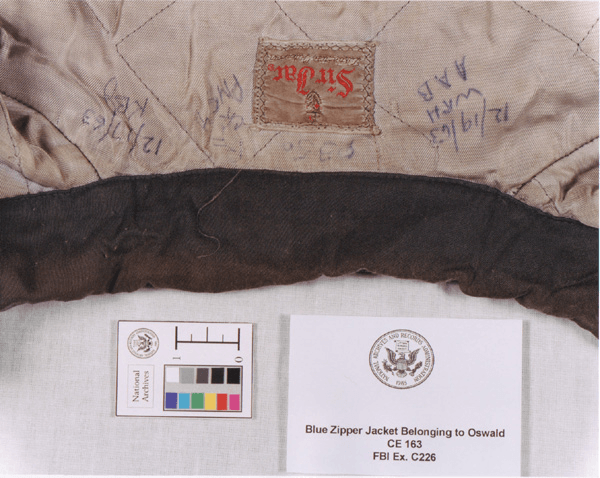
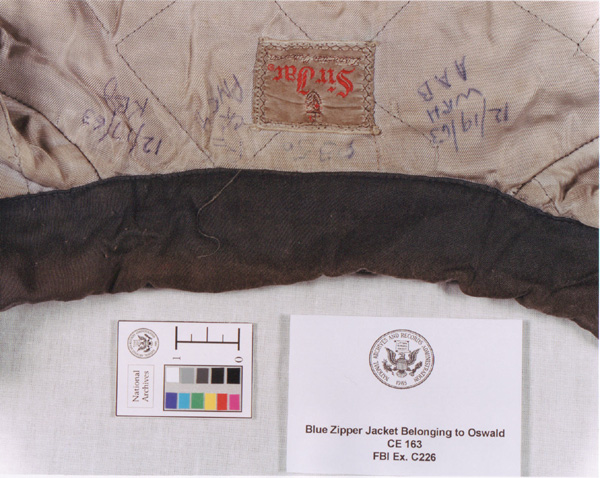
  • The mystery of CE163

    The mystery of CE163


    Introduction

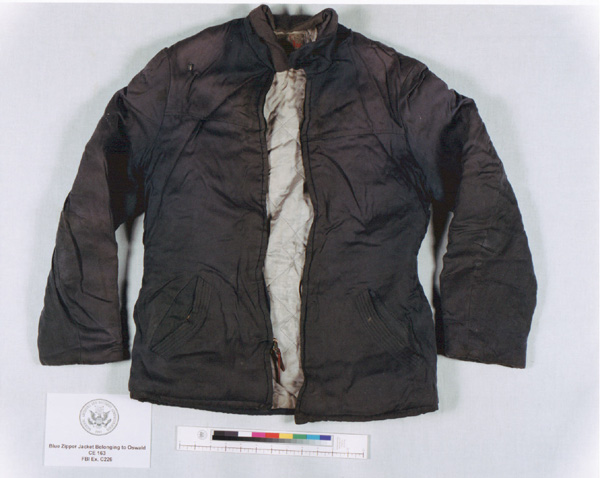
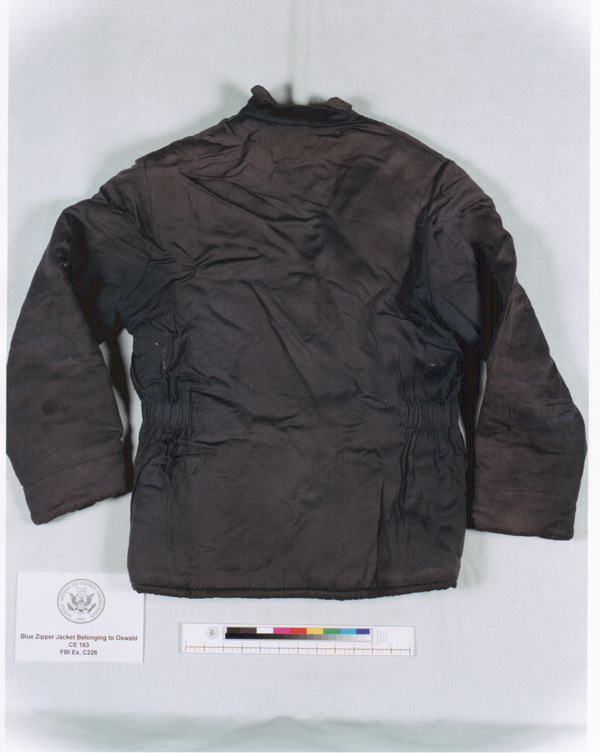
    This November the 22nd will mark the 50th anniversary of President John F. Kennedy’s assassination in Dallas, Texas. From the day the Warren Commission released its report and its 26 volumes of testimony and evidence, its critics have been vehemently arguing that Lee Harvey Oswald was not the President’s assassin, that more than one shooter was involved, that the CIA/KGB/Lyndon Johnson/Anti-Castro Cubans/the Mafia were responsible, amongst other pertinent issues. However, one issue which has not been carefully scrutinised is the allegation that on the morning of the assassination, Oswald went to the TSBD wearing a dark gray blue zipper jacket, designated as Warren Commission exhibit 163.

    (click photos to expand)

    Photo_naraevid_CE163-1.jpg Photo_naraevid_CE163-2.jpg Photo_naraevid_CE163-3.jpg
     
    CE 163

    The jacket was allegedly discovered on the first floor of the TSBD inside the Domino room by an employee named Franklin (Frankie) Kaiser. During her interview with the FBI on 4/1/64, Marina Oswald claimed that her husband owned two jackets “one a heavy jacket, blue in color, and another light jacket, gray in color.”[1] Page 175 of the Warren report contains the following information:

    “Marina Oswald stated that her husband owned only two jackets, one blue and the other gray. The blue jacket was found in the Texas School Book Depository and was identified by Marina Oswald as her husband’s.” [2]

    Oswald at 1026 North Beckley

     According to the Warren Commission’s mythology, after allegedly assassinating the President in cold blood, Oswald returned to his rooming house at 1026 North Beckley in the Oak Cliff district of Dallas, without the jacket he had allegedly left behind at the TSBD. He then supposedly left his rooming house wearing a light gray zipper jacket. Earlene Roberts, the house keeper at 1026 North Beckley, testified before the Warren Commission that she saw Oswald enter the rooming house “in his shirt sleeves”. She further testified that Oswald left the rooming house after maybe about three to four minutes wearing a “kind of zipper jacket” [3]. Roberts was quoted by various sources as giving different descriptions of the jacket Oswald was wearing as he made his way out. For example, she was quoted as describing the jacket as “a short white coat”, “a gray zipper jacket”, and “a tan coat” [4].

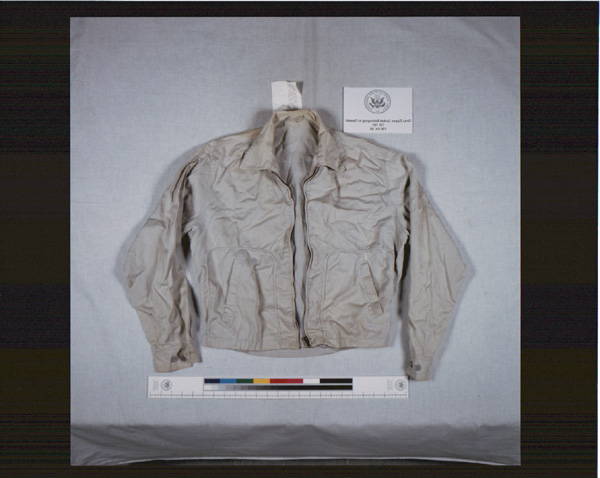
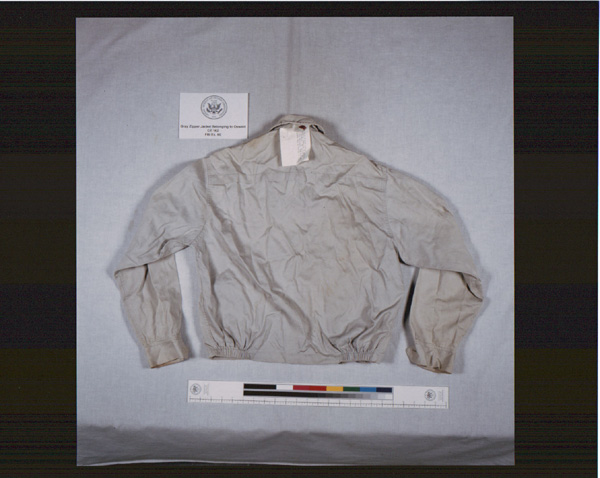
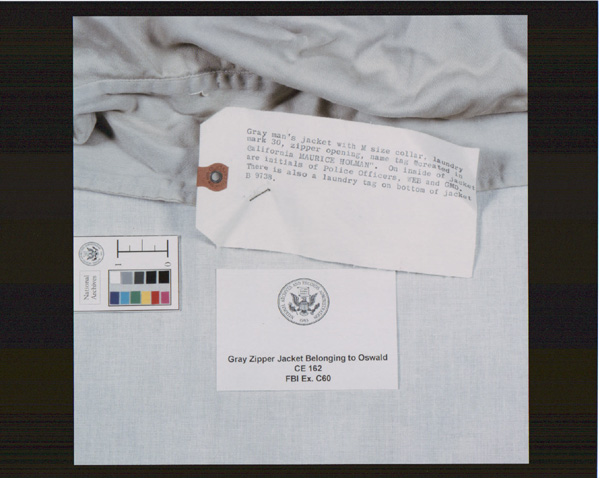
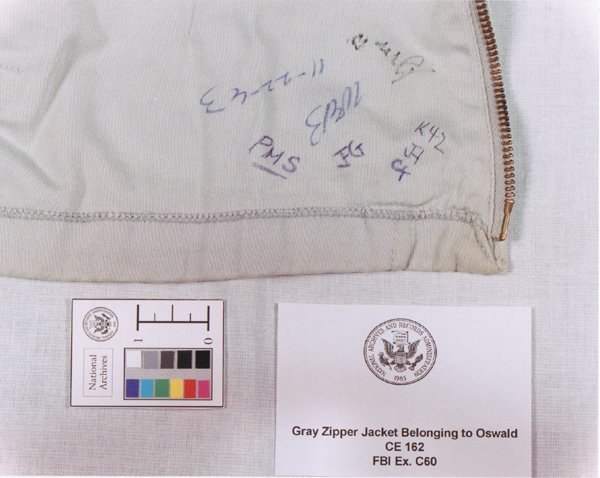
    Whilst the quoted descriptions undoubtedly varied, it doesn’t necessarily impact adversely on her credibility; as Roberts could simply have been misquoted. What’s significant is the fact that in her affidavit to the Warren Commission on 12/5/63, Roberts described the jacket as being “dark color” [5]. The jacket which Oswald allegedly discarded at the parking lot behind the Texaco Service station, after he purportedly shot and killed Dallas Policeman J.D Tippit, was a light gray jacket (Ce162) [6]. Therefore, Roberts’ description is much more consistent with the appearance of the dark gray blue zipper jacket.

    (click photos to expand)

    Photo_naraevid_CE162-1.jpg Photo_naraevid_CE162-2.jpg Photo_naraevid_CE162-3.jpg Photo_naraevid_CE162-4.jpg

    Furthermore, when Roberts was shown the light gray jacket during her testimony, she testified as follows:

    Mr. Ball
    I’ll show you this jacket which is Commission

    Mrs. Roberts
    Well, maybe I have, but I don’t remember it. It seems like the one he put on was darker than that.
    Now, I won’t be sure, because I really don’t know, but is that a zipper jacket?

    Mr. Ball
    Yes—it has a zipper down the front.

    Mrs. Roberts
    Well, maybe it was.

    Mr. Ball
    It was a zippered jacket, was it?

    Mrs. Roberts
    Yes; it was a zipper jacket. How come me to remember it, he was zipping it up as he went out the door.

    As we can see, Roberts testified that she thought the jacket Oswald left with was darker than Ce162. Whilst the zealous defenders of the Warren Commission will argue that Roberts is not credible because she allegedly provided varying descriptions of the jacket (as stated above), they will ignore that she could simply have been misquoted. The important point to bear in mind is that it was during her testimony when she was actually shown the light gray jacket; and that in her affidavit made out in her own writing, she described the jacket she saw Oswald wearing as being a dark color.

    Defenders of the Warren Commission might also argue that since Roberts testified she was completely blind in her right eye, she could easily have been mistaken about the color of the jacket. However, this would only be true if she was color blind in her left eye; and Roberts never mentioned during her testimony that this was the case. Of course, Roberts could simply have been mistaken about the jacket being dark. For example, Barbara Davis, who witnessed the Tippit killer cutting across her lawn, claimed during her testimony before the Warren Commission that the jacket the killer was wearing appeared to be a “dark and to me it looked like it was maybe a wool fabric, it looked sort of rough. Like more of a sporting jacket” [7]. In fact, she went as far as implying that the killer was wearing a black coat!

    There is one pertinent issue concerning Earlene Roberts’ credibility which I should point out. During her interview with the FBI on 11/29/63 [8], Roberts claimed she observed a Dallas Police patrol car outside Oswald’s rooming house, after she heard one of the Officers inside the car honk the horn twice. She identified the number of the car as 207. This car was assigned to Dallas Policeman Jim Valentine, and took Sergeant Gerald Hill (by his own admission) to Dealey Plaza [9]. Warren Commission defenders have criticised Roberts for changing the number of the car from 207 to 107 during her testimony. However, what these dishonest shills don’t explain is that Gerald Hill demonstrably lied about how he travelled to the scene of the Tippit shooting in Oak cliff.

    It is therefore entirely likely that Hill had commandeered Valentine’s patrol car and driven to Oak Cliff. It is beyond the scope of this essay to discuss Gerald Hill’s complicity in the assassination and framing Oswald; but I encourage readers to read through my two part article on Hill on my blog (click here), and to also read through the discussion I had with researcher Richard Gilbride on Greg Parker’s forum (click here) and to decide for themselves whether Hill was lying or not. Suffice it to say, Roberts’ account of the Police car honking outside Oswald’s rooming house implied that the DPD Officers inside the car were giving him some type of signal; and that they were possibly involved in a conspiracy to murder J.D Tippit with him.

    In my opinion, no objective minded person would disagree that there wasn’t a massive effort by the DPD to discredit Roberts’ claim about seeing Patrol car 207. As Richard Gilbride has informed me, at the time of the assassination, Patrol car 107 was out of service, as it was sold in April 1963 but then reactivated in February 1964 [10]. Therefore, by harassing Roberts into changing the number of the car from 207 to 107, the DPD would have succeeded in discrediting her, as she now claimed she saw an out of service Patrol car outside Oswald’s rooming house.

    Despite what one might think about Earlene Roberts’ credibility, there can be no doubt that her description of the jacket being darker than Ce162 was highly problematic for the official version of events. If Oswald was indeed a tenant at 1026 North Beckley, then he could have left wearing the dark gray blue jacket to the Texas Theatre. If the jacket had been discovered there following Oswald’s arrest, it could then have been substituted for the jacket which actually was discovered at the TSBD; to discredit Roberts’ claim of seeing Oswald leaving with the darker jacket. But before discussing the problems with the discovery of the jacket at the TSBD, let’s first take a look at the observations of the only two witnesses who allegedly observed Oswald carrying a package on the morning of the assassination.

    Linnie and Wesley

    I am of course referring to Linnie Mae Randle, and her brother, Buell Wesley Frazier. As most researchers of the assassination are aware, Frazier drove Oswald to work on the morning of the assassination. In his 12/5/63 interview with the FBI, Frazier allegedly claimed that Oswald was wearing a gray colored jacket on the morning of the assassination [11]. When Randle was interviewed by the FBI on the same day, she also allegedly claimed that Oswald was wearing a gray colored jacket on the morning of the assassination [12] (Essie Mae Williams, the mother of Frazier and Randle, was also interviewed by the FBI, but she had merely caught a glimpse of Oswald, and did not provide a description of the clothing he was wearing [13]).

    It’s crucial to keep in mind that in their first day affidavits to the Dallas Sheriff’s Office; neither one of them mentioned that Oswald was wearing a jacket. In her affidavit, Randle claimed that Oswald was “wearing a light brown or tan shirt”  [14], whereas Frazier provided no description of Oswald’s clothing [15]. When Randle testified before the Warren Commission, she was shown Ce163 and identified it as the jacket Oswald was wearing on the morning of the assassination [16].

    Mr. Ball
    How was Lee dressed that morning?

    Mrs. Randle
    He had on a white T-shirt, I just saw him from the waist up, I didn’t pay any attention to his pants or anything, when he was going with the package. I was more interested in that. But he had on a white T-shirt and I remember some sort of brown or tan shirt and he had a gray jacket, I believe.

    Mr. Ball
    A gray jacket. I will show you some clothing here. First, I will show you a gray jacket. Does this look anything like the jacket he had on?

    Mrs. Randle
    Yes, sir.

    Mr. Ball
    That morning?

    Mrs. Randle
    Similar to that. I didn’t pay an awful lot of attention to it.

    Mr. Ball
    Was it similar in color?

    Mrs. Randle
    Yes, sir; I think so. It had big sleeves.

    Mr. Ball
    Take a look at these sleeves. Was it similar in color?

    Mrs. Randle
    I believe so.

    Mr. Ball
    What is the Commission Exhibit on this jacket?

    Mrs. Randle
    It was gray, I am not sure of the shade

    Further on during her testimony:

    Mr. Ball
    Here is another jacket which is a gray jacket, does this look anything like the jacket he had on?

    Mrs. Randle
    No, sir; I remember its being gray.

    Mr. Ball Well, this one is gray but of these two the jacket I last showed you is Commission Exhibit No. 162, and this blue gray is 163, now if you had to choose between these two?

    Mrs. Randle
    I would choose the dark one.

    Mr. Ball
    You would choose the dark one?

    Mrs. Randle
    Yes, sir.

    Mr. Ball
    Which is 163, as being more similar to the jacket he had?

    Mrs. Randle
    Yes, sir; that I remember. But I, you know, didn’t pay an awful lot of attention to his jacket. I remember his T-shirt and the shirt more so than I do the jacket.

    Mr. Ball
    The witness just stated that 163 which is the gray-blue is similar to the jacket he had on. 162, the light gray jacket was not.

    Mrs. Randle
    Yes.

    After initially hesitating somewhat, Randle identified the dark gray blue jacket as the one Oswald was wearing. Her explanation that she didn’t pay much attention to Oswald’s jacket makes little sense. Why would she be paying more attention to the T-shirt and shirt which were both underneath the jacket? Of course, this is the same witness who would claim that she observed Oswald place his package into the backseat of her brother’s car. Yet as critics of the Warren Commission have pointed out, Frazier’s car was parked on the outside of her carport; and that her view of the car was blocked by the wall of the carport! [17] Certain defenders of the Warren Commission have tried to explain that she had merely heard Oswald open the car door and place the package inside. Despite this cheap attempt to defend their witness, Randle specifically claimed that she saw him place the package into the car.

    Although Randle did eventually identify Ce163 as the jacket Oswald had on, when Frazier was shown the jacket during his testimony, he refused to identify it as the one Oswald was wearing on the morning of the assassination! [18]

    Mr. Ball
     I have here Commission’s 163, a gray blue jacket. Do you recognize this jacket?

    Mr. Frazier
    No, sir; I don’t.

    Mr. Ball
    Did you ever see Lee Oswald wear this jacket?

    Mr. Frazier
    No, sir; I don’t believe I have.

    Mr. Frazier
    No, sir; I don’t believe I have because most time I noticed when Lee had it, I say he put off his shirt and just wear a T-shirt the biggest part of the time so really what shirt he wore that day I really didn’t see it or didn’t pay enough attention to it whether he did have a shirt on.

    Mr. Ball
    On that day you did notice one article of clothing, that is, he had a jacket?

    Mr. Frazier
    Yes, sir.

    Mr. Ball
    What color was the jacket?

    Mr. Frazier 
    It was a gray, more or less flannel, wool-looking type of jacket that I had seen him wear and that is the type of jacket he had on that morning.

    Mr. Ball
    Did it have a zipper on it?

    Mr. Frazier
    Yes, sir; it was one of the zipper types.

    Mr. Ball
    It isn’t one of these two zipper jackets we have shown?

    Mr. Frazier
    No, sir.

    The fact that Frazier insisted he saw Oswald wearing a gray zipper type jacket, yet at the same time, refused to identify Ce163 as the one he was wearing, raises the distinct possibility that Oswald was wearing a gray flannel-wool jacket to the TSBD, which was then substituted for Ce163. Of course, Frazier’s own credibility as a witness is not without question. For example, Garland Slack claimed that he observed Oswald at the Sports drome rifle range, and that he had been taken there by “a man named Frazier from Irving, Texas“ [19](Irving, Texas, was the residence of Linnie Mae Randle, where Frazier was also living). Frazier denied having ever driven Oswald to the rifle range [20].

    Richard Gilbride believes that Frazier was responsible for cutting the power to the TSBD elevators from the basement; after he allegedly went there to eat his lunch [21]. Much has also been discussed about Frazier’s arrest and possession of a British Enfield rifle, and his polygraph examination by DPD detective, R.D Lewis. Researchers such as Jim DiEugenio have suggested that Frazier may have been coerced by the DPD into incriminating Oswald by claiming that he saw Oswald carrying a package; but he had deliberately stated the package was only about 2 feet long (too short for even a broken down Mannlicher Carcano rifle) to divert suspicion away from himself.

    Although I find the above scenario to be plausible, it makes no sense that he would refuse to identify Ce163 as the jacket Oswald was wearing, if he was involved in a conspiracy to falsify evidence against him. Of course, there is always the possibility that Frazier was simply mistaken about the jacket Oswald was wearing, and that he really was wearing Ce163. Let’s now take a close look at all the problems with the discovery of the jacket at the TSBD.

    The “Discovery”

    As stated at the beginning of this essay, the dark gray blue jacket was allegedly discovered in the first floor Domino room of the TSBD, by an employee named Franklin (Frankie) Kaiser. In fact, not only is Kaiser credited with discovering the jacket, but he is also the same employee who allegedly discovered the clip board used by Oswald for filling out orders for school books (Kaiser testified before the Warren Commission that he had also made the clip board) [22]. The reader should keep in mind that there were a total of about 76 persons employed by the TSBD [23]. It therefore seems incredibly odd that Kaiser would be the same person to allegedly discover both Oswald’s clipboard and jacket. Of course, it cannot be known for sure how many employees used the Domino room; and how many of them also went to the sixth floor as Kaiser did. Even if it was only a grand total of five persons, the odds would roughly be only 4% that Kaiser could have discovered both items.

    What makes the discovery of the jacket all the more bizarre is the fact that there are two separate FBI reports which provide different dates for the discovery of the jacket! In a report dated 2/8/63, FBI agent Kenneth B. Jackson writes that the jacket was discovered at the TSBD at about 12/16/63 [24]. So not only are we to believe that against all odds Kaiser found both the jacket and the clipboard, but that it also took him close to four weeks to find the jacket. Granted that Kaiser was absent from the TSBD on the day of the assassination, and only returned to work the Monday following the assassination according to his testimony, but surely he or another employee could have found it much sooner than 12/16/63.

    This now brings us to the second FBI report on the jacket’s “discovery”. In his 3/7/64 report, FBI agent Robert Barrett wrote that Roy Truly, the superintendent of the TSBD, was given a jacket by an employee whose name he could not remember; three to four days following 11/22/63 [25] – and not on 12/16/63 as per the report by SA Kenneth Jackson written one month before. The reader should make note of the fact Barrett wrote in his report that Truly turned the jacket over to an FBI agent; whose name was not specified. Even if we are to believe that this agent was in fact Kenneth Jackson, why is there a discrepancy in the date on which Truly had given the jacket to the FBI?

    Perhaps we should also consider Barrett’s credibility as an investigator. Many researchers are aware of the allegation by Barrett that a wallet containing identification for Oswald and the fictitious name Alek James Hidell, allegedly used by Oswald as an alias, was discovered at the scene of the Tippit murder. Warren Commission defenders such as Dale Myers believe that Barrett was mistaken about the wallet. If this were true, then it might negatively impact on his credibility. However, there is much reason to believe that Barrett was telling the truth. Those interested in the wallet issue are encouraged to read through my article on my blog (click here).  

    Adding further doubt that Ce163 was not discovered at the TSBD, Roy Truly was not asked a single question about the discovery of the jacket during his Warren Commission testimony [26]. Furthermore, although Kaiser was asked exactly where in the Domino he had found the jacket during his testimony, he was never asked when he had found it! When Oswald’s co-worker, Charles Douglas Givens (who told the Warren Commission that he had seen Oswald on the sixth floor of the TSBD at about 11:55 am) was asked during his testimony about the type of clothing Oswald was wearing, he claimed that “he [Oswald] would wear a grey looking jacket.” [27] Although Givens’ credibility is, to put it mildly, lacking, he was also never shown Ce163 to identify it as the jacket Oswald was wearing.

    There was no identification made by any of Oswald’s co-workers, or by Oswald’s supervisor William Shelley, that Ce163 was the jacket Oswald was wearing when he went to work on the morning of the assassination. The reader should also bear in mind that in the reports by the DPD Officers, FBI and Secret Service agents (and Dallas postal inspector Harry Holmes) who had participated in Oswald’s interviews, there is no mention of Oswald admitting to wearing a dark gray blue looking jacket to work [28] [29]. Perhaps now we should take a closer look at the man who allegedly discovered the jacket.

    Who was Frankie Kaiser?

     Frankie Kaiser testified before the Warren Commission that he worked at the TSBD as an order filler and truck driver. When asked the date he started working for the TSBD, Kaiser claimed that it was 8/24/62. When asked why he was absent from work on the day of the assassination, Kaiser testified that he was at the Baylor dental college for an abscessed tooth. As researcher Bill Kelly has pointed out, the Baylor dental college is where George Bouhe arranged to have Marina Oswald’s dental work done shortly following her arrival from the Soviet Union with her husband. On a much more sinister note, the Baylor medical clinic had been provided hundreds of thousands of dollars in Army and CIA funds for the heinous MK/ULTRA mind control research from 1963 to 1965.[30]

    Kaiser’s alleged discovery of both the Clipboard and jacket led me to speculate that perhaps Kaiser was a confidential FBI or DPD informant working inside the TSBD, and keeping an eye on Oswald whom, as most researchers of the JFK assassination are aware, was suspected of being a Communist due to his “defection” to the Soviet Union. However, there was also Joe Rodriguez Molina, a former chairman of the Dallas chapter of the American GI forum, who was employed at the TSBD as a credit manager (at the time of the assassination, Molina had been employed at the TSBD for 16 years).[31] As Greg Parker has pointed out, Molina was suspected of having connection to gun runners.[32] Moreover, an FBI informant named William James Lowery; who had been informing on Molina, provided information that four members of the American Communist party had visited Molina’s residence. Lowery had also provided information that Molina had attended a political meeting, during which several members and sympathisers of the American Communist party were also present.[33]

    Although Lowery and other informants would claim that Molina was not a member of, or sympathetic towards the Communist party, the fact they had provided information that Molina was in contact with several Communists would have made him suspect to the FBI, just as the former “defector” to the Soviet Union; Oswald, undoubtedly was. William Lowery is an interesting person for several reasons. On 9/26/63, Lowery made the headlines by outing himself as an FBI “spy” about three days previously when he testified at an open Justice Department hearing in Washington.[34] On the day of the assassination, Lowery was employed as the manager of a shoe store on 620 West Jefferson Street named the Shoe Haven; about three blocks to the West of Hardy’s Shoe store where the manager, Johnny Calvin Brewer, allegedly spotted Oswald outside his store looking “funny” and scared, and then allegedly followed him into the Texas Theatre, after which we are told the Theatre Cashier, Julia Postal, telephoned the DPD leading to his arrest.[35]

    Despite being credited as the man who led to the capture of the accused murderer of the President of the United States, Brewer (and Postal for that matter) was not asked by the DPD to provide a sworn affidavit on the day of the assassination. Witnesses to the President’s assassination gave sworn statements to the authorities on the same day, yet Brewer provided an affidavit on 12/6/63 – an entire two weeks following the assassination! [36] During an interview with researcher Ian Griggs, Brewer would claim that when he allegedly spotted Oswald outside his store, there were two men with him in the store who were allegedly from IBM.[37] However, no mention of these men was made by Brewer in his affidavit, his interview with the FBI [38], and during his Warren Commission testimony. Lee Farley has made the case that one of these so-called IBM men was Igor Vaganov; who was suspected of being involved in the murder of DPD Officer J.D Tippit. Interested readers can read through Mr Farley’s work on Vaganov by clicking here.

    Now, the reader might be curious as to what Brewer has to do with Lowery. Aside from being an admitted FBI informant working as a manager in a shoe store about three blocks to the West of Brewer’s store, Lowery would tell HSCA investigators James P. Kelly and Harold A. Rose on 4/28/78 that he thought Oswald was “probably” on his way to kill him for exposing the Communist Party in Texas.[39] In light of all the evidence uncovered through the ARRB on Oswald, the idea that Oswald was a Communist is simply ludicrous. My belief is that, as someone who had admitted he was an FBI informant, Lowery made up that claim to make it appear as though Oswald had confused Brewer’s store with his store; which would give credence to Brewer’s story of spotting Oswald outside his own store.

    There is another interesting indirect connection between Lowery and Brewer. As Lee Farley has noted, in August of 1962, Lowery and the rest of the American Communist Party members in Dallas were promoting the idea of further establishing their connection to the local American Civil Liberties Union.[40] The reader should note that both the highly suspect Ruth and Michael Paine were members of the ACLU [41] [42]. Although Oswald had allegedly applied for membership with the ACLU [43], Greg Parker has informed me that Oswald was actually a member of the Dallas Civil liberties Union – an affiliate of the ACLU. It is beyond the scope of this essay to discuss the intelligence connections of Oswald and the Paine’s. However, their presence in the ACLU is understandable given the fact that the Communist party were trying to establish closer ties with them. Quite coincidentally, John Brewer would testify before the Warren Commission that he went to work as manager of Hardy’s shoe store in August, 1962.

    These coincidences have led me to speculate that Brewer may also have been an FBI informant, working alongside William Lowery in infiltrating Communist organisations and the ACLU. If Brewer was in fact an FBI informant, his willingness to co-operate with the DPD and the FBI in ensuring Oswald was the man who shot both the President and Officer J.D Tippit makes perfect sense to me. One final point I would like to make is that Lowey claimed his FBI control in Dallas was none other than James P. Hosty! [44]

    So how does all this relate to Frankie Kaiser? The reader will note that in the 8/20/64 FBI report on Joe Molina, the identity of Dallas informant, DL T-3, was kept hidden (DL T-3 was also informing on Oswald) [45]. The FBI was allegedly concerned that revealing the identity of DL T-3 would compromise his future “effectiveness” as an informant.[46] Although this is just speculation on my part, I believe that DL T-3 was in fact Frankie Kaiser. We have already seen that Kaiser had taken the credit for the discovery of the clipboard and jacket, and there are a number of coincidences which give credence to the possibility that Kaiser was DL T-3.

    Kaiser’s discovery of the clipboard was allegedly made on 12/2/63.[47] On the very same day, an FBI agent named Nat Pinkston was supposedly ordered by one of his superiors to conduct an “investigation” at the TSBD. The purpose of this investigation and the name of the supervisor were never revealed during Pinkston’s testimony, or in his report concerning the clipboards discovery.[48] The only thing Pinkston revealed when he testified was that he was waiting to see Roy Truly (this raises the possibility that it was Pinkston who acquired both the jacket and clipboard).

    Oddly enough, on the exact same day that Pinkston went to the TSBD to conduct an “investigation”, DL T-3 was shown a photograph of Oswald by an unnamed FBI agent. The informant went on to state that he had recognised Oswald as being the same person he had come into contact with on business.[49] Perhaps this is referring to the fact that on 8/13/63, 8/20/63, 8/27/63 and 9/3/63, DL T-3 was responsible for handling Oswald’s IB-2 form.[50] However, the possibility exists that the “business” in question was the TSBD. It is also interesting that the FBI had collected specimen from DL T-3 on 12/16/63 and 12/17/63 according to Warren Commission exhibit 2444.[51] The reader will recall that the date on which the jacket was acquired from Roy Truly was 12/17/63 according to the report by SA Kenneth Jackson, with Frankie Kaiser being the person who allegedly gave the jacket to Truly.

    There is absolutely nothing solid as far I am concerned which proves that Kaiser was DL T-3. However, the presence of an FBI informant at the TSBD makes perfect sense given that suspect individuals such as Oswald and Molina were employed there. As I’ve stated before, Kaiser testified that he went to work at the TSBD on 8/24/62 – this is the exact same month in which William Lowery and the rest of the American Communist party members in Dallas were attempting to establish closer ties to the ACLU. It is also the exact same month in which Johnny Brewer began working as the manager of Hardy’s shoe store on Jefferson Blvd. This could all be just an incredibly bizarre coincidence, but my belief is that Lowery, Brewer, and Kaiser were all part of an FBI operation to keep watch on suspected Communists in Dallas; with Kaiser gaining employment at the TSBD to keep an eye out on Molina, and eventually on Oswald when he began working there.

    The reader should keep in mind that on 10/9/63; just one week after Oswald allegedly returned from Mexico City after contacting Valery Kostikov (the KGB agent who was suspected of being in charge of assassinations in the Western hemisphere), and one week prior to commencing employment at the TSBD with the help of Ruth Paine, FBI supervisor Marvin Gheesling removed the FLASH warning on Oswald. [52] Had Gheesling not done this, the Secret Service would have ensured that Oswald was not working in a building along the President’s parade route. Researchers have been baffled as to how Oswald was still not considered a Communist threat following his departure from Mexico City. If the FBI knew in advance that Oswald would be employed at a building with one its informants working there, then surely there would be no problem in having the FLASH removed. This then raises the possibility that the FBI had played a role in securing Oswald a job at the TSBD, through one or more of its informants at the Texas employment Commission, such as Robert Adams.

    There is still another possible connection between Oswald, Molina, and the FBI. A man named Osvaldo Iglesias claimed that he had identified Rodriguez Molina; “the man arrested for questioning with Oswald in Dallas.” as the person passing out leaflets with Oswald in New Orleans. [53] Joe Molina’s middle name was Rodriguez, and on the morning of 11/23/63 the DPD had paid his home a visit and searched through his belongings. Molina was not arrested, but the next day, he went to the DPD upon their request where he was questioned by Captain Will Fritz.[54] As far I know, there is nothing to substantiate Iglesias’ claim. However, it is yet another intriguing possibility that Molina was indeed a Communist sympathiser.

    Despite whether one believes that Kaiser was a confidential FBI informant, he remains a very interesting person. His so-called discovery of the clipboard remains a mystery on its own. Kaiser testified that it was lying on the floor and in the plain open (the reader is advised that film footage from WFAA-TV had apparently captured a DPD Officer handling the clipboard on the sixth floor of the TSBD on the day of the assassination) [55]. As the great late Sylvia Meagher noted, Kaiser’s “discovery” of the clipboard occurred on the exact same day on which Charles Givens first told a Secret Service agent that he had seen Oswald on the sixth floor with his Clipboard. [56] Could this really be a coincidence? Warren Commission defenders have used this as evidence that Oswald was the last known employee on the sixth floor. Of course, they ignore all the problems with Givens as a witness.

    I also encourage readers to read through a copy of issue 5 of volume 4 of the third decade by Dr Jerry Rose (click here). In his article, Dr Rose discusses Oswald’s application for a job at the Allright parking system lot on Commerce Street in Dallas. When a detective went to investigate this application, he discovered that a person named Fred Kaiser Jr. had applied for a job there. As Dr Rose also explains, the man claimed he quit his job at the depository on 11/21/63. The man gave his address as Ledbetter Street – the same address Frankie Kaiser provided for himself during his Warren Commission testimony! Dr Rose speculates that perhaps Fred Kaiser was in fact Frankie Kaiser who quit his job at the TSBD, only to be brought back for the purpose of “finding” the clipboard.

    There is one final important point I would like to make. If Kaiser was an FBI informant, there is no chance on Earth J. Edgar Hoover would admit to this, as it would be a severe embarrassment to him and the FBI that one of their own informants was employed in the same building in which Oswald, the man arrested and accused by the DPD for assassinating the President, was also employed in. I doubt that even the most ardent of FBI and Warren Commission defenders would honestly disagree with that point of view.

    Conclusion

    Lee Harvey Oswald did not wear Ce163 (the dark gray blue jacket) to the TSBD on the morning of the assassination. Instead, Oswald wore a flannel-wool looking jacket as Buell Wesley Frazier testified. This jacket was discovered three to four days following the assassination (as per the report by SA Robert Barrett) inside the Domino room by an unidentified employee. The jacket was then made to disappear; with the identity of the employee who found it kept hidden. After Earlene Roberts described the jacket Oswald was wearing when he left 1026 North Beckley as being “a dark color” to Secret Service agents William Carter and Arthur Blake in her affidavit to them on 12/5/63, the authorities conspired to discredit her by faking the discovery of Ce163 on 12/16/63 by Frankie Kaiser at the TSBD. I believe it’s possible that Oswald wore Ce163 to the Texas Theatre, and that it was then substituted for the flannel-wool jacket found at the TSBD.

    Without a doubt, Roberts’ failure to identify Ce162 (the light gray jacket) as the jacket she saw Oswald wearing was a problem for the case against Oswald for shooting Officer J.D Tippit; as she was the only witness who positively saw Oswald (and not someone else) with a zipper jacket, and a zipper jacket was discarded at the parking lot behind the Texaco service station. Warren Commission defenders of course will scoff at any notion that the authorities were out to frame Oswald for the murder of the President and J.D Tippit. However, consider that with the President of the United States arrogantly and brutally gunned down in full public view and in broad daylight; and with the entire world anxiously waiting to learn who was responsible; and with the possibility of a nuclear war in the wake of the assassination, the DPD and the FBI would undoubtedly have been under a great amount of pressure to find those responsible.

    The DPD had apprehended Oswald at the Texas Theatre after he left the TSBD – the same location where they had discovered the rifle and spent shell casings. They therefore had a viable suspect for the assassination. The reader should also keep in mind that Julia Postal overheard one of the Officers who arrested Oswald at the Theatre remark “We have our man on both the counts” [57], and Johnny Brewer testified that he allegedly heard one of the Officers yell out to Oswald inside the Theatre “Kill the President will you” as they were scuffling with him. I only hope that current and future researchers will delve further into the issues which I have discussed throughout my essay.

    Acknowledgements

    I would like to thank researchers Greg Parker, Lee Farley, and Richard Gilbride, to all of whom I owe this work. Without the help and support they have provided me, I doubt very much that I would have been able to write this essay.


    Addendum

    Researcher Tom Scully has brought to my attention the fact that Frankie Kaiser and Fred Kaiser were actually brothers living at the same address in Dallas; and both of them were employed at the TSBD prior to President Kennedy’s assassination. The information is from an investigation by DPD detective, W.S Biggio, into Oswald’s application to work at the Allright Parking System on 1208 Commerce Street, Dallas, Texas.[58]

    According to information provided by Garnett Claud Hallmark, general manager of the Parking System, the application by Fred Kaiser to work at the System listed 5230 W. Ledbetter Street as Kaiser’s address; the same address which Frankie Kaiser provided for himself during his Warren Commission testimony. In fact, a Frankey Kaiser was listed by Fred in his application as an emergency contact; with Frankey’s address given as 5230 W. Ledbetter Street.

    When former TSBD employee Roy E. Lewis was interviewed by Larry Sneed for Sneed’s book, No More Silence, he informed Sneed that amongst the workers at the TSBD he knew were the Kaiser brothers. [59] It is therefore readily apparent that I was wrong in assuming that Fred and Frankie Kaiser were the same man, and I apologise to readers for my error.


    End notes

    [1] John Armstrong Baylor collection, Nov. 22, 1963, “sir Jac” coat, page 3

    [2] Warren Commission report, page 175

    [3] Testimony of Earlene Roberts, WC Volume VI

    [4] Various reports by Earlene Roberts to the media, found in the Harold Weisberg archives

    [5] Affidavit of Earlene Roberts, WC Volume VII

    [6] Testimony of DPD Captain William Ralph Westbrook, WC Volume VII

    [7] Testimony of Barbara Jeanette Davis, WC Volume III

    [8] Warren Commission exhibit 2781, WC Volume XXVI

    [9] Testimony of DPD Sgt Gerald Hill, WC Volume VII

    [10] Warren Commission exhibit 2045, WC Volume XXIV

    [11] John Armstrong Baylor collection, Nov. 22, 1963, Wesley Frazier, page 5

    [12] John Armstrong Baylor collection, Nov. 22, 1963, Linnie Mae Randle, page 8

    [13] John Armstrong Baylor collection, Nov. 22, 1963, Wesley Buell Frazier, page 2

    [14] Affidavit of Linnie Mae Randle on 11/22/63 Dallas Municipal archives – John F. Kennedy collection

    [15] Affidavit of Buell Wesley Frazier on 11/22/63 Dallas Municipal archives – John F. Kennedy collection

    [16] Testimony of Linnie Mae Randle, WC Volume II

    [17] Warren Commission exhibits 446 and 447, WC volume XVII

    [18] Testimony of Buell Wesley Frazier, WC Volume II

    [19] Warren Commission Document 1546 – FBI Gemberling Report of 08 Oct 1964

    [20] Warren Commission Document 1546 – FBI Gemberling Report of 08 Oct 1964

    [21] Richard Gilbride’s essay on Eddie Piper, uploaded to Greg Parkerâ’s website

    [22] Testimony of Frankie Kaiser, WC Volume VI

    [23] Warren Commission exhibit 1381, WC Volume XXII

    [24] John Armstrong Baylor collection, Oswald’s possessions, 12/17/64 LHO Jacket TSBD

    [25] Warren Commission Document 735 – FBI Gemberling Report of 10 Mar 1964

    [26] Testimony of Roy Sansom Truly, WC Volumes II and III

    [27] Testimony of Charles Douglas Givens, WC Volume VI

    [28] Dallas Municipal archives – John F. Kennedy collection

    [29] Warren Commission report, pages 612 to 636

    [30] Research by William Kelly, Spartacus education forum, Frank Kaiser topic

    [31] Admin folder-M10: HSCA administrative folder, Joe Rodriguez Molina, at the MFF

    [32] Research by Greg Parker, Spartacus education forum, Joe Molina’s connections to gun-runners topic.

    [33] Admin folder-M10: HSCA administrative folder, Joe Rodriguez Molina, at the MFF

    [34] John Armstrong Baylor collection, FBI, Informants, page 4

    [35] Testimony of Johnny Calvin Brewer, WC Volume VII

    [36] Affidavit of Johnny Calvin Brewer on 12/6/63, Dallas Municipal archives – John F. Kennedy collection

    [37] No case to answer by Ian Griggs, interview with Johnny Calvin Brewer, page 58

    [38] John Armstrong Baylor collection, Tippitt shooting, Nov. 22, 1963, Brewer, pages 12 and 13

    [39] John Armstrong Baylor collection, FBI, Informants, page 4

    [40] Research of Lee Farley, Spartacus education forum, William James Lowery topic

    [41] Testimony of Michael Ralph Paine, WC Volume II

    [42] Testimony of Ruth Hyde Paine, WC Volume IX

    [43] Oswald 201 File, Vol. 20, page 212, at the MFF

    [44] John Armstrong Baylor collection, FBI, Informants, page 6

    [45] Warren Commission exhibit 980, WC Volume XVIII

    [46] Admin folder-M10: HSCA administrative folder, Joe Rodriguez Molina, at the MFF

    [47] Warren Commission document 7 – FBI Gemberling Report of 10 Dec 1963

    [48] Testimony of FBI agent Nat A. Pinkston, WC Volume VI

    [49] John Armstrong Baylor collection, FBI, Informants, page 13

    [50] John Armstrong Baylor collection, FBI, Informants, page 12

    [51] Warren Commission exhibit 2444, WC Volume XXV

    [52] JFK and the unspeakable, by Jim Douglass, page 178

    [53] John Armstrong Baylor collection, Nov. 22, 1963, Joe Molina, page 7

    [54] John Armstrong Baylor collection, Nov. 22, 1963, Joe Molina, page 8

    [55] FBI 62-109060 JFK HQ File, Section 147, page 5, at the MFF

    [56] The curious testimony of Mr. Givens, by Sylvia Meagher

    [57] John Armstrong Baylor collection, Tippitt shooting, Nov. 22, 1963, Postal, page 16

    [58] Dallas municipal archives, Box 18, folder 7.

    [59] No More Silence by Larry Sneed, page 85.


  • “Shoot Him Down”:  NBC, the CIA and Jim Garrison

    “Shoot Him Down”: NBC, the CIA and Jim Garrison


    garrison
    Jim Garrison

    With the arrival of the 40th anniversary of President Kennedy’s assassination, it was hardly surprising that one of the major television networks attempted to make the case for Lee Oswald’s sole guilt. Despite four decades of solid research indicating a conspiracy, the American viewing public was once again treated to a one-sided, unfair and unbalanced presentation. In light of this, it might be instructive to look at how one of the other networks tackled the case for conspiracy some 37 years ago. The mystery of the assassination is still a popular subject among people of all ages. A college student might not know how to ask a girl out, but you can bet they have strong opinions on the JFK assassination based solely on the network specials that run every so often.

    On June 19th, 1967 NBC aired an hour long “analysis” of New Orleans District Attorney Jim Garrison’s investigation titled, The JFK Conspiracy: The Case of Jim Garrison. While unnecessary to rehash Garrison’s case here, in summary Garrison’s investigation focused on three individuals: A former Eastern Airlines pilot and probable CIA asset, David Ferrie; ex-FBI man and private detective Guy Banister; and Managing Director of the International Trade Mart, Clay Shaw. Garrison believed all three were connected to American intelligence and had, at a minimum, conspired to set up Oswald as a potential patsy in the JFK assassination. Barely three months into his investigation, Garrison’s main suspect, the forty-nine year old David Ferrie, died apparently of natural causes. Banister had also passed away in 1964 as a result of a heart attack. On March 1st, 1967 Garrison arrested the surviving member of this trio, the CIA connected Clay Shaw. By mid-March both the Grand Jury and a three-judge panel had ordered Shaw to trial.

    Garrison’s case was big news and predictably the news media swung into attack mode. None was more vicious or had more resources at their disposal than NBC. For the job as lead investigative reporter, NBC assigned Walter Sheridan. Shortly after Shaw’s arrest Sheridan arrived in New Orleans and began questioning witnesses — perhaps bribing and intimidating would be a better choice of words. Sheridan questioned a former electronics expert and CIA asset Gordon Novel and immediately put him on a $500 a day retainer. (Novel had briefly consulted with Garrison’s team). Sheridan then urged Novel to skip town to avoid being indicted and paid him an additional $750 while Novel was in Columbus Ohio. Attorney Dean Andrews, who received the call from a “Clay Bertrand” to represent Oswald, was promised a recording studio if he cooperated with Sheridan. Andrews was overheard bragging, “I can get the equipment here. All I have to do is make a phone call, I’ll have open credit, I can pay off on any terms. Look, Bobby Sarnoff promised me those facilities. He’d better pay off, baby.” Bobby Sarnoff was, of course, Robert Sarnoff, NBC president and later chairman of the board of its parent company RCA.

    Garrison’s main witness at the time was Perry Russo, a young insurance agent who had claimed he overheard a conspiratorial conversation between Shaw, Ferrie and Oswald at Ferrie’s home. Sheridan “interviewed” Russo and seriously distorted his statements during the broadcast. As the New Orleans States-Item reported, “Russo said Sheridan, WDSU-TV reporter Richard Townley and Saturday Evening Post writer James Phelan repeatedly visited his home in attempts to persuade him to cooperate with NBC and the defense.” Russo said he met with the trio with the full knowledge of the district attorney’s office and reported everything that happened to Asst. DA Andrew Sciambra. Russo said, “Sheridan offered to set me up in California, protect my job and guarantee that Garrison would never get me extradited back to Louisiana” if he cooperated. He accused Townley of threatening him with public humiliation unless he changed his story and cooperated with the NBC program. The 25-year-old witness said members of the trio told him both, “NBC and the Central Intelligence Agency are out to wreck Garrison’s investigation.” Of course, Russo’s accusations were met with denials, but as we shall see Russo’s claims seem to have been accurate.

    Another of Garrison’s witnesses was Vernon Bundy, a heroin addict and prisoner who had testified at the preliminary hearing that he had seen Shaw and Oswald together at the Lake Pontchartrain seawall. Once Bundy had been exposed in the preliminary hearing, he was now fair game for Walter Sheridan and NBC. In their attempt to discredit Bundy, NBC aired interviews with two fellow convicts, Miguel Torres and John Cancler. Cancler, a convicted burglar and pimp, appeared first and said Bundy had told him he was going to lie to the DA’s office to get out of prison. Torres, whose own record of heroin abuse, burglary, pimping, assault, and suspected murder out rivaled Cancler’s, was currently serving a nine-year sentence for robbery. He said that Bundy told him he was going to make up a story about Shaw to get the DA to “cut him loose” from prison. After the airing of the NBC special, Garrison invited Messrs. Torres and Cancler to repeat their stories in front of the Grand Jury. Both pleaded the Fifth Amendment and were subsequently convicted of contempt. Another problem with Torres’ story is his accusation that Bundy needed the DA to “cut him loose” from prison. In a recently released memorandum from the New Orleans DA’s files, former aide William Gurvich wrote of his investigation of Bundy. Gurvich states, “Shortly after my interview with Bundy, I contacted local narcotics officers for background information on him. I also made an extensive inquiry into his criminal history.” Of his heroin use Gurvich writes, “[Bundy] uses four or five capsules of heroin daily… This amount is considered sufficient for addiction, but is not an excessive amount as the more heavily addicted use as much as 20-30 capsules daily.” Gurvich goes on to write “Bundy claimed he was in Parish Prison at the time because he went there voluntarily when he felt himself reverting back to the use of narcotics and feared the consequences of his addiction. Official records corroborate this.” Bundy was on probation for breaking into a cigarette machine, but was not serving time. So much for Bundy needing to be “cut loose.” Since NBC offered to relocate Perry Russo to California and provide him with a job if he changed his original testimony one can only imagine what incentives Sheridan offered Cancler and Torres.

    Garrison’s one time “aide”, the aforementioned William Gurvich also assisted Sheridan having left the DA’s office several weeks earlier. As Garrison noted shortly after the broadcast Gurvich didn’t so much resign as “drift away about six weeks ago” and that since that time he had been in contact with Walter Sheridan. Gurvich also admittedly made off with the DA’s master file. The CIA was so smitten with Gurvich that they wanted to make sure he was in touch with Shaw’s lawyers. In their enthusiasm to give Shaw’s lawyers all the help they could the CIA recommended:

    Shaw’s attorneys ought to talk to William H. GURVICH. This is an excellent suggestion. It is assumed they have done so, or plan to, but we should try to assure that they do.

    One other witness Sheridan used makes for an interesting case study of Sheridan’s abuse of power. Fred Leemans, the owner of a Turkish bath house in New Orleans, originally stated that Shaw had frequented his establishment using the name of Clay Bertrand. By the time Sheridan and company got to him, he went on the NBC special claiming he had been offered a $2500 bribe by one of Garrison’s men in exchange for his incriminating testimony. After the NBC special had aired, Leemans came forward with the truth. In a sworn statement Leemans admitted that part of the reason he participated in the show was threatening phone calls “relative to the information that I had given Mr. Garrison.” Leemans also recalled a visit from a man with a badge who stated that he was a government agent. The man supposedly told Leemans that the government was checking bar owners in the Slidell area for possible income tax violations. The man also warned him “it was not smart” to be involved in the Clay Shaw case “because a lot of people that had been involved got hurt.” An anonymous caller told Leemans to change his statement and claim he had been bribed. The caller also suggested that Leemans contact Irvin Dymond, one of Shaw’s attorneys. After contacting Dymond, Leemans was introduced to Walter Sheridan. Leemans claimed Dymond offered an attorney and bond in the event he was charged with giving false information to the DA’s office. Leemans said his appearance on the show was taped in the office of Aaron Kohn, managing director of the Metropolitan Crime Commission, in the presence of Sheridan and Dymond.

    The newly released CIA files present an interesting biography of “reporter” Sheridan. In 1955 Sheridan was security approved as an investigator for the CIA. A month later this was cancelled because Sheridan accepted a position at the ultra-secret National Security Agency. In 1956 he was security approved once again by the CIA so that he could attend their “Basic Orientation Course”. After leaving the NSA, Sheridan went to work for Bobby Kennedy’s Justice Department in the “Get Hoffa” squad, where his tactics in nailing Hoffa earned him a rebuke from none other than Chief Justice Earl Warren and paved the way for Hoffa’s eventual release. With this background in the intelligence communities Sheridan was now apparently qualified to work for NBC as a reporter, despite having no previous journalism experience. However, documents reveal that Sheridan did not sever contact with the CIA. In early May of 1967 the Counter Intelligence office of the CIA issued a memorandum for the Deputy Director of Plans which stated:

    Richard Lansdale, Associate General Counsel, has advised us that NBC plans to do a derogatory TV special on Garrison and his probe of the Kennedy assassination; that NBC regards Garrison as a menace to the country and means to destroy him. The program is to be presented within the next few weeks. Mr. Lansdale learned this information from Mr. Walter Sheridan of NBC.]

    As noted previously, during Sheridan’s tenure in New Orleans he enlisted the aid of Richard Townley from NBC’s affiliate, WDSU-TV. Townley’s loose tongue offered further proof that the NBC White Paper was no more than a deliberate attempt to sabotage the investigation and to ruin Jim Garrison. A recently released FBI memo reads:

    A local FBI agent reported that Richard Townley, WDSU-TV, New Orleans, remarked to a special agent of the New Orleans office last evening that he had received instructions from NBC, New York, to prepare a one hour TV special on Jim Garrison with the instruction “shoot him down.”

    After the program aired, Garrison petitioned the FCC who agreed that the program was biased and granted Garrison a 30-minute rebuttal to air on July 15 at 7:30 P.M. — hardly equal time. Nevertheless, the NBC program aided greatly in the discreditation of the DA’s office and potentially contaminated the Shaw jury pool.

    In addition to the aforementioned Richard Townley, the local New Orleans news media seemed to have more than its fair share of newscasters willing to flack for the intelligence agencies. Ed Planer, also of WDSU, offered to share information he had relative to the Garrison probe with the FBI. Also reporting to the FBI was Assistant U.S. Attorney Gene Palmisano. In a May 12th memo from the New Orleans office to Director Hoover, Palmisano stated that he had received information that NBC was planning a White Paper concerning Garrison and that this news special would destroy the credibility of Garrison’s investigation.

    As these repeated and obviously orchestrated attacks on the DA’s office continued, Garrison decided to fight back. On July 7 Walter Sheridan was charged with four counts of public bribery and Richard Townley was charged with attempted bribery and intimidation of witnesses. Sheridan’s New Orleans attorneys of record were Milton Brener, a former Assistant D.A. under Garrison, now vociferously anti-Garrison, and Edward Baldwin of Baldwin and Quaid. In May of 1967, Baldwin’s partner James Quaid wrote a letter to Richard Helms, then Director of the CIA, requesting that the Agency place his name “on their referral list of qualified attorneys in this area.” However, Sheridan’s Washington representation is much more illuminating.

    Herbert Miller was a former head of the Criminal Division of the Department of Justice who had worked closely with Walter Sheridan. In the aftermath of the assassination Miller was the Department of Justice’s point man in Dallas coordinating the Justice, FBI and Texas investigations. After leaving the DOJ, Miller entered private practice in the Washington firm of Miller, McCarthy, Evans, and Cassidy — the Evans in this case being former FBI Assistant Director Courtney Evans. In 1967 Miller went to work for the CIA representing the Agency’s interests in the Hans Tofte case. (Tofte was a long-time CIA covert operative who worked in the Domestic Operations Division with his protégé, Tracy Barnes. In 1966 he was fired by the Agency for apparently hoarding classified material in his apartment.) While he was representing the CIA in the Tofte flap, Miller found time to interject himself into the Garrison investigation. On May 1, 1967, Miller began offering intelligence on the Garrison investigation to the CIA.

    Later that week Miller called CIA Associate General Counsel Richard Lansdale to inform him of the expected arrival in Washington of Alvin Beauboeuf. Beauboeuf was one of assassination suspect David Ferrie’s close friends, having accompanied him on his mad dash to Texas on the day of the assassination. Miller’s source on Beauboeuf was Walter Sheridan. As Lansdale notes in his memo, “[the NBC special] is expected to ‘bury’ Garrison because everyone is convinced that Garrison is a wild and dangerous man.” Miller went on to assure the CIA that “Beauboeuf would be glad to talk with us or help in any way we want.” Garrison would note that after Beauboeuf’s Washington trip “a change came over Beauboeuf; he refused to cooperate with us further and he made charges against my investigators.”

    To recap, we have evidence that NBC reporter Sheridan was providing intelligence on the Garrison investigation to a CIA lawyer, a situation that indicates certain sinister possibilities. In fact, recently declassified records show that Sheridan wasn’t satisfied with solely presenting his own warped view of Garrison. A May 11th CIA memo reveals that Sheridan wanted to meet with the CIA “under any terms we propose” and that Sheridan desired to make the CIA’s view of Garrison “a part of the background in the following NBC show.”

    While Sheridan’s litigation was pending, Miller began doing double duty as a conduit between Shaw’s lawyers and the CIA. In May of 1968 Miller wrote to the CIA’s Lansdale:


    Dear Dick:

    Enclosed are the documents I received from Clay Shaw’s attorney, Ed Wegmann.

    Best Regards,

    Herbert J. Miller, Jr.


    The following month Miller provided the Agency with at least two more such packages.

    Miller was certainly a very busy man during this time frame. While Miller was acting as a CIA courier for Shaw’s lawyers and representing Walter Sheridan, he was also performing similar duties for Gordon Novel. While Novel was fighting extradition from Ohio, Miller came to his aid and was successful in getting an Ohio court to quash Garrison’s subpoena. Miller also provided the CIA with the transcripts from Novel’s civil suit against Garrison and Playboy. After Novel successfully avoided Garrison’s extradition he sent a clipping to former CIA Director Allen Dulles. In his own handwritten marginalia to Dulles, Novel took great pride in Miller’s victory, noting what a great job “Miller the Killer” did for him. It is interesting to note that the supposedly itinerant Novel now had four lawyers representing him: Miller, Stephen Plotkin, Jerry Weiner, and Elmer Gertz. Gertz, who had also represented Jack Ruby, was one of Novel’s lawyers in his civil suit. When answering a list of interrogatories posed to him by Playboy’s lawyers Novel stated that payment of legal fees to Weiner and Plotkin were “clandestinely remunerated by a party or parties unknown to me.” It was later revealed to a Garrison investigator by a former member of the CIA that Plotkin was receiving his fees from the CIA via a cutout, Stephen Lemman. As for Miller, just a few short years after the Shaw trial ended, he represented President Richard Nixon as his post-resignation attorney.

    What brings the Sheridan affair full circle is a friend of Sheridan’s, one Carmine S. Bellino. Bellino was a former FBI agent and Kennedy insider who worked with Robert Kennedy on the McClellan Committee in the fifties and was brought on to Sheridan’s “Get Hoffa” squad in the sixties. In 1954 Bellino actually shared his office with CIA/Mafia go-between, Robert Maheu. But what is troubling about the Bellino/Sheridan relationship is that Bellino once worked with none other than Guy Banister, performing background checks for the Remington Rand Corporation. In the seventies Bellino became an investigator on the Watergate Committee and did his best to steer the committee away from investigating any CIA involvement in the crime.

    In a 1967 memo the CIA outlined several mass media approaches to counter Garrison’s charges. One of their recommendations was to make sure that CIA Director Helms assure that various media outlets “receive a coherent picture of Garrison’s ‘facts’ and motives. In anticipation of a trial, it would be prudent to have carefully selected channels of communication lined up in advance.” Certainly the evidence above indicates that NBC was one such “channel.”

  • Yes, there was a cover-up:  The JFK assassination, Lee Harvey Oswald and the ‘Magic Bullet Theory’

    Yes, there was a cover-up: The JFK assassination, Lee Harvey Oswald and the ‘Magic Bullet Theory’


    By Oliver Stone and Zachary Sklar

    (originally a Chicago Tribune commentary, 9-18-13)


    In his opinion article “Who needs facts when you have conspiracy theorists?” (Sept. 6), Cory Franklin asserts that the film JFK is “far removed from historical accuracy” and “is full of distortions and outright falsehoods,” yet he offers not a single specific example. As co-screenwriters of the film, we want to assure Franklin and your readers that we made every effort to be as accurate and true to historical fact as possible.

    The film is based on two source-noted nonfiction books and two years of our own additional research, including hundreds of interviews. We have published an annotated screenplay, JFK: The Book of the Film, that provides source notes for every fact in the film and labels clearly what is speculation, where there has been compositing of characters and where dramatic license has been taken.

    Franklin’s labeling of the film as “a propaganda piece meant to demonize a covert, evil, right-wing paramilitary group” makes us wonder if he has ever seen the film. It bears no resemblance to the film we made, which depicts various scenarios of what might have happened in the assassination of President John F. Kennedy, but most prominently explores the possibility that the CIA was involved.

    Franklin repeats the Warren Commission’s long-discredited conclusion that “Lee Harvey Oswald shot President John F. Kennedy,” but offers zero evidence to support this claim. The facts lead to a very different conclusion.

    1. Lee Oswald was given a nitrate test after his arrest, and it proved that he had not fired a rifle that day.
    2. According to his fellow Marines, Oswald was a mediocre marksman at best.
    3. The most skilled FBI sharpshooters tried to duplicate the shooting feat within the time frame set out by the Zapruder film and failed.
    4. The Mannlicher-Carcano rifle, the weapon Oswald was alleged to have used, is well-known to gun dealers as one of the least accurate rifles ever made, and the particular one Oswald allegedly used had a defective sight.
    5. Warren Commission staffer (later U.S. senator) Arlen Specter’s “Magic Bullet Theory,” which attempted to account for the seven wounds in Kennedy and Texas Gov. John Connally with only two bullets, defies the laws of physics and strains the credulity of any reasonable person.
    6. Fifty-one eyewitnesses interviewed by the Warren Commission testified that they heard or saw shots from the grassy knoll of Dealey Plaza in front of the president, not the Texas School Book Depository in back, meaning there had to have been a second gunman.
    7. The Zapruder film clearly shows the president’s head and body snapped back when hit by the third shot, meaning that it came from in front, not behind.
    8. The House Select Committee on Assassinations’ 1979 investigation concluded that there was a fourth shot and a “probable conspiracy,” based on acoustical evidence contained on a police Dictabelt recorder. In 2001, a more sophisticated acoustical study published in Science and Justice, a publication of Britain’s Forensic Science Society, confirmed the House committee’s conclusions.

    Our film does not come to a firm conclusion about who was responsible for the Kennedy assassination, but it does reject the Warren Commission’s lone-gunman theory as implausible at best – a conclusion that 90 percent of the American people share, according to polls.

    Finally, Franklin attempts to tarnish the reputation of former New Orleans District Attorney Jim Garrison by saying that his case against Clay Shaw, charged with conspiring to assassinate Kennedy, was “quickly laughed out of court.” The truth is that Garrison’s case was sabotaged by the federal government and never had a fair day in court. Every one of Garrison’s attempts to extradite key witnesses from other states was rejected – something that had never happened in his six previous years as district attorney. His routine requests for important evidence such as X-rays and photos from the president’s autopsy, andtax records and intelligence files on Oswald, were denied. Federal prosecutors refused to serve his subpoenas on CIA officials such as Allen Dulles and Richard Helms. Garrison’s office phones were tapped, and Garrison and his staff were followed by FBI agents. Key witnesses were bribed or died under mysterious circumstances. And the district attorney’s files were stolen and turned over to Shaw’s defense counsel before the trial began.

    Not the least of these successful efforts at sabotage was the attempt to destroy Garrison’s personal credibility. We know now, as a result of released Freedom of Information documents, that defamatory and false articles about Garrison were planted in the mainstream press as part of a smear campaign orchestrated by the CIA to discredit critics of the Warren Commission. All of these facts are source-noted in our annotated screenplay.

    We worked closely with Garrison for several years and knew him well. He was an honest, highly intelligent and courageous man. We believe the American people, including Cory Franklin, should thank Garrison for standing up for the truth about the JFK assassination against the full power of the United States government’s cover-up.

  • Mark North, Betrayal in Dallas: LBJ, the Pearl Street Mafia, and the Murder of President Kennedy

    Mark North, Betrayal in Dallas: LBJ, the Pearl Street Mafia, and the Murder of President Kennedy


    Having recently experienced an earthquake and a hurricane here in DC in less than a week, I thought I had seen my quota of disasters for a while. That is until this book showed up. In the pantheon of JFK literature we usually get one goofball theory per book. But in Betrayal in Dallas: LBJ, the Pearl Street Mafia, and the Murder of President Kennedy, author Mark North doubles-down and we get two discredited theories for the price of one.

    In this alternative universe LBJ, in cahoots with something called the “Pearl Street Mafia” (an invented title as the author admits), had JFK bumped off. For good measure, LBJ’s old crony and FBI head, J. Edgar Hoover is thrown into this mix as well. Hoover seems to be a favorite boogey man of North’s as he strongly implied JEH involvement in the President’s assassination in his previous offering, Act of Treason. In Betrayal in Dallas, according to North, Hoover’s complicity is unequivocal.

    It’s a common maxim that extraordinary claims demand extraordinary evidence. Yet the only extraordinary thing here is the marketing hype plus the author’s own undocumented claims. For instance, on page xi the author makes the bold assertion that “the new evidence revealed in this book proves to a legal certainty everything you have just read” [my emphasis].Talk about empty bombast. In the 159 skimpy pages that make up the body of the book, the case is not even close to being made. In a hyperbolic statement on the publisher’s website we are breathlessly told, “North’s conclusions are based on classified federal documents unknown to the public and research community.” And finally the author makes this bold declaration: “The evidence contained in this volume will force the hand of that [Justice] department by making public what they will not.” I may have missed it, but I don’t recall Eric Holder’s press conference confirming North’s assertions.

    Since we are told that the book is based on “documents unknown to the public and research community” certainly a check of the endnote section is a priority. By the way, I love how JFK researchers are slammed as being too thick to have discovered North’s “evidence”. Well, if that evidence consists of back issues of newspapers then, yes, I guess we have all missed the boat. You see, while some have us have wasted our time combing through the millions of pages of JFK related documents released by the Assassination Records and Review Board, North has trumped us all by simply reading loads of old newspapers. When one turns to the endnote section, one is immediately struck by a bizarre sourcing technique in which multiple instances of newspaper articles are presented in one endnote. For instance, endnote 10 of chapter 3 has close to 200 Dallas Morning News articles cited in that one endnote alone, and it runs on for 2 pages! One might get a pass on this if this was just an anomaly, but every chapter gets this kind of treatment with multiple source notes citing multiple instances of newspaper clippings. Has anyone ever seen such a format used before? On estimate it looks like 90 % of his endnotes are newspaper clippings. This goofiness makes up about 30 pages of the book while meaningless “exhibits” (mostly mundane letters) and other back matter account for another 80 plus pages. Oh, and don’t go looking for an index either. If you can believe it, there isn’t one. I’m on record as stating that the amount of pages shouldn’t be a consideration as long as you have something to report. But what North has done here gives the word ‘extraneous’ a whole new meaning. The United States government took four years to declassify millions of pages of formerly declassified or severely redacted documents on the murder of President Kennedy. Some of these papers were exceedingly interesting. Some of them were more than that. Some of them were absolute gems. To forsake that vital resource for old newspapers, to not utilize the documents at one’s disposal in the wake of the ARRB’s work, this is just shoddy. It kind of says: There wasn’t anything in those documents of value to my thesis. So let’s forget about them and read some reams of old newspapers instead.

    And speaking of shoddy, I think this is the first instance that I can recall where the publisher couldn’t get their own author’s name right. On the back cover blurb of Betrayal, they print “praise for the bestseller Act of Treason by Mark Lane.” That’s right. Mark LANE. The reader will recall that the author is in fact Mark North. The slapdash approach continues on the inside where, along with the examples previously mentioned, the author writes that RFK was a Senator on the McClellan Committee in the 1950’s. Of course, Robert Kennedy was not elected Senator until 1964.

    I’ve not mentioned North’s take on the hybrid conspiracy to kill the President as it hardly merits mentioning. But basically it’s the usual suspects: the Civello/Marcello arm of the Mafia killed JFK, this time with LBJ’s complicity. Johnson was also “mobbed up” along with other notable politicians, lawyers and judges (i.e. J. Edgar Hoover, Federal Judge Sarah T. Hughes, Assistant Attorney General Barefoot Sanders, and even Lady Bird!). While there is undoubtedly evidence of corruption among some of the politicos North implicates, it takes a giant leap of logic to put them in a criminal nexus intent on murdering the President. Despite the 30 pages of source (newspaper) notes, when it comes time for North to make his bold accusations, there are no citations. For example, on page 39 North writes, “With Civello providing the kill zone, it fell to Carlos Marcello in New Orleans to obtain the assassins.” Similarly on page 42 we are told, “By midsummer 1962, Marcello and Civello had set in motion the plan to murder the President.” Neither of these critical passages have any citations. Not even North’s beloved newspapers.

    On an affirmative note, North does not fall into the old trap that other “mob did it” enthusiasts do. That is he does not try to smear Jim Garrison as a Mafia goon. On the contrary, on page 33 North correctly notes that “In August [1961], New Orleans district attorney Jim Garrison’s office launched a drive on the Marcello-controlled French Quarter.” North goes on to note that “narcotics trafficking was to be Garrison’s office’s prime target.” Unfortunately, for the entire book, that’s about all you can put on the positive side of the ledger.

    After reading this volume, the only apparent betrayal will be to the consumer who plunks down $25.00 for this mess.


    Author’s Addendum:

    As I mentioned in the above review, for researchers to not utilize the documentation released over the years through the actions of the Assassination Records Review Board (ARRB) is inexcusable. This is a sentiment that I know is shared by this website’s owner, James DiEugenio, as he has mentioned it as well on several occasions, both on this site and on Black Op Radio.

    Consider the wealth of material the ARRB was able to extricate: the so-called “Lopez Report” on Mexico City, not to mention the supporting documentation, the CIA segregated collection of the House Select Committee on Assassinations (HSCA), the working (and personal) papers of Jim Garrison, Clay Shaw’s papers as well as the Shaw trial transcript, new interviews of all 3 of JFK’s pathologists as well as much new previously withheld medical evidence, CIA Inspector General reports on the Castro assassination plots and the Bay of Pigs, military and CIA documents on Vietnam, not to mention the working papers of the ARRB themselves. And this is just the tip of the iceberg!

    It is personally galling to this author to see books published anytime after 1993 not using this material. And most do not! (Notable exceptions are John Newman’s work, Jim DiEugenio’s and Lisa Pease’s work in Probe and its direct descendant The Assassinations, and my own humble effort, Let Justice Be Done). Indeed, a recent work that got very good reviews and was well received among the critical community utilized almost exclusively secondary sources in its research. Unless you are Nero Wolfe, who can solve mysteries without getting off of his fat duff, this approach is slovenly and sloth-like in my opinion. Whatever happened to good old-fashioned “shoe leather?” There is simply no excuse for not using a 3-pronged approach in JFK research:

    1. Interviews (Admittedly getting harder with the passage of time and key people dying off).
    2. The Paper Chase. (Extremely important in light of the ARRB’s work and what I’ve listed above). And yes
    3. Secondary sources: books, magazines, newspapers, etc. (But they better be damned good ones by credible authors and used sparingly).

    But regarding number 2 above, the National Archives (NARA) couldn’t make it any easier for researchers: just email them what you want and they’ll copy it and mail it to you (for a fee of course). There is plenty out there that hasn’t seen the light of day because nobody is doing the leg work. Let me give a recent and brief example. One weekday I went to NARA, arriving at 10:00 AM. I had them pull the working papers of several ARRB staffers. I reviewed several boxes of materials and copied over 100 pages. I was out of there by 1:00 and came away with a wealth of new information, including a heretofore unknown relationship between New Orleans FBI SAC, Warren deBrueys, and CIA spook David Atlee Phillips. The rest of the information will be included in my new book tentatively scheduled for publication in 2013. As with my earlier effort, this was all done on my own dime. For authors getting book contracts and advances, there is simply no excuse for bypassing this resource.

    Personally I always thought the old evidence was always pretty good. But at this point it makes little sense to regurgitate the efforts of Harold Weisberg, Vince Salandria, Sylvia Meagher and so many others, Especially when there is an avalanche of material waiting to complement their work.

  • Philip Nelson, LBJ Mastermind of JFK’s Assassination


    A Texan Looks at Nelson: LBJ Mastermind of JFK’s Assassination

    It seems like such a natural conclusion. The king is dead, long live the king. If you are studying the Kennedy assassination, and you ask the immortal question cui bono, you might first land on the name Lyndon Johnson. From “MacBird” to A Texan Looks at Lyndon to Ed Tatro in “The Guilty Men” episode in Nigel Turner’s The Men Who Killed Kennedy, many people have analyzed Johnson’s doings and cried foul.

    Into this tradition comes Phillip F. Nelson with a sizable work on the subject, wanting to go further than anyone has before. His view of Johnson is comparable to Sherlock Holmes’s description of Professor Moriarty: “He is the Napoleon of crime…He sits motionless like a spider in the centre of its web, but that web has a thousand radiations, and he knows very well every quiver of each of them.”[i] Nelson’s thesis is in his title: LBJ Mastermind of JFK’s Assassination.

    This particular genre of Kennedy book is admittedly one I find less useful than others. It is possible to see the JFK assassination as a game of Clue, deciding whether you think it is David Morales with the candlestick in the conservatory or J. Edgar Hoover with the lead pipe in the study. To my mind, this tendency often becomes engrossed in the less important details of assassination mechanics and (to my way of thinking) the more important mechanics of how states operate, how that affects us, and how best to combat the forces behind it. But that is my bias, so let the reader be informed. As for Nelson, he makes his intent clear. Noel Twyman, he says, names “…Lyndon Johnson and J. Edgar Hoover as having been involved in the plot and in the cover-up, though he failed to determine that Lyndon Johnson was the mastermind of the conspiracy. This book merely adds that last element in a case that has already been proven beyond a reasonable doubt.” [ii]

    Let’s see if Twyman’s ‘failure’ is Nelson’s gain.

    BEGINNINGS

    The book is divided into 10 chapters that purport to show LBJ’s hand in every aspect of the assassination, from the planning to the execution to the aftermath. It begins, however, by spelling out his basic criteria. Nelson argues that Johnson has motive, means, and opportunity, and that further he was a psychopath who would stop at nothing to achieve power.

    The author discusses Johnson’s rise to power, the ins and outs of the all too familiar tale of Box 13, and Johnson’s many distasteful characteristics. These are, by and large, taken from Johnson’s multi volume biographer Robert Caro. In the first chapter alone, at one point there are 26 consecutive footnotes going back to Caro. To this summary he also sprinkles a few quotes from Robert Dallek, but here also begins his penchant for questionable sources. He quotes from Jack Valenti, Victor Lasky, and (of all people) Seymour Hersh, just for starters. Now the problematic aspects of using those particular writers – at least without some qualification – is apparent to most Kennedy scholars. I won’t explain the nuts and bolts here, but instead direct the reader to Jim DiEugenio’s essay “The Posthumous Assassination of John F. Kennedy” for details. But suffice it to say that each of these writers has a rather large axe to grind and a willingness to use any means necessary to grind it.

    Now these sources do little harm to the early part of the book because Johnson’s character is well-established. He was a low-class sort of a person, prone to vulgar and over bearing displays of machismo in public, and employing men like Mac Wallace who were murderous criminals. And if you take allthese famous incidents a face value, and then string them in tandem over the years, then hey! Maybe LBJ does seem like the sort of man who, were it within his power, could have had the president killed and not be halted by any moral barriers.

    In Chapter 2, Nelson focuses on Kennedy’s relationship with the Joint Chiefs and their disagreements over foreign policy. Or were they disagreements? The author seems confused on this point. On the one hand, he seems to agree that Kennedy wanted peace and Johnson was more accommodating of the CIA and Department of Defense. Nelson describes, for example, how the CIA cut off aid to South Vietnam at a time when he was pondering whether to take this very action. They took the action automatically, following a playbook unknown to Kennedy. “But the larger point was that it was a message the CIA was sending to the president, who was being told who was really in control…it wasn’t John Kennedy.”[iii] He also describes how JFK and the military did not get along. And he then builds to this crucial statement: “Over the course of the next two years, those relationships would continue growing even further apart and become so well established that it could be argued that in the larger scheme, Lyndon B. Johnson had assumed the mantle of commander-in-chief.”[iv]

    To say the least, this last bit seems overstated. However, that aside, the peculiar part of Nelson’s analysis is that he seems to buy into the CIA’s version of the Bay of the Pigs. He writes that Kennedy wanted a second set of air strikes but was intimidated into not doing so by Adlai Stevenson. He then goes on to criticize Dean Rusk for agreeing with the president’s refusal to provide air cover during the invasion.[v] (He gets all this, incidentally, from Lasky.) To call this particular version of events simplistic is to be generous; but things only get worse from here.

    SMEAR CAMPAIGN

    Further going into the Cuban situation, Nelson blithely quotes Alexander Haig as saying that Robert Kennedy ran the hit teams killing innocents, although “…he took care to keep his own name out of most of the documents…” Haig goes on to say that with respect to the Cuban assault teams, “Bobby was the President!”[vi] (Haig, who is obviously not the most credible witness in this context, gave this interview to Gus ‘Single Bullet Fact’ Russo.) Hiag, or course, was the man who on an installment of Nightline actually said that Lyman Lemnitzer had told President Kennedy outright that the Bay of Pigs would fail without air cover. It was this kind of past-debacle CYA that provoked Kennedy to install a taping system in the White House. And this is how we know precisely what was said during the Missile Crisis. Yet, once again, Haig is all OK with our erstwhile author, who doesn’t stop to mention that maybe the sources for this information are a bit problematic.

    But Nelson steams ahead unabated. He now quotes Richard Helms’ aide Nestor Sanchez as saying that “The buck stops with the President on operations like that…All the other conspiracies [about] the agency was running amok, that’s baloney…” He isn’t quoting this to isolate a point of view; he’s using Sanchez as a viable witness. He does the same with the notorious Sam Halpern and even Richard Helms himself. He then writes that “The Kennedys’ campaign to get rid of the Castro ‘problem’ was doomed from the start…”[vii] Just so there is no question, he elaborates: “Documents prove…Bobby Kennedy had authorized the plots…”[viii] In fact the CIA Inspector General report on the Castro plots actually says the opposite: that the Agency could not use presidential approval as a fig leaf for what they had done. So where does Nelson get this contrary view? One will not be surprised to learn that Nelson also got this from Russo i.e.from his asinine book Live by the Sword. Readers can take a look for themselves, but be aware that Russo believes in the “jet-effect theory,”[ix] (i.e., the desperate attempt to show that Kennedy’s violent rearward motion could have happened from a rear shot), claims that Lee Harvey Oswald left fingerprints all over the alleged sniper’s nest (!!!), and argues that the backyard photograph (with its obvious chin splice) is genuine.[x] You get the idea.

    The pièce de résistance of this line of argument comes with Nelson’s assertion that Kennedy was aware of the assassination plots against Castro, but the CIA kept the Joint Chiefs in the dark.[xi]

    Let the reader judge, but let me say that I find this a tad implausible.

    Just for the record, please note the following list of people who testified to the Church Committee that Kennedy had never been informed of any assassination plots against Castro:

    • Dean Rusk
    • Maxwell Taylor
    • John McCone
    • McGeorge Bundy
    • Richard Helms
    • Bill Harvey[xii]

    To put it mildly, these are not perceived as friends of JFK.

    David Talbot put it like this:

    In the ideological war to define the Kennedy administration, which broke out soon after the president was laid to rest in Arlington and continues to this day, national security officials insisted that the Kennedy brothers were ‘out of control’ on Cuba, pushing them to take absurd measures against Castro like the Mongoose folly. This would become the standard version of the Kennedys’ Cuba policy in countless books, TV news shows, and documentaries – it was rash, obsessive, treacherous, even murderous. But this is not an accurate picture of the Kennedy policy.[xiii]

    Bill Harvey went so far as to say that he would have been the last person that JFK would have ever put in charge of a Castro assassination venture, even if he had desired it.[xiv]

    HERE WE GO AGAIN

    Enough about Cuba. Let’s get to the sex!

    Nelson reports blandly the same things that the CIA friendly Sy Hersh wrote in his long since discredited hatchet job The Dark Side of Camelot. For example, JFK tried to get Judith Exner in a three-way, then impregnated her, then told her to go see Sam Giancana for assistance in getting an abortion![xv] I grant this would make for a very exciting telenovela on Galavisión, but is dubious at best and has zero to do with Lyndon Johnson. (Remember him?) Surprisingly, the author doesn’t seem to notice this: the fact that he is losing his focus. Instead he actually acknowledges that the reader may well be more interested in more prurient detail, but he or she should seek other books for this. The first one to read, he sagely recommends, is another CIA attached journalist: Ronald Kessler’s Sins of the Father.[xvi] Incredible.

    It does point out the long-term damage books like these can do, however. My own local public library around the corner has perhaps a half-dozen books on JFK, and one of them is The Dark Side of Camelot. The name ‘Seymour Hersh’ is stronger than the book’s own infamy, which partly consisted of the investigative reporter being snookered into buying fake documents.[xvii]

    In any event, please accept my apologies. We were talking about sex. Nelson actually writes the following sentence, unawares of the ironic humor: “In the interest of brevity, we will consider further only JFK’s relationships with Marilyn Monroe, Mary Pinchot Meyer, Judith Exner, and Ellen Rometch…”[xviii] In the interests of brevity! Nelson then goes on to discuss these stories with no discernment at all, using as his sources material not just from Nina Burleigh and Deborah Davis, but also Hersh, Donald Wolfe, etc., without any analysis or elaboration on how credible the information is that he’s using. From the likes of Wolfe, he gets the observation that “…Hoover had warned Jack about exposing his affairs with Judith Campbell [Exner] and Marilyn Monroe, so he had resigned himself to give up both, no doubt because there were so many others to replace them.”[xix] If you can believe it, Nelson asserts that Wolfe “made a compelling case” of RFK’s involvement in Monroe’s death, and brings up rumors that JFK and Mary Meyer used drugs together. There are several astonishing claims made in the text, but here is one of my favorites: “It may be just a coincidence that, concurrently with his affair with Mary Pinchot Meyer and their rumored use of drugs together, Kennedy had become less tolerant of the CIA’s intelligence breakdowns and the Pentagon’s aggressive provocation for military actions, especially in Vietnam.”[xx]

    OK, let’s think about this. Which of these conclusions is more likely?

    1. JFK grew apart from his military advisors because of the Bay of Pigs invasion and the Cuban Missile Crisis, where they revealed themselves to be prepared to destroy the entire planet in defense of American interests.
    2. JFK grew apart from his military advisors because he was toking it up with a girlfriend.

    I am going to go with option 1 myself, particularly since we have no evidence (2) ever happened.

    There is a larger point here, which I raise again: What does this have to do with the book? We were talking about Lyndon Johnson, right?

    And so we are. Sometimes. Phillip Nelson’s book is truly a rambling one, taking 700 pages to express a claim that he could have made in 200 pages. If you delete material which consists of summaries of other people’s books, you might have as little as 20 pages of original material. And these 20 pages largely consist of his analysis of the Altgens photograph. We’ll get to that later.

    LYNDON’S SCANDALS

    Having dealt with Caro’s stories about LBJ and cheapjack authors’ versions of Kennedy’s involvement in Cuba and women, the middle section of the book turns its attention to the scandals that clung to the Vice-President. Most of these are familiar to anyone who has studied Johnson. They involve Bobby Baker, Mac Wallace, and the various people Johnson is alleged to have murdered, including his sister. Much of this appeared in The Men Who Killed Kennedy, although Nelson gets most of the juicy bits from Barr McLellan and the hoary volume by J. Evetts Haley A Texan Looks at Lyndon.[xxi]

    Any book that posits Johnson’s involvement in the assassination is going to use this material, and whether you buy this or not depends a great deal on testimony from people who may not be the most reliable witnesses. Nelson has little to add here, and if you are familiar with the McLellan book nothing here will be news. At least LBJ’s scandals have the virtue of being on-topic.

    THE MEAT OF THE ARGUMENT

    The last third of the book starts to deliver on some of Nelson’s conclusions. To this point, the main ideas of the book (that is, the ones that relate to LBJ) could be summarized as follows:

    1. LBJ was a scoundrel, hungry for power, and possibly psychopathic.
    2. LBJ got along better with the Department of Defense than JFK did. (Although Nelson does, curiously, quote Howard Burris from John Newman’s book JFK and Vietnam, saying that he didn’t believe Johnson had a “very deep” understanding of political issues.) Which is odd for a “mastermind.”[xxii]
    3. LBJ had very possibly committed several murders, or at least ordered them done, had stolen elections, and had generally shown little regard for the law.

    Having tried to show all these things, the author now has to demonstrate Johnson’s mastery. And one must give Nelson his due in this regard – he doesn’t mess around. He doesn’t lack for boldness. He has Johnson planning the entire assassination, and ordering people around who were not used to taking orders.

    The ‘Johnson plan’ would be based upon the concept that the operational and tactical plans would be carefully kept away from the highest level planners; Johnson and Angleton, possibly Hoover and LeMay as well, consistent with the precepts of ‘plausible deniability’ and interagency secrecy protocols would protect others throughout the ‘hierarchical’ chain.[xxiii]

    Not only does he plan the assassination, he controls the Secret Service, [xxiv] putting in orders for the Secret Service to compromise themselves. Nelson has no evidence for this, but it is, in his view, a “reasoned conjecture.”[xxv] We are assured that “Johnson’s hand would be kept invisible through his having three levels of staff separating him from motorcade planning.”[xxvi]

    As noted, Johnson is the boss, resulting in some dubious statements. One mid-chapter heading reads:

    J. Edgar Hoover: Johnson’s Willing Lieutenant[xxvii]

    I had to put the book down for a moment upon reading that. Hoover was not anyone’s willing lieutenant, and the idea that he would have kowtowed to the big Texan – well, I suppose it’s not impossible, but it is awfully hard to imagine. Similar to his saying that Johnson would “…undoubtedly recruit…General Curtis LeMay, who shared many of Johnson’s attitudes, especially about the president, whom he regarded as an indecisive coward and avowed socialist.”[xxviii] Johnson recruited LeMay into the operation? Just so there is no confusion: “Just as Vice President Johnson had been feeding secrets to his friends in the CIA (as noted in chapters 2 and 3), it is a reasonable presumption that he was doing the same with his friends in the Pentagon, probably including General LeMay, who was cut from the same, practically identical, bellicose cloth as Johnson.”[xxix]

    This last remark simply isn’t true. Even in pro-LeMay biographies, one gets the clear sense that LeMay counseled Lyndon Johnson in full commitment, an immense bombing campaign into North Vietnam, which he declined to do. Johnson only kept him on board for a year, listening to LeMay complain the whole time that air strikes were not timely or powerful enough for his liking.[xxx]

    INTERPRETATION

    Much of the rest of Nelson’s arguments rely upon his specific interpretation of specific events. For example, John Connally was “insistent upon the selection of the Trade Mart,”; but instead of throwing suspicion upon Connally directly, Nelson writes that “…it suggests the unseen hand of his mentor, Lyndon Johnson.”[xxxi]

    Nelson tells the story of how Johnson got into an argument about wanting Connally rather than Ralph Yarbrough to sit next to him during the assassination. JFK told Johnson that seating arrangements would not be changed and the latter became very upset. To Nelson, this is sinister; his foreknowledge intact, Johnson is trying to keep his buddy Connally out of harm’s way. However, Nelson also does note that Johnson hated Yarbrough, so he has another reason to not want to sit next to him. So, one assumes, LBJ would have been upset even if he was not the criminal mastermind behind the operation. [xxxii] That is to say, if you already believe in Nelson’s thesis, this becomes further corroborative evidence.

    The author also provides the solution to why Lyndon Johnson began crying hysterically on Air Force One shortly after the assassination, as appeared recently in Steven Gillon’s book. We must consider the “…likelihood that it was a result of his finally finding enough privacy to allow himself a moment to physically release the built-up tension that he had suppressed for hours – actually days, and weeks of intense anticipation – as he planned the critical action that would save his career: the murder of JFK.”[xxxiii]

    A story that Nelson does not use in his book occurs on board Air Force One, when new President Johnson tells Bill Moyers, “I wonder if the missiles are flying.” That is, Johnson was aware that certain factions within the national security state were interested in a war with the Soviets, and he thought they might use this excuse to get it. James K. Galbraith, the son of Kennedy advisor John Kenneth Galbraith, felt that Johnson understood that Kennedy and McNamara had been holding them off from blowing up the world, and that LBJ himself thought of the assassination as a potential coup.[xxxiv] However, this story obviously does not fit the program.

    Since so much of the argument for this book depends upon the author’s interpretation of various events, it is fair to ask whether we have what literature professors call “an unreliable narrator.” We have already seen, curiously, that he accepts material about the Kennedys promulgated by their ideological enemies. He also seems to buy into a rather facile description of Lee Harvey Oswald.

    The author blames Oswald’s “…fatherless childhood and his early life with a cold and distant mother…” for his willingness to be used. He quotes his brother Robert about the show ‘I Led Three Lives’ and how much young Oswald loved Ian Fleming novels. “It is ironic,” Nelson writes, “that Oswald shared one thing in common with Lyndon Johnson…a determined obsession with fulfilling the fantasies which he dreamt about as a child.”[xxxv]

    “Oswald thought that, finally, he would achieve his ultimate lifetime goal: becoming a full-time well-paid spy just like his hero from I Led Three Lives.”[xxxvi] In this day and age, in light of the work of writers like John Newman and John Armstrong, how can any serious author still write the above? Nelson’s analysis of Oswald is so fatuous it could have come from someone like Norman Mailer. As most everyone knows who studies the Kennedy assassination for any length of time, a mass of contradictions surrounds Lee Harvey Oswald. He was allegedly a Marxist, but his best friend was George de Morenschildt, a much older man, in a higher social class, who was a White Russian. He managed to travel unperturbed from the U.S. to the Soviet Union and back, despite being ostensibly a marine, and also brought his Soviet wife back with him, although she had belonged to a Communist youth organization.[xxxvii]

    But that’s not all. Nelson has this to say about Officer J. D. Tippit: “It remains unclear whether the murder of Tippit had anything to at all to do with Kennedy’s assassination: A more likely scenario was that it was simply retribution by the husband of the woman Tippit was known to have been sleeping with.”[xxxviii] Nelson writes this even though it has been discovered that someone left Oswald’s wallet at the scene of the crime.

    Curiouser and curiouser.

    It should also be specifically noted that Nelson supports, for the most part, the scenario presented in David Lifton’s Best Evidence. Whether or not this counts in his favor or not will depend on the reader’s allegiances. But let us observe that adopting Lifton’s premises means a whole other set of problems.

    He is wise enough not to assert, as Lifton did in his book, that all of the shots came from the front. This is untenable given the works of people like Don Thomas, for example, who in his recent book finds five shots, with four emanating from behind.[xxxix] Robert Groden, another serious analyst, has four shots, with three coming from the rear.[xl] These conclusions emerge from serious examination of the available forensic evidence.

    However, Nelson claims that there was evidence of body alteration, rather than photographic alteration. The author does try to make a case for it, and again he has Johnson as part of it, directing traffic to his swearing-in ceremony, which is mere cover for the snatching of the body. This was done, in accordance with Lifton’s thesis, so that JFK’s body was placed in a body bag.[xli] Even if we assume that it is plausible that persons unknown were able to sneak the body away for a time in order to perform this surgery – at any point in the swearing-in, the flight, or the arrival home – there are still enormous problems with this scenario.

    If Lifton is right, then “…the plot to alter the body was integral to the plot to shoot the President – i.e., that it was planned, as part of the murder, to secretly falsify the circumstances of his death.”[xlii] The mind staggers at this prospect. Why would you plan such a bizarre episode as part of your plot? There isn’t an easier way to kill a president? Lifton also writes that “…the plotters could know, once they saw the body, how much ammunition was needed, and so could coordinate the planting of bullets with the fabrication of trajectories.”[xliii]

    So all the bullets were planted – but they were also planted in such a way as to fool the FBI: “The central fact was that if President Kennedy’s body was altered, and false ammunition planted, then within twenty-four hours of the murder, the U.S. Department of Justice had been deceived.”[xliv] Deceived? Would this be the same Department of Justice that got a palm print off Oswald’s dead body?

    As questionable as one might find aspects of Lifton’s thesis, it gets even worse for Nelson. Because he has to have LBJ coordinating all this! And he dutifully theorizes: Johnson knows the body can be stolen, and he also knows “…that a ‘special’ autopsy would be necessary, one that would obliterate any evidence that Kennedy was shot anywhere but from behind…”[xlv] The chapter in which this appears is entitled ‘A More Plausible Scenario.’ A less plausible scenario can hardly be imagined.

    AND, FINALLY, THE ALTGENS PHOTOGRAPH

    Nelson spends many pages claiming that Lyndon Johnson cannot be seen in, and is therefore ducking in, the Altgens photograph.[xlvi] He claims that this is smoking-gun evidence that cannot be ignored. It has been sitting in front of all of us this whole time and we’ve missed it. How can LBJ be ducking so early? He must have known what was coming.

    Except I can see LBJ in the photograph, as can most others.

    Nelson realizes some might argue this. However, people who see Johnson in the photo are lying to themselves.[xlvii]

    TOWARD A MORE COHERENT SCENARIO

    We know, thanks to Hoover’s famous comment, that someone seemed to be impersonating Lee Harvey Oswald years prior to the Kennedy assassination. And we know that the CIA repeatedly tried to distance itself from Oswald, despite all evidence to the contrary. A couple of good questions in this regard were asked by Gerald McKnight: “Why did the supersensitive SIG have a file on an ex-marine defector? Why did the CIA wait for a year before opening a file on Oswald after learning about his defection?”[xlviii] To this let me add a third question: Is it because Lyndon Johnson said so? And another: Why would the CIA cover for Johnson? In the House Select Committee investigation, Robert Blakey made a pact with the Devil in allowing the CIA to vet the final report pre-publication. Investigator Gaeton Fonzi at first thought Blakely was being too careful, then began to harbor thoughts that Blakey was cooperating with the CIA for other reasons. [xlix] It was the CIA, for example, that classified the Lopez Report. [l] Why would they do this? What interests are they protecting if LBJ and the Del Charro cronies did it?

    Did Johnson also arrange the Chicago plot, exposed by Edwin Black in his fine 1975 article in Chicago Reader? If they had killed him in Chicago, Thomas Arthur Vallee would be the “lone nut.” Would we then have theories that Mayor Daley was the mastermind of the Kennedy assassination?

    Good questions, all.

    If you want to be serious about it, you can make a better case for Allen Dulles being the mastermind of the assassination than Lyndon Johnson. His oil ties, for example, are actually stronger than Johnson’s. The Dulles brothers had worked hard to destroy the antitrust suit filed against Standard Oil of New Jersey all the way back in 1953.[li] Dulles was a key planner in the overthrow of Mossadeq; under the latter’s rule, the Anglo-American Oil Company suffered huge losses. The company was a client of Dulles’s firm, Sullivan & Cromwell.[lii] Nor was Dulles a stranger to Cuba. As Morris Morley proves in his masterly study, Imperial State and Revolution, it was Dulles who pushed Eisenhower into his policy of isolating Castro, and then mounting a covert campaign against him.[liii] Also, Dulles had been involved in the recruitment and first interviews of General Reinhard Gehlen, the Nazi-turned American spy.[liv]

    As Jim Douglass points out:

    Dulles got Prouty to create a network of subordinate focal point offices in the armed services, then throughout the entire U.S. government…The consequence in the early 1960s, when Kennedy became president, was that the CIA had placed a secret team of its own employees through the entire U.S. government.[lv]

    According to Nelson, LBJ was afraid he was going to lose his job and go to prison – but Dulles had already lost his, due to the Bay of Pigs. LBJ was a wildly ambitious man who would do nothing to stop at getting power – but Dulles was head of the CIA, arguably a more powerful position than President. LBJ was a sonofabitch – but so was Dulles. He was a different kind of sonofabitch, sure, but his whole life Dulles had been making decisions that got people killed, and he exhibited nothing more than a dry sense of humor about it. There are some fruitcakes in government; it’s one of the first things you learn when you start doing research into this stuff.

    Now all that being said, am I going to write the book Allen Dulles: Mastermind of JFK’s Assassination? Of course not. The operation is bigger than any one man, even people like Dulles or James Angleton. The head of the snake is the snake.

    FINAL REMARKS

    Fidel Castro had a much deeper and insightful analysis of the situation than anything in this book:

    I haven’t forgotten that Kennedy centered his electoral campaign against Nixon on the theme of firmness toward Cuba. I have not forgotten the Machiavellian tactics and the equivocation, the attempts at invasion, the pressures, the blackmail, the organization of a counter-revolution, the blockade, and above all, the retaliatory measures which were imposed before, long before there was the pretext and alibi of Communism. But I feel that he inherited a difficult situation; I don’t think a President of the United States is ever really free, and I believe Kennedy is at present feeling the impact of this lack of freedom, I also believe that he now understands the extent to which he has been misled, especially, for example, on Cuban reaction at the time of the attempted Bay of Pigs invasion.[lvi]

    To say the least, Lyndon Johnson was an unappealing personality. It would not necessarily be surprising, in the abstract, if he had foreknowledge or tacitly approved of the assassination. He might even have been directly involved, although one can argue that. I do not think, however, that at this date, given the documentary evidence, an explanation which ignores the larger political forces of the national security state can be taken seriously.

    It is less important, ultimately in my view, to understand how he was killed than why he was killed. This is not addressed when one says ‘LBJ did it for power,’ or ‘Allen Dulles did it for revenge.’ Again I quote Douglass:

    Those who designed the plot to kill Kennedy were familiar with the inner sanctum of our national security state…The assassins’ purpose seems to have encompassed not only killing a president determined to make peace with the enemy but also using his murder as the impetus for a possible nuclear first strike against that same enemy.[lvii]

    JFK’s fateful decision was to go against the same system that profited his family and assisted his rise to power, and to lead with his conscience. That decision literally killed him. Our whole form of government, and indeed our entire consumer society, depends entirely on suppressing our consciences and destroying our empathy. Our economic and political system is devoid of it – for good reason. If we allowed ourselves to feel empathy for all the people in the world who suffer on our behalf, the system could not be maintained.

    This is why there is a constant and pervasive stream of anti-Kennedy books, shows, and films, and why that fervor slides into seemingly irrelevant places likes Nelson’s current book. The major media is desperate to tear down the Kennedy legacy – to make him a criminal, a cad, or a dope fiend. “He was like all the others,” the Victor Laskys of the world will tell us. And Philip Nelson then echoes it.

    He might have been when he came in. But he clearly changed.

    This is the key point. The essence of the Kennedy assassination is the state destroying conscientious leadership like white blood cells killing a virus; understanding this fact changes the assassination from a puzzle to be solved to a cause to be championed. Anything less is an insult to both history and JFK. And therefore a disservice to ourselves.


    NOTES

    [i] Doyle, Arthur Conan, “The Final Problem,” The Complete Sherlock Holmes Vol. 1 (Barnes & Noble Classics: NY 2003), 559.

    [ii] Nelson, Phillip F., LBJ The Mastermind of JFK’s Assassination (Xlibris Corporation: 2010), 138.

    [iii] Nelson, 571.

    [iv] Nelson, 151.

    [v] Nelson, 148-149.

    [vi] Nelson, 156-157.

    [vii] Nelson, 171-172.

    [viii] Nelson, 217.

    [ix] Russo, Gus, Live By the Sword (Bancroft Press: 1998), 298.

    [x] Russo, 444.

    [xi] Nelson, 147.

    [xii] DiEugenio, James, and Lisa Pease, The Assassinations (Feral House:Los Angeles CA 2003), 328

    [xiii] Talbot, 100.

    [xiv] Talbot, 111.

    [xv] Nelson, 197.

    [xvi] Nelson, 203.

    [xvii] There is a quick summary of these events in Thomas Powers’ contemporaneous review of the book in the New York Times: http://www.nytimes.com/books/97/11/30/reviews/971130.30powerst.html.

    [xviii] Nelson, 191.

    [xix] Nelson, 195.

    [xx] Nelson, 193.

    [xxi] I did find it curious that the book never once mentions Ed Tatro, who is well-known for his research on Johnson.

    [xxii] Nelson, 131.

    [xxiii] Nelson, 379.

    [xxiv] Nelson, 360.

    [xxv] Nelson, 425.

    [xxvi] Nelson, 426.

    [xxvii] Nelson, 346.

    [xxviii] Nelson, 125-126.

    [xxix] Nelson, 369.

    [xxx] Cronley, Major T. J., “Curtis LeMay: The Enduring ‘Big Bomber Man,’ (United States Marine Corps Command and Staff College Center, Quantico VA 1986).

    [xxxi] Nelson, 355.

    [xxxii] Nelson, 422.

    [xxxiii] Nelson, 448.

    [xxxiv] Talbot, David, Brothers (Free Press: NY 2007), 252.

    [xxxv] Nelson, 385.

    [xxxvi] Nelson, 493.

    [xxxvii] Parenti, Michael, Dirty Truths (City Lights Books: San Francisco CA 1996), 163-164.

    [xxxviii] Nelson, 529.

    [xxxix] Thomas, Don, Hear No Evil (Mary Ferrell Foundation Press: Ipswich MA 2010), 604.

    [xl] Groden, Robert and Harrison Livingstone, High Treason (The Conservatory Press: Baltimore MD 1989), 224. Actually, Groden seems likely to revise his thesis in his upcoming book, since he has since found at least one other shot on the Zapruder film itself.

    [xli] Lifton, David, Best Evidence (Macmillan: New York 1980), 680.

    [xlii] Lifton, 346.

    [xliii] Lifton, 359.

    [xliv] Lifton, 362.

    [xlv] Nelson, 546.

    [xlvi] Nelson, 501.

    [xlvii] Nelson, 507.

    [xlviii] McKnight, Gerald, Breach of Trust (University Press of Kansas 2005), 308.

    [xlix] Fonzi, Gaeton, The Last Investigation (Thunder’s Mouth Press: NY 1993), 257.

    [l] Fonzi, 267.

    [li] Lisagor, Nancy, and Frank Lipsius, A Law Unto Itself (William Morrow and Company: New York 1988), 203-204.

    [lii] Lisagor and Lipsius, 210.

    [liii] Morley, 95

    [liv] Mosley, Leonard, Dulles (The Dial Press/James Wade: NY 1978), 477-478.

    [lv] Douglass, Jim, JFK and the Unspeakable (Orbis Books: NY 2008), 86.

    [lvi] Douglass, Jim, 197.

    [lvii] Douglass, 242.

  • H. P. Albarelli Jr., A Secret Order: Investigating the High Strangeness and Synchronicity in the JFK Assassination


    I. Introduction

    H. P. Albarelli Jr., is a writer and investigative journalist who has written among others, the highly praised book, A Terrible Mistake: The Murder of Frank Olson and the CIA’s Secret Cold War Experiments. There, he examined the involvement of CIA, FBI and Federal Bureau of Narcotics agents in the CIA mind control experiments between the 50s and 70s, widely known as the MK/ULTRA program.

    With that in mind, I was looking forward to reading his new book, A Secret Order: Investigating the High Strangeness and Synchronicity in the JFK Assassination. The description offered on the book’s back cover promises to reveal “amazingly fresh insights into alleged assassin Lee Harvey Oswald and his much ignored sojourn in New York City, as well as unique and mesmerizing portraits of many of the overlooked characters surrounding the assassination … revelations about Lee Harvey Oswald’s time in Mexico City are intriguing and further explain what actually occurred there. Also revelatory is the author’s astounding information on the nexus between behavior modification and assassinations.

    Michael Petro’s Foreword provides us with a clue as to what to expect from this book. “A Secret Order … is an exploration of the many curious scraps of information the author compiled while building his compelling case against our Government in the murder of its own (A Terrible Mistake: The Murder of Frank Olson and the CIA’s Secret Cold War Experiments) … many of the characters involved in Olson’s murder had shockingly close connections with the events of November 22, 1963 (p. 2). I had a feeling that the MK/ULTRA nexus would be a recurrent theme of this book. And I was right.

    The book consists of eleven chapters in the form of essays that deal with topics that are not necessarily connected to each other. Chapter one tries to shed light into the time that Oswald spent in NY City as a kid along with his mother. Chapter two examines the case of Rose Cheramie, who had fore knowledge of the assassination. Chapter three tells the strange encounter of Adele Edisen with a Doctor named Jose Rivera who seemed to have an uncanny knowledge about Lee Harvey Oswald and the assassination long before it happened. Chapter four narrates the strange tale of an obscure character that is hardly mentioned when discussing the assassination, Dimitre Dimitrov, a Bulgarian who claimed to know who had ordered and committed the assassination. Chapter five deals with Oswald’s return home from the USSR and another Bulgarian, Spas Raikin, who assisted Oswald and his wife. Chapter six moves forward to a different theme, the life and times of the infamous CIA officer, David Sanchez Morales. Chapter seven presents the conviction of a certain Dale E. Basye that Oswald was a psychologically disturbed man who had been placed under hypnotic control by Russian intelligence. Chapter eight examines Oswald’s connections with Cuba and the Fair Play for Cuba Committee (FPCC), the strange multiple Oswald sightings and the life of Thomas Eli Davis III, a soldier of fortune that have used the alias “Oswald.” Chapter nine refers to the bizarre diary of Eric Ritzek, a hypnotist who allegedly controlled and directed Oswald to murder John Kennedy. Chapter ten examines the story of Charles Thomas, a State Department employee who investigated the Oswald visit in Mexico and Elena Garro’s allegations regarding the Duran party and Oswald’s presence in that party. Finally, Chapter eleven attempts to shed light to the mysterious life of the beautiful June Cobb, a CIA asset, and her connection to Oswald and the JFK assassination. This last chapter ends with the story of an American bullfighter in Mexico, who is convinced that he met Oswald there in late September 1963. The bullfighter is Robert Buick and the story is not told completely in the first volume. The author of the book informs us that its conclusion will be revealed in more detail in Volume Two of this book. Although it’s hard to believe that Albarelli does not know that Buick has a web site and has also written a book on the subject.

    I understand that the book was too long. After their first experience with Albarelli, the publishers have decided to split this one into two volumes to keep each volume below five hundred pages. I believe they made a mistake. They have not concluded the Mexico incident in the first volume, so we’ll have to wait for volume Two. It would have been better if they had dealt completely with the Mexico incident in either the first or the second volume. It is difficult to judge its author’s views about the alleged Oswald visit to Mexico if they are not presented on their totality. Volume Two promises more revelations about George Hunter White, the FBN and CIA officer who was involved in MK/ULTRA and the CIA killer with the code name QJ/WIN.

    Volume I, ends with a list of end notes and this is where I will have to disagree with both the author and the publisher regarding their format. Strangely enough, the notes are not numbered, so it is very difficult to follow them. One has to go back in the respective chapter and try to read it carefully to find out what a particular note is referring to. The process is tiresome and confusing, and after a while I gave up trying to match a note to the main body of the book. I really cannot understand why an experienced writer like Albarelli did not go the extra length to number his notes.

    Looking through the chapter six notes, one cannot fail to meet the name of Gerry Patrick Hemming. One could also justifiably ask why Albarelli would trust Hemming for anything valuable, since he was a man who had a reputation as a disinformation agent. And this was from the respected and incorruptible Gaeton Fonzi. It is a mistake that other authors have made in the past, most notably Noel Twyman.

    Having discussed in summary the contents of the book it is time to proceed now to analyze the main body of the book.

    II. MK/ULTRA and the JFK Assassination

    Several authors have discussed the fact that, in the early fifties, Lee and his mother Marguerite visited New York City and stayed awhile with Lee’s stepbrother John Pic e.g. Jim DiEugenio, John Armstrong. Well Albarelli does this too. Except he very quickly introduces a topic they did not. It’s a leftover from his last 900 page book: Project MK/Ultra. Marguerite Oswald worked at Lerners Dress Shop at 45 East and 42nd Street. Albarelli notes that it is interesting that Albertine Hunter – George Hunter’s wife – shopped at Lerners and had friends there. Then Marguerite left Lerners and “went to work for Martin’s Department store in Brooklyn, a very short walk from where Albertine worked. Again we find that Albertine had close friends who worked at Martin’s.” (p. 14-15). It is my understanding that Albarelli continuous his efforts to somehow implicate Oswald with George Hunter White and the MK/ULTRA program.

    Albarelli then moves on to examine another familiar topic: Oswald’s truancy problem at school in New York City. Young Oswald did not seem to enjoy school in the Big Apple and he missed 75 days in a 12 month period. As a result Oswald was sent to Youth House in Manhattan where he was placed under psychiatric observation for three weeks, from April 16 to May 7, 1953 (p.17). Two of the psychiatrists that examined Oswald were Dr. Renatus Hartogs and Dr. Milton Kurian. John Armstrong wrote in his book Harvey and Lee that each doctor gave a different description of young Oswald. And he also concluded that there were two Oswald who lived parallel at the same time: one, Lee Oswald, an American and Harvey Oswald of Hungarian descent.

    Dr. Kurian concluded that “the youngster was withdrawn from the real world and responded to outside pressures to a degree necessary to avoid disturbance of his residence in a fantasy world. Kurian would later say that he felt Oswald was “mentally ill” and should have been hospitalized in a facility for children.” (p. 18-19).

    Dr. Renatus Hartogs told the court after examining Oswald that he “has superior mental resources and functions only slightly below his capacity level in spite of chronic truancy from school … no findings of neurological impairment or psychotic mental changes could be made” and he recommended that the boy needed a child guidance clinic to treat his psychological disturbances due to poor family life. (p. 21). However the same doctor changed his diagnosis in front of the Warren Commission and he said that “he found him to have definite traits of dangerousness. In other words, this child had a potential for explosive, aggressive, assaultive acting out” (p. 20-21).

    It is fairly clear that both doctors were instructed by the FBI to change their diagnosis to make it seem that Oswald was falling within the profile of the lone nut assassin. The question that is then raised is: Why did the two doctors, who, according to the author had probable MK/ULTRA connections, did not conclude in the first place that Oswald was a dangerous psychotic. Why is there the suggestion that others had to intervene after the JFK assassination to make them change their statements about Oswald’s mental condition? Albarelli then goes into details about Dr. Hartogs and his dispute with a former patient of his, Julie Roy who claimed that the good doctor had mentally and physically abused her. Again, this was written about back in 1975 in Time. Then a book was published in 1977 called Betrayal after Roy successfully sued Hartogs. No matter how interesting this may be to someone who is not aware of it, I cannot see it as being very relevant to the JFK assassination.

    Does Albarelli believe that Oswald was a victim of the MK/ULTRA experiments that eventually turned him into an assassin who killed President Kennedy? He notes that he is not easily given to wild speculation and conspiracy theories. And to begin with, it was not his intention to conclude the above scenario. However, after learning that the CIA and the U.S. Army had conducted behavioral modification experiments on children, he no longer considers such speculation to be outside the realm of possibility. (pgs. 35-36). He states that “While there remains little direct evidence that Oswald was some sort of programmed assassin or covert operative, there certainly are enough circumstantial facts that nudge this possibility into areas for serious consideration” (p. 36).

    I would agree with him that he was not a programmed assassin, although if one accepts John Armstrong’s thesis about the existence of two Oswald, then we can conclude that Lee was a possible assassin and Harvey the patsy. I certainly would not agree with him that there is not evidence that Oswald was a covert operative. If one reads John Newman’s Oswald and the CIA, DiEugenio’s second edition of Destiny Betrayed and The Assassinations. George Michael Evica’s A Certain Arrogance, Peter Scott’s Deep Politics I and II, and Bill Simpich’s essays “The Twelve Who Made the Oswald Legend”, among other respected authors, most would definitely conclude that Oswald was very likely a CIA agent provocateur and/or informant of the FBI. It was not MK/ULTRA or George Hunter White that sent Oswald to Soviet Union. White did not send him into New Orleans and Mexico, nor did he place him in the TSBD. But we have plenty of evidence that CIA officials and assets like E.H. Hunt, David Phillips, James Angleton and J. Walton Moore were those who orchestrated Oswald’s intelligence moves and then helped place him above the President’s route with the help of Ruth Paine. For instance, we know that Phillips was trying to infiltrate the Fair Play for Cuba Committee and planning operations against the organization since 1961. And we now know that Angleton, Phillips and Anne Goodpasture helped organize the Mexico City charade. Not the MK/ULTRA gang.

    The author provides the useful information that Atsugi in Japan was one of two U.S. bases abroad at which the CIA kept LSD supplies. Even if Oswald came in contact in some way with the MK/ULTRA program, we do not now know the how and why of it. Or how it figures in the JFK murder. This writer happens to think that Oswald was selected as a youth to participate in the false defectors program to the USSR, and he was prepared for such task linguistically. Could he have been given LSD to train him to get used to interrogation by the Soviets if get caught or to conceal his cover? Maybe, maybe not. But the evidence adduced today strongly indicates that Oswald was some kind of covert operative who was then framed as a patsy, rather than being a Manchurian candidate a la Sirhan Bishara Sirhan.

    III. Oswald the Manchurian Candidate?

    But in spite of the above, a question that is repeatedly asked through the book is whether Lee Harvey Oswald was a Manchurian Candidate. For those unfamiliar with the term, Albarelli provides the answer in Chapter One: ” … The Manchurian Candidate – published in 1959 by author Richard Condon, and released as a major feature film in 1962, during the Cuban Missile Crisis … Sergeant Shaw is an unwitting sleeper agent and hypnosis induced assassin who had been brainwashed by the communists during the Korean War to murder the U.S. President … Buried deep within the consciousness of Sergeant Raymond Shaw is the mechanism of an assassin – a time bomb ticking towards explosion, controlled by the delicate skill of its communist masters … Raymond has been successfully brainwashed. His subconscious mind is controlled by a man in Red China who has primed him to become a deadly instrument of destruction.” (pgs. 62-63).

    Well, Albarelli sees an interesting connection between Oswald and the fictional character of Raymond Shaw. When Oswald was in Russia he used to attend his favorite Tchaikovsky opera, titled The Queen of Spades. In fact, Oswald on his 22nd birthday – while in the Soviet Union – spent that day alone at the opera watching his favorite it. The opera theme is about a man who wanted to perform a heroic act, so to impress a woman that did not respond to his love. Oswald wrote on his diary “I am ready right now to perform a heroic deed of unprecedented prowess for your sake” (p. 62). Similarly, Raymond Shaw was triggered by a playing card, the Queen of Diamonds which energized his assassin persona to take over him.

    Is this evidence that Oswald was triggered by this particular opera to become an assassin to win a woman’s heart? Of course not, this relation between fiction and life is simplistic. I cannot see a connection. Especially if one thinks as most of us do that Oswald the defector never fired a shot at anyone the day of the Kennedy assassination.

    In Chapter Seven, the relationship between Oswald and a Manchurian Candidate is examined even further thanks to the untimely wisdom of Dale E. Basye. This is an obscure character that Albarelli stumbled upon by accident. A friend of his suggested to him that he should buy children books for his grandson Dylan, written by someone that Abarelli was not familiar with. The author was named, Dale E. Basye Jr. The same day Albarelli was shocked to see the same name in an FBI document about Oswald, dated 12/24/1963. Later he realized that this man must have been the father of the book writer.

    Mr. Basye, a newsman, was convinced that “Lee Harvey Oswald was possibly a psychologically disturbed man who had been placed under hypnotic control by Russian intelligence experts” (p. 270). Basye asked a series of questions about Oswald as a programmed assassin that parallel the behavioral pattern of Raymond Shaw, in the novel and movie, The Manchurian Candidate. Basye asks whether Oswald was brainwashed by the Soviets, if he had been given a post-hypnotic suggestion to shoot the President that will be triggered by Soviet agents acting undercover in the U.S. and whether Oswald was under hypnosis when he shot the President.

    Basye argued that Oswald was a perfect Manchurian Candidate since he had defected to USSR, had renounced his citizenship and had a deep hatred for authority. Basye also had knowledge of Oswald’s youth in New York City where he had demonstrated that he was “a psychologically disturbed young man, an ideal subject for mind control” (p. 271).

    Basye believed that Oswald did not have an escape plan and was destined to die resisting arrest as his Russians controllers had planned so he would not be captured alive and subjected to psychological tests. If the gun that Oswald drew inside the theater has not misfired, then the policemen would have killed him on sight. He even theorized that when Oswald shouted “it’s all over”, well it was a post-hypnotic suggestion to make him forget his crimes. That was the reason he denied that he had shot the President and a policeman. And since Oswald was in Mexico in September it was possible that the hypnotic suggestion was given to him when visited the Cuban embassy (?)

    Basye speculated that the Russians had planned to kill JFK because they thought that the next President would oppose the Soviets less, or the assassination would become a warning that the Russians can murder any U.S. President. Finally he asks if both JFK and LBJ were targeted to paralyze the U.S. before the Russians attacked. And since LBJ and Connally looked similar Oswald made a mistake and shot Connally.

    He questions why the Russians permitted Oswald to work in a Soviet factory, marry a Russian girl and allow him to take her with him back to U.S. if he was an American agent? Was Marina the person who was to trigger the post-hypnotic suggestion?

    Basye sent a summary of his questions to a psychiatrist, Dr. Erickson, to advise him if Oswald could have been a Manchurian Candidate; and if drugs could have been used to induce a hypnotic state. Dr. Erickson wrote back to Basye saying that he as an expert in hypnosis, disagreed completely with his theory and that The Manchurian Candidate, both the book and movie were complete nonsense.

    Albarelli points out that Dr. Erickson forgot to mention in his reply that he was a long-time CIA consultant on hypnosis, and that the agency was trying hard to create Manchurian Candidates based on hypnosis experiments. Dr. Erickson had experimented in hypnosis back in 1939, long before he worked with the CIA. In other words Dr. Erickson was lying to Basye when he assured him that mind control, hypnosis induced assassins and Manchurian Candidates were fiction.

    If all that rather desultory stuff – the Russians killed Kennedy? – isn’t enough for you, the search for Oswald as a Manchurian Candidate continues on in Chapter Nine. Here we are treated to the bizarre diary of Eric Ritzek, a self-proclaimed great hypnotist, who called himself “the master craftsman.” The diary was found in August of 1964, at the ticket counter of the Continental Trailways bus station in LA. The FBI and the CIA received copies of this strange diary. The CIA labeled the diary: “Alleged Diary of ERIC RITZEK reflecting he caused Lee Harvey Oswald to Commit Assassination and Oswald’s Subsequent Murder by Jack L. Ruby by Hypnosis” (p. 327).

    According to the diary, Eric Ritzek and his friend Charles (surname unknown), were studying political science and human psychology at a college in some undisclosed foreign country. An FBI memorandum noted that “As of September 10, 1963, the alleged diary indicates that Eric Ritzek and Charles obtained visas to the United States and Mexico. An entry on September 11, 1963, indicated that the goal of Eric Ritzek and Charles was to kill President Kennedy” (p. 328).

    Eric claimed that Charles received money from someone in Texas but Charles refused to name that person. He continued that they traveled to New Orleans to meet a Lee Harvey Oswald and that they worked with him for a week. On September 26, he claimed they were on a bus to Mexico and that Oswald was on the very same bus. On September 29 he described Oswald: “I find Lee Harvey Oswald an intelligent person. Surely, hateful and at odds with the Universe … his thoughts are confused. I will put them in order to my satisfaction. The American President will die in Dallas, Texas … he has no choice, I am his master, the skilled craftsman … a glorious Frankenstein monster I have created” (p. 329-330).

    “The Master Craftsman” and Charles returned to the U.S.A. via Laredo by bus. And the story is that they received $100,000 in cash by the same unnamed benefactor. On November 22nd he writes that they managed to secure a picnic lunch box from their hotel and pretended to eat lunch in the park, sitting in a prearranged vantage point.

    Eric finally described the assassination of President Kennedy by Oswald. He worries because Oswald was captured alive, something that was not supposed to happen. So, quite naturally, for that reason they picked a random club owner who happened to be Jack Ruby and they hypnotized him to kill Oswald.

    Albarelli concludes that Ritzek’s diary is the product of a confused and bizarre mind and wonders why it was written. One of the copies of the diary that Albarrelli obtained had a hand written note on its second page that read: “Ritzek-Albert Schweitzer College, Switzerland, enrolled/files” (p. 328). Albarrelli notes that he does not want to cloud or complicate matters by pointing this reference to the Albert Schweitzer College. However any serious student of the JFK assassination will be alarmed by the very name of the college, since it was the college that Oswald applied on March 1959 to enroll and attend the college’s third term, from April 12 to June 27, 1960. Oswald never appeared at the college and instead traveled to Moscow to defect and tried to denounce his American citizenship. (A Certain Arrogance, Evica, Essay One). Oswald’s mother told the FBI that, while her son was en route to Switzerland, he had his birth certificate with him. Oswald was temporarily missing according to her, and FBI Director Hoover wrote to the State Department that “an impostor might be using Oswald’s birth certificate.”

    We do not have proof that Ritzek and Charles were studying at the Albert Schweitzer College, but it is possible, since they were attending a college in a foreign country, and the name of that particular college was written on the second page of a copy of the diary. If not, then why was the above mentioned college written on the diary?

    The problem is: Where is the evidence, let alone proof, that any of this happened? Namely that the financial transaction was genuine, that Oswald was hypnotized, and that Ruby was hypnotized then to kill Oswald. And further that Ritzek was actually aware of the plot as it occurred?

    Most researchers would agree that James Jesus Angleton, the CIA’s Counter-Intelligence Chief was a great promoter of what is termed, Phase I stories, namely that the Soviets had kill President Kennedy. Most of them will also agree that Angleton was involved in on the conspiracy to kill JFK, as John Newman and Lisa Pease have demonstrated. Angleton was the man who invented the term a “Wilderness of Mirrors” in the spy operations. Meaning that anything is possible but nothing is certain. Conflicting evidence creates a cognitive dissonance that confuses and frustrates researchers, until they are forced to give up. After reading all of this, I am of the opinion that Oswald’s portrayal as a Manchurian Candidate, Basye’s conviction that Oswald was controlled by Soviet agents and the bizarre diary of Eric Ritzek were part of a Wilderness of Mirrors operation to impose cognitive dissonance and obfuscate the truth. Eric Ritzek was labeling himself as a master craftsman, a title that is usually referring to Masons. Could it be possible that the writer of the diary was implying that Masons have committed the murder and this was another try to falsely sponsor Masonry in order to confuse matters and create false leads?

    In other words, I cannot see how the Manchurian Candidate angle and mind programmed assassins had anything to do with the JFK assassination. And the best I can say, giving the author every benefit of every doubt, is that their role has been exaggerated with no real proof of involvement in the assassination for the purpose of confusing matters even more.

    IV. Oswald, Cuba & Mexico

    Oswald’s possible connection to Cuba is first documented by examining the four letters sent to Dallas from Cuba by Cuban nationals with names Pedro Charles, Mario del Rosario Molina and Miguel Galban Lopez. All letters were written to show that the Cubans were conspiring with Oswald prior to the assassination to kill the American President. All four letters were dismissed by Hoover because “they were prepared on the same typewriter … and all four letters represent some type of hoax, possibly on the part of some Anti-Castro group seeking to discredit the Cuban Government” (p. 292). Albarelli concludes that although the letters were dismissed, their existence fueled many disputes between the members of the Warren Commission, as to whether Oswald had any ties to Cuba and if he had traveled there.

    A deeper and more detailed analysis of the letters can be found on Fabian Escalante’s book JFK: The Cuba Files and specifically the chapter titled “Oswald and the Cuban Secret Service” (pgs. 134-145). Escalante was the former head of Cuban counterintelligence and believed that the letters constituted “a crude attempt to blame Castro.” Escalante continues that “If Oswald had managed to travel to Cuba, then the fabricated letters might have become concrete evidence … The letters are irrefutable evidence of a plan of incrimination prior to the crime … the conspirators hoped to provoke a response against Cuba … the letters were fabricated before the assassination occurred and by somebody who was aware of the development of the plot, who could ensure that they arrived at the opportune moment and who had a clandestine base in Cuba from which to undertake action.”

    These letters were also part of the phase I stories that had the purpose to implicate Cuba and Castro in the assassination and push the U.S. government to invade Cuba as a retaliation. These would be cancelled by the Phase II stories of the lone nut.

    There were CIA reports in June 1964 warning that Lee Harvey Oswald was seen in Tangier, Morocco during 1962 and 1963. A soldier of fortune and gunrunner by the name Thomas Eli Davis III was connected to Oswald, when the CIA reported that “Davis often used the alias “Oswald,” and was a gunrunner who reportedly had close ties to the infamous CIA assassin QJ/WIN” (p. 307-308). On December 9, 1963 the U.S. Consulate in Tangiers sent a priority cable to Dean Rusk, the CIA and ONI regarding Thomas Eli Davis who was arrested a day before trying to sell two Walter pistols and having in his possession an unsigned letter in his handwriting referring to “Oswald” and the JFK assassination. According to Seth Kantor, “Thomas Davis was released from his Tangier jail cell through the intervention and assistance of the mysterious CIA contract assassin known only by his Agency cryptonym QJ/WIN. A U.S. State Department declassified letter stated that the draft letter referred only to “Oswald” and to Lee Harvey Oswald. The December 30, 1963 State Department cable informed that the Davis letter contained a short sentence that read “I’ve seen Oswald” and the phrase, this the first Sunday AK (after Kennedy). According to the cable “Oswald” was Victor Oswald, a Swiss born international weapons trafficker (p. 318).

    The most important information about Davis is, according to his wife, he was using the alias “Oswald” and he was involved with Jack Ruby in gunrunning activities. It is of no surprise when a panicked Ruby in jail said “They are going to find about Cuba, the guns, New Orleans and everything.” It is interesting to note that Oswald had a mysterious listing in his address book, that of “1318½ Garfield, Norman Oklahoma.” Strangely enough, two infamous characters also lived briefly in Norman, Oklahoma before the JFK assassination, Thomas Davis and Loran Hall. People who knew Davis said that he and Hall were conducting gunrunning operations with Jack Ruby in 1962-1963 (pgs. 87-88). Another person who was reportedly seen at that address was an African-American with reddish hair. Anyone who is familiar with the Mexico incident will know that Alvarado saw a similar featured person outside the Cuban embassy paying Oswald $6,500 to kill Kennedy. According to Albarelli, another person involved in the JFK case that lived at that address was Paul Gregory, son of Peter Gregory. Peter was a Russian petroleum engineer who taught Russian and who was once approached by Oswald for assistance in obtaining employment. Paul Gregory had taken Russian lessons from Marina Oswald. What Albarelli does not include in his book is that Peter Gregory and Ilya Mamantov were chosen to translate Marina’s testimony about her husband’s rifle. Gregory distorted Marina’s answers that her husband owned a dark rifle, something she never said. Why was this detail significant? Because after the assassination there were allegations that JFK was killed by a dark rifle which Oswald had used earlier in the Soviet Union. All this can be found in Peter Dale Scott’s book Deep Politics I, chapter 17, p. 267-272).”

    Another interesting fact is that Davis knew Jean Pierre Laffite who, according to Albarelli’s previous book, was one of Frank Olson’s killers. Laffite also allegedly worked for Clay Shaw in the Trade Mart. Not surprisingly, the MK/ULTRA theme is appearing again since Albarelli connects Davis to the program through his psychiatric treatment in facilities related to MK/ULTRA. One has to read Philip Melanson’s article on the Third Decade, titled Dallas Mosaic: The Cops, the Cubans and the Company to find an Oklahoma connection. On pages 8-9 Melanson says that the leader of the Dallas Alpha-66 branch was one Manuel Rodriguez who was known to be “violently anti-President Kennedy” … he also bore a strong resemblance to Lee Harvey Oswald … After the assassination the FBI received a report that “Oswald” had been in Oklahoma on November 17th. Upon investigation, the Bureau discovered that the Oklahoma witnesses had seen Rodriguez.” Melanson does not name which city in Oklahoma “Oswald” visited, but it shows that the multiple sightings of Oswald were not a definitive proof that he has been where they claimed they had seen him.

    Albarelli is trying to shed light to Oswald’s visit to Mexico by examining 1.) Elena Garro’s allegations, a mysterious woman 2.) CIA asset June Cobb and 3.) Robert Buick, an American bullfighter, who lived in Mexico City during 1963.

    This is where I started to have serious objections to Albarelli’s work. Regarding the presence of Oswald in Mexico, he opens Chapter 10 with a small introduction (p. 341) where he states his belief that Oswald traveled to Mexico City and stayed there for 5 days. He acknowledges that many conspiracy theorists believe that Oswald was never in Mexico City. I know many good researchers who will be offended by the demeaning term “conspiracy theorist”, and do not consider themselves to be as such. I am surprised that Albarelli uses the above term to label other researchers who have done much more work on this case and Mexico City than he has. It was arrogant and disrespectful to do so. Especially since elsewhere Albarelli has said he “detests” infighting among authors. But somehow this kind of thing by him is OK?

    Anyway, Albarelli is absolutely certain that Oswald was in Mexico. He even presents the Elena Garro story as a proof to further support his view. He states “Additionally, those writers who discount, or write off, the claims of Elena Garro are simply ill-informed, meaning they have not examined the full record, as well as all its complexities, or perhaps they hold biased agendas of their own” (p. 341). Really? That is a bold statement since respectful writers like John Newman, Peter Scott and John Armstrong would not fit the category of the ill-informed. Further, was Eddie Lopez, the man who wrote the incredible Mexico City report ill-informed also? In an interview with Jim DiEugenio at his home in Rochester, New York, Lopez told Jim that he thought he spent too much time tracking down Elena Garro’s stories and if he had to do it again, he would not have spent nearly that much time. We will presently see why. Suffice it to say, to affirm that Oswald was definitely in Mexico City one would need a chart balancing all the evidence he was there, against all the evidence he was not. As we shall see, most researchers would state that Buick and Garro don’t really count for much in the balancing act.

    Chapter 10 examines the life and death of Charles Thomas, a State Department employee who wrote to the U.S. Secretary of State William Rogers on July 25, 1969 regarding the allegations of Elena Garro Paz, a famous Mexican novelist, that she had attended a party at the house of Ruben and Silvia Duran where she met Lee Harvey Oswald. According to Garro, present at the party were also Cuban Consul Azcue and a Latin American Negro man with red hair. She also stated that Oswald was accompanied by two American beatnik-looking boys. We all know who Silvia Duran was, a secretary at the Cuban Consulate that came in contact with Oswald. After the assassination, she was arrested by the Mexican Intelligence Service, DFS who tortured her to admit that she have met Oswald and they were both part of a communist conspiracy to kill the American President. Well, Garro later alleged that Silvia Duran was Oswald’s mistress while he was in Mexico. Albarelli seems to believe her story that she met Oswald, although he knows that both Garro and Charles Thomas worked for the CIA.

    John Newman in his book Oswald and the CIA gives a detailed analysis of the Garro allegations and he notes that on October 5, 1964, eleven days after the publication of the Warren Commission Report, a CIA memo brought attention to the Elena Garro allegations. The Lopez report identified June Cobb as the author of the October 5 memo. She was a CIA asset. Jefferson Morley discusses Cobb in his book Our Man in Mexico, saying that she was one of David Phillips’ most valuable assets in Mexico City in 1963, who specialized in penetrating the FPCC by romancing its leaders.

    Thomas was not only working for the Branch 4 of the Covert Action Staff, but his previous assignment had been to Haiti, at the same time that George DeMohrenschildt was also there. In the fall of 1969, Thomas became involved in DeMohrenschildt’s business deals with the Haitian government. Thomas was also one of the key players in 1965 to spread the false story that Silvia Duran and Oswald had a sexual affair. Newman concluded that the sex story may have been invented after the Warren Commission investigation to falsely implicate the Cuban government in the Kennedy assassination.

    Peter Scott drew attention to the fact that Elena Garro’s story coincided with that of Alvarado who saw Oswald taking money from a Negro with red hair in the Cuban embassy. Remember that she also saw a Negro with red hair at the twist party with Oswald. Scott concluded that “Garro’s anti-communist story, soon modified, was part of a larger phase I assassination scenario that also incriminated Silvia Duran and Eusebio Azcue…” All phase I scenarios had the purpose of implicating the Cuban government in the assassination of Kennedy. I therefore am of the belief that that Elena Garro’s allegations cannot be taken at face value and certainly do not prove that Oswald was in Mexico as Albarelli want us to believe. To support his case he then presents the story of Robert Buick, the bullfighter who claimed that he met Lee Harvey Oswald in late September of 1963. Buick was in hotel Luma when a young American who introduced himself as Alek Hidell asked if he was a bullfighter and how he could join the bullfighting business.

    Hidell told Buick that he wanted to return to Russia via Cuba. The conversation soon turned over to Cuba and Castro. Hidell accused Kennedy of being responsible for Cuba’s problem since the Bay of Pigs invasion was no friendly gesture toward Cuba and Castro. Hidell announced to Buick that Kennedy would pay for this and the machinery was in motion to kill Kennedy. Hidell explained to him that revolutions do not solve problems and you had to remove the head of a state by assassination and replace him with someone else. On the day of the assassination, Buick recognized Hidell as the alleged assassin of President Kennedy and is convinced that the man pretending to be Hidell was Lee Harvey Oswald. Sadly enough, the book ends at this point and Albarelli promises to reveal the rest of Buick’s story in volume II.

    The Buick story is not new, as Dick Russell first examined his tale in his book The Man Who Knew Too Much. Albarelli writes that “Several prominent conspiracy theorists, best exampled most recently by attorney Mark Lane, staunchly maintain that Oswald was never in Mexico, despite overwhelming evidence that he was there for at least three visits. Lane, of course, is wrong, as any serious student of the assassination knows. Acting to cement his false claims the account of Robert Clayton Buick, who, as chance would have it, met Lee Harvey Oswald in Mexico City in late September 1963, and a note typed by June Cobb in October 1963 (the note bears no specific day-date) and is addressed to “DP”. The note reads: “The day after LO in Comercio, encountered Buick, The American bullfighter, at H. Luma. Warren (Broglie) says Buick is drawing attention there” (p. 418-419).

    This is the second time that Albarelli insults the assassination researchers as “Conspiracy Theorists.” He even makes the statement that “any serious assassination researchers know that Oswald was definitely in Mexico.” Is that a fact? I know many researchers who will disagree with him. Many serious researchers believe that Oswald probably never visited Mexico City. The evidence is ambiguous at best. You could argue both ways but there is no proof to say that he was there. There are no photos of him there, an imposter pretending to be him talked and visited the Cuban and Russian embassies, FBI agents who heard the CIA tapes after the assassination were of the opinion that the voice was not that of Oswald. There were no credible records of his travel in any bus company or the customs offices. Much later suspect evidence surfaced to prove that he was in Mexico, via characters like Ruth Paine and Priscilla Johnson. If one reads the Lopez Report you cannot find any certain evidence to prove that he was there. And further, Azcue, the man Garro testified about produced photos to CBS in the seventies depicting an imposter as Oswald in the Cuban consulate. Should we believe June Cobb, David Phillips’s asset that she saw Oswald with Buick? Why? Especially when there is evidence that it was Phillips who was involved in the arrest of Duran. (See Harvey and Lee by John Armstrong, p. 675)

    Should we take Buick’s story as an absolute truth that Oswald was in Mexico? Of course not. Could it be possible that Buick saw some Oswald imposter or Lee the other Oswald as Armstrong believes? Was this another phase I story to saw that the Cubans were controlling Oswald in order to put the blame for the assassination on Castro? Probably not even that once one visits Buick’s web page. When one reads his page, the reader will see that Buick is one of those characters who can tell you the entire story of the JFK assassination. Replete with the names of John Roselli – who happened to confess to him in 1971. And further, he knows who the guy on the grassy knoll was who killed President Kennedy. It was a guy he talked to all the time named Jimmy Sutton. Go ahead and cringe. Because, reputedly, Sutton is an alias for James Files. But Buick still isn’t done. He knows how many members of the hit team there were and how many shots were fired. And Mac Wallace was firing from the Book Depository. Buick says he knows more than anyone about what happened in Dallas that day. Talk about a conspiracy theorist. Did Albarelli ask him how John Roselli got mixed up with LBJ? (Click here.) As noted, to affirm that Oswald was definitely in Mexico City one would need a chart balancing all the evidence he was there, against all the evidence he was not. Most serious writers would state that Buick and Garro Paz don’t really count for much of anything in the balancing act.

    To be kind, Albarelli’s examination of Oswald’s presence in Mexico City lacks depth, substance and scope. Further, it relies upon some rather questionable sources. There are several other books out there that explain the Mexico City incident much better than the author does. Albarelli does not seem to have consulted them.

    V. Knowledge of the Assassination

    The chapters that deal with Rose Cheramie and Adele Edisen are two of the more interesting chapters in the book. The Cheramie story is well known and I’ll return to it later. On the other hand, Adele Edisen’s story is not widely known and this is the first time that it is presented in a book. Some researchers are aware of her story through personal interaction with Adele on the Deep Politics Forum, where she is a member. I have exchanged posts with her on that forum and I can say that Adele is sincere, and intelligent with a very good knowledge of the JFK assassination. Edisen’s story is about her contact with a U.S. Army doctor, Jose Rivera who knew of Oswald and said to her strange things about him that scared her. Some of his remarks were “What will Jackie do when her husband dies?” and if she knew a lawyer by the name of John Abt, and he asked her if she knew Oswald. Dr. Rivera gave her Oswald’s number and told her to call him and “Tell him to kill the Chief.” Rivera explained that they were playing a little joke on Oswald.

    He also told her “Oswald is not what he seems … we’re going to send him to the library to read about great assassinations in history … after it’s over, he will call Abt to defend him … after it’s all over, the men will be out of the country, but someone will kill Oswald, maybe his best friend … “

    Rivera warned Adele if she repeated any of this to someone else she may get hurt. When Adele returned to New Orleans, she called Oswald and asked him if he knew Dr. Rivera. But he answered that he did not know him. Adele did not tell him to kill the chief. After the assassination Adele informed the Secret Service about Rivera but she was never called by the Warren Commission to testify. Later she tried to contact the Church and HSCA committees, but they never replied back. On July 2011 Adele sent a letter to President Obama regarding Dr. Jose Rivera and her views on the JFK assassination. Who was Jose Rivera? It seems that he had some interesting connections to the CIA and the MK/ULTRA.

    Coming back to Rose Cheramie, I won’t repeat her story since it is well documented in other books, like Bill Davy’s Let Justice be Done and Jim DiEugenio’s second edition of Destiny Betrayed. The main thing is that Cheramie had foreknowledge of the assassination and she was travelling to Dallas with two men who were going to kill Kennedy. Jim Garrison, years later asked State Trooper Lt. Francis Fruge, who had interviewed Cheramie, to locate her. But unfortunately she had been killed in a car accident. Fruge who had interviewed Rose back in 1963 tried to find the identity of her companions. He visited the Silver Slipper Lounge where Rose was seen with the two men. He spoke to its owner Mac Manual who said that Rose had visited his lounge on the November 20, 1963 with two men who he identified as Sergio Arcacha Smith and Emilio Santana. They were Cuban exiles fighting against Castro. They were also associated with the CIA and Arcacha Smith was the leader of Cuban Revolutionary Council, an anti-Castro organization in New Orleans that was created by E.H. Hunt. Now, the Silver Slipper had a reputation as a pick up spot for women of ill repute. And the HSCA report uses the word “pimp” in it on the Cheramie report. Albarelli now uses this word and the reported use of the word “Italian” to try and discount the story. Incredibly, he actually tries to say that 1.) Arcacha Smith had no connection to Oswald, and 2.) Neither Arcacha Smith nor Santana had anything to do with the assassination, and further that 3.) It’s unlikely that Santana and Arcacha Smith knew each other.

    The problem with this is that there are many witnesses who place Sergio Arcacha Smith at Guy Banister’s office in New Orleans. There is indisputable evidence that connects Arcacha Smith to David Ferrie, who was also in Banister’s office in 1963. And there are even more witnesses who place Oswald in that office. (See Chapter 6 of Destiny Betrayed, Second Edition for documentation of all of this.) Further, there is testimony that places Emilio Santana at Ferrie’s apartment several times. And since Arcacha Smith and Ferrie were extremely close – they watched films of the Bay of Pigs invasion together – it would seem quite logical that the two did know each other. (See The Assassinations edited by James DiEugenio and Lisa Pease, pgs. 232, 236)

    But beyond that, Arcacha Smith was a close friend of Carlos Quiroga and Carlos Bringuier. Anyone who knows anything about Oswald in New Orleans in the summer of 1963 understands that Oswald was involved with both men in street incidents which were meant to raise his profile as a Castro sympathizer. These incidents would then be used to incriminate him on the day of the assassination. When Santana was asked by Jim Garrison if Bringuier cashed a check for him to put him up in a New Orleans hotel in the summer of 1963, Santana denied it. The polygraph indicated he was lying. (Ibid, p. 236) When Quiroga was polygraphed by Jim Garrison, the DA asked him if he was aware that Oswald was not really pro-Castro and that his activities that summer were a ruse. Quiroga answered no and the polygraph indicated deceptive criteria. (Destiny Betrayed, p. 162) He was also asked if he knew Arcacha Smith. Quiroga said no, and again the machine indicating he was not telling the truth. Finally, Quiroga was asked if he had seen the weapons used in the Kennedy assassination prior to Dallas. Quiroga said no. The machine again indicated he was not telling the truth. (ibid, p. 329) Now, much of the above intrigue is left out by the author. But he does put one thing in that perfectly jibes with it. Albarelli writes that FBI files on Santana reveal that he “was alleged to own a Mannlicher Carcano rifle like Oswald’s and to have been in Dealey Plaza at time of assassination on orders of … Sergio Arcacha Smith.” (Albarelli, p. 120) It would seem only natural to ask if the rifle Quiroga saw was the one Santana had?

    But further, the author seems to have accepted the HSCA Report on Cheramie in Volume X at face value. This report was written by Patricia Orr. Orr was brought in after Chief Counsel Robert Blakey decided to blow up the original New Orleans investigation. (DiEugenio and Pease, pgs. 85-86) Therefore, when Orr wrote her report she had not done any firsthand inquiry into the matter. For instance, the whole idea that the two men were “Italians” seems caused by the fact that when Fruge testified to the HSCA, he mispronounced Santana as “Osanto”. (ibid, p. 230) Well, Orr did not understand this point since she was not around for the original deposition of Fruge, which was done by Jon Blackmer. Blackmer had corrected this point by having Fruge indicate the actual photos Manual had identified … (ibid) Further, in Orr’s report, she writes that Manual said that the two men were pimps, not that they were Rose’s pimp. But further, Albarelli discounts the fact that the trio was actually involved in a drug deal. And that Fruge then checked out the details of this deal. And the deal was just as Rose Cheramie said it was. Further, Douglas Valentine has confirmed in his book, The Strength of the Wolf, that this route the three were running was protected by the Customs Department with help from the CIA. This was done since President Kennedy was cutting off stipends to the Cuban exile veterans, who were now getting into shipping contraband in order to make up the loss.

    Finally, the author also discounts the evidence that it was not just Fruge who heard this story about the upcoming JFK hit from Cheramie. It was also Dr. Victor Weiss at the hospital in Clinton, Louisiana who heard it directly, and intern Wayne Owen, who heard it indirectly. (Destiny Betrayed, p. 78) But further, in Todd Elliott’s new work on the subject, A Rose by Many other Names, he uncovered a new witness. This was Dr. Louis Pavur of Moosa Hospital, the first place Rose was taken to, and the place where Fruge picked her up from. Pavur said that on the day of the assassination, he was told that Cheramie had predicted this would happen while she was there. (Elliott, p. 14) But further, Pavur said that very soon after this, the FBI came to Moosa and began scouring through records about Cheramie. This testimony was backed up by the widow of L. G. Carrier who was with the Eunice Police Department at the time. Jane Carrier, said that he also recalled the FBI going to Moosa and visiting the police station shortly after the assassination. Further, Jane said her husband actually heard Rose talking about the Kennedy assassination while she was temporarily incarcerated before Fruge picked her up. (ibid, p. 15) So here you have a woman involved in a drug deal with two Cuban exiles. One of whom was likely involved with setting up Oswald in New Orleans, and who may have actually seen the weapons used in the murder. The other may have actually had a similar weapon. And she says she heard them talking about the culmination of this set up. And five people either heard her say it in advance, or were told she did so. Maybe Albarelli thinks this all a coincidence that does not qualify for “high strangeness and synchronicity” in the JFK case?

    Albarelli introduces another interesting character, Dimitre Dimitrov, a Bulgarian emigre who claimed to know who killed President Kennedy and why. He said that he met his killers while imprisoned by the U.S. Government in Panama where he was subjected to torture and was given drugs during interrogation. He revealed that David Sanchez Morales was one of his interrogators and he was very scared of him. He implied that Morales was one of the men involved in the assassination, although he never revealed what he exactly knew and who the actual killers were.

    Albarelli then goes to examine the life and associates of Morales, but this is something that has already been done previously by other researchers and is not ground breaking information. He also discusses people like General Lansdale and Lucien Conein although he sees no evidence that they were involved in the JFK assassination.

    VI. Conclusions

    Although, the writer tried to write a book about the JFK assassination, I found that his book is more about the CIA’s nefarious and illegal operations, including the MK/ULTRA project. If you are interested in learning more about the shadowy world of the CIA, this is a good book. If you are interested in learning more about what happened to JFK and why he was assassinated, I believe there are many books out there that do a better job in answering your questions. It would have been better if Albarelli had tied together all the different bits of information to reach a conclusion. You could argue that he showed that there was high strangeness and synchronicity in the JFK assassination but this can be explained since most of the CIA characters worked together in various projects and it was natural to bump to each other all the time. The wilderness of mirrors strategy and its purpose in spreading cognitive dissonance among researchers, plus the creation of false sponsors and false leads, could explain this synchronicity.

    Albarelli gave a recent radio interview to Joe Quinn and Niall Bradley in July (http://www.youtube.com/watch?v=LCIPqC_7xGU). There he said that he is not interested in solving the JFK assassination and he thought that the case will never be solved. Why then bother to write a book about the JFK assassination? Why did James Douglass bother to write JFK and the Unspeakable and Jim DiEugenio his Destiny Betrayed book? Those are books that do bring us closer to solving the case. Much more than Albarelli’s book does.

    I wish Gaeton Fonzi was alive to ask Albarelli his famous cry: “We know who killed President Kennedy. Why don’t you?”

    Then again, Albarelli is not a conspiracy theorist like the rest of us.

  • Saint John Hunt, The Bonds of Secrecy


    The lives of CIA spouses and children often make for compelling reading. A good example being Frank Olson’s children and their quest for truth concerning the secrecy about his death. Not to mention the nature of his work. Ian Shapira of the Washington Post wrote an excellent article concerning sons and daughters of other deceased agents who were left wondering what Mum and Dad did for a buck. It is important, touching riveting stuff. Unfortuantely, such is not the case after reading Saint John Hunt’s book about the dubious confessions of his father in the JFK case. Bonds of Secrecy does not come close to be touching or riveting.

    For instance there are accounts from his sister Kevan and Lisa who have disowned Saint John Hunt and brother David (more about him later). Now, that would have made for a more credible tale. Hunt needed as a ghost writer a person ready to ride hard on Hunt’s tale (and tail). With that, the book could have been something of an underground hit. As it stands the original PDF book is merely poor; the Kindle version is a bloated, tacky and unappealing roadside attraction.

    During my time with CTKA, I have become dubious of books with elongated prefaces, forewords and introductions. These are usually included to give the book an air of credibility. They don’t work. And I don’t know anybody who follows CTKA who would find Doug Caddy a credible commentator. Jesse Ventura would also have been better advised to steer clear of the book. I also think these came as something of a letdown to Saint John Hunt. Despite the dubious and often contradictory information his work contains, the original flows pretty well and has an air of ‘take it or leave it’ to events.

    Conspirahypocrite Feeding Frenzy

    However, conspirahypocrites just cannot help themselves.

    In the Kindle edition, there are some 52 pages of fluff praising the dubious credibility of E. Howard Hunt’s story at the beginning. This is hyperbolic overkill. Ventura, while slightly more measured in his appraisal of E. Howard Hunt, like Caddy, seems to buy into the banal LBJ involved/kingpin thesis. As CTKA has proven many times over, the LBJ angle simply does not have a lot of credibility to it-at leasat not yet. So let us return to Mr. Caddy, who was briefly Howard Hunt lawyer at the time of Watergate. Caddy has also been active with an LBJ disinformation guru: He is Billy Sol Estes’ attorney. Thus it is no surprise he stumps for LBJ. Nor is it any revelation he endorses the myth of Hunt being a naive patriot betrayed during Watergate.

    Caddy admits to having worked for William F. Buckley in the founding of the Young Americans for Freedom. This was way back in the late fifties and early sixties, in his high school days. Caddy was the first National Director of the group, which had been founded on the Buckley estate in Connecticut. Caddy states that when he met Hunt at the Mullen Company in Washington, Hunt told him that Buckley had been a CIA agent under Hunt in Mexico City. This was after Buckley had graduated from Yale. This is not exactly accurate. For as HSCA investigator Dan Hardway discovered, Buckley was actually a CIA officer and he was at about Hunt’s level, not beleow him. According to Caddy, he was at the Mullen Company working the PR desk for General Foods, who he was a counsel for at the time. Then Robert Bennett bought the company. Bennett now became president, and Hunt became Vice-President. Bennett had been part of the Hughes Corporation account there. Considering what we know about Hughes at the time, this roughly means that the company was then being run by the CIA. Considering also, that, as even Caddy admits, Hunt never actually retired from the Agency as he said he did in 1970. Hunt also admitted his continuing employment to Canadian journaist David Giammarco when Giammarco was negotiating with Hunt to do a documentary about his life and possible involvement in the JFK case. That fact, of course, tells us much about Watergate. Since it was from the Mullen Company that Hunt then emigrated over to the White House to work with another “retired” CIA officer, James McCord, on the Plumbers Unit. Why a Vice-President of a major PR firm in Washington would do such a top to bottom transfer is anyone’s guess. Caddy then quit the Mullen Company and went to work for a Washington law firm that later represented Hunt. Caddy was then Hunt’s first lawyer when he was arrested for the Watergate break-in. Caddy actually writes that the hush money raised by Herbert Kalmbach for the Watergate defendants was somehow justified since Judge John Sirica was so biased against Caddy and the defendants.

    After Ventura’s short and Caddy’s very long prefaces, the thrid person involved with this book is Eric Hamburg, who reportedly helpd Hunt write the book. Eric used to work for Oliver Stone and ended up being a producer for the film Nixon. Hamburg later wrote the book based on his experience with Stone JFK, Nixon, Oliver Stone and Me. For his part, Hamburg decides to add many, many pages of his rather meandering musings in the Afterword. Adding this to the already sloppy 52 page start the book has, we have well over a hundred pages of well, what? Let us call it, to be kind, rather undistinguished material. We should also discount 11 pages of Saint John Hunt’s eulogy at his father’s funeral in Chapter Sixteen (this was the first Chapter in the original). Then throw out the two final chapters detailing Saint John Hunt’s opinions on “The Conspiracy” and “Watergate” (in both versions). The grand total of non narrative, which now includes, Ventura, Caddy, Hamburg and Saint John Hunt and his dealings with his father; amounts to well over 150 pages. This padding takes up just under half the Kindle book.

    Contradictions and Exagerations

    Oh Brother where art thou?

    Before I checked the inconsistencies between Saint John Hunt’s Rolling Stone interview and his book, I came across these comments he made about his brother David Hunt in Bonds of Secrecy.

    “Shipped off to live in Miami with his Godfather, the ex Bay of Pigs leader Manuel Artime, he quickly found solace and purpose in the glamorous life of a rich Miami cocaine dealer.”

    Later Saint John Hunt states:

    “Attorneys came and took David away. The only explanation they gave was that they (my father) felt it would be a better environment for him if he moved in with his godparents in Miami. This would prove to be a huge mistake; Miami would soon be the cocaine capital of the world, and David was right smack in the middle of it. He would be raised with few good influences and no real love.”

    Yet, in his reply to a piece by Carol J Williams, David takes offense at Williams’ depiction of his godparents.

    “Spin: I am a partner in a successful Los Angeles business and reside in Beverly Hills. The years I spent with my godfather and second family were some of the happiest and most loved times of my life. It sounds as if I was in some crazed military camp to make my involvement look suspect and desperate.”

    As it turns out he was also talking smack, at one point of his diatribe he says:

    “Unfortunately neither Austin nor Hollis were present during the interviews. This was a condition set by my father who kept his second family isolated from his previous life. It was an opportunity for a second chance. He had gotten out of jail, married an innocent civilian and spent his remaining 27 years trying to live a normal life.”

    The last refers to the fact that Hunt’s first wife Dorothy died in a famous plane crash during Watergate. Howard Hunt was then jailed. When he got out he remarried, and the childen he had with his seocnd wife were not nearly as aware of who he was as his older children. This whole E. Howard Hunt’s innocent second family ‘interefering constantly’ is also a constant theme in this book. However, Hunt keeping his former life secret from his second wife Laura is not really kosher. In an interview with Slate in 2004, Laura the ‘innocent’ certainly knew a few of E. Howard’s old mates (calling one notorious exile Felix Rodrieguez by his first name). And Howard had no problems discussing his background in front of her. Consider the following grisly detials about the murder of Che Guevara:

    “Hunt: I have no idea. But I talked with Felix about it. I said, “You were there when Che expired.” He said they had taken him into this room, and they shot him there and killed him. And they had kind of a medical examination table. They put his body on that and cut off his hands. They fooled around for a day or so before they disposed of the body. And that was done in a very sloppy fashion. The colonel had a shallow grave dug and his remains were dumped in there.

    Laura Hunt: [Interjects] For all we know, Felix [Rodriguez] did shoot him.”

    Thus for all this flipping and spinning, I would like to know what Dave thought a year later, when he read his brother’s book? Quite clearly Saint John Hunt was as ill-informed about his younger brother’s time with people like the rabid rightwing anti-Castro Cuban Manuel Artime. as was Carol J Williams who had conducted the interview. It gets even more peculiar though. David says he arranged the meeting and not only that, he praises Eric Hamburg, Hunt’s aforementioned ghost writer, for being the guiding light of the project.

    Papa was a Rolling Stone and Mum too

    One of the oddities about Hunt’s book is that it differs in content to the Rolling Stone interview he conducted in April of 1997. Let’s examine some of his comments in the magazine, starting with those about his Mum.

    “Saint John feels that he never got to know her. She told him that during World War II, she’d tracked Nazi money for the U.S. Treasury Department, and Saint John believes that early in her marriage to his father, she may have been in the CIA herself, “a contract agent, not officially listed.”

    But he isn’t sure about any of it, really.

    “In our family, everything was sort of like a mini-CIA,” he says. “Nothing was ever talked about, so we grew up with all of these walls, walls around my father, walls around my mother, walls around us kids, to protect and insulate us. You grow up not knowing what really happened. Like, who was my mom, for Christ’s sake? Was she a CIA agent? What was her life really like?”

    I think there is enough independent evidence to suggest Hunt’s first wife, may well have had agency connections. Thus, his testimony in his book about his mother’s intelligence ties is likely credible and interesting. However, rather than grab one’s curiosity as it should, it ridicules itself. If there were so many walls and the children so insulated, why did his parents expose him to so many dangers in the book? Were they truly that inept?

    “I remember one day when my mother and I went out for a ride on the horses, she told me that Papa was not actually working for a public relations company, but was really working for the Nixon White House, doing some secretive things that had her quite worried. She said that against her advice, he was going ahead with an operation that was being directed at the very highest levels of government. He was now so imbedded in this mess that she could not be sure of its operational security. There were men whom she didn’t trust. He had gotten in with people that weren’t themselves aware of what was required of them, professionally speaking. “Amateurs” she said angrily. “Your father, as smart as he is, can’t see the forest from the trees.”

    It’s amazing the recall Saint John Hunt has here, since the above was nowhere in the interview. Did his memory improve over time? Well probably not. Because when Hunt was employed by the PR firm the Mullen Company, he was not working for the Plumbers Unit at the White House. White House hatchet man Charles Colson and Bennett arranged that after constant lobbying by Bennett. Perhaps we can chalk this up to Saint John Hunt’s former life. The guy had a history as a drug abuser, including LSD, cocaine and meth—for the better part of his teenage and adult life. He actually dealt meth. Meth is notorious for causing brain damage and memory loss, in particularl after long term abuse. And don’t let it bother you either, that an intelligence professional, could call others ‘amateurs’ after blurting out details of a sensitive ongoing operation to her son.

    But it also calls into question the author’s credibility. His mother by all accounts in the aftermath of Watergate appeared to be an extremely competent individual. She also had no problem working with his Dad’s pals. The author skips the part where she helped organize the banquet in the Continental on the 26th of May, 1972. This banquet was disguised as a meeting for Ameritas Insurance and was a cover the first official break in of the Watergate. Which for whatever reason, was put off till the 17th of June , when Hunt’s father got caught (Jim Hougan, Secret Agenda, pg 140).

    Thus Saint John Hunt’s comments about his family in the build up up to Watergate, seem a bit off kilter. In the April 5, 2007 article in Rolling Stone he stated …

    “They had lots of marital problems, but when it came down to it, she had his back, and she could hang in there with the big dogs.”

    Yet, things get more dramatic in the book. Apparently, for all the ‘marital problems’ his parents rarely fought. Not only that, Dad left his spy gear and fake I.D’s lying around in the master bedroom.

    “I had heard them fighting at night and I wondered what this was about. My parents rarely fought. I was curious, and one day when they were gone, I snuck into their bedroom at the rear of the house and looked around. What I found was some ID’s with my fathers’ picture on it, but his name was not E. Howard Hunt. It was Edward J. Hamilton. I also found a reddish wig. This is the famous wig that my father was reported to have worn when he interviewed Dita Beard for John Mitchell, the attorney general of the United States.”

    My Dad the spy wasn’t the Best Parent

    In the Rolling Stone interview, Hunt’s portrayal of his father was generally that of a cruel, authoritarian person.

    “Like Saint John says, he never felt guilt about anything: “He was a complete self-centered WASP who saw himself as this blue blood from upstate New York. ‘I’m better than anybody because I’m white, Protestant and went to Brown, and since I’m in the CIA, I can do anything I want.’ Jew, nigger, Polack, wop — he used all those racial epithets. He was an elitist. He hated everybody.”

    In the interview he also recalls his father as ‘that fucker’ concerning his alibi the day of the assassination. The following essentialy says that Hunt lied under oath about where he was on the say of Kennedy’s murder. Hunt said he was putting together a Chinese dinner with his wife.

    “He was always looking at things like he was writing a novel; everything had to be just so glamorous and so exciting. He couldn’t even be bothered with his children. That’s not glamorous. James Bond doesn’t have children. So my dad in the kitchen? Chopping vegetables with his wife? I’m so sorry, but that would never happen. Ever. That fucker never did jack-squat like that. Ever.”

    Hunt also recounted for Rolling Stone how his father unnerved him when trying to get him into a high-class prep school St Andrews during a school dinner. At dinner near the school, Hunt refused to let his son go to the bathroom. And so he urinated on himself. This tale of humiliation does not make it into this book. Nor does Hunt’s tale to Rolling Stone of being sexually abused while at another school, St James. Apparently, his father E. Howard got wind of the evil deed, withdrew Saint John from the school and the teacher was never seen again. This was after Howard Hunt came to the place with with “a carload of guns”…

    The bogeyman presented in the Rolling Stone interview is near non-existent in Saint John’s book. In the previous article, the son said that Howard Hunt “was a mean-spirited person and an extremely cruel father.” But here, his portrayal throughout is that of a flawed, stern yet ultimately heroic person. On page two of the PDF version Hunt writes

    “HOW CAN I EXPLAIN A LOVE SO POWERFUL AND TRUE THE MAN THAT I HAVE TRIED TO BE IS THE MAN I SEE IN YOU.”Sure it is bad form to talk ill of the dead, but Hunt’s dramatic turn around, after Rolling Stone makes one a bit skeptical.

    Howard Hunt and his Assassination Confession

    Another issue brought up in the Rolling Stone interview, was Howard Hunt’s interactions with Kevin Costner. The story pumped by the Hunt brothers since, is that after Costner offered Hunt five million dollars, he then insulted and harassed Howard Hunt. And then, although the five million was stil floating around, Costner lowered the offer to a hundred dollars per day for his time. Saint John found that insulting and he turned down Costner. Yet, the story presented in Rolling Stone by Saint John is incomplete.

    The man reallly responsible for Hunt’s rather dilatory attempt to make a clean breast of whatever his role was in the JFK case was not really Costner. It was not really Saint John. It was David Giammarco. Since the late eighties, the Canadian journalist had an interest in the JFK case. And he had interviewed several people about the matter. He eventuallly got around to Howard Hunt. Like a good journalist, he tried to cultivate a trusting relationship with Hunt. He talked to him on many, many occassions. He often flew down to Miami to do so. In conversations with Jim DiEugenio, David said that he really got into a very interesting and revealing friendship with Hunt. This did not happen over a matter of months. It took over several years to do so. Inevitably, Hunt talked to him about President Kennedy and Bobby Kennedy. He despised them both. Hunt was very bitter about the Bay of Pigs. He once said about President Kennedy in that regard, “JFK, may he rest in pieces.”

    Over time, Giammarco got around to asking Hunt about his possible role in the JFK case. For which there is some interesting evidence. Since Giammarco was pals with Costner, the actor suggested doing a documentary on the topic. Hunt seemed interested at first. Costner and Giammarco said things would be OK as long as everyone kept it secret and Hunt agreed to talk on camera about what he knew about the Kennedy assassination. But then, in 2002, Hunt seemed to back track on the idea. Both Costner and Giammarco were surprised. But the journalist persisted in talking to the spy. And Hunt relented. Hunt would do three interviews. One in Miami, one in Los Angeles and one in Dallas, in Dealey Plaza. Hunt told Giammarco about the outline of a plot led by Lyndon Johnson. It then extended down to CIA officer Cord Meyer. The project would be run out of London. The plotters included William Harvey, David Phillips, Dave Morales, Frank Strugis , Tony Veciana, and Lucien Sarti as the main assassin. Sarti was firing from a storm drain. It was now informally agreed that the three-Costner, Giammarco and Hunt-would be equal partners in a documentary. Once the project was sold, they would all share in whatever money it fetched.

    The problem was twofold. First, Hunt told his attorney about the proposal. He and his lawyer now prepared a lenghty counter offer. Secondly, Hunt wanted to be paid a quarter million in advance. As far as Giammarco and Costner were concerned, this was a no-no. Because it would look like they were practicing checkbook journalism. And that would impact the credibility of the documentary. Further, Hunt wanted the funds mailed to a Swiss bank account. And he wanted 24 hour security protection before and after the documentary aired for an indefinite time. Again, Giammarco and Costner both did not want to advance the funds since it would look like they were paying for the information. As the project began to collapse, Hunt now began to discount what he knew about the conspiracy. He even said that perhaps he should novelize it.

    There is much controversy about not just what happened with the project, but also about the contents of what Hunt actuallly says happened. Giammarco told DiEugenio that he always felt that Hunt was not telling him the whole story. Which shows good insight on Giammarco’s part. Hunt was always involved with the action oriented part of the Agency. Whereas Meyer was really a propaganda specialist. Since the fifties and the CIA coup in Guatemala, Hunt had worked with people like Tracy Barnes, Phillips, and Director Allen Dulles. This carried down to the Bay of Pigs. Since Hunt spoke fluent Spanish, he was responsible for constructing the CIA’s government in exile. When Kennedy insisted on making Manuelo Ray part of that group, Hunt resigned. Ray was too liberal for Hunt, who was extremely conservative. But, as Jim DiEugenio shows in his book, Destiny Betrayed, the Second Edition, Hunt was supposed to return if the project succeeded! Therefore, he would be part of putting together the new Cuban government. And further, the CIA had secret plans to make sure Ray would not be part of it. Hunt and the Agency would put in power their favorites, like Artime. And, in fact, Operation Forty included an assassination mechanism to not just get rid of the present Cuban governmnet, but also any moderates and liberals that Kennedy wanted in power. (See DiEugenio, Chapter 3, “Bay of Pigs: Kennedy vs. Dulles.” This is probably the best short treatment of that affair in book form.)

    After the project capsized, Hunt then worked for Dulles. In two ways. To defend him against the investigation in the White House led by General Maxwell Taylor. And to ghost write the Dulles book, The Craft of Intelligence. Hunt was then detailed to the DOD, Domestic Operations Division, run initially be Barnes. Which, of course, the CIA was not supposed to be doing. Since their charter prohibits operating on the homefront. It appears that Clay Shaw was also cleared to work in this division. Victor Marchetti said that DOD was “into some very bizarre things.” So bizarre that Marchetti did not want to artiuclate them. (DiEugenio, p. 166)

    And then, of course, there is the whole Angleton/Hunt memroandum episode. This was a memo written by Angleton to Richard Helms in 1966. It said that they needed to consturct an albi for Hunt since he was in Dallas on the day of Kennedy’s murder. (ibid, p. 363) As it turned out, when Hunt sued over this story, it turns out he actually did not have an alibi for where he was on the day of the assassination. (ibid) Therefore, for Hunt to say, as he did in his so-called confession, that Sturgis asked him if he wanted to be part of the plot, that seems both self-serving and illogical. If anyone was going to ask anyone, it would be the other way around. As Hunt recurited Cubans for Watergate. One of them being Sturgis.

    Watergate Ramblings

    For a time Jim Hougan, and his book Secret Agenda, was the essential tome in understanding, or at least grasping, some of the fallout from Watergate. It was that book that first brought into question who Hunt and Jim McCord were really working for while with the Plumbers Unit in the White House. It also exposed them both as lying when they said they did not know each other prior to that assignment. And it raised the ultimate question about the whole affair: Were Hunt and McCord deliberately sabotaging the Plumbers the night of the break-in? Was the goal to really topple Nixon? And is this why McCord threatened the White House in December of 1972? He wrote Jack Caufield that if President Nixon fired CIA Director Helms, and if Nixon tried to blmae the CIA for Watergate, “every tree in the forest will fall. It will be a scorched desert. The whole matter is at the precipice right now … if they want it to blow, they are on exactly the right course.” McCord was offered money and executive clemency if he would plead guilty and stay quiet. He refused the offer. Nixon then did fire Helms.

    A month later, McCord wrote his letter to Judge John Sirica. He said that perjury had been committed in his court room. Witnesses testified under pressure and duress. In a meeting with Sirica, McCord said that the witnesses and defendants lied at the behest of the White House, specifically Attorney General John Mitchell and White House counsel John Dean. McCord said that although the Cubans, recruited by Hunt, may think that the CIA had something to do with Watergate, the Agency really did not. It was this act which exploded the Watergate affair just when it was about to go gently into the night. As Hougan writes in his wonderful book, there was something peculiar about McCord working for the Committee to Re-elect the President (CREEP). In his office, he did not have a photo of Nixon on the wall. He had a picture of Helms there. It was signed “With the deepest affection.” Further, McCord worked the security detail at Langley. He was known as a first rate, black bag man. That is, he was good at secretly breaking into places. Yet, it was McCord who acually retaped the door after the security guard first removed the tape on it. It was that inexplicable act which guaranteed the break-in would be discovered and the police would be called. When people in the CIA heard about what McCord did, they understood something was up. Someone that good would not do something that stupid. Hence the title of Hougan’s revolutionary book, Secret Agenda. And in that fine book, Hougan also accuses Hunt of being part of the secret Helms operation inside the Plumbers.

    Now, in the Rolling Stone article, Saint John says that his father retired from the CIA some time after the Bay of Pigs. He then went ahead and joined the Plumbers Unit at the White House. That summary does not seem to jibe with what Hougan dug up about Hunt through his research. Or what Hunt told Giammarco. Hunt appears to be employed by the Agency throughout this time period. Which, combined with what we have learned about McCord, makes a strong case that neither McCord nor Hunt was really working for either CREEP or Nixon at the time of the Watergate break-in. In the Rolling Stone article, the son has the father waking him up in the middle of the night after the Watergate break-in. Howard then has him help him throw some bugging and surveillance equipment into the C & O Canal near the Potomac River. The point though is that in Hougans’s book he has Hunt taking this stuff to McCord’s house, since it was his equipment. In the article, the son says that Hunt did all this because he had botched the break-in. Which, as we have seen, is a highly debateable point. Neither McCord’s nor Hunt’s bizarre actions that night were ever explored by the Senate Committee led by Sam Ervin, or the Watergate prosecution led by Leon Jaworksi. The CIA connections to the crime were not explored until the Pike Committee was disbanded in the House of Representatives. Later, congressman Lucien Nedzi did do an inquiry into CIA participation in Watergate. This helped form the basis for Hougan’s work. So based on Hougan’s book, maybe Hunt should have made a confession about Watergate instead of the JFK assassination.

    However, as big a fan as I am of Jim’s investigative work, it had the misfortune of examining multiple threads in a confused Watergate quagmire. Some of which were dead ends. For example, it was many years after Hougan’s book came out, that Mark Felt was named as the near mythical ‘Deep Throat’. While Hougan hit on a lot of interesting information, with regards to call girl rings, it appears that ultimately that part of the story only had legs in it’s initial phases. Yet it did not really pan out regarding John Dean and his wife. As Jim DiEugenio explained in an e-mail in March of this year.

    “When they went to court, Philip Bailey ended up being a poor witness. And that whole call girl angle ended up being very questionable. Today, I think its the worst part of Hougan’s book.

    What they appeared to want out of Spencer Oliver’s desk was his strategy for stopping McGovern. He was the guy in charge of that effort. This is new stuff that Bob Parry dug up.

    What they wanted from O’Brien was anything they could get on him because of Hughes to negate any thing they would try to connect Hughes to Nixon with.”

    Consortium News Journalists Robert Parry and Lisa Pease have slightly different appraisals, needless to say. Watergate is a complex business and the truth of the matter lies somewhere between these the musings of Hougan, DiEugenio, Parry and Pease, all of them skilled researchers. Yet none of their intelligent analysis is found anywhere in the pages of Hunt’s Kindle book (bar some quotes from Hougan). So I discourage anyone from going to Bonds of Secrecy for any lessons on Watergate. (Hougan is reportedly working on a sequel to his book focused on the call girl ring and John Dean. So this may not be the last word on that issue.)

    United Airlines Flight 533

    The United Airlines flight 533, in December 1972 was a tragic air accident that claimed the life of Dorothy Hunt, among with over forty others. It is a matter of some debate as to what really happened. Dorothy was carrying thousands of dollars with her as she was in the process of paying money to certain witnesses to stay quiet. Needless to say I find little, if anything, Saint John or his buddies say about it as credible. What’s interesting is that Hunt apparently had his wife take out 250,000 dollars worth of flight insurance payable to E. Howard Hunt.

    It is also interesting to note that, as mentioned previously, it appears Dorothy was CIA (one of the few verifiable and relevant observations in the book). Hunt Junior believes his mother was killed by the Nixon administration. Now, this line was pushed by the late Sherman Skolnick for years, and to the author’s credit, he doesn’t go there. Skolnick shot the line that the reason for Dorothy Hunt’s being eliminated was due to information she had about Nixon’s role in plotting the Kennedy assassination. Which, if Hunt’s confession is true, Nixon had no part in. Skolnick was capable of some good work. However his stuff on Watergate, and the airline crash is a little dated now. For instance, Sherman wrote that Dorothy had over 2 million dollars in her suitcase. Everyone else says it was more like ten grand.

    So much has been made of this crash. Hougan believes something suspicious could have happened. So did Carl Ogelsby. Jim DiEugenio believes it was likely a fluke. I have to say I do not know. I lean on the side of something dodgy myself. Charles Colson stated to Time in the 1974, article “Colson’s Weird Scenario” that he felt the CIA and Hunt where behind it. Unsurprisingly, the official version via Time was that Colson was covering for Nixon and blaming the agency. A good debate as to whether or not Nixon felt like a scapegoat of the agency, is not present in this book. Although there was no sign of sabotage found, and the communications were recovered, there was some interesting maneuvering after the crash. White House aide Egil Krogh was made Undersecretary of Transportation. Alexander Butterfield, another White house aide, became the new chief of the FAA. Dwight Chapin, Nixon’s appointments secretary became a top executive with United Airlines.

    None of this makes it anywhere in this book. Which, as said, goes out of its way to try selling the line of the loyal American Cold Warrior. Except he was sold out by the leaders of his country whom he served. This lame sentiment is shared by the famous William F Buckley Jr, a close friend of E Howard and one time cohort of his at the CIA. Buckley was hanging around Hunt and his family in the aftermath of Watergate and the tragedy. Yet, of course, this sort of fascinating detail is nowhere in this book. Was Buckley babysitting Hunt fo rhsi former employer? If so, why?

    Conclusion

    Near the end, in an attempt to establish credibility, Hunt and Hamburg go for a Peter Scott style enigma ending i.e. of there being multiple conspiracies to do away with Kennedy. The point of this concept is, of course, that somehow LBJ’s plot worked. Or did they all spontaneously collude on the day? This is what I cannot fathom about the concept of a JFK pot pourri assassination. Is it too abstract for people to realize that Kennedy had many enemies and that the assassins took advantage of this, and coordinated a centralized and highly organized strike? Would Hunt’s superiors Dulles, Angleton and Helms have allowed such a mess? Doubtful, however the lame “LBJ did it with Nixon” is the sort of story to the conspiracy that they would have covered it up with.

    E Howard Hunt, was one of the most cynical and streetwise guys to have ever worked the US intelligence beat. To turn him into some kind of ‘cult’ intelligence hero, betrayed by those on top does not seem to wash. The people who ran Howard Hunt, were ostensibly individuals like Dulles, Helms Barnes, and to a much lesser extent, Angleton. You won’t hear much of that in either his or his son’s books. In fact in his book Undercover, which was the autobiography Hunt wrote after Watergate, Hunt more or less skipped the years from 1962-64. This current lame effort is just another of the many weak treatises out there at this time. Saint John Hunt’s book is not credible enough to give any decent review about. Indeed, I have discussed his lack of credibility before in four essays prior to this one.

    Alex Jones on the Kennedy Murder: A Painful Case (part 1)

    Alex Jones on the Kennedy Murder: A Painful Case (part 2)

    Jesse Ventura’s Conspiracy Theory on JFK

    Evaluating the Case against Lyndon Johnson

    It could have been much better with more careful handling and judgement. Hunt’s life, in the wake of the tragedies that engulfed his family, his downward spiral and his kicking meth (something, I respect him for), all these elements had the potential to be an interesting and moving narrative. Everybody likes the story of a rogue making good. Even more interesting would be getting verified accounts of his parents, then using the Kennedy assassination and Watergate to serve as backdrops. What, for example, did his Mum and Sisters make of JFK or Bobby Kennedy? In the early days after the Rolling Stone article appeared, it appears that he and his brother actually had a good deal of skepticism towards what their father had told him about the mechanics of the assassination.

    What happened to that skepticism? Possibly a movie deal with someone less scrupulous than Costner tempted him? As stated above, Hunt’s personal story, with some good supplementary research about his father and mother, could have been politically interesting and personally compelling. But as noted above, it didn’t come out that way.

  • John McAdams and the Siege of Chicago, Part 2


    with Brian Hunt


    Upon the 48th anniversary of Kennedy’s assassination, John McAdams brought out a book on the case. That book, entitled JFK Assassination Logic: How to Think About Claims of Conspiracy, was oddly titled. For the simple reason that most people who have encountered McAdams come away thinking that his thought process concerning the JFK case is anything but logical. In fact, as we have seen, it is actually kind of warped.

    That book has been reviewed on this site more than once. (Click here for one.) Therefore, here I would like to discuss an interview the author gave about the book to the Hartford Books Examiner. First, I think it is interesting that McAdams got an endorsement from the former House Select Committee on Assassinations Chief Counsel Robert Blakey. Blakey, of course, is credited with being the last person in an official position who actually could have done something about the JFK case. And he didn’t. Most objective observers would say, he did all he could to cover up the case. For instance, he accepted the evidence at the so-called sniper’s nest window. Well Blakey is quoted as saying about JFK Assassination Logic, “McAdams gives you a crucial road map-not to decide what you should think, but how to make up your mind in the face of conflicting information.” Let us examine some of that conflicting information.

    I

    “The evidence linking him [Oswald] to the weapon is overwhelming.”

    John McAdams, JFK Assassination Logic

    In that interview the professor was asked to summarize the evidence in the Warren Commission that validates its conclusion about Oswald. McAdams responded thusly: “A solid paper trail connects Oswald to the rifle. Hard forensic evidence (bullet fragments, shell casings) connect the rifle to the shooting. Oswald almost certainly brought the rifle in to work on the morning of the assassination.”

    This might impress someone who knows nothing about the JFK case. To someone who does know something about the case, it is simply dishonest. And knowingly so. The paper trail that connects the rifle to Oswald is not at all solid. Researchers like Gil Jesus and John Armstrong have raised serious doubt about whether Oswald ordered the rifle in question, or picked it up. (Click here for Gil’s work.) The incredible part of their work is that they have brought every single step of that rifle transaction into question, and on both sides of the equation i.e. the mailing of the money order, and the picking up of the rifle through the post office. It is true that the first generation of critics accepted this part of the Commission’s case i.e. Josiah Thompson, Harold Weisberg, Sylvia Meagher, Mark Lane etc. But since the film JFK came out, there has been a whole new rank of writers and researchers who have rethought the case anew. And this includes its very foundations e.g. the provenance of the Mannlicher Carcano rifle. That is not a given anymore. As far back as 1998, the late Raymond Gallagher brought up a rather logical question that McAdams-or Robert Blakey for that matter–did not confront. The official story says that Klein’s Sporting Goods in Chicago got the money order on March 13, 1963 and deposited it that day. But the mailing envelope is stamped as leaving Dallas on March 12, 1963. (Probe Magazine, Vol. 5 No. 6, p. 10) How could an envelope travel over 700 miles, be resorted at the main Chicago post office, be rerouted to a delivery route carrier, be dropped off, be resorted at Klein’s, and then be run over and deposited in their bank–all within 24 hours and all before the advent of computers. This is logical thinking?

    But further, the way McAdams treats this subject in his book is even worse than in the interview. With hyperbole worthy of a lawyer, namely Vincent Bugliosi, McAdams writes that the evidence linking Oswald to this weapon is “overwhelming”. (McAdams, p. 158) But yet on the next page, he is quite unconvincing on how the rifle could be delivered to Oswald’s post office box in Dallas. For if he had ordered it in the name of Alek Hidell-which the Commission says he did–there were postal rules that prevented the package from being deposited in Oswald’s box. Because the box itself was not rented in that name-it was in Oswald’s name. And according to postal rules, that rifle shipment should have been marked “returned to sender.” In other words, the rifle should have never gotten to the box. (Armstrong, p. 453; Post Office letter to Stewart Galanor, May 3, 1966)

    It is humorous to note the illogical way McAdams weasels out of this evidentiary corner that the facts paint him into. The problem is that the post office, most likely FBI informant Harry Holmes, discarded the third part of the box application, which allows others to pick up merchandise from that box. McAdams first says that just because regulations dictate that applications must be preserved for two years, why, that does not mean that all parts of the application had to be preserved. Think of the logic here: This is a crucial part of the application, since it allows other people to pick up merchandise sent to the actual box holder. In other words, it protects the post office. So why would they discard it? And in fact, this is simply another dodge by the professor. For in 1966, the post office sent a letter to researcher Stewart Galanor that explicitly stated that all parts of the application should be preserved, including part 3. (Letter to Galanor dated May 3, 1966)

    Whiffing there, he then says that since Oswald listed the name Hidell on his New Orleans box, it’s quite plausible that he did so on the Dallas box. He does a nice Fred Astaire tap dance around the fact that the New Orleans post office kept the entire application. Therefore if the Dallas application said the same, why would it be discarded? The answer is they would not have done so. And in fact, in a report to J. Edgar Hoover, the FBI stated that their investigation “revealed that Oswald did not indicate on his application that others, including A. Hidell would receive mail through the box in question …” (CE 2585, p. 4) Since Holmes was a long time FBI informant, I would like to ask the professor what the logical inference of this finding would be?

    We could go on and on in this regard. But the bottom line is that McAdams does not want to. For example, he just dismisses the fact that the rifle in evidence today is not the same rifle that was ordered through Klein’s. (McAdams, p. 160) Which, of course, when piled on top of all the other evidence-the vast majority of which he leaves out-strongly indicates Oswald never ordered that rifle. And in fact, there is a piece of sensational illogic that, quite naturally, McAdams leaves out here.

    The official story has Oswald turning over evidence of an Alek Hidell card to FBI agent John Quigley after his August 1963 arrest in New Orleans. Now, if we believe McAdams, knowing he had already ordered the rifle in that name, and knowing the FBI had that card in their files, Oswald still used that rifle to kill JFK– knowing the FBI could track it down!

    So much for the solid paper trail connecting Oswald to the rifle. Let us go to what McAdams quoted next, the projectiles and shells. Wisely, he did not specifically name CE 399. For as we noted at the end of Part One, there is no evidence that the Magic Bullet was even fired in Dealey Plaza that day. The paper trail actually indicates that CE 399 was substituted. (See James DiEugenio, Destiny Betrayed, Second Edition, pgs 344-45) Then, when one adds in the work of Robert Harris demonstrating that another, separate bullet hit John Connally, the whole myth of the Magic Bullet is completely undermined. (Click here.)

    There is also the fact of CE 543. This is the dented shell found on the sixth floor that defies any kind of logic. As marksman Howard Donahue said of this shell, he had never seen a shell dented that way, and he doubted very much if a rifle could make that kind of dent. But further, he noted that the Mannlicher Carcano could not fire a projectile deformed like that properly. (Bonar Menninger, Mortal Error, p. 114) Josiah Thompson tried to see if a shell could be deformed like that discharged from the rifle. It could not. (Thompson, Six Seconds in Dallas, p. 144) British researcher Chris Mills experimented with this issue for hours on end. He concluded that this defect could only be reached using an empty shell that had previously been fired. And even then, he could only do it very infrequently. (See Michael Griffith’s web site, article entitled, “The Dented Bullet Shell”, dated 4/26/01)

    But further, there is strong witness testimony that all the shells were, at the very least, rearranged. The first civilian to enter the crime scene was photographer Tom Alyea. He said that when he first saw the shells, they were not dispersed as they are today in photographs. He said they were all within the distance of a hand towel. As Alyea and researcher Allen Eaglesham indicate, the shells were picked up and then dropped again by either Captain Fritz or police photographer R. L. Studebaker. (See Eaglesham’s web site, “The Sniper’s Nest: Incarnations and Implications”.) For as subsequent FBI experiments showed, the dispersal pattern after ejection would not have been anywhere near that neat. Something that, evidently, the police understood. (See Destiny Betrayed, Second Edition, pgs. 343-44)

    Considering the fact that the so-called test Blakey used to enforce the Single Bullet Fantasy, termed Comparative Bullet Lead Analysis, has been thoroughly discredited, what is now left from McAdams’s list are the fragments from the head shot that killed Kennedy. These were allegedly found in the front seat of the limousine. I could not find anything about these fragments in the McAdams book. We will now explain why he ignored them.

    These are supposed to be the head and tail of the bullet that went through Kennedy’s skull. The reader might naturally ask: Where is the middle of the bullet? Well, if you can believe it, according to the x-rays, it is in the back of JFK’s skull. The question is: How did it get there? That question must be asked because none of the autopsy doctors, nor the radiologist, nor his first assistant testified to seeing it on the night of the autopsy. When author William Law asked FBI agents Jim Sibert and Frank O’Neill, they said they did not see it either. (Law, In the Eye of History, pgs. 166, 257, 267) And they were responsible for securing evidence, since Oswald was still alive that night. Therefore, using the professor’s logic, if it was there, would not one of these men have noted it in some fashion? Well unless we are living in Orwell’s 1984 and are afraid of being arrested for ‘thoughtcrime’, we have to answer, yes they would have.

    If they did not see it, then who did? Well, now we get to understand why McAdams does not want to discuss this issue. That 6.5 mm fragment at the rear of Kennedy’s skull first appeared on the x-rays in 1968, five years after the autopsy. This was when Ramsey Clark’s review of the medical evidence first mentioned it. Why did Clark order a review of the medical evidence? Because, as Pat Speer discovered, he was very disturbed by the material in Thompson’s book. According to Clark Panel chief Russell Fisher, the Attorney General was very upset with Thompson’s book and the panel was created “partly to refute some of the junk” in that book. (Maryland State Medical Journal, March of 1977) As Speer writes, the origin of the newly found 6.5 mm fragment is very likely in the Thompson book, on page 111. (Click here for a reproduction.)

    As the reader can see, Warren Commission exhibit 388 lies about the position of Kennedy’s head at Zapruder frame 312, the instant before Kennedy was fatally struck. If the bullet entered at the base of the skull, it is very hard to imagine it would emerge at a higher point on the right side. Therefore, Fisher did two things to vitiate Thompson. He moved the wound higher, and he now “discovered” the middle of the bullet at the top rear of the skull. To say this created all kinds of new problems is an understatement of titanic proportions. (These issues are thoroughly aired in Chapter 7 of Jim DiEugenio’s upcoming book Reclaiming Parkland.) But that is how determined Clark and Fisher were to answer the critics and counter Jim Garrison. Because the results of this panel were kept on ice for about seven months. They were released during jury selection for Clay Shaw’s trial.

    This is the sum total of McAdams’ so-called called “hard evidence” against Oswald. The use of the buzzwords “hard evidence” is another trick by the professor. Because with what we know about it today, it can be shown to be so lacking in credibility and integrity that each piece of it, is now soft as mush. It can be deftly and powerfully questioned in every aspect. It simply will not withstand any kind of logical scrutiny. Which is why McAdams avoids that exercise in his book. Which is more aptly titled: How to Avoid Logic in the JFK Case.

    II

    “Ok, but none of that Paul Nolan or disinformationist stuff”

    John McAdams to Len Osanic

    In the summer of 2009, Frank Cassano suggested to Jim DiEugenio that he debate one of the bigger names from the Krazy Kid Oswald camp. So, on Len Osanic’s show, the host conveyed invitations to Gary Mack, Dave Reitzes, David Von Pein, and John McAdams. None of them replied to Len. This went on for a few weeks with the same negative results. Finally, Len went ahead and e-mailed the first three individuals. They all declined. Assuming that McAdams had already heard of the offer, Osanic only extended a formal invite to him last. To his credit, and our surprise, he replied in the affirmative. It took awhile for the format of the debate to be finalized. But just about a week before it was, McAdams relayed the above demands to Osanic. We agreed to them since Len had already announced the debate date and time.

    Today, knowing what we do about the professor, we probably would not have given in to that particular request. For from the first formal question, McAdams started making preemptive strikes and smears against his opponent. When Osanic asked him about the viability of the Single Bullet Theory, the professor said that “And I’m guessing Jim is going to go into an ad hominem attack against Lattimer or Failure Analysis Associates, and into an ad hominem attack against everybody who creates any evidence he doesn’t like.” In the reply, DiEugenio did no such thing. But in his rebuttal to that reply, this was the first thing from McAdams: “Sure. What we have is the usual collection there on this or that factoid this or that gripe or this or that complaint.” As anyone can see from the debate transcript at the Black Op Radio site, there was nothing like that in DiEugenio’s first answer. But McAdams was so eager to inject the word “factoid” into the ebb and flow, that he couldn’t help himself.

    This was repeated upon DiEugenio’s answers to Osanic’s next question about who Oswald really was. Right after Jim’s answer, McAdams replied with, “What a massive collection of factoids.” McAdams then said that Oswald was in David Ferrie’s Civil Air Patrol unit when he was 15, way, way before either of them was in New Orleans. What a stunning statement for even McAdams to make. Because DiEugenio made no mention of any specific time the two were in the CAP together. Plain and simple: Oswald was in Ferrie’s CAP unit when both of them were in New Orleans. Period. And Ferrie was in New Orleans for a long time before Oswald joined his CAP unit. But these are the lengths the professor will go to in order to avoid the factual record. He then said in reply, “Jim’s doing what conspiracists typically do…” McAdams also said Jim was using Jack White “crackpot photo analysis”, when, in fact, DiEugenio never used White’s work at all during the debate. In talking about Mexico City, McAdams said DiEugenio was using a “LaFontaine Factoid”. This is ridiculous on two counts. First, DiEugenio did not use any information from the LaFontaine book Oswald Talked during the entire debate. Second, that book does not deal with Mexico City anyway. For instance, the name Valery Kostikov, the secret KGB agent at the Soviet consulate, is not in the book’s index.

    In other words, it was OK for McAdams to unjustly smear his opponent by saying he was using “ad hominem attacks”, that he was using “factoids”, he was a natural born “conspiracist”, and he was using “crackpot” photo analysis. But, DiEugenio could not use any kind of demeaning or derogatory smears about McAdams. Those are nice rules of debate if you can get them.

    But where the professor really went off the boards was when he was called on his mangling of facts about Jim Garrison and New Orleans. Let us be clear. Like every alleged Warren Commission supporter, McAdams has a special place in his pantheon for Garrison. Because Garrison was the first man to put the Kennedy case where it belonged, in a legal venue. Therefore, the DA was clobbered by the intelligence assets in the MSM, infiltrated by the CIA, and electronically bugged by the FBI. This is all proven today with declassified documents and latter day interviews and research. (See especially Chapters 11 and 12 of Destiny Betrayed, Second Edition.) On his (unintentionally) humorous web site, McAdams denies that any and all of this happened. And what makes it even more of a joke is that he actually uses CIA memoranda to deny it! Inside the CIA, the monitoring of the Garrison inquiry was being run by Ray Rocca, James Angleton’s number one assistant. That in and of itself makes these denials ridiculous. Because as John Newman demonstrates in his milestone book Oswald and the CIA, it was Angleton who was very likely Oswald’s ultimate control agent. If you can believe it, McAdams even says that Gordon Novel and Bill Boxley were not CIA infiltrators in Garrison’s office. When, in fact, Novel was hired by Allen Dulles to wire Garrison’s office. Which he did. (DiEugenio, pgs. 232-35) Boxley gave Garrison a false address that he never lived at, and a phone number that was not at the false address. He then tried to ensnare him in bear trap after bear trap. When he was finally discovered by Vincent Salandria, he refused to show up for questioning. And he signed off with this: “Tell Big Jim, we’re coming after him-with it all!” He then laughed and hung up. (ibid, p. 284) When Boxley said “we’re coming after him”, did McAdams think he was coming at the DA with his wife. kids and dog? (Click here for an expose of another McAdams page.)

    McAdams keeps this up in his book. In his treatment of Perry Russo, he actually tries to take us back to the days of James Kirkwood’s hatchet job of a book, American Grotesque. A book that was actually commissioned by Clay Shaw. But again, he also uses James Phelan. Even though today, Phelan has been exposed as a habitual liar on many subjects dealing with Garrison. But important to this issue, he has been so exposed on the subject of Perry Russo. (DiEugenio, pgs. 243-49) More so, Phelan has been revealed as a longtime government asset by the ARRB declassified files. And that is information you will not find on the McAdams web site, or in his book. In his book, in his discussion of Russo, the professor essentially gives us the banal and stilted Phelan-Kirkwood version of his testimony. Except to jazz things up, he tries to relate this to modern day “recovered memory syndrome”. (McAdams, pgs. 44-53) There is no reference to any author interviews with Russo, Garrison, or Andrew Sciambra. And there is no mention of Matt Herron, even though Herron is in Kirkwood’s book. Where Kirkwood draws him as a key witness who props up Phelan’s version of the story.

    Except this was another Phelan lie. Herron did not back up Phelan’s story. He blew it up. He told Jim DiEugenio on two occasions that Russo said he mentioned both the gathering at Ferrie’s apartment and the presence of a man named Bertrand to Sciambra when he first met him in Baton Rouge. (Ibid, p. 246) Phelan told Kirkwood the opposite. In other words, he lied. And Kirkwood printed that canard without calling Herron. And McAdams does the same thing. Which makes him, what? A buff? It sure does make him look like a propagandist.

    But then McAdams does something that is possibly even worse. He says that the first time Corrie Collins saw a photo of Clay Shaw he was not sure about the identification. (McAdams, p. 53) But he later positively identified Shaw as the driver of the black Cadillac containing Oswald and Ferrie during the voter registration drive in Clinton Louisiana. What does the good professor leave out of this? The rather important fact that Collins was black. And that Feliciana Parish, where the incident took place, had a strong racist element in it. And that this was an era of cross burnings and beatings and lynchings. So if Collins was at first hesitant to go on record, that is quite understandable. The man had a family to worry about. Because, in fact, Guy Banister had several friends in the area. And they would naturally not look kindly to a black man testifying against their friend. And in her book, Joan Mellen notes that there were attempts in Clinton at bribery and intimidation. For example, Kirkwood actually visited Collins’ father. (A Farewell to Justice, p. 236) Hugh Aynesworth tried to bribe Sheriff John Manchester. (Ibid, p. 235) And some of the Clinton/Jackson witnesses met with early and untimely deaths during the Garrison investigation e.g. the incredibly important Gloria Wilson, and Andrew Dunn. (ibid, pgs. 237-38) So yes, Corrie Collins had extenuating circumstances to ponder before going on record. He had a family to protect. But he told the truth, which was corroborated by several other witnesses, and a photograph. How any alleged scholar, especially one who grew up in George Wallace’s Alabama, could leave all of this information out of his book is simply inexcusable. But it shows a remarkable lack of empathy and sensitivity.

    McAdams exhibited even more of his uncontrollable irresponsibility during the debate. He said so many erroneous things in that it would take too long to recount and correct all of them here. But let us mention what he said about Dan Campbell. Campbell was a former Marine who worked for Banister infiltrating student organizations. According to McAdams, Tony Summers wrote that a Marine was arrested on the day that Oswald was arrested. And this word came down to Banister’s office. The professor then said that it was Summers who made the connection that this was Oswald. But since Oswald was in jail, then Campbell and Summers were wrong about his identification.

    This rendition of Dan Campbell’s testimony is not what Summers wrote. For there is nothing in his book that says Campbell saw Oswald on the day Oswald was arrested. All it says is that he heard about it from someone soon afterwards. (Summers, p. 293, emphasis added) Which could mean a day or two afterwards. And there is nothing in the book that says Campbell heard a Marine was arrested. And it was not Summers who made the connection, it was Campbell. He said he saw a young man with a Marine haircut come into Banister’s to use the phone one day. The next time he saw him, his face was on TV being accused of killing President Kennedy.

    What McAdams said about Michael Kurtz during the debate was more of the same rigmarole. The professor said that Kurtz said on television in 1993 that he was there with Banister and Ferrie. (Its hard to discern here if McAdams means by “he”, Oswald or Kurtz) But McAdams added, this information was not entered in the first edition of Kurtz’s book, Crime of the Century.

    Again, this is not correct. DiEugenio corrected him on the air (which the professor got very angry about afterwards). As far back as 1980. in Louisiana History, Kurtz did write that these men associated together, and he himself saw Oswald with Banister. And Kurtz referenced that article, and used some material from it, in the 1982 edition of Crime of the Century. McAdams, through his ally David Von Pein, later tried to save himself by saying that he really meant the second edition of the Kurtz book. Well, the problem for both McAdams and Von Pein is that much the same information is in that second edition. (See pages 202-04) And in that second edition, Kurtz also references his more detailed 1980 article. (See page 271) Clearly, McAdams and Von Pein were desperately grasping at straws. And they didn’t check the straws before they tried to use them.

    III

    “I note the wiki Fletcher Prouty page is under the control of Gamaliel. He has BLACKLISTED the official website of Col. Fletcher Prouty.”

    Len Osanic to a Wikipedia Volunteer

    To understand how the above happened, that is the lockout of Len Osanic’s valuable Prouty page–which is a font of primary sources on the man–one has to understand who ‘Gamaliel’ is. But beyond that, the reader must also understand the close relationship between Gamaliel and John McAdams.

    Three years ago, CTKA reader and supporter J. P. Mroz penned an extraordinarily important article about Wikipedia and its co-founder Jimmy Wales. This article, perhaps one of the most important pieces CTKA ever published, provided rare insight into the history and, even more importantly, the structure of Wikipedia. Mroz explained that, far from being a “people’s encyclopedia”, it is heavily regulated by different levels of administrators. Beyond that, it has its own rules as to what can be used–not just as sources, but also as what is termed, External Links. (Click here for the article.) Mroz found out firsthand just how regulated the “people’s encyclopedia” was. But specifically, just how quick the Wales bureaucracy was in detecting any attempt by its users to break open the mythology of the Warren Report in the pages of Wikipedia. For when he tried to link an article criticizing the acceptance of the backyard photographs to Wiki’s Lee Harvey Oswald page, he got what is called a Wiki-ticket. That is a warning as to what was acceptable, and what was not, in reference to the JFK case.

    In his fine article, Mroz traced his Wiki-ticket to the notorious Gamaliel. Most of the huge bureaucracy that runs Wikipedia use false names. But indefatigable Wiki critic Daniel Brandt found out who Gamaliel really was. In fact, Brandt exposed many of the real people behind these false names. (Click here for a directory.) Gamaliel’s real name is Rob Fernandez, and he lives in Tampa, Florida. And therein lies a tale that reveals much about the influence of McAdams’ site on an unsuspecting public.

    For Fernandez is the perfect gatekeeper for the professor. Consider some of the firsthand comments by Fernandez quoted by J. P. Mroz:

    What I’m proudest of and spent more time working on than anything else are my contributions to Lee Harvey Oswald. The Oswald entry is even mentioned in a newspaper article on Wikipedia. If you want to witness insanity firsthand, try monitoring these articles for conspiracy nonsense.

    Don’t worry, we have years of experience dealing with the conspiracy folks. If you are really bored, check out the talk page archives-its like a never ending series of car crashes.

    As I said in my edit summary, conspiracy theorists take issue with every detail of the Kennedy assassination. To include each of their challenges would overwhelm the text.

    In other words, Fernandez and McAdams are soul brothers on the matters of 1.) Oswald’s guilt in the JFK case, and 2.) Critics of the Warren Commission being just street corner “buffs”. Therefore–like McAdams’ moderation on his forum-Fernandez swoops down on anyone who dares defy the Commission and its efficacy. In fact, in his obeisance to the Warren Report, Fernandez is roughly the equivalent of Orwell’s Thought Police. And that comparison is not made by me. It is made by him. For, as more than one observer has noted, Fernandez once had a Nazi Swastika on his web site. And there is a famous picture of him wearing a white T -shirt with a giant scissors imprinted on it.

    Now, how close are McAdams and Fernandez? According to Wikipedia expert Tom Scully, McAdams’ biography at Wiki was first started by Fernandez. One will see not one negative sentence in that entry about McAdams. In fact, one will see his JFK web site both singled out and praised. At the bottom, one will see an External Link to the McAdams JFK page. With this kind of built-in bias, it is no wonder that John McAdams is one of the most active editors of JFK material on the “people’s encylopedia”. That Fernandez allows this is really kind of shocking. But it shows how Wikipedia, like much of the “online revolution”, has grown into a huge disappointment. Because Fernandez is about as objective on the JFK assassination as say Anthony Lewis or Tom Wicker from the New York Times were. Therefore, the Times championed books by writers like David Belin and Gerald Posner. Today, Fernandez paves the way for someone as agenda driven and factually challenged as McAdams. As many commentators have stated, this illicit union between Fernandez and McAdams does much to drive the unsuspecting public to the professor’s boondoggle of a web site. The damage inflicted on what may be thousands, or tens of thousands, of unwary neophytes is staggering to imagine. For when one Googles the name “Lee Harvey Oswald”, the number one reference that comes up is Wikipedia’s. If one looks at the External Links list at the bottom, one will see not one, but two references to McAdams’ site.

    Therefore, Fernandez is able to propagate McAdams’ disinformation at the same time that he is able to deprive the reader of sources of contrary information. And Len Osanic and Fletcher Prouty are the newest victims of this horrendous double standard. For Fernandez is very eager to use what can be called ‘branding irons’ on sources of information. For example, the reader will look forever on Wikipedia to see an article or essay referenced to Probe Magazine. Even though that journal was universally praised as perhaps the finest ever in the field. And almost each article was academically footnoted to credible sources in the literature. Here is the question: Why does something like McAdams’ fatally flawed web site qualify as an External Link, but neither Probe Magazine, nor CTKA, makes the cut? As per scholarly approach and quality information, there is simply no comparison. Therefore, as the reader can see, Fernandez is not after those qualities. His journey starts in reverse. If the source states Oswald is guilty it can make the cut. The way you get there doesn’t really matter.

    Now, the biggest shock to the system since 1967 in regards to the Kennedy case was Oliver Stone’s film JFK. The late Col. Fletcher Prouty was influential in the making of the film, and he was actually a character in the picture. Portrayed by actor Donald Sutherland, he was code named Mr. X. It was through him that much of the material relating to Kennedy’s intent to withdraw from Vietnam was conveyed. This is anathema to McAdams. (As it was to Gary Mack’s friend and fellow propagandist Dave Perry.) Therefore, on his web site, he tries to discredit Prouty. For instance, he actually uses an essay by Chip Berlet, who could be called as anti-conspiracy as McAdams. He then uses a long essay originally posted on CompuServe to critique Prouty’s work on the Vietnam War. Throughout this page, he makes several inaccurate statements about what Prouty has actually said in interviews and in books. Or, he tries to makes things he did say sound as if they are completely wild and unfounded. For instance, Prouty disputed the idea of petroleum as a “fossil fuel”. McAdams tries to say that this makes Fletcher a crackpot. But yet the idea of abiotic oil is not uncommon at all. In fact, today, many people agree with it; and some would say that the new Russian deep well drilling proves it. (Click here for an interesting essay on the topic.) What this really shows is McAdams’ restricted mode of thought, combined with his overreaching goal of smearing the critics. Which, with the aid of Fernandez, he has been successful at doing on Wikipedia.

    That Jimmy Wales allows this kind of conflict of interest by McAdams to run amok under the protection of Fernandez is a disgrace. Anyone interested in the true facts of the JFK case should never give a dime to any of Wales’ recurrent pleas for donations. For as we can see, Wales’ constant refrain about this democratic and free “peoples’ encyclopedia” is false. It is neither free nor democratic. On the JFK case, Fernandez has guaranteed it is under the control of a blinkered street cop.

    IV

    “People who are mentally disturbed have the right to sleep in parks.”

    John McAdams

    As we have seen in abundance, McAdams is a pure propagandist on the JFK case. That is, even when he knows better he chooses to spout disinformation. As a further example of this, let us return to the case of Jack Ruby being injected with cancer cells. Greg Parker has informed me that McAdams was aware that Ruby himself thought this was happening. Because he informed the professor about it via the professor’s newsgroup. He also informed him that human experimentation with cancer injections had been going on since at least 1956, and was continuing in 1964. Parker sourced his post to magazines like Time and Newsweek, and newspapers like the New York Times. In other words, even though the professor knew it had actually happened, he still misinformed his audience in Chicago.

    But one of the worst errors that those in the JFK community can make about McAdams is to limit him to being a provocateur in the Kennedy assassination field. For make no mistake, that is not all he is concerned about. One way to illuminate that fact is to go back to the McAdams/DiEugenio debate. At one point I said that Kennedy was the most liberal president since Franklin Roosevelt. McAdams replied that both Truman and Johnson were more liberal than Kennedy. In a nutshell, this tells us much about where the man is coming from. And that he is not just about the technicalities of Kennedy’s assassination. To make a statement like that is a telltale sign of a large and hidden agenda.

    As most historians understand today, Harry Truman pretty much reversed Roosevelt’s plans for the postwar world. Roosevelt always had a much more liberal view of the USSR than Winston Churchill did. In fact, with Operation Unthinkable, Churchill had planned on World War III breaking out in 1945 in Europe. The two men had different views on this point. But if FDR had lived, there is little doubt he would have prevailed on the issue since Churchill was unceremoniously voted out of office at the end of the war. When Truman took office the White House hawks, whom Roosevelt had deftly kept at bay, now circled around the foreign policy ingenue and Missouri machine politician. And within a matter of months, Roosevelt’s vision of cooperation was now turned into a Churchillian apocalyptic Cold War. The best book on this key point in history in Roosevelt’s Lost Alliances by Frank Costigliola. In his introduction, he quotes no less than Churchill’s foreign secretary Anthony Eden as saying that the death of FDR was fatal to the continuance of the Grand Alliance. And Eden directly blamed Truman and Churchill for breaking with Roosevelt’s plans and policies and causing the Cold War. (Costigliola, pgs. 1-2)

    As many authors have pointed out–Richard Mahoney, John Newman, Gordon Goldstein, James Blight, David Kaiser–Kennedy was not a Cold Warrior. He was actually trying to achieve detente with both Cuba and Russia at the time of his death. He was also trying to support independence or neutralization in the Third World e.g. Congo, Laos, Indonesia. All of these forays by JFK were torn asunder by President Johnson in a remarkably short time after Kennedy’s murder. (James DiEugenio, Destiny Betrayed, Second Edition, pgs. 367-77) So by what kind of logic or historical facts can any so-called Political Science professor conclude that Truman, who broke with FDR and helped start the Cold War, and Johnson-who broke with Kennedy and reasserted the Cold War-were both more liberal than JFK? The answer is: there is no logic or historical facts to support that false conclusion. The professor doesn’t need one. Why? Because John McAdams is not only a JFK assassination informational provocateur. He is a rightwing political operative who would be comfortable spending a night in a New Orleans bistro sharing his world-view with the likes of Guy Banister.

    For example, back in 1995, the infamous Chase Manhattan memo surfaced. This was a paper written by Riordan Roett of the Emerging Markets division of the Rockefeller controlled bank. Mexican president Ernest Zedillo was being faced with a guerilla uprising by a group called the Zapatistas led by Subcomandante Marcos. Zedillo was trying to negotiate out of the crisis in Chiapas province. Roett’s paper urged Zedillo to go in and militarily end the problem for his investors. Roett said that this may provoke some negative reactions internationally, but there were “always political costs in bold action.” (Counterpunch, February 1, 1995) The revelation of this internal memo created a firestorm of controversy and picketing of the bank. Therefore the bank backed off the memo once it got too controversial. Wisely, Zedillo ignored Roett. Agreements were reached and lives were spared. That disappointed our political science professor. He wanted Zedillo to obey the memo and go in and wipe out the rebels. (Probe Magazine, Volume 3 No. 3, p. 13)

    But it’s not just in foreign policy where McAdams has fascist tendencies. He was also all for Ronald Reagan’s trickle-down economics. In a dialogue with Greg Parker, the professor of Poly Sci wrote, “A lot of people care about how well Americans, rich and poor, are doing. They were all doing better during the Reagan years, and indeed have been doing better since.” This, of course, is the common rightwing mantra about Milton Friedman, and Reagan’s implementation of the Austrian School of Economics. Which reversed the primacy of Keynesian economics. That reversal has done much to devastate the middle class; and has done even more damage to the poor in this country. One of the best books about how far the American economy has fallen since the Kennedy-Johnson years is Winner Take All Politics by Jacob Hacker and Paul Pierson. (For the author’s review, click here.)

    Contrary to what the professor spouts, there are clear economic indices which show that the American standard of living has seriously declined since the sixties. And that it does not compare well with other Western industrialized countries. That book illustrates in detail-with reliable data– how the Friedman model performed a reverse Robin Hood in macroeconomics: It took from the middle class and gave to the rich. As Parker noted to McAdams, trickle down–or as Reagan called it, supply side–should have really been called trickle up. Just how extreme is McAdams on this issue? Later on in his dialogue with Parker he actually wrote the following in regard to the plight of the homeless: “It really has more to do with American notions of ‘liberty’ that hold that people who are mentally disturbed have a right to sleep in parks.” This of course clearly echoes the famous adage by author Anatole France: “The law in its majestic equality forbids the rich as well as the poor to sleep under bridges, to beg in the streets and to steal bread.” The difference is that Anatole France was being satirical. The scary part is that McAdams means it. It really does not matter to him that tens of thousands of Americans who cannot take care of themselves now sleep in parks, on the stairs of public buildings, and in parking lots. After all, with them on the streets, people like Henry Kravis and Joseph Cassano and Angelo Mozilo were free to pay less taxes on their illicit gains that helped cause the greatest economic disaster since 1929. A catastrophe that the American taxpayer, in large part, ended up paying for.

    One should add, McAdams does not just talk like this in chat groups. He is an active agent for the power elite. An elite that doesn’t give a damn as America more and more resembles a Third World country. For instance, the New York Times broke a story about Wal Mart having a list of bloggers it used to get out its party line about its (lamentable) company practices. Well, McAdams was one of those bloggers. He got his marching orders from a man named Marshall Manson of the communications company called Edelman. (New York Times, May 7, 2006) Manson structured his communications like blog entries, with a pungent sentence atop what appears to be a news story, but is really more like an editorial. For example, one entry Manson sent out was against Maryland state legislation requiring companies to devote part of their payroll to pay for employee health insurance. Something, of course, which Wal Mart opposes. McAdams was a recipient of some of these Manson written “blog posts”. And he printed some of them on his Marquette Warrior blog. Without telling the reader they were from Wal Mart’s public relations department. (ibid)

    McAdams may have gotten on the Wal Mart list through his association with another rightwing group called The Heartland Institute. All one needs to know is that The Heartland Institute holds as its poster boy none other than Friedrich A. Hayek, the father of the Austrian School and the idol of Friedman. I can do no better than link the reader to this fine expose of The Heartland Institute by Joseph Cannon. As Cannon and the New York Times have noted, Heartland has been the most assiduous institute to push the denial of climate change. (New York Times, May 1, 2012) Just how extreme is this group? They once paid for a Chicago digital billboard featuring Ted Kaczynski-the Unabomber-with the caption, “I still believe in global warming, do you?” The plan was then to switch the faces to Charles Manson, and Fidel Castro. (Washington Post, May 5, 2012) These are the kinds of people McAdams links arms with and calls his political comrades.

    But perhaps the most bizarre thing McAdams ever wrote on his blog was when he called Father Bryan Massingale a “politically correct race hustler”. In fact that was the title of the blog entry about the man. Massingale is a fellow professor at Marquette who believes in using the teachings of Christ to further progressive causes, like workers’ rights. (Click here for an example.)

    After calling a black Catholic priest a race hustler, McAdams did not note the irony that he grew up in Alabama when George Wallace was governor, and that his father served on local school boards for decades. Yet, here he was smearing Massingale’s belief that elements of our society contain a doctrine of “white privilege” as being those of a “race hustler”. When, in fact, only someone who came from that kind of background could ignore that fact so completely. (See Tuscaloosa News, September 11, 1997 for the information about McAdams’ father. It was surfaced by ace internet researcher Tom Scully.) This shows not just a lack of sensitivity, but also a disturbing lack of self-knowledge.

    But it’s not a complete lack of self-knowledge. McAdams is quite aware that his neo-fascist politics present a liability to his pose as a researcher on the JFK case. After all, as anyone can see, his entire belief system about the USA is about 180 degrees away from where Kennedy was trying to go. As we have seen, he is so aware of this that he tries to deny who Kennedy was. But there is also a compliment to his reactionary politics. He doesn’t want the public at large, especially at Wikipedia, to know just how rightwing he really is. Therefore, as Tom Scully has discovered, he erases references that others try and place in his Gamaliel penned entry there. And presumably, with Fernandez’ help, they stay erased. The professor’s excuse for cutting it? According to him it was “a bunch of irrelevant stuff”. As the reader can see, the incredible extremes and volume of this material is anything but irrelevant. And anyone who understands who Kennedy was, will know that. For as I showed in my essay, The Posthumous Assassination of John F. Kennedy, the smearing of Kennedy’s legacy, as well as the deliberate confusion about his death, these are two conscious aims of the hard right. (See The Assassinations, edited by DiEugenio and Lisa Pease, pgs 325-373, for that essay.)

    But conversely, as Scully also points out, McAdams thought it was important to add to the Jim Douglass bio at Wiki. He added the sentence that Douglass was a member and co-founder of a religious group that questions the official story about 9-11. So with McAdams its important that Wiki readers know that about Douglass; but it’s not important that they know-among many other things-that McAdams wanted to wipe out the Zapatistas.

    That’s a nice double standard if you can get it. And with Fernandez as his ally, he can.

    V

    “Sorry conspiracy theorists, modern forensic science show that John F. Kennedy was likely killed by one guy with a grudge and a gun.”

    John McAdams

    Everyone knows that PBS had been under attack for a long time by the rightwing. In fact, as far back as 1995, Newt Gingrich tried to eliminate federal funding for public broadcasting. In 2005, Patricia S. Harrison, a former co-chair of the Republican National Committee, became president of the CPB, the parent company of PBS. Harrison was appointed by former CPB Chair Kenneth Tomlinson. Tomlinson was once editor-in-chief at Reader’s Digest, and was formerly the Director of Voice of America. At that position he became close friends with Karl Rove. While at the CPB he consciously encouraged PBS to hire more conservative voices.

    As the years have gone by, this effort has picked up bipartisan steam. In 2008 President Obama even appointed a famous Republican entertainment lawyer, Bruce Ramer, to the board of the Corporation for Public Broadcasting. And Ramer became board chairman from 2010 to 2012. (Obama appointed Ramer again for the board in 2013.) In 2011, the House actually passed a bill that cut all financing for the CPB for 2013.

    The people who work at PBS are quite aware of this threat. (New York Times, February 27, 2011) They therefore know just how far they can go in their programming. And they won’t go any further. In 1993, Frontline presented a pro Warren Commission special on the 30th anniversary of Kennedy’s assassination. Who was Lee Harvey Oswald? was produced by the late Mike Sullivan and worked on by the likes of Gus Russo and Dale Myers. It was not until after Sullivan died that Myers finally revealed that the script was more or less rigged from the start. On his blog, “Secrets of a Homicide” Myers revealed that Sullivan suggested that Russo and Myers “start with finding out who pulled the trigger in Dallas first and then worked backward from there to find out if anyone else was involved.” Question: With Russo and Myers as his consultants, whom did Sullivan think they were going to say pulled the trigger in Dallas?

    PBS and its Nova series is about to do it again. Except this time, its not with Russo and Myers. If you can believe it, it’s with McAdams. Question for producer/director Rush DeNooyer: Have you ever heard of the phrase, gigo? This is computerese for “Garbage in, garbage out”. In other words, the state of the art technology one uses is worthless unless it is guided by the best information available on the JFK case.

    What good is it to test the rifle and ammunition if you say that “it was used by Lee Harvey Oswald”. As I showed at the beginning of this article, that is certainly not a given. And there is no evidence that Oswald ever purchased that ammunition.

    What is the point in showing us high-speed photography of the Western Cartridge Company bullets in flight if there is no evidence that CE 399 was fired that day, or that the Magic Bullet ever traversed Kennedy’s body?

    And what in heaven’s name is a “Virtual Autopsy”? Frank O’Neill, one of the FBI agents at the autopsy later said about Arlen Specter, anytime one does an autopsy without the body, that is not medicine. It is magic. Which is how the autopsy by the Clark Panel in 1968 moved the head wound up four inches in Kennedy’s skull. And why the HSCA in 1979 stuck with that higher wound but lowered the back wound. Will this show explain how and why these events happened? And will the show explain that this is very, very unusual, that is bullet wounds moving around in corpses.

    Will the “virtual autopsy” explain why, if Kennedy was killed by two bullets, neither of the bullet tracks was dissected? Will the “virtual autopsy” explain to the viewers why Kennedy’s brain was not weighed the night of the autopsy? Will the “virtual autopsy” explain why none of the malleable probes used that night even remotely matched up with the needed trajectory of the magic bullet? If one cannot even pose these questions, then what is the program about?

    Well, we know what it is about, because McAdams is associated with it. Its about PBS preserving its funding by covering up the death of President Kennedy. And with the use of McAdams, DeNooyer is not even making an effort to cover up his tracks. He wants to keep his job. He wants Nova to stick around. And if he has to (literally) walk over the dead body of President Kennedy, hey that’s fine. People have to make a living. Therefore, DeNooyer is still going to recycle the whole Warren Commission spiel about the Magic Bullet, and the 6.5 Carcano and can this rifle do this and can this bullet do that and could Oswald do what no other marksman had ever done.

    Oh, my aching back. Please give us all a break from this stale, hoary, antique and sickening charade. PBS was created as an alternative to the MSM. Here, they have become so susceptible to political pressure they are now imitating the MSM. Why not get Dan Rather to host the show?

    VI

    “Liberals are like ducks in water in academia.”

    John McAdams

    Which leaves us with a question about McAdams: who is he actually? As I have tried to show here, to think of him purely in relation to the JFK case is a grave error. His domain is wider than that. Which is why he does such lousy research on the Kennedy murder. But we should recall, many rightwing operatives do the JFK hit piece first to prove their bona fides to their benefactors e.g. David Horowitz.

    In recent years, the CIA has had an officer in residence program. That is a CIA officer takes a sabbatical or is retired and takes up teaching duties at a university. (Independent Online, “CIA’s Man on Campus”, by Jon Elliston, November 29, 2000) Various big universities were cooperating with the program. One of them was Marquette. The CIA proudly said the program was overt. So the invaluable Daniel Brandt decided to test the CIA’s word on this issue. He wrote a letter to the CIA in February of 2001. He asked them for a list of all CIA personnel who participated in the this program since it began in 1985. Daniel wanted the years of participation, the campus, and the name of the participant. After one year, he got no reply.

    So in March of 2002, he filed a Freedom of Information Act request on this same subject. Three months later, he got a reply. The reply said that “the information you seek must be denied since it is classified under the provisions of Executive Order 12958.” Brandt concluded that the CIA’s overt academic program was a PR front. And the campus was just another tool used for the CIA’s secret operations.

    Consider one last interesting twist to our story of John McAdams. In early 2009, researcher Pat Speer happened to google the name of the professor. He came upon an acappella internet radio station that the professor ran as a sidelight. Or was it just a sidelight? Because Speer noted that the ads on the web site were all paid for by the CIA. They had the CIA emblem on them. One read things next to the emblem like, “The Work of a Nation, the Center of Intelligence”. Another recruitment ad read, “You can make a world of difference: National Clandestine Service Careers.” When Pat asked the professor about his sponsor, McAdams said he was innocent, it was all just a coincidence.

    Oh really? I suppose the CIA meeting about discrediting COPA occurring before Paul Nolan met Matt Labash was also just a coincidence.

    We should all now be a little wiser about the associate professor and his transparently phony products.

  • John McAdams and the Siege of Chicago, Part 1


    with Brian Hunt


    “McAdams did indeed make comments that were intended to imply that Gary Aguilar was a drug addict. IMO, they were deliberate, malicious and intended to smear the doctor.”

    Robert Harris on John McAdams

    Several months ago I received a phone call from a couple of people who lived in the Chicago area. They were associated with a play that was going to be staged at a venue called the Glen Ellyn Village Theater. Glen Ellyn is a suburb of nearly 30,000 people which lies about 25 miles west of the Windy City. The play was called Oswald: The Actual Interrogation.

    Dennis Richard is the playwright. And he personally appeared and did a little talk on opening night. This was the Midwest premiere of his play, which had already been produced in Los Angles and New York. The director was William Burghardt, who was one of the men who was in contact with me. Bill was interested in the play since he was interested in the topic. As he told the Glen Ellyn Daily Herald, the subject of Kennedy’s assassination had fascinated him since he was in seventh grade. He therefore read scores of books on the subject. He came to the conclusion that he “thought this couldn’t have happened the way the official inquiry decided.” So Burghardt decided to contact Richard to produce the play for the 50th anniversary of the Village Theater Guild.

    Burghardt’s production ran for three weeks late last summer. It was a successful run. So successful that Burghardt says the play will be produced this November in Forth Worth. Why did Burghardt and his friend, assassination researcher Phil Singer, want me there? Because, during the last week of the production, they decided to invite John McAdams to discus the play with the audience after a performance. Burghardt ran a notice about the play on McAdams’ web site. McAdams replied that he might come to see it. Burghardt invited him to come, and told him he would even buy him dinner. Which he did. McAdams lives in Milwaukee, about 90 minutes directly north of Glen Ellyn. To present a counterpoint to McAdams, Burghardt wanted me to be there. Although I was interested, I had to beg off because of the cost of the flight and the expense of renting a room. Therefore, Burghardt had an associate of Bob Groden’s, Mr. Singer, appear opposite McAdams. Singer had seen an earlier performance of the play and talked to Burghardt afterwards.

    Phil and Bill taped the discussion with the audience on the night McAdams was there. They then sent me a DVD of the discussion. As I watched it, I regretted not being able to attend. Because McAdams was in his rabid mode. And since neither Bill nor Phil understood his battery of rhetorical and verbal techniques, they weren’t really ready to counter him. In fact, it was such a stereotypical performance by the infamous Marquette professor that I decided to use it as a launch pad for a review of McAdams’ JFK career. But to establish who McAdams is, let us describe some of the things he did and said during this roughly forty-minute discussion with the audience.

    First of all, whenever McAdams appears in public in any kind of give and take about the facts of the Kennedy assassination, the backers should set certain ground rules to protect the public. Because he utilizes certain techniques almost immediately. Two simple rules would be: 1.) McAdams should not be allowed to use the word “buff” in any aspect 2.) McAdams should not be able to use the term “factoid” in any instance. These would limit him to such an extent he would probably not even show up. Let me explain why.

    Like Ron Rosenbaum, McAdams uses the term “buff’ to automatically demean the work of any person who studies the JFK case from a critical angle. By using that term, instead of the word “critic”, he reduces the works of scholars like the late Phil Melanson and Dr. John Newman to the level of street corner chatter. When, in fact, their work is much more valuable to the pursuit of facts and truth than the exposed hackery of Warren Commission counsels like David Belin and/or Arlen Specter.

    Concerning the use of the second propagandistic term, McAdams borrowed the term “factoid” from a panel discussion in Washington D. C. after the film JFK came out. The late Fletcher Prouty was on that panel. When Prouty tried to bring in matters that did not directly tie into the Commission’s case against Oswald, the moderator said that these were “factoids”. Therefore, under this rubric, things like Kennedy’s intent to withdraw from Vietnam, his issuance of NSAM’s 55, 56 and 57 to limit the role of the CIA, and his editing of the McNamara-Taylor report in the fall of 1963 would be “factoids”, even though they are all facts.

    Well, McAdams borrowed this deceptive term and he now applies it to everything that counters the case of the Warren Commission. For instance, in his debate with this author–a matter we will return to later–he labeled many of the evidentiary problems with the SIngle Bullet Theory as “factoids”. This would include the finding of the Magic Bullet on the wrong stretcher; the alleged exit wound for the Magic Bullet being smaller than the entrance wound; the fact that Kennedy’s cervical vertebrae are not cracked or broken, yet they would have to be if the Warren Commission trajectory for the Magic Bullet is correct; the fact that the probes inserted into Kennedy’s body that night at Bethesda did not match the proper trajectory either: the back wound was much too low to connect with the front wound, and almost every witness said the malleable probe could not find an exit; and the fact that Secret Service agent Elmer More was sent to Dallas to talk Malcolm Perry out of his story about the throat wound being an entrance wound. These are termed “factoids” by the professor, even thought they are all facts. He does this for the simple reason that he doesn’t like them because they are facts. And they torpedo the Commission’s case.

    If I had been in Chicago, I would have laid those ground rules in advance. Especially in light of the fact that, as we shall see, McAdams does this himself on occasion. That is, he tries to place ground rules about the uses of words and terms toward him. Again, this is a matter we shall return to later.

    A third request I would have made was there not be any use of the term “conspiracy theorist.” For the simple matter that the Warren Commission is one giant theory to begin with. And it is a theory based upon Swiss cheese. That is it relies upon witnesses and evidence that simply do not merit any credence. For example, witnesses like Marina Oswald, Helen Markham, and Howard Brennan are people that even the Commission counsels did not want to use. Exhibits like CE 399, the paper sack allegedly used by Oswald to carry something to work that morning, and CE 543, the dented shell found on the Sixth Floor, these are all of dubious provenance and would have been ripped to shreds by a competent defense attorney.

    But unfortunately, I was not there. And therefore these rules were not laid out. Let us see what the uncontrollable professor from Marquette did in my absence.

    Since Richard’s play is about the interrogation sessions of Oswald by the Dallas Police, naturally a question came up about the lack of a stenographic or forensic record by the police in this, the most important case in their history. On cue, McAdams tried to say that the lack of any such record is a myth made up by what he called the “buffs”. McAdams said there were notes and they were in the Warren Commission volumes. With that statement, McAdams was in full propagandistic mode. He was actually trying to conflate the memorandums penned by the interrogators with a legal stenographic record made by a professional recording secretary. They are not remotely the same. As was mentioned during the discussion, the estimated time of all the sessions was about 10-12 hours. The longest report the Commission contains is by Captain Will Fritz. His report is about 12 pages. (See Warren Report, p. 599ff) Did Fritz let Oswald watch television most of the time? If he didn’t then this cannot possibly come close to constituting a complete report of what was said. Further, two sets of handwritten notes were found by the ARRB in the nineties. Something the professor failed to mention. Why did it take 30 years for them to show up? This is how distorted McAdams’ analysis becomes in order to try and obfuscate significant points made by the “buffs”. There was simply no stenographic record made of Oswald’s interrogations. Period.

    Many legal analysts have noted that Kennedy’s murder took place before either the Escobedo or Miranda decisions were handed down by the Supreme Court. This meant that in 1963, the police did not have to furnish Oswald with a lawyer during questioning; nor did they have to advise him that he could remain silent, and if he chose not to have counsel, everything he said could later be used against him in court. Miranda also dictated that if a suspect wished to stop answering questions, he could say so and the police had to stop questioning him. As no less than Vincent Bugliosi admits, Oswald did say he wanted to stop answering. But since there was no Miranda decision in place, the police overrode his request and kept on questioning him anyway. (Bugliosi, Reclaiming History, p. 161)

    In light of all these factors that favored the police, why would Fritz choose not to record these sessions with the most important suspect he ever had? After all, Oswald was literally defenseless in front of him. Well, according to the late Mary Ferrell, Fritz did record the sessions. He recorded them with a hidden tape recorder. But once Oswald was killed, Fritz stored the tapes in a safe deposit box at a bank. (Author’s 2008 interview with the late Jack White) As most commentators know, Fritz then largely clammed up about this case for the rest of his life. And no one knows what he did with the tapes.

    Someone brought up the use of the paraffin tests to exonerate Oswald. McAdams instantly tried to say that even at the time, that test was not at all probative. The questioner denied that and said he could cite a case showing McAdams was wrong. This would seem to corroborate an interview I did with a forensic expert back in the nineties. He said that paraffin test was used by every major police department in the country in 1963, and was also allowed in court. (Destiny Betrayed, First Edition, p. 362) Incredibly, McAdams tried to use, of all people, Dr. Vincent DiMaio as an authority on this test. DiMaio is a pathologist whose field of expertise is the nature and configuration of gunshot wounds. In fact, his most famous book is titled just that, Gunshot Wounds. And no less than Milicent Cranor has used that book to advance evidence against the Warren Commission about the nature of Kennedy’s wounds.

    But further, as no less than Robert Groden has discovered, DiMaio is wildly biased when it gets to the JFK case. In the early nineties, the Turner Network was going to do a documentary on the Kennedy case. This author was one of the editorial consultants on the show before production began. Groden was going to be the technical consultant in Dealey Plaza where the producer-director was going to line up a laser beam to see if the Single Bullet Theory could do what the Warren Commission said it could. Groden was there with blown up frames from the Zapruder film to make sure everything was in order as far as positioning went. (Something that Gary Mack did not do for his abominable Inside the Target Car.)

    The experiment was about to be conducted. But a funny thing happened just before the beam was switched on. Vincent DiMaio walked onto the set. He began to question how the model in the car was seated and how it lined up in relation to the others. He then began to rearrange the models. Groden was shocked, since the good doctor’s realignment did not jibe with the picture frames he had in hand. In other words, DiMaio was going to contravene the photographic record because he knew the laser beam would indicate the Single Bullet Theory was hokum. This long and heated argument in Dealey Plaza ended up capsizing the project. That is how determined DiMaio was to ensure that the American public would not see the Warren Commission as the hoax it was. This is the kind of authority John McAdams would have us rely upon.

    McAdams also tried to defend the fact that Oswald was deprived of his day in court–this time with a lawyer-when he was murdered by Jack Ruby in the basement of the Dallas Police Department. Some of the things he said in defense of what the police did that day are so bizarre that they need to be noted. For instance, he tried to actually blame officer Roy Vaughn for letting Ruby into the basement. Vaughn was the policeman who was at the entrance to the Main Street ramp. He was supposed to refuse entry to unauthorized persons-which would have included Ruby. Vaughn vehemently denied that Ruby ever came down the Main Street ramp he was guarding. But further, he passed a polygraph on this issue with flying colors. (Sylvia Meagher, Accessories After the Fact, p. 407) On top of that, he had five corroborating witnesses to back him up in stating that Ruby did not enter the basement that way. (ibid, p. 405)

    It later turned out, as Sylvia Meagher suspected, Ruby did not enter the basement through the Main Street ramp. There was a cover up about this inside the Dallas Police Department. Unlike Vaughn, the man in charge of security that day, Patrick Dean, failed his polygraph. Even though he was allowed to write his own questions. (Anthony Summers, Conspiracy, p. 464) He even lied about how Ruby could have gotten into the basement. (ibid, p. 468) Dean then refused to testify before the House Select Committee on Assassinations. (ibid) And beyond that, the DPD kept a sixth, and best, back up witness to Vaughn away from the Warren Commission. This was Sgt. Don Flusche. Flusche had parked his car opposite Vaughn’s position on Main Street that day. He had assumed a position leaning up against his car in order to watch Oswald’s transfer to the county jail. To top it off, he also new Ruby. And there was no doubt in Flusche’s mind that Ruby “did not walk down Main Street anywhere near the ramp.” (ibid, p. 462)

    In light of this, it is ludicrous for McAdams to say, as he did, that the Dallas Police though they were in control of the basement, or that Roy Vaughn was “distracted”. The evidence indicates that, at the very least, the police were negligent. Worst case scenario, the police aided Ruby’s entrance. But the audience in Chicago could not know that since, no surprise, McAdams was not giving them accurate information on the issue.

    But the Marquette professor was not done misrepresenting the Ruby case. When describing how Ruby ended up dying, he said that he was granted a new trial but died of cancer in 1967, before it was held. When Burghardt added that some people think he was injected with cancer cells, McAdams laughed this off as somehow being farfetched. The professor had also warned the audience to avoid “buff forensics”. The implication being that they are not be trusted.

    Perhaps nothing in this discussion shows just how arrogant and, at the same time, how utterly ignorant the “professor” was and is. For in this very case he assumes to be an expert on, there is compelling evidence that cancer cells can be injected. And indeed had been injected on an experimental basis in the fifties.

    In his famous Playboy interview in 1967, Jim Garrison talked about David Ferrie’s alleged treatise on the viral theory of cancer. But, as with many pieces of evidence, no one besides Garrison had seen this document until the creation of the Assassination Records Review Board. The ARRB then declassified some of Garrison’s files in the nineties. When Dr. Mary Sherman’s biographer, Ed Haslam, got hold of this document he immediately deduced that Garrison was mistaken about its origins. Ferrie could not have written such a learned, impeccably scholarly article. After much study, Haslam concluded that the true author was one of the foremost cancer researchers in the USA at the time. He makes the case it was Dr. Sarah Stewart. Stewart was the first to successfully demonstrate that viruses causing cancer could be spread in animals. (E mail communication with Haslam, 4/5/2013) In other words, the smug and self-satisfied alleged JFK expert had again whiffed. And he did so by missing an important point right under his nose. As we shall see, this is a recurring and a disturbing characteristic of the professor. That is, he is so eager to discredit the “buffs” that he shoots his gun while still holstered. Thereby hitting himself in the foot. Yet, he doesn’t notice his several missing toes.

    II

    “You buffs have been cooperating marvelously with my scheme to make this group [alt.conspiracy.jfk] a shambles.”

    John McAdams

    As the reader can see from a review of this brief 40-minute vignette, John McAdams can’t help himself. Given any kind of opportunity, he simply must distort the facts of the JFK case. And at the same time he does this, he actually tells his audience that it’s the other side that is guilty of doing so. This makes McAdams a self contained, ambulatory, propaganda model. He does this so compulsively, so automatically, that on the eve of the fiftieth anniversary of Kennedy’s murder, it’s a good time to do a career retrospective on him. If we dig deep enough, perhaps we can find the roots of his rather bizarre behavior.

    McAdams grew up in the Deep South. He graduated from high school as the 75-year reign of Jim Crow and racial segregation began to crumble under opposition from Kennedy and King. And the first oddity in this chronicle begins with the name of McAdams’ hometown. No kidding, its called Kennedy, Alabama. (Milwaukee Journal Sentinel, 12/31/93) And some of his family still abides there. (McAdams’ blog, Marquette Warrior, 6/14/2010) This is a very small hamlet in western Alabama, right on the border of Mississippi. If you can believe it, with cosmic irony, he graduated from Kennedy High School in 1964. (According to researcher Brian Hunt, the school and town are not named after JFK.) Therefore, the caucasian McAdams grew up in an overwhelmingly white town in Alabama while images of President Kennedy sending in the National Guard to remove Governor George Wallace from the gates of the university were being seared into his head. (http://www.nbcnews.com/video/nightly-news/47362544#47362544)

    I mention this because it may help explain the origins of the associate professor’s quite conservative political philosophy. And, as we shall see, if anything, that characterization is an understatement. It is hard to get further to the right than McAdams without falling into the fringes of the neo-Nazi sects.

    It is not easy to find any information about McAdams between 1964 and 1981. But it seems that he first taught Social Studies in high school before getting a Ph. D. from Harvard in 1981. He then began a career as a college instructor and ended up at Marquette in Milwaukee, Wisconsin. It is here that he began to display his interest in the assassination of President Kennedy. This seems to have been a direct reaction to the appearance of Oliver Stone’s film JFK. For at around this point, two things happened that raised his profile in the JFK community. First, he began to have a strong presence on the Internet. Second, he began to teach a class on the JFK case. Since young people are always attracted to this subject, the first time he offered the class he had 47 students. (ibid, Milwaukee Journal Sentinel.)

    Back in 1996, Probe Magazine did an article on some of the peculiarities of people with interesting backgrounds who now had become prominent on the Internet in the JFK field. We noted one Ed Dolan, a retired Marine captain and former CIA employee who then posted on Compuserv. (Probe, Vol. 3 No. 3, p. 12) Gerald McNally was another personage of interest. He was a member of the Association of Former Intelligence Officers, the group founded by David Phillips as a reaction to the investigations of the Church Committee. (ibid)

    It was in this then nascent milieu that McAdams’ pugnacious style and his rightwing politics first began to warrant attention. For instance, a newcomer to the Internet once wrote about him: “McAdams is a spook isn’t he? I am concerned about McAdams and his ilk. The stuff he puts up on the ‘Net is pure disinformation … He doesn’t respond to the facts, he just discredits witnesses and posters.” (ibid, p. 13) As we shall see, the last sentence was prescient. For McAdams at times will invent facts in order to discredit the “buffs”. But in addition, there was the frequency of his posting. At times it was fifty posts per day. And beyond that, he was posting on five different forums. (ibid) Who has the time or energy to do such things if one has a full time job? Especially to do some of the silly acts that McAdams performed. For instance, according to Lisa Pease, McAdams tried to deny that Clay Shaw was ever actually part of the very suspicious Italian agency called Permindex. So someone finally got tired of McAdams’ malarkey and scanned in Shaw’s own Who’s Who in the Southwest listing, where he himself listed his membership in Permindex. So what did McAdams do? He then went to another of his member forums and repeated the same canard: that Shaw was not on the Board of Permindex.

    When McAdams’ attempt to take over alt.conspiracy.jfk did not work out, he started his own forum. The problem was that this was a moderated forum. And McAdams does not like any vigorous and knowledgeable viewpoint criticizing the Warren Commission. One of his strongest antagonists online was Dr. Gary Aguilar. As noted, McAdams intimated he was a drug user-which he is not. Aguilar was quite rightly outraged by this and got in contact with Marquette officials. This resulted in a story in the Milwaukee Journal Sentinel. The lead line was as follows: “A Marquette University professor who hurled profane insults across the Internet … has been chastised by university officials …” (MJS, 3/24/96) Gary Aguilar was quoted as saying, “He’s extremely mean spirited. What academic purpose can be served by calling people these names?”

    What the associate professor was doing of course was the familiar counter-intelligence tactic of polarization. One way to do this is to demonize the opponent. So not only was Aguilar a “buff”, he was a drug using buff. The message being: Is this the kind of person you would trust for information on a controversial subject like the JFK case? Of course, the fact that Aguilar was very knowledgeable about the medical evidence, much more so than McAdams was or ever will be, this formed part of the plan. The other part was censorship. Jeff Orr once wrote that, “I didn’t know that the JFK assassination newsgroup I was posting on was affiliated to the McAdams website; until after my posts were removed and I was blocked from making further posts.” The reason Jeff was censored was because McAdams said his information amounted to poorly sourced-you got it– “factoids”. So Jeff then found more exact sources and footnotes. He reposted the information, which was about why Ruby had to kill Oswald. In a matter of minutes, that post was removed by McAdams. Jeff concluded that “Whether he is a paid disinformation specialist, or unpaid, he is definitely promoting information that is knowingly false to him.” (post of Orr, 2/08/00, at Dave’s ESL Cafe)

    III

    I had my marching orders.”

    Matt Labash to Gary Aguilar

    In the time period of 1993-94, the backlash against Oliver Stone’s film was in high gear. The 30th anniversary of Kennedy’s assassination was the occasion for a particularly bad CBS special hosted by Dan Rather. But also, Bob Loomis at Random House had enlisted Gerald Posner to write a book reinforcing the Warren Commission. This turned into the bestselling Case Closed. This book was attended by a publicity build up that was probably unprecedented for the time. The book was featured on the cover of US News and World Report, and Posner got a featured spot on an ABC TV newsmagazine. (Posner has since been exposed as a pathological plagiarist, and also part of a scheme to defraud Harper Lee of her royalties. But as we shall see, McAdams still admires his discredited book.)

    In the summer of 1994, there was a meeting in Washington between CIA officer Ted Shackley, former CIA Director, the late Bill Colby, CIA affiliated journalist Joe Goulden, writer Gus Russo, and Dr. Robert Artwohl. (Probe Vol. 6 No. 2, p. 30) One of the subjects under discussion was the upcoming fall conference in Washington of the newly formed Coalition on Political Assassinations, or COPA. At the time, the Assassination Records Review Board was being formed and some interesting things had already begun flowing out of the National Archives. When word about this meeting got out, Russo tried to pass it off as a research meeting for his book Live By the Sword. This did not remotely explain what Goulden and Artwohl were doing there. When author John Newman called Colby, he said the CIA was worried about what the research community was going to say about David Phillips and Mexico City. Since they thought Phillips had gotten a bum rap from the HSCA. (ibid) It was later revealed that one of the topics of the meeting was if they should use one of their friendly media assets to attack COPA. (ibid)

    It looks like they did. But the conduit for the attack was not Gus Russo. Russo was already unwelcome in the critical community because of his work on the wildly skewed 1993 Frontline documentary about Oswald. He had actually been attacked in public at a Dallas Conference the previous year by Cyril Wecht and this author. So what apparently happened is that the strategy was to use someone with a lower public profile. And then to lower that even further by having him attend the conference under a false name. We might have never learned about this operation if the perpetrator had used the name of say ‘Jack Smith’. But he didn’t. He used the name of ‘Paul Nolan’. One day, the real Paul Nolan was surfing the Internet when he found out what had happened. He then posted the following message: “I was just doing some research over the ‘net. I wanted to see if anything came up that had my name in it. Guess what? My REAL name is Paul Nolan! Apparently, some asshole wants to use my name as an alias.”

    The “asshole” Nolan was referring to was John McAdams. McAdams attended a COPA Conference in Washington under Nolan’s name. He just happened to meet up with a reporter named Matt Labash. Labash wrote a rather long article for Washington’s City Paper ridiculing the conference. The only attendee given any long quotes in the piece was McAdams, under the name of Nolan.

    Was the fact that McAdams managed to get noticed under a phony name and get interviewed by Labash a coincidence? Not likely. When Gary Aguilar called Labash and asked him about the negative spin of the article, the writer replied that he had his marching orders for the piece. Milicent Cranor did some research on Labash and discovered he had an interesting history. At the time, he was employed by Rupert Murdoch’s The Weekly Standard. But he had been formerly employed by the Richard Mellon Scaife funded American Spectator. And one of his previous assignments had been infiltrating the liberal Institute for Policy Studies and doing a lengthy hit piece on them in the Unification Church owned Washington Times. As we will see, the political orbits of the two perpetrators-Labash and McAdams– have much in common. Some would say, too much. Whatever the auspices, the meeting appears to have achieved the objective that Colby and Shackley had in mind. As did the overall counter attack against Stone’s film. The goal was the familiar one of 1.) polarize and 2.) then marginalize.

    IV

    “That site is the greatest collection of lies and disinformation that has ever appeared in this case.”

    Robert Harris, referring to McAdams’ site

    In fact, McAdams begins his web site with, if not a lie, a half-truth. At the very top of the page, he uses a quote from Jackie Kennedy. It reads, “He didn’t even have the satisfaction of being killed for civil rights … It’s-it had to be some silly little communist.” The associate professor does not footnote this quote. The shocked widow may have said this as an immediate reaction to having her husband’s brains blown out in front of her. But this is not what she thought upon a few days of reflection. As David Talbot notes, a few days later, the widow, along with Bobby Kennedy, put together a mission for their mutual friend William Walton. (See Talbot, Brothers, pgs. 29-34) Disguised as a cultural exchange, Walton’s real job was to inform Russian official Georgi Bolshakov about what Jackie and Bobby really thought had happened to President Kennedy. They felt he had been removed by a large, rightwing, domestic conspiracy. And Walton told Bolshakov that, “Dallas was the ideal location for such a crime.” What this meant was that the new president, would not be able to fulfill the designs JFK had for pursuing detente with Khrushchev. Johnson was far too close to business interests. Therefore, Robert Kennedy would soon resign as Attorney General, He would then run for office, and use that position to run for the White House. At that point, if he won, the quest for detente would continue.

    Now, this anecdote was not surfaced by “buffs”. It appeared in the book One Hell of a Gamble by the late Aleksadr Fursenko and Tim Naftali. To my knowledge, neither man was ever considered a Kennedy assassination theorist in any way. And neither was Walton. Walton was just doing the bidding of his two close friends. Yet, if one searches the index to McAdams’ Kennedy Assassination web site, you will not find any reference to this important piece of history.

    So why does McAdams lead off his site with that particular quote? Because it does two things for him. First, it presents the (false) idea that the Kennedy family actually bought into the Warren Commission. Second, it also brings forth the phantasm that, psychologically, people need to believe in a conspiracy because they cannot accept President Kennedy dying at the hands of a deranged communist. Today, of course, everyone, including McAdams, knows that the former idea has been knocked aside by both Talbot’s book and the revelation by Robert Kennedy Jr. in an interview with Charlie Rose that his father didn’t buy the Warren Commission.

    The second idea, about needing a psychological crutch, was actually started by CIA asset Priscilla Johnson, the favorite JFK author of both Richard Helms and David Phillips. She penned a column playing on this theme for the 25th anniversary of Kennedy’s death. It’s a neat trick. In that it asks the public to avoid the evidence in the case because the only people who criticize the Commission are those who cannot emotionally accept Oswald as the killer. Incidentally, this is what Johnson’s book, Marina and Lee does. It avoids the evidence in the case and instead draws a portrait of Oswald that is similar to what the Warren Commission did: Oswald as the twisted commie sociopath.

    Its odd that McAdams should criticize the critics as being “buffs” who rely on their own books for mutual reinforcement. First, it simply is not true. People like Jim Douglass used a variety of books and sources outside of the Kennedy assassination literature. For another example, click through to these two articles by Milicent Cranor and see all the references she uses from core and established medical literature. One of them being Di Maio in his real field of expertise. (http://www.history-matters.com/essays/jfkmed/TrajectoryOfaLie/TrajectoryOfaLie.htm) (http://www.kenrahn.com/JFK/Critical_Summaries/Books/Galanor%27s_Cover-up/Cranor_to_Grant.html)

    But alas, if one looks at the sources for John McAdams’ site, one can fairly say that this insularity and circularity-let us call it buffery– is true of McAdams. A man he uses as both a source and an outlet is rabid Warren Commission defender Max Holland. Another source he uses is Dave Reitzes. Another author he employs is a man named Eric Paddon. These contributors all have one thing in common: they all share McAdams’ agenda. In other words, they are his kind of “buffs”. Paddon is there since he is a history professor who is anti-Kennedy. And therefore McAdams can use him to argue against the idea Oliver Stone used in his film, namely, that Kennedy was going to withdraw from Vietnam in his second term. In his very brief essay on the subject, he does something common on the site. He uses several misrepresentations. For instance, he writes that Kennedy increased the “troop number” in Vietnam. This is a distortion of the record. Since there were no American troops in Vietnam when Kennedy took office, and there were none when he was murdered. Kennedy increased the number of advisors, and as Thurston Clarke shows in his new book on President Kennedy, JFK’s Last Hundred Days, he was sure they remained only advisors.

    The problem with McAdams and Paddon’s ideas on this particular concept, Kennedy’s intent to withdraw from Vietnam, is that the newly declassified record proves them thunderously wrong. The ARRB declassified very compelling documents about Kennedy and Vietnam in December of 1997. (Probe, Vol. 5 No. 3, p. 18) Among them were the records of the May 1963 Sec/Def meeting in Hawaii. These prove that Secretary of Defense Robert McNamara was implementing Kennedy’s orders for a withdrawal. As he had an in-country team from Saigon there to check on the withdrawal’s progress. These documents were so forceful that even the New York Times and Philadelphia Inquirer had to run stories about Kennedy’s plan to withdraw from Vietnam. These declassified records, which you will not find on McAdams’ site, enabled a series of authors to write fascinating books backing up Stone’s thesis, e.g. Gordon Goldstein’s Lessons in Disaster and James Blight’s Virtual JFK. Quite naturally, Paddon’s essay makes no reference to either these documents or these two books. If you can believe it, and you probably can, there is no specific reference in his essay to NSAM 263, Kennedy’s direct orders to withdraw a thousand advisors by Christmas 1963 and the rest by 1965. Incredibly, Paddon ends his essay on this subject with a quote from Thomas Reeves’ book A Question of Character. That book is one of the worst hatchet jobs on President Kennedy in recent times. To use someone like this shows that this site is not about the factual record. It is about smearing the factual record.

    Let us take another example, Jack Ruby. There have been several good authors who have written about Ruby. To name just three: Seth Kantor, Henry Hurt, and Anthony Summers. So whom does McAdams go to in order to enlist someone to write about Ruby? Some scholar in the field? No sir. He uses the Warren Report; and he then goes to his little coterie of buffs and recruits and finds Dave Reitzes for a bit more.

    Recall, the Commission concluded that Jack Ruby had no significant link to organized crime. But yet, as many authors have shown, Ruby idolized Lewis McWillie and knew him well. And in fact, Ruby admitted this himself. He even sent him guns while McWillie was in Cuba. McWillie’s girlfriend, Elaine Mynier, said the same thing about Ruby. (Jim Marrs, Crossfire, p. 389, 393) This is important because McWillie worked for and with Santo Trafficante while he was in Cuba. (ibid, p. 389) And there is a report by Englishman John Wilson that Jack Ruby visited Trafficante while he was imprisoned by Fidel Castro at a camp on the outskirts of Havana. (Antony Summers, Conspiracy, p. 440) If you can believe it, by now its pr for the course, in the Reitzes essay, you will not see one reference to McWillie-or Trafficante! Now if you do that, how can you possibly title your essay, “Was Lee Harvey Oswald’s killer part of a conspiracy?” You have eliminated one major link to a possible conspiracy by censorship.

    The Reitzes essay includes the following sentence: “Also, were it Oswald’s intention to talk, he’d already had nearly 48 hours in which to do so.” Again, if you leave out an important fact, you can write such nonsense. In this case, Reitzes left out Oswald’s attempted call to former military intelligence officer John Hurt. That call occurred on Saturday evening, November 23rd. It was aborted by the Secret Service before the clerk could put the call through. The next morning, Oswald was killed by Ruby. (James DiEugenio, Destiny Betrayed, Second Edition, pgs. 165-66) A major cause of his death was due to Captain Will Fritz. Fritz broke the protection pocket planned in advance by stepping out in front of Oswald, separating himself by about 10-12 feet, and leaving an opening for Ruby to kill the alleged assassin. Anyone can see this by just watching the wide-angle film of the shooting. Apparently, neither Retizes nor McAdams did so.

    One of the fruitiest sections of this fruity site is when McAdams and Reitzes try to say that Jim Garrison could not find anyone in New Orleans who could tell them Clay Shaw used the alias of Clay Bertrand. This is a lie achieved by censorship. They use a memo from Lou Ivon to Garrison saying that he could not find anyone to inform them of this fact. What they leave out is something Garrison related in his book. Namely that once Garrison stopped going on these excursions with his men, they started to get results. The reason they did not at first was because many people in the French Quarter resented Garrison because of his previous French Quarter crackdown on the B girl drinking rackets, (DiEugenio, p. 210) This was attested to by two witnesses in the Quarter who told writer Joan Mellen they knew Shaw was Bertrand but would not tell Garrison’s men that. When it was all over, Garrison had discovered about a dozen witnesses who certified that Shaw was Bertrand. (ibid, pgs. 210-11, 387) But it wasn’t just Garrison who knew this in 1967. The FBI knew it at about the same time Garrison was about to discover it. In a memo of February 24, 1967, the Bureau “received information from two sources that Clay Shaw reportedly is identical with an individual by the name of Clay Bertrand.” (ibid, p. 388) In another FBI report of the same time period, reporter Lawrence Schiller told the Bureau that he knew three homosexual sources in New Orleans and two in San Francisco who indicated that Shaw was known by other names, including that of Clay Bertrand. (ibid)

    I should add, this was an open secret in the spring of 1967. Even Ed Guthman, an editor of the Los Angeles Times knew about it. And he told former Warren Commission lawyer Wesley Liebeler that Shaw was Bertrand. (DiEugenio, p. 269) You will find none of this declassified information on the professor’s site.

    In McAdams’s section on the motorcade route, he says there was no route change and that anyone who says there was is upholding a-drum roll please-factoid! He then selectively chooses from the record to try and show there was only one misplaced newspaper announcement of the motorcade going down Main Street. That is without the right onto Houston and left onto Elm Street. Again, yawn, this misleading on his part. On November 16th, reporter Carl Freund wrote on page one of the Dallas Morning News, “The President and Mrs. Kennedy are expected to drive west on Main Street next Friday.” On November 20, the route was again described as such. And on the day of Kennedy’s arrival, the map that appeared on the front page of the Dallas Morning News depicted a path straight down Main Street, without turns onto Houston and Elm. (McAdams excuse for the last is risible. He writes that the map was not large enough to depict the turns.) Vince Palamara, perhaps the foremost authority on the Secret Service, has also maintained the route was changed. And he quotes agent Gerald Behn as actually saying so to him.

    McAdams’ discussion of Lee Harvey Oswald is equally misleading and censored. Let us take just one aspect of that review: Oswald’s staged defection. McAdams understands how deadly this is to his hoary and mildewed portrait of the Krazy Kid Oswald, an image he upholds from the discredited Commission. Therefore, instead of detailing the suspicious circumstances of the defection, he refers the reader to Peter Wronski’s site. Which is a valuable site but it deals with Oswald in Russia. Not the steps leading to his defection. Let us reveal some of those steps and the reader will see why McAdams ignores them.

    While in the Marines, Oswald became so well versed in Russian that he took a Russian test in February of 1959. Even though he was a radar operator. After the test, he kept studying the language assiduously. He then met with the relative of a friend of his named Rosaleen Quinn. Quinn was also studying Russian. But she had been tutored in the language for over a year in preparation for a State Department exam. Quinn was surprised that Oswald spoke Russian at least as well as she did. (DiEugenio, Destiny Betrayed, Second Edition, p. 131) So the question becomes, was Oswald becoming proficient in Russian for some future military assignment?

    The indications are he was, but you will not find them on McAdams’ site. For instance, in mid-March of 1959, he applied for a school of higher education called Albert Schweitzer College. (ibid, p. 133) To this day, no one knows how he found out about this obscure college in Switzerland. The place was so hidden, that even the FBI couldn’t find it. But on his passport application, Oswald listed this place as one of his destinations.

    That application was filled out right after he attained a hardship discharge from the Marines. But he had applied for his passport seven days before he was actually released. The alleged hardship was that his mother had a candy box drop on her nose while working at a candy store. When Marguerite went to see a doctor about this incident, he told her that her son was going to defect to Russia. This was in January of 1959. (Ibid, p. 136) Which was six months before Oswald he even begun the process of the discharge.

    It was common knowledge that hardship discharges were quite difficult to attain. Since they entailed lengthy investigations to be sure they were executed honestly. The usual completion time was anywhere from three to six months. Incredibly, Oswald’s was approved in ten days, on August 27, 1959. (ibid, p. 136) Even though it was a patent fraud! For Oswald did not help his mother when he was discharged. Oswald left his mother in Fort Worth 72 hours after he arrived. He then went to New Orleans, said he was in the import-export business-which he was not-and booked transport on a freighter to England. In England he told the authorities he was there to attend college in Switzerland. Which he was not. But this is where Albert Schweitzer College came in handy. Because he wasn’t going to tell them he was defecting to Russia.

    His arrival in Helsinki is important for two reasons. First, it was the only European capital that granted visas to Russia within a week. Oswald again got expedited service: 48 hours. (Ibid, p. 138) Oswald apparently knew that. Though we don’t know how he did. But second, Nelson Delgado, Oswald’s Marine colleague, expressed surprise that Oswald could afford to travel across Europe. Delgado thought it would take as much as a thousand dollars to do so. A sum that, by all accounts, Oswald did not have. But making the expense even more puzzling, when Oswald got to Helsinki, he stayed at the Hotel Torni. (ibid, p. 137) Which was roughly the equivalent of the Ritz Carlton. Someone probably alerted him to the odd juxtaposition of a poor Marine staying at a Nelson Rockefeller type hotel. Because he checked out and went to the Klaus Kurki. Which did not improve things much. Since it’s more like the Four Seasons. Where did Oswald get the money to stay at these places?

    All of the above raise the sharpest questions about who Oswald was and how his defection was stage-managed. Try and find any of it noted it noted on McAdams’ Oswald page.

    This is too long already, but there is one other thing that should be pointed out about this horrid web site. Like Vincent Bugliosi and Arlen Specter, McAdams knows there are certain things that simply cannot be revealed about the fantastic pristine bullet CE 399. Because if you do, you blow up the chain of possession issue about the exhibit. Therefore, although he elsewhere notes Josiah Thompson’s book, Six Seconds in Dallas, he does not mention Thompson’s interview with O.P. Wright. Wright was the Parkland Hospital security officer who denied to Thompson that CE 399 was the bullet he turned over to the Secret Service on the day of the assassination. (Thompson, p. 175) And although McAdams notes other work by John Hunt, he fails to reference his two essay at JFK Lancer. These reveal that the FBI lied about agent Elmer Lee Todd’s initials being on the bullet. Todd was the agent who got the bullet at the White House and then delivered it to FBI headquarters that night. The Warren Commission states that his initials are on the bullet. John Hunt checked at the National Archives. They are not on the bullet. (DiEugenio, p. 345) But further, the receipt that Todd made out to the Secret Service says he got CE 399 at 8:50 PM. This was the bullet that was recovered from someone’s stretcher. Yet, in the FBI records of Robert Frazier, he wrote that he got the “stretcher bullet” at the FBI lab 7: 30 PM. (ibid) So the question then becomes: how could Todd get a bullet to give to Frazier an hour and twenty minutes after Frazier already had it?

    The unfortunate reader who visits John McAdams’ site cannot ask himself that question. The professor can’t put it there since it incinerates his site. As with Oswald’s defection, McAdams has selectively culled the information he puts there. He then trumpets that site loudly as undermining the “buffs”. Except, like Vince Bugliosi, his argument is gaseous, since he has rigged the site beforehand.

    I could easily go to each major page on that site and show exactly how he does this with each category. But the above makes my point. John McAdams is the equivalent of a cheap magic act. He creates illusions for those who do not know where to look to see the trickery. And he then has the chutzpah to frame the argument as his critics being wrong. This is not what college professors are supposed to be about. Its not intellectual freedom. It is intellectual censorship and deception on a grand scale.


    (In Part 2 we will examine McAdams’ relationship with Wikipedia, his ground rules for debates, his rightwing politics and activism, his upcoming PBS special, and his recruitment help for the CIA.)