At: Pocono Record
Tag: JFK ASSASSINATION
-
The Kennedy Assassination: The dream was assassinated along with the man, Giscard says.
Radio-Télévision Luxembourg Document.
The former President of the Republic tells how he learned about the assassination of John Fitzgerald Kennedy from the mouth of a passerby, and affirms that he believes there were others behind it.
By Jérome Chapuis
Fifty years ago, «JFK» collapsed in his state convertible while riding through the streets of Dallas, Texas, struck down by several bullets. John Fitzgerald Kennedy, 35th President of the United States (a Democrat), was assassinated the 22 of October [November, (ntr)], 1963, and still today, the truth about this crime has not yet been officially established.
Valéry Giscard d’Estaing, at that time Minister of Finance for General de Gaulle, became aware of the event that stupefied the world “in a remarkable manner”. “I left my office in the Louvre in order to catch a plane to Villacoublay, on the way to the Auvergne, and on the sidewalk to the right, there was a middle-aged man who was gesturing excitedly: he raised his arm, as if he were hitch-hiking”, the former head of state relates for the microphones of RTL.
“I said to myself, ‘what’s going on, what could be happening?’, continues Valéry Giscard d’Estaing. We slowed down, I rolled down the window, he leaned over and said to me, ‘The President of the United States was just assassinated, I heard it on the radio, I immediately came out of my house in order to spread the word everywhere.’ And he burst into sobbing. Here was someone who had been so traumatized that he could not keep the news to himself.”
For the one who performed the highest functions of state from 1974 to 1981, the emotion of this anonymous figure mirrors the shock felt by “all the French” that day. “Because in the assassination of Kennedy, there is in a sense the idea of the assassination of a dream”, he says. “When one murders a dream, it is not just the person who is murdered, the dream is killed together with [that person].”
The former French President incidentally revealed a few tasty tidbits concerning his relationship with the emblematic American head of state, whom he met in the Oval Office. “He asked me for advice!”, notably on inflation, he lets on. As for the atmosphere which reigned at the White House during that period, “it was youthfulness which was in power. Youth, which wanted to change the world. He profoundly inspired me”, he confides.
VGE convinced by the theory there was a conspiracy
But if the myth was not extinguished with the man, a blur remains over the true reasons for his death. One man, Lee Harvey Oswald, was rapidly apprehended; he was accused of having fired upon the young President three times with a carbine in a moment favored by fate. He was never brought to trial, murdered less than 48 hours after his questioning.
Two official inquiries, whose conclusions are controversial, confirm his guilt: the Warren Commission, in 1974 [1964 (ntr)], and the Stokes [commission, i.e., HSCA (ntr)], from 1976 to 1978. But innumerable theories claim something else: for the conspiracists, Oswald was supposedly remote-controlled by the CIA, the FBI or the extreme Right, depending on the version.
“Gerald Ford (president of the United States from 1974 to 1977, editor’s note) was a member of the Warren Commission”, Valéry Giscard d’Estaing resumes. “Once I was making a car trip with him, he was then President as I was myself. I said to him: ‘Let me ask you an indiscreet question: you were on the Warren Commission, what conclusions did you arrive at?’ He told me: “It’s not a satisfactory [i.e., positive (ntr)] one. We arrived at an initial conclusion: it was not the work of one person, it was something set up. We were sure that it was set up. But we were not able to discover by whom.”
“Thus there was an organization, which has never been brought to light, which detested, which hated or which feared President Kennedy, and which decided to get rid of him. That is my conviction”, the former head of state decisively concludes. Whence we come to learn that two former presidents among the most powerful of their era support the theory of a conspiracy.
For the original interview, go here.
-
When Tony Summers Fell in Love with Patricia Lambert
A long time ago, Anthony Summers wrote a good book on the JFK case. It was called, appropriately enough, Conspiracy. In fact, since I have not updated my Top Ten JFK Books of late [2013], I still list it as one of the best books in the field. (I will update that list soon and probably will add two books to it. Which means two will be removed.) Conspiracy posited a plot between the Mob, the CIA and Cuban exiles to kill President Kennedy. For its time, 1981, the book took in a large amount of space. Summers had talked to a lot of people and had ties to several House Select Committee on Assassinations staffers, including the last chief counsel Robert Blakey.
Although the late Gaeton Fonzi liked that first version of Summers’ book, in a summary critique of the publisher’s proofs, he made some cogent criticisms. One of them was that he thought Conspiracy overplayed the role of the Mob in the murder of Kennedy. Always gracious and understanding, Fonzi excused this fault by saying that Summers was clearly following the HSCA line as outlined by Blakey. Fonzi actually had seen what had happened to the HSCA after Richard Sprague left and Blakey took the job as Chief Counsel. In his wonderful book, The Last Investigation, Fonzi is at pains to show what a difference there was in the approaches of the two chief counsels. In fact, this is one of the key attributes of that sterling tome. It is a serious failing of Conspiracy. Because Summers tells the reader very little about what happened to the HSCA as a result of the change in leadership. And that’s not good. Because, as Fonzi reveals, Blakey had his Mob theory mapped out from the very beginning of his tenure. That is, when he was first recruiting personnel to staff his version of the committee. (Fonzi, p. 256) This is an important piece of information that should have guided Summers as he wrote his book. Apparently, he was not aware of it. Or if he was, he ignored it.
Then, something odd happened to Conspiracy. In its later reissues, Summers changed the title of the book. The new title was Not in Your Lifetime. This signified what literary types would call a semiotic change. Because those four words were taken from Chief Justice Earl Warren’s famous comment to a reporter about when all the data from the Warren Commission would be made available to the public. Warren famously replied, with words to the effect, there may come a time, but it would be after they were both dead. In other words, no one around when he spoke would live to see all the information. I personally thought this title change was inexplicable. The first title seemed to represent the book’s thesis. But now Summers was backtracking to safer ground. I couldn’t really understand why.
As time went on, I got an idea as to why. In 1993, Summers, along with Gus Russo and Dale Myers, served as consultants on the late Mike Sullivan’s weird PBS Frontline show, “Who Was Lee Harvey Oswald?” To his credit, Summers eventually asked that his name to be taken off the program. But he certainly stayed involved for a long time. Way after it became obvious as to what Russo and Myers had become. And in fact, on July 25th of this year Dale Myers revealed something at his “Secrets of a Homicide” blog that makes the mystery of why Summers stuck it out so long even more puzzling. Myers and Russo had always intimated that this program was done in a completely open ended manner. That is, there was no slant to it upon the inception of the production. Well, when Sullivan died Myers could not resist saluting him for letting him appear on television. Along the way, in an interview with Gus Russo, Myers blew open the cover story about that program. Russo said that far from being an honest and open-ended program that proceeded inductively, this was not Sullivan’s plan at all. Russo said “Sullivan suggested we start with finding out who pulled the trigger in Dallas first and work backward from there to find out if anyone else was involved.” In other words, the show started with a deduction and proceeded from there. That deduction was that Oswald shot Kennedy, and there may have been a second shooter. In light of that very late revelation, we should not admire Summers for eventually having his name taken off the show. Instead, we should ask: Why did he stick around at all? We shall see why.
In that same anniversary year, Summers sent out letters to researchers asking them for new developments in the JFK case. He was prepping an article for Vanity Fair. That article, which appeared in December of 1994, turned out to be an interesting piece of work. In more than one way.
At the beginning, Summers and his wife Robbyn Swann made some rather revealing and self-serving remarks. On the very first page, in the banner, the article said that the Assassination Records Review Board was at work and “more than two million classified documents on the assassination have been released”. Since the Review Board has just starting up at that time, and many of the released documents had been delayed with tags specifying future review, this seemed like an exaggeration, or perhaps a projection. Because the process was just beginning to play out and the endgame was not anywhere in sight. For example, the HSCA Mexico City Report, aka the Lopez Report, had not yet been fully declassified. But further, according to the Board’s Final Report, it was not 2 million documents which had been declassified, it was two million pages of documents. Which makes for a big difference.
Secondly, the husband-wife pair could not resist taking rhetorical shots at the two people responsible for the creation of the ARRB. That is, Jim Garrison and Oliver Stone. On the first page of the essay, this sentence appears: “In 1967 the case was muddied by the follies of New Orleans district attorney Jim Garrison, who claimed to have uncovered a plot hatched by the military and intelligence power elite.” Not satisfied with that, on the next page, this sentence appears: “Oliver Stone’s 1991 movie JFK was a dubious piece of scaremongering…” And then a few pages after that, there is another revealing comment which showed that Summers, years later, had not changed his mind about the Robert Blakey paradigm. The couple write that, “The most durable conspiracy theory is that the mafia killed the president.” That statement was so far from the state of the research that to call it an outlier is being too kind.
But the very next passage tells us even more about the writing duo. In referring to Judith Exner, and calling her “believable” (which is the last word I would use to describe her), the article foreshadows a story to be recycled by both Seymour Hersh, and then Peter Jennings, in his 1998 TV special Dangerous World. Namely that presidential candidate Kennedy sent Exner to Chicago with a briefcase full of money for Sam Giancana. The corroborating source for this fantastic story ended up being a man named Martin Underwood, who used to work for Mayor Richard Daley. The ARRB investigated this tale, and another one attributed to Underwood, namely that Cuban G2 chief Fabian Escalante was somehow in Dallas the day Kennedy was killed. Underwood had been pushed on the ARRB by none other than Summers’ recent research partner Gus Russo. To put it mildly, when questioned under oath by the ARRB, Underwood would not substantiate the stories . (See ARRB Final Report, pgs. 112, and 135-36) In this case, Summers and Swann would have been better served had they waited until the Review Board was done with its work instead of just starting. They then would have seen that Exner was not “believable”. But this eagerness for falling for these phony character assassination stories became a hallmark of the duo. For, according to Lisa Pease, Summers’ wife actually volunteered to be chief researcher for the late David Heymann’s bizarre biography of Robert Kennedy. (E mail communication of November 1, 2013) Which is really kind of startling considering who and what Heymann was, and the kind of writing he represented. (Click here.) There will be a long expose about Heymann’s dishonest writing techniques published in the near future by a journalist who actually has researched his sources and archives. Suffice it to say, it will not be flattering to his memory.
This leads us to another problem that the writer later developed with Summers’ work: his exclusive focus on Cuba as the key to the murder. Summers was so obsessive about this point that he actually ridiculed any idea that Kennedy’s assassination could be related to anything else, e.g. Vietnam. Because in March of 1992, David Talbot was editing a supplement to the San Francisco Examiner. On the eve of the Oscars program, in which JFK was nominated for many awards, he consulted with Summers about the concepts behind the film. One of which was that President Kennedy was killed as a result of his intent to pull American advisors out of Vietnam. Summers was eager to jump aboard the bandwagon criticizing the film. Talbot quoted him as saying, “There is as much evidence that JFK was shot because of his Vietnam policy as that he was done in by a jealous mistress with a bow and arrow.” What makes that statement so surprising is that there had been earlier work done on this subject by both Peter Scott and Fletcher Prouty. And it had been around for years. Further, John Newman’s masterly book on the subject, JFK and Vietnam, had been published in December of the previous year. Summers had four months to read it. Apparently, without doing any research, he knew better than to read it. But to any objective reader, Newman made a strong and scholarly case that, against the military’s wishes, Kennedy was doing just what the film said he was: withdrawing from Vietnam. And further, that this policy was reversed by Lyndon Johnson, who had opposed it from 1961. Newman’s book was so effective, and the ARRB releases on the subject so compelling, that we now have a short bookshelf full of volumes that certify this as fact. And this was very helpful in helping to define Kennedy’s foreign policy on a broader scale, and also those who opposed it. In other words it began to give us a fuller picture of his presidency and who he was. Yet, if one looks at the index to the 1991 version of Conspiracy, one will note that there are no references to the subject of Vietnam. Funny, because that guy who’s “follies muddied up the case”, Jim Garrison, did think that there was a relationship between Kennedy’s Vietnam policy and his death. And he thought that many years previous to Newman. It turns out that Summers was wrong in that regard. Garrison was not “muddying up” anything. He was actually being prophetic.
Another specious statement in the Vanity Fair article is this one: “A mounting body of testimony suggests that the Kennedy brothers approved the plots to murder Castro.” What is this “mounting body of evidence?” It is actually a Summers/Swann mirage. There is one unnamed Cuban, and, of all people, Manuel Artime, Howard Hunt’s figuratively adopted son, and then former Florida senator George Smathers. In the last case, the authors fail to mention that Smathers changed his story about this issue after he testified to the Church Committee. In that earlier interview, Smathers had claimed that Kennedy was violently opposed to anyone even bringing up the subject of assassination. (See The Assassinations, edited by James DiEugenio and Lisa Pease, pgs. 327-29) After he was gotten to by rightwing political operative Lucianna Goldberg, Smathers changed his tune. But beyond that, and much more pertinent, the ARRB fully declassified the secret CIA Inspector General Report on the subject. In an appendix, the Agency admitted that they could not claim executive approval for the plots. Again, if the authors had waited, the cause of truth would have been better served.
But the above points out two overall themes of the Summers/Swann work on the subject. First, a penchant for smearing Kennedy with any dubious evidence available. And second, a tendency to keep the subject matter of the crime confined to where the HSCA left it. And with only those overtones applied to the subject, i.e. the Mob, and Cuba. To use a differing and more current example, Jim Douglass, in his admirable JFK and the Unspeakable, attempted to break out of this straitjacket. That is, he tried to show that the cause of Kennedy’s murder was not just Cuba. Further, it was not just Vietnam. It was about both those things and more. And, in fact, there is a growing line of scholarly work on this subject that has tried to break through the Summers/Swann dated and artificial confinement. Authors like Douglass, Donald Gibson, Richard Mahoney, Philip Muehlenbeck and Robert Rakove have all tried to further reveal the Kennedy record in other areas of opposition to the Power Elite. The net result of their work indicates that Kennedy was not just in conflict with the Mob, the CIA and Cuban exiles over Cuba. Not by a long shot. The range of opposition was much larger than that. And there was much more on the table than just Cuba. In fact, there are even some observers today who think that Cuba was not even the real motive for the crime. But in the face of all this new information by new authors, Summers and Swann remain locked in their 1981 time capsule. They have updated little or nothing on the international scene. Which in light of all the above, seems both narrow-minded and a bit lazy.
II
In fact, from reading this reissue, there is little evidence that Summers has done any extensive work with the new releases of the ARRB. Why do I say that?. To make a point of comparison, when this writer reissued his book Destiny Betrayed last year, that book was about 90% completely rewritten. There was no other way to write it and be honest with the reader. For the simple reason that the over 2 million pages that had now been declassified had altered the main subjects of the book. Which were Kennedy’s foreign policy, Lee Harvey Oswald, the Jim Garrison inquiry, and the apparatus arrayed to stop Garrison from succeeding. In fact, the book was so different that it really should have been retitled.
One cannot say that about Not in Your Lifetime. In fact, one could cogently argue the opposite. Namely that the earlier versions of the book are actually better. Why? Because Tony Summers has given into his long evident proclivity to be in the spotlight. He understands that one way to do this is to, as he did with Talbot, bash Jim Garrison. In any way possible. Therefore, in an earlier edition of the book, Summers actually repeated the specious information in a CIA memorandum that Garrison had met with John Roselli in Las Vegas. In a private letter Garrison said that he would not know Roselli if he saw him. In his Church Committee testimony Roselli said the same about Garrison. (E mail communication with Joan Mellen, November 5, 2013) Evidently, Summers did not think it prudent to check on such a charge before printing it.
Another related point is the complete reluctance to review any of the abundant new evidence the ARRB has declassified revealing the multiplicity of means which the CIA and FBI employed to cripple Garrison’s inquiry right from the start. This included the employment of double agents in his camp, electronic surveillance by Allen Dulles’ personal agent Gordon Novel, the interference run by CIA lawyers to make sure certain witnesses would not be returned to New Orleans for questioning, etc. It also includes surveillance of Garrison’s office by the FBI. And further the aid given to Washington by compromised journalists both on a national level and local level, i.e. Dave Snyder. This is all out in the open now, thanks to the declassified files of the ARRB. As far as Summers is concerned, its the far side of the moon.
But it’s even worse than that. As revealed in a note to Jefferson Morley, Summers has now swung all the way around. For he has now enlisted in the ranks of the anti-Garrison zealots: Dave Reitzes, Stephen Roy, and their Queen Bee, Patricia Lambert. This is a bit much even if you understand Summers’ game. Because these people have all proven themselves to be so agenda driven that they are simply not trustworthy. Let us start with Lambert herself. Lambert wrote a book about the Shaw prosecution called False Witness. In that book she never revealed a most important fact, one which energized the book. She was the closest of friends with the late FBI asset on the Garrison case, James Phelan. In fact, as this author found out later, she was the godmother to Phelan’s daughter. Even after all the declassified materials about Phelan reveled what a liar he was about himself, Lambert was still praising the man! (Destiny Betrayed, Second Edition, p. 383) She simply refused to confront the facts that 1.) Phelan was an FBI asset, 2.) He lied about this throughout his life, and 3.) He lied about it even after the declassified documents revealed he had been lying! (ibid, pgs. 246-47)
Question for Summers: Does it get any worse than that?
But Lambert could not bring herself to admit this in her book, or even after Phelan died. For instance, Lisa Pease once did an article for Probe comparing Phelan’s compromised career with that of former naval intelligence officer Bob Woodward’s. In her book, in reference to this essay, Lambert characterized it as being “incomprehensible”. To Lambert anything which peels away the carefully carpentered journalistic front about Phelan cannot be deciphered.
And perhaps nothing reveals more about the agenda of her book than what the failure does. Because by not revealing this point, it allows her to begin her book with something she tries to pound the reader with, but which is actually irrelevant. Lambert begins False Witness with pages about Garrison’s alcoholic father, whose affliction got him in trouble with the law. Lambert continues this litany with relish and gusto. If Garrison had similar problems one might be able to see the point. But he didn’t. If Garrison had been close to his father, it might also be relevant. But he wasn’t. Garrison’s mother divorced the man when her son was six years old. Garrison never saw his father again. That is an important point that Lambert leaves out. But now that we know it, this opening crescendo is seen as nothing but cheap character assassination.
Which is something that Lambert continues throughout the book. (See this review of her book.) This brings us to Tony Summers and his romance with her. In an interview Summers did with Jefferson Morley, Summers said he has now discounted the Clinton witnesses because of the work of Lambert. Which, if you have read False Witness, is utter hogwash. For, as expected, Lambert simply took a machete to these witnesses and this incident. And she did it in keeping with her agenda of villifying Garrison and upholding Phelan. For Summers to fall for the dog and pony show is simply incomprehensible. As noted in a review of False Witness by myself and Bill Davy, Lambert concocted one of the most bizarre conspiracy theories ever propounded in the literature. Namely that all the witnesses in both the hamlets of Clinton and Jackson made up the story of seeing Oswald, David Ferrie and Clay Shaw in 1967. (Reitzes upholds this wild conspiracy also.)
To say this is untenable does not begin to indicate how bizarre it is. Because, as Joan Mellen notes, there is now Bureau corroboration that Oswald witness Reeves Morgan made a call to the FBI about the incident back in 1963. (A Farewell to Justice, p. 234) Further, there is witness certification that Hoover’s agents visited the hospital that Oswald applied for a job at in the area. (ibid) In 1965, conservative publisher Ned Touchstone heard about the visit by the threesome, and he and a friend of his visited one of the witnesses, Ed McGehee. (ibid, pgs. 214, 215) Lesson to Tony Summers on the space-time continuum: 1963 and 1965 precede 1967, which is the year Garrison encountered these witnesses. Further, Garrison lived in New Orleans. These events took place about 100 miles north of the city. Therefore, what Lambert and Reitzes are proffering is nonsense.
What makes it even worse is this: Summers admits that he had only been to the area once. (Which makes him more authoritative than Reitzes, who has never been there.) This author has visited the area and talked to the witnesses on three occasions. The first witness addressed was the daughter of Reeves Morgan. She recalled Oswald visiting her father’s house one night in the late summer of 1963. Therefore, to buy into Lambert’s byzantine plot, Reeves Morgan had to have enlisted his little daughter to lie for him – and to continue the lie for 30 years! The obvious question would be: Why? Why would he do it and then why would she continue it forever?
Actually, it’s even worse than that. Because the other group of witnesses who saw the threesome were workers for the civil rights group Congress of Racial Equality. That’s right, they were African-Americans trying to secure the right to vote. Lambert is so desperate that she actually intimates a plot between rightwing caucasians (some of whom are actually Klansmen), and oppressed blacks! Again, for what end? And how was it done? It’s something out of a sci-fi novel. But Summers buys into this alchemy.
The truth is this: One cannot even begin to understand the Clinton-Jackson incident by visiting the area once. Which it appears is what Summers did. On this author’s third visit I was still discovering things about the episode that I had not learned on the two previous excursions. For instance, how on earth did Oswald know the names of doctors who were working at the hospital in Jackson? Why was Marydale Farms, owned by Shaw’s boss Lloyd Cobb, shut down the day of the assassination? And why was Reeves Morgan told to shut up about that fact? (DiEugenio, Destiny Betrayed, p. 186) In his blindness, Summers ignores these kinds of questions. And many others. The Clinton-Jackson incident cannot be denied today. And to propose that dozens of witnesses, young and old, white and black, liberal and conservative, that they all lied for Jim Garrison is simply a non starter. One can be in denial about it, as Lambert is. But as we have seen, that is part of her agenda. And it’s why Joan Mellen had a hard time interviewing Garrison investigator Anne Dischler, who was instrumental in that particular part of Garrison’s inquiry. When Mellen first drove up to her home, Dischler refused to see her. The reason being that she had read the smear done on her in False Witness.. It took much time and effort to convince Dischler that Mellen was not going to do the same. And Dischler requested that Mellen insert a statement in her book that Lambert had distorted the evidence about the incident and also caricatured her.
What probably drove Lambert up the wall was the photograph Dischler saw of Shaw, Ferrie and Oswald in the car in Clinton during the voting drive. And the fact that registrar Henry Palmer said to her that Oswald had actually signed up to vote. (Mellen, p. 217) But he and Sheriff John Manchester at first decided to conceal that fact. So they did what they could to erase it. In other words, if there was a conspiracy, it was not one to fabricate, but to conceal. The opposite of what Lambert proffers. Because there was a surfeit of evidence, it was unsuccessful. In that light, False Witness is about as agenda driven as a book can be. How Summers missed all this is truly troubling.
III
But that’s not all Summers missed. In that online interview with Morley, the Irish author says he also decided to withdraw from the main text of his book the story of Rose Cheramie. This is the woman that Oliver Stone began his film with. The prostitute, junkie and drug runner who predicted the Kennedy assassination before it happened.
Again, because of the releases of the ARRB, this story had gotten stronger since Stone’s film was released. There had been contributions from the HSCA declassified files, Garrison’s files, and the work of radio host Jim Olivier. Plus researcher Bob Dorff had straightened out an evidentiary point that the HSCA had confused.
Francis Fruge was a state trooper who was called in by a hospital administrator to escort Rose Cheramie to a state hospital. On the way there, she began to talk about a plot to kill President Kennedy. Fruge dismissed it as being the ravings of a bad drug trip. But she also repeated it to a doctor at the hospital, Victor Weiss. Fruge then talked about this to a fellow trooper on his return. A young intern named Wayne Owen heard about it while he was there. And in Todd Elliott’s new book, he names two more witnesses who had heard about her speaking of a plot before the assassination. The first was Dr. Louis Pavur at Moosa Memorial Hospital, the initial place Rose was taken to, and the place where Fruge picked her up from. Pavur also said that the FBI came to Moosa Hospital and began scouring for records about her. This testimony is backed up by the widow of L. G. Carrier, who was with the Eunice Police Department at the time. Jane Carrier said that her husband told her about the FBI going to Moosa and visiting the police station shortly after the assassination. Further, Jane said her husband actually heard Rose talking about the Kennedy assassination while she was temporarily incarcerated, before Fruge picked her up. (See Elliott, A Rose by Many other Names, pgs. 14-15.) That makes six witnesses.
This was all too much for the Lambert/Reitzes/Roy patrol. Especially since Fruge talked to the bartender at the saloon where Rose traveled through with her two companions. He identified the two men with her as Sergio Arcacha Smith and Emilio Santana. Summers failed to talk to HSCA attorney Jon Blackmer, so he mistakenly writes down the name of Santana as “Osanto” in the 1991 edition of Conspiracy. (Summers, p. 592) He then uses this Italian sounding misspelling to escape into a weak and unfounded story about Arcacha Smith and (naturally) Carlos Marcello.
In reality of course, Santana and Arcacha Smith tie in directly to 544 Camp Street. And Santana was a CIA employee out of the Directorate of Plans. But further, a friend of Arcacha Smith’s, Carlos Quiroga, flunked a polygraph test given to him by Jim Garrison. One of the questions was if he had seen the weapons used in the Kennedy assassination prior to Kennedy being killed. (DiEugenio, Destiny Betrayed, p. 329) In other words, with all this new information, the Cheramie story now leads somewhere that Lambert and Reitzes and Roy do not want it to go. As in a political campaign, they had to do something about it.
So Reitzes now played Karl Rove. In a technique that recalls his partner in cover up, John McAdams, he tried to present something not by Fruge, as being by Fruge. And he then distorted its meaning. He tries to say that when Fruge first met up with Jim Garrison he did not tell him anything like what he told the House Select Committee in his long, detailed, compelling deposition about Cheramie. As with what most of Reitzes writes, this struck me as being in opposition to the actual record. Why? Because I had never seen any kind of “entering interview” or “entering summary” written by Fruge about his experience with Cheramie in Garrison’s files. And I had the extant file collection Garrison had left with his son Lyon. In fact, I was the first person who Lyon let duplicate those files. With the help of others, I then put together an alphabetical index to the collection. There was no such Fruge interview that I read. Peter Vea worked as a researcher for Joan Mellen on the Garrison files at NARA. Neither of them recalled any such interview or summary by Fruge.
So how does Reitzes turn the trick? He passes off a short three paragraph memo by investigator Frank Meloche on Cheramie as being by Fruge. He then tries to say this memo represents everything Fruge knew about Cheramie. In reality, this is nothing but a brief progress report from Meloche to Garrison. It is not meant to be comprehensive about anything. Certainly not about Fruge’s initial investigation. In just three paragraphs, how could it be? Fruge’s HSCA deposition on the subject was well over ten pages long. But yet, Reitzes tries to pass this off as being 1.) by Fruge, and 2.) definitive of his knowledge. It is neither.
It is incredible to me that people like Summers actually take Reitzes seriously. Because he has been shown to be not worth reading more than once already. (Click here for one instance.) And when it comes to Garrison, the man is simply off the map. If one clicks on this response to his review of Bill Davy’s book, one will see that it is very hard not to come to the conclusion that Reitzes is a fabricator.
Does this mean there never was any such “entering interview” or “entering summary” with or by Fruge with Garrison? No it does not. It could have existed and is now gone. The reason being that many of Garrison’s most important files were pilfered by the infiltrators in his office e.g. William Gurvich, Gordon Novel, Bill Boxley. But the problem with Summers and his new cohorts is that they will never admit to this because it shows that the FBI and CIA were attempting to undermine Garrison in many ways. Which leads to the conclusion that Garrison must have been onto something. And the Cheramie episode indicates he was. Therefore, in light of this, the closest thing we have to such an interview is the one done by Fruge with the HSCA. Reitzes didn’t like it. So, like Lambert in Clinton-Jackson, he concocted a nefarious “plot”. One in which several people participated in several locations, including Dallas. Because, through his superior, Fruge called Dallas to offer the police Cheramie’s testimony. The police declined. The anti-conspiracy crowd is so desperate that they now manufacture grand conspiracies everywhere. And somehow Summers doesn’t see through any of this.
To wrap up Reitzes, he also tried to imply that there was no one who heard Cheramie say any such thing at East Hospital in Jackson. He does this by writing that the man attributed with this knowledge by the HSCA, Donn Bowers, later denied he heard Cheramie say these things. What Reitzes fails to make clear is this: the man who said Bowers told him these things was Dr. Victor Weiss. And it was Weiss who actually first started Garrison down this path toward Cheramie. A friend of Weiss’, A. H. Magruder, had a talk with the doctor over the Christmas holiday of 1963. Weiss told Magruder about Cheramie’s disclosures at that time, which was only a month after the assassination. To anyone but Reitzes, it’s clear from this memo what happened. Weiss did not want anyone to know it was he, not Bowers, who had the direct knowledge of Cheramie’s information pre-assassination. Which, although it is not admirable, is understandable in light of the explosiveness of her statements.
To give him his due, Reitzes is nothing if not tireless. As Jim Hargrove has noted, the man is addicted to internet posting. As far back as the late nineties, he was posting at the rate of thousands per month, on more than one web site. In fact, more than one administrative service had flagged him as a web abuser. As Davy quotes in his response to his review of Let Justice be Done, some researchers have called Reitzes so internet addicted that he is divorced from the real world. And he is so violently anti-Garrison that he even said that certain witnesses Garrison interviewed didn’t exist. But yet, no matter how often he is exposed as being both an addict and an alchemist, he never stops. And since many people are not familiar with the ins and outs of New Orleans, and since Reitzes has his own echo chamber in Roy, David Von Pein and McAdams, unsuspecting lambs get snookered. As far away as Ireland.
IV
In the Morley interview, Summers says that he also now discounts the role of David Ferrie. Again, this is startling. For at least two reasons. First, it is very obvious today that Ferrie lied to the FBI. When Jim Garrison did not buy his story about ice-skating and duck hunting in Texas, the DA turned Ferrie over to the Bureau. In his FBI interview, Ferrie said, among other things, that he never owned a telescopic rifle, or had used one, and further, he would not know how to use one. This from a man who was used by the CIA as a trainer for both Operation Mongoose and the Bay of Pigs. (ibid, DiEugenio, p. 177) In that interview, Ferrie also said he did not know Oswald, and that Oswald was not a member of the CAP squadron in New Orleans. Yet, among others, CAP member Jerry Paradis, a drill instructor for Ferrie, said that Oswald was in the CAP with Ferrie. (ibid) Further, we also know that there is a photo showing Oswald and Ferrie on a cookout in the CAP. Ferrie was clearly lying. And these were fabrications in a legally binding document.
But it’s even worse than that. Because right after the assassination, Ferrie was hard at work trying to track down any evidence that would link him to Oswald. This included calling former members of the CAP to see if there were any photos depicting the two together. And he was also calling anyone who might say that Oswald had borrowed his library card that summer. (DiEugenio, Reclaiming Parkland, p. 152) In addition to perjury, Ferrie was now liable for obstruction of justice.
If Summers can find any other suspect who did these things, and who we have strong evidence about in the way of phone calls, I would like to see it.
But actually it’s even worse than that. Because it appears Summers never looked through any of the ARRB released files from the Garrison inquiry before he reissued his book. Today, there is evidence that Ferrie was in possession of a diagram of Dealey Plaza before the assassination. When a former acquaintance of Ferrie’s, Clara Gay, tried to secure it, Ferrie’s employers at G. Wray Gill’s office yanked it away from her. (Destiny Betrayed, p. 216) Can Summers mention another suspect who had such a diagram?
For his discounting of Ferrie, Summers mentions Roy. Roy is the guy who, even after Dean Andrews told Harold Weisberg that Shaw was Bertrand, tried to deny the value of that long suppressed confession. Roy said that the description of Bertrand given by Andrews to the FBI was not an exact match for Shaw. When several people told Roy that Andrews had been threatened, and therefore felt he was in danger if he spilled the beans, Roy said words to the effect, how did Andrews say that? In fact, this was intimated at in his Warren Commission testimony. (ibid, p. 88) He then told at least three other people he had been threatened: Mark Lane, Jim Garrison, and, if one can believe it, Anthony Summers. (ibid, p. 181) To Roy, that means nothing. And apparently today, it means nothing to Summers.
Roy is an interesting piece of work in other regards. Being in cahoots with Lambert, he once referred to the Clinton-Jackson incident by putting it in quotation marks. He even tried to defend the legacy of the late Paul Mandel. Mandel was the reporter at Life magazine who, within days of the assassination, tried to explain the bullet hole in the front of Kennedy’s throat by writing that JFK had turned around toward the depository building. Thereby attributing that bullet strike to Oswald. This, of course, is not evident in the Zapruder film. Which Life had at the time of Mandel’s writing. When Mandel’s son Peter complained in a column for Huffington Post about the fact that researchers had pointed out this subterfuge by his father, Roy jumped onto a Kennedy assassination forum and said words to the effect, see these people have families too. I didn’t quite understand what this meant. Was Roy saying one could not point out any discrepancies in the MSM record on the JFK case since the author may have a son or daughter who was still alive? That’s quite a pardon to grant in lieu of freedom of speech. But I did point out that, 58, 000 Americans had paid an even harsher price in Vietnam by Life being a main part of the cover up about Kennedy’s death. Roy didn’t seem to sympathize with any of them.
When this writer tried to pin Roy down on his beliefs about the assassination, that is did he buy the Warren Comission or not, he would not reply. Since then we have it from other sources that today Roy thinks the Commission was correct. That is, Oswald did it. Which is the face of the ARRB is truly amazing. But now we know where Roy is headed with his work on Ferrie. The same place Wesley Liebeler was for the Commission.
V
We should conclude this essay with the reason Summers reissued his book at this time. In the October 25, 2013 issue of National Enquirer a story was run by reporters John Blosser and Robert Hartlein. It was headlined as the following “Exclusive: Second Gunman in JFK Assassination.” The very first sentence in the story is this: “Lee Harvey Oswald did not act alone – and the Enquirer can finally name the second gunman who fired the fatal shot at President John F. Kennedy from the grassy knoll in Dallas 50 years ago!” Who is the grassy knoll assassin who the tabloid breathlessly builds suspense about? Herminio Diaz, a Cuban exile who the story, quoting Summers, links to mobster Santo Trafficante. Through Summers, the story also says, “Lee Harvey Oswald did not act alone.” Summers is further quoted as saying, “…the same people who hired Lee Harvey Oswald … also hired Herminio Diaz.” Oh really? So Oswald shot at Kennedy for that mental defective Trafficante? I call him that because he would have to be to hire a guy who could not hit a moving car let alone a passenger in it at that distance. But as the reader will note, this Mob orientation fits what Summers has been trying to do for decades. We will understand that more thoroughly by tracing how Summers discovered the story.
The genesis goes back to 2007 and Summers’ longstanding relationship with Robert Blakey. It turns out it’s a thirdhand story. Diaz allegedly told Tony Cuesta, another Cuban exile about his role. That occurred back in the sixties. Diaz then died in a raid on Cuba. While imprisoned, Cuesta told a man named Reinaldo Martinez. Cuesta then died. Martinez kept his own knowledge to himself for about 40 years. He then told Robert Blakey. And then Blakey and Summers visited with Martinez in 2007. Summers then held the story for this reissue of his book.
Except it was not even new in 2007. John Simkin reported it in a post on his forum back on November 6, 2004. Except he wrote something that the tabloid, and apparently Summers, left out. Before he died, Cuesta told Fabian Escalante of Castro’s G2 that he himself had been involved in the assassination of President Kennedy. He also named Diaz and Eladio del Valle as being involved in the murder plot. It turns out that Cuesta told this information to Escalante back in 1978. To his credit, Escalante said he did not know of its accuracy. But that makes the information 35 years old. And Escalante divulged much of this information at a conference in Rio De Janeiro in 1995. In fact, in a documentary broadcast in Cuba based on Escalante’s information, Diaz was named as an assassin, along with del Valle and three Chicago mobsters. So the idea that the tabloid tries to get across, that somehow this is explosive new information, that is simply wrong. And it would be interesting to know how they justified that claim. Was it via Blakey, or Summers? Because if its either one of them they are not anywhere near as current on the research as they think they are.
But what is even worse is the idea that somehow Oswald was on the sixth floor and shot at Kennedy. If there is one thing that is clear today it is these two facts: Oswald was not on the 6th floor, and Oswald did not shoot anyone that day. And the proof is in the declassified files of the ARRB.
On his blog Larry Hancock fairly typified this Blakey/Summers plot as being Mafia oriented. Summers replied on his blog by saying that he did not think that the assassination “was necessarily Mafia driven.” He then goes on to add in his characteristic Summerese language: “Indeed, I have not in the end expressed any certainty that there was a conspiracy…” If that isn’t enough for you, he then tops that with this: “Although I think this is entirely possible.”
What is one to think of such a writer? This is fifty years after the fact. When the ARRB has declassified 2 million pages of documents, and done an extensive review with the medical witnesses. Which culminated with the official photographer, John Stringer, swearing that he did not take the pictures which depict Kennedy’s brain. When we now know that the “stretcher bullet”, CE 399, was at FBI HQ before the FBI ever got it into custody. When over 40 witnesses at Parkland and Bethesda now say that the back of Kennedy’s skull was blasted out. When the man who the FBI said showed CE 399 to the witnesses who found it, has now reversed field and said he did no such thing. When the NAA test Robert Blakey used to connect the Magic Bullet to the head shot has been shown to be a fraud. (According to Gary Aguilar, Summers was still proffering this test in 1998, after Wallace Milam had seriously challenged it.) And when we now know that the rifle found at the Texas School Book Depository is not the rifle that the Warren Commission says Oswald ordered.
In the face of all that, and even in the face of his own tabloid disclosures, Summers is still saying: Well maybe. Maybe not. It might have been a conspiracy. But maybe it wasn’t. Its possible. By surfing the internet and meeting up with the likes of Lambert, Roy and Reitzes we might need another 50 years to convince Summers.
As for me, I really hope it’s the last round for Tony. He used this decades old story to get a tabloid cover to boost sales of a book which has seen better days and better versions. Meanwhile, there is a whole cohort of researchers from the UK and down under who we need much more than reissues of this dated book. While Summers has been cavorting around with the likes of Lambert, Roy and Reitzes, others have been listening to people like Greg Parker, Sean Murphy, Lee Farley, Martin Hay, Hasan Yusuf and Seamus Coogan. And if Summers had been doing the same, it would have made his book a lot more relevant.
Postscript
May 15, 2015
At the (disappointing) AARC Conference last September in Washington, the above fears about Summers were both confirmed and amplified.
Attorney Andrew Krieg was a consultant to the conference who also helped publicize it. From the podium, Andrew played a video clip of Jim Garrison’s 1967, FCC-sanctioned response on NBC to the attack on him previously broadcast by the network. Summers couldn’t control himself. After Andrew spoke ever so briefly about that clip, the visitor from across the pond burst out from the dais, “Garrison’s investigation was a circus. And after talking to him, I know it was a circus!” In other words, for Summers, one cannot even play a favorable clip of a man who risked everything to try and bring the JFK case to court. Even after he has been dead for twenty years. I guess there is no statute of limitations for being a “circus” in Summers’ world.
Which is odd considering some of the things noted above about Summers on the JFK case. When my time came to speak, even though I was relegated to a break-out room, I thought that since Jim Garrison could not speak for himself, I should say something in his defense. So I said, “I think Tony Summers’ writings on Garrison constitute a circus.”
Further, Robert Blakey was at this conference. He said that he still believed in the single-bullet fantasy – even though the two tests he used to bolster that fantasy have both been invalidated: namely, the NAA bullet lead testing of Vincent Guinn, and the trajectory work of Thomas Canning. Yet Summers cannot bring himself to utter any negative words about Robert Blakey, or what he did to the HSCA. Today, with what we know about the HSCA, this is really kind of mind boggling.
But in a roundabout way, it does all make some sense. When one views Summers’ overall work on the JFK case, and on Kennedy himself, and when one adds into the equation his current marriage to his wife Robyn, one can begin to sort out the outlines of a paradigm. If one cuts out any references to Garrison, says the Mafia did it, and also goes after Kennedy’s sex life (which Summers has done more than once), then one can at least hope to be taken seriously by the MSM.
Which Summers and his wife want to be. Concerning this last, I have it on reliable sources that Robyn Swan Summers volunteered her services to the late David Heymann before he passed away. She wanted to be considered as chief researcher for that fabricator on his next book on the Kennedys. Considering who Heymann was, she had to know what she was getting into. And evidently, she had no qualms about jumping into Heymann’s latest exercise in scatology. Talk about a circus. (Click here for a take on Heymann.)
As I noted above, Summers was trying to tell David Talbot way back in 1992 that there was no validity to the idea that JFK was withdrawing from Vietnam (a verifiable thesis which Jim Garrison was onto way back in 1968). So although Summers found no merit in this key proposition – or in the withdrawal perhaps being a motive for his murder – he did a lot to push the Judith Exner angles and the Marilyn Monroe angles on the public. He once wrote a long newspaper article on Exner that was published in the UK; and he did a book on the whole Monroe/JFK/RFK mythology.
I call it that since, for months, I actually researched this stuff myself. Which meant I had to read Summers’ book on Monroe, entitled Goddess. After taking pages of notes on it, and analyzing its sources, I found it to be just about bereft of any historical value. In that woeful book, Summers relied on people like Jeanne Carmen, James Haspiel and Robert Slatzer. Talk about a circus. There’s a three ringer for you. Rarely has any serious author ever relied on such a trio of fantasists as Summers did in Goddess. In fact, one can say that Summers probably launched Carmen’s fraudulent career, because later Heymann used her. Thus one can see why his wife wanted to work with the late mythomaniac. Let me put it this way: anyone who could listen to the likes of Carmen for anything more than five minutes without laughing had no sense of humor. (A quality, by the way, that is sorely lacking in Summers’ output.) Reading what she said to Summers and Heymann literally had me rocking in my chair.
Summers is touchy about this subject. When I first printed my essay, “The Posthumous Assassination of John F. Kennedy”, in Probe Magazine, I criticized him for taking such people seriously. He wrote me a letter taking issue with what I wrote and demanded we print the correspondence. Which we did. And I replied to it by specifically scoring his use of Haspiel. When Lisa Pease and I then published The Assassinations, we included that essay in that anthology. Summers, apparently forgetting his first letter, wrote me again! How offended was he? He actually asked us to consider cutting out the comments I made about him in future editions of the book! This was so silly, I did not even reply.
This could go on further but it is probably too long already. Yet I hope from the broadest outlines of my argument readers can understand where I am coming from. If not, then I refer them to this essay. Unlike many others, I don’t look back at the work of Paul Hoch, Peter Scott, Russ Stetler, Josiah Thompson and Summers from the period 1979-1992 with very much appreciation. I mean, for God’s sakes, these guys actually swallowed the HSCA! (See the now suppressed manuscript called Beyond Conspiracy.) Paul Hoch actually once said that he felt that Bob Blakey’s approach to the JFK case was better than Richard Sprague’s. For a time, Thompson swallowed the fraud of Vincent Guinn’s NAA testing. And to this day, like Blakey, Summers says that the Mafia killed JFK. And to do so, he merrily jettisons the discoveries of Jim Garrison about 544 Camp Street, the Clinton-Jackson incident, and David Ferrie feverishly covering up his relationship to Oswald right after the assassination. Along the way he jumps into bed with not just Blakey, but Patricia Lambert’s crazy book on Jim Garrison (click here for a review of it) and also with Oswald-did-it advocate Stephen Roy aka David Blatburst. Which, when one looks at it, is yet another three ring circus.
People in glass houses should not throw stones.
-

Conspiracy Theory? Why No One Believes the Warren Report
For most Americans, the assassination of John F. Kennedy is just a history lesson: a national calamity, to be sure, yet something that happened a long time ago. But for an ever-dwindling number it is much more than that. What happened fifty years ago on November 22 is a remembered event, as vivid as September 11, 2001: a day the world turned upside down.
Whether or not you can remember that awful day, chances are good you don’t believe that Lee Harvey Oswald, acting alone, shot President Kennedy. Few people do. That may have something to do with Oliver Stone, whose incendiary film JFK pointed the finger of blame squarely at government insiders. But it probably has more to do with some people most have never even heard of: ordinary Americans who, back in the 1960s, were the first to demonstrate that the assassination could not have happened the way the government said it did. Their work may one day become an American legend, as familiar as the ride of Paul Revere.
These early critics were mostly private citizens, but they shared an intense interest in an extraordinary event and a determination to do something about it. There were barely a dozen of them, at first, and they were scattered about the United States. Most did not know each other in 1963. Independently, they launched amateur investigations into one of the major events of the twentieth century. Amateur, but effective: over the years, their work has had an enormous impact on public opinion.
Today, on the eve of its fiftieth anniversary, research into the Kennedy assassination is very much alive. Yet the issue has a serious public relations problem; when modern-day critics are acknowledged it is usually derisive. “These people should be ridiculed, even shunned,” The New York Times Book Review sneered in 2007. “It’s time we marginalized Kennedy conspiracy theorists the way we’ve marginalized smokers.”
But the earliest critics were not conspiracy theorists, and this is an important point. They analyzed the government’s case on its merit, testing the official evidence to see whether it could stand on its own. And their analyses led to an inescapable conclusion: there had indeed been a conspiracy to assassinate President Kennedy. Who conceived and carried out that conspiracy was an entirely different question.

The New York Times, Feb. 5, 1964 A special commission concluded in 1964 that Lee Oswald, alone and unaided, killed JFK and wounded Texas Governor John Connally. They implied it was an open-and-shut case, yet its chairman, Chief Justice Earl Warren, said that for national security reasons not all of the evidence would be made public right away. “There will come a time,” he told a reporter. “But it might not be in your lifetime.”
It didn’t seem to follow. If Oswald was indeed the lone assassin, where was the issue of national security?
President Kennedy had come to Texas to mend political fences, with an eye toward re-election in 1964. Arriving in Dallas late on the morning of November 22, 1963, he rode in a motorcade through the city headed for the Dallas Trade Mart, where he was scheduled to speak to a business luncheon. The streets were crowded with cheering spectators. As the motorcade passed the Texas School Book Depository building in Dealey Plaza, shots rang out – ending the life of the thirty-fifth president of the United States, and touching off an enduring mystery.
Before the day was done, the Dallas police not only arrested Lee Harvey Oswald in connection with the assassination, but also charged him with killing a police officer who had tried to arrest him soon afterward. Oswald vigorously maintained his innocence, yet authorities declared that same day the case was all but closed. “It was obvious,” one critic later said, “that even if this subsequently turned out to be true, it could not have been known to be true at that time.”
A week later, the accused shot dead, new president Lyndon Johnson appointed a commission “to study and report upon all facts and circumstances” relating to these shocking crimes. Known popularly as the Warren Commission after its chairman, it would produce two significant works: a single-volume report and a 26-volume set of hearings and exhibits, the latter being the raw data from which the report was ostensibly derived.
Once those materials were issued, the Warren Commission’s work was finished. But for the first generation of critics, it was just getting underway.
Perhaps the best known of the early critics was an attorney and former member of the New York State Assembly named Mark Lane. Lane briefly represented the mother of accused assassin Lee Harvey Oswald and even appeared before the Warren Commission, which had grown curious about his investigative activity.

Disturbed that Oswald had been denied fundamental constitutional rights, Lane wrote a long defense brief on his behalf and sent it to the newly formed Warren Commission. Lane said that even though he was by then dead, Oswald, “from whom every legal right was stripped,” deserved representation before the Commission.
The National Guardian published the brief on December 18, 1963, and The New York Times summarized it in an article that same day. A Times reporter asked if Lane planned to represent Oswald. “He would be willing to take on such a role,” the reporter wrote, “but was ‘not offering’ to do so.”
In Texas, Lee Oswald’s mother welcomed Lane’s appearance on the scene. Marguerite Oswald saw the Times article after an Oklahoma woman named Shirley Martin sent it to her. The two women did not know each other, but Mrs. Martin, concerned that something wasn’t right, instinctively reached out. “My suspicions did not take long surfacing thanks to the Keystone Kops in Dallas,” she recalled years later. After sending the article, Mrs. Martin telephoned Mrs. Oswald about Lane. “We were both excited. Here was Richard Coeur de Lion riding to the rescue in the form of a stouthearted New York lawyer. Marguerite took it from there.”
Mrs. Oswald contacted Lane and asked him to represent her dead son before the commission. But Lane hesitated: the obstacles before him, principally a lack of money, seemed too great. If he took the case he would almost certainly lose his sole corporate client, his bread and butter.
“He’s being tried by the Warren Commission,” Marguerite Oswald countered. “He has no lawyer. Will you represent his interests or didn’t you mean what you wrote?”
Lane agreed to do what he could.
In Los Angeles, businessman Ray Marcus wrote a letter to Earl Warren shortly after the chief justice agreed to head the commission that would soon bear his name. “I join the overwhelming majority of other Americans in extending to you and to your committee my heartfelt support in the arduous and trying task that history has laid before you.”

Raymond Marcus Marcus had already begun tracking media coverage of the assassination, and conflicting accounts of what happened fueled his skepticism. He still hoped for an honest investigation. “But with each day,” he recalled, “it was clear that that wasn’t going to be the case.”
Within a few days of the assassination Marcus made a key observation, after Life magazine published an extraordinary series of photographs documenting the entire shooting sequence. These were frames from an eight-millimeter home movie taken by an assassination eyewitness named Abraham Zapruder. “In one of those pictures, a picture of Connally immediately after he was hit, I saw something which led me to believe that at least that shot could not have come from the Book Depository Building,” Marcus said. He couldn’t be sure from Life’s fuzzy reproductions. “But the direction in which the shoulders slumped presented a picture of the man just as he was hit, and it indicated to me that the shot could have come from the front.”
The authorities had already said Oswald, acting alone, shot from behind the motorcade. But the Zapruder film seemed to tell a different story. For the next several years, Marcus would study its frames closely; he would emerge as an authority on the film documenting what have been called the most intensely studied six seconds in United States history.
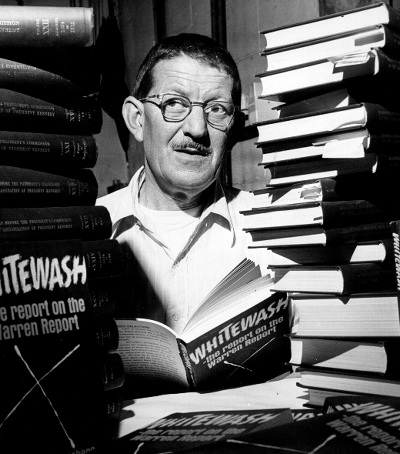
Harold Weisberg At the time of the assassination, Harold Weisberg was trying to jump-start a writing career he had abandoned some years before. The son of Ukrainian émigrés and the first member of his family born in the United States, Weisberg was a former Senate investigator and journalist living in Maryland. He was immediately skeptical of the lone gunman story out of Dallas, so he drafted an outline for an article and sent it to his literary agent.
The agent, Weisberg always recalled with astonishment, told him that nobody would consider publishing anything other than what the government said. “Can you understand how shocking that was to me?” he later asked. “With my background? And my beliefs about the functions of information in a country like ours?” Weisberg went on to write Whitewash and other books, all of them detailed analyses of the official case, and highly critical of the government’s handling of it.
Other early critics included Mary Ferrell, a Dallas legal secretary; Vincent J. Salandria, an attorney in Philadelphia; Maggie Field, a housewife in Beverly Hills, California; and Sylvia Meagher, a researcher at the World Health Organization in New York, who later wrote a penetrating analysis of the case called Accessories After the Fact. Each was a product of that era some call America’s greatest generation.
For most of these critics the assassination was nothing less than all consuming. “‘Oswald’ is the most spoken word in our house,” Salandria’s wife remarked in 1965. The objective: force a re-opening of the investigation. Although they began following and writing about the case immediately, it wasn’t until 1966 these critics began to get much media attention. Most labored in relative obscurity, and only gradually became aware of each other and their common goal. As they did, they began exchanging ideas and information by telephone, and by what today we refer to as snail mail. There was much the early critics didn’t know. But what they did know was that something was terribly wrong.
For nearly all of the first generation critics, their initial research was simply tracking the assassination story as it was reported in the press, and noticing, in the first days and weeks, its inconsistencies.
Like the rest, Mary Ferrell’s suspicions stirred almost immediately. At the time of the assassination she had just emerged from a Dallas restaurant not far from the scene of the crime. A passerby alerted her to what had happened. At almost the same moment police squad cars sped by, sirens blaring. “I ran into a bookstore and called my husband,” she recalled. He heard Kennedy had been shot in the head, Buck Ferrell told his wife, and no one could survive that kind of wound.
Someone had a radio, and Mrs. Ferrell listened to the first sketchy descriptions of the wanted man. “I stood on Elm and thought that they would never find him with no more than that to go on, in an area containing over a million people.” She was thus astonished when the police arrested Lee Harvey Oswald about an hour later – and even more astonished that he did not match the broadcast description she had heard. “The Dallas Police were not gifted with ESP,” she wryly recalled. “And it just – it didn’t fit. And I said, Something is wrong. And I just, I thought, I’m going to find out what everybody said.”

And so she sent Buck and their three sons to the loading docks of The Dallas Morning News and The Dallas Times-Herald where, in shifts, they awaited each updated edition of the daily papers. “Kind of a round robin, for four days,” Mary Ferrell remembered. “And we got every issue of every paper.”
Mrs. Ferrell came across an article in the November 25th issue of the Times Herald hinting at something ominous. The article, “Anonymous Call Forecast Slaying During Transfer,” stated: “An anonymous telephone call to Federal Bureau of Investigation headquarters at 2:15 a.m. warned that Leo [sic] Harvey Oswald would be killed during his transfer from the city lockup to county jail.” The FBI alerted Dallas authorities – yet still Oswald was gunned down. Both papers were putting out multiple editions of each issue, but that article appeared in just one edition and there was no follow-up. “They junked that,” Mrs. Ferrell said. “There were very few copies of that that got loose.”

Mary and Buck Ferrell Her interest further stimulated, Mrs. Ferrell continued collecting assassination-related material and never did stop. By 1970 her collection had become so vast that her husband added a room to the back of their Dallas home. “I can move all my books, papers, file cabinets, etc., out there and give the house back to Buck,” Mrs. Ferrell told a friend. She created an extensive database – originally on index cards, but in later years on a personal computer – and with another researcher, a series of chronologies that charted the people and events relating to November 22, 1963.
In the end, the Warren Commission did not allow Mark Lane to represent the deceased accused assassin. “We are dealing with the mother of Oswald and this lawyer by the name of Lane,” Earl Warren told his commission colleagues in January 1964. “He wants to come right into our councils here and sit with us, and attend all of our meetings and defend Oswald, and of course that can’t be done.”
A few days later, at New York’s Henry Hudson Hotel, Lane spoke about his preliminary findings to a crowd of about five hundred people. For the balance of the year he would lecture publicly about the case, at first just in New York, but soon during an ambitious lecture tour that criss-crossed the nation and even ventured as far away as Eastern Europe.
On February 18, he was in New York for a speech that included an appearance by Marguerite Oswald. An enthusiastic crowd of 1,500 heard Mrs. Oswald say, “All I have is humbleness and sincerity for our American way of life.” She described how she tried to meet with her jailed son before he was murdered, but the Dallas police would not permit it. “Why would Jack Ruby be allowed within a few feet of a prisoner – of any prisoner – when I could not see my own son?”

Sylvia Meagher Among those in the hall that night was Sylvia Meagher, a 42-year-old researcher at the World Health Organization. “At that stage, I had little or no thought of doing any independent work or writing on the case,” she recalled. “I contributed both money and information unreservedly to Lane or his associates, and I would have been delighted to help in any possible way.”
Yet she had already written a memorandum recording bitter thoughts. When the Warren Commission published its single-volume report she read it with a critical eye, and soon produced a 40-page article that she began shopping around to major magazines. “The Warren Report,” she wrote, “gives us no justification for declaring that the case is closed.”
There were a lot of questions, just after the assassination, about how many times the President was hit, and where his wounds were located. Even after fifty years, these questions have never had definitive answers.
Harold Weisberg was appalled that so many unanswered questions remained. “None should exist,” he declared. “This was not a Bowery bum; this was the President of the United States.” Post-mortem photographs of the late president’s wounds were never entered into evidence and the Commission members never saw them. Autopsy surgeon James Humes said he was “forbidden to talk,” and acknowledged having burned his autopsy notes. JFK’s neck wound was first reported to be one of entry, but later reported to be an exit wound. The first mention of a back wound was not made until nearly a month after the assassination. “As one version of the wounds succeeded another with dizzying speed and confusion,” Sylvia Meagher observed, “only one constant remained: Oswald was the lone assassin and had fired all the shots from the sixth floor of the Book Depository. When facts came into conflict with that thesis, the facts and not the thesis were changed.”

The conclusion that one bullet caused multiple wounds in JFK and Texas Governor John Connally – the Single Bullet Theory – was undermined by the Warren Commission’s own evidence, the critics argued. That bullet, Commission Exhibit 399, was virtually undamaged, its appearance nearly pristine. The critics compared it to an identical bullet, Commission Exhibit 856, which had been test-fired by ballistics experts at the Army’s Edgewood Arsenal in Maryland. “The test bullet had been fired through the forearm of a cadaver,” said Ray Marcus, whose interest had expanded to include C.E. 399. That test bullet performed “only one of the multiple tasks allegedly executed by 399. Even so, the difference in the appearance of 856 and 399 is striking, as the former is grossly deformed.”
In April 1964 Marguerite Oswald ended her relationship with Mark Lane. Almost immediately Lane formed an organization called the Citizens’ Committee of Inquiry to coordinate an independent investigation into the assassination. From its New York office, the CCI recruited a small army of volunteer investigators, some of who were dispatched to Dallas to interview assassination witnesses on Lane’s behalf.

Vincent J. Salandria Among these volunteers were Vince Salandria and his brother-in-law Harold Feldman, a writer and translator. Both men were keenly interested in the assassination when it happened, and together had researched an article published in The Nation the previous January. On the morning of June 24, 1964, they left Philadelphia together in Salandria’s 1955 Buick sedan, armed with lists of names, notes, and other material supplied by Lane’s office. Feldman’s wife Immie accompanied them. Driving almost non-stop, they arrived in Dallas late the next day.
Feldman and Salandria immediately contacted Marguerite Oswald. Media accounts had prepared them for a belligerent, uncooperative woman. “What I heard instead,” Feldman recalled, “was a pleasant ladylike welcome – not a trace of cautious ambiguity, not a second of hesitation in the warm courtesy that carried within it only a faint suggestion of loneliness.” The Feldmans and Salandria met with Mrs. Oswald over the next several days, and Marguerite even had them as overnight guests in her Fort Worth home.

(L-R): Harold Feldman,
Immie Feldman, Marguerite Oswald
Mrs. Oswald escorted the volunteer investigators to some of the key sites in the case. Together they visited Helen Markham, the Warren Commission’s star witness against Lee Oswald for the murder of Dallas Police Officer J.D. Tippit. Mark Lane had already spoken with Mrs. Markham by telephone, and her identification of Oswald as the killer of Tippit seemed shaky. A follow-up interview was important.
Mrs. Markham lived in a small apartment over a barbershop. Mrs. Oswald, Salandria and the Feldmans found her at home, cradling her infant granddaughter in her arms and pacing back and forth. She declined to talk to them because, she said, she had to care for the baby. She would not let them pay for a babysitter, but did finally agree to let them return later in the day. As they spoke, Mrs. Markham allowed Marguerite to briefly hold the baby.
Helen Markham, although a grandmother, was still young, Feldman observed – “but shabby, beaten, and spiritless.”
They returned later that afternoon. As they approached the apartment they noticed two Dallas police cars, which had been parked right outside, pulling away.
What happened next, Feldman later wrote, was “the most pitiful spectacle in our experience.” They knocked on the Markham apartment door. Mr. Markham was now home, and he stood barring the entrance as his wife cowered to one side.
“I’ve never seen that kind of terror,” Salandria recalled years later. “Their teeth were actually chattering. And we could get little from them because of their terror.”
“Please go away,” Mr. Markham had groaned. “Please go away, and don’t come back.”
Marguerite broke in. “You’ve been threatened, haven’t you?”
“Yes,” Mr. Markham replied. “Please, go away!”
Shocked, they did as they were asked. As they got back out to the street and headed toward Mrs. Oswald’s car, Marguerite fought back tears. “That poor man!” she said. “He was frightened to death. What right do they have to threaten him? This is still America, by God.”
Since alerting Marguerite Oswald to Mark Lane’s article, Shirley Martin had gone to Dallas several times to find assassination witnesses and talk to them. Not in any official capacity, of course: curiosity, and the feeling that something was not right, motivated her. Her proximity to Dallas – it was only two hundred miles away – proved an irresistible lure.
By the summer of 1964 Mrs. Martin was in contact with Lane’s office, and Lane asked her to speak with a Dallas woman named Acquilla Clemons. Acquilla Clemons was not an eyewitness to the Tippit murder but was nearby, and witnessed some things that were at odds with what was reported in the press.
The Warren Commission had not called Mrs. Clemons to testify, and these early Citizens’ Committee-sponsored trips first brought her story to light. There were at least three interviews with Mrs. Clemons by committee volunteers over the summer of 1964: by two Columbia University graduate students named George and Pat Nash; Salandria and the Feldmans; and Shirley Martin.
George and Pat Nash were unimpressed with Acquilla Clemons. They wrote that her description “was rather vague, and she may have based her story on second-hand accounts of others at the scene.” Unfortunately the Nashes did not say why they doubted her.
Salandria and Feldman interviewed Mrs. Clemons in early July. No record of their conversation appears to exist, but Salandria later said, “I thought she was entirely credible.”

Shirley Martin Shirley Martin spoke to Mrs. Clemons in August, about a month after Salandria and Feldman and the Nashes. She was not at all confident that Acquilla Clemons would talk to her. And so her daughter Vickie, who accompanied her mother, hid a tape recorder in her purse.
For much of the conversation, Mrs. Clemons gave Mrs. Martin a lot of reasons why she didn’t want to talk to her. Mrs. Martin seemed to sense her nervousness. “I’m a private citizen,” she said. “I’m not representing any group.” Still Mrs. Clemons demurred; her employer, she said, did not want her involved in the case in any way.
Undaunted, Shirley continued. “This friend of mine was here…I don’t know if you remember. Mr. Nash? Mr. Salandria? They talked to you?”
“Someone came by my house about two months ago,” Mrs. Clemons replied. They promised to send her a picture of Lee Oswald, she said, but never did.
Finally Mrs. Clemons began to talk. She described seeing two men, neither of them Oswald, in the vicinity of the Tippit killing. More than once since then, she said, the police had warned her not to talk to anyone about what she had witnessed on November 22nd.
“So the police said you’d get a lot of publicity and you’d better not do it?”
“Yeah, I’d better not,” Mrs. Clemons replied. “Might get killed on the way to work.”
“Is that what the policeman said?” Shirley Martin asked.
“Yes,” Mrs. Clemons answered. “See, they’ll kill people that know something about that…there might be a whole lot of Oswalds…you know, you don’t know who you talk to, you just don’t know.”
“You scare me…”
“You have to be careful,” Mrs. Clemons said. “You get killed.”
The Warren Commission’s single-volume Report was published in September 1964, and two months later its 26 volumes of hearings and exhibits. This was the moment that the early critics had been waiting for. “I was wildly excited,” Sylvia Meagher recalled. “I opened the box. There were the 26 volumes, everything I’d been looking forward to studying for a long time.” Meagher went on to write a devastating analysis entitled Accessories After the Fact.
The news media, too, greeted the Warren Report with great enthusiasm – but from a much different perspective. Time magazine called it “amazing in its detail [and] utterly convincing,” while The New York Times said “the evidence of Oswald’s single-handed guilt is overwhelming.” The CBS, NBC and ABC television networks all hailed the Report as the final word on President Kennedy’s assassination, and devoted much airtime to its findings.
Mark Lane, who had been speaking publicly about the weaknesses in the government’s case since January, now began debating the Report and its validity. In October 1964 he sparred with Melvin Belli, the celebrated attorney who had unsuccessfully defended Jack Ruby for murdering Lee Oswald. Belli performed badly and was even jeered by the audience; he conceded that Lane “was bright and he had an almost encyclopedic knowledge of the facts.”
On December 4 Lane took part in a much more important event, appearing with a Warren Commission staff attorney named Joseph Ball at a high school in Beverly Hills, California. It was the first time anyone associated with the Commission agreed to publicly defend its findings. At the time of this confrontation, the Commission’s Hearings and Exhibits had only been available for about a week.
To help Lane prepare, several critics met a few days beforehand and began pouring over these 26 volumes. Their meetings took place at the home of Maggie Field. Most there had been in contact with Lane’s Citizens’ Committee office, but it was the first time they were meeting each other. And it was the first time many of them were getting a good look at the Warren Commission’s official evidence.

While technically not a debate, the strengths and weaknesses in the government’s case were given a thorough airing that night before an overflow crowd of several thousand. For forty-five minutes, Lane held the audience spellbound with a summary of the deficiencies in the case against Oswald. And he assured them it was their right to know the truth. “We are going to remain with this matter until such time as the American people secure that to which we are all entitled in a free, open, and democratic society. And that is some intelligible answers to the thus far unanswered questions of Dallas on November 22.”
But Joseph Ball assured the audience that the Commission had performed with honesty and integrity, and had found the correct answers. He emphasized his independence and impartiality. “It didn’t make any difference to me whether I discovered Oswald was the assassin or that someone else was.”
Mark Lane, Ball charged, was picking and choosing from the evidence, and ignoring that which implicated Oswald. Lane interrupted to challenge this point, and the two argued back and forth. Each managed to call the other a liar. Finally Ball seemed to have had enough: examining Mark Lane, he declared, would only result “in a cat and dog fight.”
“Well that’s all right,” Lane countered. “It’s about time we had a dialog in America on this question.”
When the event was over, a reporter asked audience members about what they had witnessed. “It was like, a shocking drama,” said one. Several added that they found it troubling that someone of Joseph Ball’s stature was unable to answer many of the points Lane made. Most agreed that Lane had won. “The byproduct of his defense of Oswald,” one man said, “is to show that there has been, no matter what the motivation on the part of the Warren Commission, and many areas of government, an attempt to cover up.”
In spite of their diverse backgrounds and political orientations, the first generation critics maintained informal, sometimes uneasy alliances with each other for several years. There were occasional meetings, most notably in October 1965, when some of the critics, including Vince Salandria and Maggie Field, gathered in Sylvia Meagher’s home.
There was great excitement in the fall of 1966 when Republican Congressman Theodore Kupferman proposed a special committee to review the Warren Commission’s work. Nothing ever came of the freshman lawmaker’s idea. But just a few months later there was even more excitement with the electrifying news that New Orleans District Attorney Jim Garrison had launched his own investigation into the Kennedy assassination.
Garrison freely acknowledged his debt to the work of the critics, in particular that of Mark Lane, Harold Weisberg, and a newcomer named Edward J. Epstein. Lane was among the first of the critics to get actively involved in Garrison’s investigation, lending his expertise; Harold Weisberg, Vincent J. Salandria, and others soon followed. Maggie Field raised funds for the D.A. and made plans to visit New Orleans.
“I have repressed the occasional impulse to rush to the airport and fly to New Orleans,” Sylvia Meagher said in April 1967. But her enthusiasm was short-lived. By that summer Meagher and several others had lost all faith in Jim Garrison. It proved to be an irreconcilable issue between them, and by that fall, Meagher had severed ties with most of the other critics. For better or worse, Jim Garrison’s case ultimately failed. Afterward it seemed to many that the search for truth had been dealt a devastating setback.
That the Warren Commission’s lone gunman theory is so widely rejected today suggests that the critics’ work proved it was wrong. And it did – yet it is also true that public skepticism has always run deep. Surveys taken within a few weeks of the assassination showed widespread doubt about the official story. The numbers have fluctuated over the years, but public opinion polls have consistently revealed this doubt. Perhaps what the critics really did was provide the details to what most Americans, in their bones, already knew.
So who killed JFK? We still don’t know for sure, although theories abound. And while later generations of assassination researchers pursued this question with great zeal, many of the earliest critics stopped short of affixing responsibility. “After all these years,” Sylvia Meagher remarked in 1975, “I still do not know if it was the CIA, the military, LBJ, the Cubans, or the Mafia, or any combination of them. But I always knew, know, and will always know for a certainty that C.E. 399 is a fake, that the autopsy is a fraud, that much of the other hard evidence is suspect or tainted, and that the Warren Report is false and deliberately false.”
Maggie Field once told an interviewer that finding the truth about the murder of JFK was of paramount importance. “Until we can get to the bottom of the Kennedy assassination, this country is going to remain a sick country,” she said. “No matter what we do. Because we cannot live with that crime. We just can’t.”
-
James DiEugenio, Reclaiming Parkland
When I first heard that Jim DiEugenio would be turning his ten part review of Vincent Bugliosi’s overblown tome, Reclaiming History, into a book, I was happy to endorse him. Ever since I first discovered DiEugenio’s website CTKA.net, I knew that he was a devoted and honest researcher. Prior to his writing Reclaiming Parkland, DiEugenio completely rewrote the first edition of his 1992 book, Destiny Betrayed. In this reviewer’s opinion, Destiny Betrayed (the second edition) was an exceptionally well written and sourced book. This reviewer can honestly state that after reading Reclaiming Parkland, it is in the same league with DiEugenio’s previous book. However, Reclaiming Parkland. isn’t just a review of Bugliosi’s book. The book is divided into three sections. In section one, the author discusses Bugliosi’s past, from his childhood and career as assistant district attorney of Los Angeles County, to his participation in the utterly shoddy mock trial of Oswald in London. Section two of the book is the author’s very long review of Reclaiming History. In section three of the book, the author mainly discusses the failure of Hollywood heavyweight, Tom Hanks as a true historian, and how much influence the CIA and the Pentagon have today on how Hollywood produces films, and therefore what the American public sees on their movie and TV screens.
Introduction
The author begins his book by telling the reader that Bugliosi was once a subscriber to the excellent Probe magazine, which the author edited along with the esteemed Lisa Pease back in the nineties. The author then moves onto explaining how the mainstream media in the United States have praised Bugliosi’s book without reservation,or as the author put it directly in his book;
Any book that supports the original Warren Commission verdict of Lee Harvey Oswald as the lone assassin of JFK is not going to be roundly criticized in the mainstream media (hereafter referred to as the MSM). (DiEugenio, Introduction).
One such review which the author uses as an example to demonstrate this point is the review of Reclaiming History, in The Wall Street Journal by journalist Max Holland. As the author explains to the reader, Holland is a vehement defender of the Warren Commission’s conclusion that Lee Harvey Oswald was the lone assassin (ibid). Readers of this review may already be aware of the fact that DiEugenio provided a critical review of Holland’s deceptive documentary on the assassination, The Lost Bullet, on his website (read that review). The author reveals that in the year 2001, Holland became the first author outside of the Government to be given the Studies in Intelligence award by the CIA (ibid).
On the issue of why he decided to write such a long review of Reclaiming History, the author more or less explains that it was because the negative reviews of the book which he had read were narrow in focus (ibid). In other words, the previous reviews were not based on the entire book. How the author could undertake such a feat, is in this reviewer’s opinion, is a testament to his commitment to exposing the lies and the omissions of facts. Traits which all too common amongst Warren Commission defenders.
One of the most truly ridiculous claims that any researcher of the JFK assassination could make, is that the Kennedy murder is a simple case. Yet, this is precisely what Bugliosi told the author in an interview with him (ibid). To demonstrate the absurdity of this statement, the author provides several examples of complex issues pertaining to the assassination. The author begins by explaining how the seven investigations into the President’s murder, from 1963 to 1998, differed in opinions on various pieces of evidence, such as whether or not the single bullet theory was true, and how the Church Committee in the 1970’s came to the conclusion that the FBI and the CIA had withheld important documents from the Warren Commission (ibid). Although Bugliosi has nothing but scorn for the critics of the Warren Commission, he is on record for believing that Senator Robert Kennedy was the victim of a conspiracy. As the author writes, Bugliosi said the following during a civil trial of the RFK assassination:
We are talking about a conspiracy to commit murder … a conspiracy the prodigious dimensions of which would make Watergate look like a one-roach marijuana case. (ibid).
In the introduction to Reclaiming History, Bugliosi gave his readers the pledge that he would not knowingly omit or distort anything about President Kennedy’s assassination, and that he would set forth the arguments of the Warren Commission critics the way they would want them set forth, and not the way Bugliosi wanted (ibid). However, as DiEugenio demonstrates throughout his nine chapter long review of Reclaiming History, this was not the case. Not by a long shot. (The nine chapters include one which was excised.) The author concludes the introduction to his book by briefly explaining the purchase of the film rights to Reclaiming History. by the Tom Hanks and Gary Goetzman owned production company, Playtone (ibid). As mentioned previously, what the reader will learn by reading this book is that, contrary to what he likes to proclaim, Tom Hanks is not in any way a true historian.
I: The prosecutor
Aptly titled The Prosecutor, this first chapter explores Vincent Bugliosi’s career as assistant DA of Los Angeles County, where he shot to fame for his prosecution of Charles Manson and several of his followers for the August, 1969, Tate/LaBianca murders (ibid). The reader will also read about Bugliosi’s indictment for perjury following the Manson gang convictions, his two attempts to become the District attorney of Los Angeles County, and his run for the Attorney General of California. The Author begins the Chapter with the following quote by Bugliosi during an interview with Playboy magazine in 1997:
“People say I’m an extremely opinionated person. If opinionated means that when I think I’m right I try to shove it down everyone’s throat, they are correct … As for arrogant, I am arrogant and I’ m kind of caustic … The great majority of people I deal with are hopelessly incompetent, so there’s an air of superiority about me.” (DiEugenio, Chapter 1).
As anyone who reads Reclaiming Parkland. will understand, Bugliosi was being candid when he described himself as arrogant and extremely opinionated. After a brief introduction into Bugliosi’s childhood, family background, and service in the United States Army prior to joining the Los Angeles county District attorney’s office, the author moves onto a discussion of the two murder cases which helped bolster Bugliosi’s reputation as a prosecutor more than any others. The first case was the murder convictions of former Los Angeles Police Officer Paul Perveler and his girlfriend Kristina Cromwell. Bugliosi had successfully convicted them in February, 1969, for conspiring to murder Cromwell’s husband Marlin, and Perveler’s wife Cheryl (ibid).
As most people who have heard of him are aware, Bugliosi co-authored the bestselling book Helter Skelter with Curt Gentry. The book was based on the murders of Sharon Tate, Jay Sebring, Abigail Folger, her boyfriend Victor Frykowski, Steve Parent, and Leno LaBianca and his wife, Rosemary. Bugliosi had successfully convicted Charles Manson and several of his followers, such as Tex Watson and Susan Atkins, for these horrific murders. Curiously, like Reclaiming History, Helter Skelter was published by W.W. Norton, and following its publication in 1974, it went on to become the number one best-selling true crime book to date (ibid).
The author spends several pages in his book explaining why Bugliosi’s motive for the crimes is not supportable today. The author also spends several pages comparing Bugliosi’s views on the investigation of the Tate/LaBianca murders, to those of President Kennedy’s assassination. According to Bugliosi, the murders were inspired in part by Manson’s prediction of Helter Skelter, a so-called apocalyptic war which he allegedly believed would arise from tensions over racial relations between whites and blacks. However, as the author explains, the more likely motive for the murders was to get a friend of Manson’s named Bobby Beausoleil out of jail for murdering Gary Hinman in July, 1969 (ibid). Hinman was stabbed to death by Beausoleil, after Manson sliced Hinman’s ear due to a dispute over a bad batch of mescaline (ibid). As the author writes, Manson once actually said that the real motive for the murders was to get Beausoleil out of jail. This was confirmed by Susan Atkins (ibid). In fact, the Los Angeles Police had actually thought the Tate and LaBianca murders were copycat murders (ibid). All of this would seem to undermine Bugliosi’s motive for the crimes.
The author also scores Bugliosi by showing how Bugliosi’s opinions on the investigations of the Tate/LaBianca murders contradict his opinions on the investigation of President Kennedy’s assassination. For one thing, Bugliosi spent many pages in Helter Skelter complaining about how the Los Angeles Police had initially failed to connect the Tate murders to the LaBianca murders; because of the similarity of the crimes. However, in Reclaiming History, Bugliosi refuses to acknowledge the similarities between the attempted plot to assassinate President Kennedy in Chicago, and his eventual assassination in Dallas (ibid). Bugliosi also complains in Helter Skelter about the length of time it took for the gun used by Tex Watson during the murders to arrive at the San Fernando Valley Police station, but doesn’t have any qualms about the Dallas Police departments delay in sending three of the four bullets removed from the body of J.D Tippit, to the FBI lab in Washington for ballistics tests.
The author goes on to explain that following the prosecution of Tex Watson for the Tate/LaBianca murders, Bugliosi was indicted for perjury. This came about after someone leaked a transcript of Susan Atkins’ discussion about the murders with Virginia Graham, a fellow inmate of Atkins in the Sybil Brand jail (ibid). The transcript was leaked to Los Angeles Herald Examiner reporter, William Farr. Bugliosi was one of two lawyers involved in the Manson trials to be indicted for perjury, the other being Daye Shinn. Bugliosi’s assistant, Stephen Kay, testified at his perjury trial that William Farr had asked him (Kay) to hand Bugliosi a manila envelope (ibid). Kay had also testified that Farr was in Bugliosi’s office during the afternoon that Bugliosi accepted copies of Graham’s statement for storage, and that Bugliosi had threatened to remove him and a fellow assistant named Don Musich from the Tate/LaBianca cases, if either he or Musich asked for a hearing into the passing of the manila envelope between Farr and himself. (These proceedings had been covered by the LA Times in June and October of 1974. The reader can also read about this incident.)
Then there’s Bugliosi’s two time campaign to become the DA of Los Angeles in 1972 and 1976, and his run for Attorney general of California in 1974 (ibid). As the author explains, all three campaigns were personal and rabid in nature. For instance, in his 1976 run for DA against John Van de Kamp, Bugliosi accused Van de Kamp of not prosecuting 7 out of 10 felony cases when he was District attorney; whereas in actual fact, Van De Kamp had the highest prosecution rate in the whole of California, at an 80% prosecution rate (ibid). Bugliosi also stated that Van De Kamp had never prosecuted a murderer or rapist. But in actual fact, Van De Kamp had successfully prosecuted two murder cases (ibid).
If all of the above isn’t enough to convince the reader that Bugliosi has a tendency for hyperbole, then consider each of the following. Bugliosi had harassed his former milkman, Herbert H. Wiesel, after Bugliosi suspected him of having an affair with his wife (ibid). Bugliosi later broke into the home of a woman named Virginia Caldwell, who claimed that Bugliosi was having an affair with her, after Caldwell refused to have an abortion at Bugliosi’s request. After striking her, he then convinced Caldwell to concoct a cover story that the bruise on her face, was actually caused by her child hitting her with a baseball bat (See Fact Check Vincent Bugliosi).
To my knowledge, no one has ever put all of these quite pertinent facts about Bugliosi into one place before.
II: The Producers
Following his long discussion of Bugliosi’s character, and his career as a prosecutor, the author moves onto a discussion of how Playtone producers Tom Hanks and Gary Goetzman, along with actor Bill Paxton, conceived the idea of turning Reclaiming History. into a television mini-series; which thankfully never came to fruition. Included in this chapter is a biography of Hanks, which serves as a prelude to the author’s discussion of why Tom Hanks is not a true historian. The author actually begins this chapter with the following statement by Gary Goetzman in the Hollywood trade magazine Daily Variety, in June, 2007: “I totally believed there was a conspiracy, but after you read the book, you are almost embarrassed that you ever believed it.” (DiEugenio, Chapter 2). For Goetzman to say that he was “almost embarrassed” to believe that President Kennedy’s assassination was a conspiracy after reading Reclaiming History. is, in this researcher’s opinion, utterly absurd. In this day and age, the evidence that there was a conspiracy is simply overwhelming.
According to the author’s sources, the idea to produce a mini-series based on Reclaiming History, actually originated with actor Bill Paxton. As it turns out, Paxton had an interest in the assassination, because on the morning of the assassination, at the age of just eight, Paxton’s father took him to see President Kennedy in Fort Worth, Texas, as the president emerged from a Texas hotel (ibid). As Paxton told Tavis Smiley on Smiley’s talk show, he (Paxton) wondered whether anyone had told the story of the assassination without bias, without an agenda, and without a conspiracy (ibid). It is apparent to this reviewer that Paxton had an agenda from the beginning: namely that Oswald had acted alone. And as the author put it, Paxton was; “…uniquely unqualified to inform any prospective buyer about the merits of Reclaiming History. .” (ibid).
The author then goes on to explain how the positive reviews of Reclaiming History. had influenced Tom Hanks and Gary Goetzman to purchase the film rights to the book. Within a period of just three months after Hanks and Goetzman had purchased the rights to the book, the President of HBO films, Colin Callender, announced that HBO would be producing a ten part mini-series based on the volume (ibid). And as the author painstakingly explains in the book, the film which came out of all this, entitled Parkland, does not even resemble Reclaiming History. . The author asks the reader, how did a man like Tom Hanks ” … get into a position to make such momentous public decisions about highly controversial and very important historical issues?” (ibid).The author tells us that in order to understand all of that, we must understand who Tom Hanks is (ibid). Whilst I will spare the reader every sordid detail about Tom Hanks’ past, from his childhood, to his career as an actor and producer, I will briefly give the reader an overview of what, in this reviewer’s opinion, is the essential information to understanding why Tom Hanks bought into Reclaiming History.
Born in Concord, California, in 1957, Tom Hanks began his screen acting career in the 1980 slasher film, He Knows You’re Alone (ibid). Hanks, of course, starred in the multi awarded film, Forrest Gump, and in the Ron Howard directed film, Apollo 13. Reading through Reclaiming Parkland, it is this reviewer’s opinion that the three productions in which Hanks was an actor and/or producer, which are essential in understanding the type of historian that Hanks is, are From the Earth to the Moon, Saving Private Ryan and Charlie Wilson’s War (the author discusses the latter film in Chapter 12 of the book).
From the Earth to the Moon was a 12 part television mini-series by HBO, which was co-produced by Hanks (ibid). As Hanks’ biographer David Gardner wrote, Hanks believed the NASA space missions of the 1960’s ” … were amongst the few lasting, happy memories he had of the era” and ” … he [Hanks] wanted to reclaim the ’60’s for his own generation by giving the space program a context he felt it had been denied.” (ibid). Reading through these quotes, it immediately struck this reviewer that Hanks was much more concerned about the space programs than the four political assassinations of the era. Worse still, as the author explains, towards the end of part 4 of From the Earth to the Moon, the script says that a person had wired into NASA during the Apollo 8 space flight in 1968 and the script now said that the flight ” … redeemed the assassinations of King and RFK that same year since, a woman named Valerie Pringle said so.” (ibid). That quote almost made this reviewer’s eyes pop out of their sockets. For how could any true historian contemplate that a manned space mission had somehow “redeemed” the RFK and MLK assassinations? In this reviewer’s opinion, such a notion is completely ridiculous.
In 1998, Hanks starred in the Steven Spielberg directed film Saving Private Ryan; which, as the author writes, was a fictional film, with Hanks’ goal being to “…commemorate World War II as the Good War and to depict the American role in it as crucial.” (ibid) The author states that the film was actually 90% fiction, and that Tom Hanks had to have known it was so (ibid). But in spite of this, Hanks made the following remarks:
When I saw the movie for the first time I had the luxury of being in a room by myself, so I wept openly for a long time. I have never cried harder at a movie, or almost in real life, than at the end of this one-it was just so painful. I think an absolutely unbelievable thing has occurred here, and I am part of it, and I sort of can’t believe it. (ibid).
It is quite curious that Hanks actually said the above. For why would an alleged true historian cry over a fictional film? The author tells the reader that the story of Frederick “Fritz” Niland (portrayed as James Ryan in the film) was first reported in the book Band of Brothers, authored by Stephen Ambrose (ibid). As the author explains, Ambrose is Tom Hanks’ favorite historian. Hanks first met him when Ambrose worked as a consultant on Saving Private Ryan (ibid). Ambrose was also instrumental in influencing Hanks and Gary Goetzman to launch Playtone. What’s important to bear in mind, is that Ambrose was critical of Olive Stone’s film JFK, and demeaned several Warren Commission critics such as Jim Garrison and Jim Marrs in the New York Times, following the release of JFK. (ibid). But Ambrose didn’t just demean the critics of the Warren Commission. He also made the comment that ” … it seems unlikely at best that he [Kennedy] would have followed a course much different from the one Lyndon Johnson pursued” (ibid). But as the author writes this is “completely fatuous”, as books such as James Blight’s Virtual JFK have utilized declassified documents (such as President Kennedy’s National Security Action Memorandum # 263) to show that Kennedy was withdrawing from the Vietnam War at the time of his death (ibid). Ambrose was also exposed as a liar and a serial plagiarizer (ibid). For one thing, Ambrose lied when he said that it was Eisenhower’s idea for him to write Eisenhower’s official biography (ibid). Ambrose also lied when he said he spent hundreds of hours with Eisenhower to write his biography. In reality, Ambrose had merely met with Eisenhower three times; which totalled only five hours (ibid). With someone like Ambrose as Tom Hanks’ favorite historian, it comes as no shock to this reviewer that Hanks decided to produce a film upholding the Warren Commission’s conclusion that Oswald acted alone in murdering President Kennedy.
There is also one other important detail about Hanks which is not in Reclaiming Parkland, but which the author told this reviewer about on Greg Parker’s research forum, Reopen the Kennedy case. Apparently, Tom Hanks named his sons, Truman and Theodore Hanks, after the American presidents Harry Truman and Theodore Roosevelt. As most of us know, it was Truman who had two atomic bombs dropped on Japan during World War Two. However, this reviewer wasn’t aware that Roosevelt helped force Colombia out of its northern province when they voted not to sell it to use for the Panama Canal. Roosevelt then helped fake a rebellion (with help from the French), sending ships into the Caribbean to prevent the Colombian Army from restoring order. As anyone who has a true understanding of the sort of President that John F. Kennedy was should know, Kennedy would never have contemplated the aforementioned acts by Truman and Roosevelt. But it would seem that Tom Hanks is quite unaware of these differences. So how can we say that Tom Hanks is someone who admired President Kennedy, and therefore, is someone we can trust to tell the truth about his assassination? In this reviewer’s opinion, we cannot.
III: You call this a trial?
What follows next is the author’s masterful discussion of the shameful London Weekend Television mock trial of Oswald in 1986. Vincent Bugliosi was the mock prosecutor at this trial. According to the author, it was this trial which inspired Bugliosi to write his overgrown tome, Reclaiming History. (DiEugenio, Chapter 3). Since the trial can be viewed online on YouTube, it is not this reviewer’s intention to spend a considerable amount of time discussing it here. Suffice it to say, the author meticulously explains to the reader just how biased the trial was in Bugliosi’s favor, and also illuminates the incompetence of Gerry Spence, the acting defense attorney, in defending the deceased Oswald.
In the opening paragraphs of his discussion, the author makes a number of astute observations of just why the trial was strongly biased against Oswald, and how this ultimately led to the jury finding Oswald guilty. First of all, obviously, Oswald was not present at the trial. As the author soundly explains, Oswald would have been the most important witness to his defense, as he would have been able to inform the jurors of his connections to extreme right wing figures such as David Ferrie, Guy Bannister, and Clay Shaw (ibid). Shockingly, Bugliosi actually wrote in Reclaiming History. that it was probably better for the cause of pursuing the truth behind Kennedy’s assassination that Oswald died. (ibid). In this reviewer’s opinion, this is one of the most bizarre statements that Bugliosi has made concerning the assassination.
Furthermore, the author notes that the following important witnesses were also absent from the trial: Marina Oswald, who, amongst other things, testified before the Warren Commission that her husband owned the alleged murder weapon. The three autopsy doctors who performed the autopsy on the President’s body at Bethesda Naval hospital were also absent. Also, Sylvia Odio, the young Cuban woman who testified before the Warren Commission that Oswald and two Latin looking men had visited her at her apartment in Dallas, was also absent from the trial (DiEugenio, Chapter 3). Odio’s testimony was crucial, as it strongly implied that Oswald was being framed for the assassination.
The author also makes several other sharp observations, such as the fact that the prosecution called a total of fourteen witnesses, whereas the defence called a total of only seven witnesses (ibid). The prosecution had also used scientifically false evidence against Oswald, namely, the Neutron Activation Analysis tests, which Bugliosi’s witness, Vincent Guinn, presented to the jury as evidence that CE 399 (the magic bullet) went through both President Kennedy and Governor John Connally. This was allegedly accomplished by showing that the lead from the core of CE 399, was identical to the lead fragments embedded in Governor Connally’s wrist (ibid). Neutron Activation Analysis has since been thoroughly debunked as a valid scientific method for identifying the origin of lead fragments.
Another key point the author makes is that the jurors (unlike in an actual trial) were not allowed to view the actual exhibits located in the National Archives in Washington. As an example of why this is important, the author states that the marksman who originally tested the rifle in evidence, said it had a defective telescopic sight and the bolt was too difficult to operate, but the jurors wouldn’t be able to know that for themselves since they weren’t allowed to actually handle the rifle. Furthermore, the defense was limited, as the 2 million pages of documents declassified by the Assassination Records Review Board, following the passing of the JFK act were not yet available. (ibid
In his discussion of each of the witnesses, the author first introduces them by describing who they were, and how they were involved with the assassination, and/or its aftermath and the investigations which followed. The author then provides an evaluation of how the witnesses were questioned by both Vincent Bugliosi, and Gerry Spence. For the purpose of this review, I will discuss the author’s evaluation of one of the prosecution witnesses, and one of the defense witnesses. Let’s begin with Ruth Paine, in whose house Oswald allegedly stored the rifle the Warren Commission concluded was used to assassinate President Kennedy. As the author introduces her, Ruth Paine testified at the London trial that she had helped Oswald obtain his job at the TSBD prior to the assassination (ibid). During the trial, Bugliosi attempted to make a major issue out of the fact that Oswald had normally visited the Paine home (where his wife was staying) on weekends after obtaining the job at the TSBD, but had broken that so-called routine by instead arriving on the Thursday night prior to the assassination (ibid). The author scores Bugliosi by pointing out that Oswald had broken that so-called routine the previous weekend, since he didn’t turn up at the Paine home (ibid). The author also scores Gerry Spence by pointing out that Spence failed to mention that Oswald’s “routine” was only one month old (ibid).
Bugliosi also tried to make a big deal out of the fact that Ruth Paine claimed someone had left the light on in the Paine garage on Thursday evening. Bugliosi asked Paine if she thought that it was Oswald who left the light on, and she responded that she thought it was him. The author scores Spence and the presiding judge for not objecting to the question, as it called for a conclusion not based on observable facts (ibid). It was an opinion which was contradicted by the testimony of Marina Oswald who said Oswald was in their bedroom at the time. The author also scores Spence for not objecting to Bugliosi’s question to Ruth Paine about how Oswald viewed the world around him, since Paine had limited contact with Oswald (ibid). In this reviewer’s opinion, the author could also have criticized Spence by noting, for example, that during his cross-examination, he didn’t ask Paine about the metal file cabinets which contained what appeared to be the names of Cuban sympathizers. The information about these metal file cabinets was contained in the report by Dallas deputy Sheriff, Buddy Walthers, to Bill Decker, who at the time of the assassination was the Sheriff of Dallas County. (See Warren Commission, Volume 19, p. 520 for Walthers’ report).
In his discussion of reporter Seth Kantor, the author gives credit to Spence for using Kantor, as Kantor discussed Ruby’s phone calls with Mafia enforcers such as Barney Baker, Lenny Patrick, and Dave Yaras, in the latter part of 1963 (ibid). Kantor also testified that he had seen Ruby at Parkland Hospital, just as he testified that he had before the Warren Commission (ibid). However, the author criticizes Spence for not using Kantor more effectively on how Ruby had entered the basement of the Dallas Police Department, where he shot Oswald as Oswald was being transferred to the County jail (ibid). As a matter of fact, throughout the entire discussion of this sordid trial, the author rightly criticized Spence for not calling many of the key witnesses to the assassination to testify. For example, Victoria Adams and Sandra Styles (both of whom were on the rear stairs of the TSBD when Oswald was allegedly coming down the stairs, but never noticed him) were not called to testify. In the reviewer’s opinion, reading the author’s takedown of this trial was delightful.
IV: On first encountering Reclaiming History
Since it was the London trial’s guilty verdict which inspired Bugliosi to write Reclaiming History, what naturally follows, in Chapter 4, is the beginning of the author’s meticulous discussion of just why Bugliosi’s book is nothing but a cover-up tome for the Warren Commission. The author begins his discussion of Reclaiming History. with the following quote by Bugliosi in the U.S. News and World Report:
The conspiracy theorists are guilty of the very thing they accuse the Warren Commission of doing … There is no substance at all for any of these theories, they’re all pure moonshine … I’m basically telling them that they’ve wasted the last 10 to 15 years of their lives. (DiEugenio, Chapter 4)
But in reality, as the author shows, it was Bugliosi who had wasted twenty years of his life writing a specious book defending the utterly ridiculous Krazy Kid Oswald concept. In the opening paragraph of the chapter, the author actually writes that Bugliosi has the personal attributes of humour, self-effacement (emphasis added) and intelligence (ibid). Whilst Bugliosi may be both funny and intelligent, this reviewer couldn’t help but think that the author had erred in describing him as a self-effacing person, as Bugliosi’s arrogance in upholding the Oswald acted alone theory, and demeaning the critics of the Warren Commission, is simply palpable. (In discussions with the author, Mr. DiEugenio has informed me that this quality is one Bugliosi displays in private.)
DiEugenio begins his long discussion of Reclaiming History. by first complementing Bugliosi on three of his previous books: No Island of Sanity, The Betrayal of America, and The Prosecution of George W. Bush for Murder. The author recommends all three of these books, and writes that compared with Reclaiming History, all three of these books were brief, and were actually based on facts, the law, and morality (ibid). The author writes that Reclaiming History. is essentially divided into two separate books, which Bugliosi smugly entitled “Matters of fact: What happened” and “Delusions of Conspiracy: What did not happen” (ibid). Book one covers topics such as the autopsy, the Zapruder film, evidence of Oswald’s guilt, and Oswald’s possible motive. Book two is comprised of nineteen chapters, and covers topics such as the various groups suspected of being involved in the assassination, including the Sylvia Odio incident, and a ferocious attack on Oliver Stone’s film JFK, and critics such as Mark Lane and David Lifton (ibid). Bugliosi also makes an abundance of negative remarks throughout his overblown book, such as “…simple common sense, that rarest of attributes among conspiracy theorists…” and “But conspiracy theorists are not rational and sensible when it comes to the Kennedy assassination.” (ibid).
Perhaps one of the most interesting revelations about Reclaiming History. is that it was actually co-authored by two other Warren Commission defenders; namely, Dale Myers, and the late Fred Haines. DiEugenio credits this discovery to David Lifton (ibid). Haines apparently wrote most of the section of the book on Oswald’s biography. Dale Myers apparently wrote a lot about the technical aspects of the assassination in the book, such as the photographs taken during the assassination, and the acoustics evidence (ibid). However, Bugliosi and Myers had a falling out, so Myers’ name wasn’t mentioned on the front cover of the book (ibid).
The author devotes a large section of this chapter to a discussion of Oswald’s alleged ownership of the Mannlicher Carcano rifle discovered on the sixth floor of the TSBD. Like every Warren Commission defender before him, Bugliosi states that Oswald owned the rifle, and the author describes the rifle as the centrepiece of Bugliosi’s case against Oswald (DiEugenio, Chapter 4). According to Bugliosi: “If there is one thing that is now unquestionably certain, it is that Lee Harvey Oswald ordered and paid for one Mannlicher Carcano rifle that was found on the sixth floor of the Texas School Book Depository.” (ibid). In light of all the compelling evidence DiEugenio presents to the contrary, to say that it is now unquestionably certain that Oswald owned the rifle is a rather unjustified statement to make, and the book specifically demonstrates why that is so.
But first, the author explains that the first type of rifle reported as being found on the sixth floor of the TSBD, was a 7.65 mm German Mauser bolt action rifle (ibid). To bolster his argument, the author cites the affidavits and reports by Dallas Deputy Sheriff, Eugene Boone, and Dallas Deputy Constable, Seymour Weitzman, in which they reported that the rifle discovered was a 7.65mm German Mauser (ibid). In this reviewer’s opinion, the Mauser discovered was probably one of the two rifles owned by TSBD employee, Warren Caster, and that Caster then participated in a cover-up to dispense with the Mauser story. (Read through this reviewer’s discussion of this pertinent issue.) It is perhaps also worthwhile noting that Sam Pate told HSCA investigators that he observed DPD detective, Charlie Brown, carrying two rifles outside the TSBD following the assassination (click ).
Oswald allegedly purchased and mailed the money order for the rifle on the morning of March 12, 1963, during his work hours (ibid). However, Oswald’s time sheet at work for March 12 shows that Oswald was working when he allegedly purchased and mailed the money order (ibid). Furthermore, the money order allegedly arrived and was deposited by Klein’s sporting goods at the First National Bank of Chicago (a distance of approximately 700 miles), received by the Chicago Post Office, then processed and deposited in the bank by Klein’s all within a period of 24 hours! As the author states, this supposedly happened before the advent of computers, and that he; ” … sends letters within the county of Los Angeles that do not arrive the next day” (ibid). So this is truly exceptional.
To make matters worse for Bugliosi (and Warren Commission defenders alike), the date of the duplicate deposit slip for Klein’s bank deposit on the rifle reads February 15, 1963; whereas the money order for the rifle was allegedly deposited on March 13, 1963. There were also no financial endorsements on the back of the money order, which Robert Wilmouth, the Vice President of the First National Bank of Chicago, claimed there should have been (ibid). Worse still, Oswald allegedly ordered a 36 inch long Mannlicher Carcano rifle, using a coupon from The American Rifleman magazine, but he was instead shipped a 40.2 inch long rifle (ibid). This reviewer could go on, but to do so would take too long, and I would refer the reader to Gil Jesus’s website for even more details on this topic. This reviewer can state that DiEugenio leaves Bugliosi standing on nothing but quicksand on this issue. And further, contrary to the above noted pledge made by the prosecutor, Bugliosi does not state the critics’ case on this point as they themselves would make it.
V: Oswald’s Defense
Throughout this entire chapter, the author proves that Bugliosi’s claim that; “There was not one speck of credible evidence that Oswald was framed,” is preposterous (DiEugenio, Chapter 5). The issues discussed by the author include the provenance of CE 399, the Neutron Activation Analysis tests used to allegedly determine that the lead fragments embedded in Governor Connally’ wrist originated from CE 399, the Tippit shooting and the Walker shooting (both of which the Warren Commission concluded Oswald was responsible for), Oswald’s alibi at the time President Kennedy was assassinated, Marina Oswald’s credibility and so forth.
As far as CE 399 is concerned, the author notes the familiar fact that Darrell Tomlinson, who allegedly discovered the bullet on a hospital stretcher in Parkland Hospital, testified to the effect that the bullet was not found by him on Governor Connally’s stretcher (ibid). The author also cites the interview of Parkland Hospital security chief, O.P Wright, by Josiah Thompson, during which Wright told him that Tomlinson gave him a sharp nosed, lead colored bullet (ibid). This is not at all what CE 399 looks like. As the study by statistics professor Cliff Spiegelman and metallurgist Bill Tobin showed, Neutron Activation Analysis was useless as a means of identifying lead fragments as originating from a particular bullet (ibid). This finding was supported by a separate study by statistician Pat Grant and metallurgist Rick Randich, which was actually released before Reclaiming History. was published (ibid). Yet in spite of this finding, Bugliosi tried to argue in his book that Neutron Activation Analysis was still reliable (ibid).
As far as the Tippit shooting is concerned, the author argues that the four shell casings recovered after the shooting were two Remington Peters and two Winchester Western casings, whereas the bullets removed from Officer Tippit’s body were three Winchester Westerns and one Remington Peters, and therefore, the shell casings had been switched (ibid). Furthermore, the author also cites the discovery of a wallet in the vicinity of the shooting, which contained ID for both Oswald and his alleged alias, Alek James Hidell. This reviewer discussed this pertinent issue on his blog in an article entitled Oswald and the Hidell ID. Regarding the Walker shooting, which occurred on the night of April 10, 1963, the author cites the fact that the bullet recovered in Walker’s home was originally reported as a 30.06 being steel jacketed bullet, and that a witness named Walter Kirk Coleman, told the FBI that he observed two men driving away from the Walker home following the shooting in separate cars, whereas the Warren Commission concluded that Oswald had acted alone. Furthermore, Michael Paine (Oswald’s friend and Ruth Paine’s husband) actually testified before the Warren Commission that he had dinner with the Oswalds on the night of April 10, 1963; which tends to exonerate Oswald as the shooter. (This was amended later by Ruth Paine.)
Like every other Warren Commission defender, Bugliosi discounts the testimony of TSBD employee Victoria Adams before the Warren Commission, where she testified that both she and her co-worker, Sandra Styles, had taken the rear stairs to the first floor from the fourth floor shortly following the assassination and they didn’t encounter Oswald coming down the stairs (ibid). Adams allegedly told David Belin during her testimony that she saw William Shelley and William Lovelady on the first floor, as soon as she stepped off the stairs (ibid). Shelley’s and Lovelady’s testimony indicates they had gone to the railroad tracks, and then returned to the TSBD. This was then used to discredit Adams’ testimony that she had arrived on the first floor shortly following the assassination (ibid). The author scores Bugliosi and the Warren Commission, by noting that neither Shelley nor Lovelady made any mention of going towards the railroad tracks in their first day affidavits. Furthermore, the author notes that Sandra Styles was not called to testify before the Warren Commission, and neither were Dorothy Ann Garner or Elsie Dorman, both of whom were with Adams and Styles on the fourth floor viewing the President’s motorcade (ibid). Relying on Gerald McKnight however, the author errs in stating that the FBI kept Sandra Styles interview with them separate from the other TSBD employees, for in Warren Commission exhibit 1381. Styles interview is included amongst the interviews of 73 TSBD employees.
It would take an entire essay on its own to thoroughly discuss all of the problems with Marina Oswald as a witness. For the purpose of this review, I will limit my discussion. The author scores Bugliosi by noting the many contradictions Marina Oswald made concerning the so-called backyard photos, Oswald’s rifle practice, the so-called Walker note which Oswald allegedly left her, and the Warren Commission’s own doubts about using her as a witness. For example, Alfredda Scobey, a member of Richard Russell’s staff, claimed that she lied directly on at least two occasions (ibid). Warren Commission lawyers Joseph Ball and David Belin described her to be; “at best and unreliable witness” (ibid). Furthermore, Norman Redlich told the FBI and the Secret Service that she was a liar (ibid).
Chicago and Mexico City
As most researchers of the assassination are aware, in early November, 1963, the Secret Service had discovered a plot to assassinate President Kennedy in Chicago. In fact, the author opens this chapter with the following quote from Edwin Black, who wrote about this plot in the Chicago independent, in November, 1975:
There are strong indications that four men were in Chicago to assassinate John F. Kennedy on November 2, 1963, twenty days before Dallas. Here’s how it happened.
The designated patsy for the assassination plot in Chicago was a disgruntled ex-Marine named Thomas Arthur Vallee (ibid). As the author explains to the reader, there are many similarities between the Chicago plot and the assassination in Dallas, and between Oswald and Vallee. There are so many that no objective researcher (which Bugliosi is not) could possibly dismiss all of them as meaning nothing. For example, as James W. Douglass, the author of the fine book JFK and the Unspeakable discovered, the President’s motorcade in Chicago would have taken him past the building in which Vallee was working, in a similar slow turn in which his motorcade made in Dallas from Houston Street onto Elm Street (ibid). As far as Oswald and Vallee are concerned, both of them had been US Marines, and both of them had been stationed in a U2 base in Japan while in the Marines. Also, just like Oswald, the cover unit for Vallee’s probable CIA recruitment was allegedly called the Joint Technical Advisory Group. Like the Oswald who appeared at Sylvia Odio’s, Vallee had actually spoken bitterly about President Kennedy after the Bay of Pigs invasion failed (ibid). Yet Bugliosi never mentionsd any of the above in Reclaiming History. . He does however, snidely describe Black’s magazine article as follows; “For a long magazine article trying to make something of the Vallee story … see HSCA record 180-10099-10279…” (ibid). This about what is perhaps the most crucial essay written on the JFK case at that time.
One of the most important events related to the assassination was the impersonation of Oswald at the Russian and Cuban embassies in Mexico City. Just as the Warren Commission concluded before him, Bugliosi believes that Oswald actually was in Mexico City attempting to get a visa to travel to Cuba (ibid). Whilst DiEugenio is amongst those researchers who believes it unlikely Oswald ever went to Mexico City in late September, 1963, this reviewer has not made up his mind on the matter yet. However, there is little doubt that Oswald was being impersonated. Referring to the so-called Lopez Report, written by HSCA investigators Eddie Lopez and Dan Hardway, Bugliosi calls it “A giant dud” (ibid). But this came as no shock to this reviewer, since it was CIA Officer David Philips (one of the CIA Officers involved in the Mexico City cover-up and who lied under oath before the HSCA on this matter) who helped encourage Bugliosi to write a book on the assassination! (ibid)
The author spends many pages discussing the numerous problems with Oswald’s alleged trip to Mexico City; in fact, it is one of the longest sections of the book. Whilst Bugliosi is fond of referring to the assassination as a simple case, the author thoroughly demonstrates that the entire Mexico City debacle on its own destroys that utterly absurd belief. For instance, the author scores Bugliosi on this crucial issue by noting the fact that it has never been firmly established how Oswald allegedly went to Mexico City, after first travelling to Houston from New Orleans (ibid). However, Sylvia Odio testified before the Warren Commission that two Mexican looking Cubans had visited her apartment with Oswald in Dallas, in late September on either Thursday the 26th or Friday the 27th; whereas Oswald allegedly boarded a bus to Houston on the 25th (ibid). Bugliosi actually believes Oswald was at Sylvia Odio’s apartment with the two Cubans, but claims that it actually occurred on either the 24th or the 25th of September (ibid). Bugliosi also believes Marina Oswald’s testimony before the Warren Commission, where she testified that Oswald went to Mexico City, even though she initially denied that he did! (ibid).
The impersonation of Oswald in the Russian consulate in Mexico City is one of the most significant factors pertaining to the assassination. For Oswald allegedly spoke to Valery Kostikov, a man suspected by the CIA of being the KGB agent in charge of assassinations in the Western Hemisphere (ibid). In fact, the information about Kostikov was quite conveniently revealed on the day of the assassination. As the author explains, Oswald’s alleged meeting with Kostikov implied that Oswald had conspired with the communists to assassinate President Kennedy (ibid). This then forced President Lyndon Johnson to cover-up the assassination, because, as he told Senator Richard Russell on the phone; “… they’re testifying that Khrushchev and Castro did this and did that and kicking us into a war that can kill forty million Americans in an hour.” (ibid) However, if the reader can comprehend it, Bugliosi didn’t think that this was important enough to mention in Reclaiming History.
VI: Bugliosi on the Zapruder film and the Autopsy
Here, the author discusses Bugliosi’s opinions on both the famous Abraham Zapruder film, and Kennedy’s utterly horrendous autopsy. As the author writes, in defiance of common sense and logic, Bugliosi actually believes the Zapruder film is not really all that important in understanding the assassination. Why? Because according to him, physical evidence such as the three spent shell casings discovered on sixth floor of the TSBD provide conclusive evidence that only three shots were fired at the President (DiEugenio, Chapter 6). The author scores Bugliosi by pointing out that one of the shell casings discovered on the sixth floor (CE 543) had a dented lip, and could not have been fired at the time of the assassination (ibid).
Just like the overwhelming majority of Warren Commission defenders, Bugliosi believes in the single bullet theory, and actually writes in his book that President Kennedy and Governor Connally were aligned in tandem when the same bullet allegedly went through both men (ibid) However, he then doubles back on himself in a subsequent page in his book when he writes that they were not actually aligned in a straight line. DiEugenio argues that Bugliosi was actually misinformed on this matter by his ghost writer, Dale Myers (ibid). Myers says Connally was six inches inboard of JFK. Yet, as Pat Speer has pointed out, the HSCA said the distance was less than half of that. Bugliosi actually included in his book Senator Richard Russell’s objection to the single bullet theory in the Warren Commission’s executive session hearing on September 18, 1964, in which he wanted his objection to the single bullet theory described in a footnote (ibid). However, Bugliosi discounts the fact that Chief Counsel J. Lee Rankin fooled Russell into believing there would be a stenographic record made of his objection, when in actual fact, there wasn’t (ibid).
As far as the autopsy is concerned, Bugliosi doesn’t believe it was botched; even though he actually acknowledged on the same page of his book that his own primary expert, Dr Michael Baden, claimed that it was (ibid). As the author writes, Baden claimed: “Where bungled autopsies are concerned, President Kennedy’s is the exemplar.” (ibid) This reviewer finds this to be incredibly ironic. Adding further to the irony, Bugliosi tries to defend the autopsy doctors by stating that the HSCA medical panel’s critique of the autopsy was “considerably overstated”. But at the same time, he agrees with the HSCA medical panel that the autopsy doctors had mislocated the bullet entry hole in the back of President Kennedy’s skull! (ibid) As the author writes, “What he [Bugliosi] seems to be trying to do is to soften the critique of the autopsy and actually vouch for the competence and skill of the pathologists.” (ibid) This reviewer couldn’t agree more.
What’s worse, in this reviewer’s opinion, is that Bugliosi actually tries to pin the blame about the limited autopsy on the President’s own family. The author scores Bugliosi on this assertion by informing the reader that both Drs. Humes and Boswell told the Assassination Records Review Board that this was not true (ibid). In fact, Dr Humes actually told a friend that he was given orders not to perform a complete autopsy, but this order did not come from Robert Kennedy (ibid). But perhaps the final blow to Bugliosi’s absurd assertion comes from Admiral Galloway, who was the commanding Officer of the Bethesda Naval Center. Galloway claimed that; “…no orders were being sent in from outside the autopsy room either by phone or by person.” (ibid). Bugliosi can blame the Kennedy family all he wants for the botched autopsy, but Reclaiming Parkland proves that they were not responsible.
VII: Bugliosi vs. Garrison and Stone
Former New Orleans District Attorney, Jim Garrison is, without a doubt, one of the most – if not the most – vilified Kennedy assassination investigator ever. Garrison has been berated by Warren Commission defenders for prosecuting prominent New Orleans businessman, and CIA agent, Clay Shaw, for conspiring to assassinate President Kennedy. By the same token, Oliver Stone, the director of the controversial film JFK, has been berated by Warren Commission defenders for what they conceive to be a distortion of facts in his film about the assassination JFK. Being the zealous Warren Commission defender that he is, Bugliosi pummels both Garrison and Stone (DiEugenio, Chapter 7).
As the author reveals, Bugliosi uses Harry Connick, who was Garrison’s successor as district attorney, as a witness against Garrison in Reclaiming History. (ibid) But what Bugliosi omits is that Connick had destroyed many of the court records and investigative files pertaining to Garrison’s investigation and the prosecution of Clay Shaw (ibid). Connick also fought the Justice Department for over one year before he was finally ordered by a federal court to turn over Garrison’s file cabinets to the Assassination Records Review Board (ibid). As any objective minded person can understand, using such a man as a witness to berate his predecessor does not make for a convincing argument. Incredibly, in spite of all the evidence which surfaced prior to his writing Reclaiming History, Bugliosi also does his best to deny that David Ferrie and Oswald knew each other. The author scores Bugliosi with the famous photo of Oswald and Ferrie in the Civil Air Patrol, which surfaced in the nineties. Bugliosi also tried to discount the fact that six witnesses claimed that Ferrie and Oswald knew each other (ibid). Even worse in this reviewer’s opinion, Bugliosi tried to deny that Oswald was ever associated with the notorious Guy Banister at Banister’s office at 544 Camp Street in New Orleans. Bugliosi does so in spite of the fact that Oswald had 544 Camp Street stamped on the flyers he was passing out in August, 1963; and despite the fact that no less than thirteen witnesses indicated that Oswald was either at 544 Camp Street or seen with Banister. Amongst the witnesses who saw Oswald there were Banister’s secretary, Delphine Roberts, and two INS agents named Wendell Roache and Ron Smith (ibid). This reviewer could also go on about, for example, Bugliosi’s denial that Clay Bertrand was in reality Clay Shaw, but to do so would take a very long essay. Suffice it to say, by going through the declassified files of the ARRB, DiEugenio has supplied a surfeit of witnesses for that fact also.
Bugliosi refers to Oliver Stone’s film JFK, as being a “Tapestry of Lies” (ibid). Reclaiming Parkland provides a detailed discussion of the film. There are certain scenes that are not entirely accurate as far as the historical record is concerned. However, the author argues that in any movie a certain amount of dramatic license is allowed, and that a film has to allow for “…the ebb and flow of interest and emotion in order to capture and sustain audience interest.” (ibid). One issue for which Bugliosi pummels both Stone and his screenwriter, Zachary Sklar, is whether President Kennedy was withdrawing from the Vietnam War. Bugliosi actually writes that the evidence President Kennedy was withdrawing from the Vietnam War is at best conflicting and ambiguous (ibid). Yet, as the author explains, books such as Jim Blight’s Virtual JFK and Gordon Goldstein’s Lessons in Disaster, which were based on the many declassified documents pertaining to this issue, show beyond a doubt that President Kennedy was in fact withdrawing from Vietnam (ibid). Bugliosi also writes that President Johnson’s intentions in Vietnam were not really certain. The author scores Bugliosi by noting that in Reclaiming History, there is no mention of Fredrick Logevall’s book Choosing War, which proves that from the moment he became President, Johnson’s intention was to escalate the war in Vietnam. (ibid). Furthermore, Bugliosi leaves out the fact that back in 1961, Johnson urged Ngo Dinh Diem to ask Kennedy to send combat troops to Vietnam! (ibid). The author proves that Bugliosi was clearly being less than comprehensive about the Vietnam War.
VIII: Bugliosi on the first 48 hours
The first Official investigation of the President’s assassination was by the Dallas Police department. As the author puts it, Bugliosi has nothing but fulsome praise for the DPD’s investigation of the assassination (DiEugenio, Chapter 8). Throughout this entire chapter, the author chronicles what he terms ” … some of the unbelievable things done by the first official investigators of the John F. Kennedy assassination.” (ibid). Whilst Bugliosi happily praised the DPD and former Dallas district attorney, Henry Wade, it was later revealed that Wade and the DPD had been responsible for framing African Americans, e.g. James Lee Woodard, for crimes which they didn’t commit (ibid). The investigation into wrongful convictions was undertaken by Craig Watkins, who was elected the district attorney of Dallas in 2006. As the author writes, Watkins claimed that most of the convictions by Wade, “were riddled with shoddy investigations, evidence was ignored and defense lawyers were kept in the dark.” (ibid).
The author also spends several pages discussing the brown paper sack which Oswald allegedly used to carry the rifle into the TSBD, on the morning of the assassination. The only two witnesses who allegedly saw Oswald carrying a package on the morning of the assassination were Buell Wesley Frazier (Oswald’s co-worker who drove him to work on that very morning) and his sister, Linnie Mae Randle. Not only do both witnesses have serious credibility problems, but Jack Dougherty, the only TSBD employee who saw Oswald enter the building, claimed he didn’t see Oswald carrying any package. Nor did any other TSBD employee, besides Frazier (ibid). When the FBI tested the paper bag, they found no abrasions or gun oil on its interior surface. (ibid) Oswald allegedly made the bag using paper and tape from the TSBD shipping department. However, no TSBD employee, including Troy Eugene West, who worked as a mail wrapper using the tape and paper the bag was made from, ever recalled seeing Oswald with any paper or tape (ibid). Furthermore, no photographs of the bag were taken by the DPD where it was allegedly discovered (ibid). The reader is encouraged to read through Pat Speer’s work on the paper bag.
According to the Warren Commission and Bugliosi, Jack Ruby entered the basement of the DPD where he shot Oswald, by coming down the ramp from Main Street. This ramp was guarded by Dallas Policeman, Roy Vaughn (ibid). But what Bugliosi discounts is that Vaughn, reporter Terrance McGarry, cab driver Harry Tasker, and DPD Sgt Don Flusche (among others) all denied that Ruby came down the ramp (ibid). As the author explains, although former DPD Officer Napoleon Daniels said he saw Ruby come down the ramp, he claimed this was when no car was going up the ramp (ibid). Yet, Ruby allegedly came down the ramp when the car driven by Lt Rio Pierce and Sgt James Putnam was exiting the ramp, and neither one of them saw him (ibid). Bugliosi also claims that if Ruby had planned to kill Oswald in advance, he would have been in the basement well ahead of the transfer (ibid). However, the author scores Bugliosi by pointing out that a church minister claimed he was on an elevator with Ruby at Police headquarters at 9:30 am, with the transfer occurring at about 11:20 am (ibid). The author also points out that three TV technicians named Warren Richey, Ira Walker, and John Smith all claimed they saw Ruby outside the Police station before 10:00 am, standing near their broadcast van (ibid). Like Ruby, Bugliosi claims that Ruby’s motive for killing Oswald was to spare Jacqueline Kennedy the ordeal of a trial, but he also writes that Ruby liked to be in the middle of things no matter what it was (ibid). However, Bugliosi again minimizes the instances where Ruby placed himself as part of a larger apparatus. For example, the fact that Ruby had given former Dallas deputy Sheriff Al Maddox a note in which Ruby claimed he was part of a conspiracy, and that his role was to silence Oswald (ibid).
IX: Bugliosi and the FBI
Just as he defends the Dallas Police department’s investigation of the assassination, Bugliosi also defends the utterly shoddy investigation of the assassination by the FBI. At the time of the assassination, the man who was at the helm of the FBI was J. Edgar Hoover, who’s sordid past the author spends page after page exposing, and to whom he refers to as an “ogre” (DiEugenio, Chapter 9). In his book, Bugliosi wrote; “J. Edgar Hoover, since his appointment as FBI director in 1924, at once formed and effectively ran perhaps the finest, most incorruptible law enforcement agency in the world.” (ibid). In this reviewer’s opinion, for anyone to claim that Hoover ran the finest and most incorruptible law enforcement agency in the world, is a rather startling comment to make. In upholding Hoover’s professional integrity and character, Bugliosi ignores or heavily discounts, for example, the Palmer raids of 1919/1920, the deportation of Emma Goldman, the FBI’s campaign against Martin Luther King and the Black Panthers, and the framing of Bruno Hauptmann. The important thing to keep in mind is that Hoover was directly involved in all these heinous acts (ibid).
In upholding the FBI’s investigation, Bugliosi also ignores the fact that Warren Commissioner Hale Boggs once famously said; “Hoover lied his eyes out to the Commission – on Oswald, on Ruby, on their friends, the bullets, the gun, you name it.” (DiEugenio, Chapter 9). Bugliosi also ignores what the Warren Commission’s own chief counsel, J. Lee Rankin, said of the FBI’s investigation. Namely that; “They [the FBI] are concluding that Oswald was the assassin … that there can’t be a conspiracy. Now that is not normal … Why are they so eager to make both of these conclusions.” (DiEugenio, Chapter 9). Several former FBI agents and employees, such as Laurence Keenan, Harry Whidbee, and William Walter, provided information that Hoover had determined from the beginning that Oswald was the lone assassin (ibid). Finally, on the very next day following the assassination, instead of investigating the assassination from his office, Hoover was at the racetrack running the inquiry between races . (ibid). Yet, this is the man Bugliosi, and Warren Commission supporters alike, defend as an investigator into the Kennedy murder.
X: Bugliosi hearts the Warren Commission
Of course, no defence of the Oswald acted alone theory would be complete without defending the Warren Commission itself. Here, the author explains why the Warren Commission’s investigation was spurious from the start. For one thing, there was no defense team representing Oswald (DiEugenio, Chapter 10). The author also argues that since Oswald had been essentially convicted by the national media, the pressure was on the Warren Commission to find Oswald guilty. As a matter of fact, in a document dated January 11, 1964, and titled “Progress report”, J. Lee Rankin prepared a work outline, with subheadings titled “Lee Harvey Oswald as the Assassin of President Kennedy”, and “Lee Harvey Oswald: Background and Possible Motives” (ibid). Therefore, before the first witness was called to testify, the Warren Commission decided that Oswald was the assassin. In fact, Earl Warren didn’t even want to call any witnesses to testify before the commission, or have the power to subpoena them. (ibid). One must ask how the Commission was to investigate the assassination, if they weren’t going to subpoena any witnesses? The author also spends much time discussing Senator Richard Russell’s internal criticisms of the Commission. He then does something that very few, if any, writers in the field have done. He fills in, at length, the sordid backgrounds of the commission’s three most active members: Allen Dulles, John McCloy, and Gerald Ford. Besides being interesting and revelatory on its own, this helps us understand why the Commission proceeded as it did. For the author collectively refers to these three men as the Troika , as Reclaiming Parkland. shows, it was they who controlled the Commission proceedings. (ibid). It is amazing that in the over 2,600 pages of Reclaiming History, Bugliosi could not bring himself to do such a thing. Probably because he knew that it would seriously hurt his attempt to rehabilitate the Commission’s effort.
XI: The DA acquits everyone
As one can easily guess, what the author discusses here is how Bugliosi dismisses any involvement of suspect groups in the assassination. This includes President Johnson, the Mafia, the FBI, the CIA, the KGB, Fidel Castro, and the radical right-wing (DiEugenio, Chapter 11). As the author meticulously demonstrates, two of Bugliosi’s most ridiculous denials are that Jack Ruby had no connection to the Mafia, and that the CIA was not at all complicit in the assassination. On Ruby and the Mafia, Bugliosi wrote in his book that Ruby “was no more of a Mobster than you or I…” (ibid). The author explains that although this may be true in a purely technical sense, Ruby was associated with Mafia figures such as Joe Campisi and Joseph Civello (ibid). Further, Ruby also idolized Lewis McWillie, the Mafia associate who was involved in transporting guns to Cuba with Ruby. And according to British journalist John Wilson, Ruby had visited an American gangster named Santo, in a Cuban prison. Wilson was almost certainly referring to Mafia don, Santo Trafficante. (ibid). But perhaps most significantly, Ruby was in contact with Mafia figures such as Lenny Patrick and Barney Baker leading up to the assassination (ibid). As the author writes, Bugliosi believes this was over a labor dispute, something which the even the anti-conspiracy advocates of the HSCA didn’t believe. (ibid)
The author refers to Bugliosi’s section on possible CIA involvement in the assassination as one of the worst in Reclaiming History. (ibid). Bugliosi argues that there is no evidence that Oswald had any relationship with the CIA. However, the author scores him by pointing out that Oswald was a member of the Civil Air Patrol with the CIA affiliated David Ferrie (ibid). And Ferrie had recruited many of these young men for future affiliation with the military. And it was at this point that Oswald began to show an interest in Marxism and in joining the military. A contradiction that Bugliosi acknowledges but never explains. As DiEugenio also notes, there is very little, if anything, in the section dealing with the role of James Angleton. Which is quite odd given all the work that serious analysts have done on the Oswald/ Angleton relationship due to the ARRB declassification process.
Bugliosi actually writes that once Oswald was in Mexico City, the CIA initiated background checks on Oswald, and informed other agencies of Oswald’s possible contacts with the Soviets (ibid). The author refutes this claim by stating that the CIA had sent the wrong description of Oswald to other agencies, and that Angleton had bifurcated Oswald’s file so that only he had all the information about him. This then resulted in no investigation of Oswald by the CIA before the assassination. (ibid)
Shockingly, Bugliosi also tries to minimize any antagonism between the CIA and the President Kennedy. The author scores Bugliosi by noting that after President Kennedy realized the CIA had deceived him with the Bay of Pigs invasion, he fired CIA director Allen Dulles, deputy director Charles Cabell, and Director of Plans Richard Bissell (ibid). The author also explains that CIA officers who are suspected of being involved in the assassination, such as David Philips, Howard Hunt, and James Angleton, were all close to Dulles (ibid). To further undermine Bugliosi, President Kennedy issued National Security Action Memoranda 55, 56, and 57, to limit the CIA’s control over paramilitary affairs (ibid). He also issued orders that the CIA would not be able to supersede the charges of American ambassadors in foreign countries (ibid). In sum, what the author has shown here is that Bugliosi’s belief that President Kennedy was warm and friendly towards the CIA is simply unfounded.
XII: Hanks as Historian: A Case Study
From this stimulating and comprehensive discussion of the many shortcoming of Reclaiming History. the book now shifts to focus to a review of Tom Hanks’ qualities as a historian, the CIA’s influence in Hollywood today, and a review of an early script of the film Parkland.
The discussion of Hanks as a historian is keyed around a review of his purchase of the book by George Crile called Charlie Wilson’s War. That film was a Playtone production which Hanks had control over and which tells us much about his view of what makes good history. Therefore, DiEugenio entitles his chapter about the film, A Case Study. In the film, Hanks starred as Charlie Wilson, the conservative Democrat from Texas who was a member of the United States House of Representatives (ibid). As the author explains, Wilson was a staunch supporter of the CIA’s policy of arming the Afghan rebel groups, such as the Mujahideen, to fight the Soviets after they invaded Afghanistan (ibid). The author spends time here discussing Wilson, Crile’s book, and the film of the book. In fact, it is hard to point to another discussion of this adaptation which is as multi-layered and as comprehensive as this one. DiEugenio does this because, in his own words it, “…reveals all we need to know about his [Tom Hanks’] view of America, and also what he sees as the function of history.” (ibid). In this reviewer’s opinion, once you read through this illuminating chapter, it’s hard to disagree with the author on either observation. And that is not very flattering to Hanks.
In both Crile’s book and Hanks’ film of the book, Wilson is portrayed as a hero of the Afghan refugees (ibid). But the author shows that there are many omissions and distortions of facts to support this image of Wilson. For one thing, in his book, Crile only gives a brief mention about the opium trade out of Afghanistan, and about the dangers of supplying weapons to radical Muslim fundamentalists (ibid). As the author also reveals, Wilson was an admirer of Central American dictator, Anastasio Somoza. And Wilson’s closest partner in the Afghan operation was CIA Officer Gust Avrakotos, a man who backed the coup orchestrated by the Greek colonels in 1967 (ibid). The author also reveals that Wilson used his position as a member of the House appropriations committee and its sub-committee on defense to raise the funds for CIA director William Casey who, in turn, allowed General Zia, the Pakistani dictator and Islamic fundamentalist, to have complete control over all weapons and supplies the CIA brought into Pakistan (ibid). Through General Zia, Charlie Wilson and the CIA ended up working with Muslim extremists such as Jalaluddin Haqqani, Gulbuddin Hekmatyar, and finally, Osama Bin Laden (ibid.) These all turned out to be disastrous associations, since these men all turned out to be anti-American terrorists who the USA ended up combating later.
In this reviewer’s opinion, perhaps worst of all, Wilson persuaded the United States Congress not to take retaliation against Pakistan for building nuclear bombs. Which eventually resulted in about eighty nuclear warheads being built by Zia and Pakistan (ibid). Yet, this is the sort of man Playtone decided to produce a movie about, and whom Tom Hanks himself portrayed as a hero in the film. Go figure. As DiEugenio notes, in and of itself, that decision tells us much about Hanks the historian. Especially since, by the time the film was released, Steve Coll’s much better, more honest, and comprehensive book, Ghost Wars, had been in circulation for three years. There is no evidence that Hanks ever read Coll’s award winning book on the subject. Which tells us a lot about his qualities as an amateur historian.
XIII: Where Washington Meets Hollywood
In this chapter, the author gives the reader a true understanding of just how closely the CIA is associated with Hollywood. This reviewer vividly remembers watching Michelle Obama announce the winner of the 2013 Oscar awards from the State Room of the White House. From there, she announced Ben Affleck’s CIA inspired film, Argo, as the winner of the Best Picture Oscar. (DiEugenio, Chapter 13). My initial response to this was something like, “Well, that’s interesting”. It was only after reading through this chapter of the book that the reality of this event hit me like a ton of bricks. The author discusses two people who, unknown to this reviewer, have had an enormous influence on how films are produced in the United States. These two people are Phil Strub, the Pentagon’s liaison to Hollywood, and Chase Brandon, a twenty five year veteran of the CIA’s clandestine services branch before becoming the CIA’s first chief of their entertainment liaison office, in 1996 (ibid).
Reading about the influence these two men have had in film production was, to say the least, rather startling. As the Pentagon’s liaison to Hollywood, Phil Strub has the power to actually make film producers to alter their screenplays, eliminate entire scenes, and can even stop a film from being produced. (ibid) As the author explains, for film producers to be able to rent military equipment, such as tanks and jet fighters, they must first seek approval from Strub and his colleagues (ibid). But even if the producers are finished shooting the film, and then editing it for release, the film must first be screened in advance by the generals and admirals in the Pentagon (ibid). In other words, in a very real way, with military themed projects, the Pentagon decides what the public is allowed to see. One example the author uses to demonstrate this point is the film Thirteen Days, which was based on the Cuban Missile Crisis. Strub and the Pentagon didn’t cooperate with the film’s producer, Peter Almond, because the film portrayed Air Force General Curtis Lemay in a realistic manner (ibid). Therefore, Strub refused to cooperate with Almond, even though the negative portrayal of LeMay in the film was accurate (ibid). However, most shocking of all, the author reveals that the Unites States Congress never actually gave Strub the power to curtail free speech or to limit artistic expression (ibid). However, by doing so, Strub and the Pentagon have the ability to exercise influence on the cinematic portrayal of historical events, such as the Missile Crisis.
Equally enlightening was the author’s discussion of Chase Brandon. Since becoming the CIA’s first chief of its entertainment liaison office, Brandon has been astonishingly effective in influencing film producers to portray the CIA in a positive light. For example, Brandon provided the writers of the film, In the Company of Spies, with ideas of what should go into the script, and both the film-makers and the actors met with high officials of the CIA (ibid). And the film actually premiered at CIA headquarters in Langley (ibid). Brandon also worked on the TV series entitled, The Agency. Michael Beckner, who was the producer and writer of the show, submitted drafts of each script to Brandon, which Brandon then forwarded to his CIA superiors (ibid). The production team were then allowed access to shoot the film at CIA headquarters, and an original CIA assigned technical advisor actually became an associate producer of the series! (ibid). Brandon used the show to deflect criticism of the CIA for its negligence in predicting and combating the Islamic terrorist threat, which so surprised the Bush administration. Aiding Brandon in this Hollywood endeavor was Bruce Ramer, who is one of the most influential entertainment lawyers in the film industry. One of Ramer’s clients is the legendary director and producer, Steven Spielberg (ibid). Spielberg and Hanks are best friends. They even drive each other’s kids to private school. What’s noteworthy in this reviewer’s opinion is that Spielberg was an early proponent of George Bush’s invasion of Iraq in 2003. He and Hanks are friends with both Bill Clinton and Barack Obama, and Spielberg has donated close to $700,000 to political candidates (ibid). With all of the above in mind, and much more, this reviewer now understands how it came to be that Michelle Obama, from the White House, presented the Oscar to a CIA inspired film. But as the author notes, this incestuous relationship furthers the tyranny of the two party system in America. Which leaves the public with little choice at the ballot box.
XIV: Playtone and Parkland
Following on from his discussion of the CIA’s influence on film production, the author moves onto a discussion of the movie Parkland, co-produced by Tom Hanks and Gary Goetzman, and directed by Peter Landesman (ibid). But prior to discussing the film itself, the author provides the reader with an insight into Tom Hanks’ own relations to the Agency. For one thing, Hanks is a close working associate of Graham Yost, a man who worked with Hanks on Playtone’s two mini-series, Band of Brothers and The Pacific (DiEugenio, Chapter 14). Yost is the executive producer of the FX series entitled The Americans, which was created and produced by a former CIA agent named Joe Weisberg (ibid). For the film Charlie Wilson’s War, Hanks and Playtone hired Milt Beardon as a consultant, the former CIA station chief in Islamabad who was involved in the US-backed Mujahedeen war against the Soviets. (ibid). In this regard it is interesting to note that although it was revealed too late to be included in the book, director/writer Landesman had consulted with infamous intelligence asset Hugh Aynesworth on the script of Parkland. (Dallas Morning News, August 28, 2013)
As for the film Parkland, the author writes that he was able to obtain an early draft of Peter Landesman’s script for the film (ibid). Oddly, Landesman had no experience in directing or writing a produced screenplay prior to this assignment (ibid). But apparently, this didn’t bother Tom Hanks. Essentially, the film depicts the time period of a few hours before, and 48 hours following the assassination. The main locations in the film are Parkland Hospital, the Dallas FBI station, Dallas Police headquarters, and Abraham Zapruder’s home, office, and the film labs where his film was developed and copied (ibid). As the author explains, the script omits any mention by Dr. Malcolm Perry (who was played by Hanks’ own son, Colin Hanks) that the wound to President Kennedy’s throat was one of entrance (ibid). Hanks and Landesman also omit from the script any mention of the backwards movement of the President’s body, after he is shot in the head (ibid). The script also has Oswald’s brother, Robert, recognize the rifle shown to him at DPD headquarters as Oswald’s; even though the last time Robert saw him was before Oswald allegedly purchased it in March, 1963. (Wisely, this last howler was omitted from the edited film.)
Landesman and Hanks also tried to demean Marguerite Oswald in the script simply because she thought Oswald was some kind of intelligence asset and wanted him to be represented by an attorney. (ibid) As the author writes: “Maybe Hanks forgot: in America the defendant is innocent until proven guilty.” (ibid) Perhaps even worse is the script treatment of James Hosty, the FBI agent who was assigned to keep an eye on Oswald after his return from the Soviet Union (ibid). According to the script, when someone asks Hosty why he has been keeping an eye on Oswald, he replies; “I couldn’t tell. Just a sorry son of a bitch.” (ibid). Evidently, someone, perhaps Aynesworth, later told Landesman that there was a lot more to Oswald than just that. Like, for example his defection to the USSR at the height of the Cold War. So, again, this was incorporated into the completed film. (ibid).
Although the film has already been released and is headed to home video, the author reviewed the early draft of the script to show that Hanks had an agenda. Namely, as with Reclaiming History, the book it was adapted from, from the start, it was meant to uphold the Warren Commission’s conclusion.
XV: My Dinner with Giorgio
What the author has demonstrated thus far is that Vincent Bugliosi and Tom Hanks are not genuine historians. In Chapter 15, the author discusses his meeting with Giorgio DiCaprio (the father of actor Leonardo DiCaprio). The author met with DiCaprio after it was announced by Entertainment Weekly, that Leonardo DiCaprio’s production company, Appian Way, had purchased the film rights to Lamar Waldron and Thom Hartmann’s bizarre book, Legacy of Secrecy (DiEugenio Chapter 15). This reviewer has never read Legacy of Secrecy, and after reading DiEugenio’s review of it on CTKA website, I felt that it would be a huge waste of time. At the meeting at Appian Way, with the author and Giorgio were Paul Schrade, a witness to Robert Kennedy’s assassination, documentary film producer Earl Katz, and Waldron himself (ibid). Essentially, what the author demonstrates here is that much like Tom Hanks, Giorgio DiCaprio and Katz did not do their homework either on the JFK , or the book they decided to adapt.
After briefly discussing Waldron and Hartmann’s theory that the Mafia had the President assassinated, the author explains what specifically transpired at the meeting with Giorgio, Katz, and Waldron, and how loud and argumentative Waldron was when challenged by both the author and Shrade. For example, when the author and Schrade brought up the importance of John Newman’s work on the entire Mexico City charade, Waldron shouted the following weird remark, “What does he [Newman] know about Mafia!” As the author writes, as he sat in stupefied silence, neither Giorgio nor Katz asked Waldron what the Mafia had to do with Mexico City (ibid). As most informed researchers are aware, the Mafia had nothing to do with Mexico City. Furthermore, when the author and Schrade brought up the issue of how Waldron and Hartmann incorrectly referenced Edwin Black’s essay on the Chicago plot to assassinate Kennedy, to a book called the The Good Neighbour, by George Black in their footnotes, Waldron accused the error on his footnote editor (ibid). DiEugenio notes, he has never heard of a footnote editor, and this reviewer has never heard of one either. Incredibly, Giorgio DiCaprio then also blamed this error on the footnote editor (ibid). Suffice it to say, after reading through the author’s discussion of this meeting, it is readily apparent that Giorgio DiCaprio is a novice on the subject of President Kennedy’s assassination.
Afterword
In the interesting Afterword, DiEugenio tells us that, just like the book Reclaiming History, the film Parkland is irrelevant today. And for the same reasons. Neither work tells us anything about how President Kennedy was killed or what that event means to America today. He then intertwines two subjects: The decline of the USA after Kennedy’s death, with the decline of American cinema after 1975. This reviewer has never seen this done before. It is quite a fascinating subject in and of itself. And it tells us something about the scope of the book.
The author also tells the reader that Oliver Stone’s decision to produce and direct the film JFK, for which he was exoriated in the national media, was a gutsy and patriotic act which resulted in the declassification of two million pages of documents pertaining to the President’s assassination. But yet, after the impact of Strub and Brandon, the conditions in Hollywood today are so poor, that the public knows little or nothing about those discoveries of the ARRB. Furthermore, the author pays a tribute to John Newman for his milestone books, JFK and Vietnam and Oswald and the CIA. As the author put it, a real historian like John Newman is worth a hundred Vincent Bugliosis, a hundred Tom Hanks, and a thousand Gary Goetzmans (p. 384). Because an author like Newman liberates the public from a pernicious mythology about the past. One that, as with Vietnam, helped gull the country into a huge and disastrous war in Southeast Asia.
In this reviewer’s opinion, the American public owes a debt to Jim DiEugenio, an ordinary, everyday American citizen, who through his dedication, courage, and above all, patriotism, produced an insightful book explaining why Reclaiming History is a sham, and explaining the influence the CIA and the Pentagon have on what the public is allowed to see on their theater and television screens. Perhaps the biggest lesson to be learned from reading this book is that no one should be afraid to voice their opinions against those who have attained fame, power, and prestige.
Let me put it this way; if Jim DiEugenio can do it, then I think the rest of us can as well.
This review was based on the unexpurgated, uncorrected proof version of Reclaiming Parkland. Interested readers can see the expurgated sections.
-
Jesse Ventura, They Killed our President
Jesse Ventura has arguably been the chief message bearer in the JFK assassination case for almost a decade now.
There, I’ve said it. Whether or not the “JFK community” cares to admit it, Jesse has been the go-to guy for the average Joe. He’s not a researcher, per se, but he is a reader and a student and someone who has a great passion for finding out the truth. As a matter of fact, the reason I accepted this assignment is because I have a deep admiration for the man. And I’m not shy about admitting it. Will that affect my objectivity? No way. If the book sucks, I’ll tell you all about it. No man is an island. Well, except for Cuba Gooding, Jr. Cuba is an island.
Gov. Jesse Ventura in Dealey Plaza, Nov. 22, 2003 Photo Copyright © by John Kelin Jesse’s enormous and lasting celebrity has afforded him the type of platform that very few people ever realize in their lifetime. It is because of Ventura that literally tens of millions of people who were new to the case ended up knowing just a little bit more regarding the true facts of Kennedy’s murder; information they would not have received otherwise. And with this latest effort, They Killed Our President: 63 Reasons To Believe There Was A Conspiracy To Assassinate JFK, his legions of followers will go away knowing almost as much as the most ardent “expert”.
First, a word about the title. This is the second book Ventura has penned which has the number 63 in it. If one recalls, Ventura did a book in 2012 called 63 Documents the Government Doesn’t Want you to Read. It’s fairly obvious that Jesse is singlehandedly trying to keep 1963 in our subconscious minds. And he is doing a good job of that. We can also add, this list of 63 reasons serves as a nice counterpoint to Vince Bugliosi’s 53 items of evidence showing Oswald was guilty in his Reclaiming History.
The JFK case is staggering in its breadth. Up until now, most books have specialized in one or another particular aspect of the case and zeroed in with a macro lens. There is the physical evidence, ballistics evidence, acoustical evidence, medical evidence, film evidence, photographic evidence, witness testimony, and the events in Dealey Plaza itself. There is Oswald, Ruby, Dulles, LeMay, LBJ, Ferrie, Banister, Hoover, the FBI, the Dallas Police, the Warren Commission, the Russians, the Mafia, the anti-Castro Cubans, and the CIA. One would need an entire library of books and much free time on their hands to be able to traverse the spectrum adequately. With this book, Jesse has succeeded in providing a comprehensive list of the more intriguing and important aspects of the case, each with sufficient detail to educate and enlighten … all contained within the covers of one single book. The reader is then free to investigate each point in further detail if they choose.
The book was co-written with Dick Russell and David Wayne. And although I felt I could sense which passages were probably not handled entirely by Ventura himself, this is a forgivable blip in the overall picture. Because as a whole, the book works. To say the least, the book is not delivered in a stuffy, clinical, or dry manner. It’s not an exercise in self-aggrandizement, nor is it a manual designed purely for scholars, academics, or PhD’s to analyze and comment on in scientific journals or obscure blogs. Instead, it’s pure Jesse Ventura; a primer for the everyman.
The book is written in the same manner in which Jesse speaks. You get the impression that he is right there beside you telling you about it himself. “Come on!” “Are you kidding me?” “Get this!” “Bullshit!”: these are pure, in-your-face Jesse-isms. And you know what? It’s high time the message was delivered with a little bit of elbow grease. We’re all sick to death of the deception, we’re tired of the lies, we’re on to the elephant in the room, and we all react with the same incredulity and outrage when presented with another phony book, documentary, or example of censorship in this case. So why shouldn’t Jesse be allowed to express his disgust the way he sees fit?
The book draws on a wealth of material culled from many notable books, articles, and files written on the topic. To wit, it contains footnotes from some of the finest researchers – such as James Douglass, David Talbot, Walt Brown, Robert Groden, Jim Marrs, John Armstrong, Jim DiEugenio, Peter Dale Scott, Harold Weisberg, Mark Lane, and others. One thing that quickly caught my attention was the inclusion, not just of footnotes, but the addresses of relevant videos found on Youtube. Those of us who have been following the case for some time are well aware of the plethora of good videos available on the internet; and being that we are living in the internet age, Jesse decided to capitalize on those resources to help illustrate a particular point. Good call.
Do I agree with all of his points? No. I would have preferred he did not include the ridiculous theory of the three tramps as championed by Jim Fetzer and Wim Dankbaar. Ugh! We’ve been over this before. I like both of these men and respect their efforts; but Lois Gibson can put on all the slide presentations she wants, but that will never turn the three tramps into Holt, Rogers, and Harrelson. Ever. They are simply not the same people. The slide presentation in question is so biased and self-serving that it appears Gibson was hired to provide a pre-ordained conclusion. Pardon me, I mean allegedly hired.
On November 22, 1963, Chauncey Holt would have been 40 years old and was sporting a prominent pile of very dark hair. Ditto with E. Howard Hunt – yet another candidate for being the old tramp – who would have been 45 years old in 1963. Both werehttp://kennedysandking.com/administrator/index.php?option=com_modules&view=modules&layout=modal&tmpl=component&editor=text&12b2b33c79752d6e2db5a2e53f40da76=1 tight-skinned and physically fit. The old tramp in the photos is very clearly and significantly older than that. And Charles Rogers looks nothing whatsoever like either of the tramps! Not unless he was a shape-shifting reptilian from Jesse’s TV show. Only Harrelson comes remotely close to resembling one of the tramps – but again, he would have been a mere 25 years old at the time the photos were taken. The tramps in the photos are clearly Harold Doyle, Gus Abrams, and John Gedney. It frustrates me that people would continue to place suspicion on these men. It is pointless. It is futile. Might Holt, Rogers, and Harrelson have been involved in the plot in some way? Sure, it’s possible. But they’re not the men in the photos.
About the only thing more frustrating than Lois Gibson’s slide presentation is a Michael Shermer slide presentation. And I’ve had the misfortune of reviewing a couple of those, too.
The only other obvious point I think Jesse might have missed was during his analysis of the presidential limousine in Chapter 30. He left out the part about how a Secret Service agent was seen sponging down the limousine as it sat waiting at Parkland. Oh, and the phone call Dr. Crenshaw received from LBJ while tending to a mortally wounded Oswald. All minor things when considering the big picture, however. Each of these 63 points is almost deserving of a book of its own, and there simply isn’t the time or the space to include everything in a single book. But all in all, Jesse deserves full credit for addressing an enormous amount of issues here. Everything from the Umbrella Man to the missing brain (a “no brainer” says Jesse.)
That said, this book may well represent the high point of Jesse’s legacy. It is astounding to think of the dozens and dozens of occasions Jesse has appeared on TV or radio interviews, only to be snickered at, mocked, derided, patronized, interrupted, hurried, been called “insane,” “mad,” “lunatic,” or given the rolled eyes treatment. Yet time after time, year after year, Jesse puts himself out there just so he can get his (our) message across. Can you name one other person who has had to endure so much personal insults and abuse for so long by the scared-of-their-own-shadows media hair-dos? I sure can’t.
We can all be thankful of the fact that he felt compelled to commit his power and influence toward noble causes, rather than sell his soul to the highest bidder, like so many others have. We all know who they are. In fact, Jesse was kind enough to name three of them in his dedication page! Three out of many. I wish he would have named the rest. People need to know their names. Courage, integrity, honesty: Jesse was instilled with these virtues at a very early age. And unlike those pitiful cretins, hunchbacks, vermin, and frauds who sold their souls, he believes those virtues are worth holding on to. That makes his message worth listening to, and his books worth reading.
I heartily recommend this book. None of us will ever know the answers to all of the questions buzzing around in this case. But after reading this book, readers will know that Garrison’s investigation was destroyed by the CIA, the autopsy photos were forged, eye witnesses had their testimonies changed or were ignored outright, other witnesses were murdered, Hoover lied, LBJ profited, the CIA controls the media, the military was hell-bent on war, the Secret Service was negligent, the evidence was tampered with, the Mafia worked with the CIA, the big oil connection … and Oswald was framed.
Thank-you, Mr. Ventura. Now, maybe I won’t have to spend three hours with every person I meet trying to get them to see the truth. I can just tell them to buy your book. Before, I would have had to refer them to about fifteen books. But now, I need only refer them to one. Much cheaper. After all, its a bad economy.
-
Parkland
The Tom Hanks/Peter Landesman film of Vincent Bugliosi’s abridged book Four Days in November does something that most knowledgeable observers would think impossible. It makes the assassination of President Kennedy boring. Which is a negative achievement for two reasons. First, with its intrinsic materials, how could that be so? Second, the historical import of that event has proven to be rather gigantic. How could anyone make it dull?
To briefly answer both questions: 1) The film’s writer and director, Mr. Landesman, did not use the full array of materials available to him as a screenwriter. He did not even come close. As per point number 2, the historical import of the event is something that is just about completely left out. Which should tell us all something about the image of Hanks as the amateur historian.
To begin at the start: celebrated attorney Vincent Bugliosi wrote a rather large book on the Kennedy assassination in 2007 entitled Reclaiming History. Considering the advance he was paid, and the publicity the volume had, the book did not do very well. Therefore, the book was cut down in size rather significantly. It was reissued as Four Days in November. This was a chronicle contained in the original book that was an attempt to capture the assassination and its immediate aftermath in a quasi-novelistic form. Although Tom Hanks and his production company Playtone purchased the rights to Reclaiming History, they chose to make a film out of only that rather small portion of the book. Which, of course, would lend itself most easily to the making of a feature film.
Peter Landesman was a rather odd choice by Playtone to both write and direct the film. Previously, Landesman had been an investigative journalist for the New York Times. Prior to him writing and directing Parkland, he had never directed a film or written a produced screenplay before. That Hanks, and his partner Gary Goetzman, chose him to do both functions on this film tells us one of two things. Either there is a story behind his choice that is not evident right now, or the partners did not think very much of the project from the start. Of course, it may be a combination of both.
Landesman was stuck in a difficult position from the start. From the looks of the film, there was not a big production budget. Therefore, there are no big crowd scenes or set pieces in the film. Even though the story easily lends itself to both. Further, there does not seem -at least to this viewer-to have been any real attempt to compensate for this with either matte drawings, special effects, or computer generated imagery (CGI). Consequently, the production value resembles a TV or cable film. To use one example, the actual assassination of Kennedy in Dealey Plaza is not recreated. To use another, we see Jack Ruby kill Oswald through a black and white TV set. Production value does not guarantee quality. But it usually means some kind of interesting visuals to look at. In that regard, the film is quite prosaic.
In retrospect, those two scenes were rather necessary to jab up interest. Because everything else in the film is pretty much talking heads stuff. And on top of that, its not even interesting talk. Landesman was limited by the fact that-with a few exceptions–he was working from the Warren Commission rendition of that weekend. He limits himself to four story threads:
- The treatment at Parkland Hospital of both President Kennedy and Lee Harvey Oswald after they are shot.
- The story of Abraham Zapruder taking his film of Kennedy’s assassination.
- The interplay between Oswald’s brother Robert, and his mother Marguerite.
- The realization at FBI headquarters in Dallas that the accused assassin Lee Harvey Oswald had been in their office two weeks before the murder.
One of the problems with the script is that these four elements, as presented, really do not add up to a cohesive dramatic whole. At least not the way they are presented here. Zapruder was never at the hospital. Robert Oswald did not know about Lee going into the FBI office, or that the Bureau had a file on his brother. Therefore, the strands of the story do not interweave into any kind of layered mosaic, let alone a cumulative dramatic effect. They are simply strands of a larger story that we watch unfold before us. And ultimately there is no real payoff dramatically, thematically, or visually at the end. Consequently, the picture has no real overall architecture to it. We simply watch a set of scenes play out before us until Kennedy’s body is flown out of Dallas on Air Force One.
But what makes it even worse is that there are no surprises along the way. None. For anyone who knows anything about the events of that weekend, there is nothing new here, except what Landesman has invented, which is an issue we will get to later. But beyond that, there isn’t even any real dexterity or suppleness to the way he has handled it all. There is not one memorable shot or scene in the picture. The film could have had a surface skill with some razzle-dazzle editing. But that is absent also.
But further, Landesman has not even made the most of what he chose to present from Four Days in November. To use one example: the negotiations between Dick Stolley and Zapruder for his film gave Landesman a nice opportunity for some interesting interplay and some character development of Zapruder. Because as Stolley has related, Zapruder understood the monetary value of his film and he scoffed at Stolley’s first offer to him. Later, because of his Jewish background, Zapruder was advised to conceal the size of the stipend and also contribute the first installment to officer J. D. Tippit’s widow. Well, Landesman shows none of this. Also, there was another interesting source of dramatic conflict and repartee available. This was the contest between the Secret Service and the local Dallas authorities over where the autopsy of the president would be done. Local coroner Earl Rose demanded that Texas law be upheld and that it be done in Dallas under his control. The Secret Service, along with representatives from the White House, insisted the autopsy be done in Washington. This could have been a really interesting scene because some of the dialogue could have been really sharp, and it also gave Landesman an opportunity for some interesting character development. It reduces to some prosaic conversation and a pushing match at the hospital. When, in fact, it went beyond the characters depicted here and also the single location.
The part of the story which Landesman mishandled most was probably the Hosty/FBI/Oswald strand. In fact, he does not depict a powerful scene to introduce that aspect. In his book, Assignment: Oswald, Hosty provided Landesman with a fine opening to that strand. Hosty had just seen Kennedy pass by him on the motorcade route at Main and Field streets. He then walked into a favorite restaurant of his, the Oriental Cafe. He ordered a cheese sandwich and coffee. He was eating the sandwich when the waitress told him that Kennedy had been shot. This is how Hosty describes this scene in his book:
The cheese sandwich in my mouth turned to sawdust. I pushed back from the counter where I was eating lunch, and swallowed hard. I choked out, “What did you say?”
“Oh my God, they’ve shot the president!” the waitress said. She was sobbing and her body was shaking.
Without thinking, I took out my wallet, put a couple of dollars on the diner counter, and pushed my way out of the front door onto the sidewalk and the intersection of Murphy and Main.
Such a scene is made to order for adaptation to a film. It has movement to it, human interest, and dramatic impact. Apparently, Landesman did not think so. Because it’s not in the movie.
But further, the way the issue of Oswald and the FBI is introduced in the film is also different than how it is introduced in Hosty’s book. In Assignment: Oswald Hosty tells a colleague that he had control of the Oswald file. His partner tells him to get the file and tell the man in charge, Gordon Shanklin about it. Hosty does so and presents the file, including a new translation of a letter Oswald allegedly wrote to the Soviet embassy in Washington. Shanklin is on the phone with Washington and he tells Hosty that they want him to get to the police headquarters and extend as much help as he can. He does so. That’s it. It was all pretty cut and dried.
Hosty then describes meeting up with Oswald while he was being interrogated by the police. Hosty says that Oswald admitted leaving him a note at FBI headquarters. The note had been passed onto him by receptionist Nannie Lee Fenner. According to Hosty it had been dropped off by Oswald about two weeks before while Oswald was at the FBI office. Hosty depicts the contents as saying:
If you want to talk to me, you should talk to me to my face. Stop harassing my wife, and stop trying to ask her about me. You have no right to harass her.
Hosty writes that this meant little to him since he thought that both Marina Oswald and Lee were legitimate objects of interest for the FBI. Since Marina had an uncle who was an officer in Soviet intelligence who she had lived with, and Lee had been a Marine who defected to the USSR in 1959 and then returned. In fact, in his book, Hosty makes a case that Marina bore all the earmarks of a “sleeper agent” and that the Warren Commission ordered the FBI to wiretap her phone. This part of the story is completely lost on Landesman since Marina Oswald barely figures in the film at all. For all the impact she has in the picture, she might as well be an extra.
In the film, when Shanklin finds out about the note, Landesman pulls out all the stops and essentially has Shanklin blaming Hosty for the assassination. Yet, in Hosty’s book Shanklin is upset mainly because of the problem the note will create with Director J. Edgar Hoover, who was very public relations conscious. And the scene is not nearly as loud or boisterous as it is in the film. At the end, when Shanklin orders Hosty to rip up the note, again this differs from Hosty’s description. In the film, it appears that he is ripping up and flushing down the toilet the entire Dallas Oswald file. But yet, according to Hosty, it was really only the original unsigned note and a cover memo he dictated on the night of the assassination.
But further, there is another excellent scene in Hosty’s book which Landesman could have utilized, and again, inexplicably, he did not. On Sunday morning, after it had been announced that Oswald would be transferred from the Dallas Police jail to the country jail, Shanklin called several agents into his office. He wanted them to be his witnesses. He then called the Dallas Police and talked to Chief Jesse Curry. Shanklin told him that he should not transfer Oswald at this time. He said, “You know it’s my recommendation that you cancel those plans and try something else.” Curry declined the offer and Shanklin replied, “Well, I just wanted to warn you again.”
In and of itself this would have been a tense and dramatic scene. But Hosty then supplies a capper. Right after Oswald was killed Hosty was going up the stairs in the FBI building when he learned from a partner named Ken Howe that Oswald had just been shot by Jack Ruby. Howe then shouted, “And we told those police!” Hosty then describes his own reaction:
I was stunned. My mouth opened, but no words emerged. Howe shoved me aside and charged up the stairs. My knees buckled and I collapsed on the stairs. My head was reeling and my lungs tightened. I couldn’t believe it … I must have remained there on the stairs a few seconds … Somehow I got to my desk and let my body slump into the chair … I pulled a couple of papers together, put them in front of me on my desk, and stared at them. I didn’t want to read them. I wanted to be left alone so that my mind could adjust to this latest blast. I sat, then sat some more, feeling the world had gone mad. (pgs. 56-57)
Again, is this not heaven sent for a screenwriter? Apparently, Landesman didn’t think so.
Because Landesman shoved such interesting character development scenes aside, there really is not much for his cast to work with. And this includes some rather capable actors like Marcia Gay Harden as Nurse Doris Nelson, Billy Bob Thornton as Secret Service agent Forrest Sorrels, James Badge Dale as Robert Oswald, Paul Giamatti as Abraham Zapruder, and Jacki Weaver as Marguerite Oswald. Giamatti is a skilled, imaginative, and technically sound actor. But Landesman is so constricted in his writing and characterization that Giamatti – who was affecting in Sideways – simply has little to work with. Weaver, who showed a wide range from Animal Kingdom to Silver Linings Playbook, does her best in what is clearly meant by Landesman to be a caricature. To her credit, the 40 year veteran of stage and screen underplays it so it’s not offensive.
Of course, then there is the obvious tailoring Landesman did to apparently satisfy the producers. The audience does not see the powerful and incredibly fast backward movement of Kennedy’s body, even though the Zapruder film is shown twice. There is no mention or viewing of the large hole in the rear of Kennedy’s head at Parkland Hospital, even though Dr. Charles Carrico and Dr. Kemp Clark, who both saw it, are depicted in the film. (In a bit of irony, Clark is played by Gary Grubbs, who was Al Oser in Oliver Stone’s JFK.) At the end, Landesman tells us that Jim Hosty was transferred to Kansas City after the assassination. But he does not tell us why. It was part of a mass disciplining by Hoover for the FBI’s failure in not placing Oswald on the Secret Service’s Security Index prior to Kennedy’s visit. Also at the end, Landesman says that Robert Oswald always believed that Lee had shot Kennedy. This is not really accurate. Robert told the Warren Commission that he was shocked when he heard the news, that he could not find any reason why Lee would do such a thing, and was not sure if Lee could have done such a thing. Later he did become a true believer in the Warren Commission view. Further, the idea that, one the night of the assassination, Marguerite said she was going to write a book about Lee is far-fetched.
The sum total of the film is so limp, banal, and uninspired that, one really has to ask: Why did Landesman take this on in the first place? But further, why did Hanks go through with it on the big screen? Something like this was more cozily housed on cable TV. That’s how reductive of a gigantic subject this film is.
Oliver Stone was assailed from all quarters when he made his striking and compelling film JFK in 1991. But yet, to compare these two works is to see what a valuable contribution the earlier film was. The script of JFK, by Zachary Sklar and Stone, includes about ten times the information that this film does. And because the script is complex and multi-layered, it gives the actors a chance to really flesh out and open up their characters. Cinematically, there is no comparison between the two films. In editing, photography, pace, and camera movement, Stone’s film is rocket miles ahead. And finally, the Stone-Sklar film performs a historical function for the public. It makes them ask questions about an epochal event about their past. Which is what the best historical films do e.g. The Battle of Algiers, Z, and Danton. The worst thing one can say about this Hanks/Landesman/Bugliosi production is that the only question one would pose while watching it is this: When is this snoozefest over?
But don’t take my word for it. Next month, JFK will be re-released in certain markets. Go ahead and compare the two yourself.
-

Sherry Fiester, Enemy of the Truth: Myths, Forensics, and the Kennedy Assassination
“The great enemy of truth is very often not the lie-deliberate, contrived, and dishonest-but the myth, persistent, persuasive, and unrealistic.”
– John F. Kennedy
The Oxford dictionary describes myth as “a widely held but false belief or idea.” thefreedictionary.com states a myth is “a belief or set of beliefs, often unproven or false, that have accrued around a person, phenomenon, or institution.” Cambridge dictionary describes myth as “a commonly believed but false idea.” Enemy of the Truth suggests the Kennedy assassination contains myths that lack historical or scientific sustenance. The author, Sherry Fiester addresses these unproven but widely accepted beliefs concerning the Kennedy assassination with reproducible, contemporary forensic information and techniques. She also provides possible explanations as to how the myths may have originated.
Fiester make clear that what one person makes as their personal “truth” may be in opposition to another’s “truth.” For example, when several people witness a traffic accident they may have differing accounts concerning some details. If the accident was caught on film, all parties may be surprised to find their version of the “truth” as to what occurred is slightly different from the reality caught on film. The author states, “Philosophies, knowledge, and experiential bias all shape the truth. Consequently, truth is often a matter of perspective-not irrefutable fact.” The author attempts to explain how bias can make people view singular events differently. Moreover, she describes how what is regarded as fact can change as technology and new information advance knowledge about a subject.
Each chapter is a stand-alone examination of a particular myth concerning the assassination. The chapter headings are the stated myth, followed by a detailed examination of how forensic information, research, and analysis can either confirm the statement or expose it as false. In each chapter, the author, a retired professional forensic investigator, proceeds from established forensic investigative research and/or protocol. Science, not speculation, leads to the correct analysis, dispelling the myth, which, as President Kennedy himself stated, is always the enemy of the truth.
Readers will appreciate the author’s meticulous attention to detail in a book written in the language of the professional crime scene investigator, with each subject introduced in a manner to allow the reader complete understanding of the subject. With 233 citations supporting the information provided in Enemy of the Truth, Fiester provides many opportunities for confirmation of the research material presented.
The ballistics, blood spatter pattern interpretation, and trajectory reconstruction procedures used by the author are based on the most current techniques used in the field. Her conclusions are methodical, accurate, and what should be expected, especially when considering the crime scene investigation procedures used on and after that fateful day. It is regrettable such a poor job was done by the first responders in securing the scene, the detectives in their investigation of the scene, and the medical examination of the wounds received by President Kennedy and Governor Connally. Any Crime Scene Reconstructionist would have a difficult time accurately interpreting the information collected in this case. The author makes a valiant effort in painstakingly interpreting and using the available information to educate the reader so he can form his own opinion as to the number of shooters, how many shots were fired, and in determining the origin of the gunshots.
The author states that her objective was to filter long held, but questionable beliefs in the Kennedy assassination through contemporary, reliable, established scientific disciplines. To meet that objective she selected eight commonly held theories and provided forensic information that would allow the reader to determine if the questioned concept was forensically sound. The chapter titles reflect the myth addressed, not necessarily the scientific findings of the subject introduced. The abundant references reflect current research and supporting examples of her findings. The results of her work, presented in eight self-contained chapters, should be of importance to anyone with an interest in the Kennedy assassination.
Crime scene forensics can be a complicated subject. However, the author provides the reader with easily understood, accurate information. The book is so comprehensive in its approach, it is the opinion of reviewer LeBlanc that it can be used in the instruction of all new crime scene investigators nationwide.
Chapter 1: Dallas PD Followed Protocol
It may appear the author is contradicting herself when she first indicates the 1963 Dallas Police Department was comprised of men doing the best they could to solve crime and protect the community; then details the numerous instances in which their investigation of the assassination was inadequate. However, even the best of men, while possessing the best of intentions, make mistakes and use poor judgment. While some may assume the poor investigation was an intentional plan to cover the existence of a conspiracy, the author suggests alternatives: poor work habits, poor supervisory decisions, and confirmation bias. This last issue is quite important. Confirmation bias occurs when someone selectively focuses on evidence to support a pre-determined assumption, instead of integrating all evidence to form an impartial conclusion.
The author posits that the lack of adherence to Dallas Police Department and national protocols may have been due to poor work habits, confirmation bias, and poor supervisory decisions; assigning the responsibility of the poor crime scene investigation to the supervisors of the investigation. Taking the reader through the crime scene investigation of the Texas School Book Depository, she systematically details the individual standards in place in 1963, and reflects upon the actions of the Dallas Police Crime Unit referencing those standards. The documentation of errors is staggering.
The most basic investigative goal, to protect the scene from contamination, was woefully lacking in execution. Importantly, access to the scene was not limited to proper investigative personnel. Inexplicably, it appears there was no restriction, or documentation of persons who were present on the sixth floor during the active processing of the crime scene.
The author quotes an FBI affidavit by police photographer Robert Studebaker in which he describes who was on the sixth floor of the Texas School Book Depository while he was working there on the day of the assassination:
There were literally dozens of news media representatives from radio and television stations, newspapers, and magazines on the sixth floorâĦas far as he knew there were no restrictions on newsmen and law enforcement officers from moving freely about the sixth floorâĦ.any of these individuals may have possibly handled the four cardboard boxes that were sent to the FBI Laboratory for examinationâĦ.on Saturday, November 23, newsman were all over the buildingâĦgenerally looking for and examining anything that might have been related to the shooting of President Kennedy and Governor John B. Connally (CE 3131, 26H807).
A successful crime scene search is orderly and systematic. This one was not. There is no information indicating who was responsible for documenting when, where, or what items were found. Frankie Kaiser’s late discovery of Oswald’s blue jacket and a clipboard purportedly used by Oswald reflects the failure of the Dallas Police Department to conduct a methodical and organized search of the Texas School Book Depository.
Crime scene photographs should depict the scene and evidence in an accurate manner. The author illustrates how some evidence was not photographed and other evidence moved and then replaced for the completion of staged photographs. Of note are the boxes in the sniper window, the shell casings, the brown paper bag that may have concealed the rifle as it was brought into the building, and a strip of wood from the window ledge believed to be the window used by the shooter. Photography and sketching of these items was either staged or omitted.
Both Deputy Sheriff Mooney and Detective Johnson testified that photographs shown to them were not representative of the shell casing locations as they observed them on the sixth floor the day of the assassination. Deputy Sheriff Luke Mooney and news photographer Tom Alyea both stated they observed Fritz pick up the casings. Alyea says Fritz handed the casings to Studebaker who just threw the casings down in front of the window and photographed them.
Testimony and photographic evidence support the suggestion that the crime scene may have been recreated, photographed, and the photographs submitted under the guise of an un-altered scene. The author indicates 1963 national investigative standards required a chain of custody to form a continuous record documenting who collected and retained possession of the evidence. The author reveals multiple inconsistencies raising questions concerning the reliability of collected evidence and the professionalism of the department.
The author states:
Based on the testimony of Moody, Day, and Sims, it cannot be established by whom, when or where the casings were initially recovered from the Texas School Book Depository. Since the chain of custody for the casings is also suspect, we cannot positively state the casings entered into evidence are the same casings collected from the sixth floor (p 46).
Enemy of the Truth indicates fingerprinting evidence in 1963 relied on chemicals and powders. At the time of the assassination, chemical development of latent fingerprints on paper or other porous surfaces ordinarily included the use of silver nitrate, ninhydrin, or iodine. The included citations indicate silver nitrate, which the FBI used, had been in use since 1891. However, the official record indicates only powders were used to develop latent prints on the boxes collected from the sniper’s nest. The DPD’s success in processing the cardboard boxes was limited to one latent print and one palm print developed with black powder. Using the silver nitrate method, the FBI reported they developed 27 identifiable latent prints from the four cardboard boxes and collected them all as evidence.
The book relates Studebaker’s limited, on-the-job photography training and seven weeks of hands-on experience, and Day’s testimony regarding his fingerprint training. Startlingly, FBI experts found Studebaker’s prints all over the scene. In other words, the DPD officer in charge of the scene did not put on gloves to avoid scene contamination; he used powder, not chemicals to lift prints, mishandled evidence, failed to properly photograph the scene, and staged some photographs.
Consistent with Fiester’s claim of a lack of adherence to protocols, poor work habits, confirmation bias, and poor supervisory decisions; an unsupervised, untrained newbie was left to “develop latent fingerprints, photograph, and collect evidence in the homicide investigation of the President of the United States” (p 37).
Chapter 2: Ear Witnesses:
The author tells us spatial hearing or localization is the ability to recognize the source or location of a particular sound. Fiester asks,
Is it possible, for some witnesses (emphasis added) on that day in Dealey Plaza, that ability was faulty? (p. 58)
The book explains that with spatial hearing, we can usually determine the direction and distance of sounds correctly; however, there are times when direction can be easily misinterpreted. Echoes and reverberation outside result in difficulty in determining sound localization as exterior environments have surfaces that differ in absorption and sound reflective characteristics. Furthermore, the brain integrates visual and audible information to establish the origin of sounds. Therefore, errors in determining localization increase dramatically without correct visualization. In fact, the role vision plays in auditory localization is so strong it commonly overrides hearing when determining where a sound originated, even when the visual input is incorrect.
The author explains that gunshots produce several distinct and separate noises of varying intensities. She also describes how a shooter can manipulate the sound of gunshots through the environment selection, subsonic ammunition, suppressors, and muzzle flash protectors. Any of these techniques can influence the perception of a gunshot location source by changing sound characteristics. Additionally, wind, air temperature, and relative humidity can all affect correct assessment of localization.
The author is careful to state that making a determination of where a shooter was located based exclusively on witness hearing is not reliable:
Locating the source of gunshots within Dealey Plaza was complex. The sounds were likely distorted by echo or reverberation from the various reflective surfaces. Sound waves reached listeners in unanticipated and erratic manners. As a result, basing the location of possible shooters in Dealey Plaza solely) on the statements of ear witnesses is categorically unreliable. (p 84, emphasis added)
Acoustic characteristics in the Plaza served to confuse directionality of sound. Witnesses’ ability to determine the number and source of gunshots would depend upon their perception of the received sound wave’s angle, elevation, distance and reflection or absorption. The most significant influence is distance, so the further away the hearer was from the shooter, the less likely he was to identify the shooter’s correct location. Witnesses named the Depository or the North “Grassy Knoll” but not the South. To disregard a shooter from the south end of the overpass, we must disregard Robert “Tosh” Plumlee. We must also disregard the wizardry of Mitch WerBell, the CIA/Military master arms developer who was responsible for early innovations in silencer/suppressor technology. Importantly, readers must remember the absence of evidence is not evidence of absence.
Chapter 3: Blood in Zapruder is Faked
Care must be taken to acknowledge that Enemy of the Truth does not question the authenticity of the Zapruder film in its entirety. The only frames of the film the author addresses are the frames containing blood spatter. The white area visible on Kennedy’s right temple is identified as a bone avulsion, and is explained in detail in several chapters:
Since the brain is encased by the closed and inflexible structure of the skull, breaking the skull open is the only way temporary cavity pressure can be relieved. The fractured skull may, or may not, remain intact. If the scalp tears from the force of the temporary cavitation, bone fragments may be ejected from the skull. In this event, blood and tissue will forcefully exit from the opening created by the missing bone fragment. If a portion of the scalp adheres to the dislodged bone fragment, a bone avulsion is produced (p 96)
Avulsions are also described on pages 222 and 250. This is likely the injury Dr. Charles Baxter was referring to when he described the “temporal parietal plate of bone laid outward to the side.” Dr. Malcolm Perry referenced that injury when he stated he observed “a large avulsive wound of the right parietal occipital area.” Dr. Robert N. McClelland stated he observed “parietal bone protruded up through the scalp.”
Although the author is a court certified expert in the field with over 30 years of experience, she is careful to provide a large number of collaborating references to support her analysis. Enemy of the Truth introduces both back spatter (blood exiting the entry wound) and forward spatter (blood expelled from skull openings created after initial penetration of the bullet to the head). Backspatter appears and disappears in milliseconds-and is documented in Zapruder in precisely the manner expected with a frontal shot circa Z-312/313. To support that claim, frames from videos taken at 10,000 frames per second of bullets impacting bloody targets are included for the reader to examine.
This chapter is a prime example of how the application of new technology and research can alter what is depicted as truth. Scientific journals, books, and research published since the early 1990s indicate the blood observed in the Zapruder film displays accurate characteristics of back spatter. Yet some claim it was “left in by forgers” or “painted in” to prove a rear shot. This is very unlikely as backspatter was not identified and analyzed before 1982, by which time all of the speculative shenanigans at Hawkeyeworks/NPIC referenced by writers like Costella, Lifton, Horne, etc. was in the can.
The stumbling block for many readers of the book is understanding the identifying characteristics of the individual spatter patterns, the directionality of the two patterns, and the inability to visualize the forward spatter in the Zapruder film. The author’s explanations may not have been clear or detailed enough, as some readers appear to have misinterpreted that portion of the material.
Both patterns are created within a few milliseconds of each other, yet only one is readily observed. Back spatter is slow moving; conversely, forward spatter is very fast. The Midwest Forensics Resource Center, a National Institute of Justice sponsored facility at Iowa State University, studied the formation of bloodstain patterns by using a high-speed digital video (HSDV) camera. The research recordings were taken at 10,000 feet per second, meaning each frame represents 1/237000 of a second. The film shows a bullet captured within a sponge with both back and forward spatter. The emerging forward spatter is observed at a distance from the target equal to the existing back spatter, even though the projectile had not exited. Moreover, within 0.000100 of a second, forward spatter is projected away from the target at a greater distance than the back spatter. The misconception that forward spatter would only travel to the rear of the President is wrong and a clear indication the reader is not understanding the characteristics of the forward pattern correctly.
Points that are of particular note include visualization of the blood spatter, which is comprised of blood droplets that could be as small as the diameter of a 0.5 mm lead pencil.
- Blood leaves both the entry and exit wounds moving in every conceivable direction. Since the skull had openings due to bone avulsions, expelled bone fragments, and fractures, blood exiting as forward spatter would have been deposited in a 360 degree, semi-hemispheric fashion. In other words, the blood and tissue deposited on the limousine hood and trunk, the motorcycle officers and the follow-up vehicle are all portions of the singular forward spatter pattern. The forward spatter is thus identified by the distance, volume, and particulate matter distributed in those areas. Of course, the easily observed white streak observed in the film that is believed to be a bone fragment is a portion of the forward spatter.
- Research by Michael Sweet, a now deceased Canadian analyst, indicates forward spatter can travel up to 3.5 times the speed of the object striking the blood. This results in high-speed ammunition, traveling over 2000 feet per second, to discharge blood at speeds and travel distances that would diminish the density of the pattern, consequently making visualization more difficult.
Chapter 4: The Limo Stop
Enemy of the Truth indicates forensic research can explain the inconsistency in bystanders’ observations concerning the limo stop by understanding how the brain identifies time. Fear induced distortion of time allows us to remember with specific detail what we experience. The perception of time is based on the quantity of data remembered; therefore, memory experiences inundated with detail are perceived as happening more slowly. The basis for believing the limousine stopped rests solely on witness statements; the Zapruder film, the Nix film and the Muchmore film all show the vehicle simply slowing.
The author stipulates the limo did not stop, technically. Witnesses report in their scores of a slowing of a dramatic nature. The author describes an identified psychological condition reported by professional first-responders in crisis of an uncanny slowing of the rollout of events-literally events happening in slow motion.
Enemy of the Truth does not state the limo came to a complete stop; but does offer a possible explanation of why others may-perhaps erroneously-believe it did. The author states this concerning time dilation:
Perhaps for those few witnesses during the extraordinary moments of the assassination of President Kennedy, the rest of the world did fade away. For those few bystanders in Dealey Plaza, time stood still (p. 123, emphasis added).
“For people in Dealey Plaza, observing the death of President Kennedy may have been one of those moments” (p.124, emphasis added)
If attention, arousal, or valance can be applied to the Kennedy assassination, it is possible eyewitnesses sustained time distortion (p.129, emphasis added).
Hearing gunshots, being unsure of their origin, and witnessing the homicide of another human being would certainly qualify as a life threatening, highly charged emotional event. That circumstance creates the perfect opportunity for time perception errors (p 130, emphasis added).
A paper by George Michael Evica, “The Surrounding Silence: The Terrible First Sound in Dealey Plaza” (1993) suggests the initial report was designed to freeze the action. The epileptic “seizure” and ambulance, the “sound of fireworks”, the smoke and gunpowder smell at the Grassy Knoll, the magician was at work distracting. Brake lights and Greer’s looking back until the headshot may indicate a slowing rather than a stop per se. Accounts in the record by a handful of researchers describe a version of Zapruder seen by them depicting a full limo stop. The reader will not see even that in the extant Zapruder.
The author simply concludes with the statement “Based upon research, Dealey Plaza witnesses may have experienced the extraordinary perception of slowed time; a credible explanation for erroneously believing the limousine stopped” (p 137).
Chapter 5: Ballistics Prove One Shooter
Here’s one of three eye-catchers: The Firearm Analysis and Tool Mark Panel of the HSCA fired ammunition through the Mannlicher Carcano in anticipation of using the bullets as a standard for comparison identifications. Bullets the firearms panel fired from the rifle did not match either the FBI test cartridges of those found on the sixth floor of the Texas School Book Depository; nor did they match the bullet found on the stretcher at Parkland Hospital. The striking discovery was the test bullets fired by the HSCA panel through the Mannlicher Carcano rifle did not even match each other.
In 1977 Guinn told the HSCA antimony in Mannlicher Carcano ammunition was consistent, a conclusion used to pronounce the official version of events. Yet in two years Guinn found wide variance in antimony in individual Carcano bullets. Guinn fits somewhere between the White Knight and the Red Queen. His expertise allowed him to testify that the FBI spectrograph expert John Gallagher was inexperienced, and Mannlicher Carcano ammunition’s “concentration range from bullet-to-bullet is tremendous”-Guinn and Gallagher two of the seven blind men used to determine the characteristics of the elephant.
In 2004, the Committee on Scientific Assessment of Bullet Lead Elemental Composition and Comparison in the report of Clifford Spiegelman found fragments could have come from three or more separate bullets. Stewart Wexler’s work called Guinn’s conclusions into question on a range of issues. In short, the ballistics “evidence” was an ad hoc solution to an a priori conclusion, not the result of an investigation in the sense of the professional.
Chapter 6: The Grassy Knoll Headshot
Thomas Noguchi showed us Robert F. Kennedy was killed, not by a patsy in front, but by a hidden killer behind. Fiester now presents the case that John F. Kennedy was not killed by a patsy from behind, but by a hidden shooter in front. Her thesis is a double-helix of interlocking observations: First, that a shot from the front entered at the right temple and blew out the right occipital, taking with it much of the right hemisphere.
To the lay person the overlay of observation is stunning: radial and concentric fracturing at the site of entry, appearance and disappearance of backspatter within milliseconds, a trail of metal fragments on the lateral x-ray from the entry, the two-inch forward movement in the initial milliseconds followed by the dramatic back and to the left movement similar to a billiard-shot response.
Contemporary shooting reconstruction indicates a series of steps to reconstruct a murder for the purpose of locating a shooter. Enemy of the Truth walks the reader through those steps in an easy to understand manner, allowing them to reach his own conclusions, long before the author actually states her position: The grassy knoll is mathematically and physically excluded from being the source of a shot entering at the right temple, causing massive damage to the head, but not traversing the mid-line of President Kennedy’s skull.
The steps for determining the shooter position are as follows:
- Determine the wound locations
- Determine the direction the bullet was travelling when striking the President
- Determine possible angles of trajectory
- Determine Kennedy’s location and position within the Plaza
- Extend those angles into Dealey Plaza
Each of the steps are explained in detail. As throughout the book, the author is not stating to the reader “just trust me: this is the answer, after all, I am the expert.” Conversely, the reader is provided with comprehensive instructions so the conclusions are understandable and the data upon which they are based is clear.
The author does not attempt to describe a straight-line trajectory from a single entry and exit wound. Instead, she identifies the entry wound as the right front quadrant of the head and the exit wound as the right rear quadrant. Not that she is saying the wounds were that large, but that the areas represent all possible entry and exit wound locations. In doing so, Enemy of the Truth presents a logical, systematic development of a trajectory cone, which presents possible locations for the origin of the head shot.
The Warren conclusion was a priori; its trajectory “analysis” was result-oriented, as was the cable program referenced in the text (dispatched on ctka.net by Jim DiEugenio and in detail in this work). The primary problem with the Warren Commission’s trajectory procedure is that it does not identify the shooter’s location; it merely measures the angle between the presumed location of the shooter and President Kennedy at the time of the head shot. The reenactment team did not perform a trajectory analysis nor did they truly re-create the shooting. They simply provided a measurement for a trajectory they falsely asserted to be true.
Enemy of the Truth lists five methods for determining the fatal shot was from the front of the President:
- Beveling
- Fracturing Sequencing
- Target Movement
- Blood Spatter Patterns
- Bullet Fragment Patterns
The author reminds us the Clark Panel Report found the majority of metallic fragments located in the front and top of the head. Secondly, the panel determined the second grouping of fragments is located below the badly fragmented frontal and parietal bones, just in front of the coronal suture. All indicating a single front shot based upon modern research, as bullet fragments are distributed in a conical shape, with the apex near the entry wound.
There are standardized procedures for trajectory reconstruction that provide an accurate method to define where shooters are located. However, neither the Warren Commission, nor the House Select Committee on Assassinations used those uniform processes for trajectory analysis. ARRB counsel Gunn deposing x-ray tech Custer:
Gunn: So, it’s your opinion that the trauma to the head began at the front and moved towards the back of the head?
Custer: Yes, sir. Absolutely (Custer, 1997)
It is well worth repeating the author’s comment concerning radial and concentric fracturing: (pp.196-7):
Kennedy’s x-rays depict radial fractures that appear to originate in the frontal bone. Concentric fractures are located predominately near the front of the head. Kennedy’s autopsy x-rays have distinct radial fractures propagating from the front of the head, with the preponderance of concentric fractures located at the front. This results in smaller fragments nearer the point of entry, enlarging in size as they move toward the exit wound. Current research indicates Kennedy’s fracturing pattern corresponds with an entry wound located in the frontal bone, which correlates to a projectile striking the front of the head.
In addition, on page 218, she points out an appalling failing of both government “investigations”.
There are standardized procedures for trajectory reconstruction that provide an accurate method to define where shooters are located. However, neither the Warren Commission, nor the House Select Committee on Assassinations used those uniform processes for trajectory analysis.
The chapter conclusion states:
Utilizing those recommended and recognized standards, the results indicate the shooter was likely near the south end of the triple overpass or the parking lot adjacent to that portion of the overpass. Addressing the location for the shooter, for that shot with proven scientific concepts, proves mathematically what areas are viable for locating a potential shooter, and it does not include the Grassy Knoll (p 223).
Followers of the methods of Sherlock Holmes of old books and cinema and new television will appreciate the removal of the impossible, the observation of the actual, and the summary analysis in determining the trajectory vector. The President at the moment of impact, say Z-312/313, is looking left X degrees, down Y degrees; this orientation is aligned on an axis to the Zapruder camera in the limo on Elm and a 35-degree range allowing the right-hemisphere shot centers on the juncture of the south end of the overpass and the adjacent parking lot.
Voila, a solution one hundred eighty degrees from the Warren (Dulles) Commission repeated ad nauseam by the Clark Panel, the HSCA, Humes at the ARRB, and various cherry pickers in print. Finally, a forensic expert proves conspiracy, something we have believed to be true for almost 50 years.
Chapter 7: Two Headshots
The author relies on several issues to support a single gunshot to the head from the front: the forward movement, the rear movement, blood patterns, beveling, skull fracture patterns, and the distribution of the bullet fragments.
The Itek Corporation report concluded Kennedy’s head moved forward approximately 2.3 inches and his shoulder about 1.1 inches at Frames 312 and 313. Following that forward movement, Itek reported President Kennedy’s head move rearward from Zapruder 314 to 321 (Itek, 1976) (p 232).
Current forensic wound ballistic research indicates the forward movement of a target follow by a rearward movement is consistent with a single gunshot. Research by Karger (2008), Radford, (2009) and Coupland (2011) prove initial transfer of energy causes the target to swell or move minutely into the force and against the line of fire.
Once the bullet enters the skull, if the design of the projectile limits penetration by distortion or fragmentation, the bullet immediately loses velocity. The loss of velocity results in the transfer of kinetic energy demonstrated by the instantaneous generation of temporary cavitation. The higher a projectile’s velocity upon impact, the more kinetic energy is available to transfer to the target. The amount of kinetic energy transferred to a target increases with faster projectile deceleration. This initial transfer of energy causes the target to swell or move minutely into the force and against the line of fire. The greater the transferred energy, the more pronounced the forward movement (Karger, 2008; Coupland, 2011;l Radford, 2009) (p 245)
This phenomenon is documented in published scientific research and publically posted internet high-speed videos recording shooting of ballistic gelatin targets. The reaction of the gelatin targets, specifically the creation of the temporary cavity and the target movement is congruent with published forensic works addressing head wounds cited in Enemy of the Truth.
The book brings a credible explanation as to the contrasting movement of Kennedy’s head and the trauma recorded on the Zapruder film. Once again demonstrating how new knowledge can be used to de-mythologize the assassination.
Chapter 8: The Single Bullet Theory
What do we know now that Arlen Specter didn’t back in 1964? The answer is quite a bit. Enemy of the Truth opens the Single Bullet Theory chapter with this statement: “the remarkable flight of Warren Commission Exhibit 399 is mysterious and convoluted” (p 266). Yet the author’s comprehensive analysis of this archaic explanation by the Warren Commission is likely one of the best available. Readers will find the most thorough destruction-in-detail of this essential element of the Big Lie behind the most significant murder of the Twentieth Century.
The Single Bullet Theory fails on multiple grounds expounded in the 67-page climactic chapter. The author has faulted Dallas Police for failure to observe forensic protocols, protect the crime scene, develop the evidence, document the chain of evidence through drawings, photographs, and written reports; all this is supremely crucial in the “Theory of Theories” in the Crime of the Century.
Readers may be familiar with the doubt about the authenticity of CE 399 per the previous work of Robert Harris, Jim DiEugenio and others. Pathologist Humes found the end of the back wound could be felt by his finger, and the President’s physician, Adm. Burkley, located it at the third thoracic vertebra. Gerald Ford moved the wound by “altering” the draft of the Commission report from “entered his back at a point slightly above the shoulder to the right of the spine” to “entered the back of his neck at a point slightly to the right of his spine.” That subsequent wound movement was to conform to the already determined lone gunman, three bullets, two men, and seven wounds via the Magic Bullet.
The Single Bullet Theory, the hallucination Specter conjured to account for seven wounds in two men after Tague’s cheek subtracted from the three shots allowed, is not merely dead; it is most sincerely dead. In addition, at root and at last, that is what the eclipse of the Republic is all about, a murder misrepresented.
The Warren Commission’s trajectory for the SBT is a shallow construct parroted by the HSCA and supposedly “replicated” by a cable program-which showed a bullet exiting John Connally’s chest (perhaps a “Fordism” for “throat”) What difference does it make? As Harold Weisberg would say, “we’re only talking about the President.” Fiester does him proud.
Conclusion
Author Sherry Fiester is uniquely qualified to critique the crime scene investigation of the official entities over the course of the past fifty years. Her approach is that of the professional, the use of established science-based protocols to determine events and causalities; not to search for manufactured support of an a priori conclusion.
Her model is the exposure of eight identified myths in the spirit of the opening comment by the thirty-fifth President, that such are the “enemy of truth”-and truth, after all, is the only antidote for the existential shadow hanging over the Republic for the past half century.
Picture if you will the unspeakable evil of a government that would produce an intelligence operative replete with demonizable legend. Position him as patsy to conceal the Jackal-like elimination of the inconvenient temporary occupant of the White House and parade an endless procession of Stephen King clowns in official drag to insist upon the impossible. That one man with a defective weapon accomplished fantastic ballistic feats and the lack of any conspiracy dictates records will remain sealed in service to a national security defined in a world created by Lewis Carroll.
Contrast that fairytale with wound analysis, blood spatter analysis, and a trajectory analysis yielding the inconvenient conclusion: murder by person or persons unknown abetted by accessories in high places at every stage of the crime.
Enemy of the Truth: Myths, Forensics, and the Kennedy Assassination was written by Sherry Fiester, a forensic specialists, and one of the few writers in the research community who are certified court experts providing insight based upon their unique field of expertise. Sherry Fiester: ally of the truth.
About the co-reviewer:
Phil Dragoo, veteran JFK researcher, consultant, and book reviewer, is a respected and influential social commentator, an independent thinker whose unique prose style and keen essays on power and corruption are considered by many in the community to be worthwhile reading.
-
Ron Rosenbaum Won’t Shut Up
Way back in April of this year, Ron Rosenbaum restarted his decades old effort to cover up the Kennedy assassination. In Slate, he tried to revive an effort he had previously stopped doing. That is, the idiotic idea that somehow James Angleton had not been snookered by British double agent Kim Philby. He had first started this piece of malarkey back in 1983 in Harper’s. In the nineties, for the New York Times, he dropped it. This was after Tom Mangold’s fine biography of Angleton, Cold Warrior, revealed with first hand evidence-the kind that Rosenbaum had avoided in his 1983 piece – that Angleton was undoubtedly gulled by Philby. This year, he revived this piece of disinformation. For what end? Who knows? But it’s interesting that it coincides with the 50th anniversary of JFK’s murder and that researchers and writers like John Newman (Oswald and the CIA) and Lisa Pease (The Assassinations) have now closed in on Angleton’s probable role as the ultimate control agent for Oswald. And even worse, that Angleton was very likely the maestro of the Mexico City charade that guaranteed that the murder of John Kennedy would not be actually investigated. (James DiEugenio, Destiny Betrayed, Second Edition, Chapter 16)
As anyone who has followed Rosenbaum’s career can tell, he began to really become an irresponsible and pernicious force on the JFK scene in 1983. This was when he wrote a truly awful hatchet job for Texas Monthly. In that long essay, entitled “Still on the Case,” he set out to ridicule and belittle anyone still investigating the JFK murder. The problem was that he showed himself to be the wrong person to supervise any kind of survey of the case. Because he committed a series of howlers that any new student of the JFK case would recognize immediately. For instance, he said that Oswald’s housekeeper at his Beckley apartment, Earlene Roberts, died before she gave her testimony to the authorities. This is ridiculous and it showed that Rosenbaum, who tried to come off as being a superior know it all, didn’t even know some of the basic facts about the JFK case. (See my earlier expose of Rosenbaum. )
My intuitive feeling that Ron’s long dormant interest in the JFK case was being revived because he wanted to try and put the kibosh on the critics for the 50th anniversary is now confirmed. For he has written another article, this time for Smithsonian magazine. It just happens to be packaged in the October 2013 issue. It is entitled, “What Does the Zapruder Film Really Tell Us?” Let us end any pretext of suspense. With Rosenbaum writing the piece it’s obvious what the answer will be: it tells us nothing. But the surprise about the essay is not really Rosenbaum. We know what his agenda on the issue is. No, the surprise is who his collaborator is. It is none other than distinguished documentary film-maker Errol Morris.
II
Morris is especially surprising in light of three of his works. In 1988, Morris made The Thin Blue Line. This was a memorable documentary which, among its several achievements, helped free an innocent man from the clutches of the Dallas Police. That man was Randall Adams and he had been framed for the murder of a policeman. (Sound familiar Errol? Hint: J. D. Tippit.) It was actually one of the first popular works which began to expose just how horrendous that organization was under DA Henry Wade. We know today, through the efforts of current DA Craig Watkins, that the Dallas Police Department was the worst in the nation in its record of false arrests and framing people on phony evidence. In fact, their cumulative record in that regard was even worse than some states. (James DiEugenio, Reclaiming Parkland, pgs. 172-74)
But that is not all. In 2003, Morris made The Fog of War, a documentary about the late Secretary of Defense Robert McNamara. Both in the film, and in the outtakes on the DVD, McNamara said some interesting things about Vietnam and how it related to Presidents Kennedy and Johnson. In 2012, in a book called A Wilderness of Error, Morris addressed the infamous Jeffrey McDonald homicide case. As in the Adams case, Morris concluded that an innocent man was convicted of murder. He said about that case, “What happened here is wrong. It’s wrong to convict a man under these circumstances, and if I can help correct that, I will be a happy camper.”
All of this would seem to indicate that Morris would be an ideal candidate to actually be a truth-teller on the JFK case. But the problem is there is another side to Morris. He is a quite successful and prolific maker of TV commercials. He has worked for companies like Apple, Nike and Toyota. He also has made short films for the Academy Awards shows. Finally, he is a frequent contributor to the New York Times online edition.
It was this last which provoked Rosenbaum to interview the acclaimed documentary film-maker. For in 2011 Morris created a short film for the Times. Entitled The Umbrella Man, it featured an interview with Josiah Thompson. Thompson discussed the phenomenon of the figure of a man in Dealey Plaza who incongruously raised an umbrella at the time Kennedy’s limousine was approaching the kill zone. He is in close proximity to a dark complected, Latin-looking man – perhaps a Cuban – who raises his fist at around this same time. After the shooting, while everyone is either hiding or running around trying to find the killers, these two do something strange. They sit on the curb next to each other for a few minutes. They then walk off in opposite directions. If all of that is not puzzling enough for you, there is this: In some pictures, it looks like the Latin has a walkie-talkie in his rear pocket.
Needless to say the Warren Commission never noted any of this in their 888 page report. Just like they never noted Kennedy’s rearward motion in the Zapruder film. But some people did notice it. To any curious investigator, which excludes the Commissioners, it was clearly arresting. Consider what Michael Benson says about it in his encyclopedia on the case, Who’s Who in the JFK Assassination. He calls the pair “two of the most unusual characters” on the scene. And he adds that there appears to be evidence that suggests the Latin looking man is talking into the walkie-talkie. (Benson, pgs. 485-86)
When the HSCA began to set up, they ran newspaper photo ads asking whom the person raising the umbrella and pumping it up and down was. They then asked if he would come forward. A man named Louis Witt did so and testified to the HSCA. He said that he was the man with the umbrella. He said that the reason he had the umbrella was that he did not like Kennedy. The umbrella was to remind everyone that Kennedy’s father, Ambassador Joseph Kennedy, was too sympathetic to English Prime Minister Neville Chamberlain, the man who tried to appease Adolf Hitler. In Thompson’s interview with Morris for the Times he essentially recites this HSCA testimony. Thompson says that this is just wacky enough to be true. And he ends up saying that this was a cautionary tale about thinking up sinister explanations for seemingly malignant occurrences. (For more on “Umbrella Man” and the “Dark Complected Man,” see this YouTube video.)
Before proceeding further, let us note something that, inexplicably, neither Morris nor Thompson mentions: the presence of the Hispanic looking man. As noted, this man has what appears to be a walkie talkie in his pocket, and he appears to speak into it after the assassination. Further, he calmly stood next to the man the HSCA says was Witt, and while Witt was raising the umbrella, this man raised his fist upward. They then sat next to each other on the curb for a few minutes after the shooting. Here, the Latin looking man appears to talk into his radio set.
Why would anyone ignore all of this? Maybe because it would be too difficult to explain the proximity of two strangely behaving men being right next to each other just before and after President Kennedy got his head blown off? Further, one would have to ask: Why did neither the FBI nor the Dallas Police in 1963, nor the HSCA in 1977, locate this other man? (For that matter, why didn’t the DPD nor the FBI find Witt in 1963?) Neither Thompson nor Morris asks that question. And since Morris either does not know about this man, or does not include information about him, the viewer who is unfamiliar with the case cannot ask it either.
But beyond that, when Witt did appear, his sworn testimony had some real problems to it. Witt testified that just before the shooting, he was walking toward the motorcade trying to get his umbrella open and therefore did not actually see the murder. (HSCA Vol. IV, pgs. 432ff) This is simply not true. The man was standing still at the time, with the umbrella open well above his head; so he had to have seen what was happening in front of him. Yet, in spite of this fact, Witt specifically denied that he saw the shooting because his view of the car was obstructed by the umbrella. Wrong. He was not moving as the umbrella was raised, and the umbrella does not obstruct his view. He then said he ended up standing on the retaining wall, which again, he did not do. (ibid, p. 433)
Another curious point is that Witt testified that he got to Dealey Plaza more or less by accident. He said that he just went for a walk at lunch and did not know the actual motorcade route. He just knew the route would be through the center of town and so he followed the crowds. (ibid, p. 431) But further, much of what he describes as occurring during the shooting of Kennedy is not recorded on any films or photos of the scene. He says that “there was the car stopping, the screeching of tires, the jamming on of brakes, motorcycle patrolman right there beside one of the cars. One car ran up on the President’s car…” (ibid, p. 433) Finally, Witt said he never knew who the Latin looking man was or if he had a radio device with him. He only recalled that afterwards, the man said, “They done shot them folks.” (ibid, p. 441)
What is striking about Witt’s HSCA testimony is that no one seriously challenged him on any of these quite dubious points. No one tells him that what he describes himself as doing is not what the photographic evidence says he did. No one tells him that what he said happened during the shooting is not on the Zapruder film or any other film. And no one on the HSCA even checked to see if the umbrella he brought to the hearing was the same one he raised in Dealey Plaza. (Ibid, p. 447) He said it was. But as researchers who have done comparisons between the two have found, it is not the same one because the number of spokes are different. But apparently, Thompson, who for a time afterwards actually bought into the work of the HSCA, found all this credible. And Morris, who never brings up any of these other points, agrees without fact checking. Which is something understandable from the Times, but not Morris. Frankly, it’s hard to figure which of the two comes off worse here. Because if they had examined the actual evidence, the message of the piece would have been quite different. They did not. They accepted what Robert Blakey had sponsored. In fact, in Rosenbaum’s article both Thompson and Morris essentially agree with what Blakey produced for the public. Because all three men agree that the Umbrella Man – presumably Witt – came forward and explained himself. Well, Rosenbaum can only say that he “explained himself” by not writing about how he explained himself. Or that Blakey consciously did these kinds of things in order to make the critical community look bad.
III
Which is where Rosenbaum comes into the picture. For when some people questioned what Thompson and Morris had done in the New York Times, on some of the same grounds I outlined above, Rosenbaum called it “conspiracy theory pathology”. Yet, for one example, this author has not outlined any role in any conspiracy by Witt or the Hispanic looking man. All I have noted is why they seem suspicious and how Witt’s story does not seem very credible. Rosenbaum won’t even do that. In fact, in his entire Smithsonian essay, just like Morris and Thompson, he never even mentions the dark complected man at all.
But Rosenbaum then goes even further. As noted, the title of the essay is “What Does the Zapruder Film Really Tell Us” . Well, the real title should be “What Rosenbaum Says the Zapruder Film Tells Us.” Please sit down as I relate how Ron explains the terrific back and to the left motion of Kennedy’s body at frame Z 313. He says that the most convincing explanation to him is that “JFK had been hit from behind after the previous frame, 312, slamming his chin forward to his chest, and his head was rebounding backward in Frame 313.” Go ahead, read that again. It’s a quote. Now go ahead and try it. Slam your chin into your chest and see if you can rocket your entire body backward with such force as to bounce off the back of a chair. Please, if anyone can do it, please video it and send to me. Then I won’t think Ron is a complete and useless Warren Commission shill.
Rosenbaum then recites something from the script of Parkland. Abraham Zapruder was so upset by the violence he saw on the film that this is the reason he sold it. And then after Time-Life purchased it, they “decided to withhold Frame 313”. It would be nice if Ron would get something right once in a while. But evidently he can’t. It’s clear that Zapruder sold the film for money, and he knew what it was worth. Just as his family later milked millions from its use. And Time-Life did not just withhold Frame 313. They never officially allowed the film to be shown period. All they did was print certain frames from it. Ron then says that bootleg copies existed and this helped fuel the first generation of “conspiracy theories.” This is more Rosenbaumian nonsense. The film was available at the National Archives. And many researchers went there to view it. This is how descriptions of it got into certain books and articles by 1967. The bootleg copies came only after Jim Garrison subpoenaed the film from Time-Life for the trial of Clay Shaw in 1969.
Rosenbaum now mangles some more history. He says that the first public showing of the Zapruder film on ABC in 1975 helped create the Church Committee in 1976. Since the Church Committee was initially set up in early 1975, this cause and effect scenario is ridiculous. What provoked the creation of the Church Committee was a number of things, including the disclosure by the New York Times in December of 1974 of James Angleton’s illegal domestic programs. Which included mail interception. The TV showing of the Zapruder film actually provoked the creation of the House Select Committee on Assassinations.
Rosenbaum then brings up the reply by film director and author Alex Cox to the original posting of the Thompson-Morris video on the Times web site. In the Morris film, Thompson called the late Robert Cutler a “wingnut” for postulating that the umbrella could have been used as a launcher for a poisoned flechette. Alex noted that these things should not be dismissed as “wingnuttery” because, as he showed in his reply video, the CIA actually did have such weapons at the time.
Predictably, Rosenbaum used this to close out the discussion. But not just of this particular issue, but of the entire issue of Kennedy’s assassination. He reduces it all to a flechette out of an umbrella from a Thompson proclaimed “wingnut”. Recall, Thompson was the same guy who tried to portray Jim Garrison as something as a kook in 1967 because Garrison had called Kennedy’s assassination a coup d’etat. Thompson then added there was precious little evidence for that at the time. Even though LBJ had reversed Kennedy’s foreign policy and committed over 500,000 combat troops into Vietnam; in another Kennedy reversal, as many as a half million members of the PKI, Indonesia’s communist party had been slaughtered in the CIA coup of Achmed Sukarno; and in still another reversal Air America was flying heroin into the USA from Laos. (James DiEugenio, Destiny Betrayed, pgs. 380-81)
Ron then says that what all of this means is “that all is uncertainty, that we’ll never know who killed Kennedy or why to any degree of certainty.” Well, with Ron leading the way that is probably true. After all, he has been peddling this same line of “conspiracy theorists are not worth listening to” for 30 years. To people who know something about the JFK case, and the ARRB declassified files, it is Ron who is the wingnut theorist. The idea that JFK was killed as a result of a high level plot is not a theory. It is a provable fact. End of story. It was the Warren Commission that was one giant theory. And it was made up for political expediency by men who were well versed in subterfuge i.e. Allen Dulles, John McCloy, Gerald Ford and J. Edgar Hoover. And when one examines today what these men did, it seems even worse now than it did then. Somehow, Rosenbaum and Morris cannot bring themselves to discuss that point with Thompson. Or perhaps they knew the Times would never let them print that part of the interview.
And if that is so, it tells the whole story about who Rosenbaum is and what he is up to. The dying MSM needs people like Ron, and apparently, he needs them. If there were no MSM, and if we had a truly democratic media, Rosenbaum would be exposed as the tool that he is. That’s right: Not a fool, but a tool.
