Tag: JFK ASSASSINATION

  • Howard P. Willens, History Will Prove Us Right


    Nobody likes to admit they were wrong, even on small, trivial issues. So imagine you screwed up – whether by accident or design – something as monumental as the investigation into the murder of the President? How much time do you think would have to pass before you were ready to hold up your hand?

    Apparently, for former Warren Commission lawyer Howard Willens, even 50 years is not long enough. Because, despite close to five decades of criticism, Willens remains defiant and unapologetic in his defense of the Commission and its now-defunct conclusion that Lee Harvey Oswald acted alone. And it is not as if that criticism has come entirely from conspiracy “buffs.” Far from it. The Commission’s findings and methods have been questioned by historians, pathologists, lawyers, district attorneys, state governors, US senators, presidents, and even members of the Commission itself.

    For example, in 1979 the House Select Committee on Assassinations concluded that “The Warren Commission failed to investigate adequately the possibility of a conspiracy to assassinate the President.” (HSCA report, p. 256) It went on to say that “the committee found fault with the manner in which the conclusions of the Warren Commission were stated…There were instances, the committee found, in which the conclusions did not accurately reflect the efforts undertaken by the Commission and the evidence before it…the Commission overstated the thoroughness of its investigation and the weight of its evidence in a number of areas, in particular that of the conspiracy investigation…It is a reality to be lamented that the Commission failed to live up to its promise” (Ibid, 259-261). Indeed this failure to do as promised and fully explore the possibility of a conspiracy is the reason why one of the Commission’s own members, Senator Richard Russell, later admitted to not being satisfied that Lee Harvey Oswald really had planned and executed the assassination all by himself.

    Professor emeritus of history, Gerald McKnight, goes much further in his landmark book, Breach of Trust: How the Warren Commission Failed the Nation and Why. McKnight describes the Warren Report as “a shoddily improvised political exercise in public relations and not a good-faith investigation into the Kennedy assassination.” (McKnight, p. 7) He explains that the Commission “favoured witnesses who strengthened the case for Oswald’s guilt and discounted or even suppressed testimony (and evidence) of those who jeopardized the prosecution case the government was building against a dead man.” (Ibid, p. 3) McKnight does not just say these things, he proves them over and over again, using the government’s own records almost exclusively.

    Willens is having none of it. He dedicates his book “To my colleagues on the staff of the Warren Commission who knew that Truth was their only client”. And he insists, presumably with a straight face, that “In the nearly fifty years since the report was published in 1964, not one fact has emerged that undercuts the main conclusions of the commission that Oswald was the assassin and that there is no credible evidence that either he or Ruby was part of a larger conspiracy.” (Willens, p. 11)

    This is patently absurd. After careful study of the Warren report and its 26 volumes of hearing and evidence, first generation critics like Harold Weisberg, Mark Lane, and Sylvia Meagher proved beyond any shadow of a doubt that the evidence before the Commission undermined, contradicted, and flat-out disproved its central conclusions. That was over 40 years ago and the Commission’s conclusions do not look any better today.

    There is a word for Willens’s stance: denial. Quite frankly, Willens needs to step up and admit that the world is round.

    At the time of the assassination, Howard Willens was a lawyer in the Justice Department’s criminal division. After President Lyndon Johnson announced that he was putting a Commission together, Deputy Attorney General Nicholas Katzenbach hand-picked Willens to “help the commission get up and running.” (Ibid) This is significant because Katzenbach made his own objectives abundantly clear within hours of Oswald’s murder on November 25, 1963. “The public must be satisfied”, he wrote in his now infamous memo to Bill Moyers, “that Oswald was the assassin; that he did not have confederates who are still at large, and that the evidence was such that he would have been convicted at trial.” He also suggested that “speculation about Oswald’s motivation ought to be cut off” and that the government should rebut “thought that this was a Communist conspiracy or…a right-wing conspiracy to blame it on the Communists.”

    In other words, the buck stops with Oswald. This was long before the facts of the case had been established. On November 25th the authorities did not have a single credible eyewitness against Oswald, had not yet “found” his print on the rifle, and had performed a nitrate test that indicated he had not fired the weapon. It had not even been established that Oswald was the gunman let alone that there was no conspiracy. Clearly, the real solution to the crime mattered very little to Katzenbach.

    When Katzenbach picked Willens for the job, one can assume he trusted Willens would not rock the boat. And his own actions suggest that Willens did not want to disappoint. As he writes, “Beginning on December 20, 1963, I devoted the next three weeks to assisting [J. Lee] Rankin in getting the commission staffed and organized.” (p. 37) But Willens did not look for brilliant, independent-minded, professional investigators as would be expected in a genuine pursuit of the truth. He brought in a bunch of Ivy League lawyers; men whose skills lay not in investigating, but in assembling a case. Which, of course, suited the desires of Katzenbach and the Commission perfectly, since they intended to rely on the FBI and other federal agencies to supply the evidence while they put the correct spin on it for their report.

    What’s more, the men Willens picked were mostly business or corporate lawyers. One staff member, Burt Griffin, admitted later on that when he arrived in Washington he “was struck by how few of his new colleagues had been prosecutors or had any other experience in law enforcement.” (Philip Shenon, A Cruel and Shocking Act, p. 124) This only got worse when several members of the staff left before the work was done. With a report yet to be finished, Willens brought in men with virtually no legal experience at all. One of these, Murray Lauchlit, began working for the Commission the day after he received his diploma! (Ibid, p. 404) Did Willens really think this staff was up to the task of solving the assassination? Or were they picked because they would most likely fulfill Katzenbach’s objectives?

    II

    History Will Prove Us Right is a whitewash of a whitewash that seeks to undermine long-established truths about the Commission’s aims and methodology. Willens writes, “The repeated claim by critics that the White House, a federal agency, or unspecified powerful forces influenced the extent of the commission’s investigation or the content of its report is simply false.” (Willens, p. 266) In order to make this seem plausible, he has to distort or omit reams of relevant information – including the aforementioned memo written by his boss, Nicholas Katzenbach, from which he avoids quoting at all costs.

    To me, the way in which Willens deals with Earl Warren’s acquiescence to chair the Commission is a perfect example of his desire to hide, and unwillingness to confront, the evidence that casts serious doubt on his claims. It is well known that Warren did not want to take the job, but gave in after President Johnson called him to the White House. In Willens’s account of their meeting, there is no mention of the way in which the Chief Justice was reportedly brought to tears by LBJ’s dire warning that millions of lives were in jeopardy. Johnson later reported telling Warren, “Now these wild people are chargin’ Khrushchev killed Kennedy, and Castro killed Kennedy.” He then raised the possibility that if the American public came to believe this story, they might call for a retaliation that could lead to a nuclear exchange with the Soviets. “If Khrushchev moved on us”, he said, “he could kill 39 million in an hour, and we could kill 100 million in his country in an hour. You could be speaking for 39 million people.” (Shenon, p. 60-61) Understandably, these words had a profound effect on Warren who, according to historian David Wrone, “From the day he assumed chairmanship of the Commission until the day of his death…firmly believed that a Soviet conspiracy had assassinated President John F. Kennedy.” (Wrone, The Zapruder Film, p. 245) So, understanding his duty was to take a Soviet conspiracy out of the equation, Warren agreed to take the chair.

    On January 20, 1964, Warren held his first meeting with the Commission staff. There, he impressed upon them the seriousness of the situation, restating LBJ’s concerns. The contents of the meeting were recorded in a revealing memo written by staff member Melvin Eisenberg:

    “After brief introductions, the Chief Justice discussed the circumstances under which he had accepted the chairmanship of the Commission…The President stated that rumors of the most exaggerated kind were circulating in this country and overseas. Some rumors went so far as attributing the assassination to a faction within the Government wishing to see the Presidency assumed by President Johnson. Others, if not quenched, could conceivably lead the country into a war which could cost 40 million lives. No one would refuse to do something which might help prevent such a possibility. The President convinced him that this was an occasion on which actual conditions had to override general principles.”

    Perhaps the key sentence in this memo is the one about it being “an occasion on which actual conditions had to override general principles.” As historian Jim DiEugenio asked, “How could the message be made any clearer to a bunch of Yale, Stanford, and Harvard law school graduates? The threat of 40 million dead was going to take precedence over the general legal principles he had espoused.” (DiEugenio, Reclaiming Parkland, p. 254-253). Willens hides all of this from his readers. And because he does not disclose Warren’s reasons for accepting the chairmanship, Willens does not have to explain just who it was that got LBJ worried about a conspiracy involving Krushchev and Castro. It was the CIA.

    The echoes of gunfire in Dealey Plaza had barely stopped ringing when the CIA began a campaign to lay the blame for the assassination at Castro’s feet through the Directorio Revolucionario Estudiantil (DRE) – an anti-Castro Cuban exile group the Agency funded. According to journalist Jefferson Morley, “the DRE was perhaps the single biggest and most active organization opposing Fidel Castro’s regime.” CIA veteran George Joannides “was giving the leaders of the group up to $25,000 a month in cash for what he described as ‘intelligence collection’ and ‘propaganda.’” (Morley, The Man Who Didn’t Talk and Other Tales from the New Kennedy Assassination Files.) The DRE was known to have had contact with Oswald during the summer of 1963. Within hours of his arrest on November 22, a representative of the group telephoned Clair Booth Luce (wife of TIME magazine publisher, Henry Luce), to tell her that Oswald was part of a hit team organized by Castro. The DRE then assembled a package for the media which included photographs of Oswald and Castro under the heading “Presumed Assassins.” Thus, as Mark Lane noted, “it was the CIA and Joannides that paid for, organized and published the very first conspiracy theory about the assassination” (Lane, Last Word, p. 234).

    Having planted a seed in the press, the CIA turned its attention to the White House. On Saturday, November 23, LBJ met twice with CIA director John McCone who briefed him about Oswald’s alleged visit to Mexico City two months earlier. Based on information sent to headquarters by the CIA’s Mexico City station, McCone reported that Oswald had been in contact with Soviet consular Valery Kostikov, whom, it was alleged, was an expert in assassinations. Shaking Johnson up some more, the CIA followed this up on Monday, November 25, with a cablegram from Mexico City Station Chief Winston Scott, who claimed to have uncovered evidence that Castro, with Soviet support, had paid Oswald to kill Kennedy. (McKnight, p. 24 & 66-67) The effect these stories from the CIA had on Johnson cannot be overstated since he was already of a paranoid disposition. According to Kennedy military aide, General Godfrey McHugh, LBJ was already crying about a plot to “get us all” before Air Force One had even left Dallas on the afternoon of the assassination. And there seems little doubt that Johnson was convinced by the CIA reports, because years later, he said to ABC News anchorman Thomas K. Smith, “I’ll tell you something that will rock you. Kennedy was trying to get to Castro, but Castro got to him first.” (Shenon, p. 526)

    When we take all of the information above and put it together, it paints a fairly clear picture. The CIA fed false information to the press and the White House, blaming Castro for the assassination. A terrified Johnson balked at the idea of retaliation that might lead to a nuclear confrontation with the Soviets and so appointed Earl Warren to chair a Commission that would ensure the blame rested squarely on Oswald’s shoulders. Warren, in turn, tacitly explained to the Commission’s staff at its very first meeting the perceived severity of the situation and just what was expected of them. Consequently, as McKnight puts it, “the Warren Commission went through the motions of an investigation that was little more than an improvised exercise in public relations.” (McKnight, p. 361) Little wonder, then, that Willens leaves all of these details out of his book.

    III

    If there is a “Rosetta Stone” to the Kennedy Assassination, it is Oswald’s alleged sojourn in Mexico City. Because the evidence suggests that the whole episode was staged in advance of the assassination so that it could be exploited afterwards to precipitate an attack on Cuba (as detailed above).

    The tamer version of the story as eventually reported by the Commission, and obviously not questioned by Willens, is that Oswald arrived in Mexico City on September 27, 1963, and soon after visited the Cuban embassy to apply for a visa to visit Cuba on his way to Russia. There he was informed by Cuban consul Silvia Duran that he could not get a Cuban visa until he obtained one from the Soviets, and that could take several months. An angry Oswald kicked up a stink, made futile attempts to obtain a visa from the Soviet embassy, and finally returned home angry and disillusioned. The trouble with this story is that Oswald denied making the trip and, before his wife Marina was threatened with deportation, she too said she knew nothing about any such visit. As we shall see, and as the FBI discovered, the evidence indicates that someone was impersonating Oswald in Mexico City.

    The CIA, which was the initial source of all information placing Oswald in Mexico City, claimed it had photographs of Oswald visiting, and a tape recording of a phone call he made to, the Soviet Embassy. But when the photographs appeared, they showed a middle-aged, heavy-set man who looked nothing like the slight, 24-year-old Oswald. The Agency later changed its tune, saying that the cameras were inoperable on the day of Oswald’s visit, which turned out to be another lie. The tape recording of the phone call made its way to the FBI the day after the assassination. Bureau Director J. Edgar Hoover then wrote a memo to Secret Service Chief James Rowley stating that the FBI agents who had participated in Oswald’s interrogations in Dallas had listened to the tape and concluded that it was not the voice of Lee Harvey Oswald. (Lopez Report, Addendum to footnote #614) Hoover telephoned President Johnson and informed him that “it appears that there is a second person who was at the Soviet Embassy down there.” (McKnight, p. 67) This, of course, was all kept from the American public who were instead told that the tapes had been routinely destroyed beforethe assassination. But not only did the tapes of this Oswald imposter survive until November 22, 1963, they were still in existence in the spring of 1964.

    In History Will Prove Us Right, Willens reveals that on April 8, 1968, he accompanied Commission lawyers William Coleman and David Slawson on their trip to Mexico City to “investigate” the whole affair. What he doesn’t reveal is what Coleman and Slawson told author Anthony Summers which is that while they were there, they too listened to the tapes “mainly to check that they corresponded with the CIA transcripts.” (Summers, Not in Your Lifetime, p. 277) Slawson would later characterize the CIA’s claim that the tapes had been destroyed before the assassination as “a goddamned lie”. (Shenon, p. 296) Needless to say, these tapes never made it back to Washington and were not entered into evidence by the Commission. The obvious reason being that the tapes would have proven that somebody was impersonating Oswald, which would cast the assassination in an entirely different light.

    Also not making it back to Washington was crucial eyewitness Silvia Duran. Duran was a Mexican national who worked at the Cuban embassy and, as noted above, supposedly dealt with Oswald’s visa request. Without the tapes and photographs, the entire story of Oswald’s visit rested on her shoulders and yet she was never called to testify before the Commission. Willens tries to explain this away by saying that “…bringing Duran and her husband to Washington involved certain risks – including antagonizing Mexican law enforcement authorities – and we understood Warren’s position. We already had a clear and documented report of her encounters with Oswald based on Mexican authorities’ interview of Duran, corroborated by the wiretaps, and the additional information she might have provided about Oswald was unlikely to be important enough to justify assuming these risks.” (Willens, p. 133) Not only did they choose not to take her back to Washington to testify, none of the staff members even bothered to contact her while they were in Mexico City.

    Whatever Willens says, the real reason the Commission and its staff avoided Duran like the plague is because they no doubt understood that when she was first questioned, she refused to identify Oswald as the man she dealt with in the Cuban consulate. The CIA then directed its assets in the Mexican police to arrest Duran and place her in solitary confinement. A fearful Duran soon agreed to sign a statement identifying Oswald (Lane, p. 204).

    Once released, she began to complain about her treatment at the hands of Mexican police, unaware that the CIA was calling the shots. The Agency then sent a priority cable ordering her rearrest and requesting that “to be certain that there is no misunderstanding between us, we want to ensure that Silvia Duran gets no impression that Americans are behind her rearrest. In other words, “we want Mexican authorities to take responsibility for the whole affair.” [emphasis in original] (Ibid) Years later, Duran told the HSCA that the man identifying himself as Oswald was “Short…about my size” (3HSCA103) Duran was only 5’3″ whereas the real Oswald was 5’9″. She also said that he had “blonde hair” and “blue or green eyes” (Ibid, p. 69) neither of which is true of the real Oswald.

    This was not just a latter day recollection. Even in her original November 27, 1963, statement she insisted that the man was “blonde, short, dressed unelegantly” but this information was edited out before it was published by the Warren Commission. (Lopez Report, p. 186-190) Based on the above, for Willens to claim that there was little point in the Commission taking testimony from Duran because she would have had little to add is ridiculous. He might argue that the staff was unaware of some of this in 1964, which I doubt. But the fact remains that we are all aware of it today. And to leave these facts out of a book published in 2013 is extremely disingenuous.

    Today we know that there were no photographs of Oswald in Mexico City as there should have been since the CIA had both the Cuban and Soviet embassies under constant surveillance. And we know that the tape recordings and eyewitness testimony indicate that he was impersonated. According to Mark Lane, David Atlee Phillips, who was working at the CIA’s Mexico City station in 1963, admitted in a live debate in 1977 that “there is no evidence to show that Lee Harvey Oswald ever visited the Soviet embassy.” (Lane, p. 229) So it seems that Philips in 1977 was more forthcoming than Willens is in 2013. Which tells you an awful lot about this book.

    IV

    In 1961, following the Bay of Pigs debacle, President Kennedy fired Allen Dulles from his position as director of the CIA; a position he had held for longer than anyone else. Two years later, Dulles was made a member of the Commission charged with investigating Kennedy’s brutal murder. Ever since, critics and researchers have been scratching their heads over how such a thing came to be. Even the least sceptical of minds would have to admit that this is a curious set of circumstances. Dulles had every reason to feel at the very least resentful towards the deceased President and little obvious reason to care about finding those responsible for his death. In fact he was once heard to remark, “That little Kennedy…He thought he was a god.” (James W. Douglass, JFK and the Unspeakable, p. 16.) So what on earth was he doing on that Commission?

    Willens has an answer to this question that he presumably hopes will dispel any sinister implications. He claims that President Johnson asked JFK’s brother Robert Kennedy for suggestions on Commission members, and that it was he who recommended Dulles. (Willens, p. 26) This Willens sources to Robert Caro’s flawed biography of Johnson, The Passage of Power. Obviously I have no way of knowing whether or not Willens really believes this tale, but I do know that it is nonsense and I believe anyone else with an ounce of sense would realise that too. The original source of this lie is Johnson himself. But he did not say it until after Robert Kennedy was dead and, therefore, unable to contradict him. And the fact of the matter is that there is not a shred of evidence to support it.

    It is believed that Johnson settled on the idea of appointing a Commission on November 28, 1963. The following day he telephoned Dulles and asked him to serve on the Commission. There is no known record of any meeting or phone call between Johnson and RFK on the 28th or the 29th, so it does not appear that Kennedy even had the opportunity to offer suggestions at that time.

    Further, when LBJ floated the names of prospective Commission members past Hoover in a phone call on the afternoon of November 29, he asked him, “What do you think about Allen Dulles?” without mentioning RFK. And when LBJ called Dulles, he said to him “you’ve got to go on that for me”, [my emphasis] making no reference to any recommendations by Robert Kennedy. But the capper comes from the call Johnson made to Senator Russell that same day. Russell asked Johnson point blank if he was going to let RFK “nominate someone” and he responded with a simple and direct “No.” So the contemporaneous record completely contradicts Johnson’s latter day claim.

    It is also worth noting at this point that the very notion that Robert Kennedy would have recommended Dulles, of all people, to investigate his brother’s death is ludicrous. RFK had served on the board of inquiry into the failure at the Bay of Pigs and, as a result, was heavily involved in the firing of Dulles. Once he was gone, Kennedy asked Secretary of State Dean Rusk if there were any other Dulles family members serving in the administration. When Rusk told him that Dulles’s sister Elanor worked under him at the State Department, RFK told him to fire her too because “he didn’t want anymore of the Dulles family around.” (DiEugenio, Destiny Betrayed, p. 395) So the idea that he would then recommend Dulles for the Commission is simply not worthy of serious consideration.

    It is well documented that there was great animosity between RFK and Johnson. Kennedy described LBJ as “mean, bitter, vicious; an animal in many ways…incapable of telling the truth.” Johnson in turn referred to Kennedy as a “snot-nosed little son-of-a-bitch”. By 1969, LBJ was facing a ruined Presidency. His reputation was in tatters and he believed this was partly due to Robert Kennedy, whom he thought was behind the criticism of the Warren Report. Johnson told aides that he was sure that RFK was trying to keep the conspiracy theories alive. (Shenon, p. 509) This is most likely why he tried to cover his own ass by turning the tables and blaming RFK for Dulles’s presence on the Commission.

    The issue of who got Dulles the job is significant, because he came to play a dominant role on the Commission. At one of the its earliest executive sessions, Dulles handed out copies of a book on Presidential assassination attempts in America. He pointed out that they were all the work of lone nuts, saying, “you’ll find a pattern running through here that I think we’ll find in this present case.” When John McCloy pointed out that the Lincoln assassination was a conspiracy, Dulles countered, “Yes, but one man was so dominant that it almost wasn’t a plot.” (WC Executive Session, December 16, 1963, p. 52.)

    Dulles went on to become the most active member of the Commission. As author Walt Brown pointed out, Dulles attended more full hearings than any other member and also asked the biggest number of questions. This seriously undermines Willens’s claim that Warren “probably spent more time on the commission’s work than the other six members combined”. (Willens, p. 222) In fact, in the number of questions asked, Dulles outdistanced Warren by a considerable margin; asking 2,154 questions to Warren’s 608. (Brown, The Warren Omission, p. 83-85)

    That Dulles had the best interests of the CIA at the forefront of his mind during his tenure on the Commission is proven by the fact that he withheld any and all information about the Agency’s repeated attempts to assassinate Fidel Castro. After these plots were made public by the Church Committee in 1975, several members of the Commission’s staff expressed their dismay that this obviously relevant information had not been shared with them. As staff lawyer Burt Griffin told the HSCA, “If we had known that the CIA had wanted to assassinate Castro, then all of the Cuban motivations that we were exploring about this made much, much more sense. If we had further known that the CIA was involved with organized criminal figures in an assassination attempt in the Caribbean, then we would have had a completely different perspective on this thing.” (11HSCA300) That Dulles kept these details to himself clearly demonstrates that he had an agenda that was of far more importance to him than the truth about Kennedy’s murder.

    V

    Because Willens refuses to acknowledge that there was any more to the assassination story than Lee Harvey Oswald, he has no choice but to defend the Single Bullet Theory. And because the two are so heavily intertwined, he must also attempt to defend the Commission’s handling of the medical evidence. Which is a very difficult thing to do today. The Commission told verifiable lies about the President’s wounds and Willens has to tell more lies to explain away problems with the medical record.

    The FBI handed the Commission what appeared to be a very simple case. The Bureau said that three shots were fired, two striking Kennedy, one Governor Connally, and all were fired by Oswald. But it soon became apparent that this scenario was untenable. When the staff gathered to watch the Zapruder film, they were confronted with the fact that Kennedy and Connally clearly reacted to gunshots at different times but too close together for Oswald to have squeezed off two shots from his antique bolt-action rifle, which required 2.3 seconds between shots. (3H407) On top of this, they had evidence that a shot had missed the Presidential limousine altogether, struck a curb and wounded bystander James Tague. Because of the time constraints imposed by the Zapruder film, the Commission could not admit to a fourth shot without admitting to a second rifle. But ambitious staffer Arlen Specter offered them a way out of the box, suggesting that JFK and Connally had been hit by the same bullet and Connally had simply suffered a “delayed reaction.”

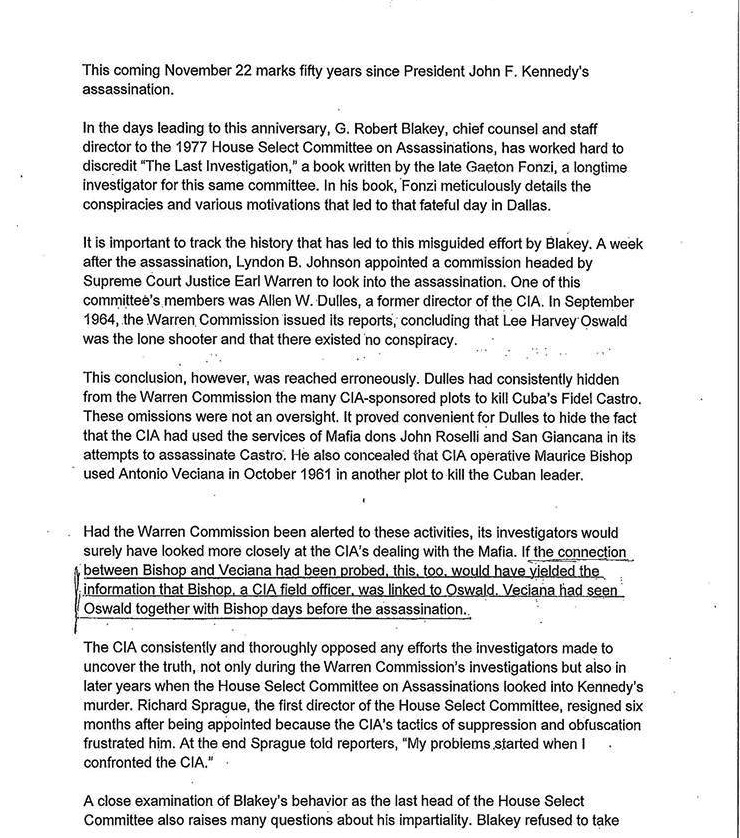
    Before the Commission could endorse Specter’s hypothesis, it had a big problem to overcome: the location of Kennedy’s two non fatal wounds. For the SBT to work, the bullet had to pass through Kennedy on a downward trajectory of approximately 20 degrees. The problem is, the bullet hole in JFK’s back was lower down his body than the wound in his throat. Which meant that any bullet travelling back-to-front would have followed an upward trajectory. Rather than admit to a faulty hypothesis, which would also mean admitting to a second gunman, the Commission got around this by ignoring the autopsy photographs and publishing a deceptive diagram that showed a bullet entering the back of Kennedy’s neck. (see CE388, 16H977) Commissioner Gerald Ford then had the language changed in the Warren report so that it described a wound at the “base of the neck” rather than in the back. As unbelievable as it seems, the Commission actually moved the wound to suit its purposes.

    Commission apologists like Vincent Bugliosi – for whom Willens has nothing but the highest praise – have claimed that the moving of the back wound was all an honest mistake, made because the Commission did not have access to the autopsy photographs. This assertion is utterly false and is disproven by the Commissions own records. The transcript of the January 27, 1964, executive session contains the following exchange:

    RANKIN: Then there is a great range of material in regard to the wounds, and the autopsy and this point of exit or entrance of the bullet in the front of the neck…We have an explanation there in the autopsy that probably a fragment came out the front of the neck, but with the elevation the shot must have come from, the angle, it seems quite apparent now, since we have the picture of where the bullet entered in the back, that the bullet entered below the shoulder blade, to the right of the backbone, which is below the place where the picture shows the bullet came out in the neckband of the shirt in front, and the bullet, according to the autopsy didn’t strike any bone at all, that particular bullet, and go through. So how it could turn—

    BOGGS: I thought I read that bullet just went in a finger’s length.

    RANKIN: That is what they first said. [my emphasis]

    There it is. No ifs, ands, or buts. The Commission knew all along that the wound in the back was below the wound in the throat and it had the pictures to prove it. Willens himself admits that Earl Warren did look at the photographs (p. 193-194), so no honest researcher can claim that Warren did not know the truth about the President’s wounds. And yet he and the other members of the Commission signed off on the SBT knowing that the trajectory through Kennedy was actually an upward one. Of course, this assumes that the bullet which entered the back also exited the throat; which something that has never been proven.

    The official autopsy report describes the back wound as one “presumably of entry” and the throat wound as one “presumably of exit.” (ARRB MD3) Chief pathologist Dr. James J. Humes used such cautious language because his conclusion that the two wounds were connected was based on an inference and not on observation. During efforts to save Kennedy’s life at Parkland Hospital, doctors had made a tracheotomy incision over the bullet hole in the throat. This apparently obscured the wound so that it was no longer visible when the body arrived at Bethesda Naval Institute for autopsy. Humes told the Warren Commission that he did not know the throat wound existed until the following morning, when he spoke Dr. Malcolm Perry of Parkland Hospital. (2H362) By that time Humes no longer had access to the body. Realising that he had made a major blunder by missing one of Kennedy’s wounds, Humes burned the original draft of his autopsy report (3H373) and rewrote it to include a presumed exit in the throat. Which is all well and good except that a contemporaneous FBI report and the testimony of the two agents who wrote it tells us that, at the close of the autopsy, Humes and his colleagues were absolutely certain that the back wound was shallow with no point of exit.

    The report of FBI agents James Sibert and Francis O’Neill, who were present for the entirety of the autopsy, notes that the back wound “was probed by Dr. Humes with the finger, at which time it was determined that the trajectory of the missile entering at this point had entered at a downward position of 45 to 60 degrees. Further probing determined that the distance traveled by this missile was a short distance inasmuch as the end of the opening could be felt with the finger.” (ARRB MD44) O’Neill explained in his testimony for the Assassination Records Review Board that, using a metal probe, the autopsy doctors probed the back wound “to a point where they could not probe any further. In other words, it did not go any further. There – it only went in, I guess, the length of a half of a finger or something like that. And they could not push the probe any further.” (O’Neil ARRB Testimony, p. 131-132) He also explained that Humes was certain that the bullet which caused the wound had “worked its way out through external cardiac massage” at Parkland. “There was not the slightest scintilla of doubt whatsoever that this is what had occurred…And viewing them with the surgical probe and their fingers, there was absolutely no point of exit…this was the exact thought when the entire autopsy was completed.” (Ibid, p. 30-31)

    As if the seemingly shallow back wound was not problematic enough for the SBT, there is also the uncertain nature of the throat wound. Dr. Perry described the wound as being 3 to 5 mm in diameter and looking very much like an entrance wound. He told the Commission that “”It’s edges were neither ragged nor were they punched out, but rather clean cut.” (3H372) Dr. Ronald Jones said it was a “very small, smooth wound.” (6H54) And Dr. Charles Carrico described the wound as “4-7 mm…It was, as I recall, rather round and there were no jagged edges or stellate lacerations.” (6H3) These descriptions are not what would be expected of an exit wound made by a 6.5 mm Mannlicher Carcano bullet. In tests performed for the Commission at Edgewood Arsenal, Dr. Alfred Olivier discovered that typical exit wounds created by Oswald’s rifle at a distance of 180 feet (approximately the distance from the Texas School Book Depository to the Presidential limousine at Zapruder frame 224) were 10 to 15 mm; at least twice the size of the wound described by the Parkland physicians. (5H77, 17H846)

    The Commission dealt with these issues mostly by pretending that they did not exist. The Sibert/O’Neil report was excluded from the Commission’s published volumes and neither man was called to give testimony. The Parkland staff could not be so easily ignored, so instead they were pressured into testifying that the throat wound could have been either an entrance or an exit. In his attempt explain all this away, Willens takes a different tack. He writes that the FBI was mistaken about JFK’s back wound because it “relied in part on the initial, but inaccurate, information from Parkland Hospital that the first bullet that hit Kennedy had not exited from his body.” (Willens, p. 32) That’s right, he conflates two separate events so that he can effectively make the controversy about the throat wound vanish whilst simultaneously making it appear as if the shallow probing of the back wound at autopsy was nothing more than a mistaken observation made by emergency room staff! This is one of the most disgustingly dishonest things I have ever read in any book dealing with the assassination of President Kennedy. It says a lot about Willens’s integrity – and the desperation of the lone nut crowd in general – that he has to stoop so low.

    VI

    In this review I have concentrated on how Willens deals with the most crucial aspects of the assassination and the cover-up. It is widely understood that the medical evidence is the heart of any murder investigation. Any honest investigation would have made full use of the autopsy photographs and X-rays to deduce the precise cause of death. But to fit its pre-conceived “solution,” the Commission ignored, misrepresented and lied about the forensic record. To his eternal shame, Willens attempts to uphold the Commission’s deceptions and, even worse, tries to muddy the waters even further to hide that which destroys the Commission’s fallacious and utterly absurd Single Bullet Theory. He knows he must, because as Commission lawyer Norman Redlich candidly admitted to author Edward Epstein, “To say that [President Kennedy and Governor Connally] were hit by separate bullets, is synonymous with saying that there were two assassins.” (Epstein, Inquest, p. 38) Two assassins equals conspiracy; a conspiracy Willens, 50 years later, is still not ready to admit existed.

    Most serious researchers agree that the Mexico City story is not only the key to unlocking the conspiracy but also the key to understanding how and why the cover-up was perpetrated. As we saw, in History Will Prove Us Right, Willens leaves out all of the crucial details that would shed light on the whole sorry Mexico City charade. He also keeps secret the panic that gripped Washington when the CIA began peddling its manufactured story and how this led to Earl Warren’s decision to put “actual conditions” before “general principles”. Or, in other words, politics before truth. Of course, Willens had to leave all of this out because, if he did not, he would have had no book. Or he would have had a very different book with a very different title. Perhaps something like “History Has Proven Us Wrong”. That book might have actually been worth reading. Unfortunately, the one Willens wrote is not.

  • Jerome Corsi, Who Really Killed Kennedy?


    I. Introduction

    Jerome Corsi is the senior staff reporter for online conservative news giant World Net Daily (WND). He has now written a book called Who Really Killed Kennedy? It is his take on the most controversial subject in American history: the JFK assassination. Because of the scope of Corsi’s reach, his effort should not go unnoticed.

    Corsi, who holds a Harvard Ph.d in political science, is best known for his two New York Times best sellers, The Obama Nation and Unfit for Command: Swift Boat Veterans Speak out against John Kerry. I did not have the chance to read these two books so I will judge the author without prior bias. I will base my critique only on his work on the JFK assassination. According to the book’s description, Corsi has read almost every book written on the case and thousands of documents – including all twenty six volumes of the Warren report – plus films and photographs. The book is the culmination of years of meticulous research.

    It consists of seven chapters plus a conclusion at the end, followed by notes and index. Chapters one, two and three deal mostly with a micro-study of the case, like ballistics, trajectories, witnesses, the grassy knoll, medical evidence and, in general, the crime scenes of the Kennedy and Tippit murders.

    Chapters four, five, six and seven deal with a macro-study of the case. Corsi now investigates Oswald’s life, the Mafia, the CIA, politicians like LBJ and Nixon, all in his quest to find out who really killed Kennedy. The book is fully documented and well sourced. The author has included in his notes the works of some of the best assassination researchers like James Douglass, Jim DiEugenio, Gaeton Fonzi, David Talbot, Josiah Thompson, Mark Lane, and Sylvia Meagher. But he also uses the work of some less credible researchers, like Lamar Waldron and Thom Hartmann, plus a dubious former Soviet bloc intelligence official.

    The publisher states “that the book will set a new standard for JFK assassination research, demanding that future researchers understand the deep, and unfortunately sinister, political forces, that led up to an unthinkable event that marked a profound change in America and the world.” Has the book lived up to its promise? This is something that we will now try to find out.

    II. Ballistics, trajectories and medical evidence

    In Chapter 1, Corsi tries to deconstruct the single bullet theory. He does that in a very concise manner. He first discusses Paul Mandel’s infamous article in the December 6, 1963 issue of Life Magazine. That article said that JFK was looking back toward the Texas School Book Depository at the time of the shooting. This is how he got an entrance wound in the front of his neck from the alleged assassin Lee Harvey Oswald. Corsi does this to show that, from the very beginning, there was an attempt to feed journalists information that would refute the medical evidence observed by the doctors at Parkland Hospital. Although the article’s purpose was to prove that Oswald was the lone assassin, somehow it had a different effect: to raise questions of conspiracy. Mandel described that, according to the doctors, a bullet had entered the President’s throat from the front and to justify how this could have happened he lied to the American people. He claimed that the Zapruder film showed that the President had turned his body far around so his throat was directly exposed to the sniper’s nest. Mandel was following the FBI’s official theory that three bullets were fired, of which, two struck the President and one hit Connally.

    Corsi begins with the missed shot that hit bystander James Tague’s cheek. This goes to show that the FBI’s theory was flawed, and how it helped make Arlen Specter invent the single bullet theory with the help of the pristine bullet that was allegedly found on the stretcher where John Connally was lying. Based on Josiah Thompson’s work, he then goes on to prove that bullet CE399 was probably planted by Jack Ruby on that stretcher. Examining John Connally’s wounds he shows that it would have been impossible for the pristine bullet to have caused the wounds to both Kennedy and Connally as described by the Warren Commission. Both the doctors who examined Connally and the ballistics experts who ran tests testified that the pristine bullet would have been severely deformed if it had caused the damage attributed to it. The position of the president’s back and throat wounds prove that the single bullet theory was not valid, and Governor Connally, to the end of his life, maintained that he was hit by a separate shot.

    In Chapter 2 he examines the Grassy Knoll area and the possibility that an assassin might have fired a shot from behind the stockade fence. He refers to Craig Roberts book Kill Zone to prove that Oswald could not have fired the shots attributed to him and to successfully hit his target. He explains that the medical evidence proves that there were multiple shooters in Dealey Plaza, and he quotes witnesses like Bowers and Newman to support the conclusion that there was a shooter on the Grassy Knoll. He also discusses the presence of Secret Service agents with false credentials on the Grassy Knoll, and one of them could be suspected of being part of the hit team.

    He continues in this Commission critique effort to prove that Oswald was not in the sixth floor window. Key witness, Howard L. Brennan, is the only person who claimed that he saw Oswald firing from the infamous sniper’s nest. The police gave the description of the suspect as white, slender, weighing about 165 pounds, about 5’10” tall, in his early thirties. Reputable researchers like Sylvia Meagher and Gerald McKnight have proved that it was impossible for Brennan to have a clear view to provide such a detailed description and he had also first failed to identify Oswald as the shooter in a police line up.

    Corsi believes that the headshot that killed JFK was a double shot and he bases his conclusion on the work of Josiah Thompson and his book Six Seconds in Dallas. After analyzing the Zapruder film, Thompson concluded that “JFK’s head moved forward violently beginning in frames 311-312, only to be driven violently back and to the left, beginning in frames 313-314.” (p. 73). Thompson explained that JFK was struck by two shots, the first at Z312 hitting in the back of the head and immediately afterwards, at Z313, a second shot from the front struck him on a tangent that caused his head to move back an to the left.

    If Corsi had waited for Thompson’s presentation at the October 2013 Wecht Symposium before publishing his book,he would have known that Thompson no longer holds to that theory. He now believes that there was no shot from the back at Z312 and that JFK was hit from the front at Z313 but there was a second shot from the back much later, at frame Z329.

    Corsi seems to agree with David Lifton’s theory of a secret autopsy as described in his 1980 book Best Evidence. It would have been wiser if Corsi hadn’t proscribed to Lifton’s theory. It is very controversial at best, and for many, has lost credibility.

    Corsi then proceeds to show that the rifle initially found on the sixth floor of the TSBD was a Mauser and not a Mannlicher-Carcano, and that Oswald was in the lunch room at the time of the shooting. He is up to date with the latest developments in this regard. He uses Barry Ernest’s book The Girl on the Stairs where Victoria Adams, a TSBD employee who, after the shooting, came down the same stairs to the first floor as Oswald. She testified that she never heard or encountered Oswald. Unfortunately the Warren Commission enlisted other witnesses to negate her deposition and alter its meaning.

    On the whole, Corsi does a decent job in presenting evidence that Oswald was innocent of the crime attributed to him, that he was never on the south east window, that he never fired any shot and that the single bullet theory was a fraud.

    In chapter 4 he tries to show that Oswald did not shoot Officer J. D. Tippit. He draws on material from books written by notable researchers like Sylvia Meagher, Mark Lane, John Armstrong but also from the lone nut propagandist Dale Myers. I believe that he could have made his case without using Myers as a source.

    III. Oswald a KGB Agent?

    If Corsi wanted to find the best sources available to examine the Soviet defection of Oswald and if he was recruited by the KGB he would have chosen, for example, John Newman’s Oswald and the CIA and/or John Armstrong’s Harvey and Lee. Strangely enough, Corsi has chosen to listen to Ian Mihai Pacepa, a deputy chief of Romania’s Intelligence Service (DIE). I consider this to be a big mistake. Most of the information here comes from Pacepa’s book Programmed to Kill and email exchanges between Corsi and Pacepa.

    Pacepa believed that the Soviets recruited Oswald when he was stationed in Atsugi, Japan. To substantiate his claim, he refers to Edward Jay Epstein’s book Legend: The Secret War of Lee Harvey Oswald. At this point Corsi makes an error and refers to Epstein as “Lifton”, who we all know is a different researcher. Somehow, the editor of the book didn’t notice. According to Epstein the Soviets used an attractive hostess that worked at the Queen Bee bar to lure Oswald under the KGB influence. Why anyone would believe Epstein and Pacepa is anybody’s guess. If Corsi had conducted his research correctly, he would have known that Epstein was fed information by none other than James Angleton, the master of deceit, the head of CIA’s counterintelligence. If he had read Dick Russell’s The Man Who Knew Too Much (p. 457), he would have known that Oswald was frequenting the bar with the possible mission to help a Soviet Colonel Nikolai Eroskin to defect, but this was aborted. Oswald was part of a U-2 operation called Detachment C, a secret unit that had the mission to collect vital data for intelligence that flew over Russia, China and Taiwan (see Newman, Oswald and the CIA p. 30-31). Pacepa argues that, humiliated by his defeat during the Cuban missile crisis, Khrushchev decided to have Kennedy killed as an act of revenge, and so KGB gave Oswald the mission to assassinate Kennedy. Any serious student of the assassination would know better than to fall for Pacepa’s nonsense. His book provides zero evidence to support his thesis. It is well known that rivals in the Communist party, liker Leonid Brezhnev and Yuri Antropov were waiting on the wings to overthrow Khrushchev and replace him as premier. Why Khrushchev would risk an international incident and his position to replace Kennedy with someone like LBJ who was a hardliner is beyond belief. After all Pacepa had defected to USA so it was to his benefit to perpetuate a myth that would only serve those who killed Kennedy. It is like he was reading everything he claimed from a script written by James Angleton himself.

    The whole story is ludicrous since all researchers like Newman, Phil Melanson, Jim Douglass, Lisa Pease, Jim DiEugenio, Russell, Armstrong, among others, have made a strong case that Oswald went to the USSR as a US intelligence operative, part of a false defectors’ program orchestrated by the US intelligence agencies and the military.

    According to Pacepa, Khrushchev had a change of heart and decided to call off the hit on Kennedy. So he ordered the KGB to deprogram Oswald so as not to assassinate Kennedy. Oswald was not happy with the turn of events so he went to Mexico City to meet with the KGB officers to convince them to let him carry on with the assassination as planned. Again, Corsi should have known that Oswald or an Oswald impostor more likely had gone to Mexico as part of a CIA-FBI operation to embarrass the FPCC abroad were it had support (see, for instance, John Newman, Oswald and the CIA). Pacepa continues that the KGB decided to stop him from assassinating Kennedy by silencing him forever. However he does not explain why this never materialized. If one reads the HSCA’s Lopez Report, it is hard not to conclude that Oswald was impersonated by some unknown party to leave a trail in the official files that the Cubans and the Soviets were controlling Oswald. And also to show that Oswald met with Valeri Kostikov, the head of the KGB assassinations unit, the notorious Department 13. As we all know there were never any photographs of Oswald taken in Mexico and the voice on the tapes given to FBI did not correspond to his voice. As Newman showed, the purpose of the Mexico impersonation was to dim the lights so the intelligence community would not sound an alert that a former Soviet defector met with Kostikov, the head of the KGB assassinations unit, Department 13. This would have resulted in putting Oswald on the FBI’s watch list and as a result he would have never been allowed to be in a building above the Presidential route. The real Oswald could not be captured on film or seen by witnesses in Mexico. His handlers could not risk Oswald’s detection or his possible accidental murder since his survival was vital to the plot’s success.

    It was Ruth Paine who produced much of the suspect evidence that Oswald was in Mexico. Even after the police had searched her house and they had not come up with anything. Yet, Ruth Paine found some incriminating evidence that the Police could not find (DiEugenio, Reclaiming Parkland, p. 284). This is the same woman who arranged for Oswald’s job at the Texas School Book Depository in October 1963. Ruth Paine had also claimed to have seen, on November 9, 1963, Oswald typing a letter referring to his meeting in Mexico with agent Kostin, apparently another name for Kostikov. This letter was sent to the Soviet Embassy in Washington (Douglass, JFK and the Unspeakable, p. 233). Some think the letter is a forgery, planted in order to incriminate Oswald. The Warren Commission accepted the genuineness of this letter. Largely because of corroborating evidence in the form of a rough draft, said to be in Oswald’s handwriting, which Ruth Paine also allegedly discovered. What is particularly suspect about the November 9th Kostin letter is its timing. After being intercepted by the FBI on its way to the Soviet Embassy in Washington, the letter was summarized and communicated to Dallas, where the news arrived on November 22nd (see Peter Scott, Deep Politics III).

    To make things worse, Pacepa claims that George DeMohrenschildt was a KGB agent. To his credit, Corsi acknowledges that the evidence that DeMonhreschildt was a CIA agent ” …is as strong and important counterweight to Pacepa’s suggestion that DeMohrenschildt was a KGB agent assigned to be Oswald’s handler in Dallas” (p. 163). Despite that he comes back to repeat Pacepa’s claim about DeMohrenschildt being a Soviet agent since Pacepa had first hand experience in the upper ranks of the Soviet intelligence network.

    Corsi states that DeMohrenschildt was an important link to several pieces of evidence that the Warren Commission used to conclude that Oswald killed Kennedy. Some of it had to do with the Gen. Edwin Walker shooting incident that occurred on March 10, 1963. At 9 pm that evening a bullet penetrated General Walker’s window and slammed into the wall, only narrowly missing his head. De Mohrenschildt testified to the Commission that he had joked to Oswald if he was the guy who shot Walker. Although Oswald never said yes, the Baron saw guilt in his face. In 1967, four years after the assassination, and four years after the infamous backyard photos showing Oswald holding a rifle were found in Ruth Paine’s garage, another backyard photo was found in DeMohrenschildt’s storage unit. This backyard photo was signed “To my friend George from Lee” and dated “5/IV/1963, the Cyrillic version of April 5, 1963 (DiEugenio, Reclaiming Parkland, p. 82). This photo, because of its different boundary at the edge and finer resolution, is suspected of being a plant, in order to incriminate Oswald for the Walker shooting. Pacepa believes that this is a further proof that DeMohrenschildt knew more about the Walker incident than he ever admitted. Yet George was puzzled as to how is showed up in his belongings so many years after the fact.

    Two pieces of physical evidence implicated Oswald in the Walker shooting. Photos of Walker’s house, which were found in Ruth Paine’s garage, and a handwritten note in Russian allegedly left from Lee to Marina. Pacepa found telltale clues in this note proving that Oswald was a KGB agent. He claimed that in that letter Oswald instructs Marina what to do in case he is arrested. In that note Pacepa recognized KGB codes like “friends” a code for support officer and “Red Cross” a code for financial help.

    Pacepa is really stretching things. He then stretches further. He constructs a myth to demonstrate that Oswald shot at Walker. The truth is that both the picture and the note were surfaced by Ruth Paine after the assassination. Again, the police had searched her house for two days after the murder and had failed to recover the items. After they got it, the Secret Service had the note returned to Ruth because they thought it was from her. (DiEugenio, Reclaiming Parkland, pp. 77-78). It is fairly evident that DeMohrenschildt and Ruth Paine were CIA assets. And it was Ruth who was the person that produced the most incriminating evidence that convicted Oswald in the public mind as the president’s killer. This included evidence that Oswald was in Mexico, the Kostin letter, and the Walker photographs and note. Yet Corsi sidesteps her great importance in the case and chooses to listen to Pacepa. None of the crucial information above regarding Ruth Paine is reported in his book. In fact, Corsi seems to accept the idea that Oswald actually shot General Walker. As Gerald McKnight wrote in his book Breach of Trust , the bullet fired into the Walker house was a steel-jacketed 30.06 bullet. But after the assassination the FBI changed the bullet to a 6.5 copper jacketed bullet. Even the bullet stored in the National Archives today is copper jacketed (DiEugenio, Reclaiming Parkland, p. 76).

    The Pacepa story is not over yet. Corsi seems to believe Pacepa’s claims that the KGB advised all the Eastern Bloc Intelligence services to spread the rumors that the CIA and LBJ had killed JFK so as to divert world attention away from the Soviet Union. To prove Pacepa right, Corsi brings up the case of Vasili Mitrokhin, a retired KGB officer who claimed that the KGB had financed Mark Lane, among others, to promote the JFK assassination conspiracies. There are many writers who think that the possibility exists that Mitrokhin, an dother former KGB officers, were used by western intelligence agencies after the fall of the USSR for their own agendas. Why Corsi would choose to waste so many pages on Pacepa’s story is something I can’t figure out. Especially since the Soviet Union and KGB do not figure in his list of conspirators at the end of his book. I believe he could have done himself a great favor if he had omitted this whole Pacepa section.

    Corsi then tries to tie Oswald in with China by connecting the Fair Play for Cuba Committee (FPCC) organization to the Maoist Progressive Labor Party (PLP). Oswald was corresponding with Vincent T. Lee, the national director of FPCC who was also a member of the PLP. Corsi wonders what would have happened if Oswald had been killed immediately after the assassination. The CIA would have claimed that he was a kGB agent who had become disillusioned with Russian Communism and had turned now to Maoist China. Corsi provides no evidence to support this except Allen Dulles who during the Warren Commission hearings said out of the blue “It would have been a blessing for us if (Lee Harvey Oswald) … had taken his passport and gone to China as he may have contemplated” (p. 157). Unfortunately Dulles is not the most credible source, and the China angle is classic disinformation by Dulles to mud the waters and false sponsor China for the crime.

    IV. The Mob, CIA and the French Connection

    Corsi then informs the reader that we cannot lay all the blame on KGB alone. If we do then we make the KGB responsible for launching multiple look-alike plans to assassinate JFK. Plus we ignore recently discovered evidence of the involvement of the mob and the CIA in the assassination plots.

    To make his point, Corsi goes on to evaluate the two plots to assassinate JFK that were thwarted before they could happen. The Chicago Plot on November 2, 1963 and the Tampa Plot on November 18, 1963. Both were eerily similar to the one in which succeeded in Dallas.

    According to Corsi, in writing his book, he did extensive research that included reading almost every previous book. So what was his source upon which to base his information for these two plots? When I saw the name of the book and its authors I froze in disbelief. I looked at my calendar to see if it was the 1st of April. But the cold outside reminded that it was December and Corsi was not trying to fool me. Sadly enough, his source was Ultimate Sacrifice, the book by Lamar Waldron and Thom Hartmann. Recall, this pair had concluded that the Kennedy brothers were planning to invade Cuba on December 1, 1963, with the help of Castro’s General Juan Almeida. Unfortunately for them the top conspirator Almeida was scheduled to travel to Africa at about that same time. Ultimately, this fact did not deter them. They followed up with a sequel titled Legacy of Secrecy.

    In both books, they maintained that it was the Mafia with help of CIA rogue agents that killed Kennedy. They have been discredited since and their books are considered, at best, fiction and at worst, disinformation. Author James DiEugenio did a stellar job in pointing out the many serious problems with Waldron’s and Hartmann’s thesis. You could read both of his detailed reviews on CTKA.

    Why am I so critical of Corsi’s choice of source material? Because if he had done his homework, he would have known that everything we know about the Chicago plot is due to the great investigative journalism by Chicago reporter Edwin Black of the Chicago Independent. To be fair to Corsi, he also does refer to JFK and the Unspeakable to examine the Chicago Plot. If the readers want to find out more about the Chicago Plot, they should read Black’s original article, “The Plot to Kill JFK in Chicago.”

    The plot to kill Kennedy in Chicago involved a patsy by the name of Thomas Vallee. Like Oswald, he was an ex-Marine. But unlike Oswald, he was afflicted with mental problems due to a combat injury. Again, like Oswald, he served at a U-2 base in Japan, was involved with Cuban exiles and worked in a place overlooking the Presidential route from a building next to a difficult left turn, like the one in Dallas, on Elm Street. Vallee had been diagnosed as schizophrenic, something that Oswald had not been. If one examines the Clinton-Jackson incident, one would think that Shaw and Ferrie were planning to have Oswald work in a mental hospital. The plan did not materialize. But if Oswald had secured a job there, it would have been easy after JFK’s assassination to switch the files to show that Oswald was a patient at the Jackson hospital.

    Besides their similarities, Oswald and Vallee had some important differences. Vallee had not visited the Cuban and Soviet embassies in Mexico City. Therefore, there was no indication he had met with Valeri Kostikov. If the Chicago plot had succeeded, it would have been much more difficult for the plotters to have been able to blame Cuba and/or the Soviet Union, and use that as leverage to force a cover up. Which is what LBJ used to force Earl Warren and Sen. Richard Russell to go along with the cover up.

    When it comes to the plot in Tampa, Corsi again enlists the help of Lamar Waldron and Thom Hartmann to describe it. According to them, the patsy set to take the blame was a young Cuban American named Gilberto Policarpo Lopez. Who, like Oswald, was a member of the Miami FPCC, had been to Mexico and wanted to travel to Cuba. On November 25, 1963 Lopez entered Mexico via Nuevo Laredo and on November 27 he was photographed by the CIA at the Mexico City airport and flew to Cuba. Unfortunately we don’t have much reliable information about the Tampa plot, and most people have a hard time relying on Waldron/Hartmann and questionable sources in this regard. After all, both men believed that it was the Mafia that planned both plots, Sam Giancana in Chicago and Santo Trafficante in Tampa.

    Corsi then discusses another mysterious person, Miguel Casas Saez, who according to the CIA was a Castro agent. On November 22, 1963 Saez had arrived at the Mexico City airport with a private two engine airplane and boarded a Cubana Airlines flight to Havana, Cuba.

    It is difficult to believe that Lopez or Saez were involved in an assassination plot to kill the American President. James Jesus Angleton the head of CIA’s Counterintelligence “maintained that Castro sent three DGI agents to Dallas in the days before November 22. In Angleton’s theory agents Policarpo and Casas, plus a third man whom Angleton would not name, separately worked their way to Dallas, where they met up and carried out the assassination” (Joe Trento, The Secret History of the CIA, p. 266). Now it is obvious that the man who invented the “Wilderness of Mirrors” strategy where everything is possible but nothing is certain, was trying to falsely implicate Castro in the assassination. The same man who John Newman believes was the man who designed the Mexico City plot and choreographed “Oswald’s” moves during his visit to the embassies.

    Corsi then tries to explain, with Waldron’s help, how the Mafia got the idea of using a Communist patsy. According to him the CIA assassinated Guatemala’s President Armas in 1957 and blamed the murder on Romeo Vasquez Sanchez an alleged Communist sympathizer. Waldron believes that mobsters Rosselli and Marcello would remember from the 1957 assassination the importance of having a patsy to quickly take the blame. Corsi continues to quote Waldron. And he even uses the alleged Carlos Marcello prison “confession”, the one he made as he was becoming senile, to the effect that he had ordered the assassination of President Kennedy to an FBI undercover agent placed in the same cell with him. To make things worse, Corsi then refers to Chuck Giancana’s book Double Cross to support the view that the Mafia had killed JFK. Chuck was the brother of Chicago Mafia boss, Sam Giancana. According to Chuck, he had confessed to him his part in the assassination. Giancana explained to his brother that they had overthrown governments in foreign countries, and he outlined the plot and the people he used. Among them were Jack Ruby, John Rosselli and Charles Nicolleti. Then Corsi goes even further in this vein. He chooses to believe Frank Ragano, Santo Trafficante’s lawyer. Ragano wrote a book about the JFK assassination after the deaths of Jimmy Hoffa and Santo Trafficante where he claimed that both Hoffa and Trafficante had been involved in the assassination. As Jim DiEugenio discussed in his review of Legacy of Secrecy, it is almost certain that Ragano was lying.

    Corsi refers to the famous Nixon warning to the CIA during the Watergate scandal that “E. H. Hunt was involved … and will make him look bad and it is likely to blow the whole Bay of Pigs …” (p. 233). H. R. Haldeman, Nixon’s aide, said some years later that when Nixon was talking about the “Bay of Pigs” he really meant the JFK assassination. Nixon had worked with the CIA and suggested help from the Mafia to prepare an invasion of Cuba when he was Eisenhower’s Vice President. It is peculiar that most of the Watergate burglars were also part of the Bay of Pigs operation, among them E. Howard Hunt and Frank Sturgis.

    As he was dying, Hunt confessed to his son that he was a benchwarmer on a CIA plot to assassinate JFK, the “big event” as they called it. Hunt named LBJ, Cord Meyer, David Phillips, David Sanchez Morales, William Harvey and a French Gunman named Lucien Sarti as the plotters. Hunt, who didn’t like Harvey and considered him to be an “Alcoholic Psycho”, claimed that Harvey was the man who handled the Executive Action program ZR/RIFLE, and had recruited Corsican assassins from the “Marseilles drug traffickers also known as the “French Connection” to assassinate JFK. In an article I co-authored with Seamus Coogan and Phil Dragoo titled “Evaluating the Case against Lyndon Johnson,” there is a section devoted to E. Howard Hunt and his deathbed confession where we discuss that his confession as a limited hangout to divert attention from the real conspirators like Jim Angleton, Allen Dulles and those above them.

    To understand the role of the “French Connection” one should read Henrik Kruger’s excellent book The Great Heroin Coup where he unravels Nixon’s plan to develop a new drug superagency to control world heroin trade. Nixon’s public declaration in June 1971 of his war on heroin promptly led to his assemblage of White House Plumbers, Cubans, and even “hit squads” with the avowed purpose of combating the international narcotics traffic. The “great heroin coup” – the “remarkable shift” from Marseilles (Corsican) to Southeast Asian and Mexican (Mafia) heroin in the United States – was a deliberate move to reconstruct and redirect the heroin trade, rather than to eliminate it. And that Cuban exiles, Santo Trafficante, the CIA, and the Nixon White House were all involved. The major points from Kruger’s book are:

    1. Edward Lansdale and Lucien Conein began the war against the Corsican mafia in southeast Asia and paved the way for the CIA and Trafficante in that area.
    2. Lansky and Trafficante made all the necessary arrangements in southeast Asia to assume control of the opium production with the help of CIA.
    3. In 1971 the great heroin coup was underway. Cuban exiles were involved in the White House drug operation with E.H.Hunt and Lucien Conein. The US drug enforcement agencies waged an all out war against the Corsican/Marseilles/Turkey/USA drug network, i.e. against the French Connection. The French connection network was run by CIA’s arch-enemies, the French intelligence SDECE who were loyal to DeGaulle, and were competing with CIA over the control of the world heroin trade. The CIA achieved two things with the heroin coup. To take over the heroin trade from the French and second with the help of their ally, Pompidou the new French President, to crush the old Gaullist intelligence network.
    4. The CIA faction associated with the heroin coup was the China/SE Asia/Cuba lobby, and E. H. Hunt was the main representative of that lobby.
    5. When the French network was defeated, heroin began flowing into the USA from SE Asia and Mexico. And the man Hunt named as a shooter behind the picket fence, Lucien Sarti was one of the victims of this war when he was killed in Mexico on April 1972.

    From the above, one could conclude that the CIA, in their effort to crush this Corsican and SDECE network, blamed them for the assassination of JFK, labeling them as false sponsors of the plot. This is evident in Steve Rivele’s original false theory, the one that ran on the first installment of The Men Who Killed Kennedy. It may be echoed in E. H. Hunt’s deathbed confession that Lucien Sarti was the shooter behind the picket fence. Lamar Waldron names Michel Victor Mertz as one of the assassins, a man who was a member of SDECE and an enemy of OAS, the organization that tried to murder Charles DeGaulle, the same man that saved DeGaulle’s life. Which makes Corsi’s reliance on Waldron and this idea that the Diem heroin dynasty, the American and Marseille mafia were responsible for the assassination look kind of silly.

    Corsi discusses the French Connection and a CIA released document confirming that a French assassin was apprehended in Dallas on November 1963. The memo names this assassin as Jean Souetre, a.k.a. Michel Roux, a.k.a Michel Mertz. Now Corsi makes the mistake of repeatedly calling him a Corsican hit man. In reality neither of these men were Corsican, but Frenchmen from the mainland. The OAS hated JFK for supporting Algerian independence. Eugene Dinkin a US army code breaker referred to in Dick Russell’s, The Man who Knew too Much, discovered a message that JFK was to be assassinated in November. Dinkin was stationed in Metz, France and one of his duties was to decipher cable traffic originating with the OAS.

    Souetre gave an interview later which confused things even more. He claimed that he was in Spain that day, not Dallas, and that he could prove it. He said that a man named Michel Victor Mertz, a narcotics smuggler and SDECE agent, was actually impersonating him in order to leave a trail that could lead, not back to Mertz, but to his enemy Souetre. Of course it could have been the other way round: it was Souetre who was impersonating Mertz. Michel Victor Mertz was an agent of SDECE, the agency that was competing with the CIA for the control of drug supplies. James Jesus Angleton was in contact with SDECE and especially a man named Phillipe de Vosjoli, who many believe was spying against his country for Angleton.

    A third alternative is that neither Mertz nor Souetre were involved in the assassination. And this dual confusion of two men using each other’s name was deliberately designed to confuse researchers and again create a cognitive dissonance were everything is possible but nothing is certain. We recognize again the so familiar wilderness of mirrors strategy of “CIA’s Magicians” at work.

    V. Cui Bono?

    When it comes to the crucial question of who was responsible for the assassination Corsi names LBJ, Nixon, the CIA, the Military Industrial Complex and Organized Crime. They were those who stood to gain from Kennedy’s removal by replacing him with Johnson in order to alter his policies. JFK planned to withdraw from Vietnam and LBJ reversed that policy. Thereby escalating the war, which meant huge profits from military contracts and the heroin trade. Corsi argues that LBJ, Nixon and the Military Industrial Complex lacked the operational capabilities to plan the assassination so they asked the help of those who could, namely the CIA and the Mafia. Needless to say LBJ was not the “Mastermind” of the assassination and he did not conceive, instigate and plan the assassination. He was just a puppet who covered up the crime after the fact and later as President continued the Cold War, as John Newman and James DiEugenio showed in their books, JFK and Vietnam and Destiny Betrayed. The article I mentioned earlier, “Evaluating the Case against Lyndon Johnson,” tried to disprove the theory that LBJ was the man that instigated the crime. Books like Philip Nelson’s LBJ: the Mastermind of the Assassination have been discredited and scorned by many researchers. Corsi considers the Bobby Baker scandal as important. Baker had been a close associate and aide to LBJ in the senate and if he was convicted and imprisoned he may have tried to take LBJ with him. It was Life magazine that exposed the Baker scandal and Corsi believes that it was Robert Kennedy himself who fed information to their reporters.

    I am convinced this was not the case. For the simple reason that Henry Luce, the owner and founder of the magazine, was quite anti-Kennedy and anti-Communist. And he felt that Kennedy was not doing enough to liberate Cuba. Luce and his wife Clare Booth Luce were financing the Cuban exiles in their war against Castro and were very critical of Kennedy’s failure to do more in that regard. At one point they walked out of a White House dinner after disagreeing with JFK when he tried to convince them to cool it down over Cuba. After the assassination it was C.D. Jackson, publisher of Time, and Luce’s personal friend and emissary to the CIA , who purchased the Zapruder film and Life kept it locked up for many years. That way Life was able to control vital information in the film that would have proved conspiracy. To believe that Luce would help the Kennedys destroy LBJ seems a bit unlikely. It would make more sense that conspirators of the assassination used Life to corner and weaken LBJ in order to use him as an accessory to cover up the crime committed in his Texas backyard.

    Nixon has been named as one of the conspirators by some researchers. Corsi uses the fact that Nixon was in Dallas the day of the assassination for a Pepsi conference to join them. Unfortunately this is not enough to make him a conspirator and there is no credible evidence to prove that he was. Same goes for George H.W. Bush who was in Texas the same day in the small city of Tyler. Researchers like Jim Fetzer who claim he was involved in the plot refer to a photo of a man standing outside the Texas School Book Depository after the assassination that allegedly bears a striking resemblance to Bush. Unfortunately for them an enlargement of the photograph reveals the features of a man that does not look like Bush. Others claim that one of the boats that were part of the Bay of Pigs operation was named Zapata after Bush’s company Zapata Oil. While the truth is that Zapata was the name of the peninsula where the Bay of Pigs was located. I take a different approach and I don’t believe that Nixon or Bush were part of the conspiracy but may been in Dallas, or the area, to set them up as false sponsors. This made it easier to manipulate them later as presidents.

    We now come to Allen Dulles. Corsi has used the latest information found in Jim DiEugenio’s book Destiny Betrayed, where the author makes a good case to prove that Dulles was one of the high level conspirators. Corsi continues that good work by using other material from Destiny Betrayed, especially the part were he examines JFK’s split with the Eastern Establishment over his foreign policy. For more information on this you can read DiEugenio’s article, “JFK’s Embrace of Third World Nationalism.”

    Ultimately, Corsi blames the “New World Order” as the sponsor of the assassination. This group wanted to use military force to preserve private business interests around the world, instead of the genuine interests of the United States. In a sense he is right but I disagree with his term “New World Order.” Those interests were as old as recorded history. And they have a strategy to conceal their identities by manipulating the pubic’s sense of wonder and the thirst for the mysterious, the occult and the mystical. They try to convince people of the inevitability of their actions guided by something divine and mystical. I have a different name for the “New World Order”. It is “The Money Trust”, and it functions like the board of a huge global corporation. It has many different factions and views to gain the same end, and some interests have one or more seats and votes on the board. Although at times the board has conflicting interests they have the same end goal: power, and the control of the many by the few.

    VI. Conclusions

    It is true that Corsi relied too much on the likes of Lamar Waldron, Thom Hartmann and the allegations of Pacepa. If had done the meticulous search that he promised he would have thought twice before using them for references. He should have been aware that the research community has disproved the Waldron/Harmtann theories. In the case of Pacepa I am convinced that Corsi does not really believe him because he does not include Pacepa’s allegations in his conclusions. I believe that he wanted to make a difference by using information given to him by Pacepa in private emails, in order to make a sensation. I also feel that his chapters were not very well connected to each other but spread out irregularly. It seems that Corsi gathered too much information from so many sources that it became difficult to put it all together in the best way possible.

    Despites its mistakes this is a decent enough book for the novice and general public who are not aware of the machinations of deep politics and JFK assassination case. Corsi is a NY Times best selling author and he can help attract a wider audience that is not familiar with case. Afterwards the readers can take some of the good sources of his book like Douglass, DiEugenio, Fonzi, Newman among others to broaden their knowledge and realize how deep the rabbit hole actually is.

  • Larry Sabato, the Kennedy Assassination, and the Rise of the Post-Modern Sound Bite Scholar


    Dozens of new books have been published to coincide with the 50th anniversary of the assassination of President Kennedy on November 22, 1963. Many of them are breaking new ground.

    The JFK research community has come a long way in just the past twenty years. I first got interested in the assassination right before Oliver Stone’s JFK movie was released and probably read thirty or so book around that time. They all pointed to one theory or another. It was easy for someone new to the topic to get lost in the deluge of counter theories.

    But things have changed since then. I went to a conference of the leading JFK assassination researchers in Pittsburgh last month, organized by the famous forensic pathologist Cyril Wecht and his son. It was called “Passing the Torch.”

    I don’t pretend to have all of the answers, but it became clear to me at this event that something of a consensus has emerged in the JFK research community pointing to elements of the government being involved. In particular men working with Cuban exiles associated with Operation Mongoose, the CIA operation to subvert Cuba and overthrow Castro after the failed Bay of Pigs invasion, have come under increasing suspicion. Simply put more has become known thanks to the release of government files following the JFK movie. And people are still learning things and there are yet to be documents to be released.

    Not only are new details of the suspicious characters around Oswald, and the mystery man himself, being discovered, but we now have a much better understanding of what was actually going during Kennedy’s Presidency.

    To name just one example a new work is being developed by a scholar at the UVA Miller Center based on Presidential tapes about Kennedy’s policies in Vietnam and moves towards withdrawal he made in the last year of his life. The release of new tapes and records over the past fifteen years show that Kennedy and the Joint Chiefs of Staff had sharp disagreements over Cuba, Vietnam, and nuclear weapons policies. They had what can only be described as dismal relations with each other.

    Even popular mainstream historians like Robert Dallek are touching upon this area – and it is hard not to find out some of these things and wonder about the assassination itself. As Douglas Horne, who worked for the Assassination Archives Review Board put it JFK “was at war” with the national security state. But some things have never changed. During this anniversary year if you have watched November’s TV specials you would not know of any of this new information. National Geographic’s testament to the Kennedy assassination was the retread boring Killing Kennedy movie. Almost all network news broadcasts managed to stick to the lone assassin line and promote only those books and authors that conform with the proper talking points.

    One exception I saw shows you the straight jacket that is television. CNN’s Piers Morgan had Jesse Ventura on to discuss the government shutdown that was going on at the time and Ventura’s new book about the assassination called They Killed Our President. The book isn’t designed to solve the murder, but to present some of the dozens upon dozens of facts pointing to a conspiracy.

    Morgan looked at Ventura and his book and just repeated over and over again that he thought there was no conspiracy, because he said he talked to former Secret Service agent Clint Hill and he told him there wasn’t one. Ventura countered by listing some of the things in his book and Morgan completely dismissed him, treating Ventura as if he was merely making it all up. At the end of the interview Morgan said this was spot, because it made for a great “talking point.” You can see this discussion in this video at around the five minute mark:

    The ugly truth is that many people have made fortunes off of the assassination by creating books that line up with exactly the talking points required of them to get praised by the TV media. Gerald Posner’s work Case Closed did this following Oliver Stone’s movie and he became a celebrated talking head for a few years until he fell into a nasty plagiarism scandal.

    Vincent Bugliosi took his place for a few years with his doorstop sized book Reclaiming History, which has been demolished by James DiEugenio in a recent book. But it seems like the overwhelming size of the book made it so that it was difficult to catch on with the general public, even though it became a vehicle for Bugliosi to get on TV and be used as a counterpoint whenever a reasonable author who wrote a book about the darker aspects of the assassination got on TV, as when Chris Mathews used him as an attack dog against David Talbot when he did a segment on his Brothers Book.

    But Bugliosi seems to have disappeared. The Tom Hanks Parkland movie, which was credited as having been based upon his work, totally bombed at the box office. It was just too banal and boring. But a few have come into the picture to try to use the Kennedy assassination to get on TV this 50th anniversary and promote themselves by delivering the right talking points.

    There is probably no better example of this than University of Virginia professor Larry Sabato. Sabato’s book The Kennedy Half Century was written by a team of people at the UVA Center for Politics, which Sabato runs. It is really three small books in one. The first part of it is a fast recap of Kennedy’s political career, the second part deals with the assassination and the final part of the book is his “legacy” with examples of how the Presidents since President Kennedy claimed his mantel from time to time.

    I found the first and last part of the book to actually be the weakest parts of it. The amount of research that went into them just seemed to be very thin. The first part in particular really added nothing new and seemed to have little understanding of Kennedy’s real legacy and his foreign policy. For example he claimed that the Soviets put missiles in Cuba, because they perceived that Kennedy was a weak man after the failed Bay of Pigs invasion who wouldn’t do anything in response. In reality Khrushchev put missiles in Cuba out of desperation – he had fallen behind the United States in the nuclear arms race and put missiles in Cuba as a hail marry pass to try to force Kennedy into making some sort of deal. It was something the Soviets did out of weakness – they perceived the United States as being the stronger and more aggressive party, which is exactly the opposite of what Sabato claims in his book.

    We know all this because of the work of Aleksandr Fursenko and Timothy Naftali and their book Khruschchev’s Cold War, based in part on transcripts of Soviet Politburo records. This book is seven years old now and an important part of the scholarship. You would think Sabato would know of it, especially since Naftali used to work at the UVA Miller Center in the Presidential recordings program. Incredibly when I looked at the acknowledgements to his book it appeared that Sabato did not consult with hardly anyone there and barely any academic historians at all.

    Sabato did manage to consult with Gary Mack of the Sixth Floor Museum in Dallas, John McAdams and TV media stars such as James Carville, Bill Moyers, and Chris Matthews. And he indeed has been able to use his book to get on the television set. You can get a feeling for what Gary Mack is about in this video:

    He has been able to provide TV producers with the correct talking points. Sabato has made a career out of being a minor TV celebrity able to charge $10,000 a pop speaking fees so he knows the game.

    In the initial promotion for the book he was on CBS News, which put a story on its website with the headline “JFK assassination conspiracy theory ‘blown out of the water’ in new book, author says”, to describe an interview with Sabato.

    Sabato said he commissioned a study of dictabelt recordings that the Congressional House Select Committee on Assassinations used that they said showed that more than three shots were fired, which would mean there was a conspiracy. Sabato said he had “new” evidence that he commissioned by a sound analysis company called Sonalysts, Inc. which proved that the HSCA study was flawed. But in reality other researchers who studied these tapes in the early 1980’s came to the same conclusion, so there was nothing “new” in what Sabato said. The tapes aren’t important in the big picture.

    But his claim enabled him to make a big splash and get on TV, because it made for a great politically correct talking point. Nonetheless, there is much more evidence of a conspiracy than these tapes and Sabato knows this. He also knows that over 80% of the American people do not believe in the Warren Commission and so to be someone who simply mouths the Warren Commission line can damage one’s image with today’s public.

    However, to talk of conspiracy in the Kennedy assassination means becoming toxic to American TV news producers. It could mean the end of being a talking head. When I was at UVA over fifteen years ago, in the graduate history program, I had one professor tell me that to write about the Kennedy assassination would make a career in academia impossible. That wasn’t because of something about UVA in particular, but the reality of the way the topic is treated by the mainstream media and upper reaches of establishment research. It’s simply not politically correct to talk about and you’ll be blacked out by TV if you do. It would be like being against slavery in the pre-Civil War American South.

    Despite what I’ve said so far, the strongest part of Sabato’s book is actually his section on the assassination. Even though I do not agree with his conclusions, he does make some interesting comments, and you can tell from the footnotes that more research went into putting this part of the book together than the rest of it.

    Sabato argues that the “establishment view, even today, in the halls of government and many media organizations” is “that it is irresponsible to question the ‘carefully considered’ conclusions of the Warren Commission report.” Sabato warns that there are some who consider it close to being a threat to national security. “Further, say the lone gunman theory’s advocates, the widespread accusations that senior political, governmental, and military figures participated in the planning, execution, or cover-up of the assassination of President Kennedy have damaged the image of the United States around the globe, fueling anti-American sentiments by undermining the very basis of our democratic system, ” he explains. In such a siege atmosphere it is no surprise that TV news producers have stuck managed to keep themselves within the bounds of the proper “responsible” talking points. And so has Sabato.

    Sabato declares to his reader that “given the lack of hard evidence, to accuse any arm or agency of the federal government of orchestrating Kennedy’s assassination is both irresponsible and disingenuous.” However, it is hard for anyone who studies the assassination by going beyond the Warren Commission’s final report to escape the conclusion that there was more to the assassination than Oswald. On the day after the assassination at President Lyndon Johnson’s first morning meeting as President CIA director John McCone told him that Lee Harvey Oswald went to the Cuban and Soviet embassies in Mexico City and had contact with a dangerous KGB agent. After this meeting Johnson had a phone conversation with FBI director J. Edgar Hoover who told him that the evidence as it stood was not enough to convict Oswald and that someone else was in Mexico City pretending to be him. Hoover told him that information that the CIA gave him, such as taped phone conversations, that was supposed to be Oswald wasn’t him.

    Sabato knows that the lone assassin story simply is not credible. So he writes, “at the same time, it is impossible to rule out the possibility that a small, secret cabal of CIA hard-liners, angry about Kennedy’s handling of Cuba and sensing a leftward turn on negotiations with the Soviets and the prosecution of the war in Vietnam, took matters into their own hands lest the United States go soft on Communism.”

    Sabato dismisses just about all possible conspiracy theories in his book. He claims it simply is “irresponsible” to think that elements of the United States government could be involved. He won’t do that so he comes up with one possible politically correct conspiracy theory of his own buried in a footnote – “in theory, the cabal could also have been the opposite: Communist inspired. In April, 1961 FBI J. Edgar Hoover sent Attorney General Robert Kennedy a memo admitting that the Office of Strategic Services (the CIA’s parent organization) had been infiltrated by a “Communist element” that “created problems and situations which even to this day affect US intelligence operations.”

    In other words it’s a thought crime to think that some people in the United States government could have been a party to President Kennedy’s assassination so if there were people like that they must have been under the control of the KGB. If the CIA killed Kennedy so to speak it did so, because it was actually a cat’s paw of the KGB.

    Well, look there are a lot of crazy conspiracy theories that have been peddled over the years, from the driver did it, to some Secret Service agent accidently shot the President, and on and on. Most of the theories have no real proof, but what Sabato proposes is one of the craziest theories I’ve ever seen in print. In fact the idea that the CIA was under the control of the KGB is more of a nightmare than any of the Kennedy assassination conspiracy theories.

    Sabato tries to appeal to all sides in his book. On one hand he says that there are plenty of reasons to believe in a conspiracy, because the Warren Commission was such a botched investigation, but in the end he comes down on the side of believing in the single assassin theory, but does little to convince the reader of that. It’s a line though that he uses to get on TV.

    You can watch Sabato essentially play for the TV in this interview making big talking point sound bites:

    In this interview Sabato makes the big claim that Oswald is the only person who killed Kennedy, but “we’ll never know” the truth. Of course that’s a nonsensical statement, because if it’s only Oswald than what is there not to know so to speak? But it’s the proper politically correct talking point for TV news. Sabato doesn’t provide a shred of evidence in this TV appearance explaining why he thinks Oswald is the only person involved.

    Now In his book Sabato has a few paragraphs of evidence in support of the Oswald did it alone story in his giant book. The evidence Sabato marshals is that Oswald “is the only logical suspect from the Depository, the place where he worked from and from which he fled. The murder weapon was Oswald’s, his palm print was on the gun, and (despite the dispute over the size of Oswald’s ‘curtain rods’ package) he likely brought it to work with him the morning of the assassination.” He also says Oswald shot the policeman J.D. Tippit and “four bullets were retrieved from Tippit’s body, one of which matched Oswald’s revolver.”

    However, Henry Hurt’s book Reasonable Doubt demolished most of this more than twenty years ago. Hurt found that the crime scene investigator left marks on the bullets at the Tippit slaying that were not on the bullets used as evidence by the Warren Commission. The palm print was not on the gun when it was first examined by the authorities and only later magically appeared on it. I cite Hurt’s book, because it an excellent account of the evidence and Sabato cites him in his acknowledgments, so surely he must know of these things. He may not know of John Armstrong’s work Harvey and Lee which even puts Oswald purchase and ownership of the rifle in doubt, because it is newer. Who can read every single Kennedy assassination book?

    Do we even need to talk, though, about the medical evidence and all of the doctors at Parkland who saw the back of Kennedy’s head shot out by an exit wound? To make a long story short the evidence against Oswald is a joke and Sabato only spends a few paragraphs in his book using it in support of the lone assassin story.

    To his credit though Sabato does talk about the contradictory evidence. I just think a reader will be left with more confusion than answers from it. In the end though what is most interesting about Sabato’s book and media appearances is his talking line stance. He does not merely play the same card of a Posner or Bugliosi and try to merely uphold the Warren Commission one more time.

    Instead he tries to recognize the disbelief of the public and still keep to the required talking points message to be acceptable to the Washington beltway media establishment. He is indeed “responsible” to the Washington power structure. We live in an era of economic malaise and an empire falling apart. The power elites are failing this nation and the assassination of President Kennedy will be seen decades from now as an event that took us to where we are.

    The way the Kennedy assassination is being treated by the media 50 years after the event is an example of how disjointed the Washington elites and TV talking heads are from the rest of the nation, but they are where true power in the United States rests. So enter Sabato and his positioning. It’s an interesting play he has made – and the right one when it comes to getting on TV and selling books as a result. He can now charge for more speaking appearances as a Kennedy assassination expert, because the TV proclaimed him to be one.

    Sabato says that many inside the Washington beltway crowd and national TV producers fear that talk of a Kennedy assassination conspiracy is a potential danger to national security, because it can cause people to doubt the United States government and lash out at it.

    But to take such a rigid position does one have to sacrifice the search for truth in order to hold onto a proper political line? That is not what scholarship is about.

    Nor is that what journalism is about either, but there is a big difference between it and what passes as “reporting” on TV. TV news does very little real investigative work to what really is going on in the economy and the government.

    A few weeks before the November anniversary of the JFK assassination CBS News “Face the Nation” aired a segment about a new book on the subject that contained evidence that the Warren Commission covered up facts.

    When it was her turn to talk about the book popular talking head Peggy Noonan said that as a nation we were lucky that the truth didn’t come out, because it could have been “destabilizing.” She seemed to suggest that she agreed with covering things up.

    The book being discussed doesn’t say there was a conspiracy so it’s safe enough to talk about on TV. It just says there were things being covered up, but they cause people to ask too many questions, so Noonan is thankful for the cover-up.

    Then reporter Bob Woodward and Noonan spoke of a “deep state” that engages in covert operations and mass surveillance in the name of national security, saying the things being covered up in regards to the JFK assassination is a part of the “deep state” activities. I call it the war state. But they seem to have no problem with cover-ups.

    This “Face the Nation” segment is in essence an argument in justification of the JFK assassination cover-up.

    The phrase “deep state” was created by professor Peter Dale Scott to explain the Kennedy assassination.

    Is the duty of a journalist to hide government secrets? That seems like a slippery slope that leads to becoming a sycophant or propagandist. That is not what journalism is about.

    TV news acted as a cheerleader for the war in Iraq and asked no questions before it started. It wasn’t until it turned into a total disaster that they asked a few questions and then they simply stopped reporting on it all together.

    They never talk about the war in Afghanistan. They failed to recognize the problems that led into the 2008 financial crisis and fail to even talk about the problems of debt inflation caused by the Federal Reserve today.

    If you think back to just the past few months and how TV news has reported on the NSA spying revelations you can see how it has done almost no real investigative work and acted simply as a mouthpiece for power.

    Instead of really digging into what the NSA spy programs are doing to the American people and the legal issues surrounding them TV news made the story about Snowden and the real journalists that were doing research into the affair and demonized them as enemies.

    The journalist Glen Greenwald has been at the forefront of breaking the story about NSA spying. When he appeared on MSNBC talking head reporter David Gregory attacked him and questioned him on whether he should be considered a criminal and virtual enemy of the state. You can see this in this video clip:

    It isn’t hard to imagine that if producers of shows such as this think that to investigate the JFK assassination could threaten national security than they could easily conclude that to investigate the NSA spy programs is too.

    The problem is the press is supposed to investigate government and look for wrongdoings and crimes. It is supposed to act as a watchdog for the people – and if it doesn’t something is seriously wrong.

    It also means that to make oneself into a TV news talking head celebrity one has to make giant sacrifices of integrity. One has to be willing not to care about searching for the truth and to conform to the correct talking points and political lines. It means becoming a professional propagandist instead of a scholar.

    It’s sad to think that some people have to do this to become acceptable and important in the circles of power in the United States and you know they must suffer in one way or another. You know that if they have a conscience they have trouble sleeping at night and feel like in the end they are not leaving much of a legacy behind. They end up being either cowards or total opportunists.

    I want to say one last thing. Sabato has claimed in at least one TV appearance “we will never know” the real truth when it comes to the assassination. He never asks if that is true, then why? The answer would be simple: lack of political will by the men in Washington. When I see Sabato on TV and read his book I feel like he really doesn’t even care what the truth is. He is mostly interested in being credible and “responsible” for the TV producers. In reality much of the truth is sitting there and more is being discovered – it’s just not politically correct for the TV to talk about it.

    But Sabato seems to be an example of today’s post-modern scholar. Right before the financial crash of 2008 there were economists doing “research” to “prove” that everything was great with the financial system and that mortgage backed securities and other such inventions were wonderful “innovations.” Some were paid to go to countries with troubled debt situations and say everything was great. They were complicit in the crash that helped bring today’s economic mess. The story of one was detailed in the movie Inside Job. It was a story NEVER revealed on CNBC – and never will be:

    Men such as this were “post-modern” economists who catered to their paymasters. It is in small movies like this, books, internet sites, and newspaper articles that real journalism, scholarship, and investigative reporting takes place. The TV has failed to ever dig anything up about the Kennedy assassination in fifty years and has failed to inform the public about the reality of the economy, the recent wars associated with the “war on terror,” and the depth of the NSA spy programs. Instead it simply repeats talking points and TV producers seem to always be able find people willing to say and do anything to get on TV and mouth the establishment propaganda lines in this age of dying empire and transition into a new age.

  • John McAdams, JFK Assassination Logic: How to Think about Claims of Conspiracy – Three Reviews (1)

    John McAdams, JFK Assassination Logic: How to Think about Claims of Conspiracy – Three Reviews (1)


    How to Think Like John McAdams

    A Book Review by David W. Mantik

    Every man has a right to his opinion, but no man has a right to be wrong in his facts.

    —Bernard Baruch—

    Note: Italics identify quotes from the book; for my own emphases, I use underlining here.


    Overview

    Despite his pompous claim to teach all of us how to think critically, McAdams offers not a single reference to standard works on logical fallacies. Nor does he ever present his unique credentials for this task. After all, why would a professor of “American politics, public opinion, and voter behavior” automatically possess such superior skills in critical thinking? On the contrary, in this rather narrow-minded book, he demonstrates all three of these political disciplines. In order to persuade the reader to vote for his dubious conclusions, he uses the standard tools of manipulation and commits a variety of crimes against logic—the straw man, the invalid analogy, begging the question, special pleading, the false dichotomy, and the moving goalpost. Numerous examples of these fallacies are presented below. Fortunately, although his online persona is sometimes less than admirable, here he does not often resort to ad hominem attacks.

    Given the subject matter, this is a remarkably brief book (254 pages). McAdams therefore frequently dispenses with critical issues in a sentence or two, often based on feeble (anti-conspiracy) sources. An example is Zapruder film tampering (p. 193). Even if McAdams is technically unable to address the luminous work on the Zapruder film by optical physicist John Costella, why not at least cite a more detailed and current source, possibly even from his own turf—such as Vincent Bugliosi’s Reclaiming History? (My decidedly negative reviews of Bugliosi’s two recent books are here and here.)

    My chief objections to the book, though, are its numerous sins of omission. Paradoxically, although McAdams claims to loathe these transgressions in others, he often forgets to adjust his own mirror. For example, in his Preface, he states:

    Everybody knows that writers, newscasters, and producers of documentaries can mislead their audiences by leaving out certain information. The reader of this book may be dismayed to discover how often these omissions happen.

    But McAdams frankly tells us why he himself omits data (p. 250):

    To actually solve a crime, you have to throw away most of your pieces of “evidence.” You have to conclude that this sighting of the suspect where he could not have been is bogus, that the crackpot witness is not to be believed, and that a juicy-looking “connection” actually leads nowhere. When you do that, you are left with reasonably hard and reliable evidence, and with some luck, you can break the case. If you refuse to cull your evidence, you end up with suspicions out the ears, and no solution to the crime.

    McAdams cites no textbook on evidence for this method—nor does he provide a general framework for such culling.  In fact, he violates a fundamental principle of scientific reasoning: the requirement of total evidence, which insists that conclusions must be based upon all the relevant evidence. On the contrary, McAdams’s goal seems extraordinary: he strives for a conclusion at all costs, even if it is the wrong one.

    Curiously enough, McAdams had earlier (p. 12) stated that evidence should not be discarded:

    Scientists will sometimes throw away observations that are considered outliers. When the data points will fit a neat pattern and one observation sticks out far from the rest, scientists often discard it. Scientists throw such observations away on the ground that they reflect a measurement error of some sort…. One should not be too cavalier about deleting this information, since an outlier can be valid information and may in fact be the tip-off to something interesting.[The 6.5 mm object, discussed below, plays precisely such a role.] When scientists throw away an outlier because it doesn’t fit the model and because they can’t explain it, they are making an ad hoc assumption. [The measurement of electron charge is an excellent historical example.]

    This is a sensible statement, but McAdams prefers outliers that do not threaten his case. Unfortunately, as occurs too often, he makes these selections behind the scenes. This means that his reader is actively blind folded, i.e., he is stripped of the opportunity to decide for himself what evidence is authentic.

    In her essay, “Trajectory of a Lie,” Milicent Cranor cites a guideline that could apply to any evidence. The author was a forensic pathologist, Alan R. Moritz, M.D., in “Classical Mistakes in Forensic Pathology,” American Journal of Clinical Pathology 1956; volume 26, p. 1383: 

    . . . it is better to describe 10 findings that might prove to be of no significance than to omit one that might be critical. The purpose of a protocol is twofold. One is to record a sufficiently detailed, factual, and noninterpretive [emphasis added] description of the observed conditions, in order that a competent reader may form his own [emphasis added] opinions in regard to the significance of the changes described. Thus, a region of dark blue discoloration in the… may or may not be a bruise. To refer to it as a contusion in the descriptive part of the protocol is to substitute an interpretation for a description, and this is as unwarranted as it may be misleading….

    Dr. Moritz was a member of the Clark Panel (1968), which reviewed the JFK evidence. As Cranor observed, Moritz and his panel violated this principle when, based on their examination of poor quality photographs taken from a distance, they pronounced JFK’s throat wound as “characteristic of that of the exit wound of a bullet” (Clark Panel Report, p. 9). On the contrary, because it was a small, round wound, it was in fact typical of an entrance wound. As Cranor notes, they gave no description of its appearance, and gave instead “an interpretation for a description.” For decades now, defenders of the lone assassin theory have fine tuned such skills of misdirection, and John McAdams here similarly proves to be an apt student of this technique.

    Eyewitness Testimony

    If one theme can be extracted from this book it is this: Do not trust eyewitnesses—except for those approved by McAdams. It is widely understood that eyewitnesses are not very reliable in recalling complex matters, including recognition of faces, especially if these are only briefly glimpsed. In addition, intricate sequences of events (especially with multiple actors) are challenging for eyewitnesses. Nowhere, however, does McAdams cite one of his own authorities (Elizabeth Loftus) for those contrary occasions when eyewitness testimony has been shown to be highly reliable. In fact, when recall is prompt, and items are salient and simple, eyewitnesses do remarkably well. See Appendix 2 for further details.

    Despite his passionate and nearly uniform condemnation of eyewitness testimony throughout the book, McAdams does not take any serious pains to distinguish prompt recall from later recall, nor does he ever recognize the critical role of salience (or simplicity). Until he pays attention to these crucial parameters, his incessant nagging about eyewitness failures is quite pointless. Ideally, his principle should instead read: “Do not trust eyewitnesses—except in those specific cases when experience shows you should.

    McAdams accuses conspiracy partisans of carefully selecting eyewitnesses to make their case. Paradoxically, however, although McAdams (p. 2) emphasizes that the Dealey Plaza witnesses are central, he does not have the courage to discuss the ten Plaza witnesses who were closest to the limousine that day, many of whom were ignored by the Warren Commission (WC). These witnesses are clearly not randomly selected (p. 28), yet they uniformly (and promptly) recalled a simple and salient event that day: they said that the limousine stopped (or nearly stopped). This is relevant to understanding the assassination and cover-up because the Zapruder film does not show such a stop. (Historically, this was the initial reason for suspecting that the film itself had been altered.) For a compilation of these witnesses, with citations for their comments, see Murder in Dealey Plaza (MIDP, pp. 341-342). Since these witnesses disagree with the Zapruder film, which McAdams takes to be “hard” evidence, perhaps he has merely chosen to cull them—but then he has done so without telling us. On the other hand, when multiple witnesses describe Tippit’s murderer as manually ejecting spent cartridges from his weapon (p. 177), McAdams has no trouble believing these witnesses (who of course support his case). As expected, after reviewing the ballistic evidence in this murder he concludes that Oswald did it. However, Don Thomas reviews this same evidence (Hear No Evil, Chapter 14) and reminds us that three separate sets of experts have arrived at “three irreconcilably different opinions….” McAdams, of course, reports none of this, so he is guilty here of a methodological inconsistency (often called “a double standard”), which of course merely impugns his credibility.

    But what about the witnesses to the back of JFK’s head? McAdams argues, as expected, that the autopsy photos take precedence over eyewitness testimony (even though it has been customary in court for eyewitnesses to first validate photos before these are admitted as evidence). As we might now expect, though, McAdams does not acknowledge the profound disagreement with the reports of the Dallas physicians (see Appendix 3). And to rebut Gary Aguilar’s long list of witnesses who saw a posterior blow-out, McAdams resorts to a halfhearted bout of nit-picking (pp. 28-30)—no doubt because he has no other options. For example, he cites Jerrol Custer’s much later recall of the skull wound as being more accurate than his earlier description (which violates the rule that earlier reports are to be privileged over later ones). In any case, Custer’s wandering recollections for the Assassination Records Review Board (ARRB) raise deep doubts about his (later) memory. McAdams has again employed special pleading, i.e., selecting evidence favorable to his side and ignoring the rest. (For a photo showing Custer demonstrating the occipital wound, see The Killing of a President by Robert Groden (p. 88). For Custer’s report that the rear of the head had been blown off, see Best Evidence 1980 by Lifton (pp. 619-620). Also review the fine essay by Gary Aguilar and Kathy Cunningham (now Evans.)

    Furthermore, although McAdams claims that the Zapruder film shows no occipital wound, this issue is at least controversial. Recent work by Hollywood professionals has shown a distinct black, geometric-shaped mask lying precisely over the occipital area in question (on multiple frames in a film approved by the National Archives). This apparent artifact is highly suggestive of photo tampering. I have observed this geometric mask myself in Hollywood, and have confirmed the same feature on the MPI images at the Sixth Floor Museum in Dallas (while accompanied by one of the Hollywood personnel). Surely, at the very least, McAdams must view these MPI images before he draws conclusions—after all, these images are accessible to the public.

    Two Oswalds (pp. 41-43)

    Even if history is replete with false sightings of individuals, especially famous miscreants (e.g., Malcolm Naden and John Wilkes Booth), as McAdams maintains, then that information can tell us very little about the two-Oswald hypothesis—instead, each case must be decided on its own merits. After all, some sightings are not false (e.g., John Wilkes Booth was probably photographed at Lincoln’s second inauguration—see here). Determining the accuracy of such sightings is analogous to deciding what past events have been authentic conspiracies. As McAdams himself admits, for such a decision a case-by case approach is essential (p. ix). Ironically, McAdams himself—a self-anointed instructor in logic—falls prey here to another logical fallacy: the appeal to probability, i.e., just because something could have happened (mistaken sightings in this case), it is inevitable that it did happen.

    Although McAdams accepts 9/11 as a real conspiracy (pp. ix and 201), he still maintains that “conspiracy theories” see the government as “very evil but very competent.” Paradoxically, though, sometimes the government itself reports a conspiracy (e.g., 9/11 and the Lincoln assassination), so we can ask: Does that imply to McAdams that conspiracists also view these (government) reports as evil, but nonetheless competent? (Surely, doubters of The 9/11 Commission Report would not agree with this.) This is the kind of logical absurdity that follows from (possibly subconsciously) considering all conspiracy theories to be false.

    Another point should be made. Because false sightings do occur, and because humans are quite poor at recalling briefly encountered faces, we ought therefore to conclude that, rather than discrediting the two-Oswald hypothesis, this human flaw lends some support (unintentionally and indirectly) to the two-Oswald scenario. Why should that be true? Consider this: If two Oswalds existed, then eyewitnesses could not reliably distinguish between them. For example (since we cannot trust eyewitnesses) even if the same witness had seen two different Oswalds on two different occasions, that would not be sufficient proof of two Oswalds. Therefore, since we cannot fully trust eyewitnesses on this matter, the question of two Oswalds is actually left open by the eyewitnesses—it must instead be decided by objective evidence, such as documents and photos.

    When McAdams discusses the two-Oswald scenario, he dodges the more recent 983-page opus by John Armstrong (Harvey and Lee–$325 on Amazon) and instead cites (p. 42) the 1966 book by Richard Popkin (The Second Oswald). Armstrong does not even appear in McAdams’s index. On the contrary, readers might, for example, like to view the strange newspaper photo of “Oswald” at the time of his defection. (See: note image 13 of 50, second row, third photo.) And surely the man photographed in Mexico City as “Oswald” was not Oswald. Even J. Edgar Hoover conceded that the “Oswald” voice on the tape was not Oswald.

    This omission of Harvey and Lee exemplifies the logical fallacy of special pleading, i.e., citing only evidence favorable to one’s case, while suppressing the rest.

    Fact Checking

    The Acknowledgments cite no fact checker, a singular omission, especially in view of the high risk for errors that any JFK author inevitably faces. As we shall soon see (items 1-6 below), this is a grievous mistake. Although three editors at Potomac are listed, a copy editor would also have been wise, e.g., McAdams lists Zapruder, Nix, and Muchmore as shooters in Dealey Plaza (p. 180)! Another blooper occurs when he comments (p. 27) on David Lifton’s theory: “But if you ignore the weight of the evidence, it’s likely to be an absurd theory.” Of course, he meant “accept,” not “ignore.” An amusing mistake occurs in the timeline (p. 259): “Oswald arrested…after attempting to shoot…McDonald…and scuffing with police.” (Scuffing is defined as walking without lifting the feet.) The long list of those thanked (second paragraph in this section) invites skepticism—almost all would be described as anti-conspiracy; in other words, McAdams has plainly, and without apparent embarrassment, skewed his case from the outset.

    1. McAdams claims that, because individuals cannot keep a secret, a large conspiracy is impossible (p. 248) and for this he offers an unintentionally comical statistical “proof.” One of his scenarios assumes 20 conspirators, ironically just one more than that cited by the official 9/11 report. From this he predicts a 95.5% probability that the secret (of the conspirators) would get out. However, we all know that, in the case of 9/11, the secret (of flying into structures) did not get out. In a similar vein, I have previously cited multiple powerful examples in which many individuals actually did keep deep and important secrets (see Appendix 4). McAdams then heroically wades into a statistical morass—by introducing his supposed analogy of false positives in medicine (p. 192). He conjures up a test for leukemia (for 61 subjects) in which 11 or 12 false positives are to be expected. (Although he states that leukemia is rare, my own father died from it.) He claims, without any statistical analysis, that if 15 subjects actually test positive then we can conclude that no one has leukemia and that everyone should relax. Of course, he has omitted the critical piece of information—the standard deviation for this test, which means that we cannot assess his conclusion. (Readers interested in a serious discussion of these issues should consult a superb book by H. Gilbert Welch: Should I be Tested for Cancer? Even worse, though, his analogy to the 15 matches in the acoustic data is a false analogy (see discussion below).
    2. McAdams claims (pp. 26-27) that the vast majority of witnesses saw JFK’s body arrive at the Bethesda morgue in the same casket that had left Dallas, and that nobody else (other than Paul O’Connor) reported a body bag. Although he is not cited by McAdams, Douglas Horne demonstrates that these statements cannot be justified—after all, at least six witnesses reported a wrapping like a body bag: Paul O’Connor, Floyd Riebe, Jerrol Custer (initially), Ed Reed, John VanHoesen, and Capt. John Stover, MD. (Horne’s table lists the witnesses and the sources of their statements; see Inside the ARRB, Volume IV, pp. 989-992.) Witnesses to a shipping type casket were Dennis David, Paul O’Connor, Floyd Riebe, Ed Reed, James Jenkins, and Capt. John Stover, MD. (Custer saw two caskets, one of which was bronze.) Although these recollections were not uniformly identical (and Custer later recanted about a body bag), rather remarkable similarity does exist among these statements. Furthermore, most of these individuals were consistent over time and also with different interviewers. Horne’s summary therefore seriously discredits McAdams (for only citing O’Connor)—but McAdams’s comment also implies that he failed to read Horne’s work. Even if McAdams dislikes these conclusions, he has nonetheless ignored relevant evidence and has thereby committed the logical fallacy of begging the question (by assuming conclusions that may be false). This approach has also sometimes been called “cherry picking.”
    3. He implies that Jim Sibert and Francis O’Neill were the only witnesses who heard Humes describe prior surgery to the head. This is false, however, as I have previously emphasized, because James Jenkins is another (High Treason 2 by Harrison Livingstone, p. 234; also see In the Eye of History by William Law, p. 80). Jenkins repeated this statement to a small group (which included me) in Fort Myers, Florida in September 2002. Furthermore, Doug Horne summarizes how Tom Robinson and Ed Reed recalled how James Humes, the pathologist, may have performed cranial surgery before the official autopsy began (Inside the ARRB, Volume IV, pp. 1005 and 1167-1169).
    4. Regarding Robert McClelland and the back of head (p. 30, footnote 60), McAdams claims that McClelland could not see the occipital defect because JFK was lying face up and his head was not lifted up (this is more begging of the question). Yet here are words directly from McClelland (6H33 or see http://www.assassinationresearch.com/v4n2/v4n2part1.pdf):

      As I took the position at the head of the table…I was in such a position that I could very closely examine the head wound, and I noted that the right posterior portion of the skull had been blasted. It had been shattered, apparently, by the force of the shot so that the parietal bone was protruded up through the scalp and seemed to be fractured almost along its posterior half, as well as some of the occipital bone being fractured in its lateral half, and this sprung open the bones that I mentioned in such a way that you could actually look down into the skull cavity itself, and see that probably a third or so, at least, of the brain tissue, posterior cerebral tissue and some of the cerebellar tissue had been blasted out.

    5. McAdams promotes the idea (p. 229) that the oval shape of Connally’s back wound proves that it was caused by a yawing bullet–the result of first striking another object (which he supposes was JFK’s neck.) McAdams cites 7HSCA144 (Volume 7, page 144 of the House Select Committee on Assassinations), but that page raises an alternate explanation for an elongated wound: a tangential strike. (McAdams wonders whether a “sharp” angle might explain the wound, but it is not clear whether McAdams means tangential.)Michael Baden, one of McAdams’s favorite sources, has gone to great lengths to “prove” that Connally’s back was not only struck by a yawing bullet, but by one that struck sideways (with the full length of the bullet), thus creating a 3 cm long wound.  However, Milicent Cranor buried this myth in her decisive essay: “The Trajectory of a Lie” (http://www.history-matters.com/essays/jfkmed/BigLieSmallWound/BigLieSmallWound.htm). Baden’s mistaken belief had originated with John Lattimer, M.D. In an article published in 1974, Lattimer used the operative report as evidence: it described the size of the wound during surgery, after it had been cleaned and enlarged (as by a scalpel) to 3 cm.  But the pre-operative back wound, i.e., the size created by the bullet, was only 1.5 x 0.8 cm. Cranor notes that the actual size of Connally’s back wound was almost the very same size as the entrance wound in JFK’s head: 1.5 x 0.6 cm. She delights in observing that no one has ever said that JFK’s head was hit by a yawing bullet. McAdams seems oblivious to the facts in Cranor’s analysis, which includes thorough documentation for these measurements. Even Bugliosi refrained from promoting this myth of a 3 cm back wound, reportedly because of Cranor’s article, although he does not cite it.
    6. McAdams claims that no bullet fragments are seen on the left side of JFK’s AP X-ray. (That is JFK’s left—the side of lesser trauma—which would be the reader’s right side.) But this is manifestly false, as I have repeatedly emphasized over many years (see Appendix 5, Figure 1). How do I know that this object is metallic? First, it is also visible on both lateral X-rays; that an artifact would be so spatially consistent—on three X-rays—is quite unlikely. Second, at the National Archives, it does look like metal: its borders are sharp while its optical density and shape are also consistent with metal (compared to the other metallic fragments). Third, the relative densities on the three X-ray views are all consistent with one another. Perhaps McAdams should just take a look (at the Archives). Why is this important? McAdams implies that the absence of such a left-sided fragment suggests that no bullet struck JFK from the front—and that, we all would agree, is indeed a central issue. I would emphasize however that, even though McAdams is clearly wrong about the existence of this fragment, its presence is indeed perplexing and that, by itself, raises some prickly and unorthodox questions.

    The Throat Wound           

    McAdams claims (p. 70) that Malcolm Perry, who performed the tracheotomy, and Charles Carrico were the only two physicians who saw the throat wound. Surely, however, McAdams is well aware of Perry’s own statement that he had left the wound “inviolate,” i.e., untouched and therefore still readily visible. In that case, Charles Crenshaw and Robert McClelland, as well as other physicians, could easily have witnessed this wound. Even Milton Helpern, the éminence grise of forensic pathologists, agreed that Perry’s incision should not have affected the visibility of the wound. In fact, physicians Baxter (6H42), McClelland (6H32), and Jones (6H54) offered specific descriptions of this wound, and so also did Drs. Akins and Jenkins. (The reference 6H54 is to WC ancillary volume 6, page 54.) However, the most interesting witness to the throat wound was pathologist J. Thornton Boswell himself. Although the pathologists had originally denied seeing a throat wound during the autopsy, Boswell later told Andy Purdy of the HSCA (August 17, 1977, p. 8) that he had in fact seen “part of the perimeter of a bullet wound in the anterior neck.” In fact, only three years after the assassination, Boswell had told The Baltimore Sun (Richard H. Levine, 25 November 1966, front page article) that, before the autopsy began, the pathologists had been apprised of JFK’s wounds and what had been done to him at Parkland. (Actually, multiple witnesses were aware of the throat wound at Bethesda; Kathy Cunningham, in particular, has summarized this data.) Is McAdams truly ignorant of these statements? In any case, he reveals none of this to his readers, thereby giving us another example of begging the question, i.e., he takes for granted a conclusion that first requires independent verification. Of course, his approach here serves his purpose well: after all, if only two Parkland physicians saw the wound (as McAdams wants to believe), these two could more easily be overruled by the official autopsy report (than if many Parkland doctors had seen and reported an apparent entrance wound—which is actually what they did report).

    McAdams cites a Bowman-Gray study (p. 226), which concluded that ER doctors misinterpreted single bullet wounds (i.e., confusing entrance with exit) 37% of the time. Even if ER personnel cannot reliably distinguish entry from exit wounds, though, that comment obfuscates the situation. To the contrary, in this particular case several facts trump those medical reports: (1) such a tiny exit wound could not be duplicated in WC experiments and (2) Milton Helpern (who had done 60,000 autopsies) said that he had never seen an exit wound that was so small (under similar conditions). Of course these (negative) WC experiments made specific assumptions: a certain (low) entry site on JFK’s head, an explicit distance and elevation for the shooter, a Carcano bullet, etc., which means that the relevance of their experiments could be debated.

    Rather suspiciously, during a WC Executive Session (December 18, 1963), John McCloy, Hale Boggs, and Gerald Ford actually discussed a possible frontal shot from the overpass. Of course, Paul Mandel in LIFE magazine, with his contortionist view of JFK, had also raised the possibility of a frontal throat shot (that strangely enough came from the rear): see here. A final, telling blow derives from the National Photographic Interpretation Center (NPIC): before political leverage was exerted, their first scenario actually included a throat shot at Z-190, many frames before Connally was struck, which was grossly inconsistent with the single bullet theory (SBT). See this data here. This NPIC study likely occurred after the LIFE article—after all, it quotes Mandel verbatim. These NPIC records were transferred from the CIA to the National Archives in 1993. They are located in flat #90A in the JFK Records Collection, along with the 4-panel briefing boards of the Zapruder film made by McMahon and Hunter.

    Although McAdams credits Josiah Thompson (Six Seconds in Dallas 1967) with the best pro-conspiracy book (p. vii), this may be a calculated selection by him, since that book ends on an equivocal note. Meanwhile, he ignores other books (e.g., Best Evidence, Murder in Dealey Plaza, Inside the ARRB) that present a far more powerful (and far more contemporary) case for conspiracy. But there is also the question of the magic bullet: its provenance has been extensively investigated by Josiah Thompson. In the face of the persistent refusal of the pertinent witnesses to identify this bullet, most likely it would never have been admitted at trial—and that alone would devastate any WC case. Thompson (with Gary Aguilar’s more recent assistance) has now so thoroughly destroyed the credibility of the alleged “magic bullet” that it (the bullet) should now simply be tossed into the outgoing trash. But, despite his reverence for Thompson, we learn none of this from McAdams. Here, however, is a direct quote from him about hiding evidence (p. 87):

    But sometimes withholding facts can be used to make a situation appear to be quite different from what it really is. That’s way too common in books about the Kennedy assassination. [By ignoring his own advice here, McAdams again commits the logical fallacy of inconsistency.]

    Here is yet one more problem (of many) with the SBT: so that the throat wound can remain (very) small, McAdams requires that the shirt and collar buttress the skin (p. 225). However, the eyewitness evidence is clear: the wound was above the shirt and tie. While before the WC, Charles Carrico (a surgeon, who saw the wound at Parkland) clearly implied that the wound was above the necktie and above the shirt collar (3H361-362). To leave no doubt about what Carrico had seen, Harold Weisberg reports his own confirmatory interview with Carrico (Post-Mortem 1969, pp. 357-358 and 375-376). Nurse Diana Bowron also reported seeing this wound while JFK was still in the limousine—before JFK was undressed (Killing the Truth by Harry Livingstone, p. 188)—but she could not have seen it unless it had been above the tie. Now think about this: if the wound indeed lay above the necktie, no buttressing would have been possible and McAdams’s case would then be at least suspect, if not lost. So McAdams has again hidden evidence from his reader and, as usual, this is evidence that seriously threatens his case. For more on the throat wound, see Milicent Cranor’s “Trajectory of a Lie” (as cited above). Ms. Cranor, after a thorough review of the ballistics literature, has offered an enlightening summary of relevant conclusions (see Appendix 6).

    The Back Wound

    In the autopsy photograph (Appendix 5, Figure 2), the back wound appears to lie at about T1 (i.e., the first thoracic vertebra), just above the level of the scapular spine. This seriously disagrees with the T3 on the death certificate, which was prepared by Admiral Burkley (p. 221). Two individuals even placed it at T4: James Jenkins and, in a conversation with me, John Ebersole (who practiced my specialty of radiation oncology). For normal anatomy see Appendix 5, Figures 3A and 3B. As is well known, the back wound in the autopsy photo is noticeably higher than the holes in the shirt or jacket. Furthermore, the wound on the Autopsy Descriptive Sheet (prepared by Boswell at the autopsy; see Appendix 5, Figure 4) appears to lie well below T1—at least as low as T2, if not even lower. An online source assigns a typical level to the scapular spine as T3 (manualmed.blogspot.com/2008/09/thoracicspine-landmarks.html). In fact, any level for this back wound below T1 would destroy the SBT (because the back wound would then be lower than the throat wound). However, Boswell later elevated this wound, thus abandoning his earlier, on-site observation. Somewhat amusingly, on this second occasion Boswell elevated this back wound far too high (compared to the autopsy photo), actually into the neck, which only raises questions about either his memory or his honesty. (See these two incompatible placements by Boswell at Inside the ARRB by Douglas Horne, Volume I, Figure 56.) A likely explanation for the discrepancy between the photo and the Descriptive Sheet is post-autopsy (illicit) photo alteration in the dark room. Curiously, this is the precise autopsy photo that displays an anomalous object on the back (not noted by prior investigations), which might be a leftover image from photographic tampering. Further discussion of this follows below.

    Another point is worth emphasizing: physical tests showed no copper deposits on the shirt or on the collar (in the front), even though they were present on the back of JFK’s jacket. This is consistent with a metal projectile as the source for the back wound, but it is inconsistent with a metal projectile through the front of the shirt. On the contrary, the slits had probably been created by the nurses’ scalpels. In an interview in 1971, Carrico actually confirmed this to Harold Weisberg—see Weisberg’s Subject Index File, under “Carrico,” items 02 and 03. (Jerry McKnight reports this.) In addition, based on my personal observations at the Archives, some cloth is missing from both the back of the shirt and the back of the jacket, but none appears missing from the slits at the collar. Furthermore, although McAdams claims that a throat wound at C7/T1 is feasible, he totally ignores the anatomic conundrums in the horizontal plane. (For pertinent, and rather devastating, anatomy and radiology images see Appendix 5, Figures 5-7.) For a more precise vertical level for the throat wound see MIDP (p. 228). James H. Fetzer has also offered a concise analysis of this evidence in “Reasoning about Assassinations,” which he presented at Cambridge and then published in an international, peer-reviewed journal (The International Journal of the Humanities (2005-2006), Volume 3, Issue 10, pp. 31-40).

    McAdams asks a pertinent question about the SBT: If a bullet struck the back, then where did this bullet go? He disregards a possible deflected fragment (from the street) that might have caused this wound. Such a bullet ricochet (possibly more than one) was reported by multiple eyewitnesses (6H238, 7H291, 7H507-515, MIDP, p. 36, and No More Silence by Larry Sneed, p. 145). Because this option—of a deflected projectile (not necessarily an entire bullet)—even appears in the WC ancillary volumes, McAdams has no excuse for omitting it.

    Of course, the same question might be asked about a frontal bullet to the throat: Where did it go? Again, McAdams has restricted the options, although he need not have done so. In MIDP (p. 258) I asked whether a glass fragment might have caused this wound. Such a fragment from the windshield (expelled by a frontal bullet) might fit this scenario. Moreover, its very narrow scattering cone (well documented in the ballistics literature) likely would have missed everyone else. Furthermore, the three tiny puncture wounds in JFK’s right cheek (reported by Tom Robinson during embalming) are also consistent with several additional, tiny scattered fragments from the front. (Given the typically short range of small particles, it is unlikely that they could have originated from the rear, as bone fragments for example, and then exited the cheek.) Of course, I don’t claim to know that a glass fragment is the explanation, but at least it should remain in this discussion. I know of no reason a priori to rule it out. To make matters even worse for McAdams, he himself quotes McClelland (p. 227): the president had “a fragment [emphasis added] wound of the trachea.” (This is actually McClelland’s handwritten note, as reproduced in the Warren Report (October 1964, p. 490).Therefore, by limiting the options for the throat wound, and for the back wound, McAdams has committed another logical fallacy—the false dichotomy.

    The Hole in the Windshield

    If the windshield had a perforated hole (from either direction), then the SBT would be seriously discredited, but McAdams insists (p. 193) that such a through-and-through hole did not exist. Assume for the moment that the hole existed: How then could that have occurred? A shot from the front, of course, might explain both such a hole as well as the throat wound (the latter possibly via a glass fragment), but the final destination of such a bullet would still be unexplained. (Perhaps it missed the limousine occupants, but then struck the street; multiple witnesses recalled such events on the street surface.) Here is another option: a shot from the rear (such as the WC bullet that missed) might be deployed for double duty, e.g., perhaps it was the source of James Tague’s wound after it traversed the windshield. Or perhaps a fragment of the headshot bullet (in the WC scenario) might have gone entirely through the windshield. Of course, the WC (and the HSCA, too) did not review these options—because their windshield had no hole. However, as is too often the case with McAdams, there is more to the story. Readers may wish to read the latest chapter on this matter, as reported by Doug Weldon. Unlike some contributors to this windshield discussion, Weldon has personally communicated with several of the witnesses. He notes that Richard Dudman, a reporter for the St. Louis Post-Dispatch, was flown to Washington, shown a windshield without a hole and only after that did he retract his prior statement. (See Dudman’s original article of December 21, 1963: “Commentary of an Eyewitness.” This can be viewed here.) Notably, after this he also severed his long-standing friendship with Robert Livingston, M.D., who had originally heard about the hole from Dudman. (Livingston, who directed a National Institute of Health at the time, also advised me that he had heard about replacement windshields while in Washington, which is surely a bizarre event if it had no substance.) Besides Dudman, witnesses who discussed a hole include Stavis Ellis (12HSCA23), Harry Freeman, Evangelea Glanges, Nick Principe, and Charles Taylor, Jr. Weldon reminds us that Taylor had written “…in 1963 that he saw a hole, confirmed it in 1975, and then was approached by the government and suddenly an affidavit is signed that he was mistaken and that the windshield he saw then was the same one he saw in 1963 without a hole.” Weldon credits Martin Hinrichs with a detailed comparison of windshield photos taken at different times, after which Hinrichs seriously questioned whether they were the same. Weldon also emphasizes his conversation with the Ford Motor Company witness, George Whitaker, who stated that the original windshield had been scrapped on November 25, 1963 in Dearborn, Michigan. This witness, who had much experience with gunshots through windshields, also recalled that the bullet had come from the front. (See Appendix 7 for a quotation from Weldon.)

    The Shirt and Jacket Holes (p. 223)

    McAdams assumes that the location of these holes supports the SBT. While at the Archives I had a tall male wear the jacket (while standing). He was an inch or two taller than JFK. What was surprising was how low these holes lay. The bullet holes in the shirt and jacket were nearly at the same level (as one another); the center of the hole in the shirt lay 7 ½ centimeters inferior to the horizontal shoulder seam. It also lay about 3 centimeters inferior to the top of the scapula. The clothing images may be seen at here and here. McAdams cites a photographic study that shows the jacket elevated during the motorcade here. Although it is likely that the jacket was elevated at the critical moment, this study surprisingly does not estimate how much it was elevated. This study concludes: “As a direct result, the ‘low’ bullet holes in John Kennedy’s shirt and jacket are not accurate indicators of the entry location, which must have been higher.” But this conclusion about the shirt cannot be certain—there is no photographic evidence of the shirt bunching up. In fact, Charles Carrico reported (3H359) that the back brace (“with stays and corset, in a corset-type arrangement and buckles”) extended upward nearly to the navel. This brace may therefore have kept the shirt from rising very much.

    The Head Wound(s)

    The most important JFK wounds are those of the head, but McAdams discusses these only tangentially. This is a truly astonishing lack of emphasis. Despite a stunning disagreement with McAdams by most of the professional witnesses, he insists (p. 180) that the back of the head was intact. He also insists that the autopsy photographs and X-rays are authentic, but we now know otherwise (see further discussion below). Images of the back of the head (on the AP skull X-ray) show a bone flap, which probably could swing in and out, remarkably consistent with McClelland’s verbal description of it. I have identified this structure on images (MIDP, p. 227); when this flap was closed, the occipital hole was probably less obvious. I have also identified the skull defect left behind by the Harper fragment—an observation I initially noted with my (then-myopic) naked eyes, but then also confirmed via optical density data. But the real riddles of these wounds (and the X-rays, too) are totally ignored by McAdams. For example, among other inconsistencies, the three pathologists and one radiologist all placed the posterior skull entry wound about 10 centimeters inferior to the trail of metallic debris. (I refer here to the obvious collection of metallic like particles located high in the skull; many of these particles have fuzzy borders, an observation that raises the possibility of a mercury bullet—from the front.) Additional paradoxes are cited in my unanswered letter (see Appendix 8) to Max Holland, another writer who is cited approvingly by McAdams (p. vii).

    Although not discussed by McAdams, the evidence for a right temple/forehead entry is particularly suggestive. Robert Karnei, a pathology resident at Bethesda (and later chief at the Armed Forces Institute of Pathology), would have performed the autopsy had it been a routine one. He recalled that the embalmers were putting some wax into a tear or a laceration near the eye. At the news conference at Parkland Hospital immediately after the assassination, Malcolm Kilduff, the assistant press secretary (Pierre Salinger was flying over the Pacific with several cabinet members), was asked about the cause of death. He stated: “Dr. Burkley told me, it is a simple matter … of a bullet right through the head.” The striking feature of his response, however, was the non-verbal portion: as he made this statement, he pointed toward his right forehead, indicating the entry site. A photograph (The Killing of a President by Robert Groden, p. 59) captured this gesture at the critical moment. A follow-up question asked: “Can you say where the bullet entered his head, Mac?” To this Kilduff replied: “It is my understanding that it entered in the temple, the right temple.” Later that day, Chet Huntley repeated this: “President Kennedy, we are now informed, was shot in the right temple. ‘It was a simple matter of a bullet right through the head,’ said Dr. George Burkley, the White House medical officer.” (See JFK: The Medical Evidence Reference, by Vincent Palamara, p. 44.)

    Others corroborate this location, such as Seth Kantor (20H353), a Scripps-Howard reporter whose notes stated: “intered (sic) right temple.” Charles Crenshaw, M.D., one of the treating physicians in Trauma Room One, demonstrated this on live television for Geraldo Rivera (“Now It Can Be Told,” 2 April 1992). I still have this video in my personal library; Crenshaw shows just where this shot entered—near the hairline, just above the lateral border of the right eye socket.

    Tom Robinson, the embalmer who restored JFK’s head, described a wound, about 1/4 inch across, above the right eye near the hairline, where he had to place wax to disguise it (HSCA interview of January 12, 1977). He added that this wound was so close to the hairline that the hair could easily cover it, which may explain why more witnesses did not see it.

    Joe O’Donnell (photographer for the US Information Agency), afriend and occasional colleague of Robert Knudsen, was deposed by the ARRB. Within a short time after the assassination—in fact on two different occasions—Knudsen had shown him autopsy photographs. On the first of these, he saw a hole (about the size of a grapefruit) in the back of JFK’s head, about two inches above the hairline. This hole penetrated the skull and was very deep. Another photograph showed a hole in the forehead, above the right eye; this wound was round and about 3/8 inch in diameter. O’Donnell interpreted this as the frontal entry for a bullet that caused the large hole at the right rear. (The trail of metallic like debris across the top of the skull, however, is not consistent with a blowout of the right occiput—which is much lower—but that is a discussion for another day.)

    Dennis David also saw photographs with a bullet entry high in the right forehead. These were shown to him by William Pitzer (In the Eye of History by William Law, p. 23).

    Despite the right forehead laceration seen in the autopsy photo, the Parkland witnesses denied seeing any damage to JFK’s face. However, at Bethesda, Ed Reed (for the ARRB) recalled that Humes had made an incision in the forehead. Reed even recalls Humes sawing into the forehead bone and Robinson likewise recalls some sawing; furthermore, these events occurred quite early that evening.

    The skull X-rays themselves are quite consistent with such a right temple entry. The small metallic particles in these X-rays appear to align with just such an entry site. Even more intriguing, this extrapolated line seems to pass through a notch in the skull (the right forehead) that I noticed on the X-rays (for my sketch, see Killing Kennedy by Harrison Livingstone, p. 102). Furthermore, Boswell also sketched missing bone at precisely this site (when he drew on a skull model for the ARRB). There is one last tantalizing clue: the largest metal fragment should have the greatest range—and so it does. The lateral skull X-ray clearly shows that the largest authentic metal fragment (not the small one correlated with the 6.5 mm object within JFK’s right orbit on the AP X-ray) lies near the back of the head—which is consistent with a frontal shot.

    The Police Dictabelt

    McAdams devotes less than one page (!) to this data (p. 181). He baldly states that the HSCA study was “torn to pieces” by the National Academy of Sciences (NAS). This would be a non-fallacious appeal to authority if the NAS scientists had been appropriately qualified (but none were actually acoustic experts—see Hear No Evil, p. 619). However, he ignores all of the work done since 1982, including a peer reviewed article by Donald Thomas as well as Don’s rather large book. But much other signally important work, including follow-up by some of the same NAS physicists, is also ignored. Interested readers can reference my three-part review of these issues here. Even the minimal data that McAdams does report is misleading: he implies that fifteen matches were found. In fact, 13 impulses were found on the test tape and 15 impulses on the dictabelt. Comparison of these echo peaks yielded eleven coincident impulses, with an impressive binary correlation coefficient of 0.79. This result led to their conclusion: a gunman was 95% present on the grassy knoll. When discussing false positives (pp. 182 and 192), McAdams reports: “…the scientific match–identified fifteen matches [sic]. There were, in short, way too many false positives.”

    But McAdams misleads us here—the evidence did not mean fifteen possible shots. (For further details, see Appendix 9.) After all, duplicate test shots had been fired from the Texas School Book Depository (TSBD), meaning both inside and outside the window. Furthermore, matches sometimes occurred at adjacent microphones—from the same shot—as might well be expected if the motorcycle had been between two adjacent microphones. In fact, only four actual shots were proposed. One can only wonder if McAdams has even a novice’s grasp of this subject. As the wise man said, “Where ignorance reigns, silence is golden.”

    Moreover, with these acoustics data we begin to unmask the profound biases of Professor McAdams. Although he acknowledges the debunking contributions of some pro-conspiracy researchers (p. 193), he curiously ignores another one—my own highly itemized (and definitely negative) review of the acoustics data. One of the blurb writers for McAdams’s book has noted that I am the only pro-conspiracy researcher who has publicly distanced himself from these acoustics data. Given the admiration of McAdams for his coterie of “debunking conspiracists,” my acoustics review might well have caught his (favorable) eye. Curiously, my favorable review of Dale Myers on this matter also escaped McAdams’s notice. McAdams should have enjoyed my negative conclusion about the acoustic data; for this he might at least have awarded me “honorable mention” in his coterie’s hall of fame. (Myers, of course, was given first class honors by McAdams for his computer reconstruction, despite the fact that Cranor, Jim DiEugenio, and I, among others, have skewered that entire project.) That the Mantik name does not even appear in the book’s index only provokes some probing questions about the mindset of our ersatz instructor in logic. Paradoxically, some of his cited articles do recognize me.

    “The Most Reliable Evidence”: the X-rays and Photos

    “Focusing on the most reliable evidence violates the collector’s instinct of conspiracy theorists. They collect evidence assiduously, and whoever has the biggest collection is the best researcher—just as the best stamp collector is one who has the largest number and the rarest stamps” (p. 157).

    As stamp collector I strongly object, on multiple levels, to this characterization. First, I have done precisely what McAdams has advised (p. x), i.e., “focus on the hard data.” I have repeatedly examined the autopsy materials at the National Archives (online: “20 conclusions after 9 visits”), yet McAdams has unfailingly ignored this data. Even more damning though, these data from the Archives are not theoretical (no conspiracy theorist here); rather, they are observational and experimental (perhaps I am a “conspiracy experimentalist”), replete with hundreds of measurements. Furthermore, these data can in principle be reproduced by anyone with access to the autopsy X-rays. (I have seen an optical densitometer at the Archives, which they might loan to McAdams; even a nonscientist can quickly learn to use it—with minimal instruction.) The use of optical density measurements in radiology is an old science (for this history see Appendix 10) and data acquisition itself is rather trivial. After calibrating the device (a simple matter—which I often did during my work), the X-ray is positioned and a reading is taken. For the 6.5 mm object within JFK’s right orbit (on the AP X-ray) I have done this many, many times, typically in the presence of multiple witnesses: an ophthalmologist, an astronomer (who employs optical density measurements in his specialty), and multiple staff members from the Archives. These simple data are astounding: the apparent metallic length of this 6.5 mm object (from front to back), implied by even a single measurement, is radically inconsistent with reality (it is far too long). At this juncture, Sherlock Holmes, from my favorite childhood tale (The Sign of the Four)is precisely on target: “Eliminate all other factors, and the one which remains must be the truth.” In this case the conclusion is unambiguous: this 6.5 mm object must have been superimposed in the darkroom and must therefore be a forgery (Assassination Science, edited by James Fetzer, pp. 120-137). Even Larry Sturdivan, the ballistics expert who testified before the WC (and who is even cited by McAdams, p. 130) could not explain this object.

    I’m not sure just what that 6.5 mm fragment is. One thing I’m sure it is NOT is a cross-section from the interior of a bullet. I have seen literally thousands of bullets, deformed and undeformed, after penetrating tissue and tissue simulants. Some were bent, some torn in two or more pieces, but to have a cross-section sheared out is physically impossible. That fragment has a lot of mystery associated with it. Some have said it was a piece of the jacket, sheared off by the bone and left on the outside of the skull. I’ve never seen a perfectly round piece of bullet jacket in any wound. Furthermore, the fragment seems to have greater optical density thin-face on [the frontal X-ray] than it does edgewise [the lateral X-ray]…. The only thing I can think is that it is an artifact (MIDP, p. 266).

    Of course, Sturdivan’s conclusion is just more vital evidence that McAdams has decided to cull; even worse, though, he does not so inform his readers. To date, no one (unless forgery is invoked) has been able to explain this bizarre 6.5 mm object on JFK’s AP X-ray. Even the experts for the ARRB (including the forensic radiologist, John J. Fitzpatrick, who was visibly troubled by this strange feature) could not explain this fantastic object). So we are left with this conclusion about this hardest of “hard” evidence: an odd event occurred in JFK’s X-rays that has never, before or since, been seen in the history of radiology. Furthermore, even the best experts in forensic radiology still cannot explain it. And this is what McAdams—who has never claimed to be an expert on X-rays—takes for “hard” evidence of no conspiracy. (Since Speer’s essays overlap with these issues, readers might also review my response to Pat’s protests at here.) Also recall that Helpern, in over 60,000 cases, had never seen an exit bullet produce a wound like that in JFK’s throat. That might raise an acutely troubling question about the lone gunman scenario: How likely is it that two such unprecedented events would spontaneously appear in just one case?

    McAdams asks whether the photos and X-rays had changed in the interval between the autopsy and the Clark Panel (1968). He has an excellent reason for asking this question: the perplexing 6.5 mm object within JFK’s right orbit had not been reported at the autopsy, even though the chief goal of the X-rays had been to identify precisely such objects. Moreover, McAdams never asks the most embarrassing question: Of the many individuals who saw the X-rays that night, why did no one discuss, report, or recall this bizarre object?

    To make matters even worse for this “hard” evidence, I made one more critical observation on a lateral JFK skull X-ray at the Archives, an observation that any amateur could easily reproduce (including several anti-conspiracists who have since visited, yet apparently failed to look): this left lateral is obviously a copy, not an original. Why does that matter? First, the Archives claim that it is an original, so something is clearly amiss. Secondly, though, if it is a copy, the door would be left wide open to manipulation in the dark room. And how do I know it is a copy? Because a T-shaped inscription was made on the original film by someone (for an unknown reason, but it doesn’t matter); this could only have been done by scraping the emulsion off the film, a fact that would be trivial to see on an original. But here is the problem: the film at the Archives has no missing emulsion! In fact all surfaces (near this inscription) show entirely intact emulsion—which, of course, perfectly describes a duplicate X-ray film. Of course, McAdams has also culled this observation from his data set. He could easily have tested this observation himself—even now, why doesn’t he just book a trip to the Archives?

    The autopsy photographs constitute more “hard” evidence that McAdams likes to cite, but all is not kosher here either. Despite what the HSCA reported, stereo viewing in one particular photographic pair (of the back of the head) does not yield a 3D image. As the HSCA concluded, however, all other such pairs do indeed yield a 3D image (as I also observed via the stereo viewer). I would emphasize though that the HSCA never actually viewed a control photo in which such a hairpiece had actually been photographically inserted. Therefore, when they finally saw such a photo in the autopsy collection, it was not surprising that they failed to recognize it as fraudulent. In fact, precisely where the hair is suspect, the image is 2D, just what would be expected if an identical replacement hairpiece had been inserted (in the darkroom) into both members of a matched pair of photos. I made this observation (consistently) on multiple pairs: the transparencies, the colored prints, and the black and white pair. This paradox remained unchanged no matter how I positioned or rotated each member of the pair.

    But there is yet more trouble: a matched stereo pair of 5×7 transparencies (of JFK’s back) displays a different object (on the left back) for each transparency. On one, a small dark spot is visible (possibly clotted blood, although the actual cause is irrelevant for this discussion), but on the second transparency (at the same site on the back), this dark spot has been transformed into a much lighter spot, with a horizontal dark line through it! Furthermore, each of the two matched color prints (of this same perspective) shows only the dark spot. (I know that these prints are a matched pair because they yield a 3D image of the back via the stereo viewer.) So now the questions become obvious: How can two transparencies, supposedly taken just seconds apart at the autopsy, be that different? And how can these two color prints (each showing a dark spot) derive, as they must, from two different transparencies (i.e., only one of these transparencies shows the dark spot)? This is impossible, and that by itself raises troubling questions about the authenticity of at least one transparency (especially the one with the lighter spot and horizontal line). We can put this paradox in another way: one of the color prints must be an orphan, i.e., both color prints display the dark spot, but only one transparency displays this spot, so where is the transparency that gave rise to the second color print? (The transparencies are claimed to be the actual photos exposed by the autopsy photographer, while the prints, on the other hand, were supposedly copied from the transparencies.) These anomalous observations are profoundly troubling: they inescapably open the door to alteration in the darkroom. Even more suspiciously, this photo (of the back) just happens also to include the bizarre hairpiece. McAdams has never viewed these autopsy materials himself—as usual, he just quotes the impressions of others. Why doesn’t he finally take a look himself (and remember to bring along a stereo viewer)? After all, personal observation beats trading on the reports of others, but it does take a little effort.

    Quite strikingly, the photo experts agreed with Robert Groden that an area at the back of JFK’s head looked abnormally dark, but they said that the hair (curiously in just this limited area) must have been washed before the photos were taken (presumably in order to make the wound more visible). Although they said this area looked wet, no one at the autopsy recalled such washing; in fact, everyone who was asked denied such cleaning. (See The Boston Globe, June 21, 1981.) Finally, this “wet” area is precisely the same site that looked suspicious to me during my stereo viewing. What is the likelihood of that occurring by chance alone?

    Fingerprint Evidence (pp. 160-161)

    Identifying criminals by their fingerprints had been introduced in the 1860s by Sir William James Herschel in India. Francis Galton (with an IQ of 200 and a half-cousin to Charles Darwin) identified specific types of fingerprint patterns. He described and classified them into eight broad categories and his work led to their use in the courtroom. Galton also invented a pocket counting device used to record attractive women in Great Britain, which allowed him to create the first “beauty map” of the land. Although he also invented the term “eugenics,” he appears not to have suggested selecting for gorgeous offspring.

    McAdams enthuses over the fingerprint (and palm print) evidence, which he claims implicates Oswald. Although Carl Day was the criminalist in question (pp. 66 and 160), quite amazingly, in 1964 he refused to sign a written statement confirming his fingerprint findings! (See WC Exhibit 3145, which is the FBI interview of September 9, 1964.)

    Both McAdams and Bugliosi totally ignore a recent insurrection in the use of fingerprint evidence, as currently practiced. In fact, it has come under increasing skepticism—as unscientific (see further discussion below). Not so long ago, a similar revolt occurred in the mainstream scientific community against neutron activation analysis, which HSCA Chief Counsel Robert Blakey had once called the “linch pin” of the case against Oswald. Now, however, because it was not scientific, the FBI has abandoned its use in the courtroom. Even Blakey has since described it as “junk science.” Although I suspect that fingerprint evidence can eventually be resuscitated for courtroom use, this practice still has a long way to go—and that recognition has come surprisingly late. For far too long, these practitioners have hoodwinked the judges (and McAdams and Bugliosi, too) into believing that they are as infallible as the pope, as we see in this quotation:

    It would seem that a majority of our FP experts agree that fingerprint identification properly carried out & verified is an absolute fact, not an opinion. (“FP Identification—Opinion or Fact,” circulated by Euan Innes, Head of the Scottish Fingerprint Service.

    In fact, these practitioners can offer only opinions, which have often been proved wrong. Two examples include the Cowansand Mayfield cases (for the latter, see Hear No Evil by Donald Thomas, p. 71). In an article published on March 15, 2005, Sandy L. Zabell, Ph.D., Professor of Mathematics and Statistics at Northwestern University, tells us about subjectivity in “Fingerprint Evidence”:

    Another important reason for the increased scrutiny of fingerprint evidence is the increasing number of documented misidentifications based on fingerprint analysis. Such misidentifications are of interest for several reasons: they illustrate the subjective nature of fingerprint evidence; they directly contradict a number of claims advanced by the fingerprint profession; and they provide concrete illustrations of just what can go wrong.

    Latent print examination necessarily contains a large subjective component, something that automatically rules out certainty. The ability of the human mind to see what it hopes or expects is truly remarkable, and this ability flourishes in the absence of stringent safeguards. (article here)

    We humans are remarkably skilled at seeing what we want to see. For example, see “The Daubert/Kumho Implications of Observer Effects in Forensic Science: Hidden Problems of Expectation and Suggestion,” by Michel D. Risinger, et al., California Law Review, Volume 90, p. 1 (2002). For a classic discussion of human misperception, see Water Witching by Evon Z. Vogt and Ray Hyman. More to the point, David E. Bernstein, Professor, George Mason University School of Law, tells it like it is:

    Much “forensic science” testimony is actually connoisseur testimony disguised as science. If one asks (as this author has) fingerprint experts, forensic anthropologists, polygraph examiners, and many other forensic “scientists” what basis the jury ultimately has to trust their testimony, the answer is that the jury must rely on their training and years of experience. (“Expert Witnesses, Adversarial Bias, and the (Partial) Failure of the Daubert Revolution”)

    Although the reliability of the individual examiner naturally varies, the underlying problem is the estimate of rarity, i.e., how many individuals have quite similar fingerprint patterns? Although the FBI now uses a computer data bank (Integrated Automated Fingerprint Identification System) for comparisons, that has not historically been the case. (Dana Priest and William Arkin, in Top Secret America 2011, report that 96 million sets of prints are currently stored at the FBI’s facility at Clarksburg, West Virginia.) On the contrary, it has been more typical for a single expert merely to offer his opinion on the probability of a match—based on his own necessarily limited experience, as we see here:

    In the absence of data for calculating rarity estimates, it has been left to individual examiners themselves to purportedly make subjective estimates of the rarity of the consistent detail in each latent print within the population…. This is, of course, yet another way in which a latent finger examiner’s conclusion…is an opinion, not a ‘fact”…. (“The Opinionization of Fingerprint Evidence,” by Simon Cole, BioSocieties (2008), 3, 105-113.)

    This also means that the opinion rendered does not (and intrinsically cannot) estimate the probability of error. Because an error estimate is often seen as the hallmark of real science, fingerprint evidence in general is inevitably left in a kind of forensic limbo. The following quotation illustrates just how large a chasm exists between judges and science today:

    Courts have ruled uniformly in more than 40 Daubert hearings since 1999 that fingerprint  evidence rests on a valid method, referred to as the Analysis-Comparison-Evaluation-Verification (ACE-V) method.… We analyze evidence for the validity of the standards underlying the conclusions made by fingerprint examiners. We conclude that the kinds of experiments that would establish the validity of ACE-V and the standards on which conclusions are based have not been performed. These experiments require a number of prerequisites, which also have yet to be met, so that the ACE-V method currently is both untested and untestable. (“Scientific Validation of Fingerprint Evidence Under Daubert,” by Lyn Haber and Ralph Norman Haber, Law Probability and Risk (2008) 7 (2): 87-109.)

    The Hyde Park Bombing is a specific example of how opinions can differ, sometimes by a lot:

    Another case which clearly exemplifies this ‘different opinions’ position is the appeal case against Gilbert McNamee (The Hyde Park Bombing). In brief, FP marks were found on a Duracell battery which was removed from an explosive device. McNamee was convicted and appealed but was turned down. After serving 12 years in prison McNamee’s case was raised and heard by the Criminal Review Commission. At the end of November 1998, 13 different experts including Heads and Deputy heads of bureaux in England, Senior fingerprint experts and Independent experts gave opinions at the Royal Court of Justice in London as to their findings. Opinions ranged from “not identical”, “identical” and “insufficient.” Opinions also ranged as to whether the mark had any movement in it. McNamee’s appeal was successful.

    How does all of this impact the case against Oswald? First, as Don Thomas reminds us in scrupulous detail (Hear No Evil, chapter 2), there are major problems with the provenance of Oswald’s fingerprints. But secondly, only one expert (Vincent Scalese for Frontline, in the 1993 PBS documentary) has fingered Oswald based on the fingerprints from the trigger guard (aka the magazine housing). In view of the history of opinions on this specific print (e.g., Scalese had earlier claimed that it had no value and Carl Day had declined to make a positive identification), is it likely that a single opinion has now finally arrived at the truth? According to Bugliosi, this probability is 100% (Reclaiming History 2007, p. 804), but when Bugliosi reached this conclusion, why did he ignore Zabell’s comment (made in 2005—two years before Bugliosi’s publication date) that 100% certainty is undeniably excessive? (See further discussion below.)

    Perhaps Oswald had handled the Mannlicher gun barrel (when disassembled) at some earlier date—based on Carl Day’s observation of the print under the wooden stock, and his statement that this print was dry (and therefore old). But the fingerprint evidence (from the trigger guard) that Oswald had handled the rifle on or about November 22 is not conclusive.

    McAdams lists his “killer evidence” (p. 2) as fingerprints, handwriting, ballistics, and photographs (notice that he omits neutron activation analysis). With fingerprint evidence now under the gun, an independent look at the ballistics evidence might also be wise. For example, Howard Donahue (a court-certified firearms expert and a world-class marksman), after viewing one of the limousine fragments (at the Archives), was quite puzzled by how severely its jacket had been peeled back, which was hardly consistent with its striking JFK’s head. On the contrary, he thought it much more likely that concrete (i.e., a ricochet from the street) caused this near-magical bending (Mortal Error by Bonar Menninger, p. 75). We can only wonder: With the “linch pin” permanently missing in action and now fingerprint evidence also severely threatened, can we expect any WC loyalists to reconsider their positions—or does “hard” evidence not matter after all?

    I conclude this section with another quotation from Sandy L. Zabell (see citation above). Especially note the lack of correlation between a courtroom conviction and the scientific truth:

    In the past, the fingerprint community has defended its lack of scientific grounding, in part, by appealing to its track record in the courts. The importance of Cowansand Mayfield, among other things, is that they underscore the shakiness of such an argument. Obtaining a conviction does not validate the identification [emphasis added].

    A rigorous system of mandatory, frequent, external blind proficiency testing needs to be implemented. Second, a mechanism for routine, random, blind audits of latent identifications should be established. Third, the government needs to fund research into the validity and reliability of fingerprint identification, the development of pattern recognition software, and the quantification of the uncertainty inherent in latent print identifications.

    Finally, the courts have a role to play as well. Limits should be placed on the testimony of fingerprint examiners (“100 percent positive identification”), so that their testimony reflects the true limits of their expertise. “Whereof one cannot speak, thereof one must remain silent.” (The quote is from the concluding sentence of Tractatus LogicoPhilosophicus by Ludwig Wittgenstein (1921).)

    In 1993, for Frontline, Vincent Scalese set himself up as the perfect target for Zabell’s quotation (about “100 percent positive identification”):

    …we’re able for the first time to actually say that these are definitely the fingerprints of Lee Harvey Oswald and that they are on the rifle. There is no doubt about it (McAdams, p. 161, note 27).

    This is what McAdams calls “killer evidence” (pp. 2 and 161). Unfortunately, though, Scalese’s report came about a decade (or more) before the many strictly opposite quotations above. Despite his obeisance to fingerprints, McAdams seems blissfully unaware of the recent revolution in the scientific use of this evidence.                                         

    Conclusions

    I was seriously disappointed by this book, not merely because I disagreed with it on so many fundamental issues, but even more so because it fell so far short of its announced goals (of explaining and promoting critical thinking). I was also disenchanted that it so often merely regurgitated second hand data; McAdams appears to have done little research of his own—and none at all at the National Archives and apparently none at the Sixth Floor Museum. Chiefly, however, I was astonished by the central issues that he frequently overlooked. Moreover, not every one of his oversights is easily explained by random chance, and that inevitably raises the ugly specter of evidence suppression. After all, if some of these omissions were deliberate, that is radically different from merely overlooking critical problems. Of course, the book is rather short, and space was limited, but many of these neglected issues (such as those I cite here, even in this limited review) could have been incorporated, had McAdams merely been willing to dispense with his incessant and peripatetic comments, e.g., 9/11, UFOs, moon landings, unrelated conspiracies, bureaucrats, Obama’s birth certificate, and especially his interminable thrashing of inconsequential witnesses. (After all, the book’s title is JFK Assassination Logic.) He might also have called off his attacks on feeble-minded conspiracy believers in favor of a few more fundamental issues, but that would, of course, have necessitated more critical thinking.

    Although McAdams persistently rants about the critical role of hard evidence, we might ask a simple question: Does he follow his own advice? Obviously not. In fact, aside from Chapter 15 (the SBT), only about one in every nine pages qualifies for that mark of respect. McAdams even agrees with me that the “best” evidence includes the medical evidence (p. 179). So how many pages does McAdams devote to this?—aside from Chapter 15, only about 10 pages (in a book of 254 pages).

    Although it was a ground-breaking book for its time, citing Six Seconds in Dallas as still “the best conspiracy book” seems self-serving. Does McAdams somberly believe that no significant books have been published in the 44 years since 1967? If so, that would totally account for—without comment or discussion—most of the points that had to be raised in this review. Of course, such an attitude by McAdams just creates another straw man, i.e., he suggests that a far older (and therefore necessarily more incomplete) conspiracy book presents a stronger case than that presented by more recent conspiracy-oriented books. In summary, we don’t need more books like this. We have recently been gifted with two books packed full of sundry details—by Bugliosi and by Horne—but both strangely ignored by McAdams. We don’t need any more short survey books either (Stewart Galanor has already bestowed on us his brilliant Cover-Up). What we do need now are researchers dedicated to specific issues (McAdams does cite several examples), but above all we need authors with open minds. That would indeed be novel, but these two traits do not feature strongly in this book. McAdams might instead go back to doing whatever he does best—with elections on the horizon, perhaps voter behavior might give him pleasure. He might also benefit from a course in logic—after all, as we have repeatedly seen, critical thinking about JFK is clearly not his strong suit (see Appendix 11).


    Appendix 1: Abbreviations

    ARRB = Assassination Records Review Board
    FP = fingerprint
    HSCA = House Select Committee on Assassinations
    JAMA = Journal of the American Medical Association
    MIDP = Murder in Dealey Plaza
    NAS = National Academy of Sciences
    SBT = single bullet theory
    TSBD= Texas School Book Depository
    WC = Warren Commission

    Appendix 2: Eyewitness Recall

    In her book (Eyewitness Testimony 1996, p. 25), Elizabeth Loftus summarized a highly pertinent Michigan paper. Ironically, the dust jacket of her book questions the reliability of eyewitnesses. Contrary to the dust jacket, however, the original University of Michigan paper by Marshall, Marquis, and Oskamp (Harvard Law Review 84: 1620 (1971)) makes a startlingly powerful case for eyewitness reliability. [Coincidentally, I was on the tenure-track Michigan physics faculty that same year.]

    Marshall et al. showed a two-minute, homemade, color movie film with sound to 151 “witnesses.” Within minutes of their viewing they gave a “free report,” during which the interrogator said almost nothing. In individual interviews held in private rooms they were asked to be as accurate and complete as possible, with the understanding that the interviewer had not seen the movie. After this, they were examined using one of four types of questions: (1) open-ended with moderate guidance, (2) open-ended with high guidance, (3) structured, multiple choice questions, and (4) structured leading questions. In addition, half of the witnesses encountered a supportive atmosphere whereas the other half met a hostile atmosphere. To assess salience of specific items, a second group (high school students and members of the survey staff) were asked to recall as many as possible of the 900 items in the movie; if more than 50% of these viewers reported a particular item it was labeled highly salient. The conclusions of this study are as follows.
    The first surprise was that the experimental atmosphere, whether hostile or supportive, had no important effect on either the accuracy or completeness of the testimony. In the free report format, the accuracy of the witnesses was never less than 95% for any degree of salience, and it was 99% for highly salient items. And for these items, it made little difference how the questions were asked: the accuracy ranged from 96 to 99%.

    The free report format yielded the lowest completeness—70% for highly salient items. For these items, higher levels of completeness were found for moderate guidance (84%), high guidance (88%), multiple choice (98%), and leading (98%) questions. The greater the salience, the less was the effect of different types of interrogation on accuracy. Also, as salience increased there was only a small increase in completeness. The authors note that the trade-off between accuracy and completeness was much less than expected; in fact, coverage could increase a great deal while accuracy declined only slightly.

    Accuracy and completeness were also assessed by type of item: person, action, sound, and object. In the free report, accuracy for sounds was 92%, while the other formats ranged from 78% to 90%. For actions—the most pertinent item for the JFK motorcade—accuracy remained high with moderate guidance (97%) or even with high guidance (94%). For actions, completeness was as follows: free report (28%), moderate guidance (38%), high guidance (42%), multiple choice (86%), and leading (87%). These researchers concluded: “Our witnesses were able to testify with impressive ability. For instance, those confronted with leading interrogation in a challenging atmosphere testified with approximately 83% accuracy and 84% coverage.”

    The astonishing reliability of these witnesses is quite remarkable: it is totally contrary to the traditional view of eyewitness unreliability. What made these witnesses so reliable? The authors note that an immediate interview is different from the usual courtroom situation, which often occurs months or even years after the event. This promptness, no doubt, improved the performances of the witnesses. The authors also add, however, that salience is a major factor and they emphasize that prior studies had often investigated nonsalient items. [The above has been adapted from my article in MIDP, pp. 339-340.]

    The effect of violence on memory is yet another issue. It seems likely that violence, by itself, need not necessarily reduce one’s memory for an event. See “Effects of Television Violence on Memory for Violent and Nonviolent Advertising,” by Barrie Gunter, Adrian Furnham, and Eleni Pappa at http://public.wsu.edu/~mija_shin/alex.pdf:

    The nonviolent version of the target advertisement was less well remembered when placed in the violent film than in the nonviolent film, supporting Bushman and Bonacci (2002). In contrast, the violent version of the target advertisement was remembered much better than the nonviolent version when placed in the violent film sequence. Participants’ hostility scores were higher only after watching the violent film, and associated with an impairment in the memory of the nonviolent advertisements, while enhancing the memory of the violent advertisement, thus providing some support for Bushman’s (1998a) hostile-thought hypothesis.

     Appendix 3: Recollections of the Parkland Physicians

    Here is a list of Dallas physicians who, at some time, stated that the photograph of the back of the head was (at least) distinctly different from what they had seen at Parkland:          

    Kemp Clark Marion Jenkins Jackie Hunt Malcolm Perry
    Joe Goldstrich Jim Carrico Ronald Jones Robert McClelland
    Gene Akin Paul Peters Charles Baxter Charles Crenshaw
    Richard Dulaney Fouad Bashour Kenneth Salyer Adolph Giesecke

    In case the reader is waiting for a companion list—those who saw this photograph and immediately recognized it as authentic—there is none. No Parkland physician, on first seeing the posterior photograph of the skull, recognized that image as authentic! [This has been adapted from my article in MIDP, p. 240.]

    Appendix 4: Major Secrets Can be Kept

    Many lines of evidence suggest that major secrets can be kept for long intervals of time. This is not only possible, but for bureaucracies, is surprisingly common (Voltaire’s Bastards by John Ralston Paul; see Chapter 12, “The Art of the Secret,” especially p. 289). Gary L. Aguilar, M.D., has reminded us that Daniel Ellsberg, who released the Pentagon Papers, recalls that in 1964 at least 100 people knew the same information that he disclosed in 1971, yet no one said anything about it before he did. See this article of May 27, 1997: “Ellsberg Remembers,” The Nation (p. 7).

    On the morning that the first nuclear bomb was exploded in the New Mexico desert in 1945, Mrs. Leslie Groves received a telephone call. The caller suggested that she listen to the radio during the day since one of her family members would be in the news. Not knowing what to expect, and not even knowing which family member was meant, she was shocked to learn that her husband, General Leslie Groves, had been the military director of the Manhattan Project. Many others at Los Alamos, to say nothing of family and friends, honored this same state of secrecy. Neither the public nor the media knew any significant details of this project during the several years that it continued, or if they did know, they also kept the secret.

    Secretary of Energy Hazel O’Leary tried (irresponsibly) to take credit for exposing the (unethical, by today’s standards) radiation experiments that began in the 1940s. However, it was only through the persistent and courageous work of Eileen Welsome (The Plutonium Files 1999) that the public finally learned about these escapades. My files contain numerous examples of medical misbehavior over several decades—about which no one ever said anything for many years. Without Welsome we may never have learned about the radiation experiments either. Furthermore, these experiments were performed at blue ribbon universities and institutions. In each of these cases the secret was kept for many years, and often kept by many.

    Walter Goodman (“Mass Media: The Generation of the Lie,” All Honorable Men 1963, Chapter 4) recalls the TV quiz shows of that era. Congressional hearings were conducted and participants (at all levels) were questioned under oath. New York County District Attorney Frank Hogan (interim HSCA Chief Counsel Robert Tanenbaum later worked in the same office) reported that of 150 contestants on Tic-Tac-Dough and Twenty-One, no fewer than 100 had lied about getting answers. Would we have known any of this without Herbert Stempel? Could we even—especially during that era—have believed it? Nor can it be said that disclosure was inevitable, since the shows were losing popularity and their long-term survival was becoming less certain. [The above has been adapted from my article in MIDP, pp. 337-338.]

    Another remarkable example is MyLai. It parallels the JFK case by also being a military cover-up. Psychiatrist M. Scott Peck (People of the Lie, p. 214) informs us that 500 personnel probably knew that war crimes had been committed, but no one had said anything. Only because Ron Ridenhour, a nonparticipant, sent a letter in March 1969 to several congressmen did this affair come to light. (Also see my Foreword to In the Eye of History by William Law.)

    Appendix 5: Anatomy and Radiology
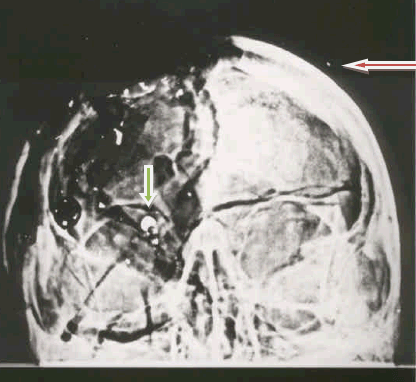
    image Figure 1. AP Autopsy X-ray of JFK’s skull. Note the semi-lunar (6.5 mm) object inside JFK’s right orbit (vertical green arrow). The metal fragment overlying the left skull is identified by the horizontal red arrow. When questioned by the WC, James Humes (the pathologist) stated (2H100) that the largest metal fragment removed from JFK’s skull was “Flat, irregular, two or three millimeters.” Surely this does not describe the 6.5 mm object seen here. Before the ARRB, Humes was again asked whether the metal fragments he had removed were larger or smaller than this 6.5 mm object. He replied (MIDP, p. 449), “Smaller. Smaller; considerably smaller….I don’t recall retrieving anything of this size.” The other two pathologists also did not recall this object.

    http://i217.photobucket.com/albums/cc151/David_Von_Pein/MISCELLANEOUS%20JFK-RELATED%20PHOTOS/JFK_Autopsy_Photo_3.jpg?t=1278230684 http://jfk-archives.blogspot.com/2010/07/jfk-back-wound-location.html
    Figure 2. Autopsy photograph of JFK’s back. The wound (arrow) appears to be at about T1. The scapular spine is faintly visible.

    posterior view Figure 3A. The horizontal scapular spine can be faintly seen (red arrow), inferior to the level of T1. The scapular spine appears to lie at about the level of T2 or T3, close to Boswell’s level for the back wound on his Autopsy Descriptive Sheet. In other words, the autopsy photo and Boswell’s Sheet are inconsistent. Far worse, though, Boswell later elevated this wound into the neck, much higher than shown in the autopsy photograph. Any level inferior to T1 for the back wound makes the SBT impossible.

    http://i.cdn.turner.com/dr/teg/tsg/release/sites/default/files/imagecache/750x970/documents/descriptive1.gif Figure 3B. Another view of the back. Here the scapular spine appears to lie at the level of T3 or T4. An online source assigns a typical level to the scapular spine as T3 (manualmed.blogspot.com/2008/09/thoracicspine-landmarks.html). The C-designations here are for the cervical nerves, not for the vertebrae. (Nerves C2-C8 exit inferior to the vertebrae C1-C7, respectively.)

    http://www.herniatedlumbardisk.com/images/Spine-Anatomy.jpg http://www.thesmokinggun.com/file/autopsy-descriptive-sheet?page=0
    Figure 4. The Autopsy Descriptive Sheet, prepared by Boswell. Note the level of the back wound (indicated by the horizontal line from “7 x 4 mm”). It appears to lie at least as low as T2, possibly even lower. If accurate, that would immediately invalidate the SBT.

    http://ts1.mm.bing.net/images/thumbnail.aspx?q=1339753571660&id=269f742be9d2ee98ca6377cafcccf958&url=http%3a%2f%2fwww.waterburyhospital.org%2fservices%2fortho%2fimages%2fcspine3.jpg Figure 5. Skeleton as viewed from the front. McAdams claims (p. 223) that the bullet (of the SBT) traversed JFK at C7/T1 (between the levels of the seventh cervical and the first thoracic vertebrae)—at about the tip of the vertical cyan arrow. The horizontal red arrow identifies the C7 vertebra. As seen here, it is impossible for a bullet to pass between the transverse process of C7 and the medial portion of the first rib (cyan arrow), without damaging bone. Also note how close together (actually overlapping) these transverse processes are for all of the cervical vertebrae. Therefore, no bullet could have traversed JFK at any cervical level and still be consistent with the autopsy photograph (without causing obvious bone destruction). On the other hand, a bullet inferior to T1 would likely have perforated the right lung apex, which was not seen at the autopsy. Only a contusion was seen there.
    http://www.bing.com/images/search?q=Anatomy+Of+Spine&FORM=IQFRDR#x0y1427

    Cervical Spine X-Ray: Image 1 http://www.info-radiologie.ch/cervical_spine_radiograph.php
    Figure 6. Cervical Spine X-ray: AP view. 1, Clavicle. 2, 1st rib (from T1). 3, Trachea. 4, Spinous process of C7. 5, Vertebral Body of C5. 6, Uncinate process. A bullet could not pass at the site implied by McAdams (tip of the vertical cyan arrow), which lies between the level of the C7 vertebral body (horizontal red arrow) and the level of T1, without causing obvious bone destruction. That was not seen in JFK.


    911_Card24.jpg Figure 7. CT scan of a patient. This cross section is very close to C7-T1, the level chosen by McAdams for the SBT. I used JFK’s wound measurements to place the hypothetical trajectory (in red). Such a trajectory is impossible here because bone from the spine (the transverse process) intervenes. Based on his X-rays, JFK experienced no such bone trauma. In 1963, CT scans were still in the distant future. This visual disproof of the single bullet theory was first anticipated several years after the assassination (but still well before CT scanners) by a pathologist, John Nichols, MD, PhD.

    Appendix 6: Exit and Entrance Wounds in the Literature (per Milicent Cranor)

    1. Entrance wounds can be jagged. A few JFK witnesses said that the throat wound was somewhat jagged; these comments have been used by WC loyalists to conclude that the throat wound was an exit.

    1. Entrance wounds need not have abrasion collars. Some of the Parkland doctors indicated that JFK’s throat wound had an abrasion collar, which would suggest an entrance wound. However, its absence would prove nothing.

    1. Shored (buttressed) exit wounds do have abrasion collars; in fact, these are typically large (not the case for JFK). The abrasion collar is formed when the bullet crushes the skin against a rigid object that “shores” the skin, i.e., the skin is fixed in place as the bullet exits. And, because the skin is kept in place and is not stretched outward while the bullet advances, the wound size matches the bullet size (like a cookie cutter). Most entrance wounds are shored by muscle or bone and are therefore small. JFK’s small throat wound is sometimes attributed (by WC loyalists) to shoring by the collar and necktie. But in every case of a shored wound, there is a pronounced abrasion collar, with bits of skin pulled outward as the neck and shirt eventually separate. Therefore, skin is left behind on the material (in this case, the shirt). The FBI examined the inside of JFK’s shirt, but they found not even a scrap of skin.

    1. Exit wounds can be small, as proved by well-controlled experiments and wartime experience. A typical (unshored) exit wound is large. In this case, the bullet stretches the skin outward, causing tenting and then tearing of the skin as it exits, and it leaves behind a star-shaped wound. Loose clothing can permit enough stretching that the bullet can exit before it encounters cloth. In specific cases though unshored exit wounds can be even smaller than the entrance wounds from the same bullet. This is more likely when the exit speed is low. In particular, a bullet fired from a great distance may lose much of its energy, and thereby create a small exit wound.

    1. When police cannot decide between an entrance versus an exit wound (e.g., when the context is controversial), pathologists are asked to analyze the wound under the microscope. For instance, just as the beveling of the skull can often determine entrance versus exit, so also can the beveling of bullet wounds in skin, i.e., dermis and epidermis are affected similarly to the skull tables.

    Appendix 7: The Hole in the Windshield

    The following is a quotation from Doug Weldon at (http://educationforum.ipbhost.com/index.php?showtopic=15484).

    The windshield Taylor was shown in 1975 had to be the one you [presumably meaning “Barb and Jerry”] showed in your comparison study in your article by John Hunt. Martin Hinrichs did a detailed study and demonstrated that the cracks were not the same. Jerry himself now questions whether the two windshields in the article are the same. Jerry wrote on this forum “Yes, that’s correct. Right now, I don’t think any windshield comparison can be conclusive including Hunt’s. If we can gather better data at the Archives it might be possible, but right now I’m certain that we really don’t know exactly what it is we’re trying to compare.” Martin Hinrichs also pointed out a very pertinent fact: “A comparison of this (sic) two windshield cracks is nevertheless dominated by the following undeniable principal: The windshield was kicked out at 11/26/63 by the feet of the Arlington Glass men. And that dominant cross crack should be visible in every photo post to 11/26/63.” There is also evidence that the Secret Service ordered twelve windshields after the assassination for “target practice.” Did they need these windshields to attempt to duplicate the damage to the original windshield but without a crack,” (sic) George Whitaker stated that the original windshield was “scrapped” (destroyed) on November 25, 1963 in Dearborn, Michigan. [The “sic” entries are mine—DM.]

    Appendix 8: My (Still Unanswered) Letter to Max Holland

    From the new medical depositions taken by the Assassination Records Review Board (ARRB), we now know that the only recognized autopsy photographer, John Stringer, did not take the autopsy photographs of the brain. A memorandum issued by the ARRB strongly suggests that two different brains were autopsied and that the brain photographs in the National Archives most likely are not those of JFK. My personal, detailed studies of the autopsy skull X-rays, including an original use of optical densitometry, show virtually no brain tissue in a fist-sized area at the front of the skull, just where the photographs (paradoxically) show nearly intact brain. My measurements are not only consistent with the conclusions of the ARRB, but actually anticipated them by several years.

    The shot (or shots) to the head pose even worse conundrums for Holland. If he agrees with the pathologists that JFK was struck low on the right rear of the skull, he then has no explanation for the obvious trail of metallic debris that lies more than 4 inches higher. Alternately, if he concludes that a bullet entered much higher, he must then believe that all three qualified pathologists were wrong by 4 inches, and that an absurdly unique event occurred in the history of ballistics—namely that an internal 6.5 mm cross section of a bullet was sliced out and then migrated 1 cm lower and stayed there. In addition, and after all this, he must also believe that the trail of metallic debris still lies well above his proposed entry site. No ballistics expert has ever testified to seeing so much nonsense from one bullet.

    Even worse for Holland, just within the past year, Larry Sturdivan, the ballistics expert for the 1977–78 Congressional investigation, has insisted that this 6.5 mm cross section cannot represent a metallic fragment at all—thus crippling the central basis for the conclusions reached in prior official inquiries. My own research on the X-rays over the past 5 years (performed at the National Archives and now published in Assassination Science, edited by James Fetzer) agrees with Sturdivan that this object cannot represent a real piece of metal. [Only a tiny metal fragment is visible at the corresponding site on the lateral X-ray.] I have, in addition, shown how simple it was in that era deliberately to manufacture (in the darkroom) an altered X-ray with a 6.5 mm metallic image added to it (so that Oswald’s rifle would be incriminated). Finally, at my request the ARRB specifically asked each of the autopsy pathologists under oath if they recalled seeing this flagrantly obvious, 6.5 mm object on the X-rays during the autopsy. Just as I had predicted, none of them could recall this artifact—one that my 7-year-old (nonradiologist) son instantly spotted on the extant anterior skull X-ray. [This has been slightly adapted from my article in MIDP, p. 400].

    Appendix 9: the Police Dictabelt

    The following is extracted from my review of Hear No Evil by Donald Thomas at here.

    1. The task now was to find matches, if any, between the 432 test shot patterns and the six evidence patterns. Such matches would presumably determine both the shooter locations and the target sites. For this exercise, the reader must imagine a very large matrix, consisting of 432 entries vertically and six entries horizontally. For each element of this matrix there is an evidence pattern and a test pattern, which are to be compared to one another. So a total of 432 x 6 = 2592 comparisons must be made.

    2. Matches for a specific shot were decided based solely on the time between spikes, i.e., amplitude was ignored (except, of course, for the already completed, initial selection of suspect gunshots).

    3. A deviation of eight milliseconds (msec) was permitted, since the microphones might not precisely match the motorcycle position. Even air movement might change the matches.

    4. The statistical formula for detecting a match was this:

    Binary Correlation Coefficient = r =   i  / √ (N x n)
    where i = number of coincident events
              N = number of spikes in the evidence pattern and
              n = number of spikes in the test pattern.

    1. For a perfect match, r = 1, while r = 0 means no match. But, partly because of so much noise, a perfect match could not be expected. Results of interest were for r > 0.6; however, it should be emphasized that this is an arbitrary value. Some other value could have been chosen, with a likely different final outcome, possibly even wildly different.
    2. Values for r < 0.5 were ignored; that left only 15 possible matches (see Table 13 by Thomas). These 15 had the generic pattern of gunshot echoes in Dealey Plaza. The reader must understand that this does not mean 15 shots! After all, duplicate test shots had been fired from the TSBD (inside and outside the window). Furthermore, matches sometimes occurred at adjacent microphones—from the same shot—as might well be expected if the motorcycle had been between two adjacent microphones. Only four actual shots were proposed.

    Appendix 10. Optical Density and Characteristic Curves for X-ray Films

    Because no one recalls the history of this science (of optical density), a short review is appropriate. This history was summarized in a November 1989 article from the Eastman Kodak Laboratory, co-authored by Arthur Haus and John Cullinan—“Screen Film Processing Systems for Medical Radiography: A Historical Review,” Radiographics, Volume 9, p. 1203. The article can also be found online at http://radiographics.rsna.org/content/9/6/1203.full.pdf. After I had completed my original article on the JFK X-rays, I sent a copy to Arthur Haus (the above author). After reviewing it he offered no criticisms of it. I had had a prior conference telephone call with him and his colleague about X-ray films of the 1960s. This information had played a major role in my detective work on the JFK autopsy X-rays and was included in my paper. I later met Haus in person at my specialty meetings in Los Angeles.

    The characteristic curve is central to this discussion. It is a graph of optical density versus X-ray intensity (actually the logarithm of intensity). It shows how the optical density of the film varies with the intensity of the X-rays that strike the film. Haus recalls (pp. 1217-1218 of his article) that this data was first explored for photographic films in 1890; the classical paper was by Hurter and Driffield. In 1917, M. B. Hodgson showed that this earlier work could be applied to X-ray films as well. In other words, this science is now nearly a century old. To put this into the context of 1917, JFK and my mother were both born that year; the US entered World War I; and Lenin, although a bit tardy, arrived on Russian soil (from Switzerland, via Sweden and Finland). But the FBI would not begin its fingerprint files for another seven years (in 1924) and John McAdams’s own mother was still very young (or possibly not even conceived) in 1917. (Ironically, McAdams was born in Kennedy, Alabama.)

    In the late 1960s, Haus (the same one) and Rossman developed an automated inverse square sensitometer for collecting this data, a device that was still in widespread use in 1989. After I graduated in 1976 from the University of Michigan Medical School, I entered the specialty of radiation oncology. While at USC during residency, I worked with compensating filters for radiation therapy of cancer patients. These devices were built from small metal blocks that were placed in the X-ray beam during radiation treatments, in order to compensate for missing (patient) tissue in the path of the therapeutic X-rays. They helped to prevent hot spots in the dose distribution (inside the patient). Picture a checkerboard pattern in which small metal blocks are piled to a specific height on each square, with greater heights corresponding to more missing tissue. More recently, computer planning systems have used CT-derived compensators to correct for missing (or excess) tissue, such as air cavities (or intervening bone). But the principle is similar: the CT numbers play a role like that played by optical density. (See Radiotherapy for Head and Neck Cancer: Indications and Techniques, 3rd edition, by K. Kian Ang and Adam S. Garden, p. 36.)

    When I measured the optical density of the 6.5 mm artifact within JFK’s right orbit (at the Archives), I had invoked the same principles—the optical density was related to the amount of tissue traversed by the X-rays (that had struck a specific point on the film). Of course, if JFK’s X-rays had been double exposed in the darkroom precisely over this 6.5 mm object (as I have proposed—and whose feasibility I have even demonstrated), then this data would make no sense. Such nonsense, of course, is exactly what the data showed. And, consistent with this, no professional has ever been able to make sense of this 6.5 mm object either. It remains unique in the history of radiology. In any case, my major point here is simple and straightforward: no one should claim that optical density measurements are too novel to be used in analyzing X-ray films. The only parameter that is new here is its application to a president of the United States—the principles are the same.

    Appendix 11: Odd output from John McAdams’s Filter Factory for Facts

    A. Most pieces of evidence must be discarded. (Or, if a different page by McAdams is cited, then such evidence should not be discarded.)

    B. Eyewitnesses, even physicians doing what they usually do, cannot be trusted. Furthermore, no distinction need be made between earlier and later recollections of eyewitnesses.

    C. Photos are to be trusted over eyewitnesses, even when no one recognizes the photos.

    D. The size of Connally’s back wound after surgery is more relevant than its original size.

    E Only two physicians at Parkland saw JFK’s throat wound.

    F. Because false sightings in general are unreliable, two Oswalds are not possible.

    G. Major secrets cannot be kept.

    H. The acoustic evidence contained 15 matches.

    I. There is nothing noteworthy about the 6.5 mm object within JFK’s right orbit on the AP X-ray.

    J.  On JFK’s skull X-rays, no metal fragment is seen on JFK’s left side.

    K.  Fingerprint evidence is “killer” evidence.


    Reviews of John McAdams’ book JFK Assassination Logic by
    Pat Speer
    Gary Aguilar
    Frank Cassano
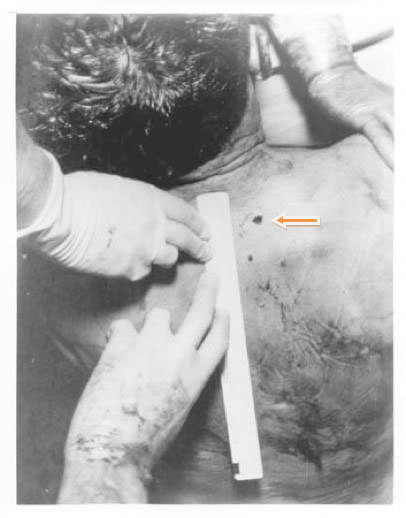
  • Philip Shenon, A Cruel and Shocking Act


    Philip Shenon’s book A Cruel and Shocking Act begins with a deception. It then gets worse.

    On the frontispiece, before the actual text begins, Shenon quotes from Marina Oswald’s Warren Commission testimony. In that particular quote, Marina was asked if Lee Oswald had visited Mexico City. She replied that yes, Oswald had told her that he had been at the Cuban and Russian embassies.

    In itself, this is an accurate quote. But what Shenon does not tell the reader here, and in fact what he does not say until nearly 200 pages later, is this: that during her first Secret Service interview she denied Oswald had ever told her he was in Mexico. She did this more than once, and she was categorical about it. She even denied it when she was not asked about it. Just because she had seen the story about Oswald in Mexico City on television. (Secret Service Report by Charles Kunkel “Activities of the Oswald Family November 24 through November 30, 1963”)

    When Shenon does admit she initially denied it, he does not mention a major event that occurred after the initial denial and almost simultaneously with her February appearance before the Warren Commission. A week after her initial appearance before the Commission-where she now changed her story about Mexico City and several other matters-Marina signed a contract with a film company called Tex-Italia Films. The grand total of funds transferred to her was $132, 500. Which today would amount to about a half million dollars. (John Armstrong, Harvey and Lee, p. 977) What makes this transaction so intriguing is that when the company partners were investigated, it was discovered that they used false names. Further, the company’s business offices were asked to leave the lot they were located on for failure to pay their rent. Finally, there was no film made by Tex-Italia about Marina or her dead husband. (ibid)

    Now, to most people, these events and the subsequent reversals of testimony would seem relevant to the story Shenon is telling. After all, if the reader was informed of this information, one conclusion he or she could come to is that Tex-Italia was a front company, and its main purpose was to get Marina Oswald to testify to a tale that was more in line with the official story about Kennedy’s assassination. After all, Mexico City was quite important to the Commission. As we shall see, it is even more important to Shenon. If there is a serious question about Oswald being there, then the Oswald story begins to wobble about in a direction the Commission, and Shenon, do not want it to go. Therefore, in addition to beginning his book with this misleading testimony, in addition to not informing the reader about the timing of the financial transaction, when one scans the index of Shenon’s long book, the reader will not find an entry for Tex-Italia Films.

    Let us move to another section of the book to see how Shenon again censors information to present at best, an incomplete picture, at worst a deceptive one. On page 45, Shenon is describing a phone call between President Lyndon Johnson and FBI Director J. Edgar Hoover on the Saturday morning after Friday’s assassination. But before he does that, he prefaces what he is about to present by saying that Hoover “was never as well informed as he pretended to be; he did not always bother to learn all the facts…” (Shenon, p. 46)

    Why does the author do this in advance? Probably because Hoover told Johnson that the evidence against Oswald at this time was not very strong and “The case as it stands now isn’t strong enough to be able to get a conviction.” (ibid) Shenon does not like this statement. So he now states that the evidence against Oswald on Saturday was “overwhelming”. He then writes that witnesses could identify him at the scene of the Tippit murder and with a rifle in the sixth floor of the Texas School Book Depository. That Oswald purchased the rifle the police found on the sixth floor. And that he also purchased a pistol used in the murder of Tippit, and his wallet had a card in the name of A. Hidell used in the mail order purchases of the weapons.

    Again, by not informing the reader of the true state of this evidence today, Shenon cuts off an alternative to his characterization of Hoover’s discussion. Namely that Hoover was correct about the state of the evidence. For example, the rifle the police found and attributed to Oswald is not the rifle the FBI said Oswald ordered. The rifle the Commission is going to say was ordered was a 36″ Mannlicher-Carcano carbine. The rifle found by the Dallas Police was a 40″ short rifle. Klein’s, the sporting good store in Chicago where Oswald was supposed to have ordered the rifle from, did not put scopes on the 40″ model. Yet this one had a scope on it. (James DiEugenio, Reclaiming Parkland, pgs. 56-63) The night before, Hoover’s agents were at Klein’s for hours on end. They ended up confiscating the microfilm about these orders. Isn’t it possible that Hoover then knew about some problems in the evidentiary record? Shenon does not have to disclose that since he never tells the reader about any of these contradictions about this transaction.

    Shenon is equally nebulous about the transaction for the pistol he says was used in the murder of Dallas policeman J. D. Tippit. That handgun was supposed to have been delivered to Oswald by a private company called REA (Railway Express Agency). This was a forerunner to companies like Federal Express and UPS. REA should have sent a card to Oswald’s post office box to tell him the handgun had arrived. Oswald then would have had to present an ID and a certificate of good character to have a firearm given to him via a mail transaction. And REA had to have kept these records in compliance with state and federal laws.

    There is no evidence that any postcard was ever sent to Oswald’s box by REA. (DiEugenio, ibid, p. 104) Neither is there any paper work in evidence about Oswald presenting the ID or the certificate of good character. In fact, there is not even any signature of a receipt for the transaction in the Warren Commission volumes. In other words there is no evidence that this transaction ever took place as the Commission said it did. Or that REA submitted payment to the company who allegedly supplied the pistol. But more to our point here: There is no proof, or even evidence in the Commission volumes that the FBI ever even visited REA in Dallas to check on this transaction. (ibid)

    Now if Shenon thinks that the FBI did not visit REA about this matter then he was never qualified to write this book. The much more logical conclusion is that they did visit REA. But they could not find any of the back up materials to certify this as Oswald’s transaction. If that is the case, then Hoover did know what he was talking about during the call with President Johnson.

    Many authors have discussed the speciousness of the eyewitness testimony in both the Kennedy murder and the Tippit murder. The two most important witnesses in that regard, respectively Howard Brennan and Helen Markham, were so poor that several Commission lawyers did not want to include them in the Warren Report. They felt that their inclusion would create serious problems for the document. Which, as we will see, they did. (Edward Jay Epstein, The Assassination Chronicles, p. 144) There was a real battle in the Commission over these witnesses. This is a point that Shenon very much underplays. But which tends to bolster the Hoover statement about the case against Oswald being weak.

    Let us now deal with the point about the wallet identification of Oswald as Hidell, which certified him as the purchaser of the weapons under an alias. As many people know, the Dallas Police said that they took Oswald’s wallet from him on the way to the police station, after his arrest at the Texas Theater. It was not until many years later that a crucial discrepancy in this record was discovered. And it ends up it was co-discovered by an FBI agent, Bob Barrett. For there is a film of Barrett handling the wallet at the scene of the Tippit murder. One that is not Tippit’s. Barrett later said it had the Oswald/Hidell identification inside of it. Yet, the Warren Report states that Oswald’s wallet was taken from him on the way to the police station after he was arrested at the Texas Theater. But further, there was a third wallet in evidence, one that the police said Oswald left at the home of Ruth and Michael Paine that morning.

    Question for Mr. Shenon: Do you know anyone who carries three wallets? If you do, please tell us about it. In fact, why did you not even mention this “three wallets” problem in the nearly 600 pages of your book? What most objective observers believe today is that the Dallas Police suppressed the evidence of the Oswald wallet at the Tippit scene to avoid the inescapable suggestion that it had been planted after the fact. Because they knew no one would buy the fact of Oswald having three wallets. If that is the case, then again, Hoover’s comments about the state of the evidence were correct.

    II

    Just how bad is Shenon on the physical evidence in the case? He can write that the alleged rifle and handgun used in the murders came from the same gunshop! (p. 46) Yet, by just browsing through the Warren Report one can see that the rifle came from Klein’s Sporting Goods in Chicago, Illinois. The handgun came from Seaport Traders in Los Angeles, California. The odd thing about this is that although the Commission says they were ordered months apart, they both were shipped on the same day. This is an intriguing fact, which Shenon does not note. (See Warren Report, pgs. 121, 174) What makes it more intriguing is that, as with the missing paperwork at REA, the corresponding paperwork is also missing at the post office to certify receipt of the rifle. (ibid, DiEugenio, pgs. 61-62) In fact, as with REA, there is no evidence of any person at the post office saying that they handed the rifle package to Oswald. Which is hard to believe. Because when transferring firearms from out of state shippers, postal regulations stated that one had to present an ID card to certify that you were the person who rented that post office box. As Shenon states, the rifle was allegedly ordered in Hidell’s name. Since Oswald rented the box office in his own name, the rifle package should have been sent back unopened. (ibid) But if Oswald did show he was really Hidell, would not someone at the post office have recalled that fact? Especially by, say, November 23, 1963? No one did. And that interesting piece of evidence is not noted by Mr. Shenon.

    In order to explain how someone could create all these embarrassing lacunae in this day and age, let us drop in some background about how this book originated. Shenon worked for the New York Times for over two decades. He specialized in reporting on the Pentagon, the Justice Department and the State Department. In other words he dealt in national security issues. In 2008 he published a book about the 9/11 investigation and report called The Commission. Many researchers on that case felt the book was a damage control operation about that inquiry. Therefore, quite naturally, a surviving member of the Warren Commission – Shenon will not reveal who it is – called him and asked him to do a reprise about the Warren Commission. Incredibly, Shenon agreed to do it.

    Why is this so objectionable? Because Shenon admits that it was initiated by a junior counsel who then allowed him access to the other surviving counsels. That would mean that Shenon was in contact with, among others, Howard Willens, David Slawson, Richard Mosk, Sam Stern, Burt Griffin, Melvin Eisenberg, the late Arlen Specter, William T. Coleman, and the late Norman Redlich. Now, these men had been harshly criticized for decades on end. The criticism of them turned vitriolic when Oliver Stone’s film JFK appeared in 1991. One of the main criticisms about they dying mainstream media, especially the NY Times, is that in return for access and information, reporters tend to give the reader a one-sided version of the facts. Mainly because their sources have an agenda which usually amounts to something called “covering your ass”. No quasi-legal body in history ever had more of a reason for CYA than the Warren Commission. Yet, Shenon agreed to this arrangement. Not only did he agree to it, but as we will see, he accepted everything his sources told him-with gusto and relish. Because of that unprofessional closeness to his sources and subject, the book becomes so biased as to be, at best, almost useless. At worst it is a propaganda tract for the Commission survivors. It becomes that because, as we will see, Shenon values his sources over the declassified evidence of the Assassination Records Review Board. This might be good and profitable for him. It is not good for the reader, or for the writing of good history.

    A good example of the compromising that Shenon has to do to accommodate his sources appears on page 168 of his book. Because he has chosen to side with these men, Shenon has to bow before the absurd premises of Single Bullet Theory. In fact, Shenon writes that “Later scientific analysis backed the commission’s theory.” Apparently, no one told Shenon that if “scientific analysis” did back it then he would not have to refer to it as a theory. But even worse, he deliberately presents his diagram from an angle both from the front and slightly above the limousine. This does much to eliminate the vertical and horizontal problems with the trajectory of CE 399, the Magic Bullet. For instance, by framing his drawing in that way, Shenon does not reveal the entry point on Kennedy’s back. In fact, in the wording that accompanies the drawing, the author says the bullet enters “Kennedy’s body from behind” at a “slightly downward angle”. Shenon cannot bring himself to say that the bullet hit Kennedy in the back from sixty feet up. Which would make it very hard to believe that it could then deflect upward to exit his throat, especially since, as he notes, it did not hit any bony body structures.But further, by disguising this unknown angle, Shenon now arranges everything from Kennedy’s throat outward in a straight line. Even though the magic bullet smashed two bones in Connally!

    In further obeisance to his sources Shenon ignores two key pieces of physical evidence to revive something that never happened. First, when author Josiah Thompson questioned both of John Connally’s doctors, Robert Shaw and Charles Gregory, he asked them if they thought the bullet that went through Kennedy also went through Connally. They said no, because there were no fibers from clothes in the bullet path of Connally’s back wound. (ibid, DiEugenio, p. 110) Secondly, when the ARRB interviewed several medical witnesses who participated in the autopsy at Bethesda, they testified that the malleable probes inserted into Kennedy’s back were all too low to exit the throat. And further, the slope of the angle was much too steep to connect the two points. (ibid, pgs. 116-17) This is the kind of trouble one invites when one enters a complex case from years of experience at the New York Times.

    But Shenon features another specious schematic on page 245 of the book. He calls this one “Lee Harvey Oswald’s Escape”. It traces Oswald from his exit from the Texas School Book Depository after the murder of Kennedy, to his arrest at the Texas Theater. Shenon first says that Oswald boarded a bus. He was walking the wrong way to board the bus, and the bus would have dropped him off seven blocks from his house. He could have caught a bus nearby which carried him across the street from his house. (WR, p. 160) Shenon then says that Oswald got off the bus and hailed a taxi cab. What he doesn’t say is that Oswald walked back toward the scene of the crime and then offered to give up the cab to an elderly lady. (Sylvia Meagher, Accessories After the Fact, p. 83) Mr. Shenon, do these acts sound like a man trying to “escape”?

    Shenon’s map then has Oswald arriving at his rooming house on Beckley Street at 1:00. But it does not say that he then left at 1:04. Shenon now shows us just how in bed he is with his Commission sources. He says that Tippit was shot at 1:15 PM. As writers on the Tippit case have demonstrated, most recently Joseph McBride and John Armstrong, there is simply no credible evidence that places the murder of Tippit that late.

    For instance, T. F. Bowley places the shooting at 1:10. And Bowley looked at his watch. (Meagher, p. 254) Since Shenon does not note Bowley, he cannot tell the reader that the Commission never interviewed Bowley. (ibid) As McBride notes, Helen Markham caught her bus regularly for work walking from the intersection of 10th and Patton, the scene of the murder, toward Jefferson. She would start her walk at about 1:04. The FBI timed the walk at about 2 and a half minutes. Which would place the shooting at about 1:07. (McBride, Into the Nightmare, p. 245) The problem for Shenon is that the distance from the rooming house to the scene of the Tippit shooting is nearly one mile. How on earth could Oswald, in street clothes, traverse that distance in six minutes or less? But further, no one saw him traveling in that direction. (Meagher, p. 255) Shenon then has Oswald entering the Texas Theater at 1:40 PM. The reader should then ask: Why did it then take Oswald almost twice as long to travel a distance that was almost the same length?

    These two drawings in A Cruel and Shocking Act tell us all we need to know about the book. As well as does the excision of the following witness testimony. One will not find the name of Roger Craig in Shenon’s index. Probably because Craig’s affidavit, and the corroborating one of Marvin Robinson, vitiate the Commission’s version of “Oswald’s Escape”. Right after the shooting of Kennedy, Craig described a man running down the incline opposite the Depository and jumping into a Rambler auto pulling out of Dealey Plaza on Elm Street. Robinson said the same. When officer Craig got to City Hall, he recognized the man he saw jumping into the Rambler as Oswald. (Josiah Thompson, Six Seconds in Dallas, pgs 242-43)

    But, for obvious reasons, even though he had a corroborating witness, the Commission decided they had to disregard Craig. So does Shenon.

    III

    In other places where Shenon tries to deal with the evidence, he shows himself to be so amateurish that he himself undermines his own case. For instance, he writes that the head shot, “blew away much of the right hemisphere of his brain, an image captured in awful photographs.” (Shenon, p. 22) What the heck is Shenon talking about here? There is no such image in autopsy photos at the National Archives. And, in fact, this shows just how unfamiliar the author is with the actual declassified records of the ARRB. For the images of Kennedy’s brain show a nearly intact brain. And for Shenon to write that much of the right side is gone reveals him to be, inadvertently, in the camp of the conspiracy theorists he is frequently assailing. For many of the critics of the medical evidence believe, based on the medical witnesses, that much of the brain had to be dissipated. (DiEugenio, ibid, p. 137) The problem is that-in spite of what Shenon says – no picture depicts such a damaged brain. Nor does the drawing made by Ida Dox for the HSCA.

    It seems that Shenon wants to have something new to hang his hat on. So he begins the book with three facets of the evidence he thinks will do the trick. The problem is they do no such thing, since they have all been thoroughly discussed for decades.

    The first “new event” Shenon depicts is the fact that Dr. James Humes did not just burn his notes of the autopsy, he incinerated his first draft. This was made obvious about 15 years ago, when ARRB Chief Counsel Jeremy Gunn examined Humes. But Shenon wants to be able to hang onto the story that Humes did this so that the autopsy would not drop into the hands of illicit ghoulish souvenir hunters who would then display the bloodied documents. (Shenon, p. 23) As Gary Aguilar has pointed out, the problem with maintaining that fairy tale is that Gunn found out that Humes burned it at his house, which is where the draft in question had been penned. (Gerald McKnight, Breach of Trust, p. 165) When Gunn pressed him on this, Humes tried a different excuse instead of the bloodied souvenir stuff pretext: “it might have been errors in the spelling, or I don’t know what was the matter with it…” (ibid) Its revealing of Shenon that he sticks with the now exposed cover story, and by doing so he tries to cover up for Humes; and also to vilify those “ghouls” who would actually like to see that lost draft.

    The author does another thing of note in his brief discussion of the autopsy. He maintains another specious story, namely that Humes never called Dallas from Bethesda until the next day, Saturday. But to name one important witness, radiologist John Ebersole told the HSCA that this call took place on Friday night. (ibid, p. 168-69) But further, that afternoon, in a televised press conference, Dr. Malcolm Perry, who cut the tracheotomy over the throat wound, said three times that this wound was an entrance wound. Dr. George Burkley, who was at Parkland Hospital when Kennedy died, was also in the autopsy room that night. He would have had to have known about the entrance wound in the throat. Finally, nurse Audrey Bell told the ARRB that Perry told her he had been getting calls from Washington during that Friday night. (DiEugenio, pgs. 143-44) What many people believe happened is that this myth about the next day call was created in order to give time to alter the entrance wound in the throat into an exit wound. And sure enough, Secret Service agent Elmer Moore was shortly after stationed in Dallas and was talking Perry out of his first day story. (Ibid)

    It’s hard to believe in 2013, but Elmer Moore’s name is mentioned just once by Shenon. Why is it hard to believe? Because after Moore accomplished his mission at Parkland in preparation for Arlen Specter’s questioning of the emergency room staff, he then became the bodyguard/valet for Earl Warren on the Warren Commission. (ibid, p. 144) In his one mention of his name, Shenon muddies this transition by Moore. He implies that Moore accompanied Warren to Dallas for Jack Ruby’s polygraph test solely for protection purposes. This is not accurate. As writers like Pat Speer and Aguilar have shown, after working over Perry, Moore became almost a personal assistant to Warren throughout much of the Commission proceedings. And this was done at Warren’s request. As Speer notes, Warren wanted Moore to help “the Commission for an indefinite period to assist in its work.” (ibid, p. 144) It is not possible to give an accurate and candid presentation about the Warren Commission without fully describing what Moore did in the alteration of testimony, plus the fact that Warren requested his assistance afterwards.

    The second piece of old evidence that Shenon reports as being long hidden is the destruction of a photograph of Oswald by Marina and Oswald’s mother Marguerite. To use just one example, this incident was thoroughly described by writers like the late Jack White and Greg Parker many years ago. It is also described at length by Vincent Bugliosi in his colossal book, Reclaiming History. Like Bugliosi, who Shenon greatly admires, the author wants us to think that somehow this is another of the infamous “backyard photographs” which the Commission, and Life Magazine, used to incriminate Oswald. But like Bugliosi, Shenon does not quote Marina’s testimony before the HSCA about this point. (Shenon, p. 25) Her memory of this was very hazy and unreliable. But further, Marguerite described this particular photo as being different than the others. She said, in this one, Oswald was holding the rifle above his head with both hands. Further, that this one was addressed to his daughter June. June was two years old at the time. These points are rather indecipherable. Especially in light of the fact that Marina originally said she took just one backyard photo. (ibid, DiEugenio, p. 86) Which is probably why the Commission, when they had the opportunity, did not press far at all in this field.

    The last piece of “hidden” evidence that Shenon uses is also mildewed. It’s the note Oswald left for James Hosty at FBI headquarters before the assassination. (Shenon, p. 25) But again, in this case, its not like the Commission did not know about this incident. During the questioning of Ruth Paine, the subject surfaced since it was mentioned in a letter Oswald allegedly wrote to the Russian Embassy in Washington and Ruth had copied. (McKnight, p. 260) It was also mentioned in her March 1964 testimony. If there was no follow up on this, it appears its because that is the way the Commission wanted it. But further, unlike what Shenon tries to convey, Hosty was asked about the surveillance of Oswald by the FBI prior to Kennedy’s arrival in Dallas. And the questioner was one of Shenon’s presumed sources, Sam Stern. (ibid, p. 261)

    I believe the point of this section of the book is to show that somehow, certain evidence was not revealed to the Commission. But as the reader can see, this is not really accurate. The only piece of evidence that one can really make that argument for is the first draft of the autopsy report burned by Humes. But in terms of relevancy to any Commission work or conclusions, this has no real retroactive impact. To anyone familiar with the evidence and the Commissions’ work, it is this medical evidence that the Commission made almost no inquiry into. As other authors have shown, the Warren Commission was so uninterested in this key issue that they accepted falsified drawings as illustrations for the head and neck wound to President Kennedy. (DiEugenio, pgs. 120-22) These were Commission Exhibits 385 and 388. They are illustrations made by 22 year old, first year medical artist Harold Rydberg. These two drawings – which show a flat direction to the neck wound, and an upward direction to the head wound – were meant to demonstrate, not what was seen in the autopsy room, but what the Commission had already decided upon as their conclusions. But further, the drawing of the back wound places the wound in the neck, when the declassified autopsy photos show it to be in Kennedy’s back. And the drawing of the head wound puts Kennedy’s head in a position it is not in at Zapruder film frame 313, the instant of the head shot.

    Incredibly, Shenon does not mention the Rydberg drawings or their misrepresentations. Which, considering what he did with his drawing of the Single Bullet Theory and “Oswald’s Escape”, perhaps is not so incredible. Its par for the course. But the point about these three above issues-the burnt autopsy report, the missing Oswald photo, the Hosty note – making any difference for the Commission, for reasons stated above, this is simply not convincing.

    Before leaving the subject of the medical evidence, we should note one more point. Throughout the book, Shenon tries to say that somehow, Bobby Kennedy influenced the Commission, and he therefore limited its use of the autopsy materials. As noted by many other authors, this is simply not the case. The autopsy photos were in the hands of the Secret Service at this time. Which is why Secret Service agent Elmer Moore showed one of them to Arlen Specter. (DiEugenio, p. 145) Whatever limitations were placed on the Commission in its use of these materials, they had little or nothing to do with Robert Kennedy. Because the deed of gift for these materials to the Kennedy family would not be signed until 1965, the year after the Commission expired. Somehow, in writing a book about the Warren Commission, Shennon couldn’t find the space to include a sentence with that bit of information in it.

    IV

    Shenon does uncover some interesting information about the work habits of the Commission. For instance, he says that Coleman worked about one day a week. (p. 109) Also that Chief Counsel J. Lee Rankin split his workweek between the Commission and his practice. But presumable he did some work for the Commission while in his office. Another interesting point is the paucity of criminal lawyers that Howard Willens picked to man the staff. The clear majority of lawyers were business or corporate lawyers. Which makes very little sense in a criminal procedure, where experience counts a lot. One of the Commission lawyers who did have such experience, Burt Griffin, admitted this was a problem. (Shenon, p. 125) Many of Willens’ recruits were recent Ivy League graduates on their way up the corporate law ladder.

    But what Shenon reveals later is even more startling in this regard. And that is this: some of the lawyers that administrator Howard Willens brought in had no real legal experience at all! The problem was, too many people were leaving. Obviously, what happened-which Shenon does not want to make explicit – is that the private practice billing paid much more than what these men were getting on the Warren Commission. And since, whatever Shenon says, none of these men were great fans of Kennedy, very few of them were going to spend ten months of their lives working on this case while they were losing money. Of the junior counsels, David Belin left in May. Leon Hubert quit right after that. Specter left in June. Only David Slawson, Burt Griffin and Wesley Liebeler were there regularly after that (p. 404) Almost all the senior counsels had left by June also. The case of Leon Hubert quitting is interesting. (Shenon, p. 284) Its so interesting that Shenon papers it over. He says that Hubert essentially quit, but he is not explicit as to why.

    Hubert quit because he was a senior counsel who actually wanted to do a real investigation. He wanted to find out who Jack Ruby really was and where his associations were. In fact, he and Griffin wrote two interesting memos in this regard. Both of which, because of his agenda, Shenon does not print. The first was written in March of 1964. It reads in part, “The most promising links between Jack Ruby and the assassination of President Kennedy are established through underworld figures and anti-Castro Cubans and extreme rightwing Americans.” This, of course, turned out to be quite insightful considering the time it was written, plus the fact that FBI Director J. Edgar Hoover, Chief Counsel J. Lee Rankin, Chief Justice Earl Warren and Deputy Attorney General Nicholas Katzenbach were all trying to shut down and limit the inquiry. (A fact which Shenon greatly underplays.) Two months later, the two wrote another prophetic memo. This one said, “We believe that a reasonable possibility exists that Ruby has maintained a close interest in Cuban affairs to the extent necessary to participate in gun sales and smuggling…” This turned out to be accurate, as authors like Henry Hurt and John Armstrong later discovered. Two examples of Ruby doing so were with Thomas Davis and Eddie Browder. Shenon fails to point this out, since the former leads to the CIA and the latter to the Mafia.

    But in that same memo, the two then topped themselves. They wrote that, “Neither Oswald’s Cuban interests in Dallas nor Ruby’s Cuban activities have been adequately explored…” That sentence is pregnant with intrigue in two ways. First, it clearly implies that Oswald and Ruby may have known each other through this anti-Castro underground network, one that began in Florida and spread to Texas after the fall of Batista. But second, it says that after six months, they have gotten little cooperation in exploring that venue.

    If the reader turns to the Volume XI of the HSCA, one will get a much more frank and honest discussion of Hubert’s departure than Shenon gives. There, Burt Griffin was asked about Hubert’s leaving. After replying with the standards about his job and family, Griffin got to the point. He said that Hubert became disenchanted and demoralized because he was not getting the kind of support he wanted, especially from Rankin. (HSCA, Vol. XI, p. 268) Griffin went on to say that he and Hubert got the feeling that Rankin, Willens and Norman Redlich, the mid-level administrators, did not have much interest in what he and Hubert were doing. (ibid, p. 271) In this fascinating interview, Griffin revealed that he himself had no contact with either field agents or FBI HQ agents in Washington. Even though that is where the Commission office was. Everything he requested went by memo to the office of the Chief Counsel. (ibid, p. 276) The problem was that in requests to the CIA for info on Jack Ruby and his associations, the CIA did not respond for months. (ibid, p. 283) In fact, it took 16 days for the initial request by Hubert and Griffin to get past Willens and to the CIA. But that is not the worst part. The worst part is this: the reply from the CIA came on September 15th! Which was about two weeks before the report was printed. Griffin could not explain either delay: the 16-day one or the six-month one. But clearly, this is what he was referring to in discussing why Hubert left. In his interview Griffin says that between the time pressures to finish and the internal resistance, they were very limited in what they could do. (ibid, pgs 295-96) In fact, in this HSCA interview, Griffin was confronted with the second memo, the one that mentioned the possible crossover of anti-Castro elements which could be a connecting point between Oswald and Ruby. When asked if the Warren Commission investigation ever focused on that nexus, Griffin replied simply, “No.”

    None of this crucial information is in Shenon’s book. Just as the reporter describes none of Ruby’s ties to organized crime figures or the Dallas Police. (Shenon, p. 197) In fact, Shenon is slavish that he actually repeats the infamous “Sheba defense” for Ruby. That is, Ruby would not have left his dog in the car if he was going to kill Oswald. To clinch the cover up about Ruby, Shenon uses none of the HSCA review of Ruby’s polygraph in his book. Which is astonishing at the same time that it is predictable. Shenon describes Arlen Specter as being in the room for the polygraph, along with FBI technician Bell Herndon. (Shenon, p. 421) He then describes one Ruby lawyer being there. He then says that there was a long list of questions, and Ruby’s answers were disjointed, therefore it took many hours to complete. The next day, Shenon relates to us, Herndon told Specter that Ruby passed the test “with flying colors and clearly was not involved in the assassination.” (ibid) And that is that as far as the author is concerned.

    To say that this is not the whole story is being much too kind to Mr. Shenon. First of all, unlike what Shenon implies, there were a total of eight people in the room for Ruby’s polygraph, and ten during the pretest. (DiEugenio, Reclaiming Parkland, p. 244) One of them was Bill Alexander, the assistant DA trying the case against Ruby. Contrary to what Shenon writes, Alexander, who interrupted and then actually held off the record conversations with Ruby, caused many of the delays. The HSCA panel concluded that because of the many people present and their interference, Herndon lost control of the proceedings. Something that a polygraph operator should never do. (ibid) Because all the interference and distraction can lead to false readings.

    But that is just the beginning of the problems the HSCA expert panel had about this test. Altogether, the panel listed over ten violations of proper protocol by Bell Herndon. One of which was the actual number and selection of questions. Like almost everything else in this valuable report, Shenon ignores this point. Which strikes at the very heart of Herndon’s “passed with flying colors” comment. There are three types of questions one should ask during a polygraph: control questions, relevant questions, and irrelevant questions. Standard polygraph practice states that there should be perhaps three relevant questions in an exam i.e. questions which touch on actual material matters dealing with the subject’s participation in a crime. The most relevant questions one of the panelists had ever heard of in 30 years of practice was seventeen. Bell’s test for Ruby contained an unheard of 55 relevant questions. The panel said that this violation “showed total disregard of basic polygraph principles.” (ibid) Because, as the panel wrote, “. . . the more a person is tested the less he tends to react when lying. That is…liars become so test-tired they no longer produce significant physiological reactions when lying.” In other words, with that many relevant questions, one could lie and get away with it. This is why the panel said, Bell should have demanded a second test with a second battery of questions in order to crosscheck the first test. He did not.

    There was also a problem with the control questions. These are questions that the operator asks to which he feels the subject will lie. He does this to get a readable reaction against which he can measure the answers to the relevant questions. (ibid, p. 245) The panel criticized Bell’s selection of questions in this regard also, one of which was, “Have you ever been arrested?” This was common knowledge and Ruby affirmed it so how could this be a control question? He was also asked, “Are you married?” as a control question. The panel thought this was much better suited to being an irrelevant question, one asked in order to register a normal response. In other words with this mishmash of questions, it would be difficult to chart definite landmarks in Ruby’s replies.

    But this test, which Shenon accepts at face value, is even worse than that. For Bell also did something that is simply unexplainable in any benign manner. He started the Galvanic Skin Response detector at only 25% capacity. He then lowered it from there. The panel noted this is the opposite of what proper procedure was. (ibid) This is one of the three prime indicators of deception on the test. And it is especially useful in regard to rising emotions in some subjects. The panel thought this reading was almost a complete waste. But they did note that in the first series of questions, when Ruby was relatively fresh, the answer which gave the largest GSR reaction was Ruby’s reply to the question, “Did you assist Oswald in the assassination?” (ibid, p. 245) Ruby replied in the negative. The GSR, even set that low, would indicate he was lying. Somehow, we are to believe that, in five years of research, Shenon did not read this report. The other alternative is worse. He did read it and did not think it was important. Whatever the answer, Shenon’s work on Ruby is even worse than the Warren Commission’s. Which means it’s abysmal.

    V

    Towards the end, Howard Willens was bringing in lawyers to man the Commission who had had nothing to do with the actual inquiry. In fact, if you can comprehend it, Willens hired a student who had not even graduated from law school yet. Murray Laulicht was 24 years old and just taken his last law school exam – in trusts and estates. Laulicht pleaded with Willens to wait until he got his degree. He did on June 4th. That night he went to Washington and started work solving the assassination of President Kennedy. (Shenon, p. 404) This is how seriously Willens took this case. He hired someone who, not only had no experience in practicing law, but had never even worked in a law office before. Shenon does not make one indication of disapproval of Willens’ choice. Even when Rankin assigns Laulicht to complete the biography of Ruby. Quite naturally, Laulicht tells Shenon he had absolutely no problem with the Commission’s version of Ruby shooting Oswald.

    The problem with that, is-again – the HSCA did. To the point that they concluded the Commission was wrong. Ruby did not just walk down the ramp, past the police sentry Roy Vaughn. They concluded that Ruby had help coming in a back door off an alley. (DiEugenio, Reclaiming Parkland, p. 204) So again, the HSCA overturned another important element dealing with the Warren Commission case against Ruby. Yet, Shenon’s readers, don’t know about it.

    But now the book gets even worse. And I don’t even think Shenon realizes how bad he is getting here. He doesn’t understand that, in his slavish support of the Commission, his book is now attaining entry into the realm of high camp. He actually allows Laulicht, this law student with no experience in doing criminal inquiry, to say that, in his hot headedness and desire to avenge Kennedy’s death, Ruby was acting as a Holocaust survivor would if he saw a Nazi. (Shenon, p. 405) This is so absurd, I have no comment on it. Except to say that, by this point, I was beginning to develop serious problems about both Shenon’s credibility and his gullibility.

    As bad as Shenon is on Ruby, he may be even worse on Oswald. Again, the author tells us that a new Willens recruit came in late in the day. This time to help on the biography of Oswald. Unlike Laulicht, Lloyd Weinreb actually graduated from law school and clerked a year on the Supreme Court. Evidently, that was enough for Willens to think that, he too could help solve the murder of President Kennedy. When Weinreb arrived he was surprised at all the vacant desks in the office. (ibid,p. 405) Most everyone had fled. Apparently, Willens had no problem giving perhaps the most important job on the Commission to this 24-year-old law clerk who had just transferred over to the Justice Department. Albert Jenner had given up trying to complete the biography of Oswald. But Willens was determined it be done, even if it was done by someone who just walked in the door. As Weinreb hints, with so many desertions, with so much work incomplete, it was Willens who was now riding herd to get the report finished. And if he had to hire people who did not know what they were doing, that was fine with him. Even if it meant a team of amateurs was at work solving the most complex and important American murder in the second half of the 20th century.

    But further, it didn’t matter to Willens that these amateurs did not have anywhere near a complete database to work from. For, as Weinreb reveals, when he started going through the FBI and CIA files on Oswald, he noted much material was missing. Shenon and Weinreb try to say this was because staffers took some of it home with them. And they didn’t return it? Highly improbable. With what we saw happening between the CIA and Willens – 16 days to send a memo to Langley, six months to reply – it is much more likely that Willens was satisfied to get any files at all, even if they were incomplete. And he knew that unlike former senior counsel Leon Hubert, someone as green as Weinreb was not going to raise a stink. This is why the biography written of Oswald in the Warren Commission is unsatisfactory today. There are many things the CIA and the FBI had which are not referred to in that report. And that later, writers like John Newman and John Armstrong discovered and included.

    Then there is Richard Mosk. Mosk reviewed the testimony about Oswald’s marksmanship. He was told by both the FBI and the military that the shots were not all that difficult since the motorcade was moving slowly and the rifle had a telescopic sight. Shenon writes this with no comment attached. I have one. If this was so easy, why did no professional marksman for the Commission duplicate what Oswald did? That is, get two of three direct hits in the head and shoulder area within six seconds on their first try. (See for example, Meagher, pgs. 108-09) In fact, as author George O’toole noted, the rifle experts could not even try the experiment with Oswald’s rifle since the firing pin was defective and the telescopic sight was misaligned. Shenon is so eager to validate the procedures of the Commission that he does not even question the obvious: If the scope was used, it would have taken longer for Oswald to fire the three shots for the simple reason that he would have had to wait for the scope to stop vibrating after each explosion in the chamber. And as I have stated elsewhere, in a deposition for the HSCA, the gunsmith at Klein’s sporting goods said that particular rifle was not equipped with a scope by Klein’s. So, how did it get one? Shenon never notes the problem. Therefore, the reader can’t ask the question.

    One of the most startling things about this book is that Shenon appears determined to outdo the Warren Commission’s case against Oswald. Therefore, the author sidesteps the issue of Oswald not having a defense team before the Commission. Even though Earl Warren was one of the most vociferous voices on the bench in pushing the concept that defendants should be furnished with lawyers no matter what their financial situation. Apparently, the fact that Oswald was dead now mitigated Warren’s beliefs in fairness before the law. What really eroded Warren’s ideas about equal justice in this case was the fear of God put in him by President Johnson. As everyone knows today, when LBJ recruited a reluctant Warren to run the Commission, he told him that if he did not take the job, the danger existed that thermonuclear war would incinerate forty million people in an hour. (DiEugenio, Reclaiming Parkand, p. 253) At the first meeting of the staff, Warren reiterated this warning to those present. (Shenon, p. 127) Young attorney Melvin Eisenberg wrote a memo about this meeting. In quoting from it Shenon, like Vincent Bugliosi, leaves out the key part of the memo. After telling the staff about Johnson giving him that nuclear warning, Eisenberg’s memo reads, “The President convinced him that this was an occasion on which actual conditions had to override general principles.”(emphasis added) He then went on to say that they would still seek out the truth. Now, any objective person would have to admit that the italicized clause is the crucial part-perhaps the crucial part – of the memo. By leaving it out, Shenon can later negate what Wesley Liebeler told Sylvia Odio. Liebeler actually told her about Warren’s instruction to them to cover up any evidence of conspiracy. Shenon spins this as being an “outrageous statement”. It is no such thing. It’s a direct echo of that Warren told the staff. (Shenon, p. 417)

    As for outdoing the Commission in regards to Oswald, apparently, Shenon actually buys Marina Oswald’s story about Oswald wanting to kill Nixon. (Shenon, p. 394) Clearly, this was a story planted on Marina, perhaps by her business manager James Martin or by journalistic provocateur Hugh Aynseworth. (See CE 1357; James DiEugenio, Destiny Betrayed, Second Edition, p. 250) She never brought this story up until after her first appearance, Nixon was not in Dallas at the time she said the event occurred, and there was no announcement he was going to be. Finally, as more than one writer has pointed out, the episode could not have ended as Marina describes it with her locking Lee in the bathroom, since the bathroom door locked from the inside. But Shenon treats this whole fantastic episode with kid gloves.

    Shenon also uses the now discredited story about the Depository workers on the fifth floor who heard bullet casings drop on the floor above them. (Shenon, p. 246) Way back in 1977, this story was brought into doubt with an article by Patricia Lambert in Penn Jones’ The Continuing Inquiry. Maybe Shenon didn’t know about that journal. But he can surely surf the Internet. If he did he would have found it there.

    In his embarrassing march In Praise of Folly, Shenon also uses Marrion Baker’s story about encountering Oswald on the second floor lunchroom. (Shenon, p. 247) Today, this story has also come under close scrutiny. First, by this author in his book Reclaiming Parkland. (See pages, 192-96) But also by researchers Greg Parker and Sean Murphy. Murphy has made the most thorough and detailed examination of this story yet. And he has shown that it collapses along multiple fracture lines. In a very long thread at Spartacus Educational, Murphy makes a compelling argument that Oswald was not on the second floor after the assassination. Completely independent of the Altgens photo and the Lovelady/Oswald debate, Murphy makes a fascinating case that Oswald was outside on the top step of the Depository, where he appears to be drinking a Coke.

    But let us give Shenon the benefit of the doubt. Let us assume that he was unaware of the work of both Murphy and Parker. If he had read the Warren Commission volumes he would have understood the following: in his first day affidavit, Baker never mentioned any such second floor incident with Oswald or anyone else. What makes that affidavit so compelling is this: when Baker made it out that afternoon, Oswald was sitting right across from him in the witness room! That room was so small that Baker had to almost fall over Oswald to leave. We are to believe that Baker made out his affidavit with the guy he allegedly just threatened with a gun by sticking it into this stomach. Yet, he never recognized Oswald and Oswald never recognized him. Not even to the point that Baker leaned over to ask him what his name was. (DiEugenio, Reclaiming Parkland, p. 194) Shenon may not be aware that Baker changed his story. But Allen Dulles and David Belin certainly were aware of it. Because they took his questioning off the record no less than five times. (ibid) A fact that, along with many others, Shenon somehow missed.

    Shenon quite naturally goes all the way in with the incredibly controversial eyewitness Howard Brennan. Brennan is the Dealey Plaza witness who the Commission relied upon for their identification of Oswald in the sixth floor window.(Shenon, pgs. 248-49) Shenon picks up Brennan from about 46 years of discreditation, dusts him off, and presents him to the reader like he is brand new and there is no problem with him. In reality, very few witnesses presented as many problems for the Commission as Brennan did. There was even a vocal contingent on the Commission itself who actually did not want to use him because they foresaw the numerous problems he would eventually create. (Epstein, pgs. 143-44) Among these were his questionable eyesight, his description as to height and weight of a man who had to have been kneeling down, the question of how his description got to the authorities, and the fact that Brennan had failed to identify Oswald at a subsequent lineup. Shenon has a novel excuse for the last. Quoting David Belin, he says well, Kitty Genovese died that month with over 30 witnesses hearing her scream, so, via Belin, this is how we are supposed to excuse Brennan’s failure since he feared a communist conspiracy. (I’m not kidding, you can read that on p. 249 of Shenon’s book.)

    Although Shenon has no problem conveying that piece of silliness, what he does not say is that, today, due to the fine work of British police inspector Ian Griggs, there is a real question as to whether or not Brennan was ever at any lineup. In his book, No Case to Answer, Griggs performed what is probably the most complete and thorough inquiry into the Dallas Police lineups in the literature. (Griggs, pgs. 77-106) He details each and every lineup, the people who were there, and when each one took place. None of the police records include Brennan’s name. (ibid, pgs. 85-90) None of the Warren Commission records on the subject include his name. (ibid, p. 93) Griggs then tracked down the listed witnesses who were supposed to be at each lineup. No one recalled Brennan being there. (ibid, p. 94) Captain Will Fritz was at each lineup and described them for the Commission. In his testimony he volunteered nothing about Brennan being at any of them. (ibid, p. 93)

    When asked how many people were in each lineup, Brennan said seven, more or less one in each. (WC Vol. 3, p. 147) As Griggs notes, there were only six spots in the lineup platform, and there appear to have never been any more than four people in any lineup. (See CD 1083, and Griggs, pgs. 85-90) When asked if all the other men in the lineup were caucasians, or if there were any blacks in the lineups, Brennan replied with a startling answer. He said he did not remember. (WC, op. cit.) The reader should recall, this was Texas in 1963 when all public facilities are still segregated.

    Because of all these problems, and more, Griggs concludes one of two things happened. Either Brennan was so unreliable that the police dared not show him a lineup. Or, Brennan performed so poorly at a lineup that the record of it was expunged. Whatever the case, for Shenon to trot out Brennan without chronicling any of the above indicates one of two things. Either the man is an incompetent researcher, or if he did know this he is not being honest with the reader.

    Which is similar to what Shenon does with the work of the late Arlen Specter. Clearly, Shenon spent a lot of time with Specter before he died. Apparently, he never once asked anything like the challenging questions Gaeton Fonzi did, which reduced the Philadelphia lawyer to a stuttering state of confusion back in 1966. To show just how slanted his approach is, consider the following. Shenon admires Specter for wanting to be in on the questioning of Jackie Kennedy, and criticizes Earl Warren for not having Specter there. But yet, Shenon then gives Specter a pass on not having him present FBI agents Jim Sibert and Frank O’Neill or Dr. George Burkley before the Commission. Since all three men were in the autopsy room that night, and Burkley was the one doctor who was both inside the Parkland emergency room and at Bethesda, most objective observers would have to say that the latter three witnesses would have more forensic value to the case than Mrs. Kennedy. Especially in light of the fact that the Commission ignored the value of both her testimony and Secret Service agent Clint Hill’s. Namely that she was stretching out on the back of the limousine to capture a piece of skull that had ejected from President Kennedy’s head. And Clint Hill said he saw a hole in the rear of Kennedy’s skull as he ran up to the limousine. Therefore, if the skull debris went backwards, and the hole was in the rear of Kennedy’s skull, Kennedy was likely hit from the front. The veteran reporter somehow misses that clear implication. (Shenon, p. 259)

    It is interesting to observe how Shenon introduces the autopsy. He says the autopsy report was “full of gaps”. This is how he describes what many forensic experts, even Dr. Michael Baden of the HSCA, call probably the worst autopsy in recorded history. In his rush to provide another pass to the Commission, he then writes, “The doctors did not have time to trace the path of the bullets through the president’s body.” (emphasis added)

    This is nonsense of two counts. First, according to the official story there was only one bullet that went through Kennedy’s body. The other went through his skull. Second, anyone who has read the testimony of Dr. Pierre Finck at the Clay Shaw trial knows why the doctors did not dissect the back wound: Because they were told not to by the military brass in the room. (DiEugenio, Reclaiming Parkland, p. 116) He then says that Sibert and O’Neill were wrong when they said that back wound did not penetrate through the body. (Shenon, p. 260) He doesn’t acknowledge that with the refusal of the military to allow the back wound to be tracked, there is plenty of evidence today that says the agents were correct about the non-transiting back wound. Including the fact that Kennedy’s personal physician, Burkley, certified the back wound as too low to exit the throat. (DiEugenio, p. 121) Further, Shenon provides no reason at all as to why the president’s brain was not sectioned. And Shenon somehow missed the Commission record which states that Specter lied to Rankin by saying that Sibert made no contemporaneous noted of the autopsy. (ibid)

    But Shenon is not done carrying water for Specter. Later on he says that when Specter did his reconstruction of the Single Bullet Theory he wound up with a clear image of the trajectory going through Kennedy’s neck before entering Connally. (Shenon, p. 352) First of all, the bullet did not go through Kennedy’s neck. This is a misrepresentation that Shenon makes throughout the book. And he does it with a rigor that cannot be accidental. The bullet entered his back. And since Specter saw at least one autopsy photo of this, he had to know that. Which is why his so-called reconstruction was a mess. And the reconstruction photo printed in the New York Times, showing a chalk mark in an FBI agent’s back, where Specter marked it, gives the lie to Shenon’s “clear image”. Pat Speer has done a fine analysis of Specter’s faulty reconstruction, showing Specter’s increasing desperation to make it work somehow. Unfortunately for the Commission counsel, he could not. But you would never know that from reading Shenon’s book.

    VI

    But as bad as Shenon is in the handling of the physical evidence, he is even worse in his discussions of both Oswald in New Orleans and Mexico City. Clearly, when Jim Garrison’s investigation was disclosed to the public in 1967, the Commission was left with egg on its face. How could the 1964 inquiry have missed so much evidence of Oswald being involved with anti-Castro Cubans and CIA agents? Wouldn’t that be very suspicious behavior which should have raised some serious questions about who Oswald was, and what he was doing in the summer and fall of 1963? Was it withheld from the Commission by the FBI, or the CIA? As it turns out, both John Newman and Anthony Summers found out the FBI did withhold information about Banister and 544 Camp Street from the Commission. (DiEugenio, Destiny Betrayed, p.102)

    The way Shenon finesses this point is consistent with his overall design. He goes the 1964 time capsule route of freezing everything at that time. He never mentions Guy Banister. And if you do that, then you don’t have to delve into the whole issue of how Oswald ended up with Banister’s address on at least one of his pro-Castro flyers that summer in New Orleans. Which, of course, would lead to this question: Why would a seemingly pro-Castro advocate like Oswald stamp a rightwing CIA agent’s address on his literature? As we shall see, Shenon did not want to go in that direction. It would have ruined the whole insidious plan of his book.

    So Shenon goes the New York Times route. He smears Garrison by calling his prosecution a blatant miscarriage of justice. He then mentions very select witnesses like Carlos Bringuier, Dean Andrews and Evaristo Rodriguez. He treats that trio in a very deliberate and limited way. For instance, he says that the FBI could not find the mysterious caller, Clay Bertrand, who wanted Andrews to go to Dallas to defend Oswald. (Shenon, p. 412) Shenon is, once again, avoiding the declassified record created by the ARRB. For when a Justice Department source revealed in 1967 that Bertrand and Clay Shaw were the same person, FBI officer Cartha DeLoach wrote to fellow officer Clyde Tolson that Shaw’s name had surfaced in December of 1963 as part of the original FBI inquiry into the Kennedy case. (DiEugenio, Destiny Betrayed, p. 388) Later on, it turned out that the FBI did have several sources who revealed to them that Shaw was Bertrand. And Jim Garrison had several more. Further, Andrews admitted to Harold Weisberg that Shaw was Bertrand. (ibid, pgs. 387-88) In typical MSM spin mode, Shenon uses Andrews’ altered description of Bertrand to demean his value as a witness. He can do this since he does not reveal that Andrews’ office was rifled and his life was threatened. (ibid)

    Oswald in New Orleans is a good place to bring up Shenon’s portrait of Allen Dulles. Shenon tries to portray the fired spymaster as a doddering old blunderbuss throughout. Thereby ignoring the key fact that no Commissioner was as active in the proceedings as much as Dulles was. (Reclaiming Parkland, p. 274) Although Shenon tries to hold Bobby Kennedy responsible for the Commission not knowing about the CIA plots to kill Castro, isn’t the much more logical culprit Allen Dulles? The plots began under his watch, and continued under his supervision for over two years. Dulles attended each executive session meeting of the Commission, and more full and partial hearings than anyone else. He had more than ample opportunity to inform the fellow Commissioners about the plots. He chose not to.

    In his discussion of Oswald and the Fair Play for Cuba Committee, Shenon quotes Dulles as saying that no one would hire someone as shiftless as Oswald as an undercover agent. (p. 145) He then quotes him as saying, “What was the ostensible mission? Was it to penetrate the Fair Play for Cuba Committee?” Shenon can’t bring himself to answer Dulles with, yes, that is what many people researching the JFK case now believe. If not, then why would Oswald stamp his FPCC literature with the address of 544 Camp Street, which was Guy Banister’s office? And why would the FBI block information about this from going to the Commission? Why would so many witnesses see Oswald inside Banister’s offices? Why, according to some of them, would Banister give Oswald his own room to work out of? Why would Banister exclaim about Oswald using his address on his FPCC flyers, “How is it going to look for him to have the same address as me?” (DiEugenio, Destiny Betrayed, pgs. 111-13) And then, is it just a coincidence that both the FBI and CIA had counter-intelligence programs in operation against the FPCC at the time Oswald was creating such a ruckus in New Orleans? And is it just another coincidence that one of the men running the CIA program in this regard was David Phillips, who was then seen with Oswald before he allegedly went to Mexico? And is it just a coincidence that on September 16th, the day Oswald stood in line at the New Orleans Mexican consulate with CIA agent William Gaudet, the CIA sent the FBI a cable saying that they were going to plant “deceptive information which might embarrass” the FPCC in a foreign country. (ibid, p. 356)

    Shenon’s readers cannot ask if this is all just a coincidence. For the simple reason that he gives them almost none of this information. Therefore, he can leave the Dulles’ supposition hanging out there as the mental meanderings of a tired old man.

    But there is another reason that the author does all this. Shenon is about to end his book with a very much planned for coup de grace. And in doing so, he is about to unleash another Shenonism. That is, he will present something that is old as new, and convey it to the reader as something important which the Commission should have known about.

    Because of his sources, Shenon is intent on keeping Oswald as the sole killer of Kennedy. But he wants to solve a problem the Commission had trouble with. Namely, supplying Oswald with a credible motive. Shenon’s solution is one of the biggest CIA backstops in the history of this case. Shenon says that Castro was behind Oswald. In fact, as HSCA investigators Dan Hardway and Ed Lopez discovered, many of the false stories that surfaced in the days after the assassination linking Oswald to Castro originated with assets of none other than David Phillips. Who was very likely the overall supervisor for Oswald’s activities in New Orleans with the FPCC. (Destiny Betrayed, p. 362) But by not exposing what Oswald was really up to in New Orleans, he greases the rails for what he is about to do in Mexico City.

    And what he does there is pure sorcery. It is evident from his rather sparse footnotes that the he has read the HSCA’s Mexico City Report, commonly known as the Lopez Report. What is amazing is: 1.) How little he uses it, and 2.) How he bypasses its meaning. Anyone who reads the Lopez Report cannot escape the clear suggestion that Oswald did not go to Mexico City. And if that is so, then someone impersonated him at the Cuban and Russian embassies. Because the Lopez Report does not deal with Oswald’s alleged bus trip to Mexico City or his return to Texas, the longest and most detailed study of those two bus voyages is in John Armstrong’s Harvey and Lee. (See pages 614-706) This author wrote a shorter treatment of the subject in which he agreed with Armstrong’s thesis. (Follow the link and scroll down.) As we shall see, Shenon cannot agree with this imposter concept. And he dares not list the following evidence which indicates that is the case:

    • The voice on the tapes sent from the CIA’s Mexico City station to the FBI turned out not to be Oswald’s.
    • In over 50 years the CIA has not been able to produce a photo showing Oswald going either into or out of one of the two embassies. Even though they had extensive multi-camera coverage of each building and Oswald visited both embassies a total of five times.
    • Numerous witnesses who saw “Oswald” said he was a short man with blonde hair.
    • In 1978, photos showing this man were released by the Cuban government. They matched the short, blonde witness testimony stated above.
    • The man the CIA says went to the embassies spoke broken Russian and fluent Spanish. This is the opposite of what we know about Oswald. He spoke fluent Russian and poor Spanish.
    • Before she signed her deal with the phony Tex-Italia films, Marina Oswald insisted that Oswald had never mentioned going to Mexico City to her before she left New Orleans.
    • The FBI canvassed every photo shop within a five-mile radius of the Cuban and Russian embassies. None of them recalled Oswald coming in to get a photo, which is what had to have occurred.

    The list could go on and on, e.g. Oswald’s name is not on the bus manifest going down and the FBI could never find the attendant who sold him a ticket. The point is this: Shenon does not deal with any of the above matters. Why? Because of his upcoming Shenonism. Which we will now elucidate.

    Based on an FBI report of an informant codenamed SOLO, Shenon is going to write that Oswald walked into the Cuban consulate and said that he was going to kill Kennedy. Now, when Shenon appeared on Face the Nation with his old friend Bob Schieffer, Schieffer was shocked about this “new” document and Shenon said, well it had been sitting there in the National Archives all this time. That implication is simply false. I saw this document 19 years ago in San Francisco at Dr. Gary Aguilar’s house. John Newman and myself were visiting Gary and I was looking through some documents the former intelligence analyst had in his briefcase. When I picked this one up and showed it to John he said quite simply and directly, “That’s a forgery.”

    And upon analysis, that is pretty much an inescapable conclusion. The document consists of a letter by an informant to Gus Hall, head of the communist party in America. Much of the material in the report is accurate, since SOLO was an informant within the CPUSA. But as Newman told me in a phone conversation, one of the problems with the document is this: He would not include that kind of information in a letter to Hall. (Interview with Newman, 11/29/13) He was much too experienced and much too aware of proper channels to do that. Secondly, on the surface this story is specious. We are to think that because Oswald was having difficulty getting his in-transit visa to Russia via Cuba that he would now explode in front of the workers there and say, “I’m going to kill Kennedy!” When, in fact, it was his own fault that he was having problems getting the visa since he was not prepared with the correct documentation. For instance, he didn’t even have the proper passport photo.

    Related to this, as Arnaldo M. Fernandez wrote in his CTKA review of Castro’s Secrets, how could Oswald or an imposter say such a thing without either the incoming or outgoing consul hearing it i.e. Eusebio Azcue or Alfredo Mirabal? Because both men testified to the HSCA they heard no such thing. Neither did the person who dealt with Oswald the most, receptionist Silvia Duran.

    Further, if one looks at the table of Oswald’s alleged activities in Mexico City in Oswald and the CIA, one will see that Oswald or his impersonator called the Russian Embassy before visiting the Cuban embassy. (Newman, p. 356) He then visited the Cuban Embassy in person. Why on earth would he say something like this knowing that he needed clearance from both embassies to get his in-transit visa to Russia? Once he had the difficulties at the Cuban embassy, they would just call the Russians and tell them, “Hey, this guy said he’s going to kill Kennedy.” (ibid, interview with Newman.)

    As Newman also stated, Castro did not make any mention of this in either speech he made concerning the JFK assassination afterwards. That is the nationally televised radio/TV appearance of November 23rd, or his speech at the University of Havana on November 27th. And since no one heard Oswald say this in the embassy, Castro would have had to manufacture the quote. Why would he do such a thing?

    Newman also said that the informant would not manufacture it either. His thesis is that someone in the FBI manufactured the quote and then stuck it in the report. He compared it to a man stealing someone else’s check and forging the signature. Newman also said that this is not the last of these documents that the ARRB found pinning the crime on Castro. The rest are classified Top Secret and may be declassified in 2017. The purpose of keeping them classified is so they could not be exposed, yet their contents could be divulged to select people in the higher circles. Who could then parcel them out to journalists who were predisposed to run with them.

    The other way that Shenon propagates his Castro did it story is through a woman named Elena Garro de Paz. Elena was distantly related to Silvia Duran, and, for political reasons-Duran was a leftist, Elena a conservative – they did not like each other. Elena told a story about seeing Oswald at a “twist party” with Duran. Her story at times also included a red-haired Cuban, which recalled one of the Phillips’ originated stories about Oswald via his asset Gilberto Alvarado. A story that fell apart under scrutiny. Elena was a fairly popular conservative writer in Mexico at the time. Many considered her eccentric and, as Shenon admits, CIA station chief Winston Scott thought she was “nuts”. Duran never denied the “twist party” or the possibility that Elena was there. But she always denied that the man she met as Oswald was there.

    When I asked Eddie Lopez about the Elena allegations back in 1994, he said that he probably spent too much time tracking them down. When I recently talked to Dan Hardway about them, he went further in his remarks: he wished at that time he had the document saying the CIA was about to try and discredit the FPCC in a foreign country. (E-mail communication with Hardway, 11/19/13) Meaning he felt it was part of a deliberate disinformation campaign. The fact that CIA FPCC informant June Cobb, appears to be the first to disseminate the allegations would appear to support that view.

    Whatever one thinks of Elena Garro de Paz and her stories, what Shenon does with them is diabolical. By coupling this questionable witness with the specious SOLO report, he postulates a conspiracy by Cuba to kill Kennedy through Oswald. And he tops it off by using Elena to implicate Silvia Duran in the plot! The way Shenon does this is clever, and in keeping with his method of keeping the reader in the dark. The reader will note, I previously wrote that Duran always denied “that the man she met as Oswald” was at the twist party. The reason I stated it that way was because Duran always denied that Oswald was the man who she talked to in the embassy. She has always been one of the strongest witnesses bolstering the concept of an imposter in Mexico City: the short, blonde Oswald. As noted above, Shenon does not tell the reader about any of this, even though it echoes throughout the Lopez Report. So when he confronts Duran late in the book and she tells him she was not attracted to the short guy, Shenon interjects that Oswald was 5′ 9″ inches tall. Therefore implying that Duran was not being honest. (Shenon, p. 552) He can get away with this because he does not tell the reader that Duran never saw the Oswald he is describing. He does the same with witness Oscar Contreras. He says that in 2013, Contreras said that he saw Oswald talking to people from the Cuban embassy at a banquet. It is bad enough that this story just came out decades later. But what makes it worse is that when interviewed by other writers like Tony Summers, Contreras also said the man who identified himself as Oswald to him was a short blonde guy. (Summers, Conspiracy, p. 352)

    So what Shenon does here is turn the Lopez Report on its head. Instead of the intricate delineation of a CIA deception in advance of the assassination to implicate Oswald by use of an imposter, Shenon tells us Duran was part of a Cuban plot to recruit the real Oswald. But further, Shenon does not tell the reader that when Duran was arrested the day after the assassination, her description of a short blonde Oswald was edited out of transcripts given to the Warren Commission. (Armstrong, Harvey and Lee, p. 646) In fact, Phillips actually prepared the list of questions for the Mexican security forces (DFS) to ask Duran. And they were clearly implicative of ensnaring her in a phony Castro plot against Kennedy. (ibid, p. 647) Years later, Duran told Ed Lopez that she had been tortured in order to get her to admit that she, Oswald and the Cuban government were part of a plot to murder President Kennedy. In fact, they actually tried to stuff words to that effect into her mouth under painful duress.(ibid, pgs. 676-67) According to a Flash Cable sent to CIA headquarters, the idea for her second arrest was to try and get her to corroborate the Gilberto Alvarado story about Oswald being paid in advance by a “negro with red hair in the Cuban embassy” to kill Kennedy. Alvarado was also told to say that he saw Duran hugging Oswald in the embassy. Elements of Alvarado’s story will later get mixed in with Elena Garro’s. In fact, like Elena’s story, Phillips’ questions tried to establish a relationship between Duran and Oswald outside the embassy compound. (ibid, p. 675) As the reader can see, Shenon is continuing in Phillips’ footsteps. Except he covers his trail by cutting out the information that will reveal those steps.

    Towards the very end, Shenon does something even worse than that. He tries to aggrandize the Garro de Paz twist party with Oswald into something like the Murchison ranch party in Dallas the night before JFK’s assassination. (Shenon, p. 556)According to Shenon, the whole purpose of the occasion was to put Oswald up to killing Kennedy! Recall, according to Duran and Contreras, its not even Oswald at the party. With Elena Garro there! This I what I mean about the book scaling the walls of high camp.

    This review could go on and on. For perhaps twice as many pages. That is how many dubious facts and comments it contains. As Victor Marchetti told me, the joke about David Phillips and the CIA was that he never really retired. As he told me, “Dave was retired, but not really retired.” This was when Phillips met Marchetti to try and get him to join his CIA alumni association of former officers. Well, from this horrendous book, the joke is that it looks like Shenon never really retired from the New York Times. He is still hard at work on their national security agenda. Recall what Judy Miller did in the run up to the Iraq War? Shenon just did the same for the 50th anniversary of the Kennedy assassination. He put out a cover story; one that is patently false.

    The cruel and shocking act the Warren Commission performed is that it helped frame an innocent man for killing President Kennedy. The surviving members of that infamous panel have been trying to wash themselves clean of what they did for over 40 years. Shenon was their latest volunteer. If one wants to read the real story behind what happened inside the Warren Commission, please read Inquest or Breach of Trust. One will find more truth in one chapter of either book than you will find in all of A Cruel and Shocking Act.


    Read the analysis by Arnaldo M. Fernandez for more on Shenon’s use of this improbable “threat” by Oswald.

  • Anti-Conspiracy theories: Why the media (and Shermer) believe the implausible


    A reply to Michael Shermer and the Los Angeles Times


    In the JFK assassination, why do the media refuse to accept the overwhelmingly obvious conclusion that Oswald was framed?

    Michael Shermer is the publisher of Skeptic magazine, to which I once subscribed. [1] Skeptic has printed at least two pieces that favor a JFK conspiracy, but now Shermer paradoxically promotes the lone gunman theory. Ironically, for that case in particular, he has dropped his pretense of skepticism.

    In a November 26, 2013 Op-Ed, Shermer purports to explain away a JFK conspiracy via psychology. However, if this notion is logically extrapolated, no one (not even the judicial system – nor even string theorists) would ever need to consult any facts, i.e., merely identifying an author’s motives would suffice to discern the truth. But what is good for the conspiracist is good for the anti-conspiracist – perhaps some day Shermer will reveal what deep psychology motivates his own persistent obfuscation of the JFK case.

    Shermer believes that conspiracy theories offer tidy and simple-minded explanations. But what could be more simple-minded than Oswald as a lone gunman?

    Shermer claims that we have had a surfeit of documentaries favoring conspiracy. On the contrary, in my three decades of observing this event, we have never had such a deluge of mainstream support for Oswald. (See my critique of just one of these – on NOVA.)

    He claims that evidence points toward Oswald. For once, he is correct. Unfortunately, nearly all of it is suspect. An itemized demolition of these fraudulent claims has come from a fellow Wisconsin Badger (see Into the Nightmare, pp. 195-205, by Joseph McBride). Is Shermer truly ignorant of all this soiled laundry? Moreover, this is hardly the first case in history of misleading evidence. The French had their own Dreyfuss Affair, where virtually all the “official evidence” pointed toward an innocent man. And the Lincoln assassination was a lone gunman case before additional evidence emerged. Even in Watergate, the evidence of conspiracy only evolved across time.

    A conspiracy, by definition, requires only two persons. Given the pervasive tendency of humans to socialize, that is the natural state of human affairs. Most curiously, the original meaning of conspiracy theory was neutral. Only since the mid-1960s (suspiciously right after the JFK assassination) did it become a term of ridicule. It is now a term of derision, whose sole purpose is promptly to strangle any serious examination of the evidence. Oddly enough, The Paranoid Style in American Politics (by Richard Hofstadter), was first published in Harper’s Magazine on the first anniversary of the JFK assassination – in November 1964.[2]

    Michael Parenti has observed that even the CIA is, by definition – via its covert actions and secret plans – a conspiracy. Ambassador David K. E. Bruce, in his formal report on the CIA to President Eisenhower, disclosed the devastating impact these conspiracies had on US foreign policy.[3] Even the Mafia (by its very nature) believes in conspiracies.

    Justin Fox of Time magazine describes most Wall Street traders as conspiracy-minded; he adds that most good investigative reporters are also conspiracy theorists. For conspiracy theorists in this JFK case, see my long list (with supporting documentation – see Addendum 5). Here are several: Lyndon Johnson, Richard Nixon, John Connally, J. Edgar Hoover, John McCone, David Atlee Phillips, Robert Tanenbaum, James Rowley, George Burkley, Jesse Curry, Roy Kellerman, Evelyn Lincoln, Richard Russell, Bertrand Russell, G. Robert Blakey, and Robert Kennedy, Jr.

    Cass Sunstein, in a 2008 paper, offered his own remedies for conspiracy theories; he proposed infiltrating them to cause internal disruption. In other words, his response to conspiracy theories was to propose a conspiracy of his own. Several years ago, I sent him a rebuttal. I am still waiting for his reply.

    My own view of the JFK assassination has evolved from mere belief into actual knowledge. Based on my seeing (on nine different occasions) the JFK artifacts at the National Archives, I now know that the JFK skull X-rays are copies, not originals, and that the mysterious 6.5 mm bullet-like fragment (supposedly at the back of the skull) was added to the X-ray in the darkroom, merely to incriminate the supposed weapon – a 6.5 mm Mannlicher-Carcano.

    On November 22, 2013, I met with James Jenkins, who had been Dr. Boswell’s technician at the JFK autopsy. He confirmed my conclusion (based on hundreds of data points via optical densitometry on the extant JFK skull X-rays) – that the images of the brain in the National Archives are fraudulent. But this was no surprise; after all, the official autopsy photographer, John Stringer, had long ago disavowed these photographs as those he took.

    David W. Mantik earned his Ph.D. in physics at Wisconsin and his M.D. at Michigan. He is Board Certified in radiation oncology by the American Board of Radiology. A former fellow of the American Cancer Society and director of residency training in radiation oncology at Loma Linda University, he has also used proton beams to cure cancer.


    “A reliable way to make people believe in falsehoods is frequent repetition, because familiarity is not easily distinguished from truth.”

    “It is the consistency of the information that matters for a good story, not its completeness. Indeed, you will often find that knowing little makes it easier to fit everything you know into a coherent pattern.”

    “The confidence that individuals have in their beliefs depends mostly on the quality of the story they can tell about what they see, even if they see very little. We often fail to allow for the possibility that evidence that should be critical to our judgment is missing – what [you] see is all there is (WYSIATI).”

    “They didn’t want more information that might spoil their story.”

    – Thinking Fast and Slow (2011) by Daniel Kahneman
    (Winner of the Nobel Prize in Economic Sciences for his seminal work in psychology)

    Postscript: A Rebuttal from Shermer (and the Los Angeles Times)


    Before my critique had even been submitted to the Los Angeles Times, Shermer had already struck back. Here is what the Times printed on Saturday, November 30, 2013 (p. A15).

    Facts or Conspiracies?

    Almost all of the readers who responded to Michael Shermer’s November 26, 2013 Op-Ed didn’t buy his idea that psychology helps to explain why JFK assassination theories persist. Reader Stephany Yablow of North Hollywood wrote:

    “J. Edgar Hoover came up with the lone-gunman scenario within 24 hours of the assassination as a cover-up. Lyndon Johnson backed it, demanding that the case be closed quickly.

    “The Warren Commission was political window dressing. It failed to thoroughly investigate, interview witnesses and experts and conduct forensic studies. It produced a shallow report.

    “Maybe people would believe the lone-gunman theory if Jack Ruby didn’t waltz into the jail and kill Lee Harvey Oswald; hence, the theory that someone directed Ruby to do so. There must have been at least two people (the requisite number of actors to define a ‘conspiracy’). If the lone-gunman proponents had a better answer, they haven’t convinced us yet.”

    Michael Shermer responds:

    [Note by Mantik: Misleading statements so densely infest this manifesto that each opinion is itemized, followed by my comments. Shermer’s words are in italics.]

    1. The Warren Commission report was shallow? At 880 pages, I wonder what would be considered deep.

      Reply (based on the work of Walt Brown): Of the 488 witnesses who testified, only 93 did so in the presence of any of the seven members of the Commission. Here is the scorecard: Earl Warren – 93, Allen Dulles – 70, Gerald Ford – 60, John Sherman Cooper – 50, John McCloy – 35, Hale Boggs – 20, and Richard Russell – 6. What value would be placed on a judicial proceeding in an American courtroom in which the prosecutors, the defense attorneys, or certain jurors just came and went as they pleased? Furthermore, anyone who has even glanced at these volumes quickly recognizes that trivia and irrelevancies populate the pages, but critical witnesses are often studiously avoided. Insofar as a “deep” analysis, one example is Douglas Horne’s five volume set: Inside the Assassination Records Review Board. Horne’s book is 1880 pages. (The Warren Report is actually 888 pages.) Another would be Walt Brown’s Chronology of the JFK Assassination.

    2. In any case, five different government investigations – along with countless private inquiries – have concluded that the evidence overwhelmingly points toward Oswald as the lone assassin.<

      Reply: Shermer apparently has not read that brilliant piece by Dr. Gary Aguilar and Kathy Cunningham: “How Five Investigations into JFK’s Medical Autopsy Evidence Got It Wrong.” Insofar as private investigations, Shermer likewise seems hopelessly lost – the vast majority favor conspiracy. (See his last statement here, which implies that he does know this.)

    3. Oswald’s Carcano rifle with his fingerprints on it was found on the sixth floor of the Texas School Book Depository.

      Reply: The weapon (actually a carbine, not a rifle) in evidence is not the one ordered by LHO. The Commission states that he used a coupon from the February 1963 issue of The American Rifleman (but this ad does not appear in the Commission). The ad is for a 36″ Carcano weighing 5.5#. The weapon in evidence is supposedly 42″ and weighs 8# (with sling and sight). The first weapon reported in the Texas School Book Depository was a 7.65 German Mauser; Eugene Boone filed two separate reports to this effect, and Seymour Weitzman filed a confirming affidavit. Boone later testified that Captain Fritz and Lt. Day also identified it as a Mauser. The weapon in evidence, however, clearly reads “Made Italy” and “Cal, 6.5″.” Furthermore, no one has explained why a wannabe assassin would purchase a weapon by money order through the mail – instead of paying cash locally (with no trace of ownership). In addition, on the supposed purchase date (March 12), Oswald was at work from 8 AM to 12:15 PM (see Harvey and Lee by John Armstrong for company employee records). If the post office records can be believed, LHO walked 11 blocks to the General Post Office, purchased a money order, but then did not mail it from there. Instead, he walked many bocks out of his way (eventually using a mailbox) before returning to work, where his absence was not noted. This order then arrived the very next day at Klein’s (in Chicago) – and was already deposited at the bank that same day! Unfortunately, the bank deposit actually reads February 15, 1963 – not March 13, 1963. Of course, if the date really had been February, then the serial number C2766 could not apply to the weapon in the backyard photographs. For even more anomalies on the MC see Reclaiming Parkland by James DiEugenio.

      Insofar as fingerprints go, none were initially found on the weapon. Only after a visit by federal agents to the morgue, where Oswald was fingerprinted – according to the mortician, did a palm print appear on the weapon. Moreover, during the last several decades much doubt has been cast on fingerprint evidence in general; see my review of John McAdams’s book.

    4. Three bullet casings there match what 80% of eyewitnesses in Dealey Plaza reported hearing: three shots.

      Reply: The initial report described only two casings. The so-called Magic Bullet (which should have matched the casings) could not be identified at Parkland Hospital by the man who handled the actual bullet. Josiah Thompson (a private detective) and Dr. Gary Aguilar have demolished the chain of possession for this bastard bullet. Regarding witnesses, a long list of them reported that the final two shots were very close together, much too close for the Mannlicher-Carcano. [4]

    5. It was the same rifle Oswald purchased in March 1963, which he then used the following month in an attempt to assassinate the rabidly anti-communist Army Maj. Gen. Edwin Walker.

      Reply: Walker denied that Oswald had shot at him. The bullet was not matched to any weapon owned by Oswald. At the time of the event, the Dallas Morning News reported a 30.06 bullet. (Of course, the Warren Report omitted this.) A witness, Kirk Coleman, saw two men, but neither was Oswald. A photograph of a car behind Walker’s house turned up at Ruth Paine’s house and was ascribed to Oswald. While the police had that photograph, the license plate disappeared from the back of the car. However, Chief Curry’s book (1969) contains a photograph of Oswald’s possessions, including that Walker photograph. In that version, the license plate is intact – which strongly implies that the police had cut it out of the other one.

    6. Co-workers saw Oswald on the sixth floor of the depository shortly before JFK’s motorcade arrived, and saw him exit soon after the assassination.

      Reply: Oswald worked in the building and might well have been seen there. But Shermer fails to tell us when he was seen there. The only witness the Commission could round up was Howard Brennan, who had poor eyesight; he could not identify Oswald in a line-up later that same day. Furthermore, the window in the sniper’s nest was partly closed, making it virtually impossible for Brennan to get a good look at the man’s face. Arnold Rowland and Carolyn Walther saw a man with a rifle, but neither identified Oswald. Furthermore, both said they saw two men! Within 90 seconds of the shooting, Roy Truly spotted Oswald drinking a coke in the second floor lunch room. Victoria Adams walked down the same stairs (from the fifth floor) right after the shooting and did not see Oswald.

    7. Oswald went home and picked up his pistol and left again, shortly after which he was stopped by Dallas Police Officer J. D. Tippit, whom Oswald shot dead with four bullets.

      Reply: “The official story of the Tippit killing is full of holes.” [5] McBride has devoted most of his book (and much of his life) to the Tippit case. If Shermer truly likes long books (as he claimed about the Warren Report), then he will love this book (662 pages). It is mostly devoted to the Tippit case. The author firmly denies that Oswald shot Tippit. Another author, John Armstrong, has investigated this murder for two decades and has now developed a detailed scenario of the event. Has Shermer done as much research on this as Armstrong or McBride?

    8. He then ducked into a nearby theater without paying, which resulted in a police confrontation.

      Reply: Theater employee Warren Burroughs said that Oswald went to the balcony. A police dispatcher (at 1:46 PM) stated that Oswald was in the balcony. However, Oswald was arrested on the main floor. Bernard Haire saw a second man (who was flushed, as though he had been in a struggle) leave the rear of the theater and then be placed into a police car. Until Haire saw Oliver Stone’s film, he had always thought that he had seen Oswald’s arrest. Can Shermer explain any of this?

    9. Two days later, Oswald was himself assassinated by a pro-Kennedy nightclub owner named Jack Ruby, who said his motive was “saving Mrs. Kennedy the discomfiture of coming back to trial.” Thousands more pieces of evidence all converge to the unmistakable conclusion that Oswald acted alone.

      Reply: Does Shermer truly know more than these legal minds, which were deeply immersed in the case? (None of them believed in a lone gunman.)

      Senator Richard Russell, member of the Warren Commission
      John McCloy, member of the Warren Commission
      Rep. Hale Boggs, member of the Warren Commission
      Senator John Sherman Cooper, member of the Warren Commission
      Rep. Henry Gonzalez, chair of the HSCA
      Rep. Don Edwards, chair of the HSCA
      Robert Blakey, Chief Counsel for the HSCA
      Robert Tanenbaum, Chief Counsel for the HSCA
      Richard A. Sprague, Chief Counsel for the HSCA
      Gary Cornwell, Deputy Chief Counsel for the HSCA

    10. In the 50 years since, conspiracy fabulists have concocted more than 300 different people and organizations allegedly involved in the assassination, and yet not one line of evidence conclusively supports any of these suspects. It’s time to move on and let JFK R.I.P.

      Reply: If Shermer had paid any attention to JFK books or meetings during the past year, he would know that the evidence of a cover-up by federal agencies is now overwhelming. Instead, he has responded like an automaton, programmed to recite the Commission’s dogmas. He even evades the last official government investigation (the HSCA), which declared a probable JFK conspiracy. We might well ask: What about history? For example, what if the Dreyfuss affair had simply been left to lie dormant? Or what if the Lincoln assassination had never been pursued – or if no investigation had been done into Watergate, or into Iran-Contra, or into BCCI? What then Mr. Shermer?


    Notes

    1. I let my subscription lapse after I became skeptical of some of these alleged skeptics.

    2. According to Wikipedia, on November 21, 1963 (sic) Hofstadter delivered the Herbert Spencer Lecture at Oxford University (on this same subject)

    3. Timothy Weiner, Legacy of Ashes (2007), pp. 133-135. The complete report is still unavailable!

    4. Assassination Science (1998), edited by James Fetzer, p. 296.

    5. Joseph McBride, Into the Nightmare (2013), p. 201.

  • Cold Case JFK vs. Cold Hard JFK Facts


    G. Robert Blakey (as quoted on “Cold Case JFK”):
    “…the need that led to the Warren Commission was not to find out what happened but to assure the American people what didn’t happen.”

    John McCloy (Warren Commission):
    [It was of paramount importance to] “show the world that America is not a banana republic, where a government can be changed by conspiracy.”

    Jim Marrs (Crossfire 2013, p. 441):
    “Allen Dulles told author Edward Jay Epstein that since an atmosphere of rumors and suspicion interferes with the functioning of the government, especially abroad, one of the Commission’s main tasks was to dispel rumors.”


    This was a remarkably disingenuous program, with many erroneous assumptions, misleading statements, and crucial omissions. I label these accordingly below. I also list several correct statements and provide additional comments.

    Assumption: Lee Harvey Oswald (LHO) owned the Mannlicher-Carcano (MC)

    Comment: The weapon in evidence is not the one ordered by LHO. The Warren Commission (WC) states that he used a coupon from the February 1963 issue of The American Rifleman (but this ad does not appear in the WC). The ad is for a 36″ Carcano carbine weighing 5.5#. The weapon in evidence is supposedly a 40″ short rifle and weighs 8# (with sling and gunsight). Further, when the HSCA interviewed the gunsmith at Klein’s, he said he placed scopes on the 36-inch model but not the 40-inch model. Yet this rifle had a scope on it. How did it get there?

    No one addressed these problems on this program. Or even acknowledged they existed.

    The first weapon reported in the Texas School Book Depository (TSBD) was actually a 7.65 German Mauser; Eugene Boone filed two separate reports to this effect, and Seymour Weitzman filed a confirming affidavit. Boone later testified that Captain Fritz and Lt. Day also identified it as a Mauser. The weapon in evidence, however, clearly reads “Made in Italy” and “Cal, 6.5″.” Therefore, how could those affidavits be filed if the police could read properly?

    Furthermore, no one has explained why a wannabe assassin would purchase a weapon by money order through the mail – instead of paying cash locally (with no trace of ownership). In addition, on the supposed purchase date (March 12), LHO was at work from 8 AM to 12:15 PM (see Harvey and Lee by John Armstrong for company employee records). If the post office records can be believed, LHO walked 11 blocks to the General Post Office, purchased a money order, but then did not mail it from there. Instead, he walked many bocks out of his way (eventually using a mailbox) before returning to work, where his absence was not noted. This order then arrived the very next day at Klein’s (in Chicago) – and was already deposited at the bank that same day! Unfortunately, the bank deposit actually reads February 15, 1963 – not March 13, 1963. Of course, if the date really had been February, then the serial number C2766 could not apply to the weapon in the backyard photographs. For even more anomalies on the MC see Reclaiming Parkland by Jim DiEugenio. (Especially Chapter 4, pages 56-63)

    Omission: The witnesses pointed to the TSBD.

    Comment: The narrator fails to say that most witnesses ran to the overpass and to the Grassy Knoll.

    Misleading: John McAdams claims that the ballistics evidence would have been admissible in court.

    Comment: The palm print on the weapon was not initially discovered by the Dallas Police Department, but only turned up later, after the FBI apparently fingerprinted LHO at the morgue (according to the mortician). In addition, fingerprint evidence can be surprisingly subjective (see my CTKA review of McAdams’ book). Although CE-399 (the Magic Bullet) was supposedly matched to the MC (see Jerry McLeer’s website for this controversy), that does not prove that LHO fired the gun on 11/22/1963, or even that LHO handled it that day. After all, the paraffin test on his cheeks was negative. And then there is the fundamental question of whether LHO actually owned the MC – as well as where the bullets were obtained.

    Correct: The FBI did not stock MC bullets.

    Comment: Nor did most gun shops in Dallas. Nor were any extra bullets found anywhere in LHO’s possessions. In fact, the only MC shells in the case were in the sniper’s nest. But the FBI did find a Mauser shell in Dealey Plaza, which they kept secret for 30 years.

    Therefore, if LHO had actually purchased these bullets, he bought only a few, which is quite remarkable – or perhaps he did not buy any at all. Although the FBI did not have MC samples, the CIA likely did. In the 1950s, the Marine Corps purchased four million rounds – even though these bullets do not fit into any Corps weapons. This leads one to wonder if the purchase was for the CIA, since they often prefer weapons (and bullets) that cannot be traced.

    Assumption: LHO was a communist.

    Comment: This statement is made without any introduction or any context, almost as if it were a fundamental theory of physics. This is the most overt clue to NOVA’s inexorable bias. James Jesus Angleton, who was CIA Chief of Counterintelligence, would have been amused to hear this. After all, according to John Newman, Angleton controlled the Oswald files at Langley. (2013 edition of John Newman’s Oswald and the CIA.) Further, there is evidence from two FBI employees, Carver Gayton and William Walter, that Oswald was an FBI informant. It is even conceivable that LHO ordered a MC at the request of the Alcohol, Tobacco, and Firearms agency, in order to assist with federal efforts to trace gun purchases.

    Misleading: John McAdams speaks of an “entrance” for a bullet hole in JFK’s back.

    Comment: The pathologists clearly stated that this site could be probed only superficially. No bullet was ever discovered at that site (or at an exit site). The abrasion collar surrounding the wound suggested that the projectile (whatever it was) was traveling upward (not downward, as would be required for a shot from the TSBD). That this projectile penetrated to any real depth is nothing but sheer speculation. Furthermore, an entry into the back would have caused a lung puncture, but this was not reported at the autopsy.

    Misleading: The pathologists did not know about the throat wound while at the autopsy.

    Comment: My good friend, Dr. Robert Livingston (now deceased), had advised Dr. James Humes, the lead pathologist, about this apparent entry wound during a telephone call before the autopsy began. He repeated this recollection during the depositions for Charles Crenshaw’s suit against the Journal of the American Medical Association. Many other witnesses attest to Humes’s knowledge of this wound while the autopsy proceeded. These include the autopsy radiologist, Dr. John Ebersole, with whom I had two separate telephone calls. It also includes pathologist Dr. J. Thornton Boswell, who confirmed this directly to the Baltimore Sun (Richard H. Levine, 25 November 1966, front page article). He later repeated this to the Assassination Records Review Board (ARRB). Finally, tissue samples were taken of the tracheotomy site – and several autopsy witnesses saw probes passing through the tracheotomy. Neither of these items makes any sense unless the tracheotomy site harbored a forensically meaningful wound; it also implies that the pathologists understood that very fact during the autopsy.

    Misleading: The shirt collar and tie show evidence of an exit.

    Comment: Although both were damaged, such damage is mostly silent about the direction of a projectile. The nurses claimed that scalpels (used to remove JFK’s clothing) caused this damage. Neither the front of the shirt nor the tie showed any scientific evidence (low energy X-ray scattering) of metal from a bullet passage, although the bullet holes in the back of JFK’s jacket and shirt did show such evidence. Furthermore, the relevant witnesses described the throat wound as lying above the collar and tie. While before the WC, Dr. Charles Carrico clearly implied that the wound was above the necktie and above the shirt collar (3H361-362). To leave no doubt about what Carrico had seen, Harold Weisberg reports his own confirmatory interview with Carrico (Post-Mortem 1969, pp. 357-358 and 375-376). And then there is nurse Diana Bowron, who saw the throat wound while JFK was still in the limousine – before the shirt and tie had been removed. But here is the problem: the lacerations in the shirt lie well inferior to the top of the collar – and therefore well inferior to the throat wound. Moreover, I have seen the clothing at the National Archives and Records Administration (NARA). The shirt does not exhibit any missing material, but such missing material would be expected for a real bullet. And the lacerations in the shirt do look like the work of a scalpel.

    Misleading: The final shot (a headshot) occurred just an instant before Z-313 (where the bloody spray is seen).

    Comment: The skull X-rays show a trail of metallic debris across the top of the skull. Using JFK’s orientation in Z-312 (at the instant of impact), this trail lies at an angle of 34° from horizontal (proceeding downward from the rear). But the angle from the “sniper’s nest” in the TSBD to JFK’s head at this moment is only 16°, according to Thomas Canning, the rocket scientist for the House Select Committee on Assassinations (HSCA). Therefore, in order for LHO to reproduce this particle trail in the X-rays (at Z-312) he must have been hovering above Dealey Plaza in a hot air balloon. Furthermore, there is much evidence (including WC documents) for a shot well after Z-313. See this writer’s review of Sherry Fiester’s book at this website. There is also evidence for this in overviews of Dealey Plaza (published in Newsweek, November 22, 1993) and in Secret Service photographs (right after the event). In the latter, a traffic cone clearly marks a final shot well after Z-313. Curiously, NOVA’s own interviewee, the famous author Josiah Thompson, at the recent Pittsburgh conference (October 17-19, 2013), announced his own new conviction that the final shot came well after Z-313.

    Omission: NOVA failed to ask Thompson (their own interviewee!) for his opinion on this critical issue of when the final shot occurred.

    Comment: While in Pittsburgh, Thompson shared with me the steps that led to his conclusion, which I found extremely interesting – since I had independently arrived at the same endpoint.

    Misleading: CE-399 was quite deformed.

    Comment: Not at all the case. For a truly deformed bullet, see Commission Exhibit 856, a bullet fired through a cadaver’s wrist (See Cover-Up by Stewart Galanor, Document 23).

    Misleading: Luke Haag, NOVA’s ballistics expert, claims to see “bullet wipe” around the hole in the back of JFK’s jacket. (This is superficial debris transferred from the bullet surface to the jacket.)

    Comment: This critical observation was not demonstrated visually at this point in the show (although the bullet wipe from the experiment was clearly shown). Oddly, the hole in the jacket had been shown earlier, so it could easily have been shown again. When I rewound the recorded show to examine the jacket hole, I saw no bullet wipe. I also carefully inspected close-up and high resolution images of this hole from other sources (e.g., Galanor, Document 6) and still could see no bullet wipe. Finally, I have personally inspected the jacket at NARA. I recall no bullet wipe from that visit either. Curiously, Haag describes the jacket hole as showing a “small, round hole.” Although Galanor’s image agrees with Haag’s description, the hole shown by NOVA is very elongated and quite irregular (obviously different from Galanor’s image). In fact, about ½ of the circumference had been removed by the FBI, but Haag seems unaware of this. If samples had been taken, then whatever evidence initially existed for “bullet wipe” has been severely compromised.

    Correct: The MC bullet traversed 36″ of pine board in a straight trajectory and emerged undeformed.

    Comment: This is very old news, as John Lattimer and John Nichols performed similar experiments many decades ago. They found that the bullet penetrated two feet of tough elm or through four feet of Ponderosa pine.

    Correct, but misleading omission: The exit hole (in soap) was larger than the entrance wound.

    Comment: In fact, the images show that Haag’s thumb would likely have fit into the exit hole. All of this, of course, is grossly inconsistent with JFK’s throat wound, which was often described as the size of a pencil. And JFK’s throat wound, of course, was also smaller than the purported entry wound in the back. Of course, NOVA avoids any discussion of these gross paradoxes.

    Misleading: The bullet yaws (its axis of rotation varies) after leaving JFK and then strikes Connally’s (JBC) back sideways, leaving an elliptical hole in his jacket and an elongated wound on his back.

    Comment: Dr. Cyril Wecht testified to the HSCA that an elongated wound might well result if the bullet had struck at an oblique angle. In fact, since no one really knows where the bullet (that struck Connally’s back) originated, such an oblique strike must logically remain on the list of possibilities. (NOVA merely assumes that the SBT is true, thus creating a circular argument.) Even worse though, the size of the JBC’s back wound has often been misrepresented. In particular, Milicent Cranor stated that “Connally’s back wound was only as long as the wound in the back of Kennedy’s head: 1.5 centimeters. No one has suggested Kennedy was hit in the head with a tumbling bullet.” She adds that “The head wound was 1.5 x 0.6 centimeters, and the back wound, 1.5 x 0.8 centimeters, as documented on at least four occasions by the governor’s thoracic surgeon, Dr. Robert Shaw (4WCH104, 107; 6WCH85, 86). The holes in the back of Connally’s shirt and jacket were as small as his back wound (5WCH64).” JBC’s back wound became 3 cm (exactly the length of the MC bullet) when it was surgically enlarged, as Shaw explained. Dr. Charles Gregory, who operated on JBC’s wrist, also doubted that the bullet (that hit JBC’s chest) had struck anything before JBC. He even speculated that a fragment from JFK’s head wound had caused JBC’s wrist wounds. Finally, John Hunt has argued that Connally was likely turned to the right when struck; that would, of course, produce a tangential strike and therefore an elongated wound. In particular, Hunt states that if JBC had been rotated by 43°, and the bullet was approaching at 10.2° (right to left), then a yaw of merely 6° is enough to yield the 1.5 cm wound.

    Misleading: Luke Haag states that there is no reason not to believe in the single bullet theory (SBT).

    Comment: This is a breathtaking, almost staggering statement. Because it fails to take into account – in any way – the entry and exit points in either man, nor does it require any knowledge of cross sectional anatomy! A CT scan, with a cross section through the area of interest (that I presented long ago – see Galanor, Document 45) still remains an effective demolition of the SBT. The trajectory for the SBT would either have shattered a vertebra body or it would have punctured the apex of the lung – but neither was seen at the autopsy. NOVA did not address this profound conundrum. With simplistic conclusions such as this one by Haag, forensic pathologists could be spared much serious work.

    Correct: Jefferson Morley points out that the acoustics evidence is not decisive.

    Comment: It is not even relevant. See my review of Don Thomas’s book at the CTKA website.

    Correct: Based on a meticulous reconstruction of Dealey Plaza, using detailed laser data, a shot from the top of the stockade fence to JFK’s head is possible; the distance is 105 feet, with a downward trajectory of 4°.

    Comment: Hmm, I cannot add anything to that.

    Correct: Connally and his wife both strongly disagreed with the SBT – for their entire lives.

    Comment: Furthermore, while in the hospital, JBC referred to shooters (in the plural). He later told a reporter that he never for one second believed the conclusions of the Warren Commission. (Joseph McBride, Into the Nightmare, p. 418)

    Misleading omission: The skull X-rays show no shot from the front, but they do show a posterior entry.

    Comment: This contradicts the experts for the ARRB, none of whom could identify an entry. Nor could I, via detailed optical density (OD) measurements at NARA. To rule out a frontal entry requires a good measure of hubris: e.g., it assumes that Humes and Boswell did not tamper with the skull before the official autopsy began. There is now serious evidence that this did occur. One line of evidence for such tampering is the major absence of brain in the anterior skull (on both sides) on the skull X-rays, as the OD data clearly demonstrate. Why is this evidence of tampering? The answer is that multiple witnesses at Parkland described a major loss of posterior brain tissue. This was recently confirmed by Dr. Robert McClelland during his videotaped presentation at the Cyril Wecht Duquesne conference. This is a major paradox, because the brain is not likely to have fallen backward while en route to Bethesda. However, if the major moorings of the brain (the falx) had been severed shortly before the official autopsy (e.g., illicitly by Humes), then the brain would indeed have fallen backwards. (On the other hand, if the falx had been severed before Parkland, the brain should already have fallen to the rear, thus leaving little significant brain tissue loss for McClelland to see.) Moreover, NOVA assumes only one headshot. NOVA’s participants, of course, fail to point out this fundamental assumption. After all, following a second shot, the evidence of the first shot may no longer have existed.

    Misleading: No shot came from the (right) side.

    Comment: My recent detailed discussion of the Harper fragment (presented at Duquesne, and soon to be posted at the CTKA website) clearly demonstrates, from multiple lines of evidence (especially including intrinsic information from the skull X-rays), that it arose largely from the occipital bone. In that case, the trigger for such an ejection most likely was a frontal shot (e.g., entering near to the right ear). Furthermore, there is strong eyewitness testimony (from the closest witnesses) that JFK was struck near the right ear. Even Kemp Clark, the neurosurgeon, described just such a tangential shot. As further corroboration for a tangential shot, at the recent JFK Lancer Conference (November 22, 2013), the autopsy technician James Jenkins recalled an apparent entry hole near Kennedy’s right ear that was surrounded by a gray border; even the pathologist Finck commented on this (off the record) during the autopsy. (Also see my review of Sherry Fiester’s book at the CTKA website). And G. Paul Chambers (a Ph.D. physicist, who worked for NASA), in Headshot (p. 136) agrees that a shot “…striking Kennedy’s head from the right front side was possible, even probable.”

    Misleading: Fracture lines on the JFK skull X-rays begin at the rear and go forward. (In general, these typically begin at the point of entry and very quickly extend outward from that point.)

    Comment: In Enemy of the Truth, (p. 212) Sherry Fiester, a forensic specialist, reaches the opposite conclusion: she concludes that the fractures radiate from the front of the head, which would imply a frontal shot. More importantly, though, if two headshots occurred (especially one from the rear and one from the front, as is quite likely – based on witnesses, the X-rays, and pathologic evidence), then this entire argument becomes moot.

    Assumption: The JFK autopsy photographs of the brain are authentic.

    Comment: Again, this is breathtaking. The experts seem oblivious to the serious doubt cast about this issue by the ARRB. Because, under oath before that body, official photographer John Stringer did not recognize the film or the process by which they were taken. Because he did not use either. They also seem unaware of Douglas Horne’s essays on the two brain examinations , which was well publicized in the media. My own OD data on the skull X-rays show virtually no brain (on either side) in a fist-sized area at the front of the skull. This is radically inconsistent with the autopsy photographs, which show a completely intact left side and a nearly intact right side. In principle, one can accept as authentic either the skull X-rays or the brain photographs, but not both.

    Misleading: Larry Sturdivan interjects his now-hoary explanation for the posterior head snap – the neuromuscular reaction.

    Comment: This has been refuted so many times that I leave this for the reader to pursue.

    Misleading: Josiah Thompson states that Humes was not very competent.

    Comment: Humes conducted the weekly brain cutting seminars at the Bethesda Naval Medical Center. All his life he had the respect of his peers. Although more experienced forensic pathologists would have done better, Humes’s chief problem was that he was boxed into a corner, where he often had no choice but to lie. The best example of this is his barefaced misplacement of the metallic trail of particles on the skull X-rays. (He became greatly embarrassed about this during his ARRB deposition.) Even my son at age six would not have done that. This was not a mistake by Humes. After all, consider the consequences: if he had reported the truth about the superior location of this particle trail it would have directly implied a second gunman, which he knew was not (politically) allowed.

    Misleading: NOVA’s illustrations for the SBT demonstrate the trajectory going through JFK’s collar.

    Comment: This is incredible, inasmuch as the hole in the jacket (shown earlier in the program) is about six inches inferior to the collar. So is the hole in the shirt. No one in NOVA even comments about this bizarre discrepancy.

    Misleading: Jim Lehrer and John McAdams both believe that LHO did it – and that he fired three shots.

    Comment: Among other things, Lehrer is a prolific novelist, and may say whatever he likes. Regarding McAdams, I have critiqued the SBT thoroughly (and with detailed anatomic models) in my review of his book at the CTKA website (this also includes the aforementioned CT scan). I have never seen any response from him about this. Until one is forthcoming, he really should cease to pontificate. Furthermore, the media have no cause to listen to someone (especially on human anatomy) who is solely a professor of “American politics, public opinion, and voter behavior.” In fact, NOVA should be mortified to quote such slender sources. Surely the American public deserves better.

    Correct, but misleading omission: Most witnesses heard three shots.

    Comment: Many, many witnesses heard two final shots in very quick succession (much too close for the MC), which could well imply two, near-simultaneous headshots. Further, there was never any systematic interviewing of witnesses either on the grassy knoll or in the Texas School Book Depository. Therefore, this database is sorely incomplete.

    Misleading omission: NOVA seems to refer to the Edgewood Arsenal skull shooting experiments, and then implies that these support the Commission’s theory.

    Comment: Dr. Gary Aguilar and Kathleen Cunningham have discussed these in detail. In particular, they point out that these experiments (supposedly using the official entry site) actually destroyed the faces of the skulls. Furthermore, the actual movies shown on NOVA (of exploding skulls) also show destruction of the anterior skull. Of course, since JFK’s face was intact, we (not surprisingly) have another paradox.

    Misleading: CE-399 entered JBC’s thigh and then fell out, but not before depositing a small metal fragment. (On the X-ray, the fragment is 3.5 mm x 1.3 mm.)

    Comment: The wound was no more than 1 cm deep, while the bullet was 3 cm long. The only site from the bullet for lead to extrude into the wound is from the tail. (NOVA shows the bullet entering the thigh nose first.) So how does the lead get under the skin, when the tail of the bullet is at least 2 cm outside of the skin? Dr. Tom Shires, who worked on the thigh wound, claimed that it looked like a tangential hit – or else a large fragment had stopped in the skin and then had subsequently fallen out. Dr. Malcolm Perry told Harold Weisberg that the hole in Connally’s skin was too small to be caused by a bullet. Arlen Specter shrewdly avoided this entire issue.

    Misleading omission: NOVA assumes, without any proof – or even any discussion – that CE-399 actually flew over Dealey Plaza that day.

    Comment: Their own interviewee, Josiah Thompson, is the reigning expert on this question, but NOVA did not discuss the chain of possession of CE-399 with him. (Thompson confirmed to me, via e-mail, that he was not asked.) If CE-399 is the wrong bullet, then the entire program immediately becomes hapless and hopeless. In fact, Thompson’s original pursuit of this issue (in Six Seconds in Dallas) was more recently renewed with the assistance of Dr. Gary Aguilar. The critical witness at Parkland Hospital (who actually handled the bullet) clearly did not recognize CE-399. On the contrary, the bullet he saw had a pointed nose, like the four bullets from World Wars I and II that NOVA displayed. John Hunt has also incisively highlighted serious problems with the timeline for receipt of this bullet (or perhaps even two different bullets) in Washington, DC. If the producers knew that Thompson had shattered the provenance of CE-399, and they nonetheless deliberately avoided this issue, then they are hypocrites. On the other hand, if they did not know this fundamental fact, then they are amazingly ignorant.

    In the lead up to this program, both McAdams and the director Rush DeNooyer proclaimed that their program would prove with modern forensic science that Lee Oswald alone shot John Kennedy. (See Los Angeles Times, August 7, 2013.) If that was their intent from the outset, then they were being unprofessional. But even with that inherent bias, they have failed ignominiously.

  • Patrick Nolan, CIA Rogues and the Killing of the Kennedys


    The assassination of John F. Kennedy is probably one of the most written about events in 20th century American history. So given that this year marked the 50th anniversary of that tragic day, it was perhaps inevitable that we would see a deluge of books on the subject. There are some good new ones, like Jim DiEugenio’s Reclaiming Parkland, and some worthy reissues such as Gaeton Fonzi’s The Last Investigation and Harold Weisberg’s Whitewash. But, as many feared would be the case, these volumes appear to be outnumbered by books that add little or nothing to our understanding and, by and large, are being published simply to capitalize on the hoped-for resurgence of interest that such anniversaries typically bring. Dale Myers seems particularly interested in squeezing as many more pennies as possible out of the anniversary, reissuing his Tippit book, With Malice, at a whopping $65 dollars a pop – $75 if you want the honour of his Emmy award-winning autograph.

    With a personal JFK assassination library of around 100 books, I long ago stopped buying every new one to hit the shelves. Instead I save my time, money and shelf space for those books that look as if they might actually offer some genuinely new information or insight. Consequently, when I first saw CIA Rogues advertised on Amazon, I added it to the mental list of books I wouldn’t be purchasing. After all, the conclusion that rogue elements of the CIA had conspired to kill the Kennedy brothers is hardly a new one. The late, great Jim Garrison had first publicly suggested that JFK was murdered by “men who were once connected with the Central Intelligence Agency” in his NBC address on June 15, 1967. And he predicted soon after that JFK’s brother would be a victim of the same sinister forces who killed the president. Since then, a good number of writers have followed in Garrison’s footsteps and reached the same conclusion. So I expected to learn very little from CIA Rogues. However, I did note that the foreword was provided by renowned forensic scientist Dr. Henry Lee, so I checked out author Patrick Nolan’s web page. There I found the claim that CIA Rogues “is based on interviews and/or correspondence with world-renowned forensic scientist Dr. Henry C. Lee, and other notables including Kennedy aide Arthur M. Schlesinger, Jr., former FBI agent William W. Turner, Sirhan attorney Larry Teeter, RFK assassination expert Judge Robert J. Joling, and University of Massachusetts Professor Philip H. Melanson, among others.” Well, I think most would be impressed by that list. So I ordered the book.

    As it turned out, I should have trusted my initial instincts. CIA Rogues is not in any real sense based on “interviews and/or correspondence” with those named above; it is based on their published books. Checking his source notes, I came across only two references to original interviews conducted by Nolan. Almost all of his remaining 1,654 citations are to secondary sources. Talk about misleading! I had expected his treatment of the forensics would be based on new work by Dr. Lee but was disappointed to discover that it is largely derived from Josiah Thompson’s book, rather old Six Seconds In Dallas. Not that there is anything wrong with Six Seconds, but it was published in 1967 and even Thompson himself has since abandoned one of the primary tenets of its reconstruction of the assassination. So I believe it’s fair to say that there is little if anything new in CIA Rogues and, therefore, I see little point in offering a lengthy summation or critique of most of its content here. What does need addressing is Nolan’s central thesis, which is that both Sirhan Sirhan and Lee Harvey Oswald were victims of the CIA’s MKULTRA project.

    For those who don’t know, MKULTRA began in 1953 at the suggestion of Richard Helms as a project aimed at finding ways to control human behaviour. Under the direction of Helms and Technical Services Division Chief, Dr. Sidney Gottlieb, the Agency experimented with everything from sensory deprivation and electroshock therapy to LSD and hypnosis. Perhaps the most shocking aspect of MKULTRA is that many of these experiments were conducted without the knowledge or consent of the test subjects. As Nolan writes, the CIA chose “prisoners, foreigners, prostitutes, mental patients, and drug addicts…because, due to their social and economic circumstances, they typically would have little recourse if they discovered the true nature of their predicament.” (p. 19) Much documentation was lost in 1973 when Helms ordered the destruction of all MKULTRA files – approximately 20,000 records survived because they had been stored in the wrong building – so a full understanding of the scope of MKULTRA is probably not possible. However, it is widely believed that one goal of the program was the creation of a “Manchurian Candidate”. That is, a “hypno-programmed” assassin. One surviving CIA document from 1954 does mention finding ways to get a subject “to perform an act, involuntarily, of attempted assassination against a prominent [redacted] politician or if necessary, against an American official.” (Lisa Pease, The Assassinations, p. 533)

    When he was interviewed by author Dick Russell, Gottlieb denied that creating brainwashed or hypnotized assassins had been an aim of MKULTRA and suggested that such a thing wasn’t actually possible (On The Trail of the JFK Assassins, p. 242). But there’s every reason to believe it is. In 2011, British mentalist/hypnotist Derren Brown produced a series of TV shows called The Experiments, the first of which was titled The Assassin. In it, Brown took a volunteer through a series of hypnosis sessions which the volunteer believed were intended to make him a superior marksman. In reality, Brown was programming him to commit an assassination against his will of which he would have no memory. The show culminated with the unwitting gunman firing blanks at British comedian and TV personality, Stephen Fry, in front of a packed and unsuspecting auditorium. After watching The Assassin, the viewer is compelled to conclude that a mind-controlled assassin is a shockingly real possibility.

    It has long been believed that Sirhan’s behaviour before, during, and after the shooting of Robert Kennedy is highly suggestive of hypno-programming. Witnesses recalled that during the assassination Sirhan looked detached and tranquil. One of those who helped wrestle him to the ground, George Plimpton, said that Sirhan’s eyes appeared “enormously peaceful.” (Nolan, p. 253) Others reported a “sickly” smile on his face. (Pease, p. 579) More importantly, to this day, Sirhan claims and indeed appears to have no memory of shooting his pistol at senator Kennedy, or even of being in the kitchen of the Ambassador Hotel. Even under hypnosis, Sirhan has been unable to recall the assassination. When Sirhan’s defense team hired psychiatrist Dr. Bernard Diamond to put him under, he discovered signs that Sirhan had been hypnotized numerous times before. As Nolan writes, Diamond “was also struck by how reliably Sirhan would perform in a waking state what had been suggested to him under hypnosis, without recalling having been told to perform and without recalling having been hypnotized.” (Nolan, p. 269) After Sirhan was convicted and sent to San Quentin Prison, the chief psychologist there, Dr. Eduard Simson-Kallas, undertook to discover whether or not Sirhan’s amnesia was real. He ended up convinced that Sirhan had no memory of the assassination and that he was “prepared by someone. He was hypnotized by someone.” (p. 274) So it’s fair to say that there are good reasons for believing that Sirhan was indeed hypno-programmed.

    However, because Nolan wants to put MKULTRA at the centre of both assassinations, he wants to postulate that Lee Harvey Oswald was also a “hypno-programmed patsy”. Unfortunately for him, there is simply no credible evidence to support this belief and, try as he might, Nolan is unable to cobble together a convincing case. He writes of Oswald’s alleged “mood swings and irritability” which he says are “symptoms of hypno-programming”. (p. 92) He sources these “mood swings” to page 269 of Sylvia Meagher’s Accessories After the Fact, in which she includes a story of Oswald complaining about overcooked eggs at the Dobbs House Restaurant. This is hardly convincing stuff. Of course, there are allegations that Oswald beat his wife, Marina, but many of these were made by Marina herself after she was put under intense pressure to tell the authorities what they wanted to hear. As Nolan himself notes, in her earlier interviews, Marina described Lee as “a good family man” (p. 110). It wasn’t until after she was threatened with deportation that the Russian-born widow’s stories began to evolve. So these are open to question. And how would this prove Nolan’s thesis anyway?

    Further “symptoms” of Oswald’s supposed programming according to Nolan are “his rapid speech while lecturing as if by rote, and automatic writing”. (p. 110) In support of the first “symptom” he cites “a three-hour lecture on American policies regarding Cuba” that he says Oswald gave at a dinner party with “Dallas’s White Russian community.” (pgs. 110-111) When we check his source, Edward Epstein’s Legend, we discover that he is referring to an alleged three-hour “conversation” that Oswald had with Volkmar Schmidt and that there is no mention of “rapid speech”. (Epstein, p. 204) In support of the second, Nolan apparently has in mind the letters that Lee wrote home shortly after his arrival in Russia, and his so-called “Historic Diary”. Nolan writes that one of these letters contains an “uncharacteristically violent passage” in which Oswald said he was prepared to “kill any American who put on a uniform in defense of the American Government”. (p. 101) As Nolan himself admits, Oswald no doubt understood his letters were being intercepted by Russian authorities and was writing them in an attempt to prove his loyalty and gain a resident permit. And yet he somehow concludes that Oswald “no doubt had no knowledge of writing them.” (p. 102) Confused? Me too. I simply cannot follow his logic. With regard to the diary, Nolan basically repeats what others have been saying for years which is that it is full of inaccuracies and appears to have been written in one or two sittings. It hardly needs pointing out that all this proves is that the “Historic Diary” is not an authentic, contemporaneous account. In no way does that suggest “automatic writing”. Sadly, this is pretty much the extent of what Nolan could come up with as far as finding signs of hypno-programming in Oswald goes.

    In the case of Sirhan, it’s possible to identify the individual most likely responsible for hypnotizing him; CIA asset, and renowned hypnotist Dr. William J. Bryan. In fact, Dr. Bryan who, in his own words, was “chief of all medical survival training for the United States Air Force, which meant the brainwashing section”, apparently himself boasted to two Beverly Hills call girls that he had hypnotized Sirhan. (William Turner & Jonn Christian, The Assassination of Robert F. Kennedy, p. 225-228) For the role of Oswald’s hypno-programmer, Nolan offers us David Ferrie whom he claims “is known to have been a master hypnotist”. (p. 126) Now admittedly Ferrie was a strange guy who apparently dabbled in all sorts of odd areas, and I have read unconfirmed reports that he was interested in hypnosis. But I have never seen him referred to as a “master hypnotist” before. In any case, even if one accepts the notion that Ferrie practiced hypnosis on Oswald (which I don’t), this still leaves a big hole in Nolan’s theory since he has Oswald being programmed nearly four years before he moved back to New Orleans and began playing intelligence fun and games with Ferrie. Just who was supposedly hypno-programming Oswald before his fake defection, Nolan doesn’t say.

    In support of his Ferrie contention, Nolan brings up the mysterious trip Oswald made to Clinton, Louisiana but, crucially, he leaves out the visits he made to the neighbouring village of Jackson. To Nolan, Oswald’s standing in line for hours to register to vote in rural Louisiana is best explained as a test of the “MKULTRA conditioning process”. (p. 126) But the fact is that by leaving out Oswald’s appearance in Jackson, Nolan has stripped the Clinton incident of its context. Before he turned up to register in Clinton, Oswald had stopped to get a haircut in the Jackson barbershop of Ed McGehee. There he asked about job opportunities in Jackson and was told about the East Louisiana State Hospital, which was a mental institution. McGeehe suggested Oswald talk to State Representative, Reeves Morgan, who he was sure would help him get a job. When Oswald dropped in on Morgan, Morgan suggested it would help if he registered to vote. So, the next day Oswald, in the company of David Ferrie and Clay Shaw, was in Clinton attempting to register. Once he reached the front of the line, Oswald was informed that it wasn’t necessary to register in order to get a job at the hospital so off he went back to Jackson where he apparently filled out an application. (for more details see the second edition of Jim DiEugenio’s Destiny Betrayed, pgs. 88-93). It seems fairly clear that the purpose of the Clinton trip was to help get Oswald a job at the State Hospital, and had nothing to do with Ferrie testing his control over Oswald. What purpose would be served in securing Oswald such employment remains a matter of debate and speculation.

    While we’re on the subject, I cannot let Nolan’s treatment of the Clinton/Jackson incident pass without noting one other serious misconception. He writes that “Ferrie drove” Oswald in a black Cadillac that day, and that the other passenger “is believed to have been Guy Banister, based on witness descriptions, although some researchers have said the third member on the excursion was Clay Shaw”, which, Nolan says, “is unlikely”. (p. 125) This is a serious misrepresentation of the facts. Firstly, according to witnesses, Ferrie was the second passenger and not the driver. Secondly, it is not just “some researchers” who have claimed the driver was Shaw. It was Clinton witnesses John Manchester, Henry Palmer, Corrie Collins, and William Dunn. And,what’s more, they positively identified Shaw in court. There is little real doubt that Shaw accompanied Oswald to Clinton, however unlikely Nolan finds that fact. And there is also little doubt that Guy Banister was nowhere around. Because, as he told both Jim Garrison’s office and the HSCA, eyewitness Henry Palmer knew Banister from before 1963 and he was sure Banister was not in the car. (DiEugenio, p. 93)

    Returning to Nolan’s MKULTRA theory, hopefully the reader can see that there is really no credible reason to believe that Oswald was a victim of this program. But Nolan seems so enamoured with the notion of hypno-programming in the JFK case that at one point he goes completely off the deep end. This occurs when he’s discussing the Warren Commission’s star witness to the Tippit slaying, Helen Markham. Now, most serious researchers agree that Markham was somewhat eccentric and that much of her obviously coerced testimony is not to be taken at face value. And most researchers are happy to leave it there. But not Nolan. Nolan decides that Markham was “connected to Jack Ruby” because she worked at the Eatwell Restaurant where Ruby was known to eat. (Nolan, p. 161) A more tenuous connection is hard to imagine. But worse than that, Nolan decides that because she was “hysterical” when she was taken to Dallas police headquarters, and because her testimony was “odd”, Markham “may well have been conditioned or hypno-programmed”! (p. 156) This is ridiculous, nonsensical and, ultimately, fodder for the Warren Commission apologists. Making unsupported and frankly wacky claims of this nature tarnishes the author’s credibility and makes it all too easy for lone nutters to dismiss his work entirely – and that of conspiracy writers in general. And to be clear, this is far from being the only unsupported or blatantly incorrect claim in his book. For example, Nolan writes that a “201 file is a CIA personnel term that applies to individuals who are either CIA or have a contract with the Agency.” (p. 98) Wrong. A 201 file is opened on anyone in whom the CIA takes an interest. Nolan also writes that David Ferrie was found dead “shortly before he was to appear at Garrison’s JFK assassination conspiracy trial.” (p. 94) Again, this is wrong. Ferrie died almost two years before the trial began without ever being arrested, let alone charged. And finally, Nolan boldly proclaims that “Ferrie’s name was listed in Ruby’s address book.” (Ibid) It wasn’t.

    I could point out more errors and problems in CIA Rogues but there’s no need. As I wrote above, there is really nothing new in the book and its central thesis is simply not supported by the evidence. That CIA rogues were a part of the plot to kill Kennedy has been written before and in a far more persuasive manner than Nolan manages. As much as I was hoping it would be otherwise, I simply cannot recommend this book.

  • Fifty Reasons for Fifty Years

    Fifty Reasons for Fifty Years


    FULLER EPISODE SUMMARIES: here

    EPISODES: