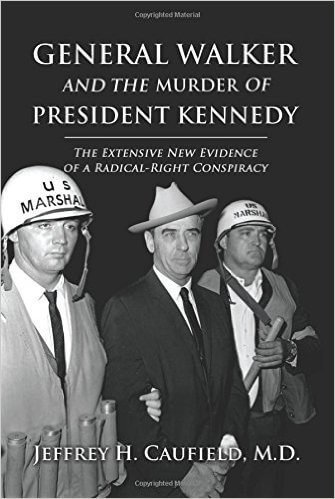
Before I begin reviewing Jeffrey Caufield’s very long book about General Edwin Walker and the Kennedy assassination, I think it’s necessary to make some general introductory comments about the volume. Not just because they are relevant to the book itself, but because they accent general tendencies in current JFK assassination tomes as a whole. I don’t consider any of these tendencies beneficial to the field. Therefore, it’s time to sound a warning alarm about them, before they become an incurable epidemic.
- Bigger does not mean better. In any field. Look what happened to the Titanic. How about the notorious movie bomb Heaven’s Gate? Do I even have to mention Vincent Bugliosi’s Reclaiming History? On the other hand, Jim Douglass’ book JFK and the Unspeakable contains less than four hundred pages of text. Caufield’s book is about twice as long. For what the author has to say about the JFK case, there is no way this book should have been anywhere near that verbose. Why Caufield did not hire a professional editor escapes me. The idea seems to be that if you make your book longer, somehow it’s better. Wrong. In this case, and many others, heading back to Lamar Waldron and Thom Hartmann, longer is not better: it’s just longer. And length for length’s sake translates into tedium for the reader. To make it even worse, Caufield is not a very good writer. So the tedium is accented further.
- Caufield also suffers from Philip Nelson Syndrome. As I mentioned in Part 2 of my discussion of James Fetzer, Nelson had a repeated pattern of trumpeting an upcoming section of his book as being startlingly significant, even mind-boggling. But upon examination, this did not turn out to be the case. Well, Caufield makes Nelson look like an amateur at self-inflation. No less than four times—probably more—Caufield trots out his cannon, lights it up, and screams about a bombshell that is about to explode. The problem is that, in each case, Caufield ends up resembling Charlie Chaplin. Recall the Tramp with his ears covered, when the cannon does not explode, and the cannonball only rolls out of the mouth of the cannon a few inches in front. Because the author had cried “Wolf!” so often, near the end of the book, I just started ignoring these advance warnings and yawned.
- Perhaps most importantly, either by accident or by design, Caufield worked in a cocoon. That is, he seemed to be unaware of many other developments in the field pertinent to the material in his inflated book. At times, this had a very serious impact – to the point that it rendered his own tenets and beliefs dubious. I really don’t understand how this happened. Did Caufield feel that what he was doing was more important than what anyone else was doing, and thus he could ignore it? Or did he just think that the state of the case did not merit checking in on any new discoveries? Whatever the excuse, it does not reflect well on the author.
I
Like several authors before him, including the late Harry Livingstone, Caufield’s book propagates a JFK conspiracy that was brought about by the Radical Right. In 2006, Livingstone published a book that has a similar title to this one: The Radical Right and the Murder of John F. Kennedy: Stunning Evidence in the Assassination of the President. (The subtitle to Caufield’s book is The Extensive New Evidence of a Radical-Right Conspiracy.) But this is not at all a recent concept. In fact, way back in1964, Thomas Buchanan’s Who Killed Kennedy? discussed such a scenario. And a few years later, James Hepburn’s mysterious tome Farewell America did the same. In the nineties, Jerry Rose, the former editor and publisher of The Third Decade, was also in this camp.
The scenario has been revisited so often that, in his book Reclaiming History, Vincent Bugliosi set aside a separate section to discuss the topic. (see pp. 1260-72) And in that survey, he mentions many of the major groups and personages that Caufield talks about in his volume: the John Birch Society, the Klan, the H. L. Hunt network, General Walker and his sidekick Robert Surrey, and Georgia extremist Joseph Milteer. As we will see, Caufield is especially focused on Walker and Milteer.
Caufield’s effort in the Radical Right field is distinguished by two characteristics. An obvious one is its length. He surpasses the long Livingstone book quite easily. Which, as noted, has little or nothing to do with quality. But secondly, and rather disturbingly, there is clearly a not-well-hidden agenda to the book. One that needs a bit of explaining to understand.
Since about the late eighties, there has been a growing consensus in JFK critical studies that, of all the suspects in the case—the Mob, the military, the Secret Service, LBJ, the Radical Right, Cuban exiles—the one suspect that seemed necessary to include in any theory was the Central Intelligence Agency, for the simple reason that, the more one looked at Lee Harvey Oswald, the more his intelligence connections tended to stick out all over the place. Way back in the mid-seventies, Senator Richard Schweiker of the Church Committee said that Oswald had the fingerprints of intelligence all about him. (Henry Hurt, Reasonable Doubt, p. 192) In 1990, Philip Melanson published his revolutionary biography of Oswald, Spy Saga. This was the first full-scale portrait of Oswald’s role as a probable CIA agent provocateur.
In 1991, when Oliver Stone’s film JFK was released, and the book on which it was based—Jim Garrison’s On the Trail of the Assassins—became a number one national best-seller, that consensus opinion became even more pronounced. In fact, at the conferences being held around this time, most of the attendees, and many of the panels, discussed the role of the CIA in the assassination.
Caufield’s book, like Livingstone’s, and like Philip Nelson’s on LBJ, is a conscious reaction to this. He is out to demean and denigrate those who hold the opinion of CIA primacy in the Kennedy case; e.g., Jim Garrison or Oliver Stone. He does this almost right out of the chute. How? Caufield is going to argue that Oswald had no connection to Washington intelligence, or the CIA. He is going to argue something that, literally, I have never heard anyone seriously argue previously at any real length or depth. Please sit down. Caufield is going to argue that Oswald was a Nazi. (see pp. 75 ff.)
Now, before we begin to analyze this unique and fantastic theorem, let us keep in mind the evidentiary axiom that applies in this type of situation: extraordinary claims require extraordinary evidence. If one is going to be a revisionist, one has to have the ammunition to do so. As far as I could see, Caufield provides three pieces of evidence for his “Oswald as a Nazi” hypothesis.
The first is that Oswald had the name of Daniel Burros in his notebook. As labeled in Oswald’s notes, Burros was a member of the American Nazi Party. (p. 75) Please take note, because the following is going to be a constant refrain in Caufield’s book. The author will now write about four extraneous pages about Burros, which have no impact on whether or not Oswald actually knew him, or, more importantly, if Oswald was a Nazi. And, in fact, Caufield never demonstrates how, or if, the two men actually knew each other. There are many notations in Oswald’s 45 page notebook—both from Russia and the USA—for which, as Diane Holloway shows, there exists no evidence that Oswald ever knew the person or the agency, or firm. (see Appendix 3 of her book, The Mind of Oswald.)
The second piece of evidence is a 12/16/63 FBI report. That report states that a bus driver named Muncy Perkins had observed people waiting in the morning for another bus driver named Ray Leahart at the Carrolton Avenue Station. Perkins “thought that possibly Lee Harvey Oswald may have been among” those people. (p. 79, italics added.) Need I even comment on this one? I italicized the two conditional qualifiers in the report. But as most of us know, Oswald did not have a car. He allegedly had a bus pass on him when he was apprehended. So what is the significance of Oswald possibly waiting in a crowd for a bus driver in the morning at the station? Especially if it may not even be Oswald?
Do I need to add that Caufield now goes on for four pages on the ties of bus driver Leahart to the Nazi Party? Without ever demonstrating that Oswald actually knew the man?
The third piece of evidence that the author advances in this regard is that Oswald demonstrated anti-Semitic and anti-Black attitudes. The evidence for this? Oswald used the term “nigger” in an interview with reporter Aline Mosby in Moscow. Secondly, he told Marina he did not want to name their child Rachel because it sounded too Jewish. (pp. 88-89) In Caufield’s judgment, this qualifies Oswald as a Nazi. I guess I was also since I used the “n” word as a youth growing up in Pennsylvania. By Caufield’s standard, one can imagine how many millions of prospective Nazis there were in the south in the fifties. So much for the author’s revisionist revolution.
The above, in itself, is bad enough. But it is only half the story. Actually it’s less than that. The larger part is what Caufield leaves out of his portrait of Oswald. And this refers us to point number three from my introductory remarks: Caufield seems to be working in a cocoon, because the new material we have on Oswald since Melanson’s book was published makes for some of the most interesting and important information that has surfaced since the creation of the Assassination Records Review Board. With that information, the study of Oswald has bounced a quantum leap forward. For the author to leave all this information out, and then to write that a major problem with any CIA concept of the assassination is that Oswald had no demonstrable ties to the Agency – this is either written out of pure ignorance, or Caufield was deliberately rigging the deck to shortchange the reader. (see p. 47) And I actually don’t know which is worse.
This reviewer incorporated much of this fascinating new Oswald information into the second edition of Destiny Betrayed. It takes up two lengthy chapters in that book, and many have stated it is one of the best parts of that volume. (see pp. 117-166) Those fifty pages constitute a mini-biography of Oswald, one that ends approximately at the time he returned to Dallas from his alleged trip to Mexico City. I won’t compare Caufield’s treatment of Oswald with mine in any systematic way. But I do wish to bring out certain key points that he either minimizes or eliminates.
Caufield deals with Oswald in three major places in his book. In Chapter 1, entitled “Lee Harvey Oswald and Guy Banister”, he describes Oswald joining the military, serving in the Marines, and then defecting to Russia—an interval of about five years—in three sentences! This in a book that has 790 pages of text. Then, Caufield spends less than a paragraph on Oswald in Russia. (p. 33) In an astonishing exemption, at no point in the book does Caufield deal with the false defector program that Philip Melanson first outlined back in Spy Saga back in 1990. (Melanson, p. 25) Nor does he mention the name of Robert Webster, the suspected false defector that Marina Prusakova also met in Russia right before she met Oswald. (DiEugenio, pp. 139-40) By not mentioning Webster, he can ignore the incredible coincidence this represents.
At this point in the book, Caufield also fails to mention the Russian test that Oswald took while in the military. He therefore avoids another compelling indication that Oswald was being groomed by the Office of Naval Intelligence for a CIA assignment as a false defector to Russia. Later on, when Caufield does mention this test, he deals with it in a remarkable manner. In his ongoing vendetta against Jim Garrison, he tries to weaken the former DA’s argument about Oswald getting training in the Russian language in the Marines. (see p. 227)
He states that Garrison held that Oswald was being schooled in the Russian language in the service, but there is no evidence of this. Again, this is either symptomatic of Caufield working in a cocoon, or it is a deliberate omission, because over 25 years ago Melanson discussed in detail the report that the Warren Commission had about Oswald being instructed in language acquisition at the Monterey School of Languages while he was in the Marines. (Melanson, p. 12) Caufield then writes that although Oswald did take a Russian test, he did not do well on it. As Garrison noted in his book, this is what the Warren Commission witness said about it. (On the Trail of the Assassins, p. 23) To which Garrison replied: it would be like saying your dog is not very bright since you can beat him three games out of five in chess. But it also ignores the report of Rosaleen Quinn. Quinn was being tutored in Russian for a State Department position. She met with Oswald after his Russian test, and said that he now spoke excellent Russian. (DiEugenio, p. 131)
The author then continues in his hopeless jihad by saying that once he arrived in Russia, Oswald did not speak the language very well. Which, from Quinn, we know is wrong. But it is further vitiated by author Ernst Titovets. In 2010, Titovets wrote a book called Oswald: Russian Episode. By all accounts, Titovets was Oswald’s closest friend in Russia. When I interviewed him in Washington at the AARC Conference in 2014, I asked him about Oswald’s Russian language skills. He told me that Oswald spoke Russian fluently. In the face of all this evidence, only someone with an agenda would argue the contrary.
It will not surprise the reader to know that the names of John Hurt and Otto Otepka do not appear in this book. Hurt was the former military intelligence officer Oswald tried to call from jail on Saturday night, hours before he was shot by Jack Ruby. Otepka was the State Department employee who wrote a request to the CIA asking whether or not Oswald was a false defector. By not presenting any of this—and much more—or by distorting the parts you do present, then yep, one can say that Oswald was not connected to the CIA.
Let me conclude this section of the review by noting a memo that Caufield repeats at least three times throughout the volume. (Repetition, and inclusion of extraneous material, are two methods by which Caufield inflates his page count.) The memo is from Hubert Badeaux, a New Orleans police intelligence officer, to state senator William Rainach (p. 273, 791) In this letter, the following two sentences appear in paragraph five:
“I have been in contact with an out-of-town person whom I have been grooming to come here to take over the establishment of infiltration into the university and intellectual groups. I will tell you in detail about this when I see you in person.”
Caufield actually tries to make the argument that Badeaux here is referring to Oswald. But Oswald was not out of town at the time, April of 1957. He was out of the state. He was in Jacksonville, Florida, being trained in avionics to become a radar operator. Five months later he would be out of the country and on another continent. He was shipped to the Far East, stationed at the giant CIA base at Atsugi, Japan, home of the U-2. Are we to think that both Badeaux—and Caufield—were unaware of this? Or that Badeaux did not know that Oswald had contracted with the service until December of 1959? Was Badeaux going to tell Rainach when he saw him that he had a prospect they had to wait for until 1960, over two and half years in the future, to cultivate? And then, in 1960, he would presumably tell the senator, well we have to wait another two and half years, since he’s going to Russia. But, hey Mr. Senator, that’s OK, because his fluency in Russian is going to help him infiltrate those integrationist groups in Louisiana, which used that language.
This all strikes me as nonsense. It shows how desperate the author is to place Oswald in this rightwing milieu as an operative. Which parallels his desperation to make Oswald into a Nazi. But that doesn’t stop Caufield from going even further in this regard. He actually tries to say that state senator Rainach took his own life in January of 1978 because he may have feared having to testify before the HSCA! (Caufield, p. 697) If anyone can show me where there was any imminent move inside the HSCA to call Rainach as a witness, I would love to see it. I would be willing to wager that almost no one on the committee even knew who he was. And for good reason.
To show just how confusing and muddled the plan of the book is, consider the following. On page 90 the author says that Oswald’s pose as a communist was not related to the murder of JFK, but to a segregationist plot, which was separate and distinct from the assassination plot. But by the end of the book, he switches this around. At the end, he now says that it was decided to use Oswald in the Dallas plot and eliminate him from the raid on the offices of the integrationist Southern Conference Educational Fund in New Orleans in October of 1963. (see pp. 778-79) And this dichotomy is not explained, or even acknowledged.
II
As bad as this book is in its portrayal of Oswald, it is almost as bad in its portrait of Jack Ruby. In fact, I actually think Caufield’s section on Ruby is one of the worst in the literature. Granted, there has not been the crush of new material on Ruby through the declassification process as there has been on Oswald. But still, Caufield makes do with what he has to foreshorten and distort matters.
There is little or nothing in the book about Ruby’s extensive ties to the Dallas Police. Instead, at one point, Caufield recites the Warren Report version—via Police Chief Curry—that Ruby only knew perhaps 25-50 Dallas cops. (see p. 497) As Sylvia Meagher noted way back in 1967, this was a preposterous statement. Because, of the approximately 75 policemen who were in the police basement when Oswald was killed, Ruby knew at least forty of them. Applying that ratio to the entire force of 1,175 men, Ruby likely knew over 500 cops. And even that was conservative. Because as Ruby’s friend, boxer Reagan Turman noted to the FBI, “Ruby was acquainted with at least 75%, and probably 80% of the police officers on the Dallas Police Department.” (Meagher, Accessories After the Fact, p. 423) Caufield does cite a contradictory source on this, but his total dealings on the subject of Ruby and the DPD amount to one paragraph.
Why is that important to note? It’s not just because of the extensive and deep ties to the force that Ruby had, but how these were used on the weekend of the assassination. Caufield all but eliminates the stalking of Oswald by Ruby – how Ruby almost staked out the station that weekend – that is, the visits by Ruby to the station in the late afternoon on Friday, and then on Saturday, and then early Sunday morning. (Meagher, pp. 435-41)
This might be part of an architectural design. Such is suggested by the fact that, on Sunday morning, before the murder of Oswald, Caufield has Ruby walking up to Main Street from the Western Union office and then entering the police basement from that ramp. (Caufield, p. 508) In other words, it happened just like in the Warren Report.
If there is one thing we know today about Jack Ruby’s wild weekend, it is this: He did not enter the police basement through the Main Street ramp. The Dallas Police had tried to conceal a prime witness to this event from the Warren Commission. His name was Sgt. Don Flusche. Flusche was standing diagonally across from the Main Street ramp, leaning against his car to watch the transfer of Oswald to the county jail. Flusche knew Ruby. He told the House Select Committee on Assassinations (HSCA) there was no doubt in his mind “that Ruby did not walk down the ramp, and further, did not walk down Main Street anywhere near the ramp.” (James DiEugenio, Reclaiming Parkland, pp. 203-04)
What makes this even more convincing is that policeman Roy Vaughn, who stood guard over the ramp, also said Ruby did not come in that way. He passed his polygraph test. (Meagher, p. 407) Yet the two policemen, who many suspect—including the HSCA—of helping Ruby into the building from a rear door, did not do well on their tests. William Harrison, who Ruby can be seen hiding behind before Oswald entered the corridor to the parking lot, took tranquilizers to disguise his reactions to the polygraph. Consequently, his test turned out inconclusive. Patrick Dean, the officer in charge of security for the Oswald transfer, failed his test—even though he wrote his own questions! (DiEugenio, Reclaiming Parkland, p. 205) During the HSCA investigation, Dean repeatedly failed to respond to a summons for a deposition or to even reply to written questions. (ibid) Remarkably, none of this key information is in this book. Rather, Caufield uses Dean as a witness against Ruby (see pp. 508-09) – without adding that the HSCA felt that Dean was a key figure in the shooting. (op. cit. DiEugenio, p. 205)
What about Ruby’s links to organized crime? Whereas some authors have spent large parts of entire books on the subject, Caufield deals with these in about a page. (see pp. 498-99) In his hands, they mean little or nothing. In fact, what he does with this is say that if New Orleans mobster Carlos Marcello had anything to do with the assassination, because he was a racist, it was probably by association with rightwing extremists. And herein lies one of the most unbelievable tales in this unbelievable book.
Caufield states Jim Braden had an office in the Pere Marquette Building in New Orleans. G. Wray Gill, an attorney who David Ferrie did some work for, also had an office in that building. Braden was a former east coast criminal who was out on parole and was now in the oil business. Gill was one of several lawyers that Marcello employed. Caufield tries to make something out of the Pere Marquette connection. And the fact that Braden had a visit with Lamar Hunt scheduled while he was in Dallas the weekend of the assassination.
To a leaping exegete like Caufield, “this is evidence of conspiracy between the Hunts, Braden, and Milteer…” (Caufield, p. 303) To the not-so-leaping, as with the Badeaux memo, it was another Chaplinesque cannon moment. Recall, the tramp loads up the cannon, he lights the fuse, he plugs his ears: but the cannon does not go off, while the cannonball rolls out a few inches from the mouth of the cannon.
First of all, if Caufield had read Bill Kelly’s fine work on Braden, he would know that Braden did not actually have an office at the Pere Marquette Building. A man he worked with, oil geologist Vernon Main, had an office in that rather large office building. (Kelly, JFK Countercoup, post of 12/19/09) Braden had a legitimate reason to be in Dallas and talking to Hunt. He owned two oil companies, and his partner, Roger Bowman, lived in Dallas. Braden told his parole officer about his business trip and checked in with the probation office in Dallas on November 21st. He was actually part of a group of five men who were proceeding to Houston on more oil business after they met with Hunt. (ibid) As Kelly notes, Braden said he did not know Gill.
How does Caufield fit Milteer into his Pere Marquette circle of conspiracy? He says that the business card of G. Wray Gill’s son was in Milteer’s belongings when he died. I’m not kidding; this is what he says constitutes “evidence of conspiracy”. (Caufield, pp. 302-04)
As the reader can see, there is no connection between Milteer and Ruby. Therefore, Caulfield has to double down on anything connecting Walker and Ruby. And now comes a very odd dichotomy in this chapter. The sole witness that Caufield produces as to a Ruby/Walker nexus is a man named William Duff, a temporary personal employee of Walker. As the author notes, Duff’s testimony on this point is erratic. In his first interview with the FBI, in January of 1964, Duff said he was certain that he had never seen Ruby before the murder of Oswald. Ten weeks later, in April, he reversed field. He now said that he had seen Ruby at Walker’s 3-4 times, from December of 1962 to March of 1963. (Caufield, p. 394) But then one month later, in June of 1964, Duff reverted back to his original story: he had never seen Ruby before the murder of Oswald. (Caufield, p. 396; see also Michael Benson, Who’s Who in the JFK Assassination, p. 118)
In addition to the inconsistency, the other problem is that there is no corroboration for Duff’s seeing Ruby at Walker’s home. Walker was not exactly a private person, and he lived next door to a church. If Ruby had been at his home 3-4 times, why would no one else have recalled it?
The other way that Caufield tries to connect Ruby with Walker is through Ruby’s visiting the “Impeach Earl Warren” sign and taking a photograph of it. This was on the weekend of the assassination. Finally, Ruby also had copies of the “Welcome Mr. Kennedy” newspaper ad, and a copy of a transcript of one of H. L. Hunt’s Life Line radio scripts in his trunk. He picked up the former at the newspaper office he ran ads at, and the latter was picked up at a Texas Products convention Ruby attended weeks previously.
So Caufield has a problem. He hasn’t successfully connected Ruby with Milteer or Walker. What he is left with is the stuff in Ruby’s trunk at the time of the assassination. Remember the old saying? If you have a lemon, make lemonade. So the ever inventive author now writes that the stuff in the trunk indicates that Ruby knew who was behind the plot to kill Kennedy and he was trying to point in that direction. You can read this for yourself on page 503. The obvious question is: Why would he do that if he was part of a Radical Right conspiracy? Straddling a giant crevice with both legs, Caufield never explains the mystery.
But none of the lacunae, pretentiousness, and utter vapidity described above stops Caufield from plunging even further into the wilderness. In the autumn of 1966, Jack Ruby was granted a new trial, in a new venue. Before being transferred to the new locale, it was noted by the outside authorities that Ruby was clearly ill. The transfer was postponed, and Ruby was transported to Parkland Hospital. He was diagnosed with pneumonia, and cancer in both lungs. After Ruby was hospitalized, Walker wrote a letter to Billy James Hargis of the Christian Crusade, with whom he had done various speaking engagements. In this letter he said that Ruby was allegedly dying of cancer and might talk, and he would probably not leave the hospital alive. (Caufield, p. 538)
This gives the author a pretense for another cannonball moment. He calls this letter “astonishing”. He then shifts into fourth gear: “It is inconceivable that Walker meant anything in the message to Hargis other than he would murder Ruby before he allowed him to leave the hospital… .” (ibid)
Even for Caufield, this one was the equivalent of self-herniation. What person would not suspect that, with cancer in both lungs and pneumonia, Ruby was in very bad shape? Did Caufield never hear of Dr. Louis J. West? The infamous CIA MK/Ultra doctor who once killed an elephant with an overdose of LSD? (Benson, p. 475) He was treating Ruby in jail. Does Caufield think he was giving him vitamin C and B complex? Many authors have concluded that Ruby’s case was likely one of induced cancer. (Which, after a review of the scientific literature, author Ed Haslam has said was possible at that time.) As for fearing Ruby would talk, well Ruby did talk. FBI asset Lawrence Schiller did an interview with Ruby before he died. During which Ruby denied being part of a conspiracy. I would say that there must have been literally scores—maybe hundreds—of people who were movers and shakers in Dallas-Fort Worth who predicted that Ruby would die in the hospital and could talk before that. But since Jolly had treated him extensively, and by all accounts, Ruby was becoming delusional, there was really not much to fear. Needless to say, because of his cocoon, West’s name is not in the book.
III
As the reader can see, in regards to Oswald and Ruby, this book is pretty much empty. But before we get to the actual genesis of the volume, we should deal a bit more with Caufield’s treatment of the alleged assassin, for the simple reason that the author makes some rather extraordinary claims about Oswald and the Walker shooting, and Oswald’s role in the assassination.
Concerning the former, Caufield pretty much buys the Warren Commission case about Oswald firing a shot at Walker. He says that Marina Oswald took the notorious Backyard Photographs of Oswald with rifle and handgun. (see p. 382) He writes that the shooting was done with a Mannlicher Carcano rifle ordered by Oswald. He says that Oswald took photos of the outside of Walker’s house on March 10, 1963. (ibid) He even writes that Oswald sent a backyard photo to the staff of The Militant. (Caufield, p. 386) He then adds that it is unfortunate that the left-leaning publication disposed of it, because had they not, then Oswald probably would have been caught and the case against him in the Walker shooting would have been air-tight. His thesis is that Oswald did this as part of a publicity stunt for Walker (even though he has not established any credible connection between Oswald and Walker).
This last reference, about Oswald sending the backyard photo to The Militant, is footnoted to Dick Russell’s book, The Man Who Knew too Much. But I could not find the information there. And Caufield does not supply a page number to that reference. The usual source for that information about The Militant is to Gus Russo and his book Live by the Sword. Fortunately for us—unfortunately for Caufield—Jeff Carter exploded this myth in his masterful treatment of the Backyard Photographs for CTKA. In Part Four of that series, at footnote 25, Carter notes that the publisher of The Militant brought all exhibits concerning communications between Oswald and the SWP [Socialist Workers’ Party], the paper’s close affiliate, to his Warren Commission appearance. These exhibits were then placed in evidence. He did not bring that photo.
As per Oswald ordering the rifle used in the Walker shooting, this whole issue has been pretty much torn asunder by the latest work on the subject by John Armstrong. To put it lightly: with the state of the evidence today, it is highly unlikely that Oswald ever ordered that rifle. Each link in the transaction’s chain—both in the mailing of the coupon and the retrieving of the rifle—has been rendered dubious.
Caufield also writes that when the Warren Commission tested the bullet fragments from Walker’s house, they matched the physical characteristics of the bullets used in the Kennedy assassination. (Caufield, p. 392) I have no idea what the author is talking about here. And he does not footnote that sentence. If he is talking about any spectrographic or neutron activation analysis done for the Commission by the FBI, that whole chemical process has been forensically discredited. If he is talking about the lands, grooves and twists to the bullet markings, then he appears to have fallen for another crock delivered by the FBI. For the great majority of rifles have a four groove, right-hand twist. (Jim DiEugenio, Reclaiming Parkland, p. 80)
Then there is the problem of the actual caliber and color of the bullet recovered from the Walker home. As anyone who knows anything about this case understands, the alleged rifle in this case used Western Cartridge Company’s copper jacketed military style ammunition. The evidence states that this was not the bullet fired into the Walker residence. As Gerald McKnight notes in his fine section on the Walker shooting in Breach of Trust, the police always referred to the Walker bullet as being a steel-jacketed, 30.06 projectile. (McKnight, p. 49) And in the report filed by the investigating officers they refer to the bullet as being steel-jacketed. (John Armstrong, Harvey and Lee, p. 507) Both local papers and an Associated Press story referred to the bullet as being a 30.06. (Reclaiming Parkland, p. 76) It was only after the assassination—almost 8 months later—that the Walker projectile was changed to match Oswald’s alleged rifle. Yet none of the officers who originally identified the slug were called to testify before the Warren Commission. (ibid)
But further, as has since been discovered, in a March 27, 1964 FBI memo, the Bureau admitted that the lead alloy of the bullet recovered from the Walker shooting was different from the lead alloy of a large fragment recovered from the Kennedy limousine. Two FBI agents, Henry Heilberger and John Gallagher, did the tests on the bullets for the FBI. The Commission never called Heilberger, and Gallagher was not asked about this matter. (ibid, p. 77) Based upon these fundamental forensic matters, which he ignores, I don’t know how on earth Caufield can write that “The evidence presented here overwhelmingly suggests that Walker and Oswald were working together.” (p. 398) To put it mildly: unless Oswald had another 30.06 rifle, no it does not.
Let us now turn to Caufield’s portrait of Oswald in the Kennedy assassination. Even though he has not proven his thesis about the Walker shooting, Caufield tries to use the same paradigm for Oswald and the Kennedy assassination, namely, that Oswald was some kind of willing participant. Consider this statement: “Oswald expected to be arrested after the assassination, just as he had in the Walker shooting incident.” (see pp. 467-68) He then writes this howler: “Oswald ran for his life when he discerned from those around him that the president had been shot.” (ibid, p. 468)
The Warren Report—which Caufield trusts more than he does not—states that when Oswald first learned of the assassination, instead of running toward the closer back door, he used the more distant and dangerous exit: the main door on Elm Street. This is where the police and the public had mostly gathered. But he first dispensed a bottle of soda and then walked across the second floor. He then walked down the stairs and out the front exit, but stopping to give some directions to a pay phone to two reporters. (op. cit. Reclaiming Parkland, p. 99) Oswald then walked down Elm Street to catch a bus, which was headed in the wrong direction from his rooming house. So he had to get off the bus. He then walked back to the Greyhound Bus Terminal and tried to find a cab. All of this took at least ten minutes. (WR, p. 160) He then hailed a taxi and got in. However, when an elderly lady peered in the window, and asked for a ride, Oswald was ready to get out. But she said it was all right, she could get another taxi. (ibid, p. 162)
As Sylvia Meagher later wrote—perhaps tongue in cheek: “It is increasingly difficult to reconcile Oswald’s demeanor with what the Commission calls ‘escape’. Whaley [the taxi driver], testified to the ‘slow way’ Oswald had walked up to the taxi, saying, ‘he didn’t talk. He wasn’t in any hurry. He wasn’t nervous or anything.’” (Meagher, p. 83) So how do his acts and demeanor constitute “running for your life”?
In a smugly self-fulfilling way, Caufield then writes that the only scenario which explains Oswald’s behavior that day was that he was supposed to shoot but miss. Hence, that someone else would actually kill Kennedy. And Oswald would only go to jail for just a few days. He says that since both weapons used—the handgun for the Tippit slaying and the rifle for the assassination—had been rechambered, it would have been hard to convict Oswald. (He is wrong about the latter point. Mannlicher Carcano expert Robert Prudhomme informed me by e-mail that both versions of the MC rifle, the 6.5 and 7.35 mm, had the same chamber, but the larger caliber rifle used a modified type of ammunition.)
He then writes something that is a bit shocking: “Oswald deliberately left his own traceable rifle on the sixth floor for it to be discovered and traced to him, which was another scripted act that supports the postulated shoot-and—miss scenario.” (Caufield p. 469) To go into all the arguments that undermine this would take an essay in itself. But just to mention one: in addition to the strong indications he did not order the rifle, there is also the evidence that the disassembled rifle could not fit into the bag that Oswald carried to work that day. (Meagher, pp. 54-57)
Just when I thought this whole wild and woolly tangent could not get any worse, it did. Like the Warren Commission, Caufield actually uses the testimony of Charles Givens to place Oswald on the sixth floor. Let us be candid: Givens was a damned liar. His WR testimony about coming down the elevator to the first floor, realizing he left his cigarettes on the sixth floor, then going back up and seeing Oswald there at about 11:55, having a brief conversation with him in which Oswald said he was not going down right now—this is all perjury. Givens never went back upstairs, and Oswald was downstairs before 11:55. It has been proven false by writers like Sylvia Meagher, Pat Speer, and Gil Jesus. With the Commission’s own sworn testimony from Givens, Gil shows that, in his first story to the FBI, Givens himself said that he saw Oswald downstairs reading a newspaper in the domino room at 11:50. The Commission let Givens deny this under oath. In other words, they suborned perjury.
Can Caufield really not be aware of this? I mean, Meagher’s classic essay, “The Curious Testimony of Mr. Givens“, has been around for 45 years. It was published in The Texas Observer, it has been collected in anthologies, and anyone with a computer can find it online. Again, I don’t know what is worse; for if Caufield did not know about this issue, that is a bit scary for someone who says he has been on the case for over 20 years. The other alternative is that he did know, but this is how much he is wedded to his bizarre theory. If it’s the latter, then a legitimate question arises: How does his handling of evidence significantly differ from that of the Warren Commission?
Caufield then tops this off by saying that, after Givens’ phony sighting, Oswald was not seen on the lower floors until after the assassination. (Caufield, p. 473) He therefore writes off Carolyn Arnold, who says she saw him on the second floor at about 12:15, maybe even later. (op. cit. Benson, p. 17) Like the Warren Report, Caufield’s index shares the dubious distinction of not containing an entry for Carolyn Arnold’s name.
Neither does it have one for Victoria Adams. Recall, Barry Ernest’s book on Adams—The Girl on the Stairs—has been out since at least 2011. She and her friend Sandy Styles ran down the depository stairs just seconds after the last shot. They neither heard nor saw Oswald. Which, in Caufield’s case, they would have had to, because the author also buys into the Patrolman Marrion Baker/Oswald meeting at the second floor soda machine right after the assassination. (Caufield, p. 474) Oblivious to new developments in the case, Caufield never mentions the differences between the Warren Report version of this incident and Baker’s first day affidavit, where the whole thing goes unmentioned. (DiEugenio, Reclaiming Parkland, pp. 192-96)
The scary thing is I could go on further in this regard; but I will stop there for a brief evaluation. For if one demonstrates all the lies in Givens’ testimony; if one then includes Carolyn Arnold’s FBI report; the evidence of both Adams and Styles; and finally Baker’s first day affidavit, then how is Oswald on the sixth floor at 12:30? The unexpurgated facts will simply not support Caufield’s bizarre thesis.
By now, the reader will not at all be surprised when I note that Caufield writes that Oswald likely murdered J. D. Tippit—who probably had it coming to him since he was one of the assassins in Dealey Plaza—and he was going to kill Officer Nick McDonald at the Texas Theater. (see pp. 479, 481, 483) That’s quite a sentence is it not? But this is what happens when one is religiously wedded to a theory, has no real editor to advise him, and apparently feels like he does not have to keep up on the recent discoveries in the case.
Since Caufield’s book is almost 800 pages long, it necessitates a second part to this review.
IV
Caufield’s book would likely not exist if it were not for the well-known, and often written about, Somersett/Milteer tape. (click here for a transcript) William Somersett was a local police informant from Miami. He was then used for a while by the FBI. In November of 1963 he was visited by the peripatetic Joseph Milteer. Milteer was a rightwing extremist who was part of the National States Rights party, the Congress of Freedom, and the White Citizen’s Council of Atlanta. This tape has been written about for years by many authors; e.g., Robert Groden, Anthony Summers, Henry Hurt. Among other mainstream media reports, the tape was extensively excerpted and discussed in an article by reporter Dan Christensen in the September 1976 issue of Miami Magazine.
Caufield presents this as a central part of his rightwing plot: that Milteer was saying these things because he had a hand in setting up Kennedy’s assassination. (Caufield, p. 108) Let us first make this comment: as many have observed, Kennedy’s murder was probably the most predicted large event in modern American history. There were many persons—both men and women—who seemed to have had advance knowledge it would occur. There have been essays written about that particular subject, and seminar talks delivered on it. To mention just one example: Mark North wrote a whole book about it, Act of Treason, based upon such a prediction from the Mafia angle. Todd Elliot wrote a small book on the Rose Cheramie case, A Rose by Many other Names. In David Scheim’s book, Contract on America, he makes much of the Jose Aleman quote about Santo Trafficante saying words to the effect: Kennedy is going to be hit, he is going to get what’s coming to him. This only scratches the surface; there are several more of course.
Caufield reprints the Milteer/Somersett transcript at great length. Rereading it, I noted some things that I had overlooked previously. First, Milteer offers the information about killing Kennedy from an office building with a high-powered rifle only after Somersett actually solicits it from him. (Caufield, p. 103) Milteer then says Kennedy has as many as fifteen doubles on duty to mask where he really is. (ibid) No information has ever been revealed about this in the last 53 years, so it is evidently not the case.
Milteer then offers up an actual assassin, Jack Brown, a Klansman from Tennessee. Again, in 53 years, no one has ever even mentioned Brown as a suspect in the JFK case, let alone an assassin. (And, as we shall see, Brown differs from the assassins named by Somersett himself in a different rightwing milieu.) Also, when Milteer talks about the assassin carrying a broken down weapon to avoid the Secret Service, he is talking about the shooting taking place from a hotel room across the street from a White House veranda in Washington. (ibid, p.104) Caufield actually argues for the accuracy of this by saying that the Warren Commission deduced that Oswald had broken down the rifle used in the assassination before he brought it into the depository. (ibid, p. 108)
Somersett also said that when he saw Milteer afterwards, he told him that the patriots had outsmarted the communists because they had infiltrated Oswald’s group, the FPCC. (Caufield, p. 114) This statement creates problems for the author, because 1) Oswald was the only member of the Fair Play for Cuba Committee in New Orleans, so there was no group to infiltrate; and 2) How could Milteer have outsmarted the communists if Oswald was not a communist? Caufield himself has argued that Oswald was not a real communist. Realizing this reveals that Milteer really did not know what was going on, and was garnering information from the newspapers, he claims that Somersett must have misconstrued what Milteer had said to him.
Caufield wants the reader to believe that Milteer was in Dallas on the day of the assassination. That is putting it too lightly. Caufield demands the reader buy into this—almost as if his life depends on it. I cannot help but wonder, thinking logically, why this would be the case, if he was a central part of a conspiracy. Wouldn’t it make more sense for him to avoid being there, knowing there would be many Kodaks, Polaroids, and movie cameras on hand? The House Select Committee on Assassinations (HSCA) looked into this. In a photo taken by James Altgens, as Kennedy’s limousine heads down Houston Street, Robert Groden pointed to a man whom he thought resembled Milteer. The height analysis done by the HSCA is problematic. But the other two comments they make seem genuine. Milteer had a remarkably full head of hair in 1963. This was not at all the case with the man in the photo. Second, Milteer had a thin upper lip; the man in the photo had a full, thick upper lip. (HSCA, Vol. 6, p. 247)
The other main point Caufield makes about Milteer being in Dallas is that Somersett said he told him about this afterwards. But the problem here is that this was not on tape. It was simply stated by Somersett that Milteer had called him from Dallas. (Caufield, p. 127) It was first presented years after the fact. Somersett first said it to reporter Bill Barry of the Miami News, and then attorney Bud Fensterwald, who was moonlighting for New Orleans DA Jim Garrison. (Caufield, p. 126, Garrison memo of 6/5/68) Yet, opposed to this is a report given to the Miami Police on November 26, 1963. There, Somersett makes no mention of such a call from Dallas, even though he was asked if Milteer had been there recently.
This brings up the issue of Somersett’s reliability. And whether or not Milteer knew that Somersett was an informant. These are important issues that Caufield does not really deal with in any substantive way. For the FBI eventually dropped Somersett from its informant rolls. Chapter six of this book is entitled, “Joseph Milteer and the Congress of Freedom, New Orleans, 1963”. Somersett reported that at this conference, held in April, there was a large—and I mean large—assassination plot discussed. Targets included Averill Harriman, wealthy Jews at Wall Street firms like Lehman Brothers, Goldman Sachs, and Kuhn and Loeb. Others on the list were the heads of major American corporations like GE, Kroger, and Boeing. Also targeted was the Business Advisory Council, the Bilderberger Group and the Council on Foreign Relations. Caufield writes that President Kennedy was a member of the last. (p. 143)
At this point, any reader should have some real trepidation about not just Somersett, but Caufield. First, Kennedy was never part of the CFR. And all one has to do is read the best book ever written on the subject to know that. It is called Imperial Brain Trust, by Laurence Shoup and William Minter. (see p. 247) But beyond that, does Caufield know how many people such a plot would entail? One would need a calculator to add up the number. It would be well into the thousands. Way beyond even what Hitler did during the Night of the Long Knives. Further, how could one find out who was Jewish and who was not in all those Wall Street firms? Were they going to line them up against a wall, pull out their wallets, and if the name sounded Jewish, shoot them firing squad style? And after several hours of this, going from building to building, neither the police nor FBI would be aware of all the noise, blood and dead bodies piling up on the street?
Even the Miami Police had a hard time with this one. They asked Somersett if he really believed they were going to kill all those people. The informer stood by what he said. (Caufield, p. 144) (In my notes I wrote, “Caufield is destroying Somersett’s credibility.)
And it was here that Somersett first said that a man named Ted Jackman was also an assassin in Dealey Plaza. (In addition to the aforementioned J. D. Tippit.) He later added a man named R. E. Davis. Davis was 73 years old in 1963. Back then the life expectancy for a male was 66. If we translated Davis’ age to today, with life expectancy much longer, he would be 80 in 1963. Hopefully Milteer was giving him his arthritis pills regularly.
As author Larry Hancock conveyed to me, and as various FBI and Secret Service memos relate, from about 1962 onward, Somersett’s reliability became more and more questionable. Hancock co-wrote a book with Stu Wexler on the rightwing in relation to the Martin Luther King case. So they looked at various documents concerning Somersett. Hancock said that, at first, when Somersett was informing on local rightwing bomb throwers in Miami, he was well regarded. But as time went on, he began to spread himself out and attend many conventions. At this point, he started reporting “literally all the gossip he heard anywhere.” As a result, the FBI got tired of following up bad leads. Also, as time went on, his information was mostly in the form of hearsay not directly tied to an original source.
Later, he was found out as an informant. In 1962, National States Rights Party Chairman J. B. Stoner wrote to some of his cohorts that Somersett was a likely snitch. Somersett now became a channel to supply false leads through and he eventually became a liability. By 1964, Somersett was being used as a conduit for a combination of good info mixed with bad. As Hancock noted to me, Milteer and Stoner were close associates. (e-mails from Hancock to the reviewer dated 2/25 and 2/26/16)
V
Loran Hall is notorious for, among other things, his alleged association with the Sylvia Odio episode. As everyone recalls, Odio was the daughter of Amador Odio, a Castro foe who was imprisoned on the Isle of Pines off the coast of Cuba. She was living in the Dallas/Fort Worth area at the time of the assassination. Three men visited her in late September of 1963. She said one was a caucasian who was called Leon Oswald. The other two appeared to be Cubans, who used the war names of Angelo and Leopoldo. They came from New Orleans for the ostensible reason that they wanted information about raising money for the Cuban exile cause. Since Odio did not recognize them as members of her exile group JURE, she did not cooperate.
But two days later Leopoldo called back and made some memorable comments about Leon Oswald. In fact, he first asked Odio what she thought of him. She said, since he said so little, she really did not know. Leopoldo then took the lead in making an indelible impression on Odio about who Oswald was. He said that Oswald felt the Cubans should have knocked off Kennedy after the Bay of Pigs, but they did not have the guts; that Oswald was an ex-Marine sharpshooter and a little crazy, so they were going to cut off ties to him. (James DiEugenio, Destiny Betrayed, Second Edition, p. 351)
As is depicted in the record, Odio’s story was so credible, and had so much corroboration, that the FBI did its best to ignore it. But once the Warren Commission found out about it, they felt they had to deal with it. So her deposition was taken in Dallas by junior counsel Wesley Liebeler. Odio stuck by her original story. Chief Counsel J. Lee Rankin now became worried about the significant impact of Odio’s compelling testimony. After all, it looked like some element of the Cuban exile community was traveling with Oswald seven weeks before the assassination. And they were trying to make an impression on Odio that Oswald was going to kill Kennedy. And that she would then be a witness to this when it happened. So Rankin sent a memo to FBI Director J. Edgar Hoover saying that Odio’s allegations had to be proved or disproved. Consequently, Hoover concocted a completely false scenario about Hall, William Seymour and Laurence Howard being at Odio’s door. (ibid, p. 352)
Before we look at what Caufield does with this, let us take note of something that is important to his allegations about it, but which he does not mention. Writers like Jim Douglass have noted that, after the Cuban Missile Crisis, President Kennedy began to cut back significantly on the funds he allowed the CIA to tender to the exile groups, to the point that if they did not find alternative funding elsewhere, many of them would have folded. (ibid, pp. 69-76) Therefore, former Agency affiliated soldiers of fortune, like Hall and Howard—who were part of the CIA associated group Interpen with Frank Sturgis and Gerry Hemming—began to solicit funds from people who would be interested in keeping the battle against Castro in play. Some of these sources were from California, like members of the Minutemen; some were from Texas, like oil man Lester Logue, who Hall later said was interested in funding a plot against Kennedy, an offer which Hall turned down. (see Caufield, pp. 445, 46)
Since Hall said he met with Walker once, and because some of the Texas people he met with knew Walker, this gives Caufield another “Chaplin’s cannon” opportunity. He now says that, because of his meetings with these Texas people, Hall’s false claim of being at Odio’s was given at the request of Walker’s group in order to conceal the validity of Odio’s allegations. (p. 446)
Again, I have never seen this anywhere. Let us examine it. Caufield says that there is no evidentiary trail to trace how the FBI got to Hall, Seymour and Howard in the first place. That might be true, but it is fairly obvious that Hoover was looking for someone in the anti-Castro underground who was traveling in Texas at around the time of the Odio incident, which was late September of 1963. Both Hall and Howard were Hispanic, and Seymour was Caucasian, so there was a superficial match to the Odio story. In addition, Hall had been to Dallas twice that fall. He had been arrested for possession of drugs (actually pep pills). And he had met with both an FBI agent, and a CIA agent while he was incarcerated. (Hall’s HSCA deposition of 10/5/77, pp. 123-24) He had also been involved with the preparations for the infamous Bayo-Pawley raid into Cuba which had CIA support. (ibid, pp. 114-119) Therefore, it is rather easy to see how the FBI would have known about him.
Very significantly, Caufield also ignores the above-cited HSCA executive session testimony of Hall on the subject. (HSCA Vol. 10, p. 19) Dated October 5, 1977, it is quite revealing of what actually happened in this whole affair. Hall said that the FBI visited him in the autumn of 1964. The agent asked him if he recalled a Mrs. Odio. Hall said he did not. He did recall a male professor with the last name of Odio. Hall said it was possible he may have visited the woman but he did not recall it. He further said that he asked the agent for a photo of Sylvia Odio, but he did not have one! Further, when he was in Dallas in September of 1963, he was with Howard, but not Seymour. Hall testified under oath that he never told the FBI that he was in Dallas with Howard and Seymour. He then said the FBI report that the HSCA gave to him was simply false and contradictory as to what happened when he was interviewed in 1964.
In other words, the idea that Caufield is conveying, about somehow Walker’s group being involved in Hall’s perjury for the FBI, is simply not supported by the record. For if one looks at the testimony by Howard and Seymour, they back up Hall. What becomes clear from Gaeton Fonzi’s fine work on this topic—both for the Church Committee and the HSCA—is that the Warren Commission and the FBI cooperated in an effort to try to undermine Odio’s fascinating evidence. And we have this from the direct testimony of the people involved: Odio, Hall, Seymour, and Howard. This effort went as far as Wesley Liebeler telling Odio that he had orders from Chief Justice Earl Warren to cover up any leads indicating a conspiracy, and then trying to seduce the woman in his hotel room. (DiEugenio, p. 352) Again, why Caufield would ignore all of this direct evidence, and instead make another of his unjustified and unsound leaps is quite puzzling.
VI
Another unusual treatment of a Cuban exile figure by the author is the case of Carlos Bringuier. Bringuier was a member of the DRE, clearly a CIA-backed Cuban exile organization that, as John Newman discovered, actually originated in Cuba. Once transferred to America, it gained a CIA subsidy, and was also a tool of conservative activist Clare Booth Luce, wife of magazine magnate Henry Luce. As author Jefferson Morley has shown, there seems to have been an attempt made to conceal from the HSCA how close the DRE was involved in the cover-up of President Kennedy’s death. Because in the last year of that investigation, the CIA liaison for this aspect of their inquiry—and also Mexico City—was one George Joannides. Joannides was a specialist in CIA psywar operations. And he was the funding officer in 1963 for Bringuier’s DRE branch in New Orleans, as well as other branches. The amount he disbursed was 51,000 dollars per month. This program was codenamed AMSPELL. The DRE had relations with Oswald in the summer of 1963 in New Orleans. As most of us know, this resulted in a confrontation on Canal Street, where Bringuier threw some punches at Oswald.
Immediately after the assassination, the DRE circulated stories throughout the media saying that Oswald was a supporter of Fidel Castro. These stories got into major newspapers like the Washington Post. Castro denounced these reports as being the work of the CIA. It appears he was correct, since Bringuier and the DRE were being paid by the CIA at the time. When the HSCA inquired into the DRE, the CIA’s liaison, Joannides, never revealed that he was their handler in 1963. (click here for more on this) This is a live story since author Jefferson Morley has a lawsuit ongoing against the CIA to find out more about Joannides and his secret association with the DRE. The Agency is mightily resisting this attempt at full disclosure.
By now, the reader will not be surprised when I tell him that Caufield does not mention Luce, AMSPELL, Joannides or Morley in his discussion of Bringuier and the DRE. As with Hall, and others, he tries to divorce Bringuier and the DRE as much as possible from the CIA. He does the same with Ed Butler, who along with Bringuier, also participated in a debate with Oswald that came about as a result of the Canal Street altercation, and the subsequent arrest, detention, and fine lowered on Oswald. According to Caufield, Bringuier is connected to rightwing publisher Kent Courtney and Butler to private investigator Guy Bannister. As shown above, with Bringuier, this is simply not at all the full story.
As per Butler, by about 1960, he was friends with CIA agent Clay Shaw and wealthy conservative New Orleans doctor Alton Ochsner, who was a cleared CIA source since 1955. (click here for the evidence of that)
In that year, Butler dropped out of public relations and became a Cold War propagandist in New Orleans. He had the backing of people like Ochsner and Shaw. In fact, one of the groups he was associated with, the Free Voice of Latin America, was housed in Shaw’s International Trade Mart. His association with Ochsner led to the formation of INCA, a propaganda mill that distributed something called Truth Tapes throughout the Western Hemisphere. As New Orleans scholar and historian Arthur Carpenter wrote, at this time, Butler established relations with Deputy CIA Director Charles Cabell, and legendary CIA covert officer Ed Lansdale. (see Carpenter’s essay, “Social Origins of anti-Communism: The Information Council of the Americas”, in Louisiana History, Spring 1989) Lansdale helped him get access to Cuban refugees who were featured on these tapes. The CIA circulated these tapes to about 50 stations throughout South America, with the help of Miami CIA station chief Ted Shackley and also Howard Hunt—working under an assumed name. (click here for a bio of Butler)
William Stuckey, host of the Oswald debate, called Washington and got information from the FBI about Oswald’s earlier defection and return to America. Stuckey, Butler and Bringuier then used this information to ambush Oswald during the debate. After the assassination, tapes of the studio confrontation were televised by CBS before Oswald was even charged with the murder of Kennedy. Like the DRE, Butler and INCA now churned out press releases the night of the assassination to blame the murder of Kennedy on Oswald and the communists.
Butler then got in contact with Senator Thomas Dodd, a conservative Democrat who opposed Kennedy. Dodd invited Butler to testify before his Senate Internal Security Subcommittee about Oswald. A couple of days later Butler turned over his Oswald tapes to the then number three man in the FBI, William Sullivan. (e-mail communication with Bill Simpich) As the CIA admitted in a 1966 memo uncovered by Simpich, Butler was a very cooperative source for them through their New Orleans field office. Butler also informed on Jim Garrison to the Agency with information garnered from Bringuier through his friend Alberto Fowler.
Virtually none of this information on Butler is in Caufield’s book. I could easily do the same with the author’s treatments of both Guy Bannister and Gordon Novel. But I should mention one other (lesser known) person in this regard. On page 642 of Caufield’s book, he describes a memo written to Banister from one Edward Hunter. It is relevant to mention the subject of the memo. Hunter told Banister he was interested in finding out what kind of literature a college student would pick up in a library if he were interested in learning about communism. Hunter was writing a book on the subject and wanted to do an experiment.
Garrison commented on this memo by writing in the margin that Hunter was probably an agent. Caufield uses this to unload on Garrison by denying this was the case; and that Hunter was associated with those on the radical right; and that this shows how contrived Garrison’s case against the CIA really was.
Recall, Hunter wanted to do an experiment. Does that not suggest that he was involved with some type of social science endeavors? So although Hunter knew some members of the radical right, all one has to do is look at Chapter 8 of John Marks’ classic book on MK/Ultra, The Search for the Manchurian Candidate. There, one will read that Edward Hunter was “a CIA propaganda operator who worked under cover as a journalist…” Marks interviewed Hunter a few times before he passed away. Hunter wrote articles and books on mind control. (see Marks, chapter 8) Are we really to believe that Caufield never bothered to look that up before he wrote his arrogant insult about Garrison?
VII
That provides for a neat segue into some of the matters dealing with both Garrison and New Orleans, and also Caufield’s treatment of where Walker was during the assassination.
To show the reader how careless Caufield is, and how in need of an editor he was, he writes that Garrison’s 1979 book on the case was called On the Trail of the Assassins. (see p. 203) Garrison did not write a book in 1979. His first non-fiction book was A Heritage of Stone, which was published in 1970. His second book was a novel called The Star Spangled Contract, which was released in 1976. He then wrote his memoir about his JFK inquiry, On the Trail of the Assassins, in 1988. This mistake is symptomatic of the author’s entire treatment of the DA.
The author titles this section of his book, “Three Versions of the Jim Garrison Case”. For his purposes, these are represented by: 1) Garrison’s case against Clay Shaw; 2) the DA’s 1967 Playboy interview, and his book On the Trail of the Assassins; and 3) the evidence as presented in Garrison’s files. Let us deal with these in order.
In his discussion of Shaw’s trial, Caufield literally sounds like James Phelan or Paul Hoch. He says that it soon unraveled and ended in complete disgrace. (p. 199) A few pages later he then adds that Garrison’s case was poor and the DA was thoroughly discredited. (p. 203) He then throws this in: “It is entirely possible that Clay Shaw may have been set up as a straw man to deflect attention away from the significant evidence of Oswald’s ties to the Bannister operation.” (ibid)
To anyone familiar with the Garrison inquiry, this is simply ridiculous. Garrison began his field investigation of the JFK case with his discovery of the address of 544 Camp Street on one of Oswald’s pamphlets. That led him to Guy Bannister’s office housed at that address. He then started to interview anyone he could find to give him information about who was at that address in the summer of 1963. On his memos, when he discovers that, say, Kerry Thornley was there, he writes things like, “part of the Bannister menagerie”. It took him months to tease out all the ramifications of this important find. For example, when Jack Martin told him that Sergio Arcacha Smith was at the address, Garrison asked him, “Who was that?” So the idea that Garrison ignored the Bannister operation is simply malarkey. It was the first important stepping-stone he crossed. The problem was that, when Garrison discovered this in 1966, both Oswald and Bannister were dead, and this seriously hindered the presentation of any of this evidence at the trial of Clay Shaw.
Secondly, it is obviously true that the DA lost the case against Shaw in court. But Caufield leaves out two important matters here that have been elucidated by dozens of ARRB releases. First, that Shaw clearly committed perjury numerous times at his trial, and that Shaw’s lawyers cooperated in an extraordinary ex parte scheme to get Garrison’s subsequent perjury case into the court of Judge Herbert Christenberry, a dear friend of Shaw’s. (DiEugenio, pp. 313-15) And, contra to the spirit of the law, that case was switched to Christenberry’s federal court. In an extraordinary hearing, at which Christenberry made Garrison the defendant, the case was thrown out without being decided on its merits. For during a three day hearing, none of Garrison’s perjury witnesses testified. (ibid, pp. 315-16)
But further, in his discussion of the Shaw case, Caufield does not address the issue of blatant and extensive CIA interference with Garrison’s prosecution—and to a lesser extent, the role of the FBI and Justice Department. Of course, this would attenuate his polemical theses that Garrison had no case against the Agency. For if he didn’t, why would they go to such enormous lengths to short-circuit him? That effort included Allen Dulles recruiting Gordon Novel to wire Garrison’s office, (ibid, pp. 232-33) and the CIA paying Novel’s attorneys so he would not have to be returned to New Orleans after Garrison discovered he was an Agency plant in his midst. (ibid, pp. 262-64)
The revelations of the ARRB have been extremely powerful in this regard. The CIA sent infiltrators into Garrison’s office in 1966, almost as soon as he started his inquiry. (ibid, pp. 226-35) They then cooperated with Walter Sheridan, a former National Security Agency officer, to bribe and threaten witnesses not to testify for Garrison. (ibid, pp. 237-43) When Garrison still struggled on, the CIA set up a Garrison Group at Langley at the request of Richard Helms because, as officer Ray Rocca stated, if they did not, Shaw would likely be convicted. (ibid, pp. 269-71) Part of that effort included interfering with the legal process by working with judges and DA’s to prevent witnesses from being served by Garrison’s subpoenas, and also to talk witnesses out of their stories. (ibid, pp. 271-78)
In the face of all this, for Caufield to simply say that Garrison’s case was discredited, a disgrace, and so forth—this simply doesn’t cut it anymore. There was way more to it than that. In many ways, the disgrace was what happened to Garrison both during the trial and after. Caufield deals with none of this in his 790-page book. Not one sentence.
Quite the contrary. Caufield even echoes the cover story the CIA furnished about Clay Shaw to the HSCA: namely, that Shaw was simply a businessman informing about his travels abroad to the Agency’s Domestic Contacts Service, just like tens of thousands of other businessmen. Again, this reflects Caufield hibernating in his cocoon. (p. 579) Bill Davy first exploded this cover-up in 1999, in his book Let Justice Be Done. Declassified documents of the ARRB had revealed that Shaw had a covert security clearance. (Davy, p. 195) As former CIA employee Victor Marchetti told Davy, one doesn’t need such a clearance for the Domestic Contacts Service. Davy also discovered that Shaw’s Y file had been destroyed. (ibid, p. 200)
Joan Mellen then dug deeper into the Agency cover-up about this issue. She discovered a document from the CIA’s Historical Review program that named Shaw as a highly compensated contract agent. According to Mellen, that historical review operation was eliminated after this document was released. The document was reprinted in her book about George DeMohrenschildt, Our Man In Haiti. That book was published back in 2012. In other words, Shaw lied about this issue, his employment by the CIA, at his trial. The HSCA covered up for him, and Caufield repeats that camouflage, years after it has been exposed as such.
Caufield then discusses the version of Garrison’s case as presented in his Playboy interview and in his book On the Trail of the Assassins. He says what Garrison was portraying here was a multi-agency theory of the crime which included the Office of Naval Intelligence, the FBI, the CIA, the Secret Service and NASA. Since this was unwieldy, Garrison later winnowed it down to the CIA. Caufield then concludes that, contrary to this theory, none “of the proposed key members of the plot were affiliated with the government or the CIA.” (p. 203) As I have just demonstrated, he makes this argument work by eliminating declassified information about Clay Shaw and the CIA. Another way he makes it work is by maintaining his peculiar myth that Guy Banister was not involved with the Agency. Even though there is evidence that CIA officer and prime suspect in the JFK murder David Phillips was in his office trying to promote a TV telethon to benefit local Cuban exiles. (Davy, pp. 22-24) Even though David Ferrie’s raid on an arms bunker in Houma, Louisiana, transported weapons back to Banister’s office, and those weapons were then used at the Bay of Pigs. (ibid, pp. 25-26) Caufield actually depicts Garrison saying that this arms bunker raid was the most patriotic burglary in history. Except Garrison did not say this. Gordon Novel, who was there, said it. (James DiEugenio, Destiny Betrayed, First Edition, p. 136) Moreover, Novel said he was told to participate in the arms transfer by his CIA handler. (ibid)
In further relation to Banister and the CIA, Joe Newbrough, who worked in Banister’s office, said that his boss was a conduit for Agency funds to the Cuban training camps. (Davy, p. 20) As HSCA Deputy Counsel Bob Tanenbaum recalled, he saw a film of Banister, Phillips and Oswald at one of these camps. (ibid, p. 30) David Ferrie was a trainer at a Bay of Pigs preparation camp at Belle Chasse Naval Station. And that camp was completely Agency operated. We know this because, in a CIA review, David Phillips admitted to it in his own handwriting. (Davy, p. 31) We also know that Ferrie participated in Operation Mongoose, because he told a business associate about it. Ferrie tried to get his godson Morris Brownlee to join the Agency. Ferrie recommended it because of his own long association with the enterprise. (ibid, p. 28)
In other words, contrary to what Caufield writes, all three of Garrison’s chief suspects—Shaw, Banister, Ferrie—had definite ties to the Central Intelligence Agency.
VIII
Let us now turn to Caufield’s so-called “third version” of Garrison’s case, the one that is revealed in the DA’s files. Caufield writes that those files reveal virtually no evidence of U. S. government involvement, but they are filled with evidence of a radical right plot. (Caufield, p. 203) Let me reveal my involvement with how the author came to write that sentence. Back in the nineties, I visited with Caufield at his home on the outskirts of Cleveland. I had met him at a JFK conference, and he had subscribed to Probe. Later, Lyon Garrison, Jim Garrison’s son, wrote me a letter saying he was going to let me copy what he had left of his father’s files. I told Caufield about it, and he joined a few of us in the Crescent City as we copied as many of the files we could at a Kinko’s center. We couldn’t copy them all. So Caufield took some of these home with him and then mailed them back. I was the only one who had all of what Lyon gave to us.
But that does not constitute all of what was left of Garrison’s files. As this reviewer told the ARRB, the HSCA found out that Harry Connick, the then DA of New Orleans, had one cabinet of Garrison’s files sitting in his office. The ARRB got into a legal struggle with Connick, which they eventually won and they secured those files. (James DiEugenio, Reclaiming Parkland, p. 147) In addition to that, there are files that Garrison left with his driver, Steve Bordelon, when he left the DA’s office. As Garrison wrote his book editor Zach Sklar, these were somehow misplaced and lost. There were also files Garrison left at the AARC that also went missing. Harry Connick admitted to incinerating some files, and there were files that were stolen by infiltrators in Garrison’s office, e.g., Bill Boxley aka William Wood. (ibid, p. 149)
So here is my question: How in God’s name can Caufield make any kind of judgment on what was in Garrison’s files from his tiny sample? I would say that what we have today is maybe 40-45% of what an intact collection of those files would be. And that figure is being liberal. What Caufield had would be perhaps 10 per cent of that, and that is probably too high an estimate.
Now, there is no doubt that there was evidence of rightwing involvement in some of Garrisons’ files. But to write that 1) Garrison ignored this, and 2) there was no evidence of U. S. government involvement, this is simply not supportable. Let us begin with the latter.
Bill Davy’s fine book about Jim Garrison, which postulates a CIA conspiracy, literally has dozens of source notes attributed to Garrison’s files. My book, the second edition of Destiny Betrayed—which also agrees that thesis—has even more. There are whole areas of the JFK case that began with material dug up by Jim Garrison’s investigators and indicate a CIA connection. For example, Oswald’s function as a low level intelligence agent, the Rose Cheramie angle, the remarkable Freeport Sulphur connection, Gary Underhill’s death, the startling evidence of Richard Case Nagell (who Garrison once referred to as the best witness in the case), Sergio Arcacha Smith and his alleged maps of Dealey Plaza left in his apartment in Dallas, Bernardo DeTorres and his pictures taken in Dealey Plaza during Kennedy’s assassination.
I could go on and on, but let us just mention a May 24, 1967, Garrison memo that focuses on the connections of the CIA station in New Orleans to the local law firm of Monroe and Lemann. The DA discovered that Monte Lemann, a former partner in the firm, was a CIA counsel who exercised control over who the local station chief would be. Steve Lemann, another partner, handled certain clandestine payments by the CIA locally. This included funds to certain defendants and witnesses in the Clay Shaw case. Which—to anyone but Caufield—would be a CIA connection to the case. But that is not the capper. In the memo, it is stated that Monte Lemann had approval over the appointment of the former chief of the New Orleans station, one William Burke. With an arrow pointing to Burke’s name, Garrison scrawled across the margin of the memo the following: “Had lunch reportedly with Andy Anderson recently.” This is startling. Why? Because if it’s the same Andy Anderson, he was the CIA officer who, according to John Newman, first debriefed Oswald upon his return from Russia. But that was not revealed until Newman found the memo in 1993 for the PBS documentary Who was Lee Harvey Oswald? How on earth did Garrison know about Anderson 27 years earlier?
To me, there is more solid evidence concerning a conspiracy in just the few areas I have mentioned above than there is in all 790 pages of Caufield’s text, with its recurrent “Chaplin’s cannon” syndrome. But again, if you don’t tell the reader about it, then you can claim there is nothing there.
IX
Contrary to what Caufield writes, Garrison did not stop investigating leads that pertained to the radical right in the Kennedy assassination in February of 1967. The quandary he had was the same one Caufield has in his book: ultimately, they did not pan out. And also, in the case of Farewell America—which propagates such a scenario—that 1968 volume turned out to be a “black book”, i.e., an Agency creation. (DiEugenio, Destiny Betrayed, Second Edition, pp. 281-84)
Then there was the whole Edgar Eugene Bradley fiasco. Bradley was a member of the radical right, working for Carl McIntire, the president of the American Council of Christian Churches. Caufield writes about this episode as if it were something that Garrison did not investigate enough, some kind of blown opportunity. Thus was not the case. Since Bradley lived in California, the case was worked on by the late William Turner and, strangely enough, Bill Boxley, who was supposedly renting an apartment in New Orleans. During one of Garrison’s trips to California, these two men had convinced the DA to sign an arrest warrant for Bradley—which, unfortunately, Garrison did. But Governor Ronald Reagan had refused to sign the extradition papers.
In February of 1968, with the controversy in the papers, members of the DA’s legal staff finally interviewed Bill Turner about the Bradley case. It turned out that they really did not have any legal jurisdiction to bring a case against the man. Whatever case there was against him was based in California. As revealed by his files, Garrison extensively interviewed Bradley after this review. (Probe, Vol. 3, No. 6, p. 19) And he came to the same conclusion. As researcher Larry Haapenen told this reviewer, the witnesses in the Bradley affair were simply not very good. In fact, one can make a case that this was fueled by some internecine rivalry in the ranks of the radical right. The ultimate effect of the Bradley episode is that it gave Garrison another black eye in the press, and it began to create dissension inside the volunteer ranks of those in Garrison’s office. Some people now became suspicious of Boxley, and to a lesser degree Turner. The former merited such suspicion since he was undoubtedly a CIA agent in Garrison’s office. Which does not stop Caufield from actually using him in his book as if he were a credible investigator. (Jim DiEugenio, Destiny Betrayed, Second Edition, pp. 280-85)
What Caufield does with the whole Clinton-Jackson incident is, even for him, a bit surprising. These witnesses were first presented to the public at Clay Shaw’s trial in early 1969. There has been an unfinished documentary made about them called Rough Side of the Mountain (which this reviewer has seen twice). They were interviewed by the HSCA, and one of them, Sheriff John Manchester, testified in executive session. Jim Garrison depicted the incident concisely in his book, On the Trail of the Assassins. (see pages 105-09) But since the declassification process of the ARRB, there has been much more documentation available on the episode; both the Garrison memoranda, and the HSCA interviews are now available. Plus, William Davy, myself, and Joan Mellen all went to the area and interviewed the surviving witnesses and some of their offspring.
Briefly, this is what happened. Shaw and Ferrie drove with Oswald to East Feliciana Parish, a bit over a hundred miles northeast of New Orleans. Oswald first appeared in Jackson, which is a few miles east of Clinton, the county seat. He struck up a conversation with local barber, Ed McGehee. Oswald seemed to be looking for a job at the state hospital in Jackson. So McGehee referred him to Reeves Morgan, the state representative. Oswald saw Morgan at his home and he told Oswald he would have a better chance if he was registered to vote. The next day Oswald appeared in Clinton with Shaw and Ferrie to register. Unbeknownst to them, the civil rights group CORE had arranged a voter rally that day. Therefore, literally scores of African-Americans were signing up to vote. Oswald, Shaw and Ferrie stood out like sore thumbs. But when Oswald talked to voter registrar Henry Palmer, he was told he did not have to register to apply for a job at Jackson. So the trio left and Oswald went to the hospital to file an application.
Caufield wants to make the whole episode an instance of Oswald “infiltrating” CORE. But why would they have to travel that far away to do such a thing? And, in the process, risk exposing Shaw and Ferrie? For in New Orleans—contrary to what Caufield writes on page 676—there was a CORE boycott action going on in the fall of 1963. (click here for the proof)
Ignoring that, the author ridicules the idea that the visit ended up at the hospital. Yet, upon Oswald’s first appearance, he was asking McGehee about a job at the hospital. (Davy, p. 102) This is how he ended up at Reeves Morgan’s. And it was Morgan who referred him to the voter registrar’s office in order to sign up so he could have a better chance for a job there. (ibid) If Oswald had not gotten that (incorrect) advice, he would not have been at the CORE rally. The idea that Shaw, Ferrie and Oswald wanted to be seen by scores of people during a civil rights voter registration drive in the summer of 1963 does not make a lot of sense to me—or to anyone, I think. Also, I don’t know how one can say that standing in line for a voter sign-up constitutes a case of “infiltration” of the Congress of Racial Equality. At one point, Caufield even describes Garrison’s idea that the aim of the excursion was to get Oswald’s files into the mental hospital as “ludicrous”.
The problem with these cheap polemics is that they amount to nothing but empty rhetoric. Because whatever argumentative technique Caufield wants to use—and he avails himself of several—Oswald did end up at the hospital. There are four witnesses who saw him there. And Maxine Kemp—who worked in the personnel department—actually saw Oswald’s application. (Davy, p. 104) Furthermore, contrary to what the author maintains, the FBI did know about Oswald’s presence there, and sent an agent to the hospital. (Joan Mellen, A Farewell to Justice, p. 234)
In an evidentiary point completely distorted by Caufield, Oswald knew the names of at least one—perhaps two—of the doctors at the hospital. Caufield writes that Palmer forgot the name of the doctor Oswald named. (Caufield, p. 661) Not accurate. When Palmer asked him where he lived, Oswald lied and said he lived at or near the hospital. Palmer tested him and asked him to name a doctor there. Obviously prepared for this question, Oswald did know the name of a doctor there. And Palmer recalled it as Dr. Person. (DiEugenio, Destiny Betrayed, Second Edition, p. 91; Davy, p. 106) When the HSCA got a list of doctors residing at the hospital at that time, Person’s name was on it. In the face of these facts, it is both perverse and nonsensical to deny that the ultimate destination of the excursion was the hospital.
Caufield also writes that Palmer asked someone to check the ID on the driver of the Cadillac. (see page 661) Again, this is not accurate. Palmer specifically asked Sheriff John Manchester to check the ID of the driver of the car. (Davy, p. 105) Manchester did do that. And in an executive session of the HSCA, Manchester testified that the driver’s name was Clay Shaw, which matched his driver’s license. Caufield then writes that when Manchester reported back to Palmer, and Palmer asked him what the car was doing there, Manchester replied, “Trying to sell bananas I guess.” (ibid, p. 106) That is true, but Caufield tries to make this into a racial slur on the voter drive. Not the case. Manchester got the info that Shaw worked at the International Trade Mart when he talked to him. And that is very likely what he was referring to.
But Caufield is still not satisfied. He repeats the charge—more than once—that these witnesses were lying. I awaited his attempt to demonstrate how this was so. But he simply does not lay a glove on the actual activities that were reported in the (probable) two day visit by the trio. In fact, he even adds a witness to the episode, storeowner Thomas Williams. (p. 661) Since he cannot mount a frontal attack, he questions some of the background material. He says that, unlike what he maintained, Henry Palmer could not have known Banister in the service because Banister did not serve during the war. Which might be technically true. But it is obvious that the Bureau was shifting Banister around the country during the war years. In his mini-biographical sketch, Banister mentions at least three different cities that he served in at that time. So why would it not be possible for Palmer to run into him during one of those temporary intelligence assignments? (DiEugenio, Destiny Betrayed, Second Edition, p. 103)
Caufield also says that Palmer initially told Garrison that, after seeing Banister in the service, he did not see him again. But later, he recalled seeing him at the state legislature in Baton Rouge. Incredibly, Caufield uses this to call Palmer a liar. If we disposed of any and all witnesses who recalled something about a person (or incident) after their first interview, how many people could we have testify in court? Especially when it is something as minor as that. (Caufield, p. 663)
But the author is still not done with his rhetorical barrage. He now says McGehee was lying when he said local Judge John Rarick asked him about the incident in 1964 or ’65. The reason for this? According to Caufield, it is because Rarick had seen the black Cadillac himself during the drive. Thus he need not have asked. (I’m not kidding, that is what he says.) But according to Joan Mellen, that is not the way it happened. She writes that, in his shop, McGehee is the one who volunteered the information to Rarick. Furthermore, it is clear that Rarick was helping publisher Ned Touchstone put together an article on the subject. So why would he not ask, especially since McGehee was not one of the voter registration witnesses? (Mellen, pp. 211-14)
To put it simply: Caufield’s discussion of Clinton-Jackson is worthless.
X
Let us now go to what Caufield maintains was really important about New Orleans. Actually there are two points to review here. First, there is Walker’s visit there from November 20-22nd. Like several matters in the book, the author trumpets this in advance as being of great evidentiary importance. In fact, he writes in his usual over-the-top manner that his presence there is, in and of itself, inescapable evidence of conspiracy. (p. 465)
By this time, I was aware of the author’s bloviating techniques and his undying efforts to inflate little or nothing into “bombshell evidence”; for instance, his Pere Marquette Building conspiracy. Well, the same thing happens here. Walker was in New Orleans attending a meeting of the woman’s auxiliary of the Chamber of Commerce. (Caufield, p. 458) This was followed up by a series of meetings with some of his financial backers, including Leander Perez. With one exception—the meeting with Perez—all of them took place in public places, with dozens of people present. Banister was not there. But Caufield tries to make up for this by presaging that Jack Martin and Joe Newbrough were. Yet, when he produces the informant report on this, it turns out that Martin is only mentioned as an appendix to the report, not as being at any of the hotel or bank meetings Walker held. And further, there is no mention of Newbrough meeting directly with Walker; he is one among anywhere from 35-90 persons in attendance. (see pp. 460-61)
The other New Orleans aspect of what Caufield labels his conspiracy is the raid on the Southern Conference Education Fund (SCEF) office in New Orleans, which was run by the liberal integrationist James Dombrowski. As noted, earlier in the book, Caufield writes as if this were the culmination of Oswald’s undercover activities. But he then switches it around to say that, no, Walker decided to use him in the Dallas plot. (As I showed in part one, his ideas on this are patently absurd.) When I read Caufield’s chapter on the SCEF raid, I understood why he switched it around. Let me explain.
The segregationist forces in Louisiana had passed what was called a Communist Control Law. This was aimed at limiting communist influence in pubic affairs. The law said that if the state could prove an organization was directly related to a known communist, then the group could be fined and its officers placed in jail. Caufield ratchets up his rhetoric again and says the successful prosecution of this law could have ended any hopes for integration in the state, and the south. (Caufield, p. 754) The idea was to show that integration—like water fluoridation—was some kind of communist-inspired plot.
In his usual hyperbolic treatment, the author leaves out a couple of important points. First, there was such an act on the federal books since 1954. No one had tried to enforce it since almost all lawyers suspected it was unconstitutional. In Joan Mellen’s treatment of the subject, she writes that, far from being some kind of solution to integration, the Louisiana version of the act—and the Dombrowski case—was nothing but a delaying action against the inevitable destruction of the segregation system. (Mellen, Jim Garrison, His Life and Times, p. 169) And in fact, Senator James Eastland of Mississippi, who was part of the effort to raid SCEF, admitted in a letter that, “The staff has nothing on these people.” (ibid) As Mellen makes clear, and Caufield does not, Jim Garrison took on the role of the prosecution to avoid the state Attorney General having to do it, since he would have prosecuted the case in a much more vigorous, aggressive manner. As she details, Garrison did only the absolute minimum necessary, since he thought the raid was unconstitutional. On appeal to the Supreme Court of the Untied States, that was the verdict. (ibid, pp. 168-69)
But more notably, in neither treatment of the case—Mellen’s nor Caufield’s—does it appear that the activities of Oswald and the FPCC were brought up during any court hearing or petition. Perhaps this is why Caufield switched horses later on in the book as to Oswald’s role in his muddled mess of a plot.
I could go further in my critique of this pipe dream of a book. I could mention Caufield’s use of Harry Dean as an insider to his “plot”. But I would be doing more of the same—unveiling more nonsensical and seriously flawed claims. Instead I refer the reader to Ernie Lazar’s excellent site on Dean, which features most of the declassified documents in existence on Harry and his story. Yet Caufield prefers this treatment of Mexico City to the magnificent Lopez Report, which I could not find a reference to in his index.
Let me make one more critical point about the book before concluding. In more than one place, and in his earlier mentions of the SCEF raid, the author states that the main motive of his plotters was to stop Kennedy from implementing his civil rights agenda. If that were the case, killing JFK would be completely and utterly stupid, since Vice-President Lyndon Johnson would then have had an even greater opportunity to pass civil rights legislation than Kennedy did, due to the national grief over Kennedy’s death. Which is what happened. This is a fact that Caufield never confronts.
This is a book that fails to prove any of its main theses as far as an assassination plot goes. As I noted in part one, there is no credible evidence produced as far as Ruby or Oswald’s connections to Walker or Milteer. The idea of Oswald being a Nazi, or a willing distraction on the sixth floor is simply nonsense; as is Ruby’s pointing toward the plotters with the literature in his car trunk. The idea that Loran Hall was mucking up the Odio story for Walker can only live without reference to the actual testimony that is in his HSCA deposition. The smears of Jim Garrison are made possible only through a very limited view of what was actually in his files. The author’s portrayal of the Clinton-Jackson incident if so slanted as to be useless. And as detailed throughout, in all the instances where Caufield trumpets some powerful new evidence, upon examination it turns out to be, at best, anemic, at worst, non-existent.
Maybe something will turn up someday to reveal that either Walker or Milteer had some kind of role in the JFK murder. But Caufield has not come even close to proving it, what with his equivalent of an 80-year-old assassin, and his plotters wiping out all the Jews on Wall Street. In fact, after reading what I have written here, and looking back through my notes, I am certain that it is mild compared to what someone equally knowledgeable would have written. (The author takes cheap shots at Fletcher Prouty, and Victor Marchetti as being disinformationists. See pp. 577-81.)
If the reader is interested in knowledge about the inner workings of the radical right back in the fifties or sixties, then this is a useful book. But as far as relating that group to the murder of JFK, it is simply a dud. And a pretentious, bombastic, overlong and tedious dud at that. In this reviewer’s opinion, it is the worst book on the JFK case since Ultimate Sacrifice.