by Chuck Ochelli, At: The Ochelli Effect Radio Show
Tag: JFK ASSASSINATION
-

11/22/63: Stephen King and J. J. Abrams Lay an Egg

I actually talked to Stephen King on the phone once from his home in Maine. This was when Stanley Kubrick was making a movie out of his book, The Shining. I was trying to put together a feature magazine article on that picture. But I could not secure an interview with Jack Nicholson until it was too late for the magazine’s publication date. I decided not to go through with the project. When I actually saw the film, I was not terribly agonized over my failed attempt. From what I have read, King did not like the movie either. So much so that he made his own TV version of that book.
King is now part of the production team that has made another TV movie from a more recent book of his. Except it’s actually a mini-series. Quite a long one. It plays over eight installments. And since the first installment is two hours long, it clocks in at nine hours. From what I have been able to garner, producer-director J. J. Abrams was the man in Hollywood who decided to take King’s book under his wing. But, as is the usual case with the big names in Movieland, Abrams then turned over the project to what is called a line producer, or developer. In this case her name was Bridget Carpenter. Carpenter has written over ten plays, and worked on several TV series, most notably, Parenthood and Friday Night Lights.
At almost 900 pages, King’s book was quite long. Apparently, once you attain King’s stature in the publishing business, no one dares edit your work. It was that original length which necessitated the nine-hour mini-series format. Because of that length, this series was clearly a team effort. It had five directors and four writers working on it. Carpenter, by far, wrote the most installments. She either wrote or co-wrote five of them. No director helmed more than two installments.
In virtually every other instance of my (long) reviewing career, I have always read the source material for any adaptation. Offhand, I really can think of perhaps only one or two exception to that practice. But, for two reasons, I just could not bring myself to read King’s book. First, I don’t care for novels about the Kennedy assassination. Because the original inquiry, the Warren Report, already fictionalized what really happened in Dallas on November 22, 1963. Secondly, why would any intelligent, interested person read a book that, in its central tenets, was more or less a restatement of that original fiction? Which King’s book is. In other words, why pile one fiction on top of another? Especially concerning such a crucial event in American history. So in this one case, I declined to read the book on which this mini-series is based. I hope the reader understands that decision.
After more than one preview, King’s novel was published in November of 2011. In what I have been able to dig up about its genesis, one of his main influences in the writing and research for the book was the Dallas museum about the JFK case, The Sixth Floor. He specifically consulted with the late Gary Mack, who passed away in 2015. We all know that, for about the last 20 years of his life, under the influence of Dave Perry, Gary Mack had done a backflip on the case. He migrated over to the Warren Commission camp. (Click here for info on Perry). Whether King entered the creation of his book with an open mind on the JFK case, and was then influenced by Gary Mack, or whether he was in the Krazy Kid Oswald camp all along, that is an issue I have not been able to definitively discern.
II
King decided to make his book a science fiction thriller. The gimmick behind it all is a good old sci-fi staple: time travel. Jake Epping (played by James Franco) is a high school English teacher who also teaches adult education GED preparatory classes. At the beginning of the series two things happen, back to back, which set the plot in motion.
In the opening scene, in his GED class, Jake is listening to his adult students orally present papers about the most important day in their lives. The first person we see is an elderly student named Harry Dunning. He is standing in front of the class presenting his (rather shocking) paper. Harry is telling the story of the night his father Frank came home drunk and killed his mother, sister and brother with a long-handled hammer. (Which, I think Mr. King, is plenty life-changing.) Jake is very impressed with this presentation and gives Harry an A+.
Right after this we see Jake in a diner. The owner Al Templeton (played by Chris Cooper), emerges from the back coughing and wheezing; he then collapses on the floor. Jake takes him home to recover. The next day, Al tells him to walk into a closet behind the front of the diner. This ends up being the time tunnel portal. Ever so briefly, Jake gets transported back to October of 1960. He then returns. Al tells him he is too old and sick to use the time tunnel for what he wants to utilize it for: To stop the assassination of President Kennedy. Jake replies, you cannot change the past. Al tells Jake to go back again. This time, he gives him a knife and tells him to carve something into a nearby tree. Jake does so, he returns, and they go outside. They see that the initials of JFK are still there.
At this point the film, through Al, sets some terms and conditions of King’s version of the fourth dimension. Whenever one gets sent back in time, he will always arrive in October of 1960. Second, no matter how long one spends back there, upon returning, only two minutes will have elapsed. If one changes something, but then goes back again, everything resets to the way it was before. Finally, the past is obdurate: it resists changes. Some of these changes end up in what King calls tributaries, sort of like alternate universes.

Actor James Franco, Stephen King, and J.J. Abrams For this viewer, these three scenes did not make for an auspicious beginning. First, I had a hard time believing Harry would make a speech like that in front of a class. I was involved in the education system as a student, teacher and adult education instructor for over thirty years. I never heard any student reveal anything that traumatic or horrible. And no teaching colleague ever told me about something comparable occurring in his or her class.
Secondly, although theories of time travel have progressed by leaps and bounds since H. G. Wells’ classic book The Time Machine, King makes no explanation at all about the science aspect of his fiction. At least Wells, working with much less information, tried a bit. In this case, it’s a time portal in a restaurant—and that is it. Then there’s those terms and conditions! They all seemed designed to make it easy for the author to construct his story the way he wished. The protagonist would not age, changes would not be permanent, and the scope of time dealt with was narrow.
So, at the very beginning, with the shocking story told in class, and all these rules –with no real explanation–this viewer understood that the story we were about to see would rely a lot on plottiness. Let us make a distinction: There is a difference between a well-constructed story and plottiness. For instance, the Robert Towne/Roman Polanski film Chinatown has a wonderfully structured story that is so cohesive and subtly carpentered that one is never aware of the engine of the plot turning over. That is, the plot machinations are so dramatically ingrained with the film’s other elements that the audience is not fully aware of being carried along by the current of the story until the end. That is good story structure. And that is why the screenplay of Chinatown is actually taught in screen writing classes at universities.
I don’t think King, Abrams and Carpenter will be paid that educational compliment. Because here, the characters, the plot device, even the dialogue, are at the mercy of a heavy-handed plot. Almost nothing seems natural. It all seems set up: reminiscent of the standardized TV series writing of the fifties and sixties, where high points in the plot were timed for commercial breaks (which actually happens here). For instance, when Harry told his story in front of the class, I immediately said to myself: This is so bizarre, so much of a reach, I think its going to be used as part of the plot. Which it was. And there is another plot strand—to be discussed later– that is almost as violent and bizarre as that one.
III
But the main plot line concerns the assassination of President Kennedy. To get that going, when he returns to the diner, Al tells Jake about his obsession with the JFK case. He then convinces him to go back in time to try and stop the murder. Al says that the bullet that was fired at General Edwin Walker in April of 1963 was the same bullet that was fired at JFK in Dealey Plaza. (Which it was not. See Reclaiming Parkland, by James DiEugenio, pgs. 79-80) Al tells Jake to go back in the portal and see if Lee Harvey Oswald did shoot at Walker in Dallas. If that happened, then Oswald probably killed Kennedy. But if it didn’t, then someone else likely killed him. Al then tells Jake he would do so himself, but he is afflicted with cancer. He then packs a briefcase for Jake, including his JFK collection of newspapers and essays, plus a false identity package. He adds a small notebook with summaries of sporting events for him to bet on if he needs money e.g. boxing matches. And with that, Al is now off on a three-year voyage backward in time. One that will actually take two minutes.
Back in 1960, Jake buys a car. Which leaves him a bit low on funds. So, utilizing the previously planted bookie device, Jake asks the car dealer where the nearest betting parlor is. Jake makes a bet on a championship fight, actually picking the round the knock out will occur. The bookie suspects something fishy and sends a goon to get his money back. But Jake anticipates this, gets the jump on his assailant, and escapes from his rented room. He then drives to Dallas, rents a room at a bed and breakfast, and begins studying the JFK case through Al’s files.
Informed by Al,–who appears in flashback throughout–Jake follows George DeMohrenschildt around. First to a Kennedy speaking engagement, then to a high-class restaurant. At the restaurant, Jake secures a table next to George, who is sitting with two other well-dressed gentlemen. The film uses every cheap trick under the sun to prevent Jake from clearly hearing the discussion: a blender goes off next to him, the table on the other side is quite loud, a waiter spills a tray of drinks. But he does hear George mention Oswald’s name. On his return to his rooming house, the building is on fire. Since his belongings were left in the room he goes inside to try and recover what was left of them.
Jake decides to leave Dallas. He gets lost on the way out of town. He realizes he is close to Kentucky. Which, of course, is where Harry Dunning grew up. Jake decides to visit the town in order to prevent the triple murder. He rents a room and befriends a bartender named Bill Turcotte (George MacKay). Frank Dunning then walks in and he and Jake begin to talk and become acquaintances. After an altercation with Frank at his butcher shop, Jake buys a gun and is casing the Dunning house on Halloween night, which is the night that his student Harry said the killings occurred. He is accosted in the bushes by the bartender Bill. (Why Bill would find Jake suspicious enough to follow him around town for two days is not explained.) The two have a rather unusual conversation: Bill tells Jake that Frank was married to his sister and killed her. Jake tells Bill that he is from the future. Jake pulls a gun on Bill to subdue him, and then runs into the house where Frank is in the process of beating and killing his family. Jake intervenes and kills Frank. He then leaves town. Bill joins him (it’s not clear, but it appears he was hiding in his car). Jake now tells him the story of why he is there. Bill decides to join him on his trip back to Dallas. Bill agrees to help Jake in his mission. Jake informs Bill of his strategy: if Oswald shot at Walker, then he probably shot at JFK. So if he can find out about the former, he can feel justified in killing Oswald.
Jake gets a teaching job in the fictional town of Jodie, Texas. He is hired by Principal Deke Simmons (played by Nick Searcy). To celebrate, Bill and Jake go out to a strip club. At this point came one of the most surprising scenes in the series. Not for what happened; but because of what did not happen. For the club they go to is owned by Jack Ruby. The two have decided on a cover story of being brothers. They introduce themselves to Ruby as such. There is a very brief discussion of John Kennedy. I mean very brief. The entire scene lasts for one minute and twenty seconds. But the shocking part is this: We never see Ruby again! The film-makers may justify this because, as we will see, in King’s version, Ruby does not kill Oswald.
IV
We have come to 1962. Tipped off by Al, Jake is at Love Field when Lee Oswald arrives in town from his overseas stay in the USSR. The first appearance of Oswald (played by Daniel Webber) in the film is notable. First, he seems to be speaking with a mild Russian accent. Second, he asks his mother Marguerite (played by Cherry Jones) why there is no cadre of press awaiting him. This tells us that the film will use the Warren Commission version of Oswald as the basis for their character portrayal. Oswald is a publicity hound who thinks he is a great man going unrecognized. Which is pretty much what Warren Commission lawyer Wesley Liebeler decided upon when he could not think of any other reason why Oswald shot Kennedy. In fact, as we will see, in its attempts at caricaturing Oswald, the series goes even beyond the Warren Report. Which is a bit stunning since there has been a quantum leap since 1964 in our knowledge and understanding of Oswald.
Jake and Bill then find the apartment Lee and Marina are staying at. They rent the downstairs unit and hire a surveillance technician to sell them equipment so they can hear the couple speaking upstairs. They discover a lot of Russian being spoken by the Oswalds. Jake surmounts the translation obstacle by obtaining a Russian-English dictionary from his school. (I’m not kidding, though I wish I were.)
The caricature of Oswald is furthered as we see him attending a rally for rightwing activist General Edwin Walker. Oswald is there with George DeMohrenschildt. Afterward, outside the building, Oswald starts screaming at Walker. He then attempts a violent confrontation with him. Security guards restrain him. But he still tries to physically attack Walker. The scene ends with Oswald throwing a rock at Walker and threatening to kill him. The outdated portrait of Oswald as an unstable sociopath is now cinched.
In the next scene, Oswald has the rifle the Warren Commission alleges he used to kill Kennedy. We watch him assemble and dissemble it. He then goes outside with Marina and DeMohrenschildt. The infamous backyard photograph is now snapped. Except for one rhetorical question by Bill, the script makes no attempt to explain why Oswald’s anger at a neo-fascist like Walker would spill over into the murder of the most liberal president since Franklin Roosevelt.
The attempt on Walker’s life now approaches. Bill and Jake begin to case out the Walker home. But again, the heavy breathing of the screenwriters manipulates the story—this time in two ways. First, Jake’s romance with Sadie Dunhill, the school librarian (played by Sarah Gadon) intervenes. Sadie’s husband chooses the day of the Walker shooting to kidnap his wife who is in the process of divorcing him. So before saving Sadie, Jake calls Bill and tells him he alone has to find out if it was Oswald at Walker’s.
But that convenient piece of carpentry is not enough. While at Walker’s house, Bill watches some people come out of the nearby church. He thinks one is his long lost sister! So he runs over to confront her and, of course, it is not her. (This was really weak, since Bill told Jake that his sister had been killed by Frank Dunning.) But the shot goes off while he is preoccupied. So Bill cannot tell for sure if the sniper who shot at Walker was Oswald. So now the option of just killing Oswald is conveniently gone. And while going through this crisis with his girlfriend, Jake also tells her about his secret mission to stop the JFK assassination.
This takes us to October of 1963. Oswald is applying for his position at the Texas School Book Depository. Which will put him on the Kennedy motorcade route on November 22nd. Ruth Paine, with whom Marina Oswald was staying in October and November of 1963, arranged that job for Oswald. The script cuts out Ruth Paine’s role in this. And Ruth Paine is portrayed—ever so briefly—as the kindly Quaker lady from the Warren Report. When I saw how this was ignored, I then thought back and realized that, in the nine-hour series, there is no portrayal of Oswald in Mexico City, or Oswald in New Orleans that summer. This could have easily been accomplished if the two subplots about the murderous husbands in Kentucky and Dallas had been dropped. After all, those two long segments have little or nothing to do with the JFK case. But New Orleans in the summer of 1963 has a lot to do with the Kennedy case. As does Oswald’s alleged journey to Mexico City in the fall of 1963, right before he returned to Dallas. But evidently King, Abrams and Carpenter didn’t think so.
{aridoc engine=”iframe” width=”560″ height=”315″}https://www.youtube.com/embed/HErDQT35h-M{/aridoc} Although 11/22/63 is a fictional account of the JFK assassination, one of the film’s moreinaccurate, and downright bizarre, scenes is a poorly executed reenactment of the assassination itself as seen above.
V
There was something else just as odd in the script. Even though it is October of 1963, George DeMohrenschildt is still on the scene in Dallas. This is really kind of inexplicable. I know King wrote a novel. But it is based upon history. George left Dallas in April of 1963 for Haiti. So the events depicted here with DeMohrenschildt simply could not have happened—they are an impossibility.
In what to me was a rather wild twist—wild even for this plot—Bill falls in love with Marina Oswald. Which causes a lot of friction between Bill and Jake. In fact, they come to blows, and Bill pulls a gun on Jake. Jake then plots to get rid of Bill. He tells Bill that Marina is in Parkland Hospital delivering her child. This is a pretext to have Bill committed to the mental ward since Jake thinks he is a liability to his mission. How Jake could arrange this is glossed over. Because the two are not blood relatives, and just a modicum of standard questions by the administrators—like asking for ID– would have brought that out. But the story is now headed for its climax and the trifecta of King/Abrams/Carpenter wanted to add a dash of romance to the ending. So they dumped Bill. Jake will now team up with Sadie on his mission to stop Oswald.
But again, there is still more to the story. Jake makes another sure bet with a bookie. Again, with uncommon accuracy about how long a prizefight will last. But this time the bookie and his goons track him down and give him a serious beating. So much so that he sustains a concussion and loses his memory. The film now shows us Sadie wheeling him around in a wheelchair. And in standard movie cliché, Jake asks himself things like, “Who is LBJ?” and “When is my birthday?” Therefore, this twist allows him to lose track of Oswald as Oswald goes to the FBI office to leave a note for FBI agent Jim Hosty (who figures in the story for two brief windows.)
Finally, after about a half hour of this, there are headlines in the papers of Kennedy’s upcoming visit to Dallas. The film now shows us Jake and Sadie talking about the newspaper notice. After a pep talk by Sadie, Jake then flushes his memory pills down the sink. We then cut to Oswald sitting on a park bench looking at the JFK newspaper notice. He then discards the paper and starts whistling the tune “Soldier Boy.” (Subtlety is not one of this script’s strengths.)
Now that he is recovered from memory loss, Jake and Sadie first go to Oswald’s apartment, and Jake is going to kill him with a knife. But Oswald comes out of the back room with his newborn child in his arms. They then go to Ruth Paine’s to try and find the rifle that was allegedly used in the assassination. But it is not there.
Jake and Sadie now end up in Dealey Plaza in the very wee hours of the morning of the 22nd. Then the script adds in, actually caps, a Twilight Zone motif that has been used throughout. A man who King calls the “yellow card man” (he has such a card in his hat) now appears in Jake’s car, replacing Sadie. This figure has been seen several times throughout the film. He usually says, “You’re not supposed to be here.” This time, he tells a story about having to watch his baby daughter die, drowning in a stream. This fantastic touch was to me, both pretentious and bombastic: An attempt to add depth and meaning to a script that has neither.
The script now gets even wilder. We see Oswald—with his long package–walking right next to Wesley Frazier as they cross the street and enter the Texas School Book Depository. Oswald then goes right up to the sixth floor! He is, of course, whistling “Soldier Boy.” He then walks to the window, starts setting up the boxes for the so-called “sniper’s nest. And then, incredibly, he just sits there, waiting for the motorcade to pass. This is as impossible as having George DeMohrenschildt in Dallas in October. I mean do the writers really expect the audience to be so stupid as to think Oswald would sit at a window with a rifle for three and a half hours waiting to kill Kennedy? With witnesses both inside and outside to see him? This is just plain silliness.
We now see Jake and Sadie on a high-speed chase to get near Dealey Plaza. (Even though they were supposed to be there already. But like I said, anything goes with this script.) When they do get near, guess who they see? Jake sees Frank Dunning, and Sadie sees her ex-husband. Both of whom have been killed by Jake. What this means is anyone’s guess. And at this point, who cares?
When they get to the Depository building, it’s locked. (Which is another reversal of reality, as it was not.) So Jake breaks in at gunpoint and the couple flies up the stairs. As they do, Oswald is muttering, “They will know your name.” After they get to the sixth floor, Oswald fires one shot. Jake starts screaming “Lee, stop!” Oswald now turns and fires on the couple. As he does, the door they came in through somehow slides back shut, so they are caught inside. Oswald then says, “I came here to do something important!” A combination physical fight and shoot out follow. Lee kills Sadie and Jake kills Lee. Of course, the police do not arrive until after Sadie dies.
The best I can say for this ending is that, thankfully, the film was finally over. As the reader can see, the story does not respect itself.
The rest of the Dealey Plaza story is just as dumb. Jake is accused of trying to kill Kennedy. He is booked and fingerprinted. Captain Will Fritz and FBI agent Jim Hosty question him. Fritz accuses Jake of actually being Oswald’s alias, Alek Hidell. Fritz then leaves and Hosty and Jake play a game of blind man’s bluff, trying to see who has more information on whom. (How Hosty got so much information about Jake in about five minutes is another puzzler.) But then a call comes in from President Kennedy. He and Jackie thank Jake for saving their lives. Jake is now freed.
VI
Jake now returns to Lisbon, Maine. He goes to Al’s diner, but it’s gone. But just standing there, near the portal, now transports him to what King calls a “time tributary,” or in plainer parlance, an alternative universe. A world that looks desolate and abandoned. He meets up with Harry Dunning who is being attacked by a pack of thugs. Jake helps run them off. Harry takes him back to his home, which is inside what looks like a deserted factory.
There he tells him that he knows that Jake saved his family from his father. Jake asks him about history. Harry tells him that Kennedy was re-elected and then George Wallace won in 1968, since RFK did not run. He then tells Jake that Kennedy set up camps throughout the country. His mother had to go to one. (Why and how this happened is not explained.)
Jake now tries to “reset” the past. He goes back to the time portal and is transported again. This time he goes to Lisbon. And—in this script surprises never cease– he sees Sadie in the back seat of a car. She looks just exactly like she did before she died. He runs after her and she does not recognize him. He then goes to Al’s diner. It is empty, but he walks though it even though Al is not there. At his teaching job, he runs into Harry Dunning. That night, he goes online and searches for Sadie. She is being honored for her years of service as a librarian down in Jodie, Texas. He goes down to see her at her banquet. She looks about 65 years old. They share a dance even though she doesn’t know who he is.
The best I can say for this ending is that, thankfully, the film was finally over. As the reader can see, the story does not respect itself. Science fiction follows certain rules that are internally consistent. This script did not want to do that. So it now interjects elements of fantasy. Which makes it even more meretricious and pretentious.
I have concentrated here mostly on the actual story. Because both King and the scenarists will defend their work on the basis that it is a historical novel. In this reviewer’s opinion, for reasons stated above, it fails even as a superficial entertainment.
The rather large cast is uneven. The two best performances are by Annette O’Toole as one of Jake’s landladies, and Cherry Jones as Marguerite Oswald. O’Toole began her career as a kind of glamorous sexpot. She is 64 years old now, so those days are gone. She nicely underplays this crusty, odd, rightwing fundamentalist. It’s a sharply etched minimalist type of performance. Jones uses the opposite technique. She envelops her characters with every fiber of her being: voice, imagination, emotion, and body control. But none of that is Cherry Jones. She uses what she has to create someone else. She makes Marguerite Oswald–who has been caricatured for decades–into a real, living person.
The rest of the cast ranges from OK, to adequate, to inadequate. Which simply isn’t good enough for this long of a film. Jonny Coyne as George DeMohrenschildt is miscast from the start. He doesn’t resemble the upper class Russian émigré either facially or in physique. And his acting does not conjure any of the old world charm that made him so attractive to such a wide variety of upper class figures. Chris Cooper as the crusty old diner owner Al Templeton is adequate. If you can imagine what say Walter Huston could have done with the part, Cooper gives you about 80% of that. In a hopeless part, Daniel Webber is lost as Oswald. As Jake’s sidekick Bill Turcotte, George Mackay is simple and nervy, and not much else. Sarah Gadon as Sadie Dunhill is attractive enough and sweet. James Franco as Jake is pretty much James Franco. It was clear to this viewer that he never found a model for his character. And none of the directors could help him. So in addition to a cheap, nonsensical story, you have a main character who is pretty much a zero.
Let me close with why the film cannot be taken seriously–even as a fictional comment on important historical events. In speaking of his novel, Stephen King has said that from his research the probability that Oswald killed Kennedy is at about 98-99%. He has actually called Oswald a dangerous little fame-junkie who happened to be in the right place at the right time.
Those two comments really make you wonder about the “research” King did. Concerning the former, every lawyer who has taken a look at the JFK case in an official capacity since the issuance of the Warren Report in 1964, has disagreed with its conclusions. The last one being Jeremy Gunn of the Assassination Records Review Board. Who looked at the most declassified documents. In light of that, King’s comment is so eccentric as to be bizarre. Secondly, if Oswald was a fame junkie, why did he never take credit for killing Kennedy? In fact, he did the opposite. He called himself a patsy. Then he was gunned down while in the arms of the Dallas police. But since the film arranges things so as we do not see that, and Jack Ruby is in the film for about 70 seconds, that can be ignored.
King more or less spilled the beans when he stated what books were most important to him in his research phase. He named Gerald Posner’s Case Closed, Legend by Edward Epstein, Oswald’s Tale by Norman Mailer, and Mrs. Paine’s Garage by Thomas Mallon. He actually said that Mallon offered a brilliant portrait of the “conspiracy theorists.” And he termed those who disbelieve the Warren Report as those needing to find order in what was a random event.
Well, if the final film leaves out Jack Ruby’s murdering Oswald as he comes in the basement door of the Dallas city hall; if you leave out Oswald’s call to former military intelligence officer John Hurt the night before; if one does not tell the viewer that the rifle the Warren Report says killed Kennedy is not the same rifle that Oswald allegedly ordered; if one does not mention 544 Camp Street in New Orleans and Guy Banister, David Ferrie and Clay Shaw; if one does not mention Oswald with Shaw and Ferrie in the Clinton-Jackson area in the summer of 1963; if one does not show all the problems with Oswald allegedly being in Mexico City, while he is supposed to be at Sylvia Odio’s door in Dallas with two Cubans—well yeah Stephen, then you can tell us all about randomness and Occam’s Razor and, oh my aching back. Those events I mentioned are not theories, Mr. King. They are facts.
My advice about this heavily weighted apparatus which produces next to nothing is to avoid it at all costs. All it really produces is more money for King and J. J. Abrams, like they need it. It is nothing more than a stupid, demeaning waste of time. Abrams should stick to Star Wars, and King should stick to teenage female wallflowers with telekinetic powers.
-

Castro Figured Out The JFK Case in Five Days: Speech of November 27th, 1963
SPEECH BY COMMANDER FIDEL CASTRO, FIRST SECRETARY OF THE UNITED PARTY OF THE SOCIALIST REVOLUTION AND PRIMER MINISTER OF THE REVOLUTIONARY GOVERNMENT IN THE MEMORIAL CEREMONY OF NOVEMBER 27TH, HELD AT THE STAIRWAY OF THE UNIVERSITY OF HAVANA, NOVEMBER 27TH, 1963.
(DEPARTMENT OF STENOGRAPHIC VERSIONS OF THE REVOLUTIONARY GOVERNMENT)
Students:
Days ago, while on an almost customary visit to the University of Havana, I thought — as I was talking to a group of students — that this November 27th would be a good opportunity to address, from this university grandstand, a number of issues of interest to our country, of interest to our economy, and of interest to you. But then a series of events took place. Or better said, a single international event of great importance — and above all one very revealing of the state of decomposition of the imperialist society. An event which made our people shift their attention towards the analysis of this event and give due attention to such event.
Afterwards and due to different reasons – precisely yesterday – we had a meeting with high school students. On that occasion, some of the issues that we had planned to deal with here today were brought up before those students. With this I mean to tell you that this November 27th has come about not with the characteristics we would have liked — meaning without other problems that were not purely technical problems, academic problems, things related to students and learning.
That is why, it seems to me, I sense that in no way I will be very satisfied, because I thought that this was going to be the day on which to address a number of issues related to the economy, to education, to a lot of things. But about this other issue we have to say something nonetheless — I mean the topic of which we would have preferred not to talk about here.
I will refer as briefly as possible to the matter of the murder of the President of the United States. Events have been taking place which are gradually exposing the whole maneuver — the dirty, unconscionable operation behind it. It is a plot against peace, a sinister conspiracy that is increasingly clear in the imagination, as are those responsible for that event.
Every day the public opinion around the world receives more and more evidence that lays bare — that completely unmasks the maneuver that was woven against the world and (as part of that world) especially against our country. There are a whole series of strange things that become stranger by the day — things that every day weaken the fabrications and insinuations that were made after Kennedy’s death. There have been a whole series of events about which the world has begun to think, about which everyone has started to think, and the more they think about them, the less they make sense.
Today, for example, a shooting champion who can be called a shooting specialist, an Olympic shooting champion (I believe his name is Hubert Hammerer) declared in Vienna that it is improbable that a shooter equipped with a repeating rifle with a telescopic sight can hit the mark three times in a row in a timespan of five seconds while shooting at a target 180 meters away that moves at a speed of 15 kilometers per hour. Quite a number of details are starting to emerge.
While we were reading this news cable, we remembered some experiences on these issues, especially on issues regarding rifles with telescopic sights. When we landed in Cuba we had half a hundred rifles with telescopic sights, and we had prepared them very well. We had practiced a lot with those rifles. We know perfectly well all the features of such a rifle, because we had rifles of different capacities. And one of the difficulties of a rifle with telescopic sight is that once you start to shoot at a target, the target gets out of focus as a result of the shot — just as a result of the shot — so it is necessary to find it again quickly, especially when you have to work the bolt again. At the beginning we were told that an automatic rifle had been used, then we were told that it was not automatic or a semiautomatic, but a bolt-action rifle. With that kind of weapon it is really difficult to do three consecutive shots; but above all, it is difficult to hit the target, almost impossible.
We remembered certain shooting competitions which are held in different countries. For example, in Mexico, there is an amateur shooting competition in which a lamb is set loose at a given point and it runs through the hills – I think it runs over a distance of 200 meters – and as it runs, three shots are allowed. The best shooters, with sufficient time on their hands and with total calm, very rarely hit the target twice as the animal runs the distance. And only in exceptional situations do they hit it three times – and this is with a lot of time at their disposal and absolute calm, absolute tranquility.
And in most cases this is not done with telescopic sight rifles, but with the so called “Lyman sight” rifle, which is the one used for the American Garand rifles. These are shooting rifles with a small circle in the sight, in whose center the target is located. In order to shoot quickly, it is better to use one of those rifles than to use one with a telescopic sight, because you don’t lose sight of the target. But the news cables talked about a rifle with a zoom of four times to eighteen times, meaning a rifle that gets very close to the target. And the more powerful the sight, the more sensitive it is to any movement, and the easier it is to lose the target.
There is, furthermore, the circumstance (and everything seems to indicate that the rifle could have appeared there as part of the plot) that the rifle was left there, since it is not the kind of weapon used to shoot at a target 80 meters away, nor a weapon to shoot three times in a row. The telescopic sight rifle a weapon to shoot at a target 300, 400, 500, 600 meters away and even more. Many of the fellows who came in the “Granma” practiced shooting at a dinner plate, 600 meters away, with a rifle rest, not one held by hand. That is how a sniper uses a rifle to shoot from afar. It is really weird that whoever was planning an assault at 80 meters, from a window, acquired a rifle with telescopic sight, when any other kind of weapon without a telescopic sight would have been a lot more appropriate for a shot from that distance. That is just one of the strange circumstances that are gradually arising.
Another fact that got my attention is that the rifle was bought by mail for $12.28 or $12.78, or something like that — meaning 12 dollars. And a good sight like that one, on its own, costs 12 dollars and more. Where in the world are high power rifles with telescopic sights sold through a catalog at $12.28 or $12.78? We bought a few of those rifles and we know how much they are worth, we had the need to buy several sights and we know how much they cost. That was another strange fact. A number of really weird things are piling up. Supposedly, the individual acquired a telescopic sight rifle to shoot from a safe distance and to shoot at a stationary target, not at a moving one. When shooting at a moving target, the telescopic sight is more of an obstruction. Such a weapon is used to shoot from a distance at a clear target, which means that the individual who had tried to use a telescopic sight would have done so looking for both a clear shot and for safety for himself. But in this case, against a moving target 80 meters away, he was not getting a clear shot, nor, funnily enough, a shot far enough away to make himself safe.
It is very strange. And what is really clear out of all of this is that he was not a fanatic, in my opinion. In these situations you always have to rely on opinions, on assumptions; but it is undeniable, in the first place, that a fanatic… Probably it would be the first time in history in which a fanatic used a telescopic sight. The first time in history. Fanatics have used handguns, pistols and bombs, but never a telescopic sight. Furthermore, fanatics in general do not operate from a window in a fifth floor. In general, a fanatic confesses his crime immediately and explains why he committed it. That is the normal psychology of a fanatic.
But here we have the strange case in which the suspect, the alleged murderer, took the shot from his own workplace. No one who had a plan to escape – I mean, not a fanatic, but someone who was hired to do the shooting – would execute the attack from his own workplace in which, in five minutes, he will be identified and where in five minutes he will be ferociously pursued everywhere. He would have looked for a roof in another building; he would have rented an apartment along the route; he would have positioned himself, with a telescopic rifle, at such a distance that would have allowed him to escape. But it is very strange that an individual would shoot from where he works, a place where he will be identified in five minutes. Who would carry out an act with such huge implications and from such an obvious location but at the same time try to escape? It is not logical, it makes no sense. There are a number of strange circumstances like that one.
Someone using that kind of rifle from that place and trying to escape knowing that he would have been identified right away? All those things are contradictory, illogical and inexplicable, and they prove that either the culprit was framed or that the author of the crime… let me say this: here there are two possibilities: either this individual is innocent and he was framed by the police, or he is the one who shot the President — but in that case his actions are very difficult to logically explain. This is an individual who commits murder, thinks of escaping, but at the same time knows that he’ll unquestionably be identified as the author of the crime? That could only have one explanation: this is an individual who has been perfectly prepared to commit the crime, who has been given the promise of an escape. Someone who was assigned a number of activities which were meant to compromise him. Someone upon whom the real authors of the crime are very interested in seeing that all of the blame for the act is dropped upon him.
Now we have obtained new data: information from the Mexican newspaper, Excelsior, stating that this man had visited the Consulates of Cuba and of the Soviet Union to obtain a transit visa through Cuba toward the Soviet Union. We immediately inquired with our consular officers. The newspaper’s version, very objective, explained how the individual had left the Consulate upset, slamming the door, because he had not been given the visa.
We requested information and we verified that on September 27 he had indeed visited our Consulate in Mexico, he had requested a visa, it had been explained to him that such a visa could not be granted by the Consul without express authorization from the Minister of Foreign Affairs, who, in turn, did not grant transit visas without the country of destination issuing a visa first. Besides, our consular offices received a lot of transit visa requests from a lot of people, and our officers are usually very cautious, very conservative because we have to presume that the enemy is constantly trying to send his agents in here, and that is why a lot of safety measures are implemented. A visa is not granted to just anyone who requests it, we need to know their background very well. That is why our officer rejected his application.
Now, the following day, Saturday evening, only 24 hours after Kennedy’s death, agents of the Mexican Federal Police arrested an employee of our Consulate – she has Mexican citizenship – and her husband as well. Why and what did they arrest her for? They arrested her to interrogate her. They interrogated her brutally, they mistreated her, suggesting alleged connections with the individual accused of murdering Kennedy. The Police were trying to obtain, by means of coercion, some information. We did not know about that — I ignored the fact when I last spoke – I understand it happened on Saturday evening. But this is proof of how everything is surfacing.
The police officers claimed that she had been interrogated as a result of the visit of this man, Oswald, to the Cuban Consulate. How did they know? Who told them? Where did the information come from? Because we didn’t know, it was an everyday thing. No one in the Consulate, not one officer, had identified the individual as the suspect out of all the individuals – the hundreds of individuals – who had filed a request for a visa. But the American police knew. The Dallas police reported it. How did they know? Why did they report it? When that had not been reported by the media yet — when it only appeared in a Mexican newspaper two or three days later?
The thread can be seen clearly. What was this man doing at the Cuban Consulate in Mexico? What was his excuse? To request a transit visa in order to travel to the Soviet Union. He could have gone through England, which was closer and would have been easier. He could have gone through France, through many European countries. Why did he go to Mexico to make a longer trip requesting a transit visa to the Soviet Union through Cuba?
Hypothetically — if this man is the true murderer — it would be clear that the intellectual authors of the murder had been preparing his alibi carefully. They sent this individual to request a Cuban visa. Just imagine! Just imagine that Mr. Kennedy had been murdered by an individual, whose identity and workplace were perfectly known, who had been in the Soviet Union! And that the President of the United States had been murdered by that individual who had just come back from the Soviet Union travelling through Cuba! It was the ideal alibi. The ideal circumstance to cause American public opinion to suspect that he was a communist or an agent – as they would actually say – of Cuba and the Soviet Union.
It is very strange that someone who had already been to the Soviet Union (and when he was there for the first time, he didn’t travel through Cuba) and had been given a U.S. passport easily — if he had the resources to go to Mexico — why did he have to come to Cuba if not for the sole purpose of leaving a trail, of developing the plot? Why did he get upset when he did not get the visa? Why did he slam the door, why did he leave? No friend of Cuba, no communist does that when they visit our consular offices. No one behaves in such a rude way.
Of course we do not have this individual’s full records. We do not have any detail other than the ones published by the media. We will never state categorically that someone is guilty of a crime if we do not have irrefutable evidence of it. But as a hypothesis: if this man is the one who shot the President, then his trip to Mexico, his alleged interview with reporters presenting himself as a defender of Cuba just a short time before the event, his alleged fist-fight with counter-revolutionary elements — all of that would be part of a perfectly crafted alibi.
Once this is seen the plan becomes perfectly explainable. This is someone who was offered an escape plan and agreed to do the shooting. He would leave a trail, he would be identified, then he would disappear. They would say he came to Cuba, and that Cuba sheltered him. Maybe his accomplices would make him disappear later; but they would make people believe he had come to Cuba, that he had been in Cuba before the murder took place. It looks as if he was guilty and he tried to escape but when he ends up arrested he smiles to the TV cameras, he doesn’t confess anything, he doesn’t deny anything, he does not agree to go through a lie detector. And then, gentlemen, the most extraordinary, the most unbelievable thing occurs – the thing that strengthens the suspicion that everybody has today: barely 36 hours later, 48 hours later, in the basement of the jail, surrounded by police officers, he is murdered. He would never say another word.
Who? Why? A gangster, a gambler, the owner of a night club, with nudity and all, known to be a playboy, a goon. He manages to position himself in front of the suspected murderer. An individual known to the whole police department for what he was: as a gambler, as the owner of immoral night clubs, as someone who was arrested by those same police. How then can that same police force then mistake him for a news reporter, given that all those officers knew him perfectly well? How can he be there, impersonating a journalist, and shoot the suspect just like that?
And what does he claim afterwards? The most ridiculous, the most absurd thing. This gambler, this vicious man, this gangster with a criminal record, he declares that he did what he did to prevent the President’s widow from having to go back to Dallas for the trial.
It was very difficult to make anyone believe that an act of such a nature would be carried out in vengeance, as revenge against the criminal – if he were indeed the criminal – when the electric chair was already waiting for him? How are we to believe that in these circumstances, someone would have wanted to take justice into their own hands? These cases occur only when there is no justice, when the criminal is not punished. But in this case, he killed a man for whom the electric chair was waiting. In fact, he killed a dead man. That’s what this gangster did.
How could they ask anyone to believe that he was acting out of emotional reasons? There might have never been a bigger scandal! Possibly not even the worst gangster ever acted as vulgarly, as sloppily, as outrageously!
This demonstrates that those responsible for Kennedy’s death desperately needed to eliminate the suspect at all costs. They were extremely pressed for some reason — possibly for him not to talk; they were in a hurry to eliminate him, and they eliminated him just like that.Once the suspected murderer had been removed, police and judicial authorities in Dallas declared the case closed, as if it had been not the murder of the President of the United States, but a dog killed on the road. They declared the case closed 48 hours later. The case was closed when it was becoming less closable, when it was becoming more mysterious, becoming more suspicious, becoming more investigable from a judicial and criminal standpoint. I am sure that no objective judge closes a case under circumstances like these, in a case in which the main suspect is murdered.
Of course we carefully read the news cables where this second murder was reported, and especially those of the UPI. Immediately afterwards, UPI used the same emphasis it had used while presenting Oswald as a filo-communist, as a Castro-communist, as an admirer of Castro. They used the same emphasis when presenting this man, Jack Ruby, as a great admirer of Kennedy.
The first thing the UPI does is to present the version it was interested in: to present this as a case of a murder of passion, of sentimentalism, as a murder of patriotism. What a disservice would the UPI do to whoever was President of its country — presenting this gangster, this gambler, this immoral and vicious man as an admirer of Kennedy. And as such and extraordinary admirer that he would be willing to face the electric chair in order to avenge his death! An individual that throughout all his life did nothing but profit from vice, gambling and immorality?
What’s the purpose of such incredible moral flattery for a depraved, degenerated individual? What’s the purpose of such altruistic sentiments? The UPI in its first cables tried to give the impression of Ruby as an admirer of Kennedy. They interrogated the sister, and she said he could not sleep since the President had been murdered. They interrogated the sister of this Mr. Ruby to further elaborate the theory that he had acted out of emotional and sentimental reasons. The UPI didn’t hesitate to foist such an admirer to the assassinated President of the United States.
What a lack of scruples, what dishonesty, what a scandal! With the same emphasis they put in presenting Oswald as an admirer of Castro, they put immediately into presenting Ruby as an admirer of Kennedy. That is how imperialism works; that is how reaction works; and that is how they fabricate their campaigns and their lies. But everything seems to indicate that this second shooting came with some blowback. [APPLAUSE]
And thus later news came by: “The doctors who treated the assassinated American leader report now that they cannot assure wether it was one or two bullets that ended the President’s life, and that they cannot establish which were the entrances and which were the exits of the projectile or projectiles.”
Governor Connally, in an interview he gave to news reporters from his bed in the hospital among other things said, “What happened in Dallas was the manifestation of the hatred that prevails in our society, the same hatred that was manifested when a bomb was placed in the Birmingham church that lead to the death of five kids.” This was said by the other man who was shot while riding next to Kennedy.
And so it will be very difficult to continue dressing this doll up, it will be very difficult to maintain the story they have been telling. We even think that it is difficult to imagine that there will not be enough reaction within the United States for the incident to go by without further investigation. It is difficult to believe that there are not many Americans, regardless of their political affiliation, their ideology, who driven by an elementary sense of propriety, of shame and prestige, who will not demand that all the facts are clarified, and that all these strange circumstances are explained. It will be very difficult — and only at an extraordinary cost of prestige for the United States — to cover up for the individuals responsible for the murder. It will be very difficult to keep hidden all of the motives and the true purposes — as well as the intellectual authors, the organizers — of this crime.
But they themselves, the same who forged this plan against peace, against Cuba, against the Soviet Union, against humanity, against progressive and even liberal sectors of the United States, are to blame. It is unlikely that they will be able to keep the secret and the mystery to the end. Let us wait calmly, but not with confidence. We are not confident because we see what kind of dangers threaten humanity, what dangers threaten all people! We see the lack of scruples, we see what kind of evil and cynicism are present in the imperialist society, among the most reactionary elements of that society! How many dangers they cause, how many sinister plans! That is why I say we should wait calmly, but not with confidence, because this is a lesson. In the meantime, let’s see how those who organized the plot stew in their own juice, because now even Olympic shooting champions are giving their opinion anywhere in the world.
Anyway, our motherland, who was again threatened, who saw again how the weapons of aggression were pointed at her in an attempt to throw at her and at her Revolution a storm of infamies — she has witnessed once again how it is evident, how the behavior of each one has been unveiled. In this test, as in every test she is submitted to, our Revolution will be triumphant with more reason, with more morals, because in the eyes of the world it is clear – and it will continue to be even more so — how those reactionaries in the United States wanted to turn our country and the world into victims of their criminal plans, even at the price of murdering their own President.
All these events resemble more and more an FBI novel, they look more like an incident between gangsters than a political act. All the circumstances, including the scandalous way in which the two murders were committed, remind us of the gangster movies we have watched so many times — filmed precisely in Hollywood. And in case one might miss all the similarities, the one in charge of lynching the first suspect was nothing less than a gambler from Chicago.
How will they explain all those things to the world? How will they defend this kind of impudence to humanity, those who have acted with such a lack of respect towards the world’s opinion, those who have shown such a lack of human sensitivity?
This concludes the reference that we were obliged to make in order to clarify aspects related to the facts.
Credit for arranging the translation of this speech go to David Giglio. Audio of the speech can be found on his YouTube channel, and also at his archive site, Our Hidden History.
-

Why CBS Covered Up the JFK Assassination, Part 1
Part One
When Warren Commission critic Roger Feinman passed away in the fall of 2011, he was freelancing as a computer programmer. That was not his original choice for a profession. Roger started out in life as a journalist. In fact, while in college, he actually submitted reports on campus anti-war disturbances to local radio stations. When he graduated, he got a job at the local New York City independent television station WPIX. In 1972, at the rather young age of 24, he began working for CBS News in New York. There, among other things, he assisted in producing “The CBS World News Roundup with Dallas Townsend.” Under normal circumstances, Roger could have expected a long career at CBS, a few promotions, a nice salary, a munificent benefits package, and a generous pension. He never got any of that. In fact, he was terminated by his employers in the fall of 1976.
Roger Feinman Why? Because in 1975, Roger saw the CBS News Department preparing for another multi-part special defending the Warren Report. The reader should be aware that this was the third time in 11 years that CBS had used its immense media influence to propagandize the public into thinking all was right with the official version of President Kennedy’s assassination. Back in 1964, upon the Warren Report’s initial release—actually the evening of the day it was published—CBS preempted regular programming. Walter Cronkite, assisted by Dan Rather, devoted two commercial-free hours to endorsing the main tenets of that report.
But something happened right after Cronkite and Rather did their public commemoration. Other people, who were not in the employ of the MSM, also looked at the report and the accompanying 26 volumes. Some of them were lawyers, some were professors, e.g., Vincent Salandria and Richard Popkin. They came to the conclusion that CBS had been less than rigorous in its review. By 1967, the analyses opposing the conclusions of both CBS and the Warren Report had become numerous and widespread. Books by Edward Epstein, Mark Lane, Sylvia Meagher and Josiah Thompson had now entered into public debate. Some of them became best sellers. Thompson’s book, Six Seconds in Dallas, was excerpted and placed on the cover of the wide circulation magazine Saturday Evening Post. Lane was actually appearing on popular talk shows. Jim Garrison had announced a reopening of the JFK case in New Orleans. The dam was threatening to break.

Therefore, in the summer of 1967, CBS again came to the aid of the official story. They now prepared a four-hour, four night, extravaganza to, again, endorse the findings of the Warren Commission. As in 1964, Cronkite manned the anchor desk and Rather was the main field reporter. And again, CBS could find no serious problems with the Warren Report. The critics were misguided, CBS said. Walter and Dan had done a seven-month inquiry. At the time of broadcast, it was the most expensive documentary CBS ever had produced. And they found the following: Acting alone, Oswald killed President Kennedy and police officer J. D. Tippit. Acting alone, Jack Ruby killed Oswald. And Oswald and Ruby did not know each other. All the controversy was Much Ado about Nothing. Cronkite was going to “shed light” on these questions for those in the public who were confused.
To show how much “light” Cronkite was going to shed, he began the first installment by saying that there was no question that Oswald ordered the rifle in evidence. Yet, as John Armstrong and others have shown, there are many doubts about whether or not Oswald ordered this rifle. Apparently, among other things, Walter and Dan didn’t notice that the money order allegedly used to pay for the rifle never went through the Federal Reserve system.
Eight years after this broadcast, in 1975, two events occurred to raise interest in the JFK case again. First, the Church Committee was formed to explore the crimes of the CIA and FBI. The committee revealed that, way before Kennedy was killed, the CIA had farmed out the assassination of Fidel Castro to the Mafia. Yet, the Warren Commission was never told about this. Even though Allen Dulles—the CIA Director when these plots were formulated—was on the Commission. Secondly, in the summer of 1975, in primetime, ABC broadcast the Zapruder film. This was the first time that the American public had seen the shocking image of President Kennedy being hurled back and to the left by what appeared to be a shot from his front and right. A shot Oswald could not have fired. The confluence of these two events caused a furor in Washington. A congressional resolution was passed to form the House Select Committee on Assassinations (HSCA), a reopening of the JFK case.
CBS decided they were going to try and influence the outcome of the HSCA in advance. So they now prepared still another special about the JFK case. (And since the congressional resolution forming the HSCA sanctioned an inquiry into the Martin Luther King case also, CBS was going to a do a special on that assassination too.)
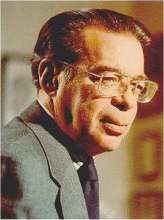
Richard Salant, former president of CBS 
William J. Small, former president of NBC News and executive with CBS for 17 years There was a small problem. Roger Feinman had become a friend and follower of the estimable Warren Commission critic Sylvia Meagher. Therefore, he knew that 1) The Warren Commission produced a deeply flawed report, and 2) CBS had employed some questionable methods in the 1967 special in order to conceal those flaws. Since Roger was working there in 1975, he began to write some memoranda to those in charge warning them that they had repeated their poor 1967 performance in November of 1975. His first memo went to CBS president Dick Salant. Many of the other memos were directed to the Office of Standards and Practices.
In preparing these memos Roger had researched some of the rather odd methodologies that CBS used in 1967, and again in 1975. Since, in 1975, he had been there for three years, he got to know some of the people who had worked on that series. They supplied him with documents and information which revealed that what Cronkite and Rather were telling the audience had been arrived at through a process that was as flawed as the one the Warren Commission had used. Roger requested a formal review of the process by which CBS had arrived at its forensic conclusions. He felt the documentary had violated company guidelines in doing so.
As Roger’s memos began to circulate through the executive and management suites—including Salant’s and Vice-President Bill Small’s—it was made clear to him that he should cease and desist from his one-man campaign. But he would not let up. CBS now moved to terminate their dissident employee.
On September 7, 1976, CBS succeeded in terminating Roger Feinman. But the collection of documents he secured through his sources was, to my knowledge, absolutely unprecedented. This remarkable evidence allowed us, for the first time, to see how the 1967 series was conceived and executed. But further, it takes us into the group psychology of a large media corporation when it collides with controversial matters of national security.
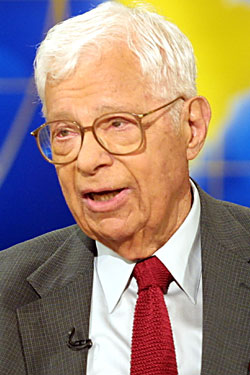
Daniel Schorr One of the most remarkable discoveries Roger made was this: the initial proposal for the special was made from certain employees inside CBS. The proposal was originally sent to Salant by CBS Vice-President at the time, Gordon Manning. Two men who had relayed the idea to him were Daniel Schorr and Bill Small. Later on, Les Midgley would join the effort.
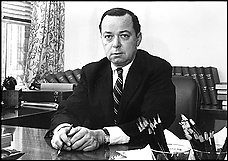
Gordon Manning, executive at CBS, NBC and Newsweek Small was the CBS Washington Bureau Chief from 1962-74 who was now vice-president. Schorr had joined CBS in 1953 and worked under the legendary Edward R. Murrow as a reporter. Manning was hired away from Newsweek to CBS by executive Fred Friendly in 1964. By 1967 he had also become a vice-president. Midgley had also started in print media. But by 1963, he had become a top prime time news producer at CBS.
The first proposal was sent to Salant by Manning in August of 1966. It was declined. Manning tried again in October. This time he suggested an open debate between the critics of the Warren Report and former Commission counsels. It would be moderated by a law school dean or the president of the ABA.
One month after Manning’s debate proposal, Life Magazine published a front-page story in which they questioned the Warren Commission verdict with photographic evidence from the Zapruder film (which they owned). They also interviewed Texas Governor John Connally who disagreed that he and Kennedy had been hit by the same shot. That idea, the Single Bullet Theory, was the fulcrum of the Warren Report. Without it, the Commission’s verdict was rendered spurious. The story ended with a call to reopen the case. In fact, Life had actually put together a small journalistic team to do their own internal investigation.
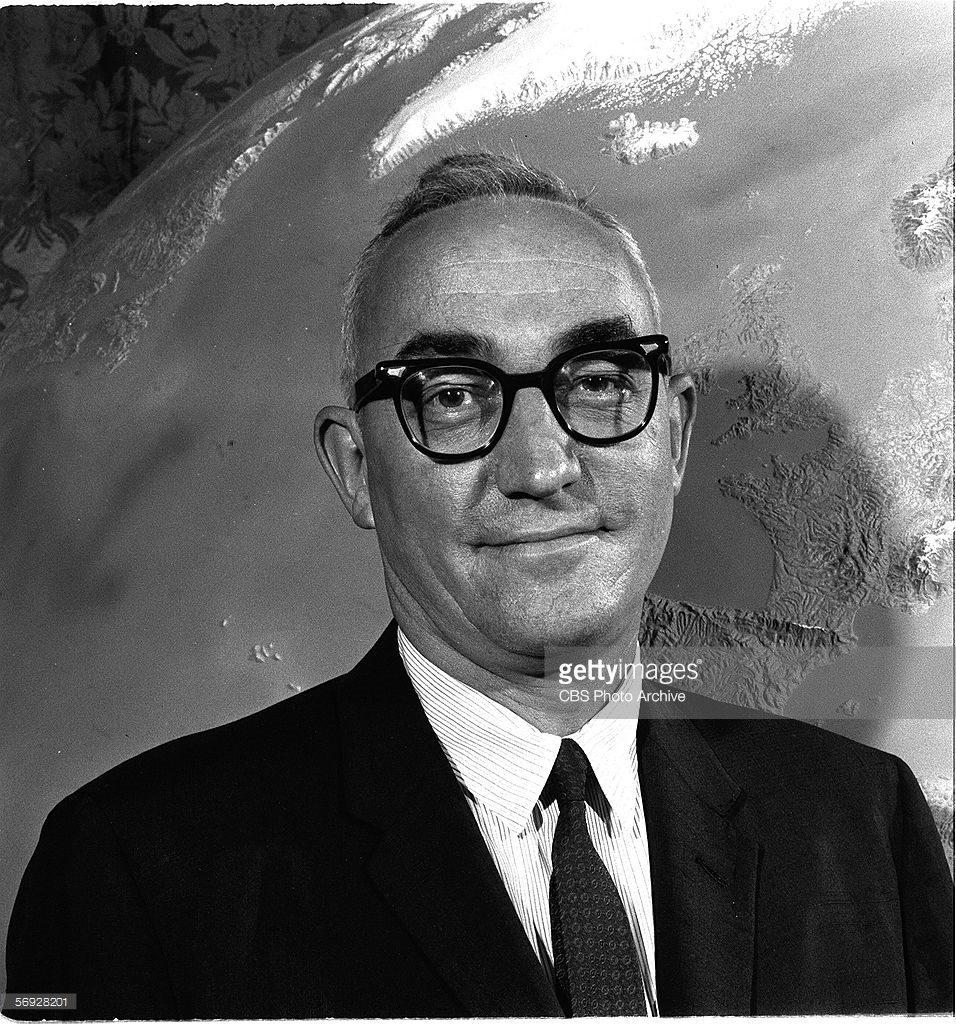
Les Midgley, CBS producer A few days after this issue appeared, Manning again pressed for a CBS special. This time he suggested the title, “The Trial of Lee Harvey Oswald”. Here, a panel of law school deans would review the evidence against Oswald in a mock trial setting. Including evidence that the Warren Commission had not included.
At this time, Manning was joined by producer Les Midgley. Midgley had produced the two-hour 1964 CBS special. His suggestion differed from Manning’s. He wanted to title the show “The Warren Report on Trial”. Midgley suggested a three night, three-hour series. One night would be given over to the commission defenders, one night would include all the witnesses the commission overlooked or discounted. The last night would include a verdict conducted by legal experts. On December 1, 1966, Salant wrote a memo to John Schneider, president of CBS Broadcast Group. He told him that he might refer the proposal to the CNEC. That acronym stood for CBS News Executive Committee. According to information Roger gained through discovering secret memos, plus through secondary sources, CNEC was a secretive group that was created in the wake of Edward R. Murrow’s departure from CBS.

Edward R. Murrow Murrow was a true investigative reporter who became famous through his reports on Senator Joe McCarthy and the treatment of migrant farm workers. The upper management at CBS did not like the controversy that these reports attracted from certain segments of the American power structure. After all, they were part of that structure. Salant went to Exeter Academy, Harvard, and then Harvard Law School. He had been handpicked from the network’s Manhattan legal firm by CBS President Frank Stanton to join his management team. From 1961-67, Stanton was chairman of Rand Corporation, a CIA associated think tank. During World War 2, Stanton worked in the Office of War Information, the psychological warfare branch. President Eisenhower had appointed Stanton to a small committee to organize how the USA would survive in case of nuclear attack. The other two members of CNEC were Sig Mickelson and founder Bill Paley. Mickelson had preceded Salant as president of CBS News. He then became director of Time-Life Broadcasting. Mickelson said nothing when founder Bill Paley—who had also served in the psywar branch of the Office of War Information, in World War 2—met with CIA Director Allen Dulles and agreed to have CBS overseas correspondents informally debriefed by the Agency.

Frank Stanton, former CBS president and chairman of the Rand Corporation from 1961-67 When Salant had reached his crossroads with CNEC, the writing was on the wall for any fair minded, objective treatment of the JFK case at CBS. For as Roger wrote, “The establishment of CNEC effectively curtailed the news division’s independence.” Further, Salant had no journalistic experience and was in almost daily communication with Stanton. As Roger further wrote, Salant “frequently exercised editorial supervision over CBS news broadcasts.” And further, his memoirs did not mention the supervision of CNEC. Or the Warren Commission documentaries made under his watch. These hidden facts “belied Salant’s frequent public assertions of CBS News’ independence from corporate influence.”
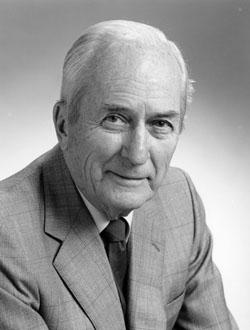
Sig Mickelson, former president of CBS News and director of Time-Life Broadcasting The day after Salant informed the CNEC about the proposal, he told Manning that he was wavering on the mock trial concept. Salant’s next move was even more ominous. He sent both Manning and Midgley to California to talk to two lawyers about the project. One of the attorneys was Edwin Huddleson, a partner in the San Francisco firm of Cooley, Godward, Castro and Huddleson. Huddleson attended Harvard Law with Salant. Like Stanton he was on the board of Rand Corporation. The other lawyer the men saw was Bayless Manning, Dean of Stanford Law School. Both men told the CBS representatives that they were against the network undertaking the project on the grounds of “the national interest” and because of “political implications”. Gordon Manning reported that both attorneys advised them to ignore the critics of the Warren Commission, or to even appoint a panel to critique their books. Huddleson even recommended having scientist Luis Alvarez as a consultant to counter the critics. Which CBS actually did.
On his return to CBS headquarters, Gordon Manning realized what was happening. He suggested a new title for the series, “In Defense of the Warren Report”. He now wrote that CBS should dismiss “the inane, irresponsible, and hare-brained challenges of Mark Lane and others of that stripe.” Gordon Manning’s defection left Midgley out on a limb. Salant, with the help of the White House, was about to cut it off. (Bayless Manning had played a significant role in reversing the aim of the program. It is perhaps of interest here to note that in 1971, David Rockefeller made Bayless Manning first president of the Council on Foreign Relations.)
Unaware of what Salant was up to, on December 14, 1966, Midgley circulated a memo about how he planned on approaching the Warren Report project. He proposed running experiments that were more scientific than “the ridiculous ones run by the FBI.” He still wanted a mock trial to show how the operation of the Commission was “almost incredibly inadequate.”

William S. Paley, creator of CBS television, and founder of CNEC In response, Salant now circulated an anonymous, undated, paragraph-by-paragraph rebuttal to Midgley’s attack. The secret author of that memo was none other than Warren Commissioner John McCloy—then Chairman of the Council on Foreign Relations. Ellen McCloy, his daughter, was Salant’s administrative assistant. In this memo, McCloy wrote that “the chief evidence that Oswald acted alone and shot alone is not to be found in the ballistics and pathology of the assassination, but in the fact of his loner life.” [emphasis added] As most Warren Commission critics had written, it was this approach—discounting or ignoring the medical and ballistics evidence, but concentrating on Oswald’s alleged social life—that was the fatal flaw of the Warren Report. From this point on, Ellen McCloy would be on the distribution list for almost all memos related to the Kennedy assassination project. She would now serve as the secret back channel between CBS and her father in regards to the production and substance of the project.
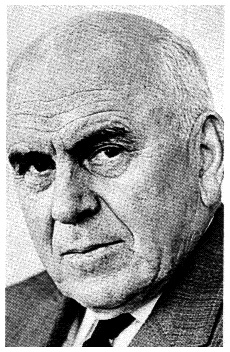
John J. McCloy. His daughter, Ellen, who was Salant’s administrative assistant, admitted to acting as his clandestine liason with CBS during the production of the 1967 Warren Report special. Clearly, the tide had turned and Salant was now in McCloy’s corner. For Salant then asks producer Midgley, “Is the question whether Oswald was a CIA or FBI informant really so substantial that we have to deal with it?” Midgley, still alone out on the limb, replies, “Yes, we must treat it.”
This clandestine relationship between Salant and McCloy was known to very few people in 1967. In fact, as Feinman later deduced, it was likely known only to the very small circle in the memo distribution chain. That Salant deliberately wished to keep it hidden is indicated by the fact that he allowed McCloy to write these early memos anonymously. For as Feinman also concluded, McCloy’s influence on the program was almost certainly a violation of the network’s own guidelines. Which is probably another reason Salant kept it hidden. In fact, as we will see, Salant was actually in denial about the relationship.
After Feinman was terminated he briefly thought of publicizing the whole affair (which he eventually decided against doing). So he wrote McCloy in March of 1977 about the CFR chair’s clandestine role in the four night special. McCloy declined to be interviewed on the subject. He also added that he did not recall any contribution he made to the special.
But Feinman persisted. About three weeks later, on April 4, 1977, he wrote McCloy again. This time he revealed that he had written evidence that McCloy had participated extensively in the production of the four night series. Very quickly, McCloy now got in contact with Salant. McCloy wrote that he did not recall any such back channel relationship. Salant then contacted Midgley. He told the producer to check his files to see if there was any evidence that would reveal the CBS secret collaboration with McCloy. Salant wrote back to McCloy saying that at no time did Ellen McCloy ever act as a conduit between CBS News and McCloy.
This, of course, was false. And in 1992, in an article for The Village Voice, both Ellen McCloy and Salant were confronted with memos that revealed Salant was lying in 1977. McCloy’s daughter admitted to the clandestine courier relationship. Salant finally admitted it also, but he tried to say there was nothing unusual about it. Which leaves the obvious question: If that were the case then why was it kept secret from almost everyone? Including the public. (See further “JFK: How the Media Assassinated the Real Story”)
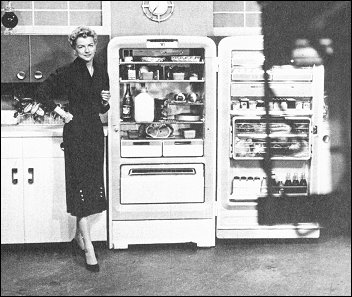
Betty Furness doing a Westinghouse ad As alluded to previously, there was still work to be done with the last holdout, producer Les Midgley. While the four-night special was in production, Midgley became engaged to one Betty Furness. Furness was a former actress turned television commercial spokesperson. At this time, President Lyndon Johnson now appointed her his special assistant for consumer affairs. Even though her only experience in the field had been selling Westinghouse appliances for eleven years on television. She was sworn in on April 27, 1967, about two months before the CBS production first aired. Two weeks after it was broadcast, Midgley and Furness were married. We should note here, as Kai Bird’s biography of McCloy, The Chairman, makes clear, Johnson and McCloy were both friends and colleagues.
But there is another point to be made about how Midgley was convinced to go along with McCloy’s view of the Warren Commission. Around the same time he was married to Furness, he received a significant promotion. He was now made the executive editor of the network’s flagship news program, “The CBS Evening News with Walter Cronkite”. This made him, in essence, the number one news editor at CBS. Such a decision could not have been made without consultation between Salant, Cronkite and Stanton. And very likely the CNEC.
We have now seen—in unprecedented detail—how the executive level of CBS completely altered a proposal to present a fair and balanced program about the murder of President Kennedy to the public, and at a very sensitive time in history. Consulting with their lawyers, they decided such a program would not be in “the national interest” and would have “political implications”. We have also seen how the president of CBS News secretly brought in a consultant, John McCloy, whose participation was a violation of the standards and practices of the network. We have seen how both McCloy and Salant then lied about this secret back channel, which was never revealed to the public. We have also seen how Gordon Manning and Les Midgley, through a combination of the carrot and stick treatment, were made to go along with the Salant/McCloy, CNEC agenda.
We should now look at the impact this secret relationship would have on what CBS was going to broadcast to an unsuspecting public. For their widely trumpeted “examination” of the Warren Report was anything but.
Go to Part 2
-

Why CBS Covered Up the JFK Assassination, Part 2
Part Two
In the first part of this article we saw that, as the controversy over the JFK assassination rose in 1966, some employees at CBS News wanted to deal with the subject in a fair and objective way. Specifically, in either a debate or mock trial format, with both sides—both critics and advocates of the Warren Report—represented equally. But CBS President Richard Salant, in consultation with the CNEC—the secret executive committee at CBS—took control of this proposal, and more or less hijacked it. Salant and the CNEC brought in his own consultant to the proposal. One who would not abide by the critics being allowed a fair and equal voice in this debate. Former Warren Commissioner John McCloy would now have a powerful voice about the upcoming special. His back channel to the show would be through his daughter, Ellen McCloy, who worked for Salant. Not only would this be kept under wraps, but also when CBS moved to terminate Roger Feinman in 1975, Salant would deny any such relationship.
Once McCloy was brought on board, the complexion of both CBS and their programs—both in 1967 and 1975—were altered. The amount of time given over to the critics of the Warren Report would be severely curtailed. But beyond that, CBS would now employ other consultants, besides McCloy, for both their 1967 and 1975 programs. Men who would be rabidly pro-Warren Report. Some of them would appear on the shows as guest speakers. Some would be hidden in the shadows. But in no case would CBS make clear just how biased these men were. In addition to the clandestine role of McCloy, some of these consultants included Dallas police officer Gerald Hill, reporter Lawrence Schiller, physicist Luis Alvarez, and urologist John Lattimer.
Gerald Hill Gerald Hill was just about everywhere in Dallas on November 22, 1963. He was at the Texas School Book Depository, he was at the murder scene of Officer J. D. Tippit, and he was at the Texas Theater—the place where Lee Harvey Oswald was arrested. Hill appears on the 1967 show as a speaker. But Roger Feinman found out that Hill was paid for six weeks work on the 1967 show as a consultant. During his consulting, Hill revealed that the police did a “fast frisk” on Oswald while in the theater. They found nothing in his pockets at the time. Which poses the question as to where the bullets the police said they found in his pockets later at the station came from. That question did not arise during the program, since CBS never revealed that statement. (Click here and go to page 20 of the transcript.)
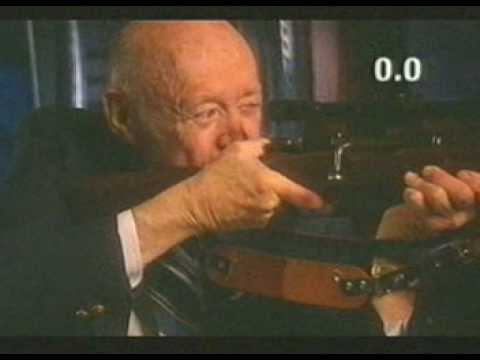
John Lattimer During World War II, John Lattimer traveled with Patton’s Third Army across France. He treated the wounded during the D-Day invasion. At the end of the war, he was the court-appointed doctor for the Nazis accused of war crimes at Nuremburg. As researcher Milicent Cranor discovered, Lattimer was J. Edgar Hoover’s physician. Fittingly then, he had been defending the Commission since at least 1966 in the pages of the Journal of the American Medical Association. In 1972, he became the first doctor allowed to enter the National Archives and inspect the autopsy evidence in the JFK case. He reaffirmed the Warren Commission verdict without telling the public that Kennedy’s brain was missing from the archives. In 1975, Dr. James Weston was the on-camera witness for the medical evidence. Lattimer consulted with Weston and prepared some visual aids for him. Lattimer spent a large part of his career writing articles and performing dubious experiments propping up the Warren Report. (Click here, and here)

Luis Alvarez Luis Alvarez worked on refinements in radar detection during World War II. He then had a role on the Manhattan Project. He actually witnessed the destruction of Hiroshima from an observation plane, the B-29 The Great Artiste. In 1953, Alvarez was on a CIA-appointed study group for UFO’s called the Robertson Panel. In the sixties, he was part of the JASON Advisory Group; this was a powerful organization of top-level scientists that advised the military on things like fighting the Vietnam War. Along with people like Henry Kissinger, Ronald Reagan and George Schultz, he was a member of the secretive and quite conservative Republican private club, the Bohemian Grove. Alvarez was part of the Ruina Panel, which was put together to conceal evidence of Israel exploding nuclear devices. (Click here) Like Lattimer, Alvarez spent a considerable amount of time lending his name to articles and questionable experiments supporting the Warren Report. In fact, as demonstrated by authors like Josiah Thompson (in 2013) and Gary Aguilar (in 2014), Alvarez actually misrepresented his data in some of his JFK experiments. (Click here and go to the 37:00 mark for Aguilar’s presentation.)

Lawrence Schiller The same year of the 1967 CBS broadcast, Lawrence Schiller had co-written a book entitled The Scavengers and Critics of the Warren Report. This was a picaresque journey through America where Schiller interviewed some of the prominent—and not so prominent—critics of the report and caricatured them hideously. The book was simultaneously published in hardcover and softcover, and was also accompanied by an LP record album. But this constituted only Schiller’s overt actions on the JFK case. Secretly, he had been an informant for the FBI for many years on people like Mark Lane and Jim Garrison. These documents were not declassified until the Assassination Records and Reviews Board was set up in the nineties. (See Destiny Betrayed, Second Edition, by James DiEugenio, p. 388) How bad was Schiller? He attacked New Orleans DA Jim Garrison even though he himself had discovered witnesses who attested that Garrison’s suspect, Clay Shaw, actually used the alias of Clay Bertrand. Which was a major part of Garrison’s case against the man. (ibid)
As the reader can see, with this cast of consultants, the 1967 CBS Special was wrongly titled as “A CBS News Inquiry: The Warren Report”. For the last thing these four men, plus McCloy, wanted to do was to unearth the methodology and process by which the Warren Commission had come to its conclusions. For if that had been done, the results would have shown just how superficial, how haphazard, how agenda-driven the Commission really was. What CBS was going to do was—come hell or high water—endorse the Warren Report. And this became obvious right at the start of the program in the summer of 1967.
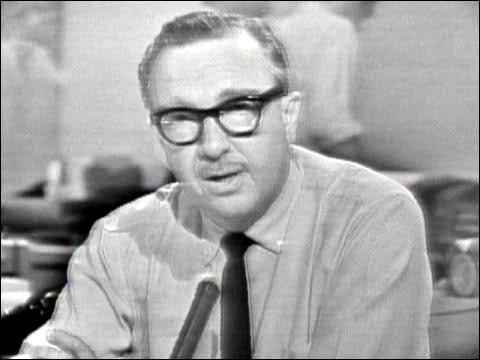
Walter Cronkite For instance, Walter Cronkite intoned that, as a crowd of people rejoiced at the sight of President Kennedy approaching Dealey Plaza, “another waited”. Cronkite then said that, faced with dangerous conditions, President Johnson appointed the Warren Commission. Yet, Johnson never wanted a blue ribbon panel from Washington. He wanted a Texas-based investigation founded upon an FBI report. People outside the White House, like Yale Law School Dean Eugene Rostow and columnist Joseph Alsop, foisted the idea of the Warren Commission upon him. (see The Assassinations, edited by James DiEugenio and Lisa Pease, pp. 7-16) Cronkite then names the men on the Warren Commission while showing their pictures on screen, affirming that this inquiry would be made “by men of unimpeachable credentials”. Needless to say, Cronkite does not mention the fact that President Kennedy had fired Commissioner Allen Dulles in 1961 for lying to him about the Bay of Pigs.
Cronkite then got to the crux of the program. After stating that the Warren Report assured the public the most searching investigation in history had taken place, he now began to show books and articles that were critical of the Commission. He then revealed certain polling results that demonstrated a majority of Americans had lost faith in the Warren Report. This signalled what the program had now become. It was the first network special that took aim at the work of those critical of the Warren Commission. Its raison d’être was to take on the work of the critics and reassure the public that these people could not be trusted. They had given the Warren Report a bum rap.
Cronkite then went through a list of points that the critics had surfaced after reading the report and its 26 volumes of evidence. These were:
- Did Oswald own a rifle?
- Did Oswald take a rifle to the book depository building?
- Where was Oswald when the shots were fired?
- Was Oswald’s rifle fired from the building?
- How many shots were fired?
- How fast could Oswald’s rifle be fired?
- What was the time span of the shots?
To shorten a four-hour story: CBS sided with the Warren Report on each point. Oswald fired three shots from the sixth floor with the rifle attributed to him by the Warren Commission. Two of three were direct hits—to the head and shoulder area—within six seconds. Not only that, but using men like Alvarez they came up with novel new ways to endorse the Warren Report. But as we shall see, and as Feinman discovered, CBS was not candid about these newly modified methods.
One way that CBS fortified the case for just three shots was Alvarez’ examination of the Zapruder film—which the program did not actually show. This was Abraham Zapruder’s 26-second film of Kennedy’s assassination taken from his position in Dealey Plaza. Alvarez proclaimed for CBS that by doing something called a “jiggle analysis”, he computed that there were three shots fired during the film. What this amounted to was a blurring of frames on the film.
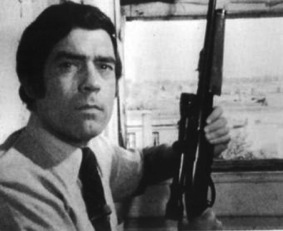
Dan Rather Dan Rather took this Alvarez idea to a Mr. Charles Wyckoff, a professional photo analyst in Massachusetts. Agreeing with Alvarez, at least on camera, Wyckoff mapped out the three areas of “jiggles”. The Alvarez/Wyckoff formula was simple: three jiggles, three shots. But as Feinman found out through unearthed memos, there was a big problem with this declaration. Wyckoff had actually discovered four jiggles, not three. Therefore, by the Alvarez formula, there was a second gunman, and a conspiracy. But as the entire executive management level of CBS had committed to McCloy and the Warren Report, this could not be disclosed to the public. Therefore Wyckoff’s on-camera discussion of this was cut out and not included in the official transcript. It is interesting to note just how committed Wyckoff was to the CBS agenda, for he tried to explain the fourth jiggle as Zapruder’s reaction to a siren. As Feinman noted, how Wyckoff could determine this from a silent 8 mm film is rather puzzling. Even more damning is the fact that, as Life Magazine had deduced, there were actually six “jiggles” in the Zapruder film, and they only allotted one to a “startle reaction”. (See Josiah Thompson, Six Seconds in Dallas, Appendix F) But the point is, this (censored) analysis did not actually support the Commission. It undermined it.
And in more than one way. For Wyckoff and Alvarez placed the first jiggle at around Zapruder frame 190, or a few frames previous to that. As most people who have studied the case know, this would have meant that Oswald would have had to be firing through the branches of an oak tree—which is why the Commission moved this shot up to frame 210. But CBS left themselves an out here. They actually said there was an opening in the tree branches at frame 186, and Oswald could have fired at that point. This is patently ridiculous. The opening at frame 186 lasted for 1/18th of a second. To say that Oswald anticipated a less than split second opening, and then steeled himself in a flash to align the target, aim, and fire—this is all stuff from the realm of comic-book super heroes. Yet, in its blind obeisance to the Warren Report, this is what CBS had reduced itself to.
Another way that CBS tried to aid the Commission was through Wyckoff purchasing five other Bell and Howell movie cameras. (CBS was not allowed to handle the actual Zapruder camera.) The aim was to cast doubt on the accepted speed of the Zapruder camera, and suggest it might have been running slow (so that there would have been more time to get off three shots). The problem was that both the FBI and Bell and Howell had tested the speed of Zapruder’s actual camera, and they both decreed it ran at 18.3 frames per second. Wyckoff proceeded to time these other cameras using the same process that Lyndal Shaneyfelt and Bell and Howell did: by aiming the cameras at a large clock with a second sweep hand, and running them for a determinate number of frames. Wycoff announced the results for these timings as 6.90, 7.30, 6.70, 8.35, and 6.16 seconds. Rather concludes this interview by asking, “So, under this theory, the shooter, or shooters, of the shots could have had up to how many seconds to fire?” And Wyckoff replies, “They could have had, according to this, up [to] as much as eight and thirty-five hundreds [sic] of a second–which is a pretty long time.” (CBS Transcript, Part 1, p. 19) Thompson points out that CBS did not clarify here that they had computed these timings from a run of 128 frames, not 103. In other words, they begged the question concerning frame 186. If they had not played fast and loose with the public, they would have told them that at 18.3 fps, Zapruder’s camera would have run through 128 frames in 6.9 seconds (as opposed to 5.6 for 103 frames), thus making the difference between Zapruder’s camera and the slowest running of the other five considerably less remarkable with respect to the total running time for the supposed three-shot sequence. In fact, Zapruder’s camera seems to be running at an average speed, if one combines the other cameras’ running speeds and divides by five (op. cit., pp. 293-294). As Thompson states, the whole experiment really proves nothing about whether the camera was running slow. Even Dick Salant commented that it was “logically inconclusive and unpersuasive.” But it stayed in the program.
Why did Rather and Wyckoff have to stoop this low? Because of the results of their rifle firing tests. As the critics of the Warren Report had pointed out, the Commission had used two tests to see if Oswald could have gotten off three shots in the allotted 5.6 seconds revealed in the Warren Commission, through the indications on the Zapruder film. These tests ended up failing to prove Oswald could have performed this feat of marksmanship. What made it worse is that the Commission had used very proficient rifleman to try to duplicate what the Commission said Oswald had done. (See Sylvia Meagher, Accessories After the Fact, p. 108)
So CBS tried again. This time they set up a track with a sled on it to simulate the back of Kennedy’s head. They then elevated a firing point to simulate the sixth floor “sniper’s nest”, released the target on its sled and had a marksman fire his three shots.
In watching the program, a question most naturally arises. CBS had permission to enter the depository building for a significant length of time, because Rather was running around on the sixth floor and down the stairs. In the exterior shots of Rather, it appears that the traffic in Dealey Plaza was roped off. So why didn’t CBS just do the tests right then and there under the exact same circumstances? It would appear to be for two reasons. First, the oak tree would have created an initial obstruction for the first shot. Second, there was a rise on Elm Street that curved the pavement. This was not simulated by CBS.
CBS first tried their experiment in January of 1967. They used a man named Ed Crossman. Crossman had written several books on the subject and many articles. He had a considerable reputation in the field. But his results were not up to snuff—even though CBS had enlarged the target size! And even though they gave him a week to practice with their version of the Mannlicher Carcano rifle. (Again, CBS could not get the actual rifle the Warren Report said was used by Oswald.) In a report filed by Midgley, he related that Crossman never broke 6.25 seconds, and even with the enlarged target, he only got 2 of 3 hits in about 50% of his attempts. Crossman stated that the rifle had a sticky bolt action, and a faulty viewing scope. What the professional sniper did not know is that the actual rifle in evidence was even harder to work. Crossman said that to perform such a feat on the first time out would require a lot of luck.
Since this did not fit the show’s agenda, it was discarded: both the test and the comments. To solve the problem, CBS now decided to call upon an actual football team full of expert riflemen—that is, 11 professional marksmen—who were first allowed to go to an indoor firing range and practice to their heart’s content. Again, this was a major discrepancy with the Warren Report, since there is no such practice time that the Commission could find for Oswald.
The eleven men then took 37 runs at duplicating what Oswald was supposed to have done. There were three instances where 2 out of 3 hits were recorded in 5.6 seconds. The best time was achieved by Howard Donahue—on his third attempt. His first two attempts were complete failures. It is hard to believe, but CBS claimed that their average recorded time was 5.6 seconds. But this did not include the 17 attempts CBS had to throw out because of mechanical failure. And they did not tell the public the surviving average was 1.2 hits out of 3, and with an enlarged target. The truly striking characteristic of these trials was the number of instances where the shooter could not get any result at all. More often than not, once the clip was loaded, the bolt action jammed. The sniper had to realign the target and fire again. According to the Warren Report, that could not have happened with Oswald.
There is one more point about this experiment. Neither at this stage, nor any other, was there any mention of the hit to James Tague. On his one miss, the Warren Commission said that Oswald’s shot hit the curb beneath bystander James Tague. This then bounced up off his face, drawing blood. Perhaps they avoided this because Tague was on a different street than Kennedy and about 260 feet away from the limousine. How could Oswald have missed by that much if he was so accurate on his other two shots? Further, the FBI found no copper on the curb where Tague was hit. This defies credulity, because the ammunition used in the alleged rifle is copper coated. (James DiEugenio, Reclaiming Parkland, pp. 228-29) Again, this was surgical-style censorship by CBS.
Related to the ballistics evidence is what CBS did with the medical evidence. The two chief medical witnesses on the program were Dr. Malcolm Perry from Parkland Hospital in Dallas, where Kennedy was taken after he was hit; and James Humes, the chief pathologist at the autopsy examination at Bethesda Medical Center that evening.
In their research for the series, CBS had discovered a document that the Warren Commission did not have. The afternoon of the assassination, Perry had given a press conference along with Dr. Kemp Clark. Although it was filmed, when the Commission asked for a copy or a transcript, the Secret Service said they could not locate either. (Doug Horne, Inside the ARRB, Vol. 2, p. 647) This was a lie. The Secret Service did have such a transcript. It was delivered to them on November 26, 1963. The ARRB found the time-stamped envelope.

Robert Pierpont But Feinman discovered that CBS had found a copy of this transcript years before. White House correspondent Robert Pierpont found a transcript through the White House press office. One reason it was hard to find was that it should not have been at the White House; it should have been at the Kennedy Library. But as Roger Feinman found out, it had been relabeled. It was not a Kennedy administration press conference anymore; but the first press conference of the Johnson administration. So it ended up at the Johnson Library.
None of this was revealed on the program by either Cronkite or Rather. And neither the tape nor transcript was presented during the series. In fact, Cronkite did his best to camouflage what Perry said during this November 22nd press conference, specifically about the anterior neck wound. Perry clearly said that it had the appearance to him of being an entrance wound. And he said this three times. Cronkite tried to characterize the conference as Perry being rushed out to the press and badgered. Not true, since the press conference was about two hours after Perry had done a tracheotomy over the front neck wound. The performance of that incision had given Perry the closest and most deliberate look at that wound. Perry therefore had the time to recover from the pressure of the operation. And there was no badgering of Perry. Newsmen were simply asking Perry and Clark questions about the wounds they saw. Perry had the opportunity to answer the questions on his own terms. Again, CBS seemed intent on concealing evidence of a second assassin. For Oswald could not have fired at Kennedy from the front.
Commander James Humes did not want to appear on the program. He actually turned down the original CBS request to be interviewed. But Attorney General Ramsey Clark pressured him to appear on the show. (This may have been done with McCloy’s assistance.) As Feinman discovered, the preliminary talks with Humes were done through a friend of his at the church he attended. There were two things that Humes said in these early discussions that were bracing. First, he said that he recalled an x-ray of the president which showed a malleable probe connecting the rear back wound with the front neck wound. Second, he said that he had orders not to do a complete autopsy. He would not reveal who gave him these orders, except to say that it was not Robert Kennedy. (Charles Crenshaw, Trauma Room One, p. 182)
Like the Perry transcript, this was exceedingly interesting information. Concerning the malleable probe, the problem is that no such x-ray depiction exists today. As CBS stated, Humes had been allowed to visit the National Archives and look at the x-rays and photos prior to his appearance. Needless to say, the fact that this x-ray was missing is not mentioned on the program. Because of that, the pubic would have to wait almost 30 years—until the creation of the Assassination Records Review Board—to find out that other witnesses also saw a malleable probe go through Kennedy’s back. But neither pictures nor x-rays of this are in the National Archives today. The difference is that these other witnesses said that the probe did not go through the body, since the wounds did not connect. This may be the reason they are missing today. (DiEugenio, Reclaiming Parkland, pp. 116-18)
On camera, Humes also said that the posterior body wound was at the base of the neck. Dan Rather then showed Humes the drawings made of the wound in the back as depicted by medical illustrator Harold Rydberg for the Warren Commission. This also depicts that wound as being in the neck. Humes agreed with this on camera. And he added that they had reviewed the photos and referred to measurements and this all indicated the wound was in the neck.
Even for CBS, and John McCloy, this is surprising. In the first place, the autopsy photos do not reveal the wound to be at the base of the neck. It is clearly in the back. (Click here and scroll down) The best that one can say for CBS is that, apparently, they did not send anyone with Humes to visit the archives. Which is kind of puzzling, since good journalistic practice would necessitate two witnesses to such an important assertion. And beyond that, CBS should have sent its own independent expert, because Humes clearly had a vested interest in seeing his autopsy report bolstered, especially since it was under attack by more than one critic.
The second point that makes Humes’ interview surprising is his comments on the Rydberg drawings’ accuracy. These do not coincide with what Mr. Rydberg said later. To this day, Rydberg does not understand why he was chosen to make these drawings for the Commission. Rydberg was only 22 at the time, and had been drawing for only one year. There were many other veteran illustrators in the area whom the Commission could have called upon. But Rydberg came to believe that it was his very inexperience that caused the Commission to direct the doctors to him. For when Humes and Dr. Thornton Boswell appeared before him, they had nothing with them: no photos, no x-rays, no official measurements. Everything they told him was from memory. And this was nearly four months after the autopsy. (DiEugenio, Reclaiming Parkland, pp. 119-22) The Rydberg drawings have become almost infamous for not corresponding to the pictures, measurements, or the Zapruder film. For Humes to endorse these on national television, and for CBS to allow this without any fact checking—this shows what a National Security project the special had become. In fact, the Justice Department had scripted the Humes/Rather interview in advance. (ibid, pp. 125-26)
As noted, CBS also knew that Humes said that he had been limited in his autopsy pathology for the Kennedy autopsy. This would have been another powerful scoop if CBS had followed it up. Since they did not, the public had to wait another two years for the story to surface. This time it was at the trial of Clay Shaw in New Orleans, when autopsy doctor Pierre Finck took the stand in Shaw’s defense. Finck said the same thing: that Dr. Humes was limited in what autopsy procedures he was permitted to follow on Kennedy (ibid, p. 115). This story would have had much more exposure and vibrancy if CBS had broken it, because the press bias against Garrison was very restrictive and controlling. But, as we have seen, the Justice Department control over Humes and CBS was also restrictive—the difference being that CBS was a much more powerful institutional entity than the rather small DA’s office of a medium sized city.
What CBS did with the Humes/RFK story should be followed up on to show just how badly CBS was willing to mangle the truth.
In early 1975, when the JFK case was heating up again, Sixty Minutes decided to do a story on whether or not Jack Ruby and Lee Oswald knew each other. After several months of research, Salant killed the project. Those investigative files were turned over to Les Midgley, and became the basis for the 1975 CBS special, which was entitled The American Assassins. Originally this was planned as a four-night special: one night each on the JFK, RFK, Martin Luther King and the George Wallace shootings. But at the last moment, in a very late press release, CBS announced that the first two nights would be devoted to the JFK case. Midgley was the producer, but this time Cronkite was absent. Rather took his place behind the desk.

Franklin Lindsay In general terms, it was more of the same. The photographic consultant was Itek Corporation, a company that was very close to the CIA. In fact, they helped build the CORONA spy satellite system. Their CEO in the mid-Sixties, Franklin Lindsay, was actually a former CIA officer. With Itek’s help, CBS did everything they could to move up their Magic Bullet shot from about frame 190 to about frames 223-226. Yet Josiah Thompson, who appeared on the show, had written there was no evidence Governor Connally was hit before frames 230-236. Moreover, there are indications that President Kennedy is clearly hit as he disappears behind the Stemmons Freeway sign at about frame 190: his head seems to collapse both sideways and forward in a buckling motion. But with Itek in hand, this now became the scenario for the CBS version of the Single Bullet Theory. It differed from the Warren Commission’s in that it did not rely upon a “delayed reaction” on Connally’s part to the same bullet.

Milton Helpern CBS also employed Alfred Olivier. Olivier was a research veterinarian who worked for the Army wound ballistics branch and did tests with the alleged rifle used in the assassination. He was a chief witness for junior counsel Arlen Specter before the Warren Commission. (See Warren Commission, Volume V, pp. 74ff.) For CBS in 1975, Olivier said that the Magic Bullet, CE399 was not actually “pristine”. For CBS and Dan Rather, this makes the Single Bullet Theory not impossible but just hard to believe. Therefore, it could have happened. Apparently, no one explained to Rather that the only deformation on the bullet is a slight flattening at the base, which would occur as the bullet is blasted through the barrel of a rifle. There is no deformation at its tip. And there is only a tiny amount of mass missing from the bullet. In other words, as more than one author has written, it has all the indications of being fired into a carton of water or a bale of cotton. And if CBS had interviewed the legendary medical examiner Milton Helpern of New York, that is pretty much what they would have heard. (Henry Hurt, Reasonable Doubt, p. 69) It is odd they did not do so, since CBS Headquarters is in New York, and Helpern was still alive in 1975.

James Weston As we have seen, Dr. James Weston would be the on camera medical witness in 1975. Both Weston and Lattimer had seen the medical exhibits before the show was filmed. Taking that into consideration, what they said is not surprising; it is what they left out that is. Predictably, Weston said that there were only two shots, both from the rear. Yet Weston makes no mention of the brain being missing, a fact that both he and Lattimer had to know. Without that exhibit, there was no proof of the brain being sectioned, which is the standard procedure for tracking bullets inside the skull. If this was not done, there is no proof of directionality. Further, there was no mention of the new feature to the x-rays that was found in a Justice Department review in 1968: this was a disk-shaped 6.5 mm fragment in the rear of the skull. Its size fits perfectly the ammunition caliber of the Mannlicher Carcano rifle. It was not seen the night of the autopsy by any of the pathologists. Third, in that same Justice Department review, particle fragments Humes described in his report as going upward from the entry wound, low in the back of the skull, had disappeared on the x-ray. Weston mentioned none of these changes in the evidence. One wonders if he actually read the autopsy report, or just relied on his briefing by Lattimer.
George Burkley Finally, Rather realizes, without being explicit, that something was wrong with Kennedy’s autopsy. He actually said to the audience that the autopsy was below par. And he also reversed field on his opinion of Humes. After praising his experience in 1967, Rather now says that neither Humes nor Boswell were actually qualified to perform Kennedy’s autopsy, and that certain things were actually botched. In other words, what Humes told CBS through a third party in 1967 was accurate. But, in contradiction to Humes’ denial that it was Bobby Kennedy who did so, Rather claims that it was Kennedy physician George Burkley who actually controlled the autopsy. Burkley could not have done any such thing unless it was approved by RFK. And Robert Kennedy had given orders to do a full autopsy. That same order was co-signed by Burkley. (Crenshaw, ibid, p. 182) In this author’s opinion, this piece of disinformation sounds like it was created by Lattimer.
In its perniciousness, in its “blame the victims” theme, Rather’s comment echoes what John McCloy said to Cronkite on camera in 1967. McCloy said that if the Commission made a mistake, it was in not demanding the autopsy materials for their examination, adding that these were under the control of the Kennedy family. If anything shows how “in the tank” CBS and Cronkite were to McCloy, this exchange does. First of all, the medical exhibits were not in control of the Kennedys in 1964. They were under control of the Secret Service that year. Secondly, the Commission did have these exhibits. And McCloy had to have known that. (Gerald McKnight, Breach of Trust, p. 171)
Let us make no mistake about what CBS was up to here. The entire corporate upper structure—Salant, Stanton, Paley—had completely overrun the lower management types like Midgley, Manning and Schorr. And the lower managers decided not to utter a peep to the outside world about what had happened. There was only one recorded instance where CBS let on to how they had fixed their proceedings. In 1993, CBS did another special endorsing the Warren Report. This time, as in 1975, Rather was the host. He called both Bob Tanenbaum of the HSCA, and David Belin of the Warren Commission, to Dealey Plaza. They both discussed their differing views of the case. But Tanenbaum stated that, unlike, Belin, he had tried well over a hundred felony cases through to verdict. Evidently, Rather was impressed with Tanenbaum’s honesty and experience. When the camera was off, Rather stated quietly to the former prosecutor: “We really blew it on the JFK case.”
Not only Cronkite and Rather participated in this appalling exercise; so too did Eric Sevareid. He appeared at the end of the last show and said that there are always those who believe in conspiracies, whether it be about Yalta, China, or Pearl Harbor. He then poured it on and said some of these people still think Hitler is alive. He concluded by sneering that, anyway, it would be utterly impossible to cover up such a thing. (Watch it here)
No it would not Eric. You, your network, and your cohorts just gave us an object lesson in how to do it. Only Roger Feinman, who was not at the top, or anywhere near it, had the guts to try and get to the bottom of the whole internal scandal. And he got thrown under the bus for trying. In that valiant but doomed effort, he showed what hypocrites the top dogs at CBS were, how easily they were cowed and cajoled by their bosses. Everyone then took the Mafia vow of silence about what they had done. Which is despicable, but considering the magnitude of the crime they committed, also understandable.
(This essay is largely based on the script for the documentary film Roger Feinman was in the process of re-editing at the time of his death in 2011. The reader can view that here)
Addenda
A. The CBS rifle tests
The author has been informed by Josiah Thompson that the deception by CBS went even further than Roger Feinman knew. CBS line producer Bob Richter revealed some fascinating information to author Thompson after the 1967 special was broadcast. CBS stated for the internal record that many of their rifle attempts were faulty since the weapon jammed or malfunctioned. Thus was not the case. This misreporting deliberately concealed the fact that in the majority of those instances, the marksman just could not duplicate what the Commission said Oswald did. CBS simply did not want to admit those failures, and add them to the ones they did admit to. (04/26/2017)
B. Documents
Thanks to the efforts of Pat Speer, some of Roger’s documentation can again be examined. The hard-to-find reproductions can be found at Pat’s’ website. These are screenshots taken from a copy of Roger’s original PowerPoint presentation. For this reason, a few of them are unfortunately legible only with difficulty. But the reader will see that they represent in substance the story recounted here. We are grateful to Pat for making these available.
Back to Part 1
-
Mark Lane dies at 89
By Alfred NG, At: NY Daily News
-
The Death of Mark Lane
I finally understood the influence and reputation that the late Mark Lane had in America when I arrived in Pittsburgh for the Cyril Wecht Symposium at Duquesne in the fall of 2013. At the airport, I was picked up in a private car and driven to my hotel. The driver asked me what I was in town for. I replied a JFK conference on the 50th Anniversary at Duquesne. He asked me if Mark Lane was going to be there. I said yes he was. He replied that he wrote his first research paper back in college many years ago on the JFK case, and he used a lot of the work of Lane in doing it. He asked me to thank Lane for that inspiration. When I arrived at the hotel, I did see Mark and I conveyed the debt of gratitude from my driver.
After I did so I went up to my room and thought: Geez, there must be literally tens, maybe hundreds of thousands of people across America who feel that way about Lane. For the simple reason that Lane was literally the prime mover in the dissent movement against the official version of the Kennedy assassination. Within just three weeks of Kennedy’s death, Lane had issued the first legal arguments against the public stampede to condemn the memory of the accused assassin, Lee Harvey Oswald, who had been shot and killed by Jack Ruby while in the custody of the Dallas police. Lane wanted to publish his defendant’s brief in The Nation. But that liberal journal—and several other periodicals– would not accept it. So he went to the even more leftist journal The National Guardian.
At that conference in Pittsburgh, there were a few copies of that original essay on a coffee table. Lane picked one up and said to me, “They had to print several reprints of this issue. They eventually sold a hundred thousand of them.” This was in mid-December of 1963, two weeks after the first meeting of the Warren Commission, when every major media outlet in America was accommodating leaks from people like Jerry Ford, J. Edgar Hoover and Allen Dulles about how compelling the case against Oswald was. But there was Mark Lane, the one attorney standing up for a dead man who was being walked over by every public and private institution in America.
Mark Lane Through the Years
{aridoc engine=”iframe” height=”320″}images/ctka/public/2016/marklane/slide-show/deep-minified.html{/aridoc}
Marguerite Oswald, mother of the murdered suspect, heard about Lane’s polemic. She wanted him to act as her murdered son’s defense advocate. But the Warren Commission would not allow it. When Lane forwarded his request to the Commission, Chief Counsel J. Lee Rankin wired back to him the following message: “The Commission does not believe that it would be useful or desirable to permit an attorney representing Lee Harvey Oswald to have access to the investigative materials within the possession of the Commission or to participate in any hearings to be conducted by the Commission.” (See Lane’s A Citizen’s Dissent, e-book version, Part 2, “The Great Silence.”)
In fact, one of the many travesties of the Commission was that Oswald was not granted counsel throughout the ten-month legal procedure. In that respect, the proceeding was a runaway prosecution. Lane was allowed to appear before the Commission twice, once in March and once in July. These were clearly token, adversarial appearances. In fact, it is hard to find another witness who the Commission treated with such hostility. (Walt Brown, The Warren Omission, pgs. 243-45)
At around this time in 1964, Lane began to be surveilled by the FBI. Because he was doing JFK lectures abroad, he was also placed on the federal government’s “lookout list” for international air travel. Whenever Lane returned from abroad, the FBI was alerted he was back. (See Lane, op. cit) But beyond that, the FBI now began to interview certain radio hosts who had chosen to place Lane on the air. These Bureau visits resulted in Lane being banned from certain media outlets. And the buzz about those visits discouraged other outlets from having him on.
In spite of his other considerable achievements, Mark Lane will be forever linked to the JFK assassination. He was, quite literally, a pioneer, a trailblazer in the wilderness.
But Lane would not let up in his defense of Oswald. He then rented a theater in New York City and began to lecture there regularly, taking apart the evidence presented by the developing official story. With the funds attained by these talks, and his various lectures at home and abroad, Lane set up a Citizens’ Commission of Inquiry to collect evidence ignored by the FBI and the Warren Commission. Lane actually managed to appear on some rather widely distributed talk programs, like the one hosted by Merv Griffin.
He then began writing a book based upon the Warren Report and its accompanying 26 volumes of evidence. He could not find a publisher for his book in America. Therefore, Rush to Judgment was first published in England in 1966. It became so successful that it was later published in the U.S. and became a smashing bestseller. At a lecture at the 40th anniversary of Kennedy’s death, Lane said he later found out that the reason he could not find a domestic publisher was that the FBI was visiting publishing houses and discouraging them from publishing his work.
In 1967, Lane followed Rush to Judgment with a documentary film of the same title. This production was shot by famous film-maker Emile de Antonio. De Antonio made films on several controversial subjects like the demagogue Joseph McCarthy and the Vietnam War. He later said that in his entire career, he never met as many witnesses who were literally afraid for their lives to go on camera. Lane literally had to plead with and cajole people to come out of their homes. A few years after this documentary film, Lane worked on the story for a fictional film about the JFK case called “Executive Action.” That film was released in 1973. It was directed by the veteran David Miller and featured some famous leading actors like Burt Lancaster, Robert Ryan, and Will Geer.
In 1967, Lane had worked for New Orleans District Attorney Jim Garrison during his two-year inquiry into the JFK case. Around 1975, after both the revelations of the Church Committee and the ABC showing of the Zapruder film had ignited outrage favoring a new investigation, Lane did two things to further that interest. First, he released a new documentary on the JFK case called “Two Men in Dallas,” featuring local sheriff’s officer Roger Craig. Second, he restarted his grass roots Citizens’ Commission of Inquiry. He used that committee to lobby Congress to pass a resolution to reopen the Kennedy murder case. To put it mildly, Lane did not get along very well with the final Chief Counsel to the House Select Committee on Assassinations Robert Blakey.
In the 1980’s, Lane decided to take on the appeal of a libel verdict against publisher Willis Carto, the Liberty Lobby and their controversial publication Spotlight. In 1981, Liberty Lobby had lost a $650,000 case judgment when Victor Marchetti had written in Spotlight that the CIA had to devise an alibi for their agent Howard Hunt being in Dallas on November 22, 1963. (Lane, Plausible Denial, pgs. 129-32) Through the help of his volunteer network and some fine sleuthing, Lane discovered that such a memo did exist. It had been prepared by CIA counter-intelligence chief James Angleton, and had been seen by journalist Joe Trento. And Trento had actually written about it. (ibid, pgs. 152-55) By his aggressive defense, Lane not only reversed the judgment, he actually convinced some of the jurors that the CIA was involved in the Kennedy assassination. (ibid, pgs. 320-323)
Lane wrote a book on the Howard Hunt case that was published in 1991. Called Plausible Denial, that book also became a best seller. It gave us harsh insights into CIA officers Hunt, Angleton, Richard Helms and David Phillips. Concerning the last, during a debate with Lane, Phillips actually said that when the entire record was declassified, there would be no evidence that Oswald was ever at the Soviet Embassy in Mexico City. (ibid, pgs. 75-87)
But that still wasn’t enough for Lane. In the new millennium, Lane published his final book on the JFK case called, eponymously, Last Word. In this book, Lane brought out another aspect of the case: the possible complicity of the Secret Service in the assassination. That book was promoted by various video trailers, during which Lane interviewed luminaries like former HSCA Deputy Counsel Robert Tanenbaum, film director Oliver Stone, and former Secret Service agent Abraham Bolden.
But the amazing thing about Lane is that there were still other aspects of his legal career, outside of the JFK case, that I have not even mentioned. For instance, for a time in the seventies, Lane served as attorney for the accused assassin of Martin Luther King, James Earl Ray. He also co-wrote a book on the King case with Dick Gregory called Code Name Zorro. Lane also took on the case of James Richardson. Richardson was a black man in the south who was indicted and convicted of killing his seven children. Through some extraordinary detective work—and with help from Gregory and Garrison assistant Steve Jaffe—Lane had Richardson freed after 21 years of unjust incarceration. He then wrote a book on that case called Arcadia. His book about the riotous—and ruinous—Chicago Democratic convention, called Chicago Eyewitness, makes for an interesting journal. Lane’s reports on this shocking event make it the ultimate crushing of youthful dissent in America and a turning point in history—which it was. In 2012 he summed up his tumultuous career with an autobiography called Citizen Lane. (Visit Lane’s website for information on how to get Lane’s books.)
In spite of his other considerable achievements, Mark Lane will be forever linked to the JFK assassination. He was, quite literally, a pioneer, a trailblazer in the wilderness. In that dark year of 1964 when the Warren Commission was trying to keep everything quiet, while men like FBI Director J. Edgar Hoover were leaking rigged and false evidence to the papers, there was Mark Lane, speaking from his podium each night, to anyone who would listen.. He did this not just because it was his vocation, but because he had personally met President Kennedy when he was running for office in New York. Therefore, he kept up that crusade for the truth about Kennedy’s murder at a very high cost to himself.
As he wrote in his 1968 book A Citizen’s Dissent, he lost his one corporate client over the JFK case. He was then vilified by his opponents who seemed to have easy access to the press, which Lane did not come close to having. Warren Commission junior counsel Wesley Liebeler was actually going to run against him for his state legislative seat. Through it all, through his over more than five decades of dissent against the folly of the Warren Commission, Mark Lane never lost his fighting spirit or his dedication to his cause. He liked to say that the folly of the Commission had led to a national tragedy. Which it did. For both him and all of us.
Lane died at age 89 at his home in Charlottesville, Virginia, May 10. 2016. We are all a bit poorer for his passing. It signifies a milestone. Taps at Reveille.
~ Jim DiEugenio
For more remembrances of Mark Lane from Cyril Wecht, Bob Tanenbaum, Don Freed, Steve Jaffe, David Lifton, Joan Mellen, Joe McBride and John Barbour, listen to the BlackOp Radio installment below:
-

Donald Trump, JFK, Oswald and the 2016 Presidential Election
Many of the serious people in the JFK community wish that the Kennedy assassination would figure more prominently in our political elections. Especially those for president. For example, back in 1992, both Bill Clinton and Vice-Presidential candidate Al Gore said they felt there were unanswered questions about the JFK assassination and the public had the right to know what was in the declassified files. In 2008, Hillary Clinton said she would open declassified files on the JFK case.
Unexpectedly, the JFK case has been injected into the presidential race this year. Although not the way most of us would like to have seen it done. The subject has not surfaced in relation to the final 2017 release date on the JFK Act. That would have been most welcome. Instead the controversy is about something that no one could have imagined in advance. The question being posed by Republican candidate Donald Trump is about the father of GOP presidential candidate Ted Cruz, Rafael Cruz. On May 3rd, Trump was on the TV interview show “Fox and Friends.” He said this about candidate Cruz:
“His father was with Lee Harvey Oswald prior to Oswald’s being, you know, shot! I mean the whole thing is ridiculous. What—what is this right, prior to his being shot. And nobody even brings it up. I mean they don’t even talk about that, that was reported and nobody talks about it. But I think it’s horrible. I think its absolutely horrible, that a man can go and do that….I mean what was he doing with Lee Harvey Oswald, shortly before the death—before the shooting? It’s horrible.”
Ted Cruz called these accusations “nuts,” “kooky,” and characterized the source material as “tabloid trash.” He then went on to call Trump a “pathological liar,” a “narcissist.” a “bully” and “amoral.” It’s not often that this publication agrees with Ted Cruz on anything. But we do on this one.
The 1963 photo allegedly showing Lee Harvey Oswald (left) with Ted Cruz’s father Rafael Cruz
Cruz got one thing wrong about the sourcing. Although the National Enquirer did carry an article on the Cruz/Trump controversy, the original story did not actually begin there. It actually started with Wayne Madsen. Madsen published a story in the April 7th issue of his online journal called the Wayne Madsen Report. In that report, Madsen showed a famous photo of Lee Oswald passing out pro-Cuba handbills outside of Clay Shaw’s International Trade Mart in New Orleans. This incident occurred on August 16, 1963. There are some fascinating facts about this incident. But Madsen ignored those to center on a sensational, unsubstantiated accusation. He centered on a Latin looking man standing to Oswald’s left with a tie on, and what appears to be a white, short sleeved shirt. Although he is not the only man who is unidentified, Madsen used him to make a wild claim. He wrote that this was the father of Ted Cruz, Rafael Cruz.
As far as this author can tell, this claim is about as well established as Bill O’Reilly saying he heard the gunshot crack that killed George DeMohrenschildt in Florida, since he was standing on the doorstep when it happened. From what I could see in this story, Madsen had two pieces of evidence to make the claim with. Cruz was in New Orleans that summer, and he produced a photo of Rafael for comparison purposes. Neither of which comes close to proving the charge.
As this site has complained many times before, with very few exceptions, photographic comparisons are not reliable. We went through this a few years ago with Shane O’Sullivan getting on the BBC and saying there were three CIA operatives at the Ambassador Hotel the night Robert Kennedy was killed. This turned out to be wrong. And it appears to be wrong again here. Gus Russo has surfaced a clear photo of Rafael in his younger days, and it does not look like the man in Madsen’s story. He also found an identification card for Rafael, which states he was six feet tall in 1967. The man in the photo appears to be shorter than Oswald, who was 5 feet 9 inches. (See JFK Files blogspot of May 3, 2016) Finally, in the May 3rd issue of The Hill, Rafael Cruz denied he was in the Crescent City on that day.
As the late Mike Ruppert used to point out, Madsen was not the most accurate or factually addicted reporter to arise during the Internet revolution. In many instances, as Mike showed, Madsen’s reach exceeded his database of facts. Which appears to have been the case here. In other words, because of the questionable source, and the lack of substantiation, the story should have had no legs.
But it did. The National Enquirer then picked it up. This was interesting, for two reasons. The owner and publisher of the Enquirer is David J. Pecker, CEO of American Media. According to New York, and several other sources, Pecker and Trump are friends. In fact, Trump tried to push his friend for the editorship of Time magazine in 2013. (See New York issue of 10/30/2015). Once the Republican primary season got started, the Enquirer served as a journalistic surrogate for the Trump campaign. They did this by running timely hatchet jobs on both Carly Fiorina and Ben Carson.
When the ridiculously large Republican field finally narrowed to a trio of candidates—Trump, Cruz and John Kasich—something really weird happened which involved another character recently involved with the JFK field.

Author and political operative Roger Stone
Roger Stone had been a GOP operative specializing in what has been (kindly) called “dirty tricks.” He has been at it for a long time. He started off with the master of the genre Richard (Dirty Dick) Nixon. His last famous op was his alleged role in the so-called “Brooks Brothers Riot” in Florida during the 2000 Bush vs. Gore recount. This was when a cadre of congressional GOP aides masqueraded as Dade County citizens to protest a recount being held there. A recount that showed that Al Gore was gaining fast on George W. Bush. On top of this phony “grass roots” protest, Stone allegedly spread rumors that scores of Cubans were also coming to the recount location to protest. Along with the perverse ruling by the late Supreme Court Justice Antonin Scalia to stop the recount, this helped shut down a legitimate and legal voter tally that almost surely would have reversed the election result.
Stone and Scalia helped present us with one of the worst presidents in history. A man who, among other things, gave us the invasion of Iraq and the real estate/stock market crash of 2007-08. The latter was the worst economic crisis since the Great Depression. The former was the worst foreign policy disaster since the Vietnam War. (Although, to be fair, Stone has had second thoughts about his role in that sordid affair and its horrific results).
Roger Stone has been friends with Trump for a long time. He actually consulted with him in 1999 when Trump was first considering an entry into the White House race. In this election cycle, Stone was actually on Trump’s advisory staff. He allegedly departed over the Trump dispute with Fox host Megyn Kelly.
I say “allegedly.” Why? Because Trump and Stone are both very knowledgeable about how to manipulate the media without their knowing it. I mean the “Brooks Brothers Riot” was not exposed until many months after its tumultuous effects had taken hold. In late March, the Enquirer ran a story about Ted Cruz and his five “extramarital affairs.” The only on-the-record source for that story was Roger Stone. As reported by “Real Clear Politics,” Stone then took to talk radio to promote the story himself, challenging Cruz to file a lawsuit if the story was false. He then added smears about the senator’s wife, alleging she had a mental breakdown. (See Slate, March 24, 2016, story by Michelle Goldberg.)

David Pecker, publisher of The National Enquirer and good friend of Donald Trump
Interestingly, it appears that Madsen knew about the “Five Mistresses” story in advance. Madsen then surfaced the equally dubious Rafael Cruz story. Which Pecker and the Enquirer then picked up. What makes this interesting is that Roger Stone has of late developed another career, this time as an author. He has written or co-written a few books dealing with, among other things, the JFK assassination. Because of his high profile with the media, his books have attained some notoriety.
In a radio interview with AM 970 “The Answer,” hosted by former actor Joe Piscopo, Roger Stone was pushing this equally dubious story. Who did he use as a source? Who else but Judy Baker. He also said he talked to a guy who did computer facial recognition and he said it was Rafael Cruz. To put it lightly, whoever could say such a thing about a facial comparison is either a Trump operative, half blind, or both.
But this is what politics has become in America today: a three-ring circus. And in all these stories, Oswald is presumed to be the assassin of President Kennedy. Try and find the word “alleged” anywhere. Did I say “three ring circus?” With Trump and Stone it’s more like a five ring P. T Barnum special. And recall the famous line (falsely) attributed to Barnum: “There’s a sucker born every minute.” In a sensible world, with a responsible press, the people to go to for an affirmation of the Rafael Cruz story would be writers who have studied the New Orleans aspect of the case for decades. And to use one reputable source, William Davy, according to the files of the late Jim Garrison, there was never any credible evidence that Cruz was in that photo. And since the present author also had access to those files, he can affirm Davy’s studied opinion. But in our upside down media universe, an authority like Davy gets ignored while someone like Roger Stone becomes the source of record.
Whatever the merit of his books on the JFK case, Stone surely has no expertise in New Orleans. Yet he is allowed to pontificate about the matter. After which one has to ask: If Stone was still working for Trump, could he have done any better for the man? Because it appears that these two stories—which our pitiful mainstream media actually picked up on—were part of the fatal fusillade that eliminated Cruz from the race and pushed Trump over the top.
Which all seems part of a rather unusual, perhaps unique, presidential election cycle of 2016. It is unique in the sense that both insurgent candidates—Trump and Senator Bernie Sanders—decided to run within the two party system. There was no serious consideration of a third party candidacy, as was the case with previous insurgents like Ross Perot or George Wallace. Surprisingly, both present candidates were quite successful. In lieu of a bitter fight at the convention, Trump appears to have won the GOP nomination. If it were not for the Gillis Long/DLC inspired and created “superdelegate” convention class, Sanders would be able to make a powerful convention challenge in Philadelphia. In fact, the main difference in the success factor was probably the fact that the MSM, in its worship of celebrity, was addicted to Trump. The man had more free publicity than any presidential candidate in modern American history.
With Stone’s help, Trump managed to do two things that supercharged his campaign. First, in a protean makeover worthy of Laurence Olivier, he altered his political profile. Trump first contemplated running for president back in 1999. At that time, he was encouraged by Jessie Ventura to run as the Reform Party candidate. Trump set up an exploratory committee helmed by—who else: Roger Stone. His ideas back then appeared to be moderate to liberal. They included universal healthcare, doing away with NAFTA, and higher taxes on the rich. He eventually dropped out of the race in February of 2000. He thought the Reform Party could not sustain a national campaign. In retrospect he was correct on that. He also objected to the entry into the party of people like Pat Buchanan and David Duke. As everyone knows this year, when Duke seemed to endorse him, Trump said he did not know what Duke was about.

Rush Limbaugh (top) and Glenn Beck
To say the least, Trump has transformed his public image since then. When he and Stone decided to run in the GOP field, they performed a bit of jiu jitsu magic right out of the gate. Since the presidency of Ronald Reagan, the GOP has existed along two super highways that, schematically, run parallel to each other. On the lower highway, close to the ground, highly paid shills like Rush Limbaugh and Glenn Beck mobilize and anger the Republican base. The red meat issues they use are things like immigration, nationalism, thinly disguised racism, and anti-abortion rights. Meanwhile, the real movers and shakers in the GOP have structured a higher, less visible highway made up of foundations, think tanks, and lobbyists that promote a much more broad and business minded agenda. This includes things like economic globalization, attacks on environmentalism, anti-unionism, and anti-healthcare. They also seek to destroy the public education system and limit upward social mobility through education. In other words, the agenda of this upper class drastically and negatively impacts the daily lives of the beer drinking proletariat that Limbaugh and Beck manipulate. Limbaugh and Beck use emotional pleas and shell games to divert from that fact.
What Trump did was to co-opt the Limbaugh/Beck arm of the party by being even more extreme than they were. By advocating for things like the construction of a wall on the Mexican/American border, and mass deportations of illegal aliens, Trump was actually out clowning Limbaugh for the Archie Bunker vote.

Trump in pursuit of the Archie Bunker vote (above)
Trump is too smart not to realize how unrealistic these things are, how susceptible they are to legal challenges. So he says them knowing that they will very likely never come close to fruition. But it inoculates him in the rightwing world of talk radio. He then tries to portray himself as a job creator who will make America Great Again, thereby outflanking the upper highway of the GOP. Tactically, Trump ran a very smart race. And the fact that the MSM never tried to really expose him helped a lot.
The problem with Trump’s candidacy is this: with his Proteus like switches and his bombastic promises, it is very hard to figure just what Trump would be like if he won the White House. And that is really bad. Because we know what happened between another well-disguised presidential candidate and his handler. In 2000, Karl Rove sold George W. Bush as a compassionate conservative. Which, to put it mildly, he did not turn out to be. With Trump, who has said just about anything about himself and everyone else to get elected—including accusing his opponent’s father of being involved with Oswald in New Orleans—you have a very large joker as a wild card.
He should not remain so. It is way overdue for someone in the media to do the real digging and exploring about who Trump really is today and what his presidency would actually be like.
Update: In the above, I left out two other factors that would seem to support the idea that Roger Stone’s late-arriving writing vocation was at least partly done in the aid of Donald Trump. Stone has written or co-written four books in less than four years. Two of them directly figure in his work for Trump. In 2015, Stone co-wrote The Clintons’ War on Women. In this effort he shared billing with one Robert Morrow. Morrow is a Texas-based researcher who is also a rather late arrival on the JFK scene. But in addition to his Kennedy efforts, Morrow reportedly has a library of over one hundred books on the Clintons. This weekend, Trump was speaking about this very issue from the podium. That is, his treatment of women versus the Clintons. Clearly, the candidate is trying to overcome the gender advantage Hillary Clinton enjoys. One wonders if Roger Stone anticipated this months earlier.
Before Stone co-wrote a book with Morrow, he did the same with Saint John Hunt. This one was titled Jeb! And the Bush Crime Family. That book was published in October of 2015; in other words, about three months before the primary season began. At that time Jeb Bush was perceived as being one of the strongest candidates in the race – if for no other reason than he was the most well-funded. The GOP establishment had funneled over 100 million dollars into his war chest.
So when one adds it all up, one has to wonder if Stone had this planned out in advance. That is how his newfound writing career would help his friend Donald Trump. In regard to his support for these two National Enquirer stories described above, was the alleged divorce between Stone and Trump really genuine? One has to ask: Isn’t it better for a man with Stone’s reputation to perform his tasks while not being directly affiliated with the candidate? It is a bit startling that no MSM reporter has written about this subject.
One last point should be amplified. The unprecedented success of Trump and Sanders reveals much about how tired the public is with the status quo of our political parties. It would be the equivalent of two third party candidates getting more votes than all but one of 23 Republicans or Democrats in a primary season. This is how much unrest and frustration there is after eight years of Oprah Winfrey’s “Change” candidate, Barack Obama.
-

The JFK Assassination According to the History Textbooks – Parts 2 & 3
The JFK Assassination According to the History Textbooks – Part Two
(Click here if your browser is having trouble loading the above.)
Part 3: Afterword
DE-NORMALIZING THE WAY HISTORY BOOKS COVER THE JFK ASSASSINATION
The community of serious researchers on the JFK assassination, today’s and yesterday’s, deserves high praise for their resilience and dedication. With very limited means and facing the risk of constant ridicule, they have persevered and brought us into places considered taboo. It’s a territory where journalists, politicians and, as we can see, historians refuse to go. Their names are slandered in writing, and on the Web, some are threatened with lawsuits and others are intimidated. But through it all, they have shown that, in addition to the major conclusions of the Warren Report, there are even serious questions about how Dorothy Kilgallen died as she was working on the JFK case following her interview of Jack Ruby. (Click here for a review)
Yet still, they persevere by revealing witnesses that the Warren Commission refused to talk to, getting their hands on the quasi-confiscated Zapruder film and showing it on national TV, accessing revealing documents through information initiatives, combing through the national archives and getting their messages out through books, articles, interviews and seminars.
While their efforts – with the help of people like Jim Garrison and Oliver Stone – have somewhat paid off, with the creation of the HSCA, and the important releases of documents through the ARRB – with more to come in 2017 – they have not succeeded in changing the outdated narratives in mainstream media and history books. As shown through the AHA professional standards code, what is in these history books is not history. It is more like stenography for the MSM.
As opposed to the broadcast of the Zapruder film on national TV, and the release of the JFK movie, most JFK books, articles, and interviews are seen and heard by a small, albeit knowledgeable audience with almost no support from mainstream media. Therefore, for the vast majority of time, these authors are preaching to the already converted.
The first phase of research, carried out by people like Vincent Salandria and Sylvia Meagher, was characterized by a lone wolf approach. It involved a lot of grunt work, directly in the trenches: reading through the 26 volumes of the Warren Commission, searching for first-hand witnesses, identifying inconsistencies and concluding that there must have been a conspiracy. Except for Jim Garrison, very few of the pioneers could make a strong case about who the conspirators actually were.
The Mary Ferrell Foundation, National Archives, COPA and Lancer conferences, and shows hosted by the likes of Alan Dale and Len Osanic, helped bring in a second phase. This allowed researchers to network better with one another and speed up research and information sharing. With the ARRB release of documents, persons of interest confessions and other key findings, there are now clearer templates of what could have happened that are more convincing than the notion of one misguided outcast, waiting for the sixth floor to be deserted, putting together a disassembled rifle and “sniper’s lair” in no time flat, then firing off three lucky shots in six seconds with an unreliable bolt-action rifle. A man with no discernible motive, who was then bumped off two days later by another lone-nut nightclub owner who got himself incarcerated and condemned to the gas chamber out of sympathy for Jackie Kennedy.


From left to right: Dorothy Kilgallen; Sylvia Meagher; Jim Garrison; Oliver Stone
It is this author’s opinion that the research community now needs to enter a new phase if it wishes to reach a universal audience, one that sees research efforts bolstered by business administration support focused on an approach called “De-Normalization,” which was used successfully against the tobacco industry as discussed in Part 1 of this article. There was a time when all the following was true: Cigarettes were smoked inside schools, bars, restaurants and places of work; they were advertised on TV with cowboy and soldier personalities and healthy-looking models; claims were made that cigarettes were good for your health and that they did not cause cancer; they were part of logistical planning during war time. Much of this changed around the Truth campaign launches, where legislation (no smoking in public places and restrictions on product marketing), price control and communications (anti-Big Tobacco ad campaigns) combined to de-normalize its free reign.
The two ingredients that paved the way for this successful strategy were: 1) The victims were young; and, 2) They were being manipulated. Public relations specialists will tell you that they relish this type of situation, which is certain to get media and political attention.
These very same ingredients are present in the issue of historical accounts of the assassination. It may be an overstatement, for now, to claim that students are being wittingly manipulated, but they certainly are not being transmitted a balanced and complete picture of this tragic landmark event. And furthermore, they constitute a young captive audience in a “nurturing” place that is dedicated to developing the minds of our youth with useful and accurate information often funded by the public. This makes the history books narrative on the JFK assassination a logical target for De-Normalization.
THE SIX STEPS TO DE-NORMALIZING THE CURRENT HISTORICAL NARRATIVE
1. Forming a task force and its consultants
The team that would lead this endeavor would be made up of knowledgeable researchers and other concerned specialists who have a reputation of doing diligent work and presenting information in a convincing way. They have the respect of their peers, they understand academia and they are not seen as loose cannons. Their areas of research and expertise are complementary.
2. Involving youth, parents and open-minded historians
The anti-tobacco crusaders’ message was strongly enhanced by the aid of teenage spokespeople and other concerned parties. It is one thing to hear a hardened pro-conspiracy messenger taking on an equally experienced historian, it is another to hear a student say that he would have liked to know more about how the HSCA contradicted many of the Warren Commission conclusions.
3. Preparing the case smartly and choosing the right narrative
By early 2018, hopefully after the release of the remaining unclassified archive documents, there should be a compelling case file that relies on the input of the very best research specialists in the field which can be communicated as effectively in classroom as in a courtroom. At this point the primary objective should be to gain the admission that the HSCA concluded that there was a probable conspiracy and to eliminate the affirmation that JFK was killed by a lone nut. It may be overly ambitious at this point, and perhaps not necessary to focus on whether or not Oswald was a conscious participant in the conspiracy.
The task force here should focus on strong evidence and discard the uncertain variety like some of the photo analysis. The case needs to be comprehensive and easy to digest. Also, the narrative must avoid making irresponsible statements like the CIA killed Kennedy. The Democratic Party of the slavery era is not today’s Democratic Party. The CIA has changed a lot since 1963. In 1963, the CIA did influence the government quite strongly and at times negatively. However, during the weapons of mass destruction propaganda offensive, it was the CIA that was fighting off proponents of that claim, like Dick Cheney. Second, the persons of interest who were CIA identified by a number of authors are few in number and in some cases were no longer working for the CIA at the time of the assassination – such as Dulles and Cabell. In other cases, they were outcasts on their way out, like Harvey. (This does not mean however that it deserves the blind confidence Blakey had for it during the HSCA hearings.)
4. Packaging the case
It is soon time for the all-defining documentary series to be produced that presents the real history of the assassination and the current research into it. This tool will provide a real go-to source for those, including the student, who wants to learn about the case and by-pass unreliable or incomplete sources.
5. Presenting the case
A small number of historians did show some degree of open-mindedness towards changing their accounts and listening to arguments. There should be a reach-out campaign to those who write the books, as well as history associations and their members. Also, those who choose the curriculum at the board and government levels should be targeted diplomatically at first. If this fails, the question that can be asked is if the continuing of the current narrative is even legal and if it should be challenged.
6. Publicizing the case
The Monkey trials, de-normalization strategies and youth and academia topics have in the past proven to be of great media interest. One school board or education department prohibiting the current portrayal of the assassination, or a legal challenge would be certain to draw universal attention to the case and the documentary while creating further doubt in the obsolete Warren Commission conclusions and also forcing history teachers to answer direct questions about the subject.
Obviously a De-Normalization operation requires financial, marketing, legal and administrative resources to go along with the researchers. The investment in time and money is important. The payoff however may be a lot more than one can imagine, especially if it helps expose the statement that was made about the real state of American democracy on and after November 22, 1963. Something that historians should be interested in.
-
The JFK Assassination According to the History Textbooks – Part 1
I. Big Press Antecedents
It is perhaps obvious to those familiar with Vincent Bugliosi’s massive book that its title was chosen to suggest that the reason an overwhelming majority of Americans believed there was a conspiracy in the assassination of JFK was because the narrative of those events was hijacked by reckless conspiracy theorists, robbing their unsuspecting public of their “true” history, which now, thanks to the author, would be reclaimed for them.
The fiftieth anniversary coverage of the tragic event by the MSM, the movie release of Parkland, documentaries, Dallas and the Sixth Floor Museum, all these societal forces widely pushed the lone assassin scenario. This pattern of mainstream bias and willful neglect of stories that weaken the Lone Nut explanation has gone on since the assassination itself except for the preliminary “Castro was behind it” spin which was vetoed early on. The Church Committee and HSCA conclusions that impeach much of the Warren Commission’s work, the Antonio Veciana allegations that connect the CIA’s David Phillips directly with Oswald, the Clay Shaw revelation that he was in fact a well-paid CIA contract agent , the Lopez Report about Oswald and the Mexico City charade, and the ARRB releases showing an orchestrated torpedoing of Jim Garrison: these are but a few of the stories that have been virtually ignored by Big Press.
The publication of well-researched, highly revealing books such as JFK and The Unspeakable, The Devil’s Chessboard, Oswald and the CIA and many others are given the cold shoulder by mainstream media when compared to Case Closed, Reclaiming History and A Cruel and Shocking Act. When a researcher or producer gets noticed, such as Mark Lane or Oliver Stone, smear campaigns are unleashed.
The revelations about CIA’s Operation Mockingbird during the Church Committee go a long way in explaining the waning power of the traditional press. Jim DiEugenio’s Reclaiming Parkland chronicles Hollywood’s subservient ties with this influential outfit. More recently, the obituary of Charles Briggs Sr. underscored the CIA’s links with the Sixth-floor Museum in Dallas: a shrine for the lone assassin representation of events.
There is no question that the Fourth Estate’s freedom of expression, so instrumental in putting an end to the Vietnam War and exposing, to a certain degree, Watergate, has been compromised. But not without paying a price in lost readership, sales, market value and credibility, while weakening one of the key pillars of US democracy.
This harm to society is perhaps mitigated by the fact that, as flaws are exposed, more of us are finding new sources of information, choosing not to consume what is being sold, or believing what we are being told.
But what about those among us who do not have the option to change the channel? Like the students who are part of a captive audience in their history class and are forced to read the history book the school or teacher selects, and expected to answer exam questions according to what they are taught? Some of these students are very young and place their faith in their ”knowledgable” teacher whom they count on for selecting books reflective of the truth and which present history factually. What are they reading in their history books? Is it that the president was assassinated by a lone assassin?
In Part 1 of this article, we will expose what is said in North America’s most popular history books and how their authors respond to questions concerning their rationale and sources, and highlight certain flaws and patterns that seem to prevail. Part 2 will cover sources that have gone mostly ignored by history book authors, and an analysis of how authors are upholding, or not upholding, the values of their profession on this issue. Part 3 will propose a new phase of JFK assassination research that will focus on setting the narrative straight and reaching a wider audience.
II. Marketers, Historians and Youth
In 1994, anti-tobacco crusader, UCSF professor Stanton Glantz received an anonymous package filled with highly revealing documents about tobacco company Brown & Williamson. It shed light on the research they had about the ill effects of smoking, as well as certain marketing tactics used in the industry. In 1996, former vice-president of research and development at B&W, Jeffrey Wigand, became a whistleblower by stating on 60 Minutes that his employer manipulated their products so as to increase the nicotine content. By the end of 1998, Big Tobacco, along with the attorneys of 46 states, signed the Tobacco Master Settlement Agreement, by which they agreed to pay over 200 billion to cover Medicaid costs and fund anti-smoking campaigns, and also to alter their marketing practices, especially those that target youth. The Truth Tobacco Industry Documents archive was created in 2002 by the UCSF Library. Internal industry documents from the 1980s highlight the importance they attached to researching, targeting and manipulating youth. Over 60% of smokers were initiated to cigarettes before the age of sixteen.
Some of the proceeds from the lawsuits financed the legendary Truth campaigns which defined an approach called de-normalization (a concept we will come back to in part two). The communication strategy veered away from the typical “smoking is bad for your health” messages and instead broadcast hard-hitting anti tobacco industry campaigns where Big Tobacco executives were portrayed as greedy, predatory businessmen who owed their wealth and status to their acquisition of a youth clientele and the strategic delivery of nicotine. Post-campaign tests proved the strategies to be highly effective.
Up in Canada, health advocacy groups took notice.
That’s when the author’s marketing-communications firm was contacted and eventually asked to adapt the Truth campaigns for Quebec City, first as a test market. The offensive, under the brand name De Facto rocked the industry and the reaction of Canadian Big Tobacco was swift, aggressive and well orchestrated. Threats of lawsuits, PR smear initiatives, lobbying the government–everything they could muster was thrown at the perpetrators of the campaign. These methods, however, simply re-enforced the image of sophisticated Big Tobacco executives preying on kids! As a matter of fact, young students were placed front and center in the press relations. The contrast with industry executives this created earned Big Tobacco no praise. The campaign eventually went province-wide and played an important role in changing the landscape in terms of the perceptions of the tobacco industry, youth awareness, the stricter legal environment the tobacco industry now operates in and the lawsuits they would soon face for damages to health. The campaign received an honorable mention from the World Health Organization.
While one can take pride in playing a role in bettering the prospects of our youth, at times one can also feel like Frodo heading towards Mount Doom when taking on such a powerful opponent. So it is difficult to even imagine what individuals like Jim Garrison, Mark Lane, Fletcher Prouty and many in the JFK research community must have felt, taking on even more formidable opponents.
After a twenty-five-year stint in a marketing career, I joined an excellent college in Quebec City. There I began teaching business administration with a special focus on ethics, surrounded by students aged between sixteen and twenty, who have not been corrupted and are full of enthusiasm about how they can improve society, a notion now being taught as pre-condition to, and symbiotic with, turning a profit.
The first book I read about the JFK assassination was Crossfire by Jim Marrs–that was many years ago. This was followed by a few other readings on the matter and then Oliver Stone’s blockbuster JFK. After a hiatus of a few years I stumbled on JFK and the Unspeakable by Jim Douglas. This set off a frenzy of book reading, internet surfing and listening to every interview and documentary I could find. And while there is a lot of clutter in the form of false flags, wild claims, faulty thinking, sensationalism and unreliable research, there is also a host of serious researchers to be found who are teachers, lawyers and writers, who have painstakingly combed through documents, reviewed commission findings, interviewed witnesses, attended conferences, and, who have presented their findings in well written, diligently footnoted books, articles and websites, and have also participated in interviews and given seminars that are very accessible. If one makes the effort to look.
I was amazed by how much documentation the ARRB, and other sources, have added to the wealth of material JFK researchers tapped into, that was completely ignored by main stream media, which seemed to have assigned very little in the way of resources to research the crime of the last century. On the contrary, the financing of books and internet anti-conspiracy propaganda was quite intense. And when the fiftieth anniversary came and went, the Lone Nut version of events was front and center.
During the months leading up to the fiftieth, out of curiosity, I asked one of the history teachers at the college how his history book described the assassination: and there it was in black and white: JFK killed by a lone nut. Is that what our students and children are told is fact? How much of a free rein do historians have in youth-filled classrooms? These questions set off my research on how “history books” cover the assassination.
III. What Young Students Are Given To Read
The methodology used to prepare this study was actually quite simple:
By talking to representatives from three of the largest school book distributors in North America (Pearson, Nelson, McGraw Hill) in the fall of 2013, access was gained to many of the American History books used in the U.S. and Canada, including even one French book used in the province of Quebec. The editions were the most recent and/or the ones that would be available for the 2014-15 school-year. Many of these books were said to be among the most popular ones; the others were those that were also favored by the representatives. To these were added other accessible e-books also available in the instructors’ resource centers.
Texts pertaining to the Kennedy assassination were then extracted and their content looked over. In all, nineteen books were analyzed. (Note: coverage of the JFK assassination represents an extremely small portion of the content and does not necessarily reflect the overall quality of the research and writings in these textbooks.)
The history books analyzed were the following:
- America: Past and Present, 10th Edition
- American Destiny: Narrative of a Nation, Fourth Edition
- The American Journey, Combined Volume, 2011
- Out of Many: A History of the American People, 7th Edition
- Give Me Liberty, 2012
- The American Story, 2013
- The American Nation, 2012
- Created Equal, 2009
- America and its People, 2004
- American Stories, 2012
- The American Pageant, 15th Edition 2014
- Liberty, Equality, Power: A History of the American People, Concise Edition, 6th Edition © 2014
- American Passages, Volume II: Since 1865, Brief Fourth Edition
- The Enduring Vision: A History of the American People, Volume II: Since 1865, Eighth Edition 2014
- A People and A Nation, Volume II: Since 1865, Ninth Edition 2012
- Discovering the American Past: A Look at the Evidence, Volume II: Seventh Edition 2012
- Experience History, V2: Since 1865, 8th Edition 2014
- The Unfinished Nation, Seventh edition 2014
- Histoire des États-Unis. Mythes et Réalités, Second édition 2006 (French book used in province of Quebec)
IV. How the JFK Assassination Is Portrayed (excerpts have been randomly shuffled)
-
The French textbook simply states that Kennedy was killed by a lone shooter in 1963.
-
Oswald, Lee Harvey (1939–1963): Ex-Marine and communist sympathizer who assassinated John F. Kennedy in Dallas, Texas, on November 22, 1963. Oswald was murdered two days later as he was being transferred from one jail to another.
-
Tragedy in Dallas: JFK Assassinated
While visiting Dallas, Texas, on November 22, 1963, Kennedy was assassinated. Police apprehended Lee Harvey Oswald, and a mass of evidence linked him to the assassination. Before he could be brought to trial, he was murdered by Jack Ruby. An investigation headed by Chief Justice Warren concluded that Lee Harvey Oswald acted alone, and although there is little evidence to support the theory that Oswald was part of a larger conspiracy, many doubted the Warren Commission’s conclusion.
-
Dallas, 1963
In November 1963, President Kennedy visited Texas to raise money and patch up feuds among Texas Democrats. On November 22, the president’s motorcade took him near the Texas School Book Depository building in Dallas, where Lee Harvey Oswald had stationed himself at a window on the sixth floor. Acting on his own, Oswald fired three shots that wounded Texas Governor John Connally and killed the president. Vice-President Lyndon Johnson took the oath of office as president on Air Force One while the blood-splattered Jacqueline Kennedy looked on. Two days later, as Oswald was being led to a courtroom, Jack Ruby, a Texas nightclub owner, killed him with a hand-gun in full view of TV cameras.
-
The Assassination of President Kennedy
The assassination of John F. Kennedy in Dallas on November 22, 1963 sent the entire nation into shock and mourning. Millions had identified his strengths—intelligence, optimism, wit, charm, coolness under fire—as those of American society.
In life, Kennedy had helped place television at the center of American political experience. Now in the aftermath of his death, television riveted a badly shocked nation. One day after the assassination, the president’s accused killer, an obscure political misfit named Lee Harvey Oswald, was himself gunned down before television cameras covering his arraignment in Dallas. Two days later, tens of millions watched the televised spectacle of Kennedy’s funeral, trying to make sense of the brutal murder. Although a special commission headed by Chief Justice Earl Warren found the killing to be the work of Oswald acting alone, many Americans doubted this conclusion. Kennedy’s death gave rise to a host of conspiracy theories, none of which seems provable.
-
Kennedy did not live to see his civil rights bill enacted. On November 22, 1963, while riding in a motorcade through Dallas, Texas, he was shot and killed. Most likely, the assassin was Lee Harvey Oswald, a troubled former Marine. Partly because Oswald was murdered two days later by a local night club owner while in police custody, speculation about a possible conspiracy continues to this day. In any event, Kennedy’s death brought an abrupt end to his presidency.
-
“LET US CONTINUE”
Kennedy’s assassination by Lee Harvey Oswald left the nation stunned, but Lyndon Johnson moved quickly to restore confidence by promising to continue Kennedy’s programs. In fact, Johnson went beyond Kennedy in the struggle for economic and racial equality.
-
Tragedy in Dallas: JFK Assassinated. While visiting Dallas, Texas, on November 22, 1963, Kennedy was assassinated. Police apprehended Lee Harvey Oswald, and a mass of evidence linked him to the assassination. Before he could be brought to trial, he was murdered by Jack Ruby. An investigation headed by Chief Justice Warren concluded that Lee Harvey Oswald acted alone, and although there is little evidence to support the theory that Oswald was part of a larger conspiracy, many doubted the Warren Commission’s conclusion.
-
Kennedy was shot and killed just three months later on November 22, 1963, while on a political peace-making tour of Texas.
-
In the aftermath of the missile crisis, it appears that Kennedy was moving toward a policy of détente, but his assassination in Dallas, Texas, on November 22, 1963, makes this impossible to know. The sorrowing nation assessed the slain president not so much by what he did as by what might have occurred.
-
The 1960s were an especially violent decade in American history. By far the most shocking event, the one that all those of age will remember until their dying day, was the assassination in Dallas of President Kennedy on November 22, 1963. The tragic event was investigated by a special presidential commission, the Warren Commission, which received testimony from scores of eyewitnesses. Whether the panel reached the correct conclusion about the episode has, of course, been the subject of intense argument. It is a profoundly moving experience to read some of the accounts of Kennedy’s last moments. His wife, Jacqueline, remembered shouting, “I love you, Jack” as she cradled his shattered head in her lap. The evidence and testimony considered by the Warren Commission is published in Hearings Before the President’s Commission on the Assassination of President Kenned, 26 volumes (Washington, DC: U.S. Government Printing Office, 1964, 26 volumes). Jacqueline Kennedy’s testimony appears in volume 5. An abridged version of the Hearings, entitled The Witnesses (New York: McGraw-Hill, 1964) was compiled by the New York Times.
-
The Kennedy Assassination On November 22, 1963, Kennedy was gunned down while riding in an open limousine in Dallas. The assassin, Lee Harvey Oswald, left few reasons for his murder, and Oswald himself was gunned down two days later while being transported from police headquarters to jail, an event that aired on live television. For four days, the nation collectively mourned its fallen leader. In death, the image of the brash Cold Warrior and the tepid civil rights supporter underwent a transformation to that of a liberal legend, the king of Camelot.
-
The Assassination of John F. Kennedy
On November 22, 1963, the president was shot dead as his presidential motorcade moved through Dallas, Texas. Vice President Lyndon Johnson, who had accompanied Kennedy to Texas, took the oath of office and rushed back to Washington. Equally quickly, the Dallas police arrested Lee Harvey Oswald and pegged him as JFK’s assassin. Oswald had vague ties to organized crime; had once lived in the Soviet Union; and had a bizarre set of political affiliations, including shadowy ones with groups interested in Cuba. He declared his innocence but never faced trial. Jack Ruby, a Dallas nightclub owner, killed Oswald on national television, while the alleged gunman was in police custody. An investigation by a special commission headed by Chief Justice Earl Warren concluded that both Oswald and Ruby had acted alone.
Kennedy’s life and presidency remain topics of historical debate and tabloid- style speculation. His assassination still provokes conspiracy theories and controversies. Researchers have provided new details about his poor health, reliance on exotic medications, and dalliances with women—all of which were kept from the public at the time.
-
Kennedy’s Assassination
In late November 1963, John and Jacqueline Kennedy traveled to Texas on a political tour. The 1964 presidential race was approaching, and Texas, which had narrowly supported the Kennedy-Johnson ticket three years before, could not be taken for granted. The Kennedys took a motorcade through Dallas, with the bubble-top of their limousine removed on a warm and cloudless day. Along the route, people waved from office buildings and cheered from the sidewalks. As the procession reached Dealey Plaza, shots rang out from the window of a nearby book depository. President Kennedy grabbed his throat and slumped to the seat.
Texas Governor John Connally was wounded in the back, wrist, and leg. The motorcade raced to Parkland Hospital, where the president was pronounced dead. Within hours, the Dallas police arrested a twenty-four-year-old suspect named Lee Harvey Oswald. Two days later, Oswald was shot and killed in the basement of Dallas police headquarters by Jack Ruby, a local nightclub owner with a shady past. Dozens of theories surfaced about the Kennedy assassination, blaming leftists and rightists, Fidel Castro and the Mafia, the Ku Klux Klan and the CIA. The most logical theory, that a deranged man had committed a senseless act of violence, did not seem compelling enough to explain the death of a president so young and full of life.
Few other events in the nation’s history produced so much bewilderment and grief.
(Sidebar) Oswald, Lee Harvey (1939–1963). Alleged assassin of President John F. Kennedy, he was shot two days later while under arrest.
-
As in the assassination of John F. Kennedy, it seemed unworthy that one misfit was alone responsible. (Reference to James Earl Ray and MLK)
-
The nation would not learn what sort of President John Kennedy might have become. On November 22, 1963, Kennedy visited Texas, the home state of his vice president, Lyndon Johnson. In Dallas, riding with his wife, Jackie, in an open-top limousine, Kennedy was cheered by thousands of people lining the motorcade’s route. Suddenly, shots rang out. The president crumpled, shot in the head. Tears ran down the cheeks of CBS anchorman Walter Cronkite as he told the nation their president was dead. The word spread quickly, in whispered messages to classroom teachers, by somber announcements in factories and offices, through the stunned faces of people on the street. That same day, police captured a suspect: Lee Harvey Oswald, a former U.S. marine (dishonorably discharged) who had once attempted to gain Soviet citizenship. Just two days later, in full view of millions of TV viewers, Oswald himself was shot dead by shady nightclub owner Jack Ruby. Americans, already in shock, were baffled. What was Ruby’s motive? Was he silencing Oswald to prevent him from implicating others? The seven-member Warren Commission, headed by U.S. Supreme Court Chief Justice Earl Warren, concluded that Oswald had acted alone. For four days, the tragedy played uninterrupted on American television.
-
President Kennedy was assassinated that November in Dallas.
-
TRAGEDY IN DALLAS
On November 22, 1963, the people of Dallas lined the streets for his motorcade. Suddenly, a sniper`s rifle fired several times. Kennedy slumped into his wife`s arms, fatally wounded. His assassin, Lee Harvey Oswald, was caught several hours later. Oswald seemed a mysterious figure: emotionally unstable, he had spent several years in the Soviet Union. But his actions were never fully explained, because only two days after his arrest -in full view of television cameras- a disgruntled nightclub operator named Jack Ruby gunned him down.
-
Nothing illustrated that more clearly than the popular reaction to the tragedy of November 22, 1963. In Texas with his wife and Vice President Lyndon Johnson for a series of political appearances, as the presidential motorcade rode slowly through the streets of Dallas, shots rang out. Two bullets struck the president-one in the throat, the other in the head. He was sped to a nearby hospital where minutes later he was pronounced dead. Lee Harvey Oswald-a young man who had spent time in the Soviet Union and, later in Cuba- was arrested for the crime. Later that day he was he was mysteriously murdered by a Dallas nightclub owner, Jack Ruby, as he was being moved from one jail to another. Most Americans at the time accepted the conclusions of a federal commission appointed by President Johnson to investigate the assassination. The commission, chaired by Chief Justice Earl Warren, found that both Oswald and Ruby acted alone, that there was no larger conspiracy. In later years, many Americans came to believe the Warren Commission report had ignored evidence of a wider conspiracy behind the murders. Controversy over the assassination continues still.
V. Summary Overview
- Four of the sources simply say that JFK was assassinated;
- One says that he was killed by a lone shooter;
- One only states that “it seemed unworthy that one misfit was involved”;
- Six state that Lee Harvey Oswald assassinated the president;
- One states that Oswald most likely killed the president;
- Five do mention that some believe in a conspiracy, however all but one of these end up supporting the Lone Assassin scenario. Some of these make conspiracy backers out to be part of a fringe group or simply misguided;
- Two state that there is a lot of debate over the Warren Commission’s conclusions;
- One history book states that Oswald went to Cuba;
- There is one critique of the Oliver Stone movie;
- The only investigation referred to by any of the history books is that of the Warren Commission (seven times).
- History books are therefore clearly skewed towards portraying Lee Harvey Oswald as the Lone Assassin. There exists no evidence of analysis of post-Warren Commission investigations.
VIa. Questions Posed to the Authors
Next, authors responsible for the section covering the assassination (or the JFK period) were contacted by e-mail and asked to explain their writings. Almost every author (sometimes more than one for a given book) answered.
Here is the first question (which varied slightly depending on the exact wording of their texts) which almost every author answered:
… One of the history professors (at our college) pointed out that most history books subscribe to the lone assassin (Oswald) scenario. Many asked what this is based on. In your book, it describes the assassination of JFK as being committed by Oswald (the impression given is that he acted alone)… Many of the people I speak to, some well-read about the subject, disagree with this assertion (especially the alone claim) and last autumn a lot of time was spent debating this point. My question is: On what basis is this presented as historical fact? (i.e. What are the sources that were looked into to support this?)
Thank you for answering.
Paul
Then, after receiving an answer to this question, two follow-up questions were asked, with variations dependent on how the first question was answered:
… Some of the critics of the way many history books cover the JFK assassination bring up the following points:
- More weight seems to be given to the Warren Commission`s conclusions (both Oswald and Ruby acted alone), than the HSCA investigation, which concludes that Kennedy was probably assassinated as a result of a conspiracy. This investigation is the most recent government initiative in resolving the crime, it took a lot more time to carry out than the WC investigation and had a lot more information-leads it could look into. While the acoustical evidence that convinced the committee that there was a second shooter is strongly contested, other findings also seem quite important: Neither Oswald nor Ruby turned out to be loners as they had been painted in the 1964 investigation… Oswald and Ruby showed a variety of relationships that may have matured into an assassination conspiracy (it advanced that members of the Cuban exile community and the mob may have played a role but cleared the CIA of any wrong-doing.); Marina Oswald`s testimony and answers… were at various times incomplete and inconsistent; The investigation into the possibility of a conspiracy (by the WC) was inadequate.
- In 1992 the passage of the President John F. Kennedy Records Collection Act took place and the formation of the ARRB. While there has been a lot of exploitation around the fiftieth anniversary of JFK`s death, there are some serious researchers who have combed through thousands of recently-released documents (even more are becoming available) and create even more doubt around the single assassin scenario… Information that a researcher like Gerald Posner did not have access to when he wrote Case Closed.
In conclusion, critics of how many historians cover the JFK assassination say that the WC commission is given too much importance and the more recent HSCA not enough. And two, the community of historians has not done its due diligence around information made available by the ARRB and other recent developments, which would perhaps change the way the assassination is presented to students of American History.
I was hoping I could hear your comments on these points, and to know what kind of impact these two sources of information have had on your own perceptions of this tragic event.
Thank you and have a great summer,
Paul
Again, most authors answered the questions. These answers were then compared to see what kind of research was actually done by the authors, what influenced their writings and how open they were to changing their historical coverage. Note: a few authors participating in writing more than one book which explains why some versions are repeated. (Full transcripts relating authors to answers and textbooks have been made available to CTKA.)
VIb. The Authors Respond
Mon 7/7/2014 2:46 PM
Dear Paul, While I agree with some of the criticism of the Warren report, especially the single bullet theory, I accept the circumstantial evidence that Oswald killed Kennedy. I also believe that he acted alone, but there is still the possibility that he had help. But if so, I wonder why his accomplices did not help him escape? I also find the various conspiracy theories unconvincing–the Mafia, Castro, Texas oil barons, the CIA, the Soviets, etc. I doubt that we will ever know with certainty all that happened that sad day in Dallas, but for now I go along with the Warren Commission. Sincerely,
Mon 6/30/2014 8:12 PM
Here is the reason: in the 50 years since Kennedy was killed, no one has adduced credible evidence of a conspiracy that is not simply circumstantial. The American government is notorious for not being able to keep secrets. To think that it could have kept a secret that big that long, boggles the mind. At least it boggles my mind. That’s why I don’t believe in the conspiracy theories.
Needless to say, other people do. But it is up to them to produce the evidence. I’m still waiting.
Best wishes.
Wed 7/2/2014 7:58 AM
To:
Paul Bleau;
Disproving conspiracy theories is always impossible. So there will be no end to the theories.
The Warren Report was hurried and imperfect. But in the fifty years since, no one has produced solid evidence that anyone besides Oswald was involved. It is easy to raise questions – about the lone gunman theory or anything else – but hard to produce evidence.
I am willing to change my mind, but only when I see evidence.
Mon 6/30/2014 2:06 PM
Dear Professor Bleau,
Rather than engage in an extended and speculative discussion, I encourage you to read Philip Shenon’s new book, A CRUEL AND SHOCKING ACT. Shenon, a longtime investigative reporter for the NY TIMES, has forcefully outlined what may be the most plausible scenario so far, though it, too, has some unproven assertions. Namely, he dissects the Warren Commission more thoroughly than anyone else, and he provides a strong, if mostly circumstantial, case that Cuban officials, via Mexico, may have at least provided some encouragement or guidance to Oswald. This is not quite the Big Conspiracy that some (i.e., Oliver Stone) hypothesize, but it certainly has caused me to rethink MY summary sentence on the matter: “There is little solid evidence to suggest that Oswald was part of a wider conspiracy” I’ve nearly completed my revision of the book for the fifteenth edition (to appear on January 1, 2015), and I am changing this sentence to reflect Shenon’s work. Rather than offer a summary statement, expressing my opinion, I intend to add some of the facts that Shenon has uncovered and let readers draw their own conclusions.
I hope this helps!
best
Tue 7/1/2014 2:04 PM
Dear Paul,
I think, briefly, that the WC is hopelessly flawed, that the HSCA had some real problems, and that all previous research has been significantly superseded by Shenon’s work: if there was a conspiracy, however the term be defined, I think the best sources for it will be found within the Cuban government. I hope that, sometime, we get some stronger information from those sources. If none surfaces within the next twenty years, then the argument for conspiracy will be weaker.
best
Mon 6/30/2014 2:20 PM
Hello Paul,
I just checked a wikipedia site that states that a 2013 Gallup poll found that 30% of people in the US think that Oswald acted alone and that 50% think he was part of a larger conspiracy. Presumably a lot of the 50% have seen Oliver Stone’s movie JFK.
The most thorough investigations and evaluations of competing claims are Gerald Posner, Case Closed, and, even more, Vincent Bugliosi, Reclaiming History, which is a massive exploration of the evidence and refutation of conspiracy claims. I find it persuasive.
Conspiracy claims, of course, are almost impossible to refute to the satisfaction of believers. However, there is adequate evidence of what Oswald did, which consists of a series of actions by a lone misfit, versus chains of suppositions about what might possibly have happened. If nothing else, the principle of Occam’s razor suggests the likelihood that the simple lone assassin explanation is correct absent actual evidence to the contrary.
Also, of course, there could have been a conspiracy but I’m willing to wait until a smoking gun other than Oswald’s is found.
Wed 7/2/2014 10:52 AM
To:
Paul Bleau;
…
Hello Paul,
The one respected academic historian that I know of who has developed a conspiracy theory analysis is David Kaiser in The Road To Dallas. He develops the CIA/Mafia connection. It generated substantial comment in history discussion sites when it came out, with predictable arguments pro and con. Those who thought the HSCA findings were flawed were not convinced by Kaiser.
Bugliosi’s book (2007) did have the opportunity to evaluate all of those findings and theories.
The sheer number of possible conspirators makes me very skeptical and indicates that people are casting about for any theory that fits their political agenda. Was it Cubans, the CIA, the Mafia, Lyndon Johnson, the Federal Reserve . . . many of the villains contradict each other? It is certainly possible to find circumstances and connections that may have matured into an assassination conspiracy, but lots of things might have consequences and never do (Brutus might have had second thoughts after talking with Cassius).
Part of the energy behind the continued interest is the larger myth that Kennedy was about to lead the US in an entirely different direction (e.g., about to pull out of Vietnam) and that this new dawn was destroyed, leading the nation into the disastrous mid-1960s. An examination of Kennedy’s record on civil rights and foreign affairs does not support this–he was, in fact, a convinced cold warrior and a reluctant civil rights advocate (LBJ is the real Washington hero for that cause).
Wed 7/2/2014 12:04 AM
Dear Paul,
Thank you for your question. As you know, the official verdict of the Warren Commission was that Oswald acted alone. Many have challenged that verdict in the years since, from a variety of perspectives and with a ride range of theories. We may never know the full story. What we know, of course, is that Kennedy was assassinated.
Our author team will discuss the possibility of expanding on this very brief statement when we revise the text for the 5th edition…, whether we wish to mention the Warren Commission and to include anything about Oswald, his arrest and murder, and the controversies that still surround the assassination. We have many difficult decisions about what to include and what to leave out, given the massive scope of American history and the small number of pages available to us as authors. If we decide to expand the discussion of the Kennedy assassination, we will need to make other decisions as well: what to remove to make room for this expanded discussion, and what interpretation we decide as a team to include in the text.
On behalf of all of us, I appreciate your raising the question, and we all appreciate your interest in our text.
With best wishes,
Wed 7/2/2014 11:19 AM
Dear Paul,
Thank you for your thoughtful response. My own personal opinions are of course not the same as my scholarly knowledge, and like many Americans I still wonder what really happened. I have not read all the reports that you mention, but if our author team decides to move forward with a longer section on the assassination, we will need to cover these documents. Given the complexity of the situation, and the remaining uncertainties about who and how many people were involved, I would be inclined to urge my colleagues that we not get into it. As you note, there is nothing in our text about the Warren Commission or any other report, and no indication of who killed JFK or why. It is an interesting and important question, of course, but in terms of the historical outcomes of the assassination, it is the impact of his death, rather than who was responsible, that is most critical for what followed. Of course it matters, but for our purposes it is not clear that it would strengthen our text to take more space to discuss the reports and the ongoing controversies. But we may decide to mention that controversies still swirl around the assassination. When we next meet as an author team, I’m sure this question will come up–and on behalf of all of us I thank you for raising the issue.
Best wishes,
Mon 6/30/2014 4:55 PM
Dear Paul, if I may,
Was there more than one gunman? Almost certainly not. With the acoustical evidence discredited, there is no reliable evidence to suggest that there was more than one shooter.
Was Oswald the instrument of an orchestrated conspiracy, who was placed in the book depository to shoot the president? No. When Oswald was hired, no one knew that the President would visit Dallas or what his route might be.
Does this mean that there was no conspiracy? Not necessarily.
Don DeLillo’s novel Libra offers a fictional scenario in which Oswald is the patsy that he claimed to be. DeLillo portrays Oswald as a highly manipulable figure who various groups sought to use for their own ends.
This is anything but Oliver Stone’s master conspiracy theory, but it is an imaginative, if wholly speculative, reconstruction of the train of events. To many readers, it offers a plausible account.
Still, the most likely sequence involves a conjuncture of man and events: A violent individual who fantasizes his own historical importance, plus the accident of a presidential procession right outside his workplace.
But what is important, I think, for students to understand is how the events surrounding the assassination lay bare aspects of the Cold War that had previously been obscure, above all, government efforts to overthrow the Cuban government, but also Soviet and U.S. fears of espionage, the assassination of Diem, the slowly mounting opposition to Cold War policies, and the complex relations between organized crime, anti-Castro Cubans, and those elements in the federal government seeking to topple Fidel Castro.
In writing a textbook, it is a challenge to:
- give each topic appropriate, but not excessive, attention. Given the expanding number of years since 1963, there are limits to how much space can be devoted to the Kennedy assassination.
- not reinforce myths and misconceptions. Lincoln’s assassination was certainly the result of a conspiracy, but textbooks don’t devote much attention to that because other aspects of the era must receive more attention. (Somewhat similarly, the evidence seems to indicate that Thomas Jefferson fathered at least one child by Sally Hemings, but textbooks don’t pay much attention to that, and not simply out of reticence.)
- not project preoccupations of one generation upon another. Is the most important aspect of the Kennedy presidency the manner of his death? I don’t think so.
Even today, the circumstances surrounding President Kennedy’s assassination remain unclear. That makes the assassination a subject appropriate for historical inquiry on the part of the students, using a range of primary sources. But it a difficult subject for a textbook to tackle. While I think the evidence indicates that Oswald was the lone gunman, it would take a lot of space to (a) summarize the various conspiracy theories; (b) explain why many Americans embraced conspiratorial explanations; and (c) assess the evidence that supports or questions the notion of a conspiracy.
I hope this gives you a sense of my own thinking on the subject.
All the best,
Mon 6/30/2014 2:57 PM
Hi Prof. Bleau,
Thanks for your question about the conspiracy theories related to the JFK assassination. The Oswald/lone assassin claim is the widely accepted story within the historical community and there of course has been no definitive proof, or, and this is more important, no plausible counter-narrative produced to overturn it. If you look at nearly all of the standard historical textbooks, which I assume you have, they all agree on this point. The standard work is Gerald Posner’s CASE CLOSED. And if you read the standard overviews of the period, they all admit to flaws in the Warren Report and the existence of many conspiracy theories, but they do not propose or even identify alternate counter-narratives. James Patterson’s GRAND EXPECTATIONS offers an excellent overview.
Hope this helps,
Tue 7/1/2014 1:51 PM
Hi Paul,
I guess all I will say is that, for those of us who do not study the minutiae of this particular episode, we are waiting for serious professional historians to come up with plausible alternatives that help explain the case. I would also venture to guess that serious professional historians are turned off from doing so because there are so many cranks and conspiracy theorists out there using the case to pursue one line of thought or another often using only partial evidence or intuition. Until a serious professional historian culls the evidence and proposes not just holes in the current interpretation but a solid counternarrative, I think you’re going to find that we’ll be slow to alter our textbooks. I’m always reminded of the headline in the comedy newspaper, The Onion, which read something like: JFK ASSASSINATED BY CIA, FBI, KGB, MAFIA, LBJ, OSWALD, RUBY, IRS, DEA, DEPT OF ED, DEPT OF COMMERCE AND MORE! That about sums up the feeling from professional historians about those proposing we rethink the JKF assassination.
Hope this helps!
Happy summer,
Mon 6/30/2014 2:27 PM
Please see the excellent book by Gerald Posner, CASE CLOSED, which I believe definitively lays to rest any conspiracy theory about the Kennedy assassination.
Hope that helps,
Tue 7/1/2014 11:22 AM
hi paul,
… passed your email along to me since i did the first draft on the KENNEDY era–and wrote the film feature on JFK.
although i recognize that mine is a distinctly minority view among professional historians, OLIVER STONE’s movie remains one of the better non-academic speculations about the KENNEDY assassination. It does go horribly wrong with its emphasis on the silly GARRISON prosecution and somewhat astray by purporting to offer a specific “solution” to KENNEDY’s murder. but the better parts of the movie adroitly set forth the case for concluding that the “official explanations” capture neither the depth nor the breadth of what likely led up to 11/22/63. Hopefully, the brief essay on the movie in LEP suggests this.
And if it hadn’t been for JFK, the movie eliciting such a massive popular response, powerful public and private figures might not have been moved to mount such a broad-based effort to preserve valuable source material–including enhanced versions of the ZAPRUDER film–about this crime.
Moreover, as an essay in VANITY FAIR by JAMES WOLCOTT (“Chronicle of a Death Retold” that is referenced via a link) suggests, the saga of KENNEDY’s death overlaps–and blends into–other popular sagas about the SIXTIES. in this sense, the myriad of stories about JFK’s life and death have always–and will likely always–transcend the boundaries of both popular and academic “history.” http://www.vanityfair.com/politics/2013/11/jfk-assassination-anniversary-books
Finally, I recall that earlier editions of LEP contained slightly longer discussions of the assassination, including mention of the HSCA’s conclusions. But the onrush of time has necessitated cutting back on this material in order to produce new LEPs of that weigh less than 20 pounds, and my reading of recent studies suggests that the better methods now available for evaluating acoustical evidence have largely undermined the HSCA’s factual claims about the shooting scenario.
Even so, i see the committee’s general claim for a conspiracy that went beyond LEE OSWALD as remaining viable.
i hope this helps. And thank you for seeing LEP’s discussion as aiming for a more nuanced treatment than the “OSWALD DID IT!” story found in some of the texts that compete with LEP.
all best,
Tue 7/1/2014 4:20 PM
hi paul,
good questions. let me reply, briefly, to them–and, then, i’ll add a somewhat jumbled set of related thoughts:
1-i agree that the work of the HSCA has received too little attention and that of the WC too much deference from members of the historical profession. As suggested below, the WC REPORT now seems little more than a quickly assembled “prosecutor’s case” (heavily influenced by the late Arlen Specter as JFK the movie notes) in favor of OSWALD’s “guilt.” this is apparently what LBJ expected WARREN and company to produce–and they did. The WC REPORT is simply not much of a nuanced attempt to explain the broader context of 11/22/63
2-i also agree that that there has been a lack of “due diligence” (to use your phrase) from the same profession about the “deeper and broader story” of the Kennedy assassination
Now, the related thoughts:
+ an older–even older than my own–generation of professional historians were wary of being accused of engaging in “conspiracy theorizing” and thus tended to line up with the WC rather than the HSCA, let alone with those others who propounded (some, admittedly, truly zany) “conspiracy theories.”
+ the background to this wariness about crediting, or even exploring possible, “conspiracies” is complex, but the consequences have been, in my view, significant–and have seldom operated to produce broadly based understandings about the past. it’s so easy to highlight one-to-one relationships that seem “causal”–such as lone assassin OSWALD kills heroic PRESIDENT or STOCK MARKET CRASH causes GREAT DEPRESSION–than to look more widely at a broad range of possible relationships in which direct and immediate causal relationships are highlighted rather than looking at very complex linkages that form over time.
+ to take a contemporary issue, look at how quickly the historical backdrop to the current mess in IRAQ comes down to (a) the BUSH administration caused the present mess because it invaded in the first place and botched the transition from SADDAM during the early 2000s vs. (b) the OBAMA administration caused the present mess since about 2010 because _________ (here, the “causes” that have been cited already are too numerous to mention)
+ in my view, then, too much historical writing follows the “who did it” (or caused it) framework borrowed from the “guilty/innocent” paradigm of ANGLO-AMERICAN legal thinking about crimes. (actually, of course, the ANGLO-AMERICAN legal process does not declare “innocence,” but only hands out “guilty” vs. “not guilty” findings in criminal cases. As some critical legal observers would have it, the “truly innocent” rarely, if ever, enter the picture. thus, i’m dubious of claims that OSWALD was simply an “innocent patsy.” he seems clearly involved but how????)
+ in relation to the culpability of OSWALD, moreover, was there not was so much sloppy investigating (including that by the WC) that most any competent attorney (or historian) should have been able to produce a “not guilty” verdict for KENNEDY’s alleged killer in a court of law, under stricter rules of evidence than those adopted by the WC?
+ too few historical studies, especially those involving allegedly criminal activities, however, break free from this either/or frame. whether or not OSWALD can be proven “guilty beyond a reasonable doubt” by historians, then, is too limited (but not entirely irrelevant) frame within which to begin historical (or legal) work.
+ in my view, the really interesting questions about 11/22/63 involve–as the JAMES WOLCOTT piece from VANITY FAIR tries to explore–the larger social-political-cultural-constitutional forces that have helped to produce the immediate–and the continuing, ongoing–fascination about KENNEDY’s murder?
+ in a similar vein, many years ago, the iconoclastic historian CHRISTOPHER LASCH noted that too many historians who were enamored of KENNEDY didn’t want to look closely at his death because this would have led to looking more closely at his life: his repeated attempts to assassinate CASTRO, his links to THE MOB, his sexual escapades, his relationship to the FBI, CIA, and top MILITARY figures etc. now that more about all these activities are known–and exploring them no longer automatically signals “CONSPIRACY THINKING”–there are good reasons to avoid re-visiting the case of OSWALD’s “guilt” and to head off in other directions. these explorations, ultimately, may well circle back to the role of OSWALD but they should not, as with the WC and even some of the work of the HSCA, begin with it
ENOUGH!
thanks for your questions–and for indulging my speculations about the relationship between the KENNEDY ASSASSINATION and the politics of writing about it–and about the larger past.
your seminar sounds fascinating–and well worth the time and thought you have obviously brought to it.
all best,
Tue 7/1/2014 8:25 AM
Dear Prof. Bleau:
I wish that I had had the opportunity to listen to your remarks on the Kennedy Assassination. I am sure the audiences got a lot out of your seminar. As a colleague, you deserve to know why that event was not covered in the second volume of DISCOVERING THE AMERICAN PAST. There are three reasons for this omission:
- As you could see, DISCOVERING THE AMERICAN PAST is a book of historical problems that the students, like detectives, are required to solve. We provide the clues and try not to influence their answers one way or the other. The editors have limited us to eleven problems for each volume, and we didn’t feel we could fit the Kennedy assassination into the post-World War II chapters (four or five at the most).
- You have answered the second question yourself. Simply put, there are not enough “clues” to help the student reach a conclusion…or maybe there are too many “clues.” I have not read as many books on this topic as you have, but at the end of each I was as puzzled as I was when I stated reading. After 50 years, I think it unlikely that any significant “clues” will be found. If there has been any kind of “coverup,” it has been an exceedingly good one. If Oswald did not act alone (a hypothesis that seems reasonable to me), then who are the others involved? Castro? Mafia? Others?
- Finally, the fiftieth anniversary of this horrible event may well have increased interest a good deal, but I suspect that within a few more years interest will have waned. Most students in these parts don’t even know about the assassination of Martin Luther King, Jr., although that may have been a more significant event in the long run. Even African American high school students around here don’t even know about that event. And, again, too many “clues” or not enough.
Best wishes to you. If you believe that this event should not be forgotten, then keep your seminar alive. The assassinations of our presidents (Lincoln, Garfield, McKinley, Kennedy) is a topic well worth students’ time and interest.
Wishing you the very best, I am Yours very truly,
Thu 7/3/2014 9:27 AM
Greetings again:
At this point you are way over my head on this topic. At the time I suspected that the Warren Commission report was as much a political document as it was a thorough investigation of the event. But, as you know better than I do, to try to find out who was behind all this has been found to be almost impossible…lots of possibilities, but I haven’t seen anything well-documented that establishes what the nature of the conspiracy actually was. And I suspect that records are permanently sealed or destroyed.
The Lincoln assassination clearly was a conspiracy, but Garfield and McKinley seem to have been lone gunmen with no support behind them. But the Lincoln conspiracy was uncovered almost days after his death. President Kennedy has been dead for over 50 years. Would anything surface at this date?
Some time ago I read a novel titled THE THIRD BULLET, which was as convincing as any of the histories. So will fiction tell the story better than historians?
Sun 7/6/2014 7:24 PM
Dear Paul,
Sorry for the delay in writing you back. I was away on vacation and got behind with emails. We have only 12 topics to cover for each volume and try to introduce students to a diversity of fields in history as well as kinds of evidence. It is always very hard to decide what to cover and what to leave out. If we did cover Kennedy I’d be more inclined toward the election itself or perhaps the Cuban Missile Crisis or the space race. I’ve not studied the Kennedy assassination in any detail, so won’t be the much helpful with your substantive questions. I suppose most historians believe that any larger conspiracy would have been revealed long ago. It is very difficult for most Americans to imagine that one erratic person could so profoundly shape the course of our nation. But it is hardly the first time: think about Lincoln’s assassination and what might have been had he lived to oversee Reconstruction. I imagine the most interesting source for students to consider would be the Warren Report, the full text of which is available here: http://www.archives.gov/research/jfk/warren-commission-report/
best,
Sun 7/6/2014 8:17 PM
Dear Paul,
I was thinking of using the Warren Commission Report as a basis of student conversation and investigation–they can test the conclusions against the evidence presented (and not presented). Historians of this period would be better able to weigh in on the evidence. I’ve not read closely enough to say much past that.
best,
Mon 7/7/2014 8:32 AM
Paul,
The original did not get through so I’m glad you resent it. I think it is fair to say that you know far more about the evidence in the assassination than I do. Many historians wait until someone produces new and compelling evidence that forces us to revisit key historical topics. From my perspective, there are big questions and interesting questions. Big ones would be the origins of the Civil War, the nature of Progressive Reform, Why Vietnam, or the nature of Jacksonian democracy. Kennedy’s assassination falls into the interesting category, reflecting why so many historians enjoy reading mysteries. So if I were going to focus on the Kennedy era the question I would take up would either have to do with Civil Rights or whether had he not been assassinated would he have escalated in Vietnam. I consider Vietnam and Civil RIghts the defining issues of the 60s so what makes the assassination so critical is not so much who did it, but the impact of having Johnson as the president who defined the Vietnam and Civil RIghts issues. Now if we learn there was indeed a conspiracy, we’d want to know what motivated the conspirators, especially if Vietnam or CR was involved or if it was organized crime or pro-or anti-Castro Cubans.
Having said all that, I’m sure among the history reading public and college students the assassination topic is the more compelling.
Best,
Sun 7/6/2014 5:39 PM
I sent the reply below June 30–let me know if it gets through this time around.
Paul–For support of the Oswald-as-lone gunman argument, see Gerald Posner, Case Closed (1993), which many historians view as definitive. More recently, I have been impressed with Philip Shenon’s A Cruel and Shocking Act (2013), a new history of the Warren Commission based on prodigious research and access to many new sources. Shenon’s main point is that the FBI and CIA withheld knowledge and information they had about Oswald (the FBI had surveillance on him in Mexico City in the Fall of 1963)…but this was out of fear of being criticized for incompetence. He finds no evidence of foreign conspiracy. I think it is important to distinguish government incompetence, of which we have plenty of evidence for the FBI and the Dallas police, from a larger conspiracy.
To me, what’s most depressing is that you find yourself spending so much time in a seminar on JFK dealing with conspiracy theories. Much more interesting and important, I think, to wrestle with the achievements, failures, and contradictions of JFK’s presidency. I’m particularly interested in how he evolved in office–pushed by the civil rights movement, chastened by the Cuban missile crisis. Here’s a link to an interview I did that gets into some of this:
https://www.mtholyoke.edu/media/what-do-and-should-we-know-about-jfk
I find most of the conspiracy mongering to be an avoidance of real history, too much of that “grassy knoll” politics, where we speculate endlessly on what might have been. Oliver Stone is perhaps the worst offender, peddling the sentimental fantasy that the Vietnam War would have never happened if JFK had not been killed by dark forces in the Pentagon, CIA, whatever. Anyway, I don’t mean to rant…but next time someone tries to focus on conspiracies, try steering him/her back to history. It’s much harder and more urgent to understand.
Best,
Mon 7/7/2014 9:57 AM
I’ve no doubt that the WC contains many holes, some of which were created by FBI/CIA intransigence and incompetence–Shenon’s book is excellent on all this. And to be sure, there is a thriving cottage industry out there continually raking this stuff over and it has produced some new information previously unavailable to scholars like Posner. But there is still an awful lot of “might have,” “could have,” “possibly was,” and so on. In the end, as I’m sure you’ll agree, one cannot prove a negative–no one can prove there was no conspiracy, or that Oswald had no help. But after a half-century, I still see no plausible, coherent argument, based on evidence, convincing me of a conspiracy. Researchers will no doubt continue plugging away–but as an historian, I think there are just so many more important things to think and write about re: JFK that CAN be based on available historical evidence. I remain skeptical of the motives and perspectives of many of the conspiracy mongers, a dubious line going back to Mark Lane…
Thanks for the invite, and if/when I get to QC I’ll be sure to let you know.
All Best,
Tue 7/8/2014 10:18 AM
I’ve finally finished Philip Shenon’s A Cruel and Shocking Act. It’s too long (c. 600pp), but take a look at the final section–”Aftermath”–for a terrific analysis of the Warren Commission report’s afterlife, as well as Shenon’s own hard won conclusions about how both the FBI and CIA withheld crucial info about Oswald in Mexico City in the Fall of 1963. The important gaps in the WC stem largely from FBI/CIA intransigence, refusal to share info, and efforts to cover up their own bungling. Was Oswald somehow tied up with Castro, in Fidel’s effort to strike back at the CIA’s attempts to assassinate him? Was Oswald possibly a double agent? Shenon clears away a lot of static–he does not prove or advocate for a conspiracy, but he effectively identifies what we still do not (and may never) know.
Best,
Mon 6/30/2014 11:08 PM
Dear Paul Bleau:
To respond to your question, speaking for myself and not for the other authors, let me start by commenting on why our knowledge of the past changes. Our understanding of the past shifts when someone discovers new information. Sometimes it also shifts when the questions that we ask about the past change as our concerns in the present shift. For example, there was little interest in the broad ways in which women helped to shape the political process, beyond the vote, until the 1980s. Now, because of a heightened awareness of women’s roles in politics today, historians of the nineteenth century routinely note how the Women’s Christian Temperance Union had a strong impact on local and national politics.
Good historians must also sift and weigh the evidence they have. Sometimes, we have to say, the answer is not entirely clear. On the question of what did Patrick Henry say in the House of Burgess against the Stamp Act, we have no record except for a Maryland newspaper’s assertion that it was “Give me Liberty or Give me Death.” Did he say that? A good historian would say that the only evidence we have leans in that direction, but we ultimately do not know.
In the case of who shot JFK, there are lots of new conspiracy theories. The CIA? A second assassin? Someone associated with Lyndon B. Johnson? etc. The Warren Commission concluded that it was Lee Harvey Oswald and in most textbooks that is the general consensus, but there is growing criticism of the Commission’s report. So where does that leave us? Our book argues that it was Lee Harvey Oswald. At some point in the future, convincing evidence may be discovered that will shift that interpretation, and then our account will shift, but at this point we do not find the other arguments and their evidence very convincing.
I hope that this is helpful.
Regards,
Sun 7/6/2014 8:16 PM
Dear Paul:
Happy Fourth of July! Your thoughts on the current state of the evidence sound good to me. The Warren Commission is clearly not the last word. There is a possibility that Ruby was influenced by other connections. Perhaps something additional may come out of the Kennedy Records Collection Act. While all your commentsmake sense, do we now have clear evidence pointing to who else may have been involved? Do we have names?
Do we have clear linkages of Oswald to other individuals or organizations? What do you think?
Regards,
Sat 7/19/2014 10:51 AM
Dear Paul,
Following the JFK assassination is beyond finding an end. I don’t think that the Warren Commission was complete. But I also don’t think that the many conspiracies are real.
The one thing I think may be real–that is Oswald came from the USSR to Cuba.
Thanks for writing.
My best,
Tue 7/1/2014 3:04 PM
(The email exchanges with the one French author were in French and can be summarized as follows: He based his writing on the Warren Commission conclusion- He says the Stone movie attacks the Warren Commission but accuses vaguely. However he does admit he is not a specialist).
VII. Highlights of the Author Responses
In the answers to the first question about authors’ sources, it is clear that most are influenced by proponents of the lone assassin point of view: five mention the Warren Commission, four Case Closed by Posner, two Bugliosi’s work, and three A Cruel and Shocking Act by Shenon (which states that Oswald was a lone shooter but that he may have received guidance from Castro agents).
The Church, HSCA and ARRB findings, and work by independent authors who present a case for a conspiracy and uncertainty around Oswald’s involvement, these are clearly not referenced. In fact, they are nowhere to be found. Which is a bit surprising, if not startling. For it seems to indicate that these authors do not go beyond the MSM for their information.
One author does not believe the Single Bullet Theory, but nevertheless believes Oswald acted alone.
The two follow-up questions are mostly side-stepped. A few admit to lack of knowledge.
A number of answers state or imply that for the author to change the claim that Oswald was a lone assassin, creating doubt about the Warren Commission’s modus operandi and conclusions is not enough, proving that others must have been involved is not enough. Spelling out the conspiracy is required.
Oliver Stone receives some blame for opinions that go against the lone assassin theory, despite the fact that polls before the movie are far from favorable to the Warren Commission findings. And no one gives him credit for creating the ARRB. Which makes sense since none of these authors seem aware of any of the discoveries of the ARRB.
A few of the authors claim to be open-minded about considering new evidence, but none seem willing to make the effort to read HSCA findings or books that present conspiracy theories.
Five of the authors make statements about the Warren Commission being weak or flawed.
It seems clear here again that neither the Church, the HSCA conclusions nor the ARRB operations have been explored at all or in any depth by any of the history book authors.
Vincent Bugliosi was right; history needs to be reclaimed. He just got the version wrong!