Tag: JFK ASSASSINATION

  • Dorothy Kilgallen tried to expose the truth behind the JFK assassination


    Dorothy Kilgallen was one of the very few, if not the only, mainstream reporter who actively investigated the John Kennedy assassination, and she interviewed witnesses who contradicted the Warren Report. When she died in November of 1965, her JFK file went missing. Never to be recovered. In 1975, the FBI was still asking her son if he found it.

    ~Jim DiEugenio

  • Dorothy Kilgallen tried to expose the truth behind the JFK assassination


    Dorothy Kilgallen was one of the very few, if not the only, mainstream reporter who actively investigated the John Kennedy assassination, and she interviewed witnesses who contradicted the Warren Report. When she died in November of 1965, her JFK file went missing. Never to be recovered. In 1975, the FBI was still asking her son if he found it.

    ~Jim DiEugenio

  • The Three Failed Plots to Kill JFK: The Historians’ Guide on how to Research his Assassination – with an addendum

    The Three Failed Plots to Kill JFK: The Historians’ Guide on how to Research his Assassination – with an addendum


    In an article JFK According to the History Textbooks, which we will call chapter one of the guide, written for CTKA in April 2016, this author showed how history books overwhelmingly portrayed the JFK assassination as one perpetrated by Oswald the Lone Nut. That article proved that the historians did very little research in the matter while basing their claims on the outdated and highly unreliable Warren Commission Report as well as a few books that backed that clearly discredited version of history. It was also argued that historians were not respecting their own code of conduct according to the American Historical Association (AHA) by, among other breaches, woefully ignoring the historical record.

    In a second article JFK and the Unforgivable, also written for CTKA, which we will call chapter two, historians were shown what they could easily learn from the six official governmental investigations that looked into the murder, and the Howard Hunt vs Liberty Lobby civil case. These contrary insights were forthcoming from the reports themselves bolstered by affirmations from a very important cross-section of investigation insiders who were closely involved and were not motivated by book sales nor fame-seeking. The results clearly underscore that the historical record indicates that the Warren Commission Report is discredited; the FBI, CIA, Secret Service and other investigative bodies did not do their jobs diligently in investigating the assassination; they hid crucial information from commissions and even helped obfuscate in some cases; the Magic Bullet explanation is not believed by many; Ruby and Oswald are not the loners depicted by the Warren Commission; there was a probable conspiracy; that there is a lot more to this story that is contrary to what captive audiences of high-school students are being asked to swallow.

    Question for some of the lawyer members of the investigative community out there: Is this even legal?

    The JFK assassination is a bit of a hobby for this author. After reading books like Crossfire and seeing the movie JFK over a number of years, it was only a few years ago, when I came upon Jim Douglass’ JFK and the Unspeakable, that I began a steady diet of reading, searching the web and listening to online programs about the whodunit of the century that mainstream media and historians won’t touch with a ten-foot pole. Most of the primary research I have done has been dedicated to learning how historians have been conducting themselves on this issue. The answer is: poorly.

    Chapters one and two of the guide will allow novices and historians or journalists who might someday be motivated by the self-actualization needs Maslow has theorized about to get to the point where they should no longer take the Warren Commission’s conclusions seriously and realize that the Lone Nut version of events is what is really on the fringe according to what the major investigations and their investigators have revealed. By reading these articles and following up on their sources and hyperlinks, in less than twenty hours they will be brought up to speed on where the government and their representatives stand.

    Chapter three will help readers go to the next steps: 1) Finding out who the credible independent researcher/authors are so that they can focus on the more reliable up to date work and begin to understand the more credible alternatives to the Crazy Kid Oswald version; 2) Defining persons and events of interest in this case that would be worth investigating further so as to actually solve this crime.

    We will give a concrete example of how this can be done by combining the work of researchers around a specific topic and show how this can synergize the analysis of the case. The topic of choice in this analysis is: what three previous assassination attempts on JFK within less than six months of the murder tell us about what really happened in Dallas.

    The independent authors: The Good, the Bad and the Ugly!

    With the thousands of books that have been written about the JFK assassination, interested parties have a daunting task of separating the 1) Useless (most of the books), from the 2) Mostly bad but with some nuggets of important information, from the 3) Mostly good, even though there are minor elements that are contestable (which are often used by obfuscators to try and destroy the whole body of work).

    Throughout the years, I like many others, spent too much time on unsound work, rumors, false flags and rabbit holes: The limo driver shot Kennedy, Madeleine Brown stories, the Torbitt Document and so on. The number of hours wasted was reduced dramatically after I found key sources that helped me scout the researchers before listening to them further. Unfortunately, most historians choose to do the intellectually lazy thing about this problem by throwing in the towel which suggests that learning more about this monumental history altering event is simply not worth their time. So let’s try and help make things a bit easier for them.

    What helped me most in source selection for my reading was that there are a fair number of excellent online shows where authors come on to discuss their work and there are also excellent, specialized websites. Mainstream media does not offer this sort of opportunity. Two of the shows that stand out for me are Black Op Radio and JFKConversations because of the diversity and quality of their guests, the talent and knowledge of their hosts and their degree of specialization in the political murders of the sixties. Especially interesting with Black Op Radio is the archive section of over 800 shows along with the very useful show notes that link up with interesting sources. Its Fifty Reasons for Fifty Years video production for the 2013 50-year anniversary of the JFK assassination is one of the landmark sources for those interested in the topic as it brings together many of the leading authorities on the assassination who present short segments of compelling evidence of a conspiracy all focused in one of their areas of specialty. CTKA is a go-to site (soon to be upgraded I understand) with up to date developments and an archive of very well researched Probe Magazine (and other) articles as well as insightful and balanced book, documentary and film reviews. Also the yearly conferences about JFK such as COPA and Lancer are often filmed and available on the web and well worth following.

    It is through these sources and others that one can get to really know serious researchers like Malcolm Blunt, Joan Mellen, David Talbot, Jim DiEugenio, Lisa Pease, Larry Hancock, John Armstrong, Jim Marrs, Gaeton Fonzi, John Newman, Fletcher Prouty, Russ Baker, Vince Palamara, Cyril Wecht, and many others and to find out about their areas of specialty before going on to reading some of their work.

    The Education Forum is an excellent discussion network that brings together high level researchers and thinkers and allows one to delve deeper into a topic. Caution: Many of these discussion forums are infiltrated by disturbers.

    Spartacus Educational, in my opinion, is a good, uncontaminated source for getting a snapshot about a particular character or event as well as insights into the sources. To look into primary data, Mary Ferrell Foundation has proven quite thorough and easy enough to navigate. There are many other excellent sources that one will naturally come to know if they start with these.

    I have not read enough books to make a top ten list, but I can confirm that by reading The Last Investigation, JFK and the Unspeakable, Destiny Betrayed, Nexus, Oswald and the CIA, The Devil’s Chessboard, Survivor’s Guilt, Reclaiming Parkland – to name some of the more recent work– one will get up to speed quickly even if one does not agree with the entirety of the works. The Oliver Stone movie JFK, even though there is some poetic license, The Killing of President Kennedy, The Last Word and Evidence of Revision are among the must-see films and documentaries on the topic that will bring one closer to the truth than what is written in the Warren Report.

    By studying these sources, novice researchers will understand why an overwhelming number of governmental reports and insiders have impeached the Warren Commission, mainstream media and most history books’ version of the assassination.

    Analyzing what has already been written and identifying chokeholds

    The amount of evidence that there is a conspiracy is devastating. The problem the research community faces is the amount of overkill that sometimes is debatable: examples include photo interpretation, some witness testimony, inside info from mistresses, supposed shooter confessions to name but a few. These abstract details tend to cloud the issue by deviating from what Malcolm Blunt calls chokeholds.

    Here are the ones I found most convincing:

    1. The debunking of the Magic Bullet theory
    2. What Dealey Plaza and Parkland Hospital witnesses saw (and Bethesda personnel as well) and what the Zapruder film showed
    3. The impersonation and attempted framing of Oswald in Mexico City a few weeks before the assassination
    4. The Silvia Odio incident
    5. Oswald’s relationship with David Ferrie, Clay Shaw, Guy Bannister, Cuban exiles and Intelligence
    6. Jack Ruby’s connections, comportment and later statements
    7. CIA’s handling of Oswald’s files
    8. David Atlee Phillips’ connections to Oswald, post assassination propaganda and sheep-dipping
    9. The timely lack of security in a hostile environment during a threatening period
    10. The equally terrible investigation effort and investigation sabotage that followed
    11. The strong consensus of post-Warren Commission investigations and investigators/insiders that the Warren Commission version of events is full of holes

    In the second part of this article, we will add one that this author feels has lacked attention.

    L.A., Chicago, Tampa, ZRRifle and Executive Action M.O.s: what they tell us about Dallas and how they could tell us a whole lot more

    While there is a lot of disagreement among independent researchers on who is behind the assassination there is a consensus among many that what happened in Dealey Plaza had nothing to do with a commie misfit getting lucky with three difficult shots fired under six seconds with a terrible bolt-action rifle by an out of practice and at best mediocre shooter with no known motive who was shooting at a moving target with an obstructed view… Which is what the Warren Commission asked us to believe and what the historians, propagandists and journalists (HistProJos for short) have continued to propagate despite being completely contradicted by the most recent government investigations as well as compelling work done by some of the independent researchers.

    Many experts have described the assassination as an ambush in a setting that was perfectly chosen for triangulation sniping.

    Oswald’s past as a marine who had defected to Russia for over two years, showed his communist leanings by becoming an exaggeratedly visible member of the Fair Play for Cuba Committee and then visited the Cuban embassy and a Russian assassination head in Mexico City a few weeks before the assassination, all this was displayed as proof that he was an unstable murderer according to HistProJos. The JFK research community interprets all of the above as Oswald being the perfect subject to be a patsy who was in fact sheep-dipped.

    Shameful sleuth work

    “The FBI was …in the position of standing on the corner with our pockets open, waiting for someone to drop information into it…”

    ~ Former FBI Assistant director Alex Rosen Church Committee testimony

    This sad statement merely underscored the Church Committee and HSCA conclusions about the weak performance of the intelligence agencies in investigating this brutal murder. And also the mindless transfer of information to the Warren Commission, whose conclusions were unceremoniously impeached.

    One of the very first questions asked by investigators of a crime is: “Can you think of any incident that may have occurred (before the crime) that you find out of the ordinary or suspicious in any way?”

    Normally, previous attempts to murder the victim should get a diligent sleuth’s attention. In this case it would have led to investigating the attempts in L.A., Chicago and Tampa that occurred within less than six months preceding November 22, 1963. You will not find a whiff of any of these incidents in the Warren Report or the accompanying 26 volumes of evidence.

    Los Angeles, June, 1963

    Dick Russell in The Man Who Knew Too Much is perhaps the one who went the farthest in studying this plot to assassinate JFK, which would have culminated during the showing of PT 109 in Beverley Hills.

    Russell had two key sources. One was Richard Case Nagell who provided Jim Garrison with information about Oswald and the Dallas plot. He talked to Russell about Vaughn Marlowe -his second source- who was the one plotters were “considering ” for recruitment as the shooter in L.A., or more likely a patsy who could be linked to Castro, according to Nagell. He also said he witnessed Cuban exiles, including one “Leopoldo”, who may have been present during the Sylvia Odio incident, scouting Marlowe’s store.

    In the days leading up to the L.A. attempt, Nagell checked himself into a psychiatric ward so as to be isolated from the murder.

    Nagell was a Korean war hero, who joined Army intelligence in 1954 and then, he said, became a double agent for CIA. He made claims that an anti-Castro Cuban exile group he was monitoring had set its sights on Kennedy and would make it look like Castro was behind it, and that David Ferrie, Clay Shaw, Guy Bannister and Oswald were part of the conspiracy. Oswald however would be set up to make it look like Castro was behind him -and him alone.

    Nagell, again fearing incrimination, faked a bank robbery in September of 1963 so as to be in jail when JFK’s assassination occurred.

    According to Larry Hancock: The items in Nagell’s possession that are available are amazingly similar to items also in the possession of Lee Oswald. They include:

    1. One miniature Minolta camera and developing kit.
    2. Fair Play for Cuba leaflets.
    3. The P.O. Box for the Fair Play for Cuba Committee in New Orleans, Louisiana. The committee which had only one member. Lee Oswald.
    4. Cuban and Communist literature including the Crime against Cuba by Corliss Lament, one of the documents also being used in New Orleans by Lee Oswald.
    5. A notebook containing the unlisted telephone number of the Cuban embassy, the same number as one found in Oswald’s notebook.
    6. The notebook also contained names of individuals who would much later be identified as CIA personnel from its Los Angeles office. (The names were submitted by the FBI to CIA in October ’63 and eventually verified by CIA as being names of actual employees).

    In addition, the trial files for Richard Nagell also contain an identification card, the card being a military ID with Nagell’s photo and the name and signature of Lee H. Oswald.

    Though Nagell’s mental competency has been put into question by detractors, Larry Hancock makes a strong case for his credibility in his Man in the Middle chronicle about him, where he shows that his written warnings of the assassination, knowledge of Cuban exiles and CIA persons of interest, and referencing of documents could not have simply been made up by a charlatan.

    Other researchers have speculated that Richard Case Nagell himself was also being manoeuvred to be a potential patsy- something even he seemed to suspect, which is why he checked himself into a psychological ward during JFK`s visit to L.A. and got himself jailed before November 22nd.

    Marlowe, he too a Korean war vet, also spoke with Russell. He acknowledged knowing Nagell, having the reputation of being a good shot and being part of the L.A. Chapter of the Fair Play for Cuba Committee (FPCC) and Congress of Racial Equality (CORE) while having relations with the American Civil Liberties Union (ACLU) and Socialist Workers Party (SWP). Marlowe also travelled to Mexico on behalf of the FPCC in 1962, visited the Mexico City Cuban embassy to try and get a visa to travel to Cuba and met with Mexican communists while there. Even though the plot never materialized the profile of the would-be patsy as well as the blame it on Castro part of the said plan is intriguingly similar to what was planned for Dallas.

    Chicago, November 2, 1963

    If the L.A. cabal left few traces, the contrary could be said of what happened in Chicago four months later despite attempts to keep it hidden. This incident was well covered by Edwin Black in his November 1975 article for the Chicago Independent, The Plot to kill JFK in Chicago November 2, 1963 and key information was added in James Douglass’ well received JFK and the Unspeakable. The Chicago assassination attempt is historical fact… So are the attempts to keep it out of sight!

    If the FBI had looked into it even half-heartedly they could have reported to the Warren Commission that they found all the hallmarks of what others eventually discovered about Dallas. First, there was an ex-marine in Thomas Arthur Vallee who, like Oswald, had also been posted in Japan and who could easily be portrayed as anti-Kennedy, fanatical, armed and dangerous, weird, disgruntled, experienced with a rifle i.e. the perfect patsy. Second, you had a motorcade route that would have permitted triangulation shooting right by the scapegoat’s place of work in a building resembling the Texas School Book Depository. Third, you had the involvement of suspects who, like the Three Tramps of Dallas fame, were picked up and let go without being identified despite the fact that they had been carrying semi-automatic weapons and were warned about by a landlady who found them suspicious. Finally, there were weak protection services and a concerted effort to cover everything up afterwards.

    According to Edwin Black:

    November 2, 1963, JFK was scheduled to attend the Army-Air Force game at Soldiers Field. Plans called for him to arrive at O’Hare around 11a.m., motorcade down what was then known as the Northwest Expressway to the Loop.

    At Jackson the caravan would lumber up the Jackson exit, make a slow difficult left-hand turn onto the street and shuttle over to the stadium. The Jackson exit would be crowded with no fewer than 45 local school and civic organizations anxious to see the President.

    As in Dallas, JFK’s limousine would pass through a warehouse district —which Secret Service advance men considered 10 times more deadly than any office building corridor.

    As in Dallas, JFK’s limousine would be forced to make a difficult 90-degree turn that would slow them to practically a standstill.

    As in Dallas, triangulation of fire would be simple because of the unobstructed view.

    As in Dallas, the crowd would panic, allowing the assassins to escape unnoticed.

    The article goes on to explain how the FBI received a tip from a person called “Lee” about an assassination attempt that would take place involving four assassins (at least one with a Latin name) with rifles and telescopic sights. Hoover ordered that the case be transferred to the Secret Service which was ill-equipped to do anything about the threat. Another came in on October 31st from a landlady who saw four rifles with telescopic sights and a sketch of the motorcade route in one of the rooms being used by out-of-towners. Because of a botched surveillance, Secret Service agents chose to take in only two of the suspects without evidence. Following a weak interrogation, the suspects, who stonewalled the agents, were let go without even having had their identities retrieved.

    Another suspect picked up for questioning was a would-be patsy. Black describes him as follows:

    The man’s name was Thomas Arthur Vallee, a 30-year-old ex-Marine classified extreme paranoid schizophrenic by military doctors. Vallee worked as an apprentice at IPP Litho-plate at 625 West Jackson. As the patsy, he was perfect—as perfect for the Chicago assassination plot as Lee Harvey Oswald was for the Dallas assassination plot.

    Vallee was born and raised in Chicago. Like Oswald, he joined the Marines in the mid-50s during the Korean War period. Like Oswald, Vallee was assigned to a U-2 base in Japan (where he also worked as a radar operator – according to Jim Douglass). Oswald at Atsugi, Vallee at Camp Otsu. The cover reference for the U-2 project at these bases was Joint Technical Advisory Group (JTAG). Since CIA exerted a strong presence at these two bases, they were prime recruitment stations.

    Both Vallee and Oswald appear to have been recruited by CIA for “black missions” or otherwise unsavory, personally discrediting assignments. In Oswald’s case, at the height of the Cold War, he was instructed and helped to defect to Russia. With him he carried top secret radar codes. Oswald’s mission, probably unbeknownst to him, may have been to reveal this disinformation for some complex CIA intelligence stratagem. Warren Commission testimony documents that all these radar codes had to be revised because of Oswald’s defection.

    Vallee was recruited about the same time to train members of a fiercely anti-Castro guerrilla group. Objective: the assassination of Fidel Castro. Training locale: in and around Levittown, Long Island.

    Neither Vallee nor Oswald received money for their clandestine duties. The surreptitious nature of the business was ego-building to their personalities… Inherently rewarding. Both Vallee and Oswald had recently taken jobs in warehouses at the planned assassination sites. Oswald at the fifth floor book depository on Elm Street in Dallas. Vallee on the third floor IPP printing company looking out over Jackson Street exit ramp where Kennedy’s limousine would have been hit.

    Both Vallee and Oswald could be shown to have extremist political views. Both owned rifles. Both were basically loners. Basically drifters. Basically lowlife. The dregs of society. Perfect for the work they were recruited for. Perfect for a frame-up.

    They even resembled one another physically.

    In the later part of the article Black describes the loss of evidence, the stonewalling he faced from investigators he interviewed and the embarrassment the FBI and Secret Service tried to avoid.

    James Douglass in his well-researched book adds strong evidence that the attempt in Chicago was intentionally kept off the radar which kept the door open for what did happen in Dallas. He did things no American history book writers ever considered doing when researching the assassination… He spoke to witnesses. He also visited the Dallas kill zone and compared it with what he found in Chicago. By interviewing, Abraham Bolden, who had been hand-picked by JFK as the first Black person to join the Secret Service, Douglass describes in detail the measures that were taken to strategically weaken the president’s protection, as was also done in Dallas, and to silence Bolden by framing him for a crime, getting him jailed and turning him into a pariah. Shades of what also happened to Dallas Police officer Roger Craig, men whose only crimes were wanting to say what they knew.

    Douglass further adds these key observations: In August 1963 while Oswald moved from New Orleans to Dallas, Vallee moved from New York City to Chicago where he got at Job at IPP Litho-Plate in an eight story building; When Douglass visited the building what he saw was a view that was a replica of what could be seen from the Texas School Book Depository and a motorcade route offering the same opportunities for the ambush that many witnesses described in Dallas.

    When Bolden heard the news of the assassination he brought up the parallels of what was attempted in Chicago to colleagues. From then on his professional career went downhill. He was railroaded into jail after he was overheard trying to contact the Warren Commission. In 1967 he finally told a Garrison investigator and Mark Lane about his story, which got him placed in solitary confinement.

    Douglass also described how Chicago Secret Service Chief Maurice Martineau took major steps to control the messaging by requiring that all agent reports about the incident not be in writing, but funnelled by dictation through his assistant thus eliminating all documentary trails. Only Martineau and Washington Secret Service chief James J. Rowley saw the top secret report. In 1995 when the Assassinations Records Review Board (ARRB) ordered the copy released, the Secret Service destroyed it instead. Martineau also told his staff on November 22 what to believe: Lee Harvey Oswald was a lone gunman. There was no connection with Chicago. Forget November 2 in Chicago. The only mention the Press made about the Chicago plot at the time was that Vallee like Oswald was another gun-toting malcontent… nothing about the other parallels described in this article.

    By keeping silent about Chicago, the doors were kept wide-open for what was to happen in Dallas, or could have happened in Tampa a few days before the deadly ambush.

    Jim DiEugenio highlighted the following point in his book review of the Douglass classic:

    Interestingly Dan Groth, the suspicious officer in on the arrest of Vallee, was later part of the SWAT team that assassinated Black Panthers Fred Hampton and Mark Clark in 1969. (p. 204) Groth took several lengthy leaves from Chicago to Washington for special training under the auspices of the FBI and CIA. Groth never had a regular police assignment, but always worked counter-intelligence, with an early focus on the Fair Play for Cuba Committee.

    The House Select Committee on Assassinations (HSCA) knew little about the plot but did underscore the Secret Service’s muteness around the Chicago incident and noted the significance of the similar backgrounds of Vallee and Oswald.

    If they could have juxtaposed it with what happened in L.A. and Tampa they would have had been able to add a large degree of perspective to their thin, yet important analysis.

    Tampa, November 18, 1963

    There were many threats made against President Kennedy, some had substance to them… the Tampa plot falls into this category and had the Secret Service on high alert. Lamar Waldron and Thom Hartmann wrote about it in some detail in Ultimate Sacrifice. William Kelly followed up on it in his 2012 article The Tampa Plot in Retrospect.

    Its place in history was first documented publicly in a small article that appeared in the Tampa Tribune on November 23… The day after the assassination!

    A number of researchers disagree with Ultimate Sacrifice‘s focus on the mob as the main force behind the assassination. Be that as it may, its excellent description of the Tampa plot adds yet another inexplicable oddity that will give historians food for thought.

    The chosen patsy for this attempt was a Cuban exile named Gilbert Policarpo Lopez who also had many similarities with Oswald: links with the FPCC, being a former defector, a tie to Russia, getting into a fight over seeming pro-Castro sympathies, and an unusual trip to Mexico City.

    According to the authors, the Secret Service destroyed the Tampa attempt documents in 1995 in violation of the ARRB Act. Just like Allen Dulles kept the CIA-Mob association secret from his Warren Commission colleagues, the Secret Service added the Tampa Plot to the Chicago Plot as one of their dirty little secrets. Not even the Dallas Police were let in on this important information which could have affected security on November 22nd.

    Existing Secret Service files in the 1970s made it clear that the Tampa threat was posed by a single mobile sniper who would fire from a tall building using a high power rifle fitted with a scope. Other accounts however describe the plot as multi-person.

    The motorcade route in Tampa was very long and presented Dealey Plaza quality opportunities. Other researchers chronicled how Lopez moved from the Keys to Tampa shortly before the motorcade, echoing Vallee and Oswald’s pawn-like pre-motorcade movements.

    The HSCA described parts of what it called the Lopez allegation:

    Lopez would have obtained a tourist card in Tampa on November 20, 1963, entered Mexico at Nuevo Laredo on November 23 and flew from Mexico City to Havana on November 27. Further, Lopez was alleged to have attended a meeting of the Tampa Chapter of the FPCC on November 17… CIA files on Lopez reflect that in early December, 1963 they received a classified message requesting urgent traces on Lopez… Later the CIA headquarters received another classified message stating that a source stated that “Lopes” had been involved in the Kennedy assassination … had entered Mexico by foot from Laredo on November 13…proceeded by bus to Mexico City where he entered the Cuban embassy…and left for Cuba as the only passenger on flight 465 for Cuba. A CIA file on Lopez was classified as a counterintelligence case…

    An FBI investigation on Lopez through an interview with his cousin and wife as well as document research revealed that… He was pro-Castro and he had once gotten involved in a fistfight over his Castro sympathies.

    The FBI had previously documented that Lopez has actually been in contact with the FPCC and had attended a meeting in Tampa on November 20, 1963. In a March 1964 report, it recounted that at a November 17 meeting… Lopez said he had not been granted permission to return to Cuba but was awaiting a phone call about his return to his homeland… A Tampa FPCC member was quoted as saying she called a friend in Cuba on December 8, 1963 and was told that he arrived safely. She also said that they (the FPCC) had given Lopez 190$ for his return. The FBI confirmed the Mexico trip (Lopez’ wife confirmed that in a letter he sent her from Cuba in November 1963, he had received financial assistance for his trip to Cuba from an organization in Tampa) … information sent to the Warren Commission by the FBI on the Tampa chapter of the FPCC did not contain information on Lopez’ activities… nor apparently on Lopez himself. The Committee concurred with the Senate Select Committee that this omission was egregious, since the circumstances surrounding Lopez’ travel seemed “suspicious”. Moreover, in March 1964 when the WC’s investigation was in its most active stage, there were reports circulating that Lopez had been involved in the assassination… Lopez’ association with the FPCC, however, coupled with the fact that the dates of his travel to Mexico via Texas coincide with the assassination, plus the reports that Lopez’ activities were “suspicious” all amount to troublesome circumstances that the committee was unable to resolve with confidence.

    One can only imagine how more concerned they would have been had the Secret Service been more forthcoming and had investigators pushed the investigation in the M.O. similarities of the four attempts to the extent one would expect for the murder of a president.

    Points of comparison of the five [seven] potential patsies


    [Revised table appears at the end of this article]


    While perhaps some of the observations are contestable, there are just too many similarities for the events to be classified as mutually exclusive.

    The HSCA and the Church Committees confirmed categorically that the crime of the century was poorly investigated. The HSCA furthermore highlighted Vallee and Lopez as examples of persons of interest that were not looked into. What has been uncovered since then adds even more arguments to just how bad the Warren Commission investigation was and how incompetently historians are doing their work in explaining this landmark piece of history. If these events were contemporary and we replaced the letters FPCC with ISIS, one can only imagine the outrage. It is because of behavior like this that clamors of a rigged system resonate.

    Executive action and ZRRIFLE

    Had they investigated further, what would it have led to?

    The above chart can be broken down into three components of strategy:

    1. The ambush logistics: Which includes an opportune motorcade route, in the right city, with weak protection, use of surrogates with the right weaponry
    2. The setting up of a patsy who could be tied to an opponent: A left leaning or fanatical misfit, who could plausibly be a good shot, whose actions leading up to the assassination could prove his guilt and links
    3. Controlling the message: Ensuring plausible deniability through compartmentalization and use of surrogates, investigating surgically, sending out the right incriminating messages and hiding hindering facts

    One of the best pieces of work that describes executive action M.O. is Nexus by Larry Hancock.

    Here are a few key excerpts:

    We have a certain number of William Harvey’s notes on his assassination project (ZRRIFLE) only because he took them with him upon leaving the Agency…  Harvey was tasked by William Richard Helms, Deputy Director of Operations, to set up a network of deniable operations, including political assassinations….

    According to a historical study of the Arbenz removal project: discussing themes and tactics that would become constants during the following decades… deniable assassination squads… while placing the blame on designated parties (patsy’s).

    In 1953, sabotage and propaganda efforts were discussed but beyond that a CIA officer proposed a plan for first, spreading rumors that the communists were dissatisfied with Arbenz, then killing him in a fashion that would be laid on the communists.

    Excerpts from William Harvey notes:

    “Should have phoney 201 in RI [Records Integration] to backstop this, all documents therein forged & backdated. Should look like a CE file …. Cover: planning should include provision for blaming Sovs or Czechs in case of blow.”

    CIA specialists Malcolm Blunt and John Newman have presented strong cases for showing that CIA files on Oswald were in fact manipulated.

    A number of writers and investigators from Garrison on have maintained that Oswald was being sheep-dipped so that the Soviets or Cubans could be blamed. The fact that four of the patsies, if we include Nagell, could be linked to the FPCC adds even more credence to this claim. It is also interesting to note that one of the mysterious investigators for the Chicago plot, Daniel Groth, had intelligence links and was likely tasked with monitoring the FPCC… Which makes one wonder what kind of tie to this organization would have popped up had Vallee been pinned with the murder.

    The bizarreness around the FPCC does not end there. On the night off JFK’s assassination and Oswald’s arrest, Dallas District Attorney Henry Wade erroneously stated during a press conference that Oswald was a member of the Free Cuba Committee. Out of all the scores of onlookers present, who stood out most in correcting the D.A. by identifying Oswald as being part of the Fair Play for Cuba Committee? Not the experts, the police officers, lawyers or the journalists who were the ones trained in active listening and note-taking; no, it was the uneducated, night club owner, gun runner and future patsy killer Jack Ruby.

    When one considers all these suspicious links to the FPCC, one can either believe in yet another coincidence in this case where improbability is omnipresent everywhere one looks around the Lone Nut scenario, or one could explore further to see how the FPCC dimension and the M.O. connect with some of the usual suspects… Which brings us right to William Harvey and David Morales (assassinations specialists) as well as David Phillips and E. Howard Hunt (top level propaganda operators) to name but a few of the JM/Wave Station related cast of disgruntled and possibly rogue CIA officers, who elite investigator Gaeton Fonzi referred to after his ground-breaking work for the Church and HSCA committees.

    Both David Talbot (The Devil’s Chessboard) and Larry Hancock (Nexus) cover how Harvey’s motives, associations and moves are suspect during the build-up towards the assassination.

    William Harvey’s work with David Morales and surrogates in the form of Mafiosi and Cuban exiles in his attempts to apply ZRRIFLE strategies to assassinate Castro is now fully accepted. Many of these links resurface as persons of interest in the Kennedy assassination.

    • Steps that researchers have referred to that were taken during the months leading up to November 22, 1963 to make Oswald fit the part as a potential Castro agent capable of killing the President are many:
    • Backyard photos are taken (or are cropped) of him holding communist literature and the two alleged murder weapons;
    • He opens an FPCC chapter in New Orleans and makes himself visible by distributing provocative Hands off Cuba flyers and getting into a fight with anti-Castro Cuban exile Carlos Bringuier of the Student Revolutionary Directorate (DRE). The arresting officer found it looked made up;
    • He gets interviewed by CIA friendly Ed Butler where he talks about his Marxist leanings;
    • He (or a double) gets himself noticed at shooting ranges, barber shops, car dealerships etc. acting erratically;
    • He (or a double) visits Sylvia Odio with two Cuban exiles who make him look anti-Kennedy and off balance;
    • He (or an impersonator) visits the Cuban and Russian embassies in Mexico City where he attempts to get a visa to travel to Cuba and meets with a leading Russian assassinations officer. A poor impersonator of Oswald is taped making incriminating statements intended to frame him;
    • Letters from Havana alluding to a sinister deal with Castro agents are sent to him, Robert Kennedy and elsewhere.

    The propaganda also continued for a short while after the assassination, until orders were given to go full Lone Nut mode:

    • The Oswald interview and backyard photos were distributed to the press;
    • Cuban exiles Carlos Bringuier and John Martino as well as Frank Sturgis (also a Watergate Burglar) pushed the Castro was behind it story;
    • Castro frame-up stories were leaked to Hal Hendrix, a JM/Wave friend, and other CIA media assets;
    • Anthony Veciana, leader of the Cuban exile group Alpha 66, confirmed that David Phillips (who he had seen talking to Oswald shortly before the assassination) had asked him to bribe a cousin of his in Mexico City to say that Oswald was being paid by Castro agents to assassinate JFK. He also described a CIA-backed attempt on Castro that was very similar to what happened in Dallas;
    • HSCA investigator Dan Hardway confirmed that much of the Mexico City stories that incriminated Oswald and framed Castro were Phillips’ fabrications;
    • Phillips is also closely linked to FPCC infiltration manoeuvres, DRE operations, Alpha 66, media offensives and was based in Mexico City during the Oswald charade and impersonation.

    It is not a case of paranoia to think that the four attempts on JFK between June and November 1963 are linked, nor is it crazy to see links between executive action M.O.s and what happened in Dallas. The questions we can ask ourselves are: if we studied the L.A., Chicago and Tampa plots with as much zeal as the Dallas assassination, where would their paths cross? Would they not lead to the same persons of interest? Have we thought of all the files around these cases that should be released?

    The same questions could be asked about the murders of key witnesses such as Mafiosi Johnny Roselli, Sam Giancana and Charles Nicoletti. Senator Gary Hart of the Church Committee urged the media to follow up on these crimes because it would tell us lot about the JFK assassination. That is where normal investigations would go, but not this one… Why?

    Conclusion

    I was not crazy about my math classes when I was in university, except for one: Probabilities. Out of all the evidence thrown at this case, it takes only one of the chokeholds to be true to prove there is a conspiracy. The Cartesian side of me is screaming out that the similarities of the previous attempts on JFK and their links to executive action M.O. represents just one more… one that could, if fully investigated, lead to a death grip around certain persons of interest and, one that mainstream media will, as usual, ignore.

    But that’s ok, if the last U.S. election proved one thing; it’s that the MSM is becoming irrelevant! Message to historians: Consider the history of the rise and fall of mainstream media and take a good look in the mirror.


    Addendum

    Since this article was first published, this author has come upon other potential patsies that are worth discussing and researching further. The initial intent was to perform comparative analysis of three prior plots to the JFK assassination: which is as basic as it gets for serious police investigations.

    In hindsight the argumentative that comes through in the comparison of the plots has led to a complementary line of study: the similarity of persons of interest who could easily be considered potential patsies. In the article we identified four such subjects who clearly stood out, in this addendum we will add two more.

    Out of all the points from the comparison chart that were presented there is one, in this author’s opinion, that stands out from all others in terms of improbability and Castro-framing implications: the direct association of four of the five persons of interest with the Fair Play for Cuba Committee. We are about to add a fifth.

    The FPCC is an organization that should have been turned inside out by the Warren Commission in the search for the truth. In this section we will take a look at this mysterious association that should pique the interest of historians. As we will see, the odds of five potential scapegoats being involved with the FPCC are infinitely weak and its links with some of the usual suspects is something that should clearly stimulate further investigation.

    San Antonio, November 21, 1963

    Because of the Omerta code around the JFK assassination, Harry Power’s story is perhaps the sketchiest of the potential scapegoat cases we will have discussed. But since no stone should be left unturned when investigating a murder, especially a president’s, it is worth identifying and earmarking for more analysis.

    Harry Power was yet another ex-marine who checked in to a Terre Haute House Hotel room in Indiana on November 25, 1963 with a long package. When he checked out he left behind a rifle… a Mannlicher-Carcanno according to a retired Chief of Police Frank Riddle… a Mauser according another unidentified source.

    A United States Government Memo in 1967 describes the allegation. Riddle claimed San Antonio authorities informed him that Power was a member of the Young Communist League and an expert rifle marksman. An ex co-worker described him as anti-Kennedy. He had held a job in San Antonio Texas in 1962.

    Riddle stated that all information had been turned over to the Warren Commission and that the rifle was taken by Secret Service agents. The Secret Service claimed to have only found about this incident in 1965. Their key source is no-other than the head of the Washington Secret Service, Chief Rowley himself, who you will recall played a key role in keeping the Chicago plot as secret as possible. The FBI did confirm however that the Terre Haute Police department had in fact followed up on this lead around when Riddle claimed it happened… which would indicate further Secret Service and Warren Commission complacency.

    According to Dick Russell, Richard Nagell told Jim Garrison that Power was a Trotskyite who had met Oswald.

    Given that JFK motorcaded in San Antonio on November 21 and that Power could easily be linked to that city, it is not a major leap to see similarities between Power, Oswald and the other scapegoat candidates that seem to have been lined up before the assassination.

    Miami, November 18, 1963

    As we have seen, the noose was getting very tight around JFK ‘s neck during his last weeks. His morning in Miami, when he gave a speech before heading of for a motorcade in Tampa, was from all accounts pretty risky. The Secret Service had to deal with reports of threats coming from the important Cuban exile community that thrived there. One person of particular interest was one of the top terrorists of his era: Orlando Bosch.

    Another person of interest, who has flown under the radar, is a seventh patsy candidate: Santiagio Garriga.

    The best source this author has found about this elusive character is Bill Simpich, author of State Secret.

    Like with many of the others discussed in this article, Garriga’s resumé was perfect for patsy recruiter/runners: Interaction with Cuban associates in Mexico City; seemingly pro-Castro behavior and his crowning achievement: Like Oswald in 1963, he opened a FPCC chapter in a market deemed very hostile for such an enterprise.

    Garriga is the potential fall-guy who is the most clearly linked with intelligence, like Oswald and Nagell, he could be portrayed as a double agent by those who packaged them. What makes Garriga so unique is that Simpich writes about his pseudonym and close links with William Harvey’s team. To cover this intriguing lead it is best to cite a few excerpts from State Secret:

    It’s pretty clear that one informant the HSCA did not know about was AMKNOB-1 aka Santiago Garriga. As we have seen, Garriga worked with both the CIA and with Cuban intelligence… During October 1963 Garriga worked with other pro-Castro Cubans to set up a new chapter of the Fair Play for Cuba Committee in Miami…  Although it appears that Garriga’s ultimate loyalty was with the Castro government, it’s likely that Garriga’s FPCC activity was designed by Anita Potocki (Harvey’s chief aide at the wiretap division known as Staff D) to set up a fly-trap for people like Oswald. Maybe even Garriga himself was considered as a possible fall guy.

    If JFK had been assassinated in Florida, if Garriga had been outed as the founder of the Miami FPCC, if Garriga died a mysterious death in short order – all that would make Cuba look all the more like a guilty party in any ensuing scandal.

    However, in the days before 11/22/63, the FBI ran an operation that investigated the Cuban espionage net that included Garriga and shared the take with the CIA. The CIA referred to this investigation as ZRKNICK. Bill Harvey had worked with ZRKNICK in the past… The memos that identify Garriga were written by Anita Potocki.[124]

    Was there something sinister in this effort to set up FPCC Miami? It certainly looks ominous, given that AMKNOB-1 is the main organizer and that Anita Potocki is one of his handlers. The FPCC leadership recognized that it was dangerous to set up such a chapter in Miami due to the possibility of reprisals by Cuban exiles. For just these reasons, the FPCC leadership had discouraged Oswald from publicly opening an FPCC chapter in the Southern port town of New Orleans.

    On November 4, a Mexico City case officer hand carried to the Miami station a picture of AMKNOB-1’s case officer in the Cuban embassy… it was cultural attaché Raul Aparicio. Does this mean that both Azcue and Aparicio were AMKNOB-1’s case officers? Aparicio can be found on a CIA list created years later as a Cuban intelligence officer. A memo of Garriga says he started trying to reach “Raul” on November 7.

    On November 21, CIA HQ warned the Miami station that Cuban intelligence was targeting someone in the State Dept. office in Miami. The follow-up memo on 11/22/63 indicated that the target was AMKNOB-1.

    On December 3, Garriga reported to Mexico City that on 11/22/63, after 15 days of alleged attempts to reach “Raul”, Garriga called the Cuban consulate directly and spoke to Silvia Duran. Garriga’s first version of the story was that Duran claimed she didn’t know who “Raul” was….

    Two weeks later, AMKNOB-1’s new version of the story specifically named Raul Aparicio. …one thing is clear – we are being led to believe that Aparicio is Garriga’s case officer! I believe that Aparicio rocked the CIA’s investigation of the assassination.

    As with all the other persons of interest identified in this essay, Garriga was not invented by a conspiracy theorist. Over and above his other patsy credentials, he represents the fifth potential scapegoat that is linked to the FPCC.

    It is now time to look into this mysterious misfit magnet of ex-marines and Cuban exiles. What was so enticing about this group that could motivate a jobless Oswald to leave his young daughter and pregnant wife for a career of leafletting and getting people to loathe him?

    The Fair Play for Cuba Committee

    In 1993, author Van Gosse wrote Where the Boys are: Cuba, Cold War America and the Making of the New Left.It gives one of the more complete accounts of this odd association.

    It was founded in the Spring of 1960 by Robert Taber and Richard Gibson (CBS newsmen who covered Castro’s ascent to power) as well Alan Sagner, a New Jersey contractor. Its original mission was to correct distortions about the Cuba revolution. It was first supported by writers, philosophers, artists and intellectuals such as Norman Mailer, Truman Capote and Jean Paul Sartre. It also touched a chord with university students. By the end of 1960 it had gained national attention.

    Around Christmas time 1960 it organized a huge tour to Cuba… which led to a travel ban to the country by early 1961. The nation-wide Bay of Pigs protests in 1961 was when the FPCC reached its high point according to Gosse. There was no official membership headcount, but organizers claimed the FPCC had between 5 and 7 thousand members and 27 adult chapters almost all in the North-East, a few on the West coast and only one in the South East in Tampa.

    When it became clear that the U.S. would not tolerate the revolution it began dissipating. After a short lived peace demonstration binge during the missile crisis in 1962, its spiral downwards was accelerated and died not long after one of its members allegedly killed JFK.

    Which leads to the following questions: Do our patsy candidates really fit the profile of a typical FPCC member? Why would someone want to even join such a passé group in 1963, much less open a chapter in very hostile territory? If we consider that probably fewer than 1 in every 30,000 Americans by this time is a member of the FPCC, what are the odds that 5 out of 7 of our potential patsies would be so closely linked to this dying entity?

    By the end of its existence the FPCC’s ex-leaders, new leader (Vincent Lee) and many of its members were suspected of offering their services to intelligence agencies. Perhaps this is where we can find our answers.

    AMSANTA

    Larry Hancock, in Someone Would Have Talked, describes the FBI program called AMSANTA:

    The program was initiated by the FBI as part of its effort targeting the FPCC as a subversive group and involved the CIA in briefing, debriefing and possibly monitoring travel of assets through Mexico City to and from Cuba. The program began in late 1962, had one major success in 1963 and appears to have been abruptly terminated in fall 63.

    This project used FBI informants to develop intelligence on Cuba and the Castro regime. We know little about the overall project but in July 1963, one such asset used his FPCC connections to obtain a visa from the Cuban government and to travel illegally to and from Cuba (apparently from Mexico City on Cubana airlines).

    According to John Newman (Oswald and the CIA), The CIA, led by David Phillips and James McCord (of Watergate fame), began monitoring the FPCC in 1961.

    In December 1962, the CIA jointed with the FBI in the AMSANTA project.

    A Sept 63 Memo divulged an FBI/CIA plan to use FPCC fake material to embarrass Cuba.

    It is also known that Guy Bannister, and possibly Michael Paine, had files on communist subjects that were eventually hidden away. Was Oswald given the mission to help ID these “anti-Americans” through fake recruitment activities? Was he being groomed to enter Cuba the way he entered Russia by playing a Marxist role he was given? Or was he being fattened up like a Turkey for November 22, 1963 as Garrison put it?

    If we combine these points with the Harvey team’s probable help in getting Garriga set up with a Miami FPCC chapter, a conduit that directly links the disgruntled and quite possibly rogue Bay of Pigs officers with the potential patsies emerges quite eloquently… a conduit that could be further exposed if the right documents are released, including one about the FPCC that should be very thick and make for lamentable reading.

    Potentential Patsies Points of Comparison JFK Assassination (December 2016)

    bleau chart


    Go to Part 2

  • Dr. Michael Marcades, with Norma J. Kirkpatrick, Rose Cherami: Gathering Fallen Petals

    Dr. Michael Marcades, with Norma J. Kirkpatrick, Rose Cherami: Gathering Fallen Petals

    Melba Christina Youngblood was born in Texas in 1923.  Her only son, Michael Marcades, has now written a book about his mother, who was posthumously made famous by film director Oliver Stone in his 1991 film JFK.  If one recalls, that film opens with Dwight Eisenhower making his epochal Farewell Address warning of the rise of the Military Industrial Complex. The film proper then opens with a long credit sequence. Near the end of the credits, the film crosscuts between Kennedy arriving in Dallas and a woman being thrown out of a car on a lonely highway.  We then see her in a hospital.  She seems hysterical with fear warning that the men who threw her out of the car are going to kill Kennedy in Dallas.  The doctor mumbles that she seems high as a kite on something, therefore implying that her warning will be ignored. Which it was—until after the assassination. 

    The woman was named Rose Cherami in Stone’s film.  This was accurate since this is the final alias that she used in her life.  And that was the name through which New Orleans DA Jim Garrison discovered her. Her Cassandra-like warning had been ignored by the Dallas Police, even though they were fully aware of it.  It had then laid dormant for the FBI and the Warren Commission. In the seventies, it had been pursued by the House Select Committee on Assassinations. In fact, one of their most famous reports, written by researcher Patricia Orr, incorporated some of Garrison’s information with some new work that committee had done.  In the annotated screen play of JFK entitled The Book of the Film, it was revealed that the script relied on Orr’s report for their information.

    It was not until the Assassination Records Review Board declassified the HSCA files that we finally got many of the records that the committee used in order to compose that report.  In a handy appendix to Rose Cherami: Gathering Fallen Petals, the authors supply several of these helpful documents.  But the book goes much further than that.  Because Marcades was so interested in finding out more about a mother he barely knew, but had read about in several sources, he decided to spend many years doing research in order to write the first full scale biography of Melba Youngblood, who only lived to be a bit over forty years old. 

    For a multiplicity of reasons, this was not an easy task.  First, from a forensic viewpoint, many of the important personages had passed from this world. Also, as this reviewer has mentioned previously, many of the files of the late Jim Garrison have been lost, stolen or incinerated.  Third, since Youngblood led such an offbeat, itinerant, peripatetic life, there was not a lot of paper data or tangible leads to follow.  But Marcades stuck it out. And with the help of two others, including journalist Norma Kirkpatrick, he has put it together in book form.

    Melba Youngblood grew up on a farm in a small town called Fairfield in east Texas.  Her father was named Tom Youngblood; her mother was Minnie Bell Stroud. She was the eldest of three sisters, the other two being named Mozelle and Grace. Melba’s nickname growing up was Crit.  The father was a stern disciplinarian and the girls were expected to do farm chores in addition to attending school and going to church on Sunday.

    From the rather young age of fourteen, Crit was unsatisfied with the simple, dirt farming rural life. At that time, she actually ran away after hitching a ride with the milkman.  Her parents managed to find her in a nearby small town.  The street waif had been taken in by a kindly old couple.

    A couple of years later, the family moved to Aldine, which was near Houston.  There, Tom managed a tenant farm for the owner.  They lived in a home that was much larger and modern. The father worked a second job on construction.  But even with the improved circumstances, Melba was unsatisfied. She ran away for the second time at age 16.  This time, she ended up in Houston.  She found work as a waitress at first.  But it is at this point that she fell into a life of hard partying in both Houston and Galveston.  And with the wrong people.

    She met a man named Al who gave her a job in his restaurant.  It was in this time period, 1941-42, that she fell into a serious heroin habit.   But, even worse, she met a bartender named Johnny who now began to hire her to do illegal errands for him.  This included delivering drugs, liquor and cigarettes to soldiers on military bases.  Sick of this kind of life, she decided to split by stealing his car. She did not think he would call the police because of his illicit black market dealing.  But he did.  And what made it all the worse was that she did not contact her parents to help her once she got apprehended.

    She was extradited to Shreveport, Louisiana since that is where Johnny actually lived.  Since she had no independent legal counsel, she did not know how to deal with the court. For example, she could have made a deal with the prosecutor for immunity and a pardon by turning state’s witness against Johnny.  She did not.  And she did not contact her parents until after she was incarcerated. Since she was in northern Louisiana, she was sent to infamous Angola.  There, because she was shapely and attractive she found out about being on the “cordiality detail”.   This meant going up to the big house on the hill and attending parties with guests of the state.  She was released after two years in 1944.

    Once she was out, she visited her parents.  She got a job as a switchboard operator, and was married for the first time.  She stayed clean and led a normal life for two years.  But she left her husband and went, first to Dallas, and then to New Orleans.  She became a stripper at a club called the Blue Angel.  It was here where she met a man named Edward Joseph Marcades.  Eddie ended up being her second husband and the father of Michael, who was born in 1953. But again, this marriage did not last very long.  Melba left her husband and took Michael to New Orleans.  After not hearing from her for awhile, her parents went looking for her.  She was living in such dilapidated standards that they decided to take Michael home with them.  A point that his mother did not strongly dispute.

    It was around this time, the late fifties, that Melba began to work as a stripper for Jack Ruby at a place called the Pink Door.  As Vincent Bugliosi states in his book Reclaiming History, there is no official record of Ruby ever owning a club by this name. He ignores the possibility that Ruby could either have been a silent partner, or owned a minority share of it. Bugliosi also does not inform his readers of Ruby’s activities at this same time, the late fifties. Maybe it’s because they provide a reason for a disguised ownership.  And they also match the kinds of things that Melba Christine was described as doing in this phase of her life. Ruby’s activities include the smuggling of narcotics across state lines, a call girl ring, and the transfer of pornographic films.  Ruby was very serious about this and he did research on how it could be done. He went into business with a man named Jim Breen. In fact, some of the call girls actually talked to the FBI to inform them of this activity.  (See Warren Commission exhibits 1761-62 in Volume 23)  Ruby’s activities in this regard later evolved to include gun running.  There are several FBI reports from different witnesses—for example, Blaney Mack Johnson and Ed Browder—that describe this in Volume 26 of the Commission exhibits.  (See especially exhibits 3055-3066) These exhibits also include reports of businesses—hotels and bars—that Ruby had an interest in but for which there is no record of him formally owning, at least not in the Warren Commission volumes.

    It was around this time period—late fifties, early sixties—that Melba Christine began to use the alias of Rose Cherami.  And it was under this name, and as part of drug, guns and prostitution runs from Dallas to Miami that Cherami became involved in the incident that Stone depicted in his film, that Orr wrote a report on, and that numerous writers—including this reviewer—have exhaustively described.  I won’t detail the incident at any length, since most readers are already familiar with it.  I will just summarize it.  At a sleazy bar called the Silver Slipper Lounge, Cherami’s two Latin cohorts began a vociferous argument with her.  She was thrown out by the bartender, Mac Manual, and began hitchhiking on route 190.  She was hit by a car and the driver transported her to a hospital.  On two occasions, with two different witnesses, she said the two men with her had talked about killing Kennedy.  Both of these declarations occurred prior to November 22nd. But no one took it seriously; they chalked it up to the ravings of a junkie in need of a fix.  After the assassination, it was a different story.  Louisiana State Trooper Francis Fruge, who had accompanied her to a state hospital, got permission from his superiors to turn her over to the Dallas Police.  But the police did not want to hear from her.  The doctor who talked to her in the hospital, while on a hunting trip revealed to a friend what she said.  And it was through this friend that Jim Garrison found out about her case.  But by then she had passed away.

    The authors are firmly in the camp that Cherami was murdered.  They believe that she was shot on one of these drug runs in 1965.  That the killer then ran her over to try and disguise her death as a matter of hit and run.  That the man who eventually found her body on the road, Jerry Don Moore, did not actually strike her.  (The investigating police officer did not think he did either.) Further, they show that there was apparently something wrong with the hospital report on her death, i.e., the report says she was DOA, yet this is provably false.  She was worked on in the ER room and then transferred to a private room and survived for about eight hours in critical condition.

    Michael Marcades put together the book by interviewing several surviving family members.  He also found a grocery bag full of letters that Rose wrote. And he has also read much of the source material on her case, though I was surprised he did not include Todd Elliot’s prior brief book on the subject, A Rose by Many other Names (actually a  pamphlet). Elliot discovered two other witnesses who heard his mother mention the Kennedy assassination prior to it happening.  This was at Moosa Hospital in Eunice prior to Fruge arriving.  But Elliot’s work was not anywhere near a full-scale biography as this book is.

    I would be remiss if I did not make a formal criticism of the book, as I did with Fernando Faura’s volume, The Polka Dot File.  Marcades and Kirkpatrick decided to use a lot of reconstructed dialogue in the scenes they drew.  Some of this is acceptable since they probably got it from family members who interacted with Rose.  But some of it is hard to fathom since it’s done without any surviving witnesses, at least that I know of.  Also, sometimes this extends into a stream of consciousness, where we actually read the thoughts of a character.  If I had been editing the book I would have advised the authors to be less liberal with this aspect of narrative license.

    The photos in the volume are extraordinary.  Almost all of them have never been seen before.  And the document annex, mostly made up from the ARRB declassification process is valuable.  Michael Marcades wanted to find his mother, whom he had met only three times before she died.  The last meeting was at a picnic at a lake. It was a time-consuming and courageous undertaking.  I should also add the word honesty to that voyage.  For he gives us a picture of this unfortunate woman warts and all.

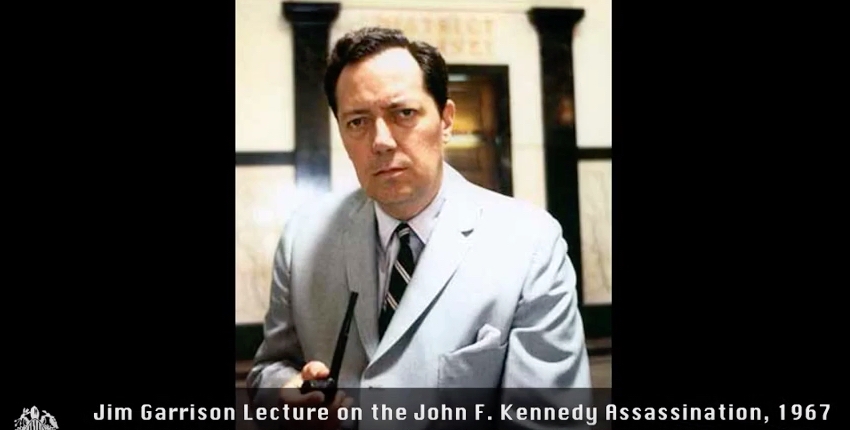
  • Jim Garrison on the JFK Assassination (1967) with better audio

    Jim Garrison on the JFK Assassination (1967) with better audio


    Transcript

    (Click here if your browser is having trouble loading the above.)


    Jim Garrison Lecture on the JFK Assassination (1967)

    Prouty.org, BlackOp Radio and David Giglio
  • Howard Willens and The American Scholar

    Howard Willens and The American Scholar


    How far the Warren Report has fallen in public estimation is an almost humorous subject. When it was first issued in the fall of 1964, the report was met with almost universal acclaim as an historically unquestionable document. All branches of the media – the press, television, periodicals and radio – accepted it with almost no reservations. Perhaps because none of the commentators had read the nearly 15,000 pages of accompanying evidence, which was not published until a month later. To show just how strange this reception was, and how lacking in rigor the media examination was, CBS prepared a two-hour documentary on the Warren Report the day it was published! Clearly, this show was being prepared in advance of the release of the report. In other words, CBS had accepted the Warren Report without reading it. Or, someone in the government passed them a copy before anyone else had it.

    Yet, this mass propaganda deployment did not hold. Within three years, the majority of Americans now doubted the main tenets of the Warren Report. And that figure has never dipped below a majority in the nearly fifty years since. Which is a tribute to both the work of the critical community and the good sense of the American people. Because the members of the Warren Commission have never let up in their attempts to reinculcate the public with their fallacious verdict based upon, at best, incomplete evidence.

    For instance, when Oliver Stone’s film JFK was released, David Belin appeard at the National Press Club to criticize the film. (Click here for that appearance https://www.c-span.org/video/?25215-1/kennedy-assassination-controversy). When the late Dr. Charles Crenshaw, who was in residence at Parkland Hospital in 1963, published his book Conspiracy of Silence suggesting something was awry with the autopsy of President Kennedy, Belin appeared in the pages of the Dallas Morning News to denounce his book. Years earlier, Commission attorneys David Slawson and Wesley Liebeler communicated with the Justice Department to construct a limited medical examination that would hinder Jim Garrison’s investigation in New Orleans. And as Pat Speer has shown, in all probability, before Arlen Specter passed away, he got in contact with New York TImes journalist Phil Shenon to coax him into writing his limited hangout book, A Cruel and Shocking Act. (Click here for our review)

    Wesley Liebeler, Arlen Specter and David Belin have all since passed away. So today, Commission counsel Howard Willens is the most active participant in sustaining the verdict of the Warren Commission into the new millennium. In 2013, he wrote an ill-titled volume called History Will Prove Us Right. The review at this site by Martin Hay was so scathing, Willens actually replied to it on his personal web site. (Click here for Hay’s review http://www.ctka.net/reviews/willens.html, and here for Willens’ reply http://howardwillens.com/jfk_history/conspiracy-communitys-response-book/) Willens’ reply was so weak and unfounded that Martin had little trouble demolishing it also. (Click here http://themysteriesofdealeyplaza.blogspot.com/2014/06/the-watchman-waketh-but-in-vain-howard.html) Apparently, Willens did not learn his lesson. Or he is a glutton for punishment. He has sallied forward again. This time he has joined forces with survivng member Richard Mosk.

    Attorneys Willens’ and Richard Mosk’s latest defense appears in, of all places, The American Scholar. This essay on their work for the Warren Commission they served on is more notable for what they omit from the official record than what they include. “What the critics often forget or ignore,” they write, “is that since 1964, several government agencies have also looked at aspects of our work” (American Scholar, Summer, 2016, p. 59). As if the Church Committee and the House Select Committee on Assassinations (HSCA) had reviewed and applauded the commission’s work. Indeed, they did look at it. But rather than plaudits, they issued stinging rebukes, principally for the commission’s having been rolled by J. Edgar Hoover, and to a lesser extent, by the CIA and the Secret Service.

    “It must be said that the FBI generally exhausted its resources in confirming its case against Oswald as the lone assassin,” the HSCA concluded, “a case that Director J. Edgar Hoover, at least, seemed determined to make within 24 hours of the of the assassination.”1 In essence, the experienced investigators concluded that Hoover had divined the solution to the crime before the investigation began, and then his agents confirmed the boss’s epiphany. The intimidated commission went right along. And with good reason, only part of which Mr. Willens tells.

    He admits that the “FBI had originally opposed the creation of the Warren Commission,” and that Hoover “ordered investigations of commission staff members.” But he doesn’t reveal that Hoover deployed one of his favorite dirty tricks to deal not only with lowly support staffers, such as Mr. Willens, but also with the heralded commissioners themselves. “[D]erogatory information pertaining to both Commission members and staff was brought to Mr. Hoover’s attention,” the Church Committee reported.2 (emphasis added)

    Willens and Mosk also forgot to mention that Hoover had a personal spy on the Warren Commission, then Rep. Gerald Ford, who tattled on Commissioners who were (justifiably) skeptical of the Bureau’s work. “Ford indicated he would keep me thoroughly advised as to the activities of the Commission,” FBI executive Cartha DeLoach wrote in a once secret memo. “He stated this would have to be done on a confidential basis, however he thought it should be done.”3 At the bottom of the memo, Hoover scrawled, “Well handled.”4 The success of Hoover’s machinations was obvious to subsequent government investigators.

    The HSCA’s chief counsel, Notre Dame Law Professor Robert Blakey, an experienced criminal investigator and prosecutor, was impressed with neither the Commission’s vigor nor its independence. “What was significant,” Blakey wrote, “was the ability of the FBI to intimidate the Commission, in light of the Bureau’s predisposition on the questions of Oswald’s guilt and whether there had been a conspiracy. At a January 27 [1964] Commission meeting, there was another dialogue [among Warren Commissioners]:

    “John McCloy: ‘… the time is almost overdue for us to have a better perspective of the FBI investigation than we now have … We are so dependent on them for our facts … .’

    “Commission counsel J. Lee Rankin: ‘Part of our difficulty in regard to it is that they have no problem. They have decided that no one else is involved … .’

    “Senator Richard Russell: ‘They have tried the case and reached a verdict on every aspect.’

    “Senator Hale Boggs: ‘You have put your finger on it.’ (Closed Warren Commission meeting transcipt.)”5

    Testifying before the HSCA, the Commission’s chief counsel J. Lee Rankin shamefully admitted, “Who could protest against what Mr. Hoover did back in those days?”6 Apparently not the President’s commissioners. The HSCA’s Blakey also reported that, “When asked if he was satisfied with the (Commission’s) investigation that led to the (no conspiracy) conclusion, Judge Burt Griffin said he was not.”7 Moreover, author Gus Russo reported that Griffin also admitted that, “We spent virtually no time investigating the possibility of conspiracy. I wish we had.”8

    Thus, despite their clear misgivings, rather than truly investigate, the Commissioners bowed to the notoriously corrupt and imperious Bureau chief. This policy had serious repercussions when the Commission confronted two key issues: published claims that Lee Harvey Oswald had been an FBI informant, and the possibility Jack Ruby had a relationship with organized crime.

    “The Commission did not investigate Hoover or the FBI, and managed to avoid the appearance of doing so,” HSCA investigators determined. “It ended up doing what the members had agreed they could not do: Rely mainly on the FBI’s denial of the allegations (that Oswald had been a Bureau informant).”9 Hoover merely sent the Commission his signed affidavit declaring that Oswald was not an informant, and he also “sent over 10 additional affidavits from each FBI agent who had had contact with Oswald.”10 And with those self-exonerating denials, the case was closed.

    About Jack Ruby: in 1964 the FBI had his phone records, yet failed to spot Ruby’s obvious, and atypical, pattern of calls to known Mafiosi in the weeks leading up to the assassination. After performing the rudimentary task of actually analyzing those calls, the HSCA determined that, if not a sworn member of La Cosa Nostra, Ruby had close links to numerous Mafiosi.11 Thus the HSCA found that the Commission was wrong in concluding that, “the evidence does not establish a significant link between Ruby and organized crime.”12

    The list of Commission shortcomings the HSCA assembled is not short. A brief summary of them runs some 47 pages in the Bantam Books version of the report (pp. 289-336), which outlines what required much of the 500 pages of HSCA volume XI to cover (available on-line).13 “The evidence indicates that facts which may have been relevant to, and would have substantially affected, the Warren Commission’s investigation were not provided by the agencies (FBI and the CIA). Hence, the Warren Commission’s findings may have been formulated without all of the relevant information.”14 The Church Committee said that the problem was that “… the Commission was perceived as an adversary by both Hoover and senior FBI officials.” “Such a relationship,” Committee observed, “was not conducive to the cooperation necessary for a thorough and exhaustive investigation.”15

    But the FBI did more than just withhold evidence from the Commission. Although he mentions that the FBI destroyed a note Oswald wrote to Agent Hosty and withheld that information from the Commission, Mr. Willens doesn’t mention that Agent Hosty reported that his own personnel file, and other FBI files, had been falsified.16 Nor that author Curt Gentry learned from assistant FBI director William Sullivan that there were other JFK documents at the Bureau that had been destroyed.17

    Although too numerous to explore here, American Scholar readers should understand that legitimate questions persist about issues Messrs. Willens and Mosk consider settled. These include the notorious Single Bullet Theory and JFK’s hapless autopsy,18 to name but two. But if the authors cannot even be completely honest with what the HSCA and Church Committee wrote about them, then should one trust them with those two radioactive issues?


    Notes

    1 House Select Committee on Assassinations Final Report, p. 128. On-line at: https://www.maryferrell.org/showDoc.html?docId=800#relPageId=158&tab=page.

    2 In: Final Report of the Select Committee to Study Governmental Operations, Book V, p. 47, on-line at: https://www.maryferrell.org/showDoc.html?docId=1161#relPageId=53&tab=page. Also cited by: Curt Gentry. J. Edgar Hoover – The Man and His Secrets. New York: W. W. Norton & Co., 1991, p. 549.

    3 “Ford Told FBI of Skeptics on Warren Commission”, By Joe Stephens, Washington Post Staff Writer, Friday, August 8, 2008. On-line at: http://www.washingtonpost.com/wp-dyn/content/article/2008/08/07/AR2008080702757_pf.html.

    4 See copy of actual memo at Mary Ferrell: http://www.maryferrell.org/showDoc.html?docId=61488#relPageId=100.

    5 In: R. Blakey and R. Billings. Fatal Hour – The Assassination of President Kennedy by Organized Crime. New York: Berkley Books, 1992, p. 29. This testimony was also published in: Mark North. Act of Treason. New York: Carroll and Graf, 1991, p. 515-516.

    6 House Select Committee on Assassinations, Vol. XI, p. 49, on-line at: http://www.maryferrell.org/showDoc.html?docId=83#relPageId=55&tab=page.

    7 Blakey and R. Billings. Fatal Hour – The Assassination of President Kennedy by Organized Crime. New York: Berkley Books, 1992, p. 94.

    8 Gus Russo. Live by the Sword. Baltimore: Bancroft Press, 1998, p. 374.

    9 HSCA, Vol IX, p. 41. On-line at: http://www.history-matters.com/archive/jfk/hsca/reportvols/vol11/pdf/HSCA_Vol11_WC_2_FBI_CIA.pdf.

    10 HSCA, Vol IX, p. 41. On-line at: http://www.history-matters.com/archive/jfk/hsca/reportvols/vol11/pdf/HSCA_Vol11_WC_2_FBI_CIA.pdf.

    11 See excellent discussion in: House Select Committee on Assassinations Final Report, p. 148-156, on-line at: http://www.maryferrell.org/showDoc.html?docId=800#relPageId=178&tab=page.

    12 Warren Report, p. 801. On-line at: http://www.archives.gov/research/jfk/warren-commission-report/appendix-16.html.

    13 http://www.history-matters.com/archive/contents/hsca/contents_hsca_vol11.htm.

    14 HSCA, Vol. XI, p. 59. On-line at: http://www.history-matters.com/archive/jfk/hsca/reportvols/vol11/pdf/HSCA_Vol11_WC_2_FBI_CIA.pdf.

    15 In: Final Report of the Select Committee to Study Governmental Operations (Church Committee), Book V, p. 47, on-line at: https://www.maryferrell.org/showDoc.html?docId=1161#relPageId=53&tab=page.

    16 James P. Hosty, Jr. Assignment: Oswald. New York: Arcade Publishing, 1996, pp. 178-180, 184-185, 243-244.

    17 Curt Gentry. J. Edgar Hoover – The Man and His Secrets. New York: W. W. Norton & Co., 1991, p. 546, footnote.

    18 The Chairman of the Forensics Panel of the HSCA, former New York Coroner Michael Baden, MD, has written, “Where bungled autopsies are concerned, President Kennedy’s is the exemplar.” See Baden, Michael M., Unnatural Death: Confessions of a Medical Examiner. New York: Ivy Books, published by Ballantine Books, 1989, p. 5. See also, Larry Sturdivan, The JFK Myths, chapter 10, “Bungled Autopsy,” St. Paul, MN: Paragon House, pp. 185-220.

  • Joan Mellen, Faustian Bargains

    Joan Mellen, Faustian Bargains


    In 1998,  the late JFK researcher Jay Harrison had a brainstorm. It was simple in concept.  He would secure a fingerprint impression left unidentified by the Warren Commission from one of the boxes on the sixth floor of the Texas School Book Depository. He would then secure the fingerprints of Malcolm Wallace, the man accused by ex-con Billy Sol Estes of being a hit man for Lyndon Johnson.  Estes had accused Wallace of killing John Kennedy.

    Once Harrison had these two fingerprint samples, he would then enlist a fingerprint analyst to examine them.  If it was Wallace’s print on the box, then one could safely assume that he was on the sixth floor either during, or immediately after, the Kennedy assassination.  This would indicate that somehow Johnson was involved with the JFK hit; or else why would Wallace be there?

    As many have noted, it was really Estes who had drawn the crime in this manner, i.e., with Johnson as the prime mover and Malcolm Wallace as the assassin, or chief of the hit team. He had done the first part—LBJ as the prime force behind the JFK hit—in an aside to a man named Clint Peoples, a Texas lawman who had escorted him off to jail.  (Joan Mellen, Faustian Bargains, p. 230) The second part—Wallace as assassin—was done years later, when Estes got out of jail and testified before a grand jury.  That grand jury had been called to reopen the 1961 murder of another Texas law man, Henry Marshall.  Marshall was investigating some of Billy Sol’s crimes in Texas.  Right before the case was about to explode, Marshall was murdered by rifle fire.  He had been shot multiple times.  Incredibly, the local sheriff ruled the death a suicide.  In 1984, Estes got out of prison, after his second stay there.  He appeared before the Marshall grand jury.  He implicated Malcolm Wallace as the killer of Henry Marshall. Wallace had done this at the behest of Vice President Lyndon Johnson. For whom he had also killed President Kennedy.

    If Harrison’s concept turned out to be true, then it would give new credibility to the accusations of Billy Sol Estes, who many observers had severe doubts about. Estes had promised things like tape recordings and phone records to bolster his case, but he had never produced these exhibits, even when he was asked for them by Stephen Trott of the Justice Department. 

    Harrison enlisted two fingerprint analysts to confirm or deny that the prints matched.  One was Nathan Darby; the other was Harold Hoffmeister.  Darby went first.  After examining the prints he decided they matched at 14 points of identification.  Which would be good enough for a criminal legal action.  Hoffmeister then said he agreed.  But a day later, he recanted.  He said that after doing a re-examination, he felt that since both men worked with photocopies, the identification points were not adduced in a reliable manner.  (Mellen, Faustian Bargains,  p. 256)  As we shall see, Hoffmeister’s complaint was a legitimate one. But Harrison felt that he had recanted out of fear, since he had now found out who the print examination involved.

    So Harrison went ahead.  A press conference was called.  Darby’s work was submitted to the homicide division of the Dallas Police Department and to the FBI. (ibid)  The Bureau ended up disagreeing with Darby, but they did not submit any specific critique of his work. Harrison and his coterie therefore continued along in their mini campaign about Johnson and Wallace killing Kennedy.

    And it caught on.  In fact, it caught fire in 2003 for the fortieth anniversary of the Kennedy assassination.  In that year, a man named Barr McClellan wrote a book—this reviewer would call it a novel—about the same topic. Blood, Money and Power said Johnson had organized the JFK assassination and Malcolm Wallace was the chief of the hit team.  McClellan claimed inside knowledge from his work for a law firm that handled some of Johnson’s affairs in Texas.  McClellan’s book sold well, and it featured an appendix with the alleged Harrison/Darby fingerprint match.  In fact, Harrison had helped McClellan on his book—although, to be fair to Jay, he did not at all approve of the final draft of the volume.  (ibid, p. 265)

    During the fortieth anniversary media extravaganza, McClellan got more television and radio time than any other conspiracy advocate.  This was topped off by the ever-gullible documentary producer Nigel Turner. The laughably uncritical Turner made McClellan the main talking head on his pretentiously entitled program The Guilty Men. Needless to say, the Austin conspiracy demagogue Alex Jones also bought into McClellan.

    But that was not all. The Harrison/Darby cooperation now seemed to spawn a bevy of books that, retroactively, endorsed the Billy Sol Estes paradigm of Johnson/Wallace. Among others, these included later editions of The Men on the Sixth Floor by Glenn Sample and Mark Collom, LBJ: Mastermind of JFK’s Assassination by Philip Nelson,  and Roger Stone’s The Man Who Killed Kennedy: The Case Against LBJ. These books all endorsed, to various degrees, the Harrison/Darby print analysis.

    But  the longer the parade marched on, the odder a certain aspect of this acceptance began to appear. First, no one had done an independent analysis of the print match.  After all, Hoffmeister had recanted based upon the quality of the materials he and Darby had to work with.  Apparently this did not mean much to the leaping exegetes ready to board the ”LBJ did it” train.  Second, no one worked on a real biography of Malcolm Wallace.  Was he known as a professional killer?  Did he have a close association with the people Estes said he did:  like LBJ’s factotum in Texas Cliff Carter, Estes himself, and Johnson? Was he politically committed to everything JFK was against?  If not, was there any way to see if he had monetarily profited from all the murders that Estes said he had performed for LBJ? And perhaps the most important evidentiary point of all: Was there any evidence that Wallace was elsewhere on the days that both Marshall and Kennedy were murdered?

    Incredibly, no one seriously posed these questions for well over a decade.  Innocent outsiders who listened to the LBJ cacophony were, understandably, impressed:  with all that noise emanating from so many bongo drums, there had to be a real signal in there somewhere; it couldn’t all be much ado about nothing. Could it?

    II

    This reviewer, among several others, always had some reservations about the Harrison/Darby identification. One being: Why would Johnson use someone who was—however tenuously—associated with him in the assassination? Another was:  If Johnson and Wallace decided to go ahead and kill Kennedy anyway, would not a professional hit man use gloves to make sure he left no fingerprints behind?

    Joan Mellen decided to take the issue the proverbial whole nine yards.  In 2013 I heard her speaking about the subject of the LBJ/Wallace nexus at the Cyril Wecht conference in Pittsburgh.  To her, there was something suspicious about the entire enterprise.  Why had so many people mindlessly enlisted in the ranks without asking any of the skeptical questions mentioned above, or making any serious attempt to cross check the Harrison/Darby work?  Since it appeared no one else was going to do it, she did.

    The result of her years of work is a book called Faustian Bargains: Lyndon Johnson and Mac Wallace in the Robber Baron Culture of Texas. The book has several notable achievements. First, the portrait of Lyndon Johnson she draws is, quite simply, indelible.  It is so unremitting that, by the end of the book, it had me saying to myself: enough already. For, as I will explain, I think she might have overdone it.  Secondly, for the first time, we actually get a biography of Malcolm Wallace.  He is not a cipher anymore.  Third, in the supporting cast, we get a full look at the character of wheeler-dealer Billy Sol Estes—and to a lesser extent Bobby Baker.  And finally, Mellen has enlisted a professional reassessment of the Harrison/Darby fingerprint identification.  It is unfortunate that it took nearly 20 years for this to occur.  But that says something about the JFK critical field, does it not?

    This reviewer has read several biographies of Lyndon Johnson.  But few, if any, go as far in their indictment of his character and crimes as Mellen does.  Mellen begins at a familiar point: Johnson going to Washington in 1931 as secretary to congressman Dick Kleberg. (Mellen, p. 5) Kleberg was part of the King Ranch clan, so Johnson was not exactly siding with the little guy during the Great Depression.  But once Franklin Roosevelt was inaugurated, Johnson enlisted in the ranks of the New Deal.  And he insisted that Kleberg vote for the New Deal programs he was personally  against.

    In 1935, Johnson left Kleberg’s office to take a position he had been offered in Roosevelt’s National Youth Administration. (ibid, p. 6)  Then in 1937, Johnson ran for Congress in an open seat election.  He won and maneuvered to be appointed to the House Naval Affairs Committee. It is at this point that the young Johnson began his close association with the infamous construction company Brown and Root.

    Founded in Texas in 1919 by Herman Brown and Daniel Root, when the latter died, it came under the control of the Brown brothers, Herman and George.  Once Johnson was in Congress, he began a quid pro quo program with the brothers.  He would steer lucrative federal contracts their way, and benefit in turn from large cash contributions made to his political campaigns.  By the end of World War II, Brown and Root had done over 300 million dollars worth of work for the Navy. (p. 9)  In return, the brothers contributed over 100,000 dollars to Johnson’s 1941 Senate campaign, which he narrowly lost, even though he spent $750, 000 total, the equivalent of over $12 million today. And the population of the state at that time was slightly more than six million.

    In 1941, Johnson purchased KTBC radio in Austin for seventeen thousand dollars, or well over a quarter of a million today. (Mellen, pp. 11-12) This was done in his wife Lady Bird’s name, and allegedly with her money.  But Mellen unearthed a long buried report by Life magazine reporter Holland McCombs. His work was done during the Johnson/Goldwater campaign of 1964.  McCombs went to Texas and did some on-the-ground sleuthing.  According to his reports, Lady Bird did not have that kind of money back then either.  The implication being that the Brown brothers facilitated the purchase as a payoff to their man LBJ. After an appeal to the FCC, the station was allowed to raise its wattage, alter its frequency, and broadcast 24 hours.  This greatly increased its profit margins and it later became a CBS affiliate.  That purchase was the beginning of the Johnson media kingdom.

    This is all a prelude to the infamous Senate election of 1948, one which Johnson and his backers were determined not to lose.  Johnson had previously helped George Parr, a Texas political chief from the southern end of the state, gain a pardon on a tax evasion charge. (ibid, p. 47)  He also helped Parr gain revenge on Dick Kleberg who had resisted the pardon. LBJ recruited a candidate to run against Kleberg, and Johnson’s candidate won.  Along with his continued illicit favors for Brown and Root, this put him in a good position for the 1948  senatorial race.  When it was all over, Herman Brown had invested a half million to get Johnson elected to the Senate. (ibid, p. 53)

    The problem was that his opponent, Governor Coke Stevenson, was quite formidable.  Stevenson had been a long term Speaker of the Texas Assembly, then Lt. Governor, and then a two-term governor. In fact, Parr had helped Stevenson in previous elections steal hundreds, if not thousands, of votes in his tri-county area. (ibid, p. 51) But Parr was quite appreciative to LBJ about his pardon.  He agreed to do all he could to help him win this election. (ibid, p. 50)  Did he ever.

    A lot was at stake.  Whoever won the Democratic primary was pretty much guaranteed to win the seat in Washington since, at that time, the Republican party was pretty weak in Texas.  When the first tallies came in, Stevenson was winning by about 20,000 votes.  But when San Antonio came in, Stevenson’ s lead was cut in half.  And as the Parr-controlled counties in the south came in, Stevenson’s lead was eroded further.  As Mellen notes, Duval County, under Parr control, cast well over four thousand votes. Surprisingly, only forty were for Stevenson.  (p. 51)  LBJ went on the radio and declared himself the victor, even though, officially, Stevenson was still in the lead by over a hundred votes.

    Then came Precinct 13 in Jim Wells County, also under Parr control.  Officially only six hundred votes were cast.  Yet in the first tally, Johnson got over seven hundred votes.  Later, in an amended tally, Johnson got over nine hundred votes, wiping out Stevenson who got less than a hundred. (Mellen, p. 51)  Johnson won the state primary by 87 votes.

    It turned out, of course, that Parr had stacked the vote with people who had not voted.  Stevenson tried to fight back. But at a later meeting of the executive committee of the Democratic Party, he narrowly—by one vote—lost a motion to file an official protest. A federal district judge then ordered Johnson’s name off the ballot pending an inquiry.  But Johnson’s legal crony, Abe Fortas, got Hugo Black of the Supreme Court to void the order.  (ibid, p. 55)

    In the general election, Johnson crushed his GOP opponent by a margin of 2-1.  In rather short order, LBJ rose to become one of the most powerful Senate majority leaders in history. It was from that position that he became a player on the national political stage.

    III

    Malcolm Everett Wallace was born in 1921 in Mt. Pleasant, Texas.  He had five siblings.  The family moved to Dallas in 1924.  Wallace was  a participant in many extracurricular activities in high school.  He was the vice-president of his class and played quarterback on the football team. (ibid, p. 15)

    In 1939, he joined the Marines.  But he was forced to leave after ten months due to a serious back injury. (p. 17)  When he tried to reenlist, he was turned down.  He ended up at the University of Texas in 1941.  To say he was active in college life does not do him justice. Among a few other groups, he joined the debate club and worked on the yearbook.  He also was a member of the student assembly.  (p. 18)

    It was in Austin where he met his first, and most long lasting, romantic interest.  Her name was Nora Ann Carroll.  They exchanged Christmas gifts and letters.  He even wrote her poems.  This was the beginning of a relationship that would last, on and off, for about twenty years. (p. 23)

    Wallace ended up being president of his class at Texas.  He seems to have been quite liberal in his orientation.  He wanted the voting age lowered to 18—many years before the Vietnam War.  And he was all for using the power of the government to economically ease the lives of those in poverty.  He was also friendly with Black Americans.  (On his mother’s side, Wallace was one fourth Cherokee Indian.)

    Wallace was a strong president.  He insisted on meeting with the university administrators about matters that concerned him and his constituents. (p. 26)  And he was also interested in liberal candidates in national politics.  For instance, he was quite agitated when Henry Wallace was dropped from the Democratic national ticket in 1944. But Malcolm voted for him in 1948 for president. (p. 76)

    The problem Wallace had at Texas was that the controlling board of the university , the regents, was McCarthyite before the rise of Senator Joe McCarthy. They asked the university president, Homer Rainey, to remove three economics professors because they were too pro-labor.  Rainey refused.  They were removed anyway. (See pp. 29-30)  Rainey wanted to start a school of social work. This was turned down.  After two more confrontations, Rainey was asked to resign.  Rainey refused. Both the faculty and class president Malcolm Wallace backed him.  Wallace hitchhiked to Houston to appear before the Board of Regents.  He spoke for 45 minutes. Rainey was removed anyway.  Wallace then organized a mass demonstration. He led a march of 4000 students to the state capitol building.  Governor Stevenson met with him while the crowd waited outside. (p. 33)  But the regents refused to meet with him. Wallace then led an even larger demonstration, this time with 8,000 students—which was over 90% of the student body.  This failed also.  So Wallace grabbed the microphone at halftime of a Texas/SMU football game to promote his cause.

    Wallace’s extraordinary efforts in the Rainey case actually got him some national exposure in the Chicago Sun. (p. 38) It also earned him an FBI investigation.  But it was all for naught.  Rainey did not return.

    Wallace temporarily left Texas after the Rainey affair.  He went to New York City and attended Columbia and the New School for Social Research.  He earned a degree in economics from the latter.  (Mellen, p. 71)  Wallace returned to Texas to work in Rainey’s unsuccessful bid for governor.  In 1947, Wallace gained a second degree from UT in business.  That same year, Wallace married a woman named Mary Andre Dubose Barton.  (Who will be called Andre from here on.)  Nora had warned him against marrying.  She felt he had done so simply because she had married someone else.  (ibid, p. 74)  Nora turned out to be right.  To say the least, Andre caused Malcolm Wallace a lot of problems.

    It turned out that Andre had an alcohol problem, and was bisexual. When Wallace went to Columbia to pursue an instructor’s position, Andre was rumored to have had a lesbian affair.  So he returned to Texas and the couple had a child, named Michael.  This was unfortunate for Malcolm Wallace since, by all reports, he was quite a good instructor.  (p. 75)

    In 1948, Wallace met Cliff Carter.  In return for working in Johnson’s campaign, Carter got him a job in the Agriculture Department.  Wallace moved to Arlington, Virginia where his wife joined him.  Wallace published three academic papers in the early fifties. Andre decided to return to Austin.  It was at this time that she took up with a former actor and nine hole golf course owner named John Kinser.  (p. 87)

    Wallace returned to Texas and heard about the Kinser/Andre association.  This was further complicated by both men’s relationship with Josefa Johnson, the sister of Senator Johnson.  Wallace had been invited to a gathering at the Johnson residence while he lived in Arlington.  He briefly met the Johnsons—and presumably Josefa—but he always told his children and friends that he actually talked more with Lady Bird than he did with the senator. (See p. 237)

    Horace Busby, a Johnson lackey, told several writers that Wallace had some kind of dalliance with Josefa.  But as Mellen points out, Busby seems to have had it in for Wallace.  During the FBI inquiry for his Agriculture Department job, Busby was the only source that gave him a negative evaluation. (p. 77)  Kinser, a playboy type, was indeed having some kind of an affair with Josefa.  He was trying to charm her so he could get a government loan to expand his golf course.  (p. 83) 

    Wallace felt that Kinser had ruined his wife’s chances for her recovery from her alcohol problem. On October 22, 1951 he went to Kinser’s golf course and shot him.  Witnesses identified his license plate and he was pulled over. The paraffin test determined he had fired a gun. (p. 88)  Nora’s brother, Bill Carroll, recruited one Polk Shelton to defend her sister’s former boyfriend.  Shelton brought in his friend and colleague John Cofer. (p. 96) 

    One of the most interesting parts of the book is Mellen’s explication of how Malcolm Wallace ended up walking away from the resultant murder charge. It was not through any court room pyrotechnics by Johnson’s pal Cofer.  It was through the maneuvering of Shelton with a jury ringer by the name of Deckerd Johnson. To start the trial, Cofer moved for a dismissal on technical and procedural grounds.   This was declined by the judge.  But then Shelton moved for a suspended sentence based on the fact that Wallace had no prior criminal record.  This was also declined, but it was in the record.  (p. 99)

    Johnson was from a small Texas town which contained a few of Mac Wallace’s relatives.   During jury selection, Wallace phoned his uncle who lived in that town.  The uncle called a man named Gus Lanier.  Lanier was an attorney who also was Johnson’s first cousin.   Lanier then went down to the court and sat at the defense table for a few days. He made sure that Johnson saw him shaking hands with Wallace. (ibid)  Johnson did well for his friends and relatives.  He told his fellow jurors that if it was not a unanimous verdict, Wallace would not be retried.  As jury foreman this carried some weight. But it was a false statement that the jurors mistakenly believed. With the first part of his secret agenda achieved, Johnson now went along with the guilty verdict phase of determinations.  But then Johnson, in agreement with Polk Shelton, demanded a suspended sentence.  The others disagreed and wished to send Wallace to prison for a 10-20 year term.  But Johnson threatened them by saying if they did not come back with the suspended sentence, he would change his previous vote, letting Wallace walk without a guilty verdict or any sentence at all.  Johnson’s maneuverings worked.  And this is why the Kinser jury did what it did.  (pp. 103-04)

    IV

    When Lyndon Johnson got to the Senate he continued his old vices.  He developed a close working relationship with the secretary  to the majority leader, Bobby Baker.  Baker was, by his own admission, a professional wheeler-dealer. He had no problem manipulating votes in the Senate for future payoffs, outright bribes, and using his position to advance his private business interests.  Baker and Johnson were close for several years.  But when Baker’s illicit activities caught up with him, Johnson denied any such relationship.

    Baker’s career began its collapse with a lawsuit by one Ralph Hill.  Hill was a business partner of Baker in a vending machine enterprise. Baker demanded high kickbacks with the promise of future defense contracts. When the contracts did not appear, Hill threatened to file a lawsuit.  Baker then made some ominous remarks about Hill’s future health.  In the fall of 1963, Hill filed the action anyway.  (p. 158) This opened up the flood gates.  Shortly thereafter, in early November, Life magazine published a cover story exploring Baker’s activities.  This led Don Reynolds, an insurance salesman, to come forward.  He said that through Baker, he sold LBJ and his wife two large insurance policies.  But then Johnson had requested a gift of an expensive stereo system as a reward for the sale.  This now brought Johnson into the Baker scandals.  (p. 161)  But, by this time, Baker had already stepped down from his position.  This took some steam out of the Senate inquiry, which was not really zealous to begin with, since many senators were associated with Baker’s rackets.

    Then there was Billy Sol Estes.  Estes was a large contributor to Johnson’s Texas campaigns and the 1960 Kennedy/Johnson ticket.  To say that Estes was a con man and fraudster does not really describe the nature and scope of the man’s swindles.  He first specialized in cotton allotments.  He convinced farmers who had their land taken away by eminent domain to purchase land for cotton from him.  He would then lease it back.  Once, a year later, when the first payment was due, by pre-arrangement, the farmer would default.  In other words, Estes had purchased the allotment through lease fees.  But since the transaction was not a genuine sale, the deal was illegal.  He took the money from this fraud to build another fraud. This was in the anhydrous ammonia business—fertilizer.  He sold mortgages on nonexistent fertilizer tanks by convincing farmers to buy them sight unseen. He would then lease them from the buyer for the same amount as the mortgage payment.  He used these phony mortgages to get large bank loans.  The aim was to corner the anhydrous ammonia business.  As many have said, approximately 80% of the fertilizer warehouses were empty.

    The problem with the schemes was that, in his attempt to corner the fertilizer market, Estes was underselling the product so low that he was losing millions in the process.  Not even his cotton allotment scam could bail him out.  (Mellen, p. 140)  The lending companies grew suspicious. They began to suspect the fertilizer warehouses were non-existent.  On top of that, in 1961, even though he said he was worth millions, Estes had paid no income tax in four years. (ibid, p. 141)  As with Baker, an unhappy business partner, Harold Orr, was the first to expose Estes.  He declared that there was no fertilizer in those warehouses.

    A local agriculture official, Henry Marshall, also grew suspicious of Estes’s scams, especially the cotton allotment swindles.  He theorized that Estes was paying farmers a pittance for cotton allotments he could then use to grow abundant amounts of cotton. Which tripled the value of the land. He had been persuaded by Cliff Carter to go along with over a hundred of these deals.  But he now announced that he would not do it again, unless both the buyer and seller appeared before him with all the papers in place.  (p. 141)  Estes had bribed other Agriculture officials. But Marshall was determined. Appreciating Estes’ campaign contributions, Carter and Johnson tried to influence Marshall with a promotion. It did not take.  In early June of 1961, Marshall arranged a meeting with Attorney General Robert Kennedy on June 5, 1961.  He would present his evidence, and Kennedy would now indict Estes and end his scams. (p. 143)  The meeting never took place as Marshall was murdered on Saturday June 3rd.  Although there were indications of attempted carbon monoxide poisoning, the victim died of six gunshot wounds from his own bolt action rifle. The local sheriff, Howard Stegall, proclaimed the case a suicide.  Even more surprising, he got the local coroner to go along with it.

    But the stench was too strong.  Estes was ready to fall anyway. In 1962, a local biweekly newspaper, the Pecos Independent, now began a series of reports on Estes. These exposed both the cotton allotment and fertilizer scandals.  Johnson was upset since he understood that Bobby Kennedy could use this and the Baker scandal to have his brother remove him from the ticket in 1964. (p.  147)  LBJ had J. Edgar Hoover intervene to have the author of the articles removed from the story.  But the owner of the newspaper persisted in his efforts.  He forwarded this information about the fertilizer scam to the FBI through the Justice Department.  Bobby Kennedy now descended on Estes with 75 agents, including 16 auditors and IRS agents.  It was the beginning of the end for Billy Sol. (ibid)

    Estes was convicted in both state and federal courts. He exhausted his appeals in 1965. He then went to prison and was paroled in 1971.  In  1979, he was convicted of tax fraud and went to prison for four more years.  As many authors have noted, including Mellen, Estes always blamed Johnson for his legal problems.  He somehow expected LBJ to help save him, though it is difficult to see how that could have happened after the newspaper series was published and then sent to Washington. To put it mildly, Johnson had very little, if any, influence with Bobby Kennedy.  Once the publisher sent the article to Washington, Estes was doomed—and LBJ could not save him.  Yet, irrationally, Estes seemed to think that he could.  He became obsessed with this idea, and as Mellen shows in an interview, Estes became quite embittered toward Johnson.  It was a bitterness that never left him. (See pp. 242-43)

    V

    And this is how the lives of Mac Wallace and Estes intersected—posthumously.   After the Kinser trial, Wallace sued for divorce from Andre, specifically citing her alcoholism.  (p. 107)  The judge must have believed him since he got custody of the two children, Michael and Meredithe.  He then went to work as a personnel manager in 1952 for Jonco Aircraft in Shawnee, Oklahoma. Evidently, Wallace did not want his kids to grow up without a mother. He and Andre remarried and lived together in Oklahoma.

    Two years later, the family moved back to Texas and Wallace went to work for another defense plant called TEMCO.  This company was founded by D. H Byrd, a longtime friend and backer of Johnson. Mellen notes that there is no direct evidence that Johnson intervened to get Wallace his position there.  But there is circumstantial evidence, since Johnson appears to have secured his secretary’s father a job with TEMCO.

    In 1960, Andre filed for divorce again.  This time, she accused her husband of molesting their daughter. (p. 132 . ONI, which did Wallace’s security clearances, never bought into this; see p. 171)  Wallace now decided to leave TEMCO and Texas for a job in California with an acquisition of TEMCO called Ling Electronics.  He left his two children with Andre and moved to Orange County.

    Wallace spent most of the rest of his life in California working as a control supervisor for Ling.  He married a young woman named Virginia  Ledgerwood.  (p. 169).

    Later on, ONI lowered his clearance from SECRET to CONFIDENTIAL.  This may have been due to a DUI charge Wallace had gotten. It resulted in a demotion at work. Wallace reacted poorly to this.  He got depressed and began drinking even more.  In 1969 he and Virginia divorced and sold their house.  (p. 218)  He used the money to take out insurance policies on his three children—he had a third child with Virginia.  He decided to return to Texas.

    Wallace was dealing with severe health problems at this time. On the ride back to Texas, he passed out in a diabetic coma and sustained a concussion.  A hitchhiker he picked up saved him from even worse injuries. (p. 219)  Because of this, Wallace made out a will in April of 1970.  In the last months of his life, he taught part-time at Texas A&M, and worked part-time at his brother’s insurance office.

    On the evening of January 7, 1971 Wallace died in a single car accident.  He had driven off the road and into a concrete bridge abutment. The policeman who wrote out the accident report felt that Wallace was dead at the scene.  And, in fact, he was pronounced DOA at the hospital. (p. 221) Jay Harrison  questioned whether or not Wallace died that night. But Mellen documents the fact that several of his family members saw the body at the funeral parlor in an open casket.  It was Malcolm Wallace.  To further this idea, Harrison had also stated that Wallace visited his first wife in 1980. Also not true. This was their son Michael, who resembled his father.  (p. 251)

    VI

    In 1979, as he was being carted off to prison the second time, Billy Sol Estes began to carve out the foundation for the LBJ/Wallace murder of Henry Marshall construct.  Estes told his escort, former Texas Ranger Clint Peoples, that Marshall had not killed himself.  The authorities  should be looking in another direction. Peoples assumed this to mean Washington DC.  When Estes got out of jail, he appeared before a grand jury called on the Marshall murder.  Estes would now be represented by attorney Douglas Caddy.  Caddy had been trying to get Estes’s story out even while he was in prison—through the auspices of Galveston rightwing millionaire Shearn Moody. (p. 232)  Estes now told Peoples that Mac Wallace killed Henry Marshall.   Peoples contacted  John Paschall, DA of Roberson County, where Marshall had been killed.  Peoples convinced Paschall to reopen the Marshall case by calling a grand jury.

    On March 20, 1984, over 20 years after Marshall’s murder, Estes testified that Johnson had ordered the murder of Henry Marshall at a meeting in Washington with Carter, Estes and Wallace.  Caddy then brought these charges to the attention of the Justice Department.  But later, in addition to Marshall, Estes and Caddy now listed eight other people who had been killed by Wallace at the behest of LBJ.  This included Josefa Johnson, Kinser, and John Kennedy.  Like Joe McCarthy and communists in the State Department, the Caddy/Estes number was later raised up to 17.  (Ibid, p. 236)

    Just on the material we have gone over already, let us raise some questions about the Estes’ allegations about Marshall, and JFK.

    1. Why would Estes be so angry with Johnson if LBJ had ordered the death of Marshall? How much more could LBJ do than kill someone for Estes?
    2. There is no evidence that Wallace was a sharpshooter.  So why would Johnson and Carter use him to kill JFK?
    3. If Wallace pulled off all of these murders, why did he die with such a tiny estate?  Did Wallace commit all these killings, repeatedly putting his life and family at risk, for nothing?
    4. If these were not performed for money, then what was the political angle?  Wallace was more liberal than Johnson.

    But Mellen goes beyond these points. For instance, she establishes a solid alibi for Wallace for the dates on and about the murder of Marshall.  Marshall was killed on Saturday June 3, 1961.  On that Friday, Wallace had filled out and signed a security clearance form at work. On that weekend, his brother had brought both his children, and Wallace’s son Michael, out to see Malcolm.  The party arrived Friday evening.  That weekend they went to the beach and then Disneyland. (pp. 235-36)  There are two other points to be made in this regard.  The inquiry into Henry Marshall’s death concluded that he was killed somewhere in the middle of his farm, meaning that the person or persons who killed him knew how to get to him after they came in the gate.  There is no evidence that Wallace knew Marshall. (ibid) Finally, when Estes began to broadcast his story, he described the scene where Johnson and his co-conspirators had made the decision to kill Marshall.  Unfortunately, Johnson had not moved into that home, called The Elms, at that time. (ibid)

    Concerning the death of Josefa Johnson, she was married to a man named James Moss at the time of her death in 1961.  The evening before, she had been at a Christmas Eve gathering at Johnson’s ranch.  The only other guests were John and Nellie Connally.  The cause of death was first announced as a heart attack, but was changed to a cerebral hemorrhage, or stroke. (pp. 144-45)  Again, Wallace was living in California at the time.  And further, are we to assume that he took a quickie course in inducing cerebral hemorrhages and making them look like natural deaths?

    As per the assassination of John F. Kennedy, again Wallace was in California at the time, working for Ling Electronics.  And in 1963, his son Michael had moved in with him.  Michael recalls his father being home for dinner and trying to console him about Kennedy’s murder, which occurred in his home state of Texas. (p. 257)

    Then there is Billy Sol’s and Caddy’s relationship with the Justice Department.  Caddy tried to get an interview with Stephen Trott, a prosecutor in the Justice Department, after Estes had testified before the grand jury in 1984. (p. 238)  According to Caddy, Estes now said that Wallace recruited Jack Ruby, and Ruby then recruited Oswald.  During the actual assassination, Wallace was on the grassy knoll.  Recall, even though the list kept on growing, Estes and Caddy could produce no real evidence for any of the killings.  And Caddy had never seemed to seek out what the exculpatory evidence was.  As New York City prosecutor Bob Tanenbaum said to this author, as a DA, this is something you always allow for since you do not want to be blindsided at trial.

    Taking all this into account, its remarkable what Estes and Caddy wanted in return for a deposition.  Estes demanded a pardon for his past crimes, immunity from prosecution, relief from his parole restrictions, and his tax liens removed. (p. 240)  Very sensibly, Trott countered that he would agree to immunity if Estes would forward any evidence he had in advance, name his sources, and agree to a polygraph.  Trott actually sent three FBI agents to Texas for a preliminary interview.  When Estes saw them arrive in the lobby of the hotel, he walked out. (ibid)

    But there was the Darby/Harrison fingerprint, which both men swore by, but which no one had ever cross checked.  Mellen got a copy of Harrison’s fingerprint file from author Walt Brown, who maintained Harrison’s collection.  She then got Wallace’s Navy prints from the days he was in the Marines. She secured the services of one Robert Garrett as her analyst.  She approached Garrett in the summer of 2013. He had been the supervisor of the Middlesex County prosecutor’s office crime scene unit.  He had been trained in fingerprint analysis by the FBI headquarters in Washington and then at their lab in Quantico, Virginia.  In 2013 he was in charge of the certification programs for the International Association for Identification (IAI), which still certifies fingerprint examiners and is the one accrediting agency. (p. 258)

    An important matter that Garrett discovered was that neither Darby nor Hoffmeister was accredited by the IAI at the time they did their work for Jay Harrison in 1998.  One must renew one’s license every five years.  This is done by taking education credits, continued work experience, and by passing a test.  According to Garrett, who had been in charge of the IAI certification programs, Darby’s certification had expired in 1984, fourteen years before Harrison recruited him.  Hoffmeister’s expired in 1996.  (p. 261) Why Harrison did not check on this issue in advance is extremely puzzling, especially since Harrison had been a policeman for a number of years, and had to have known what the IAI was, and how its trademark—or lack of—impacted the credibility of the work done by Darby and Hoffmeister.

    Another problem that Garrett had with the Harrison/Darby file was the same issue that Hoffmeister raised: the quality of the reproductions that Darby had worked with.  Garrett actually told Mellen that he would not have proceeded if this is what he had had to base his judgment on. (p. 258)  First, the quality of the copy of the unidentified box print from the Warren Commission was simply inferior, to the point that it was unreliable.  So Mellen got an actual first generation photograph of this print from the National Archives. And in her book she shows the difference between the two, which is quite considerable. (See the last photo in photo section.)

    But further, Garrett did not want to utilize the Wallace print from the Kinser case, which Harrison had secured from the Texas authorities. These had been smudged since “the roller used to make the inked print had not been thoroughly cleaned off after its use with the previous subject.” (p. 259)  So Mellen attained Wallace’s Navy fingerprints.

    Using high technology, including a 256 shade gray scale that Darby did not have, Garrett now went to work.  He concluded that the unidentified box print was not a match with the Wallace print.  First he noted eight points of discrepancy between the two—that is, specific mismatches.  And he described these in detail. (p. 259)  Beyond that, he brought up problems with all fourteen of the alleged matches that Darby had made.  Some of these were due to the poor copies he had to work with.  But also part of it was the black and white methodology employed.  Garrett indicated where the “plotting” was off due to incorrect alignments. (p. 260) Garrett therefore concluded that there was no doubt that the unidentified Warren Commission box print did not belong to Wallace.

    It’s discouraging that we had to wait 15 years to correct this historic misjudgment.  Meanwhile, people like Roger Stone, Barr McClellan, Philip Nelson and Nigel Turner used this evidence in their books and films.  But due to the better original quality, the higher technology, and Garrett’s certification, the Darby/Harrison identification must stand corrected.

    The remarkable part of Mellen’s book is this: I have not touched on everything yet.  I have rarely read a book of less than three hundred pages that contains so much interesting content.  The last instance I can recall is with Larry Hancock’s Nexus back in 2011. Most of what I have left out deals with other aspects of Johnson’s career and life.  But I should add, as others have pointed out, what Johnson did in Texas in 1948 was not at all unprecedented.  As some have argued, Johnson and Parr stole the 1948 election because LBJ felt he had his previous run for Senate stolen from him.  And, as mentioned, Parr had stolen votes for Coke Stevenson’s races. Further, as she notes, Billy Sol Estes was also backed by the liberal Senator Ralph Yarborough.  And finally, although she notes instances of Johnson using the word “nigger”, this was all too common in the South at the time Johnson was growing up. It should not impact Johnson’s work on the issue of civil rights, which, in my opinion, he deserves credit for.  But on the plus side, the book includes a quite informative chapter on the USS Liberty and Johnson’s part in that horrific tragedy.

    To this reviewer Faustian Bargains seems to me a unique, almost singular book in the field.  And although I have noted some reservations about parts of the volume, most of it seems exceptional to me, and I would recommend the book to the reader.


    Addendum:  Note from the Author

    Joan Mellen informs us that she attained Wallace’s Navy fingerprints through his NARA military file, not through the Navy.

  • Mort Sahl 1970 Interview

    Mort Sahl 1970 Interview

    David Giglio is a contributor to CTKA. He publishes regularly at Our Hidden History.


    From the period of about 1960-66,  Mort Sahl was one of the highest profile, in demand, and highest compensated comedians in America. In fact, in its issue of August 15, 1960, Time Magazine placed him on its cover.  He was a regular on such programs as the “Ed Sullivan Show” and “The Tonight Show”.  Sahl, more or less, redefined what stand up comedy would be from then on.  And men like George Carlin essentially followed in his footsteps.  Sahl’s brand of humor was both socially and politically conscious.  Although he would come on stage with a college sweater and the daily newspaper, he was far from the average man.  He was quite well informed and acute, and his satire came from a deep affection for America and what it was supposed to be about.

    Sahl was one of the very few Americans who actually knew and communicated with John and Robert Kennedy.  Kennedy appreciated Sahl’s humorous deprecations of him as a spoiled rich kid.  Although JFK once had the following conversation with Sahl on the subject: “OK, so how much do you think my father is worth Mort?”  Sahl replied, “I don’t know, maybe 300 million?”  Kennedy replied, “Alright.  Now how much do you think the Rockefellers are worth?” Sahl said he had no idea.  Kennedy responded with, “Try four billion Mort.” Kennedy paused to let the number sink in. He then jabbed his finger at the comedian and added: “Now, that’s money Mort.”

    Sahl was quite interested in Kennedy’s assassination.  Something did not sit right with him about the Warren Report.  He actually read long parts of it and the volumes of evidence that accompanied it.  He thought much of it was ludicrous. He actually used to quote from it in his stand up performances.  He would read parts of its most pointless and stupid depositions in a dead pan comic style, letting the ridiculousness hit home. He would then say, “And that’s how they found out who killed John Kennedy.”

    When the Jim Garrison investigation broke into the newspapers in 1967, Sahl had a talk show on the radio in Los Angeles.  Naturally, he was quite interested in what the New Orleans DA was discovering.  He actually journeyed to the Crescent City to talk to Garrison.  He was impressed with the man and wanted to have him on his show.  But station management insisted that if he did that, he would have to perform an attack journalism/hatchet job on the DA.  Sahl said he could not do that since he thought Garrison was pretty much right on about Kennedy’s murder.  He was then taken off  the air. He went back down to New Orleans and Garrison swore him in as a deputy.  Sahl wrote about some of his experiences working for Garrison in his book Heartland.  Especially bracing is a scene he describes with Clay Shaw’s lawyers trying to introduce the Warren Commission volumes into evidence at a hearing.  The judge was absolutely beside himself with indignation that any self respecting lawyer could take such a document seriously as evidence.

    With his connections in the entertainment world, Sahl did what he could to get some positive exposure for the DA.  The high point of this effort was the interview conducted for Playboy by Eric Norden in October of 1967.  (Click here to read http://www.jfklancer.com/Garrison2.html) The low point was when Mort Sahl appeared on The Tonight Show and suggested that Johnny Carson interview Garrison on his show.  The audience response was so positive that Carson had to agree to do so on the air.  But clearly, Carson’s bosses at NBC did not want to have any kind of fair and serious debate about the issues.  What Carson did was what Sahl would not do on his show: a premeditated attack to prevent any elucidation and education of the public on the issues surrounding Kennedy’s death.  Carson had been thoroughly briefed, and NBC lawyers had interviewed Garrison in advance. The lawyers furnished Carson with cue cards as to how to question Garrison.  But still, Garrison did fairly well and Carson came off like the hatchet man he was prepped to be.  The host was very angry with Sahl for getting him into this sticky situation. Afterwards, he yelled at him: “You will never be on my show again.” (Click here for that appearance https://www.youtube.com/watch?v=EZN2FGHKzQI)

    Carson kept his word. Sahl paid a stiff price for backing Jim Garrison.  His career went into a steep decline.  He was quite literally blackballed for several years.  It was not until the Watergate scandal, which was made to order for Sahl, that he came back.  And after Carson retired, Jay Leno had Mort Sahl on his version of The Tonight Show.  So, in the long run, Sahl had come full circle.

    We present here a rare interview with Sahl about his experiences in New Orleans and his present thoughts on the JFK case.

    ~Jim DiEugenio


    Transcript

    (Click here if your browser is having trouble loading the above.)

    [iframe width=”560″ height=”315″ src=”https://www.youtube.com/embed/bimrN5NCdJk” frameborder=”0″ allowfullscreen ]
  • Dallas continues harassment of Robert Groden

    Dallas Has Now Lost 82 Cases Against Robert Groden. Someone Call Guinness.

    By Jim Schutze, At: Dallas Observer

  • Warren Hinckle and the Glory that was Ramparts

    Warren Hinckle and the Glory that was Ramparts


    Warren Hinckle passed away on August 25th,  at age 77. Hundreds at the Saints Peter and Paul Church in North Beach, San Francisco, attended his funeral service. He was buried on Tuesday the 30th. Some of the luminaries who attended his funeral were historian Kevin Starr, the founder of Salon David Talbot, and former San Francisco Mayor Willie Brown.

    CTKA carried a notice upon his passing, one from the online version of the Chronicle, the paper he used to write for. Among several others, there were notices in the New York Times, The Nation, and the online magazine Politico. This author read most of them. Not one even came close to recalling or measuring the journalistic brilliance of the man, or the eternal glory of his most significant creation, the last great American magazine, Ramparts.  Considering the standard set by that glossy monthly periodical, I understand the reluctance to remind us of Hinckle’s achievement.

    For those too young to recall it, Ramparts is hard to describe.  For the simple reason that there is nothing today that even resembles it. Which says a lot. Because today we live in the era of online publication; which means journals are much cheaper to produce and maintain, and therefore there is much more freedom  to create. The fact that, to this day, no one has equaled Hinckle’s 1964-69 editorial achievement at Ramparts is what makes what he did the stuff of legend.  After all, it was nearly half a century ago.

    Edward Keating

    Before trying to detail the pure excitement that Ramparts represented,  it is necessary to tell the reader a bit about Hinckle’s background. He was born in San Francisco in 1938.  His father was a shipyard worker.  He attended parochial schools before studying philosophy at the University of San Francisco. There he edited the student newspaper, The Foghorn. Under his editorship it became quite an unusual student newspaper. For instance, it was one of only 14 college newspapers classified as a daily. As editor of a daily, Hinckle went to Squaw Valley in Lake Tahoe for two weeks to cover the 1960 Winter Olympics.  From Tahoe, he ran The Foghorn via telephone and telegraph. As he later noted, its readers read little about their college in the college newspaper. For Hinckle featured Herblock cartoons, and headlines like “Dorothy Day Asks: Who Baptized Capitalism?”  (USF was a Jesuit college) He once stole the entire press run of the rival San Francisco State newspaper.  Needless to say, because of disputes with the college administration, he left USF without graduating.

    From there he took a job at the San Francisco Chronicle.  His first outpost was in Oakland, which Hinckle called the Siberia of the Chronicle stations.  Working the police beat, he discovered an unwritten rule about the paper’s Oakland coverage.  The coverage of a homicide  largely depended upon where the victim lived.  To quote from his memoir: “Ghetto murders, being regarded as natural black events, were rarely considered newsworthy.  White trash murders stood a poor to even chance of getting in the paper…..”   There was also a rule of thumb similar to this in the area of fatal car accidents: “No niggers after 11 PM on weekdays, 9 PM on Saturdays (as the Sunday paper went to press early).”  To this rule there was one exception, in the area of quantity: “If two black persons died in a late evening auto crash, that event had a fair chance of making the news columns.” (Hinckle,, If You Have a Lemon, Make Lemonade,  pgs. 31-. 32)

    Eventually, he made it back to San Francisco, where he was given a bit of leeway.  One of his favorite stories was about a former slave from Alabama who emigrated to California.  He got rich in the pinball machine business and  legally adopted the children of his former master.  Then, in the fall of 1961, Hinckle took a temporary leave of absence to help invigorate an ambitious and intellectual Catholic quarterly.

    Hinckle had been moonlighting in the public relations business.  A friend of his, Harry Stiehl, decided to introduce him to a man named Ed Keating.  Keating was a converted Catholic who wanted to start a quarterly periodical that was meant to begin a dialogue between laity and the clergy of the Catholic Church.  He also wanted to begin to spawn a new generation of Catholic intellectuals who had a gift for writing and communicating.  With his PR connections, Stiehl thought Hinckle could help promote Keating’s new journal. It was called Ramparts.

    Howard Gossage

    Keating had a wealthy wife and some famous contributors, like the Trappist monk Thomas Merton and John Griffin, who wrote the bestseller Black Like Me.  In 1964, Keating tried to raise his journal’s profile by defending the highly controversial play The Deputy which had just opened on Broadway. Hinckle arranged a huge press conference in Keating’s suite at the Waldorf Astoria hotel.  Keating and his magazine got exposure;  the play opened successfully and ran for a year.  As Hinckle wrote in his book, this episode became the model for what he later termed activist journalism.

    It also increased the circulation of the magazine.  Keating liked that and he appreciated what Hinckle had done.  So Hinckle did it again. But this time he channeled all the PR into an issue that very much interested him—the murders of three civil rights workers in  Neshoba County, Mississippi in June of 1964. Hinckle promoted a man named Louis Lomax as the Ramparts author of this sensational article.  Lomax did not come through. But like the British at Dunkirk,  Hinckle turned an expected disaster into a triumph by promising the details of the Lomax piece in a future issue.  (Although Hinckle does not deal with this episode in his book, Peter Richardson does in his chronicle of the magazine, A Bomb in Every Issue.)

    There were two factors that allowed Hinckle to gain control of the magazine from Keating.  First, because of the success Hinckle had in promoting Ramparts, Keating made him executive editor.  Second, Keating was becoming financially overextended.  Or as he told Hinckle, “I do have one shopping center left.”  (Hinckle, p. 95)  Therefore Hinckle now had to find alternative sources of funding himself.  Which he did.  Thus began Hinckle’s five year reign.  He was greatly aided by the PR skills and connections of one Howard Gossage.  Gossage was an advertising executive in the Bay Area who was generally described as an innovator and iconoclast in the field.  At age 36, he founded his own agency called Wiener and Gossage.   He would often have salons at his office headquarters, inviting many of the cutting edge thinkers in the San Francisco area, including Hinckle.  (Click here for more on Gossage http://www.howardluckgossage.com/)  

    To describe in detail the contents of what Hinckle produced in those five years would take a medium sized book. And I don’t mean the machinations that went on at the magazine headquarters, or just naming some of the big stories Ramparts produced.  But to detail the contents of what the magazine exposed about America, who Hinckle decided to take on, the methods he employed and the price he was willing to pay, all these—and more—were, to my knowledge, unprecedented before him, and unmatched afterwards. Ramparts was so effective and influential that it became a regular target of the MSM, especially Time magazine and the New York Times, which obviously did not like being exposed as the poseurs they were. Beyond that, the CIA launched operations against Ramparts.  These were commissioned by Desmond Fitzgerald, supervised by Richard Ober, and executed by Edgar Applewhite. As detailed in his book Secrets, the late Angus McKenzie showed how this program grew into MHCHAOS, the massive CIA spying on and infiltration of leftist protest groups in that decade.

    Madame Nhu as depicted on cover of Ramparts

    What got the CIA so angry?  For starters, Ramparts exposed a program the Agency was running out of Michigan State University. (Click here http://la.utexas.edu/users/hcleaver/357L/357LMSUinVietnam.pdf) It taught CIA interns how to train interrogators in South Vietnam to torture dissidents in Saigon. This created an uproar. Not just for the story, but also because of the hilariously outrageous Ramparts cover, which featured the immortal image of Madame Nhu in an MSU  cheerleaders’ outfit waving an MSU flag.  The image suggesting the Vietnam War was now controlling the agenda of American colleges. (Click here for a time capsule reaction http://msupaper.org/issues/The_Paper_1966-04-21.pdf)

    Then there was Donald Duncan.  Duncan was a Special Forces Sergeant who served in Vietnam and taught at Fort Bragg, North Carolina.  He resigned his commission and returned to Berkeley, California. There, in February of 1966, Duncan graced another memorable Ramparts cover. He was pictured in a long sleeved uniform, topped with a Green Beret cap. Above him were the words, “I quit”. Above that was the quote: “The whole thing was a lie.”  In this emblematic story, Duncan described his ten years in the military, capped by a nearly two year tour in Vietnam.  He said he went to Vietnam to fight communism.  But what he learned there about the American effort forced him to retire from the service forever.  Duncan first focused on the fact that there really was no government of South Vietnam—it was simply constructed and propped up by the USA.  And it was in no way a democracy. Secondly, he wrote that the Ho Chi Minh Trail was wildly overrated as a source of supplies for the Viet Cong. Most of the material came over the border or from the sea. Thirdly, he said that the US military was involved in atrocities that violated the rules of warfare, and this extended to the civilian population.  Duncan was really the first former GI to open up the path for Mark Lane’s book Conversations with Americans, the Winter Soldier Hearings, and the exposure of the My Lai Massacre.  (http://vietnamfulldisclosure.org/wp-content/uploads/2015/04/1966-02-Donald-W.-Duncan-The-Whole-Thing-Was-A-Lie-Ramparts.pdf)

    In the March 1967 issue Hinckle exposed another instance of the CIA operating domestically. Ramparts now revealed that the Agency was secretly funding the National Students Association.  (http://www.unz.org/Pub/Ramparts-1967mar-00029) In other words the largest college student association in America–featuring a large annual convention picturing a celebration of youthful democracy–was secretly funded, infiltrated and channeled by the Agency. Many of the top officers knew about it and were briefed on that association.  Further, several of them had case officers, code names, and reporting requirements.  Incredibly, some of their overseas representatives were actually career CIA agents from Langley.  The aim of the program was multi-leveled.  First, the Agency would moderate any radical or leftist tendencies in the largest student organization in the world. Second, they would use the overseas voyages of the students to collect information and try and moderate any radical leaders abroad. And third, the propaganda  goal was to portray  our young representatives as independent citizens, while many of the people they met abroad were communist stooges programmed from Moscow. (Hinckle, p. 185)

    Eldridge Cleaver

    NSA officer Michael Wood had a pang of conscience about it and was talking to Hinckle. Unlike other top officers, Wood had not signed a non-disclosure agreement.  Further, Wood had records, not just about the NSA, but other related fronts that the CIA had established.  For example, Stephen Spender’s Anglo-American journal Encounter. Wood also showed how the CIA very often used large legal firms in big cities to channel their clandestine funding.  Usually these firms had a former OSS officer as a founding member.  (One is reminded here of the firm Monroe and Leeman in New Orleans, which helped fund Walter Sheridan’s hit piece on Jim Garrison.  See Destiny Betrayed, Second Edition by James DiEugenio, p. 238)

    MHCHAOS operations officer Richard Ober heard about Wood’s talks with Hinckle.  He tried to find a way to stop publication.  But he couldn’t find a legal pretext.  So he then arranged a press conference in New York.  At this conference the officers would pretend that this was all a thing of the past, and they were now reformed. Therefore, the Ramparts story was old hat.  Hinkle got wind of this plan.  He memorably said, “ I was damned if I was going to let the CIA scoop me.”  (Hinckle, p.  190) Ramparts then bought two full page ads in the New York Times and Washington Post to expose the illegal association (the CIA is forbidden by its charter to operate domestically) and what the Agency had done to cover it up.  When word of the ads leaked, Ober’s press conference collapsed. 

    The New York Times now started a couple of weeks of reporting on other CIA fronts here and abroad that was influencing cultural affairs. This was one of the many triumphs of Ramparts. In many ways, at many times, it  actually led the news cycle.  By repeatedly scooping the MSM, it became a model of what they were not doing. At the same time that—out of pure humiliation—the magazine became an object of attack. Ramparts did what the MSM was supposed to be doing but did not—actual investigative reporting.  It was showing what the real world around the reader was composed of and what it was all about. But the fact that it was camouflaged made it hard for the average person to detect. So Ramparts did it for them.  Which is why as Jeff Cohen, a student at Michigan, told Peter Richardson, Ramparts was passed around the dorm there to the point it was wrinkled and dog eared by the time he got it. “It really was a radicalizing tool of its own.  It ripped your head off. “ He added that it had turned his cousin’s fraternity into an SDS chapter.

    Ramparts cover November 1966

    At its pinnacle, Ramparts had a circulation of about 250,000.  One can imagine how the CIA felt when Hinckle started featuring stories about the conspiracy to murder John F. Kennedy, and then putting such things on the cover. For this topic, there was another cover for the ages.  The November 1966 issue featured the face of JFK made up like a jigsaw puzzle, with several pieces missing.  That was followed  two months later by “The Case for Three Assassins” written by David Welsh and David Lifton. (Click here to view).

    The Welsh/Lifton article began with the following words: “No less than three gunmen fired on the Presidential motorcade in Dallas on November 22, 1963…” It was a long, illustrated, annotated examination of the ballistics, medical, and eyewitness testimony. It all indicated a triangulation of gunfire in Dealey Plaza.  To my knowledge, it was the first time such an intricate discussion reached a mass audience. That issue was then followed by two long pieces on the Jim Garrison investigation in New Orleans. (Click here for the first one).

    These were  both penned by former FBI agent William Turner, who was actually working with Garrison. Therefore, Turner had access to the DA and some of his files.  Ramparts  was one of the very few media outlets that actually treated Garrison and his evidence with respect. Until Jim Garrison published On the Trail of the Assassins, Turner’s articles were–along with Paris Flammonde’s book, The Kennedy Conspiracy—prime reference works for anyone interested in the non-MSM view of Garrison.

    Hinckle met resistance inside his office on this issue.  Reporters like Bob Scheer did not want to cover the assassinations of the sixties at all.  As he once told Turner, such writing amounted to “mental masturbation”.  Hinckle disagreed.  For the simple reason that he had read the official report and most of the accompanying volumes of evidence.  He concluded the Warren Report was impossible to believe:  “Anyone who has read those 26 volumes…knows that the function of the Warren Commission was not to ferret out the truth, but to put the citizens at ease that there was no conspiracy.” (Hinckle, p. 217)  About Jim Garrison, Hinckle wrote, “… no man I have known had more legitimate reasons to become paranoid than Garrison; there actually were people constantly plotting against him.”  (Hinckle, p, 209) With the declassified files of the Assassination Records Review Board, we know that to be, not just true, but an understatement.  (See Destiny Betrayed, Second Edition, Chapters 11 and 12)

    The Ramparts “I Quit” cover

    To chronicle the endless triumphs of Hinckle’s editorship could go on and on, taking scores of pages. But to mention just two other exceptional aspects of Hinckle’s stewardship: Ramparts was the first and only widely read publication to champion the Black Panthers.  And again, there was an iconic cover design by art director Durgald Stermer to signify it:  Huey Newton in a wicker chair with a spear in one hand and a loaded carbine in the other.  Eldridge Cleaver actually became a contributing editor, and Ramparts released his book Soul on Ice through its publishing imprint.

    There was also a photo essay “The Children of Vietnam” put together by William Pepper.  (http://www.unz.org/Pub/Ramparts-1967jan-00045) That 1967 visual article showed just how extensive, indiscriminate and destructive the massive  American firepower unleashed in Indochina was. It was laying waste to the civilian population, including tens of thousands of women and children. Martin Luther King picked that issue up off a newsstand before taking a working vacation in Jamaica.  When he returned he began making his first speeches against President Johnson and his conduct of the war.  Again, Ramparts was leading the news cycle.

    The power and the glory all came to an end in early 1969.  For three reasons.  First, if Ramparts had one failing it was Hinckle’s lack of interest in the arts and the so called counter culture in San Francisco. For instance, there was no Dwight MacDonald or Robert Christgau at Ramparts to review movies or music. And many people wanted to read both.  Therefore, young Jann Wenner left Ramparts to start up something called Rolling Stone.  Which then became a competitor.  There was also an internal coup against Hinckle by new staff members who were tired of his profligate spending.  For instance, he had sent a team of 15 correspondents to cover the Chicago Democratic Convention in 1968.  And he had put up ten of them at the four star Ambassador Hotel.  Finally, when Hinckle found someone who was interested in bailing him out, Scheer got into a stupid and senseless argument with the man and his entourage.  (Hinckle, pgs. 371-78)  Hinckle was now out. The magazine declared bankruptcy and reorganized around new leadership.

    The new principals were Robert Scheer and David Horowitz.  This, of course, meant that Hinckle’s daring, “nothing sacred” approach would be abandoned.  Because those two men represented a much more doctrinaire, New Left approach. Therefore instead of writers like William Turner and Bill Pepper, we now got people who really were not all that unusual  or new e.g. Alexander Cockburn, Noam Chomsky, Sy Hersh, Jonathan Kozol. The subjects now also became those of the doctrinaire left: Earth Day and the environment, food safety, oil spills in Santa Barbara, and the plight of Native Americans. Without Hinckle, Ramparts had lost its singular, contemporary jazz riff.

    Huey Newton as he appeared in Ramparts

    Later, Scheer was moved out by Horowitz and replaced by a new second in command: Peter Collier.  The irony being that it was Scheer who brought both men to Ramparts in the first place.  But, predictably, the magazine now began to lose its  large circulation.  Seeing the writing on the wall, Horowitz and Collier decided to transition their way out.  In 1973 they met with Abby and Marion Rockefeller, part of the Rockefeller clan who were outsiders because of their contrary political beliefs—which is why they backed Ramparts.  The two men now contracted to do a history of the clan.  They got a sizeable advance, and then signed on a new management team for Ramparts.  Their book, The Rockefellers: An American Dynasty,  sold quite well.  It was published in 1976, the year after Ramparts went under for good.

    Ramparts was so unusual, so blindingly meteoric, so politically potent, that, when it fell, it actually dropped the seeds of its own reaction.  By 1975, the Sixties were pretty much killed off.  And Ramparts, in its new form, did not do a lot to preserve it.  Richard Nixon was now president, with the likes of Spiro Agnew as his VP.

    Men like Pat Buchanan and William Safire were writing his speeches.  And from 1969-75, Henry Kissinger was doing the final reversals of whatever was left of John Kennedy’s reformist foreign policy, specifically in Africa, the Middle East and the continuation and expansion of the Indochina war.

    It was within this new political milieu that men like Horowitz, Collier, Sol Stern and Martin Peretz began their  migration to what would become the New Right, neoconservative movement.  Financial backer Peretz did not like the evenhanded approach Scheer wanted to take in the Middle East.  So he pulled out of Ramparts.  He now purchased the liberal New Republic from Gilbert Harrison.  In a remarkably short time period, Peretz pretty much reversed the trajectory of that journal’s foreign policy pages. By about the mid-eighties, many were calling the New Republic a neoconservative bastion.  Which, for all intents and purposes, it was; most notably on the Middle East and Central America.

    Sol Stern, who actually wrote the Ramparts article on the NSA scandal, eventually found a home at the Manhattan Institute.  This is a New Right think tank that was actually co-founded by the deceased CIA chief Bill Casey. Manhattan Institute has sponsored books by Charles Murray, who was actually a fellow there when he wrote his anti-welfare polemic  Losing Ground.  Stern’s specialty today is to promote voucher system education, which would almost surely undermine the public school system.

    Peter Collier

    After their tome on the Rockefellers, Horowitz and Collier then wrote books on other wealthy families:  the Kennedys, the Fords, and the Roosevelts.  Their book on the Kennedys is so bad that this author included it in his review of the anti-Kennedy literature in the essay “The Posthumous Assassination of JFK.” Predictably, that book provided the occasion for the pair to proclaim their conversion to Reagan Republicanism.  This was announced in the Washington Post under the banner “Lefties for Reagan”.  (The Assassinations, edited by James DiEugenio and Lisa Pease, p. 357).  They then went on and became beneficiaries of the largesse of the wealthy conservative class.  They founded organizations like Encounter Books, FrontPageMagazine.com, the David Horowitz Freedom center, and Discover the Networks. All of these are meant to undermine the things that Ramparts represented: the liberal ideals of an open and more egalitarian society.  And with the collapse of the Sixties, and the killing off of its leaders—JFK, Malcolm X, RFK and King, plus the FBI sponsored extermination of the Panthers—that was not really difficult to do.

    Hinckle never did anything of the kind.  He tried to start up another monthly magazine called Scanlan’s Monthly.  But I have it on two sources that the Nixon administration used the IRS and the USPS to obstruct its  distribution and circulation. Consequently it closed down in less than a year.  He next edited Francis Coppola’s City magazine, which lasted until 1976.  He then did something that no one thought possible: he revived The Argonaut, which had closed down in 1956.  He did this in 1991, and that publication is still around in both print and online versions.

    Besides that, he ran unsuccessfully for mayor of San Francisco in 1987.  He also wrote about ten non-fiction books.  There are two that are mandatory reading for anyone interested in the Sixties and the assassinations. In 1974, on the eve of the final dissolution of Ramparts, Hinckle wrote a memoir about his editorship of that magazine.  It was called If You Have a Lemon, Make Lemonade.  To me, there is nothing at all like it in the literature.  It is, at once, funny, pungent, candid, and nostalgic without being sentimental. A definite must read. Then, in 1981, he co-wrote, with Bill Turner, The Fish is Red.  That book was later reissued as Deadly Secrets in 1992.  Up until that time, and until this day, it is one of the best JFK assassination books written from the point of view of the Cuban exiles’ association with the CIA.

    In the late nineties, this author considered reviving Ramparts. I won’t go extensively into why I decided against it. But one of the reasons I didn’t was because I thought that, with the surge of online journalism, surely someone, maybe more than one, would now use the opportunity to emulate Ramparts, or Art Kunkin’s LA Free Press.  The latter was an extraordinary newsweekly that complemented Ramparts. Together, they formed the last pinnacle of American journalism.  To say the least, those online expectations were not fulfilled by the likes of Jane Hamsher, Markos Moulitsas, and Josh Marshall.  In fact, this so called internet revolution was so stillborn that it made Ramparts and the LA Free Press look like even greater achievements.  (See here for my particular disputes)  In fact, that online result recalls Hinckle’s answer as to why Ramparts was so exceptional, he replied, “Because the rest of the media was so shitty.”  I would add: But it took Ramparts to show us how shitty they were.

    Today, to do anything like what Ramparts did, a single publishing journal would have to been the first to:

    1. Shown in detail how George W. Bush stole the 2000 and 2004 elections in Florida and Ohio
    2. Demonstrated how the FBI and CIA left us unprotected on 9-11
    3. Revealed the secrets of NSA illegal spying
    4. Exposed Colin Powell’s phony UN speech justifying the war with Iraq
    5. Visited Iraq with a camera crew to show us the terrible civilian toll Bush’s phony war took on the populace.

    And they  would have to have achieved the above in just five years, from about 2001-2005 I think the reader will agree that any such comparison suggests science fiction today.  But Hinckle did it.

    Therefore, Ramparts stands alone in the history of contemporary American journalism; much as Citizen Kane towers in the history of  the American sound film.  It is often written that, in that picture, Orson Welles took the art of  film direction to a point that no other American has since matched or surpassed. With the death of Warren Hinckle we can say  that no other American has produced or edited a magazine, or online journal, that has matched or surpassed what he did at Ramparts.  And, from my point of view, it looks like no one else will do so for a long time.  For that, among other things, he deserves to be properly saluted upon his passing.  He set a standard for us all by reminding us what real journalism can and should be.

    ~ Jim DiEugenio