Tag: JFK ASSASSINATION
-
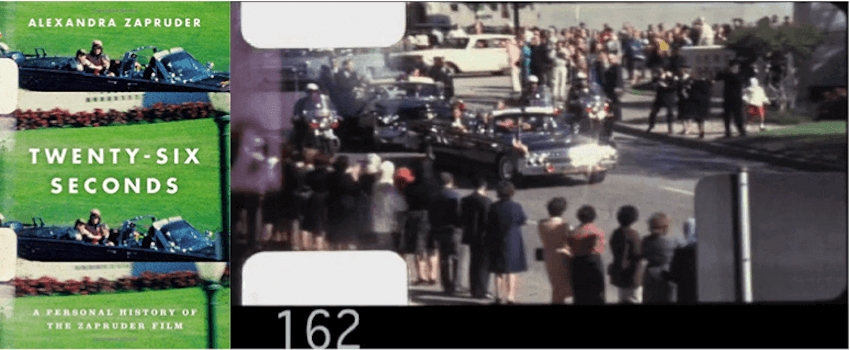
Alexandra Zapruder, Twenty-Six Seconds: A Personal History of the Zapruder Film (Part 1)

With a new book, Twenty-Six Seconds: A Personal History of the Zapruder Film, author Alexandra Zapruder offers her unique perspective to discuss issues surrounding and contained within the brief filmstrip which is the best visual record of the John Kennedy assassination. As the granddaughter of Abraham Zapruder, the man responsible for the film, the author can balance historic and technical details with a personal family story. Her status also allows for privileged access to archives and persons associated with the film, and reveals some new – albeit not earth-shattering – information. However, the book is imbued with a certain partisanship, not limited to family interests, which dulls the author’s critical thinking in some key areas. The shortcomings will seem acute to those in the critical research community, less so to those who come to the book as the personal memoir of unassuming folks who become accidentally fused with an historic event.
A self-described “conventional thinker”, Zapruder is comfortable and reasonably adept dealing with conventional narrative themes in her extraordinary tale – public and personal tragedy combine; family legacy and memory; legal and ethical questions encountered and choices made – but her annoyance with the spoiler element in this story is perceptible each time she types “conspiracy theorist”, which she does a lot.1 Current respectable mainstream opinion, it appears, continues to resist the critical literature developed since the JFK Records Act. Such denial was exemplified by Joyce Carol Oates in a review of Twenty-Six Seconds at the Washington Post, in which she categorized criticism of the Warren Commission as a “farce” which undermined “trust in the U.S. government and in authority in general that continues to this day.”2
The Zapruder Film and LIFE Magazine
Print rights for the film were purchased for LIFE Magazine by the Time Inc. media conglomerate Saturday morning November 23, less than twenty-four hours after the event. Rights for the film as a motion sequence were purchased the following day, although these latter rights would never be utilized. In total, LIFE paid $150,000 for the film. The author is somewhat defensive about this transaction, although it could be reasonably contended that after the authorities decided not to seize the film, Abraham Zapruder was simply a good businessman who negotiated a price the interested party was willing to pay. He also expressed to his family a sensitivity over the graphic presentation and felt that LIFE could be trusted to restrain any urge to exploit the images.
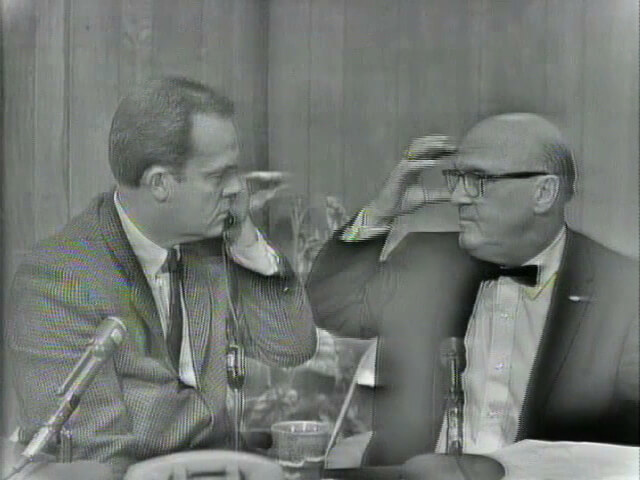
Zapruder appeared on WFAA-TV
a few hours after the shootingIn the LIFE archives, the author would years later find evidence of internal debates over how to handle the more graphic frames. Leading up to the special JFK memorial issue of LIFE, published two weeks after his death, art director Bernard Quint cautioned that “momentary opportunism displayed in the use of these details in colour will be to our everlasting discredit”, and promised to publicly resign if they were printed. Zapruder recites LIFE’s own understanding of this memorial issue: a responsible public service, sold at lower cover cost, with any profit donated to the Kennedy Library. Previously, Abe Zapruder had donated a portion of his proceeds to the family of slain police officer J.D. Tippitt. Many sides to these complexities find reflection, as author Zapruder has skills in retelling personal experiences and thought processes, and in clear description of various facets of controversies with the film. Just not all the facets.
LIFE’s JFK Memorial issue, and also the December 6 regular edition, featured a one-page article attributed to associate editor Paul Mandel titled “End To Nagging Rumors: The Six Critical Seconds”. Acknowledging there were growing rumors and doubts pertaining to the official explanation of the assassination as the work of a single lone-nut shooter, the article purported to “answer some of the hard questions” and reassure the American people that Oswald was the guilty man based on the available evidence, including the Zapruder film. Briefly discussing Mandel’s article, author Zapruder concedes that “some of his facts are mistaken” but leaves it at that without further clarifying that one of these mistaken facts is directly related to a gross misreading of the film.
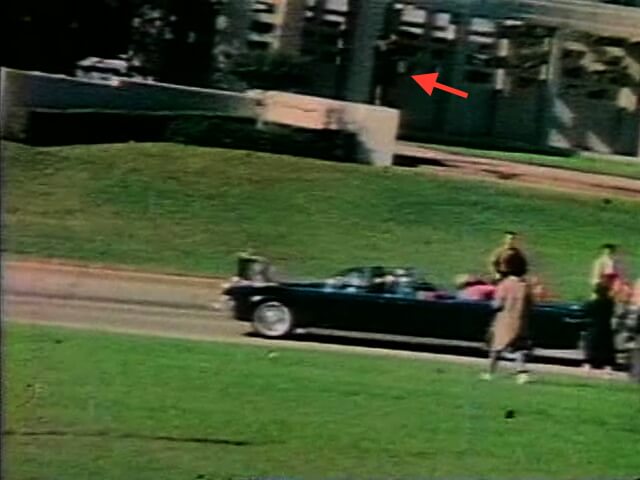
Abraham Zapruder can be seen filming
in this frame from the Nix filmOne of the featured “nagging rumors” concerned how the President could have a wound of entry in his throat, as reported to the public by Dallas Parkland Hospital doctors, when the alleged shooter was positioned directly behind during the shooting sequence. Mandel, referencing his employer’s exclusive possession, writes: “the 8mm film shows the President turning his body far around to the right as he waves to someone in the crowd. His throat is exposed – towards the sniper’s nest – just before he clutches it.” In fact, at no time during the entire filmed sequence was Kennedy ever facing back towards the alleged sniper’s nest. So how could Mandel have been so wrong? He possibly had not seen the film himself and repeated a description from another source, or there had been a conscious editorial decision to assist the government in shutting down rumors which challenged the lone-nut verdict regardless of the veracity of the published information.3 The full measure of this incident – a wholly incorrect description of what is seen in the film used to help deflect concerned inquiry as to what may have happened to JFK (and American democracy) – does not support confidence in LIFE’s responsible handling of the Zapruder film.
What could explain this? Shortly after news of the assassination broke, LIFE’s Los Angeles bureau chief Richard Stolley was assigned to Dallas where, shortly after establishing a base of operations, he received word that the assassination had been captured on 8mm film. Stolley’s persistence enabled access to Abe Zapruder that evening, and by Saturday morning a contract had been signed for the print rights to images from the film. This contract specifically excluded rights to the film as a motion sequence, although a one-week window was stipulated before Zapruder could shop those rights to others. The following day, word came from corporate headquarters, specifically from LIFE publisher C.D. Jackson, to proceed in purchasing these motion rights, which was done for an additional $100,000. That huge sum, doubling the print rights, was paid for rights not apparently as useful to Time-Life, which specialized in print-based media. In fact, Time-Life never exploited the film as a motion sequence during the whole time the film was in its possession. Nevertheless, as an internal LIFE memo cited by Zapruder states: “C.D. Jackson bought the copyright to Zapruder’s film to keep it from being shown in motion.” 4
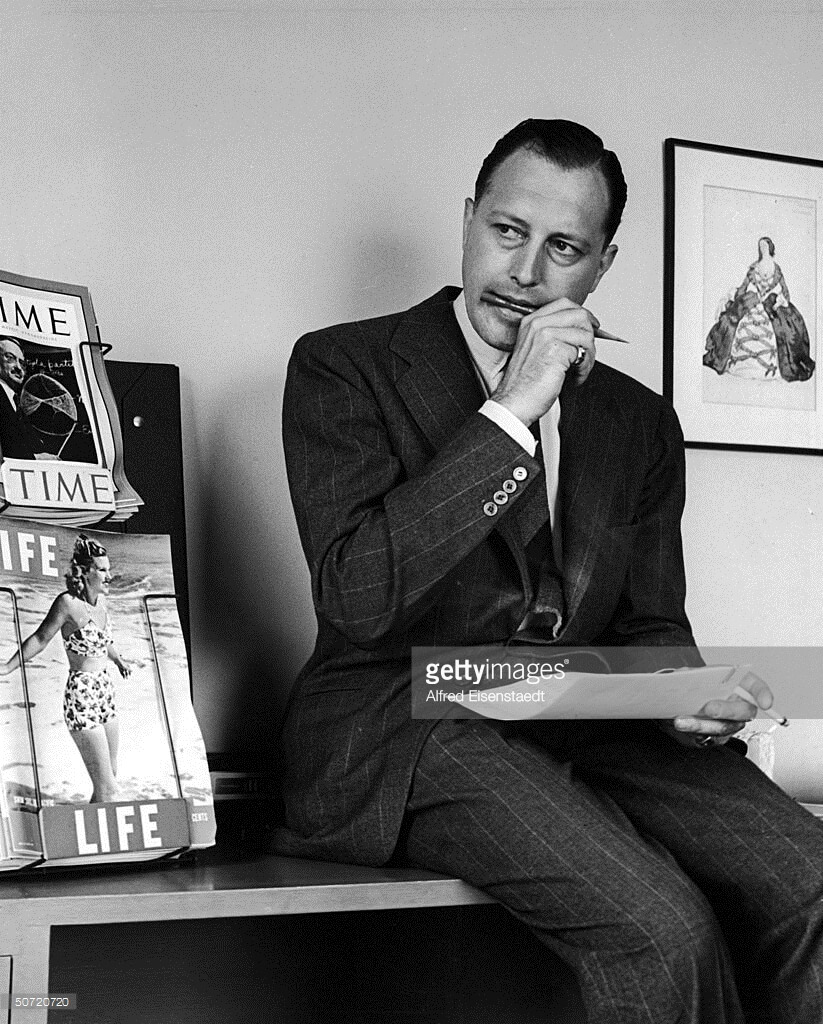
C. D. Jackson In 1977, Rolling Stone published a landmark story by renowned journalist Carl Bernstein titled “The CIA and the Media.” Using information uncovered by the Church Committee and interviews with CIA officials, Bernstein revealed to the general public a longstanding and friendly relationship whereby journalists and management from America’s established mainstream media secretly “carried out assignments for the Central Intelligence Agency.” Time Inc., parent company of LIFE, was named, along with CBS and the New York Times, as the “most valuable” organizations to the CIA. Henry Luce, the founder of Time and LIFE, was a longtime close friend to CIA Director Allen Dulles. Bernstein adds: “For many years, Luce’s personal emissary to the CIA was C.D. Jackson, a Time Inc., vice‐president who was publisher of Life magazine from 1960 until his death in 1964. While a Time executive, Jackson coauthored a CIA‐sponsored study recommending the reorganization of the American intelligence services in the early 1950s.”5
A Princeton graduate, C.D. Jackson began working for Time Magazine in 1931, he would soon be described as founder Henry Luce’s right hand man. In 1940 Jackson organized an “anti- isolationist propaganda group” called the Council For Democracy, funded by Luce and designed to counter America First movements and promote intervention in Europe; the members included Allen Dulles, Joseph Alsop, and Dean Acheson.6 Jackson served in the OSS in 1943 with Frank Wisner, later organizer of the CIA’s Operation Mockingbird.7 In 1944, Jackson was appointed Deputy Chief of the Psychological Warfare Division at Allied Supreme Headquarters. After the war he became Manager-Director at Time-Life International, while a long association with the CIA began in 1948. Jackson served the executive branch during the Eisenhower administration, advising on psychological warfare tactics. Peter Dale Scott noted that Jackson guided LIFE’s involvement in other aspects of the Kennedy assassination: “In an arrangement covered up by Warren Commission testimony, Jackson and Life arranged, at the urging of Dulles, to have Marina’s story ghost-written for Life by Isaac Don Levine, a veteran CIA publicist.”8 Author Zapruder does not bring up Jackson’s fascinating background, and claims he was motivated to purchase the motion rights after he “was personally upset by the film” and felt “the public should not see the images” because of their graphic content.9
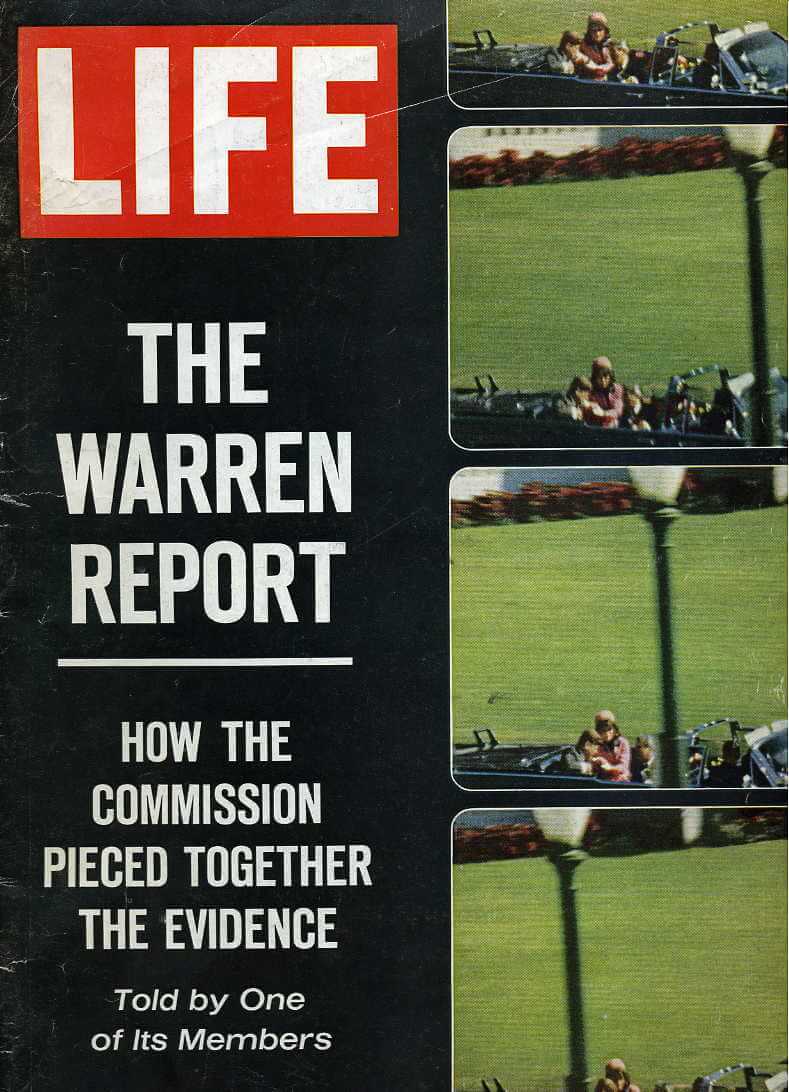 LIFE Magazine would also publish an Oswald backyard photo on its cover in February 1964, after an unauthorized leak from a contact within the Dallas Police Department, exposing millions at supermarkets and newsstands to a rather prejudicial image. This was accompanied by a long biographical article, which portrayed alleged assassin Oswald as a sociopathic loser, the position later adopted by the Warren Commission. In concert with the release of the Warren Report, LIFE’s October 2, 1964 issue featured Zapruder frames on its cover and an approving review of the Report, including an article penned by Warren Commission member Gerald Ford. Author Zapruder refers to the issue as an “examination” of the Warren Report, although the Report itself had not yet been released as the issue went to the printers.10 The issue in fact went to the printers several times, as captions below reproduced Zapruder frames were revised. In retrospect, LIFE’s coverage of the assassination, in the year immediately following, featured dodgy reporting and an eagerness to support the emerging official story, an eagerness which went beyond that of a supposedly objective “trusted” news source.
By 1966, the critics – who had actually read the Warren Report – earned a great deal of public attention publicizing many serious flaws in the assembled evidence. LIFE, as with other mainstream outlets such as CBS, decided to keep pace with public opinion and called editorially for a re-examination of the evidence. They then assembled a team to do just that for LIFE itself.11 An assistant philosophy professor named Josiah Thompson, who had developed a serious interest in the assassination, was hired as a consultant. Thompson, who had seen a second generation copy of the Zapruder film at the National Archives, now had access to the original film (“… the colors were there, the clarity was there. It was really something, really, really something”). Author Zapruder does a good job describing how competing interests suddenly came to coalesce around the film: Warren Commission critic Thompson and CBS News, which wished to broadcast the film as part of a news special, advocated public release – while LIFE’s editors resisted, insisting that their ownership of the film rights gave them the final word.
Thompson surreptitiously made his own copy of the film from LIFE’s own frame-by-frame transparencies. In 1967 he published Six Seconds In Dallas, a powerful critique of the Warren Commission’s methodologies. When LIFE refused to allow him to use frame reproductions from the Zapruder film for the book, Thompson had drawings made depicting selected frames and published those.12 LIFE sued over breach of copyright. In discussing this, author Zapruder sides with LIFE, describing Thompson’s unauthorized use of the film images as copyright infringement. Working from internal documentation, and accepting at face value the good faith of the LIFE management as they wrestled with what to do, she lays out the legal and moral supporting arguments for LIFE’s position, and asks: “so what made this circumstance different?”13
As Thompson’s case headed to court, Walter Cronkite at CBS publicly scolded LIFE for holding the film back from the public.14 Thompson and his publisher would eventually beat back the LIFE lawsuit when the judge ruled that their presentation of portions of the film fit the doctrine of “fair use”. That the Zapruder film was important and salient to the controversies surrounding the assassination was now understood by growing numbers of an increasingly skeptical public (or “small army of committed conspiracy theorists” as author Zapruder puts it). It was also becoming understood that the film contained “confusing visual information” (also Zapruder’s term) as the President is hit by the fatal shot.
Garrison Subpoenas the Zapruder Film for the Shaw Trial
The “confusing visual information” led to New Orleans prosecutor Jim Garrison’s subpoena of the film, so it could be screened as part of the trial of Clay Shaw. As later described in the movie JFK, the “back and to the left” movement of the President’s body immediately after receiving a shot at Zapruder frame 312, was thought by Garrison to be compelling proof of a conspiracy. Author Zapruder is skeptical. She offers a then contemporary analysis by physicist Luis Alvarez, known as the “jet effect”, as an “an important example of how scientific analysis, and not political bluster, could be applied to the question” of the assassination.
Discussing the Clay Shaw trial, Zapruder does her readers a great disservice by relying heavily on an obviously biased and subjective source, namely the 1970 book American Grotesque by James Kirkwood.15 Certainly, a fair-minded author would have noted the overt one-sided character of the book and at least seek out a second source for balance. Zapruder apparently did not. In fact, she allows Kirkwood’s at times harsh and demeaning descriptions to color her discussion of this event. Therefore, using Kirkwood’s take of the courtroom during the screening of the Zapruder film – “the anxious, ill-tempered and, if not bloodthirsty, most definitely morbid craning mob of voyeurs who were glued to the screen” – serves to deflect attention from the actual effect of the screening itself, and the centrality of the film to the prosecution’s analysis of the Dealey Plaza event. If unable to fit Shaw into the plot, the jurors were, in fact, convinced by the presentation that there was indeed some form of conspiracy involved in Dallas. The acknowledgment of this is muted, because the focus is instead drawn to Kirkwood’s descriptions of the courtroom viewing as representing a bloodthirsty mob: “a hungry look of salivating eagerness seemed to draw their faces to a point…”16
The genie, however, was out of the bottle, as the Zapruder film became bootlegged from a variety of sources, and public screenings were arranged at college campuses and other venues.
The Zapruder Film Goes Public

1975 – Robert Groden & Dick Gregory screen
a bootlegged copy of the Zapruder film
on national televisionAuthor Zapruder dismisses “the familiar tropes of conspiracy arguments that came from viewing the film”, without really addressing such tropes. Instead, she laments the trampling of LIFE’s property rights and engages in metaphysical reflection on possible neurological deficiencies to explain the “conspiracists.” In fact, the effect of the film on audiences in the 1970s can be seen for oneself. For the public reaction to the first televised showing is readily available in a clip from the 1975 ABC program Good Night America. On that March 6th program, Geraldo Rivera hosted Robert Groden and Dick Gregory. They then presented the film to a studio and national television audience. The gasp of the audience as the President is hit in the head is audible, a response partly to the gruesome imagery, but also to the unmistakable impression the man had been shot from the front, even as established wisdom placed the assassin directly behind. Warren Commission staff lawyer David Belin conceded during the Rockefeller Commission – one of several official inquiries of the era into the assassinations of the 1960s and the activity of intelligence agencies – that “a major portion of the public controversy concerns the Zapruder film.”17 Author Zapruder complains that the bootleg screenings in the 1970s lacked a presence “to offer a dissenting interpretation of what the film showed.” She again refers to Alvarez and his “jet effect” theory as a plausible and scientific interpretation. She is apparently unaware that Alvarez’ methods (always controversial) explaining and reproducing this effect have recently come under a rather damaging analysis.18
Much of the remainder of Twenty-Six Seconds follows the relinquishing of the original Zapruder film from Time Inc. back to the Zapruder family, its storage at the National Archives, and the legal wrangling over the film in the 1990s leading to a large payment to the family. Author Zapruder handles this aspect of the story solidly, again moving fluidly from the documentary record to personal experience as her father assumes responsibility for the family’s interests (Abraham Zapruder passed away in 1970). If not for the historic controversy which is embedded directly within the frames of this film, Alexandra Zapruder would be responsible for a decent non-fiction account of ordinary people accidentally conjoined with sudden historic events, which is certainly the story she wants to tell here. So what seems to have happened here is understandable, as the controversy is complex and multi-faceted but the author has presumably neither the time or patience to delve deeply into it, and her conventional thinking has her leery of those she identifies as “conspiracists.” The author acknowledges that she received guidance in the issues of controversy from certain advisors.
A key advisor on the subject of the assassination controversies for this book appears to be author Max Holland, a longtime reliable defender of the Warren Commission, who has been writing on the topic for major newspapers and publications such as The Nation since the 1990s, as well as appearing in mainstream cable documentaries. Holland has written five books on national security topics and has been awarded numerous Fellowships, including a Studies In Intelligence Award from the CIA in 2001.19 Holland is best known recently for his fairly well publicized contention that the first shot in the JFK assassination sequence occurred much sooner than previously believed, and at a time not captured in the Zapruder film (author Zapruder finds this theory “compelling” and backed by “extensive additional evidence.”) Zapruder says the two met in 2015, late in the writing process for Twenty-Six Seconds, and in the book’s acknowledgements Holland is praised as “one of the most thorough, careful, and thoughtful thinkers I’ve ever met … He clarified my thinking on many important issues, gently challenging me on my assumptions …” (For a differing view of Holland, see “The Lost Bullet: Max Holland Gets Lost In Space“.)
In December 2016, Zapruder provided an opinion piece to the New York Times titled “There Are No Child Sex Slaves At My Local Pizza Parlor”, which dissected a brief hysteria surrounding an armed man who thought to disrupt a purported kiddie ring fronted by a Washington D.C. area pizzeria. Although her points are well-taken as far as they go with the immediate story, she claims additional authority to speak of the phenomenon from encounters with “conspiracy theorists” who directed certain speculations at her grandfather.20 Fair enough, but Zapruder then analyzes: “If one outcome of Kennedy’s assassination was a loss of trust in government and the news media, we have now entered an era in which such suspicions have mushroomed into something far more dangerous — a rupture in the very idea of shared truth.” Which sounds alarming, and is alarming in the sense that a shared consensus reality is vital to bind our material lives within a peaceful society, but do the actions of one confused young man really portend the fracturing of reality?21 What is she talking about? In part she is talking about the Kennedy assassination and its aftermath, but in doing so Zapruder is unable to acknowledge that the loss of trust accorded the government and news media has been well earned. And that the mainstream “shared truth” of the Kennedy assassination is factually incorrect, despite what her advisors may have told her.
It may well be that the ultimate readership for Twenty-Six Seconds has little interest in formulating an opinion on the JFK assassination controversy, and would have a mild curiosity at best regarding the state of the case. Still, since the book’s accumulation of questionable activity falls heavily on the side of the “conspiracy theorists”, while investigating authorities and representatives of the mainstream media are frequently portrayed as responsible and even-handed, a rather misleading notion is presented of what the Kennedy assassination has revealed about the “trusted” stewards of the nation. It also trips up an author’s attempts at finding a poetic, or metaphoric, truth in her grandfather’s film. Utilizing Holland’s 2014 Newsweek article “The Truth Behind JFK’s Assassination”, Zapruder repeats his contention that the “film displaced Oswald’s view from the sixth-floor window”, that its necessarily partial visual record now “had to stand in for seeing the assassination through Oswald’s eyes and hearing it described in his words.” Though one might be tempted to reach for a cappuccino and ponder varieties of historical irony, what is being advanced is a purely sophist construction, as the overwhelming weight of the evidence shows that Oswald was not on the sixth floor of the TSBD at the time of the shooting and did not fire a rifle that day.22 That the author does not seem to know this will harm the book’s reputation in the future, although its more valid, and better presented, insights will likely retain some interest.
NOTES
1 Critics of the official Warren Commission findings are, as a rule in this volume, referred to as “conspiracy theorists”. Late in the proceedings, reference is briefly made to “assassination researchers”.
2 Joyce Carol Oates, “Twenty-Six Seconds of the Kennedy Assassination – and a Lifetime of Family Anguish.” Washington Post, November 17, 2016.
3 Other information in the article, such as determining the film ran at 18fps or determining frame counts between presumed shots, likely was not generated by LIFE and came to it from government sources, as discussed in Part Two of this review. Although author Zapruder is fuzzy about it, the official FBI findings were still a week away from publication as the memorial issue and Dec 6 edition were put to press, suggesting an official source contributed to handling the “nagging rumors”, as an official source assisted LIFE’s later Warren Report coverage.
4 The memo is quoted on page 194 of Twenty-Six Seconds.
5 Carl Bernstein, “The CIA and the Media.” Rolling Stone Magazine, October 20, 1977. The article is also available on Bernstein’s website. Bernstein writes: “the Agency has cut back sharply on the use of reporters since 1973 primarily as a result of pressure from the media.” As the main source of information for the article was interviews with unnamed CIA officials, the cooperation may have served as a limited hang-out after Bernstein had uncovered the story from Church Committee sources. Certainly these CIA officials go out of their way at times to identify media outlets and journalists as CIA friendly despite firm denials from the outed parties. However, the historic information – including Luce and C.D. Jackson – has never been refuted, and since publication largely confirmed through document releases.
6 In other words, Jackson was involved within an internationalist (“globalist”) Eastern Establishment milieu which lobbied for US participation in a European war, and then helped staff the OSS, create the CIA and construct the foundations of the Cold War National Security State. In the Eisenhower years, this milieu developed a foreign policy which relied on covert manipulation and regime change around the globe. John Kennedy’s nascent challenge to this world view has been focus of much recent scholarship. C.D. Jackson died in 1964.
7 Operation Mockingbird was the CIA’s program to influence the American media, and was disclosed in the 1977 Bernstein article.
8 The Marina Oswald story was not ultimately published, but she was well-paid for the rights. Peter Dale Scott, Deep Politics, p 53. See also Warren Hinckle and William Turner, Deadly Secrets: The CIA-Mafia War Against Castro and the Assassination of JFK (1981).
9 Twenty-Six Seconds, p. 97.
10 LIFE joined the New York Times and CBS News in providing instantaneous reviews, or “examinations”, of the Warren Report, all three trusted news sources referring to it appreciatively as a thorough and complete explanation of the President’s assassination, even though there had not yet been the opportunity to actually read it.
11 Both LIFE and CBS soon afterwards abandoned critical inquiry and dissolved their investigating teams. CBS would continue to create television documentaries supporting the Warren Commission, such as the 1967 multi-episode CBS News Inquiry: The Warren Report. (For an analysis of the genesis of the 1967 special, see now James DiEugenio, “Why CBS Covered Up the JFK Assassination“.)
12 Due care was taken to ensure the accuracy of the drawings, unlike certain exhibits created for the Warren Commission.
13 What made it different is the overwhelming sense that justice had not been served in the aftermath of the assassination, that it was still an open case, and that an apparent establishment cover-up of the true reasons for Kennedy’s death presented serious challenges to the American democratic system and the understanding of contemporary events. However, if one believes, as author Zapruder appears to, that the Warren Commission essentially got it right and “conspiracy theorists” have been not just historically wrong but prone to psychological malady which influences their fuzzy thinking, then accepting LIFE’s decision to effectively sequester the film becomes a lot simpler.
14 “LIFE’s decision means you cannot see the Zapruder film in its proper form, as motion picture film. We believe that the Zapruder film is an invaluable asset, not of Time Inc., but of the people of the United States.” CBS News Inquiry: The Warren Report, 1967. The program supported the basic conclusions of the Warren Commission. It is possible that CBS sought to acquire the film so that it could be “explained” to the public in a manner favorable to the official conclusions, while maintaining a plausible facade of the fearless Fourth Estate.
15 American Grotesque is notable as the source for the oft-repeated claim that Garrison’s primary motivation for prosecuting Clay Shaw was rampant homophobia.The premise for the book had been first suggested by defendant Shaw himself ahead of the trial, pitching the concept to others before Kirkwood agreed to take it on. Kirkwood and Shaw had been friends for two years ahead of this. During the trial Kirkwood was close to the extremely compromised reporters James Phelan and Hugh Aynesworth, both engaged in sabotaging the trial to the extent possible.
16 Zapruder lists the Kirkwood book, courtroom transcripts, and contemporaneous newspaper accounts as her source material for the Shaw trial, her discussion of which concludes: “The Garrison trial went down in history as a gross abuse of power … Garrison’s actions deeply discredited the conspiracy movement and drove it back underground for many years.” This opinion, not gleaned from the transcripts or newspaper accounts or Kirkwood’s book, and obviously not Zapruder’s own, is likely that of an advisor discussed below, and is challenged by more recent work from Joan Mellen and Jim DiEugenio.
17 Memorandum, David Belin to James B. Weidner. April 21, 1975.
18 Alvarez claimed, in the American Journal of Physics, September 1976, that his shooting mock-up in 1969 “showed retrograde recoil in the first test … If we had used the ’Edison Test,’ and shot at a large collection of objects, and finally found one which gave retrograde recoil, then our firing experiments could reasonably be criticized.” But Josiah Thompson, who is also a figure in Zapruder’s book, gained access to Alvarez’ experimental resources and discovered that, contrary to Alvarez’ statement, a large collection of objects were fired upon until one was found which gave retrograde recoil. Thompson’s access to the materials was provided by Paul Hoch, who is listed as an advisor for this book specifically on the jet effect. Thompson presented this new information on Alvarez and his jet effect experiments at the Passing The Torch Conference in Pittsburgh, October 2013.
19 Holland reviewed Peter Dale Scott’s Deep Politics in 1994, writing of the controversy: “The field already brims with books that conjure up fantastic conspiracies through innuendo, presumption, and pseudo-scholarship while ignoring provable but inconvenient facts …Yet there remains something truly remarkable and disturbing about Deep Politics, and it’s not that a tenured English professor wrote its opaque prose. Rather it’s that Deep Politics is a University of California Press book … this means an editorial committee consisting of 20 UC professors, including four senior historians, approved Deep Politics for publication. This peer approval by a major university press illustrates the boundless and utter disbelief in the Warren Report … and it also reveals the gross inattention given to the subject by serious historians.” One man’s “serious historian” is of course another’s “pseudo-scholar”, and Holland demonstrates through this review/article that there are few elements of the official story to which he does not subscribe, despite the obvious challenges to credulity the Warren Report invokes. Lamenting a lack of “serious historians” on this subject while casually accepting that Oswald attempted to assassinate General Walker or that Oswald’s FPCC activity in New Orleans should be taken at face value, necessarily leads to a position which praises generally poor books by Patricia Lambert or Jean Davison or Gerald Posner while positioning Scott as suffering from a “fevered imagination.” That is, Marina Oswald’s wild and ever-changing stories from 1964 regarding her husband’s alleged stalking of Walker, which is just about the only evidence that such a thing ever happened, is legitimate fact, while Scott’s carefully annotated scholarship is not. Apparently, developing pseudo-psychoanalytic theories regarding Oswald’s state of mind is a hallmark of “serious history”, while recognizing the official record can’t even place Oswald in the so-called sniper’s nest is the domain of fantasizing conspiracists.
20 Abraham Zapruder’s name has, over the years, suffered speculation of sinister relationships or agency in the assassination. As well, the Zapruder film has suffered numerous incorrect interpretations, often from viewing poor multi-generational copies. The most well-known incorrect assumption is that Secret Service driver Greer turned and shot JFK with a pistol. The fallacy of this interpretation should not disguise that Greer slowed the limousine to a crawl and turned twice to view the chaos in the seats behind him, including a direct view of the fatal shot before turning back and accelerating.
21 After all, it wasn’t so long ago a cudgel of fake facts, many promoted by the New York Times, was used to bludgeon the body politic into supporting a US Air Force-led “shock and awe” campaign in Iraq, followed by an invasion and brutally careless occupation, ending or ruining the lives of several million people, and destabilizing an entire region. For that matter, even a cursory reading of Establishment reporting on the Kennedy assassination reveals an array of poor and misleading information. Or, consider C.D. Jackson’s work in psychological warfare during the Eisenhower administration, which would include portraying a vicious right wing coup against Guatemala’s democratic government as a populist uprising.
22 We know this because at the exact time Oswald was said to have dashed down the Texas School Book Depository’s rear wooden staircase moments after the shooting, two witnesses were descending the same staircase and they saw and heard nothing at all. The bad faith by which the Warren Commission discredited the witnesses and created a wholly different timeline has been described by author Barry Ernest in his book The Girl On The Stairs. While researching this topic, Ernest discovered a Commission memo from June 1964 which confirmed the timing as stated by the witnesses, and which was subsequently buried as the Warren Commission proceeded to publish their false account. Not a single piece of hard evidence places Oswald on the sixth floor with a gun in his hand, as Dallas Police Chief Curry conceded in his own book written in 1969. Paraffin tests of Oswald’s cheek conducted by the Dallas Police on the night of the assassination did not show traces of nitrate as should be expected, and therefore show with a high degree of certainty that he did not fire a rifle.
-
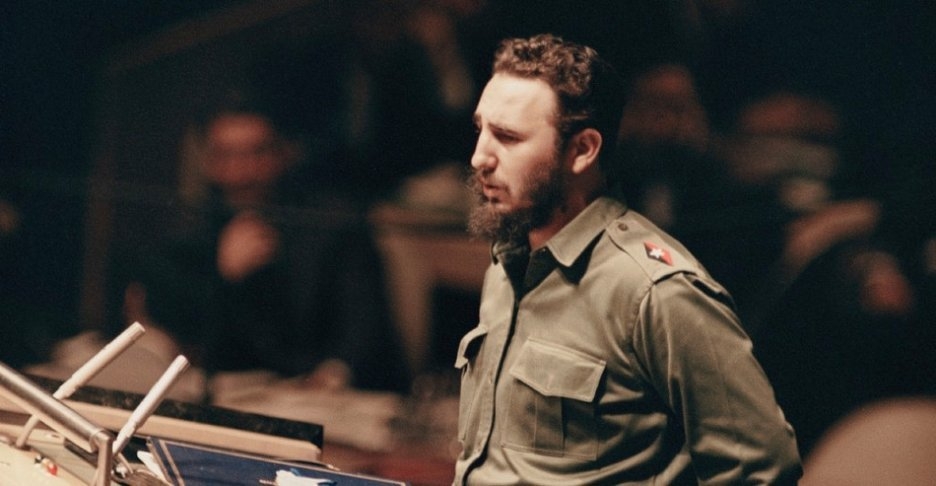
Fidel Castro’s First Speech on the JFK Assassination, 11/23/1963
 Last year, with the help of David Giglio’s Our Hidden History, our site featured Fidel Castro’s speech of November 27, 1963 on JFK’s assassination. That was almost an impromptu talk Castro did to a group of students at the University of Havana. (See: Castro Figured Out The JFK Case in Five Days: Speech of November 27th, 1963) The following speech was made even sooner, about 24 hours after the assassination. And this one was made to the Cuban people. To say that Castro shows remarkable insight into the crime does not do the Cuban president justice. It would take months, in some cases years, for even a minority of Americans to develop the insights Castro shows in this remarkable speech.
 What made Kennedy’s assassination even harder for Fidel to swallow was the fact that, at the time of the murder, he and Kennedy were working on a relaxation of tensions between the two countries through a network of go-betweens. These included TV newscaster Lisa Howard, American diplomat William Attwood, and French journalist Jean Daniel. The last was with the Cuban leader when he got the news of Kennedy’s death. Castro immediately realized that what the two leaders had been working on, a development of friendly relations, was now dead. And in this speech, Castro discusses how regressive forces in America most likely killed Kennedy and then planned to blame it on Cuba.
As most informed observers would say today, he was right about all these matters. And also about who Lee Harvey Oswald really was. The speech is nothing less than a tour de force, even after the passage of more than fifty years. Compared to the 888 page cinder block of disinformation that the Warren Report would turn out to be, this speech should have been printed on the front page of every newspaper in America. It would have given the public a real heads-up as to what was happening to their country.
Our thanks once again to David Giglio, at Our Hidden History, for making the speech available in hypertext. (This text also appears as Appendix II in E. Martin Schotz, History Will Not Absolve Us [Brookline MA: Kurtz, Ulmer & DeLucia, 1996], pp. 51-86)
CONCERNING THE FACTS AND CONSEQUENCES
OF THE TRAGIC DEATH OF PRESIDENT JOHN F. KENNEDY
November 23rd, 1963
by Fidel Castro
Always, when something very important has happened, national or international, we have thought it desirable to speak to the people, to express our opinions. And in every such case to express the orientation of the Government, the orientation of our Party, so that each one of us all know the attitude we should adopt in each one of these situations.
It is true that we are somewhat accustomed to various types of unexpected events, important, serious events, because since the victory of the Revolution our country has had to face a series of problems, a series of situations that have prepared the people to carry forward their victorious revolution.
Therefore, because of the events of yesterday in the United States in which the President was murdered, because of the repercussion these events can have, because of the role that the United States plays in the problems of international policy, because of this, we believe that we should make a specially objective and calm analysis of these events and of their possible consequences.
The government of the United States, the former administration of Eisenhower and the Kennedy administration, did not practice precisely a policy of friendship toward us. The policy of both administrations was characterized by its aggressive, hostile, and implacable spirit toward our country.
Our country was the victim of economic aggressions intended to cause the ruin of our economy and the starvation of our people; it was the victim of all kinds of attacks that caused bloodshed; hundreds of our compatriots have lost their lives, defending themselves from attacks of U.S. imperialism, and not only this. The hostility and the aggressiveness of U.S. imperialism toward our country took us to the brink of war which was fortunately avoided, took the world to the brink of thermonuclear war.
And even when we were not facing a situation like the crisis of October, and the time of the invasion of Giron [Bay of Pigs], we were all perfectly aware that if the plots they were planning against our country had been carried through, that is to say, if imperialism had been able to establish a beachhead on our shores, that struggle would have cost our people tens of thousands, and perhaps even hundreds of thousands of lives.
We have been victims of the constant hostility of the United States. And among the rulers and the leading men of the United States, there falls on Kennedy an important responsibility in these events.
Nevertheless, the news of the murder of the President of the United States is serious news and bad news. We should analyze it thoroughly in order to understand it; above all, analyze it serenely and dispassionately, as revolutionaries should analyze these things.
I say it is bad news, leaving aside the human question, in that the sensitivity of man, any man, is affected by an act of this nature, by a crime, by a murder. I say that leaving these questions aside, I always react and I am sure that this is the reaction of the immense majority of human beings – we always react with repulsion toward murder and toward crime.
We cannot consider this to be a correct weapon of struggle – no, we cannot consider that. Above all under the conditions in which it happened, because – like all these things – it is always necessary to consider the atmosphere, the things, the circumstances.
In other settings, under other circumstances, whatever they may be in a normal situation, in a peaceful situation, a deed of this nature is never justifiable. Especially in the middle of a crowd, in the presence of women, all these things, which above all – I say – are the circumstances that lead us to take a condemnatory attitude toward something, even though some deeds of a political nature, some crimes of a political nature, may or may not be justified.
In the circumstances that surrounded the assassination of President Kennedy, we believe it has no justification.
But analyzing the question from the political, objective point of view, I also said it was serious news, bad news.
And some will ask why? Why precisely the Cubans, who have received so many aggressions on the part of the United States, from the Kennedy Administration itself, why can they say that it is bad news, why can they take an attitude of this kind in the face of this news? But in the first place we Cubans must react as revolutionaries. In the second place, we Cubans, as conscious revolutionaries, should not confuse men with systems. And we have to begin by considering that we do not hate men, we hate systems.
We hate the imperialist system, we hate the capitalist system, but this does not mean that we hate men as such, as individuals, part of a machine, a more or less important part of a system.
So we should not confuse hatred of a system with the sentiment we should harbor toward men, which is a different sentiment; it is not a sentiment of hatred, and much less a sentiment of hatred which in a case like this would be despicable.
As Marxist-Leninists, we know that the role of man is a relative role in each historical epoch, in each society, at each given moment, and we should know the role that man plays in each society. And above all it is a question of elemental principle: we do not hate men, we hate systems.
We would be happy at the death of a system; the disappearance of a system would always make us happy. The victory of a revolution always makes us happy.
The death of a man, even though this man may be our enemy, does not make us happy. In the first place, this should be our attitude as a matter of principle.
And further it is very characteristic of us Cubans, of Latins, of Spanish-Americans – who are a mixture of races with certain characteristics – that death always ends our animosity. We always bow with respect in the face of death, even though it may be the death of an enemy.
But then, I said that the deed itself could have very negative repercussions on the interests of our country. But it is not the interests of our country in this case but the interests of the whole world that are involved. We must know how to place the interests of mankind above the interests of our country. I consider it a negative event for the interests of mankind. And I am going to explain why.
Because in certain international political situations, at a given moment, there can be bad situations or worse situations. The death of President Kennedy has all the perspectives involved in going from a bad situation to a worse situation: the possibility exists that from a determined situation, another situation could unfold and develop that could be highly damaging to the interests of peace, to the interests of mankind.
Why? Do we perhaps think that the United States holds a defensible political position in the international field? No, the international policy of the United States cannot be defended. Its policy of aggression, policy of violating the rights of other nations, of interference in the internal affairs of other countries, of domination, of repression, of bloodshed, of alliance with the most reactionary sectors of the world, of participation in bloody wars against the people who struggle for their liberation – as in the case of South Vietnam – its attitude towards the people of Latin America, its attitude towards us, and finally its international position, is in no way defensible from the moral point of view.
However, within American society and within the policy of the United States, there are supporters of a much more reactionary policy, of a policy much more aggressive, much more warlike.
And the whole condition of the internal policy of the United States, the internal struggle for power in the United States, the currents that struggle within the United States, the assassination of President Kennedy, tend to convert the present policy of the United States into a worse policy and to aggravate the evils of U.S. policy.
That is to say that there are elements in the United States who defend a more reactionary policy in every field, in international and internal policy, and these are the sole elements who can benefit from the events that occurred yesterday in the United States.
Why? Because in the United States a number of forces, a number of very powerful bodies within U.S. society, very much influenced by big interests in the United States, have been developing, and there is no doubt that a U.S. President possessing the highest authority implies a situation less serious than a President without the highest authority, in such a situation.
A President is a political man, who should take into account many factors, advice, opinions, and influences, who is eminently political, who without doubt, behaves differently in general than those who we might say are not professional politicians, who have other professions, other interests, and those political reactions are always the worst reactions.
In the United States there are a number of powerful forces: economic, political, military. Many of these forces have a fixed policy and more than once we have spoken of this problem. Take the clash, for instance, between the political currents of the State Department and the military currents of the Pentagon. We have often seen the manifestations of this struggle in Latin America, how there are currents in the United States, above all military currents that support the policy of military coups, and there are political currents that defend another type of policy – not that it is a good policy, but clothed in a civilian government, even pseudo-liberal.
Unquestionably when [there] is a recognized, accepted, strong authority in the United States, the dangers that arise from the struggle of a whole series of reactionary currents within the powerful organizations of the United States are much less than when this authority does not exist. And without any shadow of doubt, Kennedy had this authority in the United States.
Now, suddenly a new situation is created, where a President who, because of circumstances in which he holds power, that in being Vice President, and then because of an unexpected circumstance becoming President of the Republic, independent of what his character may be, because here it is not a question of the character of the person or his personality, but [because] of the circumstances, does not come to power with the same personal authority as President Kennedy had. And therefore a question begins to arise in respect to the influence within all those forces, of the new authority who assumes power, of the new President who takes over the reins of Government.
In the United States there are very reactionary currents, racist currents, that is to say opposed to the demand for the civil and social rights of the Negro population, Klu Klux Klan people, who lynch, who kill and use dogs, who bitterly hate all Negro citizens in the United States, who nurture a brutal hatred. Those naturally are the ultra-reactionary.
In the United States there are economic forces, powerful economic interests, just as ultra-reactionary, who have a completely reactionary position on all international problems. In the United States there are forces that support an increased intervention by the United States [in] international questions, a greater use of the U.S. military in international questions. There are, for example, currents in the United States that are intransigent supporters of the direct invasion of our country. In the United States there are partisans of the application of drastic measures against any government that adopts the smallest measure of a nationalist character, of an economic character that benefits its country.
And finally, there are a number of groups that can all be included in one concept: the ultra-right in the United States, the ultra-reaction in the United States, and this ultra-reaction in each and every one of the internal and external problems of the United States is an advocate of the worst procedure, of the most aggressive and most dangerous and most reckless policy against peace.
In the United States there are also liberal currents, some more liberal, some more advanced, other less advanced. There are some men on the right who are more radical, and other more moderate. There are certain intellectual sectors that are not constantly thinking in terms of force, but are thinking along lines of diplomacy, instead of force, who have a less aggressive policy – a more moderate policy.
That is to say, in the United States there is a whole range of political thinking that runs from men of the extreme right to men of the extreme left, men who are more to the left in their political thinking.
And in this situation there is a variety of opinion, of more or less moderate attitudes. There are liberals, intellectual sectors of the United States who understand the errors in the policy of the United States, who are not in agreement with many of the things that the United States has done in international policy.
And what happened yesterday can only benefit those ultrarightist and ultra-reactionary sectors, among which President Kennedy or some of the men who worked with him cannot be included. They could not be placed in the extreme reaction – in the extreme right.
And even within the situation in the United States, within the policy of the United States, which as a whole is indefensible, Kennedy was strongly attacked by the most reactionary, most aggressive, and most war-like circles.
You will recall that on the eve of the October crisis of last year, there was a whole campaign, with great pressure, including laws and resolutions in Congress, pushing Kennedy [and] the Administration towards war, trying to create a situation of imperative action.
Everybody will recall that on other occasions, we have stated that one of the political errors of Kennedy in respect to Cuba was to have played the game of his enemies. For example, to have continued the invasion plans against Cuba that the Republican administration had organized.
And out of all this arose the possibility in the United States for a policy of blackmail on the part of the Republicans. That is, Kennedy presented the Republicans with the weapon of Cuba. How? He continued the aggressive policy of the Republicans, and they used it as a political weapon against him.
But at times very strong campaigns, powerful movements within the United States Congress pressed the Administration for a more aggressive policy against us. All those factors and all these forces on the extreme right in the United States fought Kennedy very hard precisely on those points in which he did not agree with the extreme aggressive policy called for by these sectors.
There are a number of issues that gave rise to constant criticism by these ultra-right sectors. For instance, the Cuban problem, the agreement reached at the time of the October Crisis not to invade Cuba, one of the points in Kennedy’s policy most consistently attacked by the ultra-reactionary sectors. The agreement on the ending of nuclear tests was another point very much debated within the United States, and it had the most resolute and fierce opposition of the most ultra-reactionary.
Elements in the United States were against agreements of this type.
Everyone knows what our position was on this problem. Everyone also knows the reason for our position, regardless of the fact that we consider that this was a step forward that could mark the beginning of a policy of lasting peace, in favor of true disarmament, but a policy that was never applied in our case. Because while the nuclear test ban treaty was being signed, the policy of aggression against Cuba was accentuated.
But we are not now analyzing the problem in relation to what happened in our case, but in relation to what was happening in the world, and above all in relation to what some were doing and others thinking in the United States. That is to say, there were many sectors in the United States, many ultra-reactionary elements that carried out a fierce campaign against the nuclear test ban treaty.
There are other elements in the United States that violently opposed the legislation of civil rights proposed by Kennedy regarding the Negro problem in the United States.
We are not dealing with the case of a revolutionary law or of a great effort, because this great effort in favor of equality and civil rights, especially in favor of the rights of the U.S. Negroes, has not been made in the United States. But be that as it may it was legislation that contained a series of measures that, from a legal point of view, tended to protect the rights of the Negro population. This legislation was blocked and held back by the strong opposition of the most reactionary sectors in the United States, of those sectors in favor of racial discrimination.
And thus, on a whole series of issues of international policy, there are in the United States elements that support a preventive nuclear war, who are in favor of launching a surprise nuclear war, because they stubbornly think that this should be the policy of the United States. Reactionary and neo-fascist elements without any consideration whatsoever for the most elementary rights of nations or the interests of mankind.
And it is a strictly objective fact that there are such types of capitalists, such types of reactionaries. And there is no doubt that the worst type of capitalism is nazism; the worst type of imperialism was nazism. And the most criminal mentality was the mentality of imperialism in its nazi form. And so there is a whole series of degrees in these questions.
So analyzing the question objectively, whenever a strong accepted personal authority is lacking in the situation, ways and conditions in which U.S. policy is carried out, all these reactionary forces find a magnificent opportunity, and in fact are finding a magnificent opportunity, to unleash their unbridled and ultra-reactionary policy.
And these are the sectors, the currents, the only ones that could benefit by an event such as the one that occurred yesterday in the United States.
This is analyzing the automatic result of this event. Independent of another aspect of the question: What is behind the assassination of Kennedy? What were the real motives for the assassination of Kennedy? What forces, factors, circumstances were at work behind this sudden and unexpected event that occurred yesterday?
News that took everyone by surprise, something that possibly no one had even imagined.
Even up to this moment, the events that led to the murder of the President of the United States continue to be confused, obscure, and unclear.
And there are some things which are clear symptoms of what I have been saying: that the most reactionary forces in the United States are at large.
For instance, the worst symptom is the advantage they are taking of the event to unleash within the United States a state of anti-Soviet hysteria and of anti-Cuban hysteria; this, in the first place. It means that the new administration that is taking over may find itself facing a situation of hysteria, unleashed in the United States, precisely by the most reactionary sector of the country, by the most reactionary press, with the great resources that powerful political currents have within the United States.
That is to say that already they are combining to create a frame of mind in the U.S. public opinion, and its worst characteristic is that they are waging a campaign in the worst McCarthyite spirit, in the worst anti-communist spirit.
At the time of President Kennedy’s murder, it ran through the minds of most people . . . and surely it ran through the minds of the large majority of U.S. citizens, and this was only logical – that President Kennedy’s assassination was the work of some elements who disagreed with his international policy; that is to say, with his nuclear treaty, with his policy with respect to Cuba – which they did not consider aggressive enough, and which they considered weak – with his policy with respect to internal civil problems of the United States. Not many days ago, the U.S. Ambassador to the U.N. Adlai Stevenson was attacked in the same city of Dallas by ultra-conservative elements of the John Birch Society and counter-revolutionary elements in league with them. This event drew the attention of us all.
I even thought, what degree of reaction will those people reach, when they consider that Stevenson deserves attack for his international policy?
In spite of how reactionary U.S. international policy has been, there are elements who physically assault Stevenson, because they consider that U.S. policy is a weak policy, a bad policy, that it is not a sufficiently reactionary policy.
This ran through everybody’s mind. Did it run through the mind of anyone that it might be a leftist? No, that did not occur to anyone. Why? Because the controversy within the United States today, the fierce controversy was taking place between the most ultra-reactionary elements, the ultra-right elements, and the more moderate elements of U.S. politics.
The internal controversy was not characterized by a struggle of the communists of the United States with the Government of the United States; it was not characterized by a struggle of leftist elements or liberal elements. This does not mean that the leftist elements supported Kennedy’s policy; but the struggle, the battle waged without quarter was taking place within the United States between the extreme right, the extreme reaction, and the more moderate elements, in Congress, in the press, on the streets, everywhere.
International tension had even diminished considerably in recent months. These months were not months like the October crisis, not like the months following the October crisis …. The United States was not living through one of those stages of McCarthyism characterized by unbridled persecution of the most progressive elements of the United States. No, there have been other stages in which the struggle is between reaction and the progressives. The main task of reaction was to persecute the progressive elements, and in such circumstances one might think that a progressive, persecuted by blood and fierce, a fanatic haunted by his ideas, might be capable of reacting in such a way. No, the United States was not living through such a period. It was not living through a period of unbridled McCarthyism. It was living through a period of fierce controversy between the more moderate sectors – among which can be found many of Kennedy’s collaborators – and the ultrareactionary sector of American society.
Therefore, it was neither logical, nor reasonable, that anyone could think that it could be a leftist fanatic; in any case it would be a rightist fanatic, if it was a fanatic at all.
But naturally it was very difficult in the face of an event of this nature for such unscrupulous people – like many U.S. politicians – such immoral people, such dishonest and shameless people as are many of those elements who represent the reactionary cynical sectors of the United States, warmongers, irreconcilable enemies of Cuba, supporters of an invasion of Cuba – although this might be at the cost of thermonuclear war – it was very difficult for them not to try to take advantage of this circumstance to turn all their hatred, all their propaganda and all their campaign against Cuba.
This did not surprise us. I have already said that we were somewhat used to these things. The struggle, life, have made our people into a people with iron nerves, a serene people. We have just lived through the hurricane, and we faced the test with dignity and honor, we have faced many tests with dignity and honor. We foresaw that from these incidents there could be a new trap, an ambush, a Machiavellian plot against our country; that on the very blood of their assassinated President there might be unscrupulous people who would begin to work out immediately an aggressive policy against Cuba, if the aggressive policy had not been linked beforehand to the assassination, if it was not linked, because it might or might not have been. But there is no doubt that this policy is being built on the still warm blood and the unburied body of their own tragically assassinated President.
They are people who do not have an iota of morality; they are people who do not have an iota of scruples; they are people who do not have an iota of shame; who perhaps may believe that in the shadow of the tragedy they can take us off guard, demoralized, weak, the kind of beliefs into which the imperialists always so mistakenly fall. And sure enough, yesterday at 2 P.M. the first cable: November 22, UPI … because we should note this; that of the news agencies, one has been more moderate, more objective – the AP – and there is another that has been excessively and unrestrainedly untruthful, a shameless promoter of a policy and a campaign of slander against Cuba, that is UPI. But that is not all, because there is a previous series of very interesting UPI reports, and even a series of UPI campaigns against President Kennedy himself, which links the news agency with the ultra-right groups, which are interested in taking advantage of the situation for their adventurous and warlike policy, or because these circles are connected with the assassination of President Kennedy.
And we can see this clearly through the cables: “Dallas, November 22, UPI – today the police arrested Lee H. Oswald, identified as the chairman of the Fair Play for Cuba Committees, as the main suspect in the assassination of President John F. Kennedy.” Right away Cuba and right away the Soviet Union. And so they dedicated themselves to carrying out a fierce antiSoviet and anti-Cuban campaign.
Cable: “The U.S. Embassy today confirmed that Lee H. Oswald was in the Soviet Union. An Embassy official stated that Oswald visited the Embassy in November of 1959 and according to available information he left the Soviet Union in 1962. He added that it was not known when the man suspected of killing President John F. Kennedy had traveled to the Soviet Union, what the purpose of his trip had been and how long he had stayed in the Soviet Union. There were unconfirmed reports that Oswald asked for Soviet citizenship and that he could not get it.”
Thus, from the very first cables there is an attempt to suggest the responsibility of the Soviet Union and the responsibility of Cuba, as if anyone could believe – anyone who is not a half-wit – and has a little common sense – that any Government, the Soviet government or the Cuban Government .. . and if they don’t want to believe us, they don’t have to believe us; that is unimportant. Perhaps they will think that we are hot-headed; perhaps they feel that they have carried out too many aggressions against us, but to suggest that the Soviet Union could have any responsibility in this incident . . . can anyone believe that to suggest that we could have had any responsibility … can anyone believe that? Anyone who is not a half-wit, who has a little common sense, who knows when men are working for a cause and who know which roads lead a cause to victory?
Yet, nevertheless, this was the first thing they tried to suggest. Listen to this cable “that they did not know the purpose of his trip and how long he stayed in the Soviet Union.” That was the first insinuation. And that was what made all this seem suspicious, because it so happened that the most unexpected thing – as unexpected as the assassination itself – was that immediately a suspect appeared who – by a coincidence – had been in Russia, and-what a coincidence – he is related to a Fair Play for Cuba Committee. That is what they began to say. And so, immediately a guilty person appeared: a suspect who had been in the Soviet Union and who sympathized with Cuba.
Of course, although it is extraordinarily difficult to manufacture a frame-up of this nature, it is possible that at this moment they are not pursuing such an objective. They are pursuing another objective, because they cannot invent just any kind of responsibility.
They are trying to organize a campaign of hysteria, to excite the minds of the people and unleash hysteria within the United States; an anti-communist, anti-progressive, anti-liberal, anti-Soviet, anti-Cuban warmongering hysteria within the United States. If they had the slightest sense of responsibility, of seriousness, or of good faith, they would not unleash a campaign of this nature, as they have done, as can be seen in all the cables.
Let us read this one: “November 22, UPI – The assassin of President Kennedy is an admitted Marxist who spent three years in Russia trying to renounce his U.S. citizenship, but later changed his mind and got a return trip to the United States paid for by the United States Government.” That is already a suggestion of blame to the Soviet Union. He was identified as Lee H. Oswald, 24 years old, ex-U.S. marine and chairman of the Fair Play for Cuba Committee.
So, right after that, the insinuation against Cuba. And this is how they have begun all cables, all UPI cables, all reports, Through the reports they have twenty times repeated the same idea and the same thing, using a well-known technique at which they are masters – to insinuate what they want to insinuate, to sow the suspicion that they want to sow over this affair, to slander the Cuban Revolution, to slander the Soviet Union, to create hysteria against our countries.
It says: “Oswald was captured after a shooting fray when he hid in a movie house ” … Thousands of reports came in on this, many of them contradictory.
” . . . The police say that Oswald worked in a school textbook warehouse in Texas … after the crime the police found a Mauser rifle in the building,” etc . . .. It says where he was born, it says that on October the 30th he turned up at the U.S. Embassy in Moscow, on October 30th of 1959, and told the officials that he wanted to give up his American citizenship.
“According to reports, he told the Embassy officials: ‘I am a Marxist.’ The Federal Bureau of Investigations confirmed that Oswald went to Russia and requested Soviet citizenship.
“Oswald told the Embassy officials that he intended to disclose to the Soviet authorities everything he knew from the three years he had been in the Marine Corps.”
Listen to that: “Oswald told the Embassy officials that he intended to disclose to the Soviet authorities everything he knew from three years he had been in the U.S. Marine Corps. The Embassy officials said that Russia never granted Oswald the citizenship he requested.”
Already they have in their hands a guilty person – true or false? They have already produced someone who is guilty. They have him. And now look: you will see the whole course followed by this campaign.
” … He told the officials that he intended to disclose all the secrets he knew.” Well, later I will refer to that again.
In February, 1962 Oswald apparently changed his mind and returned to the United States. He had in the meantime married a Russian, Marina, had a child. This man, who is charged with something more than desertion, with being a spy, with confessing that he is going to disclose military secrets, simply returned peacefully to the United States – according to them.
It says: “The Embassy officials went over the case and since he had not been granted Soviet citizenship, they decided to give him a passport for the United States … “
Can anyone who has said that he will disclose military secrets return to the United Sates without being arrested, tried, without being sent to jail?
It says: “Government records show that he left Moscow with 485 dollars for expenses, which the United States Government gave to him.
“This year Oswald requested another passport. He told the State Department that he wanted to visit England, France, ,Germany, the Netherlands, Finland, Italy, and the Soviet Union; he said he planned to make a trip in October or December 1963,o r in January of 1964. The passport was issued in New Orleans on June 25th; however, it is not known whether Oswald returned the money that was loaned to him for the first return trip to the United States.
“If he did not pay, the new passport should not have been issued,” they say. We will use their own reports:
“Dallas, November 22 – another cable – the President of the United States, John F. Kennedy, was shot to death today. The police arrested, as the main suspect of the murder, a proCastro American” . . .
Now we find that the man who murdered Kennedy is proCastro. We know there are very few pro-Castros-what they call “pro-Castros” in the United States.
They call them “pro-Castro.” They label as “pro-Castro” anyone it suits them to according to their propaganda and the business at issue.
Now we find that the man who was yesterday in the Fair Play Committee-in the first cable-was then a “pro-Castro” American who had once tried to become a Soviet citizen. That is how all the cables go, you will see.
Another cable, “Dallas, November 22, UPI-Police arrested Lee H. Oswald today, a Marxist supporter of the Cuban Prime Minister Fidel Castro.”
There is not a single cable in which they do not connect the action, the name of the individual whom they assure is guilty, with the Cuban Revolution, with the Soviet Union, with Fidel Castro, pro-Castro, supporter of the Prime Minister, admirer of the Cuban Prime Minister.
It says: “A supporter of the Cuban Prime Minister, Fidel Castro, who tried to obtain citizenship in the Soviet Union, where he lived for several years, denied any knowledge of the criminal action. Oswald killed a policeman. . ..” etc.
And later on, in the same cable: ” … although Oswald, who heads the Fair Play for Cuba Committee, a pro-Castro entity in this city, admitted ownership of the gun with which the policeman …” They keep repeating this all the time.
This one comes later. The most noticeable item here is the lie that this gentleman headed a Fair Play Committee. A lie. We started putting together all the information and statements that have appeared, to see whether there was a Fair Play for Cuba Committee in that area of Texas or in New Orleans. They said that this man … where did they get that? … They said that he presented himself as secretary of a sectional unit of the Fair Play for Cuba Committee in New Orleans or in Dallas. Some cables say that it was in the month of August, other cables say it was last week. That is what they say.
That is the reason for calling this man “pro-Castro.” And that he had defended the Cuban Revolution in a broadcast there.
All this is very queer. We had no news of any such statement. But we looked for reports: Cities where there were Fair Play for Cuba Committees of which we had knowledge – New York, Los Angeles, Cleveland, Baltimore, Chicago, Tamp a, Youngstown, Washington, San Francisco, Minneapolis, Philadelphia, Detroit – but nowhere is there a Fair Play for Cuba Committee in Dallas or in New Orleans.
Strange because within their Organization they are superinfiltrated by U.S. citizens, and F.B.I. and CIA agents. Isn’t that so? Because everything that the CIA and the FBI do there has been proved. Later they said other things.
Here it says also: “The Chairman of the National Committee declared that the Fair Play for Cuba Committee has never authorized the establishment of a chapter in any city of Texas or Louisiana. ‘I can say that Lee Harvey Oswald was never Secretary or Chairman of any Fair Play for Cuba Committee in any city of the United States.’ “
But you see, throughout the world, they began to spread the poison from the first moments, that a Fair Play for Cuba Committee was involved. Other things appear later on. Later we will try to analyze who this true or false culprit could be. And we must stick to what they say, we must base ourselves on what they themselves say. All right. That was the 22nd …
“November 23, Dallas UPI – Pro-communist Lee Harvey Oswald was charged today with the assassination of President Kennedy. Police said that the paraffin test on Oswald’s hands gave positive results that traces of gun-powder were found ” etc. . . .
Dallas, November 23rd, UPI – The result of the tests made on Oswald’s face is still unknown. Such traces could only exist if the suspect had fired a gun.”
So, in the first paragraph they start by saying, “procommunist,” in the second paragraph they speak of something else. Third paragraph – Oswald, a Marxist and sympathizer of the communist regime in Cuba had oatmeal for breakfast … In other words, in order to say what he had for breakfast, they repeat that he was a Marxist and sympathizer of the communist regime of Fidel Castro in Cuba. Get it? It is clear enough. We know these people quite well; we have become almost experts in knowing these shameless characters.
They say: “He had oatmeal, apricots, bread, and coffee for breakfast, and sat down comfortably to wait for the authorities to continue questioning him.”
“Dallas, November 23rd, UPI – The local police have proof that President John F. Kennedy was assassinated by CastroCommunist Lee Harvey Oswald, according to an official announcement today.” So he was murdered by a Castrocommunist? Now this man is no longer an American, he is no longer a Marine, this man whom they taught to shoot and kill in the Marine Corps, now this man whom they made an expert shot and sent to all U.S. imperialist bases throughout the world is no longer a Marine. No, he was no longer an American, he was a Castro-Communist, even though we never in our life heard of the existence of this person.
You see how all this propaganda works. An American, a real American, born there, educated by American society and American schools, seeing American films, in the American armed forces, American in every way. All of a sudden he is no longer this; there is nothing of this in the cables. Now we read: ‘By the Castro-communist.”
All right, Captain Will Fritz said they were certain of this, etc. This was yesterday; now this was today in the afternoon: “Jesse Curry, Dallas Chief of Police, said today that Lee Harvey Oswald admitted being a communist. And now he admitted it today; yesterday he admitted nothing. Today it appears that he admitted being a communist. “Curry added that Oswald admitted to police officers questioning him last night that he was a member of the Communist Party.” Now the man has turned out to be a member of the Communist Party. As time passes they discover more titles for this man. The true man or supposed man, this they do not know. Who can … ?
All right. One thing is clear: among all the things connected with the assassination is the unleashing of a campaign of slander against the Soviet Union and against Cuba, and a series of perfidious insinuations that have no other object than to repeat a thousands times their intrigue and sheer infamy to create an anti-Soviet and anti-Cuban hysteria among the U.S. people and in public opinion.
So these gentlemen are playing a very strange role in a very strange play, and no one knows what sinister plans may be behind all this.
All right. On the other hand, there is an official statement by the State Department, issued today, which declares: “State Department authorities said today that they had no evidence to indicate that the Soviet Union or any other power is involved in the assassination of President Kennedy.
“Lee Harvey Oswald, a former Marine who lived three years in Russia, has been charged with the crime. When 24 years old Oswald went to Russia; he announced his intention of giving up his U.S. citizenship. After changing his mind and returning to the United States last year, Oswald became a sympathizer of the Cuban prime Minister, Fidel Castro.” So they repeat themselves even in the cables where they say they deny they lie. . . . The cable goes on: “State Department officials say that they have no evidence that Cuba is involved in what Oswald did.”
Naturally, there is no need for anyone to make excuses for Cuba. There is no need for anyone to apologize for Cuba. Cuba is not asking anyone to excuse her, or pardon her, because even the very idea that we should have to defend ourselves from such an infamy is repugnant in itself. Repugnant in itself.
So we have no need for anyone to defend us or apologize on our behalf. Why does the State Department have to come out today with such a statement? What does this show? It shows that the U.S. authorities themselves, some people in the United States, have become aware of the danger of the anti-Soviet and antiCuban campaign unleashed by the most reactionary and warlike circles in the United States.
In other words, the State Department itself understands the danger of such a policy, the very dangerous dead end into which such a campaign of slander and hysteria can lead the United States.
So this shows that there are people in the United States who have understood the need to get out of this situation. This does not mean that the danger is over, because we do not know what is behind the assassination of Kennedy. What is behind the assassination of Kennedy is not known at the moment.
The statement does not eliminate the danger of some frame-up that could be concocted there, but indicates that there are already people in the United States who have understood the danger and risk in such a campaign and indicates that, possibly, there are people in the United States who do not agree with such an adventure, with such madness, with such nonsense that is being carried out in such a criminal and irresponsible way.
All right. The State Department has felt the need to counteract this policy, because who knows where this policy, this campaign, may lead.
Later other things have appeared, because all this is very mysterious. Another cable, this time by Associated Press, says: “A 1961 letter …” Of course the United Press International has said nothing on this because its campaign has been one-sided, in one direction only, but not just the UPI. We were listening yesterday to broadcasts of U.S. stations and the very same campaign was being carried on the radio. The name of Castro was mentioned almost more often than the name of the man whom they charge with the murder, incessantly repeated over the radio in the United States.
See how these people act and how much they hate the Revolution. Why should we not suspect that these people could be capable of anything, from the murder of Kennedy up to what they are doing now? People moved by such hatred, people who act with such absolute lack of scruples …
The AP cable reads: “A letter dated 1961 found in Pentagon files raises doubts whether Texas governor, John Connally, and not President Kennedy, was the main target of the assassin who shot both yesterday in Dallas.
“The letter, dated January 31st, 1961, was written by hand in Minsk, Soviet Union, by Lee Harvey Oswald, a former Marine, charged with murdering Kennedy and wounding Connally.
“Oswald returned a year ago after spending three years in the Soviet Union.
“The letter was addressed to Connally, then Secretary of the Navy, asking that the dishonorable discharge of Oswald be canceled. The request was denied, and if it is shown that he is the man who fired at Kennedy and Connally, the question might be raised of whom he had more motive to want to kill.
“A copy of Oswald’s letter was sent to Connally, who had left his post as Secretary of the Navy on December 20th 1961. Connally briefly replied to Oswald on February 23, 1962, that he was no longer in the Navy and that he had referred his letter to the new Secretary of the Navy.
“A copy of Connally’s letter was sent to the new official, Fred Korth, who referred it to the Marine Corps. The Marine Corps referred it to a court of appeals which confirmed Oswald’s dishonorable discharge. Oswald’s letter maintained that his discharge was a gross error or an injustice.”
There are some other cables here in which they speak about a threat, cables that say that in the letter Oswald threatened the then-Secretary of the Navy, that he would take any means to avenge himself for that injustice. And that very same Secretary of the Navy was accompanying Kennedy.
So they themselves have now brought up another possible version.
We have here a report which reads: “District Attorney Henry Wade declared today that he expects to be able to secure a death sentence for Lee Harvey Oswald, former Marine, who has been formally accused of the murder of President John F. Kennedy, according to reports issued by U.S. new agencies.
The report adds that Wade has been District Attorney in twenty-four murder cases and secured twenty-three death penalties. It seems that this District Attorney is a hangman – a life sentence in the other case.
“Wade added that he is in possession of material evidence against Oswald, but refused to say what this evidence was. He said that it has not yet been established whether the Mauser that was found is the murder weapon.
“In all the questioning Oswald has denied that he took any part in the murder.
“Captain Will Fritz, Chief of the Homicide Squad of the Dallas Police, said that in his opinion, Oswald killed President Kennedy and that for him the case is closed.”
Later we have to try to look at some of the facts on who this accused man can be, but we want to speak of the campaign carried on by United Press International.
It just so happens that these events occurred precisely at a moment when Kennedy was being severely attacked by those who considered his Cuban policy too weak.
It could not be us, but only the enemies of the Revolution and the enemies, in general, of a more moderate policy, a less warlike policy, the enemies of a policy like this who might be interested in the death of President Kennedy, the only ones who perhaps could have received the news of the death of Kennedy with satisfaction.
A few days ago an incident drew my attention. This was while the Inter-American Press Association Conference was taking place. It was a scandal, because several governments were strongly attacked, crudely attacked like the government of Brazil, by a certain Mexquita, who said horrible things about the President of Brazil, who even talked about and called for a coup in Brazil; where statements were also made against other presidents, against other Latin American countries, there in the United States, and they made long tirades publishing a whole series of opinions against the speech delivered by Kennedy in Florida, because the speech delivered by Kennedy in Florida was disappointing for a number of persons who favor a more aggressive policy against Cuba. It was a disappointment for the counter-revolutionary elements and it was a disappointment for the warmongering elements in the United States.
And so, a series of cables. Here “Miami, Florida – The Cuban exiles waited tonight in vain for a firm promise from President Kennedy to take energetic measures against the communist regime of Fidel Castro.”
It says: “They waited tonight in vain for a firm promise” .. . Many met in the offices of the revolutionary organizations and in their homes, to listen to President Kennedy over the radio. The Spanish translation broadcast over the radio station of the exiles. They listened when the President said: “We in the hemisphere should use all the means at our disposal to prevent the establishment of another Cuba in the hemisphere.” That is, they did not accept the fact he said “to prevent the establishment of another Cuba in the hemisphere,” because they thought that it carried with it the idea of accepting one Cuba. Many exiles had hopes of more vigorous statements to liberate Cuba from communism, but nevertheless, some felt that the U.S. government was waging a secret war of infiltration against Castro that could not be disclosed. It says that thousands of exiles attended an open air rally in view of Kennedy’s arrival, and they heard criticism because of what they described as a weak U.S. policy toward Cuba.
Jose Ignacio Rivero,Editor-in-exile of the Diario de La Marina, the oldest Havana newspaper (he will stay there all his life), and Emilio Nunez Portuondo, former President of the United Nations Security council, called for more positive action by the United States.
Rivero, a member of the Inter-American Press Association, where Kennedy spoke, expressed his doubts over a sinister intrigue among international politicians. That is an “intrigue ” because they want to co-exist with us.
It says: He also said in the meeting that “the weak U.S. policy towards Cuba and other American nations is an international shame.” This was said by Ignacio Rivero, this one from Diario de La Marina, who you know is an ultra-ultra and who has to be linked to the ultra-ultra elements in the United States.
So these elements openly state there that “the weak U.S. policy toward Cuban and other American Nations is an international shame…
“Miami Beach: Latin American newspaper publishers and editors in response to the speech delivered by President Kennedy tonight … said that he had not taken a strong enough position against the communist regime of Fidel Castro.” That is, that there, where the most reactionary representatives of the press within and without the United States met, according to UPI and AP cables, many of them said that he had not taken a strong enough position against the communist regime of Fidel Castro …
Augustin Navarre of El Espejo of Mexico, felt that the speech was extremely weak and that his observations on Cuba were not sufficient …. He added that “it was necessary to rescue Cuba under Fidel Castro from Communism and not to maintain the status quo.” They are speaking against any coexistence. Other Cuban newspaper owners in exile made similar statements. A series of cables began to arrive. Here: “The president of the Cuban Medical Association in exile, Enrique Huerta, stated that the speech did not clarify any of the fundamental questions related to the Cuba problem … He wanted a unanimous attack, a unanimous attack of Kennedy.
The newspaper added that the weak policy followed by the Kennedy Government in respect to Castro, as a result of the policy followed by his predecessor Eisenhower, made it possible for Castro and Khrushchev to cement Cuba into a police state, where the people have practically no hope of successfully rebelling without large-scale outside help.
The newspaper continued: “Kennedy now refuses to allow Cuban exiles to launch attacks against Cuba from U.S.t erritory.”
What is the difference between that way of thinking and taking advantage of the assassination of their President to carry out that policy? See what some of those reactionary circles thought about Kennedy. It says: “Kennedy now refuses to allow Cuban exiles to launch attacks against Cuba from U.S. territory, and in fact uses U.S. air and naval power to maintain Castro in power.” That is to say,t hey accuse Kennedy of using naval and air power to maintain Castro in power.
“There is a considerable difference,” says the newspaper, “between this attitude and the daring words about Cuba said by Kennedy during the 1960 Presidential campaign. We doubt that many voters have been disoriented by the President’s remarks in relation to Cuba the day before yesterday.” It says “And many voters will not have been disoriented.”
So there was observed a current of unanimous criticism against what the ultra-reactionary sectors considered a weak policy toward Cuba. And that is how these people think.
And there are cables and more cables and more cables, because they never wrote so many cables. It is obvious, how the news agencies made a tremendous propaganda of all the criticisms made of Kennedy because of his Cuban policy. The UPI overflowed with information as it had never done before, picking up all the criticisms of Kennedy because of his Cuban policy ….
Julio Mexquita Ciro, an utterly shameless reactionary who went there to speak against the President of Brazil to carry on a campaign against Brazil and to promote a reactionary, fascist coup against Brazil – see what he says: “Julio Mexquita Ciro, … who yesterday moved the editors of the IAPA meeting with his analysis of the economic and political situation in his country, said it was an error on the part of the United states not to have realized the danger that the presence of Cuba meant for the whole continent. Mexquita was in favor of collective action, armed collective action by the hemisphere against Cuba, because ‘I am a defender of free determination of nations,’ he said.”
Mexquita, Mosquito, Mezquino, all means the same thing; just see how reactionary he is. The cable adds; “. . . the Brazilian editor described as primitive President Kennedy’s way of looking at the agrarian problem of the hemisphere, and he said that the agrarian problem cannot be measured with the same yardstick for all the nations of the hemisphere.” Why did he say this? Because he represents the oligarchy, the big landholders in Brazil, and as I was talking precisely about different shades of policy. Kennedy’s policy prompted a type of agrarian reform which is not revolutionary, of course, which is not revolutionary but which clashed with the interest of the oligarchs. And it is very strange that in these days, on the eve of the assassination of Kennedy, a coincidence as never before had been noted. In the opinion of the ultra-reactionary sectors within and without the United States ….
And this individual talks here about Kennedy’s primitive way of looking at the agrarian problem. And then finally there is something very interesting – really very interesting …
It says the third editor to express his opinion, Carbo, who is director of the Executive Council of the Inter-American Press Association – which is a very important job in the intellectual sectors of reaction and the oligarchy – emphasized that there were not strong statements in favor of the liberation of Cuba like the statements that had been made in previous speeches by President Kennedy, especially in the one he made after the heroic battle of Playa Giron – that “heroic battle” where every one of them ended defeated and imprisoned – forecasting the crisis of the communist regime of Cuba. He claims in “Cuba the situation of the government verges on the insoluble, economically, politically and internationally since Castro is no longer reliable, not even to Russia.”
But most important of all is how the statement made by this gentleman who holds an important post in reactionary intellectual circles in the United States and abroad as Director of the Executive Council of the Inter-American Press Association, how his statement ends – and this is what drew my attention. The editor of the confiscated Havana newspaper ended by saying: “I believe a coming serious event will oblige Washington to change its policy of peaceful co-existence.” What does this mean? What did this gentleman mean when he said this three days before the assassination of Kennedy? What did this gentleman who holds an utmost post in the ultra-reactionary intellectual circles in and outside of the United States, the Director of the Executive Council of the Inter-American Press Association, mean in a cable that is not from Prensa Latina, but from Associated Press, dated November 19th – AP Num, 254, AP November 19th, Miami Beach – when he said: “I believe that a coming serious event will oblige Washington to change its policy of peaceful co-existence?”
What does this mean, three days before the murder of President Kennedy? Because when I read this cable it caught my attention, it intrigued me, it seemed strange to me. Was there perhaps some sort of understanding? Was there perhaps some sort of thought about this? Was there perhaps some kind of plot? Was there perhaps in those reactionary circles where the so-called weak policy of Kennedy toward Cuba was under attack, where the policy of ending nuclear threat was under attack, where the policy of civil rights was under attack …. Was there perhaps in certain civilian and military ultra-reactionary circles in the United States, a plot against President Kennedy ‘s life?
How strange it is really that the assassination of President Kennedy should take place at a time when there was unanimous agreement of opinion against certain aspects of his policy, a furious criticism of his policy. How strange all this is.
And this man who appears as the guilty person, who was he? Who is he? Is he really guilty? Or is he only an instrument? Is he a psychopath, sick? He could be one or the other. Or is he by any means an instrument of the most reactionary circles in the United States. Who is this man?
Here we have a report of the New York Times on Oswald that says, “Last July he tried to enter the Cuban Student Directory, to take part in the plans to overthrow the revolutionary regime of Fidel Castro.” It was no longer a Castroplot. According to the New York Times he was trying to enter a counterrevolutionary organization to overthrow the Cuban Revolution. The paper names Cuban refugee sources as the basis for this information.
Oswald was able to return to the United States thanks to a loan of 435 dollars and 71 cents granted to him by the U.S. Government. He succeeded in getting money after an appeal to Senator John G. Tower, Republican, Texas, and he returns from the Soviet Union on U.S. Government money through the intervention of a Republican Senator from Texas.
Oswald has at present a U.S. passport which he obtained as a photographer who wanted to travel abroad during the months of October, November, and December of this year and visit the Soviet Union, Great Britain, the Netherlands, France, and Italy. How strange it is. Since he was arrested yesterday in Dallas, as a suspect, the U.S. radio and television have been stressing that Oswald is the chairman of the Dallas chapter of the Fair Play for Cuba Committee.
“Questioned in New York on this point the Executive Secretary of the Fair Play for Cuba Committee denied that Oswald held such a post, and added that there is no chapter of this organization in Texas.”
The New York Times, in explaining the contact established between Oswald and the Cuban counter-revolutionaries, says that Jose Antonio Denuza, spokesman of the so-called Cuban Student Directory, had declared in Miami that Oswald met with the delegates of that anti-Castro group in New Orleans last July.
Denuza – The New York Times added – said that Oswald said he wanted to aid the Cubans in the fight against communism, and offered 10 dollars contribution and his help in military training of an invasion.
Carlos Bringuier, delegate of the counterrevolutionary organization referred to, said to the New York Times that “at first I suspected Oswald. I frankly thought that he might be an FBI or CIA agent trying to find out what we were doing.” So Cuban counter-revolutionaries are saying that when Oswald tried to enter their organization he was not accepted because they believed he was from the CIA or FBI, and that he was trying to find out what they were up to.
How curious! And this is not what they publish but they say that he is a Castroite, a communist, an admirer of Fidel Castro. And now it appears that he tried to enter the organization and was not admitted because they thought he belonged to the FBI or CIA. They must know pretty well the kind of agents the FBI and CIA have since they deal with them a lot.
But for the time being, without affirming anything, because we cannot affirm anything, since Oswald could be guilty or innocent, we can’t tell; or he could be a CIA or FBI agent, as those people suspected, or an instrument of the most reactionary sectors that may have been planning a sinister plot, who may have planned the assassination of Kennedy because of disagreement with his international policy; or he could be a sick man now being used by U.S. reactionary sectors.
However, there is a series of strange things about this man who is presented to be guilty, who tried to enter counterrevolutionary organizations and yet later they say turned up distributing pro-Castro propaganda – that is what they say – who later appeared on TV. That is strange … because he was not a personality, and American television and radio stations do not call just anyone off the street and present him; much less do they go around calling the people of Fair Play for Cuba to carry out campaigns for Cuba. No! They close the newspaper doors to them, they close the radio and television doors to them. How strange that this Oswald – who was first trying to join a counterrevolutionary organization – should turn up now, resorting to television to defend us. How strange! How strange that this former marine should go to the Soviet Union and try to become a Soviet citizen, and that the Soviets should not accept him, that he should say at the American Embassy that he intended to disclose to the Soviet Union the secrets of everything he learned while he was in the U.S. service and that in spite of this statement, his passage is paid by the U.S. Government on the backing of a Texas Republican Senator who is considered to be, as it says here: Texas is considered by them to be . . . Well, I cannot find the paper, but there is a cable around here where they themselves say that Texas is the bulwark of reactionary spirit. And then we find that this man, who says in the Embassy … who makes a statement in the Embassy that he is going to disclose the secrets he knows to the Soviet Union, later returns with money given on recommendation of a Republican Senator from Texas. He goes back to Texas and finds a job. This is all so strange!
He is not tried, he is not sentenced, he is given money to return, supported by a Senator from Texas and then, again they give him a passport to travel. This is all so strange! What is there behind all this? What sinister maneuver are they scheming behind all this? Who are those guilty for the murder of Kennedy? Who will benefit from this murder, who could be the only ones to benefit from this murder? The supporters of the invasion of Cuba, the supporters of brink of war policy, and the supporters of war; enemies of peace, the enemies of disarmament, the worst enemies of Negro rights in the United States, the worst enemies of progressive elements and of liberal thought in the United States.
Who can benefit from this, from this action, from this murder, if not the worst reaction, the worst elements of U.S. society? Who could be the only ones interested in this murder? Could it be a real leftist, a leftist fanatic, at a moment when tensions had lessened, at a moment when McCarthyism was being left behind, or was at least more moderate, at a moment when a nuclear test ban treaty is signed, at a moment when speeches are described as weak with respect to Cuba were being made?
It says here – now more things are beginning to come out: “Dallas, Texas, November 23rd, AP – All his life Lee Harvey Oswald has been a solitary, an introverted type with communist ideas, but he was not regarded as a troublemaker. Deep down, his introverted personality was imbued at an early age by an alien ideology enunciated a century ago by Karl Marx.”
Dallas police chief Jesse Curry has said that Oswald readily admitted being a communist. How strange, what contradictions. He does not confess to committing the crime. It is supposed that if a fanatic commits a crime of this kind he says so or as someone said: fanatics fire their revolvers in front of everybody, they run out with a revolver as the car passes. The strange case of a fanatic who denies committing a murder, but on the other hand, readily confesses to being a communist – according to the cables.
” ‘Apparently he feels proud of being a communist,’ Curry added. ‘He does not try to conceal it.’ “
All these are new stories which did not appear yesterday. They are of today. “Although accused of the assassination of the President, Lee Harvey Oswald has resisted all efforts by the authorities to make him confess; Oswald has told newsmen: ‘I did not kill President Kennedy. I did not kill anyone.’ “
What sort of person was Oswald before his arrest? He was born in New Orleans on the 18th of October, 1939. “My father died before I was born,” Oswald said. “His widowed mother brought the family to Fort Worth. A Fort Worth police officer, who asked that his name not be revealed said he has known Oswald since both were in fifth grade, until he entered high school at Fort Worth. This police officer, Oswald’s former classmate, recalled the following: he always opposed any sort of discipline. He seemed to hold something against people there, against any authority; he was never like the rest of the kids. He rarely associated with them, but he never was a troublemaker.
“At high school he talked a lot about how things should be. Oswald – he added – began to be interested in communism when he was 15 years old, when a Marxist pamphlet came to his hands. Later, he read Karl Marx’s Capital, the bible of communism. At 17, Oswald left school only 23 days after the high school term started, and soon joined the Marine Corps.
“His military career was a failure. On two occasions he was court martialed for violating regulations. His specialty was as an operator of electronics equipment. He served in Japan but never got farther than private first class.
“Oswald’s career in the Marines concluded on September 11th, 1959, when he was given leave to support his mother. He was transferred to inactive reserve but later on was dishonorably discharged.
“One month later, Oswald arrived in Moscow. On October 26th, 1959, he visited the American Embassy and announced his intention of giving up his citizenship. He told Embassy officials: ‘I am a Marxist.’
“In February 1962, after a study of his case, the conclusion was reached that Oswald had not acquired Soviet citizenship and therefore at his request they gave him a U.S. passport and granted him a loan in order to return to the country.
“Back in the United States, Oswald went to his native New Orleans. Last June, he requested a new passport to return to the Soviet Union. In the meantime he was involved in a dispute with an anti-Castro Cuban, Carlos Bringuier, who said: ‘I suspected him from the beginning. Frankly I thought he could be an agent of the FBI or CIA who tried to infiltrate us and see what we were doing.’ “
The rest is similar to what we already have read here. But there are new ingredients. In fact a whole series, a whole propaganda chain, distributed in doses.
First that he is a member of the Fair Play for Cuba Committee which was false. Later a man who lived in the Soviet Union. Afterwards, a whole series of insinuations in several cables. Today, he is not only all that, he is also a communist and a very willing communist at that, he admits it. In fact all this is really very strange.
Their description is not that of a fanatic. But that of an individual with a number of characteristics that really fit what U.S. reaction wants like a ring on a finger, that fit the worst policy of the United States; a person who seems to have been expressly made for this purpose, expressly made for specific ends: to create hysteria, to unleash an anti-Soviet, anti-Cuban, anti communist, anti-progressive, anti-liberal campaign in the United States; to eliminate a President whose policy collided head on with the policy promoted by the most reactionary circles in the country after the nuclear test ban treaty, after several speeches which were unanimously attacked for being weak toward Cuba.
What can have been the motives for the assassination of President Kennedy? What can there be behind all this? We cannot affirm anything because we do not have other elements for judgment: both the personality of the individual and the propaganda being carried out are suspicious, everything is suspicious.
We cannot categorically affirm what is behind all this, but we do affirm that it is suspicious; that we must be careful, that we must be vigilant, that we must be alert. Because this man may be innocent, a cat’s paw, in a plan very well prepared by people who knew how to prepare these plans; or he may be a sick man and if so, the only honest thing is to hand him over for a medical examination and not to be starting a campaign extremely dangerous to world peace; or he may be an instrument very well chosen and very well trained by the ultra-right, by ultraconservative reaction of the United States with the deliberate aim of eliminating a President who, according to them, did not carry out the policy he should have – more warlike, more aggressive, more adventuresome policy. And it is necessary for all people of the United States themselves to demand that what is behind the Kennedy assassination be clarified.
It is in the interest of the U.S. people and of the people of the world, that this be made known, that they demand to know what is really behind the assassination of Kennedy, that the facts be made clear: whether the man involved is innocent, sick or an instrument of the reactionaries, an agent of a macabre plan to carry forward a policy of war and aggression, to place the Government of the United States at the mercy of the most aggressive circles of monopoly, of militarism and of the worst agencies of the United States. It is in our interest, in the interest of all people and of the U.S. people that we demand this.
We believe that intellectuals, lovers of peace, should understand the seriousness of a policy of this nature, a campaign of this type. They should understand the trend of the events and the danger that maneuvers of this kind could mean to world peace, and what a conspiracy of this type, what a Machiavellian policy of this nature could lead to.
This is the analysis we wanted to make and the things we wanted to take into consideration; to express our opinion, the opinion of our Party and of our Government; to make known the strong antagonisms between the governments of the United States and ourselves, to make known the more moderate side of their policy, that least warlike; the policy that is less aggressive than the policy advocated by the others, or by the other U.S. sectors. So that we, as revolutionaries, as conscious men and women, may know how to analyze problems of this nature, difficult problems, delicate problems, complex problems; because policy in a country like the United States is very complex. A countless number of factors are taken into consideration in the policy making of this country. Very often they are contradictory factors. But undoubtedly, these things that we have been pointing out about the campaign are some of the means – certainly the most immoral – by which policy is worked out.
What are these right-wing circles trying to do? To impose on the new administration? What is the plan of these circles? To place the new administration in a de facto situation facing an inflamed public opinion, exacerbated by propaganda, by the campaign; a public opinion moved by profound hatred toward the Soviet Union, toward Cuba, toward progressive ideas, even towards liberal ideas. That is, this campaign tends to place the United States in the worst international position, in the most reactionary international position. And that surely is a serious threat to peace.
We are not worried about ourselves. We are worried about the interests of mankind.
We know that the fate of our country depends also on the fate of mankind; we do not fear for ourselves; we are and always will be calm. We are concerned about peace and about calling attention to all these events.
We are concerned to give warning of the dangers of these events. We want the people to be informed and calm, as they have always been, as staunch and as willing as always, to defend the Revolution. That they be ready always to defend the fatherland, with a morale as high as ever, as high as the Turquino mountain – as Camilo used to say: that they be ready, alert, and vigilant as always, facing intrigues and dangers, whatever they may be!
However contemptible, however infamous, however criminal these campaigns may be, let the enemies of our country know that they will always find us unwavering, that they will always find us alert, with our head held high, ready to fulfill our slogan, Homeland or Death! We will win!
This English translation of the speech was released by the Cuban delegation to the United Nations in 1963. It is here reproduced with minor editing of grammar and punctuation.
-
Was Dorothy Kilgallen Murdered over the JFK Case?
 The above question is posed by author Mark Shaw in his new book, The Reporter Who Knew too Much. But for anyone interested in the JFK case, the questions about Kilgallen’s death are not new. Investigators like Penn Jones and Mark Lane first surfaced them in fragmentary form decades ago. And according to more than one report, Lane was actually communicating with Kilgallen when the latter was doing her inquiry into the JFK case from 1963 to 1965. This reviewer briefly wrote about her death in a footnote to the first edition of Destiny Betrayed. (See page 365, note 15) With the rise of the Internet, various posters, like John Simkin, kept the Kilgallen questions popping up on Kennedy assassination forums.
Dorothy Kilgallen’s
posthumous bookPrior to Shaw’s book, there had been three major sources about Kilgallen’s life and (quite) puzzling death. The first was Lee Israel’s biography titled Kilgallen. Published in hardcover in 1979, it went on to be a New York Times bestseller in paperback. As we shall later see, although Israel raised some questions about Kilgallen’s death in regards to the JFK case, she held back on some important details she discovered. In 2007, Sara Jordan wrote a long, fascinating essay for the publication Midwest Today Magazine. Entitled “Who Killed Dorothy Kilgallen?”, Jordan built upon some of Israel’s work, but was much more explicit about certain sources, and much more descriptive about the very odd crime scene. For instance, the autopsy report on Kilgallen says she died of acute ethanol and barbiturate intoxication. But it also says that the circumstances of that intoxication were “undetermined”. Jordan appropriately adds, “for some reason the police never bothered to determine them. They closed the case without talking to crucial witnesses.” (Jordan, p. 22) A year later, in the fall of 2008, prolific author and journalist Paul Alexander had his book on the subject optioned for film rights. The manuscript was entitled Good Night, Dorothy Kilgallen. Reportedly, one focus of Alexander’s volume was how the JFK details Kilgallen wrote about in her upcoming book, Murder One, were cut from the version posthumously published by Random House. Neither Alexander’s book, nor the film, has yet to be produced. Which is a shame, since the available facts would produce an intriguing film.
I
Dorothy Kilgallen was born in Chicago in 1913. She graduated from Erasmus High School in 1930. At Erasmus she had been the associate editor of her high school newspaper. (Shaw, p. 3) Her father, James Kilgallen, was a newspaperman who worked for the Hearst syndicate in Illinois and Indiana. She spent a year in college in New York City. While there, her father got her a reporter tryout with the New York Evening Journal. She dropped out of college, and this became her lifelong career and position.
While at the Evening Journal, she carved out a place for herself on the criminal courts beat. She especially liked reporting on murder trials, the more sensational the better. For example, one case involved a wife killing her husband by placing arsenic in his chocolate pudding. (ibid, p. 6) Another trial she covered was the notorious Anna Antonio murder for hire case, where the wife hired hit men to kill her husband for insurance money. (ibid, p. 7) In 1935, at the age of 22, she covered the most sensational case of the era: the trial of Bruno Hauptmann for the kidnapping of Charles Lindbergh’s infant son. (ibid) Shortly after this, Kilgallen entered a Race Around the World contest. That race generated tremendous publicity since it involved three reporters for major newspapers. In 24 days, she finished second to Bud Ekins. But, more importantly, she wrote a book about this experience that was then made into a movie. (Jordan, p. 17)
The Original “What’s My Line?” Panel (1952) O. O. Corrigan passed away in 1938. For years, he had maintained a very successful column called The Voice of Broadway. Shortly after his death, Kilgallen was given his position. (Lee Israel, Kilgallen, p. 104) In that column she covered politics, crime and the theater scene in New York. In 1940 she married actor/singer and future Broadway producer Richard Kollmar. They had three children, Richard, Kerry and Jill. She became, in 1950, one of the regulars on the game show What’s My Line? The other regular panelists were actress Arlene Francis, and publisher Bennett Cerf; the host was John Daly.
In 1954, Kilgallen covered another sensational legal proceeding. This was the murder trial of Dr. Sam Sheppard. In July of 1954, the doctor and his wife were entertaining guests at their lakefront home in suburban Cleveland. While watching a movie on TV, Sheppard fell asleep. His wife Marilyn escorted the guests out a bit after midnight. (Kilgallen, Murder One, p. 238) Just before dawn, Sheppard called the mayor of the town of Bay Village, the Cleveland suburb where he lived. The mayor and his wife came over. Sheppard was slumped over in the den with a medical kit open on the floor. He appeared to be in shock. He mumbled: “They killed Marilyn.” The couple went up the stairs and saw her bloodied body in the bedroom. (ibid, p. 239) Sheppard said he had been awakened by Marilyn’s screams. He ran upstairs to the bedroom and saw an intruder in the shadows. The assailant knocked him out with a blunt object. When he came to, he heard the intruder downstairs on the porch. He ran down, chased him off the property, and he struggled with him on the lakeshore—where he was bludgeoned unconscious again. (ibid, pp. 239-40)
When she arrived in Cleveland, Kilgallen was struck by both the weakness of the prosecution’s case, and by the powerful bias of the media against Sheppard. But in the face of the latter, the judge failed to sequester the jury. In December, after four days of deliberations, the jury convicted Sheppard of murder. Kilgallen was shocked. In her view, the prosecution had not proven Shepard guilty any more than they had “proved there were pin-headed men on Mars.” (ibid, p. 300)
Sam Sheppard & F. Lee Bailey Years later, after Sheppard’s original lawyer, William Corrigan, had passed away, F. Lee Bailey took on his appeal. At a book signing in New York, he had heard Kilgallen speak about her in-chambers interview with the judge in the Sheppard case. He contacted her about this and she gave Bailey a deposition. In that deposition, she revealed that, before the trial began, she was granted an interview with the judge. He asked her what she was doing in Cleveland. She said that she was there to report on the mystery and intrigue of the Sheppard case. The judge replied, “Mystery? It’s an open and shut case.” Kilgallen said she was taken aback by this remark. She told Bailey, “I have talked to many judges in their chambers—they don‘t give me an opinion on a case before it is over.” She continued that the judge then said Sheppard was “guilty as hell. There’s no question about it.” (ibid, pp. 301-02) This deposition was quoted in the final decision of the U. S. Supreme Court which, in 1966, granted Sheppard a new trial.
At the 1966 trial, Sheppard was acquitted. Bailey’s criminologist, Dr. Paul L. Kirk, presented evidence that there was a third type of blood in Marilyn’s bedroom, not the doctor’s or the victim’s. Further, Kirk concluded the blows that killed Marilyn came from a left-handed person. Sheppard was right handed. (ibid, p. 304)
The Sheppard case dragged on for so long, creating so much controversy, making so many headlines, that it reportedly became the basis for the TV series The Fugitive, starring David Janssen. For our purposes, the important thing to recall about it, and the reason I have spent some time on it, is that Kilgallen was correct about the verdict. And further, her role in the case helped set free an innocent man. Although that last act did not occur until after her own death in November of 1965.
II
The first real inquiry into Dorothy Kilgallen’s death was by the late author Lee Israel. This was done for her best-selling biography, titled Kilgallen, a book still worth reading today. Since that book was not published until 1979, this means that neither the NYPD, nor the House Select Committee on Assassinations did any kind of serious review of the case. This is odd since the circumstances surrounding Kilgallen’s demise clearly merited an inquest. But beyond that, and as we will see, there appears to have been an attempt to cover up the true circumstances of her death.
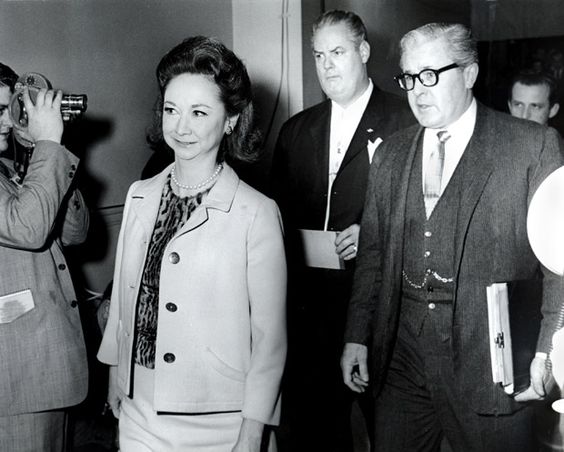
Kilgallen, with Jack Ruby defense attorneys
Joe Tonahill (center) & Melvin Belli (right),
at the Ruby trial (February 19, 1964)Lee Israel did a good job in her book in describing just how much Kilgallen wrote about the failings of the Warren Commission. She also described some of Kilgallen’s extensive contacts with early researcher Mark Lane. It is safe to say that no other widely distributed columnist in America wrote as often, or as pointedly, about the JFK case as Kilgallen did. She flew to Dallas to cover the trial of Jack Ruby in early 1964. While there, she secured two private interviews with the accused. She never divulged what was revealed to her in those interviews. Instead, the notes from these meetings went into her ever expanding JFK assassination file—which more than one person saw since, at times, she actually would carry it around with her. (Israel, p. 401)
From the contacts she attained in covering the Ruby trial, Kilgallen broke two significant JFK stories. First, someone smuggled her the testimony of Jack Ruby before the Commission. After convincing her editors to print the purloined hearing, her paper ran the story over three consecutive days. And they allowed her to append comments and questions to the colloquy. (Israel, p. 389) Her Dallas sources also secured her an early copy of the DPD radio log. With this she pointed out that Police Chief Jesse Curry had misrepresented to the public his real opinion as to what the origin point of the shots were. He had told the public he thought they came from the Texas School Book Depository, but on the log he said they came from the rail yards, behind the picket fence, atop the grassy knoll. (Israel, p. 390)
When documents on Oswald were denied to Ruby’s defense team, again Kilgallen chimed in pungently:
It appears that Washington knows or suspects something about Lee Harvey Oswald that it does not want Dallas and the rest of the world to know or suspect. . . Lee Harvey Oswald has passed on not only to his shuddery reward, but to the mysterious realm of “classified” persons whose whole story is known only to a few government agents.
Why is Oswald being kept in the shadows, as dim a figure as they can make him, while the defense tries to rescue his alleged killer with the help of information from the FBI? Who was Oswald, anyway? (Israel, p. 366)
She also ran a story suggesting that there were witnesses who saw Oswald inside Ruby’s Carousel Club. (Shaw, pp. 66, 67) Based upon that, she once said, “I don’t see why Dallas should feel guilty for what one man, or even 3 or 5 in a conspiracy have done.” (Shaw, p. 68)
When the Ruby case was decided and he was found the sole guilty party—a verdict that would later be reconsidered—Kilgallen, again, wrote about it quite resonantly:
The point to be remembered in this historic case in that the whole truth has not been told. Neither the state of Texas nor the defense put all of its evidence before the jury. Perhaps it was not necessary, but it would have been desirable from the viewpoint of all the American people. (Israel, p. 372)
In fact, as Israel wrote, Kilgallen actually became a funnel for men like Lane and Dallas reporter Thayer Waldo to run information through, in order for it to garner a wider audience. (Israel, p. 373)
She went even further. Kilgallen ran experiments with her husband holding a broomstick to replicate the alleged sighting by Warren Commission witness Howard Brennan. Brennan was the Commission’s chief witness as to a description of Oswald as the sixth floor assassin. She stood approximately where Brennan stood in front of her five-story townhouse. And she told her husband to go ahead and kneel, as the Warren Commission said Oswald was behind a box. She came to the conclusion that there was “no way in the world that such a description could have been accurately determined by Brennan.” (p. 391) She further came to the conclusion that there was a real question as to the type of weapon that was found in the building, a Mannlicher-Carcano or a Mauser. She was also tipped off as to the ignored testimony of witness Acquila Clemmons. Contrary to the Warren Report, Clemmons claimed to have seen two men involved in the murder of Officer J.D. Tippit, not one, and neither resembled Oswald. These stories were mentioned in her newspaper column in September of 1964. (Israel, p. 395)
The FBI visited her to find out how she got Ruby’s testimony before the Warren Commission. She made them tea but told the two agents that she could never reveal how she got that exhibit or who gave it to her. And when the Warren Report was released in September of 1964, Kilgallen made it fairly evident how she felt about it:
I would be inclined to believe that the Federal Bureau of Investigation might have been more profitably employed in probing the facts of the case rather than how I got them …. At any rate, the whole thing smells a bit fishy. It’s a mite too simple that a chap kills the President of the United States, escapes from that bother, kills a policeman, eventually is apprehended in a movie theater under circumstances that defy every law of police procedure, and subsequently is murdered under extraordinary circumstances. (Israel, p. 396)
What she said and did in private on the JFK case was even more extreme than her public actions. After her experience with the FBI she concluded that Hoover had tapped her home phone line. She told Lane that, “Intelligence agencies will be watching us. We’ll have to be very careful.” She decided to communicate with Lane via pay phones and even then by using code names. She then added, “They’ve killed the president, the government is not prepared to tell us the truth, and I’m going to do everything in my power to find out what really happened.” (Israel, pp. 392-93) She told her friend Marlin Swing, a CBS TV producer and colleague of Walter Cronkite, “This has to be a conspiracy.” (ibid, p. 396) To attorney and talent manager Morton Farber, she characterized the Warren Commission Report as “laughable.” She then added, “I’m going to break the real story and have the biggest scoop of the century.” (Israel, p. 397) She made similar statements to another TV producer Bob Bach, and another talent manager, Bill Franklin. (Israel, p. 396) All this, of course, was contra what almost all of her professional colleagues were involved with at the time: namely praising and venerating the fraud of the Warren Report. For instance, in June of 1965, Kilgallen was invited to do an ABC news show called Nightlife with Les Crane. Since Bach had helped arrange the appearance she thought she would be speaking about the Warren Report, so she brought parts of her JFK file with her. But she was informed by one of the show’s producers, Nick Vanoff, that they did no want her to address that subject. He told her it was “too controversial”. (Israel, p. 401)
Between the time of the release of the Warren Report—September of 1964—and her passing—November of 1965—she was in the process of taking and planning flights to both Dallas and New Orleans. (For the former, see Israel, p. 402; for the latter, see Jordan, p. 20) These do not appear to be job related. They appear to be for the purpose of advancing her own inquiry into Kennedy’s assassination. For instance, she told What’s My Line? makeup artist Carmen Gebbia that she was excited about an upcoming trip to New Orleans to meet a source she did not know. She said it was all cloak and daggerish. And she concluded that, “If it’s the last thing I do, I’m going to break this case.” (Jordan, p. 20)
Marc Sinclaire Marc Sinclaire worked for Kilgallen as her major hairdresser. Many years after her death he revealed that he went to New Orleans with her in October of 1965. Sinclaire went down on a separate plane and stayed in a different hotel. They had dinner together the night he arrived. The next morning he was preparing to go to her place to work on her hair. She called him and said that was cancelled: she had purchased a ticket for him and he was to return to New York. Further, he was not to tell anyone he had been there with her. Her second hairdresser, Charles Simpson, said she used to tell him things about her work, but now things were different. She proclaimed “I used to share things with you … but after I have found out now what I know, if the wrong people knew what I know, it would cost me my life.” (ibid)
III
Two of the problems with the circumstances of Kilgallen’s death are that first, the cause was misreported by her own newspaper, and second, no one can pinpoint exactly when her body was first discovered. Using her father as a source, the Journal American reported that Dorothy Kilgallen had died of an apparent heart attack. (Israel, p. 410) As we shall see, that was not the case. But even more puzzling, there is a real mystery as to when the corpse was first discovered.
The official police record states that the body was found between noon and 1 PM by Marie Eichler, Kilgallen’s personal maid. (Israel, p. 416) But Israel talked to an anonymous source who was a tutor to the Kilgallen children and was there on the morning of November 8, 1965. That source told Israel that the body was found much earlier, before ten o’clock. Sara Jordan later revealed the tutor was Ibne Hassan. Hassan’s information turned out to be correct. From the information on hand today, the first known person to discover Kilgallen’s body was Sinclaire. And his (unofficial) testimony has powerful relevance. He said that he was stunned when he found Kilgallen sleeping on the third floor. Because she always slept on the fifth floor. He found her sitting up in bed with the covers pulled up. He walked over to her, touched her, and knew she was dead. In addition to being on the wrong floor, she was wearing clothes that she simply did not wear when she went to bed. Further, she still had on her make up, false eyelashes, earrings, and her hairpiece. (Jordan, p. 21)
A book was laid out on the bed. It was Robert Ruark’s recent volume The Honey Badger. Yet, according to more than one witness, Kilgallen had finished reading this book several weeks—perhaps months—prior. Also, she needed glasses to read; Sinclaire said there were none present. The room air conditioner was running, yet it was cold outside. Plus the reading lamp was still on. Sinclaire added, her body was neatly positioned in the middle of the bed, beyond the reach of the nightstand. (ibid)
The questions raised by Sinclaire’s description are both obvious and myriad. The setting suggests that Kilgallen’s body was positioned both on a floor she did not sleep on and in a way that was completely artificial. In other words, it was posed. If this was done, it was performed by someone not familiar with her living routine and in a hurry to leave, probably for fear of awakening someone. But this is not all there is to it. Sinclaire said there was also a drink on the nightstand. (As we shall see, there more likely were two glasses there.) When Sinclaire called for the butler, he came running up the stairs, very flustered. Sinclaire then left through the front door. He said that there was a police car there, with two officers inside. They made no attempt to detain him. That morning, a movie magazine editor named Mary Branum received a phone call. The voice said, “Dorothy Kilgallen has been murdered”, and hung up. (ibid)
Charles Simpson When Sinclaire got home he called his friend and colleague Charles Simpson. He told him that their client was dead. He then added, “And when I tell you the bed she was in and how I found her, you’re going to know she was murdered.” Simpson later said in an interview, “And I knew. The whole thing was just abnormal. The woman didn’t sleep in that bed, much less the room. It wasn’t her bed.” (ibid. These video taped interviews were done by researcher Kathryn Fauble. The Jordan article owed much to her research, and so does Shaw. See Shaw, p. 113)
From Sinclaire’s description, there seems to have been a prior awareness of Kilgallen’s passing: e.g., the police car in front of the door. But as of today, Sinclaire is the best testimony as to when the body was actually found. About three hours later, two doctors arrived at the townhouse: James Luke and Saul Heller. The latter pronounced her dead. But the former did the medical examination, which as we shall see, was incomplete.
About a week after her death, Luke determined that she was killed by “acute barbiturate and alcohol intoxication, circumstances undetermined.” (ibid, p. 22) Roughly speaking, this means she died of an overdose, but the examiners could not determine how the drugs were delivered. Usually, the examiner will write if the victim was killed by accident, suicide or homicide. That was not done in this case. The main reason it was not done is because there was no investigation of the crime scene, or of any witnesses who saw and had talked to her in the previous 24-48 hours. For example, phone calls were not traced, her home was not searched for drug containers, and there was no investigation as to how she arrived home that evening or if anyone was with her.
Lee Israel was shocked when she discovered this fact. She was looking through the Kilgallen police file for reports labeled DD 5 and DD 15. The former is a supplementary complaint report that records activities pursuant to a complaint. The latter is a request to the Medical Examiner for a Cause of Death notice. Israel said that, although the investigating detective said he saw this, it was missing from the file. (p. 428) Therefore, there appears to have been no investigation done to determine how the drugs were administered. This was so bewildering to Israel that she wrote that there may have been another, unofficial channel, of communication between the police department and the medical examiner’s office on the Kilgallen case.
There does seem to be cause for such speculation. In her book, Israel mentioned another anonymous source from the toxicology department of the medical examiner’s office. (Israel, pp. 440-41) This man was a chemist under Charles Umbarger, director of toxicology at the NYC Medical Examiner’s Office. This source met with Israel personally and told her that Umbarger believed that Kilgallen had been murdered. Umbarger had evidence that would indicate this was the case but he kept it from the pathology department as part of the factionalism in the office. The idea was to retain this secret evidence in reserve over chief Medical Examiner Milton Halpern and Luke. Jordan discovered this secret source was a man named John Broich. (Jordan, p. 22) Broich told Jordan, as he told Israel, that he did new tests on the glasses, and tissue samples, both of which Umbarger had retained. He found traces of Nembutal on one of the glasses. The new tests discovered traces of Seconal, Nembutal and Tuilan in her brain.
This was an important discovery, for more than one reason. First, the police could not find any evidence of prescriptions for the last two drugs by Kilgallen. Her doctor only prescribed Seconal. Second, no doctor would prescribe all three to one patient at one time since the mix could very well be lethal. (Shaw, p. 116) Third, the prescription Kilgallen had for Seconal had run its course at the time of her death. Umbarger, of course, knew this. When Broich reported back to him about his new chemical discoveries, Umbarger had an unforgettable reaction. He grinned at his assistant, and then said the following: “Keep it under your hat. It was big.” (Jordan, p. 22)
IV
As we have seen, neither the New York Police Department nor the medical examiner’s office was forthcoming or professional in the Kilgallen case. The House Select Committee on Assassinations (HSCA) only performed a very cursory look at her death. But it appears it was the HSCA that got her autopsy report into the National Archives. (Shaw, p. 277) That cursory look seems odd for the simple reason that the HSCA’s chief pathologist, Dr. Michael Baden, was working in the Medical Examiner’s office at the time of Kilgallen’s passing. In fact, Baden’s name is listed as an observer for Luke’s autopsy report. (Shaw p. 102) Baden was also a source for Israel’s book. In 1978, while the HSCA was ongoing, he told Israel that, from what he could see, the evidence would indicate that Kilgallen had fifteen or twenty 100 mg capsules of Seconal in her system. (Israel, p. 413) Why Mark Shaw did not make more of this point in his book eludes this reviewer. Because Baden’s opinion would seem to be incorrect, for the simple reason that, as stated above, Kilgallen likely would not have had that many Seconals left in her prescription at the time of her death. But a fewer number of Seconals, mixed with the two other drugs, would very likely have produced the fatal result.
Because of the (screamingly) suspicious circumstances of her death, it does not at all seem logical to consider either of the other alternatives—that it was accidental, or she took her own life. How could she accidentally end up in the wrong bed on the wrong floor with the covers pulled up? As per the second option, as stated above, there seems to not have been enough left of her Seconal prescription for her to take her own life. According to her doctor, Kilgallen was prescribed 50 pills per month. There are two reports, one from the police, one from her doctor, but the estimates are that she took between 2-4 pills per night. (Israel, p. 425) Since the prescription was last filled on October 8th, how could there possibly be enough pills available for her to plan her death? The indications seem to suggest this was a homicide.
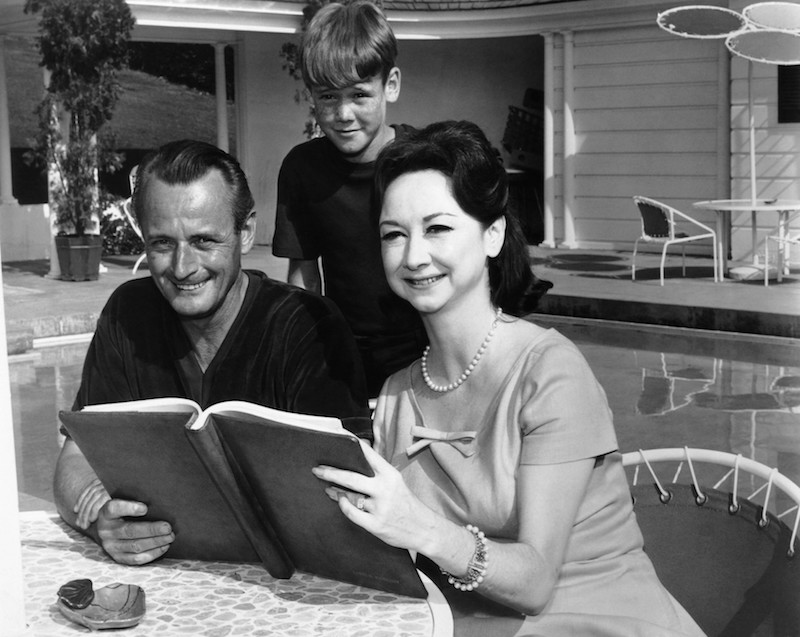
Kilgallen, Richard Kollmar
& their son, Kerry (1964)If that were the case—and Israel, Jordan, and Shaw certainly seem to agree it is the strongest alternative—then who was responsible? One possible suspect is her husband Richard Kollmar. As Israel and Shaw outline, neither spouse was faithful to the other at this stage of the marriage. Richard was involved in several one-night stands, and Dorothy had a love affair with singer Johnny Ray, which had concluded at around the time of Kennedy’s assassination.
Further, Richard was not doing nearly as well financially as Dorothy was. Israel had direct access to their accountant, Anne Hamilton. And from that interview, it appears that Shaw overstates their wealth significantly. (See Israel, especially p. 356) But there can be little or no doubt that at the time of her death, Kilgallen was the major breadwinner in the family. Therefore, in case of her death, Richard would be in position to inherit a significant amount of money in cash and property, well over a million dollars today. Further, and another point I could not find in Shaw’s book, Richard had his own access to Tuinal. (Israel, p. 438)
But still, there are serious problems with holding Richard as the prime suspect. First, if such were the case, then why would there be such an almost appallingly negligent investigation? Cases of spouses killing their partners must have appeared every week in a city as large as New York. And, if so, how would Richard have the influence to cause such a large system failure—one that took place in the police department, the DA’s chambers, and in the office of the medical examiner? Secondly, no one who knew Kollmar thought he was capable of doing such a thing. Both Israel and Shaw agree on this point. But third, if Kollmar had planned the whole thing, how could he possibly have left as many holes in his plot as he did— many of them wide enough to drive the proverbial tractor through? Could he really have not known where his own wife slept? What she wore when she retired? What book she was reading? That when she read, she wore glasses? And so on and so forth. The case does not appear to be an inside job. Because if Marc Sinclaire had not left that morning, he could have detonated it in about two minutes.
Ron Pataky & Kilgallen Both Israel and Jordan seemed to center their suspicions on a man that the former referred to as the Out of Towner. Israel referred to him by that rubric because he lived and worked in Columbus, Ohio. His real name is Ron Pataky. In her Midwest Review essay, Sara Jordan was explicit about his name and printed a photo of him standing next to Kilgallen. There are several reasons why Ron Pataky’s presence creates suspicion in this case. One has to do with the closeness of his relationship with Kilgallen at the time. After she and Johnnie Ray decided to break up, it appears that Pataky became Kilgallen’s romantic interest. They called each other frequently, saw each other on occasion, and wrote letters and notes to each other. A very odd thing happened in late October on the set of What’s My Line? Before the show began taping, an announcement came on the public intercom. The voice said, “The keys to Ron Pataky’s room are waiting at the front desk of the Regency Hotel.” Quite naturally, this shook Dorothy up. Why didn’t someone just bring her a note? Pataky denied being in New York at that time. If so, was someone trying to tell the reporter that they knew something about her private life? (Jordan, p. 20) On the weekend of her death, Kilgallen had an hour-long call with Sinclaire. During this call, she said her life had been threatened (she later said she might have to purchase a gun). Sinclaire told her that the only new person in her life was Pataky. And she had shared her interest in, and information about, the JFK case with him. He suggested that she confront him with those facts. Two days later, Kilgallen was dead. (Shaw, p. 242)
Both Israel and Shaw discuss interviews they had with Pataky. In more than one place it appears that the subject is being less than candid. For instance, he says that he was never at Kilgallen’s townhouse. But he says that he knew Kilgallen drank and popped pills. When asked how he knew that, he says he saw the pills in a medicine cabinet. Unless Dorothy carried a medicine cabinet with her, how did he know about it if he was never in her home? Pataky also said in 2014 that the New York police talked to him about Dorothy’s death based upon a note they discovered at the home. Yet there is no evidence of any such interview or note in any police file. (Shaw, pp. 239-40) Another example would be one of his alibi witnesses. Pataky has always maintained that he was in Columbus when he got the news of Dorothy Kilgallen’s death. He said fashion editor Jane Horrocks read the notice off the news wire to him. But researcher Kathryn Fauble later talked to Horrocks. She remembered Pataky vividly since they shared an office at the Columbus Citizen-Journal. She also recalled him getting calls from Kilgallen there. But she added on the day the news broke about Kilgallen’s death she wasn’t in the office, she was on assignment in California. (Shaw, p. 237)
Perhaps the most interesting aspect of any interview with Pataky was the one Israel did with him about Kilgallen’s final hours. Sara Jordan, Israel and Shaw have attempted to reconstruct what Kilgallen did the evening before she was discovered dead by Sinclaire. After taping What’s My Line?, she and producer Bob Bach went to the restaurant/bar P. J. Clarke’s for a drink. (Jordan, p. 21) Both Bach and Sinclaire have stated that Kilgallen separately told them she was to meet with someone at the Regency Hotel later that evening. Therefore, after she left P. J. Clarke’s, she arrived at the Regency, which is about six blocks from her home. In a videotaped interview with an associate of Kathryn Fauble, it was revealed that Kilgallen was seen in the corner of the cocktail lounge by a woman named Katherine Stone. Stone had been a contestant on the show that night. (ibid) Press agent Harvey Daniels also recalled seeing Kilgallen with a man at the Regency that night. So did piano player Kurt Maier. (ibid) She left the Regency at about 2 AM. According to Israel, when the news of her death broke, several people working at the Regency discussed her presence there the night before. (Israel, p. 432)
Pataky has always denied he was with her that evening. He has always denied he was in New York that night. The most he would say is that she called him that evening. But Pataky firmly declared that he was in Columbus that evening, not in New York. Israel had taped her call with him. She turned it over to former CIA officer George O’toole. O’toole was one of the leading Agency analysts for the Psychological Stress Evaluator, commonly known as the PSE. This device measures stress in the voice in response to questioning. That measurement may reveal the subject is lying about a sensitive point. O’toole wrote an interesting book on the subject in relation to the JFK case, The Assassination Tapes. In that book he explains in detail how the device works and its reputation for accuracy. An absence of stress in the voice would indicate that the subject is telling the truth. If the stress is high, it may reveal tension due to deception. When O’toole analyzed the part of the conversation in which Pataky denied being in New York that night, he wrote that the PSE hit level F and G gradients. These are the highest levels of stress the machine will measure. When Pataky discusses how he actually found out about Kilgallen’s death, again the machine hit the F level. (Israel, p. 435)
Pataky had designs to be a songwriter. He had confided in Kilgallen about this. The verses of a song are, in many ways, like a poem. So years later, Pataky posted some of his poems online. Both Shaw and Jordan found them interesting. First there is one called “Never Trust a Stiff at a Typewriter”. It reads as follows:
There’s a way to quench a gossip’s stench
That never fails
One cannot write if zippered “tight”
Somebody who’s dead could “tell no tales.”
As to its suggestiveness to the topic, this needs no comment. The second Pataky poem is called “Vodka Roulette Seen As Relief Possibility”.
While I’m spilling my guts
She’s driving me nuts
Please fetch us two drinks
On the run.
Just skip all the nois’n
Make one of them poison
And don’t even tell me
Which one!
Shaw goes on for four paragraphs on this poem. But again, its suggestiveness needs little explication in relation to the subject at hand.
Let us close the discussion of Pataky with another piece of information allegedly supplied by Israel, but which today is in dispute. John Simkin used to own and operate the JFK Assassination Debate forum at Spartacus Educational web site. He had an abiding interest in the Kilgallen case. In a discussion at Simkin’s site in 2005, he enlisted Israel to participate. During this discussion it was revealed that in 1993 a college student in Virginia did what Israel did not do in her book. He actually revealed Pataky’s name. And he further wrote that the management of the Regency Hotel had forbidden its employees to discuss Kilgallen’s presence there that night. But even more interesting, Israel said that she found out that Pataky dropped out of Stanford in 1951 and later enrolled in the School of the Americas in Panama. This, of course, is the infamous CIA training ground for many Central American security forces who were later involved in various kidnappings and assassinations in the fifties and sixties. In the Midwest Today article by Sara Jordan, Israel denied she made this statement. (But Jordan found out that Pataky did drop out of Stanford after one year. Jordan, p. 23) Yet to this day, that statement exists in black and white on that site. It’s kind of a reach to say Simkin invented it. And we know that Israel was sensitive about what she wrote about Pataky, or else she would have named him in her book.
V
After writing all the above I would like to say that Mark Shaw wrote an admirable and definitive volume about Kilgallen and her death. Unfortunately, I cannot do so. One reason is obvious from my references. A lot of the information in Shaw’s book can be found in either Israel’s tome or the Sara Jordan essay in Midwest Today. The interviews with Sinclaire and Simpson were done by the indefatigable Kathryn Fauble. Shaw does a nice job in reporting on the autopsy. And his interviews with Pataky are informative. But some of the book seems padded, consisting of chapters about four pages long. (See Chapter 34) Sometimes, the author repeats information, as with Sinclaire finding the body. And like writers who partake in biography, Shaw tends to exaggerate the achievements of his subject.
This last is done in two ways. He tends to exaggerate Kilgallen’s stature as a journalist. For example, he calls her the first true female media icon. (p. 294) Did the author forget about Dorothy Thompson? Or Adela Rogers St. Johns? They certainly ranked with Kilgallen in popularity and as role models. And Thompson left behind a body of work at least equal in stature to Kilgallen’s and, by any rational measure, exceeding it. Shaw also quotes Ernest Hemingway as calling Kilgallen, “One of the greatest women writers in the world”. I could not find a source for this quote. But on what grounds would such an expansive judgment hold water? And why would Shaw want to use it? Kilgallen wrote two books. She actually co-wrote them. The first was about her trip around the world, which she wrote with Herb Shapiro in 1936. Murder One was published posthumously by an editor based on her notes. This plus her voluminous columns are the sum total of her literary output. Does that compare with the achievements of say Isak Dinesen, Katherine Anne Porter or Rebecca West?
The second way Shaw inflates his subject is by discussing what her impact would have been on the JFK case. This is completely unwarranted and amounts to nothing but pure speculation. For the simple reason that no one is ever going to know what Kilgallen discovered, or what her talks with Ruby were about. Therefore, the database from which to measure her achievement is simply non-existent. But, to put it mildly, this does not hinder Shaw. In a perverse sort of way, it enables him. Near the end of the book he writes that, “If Kilgallen had lived … the course of history would have been altered.” (Shaw, p. 288) Since, as stated above, there is no database to support that statement with, this reviewer is puzzled as to how Shaw arrived at this outsized conclusion.
Which leads to two other related problems with Shaw’s book. First, the author’s footnotes would not pass muster in a sophomore English class. Time after time he refers to newspapers without adding a date to them. Time after time, he refers to books without supplying a page number. This, of course, makes it difficult to crosscheck his work. Secondly, he repeatedly refers to the mystery of how Dorothy’s JFK file disappeared after her death. Yet in Sara Jordan’s essay, she quotes a conversation between the Bachs and Richard Kollmar after Dorothy’s death. They asked him, “Dick, what was all that stuff in the folder Dorothy carried around with her about the assassination?” Richard replied, “Robert, I’m afraid that will have to go to the grave with me.” (Jordan, p. 22) What this means is anyone’s guess. But it could mean that he somehow recovered it and destroyed it.
One of the worst aspects of The Reporter who Knew Too Much is how Shaw’s inflation is somewhat self-serving. For instance, when I saw the author speak at last year’s JFK Lancer conference he made a couple of rather odd statements. He said that since Kilgallen had gone to New Orleans with Sinclaire, this meant that she was investigating Carlos Marcello for the JFK case. Again, for reasons stated above, there is no factual way that Shaw could know such a thing. But further, how does New Orleans automatically deduce Marcello? New Orleans is honeycombed with a multitude of leads on the JFK case. Lee Oswald spent about six months there from the spring to the fall of 1963, less than two months before he was killed. To say that what he did there would automatically lead to Marcello betrays an agenda that is not really dealing with Kilgallen.
That agenda traces back to a book Shaw wrote in 2013. It was called The Poison Patriarch. This reviewer did not critique it since it was simply not worth discussing. But Shaw synopsizes it here in order to attribute what Kilgallen was going to do if she had lived. Shaw’s previous work is a feat of Procrustean carpentry that ranks with the likes of Peter Janney and Philip Nelson. And like those authors, Shaw used an array of dubious witnesses to achieve his feat of alchemy. In short, he said that JFK was killed because Joseph Kennedy insisted on Bobby Kennedy as Attorney General. The father had underworld ties, should have known that RFK was going to do battle with the Mafia, and this caused a revenge tragedy to be performed. To scaffold this utterly bizarre thesis, Shaw trotted out a virtual menagerie of dubious witnesses like Tina Sinatra, Frank Ragano, Toni Giancana, Sy Hersh and Chuck Giancana. The book was a recycling and revision of Chuck Giancana’s science fiction fable Double Cross. (See pages 179-180 of the present book.)
Well, in The Reporter Who Knew Too Much, Shaw pens his imaginary conclusion to Kilgallen’s investigation. He writes that after she made her second trip to New Orleans, the reporter produced a series of articles connecting Oswald, Ruby and Marcello. This series triggered a grand jury inquiry. This culminated in indictments of Marcello for the murders of both Kennedy and Oswald. But Kilgallen’s evidence went further. It also managed to indict J. Edgar Hoover for obstruction of justice, and he resigned his position. As a result, Kilgallen’s disclosures changed the way that the JFK case was discussed in history books.
I wish I could say that what I just described is an exaggeration or parody of what Shaw wrote in his book. Unfortunately it is not any such thing. If the reader turns to page 289, he can read it for himself. To say that such writing is a fantasy really does not do it justice. The idea that Kilgallen was going to take on the entire power structure of the USA and overturn it with a series of newspaper columns is almost too ridiculous to consider. As many authors have proven, the JFK cover-up was interwoven throughout the entire structure of the American government at that time: the White House, the Justice Department, the Secret Service, the CIA, and the FBI. The Power Elite was involved in it through organs like the New York Times, CBS, and Life magazine. The idea that Kilgallen was going to upend this whole colossal structure is a bit ludicrous. As mentioned, she could not even discus the JFK case on Les Crane’s talk show. Which was a harbinger of what was going to happen to Jim Garrison in 1968 on The Tonight Show. I hate to inform Mark Shaw, but the Sam Sheppard murder case is not the Kennedy assassination.
If Shaw would have restrained himself, or if he had an editor who would have pointed out the problems with his design, then this would have been a good and valuable book. It would have been really about Dorothy Kilgallen: who she really was, what we know and do not know about her death. But as shown above, such was not the case. Thus I would actually recommend to the interested party Sara Jordan’s informative and objective essay instead.
The recommended essay can be found here:
-
The Magic Scalp
Witnesses who saw JFK’s head up close after he was shot, describe damage that is quite different from what shows in certain autopsy photographs and x-rays. And the contrast between the two – the damage they describe, and the evidence on films is so radically different, many researchers suspect evidence tampering.
There are people who defend the authenticity of the evidence by “explaining” the problem with theories that may sound reasonable – but some of these people promote their work in the following ways: (a) they omit significant information that challenges their ideas; (b) they pad their work with irrelevant information – thus obscuring the paucity of proof of their main thesis; (c) they try to shape ambiguous language to mean only what they want it to mean; (d) they make amateurishly omniscient assertions… “This is irrefutable proof… There’s no other explanation… This has to mean…”; (e) they list people who presumably agree with them without showing the reader what exactly they had agreed with, and some of the people are in rest homes, or in graves, or otherwise are hard to reach.
JOHN CANAL’S THEORY
John Canal, retired USAF Senior Master Sergeant, has a theory designed to explain away two major issues with JFK’s head wound: (1) how the alleged entrance wound, described by the pathologists as low in the head, was four inches higher, as interpreted by medical panels who later studied the photos and x-rays (not the body); (2) why the back of the head pictures show no wound at all, not the big obvious opening described by Parkland doctors and others, and not the smaller entrance wound.
Canal has promoted his explanation in three different articles, one in 2013 in Max Holland’s Washington Decoded, and two more in something called “Student Operated Press,” The SOP 2014, and The SOP 2015.
Canal’s theory has multiple parts: (a) he insists the main photo in question (see below) was taken after the morticians reconstructed the head; (b) reconstruction involved moving the scalp from the back to the front of the head, to cover any gaps that might be seen, should there be an open casket funeral; (c) the entrance wound, low in the back of the head, got dragged to the top of the head; (d) the back of the head looks undamaged because the photo was taken after bone was put back in and the scalp was sewn shut.
In the SOP in 2015, he asserts:
“Again, because the BOH [back of head] photographs show the entry wound in the scalp high in the cowlick, the fact that the skull entry was low (approximately two inches above the hairline) is incontrovertible evidence the BOH photographs were taken after the autopsy when reconstruction of the BOH by the morticians was completed.”
This reconstruction is supposed to hide damage from viewers of an open coffin funeral? Then why did they leave that bone flap in front of the ear still flapping away? Surely this photo was not taken when reconstruction was completed. We can be generous and say it was taken during the reconstruction, but Canal presents no proof of that either.
JOHN CANAL’S “PROOF”
Before we go any further, let’s take a good look at the photo in question:
(People say this photo shows no damage, other than the small white image near the hairline, said to be adherent brain tissue. Yet just above it is an odd, light-colored, angular formation – but that is a side issue not relevant to this essay.)
What is presumed to be the wound is a flat-looking area of light, watery, reddish brown – one of many in the photo – with hairs growing out of it, apparently. If you blow it up, you will see an “X” crisscrossing through it. Possibly these are hairs.
“X” marks the spot. Hairs?
If you have ever seen an entrance wound in scalp created by a jacketed bullet traveling at medium high velocity, you will know that it looks nothing like this. The skin is crushed between bullet and bone, and appears quite dark. Lift up the scalp, and the edges of the hole are still apparent. The X’ed image in the photo does not look like a hole at all.
But this is how the wound is described on page 104 of HSCA Volume VII: “The inferior margin of this wound, from 3 to 10 o’clock, is surrounded by a crescent-shaped reddish-black area of denudation, again presenting the appearance of an abrasion collar, resulting from the rubbing of the skin by the bullet at the time of penetration. From 12 to 3 o’clock, there is a suggesting of undermining, that is, tunneling of the tissue between the skin surface and the skull…” They put this description under a drawing of the photograph.
The above description is a conflation of the drawing and photograph. I see no “reddish-black area of denudation” in the photograph – but the drawing certainly has a black and white equivalent.
Now please look at what is supposed to be an accurate drawing of this photo:
As you can see, the “wound” is much darker, has more dimension, and rolled edges. It looks like a hole at least. Not one of these characteristics appears in the photograph.
In his beautifully written essay on the medical evidence, Gary Aguilar, MD also compared the two, and said of the drawing, “the small spot visible just to the right of the top of the ruler is exaggerated in this diagram. It is significantly smaller in the original photograph.” (And there are probably other researchers who have described the contrast between the photo and the drawing.)
It is the drawing, not the photo, that John Canal presents in his articles. To the uninitiated, the drawing may appear to display a wound.
Hair Surrounding “Wound” Too Long for EOP Area
Kennedy’s hair was quite short in the back, including the area where a bullet allegedly entered. And it was even shorter below that area as it approached the neck. As you can see from the photo, the hair all around the “wound” in the cowlick is much too long.
WITNESSES DO NOT SUPPORT CANAL’S THEORY
No witnesses said pictures were taken during or after the reconstruction of the skull. None said scalp from the EOP area was dragged to the top of the head.
JOHN STRINGER
Canal’s star witness – John Stringer – who Canal insists took photographs of the reconstructed skull after the autopsy, said in 1996:
“We took no photos during or after the embalming.” (ARRB 4/8/96, p.5)
And from his longer deposition, it seems clear that Stringer only took photos during the autopsy – including the ones John Canal claims were taken after reconstruction of the skull. (ARRB 7/16/96)
But in his Washington Decoded article, Canal gives prominence to what he seems to have gotten Stringer to say in 2011, when Stringer, who was born in 1918, said at the age of 93:
“In one statement, Stringer wrote, ‘I may have taken some pictures after midnight, but I just can’t remember, it’s been too long.’ [April 30, 2011] In view of Stringer’s 1996 testimony that he did not arrive at his home (not far from the morgue) until about 4 AM, however, and that cosmetic reconstruction of the head began shortly after 11 PM, the inference that he took pictures later as well as earlier is reasonable. It is also consistent with a statement in his book MEDPHOTO that he took photos at various times throughout the procedure and whenever he was directed to do so. [21]”
Buried in Reference 21 is Stringer’s earlier statement to the ARRB:
“[21] John Stringer, MEDPHOTO: Snapshots of Life in Peace & War with the US Navy (Mooresville, NC: Wishbone Creative Product Services, 2008), 37. In an ARRB interview, Stringer also said that, ‘We took no photos during or after the embalming.’ In contrast, before that statement, he stated photos were taken “throughout the autopsy.”
Notice Canal’s last remark – as if taking pictures “throughout the autopsy” is supposed to suggest he took them after the autopsy. He pads his article with quotes from a number of people using those words, “throughout the autopsy”, as if that meant afterwards. He also conflates “late photography” to mean after the autopsy:
“Other witnesses at the postmortem whose observations support late photography [emphasis added] included Captain John Stover, an officer at the Bethesda Naval Medical Center; John Van Hoesen, one of the morticians; Joseph Hagan, supervisor of the team of morticians; Floyd Riebe, the assistant autopsy photographer; Jan Rudnicki, who assisted the autopsy doctors; General Godfrey McHugh, who observed the autopsy; Jerrol Custer, an X-ray technician; and James Sibert, one of the two FBI agents who observed the autopsy.”
Notice that he leaves out Tom Robinson, the mortician who said many things that challenged the official story.
TOM ROBINSON (mortician, not mentioned by Canal):
“When asked, Mr. Robinson said he had no recollection of photography the night of the autopsy, one way or the other – no recollection whatsoever.” (ARRB 6/21/96, p.3)
JOSEPH E. HAGAN (mortician):
“He does not recall, one way or another, whether any photographs were taken during Gawler’s work on the President’s body.” (ARRB 6/11/96 p.4)
Before the morticians worked on the body,
“Hagan said that when he arrived… the autopsy was almost over; he only had to wait in the gallery about 20 minutes before the autopsy was concluded. The body of the president was being ‘cleaned up.’ Hagen said photos were being taken, but could remember no details…” (ARRB 6/11/96, p.3)
JOHN VAN HOESEN (mortician):
Canal presents this passage from David Lifton’s book that he (Canal) says suggests photos were taken after head reconstruction. But he seems to be describing nothing more than having to wait on the autopsy and the picture-taking before they could begin their own work. And his comments seem to echo Hagen’s (see above):
“Van Hoesen: When we got up there, nothing had been started; then we had to wait for the autopsy; and then periodically, more pictures were being taken, “you know, different angles and so forth; where the entry was, and so forth; this angle, and that angle … Lifton, Best Evidence, 666.”
Canal does not report what Van Hoesen told the ARRB, and it does not help his theory any.
“He could not remember, one way or another, whether photographs were taken during the embalming and reconstruction process.” (ARRB 9/26/96, p.3)
LOGIC DOES NOT SUPPORT CANAL’S THEORY
Scalp Borrowed From an Area Missing Scalp?
It is well-established that witnesses, including a prominent brain surgeon at Parkland Hospital, said both bone and scalp were missing from an area in the back of the head that included the occiput. The lead pathologist who wrote the autopsy report, James Humes, was vague about a lot of things, including how much of the great defect involved occipital bone, but he did admit the wound was “somewhat” in that area. In any case, the back of head photograph presented earlier in this essay shows no such defect in bone or scalp.
According to Canal, scalp was borrowed from that area – even though it was already missing scalp – to cover the top right of the head.
But Canal ignores the testimony about the large hole in the scalp – which he describes as merely “torn.”
“Specifically, the cosmetic repair involved first suturing the tear in his rear scalp until it was closed, and then, after undermining, stretching the scalp until it covered the large deficit in the top/right/front of Kennedy’s head where the bullet had exited, bone was blown out, and scalp missing or badly damaged.
“The stretching of the scalp occurred after the autopsy was completed, sometime around 11 PM, and once the embalming and cosmetic restoration of the body commenced. The morticians had only the best of intentions when they took advantage of the fact that the rear scalp had only been torn, and was both repairable and useful for another purpose. They were simply trying to cover that large deficit in the head in anticipation of an open-casket funeral.” (Washington Decoded)
“The BOH opening, in all likelihood, was created after the bullet’s explosive impact exposed the president’s brain through a tear in the rear scalp and an opening between two or more dislodged (but not blown-out or missing) pieces of loose rear skull. This observation is supported by the fact that the lateral X-ray shows no missing rear bone whatsoever. Dr. J. Thornton Boswell, one of the prosectors, did say in 1996 that he repositioned some bone pieces before the X-rays and photos were taken; it seems logical that he pushed some loose pieces of skull (dislodged but still adhering to the scalp) roughly back into place. (Washington Decoded)
SUMMARY
- Not one witness mentioned by Canal says that photos were taken after the autopsy.
- In the photograph, there is no proof of a small entrance wound. But Canal does not show the photograph. He shows the drawing of it, even though the drawing, and the HSCA description of the wound, do not match the photo.
- What Canal says is the wound imported from just above the EOP is surrounded by hair that is much too long for that area.
- How Canal avoids the problem that scalp would not likely be borrowed from an area that has a sizable hole in it: he claims falsely that in the back of the head, the scalp was merely torn.
Despite the absence of proof in any of his articles, he said “The evidence for these BOH photographs being taken after the autopsy is irrefutable and so extensive it would not be practical to list here.” The SOP 2015.
What is “extensive” is the list of problems in Canal’s essays, but I focused only on those that seem to be the worst.
I wrote this essay in response to an email I received from a student at a college in Texas. She was having trouble making sense of these articles and someone referred her to me.
ADDENDUM
I have no opinion as to whether photographs were taken of a reconstructed skull, or when. I only know that witnesses do not support such a claim. While their testimony may be inaccurate or even false, it should be presented. When an author publishes a theory, the author should be the first to let the reader know whatever challenges that theory.
The testimony of Tom Robinson (excerpted below) contradicts John Canal’s assertions. Canal said the wound in the back of the head consisted only of “torn” scalp and, rather than an area of missing bone, that bone was merely displaced. He also said the bone was put back during the autopsy. But all the pathologists did was to replace loose bone that had fallen out during their probing. But they could not replace bone that was missing in the first place.
When the body was turned over to the morticians, the skull was missing a large area of bone in the back. Its appearance was not the problem; it would not have been visible during an open casket viewing. But it had to be closed to prevent embalming fluid from leaking through it.
Robinson did not describe working on the top and side of the head, so we have no details about what was done in these areas – the only parts that would show in an open casket. He just said the top appeared to be “all broken” but not open like the wound in the back.
When shown the back of head photo, he said the wound was just above the white spot in the hairline. If he was right, this would mean the wound was rather low.
This is how he described the reconstruction of the area of missing bone in the back:
“Robinson said that Ed Stroble… had cut out a piece of rubber to cover the open wound in the back of the head… the piece of rubber was slightly larger than the hole… the rubber sheet was a circular patch about the size of a large orange… He said the cranium was packed with material during reconstruction… The rubber sheet was used outside of this material to close the wound in the area of missing bone. The scalp was sutured together, and also onto the rubber sheet to the maximum extent possible and the damage in the back of the head was obscured by the pillow in the casket…”
Location of Hole in Back; Condition of Top of Head
Size of Area of Missing Bone, Reconstruction
-
The Magic Scalp
Witnesses who saw JFK’s head up close after he was shot, describe damage that is quite different from what shows in certain autopsy photographs and x-rays. And the contrast between the two – the damage they describe, and the evidence on films is so radically different, many researchers suspect evidence tampering.
There are people who defend the authenticity of the evidence by “explaining” the problem with theories that may sound reasonable – but some of these people promote their work in the following ways: (a) they omit significant information that challenges their ideas; (b) they pad their work with irrelevant information – thus obscuring the paucity of proof of their main thesis; (c) they try to shape ambiguous language to mean only what they want it to mean; (d) they make amateurishly omniscient assertions… “This is irrefutable proof… There’s no other explanation… This has to mean…”; (e) they list people who presumably agree with them without showing the reader what exactly they had agreed with, and some of the people are in rest homes, or in graves, or otherwise are hard to reach.
JOHN CANAL’S THEORY
John Canal, retired USAF Senior Master Sergeant, has a theory designed to explain away two major issues with JFK’s head wound: (1) how the alleged entrance wound, described by the pathologists as low in the head, was four inches higher, as interpreted by medical panels who later studied the photos and x-rays (not the body); (2) why the back of the head pictures show no wound at all, not the big obvious opening described by Parkland doctors and others, and not the smaller entrance wound.
Canal has promoted his explanation in three different articles, one in 2013 in Max Holland’s Washington Decoded, and two more in something called “Student Operated Press,” The SOP 2014, and The SOP 2015.
Canal’s theory has multiple parts: (a) he insists the main photo in question (see below) was taken after the morticians reconstructed the head; (b) reconstruction involved moving the scalp from the back to the front of the head, to cover any gaps that might be seen, should there be an open casket funeral; (c) the entrance wound, low in the back of the head, got dragged to the top of the head; (d) the back of the head looks undamaged because the photo was taken after bone was put back in and the scalp was sewn shut.
In the SOP in 2015, he asserts:
“Again, because the BOH [back of head] photographs show the entry wound in the scalp high in the cowlick, the fact that the skull entry was low (approximately two inches above the hairline) is incontrovertible evidence the BOH photographs were taken after the autopsy when reconstruction of the BOH by the morticians was completed.”
This reconstruction is supposed to hide damage from viewers of an open coffin funeral? Then why did they leave that bone flap in front of the ear still flapping away? Surely this photo was not taken when reconstruction was completed. We can be generous and say it was taken during the reconstruction, but Canal presents no proof of that either.
JOHN CANAL’S “PROOF”
Before we go any further, let’s take a good look at the photo in question:
(People say this photo shows no damage, other than the small white image near the hairline, said to be adherent brain tissue. Yet just above it is an odd, light-colored, angular formation – but that is a side issue not relevant to this essay.)
What is presumed to be the wound is a flat-looking area of light, watery, reddish brown – one of many in the photo – with hairs growing out of it, apparently. If you blow it up, you will see an “X” crisscrossing through it. Possibly these are hairs.
“X” marks the spot. Hairs?
If you have ever seen an entrance wound in scalp created by a jacketed bullet traveling at medium high velocity, you will know that it looks nothing like this. The skin is crushed between bullet and bone, and appears quite dark. Lift up the scalp, and the edges of the hole are still apparent. The X’ed image in the photo does not look like a hole at all.
But this is how the wound is described on page 104 of HSCA Volume VII: “The inferior margin of this wound, from 3 to 10 o’clock, is surrounded by a crescent-shaped reddish-black area of denudation, again presenting the appearance of an abrasion collar, resulting from the rubbing of the skin by the bullet at the time of penetration. From 12 to 3 o’clock, there is a suggesting of undermining, that is, tunneling of the tissue between the skin surface and the skull…” They put this description under a drawing of the photograph.
The above description is a conflation of the drawing and photograph. I see no “reddish-black area of denudation” in the photograph – but the drawing certainly has a black and white equivalent.
Now please look at what is supposed to be an accurate drawing of this photo:
As you can see, the “wound” is much darker, has more dimension, and rolled edges. It looks like a hole at least. Not one of these characteristics appears in the photograph.
In his beautifully written essay on the medical evidence, Gary Aguilar, MD also compared the two, and said of the drawing, “the small spot visible just to the right of the top of the ruler is exaggerated in this diagram. It is significantly smaller in the original photograph.” (And there are probably other researchers who have described the contrast between the photo and the drawing.)
It is the drawing, not the photo, that John Canal presents in his articles. To the uninitiated, the drawing may appear to display a wound.
Hair Surrounding “Wound” Too Long for EOP Area
Kennedy’s hair was quite short in the back, including the area where a bullet allegedly entered. And it was even shorter below that area as it approached the neck. As you can see from the photo, the hair all around the “wound” in the cowlick is much too long.
WITNESSES DO NOT SUPPORT CANAL’S THEORY
No witnesses said pictures were taken during or after the reconstruction of the skull. None said scalp from the EOP area was dragged to the top of the head.
JOHN STRINGER
Canal’s star witness – John Stringer – who Canal insists took photographs of the reconstructed skull after the autopsy, said in 1996:
“We took no photos during or after the embalming.” (ARRB 4/8/96, p.5)
And from his longer deposition, it seems clear that Stringer only took photos during the autopsy – including the ones John Canal claims were taken after reconstruction of the skull. (ARRB 7/16/96)
But in his Washington Decoded article, Canal gives prominence to what he seems to have gotten Stringer to say in 2011, when Stringer, who was born in 1918, said at the age of 93:
“In one statement, Stringer wrote, ‘I may have taken some pictures after midnight, but I just can’t remember, it’s been too long.’ [April 30, 2011] In view of Stringer’s 1996 testimony that he did not arrive at his home (not far from the morgue) until about 4 AM, however, and that cosmetic reconstruction of the head began shortly after 11 PM, the inference that he took pictures later as well as earlier is reasonable. It is also consistent with a statement in his book MEDPHOTO that he took photos at various times throughout the procedure and whenever he was directed to do so. [21]”
Buried in Reference 21 is Stringer’s earlier statement to the ARRB:
“[21] John Stringer, MEDPHOTO: Snapshots of Life in Peace & War with the US Navy (Mooresville, NC: Wishbone Creative Product Services, 2008), 37. In an ARRB interview, Stringer also said that, ‘We took no photos during or after the embalming.’ In contrast, before that statement, he stated photos were taken “throughout the autopsy.”
Notice Canal’s last remark – as if taking pictures “throughout the autopsy” is supposed to suggest he took them after the autopsy. He pads his article with quotes from a number of people using those words, “throughout the autopsy”, as if that meant afterwards. He also conflates “late photography” to mean after the autopsy:
“Other witnesses at the postmortem whose observations support late photography [emphasis added] included Captain John Stover, an officer at the Bethesda Naval Medical Center; John Van Hoesen, one of the morticians; Joseph Hagan, supervisor of the team of morticians; Floyd Riebe, the assistant autopsy photographer; Jan Rudnicki, who assisted the autopsy doctors; General Godfrey McHugh, who observed the autopsy; Jerrol Custer, an X-ray technician; and James Sibert, one of the two FBI agents who observed the autopsy.”
Notice that he leaves out Tom Robinson, the mortician who said many things that challenged the official story.
TOM ROBINSON (mortician, not mentioned by Canal):
“When asked, Mr. Robinson said he had no recollection of photography the night of the autopsy, one way or the other – no recollection whatsoever.” (ARRB 6/21/96, p.3)
JOSEPH E. HAGAN (mortician):
“He does not recall, one way or another, whether any photographs were taken during Gawler’s work on the President’s body.” (ARRB 6/11/96 p.4)
Before the morticians worked on the body,
“Hagan said that when he arrived… the autopsy was almost over; he only had to wait in the gallery about 20 minutes before the autopsy was concluded. The body of the president was being ‘cleaned up.’ Hagen said photos were being taken, but could remember no details…” (ARRB 6/11/96, p.3)
JOHN VAN HOESEN (mortician):
Canal presents this passage from David Lifton’s book that he (Canal) says suggests photos were taken after head reconstruction. But he seems to be describing nothing more than having to wait on the autopsy and the picture-taking before they could begin their own work. And his comments seem to echo Hagen’s (see above):
“Van Hoesen: When we got up there, nothing had been started; then we had to wait for the autopsy; and then periodically, more pictures were being taken, “you know, different angles and so forth; where the entry was, and so forth; this angle, and that angle … Lifton, Best Evidence, 666.”
Canal does not report what Van Hoesen told the ARRB, and it does not help his theory any.
“He could not remember, one way or another, whether photographs were taken during the embalming and reconstruction process.” (ARRB 9/26/96, p.3)
LOGIC DOES NOT SUPPORT CANAL’S THEORY
Scalp Borrowed From an Area Missing Scalp?
It is well-established that witnesses, including a prominent brain surgeon at Parkland Hospital, said both bone and scalp were missing from an area in the back of the head that included the occiput. The lead pathologist who wrote the autopsy report, James Humes, was vague about a lot of things, including how much of the great defect involved occipital bone, but he did admit the wound was “somewhat” in that area. In any case, the back of head photograph presented earlier in this essay shows no such defect in bone or scalp.
According to Canal, scalp was borrowed from that area – even though it was already missing scalp – to cover the top right of the head.
But Canal ignores the testimony about the large hole in the scalp – which he describes as merely “torn.”
“Specifically, the cosmetic repair involved first suturing the tear in his rear scalp until it was closed, and then, after undermining, stretching the scalp until it covered the large deficit in the top/right/front of Kennedy’s head where the bullet had exited, bone was blown out, and scalp missing or badly damaged.
“The stretching of the scalp occurred after the autopsy was completed, sometime around 11 PM, and once the embalming and cosmetic restoration of the body commenced. The morticians had only the best of intentions when they took advantage of the fact that the rear scalp had only been torn, and was both repairable and useful for another purpose. They were simply trying to cover that large deficit in the head in anticipation of an open-casket funeral.” (Washington Decoded)
“The BOH opening, in all likelihood, was created after the bullet’s explosive impact exposed the president’s brain through a tear in the rear scalp and an opening between two or more dislodged (but not blown-out or missing) pieces of loose rear skull. This observation is supported by the fact that the lateral X-ray shows no missing rear bone whatsoever. Dr. J. Thornton Boswell, one of the prosectors, did say in 1996 that he repositioned some bone pieces before the X-rays and photos were taken; it seems logical that he pushed some loose pieces of skull (dislodged but still adhering to the scalp) roughly back into place. (Washington Decoded)
SUMMARY
- Not one witness mentioned by Canal says that photos were taken after the autopsy.
- In the photograph, there is no proof of a small entrance wound. But Canal does not show the photograph. He shows the drawing of it, even though the drawing, and the HSCA description of the wound, do not match the photo.
- What Canal says is the wound imported from just above the EOP is surrounded by hair that is much too long for that area.
- How Canal avoids the problem that scalp would not likely be borrowed from an area that has a sizable hole in it: he claims falsely that in the back of the head, the scalp was merely torn.
Despite the absence of proof in any of his articles, he said “The evidence for these BOH photographs being taken after the autopsy is irrefutable and so extensive it would not be practical to list here.” The SOP 2015.
What is “extensive” is the list of problems in Canal’s essays, but I focused only on those that seem to be the worst.
I wrote this essay in response to an email I received from a student at a college in Texas. She was having trouble making sense of these articles and someone referred her to me.
ADDENDUM
I have no opinion as to whether photographs were taken of a reconstructed skull, or when. I only know that witnesses do not support such a claim. While their testimony may be inaccurate or even false, it should be presented. When an author publishes a theory, the author should be the first to let the reader know whatever challenges that theory.
The testimony of Tom Robinson (excerpted below) contradicts John Canal’s assertions. Canal said the wound in the back of the head consisted only of “torn” scalp and, rather than an area of missing bone, that bone was merely displaced. He also said the bone was put back during the autopsy. But all the pathologists did was to replace loose bone that had fallen out during their probing. But they could not replace bone that was missing in the first place.
When the body was turned over to the morticians, the skull was missing a large area of bone in the back. Its appearance was not the problem; it would not have been visible during an open casket viewing. But it had to be closed to prevent embalming fluid from leaking through it.
Robinson did not describe working on the top and side of the head, so we have no details about what was done in these areas – the only parts that would show in an open casket. He just said the top appeared to be “all broken” but not open like the wound in the back.
When shown the back of head photo, he said the wound was just above the white spot in the hairline. If he was right, this would mean the wound was rather low.
This is how he described the reconstruction of the area of missing bone in the back:
“Robinson said that Ed Stroble… had cut out a piece of rubber to cover the open wound in the back of the head… the piece of rubber was slightly larger than the hole… the rubber sheet was a circular patch about the size of a large orange… He said the cranium was packed with material during reconstruction… The rubber sheet was used outside of this material to close the wound in the area of missing bone. The scalp was sutured together, and also onto the rubber sheet to the maximum extent possible and the damage in the back of the head was obscured by the pillow in the casket…”
Location of Hole in Back; Condition of Top of Head
Size of Area of Missing Bone, Reconstruction
-
Mary Ferrell Foundation posts addendum to 2017 documents listing
Addendum to original list of held back documents scheduled for release in October of this year.
-
Mary Ferrell Foundation posts addendum to 2017 documents listing
Addendum to original list of held back documents scheduled for release in October of this year.
-
JFK assassination: Cameraman followed police as they searched for sniper
From 2013: Tom Alyea filmed the inside of the TSBD minutes after Kennedy was assassinated. He witnessed shoddy police work, but he says … they still got the right man?
~Jim DiEugenio
-
JFK assassination: Cameraman followed police as they searched for sniper
From 2013: Tom Alyea filmed the inside of the TSBD minutes after Kennedy was assassinated. He witnessed shoddy police work, but he says … they still got the right man?
~Jim DiEugenio