Tag: JFK ASSASSINATION

  • JFK Declassified: Tracking Oswald, Part 4

    JFK Declassified: Tracking Oswald, Part 4


    Part 1

    Part 2

    Part 3

    Part 5

    Part 6

    Part 7


    Written by Frank Cassano and Arnaldo Fernandez


    The CIA never recovered from its perfect failure at the Bay of Pigs. It generated a sort of obsession with Castro that led to an ultimate defeat in times of dirty war; but also to a carnivalesque approach to Castroist Cuba. A facet of this carnavalization became manifest in the fourth part of the series JFK Declassified: Tracking Oswald. The episode is entitled “The Cuban Connection,” but illustrates how former CIA case officer Bob Baer is disconnected from historical truth.

    The Wizard of Ozzie

    Baer opened this episode with a memo from HSCA first Deputy Counsel, Robert Tanenbaum,1 about Oswald’s involvement in New Orleans with Cuban exiles—and some non-Cuban soldiers of fortune—recruited and trained by the CIA to overthrow Castro. Thusly, he is setting the stage for a hell of a sleight of hand. Former Marine “Ozzie” Oswald, re-defector from the Soviet Union and pro-Castro activist in Dallas,2 will turn into a leftist wannabe killer of Kennedy.

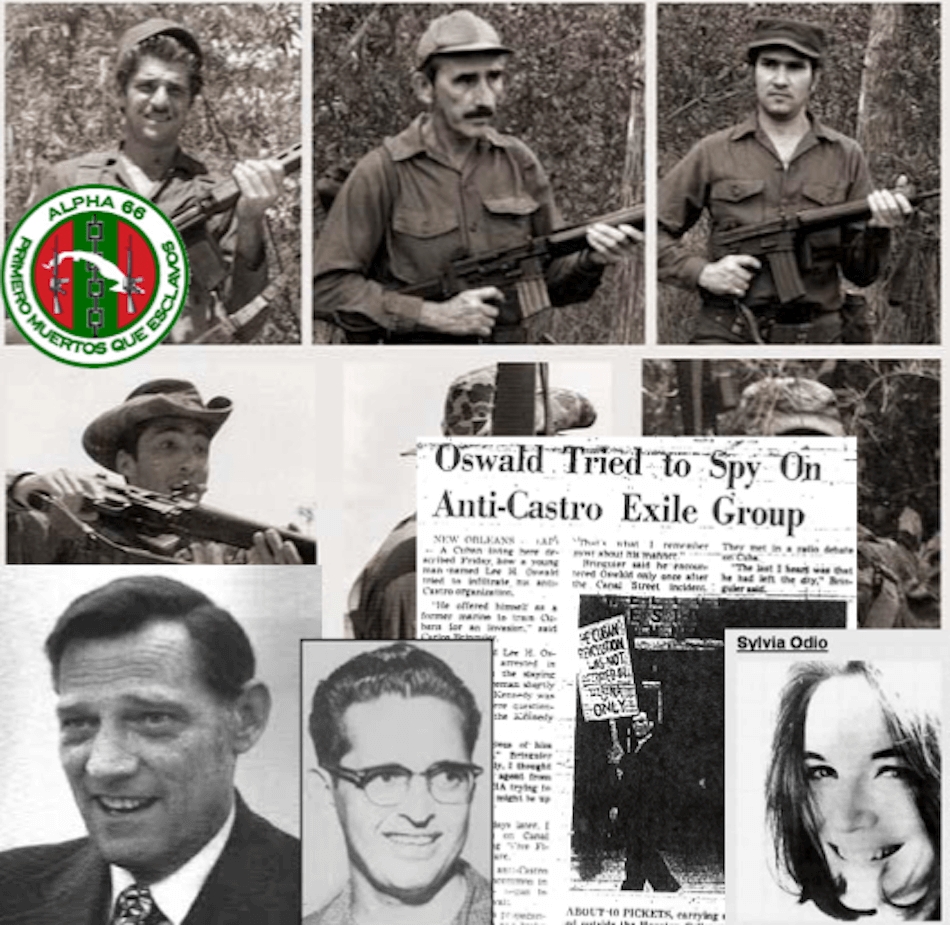
    It’s easy to predict that the conjuring trick will continue with Castro knowing in advance Oswald’s criminal intent, since everything going on in the anti-Castro belligerent milieu in the U.S. was reported to him by the Cuban Intelligence Service (CuIS). On the other hand, the CIA did have the luxury of missing Oswald as a security risk, since it funded the black ops against Castro, but it ran them from afar with “little oversight”. It doesn’t matter that since April 24, 1963, the vey leader of Alpha 66 in Dallas, Manuel Rodríguez Oscarberro, had been reported to the Secret Service as security risk to President Kennedy.3

    Big-budget paraphernalia—underwater sonar, a diver, metal detector for canvassing the forest—are displayed again, as if the episode were about artifacts instead of new milestones in the well-known historical trail of the CIA dirty war against Castro. However, Baer forgot to include a crap detector and claimed that nobody else had ever really looked into the connection between Oswald, the Cubans, and the CIA. It would mean that—just for instance—New Orleans D.A. Jim Garrison never started an investigation in late 1966 or Harold Weisberg never wrote Oswald in New Orleans: Case for Conspiracy with the CIA (Canyon Books, 1967). But by skipping those authors, Baer does not have to bring up the names of David Ferrie, Clay Shaw and Guy Banister.

    The legerdemain with Ozzie included the Tourette’s-Syndrome-style reiteration that he shot Kennedy and he did it “with the same rifle” ordered by mail on March 12, 1963, and used to shoot at General Edwin Walker on April 10. Baer forgot what Tanenbaum stated in his ARRB Testimony (1996): “I don’t think from my experience that Lee Harvey Oswald could be convicted in any courtroom in America.” As it happened, the Warren Commission engaged in acts of evidentiary wizardry to do so:

    • The bullet recovered by the Dallas Police Department (DPD) from the Walker shooting was changed to incriminate Oswald as able “to carry out a carefully planned killing of another human being.”4 DPD officers Van Cleave and McElroy described a steel-jacketed 7.62 mm (30.06) bullet in their General Offense Report file the same day of the attack. Those fired against President Kennedy were copper-jacketed 6.5 mm bullets.
    • The $21.45 money order for the rifle mailed by Ozzie from Dallas was supposed to have arrived at Klein’s Sporting Goods in Chicago on March 13, less than 24 hours after it was sent from Dallas. It was then deposited on the same day of arrival at the First National Bank.5
    • The 36-inch, 5.5 pound Mannlicher Carcano carbine ordered by Ozzie does not match the murder weapon entered into evidence by the Dallas Police: a 40.2 inch, 7.5 pound Mannlicher Carcano short rifle.6 And there is no evidence of any weapon being picked up by Oswald at the post office in Dallas.7

    Down to Miami

    Baer evidently wants to travel instead of reading any books on the subject he is addressing in the TV series. As even beginners know, the “key to this whole operation” in New Orleans lies in the Miami CIA station (JM/WAVE). Hence Baer and his team go to South Florida. They track down former CIA contractor Marshall Golnick, who has “inside information” from a half century ago. They also do another archaeological search in Key Largo around a military facility.

    Golnick states that the Cuban exiles trained in New Orleans were dropped off by bus in Miami and received money and weapons. They were ready to stage raids into Cuba to destroy any infrastructure in sight; but this all ended with the fiasco at Bay of Pigs (thereby forgetting about Operation MONGOOSE). Golnick then reinforced the historical lie used by Baer himself to justify why Cuban exiles hated Kennedy: The latter ordered the Bay of Pigs invasion, but then withheld air support.

    The invasion was a so-called CIA covert operation that was unleashed with a Pearl-Harbor-style air bombing against three Cuban air force bases. Since these bombings were attributed to Castro’s defectors, they could not return to bomb again without destroying the plausible deniability required by the White House to prevent condemnation at the UN.8 And further, as Peter Kornbluh demonstrates in Bay of Pigs Declassified, the alleged D-Day air strikes were not part of the original plan. They were to be launched from an airstrip on the island after a beachhead was secured. The latter never happened.

    Finally, Golnick drops his own bomb about Oswald: likely aligned with the most radical fringe groups such as Alpha 66 and Omega 7. It does not matter that Alpha 66 was founded in 1962 and Omega 7 in 1974. According to the program, all these groups wanted to kill Kennedy and so did Oswald. Baer hammers the point home: “Oswald is a pronounced Marxist who praised Communist ideals.” Therefore, he and the radical Cuban exile groups worked together to achieve the common goal of killing JFK. Such a coincidence of contraries was strong enough to prevent the fierce anti-Castro Alpha 66 fighters from reacting to Oswald’s Castroist inclinations. By skipping authors like Weisberg and Garrison, Baer does not have to bring up the names of David Ferrie, Clay Shaw and Guy Banister.

    Amid the extremist Cuban exile paramilitary subculture, Oswald flaunted his Fair Play for Cuba Committee [FPCC] militancy in New Orleans from mid-June to late August 1963. But only members of the Student Revolutionary Directorate (DRE) cadre, Carlos Bringuier and two cohorts, confronted him in a minor fracas at Canal Street on August 9, when Oswald was distributing the sold-out 1961 first edition of FPCC pamphlet The Crime Against Cuba (1961).9 Which had Banister’s 544 Camp Street address stamped on it. Oswald had described the scuffle—including being arrested by the police—in a letter to the FPCC dated August 1st and postmarked August 4th. In other words, before it happened.

    The CIA in Limbo

    Although all the anti-Castro groups in New Orleans and Miami were CIA brainchildren, Baer and his partner, former police officer Adam Bercovici, do not give a damn about how the CIA wasn’t aware of an Oswald-Alpha 66 common goal. Instead, they do some brainstorming to find Oswald’s deeper motivation. And they discover it. Oswald had an “I’ll show them” mindset.

    They also discover, this time on the computer, that the man behind Alpha 66 was Maurice Bishop. But they don’t identify him as David Philips, who in 1963 was playing a CIA dual role: Chief of the Cuban Desk in Mexico City and Chief of Covert Ops against Cuba in Langley. They only resort to the well-known statement by Antonio Veciana about having seen Bishop with Oswald in Dallas in the late summer of 1963. Bercovici concludes: “There’s your co-conspirator. He had on-the-ground assistance in Dallas.”

    Back on the computer, they bump into the famous, late September Sylvia Odio incident.10 It’s prima facie evidence of Oswald being impersonated in Dallas while visiting Mexico City, or vice versa. But Baer limits his explanation as to why the FBI didn’t track the event in Dallas: “Because they missed it.” Indeed, they did. On October 9, 1963, the FBI cancelled the security flash on Oswald,11 but on October 10, 1963, Langley omitted in a cable (DIR 74673) to the FBI that “Lee Oswald” had spoken with Soviet Consul Valeriy Kostikov in Mexico City, Baer’s main character of the first episode (“The Iron Meeting”). Such a piece of intel would have been enough to restore the flash. This cable also provided a false description of a presumed American entering the Soviet Embassy and the related photo taken by a CIA site wasn’t Oswald’s. In other words, during these weeks, it was Murphy’s Law that pertained: Everything that could have gone wrong, did go wrong between Oswald, the FBI and the CIA.

    In closing the episode, Baer and Bercovici swallow whole Marina Oswald’s testimony about her husband shooting at General Walker. They search the DPD files on the case. Oswald appears to have never been brought up even as a person of interest by the police prior to the creation of the Warren Commission. But they focus in on the two cars seen leaving from the alley behind General Walker’s house, concluding Oswald had likely been driven in and out by accomplices.

    The preview of the fifth part, “Scene of the Crime,” showed a re-enactment of the shooting at Dealey Plaza. A rifle is fired from above and behind at a rubber head, which goes backwards after being shot. As in the Walker shooting, Oswald will surely have get-away accomplices.


    Notes

    1 In a fictionalized account (Corruption of Blood, Dutton, 1995) of his HSCA experience, Tanenbaum referred to a black-and-white silent 8 mm home movie showing military exercises. The viewer can see the pinpoints of fire from rifles and the shimmering gouts of muzzle blast from machine guns. Among the people in the film, Tanenbaum identified David Ferrie in a close-up; Oswald “in his ball cap and black T-shirt;” Antonio Veciana “in civvies this time, holding a .45 and smiling;” and “another guy in civilian clothes,” who Tanenbaum believes was David Atlee Phillips, alias Maurice Bishop (pages 143-46). Jim DiEugenio asked Tanenbaum: “Was it really as you described in the book, with all the people in that film? Bishop was in the film?” Tanenbaum replied: “Oh, yeah. Absolutely! They’re all in the film. They’re all there. But, the fact of the matter is the [HSCA] began to balk at a series of events” (Probe, Vol. 3, No 5, July-August 1996). In fact, the film vanished after Tanenbaum’s departure from HSCA.

    2 Shortly before Oswald moved to New Orleans, the FBI office in Dallas received info about him passing out pamphlets of the Fair Play for Cuba Committee [FPCC] on Main Street and wearing a placard around his neck reading, “Hands Off Cuba, Viva Fidel.” It occurred on April 15, 1963. SA Agent James Hosty reported it on September 10. See Warren Commission, Vol. XXVI, CE 2718.

    3 Eventually, a CuIS informant furnished the intel Rodríguez Oscarberro had told him that “if his involvement in the assassination was uncovered, he was a dead man, given that he was an Alpha 66 delegate in Dallas and knew too much.” See Escalante, Fabian: JFK: The Cuba Files, Ocean Press, 2000, 170 f.

    4 Warren Report, 406.

    5 Ibidem, 119. It implies that, in about 24 hours in 1963, the U.S. Post Service picked up the money order from a mailbox in Dallas and transported it to a post office where it was sorted and shipped out to the airport. Then it flew 700 miles to Chicago, was picked up there and driven to the main post office, where it was sorted, placed on a truck and driven to the regional post office. Here it was given to a route carrier who delivered it to Klein’s. After being sorted out again, Klein’s delivered it to the First National Bank of Chicago to be deposited in Klein’s account.

    6 Armstrong, John: Harvey and Lee, Quasar Ltd., 2003, 477.

    7 DiEugenio, James: Reclaiming Parkland, Skyhorse, 2013, 62.

    8 When Eisenhower approved the CIA policy paper A Program of Covert Action Against the Castro Regime on March 17, 1960, he made crystal clear to CIA Director Allen Dulles: “Our hand should not show in anything that is done” (Memorandum of Conference with the President, March 17, 1960. FRUS, Vol. VI, Doc. 486). Kennedy stuck to the script and ruled out an intervention of the U.S. armed forces under any condition, as he clearly stated at a press conference at the State Department on April 12, 1963 (Cf.: Johnson, Haynes: The Bay of Pigs, W. W. Norton and Co., 1964, 72).

    9 By that time, the CIA had ordered 45 copies. DiEugenio, James: Destiny Betrayed, Skyhorse, 2012 158 f.

    10 In late September, Mrs. Odio was visited by two Cubans (Leopoldo and Angelo) along with an America introduced as Leon Oswald. They would be “working in the underground” and looking for her help regarding funds for the Cuban exile group JURE. The next day, Leopoldo phoned Mrs. Odio and discussed Oswald, saying he was an excellent shot and had said that President Kennedy should have been killed after Bay of Pigs. When JFK was murdered in Dallas, Mrs. Odio fainted upon hearing the news and recognizing Oswald. Her account was corroborated by her sister Annie, who had briefly seen the visitors. It reached the FBI and later the Warren Commission, but the latter ultimately dismissed it because its chronology put Oswald on his way to Mexico City on the same dates.

    11 Because of that, Hoover disciplined Lambert Anderson, Marvin Gheesling, and sixteen other agents.

  • JFK Declassified: Tracking Oswald, Part 3

    JFK Declassified: Tracking Oswald, Part 3


    Part 1

    Part 2

    Part 4

    Part 5

    Part 6

    Part 7


    How The History Channel is Tracking Oswald Twistedly

    Written by Frank Cassano and Arnaldo M. Fernandez


    The History Channel series JFK Declassified: Tracking Oswald has been curtailed in the U.S. Maybe the ratings were too low, but History Canada continues airing it on Sundays at 10 p.m. (East). Maybe it had to take a break in the U.S. after two self-contradictory episodes: “The Iron Meeting” inside a bullring in Mexico City should have never happened since “The Russian Network” didn´t care about recruiting Oswald.1 The third part, “Oswald Goes Dark,” starts following in the footsteps of the CIA by trying to link the Mexican consular clerk Silvia Duran and the American visa applicant Lee Harvey Oswald outside the Cuban Consulate.2

    The Twist Party

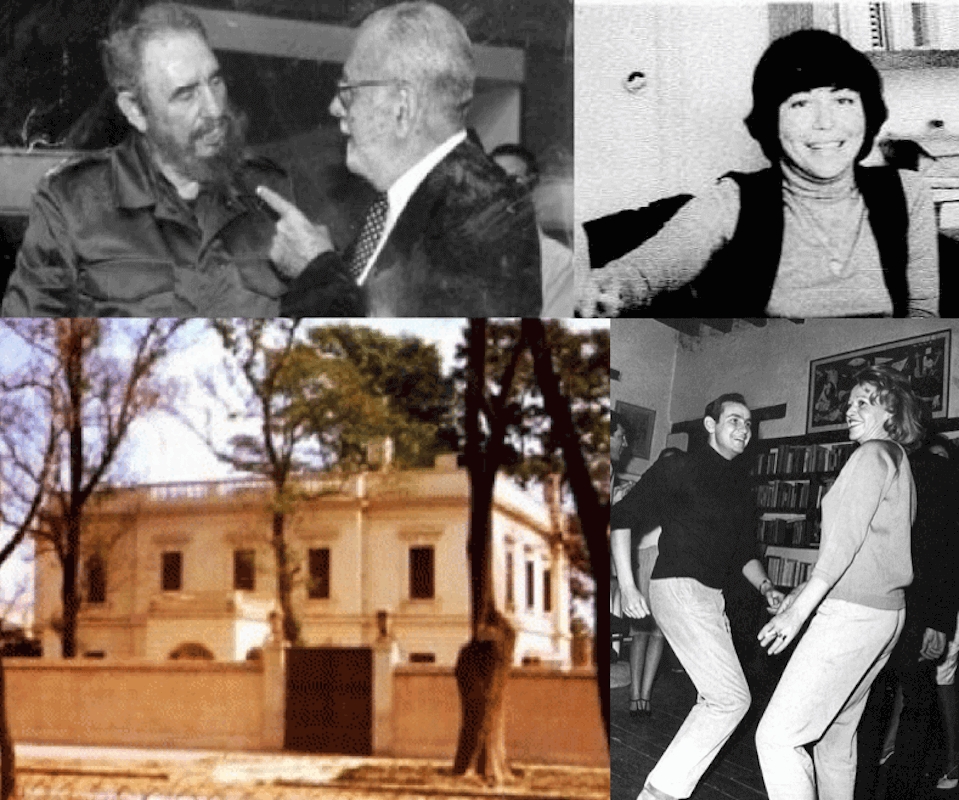
    For this purpose, host Bob Baer recycled as “new memo”: the entirely discredited “Thomas Report”3 about Duran and Oswald at a twist party, and this was then exploited by the replacement of the Russian Network—the Cuban Intelligence Service (CuIS)—to put Oswald up to killing JFK. Using a mobile lab, Baer and his team also tracked down a witness, Francisco Guerrero Garro, who had kept his silence for more than half century, but now swears having seen Oswald and even a Cuban consul at a twist party. Oswald could have been invited by his “friend” Duran. However, a false testimony does not become a fact by repetition.

    Such a twist party4 was the ludicrous brainchild of Francisco’s aunt, the late Mexican writer Elena Garro de Paz. After having exhaustively interviewed her and her daughter twice in November 1964, the Legal Attaché (FBI) at the U.S. Embassy in Mexico City put the case at rest, simply because they “failed to substantiate the allegations.”5

    CIA Station Chief Win Scott passed along the info to CIA headquarters at Langley. On the memo, Scott’s deputy Allen White wrote down: “I don’t know what FBI did in November 64, but the Garros have been talking about this for a long time and she is said to be extremely bright.” Scott dismissed White’s remark with a lapidary handwritten comment: “She is also nuts.”6

    Garro de Paz drove others nuts as well. The late Charles W. Thomas, a political officer at the U.S. Embassy, talked with her in 1965 and raised her false story with the Secretary of State William Rogers in 1969. Baer has just joined this fruity party. It includes sound effects from the Cold War: “If we can prove that the Cubans were involved, that’s an act of war against the United States.” Thusly he is definitively “scaling the walls of high camp”, like Philip Shenon with A Cruel and Shocking Act (Henry Holt and Co., 2013).7

    A Motive to Kill?

    Baer applied another nutty scheme to put Oswald up to killing Kennedy. FBI spy Jack Childs (SOLO) managed to talk with Castro and reported to his boss J. Edgar Hoover, who summed up to Warren Commission General Counsel, J. Lee Rankin, that “no further action is contemplated by this Bureau”8 about SOLO’s report. Baer attempts to twist the intel furnished by SOLO into smoking gun evidence of Oswald’s criminal intent.

    On May 20, 1964, Jack Childs flew from Moscow to “THE BEACH” [Cuba] in the SOLO Mission 15. He spent ten days there. The gist of his report reads thus:

    “Castro said ‘I was told this by my people in the Embassy exactly how he (Oswald) stalked in and walked in and ran out. That in itself was a suspicious movement, because nobody comes to an Embassy for a visa (they go to a Consulate). [Castro] stated that when Oswald was refused his visa at the Cuban Embassy in Mexico City, he acted like a madman and started yelling and shouting on his way out, ‘I’m going to kill this bastard. I’m going to kill Kennedy’”9

    The HSCA nipped the problem in the bud: “Nothing in the evidence indicated that the threat should have been taken seriously, if it had occurred, since Oswald had behaved in an argumentative and obnoxious fashion.”10 By insisting in muddying the waters, Baer misses a proper research problem that John Newman has formulated as a mystery.11

    Both Duran and the incoming (Alfredo Mirabal) and outcoming (Eusebio Azcue) Cuban consuls were adamant before HSCA that Oswald didn’t vow such a threat at the Cuban Consulate.12 Two Cuban officials—Guillermo Ruiz and Antonio García—from the Commercial Office, located upstairs, were also eyewitnesses of Oswald’s making a scene at the Consulate and claimed they didn’t hear a threat against Kennedy.

    The Lopez Report deciphered the apparent mystery. The Consulate “was in a separate building from the Embassy.”13 In 1963, the Cuban diplomatic compound in Mexico City was at Francisco Marquez Street (Colonia Condesa) with two main entrances: One to the Embassy, on the corner of Tacubaya Alley, and the other to the Consulate, on the corner of Zamora Street. No wonder the CIA surveillance post (LIONION) in a third-floor apartment across Francisco Marquez Street employed an agent—Cesar Rodriguez Gallegos—at one window for photographing the Embassy, while a pulse camera covered the Consulate from another window.

    SOLO himself reasonably commented to Hoover that “the Cuban Embassy people must have told Oswald something to the effect that they were sorry that they did not let Americans into Cuba because the U.S. government stopped Cubans from letting them in, and that is when Oswald shouted out the statement about killing President Kennedy.” It goes without saying that Oswald was told to apply anyway for a visa at the Consulate.

    Oswald must have entered the Cuban diplomatic compound at the corner of Tacubaya Alley shortly after arriving in Mexico City on September 27, 1963. In fact, there is a clue about it besides Castro’s statement. On January 1964, FBI Special Agent Nathan L. Ferris was advised by Mexican informants that Elizabeth Mora [American-born Mexican artist Elizabeth Catlett-Mora] had spilled the beans about a conversation with Cuban Cultural Attaché Teresa Proenza. The latter confided to Mora “that Oswald walked in ‘cold’ to the Cuban Embassy. [She] was the first person he talked to [and] turned him over to the nearest person higher in rank and who spoke English.” Proenza added that Oswald had come to the Embassy for “a visa to go to Russia.”14

    Newman told Jim DiEugenio that the threat “is almost surely a forgery.” The Childs report to Hoover is part of a letter to Gus Hall, leader of the Communist Party USA (CPUSA), and “this kind of information would not be part of that letter [since] SOLO was too experienced to do that.” Notwithstanding, SOLO also reported “that he later discussed CASTRO’s statements with BEATRICE JOHNSON, the CPUSA representative in Cuba.” A forged report wouldn’t ever include a third party for running the risk of denial.

    Rocking the Refugee Boat

    From Mexico City, Baer and his well-equipped team switched their focus to Louisiana, where they pretended having uncovered certain gaps in Oswald’s timeline between August and October 1963. During his period, specifically from late August to early September, two key incidents occurred and were finally reported to HSCA.

    • Antonio Veciana met David Philips in downtown Dallas earlier than originally planned and Antonio had a brief sighting of a young man who said nothing and left. He turned out to be Oswald.15
    • Oswald was spotted in Clinton16, about 130 miles from New Orleans, during a CORE voter registration drive. He was accompanied by the rabidly anti-Communist and partner of hard line anti-Castro exile Sergio Arcacha Smith, David Ferrie, and the New Orleans businessman Clay Shaw, a part-time contract agent of the CIA with a security clearance since 1949.

    With regard to HSCA, Baer limited himself to telling his partner, former police detective Adam Bercovici, it was “the follow-up investigation to the Warren Commission.” He did not refer to Ferrie or Shaw, much less to Oswald´s close contact with Guy Bannister, head of the Anti-Communist League of the Caribbean. He was just content to assert that Oswald went off the grid so that it became easier for Baer to detonate an explosive device: The Cuban radical exiles were Oswald´s “accomplices.”

    The team drove out of New Orleans to the nearby town of Belle Chasse and reached a remote area, surrounded by swamps and thick vegetation, with some decrepit buildings still standing. They found evidence of it being a training facility and weapon arsenal. A “military-grade operation,” surmised Baer, as if nobody knew the Bay-of-Pigs-related CIA operation JM/MOVE was headquartered there in 196117, while Oswald was working at a factory in Minsk (Belarus).

    But let’s give the duo some credit. They raised the issue that Oswald was working with intelligence agencies in a secret government operation and left us with one final, juicy morsel. According to Baer, “the more we get into this the more it appears this guy was not a lone wolf. There’s overwhelming evidence to assume he had accomplices.”

    No doubt the fourth part, “The Cuban Connection”, will be breathtaking. Baer surely will twist the facts again. Oswald will appear linked to a belligerent anti-Castro group, organized and backed by the CIA, but Baer will try to perform the analytical piroutte that Castro, not the CIA, learned about Oswald’s intention to kill Kennedy, since the anti-Castro group had been infiltrated by CuIS agents who were reporting everything back to Castro.


    Notes

    1 See the previous reviews “How The History Channel is Tracking Oswald Non-Historically” and “How The History Channel is Tracking Oswald Pathetically”.

    2 At the request of the CIA Station Chief, Duran was arrested by the Mexican Federal Security Directorate (FDS) the day after the assassination. The line of questioning sought her confession of having entrapped and lured Oswald with sexual favors into a conspiracy to kill Kennedy. See McKnight, Gerald: Breach of Trust, University Press of Kansas, 2005, 78.

    3 NARA Record Number: 104-10404-10325

    4 In 1963, the twist dance craze was sweeping Mexico thanks to Bill Haley and His Comets with Twist Español, Florida Twist and other hits under the record label Orfeon. As cousin of Silvia Duran’s husband, Elena Garro de Paz would have attended such parties within the family circle. She claimed having seen Oswald at the home of her cousin Ruben Duran. Silvia never denied the possibility of being at a twist party in the house of her brother-in-law with Elena present, but always denied having met Oswald after September 27, 1963, much less outside the Cuban Consulate. Silvia agreed to be interviewed by HSCA, while Elena refused.

    5 Memo of 27 December 1965 from LEGAT (Nathan Ferris) to the Ambassador (NARA Record Number: 104-10007-10043).

    6 NARA Record Number: 104-10404-10320

    7 See the review by James DiEugenio.

    8 Warren Commission Document 1359.

    9  FBI Records: The Vault – SOLO (http://vault.fbi.gov/solo), Part 63, pp. 58-59).

    10 The Final Report of HSCA, Washington: U.S. Government Printing Office, 1979, 122.

    11 Oswald and the CIA, Skyhorse Publishing, 2008, p. 428.

    12 See JFK Exhibit F-440 A (Duran) and HSCA Report, Vol. III, pp. 173-78 (Mirabal) and 127-58 (Azcue).

    13 Lopez Report, pp. 26 f. [http://history-matters.com/archive/jfk/hsca/lopezrpt_2003/html/LopezRpt_0025a.htm]

    14 NARA Record Number: 124-10003-10386 [http://www.maryferrell.org/mffweb/archive/viewer/showDoc.do?docId=61273]

    15 Veciana, Antonio and Carlos Harrison: Trained to Kill, Skyhorse Publishing, 2017, 122.

    16 Fonzi, Gaeton: The Last Investigation, Skyhorse Publishing, 2013, 140.

    17 A diversionary force commanded by Nino Díaz (AMNORM-1) was organized, equipped and trained in great haste at Belle Chasse. After all, the mother ship couldn’t reach the intended beach 30 miles east of Guantanamo (Eastern Cuba). Cf. CIA Clandestine Service Historical Paper No. 105 (1961), 22 f.

  • The 2017 Houston Mock Trial of Oswald

    The 2017 Houston Mock Trial of Oswald


    On November 16 and 17th, the South Texas College of Law (STCL) in Houston will be hosting a two-day mock trial titled “State of Texas vs. Lee Harvey Oswald.” For the first time, this mock trial will use 21st-century technology and apply what has been learned from the Innocence Project and the 2009 National Academy of Science (NAS) report about forensic evidence to the JFK assassination.

    Forensic evidence is used in criminal prosecutions to match a piece of evidence to a particular person or weapon. The NAS report1 determined that the absence of precise and objective national criteria and methodologies as well as peer-reviewed published studies coupled with the highly subjective nature of the forensic disciplines renders this type of evidence highly suspect, unreliable and extremely prone to manipulation. The forensic methods that were found to lack sufficient scientific basis included firearms/bullets, fingerprints, hair and fiber analysis and tool marks. This kind of evidence was critical to the determination of the Warren Commission and the House Select Committee on Assassinations that Lee Oswald was the assassin of President Kennedy and calls into question the very foundations of the case against Lee Oswald.

    The STCL is not the first mock trial of the JFK assassination but it will differ from the prior events. Following is a summary of those mock trials.


    1967 Yale Law School

    This 1967 mock trial was held at Yale Law School before 500 spectators. Jacob D. Fuchsberg, a New York lawyer, served as the judge. Unfortunately, he barred a CBS television crew from filming the event. Therefore, the only reports available about this mock trial are a couple of short news clips and an article published in the April 1967 issue of the Yale Alumni Magazine.

    Law students served as defense counsel and prosecutors. A law student portrayed Oswald and testified in his own defense. The Oswald defense team argued that there was reasonable doubt Oswald was the actual assassin. The witnesses were principally law students and used the actual testimony that witnesses gave to the Warren Commission. The evidence included reproductions of photographs, bullet fragments, blood-stained clothing worn by the late President, and the alleged murder weapon.

    The bulk of the prosecution’s case centered on the testimony of Dr. James J. Humes, who had been in charge of the autopsy and prepared the autopsy report. Over the course of one-and-a-half hours of direct and cross-examination, “Dr. Humes” provided detailed testimony on his examination of the president’s body, the location of the wounds and if the wounds supported the single-bullet theory. Pointing to tests conducted under the supervision of the FBI, Humes testified that a single bullet could have inflicted the throat wound of the President as well as the chest, wrist, and thigh injuries of Governor Connally. On cross-examination, the defense tried to score points by having “Dr. Humes” admit he did not have experience with gunshot wounds and that he had not performed any ballistic tests.

    The defense also relied on eyewitnesses to introduce evidence about the number and the origin of the shots. Defense witnesses featured “Lee Bowers”, the railway switchman, who claimed to see strangers milling around the wooden stockade on the grassy knoll and later said he saw a puff of smoke or flash of light in that area. Defense witness “Bonnie Ray Williams” testified he went up to the sixth floor of the depository at noon to eat lunch and did not see Oswald or anyone else on that floor. Other defense witnesses included “Governor Connally”, who maintained that he had been hit by a separate shot from President Kennedy, “Dr. Malcolm Perry”, who testified that he thought the throat wound was an entry wound, and “Ronald Simmons”, Chief of the Infantry Weapons Evaluation Branch of the Ballistics Research Laboratory of the Department of the Army, who tested the assassination rifle and discussed problems with the telescopic sight, bolt and trigger mechanism.

    In its summation, the defense reviewed the doubts about the shots, the wounds, and Oswald. The defense closed with an acknowledgement that Oswald fled the assassination scene, concluding, “It is a heinous crime to gun down the President of the United States. It is a heinous crime to find an innocent man guilty.”

    The prosecution began its summation with the undelivered Dallas speech of President Kennedy about “not listening   to   nonsense,”   and   urged the jury to ignore the nonsense of the defense theory. The prosecution then reviewed the “hard” evidence: the shells, bullet fragments, the bag in which Oswald allegedly carried the murder weapon. As the prosecutor talked, he dissembled the rifle to show that it could have been carried in the paper bag. As the last screws came apart, he held the rifle apart and held it aloft for a moment and then passed the scope, stock, and barrel to the jury for its examination.

    A jury of 12 with two alternates comprised of volunteers from a North Haven Presbyterian Church listened to the seven hours of argument. It was 2 AM when the judge completed his charge to the jury on the two counts: first degree murder and assault with intent to kill the President. After approximately 75 minutes, the jury informed the judge that they were unable to agree on a verdict. Six jurors felt Oswald was guilty; three believed that, while he had taken part, there was reasonable doubt he had fired the fatal shot. Three thought there was reasonable doubt as to his participation in the crime at all.


    1986: London

    This is the mock trial many people recall. A four-day made-for-TV mock trial entitled “On Trial: Lee Harvey Oswald” was held in London in July, 1986. The Showtime cable network subsequently culled a condensed two-part, five and one-half hour program from this production in November, 1986. Former Los Angeles Deputy District Attorney Vincent Bugliosi served as prosecutor and Gerry Spence served as defense counsel. The jury consisted of 12 Dallas citizens who had been flown in to London. Some of the actual witnesses associated with the JFK assassination and the shooting of officer J.D. Tippit testified, along with certain medical experts and some members of the HSCA.2 After 12 hours of deliberation, the jury returned a guilty verdict. It is generally agreed upon by lawyers that Spence was not prepared for this mock trial and that his performance made a mockery of the event. (For a detailed examination of the program’s shortcomings, see Chapter 3 of Jim DiEugenio’s book, Reclaiming Parkland.)


    1992: ABA in San Francisco

    In August 1992, the American Bar association conducted a two-day mock trial at its annual Meeting in San Francisco titled the “Trial of the Century: The United States vs Lee Oswald.”3 Evidence was based on testimony derived from the Warren Commission Report and the Report of the House Select Committee on Assassinations. Actors portrayed the witnesses. The prosecution witnesses were Marrion Baker, Domingo Benavides, Howard Brennan, Wesley Frazier, Helen Markham, Harold Norman, Marina Oswald and William Scoggins. Evidence also involved computer animation and enhancement of the Zapruder film.

    The prosecution team was comprised of attorneys Jim Brosnahan, Joe Cotchett and John Keke. Representing the defense were Tom Barr, David Boies and Evan Chester. Two federal judges and a state court judge took turns presiding over the trial. The entire proceeding was televised nationwide by Court TV.

    A key witness for the prosecution was Dr. Martin Fackler, a ballistics expert. He testified that the bullet found at Parkland Hospital, fragments recovered from the president’s limousine and cartridges taken from the sixth floor of the Texas School Book Depository all, came from Oswald’s rifle. He also testified that the casings found near Patrolman Tippit’s body came from Oswald’s revolver. He then discussed how bullets move in the human body and explained the movement of

    the bullet that passed through President Kennedy and into Governor John Connally. Another important prosecution witness was Dr. Robert Piziali of Failure Analysis. He testified about the computer reconstruction developed by his firm and how it demonstrated that the shots that hit President Kennedy came from the sixth floor of the Texas School Book Depository.

    The defense team told the jury that while Kennedy’s assassination has been the most investigated killing in history, every item of evidence ever assembled against Oswald is still open to doubt.

    A key defense witness was Roger McCarthy, another ballistics expert who said the shots that killed Kennedy could not have come from the sixth floor of the school book depository. Dr. Cyril Wecht testified that the president’s wounds had come from more than one gunman.

    Prior to the mock trial, the 17 potential jurors were selected from a list of San Francisco area residents. They were paid for their participation and did not know the nature of the trial before they were asked to complete a questionnaire. Included were two questions: (1) How much they agreed with the statement that Lee Oswald assassinated President Kennedy and (2) How much did they agree he acted alone. Sixteen of seventeen jurors indicated they were neutral, or agreed that Oswald assassinated the president. Most of the potential jurors also agreed or were neutral that Oswald acted alone.

    The lawyers could strike a total of five jurors: three for the prosecution and two for the defense during voir dire. At the conclusion of the trial, the jury deliberated for 2 ½ hours, but after several ballots was unable to reach a verdict. Seven of the jurors voted to convict Oswald while five favored acquittal. The five jurors that were removed during voir dire constituted a surrogate or shadow jury. They sat through the trial and saw the same evidence as the jury. This group of dismissed jurors voted 3 to 2 for acquittal.

    Earlier that year, the jury in a mock trial by the Arts & Entertainment network, found Oswald innocent. No information was available about this proceeding.


    2013: Texas

    Three mock trials were held in Texas in 2013. One was by the State Bar of Texas, one by the Dallas Bar Association and one by the Bench Bar Conference for the Eastern District of Texas. The case was prosecuted as a federal crime, even though killing a president was still a state crime in 1963.4 The Dallas event was held at the Old Criminal Courts Building.

    Toby Shook represented the defense in each of these proceedings. For the Dallas event, U.S. Attorney for the Northern District of Texas, Sarah Saldaña, served as the prosecutor and State District Judge Martin Hoffman presided.

    The mock trials only lasted three hours each, so the attorneys were limited on the number of witnesses and evidence that could be used. Included in the evidence was: the Zapruder film, clips of Oswald speaking to the media, autopsy drawings, and a replica of the assassination rifle.

    Because of the time constraints, Shook was limited to cross-examining the prosecution witnesses and was not allowed to put on witnesses to establish the various conspiracy theories. For example, when the prosecution offered that Oswald’s prints on boxes near the so-called sniper’s nest were evidence he was the assassin, Shook countered that Oswald’s job was to move boxes, so it would be natural for his prints to be there.

    All three proceedings ended up in hung juries. About three-fourths of the 150 who watched the trial in Dallas County’s Old Criminal Courts Building indicated by a show of hands that they did not believe the gunman acted alone.


    2016: Michigan

    The Macomb County Bar Foundation and the Society for Active Retirees organized two mock trials in the fall of 2016. The mock trials were two hours. Both sides stipulated that the rifle found on the Sixth Floor was Lee Oswald’s rifle and that he had fired three shots that day. In other words, the question of Oswald’s innocence was not in dispute. There was a single witness who was a local judge who had read numerous books on the assassination. The sole question to be determined by the attendees who served as a grand jury was whether they believed Oswald acted alone or as part of a conspiracy. Given the sparse evidence before them, it is not surprising that both audiences voted overwhelmingly that Oswald was the lone gunman.


    Logistics for the STCL mock trial are still being finalized. The presiding judge for the Harris County Criminal Court, Honorable Jay T. Karahan will preside with attorney Gus Pappas serving as prosecutor. The defense team will be led by California lawyer Bill Simpich and New York lawyer Larry Schnapf. Continuing legal education credits will be offered. There will be a dinner following the first day of the mock trial. The planning committee is hoping to announce a very prominent keynote speaker. The event organizers hope to stream the mock trial. The two JFK conferences that will be held that weekend in Dallas are considering live streaming the mock trial. Stay tuned for more details.


    NOTES

    1 “Strengthening Forensic Science in the United States: A Path Forward”.

    2 The witnesses included Marion Baker, Eugene Boone, Charles Brehm, Johnny Brewer, Ted Callaway, Nelson Delgado, Buell Wesley Frazier, Vincent Guinn, James Hosty, Seth Kantor, Cecil Kirk, Edward Lopez, Monty Lutz, Bill Newman, Harold Norman, Paul O’Connor, Ruth Paine, Charles Petty, Lyndal Shaneyfelt, Tom Tilson, Cyril Wecht, The five- hour broadcast and a 90-minute highlights film are available at: http://on-trial-lho.blogspot.com/ and at: https://www.youtube.com/playlist?list=PL0O5WNzrZqIOubam491Q_OKBOBzfH7RDi.

    3 Excerpts from this trial are available at: https://drive.google.com/file/d/0BzWAr91aL-BEZlZyb1NKS3YzMXc/view.

    4 An excerpt of the mock trial held in Dallas is available at: https://drive.google.com/file/d/0BzWAr91aL-BEY01nZEdIdFE1Y0E/view.

  • JFK Declassified: Tracking Oswald, Part 2

    JFK Declassified: Tracking Oswald, Part 2


    How The History Channel is Tracking Oswald Pathetically

    The second part—“The Russian Network”—of the History Channel series “JFK Declassified: Tracking Oswald” brought with it a bunch of malarkey, as anticipated in the previous review. Moreover, this airing has left Bob Baer at an unavoidable crossroads in terms of his motivation: either he is deliberately trying to “De-Face-the-Nation” with fake news about a historical tragedy, or he is unable to deal with the body of evidence about the JFK assassination.

    While advertising ad nauseam that his “new investigation” uncovers “new evidence”, Baer remains tethered to a pair of fallen trees: The Warren Commission Report and the Red conspiracy theory masterminded by the CIA. Both have long been knocked down by successive findings in a line of research that extends from Mark Lane’s Rush to Judgment (1966) to Jeff Morley’s The Ghost (2017).

    All Quiet on the Eastern Front

    Baer flew to Moscow to find out whether “Oswald was working with the KGB.” That’s a fictitious research problem, since the solution is known beforehand and has conclusively emerged from multiple sources.1 Another goal was to establish a “chronology of Oswald’s movements” there, as if neither the comprehensive Mary Ferrell Chronologies nor Peter Vronky’s specific timeline of Oswald in Russia were available on line.

    Baer set out to shock again with a high-tech device designed to find anomalies in walls. He did find some in Oswald’s room at Hotel Metropole and inferred they dated from more than half century ago, just to prove an axiom: Oswald’s room was wired. Journalist Priscilla Johnson was pretty aware of that without using any detector when she interviewed Oswald right there on November 12 or 13, 1959.

    So as to open another window on Moscow, Baer draws upon Oswald’s diary and deems it as “never released,” despite its inclusion in “The Defector Study” published by the HSCA on March 1979 (Vol. XII, pp. 435-73). Furthermore, Baer boasts about his “unprecedented access” to retired KGB Colonel Oleg Nechiporenko, but at the outset makes a surprising statement: “I have no idea what this guy knows.” So, Baer has not had time to read Nechiporenko’s Passport to Assassination (Birch Lane, 1993), even though he advertises himself as a researcher with “over a decade” of experience on Oswald.

    In front of the cameras, Nechiporenko told the same old story from his book. He, Pavel Yatskov, and Valeriy Kostikov did meet Oswald in Mexico City, but the KGB had no intention of recruiting him. Baer simply agreed with his “credible source.” Except that this seems to contradict the first part of the series, which says that Oswald had picked up something on a visit to the Russian Embassy from an alleged encounter with Valeriy Kostikov at the Soviet Embassy in Mexico City. This led to an urgent talk—iron meeting—about political assassination in a bullring.

    Notwithstanding, Baer uses the scene at the Soviet Consulate described by Nechiporenko—Oswald pulling a loaded pistol and weeping tears of “I can’t stand it anymore” due to FBI harassment—as a quantum of proof about Oswald’s proclivity “to political violence.” Most people who have studied Oswald look at this whole episode from the book with a jaundiced eye. First, because the whole scene does not at all resemble Oswald. For instance, in his violent encounter with Cuban exiles in New Orleans, Oswald remained cool throughout. While being paraded through the corridors of the Dallas Police Department, again, Oswald seemed calm and collected, even though he was being accused of a double homicide. And second, why would Oswald think he would have to shoot it out with the FBI in Mexico City? All he was doing was applying for an in-transit visa, through Cuba to Russia. What was criminal about this act?

    Marching West

    Since Baer must muddle through his Red conspiracy theory without any shred of evidence, now comes the turn of the Cuban Intelligence Service (CuIS). Baer paves the way for an easy-to-predict gambit—“Castro sorta done it”—by shifting the focus from Kostikov the Terrible2 to Silvia Duran, a Mexican clerk at the Cuban Consulate in Mexico City. To that effect, Baer spins a yarn: This “mysterious woman [was] more than a clerk, [actually] a possible [Oswald] accomplice, [since] the U.S. asked for her arrest [the day after the assassination], the CIA Director John McCone ordered her not to answer any questions [about herself] and the Warren Commission completely ignored her.”

    • Silvia Duran is a “mysterious woman” for Baer, but she was well-known to the CIA Station in Mexico City. Its photo logs from October-November 1962 referred to her “leaving” the Cuban Embassy.3 On January 9, 1963, a memo to Langley reported she had been convinced by Cuban diplomat Teresa Proenza “to resign her position as Director” of the Mexican-Cuban Institute for Cultural Relations.“4
    • For the CIA, she was really “more than a clerk,” but not in the sense suggested by Baer. A memo dated on November 25, 1963, by Legat (FBI) in Mexico City reported to J. Edgar Hoover: “According to CIA, Silvia Duran is a communist and during time Carlos Lechuga (…) served here as Cuban Ambassador, Duran was not only his secretary, but also his mistress.”5
    • For being a “possible accomplice” of Oswald, the CIA must have hard evidence, but its own wiretap transcripts6 prove that both Oswald and Duran were impersonated on Saturday, September 28, 1963. Around noon, the Soviet Consulate received a call from a woman who identified herself as Silvia Duran, at the Cuban Consulate, along with an American who said:

    AMERICAN: I was just now at your Embassy and they took my address.

    SOVIET: I know that.

    AMERICAN: [Translator comment: speaks terrible, hardly recognizable Russian] I did not know it then. I went to the Cuban Embassy to ask them for my address, because they have it.

    SOVIET: Why don’t you come again and leave your address with us. It is not far from the Cuban Embassy.

    AMERICAN: Well, I’ll be there right away

    Surprisingly, the American didn´t show up at the Russian Embassy. And before the HSCA panel that interviewed her on June 6, 1978,7 Duran was adamant that she did not make such a call nor did Oswald visit the Cuban Consulate again after being attended to three times on September 27.

    On Tuesday, October 1, two phone calls were placed to the Soviet consulate by a man trying to follow up on his call from September 28. In the second call, the man specifically identified himself as Lee Oswald. He asked about his visa request, even though the Soviets had given him a loud and clear message about waiting several months. The caller coaxed his conversation partner into providing Kostikov’s name by claiming a previous encounter with that consul. The CIA transcriber Boris Tarasoff remarked that Lee Oswald was “the same person who had called a day or so ago and spoken in broken Russian.” After giving a hint about a CuIS safe house on Saturday, on Monday Lee Oswald ended up giving his name and establishing a link to Kostikov.

    • “U.S. asked for her arrest,” because the Chief of Station (COS) in Mexico City had to ensure that Duran—linked to Oswald in three tapped phone calls—would “be arrested immediately and held incommunicado”8 until she provided everything she knew about Oswald. After Chief of Station Win Scott saw Oswald’s photos on TV the night of the assassination, he informed Langley about his suggestion to Gustavo Ortiz (LITEMPO-2) that Duran must be arrested and grilled by the Mexican Federal Security Directorate (Spanish acronym FDS).9
    • “McCone ordered her not to answer” any question about herself since the CIA did not want it to get out that she never met with Oswald on September 28. McCone did not want “any American to confront Silvia Duran or be in contact with her”10. He succeeded. A key witness about Oswald in Mexico City was never questioned by any American until Ron Kessler interviewed Silvia Duran thirteen years after the JFK assassination.11
    • “The Warren Commission completely ignored her,” although the CIA Station in Mexico City informed Langley “she was perfectly willing to travel to U.S. to confront Oswald if necessary.”12 A comment on the same memo explains why: “Present plan in passing info to Warren Commission is to eliminate mention of telephone taps, in order to protect continuing ops.” Former CIA agent Bob Baer didn’t get what CIA Counterintelligence Chief Jim Angleton meant when he said the point was “to wait out the Commission.”13

    After being interviewed by Kessler in 1976 and giving her testimony before a HSCA panel in 1978, the only secret relevant to Silvia Duran has already been revealed: after the assassination, it became clear that CIA officers knew Oswald had been impersonated in Mexico City during his visit. Thus, he had been set up for the assassination and the CIA didn’t prevent the killing.

    The Upcoming Twist

    Baer sticks to the pattern of the Red conspiracy theories by blurring the facts. He misrepresents a call made by Silvia Duran from the Cuban Consulate on September 27 as if it were the fake call attributed to her on September 28. He also places the dramatic scene by Oswald in his third visit to the Cuban Consulate—after Consul Eusebio Azcue made crystal clear no in-transit visa to Cuba would be given to him soon—as if it occurred during his first visit, when Duran asked him to get the mandatory photos for the visa application. However, these are just peanuts compared with the pathetic Shenonist move Baer has planned for the third part of the series: having Duran as a Cuban intel agent who invited Oswald to a twist party.


    Part 1

    Part 3

    Part 4

    Part 5

    Part 6

    Part 7


    Notes

    1 On January 5, 1977, the KGB Chief of Station in Havana, Major General Piotr Voronin, furnished intel on Oswald at the request of the Cuban State Security Department (DSE). He stated the KGB “had no operative interest in Oswald and his wife”. In May 1989, DSE’s former head and current historian, Major General Fabian Escalante, met in Moscow with a KGB Colonel (retired) from the First Directorate [Foreign Intelligence], Pavel Yatskov. He told Escalante having fortuitously met Oswald in Mexico City. A consulate guard notified that an American was insisting on seeing a Soviet official, although it was Saturday and the consulate was closed. Yatskov assisted Oswald, who narrated “a strange story [about being] a member of the CPUSA and a Cuba support committee [Fair Play for Cuba Committee].” Oswald wanted to visit Havana and asked for a Soviet visa because the USSR would be his final destination. He was told to make an application and to wait 4-6 months, since any Soviet visa to U.S. citizens must be granted by Moscow. He reacted by leaving without even filling in the official form.

    After the assassination, Yatskov discussed the Oswald case with KGB officers of the Second Directorate [Counterintelligence]. They confirmed having nothing to do with him. As the Church Committee brought the case into the spotlight, it was discussed again at the KGB First Directorate. It was said that “Oswald had been a U.S. intelligence agent.” Yatskov added that when Oswald revealed his intention to return to the U.S., the GRU [Military Intelligence] “was in charge of the matter. It was a GRU First Directorate practice to at least attempt an initial working agreement in all cases of citizens wishing to return to their countries of origin, and Oswald would not have been any exception.”

    2 Nechiporenko nodded when Baer asked about Kostikov as head in North America of the 13th Department, devoted to wet affairs (Mokriye Dela in KGB jargon) meaning ops that involve bloodshed.

    3 NARA Record Number: 104-10189-10453

    4 NARA Record Number: 104-10073-10391

    5 NARA Record Number: 104-10428-10082.

    6 NARA Record Number: 104-10413-10074.

    7 JFK Exhibit F-440 A.

    8 NARA Record Number: 104-10102-10145.

    9 NARA Record Number: 104-10422-10090.

    10 DIR 85318, 11-27-63, in [Duran’s] Information – NARA Record Number: 104-10102-10145, p. 14.

    11 Washington Post, November 26, 1976, A7.

    12 NARA Record Number: 104-10020-10018.

    13 NARA Record Number: 1993.06.24.14:59:13:840170.

  • JFK Declassified: Tracking Oswald

    JFK Declassified: Tracking Oswald


    How The History Channel is Tracking Oswald Non-Historically

    The six-part series “JFK Declassified: Tracking Oswald” (History Channel, Tuesdays, 10 PM EDT) went on the air this week. To give weight to the presentations, the host is a former CIA agent, Bob Baer. Baer boasts that no one else, except him, has analyzed the more than two million pages of declassified documents about the JFK assassination which the Assassination Records Review Board has released.

    Not everyone who reaches back into history can survive intact. Baer doesn’t make it because of Shenonism.1 At the very beginning of the series he more or less announces this by presenting long-known facts as somehow exciting new findings. He then conveys them to the viewer as a big deal, because the Warren Commission couldn’t grasp them. Baer simply overlooked or—even worse—swept under the carpet all the sound research performed after the JFK Records Act (1992).

    The first part of the series—“The Iron Meeting” (zheleznaya yavka in Russian, designating a standard KGB procedure for an urgent talk)—proves to be more than enough to realize that Baer dives into subjunctive history; namely the history imagined in the mood used when something may or may not have happened. He circumvents all the quanta of proof that do not fit his biased view of Oswald as the lone gunman shooting a magic bullet, and with the Soviets and the Cubans behind him.

    Baer starts by arrogating to himself the discovery of a CIA document, dated the day after the assassination, about a J. Edgar Hoover/Lyndon B. Johnson phone conversation revealing that Oswald met with Soviet officials in Mexico City. Except that the CIA station learned about such a meeting well before the assassination. According to their records, they taped an October 1, 1963 call through their Mexico City based listening post codenamed LIENVOY. According to these records, a call to the taped phone 15-60-55 at the Soviet Embassy contained this passage:

    —Hello, this is LEE OSWALD speaking. I was at your place last Saturday and spoke to a Consul, and they say that they’d send a telegram to Washington, so I wanted to find out if you have anything new? But I don’t remember the name of that Consul.

    —KOSTIKOV. He is dark?

    —Yes. My name is OSWALD.

    Trying to make an impression, Baer resorts to an analogy between ISIS and the Soviet Union—as the main U.S. enemy at different times—for asking rhetorically what we should believe if an American citizen met with ISIS officials abroad, came back and killed the sitting U.S. President. Baer refuses to take on the more obvious question. Which is this: if the CIA knew that an American citizen met with Soviet officials in Mexico City, why was he allowed to return to the U.S. without being subsequently handled as a security risk? Even though the CIA had immediately learned2 about his visit not only to the Soviet Embassy, but also to the Cuban diplomatic compound on September 27, 1963.


    The CIA and Oswald in Mexico City

    The Lopez Report (1978) seems to remain outside the scope of Baer´s self-proclaimed pioneering analysis. Which is a little amazing since he has already announced that he read the 2 million pages of declassified documents of the ARRB, and that board was established as a result of the JFK Act. One of the Board’s early targets was the Lopez Report, concerning the subject of Oswald in Mexico City. Instead, Baer devotes himself to the “working theory” about Oswald receiving a walk-in package from the KGB as soon as he visited the Soviet Embassy. Baer does not deal with the fact that the CIA has never produced a recording of Oswald’s actual voice or a photo of Oswald at either embassy, despite having both the Soviet and Cuban embassies under bugging and photo surveillance3. This lack, especially of evidence from phone taps, would have an impact on the validity of the conversation he quotes. Further, the Lopez Report does not refer to Oswald picking up any package at the Soviet Embassy. And that report is, far and away, the most voluminous and thorough investigation ever done about Oswald’s alleged activities in Mexico City.

    The viewers are left in the dark about how John Newman has convincingly demonstrated in Oswald and the CIA (1995) that the Agency was closely and constantly tracking Oswald from 1959 to 1963. Baer also abstained from warning the viewers about Oswald being impersonated by phone in Mexico City, as Bill Simpich has proven beyond any reasonable doubt in State Secret (2013).

    But first and foremost, Baer dodged the oh-so-intriguing fact that the CIA concealed or misrepresented key data on Oswald before the assassination. The LIENVOY report for September 19634 referred only to “two leads of operational interest:” a female professor from New Orleans calling the Soviet Embassy, and a Czech woman calling the Czech embassy. The so-called October cables between the CIA Station there (MEXI) and CIA HQ at Langley (DIR-HDQS) provide additional evidence about a conspiracy of silence at a time when no one could know, except if there were plotters, what was coming.

    • October 8. MEXI 6453 reported to Langley that “an American male who spoke broken Russian” had said his name was “Lee Oswald.” He was at the Soviet Embassy on September 28 and spoke with Consul Vareliy Kostikov. This cable described a presumed American male who had entered the Soviet Embassy at 12:16 hours on October 1, but it wasn´t Oswald.
    • October 10. DIR 74830 replied that Lee Oswald “probably” was “Lee Henry Oswald.” This cable specified: “Latest HDQS info was ODACID [State Department] report dated May 1962” on Oswald as “still US citizen [returning] with his Soviet wife [and] their infant child to USA.” Langley omitted two 1963 FBI reports from Dallas (September 24) and New Orleans (October 4) on Oswald’s leftist activism, including his militancy in the Fair Play for Cuba Committee (FPCC) and his scuffle with Cuban exiles in New Orleans on August 9, 1963. Instead, the cable quoted a 1962 report by the U.S. Embassy in Moscow: “Twenty months of realities of life in Soviet Union had clearly had maturing effect on Oswald.”
    • October 10. DIR 74673 disseminated to ODACID, ODENVY (FBI), and ODOATH (Navy) the description provided in MEXI 6453 for the presumed American male, but omitted the crucial hint that Oswald had spoken with Soviet Consul Vareliy Kostikov.

    Why did MEXI 6453 hide all information from Langley about Oswald visiting the Cuban diplomatic compound? Why did DIR 74830 hide from MEXI all information about Oswald’s pro-Castro activism in Dallas and New Orleans? Why did Langley lower Oswald’s security profile by quoting—as latest info available—a May 1962 memo from the U.S. Embassy in Moscow? Why did Langley go further by excluding Department of State, FBI and Navy from the information furnished by MEXI about an eventual contact between Oswald and KGB officer Kostikov? Instead of dealing with these relevant whys, Baer invites the History Channel viewers to a bullring in Mexico City.


    KGB Tradecraft

    Diving into the subjunctive history, Baer imagines that Oswald entered the Soviet Embassy and received a KGB walk-in package with four postcards of landmarks in Mexico City. One of them, a bullring, was the perfect location for a covert meeting, since the CIA bugging at the Soviet Embassy prevents KGB officers from talking freely about political murder. Thus, we have a rezidentura very concerned about bugging, but so unconcerned about photo surveillance that its officers will follow up a case knowing that the person of interest had not been photographed by the CIA either entering or exiting the embassy.

    Thereupon Baer and two fellow travelers engage in a sort of children’s game aimed to prove that finding Oswald after entering a bullring and taking his seat for a covert meeting would be like looking for a needle in a haystack. The outcome is obvious, but the attentive observer wonders why the CIA Station in Mexico City wasn’t shadowing Oswald after having listened to a call—on September 27 at 4:00 p.m.—from the Cuban to the Soviet Consulate5 regarding “a U.S. citizen who had requested a transit visa to Cuba because he is going to URSS.”

    Having proven that an iron meeting may have taken place at a bullring in Mexico City on Sunday, September 29, 1963, Baer attempted again to amaze the viewers with a discovery. Apparently unaware of the CIA transcript from the October 1, 1963 tapped phone call, Baer ran a high-tech device designed to find “hidden links” among many documents. It matched a “Comrade KOSTIN”—mentioned in a typed letter (Commission Exhibit 15) to the Soviet Embassy in Washington, dated on November 8 or 9, 1963, and signed by Lee H. Oswald—with the surname Kostikov listed in the staff of the Soviet Embassy in 1963.

    Baer asserted “it´s not a coincidence” having both Oswald and Kostikov in Mexico City at the same time. He´s right. It wouldn’t have been a coincidence that Oswald met Kostikov. The latter was a consul assigned to the Soviet Embassy in Mexico City since September 19, 1961, and the former was trying to get a Soviet visa. It´s not a coincidence either that Bear takes for granted what CIA Deputy Director of Plans Richard Helms told the Warren Commission (Commission Document 347) about Kostikov: “[He] is believed to work for Department Thirteen of the First Chief Directorate of the KGB. It is the Department responsible for executive action.” Ignoring that the Kostikov-Oswald connection was debunked long ago by, among others, Peter Scott in his essay on “CIA files and the pre-assassination framing of Lee Harvey Oswald” (March 1994), Baer simply confirms his shift in focus from history to story. And on top of an unsubstantiated exchange of postcards, Baer leaves out another key point, this time about Oswald and the bullring. On page 735, the Warren Report attributes the information about Oswald being at a bullfight to Marina Oswald. What the Commission left out was this integral fact: at her first Secret Service interview, in the days immediately after the assassination, Marina repeatedly and forcefully denied that Oswald had ever been to Mexico! (James DiEugenio, Reclaiming Parkland, p. 280)


    Expect More Malarkey

    Baer doesn’t seem to care whether what he says is true or false, or if some of the things he says are directly opposed by other, earlier evidence. Rather, he only seems to care whether or not his viewers can be persuaded. Thus, the second part, and the rest of the series, is pretty predictable. Baer will follow in the footsteps of Dr. Brian Latell, showing that Castro knew about it. Without any shred of evidence about Soviet or Cuban agents training Oswald or providing him with guns or money, Baer will move the burden of dealing with Oswald from the KGB to the Cuban Intelligence Services (CuIS). He will also transfigure Oswald into a Castroite true-believer.


    Part 2

    Part 3

    Part 4

    Part 5

    Part 6

    Part 7


    Notes

    1 The term was coined by Jim DiEugenio in his review of Philip Shenon’s book A Cruel and Shocking Act (2013).

    2 See the CIA transcripts of five taped calls linked to Oswald from September 27 to October 1, 1963 (NARA Record Number 104-10413-1007).

    3 By 1963, the CIA Station was running two phone tap operations in Mexico City: LIENVOY, focused on the embassies, and LIFEAT, aimed rather at homes. Under the program LIEMPTY, three photo bases were operating around the Soviet Embassy: LIMITED, LILYRIC, and LICALLA. Another (LIONION) was set in front of the Cuban diplomatic compound.

    4 NARA Record Number: 104-10052-10083

    5 The Lopez Report (1978) gently deemed as not “accurate” the blatant lie given by the CIA Inspector General in 1977 to HSCA: “It was not until 22 November 1963 [that the] Station learned (…) Oswald had also visited the Cuban Embassy.” (p. 123)

  • Antonio Veciana, with Carlos Harrison, Trained to Kill (2)

    Antonio Veciana, with Carlos Harrison, Trained to Kill (2)


    Antonio Veciana: Trained to Kill Kennedy Too?


    The Cuban exile and former CIA asset (AMSHALE-1) Antonio Veciana, 89, stole the show at the AARC Conference on “The Warren Report and the JFK Assassination” (2014) by admitting:

    “In the early 1960’s, I believed John F. Kennedy was a traitor to the Cuban exiles and to this country. Yet, over time, I came to recognize that President Kennedy was not a traitor (…) I couldn’t go from this world without saying that John F. Kennedy was a great man and a great president who had a great vision for this country and the world.”

    Neither will Veciana go from this world without making his memoirs available to readers. Co-authored by the Pulitzer Prize-winning (1991) journalist Carlos Harrison, his biographical account Trained to Kill (Skyhorse Publishing, 232 pages) hits the book market on April 18, 2017, with the subtitle “The Inside Story of CIA Plots against Castro, Kennedy, and Che.” David Talbot wrote the foreword.

    A Borgesian Garden of Forking Paths

    In his conversion from hater to admirer of JFK, Veciana denies having taken part in the assassination, but agrees it “was a coup, an internal conspiracy.” As HSCA staffer Eddie Lopez told James DiEugenio, “this conspiracy was like a giant spider web, and in the middle of it was [David Atlee] Phillips.” But given Phillips recruited Veciana in 1960 and was his handler until 1973, always under the alias of Maurice Bishop, the former head and current historian of the Cuban State Security Department, Major General Fabian Escalante, takes seriously the possibility that Veciana was indeed involved in the plot.

    Following either of these paths, Veciana’s story incriminates Phillips. Before the assassination, he claims Bishop asked him about the procedure for obtaining a visa at the Cuban Consulate in Mexico City, knowing that his cousin Hilda Veciana was married to the commercial attaché there, Guillermo Ruiz. After the assassination, he claims he asked him to recruit Ruiz as a defector who would testify that the Cuban Intelligence Services (CuIS) had given Lee Harvey Oswald precise instructions to kill Kennedy (p. 125). A little later, Bishop told Veciana to forget about recruiting Ruiz. That would be the last time Veciana ever spoke with him about Oswald. Veciana added that after the assassination a Customs agent working for CIA, Cesar Diosdado (AMSWIRL-1), did ask him if he knew Oswald. Before the HSCA, Diosdado denied having worked for the CIA and questioning anyone about Oswald.

    Veciana deemed it a mistake to get involved in something which did not concern him. That’s why he neither asked Bishop about the JFK assassination nor told anyone about having seen Oswald until Fonzi interviewed him in 1976. Nonetheless, Escalante has a point against the claim of no involvement. Before the assassination, Hilda Veciana was walking from her nearby house to the Cuban Embassy in Mexico City and came upon a wad of dollars on the sidewalk. A Mexican approached and told her, “Lady, this money is yours”. She got scared and ran for the embassy. Just in front was a CIA photo-surveillance post (LI/ONION). According to Escalante, the CIA tried in this way to compromise her in order to recruit Guillermo Ruiz by threatening him with photos of his wife grabbing the money.

    Since that incident occurred before the assassination, Escalante thinks that Veciana is voicing only a half-truth. His close encounter with Bishop in Dallas (TX) in late August or early September 1963 may have gone beyond the brief sighting of a young man who said nothing and turned out to be Oswald (p. 122). It may instead have been a meeting among plotters to coordinate both the recruiting of Ruiz and the visa for Oswald in Mexico City. Crucial to this scenario are Oswald’s whereabouts at that time. Although it has been argued that Oswald was in New Orleans when Veciana claimed to have seen him in Dallas, there are some curious indications that Oswald was absent from New Orleans in late August and early September 1963.

    Mary Ferrell expressly highlighted in her chronologies (Volume 3, p. 57) that the FBI couldn’t authenticate Oswald’s signature on two forms filled out under his name on August 27 and September 9 at the Department of Economic Security (DES) office in New Orleans. The same is true for the signatures on two TEC warrants cashed under his name on August 28 and September 6 in a Winn-Dixie store at 4303 Magazine. Oswald was living at 4907 Magazine and his rent was due on September 9, but he didn’t pay it. That very Monday, he cashed a TCE warrant in a Winn-Dixie store at 3920 S. Carrolton. The FBI verified the signature was his.

    Intermezzo: Oswald in Mexico City

    The FBI reviewed Oswald’s documents from August to October 1963. Its calligraphers affirmed the authenticity of the signature on his visa application of September 27, 1963, at the Cuban Consulate in Mexico City. If this is accurate, then it would be strong evidence of Oswald being there, without prejudice to the body of evidence about an impostor by phone in Mexico City and some doubles like “Leon” Oswald at Silvia Odio´s house in Dallas during the same time frame.

    Before the House Select Committee on Assassinations (HSCA), Cuban Consul Alfredo Mirabal asserted that the Oswald apprehended in Dallas and seen in the news reports of November 22 was the same man at the Consulate in Mexico City. The other consul, Eusebio Azcue, and the Mexican consular clerk, Sylvia Duran, disagreed. Notwithstanding, two other eyewitnesses—Commercial Attaché Guillermo Ruiz and his assistant Antonio Garcia-Lara—agreed with Mirabal. Since Ruiz spoke better English, Azcue himself asked him to explain to Oswald why the visa couldn’t be granted. Garcia-Lara heard a noisy discussion and could see Oswald leaving the premises.

    The Access Path to the Truth

    The right quantum of proof about the Bishop-Veciana-Oswald connection may be hidden among the 1,100 long-suppressed CIA records related to the JFK assassination, including four of Phillips’ operational files and Veciana’s routing and record sheet. The Warren Commission did not mention Phillips in any of its volumes, but his fingerprints are scattered everywhere.

    Just remember the passage in The Last Investigation (1993), by Gaeton Fonzi, on HSCA staffer Dan Hardway asking Phillips some awkward questions. Although he already had a cigarette burning, hands shaking, Phillips went ahead and lit up a second. He lied so blatantly about Oswald in Mexico City that the HSCA prepared an indictment for him on two perjury counts.

    A lesser known anecdote illustrates Phillips’ hatred of JFK. By 1966 he recruited—under the alias of Harold Benson—a high official of the Cuban Ministry of Construction, Nicolás Sirgado, who had been entrusted since 1962 by the CuIS to penetrate the CIA. Castro honored him at the memorial service for the victims of the 1976 Cuban passenger jet bombing in Barbados. After retiring in 1991 with the rank of Lieutenant Colonel, Sirgado appeared in the Cuban TV documentary ZR Rifle (1993). He remembered that Benson “told me [about having] seized the opportunity to urinate on Kennedy’s grave, since he considered Kennedy a damned Communist.”

    Even The Third Time Wasn’t a Charm

    As for Lopez concerning Kennedy, Phillips was the key man for Escalante concerning Fidel Castro. During an interview with Fonzi in late 1995, Escalante remarked that Phillips “was our major enemy [and] the mastermind of a great many Castro assassination plots.” In three of them, Veciana was the organizer.

    • Firing a bazooka—from an apartment rented by Veciana’s mother-in-law on the eighth floor of the building at 29 Misiones Street—at the speaker’s rostrum on the north terrace at the Presidential Palace, where Castro would be delivering a speech on October 4, 1961. The plot failed (p. 105). The Cuban G-2 smelled a rat and flooded the crowds, buildings and rooftops with agents and militiamen. When the hitmen approached the building, they felt overwhelmed by Castro’s forces and strolled back.
    • Shooting Castro with a gun hidden in a TV camera during a press conference in Santiago de Chile on November 1971. The would-be assassins were Cuban exiles Marcos Rodríguez and Antonio Domínguez, who entered Chile disguised as cameramen from the Venezuelan television network Venevisión. Both backed out of the plot fearing the ironclad security around Castro (p. 173).
    • Shooting Castro with a rifle at Quito International Airport (Ecuador). Veciana knew that Castro’s return flight from Santiago de Chile to Havana included a stopover there. He gave continuity to the Chilean job by bringing the right weapon to Quito and asking Luis Posada-Carriles to fly from Caracas to fire it at Castro at the right time. The plot came to nothing since the support team—two defectors from Castro’s Air Force—claimed it would be suicidal.

    Veciana didn’t give up. By himself, he masterminded a fourth attempt against Castro in New York. As Chairman-in-Office of the Non-Aligned Movement, Castro was scheduled to address the U.N. General Assembly on October 12, 1979. A contact bomb of softball size and appearance would be thrown against his limousine on the way from the airport to the Cuban U.N. Mission. The FBI prevented it (p. 198). The bombmaker had gone too far with his comments and his utterly terrified wife called the authorities.

    Veciana attributes the above-mentioned, and almost all the other failures, to a single main efficient cause: “Many Cubans wanted Castro dead, but all of them wanted to watch his funeral, too.”

    He had joined the Castroite 26th of July Movement against the putschist General Fulgencio Batista, but turned against Castro shortly after he took power and became embroiled in a nationalization process that would reach its climax on October 1960 (p. 89). Veciana was convinced that if Castro died, the so-called Cuban revolution would end (p. 102). But his anti-Castro service record exceeds by far the four assassination plots.

    The War Inside

    Overcoming poverty and asthma, Veciana had graduated from the University of Havana and became a wonder boy in the Cuban world of accounting. At age 25 he got a job at the National Bank, a kind of equivalent to the Federal Reserve. He would go on to head the Cuban Association of Public Accountants (p. 37).

    In 1958, Julio Lobo, dubbed the “Cuban Sugar King”, employed Veciana as comptroller in his finance company, Banco Financiero, which was doing business with Hotel Capri, partly owned by film actor George Raft, and other Havanan hotels controlled by the mob’s accountant Meyer Lansky. Castro took actions against these and other of Lobo’s businesses.

    On December 17, 1960, Lobo told CIA officer Bernie Reichardt that he had heard that Veciana “was systematically destroying the bank’s records and the machine bookkeeping equipment in the bank. Also, he felt that there had been some planning on Veciana’s part for the wholesale sabotage of his sugar mills”. By that time, Phillips had successfully recruited Veciana.

    Phillips had approached Veciana posing as a potential bank customer, the Belgian businessman Maurice Bishop. Veciana underwent a polygraph test, truth serum and interrogation (pp. 45-58), before being trained in espionage, handguns and explosives (pp. 63-68). He was even given a suicide pill just in case he was captured, but he refused to be an infiltrator into Castro’s regime.

    When Bishop left Havana to get ready for the Bay of Pigs, he gave Veciana ripped up dollar bills and Veciana then realized how Machiavellian his handler was. Veciana had already started a psywar against Castro with a confiscation warning which created a run on the banks. It was initially branded as a hoax by Cuban President Osvaldo Dorticós, but it would end up coming true on October 13, 1960 (pp. 71-80). Since November 25, 1959, Che Guevara had been presiding over the National Bank. He wanted Veciana to help with the task of nationalizing the banks and asked him to bring in accountants (p. 83-86).

    As Guevara rose to the top of the Cuban banking system, Castro’s Minister of Public Works, Manuel Ray, stepped down. By May 1960, he formed the Revolutionary Movement of the People (Spanish acronym: MRP). Veciana joined it and forged ahead until becoming Chief of Action and Sabotage.

    Veciana plotted a series of bombings with explosive devices—known as petacas—provided by the CIA (p. 96). On April 13, 1961, his team of saboteurs delivered the most devastating blow prior to the Bay of Pigs invasion, destroying the largest department store in Havana (El Encanto).

    Veciana also conspired with the CIA in Operation Pedro Pan (p. 90). It brought over 14,000 unaccompanied Cuban minors to the US from December 1960 to October 1962, after a rumor spread—backed by the CIA forgery of a supposed forthcoming law—to make Cubans believe the State would usurp parental control for the purpose of indoctrinating all their children.

    After the Bay of Pigs—Veciana offers a good summary of the fiasco (p. 100)—Castro struck another annihilating blow against his foes. On July 5, 1961, he decreed a monetary exchange that turned into worthless paper more than 400 million pesos held abroad by Cuban exiles. The in-country bank deposits were limited to 10,000 pesos per person. Veciana’s days in the underground were numbered. Shortly before the date set for the attempt with the bazooka, Bishop urged him to leave Cuba (p. 105). He did so with his mother-in-law in a small boat and entered the U.S. at Key West on October 7, 1961.

    Alpha and Omega

    Veciana met Bishop in Miami. They signed an agreement—or pledge of allegiance—in front of two unidentified witnesses, but Veciana got no copies. The CIA informed the HSCA there was “no Agency relationship with Veciana,” but he filled out an employment application with the CIA and a Provisional Operational Approval (POA) was requested for him on December 29, 1961. It was granted on January 29, 1962, and canceled in November. From then on and up to July 1966, Veciana was listed in the Army Information Source Registry.

    Bishop asked Veciana to organize a paramilitary group. In February of 1962, in Puerto Rico, he founded Alpha 66 as Bishop’s brainchild. (pp. 108 ff). Alpha symbolized the beginning of the end of Castro, while 66 represented the number of fellow accountants Veciana had initially drafted.

    Veciana focused on fund-raising and recruited Eloy Gutierrez Menoyo as Military Chief. The latter had led the anti-Batista guerrillas known as II Frente in the Escambray Mountains, but ended up defecting to the US on January 27, 1961. By October 1962, Alpha 66 and II Frente were united.

    Trying to force Kennedy to act resolutely against Castro, Bishop gave orders to hit ships going in and out of Cuba. On September 10, 1962, Alpha 66-II Frente started a series of raids by attacking two Cuban ships and a British freighter at the northern port of Caibarién, 200 miles east of Havana.

    At the peak of its naval operations, in March 1963, Alpha 66-II Frente sunk one Russian vessel at Isabella de Sagua and crippled another at Caibarién. By doing so, Bishop was trying to torpedo the Kennedy-Khrushchev peaceful solution to the Missile Crisis. Veciana held a press conference and The New York Times reported the Kennedy administration “was embarrassed” (pp. 112-20). But the outcome was quite different than intended.

    Instead of moving against Castro, Kennedy ordered a crackdown against the Cuban exile paramilitary groups, and put more pressure on British authorities to enforce the law in the Bahamas. In May 1963, Alpha 66-II Frente entered alliance with MRP. All efforts were devoted to military preparation for Plan Omega, meaning the end of the Castroite regime. Veciana strategically changed from raids to infiltration.

    It turned out, however, that before Veciana could get there, Castro had already beaten him to it. Alpha 66-II Frente-MRP was closely monitored—and in some cases manipulated—by Castro spies who had been in place for years. On January 23, 1965, Menoyo himself was captured in Cuba (p. 126). In fact, a Castro agent, Noel Salas, was part of Veciana’s infiltration team. Veciana quit, went to Puerto Rico and became a sports and concert promoter (p. 128).

    Intermezzo: How Castro Dealt with Assassination Attempts

    Alpha 66-II Frente-MRP was not an isolated case. In an interview for Tad Szulc’s book Fidel: A Critical Portrait (1986), Cuban Minister of Interior Ramiro Valdés confirmed: “There wasn’t anything in motion that we didn’t know about it, because we got undercover agents at all levels”. Apart from an ironclad personal security force against assassination plots, infiltrating the CIA and the Cuban exile community was instrumental to Castro’s surviving the Agency’s dirty war. AMLASH, for instance, was finally foiled due to intelligence furnished by CuIS agents ADELA (in France) and Juan Felaifel, who worked for three years with the CIA in Miami.

    A soft-headed folly revived by Philip Shenon—the Kennedy brothers and the CIA compelled Fidel Castro to take preemptive lethal action against a sitting U.S. President—is not just far removed from common sense, since Castro was fully aware that killing JFK wouldn´t solve anything and entailed risking everything. It also ignored the fact that Castro’s thinking style was system-centered. He would have never taken the “spaghetti western” approach to Kennedy that Lyndon Johnson popularized by raving “Kennedy was trying to get to Castro, but Castro got him first.”

    Consider the following. Castro triggered his revolution on July 26, 1953. On that day, the dictator Batista was attending a regatta at Varadero Beach. Some middle ranks insisted on blending in with the spectators and killing Batista there. Castro stuck to his principles and attacked the Moncada barracks as planned. He disapproved of the assault on the Presidential Palace by the Student Revolutionary Directorate on March 13, 1957. Castro reasoned: “It would have been easier to kill Batista than wage two years of guerrilla war, but it would not have changed the system.”

    Similar reasoning led Castro to advise Reagan about an extreme right-wing conspiracy to kill him in 1984. Castro ordered the CuIS to furnish all the intelligence to the U.S. Security Chief at United Nations, Robert Muller, and the FBI proceeded to dismantle the plot in North Carolina.

    In the same line of sheer nonsense, Dr. Brian Latell joined Shenonism by asserting that Castro warned the Kennedy brothers and the CIA—and the rest of the world—with an advertising piece of his personal bailiwick: “U.S. leaders should think that if they are aiding terrorist plans to eliminate Cuban leaders, they themselves will not be safe”. This statement made by Castro during a reception at the Brazilian Embassy in Havana on September 7, 1963 was quoted by Associated Press reporter Dan Harker and has since become well-known. But in November 1961, Kennedy himself had entertained the same idea. After meeting with Szulc, who noted he was “under terrific pressure from advisors (…) to okay a Castro murder,” Kennedy discussed the issue with his aide Richard Goodwin and remarked: “If we get into that kind of thing, we’ll all be targets”. Both were right. The “Castro did it” troupe didn’t get it.

    The Decline and Fall of Practically Every Rapport

    In Puerto Rico, Veciana used some assets to spy on Castroite agents. The agents found out and tried to kill him with a bomb at a sports event (p. 131). They also came to get him at his house in La Paz, Bolivia, where he worked as consultant to the Central Bank from the spring of 1968 until mid-1972.

    The US Agency for International Development (USAID) hired Veciana for this job thanks to Bishop. Veciana’s office, devoted to capital development, was in the Passport Division of the American Embassy. In fact, Veciana did little banking and spent most of the time working for Bishop (pp. 134-37).

    In an interview by the late Jean-Guy Allard on May 22, 2005, General Escalante gave a confusing statement: “In 1966 and 1967, Felix Rodriguez is in charge of the task force the CIA sent to Bolivia against Ernesto ‘Che’ Guevara. He used several names. He is there and he ends up participating directly in the murder of Che. Also there, in another position, is Antonio Veciana. He is there as a bank consultant in La Paz, but he runs the center which is coordinating intelligence gathering in the rear guard, working with the Bolivian intelligence services.”

    Rodriguez was not in charge of the CIA task force. Another Cuban exile, Gustavo Villoldo, claims to have been the lead agent in the field and dismissed Rodriguez as just a radio operator. Beyond dispute, they both had the same “Jim” as their CIA case officer. Besides that, Veciana arrived in La Paz about six months after Guevara’s death. Nevertheless, he provided a piece of information that goes counter to the official history about how Che’s diary was secretly delivered to Castro. The Bolivian Interior Ministry, Antonio Arguedas, wouldn’t have made such an unexpected decision because of congeniality. Rather, he followed a recommendation by his Cuban-American adviser and CIA agent, Julio García, who suggested the move to divert attention from the contradictory statements given by the Bolivian Armed Forces about Che’s death (p. 148).

    Veciana claims that—from his post in La Paz—he helped Bishop to undermine Salvador Allende’s administration in Chile (p. 156). As mentioned above, he also organized a second attempt against Castro under Bishop’s direction at that time. However, the fellow plotters in Venezuela schemed to blame the assassination on Soviet agents without tipping off Veciana. Bishop found out about it and accused Veciana of being part of the scheme. Their longer-than-a-decade relationship was now over (p. 174).

    Veciana returned to the US and resumed his work as a sports and concert promoter (p. 175). On July 26, 1973, he met Bishop in the parking lot of the Flagler Dog Track in Miami. Veciana asserts that Bishop gave him a suitcase containing $253,000 in cash, presumably as compensation for his anti-Castro efforts over the years. However, that summertime became dreadful for Veciana (pp. 181-87 passim).

    On August 10, he was indicted for conspiracy to distribute narcotics, possession with intent to distribute, and distribution of about seven kilos of cocaine. On August 18, he got discouraged with the anti-Castro militancy in Miami. Scarcely 300 people attended Juan Felipe de la Cruz’s funeral, although he had been branded as an exile hero. De la Cruz had died shortly after noon on August 2, 1973, when a bomb went off as he was assembling it in his room at Hotel Oasis in Avrainville, 15 miles south of Paris, France. The target was Cuban cabinet member Ramiro Valdes, hosted in a nearby chalet. Veciana was involved in the plot.

    On January 14, 1974, Veciana was convicted after a five-day trial in the Southern District of New York. Judge Dudley B. Bonsal, who happened to be the brother of former (1959-60) US Ambassador to Cuba Philip W. Bonsal, sentenced Veciana to concurrent terms of seven years on each count, followed by a three-year special parole term. The Court of Appeals (Second Circuit) upheld Bonsal’s ruling, but Veciana would serve just over two years. On March 2, 1976, Church Committee investigator Gaeton Fonzi met with him, and the Oswald-Bishop connection first surfaced, most likely because Veciana believed Bishop had set him up. The search for Maurice Bishop now began and the rest is history, well-told by Fonzi in The Last Investigation (1993) and encompassed in the Volume X (pp. 37-56) of the HSCA Appendix to the Hearings.

    On the same day—21st September 1979—that Fonzi gave him the HSCA staff report on him, Veciana was shot while driving home from his office in Miami (pp. 194 f). Four shots were fired, one hit the rearview mirror and a fragment of the bullet imbedded just above Veciana’s left ear. His relatives and friends speculated it was an attempt by Castro agents. Veciana did not rule out a CIA plot.

    During the HSCA proceedings, Veciana helped an artist to create a “pretty good”—according to Veciana himself—composite sketch of Bishop. It was shown to Phillips, who said, “It looks like me.” In turn, a photo of Phillips was shown to Veciana. His response wasn’t conclusive. He was then taken to see and speak with Phillips at a luncheon meeting in Reston (VA) on September 17, 1976. At this time, he said Phillips was not Bishop.

    Veciana restated this in his sworn testimony before the HSCA on April 26, 1978, although he admitted Phillips and Bishop bore a “physical similarity”. The day before, Phillips had testified he had never used the alias Maurice Bishop and had never met Veciana before the occasion in Reston. But on the 50th anniversary of the JFK assassination, Veciana authorized Fonzi’s widow, Marie, to publish the following statement: “Maurice Bishop, my CIA contact agent, was David Atlee Phillips. Phillips or Bishop was the man I saw with Lee Harvey Oswald in Dallas on September 1963.” Veciana elaborated further through other admissions and revelations at the AARC Conference on September 26, 2014.

    Today, an almost nonagenarian Veciana regrets having disregarded his family for politics. In the 1960’s, he founded B&F Marine, a small fiberglass repair shop and selective marine accessory retail store. The company became a dealership for Johnson & Mercury motors and other big brand names during the 1970s. It expanded to four locations, but they were successively closed as good times went by. In August 2016, the family-owned business filed again for bankruptcy after having sailed out of it in 2012 thanks to financial restructuring under the leadership of his son, Antonio Veciana, Jr. In 2017, we now have his book about his past (literally) explosive history.


    See also the review by Joseph Green

  • Antonio Veciana, with Carlos Harrison, Trained to Kill (1)

    Antonio Veciana, with Carlos Harrison, Trained to Kill (1)


    Pulp Nonfiction: Trained to Kill by Antonio Veciana with Carlos Harrison


    In September of 1979, Antonio Veciana was driving in Miami when an unknown assailant began shooting at him with a .45. The bullets blew out his car window, struck him in the head, his arm, his stomach, but he survived. Recovering in the hospital with a bullet embedded above his left ear,1 he first thought it might have been a CIA hit. But it was an awfully clumsy attempt, and he had earlier been told that Cuban leader Fidel Castro put him on a hit list.

    So he decided to get back at Castro with a model airplane and some C4.

    Now Veciana is the kind of guy who knows how to get explosives if he needs to, and this isn’t the first time he’s been part of an operation to assassinate Castro. So he starts working on his plan, and a few days later an FBI agent greets him on his front porch. The upshot of their conversation is that the agent knows he’s been trying to get some explosives. Then the agent says he already talked to Veciana’s explosives expert and knows he already has the C4.

    Veciana tells the agent to get lost. The agent had to be lying, because he hadn’t given his explosives guy the C4 yet. As a matter of fact it was hidden under the house, not far from where they were having the conversation.2

    Trained to Kill: The Inside Story of CIA Plots Against Castro, Kennedy, and Che is the incredibly improbable memoir written by Veciana (with Carlos Harrison), and the most incredible thing is how much of the story is demonstrably true. Already a major presence in books by HSCA investigator Gaeton Fonzi and well-respected researcher Dick Russell, the author takes the opportunity to tell his own story in his own clear, direct manner.

    This is a man who began life in a shack in the wake of the Great Depression, before growing up to work for Cuba’s richest banker. A hard left turn later, he became the leader of the CIA-backed revolutionary army, Alpha 66, ending up as a peripheral witness to the mechanics behind the assassination of John F. Kennedy.

    However, before we go into his story, let’s take a brief look at the background of American foreign policy in this time period. What changed after World War II? How did funding and training paramilitary groups and overthrowing countries become key functions of the American intelligence services?

    For that, I want to start with one Sir Ian Fleming.

    A DINNER PARTY

    On March 13, 1960, the novelist and intelligence agent Ian Fleming met his friend Mary Leiter (whose husband provided the name for Bond’s CIA friend Felix Leiter) in Washington, D.C. Leiter, driving around town, happened to spot a friend walking on P Street: Senator John F. Kennedy, who would in a few months become President of the United States. She asked the Senator if it would be all right to bring her guest to dinner. A fan of James Bond, and in particular the novel From Russia, with Love, he eagerly assented.3

    Fleming, now world famous as the inventor of James Bond, had a long career in “special services” and left his mark on U.S. intelligence history. During World War II, as a secretary of Admiral John Godfrey (then Director of Naval Intelligence of the Royal Navy), he served as a liaison to MI6 (British intelligence) and was something of an “idea man” with respect to covert operations. He was in the know to arguably the biggest secret of the war: that Alan Turing and his Bletchley Park colleagues had cracked the German Enigma Code. He had even proposed a plan to get an Enigma machine early in the process, but the plan, Operation Ruthless, was never realized, to the frustration of the Bletchley mathematicians.4 Fleming’s plan was as follows:

    I suggest we obtain the loot by the following means:

    1. Obtain from Air Ministry an air-worthy German bomber.
    2. Pick a tough crew of five, including a pilot, W/T operator and word-perfect German speaker. Dress them in German Air Force uniform, add blood and bandages to suit.
    3. Crash plane in the Channel after making S.O.S. to rescue service in P/L.
    4. Once aboard rescue boat, shoot German crew, dump overboard, bring rescue boat back to English port.

    In order to increase the chances of capturing an R. or M. with its richer booty, the crash might be staged in mid-Channel. The Germans would presumably employ one of this type for the longer and more hazardous journey.5

    Researchers in parapolitics will recognize this sort of operation. It was the kind of thing that would become standard in the American intelligence services. It is perhaps most associated with CIA planner Edward Lansdale of Operation Mongoose, dedicated to the removal of Fidel Castro. (Lansdale famously was thought to have been the model for Graham Green’s The Quiet American, with some cause.) It was in these elaborate plots that names familiar to JFK researchers appear: Allen Dulles, Richard Helms, James Jesus Angleton, Bill Harvey, David Morales, and many others.

    Fleming himself served as a liaison to Wild Bill Donovan, the famous first head of the Office of Strategic Services (OSS) that itself grew out of U.S. Naval intelligence (ONI). Indeed, he wrote a 72-page outline that would serve as a foundational document for the OSS and the Central Intelligence Agency. For his efforts, Fleming was awarded a Colt revolver with the inscription “For Special Services.” (In another odd connection, the friend – Mary Leiter – who introduced Fleming to Kennedy in 1960, lived on an estate in Langley, Virginia, owned by her husband’s father. That estate would end up being purchased by the government and converted into CIA headquarters.)6

    In any event, at that March 13, 1960 dinner, Kennedy would have known that his dinner guest was no mere spy novelist. A lively conversation ensued among the group, which also included the reporter Joseph Alsop and a CIA operative named John Bross. Bross had been the assistant general counsel to the U.S. High Commissioner to Germany, John J. McCloy, from 1949 to 1951. One of the things that Bross did was help McCloy make certain key decisions such as – for example – declining to pursue Klaus Barbie and other hardcore Nazis. Bross remained an important voice in the organization for decades; at the time of his death in 1990, CIA Director Richard Helms reflected on how often he had relied on his “wise counsel.”7 Meanwhile, Alsop would later be the man who planted the seed in Lyndon Johnson to form the Warren Commission instead of using local authorities to investigate the Kennedy assassination. Donald Gibson points out in his excellent essay that Alsop, in the transcript of a conversation with Johnson less than a day after Oswald’s shooting by Jack Ruby, baldly states that a formal commission will agree to keep out of the investigation things that the FBI will want to keep out.8 What those things might be is unspecified.

    Fleming, although fairly sedate during the course of the discussion, became aroused as talk turned around to Cuba. What should the U.S. do about Fidel Castro? For this, Fleming had a three-step plan, which shows a familiar pattern of thinking:

    1. The United States should send planes to scatter Cuban money over Havana, accompanying it with leaflets showing that it came with the compliments of the United States.
    2. Using the Guantanamo base, the United States should conjure up some religious manifestation, say a cross of sorts, in the sky which would induce the Cubans to look constantly skyward.
    3. The United States should send planes over Cuba dropping pamphlets, with the compliments of the Soviet union, to the effect that owing to American atom-bomb tests the atmosphere over the island had become radioactive; that radioactivity is held longest in beards; and that radioactivity makes men impotent. As a consequence the Cubans would shave off their beards, and without bearded Cubans there would be no revolution.9

    One might imagine that Fleming had his tongue in cheek when making that last suggestion, except the CIA invented equally absurd plans, including a scheme to make Castro’s beard fall out using thallium.10 Within half an hour of the dinner party ending, CIA Director Allan Dulles heard about Fleming’s visit and expressed dismay that he hadn’t been able to discuss Cuba with him in person.11 During the War, Dulles had shared office space with the “Man Called Intrepid,” the famous spy William Stephenson. Stephenson had a “license to kill,” and in fact was one of the inspirations for the character of James Bond.12 Dulles was so intrigued with James Bond that he actually tried to duplicate some of the spy’s gadgets. Mostly he seemed fond of the image of Bond, a man who will resort to violence to accomplish great ends in the line of duty.13

    It is common to speak of the United States and Great Britain having a “special relationship,” and it is no clearer than in the spy business. Even if Fleming’s document had more to do with the form than the letter of what American intelligence would be, it nonetheless carried an enormous influence. From its Ivy League origins and Wall Street orientation, to its determination to meddle in the affairs of other sovereign states, to its emulation of a superficial kind of “class.” Allen Dulles maintained outward respectability, smoked a pipe, and made the decision to obtain Russian intelligence from a Nazi, Reinhard Gehlen. Due to the Gehlen Operation’s inflated reports of Russian weaponry, it is not too far from the point to say that these men invented the Cold War. For his part, Gehlen referred to Dulles as the “Gentleman.”14 Gehlen also took credit for the American success of the Cuban Missile Crisis while simultaneously deploring Kennedy’s approach to solving it.15

    ENTER KENNEDY

    John F. Kennedy became President in the context of a burgeoning covert operations business used to destabilize and overthrow foreign governments, as well as “wet work” used to assassinate foreign leaders. Just as the British Crown had seen India and Africa as possessions, so did the United States gaze upon Latin America. This enormous intelligence apparatus, modeled on British intelligence, had grown to the extent that it represented a parallel government in many ways run out of the office of Allen Dulles.16

    The great “successes” of the 1950s included the overthrow of Mohammad Mossadeq in the Iranian coup of 1953 and Jacob Arbenz in Guatemala in 1954, among other atrocities.17 To give some idea of what continuity was like in the government, the original plan to overthrow Arbenz had been approved by Harry Truman and then continued under Dwight Eisenhower with no ideological objections along the way.18

    CUBA

    On January 1, 1959, Fidel Castro’s revolution, which had been a four-year guerilla struggle against the dictator Fulgenico Batista, successfully overthrew the government. Batista fled to the Dominican Republic.

    To the extent that Americans today know much about the Cuban revolution, it is assumed that Castro had always been a Communist. This is actually a much-debated point. At the time of the insurrection, the Atlantic Monthly informed its readers that there was “abundant evidence” that Castro was not a Communist.19 During a visit to the United States just six months previously, Castro had indicated he was not, and got favorable press. The ex-pitcher grabbed a hot dog at Yankee Stadium and was referred to by no less than Dean Acheson as the “first democrat in Latin America.”20 However, in 1958 Allen Dulles had told President Eisenhower that he did not think a Castro victory would be good for the United States. Meanwhile, Castro’s right-hand man Che Guevara had been in Guatemala during the Arbenz overthrow and undoubtedly carried that distrust with him to Cuba.21

    Fidel Castro’s overthrow and takeover of the Cuban government had widespread effects for being such a tiny island. In addition to legal trade with the United States, there was considerable mafia influence. Meyer Lansky had rolled into Miami in 1933, and during the War made inroads into Havana. By the time the 1950s came around, Santo Trafficante was running the (illegal) show in Cuba. The operation grew so large that he delegated Havana to his son, Santo Jr. The elder Trafficante and Batista became close.22 Batista had opened his doors to Trafficante and the Mafia to foster a welcome business environment for gambling and heroin.23

    And then in one fell swoop, the entire business was upended and the old arrangements went the way of the Dodo. (The effects of Castro’s overthrow are effectively dramatized in Francis Coppola’s film The Godfather Part II). It was also bad news for U.S. foreign policy since Cuba was a short distance from Florida. At least if you were in the hawkish frame of mind of the Pentagon and the intelligence services. And it was in this milieu that the son of Spanish immigrants, a young man named Antonio Veciana, found himself a budding revolutionary.

    VECIANA’S STORY

    Antonio Veciana was no James Bond. He was an asthmatic, lapsed-Catholic accountant who had gone to the University of Havana at the same time as Fidel Castro, although the latter studied law.24 He claims to have distrusted Fidel from the moment he first met him, seeing in him an inclination toward fascism rather than Communism. Fidel had tried to take control of the university, participating in assassinations and assaults on campus.25 Later, of course, in 1953, Castro would lead a failed coup attempt in Santiago de Cuba, winding up in prison only to be released two years later. Castro would head to Mexico with Ernesto ‘Che’ Guevara for a year, only to return on a boat to begin his revolutionary path – legend has it with less than twenty men and only two rifles.

    Castro’s eventual victory in 1959 was astonishing. Equally astonishing, Veciana – the asthmatic accountant, would instigate a plot to fire a bazooka at Se &‌#241; or Fidel Castro.

    However, Veciana had no sympathy for Batista. In May 1953 Veciana married, and two months later his best man Boris Luis Santa Coloma was tortured to death by Batista government thugs. Later that same year, the young man accepted a position with the Banco Nacional, which he described as “Cuba’s federal reserve,” even as Batista’s atrocities increased. At the same time, the revolutionary movement known as the July 26 movement, led by Castro and Che Guevara, began to expand.26

    In late September of 1959, a man named Maurice Bishop came to visit Veciana. At this time, Veciana worked for a bank owned by Julio Lobo, by some accounting the richest man in Cuba. This gave him some visibility. Veciana notes that, perhaps “coincidentally,” Maurice Bishop came to visit him a few days after a certain Jack Ruby left the island, according to their records.27

    This was the beginning of a relationship that lasted for many years. And there was something about Bishop that fired a spark in Veciana. Bishop made a vague proposal that he should help him defeat Castro, and he found himself agreeing, even without details or knowing which intelligence agency Bishop worked for. Although his first guess was CIA.28

    This relationship would also set off one of the most intriguing mysteries of the Kennedy assassination. Because through largely the efforts of HSCA investigator Gaeton Fonzi, Valencia came to believe that Maurice Bishop’s real name was David Atlee Phillips. A former playwright, Phillips had been recruited into the CIA. He had correctly guessed in 1958 that Castro would come to power.29 Veciana states in this book his certainty that Bishop was in fact Phillips, but we will come back to that.

    Bishop invited Veciana to work for him. He tells Veciana there will be many things he won’t know, and he can’t tell anyone, but he is eager to join, even with so many uncertainties. The initial process involves a grueling question-answer session lasting several hours. He gets past the first hurdle and is invited to go to another session. This second time, he is told to swallow a pill, which Veciana assumed was some sort of truth serum. It made him dizzy. At this second interrogation, he was asked many personal questions, including numerous inquiries about his sexuality – seemingly to find out whether he was gay.30

    He passed the test and went to work for the American intelligence apparatus, with the goal of overthrowing or assassinating Fidel Castro.

    THE BAY OF PIGS

    On April 17, 1961, the United States launched the failed Bay of Pigs invasion against Cuba. Veciana, through his contact Bishop, had received payment and training for the Cuban insurgency against Castro, and also had weapons provided. However, the invasion was a disaster, often blamed in history books as precipitated by Kennedy’s failure to provide “air cover.” However, as L. Fletcher Prouty observed, the plan did not have air cover as a kind of backup operation. If the Cuban planes were not destroyed, the invasion was not supposed to have gone forward.31 Indeed, there were many problems with how the plan was explained to Kennedy, as it was first presented in the context of a necessary Cuban uprising and then later without the uprising happening (to match the reality of a lack of popular will to overthrow Castro).32 And Veciana knew this to be true as well: “Agency officials told Kennedy that the people would rise up once the invasion began. That wasn’t true. It wasn’t close to true. The Pentagon knew it wasn’t.”33 The whole history of the Bay of Pigs has, in essence, been rewritten in a long section in Destiny Betrayed.

    Veciana describes the ridiculous situation like so:

    Twelve hundred men landed. Castro had two hundred thousand. The CIA knew that beforehand … What CIA director Allen Dulles was counting on was his ability to pressure young president John F. Kennedy into launching an all-out U.S. military invasion of the island after the Bay of Pigs brigade got bogged down on the beaches. But Kennedy shocked Dulles and the other gray-haired military and intelligence advisors by refusing to buckle. JFK had told them all along that he didn’t want a “noisy” invasion, and he refused to expand the CIA operation into an all-out war, even if it meant sacrificing the brave brigadistas.34

    Following the failed invasion, Veciana notes that Bishop began to describe Kennedy in negative terms. Bishop tells him: “It’s easy to be a liberal when your belly’s full.”35

    U.S. money began flowing to the terrorist group Alpha 66. The plan – according to Veciana’s reportage of what Bishop was telling him – was that they were trying to force Kennedy’s hand. The idea was that if the President failed to take action to remove Castro, he would be on a collision course with Krushchev and the Soviets.36 Bishop then tells Veciana to focus on attacking ships arriving into Cuba, which prompts this exchange:

    “When the Soviets start complaining and rattling their sabers, Kennedy has to act,” he said.

    “What if he doesn’t take aim at Cuba?” I asked, “What if he takes aim at the CIA?”

    “That’s exactly why we have Alpha 66. When they accuse us, we’ll tell him that we had nothing to do with it. It’s a bunch of anti-Castro exiles acting on their own.”37

    Alpha 66 was not the only one of these groups who were acting against Castro on behalf of the government. For example, Dave Morales was head of CI at the CIA Miami station, a hotbed of anti-Castro activity, and their stated mission was – among other things – to infiltrate the 26th of July movement.38 For his part, Veciana does not talk about the work of agency assets like Morales or anyone outside the scope of his activities. It’s one of the things that make his book so useful, in that it is both efficiently told and limited in outlook. Veciana does not tend to talk about things he did not experience personally, which lends greater weight to his encounters with Che Guevara, for example, and his rather startling statement that he met Lee Harvey Oswald in the company of Maurice Bishop.39 He had told investigator Gaeton Fonzi that Bishop had taught him how to recognize faces. He was positive it was Lee Oswald he had seen that day – or a double. “Exacto, exacto,” he told Fonzi.40

    CHILE

    In addition to these nuggets, Veciana discusses the U.S. government’s involvement with the Chilean coup of 1973 against Salvador Allende. According to the author, when Allende took office, Bishop’s focus went to Chile.41 Meanwhile, in 1967 Phillips had been made Chief of the Cuban Operations Group in the CIA’s Western Hemisphere Division. The Church Committee found that with regard to Chile, there had been a Track Two plot to start an insurrection against Allende – one that cost the U.S. government millions of dollars. Coincidentally, Phillips led that project.42

    The overthrow of Allende is interesting due to its broad similarities to the Kennedy assassination, as the author had previously told researcher Dick Russell. For Allende, there was a patsy lined up who would be killed shortly after the assassination with papers on him indicating he was a Russian Castro agent.43

    WAS MAURICE BISHOP DAVID ATLEE PHILLIPS?

    Bishop lines up with David Atlee Phillips in important ways. For example, Phillips was the Chief of Covert Action from 1961 to 1963 in Mexico City. Phillips had been involved in propaganda operations during the Bay of Pigs and became Chief of Cuban Operations just before the Kennedy assassination, interestingly.44 As Fonzi points out, that means Phillips should have known all the answers with regard to Lee Harvey Oswald’s alleged movements in Mexico City.45 When it came time for Phillips to testify to the House Select Committee on Assassinations, his testimony was a disaster. He was forced to admit he had simply invented a story about Oswald, although he insisted some elements of his testimony were true.46

    There are other small details. Phillips’s 1977 autobiography, Night Watch, cites a particular Cuban restaurant as his favorite eating spot. It was the same restaurant that Veciana mentioned to Fonzi – more than a year before Phillips’s book came out – as a casual meeting ground between himself and ‘Bishop.’47

    Certainly JM/WAVE, the CIA’s Miami station led by Ted Shackley, located on the campus of the University of Miami, would have been a logical place to practice the assassination. We know that Operation Mongoose operated out JM/WAVE.

    “[The CIA] had created an operations headquarters in Miami that was truly a state within a city – over, above, and outside the laws of the United States, not to mention international law, with a staff of several hundred Americans directing many more Cuban agents in just such types of actions, with a budget in excess of $50 million a year, and an arrangement with the local press to keep operations in Florida secret except when the CIA wanted something publicized.”48

    As noted, this is far from the complete story, but this is the main part of the story that reflects on Veciana. The author adopts a straightforward prose style and appears to be doing his best to give the truth as he sees it. For that he deserves some kudos. And though I have touched on many of the themes in the book, there is a great deal more of information regarding the nuts and bolts of the operations.

    EPILOGUE

    I began this essay talking about Ian Fleming and his influence on the American intelligence services. This did not end with his formal contributions to the charters of those agencies. In his books, James Bond is a tough customer who enjoys casual misogyny and has some bizarre notions (Fleming uses the vulgar term “chigroes” to refer to what he calls “Chinese negroes” and seems to think that gay men cannot whistle).

    It is a little striking to reflect on the former American spies who wrote pulp novels. The American CIA agent William F. Buckley, famous for his work at the National Review, wrote a series featuring his spy Blackford Oakes in battle with the evil Soviets. His friend E. Howard Hunt (they served together in Mexico City in the fifties) similarly churned out pulp novels with titles like Bimini Run. In fact, when Arthur Bremer shot George Wallace, and a “diary” was discovered in Bremer’s apartment, Gore Vidal wrote that he recognized Hunt’s literary style in the diary. In that famous essay, Vidal also dissected several Hunt novels and found the same casual racism and sexism within, along with the two-fisted America First attitude.49

    David Atlee Phillips didn’t write pulp spy novels. But his brother did.

    James Atlee Phillips, under the pen name Phillip Atlee, wrote hard-boiled pulp with the same points of view evidenced in Fleming, Hunt, and Buckley. In one of his novels, his hero Joe Gall knows he is in Mexico because he smells Mexicans.50 You get the idea.

    Atlee started his writing career publishing The Green Wound Contract in 1963. In this novel, his hero Joe Gall begins by investigating a murder in the sleepy town of Laredo, Texas. That investigation later leads him to New Orleans. Those two locations are, by themselves, interesting in relation to the JFK assassination already.

    Then, when Gall is inevitably captured by the villain Azmodeus, the latter gives a villain speech listing all the disasters of the CIA: “… in 1961 you armed and trained a pro-Batista force and sent it to the Bay of Pigs, losers. Bo Dai, Rhee, Diem, Nosavan, Pahlevi, Nasser, Castillo Armas, Castro. Am I in error yet, Mr. Gall?” Gall tells him no, so he continues. “ … Gehlen the ex-Nazi in your employ, the gentleman who armed the Hungarian patriots, and Radio Free Europe, which piped them out to be butchered … when the Peronistas got half the vote, you agreed that if the Argentines are going to vote like that, the whole election should be canceled.”

    Gall concedes the points, then clobbers the guard with an ashtray.51

    When, at the end of the book, weary from his adventures and having mailed in his report, he is given another possible mission, he gets contemplative:

    In the meantime, an interesting situation had arisen in one of the new desert republics. The United States had recognized this republic, and Carl said they have confirmation on a murder plot against Tallal, head of the new country. Unfortunately, the plot was being financed by two Arab kings who were ostensibly our allies; therefore the whole matter was delicate.

    A fee was involved, $250,000, cash … They wanted me to ambush and assassinate the assassin.

    From a technical point of view, it was interesting. Kicking at the log smoldering in the fireplace, I wondered what would be the best way to handle it. From the inside out, or the other way around …

    Just the same, it did beat selling insurance; that smiling for a living makes your face hurt. And even if I got caught, drawing a bear down the scope sight I’m sure they would understand that nobody can impugn the motives of a real Christian. Not if his heart is pure.52

    I don’t want to make too much about this point, but it is interesting. We know, for example, that Dwight Eisenhower was enthusiastic about psychological warfare, including the use of the arts.53 Perhaps – and this is just a thought – but it may be that as Reinhard Gehlen was producing internal propaganda from his network to keep the Cold War going from the inside, these CIA-connected novelists were doing the same thing for public consumption.

    All of this apparatus, including the part that Antonio Veciana reports on from the front lines, was already in place when these operations, aimed at foreign targets, suddenly were diverted to a domestic assassination. Once Kennedy declined to take the bait arranged for him during the Cuban Missile Crisis in October of 1962 – and now I enter into the realm of informed speculation – it appears that forces within the government decided to move forward with his assassination. A memorandum dated March 4, 1963 reads: “The President does not agree that we should make the breaking of Sino/Soviet ties a non-negotiable point. We don’t want to present Castro with a condition he obviously cannot fulfill.”54 He wants to improve relations with Cuba. He wants to pull out of Vietnam. The evidence for the latter is now overwhelming.

    As a practical matter, the people doing the killing had already established an industry of propaganda operations, assassination teams, and operational plans. The same people, and the same style of operations, would be involved. There was no need to reinvent the wheel to kill a President, and they didn’t.


    See also the review by Arnaldo Fernandez


    Notes

    1 Williams, Dan. “Anti-Castro Leader Shot in the Head.” The Miami Herald, September 22, 1979.

    2 Veciana, Antonio, with Carlos Harrison. Trained to Kill: The Inside Story of CIA Plots Against Castro, Kennedy, and Che. Skyhorse Publishing: New York, 2017, 195-196.

    3 Pearson, John. The Life of Ian Fleming (McGraw-Hill: New York, 1966), 321.

    4 Cox, David. “The Imitation Game: How Alan Turing Played Dumb to Fool US Intelligence.” The Guardian (The Guardian), February 22, 2017. https://www.theguardian.com/science/blog/2014/nov/28/imitation-game-alan-turing-us-intelligence-ian-fleming

    5 Memo from Ian Fleming to Director of Naval Intelligence, September 12, 1940, British National Archives.

    6 CIA. “What Do James Bond, Downton Abbey, and the CIA Have in Common?” 2015. Accessed February 3, 2017. https://www.cia.gov/news-information/featured-story-archive/2015-featured-story-archive/james-bond-downton-abbey-and-cia.html

    7 “John Bross Dies at 79.” The Washington Post. October 17, 1990. Accessed February 10, 2017. https://www.washingtonpost.com/archive/local/1990/10/17/john-bross-dies-at-79/473069e8-372d-426f-8f55-adfbb5194f22/?utm_term=.decc0326d6d9

    8 DiEugenio, James, & Lisa Pease, ed. The Assassinations: Probe Magazine on JFK, MLK, RFK and Malcolm X. Los Angeles, CA: Feral House,U.S., 2002, 11-16.

    9 Pearson, 322.

    10 St. Clair, Jeffrey, “Roaming Charges: The CIA’s Plots to Kill Castro,” Counterpunch, December 2, 2016. http://www.counterpunch.org/2016/12/02/roaming-charges-the-cias-plots-to-kill-castro/

    11 Pearson, 323.

    12 Talbot, David. The Devil’s Chessboard: Allen Dulles, the CIA, and the Rise of America’s Secret Government. HarperCollins: New York, 2015, 21-22.

    13 Kinzer, Stephen. The Brothers. Times Books – Henry Holt and Company: New York, 2013, 274.

    14 Talbot, 276-279.

    15 Gehlen, Reinhard. The Service: The Memoirs of General Reinhard Gehlen. Popular Library Edition: New York, 1972, 257.

    16 Talbot, 366-367.

    17 Dehghan, Saeed Kamali and Richard Norton-Taylor. “CIA Admits Role in 1953 Iranian Coup.” The Guardian (The Guardian), August 19, 2013. https://www.theguardian.com/world/2013/aug/19/cia-admits-role-1953-iranian-coup.

    18 “CIA and Assassinations: The Guatemala 1954 Documents.” Accessed January 24, 2017. http://nsarchive.gwu.edu/NSAEBB/NSAEBB4/.

    19 Ajaka, Nadine, Noah Gordon, Rumana Ahmed, The Editors, Elaine Godfrey, David Epstein, ProPublica, et al. “Castro is not a communist or a Dupe.” The Atlantic, December 31, 2014. https://www.theatlantic.com/international/archive/2014/12/castro-is-not-a-communist-or-a-dupe/384110/.

    20 Glass, Andrew and Jack Shafer. Politico. “Fidel Castro Visits the U.S., April 15, 1959.” April 15, 2013. Accessed February 25, 2017. http://www.politico.com/story/2013/04/this-day-in-politics-april-15-1959-090037.

    21 Luxenberg, Alan H. “Did Eisenhower Push Castro into the Arms of the Soviets?” Center for Latin American Studies at the University of Miami, Journal of Interamerican Studies and World Affairs, Vol. 30, No. 1 (Spring, 1988), 41-44. http://www.jstor.org/stable/165789

    22 McCoy, Alfred. The Politics of Heroin: CIA Complicity in the Global Drug Trade. Lawrence Hill: Chicago, IL, 1991, 41.

    23 Escalante, Fabián. JFK – the Cuba Files: The Untold Story of the Plot to Kill Kennedy. Melbourne: Ocean Press, 2006, 19.

    24 Veciana, Antonio, with Carlos Harrison. Trained to Kill: The Inside Story of CIA Plots Against Castro, Kennedy, and Che. Skyhorse Publishing: New York, 2017, 24.

    25 Ibid, 35.

    26 Ibid, 28-29.

    27 Ibid, 40.

    28 Ibid, 45.

    29 Ibid, 32.

    30 Ibid, 56.

    31 Ratcliffe, David T. Understanding Special Operations: And Their Impact on the Vietnam War Era. Rat Haus Reality Press: Santa Cruz, CA, 1999, 65-66.

    32 DiEugenio, James. Destiny Betrayed, Second Edition. Skyhorse Publishing: New York 2012, 42.

    33 Veciana, 99.

    34 Ibid, 100.

    35 Ibid, 101.

    36 Ibid, 112.

    37 Ibid, 113.

    38 Memorandum for the record, Interview with Dave Morales, June 2, 1961. https://www.maryferrell.org/showDoc.html?docId=16200&relPageId=38

    39 Ibid, 124.

    40 Fonzi, Gaeton. The Last Investigation. United States: Sky Pony Press, 2016, 142.

    41 Veciana, 157.

    42 Fonzi, 271-272.

    43 Russell, Dick. On the Trail of the JFK Assassins: A Groundbreaking Look at America’s Most Infamous Conspiracy. New York: Skyhorse Publishing, 2008, 150.

    44 Veciana, 190.

    45 Fonzi, 266.

    46 Simpich, Bill. State Secret. The Mary Ferrell Foundation, Chapter 5: The Mexico City Solution.” https://www.maryferrell.org/pages/State_Secret_Chapter5.html

    47 Russell, Dick. The Man Who Knew Too Much. 2nd ed. New York: Carroll & Graf Publishers, 2003, 270.

    48 Blum, William. Killing Hope: U.S. Military and C.I.A. Interventions Since World War II–Updated Through 2003. 2nd ed. Monroe, Me: Common Courage Press,U.S., 2003, 197.

    49 Vidal, Gore. “The Art and Arts of E. Howard Hunt.” The New York Review of Books, December 13, 1973. http://jfk.hood.edu/Collection/Weisberg%20Subject%20Index%20Files/V%20Disk/Vidal%20Gore/Item%2001.pdf

    50 Atlee, Phillip. The Death Bird Contract. Fawcett World Library: 1966, 5.

    51 Atlee, Phillip. The Green Wound Contract. Fawcett World LibraryL 1963, 128-129.

    52 Ibid, 205-206.

    53 Wilford, Hugh. The Mighty Wurlitzer: How the CIA Played America. Harvard University Press: Cambridge, Massachusetts: 2008, 153.

    54 Douglass, Jim. JFK and the Unspeakable. Orbis Books: Maryknoll NY: 2008, 56.