Tag: JFK ASSASSINATION
-
Canadian Archives sued over release of Louis Mortimer Bloomfield papers
In some Kennedy assassination circles, where theories about who was responsible for the murder of President John F. Kennedy are discussed, Louis Mortimer Bloomfield, Montreal lawyer and philanthropist, has for many decades been considered a suspect. Bloomfield is mentioned is several books on the JFK case, including Jim Garrison’s best-seller On the Trail of the Assassins. Michael Benson’s desk encyclopedia Who’s Who in the JFK Assassination, devotes two pages to him. In reading those pages, Bloomfield relates to both Clay Shaw and the mysterious European organization called Permindex. The suspicions about him did not stop Bloomfield from donating his personal papers to Library and Archives Canada (LAC). He donated his papers to LAC with only one stipulation, that they be made available to the public 20 years after his death.1 He died in 1984 and in 2004, Montreal based researcher Maurice Philipps asked LAC to give him access to Bloomfield’s papers and LAC said no. Philipps took the archives to court and in 2006 the court ordered LAC to release Bloomfield’s papers to the public.2
Now LAC has done it again. They have again barred the public from accessing Bloomfield’s papers. The reason cited for their action is “client-solicitor” privilege. As the papers donated to the archives contain letters from Bloomfield to his clients, they are protected by “client-solicitor” privilege and therefore cannot be viewed by the public. But this argument does not sync with the facts of this case. When the files were to be opened to the public in 2004, it was not “client-solicitor” privilege that was the stated reason for barring access to them. The reason for their refusal was Bloomfield’s widow, Mrs. Justine Stern Bloomfield, who asked that they not be released until 10 years after her death citing “… privacy concerns and safeguarding Mr. Bloomfield’s reputation.” 3
So why did LAC again block access to Bloomfield’s papers? There can be any number of reasons; it could be fallout from the release of the JFK files in 2017. Did this trigger concerns that more conspiracy theories would be created about Bloomfield’s alleged participation in JFK’s assassination? Is there information in the files that they do not want the public to see? In his letters to his clients did he mention the name of Clay Shaw or some other person that may have been investigated by Jim Garrison during his investigation of Kennedy’s murder? The result of their action however can only create more suspicion about Bloomfield. What do they not want the public to see?
Support, however, for the opening of his papers to the public has come from an unlikely source: Bloomfield’s nephew, Harry Bloomfield, who is also a lawyer and who lives in Montreal. In a story regarding Philipp’s battle with LAC to gain access to Bloomfield’s papers, it was stated that “Bloomfield’s nephew says he sees no reason to keep the papers shielded from public view. Montrealer Harry Bloomfield says the fight to keep his uncle’s papers behind a veil of secrecy is likely fuelling conspiracy theories tying Bloomfield to JFK’s assassination—theories that he says are completely unfounded.”4
This author has taken LAC back to court. In the case of John Kowalski v Guy Berthiaume, Librarian and Archivist of Canada, the author has asked the Federal Court of Canada to overturn LAC’s decision to block access to Bloomfield’s papers. The case will be heard by the court over the next few months and the author will update Kennedys and King on the outcome of it when it has been decided by the court.
1 Philipps v. Librarian and Archivist of Canada, Date: 2006-11-14, Neutral citation 2006 FC 1378,
File numbers: T-1517-05, section 3, Federal Court of Canada, Federal Court Decision database.
2 Philipps v. Librarian and Archivist of Canada, “Judgement.”
3 Philipps v. Librarian and Archivist of Canada, section 10.
4 E. Thompson “Dispute over releasing archives keeps lid on potential link to JFK’s death” CanWest News Service, January 27, 2007.
-

Ricochet of a Lie
Ricochet of a Lie
And Kennedy’s Throat Wound
(A version of this essay was previously published under the title “The Magic Throat.”)
If you believe the gaping hole in the front of Kennedy’s neck was the result of body alteration by unknown persons, the facts below may change your mind.
Commander James Humes, M.D., the lead pathologist who performed the autopsy on President John F. Kennedy, was interviewed in 1992 by the Journal of the American Medical Association (JAMA).1 Once again, he and his team were going to set the record straight.
As often happens on these occasions, Humes provided a fresh crop of contradictions. One such contradiction is the subject of this article: the size Humes gave JAMA for the incision in Kennedy’s throat: less than half the size he reported earlier,2 3 and less than half the size as it appears in autopsy photographs.
What intrigues me about this new size is its striking similarity to the one described by Malcolm Perry, M.D., to David Lifton, author of “Best Evidence.”4
1964, James Humes: Large Incision
According to Humes’s autopsy report,5 the tracheotomy incision was 6.5 centimeters, but Humes told the Warren Commission it was between 7 and 8 centimeters.6 The latter description seems to match what shows in autopsy photographs. (Note: “tracheotomy” is sometimes spelled “tracheostomy”; both are correct.)
1980, Malcolm Perry: Small Incision
The best selling Best Evidence by David Lifton was published in 1980. In it, Lifton quotes Malcolm Perry as saying the incision was only 2 to 3 centimeters wide. When Lifton asked if it could have been 3.5 centimeters, Perry agreed. Could it have been 4 centimeters? Perry “hesitated a bit, then said yes.” How about 4.5 centimeters? Perry said he “really doubted it was that large. It just wasn’t necessary.” Lifton added, “Perry sounded distinctly uneasy.” Lifton quoted other Parkland doctors who corroborated Perry’s claims.7
Perry’s first answer, “2 to 3 centimeters wide,” is consistent with the routine tracheotomy incision as diagrammed in Lifton’s book.
Not the kind of incision made on a victim of a penetrating neck trauma.
1992, James Humes: Small Incision
Humes told JAMA that “The tracheostomy was a gaping wound, about 3 to 4 centimeters around ….”8
Only 3 to 4 centimeters “around”? This is how one describes a perimeter. Translated, this would make the incision across no more than 2 centimeters in horizontal width—about the size Malcolm Perry gave David Lifton. A very interesting match indeed.
What Did Malcolm Perry Actually Do?
Small incisions are created for routine tracheotomies—the kind performed for patients with severe breathing problems, such as those due to pneumonia, for instance. David Lifton investigated and then publicized the appearance of a routine tracheotomy incision.
What David Lifton did not investigate at all, apparently, was this relevant question:
How do emergency room doctors respond to a penetrating wound in the neck, regardless of whether the patient has wounds elsewhere in the body?
Doctors must quickly find and repair any life-threatening damage that has been done—and that means creating a fairly wide incision, one large enough to visualize the carotid arteries, for example. (These arteries are not in the middle of the throat; they are off to either side of the neck.)
From Perry’s and Humes’s descriptions, it sounds like Kennedy had a “collar incision,” similar to the one shown below from the Journal of Trauma 1978; 18 (1) : 2-77 (see the Addendum at the end of this article for more extensive documentation).
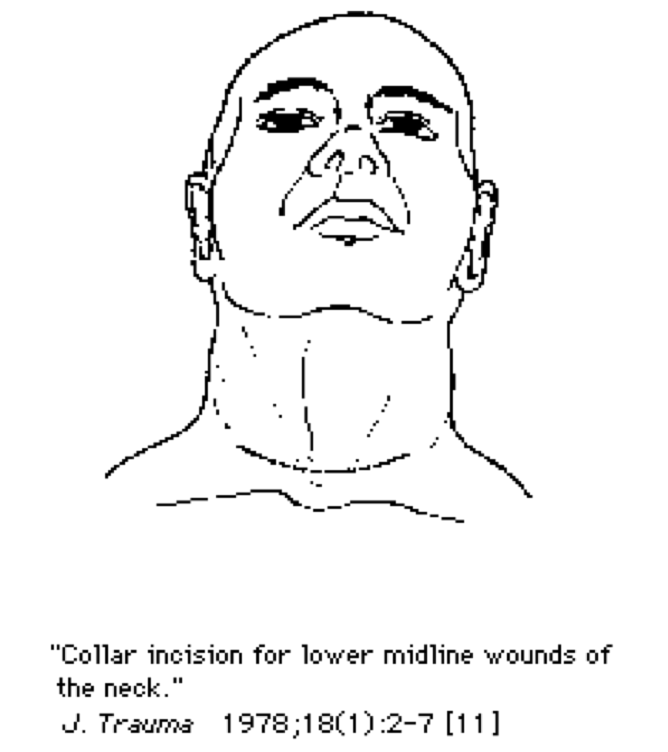
In Kennedy’s case, it was already clear that he was having trouble breathing, and one doctor placed an endotracheal tube which proved to be inadequate. So when Perry arrived, he performed a tracheotomy. And, he said, he “made an incision right through this wound which was present in the neck.”9
But that was not all that Perry did. He made an incision large enough to allow him to inspect the carotid arteries, the mediastinum, and other structures.
“Once the transverse incision through the skin and subcutaneous tissues was made, it was necessary to separate the strap muscles covering the anterior muscles of the windpipe and thyroid. At that point, the trachea was noted to be deviated slightly to the left and I found it necessary to sever the exterior strap muscles on the other side to reach the trachea.”10 (His testimony on another day is similar.11)
“I also made it big enough that I could look to either side of the trachea … I didn’t know whether I was going to encounter carotid arteries or whatever. But the path of the bullet clearly put those vessels at risk as well as the trachea, so I made the wound big enough to do that … How big it [the incision] was, I don’t know … . I made it big enough to control an underlying bleeding blood vessel if necessary.”12
Please see the Addendum for quotations from articles on this subject—including some from a chapter in a textbook written by Malcolm Perry himself.
Why Perry Described Such a Small Incision: A Theory
Malcolm Perry was aware of Humes’s sworn testimony that, on the night of the autopsy, he knew nothing about a bullet wound in the throat, that he thought only a tracheotomy had been done.
Caught off guard by Lifton’s question, Perry probably thought he had better not say anything that would contradict Humes’s story.
Perry was apparently confident that Humes’s earlier report of a large incision was not well known. He has said more than once that he never met anyone who had read the Warren Commission Hearings.
Why Humes Revised the Size: A Theory
Small incisions are not done in the presence of a penetrating wound in the throat.
If Kennedy only had a small opening in his throat, this would have made it easier to believe Humes’s story of thinking the president only had a tracheotomy. This may have been the reason Humes gave such a different description of the incision to JAMA.
Furthermore, he may have worried that, had he described a wider incision, one that was more consistent with those performed in the presence of trauma, then one of JAMA’s readers might well have asked, how could he have been so sure the only abnormality in JFK’s throat was the remains of a tracheotomy? Especially in the presence of a bullet wound in the back?
What May Lie Behind the Revisions
Had Humes admitted to being aware of a throat trauma, he would have then been obliged to deal with it: dissect its path, obtain tissue specimens, document its characteristics, photograph it close-up and under magnification.
What if a proper study of the wound showed it to be an entrance? This would mean that at least one shooter was in front of Kennedy. But Humes and his team were under a great deal of pressure to prove the president’s wounds were created by one sniper, located above and behind.
Better to feign ignorance of a wound that may contradict that conclusion. Better to wait until after the body was gone, when it was too late to document its nature—entrance or exit—and its alleged connection with the wound in the back.13
But Humes Did Know
It seems that, even on the night of the autopsy, Humes et al. did know that a bullet had passed through Kennedy’s throat, either coming or going.
The bruising in the neck is what told him, bruising that could only have occurred during the motorcade—when the heart was still beating normally. What’s more, possibly out of vanity (and to avoid looking stupid to his peers), he wanted the Warren Commissioners to know that he knew, that he had not missed something so important, or its significance.
“When examining the wounds in the base of the President’s neck anteriorly … we noted, and we noted in our record, some contusion and bruising of the muscles of the neck of the Present. We noted that at the time of the postmortem examination.”14
He went on to describe wounds that were created by the Parkland doctors: incisions made in the chest for the placement of chest tubes, and in the arm and ankle for administering intravenous fluids—wounds that did not lead to bleeding and bruising, because they were made later, when the heart was barely beating.
“Those wounds [made at Parkland, on the chest and in the arm and ankle] showed no evidence of bruising or contusion … which made us reach the conclusion that they were performed during the agonal moments of the late President … when the circulation was … seriously embarrassed, if not nonfunctional. So that these wounds … were performed about the same time as the tracheotomy wound …”15
“So, therefore, we reached the conclusion that the damage to those muscles on the anterior neck just below this wound were received at approximately the same time that the wound here on the top of the pleural cavity was, while the President still lived and while his heart and lungs were operating in such a fashion to permit him to have a bruise in the vicinity … so we feel that, had this missile not made its path in that fashion, the wound made by Doctor Perry in the neck would not have been able to produce, wouldn’t have been able to produce, these contusions of the musculature of the neck.”16
Ignoring Humes’s comments above, Commissioner Allen Dulles then completely changed the subject.17
In later years, J. Thornton Boswell, the pathologist who assisted Humes, actually described seeing, on that same night, the remains of the bullet hole itself, “part of the perimeter of a bullet wound in the anterior neck”,18 and they concluded that night that the bullet exited the throat.19 When talking to the ARRB in 1996, Humes denied seeing the remains of the bullet wound, or knowing anything about its existence.20
The lead photographer, John Stringer, described the pathologists putting their fingers into the gaping hole trying to feel for anything sharp, looking for bullet fragments, in other words.21 John H. Ebersole, M.D., Acting Chief of Radiology, said that Humes had been in touch with the Parkland doctors that same night, and, clearly, had been informed of the bullet wound in the throat.22 (This is not a comprehensive treatment of the subject; there is yet other testimony relative to this issue not included here.)
Comic Relief: Humes “Explains”
“And we wondered, where’s the bullet? You know. Should have called Dallas right then and there. It would have saved me a lot of worry and grief for several hours, because x-rays hadn’t found it for us. Like it could have been in his thigh or it could have been in his buttock. It could have been any damn place …”23
So, it could have gone any damn place—except a few inches away out the hole in the front?
“We didn’t know where it went. It was obvious after we talked to the doctors the next morning where it went. It went out. That’s why we couldn’t find it. And we weren’t going to spend the rest of the night there, you know. Meantime, George Burkley is telling me, you know, the family wants to get out of here sometime tonight. Then we proceeded with the dissection of the lungs, heart and abdominal contents and so forth.”24
Note: Kennedy was not shot in the abdomen.
“… it wouldn’t make a great deal of sense to go slashing open the neck. What would we learn? Nothing you know.”25
Have sympathy for the late James Humes. He not only had to cover his own ass, he had to cover the collective ass of those who were pressuring him to come up with the “right” answers. He never did seem sure of the script.
Was it an Entrance Wound?
We have no way of knowing what the nature of Kennedy’s throat wound was but, considering all the lies told about it, Humes et al. probably thought it was an entrance. Based on the wound’s characteristics as reported, nothing seems to justify declaring it an entrance or an exit although, grossly, it was most typical of an entrance.
- Exit wounds can be small;
- Ragged wounds can be entrances;
- Entrance wounds need not have abrasion collars, but often do;
- Shored exit wounds always have pronounced abrasion collars.
- Non-shored exit wounds do not have abrasion collars.
One thing does seem certain: if the wound had been an exit, the bullet had to have exited above the shirt; it could not have gone through the shirt (the bottom part of the collar band), as alleged. This would have created a “shored wound.” In shored wounds, an obvious abrasion collar is created26 with little bits of skin hanging (like the flakes of a sunburn) as the shoring material—which usually sticks to the wound—is pulled off the victim.27
Furthermore, skin would have been left behind on the shirt: upon exiting, the bullet would have crushed the skin against the shirt on its way out, skin that would have been visible to the naked eye.28 The FBI would surely have loudly announced such evidence had they found any.
Kennedy’s throat wound did not have the wide, pronounced abrasion collar of a shored exit wound, but it apparently did have the abrasion collar of an entrance wound.29
As mentioned above, exit wounds can be small, but would a jacketed bullet travelling at medium high velocity through the loose, wrinkled, tanned, leathery skin of Kennedy’s neck leave a small wound?
Or—unhindered by any shoring material—would the bullet pull the skin forward on its way out, tenting the skin, creating the lacerations of a typical “stellate” wound of exit?
(All of the small exit wounds in the photos that I could find were in what looked like taut, young skin in areas not unexposed to the sun and not subjected to a lot of stretching, and wrinkle-causing movement, like the neck and wrists.)
For more on the subject of bullet wounds (including photographs and additional references) please see my article, “Trajectory of a Lie Part I. The Palindrome” at www.history-matters.com.
Conclusion
Commander James Humes testified that, on the night of the autopsy, the only abnormality seen in Kennedy’s throat was a tracheotomy incision. For the following reasons, this seems to have been a cover story:
- Context: there was an entrance wound, only inches away, in the back;
- The incision was larger than one for a typical tracheotomy, though, by itself, this is not reason to suspect trauma;
- The strap muscles were severed; this is not done in routine tracheotomies;
- Humes testified he saw bruising in the throat muscles that he said he knew could only have occurred during the motorcade, when the president’s heart was still functioning normally;
- Other doctors testified that they all knew of the bullet wound in the throat;
- Part of the perimeter of the hole created by the bullet was seen.
By denying awareness of the wound, Humes avoided documenting its nature. (He also avoided properly documenting the back and head wounds, all for the same reason apparently.)
A few years later, in an apparent effort to support Humes’s story, the surgeon who performed the incision, Malcolm Perry, M.D., described it as small enough to be typical. This same surgeon was most accommodating when it came to revising other trajectory-related details. Nearly 30 years later, Commander Humes himself reported the incision as small, radically contradicting his own testimony to provide a description that just happened to agree with Malcolm Perry’s.
It is also possible that each doctor simply had a malfunction of memory.
ADDENDUM
Standard Response to Penetrating Wounds of the Neck
What was the standard emergency response to a penetrating injury of the throat—whether or not the trachea (windpipe) is injured, and whether or not there is another life-threatening wound?
Exploratory surgery—however quick and limited—was and is the standard. The incision Perry made was apparently similar to the one shown in the diagram below:30
According to the 1971 issue of the American Journal of Surgery, the performance of an “exploratory” in these circumstances had been standard since World War II:
“The general surgical principle of mandatory exploration of all penetrating wounds has become established during the past three decades.” 31
Parkland Policy on Penetrating Neck Wounds
“Since 1957 it has been the policy at Parkland Memorial Hospital to explore virtually all penetrating wounds of the neck regardless of the clinical impression as to the severity of the injury …”
“The incision was planned to allow full exposure of the tract of injury. Proximal and distal control of the major vessels was also considered in the length and position of the incision. The sternocleidomastoid (“strap”) muscle and/or other neck muscles were taken off the insertion or transected whenever necessary to provide adequate exposure.”32
The textbook Principles of Trauma Care contains a chapter written by Malcolm Perry, “Penetrating Wounds of the Neck.”33 Perry’s list of findings that indicate the need for exploration include some that applied to Kennedy:
- Bleeding
- Large hematoma
- Shock
- Respiratory distress
- Subcutaneous emphysema
- Blood in the oropharynx
Finally, an exploratory is even appropriate in the absence of these signs because life-threatening damage can hide behind a superficial looking wound. The authors of the 1971 paper discovered the following:
“… one third of the patients with injury to a major structure had no clinical evidence for this. This latter group included one patient with a through and through bullet wound of the carotid artery.”34
Notes
1 D. L. Breo, “JFK’s death-the plain truth from the MD’s who did the autopsy.” Journal of the American Medical Association 1992; 267: 2794-2803, here p. 2798.
2 Autopsy Report. MD3, ARRB Master Set of Exhibits.
3 J. J. Humes, Warren Commission Hearings, Vol. II, p. 361 (“some 7 or 8 cm in length”).
4 D. S. Lifton, Best Evidence. Carroll & Graff, 1980, p. 238.
5 Autopsy Report.
6 WCH II, p. 361.
7 Lifton, p. 238.
8 Breo, p. 2798.
9 M. Perry, Warren Commission Hearings, Vol. VI, p. 10.
10 WCH VI, p. 10.
11 Perry, Warren Commission Hearings, Vol. III, p. 370.
12 Perry, ARRB Testimony, August 17, 1998, pp. 24-25.
13 Humes, HSCA Testimony, September 7, 1978, p. 330.
14 WCH II, p. 367.
15 WCH II, p. 367.
16 WCH II, p. 368.
17 WCH II, p. 368.
18 J. T. Boswell, HSCA Testimony, August 7, 1977, pp. 8, 12.
19 Boswell, ARRB Testimony, February 26, 1996, pp. 34, 45.
20 Humes, ARRB Testimony, February 13, 1996, p. 115.
21 J. Stringer, ARRB Testimony, July16, 1996, pp. 191-2.
22 J. H. Ebersole, HSCA Testimony, 1978, p. 20; pp. 51-52.
23 Humes, ARRB Testimony, p. 113.
24 Humes, ARRB Testimony, p. 113.
25 Humes, ARRB Testimony, p. 36.
26 V. J. M. Di Maio, Gunshot Wounds, Practical Aspects of Firearms, Ballistics, and Forensic Techniques, Second Edition. CRC Press, 1999.
27 J. C. Aguilar, “Shored gunshot wounds of exit.” American Journal of Forensic Medicine and Pathology 1983; 4(3): 199-204.
28 Aguilar, “Shored gunshot wounds of exit.”
29 M. Perry, HSCA p. 302; C. Baxter, Warren Commission Hearings, Vol. VI, p. 42.
30 For the diagram: J. D. Saletta, R. J. Lowe, L. T. Lim, J. Thornton, S. Delk, and G. S. Moss, “Penetrating trauma of the neck.” Journal of Trauma and Acute Care Surgery 1976; 16(7): 579-587; D. C. Blass, E. C. James, R. J. Reed, C. W. Fedde, and A. L. Watne, “Penetrating wounds of the neck and upper thorax.” Journal of Trauma and Acute Care Surgery 1978; 18(1): 2-7.
31 “Exploratory since WW II”: C. Ashworth, L. F. Williams, and J. J. Byrne, “Penetrating wounds of the neck. Re-emphasis of the need for prompt exploration.” American Journal of Surgery 1971; 121: 387-391.
32 Parkland: R. F. Jones, J. C. Terrell, and K. E. Salyer, “Penetrating wounds of the neck: an analysis of 274 cases.” Journal of Trauma and Acute Care Surgery 1967; 7(2): 228-237.
33 M. Perry, Chapter 16, “Penetrating Wounds of the Neck.” In: G. T. Shires, ed., Principles of Trauma Care, Third Edition. McGraw-Hill Book Company, 1985.
34 Ashworth, Williams, Byrne, “Penetrating wounds of the neck.”
-

The Death of Eugene B. Dinkin
Read the first part of this essay, Eugene Dinkin: The Saga of an Unsung Hero.
The long-lingering question of the whereabouts of JFK assassination conspiracy figure Pfc. Eugene B. Dinkin has a sad answer. The Kennedys and King website has learned that Dinkin died in Los Angeles in 2012 at the age of 73.
Since my initial finding of information about U. S. Army PFC Eugene Dinkin at the National Archives at College Park, Maryland, I have attempted in a number of ways to hopefully meet him and learn more about him. I have found more information about him from a number of sources. Publishing this information about Mr. Dinkin is meant to provide a clearer picture of him prior to his joining the U. S. Army in 1960.
Here is a recap of some basic information about Dinkin’s attempt to foil the plot that was in place to assassinate President Kennedy.
Regular Army Private First Class Dinkin was serving in Metz, France, in the 59th Ordinance Group. He held a secret security clearance for his job in the crypto section of his unit. Prior to enlisting he had attended the University of Illinois at Champaign/Urbana. He and his family had lived in Chicago. His studies at the university included psychology. His duties in Metz would have included deciphering cable traffic from the European Commands, NATO and so forth.
In September, 1963, Dinkin noticed material in the Army newspaper, Stars and Stripes, and other print publications that was negative toward the president and his policies and implied that he was a weak president in dealing with the Russians. The examples that he found became more negative, the suggestion being that if Kennedy were removed as president it would be a good thing.
By mid-October Dinkin had found enough information—some of it subliminal—that he was convinced that a plot was in the works, one that was driven by some high ranking members of the military, some right-wing economic groups, and with the support of some national media outlets.
He did not tell his superior officers about this information—given that he believed that the military was involved. He did tell quite a few Army friends and some others mentioned in my original article. This information probably got back to Army authorities because Dinkin was transferred to the Army Depot in Metz, where his duties did not require a secret clearance.
Dinkin’s studies forced him to conclude that the plot would happen around November 28, 1963, and that the assassination would be blamed on “a Communist or a Negro”. He then sent a registered letter to Attorney General Robert Kennedy. When he got no reply, he decided on other options.
In late October, 1963, Dinkin gathered up the material that he found had psychological sets, which Dinkin would be sensitive to because of his college studies. Psychological sets are a batch of information that is used to induce a particular state of mind in an individual being exposed to the sets. The sets can be a series of pictures, events, written statements or combinations of the aforementioned examples that are used by advertisers and others to implant ideas into the mind of the people being exposed to them. In advertising, of course, the goal would be to get you, the target audience, to be interested enough in the product or service that you would buy it.

Hyde Park High School Eugene Barry Dinkin was born in Chicago, Illinois on June 10, 1938. He died in California on May 21, 2012. Eugene grew up in Chicago. He attended school there, including Hyde Park High School, where he graduated in 1956. The school is still there today, but is known as Hyde Park Academy. It is in the same location across the street from Jackson Park, the designated site of the Obama Library. The Museum of Science and Industry, Lake Michigan and beaches are about a mile to the east. The University of Chicago where Eugene took some courses is about a mile to the west.

Dinkin’s band class photo, from his senior class yearbook
Aitchpe (1956)When he was in high school, Gene, as his friends called him, was in the high school band. He played flute (see photo at right). He also did some boxing. As a senior at Hyde Park High school, Gene and some other students were listed as camera-shy, so there is no portrait-style photo of him in the yearbook; however, I obtained a photo of him from the time that he was a student at the Urbana/Champaign campus of the University of Illinois (see photo below).

at University of Illinois, C-U Gene graduated from the University of Illinois in August, 1960. While there, he received a bachelor’s degree in Liberal Arts and Science. Friends who knew him at this time say he was a friendly guy who looked a little bit like Kirk Douglas, the movie actor. They also said he was a serious person who would take a stand on what he believed. (We know this for sure based on his persistence in attempting to save President Kennedy’s life, and later when he and his mother tried to provide information to Attorney General Robert Kennedy, and later still when he sent information to the House Select Committee on Assassinations.)
After college, we know, of course, from the April, 1964 FBI interview of him when he had moved back to Chicago and lived on Oakdale Avenue, that he had served in the 59th Ordinance Group in Metz, France. There he found the assassination plot information that he tried to get to the authorities so that they would warn the President.
Thereafter, he had been stationed at Headquarters Company in Metz. He left there in early November and went to Luxembourg, Switzerland and Germany, where he gave plot information to several agencies. Documents from the National Archives show that he was tracked in these countries by the CIA and the FBI.

Landstuhl Army Hospital Then, when he returned to base, he was placed in detention and subsequently sent to Landstuhl Army Hospital for a psych exam (see photo). Not long after that he was sent to Walter Reed Army Hospital’s psych ward. There, he was held for several months until he was discharged from the army.
In 1977, when the House Select Committee was holding their sham re-investigation of the assassination of President Kennedy and Reverend Martin Luther King, Gene was living in Encino, California. He continued to live in California until his death of natural causes in 2012.
Acquaintances who knew him in California say he worked as a counselor/therapist. He apparently kept an ongoing interest in the murder of President Kennedy. In 1998 he wrote an article and review based on a book about the assassination.
I am very sorry that I did not have an opportunity to meet this very brave man. He did all that he could humanly do to save the President. He did all he could to provide information to help solve the case. I hope that my writing about him will somehow bring him the recognition and honor that he is due.
The research into the murder of President Kennedy by many dedicated individuals has brought us to the edge of finding out who planned the assassination, how the operation was planned, and which traitors shot the President, but this information will only get out to the public if the citizens care. How can they show that they care? Demand that all of the files held by the CIA, FBI, U.S. Army and other agencies and individuals be released now, not 6 months from now. Demand that there be a new independent investigation of the murder of Senator Robert Kennedy, for all evidence found to date indicates that his murder was planned and carried out by many of the same people who assassinated the President. Demand that Eugene Dinkin be awarded the Presidential Medal of Freedom and that his family be compensated for the illegal, horrible treatment that he endured. To do less than this is to allow a great injustice to stand.
-
Update on Richard Case Nagell: The New Files
by Dick Russell, at WhoWhatWhy
-
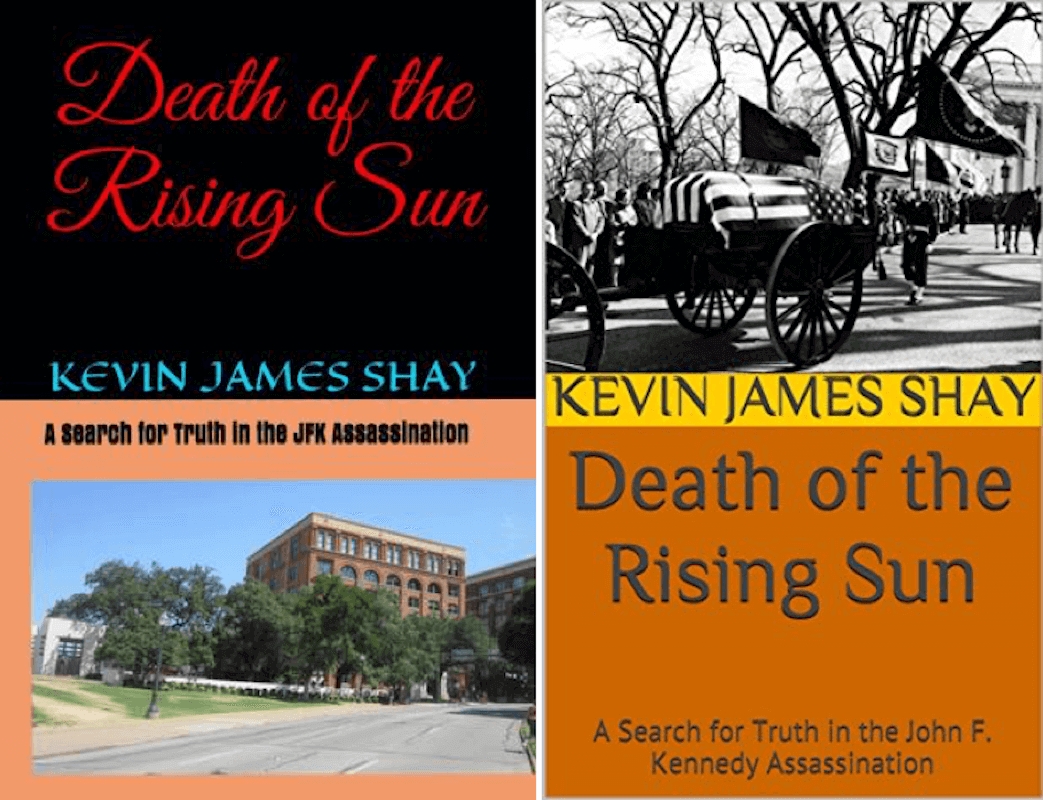
Kevin James Shay, Death of the Rising Sun: A Search for Truth in the JFK Assassination
“In 1989 I covered the opening of The Sixth Floor Museum in the former Texas Schoolbook Depository building, from where Oswald supposedly shot at the motorcade. I asked then-project director Conover Hunt why there was so little emphasis on conspiracy theories. ‘We are not here to solve this crime,’ said Hunt … That statement struck me as odd. Shouldn’t a museum that promotes this crime of the century be at least mildly interested in all aspects of the case?”
~Kevin James Shay, from Death of the Rising Sun (2017)
I had been looking into the various attempts on JFK’s life when I came across an incident that was news to me. In May of 1963 JFK landed in Nashville. During a stop-over at a local high school he was approached by a man carrying a gun obscured by a paper sack. The man (whose identity was never released) was apprehended by Secret Service agents, and then (inconceivably) released. No further mention was made by the authorities of either the man, or the incident. The incident was supposedly suppressed in order to prevent any future copycat attempts. I could only find two brief mentions of this episode on the internet. One of them was in this book.
So I went to the Amazon page where the book is listed and clicked on the link that says “Look Inside”. I read the introduction. I was impressed.
Whenever I encounter a book about the JFK case I quickly scan it to determine if it has been packaged by a shill. If it has, then I don’t read it. Because there’s nothing more painful than having to suffer through a book about the murder of John Fitzgerald Kennedy which has the Good Housekeeping Shill of Approval on it.
The first thing I did was consult Shay’s index—but mostly the footnotes—to view the author’s citations (there are many, many sources listed in the footnotes which you won’t find in the index). The sources he mentions are as qualified as they come: Garrison, Lane, Talbot, Douglass, Mellen, Newman, Marrs, Crenshaw, Morley, Brussell, DiEugenio, Russell, etc. He’s familiar with The Education Forum, John Simkin, Martin Hay, Gil Jesus. He’s familiar with the Fletcher Prouty Reference site.
But mainly I was looking for certain names in particular: Gerald Posner, John McAdams, the late Gary Mack and Vincent Bugliosi, and others who make up the Wall of Shame. I was pleasantly surprised. Only one mention of Mack. Posner and Bugliosi mentioned only a scant few times. Same with McAdams.
I felt the coast was clear—no murky water, no swamp monsters present—so I dove in.
Why did the introduction impress me?
Mr. Shay does not proclaim to be an “expert,” or a “researcher”. He is just a regular citizen who sensed that all was not kosher with the Official Government Explanation. He expressed natural human concern—the type most of us are born with—but which some heartless, corrupted souls are incapable of ever possessing. So he decided to look into the matter. The title of the book reflects this. It was his own personal search for the truth. The death of President Kennedy—and all the promise he represented—signified the death of a rising sun. He wanted to be able to answer his children’s questions honestly.
As anyone who has ever looked into the Kennedy murder will tell you, it can be a complex and often daunting maze to navigate through. There are hundreds of books out there, and just as many websites and You Tube videos. It’s not unusual for one to develop myopia by focusing on one particular aspect of the crime over another. But those of us who were born with that natural human sense of right and wrong I mentioned earlier, which is what led us to this case in the first place, were simply responding to a basic, primal instinct: something smelled. And it’s equally important that we never lose sight of the outrage and disgust we first felt, and of how that disgust kept growing once we realized just how far the case has devolved into an outright mockery.
Having said all that, here’s the catch.
Mr. Shay decided to look at this case “from both sides”.
Writes Shay:
… I am some 75% certain that there was a conspiracy to kill JFK. In that vein, Oswald could have been an actual conspirator, patsy or government-hired asset who attempted to monitor and even stop the plots. I leave the door at least one-quarter open that the lone-assassin theory is correct. That’s not much, relatively speaking. But I have lived long enough to know that nothing is certain, not even death (life could continue after physical death), and taxes (see Donald Trump’s decades-long nonpayment of income taxes) … Whether he was a patsy or actually fired his rifle at Kennedy is more up in the air. If he was a shooter, he had help, and if he was trying to infiltrate and stop the plot as a government informant, he obviously didn’t do enough. But then, no one did enough.
How anyone who has read the definitive body of material Shay has and still arrive at a figure of there being a 25% possibility that Oswald was the shooter is, frankly, baffling. My own likelihood of Oswald being the shooter would be closer to 0%. It might be higher had I never read a shred of critical information and based my opinion solely on the Warren Commission findings. And to base my opinion on the Warren Report would be silly. It’s because of our refusal to swallow such silliness that we’re all still talking about this case today. To his first point, that Oswald was somehow involved, I would venture that all of us would concur. It’s quite plain based merely on Oswald’s associations with a myriad of key players that he was up to something.
As per Shay’s claim that he’s committed to looking at and considering the case from both sides … I, respectfully, don’t buy a word of it. I think he knows better. There are indeed two sides to this case. One side is facts. The other is deception. For him to include anything ever offered by Posner is a waste of everyone’s time. So why would he include it at all? Same with Bugliosi and the others. Similarly, for him to offer anything ever offered by Hugh Aynesworth is a compounded waste of everyone’s time. Especially when Shay later illuminates Aynesworth’s many intelligence ties, and the unscrupulous, deceitful manner by which he participated in the destruction of Jim Garrison’s case against Clay Shaw. Again—why? If I were writing a book called The Search for Truth about Who Raided My Chicken Coop at Night, I certainly wouldn’t consult the family of nocturnal weasels who lived under the shed.
There’s an important fact about Kevin James Shay that you need to be aware of.
He lives and works and writes in Dallas.
Before he wrote the above passage he provided the following:
While I haven’t been as dogged in pursuing the truth behind the JFK assassination as Penn Jones Jr., Jim Marrs, Earl Golz, Jim Garrison, David Talbot, and some others, it remains the most important and defining story I have chased in my almost four-decade journalism career. It haunts me today as much as it did in 1978. It’s more than a detective story with high-level political stakes. To truly study the Kennedy assassination and pursue the truth, you have to suspend the truth about everything you have been taught about this country, international politics, and who the good guys and bad guys are.
You have to risk your career, reputation, and sometimes even life. You have to shuck off the laughter and ‘tin-foil hat’ comments, ignore the threats. You have to walk down a slippery slope. You have to take up a missionary’s cause without thought of monetary reward, fame, or even redemption. You have to trust no one, not even yourself. You have to reach deep within yourself to find reasons to hold onto the hope that the sun, will indeed, rise in the morning.
One of the newspapers Shay has written for is the Dallas Morning News. I visited the Twitter page of another man who also writes for this newspaper. Not only does this man receive messages and updates from the Sixth Floor Museum, but he also provides readers the link to John McAdams’ web page.
Then again, If I were forced to function in a mysterious and shady atmosphere, like that which continues to fester in Dallas to this very day, I might be tempted to leave the door open 25%, too. Especially if I ever hoped to work again.
Shay lays out most of his book in a point-counterpoint fashion. He’ll describe the “official” version of a particular event … then bash it to pieces with facts. Well, sometimes. But not always.
I do understand that he set out to write this book from the perspective of both sides. But I found this style to be a head-scratcher, and often frustrating. Simply because, and I reiterate, when someone has accumulated the knowledge that Shay has, why even bother mentioning Marina’s testimony in the first place? Or Brennan’s? We know beyond any and all doubt that so many Warren Commission testimonies were either altered, contrived, fabricated, or arrived at through coercion, witness-leading, coaching, or outright threats, to the point that almost none can be relied on as a documentation of anything that ever really happened. The same applies to the medical evidence. The same applies to the x-rays. On and on.
The recent Houston mock trial proved what a colossal, well-crafted diversion the WC was and is. The prosecutors prefaced so many of their questions with, “Now, according to the Warren Commission,” that it literally gobbled up hours of precious time. By the time the witnesses were able to move past how their evidence or testimony compared to the Warren Report to please the prosecutors there was hardly time for anything else. If the Warren Commission report is anything at all, it’s the perfect tool for any zealous prosecutor intent on sidetracking an evidentiary proceeding, onto an off-ramp filled with red herrings, based on dubious facts that are based on a false premise, and straight into a drainage ditch.
And yet the book still works. The farther you read, and the more he bashes the official versions to bits, the more you get a distinct whiff of just how ridiculous the official version is. He doesn’t have to hit you over the head with it. He allows you to hit yourself over the head.
Factually, the book is pretty sound. He sprinkles in an extraordinary amount of information gleaned from a multitude of the many different go-to books that we all have in our personal libraries, as well as magazine and newspaper articles. Sometimes it’s overwhelming. It is here where the author is at his finest. The breadth and scope of what he’s compiled is quite riveting and expansive. Although he does admit that he’s not an expert and may have left a few things out. Where the book stumbles is when he offers descriptions of what the “other side” considers facts. Simply stated, those “facts” are not facts. They come from the Warren Report, Commission lawyers, or shills—many of whom have intelligence ties. Had he not included this “other side” nonsense he might have had a huge, important bestseller on his hands. But, more likely, the book would never have been published.
There is one error that I felt was particularly egregious. It’s in the chapter about Cuba. He outlines how the CIA continually misled John and Robert Kennedy. He says both Kennedys were on board with the Cuba shenanigans, if to a lesser extent. Then JFK dies. Shay then quotes Johnson as saying that “those Kennedy boys” were running a goddamn murder incorporated in the Caribbean.
Um, excuse me, but not only was Johnson not referring to the Kennedys when he made that comment, he never mentioned their names. Shay also gives the impression that Johnson made the comment directly after JFK was killed, implying that JFK’s alleged militancy against Cuba rebounded back to cause his own death. When in fact, Johnson didn’t make his comment until years after JFK’s death. (See, for instance, this article)
The main reason why I am recommending this book is … because it’s out there. It’s on the shelves. It is not just researchers who buy books about the JFK assassination. Regular, everyday people buy way more copies of the same books—most of whom have no idea whatsoever about the ground-breaking progress that’s been achieved over the last fifty-four years. Zip. Zero. All they know is the false cover story they’ve been fed on TV, films or newspapers. Dutifully served up by the shills—like slop from a soup kitchen—and gift-wrapped by the morally indigent corporate media. They’re unaware of official records being destroyed, or corpses being hijacked, or autopsies being rigged, or brains going missing, or intelligence agencies blocking investigations, or bullets being switched, or Black Ops, or hit-pieces against researchers, or witnesses mysteriously dying. All they know is that a disgruntled misfit named Lee Harvey Oswald assassinated President Kennedy with a high-powered rifle, thereafter killing a police officer.
It is for those reasons that I would much rather they bought a book like this one, than, say, one by Bill O’Reilly—or whoever the “other side’s” designated shill happens to be this week. This is why I began my article speaking about shills. Because that’s the real hurdle. We’ve laboured for over fifty years like a horde of diligent worker ants. We’ve uncovered a warehouse full of facts and information. But a gag order has been carefully and masterfully applied on a largely unsuspecting public. And they can’t even tell they’re gagging on it.
And speaking of gags, Shay talks about how John McAdams was caught at a conference using a phoney name. Shay writes, “McAdams claimed the debunking was a ‘hobby’ for him that should be ‘fun’. Many noted that was an odd thing for a political science professor to say, since you’d think he would be interested in setting the historical record straight in such a pursuit, not having ‘fun’. McAdams also once responded to charges that he was paid by the CIA with this: ‘Those people think the CIA cares about them. It does not!’ … That led to another question: If McAdams was not associated with the CIA in some way, how did he know for sure the CIA did not care about Warren Commission critics?”
In the Appendix he commends the people that influenced and inspired him the most. They include (among others) Jim Marrs, whose course about the JFK assassination the author attended at the University of Texas at Arlington in 1988; Mary Ferrell; Gary Shaw and the late Larry Howard (who kept the JFK Assassination Information Center going for years as a counter to the Sixth Floor Museum), and Abraham Bolden. And finally …
There should be a special place in heaven for Jim Garrison, who went through Hell attempting to prosecute the only criminal case brought against an alleged member of a plot. Garrison’s investigation wasn’t perfect and he took some excesses, but it was amazing what he was able to uncover about a plot in the late 60s with the bulk of the government and media against him. If he had just a smidgen of help from those in powerful places, he and the staff may have broken the case wide open.
Would it have been preferable if Kevin James Shay boldly hopped off of the fence and stopped pretending that he was just a little bit pregnant? In a perfect world it would.
Then again, that’s easy for me to say. I’m not the one who has to live and work in Dallas.
This baby must largely be read between the lines. Don’t throw it out with the bath water.
-

Robert A. Wagner, The Assassination of JFK: Perspectives Half A Century Later
Like many other students of the Kennedy case, I had never heard of the 2016 book The Assassination of JFK: Perspectives Half A Century Later until author Robert A. Wagner appeared as an advisor to the prosecution at the CAPA-organized mock trial of Lee Harvey Oswald last November. Having now read the book I can safely say that, despite the modest praise it received from Kirkus Reviews, it does not represent any kind of lost gem.
When approaching a book like this one, which proffers a lone nut solution to the assassination, one of the first questions I am compelled to consider is whether or not it provides an honest, even-handed presentation. Throughout his book Wagner does go to some effort to appear objective. Yet this stance is hard to reconcile with the tendentious and insupportable declaration he makes in the book’s preface that “There is no reasonable doubt that Oswald fired a rifle from the depository’s sixth-floor window.” (p. 16) It’s hard to imagine that Wagner could have made a more ridiculous statement. In reality there has been nothing but reasonable doubt that Oswald pulled the trigger ever since the Warren Commission issued its report in 1964. The overwhelming majority of intelligent, freethinking individuals who have studied this case are aware that there is not a single piece of evidence against Oswald that can withstand scrutiny and Wagner clearly understands this fact too. To avoid having to defend it, he writes, “If the entire case against Oswald boils down to proving each facet of the case beyond a reasonable doubt, I have to acquit.” (p. 60)
So instead of breaking the case down or examining individual pieces of evidence in detail―something which would be disastrous for his position―Wagner suggests it is much more beneficial to view the evidence from a “contextual perspective” of his own making. He then introduces the notion of a “filter through which any aspect of the case should be evaluated” which, he writes, “… involves laying out the key facts related to Oswald’s actions that no one seriously disputes.” (p. 61) From there Wagner treats readers to a list of 24 items he calls “stipulated facts” that he wants his readers to believe point strongly to Oswald’s guilt. The problem with these stipulated facts is that they are, in some cases, no such thing and, in others, entirely stripped of their own important context.
Take for example item number 1: “On the morning of the assassination of the president, Oswald went to work but left behind his wedding ring and virtually all of his cash for [his wife] Marina to find.” (Wagner, p. 62) While this may indeed be true, and may appear to suggest that Oswald had something untoward planned that day, Wagner is withholding some very important details from his readers that paint Oswald’s actions in a very different light. Namely that the Oswald marriage had been on the rocks for quite some time before that morning. The pair had actually been separated for about two months, with Lee living in a rooming house in Dallas and Marina staying at the home of Ruth Paine in Irving. On the evening before the assassination, Lee turned up at the Paine home unannounced to apologize for an argument he and Marina had had over the phone the previous Sunday, but she gave him the cold shoulder. He begged her repeatedly to come live with him in an apartment in Dallas but she refused. The notoriously miserly Oswald even tried appealing to his wife’s materialistic side by offering to buy her a washing machine but still she would not budge. In the end he went to bed alone; hurt and angry. (Warren Report, p. 421, hereafter abbreviated as WR.) Viewing Oswald’s decision to leave behind his wedding ring and cash―along with an instruction to buy shoes for his daughter, June―in this context, I’m sure most readers will agree it likely had more to do with his marital difficulties than any imminent plan to assassinate the President.
A similar example is item number 10 on Wagner’s list that states that “Marina Oswald confirmed her husband owned a rifle.” This again is technically accurate. Yet Marina also gave information that cast doubt on the claim that the rifle her husband owned was in fact the Mannlicher-Carcano allegedly found on the sixth floor of the Texas School Book Depository building. According to the Warren Commission, when the Carcano in question was shipped by Klein’s Sporting Goods in Chicago it already had the telescopic sight attached. Yet Marina told the Commission that when she first saw her husband’s rifle in their Neely Street apartment, “it did not have a scope on it.” (WC Vol. 1, p.13. henceforth abbreviated as 1H13) In fact she told the Secret Service a little over a week after the assassination that “until she saw the rifle with a scope on TV the other day she did not know that rifles with scopes existed.” (CD 344, p. 24)
Ownership of the Carcano is of course an important issue. More crucial, however, is the question of possession. One genuine stipulated fact that Wagner elected not to divulge is that Oswald did not have possession of the Carcano for at least two months preceding the assassination and absolutely no one can vouch for its whereabouts during that time. Perhaps more importantly, there exists no proof whatsoever that Oswald handled the weapon on the day of the assassination.
Wagner’s list includes the claim that Oswald’s palm print was found on the Carcano. To suggest that this belongs on a list of facts that are not in dispute is, at best, risible. The release of formally classified internal memoranda has shown that even the Warren Commission queried whether the print in question was “a legitimate latent palm impression removed from the rifle barrel or whether it was obtained from some other source …” When the rifle was sent to the FBI laboratory on the evening of the assassination the Bureau experts saw not even a trace of a palm print. A few days later, after Oswald was murdered in the basement of police headquarters, Dallas Police Lieutenant J.C. Day suddenly came forward claiming he had lifted the print before the rifle had been passed on to the FBI. He’d just forgotten to tell anyone, including Vince Drain, the FBI agent whom he gave the rifle to that evening. (Henry Hurt, Reasonable Doubt, p. 109) Yet when the FBI asked Day to make a signed written statement about finding the print he declined to do so. (26H829) To call this a suspicious set of circumstances would be a serious understatement. [Intriguingly, even Day would not claim that the palm print placed the Mannlicher-Carcano in Oswald’s hands on November 22, 1963. In fact, he labeled it an “old dry print” that “had been on the gun several weeks or months.” (26H831; Anthony Summers, Conspiracy, p. 54)]
Wagner also attempts to pass off as a stipulated fact the hotly contested claim that shell casings fired from Oswald’s revolver were found at the scene of the murder of police officer J.D. Tippit. It is utterly inconceivable that Wagner could be unaware of the controversy surrounding those shells, which goes right back to the first generation critics of the Warren Report. For example, Mark Lane pointed out numerous problems with them in his bestselling 1966 book Rush to Judgment (a book which is listed in Wagner’s bibliography). To begin with, the shells do not match the bullets recovered from Tippit’s body. As Lane writes, “… three of the four bullets removed from Tippit’s body were manufactured by Winchester-Western, while just two of the shells found at the scene were manufactured by that company, and although only one Remington-Peters bullet was taken from Tippit’s body, two shells of that manufacture were found at the scene.” (Lane, p. 200)
Two of these shells were allegedly found at the scene by eyewitness Domingo Benavides and handed over to Dallas police officer J.M. Poe who, in accordance with correct procedure, should have marked them with his initials. Yet, as Lane notes, when he was shown the shells from Oswald’s revolver during his Warren Commission testimony, Poe “was unable to find his initials on them …” Additionally, “[Sergeant W.E.] Barnes, the police laboratory representative [who was the next officer to handle the shells], was also unable to find his initials …” As for the other two shells, these were “purportedly found by Barbara Davis and Virginia R. Davis, neither of whom could identify either of them when asked to.” (Lane, p. 198) Needless to say, the mismatching of bullets and shells and the lack of a proper chain of evidence has led critics to raise the possibility that the real shells were switched for ones fired from Oswald’s pistol. This notion is seemingly supported by a Dallas police radio broadcast made from the scene of the crime that noted, “The shell at the scene indicates that the suspect is armed with an automatic .38 rather than a pistol.” (17H417) Whether the critics are correct or not, there is little doubt that if Oswald had lived to face trial his defense attorney would have raised these very issues and argued that the Tippit ballistics should be thrown out for lack of proof. And if the presiding judge followed the rules of evidence correctly this is most likely what would have happened.
Not only does Wagner’s list of “stipulated facts” feature numerous contestable assertions like the ones above; it also includes claims that have no bearing whatsoever on Oswald’s guilt in the Kennedy murder. One item on the list is related to the unproven allegation that Oswald took a shot at General Edwin Walker some seven months before the assassination. Five more are concerned entirely with Jack Ruby’s murder of Oswald, which has absolutely nothing do with whether or not Oswald was at the sixth floor window with a rifle. (In fact, one can effectively argue the contrary: Ruby shot Oswald because the conspirators were afraid that he would reveal how he was framed.) I can only assume these were included in an attempt to pad out a rather pathetic inventory.
There is much more that could be said about Wagner’s supposed stipulated facts, but it’s not necessary. Just from the examples above it should be apparent that it is little more than a grouping of factoids, irrelevancies and things presented without proper context. It would be a simple matter to do as Wagner does, cobble together 24 carefully selected claims with no frame of reference and hold them up as a “filter through which any aspect of the case should be evaluated,” but it would be just as worthless as what Wagner presents. At the end of the day the available evidence simply does not prove that Oswald pulled the trigger.
II
The issue of Oswald’s guilt will no doubt be debated forever. Wagner believes it is a “threshold question” in determining the existence of a conspiracy. It isn’t. If the forensic evidence demonstrates that there was more than one gunman in Dealey Plaza, then it makes little difference whether or not Oswald was one of them. It is for this very reason that I personally stopped being overly concerned with Oswald’s role some time ago. There is, in fact, an overwhelming body of evidence comprised of eyewitness, photographic, medical and acoustical evidence that points very clearly to multiple shooters. And despite his best efforts, Wagner simply cannot make this body of evidence go away.
The author provides very little meaningful discussion of the medical evidence as it relates to Kennedy’s crucial head wounds. What little he does offer is largely confined to the age-old and entirely fruitless argument about the location of the largest defect in JFK’s skull. This particular debate has been raging for over five decades among those who incorrectly believe the large, explosive wound was one of exit and therefore its location tells us something about the direction in which the bullet was travelling. It doesn’t. As ballistics expert Larry Sturdivan explained in his book The JFK Myths, “… whether the explosion was more to the side or back is completely irrelevant” because it was not caused by an exiting bullet but by “… the internal pressure generated by its passage …” (Sturdivan, p. 171) Sturdivan noted that a similar type of explosion would have occurred whichever direction the bullet had travelled and was able to provide stills from filmed experiments proving his point. (As Milicent Cranor has pointed out, Dr. Vincent Di Maio, a prominent authority on wound ballistics, has also demonstrated this important medical point.)
Having helped propagate the myth that the location of the skull defect is crucial to understanding the direction from which the fatal bullet came, Wagner goes on to suggest that “It is simply impossible for people to still believe that President Kennedy was shot from the front …” (Wagner, p. 284) This he derives from the report of the “distinguished medical panel” convened by the House Select Committee on Assassinations in the late 1970s that concluded that JFK was shot only from the rear. Wagner writes of having “great respect for the opinions of qualified people who have expertise that I do not have … Far be it from me to take issue with their findings,” (pp. 9-10) Later he adds the claim that “No credible forensic pathologist who has ever viewed these materials has said differently.” (p. 284)
Not only is this false―one of the panel’s own members is a former President of the American Academy of Forensic Science who vehemently disagrees with the majority findings to this day―it is quite plainly nothing more than an appeal to authority. Wagner is essentially using the credentials of the panel members as proof of their analysis and arguing that only a similarly qualified individual can prove them wrong. Which is nonsense. As was proven with the media’s promotion of the credentials of the members of the Warren Commission to indicate that their conclusions simply had to be correct.
The collective credentials of neither the panel nor those of its critics matter anywhere near as much as what the panel itself claimed and what the evidence actually shows. Because the truth is, no matter how many distinguished individuals suggest otherwise, the medical evidence never has supported the notion of a single Carcano bullet striking the head from the rear. To understand this fact, it is instructive to take a look at how the evidence has been misrepresented and manipulated by the government and its chosen experts over the last five decades.
Kennedy’s autopsy surgeons reported finding a through-and-through entrance hole low down in the right rear of the skull, a trail of metallic fragments in the brain, and a massive bony defect encompassing almost the entire right side of the head. Lead pathologist Dr. James J. Humes explained in his Warren Commission testimony that he had been unable to find a point of exit on the skull itself because “We did not have the bone.” (2H353) However, a late-arriving bone fragment contained a beveled notch that the doctors interpreted to be a portion of the exit wound. (Ibid 254) From this Humes and his colleagues concluded that a bullet had entered the back of the skull 2.5 cm to the right and slightly above the external occipital protuberance [EOP], fragmented extensively, and exited somewhere on the right side. The diagram to the left was prepared by a Navy artist under the direction of Dr. Humes.
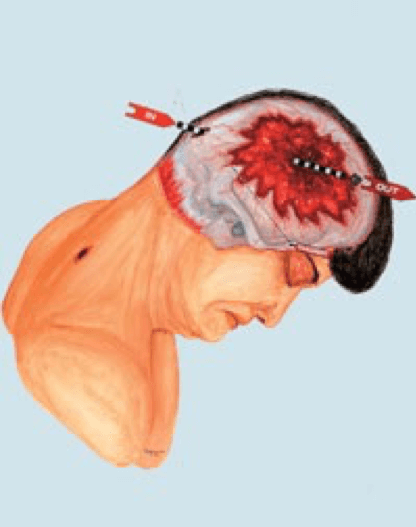
One of the Rydberg diagrams,
prepared under the direction
of Dr. HumesThis was the official version of Kennedy’s head wound for several years before Attorney General Ramsey Clark got his hands on the galley proofs to Josiah Thompson’s groundbreaking book Six Seconds in Dallas. Thompson used the available evidence to make a case for two shots striking the head almost simultaneously; one from the rear and one from the right front. Clark was apparently sufficiently disturbed by what he read that he asked Maryland Chief Medical Examiner Dr. Russell Fisher to convene a panel that would, in Fisher’s words, “refute some of the junk that was in [Thompson’s] book.” From all appearances, Fisher was someone who could be relied upon to reach the “right” conclusion. As Jim DiEugenio explained in his excellent book Reclaiming Parkland, Fisher was once asked to review the mysterious death of CIA officer John Paisley, whose body was found floating in Chesapeake Bay. DiEugenio writes:
Understandably, the original coroner who saw the body said he was murdered because he was shot through the head, had indications of rope burns on his neck, and was weighted down with two diving belts when the body was recovered. As one commentator observed, “Strapping on two sets of diving belts, jumping off the boat with a gun in hand, and then shooting yourself in the water is, to be charitable, a weird way to commit suicide.” Further, the fatal head wound was through the left side of the brain. Yet, Paisley was right-handed. Finally, no blood, brain tissue, weapon, or expended cartridge was found on board Paisley’s boat. Did he take all of this with him when he jumped overboard? None of this was a problem for Fisher. He ruled the case a suicide. (DiEugenio, pp. 126-127)
When Fisher and his colleagues on the “Clark Panel” came to view Kennedy’s post-mortem skull X-rays, they encountered a sizeable problem. The bullet fragments that Dr. Humes said traversed a line from the entrance wound in the occiput to just above the right eye were actually located several inches higher, near the very top of the skull. This discovery confirmed rather than refuted Thompson’s two-shot scenario because a bullet entering near the EOP simply could not leave fragments along a path several inches above the one it took. Therefore, the fragments clearly indicated that two separate missiles had struck the head, just as Thompson had argued. Unperturbed, the Clark Panel found a creative solution to their dilemma: they moved the entrance wound four inches up the back of the head!
I only wish I was making this up.
Fisher and his colleagues essentially suggested that the autopsy doctors were so thoroughly inept that they were unable to tell the top from the bottom of the skull. Never mind the fact that the pathologists had the actual body in front of them or that there were at least four independent witnesses―Secret Service Agent Roy Kellerman, FBI Agent Francis O’Neil, Richard Lipsey (aide to U.S. Army General Wehle), and Bethesda photographer John Stringer―who also recalled seeing the entrance wound low down in the back of the skull. And never mind that the X-rays show a clear defect with radiating fractures right where the autopsy doctors placed the wound. None of this matters because the Clark panel said it could see a “hole in profile” 10 cm higher up. Wrap your head around that oxymoron if you can.
In 1975, another “independent” panel of experts reviewed the autopsy materials, this time on behalf of the Rockefeller Commission, whose Executive Director was none other than former Warren Commission lawyer David Belin. The membership of the medical panel left little doubt about its loyalties or the pre-ordained nature of its conclusions. Dr. Werner Spitz and Dr. Richard Lindenberg were both close professional associates of Dr. Russell Fisher, having worked under him at the Maryland State Medical Examiner’s Office. Dr. Fred Hodges worked alongside Clark Panel radiologist Russell Morgan MD at John Hopkins University in Baltimore. Pathologist Lt. Col. Robert R. McMeeken was a colleague of one of Kennedy’s autopsy surgeons, Dr. Pierre Finck, at the Armed Forces Institute of Pathology. And Dr. Alfred Olivier had previously served as the ballistics expert for the Warren Commission.
Renowned forensic pathologist Dr. Cyril Wecht was quite rightly very critical of the make-up of the Rockefeller panel. As he stated in a telephone conversation with Rockefeller Commission Senior Counsel Robert Olsen, given their strong ties to the government and especially to Dr. Russell Fisher, “it was wholly unrealistic to expect that anybody on this panel would express views different from those expressed by the Ramsey Clark Panel in 1968 …” (Olsen, memo to file, April 19, 1975) Later, in a public press release, Dr. Wecht—alongside Professor of Criminalistics, Herbert MacDonell, and President of the American Academy of Forensic Sciences, Dr. Robert Joling—charged that the Commission had “set up a panel of governmental sycophants to defend the Warren Report.” Which makes perfect sense since former Warren Commissioner Gerald Ford was the president who appointed the Rockefeller Commission.
Fisher’s influence extended past the Rockefeller panel to the HSCA. As researcher Pat Speer pointed out, six of the HSCA’s nine forensic experts had enjoyed a professional relationship with Fisher. For example, the panel included Rockefeller alumnus Dr. Werner Spitz who, as previously noted, had worked under Fisher at the Maryland State Medical Examiner’s Office. The same was true of Dr. Charles Petty, who had worked in Fisher’s office for nine years. The Chairman of the HSCA panel, Dr. Michael Baden, had himself contributed to the Spitz and Fisher book, Medicolegal Investigation of Death. Hardly surprising, then, that the panel went along with Fisher’s elevated, revised, and therefore more lone-nut-friendly in-shoot location.
The HSCA panel did not go so far as to say it could see a “hole in profile” on the X-rays, making reference instead to a “sharp disruption of the normal smooth contour of the skull … with suggested beveling …” (7HSCA107) It did, however, claim that a red spot, seen high up in the “cowlick” area in the autopsy photographs of the back of the head, represented the actual wound of entrance. Yet when the panel tried to impress this interpretation on the autopsy surgeons, it was flatly disputed. Referring to the “red spot”, Dr. Humes told the panel members, “I don’t know what that is … I can assure you that as we reflected the scalp to get to this point, there was no defect corresponding to this in the skull at any point. I don’t know what that is. It could be to me clotted blood. I don’t, I just don’t know what it is, but it certainly was not any wound of entrance.” (7HSCA254) But Humes’ pleas fell on deaf ears. Baden and his colleagues were not about to go against Fisher and they were not about to admit that the rear entrance wound and the location of bullet fragments could not be reconciled with a single bullet.
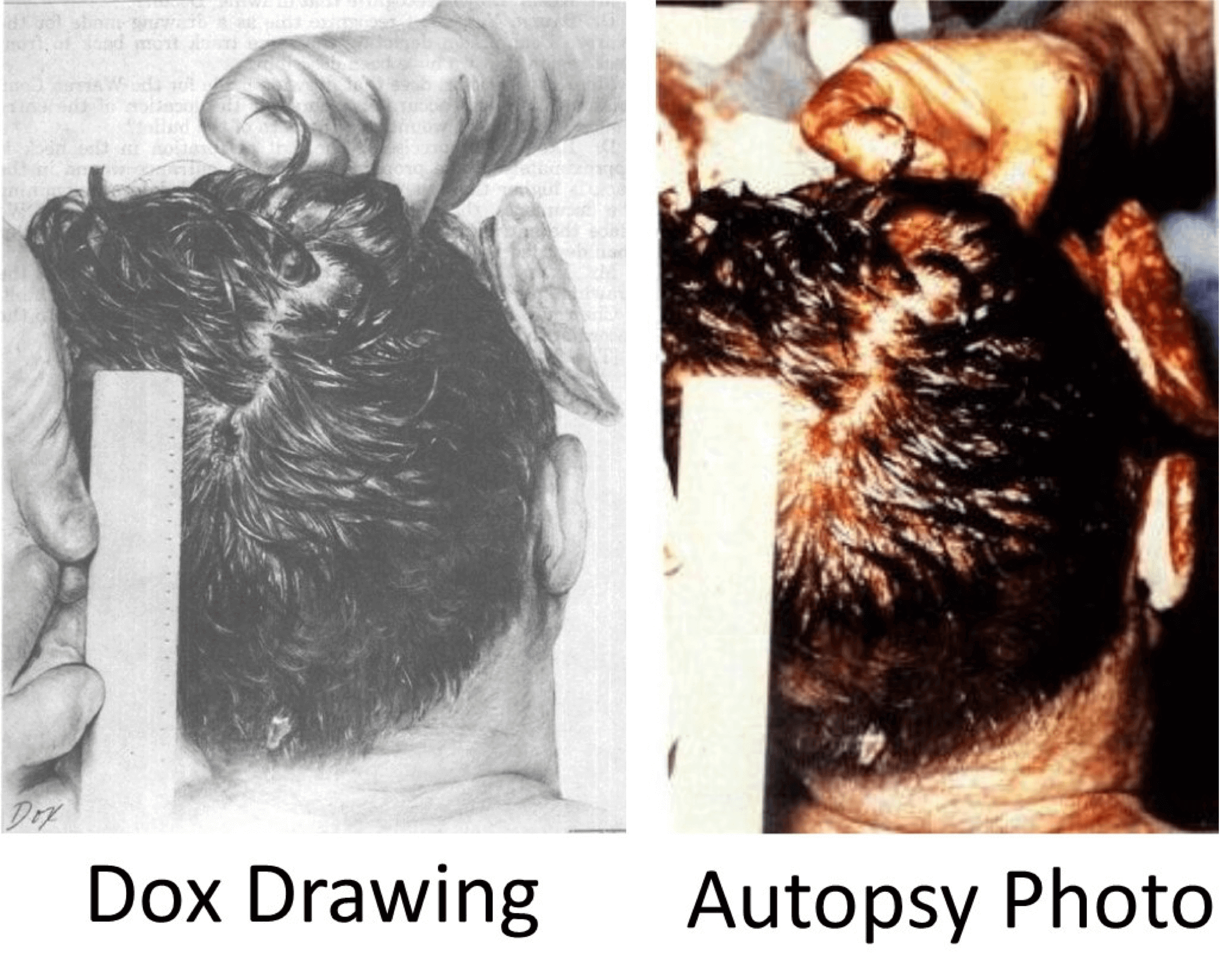
The lengths to which the HSCA panel were willing to go to push the higher entrance wound location were revealed in 2003 by a then newly declassified document Dr. Randy Robertson presented at a JFK conference in Pittsburgh. The HSCA had not published the autopsy photographs of the back of the head and instead utilized a lifelike drawing of the photo prepared by professional medical illustrator Ida Dox. The immediately obvious difference between the photo and Dox’s drawing is that in the drawing the “red spot” has been greatly accentuated to look more like a bullet wound. This, as Robertson revealed, was done at Dr. Baden’s direction. Robertson discovered a note from Baden to Dox that said “Ida, you can do much better.” Attached to the note was a picture of a typical entrance wound from Spitz and Fisher’s Medicolegal Investigation of Death. In other words, Baden was actually instructing her to make the “red spot” look more like an entrance wound than it really did in the photographs. (DiEugenio, p. 157)
To recap, Kennedy’s autopsy surgeons said that a trail of bullet fragments traversed a line from an entrance wound near the EOP to a presumed exit site on the right side. Whether this was a deliberate lie or a mistake made because Dr. Humes did not have access to the X-rays when he wrote his report is not known. Regardless, the rear entrance wound and the trail of fragments above are not connected and, therefore, almost certainly were caused by separate missiles. When the Clark Panel—which was specifically tasked with refuting conspiracy arguments—discovered this discrepancy, it attempted to diminish the problem by moving the in-shoot four inches up the skull. The Rockefeller experts played along and the HSCA panel furthered the deception by hiring a medical illustrator to create a fallacious depiction of the back of Kennedy’s head. And these are the actions of the “distinguished” professionals in whom Wagner wants his readers to put their faith.
It should be noted at this point that even if one decides that, for some unfathomable reason, the three autopsy doctors and four independent eyewitnesses all shared the same delusion—that the appearance of a defect with radiating fractures at the very location specified in the autopsy report is mere coincidence, and that the Clark Panel was right about the entrance wound being 10 cm higher—this still does not adequately explain the bullet fragments. The reasons are twofold: firstly, even the proposed higher entrance location lies around 5 cm below the rear end of the fragment trail. And secondly, the number, size, and distribution of those fragments are wholly inconsistent with a Carcano bullet entering the head from behind.
The bullets fired by “Oswald’s” Mannlicher-Carcano rifle were full metal jacket, military ammunition. The behavior of such bullets has been long understood. The well-regarded textbook Gunshot Wounds by Vincent Di Maio notes that “the presence of small fragments of metal along the wound track virtually rules out full metal-jacketed ammunition.” (Di Maio p. 334) Carcano bullets in particular were put to the test at Edgewood Arsenal in 1964 on behalf of the Warren Commission. There, wound ballistics experts took 10 rehydrated human skulls, filled them with a ballistic gelatin to simulate the brain and coated the outside with a soft tissue substitute. A rifleman then fired from a distance of 90 yards (the distance from the book depository to JFK at the time of the head shot) into the approximate entry site specified in the autopsy report. These experiments were filmed and the resultant skulls were X-rayed.
The X-rays of these test skulls showed precisely how Carcano bullets behave when striking a human head. As expected, there was no “lead snowstorm” effect as seen on President Kennedy’s post mortem X-rays. The Carcano bullets deposited only a few small fragments along the lower portion of the skull and this did not occur until after the jackets had ruptured, about midway through the cranium. This pattern is nothing like the trail of dozens of tiny, sometimes dust-like fragments running almost horizontally from one end to the other near the very top of JFK’s skull. Clearly, then, this trail of metallic debris was not left behind by full-metal-jacket Carcano ammunition.
Not only does the presence of these fragments tell us that the skull was struck by a second, non-Carcano bullet; the pattern of their distribution gives us a clue as to the direction of travel. When a bullet strikes bone and disintegrates into fragments, the smaller, dust-like particles are found closer to the entry point and the larger ones are found closer to the exit. This is because, as Sturdivan noted in his HSCA testimony, “A very small fragment has very high drag in tissue” (1HSCA401), whereas fragments with greater mass have greater momentum, enabling them to travel further. What we see in JFK’s autopsy X-ray is that the smaller particles are located near the right temple and the larger ones are found near the upper, right rear of the skull. Therefore, the bullet appears to have been heading front to back.
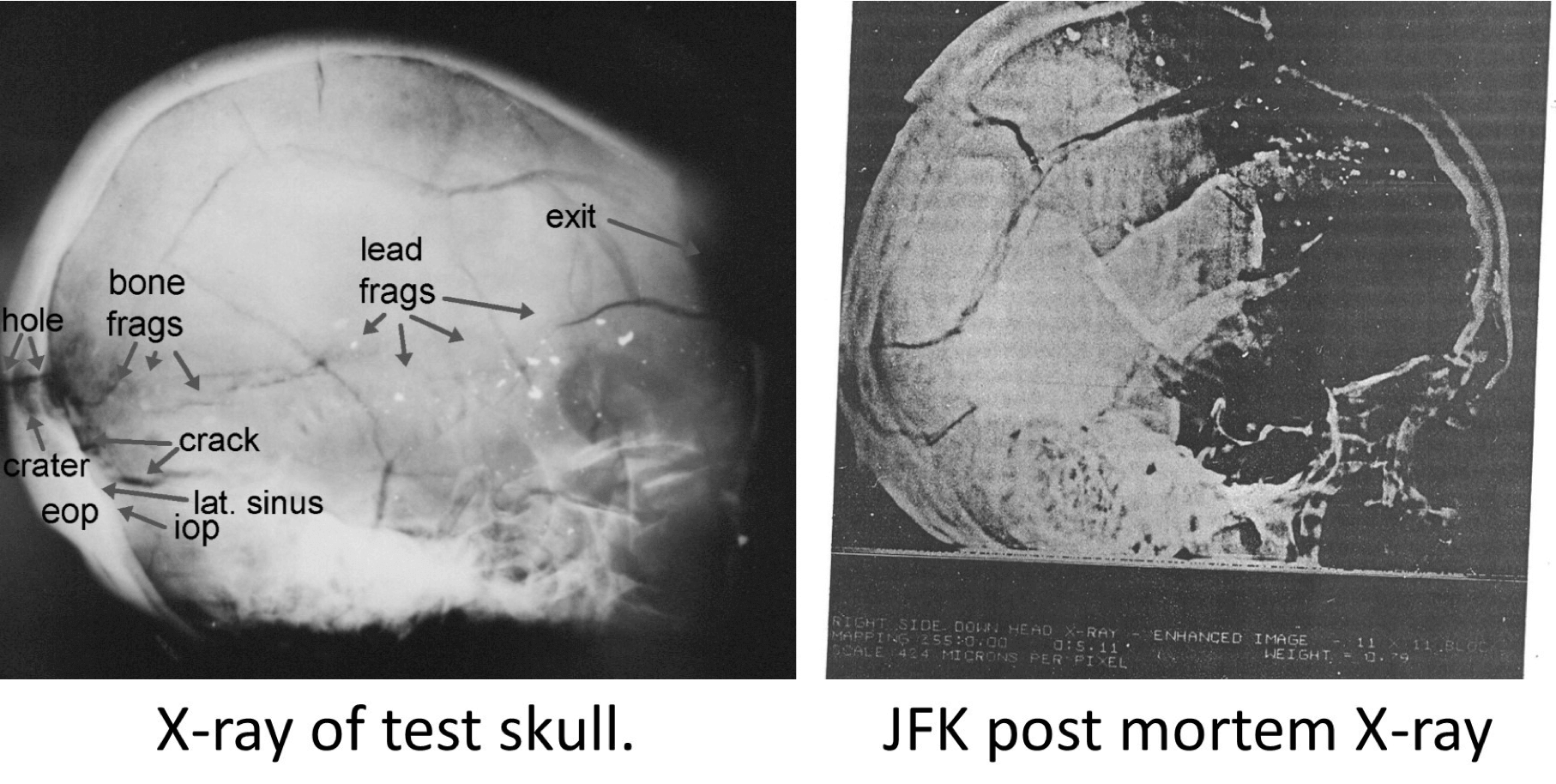
Further evidence of a double headshot was supplied by Joseph N. Riley Ph.D, a neuroscientist specializing in neuroanatomy and experimental neuropathology. Dr. Riley pointed out that one important issue not sufficiently addressed by the HSCA was that there were two separate and distinct areas of damage to the President’s brain, in the cortical and subcortical regions, and “no evidence of continuity” between the two. “An entrance wound located in the posteromedial parietal area [as proposed by the Clark and HSCA panels] … cannot account for the subcortical damage. An entrance wound in the occipital region, as determined by the autopsy prosectors, may account for the subcortical damage but cannot account for the dorsolateral cortical damage.” As Dr. Riley concluded, “The cortical and subcortical wounds are anatomically distinct and could not have been produced by a single bullet. The fundamental conclusion is inescapable: John Kennedy’s head wounds could not have been caused by one bullet.” (Riley, “The Head Wounds of John F. Kennedy: One Bullet Cannot Account for the Injuries”, The Third Decade, Volume 9, Number 3)
III
The “great respect” Wagner has for those who possess expertise he himself lacks, apparently doesn’t extend as far as the acoustics experts utilized by the HSCA. After extensive experimentation and analysis, these experts concluded that a Dallas police dictabelt recording from the day of the assassination proved that a gunshot had been fired from the grassy knoll. Although the two independent teams of scientists with whom the committee consulted were among the most highly recommended and respected acoustical experts in the United States at that time, Wagner has no problem dismissing their conclusions with little more than a wave of the hand. He writes of how their findings were “challenged almost immediately”, adding that a study commissioned in 2013 by author Larry J. Sabato “completes the debunking of the HSCA’s acoustic evidence.” (Wagner, p. 101) In point of fact, Sabato’s study does no such thing. Before explaining why, let us do what Wagner dares not do: let us discuss the facts that led the HSCA’s experts to their conclusions.
On November 22, 1963, the Dallas police utilized two radio channels. Channel 1 was for routine communications and channel 2 was for the police escort of the presidential motorcade. These transmissions were recorded at police headquarters; channel 1 by a Dictaphone belt recorder and channel 2 by a Gray Audograph disc recorder. In 1978, when the Cambridge, Massachusetts firm of Bolt, Baranek and Newman studied the recordings, it discovered that Ch-2 was not in use at the time the shots were fired. However, for approximately 5 1⁄2 minutes between 12:28 PM and 12:33 PM, the Ch-1 recording was dominated by the sound of a motorcycle motor, owing to the fact that the microphone on a patrolman’s radio had become stuck in the “On” position. BBN realized that, if the motorcycle had been part of the presidential escort, then the gunshots might very well have been captured over the open microphone and deposited in the background of the Ch-1 recording.
The acoustics experts isolated a ten second sequence of the recording that occurred two minutes into the motorcycle segment—at approximately 12:30 PM—and contained six high amplitude sound impulses that it determined could have represented the muzzle blast of a rifle and its succeeding echoes. On-site testing was then conducted in Dealey Plaza with 36 microphones being placed along the parade route on Houston and Elm Streets. Test shots were fired from the Texas School Book Depository and the Grassy Knoll and recorded at each of the microphones. These test recordings were subsequently compared to the suspect impulses on the dictabelt, at which point it was discovered that five of the impulses matched the unique echo patterns of rifle shots fired in Dealey Plaza. The fourth in sequence matched a shot fired from the Grassy Knoll. (8HSCA101)
Whilst it would seemingly be possible for some type of random stray noise pattern to closely match one of the test shots, the odds of that happening in all five cases would have to be extremely remote. Fortunately, there was an aspect to BBN’s results that put any such possibility to rest. Namely, what leading expert on the acoustics evidence Dr. Donald Thomas calls the “order in the data.”
There are 125 different ways to sequence five events. If the impulses on the dictabelt were not truly gunfire recorded by a motorcycle travelling in the Presidential motorcade, and instead represented some form of random static, then the matches to the test data could have fallen in any one of 125 different random sequences. However, the matches were not random. They fell 1-2-3-4-5, which is the only correct order for a microphone travelling north on Houston Street and West on Elm Street:
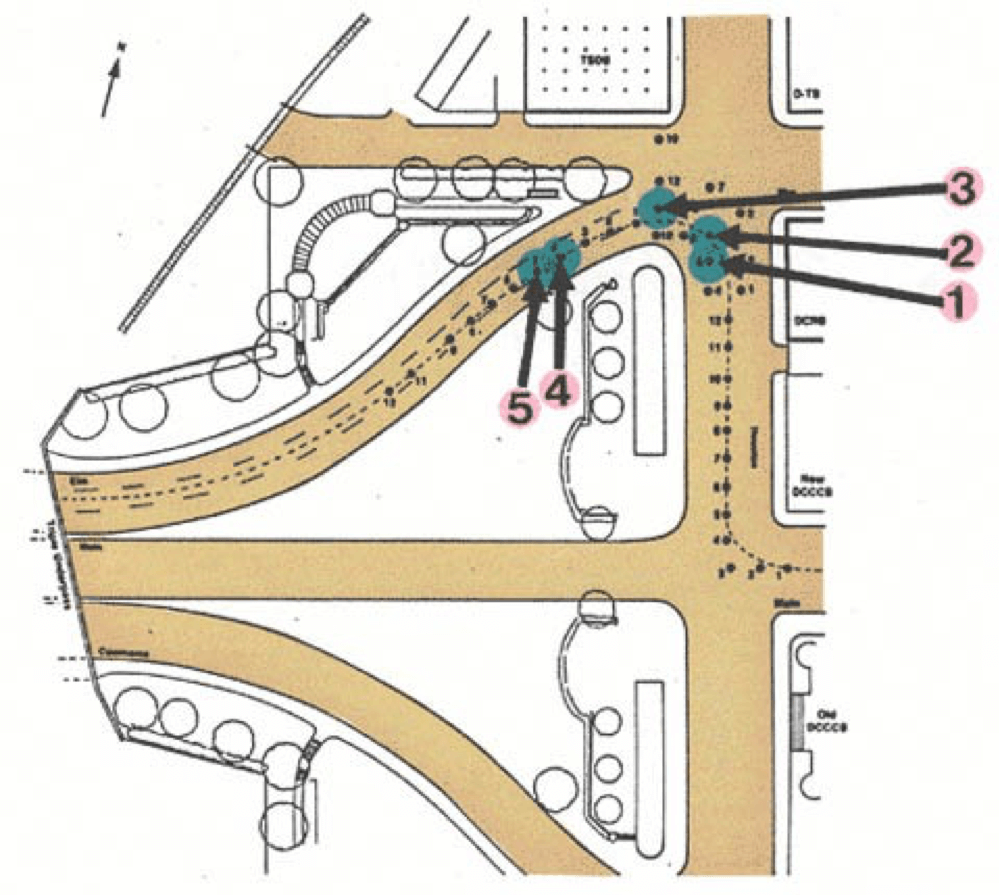
This map depicts the key microphone locations in Dealey Plaza used by the HSCA. A shot at Zapruder frame 175 could not have been fired by Oswald due to the obstruction of an oak tree. (Thompson p. 35) The 5 and 1/2 minute segment during which impulses occur was between 12:28 and 12:34, owing to dispatcher’s notations. Not only was the order of the matches correct, the spacing of the matching microphones was a remarkable fit with the time between the suspect impulses on the dictabelt recording. The first three impulses were clustered together, falling approximately 1.7 and 1.1 seconds apart. This was followed by a space of 4.8 seconds before the final two impulses arrived very close together, 0.7 seconds apart. The matching microphone locations exhibited the exact same pattern. The first three matches occurred at microphones that were grouped at 18 ft increments on Houston Street. There was then a 78 ft gap before the last two matches occurred at two consecutive microphones on Elm Street:

And it wasn’t just the order and spacing that matched. The distance from the first matching microphone to the last was 143 feet and the time between the first and last suspect impulse on the tape was 8.3 seconds. In order for the motorcycle with the stuck microphone to cover 143 feet in 8.3 seconds it would need to be travelling at a speed of approximately 11.7 mph, which fully corresponds with the FBI’s conclusion that the Presidential limousine was averaging 11.3 mph on Elm Street. (Warren Report, p. 49)
Armed with the above, the HSCA asked its photographic consultant, Robert Groden, to search the archival footage of the motorcade to see if he could find the motorcycle with the stuck microphone.
There is, unfortunately, no known film or photograph that shows the acoustically required positions during the assassination. However, Groden was able to find one officer, H.B. McClain, who was in the right positions shortly before and after the shooting so that he could have been responsible for recording the shots. When McClain was called to testify before the committee he confirmed Groden’s analysis by stating that the microphone on his bike did indeed have a tendency to get stuck in the open position. (5HSCA637)
It is apparent that in at least three ways the evidence validates the hypothesis that the sounds on the dictabelt were gunshots captured by a motorcycle in the presidential motorcade, travelling north on Houston Street and west on Elm. When the HSCA and its acoustic experts saw the above correlations, they had every reason to believe they had found the shots that killed Kennedy on the Ch-1 recording, because these sorts of correlations do not occur by chance; not in the real world. The odds against it are astronomical.
And there’s more.
One of the most important witnesses to the assassination was railroad worker S.M. Holland who had been standing with several others on the railroad overpass when he heard what he thought sounded like three shots from the area of the book depository and one from the knoll. Concurrent with the shot from the knoll, Holland saw a puff of white smoke drift out from under the trees. Holland and two others who saw the smoke were so sure a shot had come from behind the fence that, as soon as Kennedy’s limousine disappeared under the overpass, they ran to the very spot from which the smoke appeared to have come. It took them a couple of minutes to reach the area and, not surprisingly, they found nothing more than footprints and a muddy bumper, as if someone had stood on it to see over the fence.
In 1966, Josiah Thompson interviewed Holland for his book, Six Second in Dallas. Thompson had been studying the famous Polaroid taken by Mary Moorman that showed the area of the grassy knoll around the time of the fatal headshot. Wanting to see if “the hypothesis of a shot from the stockade fence” could be “validated by the Moorman picture”, he compared it to another photograph taken from her position some time later. What he discovered was that an “anomalous shape” appeared along the fence line in Moorman’s photograph that was not present in the comparison picture. Thompson took Holland “to the assassination site and asked him to stand in the position where he found the curious footprints and saw the smoke.” Taking himself back to Moorman’s position, Thompson saw that, remarkably, Holland’s head “appeared in the exact position defined by the shape” in the Polaroid. (Thompson, p. 127)
What does this have to do with the acoustics evidence? Well, a little over a decade after Thompson interviewed Holland, the HSCA asked Professor Mark Weiss of Queens College, New York, and his associate Ernest Aschkenasy, to refine BBN’s analysis of the Grassy Knoll shot. Asked to pin down the location of the gunman, Weiss and Aschkenasy’s analysis pointed to a spot behind the fence, approximately 8 feet left of the corner. This just so happens to be the very same spot in which Holland had stood in 1966 and in which the anomalous shape appears in Moorman’s picture. (8HSCA29) Which means there is agreement between the dictabelt recording, the eyewitness observations, and the Moorman photograph.

Yet further confirmation of the validity of the acoustics evidence comes from its remarkable synchronization with the Zapruder film. Although there is clearly a degree of subjectivity to interpreting the film, there is a general consensus that Kennedy was probably first struck whilst hidden from Zapruder’s view by the Stemmons Freeway sign, and Governor Connally was hit very shortly after reappearing from behind it. If we align the grassy knoll shot with the explosion of Kennedy’s head at frame 313, then the preceding shots perfectly fit this hypothesis. The third shot in sequence falls at approximately frame 224, just three frames after Connally reappears, and the second shot lands at approximately frame 208, just as Kennedy’s head disappears behind the sign. If there is an exit from Connally’s chest at Z frame 224, then the Zapruder film features the exact same 4.8 second gap between shots as is found on the dictabelt.
Wagner has nothing to say about any of this. Instead, as previously noted, he cites a study performed on behalf of Larry Sabato by the Connecticut-based firm, Sonalysts, claiming their report “completes the debunking” of the acoustics evidence. Yet, just like Wagner, Sabato and Sonalysts also make no mention of the above. How one can debunk something without even addressing it is difficult to comprehend. Regardless, Sonalysts claimed that their own analysis of the motorcycle noise showed that its speed was inconsistent with a motorcycle travelling in the motorcade. Their data shows that the bike with the stuck microphone was travelling slowly for only around 40 seconds and was going fast or fluctuating the rest of the time. In order for this to concur with the HSCA analysis, the motorcycle needed to be going slowly whilst in Dealey Plaza. Sonalysts argues, however, that the assassination occurred one minute earlier, when the motor noise was fast and loud.
But this conclusion is not derived from any original research by Sonalysts. It is instead based on a 1982 report commissioned by the National Research Council, which suggested that an instance of “crosstalk” on the Ch-1 and Ch-2 recordings proved that the impulses on the dictabelt were not coincident with the time of the assassination. Yet the NRC report was shown to be in error by Dr. Thomas in a 2001 paper published in the British forensic journal Science & Justice. Dr. Thomas pointed out that the NRC panel had overlooked a second instance of cross-talk, the “Bellah broadcast”, and that using that particular simulcast to synchronize the transmissions placed the impulses “at the exact instant that John F. Kennedy was assassinated”.
If, as Dr. Thomas suggests, we use the Bellah cross-talk as the tie-point between the recordings, then the Sonalysts study of the motorcycle noise actually fits perfectly with the HSCA analysis and all five impulses fall within the 40 second interval in which the motor sounds indicates the bike was moving slowly. The Bellah broadcast occurs on Ch-1 concurrent with a drop in motorcycle noise by approximately 75 decibels, two seconds before the first shot. Furthermore, Sonalysts reported hearing multiple motorcycles just before the motor noise increased. This fits well with a series of photographs showing McClain travelling slowly on Elm Street approximately 28 seconds after the head shot, passing the parked motorcycle of officer Bobby Hargis. Officer J.W. Courson, who had been riding around 100 feet behind McClain, catches up to him very quickly thereafter and the pair speed off together out of the plaza. The motorcycle noise identified by Sonalysts is, then, supportive of the acoustic data.
Wagner quotes Sabato as reporting that his experts found “other clusters of impulses” on the dictabelt that were “very similar” to those identified as gunfire by BBN and Weiss & Aschkenasy. (Wagner, p. 102) Those who have studied BBN’s report will realize that Sabato and Sonalysts are blowing smoke. BBN inspected the entire recording looking for potential gunshots based on waveform and used several a priori criteria to identify the gunfire. Firstly, the waveforms were required to include 10 impulses louder than the motorcycle motor. Secondly, the length of the impulses had to be 1/5 to 1⁄2 a second. Thirdly, there had to be at least three shots. And finally, they had to occur within a timespan of no less than 4 1⁄2 seconds and no greater than 15 seconds. BBN discovered and reported other isolated solitary waveforms and long duration waveforms. But there was only one place on the entire recording in which all of BBN’s criteria were met and that was the segment containing five impulses that subsequently matched the precise echo patterns of gunshots fired in Dealey Plaza.
Wagner and his lone nut cohorts may not like it but over the course of 40 years the analysis of the Dallas police dictabelt by the HSCA’s experts has survived several challenges and stands to this day as scientific evidence of multiple gunmen in Dealey Plaza. Those like Wagner who continue to ignore the order in the acoustic data, as well as the dictabelt’s remarkable concordance with the eyewitness and photographic record, rely on authors like Sabato and their faulty and lazy technical data.
IV
The one way in which Wagner’s book sets itself apart from virtually every other lone gunman tome is unusual. The author rejects the single bullet theory. What makes this even more odd is that Wagner admits that he is an admirer of the late Vincent Bugliosi and his book Reclaiming History, which upheld the Magic Bullet. In fact, it could be said that the primary theme of the book is that not only is the SBT provably wrong, but that for the last nearly five and a half decades writers and researchers on both sides of the debate have been wrong to stipulate that the SBT is integral to the lone gunman hypothesis. But rejecting the SBT whilst maintaining that Oswald acted entirely alone leaves Wagner with some insurmountable problems.
To begin with, Wagner cannot convincingly account for the magic bullet itself, CE399. The author insists that there was no conspiracy to frame Oswald before or after the fact; therefore he is forced to contend that CE399 is a legitimate piece of assassination evidence and that it was responsible for all of Governor Connally’s wounds. (p. 122) I dare say this is something most sensible researchers are unlikely to take very seriously given that the totality of the evidence argues persuasively against it.
Wagner appears to accept the Warren Commission’s assertion that the virtually pristine bullet was found by senior hospital engineer, Darrell Tomlinson, when it rolled off of a stretcher that had previously been occupied by Governor Connally. Yet this conclusion was not one Tomlinson himself fully endorsed. After Connally had been rushed into the trauma room and transferred to the operating table his stretcher was placed on the elevator. Tomlinson then took it to the ground floor and placed it next to another gurney. A few minutes later, he bumped one of the two stretchers against the wall and a bullet rolled onto the floor. Tomlinson made it clear in his testimony before the Commission that he did not know which of the two stretchers the bullet rolled off from. And when Arlen Specter attempted to push him into identifying it as Connally’s, Tomlinson responded, “I’m going to tell you all I can, and I’m not going to tell you something I can’t lay down and sleep at night with either.” (6H134) One thing Tomlinson did note was that the stretcher the bullet came from contained one or two bloody, rolled up sheets, “a few surgical instruments … and a sterile pack or so.” (6H131) This appears to eliminate Connally’s stretcher because Tomlinson testified that, when he wheeled it off of the elevator, it contained only sheets and “a white covering on the pad.” (6H129) This is corroborated by the testimony of Parkland Nurse Jane Wester, who explained that after Connally was placed on the operating table she personally removed all but the sheets from his stretcher. (6H122-3)
The finest critical review of this central issue is still contained in Josiah Thompson’s 1967 volume, Six Seconds in Dallas. After analyzing testimony and then including pictures, witness sketches, emergency room rosters, and concluding with a map, Thompson makes a compelling case that CE 399 was found on the stretcher of a young boy named Ronald Fuller. (pp. 154-65)
Not only does the evidence suggest that Tomlinson’s bullet came from a stretcher unrelated to the care of Governor Connally, it also indicates that he found an entirely different bullet from CE399. As Gary Aguilar and Josiah Thompson detailed in their groundbreaking essay, The Magic Bullet: Even More Magical Than We Knew?, both Tomlinson and O.P. Wright—the Parkland Personnel Director who took charge of the bullet and passed it along to the Secret Service—were unable to identify CE 399 as the bullet they found. In fact, Wright told Thompson in an interview in 1966 that, unlike the round-nosed Carcano round, the bullet found at Parkland had a “pointed tip”. He even made a point of showing Thompson a pointed tip, .30 caliber round from his own desk drawer that he insisted more closely resembled the one that had rolled off the stretcher. (Thompson, p. 175)
On top of this, the next two men to handle the bullet, Secret Service Agent Richard Johnsen and Secret Service Chief James Rowley, were also unable to identify CE399. And as if that weren’t enough, the fifth link in the bullet’s chain of possession, FBI Agent Elmer Todd, recalled marking it with his initials before handing it over to Robert Frazier at FBI HQ. But as scrupulous JFK researcher John Hunt has established, Todd’s initials are nowhere to be found on CE399. What’s more, Hunt pointed out that Frazier had marked the time he received CE399 on his November 22 laboratory worksheet as “7:30 PM.” But Todd had also written the time he received the bullet on the envelope that contained it as “8:50 PM.” (see Hunt’s online essay, Phantom Identification of the Magic Bullet: E.L. Todd and CE399).
How could Frazier receive a bullet from Todd at FBI HQ one hour and 20 minutes before Todd was handed the same bullet at the White House by Chief Rowley? Something is most definitely wrong with this picture. Based on the above, it appears that there were actually two separate bullets in Washington that day—CE399 and the pointed-tip missile found at Parkland Hospital—and that one was used to pin the blame for Kennedy’s assassination squarely on Lee Oswald’s shoulders while the other was made to disappear.
Wagner reveals in a footnote that he is at least aware of Aguilar and Thompson’s essay and the implication that the pointed tip round was substituted for CE399, so he tries to nullify the problem. He argues that because Frazier told the Commission he had received CE399 on November 22, 1963, but the rifle wasn’t in Washington until the following day, there was no “opportunity for the FBI to fire Oswald’s rifle to recover a bullet to illicitly substitute for the alleged pointed-tip bullet.” (Wagner, fn. p. 191) Of course, since Aguilar and Thompson never argued that the Bureau was responsible for firing the pristine bullet, this is little more than a straw man argument. Even so, the fact that Frazier said he received CE399 on November 22 does not actually make it so. Whatever Frazier claimed, the fact remains that, as demonstrated above, the bullet lacks anything even remotely resembling a proper chain of custody. When CE399 allegedly appeared in Frazier’s laboratory at 7:30 pm on November 22, 1963, it appears to have come from nowhere.
Questions of provenance aside, the condition of the magic bullet is simply not compatible with Governor Connally’s wounds. The bullet (or bullets) that struck Connally entered his back, destroyed 10 cm of his fifth rib, punctured his right lung, smashed through his right wrist, and punctured his left thigh, depositing fragments in the wrist and thigh along the way. Common sense would dictate that any missile responsible for all of those injuries would be significantly mutilated. Yet as Wagner himself writes, “The only discernible damage to the pristine bullet was some distortion at its base …” (p. 118) He quotes Michael Baden as stating that it would be “very difficult” to take a hammer and flatten the base of CE399 to the degree that it is and from that concludes that “the distortion of the bullet’s base was probably not caused merely by the bullet being fired out of the rifle.” (p. 119) But Baden’s musings and the inference Wagner draws from them are largely irrelevant. In the mid-1980s, author Henry Hurt test-fired a Carcano bullet into water and published pictures of the result in his mostly worthwhile book, Reasonable Doubt. Hurt’s bullet looked incredibly similar to CE399, flattened base end and all.
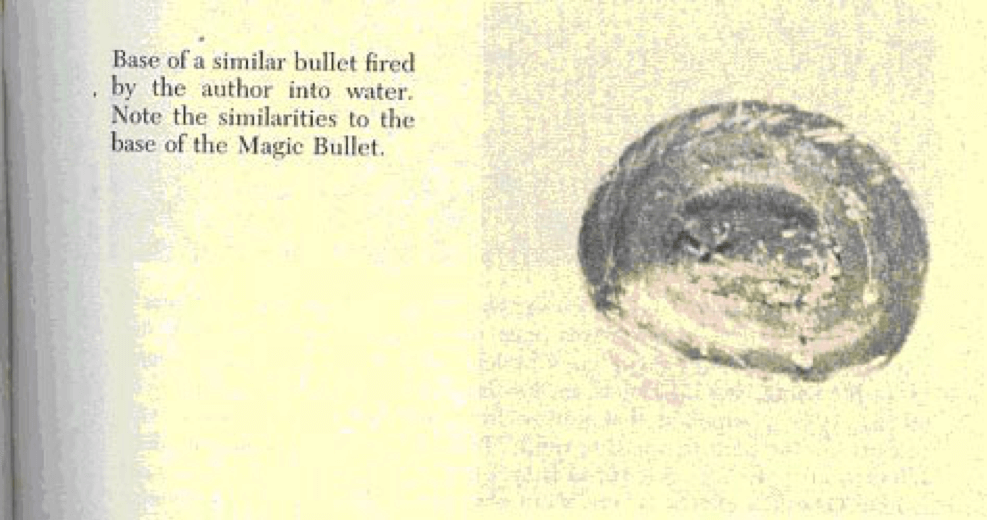
I am sure most people would struggle to accept the notion that a bullet which broke two bones and pierced several layers of skin and flesh is going to end up looking almost indistinguishable from a bullet fired solely into water. And since Wagner lists Hurt’s book in his bibliography, but doesn’t mention the test bullet, I’m guessing he recognizes the absurdity of the claim also.
The author also fails to mention the fact that the ballistics experts at Edgewood Arsenal, who performed the previously mentioned skull experiments on behalf of the Warren commission, also attempted to replicate the wounds suffered by Governor Connally. Seen in the picture below, CE853 is a bullet that was fired through the rib of a goat. It is severely flattened with its lead core extruding from its base. CE856 was fired through the wrist of a human cadaver and it exhibits the “mushrooming” effect typical of a bullet that has struck bone. Each of these bullets has broken only one of the two bones attributed to CE399 which, as you can see, looks virginal by comparison.
The Edgewood test bullets show us exactly what happens to Carcano bullets when they strike bone and readily demonstrate the absurdity of suggesting that CE399 was responsible for all of Connally’s wounds.
It is also important to mention that Connally’s wrist surgeon, Dr. Charles F. Gregory, explained in his Warren Commission testimony that the amount of cloth and debris carried into the wrist indicated it had been struck by “an irregular missile”. In his second appearance before the Commission, Dr. Gregory expanded on this point, noting “that dorsal branch of the radial nerve, a sensory nerve in the immediate vicinity was partially transected together with one tendon leading to the thumb, which was totally transected.” This, he said, “is more in keeping with an irregular surface which would tend to catch and tear a structure rather than push it aside.” (4H124) Wagner writes that Gregory conceded it was “possible” for CE399 to have produced Connally’s wrist wound if it had entered backward. (Wagner, p. 118) This is true, but it’s also apparent that Dr. Gregory did not consider the idea very likely. In fact, later in his testimony he noted that the two mangled bullet fragments found on the floor of the limousine were more likely the type of missile “that could conceivably have produced the injury which the Governor incurred in the wrist.” (p. 128)
V
Wagner may stumble badly trying to account for CE399, but it is in trying to create a halfway plausible single shooter scenario without the SBT that he falls flat on his face. The author writes of how researchers have “fixated” on the SBT for five decades and have, as a result, “blindly herded around the dogma” that the SBT is “required to sustain the lone-gunman explanation for the assassination …” This, he assures readers, is not the case, and “the evidence … carefully considered, demonstrates quite the opposite.” But if Wagner actually produces any such “evidence” in his book, then somehow, I managed to miss it.
Warren Commission lawyer Norman Redlich once remarked to author Edward Epstein that “To say that they [President Kennedy and Governor Connally] were hit by separate bullets, is synonymous with saying that there were two assassins.” (Epstein, Inquest, p. 38) Redlich’s colleagues on the Commission’s staff all understood this to be the case, which is precisely why Arlen Specter dreamed up the theory in the first place. As previously noted, the Zapruder film shows that Kennedy’s first clear reaction to his non-fatal wounds begins as he reappears from behind the Stemmons Freeway sign, around frame 225. Connally’s most obvious reaction occurs a little over 10 frames later when his right shoulder drops dramatically and his cheeks puff, giving the impression of someone who has had the wind knocked out of him. Connally’s doctors believed that he was probably struck around frame 236 (5H114, 128) and it was established that he was no longer in a position to receive a shot from the “sniper’s nest” after frame 240. (5H170)
An FBI re-enactment in Dealey Plaza showed that a gunman on the sixth floor would have had his view of the limousine blocked by the foliage of an oak tree between frames 166 and 210. Based on this, the Commission reasoned that Kennedy was probably not struck before frame 210 “since it is unlikely that the assassin would deliberately have shot at him with a view obstructed by the oak tree when he was about to have a clear opportunity.” (WR, p. 98) If Kennedy was struck at or after frame 210, then there were no more than 30 frames between that shot and the one that hit Connally. This created a problem for the Commission because Oswald’s rifle could not be fired that quickly. Examination of the sixth floor Carcano had established that the time required to fire a shot, work the bolt, and squeeze off another round was a minimum of 2.3 seconds or the equivalent of 42 Zapruder frames. (3H407)
And this wasn’t the only impediment to the Commission’s predetermined lone gunman conclusion. If the first shot was fired at frame 210 and the last was fired at 313, that gave Oswald only 5.6 seconds in which to fire three rounds and score three hits—something even the Commission’s top marksmen were unable to accomplish in the allotted time; even though they cheated: they fired at stationary targets from thirty feet up, not sixty feet. (Sylvia Meagher, Accessories After the Fact, p. 108)
Perhaps more importantly, the evidence strongly suggested that one or more shots had missed the limousine and its occupants altogether. At least two witnesses, Royce Skelton and Virginia Baker, recalled seeing a bullet hit the street in front of the President’s car (WR, p. 116, 7H508). Additionally, bystander James Tague, who was standing near the triple underpass on the south side of Main Street, received an injury to his face after a missile struck the curb near his feet. (WR, p.116)
In the end, the Commission staff realized that the only way out of this box—without admitting to more than one gunman—was to suggest that Kennedy and Connally were both hit by the same bullet. Although the Warren Report stated that it was “not necessary to any essential findings of the Commission to determine just which shot hit Governor Connally” (WR, p. 19), virtually everyone who has a firm grasp of the facts and circumstances outlined above agrees that the Commission was blowing smoke; the SBT is absolutely integral to the lone gunman hypothesis.
What, then, does Wagner offer in order to overturn this long-stipulated fact? How does he reconcile the evidence with a single shooter, three-shot/three-hit scenario? Well, if you can believe it, Wagner proposes that Oswald went against common sense and fired his first shot at frame 160, milliseconds before his view was about to be obscured by a tree. This is not an uncommon supposition among lone nut theorists who want to give Oswald more time to fire three shots. The difference is that the majority of those folks propose that this first shot was the one that missed, whereas Wagner suggests this first bullet actually struck President Kennedy. That’s right, according to Wagner, when we see JFK in the Zapruder film, still waving and smiling at bystanders as he disappears behind the Stemmons Freeway sign, a bullet has already entered his back, grazed the transverse process of his first thoracic vertebra (likely inducing spinal shock), and ripped its way through his trachea. He just didn’t know it yet.
Needless to say, Wagner has nothing of substance to advance in support of this silliness. He quotes Dr. Baden as stating that he and his colleagues on the HSCA pathology panel “have all had experience in which persons have been seriously injured and not known they were injured for a few minutes.” (Wagner, p. 54) And he makes reference to a viewing of the Zapruder film held by the Commission’s staff for its medical and ballistics experts in which the possibility of a delayed reaction by “as much as two seconds” was discussed and considered possible, if not likely. (p. 239) And that’s it. That is all Wagner can provide; an appeal to authority that does not reconcile itself with Kennedy’s specific wounds or his reactions as seen in the Zapruder film.
What we see in the film is that immediately after JFK reappears from behind the sign, he exhibits what is almost certainly an involuntary reaction. The Commission wrote that “When President Kennedy again came fully into view in the Zapruder film at frame 225, he seemed to be reacting to his neck wound by raising his hands to his throat.” (WR, p. 98) This myth that the President clutched at his throat has unfortunately persisted ever since, despite the fact that the film shows no such thing. In reality, Kennedy’s hands appear to ball up into fists and rise up in front of his face, while his elbows fly outwards and upwards above his shoulders, to the level of his ears.
I invite the reader to place his or her hands to their own throat and notice how the elbows naturally stay down and rest against the torso. The pose which JFK adopts in the film is nothing like this. His reaction is awkward and unnatural and is best explained as a result of spinal trauma.
The HSCA medical panel reported that Kennedy’s post mortem X-rays showed what appeared to be a fracture of the transverse process of the first thoracic vertebra, which, Dr. Baden testified, “could have been caused by the bullet striking it directly or by the force of the cavity created by the bullet passing near to it.” (1HSCA305) As Dr. Thomas has reported, the medical literature is clear that blunt trauma to the vertebra can be transmitted to the spinal cord and that the effects of such injuries are immediate. (Thomas, Hear No Evil, p. 315) It should be readily apparent, then, that the notion that President Kennedy continued smiling and waving to bystanders for 3.5 seconds before exhibiting any obvious reaction to his spinal cord injury is simply not worthy of consideration.
What’s more, in his attempt to push a three shot/three hit scenario, Wagner fails to even mention the witnesses who saw a bullet hit the street, let alone adequately account for the wounding of James Tague. The best that he can come up with is to reference the suggestion made by Josiah Thompson in Six Seconds in Dallas that the curb may have been struck by a fragment from the head shot. But with all due respect to my friend Tink Thompson, this always was the weak point of his reconstruction. The nose and tail of the bullet, which entered the back of Kennedy’s head, were both found on the floor of the limousine. To accept Thompson’s postulate, we must believe that, after the bullet exited the right side of Kennedy’s head, a small fragment from its middle somehow made it 270 feet to his front left and had enough velocity remaining to cause very visible damage to the curb. That such a thing is even possible has never been established. And, quite frankly, it strains credulity. (Thompson, p. 232)
A missed shot has always been the explanation which best fits the evidence; that is precisely why it has gained wide acceptance. But the problem with this is that there was no copper found on the curb beneath Tague where the projectile hit before ricocheting upward. (DiEugenio, p. 135) This lack of copper, from a supposed copper-jacketed bullet, has led writers like Gerald Posner and Bugliosi to embrace increasingly wild scenarios to account for the completely stripped off outer coating.
Recognizing this fact, and being faced with the very short interval between the wounding of Kennedy and Connally, is why the Commission’s staff knew it needed the SBT. Without the Magic Bullet there had to be at least four shots and a second gunman. In fact, the missed shot together with the two shots to JFK’s head, the one to his upper back, and the one to Governor Connally, gives us a total of five shots. Which—in a prime example of how the forensic evidence in this case, properly interpreted, fits together remarkably well—is the very same number as found on the Dallas police dictabelt recording.
VI
Ultimately, The Assassination of JFK: Perspectives Half A Century Later offers little to justify its existence. In fairness, Wagner does spend considerable time supplying details which invalidate the Single Bullet Theory, and some might argue that this information makes the book worthwhile. However, it is my opinion that the author has nothing to say on the SBT that has not been said before, and better, by authors and researchers who were not hampered by his insistence that Oswald acted alone. Ironically, although the main purpose of the book is seemingly to argue that the SBT is not vital to the lone gunman theory, Wagner ends up demonstrating the opposite. His suggestion that Kennedy was struck by a bullet 3.5 seconds before exhibiting a clear reaction is dubious on its face and completely untenable when taking into account the true nature of the President’s injuries.
Wagner’s own musings on the assassination consistently fail to convince because the facts are simply not on his side. It is for that reason that he has little choice but to carefully select the details and expert opinions that suit his arguments, while frequently utilizing straw man arguments, appeals to authority, and circular reasoning to deal with those he cannot ignore. His use of such tactics stands in stark contrast to his stated intention to “offer all sides of analysis for each significant point and not to advocate only those facts that support my conclusions.” (p. 13) One simply cannot make a claim, like the acoustics evidence has been debunked, without even mentioning the order in the data and then still claim objectivity.
In what is perhaps the most exasperating of Wagner’s methods, he imagines he is somehow privy to the thoughts and plans of Lee Harvey Oswald: “Oswald could imagine the firing line he would negotiate as the limousine continued on Elm Street … he visualized the movement of the President’s limousine from the vantage point of the sixth floor … Oswald would have known that by choosing a firing path that followed the motorcade as it went past the building, he would have to negotiate the canopy of an oak tree … Oswald also planned his escape … He wanted to elude capture or worse … He knew he was trading his life for the President’s, a trade he was willing to make. The worst outcome he could imagine would be to trade his life for a failed assassination.” (pp. 23-25) Needless to say, neither Wagner nor anyone else could possibly know whether any one of these thoughts ever entered Oswald’s head. Yet that doesn’t stop him from presenting these imaginings as if there was no doubt about it.
This review has, of necessity, focused quite heavily on what Wagner left out of his book. This was unavoidable because omission of relevant and/or contradictory fact is undoubtedly one of the author’s greatest sins. And make no mistake, Wagner simply cannot claim to be unaware of the controversy surrounding issues like the palm print on the rifle or the shells allegedly found at the Tippit murder scene because they are discussed at length in books he himself references. Nonetheless, he presents what suits his theory as if it is established fact and keeps the troublesome details to himself.
It is for these reasons, and many more, that I can think of no one to whom I would recommend The Assassination of JFK: Perspectives Half A Century Later. It is a sad reality that there have been well over a thousand books written about the Kennedy assassination, and surprisingly few of them have been genuinely worthwhile. There is a long list of books about which it can be rightly said they have added nothing to our understanding of JFK’s murder because their authors placed their conclusions first and then twisted, warped, and distorted the details to fit. Wagner’s book undoubtedly belongs on that list.