~
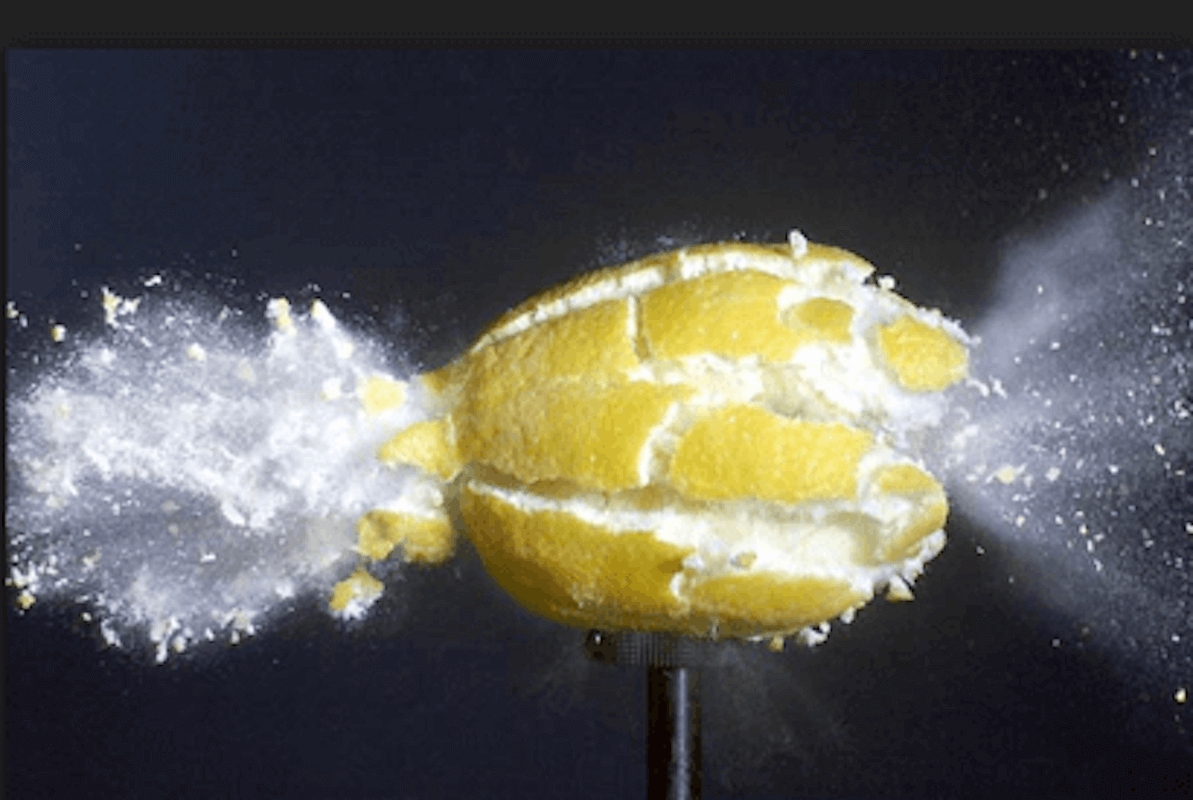
“If there are enough parameters, it is possible to fit anything.”
–G. Paul Chambers, Ph.D. (physics)1
Nicholas R. Nalli*. “Gunshot-wound dynamics model for John F. Kennedy assassination.” Mechanics, Engineering, Physics. 30 Apr 2018, Volume 4, Issue 4.
*Corresponding author. I.M. Systems Group, Inc., 5825 University Research Court, College Park, MD 20740, USA. nallin@imsg.com.
https://www.heliyon.com/article/e00603
Nalli claims that his work is “consistent with” a (rearward) recoil of JFK’s head after a posterior shot. He then concludes that because his work is “consistent with” such a scenario, this means that any other scenario (e.g., a frontal shot) cannot be correct. On the other hand, G. Paul Chambers has shown that JFK’s head snap is fully consistent with a frontal shot.4 Can Chambers therefore justify reaching precisely the opposite conclusion, i.e., namely that recoil from a posterior shot cannot be correct?
These mutually exclusive models remind us of the Ptolemaic model, which described the earth as the stationary center of the universe. The planetary motions were modeled on clever epicycles. The model worked (well enough), and it was “consistent with” the data. But that does not mean that other models were excluded—as Copernicus (1473-1543) discovered. Nalli does not seem to recognize this logical issue. Moreover, he does not recognize that a shot from the rear might even be compatible with a second head shot (from the front).
David Lifton was an early pioneer in this controversy about the movement of JFK’s head, first meeting with a Nobel Laureate, the physicist Richard Feynman, and next with a British physicist, Dr. James Riddle at UCLA, who (like Chambers) concluded:
The motion of Kennedy’s body in frames 312-313 is totally inconsistent with the impact of a bullet from above and behind. Thus, the only reasonable conclusion consistent with the laws of physics is that the bullet was fired from a position forward and to the right of the President.5
Nalli employs numerous key assumptions. If any one of these is seriously wrong, his model might well collapse. Here are 21 assumptions, many of which inevitably lead to miscalculations.
MANTIK: Nalli acknowledges that the autopsy skull defect measured 13 cm (5 inches), but he never explains why ejecta could not escape in other directions. The autopsy report (if it is accepted) described a defect that encompassed the frontal, parietal, and occipital skull. The Parkland doctors, almost uniformly, described a baseball-sized hole in the right occiput; so also did autopsy assistants, FBI observers, and the individual6 who developed autopsy photographs. (See Addendum 1 below.) If some ejecta went backwards, Nalli’s thesis is in serious trouble—after all, less momentum would then be available to drive the head backwards. Furthermore, many witnesses—in Dealey Plaza, as well as early observers of the Z-film—recalled such rearward-flying debris. One of these was Charles Brehm: “That which was a portion of the President’s skull went flying slightly to the rear of the President’s car and directly to its left.”7 Clint Hill noticed that there “…was blood and bits of brain all over the entire rear portion of the car.” Hill added that he himself had been covered with blood and brain tissue. Moreover, the evidence is not all from eyewitnesses; Josiah Thompson was the first to point out debris visible on the limousine trunk, as seen in the Nix film.8 Nalli (perhaps innocently) ignores all this rearward going momentum.
MANTIK: Milicent Cranor9 points out, however, that no such estimation is required—after all, the autopsy report plainly states the actual size of the entry hole as 6 x 15 mm,10 which is obviously much larger (by more than a factor of two) than the bullet’s cross-sectional area. She further quotes Nalli, who states that all the pertinent drag forces (on the bullet)—are directly proportional to the projected area of the bullet. Therefore, Nalli’s calculations for the drag force (Fd) are wrong by at least a factor of two. In addition, such a tangential strike would deliver a greater impulse to the head, making it more difficult for Nalli’s forward ejecta to reverse the resulting (additional) forward momentum of JFK’s head. Cranor concludes:
The elliptical shape of the long entrance wound indicates a sideways or tangential hit (the two are different but have much in common). This would mean the bullet was in contact with the bone in front of it longer than it would have been in a nose-on hit.
And the longer bullet and bone are in contact, the more energy is imparted to the bone—and, in some circumstances, the more the head moves, until the bone in front of it detaches completely. According to Capt. Philip Dodge, tangential strikes can actually knock a person down.11
MANTIK: Unfortunately, he never shows similar curves for different values of the entrance diameter, which he incorrectly estimates to be the cross-sectional area (A) of the bullet.
MANTIK: However, the impulse force is directly proportional to the projected area (A) of the incident bullet, which means that the entrance wound diameter (A) is also critical. Unfortunately, he merely estimates that A is the cross-sectional area of the bullet—even though the pathologists described it as 6 x 15 mm. His Figure 4 therefore examines only a small fraction of the universe of possibilities; he should have used either the correct value of A, or some reasonable range, instead of estimating that A was merely the cross-sectional area of the bullet.
MANTIK: Unfortunately for Nalli, according to his equation 23, the velocity also depends on the projected area (A) of the bullet, but he again merely estimates that A is the cross-sectional area of the bullet, rather than the 6 x 15 mm stated in the autopsy report.
So, this graph also needs some serious amendments.
MANTIK: The only intact bullet (the Magic Bullet) in the Warren Commission (WC) case was purportedly found on a Parkland Hospital stretcher. Its provenance has been thoroughly debunked by Josiah Thompson and Gary Aguilar, M.D.12 John Hunt has also noted the paradoxes evoked by its so-called arrival at the FBI laboratory in Washington, DC.13 Most likely, the Mannlicher-Carcano bullet is irrelevant to the JFK case, but it is the only bullet that Nalli considers.
There is even more: Dr. Randy Robertson, my radiology colleague, recently discovered the papers of James M. Young, M.D., at a Navy website. Young, a White House physician at the time, reports that one more bullet was found in the limousine.14 The WC did not report this, nor does Nalli recognize this bullet, although he may not have known about it.
MANTIK: During such an inelastic collision, by definition, the entire bullet must remain inside the target. Inconveniently for Nalli, the nose and tail of this same bullet were purportedly15 found inside the limousine—not inside of JFK’s head. Nalli is aware of these fragments, but he does not really address the conundrums that they pose. No one knows how much momentum was carried away by these miscreant limousine fragments—or by the middle portion of this bullet—because this middle section was never recovered.16 Since Nalli never considers the momentum of these three fragments in his calculations, a dark cloud is cast over his results.
MANTIK: Of course, the actual bullet (or bullets) remains unknown,17 and its spherical shape is only an approximation. In particular, if the 6.5 mm object on the AP skull X-ray represents a real metal fragment (that mysteriously sheared off and remained behind at the rear of the skull), then that bullet fractured at entry (which Nalli concedes) and was never round at any point inside the skull.
MANTIK: The purported exit site is shown on the left below (Figure 1), from WC Exhibit 388, as produced by H.A. Rydberg18 under the direction of JFK autopsy pathologist Dr. James Humes. Frame 313 of the Zapruder film (Z-313) is on the right. Nalli displays neither of these images. Nalli’s streaking debris can be faintly seen here in Z-313, going upward and forward. (He describes four particles.)
 |
 |
| Figures 1A and 1B. On the left is the WC sketch. On the right is Z-313. |
The usefulness of beveling (to pinpoint entrance or exit sites) has now been roundly criticized. It is no longer considered definitive. Nowhere does Nalli acknowledge this.19 It is not certain that he was aware of this rather new state of knowledge.
MANTIK: Unfortunately for Nalli, if the nose and tail of the bullet were found inside the limousine (as the WC reported), and the middle portion has disappeared, then his ballistic model is broken. For the classical ballistic pendulum (where nothing exits), such a broken rule might well destroy his case.20
MANTIK: This value contains an alarmingly large range. In Nalli’s Figure 3, he presents the drag force for several values of de (the effective exit diameter of the deformed bullet—see Nalli’s Table 2). Nalli’s Figure 4 displays the bullet speed at tissue depth (vx), but no variation of a is demonstrated, thus concealing a great deal of uncertainty. MATLAB could easily have plotted this for him (for different values of a).
MANTIK: This presumably (Nalli never clarifies this) includes the 6.5 mm “fragment,” located inside JFK’s right orbit as seen on the AP X-ray—but never explicitly cited by Nalli21—as well as the nose and tail of this same bullet. Nalli also overlooks the 40-odd fragments still visible on the skull X-rays. Figure 2 is my meticulous 3D localization of these fragments, with a schematic attempt at relative sizes. This work was performed at the National Archives, using the extant JFK X-rays. The blue ellipse (not its actual shape) represents a fuzzy cloud of ill-defined metallic debris, quite unlike that typically seen from a full metal-jacketed bullet. (See Addendum 2 below for images of typical fragments from a metal-jacketed bullet.) The thin orange arrow (in Figure 2) represents the approximate trail of particles. I shall return to this trail later, as it is grossly inconsistent with Nalli’s bullet trajectory.
 |
| Figure 2. My localization (in yellow) of tiny metal fragments on JFK’s lateral X-ray. The blue ellipse represents a fuzzy cloud of metallic debris. The red ellipses represent mysterious objectsthat appear on the reproductions by the House Select Committee on Assassinations. |
MANTIK: Nalli thereby ignores the multiple bullet fragments seen on the X-rays (Figure 2) that lie far anterior—and far inferior—to his chosen exit site. He also ignores the single metal fragment in the left hemisphere, easily visible on most extant images of the AP skull X-ray (but not identified here).22 Most of these fragments lie in the anterior portion of the skull, which suggests a frontal bullet. For so many tiny fragments to fly so far forward from a posterior entry would be odd indeed. Furthermore, the largest fragment in the trail is near the back of the head, whereas it would be expected to fly the farthest from the entry, and therefore lie nearer the front of the head.
MANTIK: Wikipedia reports that male brain sizes lie between 1250 and 1500 cubic centimeters.23 There is, however, substantial variation between individuals; one study of 46 adults, aged 22-49 years and of mainly European descent, found an average brain volume of 1273.6 cubic centimeters for men, with a range of 1052.9 to 1498.5 cubic centimeters.24 Based on Nalli’s estimate of 2100 grams, JFK’s brain size lies extraordinarily far outside the normal range.25 As an extreme example, Oliver Cromwell’s brain was well over 2000 grams, possibly the largest ever recorded.26 Cyril Wecht tells me that he has performed over 50,000 autopsies, but has never encountered a brain anywhere near that large. Nalli here faces a classic choice between Scylla and Charybdis: either he must admit that the brain weight in the autopsy is wrong27 or he is stuck with too little dispensable brain to achieve his jet effect.
MANTIK: The autopsy report disagrees with a single right frontal defect; on the contrary, it describes a 13 cm defect (a number quoted by Nalli) that included the frontal, parietal, and occipital regions. The autopsy notes of pathologist J. Thornton Boswell suggest that the defect was even larger, i.e., 17 cm (Figure 3). Furthermore, numerous Parkland physicians reported a large right occipital defect. See the recent documentary film, “The Parkland Doctors,”28 for their essentially unanimous—and very troubling recollections.29 Nalli might find the doctors’ comments exceptionally disconcerting, but he never mentions these professional eyewitnesses. Figure 3 is Boswell’s depiction of the huge skull defect at the autopsy. The line at the vertex (#2) represents a scalp laceration. In other words, bone was missing over most of the upper skull, which raises profound questions about why the debris should only go forward (as Nalli claims). Furthermore, Dino Brugioni, who saw an early version of the Z-film, reported that debris surrounded JFK’s head, and did not merely travel forward. (See further discussion of Brugioni below.) The autopsy X-rays also confirm large areas of missing skull, even over the occiput, as I have extensively discussed in Reference 8.
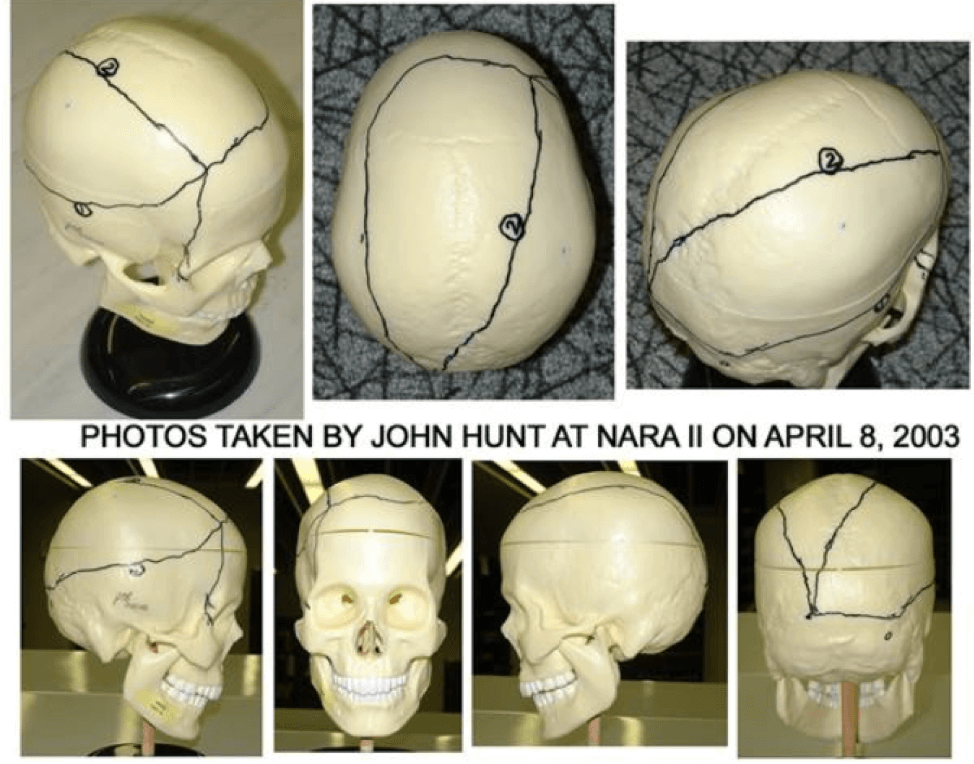 |
| Figure 3. Boswell’s marks on a skull as photographed at the National Archives. He prepared this for the ARRB to depict JFK’s skull at the autopsy. Line #2 represents a scalp laceration. Most of the upper skull is missing, which Nalli never tells us. |
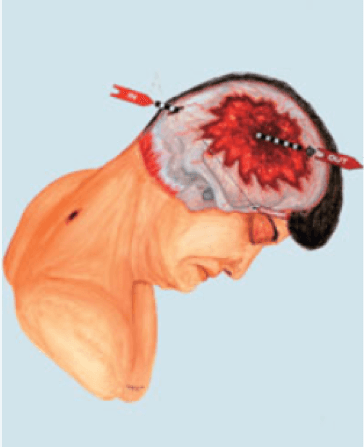
MANTIK: The problem here is that the photographs of the brain show rather little missing brain tissue. I have viewed these at the National Archives. Nalli never refers to these photographs—or even to the public sketch from the House Select Committee on Assassinations (HSCA). Figure 4 is a reasonable portrayal of the photographs (which I have seen at the Archives). This image is grossly inconsistent with Humes’s statement: “Two thirds of the right cerebrum had been blown away.”30 Furthermore, the exact masses of the ejecta are manifestly critical to Nalli’s calculations. Therefore, his explicit confession of ignorance on this point is quite disturbing.
 |
| Figure 4. JFK’s (purported) brain shows little missing tissue. This is the sketch by Ida Dox for the HSCA. This brain was likely present at the second examination, i.e., not JFK’s brain. |
MANTIK: But, of course, if the presumed scenario can only yield a leftward (backwards) displacement of the head, one should not be too surprised to obtain a backward displacement of the head. Nalli should clearly note (but fails to do so unambiguously) that these measurements only apply to the Center of Mass (CM) system, i.e., the perspective of the moving limousine. He notes (again unclearly) that “… this calculated recoil displacement can be translated to the observed changes of position in the Zapruder Film by re-adding the initial velocity.” Unfortunately, he never does this simple addition for the edification of his reader, nor does he take time to explain exactly what this means.
MANTIK: We might ask Nalli about Kellerman’s dramatic backward head snap (and subsequent prompt forward snap)—as seen in multiple Dealey Plaza films—immediately prior to JFK’s head snap. If JFK’s movement requires a “real force,” why is Kellerman exempt? (Kellerman sat in the right front seat.) Kellerman’s movement in the Nix film can be seen here:31
http://assassinationofjfk.net/wp-content/uploads/2018/05/Nix.gif
The corresponding animation from the Z-film is here:
http://assassinationofjfk.net/wp-content/uploads/2018/05/Zapruder.gif
And here is the Muchmore film:
http://assassinationofjfk.net/wp-content/uploads/2018/05/Muchmore.gif
In each of these films, Kellerman clearly moves rather dramatically, yet Nalli insists that JFK is the only person who moves.
MANTIK: Nalli thereby ignores a legion of witnesses to a head shot well after Z-313.32 He also ignores WC survey data,33 corroborating WC documents, WC sketches of shot locations on Elm St., and the prompt WC re-enactments on Elm St., all of which are consistent with a shot well after Z-313.34 Figure 5 is taken from the WC files, and clearly shows a shot well after Z-313.35 In Reference 8 (p. 56) I display corroborating Secret Service photographs that show the limousine positions for each of these three shots.36 Such a late shot, of course, raises the specter of another shooter.
 |
| Figure 5. WC exhibit, prepared by the FBI, showing a shot (first limousine on the left)well after Z-313 but ignored by Nalli. The next nearest shot(second limousine from the left) here is at Z-313. |
MANTIK: These streaks are central to Nalli’s calculations of recoil momentum. See References 3 and 6 below for detailed analyses of Z-film authenticity.38 The bizarre issues raised by this streaking debris are discussed below.
MANTIK: Nalli does not recognize the evidence-based arguments that the Mannlicher-Carcano is likely irrelevant to the case. Almost certainly Oswald did not fire a weapon that day, and it is dubious that he owned the Mannlicher-Carcano. The truly diverse arguments for this conclusion are dazzling and overpowering.39
Robert Frazier, the FBI ballistics expert, admitted they did not swab the barrel of the weapon to determine if it had been fired that day. Lyndal Shaneyfelt of the FBI added that he could not identify the weapon from the photograph in which Oswald held it. Even Howard Brennan, who supposedly saw Oswald in the sixth-floor window, admitted that he never saw a rifle discharge or flash—and that he never saw a scope (the weapon in the Archives has a scope40). Furthermore, no one ever identified it as the weapon supposedly stored in the Paine garage. Finally, between May 8, 1959, and November 22, 1963, despite diligent efforts by the FBI, no evidence was ever unearthed to show that Oswald fired a weapon during those 1,600+ days.41 Moreover, Marine Colonel Allison Folsom,42 testifying before the WC, characterized Oswald (while he was in the Marines and using a Marine-issued M-1) as “a rather poor shot.” Yet on November 22, 1963, using a far inferior weapon, he was supposedly perfect.
Then I felt something hit me. It could have been concrete or something, but I thought at first I might have been hit.54
A second motorcyclist was also hit—Billy Joe Martin, who also rode at the left rear.55 Their positions in the motorcade are shown in Figure 6. It is surely quite odd that the two motorcyclists at the right rear (Chaney and Jackson) did not report being hit. Nalli tells us none of this, but perhaps he did not know.
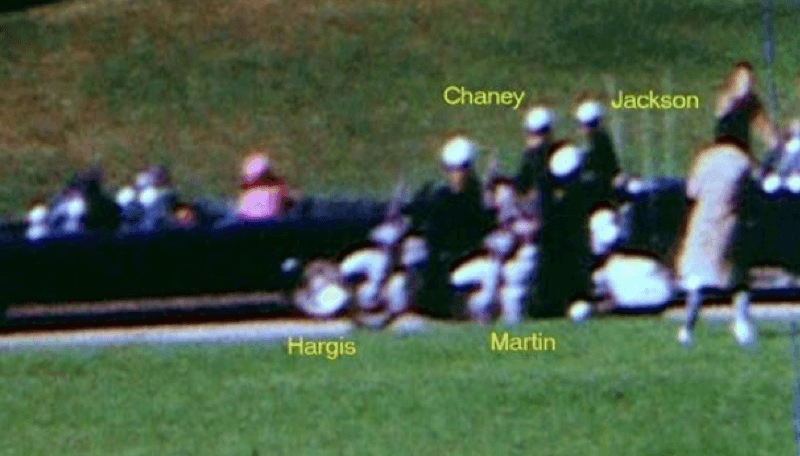 |
| Figure 6. Positions of the motorcycle men, as seen in the Nix film; this image was supplied by David Josephs. Chaney and Jackson were apparently not struck by debris, but Hargis and Martin were. |
This (rearward-flying) debris might well have carried away a significant fraction of ejected momentum, so its omission by Nalli is critical. Also recall that Hargis and Martin were riding at the left rear, while Nalli’s ejecta derive from the right front—exiting at veryhigh speeds (he claims)—so it is unlikely that Hargis simply encountered these same ejecta as he rode forward—even though the wind was blowing toward the limousine. Moreover, if the wind was blowing debris (ejected from the right front) backwards toward the limousine, why then were the motorcyclists at the right rear not struck by debris, while both of those at the left rear had such vivid recollections of being hit?
MANTIK: Nalli missed the bullet reported by James Young, M.D. Likewise, he does not mention the Belmont memo; written the evening of the assassination by assistant FBI director Alan Belmont, it states that a bullet was lodged behind Kennedy’s ear (Joseph McBride, Into the Nightmare, p. 556).
MANTIK: Hale Boggs, Majority Leader and former Warren Commissioner:
Hoover lied his eyes out to the Commission—on Oswald, on Ruby, on their friends, the bullets, the guns, you name it …59
Judge Burt W. Griffin, former assistant counsel for the WC and judge of the Court of Common Pleas, Cuyahoga County, Ohio:
“I think the CIA and all the other investigative agencies, including the FBI, were totally dedicated to trying to find out if there was a conspiracy,” he said. “But they were also totally dedicated to concealing how they operated, and the CIA did not want us to know that they were trying to assassinate [Fidel] Castro.”60
W. David Slawson has been even more outspoken:
Slawson’s silence has ended once and for all. Half a century after the commission issued an 888-page final report that was supposed to convince the American people that the investigation had uncovered the truth about the president’s murder, Slawson has come to believe that the full truth is still not known. Now 83, he says he has been shocked by the recent, belated discovery of how much evidence was withheld from the commission—from him, specifically—by the CIA and other government agencies, and how that rewrites the history of the Kennedy assassination.61
William Walton, a friend of the Kennedys, speaking on behalf of RFK and Jacqueline Kennedy:
Perhaps there was only one assassin, but he did not act alone …. Dallas was the ideal location for such a crime.62
Richard Goodwin, former Deputy Assistant Secretary of State for Inter-American Affairs:
We know the CIA was involved, and the Mafia. We all know that.63
MANTIK: For the WC, Larry Sturdivan (one of Nalli’s consultants) shot ten skulls with the Mannlicher-Carcano at the Aberdeen Proving Grounds.64 All ten skulls moved in the direction of the bullet. (Did Sturdivan, as consultant to Nalli, fail to tell him about these skulls?) Oddly enough, Sturdivan thereby confirmed the (long-concealed) results of Alvarez, i.e., the jet effect is a unique event, which does not occur with the Mannlicher-Carcano bullet. Furthermore, the jet effect as an explanation for the head snap has been fully discredited in at least three other independent experiments performed by John Nichols, M.D., Ph.D., Arthur Snyder, Ph.D. and Doug DeSalles, M.D.65 In summary, if we were to count Sturdivan’s (10) disobedient skulls and Alvarez’s (singular) failure, this would total five independent confirmations (of no jet effect). Moreover, based on Lucien Haag’s more recent report, we now have six. He shot at fiberglass wrapped melons with 6.5 mm Carcano bullets and seemed to show a dramatic jet effect in sequences of colorful frames. But Haag was careful to parse his words—a jet effect was only obtained when he first exposed the soft lead cores of these bullets! On the contrary, when he used intact Carcano bullets, “…the melons…remained in place, and the entry and exit holes were small.”66 In summary, he obtained the same results as everyone else—intact Carcano bullets do not cause a jet effect.
MANTIK: This is misleading. JBC believed he had been hit shortly after JFK, between Z-231 and Z-234. (His wife chose Z-229 through Z-233.) Connally’s surgeons, Robert Shaw and Charles Gregory, believed it might have been as late as Z-236.67 JBC insisted that he heard the first shot, and only after that felt himself hit by the second one. Furthermore, he was certain that only JFK was hit by the first shot.
MANTIK: Indeed, it has. Such films routinely show both forward spatter and backspatter, but Nalli totally ignores the inevitable backspatter, as seen in Figure 7.68 For Nalli, there is only forward spatter—he never mentions backspatter—at all, let alone in the JFK case.
Further support for this conclusion derives from experiments on live pigs destined for slaughter. Bone particles were a feature of backspatter from close-range shots to their heads: “Contamination of nearby surfaces by bone fragments and bone-plus-bullet fragments, as well as other organic debris appears to be quite heavy.”69 Many Dealey Plaza witnesses saw debris flying backwards. If this had been due to backspatter, much of Nalli’s assumed forward momentum would have been cancelled out. These Dealey Plaza witnesses though were not seeing backspatter—they saw forward spatter, from a frontal bullet.
 |
 |
| Figure 7. Backspatter is obvious here; it occurs in most similar shots. |
MANTIK: On the contrary, the HSCA favored a “probable conspiracy.” The Assassination Records Review Board (ARRB) was neutral, as stated in their final report, which published no official conclusions or findings of fact. The ARRB merely cited the Congressional prohibition against reinvestigating the assassination. Nalli has merely misled us about this fundamental issue. Worse than that (for Nalli), the ARRB staff strongly suggested that two separate brain examinations had been conducted of two different brains on two different dates.70 That report was approved by Chief Counsel Jeremy Gunn and reported in the Washington Post. This conclusion likely explains the odd reported brain weight of 1500 grams. Furthermore, the ARRB learned that the autopsy photographs could not be matched to the pertinent camera/lens combination,71 and that Saundra Kay Spencer, the photographic technician who developed and printed JFK autopsy images at the Naval Photographic Center (NPC) in November 1963, testified to the ARRB that she saw a photograph with a hole of one to two inches on the back of JFK’s skull.72 Altogether, even though they were officially neutral, the ARRB reached four different sets of autopsy conclusions.73 Despite Nalli’s pleading for the WC, the commissioners would not have been pleased with these ARRB autopsy conclusions.
MANTIK: Nalli conveniently overlooks the rather long list of criticisms that the HSCA levelled against the WC investigation. Also recall the comments above by Boggs, Griffin, Slawson, Walton, and Goodwin. Then there is Walt Brown’s The Warren Omission (1996), written by a Ph.D. in history, Harold Weisberg’s Never Again (1996), and the detailed review article by Aguilar and Cunningham.74 Moreover, historian Gerald McKnight provides an exhaustive guide to the antics of the WC.75 The army’s top ballistics expert in that era was Colonel Joseph R. Dolce; the army specifically sent him to the WC, but the agenda-driven Specter shrewdly ignored his answers. For example, Dolce insisted that two bullets had struck Connally.76 Dolce’s experience in government had led him to say that in “… conferences you cannot disagree too often … especially when you’re discussing bullets before three-and-four-star generals.” For their sympathy with the WC conclusions, Drs. Alfred G. Olivier and A. J. Dziemian of the Edgewood Army Arsenal were well received by the WC; on the other hand, when Dolce was eager to correct the wrong impression they had made, the WC ignored him.
MANTIK: He thereby ignores the independent recollections of James Jenkins, Dennis David, and Tom Robinson, all of whom saw bullet fragments (distinctly more than two tiny ones) while in the morgue that night. Others with similar recollections include Paul O’Connor, Floyd Riebe, Jerrol Custer, Edward Reed, John Stringer, and Captain John Stover77.
MANTIK: This claim rests upon slim evidence, i.e., the movement of JFK’s head at about Z-318. If one is permitted to interpolate, then this latter event (according to Nalli) is more precisely located at Z-318.2. But Z-318 itself does not even contain an original data point (due to excessive image blurring). Furthermore, the graph of displacement (Nalli’s Figure 8a) shows a nearly uniform displacement between Z-316 and Z-319 (and includes only three data points); it is inexplicable how a force can be invoked during this interval of essentially uniform motion. Finally, after Nalli’s supposed neuromuscular reaction at Z-318, JFK’s head slows down (while going backward), whereas the neuromuscular reaction (according to Nalli) should accelerate the head (backward). Here are the pertinent Nalli Figures 8a, 8b, and 8c.78
 |
| Figure 8. Nalli’s graphs of position, “speed,” and “acceleration.” |
Gary Aguilar, M.D., and Cyril Wecht, M.D., J.D., have responded in detail to the neuromuscular speculation. Here is a quotation from their work.
There are numerous problems with this “neuromuscular” theory. With respect to the example of the alleged human victim in 1936, Robert Capa’s famous “Fallen Soldier,” it’s now widely believed that the photograph [to which Nalli apparently alludes] was likely not taken of a head shot victim in a war zone, where Mr. Capa claimed he’d taken it. Instead, it’s likely the photograph was staged, far from any battle action. But even if “Fallen Soldier” is valid, the image, like those of the goat, depicts reactions distinctly different than what we see when JFK is fatally struck.79
Aguilar also notes (in the same article) that neither the decorticate nor the decerebrate posture explains JFK’s head snap; if so, the neuromuscular reaction simply does not apply. Oddly enough, Larry Sturdivan invokes both of these postures—at different places in his work. It should be quite sufficient to emphasize that no expert in neuroscience has ever supported this bizarre neuromuscular theory.
 |
|
| Figures 9A and 9B. Z-312 is on the left, while the WC trajectory is on the right. The yellow arrow represents the metallic trail on the X-rays (assuming a posterior bullet), while the red arrow (on the left) identifies Nalli’s headshot, as prescribed by the WC. |
On the left, the red arrow identifies Nalli’s proposed single head shot, with the appropriate downward angle of 16° (taking into account the downward 3° slope of Elm St.). The entry site does not seem to matter to Nalli, so I have chosen the WC site, which is also shown in the image on the right. (The HSCA entry site lay 10 cm superior.) The yellow arrow represents the trail of metallic debris on the lateral skull X-rays—presumably deposited by this same bullet. The WC trajectory in Figure 9B—presumably championed by Nalli—stands in stark contrast to the red arrow in Figure 9A, i.e., the exit sites are quite different. In fact, Nalli’s trajectory might well blow out JFK’s forehead, which would have been obvious at Parkland (but such damage was not seen).
But the second (and even more profound) paradox is apparent in Figure 9A. Nalli’s bullet trajectory cannot reasonably deposit the metallic trail seen on the X-rays: the entry site is both too low and the angle is quite wrong. The HSCA entry site might be nearly superior enough, but then the bullet would exit through the top of the skull—well before depositing the anterior portion of the trail. However, the red arrow in 9A could work if JFK were sitting erect. Oddly enough, many witnesses recalled that JFK was sitting erect when hit.82 If that is true, though, then the Z-film does not reflect reality. To more clearly illustrate this confounding paradox, Figure 10 is a composite image.83 If any single image emasculates the WC verdict of one shot to the skull (as well as Nalli’s conclusions), then this is the one.
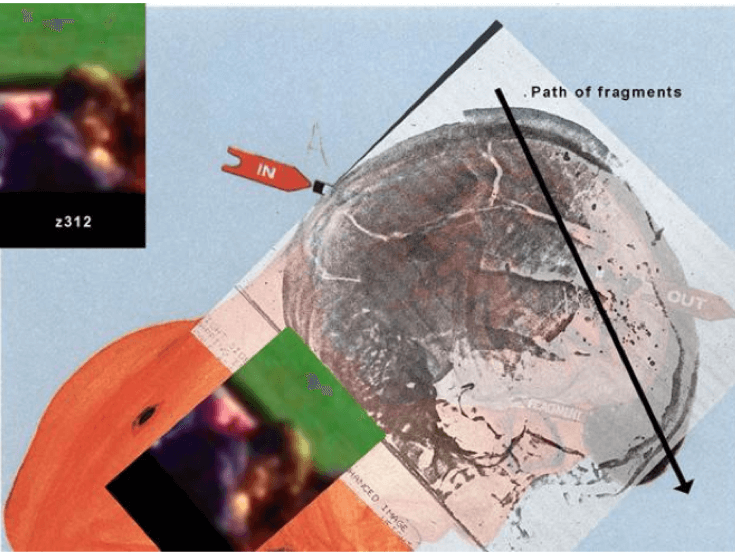 |
| Figure 10. The lateral X-ray superimposed on Z-312, as composed by David Josephs. |
Nalli runs into surprisingly many buzz-saws. If even one critical assumption is seriously wrong, his conclusion cannot stand. This review has demonstrated several such assumptions that clearly must be wrong. At the very least, the uncertainty in many of his parameters casts a strong shadow over the entire work. Nalli clearly favors the Zapruder film over the X-rays, but he never explains why. Furthermore, eyewitnesses—even the Parkland M.D.s—are persistently ignored. Although he cites Larry Sturdivan as a consultant, he does not cite Sturdivan’s shooting experiment, where 10 of 10 skulls flew forward—not backward. Nor does he recognize Sturdivan’s conclusion that the 6.5 mm object (on JFK’s AP X-ray) cannot represent a metal fragment. Without any comment, he accepts the Mannlicher-Carcano as the guilty weapon, and Z-312 as the critical moment. He resorts to inflating the mass of JFK’s brain—to nearly match Oliver Cromwell’s outsized brain (whose size appears unmatched in history—at least for home sapiens). He assumes that ejecta only flew forward—despite current knowledge that backspatter is typical, and despite visible evidence on the limousine trunk of rearward-going debris. Based on rather fragile reasoning, he merely assumes the masses of these ejecta. He mistakenly estimates the projected cross-sectional area of the bullet as it initially struck the skull, whereas the autopsy report states a much larger area. And these items are all fundamental to his calculations. For example, if some ejecta flew backward, his calculations cannot possibly be correct—and his model might well fail. (Since some brain likely flew backward, even less brain mass would then be available to fly forward and provide backward propulsion.)
Moreover, he commits a logical fallacy—just because his model works, he concludes that no other model can possibly be correct. Logically, however, just because one model is initially preferred, its challenger is not thereby finally proven wrong. After all, the history of science often illustrates battles between opposing models, where both (temporarily) explain the same data set. Most critically though, he assumes a scenario in which debris only flies forward which means that, in his calculations, the head can only lurch backwards. Well, in that case, it surely will go backwards.
 |
| Figure 11. What the witnesses saw at the right rear of JFK’s head. |
For higher resolution images of Figure 11, see Robert Groden, The Killing of a President (1993), pp. 86ff.
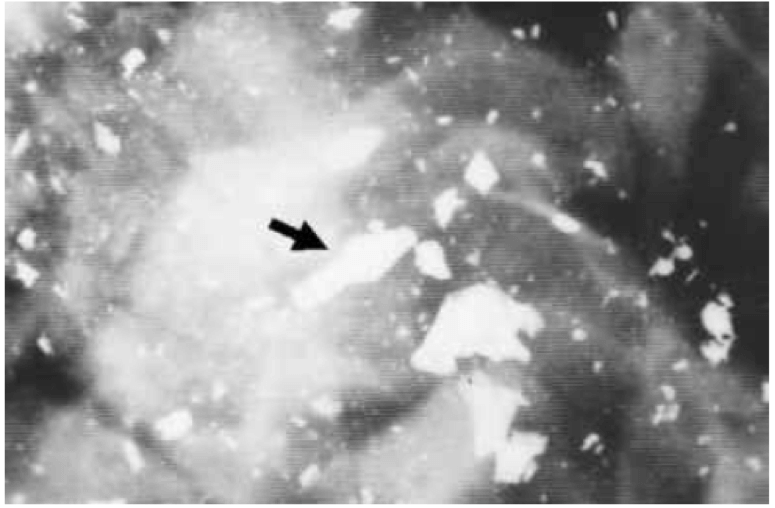 |
| Figure 12. X-ray of someone shot in the head with a Bronze-Point® bullet. The arrow-like “Bronze-Point,” a hunting bullet, is identified by the arrow. |
Notice the very large fragments in Figure 12, quite unlike the JFK X-rays. Also note how numerous these fragments are—quite unlike the next image (of a metal-jacked bullet). Furthermore, none of these fragments have the remarkably fuzzy borders that most of the JFK fragments show.84
 |
| Figure 13. This test skull was shot with a Mannlicher-Carcano (full metal-jacketed bullet) by the Biophysics Division at Edgewood Arsenal. |
In Figure 13, the bullet entered occipital bone superior to the site where Mr. Larry Sturdivan believes that JFK was struck (note the “hole”). But the fragment trail is relatively low on the skull (compared to JFK’s trail) and the fragments are larger than most of the JFK fragments. There are fewer fragments than in Figure 12 (a hunting bullet), but also notice how large most of these fragments are (compared to the JFK X-rays). Notice another striking feature: the bullet in Figure 13 breaks up some distance from its entrance site (as is typical of full metal-jacketed bullets), whereas the fragments in the JFK X-rays cluster toward the front, especially the smaller ones (which suggests a frontal entry). Furthermore, there is nothing in Figure 13 remotely like the fuzzy cloud in JFK’s X-rays. Such a fuzzy cloud (i.e., the blue ellipse in Figure 2), as well as fuzzy borders for many (but not all) JFK fragments, hint at a possible mercury bullet.
 |
| Figure 14. These fragments were produced by a full metal-jacketed bullet. |
None of these examples in Figure 14 come close to matching the fragments in JFK’s X-rays.85
Figure 15 displays brain weight versus body weight for various species. The red line represents the brain size gifted to JFK by Nalli.86 David Josephs alerted me to this graph, although I first became aware of this concept in 1963 as a graduate student in biophysics. Note that this is a log-log graph. If a linear-linear graph had been used, the inexplicable size (2100 grams) cited by Nalli for JFK’s brain would have looked even more preposterous.
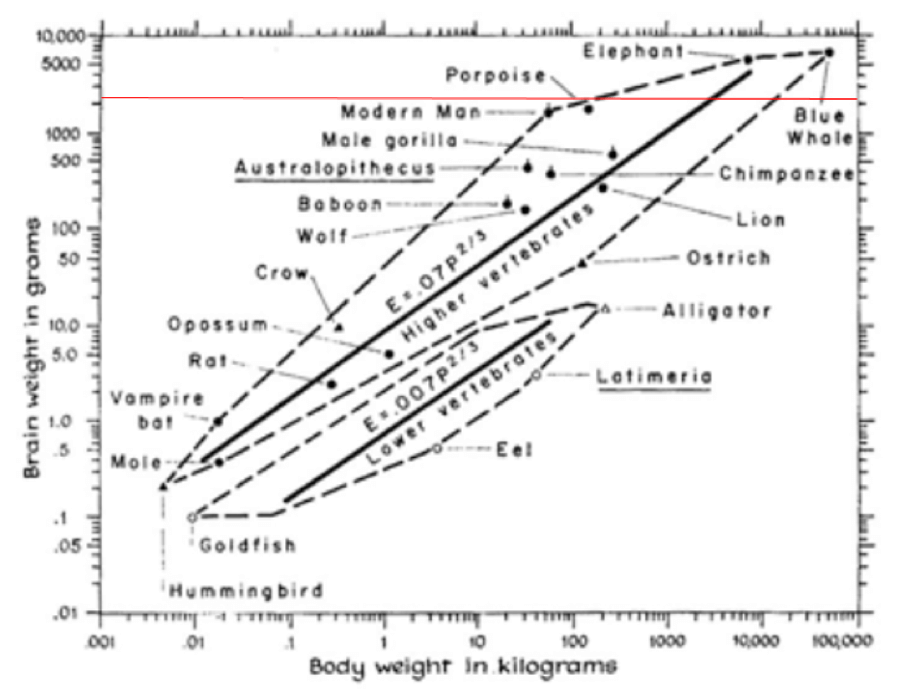 |
| Figure 15. Brain weights vs. body weight in various species. The red line identifies Nalli’s brain weight for JFK, which is far outside the normal range for homo sapiens. |
Fortunately, this essay was not orchestrated by a one-man band. Although I am not quite sure whether to thank him or to curse him, Jim DiEugenio incited me to undertake this review. Jeffrey Sundberg offered his usual astute clarifications, often weeding out ambiguous statements. Michael Chesser, M.D. has confirmed so many of my observations at the Archives that I hardly know how to express my gratitude. Gary Aguilar, M.D. and Cyril Wecht, M.D., J.D. contributed singular insights. Douglas DeSalles, M.D. reminded me of the many shooting experiments that failed to show a jet effect. Gregory Burnham contributed the movie clips about Kellerman. Walt Brown reminded me of Marine Colonel Allison Folsom. Paul Hoch, Ph.D., generously shared his unique historical perspective on the shooting experiments of Luis Alvarez. John Hunt supplied the skull photographs from the National Archives. Douglas Horne, the éminence grise of assassination researchers, as always, offered critical input. And David Josephs offered so many suggestions that he should be a co-author. Finally, I must thank Nicholas Nalli for reminding me of so many concepts that I once appreciated intuitively while on the physics faculty at the University of Michigan—and for thereby also resurrecting many happy memories of those long-gone days.
1 Head Shot: The Science Behind the JFK Assassination (2010), p. 128. Nalli lists twenty parameters in his Table 2. He also reports that the strength of cortical bone (σu) can be three times higher during high-speed trauma. This necessarily introduces a great deal of uncertainty into any calculations based upon this parameter. And, according to Nalli, the drag force (Fd) is directly proportional to σu, so any calculations of drag force are subject to this uncertainty—and Nalli has many of these calculations in his paper. According to Nalli, “…while uncertainties in parameters were accounted for as much as possible, this could not be done for a handful of them, especially bio-mechanical parameters (e.g., σu, U6, ρt, ρs and E).”
2 http://www.newsweek.com/jfk-assassination-conspiracy-theory-debunked-new-gunshot-study-902292.
3 Although the first draft of this review was completed soon after Nalli’s article appeared, I then got hopelessly sidetracked for many weeks while working in an underserved clinic in northern California—trying to help zillions of cancer patients with poor lifestyle choices. My apologies for this delay; it was due to a commitment I had made well before Nalli’s article appeared. NOTE: To avoid tedium, many sources are not cited here. Reference 8 includes most of these. June 18, 2018. DWM.
4 Chambers, Chapter 9. Nalli references Chambers’s book, but he does not comment on his conclusions. Chambers, also a physicist, supports a frontal head shot, and does not accept a jet effect.
5 David Lifton, Best Evidence (1980), p. 53.
6 I have personally interviewed several of these individuals, who tell a mutually consistent story.
7 Mark Lane, Rush to Judgment (1966), p. 56.
8 Josiah Thompson, Six Seconds in Dallas (1967), p. 99. Inspect the trunk in this image.
9 https://whowhatwhy.org/2018/05/31/scientist-neutralizes-jfks-back-and-to-the-left-or-does-he/.
10 This reported entrance wound diameter of 6 x 15 mm introduces yet one more paradox into the case: How can this bullet scape off a nearly round 6.5 mm fragment onto the back of the skull (as seen on the JFK AP X-ray) if it struck tangentially?
11 Journal of Neurosurgery 9 (1952), 472-483—as cited by Cranor.
12 https://history-matters.com/essays/frameup/EvenMoreMagical/EvenMoreMagical.htm.
13 http://www.jfklancer.com/hunt/mystery.html.
14 https://whowhatwhy.org/2017/10/06/navy-doctor-bullet-found-jfks-limousine-never-reported/.
15 Although this seems an unlikely scenario, the WC bequeathed it to us.
16 Nalli seems to accept the 6.5 mm fragment (on JFK’s AP skull X-ray) as authentic—even though his consultant (Larry Sturdivan) does not. Even if it is authentic, it cannot represent much of the middle portion, as it is extremely thin. See my peer-reviewed paper about this object at Reference 9.
17 These limousine fragments could not definitively be matched by neutron activation analysis to any other metal fragments in the case—nor to the Magic Bullet.
18 Rydberg has since expressed his misgivings about his sketch: http://assassinationofjfk.net/for-the-sake-of-historical-accuracy/.
19 From that memorable essay (Reference 5) by Gary Aguilar, M.D. and Kathy Cunningham, here is their footnote 352: “As observed by David Mantik, M.D., Ph.D. (personal communication), there are numerous cases from the scientific literature in which the documented beveling characteristics were the reverse of what might be expected from the known direction of wounding. While beveling may be a useful clue, it is far from Humes’ ‘100 times out of 100.’ [Dixon DS.”Keyhole lesions in gunshot wounds of the skull and direction of fire.”J Forensic Sci,1982; 27:555-66. Coe JI.”External beveling of entrance wounds by handguns.” Am J Forensic Med Pathol,1982; 3:215-9. Baik S, Uku JM, Sikirica M.”A case of external beveling with an entrance wound to the skull made by a small caliber rifle bullet.”Am J Forensic Med Pathol,1991; 12:334-6. Donohue ER, Kalelkar MB, Richmond JM, Teas SS.”Atypical gunshot wounds of entrance; an empirical study.”J Forensic Sci,1984; 29:379-88. Lantz PE.”An atypical, indeterminate-range, cranial gunshot wound of entrance resembling an exit wound.”Am J Forensic Med Pathol, 1994; 15 (1):5-9.]”
20 For an illustration of a ballistic pendulum, see Chambers’ useful sketch at p. 203.
21 Despite Nalli’s reliance on Sturdivan (he is, after all, one of Nalli’s consultants), Nalli never cites Sturdivan on the critical matter of the 6.5 mm object. Instead Nalli appears to accept it as an authentic metal fragment. But Sturdivan has stated the opposite in The JFK Myths (2005), p. 193: “No, I think it’s an artifact of some kind … [bullet] fragments could have been found anywhere but, wherever they were found, NONE (sic) would be disks 6.5-mm in diameter … Some have said it was a piece of the jacket, sheared off by the bone and left on the outside of the skull. I’ve never seen a perfectly round piece of bullet jacket in any wound….”
22 Michael Chesser, M.D. (neurologist), while recently at the National Archives, noted many tiny metallic fragments just inside the forehead bone (on JFK’s extant lateral skull X-rays). This location is grossly inconsistent with Nalli’s exit site. Chesser’s observations were made public well in advance of Nalli’s review, but Nalli was likely unaware of them. Chesser’s tiny fragments partially overlap the more inferior of the two red ellipses in Figure 2. Chesser also noted a hole in the forehead bone, possibly created by the same bullet that deposited these tiny fragments. Now if Chesser is correct—and it would be difficult for an impartial observer to avoid the conclusion—not only would this overt evidence for a frontal shot “pour water” on Nalli’s conclusions, but it would render his work quite irrelevant. Like me, Chesser was an expert witness at the November 2017 Mock Trial of Lee Harvey Oswald. See Reference 12 (slides 9-31) for Chesser’s own presentation.
23 https://en.wikipedia.org/wiki/Brain_size.
24 Allen, JS; Damasio H; Grabowski TJ (2002). “Normal neuroanatomical variation in the human brain: An MRI-volumetric study”. Am J Phys Anthropol. 118(4): 341-58. doi:10.1002/ajpa.10092.PMID12124914.
25 If true, JFK’s brain weighed 4.6 pounds, compared to the average brain of 3.0 pounds. The average head weight is 10-11 pounds: https://www.brainstuffshow.com/blogs/how-much-does-the-human-head-actually-weigh.htm. Nalli estimates JFK’s head as 10.3 pounds. See https://www.brainstuffshow.com/blogs/how-much-does-the-human-head-actually-weigh.htm. So, the average ratio of brain to head size is about 29%. Since JFK’s hat size was average (and his head size therefore was probably average, as Nalli agrees), his brain to head size in Nalli’s scenario (using Nalli’s numbers) becomes a fantastic 45% (2100 grams ÷ 4500 grams).
My cousin Steve agreed to submerge his head in a bucket of water; using Archimedes Principle, his head weight was 4250 grams.
26 https://www.scientificamerican.com/article/the-littlest-human-2006-06/. Was Cromwell blessed with especially potent NOTCH2NLS genes? Ironically, this article (about these genes) was posted online during the Mock Trial of Lee Harvey Oswald: https://www.biorxiv.org/content/biorxiv/early/2017/11/17/221226.full.pdf.
27 The listed brain weight (1500 grams) most likely describes the one at the second brain autopsy, i.e., the one shown in Figure 4 below (not JFK’s brain).
28 https://www.youtube.com/watch?v=AN6WXERsEKE.
29 This film was screened during the November 2017 Mock Trial of Oswald, where I appeared as an expert witness.
30 In JAMA, May 27, 1992—Vol 267, No. 20, p. 2798.
Humes here almost certainly described JFK’s actual brain, i.e., not the one shown in Figure 4. Humes, of course, was not the only one to report rather little residual brain. FBI agent Frank O’Neill, several autopsy assistants, and professional personnel at Parkland agreed: https://www.maryferrell.org/pages/ARRB_Medical_Testimony.html.
But we don’t need witnesses—we have optical density measurements that yield similar results for the large amount of missing brain: see David W. Mantik and Cyril H. Wecht, “Paradoxes of the JFK Assassination: The Brain Enigma”. Cf. https://archive.org/details/assassinationspr00jame.
31 Greg Burnham supplied these online images.
32 See Milicent Cranor’s brilliant summary of these witnesses to a shot after Z-313: https://web.archive.org/web/20110606195259/http:/spot.acorn.net/jfkplace/09/fp.back_issues/31st_Issue/jiggle.html. Also see my argument for such a late shot in Reference 1, p. 285. Then there is Clint Hill, who also recognized a shot well after Z-313: https://www.dailystar.co.uk/news/latest-news/604980/jfk-assassination-kennedy-clint-hill-witness-account-president-dallas. Clint Hill first placed his hand on the limousine 30 frames after Z-313. According to the FBI, his foot did not reach the bumper until Z-368; both feet reached at Z-381. Mary Moorman has often recalled hearing a shot well after her famous photograph, which supposedly captured the headshot. Finally, even Josiah Thompson, in his forthcoming book, Last Second in Dallas, now favors a late shot near Z-327.
33 The first survey plat of Dealey Plaza was by Robert H. West, Dallas County Surveyor, on November 26, 1963, just four days after the assassination. That data was obviously altered later to fit the single bullet theory. At the bottom of the next survey (December 5th, CE-585) is a note, “Revised 2-7-64,” which means that in February 1964 the last shot was still fixed near the concrete steps, well after Z-313. See Chuck Marler, “The JFK Assassination Re-enactment: Questioning the Warren Commission’s Evidence,” in Assassination Science (1998), ed. James Fetzer.
34 See reference 8 for a WC reconstruction (with photographs) that clearly display a shot well after Z-313.
35 https://kennedysandking.com/content/warren-commission-document-wcd-298-how-the-bureau-made-a-fourth-shot-beyond-z-313-disappear. This is an enlightening essay by David Josephs, which illuminates the nature of the earliest FBI conclusions. These still stand in stark contrast to those of the WC.
36 These SS photographs were initially published by Harold Weisberg in Whitewash II (1966), p. 248. David Josephs reminds us that CE875 is an album of SS photographs with the limousine at every station point on Elm St. at intervals of 0+25. No photograph was taken at 5+00 because the last shot was within 4 feet of this. But this site is well beyond Z-313, i.e., well past Zapruder’s pedestal, as is readily seen here: https://www.history-matters.com/archive/jfk/wc/wcvols/wh17/pdf/WH17_CE_875.pdf.
37 Nalli cites Vincent Bugliosi, who claimed that the Z-film was not necessary to reach the WC conclusions. I concur that the Z-film is not required to reach a conclusion—unfortunately for Nalli, though, that conclusion is rather one of conspiracy. My review of Bugliosi’s enormous book can be found online: https://www.assassinationscience.com/v5n1mantik.pdf. (So also is my review of his Divinity of Doubt.)While he once regaled me with his frustration over my review (for well over an hour), Bugliosi stated that I was the only reviewer who he had telephoned.
38 Here are some arguments for film alteration: (1) John Costella (Ph.D. in theoretical physics) has shown via mathematical algorithms that unrealistic distortions appear in the film, (2) some frames (e.g., Z-232) show physically impossible images, (3) odd inconsistencies exist among the Dealey Plaza films, (4) the debris hangs in the air for only about three frames, (5) the black geometric patch over the back of JFK’s head (flagrant on early generations of the film—as I have observed in two separate formats), (6) the two, totally compartmentalized Z-film events at the CIA on consecutive days that weekend, (7) witnesses uniformly reported that the limousine stopped, and (8) witnesses reported actions no longer seen in the Z-film (e.g., see the Preface in Reference 8).
See http://educationforum.ipbhost.com/topic/19952-new-proof-of-jfk-film-fakery-conclusive-evidence-experts-claim/ and http://assassinationofjfk.net/the-two-npic-zapruder-film-events-signposts-pointing-to-the-films-alteration/.
At the recent Mock Trial of Oswald, Alec Baldwin reported that even the Kennedy family accepts alteration of the Z-film. After all, Jackie was there.
39 The reader is referred to the exhaustive work by John Armstrong, Harvey and Lee. An easier approach is via James DiEugenio, Reclaiming Parkland (2013). Then there is David Josephs, who has also done heroic work on these issues: https://kennedysandking.com/john-f-kennedy-articles/oswald-on-november-22-1963.
40 https://en.wikipedia.org/wiki/John_F._Kennedy_assassination_rifle. Brennan failed to identify Oswald in a police lineup that day; for further discussion of Brennan’s erratic statements, see Gerald McKnight, Breach of Trust: How the Warren Commission Failed the Nation and Why (2005), pp. 109ff.
41 This is longer than US involvement in WW II—and even longer than Tiger Woods’s major tournament drought.
42 Warren Commission Hearings, Volume XIX, p. 17ff: https://www.maryferrell.org/showDoc.html?docId=1136#relPageId=35&tab=page.
43 Alvarez shot at coconuts, pineapples, and even at water-filled jugs—and he tried quite different bullets, until he happened upon a combination that finally yielded his long-desired jet effect. But that did not happen with the Mannlicher-Carcano bullet.
44 This was based on original documentation generously supplied by Paul Hoch, Ph.D., who was then Alvarez’s graduate student in physics.
45 http://www.patspeer.com/chapter16:newviewsonthesamescene.
46 I was in the audience (as a medical student) when Alvarez gave his lecture at Los Alamos, NM in 1975, where I received (and preserved) a pre-print of his paper.
47 Charles Breneman, who assisted surveyor Robert H. West, stated that he “…saw three frames of the Zapruder film which showed large blobs of blood and brain matter [emphasis added] flying from Kennedy’s head to the rear of the car” (Fort Worth Star Telegram, April 14, 1978).
48 Larry Sneed, No More Silence (1998), pp. 351-371.
49John Corry, The Manchester Affair (1967), p. 45.
50 Dino A. Brugioni (1921-2015) served as the Chief Information Officer at the National Photographic Interpretation Center (NPIC) for about two-and-a-half decades. He was the world’s foremost living expert on the U-2 and SR-71 aerial reconnaissance imagery, and on the Corona and early Keyhole satellite reconnaissance imagery.
51 In his excellent book, Hear No Evil (2010), pp. 351ff, Donald Thomas describes this as a Krönleinschuss effect, as it is called in forensic pathology. Nalli references Thomas, but does not quote his conclusion: “… we are compelled to conclude that the jet recoil theory is dubious at best.”
52 https://www.lewrockwell.com/2012/05/douglas-p-horne/the-two-npic-zapruder-film-events-signposts-pointing-to-the-filmsalteration/.
53 The American Journal of Physics, Volume 44, No. 9, September 1976; I have carefully examined the images in the original article.
54 http://mcadams.posc.mu.edu/hargis.htm.
56 Reference 4.
57 https://www.history-matters.com/archive/jfk/wc/wcvols/wh17/html/WH_Vol17_0440b.htm.
58 This exhibit was supplied by David Josephs.
59 Bernard Fensterwald, Jr. and Michael Ewing, Coincidence or Conspiracy?, p. 96. The quote comes from an unnamed aide to Congressman Boggs. The book also quotes Bogg’s wife Lindy, through a colleague, as saying “He wished he had never been on it [the Commission] and wished he’d never signed it [the Report].”
60 http://www.toledoblade.com/MarilouJohanek/2013/11/17/Retired-Ohio-judge-investigated-Ruby-s-slaying-of-Oswald.html.
61 https://www.politico.com/magazine/story/2015/02/warren-commission-jfk-investigators-114812.
62 https://www.maryferrell.org/pages/JFK_Assassination_Quotes_by_Government_Officials.html.
63 David Talbot, Brothers, p. 303. Author interview.
64 http://mcadams.posc.mu.edu/russ/jfkinfo/hscastur.htm. Also see Larry M. Sturdivan, JFK Myths (2005), p. 163, which displays the 10 (of 10) skulls that failed to show the jet effect. Although the resolution in these images is low, backspatter might be faintly visible.
65 http://www.jfklancer.com/galanor/jet_effect_text.html. See Arthur and Margaret Snyder, “Case Still Open: Skepticism and the Assassination of JFK” in Skeptic Magazine, Volume 6, Number 4. (Arthur is a SLAC physicist.) DeSalles (e-mail to me) notes that his multiple attempts, with full metal-jacketed bullets through melons wrapped with either duct tape or casting plaster, failed to show convincing evidence of a jet effect. He has offered $100 to anyone who can demonstrate a jet effect (with the proper bullet). DeSalles has gifted me with videotapes of his experiments, which I have viewed closely. John Nichol’s experiments are reported here: https://www.baylor.edu/content/services/document.php/185131.pdf.
66 “President Kennedy’s Fatal Head Wound and his Rearward Head ‘Snap,’” AFTE Journal, Volume 46, Number 4, Fall 2014, pp. 279-289; see Figure 8.
67 Thompson, Six Seconds in Dallas (1967), pp. 70ff.
68 https://www.google.com/search?q=exploding+bullets&rls=com.microsoft:en-us:IE-SearchBox&tbm=isch&tbo=u&source=univ&sa=X&ei=o-YoUrqzOYWSiAKtjYDoAQ&ved=0CEMQsAQ&biw=1920&bih=1048#facrc=_&imgrc=w_ukJR22ViotQM.
Nalli never acknowledges backspatter, although it might well offset much of his proposed forward momenta. An authentic human skull would be a superior example for Figure 7, but my internet trolling failed to discover such an example, although this image is memorable: https://www.nytimes.com/2018/02/01/world/asia/vietnam-execution-photo.html.
69 “These materials were examined by scanning electron microscopy/energy-dispersive X-ray analysis. Calcium-phosphorous (bone) particles were detected on the 9-mm Smith & Wesson pistol, on two casings found at the scene, and on one of the revolvers. Two of the calcium-phosphorous particles on the casings had associated bullet fragments.” J Forensic Sci. 1991 Nov; 36 (6):1745-52. https://www.ncbi.nlm.nih.gov/pubmed/1770342?dopt=Abstract.
70 Reference 2. Douglas P. Horne , “Evidence of a Government Cover-Up: Two Different Brain Specimens in President Kennedy’s Autopsy”.
71 Reference 5, Section V.
72 Reference 5, Section V.
73 Reference 6, Chapter 11.
74 Reference 5.
75 The most infamous quote from the WC was uttered by attorney Wesley Liebeler: “The best evidence that Oswald could fire his weapon as fast as he did and hit the target is the fact that he did so.”
76 Breach of Trust, pp. 186ff. This book was published by the University Press of Kansas.
77 http://aarclibrary.org/publib/jfk/wc/wcvols/wh17/pdf/WH17_CE_397.pdf. Stover was the Commanding Officer of the National Naval Medical School at Bethesda that night.
78 Paul Hoch, Ph.D. (e-mail to me) raises several issues about these graphs: (1) Did Nalli repeat the measurements? (2) Nalli states that he “re-plotted” the data, whereas re-measurement would have been expected. (3) When Nalli refers to “digitization of the original image,” does he mean the Z-film—or rather the graph in Six Seconds in Dallas, p. 91? (4) Nalli’s Figure 8 has error bars; they all appear the same size; “I wonder where he got them.” Thompson has since disavowed the initial forward motion (due to blur artifact), although Nalli does not tell us that: http://jfkcountercoup.blogspot.com/2013/10/wecht-center-symposium-on-jfk.html.
Here is my response to Hoch. Comparison of Nalli’s graphs with Thompson’s graphs suggests that Nalli performed his own measurements even though he ambiguously states, “The data have been re-plotted [emphasis added] by the current author….” To further confuse us, Nalli’s legend for Figure 8 states that the position measurements are those of Thompson, so the answer is still in some doubt. Given the sequential steps involved in Nalli’s three successive graphs, I would expect the uncertainty to increase successively from graph to graph. Close inspection suggests that is likely true, but the error bars remain oddly uniform within each graph. And certainly, the blurring in some frames (e.g., Z-318) must increase the calculated uncertainty at that point, yet that is not seen in the third graph at Z-318—just where the neuromuscular reaction supposedly begins.
79 https://statick2k-5f2f.kxcdn.com/images/pdf/AguilarWechtAFTA2015.pdf. For more details from Aguilar and Wecht, see AFTE Journal, Volume 47, Number 3—Summer 2015, and AFTE Journal, Volume 48, Number 2—Spring 2016.
80 While investigating these streaks decades ago, I had also measured their speeds, and calculated their ranges.
81 https://www.youtube.com/watch?v=8dMzdvYyXNA.
82 See my discussion of these many witnesses in Reference 1. James Altgens is a corroborating witness, discussed in Reference 8.
83 This image presents even more challenges to a frontal headshot at Z-313, which means that the traditional believer in conspiracy might become even more bewildered than a WC supporter. See Reference 8 for further discussion of this paradox.
84 https://www.bevfitchett.us/gunshot-wounds/centerfire-rifle-bullets.html. Incidentally, ingested game that contains lead is distinctly unhealthy. It should be left to the elderly.
85 The images in Figure 14 were supplied by David Josephs.
86 http://serendip.brynmawr.edu/exchange/brains/compare/size6.
The Mantik Website: http://themantikview.dealeyplazauk.org.uk/
The documentary mini series, American Dynasties: The Kennedys had its first go round for CNN in March of last year. CNN has decided to rerun this thoroughly mediocre production, therefore we are reposting this review. Something we did not know at the time of its original broadcast was that the production company which originated the series is Raw TV. That company was purchased by Discovery Channel before it started this series. Discovery Channel has been involved with some of the worst pieces of drivel ever produced on the Kennedy case, e.g.Inside the Target Car. That company continues in that tawdry vein with this shallow, quasi tabloid look at the Kennedy family. From its choice of talking heads–with Van Jones and Randy Taraborrelli–to its cheesy recreations, this series redefined the word nondistinction. Since CNN decided to repeat it, we post this review as a warning to the viewer.
CNN has devoted a six-part documentary to a project called The Kennedys. One would think that if one spent that much screen time on such a long series that somehow, some way, one would bring something new and interesting to the production. Or at least be able to create some sense of pathos, or perhaps even a sense of impending doom to a saga that clearly contains tragic dimensions on both a personal and national level. To say that this series lacks those qualities is too mild a criticism.
The full title of the series is American Dynasties: The Kennedys. I am a bit puzzled whenever that title is utilized, as John Davis did in his book about the Kennedy family. President John F. Kennedy served less than three years of one term in office, and was killed under suspicious circumstances. His younger brother, Robert Kennedy, was killed amidst even more suspicious circumstances before he even got to the Democratic nominating convention in 1968. One can call the Bush family a dynasty, or the Adams family, but not the Kennedys.
The spin of the series was guaranteed with the choice of talking heads. I would classify Sally Bedell Smith as perhaps one notch above Kitty Kelly on the scholar scale. Evan Thomas, a longtime veteran of Newsweek, wrote one book on the Kennedys, a biography of Bobby Kennedy. I stopped reading when I saw the book contained footnotes to the work of David Heymann who has been exposed as a biographical fraud. J. Randy Taraborrelli is an entertainment reporter who specializes in newsstand type celebrity biographies about people like Cher, Diana Ross, Michael Jackson, and Madonna. Larry Tye wrote a book about Bobby Kennedy that was jacket endorsed by, of all people, the post-war champion of genocides, Henry Kissinger. After reading it I understood why Kissinger liked it. Van Jones wrote a book called The Green Dollar Economy. How that qualifies him as a Kennedy authority escapes this reviewer. The series features a few female talking heads like Barbara Perry. I would like to say that they helped provide new and interesting information. But they didn’t. How could they if one of them was CIA asset Priscilla Johnson McMillan?
The plan behind the series is apparent by the middle of the second program. The concept is to make the Kennedy children pretty much empty vessels of their father Joseph Kennedy. Therefore, Joe Kennedy is turned into a caricature whose influence is extended throughout their lives and careers. By doing that one then dilutes their true achievements and aims. I recognized the paradigm since I dealt with it a long time ago in a review of the literature. Over twenty years ago as editor of Probe Magazine, I wrote a long two-part essay called “The Posthumous Assassination of John F. Kennedy.” For that travail I read many of the post-Church-Committee biographies of JFK and noted how these works used that design: for instance, volumes by Clay Blair, the aforementioned John Davis, and the team of David Horowitz and Peter Collier, among others. (See The Assassinations, edited by James DiEugenio and Lisa Pease, pp. 346-59; also available on this site) Joe Kennedy was obviously the prime financial backer behind the political campaigns of his sons. But it is clear that they rejected what those biographers considered Joe’s worst political trait: his isolationist foreign policy. (DiEugenio and Pease, p. 355) JFK broke with his father during his House of Representatives days. As denoted by his voting record, the young Kennedy was an internationalist, a motif we will return to later. Further, Congressman Kennedy voted to sustain Harry Truman’s veto of the Taft-Hartley bill. That bill would have weakened unions to the benefit of wealthy businessmen like his father. (p. 355) Neither of these is noted in the series.
Further, The Kennedys tries to say that somehow Joe Kennedy wanted to be president. When he could not—due to his isolationist statements as ambassador to England during World War II—he passed this ambition on to his sons. Richard Whalen was hardly a sympathetic biographer of Joseph Kennedy. But in his 472-page, heavily annotated book, he characterizes the portrayal of these presidential ambitions as “the echo of the press talking to itself.” In other words, they were the amplification of rumors. (Whelan, The Founding Father, p. 217)
And the documentary’s implication that somehow John Kennedy had to be goaded by his father to go into politics also does not hold very much water. If one reads enough biographies of JFK, one sees that, from his early journalistic days, the man was a political junkie. He subscribed to the New York Times at age 14. A visiting professor at the Kennedy home commented after talking to the teenager that, even then, his mind was more politically sophisticated than his father’s or his older brother. He was impressed by John’s ability to put current events in historical perspective and to project trends into the future. (John Shaw, JFK in the Senate, pp. 12-13) A few years later, one of his girlfriends, Bab Beckwith, threw him out of her room because he was ignoring her in order to listen to a news bulletin on the radio. Having seen pictures of Beckwith, I can say that young Kennedy had to have been a triple-distilled political junkie to ignore her for the news. (DiEugenio and Pease, p. 348)
This is also borne out by the memories of his two close friends, Ken O’Donnell and Dave Powers. Very early, Kennedy told them the reason he got into politics was not due to the death of his older brother Joseph, or any pressure from his father. As an employed reporter, he once covered the birth of the United Nations and the meeting at Potsdam. After that, he decided he could influence events more by being in the arena than by reporting on them or writing about them in books. (Shaw, p. 14) Those were the other two professions—journalism and book writing—he had thought of taking up. The other reason he chose to enter politics was because of his experience in World War II. He was determined that such a conflagration should not happen again. In asking his acquaintance John Droney for help in his first campaign, Droney tried to put him off by saying he was eager to start his law practice. Kennedy replied, “If we’re going to change things the way they should be changed, we all have to do things we don’t want to do.” Stung by the sincerity of that response, Droney delayed his law practice and went to work for him. (O’Donnell and Powers, Johnny We hardly Knew Ye, p. 51; Ted Sorenson, Kennedy, p. 15)
To really understand the spin of the program, one has to note two strophes that the show used in dealing with JFK’s service in World War II. First, how he ended up going to the Solomon Islands in the South Pacific, and second, his act of heroism there. The show makes much of young Kennedy’s affair with Inga Arvad while he was serving in Naval intelligence. (The show even features reenactments of her.) From all the evidence this author has seen, Kennedy really liked Inga Arvad, to the point of being almost in love with her. The program’s concept is to portray her as a German espionage agent.
Let me summarize the actual episode succinctly and objectively. J. Edgar Hoover tried everything he could to make a case for Arvad being a spy: all kinds of surveillance, breaking into her room, and even planting stories in the press. He never could. (Nigel Hamilton, Reckless Youth, pp. 428-41) And she was not the prime reason JFK left his intelligence position. Kennedy found intelligence work boring; after Pearl Harbor, he wanted to go on active duty. (Whalen, p. 358; Arthur Schlesinger, A Thousand Days, p. 86; Hamilton, p. 450)
This spin is a warm-up for the treatment of the whole PT 109 episode. Here, the program tries to deflate the bravery and heroism young Kennedy displayed. One commentator says Kennedy was not really proud of what happened with the incident, and another actually says that Kennedy should have been court-martialed. The following is what the program leaves out.
The August, 1943 episode with Kennedy as skipper of PT 109 was part of a larger and more complicated action, including several other PT boats patrolling for Japanese destroyers close to land. The idea was to snuff them out and fire at them with torpedoes. The problem was that Kennedy’s division leader had left the area with their sole radar set. (Hamilton, pp. 558-59) Consequently, in the pitch black of night, with no radar, Kennedy was left with a dilemma: He did not want to turn on his lights, because that would alert the enemy to where he was. In addition to this, Kennedy was slowly cruising with bad intelligence. The Japanese were aware of the operation much sooner than anticipated. One reason for this was that a fellow PT boat, the one with radar, had already fired at a destroyer. That escaping boat had not alerted PT 109 concerning the destroyers in the vicinity or its action. (Hamilton, p. 559)
The supporting intelligence was so bad that the PT boats left behind were unknowingly about to be attacked by both planes and destroyers. Without radar, the sailors thought the shells were coming from shore batteries. What made it all the worse is that one of the headquarters commanders was urging the remaining boats to go ahead and attack. (Hamilton, p. 561) But by now the destroyers were coming out to do battle. PT 109 was deliberately rammed by the destroyer Amagiri. With communications so poor on the American side, no one rushed to the rescue of a boat that had been cut in half and was burning in the water. Moreover, at least one other boat commander thought that no one could survive such a conflagration. (Hamilton, p. 571-72)
Two sailors had been killed upon impact; eleven men were left. Kennedy had directed the survivors to try to board the floating hulk of the ship. He grouped some of the non-swimmers on a piece of timber from the wreck of the boat. JFK led his men away while swimming with a lifeboat strap between his teeth, towing a badly burned sailor behind. He did this for 4 hours, until they reached Kennedy’s destination, Plum Pudding Island. But Plum Pudding was barren and Japanese barges were floating by. Kennedy swam another 2.5 miles to Olasana Island. There he found some vegetation and water, and the crew transferred to Olasana. Kennedy scratched out a message on a coconut shell and gave it to some native Allied scouts in canoes. They managed to get it to their British scoutmaster. Six days later, with Kennedy and his men in very bad health, a large canoe with some food arrived to carry them to rescue. (Hamilton, p. 594)
How anyone can say, as this program does, that Kennedy should have been court-martialed for his performance under these conditions is completely nutty. The men who should have been charged were those who organized that poorly planned and badly executed mission, as well as the officer who left three boats behind in the dark with no radar. Unlike what the program tries to convey, Kennedy was proud of his military service—as he should have been. He kept his three well-deserved medals; and the coconut shell he carved onto was on his presidential desk. (Sorenson, p. 19) Knowing the full facts, what this part of the program amounts to is nothing but a hatchet job.
The program skips over John Kennedy’s years in the House of Representatives. This is odd, but considering his policy program, predictable. Kennedy’s 1946 congressional campaign consisted of pledges to work for a national health care system, advocacy of workers’ rights to organize, housing for returning veterans, and securing the future of the United Nations as a hope for peace in the world. (Shaw, p. 16) Kennedy had a high profile for a first time congressional candidate because his first book, Why England Slept, had sold well, another point that is ignored by the program.
Once he got to Congress, the issue he fought hardest over was affordable housing for veterans. JFK hammered the GOP for stalling a housing bill and he particularly attacked their ally, the American Legion. On the House floor he said that the leadership of the American Legion had not had a constructive thought about American progress since 1918. (Shaw, p. 21) That would have been an appropriate and humorous quote for the program. But it’s not there. In 1947 he debated Richard Nixon in McKeesport, Pennsylvania, over the Taft-Hartley bill , an act that would weaken unions: JFK was against it, Nixon was for it. (Shaw, p. 23) Again, this interesting and informative fact is rendered incommunicado during the six hours of The Kennedys.
After all but ignoring his three terms in the House, the show picks up with JFK’s run for the Senate in 1952. Evan Thomas intones that at this time John Kennedy considered RFK something like a pain in the butt. Thomas can only say this because the program does not relate the journey the brothers made the year before to the Far East and Indochina. JFK did this in order to raise his foreign policy profile in his upcoming challenge to Senator Henry Cabot Lodge in Massachusetts. This is where the brothers met American diplomat Edmund Gullion in Saigon, who told them that the French could not win their effort to retake their colony. They also met with Nehru of India who told them the same. As Bobby later stated, these discussions had a major impact on JFK’s thinking. And the congressman began to express his doubts about America’s prosecution of the Cold War in public venues and in no uncertain terms. This again brought him into open verbal conflict with his father’s isolationism. (Arthur Schlesinger, Robert Kennedy and His Times, pp. 95-97)
Because of these omissions and distortions, the show gets the episode of RFK replacing Mark Dalton as his brother’s Senate campaign manager mostly wrong. RFK was hesitant to take the position only because he had started a job as a Justice Department attorney, which he liked. Further, the real impetus for the request was not so much Joe Kennedy as it was the congressman’s friend and advisor Ken O’Donnell. O’Donnell told RFK that unless he took over, there was a real possibility his brother would lose. (Schlesinger, p. 98) This convinced Bobby to take charge and he did a fine job running a successful campaign. He worked 18-hour days and showed excellent organizational ability.
The following segment, about John and Robert Kennedy on Capitol Hill, is so oddly conceived and off kilter that it amounts to little less than censorship. This section deals more with Bobby Kennedy as a Senate investigator than John as a senator. In fact, JFK’s senatorial career is more or less ignored. The show deals with Kennedy’s eight years in the senate through his several illnesses and operations, his attempt to secure the Vice-Presidency at the 1956 convention, and his wedding to Jacqueline Bouvier. Amazingly, the show calls JFK’s senatorial career non-descript except for his service on the McClellan committee. That committee investigated organized crime and the Teamsters Union and was helmed by Bobby Kennedy.
If at this point anyone had lingering doubts about the deliberate myopia of the series, this section should end them. As John Shaw concludes in his study of JFK’s senatorial career, although it had several distinctive qualities, clearly the most significant achievement of those eight years was the formulation of Kennedy’s challenge to the reigning foreign policy orthodoxy governing both political parties. (Shaw, p. 110) The GOP Cold War militancy toward the USSR and its influence in the Third World was led by President Eisenhower, Vice-President Nixon, and the Dulles brothers: John Foster at State, and Allen at CIA. In the Senate, Lyndon Johnson and the southern Democrats offered no alternative to this; they were, at best, a pale shadow of that policy. As Shaw notes, the joke about the Senate was that it was “the only place in the country where the South did not lose the [Civil] war.” (Shaw, p. 59)
Senator Kennedy continued his lonely crusade to create an alternative to this overwrought militancy by trying to point out that the real problem in the Third World was not communism but colonialism and the counterforce it created: simmering nationalism. Kennedy thought the USA should foster and mold that nationalism—even if it meant conflict with our European allies. What makes the program’s avoidance of this key issue so bizarre is that one of the talking heads in the series is Richard Mahoney. Mahoney is the author of the landmark volume on this subject, JFK: Ordeal in Africa. I don’t for five seconds believe that the producers were not aware of this book. They clearly decided to ignore it and not let Mahoney talk about his detailed descriptions of Kennedy’s opposition to the White House in this regard. (As we will see, this manipulation is a recurring motif.)
Thus there is no mention of Senator Kennedy’s opposition to Foster Dulles’ attempt to bail out the French with atomic weapons at Dien Bien Phu, or Adlai Stevenson’s telegram to stifle Kennedy’s radical foreign policy statements during the 1956 presidential race, or even his milestone speech in the summer of 1957 against the Dulles/Eisenhower attempt to help France salvage another remnant of its overseas empire, this time in Algeria. Kennedy showed courage in making that speech because he was criticizing a long time American ally, one that had helped the thirteen colonies become independent from England. In addition to the White House, the speech was strongly criticized by literally scores of media outlets, and also members of his own party like Stevenson and former Secretary of State Dean Acheson. (See Mahoney, pp. 14-29) But as the French dilemma in Algeria worsened, Kennedy began to look like a prophet. And he also became an unofficial emissary to visiting dignitaries from Africa. (Mahoney, pp. 31-33)
There is not one single sentence in the entire series about any of this. So how can one have any respect for its honesty or substance?
The program’s coverage of the 1960 race for the presidency between Nixon and Kennedy is pretty standard stuff. There is one exception to this, and it consists of something that is such an outlier that it should be noted. Commentator Tim Naftali states that the choice of Lyndon Johnson as Vice President was Joe Kennedy’s. Again, this is another attempt to somehow show the influence of their father on the lives of the Kennedy children.
The problem with that declaration is simple. If one reads the two best insider summaries of the VP decision—by Arthur Schlesinger and Ted Sorenson—Naftali is wrong. The two strongest proponents of Johnson to Kennedy were Phil Graham, publisher of the Washington Post, and syndicated columnist Joe Alsop; particularly the former. (Sorenson, pp. 183-87; Schlesinger, A Thousand Days, pp. 41-57)
Beyond that, courtesy of RFK biographer Larry Tye, the program obfuscates the split between John and Robert over the Johnson nomination. Bobby Kennedy clearly did not want Johnson on the ticket. He personally intervened in order to get him removed. (Robert Caro, The Passage of Power, pp. 136-38) This is an important part of the story that has to be noted, because of its later ramifications. Bobby’s backdoor actions deepened the antagonism between Johnson and RFK, and it presaged the coming split in the Democratic party after John Kennedy’s assassination. In fact, Jeff Shesol—who is notably absent from the series—wrote a book on the LBJ/RFK dispute and micro-analyzed this incident. It is poor history to ignore or minimize it, since it had such a negatively powerful impact from 1964 onwards—culminating in the disastrous Democratic convention of 1968, which helped usher Nixon into the White House.
Upon JFK’s inauguration, the only cabinet appointment that gets any attention is Bobby Kennedy as Attorney General. Larry Tye says words to the effect that Bobby was the least prepared Attorney General in history. Oh, really? Herbert Brownell, Eisenhower’s Attorney General, was a state assemblyman for four years, and Chairman of the Republican National Committee for two years. The rest of his career he was a corporate lawyer. Homer Cummings, who served under Franklin Roosevelt, was the mayor of Stamford, Connecticut (population 50,000) and a state attorney in Fairfield (population 20,000). Bobby Kennedy had served in Washington as a criminal investigator in the Justice Department, and then a congressional counsel for ten years prior to being Attorney General. He had faced off and pursued some of the most deadly killers and organized crime members in America, e.g., Sam Giancana. His pursuit of the Mob in the Senate was unprecedented in American crime annals. His attempt to clean up corrupt labor unions was also unique. One could argue that it was Bobby Kennedy who really revolutionized both the position of Chief Counsel and the use of investigative techniques on Capitol Hill. In practical terms, what more could one ask for in an Attorney General?
But this is part of the effort to portray the first year of Kennedy’s presidency as something less than anticipated. And if one considers only things like the Bay of Pigs invasion, and the construction of the Berlin Wall, then it can look that way. But it is what the program ignores that forms the really important part of JFK’s presidency.
What Kennedy was doing that first year was what he had been speaking about for his previous nine years in Congress: altering America’s role in the Third World. It is why he had purchased 100 copies of the best selling book The Ugly American and given a copy to each senator. Because he believed so strongly in the book’s message, he then helped get the film made. Would that not be an interesting background story for the audience to hear? CNN didn’t think so.
That first year he was reversing American policy in Congo and Indonesia. Again, the series had a good commentator for the former in Mahoney. They did not want him to talk about Kennedy’s support for Patrice Lumumba in the Congo, or how the CIA plotted to kill the democratically elected African leader before Kennedy was inaugurated. And since they ignored Kennedy’s great Algeria speech, they could not address an even more topical subject: Kennedy’s attempt to build a relationship with Gamal Abdel Nasser of Egypt. Foster Dulles had essentially burned that relationship because Nasser recognized China and refused to join the Baghdad Pact. Dulles then withdrew funding for the Aswan Dam, thereby giving Moscow a way to fill that breach. Which they did.
Kennedy thought this was ill-advised for three reasons. First, generally speaking, he thought we could compete with the Russians in the Third World by peaceful means: befriending and aiding non-aligned, neutral leaders. Second, Nasser was clearly an articulate, charismatic leader who had a wide influence in the Middle East. Third, he was a secularist, a socialist and a progressive who directly opposed the Islamic fundamentalists, a force in the area that Kennedy feared. In fact, Nasser had members of the Muslim Brotherhood prosecuted, imprisoned and executed. (See Betting on the Africans, by Philip Muehlenbeck, pp. 122-40; also, this video)
Would this not have been a fascinating exploration of Kennedy’s forward and revolutionary thinking about American policy in the Third World? And would it not have had powerful overtones for today’s conflict with Al-Qaeda? But it is obvious to the reader by now that scholarship, research, and new information is not what this program is about. So they discuss the debacle at the Bay of Pigs (code-named Operation Zapata). But they do not review what happened afterwards: that is, the appointment by the president of Bobby Kennedy to the investigating committee and his role in unraveling the real causes of the project’s failure. Namely that CIA Director Allen Dulles and Director of Plans Richard Bissell had deliberately mislead the president about the project’s chances of success. More precisely, they had never thought it would succeed; they were banking on Kennedy sending in American forces to avoid a humiliating defeat. Joe Kennedy then steered Bobby toward former Secretary of Defense Robert Lovett. Lovett explained how he and David Bruce at State had tried to get Dulles fired in the Fifties. When President Kennedy was informed of this he terminated the top level of the Agency: Dulles, Bissell and Deputy Director Charles Cabell. (James DiEugenio, Destiny Betrayed, Second Edition, pp. 41-47) This CNN documentary presents not one word about Bobby Kennedy’s role in the aftermath of Operation Zapata, or President Kennedy’s decision to fire the three leading figures in the Agency.
From the Bay of Pigs, the program jumps to the Mercury and Apollo missions. Again, this is depicted as a “win at all costs” ambition instilled by Joe Kennedy. And again, the program censors information disputing that characterization reported by one of their own commentators. Back in 1997, Tim Naftali co-authored a book about the Missile Crisis called One Hell of a Gamble. In that book he wrote that, as early as May of 1961, Kennedy did not want to project the Cold War into space. (Naftali and Aleksandr Fursenko, pp. 120-21) He thought it would be a good idea to propose a co-sponsored mission. Kennedy originally thought the whole space mission was way too expensive. Only when the Russians refused a joint proposal by Secretary of State Dean Rusk—at a time when the Soviets were clearly ahead in the space race—did Kennedy commit to the Apollo mission. And even then, he later tried for a joint mission to the moon. (Naftali and Fursenko, p. 351) Obviously, if one has a win at all costs attitude, one does not look to launch joint space projects in the midst of the Cold War.
One of the most shocking omissions in the series is that, in the discussion of the Kennedy presidency there is not one mention of Vietnam. And when the subject is mentioned—during a later discussion of Bobby Kennedy’s presidential campaign—Evan Thomas gets both clauses of his sentence wrong. He says that somehow Bobby felt badly about this early decision that sent American troops into Vietnam. First of all, President Kennedy never sent troops into Vietnam. He sent more advisors, but he drew the line at sending combat troops. And he was recalling the advisors when he was assassinated. (James DiEugenio, Destiny Betrayed, Second Edition, pp. 367-71) But its even worse than that for Thomas. In new evidence surfaced by author Richard Parker in his biography of John K. Galbraith, Bobby Kennedy was at the November, 1961 debates over Vietnam. Clearly arranged by JFK in advance, whenever someone would suggest inserting combat troops, Bobby would step forward and say words to the effect, there will be no combat troops in Vietnam.
It is indeed unflattering when your CNN documentary comes up short in a comparison with Chris Matthews. In Matthews’ recent biography of Bobby Kennedy, he quotes his subject as saying in 1967 that his brother would never have sent combat troops into Indochina, because then it would become America’s war. (Matthews, Bobby Kennedy: A Raging Spirit, pp. 304-05) But further, as John Bohrer notes in his book, Bobby Kennedy was counseling President Johnson as early as 1964 not to militarize Indochina. (John Bohrer, The Revolution of Robert Kennedy, p. 70) This reveals that there was a split between Johnson and John Kennedy on Vietnam and RFK knew about it. CNN decided they did not want to delve into that, even though Bohrer is on for a very brief time.
I could go on and on with an in-depth analysis of each and every issue brought up in this faux production. In the interests of length, I will deal more briefly with some of the other areas.
Both Evan Thomas and Van Jones say that the Kennedys were not really interested in civil rights issues upon entering the White House. This is simply false and contradicted by the record. As journalist Harry Golden wrote back in 1964, John Kennedy was an advocate of a strong civil rights bill in 1957. He thought the bill proposed by Majority Leader Lyndon Johnson might be weak; but he voted for it anyway. (Harry Golden, Mr. Kennedy and the Negroes, pp. 94-95; see also Kennedy’s letter to constituent Alfred Jarrette, August 1, 1957) Kennedy said the same to an audience in, of all places, Jackson, Mississippi that same year. As Golden notes, it was these two instances that began a decline in Kennedy’s popularity in the South. But he did not hesitate. In 1960, he told his civil rights advisory staff that he was prepared to lose every state in the South at the Democratic convention in order to preserve a strong civil rights plank in the platform. (Golden, p. 95) As the fine historian Irving Bernstein wrote, between the 1960 election and his 1961 inauguration, President Kennedy asked his lead civil rights advisor Harris Wofford to write a detailed memo on how the issue should be attacked. (Bernstein, Promises Kept, pp. 47-48) This plan—made up of legal actions and executive orders—was what Attorney General Bobby Kennedy followed once he was sworn in. (See Golden, Chapter 6 and Bernstein, Chapter 3.)
In other words, what Jones and Thomas are saying is, no surprise, simply wrong. In fact, in November of 1963, the Attorney General was penning a resignation letter because he felt his support for civil rights had been so prominent that he had lost the entire South for his brother’s 1964 campaign, thus endangering his re-election. (See the Introduction to John Bohrer’s The Revolution of Robert Kennedy.) As I have said before—and it is simply historical fact—in less than three years, the Kennedy administration did more to advance the cause of civil rights than the previous 18 presidents did in a century. This culminated in President Kennedy’s memorable national address on the issue in June of 1963. The Kennedys chose that time to go on national TV because—after Birmingham and Tuscaloosa—it was now possible to pass an omnibus civil rights bill over a filibuster in the Senate. And although the program says that the first draft of the speech was written by Bobby Kennedy, it was actually penned by his employee Richard Yates, who would go on to become a famous novelist. (Andrew Cohen, Two Days in June, pp. 287-89)
The treatment of the Missile Crisis is so foreshortened and elementary that it would not pass muster in a senior high school class. None of the prior warnings that President Kennedy issued to Soviet premier Nikita Khrushchev about placing offensive weapons in Cuba are mentioned. From the program, one would think that all the information that JFK got about the movement of arms onto the island in the months preceding the advent of the crisis came through the Attorney General. This is nonsense. The first person in the administration to suspect the Russians were sending atomic weapons into Cuba was CIA Director John McCone; this was a month before the low-level U2 flights captured clear photos of the installations. (William Taubman, Khrushchev: The Man and His Era, p. 554) The president had a hard time believing that Khrushchev would do such a thing in the face of his prior warnings—which the program leaves out. Another implication of the program is that it was Bobby Kennedy’s secret talks with Soviet Ambassador Anatoly Dobrynin which forged a deal to get the missiles out. These were important, but Khrushchev had already sent a letter prior to the second RFK/Dobrynin meeting outlining a deal: he would remove the missiles if JFK pledged not to invade Cuba. The second meeting more or less formalized Khrushchev’s proposal. (Taubman, p. 569) The only new information in the treatment of the Missile Crisis is the confirmation that Jackie Kennedy never left the White House during the 13 days. She stated that if the worst happened, she wanted to perish with her husband and children together. Which throws a harpoon into the Mimi Alford story.
And this leads to the Marilyn Monroe angle. The film shows the famous clip of Monroe singing Happy Birthday to Kennedy at his 1962 birthday party. Like many other presentations of the clip, it leaves out the following information. This took place at Madison Square Garden with a paid audience of 15,000 in attendance. The occasion was actually an excuse to stage a Democratic Party fundraiser, something Kennedy had done before. The reason there were 15,000 people there was because the roster of entertainers included not just Monroe, but Jack Benny, Danny Kaye, Ella Fitzgerald, Peggy Lee, Maria Callas, Jimmy Durante and more. In other words, some of the most famous comedians and singers in the world.
For the previously mentioned essay in the book The Assassinations, this reviewer did a lot of work on this whole MM/Kennedys pastiche. This consisted of speaking to some people who were quite knowledgeable about her life—like Greg Schreiner, who ran her fan club in Los Angeles. Reviewing the rather wild batch of literature on the subject, I came to the conclusion that there was little or nothing there. It had become a cottage industry for poseurs like Jeanne Carmen and Bob Slatzer to furnish writers like David Heymann and Tony Summers with tall tales to burnish their tawdry books with. (See, The Assassinations, edited by James DiEugenio and Lisa Pease pp. 358-64; also this story)
But these people never give up. After I wrote that article, a man named John Miner held a press conference in Los Angeles and said that he had unearthed long buried audiotapes of Monroe talking about her relationship with JFK. I did some work on Miner and found out he worked as a prosecutor for the Los Angeles DA’s office, helping with the Bobby Kennedy case. Having watched part of the 1996 civil trial of plaintiff Scott Enyart vs. LAPD concerning the RFK case—LAPD had lost or destroyed Enyart’s RFK crime scene pictures—I got a close look at how deep the cover up was within local law enforcement about that case. The defense witnesses were not allowed to leave the courtroom after testifying. At the rear of the room, near the exit door, each was debriefed by two men in suits. They were not allowed to leave until the debriefing was finished. One tried to and was forcibly jammed back into his seat. According to Enyart, when Deputy Chief of Police Bernard Parks testified, the courtroom was suddenly filled with officers and lawyers in order to get the message across.
Understanding the above, authors Bill Turner and Jonn Christian revealed that the executor of the estate of the late William J. Bryan was none other than John Miner. To anyone who has studied the RFK murder, in addition to the above, this is crucial to understanding the depths of official malfeasance in that case. For as writers like Lisa Pease and Tim Tate have stated, Bryan is the prime suspect as the CIA/military associated psychiatrist who programmed Sirhan for his diversionary role in the RFK assassination. After Bryan died in a hotel room in Las Vegas, it was reported that Miner sealed off Bryan’s office and took possession of his personal and professional effects. (Turner and Christian, The Assassination of Robert F. Kennedy, p. 229) After studying Bryan’s career, I can state that there was a lot to conceal there. Miner was not taking any chances of it leaking out. Can one imagine anything much worse than a prosecutor in charge of the estate of a prime suspect in a murder case, one in which that suspect got off scot-free?
Although the media trumpeted Miner’s find as being tapes of Monroe, they were not. There were notes on tapes Miner said he heard. And as blogger Michael Tripoli has written, there are some serious problems with these notes. Let me add this: Secret Service agents Clint Hill and Gerald Blaine have both said that there was no such Monroe liaison with Kennedy. And as anyone familiar with the Secret Service understands, they had no great love for JFK. (See report by TMZ of 10/16/17)
Before wrapping up the completely inadequate segment on the Kennedy presidency, I should add that another of the many omissions is one of the major domestic Kennedy presidency episodes: the Steel Crisis. I was surprised at this, since the illustrious economist John Blair called it “the most dramatic confrontation in history between a President and a corporate management.” (Donald Gibson, Battling Wall Street, p. 9) The only incident that rivals it was Harry Truman’s intervention in a steel strike ten years prior, but that was during the Korean War. The best I can do is refer the reader to the detailed study of this highly charged episode in Don Gibson’s fine book, Battling Wall Street.
The program’s dealing with Kennedy’s assassination is equally sorry. From their presentation one would think that the greatest misfortune incurred in Dallas was the fact that, after the couple had lost their prematurely born child Patrick, their marriage relationship had improved. In other words, there is zero time spent on the worldwide epochal changes that took place after Kennedy’s murder: in Congo, in Indonesia, in Indochina, in Dominican Republic, and so forth. There is not a word of the impact his death had on the plans Kennedy had made for rapprochement with both Cuba and the USSR. In keeping with the schema of these omissions, there is also no mention of the reactions of both Fidel Castro and Nikita Khrushchev when they got the news of Kennedy’s assassination. Castro was stunned and said, “This is bad news, this is bad news, this is bad news.” When he got a second call, informing him JFK had died at the hospital, he said, “Everything is changed. Everything is going to change.” (Jim Douglass, JFK and the Unspeakable, pp. 89-90) When Khrushchev heard of the shooting he went into a state of shock. The next day, when he signed his condolences at the American ambassador’s residence, he appeared to be weeping. As his biographer, William Taubman wrote, Khrushchev needed Kennedy. Neither communist leader ever believed the official story about Oswald as the lone assassin. (Taubman, p. 604) In fact, Castro made a speech the next day in which he proffered his opinion as to what had really happened and why.
This avoidance syndrome continues to be apparent as the program begins to address Bobby Kennedy’s reaction to the news of his brother’s death. The program deals with FBI Director J. Edgar Hoover’s calls to RFK’s home the afternoon of the assassination that alerted the Attorney General to his brother’s murder. But it only skims the surface of what he did that afternoon and a few days later. Like Castro, Bobby Kennedy immediately thought that his brother had been killed as the result of a domestic plot. He put calls out and confronted what he thought were the three most likely groups of conspirators: the CIA, the Cuban exiles, and the Mob. (David Talbot, Brothers, pp. 10-12) In retrospect, what is remarkable is how acute he was in this regard, since today, many knowledgeable people believe that these three were the real perpetrators—except they were working together.
To put it more plainly: in disagreeing with the Dallas Police’s instant verdict and the emerging media whitewash, Bobby Kennedy was on the same page with both Castro and Khrushchev. A few days after the assassination, Bobby summoned longtime family friend William Walton to his home at Hickory Hill. He and Jackie Kennedy were waiting for him. They had a secret message they wanted him to convey to Bobby’s friend Georgi Bolshakov during Walton’s upcoming journey to Moscow. The message was that they both thought JFK had been killed by a large domestic conspiracy. Lyndon Johnson would not be able to fulfill President Kennedy’s grand design for détente since he was too close to big business interests. Attorney General Kennedy would therefore resign, run for a political office and then run for the presidency. When Bobby was back in the White House, JFK’s goals would be recovered. (Talbot, pp. 32-33)
Again, the program had a suitable commentator to convey this gripping and revealing episode. Tim Naftali first reported it in his co-authored book on the Missile Crisis, One Hell of Gamble. (Naftali and Aleksandr Fursenko, p. 345) And again, I do not believe for five seconds the producers were not aware of this crucial exchange. They simply did not want this important information in the series.
The program’s chronicle of what Bobby Kennedy did after his brother’s assassination is just as bad as, if not worse than, its severely redacted version of John Kennedy’s presidency. Once more, the producers loaded the dice. One of the best books on Bobby Kennedy is In His Own Right, by Professor Joseph Palermo. He is nowhere to be seen. The best recent book is John Bohrer’s The Revolution of Robert Kennedy. Bohrer is on the program for perhaps three minutes, maybe less. The series thus never goes into why RFK decided to resign as Attorney General in 1964.
Bohrer makes clear that RFK quickly perceived what has been made evident by declassified tapes and memoranda: namely, that Johnson was going to both escalate and militarize the Indochina conflict. In doing so, he was knowingly going to reverse President Kennedy’s policy. (James Blight, Virtual JFK, pp. 309-10) The problem was that by 1963 Bobby Kennedy knew that JFK was withdrawing from Vietnam. For it was the Attorney General who supervised the rewriting of the report upon which the president based his withdrawal order, namely National Security Action Memorandum 263. ( John Newman, JFK and Vietnam, p. 401) As Bohrer notes in his book, Bobby Kennedy tried to discourage Johnson from his planned escalation as early as 1964. (The Revolution of Robert Kennedy, p. 70) This, plus the fact that Johnson invited the racist J. Edgar Hoover to the signing ceremony for the Civil Rights Act of 1964, was enough to convince him that Johnson’s promise he would continue with President Kennedy’s policies was not really accurate. As Clay Risen has revealed, it was really RFK, Burke Marshall, Nicholas Katzenbach and Hubert Humphrey who did the ground work to the get the bill passed.
Instead of this relevant and important information, we more or less jump to Bobby Kennedy running for senator from New York. There is next to nothing in the program about what he did while in the Senate. None of the fascinating facets that are in Bohrer’s book about how Senator Kennedy stood up to the NRA, to the cigarette companies, how he wanted to repeal right to work laws which weakened unions. RFK’s trip to Latin America to see how Johnson had adulterated President Kennedy’s Alliance for Progress is slighted. This is the highlight of The Revolution of Robert Kennedy and Bohrer did some really impressive research in uncovering that remarkable story. Bohrer spends 24 pages explicating this journey south and showing how Bobby Kennedy was encouraging the peasants and the poor to stand up to the oligarchs running their lives. (Bohrer, pp. 231-254) He even encouraged a crowd in Brazil to march on the Presidential Palace. As you can easily discern by now, the series does not deal with Senator Kennedy’s other journey. That was to South Africa in 1966. Nor does it depict his famous Ripple of Hope speech made in Cape Town. This was the first time any American politician had addressed the apartheid issue in a public forum.
The chronicle of Bobby Kennedy’s last campaign in 1968 is done without distinction of any kind. And that is bad, because RFK’s 1968 campaign for the Democratic nomination was really the last crusade of the generation of the Sixties. It was their last hope after the murders of President Kennedy and Malcolm X. Martin Luther King would not endorse either Lyndon Johnson or Senator Eugene McCarthy. After they had cooperated through Marian Wright on the Poor People’s Campaign, King was elated when Kennedy declared his candidacy, saying he could make an outstanding president. (Arthur Schlesinger, Robert Kennedy and His Times, pp. 911-12) So did Cesar Chavez and Dolores Huerta.
Within three weeks, King was killed in Memphis. The program does show RFK going into downtown Indianapolis to calm a campaign crowd by delivering the news of King’s death. But there is very little about the remarkable California primary where, for the first time in the history of the city, the voter turnout on the poor east side was higher than the turnout on the wealthy west side, no doubt because RFK—backed by Chavez, Huerta and the memory of what he did for civil rights for African Americans—had given the poor and downtrodden a reason to vote. There is very little made of this before we cut to his victory speech and then his assassination. And needless to say, there is nothing said about what happened as a result of his death. To name just one troubling twist, Richard Nixon and Henry Kissinger continued the war in Indochina for four more years. And they expanded that war into Cambodia and Laos. The Cambodian expansion caused the overthrow of Prince Sihanouk, the eventual coming to power of the Khmer Rouge, and a genocide that took the lives of two million more people. (See After the Killing Fields, by Craig Etcheson.) Combined with the current surveys on how many perished in Vietnam from 1955-73, that makes for a total of six million deaths after the murder of JFK. (See the Reuters report by Will Dunham of June 19, 2008) Somehow, CNN thought that Kennedy’s falling out with Frank Sinatra over his underworld connections was more important than that fact. That conscious editorial choice tells us much about what our culture has devolved into.
The segments on Eunice Shriver and Ted Kennedy are almost too brief to merit discussion. Eunice Kennedy married Sargent Shriver and they both became integral parts of the Kennedy administration and the Kennedy legacy. Joe Kennedy hired the latter to manage one of the crown jewels in his real estate empire, the Chicago Merchandise Mart. After JFK was elected, Shriver was one of the prime originators of the Peace Corps, Job Corps and the Head Start program. He ran the Office of Economic Opportunity under President Johnson. He was then the Ambassador to France from 1968-70. At his funeral in 2011, Bill Clinton said words to the effect that Shriver set the bar too high for those in public service.
Eunice Kennedy worked in the field of juvenile delinquency for the Justice Department. She then moved to Chicago to continue that work and also contributed her time to a women’s shelter. She was a major advocate for special needs children and was very important in making the Special Olympics a national program. If there was ever a wealthy couple that did more for those in need than the Shrivers, I would like to know who it is. They get nothing more than lip service.
A small segment, comparatively speaking, is devoted to Ted Kennedy. Predictably, much time is devoted to the tragedy at Chappaquiddick. In preparing my review of the late Leo Damore’s work on this subject, I read several books on the matter. I found the most astute and honest one to be Chappaquiddick: The Real Story by James Lange and Katherine DeWitt. That book showed that, contrary to what Damore was selling, Ted Kennedy received no special treatment in that case. Clearly, Kennedy had suffered a severe concussion in the accident, This is why his doctors considered doing a lumbar puncture (spinal tap) to see if there was brain damage. It is also why he had to wear a neck brace for weeks afterward. (Lange and DeWitt, pp. 47, 72), The concussion caused his shock and retrograde amnesia. Kennedy got a suspended sentence for leaving the scene of an accident, and he and his insurance company paid an indemnity to the family of Mary Joe Kopechne for her accidental death. Lange, an experienced personal injury lawyer, wrote that this is pretty much what usually happens in a first time case with a record as clean as Kennedy’s was.
But The Kennedys has to pile on. Randy Taraborelli now says that Joan Kennedy, Ted’s first wife, attended Mary’s funeral with Ted, and this attendance was somehow directly related to a miscarriage in her pregnancy. What the show leaves out is that Joan had suffered two prior miscarriages, and she had a mushrooming alcohol problem for which she later received numerous traffic citations and rehabilitation. It was a problem she could never overcome.
The show deals with Ted’s loss in the presidential primaries to Jimmy Carter in 1980. But it deals very little with his great moments in the Senate: his defeat of Robert Bork’s nomination for the Supreme Court, his lonely, spirited defense of Anita Hill, his ultimately successful attempt to cut off funding for the Vietnam War, his assailing of Nixon and Kissinger for the genocide in East Pakistan (Bangladesh), his push for a settlement in Ulster, and his calling the Iraq invasion George W. Bush’s Vietnam. Without these kinds of specifics, it does not mean much to call someone a “great senator.”
This program is really the end result of a trend I first noted in that 1997 essay in The Assassinations.. It is the combination of the tabloidization of our mainstream media with the desperation of cable TV to garner a wider audience. This pairing is fatal to honest reporting and/or scholarly research. In sum, this series is pretty much a worthless time-filler. It ignored good scholars on the Kennedy presidency like Robert Rakove, for People Magazine types like Taraborelli and Sally Bedell Smith, and mainstream hacks like Tye and Thomas. As I mentioned earlier, it was nice to see a few women commentators, but when they are as mediocre as the males, what does it mean to have them on?
What this program really proves is the opposite of what it tries to show. When you have to censor and curtail as much material as this series did, it reveals that the true facts of what the Kennedy brothers tried to achieve poses as much a national security problem for the country as the true facts of their assassinations.

When a book as fascinating, truthful, beautifully written, and politically significant as American Values: Lessons I Learned from My Family, written by a very well-known author by the name of Robert F. Kennedy, Jr. and published by a prominent publisher (HarperCollins), is boycotted by mainstream book reviewers, you know it is an important book and has touched a nerve that the corporate mainstream media wish to anesthetize by eschewal.
The Kennedy name attracts the mainstream media only when they can sensationalize something “scandalous”—preferably sexual or drug related—whether false or true, or something innocuous that can lend credence to the myth that the Kennedys are lightweight, wealthy celebrities descended from Irish mobsters. This has been going on since the 1960s with the lies and cover-ups about the assassinations of President Kennedy and his brother Robert, propaganda that continues to the present day, always under the aegis of the CIA-created phrase “conspiracy theory.” A thinking person might just get the idea that the media are in league with the CIA to bury the Kennedys.
Such disinformation has been promulgated by many sources, prominent among them from the start in the 1960s was the CIA’s Sam Halpern, a former Havana bureau chief for the New York Times, who was CIA Director Richard Helms’s deputy (the key source for Seymour Hersh’s Kennedy hatchet job, The Dark Side of Camelot), who began spreading lies about the Kennedys that have become ingrained in the minds of leftists, liberals, centrists, and conservatives to this very day. Fifty years later, after decades of reiteration by the CIA’s Wurlitzer machine (the name given by the CIA’s Frank Wisner to the CIA’s penetration and control of the mass media, Operation Mockingbird), Halpern’s lies have taken on mythic proportions. Among them: that Joseph. P. Kennedy, the patriarch, was a bootlegger and Nazi lover; that he was Mafia-connected and fixed the 1960 election with Chicago mobster Sam Giancana; and that JFK and RFK knew of and approved the CIA plots to assassinate Fidel Castro.
Of course, whenever a writer extolls the Kennedy name and legacy, he is expected to add the caveat that the Kennedys, especially JFK and RFK, were no saints. Lacking this special talent to determine sainthood or its lack, I will defer to those who feel compelled to temper their praise with a guilty commonplace. Let me say at the outset that I greatly admire President John Kennedy and his brother, Robert, very courageous men who died in a war to steer this country away from the nefarious path of war-making and deep-state control that it has followed with a vengeance since their murders.
And I admire Robert F. Kennedy, Jr. for writing this compelling book that is a tour de force on many levels.
Part memoir, part family history, part astute political analysis, and part-confessional, it is by turns delightful, sad, funny, fierce, and frightening in its implications. From its opening sentence—“From my youngest days I always had the feeling that we were all involved in some great crusade, that the world was a battleground for good and evil, and that our lives would be consumed in the conflict.”—to its last—“‘Kennedys never give up, ’ she [Ethel Kennedy] chided us. ‘We have to die with our boots on!’”—the book is imbued with the spirit of the eloquent, romantic Irish-Catholic rebels whose fighting spirit and jaunty demeanor the Kennedy family has exemplified. RFK, Jr. tells his tales in words that honor that literary and spiritual tradition.
So what is it about this book that has caused the mainstream press to avoid reviewing it?
Might it be the opening chapter devoted to his portrait of his grandfather, Joseph P. Kennedy, who comes across as a tender and doting grandpa, who created an idyllic world for his children and grandchildren at “The Big House” on Cape Cod? We see Grandpa Joe taking the whole brood of Kennedys, including his three famous political sons, for a ride on his cabin cruiser, the Marlin, and JFK (Uncle Jack) singing “The Wearing of the Green” and, together with his good friend, Dave Powers, teaching the kids to whistle “The Boys of Wexford” (Wexford being the Kennedy’s ancestral home), an Irish rebel tune all of whose words John Kennedy knew by heart:
We are the boys of Wexford
Who fought with heart and hand
To burst in twain
The galling chain
And free our native land.
We see Joseph P. Kennedy sitting on the great white porch, holding hands with his wife Rose Kennedy, as the kids played touch football on the grass beyond. We read that “Grandpa wanted his children’s minds unshackled by ideology” and that his “overarching purpose was to engender in his children a social conscience” and use their money and advantages to make America and the world a better place. We learn, according to Joe’s son, Senator Robert Kennedy, that he loved all of them deeply, “not love as it is described with such facility in popular magazines, but the kind of love that is affection and respect, order, encouragement and support.” We hear him staunchly defended from the political criticisms that he was a ruthless, uncaring, and political nut-case who would do anything to advance his political and business careers. In short, he is presented very differently from the popular understanding of him as a malign force and a ruthless bastard.
Portraying his grandfather as a good and loving man may be one minor reason that Robert Jr.’s book is being ignored.
No doubt it is not because of the picture he paints of his paternal grandmother, Rose Kennedy, who comes across similarly to her husband as a powerful presence and as a devoted mother and grandmother who expected much from her children and grandchildren but gave much in return. Robert Jr. writes that “Grandpa and Grandma were products of an alienated Irish generation that kept itself intact through rigid tribalism embodied in the rituals and mystical cosmologies of medieval Catholicism,” but that both believed the Church should be a champion of the poor as Christ taught. The glowing portrait of Grandmother Rose could not be the reason the book has not been reviewed.
Nor can the chapter on Ethel Kennedy’s family, the Skakels, be the reason. It is a fascinating peek into certain aspects of Ethel’s character—the daring, outrageous, fun-loving, and wild side—from her upbringing in a wild and crazy family, together with the Kennedys one of the richest Catholic families in the U.S. in days past. But there their similarities end. The Skakels were conservative Republicans in the oil, coal, and extraction business, who “reveled in immodest consumption,” were hugely into guns and “more primitive weaponry like bows, knives, throwing spears and harpoons,” and “pretty much captured, shot, stabbed, hooked, or speared anything that moved, including each other.” The Skakel men worked as informers for the CIA wherever their businesses took them around the world and they worked very hard to sabotage JFK’s run for the presidency. Ethel’s brother George was a creepy and crazy wild man. Once Ethel met RFK, she switched political sides for good, embracing the Kennedy’s liberal Democratic ethos.
A vignette of Lemoyne Billings, JFK’s dear friend, who after RFK’s assassination took Robert Jr. under his wing, can’t be the reason. It too is a loving portrait of the man RFK Jr. says was “perhaps the most important influence in my life” and also the most fun. In his turn Billings said that JFK was the most fun person he had ever met. They referred to each other as Johnny and Billy and both were expelled from Choate for hijinks. But stories about Lem, JFK, and RFK Jr. would attract, not repel, the mainstream press’s book reviewers.
Clearly the chapter about Robert Jr.’s early bad behavior, his drug use, and his conflicted relationship with his mother would be fuel for the Kennedy haters. “I seem to have been at odds with my mother since birth,” he writes. “My mere presence seemed to agitate her.” Mother and son were at war for
decades, and his father’s murder sent him on a long downward spiral into self-medicating that inflamed their relationship. Moving from school to school and keeping away from home as much as possible, his “homecomings were like the arrival of a squall. With me around to provoke her, my mother didn’t stay angry very long—she went straight to rage.” His victory over drugs through Twelve Step meetings and his reconciliation with his mother are also the stuff that the mainstream press revels in, yet they ignore the book.
The parts about his relationship with his father, his father’s short but electrifying presidential campaign in 1968, his death, and funeral are deeply moving and evocative. Deep sadness and lost hope accompanies the reader as one revisits RFK’s funeral and the tear-filled eulogy given by his brother Ted, then the long slow train ride bearing the body from New York to Washington, D.C. as massive crowds lined the tracks, weeping and waving farewell. And the writer, now a 64-year-old-man, but then a 14- year-old-boy, named after his look-alike father, the father who supported and encouraged him despite his difficulties in school, the father who took the son on all kinds of outdoor adventures—sailing, white water canoeing, mountain climbing—always reminding him to “always do what you are afraid to do” and which the son understood to be “boot camp for the ultimate virtue—moral courage. Despite his high regard for physical bravery, my father told us that moral courage is the rarer and more valuable commodity.” Such compelling, heartfelt writing, with not a word about who might have killed his father, would be another reason why the mainstream press would review this book.
It is the heart of this book that has the reviewers avoiding it like the plague, perhaps a plague introduced by a little mockingbird.
American Values revolves around the long war between the Kennedys and the CIA that resulted in the deaths of JFK and RFK. All the other chapters, while very interesting personal and family history, pale in importance.
No member of the Kennedy family since JFK or RFK has dared to say what RFK, Jr. does in this book. He indicts the CIA.
While some news outlets have mentioned the book in passing because of its assertion of what has been known for a long time to historically aware people—that RFK immediately suspected that the CIA was involved in the assassination of JFK—Robert Jr.’s writing on the war between the CIA and his Uncle Jack and father is so true and so carefully based on the best scholarship and family records that the picture he paints fiercely indicts the CIA in multiple ways while also indicting the mass media that have been its mouthpieces. These sections of the book are masterful lessons in understanding the history and machinations of “The Agency” that the superb writer and researcher, Douglass Valentine, calls “organized crime”—the CIA. A careful reading of RFK Jr.’s critical history leads to the conclusion that the CIA and the Mafia are not two separate murderer’s rows, but one organization that has corrupted the country at the deepest levels and is, as Kennedy quotes his father Robert—“a dark force infiltrating American politics and business, unseen by the public, and out of reach of democracy and the justice system”—posing “a greater threat to our country than any foreign enemy.” The CIA’s covert operations branch has grown so powerful that it feels free to murder its opponents at home and abroad and make sure “splendid little wars” are continually waged around the globe for the interests of its patrons. Robert Jr. says, “A permanent state of war abroad and a national security surveillance state at home are in the institutional self-interest of the CIA’s clandestine services.”
No Kennedy has dared speak like this since Senator Robert Kennedy last did so—but privately—and paid the price. His son tells us:
Days before his murder, as my father pulled ahead in the California polls, he began considering how he would govern the country. According to his aide Fred Dutton, his concerns often revolved around the very question thathis brother asked at the outset of his presidency, ‘What are we going to do about the CIA?’ Days before the California primary, seated next to journalist Pete Hamill on his campaign plane, my father mused aloud about his options. ‘I have to decide whether to eliminate the operations arm of the Agency or what the hell to do with it,’ he told Hamill. ‘We can’t have those cowboys wandering around and shooting people and doing all those unauthorized things.’
Then he was shot dead.
For whatever their reasons, for fifty-plus years the Kennedy family has kept silent on these matters. Now Senator Robert Kennedy’s namesake has picked up his father’s mantle and dared to tell truths that take courage to utter. By excoriating the secret forces that seized power, first with the murder of his Uncle Jack when he was a child, and then his father, he has exhibited great moral courage and made great enemies who wish to ignore his words as if they were never uttered. But they have been. They sit between the covers of this outstanding and important book, a book written with wit and eloquence, a book that should be read by any American who wants to know what has happened to their country.
There is a telling anecdote concerning something that took place in the years following JFK’s assassination when RFK was haunted by his death. It says so much about Senator Kennedy, and now his son, a son who in many ways for many wandering years became a prodigal son lost in grief and drugs only to return home to find his voice and tell the truth for his father and his family. He writes,
One day he [RFK] came into my bedroom and handed me a hardcover copy of Camus’s The Plague. ‘I want you to read this,’ he said with particular urgency. It was the story of a doctor trapped in a quarantined North African city while a raging epidemic devastates its citizenry; the physician’s small acts of service, while ineffective against the larger tragedy, give meaning to his own life, and, somehow, to the larger universe. I spent a lot of time thinking about that book over the years, and why my father gave it to me. I believe it was the key to a door that he himself was then unlocking …. It is neither our position nor our circumstances that define us … but our response to those circumstances; when destiny crushes us, small heroic gestures of courage and service can bring peace and fulfillment. In applying our shoulder to the stone, we give order to a chaotic universe. Of the many wonderful things my father left me, this philosophical truth was perhaps the most useful. In many ways, it has defined my life.
By writing American Values: Lessons I Learned from My Family, Robert F. Kennedy, Jr. has named the plague and entered the fight. His father would be very proud of him. He has defined himself.

While anticipating what the 50th anniversary of the MLK and RFK assassinations would bring in our schizoid culture, I thought, “Well, it will likely be a mixture”. The broader-based, more old-line sectors of the MSM would probably do what they could to uphold or, at least, pin down any attempt to clarify, or honestly examine, those two murders. I hoped that perhaps there would be some attempt by the newer, more independent media, to say something honest and fresh about those milestone events.
I was a bit right and a bit wrong. Netflix did put out a four-hour documentary on Robert Kennedy called Bobby Kennedy for President which, in its last hour, actually did present some of the questions about his murder. The three new documentaries on the King case—MSNBC’s Hope and Fury, Paramount Network’s I am MLK Jr, and HBO’s King in the Wilderness—avoided the circumstances surrounding his assassination in Memphis.
On the other hand, there was one magazine on the newsstands that did confront the circumstances of Bobby Kennedy’s murder. That was a long 90-page glossy journal edited by Dylan Howard, the man who has been handling Steve Jaffe’s stories about the JFK case in National Enquirer. And, unfortunately, that was about it for our side.
As Milicent Cranor writes in a story that we are running at Kennedys and King, there was an attempt by the MSM to somehow put the kibosh on those advocating a conspiracy in the JFK case. After all, the 55th anniversary of that case is this year. This consisted of an article by a previously unknown by the name of Nicholas Nalli. His article was published in an “open access journal” called Heliyon, and was noted by the MSM, most conspicuously in Newsweek. As Cranor notes in her well-reasoned essay, it should not have been noted at all. It is chock-full of holes and uses sources like John Lattimer, who has been discredited many times—most often by Cranor. Her critique shows how dubious the study is; and Nalli now appears on a long list of debunked pseudo-scientists on the JFK case like Lattimer, Hany Farid and Vincent Guinn. (We will have more to say on this spurious study in a future essay.)
To join this list of anniversary gifts was a six part series on CNN called American Dynasties: The Kennedys. This smashingly disappointing series did not deal at all with the questions about the murders of John and Robert Kennedy, but instead tried to chronicle the careers of certain members of the family. To put it mildly, it did not do a very good job in that area. (We will also be dealing with that effort in a future essay.)
But perhaps the most offensive and transparent attempt to keep the lid screwed shut on the Pandora’s box of the political murders of the 1960s was a particularly tawdry newsstand effort by Time-Life entitled Assassins: Killers Who Changed History.
This was a 96-page, slickly produced, pretentiously organized and deceptively written propaganda piece. It tried to place the assassinations of President Kennedy, Martin Luther King and Robert Kennedy into a large and sprawling historical and geographical backdrop, one that went back well over a hundred years and spread all over the globe, as far away as India. The magazine covers well over a dozen historical cases. But its analysis of those cases is, by necessity, very shallow. And the comparative analysis between those cases and the murders of King and the Kennedys is so diaphanous as to be risible.
For example, in their discussion of the murder of Abraham Lincoln, the authors clearly imply that assassin John Wilkes Booth worked alone, and they term it “his plot”. Even for Time-Life, this is pretty bad. At the end of the civil war, Booth was part of a conspiracy to kill three major figures of the Union government. The two other targets were Secretary of State William Seward and Vice-President Andrew Johnson. Booth had assigned co-conspirator Lewis Powell to kill Seward. In his attempt to do so Powell bludgeoned Seward’s son, almost killed Seward, and stabbed three others. In this desperate, failed attempt, he made so much noise that his accomplice—who was to guide his escape—fled the scene.
Booth made Johnson the target of George Atzerodt. Atzerodt checked into the hotel Johnson was staying at in Washington, and rented the room above him. But the next night, he got drunk at the bar, staggered into the street, discarded one of his weapons, and wandered into a different hotel. It took over a year to capture all of the conspirators, for one had escaped to Europe. Nine people went to trial, eight were convicted, and four were executed. Before his death, Powell said words to the effect, that they only got but half of us. If this is correct, then there were actually close to 20 people involved in this grand conspiracy. You will not read about any of the co-conspirators, or the other targets, in the four pages devoted to the subject in this periodical.
The above is only one of the asymmetrical comparisons made in the journal. The 1981 Anwar el-Sadat assassination is another. That conspiracy involved over twenty participants. It was sanctioned by a Moslem fundamentalist group. Members of that group were arrested two weeks before the murder by Egyptian security forces. But they would not talk. Four gunmen took part in the public machine gunning. Eleven people, including Sadat, were killed. A rebellion was planned in Upper Egypt to coincide with the assassination, but it was put down. Five members of the plot were executed. Nineteen others were arrested. Seventeen were convicted and imprisoned.
Further exposing the spin of this publication, let us deal with the listing of the1940 murder of Leon Trotsky. Josef Stalin had already sent a team of assassins to kill the exiled Trotsky at his fortified home in Mexico City. This attempt, sponsored by the foreign division of the NKVD, failed. So Stalin commissioned a smaller plot headed by former Cheka agent Nahum Eitingon. Through staunch Spanish communist Caridad del Rio Hernandez, they recruited her son Ramon Mercader. Mercader was schooled in Russia as a Soviet agent. Furnished by the Russians with false passports and false identities, he befriended a friend and follower of Trotsky. He followed her from Paris to New York and then asked her to join him in Mexico City, where Trotsky was living. He used the woman to gain entry to Trotsky’s home, befriend his guards, and win his confidence. Left alone with him, Mercader struck him with an ice pick. But Trotsky did not die immediately and struggled with his attacker. His bodyguards were alerted by the sounds of the struggle and apprehended Mercader. This caused his two getaway accomplices, Caridad, and the Russian intelligence officer Eitingon, to leave the scene and abandon the killer. They both hightailed it out of the country. Trotsky died a day later. Mercader served twenty years in a Mexican prison.
Therefore, the murder of Trotsky was a well-planned, long gestating conspiracy. It originated with the ruler of the USSR, and his order went down to Eitingon, then to Caridad, and finally to her son. Stalin’s political objective was to kill a former rival. It only broke down and was exposed because Trotsky did not die instantly.
Even some of the cases only mentioned in passing are spurious as comparisons. The assassination of Denver talk show host Alan Berg in 1984 was chronicled by author Stephen Singular in his book Talked to Death. Berg was a popular Denver radio host. He was an outspoken liberal and his program had a large reach throughout the country. He was provocative and pugnacious in espousing his disdain for anti-Semites and neo-Nazi groups, which flourished in the west. He engaged a member of one of these groups, The Order, on his show. He was murdered by an ambush in the driveway of his home on June 18, 1984. Five members of that group participated in the assassination. Four were rounded up and two were convicted at trial; two others were convicted on related charges. The leader of The Order was killed less than six months later during a firefight with federal agents at his home in the state of Washington.
The concept of this cheap and tawdry creation was apparently to show that the official stories about Oswald, Sirhan, and Ray have past parallels as socio-political crimes. Yet that aim is soundly defeated by the actual facts of these, and other, named cases, facts which are not fully delineated within the pages of the magazine. In the Trotsky case, for instance, the commissioning of the conspiracy by Stalin is not made clear. So what the publication actually shows is that, contrary to our schizoid culture’s declarations, political conspiracies are not at all uncommon.
This curtailed backdrop is complemented by an even worse censorship in dealing with the major targets of the journal. These are the discussions of the lives and purported crimes of Oswald, Ray and Sirhan. These reviews might have well have been written back in the sixties. They are so trite and obsolete that they seem mildewed. For instance, Ray is directly compared to the “killer” of Indira Gandhi as some kind of fanatic. Yet, Indira Gandhi was killed by two men, and they had another accomplice. One of the assassins was killed on the spot while the other two conspirators were later executed. Moreover, an investigating commission strongly suspected that Indira Gandhi’s secretary, R. K. Dhawan, was the inside operator who arranged the assassination.
The two gunmen were part of the religious sect called the Sikhs and this was the reason for the murder. Assassins tries to compare this with Ray, acting alone, somehow killing King because he was a racist. As several critics of the King case have noted, the concept that Ray was a racist does not hold water. The early authors who attempted to railroad Ray for the crime—William Bradford Huie, George McMillan—did use this as a motive. And later authors who argue for Ray’s guilt adapted this from these (false) precedents, e.g., Gerald Posner and Hampton Sides.
But as John Avery Emison wrote in The Martin Luther King Congressional Cover-Up, neither the FBI nor the House Select Committee on Assassinations (HSCA) could come up with any credible evidence to back up this presumed motive. For instance, the FBI interviewed dozens of inmates at the Missouri prison Ray had escaped from. The Bureau even talked to the warden. They still could not unearth any indication of Ray’s involvement with any race-related disturbances. (Emison, p. 73) During Ray’s three hour and forty-three minute hearing—done after his lawyer had sold him down the river—race was never mentioned as a motive. (Emison, p. 73)
When the HSCA tried to delve into the accusations made by Huie and McMillan, they were found lacking in substance. Emison deals with this issue at length in his worthy book. (See pp. 69-91) Assassins brings up the issue of Ray “working” for George Wallace’s candidacy in 1968 in California. In fact, as Martin Hay has pointed out, the extent of this work was to drive three people to the Wallace headquarters so they could register to vote. As the reader can see, the labeling of Ray as a fanatic, and his comparison with the killers of Indira Gandhi, is simply a fairy tale.
But beyond that, there is no doubt about the circumstances of the Indira Gandhi assassination. The killers were caught almost immediately and confessed to the crime. Ray was not caught for 65 days. And under his first lawyers, Arthur Hanes and son, he was ready to go to trial. He was even willing to refuse a plea bargain. It was not until the famous attorney Percy Foreman entered the case that this was changed. As Emison discusses at length in his book, Foreman—after first saying he would defend his client as not guilty—then changed his tune. He began applying all kinds of pressure to Ray in order to coerce him into pleading guilty. Emison details the unethical tactics that Foreman used in order to do this, which included bribery. (See Emison, pp. 131-64) Beyond that, during Ray’s hearing, the transcript had to be altered in order to conceal the facts of Foreman’s coercion. (Emison, pp. 175-77)
The day after the pleading, without Foreman as his attorney, Ray wrote a letter to the judge and told him he would like to change his plea. But Judge Preston Battle died before he could act on the letter, which was lying open on his desk when he had a fatal heart attack. Tennessee law clearly stated that in such situations, the defendant should be granted a new hearing automatically. (Emison, pp. 203-04) That provision of the law was systematically ignored until it was changed decades later when Judge Joe Brown took up the King case and threatened to break it wide open. Needless to say, in its haste to compare Ray with the Sikh killers of Gandhi, Assassins ignores virtually all of this.
The section on Ray, entitled “Fanatics”, also includes six pages on the Robert Kennedy assassination. There, the accused assassin of RFK is said to have killed the senator because of Kennedy’s support for Israel. First, as the facts of the RFK case dictate, there is almost no way on earth that Sirhan could have killed Senator Kennedy. Secondly, Sirhan bears next to no responsibility for the shooting he did because he was hypnoprogrammed. The key to this riddle is the presence of the famous Girl in the Polka Dot Dress. She approached Sirhan at the bar of the Ambassador Hotel, shared a coffee with him, asked him if he wanted some sugar and then led him into the pantry of the Ambassador Hotel. As Kennedy was walking through, she smiled at him and pinched him. This provoked him to start shooting. (Watch this video) The article states that Sirhan hid in the kitchen of the Ambassador Hotel before he started firing. (p. 43) But Sirhan was not in the kitchen; he was in the pantry. Furthermore, how one could hide oneself while standing next to a girl in a white dress with dark polka dots is a riddle that goes without mention. Also going unmentioned is the fact that all the bullets that struck Kennedy came in at very close range from behind, while Sirhan was always in front of the senator and at a distance of 2-5 feet away.
In Assassins, Lee Harvey Oswald gets his own chapter. In fact, it’s the opening chapter which is entitled “Changing History”. That is an odd and inappropriate title, because none of the changes in foreign policy which ensued after President Kennedy’s murder are listed in the chapter. Not the escalation in Vietnam, not the reversal of American policy in Congo, not the move towards the overthrow of Sukarno in Indonesia, not the end of attempts at détente with Fidel Castro and Nikita Khrushchev, among others. Understanding the editorial approach of the publication, it is easy to understand these excisions.
Almost all of this opening chapter could have been lifted from the Warren Report. It amounts to a mini-biography of Oswald. Words like “failure” and “rootlessness” and phrases like “fantasy life” are sprinkled into the eight pages. None of the new discoveries made by the Assassination Records Review board are included. Whole books have been written largely based on these new documents. Not even the older discoveries that upset the Warren Commission cardboard portrait of Oswald are included. There is not a word about 544 Camp Street and Guy Banister in New Orleans. Nothing about the journey to the Clinton-Jackson area north of New Orleans with Clay Shaw and David Ferrie. There is not even a sentence about Oswald’s alleged visit to Mexico City, let alone any of the startling information in the declassified Lopez Report about that crucial subject. Below one picture of a police officer holding up the rifle the Warren Commission accepted as being Oswald’s, the caption does say “The Murder Weapon?”. Beneath that, it notes, “an officer held up the rifle Oswald allegedly used to assassinate President Kennedy” [italics added]. But this is neutralized by a series of four photos picturing Oswald through various stages of life, which are labeled, “Evolution of an Assassin.” Needless to add, there is not one sustained paragraph mentioning all the problems with the medical and ballistics evidence used to convict Oswald by the Warren Commission.
We would be remiss if we did not mention one truly surprising development in the press that took place around the 50th anniversary. These were a series of four lengthy articles about the Robert Kennedy assassination. Written by Tom Jackman, and linked to on our front page, they form a serious departure from the tripe written in Assassins. These articles have been the basis for various other stories that have appeared in the media about the RFK murder. The series began with a discussion of the visit by Robert Kennedy Jr. to the prison near San Diego where Sirhan is now housed. RFK’s son told Sirhan that, after months of reviewing the evidence, he had decided that he had not killed his father. This was a bold and courageous move by Bobby Kennedy Jr. And it clearly parallels the visit by the son of Martin Luther King to James Earl Ray in 1997, where Dexter told Ray he also thought he was innocent.
Let us hope that the Washington Post series continues to be picked up and that this causes a change in some of the MSM coverage of the RFK case.
Meanwhile, we will conclude that the Time-Life special issue of Assassins would serve well as a model for a Mad Magazine revival.

In his brief review of the extant historiography and the persistent mainstream media obfuscation surrounding the JFK assassination, Jim DeBrosse’s See No Evil succeeds in offering readers a concise and penetrating analysis of the myriad ways in which the powers that be have upheld the great shining lie of the crime of the century despite a preponderance of evidence to the contrary. Focusing initially on a chronological piecing together of the aftermath of the Warren Commission and the early works by figures like Mark Lane and other inquisitive personalities not persuaded by the half-baked official narratives offered up by the government, DeBrosse then proceeds to offer some of his own theories on other culprits who may have been complicit in the plot. While the first half of the book is impressive in its persuasive appeal to those who might be not entirely convinced of how a lie so big could be successfully maintained, the latter half of See No Evil feels less inspired, and tends to meander, which is unfortunate for such a well-researched and heavily footnoted work as this. Also, while DeBrosse takes issue with the often biased favoritism expressed in the American MSM towards anything Israel, and attempts to rope the Mossad into the JFK assassination through circumstantial evidence, his approach and ultimate conclusions on this collusion seem convoluted, misguided, and ultimately do not hold up.
Today in 2018, it almost goes without saying that President Kennedy was murdered in November of 1963 as the result of a conspiracy to remove him from office. At this point, the accumulated forensic, ballistic, circumstantial and physical evidence, along with the hundreds of eyewitness accounts, reliable insider testimonies and peer-reviewed publications, have reached a point where the official Warren-Commission story of an embittered “lone nut” Marxist firing one of the least accurate, least reliable bolt action rifles available from a sixth-floor school book depository window and successfully assassinating Kennedy, is rendered absurd. To believe it is not is to say that entire a posteriori truth-categories on which human beings rely to make informed decisions in the material world are suspect; or that all extant legal cases in which anyone was tried and convicted of anything must be reviewed if their defendants’ sentences were in any way premised on jurisprudential integrity, evidentiary chains, logical deduction, or physical evidence. To accept the official story is to admit that you have actually never read the literature or documented record of the case, which most critics of so called “conspiracy theorists” have not. If that assessment makes me one, I proudly bear the title as a theorist of conspiracy origins, since of course, everyone knows that conspiracies don’t exist, and that every history book was written by a first-person eyewitness with omniscience.
The Gulf of Tonkin Incident, the fake nukes in Iraq, Israel’s attack on the U.S.S Liberty, the United States’ blaming Cuba for the sinking of the U.S.S Maine, the FBI’s infiltration of the Black Panthers, the FBI’s bugging of Martin Luther King’s hotel rooms, the Joint Chiefs of Staff’s Operation Northwoods proposal, the CIA’s MK Ultra mind-control experiments on unwitting subjects, their helping the OAS in the failed overthrow of Charles de Gaulle, their successful overthrows of Arbenz, and Mossadegh, their complicity in the assassination of Patrice Lumumba, their five dozen attempted assassinations of Fidel Castro, their dosing of strip-joint patrons with LSD, their overthrow of Chile’s Allende government and the elected leadership of Haiti, the coups in Brazil, Nicaragua, and Indonesia. How about America’s recent role in the coup in Ukraine? And on and on. These are all demonstrably provable conspiracy plots. But of course conspiracies don’t exist. See no evil, hear no evil. Only those who “theorize” about them exist.
DeBrosse begins by claiming as much, and does a truly fine job bringing even newcomers to the JFK research community up to speed on the historiography of the incident, beginning with its immediate aftermath and concluding with President Trump’s tepid 2017 release of a number of declassified but often still-redacted documents. Based on the author’s doctoral dissertation while attending the E.W. Scripps School of Journalism at Ohio University, the 192-page book is an exploration of how the corporate media and its CIA handlers have kept the American public in the dark about one of its most heinous truths: that their own elected leader was very likely killed in a sinister domestic plot hatched by elements of the nation’s own intelligence community and associated forces.
DeBrosse’s own journey, he claims, began on that fateful November 22, 1963 afternoon, when as an eleven year old boy he was already expressing doubts about how quickly the case had been “solved.” Two days later, when he and his parents watched Jack Ruby rush out of the crowd of nearly seventy Dallas police officers and shoot Lee Harvey Oswald at point-blank range on live television, he says his doubts were all but confirmed, along with his father’s. (DeBrosse, p. 3) Like many people who are interested in the case, DeBrosse claims he only later came to seriously investigate it, while subtly registering at an intuitive level that something fundamental had changed in America with Kennedy’s death and his replacement by Lyndon Johnson. He goes on to detail the climate of despair that befell him and his circle of friends in the later aftermaths of the King and Robert Kennedy assassinations and the Vietnam quagmire that dragged on until 1975.
Framing his argument, DeBrosse cites a few lines from eminent historian John Lewis Gaddis as an intellectual and investigative influence on how he came to view world events and the various ways in which they may be interpreted:
We have no way of knowing, until we begin looking for evidence with the purposes of our narrative in mind, how much of it is going to be relevant: that’s a deductive calculation. Composing the narrative will then produce places where more research is needed, and we’re back to induction again. But that new evidence will still have to fit within the modified narrative, so we’re back to deduction. And so on. That’s why the distinction between induction and deduction is largely meaningless for the historian seeking to establish causation …. “Causes always have antecedents,” Gaddis writes. “We may rank their relative significance, but we’d think it irresponsible to seek to isolate—or ‘tease out’—single causes for complex events. We see history as proceeding instead from multiple causes and their intersections.”
This is, I think, the most important aspect of the book. It is a foundational concept in the honest and accurate writing of history, and it is so far removed—as DeBrosse amply demonstrates in his case studies—from the ways in which the MSM and its corporate-shill news anchors portray reality as to be entirely forgotten. At least in the United States, where I live, the idea that a multifaceted plot at the highest levels of government agencies could lead to a spectacular and world-historical moment like the JFK assassination is not accepted. To understand that would require things like the nuanced and painstaking work of folks like the authors published here at Kennedys and King and their predecessors like Mark Lane, Vincent Salandria, Jim Garrison and others. DeBrosse argues, quite convincingly, that the historic lens, as it were, must be focused correctly—not too widely, not too myopically—for the most accurate picture to emerge in a case as complex and byzantine as the JFK assassination:
It can also be filtered or unfiltered to ignore or trace the connections among the evidence in its view. An investigative lens is therefore highly subjective; its view is focused and/or filtered according to one’s theories, prejudices, and even intuitions, often without the investigator’s awareness. Regardless of their subjectivity, some investigative lenses are clearly superior to others in making sense of past events for which there is imperfect knowledge. (DeBrosse, See No Evil, p. 16)
What most of us are spoon-fed at the MSM dinner table is a carefully packaged, very safe and easily digestible nightly story that requires little attention, less thought, and which evokes plenty of reassurance or fear, depending on the intent of the programmers. This was understood at an intimate level by figures like Edward Bernays and other early practitioners of social programming who sold the First World War to an unwitting public, leading up to entrance, in 1917, of US forces into the European theater of combat. The basic premise of social engineering is that human beings are motivated by fear and reward, easily convinced of the guilt of one group and the righteousness of themselves, and susceptible to even the grandest lies if they are handled properly and if consent is manufactured. (George Creel: How We Advertised the War, 1920) Hitler infamously reverse-engineered the United States’ World War I propaganda machine for his own rise to power in World War II ; the Nazi’s own Minister of Propaganda, Joseph Goebbels distinctly cites the American model as a uniquely effective and admirable one. The very idea of a corporately managed, “fair and balanced” media is itself an ideological imposition. The truth is very often skewed, and distorted; purposefully fraudulent scholarship and criticisms ought not to be fairly treated. Orwell’s Ministry of Truth viewed itself as fair and balanced, as did the Soviet Union’s own Central Committee and associated media organs. We must decide based on the best evidence at our disposal and our critical acumen as what to include and what to dismiss, and See No Evil does a commendable job of communicating this point.
DeBrosse, after circumscribing his theoretical framework, then proceeds to analyze in chronological order the ways in which networks like CBS, and major newspapers like the New York Times and the Washington Post were complicit in the defense of the Warren Commission’s findings. Having been penetrated and compromised by the CIA through Operation Mockingbird since the early 1950s; often employing intelligence agents directly or hiring witting and unwitting “assets”, these organizations, DeBrosse argues, did not merely fail in their journalistic endeavors, but purposefully participated in the perpetual obfuscation of the evidence. His brief summary of Jim Garrison’s trial of Clay Shaw and its infiltration by intelligence operatives is a concise and articulate precis for newcomers and veterans alike. In this overview chapter, See No Evil really shines, and reads as a kind of “Who’s Who” of the JFK research community, with a broad and detailed list of scholarly citations of relevant and timely pieces by researchers like David Mantik, Jim Douglass, James DiEugenio, Lisa Pease, Jefferson Morley, David Talbot, and others in an attempt to discredit the lone gunman/magic bullet thesis that remains the official JFK narrative. It is interesting to see, given this comprehensive and compelling chapter, how anyone who has not truly looked into the case could then argue that the evidence points to Oswald, as Dan Rather and others, as DeBrosse notes, maintain. Indeed, in a personal email exchange in 2014 with Noam Chomsky, we see that even an esteemed MIT linguistics professor and fifty-year critic of U.S. foreign policy can fall victim to the “see no evil” mantra: Chomsky replied to DeBrosse,
There is a significant question about the JFK assassination: was it a high-level plot with policy implications? That’s quite important, and very much worth investigating. I’ve written about it extensively, reviewing all of the relevant documentation. The conclusion is clear, unusually clear for a historical event: no. That leaves the question open as to [who] killed him: Oswald, Mafia, Cubans, jealous husbands …? Personally, that question doesn’t interest me any more than the latest killing in the black ghetto in Boston. But if others are interested, that’s not my business.
That response is pregnant with contradictions, and leads one to reconsider just how Professor Chomsky got as far as he did in his career. Again, what is “all the relevant documentation?” Does Chomsky have a special magnifying glass that can penetrate blacked-out redactions? Or a seer stone which can magically reveal the completely blank white pages that the CIA photocopies thirty times and slaps a barely legible cover page on before “declassifying?” Similarly, just what does Chomsky consider relevant? Is the Warren Commission relevant? Is Orville Nix’s video relevant? Zapruder’s? The testimony of Roger Craig? It’s mind-numbing to read this from a person I once admired, but goes to show you how deeply the lie is ingrained in the psychic consciousness of our nation. We simply cannot admit it happened. It’s too cognitively dissonant.
DeBrosse’s book then proceeds, after ending the first few chapters with the recent JFK document dump in 2017—a double entendre if ever there was one—and how disappointed he is with Trump’s concessions to the intelligence community. Duly noting that perhaps no further digging will truly result in a conclusive smoking gun revelation, he still laments the CIA’s intractability in congressional and executive requests for documents and evidence. He also delves deeper into the clever ways the investigative research community is marginalized, and cites a few common techniques in which the scope of debate on topics like the political assassinations of the 1960s is narrowed to preclude a true discussion of the evidence on a national level. Among these are familiar psychological phenomena like our predisposition to self-censor to avoid ridicule, threats to our job security, a lack of access to the original records and untampered evidence of the event, and of course, the constant drum-beat and clarion call of “OSWALD DID IT, FOLKS” that is proclaimed from the high towers of the MSM every time the event is discussed. DeBrosse correctly notes that one of the major hurdles even scholars like Chomsky cannot get over is the idea that Kennedy’s foreign policy—in particular—was sufficiently different from Johnson’s to warrant his murder at the hands of the intelligence community. He credits Oliver Stone’s film JFK for reigniting his and others’ curiosity of the case, and commends Stone for being brave enough to suggest what we now know is beyond a doubt true: Kennedy was withdrawing all combat troops from Vietnam.
However, it is the second part of the book which ultimately is the most disappointing, as DeBrosse weirdly veers off into his own wilderness of mirrors, to quote James Angleton’s famous expression, in his attempt to rope the Mossad and powerful Israeli forces into the already broad list of suspects in the JFK assassination. While it is unquestionable that the Mossad has been involved in numerous false flag attacks, impersonations, kidnappings, murders, hijackings, and state-sponsored terror, it seems a bit strange to push for their complicity as hard as DeBrosse does. But there is a kind of loose logic which DeBrosse brings to bear to explain his case.
It is a well known fact now that Israel originally hid the true purpose of its Negev Nuclear Research Site in Dimona—a site ostensibly for the generation of nuclear energy—and weeks after Kennedy’s assassination, successfully brought the reactor online. All the while, their major backers were France and to some extent, Britain. A few years later, they had a working nuclear bomb. Similarly, it is now pretty common knowledge that James Angleton, the head of the CIA’s counterintelligence division from 1947 to 1974 was also a liaison of sorts between his office and the Mossad, going so far as to meet regularly in the King David Hotel with such notable figures as Shimon Peres and other foundational Israeli zionist operatives. We now also know that the Oswald file, which originated in Angleton’s SIG unit (Special Investigations) of his counterintelligence outfit, was carefully guarded by his secretary Ann Egerter, and was not accessible until a later 201 file was opened that could be viewed in the CIA’s central file index. This has always cast doubt on the official story that the CIA was not aware of Oswald prior to the assassination of Kennedy. To take one example, his “defection” to the Soviet Union in late 1959 and his offer to divulge secrets to the Russians about the U-2 spy plane and US radar parameters and capabilities ought to have triggered multiple alarms at Angleton’s office. For the simple fact that it was primarily tasked with protecting the CIA and the national security state from infiltration and from leaks to foreign states and their own intelligence agencies.
And yet none of this, in my view, implicates Israel. It definitely calls into question Angleton’s role in the cover up, particularly in light of the fact that he was the official liaison to the Warren Commission, which was de facto run by his dear friend, the former Director of Central Intelligence and avowed enemy of JFK, Allen Dulles. That is a definite problem to the official story and one which could still shed light on the mysterious person researchers continue to scratch their heads about, Lee Harvey Oswald. Yet to jump, as DeBrosse does, from French OAS assassins—professional hitman (Jean) René Souètre was reportedly deported by U.S. authorities from the Dallas/Forth Worth area on the day of the assassination—to their Mossad co-conspirators, and make the deductive claim that it could have benefitted the Zionist agenda to continue their nuclear program, seems much less plausible. The major suspicious figures in the actual operations of the plot, like Ruth Paine, Guy Bannister, and David Ferrie, to name a few, have, to my knowledge, no connection with either Zionism or the Israeli intelligence services. While DeBrosse stresses that Jack Ruby, who was a Jew and who made a few bizarre allusions to how the assassination might be blamed on his people, could have had ties to Israel, this is more speculation than even loosely circumstantial evidence.
There is no way to accurately say who indeed benefitted the most from JFK’s assassination, any more than there is an accurate way to say who benefitted the most from the Second World War, Vietnam, or the Iraq War. Diverse and multiple parties are often always involved, some knowingly and explicitly, and others the lucky benefactors of a chance event they at best intimated, or could have prevented, but did not orchestrate. In closing, I would recommend this book to anyone who is on the fence about the case through a sheer lack of time to piece together the story—which as many know, requires years—since See No Evil’s index also contains a handy compendium of books that DeBrosse deems relevant and of those which defend the Warren Commission or push a “the mafia did it” thesis. It is clear he has done his homework, read widely and deeply in the primary and secondary literature, and understands the challenges of conveying the assassination’s complexity given the journalistic barriers imposed from within and from the outside. As a professional journalist of nearly forty years who teaches the craft at a university level, Jim DeBrosse is more than qualified to speak from personal experience, and on that tip, he also succeeds.