Tag: JFK ASSASSINATION

  • The Three Failed Plots to Kill JFK, Part 2

    The Three Failed Plots to Kill JFK, Part 2


    Case linkage and patsy casting for regime change operations

    Case linkage, also called linkage analysis or comparative case analysis, is an offender profiling process that helps crime investigators determine whether a series of crimes were committed by the same offender.

    The Warren Commission and the investigative agencies at their service never performed this type of standard research for the JFK assassination.

    In The Three Failed Plots to Kill JFK: The Historians’ Guide on how to Research his Assassination published in 2016, I did some data mining from the works of reputable authors and original source documents (mostly from the Mary Ferrell Foundation) which centered on three previous plots (L.A., Chicago and Tampa) to assassinate JFK within the six months that preceded the murder and six potential patsies (Vaughn Marlowe, Richard Case Nagell, Thomas Arthur Vallee, Harry Power, Santiago Garriga and Policarpo Lopez). (Before reading this follow-up, it is strongly recommended that you read the original article by following the above hyperlink.)

    What we can conclude from this analysis is that the peculiarities that one can find in their personas, associations and actions is hardly a haphazard collection of traits and behaviors. I have argued that there is a ZR/Rifle (CIA Executive Action) signature at play that points the finger straight at its signatories and the reliable executors of this regime-change M.O., namely: David Atlee Phillips, William Harvey, David Morales and their long established network of assassins and frame-up artists which includes Mafiosi and Cuban exiles.

    Crucial to this line of inquiry will be the use of data visualization which will play a determining role in a summation phase of our quest to correct history book and mainstream media falsities in their accounts of November 22, 1963.

    In this article, we will push the analysis even further by covering a fourth failed plot, add some information about one of the potential patsies already profiled, and add two more to our already impressive list. We will begin, however by discussing how the use of data visualization should be considered more often by authors in order to help synthesize this complex case.

    Numerical data may be encoded using dots, lines, or bars, to visually communicate a quantitative message. Effective visualization helps users analyze and reason about data and evidence. It makes complex data more accessible, understandable and usable. (Wikipedia)

    In Oswald’s Intelligence Connections: How Richard Schweiker clashes with Fake History, I chronicle some 64 characters (soon to be updated to over 75) that Oswald had touch points with that either certainly (over 30) or plausibly had intelligence connections. They were fluffed off by the Warren Commission instead of being mapped out in a diagram and analyzed for who they really were and who they linked up with—exactly what the Mueller Probe is doing for anyone with a direct or indirect relation with the Trump camp.

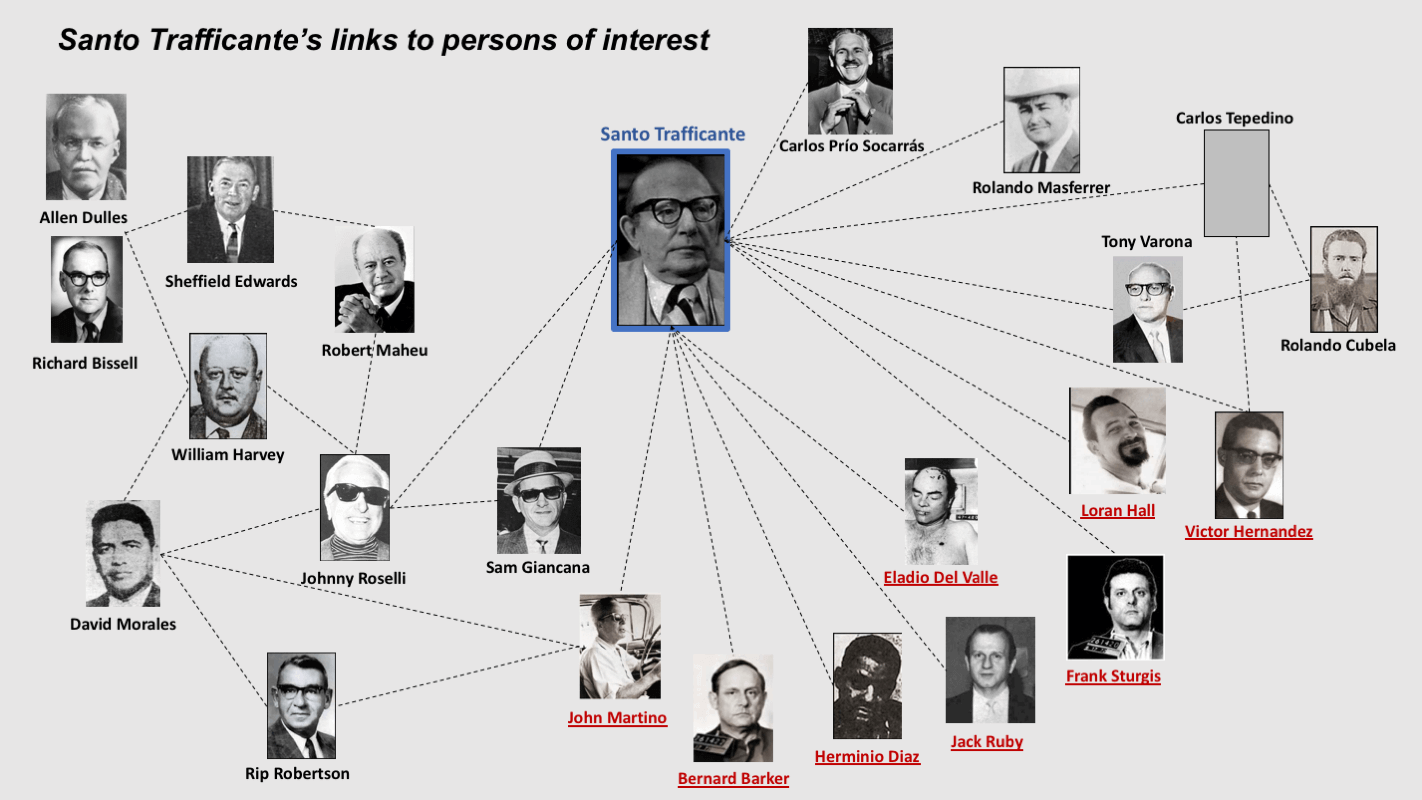
    In my CIA and Mafia’s “Cuban-American mechanism” article, the chart below is used to showcase Santo Trafficante’s links with CIA, Mafia and Cuban exile persons of interest. Of particular interest are the persons with their names in red: No fewer than six for certain and two plausibly are directly involved in the Oswald set-up, murder or cover story and also are connected to Trafficante. The Trafficante, Roselli, Harvey, Morales, and Robertson links should also stimulate a lot of research:
    Also in this article, readers can inspect a table that singles out David Atlee Phillips as a person of extreme interest.

    In all, Oswald and Phillips shared 23 touch points—20 of which took place within the year in and around the assassination. It is simply impossible to ignore this number of connections between a CIA officer and a lone drifter!


    The Phantom Plot in Nashville, May 1963

    After reading the Previous Plots article, researcher Frank Cassano sent me information about another plot that failed in Nashville which had been covered by Bill Adams in 1993 for The Fourth Decade:

    Synopsis of Assassination Attempt Against JFK, May 18, 1963, in Nashville TN

    A few years ago I began looking into other assassination sites as well as other potential assassins and potential patsies. I was able to track a potential JFK assassin to the general area (Knoxville, TN) of a planned JFK motorcade in May of 1963. The trip was altered prior to the actual day of the trip and JFK instead made a visit to Nashville, TN. His visit, on May 18, 1963, included several motorcades.

    In early 1992 I was shocked to see a tabloid print a story about an assassination attempt against JFK during the Nashville trip! Congressman Bob Clement of Tennessee had made a startling revelation. He said his father, the late Gov. Frank Clement (governor of Tennessee in 1963) told him of a strange incident while JFK awaited a helicopter after visiting the Governor. The tabloid quoted Congressman Bob Clement of Tennessee as stating, “While the President waited for the helicopter, a man approached with a gun hidden underneath a sack. Secret Service agents spotted him and grabbed him”.

    I called and interviewed the congressman in the early summer of 1963. I also obtained actual Nashville news stories about the congressman’s revelation in January of 1992. As a result of reading the news stories and talking to Congressman Clement, I have been able to piece together the following story:

    President Kennedy arrived in Nashville on May 18, 1963. He rode in a motorcade to Vanderbilt University where he gave a speech outside in the football stadium. JFK left the stadium in another motorcade and drove to the governor’s mansion. Somewhere between the Governor’s mansion and the helicopter landing site at Overton High School, a man approached JFK with a handgun under a sack. It is unclear whether JFK was in his limousine or not at the time. The governor witnessed this event and the subsequent capture of the suspect by the Secret Service. The man was held at the High School for some time. Nothing more is known about the man. The Secret Service asked the governor to keep the event out of the press for fear it would lead to more assassination attempts.

    I have also found some writings about a gun found in a paper bag in the vicinity of Dealey Plaza, however the foundation for this aspect of the story is not solid.

    While this failed plot is by far the thinnest of the four looked into, it is worth noting for the following reasons:

    1. As with the Chicago plot, a suspect was picked up and released without any trace: no names, fingerprints, photos, reports, etc.
    2. The Nashville attempt, as was the case for all of the other failed plots, was revisited by neither the Secret Service nor the FBI after the JFK assassination.
    3. The Secret Service once again took steps to keep media from publicizing it.
    4. None of the four failed plots were known to the Warren Commission.

    Over and above underscoring this pattern of secrecy, it may be worth pursuing whether or not there are still files or witnesses that could shed light on the incident and the suspect. Who were the arresting agents? Are they alive? What can we learn about this suspect? Was he also communist leaning? Was he linked to the FPCC? Did he have Cuban contacts? Why was he let go? Was he at least placed on an FBI watch list? Perhaps an FOIA request would be in order.


    More on Harry Power

    In the “Three Previous Plots” article, the alternate patsy that had the skimpiest profile was Harry Power. Other snippets of information about him have since surfaced.

    Here is how Harry Power was originally covered:

    San Antonio, November 21, 1963

    Because of the code of omertà surrounding the JFK assassination, Harry Power’s story is perhaps the sketchiest of the potential scapegoat cases we will have discussed. But since no stone should be left unturned when investigating a murder, especially a president’s, it is worth identifying and earmarking for more analysis.

    Harry Power was yet another ex-marine who checked in to a Terre Haute House Hotel room in Indiana on November 25, 1963 with a long package. When he checked out, he left behind a rifle … a Mannlicher-Carcanno, according to a retired Chief of Police Frank Riddle … a Mauser, according another unidentified source.

    A United States Government Memo in 1967 describes the allegation. Riddle claimed San Antonio authorities informed him that Power was a member of the Young Communist League and an expert rifle marksman. An ex-co-worker described him as anti-Kennedy. He had held a job in San Antonio Texas in 1962.

    Riddle stated that all information had been turned over to the Warren Commission and that the rifle was taken by Secret Service agents. The Secret Service claimed to have only found out about this incident in 1965. Their key source is none other than the head of the Washington Secret Service, Chief Rowley himself, who you will recall played a key role in keeping the Chicago plot as secret as possible. The FBI did confirm, however, that the Terre Haute Police department had in fact followed up on this lead around when Riddle claimed it happened … which would indicate further Secret Service and Warren Commission complacency.

    According to Dick Russell, Richard Nagell told Jim Garrison that Power was a Trotskyite who had met Oswald.

    Given that JFK motorcaded in San Antonio on November 21 and that Power could easily be linked to that city, it is not a major leap to see similarities between Power, Oswald and the other scapegoat candidates that seem to have been lined up before the assassination. [slightly edited]

    The Indiana Rifle story had received little interest until journalist Sheldon Inkol researched it in 1993 (The Third Decade, Volume 9, Issue 5: “The Indiana Rifle,” by Sheldon Inkol) and updated his findings in 1995 for The Fourth Decade. From his research and FBI file 62-109060 JFK HQ, we can now add the following points:

    1. The rifle found in Indiana was most likely a Mauser and not a Mannlicher-Carcanno.
    2. Because of an NSF check written by Power, we know that at one time he was in New Orleans.
    3. An ex-co-worker of Power’s who was the witness Riddle referred to was Roger Dresch, who also stated that Power was a hunter who sighted a rifle with a scope at a shooting range, that he had been a paratrooper who complained about his father being an alcoholic, and who occasionally talked about becoming a hermit in the wilderness.

    According to Inkol, it is Dick Russell who first revealed the name of Harry Power in The Man Who Knew Too Much in 1992. There had been only small articles about the incident before this. Inkol credits veteran researcher Larry Haapanen, who interviewed Riddle, for having confirmed the name of Power after following up on an article in 1970.

    Dick Russell provided the following to the Harry Power profile:

    A National Archives document about the affair was declassified in 1970 … a file reports that Power had been investigated in connection with the shooting attempt on General Walker in Dallas, a shooting that the WC falsely claimed to have been by Oswald and his Mannlicher-Carcano. Other files associated with the Power rifle claim that it was a 7.65 Mauser. CIA agent Richard Nagell told Garrison investigators in 1967 that Power was a Maoist or Trotskyite and “had known Lee Harvey Oswald and had been seen with him …”

    Inkol adds the following points, based on police investigations:

    1. There were no fingerprints on the Mauser.
    2. Indiana Police indicated that the hotel where the rifle was found was right across from the Democratic and Republican headquarters.
    3. According to Riddle, the FBI tried to link Power’s presence to a political rally going on the night before in proximity to the Terre Haute hotel.
    4. The editor of the Indianapolis News and the NRA, who had found out about the incident, were asked to keep it silent by authorities.
    5. Power seemed to have a troubled marriage.
    6. He had financial difficulties.
    7. He was described as a “Smart Aleck”, “Trouble Maker” and person with a warped outlook on life.
    8. He had failed at one point to get a driver’s license.
    9. He may have been from Chicago.

    According to Inkol, Frank Riddle insisted that Power was a suspect in the attempt on General Walker’s life the previous April—something the Warren Commission tagged on Oswald. In 1964, Secret Service Chief James Rowley confirmed to Riddle that the FBI and the Secret Service had files on Power.

    Inkol tempers Riddle as a source as he points out that some have qualified him as a “blow-hard”.

    Inkol is not convinced that Power was even in the hotel. He argues that the description given (age, height and weight) of the person with the rifle in the hotel is very different from the San Antonio description of Power.

    He believes that one possibility that merits further investigation is that he was being set up as an alternate patsy or part of a subversive pro-communist group intent on attacking the U.S. Government—who could have been pinned as the shooter from the knoll if a front shot had to be admitted to.

    He also points out that had the assassination taken place in San Antonio where Kennedy motorcaded a day earlier, the patsy might have been Power instead of Oswald.

    Inkol ends the first article with a fleeting comment about the Indiana rifle being perhaps linked to a seventh potential patsy according to David Lifton who twice interviewed the next subject we will discuss, but revealed very little to Inkol about him. I decided to contact Lifton to follow up on this tantalizing clue about yet another alternate scapegoat (not to be confused with the famous astronaut), who even without a link to the rifle is, in terms of his profile, an Oswald dead ringer!


    John Glenn

    Unlike most of the other potential fall guys that figure in this analysis, the case of John Glenn and his wife Marcia is quite well documented. This, however, has nothing to do with the FBI, CIA, or Warren Commission’s efforts to scrutinize this Oswald semi-replica.

    According to the WC, Oswald opening an FPCC chapter in New Orleans was a demonstration of his ego trip … period! Fortunately for researchers, the FPCC was under intensive scrutiny by the Internal Security Subcommittee of the Senate Judiciary Committee and the House Un-American Activities Committee (HUAC).

    Through their reports and the writings in 1993 of Jerry Rose (The Third Decade, “Red Summer of ‘63”), we can paint a better picture of Glenn and the role the FPCC came to play in making our cast of puppets easy to frame for the crime of the century.

    The FPCC was characterised as “Castro’s Network in the USA” by the HUAC. Membership within this anti-U.S. organization was described during hearings as an effective door-opener to enter Cuba via the Cuban Embassy in Mexico City and Cubana Airlines.

    Though the HUAC had been seriously rattled by the McCarthy era witch-hunts, Castro was breathing some new life into this outfit for political showcasing of American patriotism.

    One area that got their attention was the travel to Cuba by American students despite a travel ban. On June 25, 1963, 58 students left New York and transited through Russia satellite Czechoslovakia on the way to Cuba where they were apparently well received by the Castro regime. This group had been infiltrated by an informant named Barry Hoffman who had gotten approval from agencies that were tied to the FBI, CIA, and State Department. During hearings in September of 1963, he painted the students as pro-Cuba and anti-U.S.A. and talked about rumors that Cuba had not dismantled the nuclear installations on the island.

    Evidently, he was a poor spy who was not trusted by the other students. He was “number 3 on their fink list”. Numbers 1 and 2 were John Glenn and his wife Marcia.

    On November 18, 1963—four days before JFK’s assassination, the Glenns’ testimony before the HUAC had the effect of smearing the FPCC. Transcripts of the hearings point out striking similarities with Oswald:

    John Glenn joined the U.S. Air force in 1950.

    While in the service, Glenn received training in the Russian language at Syracuse University and became a Russian linguist for Air Force Intelligence, with security clearance for secret, top secret, and cryptographic information. Meanwhile, he continued his regular college studies through night school and correspondence courses. Glenn, while still receiving regular military service pay, including food and housing allowances, returned to full-time studies at the Indiana University where he obtained a degree in business administration in January 1954.

    He then resumed active duty with Air Force Intelligence for 2 more years, including 16 months overseas, before being discharged in January 1956, after reaching the rank of staff sergeant.

    During the summer of 1958, he visited the Soviet Union, Czechoslovakia, and Poland for about 40 days as a guide for the Tom Maupintour Associates, an American travel agency. The next summer he toured the same countries, plus Yugoslavia and Rumania, in a similar capacity for another travel organization.

    The witness confirmed information obtained through an investigation by the Committee on Un-American Activities that he had traveled to Mexico in the spring of 1962 in an attempt to get a Cuban visa. He was unsuccessful.

    It was at about this time, the fall of 1962, Glenn told the subcommittee, that he joined the Fair Play for Cuba Committee. He had been a sympathizer of the group much earlier, he said. He admitted having written a letter printed in an Indiana University publication, dated February 10, 1962, in which he said that “the people in Fair Play are willing to argue to anyone who will listen that our government and our press are lying through their teeth [about Cuba].”

    The witness admitted that, without having applied for U.S. validation, he traveled to Cuba with the group of alleged students who departed from New York on a BOAC plane on June 25, 1963. Glenn acknowledged the accuracy of the subcommittee’s information that on the return trip, after arriving in Spain with the main body of U.S. “students” on August 26, 1963, he left the group and traveled to Morocco. He said that after he and his wife had learned they could stay abroad for a while, they had decided to travel to Algeria to observe the political developments there, which were supposed to be similar to what they had witnessed in Cuba.

    When the Glenns arrived in Morocco from Spain, the witness testified, they received an entry permit to Algeria from the Algerian Government. While hitchhiking their way to Algeria, however, they were arrested by the Moroccan police and ordered deported to Spain as undesirables. He said he learned from both the American consul in Rabat, Morocco, and the Moroccan police that the deportation was ordered by the United States Government.

    On October 15, 1963, according to investigation by the Committee on Un-American Activities, Glenn reported to the American Embassy in Madrid, Spain, that he and his wife did not have a ticket for return transportation to the United States. The embassy purchased a ticket for them, and they were flown to the United States on an Iberian Air Lines plane.

    Their landlord testified that the Glenns possessed communist literature, including The Militant, which Oswald also subscribed to, that connected them to the Socialist Worker Party and its affiliate YSA.

    In his article, Jerry Rose speculates that “given the possibility that Glenn was connected somehow with a rifle in Indiana which was believed to be related to the assassination, it is possible as well that Glenn, like Oswald, was being groomed as pro-communist patsy if Oswald for any reason did not work out in the role.” Rose advances that Glenn’s forced return and appearance before the HUAC suggest (but do not prove) control from high places … an interpretation he felt at the time that was worth pursuing.


    David Lifton

    When I first reached out to David Lifton through some of my contacts who know him, I was a bit apprehensive. But after some email exchanges, David Lifton generously shared some of his observations.

    Here are the preliminary questions I sent David:

    1. Can you summarize when the interviews took place, where, how long they lasted, who was present?
    2. What led you to want to interview Glenn in the first place and how did you set them up?
    3. What were the topics covered and what were the main things he had to say and that you observed?
    4. Glenn’s learning of the Russian language, links to the FPCC, the way he entered Morocco and came back. Some point out the similarities to Oswald and the fingerprints of intelligence—what did your interviews (and other research) bring out in this area?
    5. Inkol mentions that you said that Glenn had a link to the Indiana Rifle (which is the one that links to William Power I believe). Can you discuss this?
    6. Do you think Glenn was being set up as a potential patsy?—please explain.
    7. You mentioned you knew about William Power. How? and if you do read my article, you will see that what I have on him is quite thin (I have found a few more bits of information that I will add). If there is anything you can add I would be most grateful.

    Without going into details, David’s preamble to answering my questions deals with how the passage of time and moving his office unfortunately cloud his recollection of his meetings with Glenn. What follows here are his responses:

    So… that having been said, and based on current recollection.

    RESPONSE TO Q1-3: Glenn’s name came up in connection with my embarking on a comprehensive search of all print (i.e., newspaper) coverage of the JFK assassination, using a set of microfilms I purchased from University Microfilms in Ann Arbor, Michigan.

    I believe that it was the San Antonio papers—either the San Antonio Light, or the News—Express (there were only two San Antonio papers) —that carried stories about what happened on 11/21/63. About a “mystery car” parked at a curb, and some remarks made by one of the occupants of that car, to the effect that “He’ll never get through this city.” Something like that. That led to the San Antonio Police dispatcher putting out a call for that vehicle to “call in to your headquarters” or some such thing. Then, 24-36 hours later, after JFK was assassinated in Dallas, this incident (call it the “San Antonio incident”) then resulted in significant “follow-up” coverage, and that led to the name John Glenn and the story of the San Antonio rifle, linked to the Indiana (Bloomington, IN, I think) rifle.

    Anyway, I clipped those stories, then obtained the House (or Senate? not sure) hearings that took place on or about Nov 18, 1963, at which Glenn testified, as I recall.

    With that as background, I then sought contact with Glenn, who—I somehow learned—lived in Venice, California.

    My first meeting with Glenn was at the UCLA Student Union. What I remember is that it was dark outside, and the SU cafeteria was crowded, and that was how I met him.

    I questioned him closely and established—to my satisfaction (again, “as I presently recall”) —that he did not fit the profile of an “alternate” patsy because there was no evidence whatsoever that there was any third party in his life influencing where he was living, or what he was doing, or asking him to do anything.

    Of course, I was disappointed in the result, but that’s what I found.

    Subsequently, when Robert Sam Anson (who I came to know) was writing about the JFK assassination (for Esquire, I think), he wanted to follow-up on this. Again, as I recall. And, again, as I recall, the two of us actually went to John Glenn’s Venice apartment and spoke with him.

    I do not remember the details at all. What I do remember is being in John Glenn’s apartment, and having the sense that he was “just like Oswald,” something like that. I believe I had that sense because he had either a poster of, or paraphernalia connected with, The Militant. Again, I don’t remember. What I do remember is the UCLA Student Union “first meeting” and my sense of disappointment that my

    hypothesis wasn’t panning out.

    RESPONSE to Q4: See answer to Question 1. FYI: I kept a very imperfect “journal” of my daily work; and I would often write letters home, but I don’t believe they would have contained any relevant information.

    Anyway, that material is stored “elsewhere.”

    RESPONSE to Q5: I believe that the “primary source” for these “links” comes from the San Antonio newspaper coverage—again, I was using microfilmed records of the S A Light and/or News Express for the period 11/20 —11/25/1963.

    RESPONSE to Q6: That was my hypothesis, but what I remember is being (very) disappointed that my questioning of him failed to unearth any supporting data. (Could he have been deceiving me? I suppose he “could have,” but I’m pretty confident that I was not being fooled, and that he was who he “appeared to be.”)

    RESPONSE to Q7:

    1. Please send me the link to your article (or anything else you wish me to read) again. I’m not sufficiently “organized” to lay my hands on it at this moment.
    2. As I recall, it all stemmed from my work with the microfilmed records of the two San Antonio newspapers.

    Also, and this may be of interest to you—or maybe not—I think that some of this “San Antonio” stuff may have been covered in the Dallas Morning News in the day or two after JFK was assassinated.

    David followed up shortly after with this following point:

    P.S.  What I forgot to mention in my memo …

    That the San Antonio newspaper (one of them) reported after the assassination of JFK on Friday 11/22/63, that the “mystery car” was a Secret Service vehicle.

    And that’s what made the whole incident so very important.


    Harry Dean

    Harry Dean is one of those characters I put into the category of unreliable witnesses who may have important knowledge, but that have made many statements that are easily contestable and that have had researchers chasing their tails. Unfortunately, in the JFK assassination soap opera—we are faced with a whole slew of personalities who mislead yet can sometimes be decoded to a certain degree. Frank Sturgis and Gerry Patrick Hemming come to mind, as they along with others tried to send HSCA investigator Gaeton Fonzi and other researchers on wild goose chases. They nevertheless give us a better picture of the decadent setting Oswald immersed himself in.

    When dealing with such characters, without fully dismissing them, it is prudent not to waste much time on them and only go with what can be corroborated.

    Before reading some of Dean’s forum posts, I looked at what other researchers had to say about him.

    For over 50 years, Dean made claims in letters and forums that he had been recruited, selected, and led by American Intelligence forces to take on special missions such as spying on Castro while in Cuba, the John Birch Society, and the Fair Play for Cuba Committee. Only in 2017 would he finally admit that he was not an official FBI informant.

    In a 2005 post on The Education Forum, he came up with the following claim:

    But among the widespread ‘rightist’ movement were assassin-minded persons that would take action to aid in seizing control of the U.S. government if only given the word.

    Even being tight-knit with the individuals involved, except for bits and pieces of confusing information I failed to timely detect a clearer picture of the real and more subtle plot to kill the president … the plan move relentlessly … but a ‘need-to-know’ method of secrecy was being applied among my radical associates.

    When the name of a Fair Play For Cuba Committee communist was broadcast throughout the rightist circuit after the airing of an August, 1963 radio program from Station WDSU, New Orleans, Louisiana, Lee Oswald was ‘selected’ by another of our {JBS} associates, retired U.S. Army General E.A. Walker of Dallas, Texas.

    The subject was chosen by ‘Guy” Gabaldon as ‘the fall guy’ in the secretive plot against Kennedy. None of us objected, and found it humorous to frame a communist. I quietly considered it as goofy as the weird, but hazy, arrangements to kill the president.

    When Kennedy visited Mexico City in late June of 1962, Gabaldon, in league with some rightist Mexican Federal Police Officials, was set to shoot president Kennedy. Only a last minute escape problem aborted that assassination scheme … Two other of our associates … Lawrence John Howard—aka Alonzo Escruido, and Loran Eugene ‘Skip’ Hall—aka Lorenzo Pacillo, were dispatched by Gabaldon to enlist Oswald in {a phony CIA, Central Intelligence Agency set-up} at Gabaldon’s Mexico City area office.

    General Walker did not orchestrate the assassination, nor the framing of Oswald! Nor did the Mafia, the Cuban exiles, Birchers, etc. Walker could not have organized the weakening of security, the botched autopsy, the Mexico City Oswald imposter episode, the Warren Commission failures, the propaganda offensives. The framing of Oswald began before he left Dallas for New Orleans.

    This goes a long way in explaining why some have suggested that I not include Dean in a comparative analysis of potential patsies.

    However, when researching the documentary trail about Harry Dean on the Mary Ferrell site, as well as on forums and websites (see: https://sites.google.com/site/xrt013/harrydean) that provide an in-depth analysis of Dean’s statements and pertinent documents—we can nevertheless find information about the FPCC, Dean himself and other characters that seem to be part of a model:

    A 1962 Los Angeles FBI File reveals the following about Dean:

    LAX advised Chicago FBI office about phone conversation which Harry had with SA William J. McCauley.   During that phone conversation, Harry “confided that he had been an informant for the Chicago Office, having been a Secretary of the Chicago chapter of the FPCC, but that largely because his wife had become very upset over his activities on behalf of the FBI, he had discontinued his informant activities and had come to the LAX area about one year ago, and is now employed as a plasterer operating out of the Union Office on Vermont Avenue, Los Angeles. He added that he has, since his arrival in Los Angeles, had casual contact with Edgar and Marjorie Swabeck, whom he had previously known in the Chicago area, and from them has learned that Marjorie Swabeck is secretary of the LAX chapter of the FPCC at the present time. He said that he otherwise has taken no particular interest in the FPCC, and that while he himself is personally not averse to resuming informant activities in behalf of the FBI, he hesitates to do so because of his wife’s feeling in the matter. The Chicago Office is requested to verify and furnish a brief summary of the subject’s background, particularly his activities as an informant and his reliability while known to the Chicago office.”

    Another L.A. 1962 FBI file goes on further:

    SAC Chicago to SAC LAX

    Dean first called the Chicago Office in August, 1960, to report that he had been elected Recording Secretary, Chicago Chapter, FPCC. He did not divulge his name and address at this time. Later in the same month he called this office, stating his name and advising he was residing at 1540 Central Avenue, Whiting, Indiana, and that he owned his own business, the Whiting Plastering Company. He told of his connections with the FPCC, furnished information concerning the leadership of this organization, and said he would be amenable to an interview with an agent of the FBI.

    The Indianapolis Office conducted an inquiry in Whiting, Indiana, in September 1960. Detective Captain Edward Grabovac, Whiting, Indiana Police Department, advised that Dean, whose real name he believed to be Gordon Hunt and who had used the name George R. Baker, had skipped town and the Whiting PD had a warrant for his arrest on bad check charges. Grabovac said Dean was a self-employed plasterer.

    The Whiting, Indiana PD procured an identification record from the Detroit, Michigan PD under FBI #4657880. This record revealed that Dean had been committed as a mental patient in Canada in 1948 and was sentenced at Chatham, Ontario, for breaking and entering to ‘one year indefinite’. At this time, Dean had one arrest by the Detroit PD for disturbing a religious meeting and two arrests for using indecent and obscene language.

    He was also AWOL from Fort Knox, Kentucky in 1949. In December 1960, Dean again called this Office to report that he had been residing in Detroit for the past two months. At that time he said he was living in Chicago but he refused to divulge his local address. He continued to telephonically contact this office on several occasions until June 1961.

    He furnished information concerning Cuban nationals connected with the 26th of July Movement and on local persons connected with the FPCC. He was last contacted by two agents of the Chicago Office on June 7, 1961, at which time he was told that this office did not desire his assistance. Former CG___-S advised in August 1960, that Dean was a white male, age about 25 (in 1960), stocky build and black hair. While Dean voluntarily furnished info to the Chicago Office over a period of nearly a year, he was never considered a PSI or informant by this Office.

    Even though Dean does not seem like a highly prized asset for the FBI, the paper trail on Dean also confirms the following: Dean had been committed as a mental patient in Canada in 1948 and was sentenced at Chatham, Ontario.

    An OSI file (NARA Record Number: 104-10404-10041) confirms that Harry Dean was in the U.S. Army in 1945 and then again in 1948 using the name George Robert Baker and that the Office of Naval Intelligence has three files on him. It also states that he had been arrested by the RCMP and the Detroit Police under the Registration Act.

    In 1958 he became a member of the 26th of July Movement, a group led by Fidel Castro.

    In late 1959 and early 1960 he received three letters from Juan A. Orta, the Director of the Prime Minister’s Office of Cuba.

    He visited Cuba in June 1960.

    In August, 1960, he had been elected Recording Secretary, Chicago Chapter, FPCC.

    He soon after became a voluntary informant to the FBI (who nevertheless considered him a Fruitcake).

    In 1961, he moved to Los Angeles, where he had casual contact with Edgar and Marjorie Swabeck, whom he had previously known in the Chicago area, and from them learned that Marjorie Swabeck is secretary of the LAX chapter of the FPCC at the present time. (Which perhaps brought him into the realm of Vaughn Marlowe and Richard Case Nagell).

    In 1962 he joined the John Birch Society.

    He also claims to have known Larry Howard and Loran Hall whose names come up with respect to the assassination, and he warned the Los Angeles FBI about a plot to murder JFK that emanated from General Walker which was discussed during a John Birch Society meeting where Oswald was identified as the patsy.

    In one of his posts Dean states that the Swabecks may have been setting him up. The NARA documents do confirm a relationship that would have begun in 1960 when Harry met Edgar Swabeck during his travels to Cuba. According to Dean they played a role in getting him to set up the Chicago FPCC branch.

    By 1961, the Swabecks were now part of an L.A. FPCC chapter when Dean reconnected with them. They tried once again to involve him in the FPCC. It would not be a great leap to conclude that the Swabecks probably knew Vaughn Marlowe.

    Edgar Swabeck’s father seems to have been Arne Swabeck, one of the founding members of the Communist Party in the U.S. In the late 1920s, he was expelled from the party as a Trotskyist and worked together with James P. Cannon and other American Trotskyists to create the Socialist Workers Party. Swabeck visited Leon Trotsky in his exile in Turkey in 1933. He made a cameo appearance in the movie Reds. He was also reference person for The Militant, published by the SWP.

    It is also worth asking: If the murder had taken place in L.A., would a link to the cast of FPCC characters have also caused the downfall of the SWP which was very close to the FPCC management in L.A.?


    Potential patsy analysis: a new perspective

    When I completed the first article, I felt we could deduce that the subjects discussed where being actively groomed to become patsies; in other words, that operatives maneuvered easily discarded freelance assets or other malleable figures into assuming weaponized, pro-Castro and/or communist, anti-Kennedy misfit personas, and placed them in the proximity of the kill zone with abundant incriminating evidence. The string-pullers were also fully prepared to pounce with propaganda initiatives to put the blame of the assassination on Castro! While this seems to fit well—admittedly to varying degrees—in the cases of the first seven subjects profiled, the analysis of our two latest characters suggests something similar but with certain caveats.

    In the cases of Dean (pending more research) and Glenn, we can state that the credentials are also very suspicious, but that certain elements fit less well the claim that they were being groomed to take the fall: Their FPCC links predate when the winning stratagem was being mapped out, which arguably had its origins no earlier than when the ZR/Rifle (executive action) architect and disgraced CIA officer William Harvey met with mobster John Roselli in late Winter 1963. It was after these meetings that definite attempts on JFK’s life began multiplying and that the subsequent incriminating behavior and travels of Oswald, Nagell, Lopez, Vallee, Power and Garriga were too well timed to be considered mere coincidences.

    So how we interpret the profiles of Dean, Glenn, Nagell, and Marlowe with respect to their FPCC links needs to be more nuanced. While we cannot state at this point that they were maneuvered into joining the FPCC in order to be groomed as patsies, their connections to this organization, which was being heavily infiltrated by intelligence, when combined with their other traits, are nevertheless very telling and more in line with the role of informants who had patsy credentials. Some of the other subjects required fine-tuning of their personas and logistical maneuvering in the months leading up to the hit. The analysis of all the candidates on the short list bolsters the case that a cash-strapped Oswald did not leave his young daughter and pregnant wife in the lurch so he could pursue his ideological dream of opening an FPCC chapter in one of the most hostile places imaginable towards this dwindling organization.

    Senator Richard Schweiker of the Church Committee famously stated that the fingerprints of intelligence were all over Oswald. As we can see in the updated chart, Oswald has company!

    • Eight of the nine subjects profiled are connected to cities visited by Kennedy during the six months that preceded his assassination.
    • Each of these cities were territories exploited criminally by Mafiosi of interest in the assassination.
    • At least three moved to the cities and got employment in strategically located buildings along the motorcade route shortly before the planned presidential visit.
    • Seven were ex-military.
    • Eight of them exhibited behavior that can very plausibly be linked to intelligence gathering or Cuban exile interaction.
    • Seven were directly linked to the FPCC. Seven of them had visited Mexico City.
    • Six attempted to visit Cuba, three of them successfully.
    • Seven had links to Cuban/Latino exiles.
    • Six were described as having psychological problems.
    • Seven exhibited anti-Kennedy behavior.
    • None were probed seriously by the Warren Commission.
    • Intelligence services, notably the Secret Service, kept crucial information about these subjects as well as the prior plots totally secret from the Warren Commission.

    Potential alternative patsy comparison chart

    patsies


    More on the FPCC

    In the original article, much was written to underscore just how unlikely it would be for the subjects analyzed to be involved in 1963 with a dying FPCC. The timing was not right, their profiles contrast with the students and intellectuals who were most ideologically attracted to this outfit before the missile crisis, and the opening of chapters in hostile locations like New Orleans and Miami in 1963 can simply be described as mindless … unless, of course, other stratagems were at play: perhaps its infiltration by informants, which was rampant by then, and patsy grooming ploys.

    It stands to reason that the persons in a position to lead the infiltrators and monitor their movements deserve our utmost attention and that the FPCC should be turned upside down by the research community, because when Oswald joined the failing FPCC, he was most likely on a mission.

    In this respect, John Newman’s research into the FPCC infiltration and David Atlee Phillips’ role is worth noting. From his 2013 countercoup article here are some key points:

    • In early 1961, eleven weeks before the Bay of Pigs invasion, the CIA seized an opportunity to become more actively involved in running operations against the FPCC. CIA Security Office and Western Hemisphere elements identified an Agency employee who knew Court Wood, an American student just returned from Cuba under the sponsorship of the FPCC. This opportunity to surveil Court Wood, which developed at the end of January, was irresistible in the judgment of the person in the CIA’s Security Research Service (SRS) of the Security Office who conceived and authorized the operation. That person was James McCord, the same James McCord who would later become embroiled in the (Watergate) scandal during the Nixon Presidency.
    • It is fitting that one of the Agency’s legendary disinformation artists, David Atlee Phillips, should have been in charge of the CIA’s CI and propaganda effort against the FPCC. Phillips would reappear in Mexico City at the time Oswald visited there, taking over the anti-Castro operations of the CIA station in Mexico City during the very days that CIA headquarters and the CIA Mexico City station exchanged cables on Oswald’s visit to the Mexican capital.
    • “At the request of Mr. David Phillips” wrote the fortunate CIA employee picked to spy on his neighbor, “I spent the evening of January 6 with Court Wood, a student who has recently returned from a three-week stay in Cuba under the sponsorship of the Fair Play for Cuba Committee.” The employee said that Court and his father both were pro-Castro and “extremely critical” of American foreign policy. “I’ve been advised by Mr. Phillips to continue my relationship with Mr. Wood and I will keep your office informed of each subsequent visit.”
    • What the operation tells us is that, by 1960, CIA was sufficiently interested in countering the FPCC to engage in an illegal domestic operation. The fact that controversy would follow the two men in charge, McCord in connection with Watergate and Phillips in connection with the Kennedy assassination, cause this page in CIA’s anti-Castro operations to stand out in hindsight.
    • We have in the past utilized techniques with respect to countering activities of mentioned [FPCC] organization in the U.S. During December 1961, New York prepared an anonymous leaflet which was mailed to select FPCC members throughout the country for the purpose of disrupting FPCC and causing a split between FPCC and Socialist Workers Party (SWP) supporters, which technically was very effective.
    • These tactics dramatize the lengths to which the FBI was willing to go to discredit the FPCC, whose chapters in Chicago, Newark, and Miami were infiltrated early on by the Bureau. As we will see in Chapter Sixteen, during Oswald’s tenure with the FPCC, FBI break-ins to their offices were a regular occurrence.
    • According to FBI records, on April 21, 1963, Dallas confidential informant “T-2” reported this letter to the FPCC, in which Oswald said he had passed out FPCC pamphlets in Dallas with a placard around his neck reading HANDS OFF CUBA, VIVA FIDEL.
    • Whether Oswald had stood on a street corner or not, important undercover FBI assets in New York were in motion against the FPCC during the time or shortly after Oswald wrote the letter. As we already know, the Fair Play for Cuba Committee was the subject for intense FBI and CIA interest and counterintelligence operations. A major FBI Chicago office investigation of the FPCC appeared on March 8, four days before Oswald ordered the rifle from Chicago. This study was transmitted to the CIA.
    • By picking such an organization to correspond with and carrying out actions on its behalf, Oswald—by default or by design—had insinuated himself into the gray world of the watchers and the watched.

    The SWP

    Because of the Socialist Workers Party’s strong links to the FPCC and with at least four of the subjects we have profiled, and because it published The Militant, the newspaper being clutched by Oswald in his infamous backyard photo, it is worth researching this political outfit which was considered subversive by intelligence agencies.

    In 2005, its national leader between the early 1960s to the mid 1980s, Barry Sheppard, wrote a political memoir about this organization.

    The SWP had its roots in the 1930s and was officially founded in 1938. It quickly became an active supporter of leftist causes and the maligned Labor Movement—a target of Hoover’s FBI. Its existence was marked with volatility and controversy. It was a target of the McCarthy era witch-hunts in the fifties—these flared up again under the actions of the House Un-American Activities Committee in 1960s, when a certain Lee Harvey Oswald and at least three of the alternate patsies decided to join. The SWP also supported The Nation of Islam and later Malcolm X, The Freedom Riders, Algerian Independence, Peace movements—many of the issues Kennedy haters were boiling mad about!

    It was an enthusiastic supporter of the Castro revolution:

    Reflecting our own growing confidence in the revolutionary leadership, The Militant began to carry speeches by Castro and other Cuban leaders, which were among the best popular explanations of what the revolution was doing. In one of the first speeches we published, Fidel explained that the US-inspired counter-revolutionary fronts would fail because, unlike the guerrillas of the July 26 Movement, they could never build a base in the peasantry with their program of returning the land to the exploiters. Over the next years, others on the US left also came to support the Cuban revolution, but The Militant was always the best and most consistent US source providing truthful news about Cuba and publishing the ideas of the Cuban revolutionaries in their own words.

    The SWP was very involved with the FPCC:

    We came to be part of the leadership of the FPCC partly as the result of a crisis in the organization. The original FPCC leadership was somewhat timid, and shied away from forthright defense of the revolution as it radicalized. In response, Cuban members of the July 26 Movement living in the US blocked with the SWP and some other militants, and took over the leadership of the Committee. It was while he was staying at the Theresa that Castro met Malcolm X. A few years later, I would interview Malcolm for the Young Socialist in his office at the Theresa. The revolutionary Black nationalist was attracted to the Cuban Revolution from the start and supported it until he was murdered in 1965.

    When Castro was refused lodging during his New York U.N. visit in 1960, he received support from the SWP:

    Castro declared that the delegation would camp out in Central Park. Berta Green, a member of the SWP who was also the Executive Secretary of the Fair Play for Cuba Committee (FPCC), got in touch with the Hotel Theresa in Harlem, which agreed the Cubans could stay there.

    Sheppard’s memoir shows that the SWP was much larger than the FPCC when he describes protest mobilization during the missile crisis in 1962:

    We stood up to it. The PC discussed and approved the thrust of a statement to appear in the next issue of The Militant. It ran under the headline, “Stop the Crime Against Cuba!” We alerted SWP branches and YSA chapters that night to mobilize to support the broadest possible actions against the threat. In New York, there were two major demonstrations. One was called by Women Strike for Peace and other peace groups. We joined some 20,000 protesters at the United Nations on this demonstration. Then the Fair Play for Cuba Committee held its own action, more specifically pro-Cuba in tone, of over 1,000 people, also near the UN.

    The following points concerning the July 1963 convention cast even more suspicion around the timing and motives of openings of FPCC chapters in the deep south by Santiago Garriga and Oswald and the continued involvement with the FPCC by the other subjects:

    At the convention, a meeting of pro-Cuba activists discussed the situation in the Fair Play for Cuba Committee. Cubans living in the United States who supported the July 26 Movement had helped us build the FPCC. Now most of them had returned to Cuba. In most areas, the FPCC had dwindled down to supporters of the SWP and YSA. Since we did not want the FPCC to become a sectarian front group, the meeting decided to stop trying to build it. The FPCC then existed for a while as a paper organization, until the assassination of President John Kennedy dealt it a mortal blow.

    Sheppard’s account of the SWP reaction when the Kennedy assassination was announced is noteworthy:

    We were listening to the news when the announcement came. I said, “I hope it’s not that nut who tried to join the party, that guy who is a one-man Fair Play for Cuba Committee chapter in New Orleans.” Imagine how I felt when it turned out he was the one charged with the act. The SWP and YSA had received letters from a Lee Harvey Oswald, asking to join. His letters, as I remember them, were politically confused, and the photo that was sent with them was strange. In it, the person who was supposedly Oswald held copies of The Militant and the Communist Party’s Worker. He also sported two or more rifles and hand guns sticking out of his belt. A similar picture appeared on the cover of Life magazine after the assassination. Oswald, it turned out, had posed for similar photographs holding the Communist Party’s paper and the Workers’ World Party’s Workers’ World. One look at the picture and everyone in the leadership of the party and YSA thought we were dealing with a nut or a provocateur. Oswald purchased subscriptions to The Militant and Young Socialist. But no one in our leadership thought we should accept him as a member. In any case, our policy was not to accept at-large members in places where there was no party branch or YSA chapter, for the reason that there was no real way of evaluating the applicant. The press featured Oswald’s connection with the FPCC and speculated that Castro or some unspecified “reds” were behind the assassination. We were a potential target because we were well known as supporters of the Cuban revolution …

    The New York Daily News, attempting to fire up the atmosphere against the left, stated in an editorial: “The fact remains that Oswald was a Marxist and proud of it. The fact remains that the Communist Party continually preaches death to imperialism, capitalism, etc. It is only natural for lamebrains such as Oswald to conclude that this means killing your enemies wherever and whenever you can reach them defenseless. Ideas have consequences.” This was all a pack of lies. As The Militant pointed out a few days later, the editorial was also an attempt to cover up the fanatical hatred that the right wing had for Kennedy, particularly because of the concessions the government was being forced to make to the fight for Black rights. In Dallas during the days before the Kennedy visit, for example, the rightists had posted leaflets displaying a photo of Kennedy and the words: “Wanted for Treason.”


    Dan Hardway’s 2016 declaration

    HSCA investigative attorneys Dan Hardway and Ed Lopez co-authored a section for the HSCA’s Final Report on the CIA and LHO in Mexico City which remained classified in full until 1996. The draft, after further declassification in 2003, was published by the Mary Ferrell Foundation Press as Oswald, The CIA, And Mexico City: The Lopez-Hardway Report, and shed light on missing/ destroyed tapes and photos, Oswald impersonations, lying CIA officials and peculiar behavior by Oswald or a frame-up artist—all completely fluffed over by the Warren Commission.

    In 2016, Dan Hardway prepared a written declaration in a support of a Jefferson Morley Freedom of Information civil action which should really trouble historians who describe JFK conspiracy proponents as flakey opportunists. In his own words, here is who media and historians have chosen to snub:

    From July of 1977 until December of 1978, I was employed as a researcher on the staff of the United States House of Representatives Select Committee on Assassinations (HSCA). In that capacity I had a top secret security clearance and, during a major portion of my employment, had access to un-redacted Central Intelligence Agency (CIA) records. My primary area of responsibility in research for the HSCA was the possibility of any relationship of any nature between the CIA and Lee Harvey Oswald (LHO), with special focus on the CIA’s awareness of, and reporting on, LHO’s activities in Mexico City. Implicit in that focus was the issue of whether the evidence from Mexico indicated any operational connection between LHO and the CIA.

    My research for the HSCA also covered areas related to people of interest, including David Atlee Phillips and William Harvey, among others, and CIA assassination programs. I was also tasked with research and analysis of the response of the CIA’s Mexico City Station LHO’s trip to Mexico City and to the assassination.

    The following are some of the most damning statements made in this very important affidavit:

    • Beginning in May of 1978, the CIA assigned George Joannides to handle liaison with Edwin Lopez and me. In the summer of 1978, Mr. Joannides began to change the way file access was handled. We no longer received prompt responses to our requests for files and what we did receive no longer seemed to provide the same complete files that we had been seeing. The obstruction of our efforts by Mr. Joannides escalated over the summer, finally resulting in a refusal to provide unexpurgated access to files in violation of the Memorandum of Understanding previously agreed to by the HSCA and the CIA.
    • I did not do any research aimed at George Joannides, or his activities in 1963, because, while working for the HSCA in 1977-1978, I was not informed that he had had any involvement with any aspect of the Kennedy case and I had no basis to even suspect that he had. In researching possible connections between post-assassination stories about LHO and David Atlee Phillips, I did little, if any, research that I recall into the Directorio Revolucionario Estudantil (DRE) because, among other reasons, the CIA had firmly represented to the HSCA that all ties between the DRE and the CIA had been terminated prior to 1963.
    • … to review CIA 201 files on many of the individuals who had been sources for stories that appeared in the immediate aftermath of the assassination tying LHO to Castro or the Fair Play for Cuba Committee. I was able to establish that most of the sources of the stories were, or had been, agents or assets used at one time or another by David Atlee Phillips.
    • Before our unexpurgated access was cut off by Joannides, I had been able to document links between David Phillips and most of the sources of the disinformation that came out immediately after the assassination about Oswald and his pro-Castro proclivities. I confronted Phillips with those in an interview at our offices on August 24,1978. Phillips was extremely agitated by that line of questioning, but was forced to admit that many of the sources were not only former assets that he had managed, in the late 50’s and early 1960’s, but were also assets whom he was personally managing in the fall of 1963. Mr. Phillips was asked, but could not explain, why the information that came from anti-Castro Cuban groups and individuals pointing to Cuban connections all seemed to come from assets he handled personally, but acknowledged that was the case. Mr. Phillips also acknowledged that back-channel communication methods existed, but denied that any were used in Mexico City.
    • We have, since 1978, learned that George Joaimides was running the propaganda shop at the CIA’s Miami JMWAVE Station in 1963. It is extremely unlikely that Mr. Joannides could have occupied that position and not have known, and worked with, David Atlee Phillips. In addition, in 1963, as we now know, George Joannides was the case officer handling the DRE. In 1977 the CIA specifically denied that DRE had a case officer assigned when asked that question by the HSCA.
    • One possible inference from the known data, at this point, is that the CIA brought someone out of retirement who knew where to not let us look and he impeded and, eventually, shut down our research. His specific work in regard to my research was commended by his superior in his annual performance review from 1978.
    • In addition to being a primary source of stories about LHO in the days after the assassination, the DRE also had a highly visible encounter with LHO in New Orleans in September 1963. George Joannides’ s performance evaluation dated July 31,1963, reports that Joannides has “done an excellent job in the handling of a significant student exile group which hitherto had successfully resisted any important degree of control.”
    • David Phillips recruited a group of students in Havana to work against Castro while Phillips was serving under deep cover in Havana in the late 1950s. At the time, the group was known as the Directorio Revolucionario, or DR. Phillips was the DR’s first case officer. When the DR’s leadership fled Cuba in 1960, William Kent, who was very close to Phillips and worked with him, organized them into an effective organization in Florida, known as the Directorio Revolucionario Estudantil, or DRE.
    • In August, 1963, LEO had an encounter with DRE representatives in New Orleans. That encounter resulted not only in widespread publicity in New Orleans at the time, including newspaper articles, television coverage and radio interviews, it also resulted in the first reports trying to tie LEO to Castro after the assassination of John Kennedy. DRE released their information the day of the assassination and it was covered in both the Miami Herald and the Washington Post the next day.
    • The CIA never told the Warren Commission about their support of, and work with, the DRE in 1963. The CIA never told the Senate Select Committee to Study Governmental Operations with Respect to Intelligence Activities (the “Church Committee”) about it. The Assassinations Record Review Board (ARRB) asked the Agency about DRE. The CIA initially told the ARRB the same thing they told the HSCA: the Agency had no employee in contact with DRE in 1963. The ARRB, however, in examination of Joannides’s CIA personnel file, discovered its clear indication that Joannides was the DRE case officer in 1963.
    • In the early 1960’s, David Phillips was working at Headquarters where he, along with Cord Meyer, developed the first disinformation operations aimed at the Fair Play for Cuba Committee.
    • To summarize what we now know: the DRE originated as the DR under the tutelage of David Phillips in Havana in the late 1950’s. William Kent took over running the group, now known as the DRE, once they had fled from Havana to Miami. In his position, he was responsible to Phillips. Crozier came in to assist Kent with his workload. Kent and Crozier were not too successful with the hard-to-control group and Richard Helms gave the DRE an officer responsible directly to him, which officer was Joannides. But Joannides’s performance evaluations indicate that his immediate supervisor, prior to October 1963, was Kent. We do not know what working relationship Joannides had with Phillips either directly, or indirectly through Kent. It is unlikely that Phillips did not continue to be involved in, or at least kept apprised of, operations of a group that he had started and nurtured, both directly and indirectly, which continued to be directly active in his primary area of responsibility: anti-Castro propaganda. Indeed, it would be in keeping with what is known if he used that group in operations against the Fair Play for Cuba Committee, or that he continued to be involved in disinformation operations aimed at the group, having designed the first one.
    • After David Atlee Phillips testified a second time before the HSCA in Executive Session on April 25,1978, several staff members, myself included, sought to have the Chief Counsel recommend to the Committee that it refer Mr. Phillips to the Justice Department for prosecution for lying to Congress.
    • On September 16, 1963, the CIA informed the FBI that it was considering action to counter the activities of the Fair Play for Cuba Committee (FFCC) in foreign countries. In New Orleans, on September 17,1963, Oswald applied for, and received, a Mexican travel visa; on September 27, Oswald arrived in Mexico City. On that day, and the following day, Oswald, or someone impersonating him, may have visited the Cuban Consulate. On those same days, the Mexico City CIA Station was testing an impulse camera in their photo surveillance operation aimed at the door of the Cuban Consulate. Sometime in late September Phillips left Mexico City on a temporary duty assignment at CIA Headquarters. It is at this time that Phillips was promoted to chief of anti-Castro operations in Mexico City—the Cuba desk. On October 1, the Mexico City Station sent bulk materials to Headquarters.

    Dan Hardway’s state of mind can be inferred by the open-ended questions he poses near the end of his declaration:

    • Were the promotions rewards for a successful disinformation operation aimed at the FPCC in New Orleans, an operation that the Agency thought it could export to Mexico? While TDY, did Phillips meet with Kent at HQ? Did he meet with Joannides in Miami? Did they review the results of a disinformation and “dangle” operation they had just run in Mexico City?—their first attempt to export the successful domestic anti-FPCC disinformation operation? Did they review the production from the impulse camera? Was that camera’s production the “bulk material” in the pouch? We don’t know the answers because the questions were never asked; George Joannides shut down the HSCA investigation into this area before this level of detail could be discovered and connected. Given all this, a reasonable researcher has to ask whether the Oswald visit in Mexico City was part of an intelligence operation that had both counterintelligence and propaganda purposes? It also, in this context, becomes appropriate to ask whether there has been an active cover-up and whether George Joannides’ undercover assignment to work with the HSCA was part of that cover-up.

    Hardway’s concluding remarks do not give the impression that he believes that Oswald was simply a drifting malcontent or a pro-Castro ideologue, and that Joannides and Phillips could be counted on for knowing what really happened:

    • In regard to the issues of 1963 there would be great public benefit to knowing whether LHO had been involved, wittingly or unwittingly, in an intelligence operation. Even without settlement of that ultimate question, additional information about what George Joannides was doing in 1963, in particular with the DRE in New Orleans, would go a long way to providing insight into that ultimate question. Similarly, being able to explore the relationship between David Atlee Phillips and George Joannides would benefit the public by either confirming or disproving vital aspects of the events of 1963.

    Conclusion

    Dan Hardway’s declaration is recent, blistering, and completely demolishes the history books’ stenographic claims that Oswald the Lone Nut killed JFK. Hardway underscores many disturbing observations that cannot be explained by mere happenstance. His position is nevertheless soft-pedalled compared to what Schweiker and Gaeton Fonzi have stated. It is now possible to go a lot farther in our deductions.

    Case comparison analysis of the potential patsies and prior plots to assassinate JFK would bring investigators to study common traits, behavior patterns, entity links, chronological sequences in order to develop a profile of the offenders. The perpetrators in this case were able to:

    1. recruit dreamy, malleable ex-marines or Cuban exiles who were drawn to the world of espionage;
    2. have access to a network of Mafiosi and Cuban exiles who shared regime change objectives and could work in proximity with the potential patsies while providing layers of separation for the decision-makers;
    3. use propaganda to create pro-Castro, anti-Kennedy, misfit, violent, and dangerous personas;
    4. lead the subjects into joining left-wing, subversive organizations, visiting Mexico City, and trying to enter Cuba;
    5. move some of them near the kill zones and cause them to behave suspiciously in visible, controversial, and timely manners;
    6. ensure a weak investigation and keep incriminating evidence secret;
    7. place the blame on communists or Castro himself with the help from friends in the media.

    Only a select few had the means to carry all this out.

    They wrote up the technique in a playbook called “ZR/Rifle” and applied it, or versions of it, a number of times in foreign countries. Some of them hated Kennedy so much that it is quite plausible that they went rogue. A few of them even admitted the existence of a conspiracy, their involvement, or their knowledge of it.

    William Harvey’s links with other CIA persons of interest, Johnny Roselli and Santo Trafficante and their network of Mafiosi, Jack Ruby and Cuban exiles who hovered around Oswald during the last months of his life, his links to the FPCC infiltration programs, travel to Dallas shortly before the assassination and role in ZR/Rifle tactics qualify him as a person of extreme interest in the coup.

    Visual data shows how David Atlee Phillips’ universe overlaps with Oswald’s through over 20 common touch points involving Cuban exiles, propaganda tools, the FPCC, Mexico City, Oswald babysitters, etc. Case linkage shows that no fewer than six of the eight alternate patsies were also marked as pro-Castro with their bizarre FPCC links, the very organization Phillips was turning inside out in his plots to counter Castro sympathizers. Throw in his lies, quasi-confessions, and his being thrown under the bus by colleague E.H. Hunt, and we have a strong case to make about who some of the leading plotters were.

    If we accept that these are some the fingerprints of intelligence that Richard Schweiker referred to, the offender profile suggests quite strongly that at least a few of the fingers the prints came from belonged to David Atlee Phillips and William Harvey! In the late 1970s, after the HSCA asked the Justice Department to re-open the case, these two suspects, and their networks of assassins, operatives and propaganda assets who have been discussed in previous articles, should have been rounded up, and would have been in a normal murder investigation. The fact that this one was presidential seems to have lowered the bar of diligence and motivation. It should still be done posthumously, for the sake of correcting what is related to unsuspecting high-school history students, and of preventing future attacks on a democracy.

    The next question we can ask ourselves, is who provided the brains and handled upper management tasks for the Big Event? The entity link diagram and a chronology analysis point so far to a group of like-minded, discarded and/or disgruntled CIA officers who were all loyal to a disgraced Alan Dulles who, after being removed from his functions by the victim, remained committed to his worldviews, well connected and a man on a mission. Stay tuned!

    Go to Part 1

  • Jim Garrison: The Beat Goes On

    Jim Garrison: The Beat Goes On


    Would Jim Garrison have been forgotten if Oliver Stone had never met the late Ellen Ray? If the reader is unaware of who Ellen Ray was let me inform you of her importance in history. (her obituary)

    Ellen Ray was the wife of Bill Schaap. They ran a publishing company called Sheridan Square Press. Sheridan Square did not just release books. They also published magazines like the illustrious Covert Action Information Bulletin and Lies of our Times. If our readers do not know about those two periodicals, it is their loss. The first dealt with the Central Intelligence Agency and its allies; the second was concerned with media analysis. They were well done and important journals.

    Ellen Ray had known Jim Garrison a long time—going all the way back to his original investigation of the John Kennedy murder in the late sixties. She always thought highly of him and his work. So when Garrison thought of writing a book on his inquiry in the eighties, Sheridan Square was one of the houses he thought of releasing it through. But before that, Garrison had had an offer from a much bigger publishing house. That deal did not go through since the proofreader the house assigned to the book was Sylvia Meagher. Now as everyone knows, this site is a sincere admirer of Meagher and her fine book, Accessories After the Fact. But as most insiders also realize, Meagher was one of the early critics who developed a phobia—some would call it a mania—about Jim Garrison and his inquiry. (The others would include Josiah Thompson and Paul Hoch.) Even someone like Jerry Policoff, who was a close friend of Meagher, once said that Sylvia should not have been assigned to review Garrison’s book: “My God, she contributed money to Clay Shaw’s defense!”

    Well, predictably, Meagher’s analysis contributed to Garrison returning his advance. But that may have been fortunate, because now he turned to Ellen Ray and Sheridan Square Press. They assigned him Zachary Sklar as his editor. Zach was a distinguished journalism professor and contributor to Sheridan’s two publications. It was a fortunate pairing. Originally, Garrison had written his book from a third person point of view. But when he met Zach, the editor convinced him that since the DA was an actual participant in the story he was telling, it would be more effective if he wrote the book as a first person narrative. I think most people today would say that was a good choice.

    On the Trail of the Assassins sold about forty thousand copies when it was originally released in hard cover. The thoroughly annotated book revealed many new things about Garrison’s investigation that most outsiders did not know about. It also exhibited Garrison’s firm grasp on the entire evidentiary record of the JFK case and also Kennedy’s place in history. Overall, it was a real contribution to the library of books on the assassination of President Kennedy.

    But what happened later was probably even more significant. At a film festival in Havana, Ellen Ray met up with Oliver Stone. She told him words to the effect: “Have I got a book for you!” Stone read Garrison’s book and decided to bring it to the big screen. He did so in December of 1991.

    But this was the JFK assassination. And it was Jim Garrison. As the DA noted in his book, there were many media critics of his inquiry. And they struck at him in what can only be called a vicious and personal manner. Some of them hid their relationships with the intelligence community, e.g., James Phelan, Walter Sheridan, and Hugh Aynesworth. Even more buried was the cooperation between these men and Clay Shaw’s lawyers. (See Destiny Betrayed, second edition, chapter 11 for an analysis of this nexus.) That sixties wave of media critics was not going to let Oliver Stone bring back Jim Garrison and the JFK case in any kind of fair or salutary manner. So they decided to do a preemptive strike on Stone’s film.

    In what was probably an unprecedented campaign in the history of American cinema, the MSM attacked the film JFK seven months in advance of its release. In fact, Ben Bradlee and the The Washington Post sent George Lardner to Dallas to write a story as the film was being shot in Dealey Plaza.

    Lardner’s article began with one of the truly snarky remarks in recent journalistic history. In watching a rehearsal of the Dealey Plaza sequence, Lardner noted that Stone had ordered up five shots in the assassination sequence. The reporter then wrote: “Five shots? Is this the Kennedy assassination or the Charge of the Light Brigade?” Through their acoustical testing, the House Select Committee on Assassinations had concluded that there were four shots fired. But as researcher Donald Thomas revealed at Cyril Wecht’s Duquesne Conference in 2003, those same sound technicians told Chief Counsel Robert Blakey that they detected five shots. Blakey told Thomas that he did not think it was possible to sell that many shots to the committee, so their report only analyzed and accepted four. In other words, this was a political decision, not a scientific one. There is real evidence that there were five shots, but somehow that did not matter to Lardner. After all, it’s the JFK case.

    Lardner’s article was the first volley in a seven-month MSM campaign that was intended to make sure that the reception of JFK was jaundiced in advance. Many of the same people who attacked Garrison back in the sixties were brought back to do so again, like Aynesworth and Edward Epstein. The fact that neither of these men was at all credible or objective on the subjects of the Kennedy assassination or Jim Garrison was irrelevant. The goal was to savage the film before it had a fair hearing. That is how radioactive this subject was, even thirty years later.

    In spite of this assault, JFK did well at the box office, both at home and abroad. It was nominated for eight Oscars, including Best Picture. But to show the reader just how nutty the anti-JFK crusade was, consider the following. On the eve of the Oscars, an anonymous author bought an ad in the trade journal Variety. The ad asked that no voters cast their ballot for the film as Best Picture. Researcher Rich Goad did some detective work and found out that the ad was paid for by the late Warren Commission counsel David Belin.

    Besides bringing the Kennedy assassination back into the limelight, JFK was the main cause for the creation of the Assassination Records Review Board (ARRB). For at the end of the film, Stone added a subtitle revealing that the files of the House Select Committee were being kept secret until the year 2027. This created a sensation in Washington. Tens of thousands of citizens now called their representatives, sent them letters or faxed them in order to do something about this travesty. It worked. The Board was created. It was a unique agency that was made up of private citizens appointed by the president. That agency had a staff that read and researched documents that were now to be declassified. If an intelligence agency objected, that agency had to show why the document should be kept secret. This reversed the previous Freedom of Information Law, which put the burden of proof on the requester, who had to show why it should be declassified. But even today, twenty years after the ARRB closed its doors, the government is still maintaining secrecy over thousands of documents.

    That Board has a decidedly mixed record of achievement. But it did do some good work on the Garrison angle of the JFK case.   In fact, the Board even went to court with then New Orleans DA Harry Connick to salvage a file cabinet full of documents remaining from the Garrison investigation. After being shown up in the press, Connick resisted turning over the materials. But the Justice Department eventually secured the documents. The Garrison family also turned over thousands of pages that the late DA had in his personal effects.

    Garrison had always insisted that, for various reasons, he was never able to reveal most of the evidence he had secured from 1967-69. After authors like William Davy, Joan Mellen and myself went through what the ARRB attained, we had to agree. The Garrison files in the Archives today hold an abundance of utterly fascinating material on a wide array of subjects dealing with many aspects of the JFK case. Does the MSM reveal any of this to the public? Nope. One of the most embarrassing aspects of the three-week binge that the media went on last year in anticipation that the JFK files were finally going to be completely declassified was this: No one chronicled what the ARRB had already released. Which was significant. It was about 2 million pages of material that opened up new vistas on subjects like Rose Cheramie, Kennedy and Vietnam, and the medical evidence in the JFK case. Guests like Larry Sabato, Phil Shenon and Gerald Posner did not want to discuss those topics. Nether did their hosts like NBC stooge on JFK, Rachel Maddow.

    It is easy to understand why this would occur. As Upton Sinclair once said: It is hard to make journalists understand something when their paycheck depends on them not understanding it. Contrary to popular belief there is no such thing as a liberal media. In the twentieth century, and up until today, the American media has been controlled by an oligarchical class. Some authors call this class the Eastern Establishment. Some call it the Power Elite.   As sociologist Donald Gibson explained in his fine book Battling Wall Street, President Kennedy was not a part of that group. He never joined the Council on Foreign Relations; he did not join any secret societies at Harvard; he didn’t like working intelligence during World War II. He got transferred out to the South Pacific and served with a bunch of Joe Six Pack guys on what were close to suicide missions. As this author demonstrated in the second edition of Destiny Betrayed, both in the Senate and in the White House, Kennedy was opposed to much of what this Power Elite was doing abroad, especially in the Third World. (See Destiny Betrayed, second edition, pp. 21-33) After his death, the progress that he did make in the White House was largely halted, and then reversed. (pp. 367-77) Due in part to the ARRB, we know much more about these changes, especially regarding Indochina.

    Jim Garrison was probably the first critic of the Warren Commission who understood this matter. And it is probably one of the reasons the MSM decided to smear him beyond recognition. This goes on to the present day. In a recent article in a regional journal called 64 Parishes, a writer named Alecia Long decided to pick up the infernal and eternal anti-Garrison cudgel. The New Orleans Times Picayune has always liked to go after Garrison and so they are now carrying it on their web site.

    To anyone who is familiar with the territory, the first reaction is, “Oh my aching back!” The ten-page article is simply a compendium of every MSM caricature of Garrison and his Kennedy case that one can imagine—except Long does not even mention the ARRB. She only alludes to what they did in about a half a sentence. As we shall see, this was a wise choice on her part.

    The preposterous thesis of her essay is that somehow, by his clever use of the media, Garrison was able to advance his case, his cause and his reputation. She uses Garrison’s 30-minute talk on NBC as proof of this. She even opens her article by asking why NBC agreed to give the DA this platform. She does not answer her rhetorical question until several pages later. There, she finally says that in June of 1967, “NBC ran an hour-long special sharply critical of Garrison’s claims and the methods used by his investigators.” This is an understatement. Most objective observers considered the Walter Sheridan production a straight-out hatchet job. But she tries to bolster the program’s credibility by adding, “The special featured several witnesses who claimed to have been offered bribes in exchange for providing testimony damaging to Shaw.”

    What she does not note is that these so-called “witnesses” were later exposed, either in court, or by their own confessions, as being bogus. (DiEugenio, pp. 239-43) And more than one witness—for instance, Fred Leemans and Marlene Mancuso—testified as to the unethical and threatening tactics used by Sheridan for the program. It was Sheridan who fabricated these phony on-air statements by threatening and intimidating Garrison’s witnesses. Mancuso did not succumb to his bullying, so she was not on the show. Leemans did and went on the program. But both of them signed affidavits revealing the extent to which Sheridan and his cohorts would go to in order to flip Garrison’s witnesses. For example, Leemans was told, “… if I did not change my statement and state that I had been bribed by Jim Garrison’s office, I and my family would be in physical danger.” (DiEugenio, p. 240) Somehow, Long missed those statements, which gravely undermine her thesis because logically, they explain why the Federal Communications Commission decided to grant Garrison the time to counter Sheridan’s handiwork. But even at that, the FCC only gave Garrison a half hour, compared to Sheridan’s full hour, which contradicts the idea of equal time embedded in the now defunct Fairness Doctrine.

    She also questions why, when granted the time, Garrison did not answer Sheridan’s charges in more specific terms. As the DA stated throughout his Playboy interview, if he had done that, it would have given Shaw’s lawyers a pretext to move to get his case thrown out of court, since it would prejudice prospective jurors.

    With the release of Garrison’s files by the ARRB, the idea that Garrison did not have a factual basis for his case against Shaw is revealed to be utterly false. There is no doubt today that Shaw used the pseudonym of Clay Bertrand. The declassified files contain over ten witnesses who stated this was the case. It is further revealed that the FBI knew this as well. And finally, attorney Dean Andrews knew it—and lied about it.   As a consequence, Garrison never got to ask Shaw the key question: “Why did you call Andrews and ask him to go to Dallas to defend Oswald?” (DiEugenio, pp. 387-88)

    It is also now shown that Shaw lied about his association with the CIA. That association has turned out to be a long service and a lucrative one. Not only did Shaw lie about it at his own trial, the CIA continually lied about it, and Robert Blakey fell for it. In the HSCA volumes, Shaw is referred to as part of a large businessman’s contact program in the Agency. Not true. Shaw was a well-compensated contract agent from at least the fifties. (Joan Mellen, Our Man In Haiti, pp. 54-55) In the sixties, he had a covert security clearance code name that was the same as Howard Hunt’s. (DiEugenio, pp. 383-87) The CIA tried desperately to cover up these facts, even going as far as altering Shaw’s files. (William Davy, Let Justice Be Done, p. 200) The ARRB later discovered the CIA had gone even further and destroyed Shaw’s 201 file.


    (or open in a new window.)


    As the late Yale educated attorney Allard Lowenstein once said regarding the Robert Kennedy assassination: in his experience as a lawyer, people who have nothing to hide don’t hide things. Somehow, Long does not think any of this new material is relevant to any discussion of Jim Garrison today.

    In addition to this secrecy about Shaw, which hurt Garrison’s case, Long does not detail any of the other methods of obstruction that the CIA and the FBI used against Garrison. Nor does she elucidate any of the meetings that Shaw’s lawyers had in Washington soliciting this kind of aid, which ended up being bountiful. The declassified files of the ARRB contain literally scores of pages on this subject. This features interference with the serving of Garrison’s subpoenas. And further, the setting up of a special committee within the CIA to survey actions to take against Garrison before, during, and after the trial of Clay Shaw. At the first meeting of this super-secret group, James Angleton’s assistant, Ray Rocca, said that he felt that Garrison would convict Shaw in the Kennedy case. (DiEugenio, pp. 269-74) Perhaps in their quest to stop that from happening, on the eve of the trial, at least three prospective witness for the prosecution were physically attacked before they testified: Richard Case Nagell, Clyde Johnson and Aloysius Habighorst. None of these men ended up testifying. (p. 294)

    As mentioned previously, one of the most bizarre statements that the author makes is that Garrison was proficient at using the media and manipulating them for his own benefit. How anyone can make such a statement today is simply inexplicable. As authors like William Davy and myself have shown, the media utterly destroyed Jim Garrison. Before Garrison took on the Kennedy assassination, he had a promising career ahead of him as a Louisiana politician. Many thought he could have been governor or senator from the state. (DiEugenio, pp. 172-74) That career was utterly wrecked by the two-year roasting he took in the press from almost every outlet imaginable: CBS, NBC, NY Times, Life Magazine, Saturday Evening Post, to name just a few. Garrison was eventually defeated in his District Attorney re-election bid due to two sets of phony pinball kickback charges, which he defeated at trial. But the publicity weakened his position and strengthened his opponent Harry Connick, who defeated him in a close election in 1973. (See chapter 19 of Garrison’s book.) To most legal observers, Connick turned out to be a very poor DA compared to Jim Garrison.

    After Garrison was retired from the DA’s office, it took him years to recover from the ordeal he went through. At that time, people who visited him in New Orleans said he had a small office that he rented from a larger firm. This is the man who likely would have been residing in the governor’s mansion if not for the JFK case. That media manipulation Long describes did the DA a lot of good, didn’t it?

    Long is so utterly biased that she actually credits Judge Herbert Christenberry. This is the judge who threw out Garrison’s attempt to try Shaw on perjury charges after his acquittal. Today, there is little or no doubt that Shaw lied numerous times at his conspiracy trial. For instance, about his employment by the CIA, about his friendship with David Ferrie, about his use of an alias. And according to Garrison assistant Steve Jaffe, this time Garrison was not going to make the same mistake he did at the conspiracy trial. He was going to use every witness he had against Shaw.

    Judge Herbert Christenberry should never have presided over this hearing. Moreover, there should have never been a hearing in the first place. As Garrison notes in his book, the idea of a federal judge inserting himself into a state case was quite unusual, since there was a law against it. But that is what happened. Shaw’s lawyers moved to have a state case considered in federal court. (Garrison, p. 253)

    Why did they do this?

    Because Christenberry’s wife had written a letter to Shaw after his acquittal. This was also after Garrison filed the perjury charges. The letter uses the plural pronoun “we”, so it clearly describes both husband and wife’s sentiments. The Christenberrys congratulated Shaw on the outcome of the trial. They sympathized with him over what the DA had done to the poor man. They continued by saying how much better the proceedings would have been if the case had been allotted to federal court and Judge Christenberry. But unfortunately, Caroline Christenberry could not voice these sentiments during the trial for risk of being labeled prejudiced in advance. (Destiny Betrayed, second edition, p.315)

    If there was ever an attempt to solicit a case, this was it. That letter is in the National Archives today. It appears Long has never heard of it.

    This article proves the very worst about the JFK case. Everyone hoped that the declassification of the files would aid in the public’s understanding of what that case was really all about, what impact it had on the personages involved and also on American history. That will not happen with people like Long. At the end of her original essay as published in the periodical 64 Parishes, it is revealed that her piece is part of something called the “Democracy and the Informed Citizen Initiative”, which is sponsored by the Federation of State Humanities councils. The Andrew Mellon Foundation was part of the support for that initiative. In other words, the Power Elite Kennedy opposed is still thriving.

    But further, as Anthony Thorne discovered, Long made up her mind about this matter without looking at any documents. She said, “I don’t want to dig through CIA and FBI documents for the rest of my life.” She then gave the back of her hand to the myriad books on the JFK case: “I find the basic premise of many these books to be problematic and would then note [sic] take those as seriously as historical studies.”

    The books don’t matter. The documents don’t matter. Typical MSM historian on the JFK case.   Which is why her article is worthless. It is the vacuity and speciousness of work like this that helps drive readers to the likes of Alex Jones. Perhaps unbeknownst to her, Long is adding to his minions.

  • The Alex Jones Affair

    The Alex Jones Affair


    Alex Jones has been featured prominently in the news of late for a number of reasons. None of them very flattering to his cause.

    Jones has been removed from several social media sites, e.g., Facebook, Apple’s App Store, YouTube, iTunes, and Spotify. Twitter was holding out on removing him. But under pressure from the MSM and Congress, they also decided to remove him. This is probably related to the fact that Jones has been involved in several legal actions of late.

    Early last year, Jones was threatened with a libel suit by James Alefantis who owns the Comet Ping Pong pizzeria.   Jones had been pushing the wild Pizzagate conspiracy theory. A month later, Jones retracted his accusations and apologized. The same thing happened with Chobani yogurt. He accused them of employing refugees and being connected to child sexual assaults and a rise in TB. Again, Jones was threatened with a lawsuit. Again, he issued a retraction and an apology.

    But perhaps the most infamous accusations Jones has made concern the Charlottesville racist rally and the Sandy Hook shootings. In 2012, the latter took the lives of 20 first graders and 6 adults. Like Jim Fetzer, Jones took the stance that the incident was a government-backed hoax, and that the families of the murdered students were actually actors. And as with Fetzer, this accusation is wild, unfounded and easily shown to be ersatz.

    The parents’ lawsuits are based on the charge that in the five years since the event, they have been harassed and threatened by those who listen and buy into the radio and TV speeches of Mr. Jones. In fact, just recently, Jones has been accused by the lawyer for one of those plaintiffs of removing evidence from his site, Infowars, in which he did more of the same. (The Independent, August 18, 2018).

    This year, Brennan Gilmore also sued Jones. Gilmore took a video in Charlottesville of a car smashing backwards into anti-racist protestors at the 2017 Unite the Right rally. That assault killed Heather Heyer and injured almost 20 other persons. Gilmore happens to live in the city and was on the scene when it happened. He gave his cell phone video to the police and posted it on social media.

    As a result, Jones’ Infowars began to broadcast that ‘They had known CIA and State Department officials in Charlottesville … first being on MSNBC, CNN, NBC. The mayor is involved. … Everybody is a cut out.” They then insinuated that several of the participants in the operation were on the payroll of George Soros. (see this Washington Post article)

    Gilmore has stated that he has also been harassed and threatened by some of Jones’ listeners. And for the same reason. Jones accused him of being part of some kind of false flag operation in order to enable a coup against President Trump. (watch here)

    This is a complex and sensitive subject. Yes, there is the first amendment, which we all value and treasure. But as more than one writer has noted, the first amendment is not absolute. One cannot use it to harm another citizen or endanger his health and well-being. And this may be why these corporate entities heave decided to back away from carrying Jones: fear of legal exposure.

    As the New York Times has reported during his recent divorce proceedings, Jones had become a millionaire due to his radio and TV programming. His programs are distributed nationally though Genesis Communications Network to almost 100 AM and FM radio stations. It is estimated that he has about 2 million weekly viewers/listeners. The Rolling Stone estimated that he has a larger online following than Glenn Beck and Rush Limbaugh combined. (March 20, 2011)

    This site (CTKA) has reported on Alex Jones several times in the past. Our main author on that subject was Seamus Coogan. Seamus took the time to actually listen to the man’s program for hours on end and to investigate his various web sites. To say the least, when it comes to the JFK case, Jones does not review his information very well. What makes that so puzzling is that there is more good information out there on that case than almost anything else Jones covers.

    Jones is a very successful showman. No one plays the outrage card as well as he does. I saw him do this firsthand in Dallas at the 50th anniversary of the JFK assassination. Dealey Plaza had been completely cordoned off at all intersections. The police guarded the obstructed entryways. Jones had pinned up signs outside that area that accused Lyndon Johnson of killing Kennedy—he had bought Barr McClellan hook, line and sinker—and was yelling at the police guardians with his famous bullhorn. To put it mildly, I failed to see how this helped our cause.

    Jones has made millions off the exposure of his radio and TV shows and his online presence. He knows how to market products to the millions of visitors he gets each week. The reason he gets those visitors is not because of the quality of information he broadcasts. In fact, once the reader reads Seamus Coogan’s articles, he will see that Jones has very little aptitude for scholarship. That is not what he is about.

    What Jones has tapped into is the aimless skepticism that much of the public, especially youths, have about both the MSM and our political system. He often calls them discredited. Which is largely accurate. The problem with Jones is simple: So is he. It is one thing to blow apart the MSM. That is pretty easy. But with his millions, Jones could have built a true alternative to them, on the order of the late, lamented Ramparts magazine. He did not. In fact, he has failed to construct any kind of credible alternative: either in his work or his overall political philosophy. In his admiration of Donald Trump, he comes off as some kind of gadfly conservative Libertarian. One who is so maniacally pro-gun rights and NRA, that when you push the right buttons, he loses control and becomes his own worst enemy. (watch here)

    But the main problem for Alex Jones is the basis of his information. As Seamus shows, he is so scattershot in his approach and so careless in his renderings that he is hard to take seriously. Which is why he fails to offer any viable alternative.

    Of course, there is an element of national tragedy in all this. Pity the country that has to choose between Jones and CNN.

    ~Jim DiEugenio


    From the CTKA archives: Seamus Coogan on Alex Jones


  • Robert A. Wagner, The Assassination of JFK: Perspectives Half A Century Later

    Robert A. Wagner, The Assassination of JFK: Perspectives Half A Century Later


    In the Courtroom with Robert Wagner

    by David W. Mantik, MD, PhD

    February 18, 2018
    Revised August 27, 2018


    NOTE: This is my second review of Wagner’s 2016 book; the first was dated December 4, 2017.1

    My first review, and Wagner’s response to it, can be found at my website: http://themantikview.com/pdf/Wagner_Response_1.pdf2


    “German judges, very respectable people, who rolled the dice before sentencing, issued sentences 50% longer when the dice showed a high number, without being conscious of it.”

    ~ The Black Swan: The Impact of the Highly Improbable (2010), Nassim Nicholas Taleb

    “If logic and reason, the hard, cold products of the mind, can be relied upon to deliver justice or produce the truth, how is it that these brain-heavy judges rarely agree? Five-to-four decisions are the rule, not the exception. Nearly half of the court must be unjust and wrong nearly half of the time. Each decision, whether the majority or minority, exudes logic and reason like the obfuscating ink from a jellyfish, and in language as opaque. The minority could have as easily become the decision of the court. At once we realize that logic, no matter how pretty and neat, that reason, no matter how seemingly profound and deep, does not necessarily produce truth, much less justice. Logic and reason often become but tools used by those in power to deliver their load of injustice to the people. And ultimate truth, if, indeed, it exists, is rarely recognizable in the endless rows of long words that crowd page after page of most judicial regurgitations.” 

    ~ How to Argue and Win Every Time (1995), Gerry Spence

    “There is no such thing as justice—in or out of court.”

    ~ Clarence Darrow3

    “Initially, Admiral Burkley said that they had caught Oswald and that they needed the bullet to complete the case and we were told initially that’s what we should do, is to find the bullet.”

    ~ J. Thornton Boswell, Testimony before the HSCA Medical Panel (9/16/1977)4


    In my first review, twenty specific Wagner statements were taken to task. This second review raises more fundamental questions about Wagner’s overall approach, discusses a host of specific JFK issues, cites Wagner’s many logical fallacies, and (again) lists many corrupted evidence items. Wagner’s response to my first review is addressed in the text below. The plan is to also post his response to this second review at my website.

    I shall first describe fundamental flaws in Wagner’s model (the legal system), and then explicitly address Henry Wade’s personal travesties in the Texas justice system. Wade was the District Attorney who would have prosecuted Oswald. I then summarize my personal encounters with the legal system—they are consistent with Darrow’s opening quote (above). We begin with a real case.


    Incompetent prosecutors and judges in the courtroom

    The Innocent Man (2006) by John Grisham relates a case in which Pontotoc County District Attorney Bill Peterson was woefully ignorant of science and was eventually voted (by the Bennett Law Firm) one of “The 10 Worst US Prosecutors of 2007.”I have written a detailed critique of this egregious miscarriage of justice.5 Grisham describes the hostile and foolish mission of the Ada (city), Oklahoma Police Department and Attorney Peterson to solve a murder case at all costs. Peterson and the police used forced “dream” confessions, untrustworthy witnesses, and hair evidence to convict Ron Williamson and Dennis Fritz. The Innocence Project aided Williamson’s attorney, Mark Barrett, in exposing the prosecution’s far-fetched case. Frank H. Seay, a US District Court judge, ordered a retrial. After eleven years on death row, Williamson and Fritz were exonerated by DNA evidence and released on April 15, 1999. According to Wikipedia, Williamson was the 78th inmate released from death row since 1973.


    Science in the courtroom

    Based on DNA evidence, the work of the Innocence Project has led to freedom for 351 wrongfully convicted persons and the discovery of 150 real perpetrators. The Innocence Project was established after a landmark study, which found that incorrect identification by eyewitnesses was a factor in over 70% of wrongful convictions. The original Innocence Project was founded in 1992 by Barry Scheck and Peter Neufeld (of O. J. Simpson fame), as part of the Cardozo School of Law of Yeshiva University in New York City.


    Reversals on appeal

    How can we decide whether the courts serve justice and truth? Well, we can ask a simple question: What happens during appeals? Here is a startling statistic: The Supreme Court reversed about 70 percent of the cases it took during 2010-15. Among cases it reviewed from the 9th Circuit Court of Appeals, it reversed about 79 percent. The reversal rate for defendant appellants (typically the so-called guilty party) was 40 percent, compared to 20 percent for plaintiff appellants. So, given this shocking rate of reversal, we can immediately question the legitimacy of Wagner’s model for discovering Truth.

    Since Wagner is concerned about Texas courts, we shall ask this: How well is Texas doing now? According to a new study, appeals court judges in Texas have become increasingly hostile to jury verdicts in civil cases, especially when the jurors rule in favor of plaintiffs.6 The report, which examined a full year of decisions during 2010-11 by the state’s 14 courts of appeals, found that these judges reversed more than one-third of all civil jury verdicts, and that they are more likely to overturn jury verdicts that favor plaintiffs than verdicts that favor defendants.

    The Texas courts of appeals also reversed 50 percent of the jury verdicts that favor plaintiffs in consumer fraud and general tort cases, but the judges overturned only 11 percent of the jury verdicts that favored defendants. This study was titled “Reasons for Reversal in the Texas Courts of Appeal.”


    Death sentences in Texas

    In the past year, the Texas Supreme Court heard three appeals from inmates on death row, and in each case the prosecutors and the lower courts suffered stinging reversals.7

    But what about Henry Wade, the man who would have prosecuted Oswald? We also know this answer, thanks to Mary Mapes:8 “When Henry Wade Executed an Innocent Man,” in D Magazine (May 2016).9 The legendary Dallas DA ran a conviction machine that was results-oriented (i.e., not truth oriented).10 In 1954, he persuaded a jury to send Tommy Lee Walker to the electric chair just three months after his arrest. But a new look at the case uncovered one of the worst injustices in Dallas history.

    Then there are the 19 convictions obtained by Wade that were later overturned. Oswald might well have been #20.11 Here is a quotation from the Associated Press.12

    DALLAS — As district attorney of Dallas for an unprecedented 36 years, Henry Wade was the embodiment of Texas justice. A strapping 6-footer with a square jaw and a half-chewed cigar clamped between his teeth, The Chief, as he was known, prosecuted Jack Ruby. He was the Wade in Roe v. Wade. And he compiled a conviction rate so impressive that defense attorneys ruefully called themselves the 7 Percent Club.13

    But now, seven years after Wade’s death, The Chief’s legacy is taking a beating.

    Nineteen convictions — three for murder and the rest involving rape or burglary — won by Wade and two successors who trained under him have been overturned after DNA evidence exonerated the defendants. About 250 more cases [in Texas] are under review [emphasis added].

    No other county in America — and almost no state, for that matter — has freed more innocent people from prison in recent years than Dallas County, where Wade was DA from 1951 through 1986.

    Current District Attorney Craig Watkins, who in 2006 became the first black elected chief prosecutor in any Texas county, said that more wrongly convicted people will go free.

    “There was a cowboy kind of mentality and the reality is that kind of approach is archaic, racist, elitist and arrogant,” said Watkins, who is 40 and never worked for Wade or met him ….

    The new DA and other Wade detractors say the cases won under Wade were riddled with shoddy investigations, evidence was ignored, and defense lawyers were kept in the dark. They note that the promotion system under Wade rewarded prosecutors for high conviction rates [emphasis added].

    “Now in hindsight, we’re finding lots of places where detectives in those cases, they kind of trimmed the corners to just get the case done,” said Michelle Moore, a Dallas County public defender and president of the Innocence Project of Texas. “Whether that’s the fault of the detectives or the DA’s, I don’t know.”
    John Stickels, a University of Texas at Arlington criminology professor and a director of the Innocence Project of Texas, blames a culture of “win at all costs.”

    “When someone was arrested, it was assumed they were guilty,” he said. “I think prosecutors and investigators basically ignored all evidence to the contrary [emphasis added]14 and decided they were going to convict these guys.”15

    And this same Henry Wade, in Wagner’s model for Truth, would have prosecuted Oswald.16


    About majority decisions

    Wagner routinely decides an issue via majority vote.17 But as a scientist I am dumbfounded—and horrified—at the fantasy of the American Physical Society voting on whether the 2012 Higgs particle was the real thing—or merely a masquerade. In this nightmare, whatever happens to objective data?

    But can we trust the majority to be right? In Indonesia the majority would vote for Islam, but in America, Christianity would win hands down. So, who is right? How does a majority vote help us here?

    Of course, the most notorious case of science on trial occurred on April 12, 1633. For espousing “heresy,” physicist Galileo Galilei was found guilty by a majority vote under the reign of Pope Urban VIII. The Catholic hierarchy finally cleared Galileo on October 30, 1992. (This date is not a joke.) The red-hot issue now though is whether his chief inquisitor, Father Vincenzo Maculano da Firenzuola, should be tried (in absentia) for “heresy.” The Church has yet to address this issue.


    Papal infallibility

    Ironically enough, this was another majority decision! Infallibility was formally defined in 1870, but bishops Aloisio Riccio and Edward Fitzgerald dissented. Before 1870, belief in papal infallibility was not a requirement for Catholic faith. Here is a painting to commemorate papal infallibility, following the definition of 1870 (Voorschoten, 1870).

    papal-infallibility
    Right to left: Pope Pius IX, Christ, and Thomas Aquinas

    Following the First Vatican Council (1869–1870) a few Catholic dissenters arose among some Germans, Austrians and Swiss. This resulted in the formation of communities in schism with Rome, so they became known as the Old Catholic Churches. The dogma of papal infallibility is rejected by Eastern Orthodoxy. The Church of England and its sister churches also reject papal infallibility—so unanimity is surely lacking. Even a few contemporary Catholics, such as Hans Küng (author of Infallible? An Inquiry) and historian Garry Wills (author of Papal Sin) deny papal infallibility. Küng has been sanctioned by the Church, but Wills has escaped (so far).


    American history

    During reconstruction, and for decades afterwards, southern juries excluded persons of color, yet these jury verdicts of murder (typically against black men) stood unchallenged—and unappealed. This was also rule by majority, just as Wagner prefers.18

    During the Vietnam War, LBJ’s “Wise Men” persistently voted (essentially unanimously) to continue the war. Meanwhile, even the protestors on the streets knew better.19 This illustrates the logical fallacy of deferring to so-called authorities, a trait often displayed by Wagner.


    Can we trust the courtroom? Some personal experiences

    Wagner overtly admits that his model for discovering Truth is the courtroom.20 So, Wagner and I are immediately at loggerheads. My model is distinctly not the courtroom. Rather, it is science—which is very different indeed. In this review I examine where such a courtroom approach might take us, especially in Texas, but first some personal comments.

    I have served several times as an expert witness—both in physics and in medicine. I have seen my mother win a modest sum in a malpractice case (against her radiation oncologist), in which expert witnesses testified on both sides. I have been a plaintiff in a civil lawsuit against a subcontractor—in which my general contractor sided with me—but I still lost the case. I have protested two traffic tickets. In the first one, I presented my phone bill, which proved that I had not used my cell phone. Such hard evidence did not matter to the judge; I still had to pay the fine. I eventually won the second case (with a generous refund from the state of California), but only after the Appellate Court recognized the lower court’s frivolous decision. That appeal should never have been necessary, and I am still trying to get my well-deserved DMV refund. With the legal aid of Bill Simpich, I have assisted my son in a suit against his landlord, which ended in a draw.21 Based on personal experience, I can say—without a moment’s thought—that justice is oddly rare in the halls of justice. Too often, basic common sense—and even truth—are deliberately excluded. Just ask any attorney what they learned about truth and justice from their philosophy courses while in law school. They will respond with blank gazes. Instead, they are primed to advocate for the views of individuals and diverse interest groups within the context of the legal system.


    Junk science in the courtroom

    In my acerbic, online critique of John McAdams, I have summarized the (dishonest) use of fingerprints in the courtroom, with special emphasis on its abuse in the Oswald matter.22 Very recently we have learned even more about junk science in the courtroom: forensic scientists have often overstated the strength of evidence from tire tracks, fingerprints, bullet marks, and bite marks.23 This is the very same evidence that Wagner so desperately wants us to accept. It is indeed noteworthy that some of this information became known while he was writing his book, but some was even known well before that. Why did he fail to inform his readers of these remarkable new developments? And John McAdams committed the same fallacy in his book.

    To illustrate the issue about bullet grooves (which Wagner heavily relies upon in the Oswald case), consider this. In 2000, Richard Green was shot and wounded in his neighborhood south of Boston. About a year later, police found a loaded pistol in the yard of a nearby house. A detective with the Boston Police Department fired the gun multiple times in a lab and compared the minute grooves and scratches with the casings at the crime scene. They matched, he said at a pretrial hearing, “ … to the exclusion of every other firearm in the world.” So how could the detective be so certain that the shots hadn’t been fired from another gun? 

    The short answer, if you ask any statistician, is that he couldn’t. There was an unknown chance that a different gun could cause a similar pattern. But for decades, forensic examiners have claimed in court that close, but not identical, ballistic markings conclusively link evidence to a suspect—and judges and juries have (gullibly) trusted their so-called expertise. Examiners have made similar statements for other pattern-type evidence, e.g., fingerprints, shoeprints, tire tracks, and bite marks.24

    In 2009 a committee at the National Academy of Sciences (NAS) concluded that such claims were ill-founded. “No forensic method has been rigorously shown to have the capacity to consistently, and with a high degree of certainty, demonstrate a connection between evidence and a specific individual or source.” In other words, judges and juries have sent (many) people to prison (and some to their deaths) based on bogus science.25 And this is the kind of evidence that Wagner wants us to accept.

    My conclusions, on the other hand, rarely rely on majority votes. Rather, actual data are preferred, such as optical density data. And if I say that an issue has been (essentially) decided, as I do in my first review of Wagner, then that conclusion is not based upon a majority vote, but rather on fundamental scientific data. (Wagner seems unaware of this distinction, or perhaps is unable or unwilling to grasp it.) A good example, of course, is the 6.5 mm (fake) object on JFK’s frontal X-ray. It matters not a whit what so-called experts say—especially since they routinely evade the actual data. But I do care about genuine experts, such as Kodak physicists.26 For example, the phrase “optical density” does not even appear in Wagner’s book. Despite this, Wagner quickly disposes of this OD data, which was taken directly from the extant X-rays at the Archives.27 Furthermore, in Wagner’s comments about my work, this distinction (i.e., majority vote vs. scientific data) persistently eludes him. Now, because neurologist Michael Chesser, MD, has validated so many of my OD data,28 we should soon be able to separate believers in science from the post-modernists. So far, Wagner has been very careful not to comment on Chesser’s observations.


    What about Wagner’s scenario for his own Marvelous Bullet?

    He is jubilant about rejecting the Magic Bullet of the Warren Commission (WC), but then instead proposes an even more marvelous (and hitherto unknown) trajectory of his own.29 (Ironically, by doing so he leaves the notion of a majority vote in the closet—his is, after all, a highly iconoclastic speculation.) He suggests that a bullet struck JFK’s back, then somehow (no cause is stated) was deflected upward, exited the throat, flew over the windshield, struck the curb, after which some particle found its way to Tague’s face, but then that bullet got lost. There are some problems with this:

    1. The pathologists, via probing, found only a superficial wound in the back. James Jenkins watched this probe as it indented the pleura—but did not penetrate the pleura.30
    2. The pathologists found no pneumothorax, i.e., the lung was not deflated by external air due to penetrating trauma of the lung.
    3. X-rays showed no pertinent damage to vertebrae or ribs.
    4. The WC printed photographs31 that showed the remarkable penetrating power of Western bullets fired from the Mannlicher-Carcano. These bullets were fired through 72.5 cm (29 inches) of gelatin blocks. The bullets passed through 1.5 blocks (22 inches) in a straight line, before the trajectory curved. So, in view of this remarkable stability, especially without striking either lung or bone, how exactly was Wagner’s Marvelous Bullet deflected to the throat? Did the thymus gland deflect it?
    5. No copper was discovered on the curb. So, where did the copper jacket go? The only reasonable possibility is that the copper was left inside of JFK’s chest or throat. Unfortunately for Wagner, the X-rays show no copper (or any other metal).

    But perhaps, in view of Wagner’s (likely limited) science background we should not be surprised by his indifference to these issues.

    Then there is Josiah Thompson’s alternate proposal (made in 1967 in Six Seconds in Dallas, and possibly no longer supported by him): the curb was struck by a fragment from the headshot. Wagner initially considers this option, but then ultimately rejects it (or maybe not—as Wagner seems ambivalent32), but without ever offering a detailed analysis. There are good reasons to reject it:

    1. This is the same bullet that (purportedly) deposited the 6.5 mm cross section on the back of JFK’s head.
    2. The nose and tail of this same bullet were found inside the limousine—meaning that these two (large) fragments did not fly far.33
    3. On the other hand, if a (separate) metal fragment struck the curb, it first had to fly through JFK’s head, zoom over the windshield, and alight on the curb. But we know that smaller fragments (which this must have been) do not travel very far through tissue, so why would that 6.5 mm “fragment” stop abruptly (at the back of JFK’s head), while this smaller Tague “fragment” flew through JFK’s brain—and well beyond?
    4. This same bullet (in this madcap scenario) must have produced the metal fragment trail across the top of the head. If that bullet entered at the cowlick site—as selected by the HSCA34—then it likely exited through the forehead! (After all, that trail intersects JFK’s forehead on the lateral X-ray.) But any rational WC loyalist would give up at this point—these loyalists see no forehead wound.
    5. Since no copper was found on the curb, the entire copper jacket must have been left inside of JFK’s head—or inside the limousine. But none was found in the limousine, and none is visible on the X-rays.

    Wagner’s basic premise.35

    As he argues for Oswald’s guilt, he is indeed a clone of Vincent Bugliosi.36 After “proving” Oswald’s guilt, Wagner (like Bugliosi) then uses this conclusion to insist on many other items:

    1. Oswald carried a package into the book depository.
    2. The wrapping paper fit the disassembled weapon.
    3. Handwriting analysis (more junk science) proved that Oswald ordered the weapon.
    4. Marina confirmed that Oswald owned a rifle (even though she never saw a scope).
    5. Oswald killed Tippit.
    6. Oswald shot at General Walker.
    7. The palm print (more junk science) belonged to Oswald.

    By taking this approach, Wagner’s house rests on very thin reeds indeed. Should only a few of his initial premises (of Oswald’s guilt) be refuted, his house would promptly collapse. Moreover, we know that much of the Oswald evidence is corrupted (although this is mostly overlooked by Wagner). So, if the reader can first accept Oswald’s guilt, then the remainder of Wagner’s book may appear conceivable. On the other hand, many readers will promptly be derailed by this approach—of overt circular reasoning.


    Wagner’s Grand Pronouncements

    The initial statements (at each number) are direct quotations from Wagner’s book. For each, my response follows.

    1. It is clear, however, that this record can be properly arranged in such a way that reconciliation occurs, so certain truths can be stipulated to by reasonable minds.

      RESPONSE: This is the lawyers’ approach. For this JFK case, on the other hand, I am only concerned with the truth, but never with reconciliation. Reconciliation is strongly recommended for social and political causes, e.g., racial injustice in South Africa. But it is grossly inappropriate for science.

    2. Oswald had visited the Cuban and Russian embassies in Mexico City.

      RESPONSE: It is quite unclear how Wagner decided so effortlessly that these Mexican appearances were the genuine article. Even J. Edgar Hoover knew that an imposter had played a role: “We have up here the tape and the photograph of the man who was at the Soviet Embassy using Oswald’s name. That picture and the tape [sent by the CIA] do not correspond to this man’s voice, nor to his appearance. In other words, it appears that there is a second person who was at the Soviet embassy down there.”37 According to Mark Lane (who had interviewed Marina), she was incredulous when FBI agents told her that Lee had been in Mexico from September 26 until October 3, 1963. She added that she had been in contact with Lee during that entire period.38 Moreover, a recent record release (too recent for Wagner’s book) states that the CIA had two informants inside the Cuban embassy. Each one told the CIA that neither had seen Oswald there during any of his supposed visits.39 Even if some of these appearances were by an authentic Oswald, most likely not all were—and that alone reveals fingerprints of an intelligence operation. It implies that Oswald was being framed as a patsy.

    3. It [Bugliosi’s book] is a well-done and impressive work, and I think for the most part, it’s right on the mark ….

      RESPONSE: It is merely a lawyer’s brief, with science mostly omitted. Many critical reviews besides mine40 concur with this conclusion. Bugliosi’s knowledge base (outside of politics and the law) was unmasked in my critical review41 of his Divinity of Doubt. His mistakes there are legion.

    4. Pure chance placed Oswald at the Texas School Book Depository (TSBD) in perfect position to kill the president …. Mrs. Paine made a phone call on Oswald’s behalf.

      RESPONSE: Marina said the reason she was advised by the Secret Service to stay away from Ruth Paine was that “she was sympathizing with the CIA.” Ruth Paine was asked more questions by the WC than anyone else. She failed to advise Oswald that he could have had a better job than the TSBD. Allen Dulles was a close friend of Michael Paine’s mother, Ruth Forbes Paine. Michael Paine worked for Bell Helicopter, where his stepfather had designed the first commercial helicopter. The Minox camera (a spy camera not available to the public) found in the Paine garage belonged to either Lee Oswald or to Michael Paine, so one of them must have had ties to American spies. On October 23, 1964, Hoover wrote the WC: “Making … such documents [about the Paines] available to the public could cause serious repercussions to the Commission.” Another potential scapegoat (see below), Thomas Arthur Vallee (most patsies have three names), also had a job that placed him directly above a presidential motorcade. What is the probability that two potential scapegoats were both positioned randomly above such a route?42

    5. Oswald hid the rifle because he knew it was easily traceable to him.

      RESPONSE: See my first review—most likely he knew nothing about the weapon. Imputing motive here demonstrates the logical fallacy of the argument from motives.

    6. If innocent, why would he immediately flee the depository to his room, collect a pistol, “go to the movies,” and then at the theater draw the pistol on arresting officers?

      RESPONSE: Possibly because he quickly realized that he had been set up? By this time, Oswald was likely merely trying to survive the day. He got his weapon from his room, but started walking five blocks south, probably to ascertain that he was not walking into a trap.

    7. WC members took the position on the fifth floor and could easily hear shell casings drop to the floor directly above them. This fact alone confirms that shots were fired from the sixth-floor window and that no planting … occurred.

      RESPONSE: Here we see another logical fallacy. Without a visual sighting, Wagner cannot possibly know whether the shells were dropped by conspirators or by Oswald. And hearing such shells surely can tell us nothing about planting of evidence.

    8. There is little question that Oswald killed Tippit.

      RESPONSE: So, in a few short sentences, Wagner dispenses with Joe McBride’s entire 674-page tome, Into the Nightmare (2013), which focuses on the Tippit murder. As expected, this book is not listed in Wagner’s “Selected Bibliography.” (If only McBride had known he could have saved himself years of hard labor.) On the other hand, WC counsel David Belin wrote: “The Rosetta Stone to the solution of President Kennedy’s murder is the murder of Officer J. D. Tippit.”43 If so, perhaps McBride was right, after all, to focus so intently on this case. After 674 pages, McBride does not accept Oswald as Tippit’s murderer. On the other hand, after a few sentences, Wagner finds Oswald guilty.

    9. … strong circumstantial evidence supports HSCA medical panel report findings that the Kennedy assassination research community has largely ignored.44

      RESPONSE: On the contrary—I have focused squarely on their findings; so also has my colleague, Gary Aguilar, MD. The panel’s conclusions, of course, were critically based on a single autopsy photograph, in which the panel placed the wound at the “red spot,” the same one that none of the pathologists saw! Furthermore, the camera/lens combination (which was located by the HSCA) did not match the photographs.45 Even worse, the panel was not told about this lack of provenance! The HSCA also claimed that all the Bethesda witnesses confirmed an intact back of the head. Only via the Assassination Records Review Board (in the 1990s) did we learn that this was a complete fabrication. On the contrary, these witnesses, via their words and their diagrams, reported a large posterior hole in the skull. Of course, based on my observations at the Archives (of JFK’s back), we also now know that at least one autopsy photograph must be a copy. But if one is a copy, the door is opened wide to more copies, especially that astounding photograph of the intact back of JFK’s head.

    10. … there is absolutely no corresponding explanation of what happened to that bullet upon its entering President Kennedy’s throat if it was fired from the front.

      RESPONSE: This is clearly false, as Wagner should have known from my work. Long ago, I proposed a glass shard from the windshield as the cause of the throat wound, and I offered several lines of evidence for this, including the perforations of JFK’s right cheek. The recently reported (additional) bullet in the limousine (i.e., described in the Dr. John Young document) may represent the windshield bullet. Furthermore, other bullet holes were seen in the presidential limousine (my roommate’s father is one source for these reports).

    11. … the bullet fragments later recovered from the presidential limousine were indisputably tied to Oswald’s rifle ….

      RESPONSE: This conclusion was based on the junk science of bullet grooves (discussed above). And now there is Dr. John Young’s bullet, found in the back of the limousine, whose grooves are unknown. (This Young document became public after Wagner’s book was published.) I have already cited Floyd Boring, who could not even initially recall finding these very same bullet fragments!

    12. The theory that a bullet was planted at Parkland Hospital is thus a highly interesting bit of intrigue but falls apart rather quickly ….

      RESPONSE: Of course, that bullet could have entered the scene well after Parkland, so this is another logical fallacy. See the brilliant analysis by John Hunt46 (of two bullets at the FBI that night), and also note the distinguished detective work of Thompson and Aguilar on the (sharp-tipped) bullet that Darrell Tomlinson found at Parkland.47 Wagner does not even cite Hunt’s work, and he simply refuses to accept the research results of Thompson and Aguilar. As expected, Hunt’s and Tomlinson’s names appear nowhere in Wagner’s book.

    13. There is no reasonable doubt that Oswald [alone] fired a rifle from the depository’s sixth-floor window.

      RESPONSE: If so, then why do American polls still strongly suspect a conspiracy? If Oswald acted alone, why then are his tax returns still being withheld for “national security reasons”? And, why did Gerald R. Ford, my fellow Michigan alumnus and fellow resident of Rancho Mirage,48 tell the former French president (Valery Giscard D’Estaing) in 1976 that “It wasn’t a lone assassin. It was a plot. We knew for sure that it was a plot. But we didn’t find who was behind it.”49 Even Dallas Police Chief Jesse Curry became a vocal doubter of the single-gunman theory: “We don’t have any proof that Oswald fired the rifle, and never did. Nobody’s yet been able to put him in that building with a gun in his hand.”50

      “We’ve never, we’ve never been able to prove that, but just in my mind and by the direction of his blood and brain from the president from one of the shots, it would just seem that it would have to [have] been fired from the front rather than behind,”51

    14. There is simply no reasonable evidence of Dealey Plaza assassins other than Oswald.52

      RESPONSE: So why did Admiral George Burkley, MD, refuse to admit that there had been only one shooter?53 Furthermore, Wagner initially admitted that he had overlooked my e-book, JFK’s Head Wounds, which contains a rather long discussion of frontal head shots. And what about that second arrest (of an Oswald doppelgänger) at the Texas Theatre? (See more discussion below.) During the Assassination Records Review Board (ARRB), Noel Twyman discovered a receipt for a 7.65 Mauser shell recovered from Dealey Plaza. And, of course, the first reported weapon in the depository was a 7.65 Mauser.54 Or was Oswald so skilled that he fired two weapons that day? Then, in 1975, a maintenance worker found a spent (and rather old) 30.06 shell casing on the roof of the Dallas County Records Building, facing Dealey Plaza. It appeared to have been used as a sabot slug, which can be used to fit smaller bullets into larger shells (e.g., a 6.5 mm bullet inside a 30.06 shell). Of course, we now also have Dr. Chesser’s recent observations of tiny metal fragments just inside the forehead bone (on the extant JFK X-rays)—surely Oswald did not fire that bullet. In corroboration of this forehead wound, Tom Robinson saw a tiny wound at precisely this site, as did Quentin Schwinn in a possible missing autopsy photograph.55 Immediately after the assassination, Robert Knudsen and Joe O’Donnell also saw such a hole in photographs. In view of these many extant clues, we would expect Wagner to be more circumspect about claiming “no reasonable evidence” of assassins other than Oswald.

    15. … most [doctors] have differing recollections and opinions on the critically important question of Kennedy’s head wounds.

      RESPONSE: This is surely false. Gary Aguilar, MD, and Robert Groden have convincingly shown the remarkable agreement among Parkland witnesses about the large posterior hole. And many Bethesda witnesses concur with these Parkland witnesses. My e-book lists up to eight Bethesda physicians who recalled a large posterior defect. And the recent documentary “The Parkland Doctors” (which Wagner viewed at the same time I did), provides overwhelming evidence that these doctors are still bewildered by that autopsy photograph (of the intact back of JFK’s head). For Wagner to claim that doctors had differing recollections about the wounds is disinformation, at the very least.

    16. … there can be no definitive account such that common ground can be found for all reasonable people.

      RESPONSE: Hmm, isn’t this the opposite of #1?

    17. Oswald had attempted to kill Major General Edwin Walker.

      RESPONSE: This is the logical fallacy of the a priori argument. In fact, the Walker ballistics evidence is very much in doubt. Walker himself claimed repeatedly that CE-573, the bullet fragment supposedly retrieved from the scene of the shooting, was not the fragment he had held in his hand and examined.56 Furthermore, how could Oswald miss such an easy shot, but then be so precise with much more difficult shots on November 22?57 Was he trying to miss on purpose, so as to create his own legend? Or had he practiced in the interim (between these two events)? Most likely, he had not. Between May 8, 1959, and November 22, 1963, despite diligent efforts by the FBI, no evidence was ever unearthed to show that Oswald fired a weapon during those 1,600+ days (which is even longer than US involvement in WW II).58 Moreover, Marine Colonel Allison Folsom,59 testifying before the WC, characterized Oswald (while he was in the Marines and using a Marine-issued M-1) as “a rather poor shot.”

    18. Oswald meticulously planned his act as much as he could in the few days available …. Oswald also planned his escape.

      RESPONSE: Here Wagner displays his ESP (as he often does). Since I have no ESP, it is difficult to critique this. Perhaps someone who has such ESP talents can do so.

    19. As of early November 1963, Oswald did not intend to kill the president.

      RESPONSE: How does Wagner know something that no one else knows? Did he conduct a séance—or is this just more supernatural ESP? Or does Wagner mean to suggest that Oswald killed JFK by accident? In any case, did Oswald misguidedly divulge to a fair number of individuals, well in advance, that he was planning this escapade?60 This eccentric throng includes John Martino, Silvia Odio, Joseph Milteer, Richard Case Nagell, Rose Cherami (prostitute), Adele Edisen (PhD in physiology from the University of Chicago61), and others.

    20. … Oswald hid in a theater until he was apprehended ….

      RESPONSE: Wagner fails to tell us about the second person (an Oswald doppelgänger), who was also captured by the police, and led out the rear door of the Texas Theatre—in handcuffs!62 This is the logical fallacy of availability, i.e., the use of easily available information, while ignoring other critical evidence. Furthermore, Oswald migrated from person to person while in the theatre, as if trying to reach his contact. Many would say that, rather than hiding, he made himself painfully obvious. James Douglass reports the following details, based on his personal interviews. Butch Burroughs saw Oswald’s arrest, but then saw a second arrest of an Oswald lookalike “three or four minutes later.” The latter was taken out the rear door, while Oswald was taken out the front door. Bernard Haire stood outside the rear door, and saw the double come out. In 1987, he was finally shocked to learn that Oswald had gone out the front door; before that, he had always thought that he had seen Oswald at the rear door. According to the Dallas Police Department’s official report (on J. D. Tippit), “Suspect was later arrested in the balcony of the Texas Theater at 231 W. Jefferson.”63 Furthermore, police detective L. D. Stringfellow also reported to Captain W. P. Gannaway: “Lee Harvey Oswald was arrested in the balcony of the Texas Theater.”64 Of course, the official version is that Oswald was arrested in the orchestra, not in the balcony.

    21. A fatal flaw overlooked by assassination researchers who promote the patsy theory is that framing a patsy requires that the patsy have no plausible or solid alibi.

      RESPONSE: Surely Wagner knows about the Chicago (patsy) plot against JFK.65 But a search of Wagner’s book fails to find “Chicago.” If other patsy plots existed against JFK, why is it so difficult to believe in yet one more?66 Furthermore, given the lies often told by many witnesses while under government duress (e.g., Kenny O’Donnell, Malcolm Perry, Sam Kinney67), and the FBI’s pastime of materially altering witness statements, why would Oswald even need an alibi?

    22. I have nothing to add to the question of Oswald’s motivation.

      RESPONSE: Did Wagner fail to read Oswald’s speech (July 1963) at the Jesuit House of Studies at Spring Hill College near Mobile, Alabama? In this rather private setting, where he presumably shared his real opinions, Oswald has little good to say about communism or communists, whom he describes as “a pitiful bunch.”68

    23. The Walker incident obviously revealed a murderous mindset (further on display with the Tippit slaying) ….

      RESPONSE: This is more ESP; see prior comments about Walker and Tippit, which come close to exonerating Oswald of both murders. This is the logical fallacy of the a priori argument.

    24. … there is no evidence of this third bullet.

      RESPONSE: My (University of Michigan) medical school roommate recently visited us. He reminded me that his father had worked at the Ford plant, where JFK’s limousine had been delivered shortly after the event. His father reported that several bullet holes were found in the limousine. Furthermore, we now have the newly discovered report of navy Dr. John Young: another bullet was found in the back of the limousine.69 In Wagner’s response to my first review, he admits that this could be the missing bullet. And what about the recollections of Sheriff Roger Craig: “One .45 mm slug was found on the south side of Elm Street, outside on the grass. It was lying amongst … part of the hair, and blood, and bone matter.”70 As expected, “Craig” does not appear in Wagner’s book.

    25. If the entire case against Oswald boils down to proving each and every facet of the case beyond a reasonable doubt, I have to acquit.

      RESPONSE: So be it.

    26. No evidence of any bullets not fired from Oswald’s rifle was located in the body of Kennedy or Connally, or in the limousine.

      RESPONSE: Well, what about Dr. Chesser’s recent observation of a hole in JFK’s forehead (on the X-ray at the Archives)? And what about Dr. Young’s bullet? What about the Belmont (FBI) memo (also missing from Wagner’s book) of a bullet found behind the ear?71 What about Tom Robinson’s report (to the ARRB) of about 10 bullet fragments removed from JFK’s head?72 What about Dennis David’s typed memo about four bullet fragments? What about that transparent plastic bag of bone and bullet fragments that James Jenkins saw lying next to JFK’s head during the autopsy? You will not learn any of this from Wagner. Neither Dennis David nor James Jenkins appears in the book,73 and Robinson’s account (of bullet fragments) is also missing. Wagner tried to use an argument from silence (i.e., absent evidence) but instead fell victim to the logical fallacy of the argument from silence (the fallacy that if sources are silent then that offers good proof of absent evidence).

    27. The question of an assassination conspiracy can be conclusively settled by determining whether three shots or more than three shots were fired, assuming that Oswald himself fired three shots.

      RESPONSE: What? —the first step is to assume that Oswald fired three shots? Some might suspect circular reasoning here.

    28. Wagner quotes Clint Hill: “I jumped from the follow-up car and ran toward the Presidential automobile. I heard a second firecracker type noise but it had a different sound … I saw the President slump more toward his left.”

      RESPONSE: Although Wagner seems oblivious to this paradox, it is a real zinger for him. Hill speaks loudly and clearly: he hears (and sees) JFK hit by a bullet well after Z-313.74 Unfortunately for Wagner, by this time Oswald has long since shot his wad (of three bullets). Yet Wagner (and Hill, too) overlooks this major paradox. My e-book includes an extensive review of the arguments for a shot well after Z-313. This includes documents, sketches and data tables—contained in the WC files! Many eyewitnesses also corroborate such a scenario. Wagner ignores all these ancient data sources.

    29. Wagner quotes David Powers: “ … there was a third shot which took off the top of the President’s head.”

      RESPONSE: Like virtually all the Dealey Plaza witnesses, Powers saw no head snap! Tip O’Neill added his own striking comments, which strongly suggest conspiracy.75 For what actually occurred, listen to James Altgens,76 who saw JFK struck while he was sitting erect! This is clearly not JFK’s orientation at Z-313. This issue is extensively discussed in my e-book. Furthermore, many witnesses saw JFK struck well after Z-313. (See footnote 75 in my e-book.)

    30. The president was struck in the head at frame 312.

      RESPONSE: No shot at Z-312—from the front or from the back—is consistent with the bullet trail on the X-rays. I have explored this issue, with detailed images in my Nalli critique. So far Wagner seems not to have grasped the spatial concepts in this argument.77

    31. Josiah Thompson refers to Milton Helpern, a prominent New York City pathologist, who said that if he were permitted to see the X-rays, he “would look for traces of metal indicating the presence of another head wound.” Wagner adds this: There is simply no evidence of a bullet entry wound to the front portion of the president’s head.

      RESPONSE: Of course, there was another head wound—an entry at the hairline, above JFK’s right orbit. This is discussed in detail in my e-book (which Wagner initially had not read). More importantly though, Mike Chesser, MD, has recently discovered precisely what Helpern had suggested: many tiny metal fragments just inside JFK’s forehead bone. Wagner was in the audience at Oswald’s Mock Trial in Houston in November 2017, when Chesser presented his findings. What Wagner thought about this amazing discovery (made directly on the extant X-rays at the Archives) remains a mystery.

    32. Wagner quotes the HSCA: “It is the firm conclusion of the panel members … there is no bullet perforation of entrance any place on the skull other than the single one in the cowlick area.”

      RESPONSE: This conclusion, of course, was based on autopsy photographs that had no legal provenance. Even worse, the panel members did not know this.78 Of course, we now also know that the HSCA lied about what the Bethesda witnesses saw, i.e., in fact they reported a large posterior hole in the skull, like the Parkland wound.79 Wagner never tells his readers about the abysmal provenance of the autopsy photographs. This is the logical fallacy of deliberate ignorance. Furthermore, Chesser has noted a hole in the forehead bone, consistent with the tiny metal fragments that he saw.

    33. Thus, by all appearances, Agent Frazier had possession of the pristine bullet before there was an opportunity for the FBI to fire Oswald’s rifle to recover a bullet to illicitly substitute for the alleged pointed-tip bullet.

      RESPONSE: This is merely a straw man argument—and it is unintentionally hilarious. Wagner has committed another logical fallacy—he merely assumes that the cover-up had no planning (because he is overly focused on Oswald). On the contrary, perhaps this bullet substitution was an original back-up plan, i.e., the bullet had already been prepared, so that no last-minute antics were required.

    34. There is no reasonable conclusion other than that Kennedy’s back wound—and the throat wound were the result of the same bullet.

      RESPONSE: First, many professional observers recalled that the back wound was far too low to exit the throat. Second, this is true poverty of imagination and illustrates the logical fallacy of the either-or argument (the false dilemma). As I have already suggested, the throat wound may have been caused by a glass shard from the windshield. The evidence of a penetrating hole in the windshield derives not only from four reliable Parkland witnesses (and one Secret Service witness), but also from the Ford Motor Company supervisor, George Whittaker, who received the windshield.80 Of course, neither “Whitaker” nor “Whittaker” appears in Wagner’s book. The back wound, of course, was likely caused by shrapnel from the street. Several WC witnesses reported that something had struck the street.81 Furthermore, clothing on JFK’s back—but not his front—tested positive (via low energy X-rays) for metal.

    35. If the X-rays were faked, how could they have been faked?

      RESPONSE: Wagner obviously failed to review my online JFK Lancer lecture (2009).82 These are indeed JFK’s X-rays, but they have been critically altered at precisely known sites. This omission by Wagner (again) demonstrates the logical fallacy of deliberate ignorance.

    36. As Dr. McDonnel explained to the HSCA, this almost inconceivable feat could not have occurred; the president’s head X-rays are authentic.

      RESPONSE: That is mostly true; the JFK X-rays are, after all, only altered at specific sites—but it is far from an inconceivable process, as I have shown. Unfortunately, McDonnel (who worked in downtown Los Angeles, only miles from me) died shortly before I entered the case, or we would have had a most interesting discussion about optical densitometry, which he never mentioned (and likely never considered). He was, after all, not a medical physicist. The argument invoked here by Wagner is the logical fallacy of the argument from incredulity (rejecting an argument merely because it initially appears incredible).

    37. There is no reasonable basis to claim that Zapruder was demonstrating the location of an entry wound.

      RESPONSE: Elsewhere Wagner seems to side with the HSCA, which concluded that the posterior bullet exited through the top of the skull. But here, paradoxically, Wagner seems to imply that a bullet exited through JFK’s temple. He can’t have it both ways. More importantly though, many, many witnesses reported an entry wound in the right temple. (See Headshot #3 in my e-book.) As expected, Wagner ignores these witnesses.

    38. The doctors [up to nine altogether] said they saw cerebellum tissue, which the autopsy photographs and X-rays indicate would have been impossible.

      RESPONSE: Wagner should view Figure 34A in my e-book. Even John Ebersole, the official autopsy radiologist (who does not appear in Wagner’s book), disagrees here with Wagner. Ebersole told me83 that he saw the posterior hole in the skull; he would also have agreed about seeing cerebellum, but Wagner ignores him. Wagner does not even disclose that Ebersole saw the posterior defect. This is the logical fallacy of the a priori argument (beginning with a false premise to reach a wrong conclusion).

    39. We know that the president’s body was not altered prior to the autopsy.

      RESPONSE: In that case, it is incumbent on Wagner to explain the astounding evidence for three different casket entries.84 Of course, he fails to do this. This is the logical fallacy of the a priori argument again (assuming a false premise to reach a conclusion). Wagner would have had a very interesting discussion about wound alteration with Robert Knudsen. According to Popular Photography (August 1977), Knudsen photographed the autopsy. He was deposed by the HSCA in 1978, and the ARRB later interviewed his family. His son Bob reported that his father told him that “hair had been drawn in” on one photograph to conceal a missing portion of the top-back of JFK’s head. Knudsen’s wife added that her husband saw wounds [in photographs] that did not represent what he had seen. Knudsen’s name does not appear in Wagner’s book.

    40. The autopsy doctors never wavered in confirming the authenticity of that photograph.

      RESPONSE: Well, not exactly. None of them recognized the “red spot” near the cowlick area.85 And they all placed the posterior entry wound far inferior to the red spot (where the photograph showed no wound) so how exactly does that authenticate the photograph? Furthermore, Humes (for the ARRB) oriented the mystery F8 photograph so that the large skull defect was located posteriorly. Consistent with that, even if the photograph (of the back of the head) shows intact scalp, that does not mean that the bone was intact. In fact, it is far more likely that both scalp and bone were absent. Wagner persistently evades this issue as well.86

    41. Boswell testified [a better word would be “speculated,” since he made this claim to the ARRB on February 26, 1996—about 32 years after the event] that the scalp was pulled forward to demonstrate the entry wound.

      RESPONSE: What entry wound is he citing? Surely not the “red spot.” But there is no other wound in the photograph! And why would anyone manipulate the scalp so that it obscured the critical missing tissue? Furthermore, it is absurd to believe that Boswell could have done that so seamlessly as to leave absolutely no trace of the large defect. Finally, we know that Boswell later elevated the back wound to please his interrogators—so how do we know that this odd statement (about pulling the scalp) is not just another sycophantic obeisance—made 32 years later? When asked if there was any scalp remaining in the right rear of the head behind the ear, Jan Gail Rudnicki (Boswell’s assistant) said, “That was gone.”87 He had previously told Mark Flanagan (05/02/1978) of the HSCA that the “back-right quadrant of the head was missing.”88

    42. Indeed, reliance on whatever Humes and Boswell said or represented through the years—after the night of the autopsy … is nothing short of perilous. [This statement appears in Wagner’s response to my first review.]

      RESPONSE: This is a stunning reversal for Wagner (who otherwise accepts their statements). It is totally inconsistent with Boswell’s speculation about pulling the scalp over the wound! It also negates Bowell’s subsequent elevation of the back wound. In Wagner’s reply to my initial review, he also admits that Humes and Boswell succumbed to political pressure. So why should we believe that Boswell was not again under political pressure—when he speculated about pulling the scalp over the large defect?

    43. … for many the HSCA’s expert panel was wrong.

      RESPONSE: No, they were merely misled. That is quite another matter. Wagner has just committed another logical fallacy (the false dilemma). The photographs, whose provenance was never established, had been altered to cover the posterior hole—as shown by stereo viewing at the Archives. Robert Groden (the photographic consultant for the HSCA) and I have both observed this in the photographs of the back of JFK’s head—at the Archives. Given Groden’s magnificent collection of photographs it is stunning that his name is also absent from Wagner’s book.

    44. … the three pathologists … were unaware of … a gunshot wound in Kennedy’s throat.

      RESPONSE: That is surely false. My good (now deceased) friend, Robert Livingston spoke to Humes on the telephone well before the autopsy—and specifically emphasized this fact. (Livingston testified to this—under oath—for the JAMA lawsuit brought by Dr. Charles Crenshaw.) In a telephone call with me, John Ebersole (the autopsy radiologist) stated that they knew about the throat wound during the autopsy—based on a telephone call with Dallas. In addition, a rather long list of evidence contradicts this disgraceful misstatement. (See footnote 101 in my e-book.) This can only be feigned ignorance by Wagner. Furthermore, Boswell himself admitted that they knew about a bullet-related wound to the throat (i.e., not just the tracheostomy).89 But it is even worse than that for Wagner. Richard Lipsey recalled that, during the autopsy, the pathologists speculated that a fragment had exited from the throat. This makes absolutely no sense unless they were aware of a throat wound. Furthermore, in a WC Executive Session,90 J. Lee Rankin (General Counsel for the WC) stated: “We have an explanation there in the autopsy [report] that probably a fragment came out the front of the neck …. ” What more needs to be said?

    45. Pathologists … were the only medically trained witnesses to examine the president’s body ….

      RESPONSE: This is clearly false. Wagner, as usual, has forgotten the official radiologist, John Ebersole, who told me, despite being the only physician responsible for reading the X-rays, that he saw a large hole at the back of JFK’s head. This can only be more deliberate ignorance by Wagner.

    46. Down in the morgue, the president’s casket was opened, and the autopsy began around eight p.m.

      RESPONSE: This is an astounding statement, which overlooks much contrary evidence that the casket first arrived at about 6:35 PM. Does Wagner not believe Custer and Reed that they were en route to the radiology suite on the fourth floor (to develop X-rays) when they saw Jackie Kennedy enter the lobby around 7 PM? (I interviewed Custer in person and on the telephone multiple times.) Does Wagner not believe Pierre Finck, who recalled that he arrived after X-rays had already been taken—or that Humes had called Finck at 8 PM and told him that they already had skull X-rays (and had viewed them)?91 And if Wagner accepts only one casket entry, which one is it? And then, how does he explain away the other two? Finally, he must account for Humes’s admission to the ARRB that the body arrived at about 6:45 PM.

    47. In total, O’Neill and Sibert’s 302 report lists twenty-six people in the autopsy room at some point during the night.

      RESPONSE: And none of them saw the 6.5 mm object on the X-rays? In his response to my first review, Wagner admits that Larry Sturdivan and I have been correct—that the 6.5 mm object was not a bullet fragment. However, he still argues that it was on the X-ray that night (as an artifact), but that none of these 26 witnesses saw it. This is sheer nonsense. Even my 5 and 7-year old children promptly identified it. I have already noted that John Ebersole, the official radiologist, abruptly curtailed our conversation as soon I asked him about this forgery.

    48. After he found the fragment, Harper took it to his uncle, who happened to be a medical doctor ….

      RESPONSE: Dr. Harper was not merely a doctor—he was a pathologist. Furthermore, he—and two other professional pathologists—confirmed that this Harper bone derived from the occiput, exactly where the large posterior hole existed. Of course, Wagner is reluctant to tell us what these pathologists concluded. I have spoken to one of them (Noteboom), who confirmed his initial findings. My e-book is focused mostly on this critical Harper fragment. For Wagner to minimize Dr. Harper’s role (and then also to omit the other two pathologists), in such a central issue, can only have been deliberate. None of these three pathologists (Harper, Cairns, and Noteboom) is cited in Wagner’s book.

    49. They made paper cutouts and fit four pieces together … such that one of the three fragments … was shown to have adjoined the Harper fragment.

      RESPONSE: Only three pieces (officially) arrived late in the autopsy. The Harper fragment was not present, but the large triangular piece (sometimes called “delta”) was present. However, it is pure inspired nonsense that these pieces fit together. Read my e-book (with images) about what an incredible misfit this proved to be.92

    50. Like so many aspects of this case, that four-inch error is more than a minor matter.

      RESPONSE: Of course, it was not a mere error—it was a deliberate obfuscation. Even my 5 and 7-year-old children would not have missed this. It is simply not conceivable that three trained pathologists would—simultaneously—make such a shameful error on an issue that is manifestly obvious on immediate inspection. At this point, Wagner has left the universe I know.

    51. The autopsy doctors simply never entertained the notion that an exit wound had been obscured by a tracheostomy.

      RESPONSE: So, why did Boswell tell the HSCA that they did know about the throat wound at the autopsy?93 And was my friend Robert Livingston lying when he recalled (under oath during the JAMA lawsuit) that he had told Humes about the throat wound? Was Ebersole senile when he told me about phone calls with Dallas during the autopsy? And was J. Lee Rankin fantasizing during the WC Executive Session when he noted a throat wound in the autopsy report? Furthermore, we now know that Malcolm Perry lied to the WC—he had seen an entrance wound, as recently reported by his colleague, Donald W. Miller, Jr., MD, of the University of Washington.94 In fact, Perry had previously told Robert Artwohl, MD, the same story.95 We also know that nurse Audrey Bell, a close colleague of Dr. Perry, reported her conversations with him to the ARRB.96 He had complained on Saturday morning, November 23, that he had had phone calls all night to persuade him to change his statement about the throat entry wound. Perry even initially recalled that he had spoken to Bethesda on Friday, November 22!97 Also see my first Wagner review for threats made to Perry.

    52. … the burning of the notes was nothing nefarious.

      RESPONSE: This is more mind reading by Wagner—how would he know what Humes was thinking? On the other hand, Douglas Horne has shown that three different versions of the autopsy report once existed, likely done on different dates. This is not nefarious? And, if not, why was this information deliberately kept hidden?98

    53. The FBI Director, Hoover, was interested in solving the crime.

      RESPONSE: Nothing, but nothing, could be more preposterous than this statement. Many agents afterward confessed that Hoover had only one goal—which was to indict Oswald. Furthermore, Nicholas Katzenbach issued a prompt statement (within hours of the murder) to Bill Moyers: “The public must be satisfied that Oswald was the assassin; that he did not have confederates who are still at large; and that evidence was such that he would have been convicted at trial.” Did Hoover fail to notice this?

    54. … the facts indicate that the Humes autopsy report was not fabricated after the fact.

      RESPONSE: So, why the three different (and secret) versions—with at least one written well after that weekend? Of course, Wagner does not tell us any of this.

    55. The brain was not properly examined and sectioned.

      RESPONSE: That is not what John Stringer said about the brain autopsy he attended; he recalled sections!99 And what about that report of a section of JFK’s brain at the Armed Forces Institute of Pathology?100

    56. … most of the seven members of the commission had full-time jobs.

      RESPONSE: This is all too reminiscent of the government’s investigation of the Challenger disaster. Perhaps solely due to the fearless and private efforts of physicist Richard Feynman, the culprit O-ring was exposed—on national television, no less. Feynman’s account of his detective adventures while in government land goes far to explain what happens when lawyers lead the charge. Feymann’s behavior was many standard deviations outside the usual government pattern—and that explains why the WC and the HSCA both failed so disastrously. It should always have been science, not consensus, but with layers of lawyers perpetually hovering about, the only target they could see was consensus.101 To really nail this to the church door though, think about this: Feynman—often proclaimed as the successor to Einstein—literally had to rewrite his own addendum (for the Challenger report) zillions of times before government officials found it acceptable.102 (And we know that Feynman can write just fine.) That is all you really need to know about government investigations. Naturally, the 9/11 Commission displayed the same mind-numbing mischief many times over. One thing is certain: the next government investigation (independent of political party) will surely repeat this process, which is happening even as I write. It will always be consensus—and so Wagner will always get his wish.

    57. … how could any conspirator assume that the crime could be made to look like it was the responsibility of just one shooter … ?

      RESPONSE: Here we have another logical fallacy: how does Wagner know what the goals of the conspirators were? What if they wanted the world to know that it was a conspiracy (as some have claimed)—in order to serve as a lesson to future American leaders? Their goals may well have been very different from those imagined for them—by the WC, or by researchers, or even by the media. This is simply more mind reading by Wagner. Imputing motives in this case demonstrates the logical fallacy of the argument from motives.

    58. … the medical evidence is not subject to error …

      RESPONSE: This is a truly bizarre statement, especially since Wagner admits that Boswell “corrected” his placement of the back wound (he elevated it—years afterwards, as if his memory had improved). If Wagner here refers to the photographs and X-rays (he doesn’t say), then that would be false—because both were subject to alteration in that era, which is another matter entirely. But Wagner evades the evidence for alteration, in which case his job becomes rather trivial. Here we see (again) the logical fallacy of the a priori argument, along with echoes of the false dilemma fallacy.

    59. No, a government-wide conspiracy was not responsible for President Kennedy’s assassination.

      RESPONSE: “Hoover knew that Nagell knew the CIA was planning to kill Kennedy in Washington around the end of the month. Nagell said he had secretly taped a meeting he attended in late August 1963 with three other low-level participants in the plot to kill Kennedy. He identified the three voices on the tape beside his own as those of Oswald, Angel, and ‘Arcacha’—very likely Sergio Arcacha Smith.”103

      “We have no evidence as to who in the military-industrial complex may have given the order to assassinate President Kennedy. That the order was carried out by the Central Intelligence Agency is obvious. The CIA’s fingerprints are all over the crime and the events leading up to it.”104

      “We know the CIA was involved, and the Mafia. We all know that.” ~ Richard Goodwin, former Deputy Assistant Secretary of State for Inter-American Affairs.105

    60. We should remember that even after half a century, there is still no hard evidence of a conspiracy.106

      RESPONSE: Well, if we take that tack, then there is still no hard evidence of Oswald’s guilt either. More to the point though, here is how Gregory Henkelmann, MD (a physics major and practicing radiation oncologist for 30 years) reviewed my e-book: “Dr. Mantik’s optical density analysis is the single most important piece of scientific evidence in the JFK assassination. Unlike other evidence, optical density data are as ‘theory free’ as possible, as this data deals only with physical measurements. To reject alteration of the JFK skull X-rays is to reject basic physics and radiology” [emphasis added]. Since Wagner had not read my e-book he also missed this crisp summation. Moreover, if optical density (obtained directly from the extant JFK X-rays at the Archives) is not “hard evidence” then what is?107


    Conclusions

    Although Wagner relies heavily on many of the following evidence items, they should never be admitted into the courtroom.108 Their provenance is highly questionable—or else they manifest outright corruption:

    1. Autopsy photographs
    2. Autopsy X-rays
    3. Oswald items (including the weapon and the Magic Bullet)
    4. Palm prints on the Mannlicher-Carcano109
    5. The Zapruder film110

    For many critics of the lone gunman theory (it is, after all, only a theory), the question of Oswald’s guilt is not primary. Most of us suspect instead that US intelligence was involved (with or without Oswald), so that is why we care about this case. That also explains why Wagner’s book is anathema to many knowledgeable researchers, i.e., they loathe his (probably naive) role as the currently fashionable Exculpator-in-Chief for the wayward American intelligence services of the 1960s.111


    ADDENDUM 1: Eighty persons and/or items missing from Wagner’s book112


    1. James Jesus Angleton
    2. John Armstrong
    3. Guy Bannister
    4. Belmont memo
    5. Russ Baker (M. L. was located)
    6. Richard Bissell
    7. Malcolm Blunt
    8. Abraham Bolden
    9. Floyd Boring
    10. Walt Brown, PhD
    11. Michael Chesser, MD
    12. Chicago (plot)
    13. John Costella, PhD
    14. Roger Craig
    15. Milicent Cranor
    16. Charles Crenshaw, MD
    17. Dennis David
    18. James DiEugenio
    19. James Douglass
    20. John Ebersole, MD
    21. Fabian Escalante
    22. Sam Giancana
    23. Robert Groden
    24. Larry Hancock
    25. Drs. Harper, Cairns, and Noteboom
    26. William King Harvey (i.e., not the medical scientist)
    27. Richard Helms
    28. Gerry Patrick Hemming
    29. E. Howard Hunt
    30. John Hunt
    31. James Jenkins (Dr. M. T. Jenkins was located)
    32. George Joannides
    33. Robert Knudsen
    34. Edward Lansdale
    35. Meyer Lansky
    36. William Law
    37. Robert Livingston, MD
    38. JM/WAVE
    39. Joe McBride
    40. Joan Mellen
    41. Minox camera
    42. Mary Moorman
    43. David Sanchez Morales
    44. Jefferson Morley
    45. Marie Muchmore
    46. Richard Case Nagell
    47. Fred Newcomb
    48. Bill Newman (John was located)
    49. Orville Nix
    50. Yuri Nosenko
    51. Paul O’Connor
    52. Joe O’Donnell (Kenny was located)
    53. Bardwell Odum
    54. Optical Density (OD)
    55. Michael Paine (Ruth was located)
    56. Vincent Palamara
    57. Lisa Pease
    58. Gary Powers (Dave was located)
    59. Fletcher Prouty
    60. Johnny Roselli
    61. Dick Russell (Richard Russell, Jr., is also absent)
    62. Quentin Schwinn
    63. Peter Dale Scott
    64. Theodore Shockley
    65. Bill Simpich
    66. Wayne Smith
    67. Larry Sneed
    68. Pat Speer
    69. John Stringer
    70. Larry Sturdivan
    71. David Talbot
    72. Tampa (plot)
    73. Don Thomas
    74. Darrell Tomlinson
    75. Noel Twyman
    76. Thomas Arthur Vallee
    77. Jack White
    78. George Whittaker
    79. O. P. Wright
    80. David Wrone

    ADDENDUM 2: More about that hole in the windshield …


    On August 3, 2018 at 7:44 PM, Vince Palamara said:

    JFK Secret Service Agent Joe Paolella, who passed away in 2017, admits that he saw a bullet hole in the windshield of President Kennedy’s bloody limousine the night of the assassination AND that Gerald Blaine [Secret Service agent] omitted this from his book, The Kennedy Detail!!! Author William Law is coming out with the book they were working on—Paolella thought there was a conspiracy, questioned Oswald’s abilities, and was no fan of Blaine’s book.

    Paolella’s video interview is here:

    http://educationforum.ipbhost.com/topic/25116-jfk-secret-service-agent-hole-in-windshield-of-limo/?page=2

    And here are the Altgens photographs:

    Altgens #6
    Altgens #7

    NOTES

    1 Also see Martin Hay’s brilliant and caustic review at the “Kennedys and King” website: https://kennedysandking.com/john-f-kennedy-reviews/robert-a-wagner-the-assassination-of-jfk-perspectives-half-a-century-later. It is unique for me to write a second review, but too much remained unsaid after the first review. Wagner’s book clearly required more attention, especially since his profound mistakes are so often duplicated by the unenlightened mainstream media.

    2 With deepest appreciation to Bernard Wilds, who maintains the website from the UK.

    3 Associated Press, “Law is ‘Horrible,’ says Darrow, 79,” New York Times, April 19, 1936.

    4 7HSCA263; this is volume 7, page 263 of the report of the House Select Committee on Assassinations.

    5 Now in my personal files.

    6 https://www.dallasnews.com/business/business/2012/04/30/texas-appellate-courts-often-reverse-civil-jury-verdicts-study-finds.

    7 “Death Sentences in Texas Cases Try Supreme Court’s Patience,”

    8 Mapes broke the Abu Ghraib prison story (which won a Peabody Award) and the story of Strom Thurmond’s unacknowledged biracial daughter. In 2005, she was fired from CBS (Dan Rather was later fired, too) for her role in essentially proving the misadventures of the junior George Bush while he was (occasionally) in the National Guard.

    9 https://www.dmagazine.com/publications/d-magazine/2016/may/henry-wade-executed-innocent-man/. “There is no way to know the exact wrongful conviction error rate. But several studies put the lower estimate in the 2%-5% range. In Texas, that could mean hundreds of wrongful convictions each year” (https://www.innocencetexas.org/the-problem/). We can only imagine the rate under Henry Wade.

    10 Wade had obviously forgotten (or more likely had never learned) the Canons of Professional Ethics, Canon 5 (1908): “The primary duty of the lawyer engaged in public prosecution is not to convict, but to see that justice is done.”

    11 Or maybe not! “Preliminary reports indicated more than one person was involved in the shooting.” ~ Dallas District Attorney Henry Wade (6 PM, November 22, 1963).

    12 http://www.nbcnews.com/id/25917791/ns/us_news-crime_and_courts/t/after-dallas-das-death-convictions-undone/.

    13 In Arthur Conan Doyle’s “The Sign of the Four, Sherlock Holmes describes his cocaine injection as “a seven-per-cent solution.” So, are these (frequently losing) defense attorneys hinting at cocaine use here? Or: defense lawyers in combat against Wade achieved one of the lowest acquittal rates in the country—was this about 7%?

    14 Government commissions on the JFK case often used this same tactic—of ignoring contrary evidence. Wagner makes a great spectacle of claiming to correct this error, but inevitably he falls victim as well.

    15 From the movie, The Thin Blue Line (1988, Errol Morris): “Prosecutors in Dallas have said for years—any prosecutor can convict a guilty man. It takes a great prosecutor to convict an innocent man.” Henry Wade was District Attorney when Randall Dale Adams, the subject of this documentary film, was (wrongfully) convicted in the murder of Robert Wood, a Dallas police officer. Adams, who received no compensation (as often happens in these cases), died of a brain tumor on October 30, 2010, nine years after the death of Wade. Due to the taxpayer-supported efforts of Wade, Adams had spent twelve (unnecessary) years in prison. Despite this (and other atrocities), the Henry Wade Juvenile Justice Center was named in Wade’s honor; wronged victims were not consulted about this. Mother Nature ruled differently, however; in 2000, she gave Parkinson’s disease to Wade. Incidentally, one of Wade’s convictions was Jack Ruby; as expected though, the appeals court also threw this one out, but Ruby died before a new trial could be held.

    16 Including his three years as assistant district attorney, he asked for death sentences 30 times, and got them in 29.

    17 “The father of liberalism: Against the tyranny of the majority. John Stuart Mill’s warning still resonates today,” The Economist, August 4, 2018 (https://www.economist.com/schools-brief/2018/08/04/against-the-tyranny-of-the-majority). Mill favored wide exposure to ideas (contrary to today’s extremes on the right and on the left), supported the vote for women, and espoused free trade, but worried that individual freedom could become more restricted under mass democracy than under the ancient despotic regimes. Mill famously referred to this as “the tyranny of the majority.”

    18 For a more recent example, read Just Mercy: A Story of Justice and Redemption (2014) by Bryan Stevenson. In 1983, a 23-year-old Harvard Law School student encounters a black man (who is innocent) on death row in Georgia.

    19 I have written a long critique of In Retrospect (1995) by Robert McNamara. In this astonishing confessional, he essentially admits that JFK would not have gone to war in Vietnam.

    20 For the Warren Commission (WC), J. Lee Rankin (the general counsel) chose twelve lawyers to lead the investigation—but no MDs, no PhDs, no engineers, and no scientists were considered worthy.

    21 Despite persistent appeals to his landlord, orally and in print, about the nightlong ruckuses of his overhead neighbors (often just before long and critical trips for medical school interviews), the revelry persisted. Ultimately, sleeping became impossible—especially after physical threats from these neighbors—so my son moved out before his lease had expired. As a result, his landlord sued him. That is called justice in America.

    22 https://kennedysandking.com/john-f-kennedy-reviews/mcadams-john-jfk-assassination-logic-how-to-think-about-claims-of-conspiracy-1. Regarding fingerprints, for Frontline in 1993, Vincent Scalese (the HSCA fingerprint expert) offered the perfect example of misleading testimony, when he used the word, “definitely”: “ … we’re able for the first time to actually say that these are definitely [sic] the fingerprints of Lee Harvey Oswald and that they are on the rifle. There is no doubt about it.” To make matters even worse, John McAdams’s oxymoronically titled book endorses this view even though, given the state of the literature in 2011, he should have known better: JFK Assassination Logic: How to Think about Claims of Conspiracy, p. 161, note 27.

    23 “Reversing the legacy of junk science in the courtroom,” by Kelly Servick, March 7, 2016: http://www.sciencemag.org/news/2016/03/reversing-legacy-junk-science-courtroom.

    24 Just this week (August 23, 2018) I observed a supposed expert on a forensic television program touting his ability to identify a criminal based on his shoeprints. In fact, he had no idea of the total universe of possible footprints. Worse yet, he was oblivious to this critical fact.

    25 “When somebody tells you, ‘I think this is a match or not a match,’ they ought to tell you an estimate of the statistical uncertainty about it.” ~ Constantine Gatsonis, Brown University statistician. We have seen this scenario before; for the HSCA, Robert Blakey once declared that neutron activation analysis was the “linchpin” of the ballistic evidence against Oswald. Unfortunately for Blakey, that evidence is no longer even permitted in the courtroom.

    26 Wagner seems to cite Randy Robertson, MD, as an expert on optical density (OD). Robertson has, however, never published anything (for the lay public—or for the peer reviewed literature) about optical density, so Wagner has thereby committed a logical fallacy (citing an opinion as authoritative). The expert opinion he should seek is from physicists at Kodak. I have discussed my (fruitful) encounters with them in Assassination Science (1998), edited by James Fetzer. Another authority he could consult (but has not cited) is Michael Chesser, MD, who spoke at the 2015 JFK Lancer Conference, well before the 2016 publication of Wagner’s book. He has corroborated my OD data on the extant JFK X-rays (while at the Archives), but Robertson has never taken even one OD measurement—despite many opportunities to do so. Furthermore, one would not expect a diagnostic radiologist to be an expert in optical density analysis; such expertise would more likely characterize a medical physicist. As obvious proof of this, none of the very many diagnostic radiologists for the government ever raised the possibility of optical density measurements (or even considered it)—and no medical physicist was ever consulted. Robertson clearly wants no part of optical density data either.

    27 Wagner, chapter 9.

    28 http://assassinationofjfk.net/category/by-dr-michael-chesser/.

    29 Wagner, chapter 5.

    30 John Stringer, the autopsy photographer, watched as Humes jabbed his finger into the back wound, but could not advance it very far (ARRB Testimony of July 16, 1996, pp. 191-192). James Sibert (FBI) also specifically recalled that pathologist Pierre Finck palpated the deep end of this wound and likewise could find no exit.

    31 Warren Report (2004) p. 421. See Commission Exhibit 844 (https://www.history-matters.com/archive/jfk/wc/wcvols/wh17/pdf/WH17_CE_844.pdf).

    32 This is the logical fallacy of “Equivocation.” Here is another curiosity from Wagner: “I wish there was [sic] more to sink our teeth into to definitively answer this important question.” Nonetheless, Wagner concludes that, one way or another, only Oswald could have caused Tague’s injury.

    33 Oddly enough, the man who found these critical fragments in the limousine (Secret Service Agent Floyd Boring) could not recall doing so! See Douglas Horne’s personal interview with Boring (Inside the ARRB, Volume IV, p. 1097). Horne also recounts that Boring found a skull fragment in the follow-up car, but then the next day, Boring’s memory had improved—he then recalled that he had instead found the fragment in the presidential limousine! Since Wagner relies heavily on these two limousine fragments, it is striking that Boring’s name does not appear in his book. According to my Kindle, “boring” occurs in the phrase “ … that Oswald was surely no boring nine-to-fiver.” Likewise, Vincent Palamara, renowned Secret Service historian, is absent from Wagner’s book. And, regarding Oswald’s less than boring career, Paul Bleau shows that Oswald had either plausible, probable, or definite intelligence links to at least 64 individuals. Does that seem like more than average? See https://kennedysandking.com/john-f-kennedy-articles/oswald-s-intelligence-connections-how-richard-schweiker-clashes-with-fake-history. Senator Richard Schweiker (The Village Voice, 1975) had stated: “We do know Oswald had intelligence connections. Everywhere you look with him, there are fingerprints of intelligence.”

    34 This was the House Select Committee on Assassinations (1976-1979).

    35 Wagner repeats his mantra so often that he might well be accused of the logical fallacy of confirmation bias.

    36 Bugliosi adores the a priori logical fallacy, i.e., beginning with a false premise to reach a wrong conclusion. Here is an example: “Because we know that Oswald was the sole gunman, we know that that there were no frontal shots.” Wagner often follows his example. Bugliosi and Wagner both present ponderous, tendentious prosecutor’s briefs. Where data is fundamentally irrefutable (e.g., OD data and Chesser’s observations) they typically ignore or trivialize it. After all, in the face of such data, no honest approach would suffice. Bugliosi is the example par excellence: he evaded nearly all my critical observations, even though he promised his readers that he would never duck serious issues. Wagner does the same with the 6.5 mm object on the AP X-ray; he is simply unable to face the issue head on.

    37 https://whowhatwhy.org/2017/11/13/jfk-files-new-light-oswald-mexico-city/. Rex Bradford notes that this portion of the tape has been erased, although LBJ’s conversations before and after this are still intact. Also see JFK and the Unspeakable: Why He Died and Why It Matters (2008) by James W. Douglass, chapter 2. Many students of the case regard this book as foundational for understanding the historical origins of the assassination—just as The Federalist Papers provide the backdrop for the founding of the US republic. Oddly enough, considering its central role, the book does not appear in Wagner’s “Selective Biography.” As I wrote this, Douglass’s book had 730 reviews while Wagner’s had 4 (counting mine). Douglass’s book was endorsed by Robert F. Kennedy, Jr.; Wagner’s was not.

    38 See footnote 686 in the book by James W. Douglass, who did not begin his twelve-year journey (of writing his book) as a believer in conspiracy. According to Wikipedia, he is a theologian and Catholic worker; he was formerly a professor of religion at the University of Hawaii.

    39 https://kennedysandking.com/john-f-kennedy-articles/max-holland-says-enough.

    40 https://www.assassinationscience.com/v5n1mantik.pdf.

    41 http://jamesfetzer.blogspot.com/2011/07/doubts-about-bugliosis-divinity-of.html and http://www.assassinationscience.com/DoubtReview.pdf.

    42 For more on (multiple) patsies in this case, see “The Three Plots to Kill JFK,” by Paul Bleau: https://kennedysandking.com/john-f-kennedy-articles/the-three-failed-plots-to-kill-jfk-the-historians-guide-on-how-to-research-his-assassination. His detailed table of patsy comparisons is particularly impressive.

    43 November 22, 1963: You Are the Jury (1973), David W. Belin, p. 466.

    44 Preface, Wagner’s book. He repeats this argument so often that it might be called the logical fallacy of “The Big Lie Technique.”

    45 https://history-matters.com/essays/jfkmed/How5Investigations/How5InvestigationsGotItWrong_1a.htm.

    46 http://www.jfklancer.com/hunt/mystery.html.

    47 https://www.history-matters.com/essays/frameup/EvenMoreMagical/EvenMoreMagical.htm and https://www.youtube.com/watch?v=aJ1ecDXbkRs. WC Exhibit 2011 (a memo) asserts that both Darrell Tomlinson and O. P. Wright told Agent Bardwell Odum that the bullet “appears to be the same one” they found on the day of the assassination, but that neither could “positively identify” it. On the other hand, Odum told Aguilar, “I didn’t show it to anybody at Parkland. I didn’t have a bullet …. I don’t think I ever saw it even.” Nonetheless, the WC relied on Exhibit 2011, so … case closed.

    48 http://jfkfacts.org/president-ford-spoke-jfk-plot-says-former-french-president/. I asked Ford to autograph his Oswald book for me, which he promptly did, reminding me (while he signed with his left hand) that he was the last surviving member of the WC. Perhaps I got lucky—he did not seem to recognize me.

    49 https://www.facebook.com/killjfk/posts/586489194733140.

    50 Dallas Morning News, November 6, 1969, Tom Johnson. Curry’s interview is on YouTube: https://www.youtube.com/watch?v=ImNhmLcrXi0.

    51 https://www.dallasobserver.com/news/declassified-jfk-documents-show-show-feud-between-fbi-and-dallas-police-10015830.

    52 Even LBJ was quoted: “I never believed that Oswald acted alone …. ” He added that the government “had been operating a damned Murder Inc. in the Caribbean”: https://www.theatlantic.com/magazine/archive/2013/08/lbj-oswald-wasnt-alone/309486/. Despite Wagner’s protests, my essay (“The Medical Evidence Decoded”) in Murder in Dealey Plaza (2000, edited by James Fetzer) includes a long list of well-informed individuals who have believed in conspiracy. Does Wagner truly know more than each one of these individuals?

    53 George Burkley’s attorney, William F. Illig, told Richard A. Sprague (1977) “ … that he has information in the Kennedy assassination indicating that others besides Oswald must have participated”: https://www.history-matters.com/archive/jfk/hsca/numbered_files/box_23/180-10086-10295/html/180-10086-10295_0002a.htm.

    54 Reclaiming Parkland (2013), James DiEugenio, p. 92.

    55 This image (a reconstruction) appears in my e-book.

    56 For his correspondence, see Justice Department Criminal Division File 62–117290–1473.

    57 http://22november1963.org.uk/lee-oswald-speech-in-alabama.

    58 As a more current example, Tiger Woods has now gone 1700+ days without a major tournament win.

    59 Frazier, R.A.: Testimony of Robert A. Frazier before the Warren Commission (http://mcadams.posc.mu.edu/russ/testimony/frazr1.htm).

    60 https://www.maryferrell.org/pages/Foreknowledge_of_the_Assassination.html.

    61 Dr. Edisen’s strange encounter occurred in April 1963, seven months before November. See A Secret Order: Investigating the High Strangeness and Synchronicity in the JFK Assassination (2013), H. P. Albarelli, chapter 3.

    62 https://ratical.org/ratville/JFK/Unspeakable/TwoLHOs.html#fn444; especially see footnote 444.

    63 Dallas Police Department Homicide Report on J. D. Tippit, November 22, 1963. See With Malice: Lee Harvey Oswald and the Murder of Officer J. D. Tippit (2013), Dale K. Myers, p. 447.

    64 Letter from Detective L. D. Stringfellow to Captain W. P. Gannaway, November 23, 1963, Dallas City Archives. See Harvey and Lee (2003), John Armstrong, p. 871.

    65 http://22november1963.org.uk/jfk-assassination-plot-chicago.

    66 The patsy was to be Thomas Arthur Vallee: http://22november1963.org.uk/jfk-assassination-plot-chicago. “Vallee” does not appear in Wagner’s book, but Vallee (like Oswald) had served at U-2 bases in Japan as well as in other covert operations in Asia. Both of their U-2 bases were prime recruitment stations for the CIA. Both men had recent intelligence connections with anti-Castro Cuban exiles. Both had relocated in the late summer and fall, and each potential scapegoat found a new job in a building overlooking an upcoming presidential motorcade route—near a dogleg turn. The registration for the New York license plate on Vallee’s car (a 1962 Ford Falcon) at the time of his arrest was classified—restricted to U.S. intelligence agencies. In January 1995, the Secret Service promptly and deliberately destroyed all records of the Chicago plot to kill JFK—even though the ARRB had previously requested access. (See chapter 5 in the book by Jim Douglass.) This was not a random act of record destruction—as duly noted by the ARRB in their final report.

    67 Gary Loucks, a former marine, first met Sam A. Kinney [Secret Service agent and driver of the follow-up limousine], in October of 1980 when he moved next door to him in Palm Springs, FL. Sam stated that he had “no doubt that a shot came from the grassy knoll and it did happen just as many witnesses described.” He said, “I saw it (the smoke) and heard it (the sound of the shot).” See https://www.intellihub.com/jfk-ss-agents-deathbed-confession/.

    68 http://22november1963.org.uk/lee-oswald-speech-in-alabama.

    69 https://whowhatwhy.org/2017/10/06/navy-doctor-bullet-found-jfks-limousine-never-reported/.

    70 Inside the ARRB, Douglas Horne (2009), Volume IV, p. 1107.

    71 http://hollywood-elsewhere.com/2013/08/out-of-the-past-the-belmont-memo/.

    72 https://www.aarclibrary.org/publib/jfk/arrb/master_med_set/pdf/md180.pdf.

    73 James Jenkins will publish his own book in October 2018: https://www.amazon.co.uk/Shoulder-History-James-Curtis-Jenkins/dp/1634242114/ref=sr_1_fkmr1_1?s=books&ie=UTF8&qid=1534799047&sr=1-1-fkmr1&keywords=Standing+at+the+cold+shoulder+of+History.

    74 http://jamesfetzer.blogspot.com/2011/01/whos-telling-truth-clint-hill-or.html and http://www.youtube.com/watch?v=lYpY8zI_wwA. In this video, Hill clearly describes such a late shot. Z-343 is when the FBI said that Clint Hill first placed his hand on the limousine—30 frames (nearly two seconds) after Z-313. According to the FBI, his foot did not reach the bumper until Z-368; both feet reached at Z-381.

    75 From Man of the House, Tip O’Neill (1987), p. 178: “I was never one of those people who had doubts or suspicions about the Warren Commission’s report on the president’s death. But five years after Jack died, I was having dinner with Kenny O’Donnell and a few other people at Jimmy’s Harborside Restaurant in Boston, and we got to talking about the assassination. I was surprised to hear O’Donnell say that he was sure he had heard two shots that came from behind the fence.”

    “That’s not what you told the Warren Commission,” I said.

    “You’re right,” he replied. “I told the FBI what I had heard, but they said it couldn’t have happened that way and that I must have been imagining things. So, I testified the way they wanted me to. I just didn’t want to stir up any more pain and trouble for the family.”

    76 https://www.youtube.com/watch?v=wNQeEClGSDc. (Begin viewing Altgens at about 4:22 minutes.) Of course, neither witnesses in Dealey Plaza, nor early viewers of the Zapruder film, reported a head snap. Altgens was hardly alone in not seeing this dramatic event. Moreover, many, many witnesses reported that JFK was erect when hit. (See Assassination Science, p. 285, for my 1998 compilation.) The head snap only appears in later versions of the film.

    77 Before completing this second review, my critique of Nicholas Nalli appeared here: https://kennedysandking.com/john-f-kennedy-articles/the-omissions-and-miscalculations-of-nicholas-nalli. Figure 10 (composed by David Josephs) contains a composite image that emasculates the WC verdict of one shot to the skull. Perhaps Wagner will grasp the overt paradox when he views this. My Nalli review was a chief cause for the delay of this second review, although during that time interval I also saw way too many cancer patients.

    78 Even worse, the HSCA panel employed no experts on forged X-rays and only rather few experts on forged photographs. Unfortunately, in 1963 (the pre-digital era) there were no experts on X-ray forgery (and few experts on photographic forgery)—especially in human forensic cases. On the other hand, if Rembrandt paintings had been in doubt (or forensic documents, for that matter), the HSCA could have located many forgery experts. For example, of Rembrandt’s supposed original 600 paintings, only 300 are now considered authentic. Even today as I write, my online search fails to identify forensic classes on detection of X-ray forgery, e.g., search on “forgery of X-rays.” So, when my critics complain that I have no forensic experience in identifying forged X-rays, who exactly do they cite instead? Surely not diagnostic radiologists, who have no training (or experience) with such forgeries. In fact, some years ago, when a patient X-ray in a trauma case was questioned as a possible forgery, Cyril Wecht asked me to visit Nebraska to view it. Surely, he would have asked someone well known in the field of X-ray forgery detection, but clearly no such experts exist. (That X-ray turned out to be authentic.)

    79 http://www.assassinationweb.com/ag6.htm.

    80 https://www.youtube.com/watch?v=ShWMSkNwNug. Evalea Glanges, MD (once the Chairperson of the Department of Surgery at John Peter Smith Hospital in Fort Worth, Texas) can be seen in the DVD, The Men Who Killed Kennedy (2003). In this live interview, she describes a through-and-through bullet hole in the windshield. In this same DVD, my friend, Bob Livingston, MD, also describes his telephone conversation (about the throat wound) with James Humes. The actual hole in the windshield can be seen in this same DVD: go to “The Smoking Guns” episode, between times 14:02 and 14:04. This consists of 84 video frames. The hole is best seen with a high definition screen, via frame by frame advance. This cannot be appreciated via YouTube. Douglas Horne comments here: https://www.lewrockwell.com/2012/06/douglas-p-horne/photographic-evidence-of-bullet-hole-in-jfk-limousine-windshield-hiding-in-plain-sight/.

    For those who still doubt, I have cited the recollections of the father of my University of Michigan Medical School roommate, i.e., JFK’s limousine indeed did go to the Ford plant (where George Whittaker worked, and where he might well have seen it). For an introduction to the windshield issue, see “The Kennedy Limousine: Dallas 1963,” by Douglas Weldon, JD, in Murder in Dealey Plaza (2000), p. 129ff. Finally, if glass shards did not cause the tiny holes in JFK’s right cheek, then some other explanation must be forthcoming. What will it be?

    81 Warren Report, p. 116 and 7H508. The latter is Volume 7, p. 508 of the accompanying WC volumes. Altogether about five witnesses recalled that something struck the street. One final comment about the windshield: my friend Robert Livingston, MD, while director of two NIH agencies (in Bethesda, MD) heard stories about multiple windshields being ordered—when only one replacement windshield was actually needed.

    82 https://www.assassinationscience.com/JFK_Skull_X-rays.htm. For a correction, see http://assassinationofjfk.net/wp-content/uploads/2014/03/Correction-David-Mantik.pdf. My presentation for the Mock Trial is here: https://statick2k-5f2f.kxcdn.com/images/pdf/david-mantik-houston-2017.pdf. I discuss the three major clues to alteration of the JFK skull X-rays (typically overlooked by government investigators): The White Patch, the 6.5 mm object, and the T-shaped inscription.

    83 Wagner admits to speaking to no witnesses.

    84 There were three mutually exclusive casket entries—with different actors at different times. Furthermore, a Coast Guard corpsman made contemporaneous notes about a wild goose chase (several times around the hospital).

    85 James Humes said, “I don’t know what that [red spot] is. It could be to me clotted blood. I don’t, I just don’t know what it is, but it certainly was not a wound of entrance” (7HSCA254).

    86 Of course, according to J. Thornton Boswell, the occipital bone was not intact under this scalp. See Boswell’s diagrams for the HSCA. John Hunt’s high-resolution photographs (of Boswell’s drawings on a skull) appear in my e-book (Figure 8B). So, the issue then reduces to a simple question: Which is more important for assessing damage from a bullet—the scalp or the bone? Supporters of the lone gunman, such as Wagner, persistently evade this question. In fact, of course, scalp was also missing—photographic alteration merely covered this defect, but it could not erase Boswell’s recollection of missing bone—nor the absence of right occipital bone on the X-rays.

    87 High Treason II (1989), Harrison Livingstone, p. 207.

    88 HSCA rec # 180-10105-10397, agency file number # 014461, p.2.

    89 Inside the ARRB, Douglas Horne, Volume III, Chapter 11.

    90 Whitewash IV: The Top Secret Warren Commission Transcript of the JFK Assassination (reissued 2013), Harold Weisberg. Also see Inside the ARRB, Douglas Horne, Volume III, p. 865. This is also available at the Mary Farrell website (search on Inside the ARRB: Appendices).

    91 See my e-book, JFK’s Head Wounds.

    92 Ibid.

    93 https://www.maryferrell.org/showDoc.html?docId=601#relPageId=1&tab=page. Also see Horne’s (confirmatory) comments in the next footnote. Boswell also confirmed their suspicion of a bullet exit via the throat wound in his ARRB testimony. Richard Lipsey, who was at the autopsy, recalled a three-shot scenario (discussed by the pathologists during the autopsy), with a bullet exiting through the throat. So, almost certainly, the pathologists were aware of the throat wound at the autopsy, although they were embarrassed to admit this.

    94 https://www.lewrockwell.com/2013/11/donald-w-miller-jr-md/jfk-thought-control-and-thought-crimes/.

    95 Gary Aguilar reports: “On 2-14-92 an emergency room physician in Baltimore, Robert Artwohl, M.D., told an interesting tale in a ‘Prodigy’ on-line post: Dr. Artwohl said that he had had a private conversation with Dr. Perry in 1986 …. speaking with Dr. Perry that night, one physician to another in [sic] Dr Perry stated he firmly believed the wound to be an entrance wound.” See https://kennedysandking.com/obituaries/malcolm-perry-md-falls-into-the-kennedy-vortex.

    96 For a wonderful summary of the medical evidence, with sources, as compiled by Rex Bradford, see https://www.history-matters.com/medcoverup.htm.

    97 https://history-matters.com/archive/jfk/wc/wcvols/wh3/html/WC_Vol3_0194b.htm

    98 Inside the Assassinations Review Board (2009), Douglas Horne, Volume III, Chapter 11, “Three Autopsy Reports—a Botched Coverup.”

    99 http://mcadams.posc.mu.edu/russ/testimony/stringer.htm, p. 150. Finck, on the other hand, recalled no sections, which is consistent with two different brain examinations (on two different dates). In his report to General Blumberg, he specifically stated that no sections had been taken. In yet one more bizarre event, Finck complained privately that his autopsy notes had disappeared (forever) immediately afterwards. In a private conversation with Cyril Wecht, he clearly suggested that events that night were a bit surreal—the implication was that all was not quite standard operating procedure. He was, however, not forthcoming about precisely what he meant. Stringer also noted that the (extant) brain autopsy film was not the brand he had used; this is also consistent with two different brain examinations.

    100 http://www.aarclibrary.org/publib/jfk/arrb/master_med_set/pdf/md260.pdf.

    101 Recall those silicone breast implants and the Dow Corning bankruptcy—which was facilitated by our “justice” system. Dow Corning ended up in bankruptcy for nine years, ending in June 2004. Eventually, several independent reviews (fortunately not managed by lawyers) showed that silicone breast implants do not cause breast cancers—or any identifiable systemic diseases. This scientific result led to a great loss of income for these lawyers.

    102 https://motherboard.vice.com/en_us/article/nz7byb/the-challenger-disasters-minority-report. See What Do You Care What Other People Think? (1988) by Richard Feynman, who wrote from the perspective of science and engineering, while the Rogers Commission wanted a (much more favorable) political conclusion. William P. Rogers, the chairman, concluded that Feynman, for telling the truth, had become “a real pain in the ass.”

    103 Richard Case Nagell had been a US counterintelligence officer from 1955 to 1959. Oswald’s path converged with Nagell’s in Tokyo, where both worked in an operation code named “Hidell.” In 1963, Nagell worked with Soviet intelligence in Mexico City. (See chapter 4 in the book by Jim Douglass.) On October 31, 1995, the ARRB mailed Nagell a letter from Washington, DC, seeking access to documents about the JFK conspiracy. The very next day (November 1, 1995) Nagell was found dead in the bathroom of his Los Angeles house. For more about Nagell (and his remarkable parallels with Oswald), see The Man Who Knew Too Much (1992), by Dick Russell (i.e., not Richard Russell, Jr., the WC member).

    104 Douglass (2008), Chapter 4.

    105 Brothers (2007) by David Talbot, p. 303.

    106 Major Ralph P. Ganis has just published The Skorzeny Papers: Evidence for the Plot to Kill JFK (2018), in which he identifies Otto Skorzeny as the long-mysterious CIA operative QJ/WIN. The latter was identified by the top-secret CIA Inspector General’s Report as the “principle asset” in the CIA’s assassination program ZR/RIFLE. Skorzeny was Hitler’s Chief of Special Forces; in that role, he often consulted directly with Hitler. At Hitler’s request, he led the famous rescue of Mussolini after “Il Duce” was deposed. After the war, he offered his services to the US. President Eisenhower was so impressed that he kept Skorzeny’s photograph on his White House desk. Ganis reports: “William Harvey and James Angleton [both counterintelligence experts] wove Otto Skorzeny into their tangled web …. ” Allen Dulles and John J. McCloy (both WC members) helped Skorzeny establish his secret network. Ganis also shows that the OAS assassin, Jean Rene Souetre (most likely the leader of the nearly successful assassination of DeGaulle), worked as one of Skorzeny’s trainers. (Since his earliest days in the Senate, JFK was publicly and passionately in favor of Algerian independence, which made him a natural enemy of the OAS.) In March-April 1963, Souetre met with E. Howard Hunt in Madrid, which was Skorzeny’s home base. In April-May 1963, Souetre probably met with Gen. Edwin Walker in Dallas. According to a May 1963 memo from CIA Deputy Director for Plans (Richard Helms), Souetre approached the CIA as the OAS “coordinator of external affairs.” It has been reported that Souetre met with William King Harvey at Plantation Key, Florida some months before JFK was killed. Credible sources suggest that Souetre trained that summer with Alpha 66, in which Antonio Veciana and David Phillips were both active. Finally, Souetre was apparently in Dallas during the main event and (per a dentist, Dr. Lawrence Alderson) was promptly deported by the FBI via private plane to Canada or Mexico. Ganis also demonstrates that the person who met with Thomas Eli Davis (who often used the alias “Oswald”) a few weeks before November 22 was Skorzeny’s business partner. And the man who assisted Davis’s escape from a North African prison was QJ/WIN (i.e., quite possibly Skorzeny himself). For a brief biography of Davis (and his gun-running connection to Jack Ruby) see http://spartacus-educational.com/JFKdavis.htm. For a judge’s recent refusal to release CIA records on Souetre, see https://www.courthousenews.com/cia-need-not-release-files-on-kennedy-assassinations/.

    107 For the history of optical density as a science, see Appendix 10 in my review of John McAdams: https://kennedysandking.com/john-f-kennedy-reviews/mcadams-john-jfk-assassination-logic-how-to-think-about-claims-of-conspiracy-1

    108 “Most JFK Medical Evidence Would Not Be Admissible at Trial,” by Douglas P. Horne: http://assassinationofjfk.net/most-jfk-medical-evidence-would-not-be-admissible-at-trial-doug-horne/.

    109 When the FBI asked Dallas Police Lt. J. C. Day to sign a statement about finding this palm print (on the Mannlicher-Carcano), he refused to do so (26H289). Day would not even claim that this palm print dated to November 22, 1963. In fact, he labeled it an “old dry print” that “had been on the gun several weeks or months” (26H831 and Conspiracy (1980), Anthony Summers, p. 54). No matter, Wagner relies heavily on this print. So did Vincent Scalese.

    110 Among the throng of suspicions about an altered Zapruder film, audio interviews from 1971 by Fred Newcomb (with four motorcycle men near JFK during the motorcade) report specific events no longer seen in the extant film: http://jamesfetzer.blogspot.com/2015/09/jfk-escort-officers-speak-fred-newcomb.html. Also see Murder from Within: Lyndon Johnson’s Plot Against President Kennedy (originally 1974), by Fred Newcomb.

    111 That the CIA was indeed ill-disciplined, reckless, and habitually ineffective is documented extensively in Legacy of Ashes (2008) by Timothy Weiner. Also see Secrecy and Democracy (1985) by Stansfield Turner, former CIA director (under Jimmy Carter). The case of Oswald’s would-be acquitter, Yuri Nosenko, as well as Nosenko’s amoral and enigmatic accuser, James Jesus Angleton, are highlighted by Turner. Despite Angleton’s unrelenting and ruthless punishment of Nosenko (three years of solitary confinement), in the end Nosenko was formally acknowledged to be a genuine defector, and was released (with financial compensation) from the CIA. Despite Angleton’s suspicions, Nosenko always claimed that the Soviets never tried to recruit Oswald.

    112 This is based on my Kindle searches. Wagner’s book contains a reading list and footnotes, but no index.

  • Ken Silverstein and Jeffrey St. Clair Get Counterpunched

    Ken Silverstein and Jeffrey St. Clair Get Counterpunched


    counterpunchAs more than one commentator has observed, generally speaking, the Right has so much power in America that it does not have to worry about things like accuracy and morality. A good example was the journalistic trumpeting about the false charge that Iraq had Weapons of Mass Destruction. After all, people do not go to conservative martinets like Rush Limbaugh and Sean Hannity for facts and honesty in reporting.  Usually it’s the left-of-center writers and reporters who are relied upon for such things.  For, as Michael Parenti once noted, reality tends to be radical. Which is the reason that it sometimes has to be propagandized.  Or else how does one provoke something as stupid as the 2003 American invasion of Iraq?  Those on the Left insisted there was no reliable evidence for that invasion, while the MSM pretty much accepted the (ersatz) words of Colin Powell at the United Nations.
    But what happens when the Left abandons its concern for such things as accuracy, morality and fact-based writing?  What does one call such reporting then?  Does it then not become—for whatever reason—another form of propaganda?

    The above reflection was instigated by the comments of a couple of the former founders of Counterpunch magazine, namely, Jeffrey St. Clair and Ken Silverstein.

    Counterpunch was started by Silverstein back in 1994. It was then based in Washington D. C.  Silverstein was later joined by St. Clair and Alexander Cockburn. At this point, in 1996, Silverstein left and Cockburn and St. Clair became the co-editors. Silverstein stayed on as a regular contributor.  The magazine’s headquarters now shifted to northern California.

    At times, Counterpunch does good work. This writer used some of its work about the Hollywood film industry for the The JFK Assassination: The Evidence Today.  But owing to the influence of the late Alexander Cockburn, when it comes to anything dealing with the Kennedys, they begin to abuse the profession.  That is, the guidelines of accuracy, morality and fact-based reporting go out the window. Counterpunch becomes the left-wing version of Fox News.

    This is clearly a recurrent syndrome for that journal. About three months ago, I reported on their last attack on JFK.  About three months prior to that, I answered the falsities in another article, this time by a man named Matt Stevenson.  In that piece, Stevenson actually tried to say that President Kennedy’s withdrawal plan for Vietnam was just “speculation”. Stevenson then said that President Johnson’s colossal escalation in Indochina was merely a continuation of Kennedy’s policies there; or as he wrote, Johnson was “singing from Kennedy’s hymnal together with his choir.”  As I noted in that article, the declassified records on this issue show that this is utter nonsense. And we have the evidence now in Johnson’s own words—on tape.

    So what makes Counterpunch, an otherwise respectable journal, debase itself on this issue? As noted above, it is most likely the influence of the late co-editor Alexander Cockburn. As most of us know, when Oliver Stone’s film JFK came out in late 1991, the Establishment went completely batty.  This included what I consider to be the Left Establishment, i.e., Noam Chomsky at Z Magazine and Cockburn at The Nation. The Cockburn/Chomsky axis reacted to the film pretty much as the MSM did.  The Dynamic Duo wrote that the central tenets of Stone’s film were wrong: Kennedy was not withdrawing from Indochina at the time of his assassination; JFK was not killed as a result of any upper level plot; and the Warren Commission was correct in its verdict about Oswald acting alone. For the last, Cockburn brought former Warren Commission counsel Wesley Liebeler onto the pages of The Nation. As if he was being interviewed by Tom Brokaw for NBC, Liebeler was allowed to pontificate on the fascinating flight path of CE 399, that is the Magic Bullet, as well as on how Oswald got off three shots in six seconds with a manually operated bolt-action rifle, two of them being direct hits.  When an allegedly muckraking journalist softballs an attorney who later became a member of the Charles Koch funded George Mason School of Law, something is bonkers someplace (see NY Times, May 5, 2018, “What Charles Koch and other donors to George Mason got for their Money”).

    What made that spectacle even worse was the fact that Cockburn had previously co-written an essay on the Robert Kennedy assassination.  That piece was penned with RFK investigator Betsy Langman. It ran in the January 1975 issue of Harper’s. The article carefully laid out the problems with the evidence in the RFK assassination and how those problems tended to exonerate the convicted killer, Sirhan Sirhan. But now, in 1991-92, Cockburn gave his previous essay the back of his hand. He now wrote that Bobby Kennedy had turned his head, and this is how Sirhan, standing in front of RFK, shot him from behind in the back of the skull. 

    In typical MSM manner, Cockburn never commented on the following:

    1. If that was so, why did no one see it?
    2. How did Sirhan get within one inch of Senator Kennedy’s rear skull from a distance of about five feet away?
    3. How could Sirhan shoot Kennedy in the head with hotel maître d’ Karl Uecker holding his gun hand down on a table? Wouldn’t Uecker remember such a thing?
    4. Who delivered the other shots into Kennedy’s back then?

    As the reader can see, by this time, Cockburn had joined up with his friend Chomsky—who had once harbored doubts about the JFK case.  They had now both learned that discretion was the better part of valor in the murders of the Kennedys. After all, look what happened to Oliver Stone. Both men now joyfully threw overboard the Left’s shibboleths about accuracy and morality.  I mean, what kind of morality is it to give safe harbor to someone like Wesley Liebeler?

    It would have been one thing to have just ignored the issue.  After all, if one did not think President Kennedy’s assassination was important, all right, just let it pass by.  But Cockburn and Chomsky deliberately went out of their way to attack and ridicule anyone who thought differently. And they did this on numerous occasions. Since Cockburn wrote regularly for The Nation, and Chomsky was widely distributed by Pacifica Radio and Z Magazine, many on the Left were exposed to their false assumptions and smears. And that impact persists until this day.

    In the August 10th issue of Counterpunch, St. Clair has a kind of round-up column that he labels, “Roaming Charges: The Grifter’s Lament”.  In that string of paragraph-long notices about current events, the reader finds the following:

    “Barack Obama is about to be presented with the Robert F. Kennedy Award for Human Rights. RFK, the red-baiting, anti-communist zealot who desperately wanted to assassinate Fidel? Sounds about right for the President of Drones.”

    This is an excellent and made-to-order example of what I mean about the Left losing its moorings on the cases of John and Robert Kennedy. As more than one commentator has noted, both of these charges about Robert Kennedy are simply false.  But St. Clair decided that he was not going to do any research. In order to stay the Cockburn/Chomsky course, he would just play the mindless stooge for them. 

    As William Davy noted in his fine talk at VMI University last year, the declassified version of the CIA’s Inspector General Report about the CIA/Mafia plots to kill Castro admits that the Agency had no presidential approval for enacting those attempts to kill Castro.  In those pages, it is easy to see this is especially clear with regard to Attorney General Robert Kennedy, since the CIA sent two men to brief him on the plots when J. Edgar Hoover found out about them in 1962.  The obvious question is: Why did Kennedy have to be briefed if he had approved them?  The answer is that he had not—that is why the CIA had to tell him about them.  But even more egregiously, the Agency briefers told RFK that the plots had been terminated when in reality they had not been.   Again, why would they lie if they did not have to?

    As the reader can see from the link above, this document has been declassified for a number of years.  It is available on the web in more than one place.  If St. Clair had any qualms about not being a dupe or, on the other hand, if he had thought, “Maybe I shouldn’t smear a dead man without checking the record?”, he could have easily consulted the adduced facts in the case without doing very much work at all.  He chose not to.

    But it’s actually even worse than that, because as part of the record that St. Clair chose to ignore, one of the authors of that report left behind his own comments on their investigation.  This man was Scott Breckinridge, who testified to the Church Committee about this issue.  He stated that they simply could not find any credible evidence that the CIA plots had any kind of presidential approval.  When asked who gave the approval to lie to Bobby Kennedy about the ongoing nature of the plots, Breckinridge said that this went all the way up to Richard Helms, the CIA Director at the time.  (see Davy’s talk)

    In other words, in this case, St. Clair is actually siding with the cover-up about these plots that was supposed to save the CIA’s skin.  It kept them ongoing by concealing them from Bobby Kennedy. And then later, through his trusted flunky Sam Halpern, Helms could put out a disinformation story saying that the Kennedys knew about them. (David Talbot, Brothers, pp. 122-24)  Helms knew he could get away with this since the documents revealing the actual facts were classified.  But today, such is not the case.  Which leaves Mr. St. Clair with no excuse, not even a fig leaf, for writing what he did about RFK. Helms and Halpern would have been smiling at their dirty work.

    The other half of the smear concerns Bobby Kennedy’s service on the Senate’s Permanent Subcommittee on Investigations.  This was done at his father’s request to his personal friend Senator Joe McCarthy.  McCarthy had appointed attorney Roy Cohn as the committee’s chief counsel.  Kennedy violently disagreed with the way that Cohn and McCarthy ran the committee.  And as anyone can see, he steered clear of their finger pointing tactics at certain targets like Annie Lee Moss and Irving Peress. The work that Kennedy did was actually praised even by the committee’s critics.  This was a study of how the trade practices of American allies helped China during the Korean War, thereby increasing aid to our opponent North Korea.  (Arthur Schlesinger, Robert Kennedy and His Times, pp. 104-11)

    Kennedy resigned over his disagreements with Cohn after six months.  He then was asked back by the Democrats on the committee when they were in a stronger position.  He now became their chief counsel.  He retired the Moss and Peress cases, dismissed the unfounded charges of defense plant infiltration, and furnished questions for the senators in their examination of Cohn and McCarthy. He then played a large role in writing the Democratic report, which strongly attacked both men.  In fact, that report was so critical that some Democrats would not sign on to it. (Schlesinger, pp. 114-19) It constitutes the beginning of the Senate’s maneuvering to censure McCarthy. In other words, the actual record states that it was RFK who helped exculpate the victims of Cohn and McCarthy.  And it was RFK who began their toboggan ride to ruin.  The Democrats knew this would be the case, which is why they hired him as their chief counsel.

    This information has been out there since 1978.  Anyone could have availed themselves of the facts, instead of MSM malarkey. That St. Clair decided not to print the facts—for the second time—shows us how worthless his writing is on the matter. This is nothing but playing to the crowd.  That, of course, is what the Right (e.g., Ann Coulter) is famous for doing.

    Which brings us to the third founder of Counterpunch, Ken Silverstein.  Previously, I have reviewed for this site the fascinating volume by Robert Kennedy Jr., entitled Framed.  That book was about the MSM hysteria over the Michael Skakel case, a hysteria induced by Mark Fuhrman and the late Dominick Dunne.  In that review I tried to show how Dunne had enlisted in the ranks of the right-wing echo chamber in order to find a way to convict a Kennedy, or any Kennedy relation, in the unsolved 1975 murder of Martha Moxley.  (Michael Skakel was Kennedy’s first cousin from Ethel Kennedy’s family.)  Dunne assiduously worked toward this goal for years, through a variety of flimsy and dubious methods, which I detailed in that review. Dunne then enlisted Fuhrman into the quest. He obediently did the same. Since both men had high profiles with both the MSM and the Right-wing Noise Machine, and across all platforms—radio, TV, magazines, and book publishing—they now managed to transform Michael Skakel into their prime target in the Moxley murder, despite the fact that at the time of her murder, Skakel was not considered a suspect.

    Bowing to the unremitting pressure of Dunne and Fuhrman, the local Connecticut authorities then employed some rather bizarre techniques in order to indict Michael Skakel.  For example, they used a one-man grand jury, rewrote the state law as to the statute of limitations, and then tried Michael as an adult even though they said he committed the crime as a youth.  Throughout all of this, the MSM followed the spectacle like a herd of lemmings, even though Dunne was really not an investigative reporter (he more closely resembled an exalted gossip columnist).  And, to put it mildly, Fuhrman had a somewhat checkered past as a detective. In spite of all this, not one journalist cross-checked their work. Meanwhile, the supermarket tabloids egged the spectacle on. Because of the compromising publicity and an incompetent defense attorney, in 2002 Michael Skakel was convicted.

    Finally, Robert Kennedy Jr. decided this was enough bread and circuses in the Colosseum.  In early 2003, he penned a long and detailed magazine essay on the case. Incredibly, this was the first public questioning of the writings of Dunne and Fuhrman in the twelve years they had been writing on the case. Kennedy’s essay made Dunne look like the aggrandized celebrity gossip columnist that he was; in some ways, it made Fuhrman look even worse.

    Robert Kennedy Jr. cooperated with the series of defense attorneys who helped to air the problems with the Dunne/Fuhrman posturings. In 2016, he wrote his book on the case.  That book clearly had an impact on both the public and the legal system in Connecticut.  It was really the first full-scale forensic study of both the murder and the (ersatz) work of the Dunne/Fuhrman team.  It made them look like the Keystone Kops—perhaps even more asinine.  This evidence was so compelling that the state Supreme Court has now decided to free Skakel because his defense attorney ignored a credible alibi witness who placed him far away from the crime scene.

    Returning to Counterpunch founder Ken Silverstein:  When Bobby Kennedy Jr. was finishing up his book on the case, he wanted someone to review it to see if everything was in place. Through David Talbot, he asked Silverstein if he wanted to act as his researcher and offered to pay him $12,500 dollars for a month’s work.

    Silverstein turned down the offer.  But with typical St. Clair/Cockburn snarkiness he decided to go public. And by doing that he made himself look like an ignoramus.  He said that Michael had been the boyfriend of Moxley, which was wrong.  But that was not enough for Ken.  He then had to add that Skakel was obviously guilty. What is so incredible about that statement is that he made it without reading the Kennedy book!  Again, this is just what the so-called Left is not supposed to do.

    But that still was not enough.  Without reading the book, Silverstein now said that there was “a wealth of evidence demonstrating beyond a reasonable doubt that Skakel is guilty”.  To show just how far Silverstein had bought into the Dunne/Fuhrman paradigm, he actually recommended for reading Dunne’s book on the case, A Season in Purgatory.  Can the man be real? Dunne’s book is a novel that insinuated that John Kennedy Jr. was Moxley’s killer.  With a straight face, Silverstein called the book “amazing”.  What is amazing is that Silverstein could be that much of a sucker for Dunne.

    But even that ludicrous display was not enough for Silverstein.  He then attacked Robert Kennedy Jr. personally.  How?  He goes all the way over and uses a book by Jerry Oppenheimer to do so.  Oppenheimer is the equivalent of, say, Randy Taraborrelli, or perhaps even David Heymann, in the field of literary biography.  After all, who else would write a book entitled The Kardashians: An American Drama?

    Back in 1992, when Cockburn bowed down to the Allen Dulles/John McCloy led Warren Commission and softballed Wesley Liebeler, The Progressive posed the question: Why is Alexander Cockburn shaking hands with the Devil? As the record shows, these are the kinds of people—Dunne and Oppenheimer—a writer has to jump into bed with once one discards one’s code of honor and enlists in the Cockburn/Chomsky abasement program.  After all, Dulles and McCloy were two of the worst Americans of that era, and in his mad mania to trash Oliver Stone’s JFK, Cockburn ignored all the evil they had done. Silverstein and St. Clair cannot go back and say:  “Well Alex was really all wrong about that film JFK.  He made a mistake and we apologize for that.”  No, that would be admitting too much.  So instead, they take the easy way out and continue to use spurious information and cheesy New YorkPost type writers.  To the point that they not only discard any standards of scholarship, but also rub noses with the worst parts of the MSM.  This is how much Chomsky and Cockburn scorched the earth on this issue:  up is down, Left is Right, and we don’t care who we mislead or smear. 


    See also this provocative article from 2012 by author Douglas Valentine.

  • Harold Weisberg on Howard Brennan and Marrion Baker

    Harold Weisberg on Howard Brennan and Marrion Baker


    The following interview was recorded on December 21, 1966 at the studio of Pacifica outlet KPFK in Los Angeles. Harold Weisberg discusses the dubiousness of two key witnesses for the Warren Commission: Howard Brennan and policeman Marrion Baker. Both are key for the Commission. Brennan is the sole witness who places Oswald in the sixth floor window, and Baker says he encountered Oswald in the second floor lunchroom after the shooting. It should be noted, Weisberg is alone among the early critics in questioning Baker’s story since he somehow had Baker’s first day affidavit, where he makes no mention of a second floor lunchroom.


    O’Connell:

    This is William O’Connell, and we’re talking again today about The Warren Commission Report on the assassination of President Kennedy. And we have in the studio, Harold Weisberg, the author of Whitewash, and an even newer book called Whitewash II, which is subtitled, “The FBI-Secret Service Coverup”. Mr. Weisberg is a newspaper and magazine writer, and a former Senate investigator, and also an intelligence and political analyst. His earlier specialties included cartels and economic and political warfare, and then during the early days of World War II I believe, your personal investigations and writings were credited with laying a foundation for the taking over of enemy property, and foreign funds controls. Is that correct?

    Weisberg:

    Yes, and the government got a pretty good income from some of the cases.

    O’Connell:

    One of the things that I especially wanted to go into in treating, as we are now some of the evidence in the case, in great detail and with thoroughness, I wonder if we could examine the reconstructions by the commission of the assassination itself from the Depository area on Elm Street, and also the reconstruction that the commission gave to the slaying of Officer Tippit. And to lead into that, I wanted to ask you about a statement that you make, and ask how you justify so categoric a statement, when you say that Oswald could have killed no one.

    Weisberg:

    I add one thing to it. According to the commission’s best evidence. And I believe on this subject, the commission’s best evidence is quite credible. The commission established Oswald’s innocence because of the bankruptcy with which it approached the effort to establish his guilt. Everybody is familiar with the more dramatic aspects of this. For example, the witness Howard Brennan. Perhaps the least credible witness in any official proceeding. This is a man who qualified himself as a witness by saying that he lied when it served his convenience. He was taken to a lineup to identify Oswald, and he is presumably the source of the description, and yet at the lineup, he said he couldn’t identify Oswald.

    O’Connell:

    When you say the description, you mean the description that went out over the police radio, with reference to a suspect in the President’s slaying?

    Weisberg:

    Yes, now this addresses, this simple thing of the description that went out over the police radio, in a very comprehensible way, addresses itself to the integrity of everybody involved. We’re led to believe that this description came from Brennan. Recognizing the improbability of it, the commission said, “Most probably.” Now here we have a man, who is the source of the identification of an assassin. A presidential assassin. The police presumably are going to solve this crime. And they get a description from him and they broadcast the description. But strangely enough, the police don’t know who gave them the description, so when the case comes to trial as presumably it was always intended to, they have no way of producing the eyewitness.

    Either Brennan was the eyewitness who gave them the description that was broadcast, or he was not. Either the description that was broadcast came from an eyewitness or it did not. Now if it came from an eyewitness, how in the world were the police going to produce him if they didn’t know his name? How are they going to have a witness for the trial? The description that is broadcast is not that of Brennan. It contains information that Brennan did not give, if any of this can be regarded as information.

    O’Connell:

    There was no information as to the nature of the clothes worn by the suspect in the broadcast that was give out as-

    Weisberg:

    Correct, but Brennan did give such data, and it contained information on a weapon, which Brennan did not give.

    O’Connell:

    Now where was Brennan standing in relation to the Depository building?

    Weisberg:

    When we get to Brennan, I will qualify everything by saying, “according to.”

    O’Connell:

    All right.

    Weisberg:

    Because this is the least credible man in the world.

    O’Connell:

    All right then, instead of beginning with Brennan, let’s go back and see if we can retrace in some kind of sequence the reconstruction, and then you take it back to, as earlier point then the 22nd if you like Mr. Weisberg, in terms of what the commission alleges in terms of the reconstruction as to the weapon, and the paper bag, and so on and so forth. But I think we should treat this in some detail, and preferably, chronologically if that’s all right with you?

    Weisberg:

    Well, since we’ve already started with this thing of Brennan, let me finish with that first, because the reader of the report is led to believe that even though the commission almost disavows him, Brennan is the identifier of Oswald, and Congressmen Ford, in his own writing for profit, identifies Brennan as the most important witness before the commission. The truth of the matter is, that the important witness here was a Dallas Police officer, Marrion L. Baker, whose credibility was in the same class as Brennan’s. I have in both my books, traced many of Baker’s statements. The thing that distinguishes him from all other witnesses that I have studied, and I’ve studied most of them, is that on none of the many occasions he was interviewed did he ever give the story that he gave before the commission.

    O’Connell:

    Now, who are you speaking of now?

    Weisberg:

    Baker. Marrion L. Baker, the Dallas police officer, who had this famous gun in the gut encounter with Oswald in the second floor lunchroom of the Texas School Book Depository building. Now, it is Baker who tends to make credible Brennan’s story that he saw Oswald in the sixth floor window. And it is Baker that did in fact, have an encounter with Oswald. There can be no question about this. There was …

    O’Connell:

    Now where was Baker in the motorcade?

    Weisberg:

    Baker was in one of the follow-up motorcycles. He was not flanking the President. He was behind him. And according to his testimony, he had just turned from Main Street, down which the motorcade had gone through downtown Dallas.

    O’Connell:

    Was he immediately behind the presidential car?

    Weisberg:

    Several cars behind. He, I think that his testimony will place pretty much where he was. The motorcade turned from Main Street to the right, or to the north on Houston, and then turned to the left down Elm Street, which in a sense flanks Main. It was Baker’s testimony that he had just turned from Main into Houston, when a gust of wind hit him – and there was a strong wind there that day, It almost blew Mrs. Kennedy’s hat off at the same corner – and just after he turned the corner, he heard the first sound that he identified as a rifle shot. He testified that he revved up his motorcycle and got close to the Depository, jumped off and dashed into the building. In the building, he picked up Roy Truly, the manager, who was a credible witness, and they rushed upstairs, intending to go to the roof.

    Because what attracted Baker’s attention to the building, was not anybody in the window and he had at least as good a view as Brennan, and I tell you a better one because Brennan was close to the building, he was looking upward at too sharp an angle. When they got to the second floor, there-

    O’Connell:

    Too sharp an angle to …

    Weisberg:

    To really see well. Because he was looking sharply upward. Baker was looking at a more flat angle, because he was looking, not from far away, but from a little bit of a distance.

    O’Connell:

    I see.

    Weisberg:

    Brennan said that the man he saw was leaning up against a wall, and Baker as I say, was looking closer to straight on. Now it’s six stories high, but the distance from between Elm and Houston is sufficient, so that the angle of Baker’s vision included more than the angle of Brennan’s vision. I make this point simply to point out, that with Baker having had his attention attracted by the first shot, and having looked at the building, he reports having seen nothing in that window.

    O’Connell:

    I see.

    Weisberg:

    And his attention was attracted to immediately above the window to the roof. And he testified that the flight of pigeons from the roof made him suspect that something might be there. And it was for this reason, not because he saw anybody in the window, that he dashed into the building. And he picked up Mr. Truly, the manager, and they rushed to the second floor. Now to give you an idea of how they rushed, everybody who testifies about it in effect says that Baker was bowling people out of the way. They hit the two way door, the double hinged door on the first floor, that’s so common in offices, just a waist high door, so hard and so fast that the mechanism wouldn’t operate. And they rushed to the second floor.

    Now the stairway in the school book depository building is an open stairway.

    O’Connell:

    This is the front stairway, I think it’s-

    Weisberg:

    No, this is the back stairway.

    O’Connell:

    This is the back stairway.

    Weisberg:

    Listen, I’m talking now about where they were going up in the building. They got into the building, they went through the double hung door, and at Truly’s lead, they went to the back of the building.

    O’Connell:

    This is in the …

    Weisberg:

    First floor.

    O’Connell:

    The first floor and it’s in the …

    Weisberg:

    Rear.

    O’Connell:

    The western, the northwestern corner of the depository, is it?

    Weisberg:

    Yes, yes. Now they’re elevators there, but both of the elevators were up in the upper floors, so Truly led Baker up the stairs and they were really running. Truly was ahead of Baker. When Truly was going from the second to the third floor, he became aware of the fact that Baker was not behind him. And he retraced his steps, and he found that Baker was inside a lunch room.

    O’Connell:

    Mr. Truly is the manager of the building, yes?

    Weisberg:

    Manager of the building.

    O’Connell:

    And he was standing where at the time of the assassination?

    Weisberg:

    Out in front of the building.

    O’Connell:

    I see.

    Weisberg:

    And incidentally, he in common with most of the men who were employed by the building thought the shots had come to the right of where they were standing, and they were standing almost directly underneath the sixth floor window.

    O’Connell:

    And to the right would have been in the area of what-

    Weisberg:

    Of what has come to be known as the grassy knoll. A raised place along Elm Street. Now, when Truly retraced his steps to look for Baker, he found Baker inside a lunchroom. This lunchroom has access through two doors, one of which is set at a 45 degree angle, and has what amounts to a peep hole in it, not much larger than a book. Baker’s subsequent testimony was, that he saw something through this window. Now had he seen something through the window, somebody would have had to have been there to attract his attention. Because the angle is entirely contrary to the testimony. The angle at which he could have seen something would have shown him a blank wall, unless Oswald had just walked in. But this is hardly probable, unless Oswald walked in and just stood still. Because the door had an automatic closure on it, and the door was entirely closed when first Truly and then Baker went past.

    O’Connell:

    Well now they were mounting the stairs, not to go into the lunchroom but to go to a higher floor.

    Weisberg:

    To the roof. Now meanwhile, these stairs, had Oswald been on the sixth floor, the only way he could have gotten to the second floor was down these stairs. Which means that he had to have gotten into the lunchroom before he would have been visible to Truly. And this is an open stairway, remember, and with wide passages around it that were used for storage, desks where there, and so forth. It was a large area. So Oswald have had to have been inside the lunchroom and the door had to have closed, before Truly reached the second floor. And I say before he reached the second floor because I’ve emphasized it’s an open stairway.

    Now as I say, I have at least a half dozen statements by Baker. In not one case did he say what he testified to. He placed Oswald, I’m sorry, he placed his encounter with Oswald up to the fourth floor. He placed it at various points along the second floor, in and out of a lunchroom, and in fact he said Oswald was holding a Coke in his hand.

    O’Connell:

    Well now, did he testify to this before the commission, or in his initial interrogations?

    Weisberg:

    What I’m talking about is all of the various interrogations which both preceded and even follow – a very strange thing – followed his testimony before the commission.

    O’Connell:

    He was interrogated after he appeared before the commission?

    Weisberg:

    He was actually interrogated the very day before the report was issued. I can make absolutely no sense out of this, it is the most rudimentary kind of interrogation and I reproduce it in Whitewash II. There’s an FBI handwritten report, I’m sorry, a handwritten statement taken by an FBI agent in the presence of a witness. He took one from Truly that day, and one from Baker. And this is a well-spaced, single page in length. It’s perhaps a hundred and fifty words. A very rudimentary thing.

    O’Connell:

    Well, how does it differ from what he told the commission?

    Weisberg:

    It differs what from what he told the commission in two respects. First, Baker says in this statement, that he was on the second or third floor, which is not at all the same thing as saying he was inside the lunchroom on the second floor. And it shows the indefiniteness of his recollection, even after he had testified. And further he said-

    O’Connell:

    He was more precise before the commission, in other words.

    Weisberg:

    Well yes indeed, he said exactly what the commission required. He said things that the commission required and he was led to say things that the commission required, that he could have no knowledge of.

    O’Connell:

    What in your opinion did the commission require then, as you put it?

    Weisberg:

    The commission required that Baker establish that he could have got into the encounter with Oswald, after Oswald reached the lunchroom. Now before we go into that, let me say that the second thing in this statement of September 23rd, 1964, the very day before 900 printed pages were given to the President, is that Oswald was standing there drinking a Coke. Now-

    O’Connell:

    Yes, that was popularly circulated in the press everywhere at the time.

    Weisberg:

    At the time, right. And then subsequently denied. And the commission goes to great length with a woman witness, Mrs. Reid, to have her recall after many months, out of all the things on that tragic day that Oswald was holding in his hand, and a fresh Coke that he hadn’t started, because the commission didn’t have these few seconds. The time required for Oswald to have gotten a coin, operate the slot machine that dispensed the Coke, and to open it to start drinking it was time, no matter how few in seconds, the commission just didn’t have. That’ll become clear as I tell this story.

    O’Connell:

    Well, excuse me for interrupting at this point. Didn’t the Chief Justice himself pace off the distance from the so called sixth floor perch of the assassin, to the lunchroom, and didn’t he clock himself or time himself?

    Weisberg:

    Yes. Right, right.

    O’Connell:

    And what did he determine as a result of that?

    Weisberg:

    That the commission’s story was possible.

    O’Connell:

    I see.

    Weisberg:

    The truth is, that the commission’s story was false and I doubt if the Chief Justice was aware of the elements of falsity. Mr. Dulles at one point suspected it, because he asked of Mr. Baker, “Did the time reconstruction start with the last shot?” And Baker said, “No, the first shot.” Dulles said, “The first shot?” And Baker said, “Yes, the first shot.” And Dulles then said, “Oh.” And it’s a very eloquent “Oh” because it is quite obvious that the assassin’s timing could not begin with the first shot but had to begin only after the last shot. In other words, he had these additional shots. The commission says two, to fire. Again, we’re dealing here with seconds, and that’s what makes this so important. So, not only did Baker begin at the wrong time, but it’s clear–and again Mr. Dulles is quite helpful–perhaps without so intending, in establishing the fact that the timing of Baker began also at the wrong place by about a hundred feet. So in this way, the Baker end of the reconstruction was considerably helped.

    O’Connell:

    How do you mean, wrong by a hundred feet?

    Weisberg:

    Well you see the problem was to get Oswald to the scene of the crime, I mean to the scene of the encounter, before Baker got there. So they started Baker farther away to give him more time. And then they slowed him down, and they slowed him down in two different ways. There were two reconstructions involving Baker. One was a walking reconstruction, which is pure fraud. Because it’s just no question about the fact that Baker was running as fast as he could. Not only did he so testify, and not only did everybody else testify that way, but how in the world would he have possibly been rushing up to the top of a building, to catch someone he thought might be killing a president… and walking? Not even for Dallas police is this an acceptable standard.

    O’Connell:

    Was there some testimony by spectators standing on the front of the steps of the building, to the effect that he was either running or walking? What was that testimony?

    Weisberg:

    Certainly. He bowled right through them. He scattered them in all directions. This is what I began by saying, that he bowled people over.

    O’Connell:

    Yes, I remember.

    Weisberg:

    So, you see, by beginning Baker at the more distant point, and at the more distant time, a hundred feet too far away, and two shots two far away, they increased the time it took him to get to the second floor. By having him walk, they again increased the time. But of course, the walk was pure fraud. So they engaged in an additional counterfeit, which have him in his words, go at a, “kind of a trot.” Now, Baker also did not go at a kind of a trot. He just ran like the dickens. So this is the way they stretched out the time that it took Baker to get there.

    And on the other hand, they had a reenactment of Oswald. And this was a very gentlemanly reenactment, because they didn’t want Oswald to soil his hands, or to disturb the array of his clothing. The story is that Oswald hid the rifle, and the commission prints a number of pictures, all of which are indistinct and unclear, of the rifle where it was found on the-

    O’Connell:

    He hid the rifle.

    Weisberg:

    That’s what the commission says. I tell you he did not. Now this rifle was not just tossed off someplace. Arlen Specter, the now district attorney of Philadelphia, says in some of his private interviews and Mr. Specter–like Mr. Liebeler in Los Angeles, and so many of the other commission counsel–are quite selective in who they will speak to and who they will debate. They usually pick either people who know less about this story than is possible to be known, or reporters who are knowingly sympathetic. They consciously avoid unreceptive audiences. Mr. Specter says that Oswald gave his rifle a healthy toss. Now that is just in defiance of all fact and reality. Because the rifle was hidden behind the barricade of boxes, school book boxes and cartons of school books, about five feet high. And it was not only hidden behind it, but it was standing in the same position in which it is held when it is operated. It was carefully placed. This is not all.

    O’Connell:

    Well they are photographs of the position of the rifle when it was found in The Warren Commission Report, I know that.

    Weisberg:

    Yes indeed, but these are incompetent photographs, because the commission found that it was better for some of his pictures to be less clear than they could have been. I went to the original source of the pictures, in the commission’s files. And I reproduced the picture, one of the many pictures, and there’s a whole incredible story here we can come back to about the kind of photography, the photographer getting himself in the picture and making fingerprints all over the place. But this rifle, in addition to that, was put under a bridge of boxes. There are two 60 pound cartons of boxes which overlap and form a bridge, and it was underneath these boxes, inside the barricade, that the rifle was hidden. Now he went to this detail, simply-

    O’Connell:

    The boxes weigh how much?

    Weisberg:

    Sixty pounds apiece on the average. This came out subsequently when the commission wanted to know how heavy the boxes were, because some boxes were moved. They were repairing the floor that day, and a considerable number of boxes had been moved and stacked in places they ordinarily were not kept. So Oswald had to scale the barricade, about five feet high. Very carefully place the rifle on the floor. Very carefully push it underneath the bridge formed by two boxes, one of which rested on the other with an open space underneath them. Then come out. In the course of doing this, I will anticipate myself a little bit. In the course of doing this, the subsequent investigation by the police established another qualification: and he had to leave no fingerprints.

    Now Mr. Truly was asked, you will not find it in the report, but I have that report. I have the FBI report on this. Why the commission left this out, only the commission can answer. But the question came up about gloves. And all-

    O’Connell:

    The commission said he wore no gloves, did they not?

    Weisberg:

    It was more than just that. None of the employees there used any gloves. None of the employees on the sixth floor.

    O’Connell:

    When I say he, of course I meant Oswald.

    Weisberg:

    Yes. Now however, these boxes were checked for fingerprints by the Dallas police. Now here we have an entire barricade of boxes, four sides, five feet high. And the boxes inside, under which the rifle was hidden, and strangely enough, they bore not a single fingerprint. Not any kind of a fingerprint.

    O’Connell:

    Whereas the cartons at the window, or near the sixth floor window, did bear certain fingerprints. What fingerprints were found on those boxes?

    Weisberg:

    Oswald’s, the fingerprint of the Dallas police investigative officer, Officer Studebaker. FBI people. I think there were more FBI prints than anything else.

    O’Connell:

    Well now you argue in your book, and it seems to quite reasonable, you maintain that there’s no reason why Oswald’s fingerprints should not have been on those cartons at that particular time. He was supposed to be moving cartons on the sixth floor of the Depository.

    Weisberg:

    He was paid to do it. It’s very clear, that most of his work was on the sixth floor. Each of the employees specialized in the books of a particular publisher, and Oswald’s function was largely with books published by Scott Foresman, and they were stored exactly where the boxes that had his fingerprints were. So there’s nothing at all unusual about that. What is unusual is boxes without fingerprints. We’ve got an entire barricade made. Oswald supposed to have gone over it to put the gun behind it, and he had to come out because he wasn’t there. And no fingerprints on this barricade of boxes.

    So when the commission reenacted the time it would have required Oswald to go from the sixth floor to the second floor, they found it expedient for someone else, not Oswald, to dispose of the rifle. I mean this is so much of a charade, it’s just so unbelievable that I involuntarily laugh. There’s absolutely-

    O’Connell:

    Did you say they found someone else to dispose of the rifle?

    Weisberg:

    Oh yes, they just didn’t time Oswald going over the barricade. He just handed the rifle as he walked past. Just handed it to another. The man who took Oswald’s place was a John Joe Howlett, the Secret Service agent regularly stationed in the Dallas Office. So as he walked through- and he had to walk they couldn’t have Oswald run because there were three employees underneath and they’d heard nothing.

    O’Connell:

    So you’re speaking of the man who duplicated what the commission said Oswald was supposed to have done, and his name was Howlett?

    Weisberg:

    Correct, John Joe Howlett, the Secret Service agent of the Dallas Office. Now the sixth floor was so thoroughly stacked with books that it wasn’t possible to take a diagonal from the southeast corner to the northwest corner. So in reenactment, Howlett winded his way a lot faster I’m sure than Oswald could have, had he been there, and I again say he was not there. And when he got to the stack of boxes, it was as though he said, “Please kind sir, will you take this?” And handed the rifle and then he walked on down the stairs. Now, this is one of the ways in which Oswald’s time was shortened. Because the problem was to get Oswald to the encounter before Baker. If he didn’t get there, not only before Baker, but before Truly could even have seen him as Oswald was coming down the stairs.

    O’Connell:

    And Truly was in advance of Baker, yes.

    Weisberg:

    And Truly’s going up. Then the whole story’s false, which of course it is.

    So, Oswald couldn’t be running, because underneath Oswald, allegedly, on the fifth floor were three employees of the Depository. And these were men with remarkably acute hearing. They could hear the shells drop as the gun was firing. That’s not the only thing remarkable about these men. They were able to attract to themselves, variations in the law of nature. They were able to alter the law of nature so that the commission story could be helped. So, I’ll give you an example of these remarkable powers, because all of this is a remarkable story.

    There was Bonnie Ray Williams, who was looking out the window. His head was through the window. There are existing pictures, you may remember Dillard’s pictures, the photographer in Dallas.

    O’Connell:

    Yes, the Dillard photographs, yes.

    Weisberg:

    They very clearly show that, at the time of the assassination, Williams head was through the window. Now this was not a wall like in a house. This was a foot and a half thick wall. And Williams had his head out of that. But, the testimony of these men is, that the explosion of the shots above them, which didn’t deafen their ears, they could hear the shells fall, was of such great power that in this very durably built warehouse building, where thousands, and thousands, and thousands of pounds of books were in small areas of a floor, the explosion of this one small shell, because the bullet’s only about a quarter of an inch in diameter was sufficient to jar dust and debris loose from the ceiling of the fifth floor, which is of course part of the floor of the sixth. And it fell down and it fell on Williams’ head.

    Now in order to do this, it had to have an L shaped fall. Mr. Newton was not consulted.

    O’Connell:

    Now who’s Mr. Newton?

    Weisberg:

    Isaac Newton and the law of gravity.

    O’Connell:

    I see.

    Weisberg:

    This debris must have fallen, not only straight down, but then it must have executed a 90 degree turn and gone out into the face of the incoming wind from the open window, and to have deposited itself upon Mr. Williams’ head.

    O’Connell:

    Well now you’re basing this on your study of the … well it isn’t a study. All you have to look at is the Dillard photograph and determine-

    Weisberg:

    And read the testimony.

    O’Connell:

    Yes. Well the Dillard photograph was taken during the assassination, is that correct?

    Weisberg:

    Within seconds.

    O’Connell:

    Mr. Dillard was approaching the Depository on Houston Street.

    Weisberg:

    He was in about the sixth car, and he was on Houston Street, and he looked up.

    O’Connell:

    So he got a clear view, straight ahead.

    Weisberg:

    Yes. And he snapped one picture instinctively, and he then, when the car got to the corner, he jumped out and changed lenses and snapped another picture.

    O’Connell:

    Well he snapped the Depository, he felt that there was a gun or a rifle.

    Weisberg:

    He thought that he had seen something stick out, I’ve forgotten now. Either he or another one of the newsmen in the car saw a projection from the sixth floor window, and he immediately snapped it. And this is the way newspaper photographers work.

    So we have Oswald, in reenactment, leaving. He can’t run, and he doesn’t put the rifle away, and he goes down the stairs. With all of this, the time of Oswald and the time of Baker, with Baker at only a kind of trot, with all of these errors in favor of the situation the commission was trying to create, they still couldn’t get Baker to the second floor lunchroom after Oswald. The difference was perhaps a second. I don’t want to quote statistics and be wrong, but I think the difference was something like one minute and 14 seconds, and one minute and 15 seconds.

    Now this one second difference, even if we accede to the 100 foot error in Baker’s beginning point, and the two shot error in Baker’s beginning point in addition to that, and if we forget all about this great magic attributed to Oswald, the scaling barricades and hiding rifles without taking any time and without leaving any fingerprints. With all of this, with only a one second interval, it just isn’t possible, because remember there was Roy Truly in advance, and there was the open stairway. Roy Truly could have seen the lunchroom door when he was only halfway from the first floor to the second floor.

    O’Connell:

    Is there any testimony to suggest from people who worked in the Depository who were there in the building that particular day, that they heard anyone running down the stairs or descending the stairs?

    Weisberg:

    To the contrary. All the people who were questioned say exactly the opposite, that no one went down the stairs, no one went down the elevators. There was one employee on the fifth floor, Jack Dougherty, who was right at both the elevators and stairs because they’re side by side, and he said at that time he was there and nobody went past. So the commission just ignores that.

    O’Connell:

    Now, Jack Dougherty was the …

    Weisberg:

    He figures in another story that we’ll come to.

    O’Connell:

    Was the person that saw Oswald enter the building.

    Weisberg:

    The only person who saw Oswald enter the building that morning was Jack Dougherty, and he swore that Oswald carried nothing. This is misrepresented regularly by the report and the commission counsel, who say that Dougherty thought he saw nothing, and thought he saw Oswald enter the building. Dougherty’s testimony was explicit. He said, “Absolutely,” and he was asked this word.

    O’Connell:

    Now with reference to the paper bag, I want to ask you a question. When Oswald arrived at the Depository that morning, he was in company of Wesley Frazier who drove him from Irving.

    Weisberg:

    May I suggest a rephrasing?

    O’Connell:

    Yes.

    Weisberg:

    When they arrived at the parking lot, they were together, but Oswald left in advance.

    O’Connell:

    But what happened after they arrived at the parking lot?

    Weisberg:

    Well, in order to tell you what happened when they arrived, I’m going have to depart from the report, because the report finds it expedient to make a slur, to make an entirely invalid inference. That inference is there was something sinister in that for the first time, on a number of occasions, on which Frazier had driven Oswald to the Depository building where they both worked. Oswald had a need to leave ahead of Frazier.

    O’Connell:

    Well you make very clear in your book, you quote the testimony to the effect, Frazier was driving an old car, and that he decided to remain in the car for a few minutes to …

    Weisberg:

    Charge his battery.

    O’Connell:

    Charge his battery, yes.

    Weisberg:

    Now this is in the testimony, but it’s not in the report. The report makes the sneaky inference I was just giving you. I think we should back up a little bit on Frazier, and take the story more chronologically if you don’t mind, so the people will understand.

    O’Connell:

    Please.

    Weisberg:

    We’re talking about this additional piece of magic, the homemade bag in which in defiance of 100% of the testimony, the commission avers that Oswald took a disassembled rifle into the building. I think we ought to begin this story the day before, and to say that Buell Wesley Frazier, a young man who was Oswald’s co-worker, lived with his sister who lived a block away from the residence of Ruth Paine in Irving, Texas, a suburb of Dallas, where Marina lived all the time and where Oswald spent weekends. And he listed it as his residence, and as a matter of fact, the police acknowledged it as his residence. The rooming house that he had in Dallas was a temporary thing, or the room in the rooming house.

    The night before the assassination, according to the testimony, and this is only Frazier’s because remember, Oswald was denied testimony by the simple expedient of allowing him to be murdered. And this is no exaggeration, Oswald was murdered, only because the police made it possible. Oswald said he wanted to go to Irving, and Frazier said of course he’d take him, and this is the way Oswald normally went back and forth. Subsequently, when Frazier was interrogated by the commission, he made it explicit that Oswald had nothing with him and that on none of the occasions that he had taken Oswald to Irving from Dallas, had Oswald ever carried anything.

    In defiance of this, which is 100% of his testimony, the commission alleges in the report, that Oswald took a bag that he had fashioned from the wrapping materials in the depository to Irving. Now this bag is clearly visible in the commission’s photographs. A remarkable bag. We have remarkable bullets, remarkable reconstructions, everything is remarkable. What’s remarkable about this bag? That it would hold creases. Hold them for months. But it wouldn’t hold stains, it wouldn’t hold fingerprints. It wouldn’t hold the markings of a rifle.

    O’Connell:

    This was the testimony of Cadigan, was it the FBI …

    Weisberg:

    In part, yes.

    O’Connell:

    Is he an FBI expert?

    Weisberg:

    Yes, he’s an expert in this sort of technical information. Now the pictures of this bag show it was folded into squares that look to be about 10 inches square. And I suggest this will not fit into anybody’s pocket. So that when Frazier said that Oswald was carrying nothing, I think his testimony is credible, because a 10 inch package, even if it’s a small package, I mean if you ask a man, did so and so have a newspaper, he’ll remember that small.

    O’Connell:

    Now you refer to a 10 inch package?

    Weisberg:

    It’s approximately a 10 inch square into which the bag was folded. I say approximately because the report doesn’t tell us. They find it expedient to make no reference to it.

    O’Connell:

    Well now you deal with the testimony and the attempt to test the recollection on the part of the commission, to test the recollection of the witnesses Frazier and Randle as to the size or rather the length of the bag.

    Weisberg:

    As Oswald was carrying it. So in defiance of its only testimony, the commission says Oswald took the bag to Irving, Texas. Now again, we have this strange strangeness.

    O’Connell:

    He took the bag to Irving, Texas you say.

    Weisberg:

    An empty bag that he had fashioned from wrapping materials at the Depository. No I do not say it, I say he did not, but the report says it. They had to get the bag there, in order to get the rifle into the bag, to get the bag and the rifle into the building so the President could get killed in their version.

    O’Connell:

    Could you tell how the bag was constructed?

    Weisberg:

    Well I can tell you how they say it was constructed. I do not vouch for it and I do not believe it. The bag is supposed to have been made from wrapping paper, taken from a roll of wrapping paper, that was then currently used in the Book Depository building, and to have been shaped by folding and to have been sealed by paper tape that is used to wrap packages to seal them. Now there was one man, and only one man who was in charge of the wrapping table. And he was unlike most of the other employees of the Texas School Book Depository. A man who was almost lashed to his work bench.

    O’Connell:

    This was Troy Eugene West?

    Weisberg:

    Troy Eugene West. The commission, which has so much trouble with the testimony on the bag, and which had to use testimony, which was diametrically opposed to its conclusion, decided that it had best forget all about the testimony of Troy Eugene West, and he is not mentioned in the report. But it was the testimony of West that he got to work early, filled a pot with water so he could make coffee, and thereafter never left his work bench, the wrapping table, for the rest of the day.

    O’Connell:

    What day was that?

    Weisberg:

    The day of his testimony, I don’t recall, but he-

    O’Connell:

    No I mean, when did he … he’s referring to his arrival at the Depository.

    Weisberg:

    Every day.

    O’Connell:

    I see.

    Weisberg:

    This was his custom. He never left his work bench, he said. And he said that Oswald was never there, that Oswald never got any paper, that he never had access to any paper. He testified 100% against the interests of the commission’s story that Oswald was the assassin.

    O’Connell:

    Now you point out in your study, Whitewash, that the tape that would be used in fashioning the bag, came from a dispenser in a wet condition.

    Weisberg:

    That’s correct. Again, this is from the testimony of West. Because the tape from which this bag was made bore the cutting edge marks of the dispenser. When tape is dispensed, and it’s torn off or cut off, there is a mark left, and it’s identifiable. It’s saw toothed usually. Sometimes it’s not, and in this case, the tape on one end, which really means two ends bore the mark and the tape at the other end did not, like it was torn, you know by hand. But the mark of the cutter is there. So West was asked about this, because after all, the commission counsel wanted to show that Oswald could have done it. So West said, “There is no way of taking tape from this machine without it being wet, and without it bearing the mark of the cutting edge without disassembling the machine.”

    Now if the tape is dispensed through the machine, and I’ve used many of these as perhaps you have, they all have one thing in common. There is a reservoir of water and a brush like device which rests in the water, and by capillary action, water is fed up to where the tape is. And the tape slides across, brushes across the top of this brush, and thereby becomes wet. So that when it comes out of the machine and is dispensed, it’s in condition to use. And this invariably is so, unless as West said, you disassemble the machine, and when you disassemble the machine, you don’t have the marks of the cutting edge. So here again, West is totally destructive to the commission’s evidence.

    Now we’ll get back to Oswald, about to commit this crime, and despite all this evidence, which is 100% opposite to its conclusions, the commission, by its own special kind of evidence, has him in Irving, Texas. Where nobody sees him with a bag, nobody sees him with a rifle. Nobody sees him take a rifle apart. Nobody sees him put a rifle, taken apart or not taken apart into this bag, and nobody sees him leave the Paine residence with it. Instead, what actually happened is that Oswald went to bed early that night, and he was so completely untroubled by this awful deed he was preparing, that he slept through the alarm clock the next day. He not only slept long, but he slept well. And about 20 minutes after the alarm clock went off, Marina woke up, and this is her story. Because after all, we still have no Oswald story, because the police never kept any record according to their story, of the interrogations.

    So, Marina tells us that she awakened Oswald about 10 minutes after seven and his ride usually left at 20 after, sometime 25. And she offered to make breakfast for Oswald, and he said no, that he’d take care of it himself, and he said you stay behind and take care of the babies. So, Oswald ran downstairs and didn’t make any breakfast, and went down to the Randle residence in the next block.

    O’Connell:

    Do we have any testimony as to whether he made a lunch? Wasn’t he often supposed to have taken lunch with him?

    Weisberg:

    This time he did not.

    O’Connell:

    He did not?

    Weisberg:

    This time he did not. And there’s an additional importance to this.

    O’Connell:

    Where do we learn that?

    Weisberg:

    I believe it is in both the testimony of Frazier, I don’t recall now. But there was no evidence that I can remember… I might be wrong on this but I don’t remember Oswald having taken a lunch that day. He had only one package, and it was a rather large package. It was about 24 inches long. There was some testimony that indicates it might be as much as 27. But because the commission’s interest was in stretching the length of the bag, I’m inclined to believe 24. So, Oswald having overslept and having been awakened by his wife, who was subsequently quoted by the commission as saying he never ate breakfast, this time she said she’d make it for him. Then she said she was distressed when she found out he hadn’t even made himself a cup of coffee. And he walked down the street to the home of Linnie May Randle, the married sister of Wesley Buell Frazier. These are both young people.

    According to Mrs. Randle, she was in the kitchen and they were breakfasting when she saw Oswald coming down the street, and he was carrying a package. Her testimony is specific, it’s graphic. It’s the kind of testimony lawyers seek, because it has in it, exactly those kind of incidents by which people in real life do remember things. She said, “This looked like a grocery bag.” That Oswald was carrying it, having curled and crunched up the top. He was carrying it by that at his side, swinging it at his side. And that the bag just barely cleared the grass. Now this pretty much fixes the maximum length on the bag at about two feet. She said that Oswald, when he got to her home and then opened the back door of her brother’s car, put the package on the seat, and then himself got into the front seat.

    It is Frazier’s testimony that when he got out of the home and entered the car and said good morning to Oswald, he saw the package on the back seat, and has a clear recollection of where it was. And he subsequently, with great consistency, showed exactly how far from one side the package extended. And it was on the seat mind you, not on the floor. The commission doesn’t go into this but I’d like to suggest it has some importance. If there’s a disassembled rifle in flimsy bag with sharp, metal projections, and even the wood projections are sharp, loose screws, one sudden stop of that, and a telescopic sight. A fragile thing like a telescopic sight attached. A sudden stop of the car would have sent the package crashing from the seat onto the floor, and if it didn’t break the package and reveal its contents, it certainly would have not benefited the functioning of the telescopic sight. And this is one that needed all the benefit it could have.

    O’Connell:

    Now the commission put to the test, of both Randle, and Mrs. Randle, and Frazier, with reference to the length of the bag, and in each case, their recollection was, they made them fold the bag, in before the interrogating body, did they not?

    Weisberg:

    Yes indeed, and let me describe this testimony for the benefit of the listeners before I explain it. The more the commission tried to destroy these two witnesses, the more they reinforced the story of both witnesses. And I’m telling you that the most serious kind of efforts were made to destroy the witnesses. For example, Frazier was arrested and taken to the police station and sweated. He was given a lie detector test and if you believe these things, the lie detector test proved he was telling the truth. The more the witnesses were wheedled and cajoled, and efforts made in effect to intimidate them, the more they reaffirmed their story and recalled specific things which made their stories even more credible.

    Let me give you an example of this. The commission counsel kept asking Mrs. Randle to place a length of the package, and there are a number of incidents during which the counsel never says how long her representation is. There comes a point at which he seems satisfied.

    O’Connell:

    Who, the …?

    Weisberg:

    The commission counsel, and he says, I’ve forgotten, was this Ball?

    O’Connell:

    I believe it was Joseph Ball, I’m not certain.

    Weisberg:

    And he says, “Well, we’ll measure that,” and they measure that, and it’s 28 inches. And Mrs. Randle volunteered, “Twenty seven last time.” And he said, “What’d you say?” And she said, “Twenty seven last time. I’ve done this many times and it usually comes to 27 inches.” So all of her reenactments-

    O’Connell:

    Oh she had reenacted this before for-

    Weisberg:

    Oh, you know that all the police went over it with her time and time again, if the commission counsel didn’t. With her brother, we begin with this misrepresentation by the report, that there was something sinister on this one particular unique occasion by Oswald, leaving in advance. Not at all was this the case, because Frazier testified that after he’d revved up his motor a little bit and left what he thought was a sufficient starting charge in the battery, he walked behind Oswald toward the Book Depository. My recollection is that they were about two blocks away. And he said, if he hadn’t known Oswald was carrying a package, he might not have noticed it. Because Oswald had it cupped in the palm of his right hand, and tucked under his armpit.

    O’Connell:

    Well, isn’t that consistent then to say that Jack Dougherty, who was the person that saw Oswald enter the building …

    Weisberg:

    Would have seen something?

    O’Connell:

    Well, no, that he would not have seen something. That conceivably Oswald was, that this is consistent.

    Weisberg:

    Except for one thing, that Frazier was looking from the back, and Dougherty from the front. Frazier was behind Oswald, and Dougherty was in front of Oswald. Dougherty was in the doorway as Oswald entered, and they were face to face. Now, this could have been true if perhaps Oswald had been carrying something as small as a yardstick, but not for a package of a rifle. And the width of the package-

    O’Connell:

    Well then the question immediately arises, what happened to the bag that Oswald brought to the building?

    Weisberg:

    Well in the absence of any search by the government, or at least a reflection of any search, we have no way of knowing. You know they finally asked Roy Truly about it. I think we should tell the listeners what Frazier said Oswald said was in the package: curtain rods. And when the commission made an effort through its counsel to point out that they didn’t think it was curtain rods, Frazier took issue with them. He said he worked in a department store and he’d handled packages of curtain rods, and this seemed to him like precisely that, a package of curtain rods.

    O’Connell:

    Well are you saying then that the curtain rods were sequestered somewhere before Oswald entered the building?

    Weisberg:

    I really don’t know. Because again, I won’t endorse any of the commission’s testimony of this sort. It’s the most dubious sort of thing. But what I will tell you is this, that with this story of Oswald having carried curtain rods toward, if not into the building, and with the inability of public authority to get those curtain rods inside the building, there is absolutely no search. Now there’s all sorts of storage areas around there. One attached to the building. Sheds. It wasn’t until the following August that an investigation was made, and this is the flimsiest kind of an investigation. A letter was written to Mr. Roy Truly, the manager of the building. Were any curtain rods found? Now you might think that the police, and the FBI, and the Secret Service, and the various detectives would have been interested in this. No interest. I suggest that the reason is obvious.

    But in any event, months later, Roy Truly was asked and he replied, “All curtain rods found are brought to me.” In effect, as though there was a special department of the Book Depository looking for mislocated curtain rods. Now there’s nothing honorable about this. The obvious thing was to check that story out in complete detail. The obvious thing because public authority bears a responsibility. Most people don’t know it Mr. O’Connell, but let me tell you, that the responsibility of a prosecutor under the canons of the bar association are not to convict people, but to establish justice. His function is dual. He is the prosecutor, but his obligation is justice. And there is absolutely no evidence that I have found that anybody ever thought to check out whether or not, Oswald had a package other than the rifle. Whether or not there were curtain rods, and as we know, all sorts of other Oswaldianna, if we can call it that, was not found until months later, weeks later, and then under the most mysterious and dubious circumstances, so there was no search for the package Oswald carried.

    So we have this testimony that Mrs. Randle saw Oswald going to the car with a package. That Frazier saw the package in the car, and saw Oswald leaving toward the building with it. And that he followed them. Now again, the most serious and strenuous kinds of efforts were made to get Frazier to testify to what he would not testify to. He was a very stalwart young man to stand up to all this pressure beginning with arrest. And according to Frazier’s testimony, there was real misrepresentation of what happened. Because he corrected the counsel on several occasions. For example, the difference between measuring a round package with a tape measure and a yardstick. Now this was an eight inch wide package, and even with a bulky overcoat, and Oswald’s arm, and he didn’t have one on by the way, he had a close fitting jacket. There’s no possibility of an eight inch package.

    O’Connell:

    Yes, well the commission nonetheless feels incumbent to, feels that it is incumbent upon them to draw the conclusion, or I should say the inference that if Oswald, and it has been clearly established that he did have a bag with him, and that he was entering the Depository with a bag, or approaching the Depository with a bag, that indeed he did carry one in with him, because they maintain that such a bag was found.

    Weisberg:

    You will not find in the report that, at the entrance to the Depository building, there is an entrance to a shed. You will find it in pictures. When you have the official surveyors charts and three different versions are in the same thing in the one burden of evidence. Instead of the dimension of the building, instead of its outline, you have a child’s representation of a line, like children are playing games. Every effort is made to not make available to the people, the knowledge that there was a shed at that point, but I tell you there was. And I’m sure your own recollection, from your own investigation is that there is one, right alongside the building. The FBI reports of various sort, talk about the end of the building proper, and the most obvious thing was to have checked there. I am quite confident that the police did check there, and I’m quite confident that they found nothing or avoided what they found.

    But there is no doubt about it. The only one man in the entire world who saw Oswald enter the building according to the record, swore specifically and vehemently that Oswald had nothing. Now with this very questionable evidence, I think we can forgive the commission for making no effort to trace Oswald from the back of the first floor to the front of the sixth floor, with or without a package. Even though the building was at that point, loaded with all of the employees just reporting to work, or just beginning to work, and uniquely, something out of the ordinary for that building, the focus of work was on the sixth floor where a new floor was being laid. And all of these people working there, not one was asked, “Did you see Oswald at eight o’clock when he reported to work? Did you see him carrying a package?”

    Now in another context, Mr. O’Connell, I have checked through the duplicated interrogations of about 63 employees of the School Book Depository on what they saw that day, and not one was asked this question. The Secret Service did it. I have found no evidence that the Secret Service asked the question. The FBI subsequently did it, and this was done repeatedly, and not one was asked that question. And I think that because the commission had to go 100% against all of its testimony, we may forgive them for not jeopardizing their case even farther. The commission’s solution was very simple. They just said 100% of their evidence was wrong. Their own preconception was right, and thus did the rifle get to the sixth floor. Thus was it there for an entire half a day, with all of these people working there and nobody saw it.

    O’Connell:

    Well, now because of the requirements of time, I wonder if we could necessarily make somewhat of a jump, and I wanted you to address yourself to the when the commission maintains a bag was found on the sixth floor, when did that turn up?

    Weisberg:

    There’s a little bit of indefiniteness about this, and here again, I think we perhaps had best be charitable and forgive them. Because the police identification squad immediately went to work and they have their own unique way of working. The first thing they did when they got into the building was to move everything. They got up to the sixth floor. And Studebaker’s testimony on this is explicit, they scattered things right and left. There was a stack of boxes, remember, that the report says was used as a gun rest.

    O’Connell:

    You reproduce those in your book?

    Weisberg:

    Indeed, I do. Those is right. I only reproduce some of those, because I wanted to use facing pages so the reader could see everything with one view, and I have only four of these pictures. But having initially followed this unique Dallas science and police work, moved everything. And then according to Mr. Studebaker and others, put them back precisely where they were. Precisely? Each one is disproved by all of the others, and all four are wrong, and all of the others that I didn’t include in Whitewash are also wrong, because the commission does reproduce them. Now it depends on which time you listen to which witness, how many pictures were taken. But it is officially certified that there were anything from 35 to 50 pictures and you can take your choice. In any event, taking the lowest number, 35, we have a rather generous supply of photographs of the area. Not one includes a bag.

    O’Connell:

    Well there’s a-

    Weisberg:

    It’s not because they didn’t know the bag was there, because it is the testimony of Studebaker that he found it.

    O’Connell:

    There is one of the photographs contains dots where the commission says the bag was found, even though-

    Weisberg:

    We’re back-

    O’Connell:

    I beg your pardon.

    Weisberg:

    We’re back in the child’s world again. Yes there were dots drawn into a photograph of that corner showing where the bag was found. It was found by the photographer who took pictures of everything else but not that. It was endorsed by a photographer, Lieutenant Day, who was the boss and the Chief of the Identification Squad, the boss of Studebaker, who went farther. He said he recognized its importance immediately, and he endorsed it with a time and place and so forth in his name. But this again, is a magical bag, a truly magical bag, because it didn’t have the fingerprints of Day, and it didn’t have the fingerprints of Studebaker.

    O’Connell:

    It did have some fingerprints of Oswald in it.

    Weisberg:

    I believe it was a thumbprint, and on the inside.

    O’Connell:

    On the inside of the bag?

    Weisberg:

    On the inside as the bag was fabricated. You know I think fabricated is just exactly the right word. Now, I have recently in my work, in the commission’s files, which hither to are secret, found that the FBI refers to this too, but not as a bag. As wrapping paper. For the first several days, the FBI account is not that of a bag, but as a wrapping paper. So we have all of this magic with one incident. Magical boxes that don’t hold fingerprints, magical boxes that do hold fingerprints, but the wrong ones, and unidentified ones. We have this magic of Oswald and scaling and leaving no record behind. We have the magic of the bag that isn’t there, but is there. Of the pictures that are taken, but do not show it.

    O’Connell:

    What was the testimony of expert Cadigan with reference to whether the bag could have contained a rifle?

    Weisberg:

    It bore no markings of any rifle. It did not have any oil or any stain, and yet the commission says Marina testified that Oswald kept his rifle well oiled.

    O’Connell:

    Well didn’t J. Edgar Hoover maintain that also, that the rifle was well oiled?

    Weisberg:

    Oh yes, oh yes, it was.

    O’Connell:

    Well what was the later FBI evaluation of whether the rifle was well oiled or not?

    Weisberg:

    I don’t recall them ever saying it wasn’t, but they did say at one point there was a little bit of rust. But it’s my recollection that even that point of rust was covered by, “Oh, this was something in the bolt assembly.” Now, the rifle, the middle of the rifle had more than the normal amount of access to the wrapping, because remember, the rifle, according the commission, and on this they didn’t even dare take testimony because it couldn’t possibly have been any such testimony. The rifle was about 35, 36 inches long disassembled. The maximum length it could have been to have met the description of the witnesses was 24 inches, so we give them a few more inches and make it 27 to 28. And when the rifle was put into a bag, a duplicate bag and Frazier was a witness and reluctantly he was forced to show how Oswald would have carried it, the rifle came up almost to the top of Frazier’s head. And he said, “You see, I told you,” when the counsel said, “Why that’s above your ear.” He said, “You see, I told you.”

    So again, not only did it not have any stains, but while months later it still preserved the creases into which presumably had been folded for transportation empty. It didn’t contain the markings of the rifle, in which he had been dragging it all around Irving and Dallas, according to the commission’s old story. But again, the bag is a magical one, like they have magical bullets and they have magical witnesses. And it’s really black magic.

    O’Connell:

    I wonder in the very few minutes remaining to us, Mr. Weisberg, if you could tell us something about the cartridge casings that were found on the sixth floor. What markings did they have on them?

    Weisberg:

    They were magical, they were magical. They had no fingerprints. They were magical. They had multiple markings. The commission was profoundly uninterested. Imagine, Mr. Hoover said that, “These cartridge cases had been in this weapon previously, and in weapons that were not this weapon.” In other words, these cartridge cases all bore additional markings. They were not just in this weapon one time.

    O’Connell:

    You’re saying that they had been loaded into another weapon or weapons?

    Weisberg:

    And unloaded, and this one and unloaded. Now we have no way of knowing when they were fired. It’s quite conceivable from the scientific evidence that the cartridge cases were fired on another occasion, put back into the rifle, and then just put in and ejected without anything being fired from them. But there’s one, that absolutely was marked by a weapon, not this one. Now this type of marking is as unique as fingerprints. And the FBI’s competence in this field is I think, without question.

    O’Connell:

    Expert.

    Weisberg:

    Oh absolutely, the best.

    O’Connell:

    From who did we get that testimony?

    Weisberg:

    That’s Mr. Hoover’s. He gave this in a report to the commission. And I don’t think there’s any question about Mr. Hoover knowing the FBI business, he invented it.

    O’Connell:

    Thank you. We’ve been talking this morning with Harold Weisberg, the author of Whitewash. Mr. Weisberg, as I mentioned, is an author from Hyattstown, Maryland. A newspaper and magazine writer, and a former Senate investigator. I want to thank you for coming to the studio today, Mr. Weisberg, and I hope that you’ll come back and that we might address ourselves to Whitewash II, your second book, at a later date. Thank you so much.

    Weisberg:

    I’m looking forward to it, thank you.


    This transcript was edited for grammar and flow.


  • Plaza Man: Robert Groden vs. the City of Dallas

    Plaza Man: Robert Groden vs. the City of Dallas


    When a scribe sets out to write a review he hopes to be inspired by the topic under discussion. Inspiration makes the effort fun, even poetic. The people who end up reading the review will pick up on the good vibes and we all have a swell day. I was inspired by the documentary film Plaza Man. But not by the topic. The topic of the film is really the power and influence of the Sixth Floor Museum; and, by extension, the pernicious influence of the Power Elite in the JFK case. Pretty difficult to be inspired about that kind of subject matter. Even more difficult to be inspired by the Sixth Floor’s official hit man, the late Gary Mack.

    But odd as it may seem, I was inspired by Plaza Man, a film released in 2014 by Dutch director/ writer Kasper Verkaik. And I was inspired by the continuing fight and struggle of Robert Groden. Groden is the lonely protagonist of the film, opposed to the titanic forces that make up the awesome power of the Sixth Floor Museum. That awesome force is, of course, the Power Elite of Dallas. They are the ones who always tried to deny that Dealey Plaza, the site of JFK’s assassination, was the number one tourist attraction in the Dallas/Fort Worth area. When they could deny it no longer, they then talked of razing the Texas School Book Depository building—where from, as the Warren Report told us—Lee Oswald fired at President Kennedy. When that provoked a loud public outcry, they then pooled county funds with private and corporate money in order to buy the building. In 1989, when something called the Dallas County Historical Foundation opened the renovated site as the Sixth Floor Museum, it became a monument to the—oxymoron here—efficacy of the Warren Commission. And there has been no let-up in that message since. In fact, it was after visiting this spurious museum that the late actor Bill Paxton, and author Stephen King decided to launch film and literary projects on the JFK case. (For a review of the latter, see “Stephen King and J. J. Abrams Lay an Egg”; Paxton’s brainstorm turned into the movie bomb Parkland.)

    It’s a funny thing, this JFK case. We’re almost sixty (!) years along since the disturbing event of the President’s removal; one which literally changed the world. For the worse.

    It’s almost like watching a movie. You witness some diabolical villains concocting a murder plot. You watch as a man gets murdered. You see the politicians and the media scurry about to ram home the cover-up. You watch as their paid lackeys twist the facts and rewrite documented history. You see official investigations being hijacked by men in dark suits. Everybody can smell a rat, yet they just stand by and let it happen. Then the movie ends. Whew, you think. Thank goodness that could never happen in real life!

    But it has happened. And in just that way. What makes the whole thing even more unsettling is that it’s not just some fictional saga you could turn off as you rush to get back to your happy-go-lucky “all is right with the world” philosophy.

    This is an old story, one we’ve been over countless times; a broken record. Regardless of all our efforts, we’ve essentially been relegated to being helpless spectators; at the mercy of a diabolical evil. All we can do now is watch, in muted disgust, as they continue to make a mockery of principles we once held dear. We still believe in those principles, but they’ve become an anomaly before our very eyes. They no longer apply to real life. As much as we do not like to admit it: We’ve lost. They’ve won. As Groden notes in this film, prior to 1963, he believed in the old Western movie paradigm: the guys in white hats vanquished the guys in black hats. But that did not happen in the JFK case.

    Why was that the result? Well, they have the money. They have the power. But most of all, they control the media. As Jim DiEugenio showed with the work of CBS employee Roger Feinman, the MSM wants to preserve the cover up. Even when some of their employees wanted to do otherwise, those employees were either intimidated into knuckling under, or bought off. And management then lied about it. In the face of that level of secrecy, lies and power, there’s very little the rest of us can do about it.

    For the last twenty odd years there’s been the equivalent of a Gunfight at the O.K. Corral in the JFK case. Very few people are aware of it outside the city of Dallas. In 1995, Bob Groden left his home, wife and family in Pennsylvania. Alone, he moved to Dallas from the small town of Boothwyn. His objective was to give the Warren Commission critics a voice against the Sixth Floor Museum’s unalterable promotion of the Warren Report. By that time, the Museum was well on its way to its current status of treating hundreds of thousands of people per year, at sixteen bucks a crack, to what Michael Morrissey once called the Biggest Lie of the second half of the twentieth century: namely, that Oswald killed Kennedy. When Groden arrived is when the battle was joined. This gunfight has taken place at the intersection of Houston and Elm Street. Gary Mack was firing a bazooka, tossing out grenades, scorching the earth, using psychological warfare, setting boobytraps and snares from his walled fortress with its drawbridge and moat at the museum.

    On the other hand, Robert Groden was sitting out across the street on the legendary Grassy Knoll. He was exposed, out in the open, armed only with his books, magazines and DVDs. Talk about bringing a pea shooter to a gunfight. Bob Groden showed up armed with nothing but a deck chair, a folding card table and his research, which showed that just about everything that Mack and The Sixth Floor stood for was wrong.

    I doubt that’s where Bob thought this would all lead: a David (Groden) vs. Goliath/(Mack) mismatch. After all, as depicted in this film, he and Gary used to be friends. In fact, at one time, he considered Gary his best friend. They went on vacations together and he stayed at Gary’s home. But something happened. That something was two offers of employment. Both by the Sixth Floor. One was to Groden. He was offered the directorship from a man named Robert Hayes. The salary was $235,000 per year to start. There was one qualification. Bob had to stop saying anything about that conspiracy that killed Kennedy. Bob said, well, I can’t do that. So he did not get the job. Gary Mack was offered the opportunity to replace Conover Hunt as curator. That job did not pay as much as the one offered to Groden. But it didn’t matter to Mack. He had no reservations about reversing field on just about everything he had previously said about the JFK case. So now, the former friends became enemies. As the film shows, this went as far as the Sixth Floor having the police arrest and ticket Groden many, many times. It was a Battle Royale.

    A Battle Royale? Why should it be a battle to want to know why President Kennedy was removed, or to find out why the truth continues to be so aggressively suppressed at all costs?

    Why should it be a battle to want official documents released?

    Why should it be a battle to want to allow free, open, and wide distribution of books, articles, and documentaries? Isn’t that what democracy is all about, the free flow of information? For as Groden tells us, this is something that the Sixth Floor will not do. You will not find any of his books for sale there, or for that matter, any pro-conspiracy book.

    And this phenomenon extends outward from Dallas to New York. With very few exceptions, major publishers won’t touch the topic with a ten-foot pole. Yet they will readily green-light books written by the likes of Vincent Bugliosi, Gerald Posner, and Bill O’Reilly. An outright ban of critical books would be far too obvious. So “they” have done the next best thing—they’ve herded us outward to the farthest margins of the desolate wilderness. Way out there—where you’re free to wail away to your heart’s content—but where nobody will ever hear you.

    Do you feel you want to get the good word out? Go ahead! With very few exceptions (e.g., Robert Kennedy Jr.), here are the choices available to you: vanity presses, self-publishing, or signing with a teeny-tiny, microscopic publisher. This means no marketing, little distribution, no strong shelf presence, no inclusion on best-seller lists, no major reviews, and no major TV appearances to plug the book. But, hey, at least you can brag that you have a book out!

    Unfortunately, few will ever read it. And it’s pretty much the equivalent in other media. Same with movies. Same with documentaries. Same with articles. All pretty much blocked from public scrutiny. And without even breaking a single law. It was not always like this. As Groden notes in this film, back in 1989—the year the Sixth Floor opened—he and Harry Livingstone wrote a book called High Treason. That volume sold quite well. It was on the New York Times bestseller list for weeks, rising officially to number two. But as time has gone on, the Power Elite has pulled out all the stops to make sure something like that does not happen again.

    “Look,” they yell from their fortified garret: “How many times do we have to tell you people before you get it through your democracy-loving, thick heads. YOU MUST NOT PUT THIS STUFF OUT! PERIOD!!!!!!”

    We’ve lost. They’ve won. Everywhere except in the court of public opinion. It’s sort of like watching a heavyweight prize-fight and having the guy who was knocked out declared the winner. The Power Elite says, “The public be damned! Who cares what they think?” Well, we do. And so does Bob Groden.

    Robert Groden surely did his part. As mentioned, he replied with an emphatic “NO!” when offered the top job at the museum (it would have required that he lie through his teeth). Instead, he wrote books. He spoke out whenever and wherever he could. He got ticketed 82 times. As he relates in this film: He got handcuffed; he got thrown in jail. His commitment to the cause resulted in irreparable damage to his marriage. He wasn’t around to see his small children grow up—little kids who were too terrified to pick up the phone because of constant, anonymous threats. He lost his wife to cancer in the process.

    But, as the film shows, the most frightening display of power and intimidation broke out in Dallas in 2013, on the occasion of the fiftieth anniversary of the murder of President Kennedy. The Sixth Floor got in contact with city hall. And through Mayor Mike Rawlings—a former Pizza Hut executive—they decided to take pre-emptive action to cordon off Dealey Plaza so people like Groden could not get in. Actually, Groden and like-minded persons could not even get close to the place. In one of the most egregious deprivations of first amendment freedoms in recent history, all of Dealey Plaza was blocked off, along with every street leading into it from at least two blocks away. Gary Mack and the Sixth Floor knew that, at the fiftieth, the media would descend upon Dealey Plaza in droves from all over the world. This would offer a prime opportunity for the actual facts about Kennedy’s life and death to be disseminated by all kinds of people, who they considered heretics, to the furthest reaches of the planet.

    Gary Mack and the Sixth Floor were not going to let that happen. No way, no how. They had too much invested, in time and money, in their consecration of Allen Dulles’ fairy tale that Oswald did it. Therefore, any person who wanted to be in attendance that day in the Plaza had to submit his application in advance. His or her identity would then be passed through the Department of Homeland Security for clearance; sort of like being suspected of being a member of Al Qaeda. Only then could one enter the plaza and, at that, only a certain number of people would be allowed in. Mayor Rawlings then set up carpenter’s horses that blocked every thoroughfare going into Dealey Plaza. At every point, those obstacles were backed up by literally dozens of armed policemen. The city paid 200 of them overtime to come in that day. The police were deployed in a variety of ways: on foot, in cruiser cars, and some on horseback to guard if anyone broke through. As the film shows, the effect of watching the speeches that day was that somehow John Kennedy was not killed in Dallas on that dark day in November. All that mattered was his presidency. As if the two were not connected. That is how deep the denial extends in that city. And this is how much the MSM wants a controlled and unified message on this case. Every major broadcast media outlet reported this fabricated façade with no explanation as to how it was created: by the denial of freedom of assembly and speech. When Rawlings was asked if Robert Kennedy Jr. could speak that day, he replied, “as long as he stays on message.”

    Throughout all this, Groden never threw in the towel. On the contrary. He would have been throwing in the towel had he accepted the lucrative job which he ultimately refused. Instead, that dubious honor went to Gary Mack, who gladly accepted.

    He’s the guy who won.

    Groden lost. He’s now on the sidelines with the rest of us who don’t buy the Warren Report. That is, about 70% of the public.

    Had this been a real war, being fought to the death on some blood-spattered battlefield, and Groden and I were on the side that was being decimated, soon to be defeated, I would have preferred to go down fighting to the end—with him alongside me. Had someone said to me, “Hey, do you want to come over to the side of the winners? After all, Gary Mack is on that side. He knows people. He is GUARANTEED to win! They’ve fixed it that way!” If that would have happened, I would have spit in his face and prepared for my imminent death—with a wounded Groden beside me in the trenches. That’s what this quiet, understated film is about. But remember, it is only a coincidence that the year Mel Gibson’s Braveheart was released, 1995, was the year Groden moved to Dallas.

    Imagine for a moment that all modern-day humans were gone. The humans of a far off, future era are now in charge. Their scientists and archaeologists are looking back at the people of our generation, the same way we look back upon prehistoric cavemen. They’re trying to figure us out, striving to make sense of how we lived, how we thought. They analyze our cities, our food, our clothes, our politics, our economies, our wars, our art. Then they stumble upon the JFK murder, complete with its endless cover-up, and why it was allowed to continue on and on the way it has. What would their best and brightest make of it all?

    “Seems pretty cut and dried to me. Those ancient primitives were cowards.”

    “They did not possess bravery.”

    “Their leaders, organizers, and intellectuals should have stepped forward and protested more vehemently.”

    “Shocking that something so contrived, so blatant, could be allowed to occur without anybody intervening.”

    And they would have been absolutely correct in their assessments.

    But they would not have been referring to the losers—us.

    They would have been describing the winners.

    Plaza Man would have been a great title for a movie about a super hero; a mighty masked avenger who swoops in and rights the wrongs of society; while everybody cheers him on.

    Sadly, what Plaza Man tells us, is that real life has no time—and no place—for heroes. And anybody who dares try and thwart the arch villains will get his wings clipped. In a hurry.

    Maybe that’s why Hollywood has gone bonkers with endless movies based on comic books? Maybe we’re at the point where we’re that desperate for a super hero of our very own; one who fights for us, right here in our precious little world.

    We’ve witnessed years’ worth of covert political shenanigans, and corporate-sponsored crap of every sort on a daily basis. And while we politely discuss the unfairness of it all amongst ourselves—because, hell, even a two-year old could figure that much out!—we’re helpless to do anything about it. That’s when the fearless Plaza Man would appear out of nowhere and start bopping the bad guys on the head, administering justice, and restoring our hope for humanity along the way. “Yay! Get him, Plaza Man!”

    I suppose seeing a fictional comic book hero on a movie screen is better than nothing. And I’m afraid it’s the best we’re ever going to get.

    Don’t take my word for it—just take a look at your nearest wall calendar. My, but those pages sure keep flying off, don’t they? Just like in a scene from an old movie. Plaza Man is a filmed tribute to a guy who tried to stop those pages in mid air. And it shows the price he paid for it. It’s a film that could not be made in America. We owe thanks to Dutchman Kasper Verkaik for it being made at all. We don’t agree with everything in the film (for example, the authenticity of the McCone/Rowley memo about Oswald). But that is not what this film is about. This picture is about the maddening hypocrisy of America, its denial of first amendment rights, its refusal to acknowledge high crimes and misdemeanours in the JFK case, and how that brought on the weakening and alteration of democracy. It’s the subject Jim Garrison talked about at the end of his famous Playboy interview way back in 1967. There, he was addressing the complete sell-out by the MSM on the JFK case. And the concomitant muffling of dissent in America. He referred to “the clever manipulation of the mass media” and how it was creating a “concentration camp of the mind” that promised to be very “effective in keeping the populace in line.” The New Orleans DA warned back then that America was developing into what he called a proto-fascist state; in 1980, author Bertram Gross coined the phrase “friendly fascism” and wrote a book on the subject.

    For Garrison, the alteration of our democracy would not result in the unfurling of swastikas or the organized spectacle of massive, frenzied rallies glorifying the central government. For him the test was smaller and quite simple: “What happens to the individual who dissents?” He is not physically destroyed, because that would be too obvious, too “unfriendly”. Instead, he is marginalized, harassed, intimidated, caricatured, smeared. Which, as the DA stated, has the same effect as liquidating him.

    Plaza Man illustrates just how prescient that 1967 warning was.


    View the full-length documentary


    Addendum:  several years ago, the Washington Post ran this obituary concerning CIA officer Charles A. Briggs, Sr., which states: “A notable contribution was serving as liaison for the creation of the Sixth Floor Museum in Dallas”.

  • More Proof JFK Was Hit From the Front

    More Proof JFK Was Hit From the Front


    Many people are now analyzing the newly-released documents concerning the assassination of John F. Kennedy, and most are hoping to find scraps of information that will help reveal Who Done It? But some of us are still intrigued by a different puzzle: What exactly They Done.

    We continue to ponder this issue because so much of what we have been told by the government has been contradicted by key witnesses, those who were closest to the action, and whose testimony was the most detailed and specific.

    One such person is Glen Bennett, a Secret Service agent who rode in the back seat of the follow-up car just behind Kennedy on the day of the assassination. If what he said is true, then he saw something small but extraordinary—something that would mean that at least one bullet came from the front.

    SS Agent Glen Bennett at Love Field
    (Image courtesy of Vince Palamara)

    Bennett said he was looking right at Kennedy’s back at the very moment he heard a shot, a second shot, and he saw it hit.

    It’s not what Bennett saw, but when he saw it, that is key: Photographic evidence shows that if he indeed saw this strike, it had to have happened after JFK was already reacting to an earlier strike. That earlier strike—by a separate bullet—led to an obvious reaction: Kennedy seemed to be grabbing at his throat.

    And, if the throat wound is not related to the back wound—then it has to have been an entrance.


    What Bennett Said He Saw

    Bennett said he saw Kennedy hit in the back “about four inches down from the right shoulder.”

    He said it in a formal typed statement, as well as in his notes written by hand while he was on the plane returning to Washington—that is, before the autopsy, presumably before anyone else had known about that wound. The emergency room doctors in Dallas’s Parkland Memorial Hospital said they never turned the body over and were unaware of the wound. So it does seem that Bennett actually saw this strike. The relevant part of his statement:

    About thirty minutes after leaving Love Field, about 12:25 P.M., the motorcade entered an intersection and then proceeded down a grade. At this point, the well-wishers numbered but a few; the motorcade continued down this grade en route to the Trade Mart. At this point, I heard what sounded like a firecracker. I immediately looked from the right/crowd/physical area/ and looked towards the President who was seated in the right rear seat of his limousine open convertible. At the moment I looked at the back of the President I heard another firecracker noise and saw the shot hit the President about four inches down from the right shoulder. A second [sic] shot followed immediately and hit the right rear high of the President’s head. [If he heard two “firecracker” sounds earlier, the headshot has to be the third shot he heard, not the “second.” ~M.C.]  I immediately hollered “he’s hit” and …

    Promoters of the official story say Bennett could not have seen that shot because he was too far away. But you can see from the pictures that he was not so far.

    They also say such a wounding would be too small to see. Wrong again. You can perform your own experiments to see what is visible, and at what distances.

    Bennett did not describe in detail what he saw, but such a shot would look like a sudden, inward tenting in the jacket.


    When He Saw It

    I see no visible clue on films that suggests JFK is being hit in the back. It could have happened soon after the throat shot – or several seconds later, during what many described as a “flurry” when JFK was shot in the head.

    On the other hand, reactions to the first and last shots are easy to see. Evidence of the first is unambiguous at Zapruder frame 224.

    But he had to have been hit before that.The sound of the shot would have come after the bullet hit, but before JFK showed any reaction.

    A photo taken by Major Phillip L. Willis, a bystander, captures this moment. As he put it,

    “The shot caused me to squeeze the camera shutter, and I got a picture of the President as he was hit with the first shot. So instantaneous … the crowd hadn’t had time to react.”

    Willis Photo No. 5

    Nor did Glen Bennett have time to react. He is in this photo and, as you can see, his upper body is turned to the right as he watches the crowd on the north side of Elm Street. According to his statement (see above), he would not yet be looking at Kennedy.

    If he heard the same shot Willis reacted to, he still would not yet be reacting as of this moment. But, like many other witnesses, it’s possible Bennett didn’t even hear this shot. (Some didn’t even hear the second one, yet they heard more than one later, during the head wounding. But that’s another story.)

    About three seconds later, James W. Altgens, an Associated Press photographer, also took a photo of the motorcade. The strange thing is, Altgens said he took that picture almost simultaneously with what he called “the first shot.”  When questioned closely about the timing, Altgens swore that he heard no other shots or noises that could have been shots before this “first” one.

    Altgens Photo No. 6

    Glen Bennett is also in this photo. People say he is still turned to his right here, but I have trouble seeing him at all. In any case, if Bennett, like Altgens, had not heard a shot before this moment, then I would not expect him to have reacted yet.

    Jackie Kennedy apparently did not hear all the shots, and she had an explanation: the noise of the motorcycles put-put-putting. And Bennett was very close to them. (Please go here for more on the acoustical evidence, and other bewildering mysteries of this case, including the fact that Mary Moorman heard a shot for the first time when JFK’s head exploded, which she captured on her famous Polaroid photo.)


    An Attempt to Discredit Glen Bennett

    Glen Bennett was never asked to testify before any of the official investigating bodies, like the Warren Commission or the House Select Committee on Assassinations. This is no surprise. Kennedy’s own physician, George Burkley—a man who was with him in the Dallas emergency room, and at his autopsy in Washington—was also never asked to testify. Whatever Burkley witnessed gave him the impression that more than one shooter was involved in the assassination. (Please go here to see more on that.)

    Thanks to David Lifton, author of the best-selling book, Best Evidence, many assassination researchers ignore Bennett’s comments.

    Lifton—who believes that all shots came from the front, despite Connally’s back wound and other evidence—claims Bennett was lying. (See pages 77, 284-7, and 510-511 in the 1988 edition of his book). Lifton’s proof? The Willis and Altgens photographs. They both show Bennett looking off to his right.

    But Willis said he snapped his photo when the first shot was fired. How could Bennett be already facing the front at that moment? The same applies to the Altgens photo. Even if Bennett had heard the same “first” shot Altgens heard, how could he be reacting already? He would have been facing the front at the time of the second shot (the second shot he heard)—not the first.

    If I had to guess, I’d say JFK was hit in the back during the “flurry” at the end. Too bad we can’t question Bennett about it.

    Ironically, what Lifton considers proof that Bennett lied, is actually proof, though indirect, of a shot that came from the front.

  • 2017 & 2018 JFK Releases: Progress, Issues, Recommendations

    2017 & 2018 JFK Releases: Progress, Issues, Recommendations


    (Click here if your browser is having trouble loading the above.)