WhoWhatWhy hosts a podcast produced for The Ripple Effect featuring Russ Baker, Jefferson Morley and Jim DiEugenio.
WhoWhatWhy hosts a podcast produced for The Ripple Effect featuring Russ Baker, Jefferson Morley and Jim DiEugenio.

In the field of JFK assassination studies, those who advocate for the Warren Commission have always had a special and personal problem with Jim Garrison. After all, the New Orleans DA was an elected official who did not just challenge the Warren Commission; he actually put together an alternative theory of Kennedy’s assassination. That theory created intense interest and attracted a public following.
This created a serious problem for the MSM. The press had embraced the Warren Report, all 800 pages of it. Now came an accomplished District Attorney who was saying that their much-ballyhooed report on the death of President Kennedy was rubbish. By doing that, Garrison was not just upsetting the MSM’s apple cart, but also the FBI, the Secret Service and the White House. After all, they had all cooperated and worked for several months on this much anticipated report. Could they all have been so easily taken in by the Dallas Police? Or was there something else at work? Perhaps a deliberate cover-up? If so, why? What could be behind such an evil act and its elaborate concealment?
By raising these questions, Garrison was upsetting the establishment. Therefore, he was harshly attacked by all elements of the power structure. Almost no one in the media—except the LA Free Press, Ramparts and Playboy magazines—gave him a fair hearing. Every major newspaper, magazine, and TV network discounted or attacked him—none treated him fairly or even handedly. Elements of the government illegally spied on him, sent infiltrators into his camp, wired his office, tapped his phone, and launched subversive operations against his investigative efforts. (See William Davy, Let Justice be Done, Chapter 12) When Garrison complained about these actions, the MSM ignored him. Today, after the disclosures of the Assassination Records Review Board, they cannot be ignored. For the simple matter that the acts of subversion can now be proven with declassified documents.
There is another important element to the cacophony enveloping New Orleans that has also been revealed. That is the incessant efforts of Clay Shaw’s attorneys to enlist as much help as possible from Washington DC. (James DiEugenio, Destiny Betrayed, second edition, pp. 261-78) What makes this secret solicitation so curious is that, for two solid years, the media portrait of Shaw was that he was as clean as the driven snow. If such were the case, then why were Shaw’s lawyers so desperate for help from the CIA and the FBI? And why did the Agency and Bureau give it to them? Was there something that those two executive intelligence agencies knew that they weren’t telling the public? If so, what was it?
Through the ARRB, we have now discovered that there was a lot to hide about Clay Shaw. And neither the FBI nor the CIA had planned on letting the public know about it. If not for the ruckus created by Oliver Stone’s 1991 film JFK, no one may have ever discovered any of it.
Now comes one Fred Litwin. Litwin has written two books. They have both publication and thematic similarities. The first was called Conservative Confidential. That book is about his coming out as a gay man and also traveling politically from left to right, eventually emerging as an activist conservative in the gay community in Ottawa, the capital of Canada. What I found interesting about the first book is that, although I had never heard of Litwin, evidently some powerful people had. The book was blurbed by the likes of Conrad Black, and Daniel Pipes. Black is a former international newspaper magnate who was convicted of fraud and obstruction of justice in America and banned from running a company or serving on any boards in Ontario. Pipes is a rightwing veteran of several think tanks who wrote a book labeling almost anyone who believes in political conspiracies as being inherently paranoid. In Chapter 1, Pipes specifically pointed to the African American community. Nice fan base. After making a lot of money in the computer field, Litwin is involved in lecture presentations, music, film festivals and publishing today. (For an example of the people he sponsors, go here)
Litwin’s second book is called I Was a Teenage JFK Conspiracy Freak. Like his first, it was published through his own company, Northern Blues. From the title, one does not need much explication as to the similarity in theme. With the JFK case, as with his politics, Litwin has now seen the light. Like St. Paul on the way to Damascus, he had a vision. Except, unlike with Paul, his was not of a vision of a resurrected Christ appearing before him. It was Lee Harvey Oswald firing three shots in six seconds from the sixth floor of the Texas School Book Depository; scoring two of three direct hits to the head and shoulder area of JFK. A feat that, without cheating, no expert has ever been able to duplicate. One of those bullets went through Kennedy’s back, rising upward slightly, even though it was originally traveling downward. Without striking bone, it then went left to right, even though it was fired from right to left. It made a perforating exit from Kennedy’s neck, one that was smaller than its entrance—even though exits are supposed to be larger. It then went through Connally’s body and as it exited his chest it veered right towards his wrist, and then deflected left into his thigh. It emerged from his thigh and was found in the rim of a stretcher, except no one knows whose stretcher it was. (The Impossible One-Day Journey of CE 399; see also Was the CE 399 Magic Bullet Planted?)
When it was found there was almost no deformation of the bullet, and no blood or tissue on it. After smashing two bones in Connally, it was missing only three grains of its mass. (WC Vol. III pp. 428-30) As Gary Aguilar and Josiah Thompson have shown, CE 399 was so specious as evidence that the FBI had to lie about its identification. (The Magic Bullet: Even More Magical Than We Knew?) As others have said, to believe all this, one must have had some kind of religious experience. Especially if one did not buy into it at first.
But there is another oddity about Litwin. The present author has been in this field for going on three decades. I have read a rather large amount of material on the subject. This includes research journals from both America and abroad. I do not recall coming across Mr. Litwin’s name in any of them. Apparently, the man kept his beliefs about a JFK plot rather close to his vest.
I am not going to deal with the entirety of Litwin’s book. Anyone who can propagate that the evidence for more than one gunman in the JFK case has weakened over time does not deserve extended scrutiny. Neither does anyone who is on friendly terms with the likes of Daniel Pipes. But there is a chapter of Litwin’s book available online. It happens to be his chapter on Jim Garrison. Since that is 16 downloadable pages, it should serve as an example of the quality of his work.
As I have previously said in dealing with the anti-Garrison crowd, if there was one area that the Assassination Records Review Board did a decent job on, it was in declassifying a lot of interesting documents on the New Orleans aspect of the Kennedy case. In two previous review essays on the subject, I have been critical of the fact that none of these documents were anywhere to be seen in the work under discussion. Specifically, this would include the essay by Don Carpenter at Max Holland’s site (Max Holland and Donald Carpenter vs Jim Garrison and the ARRB), and Alecia Long’s essay at 64 Parishes (Jim Garrison: The Beat Goes On).
Litwin continues to manifest that revealing trait. In the 16 pages, I could find no evidence that he used even one single piece of declassified documentation. When an author does this, it immediately tells the reader much more about him than the writer’s ostensible subject. That is, Mr. Litwin does not give one iota about the declassified record. He is not interested in what the new information is. He does not want to know what the CIA and FBI knew about Clay Shaw back in the sixties, or why it was deemed so taboo that the public had to be kept in the dark about it.
Which leaves us with two alternative theorems. Either Litwin does not know about this new information; or he does know about it but does not want the reader to be aware of it. Both explanations are pretty unappetizing. But they tell us much about Litwin and his book.
By the third paragraph, the author exposes the serious fault lines in his work. He writes that Jim Garrison cracked down on vice in the French Quarter by raiding gay bars. How anyone can write something like that is incomprehensible. Once Garrison became famous through the exposure of his JFK inquiry, many people wrote about this 1962 crusade. Almost ten years ago, there was a book written on the subject by author James Savage. What Garrison was cracking down on was a racket called ‘B girl drinking’. The B-girl would sit with a male customer and, as long as he paid for the liquor, she would entice him with hints of sex to be had. (Washington Post, 2/10/63) The girl’s drinks would be very watered down, and as the mark got inebriated, the host would then shortchange him. Afterwards, the poor guy was taken to a cab to get to his hotel; the house got 2/3 of the take, the girl got 1/3.
I would like to ask Mr. Litwin the obvious question he is seemingly unaware of: If the racket involved a female employee with a male customer, how could these be gay bars?
What Litwin does next is as bad as the above. He does all he can to denigrate the value of the information that Jack Martin relayed to Garrison’s office within 48 hours after the assassination. For instance, he does not fully explicate why Guy Banister exploded and pistol-whipped his former investigator/employee Mr. Martin. Martin had made some rather incriminating comments, like implicating Banister in the Kennedy assassination. Martin specifically said: “What are you going to do—kill me like you all did Kennedy?” Martin later said that if Banister’s secretary had not intervened, he thought Banister might have killed him. (HSCA Volume 10, p. 130) After the assault, Banister threw some money at his victim. On his way to the hospital, Martin told an acquaintance: “The dirty Nazi bastards did it to him in Texas, and to me here.” (Affidavit of Martin and David Lewis to Jim Garrison 2/30/68)
Since Martin was describing events on the day of the assassination, who does Litwin think Martin was referring to when he said, “Did it to him in Texas?” In light of the Martin’s previous comment, it was probably President Kennedy.
What was the specific reason for Banister’s assault? Again, Litwin does not fully reveal that aspect. As Garrison’s staff later discovered, the FBI in New Orleans—namely agent Regis Kennedy—later thought that Martin might have pilfered Banister’s files on Oswald. (Garrison memorandum from Andrew Sciambra, 10/28/68) In fact, a part-time employee at Banister’s office, Mary Brengel, told the House Select Committee on Assassinations (HSCA) that she felt that both Banister and his secretary Delphine Roberts knew what was going to happen in Texas that day. (HSCA interview of 4/6/78)
It was Roberts who rescued Martin. Banister then swore her to secrecy and kept her out of the office after the bloody incident with Martin. (Anthony Summers, Conspiracy, p. 294) So when Garrison interviewed her, she was tight-lipped. Later she did reveal things to the HSCA, specifically to investigator Bob Buras. On his second attempt to get her to talk to him, Roberts told Buras that Oswald was at Banister’s office and had a few private meetings with him. He was allowed to use a second floor room to print up his anti-Castro materials. (HSCA interview of 7/6/78) Reporter Scott Malone later found a corroborating witness for this information. Brengel told him that Roberts said Oswald had been at 544 Camp Street, Banister’s office, that summer. (James DiEugenio, Destiny Betrayed, second edition, p. 111) When this author interviewed another Banister employee, Dan Campbell, he also revealed that Oswald had been in Banister’s office that summer. In a separate interview with this writer, so did his brother Allen. (Destiny Betrayed, p. 112)
In other words, it makes perfect sense for Banister to have had a file on Oswald and for Martin to be interested in it on the day of the assassination. It also follows that, as Roberts told Buras, Banister was upset when he heard that Oswald had handed out flyers in New Orleans with Banister’s office address of 544 Camp Street on them. (HSCA Buras interview.)
Litwin’s depiction of David Ferrie is about as limited and dubious as his work on Banister. Litwin writes that when the FBI and Secret Service questioned Ferrie, he denied knowing Oswald, or having anything to do with Kennedy’s assassination. Litwin leaves it at that. Which is rather uncurious of him. For as anyone who reads Ferrie’s FBI statement has to acknowledge, Ferrie lied his head off to the Bureau. And it is hard to buy the argument that they did not know he was lying. For instance, Ferrie said he never owned a rifle with a telescopic sight and would not know how to use one. This, from a man who was a trainer for both the Bay of Pigs invasion and Operation Mongoose. (HSCA interview of John Irion, 10/18/78; Davy pp. 28-31; CIA memo of October 1967, “Garrison Investigation: Belle Chasse Training Camp”)
Ferrie also said that he did not know Oswald and Oswald was not a member of his Civil Air Patrol (CAP) unit in New Orleans. This was another lie that Litwin seems comfortable with. In this case, all the Bureau had to do was question some of the other members of that CAP unit to find out Ferrie was lying. Jerry Paradis, who later became a corporate attorney, told the HSCA that he knew Ferrie and Oswald were members of the same CAP unit because he was also a member and he saw them together at a meeting. (HSCA interview of 12/15/78) Anthony Atzenoffer said the same about Ferrie and Oswald at the CAP meetings. (HSCA interview of 1/2/79) As we all know, in 1993, PBS discovered a photo of Oswald and Ferrie at a CAP cookout and showed it on TV.
But there is something even more incriminating about Ferrie which indicates that not only was he knowingly lying to the FBI but was also trying to scoop up evidence that would prove his perjury. For in the days immediately following the assassination, Ferrie was looking for that CAP picture of him with Oswald. He called a former CAP member, Roy McCoy, to find out if he had a copy. The FBI had to know Ferrie was doing this. Why? Because McCoy and his wife later called the Bureau and told them about Ferrie’s search for the photo of him with the alleged assassin of President Kennedy. In other words, the FBI was complicit in Ferrie’s cover-up. (New Orleans FBI report of 11/27/63)
Somehow, Litwin did not think that any of this information about Banister, Ferrie and their ties to Oswald—or the attempts to conceal it—is worth conveying to the reader. Nor does he feel it necessary to note the FBI’s odd reaction to Ferrie’s perjury and attempts at obstruction of justice. This writer would beg to disagree with Mr. Litwin. And again, the fact that he does not reveal it says a lot about his intent as an author.
Litwin trudges onward with Dean Andrews. Andrews was the New Orleans lawyer who said that a man named Clay Bertrand called him on Saturday, November 23, 1963, and asked him to go to Dallas to defend the alleged assassin of JFK, Lee Harvey Oswald. Again, it takes Litwin about two sentences to descend into travesty. First, he says that Andrews was in hospital and heavily sedated at the time he got this call—which is supposed to cast doubt on the credibility of the claim. Twenty-three years ago, the estimable William Davy checked on this point through the hospital records. Those records indicate that Andrews got the call at least four hours before he was sedated. (Davy, p. 52) Litwin then writes that the call was actually from a man named Eugene Davis. This is also wrong. The name of Eugene Davis did not enter the record until NBC produced its hatchet job on Jim Garrison in the summer of 1967. Davis subsequently denied this under oath. And Andrews was then convicted of perjury. (Davy, p. 302; Jim Garrison’s interview in Playboy,10/67)
Today there is no doubt who Clay Bertrand was. And through the efforts of British researcher Martin Hay, we now know that Andrews admitted that Bertrand was Clay Shaw. The late Harold Weisberg did some work for Jim Garrison in New Orleans. He developed a friendly relationship with Andrews and talked to him on several occasions. In an unpublished manuscript, Weisberg wrote that Andrews admitted to him that Shaw was Bertrand. But the lawyer told him he was not to say anything about this without his permission. (See the unpublished book Mailer’s Tale, chapter 5, p. 11, at the Weisberg online archives at Hood College)
Although Andrews’ word would have probative value in this instance, with the work of the Assassination Records Review Board there is simply no question today that Shaw was Bertrand. And, again, the FBI knew this. There are two declassified FBI reports from 1967 in which the Bureau is given information that such was the case. (FBI teletypes of February 24, and March 23, 1967) In a third FBI report of March 2nd 1967, Bureau officer Cartha DeLoach states that they had information about Shaw in relation to the Kennedy case in December of 1963! Somehow, Mr. Litwin did not find that interesting. Many people would disagree. They would also be upset to know that the public had to wait over 30 years to find out that the FBI agreed with Jim Garrison. In light of these revelations Litwin is unintentionally humorous when he writes that the FBI could not find out who Bertrand was. They did know who he was. They did not want to tell anyone because it would support Garrison.
But Litwin is intent on trying to show that Garrison was somehow deluded by Andrews. So he trots out another discredited tale that is about fifty years old. He says that Andrews made up the name of Manuel Garcia Gonzalez and that Garrison ended up believing him. Again, this tells us more about Litwin than it does Andrews or Garrison. Andrews actually gave Garrison two names: Gonzalez and Ricardo Davis. Both of these were names of real people. (Larry Hancock, Someone Would have Talked, pp. 349-50) And if the reader wants to see just how interesting Gonzalez was, please read this. Dean Andrews was anything but ignorant or dishonest. This is why—as he told Garrison, Mark Lane and Anthony Summers—he was in fear for his life.
Predictably, Litwin uses an old trick that reporter James Phelan and Shaw’s lawyers originated in the sixties to discredit Perry Russo. Russo told Garrison that he heard Ferrie and Shaw, at a gathering with a Leon Oswald, speak about killing Kennedy. Garrison had Russo undergo both truth serum and hypnosis. By mixing up Russo’s two interviews under sodium pentothal, Phelan made it appear that Dr. Esmond Fatter was leading the witness. But Garrison submitted the two transcripts to the HSCA, and he had them clearly marked and dated in his own files, which this author had access to. When read in their correct order, not backwards, there is no leading of the witness. Russo comes up with the name Bertrand and describes him as the big white-haired guy—which he was—on his own. (See Probe Magazine, Vol. 6, No. 5, p. 26) Again, this canard was exposed nearly twenty years ago.
Like Donald Carpenter, Litwin is intent on not revealing the declassified record about Clay Shaw, even though the ARRB did interesting work in that area. It is clear now that, as declassified CIA documents reveal, Shaw was a valuable and well-compensated contract agent from the fifties. Joan Mellen prints the declassified document that proves this in her book about George DeMohrenschildt, Our Man in Haiti, on pp. 54-55. That book was published six years ago. Is there any reason for Litwin not to refer to it? That document also explains why Shaw committed perjury on the stand when asked about this issue. (Davy, p. 185) When you add in Shaw’s covert security clearance for the project QK ENCHANT and his probable clearance for ZR CLIFF, then it is obvious why the CIA considered him a valuable agent. It also helps explain why, as the ARRB discovered, the CIA destroyed Shaw’s 201 file. (ARRB Memo from Manuel E. Legaspi to Jerry Gunn, dated 11/14/1996) The internal lie about Shaw by the CIA—that he was only part of Domestic Contacts like 100,000 other businessmen—shows the lengths they felt they had to go to in order to construct a cover-up about their prized employee. Like the FBI, the last thing the Agency wanted to admit was that Jim Garrison was right about Clay Shaw—which he was.
Litwin never acknowledges, let alone confronts, any of these documents. He tries to escape from Shaw’s CIA employment by using the excuse that Shaw’s service with the mysterious European entity called Permindex was a tall tale manufactured under Soviet influence and passed on to a leftist newspaper in Italy, the same excuse the likes of Max Holland uses.
This is more malarkey. The State Department wrote up memos about Permindex at the time the organization was creating a large controversy in Switzerland. Due to the character and suspected criminal backgrounds of members of its board, the controversy got so disturbing it caused the entity to move to Rome. This information was declassified back in 1982 due to a Freedom of Information lawsuit by Bud Fensterwald. They extend from February 1957 to November of 1958 and Shaw is featured in these cables. Bill Davy and others have used these in their books about Garrison’s investigation of Shaw. Again, the FBI was aware of the CIA role in Permindex and how Shaw figured in it. (Davy, p. 100)
Canadian researcher Maurice Phillips recently discovered even more interesting memos about Permindex in the Louis Bloomfield archive in Montreal. Shaw had been on the board of Permindex, and Bloomfield was a corporate counsel. It turns out that Permindex was likely operating not just as a CIA shell, but at a level above that. Phillips has discovered memoranda which show that Bloomfield was soliciting funds for the endeavor from some of the wealthiest people in the world, for instance, David Rockefeller and Edmond deRothschild. (Letter from Bloomfield to Dr. E. W. Imfeld of 2/10/60) Phillips also discovered a memo revealing that one of the founders of Permindex, Ferenc Nagy, was a CIA asset. Because of that status, he invited the Agency to use this new “business” entity in any capacity they wished. (CIA memo of March 24, 1967, released in 1998)
Question for Mr. Litwin: did the Soviets manufacture those State Department cables back in the fifties? And somehow insert the Bloomfield correspondence into his personal papers? Once we dispose of this silliness, the obvious question all this leaves, and which Litwin wants to avoid is: What was Shaw doing in the middle of all this?
The discoveries of Maurice Phillips were quite detrimental to the cover story about Shaw, Bloomfield and Permindex. So much so that, in violation of Bloomfield’s will, his heirs have now tried to stop any more information from being released from his papers. The totality of the declassified record reveals that the cover-up about Shaw was wide, deep, systematic and is ongoing a half century later. This is how fearful the Establishment was about Jim Garrison’s discoveries and where they would lead.
And that is the fact that Litwin’s article is meant to divert us from. As noted, I could not find one single reference to a primary source record in the entire 16 pages of his essay. Instead of relying on these newly released documents, who does Litwin choose to trust? Well, how about Hugh Aynesworth? If that isn’t bad enough, then how about James Phelan? It’s one thing to use a discredited reporter; it’s another not to tell the reader that he is provably related to the FBI, the CIA, or both. Also that both men denied those relationships prior to the documents being released showing such was the case. Can one say anything worse about a journalist? But that does not seem to bother Litwin at all. (For Phelan, see Probe Magazine, Vol. 6 No.4, pp. 5 and 32, and FBI memo from Wick to DeLoach of April 3, 1967; for Aynesworth see a Western Union teletype of May 13, 1967 which he sent to both the White House and the FBI.)
By using his discredited sources instead of the declassified record, Litwin is able to conceal the fact that Shaw committed perjury at least four times at his trial:
Do innocent people tell this many lies under oath, thereby risking decades in prison? Shaw had to lie, because if he didn’t it would have exposed him to too many questions that he would not have been able to explain away. Like, “Why did you call Andrews and ask him to go to Dallas to defend Oswald?” And, “Why were you and Ferrie escorting Oswald around the Clinton/Jackson area attempting to register him to vote in a place he didn’t live?”
In the face of all this—quite relevant—perjury, what does Litwin do? Besides avoiding it all, he runs to another risible source: Paul Hoch. Hoch had been misleading the critical community on New Orleans for so long that, when the ARRB opened its doors, he did not want to be exposed as a charlatan. He therefore stood in front of a crowd of about 300 people in Chicago in 1993 and told them to ignore any new releases that came from the Board about Clay Shaw. I wish I was kidding about that, but unfortunately I was there. For that reason, and many others, Hoch simply has no credibility on the issue today. By following Hoch’s advice, Litwin now has custard pie all over his face. Or as they say in the field of information technology, which both men worked in: garbage in, garbage out.
Not that it matters. If this excerpt is any measure of his book—and from a preview I saw, it is—then Litwin did not write it to educate any members of the public. Neither did he wish to elucidate any of the issues that have now been accented by the releases of the ARRB. And he certainly doesn’t give a damn about the assassination of President Kennedy.
What he has done is enhance his status with the kinds of people who backed his first book, that is, Conrad Black and Daniel Pipes. He has become a member in good standing of the Culture Warrior crowd. If one looks at his book from that Machiavellian perspective, then like George W. Bush and his disaster in Iraq: Mission Accomplished.
Mike Swanson has inaugurated a new website, The Past American Century, to host materials on the JFK assassination and other topics.
Check out this recent video on the Schlesinger memo from June, 1961 about eliminating/restructuring the CIA.

 |
| Florentino Aspillaga in an undisclosed location circa 1995 (© RTV Marti) |
The Cuban defector Florentino Aspillaga, TOUCHDOWN in CIA parlance, died from heart disease at age 71 last month. On October 23, Miami-based Radio TV Martí broke the news with the ersatz statement that he was the head of the Cuban Intelligence Services (CuIS) in Czechoslovakia. The former CIA desk analyst Brian Latell had already aggrandized him beyond all modes of reason as being a key witness for proving Fidel Castro’s foreknowledge of the JFK assassination.
Dr. Latell heard about it straight from the horse’s mouth in 2007 and brought it up in his book Castro’s Secrets (Macmillan, 2012, 2013). Aspillaga also revealed having told the CIA the whole story in 1987 during his after-defection debriefing.
To believe Aspillaga, on November 22, 1963, the barely 16-year-old Cuban counterintelligence ingénu Aspillaga would have been busy monitoring CIA Headquarters and its station JM/WAVE in Miami from a listening post at Jaimanitas, a small beach town near Castro’s main residence, dubbed as Point Zero, seven miles west of Havana. Around 9:30 am (EST) Aspillaga would have received the order “to stop all CIA work” and to redirect the antennas “toward Texas.” He was told he must report back immediately “if anything important occurs.” A few hours later, he “began hearing broadcasts on amateur radio bands about the shooting of President Kennedy in Dallas.” The teenage radio wave hunter inferred: “Castro knew. They knew Kennedy would be killed.”
It’s hard to swallow that Castro would have resorted to a radio counterintelligence prodigy or any other means of electronic intelligence (ELINT) to learn something that would have been instantly available through mass media. In 1963, info about anything occurring in Dallas during the JFK visit simply meant broadcast reports interrupting soap operas on the three national TV networks, and radio stations giving breaking news furnished by reporters covering live.
Aspillaga was in fact a self-defeating storyteller. He told Dr. Latell: “It wasn’t until two or three hours later that I began hearing broadcasts on amateur radio bands about the shooting of President Kennedy.” [emphasis added] Radio amateurs must have just been chatting about what the commercial media had already reported. Moreover, a unique witness had given conclusive evidence against Aspillaga in 1963.
French journalist Jean Daniel wrote a first-hand account in his article “When Castro Heard the News” (The New Republic, December 7, 1963). As Kennedy’s emissary, Daniel was talking with Castro in Varadero Beach the very day of the assassination. After a phone call by Cuban President Osvaldo Dorticós, Castro got all the news “from the NBC network in Miami.” Daniel also recounted Castro was utterly shocked and turned to him saying—about the plans for rapprochement—that everything was going to change. Which contradicts Aspillaga’s story.
On November 18, 2013, Dr. Latell was the main speaker for a lecture entitled “Castro and the Kennedy Assassination”. It was held at the Institute for Cuban and Cuban-American Studies (ICCAS) at the University of Miami. He felt sure about “Aspillaga’s most sensational revelation” because he had read it in both the English and Spanish versions of Aspillaga’s unpublished memoirs. Apparently, Dr. Latell did not realize that the talking source is the same source writing in English and also the same source writing in Spanish.
The CIA did not come forward with the Jaimanitas story to the Assassination Records Review Board (ARRB). The Agency Release Panel responded to a FOIA request on June 28, 2013, that “the CIA can neither confirm nor deny the existence or nonexistence” of JFK-related records in Aspillaga’s debriefing. Even so, the latter is not to be found among the documents—either declassified or withheld—from the National Archives and Records Administration (NARA). A very strage set of affairs if Latell is correct about Aspillaga.
After 25 years and 13 medals in CuIS, Aspillaga had risen to the rank of Major when he took advantage of his first noteworthy assignment abroad in order to defect to the West. In November of 1986, he flew to a third-rate CuIS post in Bratislava (the capital of Slovakia, then part of Czechoslovakia) under the cover of an official from Cubatecnica, a state company in charge of Cuban workers abroad. Then, on June 7, 1987, Aspillaga crossed the border into Austria.
His case was included in the Historical Dictionary of Sexspionage (Scarecrow Press, 2009) by British historian Rupert Allason, pen name Nigel West, because of an intimate relationship incidental to it. Aspillaga defected along with a teenage girl named Marta. The CIA station chief in Vienna, James Olson, thought this was Aspillaga’s daughter, but she turned out to be his girlfriend.
Anyway, the walk-in Aspillaga fits better into James Olson’s definition of a “let’s cut a deal kind of guy.” In return for handing over documents stolen from the first-rate CuIS station in Prague and being squeezed by CIA and FBI debriefers, Aspillaga got a deluxe resettlement package in the United States.
In 2012, Dr. Latell wrote that “the CIA cryptonym assigned to [Aspillaga] remains classified [and] constitutes a private, inside-Langley boast of just how highly the CIA had scored against Cuban intelligence”. Latell was again aggrandizing Aspillaga. In fact, in Olson’s book Fair Play (Potomac Books, 2006) the reader knew Aspillaga was codenamed TOUCHDOWN. But the CIA score was pathetic. Aspillaga furnished the intel that, if not all, then most of the Cuban agents recruited by the CIA from 1960 onward were working for Castro.
In July and August 1987, Aspillaga gave interviews to Radio Marti, which were reported by Associated Press, The New York Times, Time Magazine, and others. There was not a single reference to the Jaimanitas story, but a lot about Castro:
In June 1988, Aspillaga referred to Castro 69 times during a radio interview with Tomas Regalado (WQBA, Miami). But there was not one reference to Kennedy. Aspillaga remained silent about Castro’s foreknowledge of the JFK assassination even when Georgie Anne Geyer interviewed him in Washington, on April 14, 1988, for her book about the untold story of Castro (Guerrilla Prince, Little, Brown and Company, 1991).
On September 19, 1988, news came from London that Cuban diplomat Carlos Manuel Medina had fired shots at Aspillaga. He said that Aspillaga had tried to strong-arm him into defecting. After the shooting, Medina and the Cuban Ambassador, Oscar Fernandez-Mell, were expelled. However, Aspillaga went again to Regalado and, on October 7, WQBA twice broadcast an interview in which he asserted: “I have never spent a moment anywhere in England.” Aspillaga also boasted for the fun and revelry of gullible Cuban exiles in Miami: “Castro will not fall, we will kick him out.”
Apart from Dr. Latell, only former CIA case officer Bob Baer dared to broach Aspillaga’s testimony about “Castro knew it” his hallucinatory TV series “JFK Declassified: Tracking Oswald” (History Channel).

For the complete interview – see Gayle Nix Jackson, Pieces of the Puzzle (2017)
We know Gayle Nix Jackson as the granddaughter of Orville Nix, who, like Abraham Zapruder, filmed the assassination of President Kennedy, the subject of her first book—Orville Nix: The Missing Assassination Film (2014).
Then, after interviewing a number of important witnesses, including Walter Machann, Gayle put together a second book, Pieces of the Puzzle, an anthology that includes contributions from a number of other JFK researchers and touches on other important subjects. The interview with Machann stands out however, as a key piece to the Dealey Plaza puzzle.
Not only did Gayle Nix Jackson find Walter Machann; it can’t be overemphasized how important it was that she gained his trust and he talked to her on the record, answering key questions.
One of the more significant and elusive characters in the JFK assassination story, Walter Machann was a Catholic priest who catered to the needs of the Cuban exile community of Dallas, including Silvia Odio and her family.
Before the assassination, Silvia Odio told Father Machann about three visitors to her Dallas apartment, including “Leon” Oswald, a former Marine who said President Kennedy should have been assassinated after the Bay of Pigs. Machann not only confirms Odio’s story but provides and exact date, a fact that had eluded official investigators.
To put things in chronological order, Machann explained to Gayle Nix Jackson: “I’m Polish on my father’s side. Irish on my Mother’s side … My dad worked as a shipping clerk for over 50 years at an oil company. My mother had only a high school education. My dad finished high school at night school … I never had money. I wasn’t tied to luxuries in life … My mother sent me to school at age 5 … Sister Winifred took me like her little boy. I graduated high school before my 16th birthday … and I was shipped off to the Seminary. I had been an altar boy and one of my friends was a secular priest. I got interested in philosophy because the Jesuits are famous for that, for their arguments, like Socrates and St. Thomas Aquinas. I was really just being carried along in the wave … I was ordained before I was 23. The cut-off age was 24. I have a little frame of the Pope in Rome that gave me dispensation to be ordained before age 24. I wasn’t really prepared emotionally, but I was very pious, very religious.”
“I spent a summer in Mexico while still in Seminary,” Machann continued; “I saw a lot of Mexico and can speak Spanish well. It’s almost a second language.” Which is why he became head of the Catholic Cuban Relief Program in Dallas.
“Bishop Tschoeper appointed me (to the Catholic Cuban Relief Program),” Machann said. “He knew I spoke Spanish and had done well at the University of Mexico. I was young and energetic. I think he felt I would be the right person for that job. The Cuban Catholic Committee of Dallas was not very representative of all the Cubans. There were different segments … a pretty small group … It’s always difficult when you have such people who have been thrust into a new country knowing no one and longing for their families. So many of these Cubans were young or newly married. Many of them were from quite wealthy families in Cuba and they got here and could barely scrape up enough money to buy food. It was very sad for them.”
“As for the Odios,” Machann said, “I knew her sisters. Sarita. I knew Annie. She was a teenager. They were accustomed to living in a higher part of society. Castro made their country estate into a prison. That’s what revolutions are about I guess. Castro was at their house a lot. They had a wedding there for (Castro’s) sister.”
Gayle gave Machann Silvia Odio’s book of poetry, written in Spanish, from which Machann translated to English and from which we learn that Silvia was born in Cuba in 1937, but was sent to the United States to go to school. She graduated from Sacred Heart High School in Philadelphia, studied law at Villanova University, returned home and then left Cuba in December, 1960.
According to Machann, “She was artistic, semi-intellectual. The Spanish philosopher Ortega de Garcet [sic; probably refers to José Ortega y Gasset] was her favorite … She was romantic about the fate of Cubans coming to Dallas. Some of her ideas I even put in my sermons. Because of the trauma of the revolution, going from wealth to poverty, you have to remake yourself. Forge a new self.”
As for the Catholic Cuban Relief Program, Machann said, “ … I would talk to businesses asking them to help and then there were many socialites who helped bring clothing and food and such for us to distribute to the refugees.”
Among the Dallas socialites who assisted Machann in taking care of the Cuban refugees was Lucille Connell. “Lucille Connell! Yes! She was one to remember … ,” said Machann. “There were a group of women who … helped with the Cubans. Most of them weren’t even Catholic, but a few were. They were more social than they were anything. I suppose because of the times it was their way of being in a kind of club to help others. They were always in the paper, Lucille Connell especially.”
And it was Connell, not Silvia Odio, who first alerted authorities to Odio’s three visitors, including Lee Harvey Oswald, the accused assassin.
In Lucille Connell’s testimony, she mentions Silvia and Annie going to the movies. Gayle says that “Faith Leicht … said that while they were at the movies, Silvia said she would be right back. They figured she was going to the restroom. She didn’t show up after the movie was over. Faith said that they later found Silvia wandering around Turtle Creek near General Walker’s home. This was April 10th of 1963. Faith said that Annie called you to see if you knew where Silvia was and then called Lucille Connell. They then called the police. The police picked her up on Turtle Creek and took her to Lucille Connell’s home.”
April 10th was the date someone took a shot at General Walker while he was in his home office on Turtle Creek. To that story, Machann said, “I don’t think that happened. I think that must be made up. I don’t remember anyone calling me about Silvia … It seems like another distraction. I don’t know what proof there is that he ever shot at General Walker and just missed him.”
Besides Lucille Connell and Faith Leicht, another Dallas socialite who assisted Machann in helping the Cuban refugees was Trudi Castorr, wife of Colonel Castorr, who was involved in running guns to Cuba with the husband of one of the bartenders at the Carousel Club, and Jack Ruby was the bagman in the operation. But Machann doesn’t recall Trudi Castorr.
“Trudi Castorr? That doesn’t ring a bell, but I didn’t know all of them,” Machann said. But he did know Sylvia Odio, intimately. “Silvia was one of the Cubans from a wealthy family; in fact, I heard that her dad was one of the wealthiest men in Cuba. Silvia immediately took up with Lucille … She also liked attention and nice things. Her state of mind, I don’t know how you would describe it, but she was prone to nervous breakdowns. She was highly excitable, but also very strong. She told me she was her father’s favorite child and I think she must have been very much like him. Though she would faint and feign nervousness, she was strong and outgoing, unlike her sister Sarita … Sarita went to the University of Dallas and was here with their younger sister (Anne) who was in high school. She was engaged to a Swedish man. I think they may have gotten married. Sarita was very quiet. She never rocked the boat. She was the opposite of Silvia.”
Before the assassination Silvia wrote to her father in a Cuban prison to tell him about the three visitors, told a Navy psychiatrist—a friend of Connell—and told Father Machann. She told those three close confidants, and Connell, about three strangers who visited her apartment seeking assistance for their Cuban cause, including “Leon” Oswald, the accused assassin of the president, who said that JFK should have been killed after the Bay of Pigs.
When the strangers came, Silvia’s younger sister Annie answered the door and the visitors at first asked for her other sister Sarita. Silvia’s father was affiliated with JURE, a liberal anti-Castro group led by Manolo Ray, while Silvia’s sister Sarita was a Dallas college student involved in the DRE, the Directorio Revolucionario Estudiantil.
The visitors said they were “working in the underground,” and they introduced themselves as “Leopoldo,” “Angelo,” and “Leon” Oswald, an American. The next day, Leopoldo called Silvia and told her Oswald was a former Marine and expert marksman who said the Cubans should have assassinated President Kennedy after the Bay of Pigs.
Machann said, “The one thing I did tell them was that I remember that date because Silvia and Lucille were going to a celebrity party with that actress (Janet Leigh) … and I felt slighted. I wondered why they didn’t ask me to go. I would have liked to have gone. I just remembered when she called and told me … I connected it to that party I didn’t go to … I do know she told me the day she said they came was the day they were going to the party.”
Gayle found a Tuesday, September 24, 1963, newspaper report on the Galaxy Gala Ball that was scheduled for the following Friday, September 27, setting the date of the visitors exactly.
Besides having knowledge about Odio’s visitors before the assassination, and providing the date, Father Machann, the Dallas newspapers also reported, introduced John Martino to a John Birch Society audience in Dallas when he was promoting his book, I Was Castro’s Prisoner. In that talk, with Sylvia Odio’s sister Sarita in the audience, Martino said he knew her father Amador Odio in the Isle of Pines prison in Cuba. Odio was incarcerated for participating in a plot to kill Fidel Castro that also included Antonio Veciana, who also becomes entwined in the JFK assassination story. Martino’s mention of her father caused Sarita to cry.
John Martino is well known to JFK researchers from his role in the Bayo-Pawley raid to Cuba with William Pawley and other suspects in the assassination. In the 1990s, while I interviewed Martino’s sister and brother in Atlantic City, Anthony Summers was in Florida interviewing Martino’s son and wife. Martino’s widow told Summers that her husband had expressed foreknowledge of the assassination of the president on the morning of the murder.
Machann however, says today that he didn’t know John Martino and doesn’t recall introducing him to the Birch Society audience.
Machann said that with the Cubans, “Politics and religion were separate. Whereas in Texas, politics is religion … I just remember I think it was at a Mass we had for him, I gave a sermon, that was later published in the Catholic Weekly, and it was, kind of my interpretation of some of the things that Silvia had said about this philosopher Ortega y Garcet [Gasset], talking about consciousness, the change of consciousness, I kinda played a little on that now they needed to think of something positive for the future.”
Machann said that “I would go to different businesses asking for help with the organization. I met the oil baron H. L. Hunt that way … When I went to Mr. Hunt’s office he just talked about the Communism problem and his Lifeline show. He never donated any money to us.”
While Machann assisted the Cubans and helped raise donations for them, he worked closely with a Cuban, Mr. Joaquin “Papa” Insua. “We worked together. Mr. Insua kept our books so he knew about all the money we took in and gave out … I didn’t [hire him], I don’t know who did, but I would think it was someone from the Diocese.”
Strange enough, after the assassination, the Dallas Cuban Refugee Office, where Machann worked, caught fire. Of that Machann says, “I know all the records that Mr. Insua kept were burned. He died not long afterwards, or maybe it was before. The memory of an old man isn’t reliable is it?”
It was Joaquin Insua who kept the records and accounted for the money, the origins of which we now know was the CIA.
The Catholic Church’s support for the Cuban refugee relief was sponsored, as least in part, by the Philadelphia-based CIA conduit Catherwood Foundation.
[See: Catherwood Fund—http://jfkcountercoup.blogspot.com/2008/01/catherwood-fund.html and Cuban Aid Relief—http://jfkcountercoup.blogspot.com/2008/01/cuban-aid-relief.html].
The CIA’s interest in refugees from communist countries began with Nazi German general Reinhard Gehlen, Hitler’s intelligence chief for the Eastern front, who recognized the value of the information provided by the refugees fleeing the Soviets with Operation Wringer. The CIA continued this operation with the International Rescue Committee, headed by Leo Cherne, who Lee Harvey Oswald wrote to three times from the Soviet Union seeking assistance in returning home.
As most Cubans are Catholic, it wasn’t surprising for the Catholic Church to support the Cuban refugees, and the Church’s effort was in turn supported by the CIA Catherwood Foundation, that provided money and set up medical clinics in Miami, New Orleans, and Dallas, where large numbers of Cubans settled.
Sometime shortly after the assassination, Machann suddenly left the priesthood, disappeared from Dallas, and resurfaced in New Orleans.
“I didn’t see them after the assassination. I moved to New Orleans and never saw any of those people again,” Machann said.
As for leaving the priesthood, Machann says: “There’s a saying, ‘El camino que no coriste.’ It means, ‘The road you didn’t take.’ People do tend to think what would have happened had I stayed? I mean, I see many of my classmates … what happened to them in their careers. You know. I had a very good friend who was a counselor at the University of Dallas, another was a chancellor to the Arch Diocese, at that time every place I had been assigned, they couldn’t find anything to keep me challenged. I couldn’t find anything to keep me adequately engaged. They kept me busy. I would do all the things and turn the money over to them, but basically it was not something I had really chosen. It didn’t seem to be what my potential was. You know? It wasn’t my real vocation, whatever that is, my calling. It was my mother’s dream … My mother didn’t like me leaving the priesthood. I didn’t really tell her I was going. I just left. She didn’t even know where I was … I ended up negotiating with the Diocese, very privately, that I could be admitted to Loyola in New Orleans. They didn’t know what to do with me, and they … It’s not that they didn’t want me, I just found the priesthood unfulfilling. Of course, I was a bit scandalized by some of the things I saw, which of course you would be when you get too close to people who are very sanctimonious, or at least have all the trappings of religion … I held myself to a certain standard but I didn’t see anyone else doing it. I think shock is what allowed me to make the break. Otherwise, I may have not ever broken away. It was a critical time. My personal crisis just happened to occur simultaneously as the Kennedy Crisis.”
When he left the priesthood, Machann had talked the church leadership into allowing him to attend Tulane University, where he got a degree in Sociology and Philosophy.
In New Orleans, unknown to Silvia, he visited her uncle, Dr. Augustin Guitart, a college professor who attended Oswald’s court hearing after the altercation with Carlos Bringuier and the DRE Cubans who accosted him. Guitart was a friend of Bringuier.
Of his time there Machann said, “I knew the Odio family well enough that when I went to New Orleans I would visit her uncle (Augustin Guitart). He was a professor … He taught physics … It was nice knowing him though because I was in a city where I knew no one and I would go to his home and it felt like family.I spent a lot of time at the Guitart home … He was a quiet man. He didn’t seem like an activist. He was a physics professor, short in stature. He was a mature, serious pleasant man.”
After the Warren Commission learned about what became known as “The Odio Incident,” an investigator visited Machann in New Orleans. Besides Gayle Nix Jackson, Machann says there have only been two other interviews with him. “One was an FBI agent that found me in New Orleans, the other was a Frontline team that put me on camera and asked me questions. There were only two official interviews. The FBI guy in New Orleans and Frontline.”
Machann’s associate in the Dallas Catholic Cuban Relief program, Mr. Insua, had a daughter who served as their secretary and taught school at the church, including the son of FBI agent Hosty, a parishioner. And it was Hosty, Machann says, who tracked him down in New Orleans and interviewed him there.
“That FBI guy’s name was James Hosty,” Machann now says. “He was a former parishioner at Blessed Sacrament Church where my family had attended church for a long time and he was the one who found me in New Orleans and came to my boarding house where I was renting a room. He called me downstairs and had a talk and I followed his direction, he asked me to make a phone call which I did. But the only thing I could tell him is what I said. He couldn’t get any more information, I wasn’t really involved. If they did send him, or why they did send him, he didn’t ask me a lot of questions, like did they ever confess to you. Even if I had heard confessions, it’s nobody’s business, it’s sealed and locked away. Maybe they were just trying to find out anything they could find. They like trying to catch someone. Like fishing. They’ll try anything. I didn’t know anything. How soon the investigation got to be a cover-up rather than an investigation, I don’t know. It became more a distraction than an in-depth investigation … They talked to me … just because it was a way to throw sand up in everybody’s face … they had to pretend they were doing a completely thorough investigation.”
The problem here is that the official Warren Commission records indicate that it was not Hosty, but Secret Service Inspector Thomas Kelley, who questioned Machann in New Orleans about the Odio incident. According to these documents, the investigator had Machann call Sylvia Odio on the phone and ask her once again about her visitors. And according to the official report, Odio then said one of the visitors was Rogelio Cisneros, but she later denied saying that.
And then we don’t hear from Machann for many years. When I tracked Machann’s family to Texas and talked to his sister on the phone, she said her brother was in Thailand, where he moved to after leaving the priesthood. I imagined he had continued his theological musings and became a monk, but boy was I wrong.
Machann says that, “My first real job other than being a priest or throwing a newspaper route was working at the Mental Health Halfway house (in New Orleans).”
After leaving New Orleans, Machann says, “I worked in Florida for a few years in the mental health field. I didn’t like the commercialization of Florida. I lived in West Palm Beach where the rich people were … I traveled throughout Russia with a travel group. It was a break in the Cold War. They wouldn’t let you read just any book, so you had to be careful which books you carried. I bought a Volkswagen in Hamburg in 1968 and drove all the way through the Baltic States, the Czech Republic and the Coast of Spain. I was sleeping in the car and eating just to stay alive. I ran out of money and had to come back home.”
“When I was in New York, I was having a hard time finding a job. I had put in applications to many overseas jobs and WHO just happened to hire me. I moved to Thailand and lived there many years. In fact, I had my son there. Yes, I have a son … Unfortunately, his mother died when he was seven of dengue fever. He basically grew up as an orphan. He had no mother. But he always was interested in philosophy as well. I don’t know how much of who we are is genetic, environment or education, but he was mesmerized by Greek books at a very young age … He did a few tours in Iraq and came back a different man. He tried to find peace here, but eventually moved back to Thailand. I’m going to see him soon.”
“I haven’t talked much about my low points in life, because you don’t go through traumatic changes in your life without discussing your philosophy, emotions, mental state and the like. My wife dying forced me to come back to Texas. That’s when I also found that in life after 40, you become unemployable in the states. My friends tried to get me jobs. Incidentally, one was a medical director at UT Southwestern. He hated the Kennedys. What came out was, he had a tremendous hatred for the Kennedys even though he was from the north. I was kind of shocked. He was one of these New England Harvard graduates, I don’t know. But I knew I didn’t want to work there.”
“Truth is a difficult thing. I don’t know how to explain it. Have you read a book called Killing Time? [Paul Feyerabend’s autobiography; see https://en.wikipedia.org/wiki/Killing_Time_(book)] The man who wrote it is one of my favorite modern philosophers … The world is changing politically and environmentally. It’s harder to travel these days. When I came back to the states, I noticed how different everything was. I knew I needed to be here to help my sister, but the Thai government was making me jump through hoops, so it was necessary to come back. They were making my life inconvenient. My son and his Thai wife were living here with me for a while … While I’m thinking about it and it amazed me that it happened. I used to come on home leave every 2 years from Thailand and other places. I was back at the house on Oak Cliff Blvd. and the phone rang, no one was there but me, I don’t know where everyone else was and it was Silvia Odio. She called me from Miami. She was telling me about her new husband making all these trips to Cuba and had other girlfriends and she was kinda complaining … She said she was very, very crushed and upset. She said people were twisting the truth, they don’t believe me. Of course, she was a very unusual person and personality so she inspired a lot of interest … It was a short conversation. We kind of cooled off then. We never spoke again.”
As for the assassination itself, Machann says: “I thought there was a conspiracy. Though Oswald was very left-wing and pro-Castro, none of it seemed to make sense. I still think there is something more to the assassination but I have no idea what … After the Bay of Pigs, there were many upset Cubans, they were patriots. They missed their homes. But I don’t believe they were upset enough to kill the President.”
“I think it was something far out of my realm and my hands. I think it was power at the very highest levels. That’s one thing I learned about Greek history and civilization—trouble always began when the power and wealth is concentrated in the hands of the few. That’s what’s happened in the US now. Very few have wealth and power, elected or not. So, I’m just afraid this was a power elite type of conspiracy. They have the confidence of power. They can do all kinds of things.”
“At that time (Oswald) was doing crazy things … I heard a radio interview he had once in New Orleans … The guy talked very honestly like he was involved in these causes for a reason. He was convincing. He didn’t sound stupid, he just sounded confused or misguided or mixed up.”
“The thing that really blows my mind is they really put the story across that using that weapon, he fired those shots you have to really twist everything around upside down and inside out to make that stand up. Only power can do that … We still don’t know some of the secrets of the Roman Emperors. You know, this is almost like a thorough kind of reduxia ad absortum [sic; = reductio ad absurdum] as if there are other possible explanations, other than a top down kind of conspiracy, deliberate type plan. These things don’t just happen like this.”
“Let’s face it, there is room somewhere in the real world that somethings are not what they seem to be and the story we get told and we are led to believe aren’t always true. The American Dream is not all real … But you can see how I was pulled into maybe as a distraction or confusion to muddle the picture. Something like that, I really feel like I was a spectator like everyone else … But you see, that’s like all the bloodhounds following the false scent somewhere. And I think that was deliberate on someone’s part, to put up all these distractions. Whereas the real culprits escaped.”
“I didn’t see that (JFK) movie for a long time. When I did see it, I thought it was pretty well made … but then … it finally made up my mind, you know, I could never believe their story. I was convinced there was a conspiracy.”
“Well, that’s all. I hope that you can tie it up and be satisfied that you’ve done what your conscience compelled you to do and call it a new day and become a writer in your own right.”
Gayle noticed that when Machann talked about his past he did so in the third person, as if he was another person, as he says in his parting shot letter to Gayle:
“The way or path to come through a better and stronger person while showing compassion for those you have spent so much of your life trying to support is one you must find for yourself. There are different paths. I have found my own, and my son has tried his own, but now we share the same. The work it entails determines the degree it rewards … I expect you may try and will find the path for yourself. In response to your questions re my past … Fr. Machann is an earlier person, self-evolved into a changed identity beginning 50 or more years ago. As I recall, he was an innocent bystander with respect to that tragic event of the murder of an American president. My own present memory, i.e., of Walter J. Machann Jr., can add little to your specific requests for evidence in your work to expose facts and a more truthful history of that crime. I can feel how personal this quest has become. I don’t believe that a chapter on “Father Machann” would be meaningful, or really pertinent to the core of your work. Whatever you decide I will remain a friend and confidant in need as you wish.” Sincerely, Walter J. Machann Jr.
What Walter Machann remembers of Father Machann is meaningful and pertinent to the core of our work, as he was innocently entwined in the murder like a fly in a web, the intelligence network that was responsible for the covert action that resulted in the murder of the President—the Dealey Plaza Operation.
From what we now know, it is disturbing that Machann doesn’t recall introducing John Martino at his Birch Society book promotion, or Trudi Castorr, society wife of Colonel Castorr, involved in a Cuban gun-running operation with Jack Ruby.
The discrepancies are disturbing. Was it FBI Agent Hosty or Secret Service Inspector Kelley who questioned Machann in New Orleans? And who were Leopoldo, Angelo and “Leon” Oswald, and was it the historic Oswald or an imposter? Either way the whole scene stinks of conspiracy.
What Machann does tell us is significant. He was apparently unaware of the CIA-backing of the exiled Cuban Aid Relief; and the sudden, suspicious death of Joaquin Insua and the arson fire that destroyed their records leaves open areas of new investigation.
Machann gives us dates, names and places that provide additional leads that will allow us to find other missing pieces to the Dealey Plaza puzzle.
Bernard Wilds’ site of freely available, restored and re-compiled PDFs collected from the internet, has a new home.
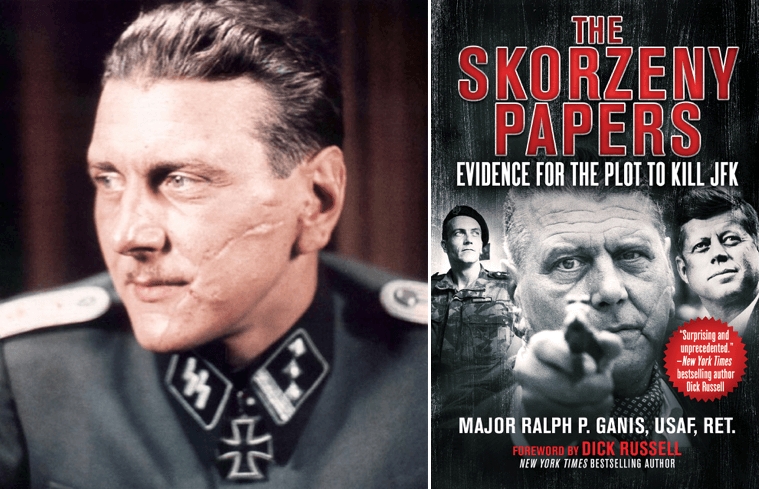
When I heard that a previously undiscovered collection of personal correspondences from SS Colonel Otto Skorzeny had recently surfaced, I was truly interested. Besides his famous exploits in WWII, including the daring mountaintop rescue of Benito Mussolini and the kidnapping of Hungarian regent Miklós Horthy’s son from his Bucharest palace, Skorzeny was infamous for his postwar dealings with a number of intelligence agencies the world over. As a child, my grandfather, Marcel, a French resistance fighter, used to tell me stories of Otto’s exploits during car rides. I thought I was in for a real treat when I found this book. That Skorzeny could have had a hand on the team that killed President Kennedy was also an interesting hook.
The subtitle of this book is “Evidence for the Plot to Kill JFK,” and therein lies its true problem: if by evidence we are referring to clear-cut forensics, incriminating memos, newly declassified documents, newly discovered tapes, or reliable eyewitness testimonies that place Skorzeny either at the scene or in a position directly responsible for the assassination of JFK, then we have little to no “evidence” to justify the book’s subtitle. What the author of the book, Major Ralph Ganis, USAF (retired) seems to suggest is largely tangential to the actionable plot that took Kennedy’s life; that is, Skorzeny, from his position in Madrid as a jack of all trades with ties to postwar Nazis, Texas oil moguls, the Mossad, and French intelligence operatives, could have been a link in a long and winding chain of figures who eventually connected to those who executed the crime of the century. And yet, as we will see, even that supposition is largely based on fantastical leaps of logic, a primary source base that we are never allowed to verify—or see a picture of, or direct reference to—and a conclusion that is not only ridiculous but insulting to the JFK research community.
Dick Russell, who wrote the introduction to The Skorzeny Papers, rightly claims that the book provides a “chronological tracing of the dark alliances that sheds fresh light on how long-suspicious CIA officials like William Harvey and James Angleton wove Otto Skorzeny into their tangled web, or vice versa.” I will give Ganis and Russell that—most of the book is largely this, an extremely dry, almost colorless list of dozens and dozens of figures who were responsible for placing Skorzeny in a secure position from which to run his operations after the war: within only a few pages in chapter seven we have “Enter Major General Lyman L. Lemnitzer and the NATO Link,” “Enter Clifford Forster,” “Enter Don Isaac Levine.” I like to think I have a pretty good memory, but the sheer volume of second- and third-string players in this book is bewildering, with connections seemingly drawn from any and all personnel affiliated with anything remotely clandestine, few of which are ever revisited, and none of which seem truly important given the book’s central thesis, which is that Otto Skorzeny was somehow a key aspect of the Kennedy assassination.
The so-called “Skorzeny Papers,” which Ganis acquired through an American auction house bid in 2012, are alleged correspondences between Skorzeny and some of these underworld and intelligence-based figures, along with letters to his wife, who aided him in his dirty work to some degree. “As the story goes, many of the papers were burned over time, but a fragmentary grouping of documents (the ones used for the research in this book) survived. The archive ranges from 1947 to around the period of Skorzeny’s death.” (xv).
But since we are not allowed to view them or translate them from the German ourselves, we must take the author’s word that they are not mistranslated or even fraudulent.
Ganis begins his book’s preface with a bold proclamation: “Why was President John F. Kennedy killed and who carried it out? All of the investigations, commissions, and academic works have not answered these questions. This book integrated startling new information that does resolve the mystery.” (p. xxi) Let’s unpack that for a moment. Not all commissions are equal. The Warren Commission is not the same as Jim Garrison’s investigation of Clay Shaw, the HSCA, or the later ARRB. The latter three found quite compelling evidence that a domestic intelligence outfit indeed murdered JFK. The former was staffed by Allen Dulles and was essentially a disinformation campaign whose objective was to obfuscate the truth and put the story to bed for the nightly news, which had also been compromised through the Central Intelligence Agency’s media liaisons. As much has been exhaustively detailed in scholarly works, from John Newman’s Oswald and the CIA, to Jim DiEugenio’s Destiny Betrayed, to Jim Douglass’ JFK and the Unspeakable. That we cannot say with certainty who pulled the trigger on the fatal shot so vividly captured in the Zapruder film is ultimately inconsequential; for all intents and purposes, given the time elapsed since that fateful November afternoon fifty-five years ago, we do have a clear picture of the likely suspects behind the plot’s orchestration, along with compelling motives for why JFK was targeted. Bold claims like Ganis’s require even bolder evidence, and to open with a whopper like that, one would presume that Skorzeny’s purported personal papers contain something akin to the map of Dealey Plaza’s sewer system that investigators found in Cuban exile Sergio Arcacha Smith’s apartment, or a handwritten “thank you” note from James Angleton after the Warren Commission had ended for services Skorzeny rendered to the CIA. And yet not only is Otto Skorzeny himself only a tangential part of a book entitled The Skorzeny Papers, but the “evidence for the plot to kill JFK” is awkwardly squeezed into the last two pages of a 346-page work, with a final revelation that made me both angry for investing hours of my life reading the tome, and confused as to how an author with a true breadth of working knowledge about postwar intelligence networks could presume so myopic an assassination motive.
Otto Skorzeny was an Austrian by birth who joined the Nazi party somewhat reluctantly, mainly as a way to make a living as the outbreak of the Second World War ramped up in the late 1930s. A mechanic by trade, and a semi-professional fencer, his notorious scar across his face from a missed parry and his 6’4 stature made him something of an icon in the German army. Skorzeny was known for his fearlessness, guile and unconventional approach to commando warfare. As he once said in a postwar interview, “My knowledge of pain, learned with the sabre, taught me not to be afraid. And just as in dueling when you must concentrate on your enemy’s cheek, so, too, in war. You cannot waste time on feinting and sidestepping. You must decide on your target and go in.” (Charles Whiting, Skorzeny, 1972, p. 17) In many ways, his belief that small units could actually move world history in a similar or even greater fashion than regiments and divisions was affirmed after his thirty-man glider-borne SS unit spirited away Mussolini from the Gran Sasso Hotel with not even a single shot fired. Even Winston Churchill heaped praise on him for his bravery in the face of incredible odds.
Rearranging signposts during The Battle of the Bulge, his commandos, who wore captured American uniforms and spoke fluent English with almost no accent, attempted to sow chaos behind Allied lines, seeking to misdirect troops and armored units away from key areas. While the entire Wacht am Rhein [“Watch Along the Rhine”] operation, which was the German code name for Hitler’s last desperate gamble to capture the Belgian port of Antwerp and cut the British and American forces in two, was ultimately a futile dying gasp of an already-defeated Nazi war machine, it proved so devastating to Allied morale (and killed 75,000 Americans) that some planners did reconsider whether the war would be over any time soon. And when a handful of Skorzeny’s men were captured in their false uniforms during that bitterly cold winter of 1945, panic spread throughout SHAEF (Supreme Headquarters Allied Expeditionary Force), leading to a comical scene in which General Eisenhower frantically argued with his staff who insisted he station twenty guards with sub machine guns around his Paris office at all times in case Skorzeny tried to kill or abduct him. In the middle of the night, the future Director of the CIA, Walter Bedell Smith, Eisenhower’s aide-de-camp, ran out with his staff in pajamas and started firing his carbine into the brush just beyond the headquarters’ window.
He and his men later found the dead cat that had been scurrying about in the dark, but the legend of Otto Skorzeny had taken hold.
Dubbed “the most dangerous man in Europe,” Skorzeny finally surrendered to the Allies in occupied Germany, after seeing the futility of carrying out Hitler’s final order for his “werewolves” to continue the war after the end of hostilities. He was summarily booked and processed, and awaited trial for his role as a top Nazi official and a one-time personal bodyguard of Adolf Hitler. He was later approached by OSS officers as he languished in his holding cell at Darmstadt Prison and it is from this first contact that Ganis believes the true exploits of Skorzeny began. While stories differ as to the mechanics of his escape—Skorzeny claimed in his memoirs that he stole away in the trunk of a car and had a German driver unwittingly smuggle him through the checkpoints; while Arnold Silver, his American point of contact and debriefer said he was released on official terms—he nonetheless was a free man by 1948. After relocating to Paris, where he was unofficially used as a conduit through which CIA officials could monitor communist activity in postwar Europe, Skorzeny was quickly identified due to his conspicuous face and looming profile, and was outed by the French press during one of his many strolls down the Champs-Elysée with his wife Ilse.
Relocating to Madrid, it is here that Ganis believes his real work began, work that—Ganis believes—would ultimately find him involved with dark forces that killed JFK a decade later. Set up in a comfortable office that saw Skorzeny ostensibly managing a construction company that also handled imports and exports of mechanical parts to places in Central Africa and elsewhere, he for all outward purposes seems to have lived a quiet life. Writing memoirs, consulting with foreign governments for a variety of clandestine work, and running a low-key commando training school whose members included some of his former comrades from the SS, French OAS soldiers, American special forces officers, and a rogue’s gallery of other unsavory characters, his postwar life had little in common with his daring exploits during WWII.
The bulk of The Skorzeny Papers deals with the nebulous formation of both the CIA and its shell companies from the remains of the OSS, with familiar figures like Frank Wisner, Arnold Silver, Bill Harvey, and William Donovan featured prominently in Ganis’ narrative. The central portion of the book meanders from French anti-communist hit teams and their American handlers, to the also newly-formed Mossad and its eventual use of Skorzeny for the removal of Egyptian nuclear scientists, to a whole host of West German ex-Nazi intelligence personnel and their largely dull exploits passing mostly fabricated evidence of an impending Soviet invasion to Washington in exchange for their freedom and a career on the American payroll. Somewhere in this tangled web, Ganis situates Skorzeny who, because of his extensive contacts and personal daring during the Second World War, seems—in Ganis’ estimation—uniquely positioned to wrangle these disparate forces into something of a rogue network that is totally off the books. Ganis reiterates this throughout the book, seeking to distinguish ostensible layers of the spy world from what he considers its truly dark realm, which he identifies as a series of assassination teams bankrolled through corporate shell organizations like SOFINDUS, which eventually morphed into the World Commerce Corporation (WCC). In The Skorzeny Papers the WCC is akin to SPECTRE from the old James Bond novels; a looming, impenetrable evil menace whose tentacles reach into almost every aspect of Cold War politics and planning, Ganis spends a considerable amount of the book detailing its creation, key operators, possible ties to international Nazi groups and ultimately its potential role as the dark budget from which Skorzeny was able to fund his various international commando operations after the war. In reality, while I’m sure this is all very interesting to someone truly looking for an exhaustive account of postwar dirty money, it has very little to do with Skorzeny, and almost nothing to do with the domestic assassination of John F. Kennedy in Dealey Plaza.
The book then delves into the French OAS, focusing on the enigmatic Captain Jean René Souètre, who of course was allegedly deported from Fort Worth, TX, the afternoon of the JFK assassination. And while I am not denying that Souètre could have indeed been on the ground in Texas in some capacity, Ganis goes to great lengths—even putting him on the book’s cover next to Skorzeny and Kennedy—to implicate him in the plot: “The actual sniper, or team of snipers, was directed by Jean René Souètre, the former OAS officer wanted by French security services for an attempt on the life of President Charles de Gaulle in 1962.” While Souètre was a known paramilitary outlaw who hated the idea of Algerian independence from France—which Kennedy firmly championed from the Senate floor in the mid 1950s—he seems from the available evidence to have been a rogue player who drifted through these turbulent times, training commandos, taking exotic posts with his OAS buddies, and advising the CIA on a handful of ultimately uninteresting developments in the Third World. To suggest, as Ganis does, that he was the lynchpin of the ground operations in and around Dealey Plaza, while ignoring the more probable Cuban exile culprits, seems strained.
The Souètre chapter ends with a few lines that reveal a frustrating and repeated aspect of this book, where the author assumes that one’s proximity to a situation necessarily guarantees association and willing complicity. For example, Ganis argues:
The movements of Skorzeny during this period point to his being in attendance at the Lisbon meeting between Souètre and the CIA. In fact, Skorzeny made several trips to Portugal between March and July 1963 concerning his businesses. With the OAS cause now unsustainable, it appears Souètre left the meeting with a new option for employment, signing on with Skorzeny. Captain Jean René Souètre was now a soldier of fortune working for Otto Skorzeny in one of the most guarded secret organizations in the history of American intelligence.” (p. 248, italics added)
It’s not at all clear that these conclusions can be verified, and as Skorzeny’s whereabouts are only deduced from “the Skorzeny Papers,” which are never directly quoted—here or anywhere in the book to my knowledge—one must once again have faith that Ganis is being honest and accurate.
III
The book then spends a considerable amount of time on the Third World and its myriad decolonization movements, with a quite lengthy digression into Ganis’ analysis of the Congo Crisis, exploring the potential for Skorzeny to have been the mysterious QJ/WIN assassin the CIA hired to kill Patrice Lumumba. Ganis takes a fairly condescending approach to his analysis of Lumumba’s rise to power, claiming “As well-founded as Lumumba’s words may have been, they were politically ill-advised. This tense atmosphere was further compounded by the lack of a plan for the organized transition to power.” (p.279). As I have detailed in my article, “Desperate Measures in the Congo,” the United States destroyed any hope for a free Congo before Lumumba had risen to anything nearing real power. In fact, both Belgium and the CIA had planned on separating Katanga, the Congo’s richest area, from the country before it became independent. Belgium had stolen the country’s gold reserves, brought them to Brussels and refused to return them. President Eisenhower refused to meet with Lumumba after the Belgians had landed thousands of paratroopers inside the country. By the time Lumumba’s plane had landed back in Africa, Allen Dulles and friends all but marked Lumumba for death. For Ganis to say he had no plan for an “organized transition to power” smacks of paternalism: given his eloquence, popular appeal and vision of a new dawn for his recently unshackled nation, Lumumba may well have succeeded if he had not been undermined in advance.
The assassination mission was later aborted when the CIA and Belgian intelligence aided Katangese rebels with Lumumba’s capture after he fled his UN protection in a safe house. While I can see where Ganis is going, and how it could be possible, given that Skorzeny seems to have been in the Congo around this time, to my knowledge it’s been pretty strongly established that QJ/WIN, the CIA digraph of one of two selected assassins for the Congo plot, was actually Jose Marie Andre Mankel. To have sent a person as instantly recognizable as Otto Skorzeny into an unfolding international crisis involving the Soviet Union, Belgian and Congolese troops, U.N. officials from multiple nations, and American station personnel seems, to put it mildly, unwise. Indeed, WI/ROGUE, another CIA-sponsored hit man and agent sent on the assignment, had had plastic surgery and was said to be wearing a toupee during his visit. No matter Skorzeny’s connections to Katanga Province’s mining operations, which were real, he was more likely a visiting business opportunist rather than an actionable agent during the Congo Crisis, if he was present there those critical weeks surrounding Lumumba’s capture and execution at all.
Ganis then details Skorzeny’s one brief interview with a Canadian television program in September 1960, in which he boasts about being in high demand by both the enemies of Fidel Castro and Fidel himself, explaining a plot which he takes credit for being the first to discover. This was Operation Tropical, in which the CIA was allegedly training Skorzeny and his commandos for a kidnapping of the Cuban premier in early 1960. Ganis bases his description on an unnamed newspaper clipping found in the papers he secured in his winning auction bid. Curiously, I happened upon Operation Tropical in a perusal of the CIA’s online reading room months before I’d read this book, and searched in vain for the newspaper they cite as having outlined the plot, which they claim is the Sunday supplement edition of the Peruvian newspaper, La Cronica, dated August 7, 1966. I would be interested to read it if anyone can secure a copy. It would go a long way in verifying the validity of Ganis’ main body of evidence, and would be an interesting find for researchers more broadly. In any case, with the aborted Castro plot and a mainstream boilerplate description of the “failed Bay of Pigs invasion,” which of course Ganis attributes to Kennedy’s refusal to release nearby carrier-based air support (something Kennedy staunchly forbade before the operation was underway, a point which Ganis’ omits), we now enter the final stretch of the book, which looks directly at Skorzeny’s role in the JFK assassination.
Spoiler alert—there is none.
“General American Oil Company,” “Colonel Gordon Simpson,” “Algur Meadows,” “Sir Stafford Sands,” “Colonel Robert Storey,” “Jacques Villeres,” “Permindex,” “Judge Duvall,” “Paul Raigorodsky,” “Thomas Eli Davis III,” “ Robert Ruark,” “Jake Hamon,” and about twenty other sub-headings flash across the first dozen or so pages of the final chapter of The Skorzeny Papers. The organization of the book centers on these disjointed, one-to-two-page sub-chapters which give the reader the disorienting and queasy feeling of reading it through glasses with the wrong prescription. Not only did Ganis miss the opportunity to style the life and times of Nazi Germany’s most infamous commando personality along the lines of a thrilling narrative, with exotic locales and shady deals over drinks and cigars, but he arranged the book in so awkward a fashion that he constantly has to end sentences with “and we will get back to him shortly,” or “and I will show you how this ties in later.” Even if one were to storyboard his entire panoply of tertiary personalities, it would look more like a Jackson Pollock art installation than a coherent plot with a compelling impetus culminating in the JFK assassination as we understand it. A story should be clear enough to draw the reader in with its simple facts, and should sensibly unfold on its own accord so as to prevent the need to constantly handhold during the descent into the labyrinth.
Conspicuously absent in The Skorzeny Papers are any substantial sub-headings detailing Cuban exiles, Allen Dulles, the Joint Chiefs of Staff, or any of the genuine suspects of the JFK assassination, save for meanderings on James Angleton’s and Bill Harvey’s roles in the creation of Staff D, the CIA’s executive action arm. Ruth and Michael Paine are nowhere to be found. Neither is a description of the aborted Chicago plot, or any substantive explanation of how Lee Harvey Oswald was moved into the Texas School Book Depository, or a note about David Phillips’ role in the whole affair from his Mexico City station. While these very real aspects of the actual JFK plot are infrequently touched upon in passing—Ganis cannot ignore the entire body of evidence, despite his best efforts—he insists on crow-barring his newfound “primary source data” into a story that at this point doesn’t permit much unique interpretation. It’s safe to say, in 2018, that President Kennedy was assassinated by a domestic, military-industrial-intelligence apparatus that viewed his foreign policy as anathema to both the “winning” of the Cold War and to their image of the United States’ role in world affairs. That Kennedy was a staunch decolonization advocate, a friend and champion of Third World leaders like Sukarno in Indonesia, Nasser in Egypt, Lumumba in the Congo, and sought diplomatic solutions to prevent the impending nuclear Armageddon with Nikita Khrushchev’s Soviet Union is all but ignored in Ganis’ conclusions as to why JFK was shot in Dallas. None of it is suggested. What ultimately led to the tragedy in Dealey Plaza, according to Ganis, is something much bigger.
It all comes down to JFK’s sexual indiscretions, folks. That’s right. Jack Kennedy just couldn’t resist the advances of the hundreds of femme fatales who threw themselves at him, and according to Ganis, the high command had to take him out when he cavorted with the ultimate Cold War honeypot.
I wish I were kidding. But unfortunately I’m not.
The author submits to the reader that the act to assassinate President Kennedy was carried out for reasons that far exceeded concerns over U.S. National security. In particular, they arose out of a pending international crisis of such a grave nature that the very survival of the United States and its NATO partners was at risk. At the source of this threat was breaking scandals that unknown to the public involved President Kennedy. To those around the President (sic) there was also the impact these scandals had on the president’s important duties such as control of the nuclear weapons and response to nuclear attack. It also appears the facts were about to be known. The two scandals at the heart of this high concern were the Profumo Affair and the Bobby Baker Scandal. (p.294)
I will spare anyone reading this a rebuttal of the relevance of this assertion, but suffice it to say, Ganis places the final straw at Kennedy’s—demonstrably disproven—affair with Eastern Bloc seductress Ellen Rometsch. Ganis claims, “Historians are taking a hard look at this information, but preliminary findings indicate Rometsch was perhaps a Soviet agent.” (p.295) He continues, “Her potential as a Soviet agent is explosive since Baker had arranged for multiple secret sexual liaisons between her and President Kennedy.” (p. 295)
He then scrapes together a weird narrative of how Attorney General Robert Kennedy was pleading with J. Edgar Hoover and the FBI to withhold these revelations in a “desperate effort to save his brother and the office of the presidency.” (p.296), He argues that “As President Kennedy was arriving in Dallas, Texas, on November 22, 1963, a very dark cloud of doom was poised over Washington, and the impending storm of information was hanging by a thread.” (p. 296). That’s when Skorzeny—from Madrid—was activated to save the Western world. It seems pointless to add that retired ace archive researcher Peter Vea saw the FBI documents on this case. The agents had concluded there was no such liaison between the president and Rometsch. In other words, to save himself, Baker was trying to spread his racket to the White House. Bobby Kennedy called his bluff.
Ganis pretentiously concludes, “In the end, the assassination network that killed JFK was the unfortunate legacy of General Donovan’s original Secret Paramilitary Group that included as a key adviser from its early inception—Otto Skorzeny. Furthermore, the evidence would seem to indicate Skorzeny organized, planned and carried out the Dallas assassination, however, we may never know what his exact role was.” (p. 342)
Indeed we may never, because there does not seem to be any. Ganis continues, “On November 22, 1963, an assassination network was in place in Dallas; it was constructed of associates of Otto Skorzeny and initiated by his minders in the U.S. Government and clandestine groups within NATO.” Wrapping up, the author reiterates, “The events that led to this killing were triggered by a limited group of highly placed men in the American government. They were convinced that the West was in imminent danger and posed to suffer irreparable damage, and, for some of them, imminent exposure to personal disgrace beckoned. All of this sprang from reckless debauchery in the White House and beyond. With the situation breached by Soviet intelligence and ripe for exploitation, it became untenable for this group. They took action.”
I’ll give you a few minutes now to wipe the tears from your eyes. Okay, good. Are you still with me? Overall, The Skorzeny Papers could, I suppose, serve as something like a compendium or glossary for those who just have to know the minutest details of the inner workings of this or that shell corporation that may or may not have had a hand in some world affair during the Cold War. But there are much better books on that. Ultimately, Ganis’ book is an uncomfortable, freewheeling careen down strange dead-end tracks, with unannounced detours through cold dark streets full of faceless characters, and later, journeys through mirror-filled fun houses of speculation, with a final twist and turn that spits you out right over Niagara Falls, barrel and all.