Tag: JFK ASSASSINATION

  • Gayle Nix Jackson Family Sues the Sixth Floor

    Gayle Nix Jackson Family Sues the Sixth Floor

    Gayle Nix Jackson Family Sues the Sixth Floor

    by Jeffrey L. Meek

    Earlier this month, Gayle Nix Jackson and her father, Orville Nix Jr., sued the Sixth Floor Museum at Dealey Plaza. In a letter to me from their lead attorney, Leland C. de la Garza: “The lawsuit seeks to rescind the agreement between Nix and the Sixth Floor Museum at Dealey Plaza and legally require the Sixth Floor Museum to return the copyright to the Nix film and the physical copies of the Nix film based on wrongdoings (only recently uncovered) that Plaintiffs contend in the Lawsuit were committed by the Sixth Floor Museum and Mr. (James) Silverberg during the negotiation of the agreement. The basis for the lawsuit is set out in the Petition filed in district court in Dallas. We are confident in our legal position and that the court will correct the wrong that was done to Mr. Nix by the Sixth Floor Museum and Mr. Silverberg.”

    The Orville Nix Sr. film is arguably the second most valuable film taken during the November 22, 1963, assassination of President John F. Kennedy. As Nix panned his camera from the opposite side of Elm Street as Abraham Zapruder, the grassy knoll area comes into view. The original film may provide the best look researchers have at that area, long since seen as a location of a second gunman in Dealey Plaza.

    Two weeks after the assassination, Nix licensed the original film to United Press International (UPI) for a term of 25 years. UPI transferred the film to the House Select Committee on Assassinations (HSCA) during their investigation. HSCA then sent it to the Aerospace Corporation in California to be scanned and enhanced, but incorrectly recorded that the Nix film was sent to a lab in Los Alamos instead. There are no records suggesting that the Nix film was ever returned to the HSCA, or that the HSCA ever returned the film to UPI.

    After Nix Sr. died, his interest in the film passed to Orville Nix Jr. In 1988, when UPI’s license was about to end, Gayle Nix Jackson asked UPI to return the film and believed it was in possession of the National Archives and Records Administration (NARA). UPI said they did not have the film; the National Archives had it. Nix Jackson learned NARA only had a copy, not the original.

    For many years Nix Jackson searched for the original, and the government continues to deny possessing the film. An archivist later told Nix Jackson that the original film had been lost while in the custody of UPI. In 2015, she sued the government, but the case was dismissed in 2017.

    But then on December 11, 2024, the Orville Nix Jr. v. The United States case was overturned in a Federal Claims court. Thus, the government’s attempt to dismiss the case was denied.

    On February 4, 2000, Nix Jackson and her father sold the copyright on the film along with a number of physical copies to the Sixth Floor Museum. Now they have learned that their lawyer, Mr. James Silverberg, had an undisclosed conflict of interest while negotiating the Nix Film Agreement. The Museum had hired Silverberg as an attorney for itself due to his expertise in copyright law and intellectual property matters.

    From the Petition, filed in Dallas on April 3, 2025: “Under established Texas law, a fiduciary relationship exists between an attorney and his client, as a matter of law. This relationship requires the most abundant good faith, perfect candor, openness and honesty, and the absence of any concealment or deception. An attorney is obligated to make full and fair disclosure of facts material to legal representation.”

    The current lawsuit seeks to rescind the Nix Family Agreement and recover damages and other equitable relief of $1,000,000.

  • The Nothingburgers? Nope.

    The Nothingburgers? Nope.

    The Nothingburgers? Nope.

    The MSM is at it again. The New York Times, for example, is saying that there is nothing notable in the declassified files released by executive order of President Trump. Well, if you know anything about the case, that is not an accurate statement. Which is what one would expect from The Grey Lady about the JFK case.

    I make no claim to having gone through all 77,000 pages of these documents. But I did go through a few hundred files at random. I have already explained the paramount importance of Arthur Schlesinger’s memorandum about President Kennedy’s desire to reorganize the CIA in the wake of the Bay of Pigs fiasco. (Click here https://www.kennedysandking.com/john-f-kennedy-articles/the-schlesinger-memo-jfk-v-cia) That plus the revelations by attorney Andre Iler about how the CIA did not want anyone to see that memo anywhere near in its entirety—a matter which I noted before the Luna Committee– is an important story in and of itself. (Click here for that addendum https://www.kennedysandking.com/john-f-kennedy-articles/the-schlesinger-memo-jfk-v-cia-addendum)

    When these newly declassified files appeared, they were not in OCR form, that is, they were not accessible by optical character recognition. Which meant they were not easily accessible for search functions. But the Mary Ferrell Foundation, under Rex Bradford, has cured that problem, and Rex has also arranged them by agency. He deserves credit for doing so.

    In appearances on Len Osanic’s Black Op Radio, Coast to Coast with Richard Syrett, and Katie Helper’s podcast with Oliver Stone, I have shown that, just in a random sample—before Rex made the files truly accessible– there were several notable things in these files. Which I believe have been ignored by the MSM. So let us take up some of them.

    First, as most people engaged in this case know, Fidel Castro was very curious about what happened to President Kennedy. Within 24 hours of the assassination, he went on Cuban TV and said he had suspicions about who Oswald really was. He predicted he was a likely FBI undercover agent. He also predicted that Cuba would be blamed for the assassination. (Click here for that speech https://www.kennedysandking.com/john-f-kennedy-articles/fidel-castro-s-first-speech-on-the-jfk-assassination-11-23-1963) Five days later, he was talking to a group of students. He detoured from his original subject and said that he was familiar with rifles from his experience in the Cuban revolution against Batista. He could not understand why an assassin would use a manual bolt-action rifle. (Click here for that speech https://www.kennedysandking.com/news-items/castro-figured-out-the-jfk-case-in-five-days-speech-of-november-27th-1963)

    Well, according to the new documents, in 1969, Castro was still bothered by the JFK assassination. He was speaking to another group of students, explaining all the problems with the Oswald scenario. After which, he ordered a reconstruction. He wanted his three best marksmen to try and duplicate what Oswald did.

    None of them could do it. To my knowledge, this is the third time this was attempted—and it was the third failure. In his book, Kill Zone: A Sniper Looks at Dealey Plaza, Craig Roberts describes consulting with Carlos Hathcock about the subject. He asked Carlos if he thought Oswald could have done what the Commission said he did. Hathcock was the greatest sniper of the Vietnam War. He had 95 confirmed kills. He was so lethal that Hanoi put a bounty on his head. For about two decades, he held the record for the longest kill shot: he hit a man from a mile and a half away. After he retired from the service, he opened up a SWAT team school with an obstacle course. He replied to Roberts that they had tried it more than once. And they did everything according to the book. They could not accomplish what Oswald did.

    As I noted in my article about the CBS special of 1967, their original sniper could not achieve it either. So what they did was they cheated in the tests by enlarging the target. (Click here for that story https://www.kennedysandking.com/john-f-kennedy-articles/why-cbs-covered-up-the-jfk-assassination) If America had an objective media on the JFK case, this latest revelation about Castro would be more dirt on the grave of the Warren Commission.

    Another fascinating memo has been noted by some other critics and on YouTube. As most of our readers know, one of the most incriminating pieces of information that the CIA released in the wake of Kennedy’s assassination was that, while in Mexico City, Oswald had met with a Soviet agent under diplomatic cover, namely Valeri Kostikov. And further, that Kostikov was secretly a part of the KGB’s Department 13, which handled liquidations in the Western Hemisphere. (The Assassinations, edited by James DiEugenio and Lisa Pease, p. 223). This then suggested that Oswald had killed Kennedy for the USSR.

    Well, in 1971, the CIA wrote a memo about this subject. In that memo, they said they had no credible evidence that Kostikov was part of Department 13. To say that this is fascinating is really an understatement. Because it would seem to indicate that the CIA, in 1963, was using the Kostikov story as a prop in an attempt to frame Oswald. In fact, J. Edgar Hoover, just a few weeks after the assassination, wrote a note saying that the FBI should not trust the CIA anymore since the Agency had given them a “false story re Oswald’s trip to Mexico….” (ibid., p. 224). If this recently declassified memo is accurate, it would appear to be incriminating of the Agency.

    Related to this, in blind memos the CIA wrote during the House Select Committee on Assassinations, this is the way they referred to Oswald in Mexico City. Referring to the visit to the Soviet embassy, it was “Oswald allegedly visited the Soviet Embassy.” Referring to the visitor himself, it was “alleged to be Oswald”.

    During that House Select Committee on Assassinations inquiry, it turns out that Chief Counsel Robert Blakey made requests to the Agency for the reasons they would open a 201 file on any subject. He then asked for the Oswald file at the CIA, prior to the opening of the 201 file.

    This is indicative that Blakey was aware of the work of his investigator, Betsy Wolf. Wolf’s monumental discoveries about the Oswald file were first unearthed by Malcolm Blunt. They were not declassified by the ARRB. They were placed on a time-stamped basis and not released until the new millennium. They were featured in Vasilios Vazakas’ seven-part series “Creating the Oswald Legend”, most prominently in Part 4. (Click here for that essay https://www.kennedysandking.com/john-f-kennedy-articles/creating-the-oswald-legend-part-4)

    Wolf’s work was only released in handwritten notes form. To my knowledge, they were not typed up into official memoranda. Why they were not is inexplicable. For, as revealed in these requests by Blakey, they are of utmost importance. Therefore, it is perfectly logical as to why the MSM does not note Blakey’s requests or why he made them. Because they have no idea what Wolf was pursuing.

    Wolf was given the assignment of analyzing the Oswald file at the CIA. After requesting all the charters and taking notes on them, she figured out what the Oswald file should do. As noted above, Blakey then requested the file. Wolf was surprised to discover that it did not do what it should have. It did not go to the Soviet Russia (SR) division as, according to its own charters, it should. It went to the OS division, or Office of Security. Further, no 201 file was opened on Oswald for 13 months. This is why Blakey was asking for the reasons a 201 file is opened, because Wolf has discovered there was not one on Oswald, even though the CIA knew he had defected and had threatened to turn over radar secrets to Moscow.

    Once Wolf got this list, she determined that there should have been a 201 file opened on Oswald. She called in CIA retirees to discuss her quandary. They all agreed with her: 1.) Oswald’s file should have gone to the SR division, and 2.) There should have been no 13-month delay in the opening of the 201 file. She eventually got to the then-current OS Director, Bob Gambino. He said: It did not matter how many documents came in or if they were pre-stamped. If the client has gone to the first gate, the Office of Mail Logistics, then the papers will go there and there only.

    In other words, someone had rigged Oswald’s file from the time he went to Russia. Why? How did they even know about him? And why did Blakey not include this vital information in the HSCA volumes? He seems to have known about Wolf’s work due to these specific requests.

    Let me briefly make note of two other matters of interest. On November 23rd, 1963, the newest tanks Castro had were rolled into the area next to Havana. The information in this informant’s notes did not say if this was related to the JFK case. But it might be since Castro said in his speech that day that he thought Washington would blame the murder of JFK on Cuba. Secondly, the Warren Commission was very curious about Oswald’s activities in Helsinki, Finland. Assistant Counsel David Slawson was especially interested in how quickly he had been given an entrance visa.

    Just based on this very limited review, there should have been stories about the following:

    1. If three reconstructions, of what Oswald was supposed to do, first-rate marksmen all failed. How likely is it that Oswald was the lone assassin?
    2. Did the CIA, perhaps James Angleton, put out a false story about Oswald and Kostikov in 1963 in order to incriminate the Soviets? After all, Richard Case Nagell said that the Russians thought this would be the case. (Dick Russell, The Man Who Knew Too Much, pp. 153-54)
    3. Did the CIA itself, during the HSCA hearings, think that there may have been an impostor for Oswald in Mexico City? Let us not forget, David Phillips said words to this effect in a debate with Mark Lane in the fall of 1977. (Lane, Plausible Denial, pp. 75-87)
    4. Betsy Wolf and likely Robert Blakey knew that the Oswald file at the CIA had been rerouted almost at the time he defected to the Soviet Union. Should not a journalist have asked both Wolf and Blakey about this highly suspicious matter?
    5. Did the Warren Commission and David Slawson ever wonder how on earth did Oswald know that Helsinki was the one capital in Europe that issued Soviet visas with extreme speed? Should this question not have been in the Warren Report? (The WR adroitly avoids this question, see p. 258)

    Any interested reader can please indicate to me when the MSM addresses these matters. On past experience, I will not hold my breath for that moment.

  • Tulsi Gabbard Video at National Archives – RFK and JFK Files Mentioned

    Tulsi Gabbard visits the National Archives, talking about the release of RFK assassination files. JFK files also mentioned, along with a look at archived items such as the Zapruder camera and the shirt Oswald was wearing. View here.

  • Tulsi Gabbard Announcement Regarding RFK & MLK documents

    Tulsi Gabbard announces that the search for RFK and MLK documents and scanning them digitally is on with 100 people on the job. Read more.

  • New 4K Restoration of Rush to Judgment

    This is a link to the new 4k restoration of the Mark Lane/Emile D’ Antonio cinema verite film also entitled Rush to Judgment. Read more.

  • Major Trump Declassification Announcement

    President Trump makes major announcement on the declassification of the JFK files.  Read more.

  • The Anna Paulina Luna Task Force

    The Anna Paulina Luna Task Force

    The Anna Paulina Luna Task Force

    Mark E. Adamczyk Esq.

    If you are interested in the history of the JFK assassination and want to know what actually happened to President Kennedy on November 22, 1963, you have probably heard or read about the recently-appointed “Task Force on the Declassification of Federal Secrets”. This is a congressional panel established by the U.S. House Committee on Oversight and Accountability, chaired by Representative Anna Paulina Luna (R-Fla.). 

    The stated primary mission of the task force is to investigate and recommend the declassification of long-held government records related to significant historical events and topics of public interest.  The task force was formed in response to President Trump’s executive order signed on January 23, 2025, titled “Declassification of Records Concerning the Assassinations of President John F. Kennedy, Senator Robert F. Kennedy, and the Reverend Dr. Martin Luther King Jr.,” which mandates federal agencies to prepare plans for releasing these records. According to journalist Jeff Morley, both CIA Director John Ratcliffe and DNI Chair Tulsi Gabbard are in favor of the order.

    As of today, the task force has made notable headlines. On February 25, 2025, Representative Luna announced via X that she met with the National Archives and Records Administration (NARA), securing a commitment to make declassified JFK files publicly accessible through a dedicated NARA website. She indicated that documents would be uploaded in real time once declassified, and she addressed efforts by some within the NARA agency to delay access, claiming those “obstructionists” were being removed. Additionally, Luna has scheduled the task force’s first hearing for March 26, 2025, which will focus specifically on the JFK assassination. This hearing aims to examine evidence and interview firsthand witnesses, including doctors who treated Kennedy at Parkland Hospital in Dallas, where the task force plans to travel as part of its investigation.

    A visit to Dallas to interview the Parkland doctors and a tour of Dealey Plaza would be educational for the task force.  Representative Luna has publicly questioned the official Warren Commission findings, asserting her belief in a “two-shooter” theory based on conflicting evidence and abnormalities she claims were overlooked.  

    But here’s the problem: Why spend the task force’s time and money investigating things we have known for years?  As written by JFK Assassination Chokeholds co-author Paul Bleau, we already know that over forty witnesses, including almost all of the medical personnel at both Parkland and Bethesda Medical Center—where the autopsy was held—clearly saw the massive injury to the back of JFK’s head, describing what could only be an exit would.  The evidence we already know makes it all but impossible to conclude that there was not at least one shot fired at JFK from the front of his limousine, which vitiates the Warren Commission’s conclusion that only three (3) shots were fired by Lee Harvey Oswald from the rear.  

    The task force is on the correct path by investigating NARA and the Archivist’s inaction and failures under the JFK Records Collection Act of 1992 (JFK Act). Pursuant to the JFK Act, the Assassination Records and Review Board (ARRB) in the 1990s already made final declassification decisions on the thousands of assassination records still withheld in full or in part.  Under the exhaustive rights afforded to agencies still seeking postponement of assassination records to this day, they already had their complete legal opportunity to appeal those final declassification decisions to the ARRB and the President for continued postponement.  

    Which brings us back to the focus that should be front and center for Representative Luna’s task force – the Archivist.  As discovered by JFK Assassination Chokeholds co-author Andrew Iler, the ARRB’s final declassification decisions from the 1990s have been buried at NARA.  Why?  The Archivist should immediately be called into an oversight hearing with the task force to explain why NARA did not follow the ARRB’s final agency orders on postponed assassination records and release them as ordered by the ARRB.  The Archivist should be compelled to explain why it is nearly impossible to find the ARRB’s final declassification orders at NARA.  The path to the proper declassification of the JFK assassination records lies in the ARRB’s final orders.  

    The final point, and this is critical, is revealed in comments recently made by Representative Luna in an interview with Clayton Morris on Lear Redacted.  Luna stated that she is confident, based on discussions with the White House and Gabbard (Director of National Intelligence), that there will be a full release of assassination records through the efforts of the task force.  I have no doubt in Representative Luna’s confidence, and her energy and passion on this effort should be commended.  

    However, here is the troubling comment Luna gave in the interview.  The Archivist has apparently told Representative Luna that even if President Trump orders the declassification of assassination records, the President’s decision then needs to go back to the originating agency for a “re-review” by the agency head.  Representative Luna disagrees with NARA’s assessment, and she is correct.  The Archivist’s position is directly contrary to the JFK Act.  Under the Freedom of Information Act (FOIA) standards, an agency head does have the authority to make declassification decisions in their discretion.  The JFK Act is not FOIA, and it is not close.   Under the JFK Act, the final declassification decision, short of the President, was with the ARRB and only the ARRB.  If the ARRB ordered the full release of a record by a specified date, the agencies (many years ago) had a final 30-day right of appeal.  And the following is important: Short of an appeal based on clear and convincing evidence justifying continued postponement, the Archivist had a legal duty to release the assassination record and publish it for public disclosure. 

    Luna said that if a record is ordered declassified, then “do it, and call it a day…declassification does not need to go through bureaucratic nonsense.”  Again, she is correct.  Under the standards of the JFK Act, only the President in 2017 had the final call on declassification. And any further Presidential decisions for continued postponement must be stated in a public Presidential certification stating a current identifiable harm to the United States or a living person.  

    The correct legal path on the declassification process under the JFK Act is simple.  After the Archivist is compelled to make the ARRB’s final release decisions available and easily searchable, President Trump and his legal advisors need to review the ARRB’s final decisions in the Archivist’s possession.  If there is no longer a current identifiable harm in the withheld record to a living person or current intelligence source or method, the record must be released in full today pursuant to the JFK Act.  Further, President Trump needs to immediately order all originating agencies to turn over (to the Archivist) any assassination records that were not provided to the ARRB in the 1990s as required by the JFK Act.  The same Presidential review process would apply to those records as well.  The task force, with Congressional oversight powers in the JFK Act itself, has the authority to make sure all of this happens without further delay.  No further “plans” are necessary, especially not from the intelligence agencies who are determined to maintain secrecy.  

    In 2025, it is fiction to believe that a record from 1963 could still pose an identifiable harm.  Maybe a handful of records by a stretch of the imagination, but not thousands.  In short, President Trump should not tolerate more obstruction from the intelligence community.  As explained in JFK Assassination Chokeholds, the American people have already tolerated more than 60 years of obstruction of justice in the JFK case.  Unless President Trump can explain how and on what basis a withheld record still poses a current and identifiable harm to the United States or a living person, the record can and must be released today pursuant to the clear Congressional mandates in the JFK Act. 

  • The Oswald Puzzle: The Pieces That Won’t Fit – Part 2

    The Oswald Puzzle: The Pieces That Won’t Fit – Part 2

    The Oswald Puzzle: The Pieces That Won’t Fit – Part 2

    By Johnny Cairns


    U.S. Military Policies on Communist Affiliation: A Zero-Tolerance Stance

    “I am a Marxist and have been studying Marxist principles for well over 15 months”. Letter to Socialist Party of America, October 3rd, 1956; (Greg Parker, Lee Harvey Oswald’s Cold War; p.250)

    Larry Hancock recently said to me that “as an individual (Oswald) was an American citizen and free to espouse any beliefs that were legal and did not espouse violence.” (Dave Boylan. Private Correspondence with Johnny Cairns.) This argument is fundamentally incompatible with the rigid security measures, legal precedents, and ideological purges of Cold War America.

    Yes, as a private citizen, Oswald would have had the constitutional right to hold Marxist beliefs. However, as we’ve already explored, such beliefs were not merely frowned upon but actively treated as subversive and dangerous. Even vague associations with leftist ideology were enough to end careers, prompt surveillance, and trigger legal repercussions.

    But more importantly, Oswald was not a private citizen—he was an active-duty U.S. Marine, bound by the strict regulations of a military institution that explicitly prohibited Communist affiliation. His open, repeated expressions of Soviet allegiance, his reverence for Marxism, and his vocal disdain for American capitalism weren’t just ideological posturing—they were direct challenges to the national security apparatus of the United States. And yet, the Marine Corps did nothing.

    Oswald’s status as an active US Marine placed him under an even stricter loyalty standard than a civilian. Upon enlistment, he swore an oath:

    “I, Lee Harvey Oswald, do solemnly swear that I will support and defend the Constitution of the United States against all enemies, foreign and domestic; that I will bear true faith and allegiance to the same.”

    Oswald also signed the Loyalty Certificate for Personnel of the Armed Forces. The number one provision of this certificate read: The Department of Defense has the authority to establish procedures implementing the national policy relating to loyalty of persons entering on duty with the Armed Forces. This has been determined by proper authority to include restrictions as to certain standards of conduct and membership in, or sympathetic association with, certain organizations.” (Parker, p.263)

                                                 II

    Let us add, the Uniform Code of Military Justice (UCMJ) Article 134; Marines found possessing, distributing, or promoting Communist literature could face disciplinary action, dishonourable discharge, or court-martial. Disloyalty statements, such as Oswald’s repeated praise of the Soviet Union and his accusatory references to fellow Marines as You Americans, American imperialism” and “exploitation” were grounds for immediate scrutiny. (Epstein, p.82)  https://www.govinfo.gov/content/pkg/USCODE-2011-title10/html/USCODE-2011-title10-subtitleA-partII-chap31-sec502.htm

    And how about this: The Communist Control Act of 1954 (CCA) made membership in or association with the Communist Party USA (CPUSA) illegal, classifying it as a subversive organization working to overthrow the U.S. government. The CPUSA’s official publications, The Daily Worker and The People’s Daily World—which Oswald openly subscribed to and read while stationed at Santa Ana, California—were directly linked to this illegal organization. Under Cold War-era policies, merely consuming Communist literature was considered a national security threat. 50 USC CHAPTER 23, SUBCHAPTER IV: COMMUNIST CONTROL

    Beyond the CCA, federal policies actively sought to root out any Communist influence within government and military institutions:

    The Attorney General’s List of Subversive Organisations; (AGLOSO) catalogued groups deemed Communist-affiliated, and association with these groups led to termination, blacklisting, and potential prosecution. Prelude to McCarthyism: The Making of a Blacklist | National Archives

    Executive Order 9835 (1947); established by President Harry S. Truman, mandated the Federal Employee Loyalty Program, mandating investigations into federal employees and military personnel suspected of disloyalty. https://www.trumanlibrary.gov/education/presidential-inquiries/trumans-loyalty-program

    Executive Order 10450 (1953); President Dwight D. Eisenhower further expanded these investigations, stating that even sympathies toward subversive organisations could be grounds for dismissal. https://www.dni.gov/files/NCSC/documents/Regulations/EO_10450.pdf

    House Un-American Activates Committee; (HUAC) hearings paraded suspected Communists before Congress, demanding loyalty oaths and public confessions. Government employees lost their jobs for past associations, and yet an active-duty U.S. Marine, stationed at a military base, openly consuming Communist literature, escaped scrutiny? If loyalty investigations were aggressively enforced across all levels of American society, how did Oswald’s Marxism on a military base not trigger an immediate inquiry? House Un-American Activities Committee – Wikipedia

    Yet the historical record simply does not support the idea that such behaviour was tolerated in the U.S. military. Other servicemen—guilty of far less—were swiftly discharged, disgraced, or investigated under Cold War security measures.

    Radulovich, Abramowitz, Peress: The Harsh Reality of the Red Scare

    The Cold War’s loyalty purges were merciless, cutting through government, academia, and the military with ruthless efficiency.

    One of the most infamous cases was that of Milo Radulovich, a U.S. Air Force reservist who was discharged. But not for his own political beliefs. But because his father, a Serbian immigrant, subscribed to a Serbian-language newspaper that the U.S. government deemed to have Communist affiliations. His sister, too, was suspected of leftist sympathies. 

    Radulovich himself had never engaged in subversive activity, but mere association with “questionable” individuals was enough to end his military career. He became yet another casualty of Cold War hysteria, a victim of an era that demanded absolute ideological purity. https://en.wikipedia.org/wiki/Milo_Radulovich

    Simply getting Russian magazines, books, or progressive news magazines, etc. was perfectly legal.”
    – Larry Hancock, via Dave Boylan (Private Correspondence with Johnny Cairns)

    Oswald did not simply “get” Russian or progressive news magazines—he subscribed to publications directly linked to the Communist Party USA. His subscription history alone would have been enough to trigger an investigation, security clearance review, or outright discharge under Cold War loyalty policies. His fellow Marines confirmed that Oswald did not hide his Communist affiliations.

    Paul Edward Murphy provided an affidavit stating:

    “Oswald had a subscription to a newspaper printed in English which I believe was titled either The Worker or The Socialist Worker. Members of the unit saw copies of this paper as they passed through the mailroom; when the paper was identified as being directed to Oswald, few were surprised.”

    Erwin Donald Lewis, another Marine, corroborated this:

    “It was a matter of common knowledge among squadron members that Oswald could read, write and speak Russian. I knew from personal observation that he read the ‘Daily Worker.’ I heard he had a subscription to that publication.” (WC Vol VIII; p. 323.)

    The People’s Daily World, another Communist newspaper Oswald subscribed to, gained infamy shortly after World War II when several of its editors were convicted under the Smith Act for conspiring to overthrow the U.S. government! (Summers; p.147)

    While Radulovich was expelled over his father’s newspaper, Oswald was actively subscribing to CPUSA newspapers while serving in the military.  And not only was he not investigated, but he was also allowed to continue service without disruption.  The inconsistency is staggering.

    Howard Abramowitz & Irving Peress: Expelled Without Evidence of Subversion

    Radulovich was far from alone. In 1954, Howard Abramowitz, a decorated Korean War veteran, was forcibly discharged from the Enlisted Reserve. But not for active Communist ties, but simply for past membership in leftist organizations. Even honorable military service was not enough to protect him from the Red Scare. Howard D. Abramowitz – Wikipedia

    Captain Irving Peress, a U.S. Army dentist, was expelled from the military after refusing to answer questions about his political affiliations. He had not been caught in any subversive activities, nor had he been accused of actively promoting Communist ideology. Yet his silence alone was enough for Senator Joseph McCarthy to brand him a “Fifth Amendment Communist,” leading to his immediate discharge. Irving Peress – Wikipedia

    III

    The military was not the only institution where ideological purity was ruthlessly enforced. The Red Scare cast its shadow over every facet of American society, reaching deep into government offices, university halls, and even the glamour of Hollywood. Professors, civil servants, and filmmakers alike were compelled to renounce any association—real or perceived—with leftist ideology or risk professional and personal ruin.

    Academics and scientists saw their careers disintegrate for nothing more than distant affiliations with suspected radicals, while schoolteachers were blacklisted for the simple act of refusing to sign loyalty oaths. In this climate of paranoia, there was no room for nuance, no distinction between passive interest and active subversion. Mere suspicion was a death sentence for livelihoods—proof was optional.

    And then there was Lee Harvey Oswald—a man who openly and unapologetically declared his allegiance to Marxism. A man who spoke Russian in the barracks, studied Communist texts, and loudly praised the Soviet system while serving in the military at the height of the Cold War. A man who, by every precedent of the era, should have been immediately arrested, blacklisted, or imprisoned.

    And yet, he faced nothing. No investigation. No dishonourable discharge. Why was he tolerated? The answer is inescapable.

    U2 Realties?

    “Nothing Lee Oswald knew or could have provided had to do with the loss of the U2 aircraft…” (The Oswald Puzzle; p.50)  To put it mildly, this is contested by the testimony of Francis Gary Powers and works such as Oswald & The CIA, Spy SagaDestiny Betrayed, etc. 

    The Motherland Awaits

    “Oh, what a tangled web we weave, when first we practice to deceive!”  Walter Scott.

    Lee Harvey Oswald’s hardship discharge from the U.S. Marine Corps remains one of the most striking anomalies in his so-called “legend.” Discharges of this nature typically took months. Yet, for Oswald, the process unfolded with astonishing speed; as if the bureaucracy had stepped aside to expedite his path to the Soviet Union.

    Nelson Delgado recalled the rapidity of the process: Oswald’s discharge “must have been a fast processing, because I wasn’t gone over 15 days and when I came back, he was already gone.” (WC Vol. VII; p.255)

    Even those familiar with standard military procedures were perplexed by the urgency of Oswald’s departure. Delgado continued: “I knew he was putting in for a hardship discharge… but, like I say, it usually took so long to get a hardship discharge.” (WC Vol. VII; p.257)

    Colonel B. J. Kozak, a military officer with direct knowledge of dependency discharges, provided an even more specific timeframe: “It normally took between 3 to 6 months for a hardship discharge to be approved.” (DiEugenio, Destiny Betrayed; p.136). Yet, for Oswald, all standard protocols were seemingly cast aside. He submitted his request on August 17, 1959—and by August 28, just eleven days later, the Dependency Discharge Board had already approved it.(WCR; p.688)

    Why did the system move mountains to ensure that Oswald could leave his post without delay? Why was “Oswaldovich” granted a swift exit from a fiercely anti-Communist institution at the height of the Cold War?

    Serious Questions arise about Oswald’s pilgrimage to the USSR

    Lee Harvey Oswald’s journey to the Soviet Union is riddled with contradictions, logistical anomalies, and inexplicable conveniences. It is a tale of a man who, by all accounts, was of limited means. Yet, he managed a journey that required substantial finances, elite accommodations, and a series of improbably smooth bureaucratic processes—each step raising more questions than answers.

    Oswald has long been characterized as frugal, a man of limited financial resources. As The Oswald Puzzle states, “Oswald had limited funds and was frugal by nature.” (The Oswald Puzzle; p.68) 

    Yet how do the authors reconcile this claim with the fact that, upon his arrival in Helsinki, Oswald did not seek out a modest or budget-friendly hotel but instead took residence in two of the most opulent establishments the city had to offer?

    His first stop was the Hotel Torni, a five-star hotel renowned for hosting VIPs, including former U.S. President Herbert Hoover. The late Ian Griggs, a highly respected researcher and founder of Dealey Plaza UK, who visited the hotel, described it as the Finnish equivalent of the Savoy in London. (Destiny Betrayed;p.138.)

    Oswald then moved to the Klaus Kurki Hotel, another prestigious institution, located on Bulevardi, one of Helsinki’s most exclusive streets. According to Griggs, if the Torni was Helsinki’s premier luxury hotel, the Klaus Kurki was not very far behind. (Ibid; p.138.)

    So, how do we square this with the image of a cash-strapped, penny-pinching Oswald? Why did a supposedly frugal ex-Marine, who had only just embarked on an arduous defection journey, opt for deluxe accommodations that would have strained his already limited funds?

    IV

    Then, there is the larger financial mystery: How did Oswald fund this trip at all? At the time of his departure from the United States, Oswald’s bank account contained a mere $203.00, yet the cost of his journey to the Soviet Union amounted to at least $1,500(Melanson p.13)  Nelson Delgado was also baffled: “I couldn’t understand where he got the money to go… it costs at least $800 to $1,000 to travel across Europe, plus the red tape you have to go through.” (WC Vol.VIII; p.257.)

    This raises the obvious question: Where did Oswald obtain the additional funds? Travel expenses aside, what about his day-to-day living costs? How did he afford food, toiletries, laundry, clothing, and grooming essentials over a period of over a month?  How did he pay for Soviet “tourist vouchers” which cost a total of 300 dollars. (WCR, p. 690) Every journey requires sustenance—so how did Oswald survive on what was, by all accounts, an insufficient sum?

    Even more suspicious is the manner in which Oswald was granted a visa for the Soviet Union.

    The Oswald Puzzle claims, “It is true that Oswald’s tourist visa for Russia was granted relatively quickly in Helsinki, but that was not particularly exceptional for that location.” (The Oswald Puzzle; p.68) Yet this claim obscures a crucial detail: Oswald’s visa was processed in record time, in just 24 hours, at the Soviet consulate in Helsinki—an embassy known for expedited handling of special cases. Normally, a tourist visa took at least a week to process. (Destiny Betrayed; p.139.) In fact, the only Soviet embassy in Europe where a visa could be issued in such a short span of time was the one in Helsinki. (Ibid.)

    Who arranged for this remarkable convenience?

    The answer may lie in a man named Mr. Golub, an official at the Soviet consulate in Helsinki, who handled Oswald’s visa. Mr. Golub had direct ties to the American Embassy in Helsinki, where U.S. officials reportedly sent select individuals to him for “priority processing.” (Ibid, p.138.) So, was Oswald simply the recipient of a string of coincidental bureaucratic miracles? Or was someone ensuring his seamless transition into the Soviet Union?

    Upon his arrival in Moscow, Oswald wasted no time in making his intentions known. “I was warned you would try to talk me out of defecting,” Oswald declared at the U.S. Embassy in Moscow in 1959. ( John Newman, Oswald & the CIA; p.5). This statement alone raises an obvious question: Who warned Oswald that U.S. officials would attempt to dissuade him from defecting? Who had prepared him for this moment?

    V

    Yet the most damning aspect of Oswald’s embassy visit was not his declaration of intent. It was the information he freely offered to American officials. According to The Oswald Puzzle, “Even though he did not state that such information was classified—if he had, he might well have been detained by security on the spot.” (p.72).

    This claim is demonstrably dubious. Because, by multiple accounts, Oswald did state that he had classified information and was prepared to share it with Soviet officials.

    According to CIA records, Oswald openly declared that he had been a radar operator in the Marine Corps.  Also, he had voluntarily informed unnamed Soviet officials that, as a Soviet citizen, he would make known to them the information he possessed concerning the Marine Corps and his specialty. He even intimated that he might know something of special interest. (Newman, p.6). John McVickar, an official at the U.S. Embassy in Moscow, later recalled that Oswald explicitly stated his intent to turn over “classified things” to Soviet authorities. (Ibid)


    Rimma Shirakova, an Intourist guide who met Oswald upon his arrival in Moscow, agreed with this. She recalled that Oswald told her outright that he was in possession of classified information about U.S. airplanes. (Destiny Betrayed;p.140)

    Oswald’s open declaration at the U.S. Embassy in Moscow that he intended to provide classified military information to the Soviet Union constituted serious violations of U.S. law, military regulations, and his sworn oaths. 

    Espionage Act of 1917 (18 U.S.C. § 793-798) Violation: Wilfully conveying or attempting to convey classified national defense information to a foreign government. Espionage Act of 1917 – Wikipedia

    Penalty: Up to life imprisonment, or the death penalty in cases of extreme national security risk. 

    Treason Clause of the U.S. Constitution (Article III, Section 3) Violation:Levying war against the U.S. or “giving aid and comfort” to an enemy nation. Penalty: Death or imprisonment. U.S. Constitution | Constitution Annotated | Congress.gov | Library of Congress

    Uniform Code of Military Justice (UCMJ) Article 94 (Mutiny and Sedition) –Encouraging or aiding an enemy. 10 USC 894: Art. 94. Mutiny or sedition

    Article 104 (Aiding the Enemy) – Attempting to supply intelligence to a foreign power. 904. Article 104. Aiding the Enemy – UCMJ – Uniform Code of Military Justice – Military Law

    Article 134 (General Article) – Conduct unbecoming a Marine. Penalty: Dishonorable discharge, court-martial, life imprisonment, or death. What is Article 134 of the UCMJ? – UCMJ – Uniform Code of Military Justice – Military Law

    Communist Control Act of 1954 Violation: Affiliation with or providing assistance to a Communist government or organization. Penalty: Denaturalization, deportation, or imprisonment. 

    Oath of Enlistment – United States Marine Corps Violation: Oswald swore to “support and defend the Constitution of the United States against all enemies, foreign and domestic.” Penalty: Immediate dishonorable discharge and legal action under military law. 

    What Should Have Happened at the U.S. Embassy in Moscow?

    Immediate Detainment:

    Any U.S. citizen, let alone a Marine veteran with a security clearance, admitting to plans of turning over classified information should have been immediately detained by security personnel. 

    Interrogation by Military & Intelligence Agencies: On the spot, Oswald should have been subjected to intense questioning by CIA and military intelligence officers to determine: What classified information he had already revealed. If he was acting alone or under foreign influence. And his true intentions and affiliations. 

    Revocation of U.S. Passport & Citizenship Review: Oswald’s passport should have been confiscated immediately. The State Department should have initiated proceedings to revoke his U.S. citizenship under laws barring Americans from aiding enemy nations. 

    Legal Charges & Potential Arrest: Oswald’s admission that he was offering classified material to the Soviets should have resulted in formal espionage or treason charges. The FBI and CIA should have been notified immediately to launch an investigation. 

    Monitoring & Surveillance: At the very least, Oswald should have been flagged as a national security threat, placed under continuous surveillance, and denied re-entry into the U.S. until a full security review was conducted. 

    And yet, despite these laws, despite his explicit statements, Oswald walked out of the U.S. Embassy a free man.

    Had any other American—especially an active-duty Marine—made such declarations during the height of the Cold War, their fate would have been sealed in an instant. But Oswald? Oswald was allowed to continue on his Soviet adventure.

    The question is: why?

    Click here to read part 1.

  • The Oswald Puzzle: The Pieces That Won’t Fit – Part 1

    The Oswald Puzzle: The Pieces That Won’t Fit – Part 1

    The Oswald Puzzle: The Pieces That Won’t Fit – Part 1

    By Johnny Cairns

    “I worked in Russia. Er… I was… er, under the protection… er, that is to say, I was not under the protection of the American government, but as I was at all times… er, considered an American citizen.” Lee H. Oswald, New Orleans- 1963. 

    Who was Lee Harvey Oswald? That is the $64,000 question, isn’t it? A question that has been debated endlessly since that fateful afternoon in November of 1963 when he was dragged from the darkness of the Texas Theatre and thrust into history. He was cast as an assassin, charged, murdered without trial, and sentenced to a posthumous verdict of guilty—his name forever etched in infamy. Truly as it was written long ago; The evil that men do lives after them; The good is oft interred with their bones. 

    Oswald’s death remains a festering wound on the soul of a nation—a nation that, for over sixty years, has continued to grieve the loss of one of its finest leaders: President John F. Kennedy.

    The name Oswald will forever be synonymous with one of the gravest injustices in history. And yet, his short life remains an open contradiction—an enigma that defies easy explanation.

    On one hand, we have the Marxist Marine—a contradiction in itself. A public ‘defector’ to the Soviet Union. A man who, throughout his life, openly espoused socialist, Marxist, and communistic ideologies at the height of Cold War America.

    On the other, we have a man who always seemed to be at the center of American intelligence operations. A man who was impersonated multiple times—including once when he wasn’t even in the country. A man whose closest acquaintances were a who’s who of the most fiercely militant anti-communists of the late 1950s and early 1960s.

    Men such as:

    David W. Ferrie

    George De Mohrenschildt

    Clay L. Shaw (alias Bertrand)

    Guy Banister

    These were not just random acquaintances. This was a who’s who of intelligence-linked operatives, far-right extremists, and shadowy figures operating at the nexus of covert operations.

    Their connections to Oswald were so striking that Senator Richard S. Schweikerwould later remark: “The fingerprints of intelligence are all over Oswald.”

    And it is this very contradiction that compelled me to write this review of The Oswald Puzzle.

    II

    In the interest of full transparency, I must first acknowledge my respect for co-authors Larry Hancock and Dave Boylan. They are serious researchers, meticulous in their methodology, and their work is thorough, well-sourced, and deeply considered. In fact, it was through the generosity of Dave Boylan that I was able to write this review at all. With the book’s UK release delayed until mid-March, Dave was kind enough to send me a copy from the U.S.—a gesture I greatly appreciated. 

    And on the surface, Larry and Dave stand on solid ground here. They follow Oswald’s own writings, a literary North Star, which guides them through the “swamp” of “conspiracy” research and into their contrarian conclusion on his true ideology. 

    In essence, Oswald’s writings are a literal treasure trove of Marxist ideology. But you know what they say: actions speak louder than words, but Inaction screams loudest of all. 

    For example, if we take the view that I espouse, that Oswald’s Marxism was a facade, a carefully constructed legend, then his writings should be the first thing held as suspect. After all, a good intelligence operative doesn’t just prove their loyalties with actions; they do it with words designed to be seen. And Lee Oswald was seen.

    But before we jump into that, I think we need to remind ourselves what the culture surrounding Socialism, Marxism, and Communism looked like in the United States of the 1950s. Would there even be a distinction between the three? 

    Though Senator Joseph McCarthy himself had faded from power by the time Oswald’s ‘Marxism’ emerged, the suspicion and paranoia he unleashed still gripped America’s national psyche in a stranglehold of fear. The spectre of Communist infiltration loomed large, fuelling an era where mere suspicion could end careers, shatter reputations, and destroy lives. The machine of McCarthyism had been set into motion, and even in his absence, it continued to devour those deemed ideologically impure.

    This unrelenting witch hunt led to the blacklisting, expulsion, and imprisonment of Americans—men and women whose constitutional rights were shattered, cast into political exile for even the faintest whiff of leftist affiliation. Careers were obliterated, reputations tarnished beyond repair, and lives upended—all in the name of eradicating the Communist spectre.  Yet, in the midst of this ideological purge, Oswald—the overt, self-proclaimed Marxist—stood untouched.

    Why?

    For nothing about Oswald’s documented behavior, affiliations, or the way he was treated by the U.S. government aligns with the paranoia and persecution of Cold War America.  How did Oswald escape the fate of so many “suspected” leftists before him? Men whose mere associations with Communism—often far less explicit than Oswald’s—led to ruin?

    • Alger Hiss.

    • Langston Hughes.

    • Milo Radulovich.

    • Dalton Trumbo.

    • Irving Peress.

    • Howard Abramowitz.

    Yet Oswald—a man who openly espoused Marxism, declared his allegiance to Communist ideology, and even attempted defection to the Soviet Union—remained inexplicably untouched. What made him so exceptional that he was able to avoid a national security investigation?

    And here lies the dichotomy at the heart of the Oswald Puzzle—a contradiction too glaring to ignore. If Lee Harvey Oswald’s blatant Marxist/Communist ideology was truly genuine, then why was it tolerated by the staunchly conservative, fervently anti-Communist institutions of Cold War America?

    Why did the Civil Air Patrol, the United States Marine Corps, and ultimately the U.S. government itself turn a blind eye?

    It is a question Larry and David, in my opinion, fail to answer. 

    Civil Air Patrol

    “Oswald and Ferrie were in the unit together. I know they were because I was there. I specifically remember Oswald. I can remember him clearly, and Ferrie was heading the unit then. I’m not saying that they may have been together; I’m saying it is a certainty.” (Bill Davy, Let Justice Be Done; p.5) 

    Who was David Ferrie? Was he a pivotal figure in the life of Lee Harvey Oswald? If you were to judge by The Oswald Puzzle—where he is mentioned only once in passing—you’d think not. And if that glaring omission isn’t shocking enough, then the book’s characterization of Ferrie as merely a “commercial airline pilot” should leave you a bit dumbfounded.  Because, to put it mildly, David Ferrie was far more than that.

    He was a dangerous, militant right-wing extremist, a rabid anti-communist, and a man with deep, verifiable connections to U.S. intelligence, paramilitary operations, and underground networks.

    His absolute hatred for Communism is best captured in a letter he wrote to the U.S. Air Force, offering his services in the fight against the “Red menace”:

     “There is nothing that I would enjoy better than blowing the hell out of every damn Russian, Communist, Red or what have you. We can cook up a crew that will really bomb them to hell… I want to train killers, however bad that sounds. It is what we need.” (Davy, p. 7) 
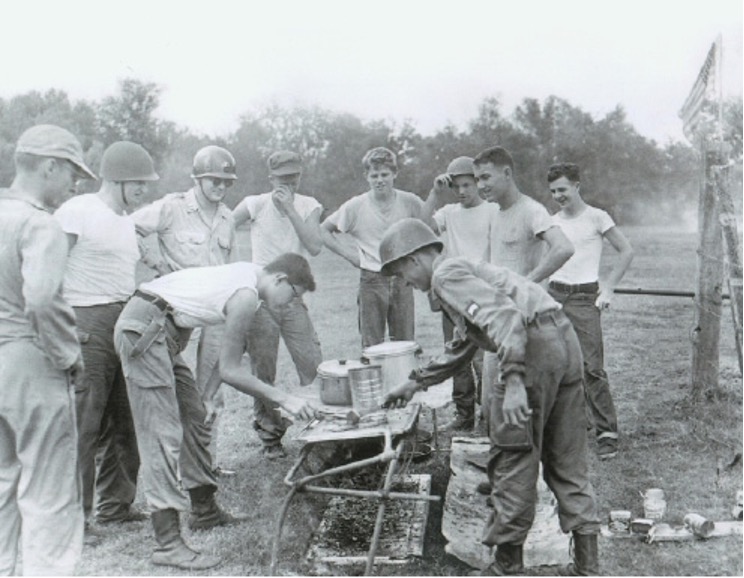
    CairnsPt1CAP

    And this fanatic wasn’t just some peripheral character in Oswald’s orbit. As one can see from the above, he was the squadron leader of Lee Harvey Oswald’s Civil Air Patrol unit.

    So now we must ask the question: Are we truly expected to believe that a man who wanted to “train killers” to obliterate Communists would have had a benign, indifferent view of a cadet who—according to The Oswald Puzzle—was already:

    “forceful in the expression of his own views on government, social issues, and geopolitics”? A cadet who, according to William Wulf, “started to expound the Communist doctrine? Who was allegedly “highly interested in communism” and believed that “communism was the only way of life for the worker”

    Most astonishingly, however, was the revelation that Oswald “was looking for a Communist cell in town to join” (The Oswald Puzzle; p.40) ( WC Vol VIII; p.18)

    Would such a cadet have been tolerated under the leadership of a rabid “Red” hater like Ferrie?

    We do, however, have testimony on record that directly contradicts the characterisation of Oswald as a budding Marxist in his youth.

    His fellow Civil Air Patrol cadet, Ed Voebel, who joined the CAP alongside Oswald, dismissed the notion outright when testifying before the Warren Commission:

    “I have read things about Lee having developed ideas as to Marxism and communism way back when he was a child, but I believe that is a lot of baloney”. Voebel also stated that he saw no evidence whatsoever that Oswald was studying communism in 1954.

    Robert Oswald’s testimony would further reinforce this:

    “If Lee was deeply interested in Marxism in the summer of 1955, he said nothing to me about it… Never in my presence, did he read anything that I recognised as communist literature”

    So what changed?

    If Oswald showed no interest in Marxism in 1954-55, then what triggered his sudden transformation? The evidence suggests that his introduction to Marxist literature was not organic but rather coincided with his encounters with David Ferrie.

    Can’t you see the contradiction?

    Even more damning is that The Oswald Puzzle explicitly states:

    “It is around this time that Oswald is showing clear and consistent indications of his beliefs regarding political and social systems.” (The Oswald Puzzle; p.40) Yet if this were true, then why—just a year later—would Oswald, the supposed overt Marxist, voluntarily enlist in the United States Marine Corps—an institution built to uphold and defend American capitalism and imperialism? The very antithesis of Marxist ideology.

    Oswald’s half-brother, John Pic, testified before the Warren Commission that Oswald had no ideological motivation behind his enlistment. Instead, he suggested that Oswald joined the Marines simply “to get from out and under the yoke of oppression from (his) mother”, Marguerite. (WC Vol. XI; p.10) 

    Possible. But I believe the answer lies elsewhere—at the feet of David Ferrie.

    One of Ferrie’s primary roles in the Civil Air Patrol was to encourage and recruit young men into the U.S. military—particularly the Marines. He frequently boasted about his connections to intelligence and military operations, and he would speak to cadets about the orders he received from those channels.

    In fact, when Lee, underage, tried to join the Marines just after his 16th birthday, his mother was visited by a man passing himself off as a Marine Corps recruiter. As Bill Davy rightly points out, “this was a clear violation of the law”.

    Ferrie, as it turns out, “often posed as a military officer and exhibited domineering and controlling behavior towards his cadets”. (Davy, p.6; James DiEugenio, Reclaiming Parkland, pp. 152-153) 

    Now, consider this. If Oswald was truly the overt “Marxist”, why, while preparing to enlist in the U.S. military, did he begin to do two opposing things simultaneously? He starts to obsessively study his brother’s Marine Corps manual, memorizing it “by heart.” While, at the same time, devouring Communist literature. (WC Vol I, 198.)

    Now take a moment to really let that one sink in for a second. 

    That’s tantamount to me, as a supporter of the Glasgow Celtic, turning up each week to Ibrox Stadium to cheer on the Glasgow Rangers. It defies all logic. (And would never happen). And logic should be an easy trail to follow, especially if one is as intelligent as Oswald. 

    To just ever so briefly skim over Oswald’s relationship with Ferrie is not presenting the totality of the evidence.  As James DiEugenio, a specialist in New Orleans, wrote: “Oswald’s relationship with Ferrie had a powerful, perhaps crucial, effect on his life.” (The JFK Assassination: The Evidence Today, p. 177). Which is likely the reason that, in the wake of the assassination, Ferrie was frantically trying to conceal that relationship. (ibid, p. 176)

    The Marxist Marine

    “At the time he entered the Marine Corps, Lee Oswald… was very much interested in socialism and Marxism. (The Oswald Puzzle; p.40) 

    Yet, which is the real Oswald?

    “Oswald was not a Communist or a Marxist. If he was, I would have taken violent action against him, and so would many of the other Marines in the unit.” James Bothelo

    Two statements. Two conflicting realities. Both cannot be true. So, which one is the illusion? With this, we enter a phase of Oswald’s life that defies explanation—at least if one assumes his Marxist convictions were genuine. His enlistment in the United States Marine Corps (USMC) stands as a glaring contradiction, compounded by the military’s staggering negligence in addressing his overtly pro-Soviet behavior.

    How could a staunch Marxist thrive within the staunchly anti-Communist U.S. military? How was his open admiration for the Soviet Union and Castro’s Cuba tolerated—at the height of the Cold War? And why did none of it trigger the alarm bells that destroyed so many others?

    Some have suggested that the Marine Corps simply viewed Oswald as an eccentric ideologue, dismissing his vocal admiration for the Soviet Union and his praise for Fidel Castro’s revolution as nothing more than a harmless personality quirk. But is that even remotely plausible in the rigid, hyper-vigilant, anti-Communist climate of the 1950s?

    Had Oswald merely harboured private sympathies for leftist ideals, perhaps this argument could be entertained. But that is not what happened. His behavior was neither subtle nor sporadic. He was a Marine who, while actively serving in the U.S. military—a force dedicated to opposing Communism—repeatedly and publicly expressed Marxist ideology, Soviet allegiance, and disdain for American capitalism.

    This is not just an inconsistency—it is a contradiction. And one that requires rigorous scrutiny.

    The Marxist Résumé

    “He must have had a secret clearance to work in the radar center, because that was a minimum requirement for all of us”. John Donovan. (WC Vol VIII; p.298)

    “We all had secret clearances.” Nelson Delgado. (Vol VIII; p.232)

    Below is a documented list of some of Marine Radar Operator Oswald’s openly pro-Soviet activities while serving in the U.S. Marines, under normal Cold War security policies. Any one of these actions should have immediately marked him as a severe national security risk.

    • Openly Studying/Declaring interest in Marxist/Communist Ideology. (WCR; p.388) (Oswald Puzzle; p.57)
    • Declared publicly his support for the Soviet system. (WCR, p.388) 
    • Believed that communism was “the best system in the world”. (WCR, p.686)
    • Gigged by his fellow Marines about “being a Russian spy”. (WC Vol; VIII; p.322)
    • Described by his commanding officer as a “Little nuts on foreign affairs”. (WC Vol VIII; p.290)
    • Complained about the incompetence of the “American Government”. (WC Vol VIII; p.292)
    • Made Remarks About “American Imperialism” and “Exploitation”. (Edward Epstein, Legend; p. 82)
    • Referred to Fellow Marines as “You Americans”. (Ibid)
    • Made serious references to “American Capitalist Warmongers”. (WC Vol; VIII; p. 315)
    • Denounced Capitalism and praised the Soviet economic system to fellow Marines. (WCR; p.868)
    • Nicknamed “Oswaldovich”. (WCR; p.388)
    • Made remarks stating his preference for “The Red Army”. (WC Vol VIII; p.323) (WCR; p.388)
    • Had his name in Russian on one of his jackets. (Vol VIII; p. 316)
    • Played Russian records at extremely loud volume (particularly Tchaikovsky’s “Russian War Dance”) (Ibid)
    • Studied The Russian Language. (WCR; p.388) (Oswald Puzzle; p.55-56)
    • Made remarks in Russian frequently or used expressions such as “da”“nyet,”or “comrade” to his fellow Marines. (Vol VIII; p. 315) (WCR; p. 686)
    • Read a Russian language newspaper. (Vol. VIII, p. 315-321-292)
    • Read Karl Marx’s Das Kapital, which is fundamentally a Marxist work but is also foundational to Communist ideology. (Vol. VIII, p. 254)  
    • Read and subscribed to publications directly linked to the Communist Party USA: The Daily Worker-The People’s World. (Elaborated on later). (WC Vol VIII; p.292-320-323) (Tony Summers Conspiracy; p.147)
    • On February 25, 1959, Oswald sat for a Marine Corps Russian proficiency exam—an event that, in itself, is rather shocking in its improbability. The Oswald Puzzle states that “Oswald may have been motivated by the fact that scoring at certain levels of proficiency would add to his monthly base pay” or “he just wished to test himself” in the Russian language. In other words, Oswald—a Marine assigned to anti-aircraft radar operations, with a secret clearance—chooses to take a Russian language proficiency exam.  But it’s not because it had any bearing on his military duties. But either for a small financial bonus or as a personal intellectual challenge. This explanation, however, is so weak that it collapses under even the slightest scrutiny.


    The late District Attorney of New Orleans, Jim Garrison, famously ridiculed the absurdity of such a test for someone in Oswald’s position. He noted, “In all my years of military service during WWII and since, I had never taken a test in Russian… I could not recall a single soldier EVER having been required to demonstrate how much Russian he had learned… A soldier genuinely involved in anti-aircraft duty would have about as much use for Russian as a cat would have for pyjamas.” (On The Trail of The Assassins, p. 23). (WCR; p.685) (The Oswald Puzzle; p.56) 

    • Received mail on base suspected to be from the Cuban government. And openly supported Fidel Castro and the Cuban revolution.  (WC Vol VIII; p.240-243)

    By any rational metric of Cold War security policy, Oswald’s conduct should have led to:

    1. A full-scale investigation by the USMC and the Office of Naval Intelligence (ONI).
    2. Immediate dishonourable discharge.
    3. Blacklisting from any future government employment.
    4. Court-martial proceedings.
    5. Possible imprisonment for espionage or subversive activities.

    And yet, none of this happened.

    If one attempts to reconcile Oswald’s “radicalism” as nothing more than a mere “personality quirk”, then the U.S. Marine Corps was running the most reckless, incompetent security operation imaginable—hardly consistent with the military ethos of Cold War America. And if The Oswald Puzzle expects us to swallow that narrative, the real scandal isn’t just Oswald—it’s the alarming possibility that other “personality quirks” were freely roaming U.S. military bases, unchecked, with the potential to defect to the Soviet Union.

    Even more alarming, Oswald had access to one of the most sensitive military installations in the world—Atsugi, Japan. This base housed the U-2 spy plane program, one of America’s most closely guarded Cold War secrets. And yet, this proclaimed Marxist, who referred to his fellow Marines as “you Americans,” was reportedly seen strolling around the base, casually taking photographs (Philip Melanson, Spy Saga, p.8).

    Oswald’s Ability to Follow Orders and Authority

    It has often been argued that Oswald’s temperament—frequently characterized as rebellious, defiant, and resistant to authority—would have made him wholly unsuitable for intelligence work. Detractors paint him as a loose cannon, a man who bristled under orders and was incapable of following directives. 

    However, as with so much else in the Oswald enigma, this portrayal is contradicted by testimony on the record. Nelson Delgado testified that;

     “He used to take orders from a few people there without no trouble at all…If he had respect, he would follow, go along with you.” (WC Vol VIII; p262)

    This statement suggests that Oswald’s alleged inability to follow orders was not an intrinsic trait, but rather a selective disposition—he was fully capable of obedience when he deemed it warranted. A quality, one might argue, that could be highly desirable in certain intelligence circles. 

    How Did Oswald Learn Russian?

    The Oswald Puzzle makes the case that Oswald’s Russian proficiency was solely the product of his own self-discipline, a testament to his determination to master the language through solitary study. The book cites various Marines recalling his commitment to learning Russian, as if this alone explains how a young radar operator—without formal instruction—somehow acquired an impressive grasp of one of the most notoriously difficult languages in the world. (The Oswald Puzzle; p.55)

    This argument, however, begins to unravel when faced with a striking omission from the book—a name that should have been central to the discussion but is instead left out entirely: Rosaleen Quinn.

    Quinn was the aunt of Oswald’s fellow Marine, Henry J. Roussel, Jr., and she had a personal stake in learning Russian. She was preparing for a position at the American Embassy in Moscow, which required passing a State Department exam in the language. To achieve this, she undertook a Berlitz course and received formal tutoring for more than a year. (WC Vol. VIII; p.321) (XXIV; p.430)

    At her nephew’s arrangement, Quinn spoke with Oswald one evening for over two hours in Russian. She later recalled that Oswald spoke the language better and more confidently than she did! (Melanson; p.11)

    That revelation alone should be enough to pierce the myth of Oswald as a self-taught Russian student. Here was a woman who had received structured, professional training, yet she found herself outpaced in fluency and confidence by a 19-year-old Marine with no formal instruction.

    It gets even more implausible when we consider the timing. This conversation took place after Oswald had already failed his Russian proficiency test in February 1959. According to The Oswald Puzzle: 

    “Oswald got two more questions right than wrong, however, his overall rating on the test was poor. Oswald scored -5 for “understanding” (listening to spoken Russian) +4 for reading and +3 for writing. Those scores suggest that he had been teaching himself Russian from a book up to that point in time”. (p.56)

    So we are supposed to believe that a man rated as “poor” in Russian just months earlier—who had a negative score in listening comprehension (-5)—could, by the time he spoke with Quinn, outclass a trained Russian speaker? 

    Jim Garrison captured the absurdity of this contradiction perfectly when he wrote“I am reminded of the man of said his dog was not very intelligent because he could beat him three games out of five when they played chess.” (Garrison, p.22)

    But beyond the numbers, there is an even larger problem. Russian is not an easy language for an American to master, even with professional training. Dr. James Weeks, a professor of modern languages at Southeastern Massachusetts University, taught Russian himself and underwent military language training. He was consulted by researcher Phillip Melanson and was asked whether Oswald’s supposed rate of progress was feasible.

    Weeks stated that attaining Russian fluency requires more than twice as many hours as Spanish or French—1,100 hours or more, including instruction. Weeks opined that the kind of progress described in Oswald’s case would be exceedingly difficult, if not impossible, to attain in such a short time by using only the radio and self-study props. (Melanson, p.12)

    This is not an opinion—it is a fact supported by decades of linguistic research. 

    We must also consider a particularly revealing exchange from the January 27, 1964, executive session of the Warren Commission, in which Chief Counsel J. Lee Rankin made a rather curious admission:

    “We are trying to run down to find out what (Oswald) studied at the Monterey School of the Army in the way of languages”. History Matters Archive – January 27, 1964 transcript, pg

    This single sentence raises profound implications. Why was the Warren Commission investigating Oswald’s possible enrolment at Monterey?

    The Monterey School (Defense Language Institute) was not some casual language academy—it was a top-tier training ground for U.S. military and intelligence personnel. Students did not elect their own courses; they were assigned languages based on operational requirements.

    If Oswald had indeed studied at Monterey, this would explain both the speed and depth of his Russian proficiency, as well as why his behavior in the Marine Corps—so outwardly pro-Soviet and politically suspect—never raised alarms within the military establishment.

    The very fact that Rankin and the Warren Commission found it necessary to “run this down” suggests they had reason to believe Oswald’s Russian training was more than just the efforts of a self-motivated Marine flipping through textbooks in his spare time. (Melanson, p.12)

    Click here to read part 2.