Tag: JFK ASSASSINATION
-

Why Officer Tippit Stopped His Killer
The murder of Officer J.D. Tippit in Oak Cliff was famously cited by David Bellin, Assistant Counsel to the Warren Commission, as being the “Rosetta Stone to the solution” of the JFK assassination. (Jim Marrs, Crossfire, p. 340, all references are to the 1989 edition) “Once it is admitted that Oswald killed Patrolman J.D. Tippit,” the attorney for the commission observed, “there can be no doubt that the overall evidence shows that Lee Harvey Oswald was the assassin of John F. Kennedy.”
Following Mr. Belin’s questionable logic might also lead one to believe the opposite to be true. Once it is shown that Oswald likely did not kill Patrolman Tippit, the case for him having shot President Kennedy and Governor Connally is, therefore, demonstrably weakened.

“I emphatically deny these charges!” shouted Oswald to news reporters while in Dallas police custody. “I didn’t shoot anybody, no sir … I’m just a patsy!” Oswald denied his guilt in many ways and more than once. (Mark Lane, Rush to Judgment, p. 81)
Was the suspect telling the truth?
Sadly, within less than 48 hours, shadowy nightclub owner Jack Ruby would all but terminate the official Dallas Police investigation into the Tippit homicide when he gunned down suspect Lee Oswald in the basement of Dallas Police Headquarters. That unfathomable event, broadcast live on national television, occurred in the presence of more than 50 Dallas policemen. It was their job to ensure Oswald’s safety while he was in custody—so the suspect might be tried on charges of assassinating President Kennedy and murdering Officer Tippit.
“We never worked on any of his (Tippit’s) murder, because there was no use making a murder case (with the suspect dead),” admitted former District Attorney Henry Wade in an interview with veteran Tippit researcher Joseph McBride. “I think we had enough evidence that Oswald did it.”
And despite Belin’s “Rosetta Stone” reference, not only did Dallas authorities abandon the Tippit case, but the Warren Commission, according to McBride, showed “almost no real interest in solving the crime … the commission was deliberately stonewalling a serious investigation of Tippit.”
Any “serious” investigation into Tippit’s death must begin with one fundamental and all-important question: Why did Tippit stop Oswald?
Based on the persistence of several indefatigable private researchers and investigators who kept digging into the Tippit mystery for decades, I believe we can now attempt to answer that question. The answer, it would seem, had nothing to do with the man walking on 10th Street in Oak Cliff matching the Dealey Plaza suspect’s generic description of being a young white male of average height and weight—as was suggested by the Warren Commission.
In the words of Sylvia Meagher, writing in her 1967 book Accessories After the Fact, “The strangeness of Tippit’s actions,” suggests that “it was not probable, perhaps not even conceivable, that Tippit stopped the pedestrian who shot him because of the description broadcast on the police radio. The facts indicate that Tippit was up to something different which, if uncovered, might place his death and the other events of those three days in a completely new perspective.” (See Meagher, pp. 260-66)
What follows in this article is a “new perspective.”
12:00 P.M.
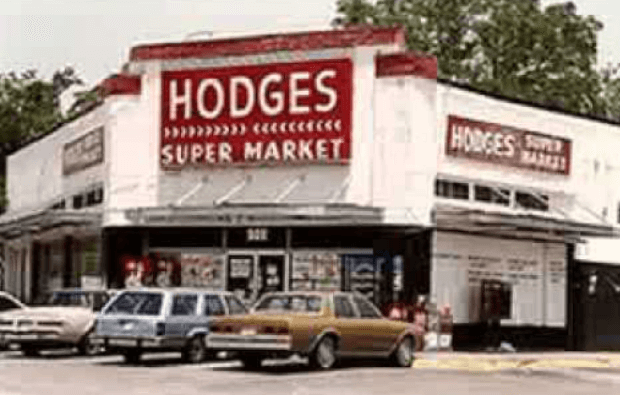
The “strangeness” of Tippit’s actions on 11/22/63 appear to have begun even before shots rang out in downtown Dallas. Tippit, whose normal area of patrol was in Cedar Crest, patrol area #78, was apparently called to a supermarket in the 4100 block of Bonnie View Road. Respected Tippit researcher Larry Ray Harris interviewed the Hodges Supermarket manager in 1978. As described in news reporter Bill Drenas’ oft-cited 1998 article Car #10 Where are You?, the manager told Harris he had caught a woman shoplifter on 11/22/63 and had phoned police.
It was Tippit who responded to that location at about noon, just a half hour before the assassination. The manager knew Tippit, because Tippit routinely came to the market on calls for shoplifters. The interviewee said Tippit placed the woman in his squad car and left. However, Tippit appears not to have brought the shoplifting suspect back to his nearby base of operations. No record of the woman’s arrest or information on who she was or what happened to her has ever surfaced.
12:30 p.m.
President Kennedy’s motorcade was scheduled to have arrived at the Dallas Trade Mart at 12:30. However, because the motorcade was running a few minutes late, President Kennedy was assassinated at 12:30, and Governor Connally was gravely injured, as the motorcade proceeded through Dealey Plaza on route to the Trade Mart. The Hodges Market in the 4100 block of Bonnie View in Tippit’s district was more than seven miles southwest of Dealey Plaza.
12:40 p.m.
The DPD Channel 1 dispatcher reports a shooting in the downtown area involving the President. By this time, Texas School Book Depository employee Lee Oswald has already grabbed his blue work jacket and has left the TSBD on foot. He will board a city bus, but when that bus gets stalled in traffic, Oswald will ask for a transfer, depart from the bus, and walk to a cab stand to catch a quicker ride (with cab driver William Whaley) out to nearby Oak Cliff where the young man resides.
The DPD Channel 1 dispatcher next orders “all downtown area squads” to Dealey Plaza, code 3 (lights and sirens). By 12:44, a general description of the Kennedy suspect (slender white male, 5’10” and 160 pounds) is broadcast over both Channels 1 and 2.
12:45 p.m.
Murray Jackson, the dispatcher, asks Tippit to report his location. Tippit replies, according to police radio logs, that “I am about Keist and Bonnie View,” which is still within Tippit’s regular patrol district down in Cedar Crest. (Joseph McBride, Into the Nightmare, p.441) However, this may not have been the case.
Beginning at approximately 12:45, when Officer Tippit reports he is still in his regular patrol area, Tippit will instead be seen sitting inside his squad car parked at the GLOCO gas station, strategically situated in northernmost Oak Cliff next to the Houston Street viaduct. The viaduct connects downtown Dallas and Dealey Plaza to Oswald’s neighborhood in Oak Cliff—some five miles north of Tippit’s reported position.
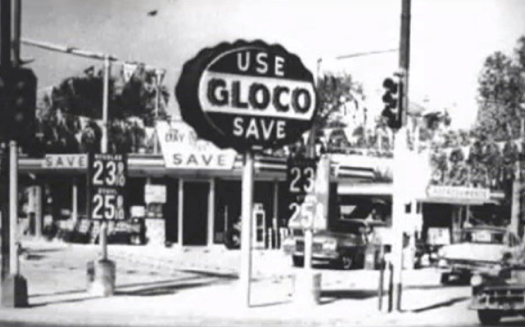
Researcher William Turner, in a 1966 article in the magazine Ramparts, claimed he located five witnesses who saw Tippit sitting in his patrol car at the gas station at this time while watching traffic coming across from downtown Dallas. (McBride, ibid) The location is only 1.5 miles from Dealey Plaza. Two of the witnesses, a husband and wife who knew the officer, say they waved at Tippit who waved back at them. The story was reportedly verified by three of the GLOCO station attendants. Dallas researchers Greg Lowrey and Bill Pulte also interviewed all five of these witnesses to confirm the story. Some said that Tippit arrived at the GLOCO as early as just “a few minutes” after the assassination.
Was Tippit watching for Oswald to come across the viaduct on a Dallas bus? Did he see Oswald instead in the front of William Whaley’s cab? What was Tippit doing?
12:46 p.m.
At this time, dispatcher Murray Jackson ordered Officers Tippit and R.C. Nelson into the Central Oak Cliff area, which was odd since an assigned officer (William Mentzel) was already patrolling Central Oak Cliff. (McBride, pp. 427-30) Tippit, according to witnesses, is of course already there in the northernmost part of Oak Cliff at the gas station. (This was probably unknown to Jackson, since Tippit had just responded to the dispatcher that he was in his assigned patrol area at Bonnie View & Keist some five miles to the south). Officer Nelson instead proceeded on to Dealey Plaza, possibly following the preceding 12:42 “code 3” order for all downtown area squads to report to Dealey Plaza. (Henry Hurt, Reasonable Doubt, pp. 161-63)
Meanwhile, Oswald will soon be crossing the Houston St. viaduct in William Whaley’s cab, heading for Oak Cliff.
The witnesses say that after some 10 minutes of sitting at the gas station, watching traffic crossing from the downtown area, Tippit suddenly pulled out and took off south on Lancaster Avenue “at a high rate of speed.”
12:52 or 12:53 p.m.
Cab driver William Whaley lets Oswald out at the corner of North Beckley and Neely Street, several blocks south of Oswald’s rooming house, which the cab has already passed. Whaley had marked Oswald’s intended location on his run sheet as the 500 block of N. Beckley, even farther south and in the wrong direction from the rooming house. The 500 block of N. Beckley was, in 1963, dominated by the side parking lot of the El Chico Restaurant.
12:54 p.m.
Dispatcher Murray Jackson contacts Tippit, who is now about a mile from the GLOCO Station on Lancaster Street. (McBride, p. 445) Oswald and Tippit are both apparently moving in the direction of the Texas Theater.
1:00 to 1:07 p.m.
Texas Theater manager Butch Burroughs said Oswald entered the theater during this timeframe and later bought popcorn from him at the concession stand at approximately 1:15. (McBride, p. 520) Other movie patrons will similarly report having seen Oswald in the mostly empty theater during the start of the movie, changing seats frequently and sometimes sitting directly next to other moviegoers. Is Oswald supposed to meet someone he doesn’t know personally, perhaps his intelligence contact to whom he is expected to give a briefing?
After 1:00 p.m.
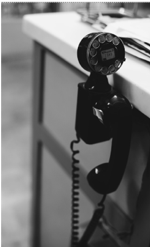 Employees of the Top Ten Records store, located a block and a half west of the Texas Theater on Jefferson Boulevard, later claim that Tippit parked his squad car on Bishop Street adjacent to the records store and came in hurriedly while asking to use the phone.
A Dallas Morning News reporter interviewed former Top 10 clerk Louis Cortinas in 1981. Cortinas recalled that, “Tippit said nothing over the phone, apparently not getting an answer. He stood there long enough for it to ring seven or eight times. Tippit hung up the phone and walked off fast, he was upset or worried about something.” (McBride, p. 451)
Had Tippit picked up Oswald near the El Chico Restaurant and then dropped him off at the Texas Theater? Had Tippit simply been watching the theater to confirm Oswald’s arrival? Or, was Tippit simply trying to contact someone to find out the latest news on the condition of President Kennedy and Governor Connally?
1:03 p.m.
Around this time, police dispatcher Murray Jackson tries to radio Tippit, but gets no answer. (Meagher, p. 266) Was this when Tippit was entering the Top 10 records store to place the phone call?
Approximately 1:04 p.m.
Several blocks east of Top 10 and the Texas Theater, an unknown young white male about 5’8” to 5’10” and 165 pounds wearing a white shirt and light tan Eisenhower jacket begins to quickly walk west on East 10th Street. The man is in such a hurry that he catches the attention of those inside of Clark’s Barber Shop at 620 E. 10th as he breezes by that establishment’s storefront window. A pedestrian, Mr. William Lawrence Smith, passes the same man as Smith walks east to lunch at the Town & Country Café just a few doors west of the barber shop. (John Armstrong, Harvey and Lee, p. 841)
Approximately 1:05 p.m.
As the unknown white male proceeds west and crosses the intersection of 10th and Marsalis, a major disturbance suddenly breaks out at that corner. Bill Drenas, author of the 1998 article Car #10 Where Are You?, mentioned that a person near the scene of the Tippit shooting told investigator Bill Pulte that, “If you are planning to do more research on Tippit, you should find out about the fight that took place at 12th & Marsalis a few minutes before Tippit was killed.” The interviewee spoke only on the condition of anonymity.
Harrison Livingstone, in his 2006 book The Radical Right and the Murder of John F. Kennedy, adds more crucial detail about this mysterious neighborhood altercation. “There are neighborhood reports of a disagreement at the intersection of 12th & Marsalis,” writes Livingstone, “a few minutes before Tippit was killed. Tippit was headed precisely toward 12th & Marsalis when he left Lancaster & 8th (the report of the 12th & Marsalis argument is from someone whose identity needs to be protected).
“The late Cecil Smith witnessed this fight which was actually at 10th & Marsalis (my emphasis). One of the two individuals was stabbed, but it was never investigated, apparently … just two blocks east from where Tippit was shortly murdered.” The fight also occurred, let it be known, at the same time and location the unknown gunman in the light jacket, white shirt, and dark trousers is passing on his way two blocks west to the fast approaching scene of the fatal Tippit shooting.
But it was not until Dallas researchers Michael Brownlow and Professor William Pulte made public their findings in a 2015 Youtube video that we get the full scoop on this most unusual so-called “fight.”
 Brownlow said it was actually three men and a woman who jumped on another man at the corner, who was then “violently” stabbed. The wounded man, bleeding profusely, was then inexplicably thrown into the back of a blue Mercury Monterey which sped away from the scene. Many people witnessed the assault. 10th & Marsalis was a commercial corner, with an auto parts store, a plumbing supply store, and other nearby businesses such as the barber shop and restaurant. It was Indian summer, pre-air conditioning days, and most of these businesses had telephones within easy reach. Neighbors and teens home from school also allegedly witnessed the noisy and bloody altercation. (See also, Joseph McBride, Into the Nightmare, pp. 447-48)
Emergency phones calls were obviously placed to the Dallas Police, although you won’t find any mention of this incident in the DPD call logs for 11/22/63. Why not?
Approximately 1:05:30
Officer Tippit, now sitting once again in his patrol car outside of the Top 10 Records store, suddenly hears his police radio crackle to life. There has been a reported fight and possible stabbing at the corner of 10th & Marsalis, several blocks east of where his patrol car now sits near the corner of West Jefferson Blvd. and Bishop Avenue. A man has supposedly been stabbed and thrown into the back of a blue car which drove away from the scene. Tippit puts Car #10 into gear and moves out in a big hurry.
 The employees at Top Ten (Lou Cortinas and Dub Stark) watch through their front window as Tippit’s car goes charging through the intersection and races north up to Sunset Street where Tippit blows through the stop sign and disappears from view. (McBride, pp. 451-550)
Approximately 1:06:00
Tippit quickly reaches 10th Street and is about to turn right, heading east towards the disturbance at the corner of 10th & Marsalis. But he instead observes a late model Chevrolet headed west on 10th. Could this be the car escaping from the scene of the fight? So instead of turning right, Tippit makes a quick decision and turns left, following the Chevy that has just passed in front of him. Within a block the officer speeds up, passes the Chevy, turns the wheel, and forces the surprised driver to come to a stop at the curb.
Mr. James Andrews, the motorist—who had been returning to work from his lunch hour—would later give Dallas researcher Greg Lowrey (as reported in Bill Drenas’ article Car #10 Where Are You?) the following description of this bizarre event:
Drenas writes that “The officer then jumped out of the patrol car, motioned for Andrews to remain stopped, ran back to Andrew’s car, and looked in the space between the front seat and the back seat (emphasis mine). Without saying a word, the policeman went back to the patrol car and drove off quickly. Andrews was perplexed by this strange behavior and looked at the officer’s nameplate which read ‘Tippit’ … Andrews remarked that Tippit seemed to be very upset and agitated and acting wild.” (McBride, pp. 448-49)
Much has been made of this incident, which apparently happened just a few short moments prior to Tippit’s death. Some have reasoned that Tippit was looking for Oswald, thought to be hiding in the back of an automobile on his way to Red Bird Airport to catch a flight out of town. Others have found the story so odd that they have tended to dismiss it altogether—couldn’t have happened.
But now that we have a report about a fight at 10th & Marsalis, a stabbing in which the victim was thrown into the back of a car which then sped away from the scene, Tippit’s “wild” actions perhaps make more sense. Tippit may have been looking for the injured stabbing victim in the back of an escaping vehicle—and he was doing so alone, with no backup. That is why he was agitated and acting upset. President Kennedy and Governor Connally have just been gunned down in Dealey Plaza and now Tippit is dealing with a violent, potentially life and death situation in adjoining Oak Cliff.
1:07:00 p.m.
Officer Tippit heads east on 10th Street, heading towards the scene of the reported disturbance at the corner of Marsalis. By now, according to Texas Theater Manager Butch Burroughs—as well as multiple paying customers—Lee Oswald is most definitely in the building for the start of the afternoon’s double war movie feature. (Marrs, Crossfire, pp. 352-53)
1:08:00 p.m.
As Officer Tippit travels east on 10th towards Marsalis, he spots a lone figure walking west just two blocks from the scene of the stabbing incident. Tippit slows Car #10 as he cruises through the intersection of 10th & Patton. Cab driver Bill Scoggins, parked near the corner in his cab while eating his lunch, notices Tippit pass in front of his cab, slow down, and suddenly pull to the curb about 100 feet past Patton Street. The officer apparently summons the young pedestrian, who is wearing the beige Eisenhower jacket, dark trousers, and white shirt, back to his patrol car.
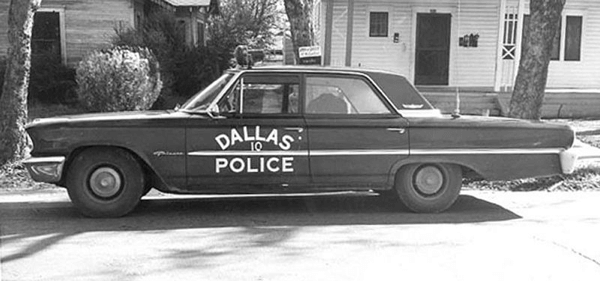 The young man does an about-face, turning around to approach Tippit’s car sitting at curbside. Could this young man have been a witness? A participant in the fight? He doesn’t appear to have any blood on his jacket that the officer can see. Tippit and the young man, who is now leaning over, have a brief conversation through the open vent on the passenger-side window.
1:08:30 p.m.
Officer Tippit, who probably does not fully believe the young man’s story about who he is and what business he has on 10th Street, decides to get out of his car to question the subject further. He adjusts his police cap, begins to walk slowly towards the front of Car #10. As he does, the man pulls a .38 revolver from under his jacket and begins to fire.
No one sees the actual shots. A passing motorist, Domingo Benavides, is startled by the gunfire as he approaches Car #10 while traveling west on 10th. In an act of instinct and self-preservation, Benavides turns his pickup to the curb and ducks down behind the dashboard. (Lane, pp. 177-78)
Cabbie Bill Scoggins sees Tippit fall into the street. A few seconds later, he observes the figure of the young man walking quickly towards his cab, cutting across the adjacent corner property on 10th Street. Scoggins steps out of his cab and hides behind the driver-side fender. The young man emerges from the lawn’s hedges and begins to trot south on Patton Street, still tossing the occasional empty shell to the ground. (Lane, pp. 191-93)
Hearing no further shots, Benavides pokes his head up in time to see the gunman heading for Patton Street, inexplicably tossing a couple of shells into the bushes. Benavides will later tell police he could not positively identify the gunman and will not be taken to any of the subsequent lineups.
1:10:00 p.m.
The gunman turns right on Jefferson Boulevard, as seen by multiple witnesses. He stuffs the pistol back into his pants, walks briskly west for a block before cutting through a service station and turning north on Crawford Street. At this point the young gunman disappears. (Armstrong, p. 855)
Approximately 1:25 p.m.
 “Someone” hands Captain William “Pinky” Westbrook a light tan Eisenhower jacket that was allegedly thrown under a parked car behind the Texaco service station at Jefferson & Crawford. This was supposedly the jacket worn by the fleeing gunman. Westbrook, however, can’t remember the name of the officer who turned over the jacket. (Lane, pp. 200-203)
Approximately 1:36 p.m.
As Dallas police cars continue swarming into Oak Cliff, the unidentified young man from 10th & Patton suddenly reappears again on Jefferson Blvd. near the Texas Theater. The man, who is wearing a white shirt, either purchases a ticket or simply ducks in without paying. The time is now approximately 1:37. Once inside, the new arrival goes upstairs to sit in the theater’s balcony section. (Armstrong, pp. 858-60)
Approximately 1:40-42 p.m.
Dallas police are tipped off to a suspicious person who has entered the Texas Theater.
Approximately 1:42 p.m.
 At 10th & Patton, Captain Westbrook of the DPD shows FBI special agent Bob Barrett a man’s wallet. The Dallas investigators are going through the wallet, and apparently find two pieces of ID. Westbrook asks Barrett if he knows who either Lee Harvey Oswald or Alex Hiddell are. Barrett says no. (Armstrong, p. 856) Years later, when the story about the wallet is revealed by FBI personnel, the DPD will say that Barrett’s memory is faulty, there was no wallet found at the Tippit crime scene. But a check of archived Dallas TV news footage proved the DPD wrong. Later, the story seems to change that some unidentified person in the crowd at Tippit’s murder scene must have handed the wallet to reserve cop Sgt. Kenneth Croy, the first officer on site. Only none of the many Tippit witnesses reported seeing a wallet on the ground. Croy, incredibly, never filed a written report on 11/22/63. And Croy, in his testimony before the Warren Commission, said he knew several of the officers who eventually responded to the shooting at 10th and Patton—but couldn’t remember a single name of any of them.
1:45:43 p.m.
The DPD Channel 1 dispatcher broadcasts a report of a suspect who “just went into the Texas Theater.” A fleet of police cars, marked and unmarked, arrive to surround the theater front and back. (Armstrong, p. 863)
1:50-1:51 p.m.
 Lee Oswald, still wearing his long-sleeved brown work shirt, is subdued in the main (downstairs) section of the theater by DPD officers and is whisked out the front door to a waiting unmarked police car.(Armstrong, p. 868) Meanwhile, a second slender young white male in a white t-shirt is arrested in the balcony and brought out the back door of the theater, as observed by Bernard Haire, the owner of the hobby store two doors east of the theater. The official Dallas arrest report will indicate that Oswald was arrested in the balcony, while in fact he was actually arrested downstairs in the theater’s ground-floor main section. (Armstrong, p. 871) What happened to the second man who was taken away?
Approximately 1:55 p.m.
While accompanied by four Dallas detectives in an unmarked car headed for DPD’s downtown headquarters, Oswald is asked to give his name. He ignores the request. Perturbed, Detective Paul Bentley pulls a billfold from Oswald’s hip pocket and begins to examine its contents. He finds ID cards for both a Lee Oswald and an A. Hidell. “Who are you?” asks Bentley again. “You’re the detective,” Oswald finally answers back. “You figure it out.” (Armstrong, p. 870)
But wait. They just found Oswald’s wallet at 10th & Patton, right? (Armstrong, p. 868) So Oswald carried two wallets, one of which he was good enough to leave at the Tippit murder scene? Along with four shell casings from a .38 caliber revolver?
In the words of an old Rockford Files TV episode: “that plant was so obvious someone should’ve watered it.” No wonder the 10th & Patton wallet disappeared after a billfold was found to have been in Oswald’s possession at the theater.
The Dallas Police knew who Oswald was before they descended on and surrounded the Texas Theater.
Approximately 2.p.m.
Oswald arrives at Dallas Police Headquarters to be interrogated and booked. He will be shot dead that very same weekend. To quote one bluntly sarcastic journalist: “Lee Oswald miraculously managed to survive nearly 48 hours in the custody of the Dallas Police Department.”
The DPD kept no known tapes or transcripts from the hours of interrogation undergone by their suspect. We have little idea what Oswald really said, only that he “emphatically denied these charges.” (Armstrong, p. 893)
Ballistics
 If anyone is looking for ballistics to provide a definitive answer in the Tippit case, they will be sorely disappointed. The ballistics evidence tends to exonerate Lee Oswald as much as it implicates him. (For lengthy discussions of the following, see Henry Hurt, Reasonable Doubt, pp. 151-56 and Joseph McBride, Into the Nightmare, pp. 252-57)
Four shells from a .38 caliber handgun were recovered spread along the ground leading from the crime scene. The DPD officers on site at first figured these were from an automatic pistol (which automatically ejects the spent shells), not a revolver, because who would purposely remove and leave such incriminating evidence at the scene (along with a wallet full of ID)?
The bullets found in Officer Tippit’s body at autopsy could not be matched to Oswald’s .38. And the shells so conveniently recovered at 10th & Patton could not be matched to the bullets. The shells were never properly marked by DPD, evidence was misfiled, and the chain of evidence for the ballistics was, unfortunately, suspect.
In the words of homicide detective Jim Leavelle, the very man tasked with nailing Oswald for the Tippit murder, the ballistics in this case were quite frankly “a mess.”
As Joe McBride notes in his book, Warren Commissioner and congressman Hale Boggs was one of the members of that body who had his doubts about their verdict. Boggs directly challenged the Tippit case ballistics when he said, “What proof do you have that these are the bullets?” (McBride, p. 258) Boggs apparently never received a satisfactory answer.
New Orleans District Attorney Jim Garrison, who took an active role in the JFK assassination investigation in the late 1960s, believed that the ballistics evidence pointed to two shooters at 10th & Patton. Said Garrison in his October 1967 Playboy interview, “The evidence we’ve uncovered leads us to suspect that two men, neither of whom was Oswald, were the real murderers of Tippit.”
Mr. Garrison added that, “… Revolvers don’t eject cartridges and the cartridges left so conveniently on the street didn’t match the bullets in Tippit’s body.”
The cartridge cases—two Western-Winchester and two Remington–Peters—simply didn’t match the bullets—three Western–Winchester, one Remington-Peters—recovered from Officer Tippit’s body.
“The last time I looked,” noted Garrison wryly, “the Remington–Peters Manufacturing Company was not in the habit of slipping Winchester bullets into its cartridges, nor was the Winchester–Western Manufacturing Company putting Remington bullets into its cartridges.”
Witnesses
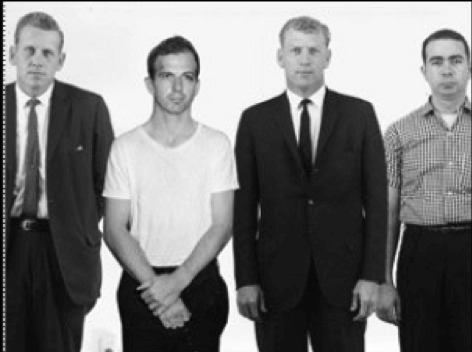 If the ballistics evidence in the Tippit case could rightly be characterized as messy, then the eyewitness testimony regarding the Tippit homicide would have to be labeled a toxic waste site by comparison.
Tippit authority Joseph McBride, author of Into the Nightmare, explained the bizarre situation succinctly when he stated, “The other physical evidence is also confused and contradictory—and the eyewitness evidence is so contradictory that it seems as though there were two sets of witnesses.” (McBride, pp. 460-61)
One set of witnesses identified Oswald as the sole murderer of Officer Tippit. The second set said they couldn’t positively identify Oswald, or could positively exclude Oswald, and saw two or more suspects acting suspiciously, and even saw one of those persons apparently involved in the shooting escape in an automobile.
Dallas authorities, and later the Warren Commission, focused almost exclusively on the first set of witnesses—while minimizing or completely ignoring the second set.
A good example of “witness neglect” was reported by 10th Street neighbor Frank Wright. Wright later told Tippit researchers that “I was the first person out. I saw a man standing in front of the car. He was looking toward the man on the ground (Tippit). The man who was standing in front of him was about medium height. He had on a long coat, it ended just above his hands. I didn’t see any gun. He ran around on the passenger side of the police car. He ran as fast as he could go, and he got into his car. … He got into that car and he drove away as fast as he could see. … After that a whole lot of police came up. I tried to tell two or three people (officers) what I saw. They didn’t pay any attention. I’ve seen what came out on television and in the newspaper but I know that’s not what happened. I know a man drove off in a grey car. Nothing in the world’s going to change my opinion.” (Hurt, pp. 148-49)
 Acquilla Clemons, a caregiver who worked on 10th Street, was not simply ignored the same as was Mr. Wright. Clemons, who saw two suspicious persons escape the Tippit murder scene in different directions, told investigator Mark Lane (during a taped interview) that a man she suspected was a Dallas detective or policeman visited her home on or about 11/24/63. He was carrying a sidearm. Mrs. Clemons reported that the visitor warned her “it’d be best if I didn’t say anything because I might get hurt … someone might hurt me.” (McBride, pp. 490-94)
 Warren Reynolds, a used car salesman who saw the gunman escaping west on Jefferson Boulevard, was indeed hurt—and very badly. Reynolds told news reporters the afternoon of the assassination that he had seen the fleeing gunman, but was simply too far away to have made a positive identification. The FBI finally got around to interviewing Reynolds in January, 1964, at which time the witness reiterated his original story that he had been located across Jefferson Boulevard and was simply too far from the gunman to have made a positive identification. Two nights later, someone sneaked into Reynolds’ place of business, hid in the basement, and shot Mr. Reynolds in the head with a .22 caliber rifle. Miraculously, Reynolds survived. Even more miraculously, the car salesman made such a dramatic recovery that he now found his eyesight had improved and he was able to identify Lee Oswald after all. (Hurt, pp. 147-48; McBride pp. 476-78)
Decades later, Dallas researcher Michael Brownlow tracked down Mr. Reynolds, who was still in the business of selling cars. At first, Reynolds would not admit who he was. But after Brownlow had gained his trust, the researcher asked Mr. Reynolds why he had suddenly changed his testimony regarding his identification of Oswald.
“Because I wanted to live,” Reynolds admitted bluntly.
When Mark Lane came to Dallas to make the documentary Rush to Judgment, his director, Emile de Antonio, made a rather interesting observation. “There was absolutely no tension at all on the scene of the assassination (Dealey Plaza),” commented de Antonio. “… All the tension is where Tippit was killed. That’s right and this (the Tippit slaying) is the key to it.” (McBride, pp. 460-61)
The director’s sense of what was going on in Oak Cliff was seemingly verified by an anonymous letter appearing in Playboy that was sent to the editor after Jim Garrison’s October 1967 Playboy magazine interview:
“I read Playboy’s Garrison interview with perhaps more interest than most readers. I was an eyewitness to the shooting of policeman Tippit in Dallas on the afternoon President Kennedy was murdered. I saw two men, neither of them resembling the pictures I later saw of Lee Harvey Oswald, shoot Tippit and run off in opposite directions. There were at least half a dozen other people who witnessed this. My wife convinced me that I should say nothing, since there were other eyewitnesses. Her advice and my cowardice undoubtedly have prolonged my life—or at least allowed me now to tell the true story…”
There were four main witnesses who gave testimony that Lee Oswald had in fact been guilty. Many who’ve studied the Tippit murder have long felt that competent defense counsel would have reduced the case against Lee Oswald to shambles. If Oswald had received a fair trial, they say, he would have been exonerated of the charge he killed Officer J.D. Tippit.
Of course, Oswald did not receive even the benefit of an unfair trial. The suspect received no trial whatsoever and was instead convicted in the court of public opinion based on government propaganda disseminated by a relentless disinformation campaign. In the words of FBI Director J. Edgar Hoover on the evening of the assassination, “The thing I am concerned about, and so is Mr. Katzenbach (Deputy U.S. Attorney General), is having something issued so we can convince the public that Oswald is the real assassin.” (McBride, p. 142)
That “thing” mentioned by Hoover would eventually, of course, be the pre-determined, hastily prepared whitewash known as the Warren Report … with the so-called “magic” bullet as its centerpiece.
The four crucial witnesses against Oswald in the fatal Tippit incident would be William Scoggins, Ted Calloway, Helen Markham, and—belatedly—Jack Ray Tatum.
Taxi Driver Bill Scoggins
 William “Bill” Scoggins was seated in his cab on Patton Street. (Warren Report, p. 166) He was facing the intersection with 10th Street, when he saw Officer Tippit’s patrol car pass by in front of him. (For discussions of Scoggins’ testimony, from which this material is drawn, see Meagher, pp. 256-57 and Lane, pp. 191-93) He saw no one walk by the front of his cab. The patrol car pulled to the curb on 10th Street approximately 100 feet east of the intersection. Mr. Scoggins’ vantage point was obscured by some bushes at the edge of the corner property on 10th. He suddenly noticed a pedestrian on the 10th Street sidewalk either turn around or walk over to the police car’s passenger side window. Scoggins resumed eating his lunch when, several seconds later, gunshots suddenly rang out. Scoggins, startled, looked up in time to see the officer fall into the street. Soon after the pedestrian, now brandishing a pistol, began walking in the direction of the cab. Scoggins exited his cab, thought about running away, but immediately realized he would be in the open and could not outrun any bullets. Instead, Scoggins opted to hide behind the driver-side fender of his cab. He saw the young man cut across the lawn on the corner property, squeezing through the bushes and stepping out onto the sidewalk very near the cab. Hunkered down by the fender, Scoggins heard the man mumble something like “Poor dumb cop.” He was afraid the gunman might try to steal the cab, but instead the young man proceeded on foot south on Patton towards Jefferson Blvd., crossing Patton at mid-block.
At the Saturday (next day) six-man police lineup, Mr. Scoggins picked Oswald as the individual he had briefly seen emerging from the bushes. However, fellow car driver William Whaley, who had driven Oswald from downtown Dallas to Oak Cliff the previous day, also attended the same lineup as Scoggins. Mr. Whaley made the following cogent observation regarding the nature of that DPD lineup. He testified before the Warren Commission that “… you could have picked him (Oswald) out without identifying him by just listening to him, because he was bawling out the policeman, telling them it wasn’t right to put him in line with these teenagers. … He showed no respect for the policemen, he told them what he thought about them. They knew what they were doing and they were trying to railroad him and he wanted his lawyer.”
Oswald, of course, had a visibly damaged eye, the result of his encounter with the DPD. Oswald was also asked to state his name and to tell where he worked. By Saturday, when Mr. Scoggins participated in this particular lineup, every functioning adult in Dallas and across the USA knew that the lead suspect in the assassination of JFK and the murder of Officer Tippit was a young man named Lee Harvey Oswald who worked at the Texas School Book Depository.
As Mr. Whaley duly noted, “you could have picked him out without identifying him.”
Mr. Scoggins, as it turns out, was actually not able to pick out Oswald during a separate photo lineup. In front of the Warren Commission, Scoggins said that he was shown photos of different men by either an FBI or Secret Service agent. “I think I picked the wrong one,” the cab driver testified. “He told me the other one was Oswald.”
It seems abundantly clear that Mr. Scoggins got only the briefest of glimpses of the gunman, while hiding in fear for his life on the opposite side of his cab. He was unable to identify Lee Oswald as the gunman in the absence of a highly tainted lineup.
And fellow cab driver William Whaley, who saw through the sham of these tainted DPD lineups and denounced them for what they were? Within two years of his Warren Commission testimony he would become the first Dallas taxi driver since 1937, while on duty, to fall victim to a fatal traffic accident.
Ted Calloway
 After the Tippit gunman passed Bill Scoggins’s cab on Patton Street, he soon encountered used car lot manager Ted Calloway. Calloway, a U.S. Marine Corps veteran, had heard the pistol shots and immediately began walking across the car lot towards Patton to investigate. (Warren Report, p. 169) He soon observed a young man heading south on Patton carrying a pistol in what Calloway would later describe as a “raised pistol position.” The young gunman, who noticed Calloway approach the east sidewalk on Patton, then crossed to the west side of the street to avoid the car salesman. (This following material is referenced in Meagher, p. 258 and Mc Bride, pp. 469-70)
“Hey, man!” yelled Calloway as the suspect passed Calloway’s position. “What the hell’s going on?” The man glanced at Calloway, said something unintelligible, then continued past Mr. Calloway and towards Jefferson Boulevard, where he turned west and was soon out of sight.
“Follow that guy,” Calloway instructed two nearby car lot employees. Calloway then hurried up to 10th Street where he saw a small crowd forming around Tippit’s prone body. Calloway next picked up the dead policeman’s handgun and told Bill Scoggins they would use Scoggins’ yellow cab to go hunt for the gunman.
“Which way did he go?” Calloway asked Domingo Benavides, who had stopped his pickup truck only 15-20 feet from Tippit’s patrol car when he heard the gunshots. Is this not a strange question to be asked by a witness who had purportedly just seen the gunman fleeing by him on Patton Street?
Calloway and Scoggins did indeed briefly search the neighborhood, although unsuccessfully, for Tippit’s killer. The FBI would later determine that Mr. Calloway had seen the gunman from a distance of 55-60 feet. Not nearly as close as Bill Scoggins, but Calloway had gotten a longer, clearer look.
Calloway, a thoroughly believable, extroverted, and likeable individual, would have made an excellent witness for the prosecution. Calloway positively identified Oswald at one of the tainted DPD lineups and later told the Warren Commission how he saw Lee Harvey Oswald escaping from the scene of the crime at 10th & Patton.
But a funny thing happened in 1986 when a television special was produced from London, On Trial: Lee Harvey Oswald. This was a mock trial featuring prosecutor Vince Bugliosi and high-profile defense attorney Gerry Spence. Spence had the difficult assignment of defending the man widely accepted to be JFK’s assassin, Lee Oswald. When Ted Calloway took the stand, he was his usual affable, loquacious self. He told the courtroom that he was 100% confident that the man he saw carrying a pistol that day was Lee Harvey Oswald.
When Spence asked Calloway whether it was fair that Oswald was in the lineup with a bruised eye and cuts on his face and was not dressed in a shirt and tie like others beside him, Mr. Calloway said he didn’t think it mattered.
When Spence asked Calloway whether Homicide Detective Jim Leavelle had prejudiced Oswald’s identification by telling Calloway that, “We want to try to wrap him up tight on the killing of this officer. We think he is the same one that shot the President. But if we can wrap him up real tight on killing this officer, we have got him.” Would that not be pressuring the witness?
Ted Calloway, however, did not believe Leavelle’s statement to have been prejudicial, because the car salesman said Leavelle also told Calloway and the others to “be sure to take your time.”
With Calloway refusing to admit he could have been mistaken or pressured in any way by police to make a positive ID, Spence had one final trick up his sleeve. The flamboyant defense attorney must have been a gambling man, because he was certainly gambling on his next move—but it worked.
 Spence’s final question for witness Ted Calloway was to ask him if he could identify someone in a particular photo. This was the infamous and controversial “Doorman” photo taken by a newsman the moment the shots rang out in Dealey Plaza. Some have speculated that the figure of this man in the doorway of the TSBD could have been Lee Oswald. It wasn’t. All evidence instead points to this man having been Billy Lovelady, a lookalike co-worker of Oswald’s at the depository.
Calloway, mildly confused by the question and suspecting Spence was laying some sort of trap, nevertheless replied that the image being shown on the courtroom screen was “a likeness of Oswald.”
But it wasn’t and that was just the point. At a distance of 55-60 feet, Ted Calloway could have easily mistaken Billy Lovelady (and a lot of other young, white males) for Lee Oswald. It is exactly this sort of testimony by a witness who is so “100% positive” that has led to innocent persons finding themselves on death row.
Waitress Helen Markham
Mrs. Helen Markham was the so-called “star” witness of the Warren Commission regarding the murder of J.D. Tippit. Mrs. Markham was the only witness in 1963 who claimed to have actually seen Lee Oswald shoot and kill Officer Tippit. Markham was hurrying to catch a bus downtown to her waitressing job when she, according to her version of events, came upon the scene of Oswald shooting Tippit from across the hood of Tippit’s patrol car. (Warren Report, pp. 167-68)
 The problem with Markham’s eyewitness testimony is that she maintained she saw many things that no other witnesses saw—things that not only did not happen, but that could not have happened.
Markham’s testimony was considered worthless by several of the lawyers who worked for the Warren Commission. Some even considered it downright dangerous and lobbied to have Markham excluded as a witness. (Edward Epstein, The Assassination Chronicles, pp. 142-44) But the higher-ups on the commission realized that without Markham, without at least one supposed eyewitness, the already glaringly weak case against Oswald for the murder of Officer Tippit would potentially collapse. The lawyers were stuck with her. The commission deemed Markham to be a “reliable” witness, despite all evidence to the contrary. “She is an utter screwball,” stated Joseph Ball, senior counsel to the Warren Commission. He characterized her testimony as being “full of mistakes” and that it was “utterly unreliable.” (Anthony Summers, Conspiracy, p. 87)
According to Mrs. Markham’s version of events, she was hurrying to catch a bus to work, walking south on Patton Street towards Jefferson Boulevard. (The major part of her testimony is located in Warren Commission Vol. III, pp. 306-22)
As she approached 10th Street and was waiting for traffic to pass, Markham observed a young man crossing Patton in front of her on the opposite side of 10th Street, As the man continued walking east on 10th, a police car approached from the same direction, rolling slowly through the intersection a few seconds later. The man kept walking, and the police car kept moving slowly forward. Eventually, the patrol car pulled curbside and the officer called or motioned to the young man to approach his patrol car. The man came over and leaned in the open window on the passenger side, talking to the officer. The conversation seemed “friendly” and Markham paid it “no mind.” After several seconds, the policeman got out of his car and began to walk towards the front of his car. The young man stepped back, put his hands to his sides, and also began walking towards the front of Officer Tippit’s patrol car.
When the policeman and the pedestrian passed the windshield and were opposite each other over the hood of the car, the man pulled out a pistol and shot Officer Tippit “in the wink of your eye.”
The gunman then turned and began walking west back to where he had come from. As he was reaching the corner of 10th & Patton again he looked across the intersection and saw Mrs. Markham. Their eyes locked. Mrs. Markham screamed and put her hands over her face. She did so for several seconds. When she began to pull her fingers down to peek, she watched the man escaping the scene by walking across a lot and then disappearing down the alleyway that runs between 10th Street and Jefferson Boulevard. Here is a graphic of the crime scene from Tippit author Dale Myers:
 I have taken the liberty of slightly altering this graphic by putting a circle around Mrs. Markham’s reported position. The graphic is from Mr.Myers’ book, With Malice: Lee Harvey Oswald and the Murder of Officer J. D. Tippit.
After the gunman had disappeared down the alley, Mrs. Markham went to the policeman’s side. The injured officer tried speaking to Mrs., Markham, but she could understand little if anything he said. Mrs. Markham stayed with the policeman, alone in the middle of 10th Street, for almost 20 minutes. Then some people finally came by, and eventually some police too, and then the ambulance. She spoke with the officer until they loaded him into the ambulance and left for the hospital.
The problems with Mrs. Markham’s story are many:
- The gunman, according to the other witnesses, had been walking west on 10th Street, not east as stated by Mrs. Markham. The official Dallas Police report describes the suspect as walking west.
- The passenger side window on Tippit’s patrol car had been rolled up. The gunman could not have leaned inside the window and rested his elbows and arms on the door as described by Mrs. Markham.
- All other witnesses saw the gunman flee west on Jefferson Boulevard. No one else saw the gunman go across an empty lot and disappear down the alley.
- All witnesses and the Dallas County coroner said that Officer Tippit was almost certainly dead when he hit the ground. It was not possible for the dead officer to have held any conversation with Mrs. Markham.
- A crowd formed at that scene very quickly and grew larger with each passing minute. Mrs. Markham’s assertion that she was alone in the street with Tippit for nearly 20 minutes was simply inconceivable. The ambulance came from two blocks away and retrieved Tippit’s body in probably five minutes or less. (For a good review of the problems with Markham, see McBride, pp 478-82)
Mrs. Markham would describe the gunman as being a little bit chunky and with somewhat bushy hair. Lee Oswald had thinning hair—and at 5’9” and 130 pounds could hardly have been described as being even a “little” chunky.
At the downtown police lineup, Mrs. Markham became hysterical and there was some discussion about bringing her to the hospital for medical attention. She was able to continue with the lineup only after someone kindly administered some ammonia to revive her and settle the poor woman’s frazzled nerves.
Markham was able to pick Oswald out at the lineup … not because she recognized him as the gunman, but because she said that when she looked at the “number two man” in the lineup, his appearance gave her chills. Perhaps this may be explained by the fact that, while Oswald stood in that lineup next to well-dressed Dallas police detectives using fictitious names, his face looked as if he had done a few rounds with then reigning heavyweight boxing champion Sonny Liston.
“When I saw this man, I wasn’t sure but I had cold chills run all over me,” was Mrs. Markham’s description to the Warren Commission of her so-called “identification” of the suspect. This, mind you, from their “star” witness.
No less than a half dozen times did Mrs. Markham attempt to explain to the Warren Commission that she did not know any of the men in the lineup and did not recognize any of them either. But Assistant Counsel Joseph Ball refused to settle for this: “Was there a number two man in there?” Ball asked Markham, a rather leading question posed to this witness, one that would have been immediately objected to by any competent defense attorney at a jury trial. Finally, Mrs. Markham was forced to concede that “the number two man is the one I picked.” Not because she recognized the man, but because he gave her chills. (McBride, p. 479)
“Contradictory and worthless” was the description given by Assistant Warren Counsel Wesley Libeler regarding Mrs. Markham’s testimony. “The Commission wants to believe Mrs. Markham and that’s all there is to it,” added staff member Norman Redlich. (McBride, p. 479)
Remember, these were the folks putting their careers on the line and being paid to “wrap him up tight”—not to exonerate the apparent sole suspect of these monumental crimes.
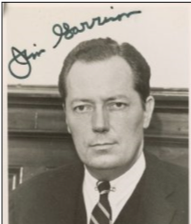 Jim Garrison, in On the Trail of the Assassins, commented dryly that, “As I read Markham’s testimony, it occurred to me that few prosecutors had ever found themselves with a witness at once so eager to serve their cause and simultaneously so destructive to it.” (Garrison, p. 195) Garrison may have been onto something here. What was causing this lady’s testimony to be so strangely bizarre and baffling?
Tippit researchers Joseph McBride, William Pulte, and Michael Brownlow have all hinted at a potential answer. At the time of the JFK assassination and J.D. Tippit’s death, Helen Markham’s son, Jimmy, was facing serious criminal charges in Dallas County. Markham, a single mother of very limited means, could do little in the way of protecting her troubled, at-risk boy. Then, suddenly, the Tippit incident occurred and Mrs. Markham was, in her words, “treated like a queen” by Dallas Police. It must have crossed Helen Markham’s mind that, if she helped the police and the Dallas authorities, her son might receive favorable treatment by the court. Worse, if she refused to help and did not identify Oswald as Tippit’s killer, it might be her son who paid the heavy, immediate price. (McBride, p. 479) But helping Dallas authorities, in this particular highest of profile cases, meant having to finger an innocent man, whether dead or not, for a crime he did not commit. Oswald was simply not the short, slightly heavy, bushy-haired cop-killer who disappeared behind Ballew’s Texaco.
So, it may have been Mrs. Markham’s solution to this conundrum to appear to be helping the authorities while she was actually rendering her testimony useless and therefore harmless to the defendant. Save son Jimmy, but also protect Lee, the young man who was in the Texas Theater as the fatal shots rang out at 10th & Patton.
Medical Photographer Jack Ray Tatum
 Witness Domingo Benavides, the closest passerby to the shooting of Officer Tippit, was unable to make a positive ID of the suspect, because Benavides had instinctively ducked down behind the dashboard of his pickup truck when he heard the shots. Benavides mostly saw the gunman as he was walking away, towards the corner of 10th & Patton, while tossing shell casings into bushes along the way. Benavides did report that the gunman had a haircut that was squared off in the back along the neckline of his Eisenhower jacket. Lee Oswald on that day clearly had hair that was tapered in back, not squared off. (WC, Vol 6, p. 451)
Benavides also noticed something else that would later prove significant—a red Ford Galaxie about six car lengths ahead of his pickup, going west, that pulled over same as Benavides when the shots occurred. (HSCA Vol 12, p. 40) The red Galaxie and its driver supposedly stopped and stayed at the scene for a time—and then left as a crowd quickly gathered. No one ever got the name of this potential important witness.
In September, 1976 the U.S. House of Representatives voted 280-65 to establish the Select Committee on Assassinations (HSCA), in order to investigate the assassinations of John F. Kennedy and Martin Luther King, Jr. This bold move was primarily caused by the first national airing in March of 1975 of the 8 mm film shot by Abraham Zapruder of the JFK assassination. Geraldo Rivera hosted the showing which took place on the ABC show Good Night America. When American citizens finally got to witness the shooting with their own eyes, their response was one of outrage, which in turn prompted the reopening of the investigation. The HSCA would not complete its work until late in 1978 and did not issue a final report and conclusion until the following year, 1979. The final conclusion of the HSCA was that President Kennedy had likely been assassinated as the result of a conspiracy.
A reopening of the JFK assassination necessarily meant the HSCA would also be taking a second look at the Tippit murder. The case against Lee Oswald in the murder of Officer Tippit had been a house of cards from the beginning and there were those in positions of power who apparently did not wish for any second inquiry of the murky, little-investigated events at 10th & Patton on the day of JFK’s assassination.
It was against this backdrop that a Dallas native, Jack Ray Tatum, stepped forward with the claim that he had been the driver behind the wheel of the mysterious red Ford Galaxie seen stopped near the intersection of 10th & Patton on 11/22/63.
Mr. Tatum would proceed to tell an amazing story—perhaps one even more unbelievable than that of the unfortunate Mrs. Markham. Yet unlike that of the much-maligned waitress, it has generally, and inexplicably, been accepted as fact for more than four decades. In a filmed interview with the PBS television show Frontline in 2003, Mr. Tatum re-created his alleged experience on that fateful day in Dallas, 1963.
While taking a detour through the neighborhood to circle back to a jewelry store on Jefferson Blvd. to buy his wife a gift, Tatum said he found himself driving north on Denver Street around 1 p.m. at which time he turned left to head west on 10th Street.
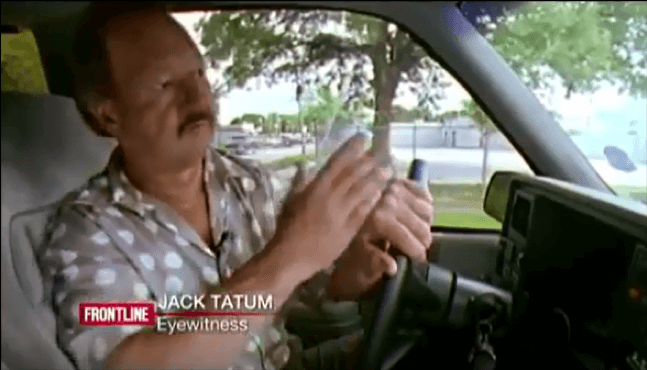 Tatum explained that after he made the turn and began driving west on 10th, he noticed an individual walking in his direction (walking east towards Tatum). A Dallas police car was just pulling over to the curb. As Tatum drove towards where the squad car was now parked he noticed the young man leaning over and talking to the officer. The man had both hands in the pockets of his light-colored tan jacket. Tatum continued on to the intersection of 10th & Patton. As he was about in the middle of that intersection he heard “three, maybe four shots.” Tatum continued through the intersection and then braked to a stop.
What Tatum describes next was seen by no other witnesses.
Tatum looked in his rearview mirror and saw the policeman laying in the street. The gunman, still on the passenger side of the squad car, walked to the rear of Tippit’s car, hesitated, came around the back of the car, then walked up along the driver’s side of the car … and shot Tippit one final time at close range. (McBride, p. 496)
The gunman, according to Tatum, then looked around, surveyed the situation, and started a slow run west in Tatum’s direction. Tatum put his car in gear, drove forward down 10th Street to avoid danger, and kept his eye on the gunman in the rearview mirror.
Tatum said he could see the gunman very clearly and that the corners of his mouth curled up, like in a smile, which was distinctive and made this individual stand out. Then, Tatum delivers his punch line, the big money words the PBS audience is waiting for:
“And I was within 10-15 feet of that individual and it was Lee Harvey Oswald.”
Now, to the casual viewer of this PBS documentary, Mr. Tatum has just laid to rest any and all the conspiracy theories surrounding the murder of J.D. Tippit—and has apparently put the final nail in the coffin of Lee Harvey Oswald. Tatum is so smooth in his delivery, so convincing, so sincere: 10-15 feet? How could he have not identified Oswald?
Frontline and PBS should be ashamed for having filmed this charade and then presenting it to the American public as fact. (The reader can see this interview at Youtube, under the title, “J. D. Tippit Murder Witness Jack Tatum”) Since the entire interview was shot from within Tatum’s vehicle, the viewer can’t see that, according to Tatum’s own description of events, the gunman was likely never closer than 100 feet of Mr. Tatum’s alleged position (in red). Here is the overhead satellite view of that intersection today, with the distance legend in the lower right corner (blue arrow points to 20 ft.):
 According to a study cited by the Innocence Project, after 25 feet face perception diminishes. At about 150 feet, accurate face identification for people with normal vision drops to zero.
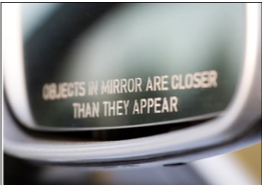 Could Jack Tatum, while watching a fleeing gunman in his rearview mirror from 100 feet or more away (and remember, Tatum said he drove forward again as the gunman approached), have been able to tell that the corners of the gunman’s mouth turned up? Positively ID him as Lee Harvey Oswald? A gunman in a rearview mirror who was ducking behind trees, bushes, Mr. Scoggins’ yellow cab, and all the while brandishing a pistol?
Was Jack Ray Tatum even there? Who says so besides Jack Ray Tatum? Tatum himself admitted that “When they were getting witnesses to go to the Warren Commission, I thought, they hadn’t missed me—no one had mentioned I was there.”
Tatum later claimed he didn’t want to get involved on 11/22/63, that they already had enough witnesses. (McBride, p. 498) And that Mrs. Markham—who Tatum said was there—(with her hands over her eyes) got a better look than he.
Oh, yes, Mrs. Markham. Tatum first said he simply drove away and left the scene of the Tippit slaying. Later he explained that he came back to help poor Mrs. Markham, eventually driving her to a police station to give her statement. A noble gesture to be sure. Only problem is, DPD records indicate that Mrs. Markham was taken to DPD headquarters by Office George Hammer, not Mr. Tatum.
Tatum’s assertion that “Oswald” came within 10-15 feet of him may be an exaggeration of colossal proportion. However, Tatum’s other claim that “Oswald” circled the squad car and then shot Tippit—basically point blank “execution style”—is as absurd as anything Mrs. Markham told the Warren Commission in 1964. Yes, the eyewitness testimony in general was both conflicting and contradictory. Yes, Benavides and Scoggins missed witnessing crucial pieces of the crime as they went ducking for cover. And we can only guess at what Mrs. Markham actually saw. But while the eyewitness testimony may have been difficult if not impossible to reconcile, the ear witness testimony remained extremely consistent.
Witness after witness described Tippit as being killed by a fusillade of shots. They all heard basically the same thing: Pow pow pow pow.
“They was fast,” remarked cabdriver Bill Scoggins, describing how the shots were fired extremely close together, in rapid succession.
“Pow pow, pow pow,” is how neighbor Doris Holan, whose second-floor apartment overlooked the scene, described the loud bangs to researcher Michael Brownlow.
“He shot him in the wink of your eye,” noted Mrs. Markham.
Domingo Benavides described hearing a loud boom followed quickly by two more fast booms.
“Bam bam – bam bam bam,” remarked Ted Calloway, likening the shot sequence to Morse code.
Yet Mr. Tatum insisted that “Oswald” fired 3-4 shots from the front passenger side, stopped, walked to the back of the patrol car, hesitated, then walked behind the squad car, turned, and walked up the driver’s side until he stood over Tippit and fired one last bullet up-close-and-personal.
Except, no one heard that. No one heard anything even remotely resembling that. Nobody heard shots—followed by a several second delay—followed by one final shot.
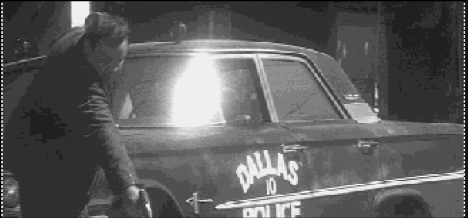 Yet today, if you watch a documentary, movie, or television show describing Tippit’s murder, Jack Tatum’s version of events is what you are almost sure to see. But it never happened that way, couldn’t have happened that way.
“That just didn’t happen,” Calloway told one researcher regarding Tatum’s scenario. “Boy, those shots are as clear in my ear today as the day it happened. Bam. Bam. Bam, bam, bam. Just like that.”
Problem is, the forensic evidence showed that one of the shots was likely fired from a steep downward angle, from above the officer, unlike the other three shots. The final shot was more accurate, more deadly, and apparently done from a much closer distance.
But the man in the light tan Eisenhower jacket didn’t have time to do what Mr. Tatum said he did. After the shots, he began almost immediately to walk in the direction of Bill Scoggins’ cab. That gunman never went around the car and stood over Tippit. Again, there was no time for that. And nobody heard that.
Someone else was there. Someone else who also shot Tippit but escaped before the man in the light tan Eisenhower jacket started dropping shells and walking towards Patton Street. Someone such as the man in the long coat seen by Mr. Wright. The man who looked down at Tippit in the street and then ran fast to a grey 1950 or 1951 coupe and sped away.
“Those are pistol shots!” exclaimed Mr. Calloway when the murder happened. With that the used car manager was on his feet and out the office door. “I could move,” he recalled, “and just as I got to the sidewalk—which is about thirty-feet away, I guess—I looked to my right and there’s Oswald jumping through the hedge.”
Calloway was asked, “If someone tried to convince you that there were four shots and a short pause and then another one fired, you wouldn’t believe that?” “No, I wouldn’t,” Calloway answered, repeating the cadence he recalled, “Bam–bam–bam, bam, bam.”
No time, no how, no way.
So what was accomplished by Jack Tatum’s strange, belated testimony before the HSCA?
- It helped to repair Mrs. Markham’s highly controversial and highly criticized testimony before the Warren Commission in 1964—and helped to verify her presence (doubted by some) at that corner when the shots were fired.
- It reinforced the idea that the gunman had been walking east, not west, a crucial detail needed to allow Lee Oswald to have reached the scene in time to murder Officer Tippit.
- It explained the previously unexplainable, the forensic evidence that showed Tippit had been hit by one bullet from a different, much steeper angle which was also fired from a distance relatively closer than the other bullets.
- It maintained the fiction of only one gunman at the Tippit scene.
- It fingered Lee Oswald as that lone gunman at the Tippit scene.
- Most of all, it gave the HSCA a reason not to delve too deeply into the Tippit case. Which, in retrospect, is one of the HSCA’s many failures: their lack of rigor in reviewing the Tippit case.
Today, under analysis, his testimony has the quality of paper mache. Tatum saw things no one else saw and heard things no one else heard. And his identification of Oswald simply has little or no credibility from that distance. His alleged escorting of Markham is also dubious. It’s almost as if he was a salesman. The ruse, a highly pernicious one, has apparently succeeded—at least so far. Yet, in spite of all this—and because of late Frontline producer Mike Sullivan—his twist on critical events is continually presented as fact.
In the end, however, the HSCA still managed to “overturn” the 1964 pre-determined conclusion offered by the Warren Commission. The HSCA reported that President Kennedy was probably slain as the result of a conspiracy, and that there were likely at least two gunmen in Dealey Plaza—both in the Texas School Book Depository and behind the fence on the Grassy Knoll.
And so now at the end of this article, we have finally come full circle … back to Counsel David Bellin’s “Rosetta Stone” logic. For if President Kennedy was assassinated in downtown Dallas as a result of a conspiracy, then it follows that Officer Tippit was likely murdered in adjoining Oak Cliff in an attempt to further that same conspiracy. 10th and Patton was a setup, the disturbance at 10th was in all likelihood a ruse. The designated patsy sat in a darkened nearby movie theater as Officer Tippit, drawn into a trap, was shot down on a quiet residential street in a Dallas suburb. All went as planned—until the scheme to kill the patsy in the movie theater fell through. That’s when the conspirators, suddenly desperate, went into all-out damage control mode and brought in Mafia bag man Jack Ruby to silence the pasty once-and-for all—live and in front of a national television audience.
Messy, very messy.
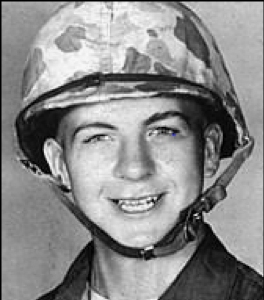
And in the words of Tippit author Joseph McBride, America then took a turn and walked into the nightmare. Along the way, they turned a former Marine into a patsy.
-

The Saga of Eugene B. Dinkin: Part Three
In 1963, PFC Eugene Barry Dinkin, Rose Cheramie, Richard Case Nagell, Joseph Milteer, U. S. Air Force Sergeant David Christensen, and some others had some kind of advance knowledge that a plot about President John F. Kennedy’s assassination was in the works. In this part 3 of my series entitled “The Saga of Eugene B. Dinkin”, I will show examples of some of the “psychological sets” that Dinkin retrieved and presented to the House Select Committee on Assassinations in 1977. Also, I will present info he found about an Air Force Captain named T.D. Smith III.
Here is a recap of some basic information about Dinkin’s attempt to alert the world to the plot that was in place to assassinate President Kennedy.
Regular Army Private First Class Dinkin was serving in Mannsweiler, Germany in the 529th Ordinance Group. He held a secret security clearance for his job in the crypto section of his unit. Prior to enlisting, he had attended the Champaign/Urbana campus of the University of Illinois. He and his family had lived in Chicago. His studies at the university included psychology. His duties would have included deciphering cable traffic from the European Commands, NATO, and so forth.
In the summer of 1963, Dinkin noticed material in the Army newspaper, Stars and Stripes, and other print publications that was negative toward Kennedy and his policies, implying that he was a weak president in dealing with the Russians. The examples that he found became more negative: the suggestion being that if Kennedy were removed as president it would be a good thing.
By October, Dinkin had found enough information—some of it subliminal—that he was convinced that a plot was in the works. One that was driven by some high-ranking members of the military, some right-wing economic groups, and with support by some national media outlets. (Dick Russell, The Man Who Knew too Much, p. 349)
He did not tell his superior officers about this information—given that he believed that the military was involved. He did tell quite a few Army friends and some others that I noted in my original article. This information probably got back to Army authorities, because Dinkin was transferred to the Army Depot in Metz, France, where his duties did not require a secret clearance.
Dinkin’s studies led him to conclude that the plot would happen around November 28, 1963 and that the assassination would be blamed on “a Communist or a Negro”. He then sent a registered letter to Attorney General Robert Kennedy. When he got no reply, he decided to resort to other options. (Russell, pp. 349-50)
In late October, 1963, Dinkin gathered up the material that he found in psychological sets—which Dinkin would be sensitive to because of his college studies. Psychological sets are a batch of information that is used to induce a particular state of mind in an individual being exposed to the mixture. The sets can be a series of pictures, events, written statements, or a combination of the aforementioned examples used by advertisers and others to implant ideas into the mind of the people that have been exposed to them. In advertising, of course, the goal would be to get you, the target audience, to be interested enough in the product or service that you would buy it.
In a letter written by his mother to Robert Kennedy on December 29, 1963, she said that DInkin had figured out the outlines of a plot against JFK through what she called semantics studies of various journals, especially the Stars and Stripes military magazine. He predicted the date of the murder to be November 28th. It should be noted that in his civil suit of 1975, DInkin wrote to CIA Director Bill Colby in July of that year. He requested all information that the Agency used for “subliminal and illusory distortion techniques in visual communications. Include also any psychological studies regarding the propaganda effectiveness of such techniques.” That letter was not declassified until 1998, the last year of the ARRB’s existence.
Dinkin took his material to Luxembourg, where he visited the American Embassy. There, he tried to see Ambassador William R. Rivkin, but Rivkin was out of the embassy at the time. The Charge d’Affaires, a Mr. Cunningham, refused to read or keep a copy of the data that Dinkin had with him. (Russell, p. 350) Dinkin did share some of the material with a U.S. Marine guard at the embassy.
Disappointed, Dinkin returned to his unit. Shortly after his return, he learned that he had been scheduled to take a psych exam. This caused him to believe that his superiors had learned about his visit to the American Embassy in Luxembourg. (Since CIA Stations in Europe are located at or near the embassies, it is likely that the CIA, also knew of his attempt to pass on his assassination material.)
Shortly after his return to his unit, Dinkin decided to try one more time to get his info to someone who could warn President Kennedy. He went AWOL to Switzerland to find some agency that would help. He visited a number of offices including the newspaper, the Geneva Diplomat, and Time/Life Europe. There, a stringer, Alex des Fontaines, and another female stringer took down the details of Dinkin’s story. (Letter from Richard Helms to the Warren Commission, of May 19, 1964.) As Noel Twyman has shown, the Helms letter to the Commission was not declassified until 1976. And at that time, Dinkin’s name was redacted. It was not released in full until 1992 by the Assassination Records Review Board (ARRB). (Twyman, Kennedy Assassination Chronicles, Vol. 4, No. 1)
There was another source which was used by Helms before he wrote his letter to the Commission. This was a teletype that was not declassified until 1995 by the ARRB. It was a report by John Whitten, who was the original CIA liaison to the Commission. In that source it was revealed that, about three weeks in advance, Dinkin had predicted the assassination of JFK would take place in Texas. That particular piece of information appears to be missing from the Helms letter. (See Twyman)
Dinkin also went to Germany, but could not find anyone to pass his info on to the White House. Even the editor of Overseas Weekly would not take his claim seriously. The editor told him to return to his base in order to avoid an AWOL charge.
When he returned to his unit at Metz, France, he was arrested and delivered to the stockade by the Army. This was on November 13, nine days before the assassination. He was then placed in a mental hospital in a closed ward. After the assassination, and while Dinkin was in custody, he was visited by a man who identified himself as a Defense Department official. This man questioned Dinkin about how he knew about the assassination. The official also asked Dinkin for his research material, saying that he would give Dinkin a receipt. Dinkin told him where the material was stored at his barracks. Later when he was able to go to the barracks, he discovered the data was gone and the official did not return to give him a receipt. Had the FBI and Secret Service wanted to identify the DOD official, they could have easily done so. Since Dinkin was in the stockade, anyone visiting him would have had to provide identification and then sign in. The FBI and Secret Service, working for the Warren Commission, did not interview the soldiers, embassy officials and others that Dinkin had shared his information with. The Paris Legation of the FBI inadvertently acknowledged the fact that Dinkin had told his story to several entities. Not long after his psych exam, Dinkin was ordered to report to Walter Reed Army Hospital in the Washington, D.C., area.
Here I will describe some of the examples of “psychological sets” that Dinkin found in various print media sources.
One psych-set demo Dinkin found that had an implied threat to the president was in the July 2, 1963, edition of Look Magazine. The title of an article inside was, “Why Kennedy’s in Trouble”. The title was inside a black border, but the print title was colored blood red.
The article inside the magazine referred to President Kennedy as a new Adam. The analogy would be that Kennedy, like Adam being kicked out of Eden, would be kicked out of his place, the White House. The inside title, “Why There’s Trouble in the New Frontier” is partly colored blood red.
A second example Dinkin deemed significant was from July 5, 1963 edition of Life Magazine. In it, there is a photo of President Kennedy riding in a motorcade in Germany. JFK is standing in the limousine looking back and to the side. There is a dark spot/defect on the back of his head that looks like a chunk of his scalp is missing.
Inside this edition there are pictures of the president’s visit to Ireland. In one of the photos, there is a gravestone with the name John Kennedy on it.
Another article was in the October 15th edition of Stars and Stripes, titled, “Prospective Bosses Fire Jack with Enthusiasm.” The men in both articles resemble Lee Oswald, they are both named pierce/peirce, which can mean putting a hole in something. President Kennedy was often referred to as “Jack.”
On the management staff of Life Magazine, during the time that Life bought the Zapruder film and kept it from the public for more than 10 years, was C. D. Jackson. Jackson was President Eisenhower’s psychological warfare expert. Jackson would have known executive staff in all of the print media where these psychological sets were found by Dinkin. If Jackson was instrumental in the handling of the purchase Zapruder film and subsequent unusual happenings to the film at that very powerful magazine. For instance, their refusal to depict the rearward head moment of the president as he was struck at Z frame 313. And their explanation of a frontal neck wound in Kennedy by saying he was turned around looking at the Texas School Book Depository when that bullet struck. As they must have known, Kennedy is never rotated like that in the film.
While her son Eugene was in the psych ward of Walter Reed Army Hospital, Mrs. Dinkin wrote to Robert Kennedy at the Justice Department. In the letter, she noted that Eugene had asked her to write to Robert Kennedy. Mrs. Dinkin said that Eugene knows through his semantic studies how the assassination was planned and that if you can send someone to talk to him some very important information may come of this. Her letter did not reach Robert Kennedy, but was intercepted by Assistant Attorney General Herbert “Jack” Miller. At this time, Jack Miller had been appointed liaison to the Warren Commission by Deputy Assistant General Nicholas Katzenbach. Miller coordinated the investigation in Dallas into the murder of the President.
Ironically, if the FBI had conducted an honest investigation, Miller as liaison would have been the perfect person for Mrs. Dinkin to have contacted. However, with Miller in control, the FBI hid much important information, did not interview witnesses that could have substantiated Dinkin’s foreknowledge of the plot, and kept many of the films and photos that were taken during the shooting in Dealey Plaza from the public.
Miller, in his answer to Mrs. Dinkin’s letter requesting that someone from the Justice Department go to Walter Reed Hospital to talk to Eugene, lied to her by saying that the Justice Department could not contact Eugene, because he was in the military. President Johnson’s Executive Order creating the Warren Commission gave the FBI, the investigative arm of the Justice Department, the power to find and collect all information about the assassination from any and all agencies.
(In 1967, as James DiEugenio details in Destiny Betrayed, Second Edition, during New Orleans District Attorney Jim Garrison’s re-investigation of the murder of the President, Miller attempted to sandbag Garrison’s probe.)
During the House Select Committee on Assassinations investigation into the murders of President Kennedy and Dr. Martin Luther King, Eugene contacted Jacqueline Hess, the Asst. Director of the committee. He offered to help the investigation by providing information that he had found. He was not called as a witness and his offer of information was rebuffed by a form letter from HSCA Director Robert Blakey.
There are significant differences between Dinkin’s military record and the information that the FBI supplied to the Warren Commission. I will cover that and some other series.
I hope eventually that Mr. Dinkin gets the posthumous recognition that he deserves.
-

Jim Garrison vs NPR: The Beat Goes on (Part 3)
Sticky Wicket is an NPR program series that is a co-production of two radio stations in Louisiana. The series’ objective is to cover controversial subjects in that state’s political history between important figures and the press (e.g. Huey Long’s relationship with the media). Quite naturally, the series decided to devote a segment to Jim Garrison and his inquiry into the assassination of President Kennedy. The producer and hostess of the show is one Laine Kaplan-Levenson. She is a reporter for WWNO in New Orleans.
One would think that a reporter/producer affiliated with NPR would have noted something as important as the creation of the Assassination Records Review Board (ARRB) and the fact that they declassified 2 million pages of documents on the assassination of John F. Kennedy in the nineties. Especially since many of those documents dealt with the New Orleans aspect of the Kennedy case. In fact, when the ARRB closed up in 1998, they kept on releasing documents on what was called a phased publication platform. That is, a document would be delayed for release until say, 2005. One would naturally have thought Levenson would have been interested in what was supposed to be the final releases scheduled for 2017. Or perhaps there would be a question or statement as to why it has taken over fifty years to release all the secrets Washington has been keeping about the murder of President Kennedy. And since the show on Jim Garrison did not air until November of 2018, one would think that Levenson would have taken notice of the fact that President Trump reneged on his promise to release all the JFK documents. After all, this happened in late 2017 and dominated the air waves for about three weeks. Trump faltered and instead announced a panel to review the final documents and delayed their release until 2021. Which means, as Jim Garrison predicted in his famous Playboy interview, two generations of Americans—nearly three—will have died off by the time of the last release of JFK documents.
If you listen to Levenson’s program, you will not hear anything about the ARRB. Or about what President Trump did in stopping the release of JFK classified documents. You will not hear anything about how Jim Garrison predicted such a thing would happen back in 1967. Nor will you hear anything about the new documents concerning Oswald’s activities in the summer of 1963 in New Orleans. In fact, in listening to the program and taking notes, I do not recall anyone uttering a sentence about Oswald being in New Orleans in the summer of 1963. Let alone describing his rather odd activities there. (If anyone can show me where I missed that information please let me know.)
Why is all that important and relevant information ignored? First of all, if Levenson read anything on New Orleans and the JFK case, she did not reveal it. (She even gets the title of Garrison’s bestselling book on the case wrong.) Second, her two main interview subjects were Alecia Long and Rosemary James. Long is a professor of history at LSU. She was the subject of the first essay in this series. If one goes to the end of that article, the reader will see that Professor Long said that she does not intend to look through FBI and CIA documents for the rest of her life on the JFK case. Her essay showed that she probably didn’t spend half an hour doing that kind of work. But if one does not at least spend some time on those pieces of evidence, then what does one base one’s research on? Well, if one reads that article, one will see that Long recycled just about every ersatz cliché that the MSM constructed back in the sixties in its mad crusade to destroy Jim Garrison. In Long’s ten-page essay, there was not a single reference to any of the treasure trove of declassified documents that the ARRB produced. And that is a huge lacuna in her work, because these documents tell us so much about what happened to Jim Garrison. For example, there was something called the Garrison Group at CIA headquarters. That body was created by order of Director Richard Helms. It was designed to calculate the implications of what Garrison was doing in New Orleans before, during, and after the trial of Clay Shaw. At the first meeting, Counter-Intelligence chief James Angleton’s first assistant predicted that, if left alone, Garrison would attain a conviction of Clay Shaw. (James DiEugenio, Destiny Betrayed, Second Edition, p. 270) As the documents then show, task forces were designed and there was much interference in the Shaw legal proceedings. (Ibid, pp. 271-78) This interference continued all the way up to and during the actual trial itself. It included the actual physical harassment of Garrison’s witnesses (e.g. Richard Case Nagell and Aloysius Habighrost). (Ibid, p. 294) At a talk he gave in Chicago in 1992, Deputy Chief Counsel of the House Select Committee on Assassinations, Robert Tanenbaum, said he saw the CIA documents describing these kinds of actions. They came out of Helms’ office. (Probe Magazine, Vol. 3 No. 5) If she had surfed the web, she could have found that interview.
Just how bad is this program? Well, right off the bat, the intent to distort and demean is blatant. In speaking of Garrison’s campaign to clean up the French Quarter of B girl drinking, the show says that Garrison was actually picking up known prostitutes and then letting them go. And that Garrison actually participated in the raids on the French Quarter. This is almost as absurd as Fred Litwin saying that the raids were targeted at gay bars. Garrison was out to stop a racket by which the ownership of the club got some of its girls to more-or-less cozy up to a patron with hints at consensual sex. As the B girl got the mark more and more intoxicated, the drinks would be watered down. At the end of the night, the guy was so drunk that the club would have to call for a taxi and the girl did not go back to the hotel with him. There was then a split afterwards between the club and the girl. (Washington Post 2/10/63)
This practice had been going on for years. It is really difficult to believe that no one involved with this program, especially James and Long, could misconstrue it as prostitution. Or that Garrison would go on the raids himself. That would have tipped off the bar owner as to what was happening. The reason it had been going on for years is that the previous DA and the police department were either on the take or just looked the other way. Garrison did not. He planned his campaign in advance using teams of undercover agents who would make notes of what happened. This would be used as evidence and the DA would then make arrests. But the real object was to shut down the illicit clubs in order to make the owners pay a financial price. Garrison would often go to civil court, where he could extract larger fines against the owners. His campaign went on for months and was exceptionally successful. To use one example: the DA shut down nine clubs in just two days! (DiEugenio, p. 170)
I think the reason that the show wishes to completely distort Garrison’s achievement is simple: because it makes it easier for the program to demean the man and then disfigure his Kennedy assassination probe. Therefore, right here, in the opening moments we know this will not be journalism.
The program goes on to play a short snippet from Garrison’s appearance on NBC in the summer of 1967. Sticky Wicket tries to say that Garrison held himself out as the only person who could tell the truth to the American public about the JFK case. To anyone who knows the facts, what is so impressive about this appearance is how well this speech has held up in light of the facts revealed since. Like Alecia Long, Sticky Wicket does not fully reveal the reasons why Garrison was on NBC. The reason was that Garrison petitioned the Federal Communications Commission under the Fairness Doctrine. Producer/former intelligence officer Walter Sheridan and NBC had made a one-hour program that was such a hatchet job that Garrison was granted 30 minutes to reply. (The Fairness Doctrine does not exist today; it was eliminated by the FCC under the Reagan administration.) As the ARRB has shown, Sheridan used all kinds of unethical and shocking practices in the production of this program. (DiEugenio, pp. 237-43) Sticky Wicket is so conceptually and intellectually shoddy that it tries to say a witness that Sheridan recruited against Garrison was actually suborned by the DA.
Rosemary James was the reporter who took credit for first exposing Garrison’s inquiry in the New Orleans States Item. Her story ran on the front page for February 17, 1967. This program states that James found out about the story through a combination of leaks and going through receipts the DA had filed to in order to pay for investigators travel expenses to inquire into the JFK case. The program then says that she was shifted over to the DA’s office and that is how she ran into the Garrison inquiry.
In reality, what happened is that the newspaper’s original reporter on the police beat and the DA’s office had discovered that Garrison was calling witnesses before the grand jury for questioning on the Kennedy case. The paper had run a rather short notice on this on January 23, 1967, over three weeks before the James front page story. The original reporter’s name was Jack Dempsey. William Davy and myself interviewed him at length in New Orleans in 1994. It turns out that, contrary to what James has tried to say, Garrison was very upset with the first story by Dempsey. He called him into his office and threatened him with a jail term if he refused to tell him who his source was. When Dempsey said he could not reveal his source, Garrison threatened him with contempt. Clearly shaken, the editors decided to switch reporters. Unlike what James has maintained, Dempsey said that Garrison was furious when James told him they were going to run the story as a feature. He denied everything. (DiEugenio, pp. 221-22)
The reason for this is easy to understand. As the declassified files reveal, before Garrison’s probe was exposed, he was making a lot of progress. Afterwards, it was open season on him. And he was targeted by the big guns of the media. NBC sent in Sheridan, Newsweek sent in Hugh Aynesworth, and the Saturday Evening Post sent down James Phelan. Many writers have shown how these men obstructed Garrison once his inquiry was out in the open. In fact, the only sensible thing that is uttered through the entire 30 minutes of this program is by James when she says if she had known what was going to happen, she would have recommended leaving that matter alone.
One reason she may have said this is due to another matter that, surprisingly—almost shockingly—the program leaves out. Five days after the James story ran, David Ferrie was found dead in his apartment. Although the coroner ruled Ferrie had died because of a ruptured berry aneurism, he left two typed, unsigned suicide notes. A later coroner, Frank Minyard, pointed out that in photos, one could see bruising on the inside of Ferrie’s mouth and inside the lower lip. Minyard theorized that Ferrie could have been poisoned with some kind of solution that could have caused the aneurism. (DiEugenio, pp. 225-26) About three days prior, Ferrie had talked to Lou Ivon, Garrison’s chief investigator. Ivon later told William Davy that Ferrie seemed frightened to the point that he acted like “a wild man”. He admitted he worked for the CIA and that he knew Lee Oswald. (William Davy, Let Justice be Done, p. 66) When one adds to this the fact that Oswald was seen with Ferrie in the summer of 1963 at the office of Guy Banister and in the Clinton-Jackson area north of New Orleans, then this would help demonstrate why he was Garrison’s chief suspect. (Davy, pp. 41, 103-110) After all, Oswald was supposed to be a communist. He was the sole member of the Fair Play for Cuba Committee (FPCC) in New Orleans. He had stamped one of the FPCC pamphlets he was handing out in New Orleans with the address of Guy Banister’s offices. Banister’s place was a clearing house for anti-Castro Cuban exiles. Yet, the rightwing extremist Banister had given the allegedly communist Oswald a room there to print up his FPCC literature. (Davy, p. 39) If you leave out all of these key evidentiary details—which Levenson, James and Long do—then you can avoid the obvious question: Why would the rightwing nut Banister give a room to a communist?
If you are this one-sided, you can also leave out how Garrison got on to Clay Shaw. The program tries to insinuate that somehow the media was losing interest in Garrison’s inquiry and, therefore, Garrison’s arrest of Shaw was some kind of ruse to gain attention. As Bill Davy and others have demonstrated, Garrison had called Shaw in for questioning as early as December of 1966. Davy analyzed why Shaw’s answers during questioning provoked Garrison’s further interest in the man. (Davy, pp. 63-64) As his inquiry began to pick up steam, Garrison discovered that Shaw knew Ferrie, Banister, and Oswald. And he was seen in the Clinton/Jackson area with Ferrie and Oswald. (Davy, pp. 93-94, 106) The idea that this program leaves, that somehow Shaw was an admirer of President Kennedy, is contradicted by no less than Ferrie himself. Ferrie said that Shaw hated JFK. (Davy, p. 66)
How shoddy is this program? It says that the name ‘Clay Bertrand’ is in the Warren Report as someone who plotted with Oswald to kill Kennedy. Question: Does NPR employ fact checkers? Anyone can check the index of the Warren Report and find that the name Bertrand is not there. The name of Bertrand came up because New Orleans attorney Dean Andrews mentioned him in his testimony to the Warren Commission. (See Commission volumes, at Volume XI, pp. 325-39) Andrews told the commission that Bertrand had called him on November 23rd to go to Dallas to defend Oswald. No one could find a Clay Bertrand in New Orleans. Therefore, this had to have been an alias. Sticky Wicket tries to say that Garrison also could not locate Bertrand, since Andrews was not going to reveal his true identity. This is misleading in two senses. First, it leaves out why Andrews would not reveal who Bertrand really was. The reason being that he feared for his life if he did. (DiEugenio, p. 181) Secondly, Garrison found out that Bertrand was Shaw. The evidence for this is simply overwhelming today and appears in more than one form. This includes declassified FBI reports that Alecia Long won’t read. (Davy, pp. 192-93; DiEugenio, p. 388) Those reports reveal that the Bureau was investigating Shaw in 1963 as part of their JFK inquiry. By not revealing any of this information, NPR does not then have to pose the questions as to:
- Why was the FBI investigating Shaw in 1963?
- Why did Shaw lie about using the Bertrand alias?
The program also uses the same technique that James Kirkwood did in his abysmal and obsolete book, American Grotesque. Namely, that somehow Garrison’s prosecution ruined Shaw’s life. But Sticky Wicket goes beyond that and says that New Orleans high society dropped him like a hot potato. As anyone who studies Shaw knows, he had at least three sources of income during his career. These included his job as manager at the International Trade Mart (ITM), his real estate holdings in the French Quarter, and the fees paid to him by the CIA as a highly valued contract agent. Shaw had retired from the ITM in 1965. Therefore, Garrison’s prosecution had nothing to do with that. The idea that this would impact his real estate holdings is simply a non-starter. (Click here for an example) The CIA eventually declassified documents which show he was well compensated for his services dating back to the fifties. This was another point, Shaw’s declassified CIA career, which the defendant lied about and which the program completely ignores. (Joan Mellen, Our Man In Haiti, p. 54) As per the expenses for his defense, everyone except NPR knows that Shaw’s defense team was getting tons of help from Washington. They refused to admit this, but in those pesky declassified documents that Long does not read, it is clear that his lawyers actually solicited this help. (The Assassinations, edited by James DiEugenio and Lisa Pease, pp. 33-50) And they ended up getting aid from the CIA and the FBI. This included the CIA planting informants in Garrison’s office (e. g. Bill Boxley). (DiEugenio, pp. 278-85)
As per the falling out with the Sterns, this tenet by Rosemary James would appear to contradict what Kirkwood wrote in his book. The Sterns hosted dinners at which they wined and dined incoming media in favor of Shaw after he was charged. (Destiny Betrayed, first edition, p. 157; Davy p. 78). Further, their local TV station, WDSU, served as an outpost for Garrison critics like Jim Phelan and Rick Townley. (Davy, p. 136; Destiny Betrayed, first edition, p. 202). Finally, the Walter Sheridan produced NBC attack program was partly produced out of WDSU and Sheridan used money funneled to him by the CIA associated local law firm of Monroe and Lemann for its creation. (DiEugenio, Destiny Betrayed, second edition, p. 238). These all occurred after Shaw was charged.
The idea that Garrison pursued publicity for his inquiry, proposed by Long and repeated here, is simply fatuous. As noted above, his appearance on NBC was provoked by Sheridan’s hatchet job under the Fairness Doctrine. His appearance on The Tonight Show, which is also mentioned, was prompted by Mort Sahl. Garrison did not “pursue” either one. The program actually says that Shaw’s home was “raided” in July. And this is how Garrison uncovered proof of Shaw’s far out homosexual practices. In my interview with assistant DA Jim Alford, he told me that Shaw’s home was searched when he was arrested. And Garrison did not say anything about this homosexual aspect in the two years between Shaw’s arrest and his trial. The idea that Garrison once proposed that Kennedy’s assassination was done as a homosexual thrill killing is something not backed up in Garrison’s files. The only place I have ever seen that subject proposed is in the work of the late Jim Phelan, who—with the release of declassified documents—has real credibility problems on this matter today. (Destiny Betrayed, Second edition, pp.243-49) And, of course, the program says that Perry Russo was hypnotically programmed to recall the name of Bertrand. This worn out cliché was exposed in detail by both William Davy and also Joe Biles, in his book In History’s Shadow. (Davy, pp. 121-23, Biles, pp. 44-46) After reading those two accounts, it can be seen that this was a cheap trick put together by Phelan and Shaw’s lawyers. The MSM, which I did not think NPR, was part of, then latched on to it. Another error is that private investigator William Gurvich defected from Garrison’s staff toward the end of the investigation. Gurvich defected in 1967, on the eve of Sheridan’s broadcast special. (Davy, pp. 136-37). And, from reading his testimony before the Grand Jury, they did not take his charges against Garrison seriously.
Toward the end, the show goes bonkers. Levenson does nothing to try and rein in the anti-Garrison mania of either James or Long. They propose the idea that Garrison did not suffer any consequences at all because of the pursuit of his case against Shaw. Pure bunk. Jim Garrison was one of the most popular figures in the state in 1966. Many commentators thought he could be either governor or senator. Because of his prosecution of Shaw, the Power Elite in New Orleans ganged up on him and backed the Justice Department attempt to remove him from office. This was done through the candidacy of the DOJ liaison to the Shaw trial, Harry Connick. That was coupled with two phony prosecutions against Garrison originating from the US attorney’s office, where Connick worked. Garrison exposed these trials at length in his book, On the Trail of the Assassins. (See Chapter 19) It was the publicity from those trials that weakened him and eventually let Connick into the DA’s office. It is incredible that no one on the program notes that this was a calamity for the city of New Orleans. For the simple reason that Connick was a disaster as a DA. (For just one serious problem, click here; click here for another)
As a result of his case against Shaw, Garrison went from being a probable governor to renting an office in a large law firm and Connick became one of the most incompetent DA’s in America. But the aim of the ordeal Garrison went through was not just to get him out of office. It was also to serve as an example to others: “See what we did to the guy who was set to be the governor of the state? Try and mess with the JFK case and the same thing will happen to you.” With one exception, Richard Sprague and the House Select Committee on Assassinations, it has worked.
There is barely a mention at all of what befell Garrison. Alecia Long actually says that Clay Shaw’s civil liberties were violated. This is ridiculous. Shaw was not just indicted by a grand jury. He also had a preliminary hearing, after which the presiding judge could have thrown out Garrison’s case. He did not. Therefore, what civil liberties were violated in the criminal case? No one on the program mentions that Connick incinerated much of the evidence Garrison had left in his office after he left. And he fought the ARRB in court not to give back what he had left. (DiEugenio, Destiny Betrayed, second edition, p. 320) In that respect, the American people were deprived of the results of one of the very few valuable inquiries into the murder of President Kennedy, which no one on this show seems to give one iota about.
When asked by one reader about how bad her work was on Jim Garrison and JFK, Long replied that she had her sources and the reader had his. What she did not add is that FBI and CIA associated journalists like Phelan, Sheridan, and Hugh Aynesworth, are not credible sources. But ARRB declassified documents, which the government hid for generations, are. They tell us why the Kennedy case and the Garrison inquiry were so dangerous to the power elite. And they show us how NPR, Long, James, and Laine Kaplan-Levenson have produced a pile of irrelevant rubbish. Better no one broadcasting on the subject than tripe like this.
-

Mark Shaw, Denial of Justice
A little more than two years ago Mark Shaw published his book about the life and mysterious death of reporter Dorothy Kilgallen. I wrote a review of The Reporter Who Knew too Much which—with reservations—considered it creditable, and worth reading.
Shaw has now produced a sequel to that volume called Denial of Justice. From the minute I removed the book from its package I had trepidations. Why? Because this follow-up volume is actually about a hundred pages longer than the original. Yet, from the title, and from what I had read about Shaw’s attempt to get the Kilgallen case reopened and reviewed—which was unsuccessful—I thought this book would be much shorter. I mean, what could be so long and involved about his attempt to get the case before a grand jury?
The answer to that question explains why the book is such a disappointment. Only a small percentage of the work is about the author’s dealings to reopen the Kilgallen case. I would estimate that this topic takes up about 10% of the 456 pages of text. So what is in the rest of the book?
Well a lot of it is a recycling of the Kilgallen biographical materials from the previous book. I would say that about the first 85-90 pages is more or less taken from the first book. At that, it is quite adulatory. Shaw is so intent on making Kilgallen into a female Sherlock Holmes that he simply glides over such things as her agreement with the guilty verdict in the Bruno Richard Hauptmann case. (p. 18) This, of course, concerned the kidnapping and murder of the 20-month old infant child of Charles and Anne Morrow Lindbergh. That case was one of the most sensational American trials in the first half of the 20th century. Books by authors like Lloyd Gardner and the multi-volume set by Mike Melsky certainly put the idea that Hauptmann was guilty into limbo, if not to bed. (See this for one reason why.) Yet Shaw does not even hint that Kilgallen could have been wrong on this case.
In another effort to inflate his subject, Shaw quotes from a story she wrote in the summer of 1959 about the new Castro regime in Cuba. From two rather terse paragraphs—five sentences total—Shaw concludes that Kilgallen was the first reporter to reveal that the Mafia was cooperating with the CIA to kill Castro. (p. 66) I have read and reread this passage four times. I disagree that this is what she was saying. And since those plots did not actually get underway until the summer of 1960, Shaw is doubly wrong. (See the CIA Inspector General Report, p. 3)
Kilgallen did do a good job on the famous Sam Sheppard murder case. That case, which took place in Cleveland, dragged on for over a decade. Kilgallen was correct: Sheppard did not kill his wife. (p. 54) She also played a part in getting his case successfully appealed. It was his performance in this case that made F. Lee Bailey one of the most prominent criminal defense lawyers in America. It also helped Kilgallen get a publishing contract for her book called Murder One, which was issued posthumously.
Early on in Denial of Justice, Shaw says that Kilgallen was good friends with President Kennedy. (pp. 1, 6) The problem is that he provides little or no evidence for that idea. The closest I could find is that she brought her son to visit the White House and Kennedy granted them a brief visit and gave him a couple of souvenirs. (p. 77) I fail to see how this establishes them as good friends.
II
Right after this, Shaw gives us a hint at what this book will really be about. He devotes a chapter to the alleged affair between Bobby Kennedy and Marilyn Monroe. He then tries to say that the FBI had investigated this and found it to be a fact. (p. 80) Not so. And in the memo he uses it is quite clear that the source is that frightful piece of rightwing fruitiness, Frank Capell’s pamphlet, “The Strange Death of Marilyn Monroe.” It is natural that the Bureau would do this, considering J. Edgar Hoover’s sour relationship with Bobby Kennedy. Further, as more than one author has noted, Hoover and Capell often shared information since they were both intent on continuing the legacy of the McCarthy era. (Probe Magazine, “The Posthumous Assassination of John F. Kennedy”, Vol. 5 No. 1, p. 8) But, beyond that, both men used entertainment reporter Walter Winchell as an outlet for distributing their slanders. FBI executive William Sullivan wrote that Hoover encouraged the Bureau to disseminate Capell’s smear. Sullivan then observed that it was a baseless libel. Hoover had agents tail RFK and they discovered he was both a social drinker, and a Puritan. (Sullivan, The Bureau, p. 56)
Shaw then goes on and uses another discredited document, this time from the CIA. In this one, Monroe allegedly phoned Kilgallen and said that President Kennedy had discussed with her a visit to a secret air base designed for outer space creatures. The author tries to qualify this exhibit by saying it is open to conjecture. It’s worse than that. As intelligence analyst John Newman told me years ago, the document is a fraud. (“Posthumous Assassination,” Probe, p. 33) He explained to me that there are things in it that should be redacted and are not, while there are things that should not have been that were. Shaw should have never used it. For as writers like Seamus Coogan have shown, people in the UFO community have manufactured such CIA documents in the past. And like this one, they have used the name of James Angleton as a signatory.
Right after this, Shaw describes J. Edgar Hoover phoning Bobby Kennedy about his brother’s assassination. He then writes that, on the day of the assassination, Kilgallen began to wonder why President Kennedy was killed. (p. 87) He adds that she watched the Dallas Police press conference with Oswald (which was on at after 1 AM on Saturday on the east coast where she lived). Now, I must note here that Shaw’s footnoting is quite skimpy and violates several tenets of academia. One of which is that the reader should be able to locate a literary reference from the footnote. In violation of that rule, Shaw often references information by just noting the book title, without any page number. He will also attribute information to a newspaper, without any date! (See p. 461 for examples of both.) In the incidents above, in describing Kilgallen’s thoughts and actions on the day of Kennedy’s murder, he goes beyond that: there is no footnoting at all. If there is no source for this information, then why did the author use it? If there is a source, then why not list it?
This occurred again just a few pages later. (p. 95) Shaw writes that when Lyndon Johnson announced the members of the Warren Commission, Kilgallen “began background checks on each one.” Again, this is an important point that goes unreferenced. President Johnson’s announcement occurred on November 29, 1963. Was Kilgallen really that interested in the JFK case, and that suspicious, at this early a date? If Shaw thought it was important enough to include, then why did he not give the reader a source? In the same vein, Shaw also writes that Kilgallen was immediately suspicious of attorney Melvin Belli entering the case on behalf of Jack Ruby. (p. 93) Again, this is an important point. Again, it goes unreferenced. Several pages later, Shaw repeats the pattern. He writes that Kilgallen had a meeting on January 22, 1964 with her editor at the Journal-American. She told him that Ruby was the key to solving the case. (p. 104) Why be so specific about the date of the meeting and then leave it unsourced?
The next major part of the book concerns the trial of Jack Ruby. In this section, Shaw decides to focus on Melvin Belli. For example, he says that Jack Ruby’s idol was west coast mobster Mickey Cohen. (p. 104) As anyone who has studied Ruby for any length of time understands, this is not accurate. Ruby idolized Lewis McWillie above any organized crime associate. (Michael Benson, Who’s Who in the JFK Assassination, p. 272; Jim Marrs, Crossfire, first edition, p. 393) The source for that information is Ruby himself. But since Shaw is going to try and somehow insinuate that Belli’s defense of Ruby was influenced by the Mafia, and since Belli represented Cohen, then Shaw prefers Cohen as Ruby’s idol. Even though Ruby is on record with McWillie.
On the eve of Ruby’s trial, Kilgallen wrote an important story about an arrangement that the court had made which allowed the defense to get documents from Washington about Ruby, as long as they asked for nothing about Oswald. (p. 106)
Kilgallen deserves credit for writing this story, but I think Shaw underplays its importance. After all, the reporter wrote, “It appears that Washington knows or suspects something about Lee Harvey Oswald that it does not want Dallas and the rest of the world to know or suspect.” She then added that it looked like Oswald had passed on to the status of a “classified” person, about whom only a few government agents know the whole truth. In and of itself it would appear that Washington had more on Oswald that it wanted to conceal than it had on Ruby. But the second reason this is important is that it appears that the goal was to prevent any connection between the two. Yet even the Warren Commission had suspicions that Ruby and Oswald could be connected. The two lawyers who worked on the Ruby angle—Burt Griffin and Leon Hubert—wrote memos in March and May of 1964 saying that if there was a connection between the pair it was through the anti-Castro netherworld of arms dealings. (James DiEugenio, The JFK Assassination: The Evidence Today, pp. 350-51) The exposure of that netherworld was something that Washington wanted to avoid. The Commission certainly did.
Concerning the Ruby trial, Kilgallen was granted a five-minute interview with the defendant by co-counsel Joe Tonahill. Shaw labels this discussion as “secret information”. The reader has to ask: How does he know what the information is? Shaw writes that Kilgallen had pages of notes and she went into a nearby anteroom to check and recheck what she had written down. (pp. 112-13) Again, he gives no references for these actions. And since in The Reporter Who Knew Too Much he says her files disappeared, how can he call this “secret information” or know how many pages of notes she wrote about it? He also writes that “hour by hour, day by day, Kilgallen was on the prowl.” (p. 115) The unavoidable meaning of this is she was investigating the JFK case continuously. Again, Shaw supplies little or no evidence to show such was the case. Kilgallen was simply doing too many other things for her to be on the JFK case every day 24/7. As he describes, she was doing a TV show, a radio show, and a syndicated column. Plus she was covering other criminal cases. I think any knowledgeable, objective reader would have to say that—without the proper annotation—the author is indulging himself in too much dramatic license. If only that were the sole flaw in the book.
But he then goes beyond even his previous hyperbole. He writes that her upcoming book, Murder One, would be “the dagger that would expose the conspirators.” (p. 115) Again, if Kilgallen’s files on the JFK case disappeared after her death, then how on earth does Shaw know what she thought about who killed Kennedy? And beyond that, what her evidence was to prove her case? In the space of two books, clocking in at over 800 pages of text, Shaw does not come near to adducing anything close to a case that Kilgallen could have brought forth in any criminal proceeding. Taking trips to New Orleans to meet with nameless, faceless people, of which there are no records in existence concerning what was discussed, does not amount to a case. I am not disparaging Kilgallen’s efforts. They were clearly singular and commendable for a member of the MSM. What I am questioning is why Shaw feels it necessary to aggrandize them to the extent he does.
III
Shaw is clearly in the “Mob killed Kennedy” camp. Therefore, he makes Melvin Belli—a man he wrote a book about—a supporting player in his volume. He spares little time or effort to insinuate that Belli was negatively influenced by underworld figures in his defense of Jack Ruby. Shaw notes that Belli was really a personal injury lawyer; so why did he take on a criminal case? Belli began his career as a criminal lawyer and did criminal cases, thereafter switching over to the civil side. Anyone can gather this by reading his autobiography. But every so often he would try a criminal case. (My Life on Trial, pp. 82-83) This is not at all uncommon. A lawyer friend I know is mainly a civil attorney. But he takes on one criminal case per year just to stay in practice. Both Robert Tanenbaum and Richard Sprague began as criminal attorneys. But later in life they took on civil cases. To further darken Belli, Shaw quotes what the San Francisco lawyer told an acquaintance. Belli said words to the effect that the Ruby case was rigged, and he was going through the motions. If Belli said this, it does not necessarily mean what Shaw implies it to mean. The reason why it does not is an important factor that the author minimizes.
From the beginning, Belli felt that the whole court procedure in the Ruby case was stacked against him. And he saw this as a reflection of the city’s power structure working through the judicial system. It is a recurrent theme throughout Belli’s book on the Ruby trial Dallas Justice. In fact, Belli states this clearly on pages 2 and 3 of that book. There he writes that the fact that he was not granted a change of venue to San Antonio was a serious error by the judge, since he did not feel that he could find a fair jury in Dallas. He repeats this halfway through the book: “We of the defense were convinced that we had already lost the case—had lost it the moment our change of venue motion failed….” (p. 138) When the jury came in, Belli told Ruby not to be upset with the verdict. He told him he had tried the case for an appeals court and he would win there. (Belli, p. 256) This is what happened. Ruby’s verdict was overturned on appeal. Phil Burleson, Belli’s assistant, was part of the appellate team.
Belli was so disturbed by the unfairness of the proceeding that he shouted and screamed about the verdict to the press. He refused to shake hands with the judge. He declared that his client had been railroaded, the trial had been a kangaroo court, and that the city had covered itself in shame. He got so angry and frustrated he was shouting through tears. (p. 257) Does this sound like a lawyer who threw a case?
To go through the whole catalogue of unfairness in the proceedings would take another essay. But to point out just one angle: the reason Belli tried to secure a change of venue was because he was not going to find a fair jury in Dallas. In 1964, you could only serve on a Dallas jury if you were married and owned property. (Belli, p. 134) Of the first 162 jury candidates, there were 8 African Americans. Since he ran out of challenges, Belli had to accept a member of the Dallas police reserve. (Belli, p. 137) He also had to accept the aunt of the DPD public relations officer. (Belli, p. 143) When he requested extra challenges, the motion was denied. But even at that, Belli was convinced some candidates had lied to get on the jury. (Belli, p. 132) As we know today, through exposés of the Henry Wade regime—and as Belli had figured out back then—DA Henry Wade had an investigative team that screened jury candidates in advance. This helped him win a remarkable percentage of convictions, some of them returned in 5-7 minutes. (Belli, pp. 110-11)
Belli tried to get his client off on a plea of psychomotor epilepsy. He had four doctors who would testify to this defense. (Belli, pp. 63-76) Belli did not believe that Ruby was a part of any conspiracy. To my knowledge he never changed his mind on this issue. Like many previous critics, Shaw states that Belli should have pleaded his client guilty and arranged a lower charge, like manslaughter. Belli notes in his book that the police would have countered that with 4 statements that would have undermined that defense by showing premeditated murder. The most damaging was Officer Patrick Dean’s claim that he overheard Ruby saying he wanted to kill Oswald since Friday night. (Belli, p. 167) Belli decided to gamble on what amounted to an insanity defense, which really technically was not insanity. As any psychiatrist will tell you, and unlike what Shaw states, epilepsy does not denote a state of insanity.
Shaw quotes extensively from the transcript of the Jack Ruby trial. He makes much of a witness named Garnet Claude Hallmark. Hallmark testified that on November 23rd, he overheard Ruby using a phone at a private parking lot to call someone about the expected transfer of Oswald to the county jail and how it might be delayed. Ruby then added that he would be there for the transfer. This is interesting testimony. But Hallmark testified before the Warren Commission. So it was not available to Kilgallen simply because of her presence at the Ruby trial. And disagreeing with Shaw, Ruby was not using any kind of reporter “cover” at this time. (Shaw, p. 148) What he was doing was calling a reporter friend, Ken Dowe, at radio station KLIF. This is why he told Hallmark he was “making” like a reporter. Later on, Shaw admits that Hallmark’s testimony is in the Commission volumes, but he adds it is not part of the conclusions. (Shaw, p. 178) That is because, of course, the Commission concluded there were no conclusions to draw about a plot. Both Oswald and Ruby did what they did acting alone.
A large part of this section of the book seems to me to be just a recycling of The Reporter Who Knew too Much. Shaw simply quotes witnesses like Bob Bach, and Carmen Gebbia, Marc Sinclaire, and Charles Simpson. This is about the New Orleans trip she was arranging and her comments on how important the JFK case seemed to her. When it comes to recording the date of her death, November 8, 1965, Shaw now raises his elegiac rhapsody to its zenith:
As if to signal a distress from the heavens concerning the passing of one of the most remarkable women in history, what became known as the “Northeast blackout of 1965” happened the next day, the ninth. (p. 189)
Are we now to shove aside the likes of Cleopatra, Queen Victoria, Catherine the Great, Eleanor Roosevelt, Indira Ghandi and Queen Elizabeth for…Dorothy Kilgallen? After all, her passing was symbolized in the heavens by a power blackout of 8 states plus parts of Ontario, Canada. This kind of silliness makes one ask the question: Did anyone edit this book?
IV
To be fair to Shaw, he does introduce a couple of new aspects in his research on Kilgallen’s death. Kilgallen’s daughter Jill said that she felt their phone was tapped. (p. 172) This information was gained through another writer, Susan Edelman, since Shaw did not talk to Jill. (pp. 282-85) Also new are a series of interviews Shaw conducted with a woman named Brenda DeJourdan, the daughter of Kilgallen’s deceased butler James Clement. According to the daughter, Clement was aware of Kilgallen’s writings and research on the JFK case and warned her to be cautious. He even discussed that topic with Marc Sinclaire, one of her hairdressers who also knew about these endeavors. Another rather curious note she brings up is that her father told her the FBI was also there after Kilgallen passed on. This is something that was not mentioned in the previous book. As Shaw acknowledges however we do not know how Clement was aware of this. (Shaw, p. 295)
As I said earlier in regards to the whole Marilyn Monroe imbroglio, since there is not much new about the Kilgallen case in the book, Shaw now begins to inject materials not directly related to her to fill in the book. What he brings in is his own personal ideas about the assassination of President Kennedy. As noted above, Shaw is a devotee of the Mob did it school. Because he spends so many pages on this issue, I had to go back and read his previous book on the subject called The Poison Patriarch. To put it mildly, I am not a better person for that experience. That previous work relies upon two other books, Frank Ragano’s Mob Lawyer and Chuck Giancana’s Double Cross. Surprisingly, John Newman also used the latter in his book, Countdown to Darkness. Because of that carelessness, this might be a good place to discuss why no one should even read those books, let alone use them as references. And along the way, we will show the serious problems with The Poison Patriarch.
Both the Ragano and Giancana books were published back in the nineties: the Giancana volume in 1992, the Ragano book in 1994. What apparently happened is that Chuck Giancana, Sam’s brother, decided to capitalize on the publicity surrounding the film JFK to unleash his “memoir” on the public. Because of its success, Ragano then thought he should do the same. (Attorney Ragano was also having personal problems since he had been charged and convicted for tax evasion in 1990.) This Mob literature postulates that Joseph Kennedy was in bed with organized crime via bootlegging. Without any analysis at all, Shaw adopts this idea as a given in The Poison Patriarch. Hence the title of that book. He then re-uses the thesis in his current volume.
Before buying into this idea, Shaw should have done some research and field investigation on the subject. As both Daniel Okrent—in his history of Prohibition—and David Nasaw—in his biography of Joseph Kennedy—have shown, there is simply no evidence for this Joe Kennedy/Mob association at all from any credible source prior to 1960. Joseph Kennedy did get in the liquor sales business, but it was after Prohibition was repealed. (Okrent, Last Call, p. 367) As Okrent notes, there were numerous times when Joe Kennedy was under investigation, since he was being appointed to prominent federal positions. In fact, he was ultimately appointed to six offices, all the way into the fifties. Each time, he was subjected to inquiries by executive intelligence agencies, and Congress. He was also the subject of prying journalists like Drew Pearson, who had no affection for him or his family and wrote some negative articles about the man. As both Okrent and Nasaw write, not once in any of those six instances was there any word from any quarter about Joe Kennedy and his bootlegging activities. What is especially interesting is that in his first three positions—chair of the SEC, the Maritime Commission, and ambassador to England—these appointments all occurred in the thirties, which was right after Prohibition ended. Everyone’s memories were fresh, investigations were still under way, and people were still in prison. And no one registered a peep about this multimillionaire who was off scot-free and now working for FDR? Okrent actually looked at many of the investigative files and found nothing. (Okrent, p. 369)
What makes the case even more spurious is the fact that the charge was first mentioned in October of 1960, in the St Louis Post Dispatch. (Okrent, p. 369) From the context it is pretty clear what happened. Coming into the home stretch of a very tight race, one of Richard Nixon’s hatchet men—of which he employed many—planted the story to spin the election. It was after this that the mythology was latched onto by rather unsavory characters like mobsters Frank Costello and Joe Bonanno. Costello’s book was published while Joe Kennedy was on his deathbed. And since the MSM is so lacking in journalistic standards, no one questioned it or did a cause-and-effect analysis. Nobody even said: Hey, this is a prime opportunity for all those mobsters to get back at Bobby Kennedy for making their lives so miserable for three years. How bad did it get? As Okrent notes, Al Capone’s 93-year-old piano tuner said that Joe Kennedy came to Capone’s house to trade a shipment of Irish whiskey for a load of Capone’s Canadian variety.
What gave it all a gossamer thin cover was the fact that there was a Joseph Kennedy in the transcripts of the Royal Canadian Commission on Customs from 1927. But this was a different Kennedy, one based in Vancouver. That Kennedy, however, did not even own that liquor business. It was owned by Henry Reifel of British Columbia. (Okrent, p. 370) So even though there was no credible evidence to back the idea that Joe Kennedy was a bootlegger, and the people making the claim were murdering criminals who Bobby Kennedy had tried to put in jail, the idea gained currency. This is due to the non-existent standards of our publishing business and MSM. Mark Shaw jumps on the bandwagon. In fact, he goes beyond this. He actually says that this information is in the House Select Committee volumes. (Shaw, p. 50) If one goes through those volumes, especially volumes 5 and 9, where this Mafia angle is explored, the reader will find no mention of Joe Kennedy’s alleged bootlegging. But in book five, it is noted that, by 1963, the Mafia was falling apart due to Bobby Kennedy’s unrelenting pressure tactics. (HSCA, Vol. 5, p. 455) And make no mistake, the House Select Committee pulled out all the stops in investigating this Mob-did-it angle. They used all kinds of official records, not just in Washington, but also from various local police departments. Again, did no one do any editing of this book?
As per Ragano, his book was exposed as a tall tale back in 1994 in the pages of Vanity Fair by Anthony and Robbyn Summers. Ragano wrote that before he died his client Santo Trafficante made a confession to him by calling him up from Tampa. Ragano picked him up and the Don told him that they should have killed Bobby Kennedy and not JFK. As the article notes, HSCA Chief Counsel Robert Blakey found this claim credible. But as the authors showed, Trafficante did not even live in Tampa at that time—March of 1987. He was living in Miami. He only visited Tampa at Christmas. The idea that he would have flown there is made ridiculous since he was on kidney dialysis and had a permanent colostomy bag. On top of all that, Summers and his wife came up with three witnesses to furnish an alibi for Trafficante. (“The Ghosts of November”, 12/94, Vanity Fair) In the face of this, it is shocking that Shaw is at pains to defend Ragano. But somehow he does not reference this essay.
Now, how do Joe Kennedy’s fictional mob ties fit into Shaw’s dubious saga of JFK murdered by the Mob? Well, according to Chuck Giancana—brother of Sam—the Kennedys owed their fortune to their bootlegging. (Chuck Giancana, Double Cross, p. 268) In 1959 Joe Kennedy wanted some help to win next year’s primaries for his son. (Giancana, p. 270) But in addition to that, the Mafia had blackmail material on John Kennedy through Jimmy Hoffa. Hoffa had tapes and photographs of a sexual nature on JFK. (Giancana, p. 276) In a scene out of Saturday Night Live, everything is settled between Giancana and the Kennedys in advance of the election. Sam is brought down to Florida for a big conference at the Kennedy compound and they all agree to let bygones be bygones. (Giancana, p. 279) This is the man, Sam Giancana, who Bobby Kennedy had already grilled and humiliated on the stand while serving as chief counsel for the McClellan Committee. In the pages of this book, how close is Giancana to John Kennedy? He tells him he is working for the CIA. Except, there is a little problem here. The time frame on this farcical exchange is late 1959. The CIA/Mafia plots to kill Castro—which Sam Giancana was part of— did not begin until August of 1960. (CIA Inspector General Report, p. 3) Double Cross now goes further. Giancana now gloms onto the whole Judy Exner legend. Building on what People Weekly did in 1988, he now has Exner serving as a messenger between him and Jack Kennedy over the Castro plots—which have not started yet! (Giancana, p. 283)
In the fanciful world of Double Cross, the Chicago Don met with JFK and his father four times during the 1960 primary season. As in many of these tales, the accent is on what the Mafia did to steal the Democratic primary election in West Virginia. In all of these renditions, West Virginia is somehow deemed key to the 1960 primary race. In fact, spread over two months, there had already been ten primaries up to the May 10th West Virginia contest. JFK had won seven of them. The only ones he did not win are the ones he did not run in. The ones he did run in, he won. The lowest percentage vote he gained was 56% in Wisconsin. Which many considered good, since it was right next to rival Hubert Humphrey’s home state of Minnesota. Many had favored Humphrey to win Wisconsin.
Mark Shaw is all too eager accept the spins and inventions of people like Exner, Chuck Giancana, Sy Hersh, and Frank Ragano about West Virginia. When none of them were on the scene. (Shaw, p. 216) But there are much more reliable versions of what happened there. Predictably no one in the MSM has consulted them. Less predictably, no one in the research community has either. It seems time to do so.
V
There are two good books on the West Virginia primary. They are hard to get, but both are worth reading and referencing since they were both written by observers on the scene. Dan Fleming was a young man who lived in West Virginia before becoming a university professor. He then went back and did a lot of field investigation in digging up witnesses—80 of them—and supplemented that with archival research. He used this to publish his excellent book on the subject: Kennedy vs Humphrey, West Virginia, 1960.
What John Kennedy wanted to do in West Virginia was to prove a Catholic could win in an overwhelmingly Protestant state. (Fleming, p. 1) In Wisconsin, there were actually large newspaper ads published urging Protestants not to vote for the Catholic Kennedy. (Fleming, p. 25) West Virginia was only 6% Catholic. In fact, egged on by the Klan, the religious factor was so strong that many in the media again predicted Humphrey would win. (Fleming, pp. 3-4) Bobby Kennedy realized that this Catholic factor would be hard to overcome. So, as campaign manager, he started organizing in West Virginia the year before. (Fleming, p. 7) RFK divided up the state into six regions with a chairman in each. That chairman would organize a “West Virginians for Kennedy” committee. Bobby would have his brother call the chairman once this was established. Once they were up and running, JFK would actually go down and visit them—in 1959!
Humphrey’s advantages were that he was a Protestant, he was backed by the Teamsters, and was friendly with the powerful Senator Harry Byrd. Bobby Kennedy was quite cognizant of all this and, in fact, he was not sure JFK should even run in the state. The problem was, he did not know what Humphrey was going to do. Bobby thought that if Humphrey ran then JFK had to run, or else it would look like he was running away from a contest he could not win. Therefore, RFK had to plan for that contingency. On the day Humphrey declared he was running, Kennedy did the same. (Fleming, p. 26)
As Fleming makes clear, one of the benefits that JFK had was his brother’s organizational skills. The fact that RFK had spent one year in advance on planning and gathering information about how to win through his local chairmen was very important. Bobby decided on a dual level plan. On the micro level, he would have his chairmen enter into agreements with local Democratic Party leaders, like Ray Chafin. He would then go ahead and purchase slate mailers for them to either mail, print in newspapers, or pass out. At that time, this was a popular method of campaigning in the state. (Fleming, p. 13) The other angle RFK would pursue was a mass media campaign, with TV ads culminating in a final infomercial. (Fleming, p. 1)
Another advantage that Bobby Kennedy had was that West Virginia was a strong union state back then. Many labor leaders believed that Humphrey could not beat Lyndon Johnson, but Kennedy could. LBJ was not perceived as being a friend of labor. (Fleming, p. 12) This idea was boosted by the fact that Kennedy had already won so many state primaries, while Humphrey had only won the local primary in Washington DC. In fact, some of the people in Kennedy’s campaign thought that Humphrey was hanging around in order to play the spoiler role for LBJ, Adlai Stevenson or Stu Symington. (Fleming, p. 31)
The campaign lasted a month on the ground. From the start, JFK took on the religious issue in his speeches. The last ten days he brought in his family members and more staffers. This was supplemented by mailed literature and phone banking to an extent not seen before in the state. By April 13th, less than a month before the May 10th election, Bobby Kennedy had sent out 750,000 pieces of mail. (Fleming, p. 47) The infomercial that the campaign produced and broadcast the Sunday night before the election was described by Teddy White as “. . . the finest TV broadcast I have ever heard any political candidate make.” Again, it partly addressed the religious factor. (Fleming, p. 53) In fact, Bobby Kennedy had so assiduously taken on the religious issue that there began to be a backlash in his brother’s favor. West Virginians now did not want to be considered religious bigots.
JFK won in a landslide, 61-39%. The press looked bad since many of them predicted Humphrey would win a close election. (pp. 66-67) There is no doubt that the Kennedy fortune played a role in all this. Fleming notes that the most credible figures he was able to find were from a Kennedy state campaign manager. Claude Ellis said that the Kennedys spent about 200-300 thousand dollars. (Fleming, p. 120) The media expenditures were not expensive, since back then mass media was very cheap. The more expensive aspect was for the local campaigning. This is where people like Democratic leader Ray Chafin came in.
Chafin published a book in 1994 called Just Good Politics. He told the story at the micro-level. He had been involved in West Virginia politics since the thirties. He did an oral history for the JFK Library in 1964. He noted that, at the beginning, many local political leaders were for Humphrey. One reason for this was that John Kennedy’s Catholicism could sink the ticket in the fall. But, as time went on, many were impressed by the organization that Bobby Kennedy had created. Chafin was also impressed by the way JFK took on the Catholic issue. In his book, he quotes Kennedy as saying, “Nobody asked my brother if he was a Catholic or a Protestant before he climbed into an American bomber plane to fly his last mission.” (Chafin, p. 124) Chafin comments that it was these speeches that really turned the tide in the race—to an extent that few state leaders expected.
Chafin was important in Logan County. And he had been for Humphrey. But as JFK picked up steam, he requested a meeting with Chafin. Kennedy told him that if he won and became president, he would arrange to meet with him in the White House. There they would discuss how to attack the problems in the southern part of the state. (Chafin, p. 129) This is what changed his mind. He returned the money that Humphrey had given him and went to a meeting with the Kennedy campaign. They agreed to support his local slate and he now began to advise them on an entire state strategy. He told them to spend their money on planning and executing a get-out-the-vote campaign: drivers, poll workers, slate cards with JFK’s name at the top. (Chafin, p. 136) He was asked how much that would cost in Logan County. He said, 35. Meaning 3,500 dollars. The last week of the campaign, he was sent by plane 35,000 dollars in cash. Due to this misunderstanding, Chafin got in contact with many other county leaders who did not have anything like this amount and he now mobilized their get-out-the-vote drives as well. (Chafin, pp. 143-46)
But here is the coda to that individual testimony. Once Kennedy was in the White House, his secretary called Chafin. He was flown up to Washington. Ken O’Donnell escorted him into the Oval Office and said he had ten minutes with the president. Kennedy replied, “I called this man to see me. He has all the time he needs.” (Chafin, p. 153)
As both Chafin and Fleming note, John Kennedy kept his promise. Logan County got a new courthouse. In addition, Kennedy increased the allotment of surplus food to the state. When Chafin complained about that–since it was not far-reaching enough and lacked certain elements of nutrition–Kennedy sent advisors to the state and they devised the origins of the food stamp program for the poor. Defense contracts were increased to bring West Virginia from 50th place to 25th in that category. Unemployment was cut in half by 1963. The I-79 turnpike was extended to West Virginia in 1961. More federal aid went to the state in three years under Kennedy than in 8 years under Eisenhower. (Fleming, pp. 167-68) As Chafin concludes, “With John F. Kennedy’s death, West Virginians lost just about the best friend they ever had.” (Chafin, p. 158)
As Fleming demonstrates, no subsequent inquiry by the FBI or the state Attorney General ever showed any illegality performed in the election. Barry Goldwater then hired former FBI agent Walter Holloway to investigate. He came up empty also. (Fleming, pp. 107-112) Various publications, e.g., the Wall Street Journal, also tried to find illegalities. No one was ever convicted of any violation of the law. (Fleming, p. 116) As a Humphrey advisor told Fleming, Bobby Kennedy ran a very smart race. He did what he had to do, “and if we had the money they had, we would have spent it too.” (Fleming, p. 151) Humphrey himself later said that it was not just money that beat him. He said that Jack Kennedy was at his best in West Virginia and when he was at his best, he was simply not beatable. Humphrey continued that JFK overcame the conventional wisdom about his background and religion and proved the CW was wrong. (ibid)
Chuck Giancana claims that his brother sent Skinny D’Amato to West Virginia to work with local sheriffs and officials. (Giancana, p. 284) Fleming did 80 interviews. No one recalled anyone named D’Amato. Fleming even went to some very shady underworld characters and still nobody recalled him. (Fleming, pp. 170-71)
This is what actually happened in West Virginia. But the lie about mob assistance is worse than that. For, as John Binder has shown, there is not even evidence in the Chicago-mob-dominated wards that Giancana delivered any advantage to Kennedy in 1960. So when one listens to the late Gore Vidal droning on about Sam Giancana and Joe Kennedy and West Virginia, one can dismiss it as nothing but anti-Kennedy drivel. I might also add that this is one of the dangers of the Deep Politics approach. At times, there are no Deep Politics involved. And it just takes good old-fashioned research to figure that out. As biographer David Nasaw describes in detail, at the beginning of Prohibition Joe Kennedy was investing his money in the stock market and in real estate. He then decided to get into the movie business. He set up a distribution and exhibition company. He even purchased theaters in the northeast. (Nasaw, The Patriarch, pp. 59-76) Since he worked at Hayden/Stone, a high-level stock trading company, Kennedy made lots of money on a boom market and turned it over into the film business. Further, at that time, insider trading was legal. (Nasaw, p. 78)
Joe Kennedy resigned Hayden/Stone in 1922 and opened his own banking business. By the time he was 36, he had a Rolls Royce and a chauffeur. (Nasaw, pp. 87-89) In the film business, he made even more money and moved to New York City where he hired a whole staff of servants for an estate. He then bought a second estate with a second staff of servants on Rodeo Drive in Beverly Hills. In one year, 1927, his company distributed 51 films. (Nasaw, p. 107) He also invested in the stocks of certain film companies. Utilizing his insider knowledge, he made millions more. At one time, in the twenties, he was running three film companies. In all of these situations, he received a huge salary—today in the millions—plus stock options, plus he would invest in certain film companies himself. (Nasaw, pp. 119-127) The idea that he would jeopardize all these legal millions to get into criminal bootlegging is simply ridiculous. It is rendered even more ridiculous by the fact that he wanted his children to have political careers. This is why he worked so hard to make money: so they would not have to spend time on that and could just concentrate on politics. As we can see, it worked out pretty well with John Kennedy in 1960.
The last twist of Shaw’s theory about the Mafia and the murder of JFK is the old chestnut about Joe Kennedy insisting that Bobby Kennedy be Attorney General. In Shaw’s superheated cauldron of Deep Politics and Greek-style revenge, this is what triggers the death of JFK: Bobby prosecuting the Mafia, which broke the deal with Giancana. As I have noted previously, Bobby Kennedy was not even JFK’s first choice for Attorney General. Senator Abraham Ribicoff was. (Arthur Schlesinger, A Thousand Days, p. 141) So if Ribicoff had said yes, where would Shaw be? Add that to Joe Kennedy’s broken deal with the Chicago Mob, which we can now see is nothing more than pure moonshine. Because, plain and simple, Joe Kennedy was not a bootlegger. As we have also seen, the Mob did not win West Virginia for JFK. As noted above, they did not even do anything in Chicago. Please, no more Mark.
With this information, we can flush this part of the book where it belongs: down the garbage disposal.
VI
The last part of the book gets back to Kilgallen. After assuming his sieve-like Mob-did-it theory is accurate, Shaw now makes a Bob Beamon-size leap and assumes it was Kilgallen’s belief that the Mafia had killed both JFK and Oswald, specifically Carlos Marcello. (Shaw, p. 310) He then outdoes Beamon and says that Kilgallen entered the final phase of her inquiry with the intention of connecting Oswald, Ruby and Marcello into her investigation. And this would be the centerpiece of the book she was writing, Murder One.
How he knows Kilgallen’s evidentiary progression into the final phase of her inquiry, how he knows she thinks the Mafia killed Kennedy, how he knows she is visiting New Orleans to check out Carlos Marcello—these are all nothing but naked assumptions. What makes them even more questionable is that they are assumptions tinted by the author’s own beliefs—not his subject’s.
Shaw now adds information gained through DeJourdan. The problem is, this new information seems to contradict what was in his first book. She tells Shaw that Kilgallen came home with someone the night she was killed. She then adds that her butler/father found her body in the bathroom. (Shaw, p. 325) Shaw then acknowledges that this is not where Marc Sinclaire said he found her, which was in a bedroom on the third floor.
There are two questions this brings up: 1) If this is true, then who brought the body into the bedroom after James Clement discovered it? 2) If this is true, then why did Clement not tell Marc Sinclaire about it? In no other source of this story have I ever seen Sinclaire say that he did not discover the body. Consequently, Clement did not tell him that he had discovered it previously. Shaw adds another assumption: that Clement told Kilgallen’s sleeping husband Richard Kollmar about the dead body in the bathroom. (Shaw, p. 329) This would mean that Kollmar is the one who moved the body and arranged it in the bedroom and that is how Sinclaire found it in the odd position noted in the first book. Shaw then writes: why did Richard wait to inform the police about the discovery of the body hours after he did this? He then qualifies that by saying, we do not really know who alerted the police. But I would add another question: Why would he move the body around and rearrange it in the first place? If DeJourdan is telling the truth, then it would seem to minimize Kollmar as the killer. Why do something that, if discovered, would cast suspicion on you? In other words, if Clement would have talked, the police would have had to ask Kollmar those questions.
Shaw says that it is possible Kilgallen woke her husband and asked for pills to sleep, and he accidentally poisoned her. The problem with this is the same problem as if her boyfriend at the time, Ron Pataky, killed her. Cyril Wecht told me that Nembutal—one of the three drugs found in her body– was so powerful that it was actually used in executions in several states. How Pataky could have drugged her with it without her knowing it is puzzling. (Shaw says it could have been disguised with tonic water; Wecht disagreed.) The idea that Kilgallen would have used all three at the same time in one night is hard to believe.
The last part of the book deals with Ron Pataky, the chief suspect in the case. Shaw writes that two witnesses who knew Pataky attest to a sexual affair between him and Kilgallen—which Pataky had always denied. Further, that he was the last one to see Kilgallen alive. These two witnesses would not talk to Shaw. One of the witnesses was Pataky’s cousin. Shaw admits that this is hearsay removed since neither witness would talk to him and he is getting the info from another party. (Shaw p. 403) He also says that Pataky saw the completed manuscript of Kilgallen’s interview with Jack Ruby during his trial, which was to be a chapter in her book. When asked what it revealed, Pataky replied, “Nothing anybody should know about.” (Shaw p. 407) Again, this is something said to another party, in this case author Donald Wolfe. Shaw does not even say if he called Wolfe about this conversation. If not, why didn’t he? I mean just to see if Wolfe had it on tape.
He now indulges himself in several pages of a scenario as to how Pataky could have killed Kilgallen. He then ends the book with what should have been the beginning: his attempt to re-open the case. That is, his contacts with the DA’s office in New York in August of 2017. He talked with a detective and an assistant DA. They said they would pursue his leads but ended up concluding there really was no new evidence with which to re-open the case. (p. 436)
Does this end result justify a book? Everything that is new concerning the Kilgallen case—DeJourdan, the two hearsay interviews about Pataky and Kilgallen, his attempt to reopen the case and its termination—this could have all been dealt with on his web site. The rest of the book—which is the overwhelming majority of the text—was, for me, simply filler. It was largely a combination of recycling Kilgallen’s biographical material, his past writing about Melvin Belli, and trying to sell the reader on his remarkably unconvincing ideas about a Mob hit on JFK. Which he then unjustifiably transfers to his subject.
As far as Dorothy Kilgallen goes, Mark Shaw should have quit while he was ahead.
-
Thomas, Lattimer, and Reality: A Study in Contrasts
Whenever I open a book on the Kennedy assassination, I never know what rabbit hole I’ll fall in to. And I wonder if I’ll ever be able to crawl out—especially when I start checking an author’s references.
Lately, I’ve been browsing through Hear No Evil. Politics, Science & the Forensic Evidence in the Kennedy Association by Donald Byron Thomas—and it is full of surprises. (Please go here to see my earlier story on Thomas’s presentation of Kennedy’s throat wound.)
Thomas, a scientist with the US federal government, has a PhD in entomology. He specializes in beetles, and is former president of the Coleopterists Society.
This report concerns the puzzling way in which Thomas represented the work of the late John Lattimer, MD with respect to what has become known as the “Thorburn reflex position.”
Lattimer—former head of the Department of Urology at Columbia Presbyterian Hospital, private physician to many prominent men, including J. Edgar Hoover—is the author of many articles (infomercials really) promoting the lone assassin theory,
William Thorburn was a 19th-century neurologist who documented specific neurological consequences associated with traumas to different levels of the cervical spine. One of his articles featured a picture of a man whose arms became locked into position after damage to his spinal cord at the sixth cervical (C-6) level.
Because the position of the man’s upper arms superficially resembled that of Kennedy’s, Lattimer seized upon the picture as “proof” Kennedy was struck at the C-6 level—that is, higher than the throat wound, establishing a downward path from the alleged sniper’s nest. (Bull NY Acad Med 53, 1977) (The back wound was actually much lower.)
Lattimer’s co-author, distinguished neurosurgeon Edward Schlesinger, admitted to me that neither he, nor a third coauthor, neurologist H. Houston Merritt, ever saw the Zapruder film, knew very little about JFK’s reactions, and never read the manuscript that carried their names.
They did not take its publication seriously. They knew Lattimer’s JFK stories appeared in the “Biography” or “Historical Medicine” sections in journals with lenient standards.
So, what was the point of publishing in such journals? The answer is, doctors were not the intended audience—you were.
Every time Lattimer published a seemingly peer-reviewed story, the mainstream press was tipped off, and quotes supporting the official view were selected and widely disseminated.
Thomas did not accept Lattimer’s use of neurology to establish a high wound in the back of Kennedy’s neck. Yet, he gave space to it in his book—only he put together a revised version.
You may find this report confusing. It’s about one man’s revised version of another man’s revision of history. Well, let the confusion begin!
Lattimer’s Version of Kennedy’s Position
Let’s start with Lattimer’s “proof” the bullet struck near the sixth cervical vertebra, a woodcut of a patient treated by William Thorburn, MD, which Lattimer claims resembled Kennedy’s, soon after he was hit for the first time:

In his book, Kennedy and Lincoln (1980), Lattimer began his chapter on this subject with the question “Why Did the President’s Elbows Fly Up When He Was Hit?” And in all of his writings on this issue, he has used this picture to illustrate JFK’s reaction. In 1993, he said the same thing, “Finally, by frame 236, President Kennedy has assumed the reflex position illustrated by Thorburn almost 100 years ago…” (JAMA, March 24,1993, p. 1545)
Thomas’s Version of Lattimer’s Version of Kennedy’s Position
Here is what Don Thomas presented as Lattimer’s choice of an illustration from Thorburn’s long article on multiple cases. This is not the same Thorburn patient Lattimer used as a model. His arms are obviously not in the same position as that of the man shown above (or Kennedy’s!). Furthermore, the position below is related to damage to the seventh cervical vertebra, not the sixth.
In the above picture, the man’s elbows are most certainly not “flying up!” Clearly, his upper arms are down by his side. But Thomas said “Lattimer proposed that Kennedy’s reaction, bringing his arms into a folded position with the elbows outward…”
But Lattimer always said the elbows were raised. He never said JFK’s arms were in a “folded position.” And he never used the picture above.
Kennedy’s Actual Position
As you can see from the Zapruder frame below, Kennedy’s actual position looks like neither Lattimer’s nor Thomas’s false representation of Lattimer’s depiction of his position.
Here is what Kennedy actually did as shown in Zapruder frame 236.
Kennedy’s elbows are definitely up and out—much further up than in the picture Lattimer featured. But Kennedy’s elbows are bent, bringing his forearms high across his chest, while the Thorburn patient’s forearms and hands are twisted outward. In the picture Thomas falsely presented (below, middle) as Lattimer’s choice, the patient’s elbows and forearms are not up at all. Here you can compare all three:

How Thomas Gave Appearance of Backing Up His Version of Lattimer’s Claims
On page 318 of his book, Thomas wrote,
Lattimer invented the ‘Thorburn position’.78 Lattimer proposed that Kennedy’s reaction, bringing his arms into a folded position with the elbows outward, was a reflex resulting from stimulation of the nerve cord at the level of the seventh cervical vertebra.79 Lattimer noted that the innervation of the upper arms, the brachial plexus, occurs at this level, and also credited a nineteenth century physician, William Thorburn, for first associating this particular anatomical posture with a lesion to the cervical spinal cord.80
In the above passage, it is reference #79 that is the most misleading. Thomas’s words: “Updated Thorburn reaction in Lattimer (1993) JAMA March 24, 1993.”
As mentioned earlier, Lattimer never described Kennedy’s position that way, not even in his 1993 article which Thomas says is “updated.” The only change Lattimer made was to associate the trauma to “C6-7” instead of “C-7.” And he used the same illustration that he always used. Not much of an “update.”
For decades, Lattimer’s disinformation has been a major contaminant in the corporate media’s representation of the Kennedy assassination. (Most recently, atmospheric scientist Nicholas Nalli used some of Lattimer’s “research” to support his own pseudoscience promoting the lone nutter view on the head wound. Please go here to see these darkly amusing grotesqueries, and their illustrations.)
Why give Lattimer’s false Thorburn story a makeover? Was he trying to restore Lattimer’s reputation with what he thought was a better Thorburn story?
After all, Thomas does depend in part on Lattimer’s presentation of Governor John Connally’s back wound in his own efforts to promote the single bullet theory. In his book, Thomas repeats—without any revision—all the demonstrably false information Lattimer published, which I exposed long ago, in my article, “Big Lie About a Small Wound.” (I was told that Vincent Bugliosi was about to use the same false information in his book—Reclaiming History: The Assassination of President John F. Kennedy—but did not after being shown my findings.)
In the beginning of this article, I commented on the rabbit hole nature of references. Had Thomas dropped down even one of these holes in the Connally back wound tale, he might not have repeated it. Unless he could think of a way to give it a makeover.