Tag: JFK ASSASSINATION

  • Oswald’s Last Letter:  The Scorching Hot Potato

    Oswald’s Last Letter: The Scorching Hot Potato


    So much time is spent in the JFK assassination debate arguing about shaky evidence that we have seen serious researchers sometimes turn on one another and lone-nut apologists then pounce and deliver their salvos portraying the research community as made up of quacks. This is even though the official HSCA conclusions, as well as the opinions of an overwhelming number of government inquiry insiders, clearly discredit the Warren Commission conclusion that Oswald and Jack Ruby both acted alone. Therefore, this author has steered clear of discussions around subjects such as Judyth Vary Baker, Madeleine Brown, James Files, the Badge Man photo, the Prayer Man photo, etc.

    My focus has always been on smoking gun evidence. There are three levels of smoking guns:

    1. Those that prove that the Warren Commission inquiry is impeached.
    2. Those that demonstrate conclusively that there was a conspiracy.
    3. Those that prove who some of the conspirators were.

    There are a number that prove the first two points:

    1. Conclusions from post-Warren Commission inquiries and statements made by the investigation insiders.
    2. Oswald during his short life had touch points with over seventy-five people with plausible intelligence links including over thirty with definite ones.
    3. Ruby had ties with the mob including some who are suspects in the assassination such as Santo Trafficante.
    4. Oswald was impersonated in Mexico City.
    5. Too many witnesses in Dealey Plaza, as well as those who inspected the president’s wounds, confirmed a front shot.
    6. The demolishing of the Single Bullet theory.
    7. The similarities in the prior plots to kill JFK.
    8. The weak security on November 22, 1963, and the behavior of some Secret Service operatives.
    9. The obvious cover-up.

    There are none at this point that prove beyond a shadow of a doubt who the conspirators were. Some do expose persons of extreme interest, these include:

    1. Oswald’s summer in New Orleans in 1963.
    2. Oswald’s and Ruby’s links to Trafficante and intelligence.
    3. The case against David Atlee Phillips.

    In this article, we will look at another important piece of evidence and let the reader decide whether it rises to the level of a smoking gun: Oswald’s last letter!

    Dueling Spins

    On the very day that Kennedy was assassinated, forces that desperately wanted the overthrow of the Castro regime went into a press relations frenzy, most likely led by CIA propaganda whizz David Atlee Phillips. The tale they were peddling was that Cuba and Russia were Oswald’s backers.

    Much has been written about the steps taken to sheep-dip Oswald in 1963, so that he could come out looking like an unbalanced Castro sympathizer: the famous backyard photos of him holding alleged murder weapons, as well as communist literature, his recruitment efforts for the Fair Play for Cuba Committee, his scapegoating in the General Walker murder attempt, and his interviews in New Orleans where he openly paints himself as a Castroite.

    Some steps, however, went further. They were designed to make Oswald seem to be in league with Cuban and Russian agents, plotters, and assassins. They came out of the assassination play-book code-named ZR Rifle, authored by exiled, CIA super-agent William Harvey. It would have given the U.S. the excuse they needed to invade Cuba. But the new President Lyndon Johnson eventually nixed this stratagem.

    Persons of interest like John Martino, Frank Sturgis, and Phillips-linked contacts (Carlos Bringuier, Ed Butler, and journalist Hal Hendrix) began a “Castro was behind it” spin to the assassination.

    Carlos Bringuier of the DRE, who had gotten into what was likely a staged fight with Oswald on Canal Street in New Orleans in August of 1963, also wrote a press release that was published the day after the assassination to position Castro as being in cahoots with Oswald.

    The DRE was actually set up under William Kent in 1960, working for David Phillips. David Morales was the group’s military case officer. Later, with Phillips in Mexico City, Kent was George Joannides supervisor. Kent’s daughter told Gaeton Fonzi that her father never mentioned Oswald except one time over dinner. He stated that Oswald was a “useful idiot”.

    Through Ed Butler and the CIA-associated INCA, Oswald’s apparent charade and his televised interview went a long way in painting his leftist persona to the public at large. INCA had been used by Phillips for propaganda purposes during the period leading up to the Bay of Pigs. Butler was quick to send recordings to key people on the day of the assassination.

    These frame-up tactics were the ones the cover-up artists wished had never occurred and worked hard to make disappear. The perpetrators of the framing of Castro offensive soon ran into stiff competition after Oswald was conveniently rubbed out. The White House and the FBI concluded, without even investigating, that both Oswald and Ruby were lone nuts. The pro-Cuba invasion forces were overmatched and their intel leaders had no choice but to fall in line.

    But it was too late, there was too much spilled milk around plan A. In time, government inquiry investigators like Gaeton Fonzi, Dan Hardway, and Eddie Lopez, along with some very determined independent researchers, would uncover leads that all pointed in the same direction: Oswald was framed to appear to be in league with Cuban and Russian agents.

    This can only lead to two possibilities. If Oswald was in cahoots with foreign agents, there was a foreign conspiracy to remove the president. In the more likely scenario that Oswald was being framed to look like he was cahoots with foreign agents, there was a domestic conspiracy to remove the president. In both cases, the lone-nut fairy-tale is obliterated.

    Spilled Milk

    Oswald and Kostikov

    On September 27, 1963, Oswald allegedly travelled to Mexico City and visited both the Cuban consulate and the Russian embassy, in a failed attempt to obtain a visa to enter Cuba. FBI agents, who had listened to tapes of Oswald phone calls made while in the Cuban consulate, and Cuban consul Eusibio Azque, confirmed that there was an Oswald imposter.

    In October 1963, the CIA produced five documents on Oswald that linked him to Valery Kostikov. One of the claims was that they had met in the Russian Embassy in Mexico City. Kostikov was later described as “an identified KGB officer … in an operation which is evidently sponsored by the KGB’s 13th Department (responsible for sabotage and assassination).” They also confirmed that they felt that there were either fake phone calls made by an Oswald impostor to Kostikov while he was allegedly in Mexico or at least faked transcripts.

    In September 1964, the case against Kostikov took a bizarre turn, when a September 1, 1964, Hoover memo (105-124016) to the CIA seemed to indicate that the CIA (James Angleton’s department) in fact had no evidence to prove Kostikov was part of the infamous Department 13.
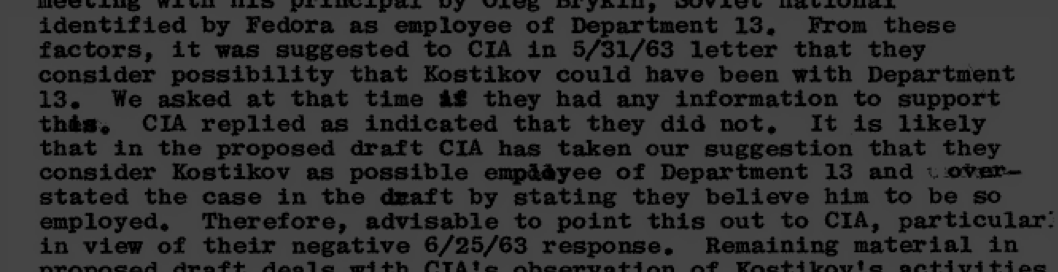
    This means either one of two things:

    1. Angleton knew Kostikov’s connection to Department 13 was unfounded, but tried to recycle that info in November.
    2. Angleton lied to Hoover on June 25, 1963, perhaps for the same reason (to keep the lid on it until November 22).

    David Atlee Phillips’ dirty tricks

    HSCA investigator Dan Hardway hypothesizes that, because of compartmentalization, Phillips and Oswald may have found out on November 22, 1963, that Oswald was a patsy and Phillips received orders to tie the murder to Castro.

    In a critique of Phil Shenon’s work written for the AARC in 2015, Hardway expresses the opinion that the CIA is heading to what he calls a limited hang-out by admitting that Oswald may have received guidance from Cuba and that the CIA director at the time, John McCone, was involved in a benign cover-up.

    Following the assassination, it became obvious that Phillips was connected to several disinformation stories trying to link Oswald to Castro agents. HSCA investigator Hardway called him out on it:

    Before our unexpurgated access was cut off by Joannides, I had been able to document links between David Phillips and most of the sources of the disinformation that came out immediately after the assassination about Oswald and his pro-Castro proclivities. I confronted Phillips with those in an interview at our offices on August 24, 1978. Phillips was extremely agitated by that line of questioning, but was forced to admit that many of the sources were not only former assets that he had managed, in the late 50’s and early 1960’s, but were also assets whom he was personally managing in the fall of 1963. Mr. Phillips was asked, but could not explain, why the information that came from anti-Castro Cuban groups and individuals pointing to Cuban connections, all seemed to come from assets that he handled personally, but acknowledged that that was the case.

    One of these assets was Nicaraguan double agent Gilberto Alvarado who, on November 25, claimed to have witnessed Oswald being paid off to assassinate Kennedy when Oswald was in Mexico City. A tale that was quickly debunked.

    While the HSCA hearings were going on, Phillips himself made the claim to a Washington Post reporter that he had heard a taped intercept of Oswald when he was in Mexico City talking to a Russian Embassy official offering to exchange money for information (Washington Post, November 26, 1976). Something he never repeated. Phillips also tried to get Alpha 66 operative Antonio Veciana to get one of his relatives in Mexico City to attest that Oswald accepted bribes from a Cuban agent.

    Letters from Cuba to Oswald—proof of pre-knowledge of the assassination

    For this obvious frame-up tactic, it is worth revisiting what was written in this author’s article The CIA and Mafia’s “Cuban American Mechanism”.

    In JFK: the Cuba Files, a thorough analysis of five bizarre letters, that were written before the assassination in order to position Oswald as a Castro asset, is presented. It is difficult to sidestep them the way the FBI did. The FBI argued that they were all typed from the same typewriter, yet supposedly sent by different people. Which indicated to them that it was a hoax, perhaps perpetrated by Cubans wanting to encourage a U.S. invasion. However, the content of the letters and timeline prove something far more sinister according to Cuban intelligence. The following is how John Simkin summarizes the evidence:

    The G-2 had a letter, signed by Jorge, that had been sent from Havana to Lee Harvey Oswald on November 14th, 1963. It had been found when a fire broke out on November 23rd in a sorting office. “After the fire, an employee who was checking the mail in order to offer, where possible, apologies to the addressees of destroyed mail, and to forward the rest, found an envelope addressed to Lee Harvey Oswald.” It is franked on the day Oswald was arrested and the writer refers to Oswald’s travels to Mexico, Houston and Florida …, which would have been impossible to know about at that time!

    It incriminates Oswald in the following passage: “I am informing you that the matter you talked to me about the last time that I was in Mexico would be a perfect plan and would weaken the politics of that braggart Kennedy, although much discretion is needed because you know that there are counter-revolutionaries over there who are working for the CIA.”

    Escalante informed the HSCA about this letter. When he did this, he discovered that they had four similar letters that had been sent to Oswald. Four of the letters were post-marked “Havana”. It could not be determined where the fifth letter was posted. Four of the letters were signed: Jorge, Pedro Charles, Miguel Galvan Lopez, and Mario del Rosario Molina. Two of the letters (Charles & Jorge) are dated before the assassination (10th and 14th November). A third, by Lopez, is dated November 27th, 1963. The other two are undated.

    Cuba is linked to the assassination in all of the letters. In two of them, an alleged Cuban agent is clearly implicated in having planned the crime. However, the content of the letters, written before the assassination, suggested that the authors were either “a person linked to Oswald or involved in the conspiracy to execute the crime.”

    This included knowledge about Oswald’s links to Dallas, Houston, Miami, and Mexico City. The text of the Jorge letter “shows a weak grasp of the Spanish language on the part of its author.” It would thus seem to have been written in English and then translated.

    Escalante adds: “It is proven that Oswald was not maintaining correspondence, or any other kind of relations, with anyone in Cuba. Furthermore, those letters arrived at their destination at a precise moment and with a conveniently incriminating message, including that sent to his postal address in Dallas, Texas … The existence of the letters in 1963 was not publicized or duly investigated and the FBI argued before the Warren Commission to reject them.”

    Escalante argues: “The letters were fabricated before the assassination occurred and by somebody who was aware of the development of the plot, who could ensure that they arrived at the opportune moment and who had a clandestine base in Cuba from which to undertake the action. Considering the history of the last 40 years, we suppose that only the CIA had such capabilities in Cuba.”

    We will see that these letters are suspiciously similar to Oswald’s “last letter.”

    Policarpo Lopez

    Attempts to link foreign governments to the assassination were not just limited to the framing of Oswald. As reported in the article The Three Failed Plots to Kill JFK, eight alternate patsies were profiled and no fewer than five of these made strange trips to Mexico City and at least four had visited Cuba.

    One who did escape authorities to Mexico and was reportedly the lone passenger on a plane to Cuba shortly after the assassination was Policarpo Lopez. Even the HSCA found this case egregious.

    The HSCA described parts of what it called the “Lopez allegation”:

    Lopez would have obtained a tourist card in Tampa on November 20, 1963, entered Mexico at Nuevo Laredo on November 23, and flew from Mexico City to Havana on November 27. Further, Lopez was alleged to have attended a meeting of the Tampa Chapter of the FPCC on November 17 … CIA files on Lopez reflect that in early December, 1963, they received a classified message requesting urgent traces on Lopez … Later the CIA headquarters received another classified message stating that a source stated that “Lopes” had been involved in the Kennedy assassination … had entered Mexico by foot from Laredo on November 13 … proceeded by bus to Mexico City where he entered the Cuban Embassy … and left for Cuba as the only passenger on flight 465 for Cuba. A CIA file on Lopez was classified as a counterintelligence case.

    An FBI investigation on Lopez through an interview with his cousin and wife, as well as document research, revealed that … He was pro-Castro and he had once gotten involved in a fistfight over his Castro sympathies.

    The FBI had previously documented that Lopez had actually been in contact with the FPCC and had attended a meeting in Tampa on November 20, 1963. In a March 1964 report, it recounted that at a November 17 meeting … Lopez said he had not been granted permission to return to Cuba, but was awaiting a phone call about his return to his homeland … A Tampa FPCC member was quoted as saying she called a friend in Cuba on December 8, 1963, and was told that he arrived safely. She also said that they (the FPCC) had given Lopez $190 for his return. The FBI confirmed the Mexico trip (Lopez’ wife confirmed that in a letter he sent her from Cuba in November 1963, he had received financial assistance for his trip to Cuba from an organization in Tampa) … information sent to the Warren Commission by the FBI on the Tampa chapter of the FPCC did not contain information on Lopez’ activities … nor apparently on Lopez himself. The Committee concurred with the Senate Select Committee that this omission was egregious, since the circumstances surrounding Lopez’ travel seemed “suspicious”. Moreover, in March 1964, when the WC’s investigation was in its most active stage, there were reports circulating that Lopez had been involved in the assassination … Lopez’ association with the FPCC, however, coupled with the fact that the dates of his travel to Mexico via Texas coincide with the assassination, plus the reports that Lopez’ activities were “suspicious” all amount to troublesome circumstances that the committee was unable to resolve with confidence.

    Oswald’s Last Letter

    On November 18, 4 days before JFK’s assassination, the Russian Embassy received a letter dated November 9 from “Oswald”, which was uncharacteristically typed and was in an envelope post-marked November 12. The letter, as was the case for all mail sent to the Russian embassy, had been intercepted by the FBI (Hoover phone call to Johnson November 23 10:01). The envelope is addressed to Tovarish Reznekohyenko, N. (note that Tovarish means Comrade).

    Before this incriminating letter, there were at least 6 exchanges in writing between the Oswalds and the Russian Embassy between February and November 1963, where the Russian contact was Nikolai Reznichenko according a number of Warren Commission exhibits. We can assume he is also the recipient of the last letter, despite different spellings.

    The FBI sent a briefing about the letter to the FBI Dallas office who received it on the day of the assassination. The Russians, sensing they could be blamed, handed over a copy of the letter to the Americans after noting correctly that it was the only one of all the letters from Oswald that was typed and that its tone differed from all previous correspondence. As the Soviet Ambassador pointed out at the time, the tone was also quite dissimilar to anything Oswald had communicated before; it gave “the impression we had close ties with Oswald and were using him for some purposes of our own.” Their opinion was that it was either a fake or dictated to him. Previous letters were more straight to the point dealing with visa applications.

    This letter became a hot potato. One that posed problems for the Warren Commission and the HSCA, which were amplified by the different takes Ruth and Michael Paine, Marina Oswald, the CIA, and the Russians had on it and the incredible lack of depth in the Warren Commission probe.

    With time, researchers like Peter Dale Scott, James Douglass, and Jerry D. Rose pointed out several troubling points, not only in the letter itself, but also with a Ruth Paine generated handwritten draft of the letter, as well as a Russian analysis of it.
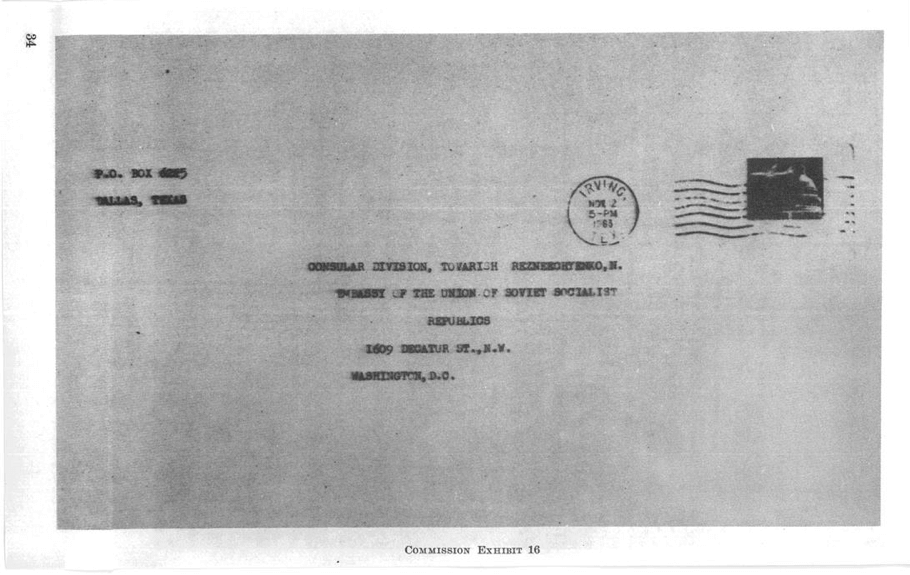
    Warren Commission Volume 16 Exhibit 16

    Letter from Lee Harvey Oswald to the Russian Embassy, dated November 9, 1963:
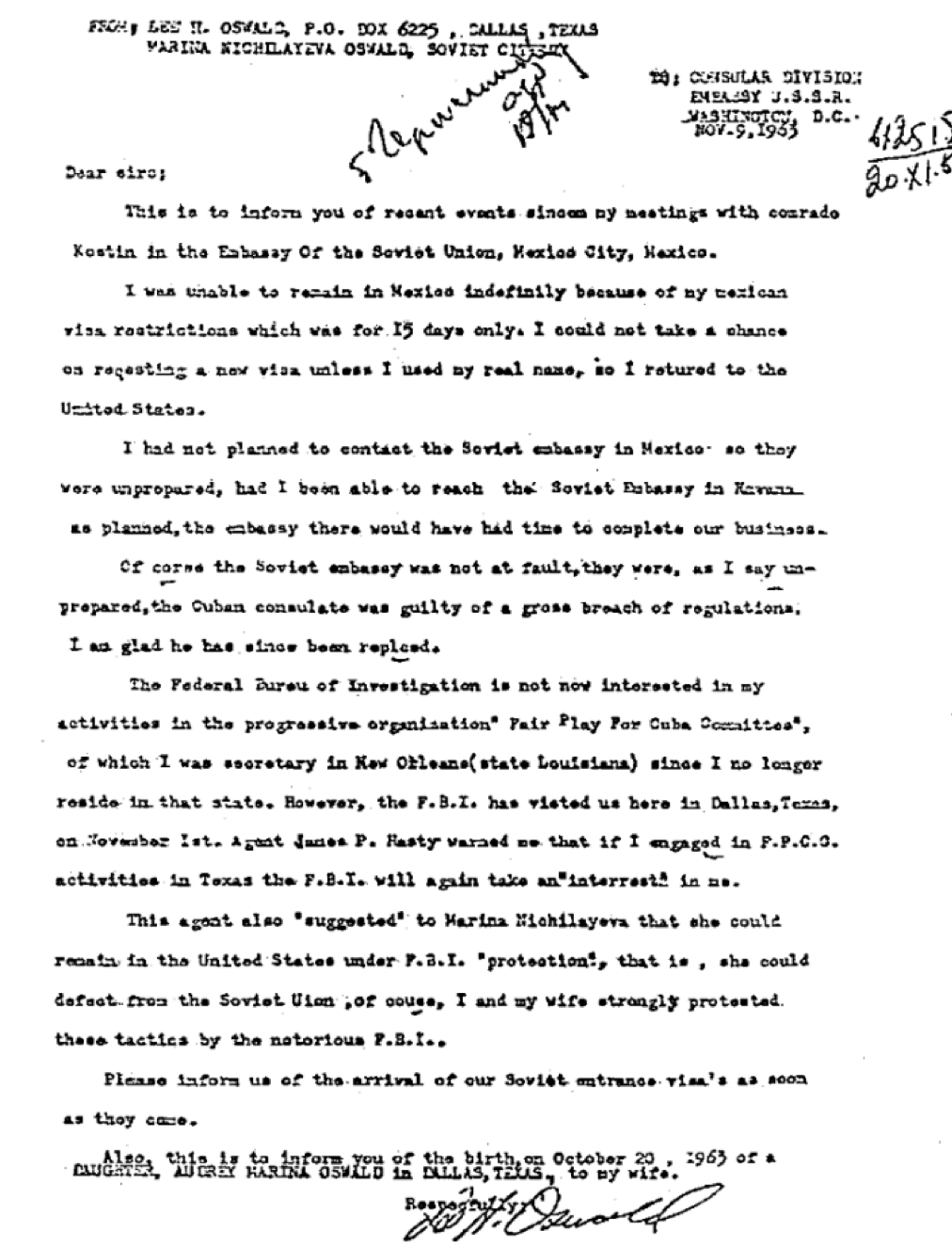
    Warren Commission Volume 16 Exhibit 15

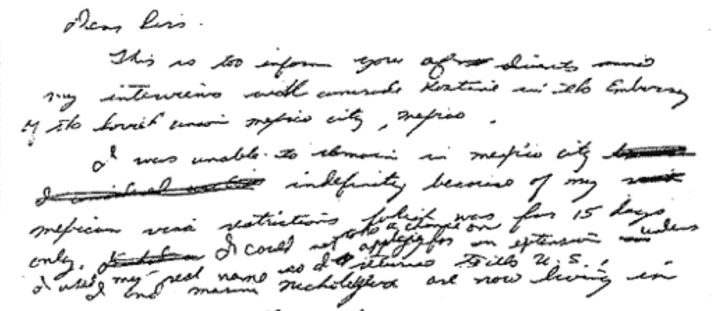
    The mistake-riddled letter was linked to Ruth Paine’s typewriter. Ruth Paine and Marina Oswald testified that they had seen Oswald working on the letter shortly before it was sent and Ruth and Michael Paine both testified that they had seen a handwritten draft of the letter, which Ruth Paine handed over to an FBI official on November 23. Somehow, investigators who had combed through the Paine house had missed it. Handwriting analysis apparently confirmed it had been written by Oswald.

    For some incredible reason, by April 1964, the Warren Commission had accepted a Ruth Paine request to have Oswald’s draft returned. However, when the Dallas FBI did return it to her, she decided to send it back to the Commission, because, finally, she felt it would be more proper for it to be kept in the public archives, but would take it in the event it would not be archived. Hoover said with finality that the Commission would not hold onto it and, by May 1964, had the original sent back to Ruth Paine, which escaped further examination as to its authenticity. (JFK and the Unspeakable, p.443)

    Oswald’s draft of the letter found by Ruth Paine:
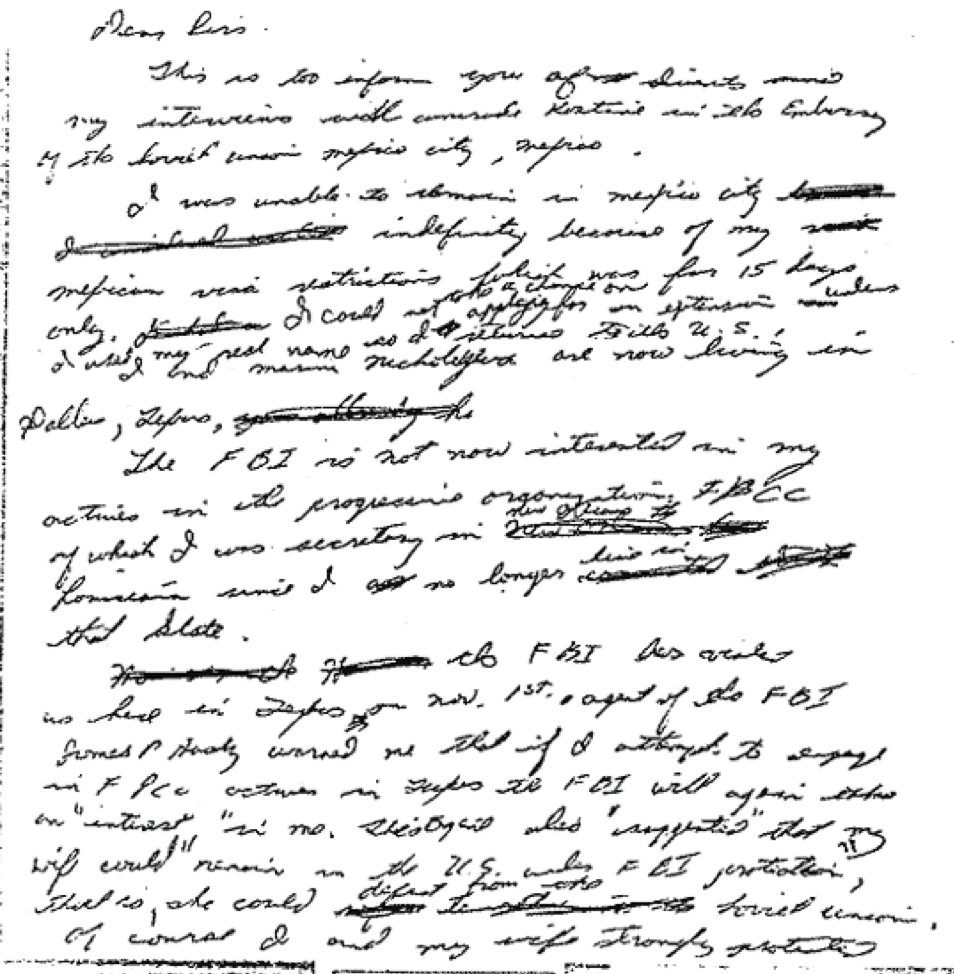
    HSCA exhibit F 500/Warren Commission exhibit 103

    The Warren Report’s descriptions of Oswald’s trip to Mexico City and his last letter are among the best examples of just how weak their investigation was and how misleading they were in their disclosures.

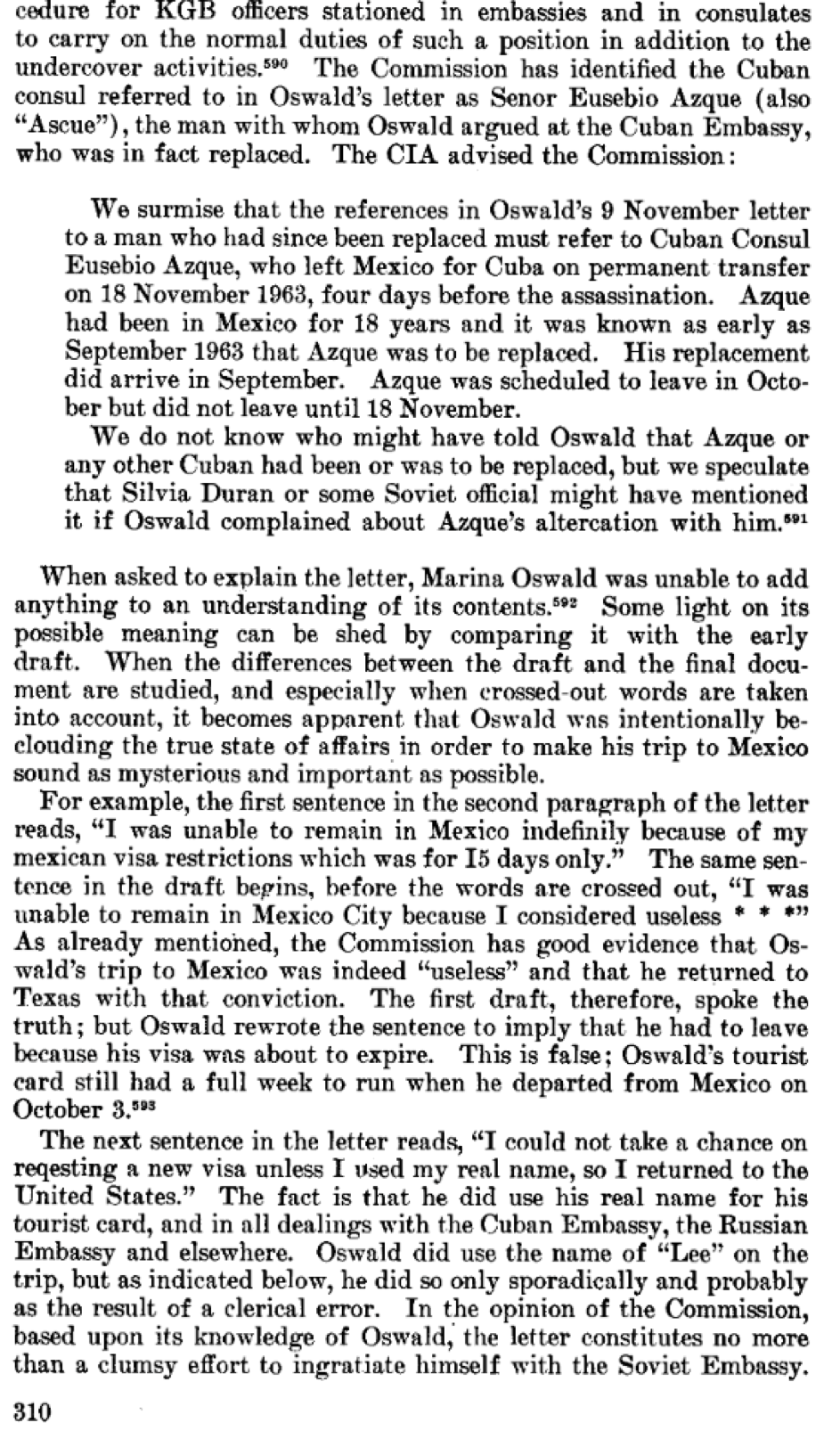
    It seems the only thing that they found perplexing from the letter was how a “drifter” like Oswald could have known that a consul from the Cuban consulate in Mexico City could have been replaced. So, they asked the CIA to weigh in. The CIA surmised that the consul in question was Eusebio Azque and speculated that Silvia Duran or some Soviet official might have mentioned it if Oswald had complained about an altercation with Azque.

    The Commission recognized that Kostin, who Oswald talks about, was KGB officer Valery Kostikov, but dilutes the meaning of this by stating “that it was common procedure for such KGB officers stationed in embassies to carry on normal duties along with undercover activities”.

    Buried in the appendices of the Report, we can find a memo (Warren Commission Document 347 of January 31, 1964, p. 10) by the FBI’s Ray Rocca, sent to the Commission in January 1964:

    Kostikov is believed to work for Department Thirteen of the First Chief Directorate of the KGB. It is the department responsible for executive action, including sabotage and assassination. These functions of the KGB are known within the Service itself as “Wet Affairs” (mokryye dela). The Thirteenth Department headquarters, according to very reliable information, conducts interviews or, as appropriate, file reviews on every foreign military defector to the USSR to study and to determine the possibility of using the defector in his country of origin.

    Richard Helms, while heading the CIA, went on to confirm this very important detail. Kept hidden from the public was an allegation that Oswald had met Kostikov just a few weeks earlier in Mexico City and that a likely Oswald impostor had placed a call to Kostikov that was intercepted by the CIA! This makes the reference to “unfinished business” that we can read in the letter quite suggestive.

    It is interesting to note that the letters from Cuba designed to incriminate Oswald and link him to Cuban agents use some of the same suggestive language. “Close the business”, “after the business, I will recommend you”, and “after the business I will send you your money” are some of the phrases that can be found in just one of the letters. Others talk about “the matter” or “the plan”.

    A real investigation and transparent report would have revealed a lot more about Kostikov’s explosive background and would have blown the lid off what really happened in Mexico City. It would have also delved into who the recipient of the Washington letter was and its important significance, if Plan A (blaming foreign foes for the assassination) had been pursued. Something we will discuss later.

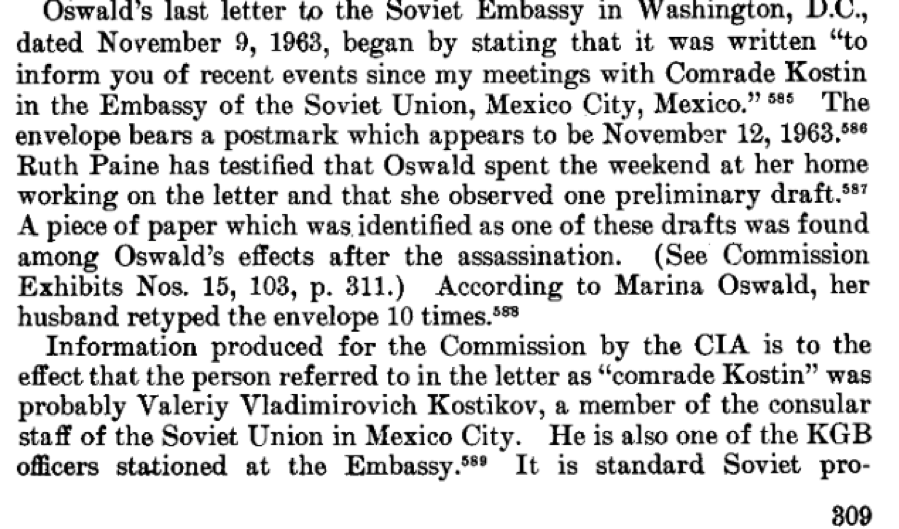
    Instead, the report concludes its extremely hollow analysis on a whimper: “In the opinion of the Commission, based upon its knowledge of Oswald, the letter constitutes no more than a clumsy effort to ingratiate himself with the Soviet Embassy.” The truth was that, had plan A gone ahead, the letter would have been peddled as further proof of complicity between the president’s “murderer” and foreign adversaries.

    The Warren Report on the letter
    While Jim Garrison clearly suspected something unholy occurred in Mexico City, as well as with the letter, the public had to wait until 1970 to see some of the first clues about what the FBI really thought about this correspondence, when newsman Paul Scott revealed the following:

    The F.B.I. discounts the C.I.A. suggestion to the Warren Commission that Silvia Duran, a pro-Castro Mexican employee of the Cuban Embassy, might have told Oswald about Azque being removed. In her statement to Mexican officials concerning her discussion with Oswald, Mrs. Duran made no mention of Azque. And, although she was questioned at the request of C.I.A., no attempt was made to quiz her about whether she knew of Azque’s recall. This makes the C.I.A. conclusion highly dubious, to say the least.

    Although the F.B.I. still has not been able to resolve the key mystery of the Oswald letter, it has narrowed the sources of where he might have obtained information about Azque. These sources are: (1) An informant in the Cuban Embassy in Mexico City who contacted Oswald after he returned to the U.S. (2) The Central Intelligence Agency. Or (3), the Soviet Secret Police (K.G.B.) in Mexico City. Significantly, the F.B.I. probe discovered that the K.G.B. and the C.I.A. learned of Azque’s replacement at approximately the same time and not until after Oswald visited Mexico City. This finding has raised the possibility that whoever informed Oswald contacted him after he returned to Dallas from Mexico City.

    According to Paul Scott’s son Jim, his father was wiretapped for over 50 years, because of his dogged investigations into the assassination.

    The HSCA

    Perhaps the biggest blow to the Lone Nut fabrication came when the Church Committee and the HSCA investigations deciphered one of the most important ruses, which would turn the tables on the frame-up artists who concocted the aborted Plan A stratagem. This had to be kept secret.

    One thing the Lopez Report makes very clear is that an Oswald impostor made a phone call designed to lay down a trace that would be used as proof of Russian complicity in the assassination and would provide the types of motives and stratagems that were part of the ZR/RIFLE and the Joint Chiefs of Staffs Operation Northwoods play books, both which involved having adversaries blamed for their own covert acts of aggression. The letter served to authenticate the Oswald-Kostikov relationship and add a third player to the mix. The potato became scorching hot.

    This analysis needed to be buried as much and as long as possible. The HSCA did not want to be the ones exposing this in the 1970s. The world had to wait nearly 25 years for the declassification of the explosive reports concerning Oswald’s trip to Mexico City and the mysterious letter and sometimes much later for their eventual release.

    The HSCA’s conclusions about the letter were even more hypocritical than the Warren Commission’s. While they recognize that it is “disturbing”, they seem to ignore the fact that the letter had been intercepted by the FBI and do not factor in the explosive findings of their very own Lopez Report, nor the confirmations about Kostikov’s role as Russia’s head of assassinations for the Western Hemisphere. When we consider the proof that they were sitting on, that an Oswald impersonator was recorded talking to Kostikov, and that Oswald (or an impostor) was said to have actually met him, we can easily see that the context of the letter and its explosive meaning were completely sidestepped in the Report:
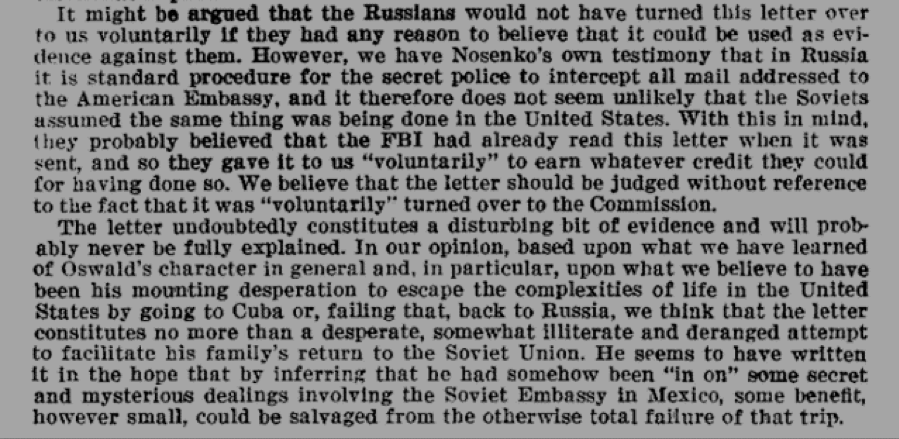
    While the second paragraph represents a fake opinion designed to deviate from the real implication of the letter, the first one represents a blatant deception that can be proven outright by the transcript of Hoover’s call to President Johnson the day after the assassination:
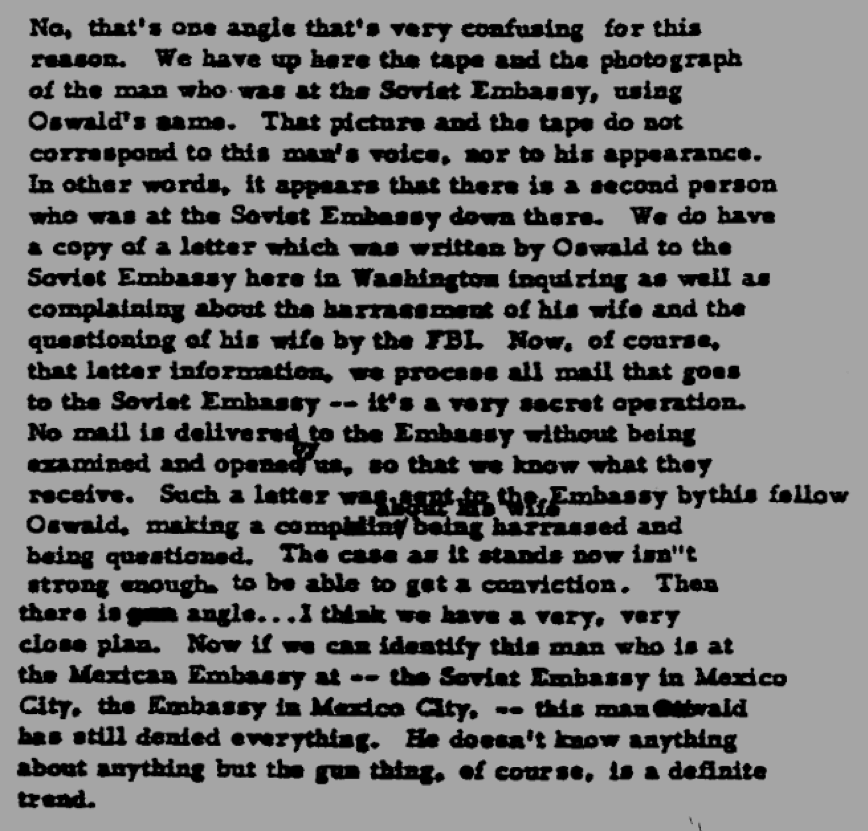
    In short, the FBI did in fact examine all mail sent to the Soviet Embassy and had a copy of the letter all along.

    The ARRB and Russians Weigh In

    Thanks in large part to Oliver Stone and his landmark JFK movie classic, the ARRB was founded in 1992 and began declassifying files shortly after on the JFK assassination. In 1996, the Lopez Report was available. By 2003, a less redacted version was released. The explosive document shed light on Oswald impersonators, missing tapes, photos, and bold-faced lying by top CIA officials. The lone drifter was not alone!

    As reported by Jerry Rose in the Fourth Decade, in 1999, Boris Yeltsin handed Bill Clinton some 80 files pertaining to Oswald and the JFK assassination. One of the memos reveals that, at the time of the assassination, Russian ambassador Anatoly Dobrynin had right away seen the letter as a “provocation” to frame Russia by the fabrication of complicity between Russia and Oswald, when none existed. “One gets the definite impression that the letter was concocted by those who, judging from everything, are involved in the president’s assassination,” Dobrynin wrote. “It is possible that Oswald himself wrote the letter as it was dictated to him, in return for some promises, and then, as we know, he was simply bumped off after his usefulness had ended.” In late November, the Russians sent the letter to U.S. Secretary of State Dean Rusk explaining why the letter was a fraud. By then, the White House was peddling the lone nut fable. Kept hidden was the fact that the FBI already had a copy of the letter.

    In his article, Rose points out that the typed letter had many more spelling errors in it than the rough draft. Very odd indeed.

    If you go back to how the Warren Commission fluffs off the alleged Kostikov/Oswald (and/or impostor) exchanges and compare it with what is written by Bagley in the CIA’s November 23rd 1963 memo (declassified in 1998), you will see a startling difference in Kostikov’s status:

    Memo of 23 November 1963 from Acting Chief, SR Division, signed by Tennant Bagley, “Chief, SR/Cl.” CIA Document #34-538

    Just one of the reasons the Warren Report was impeached! But wait, it gets worse.

    The FBI’s Reaction to the Letter and the Mysterious Tovarish Reznkecnyen

    Since the mid-1990s, there have been a few revealing writings about the letter, but very little about the FBI’s take on it.

    Now, thanks to document declassification, we can see it through a wider scope that includes troubling dovetailing facts, such as the impersonation of Oswald in Mexico City and multiple hoaxes to tie him in unequivocally with sinister foreign agents and the chief assassination officer in Mexico—Kostikov. The analysis of tape recordings and transcripts, the mysteriously disappearing evidence, the fake letters from Cuba, and the full-fledged perjury of CIA officer David Atlee Phillips during the HSCA hearings prove there was subterfuge beyond a shadow of a doubt.

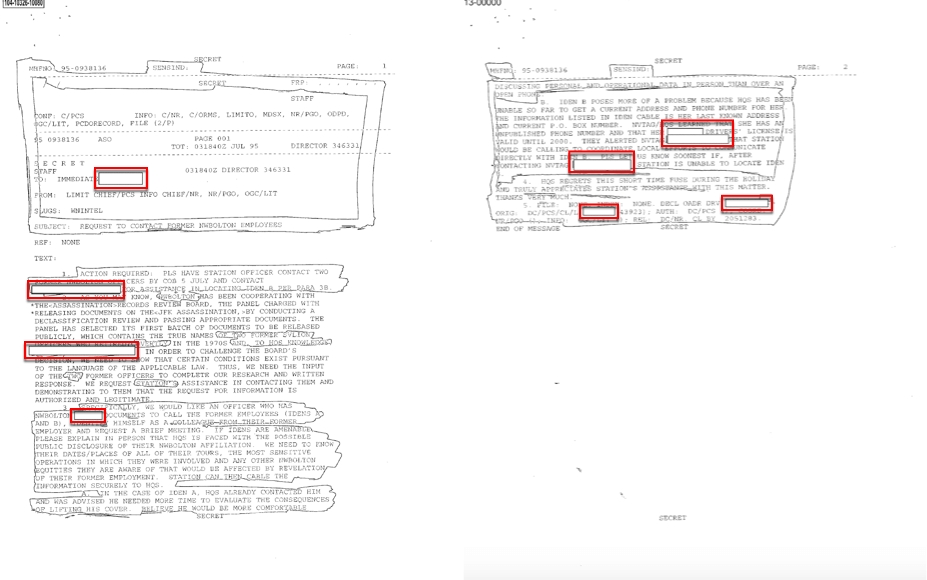
    Hoover’s phone call to Johnson is already very revealing. The following FBI report (HSCA Record 180-10110-10104), released only in 2017, is nothing short of stunning. It was the one Scott wrote about in 1970. It is strongly urged that you follow the above link to understand the full implication of the report, which sheds light on the investigation mindset which preceded the whitewash. However, for this article, our attention will be on the following paragraph of the report which focuses on the letter Oswald sent to the Soviet Embassy in Washington.

    Oswald’s letter deeply troubled the FBI for a number of reasons. Its tone was one of ongoing complicity referring to “unfinished business” and convenient reminders of the alarming exchange between Oswald and Kostikov. But the letter stretches the elastic to add yet another element that has so far gone under the radar.

    The fact that the letter was sent to Tovarich Nikolai Reznichenko all of a sudden became alarming, even though the Oswalds corresponded with him several times in 1963. The FBI report clearly refers to him as “the man in the Soviet Embassy (Washington’s) in charge of assassinations.” In 1970, Scott had described him as “one of the top members of the Soviet Secret Police (K.G.B.) in the United States.”

    The significance of this report leads to many conclusions and as many unanswered questions. Hoover had already decided that Oswald acted alone and they would not “muddy the waters internationally”. The HSCA, who possessed this document, in reports debates the authenticity of the same letter that was given to Dean Rusk by the Soviet ambassador, when they knew full well of its existence and FBI worries about its explosive implications. While this author has found little corroboration about Nikolai Reznichenko’s status, or perceived status, he believes it should not be dismissed as a mistake or confusion with Kostikov. This is an official FBI report that was written in 1963. There have not been any clarifications made about this very significant statement, despite the fact that Paul Scott exposed this in 1970 and its access to HSCA investigators.

    The mere fact that he worked in the Russian embassy and that he often corresponded with a “defector” on a watch list and his Russian wife and that the last letter by Oswald addressed to him has a complicit tone while name dropping the Mexico-based KBG chief of assassinations and talking about unfinished business suggests that both the FBI and the CIA had files on him. Where are they? For him to be described by Hoover as the head of assassinations in Washington on the part of the Soviet government in an official FBI document is of utmost significance and requires an explanation.

    This is one issue that deserves more debate in the research community.

    Conclusion

    The last letter on its own, perhaps, does not rise to the level of a smoking gun that proves there was conspiracy. It is another compelling piece of evidence that does prove that the Warren Commission and the HSCA shelved important evidence and information from the public that they found bothersome.

    If one adds this letter to the other attempts to pin the blame on foreign agents, including the charade in Mexico City, false testimonies by CIA contacts, the perjury of CIA officials of interest in the case, the Policarpo Lopez incident, and the incriminating letters from Cuba, we have proof beyond a shadow of a doubt that there was conspiracy. The naysayers cannot have it both ways. Either these events were genuine, which proves an international conspiracy, or they were not, which proves a domestic conspiracy. There has been enough evidence to demonstrate that they were not genuine.

    The letter has one attribute that can play an important role, actually proving who some of the conspirators were. It pre-dates the assassination. As it refers to happenings and ruses that took place in Mexico City two months earlier that few knew about, we can narrow the scope on who was involved. When we inspect the propaganda aspect of the operation, the case against David Atlee Phillips as a person of extreme interest is almost airtight. He had many touch points with Oswald and is easy to link to all of the ruses behind the sheep dipping activities, including the incriminating last letter.


    See also Carol Hewett’s Ruth Paine “Finds” Evidence: Oswald’s Letter to the Soviet Embassy

  • The FBI, JFK and Jim Garrison

    The FBI, JFK and Jim Garrison


    {aridoc engine=”google” width=”700″ height=”400″}images/ppt/FBI-JFK-Garrison-2019.ppsx{/aridoc}


    Open in Google Slides


    Version in .pdf

  • Dennis Breo, the New York Times, and JFK

    Dennis Breo, the New York Times, and JFK


    On November 8, 2019, the New York Times printed a letter from an author named Dennis Breo. This was in reply to a review of Jack Goldsmith’s book In Hoffa’s Shadow. In the review of that book, Chris Nashaway wrote that the disappearance of Hoffa ranks with mysteries like the disappearance of Amelia Earhart and the identity of the so-called second shooter on the grassy knoll. Please note the term “so-called” in front of the second shooter.

    Well, even that large qualifier was not enough for one Dennis Breo. Breo promptly wrote a letter to the Times who, quite willingly, accommodated him.

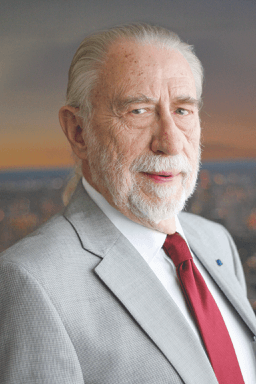
    Dennis Breo

    Stepping up to his soap box, Breo wrote that what the Times had done by printing that sentence was a “serious disservice to history.” He then said that he had been a journalist for the Journal of American Medicine Association (JAMA) when they did interviews with the three autopsy doctors on the JFK case in May of 1992. He wrote that, because of that, he could assure the Times that “there was no second shooter from the grassy knoll or anywhere else.” He then said that the autopsy doctors proved that both wounds in Kennedy went from back to front, that is, his back of the neck wound and his head wound. Therefore, the only possible shooter was Lee Harvey Oswald. He then ended his letter with the fact that the Times endorsed that article saying that “it offers proof against paranoia.”

    Dr, George Lundberg

    This was the first letter on the correspondence page. Above it, the Times bannered the letter with the rubric “There was no Second Shooter on the Grassy Knoll,” all seeming a bit much for printing the phrase “the so called second shooter.”

    Naturally, the Times did not reply to Breo’s letter to defend what they originally printed. They did not even let Mr. Nashaway respond. They were wise in doing so, because Breo is a huge target for anyone disputing the Warren Report’s version of events.

    First, Dennis Breo is not a doctor and has never been a doctor. He is now a retired journalist, living in Florida. At the time that the film JFK came out, he was working with Dr. George Lundberg, the editor of JAMA. Lundberg did not like the portrayal of his friend Dr. James Humes in that picture. Evidently, he did not care to find out that it was not really a portrayal. It was all based upon facts that were adduced at the trial of Clay Shaw in 1969 in New Orleans. Those facts, recited under oath by Dr. Pierre Finck, were accurately scripted for the film. There was nothing defamatory about these scenes. The film reflected Finck’s testimony on the stand, according  to the trial  record, which director/writer Oliver Stone had secured.

    Finck’s testimony, in and of itself, is quite a story. He was called by the defense. The reason being that Dr. John Nichols, a pathologist, had been an effective witness for the prosecution. He testified that, in his opinion, the Zapruder film proved a shot from the front and, therefore, showed a conspiracy. (James DiEugenio, Destiny Betrayed, second edition, p. 299) The defense was worried about the impact of both the Zapruder film and Nichols. So they called Kennedy autopsy physician Pierre Finck as a witness. The Justice Department was coordinating its coverage of the Clay Shaw trial through attorney Carl Eardley in Washington. (ibid, p. 299)  Eardley was the point man on the cover up of the medical evidence in the JFK case. For example, he had coordinated a meeting in 1966 so that four of those present in the Bethesda morgue room—where Kennedy’s autopsy was performed—would testify that all the photos of that procedure were accounted for. Even though everyone knew they were not, including Eardley. (ibid, p. 305). Eardley wisely kept his name off the final draft of the false document.

    Finck’s testimony in New Orleans was coordinated with Eardley in advance. (DiEugenio, p. 299) Finck was fine under direct examination. He was reduced to mumbling and bumbling by Jim Garrison’s assistant DA Alvin Oser under cross examination. The Shaw trial was the first direct exposure of the corrupt practices and hierarchical control of what went on in the Bethesda morgue on the evening of November 22, 1963. The examination got so bad that Finck began dodging questions and refusing to answer. The judge had to order him to answer. When he did, he admitted that Kennedy’s back wound was not dissected because the doctors—Humes, Finck, and Thornton Boswell—were ordered not to do so. He also admitted that Humes had to stop the examination once, because of all the interference. Once halted, Humes then asked aloud: “Who is in charge here?” Finck testified that an army general replied, “I am.” Finck then added: “You must understand that in those circumstances, there were law enforcement officials, military people, with various ranks and you have to coordinate the operations according to directions.” (DiEugenio, p. 300, italics added)

    Finck had given away the game. Kennedy’s back wound was not dissected, because the military presence there would not allow it. The doctors were not in charge; the Pentagon officers were. Because of this, no one would ever know for certain the precise circumstances by which President Kennedy was killed. Did the back wound transit the body? Did it meet the anterior neck wound as part of its trajectory? Those questions can never be answered, because of the military control of the Bethesda autopsy.

    Finck’s testimony was devastating to the official story, so much so, that when local US attorney Harry Connick informed Eardley what the doctor was saying, the maestro of the medical cover up panicked. When Dr. Boswell testified to the Assassination Records Review Board, he said that Eardley was really upset about what Finck said under oath at the Shaw trial. (DiEugenio, p. 304) Eardley told Boswell that he had to get someone to New Orleans quickly, because Finck was “really lousing everything up.” In other words, telling the truth was screwing up Eardley’s cover up efforts. Eardley flew Boswell to New Orleans, where he was met by Connick. But Eardley changed his mind and Boswell did not testify. Eardley’s intent was to have Boswell smear Finck as a “strange man.” Eardley probably changed his mind, because he realized that Finck was more experienced as a forensic pathologist than Humes or Boswell was. That was why they called him in a bit late in the procedure. It would have been difficult to discredit someone with better credentials than yourself. (DiEugenio, p. 304)

    This was what writers Oliver Stone and co-writer Zachary Sklar had based this part of the film upon, although they had not yet seen the declassified machinations behind the scenes from Washington with Eardley. But this was all sworn testimony at the Shaw trial. JAMA could have availed themselves of it rather easily by calling Mr. Stone or the court stenographer of the Shaw trial—Helen Dietrich—who was still alive at the time. There is no evidence that Lunderg or Breo did either. Lundberg’s reaction to the film was not at all scientific or medically sound. After he saw the picture, he wrote a letter to his friend Jim Humes. It said:

    Have you seen the movie JFK? Three hours and fifteen minutes of truth mixed with non-truth mixed with alleged truth. For the younger person, not knowledgeable about 1963—very difficult to tell the difference. Please either write the truth now for JAMA or let Dennis Breo (and me?) interview you…to set the record straight—at least about the autopsy. (Brad Kizzia in Assassination Science, edited by James Fetzer, p.73)

    In other words, Breo and Lundberg went to work to counter the facts that JFK had set forth. Which were based upon Finck’s sworn testimony. It was later revealed in a deposition that Lundberg likely did not know that these autopsy scenes were based upon Finck’s testimony, when he wrote that letter to Humes. (Brad Kizzia in Trauma Room One, p. 165, by Dr. Charles Crenshaw.)

    Dr, Charles Crenshaw

    Something else had happened while Lundberg and Breo were setting about their task to rehabilitate one of the worst autopsies ever performed. Dr. Charles Crenshaw had published his book, Conspiracy of Silence. In that volume, Crenshaw revealed that upon being shown the autopsy photographs by researcher Gary Shaw, he was taken aback, because they did not conform with what he recalled. (Crenshaw, p. 18) Crenshaw said the back of the head photo did not reveal the blowout wound he saw and the anterior neck wound seemed widened and enlarged. Crenshaw’s book was published in April of 1992. It became a best seller.

    Breo and Lundberg prepared the May 1992 issue of JAMA for the original autopsy doctors to tell their story. They even called a press conference, in advance, in New York City. The article and the press conference also brought into question the efficacy of Crenshaw’s book. In fact, Lundberg and Breo even questioned if Crenshaw was in the emergency room. (Crenshaw, pgs. 153, 161, 165)

    Somehow, in his recent letter to the New York Times, Breo forgot to mention some rather embarrassing reporting in the Times about that press conference. Dr. Lawrence Altman was at that 1992 event in New York. His two reports for the Times showed that all one had to do was peruse the Warren Commission volumes to discover that Crenshaw was in the emergency room at Parkland Hospital when Kennedy was there. (Crenshaw, p. 166). Even though the Altman articles were published before the issue of JAMA was distributed, there was no correction added to the issue.

    Crenshaw requested a right to reply and Lundberg refused. Crenshaw then launched a lawsuit for defamation. Brad Kizzia represented the surgeon. The depositions in that case were rather interesting. It is quite obvious that Lundberg and Breo had an agenda. And they did not care about the long factual record of the Kennedy case. For instance, in his letter to the Times claiming he knows there were only two shots from the rear and they were by Oswald, Breo writes that the lower rear wound came in at the neck. This proves that not only did Breo not study the case before he wrote the JAMA articles—he has not studied it since. The House Select Committee on Assassinations (HSCA) had the autopsy photographs. They published artists’ renditions of the wounds. That wound, which Breo says is in the neck, is clearly in Kennedy’s back. (Crenshaw, p. 269) This is a fact that not even Dr. Michael Baden of the HSCA could deny. If a writer will not even admit that, then how can anyone trust him with the rest of the facts of the JFK autopsy.

    For in addition to the autopsy doctors being stopped from dissecting the back wound, there is no existing record of them sectioning Kennedy’s brain. This should have been done, in order to track the bullet path through the skull. No examining doctor since—from the HSCA or the ARRB—has been able to find any records from a sectioning process. (Although Doug Horne has made the case it was done and then covered up. Click here to read that essay.) To say that this was a failing is a monumental understatement.  For if the brain was not sectioned, then:

    1. How can one chart the bullet path through the skull?
    2. Say with confidence that JFK was hit by only one bullet in the head?
    3. Tell us that only one bullet came in from behind?

    Adding to this problem, the angle from the sixth floor of the Texas School Book Depository to the limousine below is slightly right to left.  But if one believes the autopsy, the bullet exited going left to right. There is also the problem that the 1968 Ramsey Clark Panel moved the rear skull wound up four inches to the cowlick area. But yet, for JAMA, Lundberg and Breo moved it back down again. These serious issues in the Kennedy case were all either discounted or ignored by JAMA. (Crenshaw, p. 203) As was the riddle of the weight of Kennedy’s brain. The supplementary autopsy report, filed on December 6, 1963, says that the weight was 1500 grams. (ibid, p. 238) This is virtually impossible to believe. Too many witnesses saw a brain that was missing a significant amount of mass. Secondly, from films and pictures of the assassination, one can see the blood and tissue that was ejected from Kennedy’s skull. This has led many to believe that there was some real subterfuge going on, with not just the autopsy, but the supplemental autopsy days later. It is why so many observers, e.g. forensic scientist Henry Lee, believe that the autopsy in the JFK case was such a mess that no observer can come to real conclusions about precisely how Kennedy was killed. (Lee said this in an interview with Oliver Stone for the upcoming documentary JFK: Destiny Betrayed)

    As both Gary Aguilar and Cyril Wecht noted in their review of JAMA’s articles (there was more than one), the fundamental factual errors that Breo and Lundberg made would not pass muster in a high school class on the JFK case. In the first sentence of the first article, Breo wrote that only Humes and Boswell knew what really happened during the autopsy of JFK. Thus ignoring Pierre Finck, who actually was the only experienced forensic pathologist of the three. (Aguilar and Wecht in Crenshaw, p. 202) Breo then added that the JAMA interview was the only time that Humes and Boswell had publicly discussed the JFK case. This was wrong in more than one sense. In 1967, Boswell had granted an interview to Josiah Thompson for attribution in his book Six Seconds in Dallas. In that same year, Humes gave an interview to Dan Rather for a CBS special broadcast in the summer of 1967. All three doctors had appeared in public before the HSCA; Humes was even on television for a second interview done alone. Boswell had given interviews to both the Baltimore Sun and the New York Times. Humes had given an interview for attribution to David Lifton. All of this betrays the fact that JAMA wanted to trumpet their articles as being somehow unprecedented in the literature, when, in fact, that was not an accurate assessment.

    In the second article, JAMA stated, through one of the Parkland doctors, that none of what the Dallas doctors saw contradicted that the bullets were fired from behind Kennedy and above. Now, at this time, the Assassination Records Review Board had not declassified the drawings and affidavits given to the HSCA. These clearly denoted a large, avulsive wound in the rear of Kennedy’s skull, which would suggest a shot from the front. But even in 1992, there was testimony and evidence that such was the case. To cite just two examples: the Warren Commission testimony of Secret Service agent Clint Hill and the drawing on page 107 of  Thompson’s book Six Seconds in Dallas directed by Dr. Robert McClelland. (Click here for Hill)

    One of the worst things about the JAMA articles and Breo’s performance was that, as attorney Brad Kizzia discovered, neither Lundberg nor Breo ever talked to Crenshaw himself. (Crenshaw, p. 164) But, beyond that, Kizzia also discovered that there was no peer review of Breo’s writing about the JFK case. (ibid, p. 165) The excuse given was that Breo’s work was only considered journalism. Considering that this “journalism” discussed and reviewed a quite complex and controversial subject and that Breo was not a physician, this is a truly remarkable decision by the editors at JAMA. And it’s why many doctors suspended their subscriptions to the magazine afterwards. Making all this even more troubling was the fact that Lundberg was a pathologist. Yet he admitted he had not read any books about the JFK case. (Crenshaw, p. 165) JAMA ended up settling with Crenshaw for about a quarter of a million dollars.

    The AMA board terminated George Lundberg seven years later. At that time, during the Bill Clinton impeachment proceedings, he was running an article about what college students considered oral sex to be. The executives at the AMA declared that he had compromised “the integrity of the journal” and they had been inserted “into a debate that had nothing to do with science or medicine.” (BBC News, 1/18/99)

    That judgment could have been asserted back in 1992.

  • NOLA Express Interview with Mark Lane

    NOLA Express Interview with Mark Lane


    In the spring of 1968, Mark Lane was in New Orleans helping Jim Garrison with his case against Clay Shaw. While there, Lane met with the editors of an alternative newspaper called NOLA Express. He granted them an interview, which became part of his FBI file. We have extracted that interview for our readers to peruse. We should note that the FBI had surveillance on Lane almost everywhere he went at this time. He was not only aiding Garrison, but he also was helping young men resist the draft.

    Rob Couteau pointed out the interview which is housed at Black Vault.


    (Click here to open the document in another page.)

    Dennis Riches has provided this typed transcription of the Mark Lane interview.


    (Click here to open the document in another page.)

  • The Wilcott Affidavit and Interrogation by the HSCA

    The Wilcott Affidavit and Interrogation by the HSCA


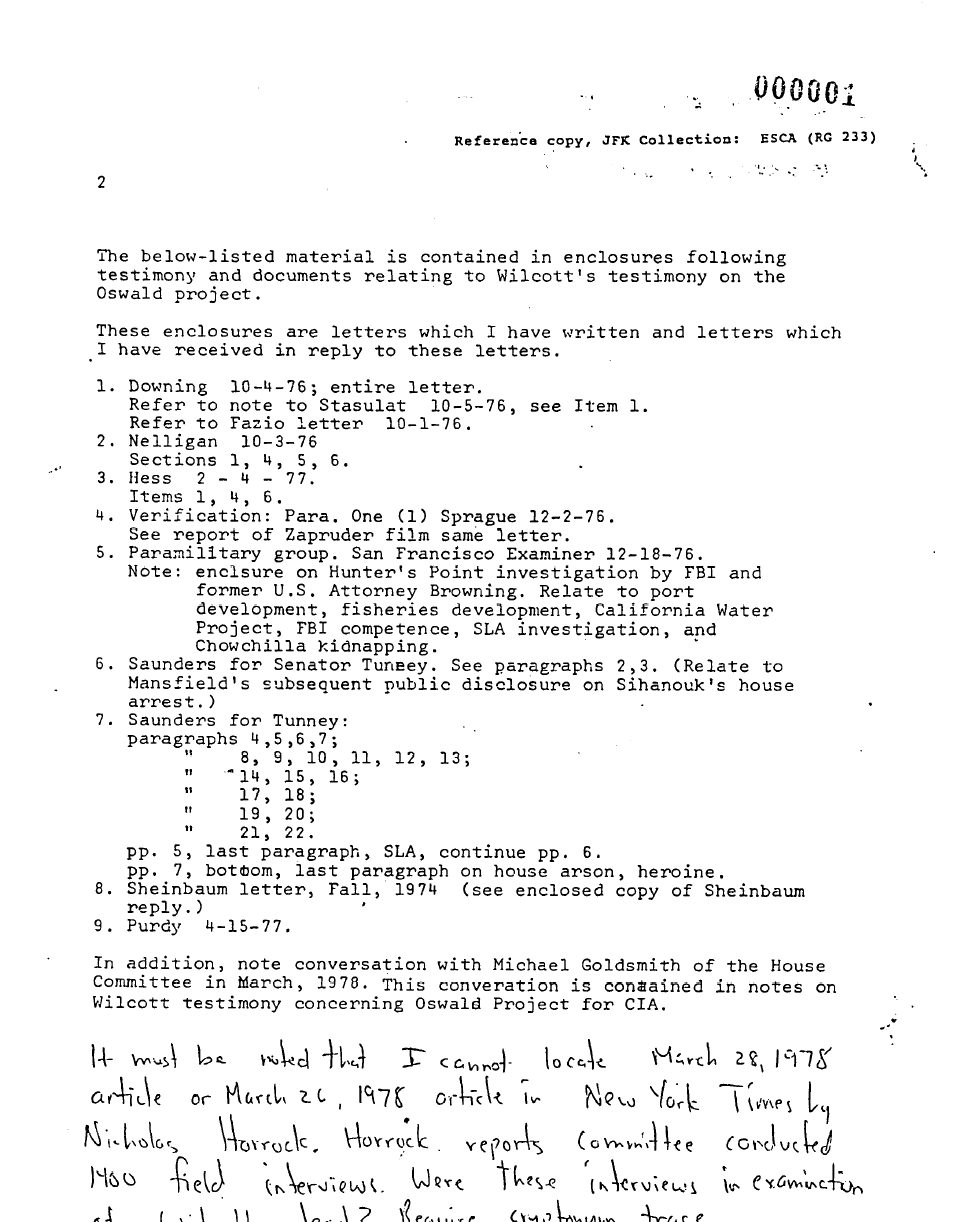
    James Wilcott worked out of the Tokyo CIA station at the time of the assassination. He was not questioned by the Warren Commission. His information was that he had been unwittingly involved with paying Oswald through a high security clearance, since he worked in the finance office. He learned this after the fact through various sources within the Agency, who all recognized what had happened after the assassination and the association of Oswald’s name with the crime. Wilcott’s affidavit and deposition were declassified by the ARRB. We think our readers would be interested in reading his evidence./p>


    (Click here to open the document in another page.)

  • Part 2:  Martin Scorsese and Robert DeNiro’s The Irishman

    Part 2: Martin Scorsese and Robert DeNiro’s The Irishman


    After reading the first part of this review, which focused on the book about Frank Sheeran by Charles Brandt, it’s hard to understand why director Martin Scorsese and actor/producer Robert DeNiro were intent on making a film from his book, I Heard you Paint Houses. And, further, why they would spend 160 million to do so. That point is important to discuss, but I will delay speculation on that issue for later in this review. The fact is, they did make the film. So, let us review and analyze the product before us.

    The first thing that struck me about the picture is its length. It three and a half hours long with no intermission. To put it frankly: Lawrence of Arabia justifies its length; The Irishman does not. There are many scenes that are simply extended or not necessary at all. When Sheeran goes to Detroit to meet Hoffa for the last time, we see him getting on the plane. Then after he kills him, the film shows him returning through the airport. Why? When the hit team goes to pick up Hoffa for that meeting from the restaurant, the picture depicts the drive and the actors in the front seat get into a stupid discussion about the fish that the driver previously had in the car. That is not a mistype. They discuss a fish as they go to pick up Hoffa, in order to kill him. If this was supposed to be a kind of Pinteresque/David Mamet touch, it did not work for this viewer. These are not the only scenes that could have been either cut or shortened. Not by a long shot.

    Then, there is the protracted, over-extended ending section. The dramatic and intellectual ending of the film is the murder of Hoffa and the cremation of his body. But the picture goes on and on from there. We see Sheeran being tried in court for other crimes, we see him in prison with Bufalino, and then there is a long section after he gets out with scenes with his monsignor—two of these. We then see him trying to reconcile with his estranged daughter, falling down at home, and being placed in a retirement center. We then watch as he picks out a casket and chooses a cemetery lot etc. After the film was finished and I was driving home, I tried to figure out what that long extended ending was about. When I got home, I realized why. The film makers were trying to make Sheeran into some kind of sympathetic character; they were trying to wring pathos from the audience.

    Think about that. If we view Sheeran through the eyes of Charles Brandt, why on earth should he be any kind of sympathetic character? Here is a man who killed his friend and employer. And who put up no protest about it. And, according to Brandt, he then killed many other people in what were clear cut cases of murder. There was nothing fair or just about them, since they were allegedly mob hits. Why on earth should anyone feel any kind of sympathy for this guy?

    But in a deeper sense, as I have already made the argument for, if Sheeran is a liar, and if he conned Brandt, and if the book then conned the film makers, in my eyes, that makes it even worse. Why would we feel for a man who simply was a flimflam artist? But, further, his flimflammery was over a variety of serious subjects (e.g. the Bay of Pigs invasion, the assassination of President Kennedy, and the murder of Jimmy Hoffa).

    In comparison with Brandt, the film stays pretty much faithful to the story line of the book. Since the book is about 280 pages long, the distended length is chalked up to director Martin Scorsese’s dilated approach. Another example of that approach is—if you know Scorsese—pretty predictable. To give one example: In the book, Sheeran notes a brief anecdote about an organizing battle between the Teamsters and the AFL-CIO over a taxi company. He says that a method they would use was to steal an idle cab every once in a while and drive it into the river. Well, with Scorsese, this becomes a whole fleet of taxis parked conveniently near the river and all of them are thrown into the water at once. If that was not enough, other taxis are then blown up with explosives.

    The problem with this false, over-the-top treatment is that one wonders: How did Sheeran and Hoffa lose the organizing battle? Because they did. (Brandt, p. 137) I guess the rationale for these scenes are, if you have 160 million to spend, you spend it. Forget what actually happened. Because in the book, the author states that they paid the cops to look the other way for each taxi driven into the river. In reality, with the wholesale destruction depicted here, there would have been front page stories, a police investigation, and court hearings.

    The script also follows the aspect adapted by Sheeran and Brandt from the fairy tale Giancana concoction Double Cross. That is, Giancana made a deal with the Kennedys over the 1960 election, but Bobby would not let up on them once they got to the White House. The script has Sheeran saying years later something like, go figure that out. For anyone with any brains or knowledge, there isn’t anything to figure. Because it never happened.

    But there is a deeper fault here. The battle between Hoffa and Bobby Kennedy was the stuff of real epic drama. There was a lot at stake. And there were moral problems on both sides of the war. Unlike others, I do not think this was RFK’s finest hour. There were many things that chief investigator Walter Sheridan did that I believe were unethical. Rigging a lie detector test being only one of them. I do not know if RFK was aware of all these shenanigans. But, beyond that, what RFK thought about the problem turned out to be at least partly wrong. Because once Hoffa left the scene, the Teamsters union was not cleaned up. That effort went on for decades. So here is an actual political conflict—not the phony Giancana one—that one could really get involved in on a number of levels: the historic, the personal, the dramatic, and the epic. What do Scorsese, DeNiro, and writer Steve Zaillian do with this huge, violent confrontation?

    I hate to say it, but all the picture does is pay lip service to that titanic struggle. Bobby Kennedy is in the film for about five minutes. And those scenes are not at all gripping. You can see newsreels on You Tube that are much more interesting and intense than what is depicted in this film. I don’t see how one can make a less complementary comment on the picture than that. But it happens to be true. Apparently, no one involved in the film in any creative way thought this actual battle was worth spending much time or effort on. Making up scenes about dozens of taxis being thrown into the river somehow was.

    The film depicts the paper mâché scene about David Ferrie meeting Sheeran and giving him a weapons delivery to take to Florida. It cleverly introduces that episode by having actor Joe Pesci as Russell Bufalino tell Sheeran, words to the effect: in Baltimore you will meet a fairy named Ferrie. For those who saw Pesci play Ferrie in the film JFK, the irony and humor are neatly understated. The film then depicts the almost impossible to digest hand off to Howard Hunt. The movie does not include the delivery by Sheeran of the rifles to Ferrie in the weeks leading up the Kennedy assassination. The JFK murder is depicted in the film as Sheeran, Hoffa and others in some kind of ice cream parlor as the bulletin comes on about President Kennedy’s murder. As this occurs, the characters move closer to the TV set to hear the news. Everyone except Hoffa, that is, who stays seated at his table eating his ice cream. But there is little doubt about who killed Kennedy according to this picture. Because later in the film in a discussion between Bufalino and Sherran, the latter says that Hoffa is a pretty high up guy. Bufalino replies that if they can kill the president, they can kill the president of a union. We are supposed to buy the idea that the Mafia killed the president. On the word of Joe Pesci playing Bufalino. Hmm

    What is also a little more than baffling is the fact that the script largely discounts the interactions between Hoffa, Fitzsimmons, and the Nixon White House and all their ramifications. Again, the reason for this escapes me. Because, unlike the baloney about the JFK assassination and the Giancana deal, these are all true and pretty much proven. Because of his bitter hatred of the Kennedys, Hoffa did try and develop a relationship with Richard Nixon. And after he was imprisoned, he did work through channels to get Nixon to grant him a pardon. There are even tapes on this now. (Chicago Tribune, 4/8/2001, article by James Warren) But the White House tricked Hoffa by putting restrictions on his pardon. Hoffa was challenging these in court at the time of his murder. Clearly, Frank Fitzsimmons, who Hoffa picked as his replacement, was working with the White House to trade a Teamsters Nixon endorsement in return for Nixon making sure Hoffa could not run against him in 1976. This is important, some would call it crucial information to understand, but the script really underplays it.

    Which brings us to two interrelated points about this 210-minute saga. If one is not really interested in history, why make a film out of a book that tries to seriously impact on historical matters of the utmost importance? For all its failings, the book by Brandt does a much better job of supplying details and context to the Fitzsimmons/Nixon interchange and how it impacted the plot to kill Hoffa. If there had been no restrictions on the Nixon pardon, Hoffa would have easily defeated his replacement without undertaking a bitter crusade, one which touched on Fitzsimmons’ record with the Mafia loans from the Teamster pension fund. But in watching this film, one cannot really understand that rather key issue. The script and Scorsese’s interests are elsewhere.

    Which leads me to an interview that the director gave before the picture’s release. Scorsese told Entertainment Weekly that he was not actually concerned about what really happened to Hoffa. He then added, “What would happen if we knew exactly how the JFK assassination worked out? What does it do? It gives us a couple of good articles, a couple of movies and people taking about it at dinner parties.” He then added that his film is really about Sheeran and what he had to do and how he made a mistake.

    In my opinion, this tells us a lot about Scorsese; both his mentality and his career. Concerning the first, can the man be serious? When Oliver Stone made a film about a measured hypothesis of what happened to Kennedy, it unleashed a tidal wave of controversy which enveloped the nation for over a year. This was unprecedented in cinema history. If that movement had not been diverted by the MSM, who knows where it would have gone? But it gave us not a few articles, but a whole flood of books, TV shows, newspaper articles, front page magazine covers plus an act of congress to declassify all the documents on the JFK case. And that act has still not been fulfilled 21 years after the legislation’s authorizing agency expired. So, what on earth is the guy talking about?

    But what makes it worse is that what he endorses, namely Sheeran’s story, simply does not survive real examination. In reality, it’s the stuff of John Ford’s films, which the fine film critic Vernon Young memorably described as mythomania masquerading as myth. Which is odd, because it was those kinds of films that, early in his career, Scorsese dismissed as the kinds of pictures he did not want to make. (And make no mistake about this, because the recent film about Nicola Tesla, The Current War, involved both Scorsese and Zaillian. And in its own way, it is as crushingly disappointing as this picture.)

    Does The Irishman redeem itself in its making? Not really. Al Pacino can be a good actor (e.g. Dick Tracy, Dog Day Afternoon). He can also be a guy walking his way to a huge paycheck. Scorsese let him walk. Pacino is not Hoffa. He is Pacino. If you want to see the difference between creative method acting and what was called at the Actor’s Studio indicative acting, compare what Pacino does here with Jack Nicholson’s portrayal in the 1992 film Hoffa. DeNiro as Sheeran tries to find the center of a character who, because he’s a confection, doesn’t really have one. Therefore, the fine actor delivers a studied, surface performance. When DeNiro strikes the center of a role—as he did in The Last Tycoon, or The Untouchables—he inhabits his character and the exterior simply becomes a surface to reflect that transformation. That doesn’t happen here. Joe Pesci does a decent enough job as Bufalino, but, again, the director didn’t push him hard enough to fill in points of character geography that are missing from the script. None of the other performances are worth noting. For example, Jessie Plemmons plays Chuck O’Brien. This is the fourth time I have seen him. Any difference between this performance and the prior three are due to hair style and costume.

    In his early films, Scorsese seemed to think that the aim of film art was to show us men with guns shooting each other and then supplying the audience with lots of gore and blood. For example, in the final shoot out in Taxi Driver, the director made sure that Travis Bickle blew off one of his assailant’s hands and the next one’s eye. Then the guy with the blown off hand arose and started hitting Bickle with this severed stump. This was Scorsese’s idea of realism. With a few exceptions, as in The Departed, he doesn’t do that anymore. But there is something else that has impacted Scorsese’s directorial approach and his oeuvre.

    That something else was Vince Gilligan’s Breaking Bad. That TV crime series based itself around an original and fascinating idea. Let’s take a perfectly average middle-class male, a high school science teacher. Let us equip him with a middle-class family and house. Growing frustrated with his economic problems and introduced to a drug/crime element through his drug enforcing brother in law, Walter White evolved into an amoral, drug dealing killer, as did his high school partner Jesse Pinkman. That concept was original and daring. And it was treated with intelligence, a sense of irony, and a realism which did not include people getting their hands and eyes blown off. It was so interesting and well done that it created a mini-sensation with both the public and in the film industry. For me, Gilligan’s approach has made Scorsese’s both uninteresting and a bit obsolete. Gilligan showed there was a way to make crime sagas without having to deal with what are, in the end, pathological, dedicated and two-dimensional criminals. Therefore, you didn’t have to look for excuses to throw corpses out of tall buildings and have them land on car hoods.

    That approach was, I thought, limited enough. But with the Scorsese interview quoted above, we can see why it was such. And why The Irishman is a crushing disappointment.

  • Part 1:  Charles Brandt’s I Heard You Paint Houses

    Part 1: Charles Brandt’s I Heard You Paint Houses


    Charles Brandt published I Hear You Paint Houses, about the murder of Jimmy Hoffa, back in 2004. This was about a year after the protagonist of the book, Frank Sheeran, passed away. Because of its sensational nature, it became a best-seller, because Sheeran did not just say he assassinated former Teamsters leader Jimmy Hoffa. He was also involved with the murder of President John F. Kennedy. He also killed Joey Gallo in 1972. And he also killed another mobster, Salvatore Briguglio in 1978. And that was not all. The hit list went on for about 10-12 more people. Sheeran was a veritable Murder Incorporated unto himself.

    Brandt had been a criminal lawyer who eventually began to focus on medical malpractice. He and a partner were responsible for getting Sheeran out of prison due to a medical hardship. He had been put away for two felonies for approximately 30 years. Brandt struck up a friendship with his client and did a long series of interviews with him spreading out over several years. The longer they talked, the more Sheeran managed to dredge up. And the more he dredged up, the more Brandt wrote down and found credible and included in his book.

    The book proper begins with a dispute between some Mafia leaders who do not want Hoffa to run for president of the union in 1976. One of those mob leaders, Russell Bufalino, is trying to arrange a meeting between Hoffa and some of his cohorts in Detroit. This is a frame that Brandt will return to later in the volume as it’s the reason for the book.

    As many other types of these works do, the book then uses a long flashback to explain how the protagonist got to this point in his life. Sheeran’s life is kind of nomadic in its early years. He got expelled from school and joined the carnival. He then got into logging and later become a competition dancer, while working days for a glass company. In 1941, he joined the army infantry in Europe. According to Brandt, Sheeran saw a remarkable 411 days of combat. He participated in the Italian campaign, most notably in the battles of Monte Cassino and Anzio. He was also involved in the invasion of Southern France in August of 1944. He took part in the liberation of Dachau and also the assault on Munich. He was discharged in October of 1945.

    He returns to West Philadelphia and his glass works job. He then got a union job as a truck driver for a meat delivery company. He is caught stealing from that company and falls in with some Pennsylvania mobsters, namely Angelo Bruno and Bufalino. He cases out a linen company that a friend wants him to blow up, since its serious competition for his own business. But he is spied on as he cases it out and unbeknownst to him, Bruno has a piece of the business. He is now told to do away with the man who put him up to this. He does, and this is what makes him a soldier and hit man for Bufalino.

    Very early in the book, that is before page 100, I began to suspect that Brandt was aggrandizing his cast of characters, in order to swell his volume into something like an epic. The author compares Bufalino to Al Capone. (p. 75) Bufalino was the boss of my hometown, Erie Pennsylvania. At its peak, Erie had about 180,000 people. He had some other areas, but he was never the capo of a major or, even, mid-major city. He then adds that Hoffa was as famous as the Beatles or Elvis Presley. (p. 86) There is no doubt that Hoffa was a colorful and outspoken character, but to compare him to those two musical legends is really stretching it beyond any kind of normal judgment. And it was here than I began to question the author’s credibility and frankness.

    Brandt quickly lays in Hoffa’s rise in the union movement and he then gets to the reason that Hoffa was famous, which was his duel with a young Robert Kennedy before the McClellan Committee. After Teamsters president Dave Beck was suspected of embezzling hundreds of thousands of dollars from his own union, Hoffa became its president. (p. 91) Shortly after this, Bufalino got Sheeran a job with Hoffa. According to the author, the first time Hoffa talked to Sheeran on the phone, he asked him, “I heard you paint houses.” This meant that Sheeran was a liquidator. (p. 101) Hoffa hires him and Bufalino buys him a plane ticket to Detroit.

    As almost any author in the field of Teamster studies knows, Hoffa was on friendly terms with organized crime. He even allowed some of the mob chieftains, like Tony Provenzano, to lead certain local unions. He also allowed the Mafia to borrow large sums of cash from the Teamster pension fund, in order to construct gambling casinos in Las Vegas. Hoffa set up Allen Dorfman to manage this aspect of union business and the president got a cut of the loan as a finder’s fee. These kinds of activities set up the confrontation between Hoffa and RFK on Capitol Hill.

    Bobby Kennedy was the chief counsel to the McClellan Committee, sometimes called the Rackets Committee. His brother, Senator John Kennedy, also served on that committee. It was at this time that Bobby Kennedy began to raise his political profile as a dreaded enemy of organized crime and, because of his association with gangsters, Jimmy Hoffa. Bobby Kennedy did everything he could, and then some, to try and remove Hoffa from power and place him in prison. But since Hoffa was allowed to use the Teamsters treasury to finance his legal defense, he remained an elusive target. In fact, as Brandt notes, Hoffa eluded three court cases against RFK. But once Bobby became Attorney General under President Kennedy, he assembled a Get Hoffa Squad at the Justice Department. The tactics used by its leader, Walter Sheridan, were extremely controversial. Author Fred Cook of The Nation was a vociferous critic of Sheridan’s tactics. Victor Navasky, in his book Kennedy Justice, also criticized RFK for the enormous amount of Justice Department resources that the Attorney General spent on the Hoffa case.

    Brandt does not criticize Sheridan at all and he presents Edward Partin as pretty much a straight shooter. Partin was a mole set up by Sheridan in Hoffa’s camp and was the principal witness at his jury tampering trial. Partin had a record a mile long prior to his employment by Sheridan. So, Sheridan tried to clean him up by giving him a polygraph test, which, quite predictably, he passed. Sheridan then trumpeted this to the press and Partin was now considered credible by the media. Years later, a society of professional polygraphers got hold of the Sheridan arranged test and unveiled their analysis at a trade convention. I was furnished this discussion by researcher Peter Vea and I reviewed it during a speech I made at the 1995 COPA Conference in Washington.

    It turned out that the polygraph experts concluded that Partin had been deceptive throughout the test. But they concluded the most egregious lie was told when Partin said Hoffa had threatened RFK’s life. The analysis concluded that the administrator had to have turned down or misrepresented some of the indexes to the test to pass Partin. And, in fact, one of the original technicians was later indicted for fraud in his practice. In other words, Sheridan had rigged the test. The fact that Brandt does not know this is indicative of the lack of scope and depth to the book. For although it is largely told through Sheeran’s eyes, the author interjects frequently to give background to the protagonist’s story.

    It is through this part of the story that Sheeran begins to insert the JFK case into the narrative. Sheeran begins to work for Hoffa in Detroit and, since Chicago is in proximity to Detroit, Sheeran now says that he saw Sam Giancana with Jack Ruby a few times. (p. 119) And once Giancana is in the story, Sheeran now begins to recite the whole phony tale about how Joe Kennedy was a bootlegger with the Mafia and he made a deal with them to get his son elected to the presidency in 1960. And, somehow, the Mafia felt double crossed when Bobby Kennedy continued to prosecute them after the election. (p. 1200)

    I noted in my review of Mark Shaw’s book Denial of Justice that this concept is simply spurious. It was clearly manufactured as a way to smear JFK during the latter stages of his race against Richard Nixon in 1960. (See Daniel Okrent, Last Call, pp 367-69) Prior to that, in all the reviews that Joseph Kennedy had to undergo through his six appointed positions in the federal government, there was never a word mentioned by anyone about it. Author Daniel Okrent reviewed the voluminous files in the reviews. Once this phony accusation made it into the press, gangsters like Frank Costello and Joe Bonanno then sued it in their cheapjack books as a way of getting back at Bobby Kennedy for bringing the Mafia out of the shadows and making life much more difficult for that enterprise.

    In 1992, Sam and Chuck Giancana decided to capitalize on the success of Oliver Stone’s film JFK.

    They wrote a book based on this false thesis called Double Cross. This book was almost entirely a ludicrous confection. (For the salacious details as to why, see my review of Mark Shaw’s book noted above.) Yet, it became a best seller and the nutty thesis has been popularized. Even John Newman repeated it in his series on John F. Kennedy. How he could do so when the House Select Committee collected just about every file available on organized crime and the JFK case, and this was not in them, escapes me. But again, Brandt accepts this with no investigation, probably so that Sheeran can say that his boss Jimmy Hoffa warned Giancana against this because Bobby Kennedy could not be trusted in any negotiation. (p. 125)

    Brandt then has Sheeran go even beyond this. He has Giancana tell Hoffa that John F. Kennedy was going to help get Castro out of Cuba. And this would aid the Mob in getting their casinos back. (p. 121) This is obviously a reference to the Bay of Pigs operation. So we are also supposed to think that somehow President Kennedy told Giancana about this operation prior to the election. Somehow, the Erie Pennsylvania Don, Bufalino also knew about this. Somehow, Joe Kennedy told Russ this.

    But Brandt and Sheeran are not done with this concept. Sheeran now says that at a meeting at the Gold Coast Lounge in Hollywood, Florida he was sitting in the midst of Santo Trafficante, Bufalino, and Carlos Marcello. This was in the 1960-61 time period. He tells Brandt that David Ferrie was also there. Why Ferrie would be there is not explained in any way.

    Brandt then writes something that is even more far-fetched. On the orders of Hoffa, Sheeran is to go to a cement plant in Baltimore with a borrowed truck. He is to go to a tiny landing strip and there he meets Ferrie in a small plane. Ferrie tells him to reposition his truck nearby some other trucks. Soldiers carrying arms emerge from these trucks and place their weapons in the back of Sheeran’s vehicle. Ferrie tells him that the weapons are from the Maryland National Guard and that he is to drive these to Jacksonville. (p. 129) There he will be met by a man named Hunt. We later find out that this is Howard Hunt of Watergate fame.

    Again, apparently Brandt asked no questions about any of this. I will. Having read all of the reports on the Bay of Pigs, I have yet to see anything anywhere that says the CIA needed help from Hoffa to drive arms from Maryland to Florida. The ships carrying arms to Cuba in that aborted invasion had thousands of rifles, but they were furnished by the Pentagon. (James DiEugenio, Destiny Betrayed, second edition, p. 42.) Ferrie did do training for the Bay of Pigs, but it was all done in and around New Orleans. I have never seen any evidence he was part of the logistics side of the operation. Howard Hunt worked on that operation, but not on the military side, on the political and propaganda side. That is, organizing an exile government group. (ibid, p. 40) Finally, why would Hunt use his real name with a total stranger? And why would Ferrie blow his cover?

    In 1963 Bobby Kennedy again indicted Jimmy Hoffa on two charges, one for fraud and one for jury tampering. (The liar Partin was important in the latter.) Bobby was now really on the warpath against the Cosa Nostra. He had a defecting Mafia soldier giving him the secrets of the organization. His name of course was Joe Valachi. RFK did all he could to promote him and place him in the public eye. In November of that year, Hoffa calls Sheeran and asks him to go to Brooklyn to a Genovese hangout called Monte’s. (Brandt, p. 163) While there, Tony Provenzano hands him a duffel bag and tells him to drive down to the same cement company as he had before. There he meets David Ferrie again and hands him the bag with three rifles in it. (ibid) This is later explained with the following:  Hoffa actually supplied the rifles for the murder of John Kennedy. The original hit team somehow lost their weapons in a car crash. They needed Ferrie to supply them with replacements. (pp. 241-242) Brandt apparently did not bother to ask: Why did they have to get them from New York? And with four intermediaries? (The author tells us that Ferrie had an accomplice with him.). This is all hammered home when Hoffa begins to get out of line and Bufalino tells him that there are people higher in the Mob than him who are complaining Hoffa has not shown any appreciation for Dallas. (p. 240)

    As everyone knows, the Justice Department eventually convicted Hoffa on two felonies and sent him to jail for 13 years. Hoffa’s handpicked replacement was Frank Fitzsimmons. Hoffa did all he could to get out of prison early. According to Sheeran, money was being sent to Nixon’s White House for Hoffa. (p. 197). Fitzsimmons did get Nixon to pardon Hoffa at Christmas of 1971. But it’s pretty clear that Nixon and Fitzsimmons duped him. They first made Hoffa resign as president, a title he still had in prison. He was then turned down on a parole bid, one he thought was going to be granted. Then Nixon pardoned him on condition that he not run for president of the union again until 1980. In return, Fitzsimmons had the Teamsters endorse Nixon in 1972.

    But, as the reader may suspect by now, Sheeran had driven down to Washington from Philly with a suitcase full of money. He met Attorney General John Mitchell at the Hilton and turned over a half million in cash to him. (p. 204)

    When Hoffa got out, he assembled a legal team to go ahead and challenge the restrictions on his pardon. When his parole period ended, Hoffa began to now began to intimate he would challenge Fitzsimmons for the presidency in 1976. Hoffa made it known that he felt Fitzsimmons was not getting good deals from the Mob for the pension loans. He also implied he could prove it. (p. 240) Bufalino now tells Sheeran to talk to Hoffa and convince him to wait until 1980 to run. Bufalino tells Sheeran that if the Mob could take out the president they could remove the president of a union.

    Hoffa did not heed the advice. Bufalino and Sheeran drive to an airport at Port Clinton near Toledo, Ohio. Sheeran then flew on to Pontiac, Michigan. From there, Sheeran drove to a house near the Machus Red Fox Restaurant outside Detroit.  At the house were Sal Briguglio and the Andretta brothers, Steve, and Tom. (Sheeran does not actually name Tom, but he implies it.) There they waited for Chuck O’Brien, a virtual step son to Hoffa to pick up Sheeran and Briguglio. When he arrived, the three went to the restaurant, picked up Hoffa, and convinced him that a meeting to straighten out his political problems with local Don Tony Giacalone and Provenzano was to occur at a nearby house. Hoffa fell for this, and once in the house, Sheeran killed him with two shots to the head. (p. 257). He left his gun there and departed, while the Andretta brothers did the clean-up job and disposed of the body.

    The rest of the book deals with the aftermath of the murder. Although the FBI never did indict anyone, they focused on several people who they thought were involved. And they ended up making their lives quite difficult. Sheeran continued a life of crime and he was busted on two felonies. He ended up in Springfield with Bufalino and Tony Salerno, who some think approved the Hoffa murder. (pp. 276-77) Sheeran’s health failed him and one of the attorneys who got him out on a medical hardship was Brandt. And that was the genesis for the book.

    I have pointed out what I think are some serious problems with the book. And I will be quite frank about these:  I don’t believe any of them happened. As far as these stories about rifles sent by Hoffa through New York to Dallas, and Ferrie instructing arms to be sent to Florida, and Joe Kennedy’s deal with Giancana etc. I give these tales about as much credence as I do to the stories of people like Chauncey Holt, Judy Baker, and James Files. But I have to add, other critics of Brandt also do not find the specifics about Sheeran’s many stories about Mob hits to be credible. For instance, Brandt has Sheeran killing Joey Gallo at Umberto’s Clam House in 1972. The suspected killer was Carmine DiBiase and Gallo was set up by one Joseph Luparelli. The original descriptions describe DiBiase not Sheeran. And Luparelli later turned state witness and implicated DiBiase. Gallo’s widow, who was there that night, also said the men she saw did not match Sheeran’s physical profile. Shereen was 6’ 4”, pale complexion, and sandy haired. Gallo’s bodyguard, who was also shot that night said DiBiase was the shooter. Nicholas Gage, who covered the Mob for two newspapers and wrote a book about the organization, said that Brandt’s book “is the most fabricated mafia tale since the fake autobiography of Lucky Luciano forty years ago.” (“The Lies of the Irishman”, Slate, by Bill Tonelli, 8/7/19)

    In fact, in Tonelli’s article, he talked to several people who knew Sheeran back there in Philadelphia. One source, the reputed head of the Irish Mob, told Tonelli that Sheeran was full of it. That the man never killed a fly, but he did crush many bottles of red wine. Tonelli wrote that no policeman, no prosecutor, no known criminal ever harbored any suspicion that Sheeran was a hit man. A former FBI agent named John Tamm told Tonelli that Sheeran’s story was baloney and he never heard that Sheeran killed anyone. Further, no one except Ed Partin has ever said that Hoffa ordered anyone dead.

    And then there are the problems in the text. On page 340, Brandt writes that Tom Andretta was dead in 2004. This was not accurate as one can see by clicking the linked Wikipedia entry. Vince Wade was a reporter for a local TV station in Detroit when Hoffa disappeared. Wade discovered the air strip in Pontiac that Sheeran thought was gone is still there. It is now called Pontiac International Airport. When Sheeran got to the location, he drove right past the restaurant, because he said the location was back quite a ways from the parking lot. This is also not accurate. It is only separated by a sidewalk and a row of parking spaces. (The Daily Beast, 11/1/19)

    Then there are the problems with Sheeran’s evolution of his story. In 1995, these began with a story about contract killers being hired by the Nixon White House to kill Hoffa. He then modified that story to Vietnamese contract killers who killed Hoffa for John Mitchell and that he had diagrams showing where the body could be found. He was apparently looking for a book deal with these disclosures. In 2001, as he was about to enter a nursing home, Sheeran now said he was involved in the killing. NBC was going to run with the story, but decided not to because of Sheeran’s past history of storytelling.

    When Sheeran passed away in 2003, differing “confessions” were found. John Zeitts, who was working on a book about the man, produced a confession saying Sheeran only disposed of the body, but did not kill Hoffa. But Sheeran’s daughter said this was a forgery, since the signature did not belong to her father. Then Zeitts produced tapes of conversations in which Sheeran now said he was innocent and not involved with the Hoffa case. Then, weeks before he died, Brandt got Sheeran to go on camera to say that what was in the book was accurate. Right after this, Brandt said his camera battery died.

    Brandt did not publish the entire video. But he did give a copy to Andrew Sluss in 2008. Sluss was lead investigator on the Hoffa for the FBI for 15 years. Sluss said the Sheeran video was ludicrous. (Jack Goldsmith, New York Review of Books, 9/26/2019)

    The oddest thing about this book is that Brandt plays himself up as a very able and efficient prosecuting attorney. But in his zeal to acclaim Sheeran as a hitman and killer of Hoffa, he shows about as much discrimination as Arlen Specter did for the Warren Commission. And I have some bad news for those interested. Brandt has now decided to focus on the murder of John Kennedy. Oh no, I can just see him tracing those rifles from Brooklyn to Baltimore and Ferrie picking them up. Robert Blakey’s fantasy is now going to be furthered. Pity us all.

    see Part 2: Martin Scorsese and Robert DeNiro’s The Irishman

  • JFK Records Release:	Why the Redactions?

    JFK Records Release: Why the Redactions?


    Like many Americans dedicated to learning the truth of the political assassinations of the 1960’s, I was eager to see in October of 2017 what our government had been withholding for decades. The President John F. Kennedy Assassination Records Collection Act of 1992 (referred to throughout as the Act or JFK Act), passed into law by President Clinton, ensured the American public complete access to the government’s records concerning the assassination of President John F. Kennedy subject to very specific exceptions.[i] Needless to say, after spending many hours reviewing the “newly released” JFK assassination records, I have been frustrated and outraged by the government’s efforts to comply with the JFK Act.

    JFK Records Collection Act: Brief Overview

    If one reads the actual text of the JFK Act, something jumps off the page at the very beginning. In its “Findings, Declarations and Purposes” behind the legislation, the U.S. Congress states: “most of the records related to the assassination of John F. Kennedy are almost 30 years old, and only in the rarest of cases is there any legitimate need for continued protection of such records.”[ii] This declaration of Congress was made in 1992!

    Now, almost 27 years after the creation of the JFK Act, and almost 56 years after the John F. Kennedy assassination, we should be, according to the JFK Act, fully informed on the history surrounding the assassination of our 35th president, subject only to the rarest of exceptions and with specific disclosures to the American public regarding the continued postponement of any record. That is what the JFK Act says in the clearest of language. Well, we are not even close to what the Act required and one could argue that the recent “records release” has put the American public in an even worse position. The reader may be asking how we can be in a worse position in light of the recent records “release”. As explained in this article, the records we have access to are still in redacted form. A “protected collection” is still withheld in full. Unfortunately, the American public must now take legal action and that should be extremely troubling to our citizens considering the clear requirements of the JFK Act.

    Where Are the “New” Records?

    The JFK Act authorized the creation of the Assassination Records Review Board (ARRB), an independent body of individuals who were given authority to collect and review assassination records and make determinations regarding disclosure to the public. Many people do not realize, however, that most of the government’s assassination records were already released by the ARRB in the 1990’s. Oliver Stone’s 1991 film “JFK” sparked a major public interest in the assassination, compelling a response from Congress. As discussed above, that response was the JFK Records Collection Act and the creation of the ARRB. A significant portion of the records released in the 1990’s were archived on a fantastic website operated by the Mary Ferrell Foundation.[iii] That website now has a searchable database for assassination records known as the “JFK Database Explorer”.[iv] The problem we face is that the records release of the 1990’s was a collective maze of redacted records. The redactions resulted in an unexplained and unclassified removal of names (i.e. intelligence code names, in particular), locations and addresses. The redactions make it difficult if not impossible for a researcher to make any determination of what the records actually say. The mandated 2017 release was supposed to reveal new records and previously-released records without redactions. As explained below, the Act requires a certification from the President for any portion of a record that is not released in full (i.e. un-redacted) by now. Not only has this not happened to date, but what have seen since October 2017 is a blatant and continuing disregard of the JFK Act.

    What Did I Find?

    Assassination records can be searched and viewed through the “JFK Assassination Collection Reference System” maintained by the National Archives.[v] In the past 24 months, the national media has covered the various batches of new records released or “re-released” in 2017 and 2018. I say “re-released” because a significant portion of the “new” records released in 2017-2018 were again released, but with the same redactions. Did the people in charge of these records do any actual work, or were they directed to do a superfluous job? More troubling is that the same records with the same redactions were released without any kind of explanation or certification from the President or any other government official as required by the JFK Act.

    Another group of records have been released with some redactions removed. The problem is that the vast majority of “new” information I have seen involves only the names of cities and countries, again with no explanation from a government agency regarding the purpose or rationale for now providing “new information” but withholding other information within the records. When read in context, it appears that these cities and countries identify foreign CIA stations that were exchanging information on various subjects of interest. However, the author or recipient of the record remains redacted in almost every case, so it is difficult to learn any new information from the record. At the end of this sentence, we have provided a hyperlink to some select samples of these so-called “new” records, which allow the reader to see how unhelpful the “new” records are in terms of receiving the actual history and circumstances surrounding the assassination.

    104-10320-10039

    104-10326-10075

    104-10326-10077

    104-10326-10078

    104-10326-10079

    104-10326-10080

    How Bad is it, and What Can We Do About it?

    The violation of the JFK Act is obvious. We are left with a collection of incomplete records that the government is apparently comfortable in releasing. Is it laziness, or something worse? The good news is that the violation of any law or statute has a remedy for the wronged party. This is no different. There is a troubling atmosphere regarding the public disclosure of the JFK records, as if it’s acceptable to continue violating the Act due to the “sensitivity” of the JFK assassination. Is it the assassination itself that is still sensitive, or is it the information in these “protected” records that is too embarrassing to those individuals or agencies that were involved? As we approach 2020, 56 years after the JFK assassination, we should have extreme discomfort about the operations of our government that apparently are still in use today. Can we assume otherwise? We have not received an explanation for continued postponement on one single assassination record.

    Those interested in the truth of our nation’s actual history must remember that the JFK Act is a federal law. Why should it be treated as a mere “suggestion” or a casual attempt to provide Americans with a hint of what may have occurred in 1963? The Act has a clear and defined process for continued postponement of assassination records. Specifically, the Act requires that each assassination record be publicly disclosed in full by October 26, 2017 unless the President certifies based on clear and convincing evidence that: (1) continued postponement is made necessary by an identifiable harm to the military defense, intelligence operations, law enforcement, or conduct of foreign relations; and (2) the identifiable harm is of such gravity that it outweighs the public interest in disclosure.[vi] For continued postponement, the Act requires an unclassified written explanation specifying the decision for postponement on very specific grounds.

    What are the grounds for continued postponement of the JFK assassination records? The specifics may surprise you and will probably upset you given that the assassination occurred 56 years ago. Postponement, in whole or in part, is only authorized by the Act if there is clear and convincing evidence that:

    (1) the threat to the military defense, intelligence operations, or conduct of foreign relations of the United States posed by the public disclosure of the JFK assassination (record) is of such gravity that it outweighs the public interest, and such public disclosure would reveal:

    (a) an intelligence agent whose identity currently requires protection;

    (b) an intelligence source or method which is currently utilized, or reasonably expected to be utilized, by the U.S. government and which has not been officially disclosed, the disclosure of which would interfere with the conduct of intelligence activities; or

    (c) any other matter currently relating to the military defense, intelligence operations or conduct of foreign relations of the U.S., the disclosure of which would demonstrably impair the national security of the United States;

    (2) the public disclosure of the assassination record would reveal the name or the identity of a living person who provided confidential information to the U.S. and would pose a substantial risk of harm to that person;

    (3) the public disclosure of the assassination record could reasonably be expected to constitute an unwarranted invasion of personal privacy, and that invasion of privacy is so substantial that it outweighs the public interest;

    (4) the public disclosure of the assassination record would compromise the existence of an understanding of confidentiality currently requiring protection between a government agent and a cooperating individual or foreign government, and public disclosure would be so harmful that it outweighs the public interest; or

    (5) the public disclosure of the assassination record would reveal a security or protective procedure currently utilized, or reasonably expected to be utilized, by the Secret Service or another government agency responsible for protecting government officials, and public disclosure would be so harmful that it outweighs the public interest.[vii]

    Those were the criteria for postponement in 1992, and they are still the criteria today. If there are in fact records in existence that would harm the United States and its national security operations for a reason stated above, we are still entitled under the JFK Act to an unclassified written document explaining for the specific reason for postponement, and this applies to each and every record.[viii]

    To me, there is a logical remedy for this continuing struggle, which is contained in the JFK act itself. As explained above, the ARRB was appointed to ensure an independent review of assassination records for disclosure to the public. While the ARRB did a lot of great work, resulting in the transfer of thousands of assassination records to the National Archives for disclosure to the public, we are still left with the redacted records and no legitimate certification from the President regarding the continued postponement.

    I think the ARRB is still relevant, and there is no reason that it could not reconvene and finish the work required by the Act. In fact, the President with support from Congress has the authority to do it.[ix] The Act has certain provisions for the winding down and dissolution of the ARRB, but that assumes that the ARRB was allowed to complete its work. Given the secrecy and inaction we still face to this day, it is certainly appropriate and warranted under the JFK Act to reconvene the ARRB or some independent body that has authority to complete the review of the “protected collection” and make the appropriate disclosures to the public.

    What is the “protected collection”? If approved for postponement by the ARRB in the 1990’s, under the specific standards of the Act and based on clear and convincing evidence, the ARRB was required to transmit these records to the National Archives as part of a “protected collection”.[x] The National Archives was then required to consult with a Congressional committee regarding the treatment of this “protected collection”. This committee is a joinder of a) the Committee on Government Operations of the House; and b) the Committee of Government Affairs of the Senate.[xi] What have these committees done, if anything? What we do know is that these committees continue to have jurisdiction over the disposition of postponed records following the termination of the ARRB.[xii]

    One would think, based on the lack of continued progress from 1992 until 2017, that there was a 25-year delay authorized by the JFK Act. Again, that is wrong. After the creation of this “protected collection” as approved by the ARRB, the government agencies that created the assassination records were required to continue a “periodic review” of the protected records in order to ensure compliance with the Act.[xiii] This was the mechanism installed into the Act to ensure that disclosure of the assassination records would continue after the dissolution of the ARRB. Notably, the postponement of release of any assassination record required an unclassified written description of the reason for the continued postponement, to be provided to the National Archives and published in the Federal Register.[xiv] What happened instead? The ARRB was permitted to wind down, and to our knowledge all government agencies ignored their continuing “periodic review” obligation.

    Moving forward to 2017, there should have been little drama concerning the mandated final release after 25 years. After all, if the government agencies responsible for the “periodic review” had done their jobs, the 2017 deadline should have been a non-event. What happened instead? On the eve of the final deadline, we saw tweets from the President about a full release as if that was a gift to the American public. However, at the eleventh hour, for reasons not disclosed to the American public, President Trump backed down and authorized another 6-month delay. Did we get an explanation under the criteria required by the Act? No. This was on the heels of a 25-year period in which those agencies and security committees in charge of the “protected collection” were obligated to perform a periodic review for public disclosure and provide the National Archives with an unclassified written descriptions of the reason for any continued postponement. Clearly this critical part of the JFK Act was intentionally ignored or at best carelessly neglected by those in charge.

    Giving the government the benefit of the doubt, let’s assume that there were in fact a handful of records that legitimately qualified for continued postponement after 25 years. Remember, Congress declared in the Act that this could happen in the rarest of cases. What was the President supposed to do in October of 2017 regarding these records? The President was required to issue a written certification stating that (i) continued postponement is made necessary by an identifiable harm to the military defense, intelligence operations, law enforcement, or conduct of foreign relations; and (ii) the identifiable harm is of such gravity that it outweighs the public interest in disclosure.

    The reader may be asking if certain assassination records may be exempt or subject to special treatment. The answer is no. The disclosure requirements of the Act apply to executive branch records, Warren Commission records, and records of all intelligence and assassination Congressional committees including the House Select Committee on Assassinations (HSCA). The HSCA determined in 1978 that JFK was probably assassinated in a conspiracy, perhaps involving elements of organized crime and Miami-based anti-Castro Cubans. We have known for years that the CIA, before JFK took office, had been involved in creating and training an assassination team involving organized crime and anti-Castro Cubans. Researchers have found evidence that this assassination program is linked to the JFK assassination. Is this what the government is trying to “conceal” by continuing to postpone the release of records? Or is there something deeper? We may not know the answer by having access to all records in unredacted form. However, the JFK Act is a federal law still in effect, and what we do know without question is that the government to date has been allowed to treat the JFK Act as a weak “suggestion” of how to treat these important records.

    So what actually happened at the statutory 25-year “deadline”? We have already discussed President Trump’s last minute delay and the fact that we received no certification from the President as required by the JFK Act. However, what’s equally alarming is that the records were released to the National Archives in 2017 and 2018 in redacted form and without the unclassified written explanation on the specific reasons for continued postponement. It’s certainly worth noting that the JFK Act has a specific and separate provision governing executive branch assassination records.[xv] Presidents Nixon and Bush (George H.W.) were involved in operations linked to the assassination, including the aforementioned assassination team and the Bay of Pigs operation. President Nixon was in charge of anti-Castro operations as Vice President and was doing so when the deal between organized crime, the CIA and anti-Castro Cubans to form and train a political assassination team was enacted. President Bush was CIA Director when the HSCA encountered significant obstacles in obtaining CIA assassination records. We now know that the CIA assigned a “liaison”, George Joannides, to the HSCA during its investigation, without disclosing to the HSCA that Mr. Joannides was managing the anti-Castro group that had a staged public altercation with Lee Harvey Oswald in New Orleans before the assassination. We now know that this altercation and other intelligence operations were designed to portray Oswald as a pro-Castro communist when in fact that was untrue. Former ARRB chairman John R. Tunheim commented to the Boston Globe in 2013: “There is a body of documents that the CIA is still protecting, which should be released. Relying on inaccurate representations made by the CIA in the mid-1990s, the Review Board decided that records related to a deceased CIA agent named George Joannides were not relevant to the assassination. Subsequent work by researchers, using other records that were released by the board, demonstrates that these records should be made public.” Mr. Tunheim said in a separate interview “It really was an example of treachery…If (the CIA) fooled us on that, they have fooled us on other things.”[xvi]

    We also now know that President Bush was affiliated with the CIA at the time of the assassination. Bush’s oil company “Zapata Oil” supported the Bay of Pigs operation (named “Operation Zapata” by the CIA). Bush was also specifically referenced in a memo issued by J. Edgar Hoover immediately after the assassination as the CIA contact for suspected Miami-based anti-Castro Cubans.

    This again comes back to our current President. The JFK Act states that the President has the “sole and non-delegable” duty to disclose the executive branch records to the National Archives, and he is only allowed to continue postponement with an unclassified written explanation stating the applicable grounds under the JFK Act.[xvii] Given the extreme power given to the President under the Act, one is left to wonder whether the executive branch is continuing a cover up of assassination operations going back 60 years now. If that is not the case, then it should be relatively easy for the President to state the reason(s) for continued postponement as required by the JFK Act.

    Again, one obvious remedy is for Congress to authorize the reconvening of the ARRB. An independent body with proper experience and a proper budget could finish the work that was intended by the JFK Act. If appropriate pressure was put on the President and the aforementioned House and Senate security committees, they should be compelled to respond. However, the concern is that a second ARRB would encounter the same inaction from the executive branch and other agencies that continue to violate the Act. However, it is a start. The JFK Act authorizes the ARRB to seek assistance from the Attorney General regarding any records that may be held under court seal or injunctive order. The Act also requires all executive agencies to cooperate in full with the ARRB to seek the “disclosure of all information relevant to the assassination of President John F. Kennedy consistent with the public interest.”[xviii]

    Some closing provisions of the JFK Act may answer our frustration, and they are somewhat troubling. Section 11(a) of the JFK Act states that the Act has precedence over any other law of the United States other than a) tax laws that prohibit the disclosure of an individual’s tax return; and b) deeds of gifts or donation of assassination records to the U.S. government. The JFK Act was Congress’s attempt to set the one and only legal standard for release of assassination records, so are we to assume that the only records in the “protected collection” are tax returns and records donated by the Kennedy family? Not likely. We know the reasons (if any) given to us for postponement, namely that protection of the records was and is still necessary for reasons of “national security”. However, that is not a legal standard or authority, and the JFK Act clearly mandates the authority for release of assassination records.

    The good news is that the JFK Act is still a valid law that can be enforced. Specifically, section 12 of the Act states that it will remain in effect until the National Archives has certified that all assassination records have been disclosed in full to the American public, and it authorizes judicial review of any final action taken by a government agency with respect to the records.

    As we approach 2020, it is time to recognize that the President and the other committees and agencies in charge of these records have taken “final action”. That action is an unexplained refusal to provide unredacted assassination records to the public in blatant violation of the JFK Act. We are either entitled to a complete release of records, or an explanation on why disclosure would compromise the national security operations of the United States. In 1964, our government concluded that the assassination was committed by a single man who had no accomplices. In 1978, our government concluded that the assassination was the result of a probable conspiracy perhaps involving organized crime and anti-Castro Cubans. If one or both were true (i.e. that Lee Harvey Oswald acted alone or was involved but assisted by organized crime and anti-Castro Cubans), there would seem to be zero correlation with the continuing security of our nation at this time. The only explanation is that we are continuing to use organized crime and/or Cuban agents to protect our nation, or the full disclosure of records would compromise certain other individuals or operations that still need protection for reasons of “national security”.

    Almost 60 years later, and almost 28 years after the ARRB was formed, it is difficult to imagine that there is a legitimate harm in releasing the records. Perhaps certain agencies or individuals would be embarrassed, but it’s time to get over that. At a minimum, we are entitled to a detailed certification, or judicial review if necessary, on each and every record still withheld. Fortunately, the JFK Act is still in effect and there are multiple alternatives within the Act itself to finally ensure compliance.


    [i] President John F. Kennedy Assassination Records Collections Act of 1992, 44 U. S. C. §2107, Public Law 102-526 (October 26, 1992), referred to in citations as the “JFK Act”.

    [ii] JFK Act, §2(a)(7).

    [iii] Mary Ferrell Foundation, maryferrell.org/pages/Documents.

    [iv] Mary Ferrell Foundation, maryferrell.org/jfkdb.php.

    [v] National Archives, archives.gov/research/jfk/search.

    [vi] JFK Act, §5(g)(d)

    [vii] JFK Act, §6

    [viii] JFK Act, §5(g)(2)(b)

    [ix] JFK Act, §7(b)

    [x] JFK Act, §5(e)(2)

    [xi] JFK Act, §4(d)

    [xii] JFK Act, §7(k)(1)

    [xiii] JFK Act, §5(g)

    [xiv] JFK Act, §5(g)

    [xv] JFK Act, §9(d)

    [xvi] Wikipedia, en.wikipedia.org/wiki/President_John_F._Kennedy_Assassination_Records_Collection_Act_of_1992

    [xvii] JFK Act, §9(d)

    [xviii] JFK Act, §10