Tag: JFK ASSASSINATION

  • The Evidence is the Conspiracy – The Carbine on the 6th Floor

    The Evidence is the Conspiracy – The Carbine on the 6th Floor


    I will be sharing with you how the DPD, Secret Service, and FBI dealt with the rifle evidence they gathered, as they gathered it, and how Hoover’s FBI, with the help of the US Postal Service, steered this evidence toward Oswald.

    Forensics with firearms includes examining those things that make the firearm unique, which is one of two ways to authenticate our evidence. Authentication, in the law of evidence, is the process by which documentary evidence and other physical evidence is proven to be genuine and not a forgery. Generally, authentication can be shown in one of two ways. First, a witness can testify as to the chain of custody through which the evidence passed from the time of the discovery up until the trial. Second, the evidence can be authenticated by the opinion of an expert witness examining the evidence to determine if it has all of the properties that it would be expected to have if it were authentic.

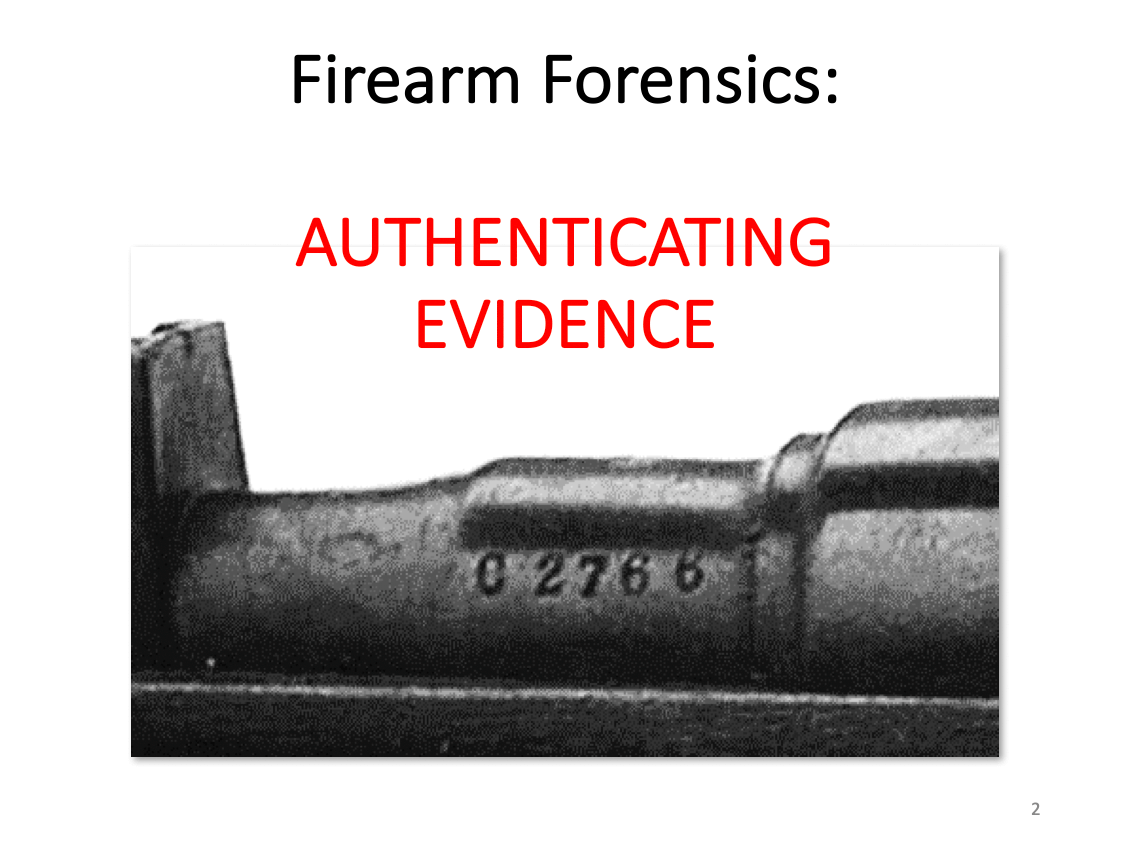
    The Roman numeral XVIII (18) and the bottom of TERNI do seem ground off—yet we can’t be 100% sure. 1940 only needed adding if the original was from a different year or the entire year and Roman numerals were removed. If the rifle had been a 1939 or 1938, there is a greater likelihood it was a 7.35mm FC carbine.

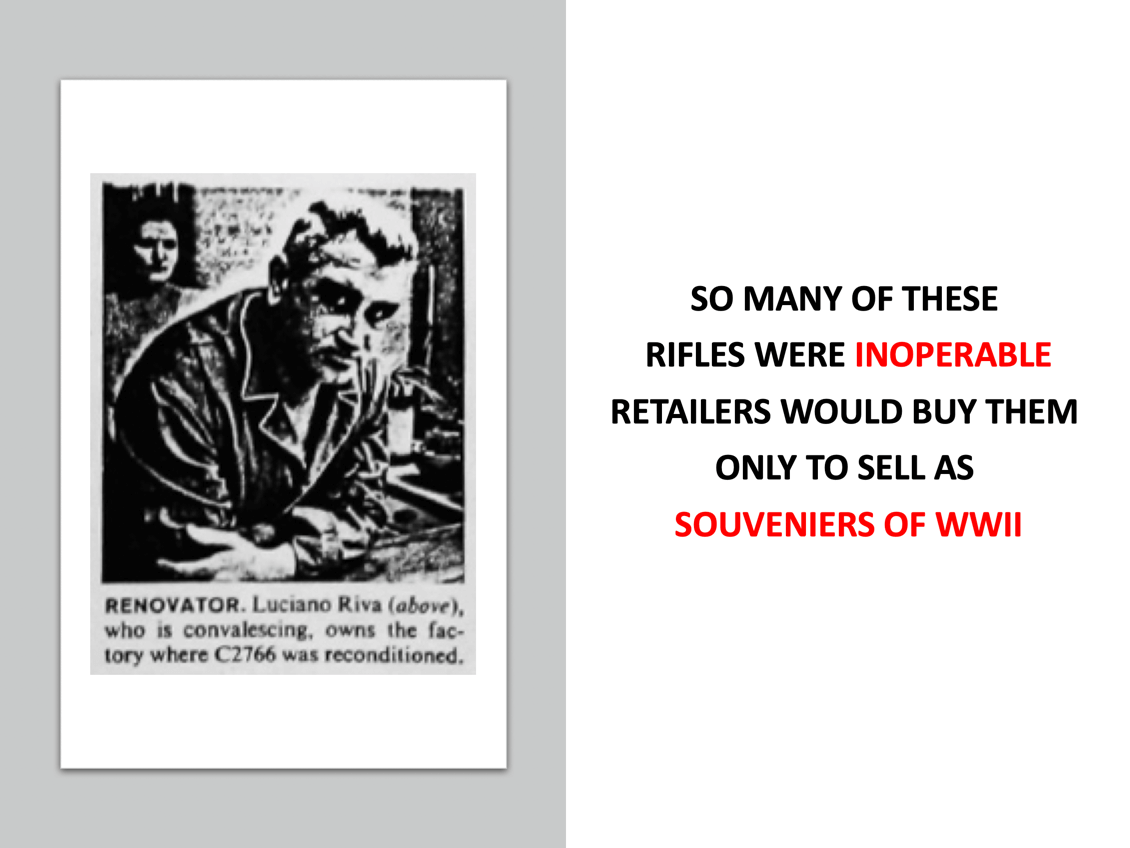
    Luciano Riva, or someone else, did grind some things off and added others. The rifles were so unsound, that without first checking them, the first batches sold for use caused horrific accidents and even deaths. It is from Crescent (Louis Feldsott’s sister business to Adams Consolidated) that retail orders are first forwarded to Fred Rupp, a licensed gun dealer who was enlisted to check, then fix, and/or replace defective rifles, noting the change on the enclosed packing slips. Our 10 slips show no changes, no substitutions, and still represent the shipments from Italy to Crescent in NYC.

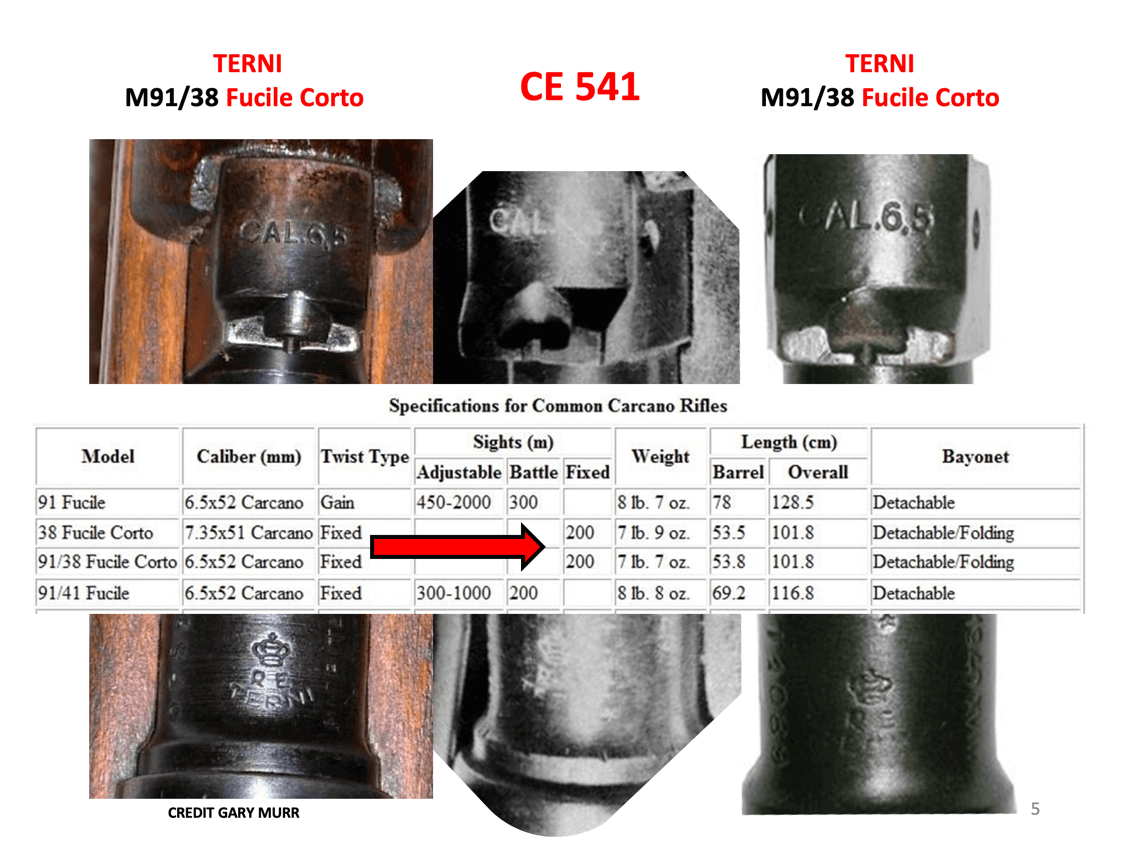
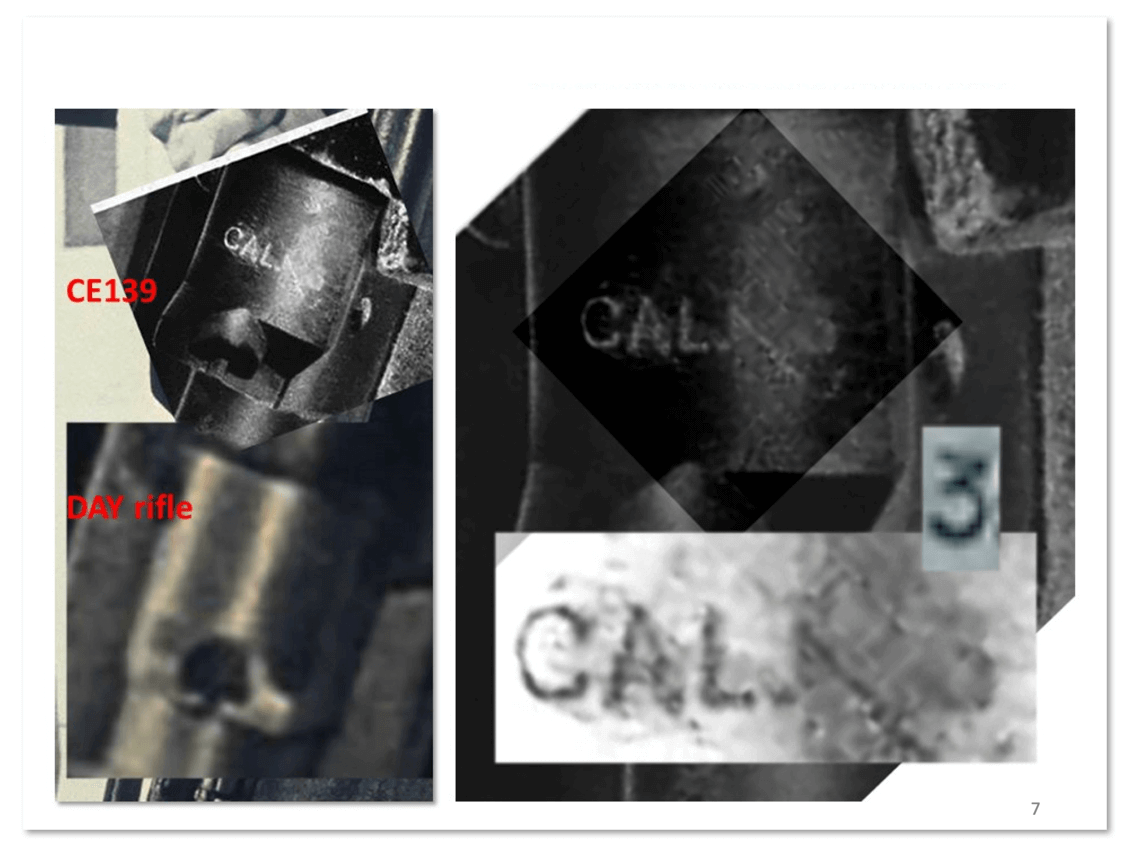
    We have 2 – 6.5 stamped Fucile Corto Barrels and an image from CE541. This is the ONLY image of the caliber on a rifle claimed to be CE-139. I welcome any detailed images of the carbine caliber prior to this image. As you will see, the 6.5 and 7.35 FC rifles are virtually identical.

    The 7.35 Fucile usually had the caliber burned into the butt of the stock on the side with the sling mount. In 1940, when the Army goes back to 6.5mm, it is stamped on the fixed rear sight, in order to help avoid an ammunition mix-up. In the 15-20 years since their use, the parts and pieces of numerous rifles used for parts, can be found in a single, finished weapon.

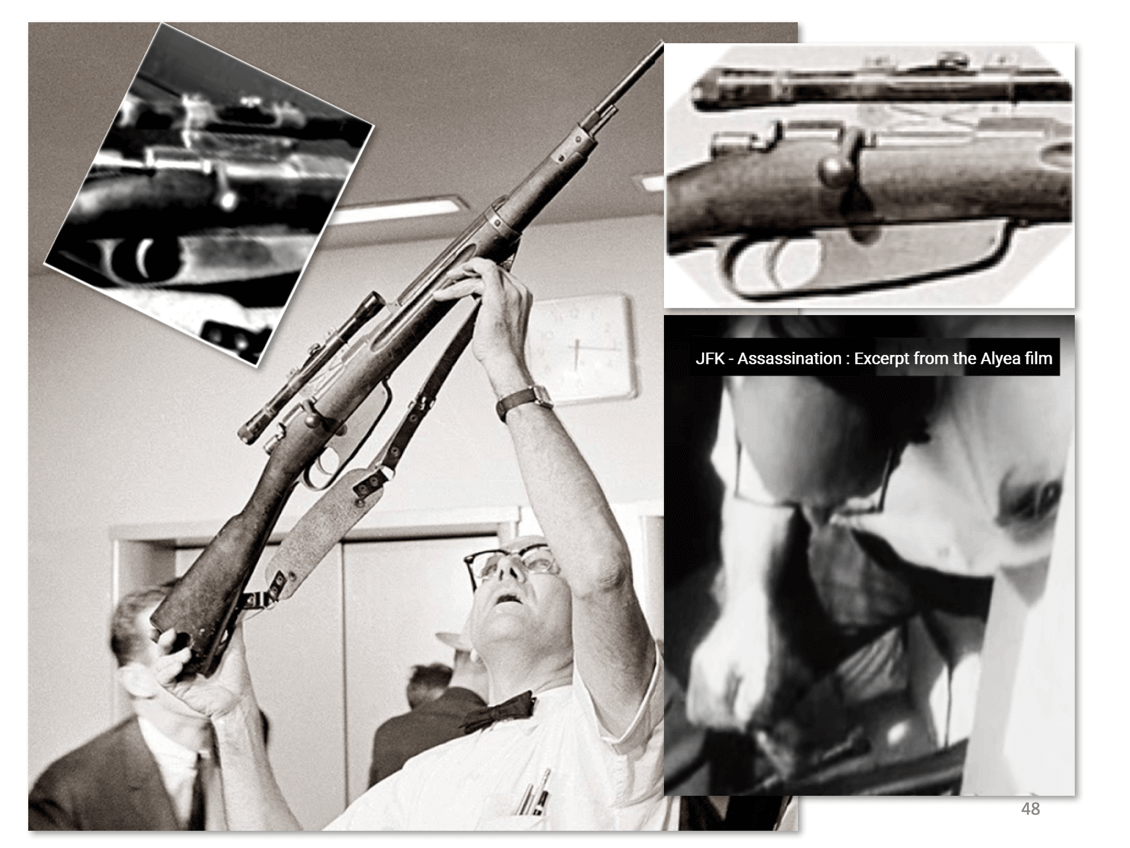
    We have a wonderful image of Lt. Day carrying the rifle from the TSBD. It is both very large and very clear. Since we’ve never seen an image of the rifle prior to the FBI exhibit images, the possibility of a rifle with no CAL markings prior to the FBI acquiring it – is not so far fetched.

    Early reports from Italy claim the rifle in question is a 7.35 M91/38. Without a clear image of the CAL designation, the 6.5mm shells on the floor – especially in their condition – may have had little to do with the rifle. The white versus black numbers will be a reoccurring theme.


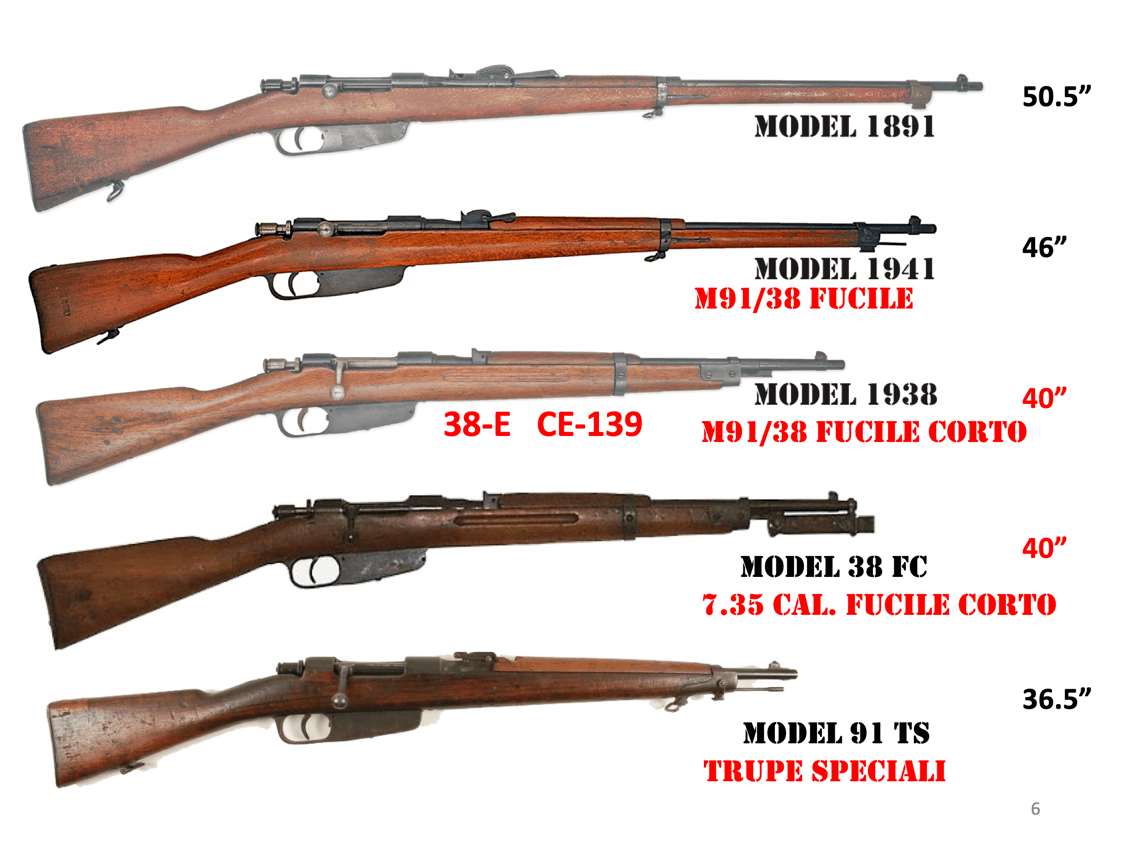
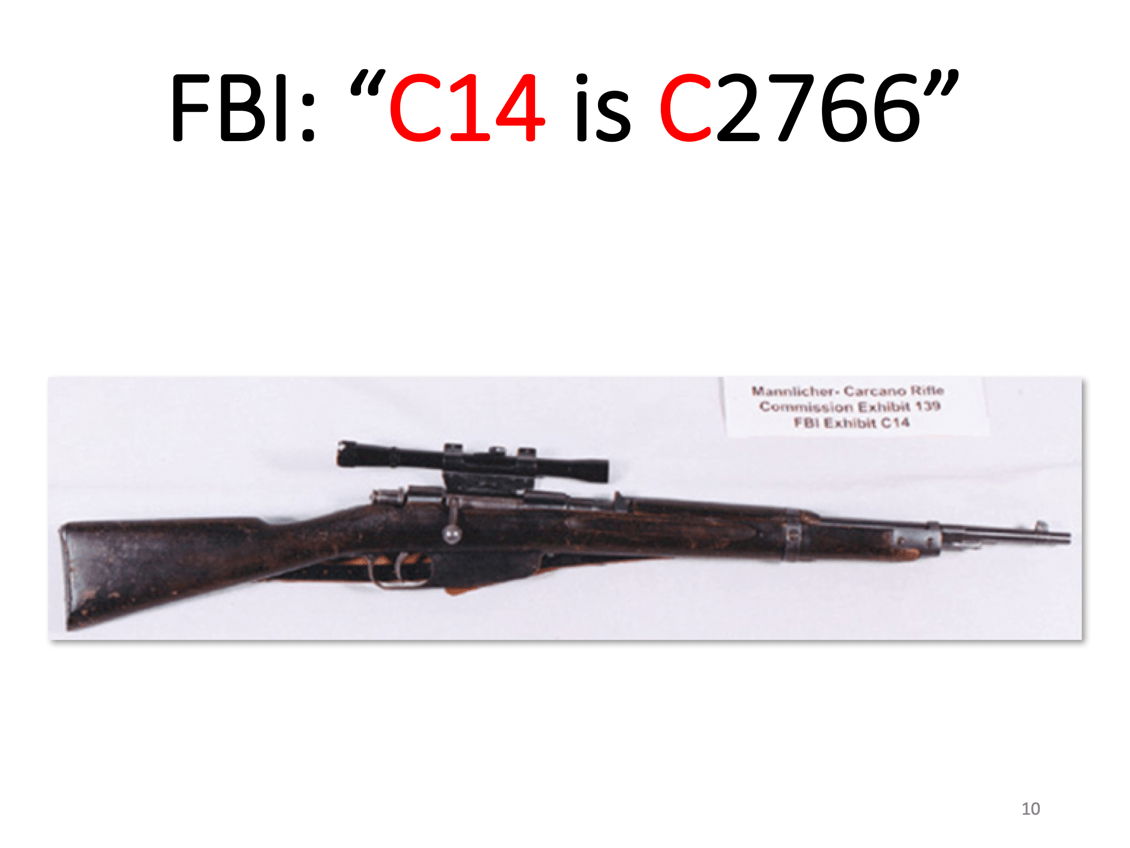
    “C14 is C2766” is a FBI fib used to incriminate Oswald. This declaration came in early December. The report from William Harvey’s Italy said it was a 7.35 model 91/38, among all sorts of interesting things that never made their way into the Warren Commission Report (WCR). Instead, we are told by the FBI that C14 is C2766. Hail Hoover. C14 ≠ C2766b>. On March 27, 1964, Alfred Finish, “professional gunsmith at the Empire Wholesale Sporting Goods,” Montreal, Canada, “assisted in taking critical measures” of the rifles then shipped to Mr. Ouimet. Mr. Ouimet claims to be the owner of Empire Wholesale (aka Century International Arms) owned by William Sucher and source for 700 identical rifles to the one pictured above. We’ll return to Mr. Sucher and Century International Arms (C.I.A.). Mr. Ouimet gives these measures of an “identical model” of the rifle used in the JFK assassination: total length 40 3/16″ – stock 34 3/4″ – barrel and action 28 15/16″ – barrel only 21 1/8″ – rear to receiver 26 1/2.” He underscores the Carcano he had examined during the years “had no set pattern regarding serial numbers.”

    For argument sake, let’s agree with “C2766” identifying that rifle uniquely. It’s much easier to create paper copies of copies than to stamp a rifle.

    Given Texas in 1963, how did they fall upon Feldsott in NYC?

    FBI SA Nat Pinkston is listed as a TSBD employee in the WCR index. He was an FBI agent. His testimony only dealt with Oswald’s clipboard from December 2. His name is on this report having spoken to Al Yeargan about the rifle at the H.L. Green Company (a local department store selling surplus WWII weapons), yet he is never asked about the conversation. 40 years later, H. L. Green is no longer included. We go from Titche-Goettinger right to Klein’s. What SA Pinkston did in 1963/4 and recounts years later bear little resemblance to each other. His recent revelations are uniquely his and are not authenticated or corroborated by any other evidence.

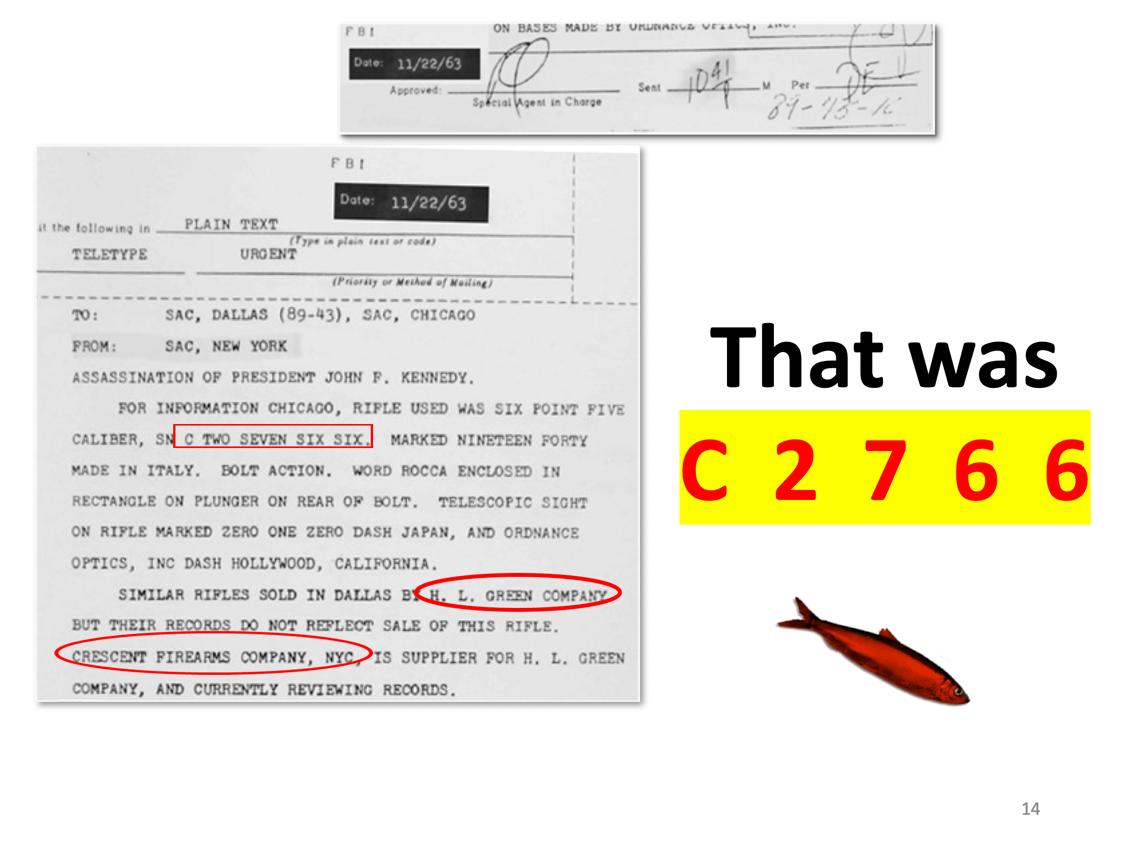
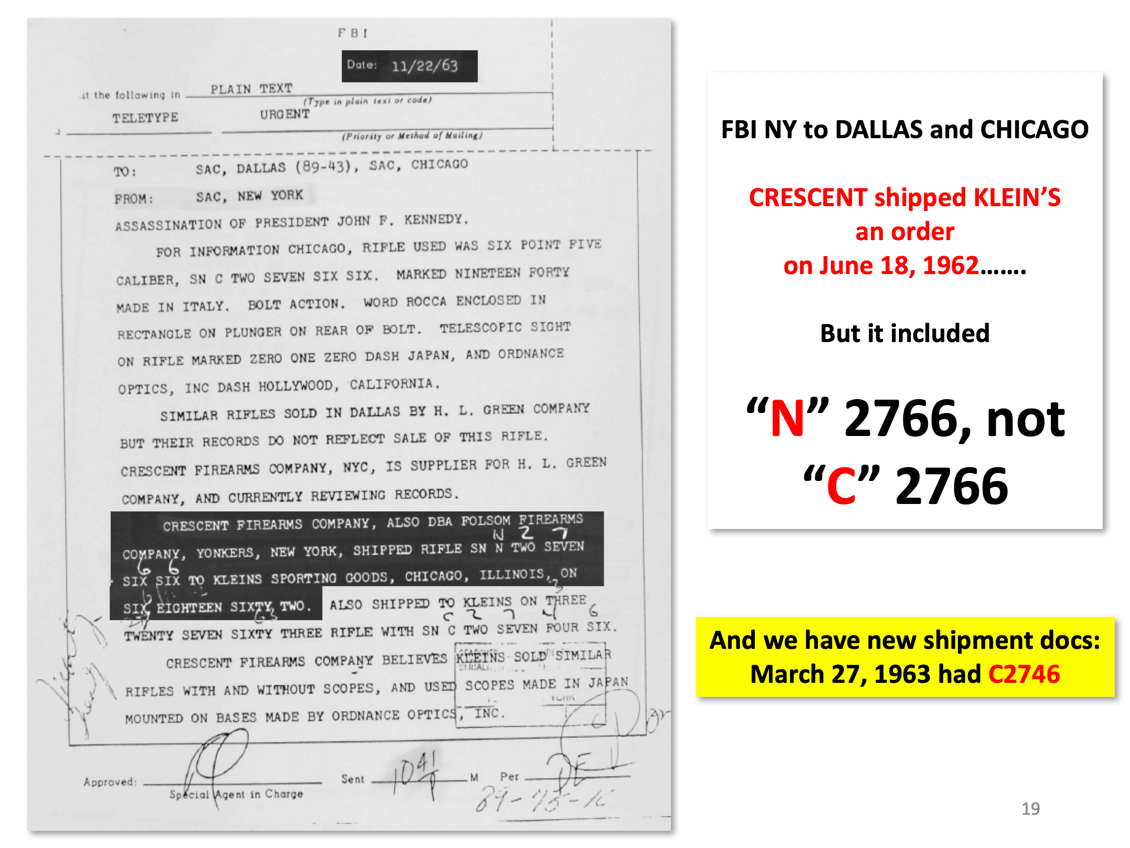
    The SAC in New York City is talking about the records of H. L. Green in Dallas to Chicago 7 hours after the fact. Green says they get their stuff from Crescent Firearms in New York City. Again, info on a 6.5mm C2766 takes 7 hours to convey thru New York City to Chicago, so the Chicago FBI can go to Klein’s?

    Here is the famous affidavit and, not so famous, Rankin note that came with it. Rankin sends Al Feldsott a completed affidavit for his signature and notarization in July 1964. The same thing happens with the H. L. Green employees. This concludes that C 2766 was, indeed, sold to Klein’s Sporting Goods on June 18, 1962, and this info was conveyed to the FBI on the night of November 22. Subsequently, other records are turned over as well.

    On the evening of November 22, the FBI has its evidence. “Mr. White in the study with a candlestick” à la the game, Clue. Crescent to Klein’s on June 18th with C2766.

    William Sucher, owner of Century International Arms, Inc., and Empire Wholesale are the sources to the FBI that the serial numbers on World War 2 surplus rifles are by no means unique. Not one of the 700 has a letter prefix identified. As I discovered, James Ouimet, who is referred to as the “President” of Century Arms, was actually a figurehead, put in place by Sucher and his associates to run Century on their behalf. (G. Murr Education Forum post of 11/26/17) Owner: Empire Wholesale & International Firearms Limited, now known as Century International Arms, CIA.

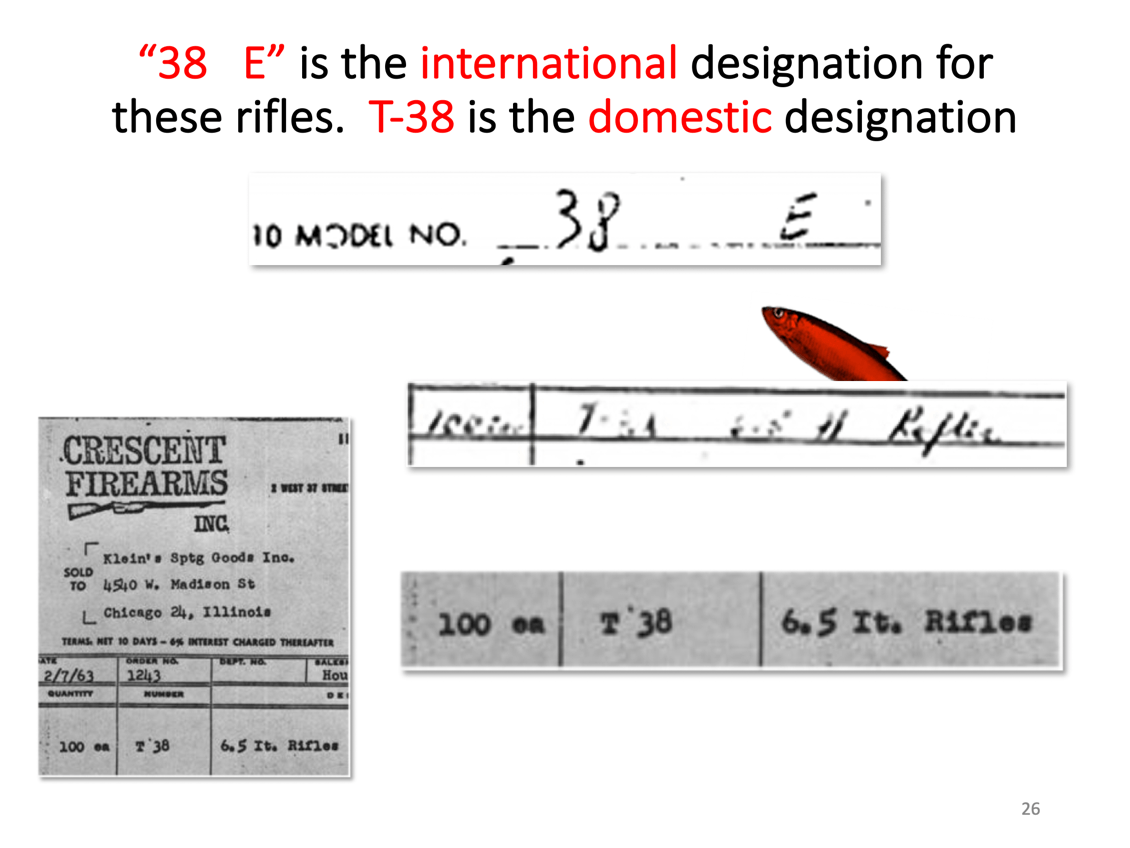
    We also learn that they are the exact same rifles as the Century 700. “38E” internationally known and “T-38” domestically known as Carcano Fucile Corto rifles. The Klein’s customer invoice copies are simply the duplicates of the original 1960 shipments to Crescent from Italy.

    The rest of that November 22 memo confirms a June 18, 1962, shipment sent to Klein’s, yet the rifle listing only includes an N 2766, not C.

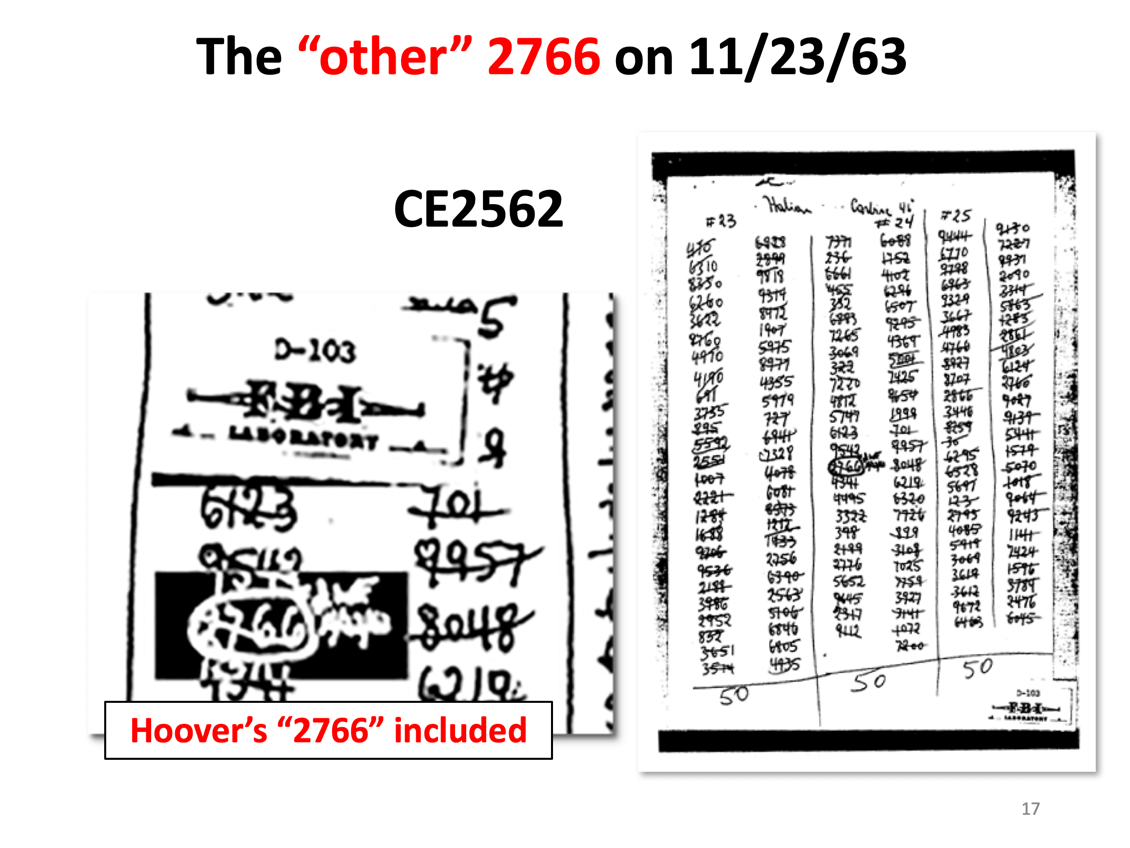
    The New York City FBI SAC confirms with the FBI lab that the rifle in question has 5 digits: C 2766. The records of Klein’s from the night before shows they received “N 2766”. What is the FBI at Klein’s to do now?


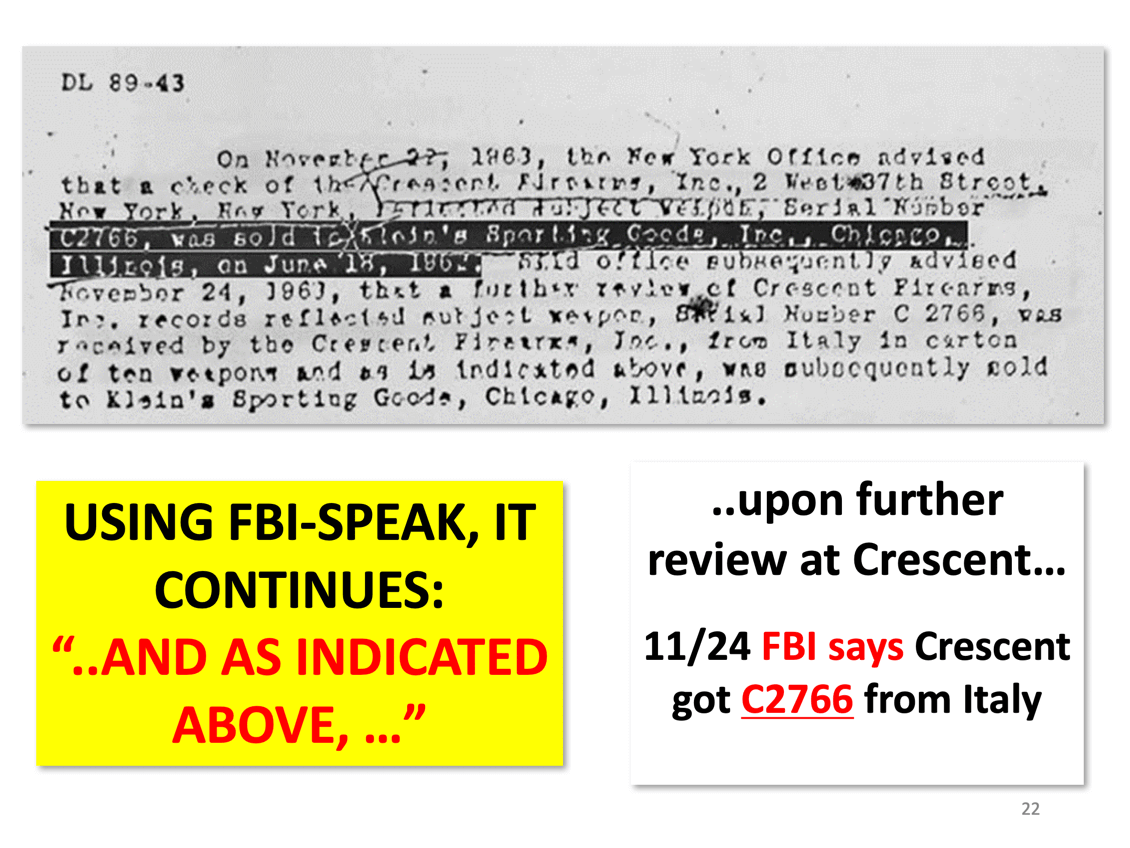
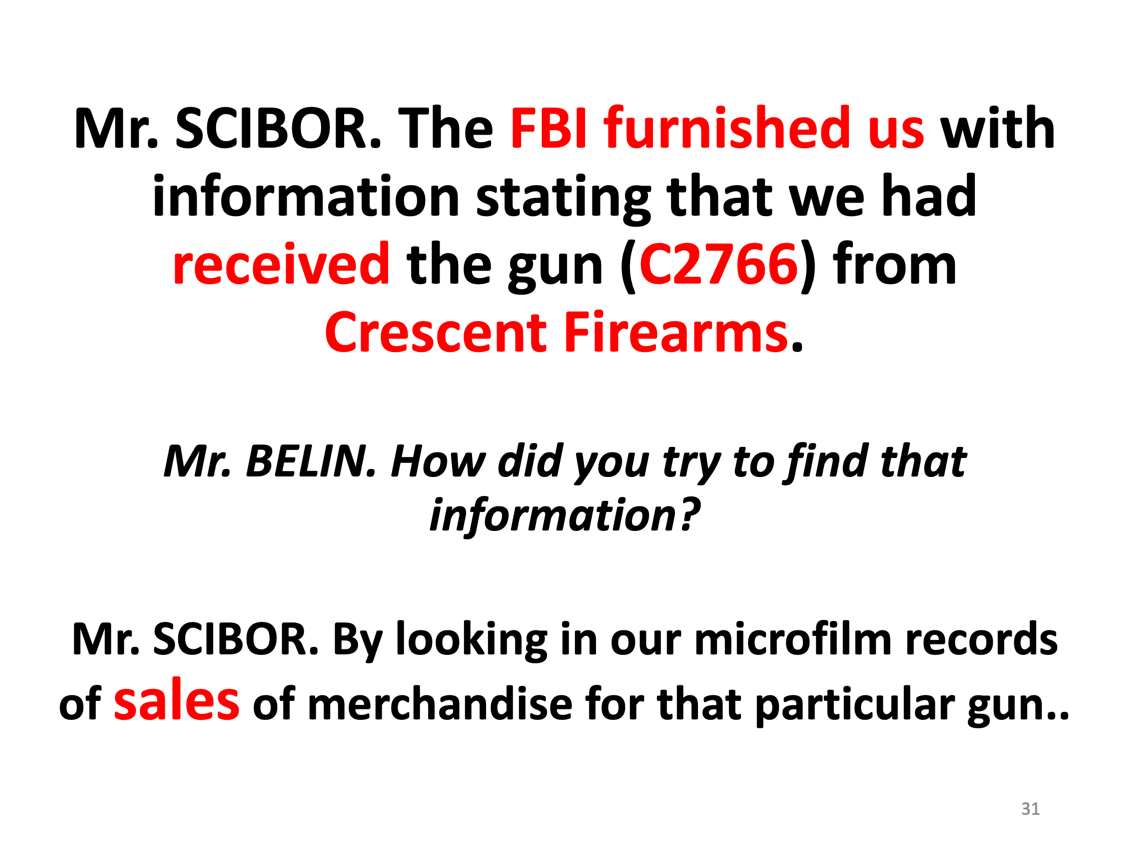
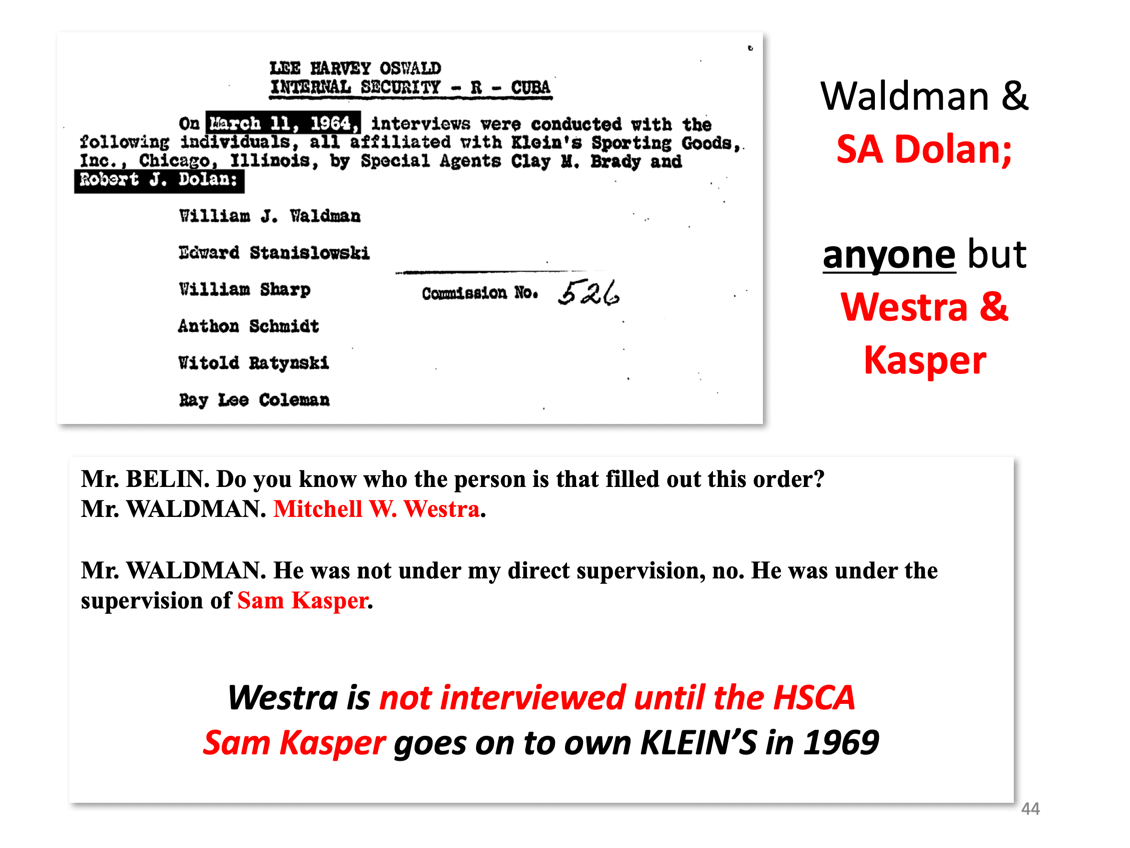
    The New York City FBI revises their story on the November 24, confirming that C2766 was received by Crescent from Italy. Thank you, Sherlock Holmes. That it was sold to Klein’s “subsequently” as indicated above, on June 18, 1962. Yet somehow, 2 days earlier, SA Dolan and Waldman and Scibor from Klein’s find the order blank on microfilm.

    Does the FBI know something we didn’t that needed proof by November 24?

    N 2766 does not appear anywhere in the WCR. June 18, 1962, is on the Feldsott contact sheets, an affidavit, and reconfirmed a number of times in FBI documentation.

    This single sheet of paper related to a February 1963 delivery is based upon 10 packing slips sent from Italy to Crescent for Adams Consolidated and in the possession of the FBI on Friday evening, according to the evidence. Notice the 1259 in the top right-hand corner. Yet, the order was 1243, as testified to by General Manager Michael Scibor and Klein’s VP William Waldman. It is very possible the original order written on this page was 1259. As we saw, there were orders in June 1962 and March 1963 in the Klein’s and Crescent records, not February 22, 1963.

    The 10 Feldsott slips would not have been sent to Klein’s as part of their order. Sadly though, we do not know what they would send, for all we have are these 10 slips referring to 38 E, not T-38. It is a small detail I know, yet another brick in the wall.

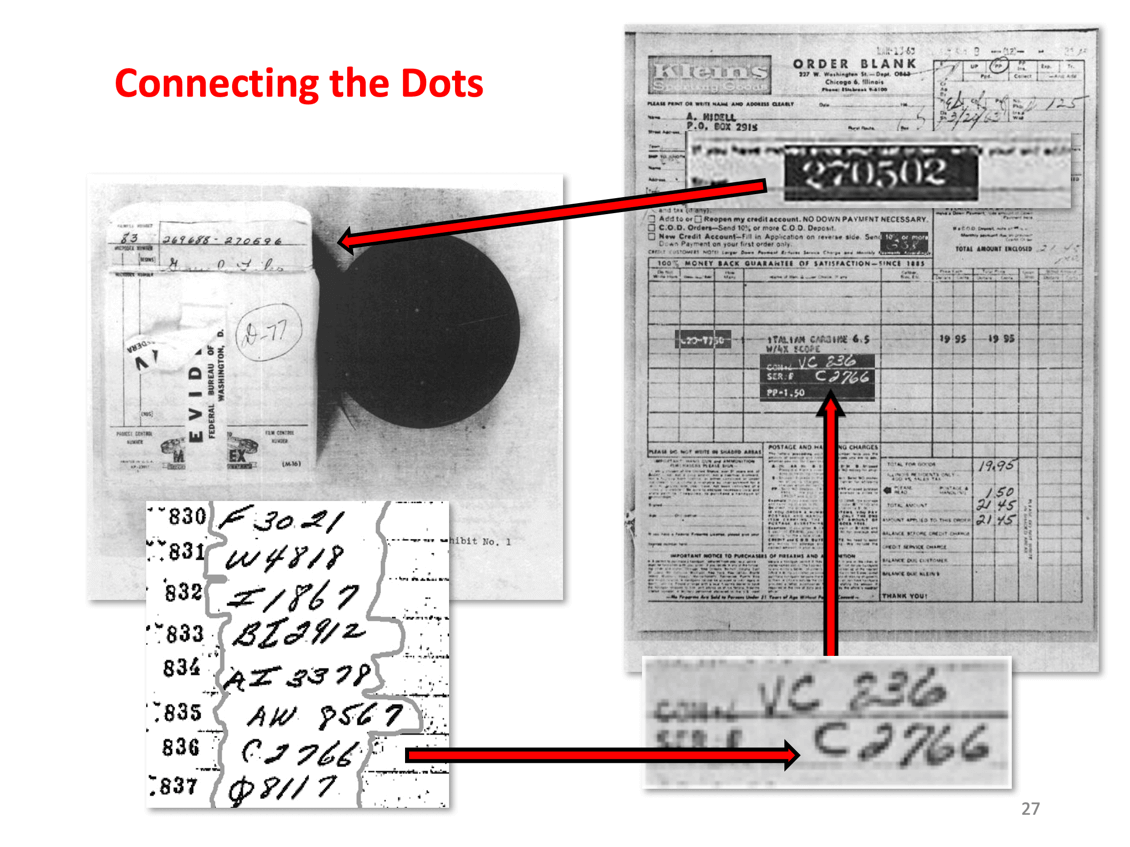
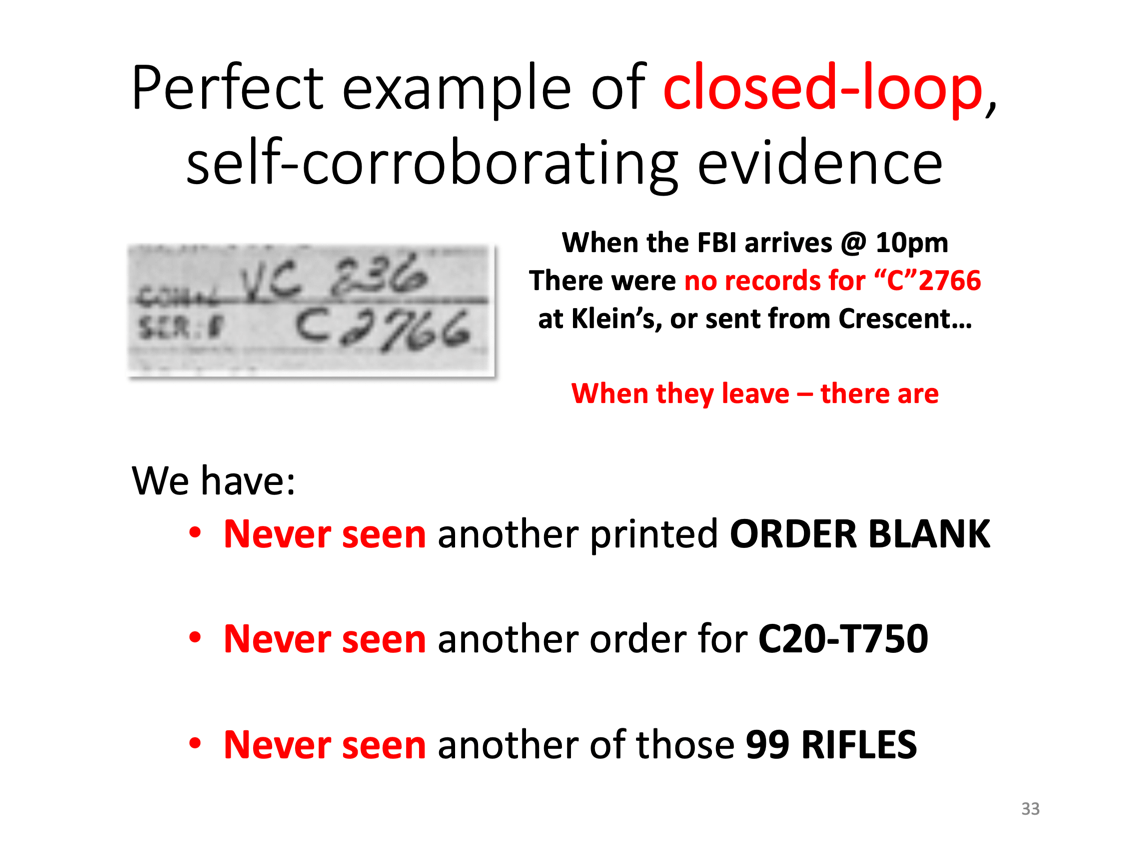
    Here’s the evidence, the microfilm creates the order blank. The order blank’s handwriting connects the rifle with the list and nothing else. The “VC=Serial # list” claimed to be kept in a master ledger by Klein’s General Manager Michael Scibor, is claimed to be Klein’s way of tracking serial numbers on rifles. When a shipment comes in, the next blank VC# is used to start listing the rifle serial numbers in the shipment. Unless we can see another VC=Serial # list that actually matches real rifles with real orders or any other order showing any one of these 99 rifles, the data on this page could conceivably have been created that night. The details of the evidence will bear this out. At this point, the “VC List Evidence” simply corroborates itself and only for this one rifle. There were 99 more in inventory.


    With just those 2 pieces of evidence, the FBI is able to connect the receipt of C2766 with an order sent to Klein’s in February 1963. Yet, the FBI also told us on the 22nd about the March 1963 order with C2746. On November 22 and 23, there was no mention of a February 1963 order at either Crescent or Klein’s. There is more to it than that, but you’ll need to read my paper, The Klein’s Rifle.

    This is page 2 of 2 for order 1243. The original order number from January 1962. It also says “1259 Page 2 of 2 pages”. A subsequent order becomes the February 1963 order now containing C2766.

    How did they use the information that Crescent supplied the rifle to find this customer order? (Does this make any logical sense?)

    The receiving records from vendors would make it much easier to locate a shipment from a vendor, whereas how does one even begin to locate a sales order with only the serial number and vendor? Those 2 memos on the 22nd and 23rd left the FBI kinda screwed.

    Remember that on Friday and Saturday there are no records for C2766.

    Or that Crescent sent them orders in June of 1962 and March of 1963, not February 1963.

    After Friday evening into Saturday morning, 3 FBI Special Agents including Dolan put their names on a report (WCD7, page 187). SA’s Toedt and Mahan will provide virtually nothing else to the Warren Commission Documents.

    The next page of the report/memo does not have any signatures, but does tell us that Waldman kept the microfilm.

    Virtually the same report is found on the next page (WCD7, page 189), yet the outcome is completely different. This time only Dolan writes a report, in which he claims to have taken the microfilm and provided Waldman with a receipt. The chain of custody for this microfilm is now a hot mess.

    Months later, in testimony, Waldman is no longer talking about his safe and being subpoenaed. He gave that microfilm to the FBI. I’m told by those who went, the microfilm itself is no longer in its box at the archives. Just an empty box. If only a copy of the film was made.

    FBI SA Dolan alone claimed he took the microfilm by the morning of the 23rd. What we come to learn is that copies of this film are made in the weeks after November 22. Dolan gives a copy back to Waldman and once again it is said that Dolan acquired the film from Waldman on the 23rd. Originals with the FBI and copies to the Warren Commission were standard FBI operating procedure. With the original in the FBI’s hands from November 23 until the first copy is returned on December 6, there is no way to know what transpired with that film. I wonder if the copy and the FBI original have the same things on them?

    The microfilm creates the Order Blank. The Order Blank connects to the February Klein’s shipment via 1 piece of paper. What was on the original microfilm is simply no longer knowable.


    Waldman tells us he removed the remaining stock of “assassination” rifles on Monday the 25th. In 1978, we learn the FBI had Klein’s mount scopes on at least 12 rifles, that 40″ rifles were not scoped, and some rifles have no inscription at all. Sharp is not called to the Warren Commission.

    It’s as if those 100 rifles were never at Kleins in the first place.

    None of the people who were actually involved in receiving/shipping this product are interviewed, while Dolan remains an integral part.

    Westra concurs with Sharp about scoping 40″ rifles, but then is set straight. Since the 40″ rifle at the archives is scoped, y’all must have done it. Any information on Lido Luccesi would be appreciated.

    Given the mountain of paper we are given in this case, it remains an obvious “mystery” how Oswald can go through his paces from January 1963 to November 1963: order, pay for, and get delivered both a rifle and a pistol—and yet not have a single page written about those occurrences in any report from any agency prior to November 22nd.

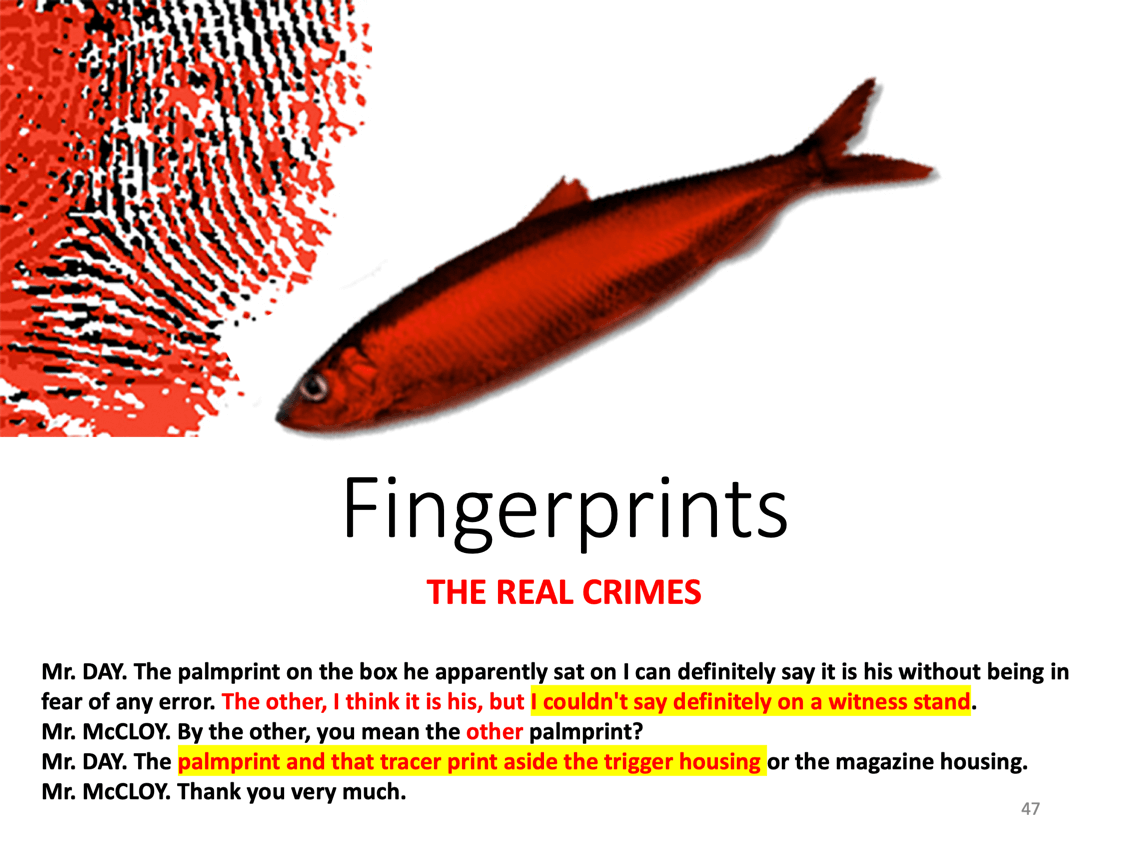
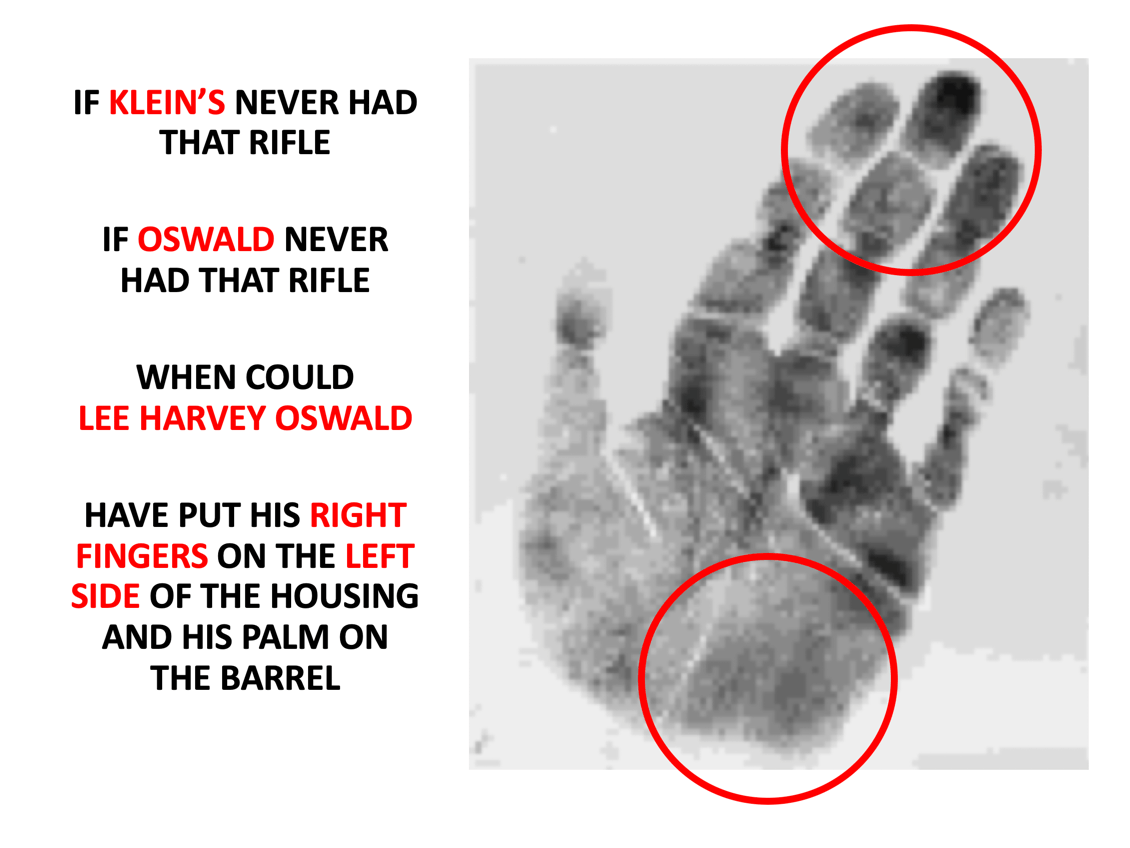
    At the end of the day, the only things with a print of Oswald’s are a box and some paper. The rest is Lieutenant Day being helpful.

    It is not until well after Oswald is dead, that these fingerprint lifts even get consideration at the FBI.

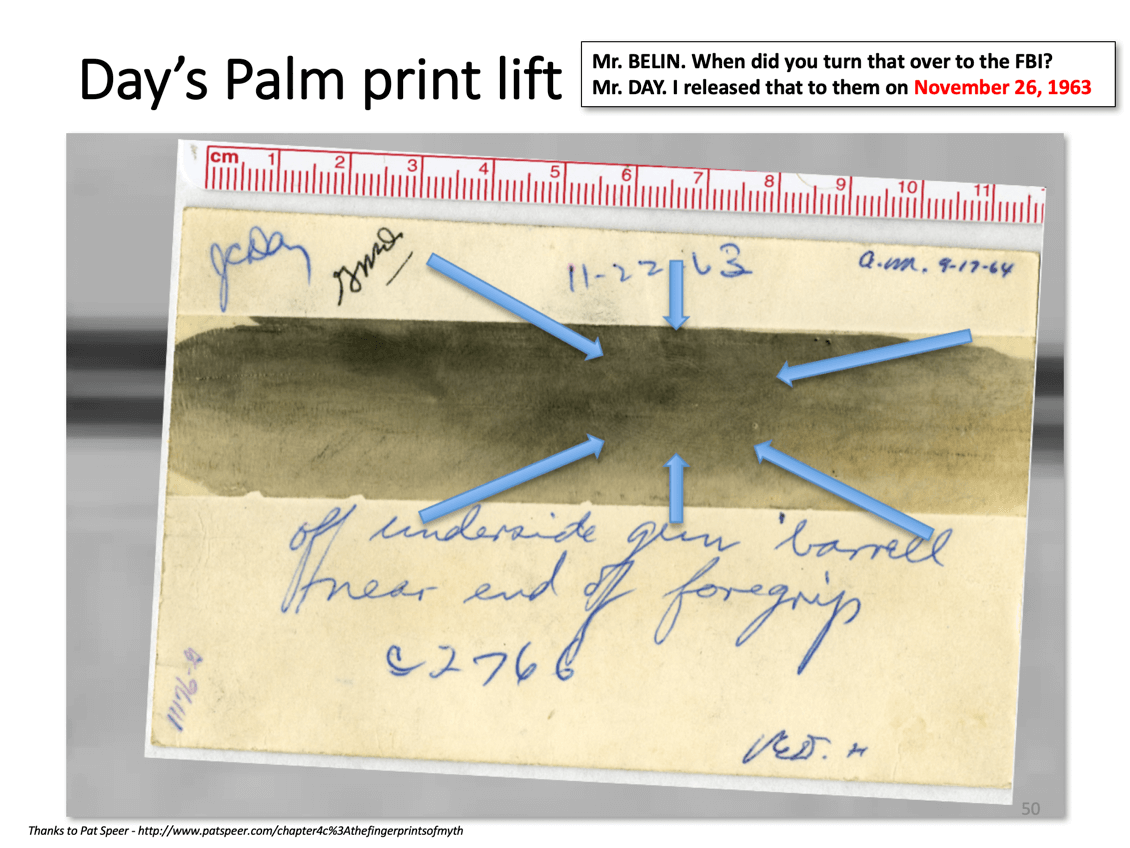
    The rifle goes to Washington DC with SA Vincent Drain on the night of the 22nd, only to be returned and taken again on the 26th. Amazingly, the prints travel from one side of the trigger guard to the other.

    Having taken no photos of the print where it was found, there is only a photo of the lift which was not sent to the FBI with everything else that night.

    There is no part of the barrel showing from the underside of the rifle. Day’s palmprint appears to exist only to suggest Oswald assembled and disassembled the rifle. Despite numerous smooth metal parts including the shells and clip, Day’s prints are highly suspicious.

    Lt. Day needed to explain quite a few things that went awry that first day. Claiming he was told to stop working on the rifle, he claims that’s exactly what he did in mid stroke. Subsequent reports are filled with his excuses.

    In 1978, the HSCA requested to see this “lift”, seeing it was part of the evidence Drain takes again on the 26th. Yet again, we have Day stating all the evidence was taken the 22nd. This palmprint cannot be found—the official reason states:

    In other words, they lost it.

    In the 50’s, the FBI copied and planted prints regularly, along with lying about informants, as well as, virtually all manner of evidence.

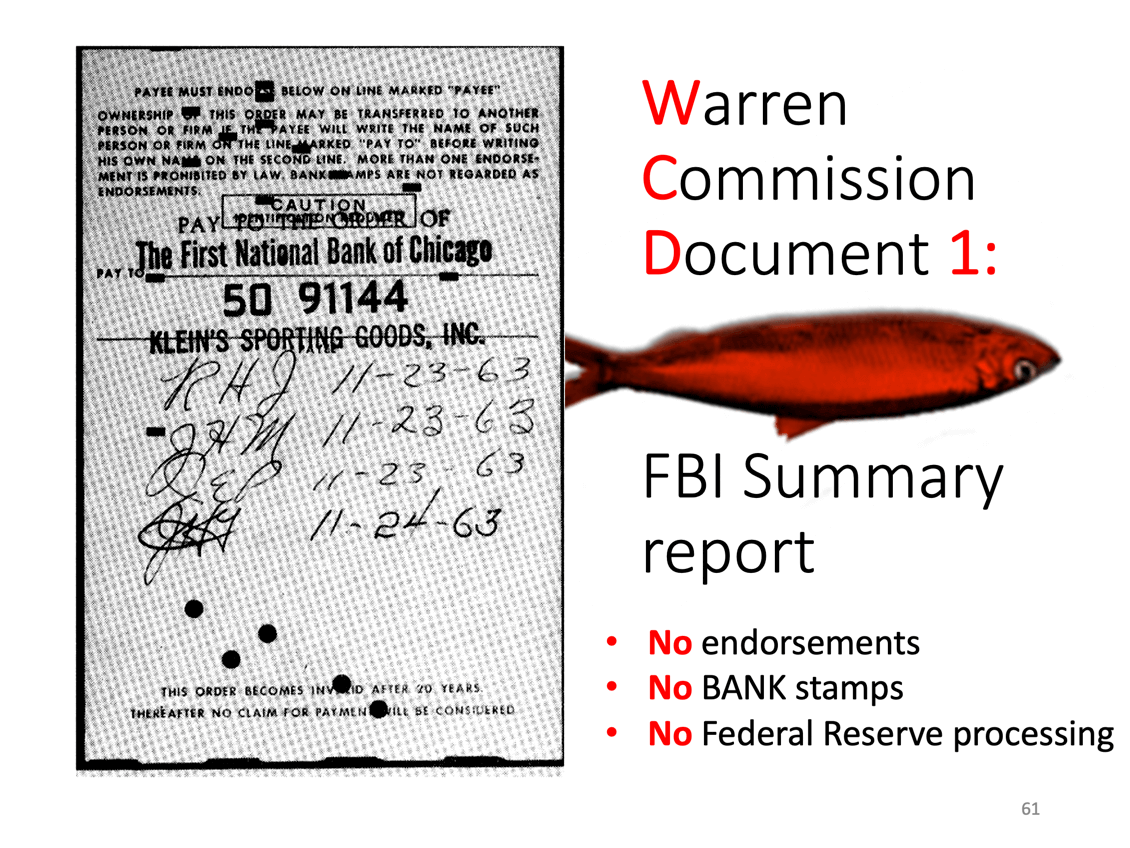
    What if there was no money order, like there was no February order? But the FBI needed evidence of one.

    The evidence shows the Postal Money Order (PMO) found on 3 different timelines.

    The first is in Kansas City by the Secret Service

    The second is reverse engineered by Holmes and gang by looking at magazines and guessing about shipping. “Now you thumb through those,” I said, “and when you come to Klein’s Sporting Goods, let’s see what it looks like.” It wasn’t but a couple of minutes that one of the girls hollered, “Here it is!” So I looked at it and down at the bottom of the ad it said that that particular rifle was such and such amount. But if it could not be carried on a person, such as a pistol, like a shotgun or a rifle, then it was $1.25 or $1.37 extra. Shipping charges were also added, so I added those together, took that figure and called around to all the different stations and the main office where these crews were checking stubs. It wasn’t ten minutes that they hollered, “Eureka!” They had the stub!

    The third, and most interesting, is that of the FBI’s in Alexandria, Virginia. You can read all about it in the Rifle Money Order Timeline. For our purposes, the most important things to know about this money order are:

    Remember, the year is 1963. Who saw Catch Me If You Can? Passing bad checks was easier then, because the process took so long and was not computerized.

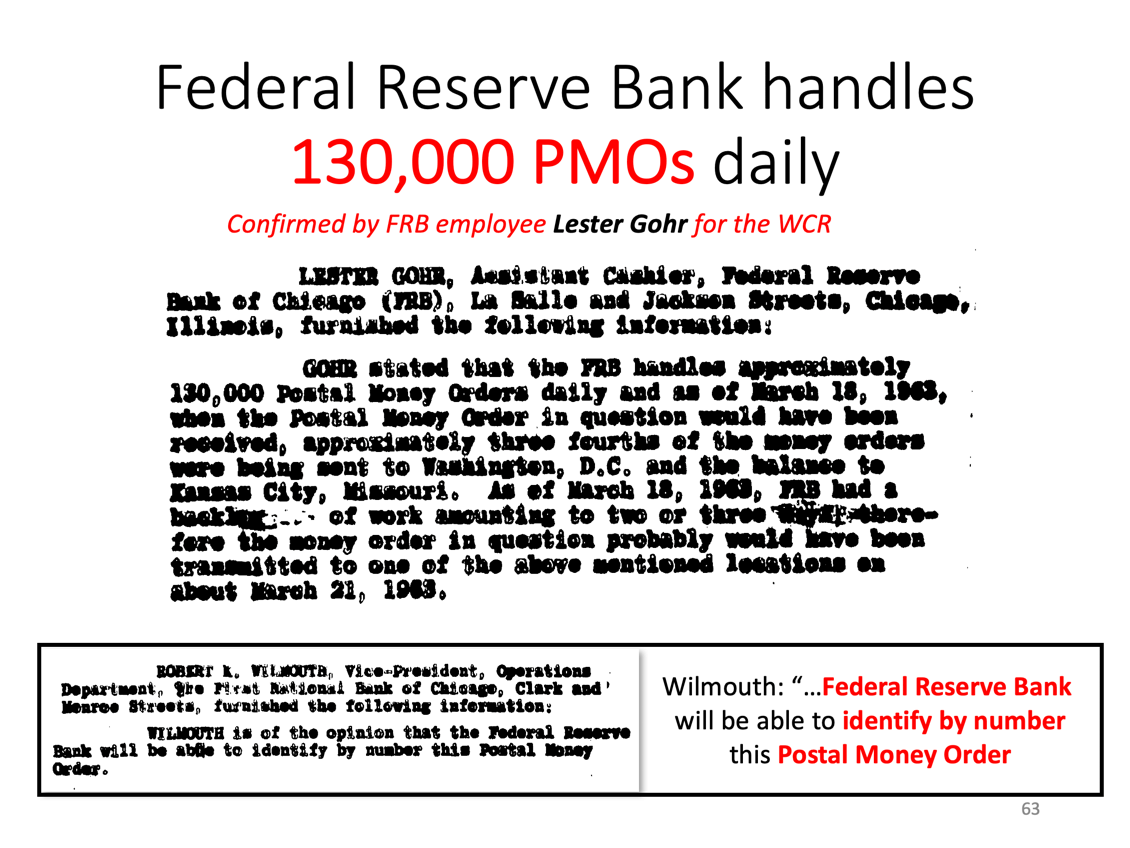
    We have a number of proofs outside of the Warren Commission Report. J. Harold Marks—the same man—testified in 1960 about tracking Postal Money Orders “as paid through the Federal Reserve Bank.” Another 1960 bit of evidence is this New York Federal flyer explaining how Postal Money Orders are to be accepted as cash items.

    And finally, in the Warren Commission Documents themselves, with Lester Gohr of the Federal Reserve and Wilmouth of Chicago 1st National reconfirming that Postal Money Orders are processed and recorded by these banks for very specific reasons.


    I’d like to begin finishing up with some of the evidence which suggests there were never any shipments of merchandise to Oswald. At his Dallas Post Office Box, Hidell was not listed. Given what was going on with the Dodd investigations (a Senate Committee investigating mail order pistol and rifle sales in the US—Klein’s and Seaport were 2 of their targets), it would seem that a 5′ carton addressed to the wrong person constitutes “where possible”. In the weeks after the assassination, VP Waldman will tell his “partner in microfilm crimes”, SA Dolan, that Senator Dodd’s Committee “was on his back.” It was known that Dodd used “cut-outs” to order rifles as part of his investigation—some surmise that Oswald may have been one of these cut-outs using the name Hidell.

    Given the reality of this and how this rifle suddenly appears after November 22, it defies common sense and logic to believe this goes unnoticed.

    In fact, a box of that size would have triggered the mailing of a notice for Oswald to come claim his oversized package. Yet the package is addressed to Hidell.
    With the need to generate this notice, the rules and regulations are put to an even more stringent test. As we now know, none of this happened.

    I’d like to end today with some more evidence, which I see betraying the conspiracy. The evidence shows that he took 2 small bags with him, when leaving Magazine Street after Ruth leaves with Marina. Yet, the rifle is placed at the Paine’s in October. There’d be only 1 way to get it there.

    If Ruth was supposed to help incriminate Oswald, this didn’t help.

    Neither did this and neither does Michael.

    While many have erroneously injected themselves into this storyline for personal gain or profit, we must look to those who suffered at the hands of the FBI for telling an inconvenient truth.

    Abraham Bolden comes to mind. FBI recalls Yates for a polygraph January 4, 1964: “No significant emotional responses were recorded.” The FBI could therefore not reach a conclusion about Yates. On January 5, 1964, at the insistence of the FBI, Yates begins 11 years of mental institutionalization. “They told me that he was telling the truth [according to the polygraph machine], but that basically he had convinced himself that he was telling the truth. So that’s how it came out. He strongly believed it, so it came out that way.” (Dorothy Yates Walker 2006)

    Despite being the object of numerous 3 letter agencies, we find nothing in the evidence related to these weapons prior to November 22nd.

  • Goodbye and Good Riddance to Chris Matthews

    Goodbye and Good Riddance to Chris Matthews


    On Monday March 2nd, Chris Matthews, host of the MSNBC program Hardball, announced on the air that he was resigning after 20 years. That resignation was effective immediately. Therefore, he would not be around for the next day’s Super Tuesday primary elections. Which suggests that this was not his idea and he was forced out. Furthering this idea was how he announced his leaving, which he said was not due to his lack of interest in politics. (For the brief sign-off, click here)

    To put it mildly, Matthews has had a pretty bad last couple of weeks. Even for a dyed-in-the-wool MSM zealot, he has made some real bonehead comments. When Bernie Sanders won the Nevada caucuses, Matthews compared that victory to the Third Reich’s successful invasion of France in 1940. After the New Hampshire debate between Democratic candidates, Matthews indulged himself in a diatribe against socialists. During that tirade, in John Birch society mode, he confused socialism with communism and said that if Fidel Castro had won the Cold War, there would have been executions in Central Park and he would have been killed while others were cheering. He then added, “I don’t know who Bernie supports over these years, I don’t know what he means by socialism.” This reveals either extreme bias or a feigned ignorance, since Sanders has held political office for about 35 years.

    In another blunder, last week Matthews confused Jaime Harrison, an African American candidate for the Senate in South Carolina, with another black politician, Tim Scott, who is the GOP incumbent senator from that state. After Harrison corrected him, Chris apologized for the “mistaken identity”. Perhaps the last nail in the coffin was a column by writer Laura Bassett appearing on Saturday in the magazine GQ. In that column she complained about some sexist comments Matthews had made to her while she was in the makeup chair.

    Jimmy Carter
    Jimmy Carter
    Jimmy Carter
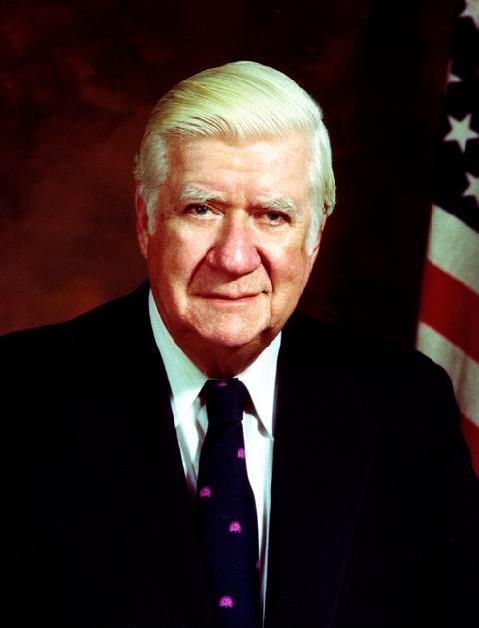
    Tip O’Neill

    Matthews began in Washington as an officer with the United States Capitol Police. He then became an aide for four Democratic members of Congress before he failed in an attempt to win a congressional seat in Pennsylvania. After this, he became a speechwriter for President Jimmy Carter. When Carter failed to win reelection in 1980, Matthews signed up with House Speaker Tip O’Neill. Matthews then switched over to print journalism for 15 years.

    Jimmy Carter
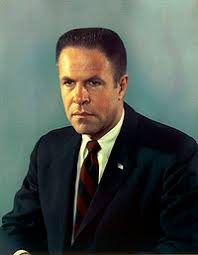
    H.R. Haldeman
    Jimmy Carter
    Richard Helms

    It was in his position as a columnist that Matthews now emerged as a rabid, mocking conservative member of the Washington establishment. After Oliver Stone released his film Nixon, Matthews criticized that picture for its use of a passage from H. R. Haldeman’s book The Ends of Power. In that passage, Haldeman had described a meeting with CIA Director Richard Helms in which the Bay of Pigs invasion was discussed. Helms’ reaction was so extreme that Haldeman concluded that Nixon’s use of the incident had been code for the Kennedy assassination. In a December of 1995 column, Matthews said this was all strained interpretation by Stone that Haldeman had blamed on his co-author Joe DiMona. Matthews could write this since he did not visit with DiMona. Dr. Gary Aguilar did so, and he learned why Matthews had not. DiMona told Aguilar that the book had gone through five drafts and Haldeman made many changes, but he never altered that passage. Clearly, Matthews had realized that after his films JFK and Nixon, Stone had become a lightning rod for the MSM. And if he was going to advance up the ladder, he had to join in the assault.

    Therefore in 1996, Matthews published his book entitled Kennedy and Nixon. This was supposed to be a dual biography of these two central political characters. But to anyone who knew who Matthews was, and understood the two men, there was a not so subtle subtext to the volume. Matthews was actually trying to say that, contrary to popular belief, Richard Nixon and John Kennedy had more in common than they had differences. Oliver Stone agreed that this was an unjustified interpretation. The LA Times allowed him to review the book in June of 1996. He took the author to task for his unwarranted assumption that the two were somehow chums and comrades in arms. Two weeks later, on June 30, 1996, the Times allowed Matthews to reply. The columnist said he had nothing but contempt for Stone and all but called him a liar.

    This got his ticket punched and Matthews now made the transfer into television. He first became a commentator for ABC’s Good Morning America, and then he got his own CNBC show titled Politics with Chris Matthews. That program eventually morphed into Hardball and was then placed on MSNBC.

    While the host of this program, Matthews made good on his promise to be one of the foremost bastions of the MSM. How bad could Matthews get? He even visited the disgraced Tom DeLay at his home in Sugarland, Texas after he forcibly left Washington. The alleged Democrat admitted to voting for George W. Bush in 2000. He later defended this admission by saying that he thought Al Gore was kind of strange. Is it only a coincidence that Gore was one of the high-level politicians who had no problem admitting that he thought John F. Kennedy was killed by a conspiracy?

    For, as Doug Horne writes on his blog in the wake of Matthews’s resignation, the Hardball host was one of the foremost defenders of the Warren Commission during his 20-year span. In all of those years, this writer can only recall one small exception to the rigor with which Matthews took pains to mock and ridicule those who held a different view of the JFK assassination than the Warren Report did. This was after Jesse Ventura did an interview for Playboy back in 1999.

    Jimmy Carter
    Jesse Ventura

    At that time, Governor Ventura was making the rounds of talk shows after the controversy caused by his rather bold pronouncements during that interview. One of the interviews he did was with Matthews at Harvard. (Probe, November/December 1999) When Matthews asked Ventura about his opinion of Vietnam, Ventura very soberly said that the United States should have never sided with France in that conflict. This was a mistake that prefigured our own involvement in Indochina. Matthews replied by saying the American buildup actually started under Kennedy. When Ventura stated that there were certain elements in the country that favored us going to war in Indochina, Matthews said that it was Kennedy who was giving them what they wanted from 1961-63. Ventura did not think fast enough to say, “Chris, there was not one more combat troop in Vietnam after Kennedy’s death than when he took office. So please show me the huge expenditures made by Kennedy?”

    Matthews then shifted to the assassination itself. He tried the old chestnut about having to believe in a large conspiracy if one advocated for a plot. Ventura replied that if one thinks the Dallas Police were involved, then their negligence does not denote a wide conspiracy. Ventura turned the tables and asked a question of Matthews: Why didn’t the Commission call all the witnesses who smelled smoke on the grassy knoll? To which Chris finally made his minor exception. He beat a tactical retreat by saying that he would admit the Warren Report was a rush job and he agreed with Ventura’s critique of their work. But this author has to note that Matthews’ retreat was very limited. In his book Kennedy and Nixon, he endorsed the verdict of the Commission and said that Oswald shot Kennedy.

    Towards the end of the interview, Matthews went completely off the rails. He characterized Oliver Stone’s film JFK in a completely nutty, wild manner by saying that somehow Nixon was involved in the plot depicted in the film. Since Nixon does not appear in the film except for the introduction over the credits, this is simply a smear. In fact, even if we expand this to the film Nixon, it is still not true. But Matthews really showed who he was when, near the end of the interview, he said that Stone tried to portray Kennedy as a peacenik when, in fact, he was a Cold Warrior. He then added that no one in JFK’s administration said he was trying to get out of Vietnam. Which is astonishing. For even at that time one had people like Roger Hilsman of the State Department, and Robert McNamara, Secretary of Defense, who both said such was the case. One can also add in Joint Chiefs of Staff Chairman Max Taylor, advisor Ted Sorensen, and assistants Dave Powers and Ken O’Donnell. All of these men said that Kennedy would never have gone into Vietnam with combat troops and direct American military intervention. So what was Matthews talking about?jfk no vietnam

    But this nonsense is consistent with Matthews’ book on Kennedy, titled Jack Kennedy: Elusive Hero. In that book, Matthews never mentioned NSAM 263. This was the order issued by Kennedy in October of 1963 which began a formal withdrawal from Vietnam of a thousand advisors by the end of the year and the rest of the advisors by early in 1965. If one does not mention that document, then one can say the things Matthews does. And I do not for one moment believe that Matthews did not know about it, since it was featured so prominently in Oliver Stone’s film. Matthews chose to ignore it due to his own bias against Stone.

    He is now gone, from at least MSNBC. I cannot help but wonder who will replace him, and if that person will be any kind of an improvement. I would think he or she could not be much worse.


    Link to Jim DiEugenio’s review of Jack Kennedy: Elusive Hero : https://consortiumnews.com/2012/01/03/why-mr-hardball-found-jfk-elusive/

    Link to Jim DiEugenio’s review of Bobby Kennedy: A Raging Spirit: https://consortiumnews.com/2018/06/04/distorting-the-life-of-bobby-kennedy/

  • Forensics Journal Unintentionally Proves Conspiracy in Cover-Up of JFK Assassination

    Forensics Journal Unintentionally Proves Conspiracy in Cover-Up of JFK Assassination


    Lucien C. Haag, BS, describes himself as a “former criminalist and technical director of the Phoenix Crime Laboratory, with nearly 50 years of experience in the field of criminalistics and forensic firearm examinations; president, Forensic Science Services Inc.” And he was an “expert witness” in the November 2017 mock trial of Lee Harvey Oswald, hosted by South Texas College of Law.

    In the December 2019 issue of the American Journal of Forensic Medicine and Pathology, Haag demonstrates this “expertise” with his article, The Unique and Misunderstood Wound Ballistics in the John F. Kennedy Assassination.

    When it comes to this case, his expertise seems to be in the specialty of propaganda.

    His article demonstrates scholarship below the level of a junior high school term paper. The title, like the rest of his story, is misleading. The wounds were not unique, and would have been understood had they been properly explored, and truthfully explained in previous investigations. But Haag is correct when he says the evidence is misrepresented — and he himself grossly misrepresents the evidence in crude attempts to perpetuate the government-approved narrative. His techniques include the following:

    • Presents highly misleading and sometimes outright false information to support the Warren Commission.
    • Omits documented key facts that contradict it.
    • Provides almost no references to primary sources. Instead, he uses mostly his own articles as references. In other words, his “proof” of a particular statement is … that he said it before.
    • Litters the discussion with an obstacle course of “alternate facts” and distracting irrelevancies.

    Haag focusses on promoting a slightly tarted-up version of the single bullet theory: a bullet entered high in the base of JFK’s neck, exited his throat — traveling around 1800 fps (feet per second) — struck Governor John Connally while “yawing” (tumbling), perforated his torso, then wrist, and finally created a puncture wound in his thigh.


    Bullet Probably Not Yawing

    Haag’s main “proof” the bullet first went through Kennedy is the 15 mm elliptical wound in Connally’s back.

    Haag claims its size and shape prove the bullet struck Connally while turned somewhat sideways, that is, yawing (tumbling) — presumably a result of having first gone through JFK.

    Haag does not tell you that the wound in the back of Kennedy’s skull was also 15 mm long. No one claims that bullet had been yawing.

    Obviously there are two possible explanations for an ovoid or elliptical wound:

    The bullet strikes while turned sideways.

    The bullet strikes nose-on — but at a slant, and the nose travels a bit on the surface before entering the body. This is a tangential hit.

    Had the Connally hit been a tangential one, would the bullet have made a fairly straight path through his torso? Is this why Haag created this picture of a confused bullet tumbling around inside the governor?

    There is an additional, critically important fact to understand, which is either not understood or deliberately dismissed by conspiracy advocates who draw straight wound paths through Governor Connally’s torso … A yawing, tumbling, destabilized bullet entering the Governor’s body is not at all likely to follow a straight path through his body. Because Governor Connally lived, we do not have the benefit of an autopsy report and autopsy photographs through which the actual wound path might be ascertained

    Then why not report what Connally’s thoracic surgeon said about it?

    Robert Shaw, MD testified to seeing indications of a straight path though the torso. Among his observations: the bullet created a small “tunneling wound … The bullet struck the fifth rib in a tangential way.” And it “followed the line of declination of the fifth rib.” Even more revealing was “the neat way in which it stripped the rib out without doing much damage to the muscles that lay on either side of it.” Apparently not the behavior of a tumbling bullet.

    And watch how Haag tries to trick you into thinking the FBI said the bullet was tumbling:

    The yawed entry of a de stabilized bullet was confirmed by FBI firearms expert Robert Frazier upon an examination of the governor’s suit coat, which also showed an elliptical entry hole approximately 5/8 of an inch in length.

    In fact, the FBI couldn’t even swear the hole was caused by a bullet, let alone whether it was destabilized. Here’s what Frazier actually said:

    On the hole on the back of the coat although it had the general appearance and could have been a bullet hole, possibly because of the cleaning and pressing of the garment, I cannot state that it actually is a bullet hole nor the direction of the path of the bullet, if it were a bullet hole.

    No wonder Haag gives no references to primary source materials.

    (Nor does he mention that Frederick W Light, Jr, MD, Former Chief Wound Assessment Branch, Edgewood Arsenal, testified to the Warren Commission that he was not convinced Connally was struck by a yawing bullet.)


    JFK’s Throat Wound

    Haag mentions the well-publicized smallness and roundness of JFK’s throat wound, but says nothing about its lesser known but more compelling features. Malcolm Perry, MD who performed the tracheotomy said it was approximately 5 mm (originally he said 3-5mm, later he seemed to have been persuaded to say it was a bit larger), punctate, had clean edges, not punched out (i.e. not everted) and, more important, something considered by many to be definitive of an entrance — it had a contusion ring. And figures for its small size included this bruising. (Charles Baxter, MD who assisted Perry, supported this observation.) To see more on contusion rings, please go here; and to see my own work on the throat wound, go here.

    No one can say for sure whether the wound was an exit, but I cannot find any record of an exit wound associated with such bruising. And the back wound was never proven to connect with the throat wound. It was never dissected, and could not be probed with a finger. And, while viewing the open chest from the front, an autopsy technician said there was no entrance into the chest cavity from behind, and the bullet seemed to have stopped at the apex of the right lung.

    Haag tries to sell the wound as an exit:

    There is a common expectation that exit wounds from high-velocity rifle bullets will be larger than the entrance wound … The 6.5-mm Carcano bullet is not at all likely to behave this way. As will be shown, it is extremely stable as it penetrates soft tissue, resulting in exit wounds that are little different, to no different in dimensions, from entry wounds. This was, in fact, the case insofar as President Kennedy’s first gunshot wound.

    Further below, I present reasons for why Haag’s research proves no such thing. But first you should take a look at this next specimen. But don’t step in it. Step around it:

    The Carcano bullet, and others like it, are essentially a cylinder with a blunt, hemispherical nose. In such bullets, the CG [center of gravity] and CP [center of pressure] nearly coincide so the distance between them is very small. Any destabilizing force applied to the blunt, rounded nose when such a bullet deviates slightly from its nose-forward penetration into soft tissue is quickly counteracted by a much greater correcting force aft of this bullet’s CG … many, many shots have been fired by this writer into blocks of ballistic soap, 10% ordnance gelatin, 20% ordnance …These bullets consistently remain nose-forward throughout their journey …

    The above may be true, but is a distraction from more relevant realities.


    Relation of Wound Size to Exiting Velocity

    The very small size of Kennedy’s throat wound suggested it was an entrance — but that’s not the biggest problem for the single bullet theory.

    Here’s the biggest problem: a bullet, especially a 6.5mm FMJ bullet, exiting at 1800 fps, or even 1600 fps, does not create a 5mm wound — even if it exits straight out, that is, nose-on, and not sideways.

    This was proven with experiments using steel spheres performed by Frederick W Light, Jr, MD, (mentioned above). Their shape eliminates such variables as bullet orientation (sideways vs nose-on) since the presented area of a sphere is always the same. Light said “the size of the wound at a given point in a given type of tissue depends basically on only two things: (1) the presented area of the missile at the point, and (2) velocity of the missile at the point.”

    But what sort of wound would be created by an undeformed FMJ from a centerfire rifle, exiting straight out, without tumbling, at a velocity of ~1800 fps?

    Larry Sturdivan, an Army wound expert consulted by the HSCA — and one of Haag’s sources — told me in an email that such a wound would be large with obvious lacerations radiating from the center (“stellate”). He described how these lacerations are formed:

    Poke a finger through something flexible, such as cloth or saran wrap, and you will first see a “tenting effect,” a cone, with the tip of your finger at the small end. Push forward and you tear a hole in the material, and the tear grows into a laceration as you perforate the material.

    Sturdivan said that Kennedy’s throat wound would have looked like a typical exit — i.e., much larger than 5mm, had it not been a “shored” wound.

    Haag does not mention this argument about a shored wound, but you should be aware of it, lest he try to use it in the future: Sturdivan and the late John Lattimer, another favorite source of Haag, have spread the false claim that JFK’s throat wound was kept small and prevented from being stretched outward, because it was buttressed, or “shored,” by the collar and necktie. To understand why this could not have happened in this case, please take a look at what happens when shoring occurs:

    Skin between the outgoing bullet and the buttressing material is crushed, and it becomes stuck to the material. When that material is pulled away, it creates a wide abrasion collar consisting of skin tags that resemble a peeling sunburn.

    More important — grossly visible skin is left behind on the material. (Am J Foren Med Path 1983; 4(3):199-204) The FBI closely inspected Kennedy’s shirt, inside and out, and did not report seeing any skin on it.

    Another thing. The wound was reported to have been “right above” any material that might have shored it.


    Haag’s Scam: Don’t Use Skin! Don’t Even Mention it!

    Haag assassinated many blocks of gelatin in his quest to prove that a Carcano bullet does not tumble when burrowing its way through 7 inches of the stuff. That is the assumed distance between the alleged high entrance in back to the throat. But it tumbles after it exits.

    Therefore, says he, the bullet would (1) create a small exit, and (2) then tumble its way to fulfilling its job as a magic bullet. And never mind the effect of velocity alone on the size of the wound. He won’t tell you about that, even if he knows.

    But here is yet another reason to doubt Haag’s conclusions: The behavior of skin. Entrance and exit wounds are in skin. And, according to one study, gelatin “does not replicate the significant resistance that human skin provides in preventing penetration into sub-dermal tissue.” [And presumably out of such tissue.] According to another study,

    Hydrogels prepared from water solutions containing 10-20 mass% gelatin are generally accepted muscle tissue simulants in terminal ballistic research. They, however, do not have a surface layer which simulates the effect of human skin.

    Haag said the stable Carcano bullets went through gelatin without yawing. So of course their exit holes — in that simulant — were not much larger than the bullet’s diameter.

    Haag makes much ado about this. Look, he says, no yawing during its course through the simulant, and that “proves” why Kennedy’s throat wound was an exit, though small. And look, he says, the bullet does tumble right after it exits through those 7 inches. This “proves” why Connally’s wound was the size of a tumbling bullet.

    But in none of his experiments did Haag give the bullet the job of exiting skin.

    And he does not mention the fact that when the Warren Commission had the US Army perform experiments to reproduce the assassination — they did use skin, animal skin — but they did not reproduce small exits. Most of the bullets began to yaw during their exit, after going through only 5.3 to 5.7 inches of gelatin.

    But back to Haag’s penetration of 7 inches before the bullet yawed, how many more inches were between Kennedy’s throat — and the true location of his entrance in the back? Might that longer journey, plus an exit through skin, have resulted in more yawing? (See next section.)

    In any case, if Kennedy’s throat wound had been an exit, its small size suggests the bullet that created it was nearly out of energy — and could not have gone on to perforate Connally’s torso and smash his wrist.

    (And those who say a bullet exited Kennedy’s throat wound, but did not go on to strike Connally in the back should explain where it did go.)


    Haagwash Regarding JFK’s Back Wound

    A big problem for the government-approved narrative was, and still is, the location of the back wound. It was lower than the throat wound. How could a bullet from the sniper’s nest above come down, enter the back — then go back up again?

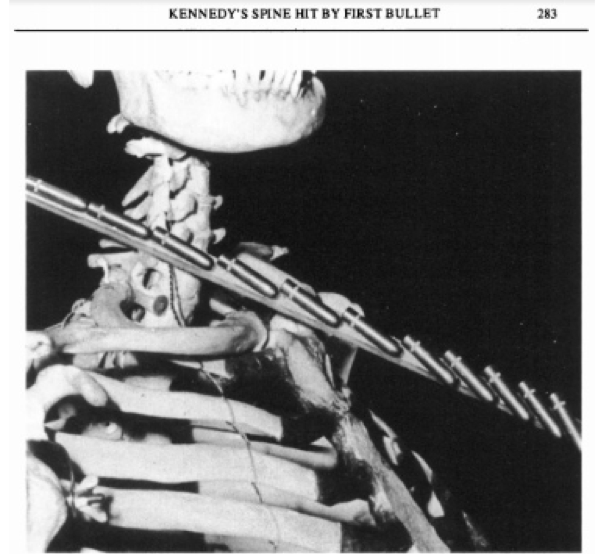
    To solve the problem, the late John Lattimer — one of Haag’s main sources of “information” — raised the back wound to the sixth cervical vertebra (C-6), using deceitful props, false reporting on X-ray findings, and fraudulent representation of neurological implications.

    If you want to see instant proof of how much of a fraud Lattimer was, just look at the picture below. It says it all.

    lattimer skeleton

    lattimer skeleton caption

    And the caption that went with the picture demonstrates one of Lattimer’s techniques in conning people. Lattimer created this prop himself, then said — as if he were an independent observer — “It appears that the first bullet … grazed the tip of the transverse process of his sixth cervical vertebra.” Of course it did: he put it there. (Note: the fragments of bone he mentions were dismissed as artefact.)

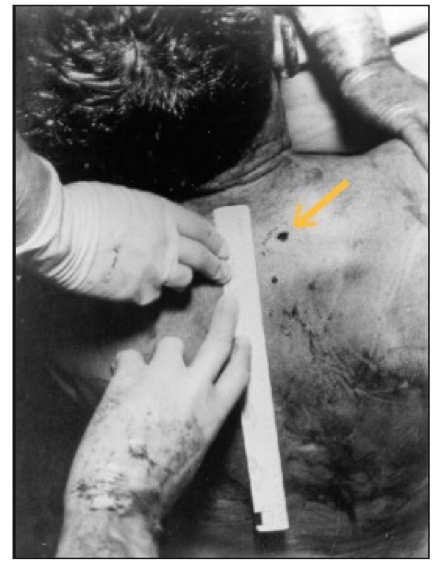
    Haag appears to have learned from past experience that some of Lattimer’s “research” is too blatantly fraudulent, so he would not likely want you to see Lattimer’s contrivance shown above. It is conspicuously at odds with the autopsy photo below:

    backwound

    Photo credit: JFK Lancer


    Like Lattimer, Haag tried to use X-ray reports to sell the higher entrance wound: He said:

    [There was a] possible graze to the right traverse [sic] process of one of the cervical vertebrae at, or adjacent, to C6.

    As usual, he provides no reference to support this assertion. In fact, the graze, if it happened, was assumed to have occurred lower, at the first thoracic vertebra — T-1, not the higher C-6:

    “There is an undisplaced fracture of the proximal portion of the right transverse process of T-1 … There is no evidence of fracture of the cervical spine or its associated appendages.”

    And why doesn’t Haag mention what is in the autopsy report? It said the wound was “just above the upper border of the scapula.” (But numerous witnesses thought it was even lower. Kennedy’s own physician said it was at the T-3 level.)

    Haag also recycles another Lattimer hoax — the “Thorburn position.” He repeats the false claim that JFK was struck at the C-6 level, based on the way he moved his arms after being shot for the first time. He said it was a reflex, tied exclusively to C-6, as described by the surgeon, Sir William Thorburn. As Haag put it:

    When the President first reappears from behind this sign [on the Zapruder film], his arms are in a very odd position, and it looks as though he is reaching for his throat. This is not the case; rather, it has been attributed to a little-known, involuntary response first described by the English spinal surgeon and military doctor, Sir William Thorburn,1 in 1887 …

    In fact, Thorburn described an entirely different position of the arms in response to damage at C-6. At no time did Kennedy ever move his arms in a way that resembled the position of Thorburn’s C-6 patient. That patient’s arms were abducted; Kennedy’s adducted.

    (Many readers of KennedyandKings.com are already familiar with this scam. Those who are not can go here for my detailed report. And see also Donald B. Thomas’s fraudulent revision of Lattimer’s scam.)

    Aside from using deceitful means for establishing a back wound at C-6 while omitting documented information that contradicts it, Haag pretends Kennedy’s back wound controversy concerns whether it is was an entrance or exit:

    Regarding this matter of entry or exit for this singular perforating gunshot wound, it is definitively solved by Federal Bureau of Investigation (FBI) firearms examiner Robert Frazier when he notes and documents the presence of bullet wipe around the margin of the small, circular hole in the upper back of the President’s suit coat.


    Kennedy’s Head Wound

    Haag repeats the old government-approved line:

    A massive exit site with expulsion of bone, tissue, and brain matter was produced in the upper right-front of the President’s head.

    Yes, the wound was in right front and right side — but also the right rear, which he omits. Even the autopsy report says so: the wound extended into occipital bone. According to Parkland Hospital’s former chief of neurosurgery, enough occipital bone was missing to reveal a great deal of missing cerebellum.

    Haag also made this strange claim:

    The WCC Carcano bullet’s ability to totally change character into that of an expanding bullet once its nose area is breached by striking thick bone. In this situation, testing by this author and others (Lattimer2 and Sturdivan7) has shown that the nose of the full metal jacket Carcano bullet can be breeched [sic] upon striking skull bone, after which the bullet behaves much like a soft-point hunting bullet.

    But Lattimer said that, in all experiments — his and those performed by the Army — there was a “complete separation” of the copper shell and the lead core. After that, much of the bullet’s energy has been spent. So how could the jacket alone go on to do the damage of a soft-point hunting bullet? That sort of bullet does its damage immediately on contact.

    (Lattimer also claimed a complete separation of shell and lead core in the case of JFK’s head wound. But what was found in the front seat, and presumed to have been “the” head bullet, were two jacketed fragments, but that is another story.)

    Regarding JFK’s backward head movement, Haag chose not to get into this issue. Instead, he referred readers to past articles on the jet effect.

    Please go here to see my gallery of amazing scams related to this case, including my exposure of fraud — based on the omission of one fundamental fact — in all presentations of the so-called jet effect.


    Conclusion

    Haag published his article in a journal that makes the following claims about itself:

    Drawing on the expertise of leading forensic pathologists, lawyers, and criminologists, The American Journal of Forensic Medicine and Pathology presents up-to-date coverage of forensic medical practices worldwide. Each issue of the journal features original articles on new examination and documentation procedures. (Emphasis added.)

    Original? Haag is just a recycler. And what he recycles is crude pseudoscience.

    New examination? He repeated experiments performed long ago by others, and they don’t back up his conclusions with respect to Kennedy’s wounds..

    Documentation procedures? Haag violates the most basic principles of documentation. He provides no references to the primary sources that he pretends back up his misleading assertions. And he leaves out critical facts that challenge them.

    How does such an unscholarly piece get into a peer reviewed journal? Obviously its vetting process has been corrupted by the deep, insidious contamination of politics.

  • Vince Foster, JFK and the Rise of Chris Ruddy

    Vince Foster, JFK and the Rise of Chris Ruddy


    One of the most nauseating characteristics of the New Right is its hypocrisy. For instance, the GOP has historically been the party of sound money and banking. Yet, in their devotion to supply-side/trickle-down economics, it was their party which ran up the national debt to heights no Democrat ever dreamed of doing. And it was a Republican administration which oversaw the worst banking/real estate crisis and economic downturn since 1929. Another example: for all of their pontificating about religion and family values, most of the GOP evangelist preachers endorse a president who had to pay off two former girlfriends to keep quiet during his election campaign.

    Which brings us to the subject of this article. On December 17th, a week before Christmas, a man named Paul F. deLespinasse wrote an article for the conservative website Newsmax. It was titled: “Conspiracy Theories Merit Only Undivided Suspicion”. Mr. deLespinasse began by saying that such theories are meant to confuse the public, “often for political purposes.” As most conservative shills do, he tried to belittle this kind of thinking with a ludicrous example. He said that Nicholas II of Russia faked his overthrow and ruled from the back room. Obviously, he concedes, he made that up out of whole cloth. But the author said since it made sense to his students, he went on and “concocted new conspiracy theories about the Kennedy assassination.” He goes on to mention two truly ridiculous ones about the JFK case. The first was that Joe Kennedy wanted to have Jackie killed so she would not divorce his son while in office. So the father hired Lee Oswald, but Oswald missed. He then writes, well maybe JFK learned that his medical problems would kill him within months. Therefore he staged his own assassination to become a martyr in order to increase the chance his brothers would follow him into office. (In both of these examples, it is still Oswald as the killer.)

    As was his intention, the author then goes on to ridicule any and all other kinds of alternate ways of thinking about certain momentous events: the 9-11 attacks, Pearl Harbor, the death of Franklin Roosevelt, the idea that America never went to the moon. Note the way he has deliberately mixed in events of genuine interest and scholarship with those that amount to piffling: JFK and the moon landings, for instance. Consequently, he concludes that the best way to remain of sound mind is just to ignore “conspiracy theories and regard their propagators as probable cranks.” Which, of course, is what the Power Elite would like the general public to think, so they can continue on their rampage, killing whatever hopes we have of recovering our democratic processes.

    The reason I mention this piece of claptrap is because it was run in Newsmax. For anyone who knows something about that business entity, the irony of the posting of this article is too rich to be ignored. It underscores the hypocrisy I just pointed out. How so? Because the CEO and founder of Newsmax is Chris Ruddy. And Newsmax would not exist if not for Ruddy’s propagation of one of the wildest and most rudderless conspiracy theories of recent decades––namely, that Vince Foster was murdered by sinister forces employed by Bill and Hillary Clinton. Why would the Clintons murder their close friend and legal colleague? Well, for any number of reasons. These would include that he was having an affair with Hillary Clinton or he was about to give away the secrets of the Whitewater scandal to Congress. But since there were no secrets to that manufactured scandal, then it must have been the first reason. Even though there was no credible evidence of that either. Note that deLespinasse did not mention the Foster case in his long listing, probably because he was aware that it was Ruddy’s hand that was feeding him.


    II

    Vince Foster was a legal and political colleague of Bill and Hillary Clinton in Arkansas. He worked with her there at the Rose Law Firm. By all accounts, he was an effective and successful lawyer. After the 1992 presidential election, the Clintons invited Foster to move to Washington and work for the Clinton administration. He did so, and this turned out to be a serious mistake on his part. Foster was a sensitive soul who was not cut out for what author James Stewart later termed the “blood sport” of Washington DC during the Clinton years.

    It is important to recall an ignored historical milestone at this point. Late in the presidency of Ronald Reagan, the Republicans had managed to achieve one of their longtime goals. They negated the Fairness Doctrine and the Equal Time provisions of FCC law. This was quickly followed by ABC moving Rush Limbaugh from Sacramento to New York and channeling him nationwide. Rupert Murdoch had now become an American citizen. His purchase of Metromedia TV and a share of 20th Century Fox around this time would be the kernel that would launch Fox TV. In other words, what David Brock termed “The Republican Noise Machine”—a huge propaganda network––was now in place, well-positioned to amplify and aggrandize the so-called Clinton Scandals.

    The first two out of the box were the Travel Office affair and the Whitewater real estate imbroglio. Foster worked as Deputy White House counsel. He was involved in the first, and tangentially in the second––which was even more of a pseudo-scandal than the first. Foster was also involved in vetting candidates for positions in the administration; for example, the Nannygate episode over the nomination of Zoe Baird for attorney general. Because of the controversy over these instances, in June and July of 1993 Foster came under political attack in the Wall Street Journal. By several different accounts, Foster was now suffering from depression and anxiety over these attacks. (Dan Moldea, A Washington Tragedy, pp. 203-12). His sister recommended he see a psychiatrist, and he called one to set up an appointment. In the meantime, his personal doctor gave him prescriptions for anti-depressants. Foster was so distraught that he thought of leaving Washington and going back to Little Rock. But he felt that this would be admitting defeat. (Moldea, p. 215). On July 20, 1993 Foster shot himself at Fort Marcy Park in Virginia with a handgun given to him by his father many years previous.

    The first investigation of his death was submitted by the U.S. Park Police on August 10, 1993. The police had been supplemented by the FBI and Justice Department. Relying on that investigation and the medical examiner’s findings, they concluded that Foster had taken his own life. But now something absolutely remarkable began to occur. And for this author, it was the first manifestation of the awesome power of the advancing rightwing media.

    To fully understand the spectacle, worthy of the Roman Colosseum, that was about to be unleashed on the national stage, one needs to outline the metamorphosis that the Republican Party had undergone. To do that, one must delve into a brief––but appropriate––historical synopsis.


    III

    Prior to the election of 1960, the two leaders of the Republican Party had been Senator Robert Taft and President Dwight Eisenhower. In 1952, those two had fought a close and bitter battle all the way to the convention for the Republican nomination for president. It was only through a questionable ploy at the convention that Eisenhower managed to win the nomination.

    There are two points that should be drawn about these men in order to understand the subject at hand. First, Taft was a non-interventionist in foreign policy, to the extent that he was opposed to American involvement in World War II, the Nuremburg Trials and the formation of NATO. Second, Eisenhower more than once said that he was not about to repeal FDR’s New Deal. When Eisenhower left office after eight years, the income tax rate was 91 per cent for the highest income earners.

    One last point needs to be made in order to delineate the dichotomy that was to come. Around this time—early to middle sixties––there was actually a moderate wing to the Republican Party. People like Senator Mark Hatfield, Governor George Romney, Senator Charles Percy, Senator Jacob Javits, Governor Raymond Shafer, Senator Charles Mathias, Governor William Scranton, Senator Margaret Chase Smith, Congressman Pete McCloskey, these and others constituted a minority, but an influential one, within the GOP. As many have noted, what began to alter the Republican Party, and eventually made its moderate wing extinct, was the Barry Goldwater campaign of 1964. That nomination brought to the forefront the extreme rightwing elements of the party—the John Birch Society types—who declared war on the moderate elements in the party. Although the Goldwater forces lost, they succeeded in establishing a beachhead in the GOP. Senator Goldwater had voted against the Civil Rights Act of 1964, was against the high taxation rate, and felt President Johnson was soft on communism. He became the first Republican nominee to consciously run on a Southern Strategy, one which was designed to break up the Democratic majority in the south by employing racist symbology. That strategy, plus the fact that Goldwater was from Arizona, began to rebuild the Republican party on a Southern/Western axis.

    This included California Governor Ronald Reagan. Reagan made a last-minute televised appeal for Goldwater in 1964. And that appeal first put him on the national political map. At that time, the highest political office Reagan had attained was president of the Screen Actors Guild.

    It was not just Reagan who supported Goldwater; it was also William F. Buckley Jr. Buckley’s Young Americans For Freedom supplied the shock troops for the Goldwater campaign. Goldwater was trounced, but Buckley and Reagan now started to pull the Republican party to the far right. In a blatant effort to exterminate them, Buckley began to defame and run against those from the moderate wing of the party: for instance, Charles Goodell and John Lindsay. The very threat of a Reagan run in 1976 provoked President Gerald Ford to perform the Halloween Massacre. That panic-stricken move, for all intents and purposes empowered the neoconservative movement and triggered the rise of Dick Cheney.

    Once Reagan won the White House in 1980, he began to meet with representatives of the Religious Right in order to incorporate them into the GOP. But as writers like Sidney Blumenthal have noted, this was really a kind of flirtation that never made it to the altar. Reagan never gave people like Jerry Falwell what they really wanted, things like prayer in school or a bill banning abortion. But allowing them tea time was enough incentive to make them attack dogs against the Democratic Party. They therefore were useful politically. (Salon, 10/24/15, article by Neil J. Young.)

    Because of all this, by the nineties, the Republican Party had undergone a stunning metamorphosis. Its philosophy had become the antithesis of Taft’s non-interventionism. The GOP now went looking for wars, such as against the Sandinistas in Nicaragua. Reagan assailed the War on Poverty by saying that the result of it was that poverty had won. This kind of talk eventually allowed his acolytes like Newt Gingrich and Paul Ryan to begin the effort to privatize Social Security. Reagan had called Medicare “socialism”. His success allowed the new GOP to do what Eisenhower said he would not: assault the New Deal. (LA Times, 12/8/2017, article by Michael Hiltzik) With the cooperation of Bill Clinton, they almost succeeded at this. (See US News and World Report, 5/29/2008, “The Pact Between Bill Clinton and Newt Gingrich”)

    The new Republican Party had cultivated a more reactionary base. Through Limbaugh-led talk radio, and people like Falwell, it traded on social conservatism, Christian fundamentalism, so-called family values, xenophobia, veiled racism and hostility toward immigrants (the anchor baby syndrome). The new GOP had no problem in depriving minority groups of their right to vote by scrubbing election rolls, which gave George W. Bush his win over Al Gore in the 2000 election heist in Florida. All of this was amplified and channeled into the Limbaugh/Fox sound machine. It was designed to appeal to what many have called “the angry white man vote.” This propaganda formula was so powerful that it managed to convince millions of working-class Americans that their interests coincided with those of billionaires like Richard Mellon Scaife and later the Koch brothers.


    IV

    The staggering force of this new apparatus broke dramatically into the open during the rightwing war against Bill Clinton.

    After the first verdict in the Foster case was rendered by the Park Police, unfounded rumors now began to circulate, like the claim Foster’s body had been moved while wrapped in a carpet and there was no exit wound, even though Foster had shot himself through the mouth. As we shall see, these were both false. In fact, the autopsy report described the exit wound at the rear of the skull. But at that time, Richard Mellon Scaife was also in the process of forming the so-called Arkansas Project—hiring people to dig up dirt on the Clintons from their Arkansas days—through the conservative magazine American Spectator, and Limbaugh was now pushing that journal on his radio show. The Foster case and Whitewater were an early instance of the powerful rightwing propaganda outlets bleeding over into the mainstream media. The first book on the Foster case was published in February of 1994, entitled, The Murder of Vince Foster. It concluded that the Clintons had Foster killed. (Moldea, p. 286)

    More importantly, Chris Ruddy was about to leave Murdoch’s New York Post, where he had already written some stories on the Foster case, for the Pittsburgh Tribune Review. That newspaper was owned by Scaife. With the creator of the Arkansas Project now his boss, Ruddy had free reign to go after the Clintons and the Foster case. After 12 years of Republicans in the White House, the conservative media barons were intent on bringing down the new Democratic president––and it did not matter how they did it. The incessant work of people like Ruddy resulted in enough buzz for the appointment of a special prosecutor. Attorney General Janet Reno appointed a respected Republican lawyer named Robert Fiske to helm that inquiry. Opening an office in Little Rock, Fiske employed 15 lawyers and 25 FBI agents. (New York Times, “Muddy Water”, March 24, 1996) After a careful inquiry, during which he interviewed 125 people, Fiske concluded that the Clintons had not wielded undue influence in the Whitewater matter and that the original police inquiry was correct about Vince Foster’s death.

    On the day that Fiske issued his report, President Clinton signed the reauthorization of the Independent Counsel law, with the difference that instead of being chosen by the Attorney General, a special prosecutor would now be picked by a panel of federal judges. The panel was led by Judge David Sentelle. Sentelle was elevated to the federal court upon the request of Senator Jesse Helms. Under the influence of Helms, Ronald Reagan duly appointed Sentelle in 1985. Reno requested Fiske be reappointed. Under the influence of Helms and fellow reactionary senator Lauch Faircloth, Sentelle and his two cohorts declined to do so. (Washington Post, 8/12/94, article by Howard Schneider). In August of 1994, they replaced Fiske with the even more conservative Ken Starr.

    The Foster case was one of the most bizarre and, at the same time, most assiduous instances of a national political paroxysm this writer can remember. The entire effort to manufacture the case was backed by the late Jerry Falwell, the late billionaire Scaife, with people like reporter Ruddy and west coast political hatchet-man Pat Matrisciana. Matrisciana produced the dubious videotape The Clinton Chronicles. That infamous video began the whole fairy tale about the “Clinton body count”. This quartet perfected a combination business/political model that rose to a grand scale, prefiguring the rise of Alex Jones. Falwell raised money for Matrisciana and Ruddy by selling their productions, which then helped produce more films. Scaife paid for the ad campaigns for Ruddy’s pamphlets on the Foster case. By 1997, Matrisciana and Ruddy had a shared bank account worth over 3 million dollars.

    Some of this massive haul was spent on paying off “witnesses” to talk about the alleged crimes of the Clintons. In other words, it was checkbook journalism. This included signing up Arkansas State Troopers Roger Perry and Larry Patterson. Their contract was designed to pay them to make statements saying that Vince Foster had not died in Fort Marcy Park in Virginia. Foster had actually died in the White House parking lot. This concoction quickly collapsed when the person who was supposed to have made a phone call revealing this––White House aide Helen Dickey––testified and proved that she did not learn of Foster’s death until late in the evening, not in the afternoon, which was when Foster’s body was discovered. As reported by Robert Parry, Starr concluded that Dickey was telling the truth and the troopers were not. (The Consortium, March 30, 1998; see also New York Review of Books, August 8, 1996, reply by Gene Lyons to Ambrose Evans Pritchard)

    Just how far would these deceptive practices go? During an infomercial, Falwell interviewed a witness in silhouetted background he labeled an investigative reporter. The mystery witness said that he knew his life was in danger because not one, but two insider witnesses had been killed before he got their stories. They both died in plane crashes. (Note, the idea of neutralized witnesses was apparently borrowed from the JFK case.) The silhouetted “investigative reporter” then asked: “Jerry, are these coincidences? I don’t think so.” It was later revealed by journalist Murray Waas that the mysterious investigative reporter was Matrisciana himself. When the scheme was later exposed, Matrisciana tried to blame the idea on Falwell. (See again Parry, cited above) With this in mind, again note the hypocrisy: the name of Matrisciana’s business outfit was Citizens for Honest Government.

    What troubled me about this outbreak of rightwing profiteering designed to increase political dementia was this: When I once mentioned it in Probe Magazine, I got a letter saying that somehow I was wrong to belittle the efforts of Ruddy and Matrisciana. The author then equated the death of Vince Foster to what had happened to President Kennedy. And that somehow, the “cover-up” around Foster’s death equated to what the Warren Commission did to JFK’s murder. I was disheartened by the letter. If one of our readers could not tell the difference between the political flackery around Foster’s death and the real criminality and cover-up around President Kennedy’s demise, then I was not doing a very good job as a writer or researcher. Either that, or the forces arrayed against me were simply too awesome to contemplate.


    V

    At around this time (1994-95), another Scaife-funded journalistic entity, Western Journalism Center (WJC), began to issue pamphlets based on Ruddy’s writings on the Foster case. These were supported by full-page ads in numerous newspapers throughout the nation, including the Washington Times, Chicago Tribune and New York Times. This writer was given one of Ruddy’s WJC reports by a friend. I immediately began to note even further that the techniques Ruddy was using were reminiscent of what the early critics of the Warren Commission had done. Ruddy was questioning the forensic basis of the prior pronouncements on the case by trying to find errors, misstatements or inconsistencies in those judgments. For example, Ruddy said that, although Foster’s body was found with the gun in his right hand, Foster was actually left-handed. Like so many other Scaife-sponsored “facts”, this turned out to be false. (Sixty Minutes, October 8, 1995). But this did remind me of the strange circumstances in the death of Gary Underhill, one of the earliest witnesses to proclaim a conspiracy in the death of President Kennedy. (Destiny Betrayed, Second Edition, p. 100) So Ruddy seemed to be imitating the early Warren Commission critics. The problem as I saw it was that there was simply no comparison between the circumstances of the two cases—in any manner. And by 1995, two more judgments had been rendered on the Foster case. One by the Senate Banking Committee and one by Congressman Bill Clinger of the Government Operations Committee. Both concluded that the original police investigation was correct. What I found striking about this was Clinger was a Republican and the Senate investigation was completed under the co-leadership of the highly partisan Republican Al D’Amato. (Starr Report on Foster, Section 2, part C)

    This point was rammed home when, once Starr replaced Fiske, Brett Kavanaugh found a way to reopen the Foster case. (See article by Charles Pierce, Esquire, August 3, 2018). As any objective observer can conclude, Ken Starr had a rather unethical reign as independent counsel. More plainly: Starr had an agenda. He also utilized questionable methods in order to fulfill that agenda. (For a rather harrowing look at those methods, see Susan McDougal’s book The Woman Who Wouldn’t Talk.) Yet, in spite of this, Starr came to the same conclusion everyone else did. (Although he delayed announcing it for well over a year to keep the controversy brewing.) But he did employ the man who many consider to be the finest criminalist in America, Henry Lee. Lee is noted for his independence. He has bucked the establishment in the OJ Simpson case and the JFK case. Lee teamed up with two other experts, Dr. Brain Blackbourne and Dr. Alan Berman, to certify that Starr agreed with Fiske.

    The beginning of Starr’s Report relies upon the work of two doctors: James Beyer and Donald Haut. Dr. Haut was at the crime scene and Dr. Beyer did the autopsy. Unlike with the JFK case, the doctors identified the wound path with no ambiguities. (Moldea, p. 30) And there was an alignment between the entrance and exit wounds. In other words, there was no impossible Single Bullet Theory to contend with. Nor, as with Kennedy’s head wound, did the bullet come in from one angle and then veer 90 degrees to the right for its exit. (Read it here)

    The Office of Independent Counsel traced the purchase of the .38 handgun as far back as 1913. Henry Lee actually determined how Foster carried the weapon that day. Lee also detected blood stains on nearby vegetation. These investigators, along with the FBI lab, also determined where the carpet fibers on Foster’s clothes came from, which was Foster’s home in Washington and the White House. These two evidentiary conclusions effectively countered Ruddy’s suppositions that, first, the weapon was not traceable, and therefore was not Foster’s; second, that Foster was killed elsewhere––or took his own life elsewhere––and then his body was transported to the park; and third, contrary to what Fiske’s critics reported, that there was a considerable amount of blood at the Fort Marcy Park scene (Moldea, p. 203), thus neutralizing reports saying there was not very much there and consequently Foster must have been killed elsewhere. (See section 6 of the report, part B; see also Moldea, pp. 312-17)

    The work of Henry Lee and forensic pathologist Brian Blackbourne was devastating to the likes of Ruddy and conservative media attack dog Reed Irvine. In addition to the above, Foster’s DNA was found on the barrel of the handgun. There was a bone chip on a nearby piece of brown paper, and through DNA testing it was proven that the chip was part of Foster’s skull. Contrary to another myth, Lee found that Foster’s shoes did contain soil materials and vegetative matter. (See again Moldea, cited above)

    The findings by Lee and Blackbourne were so compelling that when Ruddy issued his book on the Foster case—The Strange Death of Vincent Foster—even critics of conservative orientation, like Byron York and Jacob Cohen, panned the book. The American Spectator, home of the Arkansas Project, also filed a negative review of Ruddy’s volume. (Moldea, p. 320). When Scaife heard about the latter, he pulled his funding for the magazine, which indicated what the whole sorry episode was really about. Because of that, the journal went into a financial tailspin and was later sold to George Gilder. (Washington Post, May 2, 1999, “Arkansas Project Led to Turmoil and Rifts”)

    As the reader can see, the Foster case and Kennedy case are not at all forensically equivalent. Virtually every forensic aspect of the JFK case is genuinely susceptible to challenge. These are challenges that, when followed through on, prove the opposite of what the Warren Commission concluded; this is especially the case with the medical and ballistics evidence, including Oswald’s alleged possession of the rifle and handgun.

    Neither was there any credible evidence that the Foster autopsy was obstructed by officials on the scene. Or that notes were burned and the autopsy was rewritten once or twice. In the JFK case, both David Mantik and Doug Horne have argued that the autopsy we have in the JFK case is likely the third version. (See Doug Horne, Inside the ARRB, Volume 3, pp. 851-878) And this change occurred the morning of Sunday the 24th, when Jack Ruby killed Oswald, a murder which guaranteed there would be no trial for the defendant. I won’t even detail the wholesale revisions made in the Kennedy autopsy by the Ramsey Clark Panel in 1968. But the record shows there has never been a true official forensic inquiry into the JFK case. What Arlen Specter and the Warren Commission did was pretty much a pathetic disgrace. The forensic examination by the House Select Committee on Assassinations was flawed beyond recognition by its use of the junk science of Thomas Canning and the late Vincent Guinn. (The Assassinations, edited by James DiEugenio and Lisa Pease, pp. 76-82) On top of that, the HSCA concealed much of their evidence, and then misrepresented the evidence that was concealed. (Essay by Gary Aguilar in Trauma Room One, pp. 208-11) This is why, in the upcoming Oliver Stone documentary, JFK: Destiny Betrayed, the public will––for the first time, fifty-seven years after the fact––see a real forensic review of the evidence in the JFK case.


    VI

    I would like to close the crime detection part of this essay with a direct comparison of the findings of a so-called expert in forensics who participated in both the Foster and JFK cases. That man is the late Vincent Scalice. Like many who worked for the House Select Committee, Scalice came out of the New York City Police Department. He was hailed as a fingerprint expert.

    As both Sylvia Meagher and Henry Hurt have noted, there was a timing problem with the discovery of Lee Harvey Oswald’s palmprint on the barrel of the Mannlicher Carcano rifle found at the Texas School Book Depository. On the night of the assassination, there was no print announced by the Dallas Police. (Sylvia Meagher, Accessories After the Fact, p. 124) Their identification expert, Carl Day, was supposed to have been working on the rifle at the time it was taken from the police and sent to the FBI. Vincent Drain was the FBI agent who picked up the rifle from Day that evening and shipped it to Washington. Drain told author Henry Hurt that no such print was pointed out to him by Day when he picked up the rifle on the evening of the assassination. (Henry Hurt, Reasonable Doubt, p. 109)

    What makes Drain’s statement compelling is that when the rifle was examined by FBI expert Sebastian Latona, he said that there were no prints of value he could discern on the weapon. (Hurt, p. 107) Latona was probably the foremost authority on the subject at that time. In conversations with Chief of Homicide in New York, Robert Tanenbaum, he told this writer that every DA in America wanted Latona for his case, for the simple reason that his pamphlet on fingerprint analysis was used by most local police departments as an instruction guide.

    What happened after Latona came up with a negative verdict on the prints shows why the Dallas Police Department was later exposed as the single most corrupt police force in the country. (James DiEugenio, The JFK Assassination: The Evidence Today, pp. 196-98) After the rifle was returned to Dallas, DA Henry Wade announced that, presto, they now had a print on the rifle. What made the late arriving print even more suspect was this: After Oswald was killed by Jack Ruby on the 24th, his body was taken to Miller’s Funeral Home in Fort Worth. In 1978, agent Richard Harrison told Gary Mack that he had driven another agent to the funeral parlor with the alleged “Oswald rifle”. His understanding was that this other agent was to get a palm print off the corpse for “comparison purposes”. This makes no sense since Oswald had been fingerprinted three times while in detention. (Jim Marrs, Crossfire, 1989 edition, p. 444) The owner of the parlor, Paul Groody, later said it took a long time to remove all of the “black gook” from the hand of the corpse. And that convinced him the agents were there to retrieve a palm print. (Hurt, p. 107) When the Warren Commission wanted Day to sign an affidavit to the effect he had identified the print before the rifle was turned over to the FBI, Day refused to execute the document. (Marrs, p. 445) Because of these rather suspicious circumstances, no serious author on the JFK case believed the palmprint was legitimate.

    Then, in 1991, a man named Rusty Livingston entered the scene. Livingston had worked for the Dallas Police, and his nephew Gary Savage later produced a book, called First Day Evidence, based on his uncle’s remembrances and souvenirs. Livingston claimed that, in addition to the palm print, there was a fingerprint Day developed on the trigger guard. He had pictures to prove such was the case. When the late Mike Sullivan of PBS heard about this, he and his crew—which included Gus Russo and Scott Malone––hurried to talk to Rusty and Gary. And this new evidence turned out to be the final sequence for their (quite flatulent) 1993 Frontline special entitled Who Was Lee Harvey Oswald?

    Savage had tried to get a confirmation that the trigger guard prints were Oswald’s from an examiner named Jerry Powdrill. Powdrill’s examination was quite weak; he only said he could match three points. This number is four times less than the usual standard in US courts, and five times less than in British courts. (Savage, p. 109)

    Sullivan was undeterred. PBS then brought in a former FBI examiner, George Bonebrake. He said the prints were not clear enough for identification purposes. But that still did not discourage Sullivan and PBS. They now brought in Vincent Scalice. As Pat Speer notes in his fine article, “Un-smoking the Gun”, back in 1978, when working for the House Select Committee on Assassinations, Scalice said these trigger guard pictures were not defined enough for identification purposes (Volume 8, p. 248). But now, Mr. Scalice determined the prints were Oswald’s. He explained this switch by saying that he now had more and better pictures to work from.

    As Speer notes, Scalice and Savage were wrong about the new and better photos which allowed the new determination. After separating out blow-ups from originals, Speer determined that Scalice worked from all of two photos––not as PBS said, “a set”. Scalice was also wrong when he said he had only seen one photo of the trigger guard prints while with the HSCA. He had seen more than one while working for that committee. (HSCA Admin Folder M-3, pp. 5-6, at Mary Ferrell Foundation Archives.) PBS was also wrong when they said that the trigger guard prints had been ignored prior to 1993. They had been examined by the HSCA and the FBI. (See preceding link)

    But as Speer points out, although the misrepresentations above were pretty bad, they were not the worst part of the dog and pony show that Sullivan and PBS had produced. Sullivan realized PBS had a problem with the FBI work on the rifle which occurred the very evening of the assassination. So when PBS presented the program for the 40th anniversary of Kennedy’s murder in 2003, they wrote the following piece of narration: “The FBI says it never looked at the Dallas police photographs of the fingerprints ….” This statement strongly implies that when Latona examined the rifle for the Warren Commission, he did not have the DPD photos.

    Again, this is false. In his Warren Commission testimony, Latona is quite clear on this point. He states that he did examine photos of the trigger guard area that were sent by the Dallas Police. (WC Vol. IV, p. 21). And he went beyond that. He says that he examined the area with a magnifying glass. (WC Vol IV, p. 20). He then adds that he called in a photographer and took his own photos. He states that they tried everything, “highlighting, side-lighting, every type of lighting that we could conceivably think of ….” Latona also said that he then processed the entire rifle, to the point of dismantling the weapon and breaking down all its parts. He concluded that there were no prints of value on the rifle. (WC Vol IV, p. 23)

    It’s one thing to make a mistake. We all do that. But when you state as fact the opposite of what happened, then the audience has a right to suspect that the producer of the program––in this case Mr. Sullivan––has an agenda. I simply do not believe that every person involved with this program had failed to read Latona’s sworn testimony. Not when this issue was the concluding segment of the show. They had to have read it. But they were so eager to pronounce Oswald guilty that they ignored it. They did not want to explain why the best fingerprint expert the FBI had––using every technique he could muster––could not find a print on the weapon while Oswald was alive; but the most corrupt police department in America did find it after he was dead. If the case had been presented that way, then the audience would have been thinking: “Where did Day’s prints come from?” And they would have been justified in asking that question. As they would have been in asking these questions: What the heck is PBS up to? Didn’t this used to be a reputable network? And also this one: Why is Scalice going along with this cheap charade? (I strongly advise the reader to peruse the rest of Speer’s article, because, if you can believe it, the smelly evidentiary trail of this print gets even worse.)

    After retiring from the NYPD Scalice had become a forensic examiner in the private field. In other words, he was for hire. And, yes sir, after his work for PBS and Sullivan, he later took part in the Foster case. And he joined it with a vengeance. In April of 1995, he issued a report through the WJC agreeing with the idea that Foster’s body had been transported to Fort Marcy Park from an outside location. (Moldea, pp. 249-50). Part of this “analysis” was based on the phony tenet that there was not any soil found on Foster’s shoes. (Associated Press Report of 4/28/95) The problem with this, as we have seen, is that Henry Lee proved it was wrong.

    But Scalice now plunged further into the Foster mire. A few months later, he switched hats and became a document examiner, one specializing in handwriting analysis. Investment advisor James Davidson was friendly with both Ruddy and Republican stalwart Grover Norquist. He also later became a board member of Newsmax. In 1995, Davidson called a press conference. Vince Foster had written a note prior to his death. He had ripped it up and thrown it into his briefcase. It expressed his discouragement with the Washington scene and his disdain for the unfair attacks on him. It was found four days after his body was discovered. Both the Fiske and the Starr inquiries had employed authorities who determined the note was written in Foster’s hand. (See Final Report of Independent Counsel, Volume 3, Part 3, p. 278, published in 2001 and finalized by attorney Robert Ray)

    Well, to counter this, Davidson put Scalice on a panel with two other men, including one Reginald Alton from England. (Alton seems to have been a bit biased against the Clintons; see Moldea, p. 373.) Their analysis differed from the prior ones and said the note was a forgery. That analysis was vitiated by Marcel Matley in the Volume 21 No.1, Spring 1998 issue of the Journal of the National Association of Document Examiners.

    After reading the above analysis, this author is compelled to note that when Scalice offered up his confirmation statement of the Oswald fingerprint for PBS, he did not furnish any comparison charts. This would have been standard procedure for any legal proceeding. As Pat Speer wrote, this should have been easy for him to do, as exemplars of Oswald’s prints were in the record going all the way back to his Marine Corps days. Because of that, and the other points mentioned above, it is safe to suggest that, by the nineties, Scalice was pretty much planning for his retirement. Masquerading as a versatile forensic expert, he was the equivalent of a think-tank academic for hire. With the confirmation bias agreed upon during the signing.


    VII

    As the reader can see, unlike the first generation of critics in the JFK case, people like Chris Ruddy and Reed Irvine had a sugar daddy who was supplying them with bucketloads of cash. This patronage both furthered their endeavors and allowed them to be publicized via full page ads in large newspapers, thus ensuring their information would be available to millions of readers. This is almost the opposite of what happened with writers like Harold Weisberg, Mark Lane, Vincent Salandria and Sylvia Meagher. Weisberg was reduced to self-publishing his books after his first. The FBI stopped Lane from publishing Rush to Judgment in the USA, leading to its first being published in England. (Mark Lane, Citizen Lane, pp. 160-61) Whatever that first generation of critics achieved was largely due to the quality of their work, not to any promotion by wealthy rightwing backers.

    But it was that rightwing backing that kept on advancing further inquiries into the Foster case. And these further official inquiries were all done by those who would be politically in line with the likes of Ruddy and misaligned with the Clintons. Again, this is contrary to the Kennedy case. The Warren Commission was clearly politically biased from the start to attain a no-conspiracy verdict. (See James DiEugenio, The JFK Assassination: The Evidence Today, Chapter 11) Once Dick Sprague and Bob Tanenbaum left the the House Select Committee on Assassinations, Robert Blakey attempted to convict Oswald, using a lot of the same dubious evidence the Warren Commission did. (See The Assassinations, edited by James DiEugenio and Lisa Pease, pp. 63-89). Because of this innate bias, there has never been anywhere close to a real examination of the true circumstances of Kennedy’s death. This bias is furthermore why both of those inquiries proffered the ridiculous Single Bullet Fantasy as the sine qua non of their verdicts against Oswald.

    But forensics was not what the Foster case was about. It was a political crusade. So––as we have seen––facts were not important. When needed, they could simply be made up. (For some further examples of this, see the Salon 12/23/97 article by Gene Lyons.) The idea, as future Solicitor General Ted Olsen told his then ally David Brock, was to publish speculation that even they understood was false, so that it would preoccupy the White House until a new scandal came along. (Washington Monthly, article by Martin Longman, 5/24/16). Can anyone in their right senses say that this stands in any comparison to what authors and activists in the Kennedy case were doing? But the underlying results in the Clinton case seem fairly obvious: it was effective. And it clearly drove Bill Clinton to the right. Which is why he hired the likes of Dick Morris to run his political office and his 1996 campaign.

    The Clinton Wars brought some of the worst political hacks into the MSM. In addition to those I have mentioned, there were Ann Coulter, Laura Ingraham, Floyd Brown, and David Bossie. And it was these characters who further decimated the Republican Party of any political beliefs it previously held under Taft and Eisenhower. They are and were simply shock troops. As congressman Trey Gowdy recently said upon leaving congress, the GOP is about one thing: winning. And since that party has been reduced to the level of Coulter and Bossie, it is about winning through a scorched earth policy, as in the case of Donald Trump Jr. trying to revive the Foster case in 2017. (CNN Report of May 11, 2017 by Andrew Kaczynski) Along with this, there was the constant refrain from the Right that the MSM was too liberal. This, of course, was preposterous. The Power Elite, which has owned the media in America for eons, was never liberal––which is why they cooperated so completely with the cover-ups of the assassinations of the sixties. As Eric Alterman has noted, this refrain about being too liberal was the equivalent of “working the refs” in sports. You softened up the gatekeepers in order to get your message on the field. And it worked. It also caused writers who had formerly been on the left to move right in order to to gain access, one example being the late Christopher Hitchens.

    The Republican Party has become so bereft, so craven by this continuing devolution that it all but ignores the real scandals that have taken place in order to distract the public with these ersatz ones. The heist of the 2000 election, the probable stealing of the 2004 election, the Iran/Contra scandal, the importation of drugs into the USA by the CIA, these all are minimized or ignored by the GOP. In fact, during the Brett Kavanaugh confirmation hearings, Senator Lindsay Graham said the fact that the Senate allowed a sexual assault accuser to testify against Kavanaugh was one of the worst things he saw in his political career. Evidently, the Supreme Court and Roger Stone stealing the 2000 election––thus allowing the deaths of 600,000 Iraqis in a phony war––this did not count for anything to Graham. That is how bonkers that party has become. Their aim is to be constantly riling up the base, which does not really understand they are being used as lemmings to ensure policies that will make their lives worse.

    To be clear: I never voted for either of the Clintons. Since I live in the safe state of California, I could vote Green in the general election. I never voted for either one in the primaries. As Robert Reich later noted, the Clintons were really Eisenhower Republicans. I mean, can anyone imagine Bobby Kennedy attending H. L. Hunt’s funeral, like Bill Clinton did Scaife’s? (CBS News, August 3, 2014, report by Jake Miller) My point here is that the political antics that surrounded them was nothing but a cheap and tawdry circus, one which, without Scaife’s money, likely would have never existed. And when all the investigations were done, what real charges were there? Monica Lewinsky. Talk about hypocrisy, as Larry Flynt later showed: the GOP was full of similar instances. (See SF Weekly, 9/15/99, article entitled “Inside Flynt”) To take the hypocrisy of the Lewinsky matter even further: Scaife himself carried on a long affair with a call girl, one which his wife found out about and exposed. (Vanity Fair, 1/2/08, article by Michael Joseph Gross) There were two good books written on the stupidity of all this. First, there is Blood Sport by James Stewart from 1997; and then The Hunting of the President by Joe Conason and Gene Lyons, which came out in 2001. The latter was made into a documentary film in 2004.

    Chris Ruddy rode the tidal wave of ridiculousness. He was well rewarded by his backers for his incessant efforts to aggrandize nonsense and create an aura of mystery where none actually existed: to suggest there was some kind of kill squad employed by the Clintons; that Vince Foster had to have been murdered and then, James Angleton style, the murder was made to look like a suicide; and that this was all over the Whitewater real estate deal in which the Clintons lost money. Today he runs Newsmax, which employs people like Mr. deLespinasse, who ridicules all ideas about conspiracies, but conveniently passes over the Foster mythology in silence. But when Ruddy does run a story and documentary on a possible JFK conspiracy, who is it about? The poseur James Files. (Report on Newsmax by Jim Myers, August 29, 2016). Ruddy has us nailed both ways.

    Donald Trump has complained that he is the most attacked president in decades. Mr. Trump has a short memory. Bill Clinton was. Just ask Chris Ruddy how he did it. And how he benefited so much from it.

  • Public Relations and the JFK Case

    Public Relations and the JFK Case


    (Click here to open the document in another page.)

  • Destitute Cuban Studies Institute on the JFK Assassination

    Destitute Cuban Studies Institute on the JFK Assassination


    The Executive Director of the so-called Cuban Studies Institute (CSI), Pedro Roig, presents himself as an attorney and historian in posting “Castro’s Complicity in Kennedy’s Assassination.” The piece leaves much to be desired of Roig’s expertise in both legal and historic studies. It exposes the CSI as a sanctuary of shameless and mindless anti-Castro propaganda. Let’s review Roig’s endeavor to persuade without regard for truth.

    Oswald Contact with Cuban Security Agents

    • “It is now evident that Oswald made contact with Cuban intelligence officers while stationed at El Toro Marine Air Base in Santa Ana, California.”

    No, it’s not. The FBI interviewed 26 U.S. Marines acquainted with Oswald at El Toro. None of them connected Oswald to the budding Castro’s foreign intelligence. Roig cherry-picked Nelson Delgado and disguises his presumptions as quantum of proof.

    • “Under oath, Delgado stated that ‘Oswald told him he was receiving mail from Cubans and had developed contact with Cuban government officials in Los Angeles. Delgado recalled that Oswald met with an unknown visitor … and they spent about one and a half, two hours talking.’”

    Let’s summarize what Wesley J. Liebeler, assistant counsel of the Warren Commission, got from Delgado under oath, upon which Roig dares to even suggest that a Cuban handler came to a U.S. military base at night to talk with his agent Oswald.

    Liebeler: You never asked Oswald who this fellow was that he talked to?

    Delgado: No, no.

    Q: Did you connect this visit that Oswald had at that time with the Cuban Consulate?

    A: Personally, I did, because I thought it funny for him to be receiving a caller at such a late date time … After he started to get in contact with these Cuban people, he started getting little pamphlets and newspapers.

    Q: Did you have any reason to believe that these things came to Oswald from the Cuban Consulate?

    A: Well, I took it for granted that they did after I seen the envelope…

    Q: What was on this envelope that made you think that?

    A: Something like a Mexican eagle, with a big, impressive seal, you know. They had different colors on it, red and white … But I can’t recall the seal. I just knew it was in Latin, United, something like that.

    Q: You don’t know for sure whether it was from the Cuban Consulate?

    A: No. But he had told me prior, just before I found that envelope in his wall locker, that he was receiving mail from them.

    Q: Did he tell you what his correspondence with the Cuban Consulate was about?

    A: No, he didn’t.

    As earwitness, Delgado didn’t know who visited Oswald one night at El Toro; as eyewitness, he described an impressive seal that could be anything but Cuban stuff. Roig has simply recycled the failed 1975 CIA trick of giving Delgado evidential weight to dispel the growing cloud of suspicion over the CIA itself and to point the finger at Castro. Thus, Roig has only proven that the CSI comes to the JFK research community with the spurious arguments of a previous generation.

    In Oswald and the CIA (Carroll & Graf, 1995, 627 pages / Skyhorse, 2008, 696 pages), retired Major John M. Newman, who spent 20 years in U.S. Army Intelligence and became executive assistant of the National Security Agency (NSA), killed the two Delgado birds flown by the CIA with one stone. The ex-Marine Gerry Patrick Hemming told his 1960 CIA debriefers that he had met Oswald at the Cuban Consulate in Los Angeles and then confronted him about it outside the gate at El Toro the night before flying to Washington. In an interview by Dick Russell, Hemming destroyed the wild presumption of a 1959 link between Oswald and the budding Castro’s intelligence services:

    I ran into Oswald in Los Angeles in 1959, when he showed up at the Cuban Consulate. The coordinator of the 26th of July Movement [Castro’s political group] called me aside and said a Marine officer had showed up, intimating that he was prepared to desert and go to Cuba to become a revolutionary. I met with the Marine … I thought he was a “penetrator” [and] I told the 26th of July leadership to get rid of him. (Argosy, Vol. 383, No. 3, April 1976)

    In contrast to Oswald, Hemming did manage to join Castro’s army; in line with Oswald, he also exemplifies the adventurous spirit among many Americans in the early days of the triumphant Cuban revolution. Oswald was released by the U.S. Marine Corps at El Toro on September 11, 1959. On September 3-4, 1959, U.S. Ambassador Phillip Bonsal still expressed “the general sympathy with objectives of Cuban revolution and similarity with many of our own aims and aspirations.” (Foreign Relations of The U.S., 1958–1960, Volume VI, Cuba, Document 359)

    Roig hides this Zeitgeist to portray Oswald as a fully dedicated soldier for Castro: “[Delgado] testified that Oswald kept on asking him ‘how he could help Castro’”. Roig stops here, but the beat goes on with Delgado explaining: “We were on friendly terms with Cuba, you know, so this wasn’t no subversive or malintent”. Delgado clearly revealed the adventurous spirit:

    [W]e had a head start, you see. We were getting honorable discharges, while Morgan [Delgado meant Major William Morgan, who also had been infatuated with the Cuban revolution and ended up executed by firing squad under charge of rebellion against Castro] got a dishonorable discharge from the Army and he went to Castro and fought with Castro. So, we could go over there and become officers and lead an expedition to some of these other islands and free them too … [W]e would do away with Trujillo [The dictator of Dominican Republic, the Caribbean nation that shares the island of Hispaniola with Haiti].

    However, Roig keeps on building a body of evidence about a Castroite Oswald, in a way that resembles the fate of the Cuban character “Chacumbele,” who killed himself. After acknowledging that “defectors like Oswald [were] under close surveillance” by the KGB, Roig broaches a “suspicious coincidence.” In Minsk (Belarus), Oswald was directed to enroll in a Foreign Language School “adjacent to the KGB Academy, attended by Cuban security personnel.”

    The coincidence is not suspicious, but absolutely irrelevant. There is not a shred of evidence in reference to Cuban security personnel and Oswald in his KGB file, which includes daily reports of intensive surveillance, even through a peephole into his bedroom. In addressing this lack of evidence, Roig has concocted an undrinkable cocktail: Marina Oswald “testified that Oswald bragged that he had gotten close to some of the Cubans [and] remembered the Cubans with pleasant memories.”

    Marina clearly stated that Oswald knew “a Cuban family” and she had heard about 300 Cubans in Minsk, “but I never knew even a single one.” In fact, Oswald knew a man named Alfred (last name unknown) from Cuba and a picture of them together is provided by [Warren] Commission Exhibit 2612. Newman demonstrated Alfred does not provide scope for suspicions. He was a student at the University of Minsk and his parents visited him. Oswald knew him through Anita Zieger, who was courted by Alfred. She and her family—of Argentinian origin—were friends of the Oswalds in Minsk.

    Oswald’s Alleged Visits to the Cuban Consulate in Mexico City

    Roig continues his deceptive handling of the facts by masking Oswald as “a militant advocate of the Fair Play for Cuba Committee.” He also labels the FPCC “as a Communist front that supported the Castro’s Marxist-Leninist revolution.” Ironically, this remark closes his new avenue of deception for good.

    In the Spring 1963, Oswald formed a one-man New Orleans chapter of FPCC. Although its leadership warned him about “unnecessary incidents,” Oswald walked into a lair of the anti-Castro Student Revolutionary Directorate (DRE) to offer help. On August 9, he was handing out pro-Castro leaflets in downtown New Orleans. A brawl with DRE militants eventually ensued, but it was staged. Oswald had described the incident in a letter to FPCC postmarked five days before. Less than two weeks thereafter, Oswald and the local DRE head, Carlos Bringuier, met again on a debate at WDSU radio.

    Bringuier exposed Oswald as a re-defector from the Soviet Union. Oswald turned the tables by boasting about his stay there as “excellent qualification to repudiate charges that the FPCC is Communist controlled.” He stressed: “It is inconsistent with my ideals to support Communism … We do not feel that we are supporting international Communism in supporting Fidel.”

    Within a week, Oswald wrote to the Communist Party USA (CPUSA), in order to leave a paper trail of the very linkages he had denied on the air: “I am the secretary of the local brach (sic) of the FPCC, a position which, frankly, I have used to foster communist ideals.” A prime soldier for Fidel Castro does not stab him in the back.

    Roig circumvents the most burning question about Oswald in Mexico City by quoting from the unpublished autobiography of Winston Scott [CIA Chief of Station]: “Every piece of information concerning Oswald was reported immediately … These reports were made on all his contacts, with both the Cuban Consulate and the Soviets … Persons watching these embassies photographed Oswald as he entered and left; and clocked the time he spent on each visit.”

    The core factual issue is that the CIA has never produced either a photo of Oswald nor a tape with his voice on it from Mexico City. Win Scott himself overlooked Oswald in his September 1963 report on the CIA telephone tapping program LIENVOY, although an American in phone contact with both Cuban and Soviet embassies was ipso facto of operational interest. In his attempt to escape from the facts, Roig falls into a preposterous dual story:

    In March 1968, President Lyndon Johnson … requested from his close associate (sic) Marty Underwood to meet with Scott in Mexico City. The timing was excellent … In the meeting with Underwood, Scott stated that early in the morning of November 22, 1963, a small Cuban airplane landed at the Mexico City Airport. The passenger transferred to another plane, that immediately took off for Dallas, Texas. Later that evening, the same plane returned from Dallas and the individual transferred to the Cuban aircraft the flew back to Havana. After many months of investigation, the CIA was confident that the individual was Fabian Escalante.

    Just the timing reveals Roig’s ignorance. Underwood’s only trip to Mexico City occurred in 1966. During his brief meeting with Scott, according to Underwood’s own notes, there was not the slightest reference to November 22, 1963. As a White House advance man, Underwood sought help from Scott for Johnson’s upcoming visit to Mexico. (ARRB Final Report, p. 136) And Escalante—as counterintelligence officer in the Section Q of Castro’s G-2—was so busy in 1963 watching anti-Castro fighters inside Cuba or in exile that he couldn’t have timed a wet operation, id est, involving spilling blood.

    It is incredible that Roig would fall for the deceased Underwood. Because, as noted above, Underwood was exposed for telling fairy tales back in 1998 when the Final Report of the Assassination Records Review Board was published. Not only was his canard about Scott then revealed, but he had also been telling tall tales to Gus Russo and Sy Hersh for the deceitful Judith Exner. And those two willingly gobbled them up. (Ibid)

    State Department: “Do Not Implicate Cuba”

    From the bamboozler Underwood, Roig jumps to Thomas Mann, U.S. Ambassador to Mexico, who “has the answer” about what happened to the CIA files on Oswald in Mexico City. Mann “was personally ordered by the State Department, a few days after Oswald murdered President Kennedy, to shut down any investigation that would implicate Cuba’s involvement.” Roig added that a top CIA official, Tom Karamessinger (sic), memoed Scott: “Arrest of Sylvia Duran is extremely serious matter which could prejudice (us) … Request you ensure that her arrest is kept absolutely secret, that no information from her is published or leaked.”

    Roig is muddying the waters as if the report Oswald, the CIA, and Mexico City (1978), written by HSCA staffers Dan Hardway and Edwin Lopez, hasn’t gone through rounds of declassification since 1993. It became clear that the CIA knew Oswald had been impersonated by phone on September 28 and October 1. Duran was also impersonated on September 28.

    That Saturday, a caller to the Soviet Consulate identified herself as Duran and announced that “an American that was just at the Soviet Embassy … is going to talk with you.” The CIA transcriber, Boris Tarasoff, commented that the American “speaks terrible, hardly recognizable Russian.” On October 1, a caller to the Soviet Consulate identified himself as Lee Oswald. Tarasoff noted he was “the same person who had called a day or so ago and spoken in broken Russian.” Duran was arrested and harshly interrogated by the Mexican Police on November 23 and November 28. The info taken from her included that she neither met Oswald nor made any call to the Soviet Consulate on September 28.

    Duran emphasized “she had no fear [of] extradition to the United States to face Oswald.” On the contrary, the CIA was afraid [that] “any Americans [might] confront Silvia DURAN or […] be in contact with her” [DIR 85318, 11-27-63, in [Duran’s] Information – NARA Record Number: 104-10102-10145, p. 14]. That’s why neither the eyewitness Duran nor the earwitness Tarasoff were ever questioned about the call by the Warren Commission. The CIA itself, not the State Department, shut down any further investigation on a Cuban connection after its Mexico City station not only produced both a tape and a photo that weren’t Oswald’s, but also spread stories—all of them debunked—of Communist conspiracies:

    • Mexican writer Elena Garro de Paz transformed Duran from the Mexican employee, who handled Oswald’s visa request at the Cuban Consulate, into the intelligence officer of Castro, who met Oswald again at a twist party in order to put him up to killing Kennedy.
    • Nicaraguan secret agent Gilberto Alvarado watched Oswald taking $6500 in the Cuban Embassy to kill Kennedy, while Mexican credit examiner Pedro Gutierrez saw Oswald taking money outside the Cuban Embassy.
    • Cuban Embassy employee Luisa Calderon expressed foreknowledge of JFK’s assassination…

    Fidel Castro vs. John F. Kennedy

    Roig comes to his overarching issue with an “unavoidable” clash between Castro and JFK. As veteran of the Brigade 2506, he is as misguided in his analysis now as he was as a member of the force that failed twice in making a diversionary landing near Guantanamo in mid-April 1961. Roig rarefies JFK’s oath—in the December 29, 1962, ceremony at the Orange Bowl stadium (Miami) with the participants in the Bay of Pigs invasion just released from Castro’s prison—that the flag of the Assault Brigade 2506 was to “fly again in a free Havana.”

    For Roig, it was the spark that ignited Castro to engage in “a personal fight to the end” against Kennedy but that’s an utter cognitive distortion of history. On Christmas Eve 1962, the American lawyer Jim Donovan boarded the last flight with the Bay of Pigs prisoners airlifted to Miami as result of his negotiation with Castro. Just before departure, Castro’s aide Dr. Rene Vallejo broached the subject of re-establishing diplomatic relations between the two countries.

    Let’s suppose Castro was, indeed, trying to lure Kennedy. Even so, killing the sitting U.S. President offered nothing else to gain than having Johnson in the White House with no hope of more favorable U.S. policies toward Cuba. The Soviet bloc’s diplomats in Havana were aware of it. On March 31, 1963, Hungarian Ambassador János Beck set out in a secret report to Budapest that Castro was convinced “Kennedy is the best” option among the possible candidates for the U.S. presidency in 1964 (“Talks between Cuba and the USA, March 31, 1963,” in Selected Hungarian Documents on Cuba, 1960-1963,” Cold War History Research Center [Budapest]).

    The anti-Castro fighter Roig is not aware yet of who his greatest enemy was. Castro knew that killing JFK wouldn´t solve anything and entailed risking everything. His personal fight was system-centered. Accordingly, he proceeded to infiltrate both the CIA and the Cuban exile community. Thus, Castro managed to win in the dirty USA-Cuba war.

    Rolando Cubela Secade (sic): The Double Agent Chosen to Kill Fidel Castro

    Nonetheless, Roig obsessively resorted to the neither logically nor circumstantially justified hypothesis brought by Senator Robert Morgan (D / N.C.) of the Church Committee: “JFK was assassinated by Fidel Castro or someone under his influence in retaliation for our efforts to assassinate him [and] this fellow [Cubela] was nothing but a double agent.”

    This fellow [AMLASH-1 for the CIA] was involved in two assassination plots against Castro. His key co-conspirators were the CIA officer Desmond FitzGerald [Chief of the anti-Castro Task Force known as Special Affair Staff (SAS)] and the CIA golden boy Manuel Artime [Chief of the anti-Castro paramilitary group Revolutionary Recovery Movement (MRR)]. Cubela does not fit at all into the facts as double agent loyal to Castro.

    • For unveiling the Artime-Cubela plot, Castro burned his intelligence officer Juan Felaifel, who had infiltrated the CIA in 1963. Another officer, Erasmo Terrero, was gathering evidence against Cubela in Paris. On March 11, 1966 Cubela was sentenced to 25 years.
    • For unveiling the FitzGerald-Cubela plot, Castro had to wait for a July 16, 1976, report by his State Security Department (DSE) stating that the “counterrevolutionary inmate” Cubela was the CIA agent AMLASH-1 who surfaced at the Church Committee. Before that, Castro lacked intel on this 1963 CIA plot.
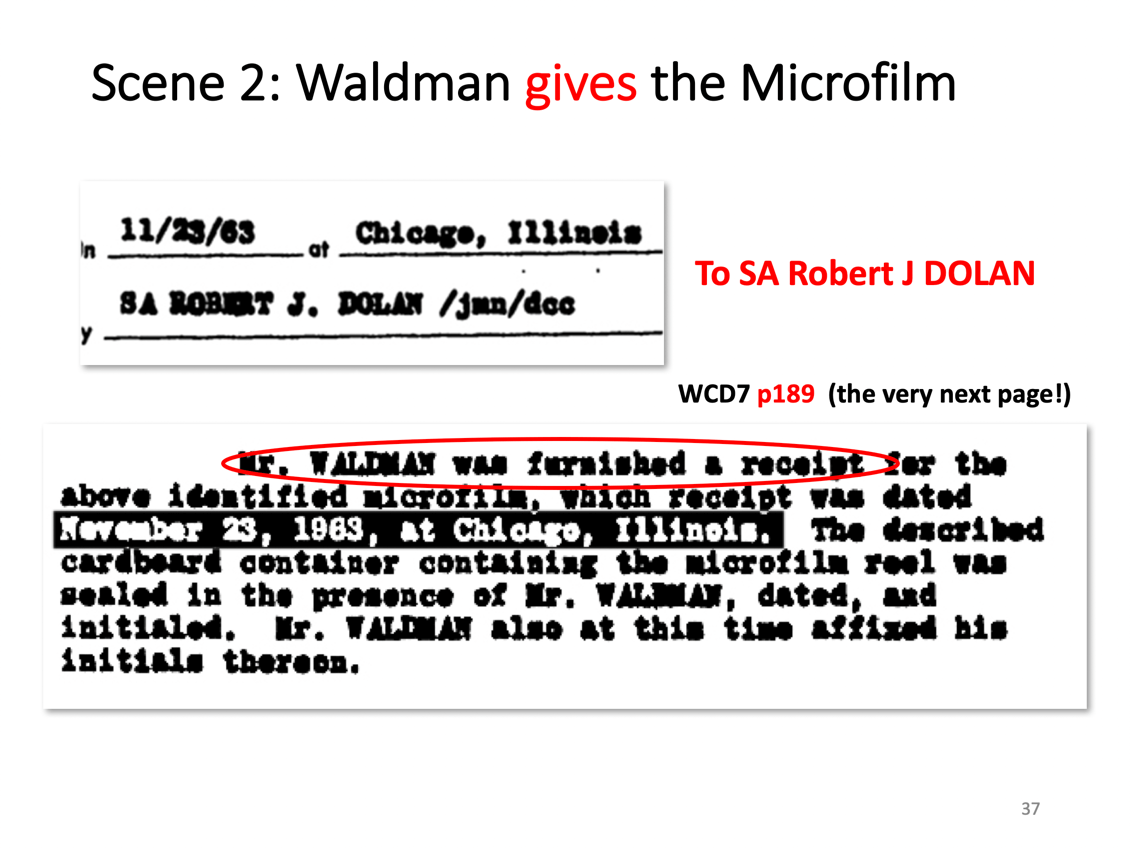
    At the XI World Festival of Youth and Students in Havana, Castro set up an agitprop court to prosecute the crimes committed by Yankee imperialism. On August 2, 1978, Cubela confessed to both CIA assassination plots against Castro and spelled an inconvenient truth for Roig: “It is absurd to think that a double agent would have spent 12 years in jail.” Cubela also testified before an HSCA panel in Havana. Castro rewarded him by granting the parole legally prescribed after serving half the sentence.

    The Cuban Exile Clandestine Operations

    As a fugitive from history, Roig runs so fast that he misses the two-track policy of the Kennedy administration towards Cuba after the debacle of Operation Mongoose. Roig just follows the track of (sometimes) autonomous operations by select Cuban exile groups, backed, in any event, by the CIA, and forgets the parallel track of accommodation with Castro. In fact, due to the ARRB, we now know just how feeble this activity was. For the incoming president Lyndon Johnson, CIA officer Desmond Fitzgerald wrote a report on what these operations consisted of at the time. He wrote that in the entire second half of 1963, there had been a total of five raids against Cuba. There were only fifty men involved in three cadres. In this letter, Fitzgerald admitted it was completely unrealistic to think that such a meager force would result in any real change in Cuba. He stated that they had now become counter productive, since they could not be taken seriously. And he advised they be discontinued. (Letter from Fitzgerald to McGeorge Bundy, 3/6/64)

    Ignoring this factual aspect, Roig can please himself with a pharisaic righteousness: Kennedy remained “true to his commitment to get rid of Fidel Castro,” thus ignoring Kennedy’s crackdown on other anti-Castro belligerent exiles groups. How the administration was going to overthrow Castro with fifty men is the author’s secret. Perhaps Roig was modeling his essay on the Peter Sellers comedy The Mouse that Roared?

    “Listen to Communications from Texas”

    After such an intermezzo, Roig next stages an act against intellectual integrity. The protagonist is the late Cuban defector Florentino Aspillaga, who back in 1963 was working for Castro at a listening post in Jaimanitas [a small beach town near Castro’s main residence, dubbed as Point Zero, seven miles west of Havana]. The script reads thus:

    On Friday morning, November 22, 1963, Aspillaga received precise orders: “The leadership wants you to stop all your CIA work, (repeat), All your CIA work” and listen to communications from Texas. Around 1:30 (Havana Time), “I began hearing broadcast on amateur radio bands about the shooting of President Kennedy in Dallas.”

    Roig drops the question: “Did Fidel Castro know Kennedy would be killed?” instead of asking: “Who would believe such a tale?” Castro would have never resorted to electronic intelligence to learn something that would have been instantly available through mass media. In 1963, info about anything occurring in Dallas during the JFK visit meant broadcast reports interrupting soap operas on the three national TV networks, and radio stations giving breaking news.

    Aspillaga was in fact a self-defeating storyteller. Radio amateurs must have just been chatting about what the commercial media had already reported. In late 1963, a unique witness gave conclusive evidence contradicting Aspillaga’s claim. French journalist Jean Daniel wrote a first-hand account (“When Castro Heard the News,” The New Republic, December 7, 1963). As Kennedy’s emissary, he was talking with Castro in Varadero Beach the very day of the assassination. After a phone call by Cuban President Osvaldo Dorticós, Castro got all the news “from the NBC network in Miami.” Daniel also recounted Castro was utterly shocked and turned to him saying—about the plans for rapprochement—that everything was going to change.

    Aspillaga told Dr. Brian Latell in 2007 that the CIA had learned the Jaimanitas’ story during his debriefing in 1987. However, it is not to be found among the documents—either declassified or withheld—from the National Archives and Records Administration (NARA) on the JFK assassination. The CIA would not have objected to furnishing a carefully redacted Aspillaga debriefing to the Assassination Records Review Board (ARRB).

    The Paris Meting (sic): Assurance of American support

    In this intermezzo, Roig again addresses Operation AMLASH to reinforce the discredited notion of Cubela as fake conspirator. The Castroite General Directorate of Intelligence (DGI) did not control but rather watched Cubela with a certain inefficiency. Before the Church Committee, the CIA moved to transfigure him into a double agent, even a provocateur, to hide its own shortcoming in recruiting a heavy-drinking, loquacious, third-rate Castro official who couldn’t provide any valuable service.

    The DGI manipulated Oswald’s Violent Outburst at the Cuban Consulate in Mexico City?

    Roig stages this act with an outright lie:

    Oswald requested at the Cuban Consulate in the City of Mexico a transit visa to Russia via Cuba and was denied. Oswald turned violent and began screaming “I am going to kill Kennedy.”

    As FBI super-spy Jakob “Jack Childs” informed J. Edgar Hoover, Castro himself recounted:

    I was told this by my people in the Embassy exactly how he (Oswald) stalked in and walked in and ran out. That in itself was a suspicious movement, because nobody comes to an Embassy for a visa (they go to a Consulate) [W]hen Oswald was refused his visa at the Cuban Embassy in Mexico City, he acted like a madman and started yelling and shouting on his way out, “I’m going to kill this bastard. I’m going to kill Kennedy” [Castro]was speaking on the basis of facts given to him by his embassy personnel, who dealt with Oswald, and apparently had made a full, detailed report to Castro after President Kennedy was assassinated.

    The Consulate was in a separate building from the Embassy. The Cuban diplomatic compound in Mexico City was located at Francisco Marquez Street (Colonia Condesa) with two main entrances: one to the Embassy, on the corner of Tacubaya Alley, and the other to the Consulate, on the corner of Zamora Street. Both the outgoing (Eusebio Azcue) and incoming (Alfredo Mirabal) consuls testified before HSCA that they did not hear Oswald threatening Kennedy’s life. Neither did the Mexican employee Sylvia Duran, who was consistent about it in both her interrogation by Mexican Police and her interview by the HSCA, nor did two other witnesses who had come downstairs from the Commercial Office.

    Roig’s opera seria continues as a vaudeville with a substandard duet: DGI defector Vladimir Rodriguez [dispatched by his own CIA debriefer, Harold Swenson, as lacking “any significant information” on Oswald] and Oscar Marino [an alleged former Cuban intelligence officer imported from the bestiary described by Gus Russo and Stephen Molton in Brothers in Arms (Bloomsbury USA, 2008)]. Roig closes the act by foisting two “outrageous lies [on Castro as] part of a premeditated deniability perfidy[:] that he knew nothing of Oswald’s existence before the Dallas assassination and that he was never informed of Oswald’s threatening remarks against Kennedy in the Cuban Consulate in Mexico City”. The latter is refuted by Childs’ report; the former is still wanting for any evidence.

    Fidel Castro Got Kennedy First

    Before the curtain falls, Roig concocts a Castroite Oswald with a Castro prone to react to the CIA plots against him in the spaghetti western manner summed up by Lyndon Johnson: “Kennedy was trying to get Castro, but Castro got to him first.” Such a fact-free approach thrives only on claques of people who cannot think logically or will not think logically, because they have a fanatical and counterproductive anti-Castro agenda.