Tag: JFK ASSASSINATION

  • Stanley Marks and Murder Most Foul! — A Sequel to “The Kennedy / Dylan Sensation”

    Stanley Marks and Murder Most Foul! — A Sequel to “The Kennedy / Dylan Sensation”


    Part I: A Murder Most Foul

    In September 1967, Stanley Marks attempted to position himself at the forefront of a soon-to-be cresting wave of JFK assassination research when he released Murder Most Foul! This self-published paperback represents a full-frontal attack against the official story promulgated by the Warren Commission (WC) and its lackeys in the media, but it’s also much more than that.

    Giving it a quick first glance, a contemporary reader might easily pass over the book. After more than sixty years of study and the release of millions of pages of government documents related to the assassination, a reexamination of the WC hardly seems necessary. Yet a more careful examination reveals that, in many ways, Marks was ahead of his time. While most of the Q&A’s comprising the first 136 pages of Murder Most Foul! serve to puncture holes in the Warren Commission Report and thus illustrate why it was a sham, there are also passages that go well beyond the usual framework of early WC critiques. Consider, for example, Q&A #46: “What is meant by ‘against the national interest’? The Warren Commission has never defined this undefinable phrase. However, after the publication of the Warren ‘Report,’ many commentators and historians interpret that phrase to mean that whenever a future president is murdered, his killers can escape capture and punishment if a future investigating committee decides their capture would be ‘against the national interest.’” Marks’ wry irony flourishes throughout, and this excerpt represents just one of many instances of the author’s trademark style of humor mixed with outrage, born from insight. And his reference to the “national interest” has been largely replaced by a term that we’ve seen with ever-increasing frequency over the last few decades: “National Security” with its concomitant erosion of civil rights; violation of human rights; and censoring of information that belongs in the hands of citizens.

    Like other reputable texts on the assassination, MMF! did not arise sui generis. It’s likely that Marks was inspired to borrow his “juridical” approach from Mark Lane, whose first essay on the assassination took the form of an imaginary “legal brief” in defense of Lee Harvey Oswald. But Marks was also a stylistic innovator. Instead of a straight narrative that dissects events in the manner of a typical researcher, he shaped his investigation into a “question-and-answer book” composed of 975 queries and replies, most of them taking the form of quick, rapid fire, staccato bursts of ammunition, which hit their target with a no-nonsense precision. In a blunt statement of intention, in the Preface he says: “The contents of this book have been arranged in the manner of an attorney representing a client in a criminal court and in the manner that a district attorney would present his case against the alleged criminal” (the latter being the Warren Commission). This was a fitting role, since Marks was trained as an attorney. He boldly concludes: “It is the proposal of this book to reveal the attempts of the Warren Commission to befuddle, delude, and deceive the American people who sincerely desire the answer to the question, ‘Who murdered President John F. Kennedy?’”

    Although the work of early researchers has been absorbed and superseded by that of subsequent authors, Marks still remains ahead of the curve when it comes to the larger picture that he paints at the conclusion of his book, which enters into a broader philosophical speculation regarding what will happen to the collective psyche of America as a result of the magic trick performed in Dealey Plaza in 1963. But first, Marks picks his way through the evidence and attempts to shock the reader into a new awareness—prosecutorial question by question—relieved only by a series of black comedic asides that remind one of the rants of a Mort Sahl or a Lenny Bruce; or that mimic the goofy stage whispers of a Groucho Marx. Perhaps he felt this was the only thing appropriate enough to level against an equally goofy “logic” exhibited by those seven wise men who formed the Commission. Therefore, he breathes fresh life into the manner in which we reassess the case. This is also reflected in the wry humor of his chapter headings. For example, chapter three: “Rifles, Rifles, Everywhere,” which refers to the different firearms that were first located in the Texas School Book Depository (TSBD), one of which would have served as a far more reliable weapon than the rusty Mannlicher-Carcano rifle supposedly owned by Oswald, which had undoubtedly been planted there. In Coup d’État! Three Murders that Changed the Course of History. President Kennedy, Reverend King, Senator R. F. Kennedy, a book Marks published in February 1970, he titles his second chapter: “The Fraudulent Autopsy, Or How to Lie in a Military Manner.” His humor is also displayed in chapter four of Coup d’État!, which bears the heading: “The Non-existing Paper Bag, Or How to Manufacture Evidence” (referring to a false claim that Oswald had slipped a rifle into a paper bag, then snuck it into work on the day of the assassination).

    One of the most ironic statements to appear in the Warren Commission Report is: “In fairness to the alleged assassin and his family, the Commission … requested Walter E. Craig, president of the American Bar Association, to participate in the investigation and to advise the Commission whether in his opinion the proceedings conformed to the basic principles of American justice.” (My italics) This was reported in Esquire magazine in 1965 and is reproduced in other early assassination texts. In turn, Marks seizes upon the absurdity of the phrase and runs with it. In fact, an entire chapter of MMF is devoted to this topic: “The Commission & Basic Principles of American Justice!” There, Marks asks: “Did the Commission adhere to those principles?” Answer: “No. The Commission permitted outright hearsay; it permitted perjury.” He concludes: “How can the interpretation of the phrase: “Basic Principles of American Justice” be made in reference to the Commission? On both Moral and Legal plateaus, the Commission was a disgrace to ‘Basic Principles of American Justice.’”

    In a recent post on the Education Forum, Jim DiEugenio remarks: “It’s one thing to attack the Warren Commission … but it’s another thing to try to explain what really happened.” This leads us to ask: did Marks go beyond a mere WC critique and enter into that more challenging arena of attempting to explain what actually happened (and why) on November 22? Bearing this in mind, I will highlight a few of the ways in which Marks does so in his unique manner, as well as place his work in the context of other books from the time. And unlike authors such as Sylvia Meagher or Harold Weisberg—who were unjustifiably critical of what District Attorney Garrison actually accomplished—Stanley not only appreciated Garrison’s efforts; he was also prescient in his analysis of how the Power Elite would attempt to foil the D.A.

    In chapter seven, Marks issues a warning that even researchers today would be wise to heed: “How many ‘Hearings,’ ‘Witnesses,’ and Affidavits were produced? The FBI inundated the Commission with 25,000 reports; in fact, the FBI gave the Commission so many reports of its ‘investigations’ that the FBI created a ‘fog’ over the work of the Commission. It now seems to have been deliberate for, in a period of 9 months, no group of 14 lawyers could have read, digested, and analyzed each report to see what each report would have on an overall picture of the conspiracy.” Let’s put this “fog” into context by examining an interview published seven months after MMF first appeared, in the April 1968 NOLA Express.. Citing a source associated with the CIA, Mark Lane says that a number of false leads or “clues” were purposely left “scattered around Dealey Plaza like leaves on an autumn day.” The leaves led to “false sponsors” of the assassination. About a year later, in a May 1969 interview with a European publication, Jim Garrison spoke about the “distribution of an endless amount of irrelevant information to cause confusion in the minds of those who might attempt a serious inquiry.” In his first book about the assassination, A Heritage of Stone (1974), Garrison seems to be referencing Lane directly: “False sponsors are created by prior planning and by the planting of leads trailing away from the intelligence organization … At a more superficial level, an abundance of leads is planted by prior planning to provide a frame-up of the pre-selected scapegoat.”[1] And in the mid-Seventies, shortly before Gaeton Fonzi began his work as a researcher for the House of Representatives Select Committee on Assassinations, Fonzi was warned by Vince Salandria (a lawyer and an early WC critic) that they would attempt to bury him with such pointless minutia.

    In chapter fourteen, Stanley takes CIA Director Dulles to task. He begins by quoting Dulles from an article that appeared in Look magazine in 1966: “If they found another assassin,” says Dulles, “let them name names and produce their evidence.” Marks replies: “This contemptuous statement directed at the American citizenry revealed the attitude of the Commission. The Commission did not praise the president; they gave him a funeral and used his shroud to conceal his murderers.” Taking a further dig at Dulles, Marks rhetorically asks: “Mr. Dulles, how can other assassins be named if material is NOT in the National Archives? Was there a conspiracy, Mr. Dulles? Of course there was!” At this point, the author offers a blunt appraisal of not only how the plot was covered up, but of why and how it happened: “The inception of the Conspiracy that murdered President Kennedy can be, and will be eventually, traced back to the disastrous ‘Bay of Pigs.’ The president relied upon the CIA, headed by Allen Dulles, whose information was one hundred percent wrong in the CIA’s assessment of Castro’s Cuba. Heads rolled but the CIA had many heads and the heads that remained never forgave President Kennedy […] Thus, in the wreckage of the ‘Bay of Pigs’ were parts and persons of the CIA apparatus who had directed that operation. The hatred of this apparatus for President Kennedy was to cease only when these forces fired four bullets into his body.”

    That’s a pretty direct a view of what the author thinks really happened and one that goes beyond a superficial WC critique. Next, he introduces the subject of Kennedy’s foreign policy—according to Marks, the most probable reason he was killed: “With the relaxation of tensions between the U.S. and the USSR after President Kennedy’s confrontation with the Soviets in the Cuban Missile Crisis, the Batista—Cuban exile organization, with many members on the CIA payroll, decided that Kennedy must go.” Three years later, in A Heritage of Stone, Jim Garrison would extrapolate on this theme of JFK’s attempt to end the Cold War and how it may have led to his undoing. But Garrison was already drawing this connection a few years earlier, as can be seen by certain interviews he conducted, which we shall explore in a moment.

    Although Marks couldn’t have known the full extent of the connection between various assassination attempts on De Gaulle and the Kennedy assassination, his instinct—coupled with his in-depth knowledge of European history—was already leading him in this direction: “As History has shown a conspiracy spreads rumors. The various assassination attempts upon President De Gaulle were always preceded by rumors and the French Agencies took care to track them down. Yet, in spite of this, De Gaulle narrowly escaped death when the attempted killers received word one hour before the attempt.” In fact, a figure linked to the numerous attempts on De Gaulle’s life was lurking in Fort Worth and Dallas at the same time that JFK visited those two cities during his final day on earth. As Henry Hurt explains in Reasonable Doubt (1987), a man claiming to be Jean Souètre, a French army deserter and member of the Organisation Armée Secrète (a right-wing French paramilitary group linked to attempts against De Gaulle) was apprehended by American officials in Dallas shortly after Kennedy’s murder and immediately expelled from the country.[2]

    After ascending a scaffolding replete with such incongruous official “facts,” we then encounter a broader perspective. Chapter thirteen begins with four final Q&A’s. The first two sum up the principal thrust of the book: “What did the Warren Commission prove? That a Conspiracy murdered John F. Kennedy. What did the Commission believe? They believed that those who could read would not read; that those who could see would not see; that those who could talk would not talk; and those who would investigate would not investigate.” Marks then dispenses with his numbered Q&As and, for the next seventeen pages, shifts into straight narrative. The titles of these final chapters give the reader a no-hold-barred window into the author’s apoplectic indignation. For example, this one is fittingly dubbed: “The Rape of the American Conscience.” And he places the blame directly up on the Commissioners: “The members of the Commission did not achieve their status in the American social, economic, and political scale by being stupid; therefore one can only conclude that these seven had some understanding, whether spoken or implied, that this Nation of 195,000,000 souls would be torn asunder if the Commission reported to them that a Conspiracy had murdered President John F. Kennedy. Yet, these seven men place their honor upon a Report that would wilt in the noonday sun.” Thus, the Commissioners—who certainly weren’t “stupid” —must have assumed that the American people were. After quoting Harry S. Truman’s dictum, “The buck stops here,” Marks concludes: “That the Commission was negligent and slothful in its responsibility has been proven beyond a reasonable doubt.”

    Murder Most Foul! title page

    Marks raises a point that should be carefully considered, especially in light of what would follow over the next half century: “When … the critics are attacked on the basis of personality instead of the measure of their facts, then it is a sign that the criticism has been correctly established.” As we would later learn from a declassified CIA memo, it was the CIA itself that first floated the strategy of attacking WC critics as mere “conspiracy theorists.” The author then poses a chilling question: “To whom does the American public go to seek the truth?” The answer is even more horrifying: “It can now be said that the American people do not believe anything stated in the ‘Report.’ Due to this lack of belief, a cynicism has now gathered among the Citizenry that bodes ill for the Nation. A nation whose moral fiber has been torn and shattered cannot long live; for when the Nation’s spirit is destroyed, no Nation will live.” Stanley repeatedly emphasizes the fact that four principles enumerated in the Preamble to the Constitution—justice, domestic tranquility, promoting the general welfare, and securing liberty were blasphemously violated by the conspirators as well as the Commissioners (at least one of which—Allen Dulles—was one and the same). Therefore, the Commission’s message to the American people is that justice, domestic tranquility, promoting the general welfare, and securing liberty will now no longer be taken for granted. The author concludes: “People, in all nations, must stand for an ideal. The United States of America was not born on the idea that its President could be shot like a dog in the street and his murderers be ‘shielded from this day on’ because it would be ‘against the National Interests.’” This line clearly resembles one from Dylan’s own “Murder Most Foul” when he sings: “shot down like a dog in broad daylight.”

    With the murder of an idealistic president comes the death of our own youthful idealism: “The Spirit has in this year of 1967 been replaced by cynicism of everything ‘American’ … The Youth … which a Nation must have to exist, had a feeling within them that the nation did not care for the future. There is no Spirit today. How can there be? A Congress that laughs at black children, brown children, white children being bitten by the rats of the slums? This is the Spirit of America? A Congress that passes a law which drafts only the poor, white or black?” Note how Stanley capitalizes both Nation and Youth, as if to highlight their equivalence and remind us that these are potentially sacred forces, crucial to society’s future well-being. Later on, he will also capitalize another term normally rendered in lower-case: Citizen.

    The author includes several remarks that appear to be aimed directly at Ronald Reagan, a future president of the United States who was then governor of California (where Marks currently resided): “A Governor that destroys an educational system? A Governor who believes that only the youth who has parents with money should enter the Universities and Colleges of his state? A Governor that believes mental health can be cured with pills?” Such challenges remain with us now, not just in one state but across the entire nation: racial injustice; poverty; unequal educational opportunity; and mental illness problems that are addressed with government approved pill popping, which in various other publications Marks links directly to the stress caused by lack of economic opportunities and the widespread cynicism that engulfed America. At the same time, Agency-asset Timothy Leary encouraged young people to use streets drugs to “tune in, turn on, and drop out.” And he specifically instructed his acolytes to avoid politics: “The choice is between being rebellious and being religious. Don’t vote. Don’t politic. Don’t petition.”[3] For the Establishment, Woodstock was preferable to a half million protestors showing up at the National Mall. The result of all this was that by the late Sixties and early Seventies “sex, drugs, and rock’n’roll” became a new opiate of the masses. While South American youth were tortured and killed because of their political beliefs, North Americans were often “disappeared” on a purely psychological level, via drug abuse.

    Marks would later make a direct reference to such matters in his study on monotheism, Jews, Judaism and the United States, where he warns: “Both the U.S. and the USSR have been using ‘mind-controlling’ drugs since 1970! However, various states have also been using such drugs to control “unruly” children (see S. J. Marks’ Through Distorted Mirrors, 1976).”[4] Thus, as early as the mid-1970s—decades before the widespread public indignation over the use of Ritalin to control schoolchildren—Marks was broaching the issue of the pharmaceutical industry’s abuse. (We’ll never know to what extent the market for psychotropic medication came as a result of a youth culture that had been encouraged to destroy their own psychic equilibrium with street drugs … as a true “Lost” Generation.) In the last book that Marks published, just three years before his death, he again took up this theme. If This be Treason (1996) is, in part, an exposé of the “Reagan-Bush administration’s involvement, through the CIA-Contra movement, in the distribution and sale of hard drugs to Afro and Latin American youths.” And although Marks doesn’t enter into the subject of LSD abuse in his early work, in Coup d’État! he employs the term as a metaphor to signify the illusions spun by the Warren Commission. Hence, Coup’s chapter five is titled: “LSD–Hallucinations and Charades.”

    Very much in the spirit of Publilius Syrus (“The judge is condemned when the guilty is acquitted”), Marks concludes the penultimate chapter of MMF by addressing Allen Dulles; and, with a lovely touch, issues his own verdict against both Dulles and the Commission: “No, Mr. Dulles, it was not the responsibility of the American Citizen to find and name the assassins; that was your task. Your lack of responsibility to the task is the cause for your failure. You issued the “Report” under your name; you had at your disposal the entire operating machinery of the Government of the United States. We citizens have only what you and your fellow commissioners wrote. We read, we looked, we analyzed, we thought; and we, nearly 70% of us, now deliver a verdict on your work: The Warren Commission was a failure.”

    The Postscript of MMF is graced by the title: “Jim Garrison, ‘St. George’ Versus the ‘Dragon’!” Unlike other researchers who were snookered by the mainstream media’s drumbeat assault upon Garrison (one that we now know was orchestrated by the CIA), Marks realized that Garrison, as St. George, was up against a State-sponsored dragon. The author begins with this statement: “By the time this book appears in print, the Kennedy Conspiracy may claim another victim; none other than Jim Garrison, the District Attorney of New Orleans, whose ‘lance of truth’ has pierced vital organs of the Conspiracy That Murdered President Kennedy.” Was Marks correct? Yes, if we consider “character assassination.” On the final page of MMF, Marks makes a prediction that, sadly, comes to pass: “As the day for the [Clay Shaw] trial approaches, the greater the use of the media for the perpetration of the lie increases. If the forces behind the Conspiracy cannot destroy Mr. Garrison’s case, they may decide to destroy the man, either physically or by reputation.” Indeed, this proved to be the case: the powers-that-be went after Garrison’s reputation and attempted to sully it. As Gaeton Fonzi discusses in The Last Investigation, the Agency had long since perfected its craft of sullying and destroying the reputation of world leaders who refused to tow the line; and such black arts were applied even in the early 1950s. Character assassination would also prove to be a second, posthumous conspiracy launched against JFK. Regarding the media’s obsequious role in all this, Marks adds: “Various members of the mass communication media bribed witnesses, hid witnesses, issued fraudulent interviews … [and] produced nation-wide television programs which upheld the findings of the Warren Commission. How incredible! Why? The answer to ‘why’ can be found in the fact that many of the inactive and active participants of the Conspiracy will be found in the ranks of the government and the economic strata of our Nation.” Marks now introduces the crucial subject of the ruling economic elite, which exists one level above the CIA. This concept was rarely broached by assassination researchers until Fletcher Prouty published The Secret Team (1972). In a Preface to the second edition, Prouty says the Agency’s real task is to serve as a “willing tool of a higher level Secret Team … that usually includes … certain cells of the business and professional world.” This line of thought was further probed by Donald Gibson, who notes that the finger-pointing cannot stop at the level represented by the CIA or military intelligence, because above and beyond this there lurks an economic Power Elite (as it was dubbed by C. Wright Mills in a book by that same title, published in 1956).

    Such concepts would certainly not have been alien to Marks. In his 1971 attack on the Nixon administration, Watch What We Do, Not What We Say! he includes a chapter titled “The Establishment” in which he sums it up nicely: “It can be said that not more than 8,000 persons … comprise the Establishment. They control every major decision, foreign and domestic, made in the nation. It is not a ‘conspiracy’ but a ‘meeting of the minds.’ They sincerely believe that ‘what is good for them is good for the country.’” “At the foreign policy level, the ‘Establishment’ works through the following four agencies: (1) the Council of Foreign Affairs; (2) the Committee for Economic Development; (3) The National Security Council; and (4) the CIA.” Much of the rest of this chapter is comprised of lists of other organizations, foundations, and corporations funded by Establishment forces and tasked with “the movement of policy directed by the Establishment.”[5] All this has a direct bearing on Dulles, who worked as a partner on the law firm of Sullivan and Cromwell (along with his brother, John Foster Dulles), a firm that represented leading multinational corporations and interests such as those of the oligarchic Rockefellers. As a principal law partner there, Dulles was positioned at the apex of a visible pyramid of power. But above this first structure one can also imagine a second, inverted pyramid: one far less visible and inhabited by those éminence grises discussed here.[6] The Dulles brothers served as interlocutors between these two structures, via institutions such as Sullivan and Cromwell.

    To jump ahead for a moment: although Marks was not familiar with the name “Operation Gladio” (which remained secret until 1990), he was aware of Clay Shaw’s involvement with the Centro Mondiale Commerciale (CMC) and with Permindex, organizations that both appear to have served as funding mechanisms in a global war on the left. In Coup d’État!, Marks discusses the connection between CMC and Permindex and the assassination attempts on De Gaulle. Therefore, by raising the issue of De Gaulle, Marks places Kennedy’s death into a broader perspective: the worldwide war on the left, sanctioned and manipulated by an economic elite. Marks was also aware of the CIA’s chicanery south of the border. Shortly after Chile’s Salvador Allende became the first Marxist president in Latin America (assuming office on November 30, 1970), Stanley published his critical attack on the Nixon presidency, Watch What We Do, Not What We Say! During a discussion on the dangers of the Agency, almost as an aside, he accurately predicts what will happen next in Chile; and he does so by tying the fate of that nation to Vietnam: “After the extermination of the Indo-Chinese nations as nations, the CIA will then proceed to ‘exterminate’ another nation–Chile. The Establishment’s propaganda is already being published with the same old trite and dreary slogans: ‘The Chileans pose a threat to our security.’ A nation that is more than 5,000 miles away from the territorial mainland of the United States, with no navy, army, or air force that cannot even drop leaflets on our mainland! Thus, with the CIA ‘protecting’ the people from ‘invasions’ and the FBI maintaining its ever-vigilant status over the ‘dissenters,’ the people calmly lockstep their way into a prison of their own making.”[7] Two years after this was published, on September 11, 1973 the Agency organized and staged the coup that would overthrow the democratically elected government of Allende and usher in a murderous right-wing dictator, General Pinochet, who dissolved all remnants of democracy and replaced them with a junta that ruled by fear, torture, and the “disappearance” of those who had the courage to resist. Stanley saw it coming, because his in-depth historical research had trained him to recognize broader historical patterns. On the penultimate page of MMF, Marks condenses everything discussed here regarding the economic forces behind the media’s manipulation into a remark: “To whom does the mass communication system owe its loyalty? To the people who have fought, are fighting, and will continue to fight for the ideas of the ‘freedom of the press’; or to its advertisers?”

    In conclusion, Marks invokes a fellow lawyer and philosopher who served as the third American president and whose words Marks uses to plead his case. “Thomas Jefferson once said that the most important factor in a democracy is a free press; he did not say a ‘privileged’ press. The hideous activity of NBC, CBS, ABC, and other organs of the mass communication media can lead to a conclusion that certain members of that media know that President Kennedy was murdered by Conspirators and the Conspiracy must never be allowed to face the light of day.” Stanley ends on a note that continues to resonate, because what he calls the “light of day” has yet to emerge—for reasons we know all too well. We are still facing the same challenge.

    In his second book about the assassination, Two Days of Infamy: November 22, 1963; September 28, 1964 (published in March 1969), Marks would briefly expand on these themes. “The citizens,” he says, are “living in a dream world concocted by the mass communications systems” which has convinced them that such a “secret could not be kept” despite the fact that the public usually remains in the dark unless the actual conspirators are apprehended. Although we may not be able to “name the assassins, “A Conspiracy has been proven beyond a reasonable doubt. But what was the purpose of the Conspiracy?”[8] Twenty-five years after he published MMF, Stanley would tie the strands of economics and media together in a single statement in his final book about the assassination, Yes, Americans, A Conspiracy Murdered JFK! (1992): “Many persons cannot understand the reason why the powerful newspapers and … television and radio chains have kept a constant drumbeat against the critics of the Warren Commission. The reason is quite simple–when the president was murdered the Power Structure shifted both economically and politically.”[9]

    Part II: Footprints of the Bear: A Brief Biographical Sketch

    One of the only clues I possessed about the identity of Stanley Marks was printed on the back cover of MMF: a note saying that he’d previously authored a book called The Bear that Walks Like a Man. A Diplomatic and Military Analysis of Soviet Russia. Once I ordered a copy, I discovered another clue on the acknowledgments page: a note to “my wife, Ethel, and my daughter, Roberta, for their encouragement and inspiration.” With this information, I was able to locate a record of Stanley in a 1940 Federal Census, where our biographical tale begins. Not long afterward, I successfully tracked down Stanley’s daughter, Roberta, who kindly provided enough information to fill in the gaps that, until then, had remained a mystery.

    According to the census, Marks was born in Waukegan, Illinois in 1914, just three years before the birth of JFK. When he was four years old, his parents died from the 1918 influenza pandemic that infected a third of the world’s population. The names of his biological parents are not known. According to Roberta, after their death, Stanley was placed in the care his foster parents, Sarah and Samuel Markowitz, from whom he took his surname, later changing it to “Marks.” One of the few things Roberta knows about her father’s upbringing is that Stanley often said “he never had enough food. When you see pictures of him as a youth, he was bone-thin.” One is tempted to surmise that his privations and experience with hunger on Chicago’s hardscrabble streets may have helped to open his eyes to a certain political awareness—or at least, helped to mold him into a lifelong FDR New Dealer.

    Shortly after his twenty-second birthday, Stanley married Ethel Milgrom, a nineteen-year-old Chicago native. Ethel would later “co-author” several of his books, although primarily she served as his editor, helping to polish Stanley’s sometimes awkward, strident prose.[10] After attending the University of Illinois in 1937, he graduated from the affiliated John Marshall Law School, which is still Chicago’s only public law school. Thanks to a yearbook posted on Ancestry, we have two professionally composed photos of Stanley. One is a traditional portrait, which captures a bespectacled young man bearing a bright-eyed, notably intellectual look. The other features full-length figures of eight young men and two young women in the midst of a debate, broadcast by a Chicago radio station. Stanley is positioned before an old-fashioned stand-up mic, dressed in a smartly tailored suit.

    Marks graduated during a precarious moment in history; and perhaps this explains why a law school graduate was working as a salesman. The Great Depression was still in progress and would continue its devastation for another couple of years, until America’s entry into WWII, when the defense industry kicked into place. In March 1933, at the peak of the Depression, fifteen and a half million were unemployed–over a quarter of the work force. It was a time of raging debate about capitalism versus alternate political systems. As John Kenneth Galbraith later remarked in a paper on U.S.–Soviet relations, “The Great Depression, when it came, suggested an intractable weakness in capitalism.”[11] Galbraith adds that a fear of its collapse may have served to energize those more dictatorial, right-wing elements that believed the only way to prop it up was to curtail civil rights. But in order to preserve the system, FDR made accommodations to the left rather than take a dictatorial turn to the right. In the midst of this whirligig of change, Stanley’s political allegiances were cast.  

    Yearbook photo, 1937. SJM third from left.

    Stanley and his wife were sharing a household with Ethel’s father, Joe Milgrom, who had immigrated to the U.S. from Poland in 1913; and Ethel’s mother, Eva Wolovoy, who arrived from Russia that same year. What the census doesn’t mention is that, by 1939, Stanley had begun research on what would eventually become a 340-page book about Soviet Russia; so one cannot help but wonder how his views may have been enriched by conversations with Ethel’s mother, a native of Kiev. One of the remarkable things about this accomplishment is that he put the finishing touches on this tome while employed at a wholesale company that manufactured billboards. This fact is noted in The Billboard, the well-known music industry magazine. Its March 13, 1943 edition features a piece that contains some crucial biographical data:

    Salesman Author Making Plans for Second Book Soon

    Stanley J. Marks, sales representative of Gardner & Company here, is the author of a book that has received creditable mention by reviewers. The Gardner firm manufactures sales boards.

    The title of the book is The Bear That Walks Like a Man and is published by Dorrance & Company, Philadelphia. Marks says he spent four years in research and study of the foreign policy of Soviet Russia as a preparation for writing the book, which deals with the strength of the Red Army, its organization, tactics, and strategy. Marks is also known as an aviator and commentator on foreign and national affairs.

    Among those who have recently reviewed the book are Sterling North, of the Chicago Daily News, A. C. Spectorsky, of the Chicago Sun, and the book reviewers of the New York Herald Tribune and the New York Times.

    The publishers report that present sales are encouraging.

    Marks is working on a second book which deals with military science as practiced by the United States Army.

    According to the Bear’s inside dust jacket, “the author discusses the tragedies that have resulted from the policy of isolating Russia from normal intercourse with the rest of the world.” Bringing a Russian “Bear” into a normalized channel of communication—and no longer insisting upon its isolation—would prove to be one of the most important efforts made by President Kennedy. Soviet Premier Khrushchev even spelled it out for JFK in a telegram delivered October 26, 1962 in the midst of the Cuban Missile Crisis, when Khrushchev bluntly stated: “Let us normalize relations.” In his book, Marks issues a clear warning against isolationism: “There has been a growing tendency among the Anglo-Saxon nations to treat the Soviet and Chinese people as poor relations.”[12]

    What led this intelligent, well-adapted member of society—a lawyer, to boot—to fall prey to the allure of JFK assassination research? Was it the same unwavering belief in justice that compelled so many others to step into a void that should have been filled by some earnest, government sponsored mission? If we can judge anything from the idealism that drives the narrative of the Bear, a good guess might be an unmitigated passion for truth, and a steadfast belief in the value of its importance. However, there may have been additional factors at play; for, as we shall see, Stanley was himself victimized by the government’s encroachment on the civil rights of its citizens. And the event that triggered this was the publication of his first book.

    The Bear was copyrighted in 1943, a couple of months before the author’s twenty-ninth birthday. Shortly afterward, copies were circulated among journalists in the mainstream press. One of the first reviews it received appeared in the February 28, 1943 edition of the Democrat and Chronicle Sunday Magazine (Rochester, NY). It’s a glowing and lengthy treatment, featured prominently between a review of an H. L. Menken’s memoir and a review of William Saroyan’s latest novel. But Stanley receives more column space than either of these celebrated authors. Titled “A Forceful Espousal of Russia’s Cause,” it opens: “With a partisan enthusiasm which first affronts and then convinces his reader, Stanley J. Marks uses his diplomatic and military analysis of Soviet Russia … to show that had the Western democracies not isolated the USSR there needn’t have been a world alliance of heavily armed forces to chase Hitler and Tojo back to their lairs.” In a telling summation that foreshadows why Stanley would soon get into trouble, the reviewer adds: “In no less fulsome manner does Marks praise everything Russian, its strategy, its fighting qualities, its armed forces, its economic power, and above all its diplomacy, which at all times protected Russia against the ‘inevitable’ day when Hitler threw the might of his triumphing army against the Soviet’s strength.”

    One month later, on March 28, the Chicago Tribune featured a major review by the highly accomplished Harvard graduate John Cudahy, a World War I veteran who served in the American Infantry against the Bolsheviks in Russian’s Civil War. He later authored a book critical of U.S. involvement in Russia: Archangel–the American war with Russia. Cudahy’s credentials were impressive; he served under FDR as ambassador to Poland, Ireland, and Belgium; and as minister to Luxembourg. By 1941, Cudahy had published five other books. That same year, Life magazine commissioned him to interview Hitler. Although Cudahy’s review is mainly a summary of the book, he adds: “It is a detailed recitation of Soviet past grievances against the Democratic Powers–all the more painful for being irrefutably true.” Gaining the attention of a reviewer of Cudahy’s status in a major newspaper was no small accomplishment.

    The following week, the Hartford Courant published an essay titled “New Facts about Russia.” The reviewer opens by stating: “Stanley J. Marks’ leaning toward communistic philosophy is apparent” (a remark that, in itself, would have been enough to bring Stanley to the attention of the FBI), but then adds, “but this in no way detracts from the value of the book. His diplomatic and military analysis of Soviet Russia may not tell the whole truth, but then the whole truth is impossible at this stage of the game, and he does acquaint the reader with a great deal of fact with which the American public is unacquainted.” Thus, despite certain caveats, the author continued to be received favorably. I was able to trace notices, reviews, or full-scale essays in over twenty mainstream papers and one journal. The only negative piece appeared in the form of a one-line dismissal in the predictably conservative Foreign Affairs journal, which merely states: “An only moderately successful summary of recent diplomatic history and an analysis of the Soviet’s military strength.” Yet, even here, the reviewer felt compelled to include the adjective “successful.” A first-time author could not have asked for a better reception for his thankless labor. Even the professional journal of the U.S. Army, The Command and General Staff School Military Review (April 1943), notes that Stanley’s book had been added to their library. What made Stanley’s accomplishment all the more noteworthy is that his publisher, Dorrance, was a vanity press. And, even more exceptional, his contract with Dorrance indicates that it was the publisher, and not the author, who footed the printing bill. When I recently contacted an executive at Dorrance and explained the terms of the contract, his reaction of surprise confirmed for me that this arrangement was highly unusual.

    Perhaps as a result of such success, Stanley decided to leave his job as a sales rep and instead pursue a teaching career at the Abraham Lincoln School, which opened in Chicago in the spring of 1943. The venue was a perfect fit for a man of his beliefs. It was founded by William Patterson, an African American civil rights activist, who sought to establish a “nonpartisan school for workers, writers, and their sympathizers” that would assist African Americans who were migrating from the South, to work in Chicago’s factories.[13] Artists and writers such as Rockwell Kent, Howard Fast, and Paul Robeson lent their support; and Chicago-based authors such as Nelson Algren and Richard Wright were invited to lecture there. As we shall see, all this would lead to the kind of attention that was guaranteed to drive another nail into the author’s vocational coffin.

    Marks also became engaged in a brief career as a reviewer and essayist for the Chicago Defender, a widely celebrated African American newspaper. Politically speaking, the Defender was another perfect fit. Founded in 1905 by a young African American named Robert Abbott, the Defender gradually rose in prominence to become one of the most important periodicals for African Americans in America, and it would play a vital role in the Civil Rights Movement. During the Second World War, the editors of the Defender and other Black press leaders promoted the “Double V Campaign”: a proposed “Dual Victory” over both foreign and domestic “enemies” who remained opposed to racial equality and justice for all. Double V baseball games, “victory gardens,” and dances were organized by African American communities; and Double V clubs staged protests, met with Congressmen, and pressured businesses to halt discriminatory hiring practices. As a result, J. Edgar Hoover—who considered such acts to be “treasonous”—almost convinced Roosevelt to allow him to prosecute Black press leaders under the Sedition Act.

    The Defender articles give us a direct glimpse into both the author’s philosophy as well as the larger issues that engulfed the nation in the early Forties. For example, in a review published on May 8, 1943, Stanley begins with a fiery summation of two titles, Germany’s Master Plan by Borkin and Welsh; and The Coming Showdown by C. Dreher: “A detailed picture of the methods by which various business and industrial interests in this country either sold out for were ‘duped’ by the Axis cartel system into slowing down U.S. war production is given in these two volumes.” He also discusses topics such as “how American business was tied hand and foot to I. G. Farben” With his banking ties to Nazi and Fascist business interests, Allen Dulles would not have been thrilled to read about this. As David Talbot discusses in his Dulles biography, The Devil’s Chessboard, “the Dulles brothers had helped launder Nazi funds during the war,” and Allen’s wartime position as Swiss Director of the OSS helped him to do so.[14] Nor would Senator Prescott Bush care to be reminded of such embarrassing contretemps. As the Guardian newspaper reported decades later, the father of President H. W. Bush was a “director and shareholder of companies that profited from their involvement with the financial backers of Nazi Germany”; and “his company’s assets were seized in 1942 under the Trading with the Enemy Act.”   

    Two years later, on April 15, 1945, a notice appeared in the Fort Worth Star-Telegram, sourced from an AP dispatch. Under the heading “Army Writer at Camp Hood,” we read: “Pvt. Stanley J. Marks, author of ‘The Bear That Walks Like a Man’ and a 750-page ‘History of the U.S. Army and Military Science,’ is in training at the Tank Destroyer Replacement Training Center, Camp Hood.” By now, it’s clear that Stanley’s research on this history text was being commissioned by the Army, since another article states that the War Department has given its permission for the book to be published after the war. Similar articles appeared on this same day in several other Texan papers, such as the Kilgore News Herald (“Colonels Don’t Tell This Private Much,” the implication being that Stanley knows more about military-science history than his superiors); Victoria Advocate (“Army Private is Army Authority”); and the Taylor Daily Press (“This Rookie ‘Knows it All’”). Four days later, the Llano News in Llano, Texas, featured an in-depth piece on Marks: “Camp Hood Man Authority on Military Tactics.” Besides mentioning his new 750-page tome, it adds that while Stanley was researching his book on Russia he received assistance from none other than Secretary of State Cordell Hull, who gave Stanley direct access to State Department files. Hull was the longest-serving Secretary of State in U.S. history, under FDR. Seven months after this article appeared, Hull received a Nobel for his central role in establishing the UN. Roosevelt even called Hull “The Father of the United Nations.” The Llano article also provides one of the best extant sources of data on Marks’ professional life:

    The Tank Destroyer Replacement Training Center is now training one new soldier who has a distinct advantage over fellow-trainees during classes in Army history, tactics, and administration.

    He is Pvt. Stanley J. Marks, 31-year-old-Chicagoan and also author of the best-selling “The Bear That Walks Like a Man” and a 750-page “History of the U.S. Army and Military Science.”

    Marks spent three years putting together his “Bear,” a book about the diplomatic and military career of Soviet Russia, gathering much of his material from the files of the State Department, opened to him by Secretary Hull, and the vast military library of the Command and General Staff School at Fort Leavenworth, Kansas. Reprints of the book are still selling three years after publication and a chapter on the Red Army was reprinted by a national digest.

    His history of the Army has been published in part and the War Department has given permission to print it as a whole after the war. The book includes chapters on the military arms and tactics of other nations as well as the United States, and sections on sea power, logistics, and military administration. It took two years to write.

    Marks attended the University of Chicago, was graduated from the University of Illinois, and also John Marshall Law School in Chicago.

    His varied career has included service as personnel manager for a Chicago company employing 800 persons, teaching military science at the Abraham Lincoln School in Chicago, writing for the Chicago Sun and Daily News, and serving occasionally as a commentator for the Columbia Broadcasting System. His hobbies include piloting his own plane and reading from a library of 5,000 volumes, on mainly military and political subjects, that he has accumulated.

    For a time he worked for an aircraft company, writing technical manuals illustrated with “explosion” drawings of famous warplanes and cargo aircraft. The manuals are used by the Army and Navy in the field. He thinks there will be great opportunity for writers in this field after the war. During the last three national political campaigns, Marks was on the Democratic National Committee, engaged in writing publicity.[15]

    After all this glowing media attention, the author seems to vanish from public view from 1945 to 1966. I began to wonder if he’d been blacklisted; for this period overlaps with the witch hunts of the House Un-American Activities Committee (HUAC) in the Forties, as well as the subsequent plague known as McCarthyism in the Fifties (1950-54). When I shared my suspicion with my colleague Jim Lampos, a local historian who’s conducted extensive research on post-WWII politics, he found the answer in less than a minute: “Stanley’s name turns up in a House Un-American Activities Committee hearing in 1944, and it cites his book on Russia.”[16] A search at Internet Archive unearthed a document titled Investigation of Un-American Propaganda Activities in the United States (U.S. Government Printing Office, 1944) in which Marks’ name appears on three separate pages.[17] His “crimes” include working as an instructor at the progressive Abraham Lincoln School; composing “articles for labor papers”; and “having written favorably about the Soviet Union.” The HUAC report even includes an entire chapter on the Abraham Lincoln School (pp. 292-309), and it notes that the school “makes a special effort to cater to members of trade unions.”

    HUAC’s investigation was neatly prepared by an obliging exposé published on October 12, 1943 in the Chicago Tribune. Under a glaring banner, “Red Teachers on Faculty of Lincoln School,” a reporter breathlessly intones that the school “represents one of the most ambitious attempts yet made by the internationalists allied with advocates of communism to train a large corps of expert propagandists to further their attacks against the American republic.” A subsequent search for material on the Lincoln Brigades yielded a 1948 publication prepared by the California State Legislature: the Fourth Report of the Senate Fact-Finding Committee On Un-American Activities, in which Stanley’s name again appears, in a section titled “Communist Front Organizations.” Under the subsection “Abraham Lincoln School,” we read: “This Communist institution was established in the early part of 1943.”[18] (The same 1948 report that blacklisted Stanley includes nine pages on author Dalton Trumbo’s “Communist” record. (Author of Johnny Got His Gun, Trumbo was one of the “Hollywood Ten” who refused to testify before HUAC.) During this period, Ronald Reagan, then president of the Screen Actors Guild, was secretly cooperating with the FBI as an informant, handing over names of fellow actors whom he deemed to be “Communist sympathizers.” By then, HUAC’s Hollywood hearings were in full swing and getting plenty of press coverage. As Marilyn Monroe’s husband, the playwright Arthur Miller, remarked, what better way to get news coverage than to talk about “Commie” movie-star celebrities? Two years later, on September 2, 1950, an article linking Stanley’s school to the Red Scare appeared in Billboard, the very magazine that had once given his Bear such a boost. In an article titled, “Subversive Groups–Duck ‘Em,” it features a list of “Communist” organizations. At the very top of the list, we read: “Abraham Lincoln School, Chicago.” By this time, the Bureau had opened files on the school and its members. The National Security Agency (NSA) also had an eye on the school. In a June 3, 1953 memorandum, “Affiliation or Association with Organizations Having Interests in Conflict with Those of the United States,” the Abraham Lincoln School is sandwiched between a listing of the Abraham Lincoln Brigade and the Action Committee to Free Spain Now.

    This same Billboard features an article about how Brigadier General David Sarnoff positioned had himself at the head of a frontline attack against those dirty, filthy Commies (“U.S. Media Can Lick Red Lie”). How nimbly–and predictably–the actors assume their proper role on stage! In 1929, Sarnoff became president of RCA, which later became the “technological base of the National Security Agency (NSA).”[19] He also organized NBC, in 1926. A good friend of Allen Dulles (as this cozy Cold Warrior correspondence demonstrates so well),[20] he frequently served as a CIA tool. David and his brother Robert (the latter was NBC’s longest serving president) stood at the forefront of media attacks against Jim Garrison.

    In any case, by the mid-Forties Marks’ final footprints appear all the more ominous because, suddenly, he disappears from view. The political tide was changing, and the blacklistings of HUAC would eventually morph into McCarthyism. Thus, Stanley’s life mirrors in microcosm what was happening all across a broader political spectrum. He was caught in a vise between an old liberal FDR guard and an increasingly powerful right-wing, the latter embodied by the likes of the Dulles brothers; Hoover; the whole Eisenhower / Nixon clique; and the burgeoning force of a clandestine intelligence community. Although he was blacklisted by such overly zealous forces in 1944, he may have simultaneously been benefitting from his contacts within the Democratic Party throughout 1945, when his status in the military may have seemed secure. After all, how many Army privates have any contact with figures such as Secretary Hull? And how many receive the sort of media attention that Stanley garnered—despite being slandered by HUAC?

    The House Un-American Activities Committee was originally founded in 1938 and continued its uniquely un-American existence until 1969, at which point it became known as the House Committee on Internal Security. By the early Sixties, however, the effects of the blacklist were beginning to wane. One incident that played a significant part in this sea change occurred in December 1960, when a newly elected President Kennedy crossed an American Legion picket line to view the film Spartacus. The movie featured a screenplay by Trumbo and is based on an eponymously titled novel by Howard Fast, another blacklisted author. (As a result of being blacklisted, Fast was forced to self-publish Spartacus, which underwent seven printings and sold 48,000 copies before being reissued by a major publisher.) According to social activist Danny Goldberg, author of In Search of the Lost Chord, “The new president effectively ended the blacklist that had excluded hundreds of left-wing writers, actors, and directors from working in Hollywood films and network television, thereby creating the space for a more rebellious and diverse mass audience.”[21]

    After Marks was given the honor of being labeled “un-American,” the trail grows thin and peters out. We know that he served under General MacArthur only because he makes note of it on several of his later book covers. One says he was stationed in the Armed Forces, “SoWesPac T.O. under General MacArthur.” SoWesPac refers to the South West Pacific theatre, a principal battleground after the bombing of Pearl Harbor. “T.O.” stands for the Territories of Papua and New Guinea. MacArthur was appointed Supreme Commander, South West Pacific Area, in 1942 (the Territories comprised one of the seven principal regions of SoWesPac). Since the Fort-Worth article from April 1945 is very detailed and includes all sorts of biographical data but says nothing about the author serving under MacArthur, it’s probable that he arrived in the Pacific after April. And according to the back cover his If This be Treason, he was “honorably discharged in 1946.” Some of these questions were answered when I finally received my first call from Roberta. She did recall Stanley speaking on several occasions about MacArthur and she verified that, while he was in the service, he’d been stationed in the Philippines. “He used to joke … because I don’t think he saw any actual warfare there. Instead, they put him in the publicity office. He wrote and edited a staff newspaper.” The day after we spoke, Roberta forwarded an artist’s sketch of Stanley that was originally composed in the Philippines, dated 1945.

    Shortly before her twenty-first birthday, in 1963 Roberta moved to LA. Her father visited during a business trip just a couple of weeks after the president’s assassination. Roberta recalls his reaction: “He was very depressed. We were all depressed. It was such a traumatic time. There was an overall heaviness and gloom. Everyone was heartbroken; it was devastating. And anyone who was a normal person would be depressed. Like most people, my father felt the election of Kennedy was like a breath of fresh air. Someone younger, to move the country forward. My impression is that he was totally enchanted by JFK.”
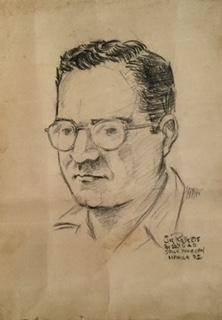
    Artist’s sketch of Stanley J. Marks, Philippines, 1945.

    Once Roberta’s parent’s realized that their only child wasn’t returning home, they decided to join her. In December 1964, Ethel briefly remained in Chicago to tie up loose ends while Stanley flew to LA. He resurfaced in the public arena when his first ad for Murder Most Foul! appeared in a December 1, 1967 edition of the Los Angeles Free Press: an underground paper that was affectionately referred to as the “Freep.” Although he would never again receive the kind of high-profile accolades sparked by his first book, the publication of MMF did not go unnoticed. Ever aware of the need for publicity, the inside cover features reviewers’ blurbs from ten different periodicals. The following year, on January 12, 1968, The Berkeley Barb (another widely read “hippie” paper, known for its combination of psychedelia and radical politics), featured a half-page review. In the spirit of the times, the reviewer uses the term “mind-blowing”; compares MMF to William Manchester’s Death of a President (referring to the latter text as an “epic rationalization that Oswald killed Kennedy”); and ends with a suggestion: “read Marks’ book and toss and turn the rest of the night.” Hoping to kick-start MMF, Stanley placed ads in three subsequent editions of the Freep, all the way into February 1968. One is tempted to speculate that Dylan or one of his associates may have become aware of MMF as a result of scanning through such popular countercultural papers.

    In March 1969 (about a year after the assassination of Dr. King, and fifteen months after the murder of Bobby Kennedy), Stanley published Two Days of Infamy: November 22, 1963; September 28, 1964, the latter “date of infamy” being the day the WC released its report. In this text, he was already using the term “conspirators” when referring to the assassins of these leaders. And he adds: “History has proven that once assassination has become the weapon to change the government, that style and form of government preceding the assassination falls beneath the hard-nailed boots of the assassins […] The tragedy of the Warren Commission is that they helped set those boots on the Road to the Destruction of American Democracy.[22] This represents relatively early point in time reach such a conclusion. One of the ways he arrived at this was to do precisely what Jim Garrison always recommended: study the reoccurring patterns. In February 1970, he published Coup d’État!, his third assassination-related title. That same month, the Freep hosted an article titled: “Assassination Story Slowly Disintegrates,” which is based largely on Stanley’s latest book. The story focuses on how Dallas Police Chief Curry, who had publically supported the WC, was now admitting that he’d given a press conference shortly after the assassination during which he’d stated that no fingerprints or palm prints of Oswald had ever been found, and that there weren’t any witnesses who could place Oswald “at the same sixth-floor window prior, during, or after the president’s murder.” The article claims that Curry was now admitting all this because “Curry had obtained information that his testimony given under oath before the Warren Commission in 1964 was to be published in a forthcoming book, Coup d’État! written by Stanley J. Marks.” As if providing a hermetic foreshadowing of the Dylan / Marks connection that will emerge decades later, an ad for D.A. Pennebaker’s Bob Dylan: Don’t Look Back is displayed right below the article’s closing paragraph.

    And as early as 1970, Marks was already discussing Kennedy’s foreign policy in places other than Vietnam, Cuba, or the USSR. In the second paragraph of Coup d’État!, he writes: “The reasons for his murder can be traced to his conduct of his internal and external program. His ideas for a Test Ban on the use of Atomic Weapons, his groping and initial steps toward Red China, his attempt to secure a détente with the Soviet Union, and even his slight seemingly step to bring some small normalization between Cuba and the United States met with tremendous opposition. Opposition came not from the great majority of the people but from the military, economic, and fascist groups.” How many researchers in 1970 even thought about Kennedy’s China policy? A bright light was later shone on this topic by an adviser to President Kennedy, Roger Hilsman, who had served in the OSS as a guerrilla leader in the Pacific theatre. In a 1983 interview, Hilsman said that, as far back as 1961, JFK had informed him that he wanted to move toward a diplomatic recognition of Red China.

    Part III: The Usurpation of Humanism by Terrorism

    In June 1968, during the closing moments of the California Democratic Primary and shortly before Robert Kennedy was slain in the Ambassador Hotel, Mark Lane was being interviewed by a TV station in Washington. When asked why RFK had not spoken out against the findings of the Warren Commission, Lane claimed that Senator Kennedy had sent several of his “emissaries” to discreetly meet with Jim Garrison. He added that when Garrison asked them why Kennedy wasn’t publically speaking out against the Warren Commission Report, “Each emissary answered with the same phrase: He [Robert Kennedy] knows that there are guns between him and the White House.”

    I recently discovered an even more startling interview conducted with Jim Garrison by Art Kevin of WHJ radio, in Los Angeles. It appears to be preserved in only two places: the first document I chanced upon was a July 3, 1968 edition of the Great Speckled Bird, an underground paper from Atlanta, which features an abridged version of Garrison’s remarks. A subsequent search unearthed what appears to an unabridged transcript published in a Liberation News Service dispatch on June 25, 1968, under the heading: “Garrison says any leader who speaks out effectively against the war will be assassinated.” And Garrison affirms the statement attributed to him a few days before by Mark Lane:

    Kevin begins by asking, “Is that a true statement by Mark Lane?” Garrison replies: “Yes. That’s essentially true; the only thing is, I would use different words in a few senses. For example, ‘emissaries.’ We had mutual friends that came down to visit from time to time, and, as a result, I finally came to understand Senator Kennedy’s silence. He was silent, it became apparent, because he realized the power that lay behind the forces that killed his brother.” Garrison adds that these mutual friends had visited separately, not together. “One of them did … when I brought up the question of [Kennedy’s] continued silence, point it out that [there] were these forces still active in America, the same forces that killed his brother—that Bobby Kennedy, as he put it—was very much aware that there were many guns between him and the White House. And the way he put it, I think it was Bobby Kennedy’s quotation—from him.” Then Garrison goes a big step further. What follows may represent the first time that the district attorney publically proposed a link between the murders of JFK, MLK, and RFK, when he says that Senator Kennedy “knew of this force in America which is disposing of any individuals who are opposed to the Vietnam war, our involvement with the Vietnam war, or any sort of involvement in the Cold War.” Garrison draws a clear, unambiguous connection between the assassinations and the opposition to the Vietnam War and the Cold War mentality. This would be further expanded upon in A Heritage of Stone. And what he means by the word disposing will be made clear in a moment.

    Kevin then asks what he fittingly calls a $64 question: “Are you prepared to say that the same elements responsible for the death of John F. Kennedy were responsible for the deaths of Senator Robert F. Kennedy and perhaps even Martin Luther King?” Garrison answers with six unambiguous words: “Well, you can remove the perhaps.” What follows is an affirmation of this dire reality as well as an insightful remark regarding the principal motivation behind President Kennedy’s desire to lead our nation: “I don’t think there’s any question about the fact that the same forces removed everyone. Every one of these men were humanists. They were concerned about the human race. They were not racist in the slightest way; and above all, they were opposed to the evolution of America into an imperialist empire-seeking warfare state. Which it has become, I’m afraid. And now there aren’t too many, now there aren’t too many leaders left to talk out loud against the war in Vietnam. They’re eliminating them, one by one. Always a ‘lone’ assassin.”

    Garrison puts a final touch on this “bigger picture” perspective when he’s asked if the truth is ever going to emerge–either in regard to the Shaw case or the assassinations as a whole. In response, he widens his lens to include a panoramic view: “The truth was not as difficult to come across, [or] for us to find, as it is to communicate.” Garrison was already aware that the American media was functioning simply to censor, suppress, and malign him. He continues: “We know the truth, I think quite precisely, but to communicate it is almost impossible because of the steady brainwashing now from the administration, [and] from some organs of the press … The truth is, to put it simply … it begins with the time … that Jack Kennedy was stopping the Cold War and getting ready to dismantle the CIA. By then, the CIA was too powerful to dismantle, and it dismantled him, instead.” He concludes by condemning the Agency’s role in the assassination of Dr. King: “Any leader in this country who speaks out effectively against the war in Asia or against the continuation of the Cold War machine or against the continued development of power by the military war complex, will be assassinated. And it will be announced that it was by a lone assassin […] And if you became a successful political leader and you spoke out effectively against the war in Vietnam, they’d kill you, too. But it would be announced that it was a lone assassin and evidence would be produced and most of the people in the country would never be allowed to see any of the details.” Garrison therefore makes a clear connection between the recurring pattern and the question of “why,” which can be answered only by obtaining this broader view garnered by a more holistic vantage point. (For the complete interview: see pp. 13 / 14 / 15 / 16.)

    * * *

    As can be gleaned from his titles on religion, history, and politics, Marks was a highly cultured autodidact. He was certainly aware of the Shakespearian reference to the term “murder most foul.” It’s also likely that he’d seen Walter Lippmann’s article, “Murder Most Foul,” published on November 26, 1963 (in MMF, Marks quotes from a 1938 Lippmann piece). Lippmann was one of the most famous journalists in America. He was also closely associated with Operation Mockingbird, the CIA’s propaganda machine. While Lippmann publically supported the findings of the WC, privately, he told a friend that JFK had probably been killed as the result of a conspiracy. In this same “Murder Most Foul” article (in which Lippmann places all the blame on Oswald), he states: “But I do have much hope in the healing arts of Lyndon Johnson.”[23] Johnson, the very man who nearly tore the country in two over a bloodbath he imposed on a small country 8,568 away, named Vietnam. And as usual, the media played its part in this deviant act.

    On December 4, 1963, after a congressman read the text of Lippmann’s “Murder Most Foul” deception into the Congressional Record, this was followed by another article that was also made part of the official record: a piece by Joseph Alsop, a man whom many consider to be a Master of Ceremonies for the Economic Elite. Donald Gibson calls Alsop “one of the country’s best-known columnists and one of the most important promoters of Establishment policies.” (Alsop was also “owned” by Operation Mockingbird.) For decades, Alsop possessed an unerring manner of appearing on the chessboard at just the right time. And this includes his conversation with LBJ on November 25, when he convinced Johnson to form not an “investigative body” but one that would produce “a public report on the death of the president.”[24] This was the seed for what later became the Warren Commission. In any case, on November 27, Alsop penned a fabrication printed by the New York Herald Tribune in which he had the gall to claim that “false friends” of President Kennedy as well as “false friends” of Vice President Johnson “did everything in their power to poison the Kennedy–Johnson relationship,” adding: “It is a tribute to the character of both men that the attempt always failed.”[25] Fiction, indeed; for there was never any love lost between these two adversaries. (Were Jacqueline Kennedy and RFK to be considered “false friends” of the president? Each reserved some of their finest venom for LBJ.) Clearly, the purpose of this piece read into the record was to endorse once again President Johnson and the decisions he would make that would soon rend the nation asunder.

    * * *

    One of the principal contributions that Bob Dylan has made by releasing his song, “Murder Most Foul,” is to remind his listeners that what occurred in Dealey Plaza is akin to a magic trick. But lest we forget, Part One of Jim Garrison’s first book about the assassination, A Heritage of Stone, was titled “Illusion.” (“Our invisible government begins and ends with deception.”)[26] The district attorney was already referring to this illusion when, in his 1969 European interview, he said: “The problem is essentially one of perceiving reality, and the American people thus far have been unable to obtain a clear view of reality with regard to the assassination of President Kennedy and with regard to American foreign policy.” He also reminds us that we must ask: What is the purpose of this magic? At the moment he was being interviewed in 1969, the war machine was grossing “eighty-billion dollars a year in America.” The “resource wars” conducted in subsequent decades in places such as Afghanistan and Iraq continued in the same vein (adding to the till the profits of stolen oil and precious mineral rights); and the reasons for Kennedy’s removal can be seen just as clearly when we analyze the foreign policy agenda of most of the presidents who have followed in his wake. And instead of benefitting from rapacious profit, Kennedy’s foreign policy views were driven not only by idealism but by humanism. Recall what Garrison said earlier about the leading figures who were felled by the Sixties assassinations: “Every one of these men were humanists.” In opposition to this humanist sensibility, Garrison would posit a thinly veiled inhumanity that came to characterize the American government and the jingoistic war hawks who were in charge of its operation. He arrives at this simply by following the money trail.

    In conclusion, I would like to tie these remarks about humanism into the literary fabric woven by Marks. Beginning in 1972, the Markses collaborated on several texts about the intersecting topics of secular and religious history. To view this in proper context, one should bear in mind that the Seventies had hosted the publication of many woolly-eyed books about New Age spirituality, many of which conveniently provided divertissement from more pressing political problems. As if to effect a counterpoint, Marks began to publish works on the history of religion that never neglected to present his subject in a political dimension. To cite a few examples, Three Days of Judgment (1981), a play, “takes the reader from the desert of Sinai to the present where the CIA … became involved in the Vatican politics of selecting the last three Popes.” The final page of this text even reproduces a declassified CIA memo. And in Judaism Looks at Christianity, his opening gambit reads: “Pauline Christianity and Soviet Communism are two scorpions locked in a nuclear a bottle of their own making! Each knowing that both die regardless of which one uses its stinger first, for the convulsions of the dying will destroy the one who struck first.”[27] Marks also reserves some of his sharpest invective for the “Christian” Fundamentalist poseurs and their rhetoric, which was being channeled from the Reagan White House. But just as his writings about religion were political, his political books feature exposés on the abuse of spirituality. On the opening page of A Year in the Lives of the Damned! Reagan, Reaganism, 1986, he nails it in a single sentence when he bemoans a president who “fully accepts the Fundamentalist Scripture which states that since no human being will live after ‘Armageddon,’ the present generation has no need for education, employment, medicine, clothing, food, and shelter.” In this text from 1988, he offers us a direct glimpse into his political philosophy and allegiance. First he quotes from FDR’s 1937 Inaugural Address: “I see one-third of a nation ill-housed, ill-clad, ill-nourished … The test of our progress is not whether we add more to the abundance of those who have much; it is whether we provide enough for those who have too little.” Marks concludes: “The goal set forth by President Roosevelt was converted under Reaganism to ‘Suffer, little children, suffer!’” thus “convert[ing] the American Dream into the American Nightmare.”  

    One of the Markses’ volumes on religion, Through Distorted Mirrors, received high praise from both Arnold Toynbee and Herbert Marcuse. In Toynbee’s blurb, which is printed on the back cover, he calls the work a “remarkable tour de force.” This is followed by that of Marcuse: “This book is not a history book, nor a religious book […] Rather, it is one that deals with Man’s Humanity toward Man and, at the same time, dealing with Man’s inhumanity toward Man. A book that will stimulate and aggravate the reader.”[28] A belief in what man is capable of; of what narrow-mindedness he might fall victim to; and of how change must come through visions that inspire as well as through rhetoric that provokes are all things that were also shared by the Kennedy brothers and Sixties leaders such as Dr. King. And so, it’s perhaps no coincidence that Garrison chose that word when he attempted to explain what was driving John Kennedy and why this humanist approach posed a threat to the dark forces that finally swarmed round and closed in.

    Just as Murder Most Foul! is more than just a dry, factual chronicle of Warren Commission misdeeds, the biography of Stanley Marks transcends the author’s personal idiosyncrasies and, instead, reflects larger, macro political currents that comprise our twentieth-century zeitgeist. For one can easily see that, in many ways, Stanley’s story is a story of our times. An orphaned first-generation American who graduated from law school during the Great Depression, he furthered his education by accumulating a 5,000 book library, conducted research with the approval of a Secretary of State, published a widely reviewed bestseller, taught at a remarkably avant-garde school, composed essays for an African American newspaper that played a key role in the Civil Rights Movement, served under General MacArthur, and was rewarded for such efforts by being blacklisted by HUAC. He later settled in LA and, undaunted, proceeded to publish at least twenty-two other books. On March 28, 1979, Murder Most Foul! was included in the Library of Congress’s The Assassination of President John F. Kennedy: A Chronological Bibliography. On the same day, the House of Representatives’ Select Subcommittee on Assassinations issued a report that cites five assassination-related titles authored by Marks.[29]

    The books Murder Most Foul! and Coup d’État! also came to the attention of two other prominent researchers. In the May 1, 1972 edition of his mimeographed “Truth Letter,” former Newsweek correspondent Joachim Joesten (who authored one of the best early books about the assassination) paid Stanley a compliment of sorts. After chancing upon an essay written by a right-wing John Birch Society member who concludes that JFK was killed by a government-sponsored assassination, Joesten remarks: “To my knowledge, nobody but Jim Garrison (and an obscure West Coast writer named Stanley J. Marks) has ever endorsed before my unswerving contention that the murder of John F. Kennedy was nothing short of a camouflaged coup d’état.” But as we saw earlier, with the March 1969 appearance of Two Days of Infamy and the February 1970 publication of Coup d’État!, Marks had gone a step further, because he was one of the first to conclude that there was a connection between all three assassinations. And by the end of 1970, Marks authored A Time to Die, A Time to Cry: “A three-act play concerning the three murders that changed the course of history.” The play is indexed in Tom Miller’s bibliographical guide, The Assassination Please Almanac (1977). And, in a later edition of his Forgive My Grief series, Penn Jones enthusiastically cites both Two Days of Infamy and Watch What We Do … Not What We Say!

    Stanley Marks and Ethel Milgrom, circa 1936.

    Six months after his eighty-fifth birthday, Marks passed away in Los Angeles in 1999. Ethel died three years later. Over the last twenty years, their work has fallen into obscurity. With the release of Dylan’s “Murder Most Foul,” interest in the Markses may soon be reawakened. After just one week, Dylan’s song rose in popularity to become the number one download in the Rock Digital Song Sales chart (with 10,000 purchases). And in less than a month, there were an additional 220,000 hits on the official Youtube “Murder Most Foul” channel. This has resulted in renewed interest about the assassination as well as reviving curiosity about the 1967 publication of Murder Most Foul! On April 2, the Forward newspaper featured an article about the song “MMF,” which briefly mentions the possibility of a connection to Stanley’s book. This represents the first time in seventy-five years that Marks’ name has again been featured in the mainstream press. The author, Seth Rogovoy, concludes: “It is likely that Dylan read the book; he has a long history of writing songs inspired by his reading.” Although I don’t believe it’s possible to prove conclusively that Dylan was aware of Marks’ book, we can at least make an educated guess; and the place to look is indeed his past history of songwriting techniques and processes. Dylan is known to be a voracious reader and researcher. As one example, he haunts library archives and reads firsthand accounts and newspaper stories from the Civil War era. Not only does he research deeply; it does it by himself. Therefore, it’s likely that he absorbed as much as he possibly could in preparation for this song (and the results illustrate this). He’s also known to have a particular love of memorabilia from the 1940s – l960s, including paperbacks, magazines, and newspapers, which he collects. This makes it likely that he may have seen one of the many ads for MMF in the underground press, or one of the articles that covered Stanley’s assassination titles. It’s also an established fact that Dylan not only knows his Shakespeare; the marginalia of his early manuscripts contain numerous notes about the Bard. Therefore, it’s possible that just seeing the title of Marks’ book may have set off a creative spark that triggered the song itself. And while Marks is more of a polemicist than Dylan ever was (since the singer instead relies on poetic expression), with this particular song Dylan certainly shares Marks’ visceral rage. “MMF” is by far the most polemical of his songs, with “Masters of War” coming in a close second. Although his lyrics are usually clear in terms of narrative, they do possess an artful manner of defying a singular, set interpretation. Yet, atypically, the polemical “MMF” features some rather direct statements. Lastly, the Q&A format of Marks’ MMF may have appealed to Dylan for a number of reasons. Often, his song lyrics are composed like a collage, with scraps of information coming from here and there, then juxtaposed in a manner that results in a surreal contrast of elements. The Q&A format of MMF provides a list of information that could easy be skimmed, allowing an artist to select various tidbits and then reassemble them into a new vision. 

    Epilogue
    A letter from Roberta Marks to Rob Couteau, May 27, 2020:

    “Finished reading the first draft of your essay late yesterday. Damn fine piece.

    Unlike a lot of my dad’s writing, I could understand what you were saying. Strangely, what has interested me the most is Garrison. I need to get hold of the Kennedy film. I actually cannot believe I am saying this. I have to admit seeing my dad through your eyes has made me want to pick up MMF and take a look at it more carefully. And it is very apparent to me now, how forward thinking my dad was. But much of what my dad said about the future was so depressing I tuned him out. Who wants to hear this when you are in your 20’s with your whole life in front of you? Now in my 70’s, seeing what the world, and especially America has become, it saddens me to say he was right. In a way, I am glad that he and my mother are no longer alive during these horrifying times with our totally corrupt government.”

    Part One: The Dylan/Kennedy Sensation, by James DiEugenio


    Special thanks to Roberta Marks for kindly providing many valuable tips as I attempted to unravel the sometimes-confusing threads of her father’s intriguing life. Roberta also shared many wonderful stories, photos, and documents.

    [1] Jim Garrison, A Heritage of Stone (New York: G. P. Putnam’s Sons, 1970), p. 90.

    [2] See Henry Hurt, Reasonable Doubt (New York: Henry Holt and Company, 1987), “The French Connection,” pp. 414-419. According to Hurt, it’s unclear whether this was actually Souètre or one of his OAS colleagues: an equally dangerous deserter named Michel Roux, who was known to be present in Fort Worth on November 22. (Souètre often used Roux’s name as an alias).

    [3] “Leary’s rap was such an affront to the radical community that at one point … the editors of the Berkeley Barb urged antiwar activists to demonstrate against the acid guru.” Martin A. Lee; Bruce Shlain, Acid Dreams: The Complete Social History of LSD: The CIA, the Sixties, and Beyond (New York: Grove Weidenfeld, 1992), pp. 159, 166-167.

    [4] Jews, Judaism, and the United States or the Impact of Judaism upon the American People, by Stanley J. and Ethel M. Marks (San Marino, CA: Bureau of International Affairs, 1990), f. 2, p. 199.

    [5] Stanley and Ethel Marks, Watch What We Do, Not What We Say! (Los Angeles: Bureau of International Affairs, 1971), pp. 164, 172-173.

    [6] The “pyramid model” discussed here came to light during an Italian Senate investigation into Propaganda Due (P2), a Masonic lodge whose members were linked to Gladio’s terrorist operations in Europe. Philip Willan, Puppetmasters: The Political Use of Terrorism in Italy (Lincoln, NE: Author’s Choice Books, 1991), pp. 49, 55. (See my interview with Willan on K&K here)

    [7] Stanley and Ethel Marks, Watch What We Do, Not What We Say!, p. 157.

    [8] Two Days of Infamy: November 22, 1963; September 28, 1964 (Los Angeles: Bureau of International Affairs, March 1969), p. 159, 161.

    [9] Stanley and Ethel Marks, Yes, Americans, A Conspiracy Murdered JFK! (San Marino, CA: Bureau of International Affairs, June 1992), p. 15.

    [10] Roberta Marks believes that Stanley’s work would have been better received if he’d sought outside editorial assistance, since her mother was by no means a professional editor. But when she suggested this to her father, he simply brushed the idea aside. She agreed that his need to maintain complete control over his final product was probably the main motivating factor behind establishing his own imprint.

    [11] John Kenneth Galbraith, “The United States and the Soviet Union: Change and the Vested Interest in Tension.” (Unpublished typescript, circa 1987-89, deposited at jfklibrary.org), p. 6.

    [12] The Bear That Walks Like a Man: A Diplomatic and Military Analysis of Soviet Russia (Dorrance and Company, 1943), p. 338.

    [13] Ian Rocksborough-Smith, Black Public History in Chicago: Civil Rights Activism from World War II into the Cold War (Champaign, IL: University of Illinois Press, 2018) pp. 31-40.

    [14] David Talbot, The Devil’s Chessboard: Allen Dulles, the CIA, and the Rise of America’s Secret Government (New York: HarperCollins, 2015), p. 162.

    [15] Stanley’s contacts within the Democratic National Committee may have helped to bring the Bear to the attention of the media.

    [16] A local historian whose books normally focus on the Revolutionary War period, Lampos is also author of a study on the 1973 Chilean coup, Chile’s Legal Revolution (1984), originally a thesis sponsored by the noted British sociologist Ralph Miliband. I’m also heavily indebted to Lampos for his insights concerning Dylan’s creative process, explored at the conclusion of this essay.

    [17] Investigation of Un-American Propaganda Activities in the United States, App. Part IX pages 261-1048 (U.S. Government Printing Office, 1944). Marks is cited on pp. 296, 297, and 303.

    [18] Fourth Report of the Senate Fact-Finding Committee On Un-American Activities: Communist Front Organizations. (The California Senate, Sacramento, CA, 1948), p. 95.

    [19] Mal Jay Hyman, Burying the Lead (Walterville, OR: Trine Day, 2008), p. 68.

    [20] The Sarnoff–Dulles correspondence from 1957 remains partially redacted after sixty-three years. See “Letter To (Sanitized) From Allen W. Dulles,” cia.gov/library/readingroom/document/cia-rdp80r01731r000700010018-9.

    [21] Danny Goldberg, In Search of the Lost Chord: 1967 and the Hippie Idea, (Brooklyn, NY: Akashic Books, 2017), p. 66.

    [22] Two Days of Infamy, p. 158.

    [23] Walter Lippmann, “Murder Most Foul,” New York Herald Tribune, November 26, 1963. The term “cold war” gained wider traction with the publication of Lippmann’s book, The Cold War (New York: Harper & Row, 1947).

    [24] Donald Gibson, The Kennedy Assassination Cover-Up (Huntington, NY: 2000), pp. 58, 62.

    [25] Congressional Record: Proceedings and Debates of the United States Congress (U.S. Government Printing Office, 1963), p. A7396.

    [26] Jim Garrison, A Heritage of Stone, p. 90.

    [27] Stanley J. and Ethel Marks, Judaism Looks at Christianity, 7 B.C.E.–1986, (San Marino, CA: Bureau of International Affairs, 1986), p. iv.

    [28] One of the reasons Toynbee may have felt compelled to offer Marks such a powerful endorsement is that, right after Marks discusses Toynbee’s 1939 anti-Semitic remark–that the Jew is but a “fossil” of history–he then encourages the reader to accept Toynbee’s 1959 apology for making such a short-sighted statement, adding: “One need only read Toynbee’s ten volumes of history to understand how dramatically he had shifted his position 180 degrees between 1939 and 1959. He should be honored for having the courage to do so.” See Stanley and Ethel Marks, Through Distorted Mirrors! The Impact of Monotheism–One God–Upon Modern World Civilization, by Stanley (Los Angeles: Bureau of International Affairs, 1972), p. 18-19.

    [29] The Assassination of President John F. Kennedy: A Chronological Bibliography, Library Congress, March 28, 1979, p. 770. Appendix to Hearings, Select Subcommittee on Assassinations, March 28, 1979, volume 12, p. 695.

  • Soledad O’Brien meets Mary Meyer

    Soledad O’Brien meets Mary Meyer


    Back in 2008, on the anniversary of the assassination of Martin Luther King, Soledad O’Brien hosted a 2-hour special on the King case. As I recall, it was the only such new programming that year, which was rather predictable, but still disappointing. Considering the quality and investigatory attitude of O’Brien’s program, one was more than enough. In fact, we would have been better off without it.

    CNN broadcast her program the evening before the actual anniversary. Recall, at this time, a jury verdict in a civil lawsuit had already been adjudicated in favor of the King family. They had concluded that King was killed as a result of a conspiracy. The media had done all they could to ignore that trial in Memphis. With almost no one reporting on it, except Chuck Marler for Probe Magazine, the MSM sent Gerald Posner out to tour the media in order to denounce the verdict as being irresponsible and not to be taken seriously.

    The 40th anniversary would have been a good opportunity to revisit that trial and interview people like Chuck Marler, among others. O’Brien did not do that. Her show was, at best, a limited hangout. And as one reads the review below, even that is being too kind.

    O’Brien left CNN after ten years. Prior to that, she worked for NBC for over a decade. She now has her own production company called Starfish Media Group. Incredibly, of late she has made a name for herself as a media critic by going after, of all people, Brit Hume and Chris Cillizza. We will take Robert Parry any day of the week. He aimed much higher, but he also paid a price that she has not.

    Looking at her background, it’s fair to say that her upcoming 8 part podcast on the Mary Meyer case will be, at best, a superficial look at the whole Ray Crump/Dovey Roundtree/Mary Meyer affair. Even the likes of Christopher Dickey could not help ponder that case early this year. (The JFK Mistress Gunned Down in Cold Blood) If there was anything new to offer on the case, that would be one thing. But there has been nothing new, except a cheapjack romantic novel by, of all people, Jesse Kornbluth. Before that, there was Peter Janney’s thunderously disappointing Mary’s Mosaic, which the reader will hear about in our upcoming series.

    O’Brien’s podcast will stretch over eight weeks. We will match it and then sum it up at the end. If you do not know anything about that case, it’s safe to say that the reader will learn more about it from us than he or she will from Soledad.

  • The 3 Faces of Dr. Humes

    The 3 Faces of Dr. Humes


    Warren Commission

    The autopsy on President John F. Kennedy is certainly one of the most controversial aspects—if not THE most controversial aspect—of the assassination. It has spawned the most bizarre theories, some of which are beyond ridiculous, others are outright obscene, yet some researchers’ conclusions are probably closer to reality than the actual autopsy protocol. What I propose to do is to take a look at the record of Commander Dr. James Joseph Humes, the lead autopsy doctor on the evening of November 22, 1963. We will cover his testimony before the Warren Commission, House Select Committee on Assassinations, and the Assassination Records and Review Board.

    Dr. Humes testified before the Warren Commission in 1964, the House Select Committee on Assassinations in 1978, and the Assassination Records Review Board in 1996. These three different interrogations deserve examination. Many questions have loomed—and still remain—as to what really happened during the evening of November 22, 1963. Humes was the head autopsy doctor that night. To quote Al Smith, “Let’s take a look at the record.” Our decisions about believing him will rest largely on his testimony, correlated with other data we have assimilated over the years.

    On March 16, 1964, Dr. Humes appeared before the Warren Commission with Arlen Specter, the Commission’s designated medical attorney, handling most of the inquiry. Commander Humes stated that “the body [of President Kennedy] was received at 25 minutes before 8 and the autopsy began at approximately 8:00 p.m. on that evening” (2H 349). Early in the questioning, Dr. Humes mentions that all of the autopsy photos were not taken at the same time, but “were made as the need became apparent to make such” (2H 349).[1] This point will come up again during his ARRB deposition. The photos made before the proceedings began were, as Humes stated, “the face of the President, the massive head wound and the large defect associated with it. He mentions 15-20 being made before these proceedings finished. This number seems low, especially when there was litigation in 1993 to have 257 photos and x-rays released.[2] The point is that Humes indicated the autopsy photos were not all taken at once, but throughout the procedure as the need arose. Specter asked Dr. Humes to dilate on the neck wound, which really means the back wound, which was five and three-eighths inches down from the top of the shirt and coat collars.[3] There never was or will be a neck wound in the back. This needs to be settled once and for all. Whether you agree with Admiral Burkley’s assertion on the death certificate, or just look at the autopsy pictures, President Kennedy was shot in the back, not the neck. This is important for the sake of accuracy: the Gerald Ford revelation about changing the language in the Warren Report from “back” to “back of neck,” which he confessed to doing “for the sake of clarity,” was, in fact, a key element in salvaging the Single Bullet Theory, which is the foundational point for the government’s case against Oswald, and also for there being only one shooter firing that fateful day. Specter then asked if it would have helped to have the photos and x-rays, to which Humes responded that it might be helpful. Specter follows this up with a rather memorable observation: “Is taking photos and x-rays routine or something out of the ordinary?” (2H 350). Having Harold Rydberg execute medical illustrations for the Commission volumes because the autopsy photographs weren’t available, this was both unnecessary and absurd. Humes both relied on deceitful drawings in testifying before the Commission and he and fellow pathologist Thornton Boswell described those drawings for Rydberg, instead of using the actual photographs, which he did not see until November 1, 1966. That is two and a half years after the fact. Recall: the third pathologist, Pierre Finck, did not appear until the brain had been removed, late in the game.

    Simply compare the Rydberg drawings with the actual stills of the Zapruder film and you might conclude they are from two different crimes. JFK’s head is not in the slightest bit in the same position as Zapruder frame 312, when compared to the Rydberg drawings. Keep in mind, early in the history of this case, the only way you could compare frame 312 with the Rydberg drawings was to actually own a set of the 26 volumes of hearings and exhibits (and the frames only went up to 334 in the volumes).

    This is the death of the President of the United States![4] Humes went on to describe the posterior wounds. The back wound was 7 x 4 mm; it had a long axis roughly parallel to the long axis of the vertical column. The back-of-the-head wound was 2.5 cm to the right of midline and slightly above the external occipital protuberance. There was also a wound of exit, which created a huge defect over the right side of the skull, leaving fractures and fragments. Its greatest diameter was 13 cm. Humes stated that, after they reflected the scalp, they found a corresponding defect on both tables of the skull. After Humes described the head wound, Specter asked him if he was referring to the wound on the lower part of the neck! Specter, throughout his interrogation of the doctors, is always trying to divert, deflect, or ask them hypotheticals that are irrelevant to the evidence at hand. Does he have an agenda? Yes. If you doubt that assertion, then I ask you to please go back and read his questioning of any of the medical personnel.

    Humes went on to say that portions of JFK’s skull came apart when they reflected the scalp. This has led some to believe that the President’s head cracked like an eggshell, when it exploded due to the force of the missile entry. Humes said they received three portions of skull late in the evening or early morning hours of the 23rd.[5] They were roughly put together to account for the portion of the defect that Humes thought was the exit wound. It still left one-fourth of the defect unaccounted for. Again, fragments of scalp fell to the table as it was reflected.

    Humes then mentioned their attempt to locate non-movable points of reference. He mentions the mastoid process and the acromion process. Basically, the measurements are movable if the torso can swivel. When Humes measured the “back” wound at 14 cm below the mastoid process, he is measuring the back in terms of the ear. Was the body straight? Arched back? Arched forward? These factors would make a significant difference in determining the actual distance. The head wound, however, is 2.5 cm to the right of midline and slightly above the external occipital protuberance, which is fixed and not movable. An attempt to “take probes and have them satisfactorily fall through and definite path” proved unsuccessful. (2H 361) Robert Knudsen, White House photographer (HSCA Agency File Number 014028), when interviewed by Andrew Purdy, stated he saw at least two probes going through the body of President Kennedy; there may have been as many as three. This will come up again during Humes’ ARRB encounter. Another possibility, if they didn’t use probes, is that the back wound was not penetrable, because the doctors never bothered to rotate the musculature of JFK which could have loosened things up enough for them to correctly probe the wound.[6]

    Dr. Humes said he didn’t talk with Dr. Perry at Parkland until the next day, November 23rd. I find it hard to believe that anyone, including Dr. George Burkley—who was the only medical person to have been at both Parkland and Bethesda—wouldn’t have said something to the pathologists, especially if he saw the throat wound before the tracheotomy was performed, an assumption many have claimed, but have not proven. There has been a lot of controversy whether Dr. Humes made the customary Y-incision or some alternative, perhaps a U-incision. Humes stated to the Warren Commission, as well as putting it in the autopsy report, that he made the customary Y-incision, perhaps because someone did not want JFK’s adrenal glands examined. This will also come up during his ARRB discussion, where he repeats his claim that he made the Y-incision. Humes said he saw JFK’s clothing for the first time the day before his WC testimony. This implies many things; the most obvious being negligence on Humes’ part, assisted by the Secret Service. He addressed this issue again during his ARRB questioning.

    Humes stated that the missile traversed JFK’s neck from interior to exterior, due to an analysis of the fibers on the front side of the shirt. This also correlates with the left anterior tie defect. This depends on what is the cause of the cut shirt and tie nick. Some argue this is due to a scalpel cut when his clothing was removed. (Harold Weisberg argued this in a letter to the Washington Post of January 11, 1992) Humes went on to say that the wound in the anterior portion of the neck was physically lower than the posterior wound in the back. This has to be the party line for the Single Bullet Theory to survive. A mere look at the autopsy photo showing the back wound (Fox-3) warrants this as dubious. At the COPA conference of 1995, investigator Andy Purdy and both Dr. Cyril Wecht and Dr. Michael Baden agreed to this, the back wound entered at a slightly upward angle, 11 degrees, based on the abrasion collar around the entry wound. What the Forensic Pathology Panel did—in conjunction with the work of astrophysicist Thomas Canning—was have JFK leaning sufficiently forward so that a level of upward track through the body itself became a downward path. (HSCA Vol. VII, pp. 87, 100) Therefore JFK was leaning sharply forward, while behind the Stemmons Freeway sign. And he does this for precisely .9 seconds. But since JFK was sitting nearly upright while in the car, the photographic panel for the HSCA concluded that the back wound was even with or lower than the throat wound. But in a very odd reference the photographic panel said it would leave the final figures up to Tom Canning. (See footnote in Vol. VI, p. 33)

    Humes stated that he didn’t feel the X-rays would assist the Commission materially in specifying the nature of the wounds. This may make more sense when we get to his testimony before the ARRB. It seems an odd sort of reasoning for a medical doctor to say the x-rays wouldn’t help or assist the Commission in determining the nature of JFK’s wounds. A point of controversy in recent years was in respect to what Dr. Humes actually burned in his fireplace the weekend of the assassination. He stated before the Warren Commission that the draft of the autopsy report was “burned in the fireplace of my recreation room” (2H 373). There was a question as to whether he burned an autopsy draft or his autopsy notes—a significant difference. This will get cleared up when we get to his ARRB testimony. Dr. Humes concluded his testimony by declaring that CE-399 could not have inflicted the wound to Governor Connally’s wrist or left thigh, due to the fragments that were discarded while the jacket of the bullet remained intact. He implied that one bullet could have caused both wrist and thigh wounds, but not CE-399. He also suggested that one bullet could have penetrated President Kennedy and also Governor Connally, but not have caused any further damage. This is a key point that is very much underplayed.

    House Select Committee on Assassinations

    On September 7, 1978, Commander Humes, appearing before the HSCA, was asked a scant 44 questions by Gary Cornwell. This should not pose much of a surprise, since the Warren Commission asked all three autopsy doctors a total of only 304 questions (Humes was asked 215; Boswell and Finck essentially nodded their heads to what Humes had already replied to Specter). With little exaggeration, it could be stated that the testimony of Commander Humes could be the entire autopsy statement. To say, “Humes, Boswell, and Finck,” only means they were all in the same room together at the same time, which Specter allowed them to be while testifying, though you would think the opposite should have been done to avoid collusion. Specter asked Boswell if he agreed with Humes, which turned him into a bobblehead of agreement. Specter questioned Finck more than he did Boswell. This was odd, because a lot of cutting had been done before Finck entered the morgue. What is disturbing is that at least 92 other witnesses were asked more questions than the three pathologists combined. Thoroughness was not the aim of the Commission. But for the HSCA, the third question that Mr. Cornwell asked already makes you think Dr. Humes is being excused for his incompetence. Cornwell asked, “You had received special education and training in the field of pathology; is that correct?” Humes: “That is correct, yes, sir” (HSCA, Vol. I, p. 324).

    Humes then states the autopsy began “about 7:30 pm in the evening and after some preliminary examinations, about 8 or 8:15” (HSCA, Vol. I, p. 324). He said they noticed almost immediately the two wounds, one in the head and one in the back of the neck. Humes is rather liberal, as was Specter before him, with the use of “back of the neck,” since the photos, drawings, and clothing all show the wound in the upper back. Humes, responding to a question by Mr. Cornwell, said the autopsy ended around midnight, even though he said 11 pm to the Warren Commission.

    The questioning then turned to the subject of Dr. Humes being interviewed by the Forensic Pathology Panel in the Archives. When Mr. Cornwell said the panel disagreed with Dr. Humes about the location of the head wound, Humes—on the PBS videotaping of the proceedings—was visibly shaken. He attempted to jot down some notes, while at the same time steadying his hand to do so. He told the panel that the small droplet—which looks like a piece of tissue paper one applies to a cut after shaving—in the lower portion of Fox-3 (F-48 according to the HSCA exhibits) was a “wound of entry and that that was the only wound of entry” (HSCA, Vol. I, p. 325). Cornwell then proceeded to an observation by Dr. Petty about the supposed defect in the cowlick area (in looking closely at this, the supposed wound appears to be somewhat below JFK’s cowlick area, which was higher on his head). Yet, the alleged defect is much more apparent in the Ida Dox drawings than in the Fox-3 autopsy photograph. This is because Dox was given pictures of gunshot wounds, which she then superimposed in that area of the skull, highly exaggerating what was really there. Documents revealing this kind of alteration by Dox, urged on by Baden, were declassified years later, making it even more offensive. In fact, with Baden in his presence, Dr. Randy Robertson presented these at Cyril Wecht’s Duquesne Conference in 2003.

    Both the back of the head photograph and the Dox drawing are easily obtainable on the internet. Compare and prepare to be bedazzled! Humes replied to Petty:

    I don’t know what that is. No. 1, I can assure you that as we reflected the scalp to get to this point, there was no defect corresponding to this in the skull at any point. I don’t know what that is. It could be to me clotted blood. I don’t, I just don’t know what it is, but it certainly (my emphasis) was not any wound of entrance. (HSCA, Vol. I, p. 326)

    Humes then stated to Cornwell that he only had short notice to prepare and hoped they could straighten things out. Humes saw the wound on the night of the autopsy. He knew the HSCA location of the wound was too high. There are certainly valid reservations that the image in the cowlick area is even a wound at all. Maybe if we had both the back of the head photos, as inventoried in HSCA, Vol. VII (medical and firearms evidence), in stereo viewing it would help with the orientation. Cornwell continued verbal probing about the head wound: “If…you have a more well-considered or a different opinion or whether your opinion is still the same, as to where the point of entry is?” Humes then made a rather weird characterization as to his appearance before the pathology panel: “Yes, I think I do have a different opinion. No. 1, it was a casual kind of discussion that we were having with the panel members, as I recall it” (HSCA, Vol. I, p. 327). Humes then digressed about the photographs, saying that he first saw them on November 1, 1966, and again on January 27, 1967, when the three (he indicated Finck wasn’t there when talking to the ARRB) autopsy doctors went to the Archives to categorize and summarize their findings.[7]

    Humes then stunned everyone when he said that the alleged cowlick area wound would fit as being above and to the right of the external occipital protuberance, and:

    …is clearly in the location of where we said approximately where it was…therefore, I believe that is the wound of entry…By the same token, the object in the lower portion, which I apparently and I believe now erroneously previously identified…is far below the external occipital protuberance and would not fit with the original autopsy findings” (HSCA, Vol. I, p. 327).

    Dr. Humes seemed unaware of Baden’s hidden agenda. Michael Baden was determined to have the HSCA panel agree with the Ramsey Clark Panel of 1968. In that brief 48-hour medical affair, Dr. Russell Fisher and his three cohorts made five alterations to the original autopsy. (see more here)

    What is amazing about that feat of medical alchemy is that Fisher did it all without exhuming the body or consulting with the original pathologists, which is probably why Humes appeared surprised before the HSCA. One of the things Fisher did was to raise the rear skull wound 4 inches upward. Yet Cornwell probed no further! Is there any wonder that some critics have suggested the photos may have been tampered with, if the doctor who performed the autopsy can’t remember where the wound of entrance is located on the head of the President of the United States while looking directly at them? This will be even more evident during his ARRB testimony in regard to the X-rays. Mr. Cornwell then asked Humes to step to the easel to locate the wound of entrance on the lateral x-ray of the skull. It is obvious when you watch his testimony on video that Dr. Humes was very reluctant to address the easel. Humes agreed with Dr. Baden on the location of the wound to the skull at the point of a fracture line that juts out a bit. He concludes this tête-à-tête by saying they were presently engaged in semantics about the location of the wound of entrance to the head. After all that has preceded, with Humes admitting he was wrong about the head wound entrance, changing from slightly above the external occipital protuberance to the area of the cowlick, he then revealed something that is equally shocking. Cornwell: “The testimony today indicated that the panel places that (head wound entrance) at approximately 10 centimeters [c. 4 inches] above the external occipital protuberance. Would that discrepancy be explainable?” Humes: “Well, I have a little trouble with that; 10 centimeters is a significant—4 inches” (HSCA, Vol. I, p. 329). Cornwell again did not ask Humes to expand on the dilemma. The question is: What does Dr. James J. Humes believe about the wound of entrance to the head? He seemed to agree with the forensic panel and then turns right around and states that 4 inches is significant and that he has a little trouble with that. So, do a lot of other people. This issue was revisited during his ARRB testimony.

    When Humes and Boswell were behind closed doors talking with the medical panel, they were both quite vociferous that the entrance wound in the back of the head was below the external occipital protuberance. When the cowlick wound was then pointed out to him he says, “No, no. That is no wound.”

    Humes stated that he stayed with the morticians to help prepare the President’s body until about 5:00 a.m. He began to write the autopsy report about 11:00 pm the next evening. He finished about 3 or 4 o’clock the following morning, Sunday the 24th. Cornwell asked Humes: “was the distance between the wound and the external occipital protuberance noted on those notes?” Humes replied: “…not…in any greater detail than appears in the final report” (HSCA, Vol. I, p. 330). He thought the photographs and x-rays would suffice to accurately locate this wound. He will share that same notion with the ARRB. Is it Humes’ contention that this would be better than the body itself, which he had? How does this explain the ruler in the Fox-3 autopsy photograph? Was someone not measuring? This seems to have been the most opportune time to measure the exact location of the wound. He then continued about the autopsy notes, saying the original notes had the President’s blood on them and he didn’t want them to fall into potentially untrustworthy hands after the fact. He will give a more detailed account before the ARRB. Didn’t military procedure bind him to turn the notes over to his commanding officer, after he adapted the information from them into his report? He wouldn’t have been allowed to take them out of the building. What he took out and what his affidavit specifies are “draft notes.” In other words, a rough outline of notes for an autopsy report. He then wrote a more coherent draft the next day and burned the “draft notes” in his home fireplace. Given the circumstances under which they were written, they may have gotten blood on them, perhaps from the original notes, or from Humes’ gloves or clothing, that is if he wrote draft notes before changing out of his autopsy garb. Or it was the original notes that he burned and he did not want to admit that.

    Humes closed his testimony by restating he had no reason to change his opinion that only one bullet struck President Kennedy in the back of the head, without ever being asked. He doesn’t seem as sure, however, as to where that bullet struck. Cornwell closed the questioning and no one else raised one question to Dr. Humes. Odd, that the one man who may have the most vital information about the condition of the late President’s body isn’t probed more aggressively? You get the feeling the Committee is somewhat embarrassed for Dr. Humes, given his somewhat waffling testimony. They shouldn’t have been.

    Assassination Records Review Board

    On February 13, 1996, the Assassination Records Review Board questioned Dr. Humes for almost 7 hours. The examination was conducted by Jeremy Gunn, General Counsel of the ARRB. Early in the questioning, Gunn asked Humes about JFK’s adrenal glands. Humes seems irritated—as he does throughout the deposition—and said about his conversation with Dr. Burkley, “…the nature of that conversation I don’t think I should discuss with you people” (ARRB p. 29). I have never understood why Humes was so annoyed about JFK’s adrenal glands being discussed. The Parkland doctors spoke without hesitation of what they often called his “adrenal insufficiency.” Why he would feel so bound to what was by then a non-secret befuddles me. The Kennedys no doubt didn’t want JFK’s Addison’s Disease exposed, but today, as in 1996, it’s foolish to try and avoid it as some kind of taboo subject.

    Humes repeated that he called Dr. Perry the next morning about 8 or 9 o’clock—which gives us a time frame—and only then learned about the wound in JFK’s throat. Before the Warren Commission, he claimed that he “had to take one of my children to a religious function that morning, but then I returned and made some phone calls and got hold of the people in Dallas, which was unavailable to us during the course of the examination.” Is he serious? He tried, but couldn’t get in touch with any of the Parkland doctors, specifically Dr. Perry. So, let’s see if I get this right: the FBI could compile a complete dossier on Lee Harvey Oswald within hours of the assassination, but no one could seem to find the most important doctor in the world on that night, the one who had obliterated that anterior neck wound with his tracheotomy. Humes admitted to not knowing about standard autopsy protocol for gunshot wounds and autopsy of the neck. He stated early in this testimony that he had experience with gunshot wounds at Tripler Hospital in Hawaii and possibly in San Diego. In this part of his testimony, Dr. Humes still refers to the back wound as the back of the neck, which is amazing after the Clark Panel and the HSCA. He repeats there were some superficial attempts at probing, but the effort was aborted. He doesn’t deny probing—perhaps because of what Robert Knudsen told the HSCA—but only says it wasn’t effective. He also mentions he should have requested JFK’s clothing. He also remembers giving Dr. Burkley JFK’s brain in a pail after his interment. He said that Robert Kennedy, being the spokesperson for the family, wanted to inter it with the body. He stated he gave it to Dr. Burkley about ten days after the autopsy, after JFK had been interred. So, what was the point?

    Another oddity is that Dr. Humes claimed to have never even seen the autopsy manual produced by the Departments of the Army, Navy, and Air Force, dated July 1960. If this seems like topic hopping, it is because the ARRB did this periodically. Humes admitted the possibility of phone calls during the autopsy, but that he was not directly involved. There are witnesses who report calls between Parkland and Bethesda the evening of the autopsy. Humes said one of the biggest problems that night was the people in the autopsy room. He says he should have thrown them all out. He approximates 15-20 people were in the room that night.[8] He appeared frustrated, however, as to who was actually in the autopsy room.

    One of the reasons Humes had no idea who assistants like Jerrol Custer, John Stringer, and Paul O’Connor were is that he didn’t do autopsies. At this stage of his career, he was really an administrator. He initially said that Admiral Calvin Galloway wasn’t there, but then says he may have been, but played no role whatsoever. Yet Galloway was the commander at Bethesda Medical Center. He can’t recall Admiral Edward Kenney being there either, though he may have stuck his head in the door at some point. Kenney was the Surgeon General of the United States Navy, the highest medical officer in the corps. He says if General Philip Wehle was in there, he was unaware of it. This certainly doesn’t seem to line up with the Sibert-O’Neill report, which stated the presence of both Galloway and Wehle. When asked why he didn’t weigh the brain, thymus, or thyroid, Humes repeated, “I don’t know.” He went on to say that he didn’t understand why Dr. Burkley verified and signed the autopsy report. He didn’t recall him doing this.

    Dr. Humes stated that all of the photos, excluding Fox-8, were all taken before the head was cleaned. Fox-8 was taken, obviously, after the brain was removed, near the end of the autopsy. As a sidebar, he thought most of the x-rays were taken before the photographs. He also remarked they had all of the x-rays developed during the autopsy. As he stated to the Warren Commission, the skull fell apart when he reflected the scalp. When discussing the removal of the brain, he never mentions Paul O’Connor, though he is listed in the Sibert-O’Neill report. Humes stated that Dr. Boswell may have helped him remove the brain; he wasn’t sure. He felt the brain was disrupted by the “force of the blow rather than by the particular passage of any missile…” (ARRB, p. 103). He said the lacerations were in the mid-brain posteriorly. Keep in mind, when Humes testified before the Warren Commission, he said, “at the time of the post-mortem examination, we noted that clearly visible in the large skull defect and exuding from it was lacerated brain tissue which, on close inspection, proved to represent the major portion of the right cerebral hemisphere.” In other words, one of the two hemispheres was almost completely missing. Oddly, that same brain, when weighed at the supplementary examination, was assessed to weigh more than a normal human brain.

    On page 111 of his ARRB deposition, Dr. Humes said he spent 30-45 minutes examining the cranium after the brain was removed. How could you not remember exactly where the point of entry was in the rear of the head?

    He said they didn’t actually record the autopsy, because that procedure was relatively new and they had just begun doing that. But it had started recently and you would think that especially with the autopsy of the President of the United States you would want to record the proceedings for posterity—unless there were external forces that felt otherwise. Humes said: “I don’t think any real thought was given to it, to tell the truth” (ARRB p. 118). Apparently a lot of things weren’t given much thought that night.

    When the burning of his notes came up for discussion, he gave rationale as to why he did it. He remembered going to Greenfield Village, home of the Henry Ford museum, and seeing the chair Lincoln was sitting in when he was shot. He said the tour guide pointed out a drop of Lincoln’s blood on the back of the chair. He thought that was macabre and didn’t want anyone to ever get these documents, hence the burning of the notes. What follows is some quibbling as to whether he burned his autopsy notes or a draft of the report, Humes replied, “It was handwritten notes and the first draft that was burned” (ARRB, p. 134). Later, Humes goes further: “Everything that I personally prepared until I got to the status of the handwritten document that later was transcribed was destroyed” (ARRB, p. 134). He only wanted to hand Dr. Burkley a completed version…everything else was burned. He added that he may have burned a draft of the report due to spelling errors. “I don’t know. I can’t recall. I absolutely can’t recall” (ARRB, p. 138). So much for a good memory—an absolute pre-requisite for an individual whose work might well include courtroom testimony. When questioned about non-movable points for measurement, Humes got annoyed, he asked if he did anything wrong, and said that he didn’t want to get into a debate. When asked about Burkley placing the back wound at about the level of the third thoracic vertebra, Humes said he didn’t know if that was correct, since he didn’t measure from which vertebra it was. He went on to say, “I think that’s much lower than it actually was” (ARRB, pp. 141-142).

    Mr. Gunn then proceeded to have Dr. Humes comment on the Fox autopsy photographs. He begins with Fox-4, which is the left profile. The only comments by Humes are in regard to any incisions being made before the photo was taken. Humes denied this, with the exception of having to make a coronal incision to remove the brain.

    [Note: James Jenkins’ book, At the Cold Shoulder of History, has suggestions that this was NOT the Bethesda morgue, because of the phone placement, the tiles, and the metal head rest used, as Bethesda simply used a wood block.]

    The second photo was the right superior profile, sometimes referred to as G-1 (Groden-1). When asked about the triangular shaped object above the right ear—what the late Harry Livingstone referred to as the “devil ear”—Humes replied, “That’s a flap of skin turned back” (ARRB, p. 158). What Livingstone referred to as “bat wing configuration sutures,” Humes dismissed as a “piece of skull” (ARRB p. 159). The other sharp line that creates another V, Humes again said it’s another piece of skull. On the top of JFK’s head, there is matter that is extruding; Humes notes “that’s scalp reflected that way” (ARRB p. 160).

    The next photos were Fox-6 and Fox-7. The matter on the top of the head Humes says is simply scalp folded back. In reference to the object over where the right ear would be, Humes says it is a piece of bone.

    The fourth photos Humes looked at was Fox-5, which is the back-wound photo. Humes stated there may have been some slight cleaning in this photograph. When asked about the ruler, he said they may have been trying to record visually the size of the wound. Gunn then asked about the two marks, one at approximately the second-centimeter line and the other at the six-centimeter line. Humes said the one lower in the back may represent a drop of blood, when questioned directly about it, Humes then said, “I have no idea” (ARRB, p. 167). He did not think there were two wounds of entry in the picture. Gunn then digressed about the head wound and missing bone and Humes responded, “It was just a hole. Not a significant missing bone” (ibid, p. 171). During this same exchange, Humes says something that is significant. When Gunn asked him if there was any missing bone in the rear of the skull, Humes said, “There basically wasn’t any…not a significant missing bone.”

    The reader should understand a key issue at this point. According to the record, the Harper fragment was discovered the day after the assassination. It was given over to some medical experts in Dallas, photos were made, and then it transferred to the FBI. The Bureau flew it to Washington where it was given to Admiral Burkley. After that, it disappeared. Which means that Humes never saw it. It is certainly an important piece of evidence that represents a rather significant area of space—according to David Mantik—on the rear of Kennedy’s skull. (See the photos presented by Mantik in Murder In Dealey Plaza, pp. 226-27) Could Humes really not have been aware of any of this? And if so, why did Jeremy Gunn not bring it up in the questioning at this point?

    The discussion then went to Fox-1 and Fox-2, usually referred to as the “stare of death picture” in the photographic record. This showed Kennedy from the front, thus including the tracheotomy. Humes suggested there might be an exit wound in the inferior portion of the wound that was obliterated by that tracheotomy. (ibid, p. 175)

    Humes then proceeded on to Fox-3, the back-of-the-head photograph. When Dr. Humes was in closed session with the HSCA forensic panel, he picked the lower point, the little white droplet, as the entrance wound. And this is what the three autopsy doctors said was the entry point of the rear skull wound. Then before the HSCA in public session, he chose the higher point, near the cowlick area, as the point of entrance. Now, before the ARRB, he can’t pick either, while looking at the photograph. (See pp. 180-83) He was simply unable to identify the entrance wound in the back of the head. He then went on to say he isn’t aware of where the HSCA forensic panel placed the wound. He commented that it is possible the scalp is being pulled forward in Fox-3. He added that he cannot place the entry wound in the high mark, close to the cowlick area. He also doesn’t have the “foggiest idea” of what the marking is toward the bottom (white droplet), near the hairline (ARRB, p. 180). He says he has problems identifying the entry wound in the photos, but didn’t on the night of the autopsy. He also says he can’t see ANY wound in the upper area in the black and white copy of Fox-3. The flap above the ear was possibly dura, according to Humes. Despite what any of us might think, and for whatever it is worth, no matter what anyone thinks of the photos, the doctors at Parkland Hospital, the morticians, Mrs. Kennedy, and Clint Hill and almost all of the medical personnel place a wound in the back of the head. And although Humes was befuddled by the photos as presented to him by Gunn, the lead pathologist did revert back to his original work for the lower location of the skull wound in his 1992 interviews in the for the Journal of the American Medical Association. And with Gunn, as we shall see, Humes seemed to defer to that earlier opinion.

    Humes waffled once again, when asked about a reflected scalp photo of the posterior portion of the head. He now said he cannot recall it specifically. He can’t seem to identify Fox-8—the mystery autopsy photo—as either posterior, frontal, or parietal. He says the scalp is reflected downward in Fox-8. Humes seemed to imply that the large gaping hole is an exit wound, though you get the impression he thought he was looking at the temporal-parietal area of the head, not the occipital region. Humes also seemed troubled about not seeing a photo of the interior of the thorax. He regretted not having a photo of the posterior cranial fossa, where the defect was. On page 203 of the deposition, Humes stated that the right side of the brain, the cerebrum, appears to be intact. He says, “That’s not right, because it was not” (ARRB p. 203). He then realizes he was looking at the photo of the brain backwards! In his confusion, he suggested the left cerebrum was disrupted due to the explosion of the bullet striking the skull and the brain bouncing off the interior of the head. The discussion turned to the X-rays, with the anterior-posterior X-ray discussed initially. He said the large gap in the top right quadrant was the result of being removed by the path of the missile. The second x-ray, lateral, was then probed for any details Dr. Humes might be able to add to the record. He noticed fracture lines in the top of the parietal bone as well as into the occipital bone. He thought there were fragments towards the vertex in this picture. He also said he had previously seen fragments corresponding to a small occipital wound in the x-ray, but now doesn’t see it (ARRB p. 222).

    Again, this is a key evidentiary point that Gunn seemed to understand and was prepared for. In the autopsy report in the Warren Report, Humes described a line of particles in Kennedy’s skull that went from the low wound in the posterior up to a line of particles up higher. Gunn expressed it like this:

    Gunn: Do you recall having seen an X ray previously that had fragments corresponding to a small occipital wound?

    Humes: Well I reported that I did, so I must have. But I don’t see them now. (ibid)

    In other words, the way this lower wound connected to the particle lines in the upper skull was now gone. Did someone make them disappear? In other words was the X ray altered? Or as some people think: Did that lower to upper trail simply never exist? If it did not, then did the trail of fragments in the upper skull forensically reveal a shot from the front? At any trial of Oswald—like the Harper fragment—this would have been a significant issue for the defense. And it would pose a serious problem for the prosecution.

    Humes also said he didn’t understand the big, non-opaque area that takes up half the skull. He didn’t remember seeing this the night of the autopsy. He was then asked, rather awkwardly, about the existence of a photo or X-ray of a probe inserted into the posterior thorax. Humes responded, “No, absolutely not” (ARRB, p. 224). Yet, in his Warren Commission testimony, he talked about superficially attempting to insert a probe. He also mentioned taking X-rays of extremities in case a missile might have lodged there, but no serious pieces of metal were ever found.

    The interview concluded with Humes stating how confused he has been and how even more confused he was before the HSCA. The final page of the deposition, in a letter from Dr. Humes to Mr. Jeremy Gunn said:

    I experienced great difficulty in interpreting the location of the wound of entrance in the posterior scalp from the photograph. This may be because of the angle from which it was taken, or the position of the head, etc. It is obvious that the location of the external occipital protuberance cannot be ascertained from the photograph. I most firmly believe that the location of the wound was exactly where I measured it to be in relation to the external occipital protuberance and so recorded it in the autopsy report. After all that was my direct observation in the morgue and I believe it to be far more reliable than attempting to interpret what I believe to be a photograph which is subject to various interpretations. (ARRB, p. 248).

    Did Humes suffer from intellectual agnosia? He didn’t seem to remember the location of the alleged entrance wound into the back of the head of the President of the United States. From his different testimonies over the years, he couldn’t seem to recall a number of things. Dr. Humes seemed to want all of this to just go away, but as long as doubts, inconsistencies and subterfuge exist, hopefully there will be enough interest around to keep pouring over the record, trying to figure out what really happened. Dr. Humes passed away in May of 1999. I think we can agree that at a trial of Lee Harvey Oswald, the defense would have looked forward to cross examining Humes. That questioning would not have resembled the examination given to Humes by Arlen Specter for the Warren Commission.

    Addendum, from James Jenkins’ book: Earlier, it was noted that Humes was uncertain about Galloway and others; more to the point, he had no idea who James Jenkins or Paul O’Connor were. Jenkins stated for the record that he had never assisted in an autopsy performed by Humes, whom he characterized as “…more of an administrator.” So the autopsy of the murdered president was conducted by a man who knew none of the corpsmen involved. The second pathologist, Boswell, was a moonlighting lab pathologist, and the final addition to the lineup was supposed to be the guy to keep them informed by reviewing their work, an Army Lt. Colonel. The radiologist was not a pathology radiologist but a radiation oncologist. When Humes asked for an outside forensic pathologist to join them, the request was denied. Dr. Milton Halpern, the medical examiner in New York City, expected to be called in to oversee the autopsy. He was surprised when he was not called.


    [1] It goes without saying that it would be challenging if not impossible to take pictures of the body at the same time you take photos of the interior of the skull cavity, even though the latter group of exposures have vanished without a trace.

    [2] Part of that bizarre numerical inconsistency is due in part to the fact that some of the so-called “Fox” poses involved four exposures, multiplying Humes’ 15-20 estimate to 60-80, but still coming up short. Add to that the bizarre fact that three full sets of X-rays were taken, as they were going to X-ray until they found something, and the number grows again.

    [3] It has been argued that JFK’s coat was “bunched,” but although that could explain some discrepancy in the coat, it would not explain the shirt.

    [4] It should surprise no one that Rydberg, upon seeing the photos after he made the drawings, immediately impugned the accuracy of his own drawings. Dox, at best, admitted to having help with her tracings.

    [5] There is no tangible evidence as to the provenance of the skull pieces, or who delivered them.

    [6] James Jenkins, in his recent publication, insists that the lungs were not penetrated.

    [7] Finck was not present for the November, 1966 look-see; he was brought back to DC from Viet Nam for the 1967 event.

    [8] In the recent work by Jim Jenkins, At the Cold Shoulder of History, the number is suggested as 30 or 31.

  • The House of Kennedy, by James Patterson and Cynthia Fagen

    The House of Kennedy, by James Patterson and Cynthia Fagen


    There is no reason for anyone to read this book. On the other hand, there are a lot of reasons not to read it. In its own way, the James Patterson/Cynthia Fagen book, The House of Kennedy, redefines the rubric “hatchet job.”

    This volume portrays itself as telling the entire story of the Kennedy clan from two generations before Joseph P. Kennedy, to the death of John Kennedy Jr. in a plane accident in 1999. It is hard to believe that Patterson, who at least started his career as a detective novelist and has written dozens of those kinds of books, actually wrote and researched it, or even designed it. I write that for two reasons. As many people know, Patterson has become so incredibly successful as a writer that he really does not have to write anything anymore. He sells more books than Stephen King, John Grisham and Dan Brown combined. In fact, the inside joke in the industry is that Patterson can write two novels in 12 hours. Based on that kind of information, I would be willing to guess that the TV producer and print journalist Fagen probably did most of the work on the book. From what I could garner, she worked on Inside Edition, Bill O’Reilly’s old program, and she wrote for the New York Post. The Post is owned by Rupert Murdoch and it is a tabloid. If one recalls, during the Jeff Bezos divorce scandal, it ran the infamous front-page headline “Bezos Exposes Pecker”. Referring, of course, to The National Enquirer’s David Pecker’s role in catching Bezos cheating on his wife.

    The House of Kennedy is written at about the New York Post tabloid level. When an author writes a non-fiction group biography that is supposed to tell the story of an entire clan, each chapter needs to be guided architecturally, in order to create some kind of narrative arc. To be mild, that does not happen here. For all the planning and design in The House of Kennedy,,it might have been clipped from a series of New York Post articles. And that does not include the clumsy composition and graceless writing.

    Yet that is only the beginning of the problems with this weak excuse for a book. Although it spends time on the assassinations of both President John Kennedy and Senator Robert Kennedy, you will learn next to nothing about how each of those two men died. And, in fact, what you will read about those matters is sometimes false in its own terms. That is, Fagen and Patterson abide by the official stories in both cases, but at times they go beyond that, in order to hammer home their verdicts that both Lee Oswald and Sirhan Sirhan acted alone.

    But before we get to that part of the book’s utter failure, let us deal with the three main biographies contained within the covers of the book. Those would be Joseph P. Kennedy and his two sons, John F. Kennedy and Robert F. Kennedy. If you want to learn anything about those three men, you won’t in this book. For the simple reason that I could find no original research in it. For example, in David Nasaw’s biography of Joseph Kennedy, The Patriarch, one will learn—in extraordinary detail—how Joe Kennedy built his enormous fortune, especially how he made millions in the film business through distribution deals and the fact that his success made him much in demand as an executive. He was an executive who could request and receive both a large salary and stock options. Nasaw was very specific about which companies hired Kennedy and what his salary and option plans were. Also, he was allowed to run one company, while investing in other film companies. There is next to none of that in The House of Kennedy. Nasaw also found evidence that countered the recurrent charge that Joe Kennedy was some kind of rabid anti-Semite. Well, you won’t find that here either. This book does not deal in the creation of three-dimensional character portraits. Not even two dimensional. Every person described comes out like a cardboard cut out used as a stage prop.

    But Joe Kennedy is just where this book gets started. The section on John Kennedy is the longest and, in my view, probably the worst. How can anyone today write any kind of sustained narrative about John F. Kennedy without bringing up the topic of Vietnam? I would have thought that impossible. Even Ken Burns and Lynn Novick had to deal with the subject in their crushingly disappointing PBS mini-series on the subject. They had to for the simple reason that Congressman Kennedy visited Vietnam in 1951 and that visit had a strong impact on not just his view of the French Indochina conflict, but his perspective on the Third World in general.

    The House of Kennedy does something I would have thought no writer, or team of writers, could possibly do in 2020. In the long section dealing with JFK, I detected not even the mention of the Vietnam conflict. This is astonishing—for two reasons. First, there have been many important documents released by the National Archives that help define President Kennedy’s intentions and policies in Vietnam. If the authors did not want to read those documents—and it’s pretty clear whoever the team was behind this product did not—then there were books based on those documents that one could consult. Patterson and Fagen did not do that either.

    Here is my question: how on earth can anyone write any kind of biography of John Kennedy, or description of his presidency, and leave that subject out? That leads to my second reason as to why this is hard to fathom, because under Kennedy’s successors—Lyndon Johnson and Richard Nixon—that war escalated beyond recognition and it expanded from Vietnam into Laos and Cambodia. And if one goes by the most current estimates, that Johnson/Nixon escalation and expansion took the lives of close to 6 million people—about 3.8 million in Vietnam, and about 2 million in Cambodia. (See the June, 2008 British Medical Journal study by Zaid Obermeyer for the former, see this link for the latter). The fact that this book ignores all this, I believe that tells us a lot about what its agenda was from the start.

    But what is remarkable about The House of Kennedy is this: except for the appearance of Senator John Kennedy with his brother Robert on the McClellan Committee—commonly referred to as the Rackets Committee—you will not learn anything about what Jack Kennedy did in his 14-year congressional career in this book. That is quite a negative achievement, because author John T. Shaw wrote an entire book about that subject. Although Shaw’s book is called JFK in the Senate, the book covers his house years also. Shaw came to the conclusion that Kennedy’s most important achievement on Capitol Hill was his forging of a new foreign policy toward countries emerging from the bonds of European colonialism. This policy grew directly out of Kennedy’s opposition to what had come before him in the form of both the administrations of Harry Truman and Dean Acheson and that of Dwight Eisenhower and John Foster Dulles. (See Shaw’s book, page 110)

    As everyone who studies that record comprehends, the great schism between Senator Kennedy and Eisenhower/Dulles came in the form of Kennedy’s famous Algeria speech of 1957. In that speech, the senator denounced the Eisenhower administration’s inability to break away from loyalty to France in the colonial war then taking place on the north coast of Africa. (Shaw, p. 101) Kennedy said that the White House did not seem to understand that what was going to happen in Algeria was a reprise of what had just happened in 1954 at the siege of Dien Bien Phu in Vietnam. That is a resounding French defeat, with the USA on the wrong side of history again. Senator Kennedy said that the American objective should be to free Africa and save the French nation, which was coming apart over this war. (See, The Strategy of Peace, edited by Allan Nevins, pp. 66-80) Are we to presume that Patterson and Fagen never heard of the most famous speech Kennedy ever gave in the senate, one that provoked comment—most of it negative—from literally scores of newspapers throughout the country? (For a review of the Shaw book, click here)

    If the reader can believe it, this methodology continues into JFK’s presidency. There is very little discussion of what President Kennedy tried to achieve or what he did achieve. You will not read anything about Kennedy’s stand against the steel companies, his attempt to get Medicare through congress, the signing of the Manpower Training Act, the forging of affirmative action, or Kennedy’s Aid to Education Act. (For a description of what Kennedy did achieve in office, click here). Again, are we to believe that a writer who has sold 300 million books and a publisher as large at Little, Brown could not perform the most perfunctory kind of research as this?

    And when Patterson and Fagen do try to describe one of President Kennedy’s policies, as with Cuba, they get it wrong. In fact, their description of the Bay of Pigs invasion is so bad its risible. They say that the master plan was to attack Castro while he was lounging at a beach, follow this with an air strike, and then culminate with an amphibious invasion. (Patterson and Fagen, p. 95) To be kind, this is not what the final plan entailed. As anyone can figure through any number of books that have been published on the subject, the final plan consisted of preliminary air strikes against Castro’s Air Force, followed by a diversionary amphibious attack, culminating with a real landing at the Bay of Pigs. And contrary to what this book says, it did not all end in one day. (ibid, p. 97) The actual conflagration went on for three days, but the back of the invasion was defeated in about 36 hours. (Peter Kornbluh, Bay of Pigs Declassified, pp. 307-19)

    Our Dynamic Duo of Patterson and Fagen want to include President Kennedy in some kind of plot to kill Castro as part of the invasion. This was not part of the invasion plan and nothing has ever been declassified that says it was. Patterson and Fagen also want to include the myth of the cancelled D-Day air strikes—that is an air attack on the morning of the invasion—as part of the book. (op. cit. p. 97) Again, the declassified files reveal this to be false. Kennedy only permitted these strikes from a strip secured on the island. Since no beachhead ever secured that strip, this is why they did not occur. (Kornbluh, pp. 125-27)

    By now, the reader understands what kind of book this is. So, predictably, it also includes the Judith Exner tall tale story from People Weekly in 1988. That, somehow, Exner was a go between for President Kennedy and Mafia Don Sam Giancana to arrange both the Castro assassination plots and to swing elections, e.g. the 1960 West Virginia primary. That particular story has been discredited in so many different ways that its inclusion contributes to the unintentional humor of this book. First of all, although the references in the book attribute that Exner article in People to Kitty Kelley, this is not accurate. According to author George Caprozi in his biography of Kelley called Poison Pen, she did not write the article. The editors at Time/Life did. Kelly and Exner did not get along, so in order to salvage their sizeable monetary investment, the story was manufactured in New York. Second, most authors—except Patterson and Fagen—realize today that Exner should not be taken seriously. By the time of her death in 1999, she had simply told too many different versions of her ever expanding tall tales, all of which differed from her original book, My Story. (Click here, for a good summary of her credibility problems)

    Third, the Assassination Records Review Board (ARRB) declassified the CIA’s Internal Inspector General Report on the plots to kill Castro. That report dealt with whether or not the Agency had White House or Department of Justice approval for their outreach to the Mafia to kill the Cuban leader. That report concluded, in several places, that such was not the case. In fact, the report concluded that there was a deliberate attempt inside the CIA not to inform the White House or the Attorney General—Robert Kennedy—about the plots. (See pages 62, 64, 118, 130-32) Therefore, the factual basis for what the book is conveying is impugned.

    The authors are so desperate to involve the Kennedys with unsavory characters, that they actually go ahead and use another discredited source: the novel produced by the late Chuck Giancana back in 1992. It was entitled Double Cross. (Patterson and Fagen, p. 85) The idea behind that earlier fabrication was that, somehow, Joe Kennedy was in the bootlegging business and he had Mob contacts, because of that past partnership. Therefore, in order to arrange for Jack Kennedy’s victory in 1960 over Richard Nixon, he had a meeting with Sam Giancana, the Chicago Boss. In return for the Mob stealing votes in the 1960 election—in both the West Virginia primary and the Illinois general election—Joe would get his other son Robert to lay off the Mafia when he became Attorney General. Later, Sy Hersh tried to fill in this design with his hatchet job of a biography of John Kennedy, The Dark Side of Camelot. Predictably, Patterson and Fagen, use the Hersh book as a source, perhaps because it was also published by Little, Brown.

    Hersh’s book was so bad, and used so many dubious sources, that even Garry Wills—no fan of the Kennedys—went after it on those grounds in his long review in The New York Review of Books. (See the article entitled The SecondAssassination in the 12/18/1997 issue.) For example, Hersh relied on a disbarred lawyer, one who was also an ex-alcoholic and who had been convicted of both bribery and forging money orders, as his source for the meeting between Joe Kennedy and Giancana.

    But beyond that, as both Daniel Okrent in Last Call his definitive book on Prohibition and David Nasaw in his previously mentioned biography of Joe Kennedy show, there was never any credible evidence that Joe Kennedy was ever mixed up in bootlegging or knew any mobsters. How do we know this? Because as Okrent demonstrated, every time Joe Kennedy was appointed to a government position—as he was six times in his life—he had to undergo an investigation. Each one of those inquiries occurred after Prohibition was lifted, therefore there was ample opportunity for anyone to reveal Joe Kennedy’s illicit activity. In hundreds of declassified pages that Okrent secured, there is nothing about any such Mob relationship. (Okrent, p. 369)

    If either Patterson or Fagen had read the CIA Inspector General Report I mentioned above, they would have realized another problem with Chuck Giancana’s novel. At a 1959 meeting with the Kennedys, including Jack, Sam Giancana revealed to the senator that he was working with the CIA to kill Castro. (Double Cross, p. 279) This poses a large time continuum problem for that Chuck Giancana novel. For the Inspector General report reveals that the CIA/Mafia plots did not begin until the next year, 1960. (See IG Report, p. 3) With these two facts, furnished by Okrent and the declassified IG report, Double Cross is exposed for what it is: deceitful rubbish. And the question now becomes: Why on earth would Patterson and Fagen use Giancana’s discredited book?

    And this is a serious problem for The House of Kennedy. I detected only one mention of any use of declassified files by the ARRB in the book, which speaks reams in and of itself. The overwhelming number of sources that the authors use are books by the likes of Ron Kessler, Sy Hersh, Edward Klein, John Davis, and Thomas Reeves, among others of dubious merit. As I and others have shown, these books all have serious critical problems. If one relies on this kind of problematic sourcing, one naturally ends up with a problematic book, one that no one should rely upon for factual data or conclusions.

    But there is another point that needs to be made about using this kind of sourcing. One definition of a hatchet job is when a work goes beyond even the official flawed record in order to present a slanted view of the subject. This book does not just wish to present a completely distorted view of the Kennedys. It wants the reader to believe that there is really no question about the assassinations of either John Kennedy or Robert Kennedy. That proposition, on its face, is ludicrous in light of what we know today about those two murders. But to indicate the quality of this book consider what it says about the alleged assassin in the JFK case, Lee Harvey Oswald. The authors say that Oswald was fully aware of the routing and timing of the Kennedy motorcade through Dallas on 11/22/63. Therefore, Oswald was primed and ready to kill JFK that day. (Patterson and Fagen, p. 111) Their ostensible source for this is a general reference to Chapter Four of the Warren Report. In perusing that chapter, I can inform the reader that there is no information at all there about what this book has presented as a fact.

    The same stunt is pulled with Sirhan Sirhan and the Robert Kennedy assassination. Patterson and Fagen say that Sirhan concealed his handgun in a rolled-up poster, while waiting for Bobby Kennedy in the pantry of the Ambassador Hotel. Again, this is not true. Sirhan had no poster to conceal the weapon with. I consulted on this issue with Lisa Pease, who wrote the most recent and best book on the RFK assassination, A Lie Too Big to Fail. (E-mail communication with Lisa Pease on April 20th) Secondly, Patterson and Fagen use the testimony of garbageman Alvin Clark to say that Sirhan had told him in advance he would shoot Robert Kennedy. Again, Patterson and Fagen should have read A Lie Too Big to Fail before including Clark. As Lisa notes in her book, the FBI recruited Clark to testify against his will. But further, the Los Angeles DA’s office worked on Clark, who claimed he was being harassed. But the LAPD found out about certain problems Clark had with the law, including burglary and child molesting which could explain his reluctance to testify. And, as Pease notes, this may have provided some leverage for the police to overcome his reluctance. (Pease, pp. 168-69) Can one imagine using Clark against Sirhan and not providing this important context?

    Since this is a tabloid type of book, Patterson and Fagen write that both John Kennedy and Robert Kennedy were having affairs with Marilyn Monroe up to the time of her death in 1962. Again, this can only be concluded if one ignores the best work in that case, which, predictably, our Dynamic Duo does. In 2018 and 2019, author Don McGovern wrote the first and second editions of his outstanding book on the Marilyn Monroe case entitled Murder Orthodoxies. In that fine piece of objective scholarship, one will see all the Monroe mythology that The House of Kennedy wants to impose of its readers—Fred Otash, Jack Clemmons, George Smathers, Robert Slatzer—disposed of quite cogently.

    There is one other key point about this poor book. As most biographers of Robert Kennedy note, he was the first Attorney General to enforce the milestone Brown vs. Board decision, which banned school segregation. This is saying something, because that case was decided in 1954. This means that President Eisenhower and Vice President Richard Nixon, who were in power for eight years and had two Attorney Generals who could have enforced that law, did next to nothing about it. In a speech Robert Kennedy made at the University of Georgia in 1961, he made it clear that this would not be the case under him. In all the chapters on Bobby Kennedy, you will not see any mention of that important speech in this book. And you will not read anything about Robert Kennedy’s face-off with governors Ross Barnett of Mississippi or George Wallace of Alabama in order to get Ole Miss and the University of Alabama integrated. Nor, as with his duel with the steel companies, do the authors write about John Kennedy’s June 11, 1963 watershed national speech on civil rights. One which many historians agree was the most important speech on the subject since Abraham Lincoln.

    This almost monomaniacal one-sided approach extends to what the authors call “the Kennedy cousins”. This includes the Michael Skakel/Martha Moxley case, about which Robert Kennedy Jr. wrote a book exposing that for the fraud it was. (Click here for a review of that book)

    I could go on and on. Paragraph by paragraph, chapter by its many chapters, this is a worthless book. The agenda behind it is pretty clear. The idea is to present the Kennedy clan as a bunch of useless wastrels, whose two most prominent political representatives were murdered by lone nuts. Therefore, those murders have no political or historic importance. The problem for the authors is that one can only come to that conclusion if one does major alterations in the historical record:  censoring important material, depriving the reader of information he has to know in order to make an informed judgment. When one does those kinds of things, one is not writing history. He or she is producing a dramatic construct, without labeling it as such. And that is really one of the last things this country needs at this time.

  • The CIA and the Texas School Book Depository

    The CIA and the Texas School Book Depository


    According to former CIA finance officer James B. Wilcott’s testimony before the House Select Committee on Assassinations (HSCA), Lee Harvey Oswald “was a regular employee, receiving a full-time salary for agent work, for doing CIA operational work.”[1] A memorandum by Warren Commission general counsel J. Lee Rankin said that Oswald’s CIA payroll number was 110669.[2] As we shall see, there is evidence that Oswald worked with another CIA agent in Dallas. That would be William Shelley, who Oswald worked under for six weeks as an order filler for the Texas School Book Depository (TSBD). With perhaps two CIA agents on the same premises, a careful scrutiny of the company they worked for is needed to understand what happened the day President Kennedy was killed.

    The book depository was in a seven-story, red brick building located at 411 Elm Street. Also at this location were the office suites of eight schoolbook publishing companies, including Scott Foresman, Southwestern, Macmillan, and McGraw-Hill. These companies were part of a complex system involving:

    (a) the state legislature, which purchased textbooks through a process called adoption

    (b) the publishers, who were responsible for maintaining sufficient reserves

    (c) the book depositories, which received the books, stored them, and shipped them out as needed to schools around the state

    There were two depositories in the state of Texas. The other one was the Lone Star School Book Depository, also located in the city of Dallas.

    On November 22, 1963, there were sixty-nine people working in the building at 411 Elm Street—thirty-three for the TSBD and forty-six for the publishers. In the decades following that fateful day, former employees of these companies have been reluctant to answer questions. If they do agree to be interviewed, they are truthful in what they say, except on one particular point: the year when they moved into the building. Retired TSBD vice president Ochus Campbell said the move took place about five years prior to the assassination. Spaulding Jones, former branch manager of MacMillan, said they moved in around 1957 or 1958. Mary Lea Williams, a receptionist for Allyn & Bacon, said the move occurred two or three years before the assassination. Dorothy Ann Garner, former staff supervisor of Scott Foresman, thought the move occurred around 1960 or maybe a little later.[3]

    Actually, the move took place a few months before the assassination. According to an FBI report dated November 22, 1963, warehouse manager Roy Truly said, “The Texas School Book Depository has occupied the building at 411 Elm Street for only a few months. Prior to this time, the building was occupied by a wholesale grocery company engaged in supplying restaurants and institutions.”[4] The wholesale grocery company was the John Sexton Company. Two retired Sexton officials told me that they moved out of the building on November 14, 1961, and that it remained vacant for at least a year.[5] Examination of city directories and phone books in the Dallas Public Library shows that the book depository and the publishing companies did not have the 411 Elm Street address until 1963. (Their previous address was 501 Elm Street on the first floor of the Dal-Tex building.)

    Was there something more to this move than meets the eye? Occupation of the building during the summer of 1963 could be a first step in a planning stage. This would include things like:

    (1) determining lines of fire from upper story windows

    (2) planning the access and escape routes for the sniper team

    (3) positioning and controlling the designated patsy as a workman inside the building

    (4) fabricating evidence such as rifle, cartridges, and paper bag to implicate the patsy

    (5) selecting the so-called “sniper’s nest” where the ersatz evidence would be planted

    And perhaps even having people inside the TSBD as assets.

    As described to me by Joe Bergin, Jr., son of the regional manager of Scott Foresman, working conditions changed dramatically after the assassination. New security officers appeared.[6] They held a big meeting during which they warned everyone not to discuss the assassination with outsiders. All visits to the building must be strictly business-related. For example, Joe’s father had to clear visitors with Roy Truly, the building manager, even though they were top executives from the company headquarters in Chicago. Reminder warnings were given on an individual or a small group basis. The rationale for these restrictions was to prevent unscrupulous people cajoling them for information or committing hostile acts against them, because of the notoriety Dallas was suffering. As we shall see, this might have been designed to conceal the fact that some people working there were being harassed and bullied.

    The home of Joe Bergin, Sr. and his wife seemed to have been a target for persecution, perhaps because Mrs. Bergin was strongly pro-Kennedy and actively worked for his election in 1960. She enjoyed keeping up on the Kennedy family during their years in the White House.[7] The Bergins’ house appeared to be under surveillance and their telephone line seemed to have been tapped. They received threats over the telephone, even death threats. Ruffians driving by yelled derogatory things and threw objects at the house such as half-empty beer cans.

    Conditions at home and at work put a severe strain on Joe’s parents. His father lost weight and developed a stoop in the way he stood and walked; his hair and facial features aged prematurely. His mother was a strong, confident woman before the assassination, but afterwards she suffered a complete breakdown in her health and had to be hospitalized. She died in 1969. About a year or two after her death, while his father was away, someone broke into the house and set it on fire, creating a furious blaze. It was a total loss. Joe was unable to determine if the arson was assassination-related.

    Other people who worked at the book depository suffered as well. Jack Cason, the TSBD president, was a stocky, robust man before the assassination. Afterwards, Joe visited him in his office and could hardly believe the change that came over him. He was sickly looking, and, like his father, had lost weight. Unknown adversaries tormented Cason so much at his home on Druid Lane, that he was forced to relocate to another part of the city.

    Apparently, security measures to keep people from talking continued even after they went into retirement or found other occupations. Roy Truly was, up to the time of his death in 1985, continuously frightened by “federal authorities.” His wife Mildred refused to talk about the assassination even with members of her own family.[8] Carolyn Arnold, a secretary for Vice-president Ochus Campbell, told a friend in 1994 that she had been, and still was, terrified. She said that “there is a whole lot more to tell about the TSBD than what has been published—that the whole building should be suspected as more or less of a ‘safe base’ to operate from that day in November 1963.”[9]

    II

    This fear casting a shadow over the lives of former employees was also directed against journalists seeking to lift the veil of secrecy. Consider the following letter:

    June 2, 1989

    Doug Kellner and Frank Morrow

    The Alternative Information Network

    P.O. Box 7279

    Austin, Texas 78713

    Re: THE ASSASSINATION OF PRESIDENT JOHN F. KENNEDY

    Dear Mr. Kellner and Mr. Morrow,

    While working as a journalist in Dallas late in 1974 and early 1975, I met and spoke with Lee Harvey Oswald’s supervisor at the Texas School Book Depository in Dallas, Texas. (At this time the school book depository had been relocated to a warehouse near the intersection of Royal Lane and Interstate 35.)

    During this same time, I also met and spoke with relevant employees who later worked for Lee Harvey Oswald’s supervisor after the assassination of President Kennedy. One of said employees, her husband, and child, disappeared without a trace a few hours after granting me an interview.

    In addition, all of my interview notes and tapes inexplicably disappeared. Finally, under threats and intense harassment from Dallas Police, I was forced to flee Dallas in early 1975.

    In late 1977, while working as a reporter for the Avalanche-Journal newspaper in Lubbock, Texas, I submitted written testimony to the United States House of Representatives’ newly-formed Select Committee on Assassinations. Enclosed is a copy of the response from G. Robert Blakey, Chief Counsel and Director of the Select Committee on Assassinations. Copies of my written testimony have disappeared from my personal files.

    My testimony included numerous meetings with a man named Bill Shelly (I am no longer certain of the correct spelling of his last name.) Mr. Shelly was Lee Harvey Oswald’s supervisor at the time of the assassination of President Kennedy. Mr. Shelly claims to have been an intelligence officer during World War II and thereafter joined the CIA.

    Bill Shelly claims he was arrested by the Dallas Police and formally charged with the assassination of President Kennedy. He claims the charges were dropped, but he stated that he turned away several newspapers and magazines offering huge amounts of money for his personal account of the assassination. He refused to let me quote him or use his name in print.

    One of the aforementioned employees (whose name I cannot recall) stated that when she went to work for Bill Shelly at the school book depository in the early 1970’s she was interviewed for the job by some type of “government agents” who asked if she had been recruited by the F.B.I. or C.I.A. As you can well imagine, she was quite confused because the job was low-paying and involved minor duties.

    This employee said that fellow employees were subjected to similar job interviews by government agents. As mentioned, this woman, her husband, and young child disappeared within hours after my interview. Their apartment looked as if no one had ever lived in it. All I remember is that her husband was previously a member of the musical group “The Nitty Gritty Dirt Band.” She didn’t show up for work the next day and didn’t pick up her final paycheck. Their whereabouts are completely unknown.

    The day after their disappearance, an estimated 20 Dallas policemen pulled up on front of my apartment. They lingered in front of my apartment for nearly an hour, pointing their pistols at my window and shouting in a very threatening manner. As mentioned, I was forced to flee Dallas until another day.

    Insofar as I know, this information has never been made public. Feel free to use any part of it as you please. However, please contact me before mentioning my name to anyone. I will help any way—I just want to be forewarned. There is a very large spider guarding this web of secrecy. I have entered other webs, but this one is different because the spider leaves the web and stalks its prey—sometimes for many years.

    By the way, I am a Mr.—not a Ms.—as the letter from Mr. Blakey indicates.

    In Solidarity,

    (name inked out)

    Cc: My Will

    Below is the letter from Blakey:

    Dear Ms. Glaze,

    Thank you for your letter. It has been directed to the Deputy Chief Counsel in charge of the investigation for his review. Your interest in the work of our Committee is appreciated.

    Sincerely,

    G. Robert Blakey, Chief Counsel and Director

    Obviously, if Shelly had been arrested, someone with the police had that record expunged.

    The letters themselves came to me from Larry Ray Harris, a prominent researcher of the Kennedy assassination, who knew a lot about the shooting of Officer Tippit and was featured in the British television documentary The Men Who Killed Kennedy. During a phone conversation, he told me that he had a letter that mentioned Shelley joining the CIA. At my request, he sent me a copy. He also sent a copy of the letter from Blakey as well as a 1978 article from the Dallas Morning News concerning the aforementioned Carolyn Arnold, “who states she definitely saw Oswald in the second-floor lunchroom at 12:25 pm.” She told a reporter that the FBI falsified her statement to read that she “thought” she caught “a fleeting glimpse” of Oswald on the “first floor” at “12:15.”

    Below is an excerpt from Harris’s letter dated December 15, 1992:

    Dear Bill,

    Enclosed is the Bill Shelley document I read to you over the phone. I don’t recall its origins with clarity, but I think it was given to me by a professor at Southern Methodist University here in Dallas. Regardless, it ended up in my files around the time we opened the JFK Center in 1989. I don’t know that anyone has ever looked into it. It could be a hoax, but sounds sincere. It would be easy to verify:

    (1) if a reporter named Glaze has ever worked for the Lubbock newspaper

    (2) if a journalist named Glaze was living in Dallas in 1974/1975

    (3) if there is/was an ‘Alternative Information Network’ in Austin, or if Kellner and Morrow are real persons and remember receiving the letter.

    If it is true that Shelley was affiliated in some way with CIA or U.S. intelligence, that would be a disturbing and potentially significant development.[10]

    III

    My efforts to follow up on the leads suggested by Harris were initially unsuccessful. I called the number of the Avalanche Journal in Lubbock, Texas and got the personnel director. She said that no one by the name of Glaze was currently working for the newspaper, nor was that name among the files of past employees. She said that she had been in the personnel department since 1982, and she never knew anyone by that name. Years later, I found out that he moved to Austin, Texas, where he began working for the Austin American Statesman in 1979.

    My next call was to the Alternative Information Network founded by Doug Kellner and Frank Morrow. They were co-hosts of a program called “Alternative Views” featuring news, interviews, and opinion pieces from a progressive point of view. It was first broadcast in 1978 on a public access television channel in Austin, Texas. In 1984, they began sending tapes of their programs to public access channels in Dallas and San Antonio and then to other cities around the country, hence the name of the umbrella organization, the Alternative Information Network.

    When Doug Kellner answered the phone, I described to him the contents of the letter. He said he never saw it and said it was strange that I should possess a letter that was addressed to him. He asked that a copy of the letter be sent to his home—not to the business address—and after he read it, he would check into it. Two weeks later when I made a follow-up call, Kellner said that his partner Frank Morrow vaguely remembered the letter, but could not provide any additional information.

    I next called John Peets, the manager of the Nitty Gritty Dirt Band. The band started out in 1966 in Long Beach, California, and became known for its unique blend of country western and rock and roll. It achieved commercial success in 1970 with a hit song called “Mr. Bojangles.” In 1992, the band was still active, touring the country and recording albums. I asked Mr. Peets if he knew of any member of the band who disappeared in Dallas in the mid-1970s. He said there were two musicians who had been with the band since the beginning and he would speak to them. During a follow up call, he told me that the two musicians were not in contact with former members of the band and knew nothing of their whereabouts nor of their current activities. It was not until 1999 that I located and spoke with Leslie Thompson, one of the original members. Although he left in December 1973, he was certain that the musician who disappeared in Dallas was not among the core members of the band. Instead, he might have been one of the temporary musicians. In the mid-1970’s, the band employed a ten-piece orchestra to back them up.

    IV

    After failing to get anywhere, I let the matter sit for six years. In 1999, a friend and fellow researcher named Steve Gaal discovered among the listings of the JFK assassination section of the National Archives website a notice of a letter written by a Mr. Glaze to the HSCA. Upon request, the National Archives sent me a copy of the letter. It was dated December 12, 1977,[11] and, at the bottom, it had the author’s full name. I then proceeded to write an article called “The Glaze Letters” for the May 1999 issue of Jerry Rose’s JFK assassination research journal called The Fourth Decade. Below is Mr. Glaze’s letter:

    House of Re. Kennedy Assassination Committee

    Wash, D.C.

    Dear Persons,

    I have some information concerning the assassination of President John Kennedy that I wish to submit for your scrutiny.

    While working as a journalist in Dallas, Tx. In 1974, I met a person who says she was at that time working for Bill Schelly, who says he was Lee Harvey Oswald’s superior at the time of the assassination.

    According to this person, shortly after going to work for Bill Schelly, she & another new employee were subjected to some rather odd questioning when considering they were hired as clerks.

    Two men, who identified themselves (with I.D.) as members of the F.B.I., approached the two new employees at work & took them to an empty room inside the building. The two new employees were administered a written questionnaire asking about their opinions of current topics of the day, especially social issues. After completing the questionnaire, the two F.B.I. men asked the employees point blank if they were members of the C.I.A. The incident occurred in about 1969.

    The incident interested me enough to question the F.B.I. about it & possibly do a story on it. However, the woman became terrified at the mention of it & said she would deny she ever said it if I tried to publicize the incident.

    She & her husband left Dallas shortly afterward.

    I must admit that my own fear of getting involved in the investigation has prevented me from writing you earlier. I apologize.

    Please excuse this messy letter. Of all times to break down, my typewriter chose tonight to do it. Obviously, my handwriting has long been broken down.

    If you should need to contact me, you may do so in care of the Lubbock Avalanche Journal newspaper in Lubbock, Tx. I am a reporter there.

    God bless you all,

    Nervously yours,

    Elzie Dean Glaze

    Common to both the 1977 and 1989 letters are the strange men asking strange questions. They appear to be members of the security staff described by Joe Bergin, Jr. Glaze’s letters add a further detail that they were members of the FBI. It must have been puzzling to Glaze, as it is to us reading his letters, why a government agency would be providing security for a privately-owned company. Also puzzling is the manner by which they asked new employees “point-blank” if they were members of the CIA. Why would men who had just shown their FBI identification badges suspect that new employees were concealing the fact that they too were connected to an intelligence agency?

    The search for a solution to these riddles leads into the murky world of intrigue involving the FBI and CIA dirty work. CIA finance officer James Wilcott said, “Several different individuals or firms in Dallas had been involved in one way or another with acting as cut-outs for arms shipments to Cuban exiles for the invasion. This we concluded from putting various pieces of information together. I remember hearing about some CIA people who had somehow helped the right-wing Minute Men in Texas to get arms, originally intended for the invasion.” Among the Dallas individuals and companies engaged in supplying arms to Cuban exiles and the Minute Men might have been the ones occupying the building at 411 Elm Street.[12]

    A suggestion of smuggling activities within the TSBD comes in the form of boxes too large to be practical containers of books. Henry Hurt, author of Reasonable Doubt, discovered such boxes while investigating the claims of an alleged conspirator. This man said that a large wooden box, 36 x 48 x 60 inches, was used to import arms into the building, one with a false bottom. Hurt initially doubted that such a large container could be moved into the building inconspicuously. The largest typical box for books measured 12 x 14 x 18 inches, was made out of cardboard, and when filled with books weighed 55 pounds. However, while visiting the vacant building in 1983, Hurt saw seven large wooden boxes on the sixth floor, left behind by the TSBD when it moved to a new location in 1970. All seven boxes had the names of schoolbook publishers stamped on them. One label read Texas School Book Depository, 500 Red Pony books by John Steinbeck, from Bobbs-Merrill. Three of the seven boxes appear in a photograph in his book. By comparing the window next to them, which measured 14 inches off the floor, one box was about 15 x 30 x 60 inches, and thus had an estimated capacity of 15 cubic feet. Since a cubic foot of books is about 25 to 30 pounds, a box such as this, when loaded with books, would have weighed around 375 to 450 pounds—too heavy to manage with a handcart.[13]

    (As an aside, CIA officer William Harvey worked for Bobbs-Merrill in the last years of his life as a law editor.[14])

    Oversized boxes were also seen by Joe Bergin, Jr. when he visited his father at the 411 Elm Street building. He could not remember when this occurred, but it was before the assassination, but after extensive remodeling had been done on the third and fourth floors to add office suites for the publishing companies. This would put his visit in a period sometime during the summer or fall of 1963. When Joe entered the building, he took a recently installed passenger elevator to the fourth floor. Upon exiting the elevator, he saw a short hallway. To his left was a door that led into the office of Scott Foresman. At the end of the hallway to his right was another door. Out of curiosity, he opened this door and saw a large storage area that took over half of the square footage of the fourth floor. In this area were numerous cardboard boxes, four feet square by five feet high. Since the floors were not strong enough to accommodate forklifts, he wondered how the warehouse men could have moved such enormous boxes.

    Yet the mere existence of oversized boxes on the premises does not constitute proof of ongoing illegal activities. The significance of Glaze’s 1989 letter is that it provides a tantalizing piece of information which may indicate a covert side to the depository itself. Namely the mention that Shelley was a CIA operative, while at the same time he was an employee in the schoolbook business.

    At the time of the assassination, Shelley was in his sixteenth year of employment at the TSBD. His first day on the job was October 29, 1945. Earlier that year, he graduated from Crozier Technical School in Dallas. According to his testimony to the Warren Commission, after graduating from high school, he “worked in defense plants a little bit during the war and started working at the Texas School Book Depository.”[15] The short amount of time between his graduation in late May 1945 and the end of World War II on September 2 plus his employment in defense plants seems to conflict with his claim that he joined an intelligence service and became an officer. However, information on the Prayer-man.com website shows that Shelley was indeed an officer during the war, albeit as a lieutenant in the Reserve Officer Training Corps at Crozier Tech. Shelley’s claim that he was an “intelligence officer” would make sense if, as an ROTC lieutenant, he received intelligence training and perhaps even given some assignments in counterespionage. After leaving high school he might have continued as an intelligence operative working undercover in local “defense plants” (plural) during the last months of the war.

    Shelley’s second claim was that he joined the CIA. In 1947, the year when the CIA was formed, the Dallas city directory lists William Shelley as a clerk for the Hugh Perry Book Depository (the old name for the Texas School Book Depository), and that he had a room at 515 Martinique Avenue. The 1960 directory lists him as a department manager for the Texas School Book Depository, living in a house at 126 Tatum Avenue. He was still living on Tatum Avenue at the time of the assassination. If Shelley’s claim to Glaze about his association with the CIA is true, it indicates that he was leading a double life as a schoolbook man as well as an intelligence operative.

    Having a double life would not have made Shelley unique among the people who worked at the book depository. Roy Truly, who started working for the book depository in 1934, took a part-time job at the North American Aviation plant in Arlington, Texas during the war years.[16] At the same time, the president of the company, Jack Cason, spent five days a week, Monday through Friday, in uniform at Fort Wolters at Mineral Wells (80 miles west of Dallas). It was an infantry replacement center as well as a German POW camp.[17] Joe Bergin, Sr. became a Texas Ranger in 1934, while serving concurrently as a school superintendent in Greenville, Texas. In 1938, he became a salesman for Scott Foresman. That he continued to serve in a military, or semi-military, capacity at the same time he was working for a schoolbook company is indicated by his obituary, which said he was a veteran of World War II. Joe Molina, credit manager for the book depository since 1947, worked with FBI informer William Lowery in infiltrating leftist organizations. Apparently, work at the book depository was not so demanding as to preclude these forays into military, law enforcement, or intelligence organizations.

    Investigations of the CIA in the 1960s and 1970s shows that the agency had embedded agents in a wide variety of organizations and institutions, including labor unions, airlines, college student associations, foundations, law firms, banks, savings and loans, investment firms, travel agencies, police departments, post offices, publishing companies, newspapers, call girl services, and mental health institutions. Considering the far-reaching extent of control over so many occupations in American society, the CIA could very well have infiltrated the schoolbook depositories and their associated publishers. The owner of the establishment, rightwing oil man, D. H. Byrd would have had little problem approving that kind of clearance.

    Carolyn Walther, a street spectator waiting to see the president’s motorcade, observed a two-man sniper team at a window on the fifth floor on the far-right side of the building. One man had blonde or light-brown hair, wore a white shirt, and was armed with a rifle. Standing next to him was a man wearing a brown suitcoat. Walther was sure they were not as high as the sixth floor. Confirming these observations were two more spectators, Ronald Fischer and Robert Edwards, who saw a man with light-colored hair and a light-colored open-neck shirt at a window on the fifth floor.[18]

    Less than a minute after the assassination, two Scott Foresman employees, Victoria Adams and Sandra Styles, who were on the fourth floor, ran down the stairs to the first floor. Near the two freight elevators were Shelley and co-worker Billy Lovelady. Adams said, “I believe the President has been shot.” Neither Shelley nor Lovelady said anything in reply.[19] Immediately after Adams and Styles went out the back door, Officer Marion Baker came in through the front door and met Roy Truly. He saw two white men sitting by the stairs.[20] Before going up the stairs, Truly paused to tell Shelley to guard the stairs and elevators to make sure no one uses them.[21]

    There is an interesting paradox about this issue. For in Barry Ernest’s book, The Girl on the Stairs, the reader will read that both Vickie Adams and Sandy Styles told Barry that they did not see either Shelly or Lovelady when they descended from the fourth floor to the first. The Warren Commission did all they could to delay the arrival time on the first floor by Adams and Styles in order to remove the two girls from the stairs when Oswald would have likely been on them.[22] And this likely included coaxing Shelly and Lovelady into making an ersatz trip across the street to the railroad yards before their return to the TSBD, which is now when they said they saw Styles and Adams.

    About a minute or two later, NBC news reporter Robert MacNeil came in through the front door, amazed to see three calm men.

    I went immediately into the clear space on the ground floor and asked where there was a phone. There were, as I recall, three men there, all I think in shirt sleeves. What, on recollection, strikes me as possibly significant is that all three seemed to be exceedingly calm and relaxed, compared to the pandemonium which existed right outside their front door. I did not pay attention to this at the time. I asked the first man I saw—a man who was telephoning from a pillar in the middle of the room—where I could call from. He directed me to another man nearer the door, who pointed to an office. When I got to the phone, two of the lines were lit up. I made my call and left. …I was in too much of a hurry to remember what the three men looked like. But their manner was very relaxed.[23]

    The man using the pay phone was Shelley, for in an affidavit made out that same afternoon, he said, “I went back into the building [from outside where he viewed the shooting of the president] and went inside and called my wife and told her what happened.”[24] Lovelady must have been one of the other calm men, since, as previously noted, he made no response when Adams said that the president had been shot. The third calm man was probably Wesley Fraizer, who stuck close to Shelley and Lovelady. After standing on the front steps to see the shooting of the president, Frazier did something odd, about which he seemed to contradict himself about in an interview with the Sixth Floor Museum in 2013. He said he went back inside and went into the basement for ten minutes, supposedly eating his lunch.[25]

    There was a fourth calm man, perhaps unnoticed by MacNeil, who was getting a coke on the second floor. According to one of the FBI reports of the first interrogation of Oswald in the Dallas homicide office:

    OSWALD stated that he took this Coke down to the first floor and stood around and had lunch in the employees’ lunch room. He thereafter went outside and stood around for five or ten minutes with foreman BILL SHELLEY, and thereafter went home. He stated that he left work because, in his opinion, based upon remarks of BILL SHELLEY, he did not believe that there was going to be any more work that day due to the confusion in the building.[26]

    Pierce Allman, a local newsman, later said that after he approached the TSBD, a man he recalled as Oswald near the front of the building, directed him to a phone inside.[27]

    Considering the noise of gun blasts and the uproar going on outside, it is odd that Oswald continued to be unconcerned. Like Frazier, who was “eating lunch” in the basement, Oswald went to the first-floor lunchroom to eat his lunch. The fact that he went and got his gun afterwards and then walked to the Texas Theater, perhaps to meet with someone, this suggests that he had some kind of agenda to fulfill. What it was is hard to guess. Yet judging by the disgust in his voice when he said at the police station “I’m just a patsy,” he probably did not know that he would be the one accused of killing the president.

    V

    Not long after Oswald departed from the scene, Shelley told Truly that Oswald was missing.[28] A roll call of warehouse employees seemed to indicate that Oswald was indeed absent. Truly notified Police Captain Will Fritz, who immediately thought that it was “important to hold that man.”[29] What makes this even more interesting is the following new information. In the work that Oliver Stone has done for his upcoming four-part documentary series on the JFK case, he uncovered information that Truly was not being paid directly through the Texas School Book Depository in 1963. Which he was allegedly working for. We should not jump to conclusions, since we do not know the entity that was actually paying him. But in the light of the information in this essay, it seems interesting that it was Shelly and Truly who took the name of Oswald to the police. Fritz was on the sixth floor examining the scene when Truly told him of this. Which seems to be an odd premise, especially since, as Jerry Rose pointed out in his article, “Important to Hold that Man” there were at least 14 people missing from the building at the time; and they would not return until 1:30 PM. Charles Givens, like Oswald, had left the building after the assassination.[30] In that same article Rose writes that Shelly was one of the building employees who identified Oswald for the police when he was brought in to the station. As Rose points out, this is a bit odd also, since most of the building witnesses were taken to the sheriff’s office, which was much closer to the TSBD than police headquarters.

    Shelley told Glaze that he himself was arrested for the assassination. There are photos of him getting into a police car along with Bonnie Ray Williams and Daniel Arce. No doubt the police asked Shelley a lot of questions, and it is possible that they kept him in custody until he gave satisfactory answers. Admittedly, there is no record of Shelley’s arrest, but that does not necessarily mean Glaze was wrong. Missing evidence could be attributed to the systematic destruction of anything contrary to the official version.

    A puzzling aspect of Glaze’s 1989 letter was his reference to the book depository having moved to a location near the intersection of Royal Lane and Interstate 35. In 1970, the TSBD and the schoolbook publishers moved out of the old 411 Elm Street building. Yet their new location was seven miles south of the intersection of Royal Lane and Interstate 35 at 8301 Ambassador Row. Obviously, the distance to Ambassador Row was too great to serve as a useful guide to anyone seeking to verify Glaze’s account.

    It was not until 1999 that I spoke to someone who could solve this apparent discrepancy. Dorothy Ann Garner was a former office supervisor of Scott Foresman. She and three co-workers—Victoria Adams, Sandra Styles, and Elsie Dorman—viewed the shooting of the president from their fourth-floor office window. About four or five years after the assassination, she said, Scott Foresman and another publisher called Southwestern decided to sever ties with the Texas School Book Depository. They constructed a new building in the northwest part of Dallas, which both companies shared. I asked her if the new building was near the intersection of Royal Lane and Interstate 35, and she said yes, on Gemini Lane. (Its address, I later learned, was 11310 Gemini Lane.) Garner went on to say that at the same time, around 1969, William Shelley quit the book depository and began working for Scott Foresman. He was still there when Garner retired in 1986.

    Glaze’s meetings with Shelley were therefore not at the Ambassador Row facility, as I originally believed, but rather they occurred at the building on Gemini Lane. The incident involving two government agents asking new employees strange questions also occurred at this location.

    A fellow researcher named Eric Lee Jordan visited the site and took pictures of it. The building is a large, one-story, concrete tilt-up, ideal for storing and moving huge quantities of material goods with forklifts and palettes. Behind the building are five loading docks and an asphalt lot extensive enough to accommodate a number of trucks of any given size. Enclosing the back area is a high, chain-link fence with coils of barbed wire on top. At the time he visited the place, Scott Foresman was gone, and a carpet company was occupying the building.

    When the woman heard that Glaze was planning to go to the FBI, or had already been to the FBI, she was terrified and told him that she would deny everything. Afterwards, she, her husband, and their child quickly disappeared. This is an indication that the covert side of the schoolbook business had shifted to the Scott Foresman and Southwestern building, perhaps because the notoriety of the TSBD had hampered its ability to conduct smuggling operations and thus had to be discontinued.

    Just as in the case of Carolyn Arnold and Roy Truly, the strange menace that Glaze encountered in early 1975 continued to follow him through the course of his life. His desire to tell what he knew overcame his fear at least twice in his life. In the closing paragraphs of his 1977 letter, he wrote, “I must admit that my own fear of getting involved in the investigation has prevented me from writing you earlier. I apologize.” He closed his 1989 letter with a lurid metaphor: “I will help any way—I just want to be forewarned. There is a very large spider guarding this web of secrecy. I have entered other webs, but this one is different because the spider leaves the web and stalks its prey—sometimes for many years.”

    Through another researcher, I obtained Glaze’s mailing address. In my letter to him, I praised him for his courage and expressed the hope that someday he might fill in the gaps of his story for the sake of history. Two weeks later, he wrote back:

    July 14, 1999

    Dear Mr. Weston,

    Received your letter of July 7, 1999. Thank you for your kind words and interest. All that I know—and the attending dead ends—were passed along to a researcher and author in Dallas a few years ago. He is about to publish his book and, as you can understand, friendship and loyalty make me reluctant to discuss this matter with anyone else. It’s perhaps a moot point anyway, because based on what you’ve told me, you now know more than I do. Mine was a happenstance meeting and short, casual friendship with a man who appeared to have fallen through the cracks. Had the seemingly insignificant trail of bread crumbs I stumbled across had not been so he avidly guarded, I might never have given it a second thought. My actions were less courageous than they were the result of being naïve. I was up to my neck before I realized it. You may have noticed that at the end of my letter to “Alternative Views” I carbon-copied to “my will.” It was intended as a jab at myself lest I get too full of myself rereading it 50 years from now.

    “With that, I pass along my rather tiny candle, plus my best wishes and encouragement. Those generations who were there in 1963 are grateful that people like you are continuing the pursuit and taking another look at events which may have been too shocking for the rest of us to ever fully comprehend. Perhaps that is why I was so unprepared during that brief step into the looking glass.”

    Sincerely,

    Dean Glaze

    As far as I know, the unknown Dallas author who interviewed has not published his book.

    Elzie Dean Glaze passed away on November 15, 2019. Below is an obituary from the Austin American-Statesman published on Dec. 15, 2019.

    GLAZE, Elzie Dean Age 66, is celebrated by his family for his compassion, humor and willingness to help family, friends and the world at large. He was an accomplished journalist and author and had worked as a radio engineer in his early career. For many years he assisted organizations that helped veterans, monitored the nuclear power industry, and worked to ensure basic human rights. He had keen interests in history and weather, and much of his writing related to these. He followed environmental concerns and space exploration, and he enjoyed playing and watching sports. He was fortunate to have many travels, including celebration of his 60th birthday in Antarctica. Dean was the son of Elzie L. Glaze and Geneva I. Glaze and was born in Lubbock, Texas. He passed away on November 15, 2019, after a fall causing brain injury. He is loved and will always be remembered by his wife Sylvia Glaze, daughter Hailey Glaze, and sister, brothers, nieces, nephews and friends. He enjoyed giving to others, and loved the companionship of his four dogs. Many notes and gifts, often created by him, are left for us as a tribute to his kindness and love.
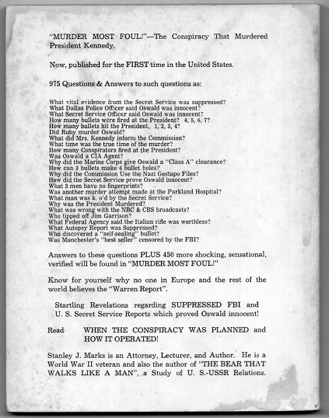
    [1] Testimony of James B. Wilcott, RIF 180-10116-10096, pp.25-26.

    [2] Midnight/Globe, February 14, 1978. The memo said that Oswald’s FBI informant number was S172 and that his CIA number was 110669. Mae Brussell showed copies of this document to the editors of Globe.

    [3] Telephone interviews of Campbell March 19, 1994; Jones, March 19, 1994; Williams, April 4, 1994; Garner, August 14, 1999.

    [4] FBI report of Roy Truly interview by Nat Pinkston, November 23, 1963, File No. DL 100-10461.

    [5] Interviews of Ted Leon and Thomas H. Butler. The November 14, 1961 date came from Leon, Sexton branch manager in Dallas from 1961 to 1964. He kept his pocket calendars from his years of employment, and he noted when the grocery company moved out of the building to a new facility in another part of Dallas. Butler took over as branch manager after Leon transferred to Los Angeles. Butler said that the 411 Elm Street building was vacant for at least a year after his company moved out.

    [6] Interviews of Joe Bergin, Jr. February 12 and 26, 1994 and August 7, 1999. When I interviewed him, he was living alone with his three cats, depending for his income on the charity of his father and disability checks. His father died on November 2, 1990. Joe died on August 29, 2001 at the age of 55.

    [7] Through some insider intrigue, a saleslady at Neiman Marcus found out what Jacqueline Kennedy was going to wear the day of her arrival in Dallas. She confided this information to Mrs. Bergin and told her that she had a copy of the First Lady’s dress, pink in color with the black velvet collar. Mrs. Bergin paid a great deal of money for that dress. She planned to wear it that Friday evening at a social gathering. Needless to say, she never did wear that dress.

    [8] Jim Marrs, Crossfire (Carroll & Graf. New York, 1989) p. 319.

    [9] Carolyn Arnold statement in “Byrd/TSBD Concerns” posted by Martin Barkley on May 24, 2000 on the JFK Today website.

    [10] Larry Ray Harris at the age of 44 died in an automobile accident on October 5, 1996. He was traveling from his mother’s house in Ohio to Georgia. Supposedly, he fell asleep at the wheel, or committed suicide, when he rammed into the back of a semi-truck. Since the CIA has the capability of engineering car crashes to look like accidents, Harris’s name should be added to the list of mysterious deaths, along with Warren Commission witness Lee Bowers, who died when his car ran off the road and ran into a freeway abutment.

    [11] Glaze misdated his letter as “12/12/74.”

    [12] Wilcott’s 3/22/78 HSCA deposition, pp. 25-26.

    [13] Henry Hurt, Reasonable Doubt (New York: Holt, Rinehart, and Winston, 1985), pp. 359-360, 386-387.

    [14] William Harvey obituary in The New York Times, June 14, 1976.

    [15] Shelley testimony, Volume 6 of the Warren Commission Hearings and Exhibits on page 327, hereafter to be cited as 6H327.

    [16] Roy Truly testimony, 3H213.

    [17] Gladys Cason, One Life, self-published book, 2004, pp. 66-67.

    [18] Carolyn Walther, 24H522; Edwards, 24H207; Fischer, 24H208.

    [19] Adams testimony, 6H388-390.

    [20] Baker testimony, 3H263.

    [21] Shelley testimony, 6H330.

    [22] Sylvia Meagher, Accessories After the Fact, p. 74.

    [23] William Weston, “Robert MacNeil and the Three Calm Men”, in the November 1994 issue of The Fourth Decade.

    [24] Shelley affidavit, 24H226.

    [25] Frazier testimony, 2H23.

    [26] FBI report of Oswald at the police station, Warren Report, p. 619.

    [27] Gerald McKnight, Breach of Trust p. 115.

    [28] The Third Decade, May of 1986.

    [29] Shelley affidavit, 24H226.

    [30] Fritz testimony, 4H206.

  • The Dylan/Kennedy Sensation

    The Dylan/Kennedy Sensation


    As everyone who reads this site must know by now, Bob Dylan’s newly released song Murder Most Foul has created nothing less than a cultural and popular mini earthquake. (Click here) As of this writing, the song, his first in about 8 years, has registered 2.4 million views on You Tube. Over two million in 96 hours! The song is themed around the murder of President Kennedy, but I hesitate to call Murder Most Foul a song. Because, as most people understand, Dylan is one of the finest lyricists in the modern history of music. At his best—in classics like Blowin’ in the Wind and Like a Rolling Stone—he does not really write song lyrics, not in the normal sense. He writes poems. And to anyone who knows anything about the Kennedy assassination, this song is really a poem. It is an intricately designed, multi-leveled, cleverly-referenced poem about both the Kennedy assassination and what happened to America after that cataclysmic event. (Click here for a written lyric version of the song)

    For people who have studied the Kennedy case, Dylan has centered the lyrics around a conspiracy to kill JFK in Dallas. Consider these three lines: “We’re gonna kill you with hatred, without any respect/We’ll mock you and shock you and we’ll put it in your face/We’ve already got someone here to take your place”. (Click here for the official lyrics themselves) But, then, this theme gets hammered home a few lines later:

    Thousands were watching, no one saw a thing

    It happened so quickly, so quick, by surprise

    Right there in front of everyone’s eyes

    Greatest magic trick ever under the sun

    Perfectly executed, skillfully done

    Many writers on the JFK case, including our own Milicent Cranor, have referred to the murder of JFK as a “magic trick”. One that was planned and designed in advance. Dylan captures this by saying that although the event took place right in front of all the spectator’s eyes, no one saw how it was really done due to the intricate trickery involved.

    The writer then shows how well he knows the literature on the Kennedy case. And beyond that, how well he has hidden his references and mixed them in with the historical period. He writes: “Slide down the banister, go get your coat/Ferry cross the Mersey and go for the throat/There’s three bums comin’ all dressed in rags/Pick up the pieces and lower the flags.” Vince Palamara had to point out to me and others that Dylan is likely referencing in the first line, Guy Banister, and in the second, David Ferrie. He then posits in more scenery from the assassination with the Three Tramps. He has covered this in a movement referencing the British rock invasion and a song by Gerry and the Pacemakers from 1965, Ferry Across the Mersey. This reference is intermixed with one to “The Beatles are comin’, they’re gonna hold your hand.” The Beatles first big hit in the USA, as opposed to England, occurred in December of 1963. It was the single, I Want to Hold Your Hand. This sub-theme of escape into music is accentuated with “Pick up the pieces and lower the flags/I’m goin’to Woodstock, it’s the Aquarian Age/Then I’ll go to Altamont and sit near the stage.” Altamont was a free music festival held in California four months after Woodstock, featuring The Rolling Stones. Altamont was marked by the heavy usage of drugs and alcohol, which resulted in numerous fistfights. Four people died during the event, and one of them was killed near the stage. (See the documentary film Gimme Shelter)

    This is where the elegiac part of the poem begins to assert itself. Dylan tops off the Altamont reference and links it to the JFK murder adroitly and pungently. Right after the mention of Altamont, he writes “Put your head out the window, let the good times roll/There’s a party going on behind the Grassy Knoll.” Does it get much better than this kind of historical allusion per cause and effect? America was escaping into the drugs and hard rock music exemplified by Woodstock and Altamont. This is not Taylor Swift.

    II

    The entire 17-minute song is chock full of these kinds of references, including to the late disc jockey Wolfman Jack. The Wolfman became famous in movie history through his appearance in George Lucas’ 1973 film American Graffiti. That picture had an elegiac tone to it. In fact, its ad campaign featured the question, “Where were you in’62?” That bubbly film about Camelot America, the early sixties, ended with a punch in the gut. At the end of the picture, it tracked its male protagonists past 1962: with one of them dying in Vietnam and another living in exile in Canada to escape the draft. As one critic described it, the film’s lighthearted tone was extinguished by a ten-foot wave showing an Ozzie and Harriet like American youth being thrown headlong into disaster. That awful fate was amplified even more by the 1991 film JFK and its accompanying book: John Newman’s JFK and Vietnam. Bob Dylan gets it.

    The title Murder Most Foul is a reference to Shakespeare’s Hamlet. In Act One of that play, during the famous ghost scene, an apparition of his father tells Prince Hamlet that he, the former king, was murdered. The ghost then refers to his killing as, “Murder Most Foul”. He tells his son that he was done away with by the new king: his brother Claudius. His brother then married his widow to become Hamlet’s stepfather. This surreal revelation is what sets the action of the play in motion: a drama of crime detection and ultimate revenge. It all becomes a tragedy when, at the end, the stage is littered with the corpses of not just Claudius, but also Hamlet, his mother Gertrude, and the son of Polonius, Laertes. But beyond that, and cut from most film versions of the play, these deaths make possible the entry of an army from nearby Norway, led by the character Fortinbras. As Dylan notes: “We’ve already got someone here to take your place.”

    Front cover of Murder Most Foul by Stanley Marks

    But Kennedys and King contributor Rob Couteau has alerted us that the title may go even further than that. For there is a little-known book with that same Shakespearean title in the Kennedy canon. In 1967, writer Stanley J. Marks wrote a short volume on the case. He entitled it Murder Most Foul. From its appearance—Couteau actually has a copy of the book—it did not appear to be printer typeset. The volume looks like it might be self-published and, therefore, did not get much distribution. If so, that is understandable. The contents of the book and its political views on the assassination, especially those at the end, are far ahead of the intellectual arguments in classic texts like Accessories After the Fact and Six Seconds in Dallas, both published in 1967.

    The approach to the case taken by Stanley Marks is that of a magisterial judge out of the British system. During the course of the book, this judge (Marks) relentlessly asks question after question of the prosecution. By the book’s finish, the question count tallies to 975. Quite accurately, through his questioning, Marks concludes that the Commission suppressed important evidence and neglected to question certain important witnesses. His penultimate chapter is called “The Rape of the American Conscience”. There, one of his first conclusions is that the Warren Commission, contrary to what it wrote, discovered a conspiracy. Marks is utterly disdainful of both the efforts of the Commission and its aides. In that penultimate chapter, he accuses them of abusing legal procedure and the rights of witnesses. He calls the performance by the Commission both negligent and slothful. He says that the report deserves all the criticism it has gotten, for it could not even withstand exposure by the noon day sun.

    Marks then sounds a note that no other critic of that time voiced, but which is appropriate to Dylan. He says that because of the disbelief in the Warren Report, a cynicism has gathered in the public and this bodes ill for the future of the nation. For a nation whose moral fiber has been torn and shattered cannot long live.

    Marks expounds on this idea by writing on page 139 that the Constitution contains the American Creed in the preamble. The Warren Report violated that creed. Because the United States, “…was not born on the idea that its president could be shot like a dog on the street and his murderers be shielded from that day on, because it would be ‘against the national interests’.” He concludes his penultimate chapter with what could be called an ode: “How long O how long, Americans, will we permit our silence to perpetuate the evil in the Warren Report?” This condemnation is a far cry from say Josiah Thompson who, at the end of his book, said he was not really sure that the evidence he adduced justified a conspiracy. (Six Seconds in Dallas, p. 246)

    In his final chapter, Marks again does something that neither Meagher nor Thompson did—quite the contrary. He praises and appreciates the efforts of New Orleans DA Jim Garrison. He compares Garrison’s ordeal against the media to St. George galloping forth to duel with the dragon. He also says something quite prescient for the time: he accuses some of Garrison’s attackers of being in bed with the CIA. Which, we now know, is an accurate assessment. Again, if Bob Dylan knew about this obscure book, even more praise to him.

    The poem never lets up on the impact of November 22, 1963. It mentions the Zapruder film and also the deeply flawed autopsy—“They mutilated his body and they took out his brain”—and even the magic bullet and Oswald’s pronouncement that he was just a patsy. Dylan even seems to reference some of the work done by authors like myself on the attempt to smear Kennedy’s reputation posthumously. This is suggested when he writes in verse 3, “They killed him once and they killed him twice.”

    The elegiac part really picks up at the end of verse 3 when, right after mentioning “they killed him twice”, Dylan writes:

    The day they killed him, someone said to me, “Son

    The age of the Antichrist has just only begun”

    Air Force One comin’ in through the gate

    Johnson sworn in at 2:38

    Let me know when you decide to throw in the towel

    It is what it is, and it’s murder most foul

    I really don’t see how the lines about the Antichrist, Johnson, and throwing in the towel could be any clearer in their meaning.

    As they should, with the mention of the Antichrist, in verse four, the elegiac tones become more pronounced. Dylan begins that verse with a reference to the forgettable 1965 film written by Woody Allen, What’s New Pussycat? He then juxtaposes the frivolity of that piece of ephemera with the following lines: “I said the soul of a nation has been torn away/And its beginning to go into a slow decay”. He then lists some songs Wolfman Jack could turn, pointedly including Only the Good Die Young and saying Wolfman should also play a song “for that strip club owner named Jack.”

    In the last verse, verse five, the author asks the Wolfman to play a song for Jackie Kennedy, since she “aint’t feeling very good”. He then lists a whole slew of songs, some with suggestive titles like In God We Trust and Another One Bites the Dust. He then begins to turn to his main theme when he writes:

    Don’t worry Mr. President, help’s on the way

    Your brothers are comin’, there’ll be hell to pay

    Brothers? What brothers? What’s this about hell?

    Tell them, “We’re waiting, keep coming” we’ll get them as well

    Love Field is where his plane touched down

    But it never did get back up off the ground

    Was a hard act to follow, second to none

    As we know, they did get JFK’s brother, Bobby, through another murder and Ted was blocked from the White House through the tragedy of Chappaquiddick. (Or as Pamela Brown has suggested the other brother could be, figuratively, Martin Luther King.) And evidently, like most of the American public, Dylan thinks that the following presidents were not up to Kennedy’s standard. (Dylan wrote the song several years ago, the occasion of President Trump’s epic fail on the novel corona virus may be the reason he released it at this time.) After listing some other evocative song and film titles like Lonely are the Brave and Lonely at the Top Dylan concludes with this:

    Play darkness and death will come when it comes

    Play “Love Me Or Leave Me” by the great Bud Powell

    Play “The Blood-stained Banner”, Play “Murder most Foul”

    Bud Powell was a great American pianist and Love Me or Leave Me was the name of both a famous song and much later, a lesser known film. But The Blood-Stained Banner is a name given to the confederate flag. And we know where the line Murder Most Foul comes from, it happens to be the title of the song everyone is listening to. I believe the reference to the confederate flag works in three ways: the predominant color in the flag is red, Kennedy died in the south, and JFK—as Dylan well knows—had all kinds of problems in his struggle against Jim Crow at places like the University of Alabama and Ole Miss. In other words, the ugly side of America, as represented by the confederacy, eventually won out. Dylan is to lyric composition what Frank Lloyd Wright was to designing home architecture.

    III

    The reaction to this evocative and moving piece of poetry and song writing has been both troubling and predictable. I can do no better than to quote David Talbot at length to illustrate it:

    Idiot Wind. This is how pathetic and cowardly and willfully ignorant that our media is. Bob Dylan, America’s greatest living songwriter, has just released a profoundly disturbing song about the powerful conspiracy that killed President Kennedy and the subsequent loss of our nation’s soul. Stop the presses! There’s your story, quarantined media hacks with nothing better to do—call up Dylan and ask him why he released this stunning song now, his most politically charged work in decades. Or call assassination researchers who actually have investigated Kennedy’s “murder most foul”—authors whose work probably informed Dylan.

    Instead, what do NPR’s intrepid culture reporters—Bob Boilen and Ann Powers—do? They put together a playlist of the songs that Dylan references in his epic ballad. Likewise, the New York Times’s Jon Pareles also can’t bring himself to explore the meaning of Dylan’s haunting lyrics. He’s obviously read the memo from the Times front office—don’t go there if you value your job. All of these music critics are old enough and wise enough to know the huge import of this new Dylan song. And none of them has the guts to wade into these dark waters.

    What sniveling and cowering “journalists.” This is why America’s Fourth Estate has been complicit with the Kennedy assassination conspiracy for over five decades. While American democracy was riddled with bullets and buried so deep we now have a mad clown as president, our press “watchdogs” licked the hands of the conspirators and snarled at anyone brave enough to question the official story.

    But hey, instead of pondering the light in Dylan’s darkness, we can all listen to this fun NPR playlist!

    The New Yorker compared some of the lyrics to QAnon, which shows that one can only understand this poem if you know or care anything about the JFK case. (Kevin Dettmar, 3/28/2020) Ty Burr, in the Boston Globe, said that the musical arrangement should have been stronger and more pronounced. (March 28, 2020) Mr. Burr does not understand that this work is really meant as a poem; therefore, the music is in the background. If one can believe it, the Rolling Stone said that the song is about how music can comfort us through troubled times. (3/27/20, by Simon Voznick Levinson). As I pointed out, in the work’s overtones, what Dylan is showing is how the shallowness of American culture could not deal with an event the size, scope and trauma of the Kennedy assassination. Our cultural and media gatekeepers just wanted to bypass it as quickly and as easily as possible.

    In that aspect, Dylan has come a long way on the subject. Accepting an award in 1964, in an allegedly drunken state, he said he could see how some people could relate to what Oswald did. Like most of us today, he understands Oswald did not do anything that day. Like the alleged assassin said of himself, he was just a patsy. The damage was done by assailants unknown to America.

    There are few poems, and even fewer songs today, that can be called folk epics. Perhaps in remembrance of his boyhood idol Woody Guthrie, this one lays claim to that rubric.


    Additional materials provided by Rob Couteau:

    Rear cover of Murder Most Foul by Stanley Marks

    Stanley Marks indexed by the HSCA Volumes 11-12 page 695

  • Gerald “Jerry” Policoff (Feb. 27, 1947—March 7, 2020)

    Gerald “Jerry” Policoff (Feb. 27, 1947—March 7, 2020)


    Longtime assassination researcher Gerald “Jerry” Policoff died in an automobile accident in Lancaster, Pa. on Saturday March 7. Jerry first became involved in the research community as a 19-year-old in 1966, when he was inspired to seek the truth after reading Mark Lane’s seminal work Rush To Judgement. The next year, he decided to buy the 26 volumes of the Warren Commission. His mother could not understand his growing obsession. When he tried to explain to her that illegitimate forces had taken power in a clandestine way, she did not understand what he meant. Then one day after he came home from one of his college classes, he noticed that she was putting away Josiah Thompson’s book Six Seconds in Dallas. She turned and said to him, “You’re right. And I don’t ever want to talk about it again.” Which, of course, explains the problem critics have with this case.

    Jerry made his living in broadcast advertising for more than 40 years, while pursuing his research and writing about the JFK assassination. His main area of interest was on the mainstream media’s inadequate and dishonest coverage of the assassination. The night Robert Groden and Dick Gregory showed the Zapruder film live on ABC TV, on Geraldo Rivera’s program Good Night America, Policoff was in the wings since he was a friend of Groden’s. Even though Rivera went to the mat with ABC in order to show it, Jerry often said that up until the moment it was screened, he, Groden, and Gregory all thought that management was going to call off the show. Thank God they did not.

    In 1975, shortly after that monumental event on Rivera’s show, Jerry was the first person to expose Life magazine’s changing the order of printed frames, and printed captions, in its October 2, 1964 issue, in order to conform to the Warren Report’s conclusions of only shots from the rear. Jerry’s subsequent article on this deception “The Media and the Murder of John Kennedy” appeared in the August 8, 1975 issue of New Times and was included in the anthology The Assassinations: Dallas and Beyond. One of his most famous and distinguished essays was called “How All The News About Political Assassinations Has Not Been Fit to Print In The New York Times”. That was published in the October, 1972 issue of The Realist. Another of his most accomplished and popular stories was “JFK: How The Media Assassinated The Real Story,” in the March 11, 1992 Village Voice, which also appeared as a chapter in JFK: The Book Of The Film. In that pungent article, Policoff became the first journalist to reveal the fact that CBS had used Warren Commissioner John McCloy as a consultant on their 1967 four-part series defending the Warren Commission. They did so without informing the audience of this fact. This had been done through the use of his daughter Ellen McCloy, who was the administrative assistant to Richard Salant, president of CBS News.

    Roger Feinman, a friend of Policoff’s, was a former CBS employee who pilfered the McCloy/Salant documents out of CBS. Roger had written several letters to CBS’ Standards and Practices division, complaining of the lapses in journalistic ethics CBS was taking to endorse the Warren Commission. In the seventies, after he was terminated, he tried to get Salant and John McCloy to admit to this illicit relationship. They both denied it, as did the CBS four-part series producer Les Midgley. But when Policoff confronted them with the actual memos—with their names on them—both Ellen McCloy and Salant were finally forced to admit what they had done.

    Although most people will remember Jerry as being the first to systematically focus on just how bad the media was in the JFK case, he had a good all-around background on the Kennedy assassination. This is why he was hired by editor Robert Sam Anson at New Times to cover the House Select Committee on Assassinations (HSCA). His contemporary reporting on that body was almost unrivaled in the field. Policoff knew how to cultivate sources who were unhappy with what the HSCA was becoming. They, therefore, confided in him, since they knew he would keep their identities secret.

    While covering the HSCA for New Times, Jerry broke the story that acoustics analysis proved that at least one shot was fired from the grassy knoll area to the right front of Kennedy and not from the Texas School Depository. As the HSCA was getting started, he appeared on the Feb. 24, 1977 episode of the PBS McNeil/Lehrer News Report to draw attention to the media’s “unwarranted deference to the official findings” on the JFK murder. He was one of very few assassination researchers afforded such opportunity by the mainstream media.

    In more recent years, Jerry served as the Executive Director of the Assassination Archives and Research Center( AARC) and, along with Jim Lesar, organized the 2014 Bethesda, Maryland conference entitled “The 50th Anniversary of the Warren Report”. He was instrumental in bringing 90-year-old Antonio Veciana to the conference to say publicly for the first time that the man he knew as Maurice Bishop, was indeed CIA officer David Atlee Phillips. Another famous guest he secured was Wesley Buell Frazier, who worked with Lee Oswald at the Texas School Book Depository.

    Jerry was an original board member of both the Coalition on Political Assassinations (COPA) and the Citizens Against Political Assassinations (CAPA). In 2013, through the group JFK Lancer, he was a recipient of the Mary Ferrell Pioneer Award, in appreciation of a lifetime searching for the truth in the assassination of President John F. Kennedy.

    Last year, Jerry became a Senior Editor at OpEd News, contributing articles and being the official screener of any submissions on the JFK, RFK, or MLK assassinations.

    After Jerry retired to Lancaster, Pa. in 2004, he became very active in progressive politics. In 2005, he formed “Progressives For Pennsylvania” which, for several years met bi-weekly at his apartment. As a fierce advocate for single-payer healthcare, in 2007 he became a Board Member and Chair of Research for “Healthcare For All PA.” He was driving to speak on Bernie Sanders’ Medicare For All proposal at the annual Keystone Progress conference in Philadelphia, when was killed.

    In 2010, he ran as the Democratic candidate for the 41st District of the PA. State House of Representatives. Despite unapologetically campaigning for single-payer healthcare, he still won 42% of the vote, which still stands as a record for any Democratic candidate in a very conservative district.

    Jerry Policoff will be remembered as being passionate in pursuit of the truth of the assassination of President Kennedy, as well as trying to make the United States a more just and equitable nation for all. He will be deeply missed.


    Articles by Jerry Policoff published by Kennedys And King:

    JFK: How the Media Assassinated the Real Story

    Specter’s Switch: an update

    For more remembrances of Jerry Policoff from Steve Jones, Gary Schoener, Lisa Pease, and Dawn Meredith, listen to the BlackOp Radio installment below: