Tag: JFK ASSASSINATION

  • Fred Litwin, On the Trail of Delusion – Part One

    Fred Litwin, On the Trail of Delusion – Part One


    “One of the many blessings of this project was getting to know Hugh Aynesworth … He’s one of the great reporters in America, and it’s been an honor to know him.” ~Fred Litwin


    Anybody who is familiar with the John Kennedy assassination should realize that a writer who could make the above statement has severe objectivity problems as far as the JFK case goes. Aynesworth is the man who once said that refusing a JFK conspiracy was his life’s work. Employing Aynesworth on the Kennedy case would be like using Donald Trump on the issue of where Barack Obama was born. Yet, the above statement is a quote from the Acknowledgements section of Fred Litwin’s book about the Jim Garrison inquiry. I would like to give that quote a page number but I can’t. The reason being that those pages––and some others which have text on them––do not contain numbers. Which, in my long reviewing career, is actually a first for me. But this is just the beginning of enumerating the bizarre features of this bizarre book.

    For every Breach of Trust or JFK and the Unspeakable, there are at least a dozen volumes in the JFK field that are just plain shabby––or worse. Back in 1999, Bill Davy and I reviewed Patricia Lambert’s volume about Jim Garrison, False Witness. That was a particularly unpleasant experience. In fact, the estimable Warren Commission critic Martin Hay (deservedly) placed that book on his list of the ten all-time worst on the JFK case. But in light of Fred Litwin’s latest, Martin may have to revise and replace Lambert’s entry with Litwin’s On the Trail of Delusion. For Litwin has done something I did not think was possible: he wrote a book that is even worse than Lambert’s.

    If the reader knows anything about New Orleans and the Jim Garrison inquiry, it is fairly easy to see what Litwin is up to. The problem is––and I cannot make this point forcefully enough––too many writers and interested parties think they know the Garrison inquiry and New Orleans, when they really do not. Many of these self-proclaimed “authorities” have never even been to the city. Many more have never even bothered to look at Jim Garrison’s files. But this never stopped them from voicing their biased and rather ignorant viewpoints: e.g., the late Sylvia Meagher. This was and is a serious problem among critics, and it has caused many people to be misled about the New Orleans aspects of the case. I will further elucidate this factor later in this review.

    The above warning is apropos to what Litwin has produced. If I had to compare his latest to another volume in a related field it would probably be Thomas Reeves’ book on John Kennedy, A Question of Character. In my two part article, “The Posthumous Assassination of John F Kennedy”, I wrote that what Reeves had actually done was to compile a collection of just about every negative Kennedy book and article that came before him. He then assembled it together by chapter headings. He never fact-checked or source-checked what was in those materials and, as far as I could see, he never talked to anyone in order to clarify, or qualify, what he wrote; for example, the case of the deceitful Judith Exner. This allowed him to go exponentially further than anyone had done up to that time in smearing Kennedy. Because I knew the field and understood the game he was playing, I called it out for being what it was: so godawful that it ended up being pretty much a humorless satire.

    The difference between the JFK field of biography and Jim Garrison and New Orleans is the time element. In my above mentioned JFK essay, I noted that the character assassination of Kennedy did not begin in any serious way until after the Church Committee hearings in 1975. This was not what happened with Jim Garrison. In his case it began very soon after the exposure of his investigation by local New Orleans reporter Rosemary James. As we shall see, in one way, it began with Aynesworth.

    In my book, the second edition of Destiny Betrayed, I portrayed the real manner in which Rosemary James exposed Garrison’s inquiry. Contrary to what James tried to imply, it is not at all what Garrison wanted to occur (pp. 221-23). In fact, it was a serious body blow to his efforts. Yet, to this day, she still attacks Garrison. But again, to anyone who knows New Orleans, the smears are transparent. For instance, on a show she did In New Orleans with film-maker Steve Tyler and historian Alecia Long, she said that as soon as Shaw was indicted by Garrison, the wealthy Stern family of New Orleans dropped him like a hot potato. This is provably wrong. The Stern family hosted dinner parties for reporters sympathetic to Shaw’s defense once they arrived in New Orleans. What is surprising about this howler is that the contrary information is available throughout the forerunner to Lambert and Litwin, namely James Kirkwood’s obsolete relic of a book American Grotesque (see pp. 47, 88, 111). That book was published back in 1970. 

    But beyond that hospitality function, the Sterns owned the local NBC television affiliate WDSU. Ric Townley, who labored on the infamous 1967 NBC hatchet job on Garrison, worked for WDSU. That show’s producer, Walter Sheridan, worked through that station while he was in New Orleans. (William Davy, Let Justice be Done, pp. 78, 156) In addition to that, the Stern family helped start the Metropolitan Crime Commission, a private local watchdog organization. They also lobbied to bring in former FBI agent Aaron Kohn to be its first manager. Kohn took a large and important role in the effort to undermine Garrison; working hand in hand with Sheridan, Townley and Shaw’s lawyers. (Davy, p. 156) As we shall see, Kohn covered up an important piece of information about Shaw that would have strengthened Garrison’s case and shown the defendant to be a perjurer. So here is my question: After all this, who could use Rosemary James as a credible source on either Shaw or Garrison? The answer is, Fred Litwin can. He uses her frequently in his book. And as Thomas Reeves did, he does so without any qualifications or reservations. In other words, he doesn’t prepare the readers by informing them of the above.

    What Litwin does is a bit more ingenious than what Reeves did. In addition to his secondary sources, like James and Kirkwood, he visited certain archives. What most of these archives have in common is that they house the papers of Garrison’s critics; for instance. Life reporter Dick Billings, Washington Post reporter George Lardner, and Shaw’s friend, author James Kirkwood. He then augments this by using the papers of Shaw’s legal team, Irvin Dymond and the Wegmann brothers, Ed and William. Some of these collections, like the Historic New Orleans Collection, were found by the Assassination Records Review Board (ARRB) to be highly sanitized. (ARRB memo from Laura Denk to Jeremy Gunn, 6/7/96) Which leads to another question: What did Fred think he was going to find in these places? Something objective? Something revelatory about Shaw’s secret intelligence background with the CIA? Something about Guy Banister’s career of covert infiltration of liberal groups in New Orleans? Nope.

    There is something to this cherry picking that makes Litwin look even worse. The Wegmanns did know about the Banister undercover aspect, because Bill Wegmann worked at the law firm which handled some of Banister’s projects. In fact, Bill Wegmann notarized the papers for the incorporation of Banister’s so-called detective agency. (DiEugenio, p. 390) And that piece of quite relevant information was declassified in the nineties by the CIA, under the direction of the ARRB, even though the document dated back to 1958––that is, it took well over 30 years for it to see the light of day. This shows that Shaw’s own lawyers knew that Garrison was correct about Guy Banister. But it’s even worse than that. Bud Fensterwald later discovered through a New Orleans attorney that Banister, Shaw and former ONI operative Guy Johnson made up the intelligence apparatus for New Orleans. (Davy, p. 41) In the fifties, Guy Johnson worked with Bill Wegmann at the above-referenced law firm. Therefore, not only did Shaw’s defense team know about Banister, they likely knew about Shaw. And they still let him deny in public, and on the stand, that he was ever associated with the CIA.

    In addition to James and Aynesworth, this leads to a third complaint to the reader: Try and find this rather important connection in Litwin’s book. Any objective person would understand that this declassified evidentiary point is important to Litwin’s subject matter. Both for what it says about Banister, and what it reveals about Shaw’s attorneys. Knowing that, anyone with an ounce of objectivity would realize that the Wegmanns would not have kept it in their archives.


    II

    Right after his acknowledgements to people like Aynesworth, and a listing of the archives the author will use, Litwin begins his narrative. He does so in a way that naturally follows from these prefatory matters. He describes a report from the military which eventually allowed Garrison to be discharged from the service on his second tour in 1951. Garrison had served on very dangerous air reconnaissance missions during World War II. At a very low altitude and speed, his team searched out enemy artillery sites. They flew so low, they could have been hit by rifle fire. And once they were sighted, they were attacked by much faster German fighter planes. (Joan Mellen, Jim Garrison: His Life and Times, pp. 18-19) They therefore sustained high fatality rates.

    When Garrison reenlisted during the Korean conflict, he reported for sick call at Fort Sill. It turned out that he suffered from what used to be called “battle fatigue”, what we today call PTSD. (DiEugenio, p. 168; Mellen, pp. 36-37). What Litwin does with this is again, bizarre, but telling. He brings it up in the first paragraph of his text (p. 3, another non-numbered page). Less than one page later, Garrison is the DA of New Orleans. Clearly, what the author is trying to indicate is that somehow a mentally disabled person is now in high office. One way he does this is by leaving out the fact that after he left the service Garrison was recruited by the mayor of New Orleans, Chep Morrison. He was assigned to run the Public Safety Commission which supervised Traffic Court. (Mellen, p. 41). To put it mildly, Garrison did a crackerjack job. Mellen spends three pages showing, with facts and figures, that Garrison was such an excellent administrator that he just about revolutionized that branch. He was so good that Morrison offered him a judgeship over that court, which Garrison turned down. He said he would rather be on the DA’s staff, which Morrison then appointed him to. (Mellen, p. 44) It would appear to most objective people that Garrison had overcome any functional disability from his PTSD. Litwin eliminates this remarkable performance. I leave it up to the reader to figure out why.

    At the DA’s office, Garrison handled a variety of criminal cases: burglary, lottery operations, prostitution, homicide and fraud. (Mellen, pp. 44-45) Again, this would indicate that Garrison had overcome his PTSD. Again, Litwin eliminates it.

    Once Garrison enters into the DA’s office, we begin to understand why Litwin began his book as he did. Again, ignoring all the reforms and tangible improvements he made in the office and the praise he received for doing so, Litwin is going to strike two major themes in order to smear Garrison and his tenure. Both of these have been used before, they are nothing original. But Litwin tries to amplify them to the point of using chapter subheads to trumpet them. They are: 1) That Garrison spent much time prosecuting homosexuals; and 2) That the DA was a paranoiac about surveillance over his investigation.

    Concerning the first, this motif was first utilized by Kirkwood in his aforementioned book. What Litwin does not reveal is that Clay Shaw commissioned that book. I discovered this through a friend of novelist James Leo Herlihy on a research trip down south. Lyle Bonge knew Herlihy from his college days. Shaw asked Herlihy to write a book about Garrison and the trial. Herlihy declined, but he suggested his young friend Kirkwood. All three men were gay, and that is not a coincidence. Shaw wanted a book that would portray Garrison as having no case against him. Therefore, the product was designed to suggest Garrison was simply out to prosecute Shaw because he was a homosexual. Anyone who reads Kirkwood’s useless relic will understand this was his mission: the denigration of Garrison, and the canonization of Shaw.

    To further this concept, Litwin quotes a passage from the book on Garrison’s case co-authored by Rosemary James. The passage says that Garrison charged someone for being in a place that served liquor because the person was a homosexual. And that Garrison did this in order to attain a string of homosexual informants. (Litwin, pp. 8, 21) One would think from the reference that this information originated with reports from a primary source. When one looks it up, that is not the case. The source is Bill Stuckey. (James and Jack Wardlaw, “Plot or Politics?” pp. 21-22) Litwin does not reveal this either in his text or his references, which frees him from telling the reader who Stuckey was.

    As Bill Simpich writes, Stuckey was both a CIA and FBI informant. He was the host for two interviews that Oswald did in the late summer of 1963 in New Orleans. These were originally arranged for by Carlos Bringuier of the CIA funded Cuban Student Directorate (DRE) branch in the Crescent City. The second debate featured Bringuier and CIA asset/propaganda expert Ed Butler facing off against Oswald.

    Prior to the second debate, Stuckey was in contact with the FBI and they read him parts of Oswald’s file, including the information about his defection to the USSR. It was that information which was used to ambush Oswald since he was supposed to be representing the Fair Play for Cuba Committee. The defection exposed him as being not a fair participant but a communist. Stuckey crowed about how the debate ruined the FPCC in New Orleans. (DiEugenio, p. 162) Within 24 hours of the assassination, the DRE produced a broadsheet connecting Oswald to Castro and blaming the latter for Kennedy’s murder. In light of all this, would anyone besides Fred Litwin call Stuckey a neutral observer of the Kennedy case? But the reader does not know this because of Litwin’s excision.


    III

    The Stuckey non-mention is by no means an outlier. At the beginning of Chapter 2, Litwin prints an FBI memo. It originates with someone in Louisiana state Attorney General Jack Gremillion’s office. It strikes the same chord that Stuckey does above: Garrison was somehow doing a shakedown operation with homosexuals in New Orleans. Gremillion’s office wanted the FBI to do something about it. 

    I had to giggle while reading this. For two reasons. First of all, back in 1967, who would go to J. Edgar Hoover and the FBI on such an issue? If the point was genuine one would go to an agency like the ACLU. Or, since the state AG was above the local DA in New Orleans, why not pursue the case oneself? Which leads to my second reason for chuckling. Jack Gremillion was one of the most reactionary state AG’s there was at the time. Considering the era, that is really saying something (go here and scroll down). If there was a Hall of Shame for state AG’s not standing up for minority groups, he would be in it.

    Again, to anyone who knows the New Orleans milieu of the period, this is clearly the residue left over from the famous James Dombrowksi case. Dombrowksi ran a pro-civil-rights group called the Southern Conference Educational Fund (SCEF). It operated out of New Orleans. The SCEF was clearly a left-leaning group, and Dombrowski was a communist sympathizer. There was nothing illegal or unconstitutional about what he did. So the rightwing forces in the area, including Banister, Gremillion and Mississippi Senator James Eastland––encouraged by Hoover––decided to create a law in order to prosecute Dombrowksi. It was called the Communist Control Law. The idea was to somehow show that groups advocating for civil rights emanated from Moscow. So Gremillion raided the SCEF and arrested Dombrowski and two assistants. Garrison decided to take over the case since the SCEF was in New Orleans and he did not want Gremillion to do so. As Garrison critic Milton Brener later said, Garrison did as little as possible in order to get the case to the Supreme Court where he knew it would be thrown out. Which it was. Gremilion and his ilk did not like it. Hence the retaliatory smear. (Mellen, pp. 162-69).

    This leads to more unintentional humor. Litwin is so desperate to do something with the homosexual angle that he displays a cover from the pulp magazine Confidential (p. 85). The cover depicts Shaw waving from a car, and the title denotes some kind of homosexual ring killed Kennedy. Litwin says the author of the article, Joel Palmer, worked for Garrison. Having gone through Garrison’s extant files, I can find no evidence for that statement. What the files reveal is that Palmer, a reporter who was planning a book on the case, worked with Bill Boxley, a CIA plant in Garrison’s office. (See Garrison blind memo of 2/21/70) And he worked on furthering certain leads with Boxley that ended up being ersatz, like Edgar Bradley. (DiEugenio, pp. 278-85)

    Litwin pushes the homosexual angle so hard and down so many cul de sacs that he ends up reminding one of the Keenan Wynn/Bat Guano character in the classic film Dr. Strangelove. If one recalls, Guano thought that the attack on the military base was ordered because the commanding general had learned about a mutiny of “preverts” under him. Wynn said this with a straight face. So does Litwin. (See the first part of this film clip)

    For the record, there is not one memo I have read that shows Garrison ever outlined such a homosexual-oriented plot. At the beginning of the inquiry, there is evidence that Garrison was suspecting a militant rightwing plot. And as Garrison developed cases against Shaw and Ferrie, he was checking out leads that would connect them in the gay underworld. But nothing that either Peter Vea or Malcolm Blunt ever uncovered shows what Litwin is trying to impute to Garrison. Those two men are the two best pure archival researchers ever on the JFK case. And Vea specialized in the Garrison files.

    Beyond that, I have had authors who have written about Kirkwood call me in utter bewilderment about his book. They have asked me where he got some of the stuff he wrote about, since they could not find any back-up for it. And I have patiently explained to them what Kirkwood was up to, and how he deliberately distorted things, with Clay Shaw pushing him along. In fact, Shaw was indirectly putting out stories about Garrison being a homosexual to the FBI as early as mid-March of 1967. (FBI memo of March 16, 1967) Was the idea behind this to impute that Shaw was charged over some homosexual rivalry or rejection? That is how nutty this angle gets. This is how far Shaw would go to escape suspicion and denigrate Garrison.

    In his further attempt to smear the DA, Litwin subheads a section of the book with the following: “The Paranoia of Jim Garrison”. This is largely based on Garrison’s belief that the FBI was monitoring his phone calls. Litwin tries to dismiss this charge through––try not to laugh––Hugh Aynesworth. (p. 32) The declassified record reveals that the FBI was monitoring Garrison’s phone. (DiEugenio, p. 264) As we shall see, so was the CIA. When I revealed the name, Chandler Josey, as one of the FBI agents involved, former FBI agent Bill Turner recognized it and said he had been directly infiltrated into certain phone companies to do the tapping. What makes this worse is that Shaw’s defense team knew this was happening early on. In a multi-layered scheme, their ally, former FBI agent Aaron Kohn, was privy to the transcripts. (DiEugenio, p. 265) The reason for this was simple: Hoover did not like what Garrison was discovering since it showed up his phony investigation of the JFK case.

    Gordon Novel, who was working for Allen Dulles, had also wired Garrison’s office. (DiEugenio, pp. 232-33) Novel had sold himself as a security expert to Garrison through their mutual friend, auto dealer Willard Robertson. In a sworn deposition, Novel revealed his close relationship with Dulles. But he also said that the FBI would be at his apartment every day in order to get a briefing on what was going on at Garrison’s office. This is how worried Hoover was at the exposure of his rigged investigation of the Kennedy case. (DiEugenio, p. 233). So, in light of the declassified record, just what is there that is fanciful about Garrison saying he was being surveilled by the FBI?

    There is also nothing fanciful about another statement Litwin utilizes to smear Garrison: namely, that many of the lawyers for the other side were being paid by the CIA. Again, this has turned out to be accurate. We know today that the CIA helmed a Cleared Attorneys Panel in major cities, and there was one in New Orleans. (Letter from attorney James Quaid to Richard Helms, 5/13/67) Quaid had heard about this easy employment from his law partner Ed Baldwin. Baldwin enlisted in the anti-Garrison campaign and was busy defending people like Walter Sheridan, Ric Townley and later Kerry Thornley. There is further evidence of this in another ARRB disclosure. This one was a CIA memo of 3/13/68 which reveals that Shaw’s former partner at the International Trade Mart, Lloyd Cobb, was on the panel. Corroborating this, under oath, Gordon Novel did not just admit his cooperation with Allen Dulles, he also admitted he had lawyers who were being “clandestinely renumerated” [sic]. (DiEugenio, p. 263) So again, what is the basis for implying this statement is fanciful? The CIA itself admitted it in declassified documents.

    But Litwin is not done with his character smears. Another one of his subheads reads: “Garrison the Irrational Leftist”. (p. 24) Again, anyone who studies this case and knows New Orleans understands that Garrison was in no way a leftist prior to his involvement with the Kennedy case. He was a moderate. For instance, he was anti-ACLU. He once said that it had “Drifted so far to the left it was now almost out of sight.” (Mellen, p. 217) Even more demonstrative, he favored the Cold War. He once said in a speech that the US had to counteract communist aggression in Korea and Vietnam. (Mellen, p. 208) This is an “irrational leftist”? What changed his view on these matters was his investigation of the Kennedy case.


    IV

    As we have seen, in a variety of ways, the initial part of Litwin’s book is a rather blatant and barren attempt at character assassination. For anyone who knows New Orleans, it does not stand up to scrutiny. Therefore, we can term it an attempt to confuse the uninformed reader. We will now get to Litwin’s description of Garrison’s stewardship of the Kennedy case and the evidence underlying it. But before we do, this reviewer should comment a bit more on the format of the book.

    Litwin has placed the overwhelming majority of his reference notes at the rear, with no numbers. The standard academic procedure is to link the note at the rear to the book’s pagination. Litwin does not do this. So one has to search for the proper note by the textual lead in the chapter. Because of this unusual sourcing method, I did something I found morally offensive: I bought the paperback version of the book, for it had become too time consuming to hunt for the textual references by shifting back and forth in the electronic book version. To top it off, the book has no index. Thus, for purposes of review, unless one takes notes, this makes it difficult to locate information.

    But it is even worse than that. Because in his reference notes, he will often refer to his source with a rubric like “The Papers of George Lardner, Library of Congress”; or “Papers of the Metropolitan Crime Commission”. Again, this is not acceptable. In these kinds of references, the proper method is to annotate the information to a box number and folder title at that archives. Does Litwin really expect the reviewer to search through the online listing to find the information and then check if it is available? In sum, without an index, it’s hard to locate information; with this kind of nebulous referencing, it’s even harder to check out the information. With that in mind, let us proceed.

    Litwin begins his assault on Garrison’s methods by writing that the DA stacked the grand jury with his friends and colleagues, many from the New Orleans Athletic Club. I expected to see some primary source back-up for this, like names and terms of service. When I looked up the reference it turned out to be David Chandler (see p. 345, not numbered). Again, because Litwin doesn’t, one has to explain why this is problematic.

    Chandler was a part of the whole journalistic New Orleans wolfpack, which included Jim Phelan, Aynesworth, Billings and Sheridan. After the James disclosure, they went to work almost immediately at defaming Garrison in the press, thereby handing a pretext for governors not to extradite witnesses to New Orleans. Chandler was one of the very worst at inflicting the whole phony Mafia label on Garrison. That was another smear which turned out to be completely false. (Davy, pp. 149-67). In fact, the infamous Life magazine story of September 8, 1967 implicating Garrison with the Mob was largely written by Billings and Chandler. Chandler was a close friend of Shaw. When Garrison wanted to call Chandler in for questioning about the sources for his article, Life magazine did something rather interesting. The editors called up the governor of the state. They told him to make Chandler a part of the state trooper force thus granting him immunity. There was an ultimatum attached to the demand: if he did not do it, they would write a similar article about him. He caved. (1997 interview with Mort Sahl)

    Again, for the record, urban grand juries in Louisiana are chosen similarly to the way trial juries are chosen. They are picked randomly from voting rolls. (Louisiana Law Review, vol. 17, no. 4, p. 682) Further, Garrison did not choose or run the grand juries. He assigned that function to his deputies who ran them on a rotating basis. (1994 interview with ADA William Alford)

    But Litwin is not done with Chandler. He uses him to say that Garrison started his Kennedy investigation out of boredom. (p. 12) As we should all know, Garrison began his inquiry back in 1963 over a lead about David Ferrie. Ferrie had driven to Texas with two friends on the day of the assassination. His excuse was he wanted to go duck hunting and ice skating. The problem was that after Garrison investigated the strange journey he found out that Ferrie did not bring shotguns, and he never put on skates at the rink. He stood by a public phone and waited for a call. This took two hours. (DiEugenio, p. 176) What made it all the more fascinating is that Ferrie had called the rink owner a week before. (Davy, p. 46). Suspicious about Ferrie’s story, he turned him over to the FBI. The FBI dismissed it all and let Ferrie go. Three years later, on a plane ride with Senator Russell Long, the subject of the assassination came up. Long expressed extreme doubts about the efficacy of the Warren Report. This provoked the DA to order the report and its accompanying 26 volumes of evidence. As any criminal lawyer would, the DA found gaping holes, along with many unanswered questions. (Davy, pp. 57-58) The same reaction was later duplicated by experienced criminal lawyers Richard Sprague, Al Lewis and Robert Tanenbaum when they helmed the first phase of the House Select Committee on Assassinations. (interview with Bob Tanenbaum; interview with Richard Sprague; 1996 Interview with Al Lewis) This is what caused Garrison now to reject the FBI dismissal of Ferrie and reopen his own inquiry. Which would eventually cost him his office. It was not out of Chandlerian boredom.


    V

    The above marks a good point at which to bring up another strange presentation by Litwin. As mentioned above, in reality, Garrison was only focused on David Ferrie in his aborted 1963 inquiry. He then passed him on to the FBI. The Bureau allowed Ferrie to depart.

    This is not how Litwin presents it in his book. On page 39 he writes that the FBI and Jim Garrison were trying to find Clay Bertrand in late 1963. He then repeats this on page 41. The obvious question is: How could Garrison be looking for Bertrand in 1963 if he did not know about him? As noted above, Garrison had not studied the Commission volumes at that time, for the good reason that they would not be published until a year later. The only way I could explain this Twilight Zone temporal confusion is that Litwin is so hellbent on trying to show that Garrison was bereft of any reason to suspect anything about either Shaw or Ferrie, that he mixed the two elements together. He then minimized what had really happened or just cut it out.

    For example, Litwin writes that after Garrison questioned him, Ferrie told the FBI that Oswald might have been in his CAP unit at the time, he just was not sure. (Litwin, p. 37) He leaves it at that. This is stunning because Ferrie repeatedly perjured himself in his statement to the FBI. He said he never owned a telescopic rifle, never used one, and would not know how to use one––a blatant lie, since we know Ferrie was a trainer for both the Bay of Pigs and Operation Mongoose. (DiEugenio, p. 177) He also said he had no relations to any Cuban exile group since 1961. For the same reason as just given, this was another lie.

    In the FBI report Ferrie––and Litwin––try to have it both ways about knowing Oswald. Let us quote the report:

    Ferrie stated that does not know LEE HARVEY OSWALD and to the best of his knowledge OSWALD was never a member of the CAP Squadron in New Orleans during the period he was with that group. Ferrie said that if OSWALD was a member of the squadron for only a few weeks, as had been claimed, he would have been considered a recruit and that he (FERRIE) would not have had any contact with him. (CD 75, p. 286)

    When someone says, “to the best of his knowledge,” most people would consider that a denial. Litwin doesn’t. And in his footnote he uses the work of the late Stephen Roy to say that, well, Ferrie had literally hundreds of CAP students and he might have just forgotten about Oswald. (Litwin, p. 346)

    For a moment, let us forget the people who saw Ferrie with Oswald that summer, and this includes two INS agents among others. (Mellen, A Farewell to Justice, p. 48) From the day of the assassination, Ferrie was looking for evidence that would link him to Oswald. In the wake of the assassination, this happened three times. On the day of the assassination, he went to Oswald’s former landlady, Jesse Garner. He wanted to know if anyone had been to her home referring to his library card being found on Oswald. (HSCA interview of 2/20/78) Within days of the assassination he repeated this question with a Mrs. Doris Eames. Again, he wanted to know if Oswald, who her husband had talked to at the library, had shown him Ferrie’s library card. (NODA memorandum of Sciambra to Garrison, 3/1/68) On November 27th, Ferrie was on the phone calling the home of his former CAP student Roy McCoy. He wanted to know if there were any photos at the house depicting Ferrie in the CAP. He also asked if the name “Oswald” rang a bell. Mr. McCoy called the FBI about this episode and he quite naturally told them he thought that Ferrie was looking for evidence that would depict him with Oswald. (FBI report of 11/27/63)

    Attorneys call this kind of behavior “consciousness of guilt”. But that does not just refer to Ferrie, it also refers to the FBI. With the report by Mr. McCoy they knew Ferrie was lying to them. It is a crime to lie to an FBI agent while you are under investigation. The fact that Ferrie committed perjury did not interest J. Edgar Hoover. If it had, with a little initiative, he would have discovered the other instances indicating the lie, and he would have found the picture revealing Ferrie with Oswald that PBS discovered in 1993. What this clearly shows is that Hoover was not interested in the Kennedy case. In other words, right after Kennedy was killed, Ferrie was lying on numerous material points, and the FBI was covering up for him.

    Try and find any of this in Litwin’s book. Let me know when you locate it.

    Click here for Litwin and the Warren Report.

    Click here for Fred Litwin, On the Trail of Delusion – Part Two.

  • Litwin and the Warren Report

    Litwin and the Warren Report


    It is not possible to understand Fred Litwin’s second book on the JFK case, dealing with Jim Garrison, without addressing his first book, which tried to uphold the Warren Commission. David Mantik did an excellent job in critiquing that first work. (Click here for details) But I Was a Teenage JFK Conspiracy Freak is such a shabby book that no one person could expose the scope and depth of its tawdriness.

    One of the most startling remarks Litwin makes in the first book—and one which shows how politically slanted his work is—appears relatively early. (Since this review is based on the e-book version, the pages I quote may differ slightly for the reader.) On page 51, Litwin writes: “The authors of the Warren Report were honorable men who conducted an honest investigation and reached the right answer.”

    In this day and age, for anyone to infer that Allen Dulles and John McCloy were honorable men indicates either:

    1. Staggering ignorance
    2. The writer lives in an alternative moral universe, one outside the bounds of a normal ethical system, or
    3. The writer does not care what he writes since he has an agenda a mile long.

    In reality, there were very few prominent Americans of the 20th Century who were more utterly dishonorable than Dulles and McCloy.

    While working in the War Department during World War II, John McCloy was one of the strongest advocates for the Japanese internment. This removal and detainment of mostly American citizens was so ethically indefensible that even J. Edgar Hoover opposed it. When his opponents argued that if American citizens were deprived of property and rights, they deserved due process, McCloy replied with one of the most shocking remarks an attorney could make:

    If it is a question of the safety of the country or the Constitution of the United States, why the constitution is just a scrap of paper to me. (Jacob Heilbrunn, The New Republic, “The Real McCloy”, May 11, 1992)

    Attorney McCloy was so determined to discard the Constitution that he used unethical means to keep the victims in detention. He deleted important evidence from the record in the appeals of the case. (Ibid) To any objective person, such behavior would be relevant to his performance on the Commission. Yet one will not read about it in Litwin’s book. And, make no mistake about this affair, the “honorable” John McCloy was also a racist. In a letter to a friend, he talked about how the internment was an opportunity to “study the Japanese in these camps.” The last part of this passage is a doozy in delineating McCloy:

    I am aware that such a suggestion may provoke a charge that we have no right to treat these people as guinea pigs. But I would rather treat them as guinea pigs and learn something useful, than merely to treat them…as they have been in the past with such unsuccessful results. (Kai Bird, The Chairman, pp. 165–66)

    Whatever McCloy meant by that last statement, I don’t think anyone could describe it, in Litwin’s phrase, as honorable and honest. I should add, McCloy never admitted he could have been wrong about this shameful exercise. In the seventies, with over twenty years to think about it, he objected to any monetary compensation to those who had their rights trampled, property confiscated, and lives detoured. He called even the consideration of compensation, “utterly unconscionable.” (Op. cit, Heilbrunn)

    McCloy’s bizarre sense of justice is further exemplified by his involvement in the other theater of World War II, in Europe. McCloy objected to the bombing of the Nazi concentration camps. He replied to this proposal with another of his jarring leaps of logic. He said that even if it were possible—which it was—it could lead the Germans to do something even more vindictive. (Heilbrunn, p. 42) As many have commented about that reply: What could be worse than the Holocaust?

    This lack of mercy for the Jews of Eastern Europe made an interesting contrast with McCloy’s sympathy for the Nazis responsible for slaughtering them. McCloy was involved with the escape of Klaus Barbie out of Germany to Bolivia after the war. There, the former Gestapo chief became a drug lord. (Bird, p. 346). Even for a Nazi, Barbie was sadistic. He liked torturing his victims before killing them. A favorite method was hanging them upside down by hooks. In the deportation of French Jews to Auschwitz, Barbie decided there should be no age barrier to an early exposure to poison gas. He emptied a French orphanage of 41 children ages three to thirteen and sent them to the gas chambers.

    But aiding Barbie wasn’t enough for the man who did not want to attack and liberate Auschwitz. After the war, McCloy became High Commissioner for Germany. He decided that many of the former Nazis who had been given prison sentences deserved to be set free early. In just six weeks, McCloy reviewed 93 cases. (Bird, p. 336) In 77 of those cases, McCloy’s board recommended reductions in sentencing. In some instances, this meant commutations of death sentences. That group included 20 former SS officers who served in the Einsatzgruppen. (Heilbrunn, p. 44) The Einsatzgruppen was Hitler’s first method of Jewish extermination. In this phase of the Holocaust, the SS troops, and, at times, the regular army, would round up the victims and herd them onto a bus. They would then drive them to a rural wooded area and, in this concealed area, they would machine gun them. Somehow, some way, McCloy thought the Allies had been too hard on these killers. After viewing this record, instead of calling McCloy honest and honorable, journalist Jacob Heilbrunn had a different opinion of the man. He called him a thoroughly despicable character. (Heilbrunn, p. 41)

    Again, none of the above is in Litwin’s book, which is doubly strange. Because, as we shall see, Litwin likes playing the anti-Semite card against Commission critics. But somehow, the Jewish Litwin is able to, not just stomach all of the above, he eliminates it from the record. Only in Fred Litwin’s moral universe does endorsing the Single Bullet Theory erase crimes of the magnitude of John McCloy’s.

    What I have done with McCloy, I could also do with Dulles and Commissioner Jerry Ford. And, in fact, I have done so. (James DiEugenio, The JFK Assassination: The Evidence Today, pp. 325–41). But further, by necessity, Litwin’s term “honest and honorable” extends to the man who provided the overwhelming majority of investigative materials to the Commission. Or else how could they have come up with the “right answer”? That would be the Director of the FBI, J. Edgar Hoover. (DiEugenio, pp. 237–40) But wisely, Litwin does not directly describe Hoover as honest and honorable. Probably because, with all that is now known today about the man, if he did, the reader would start laughing and throw the book into the trash can. But the key point to understand here is that Litwin is willing to censor or curtail important information, in order to disguise who the perpetrators of the cover up actually were—some of the worst Americans of that era. If you conceal that record, then you can hide from the reader the things they would be willing to do.

    II

    In any study of the Commission, the above information is crucial, because along with Dulles and Ford, McCloy dominated that body’s inner workings—from the beginning to the end. It is also important to know that McCloy and Dulles had a personal relationship that went back over thirty years. (Bird, pp. 76–77) As opposed to Commissioners Richard Russell, John Sherman Cooper, and Hale Boggs, the Dulles/Ford/McCloy trio attended the most meetings and asked, by far, the most questions. (Walt Brown, The Warren Omission, pp. 83–87)

    This might not have mattered if, as he was presumed to be, Supreme Court Justice Earl Warren had been the real chairman and arbiter of the Commission. But that was not the case. Warren never wanted the position. He only accepted it when President Lyndon Johnson told him that if he did not accept, thermonuclear annihilation threatened the world. Warren left the White house in tears after that meeting. (James Douglass, JFK and the Unspeakable, p. 83; Mark Lane, Plausible Denial, pp. 41–42) The atomic war threat was effective. When Commission attorney Wesley Liebeler interviewed witness Sylvia Odio in Dallas, he told her that Warren had given the lawyers instructions to avoid evidence indicating a conspiracy. (Church Committee interview, 1/16/76)

    In this regard, McCloy made two comments that recall his past cover up duties with the Nazis and the Japanese internment. He once said that the Commission had been “set up to lay the dust…not only in the United States but all over the world.” He then said he thought it was important to “show the world that America is not a banana republic, where a government can be changed by conspiracy.” (Bird, p. 549) Make no mistake, as with the internment, McCloy was firm in this belief for years afterward. In 1967, he secretly intervened in the production of the CBS four-night special on the Warren Report. His daughter was the secretary to network president Dick Salant. When it looked like producer Les Midgley might explore some sensitive areas of the case, and do so in a fair manner, McCloy stepped in to stop it. He wrote a long memorandum disputing Midgley’s approach. His view prevailed. Ellen McCloy became the back-channel through which her father was a secret consultant to the program. Like the veteran prevaricator and cover up artist he was, the “honorable and honest” McCloy lied about this clandestine and unethical journalistic role for the rest of his life. (Click here for details)

    As noted above, Earl Warren had been effectively neutered when Johnson conjured up images of millions of charred bodies amid a tableau of atomic annihilation. But that was not enough for Hoover and the three managing Commissioners. Once Ford and Hoover heard of Warren’s first choice for Chief Counsel, Warren Olney, they made it clear he was not acceptable. (Gerald McKnight, Breach of Trust, pp. 41–43) After a rump meeting including Dulles, McCloy, and Ford, McCloy came up with a list and their first choice was J. Lee Rankin. One of the initial things Rankin did was to deprive the accused, but deceased, Lee Oswald of any representation before the Commission. This was in January of 1964. (See Commission Exhibit 2033)

    Richard Russell wrote a letter of resignation in February, which he did not mail to Lyndon Johnson. (Gerald McKnight, Breach of Trust, p. 291) Why did he want to resign? As the reader can see from the above, Commissioners Russell, Cooper, and Boggs—who I have called elsewhere the Southern Wing—had been more or less marginalized. Very soon, Russell had lost faith in what the controlling faction was doing. He even accused the Commission of scheduling meetings behind his back. Like every other Commission zealot, Litwin conceals this split in the Commission ranks, which allows him to write about that body as if it were a monolith. This was not the case. And one only has to read the transcript of the September 6, 1964, examination of Marina Oswald to understand that.

    In a number of ways, this was an extraordinary session. It was held at a Naval Station in Dallas. (See WC Vol. V, p. 588) Very telling is this fact: Dulles, McCloy, and Ford were not there. But beyond that, Warren was not there. It was presided over by Russell, with Boggs, Cooper, and Rankin in attendance. It is important to note that Marina Oswald was a key witness for the Commission. She had been groomed and prepared by the FBI and Secret Service before she appeared as the first witness. She then appeared twice more, once in June and once in July. Many would call Marina—along with Ruth Paine, Kerry Thornley, Carlos Bringuier, and George DeMohrenschildt—a keystone witness for the prosecution. What is remarkable about this particular session is that it is pretty clear from the start that these three Commissioners do not buy Marina. Marina’s past statements figured strongly in the dialogue and the question of perjury hung in the air. Incredibly, Marina was even asked if she knew Clay Bertrand or Sylvia Odio. As Walt Brown notes, this hearing had all the earmarks of a hostile interrogation. (Brown, p. 238) In this reviewer’s opinion, this is where a real investigation should have begun, not ended. When one reads this record, one can understand why the others were not in attendance. As Warren told the staff, it would make little sense to impugn the testimony of their chief witness to the character of Oswald, which is what Russell was doing. (Edward Epstein, The Assassination Chronicles, p. 315)

    In practical terms, this might not have been the wisest step for Russell to take. Rankin clearly told the others—the people he was really working for—about what had happened. The final executive session of the Commission was held less than two weeks later. Rankin and Company had laid a trap for Russell. By this point, Russell simply did not buy the Single Bullet Theory, which was the ballistic underpinning of the Commission’s case against Oswald. This is the idea that one bullet hit both Kennedy and Governor Connally, created seven wounds in the two men and had emerged in almost pristine condition on someone’s stretcher at Parkland Hospital. (It was, in all probability, not Connally’s gurney: see Donald Byron Thomas’, Hear No Evil, pp. 392–99) But it became the working thesis of the Commission for a simple reason: if the two men were hit by separate bullets, it would be synonymous with saying there were two assassins. (Edward Epstein, Inquest, p. 46)

    The serious split in the Commission ranks is not a new revelation. It was first described by Edward Epstein back in 1966. It is quite clear from his rather skimpy rendition of what happened at the final meeting that Russell, Boggs, and Cooper were aligned against the four other Commissioners. But there is a key issue involved that Epstein did not write about. Russell thought that his objections, and the ensuing debate, were being recorded by a stenographer. He recalled there was a woman there and he thought she was taking notes. (McKnight, p. 295) But there is no stenographic record of this meeting on hand today. A six-page summary is what constitutes the record of this hours long meeting. (Click here for details)

    It is obvious to anyone what really happened. Rankin and his allies did not wish to record this debate over the Magic Bullet. They wanted to create the illusion that the Warren Report was a unanimous document which no one had any objections to. Therefore, the public should accept it without qualifications. To do this, they deceived three members of their own committee. Since, from their World War II experience, Dulles and McCloy were familiar with how an intelligence deception worked, they probably thought up the masquerade. Rankin and Warren went along with it.

    It later turned out that Russell, Cooper, and Boggs were the first Commissioners to openly denounce the Warren Report. (DiEugenio, p. 319) We also know today that Jerry Ford secretly agreed with their verdict. (Click here for details) In reality, the Warren Report was a minority report. And who knows what would have happened if LBJ had not scared the living daylights out of Warren?

    Is any of the above honorable and honest? Outside of Litwin’s world, it would appear to be purely Machiavellian. If you don’t tell the reader about it, then you can present it as otherwise. But that is just conducting a charade. As the Commission did at their final meeting.

    III

    The very title of Litwin’s book, I Was a Teenage JFK Conspiracy Freak, strikes this reviewer as being deliberately provocative, but at least a bit ersatz. The implication of that title would be that, at one time, the author really believed that a conspiracy killed President Kennedy. Litwin says this was so, yet somehow, he does not produce any evidence to demonstrate it was in his entire book. He notes articles and talks he gave which support the Warren Commission and ridicule the critics. (Litwin, p. 143)

    For instance, Litwin attended a talk given by Commission critic Rusty Rhodes in Montreal in 1975. He then wrote a piece for the student newspaper at Concordia University criticizing Rhodes as a sensationalist. (Litwin, p. 107) In 1976, he actually argued in a piece he did for People and the Pursuit of Truth that the bullet channel from Kennedy’s back out of his neck was genuine. (Litwin, p. 143) Another example in the nineties, he met with the Dallas ’63 group in UK. He again argued against conspiracy. (Litwin, p. 148) In August of 1994, he gave a talk for this group. He again argued for the Oswald did it side. (Litwin, p. 154) He then turned that talk into a paper called, “A Conspiracy too Big? Intellectual Dishonesty in the JFK Assassination.” This paper was not about anything the Warren Commission did that was dishonest—which I have outlined in detail above. It was about the critics of the Commission, who he says “have constructed a conspiracy so massive that it ultimately falls of its own weight.” Here, Litwin sounds indistinguishable to me from say, Dan Rather on a bad day. On this evidence, if there is anything freakish about Litwin, it is his refusal to accept any evidence that the Commission was wrong—at any time in his life.

    Early in 1994, Fred Litwin indirectly met his American soul brother, Paul Hoch. Someone brought Fred past issues of Hoch’s newsletter, Echoes of Conspiracy. Litwin describes Hoch as a man who wanted to follow the facts, no matter where they led. (Litwin, p. 147) Litwin then quotes Hoch as saying that pieces of physical evidence for a conspiracy in Dealey Plaza have gotten weaker over the years. That is not a misprint. Hoch then says that the House Select Committee did tests for the Magic Bullet which critics expected to negate the Single Bullet Theory—the NAA, trajectory analysis—but they did not. He then quotes Hoch as writing that, after the HSCA, the Magic Bullet was really not a joke anymore. It had to be taken seriously.

    As I was reading this, I had a hard time figuring out what was the worst part of this passage, that Hoch would write this stuff originally; or that Litwin would quote it; or that anyone could take it seriously. First of all, the very idea that Litwin would use Paul Hoch as a kind of model for the critical community is absurd in and of itself. If anyone can show me something that Hoch has written in the last thirty years that is a valuable contribution to any kind of criticism of the Commission, I would like to see it. Hoch finding evidence that a document about Jack Ruby’s alleged employment for the HUAC being a forgery is now rendered dubious. For the basis of his judgment, the premature use of zip codes, has turned out to be erroneous. (Click here for details) Frankly, I consider his journal Echoes of Conspiracy not worth reading today; but it was pretty much not worth reading when it was written. Hoch is a commentator who took Tony Summers’ book Goddess pretty much at face value. Hoch actually accepted Tim Leary’s nuttiness about Kennedy taking LSD tabs in the White House. Like the Ruby zip codes, these have both been discredited beyond repair today. (Click here and here for details) So how does any of this portray Hoch as a man possessed? As someone who was so incontinent in his search for truth that he would follow the facts wherever they led?

    Then, there is the following. In the early nineties at a Coalition on Political Assassinations conference, Lisa Pease met up with Hoch. He tried to recommend that she read Carlos Bringuier’s book, Red Friday. (Phone communication with Pease, 12/2/2020) With this, Hoch was vouching for a man who, within 24 hours of the assassination, helped put together a broadsheet, saying Oswald killed Kennedy for Castro. Bringuier’s group, the DRE, was being paid tens of thousands per month by the CIA. (Jeff Morley, Ghost, p. 145)

    This reviewer attended a JFK conference in Chicago in 1993, at which Hoch spoke. Also in attendance at this meeting were former Warren Commission counsel Burt Griffin and former Deputy Chief Counsel for the House Select Committee on Assassinations (HSCA), Robert Tanenbaum. Griffin, of course, defended the Commission and its conclusions. Tanenbaum attacked the Commission. After both men spoke, Hoch approached me and said he thought that Griffin’s speech was better, which would mean, by deduction, that he bought the Single Bullet Theory.

    Back in 1979, Harvey Yazijian and the late Carl Oglesby published a journal for the Assassination Information Bureau. Clandestine America was interested in chronicling the work of the HSCA. At the close of that committee in 1979, they surveyed a number of interested parties to get their opinion of what the HSCA had accomplished. Hoch was one of the very few, perhaps the only one, who preferred the work of the HSCA under Chief Counsel Robert Blakey than under Blakey’s predecessor Richard Sprague, which again would place Hoch in the Magic Bullet camp. This was in 1979.

    Just like he does not produce evidence of himself being a Commission critic, Litwin does not reveal any of this about Hoch. With that in mind, as referred above, just what HSCA tests are Hoch and Litwin referring to that actually endorsed the Single Bullet Theory and saved it from ridicule? The two tests were Vincent Guinn’s Neutron Activation Analysis, today called Comparative Bullet Lead Analysis (CBLA), and Tom Canning’s work on the trajectory of Commission Exhibit 399, the Magic Bullet. CBLA was used by the HSCA to say that only two bullets hit the limousine; that the fragments’ trace elements all showed that these specimens came from Western Cartridge Company—which made the ammo for the Mannlicher Carcano rifle allegedly used by Oswald—and fragments from Connally’s wrist matched the magic Bullet, CE 399, thereby showing the Single Bullet Theory was valid.

    The problem with what Hoch said then, and with Litwin quoting him today, is rather simple: Both “tests” have been demolished. A statistician/ metallurgist team, Pat Grant and Eric Randich, took Guinn’s claims apart and rendered them into rubbish in a milestone article for a peer reviewed publication. (Journal of Forensic Sciences, July 2006, pp. 717–28) For a less complicated explanation of how this test was destructed by Grant and Randich, read Gary Aguilar’s discussion of it (Click here for details) The demolition was so complete that the FBI will never use CBLA in court again. At a conference held by Aguilar in San Francisco, Randich said the judge in a case he testified in told the Bureau if they tried to do so, he would entertain charges of perjury from the defense. Does it get any worse than that? So just what is Litwin talking about?

    As per Canning, his work was a non-starter from the beginning. The HSCA had secured the autopsy photos and they had an artist do illustrations of them for the volumes. It is clear from these drawings that the posterior bullet wound that first hit Kennedy struck in his back. In Tom Canning’s drawings, that wound is moved upward where the Warren Commission had placed it—in the neck. (HSCA Volume 2, p. 170) In other words, the Commission had lied about this and Canning had repeated it for trajectory purposes. Secondly, the forensic panel of the HSCA said that the magic bullet went through Kennedy at a slight upward angle. (The Assassinations, edited by James DiEugenio and Lisa Pease, p. 79) Again, if one looks at Canning’s work, he flattened that angle to pure horizontal. (HSCA, op. cit.) This is important, because Canning admitted that if his calculations were off by just one inch, he would miss the firing point by 30–40 feet, which would mean that Canning missed the alleged sniper’s nest window by anywhere from three to four floors in the Texas School Book Depository. (HSCA Vol. 2, p. 196)

    But it’s worse than that, because in his calibrations for the fatal head shot, Canning used the revised position for that rear skull entry wound. (HSCA Vol. 2, p. 167) In other words, he raised it from the original autopsy, where it was in the lower skull, up into the cowlick area, a distance of about four inches. But here is the issue: if the doctors who actually saw and handled the body at the Bethesda morgue on the evening of 11/22/63 are correct, then Canning’s calculations are off by as much as 160 feet, which would likely place the assassin who killed Kennedy across the street in the Dal-Tex Building. And this is just the beginning of the problems with Canning. In his book, Hear No Evil, Don Thomas spends over 20 pages undoing Canning and his tests. (pp. 422–448). After reading that, if anyone needs any more proof that the HSCA trajectory analysis was pure bunk, please read what Pat Speer wrote about it. (Click here for details) The reader will see that Canning’s measurements, and his positioning of entrance and exit wounds, all changed over time. But what makes it all the worse is this: his illustrations—from side to front—do not match up with each other! Therefore, if one is thinking logically, with all the declassified information on the table, Hoch’s conclusion is ass backwards. The HSCA tried every piece of junk science available and they still could not make the Single Bullet Theory work.

    IV

    Let me add a rather important point to the above relationship between Hoch and Litwin. Although Randich and Grant applied the final kibosh to Vincent Guinn’s charade, Wallace Milam actually began to protest Guinn’s technique about a decade prior to that. The late Jerry Policoff pointed out the basic problem with Canning—that his underlying information was dubious—right after the HSCA closed shop. Milam was a high school teacher. Policoff was a journalist and TV/Radio advertising salesman. Paul Hoch has a PhD in physics. Neither Speer nor Thomas has such a degree. Further, Hoch had been studying this case since the sixties, much longer than either one of them. Yet, to my knowledge, physicist Hoch never raised a complaint about the scientific methods used in the above fraudulent tests, which, in light of what Litwin is up to, makes it natural for Fred to use him as some kind of authority. When, in fact—if one does not censor the material at hand—the question Litwin should have asked him is this: Paul, what has a physicist like you been doing for four decades?

    The answer to that question, as posed by the anecdotal evidence I listed above, would suggest some kind of innate bias, a bias that overrides the scientific skills and training Hoch acquired at university. The last thing in the world Litwin wants to do is to pose—or have the reader pose—this question: How could these unskilled and untrained people figure out the forensic hoaxes that physicist Hoch could not? To avoid that obvious question, Litwin does not go within a country mile of the area, because that, in turn, would pose this question: Why would Litwin use him as an expert?

    But, as David Mantik pointed out in his 44 questions for Litwin, this is all irrelevant anyway. The phony debate over CE 399, its trajectories, and chemical composition were always an example of a dog chasing its tail. We know today that CE 399 was worse than a joke: it was a smoke and mirrors illusion. The work of the ARRB—which Litwin avoids like CV-19—has made it superfluous. It was through that work that Gary Agular and Josiah Thompson proved that the FBI lied in its alleged identification process of CE 399. Bardwell Odum—the FBI agent who the Bureau said showed the bullet to witnesses for purposes of confirmation—admitted to both men that he never did any such thing. Yet, the fraudulent document saying he did—CE 2011—is in the Commission volumes. (DiEugenio and Pease, p. 284) The chain of custody for the Magic Bullet was therefore not confirmed by the witnesses who handled it. In other words, J. Edgar Hoover—implied by Litwin to be an honest and honorable man—played the Commission, also honest and honorable men, for suckers, which considering who McCloy and Dulles really were, was probably kind of easy.

    How bad is bad? The late John Hunt proved the worst about CE 399. To further certify the (phony) chain of custody, the FBI wrote that agent Elmer Lee Todd’s initials are on that bullet. As Hunt discovered at the National Archives, this is another lie. They are not. (Click here for details) But beyond that, there is another equally serious problem with the chain of custody. Todd was supposed to have delivered CE 399 to technician Robert Frazier at the FBI lab that night. Frazier’s notes say he was in receipt of the bullet at 7:30 PM. This presents a huge problem for the evidentiary record, because Todd did not obtain the bullet until 8:50 PM. How could he have given Frazier a bullet he did not have? (Click here for details)

    The fact that Todd’s initials are not on the bullet poses the gravest questions, but by avoiding all the evidence above, Litwin can say that it’s kind of ridiculous to insinuate that there was another bullet. (Litwin, p. 216) But if one analyzes the record above, that is what the evidence trail clearly suggests. Frazier already had a bullet at 7:30 PM. Todd was in receipt of another bullet at 8:50 PM. Therefore, one could likely have been switched out for the other. Recall, CE 399 is the only whole bullet in evidence. The bullet that missed the street entirely was not officially recovered. The bullet that struck Kennedy in the head was in fragments. Since there were only three shells discovered on the sixth floor, another bullet would indicate a second shooter.

    Further complicating this issue is the fact that when author Josiah Thompson first interviewed the head of security at Parkland, O. P. Wright, Wright denied that CE 399 was the bullet he turned over to the Secret Service on 11/22/63. He said the bullet he turned over was a sharp pointed bullet, not a round one like the Commission said it was. (DiEugenio and Pease, p. 283) Is that the bullet that was made to disappear? This is what the declassified records suggest, but J. Edgar Hoover was not going to confront such skullduggery, which is why he lied about this issue. He understood early that something was seriously wrong with the evidence. When asked if Oswald was the actual killer, he replied with, “If I told you what I really know, it would be very dangerous to this country. Our whole political system could be disrupted.” (James DiEugenio, Destiny Betrayed, Second Edition, p. 246) Therefore, Hoover did what Jerry Ford did, he covered up the facts and then lied to the public, which was natural for Jerry, since he was Hoover’s stoolie on the Commission. (DiEugenio, p. 336)

    In Litwin’s world, none of the above matters. (p. 216) In fact, he quotes John McAdams saying that even if CE 399 would not be admitted at trial, it would still be “absolutely dispositive where historical judgments are concerned.” Litwin is so monomaniacal, so freight train locomotive obsessed, that he does not understand how he has just undermined his own argument by having McAdams admit it would not be admitted at trial. That is the equivalent of saying there was no chain of custody.

    The chain of custody legal standard is designed to prevent the prosecution from either altering or exchanging an exhibit. Each step in the chain, from the crime scene, to the police HQ, to the lab, back to the evidence room, and into court must be accounted for. And the identification of the exhibit cannot change. With CE 399, any chain of custody pre-trial hearing would turn into a comedy show. (Click here for details) In fact, a defense lawyer would probably not call for a hearing. He would want to have it admitted at trial and watch the jury giggle as the evidence is presented. Can one imagine showing Todd the document saying he initialed the bullet and then asking him to find his initials on it? And that would just be for starters.

    In his attempt to revive the rather downtrodden HSCA, there is another story which Litwin has to bury. That is the sea change that overtook that committee once Richard Sprague was removed. That element of the story is integral to any honest evaluation of that committee. The first chief counsel, Sprague, was a career prosecutor in Philadelphia with an impeccable legal reputation and an excellent record in court. He had every intention of treating the Kennedy assassination as a homicide case and he hired attorneys and investigators who had this kind of criminal experience. For instance, Sprague’s choice for Deputy Counsel over the Kennedy case was Bob Tanenbaum. Tanenbaum was chief of homicide in New York. He had never lost a felony case. Sprague did not last long, because it became clear he was not going to accept any of the Warren Commission’s conclusions without testing them first. He was going to do a complete reinvestigation of the JFK case, from the bottom up. (DiEugenio and Pease, pp. 56–57) He was not going to use the FBI or Secret Service as his agents. He was going to hire a whole new independent team to do a fresh inquiry. With that kind of approach, it would be inevitable that, sooner or later, he would have uncovered what Hunt, Agular, and Thompson did years later. All one needs to know about what happened to the HSCA is that it took the ARRB to show us the depth of the fraud the Magic Bullet was mired in.

    With his homicide approach, I think Sprague also would have questioned the weapon in evidence. David Mantik did a fine job posing all the questions in the record that arise by the Commission’s acceptance of the Mannlicher Carcano, serial number C2766, as the rifle used in the assassination, but I would like to add one more evidentiary problem with the acceptance of that rifle. The Commission says that Oswald mailed a coupon and money order to Klein’s Sporting Goods in Chicago from a post office in Dallas. It was supposed to have been mailed on March 12, 1963. The Commission says it arrived in Chicago a day later. But not just that. It was also sorted at Klein’s and then walked over to their bank and deposited. All in about 24 hours. (Warren Report, p. 119)

    Needless to say, Litwin does not bat an eyelash at this transaction. But I think it’s important to add, this was in the days before zip codes. It is also in the days before computers and sensors. From Dallas to Chicago is nearly 1000 miles. This reviewer mails letters inside the city of Los Angeles that take more than one day to arrive at their destination. For his upcoming documentary, JFK: Destiny Betrayed, Oliver Stone decided to conduct an experiment. He had Debra Conway of JFK Lancer mail a letter from the same post office that Oswald allegedly mailed his payment for the rifle. She mailed it to Michael LeFlem, an author for this web site, who lives a mile from where Klein’s used to be located. The letter took five days to arrive. 

    V

    Towards the end of his book, Litwin mentions this reviewer specifically. (Litwin, p. 216) He writes that in my book The JFK Assassination: The Evidence Today, that I believe I have found “discrepancies” in the chain of possession of CE 399. Discrepancies? Can the man be real? Bardwell Odum denying he ever showed the bullet to O. P. Wright, or anyone else, is not a “discrepancy.” Frazier getting the bullet before Todd gave it to him is not a “discrepancy.” The FBI lying about Todd’s initials being on the bullet is not a “discrepancy.” His initials are not there. All of this constitutes fraud and evidence alteration.

    In this same passage, he then makes a leap—actually more like a Sergey Bubka pole vault. He says that I have written that all the evidence in the case is planted. (p. 216) In his references, he does not supply a footnote as a basis for that imputation to me. (See p. 270) I do not recall ever saying such a thing. For instance, I do not believe the David Lifton/Doug Horne body alteration concept. I am an agnostic on the Zapruder film being faked. I disagreed with just about everything in each of Nigel Turner’s The Men Who Killed Kennedy installments after the initial series was broadcast in America in 1991, e. g. the theories of the late Tom Wilson. I even disagreed with some of the original broadcast. I also have severe problems with writers like Robert Morningstar and Jim Fetzer and I consider most of their ideas to be outlandish. I have written about many of these disagreements and Litwin could have found them if he wanted to.

    What I do in The JFK Assassination: The Evidence Today is simply review the core evidence in the case in light of the revelations of the ARRB and the revisions in the record made after the Warren Report. The revelations and revisions in that record were both plentiful and disturbing. After distorting what I wrote, Litwin then applies another smear: he says I have no paperwork, witnesses, not anything to back up such a sensational claim. As noted above, I don’t recall making the claim he says I made. But each claim I do make is backed up with credible evidence. In that book, concerning the subject of evidence manipulation, I only go as far as the record establishes. And that record is not something I created or embellished. It’s there in the record for all to see. The JFK Assassination: The Evidence Today has over 1800 footnotes in it, many more than the book under review. Litwin does not want the reader to know that, so he air-brushes it out.

    But let me use one example to show just how untrustworthy Litwin is. On the subterfuges around CE 399, here is the evidence I outline.

    Witnesses:

    • O. P. Wright, security chief at Parkland Hospital who gave the bullet to the Secret Service
    • Bardwell Odum, FBI agent who allegedly showed the bullet in question to witnesses at Parkland Hospital
    • Josiah Thompson, who interviewed witnesses at the hospital in November of 1966
    • Gary Aguilar, who interviewed Odum in November, 2001
    • John Hunt, who examined Robert Frazier’s 11/22/63 work product

    Paperwork:

    • Interview of Wright in Six Seconds in Dallas
    • Interview of Odum in The Assassinations
    • Complete absence of FBI 302 reports on Odum’s alleged interviews about the bullet
    • Frazier’s work product as shown in Hunt’s essays
    • Receipt for transfer of Magic Bullet from Secret Service to FBI on 11/22/63
    • Blow up pictures of the Magic Bullet at the National Archives

    This is having no witnesses or paperwork? Most people would say it is a surfeit of witnesses and paperwork. I could do the same with other examples from my book. But an important point to understand is this: Litwin does make reference to my book, which means he had it in some form. I am not an attorney, but I do know the laws of libel in California. I will be making consultations about the issue. After that, I will do a cost-benefit analysis and then decide whether or not to file an action.

    VI

    Throughout his book, Litwin makes recurring references to the sanctity and the probative value of the medical evidence in the JFK case. (See p. 177) How does he do this? As David Mantik mentioned, Litwin does not specifically describe what the 1968 Ramsey Clark Panel did to the original autopsy. Yet, anyone can read that report. (Click here for details) Before we get to the radical revisions of that panel, we must mention two points. First, that panel did not exhume Kennedy’s body. Second, they did not call in the original autopsy team—the three pathologists, the official photographer, or the radiologist—to testify. Their review was largely based on the autopsy report in the Warren Report and the photographs and x rays. The following is what the Clark Panel concluded:

    1. They raised the entrance wound in the rear of Kennedy’s skull four inches upward, i.e. almost the entire height of the skull, into the cowlick area.
    2. The above conclusion was largely based on something that none of the original autopsy doctors saw on the x rays: a large 6.5 mm object in the rear of Kennedy’s skull.
    3. They denied any particle trail rising from low in the skull and connecting to a higher trail above.
    4. They saw particles in the neck area.

    Each one of these differed with the original autopsy report from 1963, although point 4 ended up being incorrect. (As Gary Aguilar and Milicent Cranor have pointed out, later inquiries concluded these were artifacts.) The Clark Panel smudged another point of difference with the Warren Report, but the HSCA did make this clear: the wound on the president’s body was definitively lowered from the neck to the back.

    Let us refer to my book for one of the original pathologist’s reaction to one of the differences in the record, specifically point 3. The following dialogue is between ARRB chief counsel Jeremy Gunn and James Humes. It was done with an x ray in front of the witness:

    Q: Do you recall having seen an X-ray previously that had fragments corresponding to a small occipital wound?

    A: Well, I reported that I did, so I must have. But I don’t see them. (DiEugenio, p. 152)

    In other words, the present X-ray differs from his autopsy report. Let us now go to point 2, the appearance of the 6.5 mm object in the rear of the skull. When Gunn asked Humes about it, he said, “The ones we retrieved I didn’t think were the same size as this….” He then added that they were:

    Smaller, considerably smaller…I don’t remember retrieving anything of this size.  Truthfully, I don’t remember anything that size when I looked at these films. (DiEugenio, p. 153)

    When Gunn asked another pathologist, Thornton Boswell about this issue, he replied “No. We did not find one that large. I’m sure of that.” (DiEugenio, p. 153) Why is this so important? Anyone can figure that out. In addition to its size in relation to the other fragments, the 6.5 mm dimensions of the object precisely fit the caliber ammunition that Oswald allegedly fired at Kennedy. Under those circumstances, are we really to believe that three pathologists, two FBI agents, the photographer, and the radiologist did not see it the night of the autopsy? When, in fact, this is what they were looking for: evidence of bullet remnants in the body.

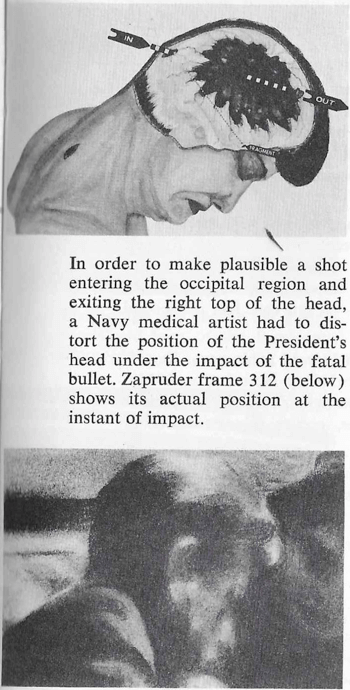
    One might ask: Why does Litwin not precisely deal with the Clark Panel’s modifications of the autopsy? Specifically, their raising of the rear skull wound and the appearance of the 6.5 mm object? Perhaps because, as the leader of that panel, Maryland Medical Examiner Russell Fisher, later said: the panel was formed to counter what the critics had pointed out about the Commission’s version of the autopsy. (Maryland State Medical Journal, March 1977) One way the 1968 panel did this was to raise the rear skull wound, so it would not misalign so much with both Kennedy’s positioning in the Zapruder film at frame 313 and also with where the exit wound on JFK was supposed to be: above and to the right of his right ear. Josiah Thompson had shown that the Commission had misrepresented these matters in illustrations in the volumes. (Six Seconds in Dallas, p. 111)

    What the Clark Panel did was help solve the problem of how the bullet came in: at a low point on the rear skull, on a downward angle; but exited at a higher point and, by necessity, at a rising angle. But, as David Mantik later pointed out, the Clark Panel’s “solution” left another huge problem. The base and nose of the skull bullet were found in the front of the car. (See Clark Panel Report p. 6; WR, pp. 557–58) This meant the 6.5 mm object, still in the rear of the skull, had to come from somewhere in the middle of the bullet. How could such a thing happen? Should we call it the Second Magic Bullet? Litwin does not tell the reader about this problem, so he does not have to explain it.

    In spite of all the problems in the official record, which he sidesteps, there is still another HSCA shibboleth that—in his apparent allegiance to Paul Hoch—Litwin trots out to uphold the findings of that committee, namely that the autopsy photographs were authenticated. As with so many aspects of the HSCA, the ARRB declassification process has made this issue problematic. The HSCA wrote that, even though they had not found either the camera or lens used during the autopsy, the pictures were authenticated due to features on the photos that showed internal consistency. (HSCA Vol. 6, p. 226, reference 1) In itself, this seems questionable, since there was no comparison with the original apparatus utilized at Bethesda Medical Center on 11/22/63. But, as the ARRB found out, it’s worse than that. The Pentagon had found the only camera in use at Bethesda in 1963. But when the HSCA tested it, they found that the test results disagreed with its analysis. As Gary Aguilar notes, perhaps there was a different lens and shutter attached to the camera afterwards. But when the ARRB tried to search for the actual tests performed by the HSCA on the camera, the Board could not find them. Whatever the case, the statement made by the HSCA on this matter does not align with the declassified record. (The Assassinations, edited by James DiEugenio and Lisa Pease, pp. 279–80)

    Let us go to another huge problem with the medical record, one I wrote about in The JFK Assassination. ARRB Chief Counsel Jeremy Gunn examined the official autopsy photographer, John Stringer. When he showed him photos of Kennedy’s brain, the witness was visibly puzzled. The pictures Gunn showed him were shot with a different film than what Stringer used and were performed with a different technique. The latter was betrayed by a series of numbers on the film. Stringer also said that, on the brain photos he originally saw, the cerebellum was both damaged and cut. Here it was presented as intact. When asked directly by Gunn if he would say these were the photos he took of Kennedy’s brain, Stringer replied “No, I couldn’t say that they were President Kennedy’s.” (Doug Horne, Inside the ARRB, Vol. 3, pp. 806–10) Again, can one imagine the impact of such testimony during a legal proceeding? How could the HSCA not discover this very important revelation? This new ARRB evidence leads to these questions:

    1. Who really took those photos?
    2. Why was a second set needed?

    As I demonstrated above, every single modification of the evidence I have mentioned in this review, or in my book, exists in the official records of this case. They are all there for the interested party to see. There is nothing fanciful about it. Litwin’s postulation that I had no witnesses or paperwork to support what I wrote in that regard has been shown above to be utterly false. It can only exist in his cherry-picked world. The problem with his doing that is that he leaves out proof which alters the contours of the evidence and changes the forensic conclusions in the JFK case.

    Post Script: In looking through my notes, I see that I left one point out which I think Litwin is correct about. The author dedicates the book to John McAdams and Paul Hoch. Today, for reasons stated above and throughout, I would have to agree that such a pairing is appropriate. I will deal more with this later in the series.

    Click here for Fred Litwin, On the Trail of Delusion – Part One.

  • Creating the Oswald Legend – Part 6

    Creating the Oswald Legend – Part 6


    1. A WILDERNESS OF MIRRORS

    The Man Who Knew too Much

    Jim Garrison called Richard Case Nagell the “most important witness there is.” A detailed examination of Nagell’s actions is not within the scope of this essay, since he has been the subject of extensive research, beginning with Dick Russell’s books The Man Who Knew Too Much and On The Trail of the JFK Assassins. Other books that document his life and actions are Larry Hancock’s Someone Would Have Talked and Jim DiEugenio’s second edition of Destiny Betrayed.

    What is important to take away from the Nagell story is that both he and Oswald appeared to have some similarities and that Nagell had come very close to unraveling a plot concerning the assassination of John Kennedy. Not only had Nagell met Oswald in Japan while both were stationed there, he had also visited the American Embassy in Mexico City on September 28, 1962, where he stated that he was “bitter, disgusted, disillusioned and disaffected” and that he might go to another country. He returned to the Embassy, on October 1, 1962, to ask what would happen if he renounced his United States citizenship and what the penalty would be if he would go to a country behind the Iron Curtain.[1]

    His behavior was very similar to Oswald’s, when the latter tried to renounce his citizenship and defect to the Soviet Union during his visit to the American Embassy in Moscow.

    Nagell claimed that it was in Mexico where he was recruited by a CIA official who he had met previously in Japan and was given the mission to work as a double agent. Larry Hancock believes this was Henry Hecksher and his job was to establish contact with the Soviets and KGB officers in Mexico. His real task was to feed disinformation to the Soviets during the Cuban missile crisis.[2] The Soviets, on their turn, gave him another mission, to find out about a violent anti-Castro group, Alpha 66, that was plotting to assassinate the American president; and to keep tabs on a certain Lee Harvey Oswald who was not a stranger to the Russians, since he had defected and lived in the Soviet Union.

    Nagell discovered that the Cuban exiles were plotting to assassinate Kennedy in Miami and later in Los Angeles. In California, the scapegoat was Vaughn Marlowe who, like Oswald, was involved with the FPCC: he was an executive officer of the Los Angeles branch[3]. However, these alleged plots did not come to fruition.

    Before Oswald moved to New Orleans, Nagell visited the city and began investigating people who later came up in the Jim Garrison investigation, specifically Eladio Del Valle, Sergio Arcacha Smith, and David Ferrie.[4] He then discovered that the Cuban exiles had learned of the secret back channels of communication between Kennedy and Castro and felt betrayed. They now wanted to avenge Kennedy and were planning to assassinate him. Oswald was being set up by the Cubans and the CIA. Among those setting him up were David Ferrie and the two strange Cubans who visited Sylvia Odio, Leopoldo and Angel. Nagell claimed to be in possession of a tape recording of four men plotting to kill President Kennedy. One was Arcacha Smith and another was identified as “Q,” probably Carlos Quiroga, who was Arcacha’s right hand man and had very likely supplied Oswald with pro-Castro literature.[5]

    What makes that interesting is that when Garrison polygraphed Quiroga, he asked him if Arcacha Smith knew Oswald and if he had seen any of the guns used in the assassination. Quiroga’s answers to both questions were negative; but the polygraph test indicated that he was trying to be deceptive.[6] Garrison had asked Nagell to testify at Clay Shaw’s trial, but Nagell decided that it was not a good idea when a grenade was thrown at him from a speeding car in New York.[7] Garrison tried to extradite Arcacha back to New Orleans, but he was denied his request. Any real investigation would have revealed that Arcacha was Howard Hunt’s man while trying to set up the CRC in New Orleans, was identified by Rose Cheramie and Mac Manual, and also was one of the men who accompanied Rose and had knowledge of the upcoming hit in Dallas. Additionally, as we saw in Part 5, Arcacha was involved in gun running and the drug trade.

    In this regard, it is appropriate to link to Nagell’s first interview with Jim Garrison’s office, where he specifically mentioned Sergio Arcacha Smith. To show how important the Agency thought both Garrison and Nagell were, the reader should keep this in mind: William Martin, the interviewer for Garrison in who Nagell confided, was CIA.

    Nagell then found out that Angel and Leopoldo were trying to recruit Oswald to help them assassinate Kennedy in Washington D.C. This was to be done sometime in late September. They passed themselves on to Oswald as Castro G-2 intelligence agents and reasoned that they wanted to retaliate for Kennedy’s efforts to assassinate the Cuban leader. So Nagell met with Oswald in New Orleans and tried to convince him that Angel and Leopoldo were not Cuban agents, but were anti-Castro Cuban exiles working in accordance with CIA and wanted to kill Kennedy to provoke an invasion of Cuba to avenge his death by Castro. (Click here for more details)

    Oswald denied there were discussions to kill Kennedy and that he was a friend of the Cuban revolution.[8] It is possible that Oswald, whose role was to infiltrate subversives and Castro sympathizers, had found out about the plot and was trying to spy and monitor the Castro agents in a desperate effort to stop the attempt. As to how important Nagell was in the JFK case and how much corroboration his testimony had, I refer the reader to Jim DiEugenio’s discussion of the second edition of Dick Russell’s book about the man.

    Nagell believed that Oswald did pull a trigger in Dealey Plaza, but he could be excused on this point. Nagell was not aware of the information that researchers have in their possession today. For example, the near certainty that Oswald was not on the sixth floor makes it impossible for him to have fired those shots. The latest research indicates that Oswald was probably on the first floor during the shooting and possibly outside the building watching the parade.[9]

    So, if Oswald was not the culprit, who were the shooters in Dealey Plaza and who organized the ambush in such a way to ensure its success and the safe escape of those involved without being caught?

    Nagell’s allegations about Angel’s and Leopoldo’s attempt to set Oswald up as a patsy corroborate John Martino’s claims that the “Anti-Castro Cubans put Oswald together.” Larry Hancock in his recent e-book “Tipping Point”[10] presents such a case where CIA Cuban exile teams in JM/WAVE were trained to kill Castro, but later shifted their focus to Kennedy after they learned that JFK was secretly negotiating to restore relations with Castro. To them, this constituted the ultimate betrayal. It is likely that such information would have been passed down from William Harvey to Johnny Roselli. Therefore, in this scenario, those most likely involved in the conspiracy to kill Kennedy were Roselli, Harvey, David Morales, Rip Robertson, Felipe Vidal Santiago, Roy Hargraves, John Martino, CIA paramilitary officer Carl Jenkins, and Cubans like Chi Chi Quintero, Felix Rodriquez, Carlos Hernandez, Nestor Izquierdo, and Segundo Borgas.

    Researcher William Kelly holds a similar view and believes that the operation in Dallas was based on the “Pathfinder” plan, which was a covert contingency plan to assassinate Castro with a high-powered rifle from a high building as he drove in an open jeep. When the Kennedy brothers rejected “Pathfinder,” it was re-directed from Castro to assassinate John Kennedy instead.[11]

    The above theories are prevalent today and many researchers believe that they come close to the truth. However, there are other suspects and theories regarding the shooters. One of them implicates the French paramilitary group OAS and/or the French intelligence service SDECE in the assassination.

    Dinkin’s Prognostication

    The story of Private First-Class Eugene Dinkin has been told by Noel Twyman in his book Bloody Treason and Dick Russell in his book The Man Who Knew Too Much. Dinkin was a cryptographic code operator stationed in Metz, France and he had concluded that there was a plot being prepared to assassinate Kennedy involving “some high-ranking members of the military, some right-wing economic groups, with the support of some national media outlets.”[12] Dinkin tried to warn many different people about the conspiracy, but no one really believed him. He claimed to have written a letter to Robert Kennedy before the assassination to warn him:

    …that an attempt on President Kennedy would occur on November 28th, 1963; that if it were to succeed, blame would then be placed upon a Communist or Negro, who would be designated the assassin…[13]

    Dinkin was arrested on November 13, 1963, placed in a psychiatric hospital, and later was transferred to Walter Reed hospital. Many researchers believe that Dinkin had learned about the assassination plot by intercepting and decrypting sensitive military communications. According to an FBI report based on interviews with Dinkin, he found out about the plot after studying the military publication Star and Stripes, where he could detect subliminal information regarding the assassination. This is a hard thing to accept and seems to be an unlikely fit. It is more likely that he decoded messages that revealed the plot, but it was his psychiatric confidant that “forced him” to come up with the military publication explanation.

    DA Jim Garrison discovered that one of Dinkin’s duties as a code breaker was to decipher military messages, especially those originating from the French paramilitary organization OAS.[14] Garrison discovered that Clay Shaw was associated with the mysterious company named Permindex, which reportedly had been involved in assassination attempts against French president Charles De Gaulle. Jack Soustelle, a leader of the OAS, was a personal friend to Ferenc Nagy, a founding member of Permindex.

    The OAS vs JFK

    In 1977, a CIA document dated April 1, 1964, revealed that the French authorities wanted to know why a French national—Jean Souetre aka Michel Roux, aka Michael Mertz—had been expelled from the US at Fort Worth or Dallas 48 hours after the assassination, to either Mexico or Canada.[15] Jean Souetre was a member of the OAS (Secret Army Organization), which was violently opposed to France granting Algeria its independence. This poses the question as to whether or not the OAS provided the shooters in Dallas. The OAS had a motive to kill Kennedy, since he had strongly and openly supported the cause of Algerian independence since 1957.

    To mystify things even more, Souetre might have been impersonated by Michael Mertz, a SDECE agent who, in the past had infiltrated the OAS and eventually saved De Gaulle’s life. Mertz was involved in drug trafficking from France to the US, so he was another suspect as being one of the shooters in Dallas. It is possible that neither of these men were involved in the JFK assassination, which would mean someone implicated them in such a way to make it look as if they were in Dallas. The effect would be to draw attention from the real culprits and obscure the truth even further.

    In 1988, Stephen Rivele alleged that the Corsican mafia had assassinated Kennedy and an individual named Lucien Sarti was one of the shooters in Dealey Plaza. Later Howard Hunt, in his deathbed confession, implicated Lucien Sarti as being the gunman behind the fence on the Grassy Knoll. Sarti was killed by the Mexican Federal Police in Mexico City in 1972. It was Hunt and Lucien Conein who were the driving forces behind Richard Nixon’s great heroin coup, designed to replace the French heroin network, and ordered the kidnapping and killing of the Corsican mafia members. How convenient it was that Rivele’s allegations and Hunt’s confession implicated their arch enemies, the Corsicans and the old French connection to the assassination of a US President. Before that, it was Edward Lansdale and Lucien Conein who had defeated the Corsicans in Southeast Asia thus clearing the path for Santo Trafficante to control the opium smuggling from the Golden Triangle.

    Harvey and ZR/Rifle

    It was Bill Harvey who had written in his notes on the ZR/RIFLE program that “Corsicans recommended Sicilians lead to Mafia.” [16] Oddly, Hunt wrote that he was a bench warmer in the plot, in that he did not want to be part of a conspiracy that had anything to do with William Harvey, who was an alcoholic psycho. Hunt was likely deflecting attention from himself by implicating Harvey and his Corsicans in the assassination of Kennedy.

    Many theories name William Harvey as the man who selected the assassins from his ZR/RIFLE program and may have designed the Dallas hit. Mark Wyatt, Harvey’s Deputy in Rome, revealed that Harvey was in Dallas in November 1963. According to Wyatt, he had bumped into Harvey on a plane to Dallas sometime before the assassination. When he asked Harvey what was doing in Dallas, he replied vaguely, “I am here to see what’s happening.”[17]

    However, to be fair to Harvey, he was not in Dallas on November 22, 1963. Wyatt said that they were both attending a Gladio meeting in Sardinia, Italy, when they heard about the assassination. Later that afternoon, Wyatt found Harvey collapsed in his bed after drinking martinis.[18]

    If Harvey was part of the plot, you would have expected him to be in Dallas instead of lying unconscious in bed after heavy drinking. Could it be possible that Harvey’s trips to Miami and his involvement with ZR/RIFLE were unrelated to the assassination and had to do with operations against Castro?

    There is something interesting that Malcolm Blunt discussed about Harvey with Alan Dale. The information that in August 1963, Harvey wanted to meet with Clare Boothe Luce, some months prior to the assassination. Again, could it be possible that he did not want to meet her about the assassination, but to discuss her anti-Castro operations? We cannot really be certain if Harvey was involved in the assassination, that he only had prior knowledge, or knowledge at all.

    Edward Lansdale in Texas

    Some researchers believe that Edward Lansdale was the man who masterminded the Dealey Plaza operation. This is based on Fletcher Prouty’s assertion that Lansdale was in Dallas that day and is seen in a photograph walking by the three tramps.

    If that’s the case, there is no way in the world that Lansdale would have accepted to cooperate with Harvey, and vice versa, in such a crucial event. Lansdale remarked about Harvey, “People who ‘d been up against the Soviet types were always very strange to me…I am sure they thought I was strange.”[19] Harvey not only found Lansdale wacky, but he thought he was a security risk. It was impossible for them to communicate about how to bring down Castro during Operation Mongoose. The final break between the pair came on August 13, 1962. Lansdale wrote a memo: “Mr. Harvey: Intelligence, political (including liquidation of leaders), Economic (sabotage, limited deception) and Paramilitary.” Harvey was furious with Lansdale after that and called him to let him know how stupid he was to put such comments in a document.[20]

    Then there is the question of where Lansdale’s loyalty was located? To the Pentagon, since he was an Air Force General, or to the CIA? In Malcolm Blunt’s book The Devil is in the Details, Alan Dale, Blunt and John Newman were pondering this question. Blunt brought up Robert Gambino from the Office of Mail Logistics who had written a memo on Lansdale. There he offers the information that although Lansdale was a military man, he was working mainly for the CIA.[21] Then Blunt and Dale mention that Lansdale resigned or retired temporarily from the army in October 1963. A short time later he returned to the army and he was promoted. The man who was pushing for his promotion was none other than Allen Dulles himself.[22] Not only that but Lansdale headed the first mission in Saigon in 1954 and this mission was a CIA creation.[23]

    We have established that Lansdale was mainly a CIA guy with an Air Force uniform. But was he in Dealey Plaza as Prouty claims? John Newman found out that after his retirement, Lansdale visited his friend Sam Williams in Denton, Texas, which was near Dallas around the time of the assassination. He discovered a letter from Lansdale to Williams saying, “Hey, I am coming down to see you Sam.”[24] As Newman said, this proves that he was in the Dallas area, but it does not prove he was in Dealey Plaza. A little discussed factor about Lansdale is that he had connections to the Power Elite, specifically to the Kennedy family’s nemesis clan: the Rockefellers. He was Nelson Rockefeller’s clandestine associate in Southeast Asian propaganda activities. Lansdale was an adviser to the Rockefeller Brothers Fund/Special Studies Project and was appointed head of new counterinsurgency office at the Pentagon after the Bay of Pigs.[25]

    Deliberate Obfuscation?

    Whoever designed the Dealey Plaza scenario seems to have designed a confluence in Dallas that day. Everyone who had a motive to want Kennedy killed was somehow in the area: anti-Castro Cubans, the Mob, right wingers, Minutemen, Pentagon members (James Powell, army photographer), and the Texas oilmen who would distribute hostile flyers containing accusations against the President. It seems the anti-Kennedy universe was in Dallas for the purpose of killing Kennedy.

    If that was so, the script writer could ensure that if anyone ever tried to search for the truth, he would encounter such a tangled web of both contradictions and dead ends, that it would be impossible to separate facts from fiction. Then again, the best, most successful disinformation mixes facts with fiction and the truth, which is best hidden between lies. Unfortunately, we do not know the identity of the person who designed this diabolical scenario. It could have been Lansdale, Harvey, David Phillips, Hunt or any other covert action officer. But it’s likely we will never know who orchestrated the Dealey Plaza operation and who the shooters were.

    James Jesus Angleton’s favourite phrase to describe the world of espionage was “a wilderness of mirrors.” In the case of the Dealey Plaza assassination, the wilderness of mirrors was reflecting a confusing, distorted picture where everything was possible, but nothing was certain.

    Is it possible that Larry Hancock’s theory about the shooters and those involved in Dealey Plaza is the one closer to the truth? The main problem would be that the Cubans talked too much and gossiped around; even the CIA officers would find it hard to trust them with sensitive information. If you add to this the fact that the Cuban exiles were infiltrated by Castro agents, it would have been difficult to keep the assassination plot secret. The same probably happened in the plots against Castro, but that was not a problem if the plots to kill him all failed. After all, to those who wanted Kennedy dead, it would have been in their best interests for the assassination attempts against Castro to fail. As John Newman postulates in his new series of books: “for the plot that was used in the JFK assassination to work, Castro had to be alive after the president’s death.”[26] In the case of the JFK assassination, it was imperative for the plot to succeed, because the stakes were so high. If it was to fail, or if Oswald talked, those involved would face charges of treason.

    A better, safer solution that would guarantee absolute secrecy and confidentiality would be to bring in a military or paramilitary team from Laos. That unit could be flown to Mexico or the USA with Air America via the drug trade routes. They would finish the job and return to Laos where they would possibly end up being killed in a risky mission against the Viet Cong. Admittedly, this is speculation and nothing more. But it does indicate a more surefire way of concealment.

    1. ELITE CONNECTIONS

    In part 3, we reviewed Oswald’s appearance on Bill Stuckey’s New Orleans radio show “Carte Blanche”. There, he talked about his political views and debated with Ed Butler and Carlos Bringuier. The result of this interview was a record production by Dr. Alton Ochsner’s INCA, an album with the title, “Oswald: Self-Portrait in Red.” On the front cover was a drawing of Oswald’s face and on the back of the album was the headline “I am a Marxist” with the date of August 21, 1963, at the bottom were photographs of Congressman Hale Boggs, psy war specialist and Ochsner employee Ed Butler, and Dr. Alton Ochsner himself. Ed Butler did not only have connections to the previously discussed American Security Council, but he was also in contact with General Edward Lansdale and CIA Deputy Director Charles Cabell.[27]

    Dr. Ochsner and the CIA

    This is all fitting, because a CIA document of May 23, 1968, has finally been released completely unredacted. It was secured by Malcom Blunt. It reveals that Ochsner was a cleared source of theirs since May of 1955. But also, the CIA had sources inside Ochsner’s large New Orleans clinic. The memo continues by saying that Crescent City CIA officers, Hunter Leake and Lloyd Ray, were both socially familiar with Ochsner. In the document, the CIA admits they are in contact with INCA. The memo concludes with this: “Mr. Edward Butler, Staff Director of INCA, is a contact of our New Orleans Office and the source of numerous reports.” In light of this, we should also note that in about 24 hours, the CIA sponsored DRE put out a broadsheet saying Oswald killed Kennedy for Castro. (Click here for details) As noted, Carlos Bringuier of the CIA sponsored DRE was the other participant in Stuckey’s debate.

    Dr. Ochsner was working closely with Butler to fight Communism in Latin America and promote free trade. He had also been President of the American Cancer Society, President of the American College of Surgeons, President of the International Society of Surgeons, and President of the Alton Ochsner Medical Foundation.[28] Ochsner had the reputation of an extreme right-winger: anti-welfare, anti-Medicare, and racist. The truth of the matter is that he was all that and more and he was part of the local aristocracy and the elite establishment. He was the President of the International House (IH) and he was also a member of the International Trade Mart (ITM), where he worked with Clay Shaw, who was once a Managing Director of the IH. There is a photograph of Ochsner with Shaw at the New Orleans Public Library.[29] Ochsner sat on the Board of Directors of the Foreign Policy Association of New Orleans with Shaw. This organization invited CIA Deputy Director Charles Cabell to New Orleans to discuss the Communist threat.[30]

    Ochsner was also a member of the exclusive New Orleans Boston Club and he had been invited to the secretive west coast Bohemian Club. During his time at Tulane University, he managed to attract financial support from the Rockefeller and Carnegie Foundations.[31]

    Ochsner would count among his friends, Turner Catledge, managing editor of the New York Times, Samuel Zemurray of United Fruit, and Edgar and Edith Stern of the Sears Roebuck fortune. John J. McCloy served as an honorary chairman of the IH, while David Rockefeller was a trustee and Chairman of the IH’s executive committee.[32] Ochsner’s INCA organization was getting financial support from Standard Oil, the Reily Foundation, Mississippi Shipping Company, the Hibernia bank, and ITM.[33]

    In the late 1930’s, the New York IH Chairman was Henry L. Stimson, former Secretary of War and former Secretary of State, among his trustees were John D. Rockefeller III and Frederick Henry Osborn Sr.

    Osborn, Allen Dulles and the Paines

    The last was an interesting individual, well rooted in the upper classes of the Eastern Establishment. He was a trustee of Princeton University and a member of the Rockefeller Institute and the Carnegie Corporation. Osborn was a Director of the Population Association of America, the American Eugenics Society, and of the Association for Research in Human Heredity. He was also an associate of Dean Acheson. Acheson appointed Osborn in 1947 to be one of the US representatives to the United Nations Atomic Energy Commission.[34] In 1947, John D. Rockefeller III established the Population Council and appointed Osborn the Council’s first Director.[35]

    Osborn, along with Wickliffe Preston Draper, founded the Pioneer Fund; the purpose was to advance pro-eugenic research and propaganda. In 1937, Osborn stated that the Nazi’s racial sterilization program was “the most important social program which has ever been tried.”[36]

    Like his friend Allen Dulles, Osborn had graduated from Princeton and both worked together to establish an organization called Crusade for Freedom that merged with Radio Free Europe in 1962. There are letters exchanged between him and the Dulles brothers at Princeton University.[37]

    It was his son Frederick Osborn Jr. and his wife Nancy who provided character references for Ruth and Michael Paine, when the FBI was investigating them for their close relationship to Marina and Lee Oswald. Why a prominent member of the Eastern Establishment like Osborn would bother to explain to the FBI that the Paines had nothing to do with the assassination is a question that has never been answered.[38] Maybe the answer was that both Ruth and Michael Paine’s families were considered to be upper class, with links to the Eastern Establishment.

    Ruth and Michael, the Good Samaritans

    Michael Paine’s ancestry goes back to the Boston Brahmins: the Forbes and the Cabot families. His grand uncle Cameron Forbes was the Governor and Ambassador to the Philippines and later joined the board of United Fruit. Michael’s cousin, Thomas Dudley Cabot, was a former President of United Fruit and his brother John M. Cabot was in the State Department discussing with Maurice Gatlin the CIA plan to overthrow the Guatemalan government on behalf of United Fruit. Gatlin was a close associate of Guy Banister. Cabot was also President of the Gibraltar Steamship Corporation, a CIA front through which David Phillips established Radio Swan.[39]

    Michael’s mother, Ruth Forbes, was a very good friend of Mary Bancroft. Bancroft was an ex OSS agent who worked under Allen Dulles in Switzerland. Dulles and Bancroft were romantically involved for a short period, but later remained friends. Bancroft was also a friend of Henry Luce of the Time-Life Empire.[40]

    Ruth Forbes divorced Michael’s father and she married Arthur Young. Young was a famous inventor and one of the creators of Bell Helicopter. That connection helped his step-son Michael Paine get a high tech/high security clearance to work at Bell Helicopter in Fort Worth. Before that, Michael was employed by the Franklin Institute, a CIA conduit.[41]

    Ruth Paine had a great fondness for Arthur and Ruth Forbes Young and would regularly ask their opinion on undisclosed topics. She visited them in the summer of 1963 in their home in Philadelphia.[42]

    Ruth Paine’s father, William Avery Hyde, and his wife Carol were prominent members of the Ohio Unitarians. Her father had worked for the OSS during WWII and he later became the USAID’s regional director for Latin America.[43]

    CIA Agent Joseph Dryer, a friend of George DeMohrenschildt, was asked by the HSCA to identify from a list certain people who might have connections to DeMohrenschildt. Dryer identified two of them. One was Army Intelligence officer Dorothe Matlack and the other was William Avery Hyde.[44] A 1993 CIA declassified file revealed that Ruth’s sister, Sylvia Hyde Hoke, had worked for the Agency as a psychologist. It is worth noting that Sylvia’s husband John Hoke was employed by the USAID.[45] It is also worth noting the following in this aspect: Ruth did some traveling in the summer of 1963. She visited with her sister at her home. Yet, during her grand jury appearance with Jim Garrison, not only did Ruth deny knowing what agency of government Sylvia worked for in 1963, she also pleaded ignorance about where her sister lived at that time. (Click here for details, see pp. 55–62) Obviously, with Ruth drawing a blank, it made it more difficult for Garrison to attain this information, since the CIA was hiding it from him.

    On his return from New Orleans, Oswald had applied for employment through the Texas Employment Commission. Ruth Paine had arranged for Oswald to get a job at the Texas School Book Depository and told him about it on October 14th. Oswald was interviewed on October 15th and started work the following day. However, on the 15th, an employee of the Texas Employment Commission phoned the Paine residency and asked for Oswald. He wanted to inform him that they had found him a job at Trans Texas Airport. Ruth Paine answered that he was not home and so they called back the next day to hear that Oswald had taken a job elsewhere. Ruth never informed Oswald about this job, even though it paid about $100 more per month than the TSBD one.[46]

    The backyard photographs of Oswald posing with a rifle were found by the police at the Paines’ home. But a week later, another piece of evidence turned up out of the blue— on November 30. It was a note found inside a book incriminating Oswald in the attempted murder of General Walker, which is bizarre since Oswald, for seven months, had never been considered a suspect in that case .[47]

    Ruth Paine also provided other evidence: a betting guide and a English-Spanish dictionary that allegedly proved that Oswald had visited Mexico.[48] Ruth was also responsible for discovering the well-known “Kostin letter“ allegedly written by Oswald saying that he met Comrade Kostin (meaning Kostikov) in Mexico City.[49] What makes this odd is that in an FBI phone interview of November 28, 1963, Ruth told agent Don Moore that she had no idea Oswald had been in Mexico. And when Oswald showed up in Dallas, “neither he nor his wife furnished any info to Mrs. Paine to the effect that Oswald had been in Mexico.” That report then concludes with: “In fact, Oswald claimed that he had been in Houston and then had been in Dallas a few days before he called his wife at Mrs. Paine’s.” This is one more disturbing discovery made by David Josephs, who has all but proven that Oswald was not in Mexico City as the CIA says he was. If this is so, then one has to ask: why was it so necessary for Ruth Paine—and then Priscilla Johnson—to turn up evidence that imputed he was?

    What makes this doubly odd is that some of these items were discovered after the Dallas Police searched the Paine home and garage—twice! A good example would be the Imperial Reflex camera which was allegedly used to take the backyard photographs. That camera was not on the original Dallas Police inventory list. It was found by Ruth two weeks after the assassination. It would appear from the above information that Ruth Paine was instrumental in maneuvering Oswald and somehow finding certain pieces of a puzzle for a murder he did not commit.

    C. D. Jackson and Life magazine

    Another person from the Upper Class that left his traces in Dallas post assassination was C. D. Jackson. He was an expert in wartime propaganda, public relations, advertising, publishing, psychological warfare, black ops, and he was an opinion maker. During the Eisenhower Presidency, he was the Special Assistant to the President for International Affairs and he had been an editor-in-Chief of Henry Luce’s Time, Life, and Fortune magazines. Henry Luce was the man who invented the term “American Century,” which involved global American dominance projected by American businesses leading a worldwide economy. Jackson shared Luce’s vision and he had been called Henry Luce’s “designated choreographer” for the “American Century.”[50]

    The evening of the assassination Luce’s reporter Patsy Swank called Richard Stolley of Life magazine and informed him that a local clothing maker, Abraham Zapruder, had filmed the assassination. So Stolley contacted Zapruder and arranged to meet him the next morning. He viewed the film and then reported his findings to Jackson who, in turn, ordered him to buy the film. Stolley purchased the original copy as Zapruder claimed to him for $50,000.[51]

    When Jackson viewed the film, he “proposed the (Time Inc.) company obtain all rights to the film and withhold it from public viewing at least until emotions had calmed.”[52] On 29 November 1963, Life published a special issue on the assassination that included only thirty-one selected frames, which did not allow the readers to understand the sequence and direction of the shots, especially the fatal head shot.[53]

    Marina Oswald was isolated at the Inn of the Six Flags by the Secret Service. James Herbert Martin was the manager and later became Marina’s agent and she even stayed at his home for a while.[54] Martin, who sold the infamous “back yard photos” to Life magazine, also arranged for Marina to pen a book. That was arranged from C. D. Jackson and Life’s Edward K. Thompson, through their Dallas representative Isaac Don Levine.[55] It was Allen Dulles who had urged C. D. Jackson to have Marina’s story written by Levine, but that book never materialized.[56]

    C. D. Jackson was indirectly connected to the Pawley-Bayo mission (CIA crypt Operation TILT). This was a sea voyage into Cuba. It was allegedly designed to exfiltrate Soviet scientists who wanted to defect and testify before Senator James Eastland’s Senate Internal Security Subcommittee. That testimony was to state that the Russians still had missiles present in Cuba. Journalist Carl Bernstein believed that in the 1950s Jackson was so intertwined with the Agency that he went so far as to arrange for CIA employees to travel with Time-Life credentials as cover.[57]

    Apart from millionaire William Pawley and Cuban exile Eddie Bayo, others that took part in the operation were John Martino, Eugenio Martinez, and CIA agent Rip Robertson. Pawley had asked CIA Deputy Director Pat Carter and Ted Shackley of JM/WAVE to help him with the mission. Pawley would have used his private yacht, while David Morales supervised the mission. Operation TILT failed, since the exile Cubans disappeared on their way to Cuba and were never heard from again.

    Peter Dale Scott has written that the real purpose of the mission was to assassinate Castro. Jack Anderson reported the Johnny Roselli story that the assassination team was captured in Cuba and Castro “turned them” and sent them to Dallas to assassinate Kennedy instead.[58] At one point, Bayo had asked for help from a wealthy Kennedy supporter, Theodore Racoosin, who later reported that someone from within the White House—possibly Robert Kennedy—had authorized him to organize meetings with Cuban exiles and learn details of CIA Cuban operations. Scott believes that this operation was used to blackmail the Attorney General, so he would not investigate his brother’s assassination.[59]

    Henry Luce had funded the raid and Life magazine was allowed to send a journalist to report and photograph the mission. That journalist was Richard Billings, an in-law of C. D. Jackson. After the assassination, Billings was sent to Dallas to investigate the murder and later pretended to help Jim Garrison in his investigation. But he later turned on Garrison and began a Life campaign to smear and deter Garrison’s efforts.[60]

    We can surmise that C. D. Jackson was handling the damage control after the assassination for Life. He could control the Zapruder film and probably influence Marina Oswald’s testimony, to assure that the public would not find out all the facts, thus altering their perception of what happened in Dallas. This would fit a psychological warfare and propaganda expert connected to the CIA.

    Shaw, Ferrie and Freeport Sulphur

    The connections to the Eastern Establishment would not end with C. D. Jackson. There were more links in New Orleans to be explored. During his investigation, Garrison was contacted by a witness who revealed to him that a Mr. “White” of Freeport Sulphur company had contacted him to discuss a possible Castro assassination plan. The same witness had heard Clay Shaw or David Ferrie talking about some nickel mines in Cuba.[61]

    Another witness, Jules Ricco Kimble, told Garrison’s office that a Mr. “White” along with Shaw and David Ferrie had flown in a plane to Cuba to make a deal regarding some nickel mines.[62] Garrison discovered who Mr. “White” was:

    “One man whose name we first thought to be WHITE apparently is WIGHT, Vice President of Freeport Sulphur who reputedly made the flight.”[63] It could be a coincidence, but Johnny Roselli testified that he “represented himself to the Cuban contacts as an agent of some business interests of Wall Street that had nickel interests and properties around in Cuba and I was getting financial assistance from them.”[64] This, of course, was when Roselli was associated with the CIA and trying to arrange the murder of Fidel Castro. It would have been interesting if Roselli had named those nickel interests in Cuba, but it may be more than an assumption that he was talking about the same nickel mines involving Freeport Sulphur. What may be more important though was Freeport Sulphur itself.

    Freeport Sulphur was established in Texas in 1912 and later moved to New York. The company’s activities were mining sulphur that was essential in the production process of chemicals, papermaking, pigment, pharmaceutical, mining, oil-refining, and fiber manufacturing industries. New York City multi-millionaire John Hay Whitney supported the corporation financially and, for a while, he was the head of the company.[65]

    Freeport Sulphur’s Board of Directors included Admiral Arleigh Burke and Augustus Long, Chairman of Texaco Oil Company and Director of the Chemical Bank. It also included Jean Mauze, husband of Abby Rockefeller, who was granddaughter of John D. Rockefeller and a sister to David and Nelson Rockefeller; Godfey Rockefeller, the brother of James Stillman Rockefeller, and Benno C. Schmidt one of the original partners of J. H. Whitney.[66]

    As Donald Gibson pointed out, Jock Whitney’s New York Herald Tribune was promoting the Lone Nut theory within 24 hours of Kennedy’s assassination. Finally, the last member of Freeport Sulphur’s Board of Directors was Robert Abercrombie Lovett, a former partner of Brown Brothers Harriman and a trustee of the Rockefeller Foundation and of the Carnegie Corporation.[67] Among his closest friends were Henry Luce, John McCloy, and Dean Acheson. It was McCloy, Lovett, and Acheson that later advised LBJ on Vietnam and recommended escalation of the war.[68]

    1. A PAWN ON THE GRAND CHESS BOARD

    In light of what we know today, Oswald was an expendable pawn in the grand scheme of things. It seems that the Cuban exiles and their Mafia co-conspirators—especially those from the Santo Trafficante and the Nevada Casino group—were manipulated to implicate Oswald in the Kennedy Assassination. They falsely believed that by framing Oswald to make it look like the Cubans and Castro were the driving forces behind him, this would have led to an American invasion of Cuba to avenge the President’s murder.

    However, they were betrayed by the real instigators who never had Cuba as their real target. And simultaneously set up both the anti-Castro Cubans and the Mafia as false sponsors of the crime. It was J. D. Tippit’s murder that led to Oswald’s arrest and the consequent swearing in by LBJ in Dallas that put a halt to their plans. Certain elements of the CIA and the Eastern Establishment turned around the Bringuier/Butler “Cuba did it” theories and designated Oswald as a lone nut who had acted alone, driven by personal sociopathy. LBJ was not the mastermind of the assassination and it may be that he was not privy to the plot. He might have been informed, but without knowing the details. It is also possible that he was manipulated in such a way to make sure that he would stop the Pentagon from invading Cuba and then force a cover up so the responsible parties would have never been brought to justice. (Click here for details) What is certain beyond reasonable doubt is that LBJ reversed JFK’s foreign policy in Vietnam and in Southeast Asia in general.

    Johnson and Vietnam

    Kennedy had been preparing to withdraw from Vietnam for months, but a few days after his death LBJ altered NSAM 273 to allow American navy ships to patrol near North Vietnamese waters. In August of 1964, this resulted in the Gulf of Tonkin incident. That provided the excuse for committing both US air attacks and then combat troops into Vietnam. That incident had been preceded in March, 1964, by Johnson’s approval of NSAM 288. This allowed the US Air Force to directly bomb scores of targets in Vietnam.[69] So when Tonkin happened, LBJ just pulled out the target list. In three years, Kennedy would not approve such an agenda. In three months, Johnson had.

    Newly released tapes reveal that LBJ told McNamara on February 20, 1964 that “I always thought it was foolish for you to make any statements about withdrawing. I thought it was bad psychologically. But you and the president thought otherwise and I just sat silent.”[70] In another tape, LBJ asked McNamara on March 2, 1964, to write a memo explaining that he never meant that he and Kennedy wanted to withdraw a thousand men from Vietnam; it was only a test.[71]

    One has to wonder: why the freeze to invade Cuba? After all, there had been efforts through Operation Mongoose to harass Castro and these efforts led some to think it was designed to recover all the lost American business interests that had been damaged by Castro’s policies in Cuba. It is possible that the perpetrators knew they could not invade Cuba without risking a confrontation with Russia. Therefore, the idea was to avoid a nuclear holocaust.

    For Moscow, Cuba had become the equivalent of East Berlin. This emotional attachment would have created extreme tension and heightened paranoia in the Cold War arena. Most importantly there was a new territory to advance their business interests, immensely vaster and more profitable than Cuba. That was Southeast Asia. The Cuban exiles and the Mafia were not to be left in the cold and outside of the merry dance. As journalist Henrik Kruger outlined in his book The Great Heroin Coup, they were compensated for their efforts by access to the Golden Triangle and world drug trafficking by replacing the Corsicans and the French network. The drugs would now enter from Mexico to the US instead of Marseilles. Lansky’s Miami and Caribbean banks were given the privilege to launder the profits from the illicit drug trade.

    Laos had been a target of American interests. The concept was to take control of its opium fields and after the American intervention it worked splendidly. That area became the third largest producer of opium in the world.[72] Opium, of course, can be refined into heroin.

    On August 30, 1959 there was a crisis unfolding in northern Laos near the Vietnamese borders. The Washington Post reported that “3,500 Communist rebels, including regular Viet-Minh troops have captured eighty villages in a new attack in northern Laos.” Later, a UN investigation found out that it was a minor incident and that no North Vietnamese invaders were discovered and that most Vietnamese soldiers had crossed over to Laos to surrender.[73]

    The truth, however, was distorted by none other than Joe Alsop, the man who, five years later, tried to convince LBJ to create a presidential commission to investigate JFK’s murder. He arrived in Laos in time to report about a “massive new attack in Laos” by “at least three and perhaps five new battalions of enemy troops from North Vietnam.”[74] Later he wrote of “aggression, as naked, as flagrant as a Soviet-East German attack on West Germany.”[75]

    There was more than opium at stake. There were big interests represented by the munitions and oil industries. LBJ’s friends from Texas were to be hugely compensated from the war that the new president was promoting. The Texas located company manufacturing Bell helicopters—where Michael Paine worked—would profit immensely from their use in Vietnam. General Dynamics plane production—located in Fort Worth—would gain huge contracts during that war.

    Another of LBJ’s friends who profited from the Vietnam War was David Harold Byrd, owner of the Texas School Book Depository. In early November, 1963, Byrd and his investment partner James Ling bought $2 million worth of stock in Ling-Temco-Vought (LTV), a defense company they owned. It may have been a coincidence, but the fact is that the navy awarded LTV the first major contract in February 1964 to construct the A7 Corsair fighter plane for operations in Vietnam. Peter Dale Scott calculated that this sum of money was worth $26 Million by 1967.[76]

    LBJ was a close friend to the Brown Brothers, who owned a construction company named Brown and Root. In 1962, a consortium of private American construction corporations made up of Raymond International and Morrison-Knudsen (RMK) were building Vietnam’s infrastructure. But the construction was limited. The original contract was for $15 million. But in the beginning of 1965, the sum had reached $150 million. RMK could not keep up with the demands of construction. They added to their team two large American companies, Brown and Root and J.A. Jones, to form the largest ever consortium, RMK-BRJ.[77] This consortium took the largest share of all Vietnam construction work, around 90 percent of the total. The US Navy granted RMK-BRJ a cost-plus-fixed-fee to quickly prepare Vietnam for a major U.S. military presence.[78]

    The Rockefeller brothers also made huge profits, since they had ownership and shares in big defense contractors like Standard Oil of California, Standard Oil of New Jersey, Boeing, and General Motors. That last company gained more than $1.3 billion in military contracts in 1968.[79] But these were short-term profits for the Rockefellers. The real deal was in reconstructing the infrastructure after the war had ended and financing would be needed to achieve that. Under this mistaken assumption, in 1965, Rockefeller’s Chase Manhattan Bank opened a branch in Saigon—a huge fortress with no windows but thick glass blocks and stone walls that could withstand mortar attacks.[80]

    A major force behind the Vietnam War was the Rockefeller’s Southeast Asia Development Advisory Group (SEADAG). That membership included Rockefeller Brothers Inc., Chase Manhattan Bank, the Rockefeller Foundation, Standard Oil of California, Standard Oil of New Jersey, and Standard Oil of Indiana.[81] SEADAG’s Samuel P. Huntington believed that cheap labor created by forced relocation would help Saigon win the conflict.[82] Anthropologist Jules Henry explained that the war would create cheap labor that would be able to compete with the lower productive costs of Chinese and Japanese industry and that “the destruction of the Vietnamese countryside is the first, and necessary, step to the industrialization of Vietnam and nationalization of its agriculture.”[83]

    LBJ and Congo

    Vietnam was not the only issue among JFK’s policies that the elites were opposing. Kennedy was determined to change Eisenhower’s policy in Belgian Congo and had decided to let the UN bring all opposing armies under control. On his own, and behind the scenes, JFK called the Russians and informed them that he was ready to negotiate a truce in Congo. Clare Timberlake, the US Ambassador to Congo, learned of this and alerted CIA Director Allen Dulles and Joint Chiefs Chairman Lyman Lemnitzer that Kennedy was selling out to the Russians and breaking away from Eisenhower’s policy.[84] Senator Thomas Dodd was one of the major forces who opposed Kennedy’s Congo policy. He initiated hearings in the senate on the “loss” of Congo to Communism.[85]

    Congo, especially its Katanga region, was full of minerals. JFK had agreed with Prime Minister Patrice Lumumba that the riches of Congo should be shared among its people. Also, that more of the profits from the foreign investments should be used to counter unemployment and improve Congo’s standard of living. Lumumba made a critical mistake when he informed US businessmen that he wanted to break away from the Belgians and negotiate directly with the Americans about Congo’s uranium while bypassing the Belgians. Lumumba thought that this would please the Americans. But he did not know that US corporations had a big stake in Belgium’s monopoly of copper and uranium in Katanga province through Tanganyika Concessions Limited: a company in which the Rockefellers were shareholders.[86]

    The Rockefellers and the Guggenheims held stocks in the Belgian diamond mining operation in Kasai province, Northwest of Katanga. Their investment was $20 million, while their Belgians partners had invested only $2 millions.[87]

    Kennedy’s Treasury Secretary Douglas C. Dillon also had a stake in Congo. He was an investor in Laurence Rockefeller’s textile mill and also in Laurence’s automobile import company in Congo.[88]

    Unfortunately, the Belgians and the CIA murdered Lumumba and eventually replaced him with dictator Joseph Mobutu. At around this time, early in 1964, LBJ reversed Kennedy’s policy in Congo. The CIA recruited Cuban exile pilots to fly operations against the Congo rebels involved in the Simba Rebellion. Once the UN withdrew, LBJ sent airplanes, advisors, and arms to the Belgians for support.[89]

    Sukarno and Indonesia

    An all too familiar situation occurred in Indonesia, where Kennedy was determined to cooperate with the neutralist and left leaning President Sukarno. Kennedy decided to help Sukarno acquire control of the Dutch New Guinea area the Indonesians called West Irian. He assigned his brother Robert to negotiate the return of West Irian to Indonesia from Dutch colonial rule.[90] What Kennedy did not know, but Allen Dulles did, was that West Irian was a region extremely rich in minerals, even richer than Katanga.

    In the 1920s and 1930s, Allen Dulles was a lawyer at the giant corporate law firm Sullivan and Cromwell. He represented the Rockefellers there and he knew that Indonesia had huge mineral and oil potential. One of the oilfields in Sumatra exploited by Caltex was the size of similar oilfields in Saudi Arabia.[91]

    In 1936, a joint Dutch and American expedition—including explorer/geologist Jean Jacques Dozy—was organized by Allen Dulles through Sullivan and Cromwell. That expedition discovered two enormous mineral deposits in West Irian. The American firms that financed the expedition were two divisions of Standard Oil. One of the two colossal deposits was called the Ertsberg and the other the Grasberg. Both were extravagantly rich in gold, silver, and copper. Just the gold content was much larger than the wealthiest gold mine in the world, then located in South Africa.[92]

    In 1962, a second expedition involving Freeport Sulphur’s geologist Forbes Wilson, took place. But neither man revealed the enormous gold content. According to Australian scholar Greg Poulgrain, they both gave the impression that the main mineral was copper with smaller amounts of silver and gold.[93]

    Two Rockefeller companies were also doing oil business in Indonesia: Stanvac (jointly held by Standard Oil of New Jersey and Socony-Mobil, Socony being Standard Oil of New York); and Caltex, (jointly held by Standard Oil of California and Texaco.)[94]

    Freeport Sulphur, a Rockefeller controlled company, would be hugely rewarded by the West Irian mineral mines. As Lisa Pease explained, 1962 was a very difficult year for Freeport. They lost their Cuban nickel mines. And they were planning with Clay Shaw to arrange a scheme to bring in nickel from Canada. They were under investigation about stockpiling surpluses that President Kennedy was determined to make an issue in his 1964 presidential campaign.[95]

    When LBJ became president, he quickly reversed Kennedy’s Indonesia policy. As Poulgrain notes in his new book, JFK vs Allen Dulles: Battleground Indonesia, the State Department and the CIA began planning to replace Sukarno in late 1964. In the summer of 1965, when Marshall Green became the new ambassador, these plans went into operation. Sukarno was overthrown and a huge massacre of the PKI took place. More than a half million were killed. The minerals of West Irian did not go to the Indonesians, but to the new President Suharto and foreign business interests. Later Freeport Sulphur subcontracted Bechtel to handle the engineering aspects of the mining.[96] Freeport was later renamed Freeport McMoran. It became one of the two largest mining corporations in the world. The eventual wealth mined from the two deposits topped 100 billion dollars. (Click here for details)

    As Carol Hewett discovered, Allen Dulles was close to the DeMohrenschildt family. According to Poulgrain, Dulles managed to transfer George DeMohrenschildt to West Irian to work on Standard Oil’s drilling since the region had one of the largest oil deposits in Indonesia.[97]

    Dulles lied to Kennedy on several occasions regarding the Sino-Soviet split. He told him it was not real, but a Cold war ploy to fool America. It was real and Dulles was using Indonesia as a wedge to further the split between China and the Soviet Union. Both were trying to influence and gain the support of the PKI, Indonesia’s large communist party, which backed Sukarno. Dulles wanted to depose Sukarno and eliminate the PKI. The result would make the Chinese and the Soviets accuse each other of being at fault. Dulles and Henry Kissinger participated in the Rockefeller Brothers Panel Report in 1958–1959, where the Sino-Soviet split was first mentioned.[98] It is worthwhile to note that Anatoliy Golitsyn, the Russian defector who was influencing James Angleton, had convinced him that the Sino-Soviet split was fake. With that nonsense, one has to wonder how genuine a defector Golitsyn was.

    Kennedy was planning to visit Jakarta in early 1964. If he had not been killed, he would have met with Sukarno and that would have helped Sukarno consolidate his regime in three areas: social, political, and economic. And Dulles would have seen years of covert work thrown into the trash can. From 1958, his first attempt to overthrow Sukarno, Dulles was planning on regime change. That would have allowed his clients to control the oil, gold, copper, and silver reserves of Indonesia rather than go to the citizenry of Indonesia, as Kennedy and Sukarno had planned. The policy of wedge against China and the Soviet Union would have been disrupted.

    Foreign policy was not the only arena in which the Rockefellers would clash with Kennedy. There was a White House state dinner taking place for France’s Cultural Minister Andre Malraux in May of 1962. David Rockefeller was invited. Kennedy asked Rockefeller to write a letter presenting his views on the economy. David responded with a long letter, where he advised Kennedy:

    Because of the vital need for increased investment, the requirement of lower taxes and the importance of fiscal responsibility, I would urge upon you a more effective control of expenditures and a determined and vigorous effort to balance the budget.[99]

    David also tried to focus on the nation’s tax system and the urgent need to take it apart and re-examine it:

    Today the tax burden falls much too heavy on investment—more heavily in fact than any other industrialized country in the world. In my opinion, this tax burden must be lightened, and soon—preferably through a material reduction in the corporate income tax rate.[100]

    Kennedy replied that his administration had tried to cut business taxes, reduce tariffs, increase trade, reduce labor cost, and keep the dollar strong.[101] Most importantly he insisted that, “our tax laws should surely not encourage the export of dollars by permitting ‘tax havens’ and other undue preferences.”[102] This point must have angered David, since the Rockefellers had many such tax havens in small Caribbean banks, Swiss Commercial banks, private investment firms in Luxemburg, and stock holdings in foreign companies. American corporations overseas had ‘parked’ profits in foreign commercial banks and in foreign subsidiaries. Kennedy’s 1962 tax bill targeted these tax havens by subsidiary companies. Kennedy published his correspondence with Rockefeller in Life magazine to show that he was on agreement with David on most economic issues. But David Rockefeller was not very impressed with Kennedy’s public relations move.[103]

    In November 1963, David’s brother announced himself a candidate for the Republican Party to oppose Kennedy in the 1964 general elections. Nelson accused Kennedy of “jeopardizing the peace and demoralizing America’s allies with a weak foreign policy.”[104] After Kennedy’s assassination Nelson called his loss a “terrible tragedy.” But to his friend Alberto Camargo, he showed his true colors when he said to him: “For Latin America, Kennedy’s passing is a blackening, a tunnel, a gust of cloud and smoke.”[105]

    To exemplify what he meant, David Rockefeller met with LBJ in January of 1964. As A. J. Langguth wrote in his book Hidden Terrors, this is something Kennedy would not welcome. Soon after, the coup in Brazil was enacted. Johnson also began to eat away at Kennedy’s Alliance for Progress, particularly through his friend diplomat Thomas Mann. As Walter LaFeber notes in Inevitable Revolutions, Richard Nixon then had Nelson Rockefeller write a report on the Alliance. At Nelson’s recommendation, Nixon eliminated the program. That was some blackening tunnel filled with smoke Nelson foresaw.

    Unfortunately, we will never know the true identity of those that ultimately decided that President Kennedy had to be erased, thus instigating the assassination. But it probably was not the CIA or the Pentagon per se; they were likely the executive arm of powerful people, among the elites of the United States. The CIA has overthrown foreign governments in Iran, Guatemala, and Chile. But they were urged in those actions by big corporations whose interests had been comprised by new leftist governments. Another way to pose the question is not just by asking, Cui bono? But also, in how many ways did they benefit? Can all these changes going in one direction, can all this and more, be just a coincidence?

    It would have been very dangerous for the CIA and/or the Pentagon to have dared to assassinate a US President on their own—not some president from a banana republic. This would have been murder and treason. They were likely first given reassurances from the Powers Elite that a cover up would take place, one that would guarantee their impunity.

    It is more likely that those involved in the crime were a mixture of CIA and military elements serving big business interests in a fashion similar to the mentality and ideology of individuals that converged in the American Security Council. However, this should not give the mistaken notion that the American Security Council instigated and executed the assassination. It came from much higher up.

    Go to Part 1

    Go to Part 2

    Go to Part 3

    Go to Part 4

    Go to Part 5

    Go to Conclusion

    Go to Appendix

    References


    [1] Russell Dick, The Man Who Knew Too Much, Carroll & Graf, 1992, pp. 39–140.

    [2] Russell Dick, On The Trail of the JFK Assassins, Skyhorse Publishing 2008. p. 160.

    [3] Russell Dick, The Man Who Knew Too Much, Carroll & Graf, 1992, chapter fourteen.

    [4] DiEugenio James, Destiny Betrayed, Skyhorse Publishing, 2012, p. 96.

    [5] DiEugenio James, Destiny Betrayed, Skyhorse Publishing, 2012, p. 97.

    [6] DiEugenio James, Destiny Betrayed, Skyhorse Publishing, 2012, p. 184.

    [7] DiEugenio James, Destiny Betrayed, Skyhorse Publishing, 2012, p. 294.

    [8] Russell Dick, On The Trail of the JFK Assassins, Skyhorse Publishing 2008. p. 161.

    [9] www.prayer-man.com

    [10] https://www.maryferrell.org/pages/Tipping_Point

    [11] JFKcountercoup: PATHFINDER – Parts 1 – 5 The Plan to Kill Castro Redirected to JFK at Dallas

    [12] https://kennedysandking.com – The Death of Eugene B. Dinkin

    [13] Russell Dick, The Man Who Knew Too Much, Carroll & Graf, 1992, p. 349.

    [14] Russell Dick, The Man Who Knew Too Much, Carroll & Graf, 1992, p. 352.

    [15] Russell Dick, The Man Who Knew Too Much, Carroll & Graf, 1992, p. 353.

    [16] Malcolm Blunt archives, William King Harvey – Google Drive

    [17] Talbot David, The Devil’s Chess Board, Harper Collins Publishers, 2015, p. 477.

    [18] Talbot David, The Devil’s Chess Board, Harper Collins Publishers, 2015, p. 476.

    [19] Martin David, Wilderness of Mirrors, Harper Collins Publishers, 1980, p. 136.

    [20] Martin David, Wilderness of Mirrors, Harper Collins Publishers, 1980, pp. 137–138.

    [21] Blunt Malcolm, The Devil is in the Details, 2020, p. 102.

    [22] Blunt Malcolm, The Devil is in the Details, 2020, p. 102–103.

    [23] Blunt Malcolm, The Devil is in the Details, 2020, p. 103.

    [24] Blunt Malcolm, The Devil is in the Details, 2020, p. 318.

    [25] Colby & Dennett, Thy Will Be Done, Harper Perennial, 1995, p. 358.

    [26] Newman John, The assassination of President Kenendy, vol I, p. xxi.

    [27] https://kennedysandking.com/john-f-kennedy-articles/ed-butler-expert-in-propaganda-and-psychological-warfare

    [28] Haslam Edward, Dr. Mary’s Monkey, Trine Day, 2007, p. 169.

    [29] DiEugenio James, Destiny Betrayed, Skyhorse Publishing, 2012, p. 157

    [30] Haslam Edward, Dr. Mary’s Monkey, Trine Day, 2007, p. 183.

    [31] Gibson Donald, The Kennedy Assassination Cover-Up, Krosha Books, NY, 2000, p. 163.

    [32] Gibson Donald, The Kennedy Assassination Cover-Up, Krosha Books, NY, 2000, p. 165.

    [33] Gibson Donald, The Kennedy Assassination Cover-Up, Krosha Books, NY, 2000, p. 167.

    [34] Gibson Donald, The Kennedy Assassination Cover-Up, Krosha Books, NY, 2000, p. 184.

    [35] Evica, George Michael, A Certain Arrogance, Trine Day 2011 p. 306.

    [36] Evica, George Michael, A Certain Arrogance, p. 307.

    [37] DiEugenio James, Destiny Betrayed, Skyhorse Publishing, 2012, p. 195.

    [38] Evica, George Michael, A Certain Arrogance, Trine Day 2011, pp. 304–305.

    [39] DiEugenio James, Destiny Betrayed, Skyhorse Publishing, 2012, p. 196.

    [40] DiEugenio James, Destiny Betrayed, Skyhorse Publishing, 2012, p. 195.

    [41] DiEugenio James, Destiny Betrayed, Skyhorse Publishing, 2012, pp. 195–196.

    [42] Evica, George Michael, A Certain Arrogance, Trine Day 2011, p. 287.

    [43] DiEugenio James, Destiny Betrayed, Skyhorse Publishing, 2012, pp. 195–196.

    [44] Evica, George Michael, A Certain Arrogance, Trine Day 2011, p. 284.

    [45] DiEugenio James, Destiny Betrayed, Skyhorse Publishing, 2012, p. 197.

    [46] DiEugenio James, Destiny Betrayed, Skyhorse Publishing, 2012, p. 163.

    [47] DiEugenio James, Destiny Betrayed, Skyhorse Publishing, 2012, p. 200.

    [48] DiEugenio James, Destiny Betrayed, Skyhorse Publishing, 2012, p. 203.

    [49] Scott, Peter Dale, Dallas ‘63, Open Road Media, 2015, chapter. 2, kindle version.

    [50] Robert E. Herzstein, Henry R. Luce—A Political Portrait Of The Man Who Created The American Century (New York, Scribners, 1994), p. 217.

    [51] Stern John Allen, C.D. Jackson, Cold War Propagandist for Democracy and Globalism, University press of America, 2012, p. 146.

    [52] Evica, George Michael, A Certain Arrogance, Trine Day 2011, p. 232.

    [53] Evica, George Michael, A Certain Arrogance, Trine Day 2011, p. 234.

    [54] Scott, Peter Dale, Deep Politics, University of California Press 1993, p. 288.

    [55] Hinckle & Turner, Deadly Secrets, Thunder’s Mouth Press, 1992, p. 185.

    [56] Scott, Peter Dale, Deep Politics, University of California Press 1993, p. 55.

    [57] https://spartacus-educational.com/USAluce.htm

    [58] Scott, Peter Dale, Dallas ‘63, Open Road Media, 2015, kindle version.

    [59] Scott, Peter Dale, Dallas ‘63, Open Road Media, 2015, kindle version.

    [60] Hancock Larry, Someone Would Have Talked, JFK Lancer Productions and Publications Inc. 2006, p. 11.

    [61] Pease Lisa, https://kennedysandking.com/john-f-kennedy-articles/david-atlee-phillips-clay-shaw-and-freeport-sulphur

    [62] Pease Lisa, https://kennedysandking.com/john-f-kennedy-articles/david-atlee-phillips-clay-shaw-and-freeport-sulphur

    [63] Pease Lisa, https://kennedysandking.com/john-f-kennedy-articles/david-atlee-phillips-clay-shaw-and-freeport-sulphur

    [64] HSCA Report, Alleged Assassination Plots Involving Foreign Leaders, p. 76.

    [65] Pease Lisa, https://kennedysandking.com/john-f-kennedy-articles/david-atlee-phillips-clay-shaw-and-freeport-sulphur

    [66] Pease Lisa, https://kennedysandking.com/john-f-kennedy-articles/freeport-sulphur-s-powerful-board-of-directors

    [67] Gibson Donald, The Kennedy Assassination Cover-Up, Krosha Books, NY, 2000, p. 169.

    [68] Gibson Donald, The Kennedy Assassination Cover-Up, Krosha Books, NY, 2000, p. 170.

    [69] DiEugenio James, Vietnam Declassified, 2017 Lancer presentation.

    [70] DiEugenio James, Vietnam Declassified, 2017 Lancer presentation.

    [71] DiEugenio James, Vietnam Declassified, 2017 Lancer presentation.

    [72] Scott, Peter Dale, The War Conspiracy, Marry Ferrell Foundation Press, 2008, p. 240.

    [73] Scott, Peter Dale, The War Conspiracy, Marry Ferrell Foundation Press, 2008, p. 72.

    [74] Scott, Peter Dale, The War Conspiracy, Marry Ferrell Foundation Press, 2008, p. 73.

    [75] Scott, Peter Dale, The War Conspiracy, Marry Ferrell Foundation Press, 2008, p. 73.

    [76] Scott, Peter Dale, The War Conspiracy, Marry Ferrell Foundation Press, 2008, p. 342–343.

    [77] Carter James, Inventing Vietnam, Cambridge University Press, 2008, p. 158.

    [78] Carter James, Inventing Vietnam, Cambridge University Press, 2008, p. 159.

    [79] Colby & Dennett, Thy Will Be Done, Harper Perennial, 1995, p. 562.

    [80] Colby & Dennett, Thy Will Be Done, Harper Perennial, 1995, p. 562.

    [81] Colby & Dennett, Thy Will Be Done, Harper Perennial, 1995, p. 559.

    [82] Colby & Dennett, Thy Will Be Done, Harper Perennial, 1995, p. 564.

    [83] Colby & Dennett, Thy Will Be Done, Harper Perennial, 1995, p. 564.

    [84] DiEugenio James, https://kennedysandking.com/john-f-kennedy-articles/dodd-and-dulles-vs-kennedy-in-africa

    [85] DiEugenio James, https://kennedysandking.com/john-f-kennedy-articles/dodd-and-dulles-vs-kennedy-in-africa

    [86] Colby & Dennett, Thy Will Be Done, Harper Perennial, 1995, pp. 325–326.

    [87] Colby & Dennett, Thy Will Be Done, Harper Perennial, 1995, p. 326.

    [88] Colby & Dennett, Thy Will Be Done, Harper Perennial, 1995, p. 326.

    [89] DiEugenio James, https://kennedysandking.com/john-f-kennedy-articles/dodd-and-dulles-vs-kennedy-in-africa

    [90] DiEugenio James, JFK’s Foreign Policy: A Motive for Murder, 2014 Lancer presentation.

    [91] Poulgrain Greg, JFK vs Allen Dulles: Battleground Indonesia, Skyhorse, 2020, p.44.

    [92] DiEugenio James, https://kennedysandking.com/john-f-kennedy-reviews/poulgrain-greg-the-incubus-of-intervention

    [93] DiEugenio James, https://kennedysandking.com/john-f-kennedy-reviews/poulgrain-greg-the-incubus-of-intervention

    [94] Pease Lisa, https://kennedysandking.com/john-f-kennedy-articles/jfk-indonesia-cia-freeport-sulphur

    [95] Pease Lisa, https://kennedysandking.com/john-f-kennedy-articles/jfk-indonesia-cia-freeport-sulphur

    [96] Pease Lisa, https://kennedysandking.com/john-f-kennedy-articles/jfk-indonesia-cia-freeport-sulphur

    [97] DiEugenio James, https://kennedysandking.com/john-f-kennedy-reviews/poulgrain-greg-the-incubus-of-intervention

    [98] Poulgrain Greg, JFK vs Allen Dulles: Battleground Indonesia, Skyhorse, 2020, p.45.

    [99] Life, July 6, 1962, p. 33.

    [100] Life, July 6, 1962, p. 32.

    [101] Colby & Dennett, Thy Will Be Done, Harper Perennial, 1995, p. 402.

    [102] Life, July 6, 1962, p. 33.

    [103] Colby & Dennett, Thy Will Be Done, Harper Perennial, 1995, p. 403.

    [104] Colby & Dennett, Thy Will Be Done, Harper Perennial, 1995, p. 411.

    [105] Colby & Dennett, Thy Will Be Done, Harper Perennial, 1995, p. 416.

  • The Stanley Marks Revival: The Prophecies of Murder Most Foul! and Two Days of Infamy

    The Stanley Marks Revival: The Prophecies of Murder Most Foul! and Two Days of Infamy


    Thanks to the help and encouragement of Stanley Marks’ daughter, Roberta, Murder Most Foul! and Two Days of Infamy are now coming back into print for the first time since the late 1960s. That is right: Fifty year later. The timing seems apt. Throughout his oeuvre, Marks warned time and again of the growing threat of fascism in America, pointing repeatedly to figures like Allen Dulles, J. Edgar Hoover, and Ronald Reagan: all handmaidens in the march toward the right wing that continued in the decades after the assassination.[1] And now, in the incarnation of the forty-fifth president of the United States, we have a figure who doesn’t even bother to disguise his naked grab for power, and the phrase “coup d’état” is being spoken openly, even in the mainstream media.

    Stanley Marks circa 1934, Chicago. When he was only four years old, Stanley lost both his parents to the influenza pandemic of 1918, which infected a third of the world’s population. Stanley’s daughter, Roberta, recalls her father saying that “he never had enough food. When you see pictures of him as a youth, he was bone-thin and skinny. That is, until he married my mother, whose cooking he adored.” Stanley’s privations and experience with hunger on Chicago’s hardscrabble streets may have helped to open his eyes to a certain political awareness and helped to mold him into a lifelong FDR New Dealer.

    So much of where we are today is foreshadowed in the writing of Mr. Marks: in particular, the fueling of racism and xenophobia, the attempted erosion of civil rights, and the empowerment of the oligarchy and its principal tool of control, the police state. Speaking directly to the readers of a future generation, in 1969 Marks wrote:

    The balance of this small volume now attempts to enter the “dark world” that is slowly, oh, so slowly, being lit, although full light may take until the year 2038—if the “basic principles of American justice” have the strength to remain as principles guiding this long-suffering nation.

    This still remains a big “if”—as the nation continues to suffer while awaiting a firmer grounding in those “basic principles.”

    II

    Shortly after reading Murder Most Foul!, in his essay “The Kennedy / Dylan Sensation,” Jim DiEugenio wrote that Marks’ early “condemnation” of the Warren Report in 1967 “is a far cry from, say, Josiah Thompson, who at the end of his book [Six Seconds in Dallas; also published in 1967] said he was not really sure that the evidence he adduced justified a conspiracy.”

    It wasn’t until many months later that either of us realized just how astute a remark that really was. For, in Stanley’s second JFK-assassination book, Two Days of Infamy: November 22, 1963; September 28, 1964 (which neither of us had read yet, due to its rarity), Stanley writes:

    As will be shown, the Warren Commission proved the innocence of Lee Harvey Oswald, but his innocence can only be found if the person reading the “Report” will read the testimony in the “Hearings” or the evidence in the National Archives.

    Thus, a defense lawyer on Oswald’s behalf, because of the prestige associated with the seven commissioners, would be reduced to assume the burden that his client, Oswald, was innocent “beyond a reasonable doubt.” The author of Six Seconds In Dallas fell into this trap, for he wrote that although he believed there was more than one assassin, Oswald had to be guilty because he could not prove he was innocent! Hence, the burden of proof, as they say in law, shifted from the prosecution––the Commission––to the shoulders of Oswald. This, of course, is contrary to every principle of Anglo-American jurisprudence upon which this nation is founded.

    Now, more than fifty years after the publication of both Murder Most Foul! (September 1967) and Two Days of Infamy (March 1969), one is left to wonder to what extent Marks was aware of his own gift of prescience. And we should add that, in this March 1969 text, he was already using the term “conspirators” when referring to the assassins of the Kennedys and King. He states unequivocally: “All three were murdered as the end result of three interrelated conspiracies,” adding: “History has shown that an invisible coup d’état occurred when President Kennedy was murdered.” In 1972, after the author Joachim Joesten learned of Stanley’s work, he credited him with being one of the first Americans who dared to use the word “coup” in this context: “To my knowledge, nobody but Jim Garrison and an obscure West Coast writer named Stanley J. Marks has ever endorsed before my unswerving contention that the murder of John F. Kennedy was nothing short of a camouflaged coup d’état.

    Private Stan Marks at the army base library, circa 1945. By his late twenties Marks had accumulated a private collection of over 5,000 books.

    Stanley’s work was accomplished in the early days, well before the release of millions of pages of documents that were pried from government archives as a result of the President John F. Kennedy Assassination Records Collection Act (effective October 26, 1992). That legislative act led to the creation of the Assassination Records Review Board (ARRB). The ARRB made it possible for an author such as Gerald McKnight to create a classic tome on the Warren Commission deception, Breach of Trust (2005), with its in-depth look behind the scenes of the WC drama. But in reading through Stanley’s work, published decades earlier—although it lacks many of the details that would emerge only later—one is struck by how much in parallel his conclusions are with those of contemporary scholars such as McKnight, James Douglass (JFK and the Unspeakable; 2008), Jim DiEugenio (Destiny Betrayed, Second Edition; 2012), and Lisa Pease, whose book A Lie Too Big to Fail (2018) deals with the RFK case.

    Marks followed Two Days of Infamy with Coup d’État! Three Murders That Changed the Course of History. President Kennedy, Reverend King, Senator R. F. Kennedy (February 1970). And then, perhaps inspired by the release of Oliver Stone’s film on JFK, in his seventieth-eight year, Marks released his last assassination-related title, Yes, Americans, A Conspiracy Murdered JFK! This appeared in June 1992: just a few months before the Assassination Records Collection Act became effective. Thus, the year 1992 marks a milestone not only in JFK research, thanks to the ARRB, but in the passing of an intellectual torch from the old guard to the new.[2] One also cannot help but wonder what conclusions Stanley may have drawn if he had access to such voluminous records earlier in his life. He died seven years later, in 1999.

    Dust jacket of the first edition of Two Days of Infamy (March 1969). Marks inscribed the copy: “To my daughter Bobbie, the apple in my orchard and the filament in the bulb of her parent’s life. With Love, Daddy.” An ad for the book appeared in the July 11, 1969 edition of the Los Angeles Free Press (a popular Sixties counterculture newspaper) and included the caption: “Now available at bookstores with courage.”

    While Murder Most Foul! remains his most seminal work, as well as the most avant-garde in terms of stylistic approach, his subsequent texts continue to expand upon many of the points first raised in that book, as well as introducing fresh ideas and perspectives to the case. Therefore, it’s important to view Murder Most Foul! in the context of Marks’ complete oeuvre. For example, picking up on a theme first introduced in MMF—that is, the collective cynicism born as a result of the lies published in the Warren Commission Report, which would eventually accumulate like a growing poison in the national psyche—in Two Days of Infamy he writes:

    Perhaps it was the cynicism, inherent in citizens of all nations, that convinced the American citizenry that the “Report” issued by the Warren Commission was supported by rotten timbers incapable of supporting the truth. The suspicion increased in the same ratio and in the same speed as smog increased with the density of automobiles on a Los Angeles freeway. The American people were becoming deeply convinced that the Commission had perpetrated a gigantic, gruesome hoax the like of which concealed a conspiracy that reached into the very gut of American government and society. Today, that hoax, that whitewash feared by the people has been exposed to the light of day, for the citizenry were, and are, absolutely right in their assessment of the Warren Commission. There now exists overwhelming evidence, provable in a court of law, that the Warren Commission, either willfully or negligently, concealed the conspiracy that murdered President John F. Kennedy. This deed was committed by the Commission in “the interests of national security.”

    Later on, Marks returns to the subject of perfidy committed in the name of “national security.” And he adds that, even if Oswald was “part and parcel of the conspiracy,” he represents no more than a “piece of string [tied] around the conspiracy package.” He concludes:

    The dilemma faced by the Commission resulted in a solution based not on fact or on law, but on a phrase: “in the interests of national security.” The Commission published a series of deliberate lies, not to protect the “national interests” of the American people, but to protect those interests that had interests contrary to the interests of the president of the United States, who had the interests of all the American people whom he represented.

    That being the dilemma, it would have been far better for the Commission to have proclaimed the conspiracy even though it be directly connected to the right-wing fascist elements in the United States than have this nation live a lie.

    Thus, it was “‘in the interests of national security’ that the Commission was under an obligation to destroy any testimony regarding the possibility of shots not coming from the Book Depository.”

    This is just one example of a far-reaching, “bigger picture” perspective that Marks should be remembered for. And now, decades after these remarks first appeared, we have the latest personification of an attempt to overthrow an election in America in the figure of President Trump, whose circus-like legal actions are merely the endpoint of a line first drawn on November 22, 1963.

    It’s also tempting to reinterpret Marks’ phrase “not to protect the ‘national interests’ of the American people, but to protect those interests that had interests contrary to the interests of the president of the United States”. Did Stanley mean that JFK’s interests included the fates of those nations that were struggling to reject the yoke of neocolonialist domination, much to the chagrin of multinational corporate, oligarchic interests that had billions of dollars to lose if Kennedy was allowed to live? As far as this reactionary group was concerned, it would be out of character to make an exception for John Kennedy, when far less threatening figures were being gunned down during the global war on the left that transpired, often in a clandestine manner from 1945 to 1990 and still continues—with far less fanfare—to this day.

    Stanley with his daughter Roberta at Union Pier, Michigan, circa 1950.

    Marks adds to cynicism another deadly poison: loss of faith in the media, because of its betrayal. Back in 1967, Marks was already noting that there was no way of knowing “how many agents of the CIA now work for various organizations in the mass communication media” (MMF). In Two Days of Infamy, he again picks up this theme, adding: “The investigators of the ‘Report’ have presented the result of their investigations to the public; but the silence of the press lords to further an investigation of the Commission’s allegations has led to a further decline of the general public’s faith in all forms of mass communication.”

    Again, keep in mind that this statement was published in March of 1969. Since then, we have seen a snowballing––and then an avalanche––of mistrust in what we now refer to as the MSN; and this has occurred on both sides of the aisle, left and right. But Marks goes on to blame not only the MSN and the Warren Commission, but the critics themselves for what followed. He refers to the first generation of researchers when he says:

    The critics’ primary failure was their repeated implication that the murder of President Kennedy could not be solved unless, at the same time, they proved a conspiracy. The critics have constantly proclaimed that unless the Zapruder film, the X-Rays, and other photographic evidence was released from the National Archives, no solution could be obtained. Their demands obscure the main issue: “Was Lee Harvey Oswald the ‘sole and exclusive assassin of President Kennedy’ as charged by the Warren Commission?”

    The film, X-rays, and other photographic evidence is not the prime evidence in securing an affirmative or negative answer. That evidence is secondary.

    The prosecution, in this case the Warren Commission, must affirmatively prove three elements: (1) Lee Harvey Oswald was at the 6th floor S.E. corner window at the time the shots were fired; (2) those bullets which caused the death of President Kennedy came from a weapon he used at that time and (3) the rifle allegedly used was a functional operating lethal weapon from which those bullets were discharged.

    As we witness time and again in his assassination-related publications, no matter how far afield Marks goes to explore “bigger picture” implications, as a trained attorney, he always circles round and returns to the case at hand. Thus, two of his principal concerns are to show why Oswald could not have been convicted of being a “sole assassin” in any law court that followed the basic principles of American justice; and to prove this with specific facts, on a nuts-and-bolts legal level:

    In a court of law those three elements must be proved beyond a reasonable doubt by the evidence in the possession of the Warren Commission. Each of the three must be proved; not just one, or two, but all three.

    Thus, if Oswald was not at the S.E. corner window at the exact time those three bullets were fired, he could not be found “guilty” even though the remaining two elements be proved in the affirmative.

    If element (2) be proved in the affirmative but element (1) in the negative, then a trial judge would rule Oswald “not guilty.” If element (3) was proved affirmatively, the trial judge would still rule Oswald “not guilty” if (1) or (2) not be proven by the evidence given in court. Further, if (2) be proven but (3) proves that the rifle could not discharge those bullets because it was defective and incapable of firing bullets through its barrel, then Oswald would be found “not guilty.” A consensus does not operate in a criminal courtroom.

    Peppered throughout the text are examples of straightforward forensic evidence that any lawyer worth his salt would present to demonstrate his case against the WC conclusions. “Any attorney defending Oswald on the charge of being the ‘sole and exclusive assassin’ of President Kennedy would have an easy task to obtain a ‘not guilty’ verdict with the testimony of the physicians and federal agents that proved beyond a reasonable doubt that President Kennedy was struck in the back by a bullet striking him from an angle of fire between 45 and 60 degrees. This proved that such an angle of fire could only come from a window of the Dal-Tex Building or the County Building but not from the 6th floor of the Book Depository. Oswald was innocent.” And it is the presentation of such clear evidence that allows Marks to then expound on the risible nature of the Commission’s groundless theories:

    In spite of the testimony of the physicians and the federal agencies, the Commission decided to confuse the people by outdoing Baron Munchhausen—a paragon among liars. The Commission therefore proceeded to “produce” a “Tale of Bullet No. 399.” This “bullet,” sayeth the Commission Barons, first entered the president’s back, hesitated a moment, reversed itself, flew up his back, made a 90 degree turn, turned downward into the back of his neck, went through his neck, made another angle turn, entered the governor’s body, “tumbled” through the wrist, entered his rib cage, and came to rest when the “tumbling” lacked inertia, in his thigh! The leading Baron aide was a man by the name of Specter.

    Even after decades of rehashing the magic bullet fiasco in the voluminous assassination literature, Marks’s version leaves one with the impression of a fresh and lively spin.

    III

    Just as he does in Murder Most Foul!, by the end of Two Days of Infamy, Marks turns much of his ire on commissioner and former CIA Director Allen Dulles and for good reason. Like a prosecuting attorney delivering a summation through the use of rhetorical device, Marks’ refrain, echoed repeatedly in an imaginary courtroom, is the incredulous: “No conspiracy, Mr. Dulles?” And at one point, with a slight change in modulation, he adds: “The same Dallas police also testified that although Tippit’s clipboard was attached to his dashboard they never looked at it or read it! Do you believe that, Mr. Dulles?” (My italics.) Such passages also exemplify Marks’ lively, provocative, arch yet charming humor: a hallmark of the author’s writing that serves as a counterpoint to the sometimes strident, rage-fueled cadences that mark his discourse with an undertone of righteous indignation.

    Marks’ disdain for Dulles may be traced back to an article that appeared in Look magazine in July 1966, in which Dulles remarks: “If they found another assassin, let them name names and produce their evidence.” Stanley first quotes this in MMF, where he follows it with the remark: “This contemptuous statement directed at the American citizenry revealed the attitude of the Commission.” In Two Days of Infamy, he further qualifies it as “The most contemptuous statement ever issued by a member of any governmental commission investigating the murder of the head of his government.” But Marks cites this quote not merely to inform us of its existence, but to take up Dulles’ challenge. Indeed, the deeper one reads into Marks’ work, the more easily one can imagine that the impetus to produce such tomes grew directly from the outrage spawned by this outrageous declaration. After citing one example after another in which the Commission is caught with its pants down––or, perhaps more fittingly, called out for being an Emperor without any clothing––Marks rests his case by stating:

    The author has produced the evidence; it was the duty of Mr. Dulles and his commissioners to name the names of the assassins and the conspirators.

    That failure is theirs, not the responsibility of the American citizen.

    But Marks finds no solace in reaching this conclusion. Rather, he reminds us of a terrible truth:

    History has proven that once assassination has become the weapon to change the government, that style and form of government preceding the assassination falls beneath the hard-nailed boots of the assassins. Both right and left favor no democratic spirit in the people. The cold of Siberia and the gas ovens of the concentration camps have proved it.

    The tragedy of the Warren Commission is that they helped set those boots on the road to the destruction of American democracy.

    And how could so many have fallen prey to such a deceit? In part, this turning of a blind eye to the possibility of a conspiracy occurred because the citizens of the United States are “living in a dream world concocted by the mass communication systems.”

    One should also note that not all the ire falls upon Dulles. That other intractable head of so-called intelligence, J. Edgar Hoover, is the subject of so much justifiable vitriol that Marks was certain to have had a file opened on him by the FBI as a result. He lambasts Hoover for declaring just five months after the assassination of Bobby Kennedy that “Justice is incidental to law and order,” and adds:

    Mr. Hoover’s belief in “law and order” is on the exact same level as Hitler’s “law and order”; Stalin’s “law and order”; Mussolini’s “law and order”; Tojo’s “law and order”; Batista’s “law and order”; the Greek Colonel’s “law and order, 1968 version”; and so forth. Mr. Hoover’s basic philosophy is identical with the philosophy of any other “police state” objective.

    In 1943 Marks published a dozen essays in the Chicago Defender, one of the most celebrated African American newspapers in America. The illustration above features Marks’ weekly column, “War and Warfare.” The Defender played a key role in encouraging Blacks to leave the South and join “The Great Migration” North, to work in Chicago’s factories. During WWII it promoted the “Double V Campaign”: a proposed “Dual Victory” over both foreign and domestic “enemies” who remained opposed to racial equality and justice for all, thus incurring the wrath of J. Edgar Hoover, who tried to convince President Roosevelt to prosecute its editors for treason. Although Hoover was forced to back down, he opened files on the Defender and kept it under surveillance. Stanley’s publications eventually led to his blacklisting by the House Un-American Activities Committee.

    But Marks also views Hoover as something of a foxy figure. Since the Bureau’s memoranda and reports on the assassination were often as truthful as they were deceitful, and since the official FBI assassination report often contradicts the Warren Commission Report, Marks speculates that Hoover was attempting to have it both ways: protecting himself and the Bureau no matter what the final outcome. Indeed, Hoover’s performance was rather sly and of the type that only an attorney could truly appreciate. For example, speaking of the Mannlicher-Carcano rifle supposedly owned and used by Oswald for the assassination, Marks highlights Hoover’s brilliant use of legalese:

    In the official FBI Reports, Vol. 1 to 5, there is no statement by the Bureau that that rifle given to them was ever “used” by any rifleman. The FBI constantly referred to this rifle as being “owned” by Lee Oswald; never did they state that he “used” it for any purpose. How can a rifle discharge three bullets when the rifle has never been used?

    Note that fine line between truth and deceit: whether or not this rifle was really “owned” by Oswald, the Bureau nonetheless betrays the Commission by refusing to take that extra step of stating that it was “used” by him.

    Marks attempts to summarize this paradox of the Bureau’s seemingly shifting, alternating allegiances in the following manner:

    The federal agency that is the paradox, the Chinese puzzle, in the entire investigation is the Federal Bureau of Investigation. As has been stated in previous chapters, that Bureau overwhelmed the Commission with evidence that proved Oswald innocent in both murders. What is the puzzle is the fact although the Bureau time and time again warned the Commission that its “conclusions” would not stand the scrutiny of the light of day, that agency then turned right around and conducted itself in a manner implying they had something to hide––to conceal their possible involvement in the assassination. The Bureau was involved in suppressing the same evidence they had originally uncovered and exposed to the world! […]

    The Bureau’s conduct can only lead to a conclusion that the Bureau was operating on both sides of the fence, in the slim hope that any investigation of the “Report” would not be undertaken by a serious investigator of that “Report.” “Heads or tails,” the FBI could prove that they had given evidence, or uncovered evidence, disproving the Commission’s accusation that Oswald was the “sole and exclusive killer of President Kennedy.” What is perplexing is Mr. Hoover’s defense of the Commission in the face of that evidence and his various statements, which were obtuse or contradictory, that did nothing to add to the honor of the FBI.

    Appearing beside William Styron’s Confessions of Nat Turner, the #1 bestseller, and Rosemary’s Baby listed at #6, Murder Most Foul! somehow managed to get a brief mention in the mainstream press despite being a self-published text. The reviewer, Donald Stanley, ran a feature column with the San Francisco Examiner, and the review appeared in the December 24, 1967, edition, about three months after the publication of Murder Most Foul! This may have been the last time Marks was mentioned in any major media until recently.

    IV

    Marks’ phrase “two days of infamy” refers to the date of JFK’s murder and, ten months later, to the release of the Warren Commission Report. By grafting FDR’s “infamy” term onto these more recent dates of iniquity, the author is reminding us of the rage and indignation that rise up within many who lived through both the attack on Pearl Harbor and the coup d’état of November 22, 1963. This outrage extends beyond the personal figure of JFK and the experience of his loss. For, as Marks warns in the first chapter of Two Days: “A nation can be destroyed if its leaders can be murdered with impunity.” As a result of the Warren Commission hoax perpetrated by those ignoble seven commissioners, “The truth was never ascertained; the evidence never evaluated; and the truth uncovered was covered. Never was so much done by so many that produced so little.” Later on, with typical Marksian aplomb and incisiveness, he adds:

    The historical verdict of the Warren Commission is that the Commission proclaimed a precedent whereby it is now permissible for the president of the United States to be murdered by men who believe that the vice president, who becomes the president upon the death of the president, would be more amenable to the philosophies of the murderers.

    *   *   *

    As we were putting the final touches onto the new edition of Murder Most Foul!, Roberta Marks went through an old box in her garage that contained some of her father’s papers. Lo and behold, she unearthed a precious––and curious––document. Just a few years after Robert Kennedy’s death, Stanley Marks had received an unexpected request. On March 12, 1973, the JFK Library wrote Marks a letter requesting information on how to purchase a copy of Murder Most Foul! for their collection. And from this we may surmise that RFK’s trusted colleague, Dave Powers, who served as JFK’s personal assistant and whom RFK later placed in charge of assembling materials for the official JFK Library, would probably have been familiar with at least the title of Marks’ book.

    How to explain such an interest in this little-known work?

    The John F. Kennedy Library contacted Marks with a request to purchase a copy of Murder Most Foul! for their collection.

    Thanks to Vincent Palamara’s Survivor’s Guilt: The Secret Service and the Failure to Protect President Kennedy, I recently learned that Powers had long maintained a skeptic’s view of the Warren Commission Report. In discussing the possibility of Secret Service involvement in the conspiracy, in Survivor’s Guilt Vince writes that, in 1996, ARRB Director Tom Samoluk informed him that Dave Powers “agreed with your take on the Secret Service.” If Powers held this belief, it might explain why this unusual purchase of Murder Most Foul! was authorized for the JFK Library.

    A photo of this letter addressed to Marks, composed on U.S. General Services Administration stationery, is reproduced here and in the new edition of MMF.

    Purchase info for Two Days of Infamy here.

    Purchase info for Murder Most Foul! here.


    [1] In Two Days of Infamy, Stanley writes of Governor Ronald Reagan: “If it be morally correct for the Czech students to defy Stalinism, should not it be morally correct to defy Reaganism?”

    [2] One could also argue that since Destiny Betrayed was first published in 1992 and then completely rewritten a decade later, it serves as a symbolic bridge between the Old World of JFK research and the New.

    (Special thanks to Al Rossi.)

  • Steven Gillon: Mark Lane Equals Donald Trump?

    Steven Gillon: Mark Lane Equals Donald Trump?


    On the 57th anniversary of President John Kennedy’s death, historian Steven Gillon was given a platform to write an opinion piece relating to Kennedy’s assassination, except he did not write about John Kennedy’s presidency; nor did he address any new facts about his assassination. The title of his column for the Washington Post was: “The Tie Between the Kennedy Assassination and Trump’s Conspiracy Mongering.” Gillon was going to comment on the refusal of President Trump to concede the election and the failure of his lawyers to turn his loss into a legal victory.

    As a lead in to his real subject, Gillon wrote:

    …conspiracy theories have a long history in right-wing politics. But tempting though it may be to chalk conspiracies up as a conservative phenomenon, the truth is more complicated.

    In itself, that statement is an historical humdinger, because what Gillon is trying to do is not just sweep the right-wing QAnon under the rug; which would be quite a magic trick in and of itself. But when he only alludes to the fact that “conspiracy theories have a long history in right-wing politics”, he is trying to somehow neuter the entire ultra-conservative movement that sprung up against President Dwight Eisenhower, because of his perceived mild reaction to the Cold War. To give that movement the back of one’s hand is both irresponsible and ahistorical, because it morphed and mushroomed into the pernicious and frightening far right force we live with today.

    That began with the pure force of the second Red Scare. In large part, this was caused by Richard Nixon as a member of the House Unamerican Activities Committee (HUAC). That committee was designed to pursue Nazi espionage activities in America, but the HUAC was quickly sidetracked by conservative Republicans. It now explored any kind of suspected domestic communist infiltration. Nixon used that committee to advance the questionable case of journalist Whitaker Chambers against former State Department employee Alger Hiss. Nixon, and FBI Director J. Edgar Hoover, used an array of questionable tactics both in congress and then at two trials. At the second trial, Hiss was convicted of perjury. He could not have been convicted for espionage simply because Chambers had so many liabilities as a witness. Plus, as we have come to learn, the typewriter produced at the trial was the wrong machine. (There has been a flurry of recent books on this case that show just how unethical the Nixon/Hoover case was e.g. Joan Brady’s America’s Dreyfus.)

    It was this case that added great torque to the second Red Scare of the fifties. This resulted in the faux senate investigations of Senator Joe McCarthy and his chief counsel Roy Cohn. Robert Kennedy was an attorney on the committee, but resigned after he saw what Cohn was really up to. He later returned as counsel for the Democrats. And it was through his efforts, plus the exposure of McCarthy on national television by Edward R. Murrow, that brought an end to the McCarthy/Cohn demagoguery.

    But there can be little doubt that a certain part of the Republican Party found the McCarthy/Cohn movement politically useful. The constant refrain of innumerable communists infiltrating 1.) the State Department, 2.) the Pentagon, 3.) the CIA and 4.) even the White House, this created a climate of fear, loathing, and paranoia. When this was turned on the Democratic Party, it could be used for political impact e.g. the slogan that the Democrats lost China.

    It was this emotional, almost pathological, anti-communist appeal that led to the rise of the John Birch Society (JBS) and its affiliated rightwing groups e.g. the Minutemen. The founder of the John Birch Society wrote a controversial book called The Politician. In the original draft of the manuscript, Robert Welch tried to insinuate that somehow President Eisenhower was really a kind of Manchurian Candidate, that is, he was a communist plant. (D. J. Mulloy, The World of the John Birch Society, pp. 15-16)

    Welch’s view of the worldwide communist plot is depicted in The Blue Book of the John Birch Society:

    Communism, in its unmistakable present reality is wholly a conspiracy, a gigantic conspiracy to enslave mankind; an increasingly successful conspiracy controlled by determined, cunning, and utterly ruthless gangsters, willing to use any means to achieve its end. (Mulloy, p. 3)

    But that was just the beginning of Welch’s accusations. Welch thought water fluoridation was a communist plot. The JBS thought the civil rights movement was run out of Moscow. For that reason, they ended up opposing John Kennedy’s civil rights bill. Their legal pretext was the doctrine of states’ rights. (Mulloy, p. 110) In that respect, it should be noted that both Fred Koch and Harry Lynde Bradley were early promoters and members of the JBS. (Mulloy, p. 9) Fred Koch was the father of Charles and David Koch. Bradley was a co-founder of the Lynde and Harry Bradley Foundation. These present clear and powerful ties to the GOP establishment of today, which, for whatever reason, Gillon wants to air brush out of the picture.

    It is significant to note that, through their publishing house, Western Islands, the JBS sponsored writers like Gary Allen. Allen propagated the idea that both the American government and the USSR were actually controlled by international bankers and financiers like David Rockefeller and Armand Hammer. Allen and the JBS saw the United Nations as a kind of front for this group to create a world government. Professor Revilo Oliver, a contributor to the JBS magazine American Opinion, wrote a two part essay about the Kennedy assassination for that journal. It was called Marxmanship in Dallas. (See Warren Commission, Vol. 15, p. 732) It turned out that some of the information Oliver used for that rather wild piece came from Frank Capell. Capell was another far right journalist and professional Red hunter who helped create the pernicious mythology about Robert Kennedy being involved in the “murder” of Marilyn Monroe. (Click here for details) Robert Alan Greenberg, in his book Enemies Within: The Culture of Conspiracy in Modern America, describes some of what Revilo Oliver thought about the murder of President Kennedy:

    The conspirators had become impatient with Kennedy when his efforts to foment domestic chaos through the civil rights movement and “economic collapse” had fallen behind schedule. (Greenberg, p. 110)

    By 1960, the JBS had become a fairly powerful political force that was threatening to enter the mainstream of the Republican Party and the conservative movement. It posed such a threat that, as Welch got further and further out in his conspiracy thinking e.g. Adam Weishaupt and the Illuminati, he sustained a series of attacks from first, the new publisher of the Los Angeles Times, Otis Chandler in 1961, then from William F. Buckley in his magazine The National Review. (February 13, 1962) In November of 1964, on the eve of the election, historian Richard Hofstadter wrote an article for Harper’s, “The Paranoid Style in American Politics”. This much misrepresented essay was really about how the McCarthy movement had influenced Welch and how, in turn, that had impacted the rise of Barry Goldwater.

    Although many observers thought that the defeat of Goldwater would end the JBS, that was not really true. It exists to this day. (Click here for their website) Note that they greet the viewer with the slogan “America Needs Patriots.” This is how its influence has stayed alive: through the birth of the Patriot Movement and the growth of armed militias, for Robert DePugh, who founded the Minutemen, was originally associated with the JBS. This group was militaristic and featured training camps with caches of arms. DePugh later formed something called the Patriotic Party in 1966. President Kennedy criticized both groups in a speech in November of 1961. (Mulloy, p. 43)

    Many commentators have noted that today’s militia groups are powerfully influenced by far-right conspiracy theories. D. J. Mulloy once wrote that, “The embrace of conspiracy theories by militia members is the most well-known and most thoroughly documented aspect of their ideological and rhetorical concerns.” (American Extremism, p. 169) As Mulloy writes, the themes of these theories center around an international cabal which is intent on disarming Americans and creating a formal One World government. A member group, the National Alliance, published what many consider to be the keystone piece of literature of the movement. The Turner Diaries has sold over half a million copies. Reportedly, after the Oklahoma City bombing in 1995, Tim McVeigh had a copy of that book when he was pulled over for speeding in a vehicle with no license tag.(The Medusa File II, by Craig Roberts, p. 130)

    In these anti-government/pro-gun circles, President Trump is depicted as a hero: exposing and expelling a Satan worshipping international pedophilia ring based in Washington. QAnon is also reminiscent of the JBS because of its not so lightly veiled anti-Semitism. (Revilo Oliver was expelled from the JBS when his anti-Semitism got too obvious.)

    Everyone, except maybe Gillon, knows that the QAnon movement is tied to the modern GOP. Marjorie Taylor Greene of Georgia, a former member of the group, is a Republican representative in Congress. So is Lauren Boebert of Colorado. (Click here for details) After Trump lost the election, QAnon followers began to send the bizarre claims of Trump election attorney Sidney Powell across the web. A movement follower was quoted as saying that Powell was “our attorney doing God’s work to preserve our Republic.” QAnon had to do this since the group was expecting Trump to win in a landslide. (CNN Business, 11/24/20, story by Donie O’Sullivan)

    But it’s even worse than that. Lisa Nelson, an employee of the sprawling Charles Koch political network, met with a group of conservative activists back in February of this year. She told them that, although she wanted Trump to win in the fall, they had already been working with three attorneys on how to dispute the election results if he lost. She specifically mentioned how to foul the electoral college. This talk is captured digitally. (Crooks and Liars, 11/23/20, story by Susie Madrak) And we all can understand by now that President Trump’s complaints about Jeff Bezos and his influence over the USPS was a pretext. Trump knew that the Democrats were most likely to use mail in ballots than Republicans. Once Trump installed Louis DeJoy as Postmaster General, he went to work disposing of high-speed automatic sorting machines in states where mail in ballots would be impacted. (Click here for details)

    Furthering this concept is the fact that certain key state legislatures would not allow mail in ballots to be counted on the day of the election. They had to be counted afterwards. This gave the White House an interval in which to create a controversy about election fraud. (USA Today, 11/4/20, story by Katie Wedell and Kyle Bagenstose) Trump cooperated with this by going on TV on November 5th and saying there should be doubts about continued counting of the ballots. He said, “They’re trying to rig an election and we can’t let that happen.” (Raw Story, November 9, 2020, “Has Donald Trump had his Joe McCarthy moment?”)

    But that is not all. On his twitter account, Trump has cross posted the rather weird ravings of actor Randy Quaid. This was part of an attempt by the president to attack Fox News and Tucker Carlson, because, on his show, Carlson kept asking Powell for her evidence of vote fraud. In other words, Trump was even losing Fox News. In one of his videos, Quaid talks about a day of reckoning coming, which is similar to QAnon and their idea about the Storm: the day when Trump will root out the Washington pedophilia ring. (NBC News, 11/24/20, story by Minyvonne Burke)

    In the face of all this discernible evidence about how the dispute over the election was foreseen and planned for by forces on the right, how does Gillon confront it? He doesn’t. He ignores it. Who does he blame for this instead? A man who has been dead since 2016: Mark Lane.

    The way he explains controversy within the Republican party is by saying that it was all really caused by the critics of the Warren Commission, beginning with Mark Lane back in 1966. I‘m not kidding. Gillon writes that, beginning with Lane’s book Rush to Judgment, an entire “conspiracy culture” arose in America “that now permeates every aspect of American society.”

    This is an historian? I have just pointed out how the rise of the so-called giant communist conspiracy preceded Mark Lane’s book by a decade. But Gillon has to discount that in order to create his phony argument. He then, of course, adds in Oliver Stone’s 1991 film JFK as contributing to all this disbelief in our government and institutions.

    I have to inform Gillon about the following: the assassination of Malcolm X, the war in Vietnam, the murders of Martin Luther King and Robert Kennedy, Watergate, the colossal Iran-Contra scandal, the CIA/cocaine scandal, the heist of the 2000 election in Florida, the 9/11 attacks, the debacle of the Iraq War, our prolonged involvement in Afghanistan, the heist of the 2004 election in Ohio, the rise of ISIS, the near collapse of the world economy in 2007–08, the bombing war on Gaddafi, and Operation Timber Sycamore in Syria. Steve, these are not attributable to Mark Lane. If many Americans are frustrated with the way our government works, they have a lot of good reasons to feel that way. And this is what Trump was suggesting with his Make America Great Again slogan.

    It is also logical to think that, since many people are fed up with this sorry trail of folly, they voted for a perceived outsider like Trump in 2016. In fact, if the powers that be in the Democratic Party would have not worked against him, another outsider, socialist Bernie Sanders, likely would have won the Democratic nomination that year.

    What makes Gillon’s argument even more nonsensical is this: Trump does not think the JFK case was a plot. One only has to look in the pages of Michael Cohen’s book Disloyal, to understand that. Trump and his pals at the National Enquirer used a phony relationship between Ted Cruz’ father and Lee Harvey Oswald to defeat the Texas senator in the GOP primaries in 2016. Obviously that could only have an effect if one assumes Oswald was the killer the Warren Commission says he was. Somehow Gillon missed that important point also.

    Gillon is a scholar in residence at History Channel. If you know what he did there at the 50th anniversary of Kennedy’s death, it helps explain his rancidly over the top column. In 2013, Gillon co-produced a documentary—with the liberal use of recreations—called Lee Harvey Oswald: 48 Hours to Live. All one needs to know about this program is that, in addition to Gillon, two of the other talking heads were the late Gary Mack and Dale Myers. Myers was the guy who, in 2003, got on national TV and said that the single bullet theory was not a theory but a fact. In other words, he was telling the public that something that never happened—and could not have happened—actually occurred. Gillon put this guy on his show.

    The result was predictable. This program was made 15 years after the Assassination Records Review Board closed its doors. One would think that a “scholar-in-residence” like Gillon would utilize at least some of the massive amount of new information made available by that body. Wrong. In the face of a veritable flood of new documents and interviews—which altered the calculus of the JFK case—this program was nothing more than a regurgitation of the Warren Report.

    This helps explain why Gillon wrote what he did on November 22nd. People who back a lie as big as the Warren Report are always eager to attack those who know just how utterly false their position is. This helps explain why Gillon ignores the real reason why Trump’s claims of electoral fraud can prosper in the modern GOP, because followers of QAnon and the militia movement are daily stoked and amplified. Due to Ronald Reagan’s striking down of the Fairness Doctrine and Equal Time provisions of the Federal Communications Act, plus the liberalization of ownership laws under Bill Clinton, the Right has been able to create a giant communications network. It exists in television (Fox, OAN, Sinclair Network, Newsmax), in radio (iHeart and Cumulus), and in print, both online and newspapers (Newsmax, New York Post, Washington Times). The reach of this network is nothing less than staggering in scope. It’s hard to believe Gillon is not aware of it, since he worked for Rupert Murdoch and Fox News for two years.

    Now that we know a little more about Gillon, it helps explain his vituperative column for the Washington Post. The professor definitely has a dog in this fight. And that is something a real historian should not have.

  • Edward Curtin’s Seeking Truth in a Country of Lies


    Edward Curtin is a former college instructor in Massachusetts. His insightful and valuable writing has appeared at Global Research and Countercurrents. His anthology includes essays on the JFK and RFK cases, 9/11, Robert Kennedy Jr.’s book American Values and Allen Dulles, among others topics. Joe Green offers more below.