Tag: JFK ASSASSINATION

  • The JFK Records – Will President Biden Obey the Law?

    The JFK Records – Will President Biden Obey the Law?


    If you are interested in the public release of the JFK assassination records, this is a critical point in time. If you have paid a little attention to this subject, the logical questions are: “Weren’t all the JFK records released in 2017 as required by the JFK Records Collection Act?” And, “Why is this a critical point in time?”

    The answer to the first question is that over 15,000 assassination records are still withheld partially or in full by the National Archives. The answer to the second question is that the President, the National Archives, and agencies still withholding these records are facing critical deadlines in 2021.

    You may be asking: “Why is the government facing critical deadlines in 2021, when all records were supposed to be released by 2017?” Here is what happened and I will also explain why the American public should be angry and demand action.

    As I’ve written about previously, the JFK Records Collection Act of 1992 (the “JFK Act”) required the full public disclosure of all assassination records by October 26, 2017. This was not a random deadline. The deadline was precisely twenty-five (25) years following the creation of the JFK Act, which required each assassination record to be publicly disclosed in full by October 26, 2017.

    The only way President Trump could sidestep this complete declassification was through written certification stating that:

    1. continued postponement was necessary because of an identifiable harm to the military defense, intelligence operations, law enforcement, or conduct of foreign relations; and

    2. the identifiable harm was of such gravity that it outweighed the public interest in full disclosure.

    As investigative journalist Jefferson Morley wrote about last month, some 15,834 assassination-related records are still withheld in full or in part by the Executive Branch and agencies who created these records. You can read Mr. Morley’s excellent article on this subject at the following link: Federal Agencies Face April Deadline on Secret JFK Files (justsecurity.org).

    So, what actually happened in October of 2017? A week before the October 26, 2017 deadline, President Trump tweeted that he was looking forward to the full release of the JFK assassination records and that all records would be released by the deadline. Well, that did not happen. Even worse, Trump and the Executive Branch blatantly violated the JFK Act. On the eve of the deadline, presumably after meeting with CIA Director Mike Pompeo, Trump issued an executive “memorandum” giving the federal agencies another six (6) months to comply with their obligations under the JFK Act. There was no mechanism or authority in the JFK Act for President Trump to do this. To justify postponement past October 26, 2017, Trump was required to issue a written certification explaining, for each and every record, why postponement was proper under the clear standards of the JFK Act. I have written in the past in detail about those clear standards. Essentially, Trump was supposed to explain in writing, for each record, why 1) continued postponement is made necessary by an identifiable harm to the military defense, intelligence operations, law enforcement, or conduct of foreign relations; and 2) why such identifiable harm is of such gravity that it outweighs the public interest in disclosure.

    Instead, on October 26, 2017, President Trump issued an executive memorandum stating that he had “no choice” but to continue postponement for an additional 180 days because of concerns over “national security, law enforcement and foreign affairs.” Trump, in regards to an assassination that occurred 54 years in the past, asserted that full public disclosure of the JFK Records would allow potentially “irreversible harm” to the Nation’s security. Trump then ordered all agencies to re-review each and every withheld record over that 180-day period and failing a demonstration from the agencies that a record met the standard for proper postponement under the JFK Act, public disclosure would be required for all JFK Records by April 26, 2018.

    A six (6) month delay was frustrating, but seemed reasonable given that the Executive Branch and agencies in charge of these records seemingly did nothing since the winding-up of the Assassination Records Review Board (ARRB) in the 1990’s. So, what happened? On April 26, 2018, based on a recommendation from the (National) Archivist, President Trump issued a second executive memorandum giving agencies an additional three (3) years to review withheld records and make recommendations to the Archivist regarding its intent to postpone disclosure past October 26, 2021. Yes, you read that correctly. October of 2021.

    In that memorandum of April 26, 2018, Trump claimed that all executive departments and agencies had complied with his prior order to review all information within postponed records and inform the Archivist of the specific reason(s) for continued postponement under section 5(g)(2)(D) of the JFK Act. He cites the “identifiable harm” standard from the JFK Act discussed above and then broadly states that he “agreed with the Archivist’s recommendation” that continued postponement is necessary under the standards of the JFK Act. He then ordered agencies again to “re-review” any redactions (in the records) or decisions on complete withholding over the next 3 years. While Trump’s April 26, 2018, statement contained the key “buzz words” in the JFK Act for decisions on postponement, this action again did not come close to meeting the standards of the JFK Act for postponement. By October 26, 2017, at the very latest, all government agencies were required to provide to the Archivist an unclassified “identification aid” stating the specific facts, based on clear and convincing evidence, warranting a legitimate postponement decision. Those facts must deal with a threat to current military or intelligence operations, a current living person or agent who would be at risk from disclosure of records, or other current sources and methods that required legitimate protection in 2018. President Trump essentially let the executive branch and other agencies skip over this critical identification step in the JFK Act, meaning that continued postponement past October 26, 2021 is almost a certainty due to a lack of accountability. Was skipping this step just lethargy, or is it a continued attempt to withhold assassination history from the public? The only way we will know is seeing the records.

    There has been no media attention on the most recent deadline, which was April 26, 2021. In Trump’s April 26, 2018 memorandum, he required each agency (that seeks postponement past October 26, 2021) to identify (to the Archivist) the specific basis for continued postponement under the JFK Act. The Archivist is supposed to make recommendations on continued postponement to President Biden no later than September 26, 2021. Then, President Biden will have 30 days to make final decisions on disclosure by October 26, 2021. This is very interesting because, according to Trump’s memorandum, all agencies had purportedly done their jobs by April 26, 2018, satisfied the Archivist, and then Trump supposedly had agreed with the Archivist’s recommendations on over 15,000 records. If this was the case, why did the agencies get another 3 years to do the same job? And how is the Archivist supposed to do the job by September 26, 2021 without the identification aids from agencies? And how in the world is President Biden supposed to finish the job in 30 days when September 26, 2021 arrives? The simple answer is that the President and the Archivist cannot do their jobs, because the executive branch and other agencies have seemingly ignored the JFK Act and Trump’s executive orders. If they are paying attention to the act and presidential orders, and not ignoring them, the clear reason for inaction is that the agencies don’t want the President, the Archivist, and the American public to know what is in the JFK records.

    If the status quo continues, it is easy to see how the President, the Archivist, and various agencies can keep using their “discretion” to continue these unjustified and illegal delays. They will continue postponement by making it appear that they are complying with the JFK Act, but they are really not. The public is entitled to unclassified and specified written reasons for postponement under specific criteria in the JFK Act. If there are legitimate reasons for postponement under the JFK Act, so be it. The law is the law and it is a very good law in terms of public interest and transparency when it comes to the JFK assassination. This article is not aimed at proving a conspiracy in the assassination. It is simply about compliance with the JFK Act and our government offices and agencies following the law.

    Fortunately, experienced researchers and attorneys are paying attention. Attorney Larry Schnapf has sent a letter and legal memorandum to Rep. Carolyn Maloney, chair of the House Oversight Committee, calling for oversight hearings and enforcement of the JFK Act. That letter can be viewed here: (jfkfacts.org)). I strongly encourage readers of this article to contact these Congressional committees in support of Mr. Schnapf’s excellent and thorough letter. Congressional oversight committees clearly have authority and a duty under the JFK Act to require action from the Executive Branch and government agencies that are withholding these records from the American public. The Public Interest Declassification Board (PIDB), which advises the President on declassification issues, intends to address the status of JFK Act compliance on May 18, 2021. That is a very good development. Hopefully the PIDB will properly advise President Biden on the clear standards of the JFK Act and the need for compliance.

    If Congress and the PIDB do not collectively act on this important issue, there are also legal remedies. I am working with Larry Schnapf and a group of attorneys to develop a plan for private legal action, should that become necessary. Our hope is that there is enough information before Congressional oversight committees and the PIDB, but considering the unjustified and illegal delays we have seen since 2017, there will be a plan in place to get the federal courts involved.

    The one thing I do agree with in Trump’s April 26, 2018, memorandum is the following statement:

    Any agency that seeks further postponement beyond this certification shall take note of the findings of the Act, which state, among other things, that only in the rarest cases is there any legitimate need for continued protection of such records. The need for continued protection can only grow weaker with the passage of time from this congressional finding.

    The President said this in 2018, when Congress had already declared in 1992 that postponement of records should be rare and that clear and convincing evidence was needed to withhold a record from the public.

    We have to remember that two government bodies concluded that Lee Harvey Oswald killed President Kennedy. In 1964, the Warren Commission (WC) concluded that Oswald killed Kennedy on his own and that there was no evidence of a conspiracy. The WC also concluded that there was no connection to the murder of Oswald by Jack Ruby. The House Select Committee on Assassinations (HSCA) also concluded in 1978 that Oswald killed Kennedy, but that there was a probable conspiracy involving two gunmen. The HSCA concluded in its final report that anti-Castro Cuban groups and organized crime, as a group, did not assassinate Kennedy. But the HSCA also concluded that “the available evidence does not preclude” those possibilities. If one or both of these government bodies’ conclusions are correct regarding the JFK assassination, there should have been no legitimate reason for postponing release of records in 1978. In 1992, Congress then declared that protection of JFK Records was legitimate only in the rarest of cases. In 2017 and 2018, it would seem ludicrous for the President and the Archivist to continue to find proper reasons for postponement, especially when you consider the conclusions of the WC and HSCA. Yet, the Executive Branch and agencies got 3 more years to “re-review” the JFK Records. April 26, 2021, has come and gone with no announcement from President Biden or the Archivist confirming that the work has been done by the agencies. Congress has yet to hold any oversight hearings to ensure compliance. Enough is enough, especially after 58 years.

  • The Woman who Predicted JFK’s Assassination

    The Woman who Predicted JFK’s Assassination


    As Joan Didion once said, the things that Jim Garrison dug up were, at times, miraculous. As the famous authoress noted to James Atlas, “The stones that were turned over. Fantastic characters kept emerging—this whole revealed world…” As Malcolm Blunt later added, considering what Washington threw at him, someone must have known that the DA was getting too close for comfort. (Click here for my review of Blunt’s interview book)

    To take some kind of measure of those two judgments, consider the following facts.

    The Warren Report, and its accompanying 26 volumes of testimony and exhibits, clocks in at over 17,000 pages. Yet in that endless forest of material, the assassination of President Kennedy is an event that appears like a bolt of lightning across a clear summer sky: completely unexpected and, therefore, shocking. There was no premonition or warning about it. Kennedy’s murder happened out of nowhere.

    That imputation was false. As the New Orleans DA found out, it was not even close to the truth. The fact that the Commission portrayed it that way says more about its investigatory failings than about the circumstances surrounding Kennedy’s assassination. As revealed in Secret Service agent Abraham Bolden’s book, the New Orleans DA learned about the prior (unsuccessful) plot to kill Kennedy in Chicago. Which occurred just three weeks before the successful one in Dallas. (Click here for details)

    Garrison also sent an investigator to interview Richard Case Nagell in prison. Nagell had been hired by the KGB to track down and prevent the assassination of JFK. The Russians had information that such a conspiracy was brewing. They did not want it to succeed, since they thought Kennedy’s murder would be blamed on them. Handed the assignment, Nagell was tracking the plot to kill Kennedy in advance of the assassination. He had determined such a plot was real and was going to happen. (James DiEugenio, Destiny Betrayed, second edition, pp. 93–98)

    Then there was the 1963 version of Shakespeare’s soothsayer in his play Julius Caesar, warning of impending doom.

    Garrison had been alerted to the case of a woman who—on the eve of the assassination—had been discarded by her cohorts on a drug run from Miami to Dallas. While hitchhiking on US Route 190 outside of Eunice Louisiana, she was struck by a car driven by one Frank Odom.

    Odom took her to Moosa Memorial Hospital in Eunice. The hospital administrator, Louise Guillory, recognized she was in some kind of drug withdrawal. Since he was experienced in these kinds of cases, she called State Trooper Francis Fruge. Because of the manifest withdrawal symptoms, Fruge called for a doctor to give her a sedative and then for an ambulance to transport her to Jackson State Hospital.

    It was on this drive, under routine questioning, that something stunning occurred. She gave her name as Rose Cherami, which was not her real name—it was one of the aliases she worked under in the drug and call girl trade. When asked what she was doing, she related the story of a heroin shipment she was working on. She also said she had been abandoned by the two Cubans whom she was working with on that assignment. But further, and most importantly, those two men had talked about how they were going to kill Kennedy when they got to Dallas. Even though Fruge told the House Select Committee on Assassinations that, under the influence of the sedative, Rose looked and sounded lucid to him, he did not take that statement seriously. (4/18/78 HSCA deposition of Fruge; parts of this are excerpted in Michael Marcades’ book Rose Cherami: Gathering Fallen Petals)

    When he dropped her off at the hospital, she said the same thing to the two doctors who first checked her in and then talked to her. These were Dr. Victor Weiss and intern Wayne Owen. (Marcades, p. 327; DiEugenio interview with Edwin McGehee, July of 2019 in Jackson, Louisiana) Even more startling is that Cherami mentioned the name of Jack Ruby before the assassination. She told Weiss that she had worked for Ruby. (Ibid, Marcades; DiEugenio, p. 78)

    Fruge was shocked when, as Rose predicted, Kennedy was assassinated in Dallas. He called up the hospital and told them not to release her to anyone until he picked her up. As a State Trooper, he understood just how important a witness she was. It turned out that Cherami predicted what was going to happen a fourth time. This was in the TV room after a news announcement that Kennedy was arriving in Dallas. (Memo from Frank Meloche to Lou Ivon, 5/22/67)

    On November 26th, Fruge flew Cherami into Houston. On the flight, she picked up a newspaper. She glanced at a story which denied any connection between Oswald and Ruby. She giggled when she read it. She said that was utter baloney; they knew each other for a long time. (Marcades, p. 256)

    Quite naturally, Fruge thought that Cherami was an important witness. But to show just how shabby the inquiry into Kennedy’s assassination was, the Dallas Police—in the person of Captain Will Fritz—did not, even though, in cooperation with Customs agents, Fruge discovered that what she had said about the heroin deal she was involved in checked out. (Marcades, p. 256) When Fruge tried to get her to call the FBI instead, she declined. Thus ended, to say the least, a potentially explosive lead in the JFK case.

    But what no one knew, including Fruge, was that this may have marked the end of Rose Cherami.

    Her real name was Melba Christine Youngblood. She was born in Texas and raised on a farm outside of the small village of Fairfield, about 90 miles from Dallas. (Marcades, p. 20) She had a brother who died quite young and two surviving sisters, Mozelle and Grace. At the age of 12, she was diagnosed with encephalitis. (Marcades, p. 23) Her son, Michael, believes this was responsible for many of her problems later in life. Encephalitis can cause personality changes, seizures, overall weakness, and other personality defects. She was in the hospital for one month at this time.

    The Youngbloods then moved to Aldine, near Houston, so her father Tom could work two jobs. (Marcades, p. 37) Melba ran away from home twice; the second time it was permanent. At age 18, she ended up with a waitress job in San Antonio. As Michael entitles one of his chapters, this started her down the road to Hades. In 1941, she began working for a man who dealt in alcohol, drugs, and liquor, since there were soldiers nearby on post in Texas and Louisiana. (Marcades, p. 69) Trying to escape an impending downward spiral, she stole her boss’s car. She was captured, arrested, and jailed. Since her boss had an official residence in Shreveport, she was extradited to Louisiana.

    Convicted for auto theft and drug dealing, she was sent to the infamous prison at Angola. She found a way off the onerous work detail by volunteering for the “party list.” That is she became one of the women who would entertain the guests who attended the catered gatherings at the main administration building. (Marcades, pp. 100–05) She was released in November of 1942.

    Upon her release, she went back to Aldine to become a switchboard operator. She married a man named Robert Rodman. For two years she managed to lead a straight life with no drugs or alcohol. But she left her husband and ended up in New Orleans working at a club called The Blue Angel. There she met the man who would become her second husband, Edward Joseph Marcades. (Marcades, p. 126) They were married in Metaire in 1952 and he was the father of her son, Michael, who was born the following year. But again, this marriage did not last very long, as Melba left Eddie. (Marcades, p. 167) Michael ended up being raised by his grandparents. The divorce officially took place in 1955, but they had been separated long before.

    At this phase in her life, the author brings up a rather interesting aspect. Off and on, until her death in 1965, Melba became a secret law enforcement informant. At first, this was for the Houston police, specifically for Detective Martin Billnitzer. (Marcades, pp. 172–76; email communication with the author 5/4/21) After Billnitzer’s death, which was termed a suicide—a judgment Marcades seriously questions—a journal of his was discovered and her name was listed as a part of his informant organization. Later on in the mid-sixties, before her death, she was an FBI informant in Montgomery, Alabama. (Marcades, pp. 384–85) Oddly, the HSCA knew about this and did not place it in their report about her. But the author does place this in his substantial document annex. (Marcades, pp. 384–85)

    When Jim Garrison reopened the Kennedy case, he managed to get Fruge assigned to his office so he could pursue what had happened to the woman he met as Rose Cherami. He found out she had passed on in September of 1965. As Joan Mellen notes in her book, A Farewell to Justice, Garrison had some suspicions about her death, to the point that he wanted her body exhumed, but the Texas authorities resisted. (Mellen, p. 208)

    It turned out that Garrison was most likely correct on this and the HSCA did not pursue this angle properly. The HSCA concluded there was no evidence of foul play in her death. Rose died as a result of being hit by a car while hitchhiking. (Vol. X, pp. 199) Marcades makes a good case that this was the wrong conclusion.

    It is unlikely that the driver who delivered Rose to Gladewater Hospital was the man responsible for her death. It is more likely that the woman was seriously injured prior to Jerry Don Moore encountering her. It was Moore who delivered her to a doctor in Hawkins and then the doctor called for an ambulance to take her to Gladewater Hospital. At both places, the physicians noted what is called a punctate stellate wound to the right temple. (Marcades, p. 376 using hospital records; see also Chris Mills’ online essay “Rambling Rose”) Although her death certificate says she was DOA at the hospital, this was not the case. She survived for about eight hours after her arrival. As Marcades notes, it is hard to comprehend why she would be hitchhiking in the middle of the night on a Farm to Market back road—specifically number 155—with her suitcases sprawled out in three directions and with some of their contents on the ground. The author makes a credible case that Cherami/Youngblood was killed by the punctate stellate wound. Whoever killed her then placed her body near the edge of the pavement and arrayed the suitcases so a driver would have to swerve and then run over, or just miss, her body, thus thinking that he had caused her death. (Marcades, pp. 293–94)

    When Garrison got hold of the Cherami case, he had Fruge track down the saloon where she was last seen with her two Cuban companions prior to being discarded by them near Eunice. Fruge walked into the Silver Slipper and talked to Mac Manual, the bartender who was on duty the November night that Rose was there. Fruge brought with him several photographs for Manual to look at and, perhaps, identify. Manual remembered the incident, because the men she was with had been there before. He identified photos of Sergio Arcacha Smith and Emilio Santana. (DiEugenio, p. 182) In other words, the Cherami lead traced back to New Orleans and two men Garrison had already been investigating. According to Garrison’s chief investigator Lou Ivon, Santana disappeared from New Orleans into the Miami underground. Garrison tried to extradite Arcacha Smith back to New Orleans from Dallas, where he had been living since about 1963. But Governor John Connally was reluctant to cooperate. (ibid)

    What makes the above information even more relevant is the following. As noted, Fruge was interviewed by the HSCA in 1978. Toward the end of his deposition, he said something rather startling. He asked attorney Jonathan Blackmer if they had found the diagrams of the sewer system under Dealey Plaza that Arcacha Smith had in his Dallas apartment. He was not sure, but he thought it was Captain Will Fritz who had told him about this. (The Assassinations, edited by James DiEugenio and Lisa Pease, p. 237) It is hard to comprehend, but this bombshell revelation is not in the HSCA report on Cherami.

    Garrison had corresponding evidence that made the Arcacha Smith information even more compelling. As mentioned previously, Richard Case Nagell was actually investigating an assassination plot before it occurred. One of the locales he was inquiring into was New Orleans. During his first interview with a representative from Garrison’s office, he told William Martin about a tape he had safely hidden and locked. Nagell told Martin that this tape would be the icing on the cake of Garrison’s investigation. Nagell said he had infiltrated the plot in New Orleans and had a recording of four men talking about it. The conversation was mostly in Spanish, but parts of it were in English. When Martin asked Nagell who the people were, he said one of them was Arcacha and the other he would only identify as “Q.” Sergio Arcacha Smith has to be one of the men, and the other is, in all likelihood, his sidekick Carlo Quiroga. (ibid, pp. 236–37) Nagell had placed his valuable belongings in foot lockers in Tucson. After his death, his son found them. The one with the JFK evidence in it was stolen. (Dick Russell, The Man Who Knew Too Much, pp. 451–52). Martin, an attorney who had volunteered for Garrison’s inquiry, quickly resigned and returned to private practice. His office was in Clay Shaw’s International Trade Mart. (DiEugenio, p. 184)

    Michael Marcades spent years researching his mother’s life. He then constructed a narrative out of the facts he unearthed. Occasionally, he will use a fictional device, like a false name, to help move the narrative along, but the research he did to find out who his mother was and what she was doing is salutary. The information just from 1963 to 1965 is extraordinary. The document annex, the list of sources, and the photos the author recovered are, to my knowledge, unprecedented in the literature. Michael’s mother was one of the most important witnesses in the Kennedy case. Her son makes the case that this might be the reason she was killed.

  • A final response to the rebuttal of my review of the book Last Second in Dallas

    A final response to the rebuttal of my review of the book Last Second in Dallas


    Recently a rebuttal to my review of the book Last Second in Dallas (LSD), authored by Gary Aguilar M.D., Doug Desalles M.D., and Bill Simpich, was posted on the AARC website. The errors and false claims were so egregious that I felt I had to respond. The authors selectively chose five points in my review to respond to, where they claim my conclusions are in error. They studiously avoided any of the mathematically based arguments which were contained in the review.


    Point #1. The location of the entry wound in the shirt sleeve which carried dark wool fibers into Connally’s wrist wound.

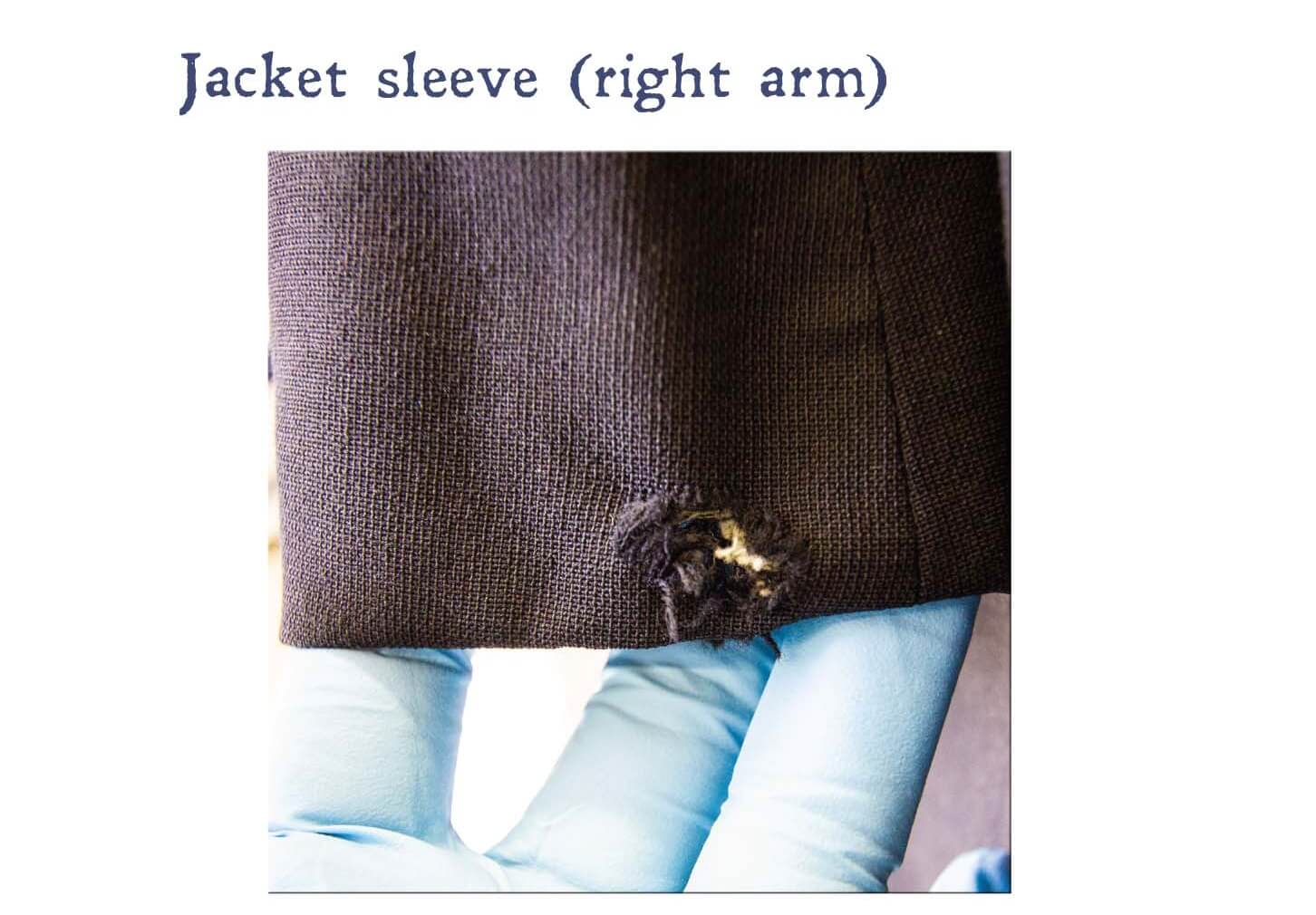
    This is a critical determination. The sine qua non for their theory is that the entry hole in the jacket sleeve and the entry hole in the shirt are in alignment at frame 328 when they claim a fragment of a bullet passed through both simultaneously. The unchallengeable photos show an entry hole in the jacket sleeve adjacent to the seam which runs on the thumb side opposite the buttons which are not seen. Another photo depicts a hole in the mid portion of the French cuff which is also on the thumb side opposite the cufflink holes which are not seen in this photo. These two holes are both located on the thumb side and I thought it would been clearly so obvious that I did not include a photo of the other hole in the jacket sleeve, which is enlightening. In the rebuttal, the authors have referenced this third photo with the claim that it depicts the actual entry hole in the shirt sleeve. It can easily be seen that this hole is immediately adjacent to the cufflink holes which are located ~ 180 degrees opposite the other two holes. Further, Dr. Gregory’s surgical report is corroborative. From HSCA Vol. VII p. 152, emphasis added, “Throughout the wound and especially in the superficial layers and to some extent in the tendon and tendon sheaths on the radial side of the arm are small fine bits of cloth consistent with fine bits of mohair.” Dr. Gregory’s diagram of the wounds clearly shows that the entry wound was on the radial, thumb side of the wrist. The sketch of the wound, albeit of the left hand, found in the postoperative notes shows that this wound was on the thumb side. If any questions persist the Texas State Library and Archives Commission webpages had the measurements of these wounds under each of the photographs. For their conjectured entry hole: “Distance of bullet hole to the right of the seam defining the cuff opening = 1 inch.” For the defect in the midportion of the French cuff: “Distance of bullet hole to the right of the seam defining the cuff opening = 5 1/4 inches; also 3 3/4 inches from the left of the cuff opening.”  With two coauthors being physicians, I would have expected the determination of radial, thumb versus ulnar to be elementary. Why did they make this ludicrous claim? Frankly, they had no other option, because they know at frame 328 the two holes on the thumb side were no longer in alignment. This misalignment at 328 destroys the sine qua non of their theory of a fragment carrying wool fibers simultaneously through these two holes. They had no other option and reflexively made the ill-formed argument that it was a hole on the other side of the wrist which was the one of entry.  As I stated in my review, this observation, in and of itself, negates the theory that a shot was fired from the Grassy Knoll to strike the head at frame 313. Having mislocated an entry wound to the wrong side of the wrist, the authors brazenly, with little style and no substance, claim that I have made a major error and that this somehow actually validates their theory when, in fact, the photographic evidence and findings at surgery do exactly the opposite and destroy their theory. While I would hope readers will continue on in reading my remarks on points 2 through 5, they need not do so. While there are numerous other errors on their part, the misalignment of the entry holes on 328 means that events could never have occurred in the sequence they claim.

    Point #2. The significance of the windshield flare at frame 314.

    It is correctly pointed out that the chrome windshield frame was already reflecting light both prior to and for several frames after 314, as a critical angle occurred for reflective surfaces. As the frames progress after 314 and the angles are changing, this maximum reflection can be seen moving up the chrome windshield frame causing previously reflecting surfaces to diminish in intensity back to baseline. At frame 314, there is the initial abrupt appearance of an increase in reflection in the lower corner of the windshield. This could only be due to a physical factor. The sun did not increase in intensity as the degree of reflection before and after this flare is the same. Some brief physical factor must have been responsible, a bullet cracking the windshield. Had it been actually due to a critical angle then this same focus of intensity should have been seen moving to other locations as the angle continuously changed. The small focus of increased reflectivity over adjacent areas was the result of a small degree of deformation of the windshield and/or frame that briefly increased the intensity over the previous and subsequent baselines. While there are qualitative differences in the flares at 314 and 328, both occur on the initial frame after known impacts at 313 and 328.  Where the author’s see an incredibly propitious timing of the angle to the sun, I see cause and effect. The refutation of point #1 means that a bullet went forward through JFK’s head with fragments simultaneously striking Connally’s aligned wrist wounds and cracking the windshield with a resultant flare over baseline at frame 314. Similarly, a bullet struck the windshield frame at 328 to cause a flare on the very next frame at 329. I see cause and effect.

    Point #3.  The significance of the forward movement of Connally’s right wrist after frame 313.

    Again, from the refutation provided on point #1, it can be concluded that a fragment from the head shot went forward at 313 to cause the wrist wound. Whether this fragment caused this movement or if it was voluntary or a combination of the both is immaterial. When he was struck at 313, the earliest voluntary motion we should see would be 4 frames later or 317. I believe I can see more of the French cuff at 317 versus 312. Connally was turning to his right and his hand was in motion prior to his wounding, which would indicate that both factors may have been at work in this forward movement. What is more important is that due this movement, from frame 323 onward, his French cuff was completely exposed and the both holes on the thumb side of the jacket sleeve and French cuff are no longer in alignment. Also immaterial is whether Connally kept holding his hat after being struck at 313. The late Senator Daniel Inouye of Hawaii had his arm blown off while fighting in WWII. Immediately afterwards he saw his disembodied hand still clutching the grenade he had been holding prior to this traumatic amputation. This is an example of decades old inconclusive claim which is pulled out when debating at what point his wrist was struck. It was 313. The alignment of the entry holes is the ultimate determinate.

    Point #4 The significance of the recovered bullet fragments.

    Two major bullet fragments were recovered from the limousine, CE 567 and 569, which are purported to ballistically match Oswald’s rifle based upon evaluations, which until recently, have been human and subjective in nature. The bias of AFTE members is well known to the authors. Direct verification of Dr. Young and Mill’s claims will most likely never occur and the veracity of their claims can only be deduced from other evidence. If an independent, nonbiased ballistic comparison is performed which shows with a high degree of confidence that CE 567 and 569 came from Oswald’s rifle, then Young and Mill’s claims are in error. If so, then the bullet which struck the windshield frame fragmented and the fragments of the bullet which went forward through JFK’s head were not recovered. Frazier’s comments on the damage done by a whole bullet’s impact are simply assumptions as he readily stated in his testimony. From numerous other avenues it is known that the bullet which went forward through JFK’s head at frame 313 was fired from a distance further than the TSBD and therefore from another rifle. I trust these many avenues which indicate a different rifle more than I trust the subjective opinions of biased examiners. The NIST scans of the bullets and fragments from the assassination provides the opportunity to subject them to nonbiased computer algorithmic comparisons. If the computer analysis demonstrates that previous biased human opinions were in error, then we should not be surprised. Such was the case when numerous governmental diagnostic radiologists interpreted the postmortem skull radiographs without recognizing Puppe’s law.

    Point #5. The significance of the acoustic data.

    The sole basis for a shot being fired from the knoll to strike JFK in the head is the supposed 95%+ probability given for this shot by the analysis of Weiss and Ashkenasy. That is blindly taken for granted in LSD and by the present authors. How can we go about verifying their conclusion? Dr. Barger cautioned the HSCA that any proposed shots on the tape needed to be compared with events on the film. Since the HSCA disbanded, impacts have been identified on the film at frame 223 and 328, in addition to the previously known head wound at frame 313. This allows a mathematical synchronization of the film and tape by various measurements which the authors and I agree upon. The authors and LSD have assiduously avoided providing calculations which would validate the conclusions of Weiss and Ashkenasy. I have done the calculations and a shot purportedly fired from the Grassy Knoll to be recorded at 144.90 seconds does not synchronize with the preceding and subsequent shots recorded at 140.32 and 145.61 seconds respectively. Should we be surprised then, when other avenues of validation fail for this shot as well? The blur at 313 is a horizontal panning error not the downward deviation seen on all other blurs. The timing is too soon to be an involuntary reaction by Zapruder. The head moves initially forward. The misalignment of the entry holes at 328 proves their scenario impossible just as does the lack of synchronization. Does this mean that the acoustic evidence is invalidated? Not at all, it just means Weiss and Ashkenasy’s echolocation was in error and that things need to be thought out over again. When I first approached the acoustic evidence, I was immediately struck by the final change in the timing of Barger’s muzzle blast at 145.15, which he has a 50/50 probability to 144.90 seconds. While only ¼ of a second difference, this seemed to be a huge change in a sequence that ran 6 seconds. After calculations, I saw that Weiss and Ashkenasy’s shot didn’t synchronize and I thought outside the box. Knowing that there was a rapid forward and backward motion of the head, I conjectured that these represented two separate muzzle blasts and impacts, the first fired from behind and the second from the front, where Barger had initially found one. When I performed these calculations, I found out that, when this is taken into account, the film and tape synchronize. I have no control over the laws of math or the timing of the shots or any of the other variables. Math is reproducible and anyone with a map of Dealey Plaza, a ruler, and a calculator can arrive at the common and nondebatable conclusion that their conjectured shot does not synchronize and did not happen. This math will be the same today as it was in 1963, as well as 100 years from now.

  • Bending the Story on a Bent Bullet

    Bending the Story on a Bent Bullet


    In October of 2017, I posted this story on WhoWhatWhy, “Navy Doctor: Bullet Found in JFK’s Limousine, and Never Reported.”

    If you’re familiar with the medical evidence in the matter of John F. Kennedy’s assassination, you may know that, during the president’s autopsy, skull fragments found in the limousine and street were brought to the autopsy table. What you may not know is that something else was allegedly found in the limousine and brought up with the skull fragments—but not reported.

    Decades later, Dr. Randy Robertson, a board member of the Assassination Archives and Research Center, came upon obscure documents concerning this important piece of evidence.

    According to Navy doctor James Young, a bullet was included in an envelope with the bone fragments and he had a chance to inspect it before passing it on to the pathologists. He wasn’t sure if it was made of copper or brass, but here’s what he said about its shape:

    “…it was slightly bent on the end. It was not a straight bullet. In other words, it had hit something and it bent…”

    For more details on Young’s account, please scroll down to Appendix A.

    Recently, the very existence of that bullet has been challenged. This report is strictly in response to that specific challenge.

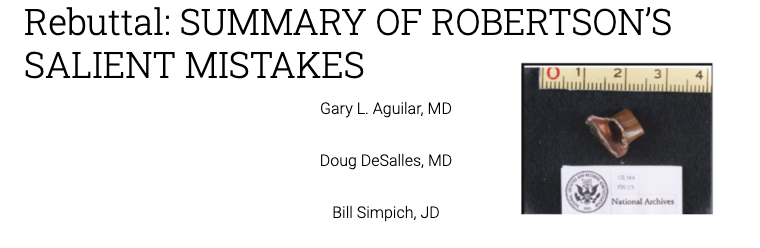
    It appears in one segment—point 4—of a much longer article, “Summary of Robertson’s Salient Mistakes” by Gary Aguilar, MD, Douglas DeSalles, MD, and Bill Simpich, JD.

    In Point 4, the authors focus on discrediting two people: James Young, the Navy doctor who said he saw the bullet, and Randy Robertson, who believed him.

    Issue 1

    The authors say, “Dr. Young used the term ‘slug’ to describe it and it is on this term that Robertson builds his case that a ‘whole bullet’ was found in the limousine.”

    It seems far more likely that Robertson saw the “slug” as a whole bullet simply because of Young’s description of it—which the authors do not include in their paper.  

    Young used the term “Bullet” with greater frequency than the word “slug.” He said “bullet,” about six times in the Oral History interview and three times in his letter to Gerald Ford.

    They reinforce this false premise: “After doing the Oral History interview, Young wrote to President Gerald Ford asking Ford if he knew anything about the ‘brass slug’ Chiefs Mills and Martinelli [sic] had found in the limo. Ford replied, ‘No, he didn’t know anything about it, had not heard anything about it ever.’”

    It appears that Aguilar et al. did not read much of the material, not even the short bits. “Bullet” is hard to miss in this correspondence. From Young to Ford:

    Two of the corpsmen left and returned sometime later with three varying sized pieces of President Kennedy’s skill bones. In addition, they brought back in an envelope a spent misshapen bullet which they had found on the back floor of the “Queen Mary” where they had found the pieces of skull bones. The bullet and pieces of skull were given to Dr. Jim Humes.

    I have never seen anything written about that spent bullet in the Warren Report or elsewhere. Do you recall any testimony or comments which would clarify my concerns?

    From Ford to Young:

    As a member of the Warren Commission I was very conscientious about my participation in the hearings. However, I have no recollection of “the spent bullet” you refer to.

    Young also said that he would ask Arlen Specter to “look into what happened to that bullet.” 

    The above makes it clear that Young frequently referred to a “bullet,” and much less frequently, called it a “slug.” So, why fault Randy Robertson for assuming Young was talking about a bullet when that is exactly what he called it?

    More important, whatever shape the bullet was in, it was an important piece of evidence that went unreported.

    Issue 2

    The authors assert that Young confused the little fragment (CE 569) shown below with a whole bullet:

    No ‘non-fragmented bullet with a bent tip’ ever existed. Robertson made up its existence out of an ambiguity in Young’s use of the term ‘slug.’ No ‘complete bullet’ was ever found in the limousine. Dr. Young was referring to Q3, later designated C3, and even later designated CE 569.


    How could Young have been referring to that little fragment—the base of a bullet, not the tip—when he never even saw it? He did not go down to the garage with the petty officers. Nor did those officers bring it back to the autopsy. Those fragments were turned over immediately to the FBI. And that fragment (CE 569) does not remotely resemble what Young described.

    Dr. Aguilar’s argument has all the credibility of what a man told the judge when he was being tried for shooting his mink-encased mother-in-law in the family garage. He said, “Your honor, I thought it was a raccoon!”

    Issue 3

    Aguilar et al. present a “foundational document” on the fragments discovered in the car, a document that does not mention a whole bullet—so we are to believe the bullet never existed:

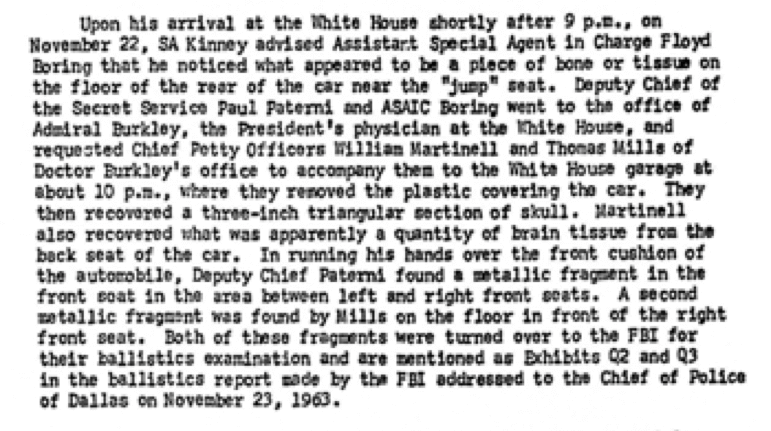
    This is all Robertson says about Dr. Young and the ‘bent brass slug’ that Chief Mills or Marinelli [sic] found on the floor of the Presidential limousine. This is odd since one of the most foundational documents in the case—Commission Document 80, a 15-page document including photos and another SS Report—tells in granular detail how the various fragments were discovered on the evening of November 22nd.

    We in the research community have seen many documents that are false, misleading, incomplete, or otherwise not reliable.

    A passage in this “foundational” document contains intriguing information that may explain how the bullet, or whatever Young was talking about, could have been picked up by Martinell and carried—but unseen—because it was submerged in brain. (And this might explain why FBI firearms expert Robert A. Frazier never saw it.) (See Appendix B for a longer quote from the “foundational” document, CD 80.)

    They then recovered a three-inch triangular section of skull. Martinell also recovered what was apparently a quantity of brain tissue from the back seat of the car.

    Question 1: Could that “quantity of brain tissue” have embedded the bullet, or whatever Young called a bullet, so that it was—at the time—out of sight?

    Question 2: Whether it contained any metal or not, why didn’t Humes report that “quantity of brain tissue” when he reported the bone fragments? After all, it’s evidence. There should be a description of it, and whether it was searched for bullet fragments. (Humes reported plenty of trivia, so why not this?) Could that brain tissue have been cerebellum?

    But then Humes was quite deceitful when it came to reporting things directly related to the wounds. For instance, incredibly, he never even mentioned the gross condition of the cerebellum in the autopsy report or his testimony. Not one word on how much of it was left. We only have Parkland Hospital’s descriptions of the organ (very damaged, half of it missing…) This was one of the most talked about pieces of gore in all the literature on the head wound. I seem to be the only one concerned with this omission. (Click here for details)

    A related mystery: Clint Hill and others have said that hair was attached to the large bone fragment. That hair should have been documented, combed for bullet fragments—and used to help identify where the bone fragment came from. His hair was longish on top, but considerably shorter in back. What happened to it? 

    Question 3: Why didn’t Aguilar et al. mention this “quantity of brain” picked up by the petty officer along with the skull fragments—and not reported? It is clearly relevant.

    And here’s a discrepancy that may have a mundane explanation, but should be noted:

    Aguilar et al. said, “This ‘whole bullet’ is never mentioned in the notes FBI Agent Robert Frazier kept during his forensic examination of the limousine at the Secret Service garage between 2:00 AM and 4:30 AM on the morning of November 23rd.”

    But, according to the “foundational document,” the petty officers who picked up the bone fragments and Secret Service agents arrived much earlier—at 10:00 PM. 

    [Re the question about why the bullet was not mentioned by Frazier, the above may explain it. Or not.]

    Issue 4

    The authors try to close the case and snuff out Dr. Young’s contribution:

    Now with the whole story of what happened in the White House garage fully described in various reports, whatever Dr. Young thought he was seeing is rendered irrelevant. We know what happened. It was not just Martinelli [sic] and Mills who searched the limousine…

    “Rendered irrelevant?” Not so fast.

    “We know what happened.” Aguilar doesn’t seem aware of the simplest, most basic, most relevant facts upon which to base his theory—that Young confused the little fragment found in the front of the car with the less damaged bullet Young says was found in the back of the car and brought to the autopsy table along with the skull fragments.

    The Basic facts need repeating:

    • Young never even saw that little fragment. He stayed in the autopsy room and never went down to the garage where the limousine was, and where the front seat fragments were found. Petty officers were sent.
    • The front seat fragments were turned over to the FBI and whisked away. (Commission Exhibits 567 and 569)
    • The front seat fragments were NOT brought back to the autopsy table.
    • So how could James Young have confused a spent bullet (or any form of a bullet) with CE 569 which is the hollow base of a bullet—with no tip, bent or otherwise?

    When it comes to this case, it’s hard to know what to believe. But sometimes we know what not to believe. Considering all the deception we have seen, all the lies by major players about major issues, the planting of evidence, the destruction of evidence—why is it so hard to believe James Young?

    Aguilar et al. seem to believe official stories:

    The other bullet fragment found in the front seat area is shown in figure 31. The simplest explanation is clearly that CE 567 dropped down into the front seat area after striking the windshield at 328/329. CE 569 likewise dropped into the front seat area at 328/329 after striking the rear-facing chrome strip shown in Figure 30.

    As the authors know very well, the “stretcher bullet” was planted. Yet they trust the government version on the front seat fragments. While I have no reason to doubt that claim—I have no reason to believe it either.

    And I keep remembering something Roy Kellerman said. He’s the Secret Service agent who sat in the front passenger seat of JFK’s limousine, the place where the fragments were found. From his interview with the HSCA:

    Kellerman recalled that when he was in the car just moments after the shots he observed “a splattering of metal around me.” And he said there had to be “four or five metal fragments in the car.”

    Four or five? Had to be? But only two were reported. (I’m assuming he was not referring to tiny lead particles. Those were probably too numerous to count.) This could have an innocent explanation, but not necessarily.

    And then there’s the odd story of the undertaker who said a federal agent had shown him a glass vial filled with fragments taken from Kennedy’s head – 10 fragments. Yet, the lead pathologist said he only removed two fragments. (ARRB MD 180, p.3) (Someone else made a similar claim, but I can’t remember who.)

    In most of these cases of gross discrepancies, it’s impossible to find hard proof of who is right. But there is one thing you can prove: when a person makes a false claim about what is, or is not, in a particular document. Whether the false claim is a lie, or a mistake, is a matter of judgment.

    Personal Note

    I know all three of the authors (Aguilar, DeSalles, and Simpich) quoted above and suspect the ideas expressed in Point (4) of the larger paper are mostly those of Dr. Aguilar, whose work was trusted by the other two, but that’s just my theory. And I believe they dashed out that article too quickly, in defense of a comrade, Josiah Thompson, whose book Randy Robertson has harshly criticized. I can sympathize with this impulse. The problem is—they did it at the expense of James Young, who seems to have done nothing to deserve such disrespect. And if they succeed in snuffing out all references to this unprovable, but still interesting bit of evidence, then they also did it at the expense of future research.

    Addendum

    One theory about what happened to the bullet James Young said he saw:
    A family member of the late George Burkley, Kennedy’s personal physician, reportedly told researcher John Titus that “something relating to the assassination—something very important—was stolen from Dr. Burkley as he traveled between airports on his way to Denver.”

    Click here to read Titus’s story about what happened when he reported this to former Warren Commissioner David Slawson. And click here for more.

    Appendix A

    James Young, MD, one of Kennedy’s personal physicians who attended the autopsy, believes he witnessed something strange that was never reported anywhere, apparently.

    Soon after the autopsy, he wrote a memoir about what he saw for his children. He revisited that memoir in 2001 during an interview with the US Navy Medical Department Oral History Program.

    The lead pathologist, James Humes, MD, said bones were missing from JFK’s head, and asked two petty officers (Chiefs Thomas Mills and William Martinell) to retrieve any bone fragments left in the president’s car. (p. 53)

    They came back with an envelope that contained three pieces of skull as well as a “brass slug about half a centimeter in diameter and distorted.” Later in the interview he said:

    I came across this issue of the bullet [while looking at the memoir]…

    They picked up the bullet off of the floor in the back of the car. Well, I decided that this is something, you know, the third bullet has never been decided about ever, apparently…I went through the entire Warren Commission book…I went through the whole thing and there was nothing in it.

    Now, at that particular time nobody said anything about this. And I know what we did. We brought that in, I mean Chief Martinell and Chief Mills went…got the stuff off of the floor in the back seat, brought it back out to us and we gave that to Commander Humes at the time…

    […]

    So, the bullet, again, was a copper jacketed bullet like a military bullet?

    No, it was a brass jacket…I don’t know, maybe it was copper, I couldn’t tell. But it was that color or brass and it was slightly bent on the end. It was not a straight bullet. In other words, it had hit something and it bent…and so I called Tom Mills and I said, “Tom do you recall this situation?’ He said, ‘Yes I do’ and he said, ‘You’re exactly right.’ He said, ‘We did bring that slug out from the back…’

    The last time Young tried to talk to Mills, Mills said he didn’t want to talk about it. He’s not the only one.

    Appendix B

    From Aguilar et al.’s paper: On the Mary Ferrell site it is described as “Commission Document 80 – Secret Service Report of 06 Jan. 1964 re: Presidential car.” Below is a photocopy of a paragraph from page 2 of the Report:


  • Inside Clay Shaw’s Defense Team:  The Wegmann Files

    Inside Clay Shaw’s Defense Team: The Wegmann Files


    From the May-June, 1997 issue (Vol. 4 No. 4) of Probe


    (Click here if your browser is having trouble loading the above.)

  • Bill and Ed’s Washington Adventure

    Bill and Ed’s Washington Adventure


    From the July-August, 1997 issue (Vol. 4 No. 5) of Probe


    (Click here if your browser is having trouble loading the above.)

  • Fred Litwin on the Facts of the JFK Case

    Fred Litwin on the Facts of the JFK Case


    This is a relatively concise review of Fred Litwin’s first book on the John Kennedy assassination, I Was a Teenage JFK Conspiracy Freak. It will be by chapters—excepting Litwin’s discussion of the Jim Garrison inquiry. Jim DiEugenio has reviewed Litwin’s work on that issue at length and in depth. (Click here and here)

    Chapter 1

    Litwin says first generation critics “started finding small inconsistencies” in the case. But they were actually big inconsistencies (e.g. the dubious provenance of CE 399). (Click here for details) He also avows: “The motorcade had to turn onto Elm Street so it could take an exit to the Stemmons Freeway which would have taken them to the Dallas Trade Mart for Kennedy’s speech.”

    Like his previous statement, this one is also false. The motorcade could have taken Main St. to Industrial Blvd. What is so odd about this error is that the correct information is in the House Select Committee volumes, which, on other occasions, Litwin values highly. (HSCA Vol. 11, p. 522) He incorrectly says there are “20,000 pages” in the Warren Commission’s 26 volumes of testimony and evidence. There are really 17,816 pages. Shockingly, before even going into the actual evidence at all, Litwin casually says: “The authors of the Warren Report were honorable men who conducted an honest investigation and reached the right answer.” As many have pointed out, in this day and age, for anyone to call people like Allen Dulles, John McCloy, and Jerry Ford honorable men is wildly archaic. He incorrectly says John Connally’s “lapel” flipped as an indication of a bullet transit—yet his chest wound was not near the lapel! (Click here for details)

    The Canadian author then goes through the “overwhelming evidence” against Oswald. He claims Oswald had “a long…package”—but the two witnesses to it said it was not long. (WC Vol. 2, pp. 239–240, 249) Litwin claims that “after the assassination, Oswald was the only warehouseman missing”—but Charles Givens was also missing. (WC Vol. 3, pp.183, 208) Litwin nonchalantly says Oswald “killed police officer J.D. Tippit,” which, with the accumulation of evidence we have on that case today, is a quite dubious statement. (Click here for details)

    But Litwin marches on. He also claims that “many witnesses identified Oswald“—but those “identifications” were based on rigged lineups and some were made months after he was dead and nationally known. One of the best examinations of the line ups was made by the late British police inspector Ian Griggs. To name just two problems: Griggs noted that in the British model, there should be 7 other people in a line up and they should be of similar age, height and appearance. (Ian Griggs, No Case to Answer, p. 81) After a seventeen-page analysis, Griggs concluded that, to put it mildly, these guidelines were not adhered to with Oswald. For example, there were only three other people in the Oswald line ups. As per similar physical appearances, Homicide Detective Elmer Boyd said, well “Sometimes they do and sometimes they don’t.” (Griggs, p. 83) As per age, Oswald was 24. Two of the stand-ins were 18 years old. Further, Oswald was the only one with bruises on his face. And although the others made up their names and occupations, Oswald did not. Even though, by the time of most of the line ups, his name and place of work had been broadcast on radio and TV. (Ibid, pp. 85–86)

    But further, one of the witnesses, Helen Markham, was so weak and faint that the police had to administer her ammonia. Or as Captain Fritz testified to the Commission:

    We were trying to get that show up as soon as we could, because she was beginning to faint and getting sick. In fact, I had to leave the office and carry some ammonia across the hall, they were about to send her to the hospital or something and we needed that identification real quickly, and she got to feeling all right after using this ammonia. (WC Vol 4, p. 212)

    Line-up witness Cecil McWatters, a bus driver, later admitted that Oswald was not even the man he recalled from his bus ride. He was trying to identify Roy Milton Jones. (Griggs, p. 87) Then, of course, there was the testimony of cab driver Bill Whaley. Whaley said that anyone could have identified Oswald, because he was carrying on and yelling at the policemen. He said it was not right for him to be placed in a line-up with teenagers. If Litwin had been in Oswald’s place, would he not have done the same? (Griggs, p. 90)

    Litwin then says that “one expert concluded that one of the four bullets recovered from Tippit’s body matched the revolver found in Oswald’s possession”—but 8 other experts disagreed with him, and moreover that bullet did not appear for a quarter of a year! (WC Vol. 3, p.474) Litwin says “the expended [Tippit] cartridge cases matched Oswald’s gun to the exclusion of all other weapons”—but those cases did not appear for a week (WC Vol. 24, pp. 253, 332) and four officers’ initials disappeared from them. (WC Vol. 7, pp. 251, 275–276; Vol. 24, p. 415) They could not be identified by the three witnesses as the ones they found that day. (WC Vol. 24, pp. 414–415) And as most of us know, two of the cases were from Winchester Western and two were from Remington-Peters. While three bullets were from Winchester and one was from Remington. (Henry Hurt, Reasonable Doubt, p. 152)

    Litwin says “Oswald’s right palm print was found on the rifle barrel”—but the only person to see this print said it was an old print. (Gary Savage, First Day Evidence, p. 108) Litwin then says “his fingerprints were found on the bag used to carry the rifle to work.” Yet, when FBI expert Sebastian LaTona initially examined the bag on 11/23, he could find no latent prints on it. (WC Vol 4, p. 3) Litwin then declares: “Faced with this massive amount of incriminating evidence, the critics could only chip away at the margins.” But as the reader can clearly see above, this author did not “chip away at the margins.” I simply debunked Litwin’s claims with original evidence.

    Litwin then proceeds to speak in paragraphs to derail witness Lee Bowers’ account, but he never gets to the meat and potatoes. So I will spell it out here…Bowers told Mark Lane on camera on March 31, 1966:

    There were, at the time of the shooting, 2 men standing at the top of the incline. And one of them, from time-to-time as he walked back-and-forth, uh—disappeared behind a wooden fence, which also is—uh—slightly to the west of that. At the time of the shooting, in the vicinity of where the 2 men were, there was a flash of light. The area was sealed off by at least 50 police within 3 to 5 minutes. I was there only to tell ’em what they asked, and—uh—so that when they seemed to want to cut off the conversation. (Click here to watch the video)

    Litwin also apparently doesn’t know that subsequently two of Bowers’ friends independently came forward and confirmed that, yes, he did see more than he told the Warren Commission, but he was afraid. He didn’t want his life threatened or ruined, being one of the key witnesses against Lee Oswald as the lone shooter. (Josiah Thompson, Last Second in Dallas, pp. 66—67)

    Litwin avows that “Dealey Plaza was an echo chamber which made it hard for witnesses to determine the direction of the shots.” This is not accurate. As Josiah Thompson points out in Last Second in Dallas, “The knoll is covered with trees and grass and a wooden fence, all sound-absorbing materials.” (Thompson, p. 38) And further, the flash of light, smoke, fresh footprints, cigarette butts, and an anomalous shape in the Moorman photo all confirm the 58 grassy knoll ear witnesses! (See Thompson, Chapter 5) All of which are JFK 101 and never mentioned in Litwin’s book. Litwin declares “there were absolutely no witnesses to gunmen on the grassy knoll or behind the picket fence.” Well, of course, everyone was looking at the President, not at some random fence in the corner! Snipers are trained to not be seen. But, as we shall see, we do have physical and photographic evidence left behind which indicates such.

    Litwin claims “the Dallas doctors did not see the [rear skull] entrance wound because they didn’t turn Kennedy’s body over”—but they did lift the head up and this wound was seen by Drs. Jenkins and Grossman. Litwin says “Virginia and Barbara Davis saw Oswald run across their lawn after the [Tippit] murder.” But remember, they pointed him out of a rigged lineup. Also, the Davis sisters were really confused witnesses. For instance, Barbara claimed she saw the killer again “a few minutes later” after the shooting! (CD 630e, p. 1) And Virginia claimed she heard the second gunshot “a few minutes later” after the first one! (CD 630f, p. 1) So they were confused witnesses.

    Chapter 3

    Litwin incorrectly says the Zapruder film is “27 seconds” when, of course, it is 26 seconds. He says the parade route “never changed”—but Secret Service agent Gerald Behn confirmed to Vince Palamara the route was changed for the Dallas trip! (Survivor’s Guilt, p. 104) Palamara’s book is the best there is on this issue. He brings in not just Behn, but three other DPD witnesses to back him up.

    Litwin likes to make a big deal that in 1972 Drs. John Lattimer and Cyril Wecht, after viewing the autopsy materials, concluded JFK was only hit from the rear. But the fact is that we have come very far since 1972 and, because of this, Wecht has since changed his mind. But Litwin doesn’t explain this context. He cites Lattimer’s old myth of Connally having an “elongated wound in the back”—but Connally’s doctor testified it was elongated only after he removed damaged skin. (WC Vol. 6, p. 88) He says “Kennedy’s head moved forward before it moved back and to the left”—but this has since been shown to likely be an optional illusion due to camera movement. (Thompson, Last Second in Dallas, pp. 197–205) Litwin says the back and to the left “was probably caused by a neuromuscular spasm”—but as another reviewer has pointed out, “no expert in neuroscience has ever supported this hypothesis.” Moreover, neuromuscular spasms only occur when the nerve centers—at the bottom of the brain—are inflicted and JFK’s were not. Litwin also says “there might also have been some minor movement due to something called the ‘jet effect’”—but the fact of the matter is that this theory met a timely end in 2014 (Click here for details)

    Litwin: “The autopsy materials…totally refuted a shot from the front.” This is false. The lateral X-ray (assuming it’s authentic) clearly shows a trail of bullet fragments going from front to back. Due to the new work by Dr. Michael Chesser, we know it goes from front to back, because the largest fragments are in the back. That means a shot from the front. (Click here for a long version of Chesser’s work)

    Chapter 5

    Litwin touches a bit on the acoustics evidence, but ignored the recent work that has been done on it. His argument seems very dated. He avows that “the autopsy X-rays and photographs…showed a small wound in the back of Kennedy’s head”—this would be news to the autopsy doctor James Humes, who couldn’t find one when shown the materials during his ARRB deposition. Litwin says “the Zapruder film shows the back of Kennedy’s head to be intact after the fatal shot”—but (assuming the film is authentic) the back of the head is unfortunately in shadow in the Zapruder film. What Litwin also doesn’t say is that actually a few frames are not in shadow and they do in fact show the rear of the head blown out! (Frames 335, 337, 374)

    He says “you can see a visible exit wound in the right front”—but that is actually a flap of scalp hanging down. Litwin ignores the following facts: Press secretary Malcolm Kilduff indicated in public that a shot hit Kennedy in the right temple. Or that Chet Huntley of NBC News announced this same description on TV that day and gave as the source Dr. George Burkley, Kennedy’s physician. Finally, Bill and Gayle Newman, two of the closest witnesses to the shooting, both said the bullet came from behind them—i.e. the stockade fence—and hit Kennedy in the right temple. (Thompson, Last Second in Dallas, p. 32) Is it only a coincidence that the Newmans did not testify before the Commission and neither did Burkley?

    He says “his [Harrison Livingstone’s] witnesses all disagreed with each other.” I’m not sure what Litwin means here. All the witnesses Livingstone interviewed were unanimous that the back of the head was gone. Litwin (like Gerald Posner) misconstrues a 1990 quote by autopsy technician Paul O’Connor—“It has been so many years and so much has happened, I kind of doubt my own ability to remember fine details.”—Posner attributes this to O’Connor’s overall memory, but actually it was attributed to the specific question as to whether JFK was wrapped in a mattress cover! (High Treason 2, p. 272) This is simply literary hackery and Litwin just copied it from Posner’s book. (See Posner, Case Closed, p. 300)

    Litwin always makes a big deal that “every forensic pathologist who had viewed the autopsy evidence had concluded that Kennedy was shot from behind.” What Litwin leaves out is that these forensic pathologists—Ramsey Clark Panel, the HSCA—never had the body in front of them. And none of them ever saw Kennedy’s brain, since it disappeared from the National Archives. But here’s the thing, none of their reports ever mention the words “grassy knoll,” “knoll,” or “fence”. They didn’t even take that into consideration. So that talking point is simply not valid. But further, Litwin also ignores this: Dr. Michael Baden conservatively acknowledged a grassy knoll headshot was possible. (HSCA Final Report, pp. 80–81)

    Litwin incorrectly accuses critics of “ignoring the HSCA test results.” But these two tests—the NAA and Tom Canning’s trajectory analysis—have been through discredited by, for one, Don Thomas. (Hear No Evil, Chapters 12, 13 respectively.) He jumps on critics for using “faulty diagrams” of the single-bullet theory. He then shows a still from Dale Myers’ animation and declares: “They were in perfect alignment for a shot to hit both men.” But of course, Myers’ dishonest animation only works if you move JFK’s back wound up, stretch his neck, lean his neck way forward, shrink Connally, and slide his seat in 6 inches when it was actually 2.5 inches. (patspeer.com, Chapter 12c; click here for details) Litwin discusses the unreliable “Badgeman” image in the Moorman photo, but completely ignores the more reliable anomalous shape that Josiah Thompson points out in Six Seconds in Dallas. What is notable about this aspect of the Mary Moorman photo is that it contains two figures behind the stockade fence atop the grassy knoll. One is a fixed point, a signal tower. But the other figure disappears—it is not there in later photos, so that, very likely, was a person. (Six Seconds in Dallas, p. 127) Coincidently, the flash of light and smoke was seen there, and the fresh footprints and cigarette butts were found there. Again, none of this is mentioned in Litwin’s book. He incorrectly calls Robert Groden’s 1993 book The Death of a President—it’s actually The Killing of a President.

    Chapter 6

    Litwin nonchalantly mentioned Thomas Canning’s HSCA trajectory analysis—but none of the wound locations in Canning’s analysis are the same as the locations that were reported in the HSCA’s Forensic Pathology Report. Canning chose them. Yes, he chose his own wound locations! (HSCA Vol. 6, p. 33, see especially the footnote at bottom) All trying to confirm a bias—aka a lone assassin. Moreover, Canning’s trajectory analysis for the single-bullet theory is at Zapruder frame 190, and Litwin believes it happened at frame 224. (ibid, p. 34)

    Litwin says “Oswald qualified as a sharpshooter in the U.S. Marines,” but ignores Commission lawyer Wesley Liebeler’s own memorandum which states that the FBI could not duplicate the shooting feat that the Commission attributed to Oswald. But in addition, all of the FBI shots were high and to the right of the target “due to an uncorrectable mechanical deficiency in the telescopic sight.” (Edward Epstein, The Assassination Chronicles, p. 148) In his famous internal memorandum—famous to anyone but Litwin—Liebeler complained that it was “simply dishonest” for the Commission not to mention this serious problem with the rifle in their chapter on the subject. But further, the military test Litwin refers to was the first shooting test Oswald took. In his second test, later on in his service, he scored considerably lower and that score was considered a “rather poor shot.” (WR, p. 191) So by the time he left the Marine Corps, that was his status. As Liebeler went on to explain, there is no evidence that he improved while in the USSR. In 1962 and 1963, the only evidence of any “practice” was that he went hunting with his brother once.

    Liebeler said that the chapter glossed over the evidence that Oswald was a poor shot and had accomplished a difficult feat; and created a ‘fairy tale’ that Oswald was a good shot and had accomplished an ‘easy shot.’ (Epstein, p. 152)

    Litwin incorrectly claims “there were numerous witnesses who heard a shot before Kennedy was hit in the neck”—there were only three. (patspeer.com, Chapter 9) Litwin claims “four of the Dallas doctors involved in treating Kennedy went to the National Archives in Washington, D.C., in 1988 to view the autopsy X-Rays and photographs. They all went on the record to confirm the authenticity of the autopsy materials.” This is nonsense and sleight of hand. First of all, this goes directly against what these four doctors said in the past when originally shown the back of the head photo (showing it intact).

    Dr. Peters—“I don’t think it’s consistent with what I saw. There was a large hole in the back of the head through which one could see the brain. But that hole does not appear in the photograph.” (The Continuing Inquiry newsletter, 11/22/81)

    Dr. Dulany—”There’s a definite conflict. That’s not the way I remember it.” (“Dispute on JFK Assassination Evidence Persists”, The Boston Globe, 6/21/81)

    Dr. Jenkins—“No, not like that. Not like that…No…That picture doesn’t look like it from the back.” (The Continuing Inquiry newsletter, 10/22/80)

    Dr. McClelland—“He firmly rejected the autopsy photos.” (The Continuing Inquiry newsletter, 11/22/81)

    And likewise all the other Dallas treating staff have denounced the photo. Now, concerning what those four doctors said in 1988 to NOVA, they said that if the pathologist’s hand in the photo is holding up a flap of loose skin to cover the defect in the back of the head, then the photo would be accurate. But as Dr. Michael Baden has said: “There is no flap of skin there.” (Case Closed, p. 310) So therefore, the photo is in all probability inaccurate.

    Litwin mentions ARRB chairman John R. Tunheim telling Vincent Bugliosi that “there’s no smoking gun” in the remaining sealed files—as if conspirators would leave behind a trace for all the world to see! He incorrectly says Doug Horne “wrote a series of books”—it was actually one book with five volumes.

    Chapter 7

    Litwin avows: “Over the years, more and more documents and records have been released but no major revelation on the assassination has emerged.” This is simply not true. For instance, in 1993 the sealed HSCA testimony of JFK’s mortician Tom Robinson was declassified and it was a bombshell. For years, Warren Commission defenders have demanded to know, “Where’s the grassy knoll bullet?!” The answer came when Robinson’s testimony was released. He said:

    They were literally picked out, little pieces of this bullet from all over his head…They had the little pieces. They picked them out…I watched them pick the little pieces out. They had something like a test tube or a little vial or something that they put the pieces in…Fairly many pieces…They were all small that could be picked up with forceps…The largest piece that I saw [was] maybe a quarter of an inch. (RIF#180-10089-10178)

    Robinson said “that the total number would be close to 10 fragments.” (ARRB MD 180)

    These numerous fragments have to be from the knoll headshot (Z–313). Why? Because they disappeared. They were removed and disappeared. The FBI never examined them. (They would’ve had to have been removed from the head early in the autopsy, for the six autopsy technicians don’t remember them.) In the end, the only fragments from the autopsy turned over to the Warren Commission were two from the Depository headshot (Z–328) that matched Oswald’s rifle. (Thompson, pp. 222–28)

    When I asked Litwin if he knows who Tom Robinson is, his response to me was: “The terrific British rocker…I have several of his CDs.” (4/6/21 Facebook message)

    Litwin’s Postscript

    Litwin writes: “Oliver Stone is locked in for life his with conspiracy theories—there’s nothing that could ever change his mind.” I simply turn the question around on Litwin: is there anything that could ever change YOUR mind? He simply replied: “Evidence.” (ibid)

    Well, I’ve spent countless hours both in person and online TRYING to patiently tell Fred Litwin the evidence, but it’s always the same—excuses, arguments from authority, and stubbornness. I was (and am still) truly shocked by his blatant denial and ignorance. It’s actually mind-torturing. At this point, I can only shake my head. As someone once said, “You can pile up all the evidence in the world and they don’t wanna listen.”

    My Postscript

    Litwin relayed a story to me:

    It’s a story that should be in my Teenage Conspiracy Freak book, but isn’t. It goes like this. As I was slowly changing my opinion, I decided it was time to read Posner’s book. I bought it…but I couldn’t open it. It sat there for days…until I decided to read the medical evidence chapter. I thought it was a great chapter—in fact, I wish I had written it…and I knew then that there was no conspiracy…and I put the book down…a changed man. (1/15/21 Facebook message)

    I was taken aback by this. First of all, in his book, he says what turned him around on the JFK case was the House Select Committee on Assassinations in 1979. Now that is moved forward to 1993? And he still cannot provide any evidence of anything he wrote while he was in the critical community camp? Second, Gary Aguilar interviewed two Kennedy autopsy doctors, Dr. Boswell and Dr. Humes, who both denied the words Posner put in their mouths. Boswell went even further: he said he never talked to Posner. (Click here for details) The truth of the matter is that Gerald Posner’s book Case Closed has been debunked 7 ways to Sunday ever since it was first published in 1993. (Click here for details)

    I reminded Litwin of this and he just said: “It has not been debunked.” I then proposed, “If I could prove it has been debunked, what would you say?” Litwin retorted: “If you could prove the earth is flat, what would I say?” (ibid.) When I told him “Baden says it’s possible a shot from the knoll”, Litwin retorted: “It’s possible we are being visited by flying saucers; and it is possible that Bigfoot exists.” (4/5/21 Facebook message)

    Folks, that’s Fred Litwin for you.