Tag: JFK ASSASSINATION

  • Last Second in Dallas, part 1

    Last Second in Dallas, part 1


    This will be a decidedly mixed review of Josiah Thompson’s new book on the JFK case, Last Second in Dallas. I hope it does not discourage anyone from buying or reading it. There are some good things in the volume. And I will try to be as fair as I can about what I think they are. But I will also not shrink from what I believe to be the book’s shortcomings.

    I

    Thompson has fashioned the book as a kind of one man’s journey into a labyrinth. He begins the book even before the Warren Report was issued. On the day Kennedy was killed, Thompson heard that a doctor performed a tracheostomy over a throat wound on President Kennedy. But yet all the news stories said that the alleged assassin worked at the Texas School Book Depository, which was behind the motorcade. In what is, in retrospect, a monumental piece of unintentional humor, Thompson went to the local FBI office to alert them to this paradox. (Thompson, p. 6)

    When the Warren Report was issued, it was received in the press and broadcast media with almost universal praise, but Thompson noticed that a curious and pesky young Philadelphia lawyer disagreed with the unanimous chorus. That was the late Vincent Salandria. Thompson, who was now a newly made professor of philosophy at Yale, decided to check up on Vince’s work. So, he consulted the Commission’s volumes of evidence and found out that Vince was correct.

    This gave him a bit of a shock. The author now tries to fill in a bit of his conservative Republican background to explain why. This is where I had my first perturbance with the book. The author writes that he thought Alger Hiss was innocent in that case. He then adds that when Allen Weinstein’s MSM endorsed book on Hiss came out, he changed his mind and agreed with Weinstein that Hiss was guilty. (Thompson, p. 9)

    For several reasons, this was puzzling to me. For one, Weinstein was later sued and settled with one of his interviewees. (Click here for details) He also promised to show some of his evidence to other Hiss scholars—he never did. He later became a sexual predator, while supposedly doing his job as chief archivist of the United States. He was protected from legal liability by the George W. Bush administration. (Click here for details) In fact, there are three relatively recent books that pretty much show that Weinstein was really a hired gun and that is how he got the job at the National Archives. One is by Joan Brady, one by Martin Roberts, and one by Lewis Hartshorn. The last shows that Whittaker Chambers, Hiss’s accuser and a man who Weinstein took at his word, was surely a pathological liar. I will return to this political aspect with Thompson later.

    During a Vietnam protest in the Philadelphia area, the author was arrested. The ACLU lawyer sent to bail him out was Salandria. Vince now introduced Thompson to the critical community. They went to NARA to view the Zapruder film and look at 35 mm slides. (Thompson, p. 10). He then visited Dealey Plaza with an Abney level tool and figured out that the angle through John B. Connally was a 27 degree down slope, which he figured most likely came from the Records building. (Thompson, p. 15)

    On the strength of this visit to Dallas, Thompson was signed by the Bernard Geis publishing company. He got a rather small advance, though they agreed to pay his expenses, but Geis knew some people at Life magazine. And they had decided to do a reinvestigation of the JFK case based on the critiques of the Warren Report by Mark Lane and Edward Epstein. (Thompson, pp. 16–17)

    What is next tells the story of Thompson’s field investigation in Dallas. This is where the author encountered witnesses in Dealey Plaza and at Parkland Hospital. Thompson interviewed hospital employees Darrel Tomlinson and O. P. Wright about the discovery of the Magic Bullet, aka CE 399. From here, he pieced together the chain of custody that linked the transport of the bullet to Washington and then the FBI lab. This led to one of the most sensational discoveries in the early days of critical research. Wright insisted that CE 399 was not the bullet he turned over to the Secret Service. The bullet he turned over was sharp nosed, not a round nosed bullet. And since Wright had worked in law enforcement for many years prior to his occupation as a security officer at Parkland Hospital, he knew the difference. (Thompson, p. 25)

    At Parkland, Thompson made another stunning discovery. This one was about the location of CE 399 when it was discovered. In all probability, it was not on Governor John Connally’s stretcher—which is where it had to be located if the Commission’s Single Bullet Theory was to hold any water. In all likelihood, it was found on a child’s stretcher and his name was Ronnie Fuller. (Thompson p. 24. For a more complete explanation, see Six Seconds in Dallas, pp. 156–65)

    From here, the book describes the witnesses in Dealey Plaza. First off are Bill and Gayle Newman who were to the limousine’s right, at the base of the grassy knoll. They were never called by the Commission, but filed affidavits and were interviewed by the FBI. (Thompson, p. 30) They may have been the closest witnesses to Kennedy’s shooting. The couple said the shots came from behind them and Kennedy was hit in the right temple, which would be clear evidence that a rifleman was behind the picket fence. But in addition to the Newmans, Thompson adds Abraham Zapruder and Emmett Hudson, who were in the same area, to this list. He later notes that it appears the FBI altered Hudson’s original statement to the Secret Service. (Thompson, p. 43) Hudson was the first witness Thompson located who indicated that there was another shot after the fatal head shot.

    II

    The author transitions over to witnesses who were further away from the limousine or not in as good a position to see or hear what had happened to JFK, but whose testimony is still important. In the cases of the motorcycle escorts, he notes that it was Bobby Hargis and B. J. Martin who were struck with blood and tissue from the fusillade. The significance of this is that they were riding to the left of Kennedy. Hargis told a reporter he was splattered with blood and the impact was so hard he thought he himself might have been hit. Later, while walking to the Sheriff’s Department, a colleague told him he had something on his lip: it was a piece of Kennedy’s brain and skull bone. (Thompson, pp. 55, 56) Martin’s cycle was also splattered with blood and flesh and he said that the left side of his helmet was also hit. In this profusely illustrated book, one can see that Martin was looking toward the president right before the firing sequence began. (Thompson, pp. 50, 58) Some have said this kind of evidence is eyewitness testimony. I disagree. It qualifies as physical evidence which indicates directionality.

    Officer Joe Smith smelled gunpowder near the underpass, but this testimony was then altered by the FBI. Smith also said he met up with a Secret Service agent, which was not possible as they were all at the hospital. (Thompson, pp. 58, 59)

    The author then proceeds to two men who have become famous to both the public and in the JFK case: Lee Bowers and S. M. Holland. Although Thompson says that Holland was more important, I believe they are of equal importance.

    Bowers was made famous by Oliver Stone’s film JFK. Memorably played by actor Pruitt Taylor Vince, in a riveting sequence he described how three cars came into the area behind the picket fence, circled around and then left by about 12:25. One of the men seemed to have some kind of electronic communication in the car. Bowers said that at the time of the shooting, something out of the ordinary, some commotion, occurred in the area behind the picket fence—where Elm Street dips down at the underpass. To be mild, Joseph Ball of the Commission did not do a good job in pursuing this line of inquiry, so Mark Lane took it up later for his film, Rush to Judgment. Bowers said he saw a flash of light or smoke “which caused me to feel like something out of the ordinary had occurred there.” (Thompson, p. 66)

    Bowers died in August of 1966. It was later discovered, through Debra Conway of JFK Lancer, that there was more to Bower’s story. Bowers had actually seen someone holding the trunk of a car open, placing something in it, and driving off. This was told to her by Olan DeGaugh, a supervisor a couple of levels above Bowers. Barney Mozley was a colleague of Bowers who replaced him on the later shift. Mozley said that Bowers was very fearful of telling all he knew: to the point of having to place a lock on his tower door so no one could interview him. But he told Mozley something which coincided with what he told DeGaugh: at the time of the shooting Bowers saw someone coming around the wooded area in a trench coat and what looked like a rifle underneath. Clearly Bowers was petrified of telling anyone about everything he witnessed.

    Holland was standing on the overpass at the time of the shooting. In his original affidavit, Holland said he heard four, perhaps five gunshot sounds. (Thompson, p. 68) Two of the shots were extremely close together. The sound came from the grassy knoll area and as he turned in that direction he saw smoke rising, so he and three companions ran there. Holland was looking for shells. What they found were a series of footprints at one end of a car. These were accompanied by muddy spots on the bumper and cigarette butts on the ground. In other words, it was as if someone was behind the fence and waiting for the motorcade. (Thompson, pp. 70–72) An obvious question was: Why would someone view the motorcade from behind the fence? (Thompson, p. 79)

    Thompson and his partner, Ed Kern, were impressed by Holland. The witness drew them a diagram of what he saw when he got to the scene. (Thompson, p.77) The episode is capped by Thompson’s photo comparison of Holland standing at the position he was that day, behind the fence, with an anomalous shape in the famous Mary Moorman photo taken from across the street looking toward the knoll. They appear to match. (Thompson, p. 80) Since the author found out that there were no trunks searched, he concludes the chapter with a postulation as to what happened: the rifleman (men) could have just opened the trunk, thrown the rifle in, milled around for a few minutes and later just walked away. This scenario would correspond with what Bowers saw.

    The next step in the Life inquiry was an interview with Dr. Charles Gregory, one of the two doctors who performed surgery on Governor John Connally; who was sitting in front of President Kennedy in the limousine. Gregory, along with his colleague Dr. Robert Shaw, both concluded that the bullet that hit Connally did not strike anything previously. They deduced this from the clean edges, and also since no cloth fibers were carried into the governor’s back wound; yet “his wrist wound was fouled with numerous fibers from his wool suit.” (Thompson, p. 85) The other key development was that Gregory thought the shot that did hit Connally came in approximately at Zapruder frames 237–240. Which again, separate it from the shot that hit Kennedy, since the timing was too late. Gregory was very accomplished. He was a field physician in the Korean War and had spent much time studying gunshot wounds.

    Thompson was disappointed by the essay eventually printed in Life. It was called “A Matter of Reasonable Doubt” and was published as the cover story on November 25, 1966. Featuring frames from the Zapruder film, which Time-Life owned, the piece was largely based upon John Connally’s estimation of when he was hit versus when JFK was. In other words, all the material reviewed, thus far, was eliminated (e.g. Bowers, Holland, the Newmans, Gregory, the splatter pattern, etc.). Beyond that, there was space given to Arlen Specter to respond and the ending included a roundup of Kennedy assassination books described with snide and smug remarks. The only book that was recommended was Edward Epstein’s Inquest, which, as most of us know, was not at all a comprehensive critique of the Commission’s evidence. What is striking about this article is that, although it stated at the end the case should be reopened, it did not include the evidence the magazine had that likely would have reopened it: the backward head snap of JFK which begins at Zapruder frame 313. As Thompson points out, it also mistakenly said that the bullet angle through Kennedy’s body matched up to Connally’s, which was not remotely true. (Thompson, p. 90).

    From here, Thompson relates his retirement by Life and his determination to create a book out of his materials. Life made it difficult by suing him over artist renditions of the Zapruder film in what became Six Seconds in Dallas. But the judge upheld his right to do so.

    III

    In this reviewer’s opinion, the approximately first hundred pages of Last Second In Dallas represent the best part of the book. Its combination of witness testimony, professional observation, and physical evidence is compelling. And this presentation is combined with another virtue. Thompson is an accomplished writer. He has a simple, supple style that is quite easy to read. He also knows how to carve out “scenes” in prose. As noted, like Six Seconds in Dallas, the book uses illustrations adroitly. For example, in addition to the one with Holland, the picture comparing the condition of CE 399 to two bullets fired into tubes of cotton is quite effective. (Thompson, p. 22)

    After giving the author his due, I must add that I did have some reservations with this part of the book. Some of it emerges from Thompson’s point of view, which is pretty much a first-person journey. Therefore, he cannot help but describe the shutting down of Life magazine’s inquiry into the JFK case. He only mentions in passing that the New York Times had fielded an inquiry and also shut it down. (Thompson, p. 92)

    There was an interesting crossover between the two inquiries. His name was Tom Bethell. Bethell ended up being a pal of Dick Billings. Billings was the member of the Life team who told Thompson the inquiry was being closed down. (Thompson, p. 91) Bethell was the Englishman who ended up working for Jim Garrison, but not before he journeyed to Texas to live and hang out with Penn Jones. Billings had been part of the infamous Bayo/Pawley raid into Cuba, an event which the author does not mention. The two B’s agreed that there was not a covert effort by the government, the Commission, or the FBI to conceal the truth in the JFK case. They also agreed that Life did not really suppress the Zapruder film, since interested parties could see it at the National Archives. This seems a bit ridiculous in light of what happened when the film was nationally viewed in 1975.

    Both Billings and Bethell were cognizant of the New York Times inquiry. Bethell said that in November of 1966 he had met up with Times reporter Martin Waldron in Dallas. Waldron had a 4–5 page questionnaire of items they were looking into as problems with the Commission. Many of these questions were about New Orleans and they focused on David Ferrie. This was independent of Jim Garrison. (Click here for details)

    This is important in two ways. Apparently, Thompson was unaware that around the time he was retired, early February of 1967, Billings was also in New Orleans. He had been tipped off by Life stringer David Chandler that Jim Garrison was investigating the JFK case. Garrison had agreed to share information with Billings in return for some photographic services. This links directly to the following quote:

    What Patsy [Swank] and I did understand was that there was a level of the Life investigation beyond our participation or understanding. I never knew what [Holland] McCombs was supposed to be doing, and it was apparent that I was not supposed to know. (Thompson, pp. 26–27)

    With the help of British researcher Malcolm Blunt, we now can shed some light on what McCombs was doing. As noted above, it seems that when the Times started delving into New Orleans, they decided to drop the case. That parallels what happened with Life. McCombs retired Ed Kern and Thompson, but Billings and Swank stayed. In fact, Swank was writing reports to McCombs on the case well into 1968. (Swank to McCombs 7/16/68) With Kern and Thompson gone, McCombs now began to turn his guns on Garrison. Why? Because as Blunt has shown, he was best of friends with Clay Shaw. (See letters of 3/9/68, 3/22/68, 6/20/68, 7/31/68 and beyond) McCombs now began to work with and encourage the likes of hatchet men like Chandler and Hugh Aynesworth. (See letter of 5/13/67 to Duffey McFadden)

    What makes this even more interesting is that, in February—around the time Thompson and Kern were cashiered—Billings had received a telegram marked confidential. It said Ferrie had been seen by two witnesses at White Rock Airport in Dallas in October and November of 1963. They also discovered a pilot in Dallas who knew Ferrie and flew to New Orleans to meet with him in 1964. (message of 2/26/67) Therefore, like the Times, Life now had interesting information about Shaw’s friend Ferrie. And make no mistake, Chandler knew of this relationship. His son emailed this reviewer in the early part of the millennium and said that his father knew that Shaw and Ferrie were friends. By May, McCombs was referring to Life’s reopening as a joke. (McFadden letter)

    In June, it got worse. McCombs was in direct contact with Ed Wegmann, Shaw’s lead lawyer. (See letters of 6/14 and 7/25/67) By 1968, Shaw was congratulating McCombs on making speeches against the critics of the Warren Report. About reading their works, Shaw wrote: “It is almost unbelievable how much nonsense I have had to absorb.” (Letter to McCombs, 6/20/68)

    The evidence adduced by Blunt would indicate that McCombs was there to ensure that what he labeled Life’s “so called reinvestigation” did not stray too far from the homestead, which was Rockefeller Center in New York City. In addition to these two inquiries, which were clearly neutered, there is a third parallel with what happened at CBS. Through the late Roger Feinman, we know those circumstances in detail, since Roger worked there. In that case, the middle level employees like Dan Schorr wanted to do a real investigation into what happened to President Kennedy. They were turned back by upper level management like Dick Salant, Bill Paley, and Frank Stanton. And then, as in the case of McCombs, John McCloy was employed as a secret consultant for the program. I know Thompson has this article since I sent it to him. (Click here for that essay)

    I bring this up for two reasons. In this book, Thompson says he and Kern were retired because Time-Life did not want to pay for a continuing inquiry plus the time to educate its reporters on the case (Thompson, p. 92) With what we know today, this is rather underplaying it, especially with Swank and Billings staying in place. I think I understand why Thompson underplays what I believe was a significant pattern. At a conference in Chicago back in 1993, we were both on a panel focusing on the media. As I recall it, he was the only person arguing that there was no broad pattern of editorial coercion on the JFK case. At that time, he chalked it up to the fact that there were too many editorial levels in the chain. When one has people like McCombs as a circuit breaker, one does not need such an institutional hierarchy.

    IV

    As Thompson transitions out of Life magazine and into the production of Six Seconds in Dallas at Bernard Geis, another rather awkward note is struck. That is this: somehow the critical community has gone off on a wild tangent and he has become isolated. Predictably, Jim Garrison gets the back of his hand. (Thompson, p. 112) He then writes the following about Vince Salandria:

    Vince Salandria, my mentor and guide to all this, was behaving like a wigged-out conspiracy theorist, rethinking raw facts to make them mean what he wanted them to mean. (Ibid)

    Since both Garrison and Salandria have passed on, I would like to say a few words in their defense. Back in late 1967, when Thompson was on his book tour, he did an interview with Pacifica radio. He said that he had just heard Garrison saying that Kennedy’s murder was really a coup d’état. Thompson then said that a coup was a shift in power and that there was precious little evidence to back that up. He then added that a good reporter could make Garrison look foolish on this point. (James DiEugenio, Destiny Betrayed, 2nd edition, p. 381)

    What makes this odd is that Thompson refers a few times in this book to his attendance at Vietnam protests, yet he does not make any connection between the sudden escalation of the war and JFK’s murder. Jim Garrison was the first critic to do this. In the view of several intelligent and documented studies, and the declassified record, he was correct: there was a shift between JFK and LBJ on Indochina. (For example, see books by David Kaiser, James Blight, John Newman, Howard Jones, and Gordon Goldstein.) Further work by scholars like Richard Mahoney, Greg Poulgrain, Robert Rakove and Philip Muehlenbeck have furthered Garrison’s thesis into areas like the Middle East and Indonesia. I have little problem referring to Kennedy’s murder as Garrison did today. (Click here as to why)

    As per Salandria, Vince was one of the very, very few people who predicted that if Robert Kennedy won the California primary he would be assassinated. I don’t think that portrays him as being “wigged out.” And I can pinpoint when he began to disagree with Thompson. The first or second time I met Vince at his home in Philadelphia, he escorted me into his study and pulled down a copy of Six Seconds in Dallas. He immediately turned to page 246 and pointed out lines he had blocked off in brackets. After a space break in the text, Thompson says that what he had written in the book did not prove a conspiracy and it did not prove Oswald was innocent. After Vince pulled the book away, he said: “Jim, that is just what he spent almost 250 pages doing! And now, in the last sentences of the text, he denies what he just did?”

    I had to admit: Vince had a point, one which got buried in all the photos and illustrations and sketches which made Six Seconds in Dallas unique. To further elucidate where Vince was coming from, by the end of the Clay Shaw trial, he had seen enough of what the likes of Holland McCombs, Dick Salant, and Punch Sulzberger were up to. And he now differed in his approach from other critics. Vince had started the whole field of micro studies in the JFK case. His early articles for Liberation and The Minority of One, were milestones in the field. (For an example, click here)

    By 1969, he did not see any further point in doing that kind of thing. Salandria had supervised the Dealey Plaza portion of Shaw’s trial where, among other things, Pierre Finck had imploded and spilled the beans on what happened at Bethesda the night of Kennedy’s autopsy. In his opinion, that part of the case was now obvious. The questions for Vince were: Why was Kennedy killed, and why in such an execution style at high noon manner, with hundreds of spectators in attendance? To Vince, it was to show that, no matter how many explications one made exposing the official story, it did not matter. Democracy had ended. The CIA and the Pentagon were now running things. To him, the escalation in Indochina and the following murders of Malcolm, King and RFK proved that, especially since the RFK case was even more obviously a conspiracy than the JFK case. Agree or disagree, I understood the position. I did not think it was “wigged out.” There was nothing wrong in trying to configure the Big Picture.

    V

    The narrative picks up with the infamous 1967 four-part CBS special and Luis Alvarez. Again, Thompson introduces this in a rather puzzling way. He writes that, “The whole CBS program was so unconvincing that I just let it slide.” (Thompson, p. 117) Which makes me wonder: Did Thompson or his editors look at Six Seconds in Dallas? That book has an appendix entitled “A Critique of the CBS News Documentary, ‘The Warren Report’”. It is written in small print, but in normal size lettering it would probably be about 5–6 pages long. This is letting CBS slide?

    But it is through this program that Thompson brings into the story the figure of scientist Luis Alvarez. There can be very little doubt that the author does a nice job in portraying him as a quite pernicious character in the JFK case. And it was not just with CBS. Alvarez’ participation in the case extended past the years of the House Select Committee on Assassinations, into the eighties. Through this long portrait, we understand a theme that Gary Aguilar and Don Thomas have written about. Namely, that for several scientists, the JFK case was not really science. Politics trumped the science they were supposed to be applying, e. g. Vincent Guinn, Tom Canning, Michael Baden. The Alvarez case is extraordinary, because of the blatancy of the falsehoods he told and because he entered into areas that he knew little or nothing about. It did not matter to Alvarez, it was all about saving the Warren Commission verdict.

    Therefore, to explain away the very fast backward movement of Kennedy’s body in the Zapruder film, Alvarez dreamed up the so-called “jet effect” theory. Thompson shows that Alvarez, to put it mildly, cooked his research on this and then lied about it. (Thompson, pp. 124–29) This was the infamous shooting of the melons experiment. It was meant to show that Kennedy’s head rocketed backward because of the explosion of blood and tissue toward the front. Alvarez announced that he did not use the Edison method in this experiment. That is, he did not try and try and try over and over until he got the desired result. But then, years later, it was revealed that this is what he did.

    At another time, to limit the shooting sequence in Dealey Plaza to just three shots, he created something called the jiggle effect. This meant that there were just three places in the Zapruder film where Abraham Zapruder “jiggled” his camera. Therefore, there were only three shots fired in Dealey Plaza. There was a big problem with this: it was false. There were six places. And Alvarez must have known it. (Thompson, p. 121) He clearly had an innate bias, since he once wrote to the author that “the critics are a bunch of nuts and that the Warren Report is essentially correct.” (Thompson, p. 119)

    But even here, I beg to disagree with some of the nuances which he uses to portray Alvarez. He writes that “no single individual ever played a more central role in preserving a mistaken view of the shooting.” (Thompson, p. 115) He says that this is not an understatement and he does not qualify it by confining it to the field of science. What are we to make then of the roles in this case of Arlen Specter, Dan Rather, Larry Sturdivan and David Belin? Rather worked on several CBS specials that were all rigged to back up the Warren Report and all appeared at certain crucial times: e. g. anniversaries, during the Church Committee inquiry, right after Oliver Stone’s JFK appeared.

    Later he writes that, “Powerful forces did not contact Alvarez and ask him to come up with his theory.” (Thompson, p 121) This seems contradicted by the work of Roger Feinman. Feinman, working from pilfered files out of CBS headquarters, showed that what happened is that the secret executive committee running CBS—the CNEC—rejected the idea of a fair and objective look at the Kennedy case. CBS President Richard Salant then sent two high level CBS employees, Les Midgley and Gordon Manning, to the San Francisco area. They met with two powerful attorneys, Bayless Manning and Edwin Huddleson. It was these two lawyers who suggested the program concept be switched around to an attack on the critics. And it was Huddleson who suggested they use Alvarez to do so. (Click here for that essay)

    It was not Alvarez who created that awful series. He was an appendage to a larger Establishment enterprise. Is it just a coincidence that, in 1971, Bayless Manning left Stanford to became the first president of the Council on Foreign Relations?


    Go to Part 2

  • The Death of the Tumbling Magic-Bullet Theory: the Governor’s Shirt, the President’s Shirt, and the Overlooked Dr. Robert Shaw

    The Death of the Tumbling Magic-Bullet Theory: the Governor’s Shirt, the President’s Shirt, and the Overlooked Dr. Robert Shaw


    In the vast collection of JFKA literature and research, some of the simple truths have been buried, including veracities that refute that a lone gunman armed with single-shot rifle could have inflicted all the wounds, or fired as quickly, as seen Nov. 22 in Dallas.

    So, let us ponder anew the shirts worn that fateful day in Texas by President John F. Kennedy and Governor John B. Connally and then observations of Connally’s attending surgeon, Dr. Robert Shaw.

    And as we review, the tumbling single magic-bullet theory will die.

    First, consider the Texas State Libraries and Archives Commission. Though little noticed even in the JFKA community, back in 2013, the commission featured a display of John Connally’s suit and clothes worn on Nov. 22, and prepared an online photo exhibit.

    And here is the photo of Connally’s shirt with a bullet hole in the back, described as 3/8ths by 3/8ths of an inch, and possibly torn along the thread lines adjacent to the spot where the bullet entered. More on the thread lines later.

    The Connally Shirt

    Of course, right away there is a problem—the Mannlicher-Carcano 6.5 rifle fires a large slug, actually 6.77 millimeters in diameter, or a little more than 1/4 inch in diameter and 1 and 1/4 inch in length.

    That size of the Mannlicher-Carcano slug, manufactured by Western ammo, means that the resulting hole in Connally’s shirt was but 1/8th of an inch larger than the diameter of the slug, or a mere 1/16th of an inch on all four sides, assuming the slug was centered in the hole.

    If the magic bullet that struck Connally was tumbling, that is, hit Connally sideways rather than nose-on, how did it make such a small hole, as in 3/8ths of an inch square?  And not a hole 1 and 1/4 inch long?

    Yet here is a depiction by researcher John Lattimer, positing the path and yaw of the “tumbling” bullet:

    Lattimer’s Tumbling Bullet

    But with the re-introduced evidence of Connally’s long-forgotten shirt, it is plainly impossible that the tumbling magic-bullet struck Connally sideways.

    (There are additional complications with Connally’s shirt, but all of which point to an even smaller original hole. The straight edges on the top and bottom of the bullet hole in Connally’s shirt may be the result of fabric removed for testing. Unbelievably, Connally’s shirt and other clothes were sent to a cleaning service directly from Parkland. The FBI indicated it was not able to find metallic traces around the bullet hole, due to the cleaning. It is not clear whether the FBI removed cloth from near the bullet hole, as they did with a hole in JFK’s shirt. In any event, the FBI lab work would have only enlarged the final hole in Connally’s shirt.

    Oddly, the House Select Committee on Assassinations (HSCA) chose to describe the Connally shirt rear bullet hole as “1.3 centimeters (1/2 inch) in transverse diameter.”  Transverse diameter meaning diagonally—and those who remember Pythagoras Theorem can compute that 1/2 inch is a diagonal of a square about 3/8ths by 3/8ths inch. It appears the HSCA was trying to make the Connally shirt hole, already possibly artificially enlarged by the FBI lab, as large as possible, in its report.)

    Also, in the evidence of the shirt President John F. Kennedy wore in the motorcade, the single-magic-bullet theorists posit JFK was actually leaning a bit forward when struck from behind, meaning that the shot from sixth-floor of the Texas School Book Depository struck him cleanly and nearly at a right angle to his body.

    But here is JFK’s shirt from that day:

    Kennedy’s Shirt (1964)
    Kennedy’s Shirt (1993)

    We quickly see a puzzle. The bullet hole in JFK’s shirt is about the same size as the hole in Connally’s shirt. Yet, there is also some uncertainty about this hole in JFK’s shirt. As stated, the squarish cuts on the top end of the hole also may have been made by FBI lab technicians removing cloth to be examined for metallic traces.

    There is a second image of JFK’s shirt, curiously showing an even larger, seemingly double hole.

    There are additional fudge-factors in the Connally shirt, such as possible wrinkles or bunches in material at moment of impact, but all of which would have made the resulting hole larger, rather than smaller.

    In any event, the rear hole in Connally’s does not indicate a sideways hit by a 1 and 1/4-inch long tumbling bullet and is similarly sized as the hole in JFK’s shirt.

    But there is more.

    Dr. Robert Shaw

    Dr. Robert Shaw was the surgeon who attended to the injured Connally on Nov. 22 at Parkland Hospital, and the Governor was immensely lucky in that regard.

    Not only did Shaw have superb credentials—a veteran practicing physician, a professor at the University of Texas—but during Shaw’s WWII service he had personally worked as a surgeon on more than 900 wartime patients who had suffered bullet and shrapnel wounds.

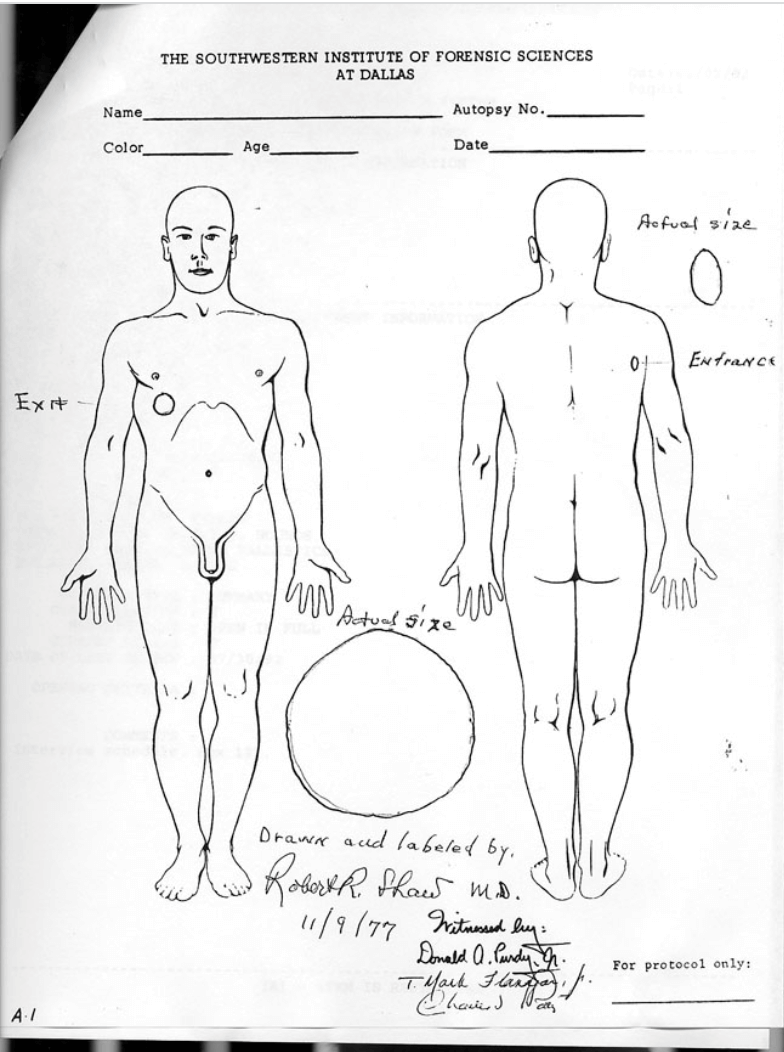
    Dr. Shaw, upon viewing Connally, “found that there was a small wound of entrance (in Connally’s back), roughly elliptical in shape, and approximately a centimeter and a half (5/8th of an inch) in its longest diameter.”

    Connally’s elliptical or oval wound, below his right shoulder, was 5/8ths of an inch along its vertical axis, that is, aligned with Connally’s body or pointing “north-south,” so to speak.

    The vertical elliptical or oval shape of the original wound is a tell, close to conclusive.

    From PathoilogyOutlines.com, in an article entirely unrelated to the JFKA: “Oval shape: suggests an acute angle of fire with respect to the skin.”

    A clean non-tumbling shot, entering Connally’s back from behind and above, such as from the Texas School Book Depository or the Dal-Tex building roof, would leave a vertical elliptical shape, which is precisely the original wound that Connally had.

    The length of ellipse would vary, depending on whether Connally was leaning forward or back at the moment of impact. Connally was almost certainly leaning back, as will be explained later, which would tend to lengthen the resulting elliptical wound.

    In contrast, a tumbling slug might make a ragged hole, as when the bullet’s butt-end struck the body sideways. Such a hole could be largely sideways to the body, or at a three-quarter angle, or oddly shaped in 100 different ways.

    In his testimony to the Warren Commission (WC), and to the House Select Committee on Assassinations (HSCA), Shaw said he thought the rear entrance wound on Connally likely resulted from an unobstructed shot from above, a conclusion bolstered upon his review of the Zapruder film and discussion with the Governor.

    Here is Dr. Shaw’s sketch indicating the vertical, elliptical shape of Connally’s wound—that is, up and down, not horizontal.

    Connally’s Back Wound

    There are other indications that Connally was struck by a non-tumbling bullet. For example, Shaw told the HSCA in 1977 that “there was a tunnel made by the missile in passing through (Connally’s) chest wall.”

    A “tunnel?” Do tumbling bullets make “tunnels”? Yes they do, but according to Dr. Shaw that is not what happened in this case.

    Connally’s Coat

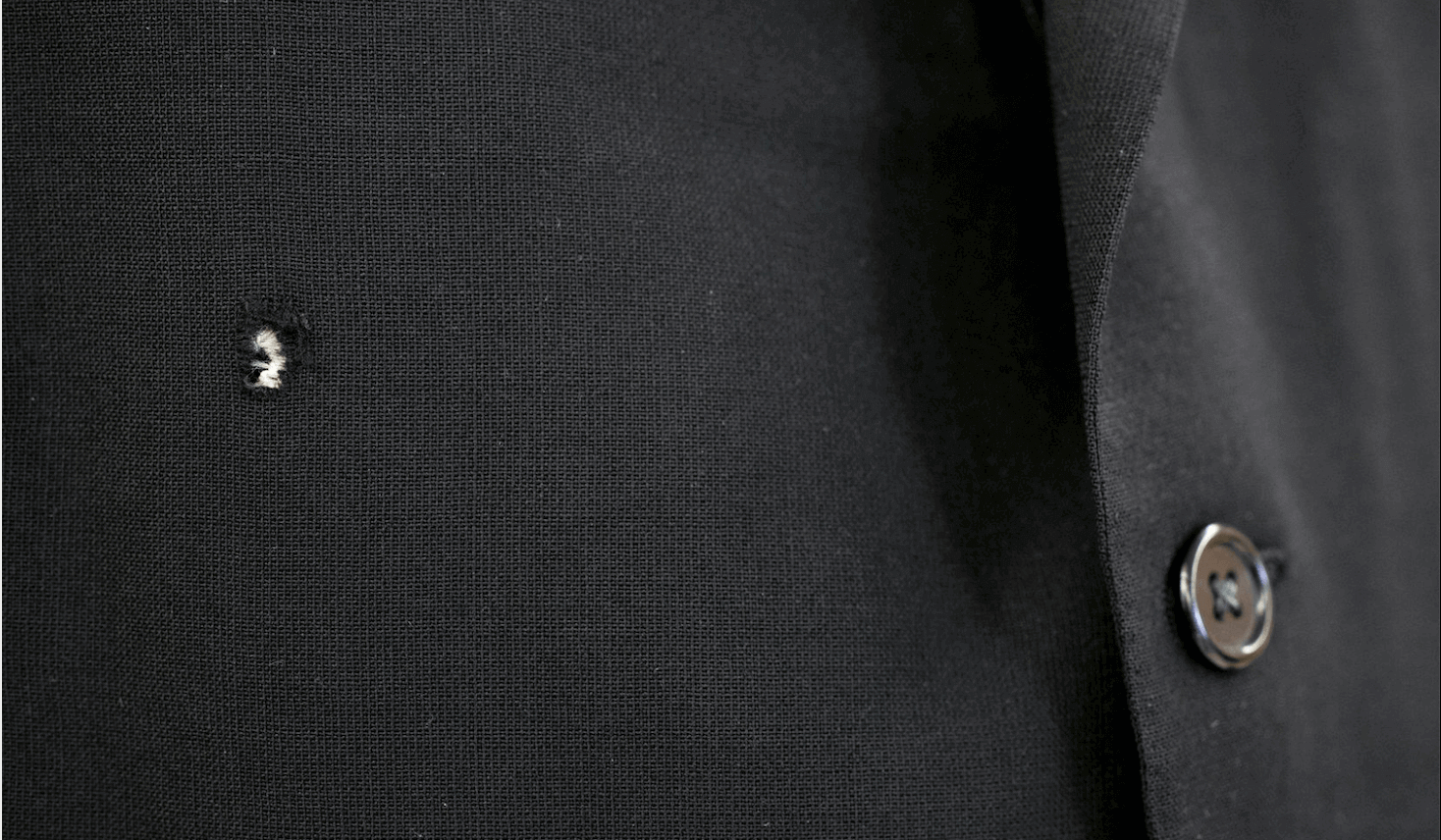
    But there is even more and Shaw was almost certainly correct in his assessment of the wound, for we have a photo Connally’s jacket from Nov. 22 featuring the exit hole the bullet made.

    Connally’s Coat Exit Hole

    And we see a small hole in the front of Connally’s jacket, exactly as if the bullet had cleanly exited. Note the size of the button, for reference.

    Thus, the tumbling single-bullet theory just gets deader and deader.

    To sum up: the tumbling-magic-bullet theorists posit the bullet struck JFK in the upper back, then exited Kennedy’s neck so straight and cleanly that it left a small hole below Kennedy’s Adam’s apple—a hole so small that attending doctors in Parkland Hospital thought it an entrance wound.

    Then (the magic-bullet theorists posit) the bullet tumbled after exiting Kennedy, although it somehow made a small hole in Connally’s shirt, and a small elliptical wound, and then stopped tumbling to tunnel through the Governor. And then the bullet exited exactly nose first, leaving a small hole in Connally’s coat.

    At the risk of piling on, there is even more evidence the shot Connally received that day in Dallas was not tumbling.

    Blundering Pathologists and Lawyers

    Proponents of the single-magic-bullet theory posit the bullet must have tumbled upon leaving President John Kennedy’s neck and then entering Connally. Why?

    That tumbling, proof that the magic bullet passed through JFK’s neck, is why the single magic bullet left a large wound on Connally’s back, the reasoning goes.

    However, the original wound on Connally’s back was not a large one, as is sometimes erroneously asserted, including, embarrassingly, by not only the HSCA’s top lawyer, but also by its top pathologist!

    As stated, Dr. Shaw clearly informed the WC and the HSCA that Connally’s original wound was a small vertical elliptical (or oval shape) injury 5/8ths of an inch long.

    Some of this ground has been covered previously in an excellent article by Millicent Cranor, “Trajectory of a Lie,” at History Matters.

    As noted by Cranor and in the record, Shaw explained to the WC and the HSCA that in order to clean and debride (cut away devitalized tissue) the wound, he enlarged the injury to twice its original size, to a final 3.0 centimeters long (1 1/4 quarter inch long).

    OK, so the final surgically enlarged wound is a one-a-one-quarter inch long, on Connally’s back.

    Here is how Michael Baden, who was chairman of the HSCA Forensic Pathology Panel, described Connally’s back wound in a book he authored: “He (Connally) removed his shirt. There it was—a two-inch long sideways entrance scar in his back. He had not been shot by a second shooter, but by the same flattened bullet that went through Kennedy.”

    Huh?

    So, the original wound, as described by the surgeon Shaw, was a vertical elliptical injury 5/8ths of an inch long.

    But the final scar is a “two-inch long sideways entrance scar,” according to the triumphant Baden, and that means the bullet that struck Connally in Dallas had been tumbling?

    How can Baden, a medical professional, bungle truth and common sense so badly? Had he never considered the small entrance hole in Connally’s shirt? Did he never read the reports by Dr. Shaw?

    And how did a one-and one-quarter-inch final, surgically enlarged wound, as explained by the surgeon Dr. Shaw, become “two-inch long sideways entrance scar” in Baden’s version?

    Even worse, Robert Blakey, chief counsel for the HSCA, fell into the same inexcusable misdiagnosis, also asking Connally to remove his shirt, and also describing the size of scar he had witnessed on the Governor’s back as proof of a tumbling bullet, and thus verifying the single-magic-bullet theory.

    Were the topic not so grave, Team Inspectors Clouseau comes to mind.

    But there is more.

    Dr. Shaw also believed the bullet that coursed through Connally could not have struck a body beforehand, or “it would not have had sufficient force to cause the remainder of the Governor’s wounds.” After tunneling through five inches of Connally’s rib, the bullet then struck and shattered Connally’s wrist before burrowing onto Connally’s left leg.

    But then, what did Shaw know? He had only worked on 900 bullet- and shrapnel-victims during WWII, and then another couple hundred such victims in Dallas.

    Nevertheless, Baden and Blakey would have the final wording of the HSCA report, a type of indelible excrement on the committee’s escutcheon.

    What the Connallys Said

    But there is even more.

    Governor Connally testified resolutely before the WC, and in many other forums (and has been recorded) that there were three shots that day in Dallas: The first shot struck JFK; the second shot struck the Governor in the back and immediately incapacitated him, and the third shot also struck JFK, with awful and fatal result. In other words, three shots, three hits, no tumbling.

    (There may have been and likely were more shots that day in Dallas, but the gunfire may not have been audible in the Presidential limousine, variously due to simultaneous fire, silencers, or use of a pneumatic weapon. In addition, non-simultaneous shots can be heard simultaneously if shooters are at different distances from ear witnesses.)

    Connally’s wife, at his side in the presidential limo, confirmed her husband’s account of the shot pattern many times. Secret Service agents Clint Hill and Sam Kinney, and presidential aide David Powers, all close at the scene on Nov. 22, also all say there were three separate shots that struck JFK and Connally that day, among many other witnesses.

    As Connally stated: “Beyond any question, and I’ll never change my opinion, the first bullet did not hit me. The second bullet did hit me. The third bullet did not hit me.”

    But Governor Connally, like Dr. Shaw—what does he know?

    Zapruder Film

    The Zapruder film almost certainly confirms the Connally’s version.

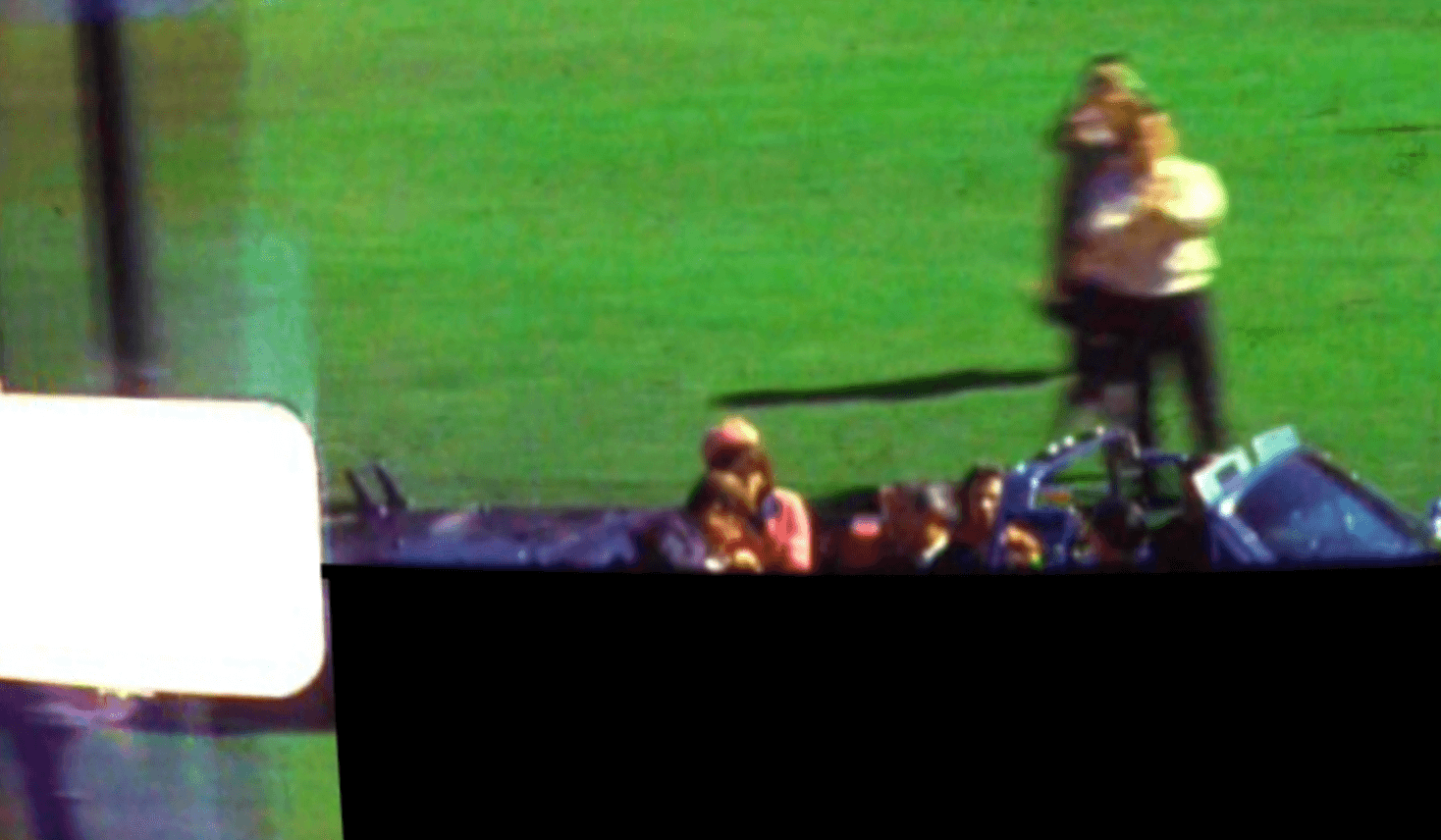
    Here is Zapruder film frame 226, as JFK emerges from behind the Stemmons Freeway sign. JFK appears to have been struck, perhaps just before or while he was behind the sign. Jackie Kennedy looks concerned. Connally is blurry, but sitting upright.

    Z-Film Frame 226. Kennedy is struck; Connally is upright.

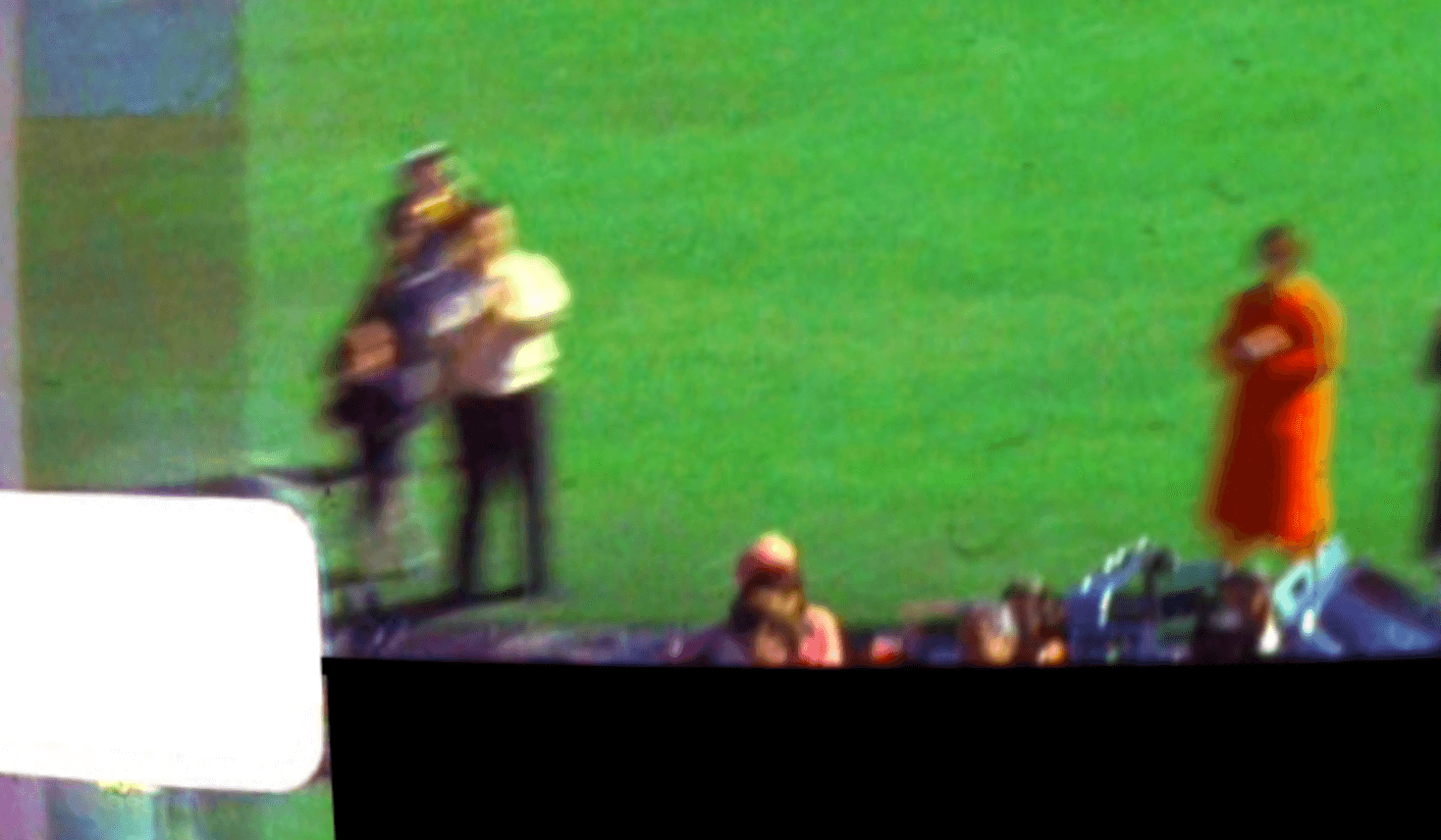
    Here is Z-film frame 245. Connally is halfway through a turn over his own right shoulder, just as he has recounted to the WC. Note, in order to turn around, Connally is leaning back. (Note: Try this yourself. Try to look over your own right shoulder at someone sitting behind you. Try leaning forward, and then leaning back, to look over your right shoulder.)

    Z-Film Frame 245. Connally is turning around.

    In the process of leaning back, Connally exposed his back at a more-acute angle to an elevated gunman, resulting in the original small elliptical wound described by Dr. Shaw.

    This is Z-film frame 280. Note Connally has made a near-180-degree turn in his chair. The WC and HSCA and magic-bullet theorists posit this about-face by Connally happened after he has been shot through the chest and suffered a fractured wrist.

    Connally and his wife said the Governor was trying to catch a glimpse of JFK, given commotion and gunfire, and this is before Connally has been shot. The Connally version appears to be true, beyond reasonable doubt.

    Z-Film Frame 280. Connally has made an 180-degree turn in his seat.

    This is Z-film frame 290. Unable to catch a view of JFK, who has slumped out of view, Connally is now returning to face forward.

    Z-Film Frame 290. Connally turns to face forward.

    And then Z-film frame 296. This appears to be when Connally was struck. Unfortunately, we cannot see Connally’s torso, but his face begins to grimace.

    Z-Film Frame 296. Connally is struck.

    And this is Z file frame 300. Connally appears to be in agony.

    Z-Film Frame 300. Connally is in pain.

    Z-film frame 313 follows, and shows a head shot to JFK.

    The elapsed time between frame 296 and frame 313 is less than eight-tenths of one second, and by all accounts, a single-shot bolt action rifle requires a bare minimum of two seconds to even operate between shots, let alone aim and fire.

    Conclusion

    The reasonable, indeed nearly inevitable and all but certain conclusion is that a bullet did not tumble before striking Connally, and that the timing between shots cannot be explained by a lone gunman operating a single-shot bolt-action rifle.

    The tumbling bullet theory was a desperate fiction invented to give support to the idea that single bullet caused all of Governor’s and the President’s neck wounds on Nov. 22. Otherwise there are too many shots to have been accomplished by a lone gunman with a single-shot bolt-action rifle.

    But from the too-small hole in the rear of Connally’s shirt, to the small elliptical wound in Connally’s back, to the Connally’s testimony, to the observations of Dr. Shaw, and from a review of the Z-film, it is abundantly clear that the Governor was struck by a clean and separate shot.

    Addendum

    Recently, in the oft-excellent pages of the Education Forum, the WC testimony of Dallas Sheriff Seymour Weitzman was reprised in an interesting post by John Butler.

    The relevant passage, in this context, regarding Nov. 22:

    (WC Attorney) Joe Ball: How many shots did you hear?

    Seymour Weitzman: Three distinct shots.

    Joe Ball: How were they spaced?

    Seymour Weitzman: First one, then the second two seemed to be simultaneously.

    But like Connally and Dr. Shaw, what did Weitzman Know?

    Second Addendum

    Interestingly, Dr. Shaw even suggested more than one bullet might have struck Connally. Why?

    The entrance wound on Connally’s wrist was on the side that most people wear the wristwatch, that is the non-palm side, also called the dorsal side. The bullet then exited through the palm side of the wrist.

    Dr. Shaw wondered how Connally could hold his arm so the bullet would pass through his chest and then through the wristwatch-side (or dorsal side) of his wrist. And indeed, try sitting down, and then try to touch the face of your wristwatch (worn on the right wrist) to your chest. You can’t do it. You can place the palm side of your wrist against your chest easily.

    One deduction is another bullet struck Connally’s wrist directly.

    And indeed, Connally testified before the WC that bullets were entering the Presidential limousine as if from “automatic” weapon fire.

    Yet the WC and HSCA posit the magic bullet passed through Connally’s chest, and then through dorsal, non-palm side of his wrist, a nearly impossible scenario, anatomically speaking.

  • In Memoriam: Priscilla Johnson McMillan, 1928–2021

    Jim DiEugenio wrote about Priscilla Johnson McMillan, who interviewed Oswald in Russia then worked with his widow after the JFK assassination. (Click here for details)

  • Deep Fake Politics: Empire and the Criminalization of the State

    Deep Fake Politics: Empire and the Criminalization of the State


    In the two previous installments of this review of Can’t Get You Out of My Head (CGYOMH) by Adam Curtis, I covered his poor handling of things like financial chicanery, monetary policy, oil markets, the JFK assassination, and “conspiracy theories” in general. To conclude this review, I am going to cover some of the ways in which Adam Curtis beguiles the audience on crucial issues such as state criminality, the dual state, geopolitics, Western imperialism, and the West’s adversaries—Russia and China specifically. Finally, I conclude with a brief summation of the CGYOMH and an exhortation for us all to take a large grain of salt with anything produced by this BBC pied piper.

    A Shallow Take on the Deep State

    Curtis has a strange way of grappling with US imperialism and the country’s secret government which emerged after World War II. In the fifth episode of CGYOMH, Curtis mentions that the CIA had been manipulating political systems and overthrowing governments around the world without the knowledge of the US public. He then brings up the illustrious Hans Morgenthau and his assessments of the American shadow government. This whole section is baffling to me. First, Curtis identifies Morgenthau as “one of the most senior members of the US State Department.” Then he says that Morgenthau “had given this hidden system of power a name, […] the dual state.” According to Curtis, Morgenthau deemed this duality necessary because of the realities of international power politics. These dark clandestine tactics needed to be hidden from the public because acknowledging them would undermine Americans’ beliefs in their democracy and in their exceptionalism—beliefs that were necessary in the Cold War.

    Curtis states that the US in the Cold War ran covert operations to overthrow 26 foreign governments in 66 attempts. Morgenthau, it is stated in CGYOMY, believed that this secrecy was creating a dangerous time bomb at the heart of America. Beginning in the 1960’s, these secrets began to be exposed by writers like former CIA officer Miles Copeland. In this section, Curtis even runs footage of a trailer from the original film adaptation of The Quiet American. The trailer is a montage featuring narration and clips from the movie which depict an American agent sowing chaos and violence “across all the Orient.” The film is certainly relevant to the discussion. That said, Curtis could have told the audience that the protagonist of the book and film is widely understood to be based on the activities of infamous CIA officer Edward Lansdale. Furthermore, Curtis could have also told the audience that Lansdale himself—acting on behalf of the CIA—was involved in the production of the film adaptation. To that end, the plot of the film was changed in such a way as to obscure the titular Quiet American’s responsibility for a terror bombing. The episode illustrates how the secret government was even manipulating the public through Hollywood—going so far as to alter those rare, informed critiques of US neocolonial imperialism in literature and film.

    Morgenthau, the Rockefellers and The University of Chicago

    But I digress. As mentioned above, Curtis’ treatment of Morgenthau and the dual state is strange. For one thing, Morgenthau did not give the dual state its name. The term comes from a German émigré named Ernst Fraenkel and his 1941 book, The Dual State: A Contribution to the Study of Dictatorship. The book described how alongside the normative state which operated lawfully, there emerged a prerogative state which operated lawlessly to serve as the guardian of the normative state.[1] Furthermore, Morgenthau is not most notable for being “one of the most senior members of the US State Department.” As far as I know, he never actually occupied a high position in the state department, though he did work there as a consultant under different US presidential administrations. Morgenthau is, however, quite famous for being the modern seminal classical realist philosopher in the field of international relations—a subdiscipline of political science. Why Curtis omits this is a mystery.

    In fact, Morgenthau’s actual academic position during those years is very relevant to Curtis’ discussion of the dual state—i.e., CGYMONH’s exploration of the lawlessness of America’s postwar secret government, because Morgenthau was a professor at the University of Chicago. Famously described as Standard Oil University by Upton Sinclair, the University of Chicago has a unique relationship to the right-wing brain trust that has informed many imperial US strategies in terms of foreign policy and political economy. Perhaps most infamously, the University served as an incubator of sorts for the neoconservative, right-wing imperialists who were heavily influenced by German émigré Leo Strauss.

    Strauss, who I will return to, himself first received Rockefeller funding thanks to the intervention of Carl Schmitt[2]—the jurist, political theorist, and prominent Nazi whose ideas informed the legal thinking of the Third Reich. In his exploration of the dual state, Curtis would have been better served looking at Carl Schmitt in order to situate the lawless US pursuit of “security.” Summarizing Schmitt, I have written elsewhere[3] that he

    …wrote famously, “Sovereign is he who decides on the exception.”[4] The state of exception “is not codified in the existing legal order.” It is “characterized as a case of extreme peril, a danger to the existence of the state.” The gravity of the state of exception is such that “it cannot be circumscribed factually and made to conform to a preformed law.”[5] Sovereignty for Schmitt is defined by the ability to decide when the state of exception exists and how it may be eliminated. Any liberal constitution can hope, at best, to mandate the party with which sovereignty rests.[6]

    In other segments of CGYOMH, Curtis mentions the critiques of Western leftists who argued that the essence of fascism had not been extinguished with the Allied victory in World War II. In the prior installment of this review, I covered Curtis’ shortcomings in terms of exploring this perspective. In his treatment of lawlessness and the dual state, Curtis compounds those errors. With Carl Schmitt and his University of Chicago descendants, there is a fairly clear German antecedent to the institutionalization of American state criminality that was established with the outbreak of the Cold War and never abandoned (i.e., an historical precursor to the lawlessness of a nominal constitutional republic). The reader may recoil at such a comparison, but the analogy is not particularly hard to grasp, psychic resistance notwithstanding. Even in terms of their respective creations, both were borne of bogus pretexts which conjured an existentially threatening Communist menace. The exceptionalist or legally unconstrained Nazi state took its mature form in the wake of the Reichstag Fire, a terror spectacle which the Nazis likely facilitated.[7] Likewise, much of the early postwar hysteria over the Soviet Union derived from erroneous Anglo-UK accusations that Stalin had grossly violated the postwar terms regarding Eastern Europe which had been negotiated at Yalta.

    All this is not to say the US is a new Nazi Germany. Only Nazi Germany was Nazi Germany, just as only the US empire is the US empire. That said, it is worth noting that in key national security documents like NSC 68, Cold War US policymakers explicitly argued for an exceptionalist approach to combating the supposedly existential threat posed by the Soviet Union.[8] I have written that such documents, in effect, served to grant

    …authority to the state to covertly conspire to violate the law. Since the US Constitution’s supremacy clause establishes that ratified treaties are “the supreme law in the land” and the US-ratified UN Charter outlaws aggression or even the threat of aggression between states, CIA covert operations are carried out in a state of exception. Given that the authority for these operations has never been suspended and the operations have been a significant structural component of the US-led world order, [I coined] the term exceptionism […] to describe the historical fact of institutionalized state criminality.[9]

    Schmitt, Strauss, and the Cold War

    To explain the duality and lawlessness of modern Western states, it is practically essential to discuss Carl Schmitt. In the German case, the Weimar Republic gave rise to a despotic dualism that quickly devoured the Republic, such as it was. In the US, the state’s lawful/lawless duality arose from the Cold War national security state which had been empowered by the supposed existential threat posed by communism. In the US case, the lawful democratic state (or public state) was never completely subsumed by authoritarian forces. This remains true, even if—as I have argued—anti-democratic forces in US society have consolidated so much wealth and power as to constitute a deep state that exercises control and/or veto power over democracy and the national security state. In my dissertation, I describe a tripartite state comprised of the public state, the security state, and a deep state.[10]

    Let us return to Leo Strauss, Morgenthau’s colleague at the University of Chicago. Strauss was an anti-Enlightenment thinker whose affinity for liberal democracy went only so far as to acknowledge that it served an important mythical function in legitimizing the hegemonic US project. One German commentator summarizes Strauss’ thinking about democracy:

    [L]iberal democracies such as the Weimar Republic are not viable in the long term, since they do not offer their citizens any religious and moral footings. The practical consequence of this philosophy is fatal. According to its tenets, the elites have the right, and even the obligation, to manipulate the truth. Just as Plato recommends, they can take refuge in “pious lies” and in selective use of the truth.[11]

    To summarize, Strauss and his mentor (of sorts) Carl Schmitt were both essentially Hobbesians. In the tradition of English thinker Thomas Hobbes, they saw the world as a dangerous and threatening place, the peril of which necessitates the creation of—and submission to—“the sovereign” or more simply, the state. The overriding imperative of the state is security, because without it, all of society is imperiled. Therefore, any measures necessary to secure the state are not just acceptable, but basically necessary. Germany infamously took Schmitt’s Hobbesian logic to a notable conclusion. Writing largely after World War II in the US, Strauss in essence advocated for state duality. He grudgingly accepted liberal democratic myths and formal institutions, while at the same time advocating for wise men like himself and his acolytes to counsel leaders, deceive instrumentally, and effect desired political outcomes in a top-down fashion. It is a mystery as to why Curtis does not mention Strauss given that the philosopher was a central figure in his interesting, but flawed, documentary series, The Power of Nightmares.

    Let us return now to CGYOMY’s treatment of Morgenthau. Curtis offers a brief summation of the realist philosopher’s thinking on the dual state that is, at best, very incomplete—and quite likely wrong. Previously and elsewhere, I wrote about Morgenthau in the same context that Curtis situates him in.

    As a 20th century analog of Thomas Hobbes, Schmitt elucidated a grim, illiberal understanding of the true nature of power within the state. Recognizing this same illiberal essence, other theorists described the “state of exception” and the securitization of politics as a slippery slope that would create authoritarianism, perhaps with pseudo-democratic trappings.[12] In the early years of the Cold War, seminal realist Hans Morgenthau would comment on these illiberal forms emerging within the American political system. He identified a change in the control of operations within the U.S. State Department. The shift was toward rule according to the dictates of “security.” Morgenthau wrote, “This shift has occurred in all modern totalitarian states and has given rise to a phenomenon which has been aptly called the ‘dual state’” In a dual state, power nominally rests with those legally holding authority, but in effect, “by virtue of their power over life and death, the agents of the secret police—coordinated to, but independent from the official makers of decision—at the very least exert an effective veto over decisions.”[13] Thus does Morgenthau describe a dynamic akin to Schmitt’s conception of sovereignty.

    To wit, Morgenthau did expound on Schmittian ideas about the sovereign and he addressed the dual state concept derived from two of the Germans discussed above: Carl Schmitt and Ernst Frankel.[14] To my knowledge, however, Morgenthau’s most noteworthy exploration of the subject was the 1955 New Republic article cited above. In this essay, he did not argue that the emergence of this dual state was positive or necessary. Rather, he bemoaned how the US State Department had been decimated by the dictates of an overweening security apparatus and he explicitly situated this dual state in the context of totalitarianism. The Nazi example would have been obviously at the forefront of Morgenthau’s mind. At the very least, Curtis should have mentioned the New Republic article and its critique, since it was written in a major US magazine. More recently, the 1955 Morgenthau essay was discussed in a scholarly article on the subject of the deep state by Swedish scholar Ola Tunander in 2009.[15]

    Curtis touches on the institutionalized lawlessness and thus the duality of the state in the US, but he fails to hash out the implications. With his blinkered treatment of Morgenthau, his omission of Schmitt and Strauss, and with his treatment of the JFK assassination, the filmmaker cannot bring himself to confront the American deep state and the cataclysmic historical episodes in which it was decisive. Discussed in greater depth in the previous installment of this review, Dallas was a coup d’état profounde—a stroke of the deep state. It is nonetheless interesting that Curtis spent any time at all covering the assassination and the deep state.[16]

    Imperial Security

    The historical limited hangout approach deployed by Curtis permeates the accounts of Western imperialism in CGYOMH. At one point, the film briefly covers the assassination of Congo’s first elected prime minister, Patrice Lumumba. To his credit, Curtis acknowledges CIA involvement in Lumumba’s death. He acknowledges that the US installed the brutal puppet Joseph Mobutu, but for some reason he fails to mention that it was Mobutu’s forces who arranged the execution of Lumumba. He states that the abrupt Belgian withdrawal plunged Congo into crisis. But he neglects to mention that this was by design—part of a plot to break away from Congo its most resource rich province of Katanga.[17] Curtis credulously reports that the US was worried that without intervention, Congo’s copper might fall into communist hands. He neglects to mention that it was the West’s refusal of help which forced Lumumba to seek Soviet aid. There is reason to believe that this was done by design, as it then gave Allen Dulles the pretext to assassinate Lumumba—an action which Eisenhower went on to authorize.

    The assassination was carried out in such a time and fashion as to indicate that people like Dulles feared a change in policy under the incoming Kennedy administration. Kennedy’s policy was much more sympathetic to Lumumba than that of Eisenhower and Dulles, but the young Congolese prime minister was killed 72 hours before Kennedy had been sworn in as president. With the facts selected and presented as they are in CGYOMH, the reader gets the impression that policies such as this were decided on the basis of myopic, but earnest, anticommunism. With Curtis, the obvious economic interests are ignored or minimized. But with Curtis, the implication is that another set of those darn bureaucrats are once again too much enthrall to another set of wrongheaded ideas.

    When one takes the longer view, this explanation falls apart. As one of the most resource-rich places in the world, Congo was brutally exploited and expropriated by Europeans for more than a century before the Cold War. During the Cold War, the plunder continued, overseen by the US-installed puppet following the assassination of Lumumba, the man who famously asserted that the resource wealth of Congo should be used for the benefit of the Congolese people. After the Cold War and up to the present day, the Congolese have been subjected to unspeakable violence on a massive scale, while the pillage of its resources has continued apace. But since Curtis filters everything through his anti-leftist lens, he cannot present cogent analysis, even when the episodes under discussion are pregnant with weighty implications.

    The Dark Art of Western Geopolitics

    In CGYOMH, Curtis looks at numerous examples of Western imperialism in places like Iraq, China, and Africa. The series would have benefitted from a discussion of geopolitics—specifically the theories of Halford Mackinder and the more contemporary policymakers and scholars who have examined Mackinder’s ideas and their applications. The Brit Mackinder looked at the world and saw that Europe, Asia, and Africa were really one massive “world island” containing most of the world’s resources and productive capacity. With Britain located on the periphery of the world island, its imperial strategists needed to assert control over key areas and destabilize or Balkanize regions to preclude any counter-hegemonic force from uniting the enormous landmass.

    The British applied this logic throughout their imperial reign. Both world wars can be seen, in part, as consequences of the applications of Mackinder’s theses. As one example, the Anglo establishment was much alarmed by Germany’s proposed Berlin-Baghdad railway. This project would have integrated Germany, Central Europe, the Balkans, and the oil-rich Middle East into a massive German-led industrial powerhouse. Interestingly, the radical historian Guido Preparata sees a Russian hand in the assassination of Franz Ferdinand and Russia was, of course, Britain’s ally at the time.[18] Prior to World War II, the Soviet Union’s existence threatened the great powers in Western Europe and the US. This no doubt informed the thinking of Anglo-US elites who helped rebuild and fuel, respectively, the German and Japanese war machines. With other factors at work—and with geopolitics not being an exact science—the anti-Soviet Anglo-American elites did not get their preferred outcome. Germany chose softer targets first before launching their ultimately ruinous campaign against the Soviet Union almost two years later.

    When the Japanese got into military conflict with the Soviets in 1939, they were soundly defeated at Nomohan. In the aftermath, Japan signed a non-aggression pact with the USSR. This would prove crucial in shaping the war’s outcome. In 1941, the Germans invaded Russia and were headed for Moscow. Since there was little threat of a Japanese invasion, the Soviets were able to send divisions from the Far East and stop the Germans just short of the capitol. The Soviet-Japanese non-aggression pact held until the last days of the war when Soviet forces swept through Manchuria, actually killing more Japanese than the atomic bombings. Though in Western historical memory, Hiroshima and Nagasaki quickly overshadowed the Soviet invasion, considerable evidence indicates that it was the crushing Japanese defeat in Manchukuo—along with the threat of an impending Soviet attack on the main islands—that actually prompted the Japanese surrender to the Americans.[19]

    As historian Alfred McCoy points out, a central strategy of the postwar US empire was to rebuild the defeated Axis powers and make them essentially US satellites. With Germany and Japan reconstructed as largely demilitarized, capitalist industrial powerhouses, the US controlled both “axial ends” of Eurasia, Mackinder’s “world island.”[20] Trade and capital flows went across the Atlantic and across the Pacific, making the US the richest empire in world history. This was by design. In retrospect, the US war in the Pacific was particularly a war for postwar hegemony. And some have argued the dual atomic bombs kept Russia out of Japan.

    The American Century

    American claims to legitimate possession over Hawaii and the Philippines—where the Japanese attacked the US—were dubious at best. They are part of a history that goes all the way back to the 1850’s. Following the imperialist Mexican-American War and the US acquisition of California, enterprising officials and businessmen looked to the Pacific to enrich the US and themselves. Starting as early as Matthew Perry’s 1853 expedition to Edo, US trade and investment in the Pacific were too lucrative to pass up. Hence, we have the absurd fact that in the Spanish-American War, ostensibly fought for Cuban independence, the first shots were fired as the US attacked the Spanish Philippines.

    Prior to US entry into World War II, Life magazine publisher Henry Luce made a case for American empire. As a mouthpiece for the Wall Street-dominated Council on Foreign Relations, Luce made the argument in his “American Century” essay, laying out the case for US hegemony over the postwar capitalist world. While much of his essay was couched in “liberal” rhetoric, in one passage he was quite candid about Asia.

    Our thinking of world trade today is on ridiculously small terms. For example, we think of Asia as being worth only a few hundred millions a year to us. Actually, in the decades to come Asia will be worth to us exactly zero—or else it will be worth to us four, five, ten billions of dollars a year. And the latter are the terms we must think in, or else confess a pitiful impotence.[21]

    Geopolitics, control of resources, markets, financial and political systems…these are the aspects of the US hegemonic reign that allow us to make sense of the activities of the intelligence agencies, the military, the business elites, and the public officials who serve these constituencies. Curtis fails to offer cogent analysis of these deep political issues. Thus, the quirky myopia of his commentary on things like covert operations, the dual state, and “humanitarian intervention.” It is worth asking whether British state television would ever sponsor an honest, penetrating documentary film that would bring the reality of our crumbling systems to a vast audience. Does the BBC exist to act in the public interest by providing the range and depth of programming needed for enlightened democratic public debate? Or does the prestige media outlet serve to entertain and manufacture consent?

    Losing the Great Game on the Eurasian Chessboard

    The most famous contemporary adherent of Mackinder’s geopolitical theories was Zbigniew Brzezinski. Co-founder of David Rockefeller’s Trilateral Commission and US National Security Advisor under Carter, Brzezinski expounded on post-Cold War geopolitics with his 1997 book, The Grand Chessboard: American Primacy and Its Geostrategic Imperatives. In it, he argued that “keep[ing] the barbarians from coming together” was a “grand imperative of imperial geostrategy.”[22] By “barbarians,” Brzezinski was referring to Russia and China. These two countries have indeed come much closer together in the intervening years, largely in response to their shared grievances under US hegemony. Termed the “rules-based liberal international order” by US officials and their media/academic courtiers, the Post-Cold War era of unipolar US dominance has by-and-large allowed the US to essentially make—and break—the “rules” of international politics according to its whims. A small number of countries have resisted US dominance with varying degrees of success. In the 21st century, three of them—Afghanistan, Iraq, and Libya—saw their governments overthrown and their societies devastated. In Eurasia, an “axis of resistance” has emerged which includes most notably China, Russia, Iran, and Syria—with Iraq in the wings as the US still refuses to honor the Iraqi parliament’s request to withdraw US military forces from the country.

    In this context, it should be noted that much of Curtis’ previous documentary series, Hyper-Normalization, devoted much screen time to denigrating two Western targets—Libya and Syria—in a multitude of dubious ways. True to form, the real villains in CGYOMH are (surprise!) Russia and China. The countries, according to Curtis, have one thing in common: they believe in nothing. Curtis states this repeatedly, though he contradicts himself, somewhat, by also stating that the Chinese only believe in money. The BBC should spring for some kind of editor to make sure that Curtis’ chauvinism is at least internally consistent, but, alas, such is not the case.

    The Soviet Union of CGYOMH appears to be the most depressing society that ever existed. Stock footage is used to depict a country of hopeless, nihilistic, victims of communism. While the post-Soviet era of Boris Yeltsin is acknowledged as a disaster, Curtis minimizes the extent to which the shock therapy privatization was a Western operation that enriched Western finance—along with that class of underworld-connected figures who became known as the oligarchs following their seizure of the Russia’s patrimony. Curtis also does not adequately explore the US interference on behalf of Boris Yeltsin in the 1996 Russian election. Portrayed in a glowingly brazen fashion on the cover of Time magazine, those US operations were of a scale far greater than even the most fanciful accusations of Russian interference in the 2016 US election.

    The true Russian villain of CGYOMH, predictably, is Vladimir Putin. To my surprise, and to the credit of Adam Curtis, he does largely dismiss Russiagate. Without spending too much time on the subject, Curtis suggests that Russiagate paranoia was symptomatic of US anomie, insecurity, and paranoia. On the one hand, it is good that even with his highly negative take on Russia, Curtis doesn’t stoop to regurgitating Russiagate claims that are thoroughly debunked—most notably by Aaron Mate in outlets like The Nation magazine and The Grayzone website. Too bad Curtis doesn’t look at the role of the dual/deep state in concocting and maintaining the hoax. CGYOMH spends a good amount of time addressing various intelligence capers. It could have been illuminating to see the Russiagate saga portrayed in a well-produced documentary film.

    Putin: That Dirty Guy!

    Instead, Curtis tells us that the dream of turning Russia into a liberal democracy went wrong and a new rapacious oligarchy came to power. At the highest levels of power, did the US ever want to see Russia become a prosperous democracy? Russia was subjected to structural economic changes that much of the rest of the world has experienced under US hegemony—privatization, austerity, massive upward transfer of wealth, and capital flight. Given the negative results of neoliberalism in the last 40+ years, why is it not assumed that those outcomes are intentionally brought about to further enrich US/Western elites and immiserate most people on purpose?

    Furthermore, with Russia, there are additional reasons to suspect that US elites deliberately wrecked and polarized Russian society. After the Gulf War, neoconservative Paul Wolfowitz said, “[W]e’ve got about 5 or 10 years to clean up those old Soviet regimes—Syria, Iran [sic], Iraq—before the next great superpower comes on to challenge us.”[23] Subsequent covert and overt US actions in the Balkans, Georgia, Libya, Ukraine, and Syria all demonstrate how the US has time and again launched military interventions in ways that threatened post-Soviet Russia’s national interests. US elites and the corporate media were major supporters of Boris Yeltsin, whose reign was an unmitigated disaster for the Russian people. These same actors now despise Vladimir Putin, a statesman who—shortcomings notwithstanding—has presided over an era in which conditions in Russia have much improved from the situation he inherited. The US media treatment of the two Russian leaders belies any claims of made about US leaders being concerned about the well-being of the Russian people in the Putin era.

    In episode six of CGYOMH, Curtis states that Putin was selected by the Russian oligarchs to rule Russia. My understanding was that he was first handpicked by Boris Yeltsin—an historical oddity given how the two men seem like polar opposites. At the time of his anointing, Curtis tells us, Putin “was an anonymous bureaucrat running the security service and a man who believed in nothing.” Having installed the nihilist Putin as president, the oligarchs thought they would continue to dominate the country. Then, as Curtis so often tells us, “something unexpected happened.” A nuclear submarine exploded and sank to the ocean floor in August of 2000. The uncertainty about the fate of the crew and the eventual news of their deaths served to outrage Russians.

    Eventually, Vladimir Putin came to Murmansk to address the public and the grieving families. Curtis tells us that Putin, “to save himself, turn[ed] that anger away from himself and towards the very people who put him in power,” i.e., the oligarchs. Putin told Russia that it was the corrupt oligarchs in Moscow who, by stealing everything, had destroyed the Russian military and Russian society. Instead of suggesting that Putin was using his office to address legitimate grievances on behalf of the vast majority of the population, Curtis tells us that Putin had instead merely “discovered a new source of power”—the anger of the people.

    Even with his new source of power, Putin continued to believe in nothing and to have no goals according to CGYOMH. A Russian journalist is quoted talking about how under Putin there is no goal, no plan, no strategy…only reactive tactics with no long-term objectives. Later, Curtis quotes another Russian journalist who claimed that what Putin had really done was to take the corruption of the oligarchs and move some of into the public sector so that Putin and his cronies in the government could get in on the corruption: “The society Putin had created was one in his own image. It too believed in nothing.” The journalist was later murdered, outrage ensued, yet things did not improve. However, oil prices soon exploded, serving to ignite a bonanza of Russian consumerism. Cue the footage of a cat wearing a tiny shark hoodie, sitting atop a Roomba, gliding over a kitchen floor, pursuing a baby duck. This, presumably, is some kind of metaphor for the directionless nihilism of Russia. Take heart, Anglo-Americans: Whatever our problems, we have yet to see such horrors in the freedom-loving West.

    Curtis goes on to check all the obligatory boxes regarding Putin and Russia. The group Pussy Riot makes an annoying appearance. Alexi Navalny, a figure with very little popular following in Russia, is credited by Curtis with “chant[ing] a phrase that redefined Russia” for a, theretofore, apolitical generation. “Party of crooks and thieves!” chanted Navalny. This, we are told, made Putin furious at the ungrateful new middle class. In response, a paranoid Putin “shapeshifted again.” He created the “Popular Front,” a Russian nationalist organization. Worse: “He summoned up a dark, frightening vison from Russia’s past,” saying that “Eurasia was the last defense against a corrupt West that was trying to take over the whole world.” Putin was articulating “a great power nationalism that challenged America’s idea of its exceptionalism.” Putin, Curtis tells us, was promoting “Russian exceptionalism!” Flash to footage of the Nighthawks, a gauche pro-Putin motorcycle gang of Russian nationalists. Curtis then asserts that the Nighthawks are promoting a “paranoid conspiracy theory” that the West, led by the US, is trying to destroy Russia.

    Adam Curtis: Reality Check I

    Where to begin with Curtis’ treatment of Russia? Putin as alleged nihilist is simply a cheap shot. The man is obviously a nationalist. This cannot be lost on Curtis, but he refuses to grant Putin even that. Instead, Putin’s moves to curb the oligarchs’ power and his efforts to resist Western geopolitical moves are all presented as crass opportunism in the service of personal aggrandizement. What should Putin and the Russians have done after Yeltsin? Curtis cannot answer this question, so he never poses it. Putin is indeed a figure that can be criticized on a number of fronts. Most significantly, his measures against the oligarchs went nowhere near far enough. The legitimacy of their vast holdings is dubious at best. If Russia were to function on a more democratic basis, one of the most popular measures would be to nationalize or otherwise redistribute what are widely perceived as the ill-gotten gains of these propertied elites. But since Curtis is first and foremost an anti-leftist, there is no discussion of such possibilities.

    Nor is there any discussion of the steps Putin did take against particular oligarchs that he deemed (with at least some justification) to be acting against the national interest. At least Curtis does not endorse Russiagate. Nor does he mention the implausible Novichok poisonings that Western security services attribute to Putin himself. These omissions are interesting in and of themselves. What of Putin’s assertion that Eurasia is the last bulwark against a US-led West bent on world domination? Curtis mocks the very notion. He does not mention that Zbigniew Brzezinski explicitly made the same argument about Eurasia over twenty years ago. Keep in mind that Brzezinski was, in my estimation, part of the more sober wing of the US imperial hivemind. He could be characterized an Establishment liberal imperialist in contrast to the unhinged neoconservative imperialists.

    Going back further in US-Russian relations, the US Joint Chiefs of Staff wanted JFK to endorse a preemptive nuclear strike on the Soviet Union to be carried out in the final months of 1963. Kennedy opposed such an unprecedented act of human barbarism. Notably, Kennedy himself was assassinated under suspicious circumstances during that same proposed window of time. Many commentators have noted how NATO has seemed to move closer and closer to Russian borders.[24] The late Robert Parry wrote often about the role of the US Embassy during the uprising in Ukraine.[25] In short, there is much historical and contemporaneous evidence that the US has sought to encroach Russia—or to at least deprive the country of any ability to impede US global hegemony. Realizing that such is the case, Russia under Putin has allied itself with its historical rival, China.

    Curtis, with China in his Sights

    At this point, it should be clear that Curtis is going to rubbish China, the most long-lived civilization in human history. Like many things in his film, Curtis does not appear to be an expert on Chinese history. On China, CGYOMH is at its most schizophrenic. Curtis acknowledges how the British devastated Chinese society with the Opium Trade and the Opium Wars. He actually soft-pedals much of this. For example, he could have mentioned that Western imperialism led to the social crises which spawned the Taiping Uprising, a conflict that killed perhaps as many as 15 million Chinese around the time of the US Civil War. Or he could have spent more time talking about the indemnities that poor China had to pay to the rich West after the Opium Wars and the so-called “Boxer Rebellion.” As I understand it, the Chinese paid over a trillion dollars’ worth of gold in today’s values as per the terms of the Boxer Protocol. This was for resisting British imperialism! The debt had only grown larger with interest before it was cancelled during World War II, when China allied with the US and British against Axis Japan. Nor is there any mention of how Japanese imperialism against China in the 1930’s was aided by the West. Such was the case up until 1940, when the US put an embargo on Japan after the Japanese invaded French Indochina. The embargo is what led to the attack on Pearl Harbor. All told, the Chinese may have lost 20 million people in the war with Japan.

    What about China after 1949? It being a communist country, Curtis is a harsh critic. Yet true to form, his critique is quirky and idiosyncratic. CGYOMH does not much mention the disastrous Great Leap Forward. Curtis discusses the Cultural Revolution, but does not explain it very well at all. Instead, it is depicted as a bizarre power play by Mao vis-à-vis his ambitious and megalomaniacal wife, Jiang Qing. The amount of time Curtis spends on Jiang Qing is completely out of proportion to her historical importance. To my understanding, she is a deeply unpopular figure in China and she comes across worse to Western students of this period of Chinese history.

    At a time when a deeper understanding of Chinese history in the West is desperately needed, Curtis does a great disservice with CGYOMH. With his cursory mentions of the Opium Wars and later of the racist Fu Manchu movies, he attempts to place a type of multicultural fig leaf over his smug imperial chauvinism. The fall of Dynastic China and the struggles of the People’s Republic of China are never properly contextualized. China was hopelessly disadvantaged against the technologically superior West in the last century of the Qing Dynasty. Due to the predations of the Western powers—and then those of the West’s Asian imitator, Japan—China was in such a horrendous state as to experience the rarest of events: a successful social revolution.

    China after 1949

    Though nominally Marxist, there was no clear way for the victorious Chinese communists to apply Marxist principles to the situation that Mao inherited. Marx saw communism as something that was a progression: from feudalism to capitalism…and eventually to communism. He explicitly stated that a communist revolution could not succeed in China or Russia, because they did not have the necessary levels of development to create the class dynamics necessary to seize the means of production. Those requisite industrialized means of production had not yet come into being outside of the Western European world, thus Marx thought that Germany was the most likely place for Communism to arise. By the 1960’s, with China having suffered some spectacular setbacks, Mao launched the Cultural Revolution. Part political struggle, part cultural crusade—it marked a time of tremendous upheaval in Chinese society. Across China, problems of the revolution were attributed to those elements of the millennia-old Chinese culture that hadn’t been discarded. As a result, the Cultural Revolution produced many tragic spectacles, including the destruction of untold numbers of great and small works of art and architecture as part of a campaign to exorcise a multitude of historical traumas.

    In this context, CGYOMH is frankly offensive in its repeated assertion that the Chinese, like the Russians, believe in nothing. Western imperialism—practiced by Europeans and then the Japanese—wrought unimaginable misery in China. It led to enormous political and cultural upheavals that most Westerners cannot fathom. In the wake of the Cultural Revolution, Deng Xiaoping took over the role as China’s helmsman. The free-market reforms introduced in this era served to slowly modernize China by integrating it into the international economy. This development also caused social dislocations and instability, with matters coming to a head of sorts during the so-called “Tiananmen massacre.”

    In the wake of the events of 1989, Chinese leaders had to grapple with the fact that the legitimizing communist ideology was insufficient. The Cultural Revolution had disoriented the Chinese people. In some sense, it robbed them of their cultural heritage. But the history, myths, legends, and spiritual practices of the past were decidedly incompatible with Marxist ideology. Furthermore, the 1989 reality of vast industrial production for the international market economy was incompatible with Marxism as well as with traditional Chinese culture wherein merchants were regarded ambivalently, at best. In response, China began to grapple anew with the past even as present conditions were changing at a dizzying pace. In the wake of that tumultuous 1989, the Chinese Communist Party commissioned a television production of the Ming Dynasty novel (set at the end of the Han Dynasty), Romance of the Three Kingdoms. Such was the dramatic disavowal of Cultural Revolution era efforts to de-Sinify China. China’s cultural inheritance was rehabilitated in the service of Chinese unity.

    Adam Curtis: Reality Check II

    For Curtis, none of this historical context is necessary. China, like Russia, is to be understood as a profoundly depressing society. Again, as Curtis would have it, China today believes in nothing while also believing only in money. Chinese organized crime is out of control. China is excessively militarized. The Chinese Communist Party is terrified of its own countrymen. The Chinese state surveilles and oppresses the citizenry. Average Chinese people have no good prospects because “the princelings” (the children of Chinese elites) are hoarding all opportunities thanks to “ultra-corruption.” This is the China presented in CGYOMH.

    Adam Curtis wants us to bear witness to the rise and fall of the Chinese official, Bo Xilai. Frankly, I cannot even figure out what CGYOMH is trying to say about Bo Xilai. I followed the story a bit when it was an international scandal in the news. I could never arrive at any salient take on the saga and Curtis does not clarify matters here. Bo did have some populist appeal. And he did seem to have some Anglophile tendencies and associations that the state would not have welcomed given Bo’s position. The whole thing seems like inside baseball—Chinese Communist-style. Perhaps this is the point: China is to be understood as an inscrutable, mysterious Oriental despotism.

    Were Curtis to be objective, he would need to inform the audience that the only significant tangible improvements in the well-being of humanity during the last 40 years are due to Chinese progress. The rest of the world—largely following US-dictated economic prescriptions and models—has stagnated or regressed with the exception of the superrich. Meanwhile in China, a billionaire class did emerge, but not without socio-economic conditions for the general population steadily improving. Unlike in the West, Chinese adults who believe that their children will be more prosperous than themselves are not delusional. China’s “militarism” seems not at all unreasonable given the US military bases encircling the country. Furthermore, China spends much less on the military that the US in both relative and absolute terms.

    For a Westerner to decry Chinese organized crime is laughable given the US governments’ partnerships with underworld figures like Meyer Lansky, “Lucky” Luciano, Santo Trafficante, Sam Giancana, the KMT, the anti-Castro Cubans, Gulbuddin Hekmatyar, the Contras, Ramon Guillen Davila, etc, etc, etc. And while there are, no doubt, privileged Chinese “princelings,” at least the Chinese can plausibly argue that their well-heeled heirs are not part of a class project to perpetually keep the bulk of the population in a state of material insecurity. In the US (and Curtis’ UK is not that much different), every aspect of life—food, housing, education, health care—is an avenue for rent-seeking and profiteering. And while aspects of the Chinese surveillance state are indeed Orwellian and alarming, it is worth keeping in mind that Western depictions of its adversaries are invariably unreliable and incomplete. Furthermore, and as Ed Snowden revealed, the US is no slouch when it comes to totalitarian surveillance. And even with the vast wealth in the US, we still lead the world in depriving our citizens of liberty in the harshest way: In both absolute and per capita terms, no country incarcerates more of its own citizens than the US.

    The Garden Paths of Adam Curtis

    In conclusion, I cannot recommend Can’t Get You Out of My Head except as a case study in sophisticated propaganda. The filmmaking talents of Adam Curtis are, as ever, impressive. However, the film’s commentary on the West is marred by a consistent failure to acknowledge the class interests that—when properly understood—illuminate so much of the unfortunate foolishness that Curtis attributes to bureaucrats and other members of the middle circles of power. The film’s deeply flawed explanations of financial/monetary matters represent a missed opportunity to explain crucial information to a badly misinformed public. Curtis’ treatments of Kerry Thornley and the JFK assassination are inexcusable, given all that we know now. His superficially revelatory discussion of the dual state represents a lost opportunity to demonstrate how the state has become our world’s most impactful and prolific lawbreaking entity. Lastly, when Curtis skewers entire swaths of humanity like Russia or the Chinese, the viewer should not lose sight of the fact that the filmmaker is on state television defaming the state’s enemies.

    Imperialism, in a word, is what Curtis can’t deal with. All the aspects of CGYOMH which I criticize in these reviews—they all pertain to Curtis and his failure to call an imperial spade a spade. I would like to assign Curtis a few books on the subject. Michael Parenti would be a good place to start. He defined imperialism as “the process whereby the dominant politico-economic interests of one nation expropriate for their own enrichment the land, labor, raw materials, and markets of another people.”[26] Compared to Curtis’ muddled ideology, Parenti’s definition can much better explain what CGYOMH bungles—namely: post-Bretton Woods dollar hegemony, the oil shocks, the Third World debt crises, neoliberalism, anti-communism, CIA covert operations, so-called “humanitarian” wars,” the postwar rise of America’s secret government, the Iraq War, and the various financial crises which always end up benefiting those “dominant politico-economic interests.” Since Curtis cannot bring himself to acknowledge the imperial elephant in the room—except obliquely or in the distant past—he cannot properly explain how the empire has devoured the republic. Without addressing the central thrust of America’s drive for global hegemony, Curtis cannot understand how this enormous concentration of wealth and power has transformed the state.

    Therefore, Curtis cannot illuminate the goings-on in the higher circles. Notably, he cannot hope to understand or explain the JFK assassination. Kennedy, for all his Cold Warrior posturing and/or pronouncements, did understand imperialism. In 1957, he gave a speech condemning French imperialism in Algeria. Said Kennedy on the Senate floor:

    [T]he most powerful single force in the world today is neither communism nor capitalism, neither the H-bomb nor the guided missile—it is man’s eternal desire to be free and independent. The great enemy of that tremendous force of freedom is called, for want of a more precise term, imperialism. […] Thus the single most important test of American foreign policy today is how we meet the challenge of imperialism, what we do to further man’s desire to be free. On this test more than any other, this Nation shall be critically judged by the uncommitted millions in Asia and Africa.[27]

    Much of the shift from colonialism to neocolonialism occurred in the 1950’s and 60’s. It was managed, often through covert operations, by the United States. Kennedy, as seen above, sparred with the Eisenhower administration (most notably, the Dulles brothers) over these policies. He supported the Third World nationalists who wanted their countries’ resources to improve the lives of their own impoverished citizens. Though Kennedy was against communism—sometimes opportunistically so—I believe the evidence today shows that he sought to end the Cold War. He pursued such a course in part to remove the threat of nuclear annihilation. But Kennedy also must have realized that the Cold War was an overriding structural constraint to any serious progressive reforms—both in the US and in the world. As long as every conflict was viewed in the Manichean, zero-sum terms of the Cold War, no US President had freedom to pursue any kind of reasonable foreign policy without encountering tremendous resistance. One can make a good argument that for his threat to the empire, Kennedy was killed. And it makes Curtis look an even bigger fool. Can he really not know that Kerry Thornley despised Kennedy over JFK’s devotion to what Lumumba stood for: a unified, independent, non-imperial Congo. President Johnson returned the US to the CFR/Acheson/Eisenhower/Dulles imperial consensus, reversing JFK’s policies in some of the world’s largest and most resource-rich countries. LBJ’s America would go on to attack the formerly colonized countries of Congo, Brazil, Vietnam, and Indonesia. Only Vietnam was able to hold on to its national sovereignty, but at an enormous cost.

    Curtis cannot grapple with JFK, just as he cannot deal squarely with those other aspects of Anglo-US imperialism. His pitiful rubbishing of the empire’s enemies seems to be his way of saying, in the midst of the collapse of US hegemony, “Look! Look at them! They have bad systems of power too—worse even!” In these tumultuous times, this is not what is needed for British or American audiences. We do not need to be fixated on what our leaders tell us is bad about our much less powerful “enemies.” These are fatal flaws in his filmography. While parts of Adam Curtis films like The Century of the Self and The Power of Nightmares are well-done, they invariably lead the viewer down garden paths in such a way as to muddle understanding and obscure responsibility. Can’t Get You Out of My Head continues in this tradition. All of this is a long-winded—yet by no means exhaustive—way of saying, again, that we need to get Adam Curtis out of our heads.

    see Deep Fake Politics (Part 1): Getting Adam Curtis Out of Your Head

    see Deep Fake Politics (Part 2): The Prankster, the Prosecutor, and the Para-political


    And listen now to:

    Deep Fake Politics—Historiography of the Cold War, the Clandestine State, and Political Economy of US Hegemony with Aaron Good


    [1] Ernst Fraenkel, The Dual State: A Contribution to the Study of Dictatorship (New York, NY: Oxford University Press, 1941).

    [2] Gerhard Sporl, “The Leo-Conservatives,” Spiegel International, April 8, 2003.

    [3] Aaron Good, “American Exception: Hegemony and the Dissimulation of the State,” Administration and Society 50, no. 1 (2018): pp. 4–29.

    [4] Carl Schmitt, Political Theology, trans. George Schwab (Chicago, IL: University of Chicago Press, 1985), p. 5.

    [5] Schmitt, Political Theology, p. 6.

    [6] Schmitt, Political Theology, p. 7.

    [7] The fact that this is a controversial statement is an interesting data point for understanding the sociology of Western historiography, especially in light of events such as the Cold War Gladio bombings in Europe. For a comprehensive exploration of Nazi culpability, see: Benjamin Carter Hett, Burning the Reichstag: An Investigation into the Third Reich’s Enduring Mystery (New York, NY: Oxford University Press, 2014).

    [8] Aaron Good, “American Exception: Hegemony and the Tripartite State,” (Temple University, 2020), pp. 235–6.

    [9] Good, “American Exception: Hegemony and the Tripartite State,” (Temple University, 2020), p. 236.

    [10] Aaron Good, “American Exception: Hegemony and the Tripartite State,” (Temple University, 2020).

    [11] Sporl, “The Leo-Conservatives.”

    [12] For examples, see: Harold D . Lasswell, “The Garrison State,” The American Journal of Sociology 46, no. 4 (1941): pp. 455–68; Peter Dale Scott, The Road to 9/11: Wealth, Empire, and the Future of America (Berkeley, CA: University of California Press, 2007); Sheldon Wolin, Democracy Incorporated: Managed Democracy and the Specter of Inverted Totalitarianism (Princeton, NJ: Princeton University Press, 2008).

    [13] Hans Morgenthau, “A State of Insecurity,” The New Republic 132, no. 16 (1955), p. 12.

    [14] Fraenkel, The Dual State: A Contribution to the Study of Dictatorship.

    [15] Ola Tunander, “Democratic State vs. Deep State: Approaching the Dual State of the West,” in Government of the Shadows: Parapolitics and Criminal Sovereignty, ed. Eric Wilson (New York, NY: Pluto Press, 2009), pp. 56–722.

    [16] He uses the term dual state, but it is bears much in common with scholarly works on the deep state produced in works like Tunander, “Democratic State vs. Deep State: Approaching the Dual State of the West”; Scott, The Road to 9/11: Wealth, Empire, and the Future of America; and Good, “American Exception: Hegemony and the Dissimulation of the State.”

    [17] That imperialist project, as you may recall, was near and dear to Kerry Thornley’s heart. JFK’s opposition to the operation further fueled Thornley’s hatred of the president.

    [18] Guido Giacomo Preparata, Conjuring Hitler: How Britain and America Made the Third Reich (New York, NY: Pluto Press, 2005), pp. 20–21.

    [19] Oliver Stone and Peter Kuznick, The Untold History of the United States, 2nd ed. (New York, NY: Gallery Books, 2019).

    [20] Alfred W. McCoy, In the Shadows of the American Century: The Rise and Decline of US Global Power (Chicago, IL: Haymarket Books, 2017).

    [21] Henry Luce, “The American Century,” Life, February 17, 1941.

    [22] Zbigniew Brzezinski, The Grand Chessboard: American Primacy and Its Geostrategic Imperatives (New York, NY: Basic Books, 1997), p. 40.

    [23] Glenn Greenwald, “Wes Clark and the Neocon Dream,” Salon, November 26, 2011.

    [24] Joshua R. Itzkowitz Shifrinson, “Op-Ed: Russia’s got a point: The U.S. broke a NATO promise,” LA Times, May 30, 2016.

    [25] Robert Parry, “The Ukraine Mess That Nuland Made,” Truthout, July 15, 2015.

    [26] Michael Parenti, Against Empire (San Francisco, CA: City Lights Books, 1995), p. 1.

    [27] John F. Kennedy, “Remarks of Senator John F. Kennedy in the Senate,” John F. Kennedy Presidential Library and Museum (Washington D.C.), July 2, 1957.

  • Marina’s Sponsor and Oswald’s Fifth Wallet

    Marina’s Sponsor and Oswald’s Fifth Wallet


    I am trying to imagine the scene. A divorced housekeeper who cannot hold a job, and whose son is in Russia having made the news for attempting to defect and who married a Russian. The mother asks an ex-boss, who had recently dismissed her, if he can sponsor her son’s Russian bride in order to help them get into to the U.S. The year is 1962, at the height of the Cold War.

    On March 15 of that year, this is precisely what Byron Phillips agreed to do, thereby “guaranteeing and assuring anyone concerned that he will personally see that in the event Marina Nikolilava Oswald is permitted to come to the United States that she will not become a ward of any political subdivision of this country, and that he has ample property holdings and assets to provide for her in the event that it should become necessary.”

    While I cannot confirm what the obligations were in 1962 for an immigration sponsor, we can assume they were no less strict than they are today: The Form I–864 Affidavit of Support is a legally enforceable contract, meaning that either the government or the sponsored immigrant can take the sponsor to court if the sponsor fails to provide adequate support to the immigrant. In fact, the law places more obligations on the sponsor than on the immigrant—the immigrant could decide to quit a job and sue the sponsor for support.

    When the government sues the sponsor, it can collect enough money to reimburse any public agencies that have given public benefits to the immigrant. When the immigrant sues, he or she can collect enough money to bring his or her income up to 125% of the amount listed in the U.S. government’s Poverty Guidelines.

    The sponsor’s responsibility lasts until the immigrant becomes a U.S. citizen, has earned 40 work quarters credited toward Social Security (a work quarter is about three months, so this means about ten years of work), dies, or permanently leaves the United States.” (Legal Encyclopedia, Chapter 3)

    Who on earth would take such a risk? Would he not try to first get some information from the State Department? For all he knew, Oswald was a traitor and Marina was another “godless commie!” Is there a link between Byron Phillips and the CIA’s David Phillips from Fort Worth, Texas? Was Byron Phillips ever questioned?

    While making some interesting headway researching The Fair Play for Cuba Committee, which will be the subject of an upcoming article, I got sidetracked by another bizarre event. I decided to put the FPCC research on hold and dig away at this perplexing offshoot.

    Marguerite in Vernon

    From June 1961 to Aug 1961, Marguerite Oswald was in Crowell, Texas at Macadams Ranch working for Otis Grafford as housekeeper/cook. (Oswald 201 File, Vol 3, CD75, Part 2) Mrs. Grafford affirmed

    that she liked Marguerite, but she fought with her mother Mrs. Macadams. She then went to Vernon in August 1961. Vernon is 30 miles east of Crowell, 170 miles outside of Fort Worth. Boyd is a Fort Worth suburb.

    A short one-page FBI report dated 12/1/63, states that Byron Phillips was questioned by special agent Jarrell H. Davis on the previous November 25. (Click here and scroll to page 17) Marguerite worked for Byron from August or September 1961 (August 1 according to John Armstrong) to January or February 1962 as a housekeeper and practical nurse for his mother and father who lived close by. She never said anything anti-U.S.; she had told Mr. Phillips about her son going to Russia, marrying a Russian girl, fathering a child; that her employment was terminated because she talked all the time which made his father nervous. He stated that just previous to or shortly after she left his employment, she mentioned that she was having trouble getting someone to sign the sponsoring affidavit to be submitted to Immigration and Naturalization vouching adequate support for the wife and child.

    On November 20, 1961, the FBI Dallas office sent one of 5 copies of a memorandum to the FBI director, reporting that Marguerite Oswald had received news from her son Lee Harvey Oswald in Russia. He was confident he would be able to return to the U.S., but expressed doubt about the prospects of such a move for his new Russian bride Marina. Marguerite’s address is listed as 1808 Eagle Street, Apartment 3, Vernon, Texas.

    She reached out to the Vernon Red Cross in Jan 1962; they wouldn’t float a $450 loan to him, but they agreed to copy a letter that Marguerite was sending and declare it a true copy (the pre-photocopy era). (CE 2731, WC Hearings, Vol. XXVI, p. 110)

    According to Agent Davis’ further inquiries, after ending her employment with Byron Phillips, Marguerite soon found work at the Vernon Convalescent Home and moved in with Mrs. John Bishop to share expenses for three or four weeks in Vernon sometime in February or March. She then found work as a practical nurse and housekeeper for Robert S. Leonard, who also resided in Vernon, before working for Mrs. B. F. Hutchins. at 1810 Eagle Street in Vernon. Mr. Leonard recalled Marguerite saying that her son went to Russia as some sort of government agent.

    In a letter to Marguerite dated March 21, 1962, Lee states that he will probably head directly to Vernon upon arrival to the United States. (Commission Document 818) The letter refers to Byron Phillips as a “business friend” of Marguerite and talks about numerous press clippings about Oswald sent to him by Marguerite which increased the odds that Oswald’s turncoat persona was knowable if not known.

    Apparently, she went to Crowell, Texas and stayed six weeks with Joe Long in May-June 1962 before leaving to go back to Fort Worth at the end of June 1962 to be near Lee and his family. (Oswald 201 File, Vol 3, CD75, Part 2)

    In these and other interviews with people she worked for from mid-1961 to mid-1962, Marguerite Oswald comes across as overly talkative, fussy, bossy, upset by her son being in Russia, penniless, and professionally unstable: A real Mrs. Catastrophe.

    Byron Phillips

    Byron Phillips signed this very important affidavit on March 15, 1962 (Warren Commission Exhibit 2653) (824) and (197) nearly two months after terminating Marguerite’s employment for being tiresome with his dad and plunging him into a world of uncertainty with a cast of misfit characters intertwined with a Cold War nemesis that he became partially responsible for. Did he ever meet, correspond, keep tabs on these brave souls he so wanted to help…? No! Did he take precautions to alert intelligence during the Missile Crisis in late 1962? It does not seem so. Was he investigated beyond this very cursory inquiry by agent Davis or by the Warren Commission? Not at all. Perhaps there was no need to.

    A September 10, 1963 Memo to FBI agent James Hosty directs him to interview Byron Phillips in an effort to locate Oswald.

    On November 30, 1963, at the Six Flags Inn of Dallas, with Robert Oswald present, agent Blake of the Secret Service and another unknown agent questioned Marina and asked about a black wallet containing 180 bucks and the identity of Byron Phillips, who had signed the affidavit. She said that neither she nor Lee knew him and that Marguerite was the one who had contacted him when she was living in Vernon. She also stated that the wallet was given to Lee by Marguerite when she came back to Fort Worth and that they always kept that wallet at home.

    The following article gives a pretty good profile of Phillips and family:


    This rancher was a distinguished gentleman who owned 660 acres of farmland, was a father, and the Deacon at the Fargo Baptist Church. He sat on the local School Board for some ten years, attended business college, was chosen “outstanding Rural Citizen” in 1962, was elected president of the Palomino Club in 1964, and the list goes on. Despite quite the pedigree, this seemingly professional, savvy businessman seems to have been quite imprudent when he put his reputation, and potentially quite a bit of money, on the line when he put his signature on a compromising legal document sponsoring an unknown Soviet bride of a “quasi defector” in order to help a housekeeper he had fired a few weeks earlier. Note that sometime around June 1961, Mrs. Otis Grafford who had hired Marguerite for a couple of months recalled Marguerite telling her of reading about her son’s “defection” to Russia in a Fort Worth newspaper. Where on earth was the due diligence? Unless, of course, Byron had been reassured, or asked for a favor by someone who had an interest in sending Oswald over to Russia and now wanted him back. How could the FBI interview be so weak when it came to understanding motive and Modus Operandi of this mystery sponsor? Not even Byron’s daughter and grandson were made aware of his decision. (This, I believe is to his credit.)

    Let me quote about Phillips from a Peter Newbury blog. Here is what he posted in 2012:

    The American Embassy suggested he (L.H. Oswald) secure an Affidavit of Support for Marina Oswald.

    Again, OSWALD asked his mother for assistance by mail; Marguerite Oswald obtained an Affidavit of Support from her former employer Byron Philips. A CIA Office of Security Memorandum generated by Ethel Mendoza noted that OSWALD’s address book contained the listing “Mr. Phillipes LI 2-22080” then showed deleted traces. [NARA 1993.07.24.10:48:22:340550] This was Byron Phillips, resident of Wilbarger County, Texas. Marguerite Oswald had mailed Byron Phillips’s Affidavit of Support to her son.

    Byron Philips commented about these traces in May 1977:

    Well, I didn’t know that boy. His mother worked for my mother and daddy for two or three months and that is the only connection I had with him. I never did see him. As far as CIA contact, well, it had to be local over here, I didn’t have any contact with anybody that I didn’t know. There’s a lawyer over here, I’m not sure if he’s FBI-connected or not, he called me and talked to me about him one time. That’s the only one that ever talked to me about him…that’s before it ever happened. A lawyer over here named Curtis Renfro (born April 5, 1905; died September 1984) called me. He just asked me if I knew him…

    Curtis Renfro said he knew Byron Philips. As to whether he called Byron Philips in regard to OSWALD before the assassination, he remarked, “I don’t recall a single word about it, I don’t know the fellow, there’s so much going through my office since 1961 and 1962 that I can’t remember it all. I’m 75 years old. I don’t have any records on it.” Curtis Renfro was asked if he had ever had any intelligence community contact: “Not that I know anything about, if I had a call in my life from them I didn’t know it.” In 1963, Curtis Renfro gave the FBI the names of people for whom Marguerite Oswald had worked, in Vernon, Texas. Then he stated that he did not know or remember Marguerite Oswald. [FBI DL-100-10461, DL 89-43 11.29.63 p. 178]

    Note how Byron shortens Marguerite’s work stint with him by three months, positions her employer as his parents, and insists on how he did not know Lee Harvey Oswald; which in a way makes his willingness to support Marina seemingly more bizarre—not less. If Curtis Renfro was, in fact, hired by the FBI to find out for whom Marguerite had worked, there is a timing problem according to FBI records, as the FBI had interviewed all of Marguerite’s Vernon/Wilbarger contacts/employers by November 26, 1963, less than 4 days after the assassination. In terms of investigating a lone drifter’s mother, the speed at which the FBI was ready to pounce was stunning, to say the least…unless, of course, they already had files on mom and son. Is it credible that a lawyer would not remember anything about the mother of the most notorious “alleged” assassin of the last century? Another key point is that Renfro inquired about Oswald before the assassination according to Byron.


    A Wild Hunch

    David Atlee Phillips is the Intel name that has popped up most often in the research I have conducted over the years, sharing some 20 touch points with Lee Harvey Oswald in and around the last 8 months or so of Oswald’s life. He was raised in Fort Worth, Texas, a mere 100 miles from Byron’s place of birth, Gorman Texas. Wilbarger County is 160 miles away. Marguerite had her home in Fort Worth while she worked in Wilbarger County. Why did carless Marguerite work for some 8 months more than 2 hours away from her apartment? Imagine if Byron and David were somehow related. It was this nagging thought that distracted me from the research on the FPCC I was so focused on. A long shot I admit, but still the type worth following up on.

    From Gary Hill, Jim DiEugenio, John Armstrong, Larry Hancock, David Josephs, Bill Kelly, Bill Simpich, Jim Hargrove, and Len Osanic, I received interesting insights, links, and documents that helped me build Byron’s profile, but not much that could link him to intelligence. On the one hand, some of these researchers did find Byron’s vouching for Marina suspicious; one researcher, however, noted how poor tradecraft it would be for David to use a relative for such an endeavor.

    Through websites such as Ancestry.com, find-a-grave, find a person, etc., I was able to build a fairly complete family tree for both David and Byron and found no common bloodlines going back 4 generations.

    Articles from Wilbarger County about community events did not reveal any social ties. Still, the decision by Byron to sponsor Marina, without performing due diligence, to help a dismissed housekeeper without follow-up interest in the midst of the Cold War deserves more scrutiny. The next area of research was to talk to living witnesses, and close ones, if possible.

    Jeffrey Cantrell

    According to the above newspaper article, Byron’s daughter, Jane Phillips Cantrell, was a teacher in Sherman, Texas. Based on web research, Jane is currently 83, living in Sherman, Texas. Jane has two sons: Jeffrey Don and Jerel Lynn.

    With time, I was able to contact Byron’s grandson Jeffrey, who was gracious enough to answer questions for me and to relay some to his mother who also answered. During a phone conversation on June 20, Jeffrey, now in his early fifties, was able to confirm that Byron in fact lived in Fargo, a small town of 100 people, 12 miles north of Vernon where his wife’s family was based and that he was, in fact, an important rancher in Texas. He owned and operated Fargo Gin. Byron and his wife would spend late springs to mid-summers in Colorado. We were able to confirm that there were no links between Byron and David.

    Jeffrey candidly admitted the following: He had tried to research the Marguerite Oswald history with the family and his mother simply confirmed the employment and never commented beyond this. Jeffrey’s main source of information on the Kennedy assassination to this point is Killing Kennedy by Bill O’Reilly and he conceded that he did not really know that much about the case. In fact, he was under the impression that Byron had refused to sponsor L.H. Oswald, because he would not want to involve himself with someone he did not know. Only when I spoke with him did he find out that Oswald, while in Russia, married Marina and that it was she and their daughter that Byron sponsored.

    Jeffrey also pointed out that he, while working for Freeman’s Exhibits, was given a mandate for the TSBD. He said that he could not see how two of three shots could hit two people.

    On the key question, i.e. how could a businessman like Byron agree to sponsor the Russian bride of Oswald for the benefit of a dismissed caretaker at the height of the Cold War, Jeffrey did not have a definitive answer. But he did offer that his grandparents were very trusting people. At the end of this open and cordial call, we agreed that I would send him a series of questions for his mother:

    Here are the questions sent to Jeff and answers from his mother:

    Jeff Cantrell <jdcantrell>

    Thu 6/24/2021 7:20 PM

    To: Paul Bleau <pbleau@crcmail.net>;

    1) Did she personally meet Marguerite? Yes

    What are her recollections about her? She was nice. Got where she was a little domineering. Maybe that is why Byron let her go.

    2) Did she know Byron sponsored Marina (Oswald’s Russian bride)? No

    3) What were the reactions in her family and the larger community about Marguerite after 1) The 1962 Missile crisis 2) the assassination. It was terrible and weird that they had been associated with someone who had assassinated JFK.

    4) Does she have an opinion as to why Byron sponsored Marina, some two months after dismissing Marguerite, during the height of the missile crisis? Doesn’t know about this.

    5) Does she know if Byron later regretted his act (if he somehow followed up)? No -really didn’t talk about it anymore.

    6) Is it possible that Byron was reassured, or asked to do a favor by someone connected to gvt…in sponsoring Marina? No

    7) Whatever else she can share (documents, insights)…would be helpful.

    8) Does an LI-2-2080 mean anything to you (this was found in Lee Harvey Oswald’s notebook beside the name Mr. Phillipes). Nothing

    Did you hear about Oswald taking Byron’s wallet and having it on him when he got arrested? (Note: this last question is from Jeff to me.)

    Jeff Cantrell

    (Followed by texting:)


    Oswald’s Fifth Wallet

    You kind of sense from Jeffrey’s email that Marguerite’s stint in Vernon and area is a bit of a hot potato…short answers, painful memories. The very last line in our email exchange, however, has me totally flummoxed.

    There has been so much controversy about Oswald wallets that it is difficult to keep track of all the problems including the likely planting of an Oswald wallet at the Tippit murder scene, another in Oswald’s possession after being arrested at the Texas Theater, two other wallets and/or billfolds linked to Oswald, the “loss” of a wallet by investigators according to John Armstrong, etc.

    Well, apologies to researchers. But it is about to get worse:

    On November 30, 1963, Marina Oswald was questioned about a black wallet containing 180 dollars (worth $1,584 in today’s dollars) and the identity of Byron Phillips. She answered that Marguerite gave Lee the wallet and that Lee was frugal, thus explaining the quantity kept in the wallet. We shall shortly see that this is Oswald’s fifth wallet!

    On December 1, 1963, Marguerite stated that she obtained the wallet from the Waggoner National Bank in Vernon, Texas. (Commission Exhibit 1787)

    On June 24 and June 26, 2021, Byron’s grandson (and daughter) stated that the wallet “Oswald took” belonged to Byron.


    National archives Photo of Oswald’s brown wallet during arrest and contents: Wallet from Tippit murder scene

    According to John Armstrong research before this article was written, there were a total of four wallets belonging to Oswald—not one of them was black—there was attempted obfuscation around three of them! Here is what respected researcher Jim Hargrove sent me from a John Armstrong speech about the wallets:

    The last example of evidence alteration I will discuss is the most difficult to follow. It involves the two Oswald wallets found in Oak Cliff and is detailed in Dale Myers’s new book With Malice. A wallet was found at the scene of the Tippit murder by Dallas Police, which contained identification for Lee Harvey Oswald and Alik Hidell. Twenty minutes later, a different wallet was taken from Oswald’s left rear pocket by Detective Paul Bentley. This wallet, the “arrest wallet” also contained identification for Lee Harvey Oswald and Alik Hidell. Both wallets remained in custody of the Dallas Police from November 22nd until November 26th. Bentley turned over Oswald’s “arrest wallet” to Lt. Baker. The wallet and contents were kept in this well-worn envelope in the property room until turned over to the FBI. Photographs of the “arrest wallet” and contents were taken by the Dallas Police on November 23rd and given to the FBI and Secret Service.

    The wallet found at the Tippit murder scene turned up in Captain Fritz’s desk drawer, where it remained until November 27th. On November 25th, Oswald’s possessions were returned from Washington to be inventoried and photographed. Here we begin to see how the FBI tampered with the wallets.

    The FBI inventory listed two wallets—items #114 and #382—yet neither of these inventory sheets showed the wallets coming from the Ruth Paine house, but neither wallet was initialed by Dallas Police. Neither wallet was listed on the Dallas Police handwritten inventory completed at Ruth Paine’s house. Neither wallet was listed on the Dallas Police typed inventory which became Warren Commission exhibits. Neither wallet was photographed among Oswald’s possessions on the floor of the Dallas Police station. Yet two wallets were listed on the FBI inventory—where did they come from? Were they on the Dallas Police evidence film?

    To answer that question, I looked at the two rolls of film returned to the Dallas Police by the FBI. (Hold up Dallas Police film) Item #114 was listed as “brown billfold with Marine group photograph.” But negative #114 showed only the Marine group photo. When a photograph is made from this negative, the “brown billfold”—allegedly from Ruth Paine’s house—disappeared (SLIDE 24).

    Item #382 (SLIDE 25) was listed on the FBI inventory as “red billfold and one scrap of white paper with Russian script.” But negative #382 (RIGHT 10) showed only the paper with the Russian script. When a photograph is made from this negative, the “red billfold”—allegedly from Ruth Paine’s house—disappeared.

    Both negatives were altered between the time the Dallas police turned over their original undeveloped film to the FBI and the FBI returned copies of that film to the police. Why cause the wallets in the original film to disappear? Because the original photos taken by the Dallas Police were probably photographs of the “arrest wallet” and the “Tippit murder scene wallet”—two wallets which contained identification for Oswald and Hidell which would have been unexplainable.

    To find out what happened to “Oswald’s arrest wallet” and the “Tippit murder scene wallet,” we must again look at the Dallas Police film. The 2nd roll of film begins in the middle of negative #361 and ends in the middle of negative #451. All of the negative images after #451, with one exception, were ruined. The one exception is the negative image of a wallet. When the negative image is developed into a photograph, you can see that it is “Oswald’s arrest wallet.” This wallet, along with all other items in this film, were sent to Washington on November 26th. Remember when I told you the Dallas Police were blamed for the 255 missing negatives because of “faulty technique?” Does this look like faulty technique? Or does this look like another example of the FBI splicing together and tampering with the original Dallas Police film?

    With the “Oswald arrest wallet” in Washington, the “Tippit murder scene wallet” remained in Captain Fritz’s desk drawer. On November 27th, James Hosty picked up the “Tippit murder scene wallet” from Fritz and gave Fritz a signed receipt. Hosty then took that wallet and other items obtained from Fritz to the Dallas FBI office. According to Hosty, these items were neither photographed nor inventoried. They were placed in a box and flown to Washington by Warren DeBrueys. Two days later, the Dallas Police notified the FBI they had failed to photograph the wallet and contents and wanted photos. The FBI ignored this request and never photographed the “Tippit murder scene wallet.” The only known photos of this wallet are from WFAA newsreel film.

    When the FBI finished altering Oswald’s possessions, Hoover sent this March 1964 memo: “The Bureau has re-photographed all of the material in possession of the Bureau and will send a complete set of these photographs to you by separate mail.” Included among the hundreds of new FBI photographs were items #114 and #382. These two wallets were substituted for “Oswald’s arrest wallet” and the “Tippit murder scene wallet.”

    As crazy as this already was, now we can add a black wallet with Byron Phillips’s identity and 180 dollars in it to the mix of problematic hidden evidence!

    Unanswered Questions

    The research into Byron Phillips, someone who, seemingly out of the blue, recklessly sponsored Marina Oswald during the pinnacle of the Cold War, proved frustrating in that it opened the door to more questions than it answered. There does not seem to be any identifiable link between Byron and David. When he vouched, the assassination of JFK was probably not even being discussed by the lead conspirators. He seems to have been a good family man and solid community citizen. This story does stand out as another glaring example of just how underwhelming the FBI/WC investigation was or, perhaps, they already had the information they needed.

    What were the real origins of the wallet? Promotional gear from the Vernon bank given to Marguerite? …or one that made its way from Byron to Lee via Marguerite? If the latter… How?

    On what basis is Byron’s daughter certain that it belonged to Byron?

    Does the Oswald in “Oswald took” refer to Marguerite?

    What constituted the “identity of Byron Phillips” inside the black wallet?

    Was the identity of Byron Phillips in the wallet placed by Lee to remind Marina of her sponsor she may need? …soon?

    Was the cash left on Marina’s dresser by Oswald really the 180 dollars the FBI reported being in the wallet?

    Did this 180 bucks belong to Byron?

    How on earth does a lone drifter, father of two, minimum wage earner, or often unemployed person for some 18 months since his penniless return from Russia, how does that person save the equivalent of 1600 dollars today? When he squanders some of his own money for his mindless FPCC adventure, travels to Mexico City, buys gifts for Marina, acquires expensive photographic equipment, moves several times, hires lawyers, buys guns and ammunition, pays for communist literature, etc.? White Russians even paid Oswald’s YMCA fees because he was so destitute.

    What happened to the black wallet?

    Did the FBI deep-six Byron’s wallet? How? When? And why?

    Would Marina, not have required the sponsoring support guaranteed by Byron after Oswald’s assassination?

    How was D.A. Curtis Renfro involved in all of this and what is his background?

    Why was he asking questions about Oswald before the assassination?

    Add to these all the mystery around Byron’s secretive sponsoring of Marina with seemingly little oversight for a dismissed housekeeper during the height of the Cold War and we have ourselves another enigma, courtesy of the Warren Commission and friends.

    What is not enigmatic for this author is any question of ill intent by Byron. There was none. He sponsored too early in the game for any idea of plot participation to be considered. Based on his very laudable profile, and input from Jeffrey and Jane, he was either acting as a charitable person who was helping the needy, looking for no recognition for himself; or, unbeknownst to his close ones, he was asked to help bring an American patriot home. This part of the mystery has probably reached a dead end for now, one that underscores the complete sham of an investigation that took place back then. When independent researchers and Byron’s grandson do more research about the wallets and Marina’s sponsor than the FBI, the DPD, the CIA, and the Warren Commission combined…in two weeks, you know something is rotten in Denmark.

    I do not think Jeffrey can answer many more questions than he already has. Marina, Ruth Paine, the DPD, and the FBI certainly have a lot they can offer about the wallet. And Curtis Renfro was an important figure in his town who should be easy enough to profile. But that will be for another time, perhaps looked into by other researchers.

    The area I had been researching before being sidetracked by this new rabbit hole was about perhaps the most incriminating link between David Phillips and Lee Harvey Oswald. One that had them most likely playing on the same side: The FPCC!

    Stay tuned.

    Addendum: I would like to thank Gary Hill, Bill Simpich, Len Osanic, Jim DiEugenio, David Josephs, John Armstrong, Bill Kelly, and Jim Hargrove for their comments and research support. A special thank you to Jeffrey and Jane Cantrell (two great Texans!) for the help they provided.

  • Lee Harvey Oswald’s Cold War

    Lee Harvey Oswald’s Cold War


    Greg Parker’s Lee Harvey Oswald’s Cold War is quite appropriately titled. There have been many biographies of Oswald, some of them good, some adequate, and some downright poor. The dividing line, both temporally and in content, was Philip Melanson’s Spy Saga. Released in 1990, Spy Saga was the first work to make a book length case that Oswald was intimately tied up with the world of American intelligence—and most likely not in a casual way. Phil also did important work on the Martin Luther King and Bobby Kennedy cases. Unfortunately, he passed away in 2006. But when he appeared before the Assassination Records Review Board, he made a rather pithy and self-deprecating comment. He said he hoped when their mission was complete, the new database on Oswald would make Spy Saga look like a Cliff Notes pamphlet.

    There is no doubt that Melanson’s prognostication came true. For example, the declassified notes of HSCA researcher Betsy Wolf create an epiphany concerning the relationship between the CIA and Oswald before his defection to Russia. (Click here and go to Section 2) In his book, Parker has not gotten to that point yet. (This review is of the compilation Volumes 1 and 2.)

    Several books on Oswald track his character through the progress of the Cold War. But, quite naturally, the Soviet/American conflict is always in the background. The unusual thing about Parker’s book is that there really is no background. His volume blends so much of the Cold War into the story that background and foreground are almost indistinguishable. That is why I stated that the title is all too appropriate.

    To underline this point: the volume opens in a most unusual manner. Many books on the case, and some biographies of Oswald, discuss the overthrows of Arbenz in Guatemala, Mossadegh in Iran, and the killing of Patrice Lumumba in the Congo, not to mention the many attempts to assassinate Fidel Castro. This book begins with an assassination in Bogota, Colombia. It discusses the murder of Jorge Elicier Gaitan, who, quite frankly, I had never heard of before. (Parker, pp. 4ff) I sure as heck will not forget him now.

    Gaitan was a mayor of Bogota, a member of congress, Minister of Education, and Minister of Labor, Health, and Social Welfare. He was a lawyer who gradually shifted over to politics, especially after seeing the influence of the United Fruit company in his country, particularly after what is called the Cienega, or Santa Marta, massacre. (Parker, pp. 5–8) This event was more or less covered up for decades until Gabriel Garcia Marquez made it famous in his book One Hundred Years of Solitude. What enraged Gaitan about the event was that the American press and State Department tried to paint the massive machine gunning as a natural reaction to a communist plot. It was no such thing. United Fruit demanded the government intervene to halt a strike, since their policy was no negotiations. In fact, United Fruit’s influence may have extended up to having Frank Kellogg, the American Secretary of State, threaten to invade if United Fruit was not protected.

    Gaitan used this event to vault himself into the political arena. He was so effective as a speaker and organizer that he created a kind of rump group to the Liberal Party called the National Leftist Revolutionary Union, or UNIR. Gaitan was a combination Socialist and Populist. Land reform was very important to him. In 1946, he ran for president and lost, mainly because the Liberals ran two candidates, himself and Gabriel Turbay. As Parker makes clear, its odd how Turbay died a year later. (Parker, p. 26) And Gaitan was assassinated a year after that—on the verge of taking over the Liberal Party.

    Before reviewing Gaitan’s murder, the author discusses just how influential the American government was in Latin America. United Fruit’s law firm was the formidable Sullivan and Cromwell, which employed a young John Foster Dulles. Foster Dulles was a kind of roving ambassador for the company in that area. (Parker, p. 9) America was very powerful in Colombia due to the scheme used by Phillipe Bunau Varilla, William Nelson Cromwell, and Teddy Roosevelt to pretty much create the new country to the north in order to finish the Panama Canal. (Parker, pp. 10–13)

    Before the creation of the CIA, the FBI had domain in Latin America through its Special Intelligence Service or SIS. But by 1946, the SIS was on the way out due to the creation of the CIG, the Central Intelligence Group, and the CIA in the following year. Birch O’Neal was an SIS agent who joined the new group. He soon became one of James Angleton’s chief—and most secretive—assistants. (Parker, p. 20) Preceding both the SIS and CIA was the Office of Naval Intelligence. Founded in 1882, by 1929 it had widened its scope from just spying on the advancements of the navies of other nations. (Parker, p. 3)

    On April 9, 1948, Gaitan emerged from his office at about 1 PM. He was shot at four times with one bullet missing. The man apprehended for the crime was Juan Ros Sierra. He was immediately taken to a pharmacy by two policemen. But when they called for reinforcements, no one answered the phone at the station. When asked who put him up to the assassination the defendant only said, “Powerful things that I can’t tell you! Oh Virgin of Carmen! Save Me!” (Parker, p. 29)

    In a startling coincidence, both Gabriel Marquez and Fidel Castro were in direct proximity to the scene of the crime. Marquez later said that he saw a tall, well-dressed man urging the mob to break the police line and extract revenge by killing the suspect. Once this was successful, that man drove away in a new car. (ibid) What happened after must have clearly influenced Castro in his revolutionary career. It came to be called El Bogotazo: ten hours of violence, mayhem, and chaos that left four thousand dead and a large section of the city in ruins. (Parker, p. 30) In turn, that ignited La Violencia, a ten-year civil war that took the lives of about 200,000 people. This reveals not just how much Gaitan was a symbol of hope to the masses, but also how they collectively felt that the—now dead—accused was not working alone. (Parker, p. 30)

    They were correct. A man named John Espirito later made a confession to this effect. He said that the murder was timed for the meeting of the Latin American leftist group which Castro was there to attend. Although Espirito clearly implied that Roa performed the shooting, Parker disagrees. Roa was in the habit of performing mind control exercises that would place him in a trance state in front of a mirror. He then imagined someone emerging from the mirror. The author writes that it actually was a man and he was part of the set up. He corresponds to someone at the scene who had a trench coat draped over his arm. Parker writes that this was the main assassin and that Roa only fired the last shot, the one that missed. (Parker, p. 54)

    The chapter ends with a postulation: was this the CIA’s first assassination plot? If so, it certainly resembles the RFK scenario, not just in its intricacies, but because it stopped a liberal leader from taking power and produced years of chaos. In the American case, it prolonged the Vietnam War.

    II

    The Gaitan murder happened closely after the official opening of the Cold War, which is usually timed with George Kennan’s long telegram from Moscow. The author then jumps forward a few years to Korea. He focuses on two types of specialized warfare that emerged during the conflict. The first was what had been apparently used with Roa: mind control. The second was germ warfare. The United States coveted Japan’s so called “Devil Doctor,” Ishii Shiro and his infamous Unit 731. He was perhaps the most advanced microbiologist of his day and performed thousands of experiments on human guinea pigs, including American POW’s. Douglas MacArthur made sure he was not prosecuted and so he ended up at Fort Detrick, Maryland. (Parker, pp. 78–80) In other words, what happened with Operation Paper Clip in Europe also occurred in Asia, except in this instance it was not rocketry, but biological science. It was left to the Russians to expose Ishii for what he was and how he had experimented on American prisoners. This is how America developed the science for bacteria weapons in Korea and then, according to Parker, lied about its usage. (Parker, pp. 83–86) One way they did so was by saying the Chinese had brainwashed the men who said they did it.

    All of this clearly amped up domestic Cold War tensions. Ruth Paine started to attend Quaker meetings in 1947, but did not actually join the church until 1951. The author describes a kind of factionalism within the Quaker movement that gained traction over the forties and fifties. The Hicksites, a very pure and spiritual sect inside the church who had been strongly anti-slavery, now gave way to a more conservative evangelical strain. (Parker, pp. 94–95). This struggle was exemplified by a meeting of the Friends at Earlham College which Ruth attended. Earlham was a hotbed of this early kind of conservative evangelical movement. A future graduate of Earlham was Von Edwin Peacock. By the time of the FBI inquiry into Oswald’s alleged visit to Mexico City, Peacock was acting Director of the American Friends Service Committee (AFSC). The AFSC ran the Casa de los Amigos in Mexico City. A local Quaker said he saw Kennedy’s alleged assassin at that place while he was in Mexico City in 1963. (Parker, p. 96)

    What makes this interesting is that the latest work on this aspect indicates that Oswald was not in Mexico City. But yet, one of the things that Ruth Paine did complemented what the AFSC group did for the Warren Commission. She supplied articles that were allegedly returned to Dallas by Oswald from Mexico City. (James DiEugenio, Destiny Betrayed, second edition, p. 203)

    In an interesting piece of discovery, the book states that Marguerite Oswald once worked at a naval base in Algiers, Louisiana as a switchboard operator. (Parker, p. 104) This was during World War II, when Oswald was perhaps 2 years old. Parker believes this job involved some kind of research project through Pittsburgh Paint and Glass at that base. It was at this time, late 1941 or early 1942, that she met Edwin Ekdahl, an electrical engineer. Ekdahl would become her third husband and the step father to Lee since the child’s real father had died before he was born in October, 1939. Parker believes that Marguerite met Ekdahl while at the base and that the company he worked for, Ebasco, a division of GE, was also involved in that research project. (Parker, p. 106) You will not find this information in the Warren Commission report or that by the House Select Committee on Assassinations (HSCA).

    The two eventually married in 1945 and moved to Fort Worth, where Ekdahl was now working. The couple stayed together until 1948. Parker notes more oddities about Lee’s enrollment in 2 elementary schools: Ekdahl is listed as his father, but in the blank for mother, no one is listed. (Parker, pp. 117–18). Although the wife thought the husband was having an affair, it was the husband who filed for divorce first. The attorney he hired was Fred Korth, who had an office in close proximity to his own. (Parker, pp. 110, 118) Korth was a lawyer and a banker. He would eventually become Secretary of the Navy in 1962, succeeding John Connally. Both men served at Vice President Johnson’s request. Parker points out something about Korth here that may be more than just passing interest. Though Korth handled Ekdahl’s end of the divorce, the Warren Commission could not find any evidence that Ekdahl had legally divorced his first wife, Rasmina. What makes that even more odd is that Rasmina and Edwin ended up being buried together. (p. 119)

    III

    The scene now moves to New York City. As many have noted, it has never been entirely clear as to why Marguerite decided to move to the Big Apple. The ostensible reason is that her first son, John Pic, and his wife lived there. With Robert Oswald, Lee’s older brother, in the service, Marguerite said she did not want Lee to be alone while she was at work. (Warren Report, p. 675) But, as the author points out, Ekdahl was now living in New York and may have helped get Lee into Trinity Evangelical Lutheran School. (Parker, p. 128) And third, there is the mysterious issue of Lee’s “mental tests” that were likely done at Yeshiva University. This was discovered through an FBI interview with a house cleaner for Marguerite, Mrs. Louise Robertson.

    The living arrangement did not last long. Parker does a nice job in exposing the Warren Commission version of how it ended. In their attempt to show that somehow the 13 year old Oswald was already a sociopath, they wrote that Oswald threatened Pic’s wife with a knife and smacked his mother while this was going on. (Warren Report, p. 676) By going through the original sources, the author shows how the Commission completely distorted the whole affair. He shows that when first interviewed about it with the FBI, Pic said no one had ever informed him any such threatening incident. But by the time he testified before the Commission, his memory had been completely refreshed. Except for one telling point—he had to take out his notes to keep the details straight. (Parker, pp. 131–33) What likely happened is that Pic’s wife did not care for her mother-in-law and her son. And she completely exaggerated what had happened in order to get them out. The FBI and the Commission then did what they usually did. With Oswald having no attorney, they were allowed to turn the incident into something it wasn’t—as long as it was exaggerated to Oswald’s detriment.

    Parker does an equally adroit analysis with the famous Youth House report by Renatus Hartogs. Oswald was truant from his schooling and was referred to a kind of halfway house for three weeks in the spring of 1953. There he was examined by Dr. Hartogs. To this day, if one views the Wikipedia entry on Oswald, one will read about Oswald threatening Pic’s wife with a knife—which most likely did not occur. But also, various newspapers in 1963, like the New York Times and Charleston News and Courier, had written stories based on alleged reports Hartogs had made about Oswald back in 1953. According to those reports Hartogs had written that Oswald had “schizophrenic tendencies” and that Oswald was “potentially dangerous” and should be committed. (Parker, pp. 170, 179)

    Evidently, from reading the newspapers, Hartogs came to think that this was what he had written. And he never bothered to cross check this with his original reports. But Wesley Liebeler had the reports when he examined the doctor on April 16, 1964. It turned out that Hartogs made no such comment about having Oswald committed. He thought Oswald should be placed on probation. He also never wrote that he thought Oswald was capable of a possible violent outburst. As Liebeler also pointed out, there was no reference to Oswald as “incipient schizophrenic” or “potentially dangerous” in his report. Finally, there was no evidence that Oswald was suffering from either delusions or hallucinations. (Parker, pp. 174–78)

    Incredibly, in 1968, Hartogs was still claiming he had predicted Oswald was potentially dangerous. A few years later, he was successfully sued by one of his patients for sexual molestation. (Click here for details)  Some witness.

    IV

    Marguerite moved back to New Orleans in 1954. Although the HSCA tried to say that Uncle Dutz Murret served as a kind of surrogate father for Lee, that is in contradiction to what the man said to the Commission. He told them he did not take much interest in or pay much attention to the lad. (Parker, pp. 194–95) The author concludes that the only real father figure Oswald had was Ekdahl and he passed away in 1953.

    Another myth proposed by the HSCA regarding Oswald was that somehow Beauregard Junior High School had the reputation of being a spawning ground for future criminals. Yet again, this was contradicted by someone who should know, namely Marguerite’s sister, Lillian Murret, who lived in New Orleans her entire life. The reason that Marguerite used Lillian’s address was in order to register Lee for Beauregard, since “it had a good reputation as a good school.” Family friend Myrtle Evans said the same, that it was a good school and Marguerite had used Lillian’s address to get him in for that specific reason. (Parker, pp. 200–01)

    In 1955, Lee completed a personal history in class which said his career choices were the military and undecided. Two weeks later, his brother Robert Oswald returned from active duty. Two weeks after that, Oswald joined the Civil Air Patrol (CAP) with his friend Ed Voebel. As his mother tried to tell the Commission: Was it not odd that at the same time Lee was reading the Marine Corp Manual, he was also studying Karl Marx? (Parker, p. 216)

    In its original design, the CAP was designed to be, among other things, a kind of Loyalty Police. The author sources this to a NY Daily News story from 1948. To support this belief, he writes that the story was quickly withdrawn and then denied. But that story got a reaction from other papers who said that the CAP was “Fascism wrapped in the American flag.” (Parker, p. 221)

    From here, we shift to oil tycoon Harold Byrd and how he figured in both the creation of the CAP and the purchase of what would become the Texas School Book Depository (TSBD). Byrd was one of the founders of the group back in 1941. He then became commander of the Texas wing and then a Colonel in the patrol before he went off to the Department of War in 1943. He eventually ended up as Vice Chair and then Chair of the national organization in 1959. (Parker, p. 222) Byrd bought the building which became the TSBD in 1939 for a fire sale figure of $35,000. He go it since he had been a part of the original loan, which had been defaulted on for about ten times that price.

    Appropriately, the author now goes into the relationship between CAP leader David Ferrie and Oswald. For all his faults, which are well known, the author writes that Ferrie had the reputation of being a good trainer in the Cleveland CAP, which is where he was born. (Parker, p. 224) He describes how Ferrie was booted out of the CAP in New Orleans and then started his own renegade group. He focuses on the secret group that Ferrie had created inside his unit. Sometimes this was called the Omnipotents, at times it was given the longer rubric: Internal Mobile Security Unit. The members of this inner group were given special training and special assignments: like getting a passport so one could emigrate to Cuba through South America. (Parker, p. 227) This indicates the degree of control that Ferrie had over his cadets.

    In the fall of 1955, someone forged a letter in Marguerite’s name which stated that Oswald was leaving school for San Diego. Oswald attempted to drop out. But Marguerite fouled it up by enclosing his real birth certificate in a duffel bag. (Parker, p. 233) In fact, as is mentioned in passing, someone dressed and posing as a Marine recruiter showed up at the Oswald home to try and convince her to let him join, even though he was underage. In Bill Davy’s discussion of this episode, he suggested this may have been Ferrie. (Let Justice be Done, p. 6) As Parker notes once more, the Commission gravely distorted this episode by writing that Oswald was able to convince his mother to make a false statement about his age.

    V

    One of the highlights of the book is the discussion of Oswald’s employment at Gerald F. Tujague, Inc. The author brings in an aspect about this brief employment that I was not aware of. The founder of the company was A. E. Hegewisch and it was his name that was used in its original title. It was a freight forwarding business and it began in 1923. As a vociferous anti-communist, Hegewisch was plugged into the New Orleans higher circles. In fact, he was the second president of International House. (Parker, p. 236) It’s pretty easy to figure out why. He knew the CIA approved Dr. Alton Ochsner, CIA agent Clay Shaw, and CIA asset William Gaudet. He was also an early president of an Agency front, the Cordell Hull Foundation. That foundation originated in Nashville—Hull was born in Tennessee—but it moved to New Orleans in 1954 and was housed inside the International House. Ochsner took over the presidency in 1956.

    In 1953, Hegewisch turned over the company to five of his employees. This included Mr. Tujague, who became president, thus the name change. (Parker, p. 237) It appears that, as with Hegewisch, the Agency stayed in the background of the picture, because, later, Tujague was one of the founders of Friends of Democratic Cuba, which we know was associated with Ochsner and Shaw’s colleague, Guy Banister and also with the CIA associated Sergio Arcacha Smith. The author’s hypothesis is that Oswald was employed there in 1955, most likely through his acquaintance with Ferrie. His performance as a runner was a test of “Lee’s ability to deliver ‘goods’ and messages around the ports to the various networks of agents, informants and assets.” (Parker, p. 237) As Jim Garrison once noted, this is why New Orleans was so important to the CIA and FBI, because of its centrality as a portal to and from Latin America.

    After a bit over two months, Oswald went to JR Michels, Inc., which was located in the same building. His job there was “running Export Declaration forms to the Customs Office for authentication.” (Parker, p. 238) It required that a file with picture be kept of Lee at the Customs office. It was reportedly destroyed around 1958. As Joan Mellen later observed, that destruction was not solitary. Her research assistant Peter Vea later discovered that Oswald had meetings at Customs in 1963, yet those files were never recovered by the ARRB. (Mellen at Cyril Wecht’s Duquesne Conference of 2003)

    The author postulates that these temporary positions were more of less a dress rehearsal for Oswald’s ultimate enlistment, this time at a legal age. And he mentions programs like REDSOX, and REDCAP, and an ONI program which were supposedly designed for infiltration and false defectors. (Parker, pp. 230, 257) Parker notes that when Oswald wrote a letter to the Young Socialist League it was before he signed the Loyalty Certificate for Personnel of the Armed Forces. And that organization was listed on the certificate as being subversive. In the letter, he was asking to not just join, but perhaps start his own branch. There was no ambiguity about that. (Parker, p. 263) Yet this violation triggered no action against Oswald, even though an FBI check was done. Was this perhaps because, according to Ferrie’s friend Van Burns, Ferrie would meet with Oswald before his defection in 1959? Therefore, was everything cleared in advance?

    As we all know, in the Marines, Oswald was sent to Atsugi air base in Japan, one of the homes of the U2. An utterly fascinating revelation in the book is about Ruth Paine, more specifically about her sister Sylvia Hoke. It turns out that she was part of the FICON project, the precursor to the U2. In other words, Hoke was working under the guise of a civilian for the Air Force when, in fact, she was really employed by the CIA. She worked on that project through the auspices of George Washington University. (Parker, pp. 266–267). Is this why Ruth denied any knowledge of her sister’s employment when Jim Garrison questioned her before the New Orleans grand jury?

    Another provocative issue the author brings up is Oswald’s meeting with Rosaleen Quinn while in the service. Quinn worked for Pan Am Airlines, but she was taking a Berlitz class in Russian because she wanted to join the State Department. What is new here is that Pan Am had a close association with the CIA, “more specifically between the CIA and members of the flight crews.” (Parker, p. 276) But not just the CIA. Employees were participating with “State Department operations involved behind the scene mission in dangerous locations.” Parker is clearly postulating that the so called “Quinn date” was really another test, this time for Oswald’s ultimate mission to Moscow. If so, he passed, since Quinn said he spoke Russian better than she did. To amplify that opinion, the author notes that Quinn met with Oswald’s radar commander afterwards, John Donovan.

    Parker closes his book with the Albert Schweitzer College episode. Stephen Frichtman was the famous minister at the Unitarian church in Los Angeles. This was in easy driving distance to Santa Ana, where Oswald was stationed. Frichtman’s name was found in Oswald’s undercover cohort Richard Case Nagell’s notebook. (Parker, p. 287) The point being that Albert Schweitzer did very little advertising. And a person who was familiar with the college told the late George Michael Evica that recruitment was usually done through personal contact. The highest entry class was about 30 people and sometimes the place was near empty. As Evica found out, Hans Casparis and his wife—who were running the place—were both academic frauds. So in preparation for travel abroad, why and how did Oswald list this place on his passport itinerary and how did he find the application form? Parker seems to imply it was with the help of Frichtman and/or Kerry Thornley, his supposed friend at the base.

    Parker has written an unusual, provocative, and insightful work. I have some disagreements, but considering the overall quality, they are really too mild to bring up. He and Seamus Coogan and Frankie Vegas (real name) are all significant contributors to the case from down under (i.e. Australia and New Zealand). Parker has had some serious health problems of late. Let us wish him well. I would really like to see the concluding volumes of this intriguing series.

  • Morley v. CIA

    Morley v. CIA


    Jefferson Morley’s e-book Morley v. CIA is a brief tome, but if one is attuned to the scenario and the political times, it’s a work that is powerful in its overtones. On the surface, it tells the story of a journalist at the Washington Post who got interested in the JFK case. He decided to pursue a certain angle about Oswald’s activities in New Orleans with a certain Cuban exile group. He then filed a Freedom of Information Act request. The end result of that application had two long term results that were both negative for Morley and for the cause of open government and disclosure. They are really the heart of this story. But before we get to them, let us lay in some background.

    Morley was one of the very few MSM reporters who showed a real interest in the John Kennedy assassination. From his outpost at the Washington Post, he became acquainted with John Newman. He and Newman cooperated on what was one of the most fascinating and important discoveries in the early days of the Assassination Records Review Board. This was the interview those men did with CIA official Jane Roman in the fall of 1994. Morley had discovered that Roman had handled cables and communications about Oswald in the weeks before Kennedy’s assassination. Yet she had signed a communication to Mexico City saying that the latest information CIA had on Oswald was a State Department report from May of 1962. This was a key discovery in trying to comprehend what was going on in Mexico City, which the Warren Commission never came close to understanding. (For a fuller version of that incident click here)

    Morley actually got the Post to publish a few stories on the JFK case which were not cheerleading boilerplate for the Commission or slams against the critical community. This was a significant achievement. He has talked about the rather difficult process he had to go through to get the stories published. At times, it was almost a Catch 22 situation. His editors would ask him what theory he was trying to push. He would reply that he was not pushing any theory. They would then ask: “Well why do you want to run the story then?” Consider: Morley was a veteran reporter who had been with The New Republic and The Nation for a number of years prior to the Post. The fact he had to run this gauntlet shows how radioactive this issue was thirty years after Kennedy’s assassination.

    As he began to go through some of the declassified CIA documents, the reporter noted that, contrary to what the Agency had maintained for decades, they had a keen and continuing interest in Oswald. (Morley, p. 9). He was particularly struck by the fact that the Directorio Revolucionario Estudiantil—the DRE—had participated in a broadcast debate with Oswald. Afterwards, they had called for an inquiry into his group: the Fair Play for Cuba Committee. This was three months before the assassination. He was surprised when he discovered that not only did the CIA have a file on the DRE, they had three boxes of materials on that group. After going through the material, he concluded that the DRE was in reality a CIA front. (Morley, p. 10) They were getting a princely sum of $51,000/month to operate both domestically and abroad—the equivalent of nearly a half million today. (Morley, p. 11)

    He then went about tracking down some of the surviving DRE members. They all referred to a man named “Howard” as their contact with the CIA in 1963. In the boxes, there were lengthy monthly reports out of the Miami station on the DRE, yet these did not appear to exist in 1963. (Morley, p. 10) In 1998, the Review Board released a document which stated the case officer for the DRE in 1963 was not Howard Hunt, but George Joannides. (p. 14) The plot thickened when Morley learned that, in 1978, while he was recovering from a heart operation, Joannides was recruited by Scott Breckinridge. Breckinridge was the chief liaison for the CIA with the House Select Committee on Assassinations (HSCA). Unfortunately, when Morley unearthed all of this, he also found out that Joannides had passed on in March of 1991. The Post obituary had described him as a Defense Department attorney. (Morley, p. 15)

    Once he had this information in hand, the reporter contacted Robert Blakey, the Chief Counsel for the HSCA during its last two years of operation. He asked him if he knew what Joannides was doing in 1963. Blakey said he was not doing anything. He had a deal with the Agency that no one operative in 1963 would be working with the committee. In other words, the Chief Counsel had been snookered. (Morley, p. 15)

    Morley thought, quite naturally, that this all added up to an interesting story that the Post should run. Bob Woodward agreed. But the investigative reporting chief ended up vetoing the story. The author’s summary of this episode is notable:

    They just didn’t want to deal with a JFK assassination story, which amounted to prudent careerism manifested by a difference in news judgment. Nobody had ever gotten ahead in Washington by challenging the CIA’s account of JFK’s assassination…The truth was, I had a good story that didn’t serve the newsroom’s collective agenda. (Morley, p. 18)

    It then got worse. The Post, in the person of managing editor Steve Coll, denied his suggestion to file a Freedom of Information Act (FOIA) request to get more documents on Joannides. Therefore, Morley had to publish the story with the Miami New Times, an alternative weekly.

    Though he switched over to the online version of the Post, he did not lose interest in Joannides. Morley ended up joining forces with the very experienced Washington FOIA attorney Jim Lesar. Lesar agreed to take the case, because the precedent in the field was that if the CIA lost, the Agency would have to pay his fees. (Morley, p. 19)

    Prior to working with Breckinridge, since he spoke fluent Greek and French, Joannides had worked as an undercover agent at the Athens station. The author makes clear that Joannides was an operations man, not a desk jockey. (Morley, p. 21) But in 1962, he was sent to the Miami station. At around this time, Deputy Director Richard Helms decided to redo the Agency contract with the DRE. Whoever became their case officer would have full access to Helms. (p. 22) In some documents the CIA gave up, Morley discovered that Joannides took out a second home in New Orleans in 1964, while the Commission was holding hearings there. This may have been important, because Helms never disclosed that the DRE had a CIA code name, AMPSELL, to the Warren Commission. This was the case even though Helms was the key officer controlling CIA relations with that body.

    Lesar filed for the missing monthly reports and the reasons why Joannides was chosen as the HSCA liaison. (p. 26) Dan Hardway became co-counsel. Hardway had worked for the HSCA and had direct contact with Joannides. Recall, when Fletcher Prouty first went to the HSCA for a pre-interview, he saw Joannides there. He immediately realized what had happened. So, he chose to cooperate in only a perfunctory manner.

    In interviews this reviewer did with Hardway, and based on a speech Hardway’s partner Eddie Lopez gave in Chicago in 1993, Prouty was absolutely correct. Up until Joannides coming in, Danny and Ed worked out of the CIA offices in Langley. It was a relatively cooperative and informal arrangement. And the two made good progress on their studies of the CIA and Oswald, and the Oswald in Mexico City mystery. This changed under Joannides. As Lopez said in Chicago, now they were shifted out of Langley to offices at the HSCA headquarters. A huge safe was moved into the office. Ed and Dan had to file formal written requests that were now courier-delivered to a secretary. They then had to sign in and out and also for each batch of documents. They also had to hand in their notes. But further, according to Hardway, they now did not get completely unredacted documents or all the documents under request. This violated the agreement that the HSCA had made with CIA. In other words, Joannides acted as a hatchet man.

    Judge Richard Leon oversaw Morley’s case at the district level. To put it mildly, he did not look upon it with sympathetic eyes. And here, in addition to the struggle at the Post, comes a second sub theme to the book. That is, how the GOP has stacked the judiciary through The Federalist Society. Leon was appointed to the court by George W. Bush and, according to the late Robert Parry, that may have been an appreciative familial gesture. (Click here for details)

    Leon consistently ruled against Morley and Lesar, but, on appeal, Lesar got about 300 pages of newly declassified material. It should be revealed here that, in his interview with Oliver Stone for the director’s upcoming JFK documentary, ARRB chair John Tunheim stated that he was also deceived by the CIA about Joannides. The Agency told the Board that all they had on the former operator was his personnel file. That turned out to be, at the very least, an exaggeration. Tunheim felt that he also had been snookered. For example, Joannides told Blakey that the CIA cut off contact with the DRE in April of 1963. Not accurate. The CIA funding of the DRE went on all the way until late 1966. (Morley, p. 41)

    After the 300 pages—which declassified an award that included his domestic actions, which Morley thinks may have been his work with the DRE—Leon attempted to end the case. This was with about 100 documents still outstanding. (Morley, pp. 43–45). This time, the appeals court—with Brett Kavanaugh on it—agreed with Leon.

    This led to the second part of the suit, which was an attempt to have the CIA compensate Lesar for the work he had done on the filings, hearings, and other parts of the case. Here, Brett Kavanaugh proved crucial. Prior to the Morley case, there had been a four-part test over the issue of compensation. (Morley, p. 47) If the plaintiff prevailed, those four parts came into play. Clearly, Morley had prevailed, since he got hundreds of pages out which had been secret. These benefited the public, since he wrote many articles about it. Further, the JFK case was and is an issue of substantial interest.

    In the end, Kavanaugh reversed his initial vote on the fees. In 2013, he agreed with Lesar. In 2018, he did not. The main issue that changed was that he was now on the verge of attaining his life’s ambition as a member of the Federalist Society. (Morley, p. 55) As the author writes, Kavanaugh’s elevation to the Supreme Court was sealed with a “decision that can only be described as arbitrary, self-serving, and detrimental to the spirt of the Freedom of Information Act.” (Ibid)

    And that statement is not hyperbole and it is not sour grapes either. The author includes Kavanaugh’s decision along with Karen Henderson’s in his appendix to the book. Henderson dissented and her opinion pretty much takes apart Kavanaugh’s in every way. And make no mistake, this is an important issue, for the simple reason that it is difficult for a private individual to take on the FBI or CIA on his own. And the people who file these cases are usually not those of extreme wealth (e.g. the late Harold Weisberg). This is what keeps the scales a bit more even and what helps secure an open government. But once one gets a judge like Leon, who defers to the judgment of the CIA, and one like Kavanaugh, who saw his future beckoning, past precedents were forgotten. Henderson’s dissent is very much worth reading.

    Morley has written an unusual book. I don’t recall one like it dealing with the JFK case. It seems to me more than just a profile of a FOIA lawsuit. It tells us about problems with not just the JFK case, but through that with the press and our court system. Both of which weighed in on the side of secrecy.

    Joannides must be smiling.

  • Zero Fail: Déjà vu All Over Again

    Zero Fail: Déjà vu All Over Again


    As someone who has written extensively about the Secret Service, especially the Kennedy years, I was looking forward to 3-time Pulitzer Prize winning author Carol Leonnig’s hyped book Zero Fail. While this is not a review of her book, per se, it is a tale of disappointment and how I was once again the victim of some sophisticated and sinister hacking, which directly affected my books and my work. This is something I went through back in 2010, when former Secret Service agent Gerald Blaine’s book The Kennedy Detail was in the news and again when my own book Survivor’s Guilt: The Secret Service & The Failure to Protect President Kennedy was coming out.

    In the short days before Leonnig’s book was due to be released (5/18/21), I was admittedly quite excited about reading the book, even having it on pre-order from Amazon in anticipation. The author is a very respected journalist who had previously co-authored the number one best-selling anti-Trump book A Very Stable Genius. I had high hopes that, when Leonnig tackled the Kennedy era, in particular, she would put on her investigative reporter hat and do some digging to find the real truth on the matter of Kennedy’s Secret Service protection, or lack thereof, in Dallas.

    Then, the flood of articles and media appearances began and my heart sank. Leonnig merely bought into the old canard that JFK ordered the agents off his limo and was reckless with his own security—the old blame-the-victim mantra—no doubt enhanced by personal interviews with former agent/authors Clint Hill and Gerald Blaine. I kept thinking to myself “surely this acclaimed author has to know of my work; she has to know there is a huge dissenting view on this matter.”[1] But, alas, Leonnig chose the lazy way out and didn’t do her own thinking on the subject.

    That was the first part of my disappointment…then came the real shocker.

    On the eve of her book being released, I went to my Amazon author page and, to my horror, I discovered that ALL FIVE OF MY BOOKS WERE GONE…gone! I immediately went to my bookmarks and found that the individual URLs were still there, but the books were gone from my author page. It gets worse.  When I did a search in Amazon using the terms “Vince Palamara”, “Vincent Palamara”, “Palamara”, “JFK assassination”, “Kennedy assassination” or “Secret Service”, none of my books—which were normally at or near the very top of these search terms, especially my latest Honest Answers About the Murder of President John F. Kennedy—were missing. Nothing was there!

    By removing my books from my author page, they were essentially invisible to the potential buyer. Then I checked Josiah Thompson’s popular new book Last Second in Dallas.  Same thing, his was gone too! I also checked a few other very recent pro-conspiracy books…same fate. I let author Larry Hancock know of this alarming situation and he became an instant student of this hack and the ramifications of the disappearance of his books from Amazon. I also alerted Josiah to this drastic situation via a mutual friend, writer Matt Douthit. First and foremost, I fired off some edgy messages to Amazon’s support staff. It took about 6 hours or so, but the books slowly came back. But, and it’s a big but: There was no explanation from Amazon regarding how or why this happened! As someone told me: they wouldn’t hack their own products and “kill their own”, so to speak; they want the money and sales. This had to have been a nefarious hack with a purpose (for the record, no lone-nut books were harmed in the making of this hack. Also, older titles were not touched, either).

    I cannot help but think that someone—knowing Leonnig’s red hot volume was due for release, and seeing all the hype articles and television appearances and the positive effect this would have on curious minds wishing to check out books related to the Secret Service and the Kennedy assassination like mine, Josiah’s, Larry’s and a couple others—somehow did a malicious hack to erase them from searches. With Amazon offering no explanation and realizing how highly unusual this was, what else was one to think? Since 2013, when my first book came out, and ever since, this has never happened before[2] and I make this statement as someone who admittedly checks out my books a few times daily to monitor for positive comments, negative comments, sales, and any potential mischief, so any other past hack would have been known to me.

    This feeling is further enhanced due to this fact: I am the victim of previous harassment due to my work.

    As readers of my detailed review of The Kennedy Detail well know[3], I am firmly convinced that Gerald Blaine’s book was written to counter my work on the Secret Service. In fact, both Gerald Blaine and Clint Hill took to C-SPAN to address some of my criticisms, even showing a You Tube video of myself speaking about their book[4] (Hill wrote the Foreword to Blaine’s book, contributed to its contents, did the book and media tours, and ended up in a romantic relationship with co-author Lisa McCubbin which led to three books: Mrs. Kennedy & Me[5], Five Days In November[6], and Five Presidents[7]). Keep in mind-this was all before my first book was published, although it was a self-published affair at the time with a link on my blog as part of my heavy online presence (I will return to this later).

    I went on to write a critical review of Blaine’s book on Amazon which was deleted with no explanation, despite many “likes” and positive comments. Then it began: my blog was hacked and I temporarily could not add to it or see it online. The same thing happened to my You Tube channel. It took several days to get them back. But this was only the beginning. In the middle of 2013, I suddenly saw a drastic reduction in my online presence. All my many blogs and sites were still up, nothing had changed on my end, yet Google acted like most of my work didn’t exist, despite a heavy search-term presence from 1998 to mid-2013. Someone told me I was most likely the victim of algorithms and hidden HTML coding which made a lot of my work disappear despite still technically being online. When one did searches for “Clint Hill”, “Gerald Blaine”, “The Kennedy Detail” or (especially) “JFK Secret Service”, my work came up for years in commanding fashion with little or no competition. But 2013 was the 50th anniversary of the assassination, when the media was truly working overtime to close down dissent on the case and wrap it all up as “Oswald did it-get a life.”

    But this was only the start of my troubles.

    My first book Survivor’s Guilt was due out in October of 2013. Gerald Blaine marked my book as “to read” on Good Reads; Lisa McCubbin gave it a one-star rating on Good Reads before it even came out; and former JFK Secret Service agent Chuck Zboril gave my book a one-star review on Amazon when it did come out, which prompted a specific friend of Blaine’s (whom I will not name for legal reasons and to give him any notoriety), a person formerly in military intelligence who had also worked for the United States Post Office, to begin bothering me online with many nasty comments on both Amazon and my blogs. What was truly bizarre about this individual was that he seemed to be able to track my every moment online and know when I was at work!

    Which relates to this, not once but twice I was called to a private conference room at work, as a woman from Human Resources (HR) alerted me to the fact that the same above noted individual wrote to the CEO of my company attempting to get me fired for:

    a) my unpatriotic attacks on Blaine and

    b) doing these things on company time.

    Neither of these had any merit.  My reviews of Blaine’s book never crossed the line into libel and I only wrote my criticisms at home, not on the clock at work. In any event, the lady from HR informed me that (luckily) the CEO never sees his mail first, as they always screen it and, more importantly, they sided with me: nothing I did went against company policy, it was under the First Amendment protection. In fact, they added that they would seek legal remedies against him if he ever wrote again!

    I also had the kindle version of my first book disappear for a couple days from Amazon.  I had to fight to get it back: no explanation was forthcoming. In addition, all my hundreds of reviews on Amazon were wiped out—the excuse being that someone—I wonder who—reported my reviews as “biased” (!).  So they all went away. I am no longer able to write reviews for books; I can only edit my book page, because I am an author of five books.

    In the interest of transparency, there may have been a specific reason why I became the target of this harassment. I wrote an e-mail to Stephen Gyllenhaal, the director of Gerald Blaine and Clint Hill’s then upcoming Hollywood movie The Kennedy Detail (based on Blaine’s book).  I alerted the director of my criticisms of Blaine’s book in no uncertain terms. The letter, while G-rated and professional, seems to have had an impact. Not long after, Blaine’s proposed movie sank without a trace and the once impressive website they had for the movie-in-progress (with several Academy Award winning production people included) likewise disappeared.

    Which leads us to the present day. Zero Fail may be an epic professional fail when it comes to its Kennedy-era chapter. But it achieved its goal: the whole blame-the-victim mantra is once again alive and well (Leonnig’s book is another massive number-one best-seller). I must say that I am heartened by a few Amazon reviews of her book which duly note the truth about my work:

    The media hype for this book is all wrong! With all due respect, the Kennedy Detail agents are on record many years ago debunking the notion that President Kennedy had asked them to get away from the limo or order the bubble top off or reduce the number of motorcycles. What’s more, the Secret Service was the only boss the president of the United States truly has, to quote from Presidents Truman, Johnson, and Clinton. Author Vincent Palamara has proven this in multiple books he has written.

    How can you take this book seriously when she gets the part about JFK so wrong. The notion that JFK told the SSA not to ride the limo in Dallas has long been disproved. He never interfered with the SSAs and what they wanted to do. There are numerous SSA agents who have stated this on the record. You can see them on YouTube – or read their written statements. The notion that JFK interfered was promoted by a select few SSA’s to deflect blame from the agency for their MASSIVE failure that day in Dallas. The salacious press of the day ate it up and fiction became fact—for a while—until it was debunked. The fact that this author is oblivious to this and still repeats those old canards causes me to question the rest of her “investigatory” prowess.

    Renowned author Vince Palamara, via his many interviews with the vast majority of the Secret Service agents who guarded JFK, as well as sundry White House aides, has demonstrated overwhelmingly that President Kennedy did not order the agents off his limousine or even interfere with the agent’s actions at all. Special Agent in Charge of the White House Detail Gerald Behn (who outranks anyone Leonnig interviewed in extreme old age if at all) told Palamara that President Kennedy never ordered the agents off his car. Agents Floyd Boring, Sam Sulliman, Robert Lilley, and many others said the same thing. What’s more, presidential aide Dave Powers and Florida Congressman Sam Gibbons (who rode with Kennedy during the entire 28-mile Tampa motorcade) said the same thing.

    The moral to this story—my story—is this: if one thinks that the Kennedy assassination is not a current event in some respects, you are wrong. There are still those who will do anything they can to tamp down on dissent.


    [1] She does indeed: she references my fourth book Who’s Who in the Secret Service on page 504 of her book, as well as citing a video on my You Tube page.

    [2] Technically, a much smaller hack had happened on Amazon just to myself on one form of my first book before. I will get to this shortly.

    [3] Please see Kennedys And King – Gerald Blaine, The Kennedy Detail.

    [4] Please see JFK Secret Service Agent Clint Hill vs Vince Palamara Part 1 – YouTube and JFK Secret Service Agent Clint Hill vs Vince Palamara Part 2 – YouTube.

    [5] Please see Kennedys And King – Clint Hill, Mrs. Kennedy and Me.

    [6] Not reviewed by myself because it was basically a rehash of his first book with many photos related to those five days in November 1963.

    [7] Please see Kennedys And King – Clint Hill, with Lisa McCubbin, Five Presidents.

  • Deep Fake Politics: The Prankster, the Prosecutor, and the Para-political

    Deep Fake Politics: The Prankster, the Prosecutor, and the Para-political


    In Part 1 of this review, I covered some of the ways in which the Adam Curtis documentary Can’t Get You Out of My Head (hereafter CGYOMH) serves to misinform the audience about the nature of power in the US-dominated global capitalist system. In particular, I chose to focus on how CGYOMH deals with high finance and the international monetary system. These are realms that Curtis tendentiously obscures and distorts. In this installment, I am going to try and unpack his muddled and incoherent takes on Kerry Thornley, the JFK assassination in its historical context, and “conspiracy theory” in general.

    JFK, the Prosecutor, and the Provocateur

    For some reason, Curtis decided to weigh in on the JFK assassination. This is an event that should be very relevant to topics and themes under discussion, namely: power, secrecy, the state, and conspiracy. Though there have been a lot of good books written about the JFK assassination, from the looks of it, Curtis apparently did not read any of them. If he had done so, there would have been many angles that he could have taken to discuss the case, even if he could not cover the assassination in a comprehensive manner. For instance, he could have talked about the impossibility of the magic bullet theory. He could have discussed the overwhelming number of witnesses in Dallas and Bethesda who reported a massive exit wound to the back of Kennedy’s head, indicating a shot or shots from the front. He could have read David Talbot’s Brothers and then discussed how RFK came to believe that his brother had been killed as the result of a right-wing plot involving elements of the CIA, the Cuban exile community, and organized crime. The audience might have also appreciated learning about how RFK was assassinated before he could attain the presidency and reinvestigate Dallas—something he explicitly said he would do. Or Curtis could have focused on how, beginning in the immediate aftermath of Oswald’s assassination, Establishment figures like Dean Acheson, Eugene Rostow, and Joseph Alsop began lobbying LBJ to create a “blue ribbon” commission that would arrive at a predetermined no-conspiracy conclusion. Additionally, Curtis could have revealed that as part of this exercise, LBJ used the specter of nuclear Armageddon to pressure Chief Justice Earl Warren and Senator Richard Russell into joining the commission.

    Curtis didn’t do any of the above. Not even close.

    For whatever reason, Curtis focuses on the figure of Kerry Thornley. In and of itself, this is not the worst choice. Thornley’s bizarre and implausible actions point very strongly to the conspiracy behind Dallas. But alas, it seems that since the grim implications of a coup d’état in Dallas would so dramatically falsify Curtis’ quizzically iconoclastic worldview, the director instead must offer a quirky and incoherent take on Kerry Thornley and his nemesis Jim Garrison. Regarding the Adam Curtis worldview that precludes him dealing with Dallas forthrightly, it is a difficult thing to pin down. Given that he has produced documentary films, totaling dozens and dozens of hours of runtime, it is noteworthy that one cannot get a clear grasp of what Curtis’ worldview actually is. I have to conclude that this is intentional on the part of the filmmaker, and that it is pretty dubious in and of itself. The easiest thing to say about his politics, which I mentioned in Part 1 of this review, is that he is anti-left. His anti-leftism takes an odd form, as he does not extol any obviously right-wing ideas. Instead, he often seems suspicious of power—especially technocratic power—but he seems even more suspicious of those who are suspicious of power. His detached, faux-anarchist analysis—for reasons I’ll not fully articulate—brings to my mind another British persona, the famed Bilbo Baggins. While I have a fondness for Tolkien’s The Hobbit, I would not look for someone like Bilbo Baggins to illuminate the dark pinnacle of capitalist imperium.

    So, what does Thornley do for Curtis? He largely serves to allow Curtis to be dismissive of “conspiracy theories,” even as he is superficially ambivalent about actual conspiracies elsewhere in the film. The conspiracies he does acknowledge are attributed to conspirators of low to middling status or non-Westerners. The ultimately sad or pathetic conspirators include Michael X, Jiang Qing, the cops who entrapped some Black Panthers, and European Red Guards. Even when Curtis acknowledges CIA plots to overthrow governments in places like Congo, Syria, and Iraq, they are not explained as being part and parcel of the geopolitical strategy of US imperialism. Rather, Curtis seems to imply that these disastrous interventions are the product of bureaucrats who are in some way misguided. Though there are innumerable instances where such covert operations (i.e. conspiracies) can be easily traced back to a materialist motive, Curtis doesn’t seem to want to state this clearly or to hash out the implications. Even when he does acknowledge the postcolonial exploitation of the Third World, it seems to be some sort of piecemeal phenomena arising through random policy choices.

    Thornley’s tale is curated so that he can play the role Curtis has in mind for him. It is deftly rendered and dispersed in random intervals throughout the eight-hour runtime of CGYOMH. The Kerry Thornley arc in CGYOMYH begins with Curtis telling us how Thornley and his friend Greg Hill went to a bowling alley where they disagreed about whether the universe was orderly or chaotic. They eventually came to the conclusion that the world was chaotic, but that individuals could use their minds to create some semblance of order. But then something strange happened. Thornley joined the Marines, where he met a young defiant man named Lee Oswald. He decided he would write a novel about Oswald. While Thornley was writing this novel, Oswald defected to the Soviet Union. As a right-wing Ayn Rand devotee, Thornley detested Kennedy. He did not mourn when JFK died. But the fact that the figure he cast in his novel was the president’s alleged assassin was, according to Thornley, “very weird.”

    A little over two years before the assassination, Kerry Thornley moved to New Orleans with Greg Hill. They had begun to spin a spoof religion called Discordianism. Curtis states that around this time, Thornley got his Oswald novel published under the title, The Idle Warriors. This is an error; the novel did not get published until 1991—in the wake of Oliver Stone’s JFK. As Curtis would have it, Thornley ran into trouble because of the novel and the fact that—like Oswald before the assassination—Thornley was living in New Orleans in 1967. Thusly, Thornley “came to the notice of the man who was going to be the main creator of the JFK conspiracy theory…Jim Garrison.”

    Curtis does not present Garrison favorably. He states that:

    Jim Garrison believed that the modern democratic system in America was just a façade. That behind it was another secret system of power that really controlled the country, but you could never discover it through normal means because it was so deeply hidden.

    Curtis reveals that Garrison wrote a memo entitled “Time and Propinquity” for his staff, in which he tried to explain how they might grapple with this secret government. Meaning and logic are always hidden and so they should instead look for patterns—strange coincidences and links that are apparently meaningless but in actuality evidence of the hidden system of power. Curtis asserts that Garrison’s theory would be a big impact on how many people would come to understand the world:

    In a dark world of hidden power, you couldn’t expect everything to make sense. [I]t was pointless to try and understand the meaning of why something happened, because that would always be hidden from you. What you looked for were the patterns. And when Garrison read Kerry Thornley’s novel, he saw a pattern. Not only had Thornley been in the Marines with Oswald and written a novel about him, but he had come to live in the same city that Oswald had lived in before the assassination. And in 1967, Garrison accused Thornley of being part of the conspiracy. Thornley was furious; he knew that Garrison was wrong, but he also hated the very idea of conspiracy theories.

    Thornley, Curtis tells us, believed that people in power used conspiracy theories to control people by making them believe that the world was run by hidden forces. This served to make individuals feel “weak and powerless.” Curtis does not bother to point out that Thornley is essentially positing a conspiracy theory to explain conspiracy theories. Thornley claimed that he wanted to free people from the conspiratorial thinking that held them back. He wanted to break people out of their “authoritarian conditioning.”

    II

    As he began to take on the CIA in the mid-1960’s, Garrison was necessarily flying blind to a certain degree. The massive clandestine intelligence community was something novel in the American experience. A few exposés of limited scope had been published in the 1960’s, most notably The Invisible Government by David Wise and Thomas Ross.[1] Ramparts magazine also published some important articles on the CIA in the 1960’s but, to put it mildly, Ramparts was an outlier in the US media landscape.

    It wasn’t until the 1970’s that a fuller picture of the clandestine state began to emerge, thanks to the work of people like Daniel Ellsberg, Fletcher Prouty, Phil Agee, Victor Marchetti, Alfred McCoy, and Peter Scott. In terms of Garrison and the “Time and Propinquity” ideas that Curtis ridicules, the work of Scott is quite relevant. Writing about obscured intrigues related to the Vietnam War, covert operations in the Third World, mafia-intelligence nexuses, and the assassinations of the 1960’s, Scott came to realize that the existing methods of journalists, historians, and social scientists were insufficient in terms of being able to elucidate realities shaped by powerful clandestine actors. He coined the term parapolitics to describe “a system or practice of politics in which accountability is consciously diminished.”[2]

    In the course of Garrison’s investigation, he wrote many memos to his staff. Only a relatively tiny number of them were related to “Time and Propinquity.” The overwhelming vast majority of his inquiry was done through on-the-ground investigation (e.g. going to the Dallas area and trying to interview suspects like Cuban exile Sergio Arcacha Smith). Curtis ignores that fact. Using a technique that originated with the late rightwing pundit Tom Bethell—who betrayed the DA—Curtis ridicules Garrison for these ideas. (Click here for details)

    Garrison was merely trying to offer a strategy that might allow his office to do something heretofore not encountered—the successful prosecution of state actors whose crimes are supported by huge budgets, secrecy, and a license to covertly break laws in the name of national security. In fact, to bear this out, Garrison once wrote a memorandum to House Select Committee attorney Jon Blackmer about solving the JFK case. He said you could not solve this crime in the usual manner that felony investigations use (i.e. fingerprints, written records used as alibis, etc.). That would not work, because the JFK assassination was designed as a clandestine action.

    What should be done if—as Garrison ascertained—politico-economic elites, clandestine state actors and insiders can veto the will of the public by assassinating a democratically elected head of state? What if, additionally, it becomes clear that the national media and academia are under the hegemonic sway of the same elite of power, and thus cannot act institutionally as the democratic checks described in liberal political theory? Ultimately, Curtis can offer no alternative to parapolitical research or Garrison’s foray into the realm.

    In the face of this, Curtis instead blithely asserts:

    Thornley was right that most of what Garrison alleged was complete fantasy. Despite all the patterns, he could produce no evidence of a hidden conspiracy.

    If the reader can believe it, this is Curtis’ last word on Garrison. He does not mention that Garrison had convinced the jury at the Clay Shaw trial that the assassination was the result of a conspiracy. That was accomplished through one exhibit and two key witnesses. The witnesses were Dr. John Nichols for the prosecution and the second was the devastating cross examination of defense witness and Kennedy pathologist Dr. Pierre Finck. The exhibit was the Zapruder film, which Nichols’ used to convincingly demonstrate a shot came from the front. This showed, at the least, that Lee Oswald was not the only assassin firing at Kennedy, which would mean JFK was killed by a conspiracy. So it’s convenient for Curtis to leave it out.

    Garrison also discovered that Oswald had been in New Orleans as an ostensibly pro-Castro activist, but had been working out of the office of Guy Banister—a hard-right, ex-FBI man who ran the Anti-Communist League of the Caribbean, was a member of the fascist “Minutemen” organization, and had been involved in anti-Castro CIA operations like the Bay of Pigs and Operation Mongoose. Given that Oswald’s New Orleans activities only served to discredit the Fair Play for Cuba Committee, the obvious inference would be that Oswald was a pawn in some kind of counterintelligence operation. The Zapruder film was so definitive that when it was finally shown on network television in the 1970’s, public support for the Warren Commission fell to all-time lows.[3]

    Years later it was revealed that Clay Shaw lied on the stand numerous times. (Click here for details) He was also getting considerable support from the CIA during the trial. And, just as Garrison alleged, Shaw had indeed perjured himself when he stated that he had had no relationship to the CIA. Additionally, there is no excuse for Curtis’ failure to mention that the last official word on the JFK case—the HSCA investigation—concluded that the assassination was the result of a “probable conspiracy.” He then also fails to disclose to the audience that the chief counsel of the HSCA eventually signed on to a petition which stated that the culprits were elements of the US national security state.[4]

    Curtis and Conspiracy

    Upon returning to Thornley and Discordianism, CGYOMH details how the group decided to use Playboy magazine to launch “Operation Mindfuck.” They kicked off the operation by submitting a fake letter positing that all the political assassinations in the US were the work of “the [Bavarian] Illuminati.” The Discordians began to spread this notion throughout the pop culture landscape. Thornley, Curtis states, was trying to break the spell of conspiracy theories by exposing the absurdity that a secret society in Bavaria could be covertly ruling the word. Here again, Curtis does not bother to point out that the Discordians were conspiring to discredit conspiracy theorizing. Any explanation of Operation Mindfuck is by definition a conspiracy theory. To acknowledge this truism would entail something that Curtis does not want to admit or explain: that any conspiracy theory—like any no-conspiracy theory—should be judged on its respective merits.

    One of many dispiriting aspects of CGYOMH is that Thornley and Operation Mindfuck are actually interesting subjects whose reexamination could offer fresh insights. The work of the illustrious and iconoclastic Florida State professor Lance DeHaven-Smith is instructive in this regard. By the end of the year 2000, DeHaven-Smith had already enjoyed an accomplished career as a scholar of public administration. However, as the top authority on Florida state politics, he was shocked when George W. Bush’s team was able to steal the 2000 election, committing multiple felonies in the process.[5] This experience radicalized the professor and led him to coin the term state crimes against democracy (SCADs). He defined SCADs as “concerted actions or inactions by government insiders intended to manipulate democratic processes and undermine popular sovereignty.”[6]

    Upon being forced to reassess historical events that he had lived through, DeHaven-Smith came to be alarmed by the strong social and academic norms which served to discourage and stigmatize reasonable suspicions of conspiratorial state criminality. In 2013, he published Conspiracy Theory in America. There he detailed the ways in which powerful actors and institutions have aided and abetted SCADs by stigmatizing those who posit conspiratorial explanations of politically significant events:

    Most Americans will be shocked to learn that the conspiracy-theory label was popularized as a pejorative term by the Central Intelligence Agency (CIA) in a propaganda program initiated in 1967. This program was directed at criticisms of the Warren Commission’s report. The propaganda campaign called on media corporations and journalists to criticize “conspiracy theorists” and raise questions about their motives and judgements. The CIA told its contacts that “parts of the conspiracy talk appear to be deliberately generated by Communist propagandists.” In the shadows of McCarthyism and the Cold War, this warning about communist influence was delivered simultaneously to hundreds of well-positioned members of the press in a global CIA propaganda network, infusing the conspiracy theory label with powerfully negative associations.[7]

    DeHaven-Smith refers to this episode as “The CIA’s Conspiracy-Theory Conspiracy.”[8] Given that, as referenced above, the CIA was conspiring in 1967 to use its propaganda assets to manipulate public discourse around conspiracy concepts in the JFK assassination and given that 1968 would see another pair of cataclysmic assassinations of progressive leaders—MLK and RFK—does not the Discordians’ Operation Mindfuck plot dovetail perfectly with the Agency’s goal of stigmatizing conspiracy theorizing around suspicious political events? As we will see, this becomes all the more apparent when one looks at the overwhelming amount of evidence that Kerry Thornley was an intelligence asset involved in creating the legend that made Oswald a suitable designated culprit in the JFK assassination.


    III

    At the end of the first episode of CGYOMH, Curtis dismisses the idea of conspiracy in the JFK assassination. Thereby implicitly endorsing the Warren Commission’s conclusion that the president was assassinated for no discernable reason by a “lone nut”; who was subsequently assassinated by a concerned local pimp in a room full of policemen. Curtis invokes the tired JFK trope which explicitly or implicitly posits that since there are so many different wacky JFK conspiracy theories—featuring the KGB, the KKK, J. Edgar Hoover, the mafia, Castro, Nixon, the CIA—none of them can be valid. For those of us who feel that the truth of the JFK assassination is pretty obvious, Curtis is another example of a person who would accept, say, the magic bullet theory, rather than suffer the cognitive dissonance of acknowledging despotic political realities in the nominally “liberal democratic” West.

    Postwar Deep Politics

    Curtis cannot truly grapple with deep politics: “all those political practices and arrangements, deliberate or not, which are usually repressed rather than acknowledged.”[9] This does not set him apart from mainstream historians and political commentators in the West. What is noteworthy about Curtis is that he produces so much work that delves into these areas, while always coming up with tendentious, limited-hangout summations, analysis, and conclusions. If it wasn’t obvious, this is why I chose to title this review “Deep Fake Politics.”

    His intervention into Dallas has already been discussed above. Additionally, he looks into other important episodes as though he is going to reveal something important, while invariably coming up with a narrative that is less than we already know. Or less than we should know were we not so propagandized and beguiled by our Western sense-making institutions. For example, Curtis states that some radicals in the West believed that the Nazi system was hiding behind the liberal façade. This is an important and fascinating issue. To what extent did key figures and institutions from the defeated Axis powers continue to exist postwar, in some form or another? We know that the US made use of notorious Nazis like Klaus Barbie, Reinhardt Gehlen, and Otto Skorzeny—as well as Nazi scientists like Wernher von Braun.

    Furthermore, the German economic elites of the Nazi era were also allowed to retain power and wealth in the postwar system. The Nazis were brought to power by an elite group of German industrialists, whose cartel system gave them control over the commanding heights of the German economy. After the war, James Stewart Martin was the director of the Division for Investigation of Cartels and External Assets in American Military Government. In that position, he was charged with breaking up the Nazi cartel system and investigating its ties to Wall Street. His efforts were undermined by his superior officer, a man who had been an investment banker before the war. Stewart chronicled these events in a book published in 1950, concluding that “we had not been stopped in Germany by German business. We had been stopped in Germany by American business.”[10] Curtis chooses not to explore this issue deeply, leaving the impression that those who detect any semblance of Nazism under postwar US hegemony are fringe radicals or idealists, certainly not sober observers offering a historically grounded assessment. In postwar Japan, the situation was also similar. The US made use of sinister war criminals like Yoshio Kodama and largely preserved the Japanese elites who presided over the massive zaibatsu corporate conglomerates. I recall that in one interview, the illustrious Japan expert Chalmers Johnson made a quip about the Sony Walkman in the 1980’s, “From the people who brought you Pearl Harbor.”

    The Pivotal 1970’s

    In episode three, Curtis looks at Watergate and the tumultuous, poorly understood 1970’s. He describes Nixon as a paranoid man, obsessed with perceived enemies. He describes Nixon as having come to power thanks to the “silent majority” of Americans who felt isolated and alone. In other words, there is no mention of two crucial political crimes: the assassination of Senator Robert Kennedy and the 1968 “October counter-surprise,” in which candidate Nixon sabotaged peace talks in Paris that could have ended the war before the 1968 election. (Click here for details)

    Robert Kennedy was planning to reinvestigate his brother’s assassination, believing—as did Jim Garrison—that JFK was murdered as the result of a conspiracy involving elements of the national security state, the Mafia, and Cuban exiles. This merits no mention from Curtis. Instead, Nixon and other Americans of the time were just feeling less connected and more paranoid, because of Vietnam. We are told about Nixon’s paranoia about the liberal establishment and his enemies list. His taping system recorded his paranoia. The president became obsessed with trying to destroy his “imaginary enemies.” To that end, Richard Nixon—one “of the most powerful people in the world”—kicked off a White House conspiracy that involved using ex-intelligence agents to crush his opponents. The Plumbers’ activities would expose Nixon’s criminality in the Watergate scandal. Says Curtis, “[I]n its wake, all kinds of other revelations came out—of dark secrets in the political world that had been kept hidden from the people…For twenty years, the CIA had been planning assassinations and overthrowing leaders of foreign governments all around the world using poisons and specially made secret weapons.”

    IV

    To say that this is an elision is not nearly strong enough. It makes one ask: Adam, what did you read in preparation?

     Nixon’s enemies were hardly imaginary. They were not confined to any “liberal establishment.” Nixon was being spied on by a cabal of right-wing Pentagon officials who were eventually caught red-handed. This is called the Moorer/Radford affair. (Click here for details) Further, as the late Robert Parry demonstrated, the origins of the Plumbers Unit was not over the release of the Pentagon Papers, as previously imagined. It was over the Lyndon Johnson/Walt Rostow memo exposing the 1968 October Surprise by Nixon and Claire Chennault. (Click here for details) It is really hard to fathom how Curtis missed these key historical points.

    Perhaps more significantly, Nixon could not get the CIA to cooperate with him in a number of key areas, including the president’s attempts to obtain all the CIA files which might explain the JFK assassination and the Bay of Pigs operation. (Click here for details)

    Nixon eventually fired Dick Helms, the director of the CIA, and ordered his successor, the outsider James Schlesinger, to compile all information about CIA crimes. He took these actions, in part, because he believed that the CIA was somehow involved in the Watergate scandal. There were good reasons for his suspicions. Two key Watergate figures—James McCord and E. Howard Hunt—were “former” CIA officers, were politically to Nixon’s right, and were so operationally incompetent that many suspect that they intentionally bungled their crimes as part of an operation to damage or gain control over the president.[11]

    The report of the CIA’s violations came to be known the “Family Jewels” and some of its contents were leaked to the press. These revelations, plus Watergate, eventually gave rise to two congressional investigations of the intelligence community. It is important to note that these leaks about Nixon, and about Nixon’s adversaries like the CIA, were part of what can be described as an Establishment civil war. To say that Nixon was merely paranoid about his liberal enemies is to greatly distort this history. Furthermore, such an explanation cannot explain how the ouster of Nixon led to the US lurching far to the right politically. Both major parties became more conservative. The liberalism of the Kennedys was excised from the political power structure. The Republicans became a Reaganite party and the Democrats adopted positions that had previously been associated with Rockefeller Republicanism, cultural politics notwithstanding.[12]

    Thornley: Conspiracist or Conspirator?

    Years after launching Operation Mindfuck, Thornley says he saw E. Howard Hunt’s photo after his Watergate arrest. He now recognized Hunt from his New Orleans days, when he also knew Oswald (although he was very reluctant to admit this, and one could argue he did not).

    And then, strangely, Thornley also recalled how he had known Guy Bannister and Clay Shaw, suspects in Jim Garrison’s investigation. Previously, Thornley had disregarded these matters. Suddenly, says Thornley, “I could not explain all these weird coincidences.” While the Operation Mindfuck hoax/operation promulgated an Illuminati meta-conspiracy theory, these bogus theories were getting mixed up with real world intrigues like CIA mind control and other scandals. Says Curtis, “The line between the reality of political corruption and a dream world of conspiracy theories started to get blurred in America.” Kerry Thornley, Curtis suggests, became swept up in this paranoid thinking. Thornley came to believe that the CIA had somehow manipulated him into setting up Operation Mindfuck, but he didn’t know how. Says Curtis, “Thornley had retreated into a dream world of conspiracy.”

    V

    For viewers not steeped in the JFK assassination, Curtis’ depiction of Thornley would not raise much suspicion. He would seem like a wacky and unlucky character, who wound up facing some troubles because of a bizarre set of coincidences. However, Curtis leaves out a tremendous amount of material that complicates matters considerably. Let us fill in what Adam Curtis could not find out about Kerry Thornley.

    For one thing, Thornley was an extreme right-winger and Kennedy hater. He was a devotee of Ayn Rand,[13] but his politics were even more reactionary than mere libertarianism. He had been a strong supporter of the Belgian scheme to recolonize Congo by creating a breakaway state in the resource rich province of Katanga. This was a vicious plan that was ultimately thwarted by President Kennedy after the assassination of Patrice Lumumba and the death—likely the assassination—of UN Secretary General Dag Hammarskjold. Thornley cited Katanga as one of the main reasons he hated Kennedy. When Kennedy was killed, Kerry couldn’t help himself: he began singing while at his restaurant job. He later urinated on Kennedy’s grave. In a 1992 interview for the television program A Current Affair, Thornley stated about Kennedy, “I would have stood there with a rifle and pulled the trigger if I would have had the chance.” Summing up Thornley’s politics, Jim DiEugenio writes, “What kind of person would celebrate the murder of Kennedy and the victory of colonial forces seeking to exploit both the native population and vast mineral wealth of Congo? […] I would call those kinds of people fascists.”[14]

    There are more key facts and events that Curtis omits from his tale. The Thornley and Hill move to New Orleans in February 1961 has never been adequately explained. It strains credulity to think that it was in response to a cop accusing the pair of loitering. New Orleans at that time was quite a place for a budding fascist to be. Right at the time of their arrival, preparations for the Bay of Pigs invasion were ramping up. Ultra-rightists and Garrison suspects like David Ferrie and Guy Bannister were involved in these operations, conducted at locales such as the Belle Chase naval air station and Banister’s 544 Camp Street office.[15] Upon arriving in New Orleans, Thornley began associating with these hard-right, CIA connected circles. When Garrison’s office questioned Kerry Thornley in 1968, he denied that he knew Guy Banister, David Ferrie, or Clay Shaw. However, in the mid-1970’s, when the HSCA investigation was about to begin, Thornley admitted that, in fact, he had known all of these characters. Furthermore, when his book on Oswald, The Idle Warriors, finally got published in 1991, Thornley admitted in the book’s introduction that he showed the manuscript to Guy Banister back in 1961.[16]

    Just prior to Thornley’s arrival in New Orleans, Banister was linked to a shocking incident. The Friends of Democratic Cuba (FDC) was a CIA/FBI shell company. Guy Bannister was one of its incorporators, and two other FDC members at times operated out of Guy Bannister’s 544 Camp Street office. In late January 1961, two men walked into a Ford Truck dealership claiming to be members of the FDC. They were looking to buy ten Ford Econoline vans. The man who did the negotiating was Joseph Moore, but he wanted his colleague to co-sign. The man co-signed simply as “Oswald” and told the dealer that his name was Lee.[17]

    It is hard to take seriously any non-conspiratorial explanation of these events. Thornley decided to write a novel based on a not-especially-interesting marine who defected to the Soviet Union. While this hapless Marxist was in Russia, some CIA assets were impersonating this wayward young marine while conducting FDC/agency business. Then Thornley whimsically decided to show up in New Orleans, where he happens to meet Guy Banister—one of the figures involved in creating the FDC. So, he shows Banister the novel he has written about Oswald, the same guy that Bannister’s FDC associates are impersonating. And apparently Adam Curtis doesn’t bat an eyelash.

    In testimony before the New Orleans grand jury, Thornley denied that he had associated with Oswald during Oswald’s time in New Orleans. This was implausible given that they had known each other in the Marines, that Thornley had written a novel about Oswald, and that the two men knew many of the same people and frequented the same places. In fact, Garrison had at least eight witnesses who had seen Thornley and Oswald together during that summer. Two of these witnesses stated that Thornley had told them that Oswald was, in fact, not a communist. Garrison had a witness who said that she, “her husband, and a number of people who live in that neighborhood saw Thornley at the Oswald residence a number of times—in fact they saw him there so much they did not know which was the husband, Oswald or Thornley.”[18]

    In that 1963 summer in New Orleans, Oswald was famously arrested while passing out Fair Play for Cuba Committee (FPCC) leaflets. The New Orleans Secret Service investigated this incident and eventually looked into the company that printed the FPCC leaflets.[19] In Never Again, researcher Harold Weisberg wrote that,

    [When] the Secret Service was on the verge of learning, as I later learned, that it was not Oswald who picked up those handbills, the New Orleans FBI at once contacted the FBI HQ and immediately the Secret Service was ordered to desist. For all practical purposes, that ended the Secret Service probe—the moment it was about to explode the myth of the “loner” who had an associate who picked up a print job for him.[20]

    As an investigator for Garrison, Weisberg interviewed two of those print shop employees. They identified Thornley, not Oswald, as the person who picked up the FPCC flyers. When Weisberg told Garrison investigator Lou Ivon about this, Bill Boxley—a CIA infiltrator in Garrison’s office—tried to distort and downplay the significance of the event. However, Weisberg had surreptitiously recorded one of those interviews and the recording served to quiet Boxley. Unfortunately, the tape—like many of Garrison’s files—soon disappeared.[21]

    Thornley also denied to the Garrison team that he knew Carlos Bringuier and Ed Butler. Bringuier was part of the CIA-backed Directorio Revolucionario Estudantil (DRE) and Butler ran Alton Ochsner’s CIA-backed Information Council of the Americas (INCA). Thornley did eventually admit that he knew both of these men.[22] Butler and Bringuier were both involved with Oswald in an infamous radio debate. This followed Oswald’s arrest after a confrontation with Bringuier, during his strange FPCC leafleting spectacle. In the radio debate, it was revealed that Oswald was a Marxist who had previously defected to the Soviet Union. This served to discredit the FPCC by associating it with communism and the Soviet Union. As many people have noted, this seems to have been the objective that Oswald believed he was furthering—some sort of psychological operation for propaganda purposes. If there were any doubt about this, it should be dispelled by the fact that the flyers were stamped with Guy Banister’s 544 Camp Street address.

    VI

    In summary, Thornley, Bringuier, and Butler were all instrumental in creating the evolving Oswald legend. Thornley first did so by depicting Oswald in The Idle Warriors as a communist malcontent in the Marines. Then he furthered Oswald’s legendary persona through his and his associates’ activities in New Orleans. If Weisberg is correct, this may have included assisting Oswald in his FPCC leafleting spectacle. That playlet got Oswald arrested and led to the infamous radio interview with Butler and Bringuier. On the day of the assassination, the CIA—via Bringuier’s DRE—quickly formulated the first JFK conspiracy theory: that Oswald was in some way an agent of Castro’s Cuba.

    Less than 24 hours after the assassination, conservative Senator Thomas Dodd had Butler brought to Washington, so the propagandist could offer congressional testimony about Oswald. Thornley, who referred to the assassination as “good news,” was interviewed by the Secret Service 36 hours after the assassination and by the FBI a day later. Just days after the assassination, Thornley abruptly left New Orleans with ten days of rent left on his apartment. He went to Arlington, Virginia and was eventually called to testify to the Warren Commission. Conforming to the new cover story of Oswald as a discontented lone nut, Thornley’s testimony offered lots of psychology analysis that would never have been admissible in court. However, this sort of testimony suited the Warren Commission perfectly well.[23]

    Years after the Warren Report was issued, Thornley—as mentioned above—went on to perjure himself before a grand jury in New Orleans about not knowing or meeting Oswald during that brief but spectacular summer in New Orleans. At one point, Thornley agreed to meet with a Garrison investigator, but only if the meeting were held at NASA. Given Thornley’s low status in conventional terms, it is hard to understand how he could command entry to such a location. NASA also happened to be the place where several of Oswald’s former co-workers at the CIA-connected Reily Coffee Company would later find employment. The task of locating Thornley in the first place was also a challenge for Garrison’s staff. Eventually, it was discovered that he was in Florida. Thornley, who since leaving the military had only held jobs as a waiter and a doorman, had two homes—one in Tampa and one in Miami.[24]

    Following the Garrison investigation, Thornley faded from notoriety. He only reemerged in the mid-1970’s at around the time that the HSCA began reinvestigating the JFK assassination. At this point, Kerry reappeared as some kind of iconoclastic, hippie burnout—albeit one with ultra-rightist politics. Suddenly, Thornley did a complete reversal on the question of conspiracy. He admitted knowing many of the targets of Garrison’s investigation. He even sent Garrison a long manuscript which detailed his strange version of a plot behind Dallas.[25] This document is but one of the elaborate disinformation ruses that Garrison received at different times. Two other infamous and more elaborate examples were the manuscripts Nomenclature of Assassination Cabal and Farewell America.

    Though Thornley at this point admitted knowing Ferrie and Bannister, and even E. Howard Hunt, he claimed that these were not the real conspirators. Absurdly, Thornley was then asserting that the actual plotters were characters known as Slim, Clint, Brother-in-law, and Gary Kirstein.[26] Kerry said he later figured out that two of these men were Hunt and Minuteman Jerry Milton Brooks under pseudonyms. This is but one example of how the HSCA, like the Garrison investigation, was beset by disinformation agents. Besides Thornley, figures like Marita Lorenz and Claire Booth Luce led HSCA investigators on many pointless diversions.[27] John Newman has recently argued that Antonio Veciana was doing something similar to HSCA investigator Gaeton Fonzi by exaggerating the importance of David Atlee Phillips and by distracting from the relationship between army intelligence and Veciana’s Alpha 66 unit.[28]

    Conclusion

    Thornley’s activities, and his perjury about them, are completely bizarre and inexplicable, unless one posits that he is a low-level intelligence operative. When one looks at these episodes with that possibility in mind, all the otherwise ridiculous episodes are quite logical. The same holds true for Thornley’s famous friend, Lee Harvey Oswald. In Oswald’s case, his Marine discharge, defection, repatriation, Dallas associations, New Orleans escapades, Mexico adventures, and behavior during his last days are all impossibly weird—unless and until the intelligence angle is examined. Unfortunately, this is how we must approach facts and evidence in para-political contexts. The Warren Commission’s official story, and Thornley’s key role in creating that transparent myth—he is quoted three times in the Warren Report to characterize Oswald—simply collapses under this kind of analysis.

     The JFK assassination should be recognized as a state crime against democracy in the context of America’s deep political system. Such an understanding points to the existence of a despotic, exceptionalist state that can exercise veto power over democracy. Unsurprisingly, this is not a perspective that Curtis and the BBC would look to promote. Predictably, CGYOMH opts to ridicule and dismiss Garrison and critics of the Establishment’s JFK assassination theory[29]—the theory of the lone nut who gets killed by another lone nut, i.e. the dual nut theory.

    All of this is not to say that Garrison was beyond reproach. He should not have been so trusting with the volunteers he allowed to work on the case. He should have indicted Ferrie sooner, lest his main suspect succumb to a deadly brain aneurysm whilst sitting on the couch looking at two typed, unsigned suicide letters. Furthermore, given all the things that have come out about Kerry Thornley, Garrison arguably should have sought to prosecute him rather than Clay Shaw. One reason to argue that Garrison should have gone after Thornley for conspiracy to commit murder comes from Thornley himself. Said Kerry Thornley, “Garrison, you should have gone after me for conspiracy to commit murder.”[30] Admittedly, Thornley was positing a contrived hoax, but even this JFK disinformation is of a piece with his prior roles in Oswald’s framing and in the cover-up after the fact.

    For Curtis to omit so many crucial facts about the JFK assassination, about Kerry Thornley, and about Garrison’s case is useful to his cause. It allows him to ignore the history-making interventions of the deep state and the extent to which these interventions have helped bring about the political nadir that America is experiencing. Curtis’ obscurantism allows him to downplay American state criminality as merely “political corruption”: the regrettable result of various technocratic bureaucrats holding and acting on bad ideas while trying to impose order on a chaotic and unpredictable world. He omits, distorts, and cherry picks facts to present his interminable exploration of our current dystopia. In so doing, CGYOMH obscures what may be the most salient historical development of the postwar US-led world order—the criminalization of the state.

    In Part 3, I will examine (1) how Curtis fails to reckon with the nature of the state in the West, (2) how this precludes him from grappling with the realities of US foreign policy, and (3) how this dovetails with his tendentious and chauvinistic depictions of the chief US rivals, Russia and China.

    Postscript:

    Adam Curtis apparently never looked at this article which demolishes his entire view of both Thornely and Garrison. (Click here for details)

    see Deep Fake Politics (Part 1): Getting Adam Curtis Out of Your Head

    see Deep Fake Politics (Part 3): Empire and the Criminalization of the State


    [1] David Wise and Thomas B. Ross, The Invisible Government (New York, NY: Random House, 1964).

    [2] Peter Dale Scott, The War Conspiracy (New York, NY: Bobbs Merrill, 1972).

    [3] Kathryn Olmsted, Challenging the Secret Government: The Post-Watergate Investigations of the CIA and FBI (Chapel Hill, NC: University of North Carolina Press, 1996), p. 99.

    [4] M.D. Gary Aguilar et al., “A Joint Statement on the Kennedy, King, and Malcolm X Assassinations and Ongoing Cover-Ups,” The Truth and Reconciliation Committee, 2019.

    [5] See: Lance DeHaven-Smith, ed., The Battle for Florida: An Annotated Compendium of Materials from the 2000 Presidential Election (Gainesville, FL: University Press of Florida, 2005).

    [6] Lance deHaven-Smith, “Beyond Conspiracy Theory: Patterns of High Crime in American Government,” American Behavioral Scientist 53, no. 6 (February 16, 2010): pp. 795–825.

    [7] Lance DeHaven-Smith, Conspiracy Theory in America (Austin, TX: University of Texas Press, 2013), p. 20.

    [8] DeHaven-Smith, Conspiracy Theory in America, p. 20.

    [9] Peter Dale Scott, Deep Politics and the Death of JFK (Berkeley, CA: University of California Press, 1993), p. 7.

    [10] James Stewart Martin, All Honorable Men: The Story of the Men on Both Sides of the Atlantic Who Successfully Thwarted Plans to Dismantle the Nazi Cartel System, ed. Mark Crispin Miller, vol. 21, Forbidden Bookshelf (New York, NY: Open Road Media, 2016).

    [11] See: Jim Hougan, Secret Agenda: Watergate, Deep Throat, and the CIA (New York, NY: Random House, 1984).

    [12] For a longer discussion of this, see: Aaron Good, American Exception: Empire and the Deep State (New York, NY: Skyhorse Publishing, 2022).

    [13] James DiEugenio, “Kerry Thornley: A New Look (Part 1),” Kennedys and King, June 13, 2020.

    [14] James DiEugenio, “Kerry Thornley: A New Look (Part 2),” Kennedys and King, June 14, 2020.

    [15] DiEugenio, “Kerry Thornley: A New Look (Part 1).”

    [16] James DiEugenio, Destiny Betrayed: JFK, Cuba, and the Garrison Case, 2nd ed. (New York, NY: Skyhorse Publishing, 2012), p. 189.

    [17] DiEugenio, “Kerry Thornley: A New Look (Part 1).”

    [18] DiEugenio, Destiny Betrayed: JFK, Cuba, and the Garrison Case, p. 189.

    [19] DiEugenio, Destiny Betrayed: JFK, Cuba, and the Garrison Case, p. 190.

    [20] Quoted in: DiEugenio, Destiny Betrayed: JFK, Cuba, and the Garrison Case, p. 190.

    [21] DiEugenio, Destiny Betrayed: JFK, Cuba, and the Garrison Case, p. 190.

    [22] DiEugenio, Destiny Betrayed: JFK, Cuba, and the Garrison Case, p. 191.

    [23] DiEugenio, “Kerry Thornley: A New Look (Part 1).”

    [24] DiEugenio, Destiny Betrayed: JFK, Cuba, and the Garrison Case, p. 191.

    [25] DiEugenio, Destiny Betrayed: JFK, Cuba, and the Garrison Case, pp. 191-192.

    [26] DiEugenio, Destiny Betrayed: JFK, Cuba, and the Garrison Case, p. 192.

    [27] See: Gaeton Fonzi, The Last Investigation (New York, NY: Thunder’s Mouth Press, 1993).

    [28] See: John M. Newman, “Antonio Veciana, Mystery Man in JFK Assassination, Part 1,” Who. What. Why., February 5, 2019.

    [29] I write “Establishment’s” because the final official word on the assassination remains the HSCA conclusion of a “probable conspiracy.” Given this fact, it is telling that the dominant media still defends the Warren Commission—a body whose work was found inadequate—first by the Church Committee and then by the HSCA Congressional investigation.

    [30] DiEugenio, Destiny Betrayed: JFK, Cuba, and the Garrison Case, p. 192.

  • The Ordeal of Malcolm Perry

    The Ordeal of Malcolm Perry


    On the afternoon of the JFK assassination, within an hour or two after his death, there was a press conference at Parkland Hospital. Three important pronouncements were made. In fact, they were so important that they should have shaped the case in a permanent manner.

    First, acting press secretary Malcolm Kilduff talked about how Kennedy had died.

    Malcolm Kilduff at Parkland press briefing

    When he did so, he pointed to his right temple and said something like: it was a matter of a bullet through the head. Very shortly after, Chet Huntley said the same thing live on NBC television. On the air, he revealed his source to be Dr. George Burkley, President Kennedy’s own personal physician.

    Dr. Kemp Clark, chief of neurosurgery—the man who actually pronounced Kennedy dead—said he observed a large gaping hole in the rear of Kennedy’s skull. (Michael Benson, Who’s Who in the JFK Assassination, p. 80) Dr. Malcolm Perry, who cut a tracheostomy across the bullet wound in Kennedy’s neck, said that the wound was one of entrance. (James DiEugenio, The JFK Assassination: The Evidence Today, p. 367)

    Therefore, from these three pieces of evidence, one would have had to conclude that Kennedy was hit from the front. That implication would be almost inescapable. Therefore, some strange things happened with this key press conference. First of all, there is no film available of it today, which is remarkable in and of itself, because, as one can see from pictures and film snippets, there were many reporters in that conference room. It is very hard to comprehend how not one of them called for a film camera to cover the initial public pronouncement of President Kennedy’s death. Second, initially, the Secret Service told the Warren Commission that they did not even have a transcript of this conference. According to former Assassination Records Review Board (ARRB) analyst Doug Horne, there are two real problems with the Secret Service saying this. First, according to Horne, the Secret Service went around collecting the films of this press conference. Thus making it disappear. (See Horne at Future of Freedom Foundation conference of May 18th. This is at the FFF web site.)

    But further, the Secret Service lied to the Commission about having the transcript. In responding to Commission counsel Arlen Specter’s request, Chief of the Secret Service James Rowley wrote a letter to chief counsel J. Lee Rankin. He said that he could not locate either the films or the transcript of this press conference. (DiEugenio, p. 367) As the ARRB proved, this was a lie, because they found a transcript of that press conference that was time stamped, “Received US Secret Service 1963 Nov. 26 AM 11:40”. (ibid) Does it get much worse than that? In other words, the Warren Commission’s own investigators were keeping important pieces of evidence from them—and then lying about it.

    As most of us know, Perry was pressured to alter his first day story. By the time of his appearance before the Commission, he now said that the edges of the wound were neither ragged nor clean and that the wound could have been an exit or entrance. Gerald Ford got him to say that the reporting from the press conference was inaccurate. Allen Dulles applied the icing on the cake: he said Perry should issue a retraction—which, of course, he just had. (DiEugenio, pp. 166–67)

    The reason Ford and Dulles could do this is because, in all probability, the Secret Service had absconded with the films and the transcript. But further, Perry had been worked on. As the Church Committee had discovered, a man named Elmer Moore had taken it upon himself to convert Perry to the Commission’s point of view. Moore was a Secret Service agent who was forwarded to work for the Commission. One of his first assignments was to take up a desk at Parkland Hospital and convince the doctors there that they were wrong and the autopsy report was correct. One of his priority targets was Perry. (DiEugenio, p. 167)

    As Pat Speer later discovered, this story about Moore gets even worse. After he performed his assignment in Dallas so effectively, he got a promotion to a longer term one. He became the aide de camp to Commission Chairman Earl Warren. (DiEugenio, p. 168)

    But it was not just Moore—and it was not just a couple of weeks later. As Horne stated during that FFF conference, Nurse Audrey Bell testified that Perry told her he was getting calls that evening directing him to alter his testimony.(DiEugenio, p. 169) This is now backed up by a startling piece of evidence surfaced by author Rob Couteau. Martin Steadman was a reporter at the time of the JFK assassination. Couteau discovered a journal entry by Martin that is online. Steadman was stationed in Dallas for several days after the assassination gathering information. Some of it got in print and some of it did not. From all indications, the following did not.

    One of the witnesses he spent some time with in Dallas was Malcolm Perry. Steadman was aware of what Perry had said at the press conference about the directionality of the neck wound. Steadman wrote that, about a week after the assassination, he and two other journalists were with Perry in his home. During this informal interview, Perry said he thought it was an entrance wound because the small circular hole was clean. He then added two important details. He said he had treated hundreds of patients with similar wounds and he knew the difference between an exit and entrance wound. Further, hunting was a hobby of his, so he understood from that experience what the difference was. And he could detect it at a glance.

    Steadman went on to reveal something rather surprising. Perry said that during that night, he got a series of phone calls to his home from the doctors at Bethesda. They were very upset about his belief that the neck wound was one of entrance. They asked him if the Parkland doctors had turned over the body to see the wounds in Kennedy’s back. Perry replied that they had not. They then said: how could he be sure about the neck wound in light of that? They then told him that he should not continue to say that he cut across an entrance wound, when there was no evidence of a shot from the front. When Perry insisted that he could only say what he thought to be true, something truly bizarre happened. Perry said that one or more of the autopsy doctors told him that he would be brought before a Medical Board if he continued to insist on his story. Perry said they threatened to take away his license.

    After Perry finished this rather gripping tale, everyone was silent for a moment. Steadman then asked him if he still thought the throat wound was one of entrance. After a second or so, Perry said: yes, he did.

    What is so remarkable about this story is that it blows the cover off of the idea that the autopsy doctors did not know about the anterior neck wound until the next day. Not only did they know about it that night, they were trying to cover it up that night.

    But things always get worse in the JFK case. And this issue does also, because, if the reader can comprehend it, that night was not the first time Perry was told to revise his story—or to just plain shut up. Bill Garnet and Jacque Lueth have written, produced, and directed a documentary called The Parkland Doctors. It was shown at the CAPA Houston mock trial a few years back, but only to those in attendance, not to the viewing audience. Robert Tanenbaum is the host of the documentary. He let me see it at his home two years ago. It is a good and valuable film, since it features seven of the surviving doctors at that time, 2018.

    Towards the end of the program, Dr. Robert McClelland made a bracing comment about Perry. He said that as Perry was walking out of the afternoon press conference, a man in a suit and tie grabbed him by the arm. After he got his attention, he forcefully said to Malcolm, “Don’t you ever say that again!” I turned to Tanenbaum and said: “This is about ninety minutes after Kennedy was pronounced dead.” Tanenbaum said, “Jim, they knew within the hour.” At the very least, someone knew that there had to be a cover story snapped on.

    Malcolm Perry was a victim of a large-scale crime. The evidence above indicates that the cover up was planned with the conspiracy. I would love to know who that well-dressed man who accosted him was.

    One last point. When Elmer Moore was asked to appear before the Church Committee, he brought a lawyer with him. (DiEugenio, p. 168)