Tag: JFK ASSASSINATION
-

Revising the JFK Cover Up: via Malcolm Blunt
As I have stated before, British researcher Malcolm Blunt is perhaps the most valuable continuing source of new information on the JFK case. (Click here for details) I am lucky enough to be a recipient of his work, which he sends me by both snail mail and through email via his friend and colleague Bart Kamp. On his web site, Bart stores much of Malcom’s archival work. (Click here for details)
Some of the recent mailings I have received from Malcolm are thematically linked enough to form a mosaic about the construction of the cover up about the JFK case. As most of us today understand, Lee Harvey Oswald had all the earmarks of being a combination CIA agent provocateur/FBI informant. Through the stellar work of HSCA researcher Betsy Wolf, we have noted that someone in the Agency seems to have rigged Oswald’s file even before his official defection to the USSR. (Click here for details) But further, the whole concept of Oswald’s creation of the Fair Play for Cuba Committee in New Orleans now seems to have served as a kind of Venus flytrap enclosing around the alleged assassin. Paul Bleau explained this in riveting new detail with help from some new Malcolm Blunt documents. If you have not read his two-part milestone article, do so today.
The Warren Commission did next to nothing in excavating the issue of Oswald being an intelligence agent. Allen Dulles had a central role in this. After a rumor surfaced in Dallas about Oswald being an FBI informant, there was an emergency meeting of the Commission. Dulles, since he had been former CIA Director, had a prime role in the discussion. After stating how difficult it would be to prove someone was an informant or undercover agent, Dulles added that, “I would believe Mr. Hoover, some people might not.” And that was the general conclusion of the January 27, 1964 emergency meeting. (Peter Grose, Gentleman Spy, p. 546) The Commission ended up accepting denials of the issue from both the FBI and the CIA. What they did not know was that Dulles was coordinating the replies behind the scenes. (Grose, pp. 547–48; see also Gerald McKnight’s Breach of Trust for the FBI/CIA coordination, p. 93)
There is a possibility it may have been a slightly different story if Earl Warren had been able to appoint his first choice as Chief Counsel. But as we know, Warren Olney was not in the cards for Warren. In many renditions of how Warren was frustrated in his choice of his longtime friend and colleague, commentators credit J. Edgar Hoover, John McCloy, and Gerald Ford for the parry. But this might not be accurate.
In what is now a completely declassified document, Cartha DeLoach wrote up a two-page memorandum on his private conference with Commissioner Gerald Ford. (DeLoach to John Mohr, 12/12/63) The congressman wanted his information to be kept in the strictest confidence. DeLoach said it would be. Ford started by saying he was disturbed by Warren’s conduct of the Commission. He said that at their first meeting, Warren attempted to appoint Olney as Chief Counsel. The congressman then described what happened:
Ford stated that after the mention of Olney’s name by the Chief Justice, at their first meeting, Allen Dulles, former Director of CIA, protested quite violently. Because of Dulles’ protest, the other members told Warren that they would like to know more about Olney prior to giving their consent.
In other words, the initial violent reaction to Olney was not begun, as previously reported, through Hoover and John McCloy, but actually by Dulles. And if one looks over Olney’s past performance, one can get an idea of why Dulles would object to him. (Click here for details) Olney appears to have been a dogged criminal investigator who was not afraid of going after government officials, including several congressmen.
In the DeLoach memo, Ford says this dispute spread itself over the Commission’s first two meetings. At the second session, representative Hale Boggs and Ford joined Dulles in opposing Olney. Warren was now stymied. He relented and settled on Lee Rankin. As Gerald McKnight has noted, “Rankin was a supremely cautious bureaucrat, a consummate insider, not a boat-rocker like Olney.” (McKnight, p. 45) Rankin centralized control of the Commission so there was very little interplay between the staff lawyers and the Commission members. The man who served as the courier between Rankin and the staff was Howard Willens.
II
Willens had been appointed by Nicholas Katzenbach out of the Justice Department. The acting AG picked him, when he thought Olney would be appointed by Warren. According to McKnight, Katzenbach chose Willens as a backstop, because he too did not like the possible appointment of Olney. (ibid, p. 42) It’s easy to understand why. Katzenbach had already written his infamous memo about what he saw as the Commission’s function. (Click here for details) Those functions were to certify Oswald as the assassin, show that he did not have confederates still at large, and demonstrate that he would have been convicted at trial. He also wanted the FBI to lead the inquiry.
Katzenbach’s memo was carried out. And make no mistake, Howard Willens was a major player in carrying his water. Sylvia Meagher once wrote in a letter that the Commission was about to falter in the summer of 1964. By that time, David Belin, Leon Hubert, and Arlen Specter had left. (Philip Shenon, A Cruel and Shocking Act, p. 404) Only David Slawson, Burt Griffin, and Wesley Liebeler were there regularly into the autumn. As Griffin later told the House Select Committee on Assassinations, one of the reasons Hubert may have left is because Willens did such a lousy job in facilitating their requests for information to the CIA. (HSCA Vol. XI, pp. 271, 276, and especially 279–86)
After these departures, Willens decided to bring in reinforcements. To say they were green recruits does not get the import across. Murray Laulicht had not even taken his law school exams when Willens approached him. The night he got his degree, he left for Washington to work for the Warren Commission. (Shenon, p. 404) Further, his field of concentration was in trusts and estates, yet his assignment was to complete the Commission’s biography of Jack Ruby! This is how little Willens thought of the Commission’s aims. Laulicht told Philip Shenon he had no problem with the Commission’s version of Ruby walking down the Main Street ramp to kill Oswald, which today is a concept that is all but indefensible. (James DiEugenio, The JFK Assassination: The Evidence Today, pp. 222–230)
But that was not enough for Willens. Unlike Laulicht, Lloyd Weinreb had graduated from law school and clerked for one year on the Supreme Court. Lloyd was surprised when he got to the Commission offices, because there were so many empty desks in front of him, so many had gone. (Shenon, p. 405) What was going to be the 24-year-old’s main assignment? Albert Jenner had given up trying to complete a biography of Oswald. Willens was determined it be done. Even if he had to hire people who were pretty much legal amateurs. Weinreb admitted that when he started going through FBI and CIA files, many pages were missing. This did not bother Willens. And he had to understand that, as opposed to a veteran attorney like Leon Hubert, someone as inexperienced as Weinreb would not raise a ruckus.
Willens also understood how the Commission really worked. When Jeff Morley had parts of Willens’ working Commission diary on his web site, the lawyer was describing a sensitive matter he had to get agreement on from the Commission membership. As Willens stated, once he talked to Warren he then just needed to talk to the other three members. If anyone needed any more proof about how the Commission worked, there it was. Did Willens forget how to count? There were seven members of the Warren Commission. But he understood that the three southern members—Hale Boggs, John Sherman Cooper, and Richard Russell—had more or less been marginalized by the three much more powerful members: Dulles, Ford, and John McCloy. This split in the ranks—neatly covered up by spokesmen like Dulles in the press—would break into the open in the early seventies, when those three southern members would end up denouncing the Warren Report.
Howard Willens was a very effective part of what became the entire Warren Commission facade. In retrospect, it’s hard to think of how Katzenbach could have chosen someone better to carry out the demands of his November 25, 1963, memorandum. As can be seen in the recent Fox web special JFK: The Conspiracy Continues, Howard is still at it.
III
The Warren Commission would have never been accepted by the public unless it was supported by the media. At that time, in 1964, the major media consisted largely of big city newspapers, the major magazines, and the three TV networks. There was one reporter who went beyond the call of just being a New York Times Anthony Lewis type flack for the Warren Report. Today, it is fair to name Hugh Aynseworth as the most active journalistic participant in the entire JFK assassination cover up. In fact, it would be more accurate to label him a participant in journalistic guise.
Aynseworth worked for the Dallas Morning News at the time of the assassination. He later claimed that, on that day, he was in the following places: 1.) Dealey Plaza 2.) the scene of patrolman J. D. Tippit’s murder and 3.) the Texas Theater where Oswald was arrested. But that was not enough for Hugh. He also said that he was in the Dallas Police Department basement when Oswald was killed. Sort of like getting four aces in five card poker. It was obvious from all this bravado that Hugh was going to make a career out of the JFK case. (Click here for details)
This started even before the Warren Report was issued. In a column published on July 21, 1964, Hugh’s colleague Holmes Alexander wrote that, since he did not trust Earl Warren, Aynesworth was conducting his own inquiry. In that column, it appears likely that Aynesworth created the myth that Oswald had threatened to kill Richard Nixon. This was something that not even the Commission could buy into. (Warren Report, pp. 187–88) The column ended with a threat. Either the Warren Report would jibe with Aynesworth’s findings or there would be “some explaining to do.”
As this writer has shown, Holland McCombs of Life magazine was the overseer of that publication’s aborted reinvestigation into the JFK case. In February of 1967, he terminated the efforts of Josiah Thompson and Ed Kern. (Thompson, Last Second in Dallas, pp. 26–27). In my review of Thompson’s new book, I presented evidence that those two were retired, while Patsy Swank and Dick Billings stayed on the case. (Click here for details) In this author’s opinion, that was not just happenstance. Thompson and Kern were turning up evidence that the Commission was wrong: Kennedy’s assassination was the result of a conspiracy. The problem for McCombs was simple. A Life stringer, David Chandler, had discovered that New Orleans DA Jim Garrison had reopened the Kennedy case. As noted in that review, McCombs was best of friends with Clay Shaw. Therefore, after cashiering Kern and Thompson, McCombs began to sponsor Chandler and Aynseworth.
As we all know, the eventual article that Life magazine published as a result of what McCombs referred to sneeringly as “a reinvestigation” was a pretty weak bowl of porridge. (Life magazine, 11/25/66 “A Matter of Reasonable Doubt”) None of the very interesting material that Thompson and Kern had dug up was used. The article essentially centered on the testimony of John Connally; that he was hit by a different shot than struck Kennedy.
But as noted in my review, McCombs did not just neuter the work of his better reporters on the JFK case. Due to his friendship with Shaw, he now began to communicate with the defendant’s lawyers and to urge on the work of his pal Hugh Aynesworth. (Letter by McCombs to Duffey McFadden of 5/13/67) Aynesworth wrote one of the first, most extreme and wild attacks on Garrison. This appeared in the May 15, 1967, issue of Newsweek. Something that Hugh never admitted, at least in public, is that he sent an advance rough draft of this article to both the White House and the FBI. (Western Union teletype of May 13, 1967) In that message, he ended with these words: “I intend to make a complete report of my knowledge available to the FBI, as I have done in the past.” In other words, Hugh was admitting he was a continuing informant for J. Edgar Hoover.
Aynesworth essentially placed himself in the middle of Clay Shaw’s defense team for at least two years, and probably longer. In addition to the work he did for the FBI, there was evidence he also was in touch with the CIA. Accompanied by his colleague and fellow FBI informant James Phelan, Hugh drove up to the Clinton/Jackson area. Through the sources he had developed in Jim Garrison’s office—perhaps Tom Bethell and Bill Boxley—he knew how damaging these witnesses would be to Shaw at trial. They placed Shaw with both Dave Ferrie and Oswald. The witness Aynesworth figured as potentially the most incriminating was Sheriff John Manchester, because Manchester had actually approached and talked to Shaw and the defendant had shown him his identification. Aynesworth wanted Manchester to leave the state and stay gone until after the trial. What was in it for the sheriff? The presumed Newsweek reporter said, “You could have a job as a CIA handler in Mexico for $38,000 a year.” Today that would be over three hundred thousand dollars. We can easily assume this was significantly more than what Manchester was making in that rather small town.
The sheriff did not take kindly to an attempt at obstruction of justice and what had all the appearances of being an Agency sponsored bribe. In no uncertain terms, he told Aynesworth the way he felt about the offer: “I advise you to leave the area. Otherwise I’ll cut you a new asshole!” (Joan Mellen, A Farewell to Justice, p. 235) Irvin Dymond, Shaw’s lead defense attorney, was very much appreciative of all the subterfuge Aynesworth was attempting on his client’s behalf. After all, he was saving Dymond a lot of work. In one of the most revealing and insightful statements about the reporter’s real role, Dymond went as far as to say that Aynesworth eliminated troublesome aspects to the point that they did not surface at the trial. (Columbia Journalism Review, Spring 1969, pp. 38–41, italics added) In other words, Aynesworth was so wired into the DA’s office that he would get to potential witnesses and suspects before Garrison could secure them. This reviewer inadvertently stumbled upon this meme many years ago. Julian Buznedo was a friend and colleague of David Ferrie’s. In discovering material about him in Garrison’s files, I phoned him in Denver to talk about his interview with the DA’s representatives. He told me that a week or so prior to that interview two men visited him in suits and ties, as he recalled, they either were from the FBI or Secret Service. (Interview with Buznedo, August of 1995)
This is how plugged in Aynseworth likely was with the feds.
IV
After having dinner with Shaw, on August 2, 1968, Aynseworth wrote a note to the defendant on Newsweek stationary. That note shows just how inserted Aynseworth was into Shaw’s legal team, not just as a tactician working outside, but as a strategist from the inside. He is advising Shaw and his personal attorney Ed Wegmann to bring in another counsel. In that regard, he said he was going to try and talk with none other than Percy Foreman about this possibility. Foreman was a highly publicized and effective defense attorney, who would soon sell James Earl Ray down the river in Memphis over the assassination of Martin Luther King.
Besides Aynseworth, the only other “journalist” who did as much to sabotage Garrison’s inquiry into the JFK case was probably Walter Sheridan. (For a chronicle of Sheridan’s misdeeds, see Destiny Betrayed, second edition, by James DiEugenio, pp. 237–43) Sheridan had worked for the FBI, the Office of Naval Intelligence, and rose to a high position in the National Security Agency before joining the Justice Department and working for Robert Kennedy. (ibid, pp. 255–56) He then went to NBC and worked on several documentaries, one of them being the infamous hatchet job on Garrison broadcast in the summer of 1967. As we shall now see, it appears that both Aynseworth and Sheridan combined in attempting to spread some rather ugly mythology in order to smear both the Kennedys and Garrison.
Let me first quote a CIA memo of May 8, 1967, from Richard Lansdale to the Counter-Intelligence staff. Lansdale says that the source for the following information is Sheridan. Sheridan had arranged a trip to Washington for Alvin Beaubouef, who was one of two companions who accompanied David Ferrie on his mysterious trip to Texas on November 22, 1963. The lawyer Sheridan arranged for Alvin, Jack Miller, has told the CIA that Beaubouef, “…would be glad to talk with us or help in any way we want.” But as striking as that statement is, it is not the most interesting part of the memo. Sheridan also conveyed the following:
…it is said that Garrison is going to subpoena an FBI agent and a former FBI agent. The thesis that Garrison is allegedly trying to develop is that Oswald was a CIA agent, was violently anti-Communist, and was recruited by CIA for an operation, approved by President Kennedy, the purpose of which was to assassinate Fidel Castro. The thesis further has it that when Oswald assassinated President Kennedy, it became necessary to show him as a Communist in order to conceal the original plan.
It is further alleged that Garrison has said that he has letters signed by CIA representatives or by Senator Robert Kennedy which authorize certain Americans to work with Cubans for the assassination of Castro.
As has been proven by the declassification of the CIA’s Inspector General report, President Kennedy never knew about such Castro assassination plots, let alone authorized them. (Click here for the IG Report, see pages 132–33) In all the years I have studied the New Orleans inquiry, Garrison never claimed to have such letters. This was a ploy used by the likes of Layton Martens, one of Ferrie’s friends, in order to try and deter Garrison. Sheridan has now altered the evidence record, in order to somehow make Garrison into an enemy of the Kennedys. To show how bad the information was, when the FBI learned of this information, J. Edgar Hoover acknowledged to Attorney General Ramsey Clark that the CIA replied with the rather pointed rejoinder that no such letters ever existed. (FBI memo of 5/17/67)
Did Aynseworth pick up a few tricks in constructing fear and paranoia from his buddy Sheridan? Perhaps. In another FBI memo dated a few months later, December 27, 1967, Aynseworth appears to be playing a similar misleading banjo. On December 22, 1967, one of the owners of the giant industrial firm Brown and Root got a phone call from Aynseworth. The “reporter” told George Brown that he had documents revealing Garrison was going to reveal that Brown was involved with the CIA in covering up the plot to kill Kennedy and they were doing it for President Johnson. This one is, of course, meant to demonstrate the old MSM meme that somehow there was no rhyme or reason to the Garrison inquiry. That it was just a wild mélange of accusations bouncing around between the CIA, President Johnson, and Texas business titans. It’s the technique that Johnny Carson used at the beginning of his interview with Garrison on The Tonight Show. Again, I have never seen any such documents. The only way they could possibly exist is through either the manuscript of Farewell America or the musings of CIA infiltrator Bill Boxley. But this is how determined Aynseworth was to somehow get people in high places to fear and distrust the DA.
It should be noted, to this author’s knowledge, Sheridan and his family never gave up his files to the NBC program The JFK Conspiracy: The Case of Jim Garrison. Sheridan passed on in 1995. So he was around for the congressional hearings dealing with the JFK Act, the attempts to pass that act, and the early part of the Assassination Records Review Board (ARRB) being functional. In fact, he requested those files be returned to him from the JFK Library in October of 1993. According to interviews this writer did with Deputy Chief Counsel Tom Samoluk and Chairman of the ARRB John Tunheim, even though they requested these documents, they were unable to garner them. When the Board tried to get them from Sheridan’s family after his death, they sent them back to NBC. One of the last things the Board did, in September of 1998, was to designate to the National Archives that these were considered Kennedy assassination related files. (Letter from General Counsel Ronald Haron, to Amy Krupsky at NARA, 9/24/98)
V
As time has gone on and more files from the House Select Committee on Assassinations (HSCA) have been recovered due to declassification, we see just how problematic the work of that committee was. The latest example being Tim Smith’s tour-de-force article about their diddling with the autopsy illustrations. What makes Smith’s essay so powerful is that he actually shows the reader the documents revealing that HSCA attorney Andy Purdy, researcher Mark Flanagan, and pathologist Dr. Michael Baden were all aware of and cooperating with this alteration of Kennedy’s rear skull wound. This shows just how obsessed the HSCA was in raising that wound from low in the skull to four inches higher, into the cowlick area. (Click here for Tim’s article) After all, they had to have a way to account for the 6.5 mm object which now appeared on the x-rays, which no pathologist or FBI agent saw the night of the autopsy.
In those same HSCA volumes, specifically Volume 10, there is a discussion of the issue of Guy Banister, Oswald, and Dave Ferrie at 544 Camp Street. With the declassification of the HSCA files, we can see that, again, there are some real problems with this report. I won’t go into all of them, that would take another long essay in and of itself. But, for example, in their all too brief review of Kerry Thornley, they conclude that Thornley was telling the truth when he said that he never had any contact with his Marine buddy Oswald after Kerry left the service. (See HSCA Vol. 10, p. 125) Apparently, Thornley’s father had died or the committee never got in contact with the Los Angeles County Sheriff’s office, because Kerry’s dad had told them that Oswald had been in correspondence with Thornley and some of the letters were of recent vintage. (Mellen, p. 276, based on report of 11/26/63) Allen Campbell, who worked out of Guy Banister’s office, told Joan Mellen that Oswald had been in contact with Thornley in the summer of 1963. (Mellen, p. 276; for a detailed expose of just how bad the HSCA was on this subject, click here)
In that HSCA volume, the report also says that the branch of the Cuban Revolutionary Council in New Orleans had left its office at 544 Camp Street in January or February of 1962. But yet, the owner of the building, Sam Newman, was inconsistent on this point. On November 25, 1963, he told the FBI that he rented space to the CRC in March of 1963 and they were there for 4–5 months. Two days later, he changed his story. He now told the New Orleans Police that they had left 15 months previous. (DiEugenio, Destiny Betrayed, second edition, p. 113)
In a newly discovered letter from Sam Newman, it appears that the HSCA should not have trusted the Cuban exiles in that organization for information on this issue, because Sam Newman wrote a letter to Dr. Tony Varona of the CRC in Miami on March 9, 1962. He says that he is owed money for the rent at that time, but the space is still being used. So, unlike what the HSCA report states, the exiles were not out in January or February. What is even more odd about this letter is that Newman knows Varona’s exact address and he talks to him like this is not the first time he did so. This tends to undermine the whole façade of naivete about the group at his building that Newman tried to convey to both Jim Garrison and the HSCA. (Ibid, DiEugenio, pp. 113–114) So as of now, with this new evidence, it is indefinite as to when the CRC left Sam Newman’s building.
Further, in that same volume, on page 125, it mentions Mancuso’s Coffee Shop. This was on the ground floor of the Newman Building. The report say that Jack Mancuso did see Guy Banister at his place, but not Oswald. Again, the HSCA inquiry was apparently incomplete, for a man named Richard Manuel was in contact with Anne Buttimer of the Review Board in 1995. Manuel later got in contact with the Board’s Jeremy Gunn. He told Gunn that he moved to New Orleans in the mid-sixties and worked in advertising on Lafayette Street near the Newman building. His company owned a print shop and he got to know two men who worked there who were New Orleans natives. These two men, Ray Ohlman and Lloyd Reisch, also knew Banister. They frequented Mancuso’s. And they had seen Banister with Oswald at the coffee shop. (ARRB Notes of Manuel call dated 2/1/96)
VI
Gladys and Arthur Johnson owned the boarding house where Oswald lived at on North Beckley Avenue in Dallas. Oswald lived there after his return to Texas from New Orleans in October and November of 1963. Oswald seemed like a nice, friendly young man and he got along with their grandchildren. One of whom was named Pat Hall, who was eleven at the time. Pat’s brothers were younger than she was and they played catch with Lee. Pat recalled him watching TV with the other boarders.
Stella Fay Puckett was Gladys Johnson’s daughter. She was the owner of Puckett Photography. That place of business was directly across from the Texas Theater. On November 22, 1963, she was at work when she saw a fleet of cruiser cars out her front window. She then noted the officers forcibly pushing a man into a police car. She did not know who this man was, but she did recognize his face, because she had seen him tossing the football with her young sons in the front yard of the Beckley address.
After watching the officers push Oswald into the police car, Stella Fay called her mother up at the family business, Johnson’s Café, but they were not there. She later learned that the news of Kennedy’s assassination had disturbed them so much that they closed the café and went to the Beckley Avenue address. Stella then called the boarding house. When Gladys answered, Stella said to her, “One of your boarders is being arrested for something.” She was quite surprised at her mother’s reply: “Well, that explains why the FBI is here searching his room.” (Sara Peterson and K. W. Zachry, The Lone Star Speaks, pp. 173–75)
This is doubly surprising, because the official story has Oswald registered at the boarding house under the name of O. H. Lee. (Warren Report, p. 737) But also, as Peterson and Zachry point out, the address that Oswald had given to his employer at the Texas School Book Depository was not Beckley Avenue. He had left the address of the Ruth and Michael Paine residence in Oak Cliff and this is where his wife Marina was staying. The hired landlady Earlene Roberts and the Johnson couple did not recognize their boarder as Lee Oswald until they saw his name on TV. (Peterson and Zachry, p. 176)
Let us set the time. Oswald was arrested at approximately 1:50pm. (Warren Report, p. 179) At that time, no one knew who he was until, according to the official story, the officers driving him to the police station secured his wallet. At 2:15, Captain Will Fritz told Sgt. Gerald Hill that they needed to swear out a warrant to search Oswald’s residence on Fifth Street in Irving, which was the Paine residence. In reply, Hill told Fritz that Oswald was already at police headquarters. (Warren Report, pp. 179–80) In other words, the police, as late as 2:15, thought Oswald was living at the Paine home. How did the FBI know where he really was at about 1:55, 20 minutes earlier, right after his arrest?
There is more. After about the first week of March, Earlene Roberts picked up in the middle of the night and left. She never returned. She waited until all the boarders were in bed and then left with destination unknown. She did not leave a phone call, much less a resignation letter. (Peterson and Zachry, pp. 176–77)
What makes this even more interesting is that Roberts’ sister was Bertha Cheek. (Warren Report, p. 363) Cheek was upset Earlene had left with no notice but said she did not know where she went. Cheek also owned a boarding house in Dallas. Jack Ruby had approached her in the fall of 1963 about a business proposition. The Warren Commission brough this issue up, and in its usual manner, disposed of it in short order. (ibid) This is a relationship that Jim Garrison found interesting, because it was a point which could provide a nexus for Ruby knowing Oswald.
Garrison pursued this possibility. In November of 1964, a man named Raymond Acker, who worked for Southwestern Bell, came to the Dallas Police. He was waving a handful of phone company records, which he said constituted proof that Ruby had called Oswald. The DPD confiscated the records and told Raymond to go home and shut up. Acker had a pretty decent job in management at that time. He did shut up. He then got a promotion that moved him out of Dallas. In fact, he became a company Vice President and General Manager. He was number four on their executive listing in 1967. (NODA Memorandum of 9/18/67, Matt Herron to Garrison)
Acker was fearful of losing his job if the story ever came out. With that at one end, and the oh so corrupt Dallas Police at the other, the lead seemed like a dead end, but not quite. Chuck Boyles was a local disc jockey who ran a night talk show at station KLIF. Chuck knew little about the JFK case, but understood it was an attention magnet for his audience. One evening a local phone operator called in. She would not say who she was for fear she would get terminated. In fact, her husband was telling her to hang up as she was talking. She said she was an operator in the Whitehall area, which was where the boarding house phone was located.
She said even though these were local calls she had made records of them. She had to, since Ruby would use the emergency break in technique if someone else was using the Beckley Avenue phone. After her husband got her off the line, she called Boyles back and talked to him privately.
As John Armstrong noted, there is no indication that the FBI ever checked phone company records for emergency calls between the two. (Harvey and Lee, p. 769) As we can see, and as more material gets discovered, from the Commission obstruction by Allen Dulles, to the crucial role of Howard Willens, to the attempts by pseudo journalists to falsely involve the Kennedy brothers in the Castro assassination plots, to more probable evidence of a Banister/Oswald relationship, to the likely knowledge of the FBI about Oswald, the cover up about almost every aspect of the Kennedy case is even worse than anyone thought.
-

A Presumption of Innocence: Lee Harvey Oswald, Part 3
I. The Disposition and Discovery of the Shells
The discovery of the rifle shells on the sixth floor that go by the labels Commission Exhibits 543, 544, and 545 add more controversy into the investigation of the murder of President John F. Kennedy.
The shells, which the Commission concluded had been used in the assassination, were discovered, according to the Warren Report, by Deputy Sheriff Luke Mooney. According to the report:
Around 1pm, Deputy Sheriff Luke Mooney noticed a pile of cartons in front of the window in the south-east corner of the sixth floor. Searching that area, he found at approximately 1:12 p.m. three empty cartridge cases on the floor near the window. (WR, p. 79)
A few obvious questions arise with regard to the subsequent discovery of the alleged “Snipers Nest” and the shells allegedly contained therein.
- With various witnesses reporting to the police in the immediate aftermath of the Presidents murder that they had indeed witnessed a rifle in the possession of a man or men on the upper floors, then why did the Dallas police not immediately converge upon the book depository’s sixth floor? Instead, the police decided to commence a floor by floor canvass of the building in search of a gunman or evidence linked to the crime. This was in spite of the various witness testimonies to a man (men) with a rifle on the upper floors.
- Why did it take Mooney 12 minutes between his discovery of the alleged “sniper’s nest” to his apparent discovery of the three spent cartridges? According to Mooney’s testimony once he had ventured down from the seventh floor:
LM – So I went back down. I went straight across to the south-east corner of the building, and I saw all these high boxes. Of course, they were stacked all the way around over there. And I squeezed between two. And the minute I squeezed between these two stacks of boxes, I had to turn myself sideways to get in there—that is when I saw the expended shells and the boxes that were stacked up looked to be a rest for a weapon. (WCH, Vol. III, pp. 283–284)
Mooney’s testimony refutes the information contained in the Warren Report regarding the 12-minute discovery between the “Shield of Cartons” and the expended shells. And in reference to the earlier quoted testimony, “the minute I squeezed between these two stacks of boxes…that is when I saw the expended shells.” (ibid) It would seem that the authors of the report were too busy to re-acquaint themselves with the testimony which was deposed before them, choosing instead to print in error that 12 minutes had elapsed between the discovery of the shield of cartons and the discovery of the shells.
In reference to Fritz and his conduct in handling the evidence, we find the following printed within the Report:
When he was notified of Mooney’s discovery, Capt. J W. Fritz, chief of the homicide bureau of the Dallas Police Department, issued instructions that nothing be moved or touched until technicians from the police crime laboratory could take photographs and check for fingerprints. (WR, p. 79)
This account is disputed by cameraman for WFFA TV Tom Alyea, who was present on the sixth floor after the assassination. Alyea stated that:
After filming the casings with my wide-angle lens, from a height of 4 and half ft., I asked Captain Fritz, who was standing at my side, if I could go behind the barricade and get a close-up shot of the casings.
He told me that it would be better if I got my shots from outside the barricade. He then rounded the pile of boxes and entered the enclosure. This was the first time anybody walked between the barricade and the windows.
Fritz then walked to the casings, picked them up and held them in his hand over the top of the barricade for me to get a close-up shot of the evidence. I filmed between 3–4 seconds of a close-up shot of the shell casings in Captain Fritz’s hand.
Fritz did not return them to the floor and he did not have them in his hand when he was examining the shooting support boxes. I stopped filming and thanked him. I have been asked many times if I thought it was peculiar that the Captain of Homicide picked up evidence with his hands.
Actually, that was the first thought that came to me when he did it, but I rationalized that he was the homicide expert and no prints could be taken from spent shell casings. Over thirty minutes later, after the rifle was discovered and the crime lab arrived, Capt. Fritz reached into his pocket and handed the casings to Det. Studebaker to include in the photographs he would take of the sniper’s nest crime scene.
We stayed at the rifle site to watch Lt. Day dust the rifle. You have seen my footage of this. Studebaker never saw the original placement of the casings so he tossed them on the floor and photographed them. Therefore, any photograph of shell casings taken after this is staged and not correct. (https://www.jfk-online.com/alyea.html)
It should be noted that Alyea also said that the shells were in close proximity to each other at first appearance. There are two other witnesses who back him on this: Roger Craig and Mooney. (Cover-Up, J. Gary Shaw with Larry Harris, p. 70) That is not the way they appear in the Commission volumes. (Commission Exhibit 512) Once the “official crime scene” photographs were taken, Lt. Day and Detective Sims proceeded to collect the shells from the sixth floor.
II. Chain of Custody of the Shells
During his testimony before the Commission, Day stated what course of action he took in relation to preserving the shells as evidence.
Mr. Belin – All right. Let me first hand you what has been marked as “Commission Exhibit,” part of “Commission Exhibit 543, 544,” and ask you to state if you know what that is.
Mr. Day – This is the envelope the shells were placed in.
Mr. Belin – How many shells were placed in that envelope?
Mr. Day – Three.
Mr. Belin – It says here that, it is written on here, “Two of the three spent hulls under window on sixth floor.
Mr. Day – Yes, sir.
Mr. Belin – Did you put all three there?
Mr. Day – Three were in there when they were turned over to Detective Sims at that time. The only writing on it was “Lieut. J. C. Day.” Down here at the bottom.
Mr. Belin – I see.
Mr. Day – Dallas Police Department and the date.
Mr. Belin – In other words, you didn’t put the writing in that says two of the three spent hulls.
Mr. Day – Not then. About 10 o’clock in the evening this envelope came back to me with two hulls in it. I say it came to me, it was in a group of stuff, a group of evidence, we were getting ready to release to the FBI. I don’t know who brought them back. Vince Drain, FBI, was present with the stuff, the first I noticed it. At that time there were two hulls inside. I was advised the homicide division was retaining the third for their use. At that time, I marked the two hulls inside of this, still inside this envelope.
Mr. Belin – That envelope, which is a part of Commission Exhibits 543 and 544?
Mr. Day – Yes, sir; I put the additional marking on at that time.
Mr. Belin – I see.
Mr. Day – You will notice there is a little difference in the ink writing.
Mr. Belin – But all of the writing there is yours?
Mr. Day – Yes, sir.
Mr. Belin – Now, at what time did you put any initials, if you did put any such initials, on the hull itself?
Mr. Day – At about 10 o’clock when I noticed it back in the identification bureau in this envelope.
Mr. Belin – Had the envelope been opened yet or not?
Mr. Day – Yes, sir; it had been opened.
Mr. Belin – Had the shells been out of your possession then?
Mr. Day – Mr. Sims had the shells from the time they were moved from the building or he took them from me at that time, and the shells I did not see again until around 10 o’clock.
Mr. Belin – Who gave them to you at 10 o’clock?
Mr. Day – They were in this group of evidence being collected to turn over to the FBI. I don’t know who brought them back.
Mr. Belin – Was the envelope sealed?
Mr. Day – No, sir.
Mr. Belin – Had it been sealed when you gave it to Mr. Sims?
Mr. Day – No, sir; no. (WCH, Vol. IV, pp. 253–54)
Belin also elicits the following:
Mr. Belin – Your testimony now is that you did not mark any of the hulls at the scene?
Mr. Day – Those three; no, sir. (WCH, Vol. IV, p. 255)
Further, in his testimony, Day states he recognizes CE 543, because it has the initials GD on it. Surprisingly, Day failed to acknowledge the other defining characteristic on 543. Contained on the lip of the shell is a dent, which has led many experts to conclude that this shell could not have held a bullet which was fired during the assassination. But he did admit that this very peculiarly dented shell was not sent to the FBI the night of the assassination. It is surprising that after Day admits this, Belin does not ask the obvious question: Why was it not sent up?
Mr. Belin – Now, I am going to ask you to state if you know what Commission Exhibit 543 is?
Mr. Day – That is a hull that does not have my marking on it.
Mr. Belin – Do you know whether or not this was one of the hulls that was found at the School Book Depository Building?
Mr. Day – I think it is.
Mr. Belin – What makes you think it is?
Mr. Day – It has the initials “G.D.” on it, which is George Doughty, the captain that I worked under.
Mr. Belin – Was he there at the scene?
Mr. Day – No, sir; this hull came up, this hull that is not marked came up, later. I didn’t send that. (WCH, Vol. IV, p. 255)
Note what Day seems to be saying. He says it was marked by someone who was not at the crime scene. Again, Belin asks for no clarification as to when Doughty marked the shell. What makes this questioning even more off key is that Belin admits that he pre-interviewed Day in Dallas. And now Day has changed his story. At that prior interview, he admits that he told Belin that he did initial the shells. He now tells Belin that after he thought it over, no he did not mark any of them at the scene. (Ibid, p. 255). At this point, Belin actually said he should strike everything and start all over again.
It later got even worse. In a letter to the Commission dated April 23, 1964, Day then throws his identification of CE 543 and their subsequent chain of custody into serious doubt:
Sir:
In regard to the third hull which I stated has GD for George Doughty scratched on it, Captain Doughty does not remember handling this.
Please check again to see if possibly it can be VD or VED for Vince Drain.
Very truly yours,
J. C. Day
Through Day’s testimony, we elicit that he did not mark the shells at the scene of the crime even though they were in his possession. Furthermore, he placed these unmarked shells into an unsealed envelope.
This is a weird situation. And Belin does not seem to bat an eyelash while he is discovering it or the fact that the witness changed his story. Under these circumstances, how could Day swear under oath that the shells being presented in evidence against Oswald were the same ones allegedly found in the aftermath of the president’s murder? When he neglected to mark them at the scene and then proceeded to place them in an unsealed, unmarked envelope?
III. Tom Alyea writes to the ARRB
Lt. Day’s testimony is also disputed by press photographer Tom Alyea. He was the first such cameraman allowed entry into the crime scene. In a letter to the ARRB’s Tom Samoluk dated 8-15-97, Alyea states that:
Regarding the perjured testimony given to the Warren Commission Investigators by members of the Dallas Police Department. I understand there were several cases, but the one I checked for myself by reading the printed testimony in the Warren Report, involves Lt. Day and Det. Studebaker. These are the two crime lab men who dusted the evidence on the 6th floor. Their testimony is false from beginning to end.
This is what should have happened. According to Tom Alyea, Fritz was the first detective on the scene to come into contact with the shells. Fritz should have marked these shells at the scene in accordance with the chain of custody. Fritz then gave the shells to Det. Studebaker.
Studebaker should have then proceeded to mark these shells at the scene. But what the evidence seems to indicate is that Studebaker then threw the shells down on the floor of the south east corner window and captured the “crime scene” photos.
Lt. Day then retrieved the shells from the floor with help from Det. Sims. Day should have marked these shells at the scene and then put them into a sealed envelope, clearly stating what lay therein. Instead, Day gave up possession of the shells without adding his markings, which in turn lay in an unmarked, unsealed envelope.
The envelope remained unsealed when Day took back possession of these hulls at 10 p.m. on 11/22/63. Sims should have marked the shells at the crime scene while in his possession. But yet, Sims did not even recall picking up the shells. In a remarkable exchange with David Belin, he admitted that in his first Commission interview with Joe Ball, he did not mention doing this. In fact, at that time, he attributed the carrying of the envelope with the shells to Lt. Day. When Ball asked him if he took possession, he denied it. (WCH, Vol. VII, p. 163)
There had to have been a conference between Belin and Ball about this and Sims must have been made aware of their worries. Because two days after the April 6th Ball interview, Sims was recalled. This is what worried them: Belin knew that Day was going to testify that he turned over the unsealed envelope with shells to Sims. Therefore, they needed Sims on the record for this transfer. (WCH, Vol. IV, p. 256) Therefore, when he was returned to the stand, this time his questioner was Belin. And in almost no time flat, Belin is asking Sims about this specific point: the chain of custody of the shells. Sims now says that two days ago, he did not recall who brought the shells to the police station. But now, mirabile dictu, he says it was him! (WCH, Vol. VII, p. 183) So he has done a virtual 180 degree turn on this. After this pirouette, Belin asks Sims: Well, how did you remember that it was you who brought the cartridges to the station? Sims replies that, in the interval, he talked to Captain Will Fritz and his partner E. L. Boyd; they helped refresh his memory as to what happened.
So, in handling the most important pieces of evidence in the biggest case he ever worked on, Sims forgot he brought the cartridge cases to the station. But then, thanks to Will Fritz, he now recalled he did. But even then, this was included in his testimony:
Mr. Belin – Do you remember whether or not you ever initialled the hulls?
Mr. Sims – I don’t know if I initialled the hulls or not. (WCH, Vol. VII, p. 186)
There are established rules in the judicial system that every police department must follow with regards to the preservation of evidence. By no stretch of the imagination did the Dallas Police comply with any of them. It is a fact that had Oswald been permitted to stand trial Commission Exhibits 543/544/545 would have been a focus of serious questioning by defense counsel.
For example, in addition to all the above, there is the dent problem that CE 543 presents. Ballistics expert Howard Donahue has said this cartridge could not have been used to fire a bullet that day since the weapon would not have discharged properly. (Bonar Menninger, Mortal Error, p. 114) People like Gerald Posner, Vince Bugliosi, and Robert Blakey have said, well it could have been dented in the firing. Donahue replied to this by saying, “There were no shells dented in that manner by the HSCA…I have never seen a case dented like this.” (Letter dated September 11, 1996, emphasis in original.) Both Josiah Thompson and British researcher Chris Mills tried in every way to dent a 6.5 mm Western Cartridge case like this one was. They failed. Mills concluded that the only way it could be done was through loading empty shells, and only on rare occasion. (James DiEugenio, The JFK Assassination: The Evidence Today, p. 95)
If only that were the end of it. Thompson wrote in Six Seconds in Dallas that CE 543 contained three identifying marks revealing it had been loaded and extracted at least thrice before. (Thompson, p. 144) These were not found on the other cartridge cases. But it’s even more puzzling than that. As Thompson wrote:
Of all the various marks discovered on this case, only one set links it to the follower. Yet the magazine follower marks only the last cartridge in the clip… (Thompson, p. 145)
The last cartridge in the clip was not this one. It was the live round.
IV. Lt. Day versus Sebastian Latona
With the alleged discovery of the Mannlicher Carcano on the sixth floor in the aftermath of the president’s murder, the rifle was bound to be subjected to fingerprint analysis by the Dallas police. Lt. Day, who had applied fingerprint powder to the rifle on the sixth floor, had apparently discovered partial prints near the trigger guard of the weapon. Day testified to that effect.
John McCloy – When was the rifle as such dusted with fingerprint powder?
Lt. Day – After ejecting the live round, then I gave my attention to the rifle. I put fingerprint powder on the side of the rifle over the magazine housing. I noticed it was rather rough. I also noticed there were traces of two prints visible. I told Captain Fritz it was too rough to do there, it should go to the office where I would have better facilities for trying to work with the fingerprints.
JM – But you could note with your naked eye or with a magnifying glass the remnants of fingerprints on the stock?
JCD – Yes, sir; I could see traces of ridges, fingerprint ridges, on the side of the housing. (WCH, Vol. IV, p. 259)
Upon the discovery of such incriminating evidence it would be logical to assume that Day would leave the depository, post haste, to process the latent prints found upon the suspected murder weapon. These prints could have been paramount for the Dallas police in their case in unmasking the President’s murderer. But while Day indeed had left the depository with the rifle, he opted to return to the Depository without processing the prints in order to conduct a press tour of the sixth floor. Thus, meaning that valuable evidence lay unprocessed whilst Day played tour guide to the media!
Later that night Day eventually proceeded to take photographs of the latent prints found on the rifle. These were taken around 8pm on 11/22/63. (Sylvia Meagher, Accessories after the Fact, p. 122) Day was alleged to have been ordered by Chief of Police Jesse Curry to “go no further in the processing of the rifle,” because the evidence pertaining to the murder was to be sent to the FBI crime lab in Washington DC. (Meagher, p. 122) The assassination of President Kennedy would not fall under federal jurisdiction until after the public killing of Lee Oswald. So why was the bulk of the core evidence being transferred to the FBI on 11/23/63? Amongst the evidence sent to the FBI were negatives of the partial prints, along with the Mannlicher itself. Here is what FBI fingerprint expert Sebastian Latona said with regards to the partial prints found on the trigger guard:
SL – There had, in addition to this rifle and that paper bag, which I received on the 23rd—there had also been submitted to me some photographs which had been taken by the Dallas Police Department, at least alleged to have been taken by them, of these prints on this trigger guard which they developed. I examined the photographs very closely and I still could not determine any latent value in the photograph. (WCH, Vol. IV, p. 21)
He then goes on to describe that:
SL – I made arrangements to immediately have a photographer come in and see if he could improve on the photographs that were taken by the Dallas Police Department. Well, we spent, between the two of us, setting up the camera, looking at prints, highlighting, sidelighting, every type of lighting that we could conceivably think of, checking back and forth in the darkroom—we could not improve the condition of these latent prints. So, accordingly, the final conclusion was simply that the latent print on this gun was of no value. (WCH, Vol. IV, p. 21)
Latona then concluded the following about his overall attempt to garner any such print evidence from the rifle.
SL – I was not successful in developing any prints at all on the weapon. (WCH, Vol. IV, p. 23, we shall return to this testimony later)
The latent prints were, therefore, deemed to be valueless by the FBI. And valueless they remained until 1993 when author Gary Savage co-published a book with former Dallas police officer Rusty Livingston titled First Day Evidence. Savage was the nephew of Livingston. This publication would claim that not only did the Dallas Police have evidence of Oswald’s “palm-print” on C2766, but they also had a partial print, identified as Oswald’s, near the trigger guard of the weapon. According to researcher Pat Speer, Savage came to this conclusion by
…working with a fingerprint examiner named Jerry Powdrill, [of the West Monroe, Louisiana, Police Department, who] claimed that the most prominent print apparent on the DPD’s photos of the trigger guard matched Oswald’s right middle finger on three points, and shared “very similar characteristics” on three more. Powdrill said, moreover, that this gave him a “gut feeling” the prints were a match. (Pat Speer, Chapter 4e: Un-smoking the Gun)
“Gut feelings” do not always produce forensically sound and reliable evidence.
In 1993 PBS aired the Frontline series program, “Who Was Lee Harvey Oswald?” Up for evaluation was the partial print found near the trigger guard which First Day Evidence claimed belonged to Oswald. PBS decided to run Rusty’s pictures through various fingerprint experts. Their first two experts, Powdrill and George Bonebrake, would not go on the record as saying such prints were Oswald’s. There simply were not enough points of identification. For example, in the British system, fifteen points are necessary. In the USA, depending on which state you are in, it’s between eight and twelve. Powdrill, for example, could only find three. (Gary Savage, First Day Evidence, p. 109)
What makes this notable is the following, Bonebrake was a longtime veteran in the fingerprint field. In fact, according to the book Forensic Evidence, Science and Criminal Law by Terrence Kiely, Bonebrake worked for the FBI as a fingerprint examiner from 1941–78. In his last three years with the Bureau, he was in charge of its latent print section. He supervised 100 examiners and 65 support people. He then went into private practice. (Click here for another source)
Come hell or high water, Frontline was determined to use this alleged Oswald fingerprint. We shall see how determined they were. But first let us pose some queries that the late producer of the show, Mike Sullivan, should have asked Rusty. Recall, the Dallas Police were getting all kinds of challenges about any prints of value from the media back in 1963–64. Since the illustrious Latona had declared there were none he could find, very few people accepted the Lt. Day palm print on the stock of the rifle. For one, the palm print on the barrel “was under the wooden stock of the rifle and could not be disturbed unless the weapon was disassembled.” (Meagher, p. 121) So would this not protect it from any kind of disturbance? How could the FBI have missed it?
Secondly, unlike the rest of the rifle, there was no trace of powder on the area the palmprint was supposed to be. Although Latona did get pictures from the Dallas Police of their examination of the rifle, there were none for where this palm print was alleged to be located. Further, there was “no verbal or written notification by Lt. Day calling attention to it.” (Meagher, p. 122) Day tried to excuse this by saying he took no pictures of the palm print since he had been directed to give the evidence over to the FBI. As Meagher notes there is a serious problem with this statement. Day was working on the rifle at 8 PM. He did not get the order about the FBI from Curry until “shortly before midnight.” (Meagher, p. 122) Four hours is a long time to remove the wooden stock and take a photo. Also, why did the police not photograph the palm print before lifting it? Latona testified this was common practice.
As Henry Hurt later wrote, even J. Lee Rankin, the Commission’s chief counsel doubted the authenticity of the palm print. He even suggested that it may have come from “some other source.” (Hurt, p. 108) Vincent Drain, the courier to the FBI from Dallas, told Hurt in 1984, that Day never indicated to him anything about such a print. He said “I just don’t believe there was ever a print.” Drain said there was lot of pressure on the DPD. This pressure got to the police which is why DA Henry Wade took until Sunday night, after Oswald was killed, to say someone had found a palm print on the rifle. So, it took nearly two days and the murder of Oswald for Wade to be informed of the palm print? And then it took another two days for it to be sent to the FBI. Finally—and this is telling—when the Warren Commission asked Day to sign an affidavit that he had identified the print before the rifle was turned over to the FBI, Day refused to do so. (Jim Marrs, Crossfire, p. 445)
Because of all the above, and more, no credible researcher took the palm print as being legitimate.
V. The Sullivan/Scalice Dog and Pony Show
As written above, in the midst of all the dubious points about the palmprint, in 1993 PBS and Frontline were determined to use Rusty’s other print, the one on the trigger guard. How did producer Mike Sullivan get around the morass presented above? Right off the bat, Sullivan should have called Rusty into his office and asked the following questions:
Sullivan – You knew all the problems that the Commission was having with the FBI about the palm print. If you had this other alleged fingerprint laying around, why did you not send that one to the Commission?
Rusty – Well…
Sullivan – Alright, but then why not send it to either Jim Garrison or Clay Shaw’s lawyers for use at the Shaw trial in 1969? I mean that went on for two years and was all over the media.
Rusty – Well…
Sullivan – Alright, but then why not send it to the Church Committee? They had a sub-committee that was inquiring into the JFK case. My God that was the lead story on the nightly news for months on end, it was in all the papers and news magazines. Jack Anderson wrote about it. You couldn’t have missed that.
Rusty – Well…
Sullivan – Alright, but then why not send it to the House Select Committee on Assassinations? They were around for three years!
Rusty – Well Mike…
Does anyone think that an experienced TV producer like the late Mike Sullivan was not aware of the value of asking such questions? Especially after Powdrill and Bonebrake refused to go on camera. The latter told Frontline that the prints were not clear enough to make an identification of anyone. “They lack enough characteristic ridge detail to be of value for identification purposes,” (Speer, Chapter 4e: Un-smoking the Gun)
As we shall see, it is utterly bizarre that it was Vince Scalice who finally did decide to go on camera. And this shows just how desperate Mike Sullivan and Frontline were. Why? Because Scalice posed serious liabilities as an authority, because he had previously studied these prints in 1978 for the HSCA. At that time, he came to the same opinion that the other two Frontline experts had. It was this earlier opinion which he and Sullivan tried to obfuscate out of the record. (See HSCA, Vol. 8, p. 248)
As Speer has noted, Scalice, after viewing Livingston’s copies of the prints, now proclaimed to PBS FRONTLINE:
I took the photographs. There were a total of four photographs in all. I began to examine them. I saw two faint prints, and as I examined them, I realized that the prints had been taken at different exposures, and it was necessary for me to utilize all of the photographs to compare against the inked prints. As I examined them, I found that by maneuvring the photographs in different positions, I was able to pick up some details on one photograph and some details on another photograph. Using all the photographs at different contrasts…I was able to find in the neighbourhood of about eighteen points of identity in the two prints.
Further from the PBS transcript:
When Vincent Scalice examined photographs of the trigger guard prints in 1978 for the House Select Committee on Assassinations, he apparently only had the one or two Dallas police photographs that were part of the Warren Commission files. “I have to assume,” says Scalice, “that my original examination and comparison was carried out in all probability on one photograph. And that photograph was apparently a poor quality photograph, and the latent prints did not contain a sufficient amount of detail in order to effect an identification. I know for a fact that I did not see all these four photographs in 1978, because if I had, I would have been able to make an identification at that point in time.” (Speer, Chapter 4e: Un-smoking the Gun)
Note the use of words like “apparently,” phrases like “I have to assume” and “in all probability.” Amid all this Scalice is claiming that, back in the day, the HSCA only furnished him with one photograph and this exhibit was substantially lacking in pictorial quality in order for him to make a positive identification as to the origin of the print.
There is a serious problem with Scalice’s statement. The records of the HSCA don’t support it. Consider the following:
Captioned: Red’d FBI 11/22/63
6-5 mm Mannlicher-Carcano Rifle
Photos of Latents on rifle
Contents 8 small negs w/10 small prints.
(HSCA Admin Folder M-3, p. 6)
So how could Scalice claim to work from only one “poor quality photograph” when the HSCA, who had employed him to ID the partial prints, had 8 small negatives with 10 small prints of the partials on the trigger guard? That number and date suggests that the HSCA had both the FBI and DPD prints of this area.
The other problem is this new technique Scalice was trying to sell. As Gil Jesus, a former investigator with experience in fingerprinting, has said: that is not the way it’s done. One does not piece partials together. One analyzes each individual partial and you compare it to the whole print. As Gil concluded, what Scalice claimed he did was like using a door of a Dodge, the hood of a Chevy and fender of a Ford, and then you claim it’s a Cadillac. (Gil Jesus posting on the Education Forum, July 15, 2021)
But further, in some quarters, the Livingston pictures were hailed as being a new “set.” Note that Scalice said he had four different pictures. When one separates the blow ups from the originals, this is not the case. It is very likely that the actual photos Livingston produced were just two. (Click here for details) PBS also tried to say the trigger guard prints had been ignored prior to 1993. This was also false. They had been examined by both the FBI and the HSCA. And it is with that statement that Mike Sullivan and Frontline probably committed their most grievous journalistic sin. For at the 40th anniversary of Kennedy’s murder in 2003, they wrote the following piece of narration: “The FBI says it never looked at the Dallas police photographs of the fingerprints…”
In his Warren Commission testimony, Latona said the opposite. He stated that he did examine photos of the trigger guard area sent by the DPD. (WCH, Vol. IV, p. 21) In fact, the FBI’s Gemberling Report states that at least three of these were sent to FBI headquarters. But Latona went beyond that. He said he examined the area with a magnifying glass. (WCH, Vol. IV, p. 20) He then called in a photographer and took his own pictures. He tried everything, “highlighting, side-lighting, every type of lighting that we could conceivably think of…” He then broke down the weapon into its assembly parts. It was at this point that he concluded there were no prints of value on the rifle. (WCH, Vol. IV, p. 23)
It is one thing to be in error. Everyone makes mistakes. But when a program states as fact the contrary of what happened, then the public has the right to suspect that Mr. Sullivan and Frontline had an agenda. Does anyone really think that everyone involved in the program failed to read Latona’s sworn testimony?
In a court of law, Vincent Scalice would have been required to produce evidence which would support his new and revised conclusions and explain why he had reversed himself. He would have to show a chart with photos of the (new) 18 points of identification between the prints on the rife, C2766, and those of the accused Lee Harvey Oswald. He would have had to explain why he could do it now, but not before. And also, why Powdrill, Bonebrake, and Latona could not do what he did.
Yet Scalice never offered up any evidence to support his conclusions. No charts were produced by Scalice, or by PBS. These are necessary in order to show, irrefutably, the points of comparison between a print of Lee Oswald and that of the latent print on C2766. Supplementary material such as an evidence chart is a basic fundamental requirement in order to evaluate an “expert” opinion. And like many of the other pronouncements of “evidence” against the accused, these proclamations almost never hold up under any sort of scrutiny. At a trial, with a knowledgeable attorney and an opposing authority, Scalice would have been in a very sorry position.
But, at the foot of Mike Sullivan, Scalice had learned how to sell himself in the world of partisan politics. Two years down the line he joined the board of Newsmax. Now, as a document examiner, he said that the note Vince Foster had written and placed in his briefcase before shooting himself was really a forgery.
This is what the JFK case does to the fields of legal identification and examination. The late Mike Sullivan has a lot to answer for in this regard, because PBS was duplicating the same evidentiary hijinks on the 50th anniversary. And these were also exposed as empty subterfuges of the actual facts. (Click here for details)
By his work in 1993, Mike Sullivan helped transform PBS into the equivalent of a forensic circus on the JFK case.
-
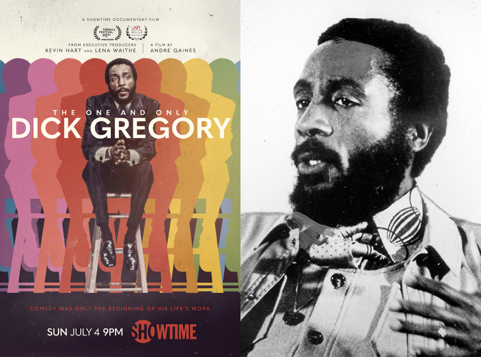
The One and Only Dick Gregory
The only comedian I can think of who I would compare to the late Dick Gregory is Mort Sahl. They were both socio-political themed stand-up comedians who, at the peak of their careers, decided to gamble fame and fortune for their political ideals. Sahl did it by deciding to become an investigator for Jim Garrison on the JFK case. Gregory did it for civil rights activists Medgar Evers and then Martin Luther King. He later became involved with people like Robert Groden and Mark Lane on the JFK case and the King case.
The current documentary about Dick Gregory on Showtime, The One and Only Dick Gregory, makes note of the fact that, by 1962, Gregory was probably the hottest comedian in America. In fact, one of the interview subjects, Harry Belafonte, calls him the greatest political comedian ever.
Gregory was born in St. Louis, went to high school there, and then attended Southern Illinois University on a track scholarship. He was drafted into the army and won some talent shows as a comedian. When he returned from the service, he dropped out of college and went to Chicago to try and become a professional comedian. He was one of the very few comedians who decided to make racial issues funny: “Segregation is not all bad. Have you ever heard of a collision where the people in the back of the bus got hurt?”
This kind of comedy got him noted in both Chicago and New York City. One of his first record albums, East and West, was done in New York. (Between 1961 and 1964, he did seven albums.) When he returned to Chicago, he received what most commentators note as his big break. He replaced Professor Irwin Corey for what was supposed to be one night at the Playboy Club. One of the jokes he cracked that night went like this: “I understand there are a good many Southerners in the room tonight. I know the South very well, I spent twenty years there one night.” He was such a hit that the one-night stand turned into six weeks. One notice read as follows:
Dick Gregory, age 28, has become the first Negro comedian to make his way into the nightlife club big time.
Another said:
What makes Gregory refreshing is not only that he feels secure enough to joke about the trials and triumphs of his own race, but that he can laugh, in a sort of brotherhood of humor, with white men about their own problems…
This highly successful Chicago appearance caught the attention of Jack Paar. After Steve Allen, Paar was the second steady host of The Tonight Show. It was Paar who made the show into the institution it became. Paar was not just funny. He was intelligent, informed, curious, and principled. In other words, he was just the kind of late-night host who Dick Gregory would appeal to. As the comedian later added, it was not just the fact that Paar had him on national television, it was what happened afterwards. The host invited him over to the panel to talk. That is what was important. At that time, such a display of integration was unusual. According to the film, it blew the NBC switchboard out. Because of his new notoriety, CBS newsman Mike Wallace did a profile of him.
From there it was on to the likes of Ed Sullivan and Merv Griffin. Greg, as his friends called him, also wrote an autobiography called Nigger, co-written with Robert Lipsyte. Amazingly, in nearly sixty years, that book has never been out of print.
II
At this point in the film, director/writer Andre Gaines begins to describe his subject’s transition from a pointed stand-up comic to a socio-political activist. As the sixties heated up, it wasn’t enough for Dick Gregory to say things like, “Football is the only place where a black man can knock down a white man and 40,000 people cheer.” Or, in satirizing liberals, “They all say, some of my best friends are colored, but there just aren’t that many of us.” Or in pointing out the hypocrisy of the court system: “A black guy robs a bank of $20,000 and he gets four years in Alcatraz. A white guy embezzles 3 million and he gets three years.” As civil rights demonstrations broke out in the south, Greg began to empathize with what was happening. As he put it, since he was from the north, he was not really aware of how bad the Jim Crow situation was down south. Even though he was making a lot of money at this time and he was peaking in his professional career, he decided that, whatever the consequences, he was going to get involved with the struggle for civil rights.
And he began to adjust his humor as this happened: “A white guy kills 2 black demonstrators with his car and the cop arrests the dead guy 500 yards away for leaving the scene of an accident.” He did civil rights work first for Medgar Evers, who he very much admired for his voter registration drives. Gregory also became involved with the famous case of the three missing civil rights workers in Neshoba County, Mississippi—James Chaney, Andrew Goodman, and Michael Schwerner. He suspected the sheriff’s office was involved. He then offered a reward for information on the case. The FBI followed his lead of offering reward money. It worked. The bodies were found and the case was solved.
The film notes that his publicist sued him at this time, since Greg had sacrificed $100,000 worth of appearances—the equivalent of about a million bucks today—in order to work the South with Medgar. At this time, Gregory was getting $5,000 per nightclub/concert appearance. Instead, he chose to risk getting arrested by participating in civil rights drives in places like Mississippi and Alabama.
As the film shows, he did get arrested. Beyond that, he got his arm broken while being battered with a baseball bat. (Dick Gregory and Mark Lane, Murder in Memphis, ebook version, p. 29) He was very much depressed when Evers was assassinated in the summer of 1963. But he pressed on, getting arrested even more. As he put it, what these activists were doing was more important than what he was doing. When the famous 1965 Watts riots broke out in Los Angeles, he said on TV, “I just got back from Los Angeles, Vietnam.” The film dramatizes his message at the time. Greg was saying that this was not a problem confined to the black community, it was an American problem. The film then juxtaposes excerpts from rioting in Harlem in 1964 with those from Ferguson in 2014.
From here, the film begins to show that, as Gregory now became associated with Martin Luther King, like King, he began to become a vociferous critic of the Vietnam War. And as this occurred, J. Edgar Hoover and the FBI began to keep files on the comedian; they also tapped his phone and drew up methods of neutralizing his impact. Greg decided that, for this particular anti-war message, he had to speak at colleges and universities. He began to attract large crowds and he would harangue the United States for building this Military Industrial Complex and using it against the people of Vietnam. The regents of the University of Tennessee banned him from speaking on campus. They said he was an “extreme racist” and his presence would insult much of the state’s citizenry. The students sued and they hired noted radical lawyer William Kunstler to present their case. They won in court and Gregory finally spoke there in 1970. In 1969, Gregory spoke at the huge moratorium against the war in Washington DC.
Not mentioned by the film are the comedian’s political races. Dick Gregory (unsuccessfully) ran against Richard J. Daley for the office of mayor of Chicago in 1967. He then ran as a write-in candidate for the President of the United States in 1968. (Gregory and Lane, p. 7) In some states, Mark Lane was his running mate. In some other states, his running mate was Dr. Benjamin Spock, the famous pediatrician. Gregory later wrote one of his many books about this campaign. That election attempt landed him on Richard Nixon’s enemies list.
As the film depicts, King’s assassination resulted in a huge wave of riots in well over 100 cities across America. The year 1968 almost brought the United States to a point of civil war. Gregory humorously commented on this state of siege. On stage, he would bring out a large violin case. He opened it and pulled out a tommy gun. He then pulled out a bow and started playing the machine gun.
III
At this point, the film notes that one of the methods Greg used to protest the war was by fasting. And I thought that it would be at this juncture that writer/director Andre Gaines would cut to the event that was probably the crystallization of Greg’s political career. I am, of course, referring to the night of March 6, 1975. That was when the Zapruder film was shown for the first time on national television. The three main guests that night on the program Good Night America were Geraldo Rivera as host, Robert Groden as the photo technician who had recovered a copy of the film from Life magazine, and Dick Gregory. It is not an understatement to say that the showing of this film on national TV electrified America. It put the Kennedy assassination back on the national agenda. It now became a topic of conversation at lunch and around water coolers at work.
By this time, Dick Gregory had become convinced that something had gone politically wrong with America after 1968. And, on top of that, the fact that JFK, Malcolm X, King, and Bobby Kennedy had all been snuffed out in a span of five years—that was just too much to swallow as simply a coincidence.
Gregory had known King and President Kennedy. Greg was at the March on Washington, which was sponsored by the White House and at which King had spoken so memorably. (Gregory and Lane, p. 6) He had been asked to come down to Birmingham in 1963 for the huge demonstration that several civil rights leaders had combined forces on. President Kennedy called him at home and asked him not to go, since they were working on a solution to the conflict and further demonstrations could imperil it. Greg appreciated the call, but said he felt he had to go. (ibid, pp. 30–33)
As the comedian told this reviewer, when he returned from Birmingham, his wife told him that Kennedy had called again and wanted him to return his call the moment he got in. Gregory noted the late hour, but his wife said JFK told her it did not matter what time it was. So Dick Gregory called the White House and Kennedy picked up the phone. The president said to the comedian words to the effect that he needed to know everything that happened in Birmingham. Greg went on for about ten minutes describing the whole ugly mess. When he was done, Kennedy replied with “Oh, we’ve got those bastards now!” At this comment, Gregory started weeping. (2003 Interview with Joe Madison and Gregory in Washington on WOL Radio One)
This is probably the reason he was quite interested in Kennedy’s assassination. But Greg was even closer to King. And the film shows them on stage together. In 1977, Mark Lane and Dick Gregory combined to author a book on King’s assassination. At that time, it was titled Code Name Zorro, since they had learned from FBI agent Arthur Murtaugh that “Zorro” was the FBI’s moniker for King. When it was republished in a revised version in 1993, the volume was now titled Murder in Memphis. To this day, it is a seminal book on the King case.
Very early in that volume, Gregory notes that it was when King turned against the Vietnam War that his image in the public mind was altered.
When King made his famous speech on April 4, 1967, in New York condemning the conflict in Vietnam, he was now perceived as an enemy of the Power Elite. (Gregory and Lane, p. 6) Later in the book, Greg outlines how even those involved in the civil rights movement were taken aback by King’s harsh stand on the Vietnam issue, for the simple reason that they knew that Vietnam had become President Johnson’s personal fiefdom. He was the one who had escalated that war to a magnitude beyond President Kennedy’s imagination. These other civil rights leaders understood that there was a danger that Johnson would take King’s condemnation as a personal assault and the president would turn his back on their cause. (Gregory and Lane, p. 51) And as Greg said so perceptively later in that book, King was expanding his vision of American civil rights to universal human rights. (ibid, p. 56)
King’s anti-Vietnam War speech was criticized by both the New York Times and Washington Post. It’s hard to comprehend today, but both of those MSM outlets were still supporting what Johnson was doing in Indochina at that time. (Click here for details) As Gregory notes in Murder in Memphis, it was William Pepper’s famous photo essay in Ramparts magazine that had energized King in this regard. (Click here for details)
IV
But as Gregory also points out in Murder in Memphis, the antipathy for King amid the Power Elite was exponentially increased when he also announced his plans for a Poor People’s March in Washington. There was a good reason for this march. As many commentators have noted, what had happened under Johnson was simple to comprehend. And, in fact, he himself knew it. Johnson’s vision of a Great Society had crashed on the shores of Da Nang in Vietnam. Or as King himself had declared:
Many of the very programs we are talking about have been stifled because of the war in Vietnam. I am absolutely convinced that the frustrations are going to increase in the ghettoes of our nation as along as the war continues. (Gregory and Lane, p. 54)
In other words, as King said to newsman Sander Vanocur, the dream he talked about in his March on Washington speech in 1963 had, in some respects—between the race riots and Vietnam—become a nightmare. As Gregory noted, the Poor People’s March posed the possibility of exposing this nightmare, and not just to LBJ, but congress. In fact, Murder in Memphis contains an appendix in which Senator Robert Byrd made a vituperative speech against it. (Speech of March 29, 1968) The Poor People’s March provoked meetings at the White House, the Department of Justice, the Pentagon, the Metropolitan Police, and the FBI. (ibid, p. 57; the best book on this is probably Gerald McKnight’s The Last Crusade published in 1998) The combination of King’s assassination, plus the massive interference and surveillance with the march turned it into a failure.
Dick Gregory was correct when he described King as turning in his last years towards a different agenda. About that there should be little or no doubt:
In a sense you could say we are engaged in a class struggle, yes. It will be a long and difficult struggle for our program calls for a redistribution of economic power…I feel that this movement in behalf of the poor is the most moral thing—it is saying that every man is an heir to a legacy of dignity and worth. (Speech of March, 1968)
Or as King—echoing Bobby Kennedy—put it more succinctly: “What good it is to be allowed to eat in a restaurant, if you can’t afford a hamburger.” (Sylvie Laurent, King and the Other America, p. x) As Gregory wrote in Murder in Memphis, the dilemma that King was trying to expose was multi-dimensional. It not only would pose problems for Johnson, the White House, and Congress, but it would probably be an international problem. As the comedian wrote:
What would this do to our image as the richest nation in the world? What about those countries who were not aware of America’s racial problems of poverty and hunger? … White reaction to the planned Poor People’s March was astonishing. A headline in Readers’s Digest magazine a few days before King was killed read, “The United States may face a civil crisis this April when a Poor People’s Army pitches camp in the nations’ capital. (Gregory and Lane, p. 57)
As Dick Gregory was saying, and as Sylvie Laurent amplified later, King was now trying to stretch his populist coalition. And MLK explicitly stated it in his own terms:
The unemployed poverty-stricken white man must be made to realize that he is in the very same boat with the Negro. Together, they could exert massive pressure on the government to get jobs for all. Together, they could form a grand alliance. (Laurent, p. 8)
Due to King’s murder and the powerful forces arrayed against what was left of the Poor People’s March, it failed. As Laurent wrote:
On June 24, 1968, the makeshift housing Martin Luther King Jr. had dreamt of, built on the mall in Washington DC and known as Resurrection City was wiped out. Police tear gas filled the air. Hundreds of people were arrested. Bulldozers smashed the plywood shacks. (Laurent, p. 1)
As Richard Nixon later said, it was that image and the dispersal of those people that combined to help elect him. (ibid) The grand alliance King was designing ended up dissipated. The reverse, namely Nixon’s southern strategy, was later used by Ronald Reagan, and then given broadcast voice by Rush Limbaugh and Fox News. King’s unification strategy was now somewhere in the ozone. Roger Ailes’ and Pat Buchanan’s polarization policy ruled the day.
That would have been a powerful coda with which to end The One and Only Dick Gregory.
V
The only trace of this that I could detect was near the very end of the film. On a last kind of 2015 comeback tour, two years before Greg died, there is a brief glance at Pepper’s book The Plot to Kill King on a chair. If I missed something, I hope someone can remind me of it.
So, what does approximately the last third of the film deal with? Gregory turning into a fitness expert and a health foods businessman. He moved his family to a forty-acre farm in Plymouth, Massachusetts, in 1973. He began to sell vitamins and nutrition products. He also was one of the first to argue for the primacy of natural water in everyone’s diet. He stopped playing nightclubs and there was no more alcohol consumption or smoking for him. Harking back to his college days, he became an avid runner. And his cause now was to erase world hunger. He fasted for that one also.
He created something called the Bahamian Diet nutrition drink. This ended up being very successful. After having some legal problems in the mid 1980’s which tied up much of his assets, he settled the lawsuit and sold the business for millions.
But Greg never really lost his affinity to protest injustice. Another part of his life was devoted to exposing the CIA/cocaine scandal of the late nineties. At that time, he actually went out to CIA HQ in Langley, Virginia, and unspooled yellow tape around the building. Because as he said, “We know where the criminals are.”
Andre Gaines’ film is a passable chronicle of the showbiz side of Dick Gregory, but it does not do justice to what made the man the true icon he was. Perhaps that was the price of getting people like Chris Rock and Dave Chappelle and Kevin Hart to appear. If it was not, then Gaines made a mistake. His film should be called The One and Only Dick Gregory (Censored Version).