Tag: JFK ASSASSINATION
-

Creating the Oswald Legend: Appendix
Appendix
The Grand Chess Board: actors and players
CIA Officers
Allen Dulles
Director of the CIA
Dulles was held responsible by JFK for the bungled Bay of Pigs invasion and was fired afterwards. Dulles never forgot or forgave JFK for the humiliation suffered. Kennedy decided to return West Irian to Indonesia from Dutch colonial rule. What Kennedy did not know, but Allen Dulles did, was that West Irian was a region extremely rich in minerals, even richer than Katanga. In the 1920s and 1930s, Allen Dulles was a lawyer at the giant corporate law firm Sullivan and Cromwell. He represented the Rockefellers there and he knew that Indonesia had huge mineral and oil potential. One of the oilfields in Sumatra exploited by Caltex was the size of similar oilfields in Saudi Arabia. In 1936, a joint Dutch and American expedition—including explorer/geologist Jean Jacques Dozy—was organized by Allen Dulles through Sullivan and Cromwell. That expedition discovered two enormous mineral deposits in West Irian. The American firms that financed the expedition were two divisions of Standard Oil. One of the two colossal deposits was called the Ertsberg and the other the Grasberg. Both were extravagantly rich in gold, silver, and copper. Just the gold content was much larger than the wealthiest gold mine in the world, then located in South Africa. Allen Dulles was close to the DeMohrenschildt family and transferred George DeMohrenschildt to West Irian to work on Standard Oil’s drilling, since the region had one of the largest oil deposits in Indonesia. Dulles lied to Kennedy on several occasions regarding the Sino-Soviet split. He told him it was not real, but a Cold war ploy to fool America. It was real and Dulles was using Indonesia as a wedge to further the split between China and the Soviet Union. From 1958, his first attempt to overthrow Sukarno, Dulles was planning on regime change. That would have allowed his clients to control the oil, gold, copper, and silver reserves of Indonesia rather than go to the citizenry of Indonesia, as Kennedy and Sukarno had planned. The policy of wedge against China and the Soviet Union would have been disrupted. Dulles had used religious organizations like the Unitarians to create humanitarian front organizations in order to conceal OSS and later CIA covert operations to destabilize Eastern Europe, South America, and Southeast Asia.
James Jesus Angleton
(Chief of CIA Counterintelligence)
Angleton’s obsession and mission was to catch a Soviet mole that allegedly had infiltrated the Agency. His secretive mole hunt unit, the Special Investigations Group (SIG), held a 201 file on Oswald prior to the assassination. John Newman thought that Oswald was an off-the-books agent for Angleton. In 1960, he used Oswald in a mole hunt to find out who had betrayed the U-2 secrets that led to its shoot down. Angleton did not find any mole, but he used the mole hunt as an alibi to cover his role in the U-2 incident, which resulted in the Paris Peace Summit cancellation. Similarly, he used the Oswald legend and an imposter to catch a mole had betrayed the CIA operations against Cuba in Mexico, even contacting the head of KGB assassinations before he himself tried to get to Cuba. Angleton had the excuse to manipulate information and to lower Oswald’s profile in a way that it would not raise suspicion until after November 22. Angleton, who John Neman believes was privy to the conspiracy to assassinate the President, had to design a fool-proof plot. The idea was to make it appear that the Cubans and Soviets manipulated Oswald in Mexico City in such a way to use him in the assassination of Kennedy. Angleton knew that the exposure of this plot would plant a WWIII virus in Oswald’s files that would halt any real investigation, in order to prevent a possible nuclear war. To achieve that, Oswald’s profile had to be lowered for the six weeks before the assassination. Angleton had to come up with a cover story, so no one would ever question his role in the plot. Again, Angleton would fail to catch a mole, but he had used the mole hunt to cover his true role that resulted in the murder of a U.S. President.
David Atlee Phillips
(CIA Covert Action/SAS Counterintelligence)
David Phillips was the Chief of Cuban Operations and Covert Actions in Mexico CIA station and also worked for the SAS/CI. He and James McCord first targeted the FPCC back in 1961. He dangled an American student, Court Wood, into the FPCC by pretending to be pro-Castro interesting in starting a new FPCC chapter, something that Oswald tried to emulate two years later both in New Orleans and Mexico. Prime suspect for handling Oswald and the Mexico City incident involving Oswald’s visits to the Cuban and Soviet Consulates. Lied far too many times about the events that took place to the HSCA investigators. On October 1, 1963, a diplomatic pouch was sent to CIA HQ addressed to a Michael Choaden. This was an alias for Phillips, that way he controlled all the materials in both Mexico and Washington. His assets like Alvarado tried to implicate Oswald in the assassination as a Cuban agent. In New Orleans he met with Banister, Ed Butler, and Sergio Arcacha Smith.
E. Howard Hunt
(Propaganda expert and an Officer of CIA’s Domestic Operations Division in 1962 under Tracey Barnes)
Bagley revealed to Malcolm Blunt that E. Howard Hunt was in the Soviet Division in 1962. There was no sign he ever worked in Soviet Russia Division. Blunt discovered that as part of a mole hunt, Bruce Solie of the Office of Security/Security Research Staff handed over Security and Personnel files to the FBI on various suspected moles. One of these was CIA staffer Peter Karlow. Those files contained information that Hunt was attending parties with the Karlows. Blunt is of the opinion that Hunt was spying on his own colleagues and that this would explain his sudden appearance in the Soviet Division. He also suspects that Hunt could only have been there under the instructions of Angleton, although Angleton always denied any relationship with Hunt. Later, Angleton revealed to author J. Trento that Hunt was in Dallas on the day of the assassination and that Hunt “had possibly been sent there by a high-level mole inside the CIA.” Trento believed that Angleton was trying to hide his own connections to Hunt and that it was him that had sent Hunt to Dallas. Hunt was the founder of the Cuban Revolutionary Council (CRC) that was so prominent in Oswald’s contacts in New Orleans. In 1968, Hunt employed Cubans from the Trafficante drug trafficking network to eliminate French smugglers and the old French Connection by redirecting the heroin trade from Marseille to Southeast Asia and Mexico to supply the US.
William K. Harvey
(CIA Chief of Foreign Intelligence Division D)
Head of the CIA’s executive action ZR/RIFLE assassination program. On his notes wrote that “Corsicans recommended Sicilians lead to Mafia.”
He also had security clearance for “Project Rock” a codename for the U-2 plane. According to a CIA document, they re-evaluated Harvey’s file in respect for approval to get security clearance to “Project Rock.” Mark Wyatt, Harvey’s Deputy in Rome, revealed that Harvey was in Dallas in November 1963. According to Wyatt, he had bumped into Harvey on a plane to Dallas sometime before the assassination. When he asked Harvey what was doing in Dallas, he replied vaguely, “I am here to see what’s happening. To be fair to Harvey, he was not in Dallas on November 22, 1963. Wyatt said that they were both attending a Gladio meeting in Sardinia, Italy, when they heard about the assassination. Later that afternoon, Wyatt found Harvey collapsed in his bed after drinking martinis. Malcolm Blunt revealed that in August 1963, Harvey wanted to meet with Clare Boothe Luce, some months prior to the assassination.
Tennet H. Bagley
(CIA Chief of Soviet Russia/Counter Intelligence)
Told researcher Malcolm Blunt that Oswald was a witting false defector. Bagley had nothing to say about Kostikov’s role as KGB assassination officer. Yet on November 23, 1963, submitted a memo describing Kostikov as “an identified KGB officer…in an operation which is evidently sponsored by the KGB’s 13th department responsible of assassinations.” It is worth mentioning that Bagley was transferred in 1963 from the Bern station in Switzerland to Langley and promoted as Chief of SR/CI, just in time for the suppression of Kostikov’s KGB role.
William Larson
(CIA Chief of the Information Management Staff)
Revealed to HSCA researcher Betsy Wolf that the Office of Security did not open 201 files and that a 201 file should be opened whenever a subject accumulates at least five documents. Oswald’s file had 12 items and yet a 201 file was not open. Larson also revealed that the Office of Security worked closely with Angleton’s Counter Intelligence staff.
Richard M. Bissel
(CIA Deputy Director of Plans)
Involved in the development of U-2 & A-12 spy planes, CORONA satellites, CIA Liaison with Air Force and Defence industry. Brought Helliwell back from the Far East to organize a similar network of drug trafficking and bank laundering to finance the war against Castro. One of the architects of the Bay of Pigs invasion
Robert Gambino
(CIA Office of Security Chief)
Revealed to HSCA researcher Betsy Wolf that the CIA Mail Logistics responsible for incoming documents bypassed the General Filing System and sent all the Oswald information to the CIA Office of Security instead of the Soviet Russia division
Raymond Rocca
(Angleton’s Deputy in CIA Counter Intelligence)
Cabled Luis Echeverria on November 23rd concerning the relationship between Oswald and Sylvia Duran who took over the Mexico investigation from the FBI and the WC, before Helms had assigned Angleton his liaison duties with the Commission. the day after the assassination, a CIA agent escorted Elena Garro de Paz to the Vermont Hotel. In other words, within 24 hours, Angleton and Rocca are controlling Duran, a prime witness to Oswald not being in Mexico City, and Elena Garro, a witness who would eventually say that Oswald was having an affair with Duran.
Ann Egerter
(Counter Intelligence/Special Investigations Group Officer)
Worked under Birch O’Neil and his Deputy Scotty Miller. She opened a 201 file on Oswald in 1960 after a State Department request about US defectors to the USSR. She wrote Oswald’s middle name Henry, not Harvey, and the slot that is labeled Source Document is filled in with the acronym CI/SIG, which is not a document. Finally, in the notes below Dottie Lynch is still waiting for the file. She works in the SR division where the file should have been placed originally.
Edward G. Lansdale
(Air Force Major General and CIA affiliated, member of the American Security Council)
Malcolm Blunt believes that although Lansdale was a military man, he was working mainly for the CIA. Blunt mentioned that Lansdale resigned or retired temporarily from the army in October 1963. A short time later he returned to the army and he was promoted. The man who was pushing for his promotion was none other than Allen Dulles himself. Not only that but Lansdale headed the first mission in Saigon in 1954 and this mission was a CIA creation. John Newman found out that after his retirement, Lansdale visited his friend Sam Williams in Denton, Texas, which was near Dallas around the time of the assassination. He was Nelson Rockefeller’s clandestine associate in Southeast Asian propaganda activities. Lansdale was an adviser to the Rockefeller Brothers Fund/Special Studies Project and was appointed head of new counterinsurgency office at the Pentagon after the Bay of Pigs. William K. Harvey disliked Lansdale, thought of him as a security risk and could not work with him. If any of the two was part of the assassination planning certainly did not involve the other.
Paul Helliwell
Helliwell was a member of the OSS and later of the CIA in the Far East; he was one of the most prominent members of the China Lobby. He was the originator of the CIA’s off-the-books accounting system and nicknamed Mister Black Bag. His mission was to assist Chang Kai-Shek and his Kuomintang (KMT) army in Burma to invade China. This army managed and controlled the opium traffic in the region. Helliwell created two front companies to help KMT to carry out its war and the drug trade. One was Sea Supply in Bangkok and the other was CAT Inc., later Air America in Taiwan. Helliwell had organized a drug trafficking network supported by banks to launder CIA’s drug profits in the Far East. Helliwell’s main objective was to cement the CIA’s relationship with organized crime. Meyer Lansky and Santo Trafficante were both planning to invest in the Far East by bringing heroin back to the States. Helliwell established banks in Florida and became the owner of the Bank of Perrine in Key West, “a two-time laundromat for the Lansky mob and the CIA”, and its sister Bank of Cutler Ridge. Lansky would deposit money into the Bank of Perrine, reaching the US from the Bank of World Commerce in the Bahamas. Lansky also used the small Miami National Bank, where Helliwell was a legal counsel, to launder money from abroad and from his Las Vegas casinos. Peter Scott claimed that Helliwell worked with E. Howard Hunt, Mitch WerBell and Lucien Conein on developing relationships with drug dealing Cuban veterans of the Bay of Pigs invasion, and became CIA paymaster for JM/WAVE to finance Chief of Station Ted Shackley’s operations against Cuba.
Anne Goodpasture
Anne Goodpasture was a CIA officer from Staff D posted to the Mexico CIA station. She tried to disguise her role in retrieving photos each day. But Lopez and Hardway found out the man she named in this function only did the legwork for Goodpasture. They finally discovered that Goodpasture was responsible for photographic and electronic surveillance. The translating team said that they did not review all photographs from the Soviet Embassy, only what Goodpasture would allow them to see, and all such photographs were under her control. They also revealed that, although Goodpasture was an assistant to station chief Win Scott, she was a closer assistant to David Phillips. She provided the photographs of the mystery man in Mexico. When Goodpasture was questioned about it, she replied that it was the only photograph of a non-Latin person taken on October 1, 1963. But Lopez and Hardway discovered that the photo was taken on October 2, 1963. Dan Hardway described her as ‘’a lying, conniving bitch. And if there was any justice in this world, she would be in jail.’’
David Sanchez Morales
Morales was also known as ‘’El Indio’’ was the chief of operations at the CIA’s JM/WAVE station in Miami, operations involving training paramilitary teams to infiltrate and invade Cuba. His haunting words to his friend ‘’we took care of that S.O.B.’’ have convinced may researchers that Morales was involved in the assassination. Bill Simpich believes that had used his Cuban intelligence forces, called AMOTs, to impersonate Oswald and Duran. It is unlikely that Morales would have been able to manipulate the Oswald files and foresee all the subsequent events that led to the assassination. . It is more likely that Morales would have also taken orders from Angleton and not the other way around.
Dorothe Matlack
Assistant Chief of Staff of Intelligence (ACSI)
The CIA and Army Intelligence worked together to form the Caribbean Action Center (CAC) for collecting intelligence from Cuban refugees. One of the major participants in this group was Dorothe Matlack, Assistant Chief of Staff of Intelligence (ACSI) for Army Intelligence and Liaison to the CIA. Matlack had joined the Interagency Defector Committee (IDC) in 1953. This involved State, DIA, Army, Navy, Air Force, FBI, and CIA. She also cooperated with Tony Czajkowski of the CIA’s Domestic Contacts Division and CIA Defector Coordinator George Aurell and worked with the CIA in analyzing reports made by notorious defectors such as Anatoly Golitsyn. On May 7, 1963, Matlack and Czajkowski met with George de Mohrenschildt and his wife Jeanne.
CIA Operations (may include Cuban Exiles and the Mafia)
CIA DOD and Air Proprietaries
The DOD would recruit anti-Castro Cuban exiles with the purpose of breaking into foreign embassies and United Nations missions that were suspected of being friendly and sympathetic to Castro’s regime. Another important aspect of the DOD was his affiliation with the CIA proprietary organizations. The most infamous and most important CIA proprietary company was the Pacific Corporation Holdings, located in Washington D.C., that was incorporated in Dover, Delaware, a State with a friendly tax law that allowed companies formed in Delaware but not operating there to not pay state corporate tax.
Pacific Corporation was the parent company of the CIA air proprietaries, Civil Air Transport Co., Ltd., CAT Inc., later renamed Air America Inc.; Air Asia Co., Ltd.; the Pacific Engineering Company; and the Thai Pacific Services Co., Ltd. Air America took over all the operations in South East Asia, while Air Asia operated from Taiwan.
Another air proprietary linked to Pacific Corporation was Southern Air Transport (SAT), incorporated in Miami and operated in both the Far East and Latin America. Most importantly, the air proprietaries like CAT/Air America not only provided their services to facilitate the opium trade in the Golden Triangle, which included Laos, Vietnam, and Thailand, but also were involved in the replacement of elected governments in Laos, Cambodia, and Indonesia. Air America did not only operate for the CIA, but they were doing contract work for large oil companies in the Southeast Asia
Trafficante, Lansky, Anti-Castro Cubans and drug trafficking
Santo Trafficante’s main areas of influence were Florida and the Caribbean, operating casinos in Cuba. After 1959, large numbers of anti-Castro Cubans moved to Florida and Trafficante used them to take control over Florida’s bolita lottery, a Cuban numbers game. This worked as a cover, since these Cubans became Trafficante’s new group of heroin couriers and distributors, who were unknown to American law enforcement agencies. They used drug smuggling to finance their operations—trafficking cocaine from Latin America and later heroin from Marseille. Manuel Artime, E. Howard Hunt’s protégé and head of the Cuban Revolutionary Council (CRC) in Miami, was involved in drug trafficking to finance his war. The DOD under Barnes and Hunt would protect the Cuban drug network and Angleton was aware of it. Another CRC member of New Orleans, Sergio Arcacha Smith, who was associated with Hunt, Phillips, and Banister, was involved in contraband operations from Florida to Texas, specializing in drugs, guns, and prostitution.
In 1968, Trafficante visited Hong Kong and Southeast Asia to examine the possibilities of importing heroin from those regions to the US via Mexico and Latin America
DOD & Angleton’s CI operations
Orchestrated the Mexico charade and a mole hunt when Oswald defected in the USSR.
Angleton’s Counter Intelligence was obliged to ask the FBI to assist tracking Soviet illegals, moles, and spies entering the US. But with the creation of the new division, he could conduct his operations with the DOD without having to inform Hoover about it. Malcom Blunt believes that “DOD would have been ripe for exploitation purposes. And of keen interest to Angleton for positive counterintelligence usage. DOD was somewhere other agency elements could drop personnel into and thus be a vehicle for disguised operations: such as Howard Hunt’s PCS/DOD in 1962 when he turned up in the Soviet Russia Division.
CIA Counter Intelligence & Police Training
The CIA’s Counter Intelligence Staff was responsible for the Police Group (CI/PG). This CI/PG would be in constant liaison with the OPS of USAID and its training facility, the International Police Academy (IPA) in Washington. The CI/PG would exchange daily information with USAID on training programs with IPA and tours for foreign police/security representatives sponsored by the CIA’s Area Divisions. James Angleton wrote a memo explaining how USAID cooperated with CIA in law enforcement training and operations. CIA’s 1947 chapter forbade any “Police or Subpoena power” and only the FBI had the right to legitimately train the domestic Police forces. Phillip Melanson acquired documents showing that the CIA provided training to Metropolitan Police. This ranged from seminars, briefings, workshops in bugging, clandestine action, disguise techniques, lock picking, equipment loaning, and explosives detection. One of the documents revealed that CIA agents posed as cops and had received police badges and ID cards as early as 1960 to pursue “foreign intelligence targets”, as the CIA claimed. The CIA would also contact “friendly” police departments to ask for discreet handling of CIA personnel when in trouble and also to check on CIA employees and other people. Some of the police departments having received training and equipment were New York, San Francisco, Chicago, Washington D.C., Los Angeles, Philadelphia, Boston, Baltimore, Miami, San Diego, and Minnesota. Dallas was not in those documents, but the name of some police departments was blanked out and Melanson believed that one of them was Dallas. He reasoned that Dallas would have not refused the CIA’s generous offer of training., especially when Mayor Earle Cabell was a CIA asset and his brother was a CIA Deputy Director and the force was full of right wingers and anti-Communists, who were always eager to unmask subversives and spies.
New Orleans
Guy Bannister
Banister’s office was located in the Balter building in New Orleans. In the same building were located the offices of a Cuban exile organization, the Cuban Revolutionary Council (CRC), and Sergio Arcacha Smith was the New Orleans representative. When Banister moved to 544 Camp Street, Arcacha Smith rented an office for CRC in the same building. It was CIA officer E. Howard Hunt who had helped create this organization. Gordon Novel has said that he met Arcacha Smith in 1961 at Banister’s office upon Ed Butler’s recommendation and, at that meeting, was a person who fit the description of David Phillips. When Oswald moved to New Orleans, it is possible that his job there was related to industrial security in search for subversives. He was employed by the Reily Coffee Company, but he also worked covertly for Guy Banister. William Monaghan, an ex-FBI agent, was the company’s Vice President and specialized in industrial security. Alfred Claude, the man who hired Oswald, left Reily and went to work in Chrysler’s aerospace division, which was based in NASA’s New Orleans facilities. Emmett Barbee, Oswald’s supervisor, and two other Reily employees, Dante Marachini and John Branyon, went on also to work for NASA, more likely in the industrial security division. Oswald was frequenting a New Orleans’s garage and had revealed to its owner, Adrian Alba, that he was going to work for NASA. Bill Nitschke, a Banister associate, confessed that Banister had given an offer to NASA to get a contract for industrial security in NASA’s New Orleans facilities.
That Banister’s investigating agency was doing industrial security work can be indicated by the testimony of former Banister associate, Joseph Oster. He told L.J. Delsa, an HSCA investigator, that Banister was using two sources to seek out subversives and Communists, FIDELAFAX and the American Security Council.
David Ferrie
When Oswald was in New Orleans, he was in contact with Guy Banister, David Ferrie, and Clay Shaw. When Oswald was fifteen, he met David Ferrie in the Civil Air Patrol (CAP), where Ferrie was a Captain. In 1961, Ferrie and an exiled Cuban, Sergio Arcacha Smith, were part of the CIA’s training and preparation for the Bay of Pigs invasion. Jim Garrison was the first official to present witnesses that had seen Oswald in the company of David Ferrie and Clay Shaw in the areas of Clinton and Jackson, ninety miles north of New Orleans, Oswald and his two companions went to the neighboring village of Clinton to register. It happened to be the day when a drive to register black voters—organized by the Congress of Racial Equality (CORE)—was on. When the Cadillac appeared, most voters thought it might be the FBI, so they noticed the car and its occupants. Several witnesses, from simple voters, to the Registrar, and the local Sheriff, testified that they identified the three people as Lee Harvey Oswald, David Ferrie, and Clay Shaw. The Sheriff even approached the car and asked the tall grey haired driver for his license. It turned out to be Clay Shaw of the International Trade Mart of New Orleans. Why did Shaw and Ferrie take Oswald to Jackson to seek a job at the hospital and register as a voter?
Clay Shaw
Garrison was contacted by a witness who revealed to him that a Mr. “White” of Freeport Sulphur company had contacted him to discuss a possible Castro assassination plan. The same witness had heard Clay Shaw or David Ferrie talking about some nickel mines in Cuba. Another witness, Jules Ricco Kimble, told Garrison’s office that a Mr. “White” along with Shaw and David Ferrie had flown in a plane to Cuba to make a deal regarding some nickel mines. It could be a coincidence, but Johnny Roselli testified that he “represented himself to the Cuban contacts as an agent of some business interests of Wall Street that had nickel interests and properties around in Cuba and I was getting financial assistance from them.” This, of course, was when Roselli was associated with the CIA and trying to arrange the murder of Fidel Castro. It would have been interesting if Roselli had named those nickel interests in Cuba, but it may be more than an assumption that he was talking about the same nickel mines involving Freeport Sulphur. regarding Clay Shaw’s contacts with the Domestic Contact Service (DCS). One of these documents stated Clay Shaw had been granted covert security approval for project QK/ENCHANT. Newly discovered documents revealed that the CIA was examining the prospect of using Banister’s agency as a cover company for project QK/ENCHANT. Based on ARRB investigation, QK/ENCHANT was a cryptonym for “permission to approach” and utilization for cleared contact purposes. These probably indicated the use of individuals and companies as contact cover for CIA proprietary organizations. Author Bill Davy showed the above document to former CIA officer Victor Marchetti and, after examining it, he said to Davy, “That’s interesting…he was doing something there.” He added that Shaw would not need a covert security clearance for DCS.
Ed Butler
Ed Butler, the founder of INCA, the Information Council of the Americas. Oswald’s appearance on Bill Stuckey’s New Orleans radio show “Carte Blanche”. There, he talked about his political views and debated with Ed Butler and Carlos Bringuier. The result of this interview was a record production by Dr. Alton Ochsner’s INCA, an album with the title, “Oswald: Self-Portrait in Red.” On the front cover was a drawing of Oswald’s face and on the back of the album was the headline “I am a Marxist” with the date of August 21, 1963, at the bottom were photographs of Congressman Hale Boggs, psy war specialist and Ochsner employee Ed Butler, and Dr. Alton Ochsner himself. Ed Butler did not only have connections to the previously discussed American Security Council, but he was also in contact with General Edward Lansdale and CIA Deputy Director Charles Cabell. After Kennedy’s assassination, Jim Garrison learned about Oswald’s activities in New Orleans and his contacts with Butler and INCA. Butler got so scared that he packed all the INCA files and parts of Banister’s files and moved to Los Angeles, where he found employment with Patrick J. Frawley, a prominent member of the American Security Council
Alton Ochsner
(Esteemed Surgeon Doctor in New Orleans)
Malcolm Blunt revealed that Ochsner was a cleared CIA source since May of 1955 and the CIA had sources inside Ochsner’s large New Orleans clinic. He had the reputation of an extreme right-winger: anti-welfare, anti-Medicare, and racist. He was the President of the International House (IH) and he was also a member of the International Trade Mart (ITM), where he worked with Clay Shaw, who was once a Managing Director of the International House. He was a member of the exclusive New Orleans Boston Club and he had been invited to the secretive west coast Bohemian Club. During his time at Tulane University, he managed to attract financial support from the Rockefeller and Carnegie Foundations. Ochsner’s INCA organization was getting financial support from Standard Oil, the Reily Foundation, Mississippi Shipping Company, the Hibernia bank, and ITM.
Various Persons of Interest
Priscilla Johnson
She interviewed Oswald in his hotel in Moscow while he was waiting to be relocated. Next day she had a dinner with McVickar. He wrote a memo where he stated that Priscilla had told him that Oswald would be trained in electronics but Priscilla later denied that she did. When Josef Stalin died, his daughter Svetlana defected to the States and stayed with Priscilla’s father, Stewart Johnson. Priscilla helped Svetlana write her memoirs. Following JFK’s assassination, Priscilla was privileged enough to spend time with Marina Oswald in the summer and fall of 1964. As an important witness to testify for the Warren Commission, Marina was not allowed to come in contact with anyone, living under Secret Service protection. How Priscilla managed to stay with her when nobody else could approach her is a question that has not been answered. Priscilla had one more privilege: to write Marina’s biography. Senator Richard Russell, a member of the Warren Commission, was not convinced that Oswald was guilty or that he had travelled to Mexico, but an unexpected incident helped change his mind. Marina testified that she found a ticket to Mexico inside a magazine while writing her biography with Priscilla. In other words, after numerous searches, the FBI and the Dallas Police could not find it, but Priscilla and Marina did. In 1977 Priscilla published her book titled Marina and Lee. Marina revealed that she did not contribute much to the book; it was Priscilla who had to discover most of the facts and put them in order. Priscilla never stopped trying to convince the public that Oswald was guilty. She appeared before the HSCA, along with her attorney and a written affidavit. The Committee found this odd, since she was not being accused of anything so the affidavit and the lawyer were not necessary.
Yekaterina Furtseva
Yekaterina Furtseva was an interesting character that some believe was the most powerful woman in the Soviet Union and Khrushchev’s lover. She even had authority over KGB’s head, Vladimir Y. Semichastny, threatening to replace him with his deputy whenever he displeased her. She loved everything American and she was primarily concerned about her family’s well being. In 1993, it was revealed that Oswald had a champion in the Politburo, and it was none other than Furtseva. In The Man who Knew too Much Russell reported that “Furtseva urged that the young ex-Marine be allowed to stay on … and sought to keep KGB chief Semichastny from recruiting Oswald.” Later Semichastny concluded that Furtseva was running her own shop.
Johnny Roselli
John Martino’s claimed that the “Anti-Castro Cubans put Oswald together.” Larry Hancock in his recent e-book “Tipping Point” presents a case where CIA Cuban exile teams in JM/WAVE were trained to kill Castro, but later shifted their focus to Kennedy after they learned that JFK was secretly negotiating to restore relations with Castro. To them, this constituted the ultimate betrayal. It is likely that such information would have been passed down from William Harvey to Johnny Roselli. Therefore, in this scenario, those most likely involved in the conspiracy to kill Kennedy were Roselli, Harvey, David Morales, Rip Robertson, Felipe Vidal Santiago, Roy Hargraves, John Martino, CIA paramilitary officer Carl Jenkins, and Cubans like Chi Chi Quintero, Felix Rodriquez, Carlos Hernandez, Nestor Izquierdo, and Segundo Borgas.
Pawley-Bayo mission (CIA crypt Operation TILT). This was a sea voyage into Cuba. It was allegedly designed to exfiltrate Soviet scientists who wanted to defect and testify before Senator James Eastland’s Senate Internal Security Subcommittee. That testimony was to state that the Russians still had missiles present in Cuba.
Apart from millionaire William Pawley and Cuban exile Eddie Bayo, others that took part in the operation were John Martino, Eugenio Martinez, and CIA agent Rip Robertson. Pawley had asked CIA Deputy Director Pat Carter and Ted Shackley of JM/WAVE to help him with the mission. Pawley would have used his private yacht, while David Morales supervised the mission. Operation TILT failed, since the exile Cubans disappeared on their way to Cuba and were never heard from again.
Peter Dale Scott has written that the real purpose of the mission was to assassinate Castro. Jack Anderson reported the Johnny Roselli story that the assassination team was captured in Cuba and Castro “turned them” and sent them to Dallas to assassinate Kennedy instead. At one point, Bayo had asked for help from a wealthy Kennedy supporter, Theodore Racoosin, who later reported that someone from within the White House—possibly Robert Kennedy—had authorized him to organize meetings with Cuban exiles and learn details of CIA Cuban operations. Scott believes that this operation was used to blackmail the Attorney General, so he would not investigate his brother’s assassination.
John Martino
John Martino was an exiled Cuban who worked in a Havana Casino owned by Santo Trafficante Jr. back in 1956. He was imprisoned in Cuba between 1959 and 1962. When he returned to the States, he became involved in the anti-Castro cause. He took part in the notorious Operation Tilt, he had both Mob and CIA connections. Later in life, he admitted to his business partner Fred Claasen that the anti-Castro Cubans put Oswald together and tried to frame him as a Castro assassin in a plot to murder President Kennedy. Those Cubans posed as Castro agents and it is more likely that Oswald played along to reveal their agenda as part of his mission to smoke out subversives and pro-Cubans. The plan was to fly him out of the country and kill him en route, possibly on his way to Cuba, in such a way that would prove Castro and Cuba were pulling Oswald’s strings. John Martino’s claimed that the “Anti-Castro Cubans put Oswald together.” On November 26, the CIA and Mafia-affiliated Frank Sturgis said to the Sun-Sentinel newspaper that Oswald had connections to the Cuban Government and that he had made a call to the Cuban Intelligence. The same day John Martino, another CIA and Santo Trafficante Jr. ally, stated in an interview that he had contacted Cuban G-2 in Mexico City and had distributed FPCC leaflets in Miami. Martino also revealed that Castro killed Kennedy to retaliate for a plot devised by Kennedy and Nikita Khrushchev to replace Castro with Huber Matos, who was in a Cuban jail.
Dallas
Max Clark
Max Clark was a retired Air Force Colonel and he used to work at General Dynamics as industrial security officer. Clark had also received covert security clearance from the CIA for “Project Rock” while working for General Dynamics. A CIA document had linked “Project Rock” to Project Oarfish, a code for the manufacturing of the U-2 airplane. Max Clark was working closely with I.B. Hale, a former FBI agent and later head of General Dynamics industrial security. It was Virginia, wife of I.B. Hale, that had helped Oswald to get a job at Leslie Whiting on July 1962. George DeMohrenschildt was encouraged by Max Clark and J. Walton Moore of the CIA to befriend Oswald and become his mentor. It was George DeMohrenschildt who helped Oswald get a new job at Jaggars-Chiles-Stovall (JCS) after he quit his job at Leslie Welding. JCS was doing contract work for the U.S. Army Map Service and that work was related to U-2 flights over Cuba. Oswald got the job four days before President Kennedy was shown pictures of missiles in Cuban taken by the U-2.
Dallas Police officers
Reserve officer Kenneth Croy was near Main Street and asked a policeman outside the Courthouse if he was needed assistance with the investigation of the President’s murder. Croy claimed that the policeman replied that he was not needed; so he decided to go home. He heard on the radio that an unidentified officer was shot at 10th and Patton. He went there and ”discovered” a wallet allegedly given to him by a civilian. Strangely enough, he never filed a report and never asked the name of the witness he talked to or the name of the person that gave him the wallet.
Captain Westbrook, the Chief of the Police Personnel Department, was at the TSBD when he heard on the radio that a police officer had been shot in the Oak Cliff area. He decided to go there to investigate a murder; which was odd since he was a personnel officer and not a homicide detective. FBI agent Hosty said that his colleague, FBI Agent Bob Barrett, who was present at Tippit’s murder scene, told him that Captain Westbrook asked him: “Have you ever heard of a guy named Lee Harvey Oswald?” Barrett said no. Westbrook then asked him, “How about Alek Hidell?” Then Barrett said that he saw Westbrook holding and searching a wallet, which was supposed to be Oswald’s wallet. This wallet would link Oswald to Hidell and to the weapons that killed both Tippit and Kennedy. However, the Warren Commission gave a different version concerning the wallet: that it was found on Oswald after he was arrested at the Texas Theater. Westbrook’s “personnel” work was not over, since he heard on the radio that a suspect was seen entering the Texas Theater looking suspicious, without paying a ticket. So the personnel officer went there and witnessed the arrest of Oswald. He then gave the order to drive the suspect to the police station. So, the Chief of Personnel had managed to be present at the three major crime scenes: Dealey Plaza, 10th and Patton, and the Texas Theater. It was a remarkable work of sleuthing for a Personnel Officer.
Sergeant Gerald Hill was the man who first reported on a radio call at 13:40 that the shells found at the Tippit crime scene were fired from a 38 automatic, not a 38 special. Later when testifying for the Warren Commission, he denied under oath that he made such a call; but twenty years later he admitted to Dale Myers that he made the call after all. When Hill returned from the Texas Theater, he sat down to write a report regarding Oswald’s arrest. Captain Westbrook informed him that Oswald was not just the suspect in Tippit’s murder, but also for President Kennedy’s assassination.
Senator Thomas Dodd
Senator Thomas Dodd was one of the major forces who opposed Kennedy’s Congo policy. He initiated hearings in the senate on the “loss” of Congo to Communism. Senator Thomas Dodd, another member of the powerful American Security Council. Dodd was the Chairman of the Senate Juvenile Delinquency Subcommittee trying to legislate the use of interstate mail orders for weapons. Dodd’s subcommittee started its hearings two days after Hidell ordered the Smith & Wesson gun and the Manlicher–Carcano was also one of the weapons investigated. Senator Dodd was also member of the Senate Internal Security Subcommittee—headed by the racist, right-wing Senator James Eastland of Mississippi—which was investigating the FPCC. Dodd called the FPCC “the chief public relations instrument of the Castro network in the United States” and believed that both the Socialist party and the Communist Party had infiltrated the committee. It might have been possible that Oswald, as a member of a private investigating firm, was contacted by Dodd’s committee to infiltrate these three organizations. The son of one of Senator Dodd’s friends, who had been hired as an investigator to do work for the subcommittee, was involved in a strange incident in Mexico, causing a disturbance in a strip club. He was arrested by Mexican police for having a gun and posing as a police officer. The same man was arrested for carrying three weapons and ammunition in Hyannis Port, Massachusetts, on a weekend that President Kennedy was there. After the assassination Dodd promoted the false information that Oswald had been trained at a KGB assassination school in Minsk.
Michael and Ruth Paine
Michael Paine was related to the Forbes and Cabot families. Michael’s mother, Ruth Forbes, was a very good friend of Mary Bancroft, Allen Dulles former lover Michael’s stepfather was Arthur Young, a famous inventor and one of the creators of Bell Helicopter. That connection helped his step-son Michael Paine get a high tech/high security clearance to work at Bell Helicopter in Fort Worth. Ruth Paine’s father, William Avery Hyde, and his wife Carol were prominent members of the Ohio Unitarians. An employee of theTexas Employment Commission wanted to inform Oswald that they had found him a job at Trans Texas Airport. Ruth Paine answered that he was not home and so they called back the next day to hear that Oswald had taken a job elsewhere. Ruth never informed Oswald about this job, even though it paid about $100 more per month than the TSBD one. The backyard photographs of Oswald posing with a rifle were found by the police at the Paines’ home. But a week later, another piece of evidence turned up out of the blue— on November 30. It was a note found inside a book incriminating Oswald in the attempted murder of General Walker, which is bizarre since Oswald, for seven months, had never been considered a suspect in that case. Ruth Paine also provided other evidence: a betting guide and a English-Spanish dictionary that allegedly proved that Oswald had visited Mexico. Ruth was also responsible for discovering the well-known “Kostin letter“ allegedly written by Oswald saying that he met Comrade Kostin (meaning Kostikov) in Mexico City. some of these items were discovered after the Dallas Police searched the Paine home and garage—twice! A good example would be the Imperial Reflex camera which was allegedly used to take the backyard photographs. That camera was not on the original Dallas Police inventory list. It was found by Ruth two weeks after the assassination.
Criminal Intelligence Section (CIS)
This unit was also involved in Presidential protection by helping to identify and neutralize potential dangerous local threats. The CIS had compiled a list of twelve TSBD employees who were unaccounted for but the CIS list had put on top the name of Harvey Lee Oswald. Melanson believed that a common CIA practice was to keep two files on certain individuals, an overt file and a covert file that usually had the first two names transposed. It was L. D. Stringfellow, a CIS officer who provided the 112th MIG the incriminating information that Oswald had defected to Cuba in 1959 and was a card-carrying member of Communist Party. CIS was not only aware of Jack Ruby’s gun running activities, but withheld this information. They also investigated Ruby’s shooting of Oswald and found nothing sinister. In 1963, it was one of the three sections of Police’s Special Services Bureau, along with Vice and narcotics, and their offices were not located at the City Hall, but at the Dallas Fair Grounds, where Jack Crichton’s underground Emergency Command and Communications bunker was located. In the force were officers George Lumpkin, Jack Revill, Stringfellow, and W. P. Gunnaway. Colonel Jack Crichton, was the head of the 488th Army Reserve Intelligence unit in Dallas. According to Russ Baker, Crichton revealed “in a little-noticed oral history in 2001, there were about hundred men in that unit and about forty or fifty of them were from the Dallas Police Department.” Crichton was the man who, through Lumpkin, arranged for his friend Ilya Mamantov to translate Marina’s testimony and, as we have shown earlier, to falsely connect Oswald to a dark and scopeless rifle. Researcher Bill Kelly believes that Crichton’s 488th Army Reserve Intelligence unit was connected to ACSI-Assistant Chief of Staff for Intelligence, U.S. Army Reserves and that Captain Lumpkin and Army Reserve Colonel Whitmeyer were ACSI officers.
Eastern Establishment
Percival Brundage
Brundage was a major Unitarian Church officer from 1942-1954 when the Unitarian Church was cooperating with, first, the OSS, and later the CIA. He was also president of the International Association for Religious Freedom (IARF) from 1952-1955 and president of the American Friends of Albert Schweitzer College from 1953-1958, the College in Switzerland were Oswald was supposed to visit and study. Most importantly, Brundage became the most prominent member of the Bureau of Budget (BOB) during the Eisenhower presidency. Brundage was responsible as the head of BOB for drafting the congressional legislation for the creation of NASA. Through his BOB activities he was involved with the U-2, the satellite programs, the Pentagon and the CIA. Brundage and one of his associates, E. Perkins McGuire, were asked to hold the majority of a new airline stock “in name only.” They both agreed to act on behalf of the CIA. The airline was none other than Southern Air Transport, which was used in paramilitary missions in the Congo, the Caribbean and Indochina.
Frederick Osborn Jr.
Frederick Henry Osborn Sr. was a trustee of Princeton University and a member of the Rockefeller Institute and the Carnegie Corporation. Osborn was a Director of the Population Association of America, the American Eugenics Society, and of the Association for Research in Human Heredity. He was also an associate of Dean Acheson. John D. Rockefeller III appointed Osborn the Population Council’s first Director Osborn, along with Wickliffe Preston Draper, founded the Pioneer Fund; the purpose was to advance pro-eugenic research and propaganda. In 1937, Osborn stated that the Nazi’s racial sterilization program was “the most important social program which has ever been tried.” His son Frederick Osborn Jr. and his wife Nancy who provided character references for Ruth and Michael Paine, when the FBI was investigating them for their close relationship to Marina and Lee Oswald.
Henry Luce
Owner of the Time, Life, Fortune empire. Henry Luce was the man who invented the term “American Century,” which involved global American dominance projected by American businesses leading a worldwide economy. Anti-Communist and member of the American Security Council.
C. D. Jackson
He was an expert in wartime propaganda, public relations, advertising, publishing, psychological warfare, black ops, and he was an opinion maker. During the Eisenhower Presidency, he was the Special Assistant to the President for International Affairs and he had been an editor-in-Chief of Henry Luce’s Time, Life, and Fortune magazines. He bought the Zapruder film for Time Inc. When Jackson viewed the film he withhold it from public viewing. On 29 November 1963, Life published a special issue on the assassination that included only thirty-one selected frames, which did not allow the readers to understand the sequence and direction of the shots, especially the fatal head shot. Marina Oswald was isolated at the Inn of the Six Flags by the Secret Service. James Herbert Martin was the manager and later became Marina’s agent, also arranged for Marina to pen a book. That was arranged from C. D. Jackson and Life’s Edward K. Thompson, through their Dallas representative Isaac Don Levine. It was Allen Dulles who had urged C. D. Jackson to have Marina’s story written by Levine, but that book never materialized. C. D. Jackson was indirectly connected to the Pawley-Bayo mission (CIA crypt Operation TILT).
Joe Alsop
Joseph Alsop of the New York Herald Tribune called LBJ and suggested to him the need for a presidential commission, but the President argued that it would ruin the Texas and FBI investigations. Alsop tried to convince Johnson otherwise and offered the information that Dean Acheson, the former Secretary of State, was also in favor. Alsop was indirectly admitting that he was acting in collusion with Acheson. Alsop inflated a minor incident in Laos involving north Vietnamese invaders. Alsop arrived in Laos in time to report about a “massive new attack in Laos” by “at least three and perhaps five new battalions of enemy troops from North Vietnam.” Later he wrote of “aggression, as naked, as flagrant as a Soviet-East German attack on West Germany.”
Dean Acheson
He was an American Statesman and lawyer. On December 4, 1963, Dean Acheson praised LBJ for appointing the Warren Commission and LBJ replied that “we did the best we could and I think we’ve got Hoover pretty well in line.” It was McCloy, Lovett, and Acheson that later advised LBJ on Vietnam and recommended escalation of the war.
Eugene Rostow
Dean of the Yale Law School, called Bill Moyers at the White House on November 24, 1963, to suggest the possibility of a Presidential Commission which would include distinguished citizens. It should be noted that Rostow told Moyers there was someone else in the room when he called, but he did not say who it was. Rostow told Moyers that he had already spoken to Katzenbach about three times, but he was speaking directly to Moyers because Katzenbach “sounded too groggy so I thought I’d pass this thought along to you.” Katzenbach wrote his memo as a result of his conversations with Rostow.
Rockefeller Business Interests World Wide
The Rockefeller brothers made huge profits from the Vietnam war since they had ownership and shares in big defense contractors like Standard Oil of California, Standard Oil of New Jersey, Boeing, and General Motors. That last company gained more than $1.3 billion in military contracts in 1968. But these were short-term profits for the Rockefellers. The real deal was in reconstructing the infrastructure after the war had ended and financing would be needed to achieve that. Under this mistaken assumption, in 1965, Rockefeller’s Chase Manhattan Bank opened a branch in Saigon—a huge fortress with no windows but thick glass blocks and stone walls that could withstand mortar attacks. A major force behind the Vietnam War was the Rockefeller’s Southeast Asia Development Advisory Group (SEADAG). That membership included Rockefeller Brothers Inc., Chase Manhattan Bank, the Rockefeller Foundation, Standard Oil of California, Standard Oil of New Jersey, and Standard Oil of Indiana. SEADAG’s Samuel P. Huntington believed that cheap labor created by forced relocation would help Saigon win the conflict. Anthropologist Jules Henry explained that the war would create cheap labor that would be able to compete with the lower productive costs of Chinese and Japanese industry and that “the destruction of the Vietnamese countryside is the first, and necessary, step to the industrialization of Vietnam and nationalization of its agriculture. US corporations had a big stake in Belgium’s monopoly of copper and uranium in Katanga province of Kongo through Tanganyika Concessions Limited: a company in which the Rockefellers were shareholders. The Rockefellers and the Guggenheims held stocks in the Belgian diamond mining operation in Kasai province, Northwest of Katanga. Their investment was $20 million, while their Belgians partners had invested only $2 millions. Kennedy’s Treasury Secretary Douglas C. Dillon also had a stake in Congo. He was an investor in Laurence Rockefeller’s textile mill and also in Laurence’s automobile import company in Congo. Two Rockefeller companies were also doing oil business in Indonesia: Stanvac (jointly held by Standard Oil of New Jersey and Socony-Mobil, Socony being Standard Oil of New York); and Caltex, (jointly held by Standard Oil of California and Texaco.) Freeport Sulphur, a Rockefeller controlled company, would be hugely rewarded by the West Irian mineral mines. Freeport Sulphur subcontracted Bechtel to handle the engineering aspects of the mining. Freeport was later renamed Freeport McMoran. It became one of the two largest mining corporations in the world. The eventual wealth mined from the two deposits topped 100 billion dollars. David Rockefeller opposed JFK’s economic and Foreign policies.
LBJ and friends
LBJ reversed JFK’s foreign policy in Vietnam/Southeast Asia and around the Globe. LBJ’s friends from Texas were to be hugely compensated from the war that the new president was promoting. The Texas located company manufacturing Bell helicopters—where Michael Paine worked—would profit immensely from their use in Vietnam. General Dynamics plane production—located in Fort Worth—would gain huge contracts during that war. Another of LBJ’s friends who profited from the Vietnam War was David Harold Byrd, owner of the Texas School Book Depository. In early November, 1963, Byrd and his investment partner James Ling bought $2 million worth of stock in Ling-Temco-Vought (LTV), a defense company they owned. It may have been a coincidence, but the fact is that the navy awarded LTV the first major contract in February 1964 to construct the A7 Corsair fighter plane for operations in Vietnam. Peter Dale Scott calculated that this sum of money was worth $26 Million by 1967. LBJ was a close friend to the Brown Brothers, who owned a construction company named Brown and Root. In 1962, a consortium of private American construction corporations made up of Raymond International and Morrison-Knudsen (RMK) were building Vietnam’s infrastructure. But the construction was limited. The original contract was for $15 million. But in the beginning of 1965, the sum had reached $150 million. RMK could not keep up with the demands of construction. They added to their team two large American companies, Brown and Root and J.A. Jones, to form the largest ever consortium, RMK-BRJ. This consortium took the largest share of all Vietnam construction work, around 90 percent of the total. The US Navy granted RMK-BRJ a cost-plus-fixed-fee to quickly prepare Vietnam for a major U.S. military presence.
Go to Part 1
Go to Part 2
Go to Part 3
Go to Part 4
Go to Part 5
Go to Part 6
Go to Conclusion
-

Creating the Oswald Legend: Conclusion
In 1959, the US intelligence services, and notably the CIA, were trying to infiltrate revolutionary movements like Castro’s government and sympathetic organizations for purposes of infiltration and discreditation. Lee Harvey Oswald had all the earmarks of being prepared with that purpose in mind. In all likelihood, Oswald was a creature of American intelligence who was sent to the USSR to help him build what is called in espionage parlance, a ‘Legend’. He was a defector with Marxist ideology who may or may not have betrayed technical information about the U2 spy plane to the Russians.
The plan was to return to the United States and use this Legend to infiltrate and smoke out subversives: Communists and Castro supporters, not only in public and private life, but also in defense contractor industrial plants. His primary target would have been the newly organized Fair Play for Cuba Committee, which was active in both New York and the Los Angeles area. In the LA area, the first people who established the organization attended Robert Fritchman’s First Unitarian Church. Coincidentally or not, one of his Marine buddies, Kerry Thornley, was also attending that Church. It is most likely then that Thornley, Fritchman, or both provided Oswald with information about the Albert Schweitzer College (ASC), a quite obscure higher learning institute in Switzerland and encouraged him to enroll and study there. For when Oswald made out his passport application to Europe, this was one of the destinations he listed. After being contacted by the Director of the college, his mother thought he might be attending classes there when he left the United States after being discharged from the Marines.
The ASC was created by the International Association for Religious Freedom (IARF) and was supported by the Unitarian American Friends of Albert Schweitzer College. Percival Brundage, an important figure of the Eastern establishment, was one of the Directors of the Unitarian American Friends of Albert Schweitzer College. Brundage was also the Director of the Bureau of Budget (BOB) during the Eisenhower presidency and along with another Unitarian, James Killian, they were involved in the U-2 and CORONA satellite projects, the latter which was intended to replace the U-2 plane.
Brundage held major stocks in Southern Air Transport, which Paul Helliwell, a CIA man in the Far East, had established. Helliwell was responsible for arranging and managing the drug trafficking in the Golden Triangle to finance CIA operations.
As Senator Richard Schweiker stated, Oswald had the fingerprints of intelligence all over him. If there was one person whose fingertips were more dominant than anyone else, that person was James Jesus Angleton. He and his ultra-secretive CI/SIG unit were keeping tabs on the young Marine since his defection to the Soviet Union and maybe earlier. Thanks to Malcolm Blunt, we learned for the first time of the magnificent work of HSCA researcher Betsy Wolf. Her work was nowhere to be found in the HSCA report or in any typed memorandum. Malcolm could only manage to get her handwritten notes when they were declassified in 1998. Her notes helped solve a riddle that had plagued the critical community since 1995 and the release of John Newman’s Oswald and the CIA.
When Oswald defected to the Soviet Union, he made plain his intent to dangle the U-2 spy plane secrets to the Soviets. Yet his defection and this dangerous offer did not cause the opening of a CIA 201 file. That did not occur until 13 months after. Years later, when Richard Helms was asked about this delay, he found it inexplicable. He replied, ‘’I am amazed.’’
Betsy Wolf was most probably doubly amazed when she discovered this odd discrepancy. She set out to find a solution to his mystery. In an HSCA interview of a CIA officer named William Larson, he revealed that if there were more than five documents on someone at the CIA, a 201 file should be opened. Betsy was intrigued by this, because after Oswald’s defection, there were more than five documents concerning him. And yet a 201 file was not opened.
But there was another paradox about Oswald’s files at CIA. Larson revealed that the documents about Oswald should have gone to the Soviet Russia Division (SR), but instead they went to the Office of Security (OS). Malcolm Blunt found out that the OS was cooperating with Angleton’s CI/SIG, or mole hunters unit. Betsy Wolf found out that there a dissemination of files form upon request from CIA offices. In Oswald’s case, someone from OS deliberately directed his files to the Office of Security instead of the General Filing System.
Betsy Wolf’s notes included a new information about a never-before-seen interview of Robert Gambino, then Chief of the CIA’s Office of Security. Wolf interviewed her in the latter half of 1978, as the HSCA was closing down. Gambino told her that it was CIA Mail Logistics, a component of the Office of Central Reference (OCR), that was responsible for disseminating all incoming documents. Mail Logistics should have sent all Oswald documents to the SR division through the General Filing System. That was bypassed. Instead, they were sent to the OS. This was important information, because it revealed that someone had rigged the system at the time of, or even before, Oswald’s defection.
It is possible that this was done for the purpose of a mole hunt, after former KGB officer Pyotr Popov was placed under surveillance. Popov was a double agent who had informed the CIA that information about the U-2 project had been compromised. It is possible that Angleton, who monitored Oswald more closely than anyone else, decided to use him in an to start a mole hunt to find out the alleged Soviet spy who had possibly betrayed the U-2 secrets that led to the alleged 1960 shootdown of the Gary Powers flown U-2 over the USSR., although some observers, like the late Fletcher Prouty, did not think this was how Powers was downed.
Angleton would initiate this mole hunt as a cover to conceal the true purpose of the U-2 incident, which was probably the cancellation of the Paris Peace Summit between Dwight Eisenhower and Nikita Khrushchev. The CIA and the Military Industrial Complex were willing to sacrifice the U-2, since its utility was coming to an end, ready to be replaced by a newer airplane and satellites. A scapegoat was needed, and the Soviet mole—who was never found—was just that. The CIA had the excuse to officially search for him, without success.
Three years later, Angleton would initiate a similar mole hunt in Mexico City after Oswald’s, or an impersonator’s, visit to the Cuban and Soviet Embassies, in order to reveal a Soviet mole who had helped the Cubans impersonate Oswald and expose an official CIA operation to embarrass the FPCC in countries where it had support. The victim this time was the receptionist at the Cuban embassy, Sylvia Duran.
The Mexico City operation was used to conceal Kennedy’s assassination by forcing a major cover up that would ensure that the identity of the perpetrators would never be known. John Newman named Angleton as the CIA officer who was most likely the architect of the Mexico City plot and orchestrated the drama that evolved down there.
What Betsy Wolf revealed was that Ray Rocca, Angleton’s most trusted associate, had cabled Luis Echeverria on November 23, 1963, to inform him about Oswald’s and Sylvia Duran’s relationship. What is striking about this is that it occurred long before Helms assigned Angleton to take over the Mexico City investigation from John Whitten, thus before Angleton became liaison to the Warren Commission. The day after the assassination, the CIA took Elena Garro de Paz under their protection. In other words, the CIA had both the accuser, Elena, and the accused collaborator Duran, under their control within 24 hours of Kennedy’s assassination. It is important to note that Philip Shenon used Elena’s story about Duran being a communist aide to Oswald quite liberally in his Commission supporting book A Cruel and Shocking Act.
Besides Betsy Wolf’s revelations, the Angleton fingertips could have been laid upon Dallas, if one considers the strange behavior of certain Policemen like Gerald Hill and Captain Westbrook. A declassified CIA file revealed that the CIA Police Group had been transferred from the NE Division to Angleton’s CI staff. It was the Counter Intelligence Police Group (CI/GP) that was running the CIA’s police programs.
After Angleton was fired by William Colby, he made the following bizarre remark to reporter Seymour Hersh: “A mansion has many rooms and there were many things going on…I am not privy to who struck John.” This comment was cryptic and it is difficult to interpret it with precision. Did Angleton mean that he was out of the loop and someone else within the CIA was responsible for the assassination, someone even higher up than him? Or, in a similar fashion to the mole hunt, was he trying to deflect all responsibility from himself and blame it on the ever-elusive mole? Do we have any indications that Angleton has ever admitted that his famous mole hunt was just an excuse and a cover?
In part 5, we documented that Angleton revealed to Joseph Trento that E. Howard Hunt was in Dallas on the day of the assassination and possibly sent there by a high-level mole inside the CIA. Trento believed that Angleton was trying to hide his own connections to Hunt and that it was him that had sent Hunt to Dallas. If we consider Trento’s explanation, then we have an indication that Angleton was using the mole hunt as a cover whenever it was suitable to cover his sinister operations.
Hunt himself vehemently denied that he ever was in Dallas that day, but Mark Lane proved in the Liberty Lobby trial that Hunt was contradicting himself. Hunt had testified to the Rockefeller Commission back in 1974 that on 11/22/1963 he was with his wife and children in Washington D.C. Lane asked him if he recalled his testimony at the first Liberty Lobby trial, where he had admitted that his children were upset when allegations came out that he was in Dallas that day and he had to reassure his children that he was not in Dallas that day and had nothing to do with the assassination.[1] Then Lane asked him a question that Hunt could not adequately answer:
Mr. Hunt, why did you have to convince your children that you were not in Dallas, Texas, on November 22, 1963, if in fact, as you say, a fourteen-year-old daughter, a thirteen-year-old daughter, and a ten-year-old son were with you in the Washington D.C. area on November 22, 1963 and were with you at least for the next forty eight hours, as you all stayed glued to the TV set?’[2]
Did Oswald visit Mexico City in the fall of 1963? Angleton may have designed the Mexico City plot, but it was David Phillips and Anne Goodpasture in Mexico who were controlling the information that made it possible to succeed. Years later, Phillips admitted that Oswald likely never visited Mexico City:
I am not in a position today to talk to you about the inner workings of the CIA station in Mexico City…but I will tell you this, that when the record comes out, we will find that there was never a photograph taken of Lee Harvey Oswald in Mexico City. We will find out that Lee Harvey Oswald never visited, let me put it, that is a categorical statement…there is no evidence to show that Lee Harvey Oswald visited the Soviet Embassy.[3]
Continuing with Mark Lane’s encounter with Phillips: he said that if the CIA gave deliberately false information about the incident, Mexico City would ask for the abolishment of the Agency and made a very enigmatic statement that “if some CIA guy that I never saw did something that I never heard of, I don’t want to have to come back here.”[4] Was Phillips trying to say that he was innocent and that someone else within the CIA was to blame for the crime? Or as a former actor, was he was trying to confuse his audience and appear innocent?
Part of Oswald’s mission was to join the Fair Play for Cuba Committee, of which he was the only member in New Orleans. Through people like Guy Banister, Clay Shaw, and David Ferrie, he got into contact with Cuban exiles. In Dallas, the allegedly Marxist Oswald was in contact with peculiar characters like the the White Russians, most prominently George DeMohrenschildt and George Bouhe, and also with Michael and Ruth Paine.
Oswald was probably employed indirectly by the CIA’s Domestic Operations Division, through some proprietary firm, most likely involved in industrial security. As Paul Bleau has shown, William Stuckey was in contact with the FBI in 1962 trying to find out if there was any member of the FPCC in New Orleans. It was Stuckey who arranged the New Orleans radio interview during which Oswald had a slip of the tongue that almost gave away his secret that in Russia he was under the protection of the US Government.
When he was captured in Dallas, he again dropped a hint as to what he was. Roger Craig told Captain Fritz that he saw Oswald entering a station wagon after the assassination. Oswald replied “That station wagon belongs to Mrs. Paine. Don’t try to drag her into this.” Then in a very disgusted and disappointed tone, he added “Everybody will know who I am now.” The Warren Commission transposed the ‘now’ and wrote in its report “NOW everybody will know who I am.”[5]
Oswald was likely not an official CIA agent, but he was made to believe so and he was probably the creation of a joint project by primarily the CIA, along with the FBI and the military, exemplified by a mentality mostly marked by the American Security Council. However, this author does not want to give the wrong impression that the American Security Council killed President Kennedy. Oswald just happened to be a protagonist in a drama, a theatrical play where some actors were known to him, but most of them—along with the director, the script writers, and the producers—were operating in the shadows. Oswald had no knowledge of how the story would end. He would soon realize that this theater was larger than he could imagine, that the stage was the Globe, like Zbigniew Brzezinski’s Grand Chessboard (see Appendix).
After Oswald’s funeral, his mother Marguerite, stated to a television camera:
Lee Harvey Oswald, my son, even after his death, has done more for his country than any other living human being.
To sum up Oswald’s tragic life and fate, one has to remember Jim Garrison’s words during an on camera interview for the TV mini-series “The Men Who Killed Kennedy” (Part 4; “The Patsy”):
Lee Oswald was totally, unequivocally, completely innocent of the assassination of President Kennedy and the fact that history, or in the re-writing of history, disinformation has made a villain out of this young man who wanted nothing more than to be a fine Marine, is in some ways the greatest injustice of all.
By all accounts, Oswald was innocent, never fired a shot, and he was not on the sixth floor of the TSBD at the crucial time. The latest research reveals that Oswald might have been outside on the steps watching the Presidential Parade.[6]
If Oswald was innocent, then who committed this heinous crime? Ideally, when trying to solve a murder case, the first step would be to examine the crime scene, evidence and question the witnesses. Sadly, for the JFK assassination it would be an exercise in futility to even try to contemplate such a feat. It would be a Herculean task, since the crime scene has been tampered with, evidence has been destroyed, witnesses’ testimonies were withheld or altered and a massive cover up of Gargantuan proportions ensured that it would be impossible for future investigators to piece it together. It was not only the Dallas Police that did not do its job properly, but also the FBI, the medical doctors at Bethesda, and all the investigative bodies, from the Warren Commission to the HSCA, never really tried hard to uncover the truth.
Faced with this improbable mountain to climb, what is left for today’s researchers is to focus on Fletcher Prouty’s phrase “Cui Bono?’’ and the classic triptych of the Means, Motive and Opportunity. In part 6, we examined Oswald’s elite connections and how JFK’s foreign policy was drastically reversed by LBJ when he ascended into power. We also discussed how enormous profits were made from the Vietnam War and this foreign policy reversal in general. However, this author would like to stress that this is circumstantial evidence and one cannot conclude beyond reasonable doubt who were those that instigated the assassination. Their identities will likely forever remain obscured from the eye of history.
The same could be said for the actual assassins. We’ll probably never find out their names. Lucky for us, a wealth of official documents and tireless research by those who investigated the assassination left us some clues as to who were the facilitators who carried out the instigators wishes.
Some researchers would blame the Mafia, the Cubans, the CIA, or the Military. This author believes that this is a false argument, that neither the CIA per se or the Military per se murdered the President. Most likely members of both participated outside their agencies, carrying out the wishes of a powerful elite, who believed in the American Century and its Manifest Destiny of financial conquest and economic possession, a refined neo-colonialism. This American Century was built on the solid foundations of the US dollar and the American war machine in order to expand around the Globe. As Henry Luce commented about the American Century in 1941, ‘’Tyrannies may require a large amount of living space, but Freedom requires and will require far greater living space than Tyranny.’’ Allen Dulles, the CIA’s Director, had always been in the service of the Power Elite and championed their interests whenever it was needed.
John Kennedy was a part of that elite, but after a while he was perceived as a virus, an internal fault that had to be eliminated and his murder was seen as an erasure of a fault line in the system. This could not be exemplified better than by the chilling and arrogant words that Allen Dulles uttered to Willie Morris, young editor of Harper’s magazine, ‘’That little Kennedy…he thought he was a god.’’[7] Those opposing his policies were a ruthless elite partly composed of Malthusian ideology championing Eugenics, the survival of the fittest, and social engineering.
Regarding Kennedy’s assassination and the critical community, a great deal of time has been spent on finding who the marksmen were: their location, the shot trajectories, etc. This has led to some weird, silly theories: e.g. James Files, John Roselli, Charles Nicoletti.
The late great astronomer, Carl Sagan warned us about the dangers of not using our critical mind:
Finding the occasional straw of truth awash in a great ocean of confusion and bamboozle requires vigilance, dedication, and courage. But if we don’t practice these tough habits of thought, we cannot hope to solve the truly serious problems that face us and we risk becoming a nation of suckers, a world of suckers, up for grabs by the next charlatan who saunters along.[8]
In the case of the JFK assassination, we have been up for grabs for the last 58 years, but it is time to practice these tough habits of thought to stop all those charlatans who have been throwing ashes so shamelessly into our eyes to obscure the truth.
The weight of history will be against us in our effort to reveal the true circumstances of President Kennedy’s assassination, since there was so much obstruction of justice, destroyed evidence, disinformation, and an ongoing cover up, but we must persist in our quest for the truth.
In an X-Files episode, a retired Navy Commander tells Agent Scully:
We bury our dead alive, don’t we?…We hear them every day, they talk to us, they haunt us, they beg us for meaning. Conscience is just the voices of the dead trying to save us from our own damnation.
Later, Scully tells Mulder about what a man said to her “that the dead speak to us from beyond the grave, that that’s what conscience is…I think the dead are speaking to us Mulder, demanding justice. Maybe that man was right. Maybe we bury the dead alive.”[9]
Similarly, we have buried not only John Kennedy alive, but also his brother Robert and Martin Luther King. They have become our conscience, demanding justice and trying to save us from our damnation before it is too late. We only have to listen to our conscience.
Go to Part 1
Go to Part 2
Go to Part 3
Go to Part 4
Go to Part 5
Go to Part 6
Go to Appendix
References
[1] Lane Mark, Plausible Denial, Plexus Publishing Ltd, 1992, p. 274.
[2] Ibid, pp. 282–283.
[3] Ibid, p. 82.
[4] Ibid, p. 83.
[5] “Roger Dean Craig,” Spartacus Educational
[7] Talbot David, The Devil’s Chessboard, HarperCollins 2015, p. 1.
[8] Sagan Carl, The Demon Haunted World, Headline Book Publishing, 1997, p. 42.
[9] X-Files, episode 3×15, Apocrypha.
-
The Joker in the Jet Effect
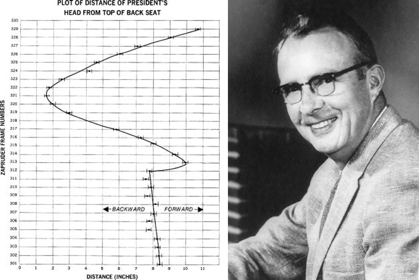
Nobel prize-winning physicist Luis Alvarez, with the sponsorship of the Department of Energy, designed experiments to “prove” Kennedy’s brain spatter sent his head backward, and published the results of these experiments in a low level publication, the American Journal of Physics in 1976.
Alvarez assassinated ripe melons wrapped in tape (to simulate a human head), blowing out large exit holes, causing the melons to whizz impressively away from the direction of the exiting spatter in front—and toward the shooter in back. The jet effect. It is supposed to nullify the idea that JFK’s head moved backward because of a shooter in the front.
The story—an infomercial rather than a scientific report—is written in the same manipulative, ingratiating style that lubricates so much of the pseudoscientific writings of John K. Lattimer MD and it vibrates with buzz words designed to earn your trust: Life Magazine…Thanksgiving…Christmas…football…the American flag…Lattimer’s service in World War II…his own service in World War II. (Somehow, he omitted references to mother, apple pie, church, and the family dog.)
The following statement on page 819 contains the key to the jet effect as an explanation for the behavior of Kennedy’s head during the shooting:
The simplest way to see where I differ from most of the critics is to note that they treat the problem as though it involved only two interacting masses: the bullet and the head. My analysis involves three interacting masses, the bullet, the jet of brain matter…and the remaining part of the head…
Translated: Mass #1, the bullet, causes Mass #2, the brain, to explode, which, in turn, causes Mass #3, the “remaining part of the head” to move backward, away from the direction of the spatter.
What’s wrong with this picture? Something critical is missing—the most important “interacting mass” in this entire event: The hard bone in the back of the head, the first thing the bullet is alleged to have hit, and with the full force of its energy!
In this way, he eliminated the competition—the idea that JFK’s head moved backward because it was hit from the front, through transfer of momentum.
The interaction between bullet and back of head was so violent, says the government, that it broke the bullet into two jacketed fragments and imbedded a disc of metal in the area of the cowlick. (Another interaction between bullet and bone takes place when the bullet exits, but I could find no data on it effects.)
Note: Perforating metal-jacketed bullets don’t always move heads very much, especially if the bullet is perpendicular to the surface, and if the head is attached to a neck. Once the bullet enters, knocking a plug of bone aside, and is no longer in contact with bone, it no longer propels it (unless it moves it as it exits). But in a tangential hit, bullet and bone are in direct contact over a larger area for a longer period of time, often causing impressive movement. [The Parkland Hospital doctors did not look under the scalp to examine the top or front of the head, but did report a large area of missing scalp and skull in the right rear (in occipital-parietal bone). William Kemp Clark, former chief of neurosurgery, thought the wound was caused by a tangential hit. This would mean that at least one head shot came from the right, or north side of Elm Street. It could even have come from the right front: JFK’s head was rotated to his left, presenting a small part of the back of his head to a shooter on the grassy knoll.]
Math: The Barbed Wire Protecting the Damaged Fruit
Mathematical formulas tend to scare people away, discouraging close examination. They also provide the prickly appearance of intellectual rigor. But if you take a good look at his squirming calculations, you will see that, once again, he has left out the first interaction: Among the symbols, you will find none representing the back of the head.
Thus, he not only eliminated the competition verbally, as mentioned above, but did it mathematically. In his equations, he has but one symbol for the melons that he shot, “M.” Alvarez’s theory contains the inherent assumption that the human head is as homogeneous as the melon.
Well, the most relevant symbol that belongs in this formula is “BS” and you know what that stands for.
Assassinating Melons
How did Alvarez eliminate this high impact (in real life) collision between s pristine bullet and pristine (still intact) bone, in his experiments?
He used melons wrapped in Scotch glass filament tape. Melon rinds are not much denser than the pulp inside. You can push a hole in one with your finger.
How much resistance would a melon present to any bullet? And what about the bullets Alvarez used? He fired, at close range, 150 grain soft-nosed bullets with an impact velocity of 3000 ft/sec. What is the difference between the impact velocities of these two very different bullets? Ballistics expert W.E. DeMuth, Jr., M.D.:
The kinetic energy theory…[that] energy = M x V2/2g, indicates that energy is directly proportional to mass and to the square of the velocity…doubling velocity quadruples it. (DeMuth, 1966)
How much energy did Alvarez’s bullet lose on impact with the melon? How much energy would a Carcano bullet lose on impact with a skull, especially if breakage of the bullet results? How much momentum would be imparted to the skull? Alvarez answered none of these questions.
Did Alvarez’s bullets break on the occipital-parietal region of the melon? He never even brought up the subject. Despite the omission of this most significant interacting mass (bone), Alvarez’s said his thesis includes “all the material in the problem:”
I concluded that the retrograde motion of the President’s head, in response to the rifle bullet shot, is consistent with the law of conservation of momentum, if one pays attention to the law of conservation of energy as well, and includes the momentum of all the material in the problem. (Alvarez, 1976, p. 819)
Luis Alvarez is like a third-rate magician, the kind that pulls a rabbit out of a hat, without first showing you the “empty” hat—and the rabbit turns out to be stuffed.
A Professor Spreads Bullshit on a Slide
How do these con artists manage to fool so many people? Harry Frankfurt, a former Professor of Philosophy at Princeton University, has made an in-depth study of the sort of thing produced by Alvarez, as well as the reasons it is accepted:
The contemporary proliferation of bullshit…has deeper sources, in various forms of skepticism which deny that we can have any reliable access to an objective reality and which therefore reject the possibility of knowing how things truly are. (Frankfurt, 1988, p. 133)
We may never know “how things truly are,” but thanks to various disinformation engineers, we actually do have “reliable access to an objective reality”—but it’s the reality that all kinds of people are trying to cover up the facts in this case. And they’re still doing it. Right before your eyes. (Go here to see a more recent example I’ve analyzed.)
-

Oliver and Jim Reply
I’m enclosing the letter Jim DiEugenio and I wrote in response to Rolling Stone’s attack on our film, “JFK Revisited.”
—
Tim Weiner’s review of “JFK Revisited: Through the Looking Glass” suffers from “Russiagate” paranoia, as do many of his colleagues embedded in our Government-Media world, wherein the malevolent Russians seem to be responsible not only for the election of Trump, but the continuing sabotage of our cyber-infrastructures. Supposedly wanting their glorious Communist Empire back, they are prepared to invade both Ukraine and NATO countries. Good vs. Evil scenarios seem to work for most American people. But Weiner goes far afield when he includes “JFK” in his contempt for so-called “tinfoil-hatted fabricators” who have no reason to believe the Warren Commission cover-up.
Weiner has failed to update his tired angle on the assassination. In fact, the Russians were working successfully at a détente with JFK, leading to the Nuclear Test Ban Treaty. When he was killed, Russian hopes—and the hopes of many liberated regions of the world (Egypt, India, Indonesia, and Africa)—were smashed as the hardliners in our Government once again protected their interests.
-
He accuses Jim DiEugenio, the writer of the documentary, and myself of falling for Russia’s trickery in using an Italian newspaper to blame Allen Dulles for his involvement in a military coup to overthrow Charles de Gaulle in ’61. But we did not use this Italian newspaper. We used David Talbot’s books, “The Devil’s Chessboard” and “Brothers,” The London Observer, and Weiner’s employer at that time, The New York Times—as well as French newspapers L’Express and Le Monde and sources close to de Gaulle like André Malraux and Alain Peyrefitte to pinpoint the enmity of Dulles, working with the mutinous generals against the policies of de Gaulle in Algeria.
-
Nor did Jim Garrison base his ideas about Kennedy’s assassination on that same marginal Italian newspaper. He did so by investigating the things Lee Harvey Oswald did in the summer of ’63 in New Orleans and the people he associated with. Authors like Jeff Morley (“The Ghost: The Secret Life of CIA Spymaster James Jesus Angleton”) and John Newman (“Oswald and the CIA”) have taken those discoveries further, and we interviewed both men in our film. Weiner does not mention either interview.
-
We largely relied on the database of documents that was released by the Assassination Records Review Board (1994–1998), which Weiner covered as a reporter for The New York Times, but did us no favors with his tepid interpretations of their work. We interviewed three technical experts who worked for that Board. And we display many documents the Board declassified. “JFK Revisited” is the first documentary to do this. We are not mystical or faith-based. We are data-based.
Signed,
Oliver Stone & Jim DiEugenio
-
-

“Peer Reviewed” Medical/Scientific Journalism Has Been Corrupted by Warren Commission Apologists – Part 2
see Part 1
Larry Sturdivan Bamboozled Neurosurgery, a Legitimate Peer-Reviewed Journal
In November 2003, the journal Neurosurgery published the first of what it promised would be three papers. It was entitled “The Assassination of President John F. Kennedy: A Neuroforensic Analysis—Part 1: A Neurosurgeon’s Previously Undocumented Eyewitness Account of the Events of November 22, 1963.’’ Except for the fourth of the four coauthors, Parkland witness Robert Grossman, MD, none were known to have particular knowledge of the JFK case. The paper’s stated purpose was to showcase Dr. Grossman’s “previously undocumented neurosurgeon’s eyewitness account of what occurred in Trauma Room 1 of Parkland Memorial Hospital on November 22, 1963, in an attempt to shed light on the nature of President Kennedy’s wounds.”[1]
That claim fell wide of the mark. Grossman’s recollections in Neurosurgery were not “previously undocumented.” In 1981, The Boston Globe published Grossman’s account of what he saw in Trauma Room One.[2] He had also “documented” JFK’s wounds to the Assassinations Records Review Board in 1997. In fact, in 2003 Neurosurgery published virtually the same “JFK” skull diagram that Grossman had prepared for the Assassinations Records Review Board (ARRB) six years before.[3] (Fig. 8)
By word and sketch, Grossman recounted that JFK had two skull wounds. The first was a round, 1 inch defect—to the right and ~1 inch above the external occipital protuberance, entirely within the occipital bone. (Fig. 6) The second was on the side of “JFK’s” skull, no larger than about 3 inches, or ~7 & 1/2 cm, and confined solely to parietal bone. Grossman saw no contiguity between the occipital defect and the defect in the right parietal bone that he depicted.

Figure 8. Sketch diagrams of JFK’s skull injuries prepared by Robert Grossman, MD that were published the peer-reviewed journal, Neurosurgery, in the November 2003 issue (left).[4] Grossman’s labeled skull diagram published in the Assassinations Records Review Board in 1997 (right).[5] Neither Grossman’s description nor his images square with what are said to be the authentic photographs taken of the back of JFK’s head at autopsy. Nor are they consistent with the findings in the official autopsy report, or even the sketch diagram of Kennedy’s skull wound that was prepared on the night of the autopsy by one of the autopists. The photographs show no defect low in the back of Kennedy’s head (Fig. 9), and an image prepared on the night of JFK’s autopsy documented a much larger skull defect than 3 inches. (Fig. 10)

Figure 9. Artist Ida Dox’s close rendition of an actual photograph of the back of Kennedy’s head taken during the autopsy. It was prepared for and published by, the House Select Committee on Assassinations. It shows no “1-inch” defect the occiput where Dr. Grossman said there was one. The official autopsy report specified that JFK’s skull defect measured 13 cm, fore to aft.[6] That was later corrected by autopsist, J. Thornton Boswell. He twice testified that when first examined, it actually measured 17 cm, which was the size that he documented on the “face sheet” diagram he prepared by hand during Kennedy’s autopsy. (Fig. 10)[7] After they replaced loose skull fragments into JFK’s skull wound, Boswell explained, the defect then measured 13 cm, and that was the dimension they put in the autopsy report.

Figure 10. Dr. Boswell’s autopsy “face sheet” with the notation “17 missing”—arrows pointing fore to aft. Dr. Boswell testified that, when first examined, Kennedy’s skull defect measured 17 cm. Besides his claims about JFK’s skull wounds, Part 1 was also noteworthy for Grossman’s reporting that Parkland’s chief of neurosurgery, Kemp Clark, MD, “and I lifted (JFK’s) head to inspect the occiput,” where he saw “a laceration approximately 1 inch in diameter located close to the midline of the cranium, approximately 1 inch above the external occipital protuberance. Brain tissue, some of which I thought had the appearance of cerebellar folia, was lying in the laceration.”
The importance of those remarks is not the nature of JFK’s injuries, which are demonstrably inaccurate, but that two neurosurgeons quite appropriately lifted JFK’s head and took a good look at Kennedy’s skull injuries. Like 7 other Parkland doctors, including Dr. Clark, Grossman said he saw a rearward wound—in the occiput. And he saw cerebellum, the small lobe of the brain at the rear-bottom of the brain case, under the occipital bone and beneath the large cerebral lobes of the brain. (That so many credible Parkland witnesses were in agreement on this is old news, but still important as the autopsy photos show there was no rearward skull wound and no cerebellar damage.[8]) Things got much more interesting in Part 2.
In June 2004 Neurosurgery published Part II, entitled, “A Neuroforensic Analysis of the wounds of President John F. Kennedy: Part 2 – A Study of the Available Evidence, Eyewitness Correlations, Analysis and Conclusions.” The lead author was University of California Professor of Neurosurgery, Michael Levy, MD, Ph.D. As in Part I, the fourth coauthor was Robert Grossman, MD.[9]
We were stunned by the long-discredited nonsense that was in it. As the Assassinations Archives and Research Center (AARC) was hosting a JFK conference in Washington, D.C. that fall, one of the current authors (GA) proposed inviting Professor Levy to give a presentation. He agreed and delivered a well-prepared Powerpoint talk. Author Aguilar then stood up and gave a point-by-point rebuttal. Professor Levy was dumbfounded. That evening, Levy joined authors Wecht and Aguilar, and Roger Feinman JD, for dinner. He expressed an honest shame and embarrassment that he knew nothing of the counterfactual evidence Aguilar had presented.
As professor Levy was unknown in the JFK universe, we asked him where he got his information. He said that he based his paper and presentation on material that Dr. Grossman suggested he read. He encouraged us to submit a rejoinder to Neurosurgery to correct the factual record. We did and, apparently over the objections of Dr. Grossman, they published our 10,000 word rebuttal on September 2005.[10]
As we worked on our reply, we noticed that the last page of Levy’s paper included a short congratulatory letter from Larry Sturdivan. “Part 2 of this article,” he wrote, “does not present important new evidence regarding the President’s wounds, as Part 1 did. [Which was false, as we’ve shown from the Boston Globe and the ARRB documents re Part 1, above.] Nevertheless, it is an important summary of the material previously reported. The report, especially the full version on the web site, not only saves the reader the time of acquiring these myriad sources, but also puts them into perspective in a way that a simple collection of documents cannot.”[11]
Intrigued, one of us (GA) phoned the editors at Neurosurgery who were working with us on our reply. He asked them how they found the “peer” who’d reviewed Levy’s paper. They said they didn’t know who to ask. So they turned to Levy’s coauthor, Robert Grossman, the man who had driven the series of articles from the outset. He suggested they invite Larry Sturdivan to do the review.
“Did you know that Grossman and Sturdivan have collaborated on JFK?” Aguilar asked. A quick on-line search confirmed that fact. “It’s highly irregular,” Aguilar said, “to have an author’s collaborator review his submission.” “Yes,” he replied, “it is highly irregular.”
Following up via email, Aguilar wrote both the editors and Larry Sturdivan, and still has the emails. They openly admitted Sturdivan had “refereed” both Part I and Part II. Regarding Part II, Sturdivan emailed Aguilar and the editors of Neurosurgery the following:
Dear Dr. Sullivan,
As you suggested in your letter, the article was a quick read. I could find no substantive errors or typos. The following minor details should be examined before publication … . (emphasis added; copy available by request)
No substantive errors?
Given our rejoinder ran to roughly 10,000 words, with 94 footnotes, a comprehensive accounting of the “substantive errors” Sturdivan missed in Part II alone is well beyond the scope of this discussion. But it can be viewed on-line at Neurosurgery’s website.[12] However, a few of the errors we identified are worth touching upon.
- Levy recycled debunked claims that the fibers in the back of JFK’s coat were bent inward and the fibers in his shirt front were bent outward, thus proving the back-to-front direction of the bullet. As we documented, it was FBI director J. Edgar Hoover who fabricated those claims and it was the FBI Lab itself that disavowed them.
- Levy repeated one of the Warren Commission’s most discredited myths, namely, that a Warren Commission ballistics expert had successfully duplicated JFK’s injuries in simulation shooting tests with cadaver skulls. “That (test) bullet,” Levy wrote, “blew out the right side of the reconstructed cranium in a manner very similar to the head wounds of the President.” Except for the word “cranium” rather than “skull,” as was originally written, this sentence is torn verbatim from page 585 of the Warren Report, given without the appropriate quotation marks or attribution.[13] As we’ve shown here, we noted in our reply that the blasted test skull was not at all “very similar” to JFK’s. It sustained severe damage to the right forehead, the loss of the right orbit, and much of the cheek bone, injuries JFK did not sustain.
- Dr. Levy accepted the legitimacy of Kennedy’s autopsy photos as well as Grossman’s claim that there was a one-inch hole in the occiput of JFK’s skull. He ignored the fact that the supposedly authentic autopsy photos show no occipital wound, one that was described not only by Grossman, but also by numerous Parkland physicians including the chief of neurosurgery, Kemp Clark MD. He also ignored that JFK’s autopsy surgeons all testified that photos they took on the night of the autopsy are missing.
- Ironically, Levy never mentioned, and likely didn’t know, that the ARRB’s chief Analyst for Military Records, Douglas Horne, showed Grossman the Ida Dox sketch of the back of JFK’s head taken from the autopsy photographs (Fig. 8).[14] Grossman rejected it. Horne reported that, “Grossman immediately opined, ‘that’s completely incorrect.’ He insisted there had been a hole devoid of bone and scalp about 2 cm in diameter near the center of the occipital bone.”[15]
- Dr. Levy cited the HSCA’s claim it had authenticated Kennedy’s autopsy photos. But he failed to notice a telling footnote in the very HSCA pages he cited in support of authentication. The HSCA wrote that, “Because the Department of Defense was unable to locate the camera and lens that were used to take these [autopsy] photographs, the [photographic] panel was unable to engage in an analysis similar to the one undertaken with the Oswald backyard pictures that was designed to determine whether a particular camera in issue had been used to take the photographs that were the subject of inquiry.”
But that’s not what the Navy had said. Since Kennedy’s autopsy was performed at the Navy’s Bethesda Hospital, the Secretary of the Navy responded to the HSCA’s claim they hadn’t been given the camera that had taken JFK’s autopsy images . The Secretary huffily insisted that the Navy had definitely sent the HSCA the actual camera, the very one the HSCA’s experts had determined had not taken them.[17]
Whereas the HSCA reported it could not completely close the loop because the camera was missing, the suppressed record suggests that 1) the loop was closed, 2) the camera was located, and 3) that the HSCA’s own authorities determined that the camera “could not have been used to take [JFK’s] autopsy pictures.” The HSCA staff elected to withhold this inconvenient information from the public. They also kept it from their own experts on the Forensic Pathology Panel, including the chairman, Dr. Michael Baden (personal communication), and one of the authors of this essay [CHW]. And so, as per Dr. Levy, the HSCA experts, and Neurosurgery readers were left to labor under the illusion that the images had passed authentication with flying colors.
Thereafter, the editors worked with us and published our lengthy reply. Our evisceration of Dr. Grossman’s JFK project scuttled the rest of the planned operation. Neurosurgery never published the promised Part III of “A Neuroforensic Analysis of the Wounds of President John F. Kennedy.”
The point of this extended discussion is to note that long-debunked anticonspiracy claims of “jet effect,” “neuromuscular reaction,” Neutron Activation Analysis, the government’s skull shooting tests, JFK’s authenticated autopsy photographs, the magic bullet, etc., continue to be recycled by fact-averse, anticonspiracy evangelists. Nicholas Nalli is the new crusader. He laughably tried to rehabilitate “jet effect” and “neuromuscular reaction.” He gave Sturdivan and Haag the benefit of the doubt on their repeatedly debunked NAA fantasies. And he did it in a “peer reviewed,” “scientific” article which was clearly reviewed not by anonymous, informed scientists, as Nalli claimed, but instead by ill-informed Warren loyalists, including in all likelihood, Larry Sturdivan.
Suspicion falls to Sturdivan because Nalli gushingly acknowledges him (“first and foremost”) for reviewing drafts of his paper and for “providing expert feedback.” Just as Sturdivan had thrown eggs on the faces of Professor Levy and the editors of Neurosurgery by “peer-approving” so much nonsense, he did so again to Nicholas Nally by likely contributing to, and possibly “peer-reviewing,” some rubbish that should embarrass Nalli, and expose Heliyon as an outlet for authors who are unwilling to run their work through a proper, expert, anonymous “peer review” gauntlet.
Lost in the fog of his attempt to give mouth-to-mouth to the government’s gasping scenario are the multiple lines of evidence Nalli ignores that converge on the conclusion anyone seeing the Zapruder film immediately draws: the mortal head shot at frame 313 came from the right front. For that reason, that’s a good place to start.
What Can Science Tell Us About What Happened in Dealey Plaza?
The Zapruder film, jiggle analysis, and the death of JFK
As mentioned, in 1976 Alvarez theorized that some of the Zapruder frames are blurred at points that appear to correspond to Mr. Zapruder jerking his camera in startle-reaction to the sound of gunfire.[18],[19] His theory was later validated by CBS after it ran its own, independent experiment.[20] The HSCA also undertook its own “jiggle analysis.” On page 20 and 24 of the HSCA’s report, two independent consultants produced graphs depicting the frames in which there was blurring.[21] For the shot that allegedly flipped Governor Connally’s lapel at Zapruder frame 224, the HSCA graphs show a corresponding “jiggling” three frames later, at 227.[22] The delay is due to the fact the sound wave reached Zapruder after the speedier bullet hit its target. There are other frames that are much more “jiggled” than frame 227 is.
One is Zapruder 313, the head shot. As discussed, if Oswald had fired that shot, frames 316–17 would be blurred.[23] They’re not; they’re sharp. There is only one mathematical possibility for a bullet shock wave distorting the camera’s gaze at frame 313: the bullet had to have been fired much closer to Zapruder than from Oswald’s alleged perch, 270 feet away. The best scenario is that it came from where Mr. Zapruder had told a Secret Service Agent on 11/22/63 it had come from, behind him, from the grassy knoll, approximately 60 feet behind the cameraman.[24],[25]
Let’s assume the shot was fired between frame 312 and 313. Since the shock waves from rifle muzzle blasts travel at the speed of sound, ~1125 ft/sec, the sound and shock wave from a grassy knoll shot would have hit Zapruder in less than 1/20th second, that is, within a single frame of Zapruder’s camera. A good correlation. The sound and shock wave from Oswald’s position, however, would have hit Zapruder 3 to 4 frames later, at, say, 316 or 317.
There is also considerable blurring of frames 331 and 332.[26] This appears to match a putative shot from behind that struck JFK’s head in frames 327–328 as per Last Second in Dallas, one which drove him forward more rapidly than he moved rearward after frame 313, as we’ve discussed.
But what about Kennedy’s rearward lunge after frame 313? If not “jet effect” or “neuromuscular reaction,” what caused it?
Did Momentum Transfer from a Grassy Knoll Shot Drive JFK “Back and to the Left?”
To answer this question, we return to the most analogous, and credible, experimental evidence: the government’s 1964, Biophysics Lab, skull shooting experiments. As Larry Sturdivan testified, while demonstrating with film during his HSCA testimony, “All 10 of the skulls that we shot did essentially the same thing. They gained a little bit of momentum consistent with one or a little better foot-per-second velocity that would have been imparted by the bullet…”[27] (As discussed, in his book Sturdivan reported a higher, and more likely valid, velocity: “the skull…moves forward at approximately 3 feet/sec, just as it must from the momentum deposited by the bullet.”[28])
Sturdivan thus argued, as he testified, that a shot from behind would have caused “slight movement toward the front, which would very rapidly be damped by the connection of the neck with the body.”[29] In other words, an MCC shell would have moved the skull in the direction of bullet travel. New information informs two key issues here.
Mr. Sturdivan’s conclusion that momentum transfer could not explain JFK’s skull motion was based on experiments using modestly powered Mannlicher Carcano rounds weighing 162 grains (0.023 lbs) that struck their targets from a distance of 90 yards.[30] And he assumed the fatal bullet was jacketed, and so deposited only half of its momentum when it struck Kennedy’s 15-pound skull.[31] These assumptions are unjustifiable and unfairly bias his conclusions toward the lone gunman. (For example, there is no reason to assume a grassy knoll gunman would have used a Mannlicher Carcano and, in fact, the x-ray evidence suggests it wasn’t a Mannlicher Carcano. See below.)
In his book, Hear No Evil, Don Thomas, Ph.D. scrutinized Mr. Sturdivan’s analysis in considerable detail. With permission, we quote Dr. Thomas.
Sturdivan’s calculation, Thomas writes, was:
derived indirectly from his tests shooting human skulls with a Mannlicher-Carcano. The bullet’s velocity at a distance of 90 yards was 1600 feet-per-second according to Sturdivan (in fact, the Army’s data indicated a value closer to 1800 fps) [sic]. Sturdivan then divided this number in half on the supposition (unstated) [sic] that the bullet would deposit only half of its momentum. This supposition was apparently based on his observation that a velocity of something like ‘one-foot-per-second’ was imparted to test skulls when shot with the Carcano.[32] Somehow, Mr. Sturdivan managed to miss the point that the rearward movement might have involved a shot origination from the grassy knoll only 30 yards in front of the target, with consequently less loss of velocity from air resistance, than from a position 90 yards behind the President. It also seemed not to have occurred to Sturdivan that the President might have been shot from the grassy knoll with a different rifle than the modestly powered Mannlicher-Carcano…[33]
“For the purposes of this discussion,” Thomas continues,
let us suppose that the hypothetical killer on the grassy knoll was armed with a .30-.30 rifle…(which) happens to have a muzzle velocity (2200ft/sec) very close to that of the Carcano and fires a 170-grain bullet, slightly larger than the Carcano bullet. At 30 yards, the projectile would have struck at a velocity of approximately 2100 fps…the momentum on impact with the head would be 50 ft-lb/sec. If one postulates a hunting bullet (in accordance with the x-ray evidence) [sic] which is designed to mushroom and deposit its energy at the wound instead of a fully jacketed bullet, we will allow a deposit of 80% of the momentum, leaving a residual velocity for the exiting bullet. This results in a momentum applied to the target of 40 ft-lb/sec; considerably more than Sturdivan’s stingy allowance of 18.4 ft-lb/sec. It is important to realize that, at the time Kennedy was struck with the fatal shot at Z-312-3, he had most likely been paralyzed by the shot through the base of the neck (as Sturdivan admits[34]). Consequently, his head was lolling forward, not supported by the muscles of the neck. This fact tends to minimize the damping effect (that so troubled Mr. Sturdivan) from the absorption of shock by the neck until after the head has snapped back. Assuming a head weight of 12 lbs, the velocity imparted to the head would be approximately 3.3 feet per second…[35] [The same speed of the test skulls that Mr. Sturdivan reported in his book, though in JFK’s case it might have even been faster as most estimates put the weight of a human head at 10-11 lbs.[36]]
From the study of the Zapruder film by Josiah Thompson, the observed rearward velocity for the head was roughly 1.6 feet per second after frame 313.
Thomas concludes, “Even given the uncertainty about the exact weight of the President’s head and the residual velocity of the bullet, the observed movement of the President’s head is well within the range, if anything less, than expected from the momentum imparted by the impact of a rifle bullet.”[37]
In sum, if one corrects for Sturdivan’s faulty assumptions, yet uses his sound logic, the case for momentum transfer becomes compelling. Thus, if Sturdivan is right, as per Aberdeen Proving Grounds, that jacketed, Western Cartridge Company (WCC) shells moved blasted skulls forward at 3 ft/sec, or even 1.2ft/sec, imagine how swiftly one would move if struck with heavier, higher velocity, soft-nosed bullet fired from a much closer location; perhaps enough not only to move JFK’s skull “back and to the left,” but also enough to even nudge his probably paralyzed upper body in the direction of his head.
As Thomas hinted, Kennedy’s x-rays suggest just such a scenario.
X-Ray Evidence for a Shot from the Grassy Knoll
While it is evident that a soft-nosed bullet fired from the right front could have delivered sufficient momentum to drive his head back and to the left, during HSCA testimony it was claimed that JFK’s x-rays prove that he was not hit by a soft-nosed round; that the fatal bullet was jacketed, like Oswald’s. This conclusion is false. It rests on a misreading and misunderstanding of the x-rays. Properly read and understood, Kennedy’s x-rays give evidence for a non-jacketed bullet. The confusion began during late 1970s. That is when the HSCA put an altered version of JFK’s lateral x-ray into evidence and had a non-radiologist, non-physician interpret the altered x-ray—the omnipresent “neuromuscular reaction” “authority,” the Neutron Activation Analysis “expert,” and now the radiology specialist, Larry Sturdivan.
The untrained Sturdivan displayed an “enhanced” version of JFK’s lateral x-ray to the HSCA members (Fig. 10). It was not the original film. The process of enhancement greatly increases the contrast of the x-ray, making the skull bones look much brighter and denser than they appear in the originals. But the process also blots out some of the clinically significant, fine details, including the presence of any miniscule, “dust-like” bullet fragments. Sturdivan testified that the enhanced x-ray ruled out the possibility of a non-jacketed round because, he said, if it had been a non-jacketed shell there would have been many tiny bullet fragments visible on the x-ray.
But, in fact, there are many, tiny fragments on JFK’s skull x-ray. They’re not visible because they’ve been blotted out from view on the enhanced film he presented to the HSCA. The following exchange under oath captured his error.
The Select Committee asked, “Mr. Sturdivan, taking a look at JFK exhibit F–53, which is an x-ray of President Kennedy’s skull,[38] can you give us your opinion as to whether the President may have been hit with an exploding bullet?”
“Well,” he replied, “this adds considerable amount of evidence to the pictures which were not conclusive. In this enhanced x-ray of the skull, the scattering of the fragments throughout the wound tract are characteristic of a deforming bullet. This bullet could either be a jacketed bullet that had deformed on impact or a soft-nosed or hollow-point bullet that was fully jacketed and therefore not losing all of its mass. It is not characteristic of an exploding bullet or frangible bullet, because in either of those cases the fragments would have been much more numerous and much smaller. A very small fragment has very high drag in tissue and, consequently, none of those would have penetrated very far. In those cases, you would definitely have seen a cloud of metallic fragments very near the entrance wound. So this case is typical of a deforming jacketed bullet leaving fragments along its path as it goes.” (emphasis added throughout)[39]
To demonstrate his point in his 2005 book, Sturdivan reproduced on the same page both Kennedy’s enhanced lateral skull x-ray and the unenhanced lateral x-ray of a skull shot with a Carcano round in the Biophysics Lab’s tests in 1964.[40] The pattern of bullet fragmentation was very similar, he said, and he was right. (Figs. 9 and 10)
Re JFK’s enhanced x-ray, he wrote: “…Lead fragments are scattered within the skull, reaching the frontal bone, not clustered at the entry point. Frangible bullets would disintegrate very quickly, producing a dense cloud of fragments at the entry site…the extent of fragmentation of the bullet is characteristic of that of a fully jacketed military bullet that deformed and broke apart upon impact with the skull…It is not that of a frangible, soft-nosed or hollow-point bullet.”[41] (emphasis added)
The unenhanced x-ray of the Biophysics test skull (Fig. 12) shows much the same thing as Kennedy’s enhanced x-ray (Fig. 11), a scattering of small, but not “dust like,” radiolucencies—bullet fragments—across the lower portion of the skull. Neither JFK’s enhanced x-ray nor the unenhanced film of the test skull shot with a Carcano round show the miniscule, more numerous fragments that Sturdivan correctly said would have been present had either been struck with a non-jacketed round.
But Kennedy’s original, unenhanced skull x-rays at the National Archives actually do show a cloud of myriad, tiny radiolucencies. Those tiny fragments, and their location, collapse the case for a lone gunman for the good reasons Sturdivan gave: a non-jacketed bullet leaves numerous, tiny fragments near their point of striking—just like those that are clearly visible in Kennedy’s original, unenhanced x-rays. Jacketed bullets like Oswald’s don’t do that.

Figure 11. Enhanced lateral x-ray taken of JFK during the autopsy. (HSCA Exhibit F 53; 1HSCA240) Note that there is a trail of fragments that runs very close to the top of JFK’s skull, and that no “dust like” fragments are visible. Instead, most of the fragments are small, similar to the Carcano fragments in the Biophysics’ unenhanced x-ray of a test skull shot with a MCC round. (Fig. 12) JFK’s original, unenhanced x-rays do show myriad, miniscule fragments that are not visible in this enhanced image. The run along the top of the x-ray, decidedly above the low entrance wound specified in the original autopsy report, and even above the higher entrance wound later accepted by the Clark Panel and the HSCA. 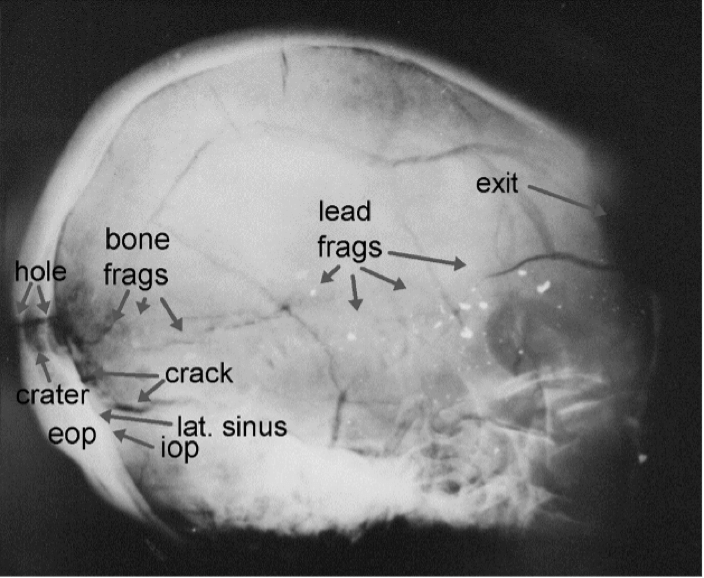
Figure 12. Unenhanced, lateral x-ray of a test skull shot with a Mannlicher Carcano by the Biophysics Lab.[42] The bullet entered low, through the occipital bone, and so the fragment trail is low, as the bullet traversed the lower portion of the skull. As with JFK’s enhanced x-ray, there is a scattering of small fragments. Note the absence of the myriad, tiny fragments that were described as present in JFK’s unenhanced x-rays. Both authors Wecht and Aguilar have examined the still-secret, original, unenhanced x-rays at the National Archives and have seen that “dust like” fragments are present in the right front quadrant of Kennedy’s skull x-rays. We are not the only ones who’ve noticed them. They were reported by Kennedy’s chief pathologist, Dr. James Humes, by a Secret Service agent, as well as other government consulting, expert radiologists. The presence of miniscule fragments essentially rules out that Oswald’s single, jacketed round hit Kennedy at frame 313.
Why?
For the good reasons Sturdivan gave: tiny fragments don’t travel far in tissue, because of their low mass relative to their large surface area, their “high drag” in tissue. Tiny bullet fragments are quickly stopped in tissue. In contrast, larger fragments have proportionately less surface area compared with their mass than small fragments do, and so drive further through tissue before being stopped.
Besides their presence, a telling detail is the location of the tiny fragments. They sit in the right front quadrant of JFK’s skull, which, to borrow from Sturdivan, is likely “very near the entrance wound.” This evidence has largely lain unrecognized and unappreciated in the record since 1964.
- During his Warren Commission testimony in 1964, Dr. Humes said: “(JFK’s x-rays) had disclosed to us multiple minute fragments of radio opaque material…These tiny fragments that were seen dispersed through the substance of the brain in between were, in fact, just that extremely minute, less than 1 mm in size for the most part.” A few moments later, Dr. Humes was asked, “Approximately how many fragments were observed, Dr. Humes, on the x-ray?” “I would have to refer to them again (the x-rays),” he answered, “but I would say between 30 or 40 tiny dust-like particle fragments of radio opaque material, with the exception of this one I previously mentioned, which was seen to be above and very slightly behind the right orbit.”[43]
- Secret Service Agent Roy Kellerman, an autopsy witness, testified that the fragments in JFK’s skull x-ray, “looked like a little mass of stars; there must have been 30, 40 lights where these pieces were so minute that they couldn’t be reached.”[44]
- Russell Morgan, MD, the chairman of the department of radiology at Johns Hopkins University, was the Clark Panel’s radiologist. “Distributed through the right cerebral hemisphere are numerous, small irregular metallic fragments,” the Panel reported, “most of which are less than 1 mm in maximum dimension. The majority of these fragments lie anteriorly and superiorly. None can be visualized on the left side of the brain and none below a horizontal plane through the floor of the anterior fossa of the skull.”[45] (emphasis added)
- Cook County Hospital Forensic Radiologist, John Fitzpatrick, MD, examined JFK’s x-rays in consultation for the ARRB and agreed, writing: “There is a ‘snow trail’ of metallic fragments in the lateral skull X-Rays which probably corresponds to a bullet track through the head, but the direction of the bullet (whether back-to-front or front-to-back) [sic] cannot be determined by anything about the snow trail itself.”[46]
Authors Wecht and Aguilar concur: there are myriad “dust like” fragments visible on JFK’s lateral x-ray, a “snow trail,” if you will. The vast majority are confined to the right front quadrant of Kennedy’s skull, which is where, as per Sturdivan, a non-jacketed bullet struck.
Practicing radiologist Michael Chesser, MD examined the original, unenhanced JFK x-rays and came to the same conclusion. “This location, on the intracranial side of the bony defect, is highly suggestive of an entry wound,” he wrote. “One of the principles of skull ballistics is that the largest fragments travel the furthest from the entry site, with the smallest traveling the least distance, and that is exactly what is seen on this right lateral skull x-ray. Tiny fragments are seen on the inner side of this right frontal skull defect, and the largest fragments were noted in the back of the skull.”[47]
Forensic pathologist Vincent DiMaio, MD elaborated upon the meaning of a “snow trail,” or “snow storm”: “[T]he snowstorm appearance of an x-ray almost always indicates that the individual was shot with a centerfire hunting ammunition…”[48]* That is, a non-jacketed round. And as per Sturdivan, the right-forward location of the tiny fragments is a clear indication of what is visible in Zapruder film: an entrance wound in the right front quadrant of Kennedy’s head for a bullet that left a tell-tail cloud of “dust like” fragments in that area. For, although he thought that the shot at Zapruder frame 313 went from back to front, Sturdivan admitted what is well understood in the “ballistics/forensics” community: “A similar explosion would have taken place if the bullet had gone through in the opposite direction.”[49] In fact, Fig. 2 in Part I of this essay demonstrates this very principle: the human skulls shot in the government’s tests show about as much cranial contents egressing out of the entrance point at the rear of the test skull as out of the front.
(*In a later edition of DiMaio’s book, he allowed that the breach of the shell’s jacket after Oswald’s bullet went through Kennedy’s skull might have released the tiny lead fragments seen in the x-rays. However, he offered no evidence for this claim and the Biophysics skull shooting tests did not show this phenomenon. DiMaio’s is thus an assertion made without evidence and, therefore, will be dismissed in view of the counterevidence from the Biophysics tests.)
Sturdivan finally saw the original, unenhanced images in 2004 at the National Archives. He was emphatic under oath to the HSCA that the absence of tiny fragments in the enhanced x-ray proved that a jacketed bullet, not a hunting round, had struck JFK. But when he wrote his book in 2005, and when he reported on his examination of the originals that dramatically do show the telltale tiny fragments in the right front quadrant of JFK’s skull, he said nothing about them. He either didn’t notice them, or elected not to say he had.[50] “Scientists” like him don’t see what they don’t want to see. The HSCA’s x-ray “expert,” Sturdivan, didn’t see what other, vastly better credentialed, true experts did see.
The trail of small, but not miniscule, fragments that are visible runs along the top of JFK’s skull in both the enhanced and nonenhanced lateral x-rays. It does not align with the supposed low entrance wound specified by the autopsy surgeons in occipital bone, although the autopsy surgeons said it did. Nor does it line up with the higher entrance wound the Clark Panel identified, although the Clark Panel said it did.[51] In fact, as anyone can see the fragment trail in JFK’s lateral x-ray is about 5 cm above where both the Clark Panel and the HSCA said it was. (Fig. 11) That high fragment trail offers evidence there was a second head shot, from behind, with a jacketed round, a possibility that is also suggested by the “jiggle” evidence in the Zapruder film, by Professor Barger’s acoustics analysis, and by JFK’s rapidly forward moving skull after frame 328, as explored by Thompson in Last Second in Dallas.
To recap, there is a cloud of tiny fragments on JFK’s x-ray, which is typical of a hunting round, but not Oswald’s jacketed bullet. That cloud is located in the right front portion of his skull, where they would have been quickly stopped by “tissue drag.” This physical evidence independently buttresses the “jiggle evidence” in the Zapruder film that the shot at 313 came from a location close to the camera, the grassy knoll, precisely where the acoustics evidence said it originated, and not from Oswald’s spot, 270 feet away. It is consistent with evidence that JFK’s split-second lunge “back and to the left” was due to the large momentum that was transferred to Kennedy’s cranium by a non-jacketed bullet that mushroomed on impact, and not due to “jet effect” and/or “neuromuscular reaction.”
These multiple, mutually corroborating lines of evidence point in a direction that seemed obvious to the eye of anyone who watched the Zapruder film on the Geraldo Rivera’s Good Night America show in 1975. It is also what seemed evident 28 years ago to Mr. Masaad Ayoob, a respected gun expert and the former Vice Chairman of the Forensic Evidence Committee of the National Association of Criminal Defense Lawyers (NACDL):[52]
The explosion of the President’s head as seen in frame 313 of the Zapruder film is simply not characteristic of a full metal-jacket rifle bullet traveling at 2,200 fps or less. It is far more consistent with an explosive wound of entry with a small-bore, hyper-velocity rifle bullet traveling between 3,000 and 4,000 fps, and probably toward the higher end of that scale…An explosive wound of entry occurs when a highly liquid area of the body, such as the brain, is struck by a high velocity round. The tissue swells violently during the microseconds of the bullet’s passing and seeks the line of least resistance. That least resistance is the portal of the entry wound that appeared a microsecond before and the bullet will not bore an exit hole to relieve the pressure for another microsecond or two—perhaps not at all if the bullet fragments inside the brain. If the cataclysmic cranial injury inflicted on Kennedy was indeed an explosive wound of entry, the source of the shot would have had to be forward of the Presidential limousine, to its right, and slightly above…the area of the grassy knoll.[53]
Mr. Ayoob speaks from experience. He notes that the closest commonly used cartridge to a Carcano
…in terms of ballistics is probably the .30/30, which has a .308″ diameter. The Carcano round, about a .263″ diameter. Ask any homicide detective if he’s ever seen a .30/30 round blow a man’s head up at 55 to 60 yards, exploding the calvarium up and away from the body proper. Ask any hunter of deer-size game if he’s ever seen the same thing at that distance. It happens only at very close range with that ballistic technology. The wound we see happening in frame 313 in the Zapruder film—and see the results of most clearly in frame 337—is simply not consistent with this rifle cartridge at that distance in living tissue. It is particularly inconsistent with a round-nose full metal-jacket bullet of the type Oswald had in his rifle.[54] [Note that the head of the goat shot in the government’s tests does not explode as JFK’s did. (Fig. 5)]
Mr. Ayoob does not completely discount the possibility of Oswald’s culpability, but only if the shell “for unexplainable reasons did damage out of all proportion to its ballistic capability as most of us would perceive that to be.”[55]
That takes us back to what author Wecht suspected during his tenure on the Forensics Panel of the House Select Committee: JFK’s “…backward head motion might be explained by a soft-nosed bullet that struck the right side of the President’s head.” Wecht presciently surmised that before these multiple lines of independent, converging evidence had been assembled that confirm what seemed so obvious to him, to Masaad Ayoob, and to anyone viewing the Zapruder film.
In Last Second in Dallas, Thompson quoted Don DeLillo: “[D]id the shot simply come from the front, as every cell in your body tells you it did?” “Don DeLillo is right,” Thompson answered, “When you look at the Zapruder film, every cell in your body tells you the shot at frame 313 came from the right front.”[56] We now know that it’s not only your every cell, but it’s also the science that tells you that. It’s the “Occam’s Razor” solution: the simplest, most complete and compelling explanation of the shot that killed John Kennedy. It’s one that requires no suspension of disbelief; no invocation of tortured, disanalogous neurophysiological phenomena; no misreading of Kennedy’s original autopsy x-rays; and it’s one that honors the many witnesses in Dealey Plaza who said that a shot came from the grassy knoll, not least being the 21 cops who “heard a grassy knoll shot.”[57]
[see also: Milicent Cranor’s Forensics Journal Unintentionally Proves Conspiracy in Cover-Up of JFK Assassination and John Lattimer Never Quit: The Thorburn Business]
[1] Daniel Sullivan, M.Div., Rodrick Faccio, B.S., Michael L. Levy, M.D., Ph.D., Robert G. Grossman, M.D., Neurosurgery, Vol. 53, No. 5, November 2003, p. 1020. Available here.
[2] Ben Bradlee. “Dispute on JFK Assassination.” Boston Globe, 6/21/81, p. A–23. Available here.
[3] ARRB MD file # 185. Available here. (see pp. 4 and 5)
[4] Sullivan, Dan. “The Assassination of President John F. Kennedy: A Neuroforensic Analysis—Part 1:
A Neurosurgeon’s Previously Undocumented Eyewitness Account of the Events of November 22, 1963,” Neurosurgery, Vol. 53, No. 5, November 2003, p. 1024. Available here.
[5] MD 185 – ARRB Meeting Report Summarizing 3/21/97 In-Person Interview of Dr. Robert Grossman. Available here.
[6] Warren Commission JFK autopsy report, p. 3. Available here.
[7] ARRB testimony of J. Thornton Boswell, pp. 71–72. Available here.
HSCA testimony of J. Thornton Boswell. HSCA Vol.7, p. 253. Available here.
[8] See Aguilar G, Cunningham K. “How Five Investigations into JFK’s Medical/Autopsy Evidence Got It Wrong, Part V. The ‘Last’ Investigation—The House Select Committee on Assassinations.” Available here.
[9] Levy M, Sullivan D, Faccio R, Grossman R. “A Neuroforensic Analysis of the Wounds of President John F. Kennedy: Part 2—A Study of the Available Evidence, Eyewitness Correlations, Analysis, and Conclusions,” Neurosurgery. Vol. 54, No. 6, June 2004, E1–E23. Available here.
[10] Aguilar G, Wecht C, Bradford R. Neurosurgery. Vol. 57, No. 3, September 2005.
[11] Levy M, Sullivan D, Faccio R, Grossman R. “A Neuroforensic Analysis of the Wounds of President John F. Kennedy: Part 2—A Study of the Available Evidence, Eyewitness Correlations, Analysis, and Conclusions,” Neurosurgery. Vol. 54, No. 6, June 2004, E23. Available here.
[12] Aguilar G, Wecht HC, Bradford R. Reply to: “A Neuroforensic Analysis of the Wounds of President John F. Kennedy: Part 2—A Study of the Available Evidence, Eyewitness Correlations, Analysis, and Conclusions,” Neurosurgery. Available here.
[13] Warren Report, p. 585. Available here. See also Warren Commission testimony of Alfred Olivier, DVM, 5H, p. 89. Available here.
[14] See JFK Exhibit F-48. In HSCA, Vol. 1, p. 234. Available here.
[15] Horne, Douglas, Inside the Assassination Records Review Board Volume 2, p. 656.
[16] HSCA Vol. 6, p. 226. Available here.
[17] See Memorandum for File on 8/27/1998 by the ARRB’s Douglas Horne, entitled, “Unanswered Questions Raised by the HSCA’s Analysis and Conclusions Regarding the Camera Identified by the Navy and Department of Defense as the Camera Used at President Kennedy’s Autopsy. Available here.
[18] Alvarez, L. A physicist examines the Kennedy assassination film. Am J. Physics, 1976; 44 (9):813 ff. Available here.
[19] Olson D, Turner RF, “Photographic evidence and the assassination of president John F. Kennedy,” Journal of Forensic Sciences, 1971; Vol. 16, No. 4, pp. 399–419. Available here.
[20] Ken Scearce & Brian Roselle. “Secrets of the Zapruder Film.” Available here.
[21] HSCA Vol. 6, p. 26. Available here.
[22] Zapruder frames 224 and 227. Available here and here.
[23] Zapruder frames 117 and 316. Available here and here.
[24] Thomas, D B. Hear No Evil, Ipswich, MA: Mary Ferrell Foundation Press, 2010, p. 202-215. Available here.
[25] Secret Service Agent Max Phillips interviewed Zapruder on 11.22.63. His memo appears nowhere in the Warren Commission documents or volumes. It was discovered at the National Archives by Mr. Harold Weisberg. Agent Phillips reported that “According to Mr. Zapruder the assassin was behind Mr. Zapruder.” Weisberg H. Whitewash III: The Photographic Whitewash of the JFK Assassination, New York, Skyhorse Publishing, 1967. See text under “Section I – The New Math and the New Morality.” Available here.
[26] Zapruder frame 331. Available here.
[27] House Select Committee on Assassinations testimony of Larry Sturdivan, September 8, 1978, 1H, p. 404. Available here.
[28] Sturdivan LM. The JFK Myths, St. Paul, MN: Paragon House, 2005, p. 164.
[29] HSCA testimony of Larry Sturdivan, September 8, 1978, 1H, pp. 413–414. Available here.
[30] HSCA testimony of Larry Sturdivan, September 8, 1978, 1H, p. 404. Available here.
[31] HSCA testimony of Larry Sturdivan, September 8, 1978, 1H, pp. 413–414. Available here.
[32] HSCA testimony of Larry Sturdivan, September 8, 1978, 1H, p. 404. Available here.
[33] Thomas, Donald B. Hear No Evil, Ipswich, MA: Mary Ferrell Foundation Press, 2010, pp. 344–345.
[34] Larry Sturdivan apparently agrees. He wrote: “Neurosurgeon Dr. Michael Carey thinks that (JFK) may be falling (by Zapruder frame 312) as a result of temporary paralysis from the spinal damage associated with the neck wound.” Sturdivan LM. The JFK Myths, St. Paul, MN: Paragon House, 2005, p. 209, note 96.
[35] Thomas, Donald B. Hear No Evil, Ipswich, MA: Mary Ferrell Foundation Press, 2010, pp. 345–346.
[36] “How Much Does the Human Head Actually Weigh?” Available here.
[37] Thomas, Donald B. Hear No Evil, Ipswich, MA: Mary Ferrell Foundation Press, 2010, pp. 345–346.
[38] HSCA Exhibit F-53, enhanced lateral skull x-ray, HSCA Vol. 1, p. 240. Available here.
[39] HSCA testimony of Larry Sturdivan. Vol.1:401. Available here.
[40] Sturdivan LM. The JFK Myths, St. Paul, MN: Paragon House, 2005, Fig. 38, p. 173.
[41] Sturdivan LM. The JFK Myths, St. Paul, MN: Paragon House, 2005, p. 177.
[42] Source: Sturdivan, LM, Review of JFK Photographs and X-Rays at the National Archives, September 23, 2004. Available here.
[43] Warren Commission testimony of James H. Humes, MD, Vol. 2:353. Available here.
[44] Warren Commission testimony of Secret Service Agent Roy Kellerman. Vol. 2, p. 100. Available here.
[45] Clark Panel Report, pp. 10–11. Available here.
[46] “Inside the ARRB: Appendices – Current Section: Appendix 44: ARRB staff report of observations and opinions of forensic radiologist Dr. John J. Fitzpatrick, after viewing the JFK autopsy photos and x-rays,” p. 2. Available here.
[47] Chesser, M. A Review of the JFK Cranial X-Rays and Photographs. Available here.
[48] DiMaio, VJM. Gunshot wounds – Practical Aspects of Firearms, Forensics, and Ballistics Techniques, Third Edition, p. 166. Available here.
[49] Sturdivan, LM, The JFK Myths, St. Paul, MN: Paragon House, 2005, p. 171.
[50] Sturdivan, L. “Review of JFK Photographs and X-Rays at the National Archives, September 23, 2004.” Available here.
[51] Clark Panel Report. Available here.
[53] Ayoob, M. “The JFK Assassination: A Shooter’s Eye View,” American Handgunner, March/April, 1993, p. 98.
[54] IBID, p. 105.
[55] IBID, p. 106.
[56] LSID, pp. 353–4.
[57] Jeff Morley. “21 JFK Cops Who Heard a Grassy Knoll Shot.” Available here.
-

“Peer Reviewed” Medical/Scientific Journalism Has Been Corrupted by Warren Commission Apologists – Part 1
Introduction
In his new book, Last Second in Dallas, Josiah Thompson, Ph.D. (philosophy) reported that Nobel Laureate, Luis Alvarez, committed scientific fraud involving the JFK assassination in a peer-reviewed journal, The American Journal of Physics (AJP). It was an extraordinary charge. But as physicians who have reported on the shoddy, biased work of numerous official, credentialed government-funded JFK assassination investigators,[1] we weren’t particularly surprised. We had long ago grasped that pro-Warren Commission journal articles generally fell into the category of junk science. But it was only from Thompson that we learned that the junkification of science traces all the way back to a Nobel Prize winner writing in 1976.
The AJP may have been the first respected science outlet to publish nonsense related to JFK’s death. It wouldn’t be the last. In the years since, many respected “peer reviewed” outlets have published rubbish churned out by a small band of anti-conspiracy activists. Among the most active during the past 20 years are some of the darlings of the mainstream media and the rapidly dwindling band of Warren Commission loyalists: Mr. Larry Sturdivan, Mr. Lucien Haag, Mr. Michael Haag (father and son), and Ken Rahn, Ph.D. In the past three years, a new star has soared into the JFK-junk science heavens, Nicholas Nalli, Ph.D.
An atmospheric chemist with no prior credentials in the JFK case, Nalli published two allegedly “peer reviewed” papers resuscitating the original, moribund theory that Alvarez had introduced in the AJP.[2] Namely, that it was a “jet effect” from Lee Oswald’s bullet that drove JFK “back and to the left.” He failed in spectacular fashion, not only because he placed his faith in Alvarez’s junk science, but also because he concocted a bit of junk science of his own. Predictably, Nalli’s paper was widely heralded. WhoWhatWhy’s Milicent Cranor, a serious student of the Kennedy case, noted that “It has been promoted in Daily Mail, Newsweek, history.com, Komsomolskaya Pravda, and several other places.”[3]
His efforts were not without value, however, for they served as reminders of the consistency with which Commission loyalists corrupt the peer review process in support of the government. And they demonstrated, yet again, that the Warren Commission’s theory of the assassination is a flop, including the “jet effect.”
THE “Jet Effect” and JFK:
Nobel Laureate Luis Alavarez and Jet Effect
America first saw the Zapruder film on March 6, 1975, when ABC broadcast Geraldo Rivera’s program, Good Night America.[4] Seeing Kennedy being blown back and to the left following the fatal shot at the infamous Zapruder frame 313 had an enormous impact on the public. To the eye, it sure looked like JFK had been struck from the right front. So how could Oswald’s shot from behind have driven JFK’s head back toward the assassin? The “scientific” answer came the following year.
In the September 1976 issue of the AJP, Alvarez announced that, “the answer turned out to be simpler than I had expected. I solved the problem (to my own satisfaction, and in a one-dimensional fashion) (sic) on the back of an envelope.” Although JFK’s head was struck from behind, he claimed it was the jettisoning of cranial contents out of the right front side of his skull that drove it back and to the left. The ejecta, he wrote, carried “forward more momentum than was brought in by the (impact of the) bullet…as a rocket recoils when its jet fuel is ejected.”[5]
To satisfy skeptics, including Mark Lane and Josiah Thompson who he named in the AJP, Alvarez ran experiments, and took a turn into the dark side: he shot at light weight, soft-skinned melons, not at all like bony human skulls, and he used the wrong kind of gun and the wrong kind of ammo. He declared:
It is important to stress the fact that a taped melon was our a priori best mock-up of a head, and it showed retrograde recoil in the first test…If we had used the ‘Edison Test,’ and shot at a large collection of objects, and finally found one which gave retrograde recoil, then our firing experiments could reasonably be criticized. But as the tests were actually conducted, I believe they show it is most probable that the shot in (Zapruder) 313 came from behind the car.[6]
Alvarez’s inventive hypothesis was subsequently buttressed by more analogous tests. This time shooting a Mannlicher Carcano, urologist John Lattimer, MD demonstrated the “jet effect” phenomenon. In 1995, in the “peer reviewed” Wound Ballistics Review, Lattimer reported that he shot both at melons as well as the backsides of filled human cadaver skulls that he perched atop ladders. Both melons and skulls recoiled back toward the shooter.[7]
Among Warren loyalists, those unexpected results are foundational. Skeptics remain dubious. But in 2018, Alvarez and Lattimer got new, theoretical support in a paper Nalli published in the supposedly “peer-reviewed” scientific journal, Heliyon. Reaffirming “jet effect” via a withering array of complex calculations, Nalli concluded:
It is therefore found that the observed motions of President Kennedy in the film are physically consistent with a high-speed projectile impact from the rear of the motorcade, these resulting from an instantaneous forward impulse force, followed by delayed rearward recoil and neuromuscular forces.[8]
Unfortunately, all of this lofty “peer reviewed” research is bunkum. It, and the JFK “jet effect” theory, are not only junk science, much of it is borderline fraud.
First, is it remotely credible that, as Alvarez claimed, a soft-shelled melon, even a tape-wrapped one, is the “best mock-up” of a bony human skull? A melon weighs about half what a human head does. A bullet would cut through it like a knife through butter. Second, it was no less than Warren loyalist John Lattimer, MD who revealed a key element of Alvarez’s work that the Nobel Laureate never mentioned in his paper. Apparently unable to get the results he wanted firing “slow,” ~2000 ft/second, jacketed Mannlicher Carcano bullets, Alvarez instead shot non-jacketed, soft-nosed .30-06 rounds, but not just any old .30-06 rounds, with their ~2800 ft/second muzzle velocity. Instead, he “hot-loaded” his cartridges to 3000 ft/sec. Only then did his melons exhibit his famous recoil “jet effect.”[9],[10],[11] Worse, Professor Alvarez also withheld other relevant information about his tests.
A few years ago, Josiah Thompson was given access to the photo file of the original shooting tests by one of Alvarez’s former graduate students, Paul Hoch, Ph.D. (physics).[12] As Thompson reported in LSID, Alvarez had, in fact, “shot at a large collection of objects”—coconuts, pineapples, water-filled jugs, etc. The only objects that demonstrated recoil were his “a priori best mock-up of a head,” the dis-analogous melons that were struck not by Oswald’s slower, jacketed bullets, but rather by supercharged, soft-pointed rounds. (Fig. 1)

Figure 1. Images taken from Luis Alvarez’s shooting tests. In photo at left, a rubber ball lies awaiting a bullet strike through the paper target at right. In photo at right, the rubber ball has been hit and driven in the direction of the bullet’s path, away from the shooter. An honest scientific report would have meticulously recounted the specifics of the testing and all of the experimental results, whether confirming or denying the author’s hypothesis. Readers are invited to scour Dr. Alvarez’s paper, which we’ve linked to, for his mentioning anywhere these other, inconvenient results. He buried them. He then devised a second test using only melons rigged from the outset to produce the “politically acceptable” result he wanted: recoil toward the rifle. (We won’t insult the intelligence of readers by recounting what happened when Alvarez’s team shot targets that were more analogous to skulls: coconuts.)
In his recent review of Thompson’s book, Nicholas Nalli hilariously agreed with the Nobel Laureate and his student Paul Hoch, that a melon is a “reasonable facsimile” of a human head: “Hoch noted that the melons consistently exhibited a ‘retrograde motion’ toward the shooter,” he wrote, “and Alvarez thus was able to demonstrate that a recoil effect is indeed possible.” Possible, indeed, if one shoots the wrong kind of target with the wrong kind of rifle and the wrong kind of ammunition; niggling details Nalli didn’t think worth mentioning.
Nalli also didn’t mention the significant fact that Alvarez had failed to disclose: the professor’s melons exhibited retrograde recoil only when struck by supercharged, soft-pointed hunting rounds, not by Oswald’s slower, jacketed rounds. Nor did he mention that the current authors exposed Alvarez’s chicanery in the AFTE Journal in 2016, noting that, except for the melons, everything he shot at flew away from the rifle, not toward it.[13]
Rather than objecting to Alvarez’s unscientific, selective reporting, Nalli sneered at “CTs (who) had gotten comfortable in rejecting Alvarez as some sort of one-off ‘government shill.’”[14] And he took after Thompson for his “not-so-subtle insinuation that Alvarez had ‘cherry-picked’ his data, a decidedly unethical and unprofessional practice in science. I was dumbfounded when I read this,” Nalli added, “and I can only empathize with how Alvarez might not have taken too kindly to the gall in the accusation.”[15]
Nalli is more upset that Thompson accurately outed Alvarez for cherry-picking than he is that Alvarez had unethically and unprofessionally cherry-picked in the first place. Although Nalli did admit that Alvarez had shot at “different targets,” he forgot to mention what Alvarez also forgot to mention: all targets but the melons fell away from the shooter. Nor does Nalli acknowledge what else Thompson discovered: this wasn’t the only time Alvarez had bent science to the political winds; or, to borrow Dr. Don Thomas’ useful euphemism, in a “socially constructive” direction.[16]
Luis Alvarez – Some Kind of Patriot?
LSID details that Alvarez once claimed that he had “proved” what the U.S. and Israeli government falsely claimed was true: that there had been no South African/Israeli nuclear test in the Indian Ocean—the politically sensitive, so-called “Vela Incident.”[17] But there had been one, a fact Alvarez tried to bury. The Nobel Laureate’s claim was subsequently shredded by private, government, and even military investigators,[18] a fact we also pointed out in the AFTE. So, Alvarez wasn’t a “one off government shill,” he was at least a “two-off government shill.” Predictably, Nalli says nothing about Thompson’s explosive discovery.
Furthermore, Alvarez gave a preposterous, if politically useful, explanation for why Zapruder frame 313 was blurred. He wrote:
[I]n the light of this background material we see that the obvious shot in frame 313 is accompanied immediately by an angular acceleration of the camera, in the proper sense of rotation to have been caused directly by shock-wave pressure on the camera body.[19]
As is well known, “shock waves” from bullet blasts travel at the speed of sound, about 1,100 ft/sec. They expand as a cone behind the nose of the bullet as it slices through air.[20],[21] As discussed below, had Oswald’s bullet struck at 313, the expanding shock wave from that missile would not have reached Zapruder in time to blur 313. (Only a shock wave from a “grassy knoll” shot—~60 feet from Zapruder—would have been close enough to nudge the camera and blur frame 313. See below.) It’s as difficult to believe Alvarez didn’t know that as it is to credit the sincerity of Nalli’s umbrage over Thompson’s critique of Alvarez’s selectively-reported shooting results, his, ahem, cherry-picking.
That comes as no surprise for it turns out that Nalli is himself no slouch when it comes to cherry-picking. One of his cherries of choice is the person who next picked up the “jet effect” baton after Alvarez. The aforementioned, pro-Warren urologist, John Lattimer, MD.
Dr. John Lattimer and Jet Effect
This time, conducting more analogous trials, John Lattimer shot human skulls to test for “jet effect.” Using a Mannlicher Carcano, he fired downward from the rear at filled human skulls that were perched atop ladders. The target skulls recoiled, but apparently not due to any “jet effect.” In his book, Hear No Evil, Donald Thomas, Ph.D. explained the obvious:
Lattimer’s diagrams reveal that the incoming angle of the bullet trajectory sloped downwards relative to the top of the ladder, with the justification that the assassin was shooting from an elevated position…But the downward angle would have had the effect of driving the skulls against the top of the ladder with a predictable result—a rebound.”[22] (A video clip of Dr. Lattimer’s shooting tests shows the ladder rocking forward as the skull is driven against the top of the ladder.[23])
Lattimer’s downward-shooting technique was precisely what longtime Warren loyalist Paul Hoch, Ph.D (physics) had warned against. The target should be fired upon along a horizontal trajectory, Hoch said, not at a downward angle. And the target should either be dangling from a wire or laying on a flat surface. Lattimer’s technique imparted downward and forward momentum to the skulls. That force was transmitted through to the ladder, causing it to move forward while the skull bounced backward. Unlike Dr. Lattimer’s skulls, the base of JFK’s skull and his jaw bone were not resting on a hard, flat surface. (It is also worth mention that the “wounds” sustained by the blasted skulls were not, as Dr. Lattimer reported, “very similar to those of the President.” While Nalli cites Thomas’s “Hear No Evil,” he omits any mention of Thomas’s devastating evisceration of Lattimer.)
But there is more reason than his tendentious skull shooting technique to distrust Lattimer. In a paper published in the medical/scientific literature, he said that he had also shot melons using MCC ammo. “No melon or skull or combination,” he reported, “ever fell away from the shooter in these multiple experiments,”[24] a finding that deserves an honorable place in the Journal of Irreproducible Results.[25] By contrast, Warren loyalist Lucien Haag reported what happened when he fired Carcano bullets at melons: “…the melons (which were free to move) remained in place, and the entry and exits holes were small.”[26] Douglas Desalles, MD and Stanford Linear Accelerator physicist, Arthur Snyder, Ph.D. shot melons with MCC ammo and found the same thing: little movement in the targets, though some did roll slowly away. (Lucien Haag, however, did finally get melons to recoil. But only when he fired after clipping the tips off Carcano rounds to expose the soft lead cores, justifying doing so by arguing that the tip of Oswald’s jacketed bullet would have been breached when it struck JFK’s skull.[27] However, when the U.S. government shot human skulls, no such phenomenon was observed—see below.)
There is a glaring omission that mars all the “peer reviewed” JFK papers by Alvarez, Lattimer, and Nalli. It is requisite, standard practice in medical/scientific publishing to acknowledge and integrate prior published research findings that are relevant to an author’s report. Writers elaborating on newly discovered aspects of the Theory of Gravity, for example, would likely give a tip of the hat to Issac Newton and Albert Einstein. Alvarez, Lattimer, and Nalli have observed this time-honored practice in the breach.
Testing for Jet Effect
For example, the results of Alvarez’s and Lattimer’s tests are in sharp contrast to similar, shooting tests conducted by University of Kansas’s pathology professor, Dr. John Nichols, MD, Ph.D., F.A.C.P.—as well as those performed by the U.S. government. Rather than shooting downward at skulls perched atop a flat surface, Nichols shot MCC ammo at both melons and cadaver material that were suspended by a wire. (As Warren Commission aficionado Paul Hoch, Ph.D. had recommended.) Professor Nichols’ finding? “This study did not demonstrate the jet effect and would lead us to reject the jet effect as the basis for President Kennedy’s backward head movement.”[28]
Nalli and Lattimer have never acknowledged Professor Nichols’ studies. Nor have Alvarez, Nalli, and Lattimer ever acknowledged even the fact that truly analogous skull-shooting experiments were actually conducted for the Warren Commission in 1964 at the Aberdeen Proving Grounds by the Biophysics Lab. Larry Sturdivan, an ardent anti-conspiracist, had intimate familiarity with those studies. He described them in testimony before the House Select Committee on Assassinations. Dried human skulls filled with gelatin were used. Goat skin was placed over the backs of the skulls to simulate Kennedy’s scalp and hair. While testifying, he projected movies of the actual tests, high speed films shot at 2200 frames/second. (Fig. 2)

Figure 2. High speed film images from Biophysics Lab skull shooting tests conducted for the Warren Commission in 1964. Note that while the bullet entered the back of the skull, the initial egress of material is thrown rearward from the point of entrance in the occiput, and that as much material appears to fly backward from the entry point as from the area of exit in the front. As the skull ruptures, the skull moves rapidly away from the shooter. Sturdivan swore:
As you can see, each of the two skulls that we have observed so far have moved in the direction of the bullet. In other words, both of them have been given some momentum in the direction that the bullet was going. This third one also shows momentum in the direction that the bullet was going, showing that the head of the President would probably go with the bullet…In fact, all 10 of the skulls that we shot did essentially the same thing. They gained a little bit of momentum consistent with one or a little better foot-per-second velocity…[29]
In his book, JFK Facts, Sturdivan reported a substantially higher velocity: “the (test) skull…moves forward at approximately 3 feet/sec, just as it must from the momentum deposited by the bullet.”[30] This higher figure is likely the more accurate, as it was not given off the cuff during testimony, but was written by Sturdivan while he was preparing his manuscript.
While neither Alvarez, Lattimer, nor Nalli mention those results, Sturdivan did, and dismissed their telling significance. His novel explanation was that the government’s shooting tests failed to show recoil from a “jet effect,” because the Biophysics Lab had filled their target skulls with “stiff gelatin,” a claim he made without evidence, and may therefore be dismissed without evidence.[31]
Ironically, although Sturdivan endorses the “jet effect” theory these days, he didn’t always. Sturdivan wrote in 2005:
The question is: Did the gunshot produce enough force in expelling the material from Kennedy’s head to throw his body backward into the limousine? Based on the high-speed movies of the skull shot simulations at the Biophysics Laboratory, the answer is no.[32]
Throwing JFK’s “body backward into the limousine” is code for the other factor besides “jet effect” that supposedly contributed to Kennedy’s rearward lurch: “neuromuscular reaction.” The current pro-government theory, which Nalli endorses, is that “jet effect” nudged JFK’s head backward a bit initially. Then a “neuromuscular reaction” took over, throwing his “body backward into the limousine.”
Neuromuscular Reaction and JFK
That some sort of a neuromuscular phenomenon drove Kennedy’s body backward after the “jet effect” knocked his head back has long been a staple of pro-Warren mythology. As Nalli recently put it, “The Zapruder Film…corroborates that another delayed (5–6 frame) forcing mechanism was at play (in addition to the projectile collision impulse and head cavity recoil – i.e. “jet effect”), and a neuromuscular spasm is the only physically plausible mechanism known to this author.”[33] (emphasis added)
Larry Sturdivan and Neuromuscular Reaction
If “Neuromuscular spasm” is the only physically plausible mechanism that Nalli knows of, it’s likely because he’s “cherry picked” the “expertise” of untrained, inexpert anti-conspiracy crusaders such as Mr. Larry Sturdivan, Mr. Lucien Haag, and Mr. Gerald Posner. Were Nalli the least bit serious, or curious, he’d have scoured and cited the work of proper authorities (e.g neurophysiologists, neurologists, perhaps even trauma surgeons). But he doesn’t. His principal “neuromuscular” sources are Sturdivan and Luke Haag who, circularly, sources Sturdivan.
Sturdivan’s “expertise” consists of a B.S. in physics from Oklahoma State University and an M.S. in statistics from the University of Delaware.[34] His lack of training and credentials in neurophysiology, medicine, or even human biology, is evident in the shoddiness of his explications. His shamelessness is evident in his putting himself forward as an authority on a neurophysiological phenomenon he lacks the credentials to discuss.
For example, Sturdivan has variously described Kennedy’s backward lunge as either a “decorticate”[35] or a “decerebrate” type of neuromuscular reaction, as if they were interchangeable. They’re not.[36] Nor are JFK’s motions either, as we will show, and as anyone who google-searches can discover for themselves in mere moments. In fact, we submit, JFK doesn’t exhibit any kind of “neuromuscular reaction.” But whether “neuromuscular,” “decorticate,” or “decerebrate,” some species of neurospasm has been proposed to explain Kennedy’s seemingly paradoxical rearward lunge since at least 1975.
Neuromuscular Reaction and the Rockefeller Commission
That year, former Warren Commissioner President Gerald Ford impaneled the Commission on CIA Activities within the United States. It is commonly referred to as the Rockefeller Commission, since Vice President Nelson Rockefeller was named chair.[37] Its creation was sparked by Seymour Hersh’s explosive revelations in the New York Times that the CIA had engaged in wildly illegal domestic operations against antiwar activists and dissidents during the Nixon years.[38] Its investigation extended into the question of whether there was evidence that JFK was “struck in the head by a bullet fired from the right front.”[39]
Although promoted as an independent probe, there were major conflicts of interest from the beginning, not least being that a former Warren Commissioner had established it;[40] that Nelson Rockefeller was himself deeply involved in some of the CIA’s unsavory history;[41] and that former Warren Commission counsel, and anti-conspiracy activist, David Belin, JD, was named executive director. Belin vowed to absent himself from any JFK-related issues. However, he made an exception. He sat in during the discussions of Rockefeller’s medical consultants, all of whom had similar potential conflicts of interests of their own.[42] The fix was in. Out plopped a flawed study that warmed the heart of the Warren Commissioner in the White House, as well as Commission loyalists.
Rockefeller’s experts made an astonishing number of factual errors (documented elsewhere).[43] Although error tends to be random, predictably the Rockefeller Commission’s all went in a single direction: to conclude that JFK’s backward jolt was not caused by the impact of a bullet coming from the front or right front. Drs. Spitz, Lindenberg, and Hodges said that Kennedy’s motion was caused by a violent straightening and stiffening of the entire body as a result of a seizure-like neuromuscular reaction due to major damage inflicted to nerve centers in the brain (Urologist John Lattimer picked up this theory and put it into the medical literature the following year, in 1976.[44]) Dr. Alfred Olivier, the pro-Warren consultant and Rockefeller expert, concurred. He reported that goat shooting experiments he had performed at Aberdeen Proving Grounds had demonstrated just such spasms, and that “jet effect” had also played a role in the Kennedy case.[45]
Neuromuscular Reaction and the House Select Committee on Assassinations
In 1979, a second group of experts, the Forensics Panel of the HSCA, also endorsed “neuromuscular reaction.” They, too, had significant conflicts of interest and they also made numerous, obvious pro-government errors (detailed elsewhere).[46] They wrote, “The (forensic) panel suggests that the lacerations of a specific portion of the brain—the cerebral peduncles as described in the autopsy report—could be a cause of decerebrate rigidity, which could contribute to the President’s backward motion.”
However, in the next sentence, the Panel added an important caveat that would be familiar to physicians who’ve had experience with head trauma patients (including author Aguilar, who was once the admitting general surgery resident in the emergency room of a major trauma center, UCLA/Harbor General Hospital): “Such decerebrate rigidity as Sherrington described,” the Forensic Panel correctly noted, “usually does not commence for several minutes after separation of the upper brain centers from the brainstem and spinal cord.” (emphasis added)
The panel also reported that “One panel member, Dr. Wecht, suspects that the backward head motion might be explained by a soft-nosed bullet that struck the right side of the President’s head simultaneously with a shot from the rear and disintegrated on impact without exiting the skull on the other side.” But, it added, “The remaining panel members take exception to such speculation…”[47]
The first point worth noting is that, though properly credentialed pathologists, none of the Rockefeller or HSCA experts were neurophysiologists, or neurologists, or neurosurgeons, or even trauma surgeons familiar with what actually happens to living humans who suffer brain trauma. They were forensic pathologists whose work was supplemented by consulting radiologists. They worked on dead people, using X-rays, microscopes and lab data. In other words, when opining on the somewhat obscure neurophysiologic phenomena in the JFK case, they weren’t speaking on the basis of any professional expertise; they were like orthopedists offering their “expert” opinions on a pediatric problem.
The Science of Neuromuscular Reactions
That is made plain by the fact that JFK’s recoil differs from any kind of recognized “neuromuscular” etiology the pathologists had specified, both in timing and manifestation, whether decorticate or decerebrate. Rather, there are multiple, independent avenues of evidence that converge in support of author Wecht’s minority ‘suspicion’ that it was a non-jacketed, soft-pointed shell that struck JFK from the right front, driving him back and to the left.
Decorticate posturing has been well described. The back arches rearwards, the legs extend and the arms flex inward. In decerebrate posturing the back arches and the legs extend, as they do in decorticate posturing. But the arms extend downward, parallel to the body.
If one compares his posture at Zapruder frame 230, or in any frame after the back shot but before the head shot, Kennedy is reacting to the first shot. His elbows are raised and abducted away from his body, and his arms and hands are flexed inward toward his neck.[48] (Fig. 3)

Figure 3. Zapruder frame 230, Kennedy is reacting to the first shot. His elbows are raised and abducted away from his body. His wrists are flexed inward across his mouth and neck. In the frames following the head shot, there is no “violent straightening and stiffening of Kennedy’s entire body,” as Rockefeller’s experts claimed. JFK’s head moves backward, but his back does not arch, nor do his upper arms move toward his body (adduct), but instead fall limply toward his side. And although not visible in the film, there’s no jerking motion of his body to suggest that his legs extend. Nor do his arms flex inward or extend inferiorly. They instead fall limply toward his lap. His upper body, likely paralyzed from the spinal injury caused by the first shot, passively follows his blasted cranium “back and to the left.”[49]
From the web, below are images depicting and contrasting decerebrate and decorticate posturing. JFK assumed neither posture in reaction to the head shot. (Fig. 4)

Figure 4. Decorticate vs. Decerebrate Postures Decorticate posture results from damage to one or both corticospinal tracks. The upper arms are adducted and the forearms flexed, with the wrists and fingers flexed on the chest. The legs are stiffly extended and internally rotated with planter flexion of the feet.
Decerebrate posture results from damage to the upper brain stem. The upper arms are adducted and the forearms arms are extended, with the wrists pronated and the fingers flexed. The legs are stiffly extended, with plantar flexion of the feet.
But while it is known that decerebrate and decorticate postures do not manifest in split seconds, as Kennedy’s reactions did, there is another, more instantaneous “neurospasm” that has been demonstrated experimentally. Sturdivan described and demonstrated a split-second, neurospastic reaction that he likened to the President’s.[50] His evidence was an Edgewood Arsenal movie that he presented to the HSCA that showed a living goat being shot through the head with a .30 caliber bullet.
As the high-speed film rolled, he described the action: “…the back legs go out under the influence of the powerful muscles of the back legs, the front legs go upward and outward, that back (sic) arches, as the powerful back muscles overcome the those of the abdomen. That’s it.”[51]
Edgewood Arsenal’s chief investigator, veterinarian Alfred Olivier, DVM echoed Sturdivan, with whom he had worked at Edgewood. The goats, he said, “evidenced just such a violent neuromuscular reaction. There was a convulsive stiffening and extension of their legs to front and rear commencing forty milliseconds (1/25 of a second) (sic) after the bullet entered the brain.”[52] (Except for telling it what it wanted to hear, we can think of no reason why Sturdivan, a man with no training, background, or experience, would be the expert chosen by the HSCA to explain that Dealey Plaza offered an example of this complex neurophysiological phenomenon.)
In his book The JFK Myths, Sturdivan reproduced a series of still photographs of the goat-shooting experiment that he said demonstrated the goat’s evanescent, “JFK-like” reaction to being shot in the head. Sturdivan writes, “His (the goat’s) back arches, his head is thrown up and back, and his legs straighten and stiffen for an instant before he collapses back into his previous flaccid state.”[53] (Fig. 5)

Figure 5. Images of a goat being shot in the head, per Larry Sturdivan. At left, image of a goat taken before being shot in the head. At right, the goat’s immediate reaction to being shot. His back arches, his upper and lower limbs splay outward and backward. Unlike JFK’s, the goat’s head does not explode. Elaborating to the HSCA, Sturdivan drew the Dealey Plaza parallel:
…since all (of JFK’s) motor nerves were stimulated at the same time, then every muscle in the body would be activated at the same time. Now, in an arm, for instance, this would have activated the biceps muscle but it would have also activated the triceps muscle, which being more powerful, would have straightened the arm out. With leg muscles, the large muscles in the back of the leg, are more powerful than those in the front and, therefore, the leg would move backward. The muscles in the back of the trunk are much stronger than the abdominals and, therefore, the body would arch backward.[54]
In essence, the goat-like posture he described as JFK’s was a brief “decerebrate” posture—back arched, arms and legs extended. In a filmed interview, Sturdivan confidently demonstrated the neurological phenomenon, arching his upper body and arms upward and backward.[55] (Fig. 6) Sturdivan’s is a specific posture that JFK never remotely manifested. (Fig. 7) Not only was Sturdivan’s a specific posture one that JFK never remotely manifested, Sturdivan’s arms aren’t ‘straightened out’ as he testified they should have been. (Fig. 6) The “neuromuscular reaction” expert’s dis-analogous posture brought to mind a particularly apt Charles Darwin quip: “Ignorance more frequently begets confidence than does knowledge.”

Figure 6. Larry Sturdivan demonstrating JFK’s “neuromuscular reaction” to the fatal head shot at Zapruder. frame 313. His back is arched; his head is bent backward, and his arms are raised. Sturdivan’s posture is unlike JFK’s in frames that follow 313. 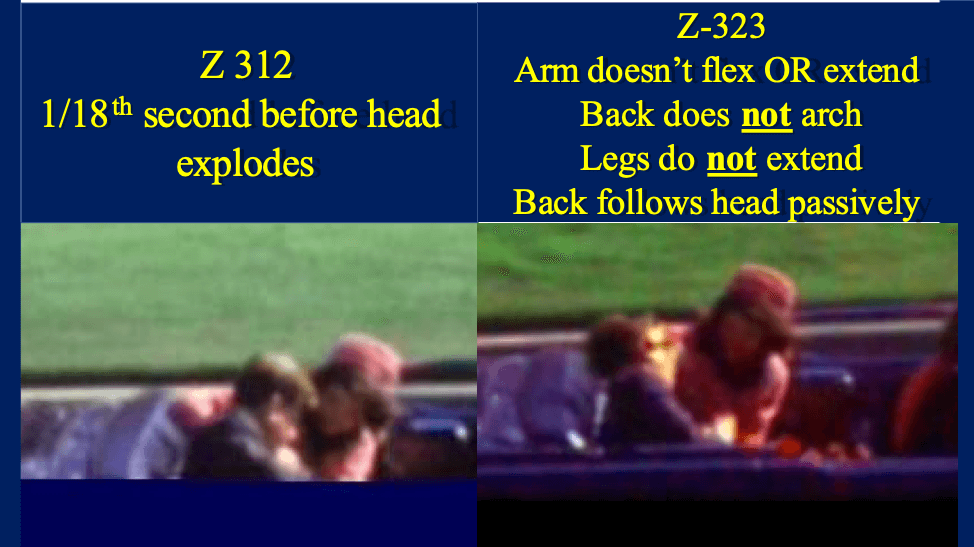
Figure 7. Image left, 1/18th second before his head explodes: JFK’s head is tilted forward and slightly to the left. Image right, ½ second after he’s hit, it is JFK’s head that has moved backward, not his back. Unlike “Decorticate” or “Decerebrate” neuromuscular reactions, JFK’s back does not arch; his legs do not extend, his upper arms do not adduct. Rather, his back follows his head passively. His right arm neither flexes nor extends, but instead falls limply to his side. Furthermore, were Kennedy’s posture truly a decorticate or decerebrate reaction of some sort, it’s likely he’d have maintained that backward-arched posture. He doesn’t.
In the Zapruder frames following frame 321, 4/9th seconds after the head shot, JFK bounces off the back seat of the limo and starts moving forward. His back then curls forward following his head, though at a slower speed than his head does. After frame 327, the advancing velocity of Kennedy’s head doubles from what it had been between frames 321 and 327, moving ahead at a faster clip than his head had rocketed rearward after the strike at 313. His back follows. Thus, Kennedy’s head and upper back not only “flexed” forward, when they should have been arching backward in decorticate or decerebrate spasm, his head also sped up, perhaps due to what Thompson has recently proposed: an acoustics matching, X-ray matching, second head shot striking JFK from behind at frame 327-8.[56] (see below)
While there is much more that could be said, the point here is that Nalli had no reason but the obvious one to trust Sturdivan, Haag, and Posner on this. None have the requisite training or background. Nor do they grasp the neurophysiological phenomena they’ve invoked to defend the government’s preferred scenario. Moreover, they have no answer to the science-based debunkings that have previously been published. But what they do have is an allegiance to the government’s preferences.
These are things Nalli would have known about “neuromuscular reaction” had he but followed standard scientific protocol and done a proper literature review prior to writing. If he had, he’d have addressed the AFTE piece Wecht and I wrote, the very one he cited in his own footnotes. That piece explored “neurospasm” in detail, with hot-linked footnotes to credible sources.[57] Instead, he ignored the science to stand with his cherry-picked, anti-conspiracy nonexperts. And not only on Kennedy’s reaction to the head shot. He also did so in another scientific area of the Kennedy case: Neutron Activation Analysis (NAA), a sophisticated technology once said to be able to match recovered bullet fragments to the bullets they came from.
Neutron Activation Analysis and JFK
On this issue, Nalli turned yet again to his Zelig—“neurospasm expert” Larry Sturdivan—who was now masquerading as an authority in another area of science in which, at best, he holds the rank of discredited amateur.
In a junky, “peer reviewed” paper published in 2004, Sturdivan touted NAA as the Rosetta Stone: proof that all the bullets and fragments recovered from the assassination traced to but two rounds that had been firearms-matched to Oswald’s rifle.[58] Ergo, no one but Oswald could possibly have done it. That extraordinary, and seemingly dispositive, claim was first made to the House Select Committee on 8 September 1978 by NAA authority, Vincent Guinn, Ph.D.[59]
In his review of Last Second in Dallas, Nalli touts Guinn. He writes:
…that it was ‘highly probable’ that the fragments in Gov. Connally’s wrist were from the ‘stretcher bullet’ (CE399) found at Parkland Hospital and that the fragments from President Kennedy’s head were from the same bullet as the fragments found in the limousine, thereby providing strong evidence that only two bullets caused all the wounds.[60]
Besides Guinn’s testimony and Sturdivan’s paper, there is other “peer reviewed” literature that backs Nalli up on NAA, including a paper written by Kenneth Rahn with Larry Sturdivan as coauthor,[61] as well as “peer reviewed” papers written by Lucien Haag touting NAA and published in the AFTE Journal.[62]
(Nalli ignores that the government’s own evidence, and that of an FBI Agent, Bardwell Odum, have shown that the so-called “stretcher bullet” now in evidence—Warren Commission Exhibit #399—is not the same bullet that was found on a Parkland stretcher on 11/22/63. See “The Magic Bullet: Even More Magical Than We Knew?” by Aguilar and Thompson.[63])
But Nalli did allow that, “There has apparently been some degree of legitimate dispute about the NAA findings of Guinn. However, counterarguments have since been advanced from forensic experts such as Larry Sturdivan (cf. The JFK Myths) (sic) and Luke Haag. Lacking personal expertise, I shall remain, for the time being, agnostic on Guinn’s findings. Sturdivan and Haag are not to be easily dismissed…”
Nalli neither mentions nor alludes to what the “legitimate dispute” is all about, nor even who has disputed Guinn, Sturdivan, and Haag. He has a good, if ‘socially constructive,’ reason not to. It would be difficult to explain why untrained, uncredentialed, anti-conspiracy evangelistic “forensic experts,” Sturdivan and Haag, would also happen to have expertise on NAA that’s on par with their detractors who have, in fact, quite ‘easily dismissed’ Sturdivan and Haag (as well as Kenneth Rahn, Ph.D., Sturdivan’s coauthor).
The ‘legitimate disputants’ Nalli didn’t think worth mentioning include the FBI’s National Laboratory, which abandoned the use of NAA to match bullets and fragments in 2005 because of its serious deficiencies;[64] two “conspiracy agnostic,” nationally recognized NAA authorities from Lawrence Livermore National Lab, Eric Randich, Ph.D. and Pat Grant, Ph.D, who debunked Guinn’s JFK claims in the prestigious Journal of Forensic Sciences[65] (Grant had studied for his Ph.D. under Guinn, among others, at UC Irvine, and bore him no malice.[66]), a distinguished professor of statistics at Texas A&M University, Clifford Spiegelman, Ph.D. and his coauthor, FBI chief lab examiner William Tobin, who, among other things, eviscerated the flawed statistical analysis the non-statistician, Sturdivan, had published supporting NAA,[67] and others.[68]
Furthermore, Nalli had every good reason to know of these inconvenient “alternative” facts. They’ve attracted considerable interest among assassination students, and they are easily found by a google search.[69] Moreover, they were explored in extenso in a piece I wrote with coauthor Wecht that Nalli cites in his footnote #58. That article included a detailed discussion of the collapse of NAA in bullet matching studies, both in the Kennedy case and elsewhere. It also provided the citations found here, with hotlinks to the peer reviewed papers and the source documents themselves.[70]
Moreover, Nalli fails to mention that neither Sturdivan nor Haag have any primary expertise in NAA. They have no applicable training or background, and no credible NAA research, apart from Sturdivan’s debunked statistical analysis that was demolished, without refutation, by the statistics professor at Texas A&M, by the NAA authorities at Lawrence Livermore Lab,[71] and by Stanford Linear Accelerator physicist, Arthur Snyder, Ph.D.[72]
For Nalli to put lightweights Sturdivan and Haag on one side of the NAA scale, and these heavy-weight ‘legitimate disputants’ on the other, and say he sees an even balance is exactly the kind of anti-science, cherry picking that skeptics have learned to expect from pro-Warren “experts.” But the irony doesn’t end there.
Referring to Thompson’s showcasing the work of the internationally recognized acoustics authority, James Barger, Nalli sniffed that “Thompson has no problem ‘appealing to authority’ when it suits him.” Barger, of course, is an actual internationally renowned authority to whom one may perfectly appropriately “appeal.” Nalli’s sources, not so much. He knowingly ignored credentialed, legitimate, published authorities, but had ‘no problem appealing to the authority’ of anti-conspiracy nonexperts who have fed him the discredited “science” he wants. Would that be the worst of Nalli’s problems. It’s not. His preposterous presuppositions are far worse.
Nicholas Nalli’s Calculations Prove JFK Had an Extraordinary Brain
One of Nalli’s sillier affronts to science has to do with the core of his anti-conspiracy case: how he explains physics of Kennedy’s jet recoil. After autopsy, JFK’s brain weighed 1500 grams. (Oddly the brain was not weighed during autopsy.) Nalli calculated that it must have weighed much more when he was struck, 2100 grams in fact. Why? Because his “physics based,” jet effect computations proved that a forward-jetting mass of 600 grams was physically required to give the propulsion necessary to drive Kennedy’s head rearward as fast as we see in the Zapruder film. Pure codswollop.
What Nalli could have easily discovered in a 30-second google search, and what any legitimate “peer reviewer” would have told him, is that human brains simply don’t weigh anywhere near that much. Rather, it’s an unusual complete and undamaged brain at autopsy that even weighs as much as 1500 grams. The average weight being between 1250 grams and 1400 grams.[73] Nalli’s 2,100 gm brain “has been the cause of much merriment among the knowledgeable.” WhoWhatWhy researcher Milicent Cranor quipped, “It’s what publishers call a ‘howler.’”[74] Researcher David Mantik, MD, Ph.D. (physics) emphasized this as but one of Nalli’s myriad “Omissions and Miscalculations.”[75]
Six months after Nalli’s paper came out, he put out a correction. “[I]t has also come to the author’s attention,” he wrote, “that the estimate used for President Kennedy’s ‘intact’ brain mass (2100 g) … was most likely too large, falling well outside of the normal range (probably more than 3σ) for human males; this is not an error per se, but rather simply an oversight.”[76] (our emphasis) “Most likely too large?” Ok. Not an error, “simply an oversight?” Ok again. But it wasn’t only Nalli’s “oversight,” it was also his “peer reviewers’” too. Did no one bother to google for even 30 seconds to check if one of Nalli’s core suppositions—JFK’s premortem brain weight—had any basis in reality?
Unfazed, he reran calculations based on three new, hypothetical premortem brain weights: 1800 gm, 1650 gm, and 1500 gm. To get the requisite rearward thrust with these lower brain weights, Nalli simply upped the exit speeds at which he presumed the escaping brain mass must have jetted. The idea being that if a lower mass escaped at a higher velocity, it’d produce the same “jet effect” as a larger mass exiting at a lower speed. “These corrections,” he wrote, “do not affect any of the conclusions presented in the paper.” Jaw dropping.
First, as previously noted, although not as extreme as 2100 grams, both 1800 grams and 1650 grams are also well beyond the range of a normal, complete adult human brain, both in the medical literature, as well as in the personal experience of coauthor Wecht, a forensic pathologist with over 40,000 autopsies under his belt. They might remotely be possible, but only if Kennedy had a very large cranium. As David Mantik pointed out, JFK’s head wasn’t particularly large; his hat size was average (7 3/8).[77]
So then, how about Nalli’s third supposition, that Kennedy’s premortem brain might have weighed as little as 1500 grams? It was as preposterous as it was unsurprising that Nalli seriously proposed that Kennedy’s brain could still have weighed what it did before it was blasted, before much of it was blown all over the limousine, its occupants, the Secret Service agents, the motorcycle cops to JFK’s left and rear, all over Dealey Plaza, and even after Jackie had handed “a big chunk of the President’s brain” to Parkland’s treating anesthesiologist, Professor Marion T. (“Pepper”) Jenkins, MD.[78] We struggle to think of a clearer example of a “scientist” forcing evidence to fit his pet theory. Science is supposed to work by finding a theory that explains the evidence.
(Outside the scope of this essay is the important question of how Kennedy’s severely blasted brain could turn up at autopsy weighing 1500 grams, which is more than an average, complete human brain. ARRB investigator Douglas Horne has suggested that two different “JFK” brains were examined during two different “supplemental” exams that were done at different times after the original autopsy. Some readers will shy from such a daring, “conspiratorial” assertion. However, can there be any doubt but that what remained of Kennedy’s actual brain didn’t weigh 1500 gms when it was pulled from his cranium? This important and fascinating issue is explored elsewhere.[79],[80])
How Peer Reviewed Medical/Scientific Journalism is Corrupted in the Kennedy Case
That so much pro-government nonsense got through peer review and into a scientific journal will come as no surprise to most Warren skeptics. It’s happened often. The mechanics of how this likely happened in Nalli’s case is an important and fascinating story, one that has clear traces to Nalli’s major source and most lauded collaborator, Larry Sturdivan.
After reading Nalli’s paper in Heliyon, it occurred to us that we might try to publish one in that journal ourselves. We wrote one and put our submission through Heliyon’s required on-line portal, a now-standard process among scientific journals. After uploading it to the site, one of us (GA) followed Heliyon’s prompts to complete the process. Immediately the following asks from Heliyon popped up. GA stared at them in amazement and delight—Heliyon isn’t a real peer reviewed, scientific journal; it’s a pay-to-publish vanity journal!
Prompt #1: Please suggest potential reviewers for this submission and provide specific reasons for your suggestion in the comments box for each person. Please note that the editorial office may not use your suggestions, but your help is appreciated and may speed up the selection of appropriate reviewers. Fill in as much contact information, ideally including a link to their Google Scholar, Scopus or institutional webpage to allow us identify the person correctly. Please avoid suggestions who have a conflict of interest, such as colleagues, collaborators, co-authors (shared publications in the last three years) or people with whom you share funding.
“Current Suggested Reviewers List” Add Suggested Reviewer
Prompt #2: Please identify anyone you would prefer not to review this submission. Fill in as much contact information to allow us to identify the person in our records, and provide specific reasons why each person should not review your submission in their comments box. Please note that we may need to use a reviewer you identify here, but will try to accommodate author’s wishes when we can. If you have additional concerns about this issue please indicate them in your cover letter.
“Currently Opposed Reviewers List”
Prompt #3: Article Publishing Charge. Heliyon is a fully Open Access journal. The journal’s costs are covered solely by author publication charges. There are no subscription fees for our readers, or page and figure charges for our authors. Accordingly, all authors of accepted articles will receive an invoice charging the article publication fee of $1,750 USD (plus VAT and local taxes where applicable).
The journal explained its financial demand: “Heliyon has a small budget for reducing Open Access charges for authors in developing countries and others in genuine financial hardship…”
Since Nalli doesn’t live in a developing country, nor is it likely he faces “genuine financial hardship,” it’s a safe bet that Nalli paid to have his work published, or that someone else paid for him. Given his whopping errors, it’s likely that Heliyon didn’t send it to knowledgeable, independent experts, but that Nalli picked them. And it was probably Nalli who specified whom he didn’t want reviewing it. Heliyon’s requirements prompted us to check Nalli’s acknowledgements.
“First and foremost,” he wrote, “I am grateful to Larry M. Sturdivan (wound ballistics expert for the HSCA) (sic) for very helpful discussions pertaining to his previous work as well as for reviewing my initial drafts and providing expert feedback…I am also grateful for the critical reading and constructive professional feedback of the three anonymous peer-reviewers.” (our emphasis)
“Anonymous peer-reviewers”? Not likely, given that Heliyon explicitly asks authors to suggest the reviewers they want. Nalli’s published rubbish proves precisely why peer review by knowledgeable, independent, anonymous reviewers is so important. Nalli’s reviewers were almost certainly uninformed, incurious, anti-conspiracy advocates. As one of us (GA) pondered this discovery, he had a déjà vu moment.
Nalli’s charade bears a striking resemblance to an analogous episode in 2003 and 2004, in which Sturdivan had played a similar, behind-the-scenes role. In that case, Sturdivan hornswoggled a respected, legitimate “peer review” journal, Neurosurgery, into letting him collaborate with, and “peer review,” error-ridden, pro-Warren Commission work that the hapless journal editors published. It’s a fascinating tale, one that embarrassed both the journal and a respected University of California, San Diego neurosurgery professor who was left holding the bag. It also hints at a pattern: anti-conspiracists publishing under the respected mantle of “peer reviewed” scientific journalism, while violating the principles that have earned the “peer review” process deserved admiration.
see Part 2
[1] Aguilar G. Cunningham, K. “How Five Investigations into JFK’s Medical/Autopsy Evidence Got It Wrong.” May, 2003. Available here.
Cyril Wecht, MD, JD. New York Times, 6/12/1975. “Doctor Says Rockefeller Panel Distorted His View on Kennedy.” Available here.
[2] Alvarez L, “A Physicist Examines the Kennedy Assassination Film,” American Journal of Physics, Vol. 44, No. 9, September, 1976. Available here.
[3] Cranor, M. “Scientist’s Trick ‘Explains’ JFK Backward Movement When Shot.” Available here.
[4] “When was the Zapruder film first shown to the American people?” Available here.
[5] Alvarez L, “A Physicist Examines the Kennedy Assassination Film,” American Journal of Physics, Vol. 44, No. 9, p. 819, September, 1976. Available here.
[6] Alvarez L, “A Physicist Examines the Kennedy Assassination Film,” American Journal of Physics, Vol. 44, No. 9, September, 1976. Available here.
[7] Lattimer JK, Lattimer JK, et al. “Differences in the Wounding Behavior of the Two Bullets that Struck President Kennedy; An Experimental Study,” Wound Ballistics Review, V2(2)361995. Available here.
[8] Nalli, Nicholas. Gunshot-wound dynamics model for John F. Kennedy assassination. Heliyon. Vol. 4, No. 4, e00603, April 01, 2018. Available here.
[9] Lattimer JK, Lattimer J, Lattimer G. “An Experimental Study of the Backward Movement of President Kennedy’s Head,” Surgery, Gynecology & Obstetrics. February, 1976, Vol. 142, pp. 246–254. Available here.
[10] Lattimer, J. Kennedy and Lincoln. New York: Harcourt, Brace, Jovanovich, 1980, p. 250.
[11] Lattimer JK, Lattimer J, Lattimer G. “An Experimental Study of the Backward Movement of President Kennedy’s Head,” Surgery, Gynecology & Obstetrics. February, 1976, Vol. 142, pp. 246–254. Available here.
[12] Josiah Thompson, Ph.D. gave a public lecture in October, 2013 and projected images from Alvarez’s shooting tests. Wecht Center Symposium on the 50th Anniversary of the Assassination of President Kennedy Available here.
[13] Aguilar G. Wecht CH. AFTE Journal, Vol. 48, No 2, Spring 2016, p. 712. Available here.
[14] Nalli, N. “The Ghost of the Grassy Knoll Gunman and the Futile Search for Signal in Noise,” a review of J. Thompson’s book, “Last Second in Dallas,” 6.3.21. Available here.
[15] Nalli, N R. “The Ghost of the Grassy Knoll Gunman and the Futile Search for Signal in Noise,” a review of J. Thompson’s book “Last Second in Dallas” published on 6/3/21. Available here.
[16] Donald Byron Thomas, Hear No Evil – Social Constructivism & Forensic Evidence in the Kennedy Assassination. Ipswich, MA. Mary Ferrell Foundation Press, 2010
[17] Thompson, Josiah, Last Second in Dallas. Lawrence, Kansas. University Press of Kansas, 2021, pp. 281–284.
[18] * The Vela Incident – Nuclear Test or Meteoroid? National Security Archive. Available here.
* A good summary of government evidence proving a nuclear blast in the Vela Incident is available in: Report on the 1979 Vela Incident. Available here. [“(Investigative journalist Seymour) Hersh reports interviewing several members of the Nuclear Intelligence Panel (NIP), which had conducted their own investigation of the event. Those interviewed included its leader Donald M. Kerr, Jr. and eminent nuclear weapons program veteran Harold M. Agnew. The NIP members concluded unanimously that it was a definite nuclear test. Another member—Louis H. Roddis, Jr.—concluded that ‘the South African-Israeli test had taken place on a barge, or on one of the islands in the South Indian Ocean archipelago.’” [Hersh 1991; pg. 280-281. Available here.] He also cited internal CIA estimates made in 1979 and 1980 which concluded that it had been a nuclear test.
“The U.S. Naval Research Laboratory conducted a comprehensive analysis, including the hydroacoustic data, and issued a 300-page report concluding that there had been a nuclear event near Prince Edward Island or Antarctica [Albright 1994b].”
[19] Alvarez L, “A Physicist Examines the Kennedy Assassination Film, American Journal of Physics Vol. 44, No. 9, p. 817. September, 1976. Available here.
[20] “The speed of sound, known as Mach 1, varies depending on the medium through which a sound wave propagates. In dry, sea level air that is around 25 degrees Celsius, Mach 1 is equal to 340.29 meters per second, or 1,122.96 feet per second.” Available here.
[21] Robert C. Maher. “Summary of Gun Shot Acoustics,” Montana State University 4 April 2006. “A supersonic bullet causes a characteristic shock wave pattern as it moves through the air. The shock wave expands as a cone behind the bullet, with the wave front propagating outward at the speed of sound.” Available here.
[22] Don Thomas. Hear No Evil. Ipswich, MA. Mary Ferrell Foundation Press, 2010, pp. 362–363.
[23] Dr. John Lattimer fired at human skulls from above and behind with a rifle and ammunition identical to those Oswald used. Clicking on the image at right will download a video clip of one of Lattimer’s shooting experiments. Note that the ladder rocks forward after bullet impact, reflecting the forward momentum transfer.
[24] Lattimer JK, Lattimer J, Lattimer G. “An Experimental Study of the Backward Movement of President Kennedy’s Head,” Surgery, Gynecology & Obstetrics. February, 1976, Vol. 142, pp. 246–254. Available here.
[25] The Journal of Irreproducible Results 1980-2003. Available here.
[26] Haag, L. “President Kennedy’s Fatal Head Wound and his Rearward Head ‘Snap,’” AFTE Journal, Vol. 46, No. 4, Fall 2014, p. 283; see Figure 8
[27] Haag, L. President Kennedy’s Fatal Gunshot Wound and the Seemingly Anomalous Behavior of the Fatal Bullet. AFTE Journal, Vol. 46, No. 3, Summer 2014, p. 218ff.
[28] John Nichols, MD shooting experiments, accessed at Baylor University. Available here.
[29] Sturdivan LM. HSCA testimony, Vol.1:404. Available here.
[30] Sturdivan LM. The JFK Myths. St. Paul, MN: Paragon House, 2005, p. 164.
[31] Sturdivan LM. The JFK Myths. St. Paul, MN: Paragon House, 2005, p. 164.
[32] Sturdivan LM. The JFK Myths. St. Paul, MN: Paragon House, 2005, p. 162.
[33] Nalli, Nicholas. Gunshot-wound dynamics model for John F. Kennedy assassination. Heliyon. Vol. 4, No. 4, e00603, April 01, 2018. Available here.
[34] Sturdivan LM. The JFK Myths. St. Paul, MN: Paragon House, 2005, p. xxiii.
[35] Sturdivan LM. The JFK Myths. St. Paul, MN: Paragon House, 2005, p. 170.
[36] Sturdivan, L. Letter to the editor. AFTE Journal. 2015 Vol. 47, No. 3, p. 143.
[37] “Report to the President by the Commission on CIA Activities within the United States,” June, 1975. Available here.
[38] Hersh S M, “Huge C.I.A. Operation Reported in U.S. Against Antiwar Forces, Other Dissidents in Nixon Years,” New York Times, 12.22.74. Available here.
[39] Rockefeller Commission Report, Chapter 19, p. 257 ff. Available here.
[40] George Washington University’s National Security Archive documented that the Rockefeller Commission “ceded its independence to White House political operatives.” Available here.
[41] “Gerald Ford White House Altered Rockefeller Commission Report in 1975; Removed Section on CIA Assassination Plots,” National Security Archive. Available here.
[42] See: Aguilar G, Cunningham K. A detailed discussion and source documents are available on line at: “How Five Investigations into JFK’s Medical/Autopsy Evidence Got It Wrong,” Part IV. The Rockefeller Commission. Available here.
[43] Aguilar G, Cunningham K. “How Five Investigations into JFK’s Medical/Autopsy Evidence Got It Wrong,” Part IV. The Rockefeller Commission, 2003. Available here.
[44] Lattimer JK, Lattimer J, Lattimer G. “An experimental Study of the backward Movement of President Kennedy’s Head,” Surgery, Gynecology & Obstretics, Vol. 142, pp. 246–254. Feb, 1976. Available here.
[45] Rockefeller Commission Report chapter 19, p. 261–263. Available here.
[46] Aguilar G, Cunningham K. “How Five Investigations into JFK’s Medical/Autopsy Evidence Got It Wrong,” Part V. The ‘Last’ Investigation – The House Select Committee on Assassinations, 2003. Available here.
[47] HSCA, Vol. 7, p. 174. Available here.
[48] Zapruder frame 230. Available here.
[49] Zapruder frame 320. Available here.
[50] Sturdivan LM. The JFK Myths. St. Paul, MN: Paragon House, 2005, p. 170.
[51] Sturdivan L. HSCA testimony, p. 417. Available here.
[52] Rockefeller Commission Report, p. 262. Available here.
[53] Sturdivan, L M., “The JFK Myths: A Scientific Investigation of the Kennedy Assassination,” Paragon House, St. Paul, MD (2005), pp. 164, 166.
[54] Sturdivan L. HSCA testimony. Vol. 1, p. 415. Available here. [Full quote: “Now, the extreme radial velocity imported to the matter in the President’s head, the brain tissue, caused mechanical movement of essentially everything inside the skull, including where the cord went through the foramen magnum, that is, the hole that leads out of the skull down the spinal cord. Motion there, I believe, caused mechanical stimulation of the motor nerves of the President, and since all motor nerves were stimulated at the same time, then every muscle in the body would be activated at the same time. Now, in an arm, for instance, this would have activated the biceps muscle but it would have also activated the triceps muscle, which being more powerful, would have straightened the arm out. With leg muscles, the large muscles in the back of the leg, are more powerful than those in the front and, therefore, the leg would move backward. The muscles in the back of the trunk are much stronger than the abdominals and, therefore, the body would arch backward.”]
[55] “Larry Sturdivan Arched Dramatically Backwards.” Available here.
[56] Thompson J. Last Second in Dallas. Op. Cit.
[57] Nalli, Nicholas. Gunshot-wound dynamics model for John F. Kennedy assassination. Heliyon. V.4(4), e00603, April 01, 2018. Available here. See footnote #58 citing letter by G Aguilar, MD and C. Wecht, MD, JD. The actual letter, as published by the AFTE Journal. Available here.
[58] Sturdivan L, Rahn K. “Neutron Activation and the Kennedy Assassination – Part II, Extended Benefits.” Journal of Radioanalytical and Nuclear Chemistry, Vol. 262, No. 1 (2004), p. 221.
[59] Testimony of Dr. Vincent P. Guinn, Sept. 8, 1978, I HSCA-JFK hearings, 491ff. Available here.
[60] Nalli, N R. “The Ghost of the Grassy Knoll Gunman,” a review of J. Thompson’s book “Last Second in Dallas” published on-line, 6/3/21. Available here.
[61] * Rahn K, Studivan L. “Neutron activation and the JFK assassination Part I. Data and interpretation.” Journal of Radioanalytical and Nuclear Chemistry, Vol. 262, No. 1 (2004), pp. 205, 213.
* Sturdivan L, Rahn K. “Neutron Activation and the Kennedy Assassination – Part II, Extended Benefits.” Journal of Radioanalytical and Nuclear Chemistry, Vol. 262, No. 1 (2004), p. 221.
[62] *Haag L. “Tracking the ‘Magic’ Bullet in the JFK Assassination,” AFTE Journal, Vol. 46, No. 2, Spring 2014.
* Authors Aguilar and Wecht published a rebuttal to Haag’s defense of NAA in the AFTE Journal. Haag doubled down on his defense of NAA in a letter published by the AFTE Journal: Haag. L. “Author’s response to Doctors Aguilar and Wecht.” AFTE Journal, Vol. 47 No. 3 (Summer 2015), p. 139.
[64] “FBI Laboratory Announces Discontinuation of Bullet Lead Examinations,” September 1, 2005. FBI National
Press Office. Available here.
Possley, M., “Study shoots holes in bullet analyses by FBI,” Chicago Tribune, 2.11.2004
[65] * Erik Randich Ph.D., Patrick M. Grant Ph.D., Proper Assessment of the JFK Assassination Bullet Lead Evidence from Metallurgical and Statistical Perspectives. Journal of Forensic Sciences, V.51(4)717 ff.July 2006. Available here.
* Erik Randich 1 , Wayne Duerfeldt, Wade McLendon, William Tobin. A metallurgical review of the interpretation of bullet lead compositional analysis. Forensic Sci Int. 2002 Jul 17; 127(3), pp. 174–91.
[66] Pat Grant, Ph.D. “Commentary on Dr. Ken Rahn’s Work on the JFK Assassination Investigation.” Available here.
[67] Cliff Spiegelman, William A. Tobin, William D. James, Simon J. Sheather, Stuart Wexler and D. Max Roundhill. CHEMICAL AND FORENSIC ANALYSIS OF JFK ASSASSINATION BULLET LOTS: IS A SECOND SHOOTER POSSIBLE?
The Annals of Applied Statistics 2007, Vol. 1, No. 2, pp. 287–301. Available here.
[68] * Giannelli, Paul, “Comparative Bullet Lead Analysis: A Retrospective,” Case Western Reserve, Sept., 2001. Available here.
* William Tobin. “Comparative Bullet Lead Analysis: A Case Study in Flawed Forensics,” www.nacdl.org The Champion. Available here.
* Charles Pillar. “Report Finds Flaws in FBI Bullet Analysis.” Los Angeles Times, 2/4/2004. Available here.
[69] Cliff Spiegelman, Ph.D. “What new forensic science reveals about JFK assassination.” Salon.com, 12/12/2017. Available here.
See also: Pat Grant, Ph.D. (Lawrence Livermore Laboratory). Commentary on Dr. Ken Rahn’s (NAA) Work on the JFK Assassination Investigation. Available here.
[71] See Pat Grant’s evisceration of NAA defender, Ken Rahn. “Commentary on Dr. Ken Rahn’s Work on the JFK Assassination Investigation.” Available here.
[72] Arthur Snyder, Ph.D. Comments on the Statistical Analysis in Ken Rahn’s Essay: “Neutron-Activation Analysis and the John F. Kennedy Assassination.” Available here.
[73] Brain Facts and Figures. Available here.
[74] Cranor, Milicent. Scientist’s Trick ‘Explains’ JFK Backward Movement When Shot, 05/31/18. Available here.
[75] Mantik, D. The Omissions and Miscalculations of Nicholas Nalli. Available here.
[76] Nalli, N. Corrigendum to “Gunshot-wound dynamics model for John F. Kennedy assassination” [Heliyon 4 (2018) e00603], 10/1/2018. Available here.
[78] “JFK in Trauma Room One: The Missing Piece: Last Moments Before Death.” A YouTube video of Parkland Professor Marion T. Jenkins, MD discussing the assassination. This quote can be heard at and after the 5 minute, 25 second mark. Available here.
[79] Assassinations Records Review Board investigator, Doug Horne. “The Two Brain Memorandum.” Available here.
[80] See Doug Horne, “Questions Regarding Supplementary Brain Examination(s) Following the Autopsy on President John F. Kennedy.” ARRB Memorandum for file, 8/28/1996, revised 6.2.1998. Available here.