Tag: JFK ASSASSINATION
-
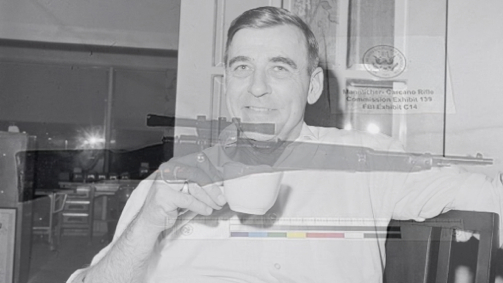
Walker, Oswald, and the Dog That Didn’t Bark
Part of the official JFK assassination lore is that, on the night of April 10, 1963, accused assassin Lee Harvey Oswald took a bus close to the Dallas Turtle Creek neighborhood of General Edwin A. Walker, then a nationally prominent right-wing political activist and armed himself with his Mannlicher-Carano rifle. Oswald then walked to behind the Walker residence, on a service road, a type of back-alley. Walker was seated motionless behind a desk inside his home and facing a large first-floor window. Resting his rifle on a latticed fence about 30 yards away, Oswald took a potshot at his target at 9 pm.
And missed. Entirely. The shot went over and wide of Walker’s head and into a wall. Walker, on surveying the latticed fence afterwards that evening with a lieutenant from the Dallas Police Department (DPD), remarked that the unknown would-be assassin was a “lousy shot.”
A police officer reviewing the layout and shooting that night replied, “He couldn’t have missed you.”
Official Version
The above official version then posits that Oswald, after shooting and missing Walker, then “buried” his rifle somewhere and rode a bus back home, where he nervously related to his wife Marina details of his expedition.
Importantly, also entered into the lore was that Oswald would have struck Walker, save for a windowpane that deflected his shot.
This legend reached something of a zenith in the federally-funded Smithsonian magazine article on 2013. That article not only casually assumed Oswald’s guilt in the assassination of President Kennedy, but then described the shot that missed Walker thusly:
Drawing a tight bead on Walker’s head, he (Oswald) pulls the trigger. An explosion hurtles through the night, a thunder that echoes to the alley, to the creek, to the church and the surrounding houses. Walker flinches instinctively at the loud blast and the sound of a wicked crack over his scalp—right inside his hair.[1]
Thus, in the recounted mythology, the shot that missed Walker actually passed through the hair on the general’s head.
The Dallas Morning News chimed-in in 2013 with a similar story—it was the 50th anniversary year of the JFK murder—that also blithely assumes Oswald’s guilt in both the Kennedy and Walker shootings and adds, “The bullet (fired at Walker) first hit the screen and then the wood frame between the upper and lower windowpanes. Its original path deflected, it passed just above Walker’s scalp.”[2]
In other words, only a windowpane deflected the Oswald bullet and saved Walker’s life.
In most regards, the popular-media version of the Walker shooting is actually the opposite of what really happened that night and is, perhaps unsurprisingly, another mythology regarding the JFK murder.
The Real Story
There are many reasons not to convict Oswald of either the Kennedy or Walker shootings in 1963. But first, let’s dispose of the dramatic media treatment of that night at General Walker’s and his close brush with death.
First, Walker, a military veteran who had commanded special forces in combat in World War II, far from feeling a bullet through his scalp, actually initially told investigating officers from the Dallas Police Department that he thought neighborhood kids had tossed a firecracker into to his den through an open window.
If that! For in a supplementary report filed on April 10, it was written that Walker “stated that when he heard the noise, he thought it was some sort of fireworks.” [3] Fireworks? Hearing fireworks is a far cry from the sensation of a bullet passing through one’s scalp. In truth, only after discovering and examining a bullet hole in the wall behind him, did Walker conclude he actually had been shot at—and so he related to the DPD.
Secondly, a review of Dallas Police Department documents from the night of April 10 reveals whoever shot at Walker that night would have missed even more widely, save for the deflection downwards of the windowpane.

Here is a photo of the Walker windowpane and the damage caused by the passing bullet. Obviously, the damage is on the lower edge of the crossbar of the wind plane and likely would have deflected the bullet lower.
And that is how the Dallas Police Department (DPD) saw it.
“Officers observed a bullet of unknown caliber, steel jacket, had been shot through the window, piercing the frame of the window and going into the wall above comp’s (Walker’s) head,” according to DPD report filed on April 10 (italics added).
The report continues, “The bullet struck the window frame near center locking device. From the point where the bullet hit the window frame to the point where it struck the wall is a downward trajectory.”
It is hard to escape the conclusion that whoever shot at Walker would have missed by even more, except for the deflection. The shooter missed Walker from a distance of about 30 yards, likely armed with a rifle resting on a fence for support.
In addition, careful readers will also note that that the DPD found a “steel jacket” slug at the scene of the Walker shooting. Assassination researchers know, of course, that Oswald’s Mannlicher-Carcano used copper-jacketed ammo, from the Western Cartridge Company.
One thing about police officers is that they tend to know guns and ammo and one might assume that the DPD assigned some of its better detectives to the Walker shooting, given his national prominence in 1963.
But after the Kennedy murder, the DPD sent the steel-jacketed bullet—stated in police reports to be a 30.06 calibre—to the FBI. The federal agents said the mangled Walker slug was actually a 6.5 projectile from the Western Cartridge Company and copper-jacketed. In other words, a Mannlicher-Carcano bullet.
In a more-innocent era, one might assume the DPD made a mistake—after all, mistakes happen. And the Walker bullet, in fact, was badly distorted after striking the windowpane and passing through a wall in the Walker residence.
But since the 1960s, the profoundly dismaying history of CE 399, the “Magic Bullet,” has been revealed: the famed nearly pristine dome-headed slug was almost certainly introduced into the evidentiary record within the FBI facilities in Washington. The curious “pointy head” slug found on the Parkland hospital hallway floor Nov. 22 has disappeared and almost certainly had nothing to do with the JFK murder anyway.[4]
So, with the true story of the Magic Bullet revealed, one reasonable concern is that the FBI also fabricated evidence in the Walker shooting, replacing a steel-jacketed projectile from Dallas with a copper-jacketed Winchester Cartridge 6.5 slug.
Unfortunately, the records do not reveal why the DPD detective had concluded the Walker slug was steel-jacketed. If the detective had placed the slug on his desk next to a magnet, perhaps he would have noticed the Walker bullet wiggle. (Worth noting, steel-jacketed bullets can be copper coated, the softer metal copper applied to decrease wear-and-tear on gun barrels). In any event, the Walker projectile was originally logged as a steel-jacketed 30.06 slug.
There is much more to that evening in April 1963; for example, outside Walker’s home at least two vehicles sped from the scene in the wake of the gunfire, as seen by multiple witnesses.
Two Cars Leave the Scene
Though hardly dispositive, an additional curiosity is that two automobiles were seen swiftly leaving the scene of the Walker shooting on April 10, in the immediate aftermath of gunfire.
Hearing the Walker gunshot, a youth named Kirk Coleman immediately thereafter peered over a fence and “saw a man getting into a 1949 or 1950 Ford, light green or light blue and take off,” according to DPD report filed on April 11.
“This was in the parking lot of the Church next to General Walker’s home. Also, on further down the parking lot was another car, unknown make or model and a man was in it. He had the dome light on and Kirk could see him bend over the front seat as if he was putting something in the back floorboard,” continued the report.
General Walker also told the Warren Commission he saw a car suddenly leave the area, in the immediate aftermath of the shooting.
Of course, Oswald is thought not to have had driving skills and certainly did not own a car. To be sure, the two cars could have left the Walker shooting scene suddenly as the sound of gunfire is disconcerting. But one might expect ordinary citizens hearing gunfire to report as much to police, yet the men in the vehicles have simply disappeared into that night, and evidently forever. No one has ever come forward and said they were innocent bystanders who drove away quickly on the night of the Walker shooting.
So, perhaps the departing vehicles held Oswald and compatriots.
The Dog That Did Not Bark
A Walker neighbor’s dog, known as an active barker, was conveniently ill and silenced that evening.
“The neighbor’s dog to the east of the Walker property is a fanatical barker, but on this incidence did not make a sound,” according to an April 12 DPD report.
Concerning the dog, a neighbor told the DPD that, “Dr. Ruth Jackson, who lives next door to the General, has a dog that barks at everybody and everything. The night that this offense occurred Dr. Jackson’s dog did not bark at suspects. Investigating officers received further information…that Dr. Jackson’s dog was very sick yesterday [the date of shooting] and is also sick today. Reason for this illness is unknown at this time.” (emphasis added)
Again, the report of conveniently sick dog is hardly dispositive. But if the dog was intentionally poisoned, it suggests an operation involving more than a lone nut who did not own a car.[5]
The Walker Backyard Photo and Other Evidence
And of course, one of the curiosities of the JFKA is the backyard black-and-white photo of Walker’s house, purportedly found in Oswald’s possessions after the JFK murder, featuring the infamous two-tone 1957 Chevrolet with its license plate mysteriously cut out.
If the photo was truly in Oswald’s possession, it is certainly suggestive.
In addition, Oswald’s wife, Marina, recounted discussions with her husband regarding the Walker shooting, although her testimony in the wake of the JFK assassination was regarded as unreliable, even by Warren Commission staff. In fact, Marina’s statements and testimony on nearly every topic, made under great duress, vacillated wildly on a daily basis.
Finally, there is also the “Walker letter,” an unsigned page written in pencil and in the Russian language. The undated letter gives instructions to Marina concerning paying bills, a post office box, disposition of Oswald’s personal belongings, and where Oswald could be located in the event of his arrest. The letter is said to have been written shortly before the Walker shooting, though its origins are disputed.
None of the above evidence is enough to convict Oswald, even if it is “real” and not fabricated. But assuming the evidence in Oswald’s possession is not planted, there is a strong suggestion that Oswald participated in the Walker shooting.
An Explanation of the Walker Shooting
The Warren Commission presented the Walker shooting as another version of Oswald as the leftie-loser-loner nut acting out a demented fantasy. Even the House Select Committee on Assassinations did little with the topic.[6]
But for the purpose of this article, the Warren Commission treatment of Walker shooting is the interesting part.
In truth, whoever shot at Walker either—
- Was a lousy shot, to put it mildly
- Intended to miss
- Had faulty firearms
- Possibly had compatriots
None of above surfaces in the Warren Commission treatment of the Walker shooting.
Indeed, the version that the “windowpane deflection likely saved Walker” is allowed to survive unchallenged in the Warren Commission version of events and grew in mass media literature over the years, as seen in the above quotes from the Smithsonian and Dallas Morning News.
A Better Explanation
My own interpretation is that Oswald was possibly the gunman who fired in the direction of Walker in April 1963, but that he had accomplices (hence the cars racing from the scene), he did not use a Mannlicher-Carcano rifle (hence the steel-jacketed bullet), and missed intentionally.
But why such an exercise?
Based on the research of scholar John Newman and HSCA investigator Dan Hardway, Oswald was an asset of sorts for US intelligence agencies, not exactly rare in the early 1960s, when the CIA literally had thousands of such individuals in the US or nearby as part of expansive anti-Fidel Castro efforts.
Oswald, contend Hardway and Newman, was being primed for something, possibly for the JFK assassination or another event that could be blamed on Castro or pro-Castro types.
It is my speculation that the Walker escapade was part of an Oswald biography-building exercise and to practice and test Oswald’s nerve for an intentionally unsuccessful assassination attempt of a prominent figure—such as President Kennedy—an attempt that could then be blamed on Castro.
If Oswald could be made the patsy in such an event, such as the JFKA, the fallout could justify a major operation against the Cuban leader.
If the Walker shooting was a test of Oswald, then evidently he passed.
[1] Shultz, Colin “Before JFK, Lee Harvey Oswald Tried to Kill an Army Major General,” Smithsonian Magazine, October 4, 2013.
[2] Peppard, Alan, “Before gunning for JFK, Oswald targeted ex-Gen. Edwin A. Walker — and missed,” The Dallas Morning News, November 19, 2018.
[3] “CE 2001 – Dallas Police Department file on the attempted killing of Gen. Edwin A. Walker,” Warren Commission, Volume XIV, (CD 81.1b).
[4] Aguilar, Gary and Thompson, Josiah, “The Magic Bullet: Even More Magical Than We Knew?,” History Matters.
[5] All police reports are found in Warren Commission Exhibit 2001.
[6] “The Attempt on the Life of Maj. Gen. Edwin A. Walker,” Warren Report, p. 284.
-
Doug Horne Replies: On Oswald’s Earnings
Here is what I can tell you. Please read most carefully and do not misquote me or even unintentionally misrepresent any of this information. Be most precise, I implore you.
On September 18, 1997, I reviewed the payment records from both the TSBD and the USMC to Oswald, within the earnings records of the Social Security Administration. Roy Truly was not on the SSA name list of persons paid by the TSBD during the fourth quarter of 1963 (Oct-Dec 63). (I have no idea who was paying Truly; but clearly, on the day of the assassination, he was still acting as LHO’s supervisor, per his encounter of LHO with cop Marion Baker on the TSBD second floor.)
The Marine Corps did NOT pay Oswald during the third quarter of 1959 (July 1–Sept 11, 1959). The specialist at the SSA told me that while Lee Harvey Oswald was IN the Marine Corps during the third quarter of 1959 (until September 11th, his discharge date), they definitely did not PAY HIM during the third quarter. I reviewed the printed records of the earnings he received from the USMC for that year—which had been stored on microfilm—and it was ZERO for the third quarter, whereas they did pay him for the first and second quarters of 1959. The ARRB’s contact at SSA said there was “no possibility of a mistake” in their records. I printed all of the microfilm records I reviewed on paper and took them back to the ARRB as assassination records.
Now, as you know, Blakey wrote the draft JFK Act legislation. In it, he exempted both the autopsy materials (“All Deed of Gift” materials donated to the Archives) and “tax information” from the disclosure requirements of the Act. The IRS actually wanted all tax information on Oswald to be subject to the Act and to be released; Congress, erring on the side of privacy (like Blakey), refused to allow this in the Act. That is most unfortunate, because at this juncture, these detailed records that I reviewed can only be released if Section 6103 of the IRS Code is amended to permit their release.
The Oswald earnings records I reviewed are covered by RIFs 137-10005-10060 through10089, inclusive. They are redacted unless or until Section 6103 of the IRS code is amended by Congress to permit all “tax information” (which definition includes not only tax returns, but also earnings records) to be released.
I published a memo about all this on September 23, 1998, and all tax information and earnings records issues I was aware of are discussed therein. Its title was: “Questions Raised by John Armstrong and Carol Hewitt About Lee Harvey Oswald’s Tax and Earnings Records.” In that memo, all specifics about the microfilm records of LHO’s earnings that I reviewed on September 18, 1997, are REDACTED. The redactions cannot be unredacted unless or until Section 6103 of the IRS Code is amended by Congress to allow release of all “tax information” on LHO, Jack Ruby, and others identified by ARRB RIFs. (We looked at “tax information” for others besides LHO and they are all identified by RIFs, and all the details are redacted).
Now, listen to this: in a Feb 3, 1964, letter to J. Lee Rankin from HEW, the Warren Commission was told that there were NO EARNINGS REPORTED for Oswald for the third quarter of 1959. This was initially withheld from the public for the standard privacy reasons surrounding “tax information,” but in 1965, the confidentiality classification for this information was removed by the USG. (See enclosure 13 to my long memo) That information passed to the Warren Commission in Feb 1964 is in CD 353 (the cover letter) and 353a (the specifics about when he earned money and from whom).
Thus, when reviewing Oswald’s earnings records from the Marine Corps in September of 1997, I was simply confirming (by viewing the dollars and cents details) what the Warren Commission had been told by HEW in the Feb 3, 1964, letter, and for which the confidentiality had been removed in 1965. This means that in my oral statements in the documentary, I am simply confirming information that the WC learned about in Feb 1964, and which became open information in 1965 when the USG lifted its confidentiality.
To obtain the unredacted version of my long research memo, and to get the RIFs about Oswald’s earnings opened up, Section 6103 of the IRS Code would have to be amended. I do not today have the paper copies of the earnings records. Only the Archives has those, as identified above by RIF numbers.
Now, some of Oswald’s “tax information” is already open information, including his 1959 tax return, which shows his total earnings for 1959 to be $996.31 for that year. This would seem to indicate that SOMEONE paid him during the third quarter (because his earnings for quarters 1 and 2 are not that much money), but whichever entity paid him did not pay him very much, at all. SPECULATION: Perhaps it was what would have been his normal USMC salary, IN CASH???
The Review Board recommended in its Final Report “…that Congress enact legislation exempting Lee Harvey Oswald’s tax return information, Oswald’s employment information obtained by the Social Security Administration, and other tax or IRS related information in the files of the Warren Commission and HSCA from the protection afforded by the Section 6103 of the Internal Revenue Code, and that such legislation direct that these records be released to the public in the JFK Collection.”
That is all I am willing, or able, to say about this.
In summary, I simply confirmed in my interview for your documentary that what the Warren Commission was told in Feb 1964—that Oswald had no reported earnings in the third quarter of 1959—was confirmed by me through careful examination of the microfilmed paper earnings records at SSA. For someone to actually view and review those records identified by RIF number above, the IRS Code would have to be amended.
That is all I can say.
Doug Horne
-

Bob Buzzanco: Chomsky’s “Useful Idiot”
Robert Buzzanco is a history professor at the University of Houston. He is also a co-host—along with Scott Parkin—of a podcast called Green and Red. On January 12, 2022, Buzzanco had the 94-year-old Noam Chomsky—looking every year of his age—on his show to reply to the treatment of Vietnam in Oliver Stone’s documentary JFK Revisited: Through the Looking Glass. Chomsky could not help but make some general comments about Kennedy. In this regard, the linguist was his usual pompous and somewhat ludicrous self. At one point, he compared President Kennedy to Ronald Reagan and Donald Trump. If Chomsky can show us where either of the latter supported Medicare, universal healthcare, and equal rights for African Americans in the sixties, I would be curious to read about it, because Kennedy did all three. The program then slipped into Rocky Horror Picture Show low camp: Chomsky tried to parallel Kennedy’s success to the conditions existing in Germany in the twenties. I wish I was kidding, but I’m not. The only way there is any resemblance is that the assassinations of that decade—JFK, Malcolm X, King and Robert Kennedy—led to the election of Richard Nixon, the premature end of an era of hope and aspiration, and a continuance of the war in Vietnam. I wish I could add that Buzzanco pointed out these absurd exaggerations. He didn’t. (For more on Chomsky, click here and here)
As the program went on, it became clear that Chomsky and Buzzanco had done zero research on the new evidence about the subject of Vietnam adduced by the Assassination Records Review Board (ARRB) and presented in JFK Revisited. The pair was largely relying on what Chomsky had written, if you can believe it, back in the nineties in response to Stone’s film JFK. The pair actually ended up being worse than the MSM on the subject.
How? Because back in December of 1997, the Board declassified the records of the May 1963, SecDef meeting in Hawaii. This was a regular meeting that Secretary of Defense Robert McNamara had with representatives of each branch of the American government in Saigon: State, CIA, Pentagon, etc. Those declassified documents were so direct and compelling they convinced the New York Times and Philadelphia Inquirer that, at the time of his death, Kennedy was getting out of Vietnam. (Probe Magazine, Vol. 5 No. 3, p. 19) It should be noted that the NY Times story was written by MSM stalwart Tim Wiener. But yet, Chomsky was still using his old excuse that Kennedy was only getting out if Saigon was winning. This was ridiculously illogical back in the nineties, because, as John Newman pointed out in his book JFK and Vietnam, Kennedy understood that the Pentagon was rigging their numbers in order to make it appear Saigon was winning. Newman demonstrates this awareness in the book. He even named the two men who cooked the books: General Paul Harkins and Air Force Colonel Joseph Winterbottom. (pp. 185–245, 2017 edition)
The thesis of Newman’s book is that Kennedy was going to use this optimistic information to hoist the Pentagon on their own petard. Revealing on this point is that Kennedy told McGeorge Bundy’s assistant Michael Forrestal that America had about a hundred to one chance of winning in Vietnam. He then said that when he returned from Dallas:
I want to start a complete and very profound review of how we got into this country, what we thought we were doing, and what we now think we can do. I even want to think about whether or not we should be there. (James Douglass, JFK and the Unspeakable, p. 183)
The other point that is important in this regard is that, after it became clear what JFK was doing—and also what the new president wanted—the intelligence reports began to change. They now became pessimistic and also backdated to early November, and even before. (Click here; see also The Third Decade Vol. 9 No. 6 pp. 8–10; Newman, 2017 edition, p. 438)
Is not the point made with those two pieces of data? In fact, as historian Aaron Good has stated, when one combines the evidence, this “profound review” suggests the genesis of the Pentagon Papers. By 1967, it was fairly clear that President Johnson’s escalation and direct intervention was not going to work. Robert McNamara was still Secretary of Defense. Realizing that Johnson’s strategy of air and infantry escalation had failed, he had become quite emotionally disturbed. In 1966, fearing he was going to be attacked at Harvard, he escaped a hostile crowd through a tunnel. His son had draped a Viet Cong flag across his bedroom. He would rage against the war’s futility and then turn to the window and literally cry into the curtains. As his secretary said, that happened frequently. (Steve Sheinkin, Most Dangerous, p. 98, p. 121, p. 126) It’s a logical deduction that McNamara realized what had happened between Kennedy and Johnson and he was now expiating his guilt by exposing the secret history of the war through the Pentagon Papers, which is likely why he kept this 18-month effort a secret from Johnson. And he had no objection to Daniel Ellsberg giving the papers to, first, the New York Times and, then, the Washington Post.
In fact, in JFK Revisited: Through the Looking Glass, Stone plays a tape from February of 1964 in which Johnson admits that Secretary of Defense Robert McNamara was implementing Kennedy’s withdrawal policy. Johnson states that he knew this and he stewed in silence, because as Vice President he could not do anything about it, at least at that time. Somehow both Chomsky and Buzzanco missed this.
But that is not what I really wish to address here. On that podcast, near the end, Buzzanco implies that somehow, there was no information in the documentary about Lee Harvey Oswald that was not in the House Select Committee on Assassinations (HSCA) volumes. I could barely believe what I was hearing, but I really think he meant it. If that is so, then Buzzanco:
- Could not have read the HSCA volumes
- Did not pay any attention at all to the documentary.
This from a man who pontificates to the listener that he knows what he is talking about and can be trusted to set the record straight.
One will search in vain through the 12 volumes of the HSCA for any annex on Oswald’s relationship with the CIA and/or FBI at any time in his career. In the film, we have John Newman and Jeff Morley talking about this issue. To mention just four things they brought up that are not in those volumes:
- That the liaison for the HSCA with the CIA also secretly handled the Cuban exile who tried to frame Oswald after the assassination for killing Kennedy for Cuba.
- That the FBI scraped off the address of 544 Camp Street from the Oswald flyers before they were sent to HQ. That address housed the offices of Guy Banister and also the CIA-backed Cuban Revolutionary Council.
- The FBI took Oswald’s flash warning off his file in the first week of October 1963. This meant the Secret Service was unlikely to remove him from the motorcade route. That warning had been on the file for 4 years prior.
- A similar thing occurred at CIA, in order to lower Oswald’s profile in advance of the assassination.
In fact, one will only see the last point in the so called Lopez Report. This was the HSCA’s classified report on Oswald and Mexico City, which was only released by the ARRB, a body which Buzzanco refers to only in passing, discounting it as he does. The middle two points were also only discovered as a result of that Board’s work. So just what is Buzzanco talking about in regards to the HSCA? He clearly has not done his homework on the subject.
In fact, the only systematic, direct work done on Oswald and the CIA by the HSCA was not declassified until after the Board went out of existence. This was in 2005. I am referring to the scintillating work of HSCA researcher Betsy Wolf and it was discovered by British researcher Malcolm Blunt. (I would like Buzzanco to prove to me he knew of either person before he opened up his mouth on the subject.) Back in 1977–78, Wolf was the main HSCA researcher on the Oswald file at CIA. She discovered that there were two odd things about this file. First, there was no 201 file opened on Oswald for 13 months after his defection, even though the CIA knew about the defection within days, and had accumulated many papers on the man in just one month.
The second thing she discovered was that the documents on Oswald did not go to the place where they should have gone, namely the Soviet Russia Division. Instead, they went to the Office of Security, which, as Malcolm found out, almost guaranteed there would be no 201 file opened on him.
These anomalies disturbed Wolf. She decided to interview officers in the CIA who would know about such matters. She discovered that there was an unofficial Agency rule which said, once there were five documents on a subject, a 201 file should be opened. This was clearly and blatantly disregarded in the Oswald case. But it was not until late in 1978, when the HSCA was about to close down, that she found her Holy Grail about the Oswald file and its weird path. At that time, she interviewed Robert Gambino, who was the present Chief of Security at CIA. He told her that it did not matter how many documents came in on a subject or if they were stamped to a certain division. If someone had already arranged with the Office of Mail Logistics, those papers would go to the agreed upon destination. (Click here for that information) I would like for Buzzanco to show me where Gambino’s information is located in the HSCA volumes. I think I will have a very long wait, since, from what I can see, Wolf’s memos were not typed into memoranda form.
When one combines the above information with what JFK: Destiny Betrayed reveals about another ARRB discovery, then we learn much, much more about who Oswald was. The four-hour version of the film, released this month, has an interview with ARRB Military Records Analyst Doug Horne. He revealed to Stone that in Oswald’s last quarter in the Marines, he was not being paid by that organization, but likely by someone else. The combination of these two new important pieces of information—the bizarre file routing, and the source of funds—would all but clinch the fact that Oswald was an intelligence project before he left for Russia. Buzzanco will not find that information in the HSCA volumes.
I won’t go into all the incredibly important data that Oliver Stone unveiled to millions of people around the world in his film and which directly impacts on the facts of Kennedy’s death. How else does one explain that CE 399, the Magic Bullet, got to FBI HQ before it was delivered there. But on top of that, the FBI declared that the agent who dropped it off placed his initials on that bullet. The film proves they are not there.
The film all but proves that CE 399 was never fired in Dealey Plaza that day and would never be admitted into a court of law since, as Stone said on the Joe Rogan Show—in front of 2.5 million people—it has no chain of custody. Buzzanco and Chomsky ignored this key evidentiary issue, because, as David Mantik states in the film, in all previous inquiries CE 399 was foundational to the case against Oswald.
As Doug Horne says in the two-hour version of the film, the official autopsy photographer John Stringer denied under oath that he took the pictures of Kennedy’s brain at the Archives. He did this on at least five grounds. The first two being that he never used the type of film utilized in the photos. Second, he never used the optical processing method to produce the photos, which was a press pack. (For more details see Horne’s Inside the ARRB Vol. 3, p. 810) With Stringer’s denial, these official autopsy photographs would not be admitted into court. And they also indicate, as we show in the film, that the brain in evidence today cannot be Kennedy’s. The fact this subterfuge took place at a military controlled medical center, with many generals and admirals in control, betrays a high-level conspiracy—without even dealing with the mysterious flight plan of General Curtis Le May that day, which is also described in the recently released long version of the film.
How can men who attest to be leading intellectuals of the left do such incredibly sloppy and irresponsible work? This critique could have easily been twice as long as it is. And it would have been just as pungent and pointed. Buzzanco and Chomsky remind me of what psychologists term a folie a’ deux. It spiraled into a collapsing domino effect, since neither man made any attempt to check the other. There was never one ounce of effort placed on fact checking on matters they knew nothing about, which was a lot.
This has always been my problem with what I call the doctrinaire/structuralist left. In an odd way, their aims meet the MSM; and the underpinnings of both are exposed as being built on quicksand, because they both value expedience over facts, but for different aims.
Addendum: In another program one week later, Buzzanco apparently could not get anyone to interview him, so he had Parkin act as his line reader for what amounted to an Orwellian “60 Minutes Hate” against President Kennedy. Like Buzzanco with Chomsky, Parkin did not cross check his colleague once. Buzzanco did issue a debate challenge, which I accept, but not on his program, since that would help aid his viewership. He can contact me and we can arrange an agreed upon venue with an agreed upon agenda that follows the subject lines of JFK Revisited.
I await his response.
-

JFK: Case Not Closed
Dave O’Brien wrote a book in 2017 entitled Through the Oswald Window. Unfortunately, for whatever reason, I missed that book and have not read it, but O’Brien brings up some of the points that he likely made in that book in his new effort entitled JFK: Case Not Closed. Four chapters of his new book were written by Johnny Cairns, who I consider one of the best of the new generation of JFK researchers.
Early in this book, O’Brien brings up one of the points he likely made in his earlier book—and it’s a cogent one. Dave was once allowed access to the infamous “sniper’s window” at the Texas School Book Depository. Reflecting back on that visit, he asks two questions. If Oswald had really been at that window, why did he not shoot Kennedy as the president came down Houston Street? (p. 21) That was an unobstructed shot with the target right below him.
He then goes onto a second issue. That particular window is at the southeast corner of the sixth floor. If we are to believe that Oswald was the lone assassin, was on that floor, and committed a premeditated murder, then there is another question that should be asked by anyone was has been on that floor. Why didn’t Oswald use the southwest window, at the opposite end. This would have solved more than one problem for the alleged killer:
- The oak tree would be removed as an obstruction.
- Kennedy would have been right below him.
- He would have had clear access to the target the whole time.
- He had a more direct and quicker escape from that floor.
If one buys into the Warren Report, the alleged murderer had days to plan his crime. But he never figured on any of these circumstances? In spite of all these mitigating factors, as O’Brien writes:
Yet, he chose the southeast corner window and allowed the left-hand turn onto Elm Street knowing that the fully-blossomed Oak Tree protected his target for valuable seconds, and that once clear of the foliage, his target was mere seconds from safety under the bridge just yards away. Why? (p. 21)
As O’Brien writes, it is inexplicable that the Warren Commission never even considered this as part of their inquiry into Kennedy’s assassination. But any new formal inquiry should do so. Because it strongly indicates that Oswald was not what the Warren Report said he was. The idea of a reopening of the Kennedy case is a strong theme featured in the book. (p. 22)
II
From here, O’Brien notes another oddity. At Zapruder frame 312, right before the fatal headshot, JFK’s head is right next to Jackie’s. In fact, in the photo he shows on page 42, she is leaning so far over to his side of the seat that their heads are almost touching. But as the author notes, in the next split second, three things will happen that seriously undermine the official story which says Oswald shot Kennedy from behind. First, Kennedy’s head and body go backward, crashing off the back seat. Second, Jackie Kennedy reaches onto the trunk of the car attempting to retrieve a part of her husband’s skull, which is visible there. Third, motorcycle officer Billy Hargis, riding to the left and behind Kennedy’s limousine, is splattered with blood and tissue—and with such force that he momentarily thought he was hit. (pp. 42–45; 187–93). How could all three of these events occur in that short of an interval if the official story was correct? Do they not all betray a shot from the front? (And in arguing for a front shot, O’Brien mounts one more telling argument against the so-called neuromuscular reaction, see p. 46)
Chapters 4–7 of the book were composed by Johnny Cairns. As anyone who has been exposed to his writing will automatically understand, they are first-class. They strike the Warren Report at the points where it is supposed to be strongest: the physical evidence against Oswald.
In taking up the case of Oswald ordering the rifle, Johnny asks: if the FBI was monitoring the publications Oswald was getting through the post office—and they were—how could they not know he was also in receipt of a rifle and handgun? (pp. 60–66) Also, how could Oswald have sent a money order to Chicago on March 12th by 10:30am when his timecards from his place of employment say he was at work? And he did not have a lunch break until almost two hours later. (p. 67) He also brings up this point: if Oswald knew he was going to order a murder weapon delivered to a post office box, why utilize a box which he had signed for? Why not take out a box in the name of the alias he used to order the rifle, namely Hidell? (pp. 72–73)
Johnny then goes through all the mechanical problems that the authorities had with the particular rifle found on the sixth floor of the Texas School Book Depository. They had to fit the weapon with two shims, since the sighting was off both in elevation and azimuth. Then there was a difficulty in opening the bolt, plus the trigger was a two stage operation: at first it was easy, then it required more an exertion of pressure to pull. (p. 76) Any of these, of course, would have pretty much eliminated that rifle as the murder weapon. What makes it worse is that the men who worked with the rifle once the Warren Commission got it were far more skilled with weapons than Oswald. These were FBI agents and master marksmen from the military. Johnny bases this evidence on the testimony of FBI expert Robert Frazier and weapons evaluation expert Ronald Simmons of the army. In addition, Frazier admitted that the actual scope mechanism was off. As they fired consecutive shots, the impact point got further and further away from the target. (p. 77; see also Michael Benson, Who’s Who in the JFK Assassination, p. 420; Mark Lane, Rush to Judgment, p. 127)
From here, Cairns goes on to the question of assembling the rifle. As most of us know, even if we grant the Commission’s thesis that Oswald carried the rifle to work that day in a bag, that particular bag was too short to accommodate a fully assembled Mannlicher Carcano 6.5 mm rifle. There was no screwdriver found on the sixth floor of the depository. The FBI said that they could assemble the rifle with a coin in six minutes. The late British police inspector Ian Griggs said this was poppycock. He said, in a hopeless endeavor, he ended up with blood blisters and a cut on his right thumb before he gave up. In his opinion, one had to use a screwdriver and with that it would take about two minutes. A screwdriver was needed for the simple reason that there are 16 parts to the rifle and the Warren Commission tried to conceal this with their pictorial Commission Exhibit 1304. (Click here for how)
All this leaves this important question: When and where did Oswald assemble the rifle?
Cairns asks the logical questions about the ammunition: Why could the FBI find no evidence that Oswald purchased it? (p. 87) Also, using as his authority Henry Hurt, Cairns shows that Oswald’s Marine buddies thought he was a joke as a marksman. And Hurt talked to fifty servicemen who knew Oswald. (pp. 93–94) Further, using sniper Craig Roberts as his correspondent, the great Carlos Hathcock said that his SWAT team—replicating the true conditions in Dealey Plaza—could not duplicate what Oswald did, and they tried more than once. To this reviewer that, in and of itself, would eliminate Oswald as a suspect, because Hathcock was the greatest American sniper of the Vietnam War. (p. 96) And contrary to what some Commission zealots say, to this day, Roberts stands by what he wrote about Hathcock.
In this same rigorous and systematic manner, Cairns then proceeds through the fingerprint evidence, the case that the alleged bag Oswald carried was fabricated after the assassination, the dubious police line ups Oswald was picked out of, the horrendous chain of custody for the shells found on the sixth floor—including the evidence that one of them could not have been fired that day—and probably the biggest liability in the entire Warren Report, namely the sorry, sorry case of Commission Exhibit 399, the infamous Magic Bullet. Cairns does a convincing and praiseworthy job on all of these topics and more, for example the PSE examination done on Oswald by author George O’Toole in his valuable book The Assassination Tapes.
III
Like Josiah Thompson in Last Second in Dallas, O’Brien writes that the pathologists did not know about Kennedy’s anterior neck wound the night of the autopsy. (p. 202) As the film JFK Revisited shows through nurse Audrey Bell, this is not accurate. But due to some nice detective work by Rob Couteau, we know this is false from Dr. Malcolm Perry himself. (Click here for details)
O’Brien is on more solid ground when he writes that Dr. Jim Humes burned his notes (he could have added the first draft of his autopsy report also). And this perhaps allowed him to move up the posterior back wound, which at autopsy was determined to come in about six inches below the collar and not exited. Now, through some manufactured evidence, the Warren Report made it negotiable with what was depicted as an exit wound through the throat. (p. 203) But that was not all. As forensic pathologist Cyril Wecht notes in JFK Revisited, by the spring of 1964, attorney Arlen Specter had now enlivened that wound track to include five wounds in Governor John Connally also.
O’Brien notes that medical illustrator Harold Rydberg was the artist who illustrated Commission Exhibit 385. Rydberg was essentially snookered by Humes and Dr. Boswell into drawing a trajectory through Kennedy’s body that would fit this alteration. (p. 208) And here, the book brings in a telling piece of testimony. Secret Service agent Clint Hill did not just see the rear skull wound in Kennedy. He also testified to Commissioner Hale Boggs, “I saw an opening in the back about six inches below the neckline to the right hand side of the spinal column.” (p. 209) Hill’s testimony corresponded with the holes in Kennedy’s shirt and jacket. As Vince Palamara shows with pictures from the front of Kennedy’s suit jacket, the jacket was likely not bunched up, since the bullet exit inside the back of the jacket matches up with the bullet entrance on the outside. (Palamara, Honest Answers, p. 21) This evidence corresponds to what was the likely first conclusion by the pathologists: the back wound did not transit Kennedy’s body.
O’Brien makes another controversial statement in Chapter 11. He says that if the Altgens photo is located at Zapruder film 225–230, then Kennedy could not have been hit by that time. He did an experiment which showed that the projectile would have had to have been fired through the branches of the oak tree. (O’Brien, p. 220) This may or may not be true. But it would seem to disagree with the pictures in the Warren Report which show the line of sight through the tree and how it is completely clear of the branches by frame 225. (WR, p. 103) This issue is also touched upon by Josiah Thompson in his first book on the Kennedy case, Six Seconds in Dallas. (p. 35) I wish O’Brien had made reference to these seemingly contradictory views and attempted to reconcile them.
In Chapters 12–14, O’Brien returns to the subject of Kennedy’s autopsy. He again notes that Humes did not call Parkland during the night. (p. 234) And he also notes how the Sibert/O’Neill report differs from the official autopsy report. For instance, the FBI report does not have the back wound transiting the body. (p. 239)
He next deals with the House Select Committee on Assassinations (HSCA) medical report which covered up the evidence for a baseball sized hole in the back of Kennedy’s head. He further notes that this evidence—largely from the witnesses at Bethesda, but matching many of the witnesses from Parkland—appears to have been concealed from the experts on the HSCA medical panel, for example Cyril Wecht and Michael Baden. Those two men both denied looking at such reports when confronted with this declassified evidence by Dr. Gary Aguilar. (p. 258) This evidence matches what the earliest witnesses, like Clint Hill, said he saw about the hole in the rear of Kennedy’s skull. (p. 263)
IV
O’Brien makes a telling observation about Harold Rydberg and Ida Dox. Dox was the professional illustrator for the HSCA. She was largely guided by Dr. Michael Baden in what she was drawing, which roughly parallels what Humes and Boswell did with Rydberg. (p. 271) Consequently, the Dox drawings fail to show the blow out to the back of the skull that over 40 witnesses saw in Dallas and at Bethesda. But not only that, Dox was told by Baden to exaggerate the cratering effect at the cowlick area of Kennedy’s skull in order to make it look more like a wound of entry. This partly allowed the HSCA to raise the fatal head wound form low to high in the rear skull. Baden actually left declassified notes about this which were discovered by Dr. Randy Robertson. (pp. 274–75). There will be much more about this illicit relationship between Dox and Baden in Tim Smith’s upcoming book about the HSCA.
O’Brien closes out the book by pointing out some of the familiar problems with the Commission’s chief witness to Oswald being on the sixth floor, namely Howard Brennan. And he opposes that sighting with witnesses like Carolyn Arnold who said she saw Oswald on the first floor mere minutes before the assassination. (p. 281) Twenty-one police officers heard shots from in front of the limousine. Several saw smoke arising from the knoll area. He then notes how the FBI and the Commission cajoled witnesses they considered helpful to their case and argued with those they considered problematic to their verdict. Carolyn Walther and Ruby Henderson were two witnesses who said they saw two men on one of the upper floors of the Depository, and one of them was armed. (p. 285) Neither of these witnesses testified before the Commission. In fact, Walther said:
The FBI tried to make me think that what I saw were boxes. They were going to set out to prove me a liar and I had no intention of arguing with them and being harassed. (p. 285)
The book ends with the hope for how new technology can open up areas of the Kennedy case that have been closed before. O’Brien discusses the optical densitometry readings of Dr. David Mantik and their use in showing the problems with Kennedy’s x-rays. He also suggests full body CT scans. (p. 315) He concludes with the long awaited 3D imaging attempts of John Orr and Larry Schnapf, which I understand are finally getting close to fruition. (pp. 318–19)
The last part of the book includes an appendix in which well respected writers on the case suggest ways that it could be reinvestigated, for example Robert Kennedy Jr., Pat Speer, and Cyril Wecht. Some methods brought forth are by using a special prosecutor or a large panel of forensic experts or an ARRB type panel except with investigative powers.
I could point out other areas of disagreement—as with Geraldine Reid—but all in all, Doug and Johnny have written a creditable book that is worth reading.
-
Jim DiEugenio Live March 22nd
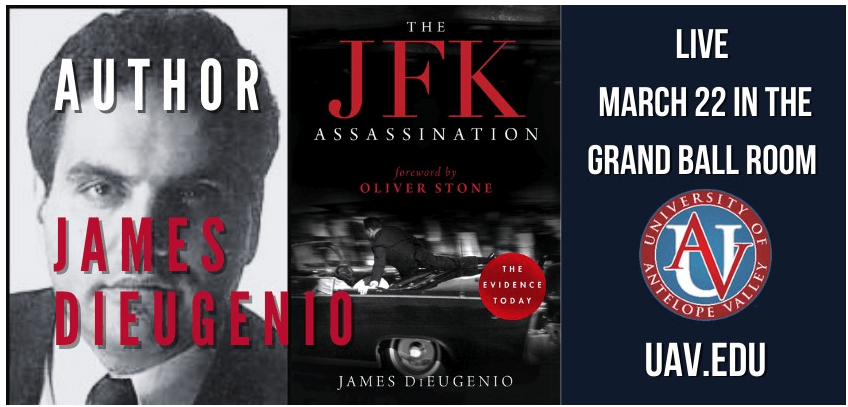
Renowned author, researcher, and publisher Jim DiEugenio, one of the leading experts on the assassination of President John Kennedy is coming to the University of Antelope Valley. Jim will be appearing in the Grand Ballroom on Tuesday, March 22nd at 10am. He will present his case and explain what happened on November 22, 1963, the day that changed America forever.
Students, faculty, and community members are invited to attend. The event is free.
Jim is the author of several ground-breaking books including Destiny Betrayed, and The JFK Assassination. He was also the publisher of Probe Magazine. Jim has been a special consultant to Oliver Stone having written the script for the famed movie producer’s new documentary—JFK Revisited.
Please come and hear Jim’s compelling presentation about what truly was “The crime of the century.”
-

How the MSM Blew the JFK Case, Part One
The way the mainstream media (MSM) reacted to the assassination of President Kennedy is one of the largest issues in the field of JFK assassination studies. One of the earliest books on the subject was Mark Lane’s A Citizen’s Dissent published in 1968. The late journalist Jerry Policoff was one of the leading writers on the topic. (Click here for an example of his early work) In 1992, scholar Barbie Zelizer wrote a valuable but rather unfocused book on the issue titled Covering the Body. That same year, Robert Hennelly and Policoff co-authored a long article for the The Village Voice addressing the troublesome topic. (Click here for details) In 2019, Mal Hyman wrote Burying the Lead, a creditable effort in the field, containing much new material. (Click here for our review)
There are two other volumes of recent vintage about this immense subject that should be noted. One was published in 2018 by Dr. Jim DeBrosse, a lifelong journalist from Ohio. His book is called See No Evil. The more recent tome, published this year, is entitled Political Truth: The Media and the Assassination of President Kennedy by Joseph McBride. McBride is the author of over twenty books, mainly on films, but he followed the JFK case for decades and, in 2013, wrote Into the Nightmare, which broke new ground in the murder of policeman J. D. Tippit. Since See No Evil came first, we will deal with the DeBrosse tome before McBride’s.
When Jim DeBrosse was eleven years old, he watched Jack Ruby murder Lee Oswald live on network television. This shocking event prompted his father to say that Oswald’s murder was a sign of someone silencing him in order to cover up the Kennedy assassination. The author never forgot that warning about the case.
Jim assumed a professional life as a newspaper reporter. He ended up spending over thirty years in the field. In 1991, he watched Oliver Stone’s film JFK. The film struck him as being both courageous and thought provoking. (DeBrosse, p. 1, all references to e book version of the book.) In retrospect, he noted something odd: in nearly 30 years, virtually no other working American reporter had yet done what Stone did. That is expose all the problems with the Warren Commission Report. The only exceptions would be Jim Marrs and Earl Golz. (Jerry Policoff did not make his living as a journalist, but as an advertising salesman.) But yet, Stone would cause at least two journalists, David Talbot and Jeff Morley, to make full scale inquiries into the JFK case. And even in the face of all the new evidence declassified by the Assassination Records Review Board, which Stone’s film helped create, the MSM has still not adjusted its paradigm on the case. (DeBrosse, p. 49) For example, Doug Horne’s milestone essay on two Kennedy brain examinations got only a couple of stories in the media. (Ibid, p. 39)
About two decades after Stone debuted his film, DeBrosse retired from the Dayton Daily News in order to attain a doctoral degree in journalism. Taking the advice of a friend, he eventually decided to write his thesis on this topic: how the media reacted, and continues to react, to the JFK case. The result ended up being the book under discussion, See No Evil.
In this critic’s view, there are three main parts to the work. The first is termed by the author a content analysis of things like book reviews, news stories, and broadcasts dealing with the JFK assassination. The second deals with the rather extreme measures that establishment journalists—of both left, middle and right—have gone to shove the JFK case off the table. The third subject the author deals with is Kennedy’s Middle East policy and how it was irrevocably altered by Lyndon Johnson—and others who came after him.
I have never seen the first subject, content analysis, done with the rigor and precision as DeBrosse does it. The author sectioned off the years 1988–2013 and then searched Lexis/Nexis in order to find rubrics like book reviews of the JFK case. One of the things he discovered was that pro-Warren Commission books are five times more likely to be reviewed than anti-Commission books. (DeBrosse, pp. 50–51) And of those reviews, about 65% of the former were positive, while over 90% of the latter were negative. That does not sound like a random pattern, does it? To give one example of why it doesn’t: Jeff Morley was an MSM journalist for over 20 years, writing for publications like The New Republic, The Nation, and The Washington Post. Yet the author could not find an MSM review of his Our Man in Mexico, the only biography about Winston Scott, the CIA station chief in Mexico City in 1963. (Ibid, p. 52)
Under every rubric the author searched for, published news stories, TV broadcasts, TV stories on JFK theories etc., this statistic held strongly. For example, the ratio in news stories was 3–1 in favor of pro Commission stories. (Ibid, p. 53) In TV news broadcasts, it was 2–1. DeBrosse also notes that the major networks were worse than the cable channels.
Addressing the two-week period in 2017, when President Donald Trump tweeted about releasing the last of the classified JFK documents, the author notes who the main televised interview subjects were. Philip Shenon made 23 appearances, Larry Sabato did 17, and Gerald Posner did 16. There was simply no balance, as Jeff Morley did 4 and John Newman did 1. (Ibid, p. 66)
With this kind of media bias, why does most of the public still think Kennedy was killed in a conspiracy? One of the most common techniques used to explain that divergence is the mantra that the reason the public does not buy the Warren Report is because Americans cannot accept the notion that someone as inconsequential as Oswald could end the life of someone as glamourous and powerful as President Kennedy. DeBrosse found this idea cited over 20 times in his studied time frame. (Ibid, p. 69)
The other main concept used to dismiss the critics was proffered by the late Peter Jennings in his 2003 ABC special: “In all these years there hasn’t been a single piece of credible evidence to prove a conspiracy.” (Ibid) Bob Schieffer of CBS did the same, when he declared unilaterally that the evidence is overwhelming that Oswald acted alone. Schieffer was one of the first to introduce Philip Shenon to a large broadcast audience. (Ibid, pp. 64–65). How extreme is this bias? Larry Sabato’s book, The Kennedy Half Century—which upholds the orthodoxy on the case—was attacked by The Washington Post for simply acknowledging the fact that many people do believe there was a conspiracy and explaining some of the reasons for that belief. (Ibid, p. 59) That is how strict the gatekeeping is on the subject. Perhaps the best quote in the book on this innate bias is from the late Tom Wicker of The New York Times. He once said that he declined to accept evidence of a second gunman, but he admitted he had not studied the exhibits and testimony in the Commission volumes. Why had he not done so? “It would have taken too long and I had a deadline.” (Ibid, p. 75) Dan Rather actually changed his location in Dallas in order to double endorse the Warren Report. First, he said he heard no shots even though he was 30 yards from the grassy Knoll. On the 50th anniversary, he now said he actually ran up the Grassy Knoll and did not see anyone there. How he could forget doing something like the first time around is sort of inexplicable. (Ibid, p. 55)
DeBrosse also notes that the books backing the Commission usually have much more established publishers than those attacking it. But even when a medium sized house like Bloomsbury Press published Russ Baker’s Family of Secrets, they found the large market interviews they had lined up disappeared once hosts learned that the book was not just about the Bush family, but about George H. W. Bush’s possible role in the JFK assassination. (Ibid, pp. 58–59)
The author uses an astute observation from the late Jerry Policoff in order to sum up why the cards in the JFK deck are rigged:
When you talk about the Kennedy assassination, you’re talking about America’s basic institutions. And the fact is, the U.S. corporate media sees its role as protecting American institutions, and that’s what this case is all about. (Ibid, p. 76)
The last part of the book deals with a subject that this reviewer has been exploring for several years, that is, Kennedy’s foreign policy in places outside of Vietnam and Cuba. In this instance, DeBrosse brings up the Middle East. It is notable in this regard that the author relates a communication made to him by Noam Chomsky.
There is a significant question about the JFK assassination: was it a high level plot with policy implications? That’s quite important, and very much worth investigating. I’ve written about it extensively, reviewing all of the relevant documentation. The conclusion is clear, unusually clear for a historical event: No. (Ibid, p. 15)
The year of this communication was 2014. Note the implication: Chomsky read all of the 2 million declassified pages of documents declassified by the ARRB. Besides that obvious shortcoming, he ignored the books by other scholars on this very subject. For example, the work by Robert Rakove in Kennedy, Johnson and the Nonaligned World (2013), by Philip Muehlenbeck in Betting on the Africans (2014), Bradley Simpson in Economists with Guns (2010), not to mention the previous work of Richard Mahoney in JFK: Ordeal in Africa (1989). They all strongly disagreed with him and they proved that such policy changes did occur.
Concerning the Middle East, what happened there under Kennedy, versus what occurred both before and after, is easily discernible to real historians like Rakove and Muehlenbeck and they address it at length. I have used their work to write about this important topic. (Click here for details) Plain and simple: Kennedy was trying to forge a relationship with Gamal Abdel Nasser of Egypt. Nasser was the single most important Arab leader, a man who believed in pan-Arabism and also that the oil in the Middle East belonged to all the Arabs. Nasser had been cut off by John Foster Dulles after the Suez Crisis. In fact, Foster Dulles tried to court Saudi Arabia in order to counter Nasser, who he feared as becoming too powerful, as did the Israelis.
But Kennedy saw Nasser as a bridge to modernize and Westernize the Arab countries and pull them away from Islamic fundamentalism and the Muslim Brotherhood. (Click here to understand this point) The Israelis feared the possibility that Nasser could actually forge a Middle East confederation which would literally surround their country. Saudi Arabia feared that Nasser could overthrow their monarchy and nationalize their oil wells.
There were two other complicating factors: the Israeli covert project to build an atomic reactor at Dimona and Kennedy’s insistence on bringing back the United Nations plan to give Palestinians the right of return and repatriation after the Nakba. The Israelis lied to Kennedy about Dimona, saying it was designed for peaceful purposes. It was not. And when Kennedy discovered this, he became the first and only president to threaten to pull funding for Israel unless he got biannual inspections of the reactor. (DeBrosse, p. 141) This standoff likely led to the resignation of Prime Minister David Ben Gurion in late June of 1963.
The two issues were unresolved at the time of JFK’s death, but as DeBrosse notes, Kennedy’s policy was clearly reversed by Lyndon Johnson, who obviously favored Israel and did not at all care for Nasser. Thus, the balance in the area that Kennedy had sought was lost. To give one example, from 1949–64, America gave Israel 27.4 million in military aid. From 1964–68 that number quintupled to 134.9 million and it changed to include offensive weaponry. (Ibid, p. 146) I don’t go as far as the author does in his appraisal of this issue. For example, I give little credence to the work of Michael Collins Piper, but DeBrosse at least brings up the important topic of Kennedy’s Middle East policy, which has been all but ignored in the critical community. It should be brought up since Kennedy’s policy there had nothing to do with anti-Semitism. It had everything to do with nuclear non-proliferation, the search for rights for the Palestinians, and the attempt to mitigate the movement toward Islamic fundamentalism. In this author’s view—and the view of many others—what has happened in the Middle East since has been pretty much a debacle.
In sum, this is an interesting and, in some ways, a unique book. It’s a coruscating look at an unsightly problem, namely the refusal of the MSM to address the assassination of President Kennedy in any honest way. And to acknowledge what occurred as a result of his murder.
-

James Kirchick and his JFK Assassination Gurus
In a previous essay, I tried to summarize the worldwide reaction to Oliver Stone’s documentary JFK Revisited: Through the Looking Glass. (Click here) By far, it is the widest and strongest reaction to any documentary ever made on the JFK case. The fact that it created such a hubbub clearly disturbed certain past critics of Stone, for example, Noam Chomsky and Gerald Posner. It also disturbed certain mainstays of the MSM, like Tim Weiner and Max Boot. I ended that discussion with what may be the worst outburst about the documentary yet, the one by James Kirchick at the digital zine Air Mail.
As I noted in that overall review, it’s clear that none of these writers wish to deal with the specific points of new evidence made possible by the Assassination Records Review Board in the film. This evidence had never been presented to a worldwide audience in broadcast form. Weiner, Boot, Chomsky, Posner, and Kirchick never even mentioned that body. Yet this was the reason for the making of the documentary! Which is why it features interviews with three employees of the Board: Chairman John Tunheim, Deputy Chair Tom Samoluk, and Military Records analyst Doug Horne.
Weiner and Kirchick dodged the problem of confronting the declassified evidence in the film by using two escape routes. First, they ignored the matters addressed, like official photographer John Stringer denying he took the photos of Kennedy’s brain at the National Archives. The second means of escape was to use discredited writers to smear the documentary and not reveal why they had earned derision in the critical community.
As I noted at length, both Weiner and Kirchick utilized the discredited work of Max Holland to somehow impute that JFK Revisited: Through the Looking Glass was based on some sort of KGB disinformation campaign. This is so stupid it is actually ludicrous and I showed why. (For a lengthier reply, click here)
The real reasons that New Orleans DA Jim Garrison formed his ideas about Oswald as an intelligence agent were his Russian language test in the service—suggesting he was being groomed as a false defector—and the address stamped on his New Orleans pro-Castro flyers, which was 544 Camp Street. (See Garrison’s On the Trail of the Assassins, pp. 22, 24) This had been the home of both the CIA’s Cuban Revolutionary Council and the FBI/CIA connected Guy Banister, who had been involved in both the Bay of Pigs project and Operation Mongoose. (William Davy, Let Justice be Done, pp. 25–28) In his book, the DA clearly depicts both these events occurring way before the arrest of Clay Shaw who, as Bill Davy notes in his volume, Garrison had first called in for questioning in December of 1966. All of these events—the discovery of the Russian test, Garrison visiting 544 Camp Street, the suspicions about Shaw—occurred months before the Paese Sera article about Permindex, and Shaw’s service on the board, was published in Italy. Garrison was correct on his ideas about Bansiter, 544 Camp Street, and Oswald. In JFK Revisited, we have Jeff Morley and John Newman discuss the attempts by the CIA and FBI to disguise the provocative activities going on in New Orleans that summer. Holland’s redbaiting dodge of this evidence shows another reason why he is not credible inside the JFK critical community. But that does not disqualify him from being used in moments of desperation by the MSM.
Another discredited source, used especially by James Kirchick, was Fred Litwin. Litwin has been taken over the coals so many times it’s kind of embarrassing, but somehow, with a straight face, Kirchick trotted him out. Kirchick then criticized JFK Revisited for something that is not in the film , namely the homosexuality of Clay Shaw and David Ferrie. What we did was show the connections of these men to the CIA and how Shaw lied about that connection. This Kirchick diversion is inherited from Litwin (and his partner Alecia Long). And, like Weiner with Holland, Kirchick ignored past demolitions of Litwin that clearly show he is not credible on the facts of the case. (Click here for one and here for another)
This practice of using sources with serious journalistic and academic liabilities would not be allowed in any advanced historical studies or journalism class. But ever since the MSM decided to side with the Warren Commission back in 1964 and when CBS violated all of its Standards and Practices for its 1967 four part special, it’s par for the course in the JFK case. (Click here for that CBS story)
For Kirchick to use Litwin as a source is simply inexcusable for any journalist or historian. In addition to the exposures noted above, this author has shown in detail why the Canadian alt/right media maestro should never enter into any debate on the subject. (Click here and here and here and here and here)
Litwin’s self-admitted role model is the rather lamentable David Horowitz. Litwin tries to run away from this fact today, but it is there to see in his first book, Conservative Confidential. Does Kirchick know this? Would it matter?
In the essays I noted above, we can see the factual havoc that Litwin’s admiration for Horowitz leads to. Some examples among a universe of them:
- Quoting Sylvia Meagher, Litwin writes that Kennedy’s motorcade route was not altered.
This has been disproven by Vince Palamara in his book Survivor’s Guilt. (pp. 104–05)
- Litwin writes that the motorcade had to turn on Elm Street to take an exit on to the Stemmons Freeway which would take it to the Trade Mart.
This was disproven by both Palamara and the House Select Committee on Assassinations. (HSCA, Volume 11, p. 522; Palamara, p. 109)
- In his first book on the JFK case, Litwin wrote that Jim DiEugenio had no testimony or paperwork to prove fraud with CE 399, and its chain of custody can be proven.
This is not just false but it’s a case of Litwin practicing libel, since he had my book right in front of him which showed, with testimony and paperwork, the opposite. (The JFK Assassination: The Evidence Today pp.89–92, 247–49)
- Litwin writes that Clay Shaw’s lawyers got no help from the CIA or FBI.
This was completely disproven by the ARRB declassifications. Shaw’s lawyers lied about this until the end of their lives. (See James DiEugenio, Destiny Betrayed, second edition, pp. 264–65, 269–83, 293, 294)
- In his book on Jim Garrison, Litwin features a picture of Harry Connick Sr., the DA who succeeded Jim Garrison and he says he used him as a source.
What Litwin leaves out is shocking. According to investigator Gary Raymond, Connick failed to indict Father Dino Cinel for child abuse when Gary had the evidence to do so. Gary had to go to the media to force Connick to act. (Probe Magazine Vol. 2 No. 5)
- Litwin praised Hugh Aynseworth in the most fulsome terms for his work on the JFK case in his book on Jim Garrison.
Aynseworth is a proven FBI informant. According to Joan Mellen Aynesworth tried to bribe Shaw trial witness John Manchester with a CIA job. Sheriff Manchester replied, “I advise you leave the area, otherwise, I’ll cut you a new asshole.” (Destiny Betrayed, pp. 249–55)
- In his chapter on the Clay Shaw trial in his Garrison book, Litwin never mentioned the testimony of Kennedy autopsy physician Pierre Finck.
This is astonishing, because, for the first time, Finck’s testimony showed that Kennedy’s autopsy was not controlled by the pathologists, but by the military men there in the gallery, who guided them in doing what some have called the worst autopsy in history. (Ibid, pp. 300–04)
- Litwin implies that Garrison was allowed to pick his own grand juries.
More nonsense. As anyone can find out by reading a law journal, in Louisiana grand juries are chosen from voter rolls. (Louisiana Law Review Vol. 17, No. 4, p. 682)
- In his book Conservative Confidential, Litwin attempts to hold up as praiseworthy the reactions of Mayor Rudy Giuliani, and President George W. Bush, after the 9–11 attacks.
That book was published in 2015. By this time, everyone knew that Giuliani had placed the city’s emergency response headquarters in WTC Building 7, and that W’s reason for the Iraq invasion, WMD, was false. Yet 650,000 innocent Iraqis had died because of that lie.
- Perhaps the worst thing that Litwin ever penned was in his first JFK book. There he wrote that the authors of the Warren Report were honorable men who conducted an honest investigation.
In this day and age to write or imply that the likes of John McCloy, Allen Dulles, Jerry Ford, and J. Edgar Hoover were honorable men is just this side of science fiction. For one example, just read Kai Bird’s book on McCloy. Anyone who could help the Nazi criminal Klaus Barbie escape to South America and then deny it or never feel any remorse for his pushing through the Japanese internment in World War II, that person is anything but honorable. And therefore would have little difficulty in covering up the death of President Kennedy.
This could go to an endless length. That is how bad a writer and scholar Litwin is, but evidently Kirchick did not give a damn about Litwin’s credibility. In fact, Kirchick even threw Joe Rogan under the bus for having Oliver Stone on his show. Stone did not say one thing about CV 19 while he was on the program.
When one understands all that, plus the fact that JFK Revisited: Through the Looking Glass does not deal with anyone’s sexuality, one begins to understand what Kirchick is up to and why he borrows from Litwin. By creating a smoke and mirrors distraction, Kirchick can sidestep what does exist in the film. That is the revelations of the Assassination Records Review Board (ARRB) which completely overturn the verdict of the Warren Commission. The film leaves no doubt that the Commission was wrong in its rogue prosecution of Oswald. A prosecution which did not even grant the defendant a lawyer. What the film deals with are the forensic facts of the JFK case, for example, Kennedy’s autopsy and the ballistics evidence, which is how one determines guilt in a homicide. As former prosecutor Bob Tanenbaum says in the film, because of all the problems with the evidence, one could not convict Oswald in any court in America.
The murder of President Kennedy had a tremendous impact on the course of history, both in the USA and abroad. As we show in this film—and will show even more completely in the four-hour version, Destiny Betrayed—Kennedy was withdrawing from Vietnam at the time of his murder. We present evidence that Lyndon Johnson knew this and he consciously reversed Kennedy’s policy. LBJ then lied about what he had done. In the four-hour version, we make it clear through Professor Bradley Simpson and author Lisa Pease that Johnson also reversed Kennedy’s policy of friendship and aid to President Sukarno of Indonesia.
Those two Johnson reversals had horrendous effects. The latest tallies of total dead in Vietnam under American influence are at around 3.8 million. (See British Medical Journal 2008 study by Ziad Obermeyer) If one throws in the genocide that took place in Cambodia due to Richard Nixon’s invasion of the country, which one must, you can add in about 2 million. (Click here for details) The minimum who perished during the massacre of the PKI in Indonesia under Suharto is pegged at 500,000. (William Blum, The CIA: A Forgotten History, p. 217). JFK Revisited: Destiny Betrayed shows with authority that none of this would have happened under Kennedy.
Most people would find this information rather interesting. James Kirchick did not. He chose to write about an issue not in the film. It is then fair to characterize his article as a distraction from these important, some would say, epochal matters.
But this is what one expects from the MSM on the Kennedy case. About three months after the 26 volumes of the Warren Commission were published, in March of 1965, the first combat troops landed in Vietnam. By the end of the year, there were 170,000 of them in theater.
Under President Kennedy, there were none.
That is a pretty hefty issue to sidestep, but Kirchick does so with a completeness that is astonishing.
Post Script: I now extend to Kirchick the same offer I did to another unfounded critic of the documentary, namely Gerald Posner. I will offer to debate Mr. Kirchick at any venue in Los Angeles or San Francisco on the merits of the JFK case, the Warren Report, or either version of Oliver Stone’s documentary. We can arrange for the sponsors, the format, and recording apparatus. He can even bring Tim Wiener. I await his reply.
-

Neurology and Jiggle Analysis
How long does it take the muscles of the average person to contract in reflexive response to an unexpected loud noise?
Reasonably precise information on this reaction, known as the “auditory startle reflex,” is presented below. It is vital to “jiggle analyses,” studies of blurred images on the Zapruder film of the Kennedy assassination, based on the assumption that the blurs are caused by the sounds of shots making the photographer jerk.
Under ideal conditions, jiggle analysis could suggest answers to some questions: When were audible shots fired? Did Zapruder react to all of them equally? If not, which shot elicited the greatest reaction and why? Is the time interval between the apparent impact on the victim and the blur on the film too long—or too short—to work with the official story?
There are no answers in this report, but I present it in response to the number of researchers who have asked me to find at least some serviceable neurological information.
I also present the findings of a very original researcher—Gene Case—whose inspired work led to an insight into the nervous system of the camera that is at least as interesting as the nervous system of Zapruder. These findings, published years ago in The Fourth Decade, deserve more attention.[1]
But first, a few basics. The speed of Zapruder’s camera was 18.3 frames per second—or 54.6 milliseconds from one frame to another. The speed of sound is 1100 feet per second (fps). The muzzle velocity of a Mannlicher-Carcano is close to 2200 fps. A Carcano bullet from the alleged sniper’s nest would strike Kennedy before the sound of the muzzle blast reached Zapruder. What happens next?
Auditory Stimulus Response Times in Milliseconds (m/s)
The following figures come from a study by Brown et al, published in the British journal, Brain.[2] The authors tested the latency period (time it takes to respond) of the auditory startle reflex in 12 healthy volunteers ranging in age from 18 to 80 years. While relaxing in a chair, the subjects were randomly treated about every 20 minutes to a tone burst of 124 decibels, the equivalent BANG! of a car backfire 20 feet away. The average latency period of the relevant muscle groups in milliseconds:
Neck: 58 m/s (range 40–136 m/s)
Paraspinal muscles: 60 m/s (range: 48–120 m/s)
Forearm Flexors: 82 m/s (range: 60–200 m/s)
Forearm Extensors: 73 m/s (range 62–173 m/s)
Thumb: 99 m/s (range 75–179 m/s)
Back of Hand: 99 m/s (range 72–176 m/s)
The authors concluded:
The most generalized startle response to the standard sound stimulus employed consisted of eye closure, grimacing, neck flexion, trunk flexion, slight abduction of the arms, flexion of the elbows, and pronation of the forearms.
There was considerable variation in the degree to which this response was expressed, and in some subjects only eye closure and flexion of the neck were apparent.
Accelerated Reaction Time
Aniss et al found that the startle response “is more easily elicited in a state of muscular contraction.”[3] (In rare instances, the opposite occurs, i.e., muscle contraction can inhibit the startle response.) The muscles of Zapruder’s neck, trunk, arms, and hands would all have been in a state of contraction, so one might suppose he was well-primed to jump at the sound of shots—if they were loud enough compared with the ambient noise in Dealey Plaza.
Jacqueline Kennedy’s Important Observation
Habituation—the process of becoming so accustomed to a stimulus that it loses its effect—can take place rapidly.[4] The reflex in neck muscle is the last to habituate, according to a 1951 study still being cited.[5] The subjects of the Brown study were hit with tone bursts while relaxing in an otherwise quiet environment—and even they habituated to some extent, within two to six trials.
Dealey Plaza was already filled with the noise of motorcycles before the shooting began, which could lead to habituation on the part of some witnesses at least. Jacqueline Kennedy makes this clear:
You know, there is always noise in a motorcade and there are always motorcycles besides us, a lot of them backfiring. I guess there was a noise, but it didn’t seem like any different noise really because there is so much noise, motorcycles and things. But then suddenly Governor Connally was yelling…[6]
She GUESSED there was a noise? At the time of this shot, the first, she was closer to the alleged source of the noise than Zapruder had been. On the other hand, she was also closer to the motorcycles.
Two for the Price of One
While ambient noise can habituate a witness to the sound of shots that are not much louder, there is something that could even prevent one from hearing a shot altogether: the sound of a shot fired immediately before. Muscles supporting the eardrum contract defensively, making one temporarily deaf.
Thus, two shots can sound like one, creating only one startle reflex, if any, depending on the location of the sniper in relation to the photographer.
(Elsewhere, see description of how one shot can sound like two.)
Impact of Bullet, Impact of Sound
Luis Alvarez, the Nobel Laureate known mostly for “jet effect” also performed a jiggle analysis.[7] One big concern of his involved the amount of time between the impact of the bullet, and the impact of the sound.
The expected neuromuscular reaction occurs about one-quarter to one-third of a second later, as shown by the large accelerations near 318. (I’ll adopt five frames as Mr. Zapruder’s experimentally determined reaction time.)[8]
Alvarez did not quote any authoritative source for this claim about the latency of the “expected” neuromuscular reaction, and his explanation for its length is inappropriate:
For those readers who are surprised that the neuromuscular response time is so long, let me recall a common ‘parlor trick’: A bets B that if A drops a vertically held dollar bill without any warning, B cannot stop its fall by pinching his fingers together, if his fingers are poised, ready to clamp together, at the bottom edge of the bill. The fact that the bill can almost never be stopped (unless A gives a precursor signal with his fingers) indicates that a nervous system ‘or hair trigger’ takes more than one-sixth of a second (3.1 frames) to respond to an optical stimulus.[9]
Alvarez was apparently correct about the speed of this particular kind of reaction. Tests performed on baseball hero Babe Ruth showed he took 140 milliseconds to twitch at the sight of a ball on its way—as opposed to the average person’s best, 150 milliseconds.[10]
But why compare (a) an involuntary response to an auditory stimulus with (b) a voluntary response to an optical stimulus?
Zapruder’s “reaction time”—assuming he was normal and assuming the sound was loud enough compared with the ambient noise—would be much quicker than Alvarez has claimed, according to neurologists. There is another problem with Alvarez’ analysis, as shown by this statement:
The human nervous system cannot transmit signals fast enough for the angular acceleration between frames 312 and 313 to have been caused by Mr. Zapruder’s muscles reacting to impulses from a brain that had been startled by the shot that killed the President.[11]
Gene Case, mentioned earlier, noted that Zapruder’s nervous system, no matter how fast, could hardly be expected to react to a sound that had not yet arrived!
But why the blur at Z–313? Since it was too soon to have been due to a startle reflex (unless frames are missing between 312 and 313), Alvarez found another explanation, inspired by the observation of another physicist, Enrico Fermi, in a very different context:
Fermi has almost instantly measured the explosive yield of the first atomic bomb by observing how small pieces of paper which he ‘dribbled’ from his hand were suddenly moved away from ‘ground zero’ by the shock wave.[12]
Alvarez concluded the blur was “caused directly by shock wave pressure on the camera body.” But, as Case noted, the speed of sound is again relevant since it takes time (1.1 Zapruder frames) for the shock wave to reach Zapruder.
Case also doubted a shock wave from a bullet could move a three-pound camera at any distance. He bought a Carcano, drove to a quarry with a friend and fired bullets past materials of different weights hanging freely on a stick. His results were conclusive:
The cardboard, the tinfoil and the strings were unimpressed. The shock wave from a Mannlicher Carcano bullet passing three feet away does not flutter cardboard, tinfoil or string, much less the body of a movie camera (three pounds) 75 feet away.
“Dr. Luis Alvarez, Nobel laureate, winner of the National Medal of Science, the Medal of Merit and the Einstein Medal, was blowing it out his ass.”[13]
Bullets Fired Behind Zapruder?
Case then tried something that lead to a rather exciting discovery. When he fired bullets past a CAMERA—and from NEARBY—he created a blur:
Alvarez could have been right about the cause—a shock wave—but wrong about the nature of the ‘interaction.’ The ‘interaction’ could be a vibration in the shutter mechanism or elsewhere in the workings of the camera. Firing a rifle past a VHS camcorder, I was able to record the image of the shock wave of a passing bullet. It is an extreme undulation of the picture which lasts three video frames—3/30ths of a second. Of course, an 8mm film movie camera is a very different mechanism. But vibration of the shutter in Zapruder’s camera, or of the film itself, is a plausible explanation for this triple imaging.[14]
A shock wave [manifest on film] at 313 could only have come from behind Zapruder.[15]
Another Startle or Shock Wave at Z–318?
Complicating jiggle analysis is the fact that Zapruder said he heard only two shots: the head shot, and one immediately before it which appeared to cause Kennedy to “lean over.” Zapruder either did not hear, or consciously register, the first shot. As I have previously documented in the newsletter Probe,[16] several witnesses heard only one—or even no shot—before the fatal one, then they heard a flurry.
Edited excerpt from my Probe article:
Charles Brehm. Saw head wounded on the “second” shot, heard a third. (22H837)
Mr. and Mrs. John Connally. Both heard last shot only after lying down in the seat, with Mrs. Connally’s head next to his. (4H133,147)
Chief Curry. Heard a shot after Motorcycle Officer Chaney rode up to tell him what was happening. (4H161) The Nix film shows that Chaney was still behind the limousine several frames after the headshot.
Sheriff Decker. Heard first shot when a “spray of water” come Kennedy; heard one more. (9H458)
James Foster. Saw head wounded on “second” shot; heard a third. (CD897)
Clint Hill. Heard shot, saw head wounded, while briefly “mounted” on the limousine the first time. Apparently unknown to Hill, the head was already wounded about 1.5 seconds earlier. (2H144)
Jean Hill. Said she wrapped up Moorman’s first Polaroid photo and put it in her pocket before she heard any shots. (6H206) At the time, she is still in view, about four seconds after the second shot, the photo is still in her hand.
Emmett Hudson. Saw head wounded on “second” shot; heard a third while on the ground. (7H560) (Nix film shows him on the ground after head wounded.)
Mary Moorman. Heard a shot for the first time as she took a Polaroid photo of Kennedy being hit in the head. She heard two or three more. (19H487)
Royce Skelton. Heard a shot after seeing Kennedy react to headshot. (19H496)
Mrs. Philip Willis. She said the head was wounded on the “second” shot; then heard a third. (CD 1245)
Conclusion
As Mrs. Kennedy put it, “I guess there was a noise.”
[1] Case G. Scientific Slumming with Luis Alvarez. The Fourth Decade, 1996; 3(2):32–42.
[2] Brown P, Rothwell JC, Thompson PD, Britton TC, Day BL, and Marsden CD. New observations on the normal auditory startle reflex in man. Brain 1991; 114:1891–1902.
[3] Aniss AM, Sachdev PS, and Chee K. Effect of voluntary muscle contraction on the startle response to auditory response. Electromyography and Clinical Neurophysiology, 1998; 38:285–293.
[4] Valls-Sole J, Valldeoriola, Tolosa E, Nobbe F. Habituation of the auditory startle reaction is reduced during preparation for execution of a motor task in normal human subjects. Brain Research 1997; 751:155–159.
[5] Jones FP, Kennedy JL. An electromyographic technique for recording the startle pattern. Journal of Psychology, 1951; 32:63–68.
[6] Kennedy, J. 5 WCH 180.
[7] Alvarez L. A physicist examines the Kennedy assassination film. American Journal of Physics, 1976; 44(9):813–827.
[8] Ibid.
[9] Ibid.
[10] Fuchs AH. Psychology and the Babe. Journal of the History of the Behavioral Sciences, 1998; 34(2):153–165.
[11] Alvarez.
[12] Ibid.
[13] Case.
[14] Ibid.
[15] Ibid.
[16] Cranor M. Probe 1999 6(6):6–13.
