Tag: JFK ASSASSINATION

  • So, What about this Conspiracy Business Anyway?

    So, What about this Conspiracy Business Anyway?


    Well, that’s as good a way as any to start.

    All over the Internet, and for years previous to its genesis, conspiracy theories have been used to explain complex issues which many times are more simply explained as random events, disjointed sets of circumstances, and just plain serendipity. Many times, these conspiracy theories take on a malevolent character: things are the way they are because of the Jews, Blacks, atheists, Christians, and so on. Things would sure be a lot better if it wasn’t for some of those “Others!”

    Yet today we hear more and more of such ideas. Why? Many psychologists claim that it is because of the stress and the overall complexity of modern life. People harken back to a simpler time—a time when life was slower, things seemed more stable, and there were more “absolutes” in people’s lives. It has gotten to so bad that many analysts are starting to propose the idea that conspiracies, in actuality, are very few and far between. The website on which this essay is published takes a more open view with respect to conspiracies—particularly in regard to political conspiracies.

    I

    As a relatively new contributor to Kennedysandking.com, let me tell you first who I am—or maybe who I am not. I am not a ballistics expert. I am not a doctor/medical expert. I am not an expert researcher who visits the National Archives in Washington D.C. or any other major repository of documents—secret or otherwise. I am simply a guy who has an intense interest in politics, history, philosophy, and various and sundry aspects of the sciences and the humanities.

    With that out of the way, what about this conspiracy business? More and more people nowadays seem to ascribe to one or another of various and sundry conspiracy theories—from the serious minded to the thoroughly ridiculous. As an educated layman, I get the following type responses to questions I raise concerning the “official versions” of many of the scenarios discussed on this website from the so-called experts, educators, and “mainstream media types.”

    You say that the Kennedys and King were murdered as part of a conspiracy? That’s ridiculous—how could something that complex be covered up for so many years without someone at the very pinnacle of the conspiracies coming clean or telling all? Or: do you realize how many people it would take to cover up such a conspiracy or group of conspiracies: tens of thousands or maybe even millions?

    In this essay, I plan to explain why I believe that, in fact, on some occasions—and, in particular, in the cases of the Kennedys and Martin Luther King, that the scenarios presented on this website are substantially correct and why such arguments about the large number of people necessarily involved or no one involved coming clean are not valid.

    It Would Take Too Many People to Carry Out a Political Assassination in the USA without Someone Spilling the Beans

    Is the above statement really true? Has a conspiracy been carried out and largely covered up for decades without anyone “spilling the beans?” I contend that despite the propaganda to the contrary, it indeed has happened in the past in the USA.

    Let us take a look at the radiation and drugging experiments carried out in the United States between 1943 and 1973 coordinated by the US government and private industry. A good source for this is the book entitled The Plutonium Files: America’s secret medical experiments in the Cold War by author Eileen Welsome. In that book, Welsome investigates the case of 18 people deliberately exposed to plutonium by the US government and elements of the private medical establishment. These experiments were carried on at such institutions as prisons, schools for the developmentally disabled, and even maternity clinics.

    One example of such an institution was the Fernald School in Massachusetts. Founded in 1848 and originally called “The Fernald School For The Feeble Minded,” this school not only was involved in a eugenics program (a topic to be discussed later in this essay), but it also was the site of an ugly, dark, secret experiment involving elementary school children. Without their knowledge or the knowledge of their parents, they were fed radiation laced food and milk to determine the absorption rate of iron and calcium. The entities involved were Harvard University and MIT along with The Quaker Oates Company. Quaker Oats was going to use the data collected by these experiments in advertising its cereal. For a more detailed example of this experiment see this page from Massachusetts Creepy.

    Another example from Welsome’s book was the experiment on pregnant women at Vanderbilt University in Tennessee in the 1940’s. Again, these women were not told exactly what they were being fed. In fact, the researchers told them that they were part of a clinic that was meant for poor undernourished women and that the health drink they were being fed was to benefit their developing fetuses. Actually, these health drinks contained radioactive iron oxide contents 30 times those of normal environmental exposure. This was another example of researchers trying to test the absorption rates of iron. Initially, the researchers thought that these health drinks did not contain any harmful amount of radioactive iron, but follow-up studies showed that at least three children died from this exposure. (For additional information about this experiment see this AP News article).

    In other sections of her book, Welsome discusses experiments performed by the military on soldiers involving radiation exposure. There are numerous examples therein. In addition, The Atomic Heritage Foundation website has numerous examples—some where the soldiers knew about the exposure and some where they did not. (Click here for details)

    In addition, while researching this subject separate from Welsome’s book, I found numerous YouTube videos concerning the issue. A general search using such terms as: “radiation experiments”, “US military and radiation experiments”, and “human radiation experiments” will display numerous such videos.

    Finally, for a brief period of perhaps two or three weeks in the summer of 1994, this information hit the mainstream media. The ABC TV network program Nightline did one program concerning the issue. On this program, a research scientist who had been directly involved in the experiments was confronted with a declassified document that he had written stating, “The contents of this research must be kept highly classified because to the general public, such experiments would sound too Buchenwald-ish.” His clumsy reply was something like, “Well I don’t know what everyone is so upset about this for, we obtained valuable research information and after all not too many people died.”

    Because of the moderate coverage by the media, a House of Representatives committee investigated these experiments for a few months and issued a report months later. They actually established a telephone hotline called “The Radiation Research Health Line” which people could call and report any suspicious type experiences and/or related health issues and the experts assigned to this project would investigate to see whether the caller was unknowingly involved in the experiments. (Click here for details) This “Health Line” was not publicized very often and with the sea change in congress—wherein, for the first time in 40 years, the Republicans took both houses of congress in the midterm 1994 elections, the line was discontinued early in 1995.

    II

    While these experiments eventually saw the light of day in the mainstream media, it took a full fifty years for even this somewhat limited exposure to occur. In the final report, the congressional committee determined that at least thirty-five thousand civilians and tens of thousands of military personnel were involved in these experiments. Some of the material is still classified and there is evidence that much more has been destroyed. While we do know substantially more about such experiments, we do not know the exact number of people involved at the governmental and private sector level. But with even the limited exposure, common sense tells us that a huge number, perhaps thousands of researchers and government officials over a half century, had to be involved!

    So, what does such an example do to the argument that something as horrific as a political assassination would take too many people and would be too easily exposed? I dare say it diminishes greatly if not vitiates such an argument. Remember, the people keeping the secrets concerning these medical experiments were not covert intelligent operators and were most certainly not trained in psychological warfare and black operations. One might pose the question: how much more likely would it be for a large conspiracy to be covered up by people who were trained in such operations?

    Let us move to another conspiracy of sorts. One might say that this was actually a conspiracy that was hiding in plain sight. This is the field of eugenics. Hundreds of thousands of people were forcibly sterilized in the United States in the period roughly from 1920 to 1970. This really wasn’t a conspiracy in the same sense as the radiation experiments discussed above. But nowadays, if you ask people about this phenomenon, many of them will think you are an extreme conspiracy theorist. It’s a topic that was not discussed openly in public during its heyday. But it is something that people in the medical field knew of and largely approved of during that roughly half century.

    Basically, eugenics grew out of a convergence of early scientific knowledge about genetics and the long-held belief in white supremacy. In the early days of genetics, some scientists believed that it would be simply possible to breed a superior race of human beings by eliminating the “defectives” within the gene pool. This error in early genetics—which was later debunked by the increased research of the twentieth and twenty-first century in combination with the preconceived notions about Northern/Western European genetic superiority—was the basis for this program.

    A good source that gave extensive accounts of this program is the CBS TV film from 1982 entitled: Marian Rose White. This movie was based on the true-life story of a California woman named Marian Rose White who was committed to a school for the “feeble-minded” in 1934 and, though she had no real mental defect, was sterilized against her will. The Institution in Sonoma County, California, was part of a group of United States hospitals and schools for “the feeble-minded” that sterilized over three hundred thousand people in the middle decades of the twentieth century. (For another good source about this school, see this article from the Press Democrat Newspaper online)

    This institution, along with several other institutions in such places as Virginia, North Carolina, and Georgia, were actually used as models by the eugenics and master race proponents of Nazi Germany in the 1930’s. At the Nuremberg trials, one of the defenses offered to the defendants was that such practices as eugenics and forced sterilization were already being done in the USA when the Nazis came to power.

    Another good source about the eugenics program in the USA is the book entitled: Imbeciles: The Supreme Court, American Eugenics, and the Sterilization of Carrie Buck by Adam Cohen. In this book, Cohen traces the development of the eugenics movement in the late nineteenth century and catalogs the court decisions that allowed for the practice of forced sterilization to become accepted by the medical establishment of the time.

    By examining the case of Carrie Buck—a Virginia resident—Cohen describes the arguments pro and con which were presented at the time, as well as the slow but steady approval by state and federal courts of this tragic attempt to create a more perfect race through sterilization. Cohen points out the kind of stereotypes that were used to promote eugenics practices. Not only did some of the scientists promote the idea of sterilizing mental defectives, but also promoted the ideas that the population of the “lesser ethnicities” such as darker skinned races: Blacks, Italians, Hispanics, and so on, should be subjected to such eugenics practices. There you have the total fusion of white supremacy and genetics.

    Again, this eugenics movement wasn’t a conspiracy in the classic sense of the word. But it was largely not discussed in public, was carried on for the better part of fifty years, and is seldom discussed today by people in general. If you go to a local social group and bring up the topic, many people won’t believe it or will accuse you of being an extremist of some sort.

    My point is that this grotesque activity went on for decades, was more or less approved of, and is almost never brought up to students in classrooms below the college level. In addition, there seems to be a current attempt to remove all such discussions of past wrongs carried out in the name of discredited beliefs of the past. However, it did happen and can be included in a discussion of large numbers of people being involved in reprehensible acts that are shoved under the rug so to speak and are largely ignored in the context of promoting American Exceptionalism.

    III

    Now let’s move to another conspiracy of sorts: the big tobacco cover-up. If you are a smoker, you are obviously aware of the warning appearing on the packs of cigarettes stating the known health risks of using this product. Of course, this wasn’t always so. The first major federal governmental involvement in the hazards of smoking appeared in 1964 with the surgeon general’s report listing the possible risks and diseases associated with smoking. But for decades, cigarette company executive, after cigarette company executive, testified before state and federal committees defending the effects of their products and labeling the critics as alarmists, radicals, and extremists. When the first lawsuits were brought in the 1990’s, various media outlets including ABC’s Nightline and CBS’ Sixty Minutes showed little snippets of cigarette company executives answering such questions as: “Do you believe cigarettes are addictive.” And receiving replies such as: “No, I don’t believe cigarettes are addictive.”

    Yet freedom of information requests by people in the medical and legal communities were eventually able to obtain individual reports as far back as the early 1950’s wherein company executives were warned about the extreme addictive nature of cigarettes and their long-term health effects. Even worse, when it came to the types of additives used in production, one cigarette company scientist even used the phrase “a cigarette is a nicotine delivery system; the more nicotine included in the cigarette the more addictive the product and the higher the sales.” So, the companies “punched up” cigarettes, giving them more nicotine and thus more of an addictive character.

    When criticism of cigarettes as a major health hazard began exploding in the press in the 1960’s, cigarette companies began propagandizing to the effect that there were actually healthy cigarettes. One company even used in their TV commercials the phrase: “This is the cigarette doctors recommend.” Finally, after decades of lawsuits, exposés and governmental investigations, cigarette companies were forced in 2006 to admit all. The conspiracy was blown wide-open and the companies were forced to publicize their deception and pay substantial amounts of money to make amends. (One good source among many for information about this issue is the website “Truth Initiative” )

    Doesn’t this prove that such a large conspiracy will eventually be disclosed? You might jump to that conclusion. But in this case, it took almost seven decades. With the tremendous amount of information available to health professionals and governmental officials, it still took that long. Again, the businesspeople who covered up this conspiracy were not black operators, psychological warriors, or assassins trained as career intelligence agents. Yet, they still succeeded for a very long time. I contend that career intelligence operatives with almost limitless resources could act in concert and keep such a conspiracy secret for even longer.

    Did It Really Take Thousands of People to Carry Out the Assassinations of the Sixties?

    My answer to the above question is a resounding no. Let me explain what I mean.

    To analyze the assassinations of the 1960’s, and in particular the JFK assassination, you must make a clear distinction about the actual assassination itself and the cover-up that followed. I do believe that the assassination of JFK resulted in a massive cover-up involving hundreds, if not more people and numerous public and private entities. I could go into great detail as to why I believe this, but this website does a more than ample job of it. Here are just a few highlights for those too busy or time constrained to do massive research on this and other sites.

    Let us use some examples from one of the earliest critical books about the Warren Commission, but one that has sources directly inside that body. As Edward Epstein notes in his book Inquest, some members “conceived of the Commission’s purpose in terms of the national interest.” Allen Dulles noted that the atmosphere of rumors and suspicions was obstructing the workings of government, especially in foreign policy. Consequently, Dulles figured that one of the main tasks of that body was to “dispel rumors.” John McCloy declared that it was very important to “show the world that America is not a banana republic, where a government can be changed by a conspiracy.” Congressman Jerry Ford stated that “dispelling damaging rumors was a major concern of the Commission.” (Epstein, The Assassination Chronicles, p. 54)

    But perhaps the most devastating indictment of the credibility of the Warren Commission was not really known until the Assassination Records Review Board went to work in 1994. At that time, the Board declassified the memorandum written by Church Committee investigator Gaeton Fonzi upon his first interview with Sylvia Odio, which occurred on January 16, 1976. During that interview, she related her post Warren Commission testimony meeting with attorney Wesley Liebeler:

    He (Liebeler) kept threatening me with a lie detector test, even though he knew I was under tremendous stress at the time. But one thing he said, and this has always bothered me, he said to this other gentleman, I don’t remember his name, he said, “Well, you know if we do find out that this is a conspiracy, you know that we have orders from Chief Justice Warren to cover this thing up.”

    Fonzi was, quite naturally, surprised. He asked Odio, “Liebeler said that?” She replied with, “Yes sir, I could swear on that.” (Probe, Vol. 3 No. 6)

    With this kind of bias, the facts of the case were malleable. Gerald Ford knew that placing the JFK back wound where the autopsy face sheet located it would make for a dubious trajectory for the Single Bullet Theory’s exit through the president’s neck. So, in the draft of the Warren Report, with the stroke of a pen, he moved it up to the neck area. Does that sound like someone interested in getting to the bottom of the truth about the assassination? (Gerald McKnight, Breach of Trust, pp. 174–75) It was also revealed that Ford, when US president, gave the game away to French president Valery Giscard d’Estaing. When the Frenchman asked him about his work on the Commission, Ford replied that Kennedy’s assassination was not the work of one man, “It was something set up. We were sure it was set up. But we were not able to discover by whom.” (JFK Revisited: Through the Looking Glass, by James DiEugenio, p. 176)

    The idea that an alleged communist like Oswald might have killed JFK for Castro, was promoted from the very night of the assassination by the CIA associated Cuban exile group, the DRE. (ibid, p. 234) Yet sitting member and dominant figure on the Warren Commission, Allen Dulles—who was part of direct and prolonged attempts to assassinate Fidel Castro—sat silent and revealed nothing about CIA subterfuge with the Cuban exiles. It was more than a decade later that accurate information began to emerge about such plots before the Senate’s Church Committee.

    IV

    Now let’s briefly examine the mainstream media’s early reporting on the JFK assassination. To understand the cover-up and/or unwillingness to challenge the emerging story, it is necessary to examine what we learned very early on—the afternoon of the assassination and within a few days after.

    At the first news conference held after JFK was pronounced dead at Parkland Hospital in Dallas, emergency room doctor Malcolm Perry described the throat wound as an entrance wound. (Ibid, p. 121) A few hours after that, JFK’s personal physician Admiral Burkley described the head shot as: “a simple matter of a gunshot through the brain.” Malcolm Kilduff, the press spokesman, pointed to his right temple while eliciting this statement. (Ibid, p. 17) And NBC newsman Chet Huntley repeated this at about 1:40 PM on network television. For a few weeks after, the mainstream media did not contradict this. But as the story about Oswald being the only shooter took hold, and the idea that only three shots from behind the car were fired, the mainstream media began trying to fit the proverbial square peg into the round hole. Some prominent media sources began explaining the early reports of Perry and Burkley mentioned above by explaining that the reason for this apparent anomaly was that the president turned almost totally around to wave at some supporters in the crowd—thus exposing his front to the shooter from behind. (See Paul Mandel in Life magazine of December 6, 1963)

    There’s a major problem with this scenario. The Zapruder film, which Life magazine actually had at the time, shows nothing of the sort. JFK was not at all facing backwards when the shots hit him. Not even close. While the film itself was not shown to the general public until 1975, media sources had to know about this. Yet as mentioned above, some mainstream media sources proceeded with this “JFK was facing backward” scenario anyway.

    In the issue of October 2, 1964, Life magazine published photos from the Zapruder film. That issue was largely dedicated to the newly published Warren Report. to As Jerry Policoff and Robert Hennelly later explained, the magazine went through three different incarnations, in order to conceal the president’s head moving rapidly rearward. This technical overhaul necessitated quite expensive alterations, like breaking and resetting printing plates twice. Both photos and captions were changed so as to camouflage indications of a frontal shot. (See the Village Voice, March 15, 1992) Years later, when the film was shown to the public, it was obvious what Life had done.

    I could go on and on about the cover-up by the Warren Commission and about early naivete/cover-ups within the mainstream media. But it would be better served for visitors to this site to do a bit of investigation of the site itself. But why early on was so much of the MSM promoting this incorrect and deceptive scenario of a lone assassin shooting three times from behind? I think the subject can be explained by examining the phone calls between the new president Lyndon Johnson and prospective members of the Warren Commission.

    Phone calls recorded on dictabelts collected by the Johnson library and released over the years show that both Supreme Court Chief Justice Earl Warren and Senator Richard Russell were reluctant to serve on the commission for a variety of reasons—both personal and professional. LBJ was able to convince them to serve by making subtle references to Lee Harvey Oswald’s visit to Mexico City and national security issues, like the threat of atomic war. This seemed to scare/prompt both Russell and Warren to participate. (See DiEugenio, p. 92)


    A thorough examination of these unsubtle references to Oswald in Mexico City reveal that early on, the CIA and FBI promoted the idea that Oswald had been in contact with Valery Kostikov—a supposed master of black operations and assassinations in the western hemisphere for the KGB. And that the revelation of which might lead to complications that would provoke a nuclear war between the US and USSR. In fact, there was ample proof of the effectiveness of this motif on view in 1964. At that time, Mark Lane was part of a debate in Beverly Hills with three other lawyers. The event was recorded, with thousands in attendance. Noted liberal lawyer A. L. Wirin stated:

    I say thank God for Earl Warren. He saved us from a pogrom. He saved our nation. God bless him for what he has done in establishing Oswald was the lone assassin. (Lane, Plausible Denial, p. 52)

    When Lane asked the famous liberal attorney if he would still say that if Oswald was innocent, Wirin replied affirmatively.

    As the above example shows, this clever plan by the plotters was able to scare the then “liberal establishment” in Washington and the mainstream media to promote the cover-up. Once the cover-up was promoted by the MSM—even with subsequent revelations contradicting the official scenario—a certain inertia set in. Imagine the fall out if sacred media icons such as the Washington Post, New York Times and mainstream TV networks had to admit that they were snookered into believing a clever lie; that they totally blew their investigation of the greatest political crime in US history—the conspiratorial assassination of the president. It would have destroyed their credibility for decades, if not permanently.


    V

    What about the actual assassination itself? While it is possible that it did involve a large number of people, I contend that it isn’t necessary to have had a large number of people. Based on what I have read on this site, as well as a large number of books associated with the JFK assassination, a relatively small number of people could have carried out the assassination itself.

    It is well established at this point that JFK had made a number of political enemies in high places within both military and the CIA. After the Bay of Pigs debacle, JFK fired three sacred cows in the CIA: Allen Dulles, Richard Bissell, and Charles Cabell. He privately blamed the CIA for misleading him and, in fact, perhaps sabotaging him early on with respect to the Bay of Pigs. He angrily swore to “smash the CIA into a thousand pieces and scatter it to the winds.” (Lane, p. 93)

    His unwillingness to invade Cuba during and after the Bay of Pigs affair, his reluctance to increase involvement in Vietnam, and his subsequent attempt to achieve a détente with the USSR and Cuba angered members of the Joint Chiefs of Staff, such as Air Force General Curtis LeMay, Joint Chiefs Chair Lyman Lemnitzer, and also veteran black operator Colonel Ed Lansdale. After the successful resolution of the Missile Crisis, White House tapes reveal that while the president was in the room during a meeting with the Joint Chiefs, one general can be heard saying words to the affect that this is: “another Munich.” (DiEugenio, p. 184)

    With such enemies as Lemnitzer, LeMay, and Lansdale in the military, and the remaining allies of the dismissed Dulles, Cabell, and Bissell, such as William Harvey, James Angleton, David Phillips, and Richard Helms, this cadre of JFK haters would have provided a nucleus of those in high places with significant experience in covert operations and assassination planning to have attempted and succeeded in orchestrating the murder of JFK.

    Now as for the “meat and potatoes” of the assassination as it was carried out on November 22, 1963, in Dallas’ Dealey Plaza, just how many people would it have taken? We are talking about what military intelligence and the CIA would generally call technicians. This term refers to those who actually follow orders, position themselves, and do the shooting and clean-up afterwards.

    The late Jim Garrison—the DA in New Orleans who was the only man in history to actually bring a trial against anyone for the assassination of President Kennedy—thought that it wouldn’t have taken any more than 10 or 15 people on the ground at Dealey Plaza. His basic scenario was: three shooters with an assistant on a radio in communication with either each other (two ways radios) or with someone on the ground along the motorcade route to coordinate the affair; and a few more people—perhaps as few as five to do a clean-up. By clean-up, I mean to collect obvious evidence such as extra bullets or bullet fragments, people with photographs that might give a bird’s eye view of things better left unknown to any investigators and so on. (Garrison lightly sketched in such a scenario in his Playboy interview of October, 1967)

    In fact, there were numerous reports of people representing themselves as Secret Service agents demanding films and photographs after the assassination, as well as agents arresting and interrogating people afterward. These individuals have never been identified or accounted for despite numerous inquiries and investigations. (Henry Hurt, Reasonable Doubt, p. 110; Michael Benson, Who’s Who in the JFK Assassination, p. 423, p. 189)

    What about involvement of the Dallas Police and Dallas County Sheriff personnel? There could have been some involvement, but for the most part, the officers on the ground were probably following orders as to just how much security to provide and how to proceed in the aftermath of the assassination. Perhaps this was influenced from Washington. On one of the dictabelt recordings there is a talk between Johnson assistant Cliff Carter and Dallas authorities. Carter can be heard saying words to the effect that: You have your man, don’t you? We need this thing to be tied up before too many rumors spread about a possible communist conspiracy. (DiEugenio, p. 92) There is obviously tremendous pressure being applied from Washington in what, by any estimation is a serious crisis and it would be understandable that Dallas may have been a victim of this pressure. While it is likely that Dallas officials like Mayor Earl Cabell could have provided some logistical support for the conspirators by altering the motorcade route, we simply don’t know enough about the exact planning of the itinerary of the Dallas trip to state definitively whether or not Mayor Cabell was a willing conspirator or perhaps a dupe of the conspirators.

    Some people in Dallas and the Secret Service made statements that, for example: JFK wanted motorcycle riders to ride behind the presidential car rather than alongside of it—thus giving the shooters a clearer shot at the president. On YouTube, there is even a film of a Secret Service agent ordered to reluctantly jump off the back of the limousine, raising his hands in puzzlement. There are also disputes about the bubble top, both the secret service and the Dallas authorities were supposedly told that JFK wanted the bubble top removed. As expert Vince Palamara has shown, we know that that was untrue.

    Could the Secret Service have been involved directly in the conspiracy? This is indeed a plausible scenario. But just how many people would it take? I believe it could have been a limited number—perhaps just the chief of the Secret Service in Washington, James Rowley, or maybe even the local on ground head of the Secret Service who was traveling with the presidential party in Dallas, Roy Kellerman. One of such people might have told the rest of the agents something like: ‘JFK wants the bubble top removed;” or “JFK wants the Dallas police to stand down or show less of a presence.” Remember, these agents are very much like a military contingent. This is not a democratic organization. They just follow orders.

    VI

    The same could be said of the autopsy doctors. Were all of them actively involved in the conspiracy itself? I doubt it. These doctors were military doctors under orders. They may have been simply told that the nation’s national security is at stake and again they may have just followed orders. In fact, one of the doctors present at the autopsy, Dr. Pierre Finck did testify at the trial of Clay Shaw that a general was directing the autopsy. When he was queried about this to the effect of the nature of this direction, he continued and he added:

    Oh yes, three were admirals, and when you are a lieutenant Colonel in the Army you just follow orders, and at the end of the autopsy we were specifically told as I recall it, it was by Admiral Kenney, the Surgeon General of the Navy…we were specifically told not to discuss the case. (Transcript, 2/24/69)

    Thanks to writer Rob Couteau, there is further evidence of the doctors involved in the cover up. For afterwards, they called Perry and asked him to change his story that very night or they would find a way to discipline him. (See article “The Ordeal of Malcolm Perry”, by James DiEugenio)

    Same thing with the FBI. Only in the discredited and baseless piece of fiction, Nomenclature of as Assassination Cabal, are they given direct responsibility for the assassination. As John Newman has shown, J Edgar Hoover was mystified by the evidence he was getting from Mexico City. And he later called it a false story. (Newman, Oswald and the CIA, p. 635) Keep in mind that Hoover was approaching seventy years of age and later reports are that he was becoming less and less competent near the end of his life. He may even have been an innocent dupe of the Oswald in Mexico City scenario and acted to participate in the cover-up as a defender of national security and the World War III scenario.

     We can go through a check list of commonly named suspects.: David Rockefeller and the business community, Organized Crime, Lyndon Johnson, Cuban exiles. The JFK administration had many, many enemies who they were rubbing the wrong way. We can then argue one way or the other on each. The exiles hated JFK for his perceived backing out of the Bay of Pigs and his second refusal to invade Cuba during the Missile Crisis. There were rumors that LBJ might be gone in a second administration. We also know that Wall Street was not happy with what President Kennedy did during the Steel Crisis. Everyone and their mother knows that Bobby Kennedy was hounding the Mafia, especially the likes of Sam Giancana and Carolos Marcello, since the fifties. We could also argue that there was a cross pollination of the plot between certain elements of these vectors of power. In fact, some authors, like the late Bill Turner, did argue a triangular plot: the CIA, Mafia, Cuban exiles. But the point I wish to make is that although a relatively small hit team could have pulled off the murder, as I have shown, larger conspiracies are not at all uncommon.

    For those of you not familiar with William Shakespeare, the great British playwright wrote a series of works generally referred to by scholars as “The Histories.” These plays are Shakespeare’s dramatizations of significant historical events from his own era back to the classical (Greek/Roman) era. One of these plays was titled Julius Caesar. This is the story of the assassination of Julius Caesar and is based loosely on ancient writings about Caesar. Caesar was assassinated in the Roman senate by his enemies. This, in turn, provoked a long, complex civil war after which Caesar’s stepson, Octavian, eventually won out; defeating both the original plotters, and his own allies: Lepidus and Mark Antony.

    Author Donald Gibson has helped point out an intriguing parallel in the two cases. In the lead up to Caesar’s assassination, according to the play, Caesar had been repeatedly warned by a soothsayer “Beware of the Ides of March.” This is the day in 44 BCE on which Caesar was eventually assassinated. Now the title of an article in Fortune magazine uses such a reference. While it doesn’t actually say: “Beware of the Ides of April,” its reference is a bit perplexing. Why not just title it: “Kennedy Wrong on Steel” or perhaps “Kennedy Jawboning a Threat to Free Enterprise.” People who were interviewed in the article were not just steel executives but also prominent Wall Street bankers and businesspeople. They all expressed outrage at Kennedy’s “jawboning” and worried that he was rapidly leading the US toward a dictatorship. (For an extensive article on the issue, visit this page on Ratical.org entitled: “Fortune’s Warning to President Kennedy: Beware of The Ides of April”)

    What this shows is that there was a real disdain at the top of the Power Elite against Kennedy. These kinds of people had connections throughout other sectors of our society. And that was the key point. This scenario is probably the more likely scenario rather than a massive business plot. Elements of the national security structure including the CIA and military intelligence knew of the general dislike of JFK by the business community and knew that if they pulled something off, they would receive little if no opposition from the economic power structure. And that men like Hoover and LBJ would fall in line and help in the cover up.

    Now, let me again further my point about large conspiracies This time in the blatantly political arena. We all recall the Watergate scandal. Over sixty people were tried and later convicted. What about the Iran/Contra affair? In this one, two presidents were clearly involved: Ronald Reagan and George H. W. Bush. And it was the latter who pardoned other higher ups in the trail of perfidy. And as many writers have noted—including two who have passed on, Gary Webb and Robert Parry—the cocaine part of that affair was never officially uncovered. But they proved that it undeniably existed. (See Webb’s book, Dark Alliance. Also click here over how the CIA watched over Webb’s downfall)

    Let me add one more example of a large conspiracy. One that was not even really well-hidden. Everyone should be watching the congressional January 6th hearings. Or at least view them on You Tube. Clearly, much evidence was kept from the second impeachment trial of Donald Trump, because today we can now see how wide and deep the plotting was to stop Joseph Biden from winning an electoral college victory. It went on for months. And it employed at least two dozen people both inside and outside the White House. It was also multi-leveled. It involved lawyers visiting state legislators, phone calls and visits to state voting officials, the gathering of thousands of Trump zealots in Washington, the stowing away of weapons nearby etc. The end game of this planned insurrection was that a total of nine people died, and over 140 were injured. Even today, key people have refused to testify, like Mark Meadows and Steve Bannon. Why?

    VII

    The evidence is rather convincing: large conspiracies have existed throughout time. Different aspects of our society have existed within them. The latest example being street provocateur Ali Alexander and very likely, White House Chief of Staff Mark Meadows. In the JFK case, all that was needed was someone or, maybe two, who had access to some of these sectors. A commonly named example would be Allen Dulles. He and his close friend James Angleton could have then focused on certain areas for the plot: Tampa, Chicago, Dallas. And they could have picked susceptible fall guys like Gilberto Lopez, Thomas Arthur Vallee, and the perfect one, Lee Oswald. If the great amount of circumstantial evidence which exists does point to major involvement of Oswald in US intelligence, then this is the missing piece of the puzzle which, when manipulated properly, would have given the conspirators their major tool to carry out and, in particular, cover-up the assassination. They scared the ‘liberal establishment’ into going along with the cover-up to avoid nuclear war.

    Let me add one more common complaint: Well, wouldn’t someone have talked? Maybe, but maybe not. But my point should really be that there has been a whole book written about this subject: Larry Hancock’s Someone Would Have Talked. In that book Hancock details the stories of two men who did say something about the plot to kill JFK: Richard Case Nagell and John Martino. Dick Russell has written a long book on the former called The Man Who Knew Too Much.

    Here is the point: large conspiracies do exist and, yes, people have talked in the JFK case. I could also add that David Phillips told his brother he was in Dallas on the day of the assassination. (Russell, p. 272)

    Conclusion

    In his book entitled The Secret Team, former Pentagon/CIA liaison Fletcher Prouty mentions just that: a secret team that could be used to carry out multiple deep cover operations such as assassinations, psych wars, and other black op/disinformation operations. He concludes, in this and other writings, that the JFK assassination, and other events in the USA, could have been a simple application of the covert operations used by American intelligence to destabilize foreign governments being brought in and utilized within the borders of the US itself. Remember, during the same time period of the assassinations, the FBI was running dozens of covert intelligence programs to destabilize such activist groups as anti-war, civil rights, black militants, and women’s rights organizations. The CIA, with Operation Chaos, also carried out a similar group of intelligence operations in the US. These are the signature methods used by US intelligence operatives in foreign countries: eliminate or neutralize the leadership and use covert operations to divide and destabilize political parties that supported the assassinated/neutralized leaders.

    In closing, it was not necessary for hundreds or even thousands of people to have been directly involved in planning and implementing the assassinations of major center-left US politicians and activists in the 1960’s. It is also possible that only a few dozen people may have actually taken part directly in the assassinations themselves. With the fear of the communist menace dominating the culture and media of that time period in general, and the fear of a world ending in nuclear incineration in particular, both the powerful and the weak were likely lulled into a sense of security/normality by the official explanations of those tragic events. Thereafter, a huge amount of government officials and media managers—down to Paul Mandel and A. L. Wirin—took part in the cover up.

    While many people nowadays believe that JFK was probably killed by a conspiracy, the other assassinations receive less exposure. Many people have little or no opinion about those events. People want to believe that their country is more or less right-minded and that its basic foundations are not corrupt and that, while there may be some significant problems we all face, the truth will eventually win out and things will progress as they should. That is why many people cannot get their heads around the idea of either a large secret government within the US national security structure or that such an element of the power structure could pull of a series of assassinations and manipulations in an ongoing manner and whose effects exist in major ways to this very day. I hope that this essay can serve to educate and inform the public as to just how realistic and plausible these scenarios are.

    Finally, and most importantly, the events of the 1960’s marked a watershed in history by which all events which followed were greatly affected. Unless we finally get to the bottom of these events, including the major assassinations of that era, we can never truly understand how we got to where we are today.

  • Fletcher Prouty vs Edward Epstein

    Fletcher Prouty vs Edward Epstein


    As most of you know, Edward Epstein rather quickly did a 180-degree somersault on the JFK case. After writing his valuable book Inquest in 1966, he then turned around and turned Warren Commission defender in quite a hurry. According to Vince Salandria, it was about a year or so later. And he never let up. He wrote one of the first anti-Jim Garrison books called Counterplot, that was first excerpted in The New Yorker.

    Because of that book, Epstein was in the front ranks of Oliver Stone’s attackers when his film JFK came out in 1991. For instance, at a public debate in New York, sponsored by The Nation, he was Victor Navasky’s lead attack dog against Stone. This was pretty much a witless farrago, since Navasky had never had very much interest in or sympathy for critics of the Warren Commission. Between Epstein and the late Chris Hitchens, the event was really an intellectual disgrace.

    When Jim Garrison passed on a year later, Epstein wrote an article smearing him in The New Yorker. About a year after that, he wrote another hit piece for The Atlantic. The excuse for this one was that Stone was coming out with a double tape VHS box of JFK. Because of this widened focus for the second article, Epstein could now use the occasion to broaden his focus to the celebrated director and one of his chief consultants, namely Fletcher Prouty. (For my reply click here)

    After trying to attack Prouty, and—as I proved in my reply pretty much falling on his face—Epstein tried to say that Fletcher thought that Leonard Lewin’s 1967 book Report from Iron Mountain was a work of non-fiction. According to Len Osanic, the expert on Prouty, this is simply not the case. (Click here here for Len’s website on Prouty) And in fact, when Len was setting up his fine Fletcher Prouty site, Fletcher insisted that he include a link to a 1972 New York Times story with Lewin saying the book was a satiric novel. Len also has a show in his Archives—Program 825—in which Prouty says four times that the book is a novel.

    But Fletcher appreciated the satiric edge of Lewin’s book, which was the idea that if a lasting peace could be achieved, it would not be in the best interests of society to achieve it. War was a basic part of the American economy. Lewin’s book was a New York Times bestseller and has been translated into 15 languages. US News and World Report (11/20/67) stated they had confirmation that the report was real and that President Johnson hit the roof when he read it. John Kenneth Galbraith was one of the advisors to the book and he tried to further the deception about it in an article in The Washington Post. ( 11/26/67)

    Fletcher Prouty appreciated the point of the satire. Since he knew officials at the Pentagon who acted and spoke like the people in Lewin’s book: We cannot abandon the warfare state. And, in JFK, he used some of these dictums voiced through Donald Sutherland as Mr. X in the famous scene in Washington where X tries to explain why John Kennedy was killed. Mr. X of course was based on Prouty.

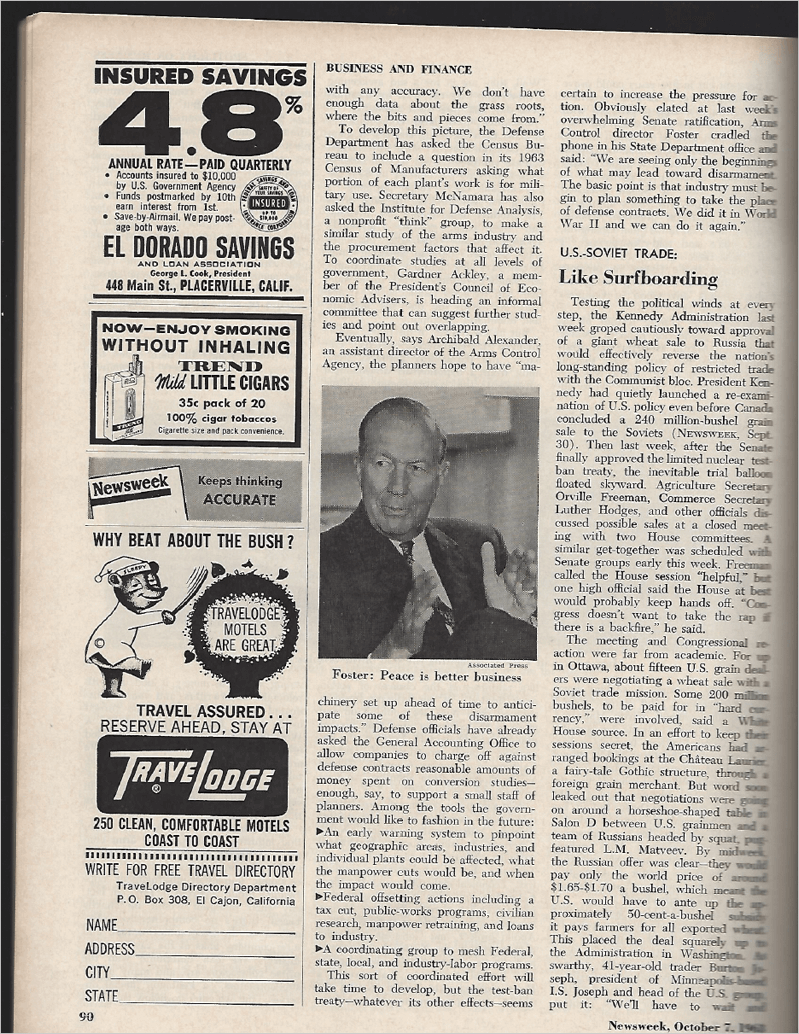
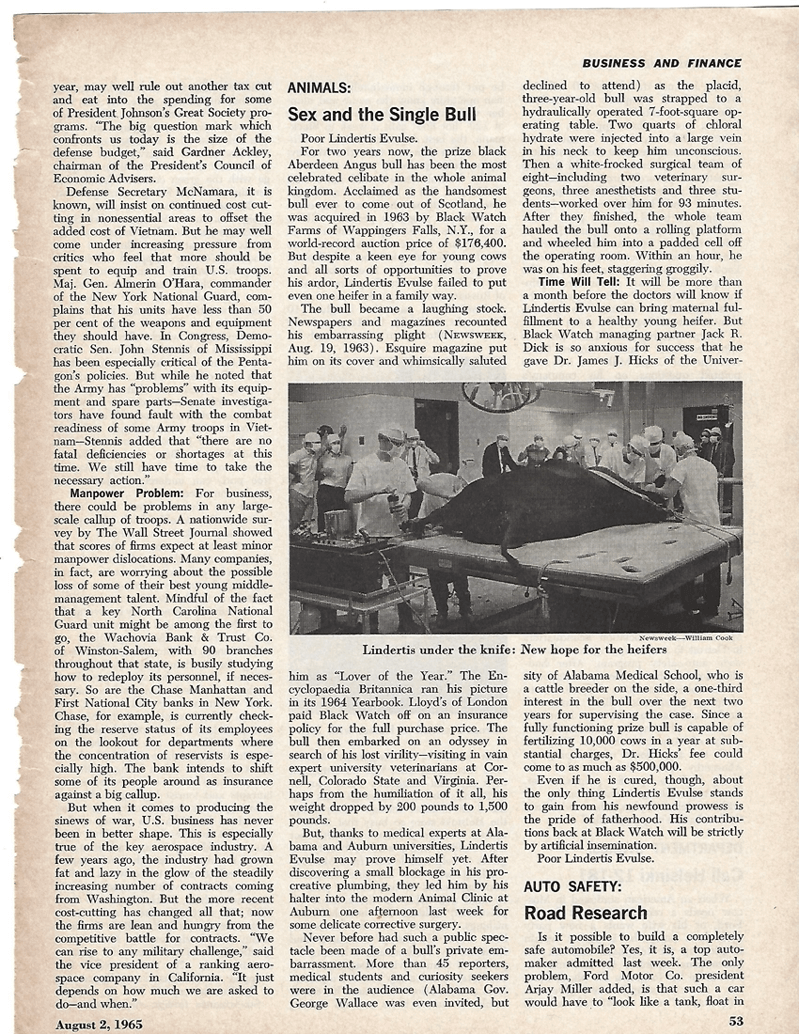
    Fletcher Prouty also wrote about the transformation that took place after Kennedy’s death. For instance, concerning the war in Indochina and how that fed the war machine. And conversely how that would not have happened if JFK had lived. Reader James Finn has clipped two valuable stories from the MSM that illustrate the point Fletcher was making, namely that Kennedy’s withdrawal plan was already impacting the war economy. And the second story shows how his death turned that deceleration around in a hurry. Predictably, it appears that Epstein was wrong about that and Colonel Prouty was correct. One more posthumous feather in Fletcher’s cap. And thanks to Mr. Finn.


    “What Can Industry Do As Pentagon Cuts Back?”

    Newsweek  October 7, 1963


    “War’s Widening Ripples”

    Newsweek  August 2, 1965


  • Oliver Stone in Quebec City (Part 1)

    Oliver Stone in Quebec City (Part 1)


    June 2019

    This is when I was in receipt of a letter from Oliver Stone saying that he was putting together a documentary, as he termed it, a follow-up story, to his 1991 feature film JFK. One part read as follows:

    Rob Wilson, Jim DiEugenio, and I are seeking to put this information together under one roof in a documentary that will be clear to John Doe. We’re focused on examining the evidentiary findings of the ARRB and would like to interview you for the film to discuss the Tampa and Chicago assassination plots.

    Lastly, as this project has not yet been announced, please keep all of this confidential.

    We hope you’ll be able to be part of this film and we look forward to hearing from you.

    Best regards,

    When I got this message I knew it was genuine because the person I write articles for, Jim DiEugenio—the world`s leading JFK assassination expert—knows Mr. Stone and had talked about making such a project.

    September 2019, Georgetown: First Meeting

    I had been interviewed by Oliver Stone for about one hour about the prior plots to assassinate JFK for his upcoming documentary. I got to meet Jim DiEugenio in person for the first time, as well as producer Rob Wilson and even chatted with Doug Horne—one of the top guns from the ARRB. Heck they even had a make-up person for me.

    Then between two sips, almost out of nowhere, Oliver Stone enters and heads to the counter to grab a bite. Opportunity knocks! I approach him.

    Paul Bleau: Mr. Stone, I would like to thank you for this opportunity. It has been a great honor for me.

    Oliver Stone: Thank you for coming.

    PB: When it comes time to promote the documentary, you may want to come to Quebec City. I am certain you will receive a warm welcome from open-minded people.

    OS: Hmmm, why not Montreal?

    PB: Montreal is beautiful, but wait until you see Quebec City.

    OS: It must be beautiful up there during the Autumn.

    PB: Gorgeous and it is during the time of the Quebec City Film Festival.

    OS: Hmmm.

    2019 to 2021: Putting Together a Package

    Receiving a Hollywood mogul was really not an expertise of mine. I called Louis Côté who was our recently retired mayor’s right-hand man. Oliver Stone coming to Quebec! Let me set you up with Robert Mercure, who heads our tourism association: Destination Québec. Robert and I spoke and, in very little time, he said: Let’s make it happen.

    We were offered some funding and Robert himself recruited the Château Frontenac and its brilliant manager Ken Hall to host our guests. By now, it was Fall 2021.

    None of us knew much about handling a cinema-related event, so I called Valerie Bissonnette. She and I go back about 25 years. Valérie founded her own production company in 1998, known today as Groupe Vélocité. She has done much to make Quebec City an international hub for film production. Having seen her incredible efficiency in documentary launches, I knew she had to be part of our team. Now, with some backing, I sent a message to Mr. Stone and his entourage in September 2020, inviting him and Jim to Quebec City.

    It was followed by this answer:

    Paul,

    I’m not going to be able to do this for you. I’ve been doing far too much interviewing for my book and still have a ways to go with different countries.

    It would be almost a year later before I would try again. This time the answer would be positive. Mr. Stone would come here in person on December 16, 2021, shortly after the North American debut of the documentary on Showtime, scheduled for November. What changed? The film had been launched and was very well received at the Cannes Film Festival in August. It was time to sell it in North America, where anything about the assassination has been greeted with crossed arms compared to markets abroad.

    Mr. Stone and Jim DiEugenio were to spend three days with us. Then disaster struck: COVID reared its ugly head again and travel costs skyrocketed. We did not have enough funds and could not face the pandemic risks.

    Winter 2022: The calm before the storm

    The documentary aired on Showtime on November 22, 2021. Everyone I know who saw it became convinced there was a conspiracy. I received kudos for how I explained that there was a template that could be observed in prior attempts to assassinate JFK. This led to a call from Peter Black of the Chronicle Telegraph and this created an appetizer story that took flight locally: how did a Quebecker ever make his way into an Oliver Stone documentary?

    I also teased that we were trying to get Oliver Stone to come and visit us in the Spring. Really! That would be incredible for our city.

    By February, thanks to Valérie, the Quebec City Film Festival joined the fray as well as private sponsors. After two years of COVID forced hibernation, the Festival was planning a new format: Instead of living solely on a ten-day Festival in the Fall, it would remain visible year-round by inviting industry legends to our City. What better way to kick it off than with Oliver Stone?

    By late February, Oliver and Jim agreed to come. Everyone was hard at work getting organized: a galvanizing shot in the arm for our tourism industry that would kick off our summer season with a blast. The coverage was massive and widespread and even included the foreign press. Quebec City’s film industry would be on the map. The venues were filling up quickly. Things were looking up. And then Russia invaded Ukraine.

    The Build Up

    Oliver Stone is easily one of the top five filmmakers of his era. He and his movies have been winners of numerous Oscars, Golden Globes, and other prestigious awards. He is also a multi-medaled Vietnam War veteran. Among his movies that most influenced me were Platoon, Wall Street, and JFK.

    His book Chasing the Light is a must-read for anyone interested in movies or examples of courage and determination. Mr. Stone also is candid about his mistakes. When he interviewed me, I was struck by his genuine interest in what I had to say, his jovial nature, and his professional approach.

    Accompanying him would be Jim DiEugenio, my editor, and mentor. He, of course, was the writer of the documentary.

    They would be joined by the famous leading JFK assassination interviewer, Len Osanic. Len is the producer of the long running Black Op Radio series, the best JFK radio show there is. It was through Len and Jim that I was in a position to start this adventure. Without them, I would not have been interviewed by Mr. Stone.

    On the hosting side of things, Martin Genois put together a dream team of drivers, guides, photographers, aides, PR specialists, pundits, animators, etc. He worked up a perfect itinerary and lined-up mesmerizing venues. I was able to contribute interns, sponsor contacts, and I recruited my daughter and my colleague Nancie Moreau from our college, who wrote a fine book about Nikola Tesla and had the perfect personality to cement new friendships.

    The problem we were facing was that because of the Ukraine invasion, and the fact that our VIP guest had interviewed Putin some five years earlier, media interest in Mr. Stone`s visit began shifting from his JFK documentary and his legendary moviemaking to his relationship with Putin. This put the organizers in a tricky situation: How could we roll out the red-carpet for someone who was now being labeled a Putin apologist?

    Having spoken to Mr. Stone, he is probably the last man on Earth who would agree with Putin`s tragic, ill-thought decision. He has even said so. None of us were for this. The practice firm I supervise at the college had even developed a Vodka for Peace campaign for a local distiller.


    The PR team came up with an effective strategy: Mr. Stone and DiEugenio, after the showing of the documentary, would only field questions about the film. The second event would be a panel discussion focusing on the assassination in general and during the marquis event, a seasoned journalist would talk about Stone’s career, including his controversial interview/ exchanges, as could the press during interviews that were lined up. This way no one could be accused of mindless stargazing.

    Behind the scenes, pressure was mounting on one of Quebec’s larger than life journalists, Jean-François Lépine, to take on Mr. Stone aggressively during his interview at Le Diamant. The stage was set for two septuagenarians to lock horns during Mr. Stone’s final evening with us in front of a packed house of 600 people.

    Pre-arrivals

    Things got off to a rocky start. A few days before our guests arrived, I received an email from Oliver. He wanted to talk. “Please let this not be a last-minute cancellation,” I thought!

    The phone rings:

    OS: Tell me what will happen when I arrive. Can we get a lift?

    Oliver’s secretary was on the line also: Oliver, do not worry, Maxime will pick you up, he’s the guy who drove Paul McCartney around.

    OS: Paul McCartney, oh OK. Paul, what kind of clothes should I bring up?

    PB: Be certain you have a windbreaker.

    OS: What will we do during our first day?

    PB: It’s an open day for you to just relax…talk to Maxime and Geneviève (the lead hostess), they can feed you full of ideas…or I can have Nancie meet up with you. In the evening, you can come to my cottage, 40 minutes away in the wilderness, for a BBQ.

    OS: That sounds good.

    PB: I must tell you, there are bugs this time of year.

    OS: Bugs, I must say I hate bugs.

    PB: Oliver, I read your book, if you can handle Vietnam, I think you can handle a mosquito.

    And so on…

    Thinking back…what a lousy quip. Vietnam, to a veteran of that mindless war was nothing to slight. When Oliver Stone comes to our city, show some respect.

    On the positive side: Two Montreal dailies interviewed Jim and Oliver before their departures.

    June 10-11

    Because of COVID related staff shortages at our airports, it took Oliver 12 hours to get here from L.A. instead of 7 or 8. Jim, for reasons out of our control, arrived a day later.

    June 11th was when Len and his wife arrived at the airport and I enjoyed a coffee and croissant with them in the old town along the riverside, before dropping them off at the Château.

    The six out of towners headed to the cinema after a late supper to see the Top Gun sequel.

    June 12

    Our guests used this day for touring and discovered the hidden gem that is our Provincial Capital: beauty, history, culture, nature, the Château, the Riverside…all done by a very pleasant and erudite tour guide.

    In the meantime, I was interviewed by a curious and knowledgeable radio host. It went very well and I invited him to the panel discussion.

    June 13


    JFK: Through the Looking Glass

    The CLAP Cinema reserved its largest room for the showing of the documentary. Its 260 seats sold out in a matter of days, without even promoting the event. We were not able to secure any added rooms, because of the blockbusters opening that week, otherwise we could have tripled the attendance rather easily.

    There was a buzz that evening rarely seen for a movie in our city. The combination of COVID-free leisure and the presence of Oliver Stone was magically palpable. The cameras were rolling and some people were in disbelief that the famous director would address the crowd.

    I was accompanied by a lawyer friend of mine, plus family and work companions. Their reactions to the JFK case, as written for the screen by Jim DiEugenio and presented by countless experts, charts, and archive footage left them bewildered and shocked. The documentary’s closing was followed by a standing ovation.

    The crowd assimilated devastating facts about broken chains of custody, a Keystone Cops quality autopsy performed by three manipulated pathologists with almost no experience in gunshot wounds, powerful evidence of a front shot, strong witness evidence that cast doubt on Oswald even having been in the sixth-floor sniper’s nest, destruction and manipulation of evidence, Oswald’s intelligence file manipulation, bullying and intimidation of witnesses, proof of altering of photo and autopsy evidence, countless examples of how and why Kennedy had powerful enemies. This was the two-hour version. Imagine what the reactions would be had they seen the four-hour, even more detailed version called JFK: Destiny Betrayed.

    One thing that was perhaps difficult for the audience to comprehend was the formidable status of some who we hear talking in the film, both as experts and in archive footage: Warren Commissioner Senator John Cooper; Sen. Richard Schweiker of the Schweiker-Hart subcommittee to the famous Church Committee hearings; the House Select Committee on Assassination’s (HSCA) lead initial counsels Richard Sprague and Robert Tanenbaum; Doug Horne, one of the chief investigators on the Assassination Records Review Board (ARRB): all attacking the Warren Commission fairy tale. And these represent a small fraction of most inquiry insiders who sound a lot more like the conspiracy advocates than the Warren Commission acolytes.

    At the end of the documentary, audience members were given the chance to ask questions answered by the tandem of Oliver Stone and Jim DiEugenio. Oliver giving the big picture, Jim following up with fine details, sources, and added insights.

    At one-point Mr. Stone underscored my participation, which led to applause for a local contributor and my taking a bow. Based on reactions of the crowd, friends of mine, my lawyer companion, it is doubtful that even one person left that evening believing that the assassination of JFK was committed by a lone nut. Two young history students thanked me and looked enthralled by what they had just seen. Even one of my brothers, who has an immediate reflex of dismissing conspiracy theories—which by the way tends to be my own attitude towards the conveyor belt of endless anti-establishment yarns—stated: “There is no way that bullet (the magic bullet) caused all that damage.” Marquis event number one was an unqualified success. In the background however, resistance to Oliver’s presence and an attack on his credibility were building.

    June 14

    Before this date, I had been interviewed over a dozen times about the event and the assassination. All positive, focused on the good news for our city, tourism, our film industry, and genuine interest about the assassination and the documentary. My interview on this morning at French CBC Radio with a well-respected morning man would be different.

    Mr. Bernatchez, a gentleman with a distinguished career, came to shake my hand before I was on air. He had an all-business air about him that foreshadowed what would be his skeptical tone during our 12-minute talk. This was further confirmed when a poker-faced assistant of his asked me if I believed all this stuff involving intelligence in the conspiracy. I responded yes, when I really should have pointed out the complexity of the case.

    For example, when he asked what I based my affirmation about there being prior plots on, I answered that the plots I discuss in the documentary were about Chicago and Tampa during the month that preceded Dallas. I explained that there were FBI files (I should have added HSCA) about Tampa and that the Chicago plot was based on Edwin Black’s research as well as Secret Service agent Abraham Bolden’s witnessing of the goings-on. He seemed surprised. When he said that the conspiracy was not acknowledged by the media, I talked about how five government investigations that succeeded the Warren Commission and revelations from these as well as from the investigators/insiders themselves presented a very different account from what is concluded by the obsolete Warren Commission—which is what seems to be the basis on which Lone Nut scenario believers continually turn to.

    At one point I answered a question about press complacency on this issue by stating, “You would have to ask the press why they are not pouring through the declassified files.” He said, “Now you are accusing us of cooperating in the conspiracy,” and I replied, “Perhaps it is just a lack of interest.” That is how it ended.

    I came out worried that I sounded hesitant, confused, and lacking in credibility. When I listened to myself later, I was OK with how I answered: calmly and factually. If I had to redo it, I certainly would have been better documented, ready with French wording, and I would have tried to understand the nature of the skepticism. Nonetheless, I sent Mr. Bernatchez a friendly email thanking him for his time, congratulating him on his excellent career, and offering to have coffee some time to further discuss this.

    Other things were happening that day at a frantic pace: some good, some not so good. In the not so good category, Montreal’s La Presse published an article blasting Stone, calling him an apologist for Putin and a conspiracy theorist with a plea to not go to the Le Diamant finale event. (Too late, it was almost sold out). According to this journalist, Stone was Putin’s friend and vocal chord as well a teller of wild tales. The organizers were pandering to a controversial loose cannon and so on and so forth. The writer had not seen the documentary: a common denominator of many of the critics.

    On Montreal’s CBC morning show Jean François Lépine was interviewed by the CBC’s Patrick Lagacé and Catherine Beauchamp (click here for audio). Mr. Lagacé, referred to the blistering La Presse article about Stone calling him an apologist and a conspiracy theorist whose movie JFK was revisionist, full of a mish mash of baseless claims. What happened after the intro left me positively dumfounded: Mr. Lépine retorted that Oliver Stone was a great film-maker whose story about Kennedy was so misunderstood. It constituted the chronicling of D.A. Jim Garrison, who despite his defeat was later vindicated when it was confirmed that Clay Shaw, the defendant, was in fact CIA attached. He added that other government inquiries proved that Garrison was spied upon and that there was a plot (more than one shooter). The film JFK was responsible for the creation of the ARRB and the declassification of hundreds of thousands of document, many vindicated Garrison and proved there was a conspiracy. He said that the Warren Commission was discredited and defended researchers like myself and Jim DiEugenio.

    As a prelude, he did express strong disagreement with Mr. Stone’s “pandering” to dictators.

    Mr. Lagacé seemed somewhat taken aback. He too had not seen JFK Revisited: Through the Looking Glass. He asked Mrs. Beauchamp, who had seen the film, what she thought. Among other positive comments, she said how she enjoyed the way they linked Oswald to intelligence, how the CIA had files on him despite claiming to the Warren Commission that he was not on the radar and that he was removed from a watch list just a few weeks before the assassination. She also described how the documentary discredited the single bullet theory and revealed destruction of documents. This to me was historical! A Quebec media Golden Boy saying that there was a conspiracy re-enforced by a CBC journalist on mainstream media. I wish I had been aware of this before my interview with Mr. Bernatchez.

    In the meantime, some media began challenging the organizers on why they had invited Oliver Stone given his relationship with Putin.

    see Part 2

  • A Review of Oliver Stone’s JFK: Destiny Betrayed

    A Review of Oliver Stone’s JFK: Destiny Betrayed


    For A Review of Oliver Stone’s JFK: Destiny Betrayed (Chapter 1) click here.

    For A Review of Oliver Stone’s JFK: Destiny Betrayed (Chapter 2) click here.

    For A Review of Oliver Stone’s JFK: Destiny Betrayed (Chapter 3) click here.

    For A Review of Oliver Stone’s JFK: Destiny Betrayed (Chapter 4) click here.

  • Carol Hewett, Steve Jones, and Barbara La Monica Dissect the Paines

    Carol Hewett, Steve Jones, and Barbara La Monica Dissect the Paines


    From the May-June 1996 issue (Vol. 3 No. 4) of Probe


    (Click here if your browser is having trouble loading the above.)


    From the July-August 1996 issue (Vol. 3 No. 5) of Probe


    (Click here if your browser is having trouble loading the above.)


    From the November-December 1996 issue (Vol. 4 No. 1) of Probe


    (Click here if your browser is having trouble loading the above.)


    From the March-April 1997 issue (Vol. 4 No. 3) of Probe


    (Click here if your browser is having trouble loading the above.)


    From the November-December 1997 issue (Vol. 5 No. 1) of Probe


    (Click here if your browser is having trouble loading the above.)


    From the March-April 1998 issue (Vol. 5 No. 3) of Probe


    (Click here if your browser is having trouble loading the above.)


    From the July-August 1998 issue (Vol. 5 No. 5) of Probe


    (Click here if your browser is having trouble loading the above.)


    From the March-April 2000 issue (Vol. 7 No. 3) of Probe


    (Click here if your browser is having trouble loading the above.)


  • The Assassination and Mrs. Paine (Part 1)

    The Assassination and Mrs. Paine (Part 1)


    Film-maker Max Good has spent several years working on a film about Ruth and Michael Paine and what their precise relationship was to the assassination of President John Kennedy. Although I have some reservations about it, it is worth watching and I encourage our readers to do so.

    One of the most puzzling aspects about it is this: Why did it take almost 60 years for anyone to make a film on such a rich, relevant, and interesting topic? Perhaps because there are no references to either Paine in the indexes of Harold Weisberg’s book Whitewash, Edward Epstein’s Inquest, or Josiah Thompson’s Six Seconds in Dallas.

    Of the first generation of critics, Sylvia Meagher’s book devotes by far the most pages to the Paines. Perhaps, we should quote her overall impression of Ruth Paine in order to place Max’s film in perspective:

    Ruth Paine…is a complex personality, despite her rather passive façade…Some examples from her testimony show a predisposition against Oswald and a real or pretended friendliness toward the FBI and other Establishment institutions, which should not be overlooked in evaluating her role in the case…Mrs. Paine is sometimes a devious person, and her testimony must be evaluated in that light. (Meagher, Accessories After the Fact, p. 217)

    But it was really Jim Garrison who first tried to place the Paines under the microscope. For example, he was interested in the family ties of Ruth, specifically who her sister Sylvia worked for. In fact, he questioned Ruth about this point during Ruth’s appearance before the New Orleans grand jury. To put it mildly, Ruth replied in a rather non-responsive manner, a point we shall examine later.

    Ruth and Michael Paine spent, by far, the most time on the witness stand for the Warren Commission. According to Walt Brown, the combined total questions they answered was over six thousand. In fact, Ruth was so eager to answer questions, she even volunteered areas of examination that she thought the Commission had bypassed. For instance, as Albert Jenner was about to close his questioning of her on March 21, 1964, Ruth interjected with:

    Ruth: You have not asked me yet if I had seen anything of a note purported to be written by Lee at the time of the attempt on Walker. And I might just recount for you that, if it is of any importance…

    Jenner: Yes, I wish you would…Tell me all you know about it. (WC Vol. 9, pp. 393­–94)

    As we shall see, a major problem with the Paines is this: they surfaced evidence of things Oswald did which were in fact, dubious acts. One would be the supposed Walker shooting, another would be Oswald’s alleged journey to Mexico City. Looked at with the perspective, we have today—after the work of the Assassination Records Review Board (ARRB)—the implicative nature of these events is rendered suspect. Therefore, the fact that the Paines were part of finding evidence that incriminated Oswald—in events that perhaps did not occur—this should merit some notice. In fact, 5 days after she delivered the Walker Note to the Secret Service—in Marina Oswald’s book—Ruth was visited by two Secret Service agents. They were actually returning her the note, since they thought it was from her. (James DiEugenio, Destiny Betrayed, second edition, p. 203)

    It is surprising to juxtapose the star billing the Commission gave the Paines with the fact that neither the House Select Committee on Assassinations (HSCA) nor the ARRB called them in for questioning. It is, perhaps, a bit disturbing. For during and after the days of the ARRB, a whole wave of information created a new data plateau on the Paines. The parties who were largely responsible for this new information were author George Michael Evica and researchers Carol Hewett, Barbara La Monica, and Steve Jones. Evica wrote a book, A Certain Arrogance, which dealt with the Paines and their religious background. Before that, Hewett, LaMonica, and Jones wrote a series of essays on the couple for Probe magazine. We will be referring to both in this review.

    II

    The way this reviewer got involved with the matter was that I was the publisher of Probe magazine when Hewett, LaMonica, and Jones wrote their essays. I thought their work was new and interesting. Author Thomas Mallon was so dismayed by their work that he wrote a book contesting it. (Mrs. Paine’s Garage, 2002) The writing trio began their series with a truism: “Ruth and Michael Paine…are among the most significant, yet least studied, of the figures surrounding the Kennedy assassination.” (Probe, Vol. 3 No. 4 p. 14) After reading their work, this was an understatement. The three were responsible for a set of eight essays which one can reference on this site.

    A provocative point Carol conveyed dealt with Ruth’s so-called discovery of Lee Oswald’s letter to the Russian embassy, which he wrote at her home over Memorial Day weekend, 1963. In her testimony before the Commission, Ruth tried to explain why she took the rather remarkable step of picking the letter up, hand copying it, and eventually giving it to the FBI. She said that as she glanced at the letter, the first sentence contained a lie and she was insulted by Oswald using her typewriter to do such a thing. But if one buys the official story, which Ruth does, the first line of the letter, about Oswald visiting a Russian diplomat in Mexico City, was not a lie. Commission lawyer Albert Jenner understood that this made for a serious problem. He (wisely) decided to go off the record. Jenner knew they had to patch over Ruth’s story. (Probe, Vol. 4 No. 3, p. 17)

    Throughout that series, the authors exposed things like this to the light of day. One more example will suffice. There had always been a question as to why the relationship between Ruth and Marina Oswald ended after the assassination. When Marina testified before the New Orleans Grand Jury, she addressed this. As we know, Marina was detained by the Secret Service for weeks afterwards. She told the jury, “I was advised by the Secret Service not to be connected with her (Ruth Paine)…She was sympathizing with the CIA.” When assistant Andrew Sciambra pursued that line, he asked her, “In other words, you were left with the distinct impression that she was in some way connected to the CIA?” The one word reply was, “Yes.” (Probe Vol. 7 No. 3, p. 3) Was this the reason the Secret Service returned the so-called Walker Note to Ruth? (James DiEugenio, Destiny Betrayed, second edition, p. 203)

    The separation of Ruth from Marina after Kennedy’s murder is a good way to introduce one of the most intriguing and compelling aspects of Max Good’s film. Because as we know, prior to Ruth Paine becoming so inseparable from Marina, the person who escorted the Oswalds around Dallas/Fort Worth was George DeMohrenschildt. As Max asks Ruth in the film: Why would a White Russian be so interested in a Communist? Ruth replies that this is a good question.

    We actually know why. Near the end of his life, DeMohrenschildt stated that, on his own, he would have never come near the Oswalds. J. Walton Moore, chief of the CIA station in Dallas, asked him to do so. (DiEugenio, p. 194) George, sometimes called the Baron, arranged a gathering of the White Russian community with the Oswalds in late February of 1963. From that gathering, Ruth arranged a one-on-one meeting with Marina. Approximately three weeks after that meeting, April 7th, Ruth composed a letter asking Marina to move in with her. Kind of fast? (Probe, Vol. 5 No. 1, p. 14)

    As described in the film by myself and Peter Scott, around this time, George left for Haiti, had a briefing in the DC area with the CIA and military intelligence, and then had about $300,000 deposited into his account. (James Douglass, JFK and the Unspeakable, p. 168) As I ask in the film: Was this for services rendered? We will never know, since after he was subpoenaed by the HSCA, the Baron was either killed or took his own life by shotgun blast.

    One of the strongest parts of the film is the segue from DeMohrenschildt to Priscilla Johnson. Because after the (likely) forced cut off between Ruth and Marina, Johnson entered the picture—and she stayed there for a long time, like 13 years. Priscilla always denied she was with the CIA. She even threatened to sue Jerry Policoff over this. It’s a good thing she did not, because as Max shows in the film, the ARRB pretty much sealed the deal on her. He shows the documents which categorize her as a “witting collaborator,” meaning that she did not need to be employed by them; they could rely on her to write sympathetic stories anyway. (See also, John Armstrong, Harvey and Lee, pp. 279–82)

    As the film shows, you have one CIA asset—the Baron—escorting the Oswalds around Dallas/Fort Worth upon their return from the USSR. You had another—Johnson—picking up Marina after the assassination and becoming her personal escort. And when Priscilla finally wrote her book about the Oswalds, Marina and Lee, it completely backed the Warren Report.

    In the interim, you had Ruth and Michael Paine. Further, both Ruth and Priscilla were producing evidence Oswald was in Mexico City, when, in fact, Marina initially insisted to the Secret Service he was not. (DiEugenio, p. 203; Armstrong, p. 696, Secret Service report of Charles Kunkel, 12/3/63) And many researchers today—including the authors of the HSCA’s Mexico City Report—agree he wasn’t.

    The film makes this point about parallels rather subtly; I have made it more bluntly.

    III

    Although it is not part of his ostensible subject, Good does a nice job in penciling in the background to his story: namely the presidency of John Kennedy. As many have, he notes that some of JFK’s policies fostered opposition from people in high places, for example the Bay of Pigs and the Missile Crisis. But people like the Paines and Priscilla Johnson have always used the old standby that, for those examining the case, it is hard to accept that a little man like Oswald could single handedly erase a great figure like Kennedy. The subtext being that this is what fulfilled Oswald as a large figure in history, for example Michael voices this mantra early in the narrative. But if that was so, then why did Oswald never claim credit for the assassination? On the contrary, as the film shows, he loudly stated he was a patsy.

    At this point, Ruth says that the Warren Report always made sense to her. Priscilla tops this with an astonishing comment: she says that conspiracy theories have done more damage to the country than the death of JFK did. In the film, it is made clear that when the police arrived at the Paine household, looked for a weapon, and did not find one in the rolled up blanket Marina thought it was in, this shocked Mrs. Paine. It started her down the road to incriminating Oswald in the press.

    But it was Ruth who picked up Marina from New Orleans, packed the car, and drove her to Irving to stay with her, thus now accomplishing what she was trying to do since April. If there was a rifle amid the belongings, why did neither she nor her husband notice it while packing and then unpacking the station wagon? They missed it twice?

    One of the valuable contributions the film makes is the outlining of the curious family ties that the Paines had. (For a good summary see Evica, pp. 364–65) As noted, Ruth’s father, William Avery Hyde, and her brother-in-law, John Hoke, worked for US AID, which was closely tied to the CIA. As Greg Parker discovered, her sister, Sylvia Hyde Hoke, worked on a joint CIA/Air Force project. (Lee Harvey Oswald’s Cold War, pp. 266–68) One of the most pungent moments in the film is when Max calls Sylvia and asks for an interview. She instantly hangs up on him. Michael Paine’s mother, Ruth Forbes Young, was best of friends with Mary Bancroft. Bancroft was both an agent and girlfriend of CIA Director Allen Dulles. As author Bill Simpich notes in the film: could Mary have noted to Allen the utility of the Quaker/ Unitarian couple in performing surveillance duties on the left?

    In fact, this is the theme of Evica’s book: how Allen Dulles used these religious groups—Quakers and Unitarians—for espionage work, for example Noel Field. And Bancroft knew about this. (Evica, p. 116) Evica ended his book by suggesting that Allen Dulles may have helped secure for the Paines a sterling character recommendation from a wealthy couple at the beginning of the FBI’s inquiry into the JFK murder. This was from Frederick Osborne Jr. and his wife Nancy. (A Certain Arrogance, pp. 250–58) Allen had worked with Frederick’s father in the National Committee for a Free Europe and also in the CIA’s Crusade for Freedom. And there are examples of surveillance activities by the couple.

    Sue Wheaton appears in the film. She met Ruth in Nicaragua in 1990, after the election of Violetta Chamorro. Ruth was with Pro-Nica, a project out of St. Petersburg. This was a more conservative strain of the Quaker movement. Wheaton said that Ruth told her that their Quaker group was funded primarily by “6 wealthy, conservative individuals from the Southeast.”(Probe, Vol. 3 No. 5, p. 9) Wheaton also noted that Ruth’s group ran a sawmill project on the east coast of Nicaragua, a Contra holdout and nexus of CIA based activities. Ruth showed up at Wheaton’s council meetings of the anti-Contra group, of which Pro-Nica was not a member. Wheaton got the distinct impression Ruth was taking down information about individuals and groups in attendance. Ruth “studied the bulletin board there, copying everything on it…Also she made reference to people she knew in the U. S . Embassy.” (ibid) Wheaton later added that Ruth would show up with two cohorts and these two men would make tape recordings and take pictures. Ruth’s plea was they were authorized by the Nicaragua Network to take photos, but when this was checked, the claim turned out to be ersatz.

    In the spring of 1963, Michael Paine was engaging students from Southern Methodist University in debate and discussion “about communism in general and Cuba in particular.” During these debates, it was Michael who took the role of a Castro advocate. He even bragged about being familiar with an actual communist, “an ex-Marine who had recently returned to the States with a Russian wife,” an obvious reference to Lee Harvey Oswald. Michael also encouraged these students to go to local commie cell gatherings. (Probe, Vol. 5 No. 1, p. 14)

    This last point leads us to one of the most provocative pieces of evidence concerning the Paines. Did Detective Buddy Walthers find the notes Michael kept of these meetings? These would be the file folders found at their home with information on communist, Castro sympathizers. They were picked up by Walthers on the weekend of the assassination and he made a contemporaneous report about them. (Armstrong, pp. 879–80) Over time, they were made to disappear, until they ended up in the Warren Commission “Speculations and Rumors” section. One of the most interesting parts of the film is that it appears that Ruth has employed, or is good friends with, a veteran of the Defense Investigative Service. Max talked to this gentleman and he tracked down one of the (now) empty file folder boxes. He informs Max that Ruth does a lot of studying on the Kennedy case.

    There is one other example of this possible activity that could have been used. Cliff Shasteen was a barber who cut Oswald’s hair a few times in the fall of 1963. Cliff said that Oswald was accompanied twice by a 14 year old boy who did not get his hair cut or say anything. But strangely, this boy appeared by himself a few days before the assassination. Once there, he began to rant about the benefits of one world government and the plight of “have nots” in society. Shasteen was taken aback, because he knew he was not a local kid. The youth never returned. (Click here for details)

    Greg Parker did a fine job of inquiring into this odd, but notable occurrence. Greg deduced that the description fit future actor Bill Hootkins perfectly. Who had access to both Hootkins and Oswald? Ruth Paine tutored Hootkins in Russian that fall. Bill’s mother told the Bureau that Ruth would pick her son up and take him to St. Mark’s—an upper class, private school where Ruth worked at—for lessons. Hootkins’ contact information was in Ruth’s address book. Did Ruth take young Bill to Irving instead?

    see Part 2


    Purchase here on iTunes.

    Purchase here on Amazon.

  • American Exception Episode 34: JFK Assassination Debate

    American Exception Episode 34: JFK Assassination Debate


    Click here to listen to the debate on the podcast site.


  • Fletcher Prouty vs. the ARRB

    Fletcher Prouty vs. the ARRB


    As we know, prior to the opening of Oliver Stone’s film JFK, there was a deliberate attempt to sandbag the picture. This included efforts both inside and outside the critical community. On May 14, 1991—a full seven months before the premiere—Jon Margolis wrote a hatchet job on a film he had not seen for the Dallas Morning News. On May 19th, George Lardner in the Washington Post—supplied with a bootleg copy of a script by the late Harold Weisberg—did the same. Lardner included a blast at the film’s Vietnam withdrawal thesis. He wrote, “That there was no abrupt change in Vietnam policy after JFK’s death.” When Stone was allowed to reply to this, he and Lardner continued to argue over that withdrawal thesis. (Washington Post, June 2, 1991) The man who brought the Vietnam withdrawal concept to Stone was retired Air Force Colonel Fletcher Prouty. Prior to the film’s mid-December 1991 opening, the November issue of Esquire magazine published a long cover story on the film. It was written by the late journalist Robert Sam Anson.

    In 1975, Anson had written a book on the assassination entitled, “They’ve Killed the President!” If any editor at Esquire had read it, they should have thought twice about giving Anson the assignment, because Anson’s book contains one of the worst smears in the literature on New Orleans DA Jim Garrison. And since Stone based his film on Garrison’s book, he was the protagonist of the picture.

    Clearly, Anson had a dog in this fight. His article, “The Shooting of JFK,” accused Garrison of being “closely associated with organized crime” and also of leaving out of his book, On the Trail of the Assassins, his trial for bribery and income tax evasion. As Bill Davy pointed out, Garrison had no such mob association. (Let Justice Be Done, pp. 149–67) And Garrison had written about that trial, which resulted in his acquittal. (Garrison, pp. 254–72) But Anson had an agenda: Kennedy was likely killed by a conspiracy, but Stone and Garrison were not the people to tell us what really happened.

    Anson described Prouty as a writer for “one of the raunchier porno magazines.” He then wrote that Prouty’s by-line and association with the Joint Chiefs of Staff changed often over time. Neither of these were accurate. And Prouty’s singular achievements—his penning of the classic book The Secret Team, the fact that his many essays contained a remarkable amount of new and valuable information—this was all cast aside by Esquire. Fulfilling his agenda, Anson dutifully played off historian John Newman against Prouty, with Newman as the white hatter in Stone’s consulting crew and Prouty as the black hat.

    Anson’s article had some notoriety in the MSM. So when the film opened, Prouty had a bleeding 3 inch gash over his right eye. And since he was responsible for originating the film’s overarching thesis—namely that President Kennedy was leaving Vietnam when he was killed—he became a target. The fact that the MSM had completely missed the idea that the Vietnam War would not have happened if Kennedy had lived—that was something they did not want to face up to.

    II

    To fully understand the second stage of the issue at hand, one has to look back at Douglas Horne’s 5 volume series, Inside the Assassination Records Review Board. Horne included an important 15-page section in the first volume entitled “The Culture of the ARRB.” (Horne, pp. 9–24) This was an eye-opening, sometimes startling, section of that series.

    Horne is at pains to describe a kind of ‘future shock’ upon his arriving in Washington to work for the ARRB. With the exception of Jack Tunheim, none of the five Board members were really familiar with the case. (Horne, p. 10) When Doug suggested a series of briefings to bring them up to speed, Chief Counsel Jeremy Gunn advised against it:

    He said they had little interest in the evidentiary conflicts that characterized the JFK assassination and had demonstrated great impatience with him on more than one occasion when he had attempted to discuss the ambiguity in the medical evidence arena. Furthermore, Jeremy told me that none of the Board members believed there had been a conspiracy to kill President John F. Kennedy. (Horne, p. 10, italics in original)

    And this is where Horne’s disclosures become even more interesting and they dovetail with the subject of this essay. Horne estimates that as much as 2/3 of the staff believed the Warren Commission was correct. This is remarkable, especially since the Board was operating in the wake of the national uproar created by Stone’s film. Most polls from that time period would have shown that upwards of 75% of the public believed Kennedy had been killed as a result of a conspiracy. In sum, concerning this question, the Board was not a representative cross section of the populace.

    Horne writes there was strong prejudice, a kind of arrogance, toward any colleagues or independent researchers who questioned the Warren Commission’s verdict. (Horne, p. 11) He then extended this attitude to David Marwell, the staff director, which suggests that one reason the Board appointed Marwell may have been because he agreed with them. (Horne, p. 12) And the decisions on hiring—which Marwell had some control over—were also an echo of this thinking. (Horne, p. 13)

    There can be little doubt about Marwell’s mindset. In a newspaper interview he did in 1994, he said he found Gerald Posner’s Case Closed a valuable book on Kennedy’s murder. But beyond that, Marwell was on cordial terms with Posner and with Commission advocates Max Holland and Gus Russo. (ibid) Horne writes that the majority of the staff felt the problem with the JFK case was Cold War secrecy, “not the evidence itself.” He characterizes this split between him and most of his colleagues like this:

    The ongoing battle in our society over how to understand the Kennedy assassination, between the critical research community on the one hand, and the establishment’s historians and media organs on the other, was being played out in microcosm within the ARRB—and the deck was stacked in favor of the conservative views of the Board members and the Executive Director. (Horne, p. 14)

    If the reader needed more evidence on this score, consider what Board member William Joyce told the LA Times on August 20, 1997: he said he thought the Commission did a “very good job.” Recall, this is after the Board secured the evidence that Gerald Ford, with a stroke of a pen, altered the Warren Report and moved up JFK’s back wound into his neck. The late Kermit Hall made similar statements around this time: namely that Oswald fired all the shots, there was no conspiracy. (Maryland Law Review, Vol. 56 No. 1) Board member Henry Graff told Penthouse Magazine, “I have found nothing to suggest there was anything but a single gunman. What put him up to it…I don’t think we’ll ever know.” (January, 1997)

    To summarize this general attitude, on page one of the ARRB’s Final Report, these words appear in reference to Stone’s feature film: “While the movie was largely fictional…” No one who was objective, or in command of the facts of the JFK case, could write such a phrase. This is quite close to the type of boilerplate that the likes of Hugh Aynseworth or the late Vincent Bugliosi would bandy about. In my book The JFK Assassination: The Evidence Today, I do a scene-by-scene analysis of the first third of the film. In light of the documents the Review Board opened, in many instances Stone looks rather conservative in his composition of the picture. (DiEugenio, pp. 189–94) Therefore, whoever wrote that part of the report was either uninformed or rather biased. We can consider that comment a kind of parting shot by the Board at the screenwriters, Stone, and Zach Sklar.

    III

    As mentioned above, Horne observes that Marwell and the Board chose a staff that was largely neutral or sided with the Krazy Kid Oswald crowd. Upon going to work, Horne’s first direct supervisor was Tim Wray. Wray was the chief of the Military Records Team. He was a recently retired Army infantry colonel and was a veteran of the Pentagon. Horne said about Wray, “Tim was an open Warren Commission supporter.” (Horne E-mail, 4/23/22) Wray bragged to Horne about knowing “Goldberg over in the Pentagon,” the guy who actually wrote the Warren Report. (Arthur Goldberg is named on page v of the Warren Report as a staff member.)

    According to Horne, “Tim used to needle me a lot about the psychology of JFK researchers and what he called their slipshod methodology, etc. I simply endured it (had to!) and ended up taking his job.” This last refers to Wray’s departure in 1997, which was not explained. Horne also includes the following revelation about Wray, “I tried to get him to read JFK and Vietnam, but he said he ‘couldn’t finish it’ and returned it to me with coffee stains all over the pages.”

    The last disclosure is relevant to the main point of this essay. For this reason: it was initially Fletcher Prouty who had informed Oliver Stone about President Kennedy’s intent to withdraw from Vietnam. Prouty worked with and under General Victor Krulak. Krulak had been to Vietnam in September of 1963 and, as opposed to his trip partner, diplomat Joseph Mendenhall, he had given Kennedy a rather benign report about the progress of the war.

    The next month, Kennedy was ready to enact his withdrawal plan. It had been prepared by Secretary of Defense Robert McNamara as far back as 1962. McNamara had given instructions to the overall commander in Vietnam, General Paul Harkins, to tell each department in Saigon to prepare withdrawal schedules. These schedules had been given to the Secretary at the May Sec/Def conference of 1963 in Hawaii. Krulak was supposed to be on the journey to Saigon with McNamara and Joint Chiefs Chairman Max Taylor that fall, but he was not. The McNamara/Taylor Report was prepared with electronic exchanges between Saigon and Washington. In Washington, Krulak prepared the final report under Bobby Kennedy’s supervision. (John Newman, JFK and Vietnam, 2017 edition, p. 408) That report was designed to serve as President Kennedy’s exit plan from Saigon. The pretext was that since the war was going alright, Americans could now depart.

    Working under Krulak gave Colonel Prouty an unusual window into Kennedy’s plan to leave Vietnam and the Colonel wrote and spoke about this more than once after he left his position in the Pentagon. His writings and utterances on Indochina are both comprehensive and incisive to anyone who has read them. And thanks to Len Osanic, who runs the best Prouty web site there is, we have access to them. (See Len’s site at prouty.org) In fact, years before Newman published JFK and Vietnam, Prouty was aware of most of the salient points that John would address in that milestone book, for example: falsification of intelligence reports by the CIA, the importance of the McNamara/Taylor report, its relation to NSAM 263, etc.

    IV

    As we have seen, Tim Wray had no time or use for any of this rather bracing information about Kennedy’s intent to leave Indochina. Somehow, the fact that Vietnam would not have happened if Kennedy had lived apparently did not interest him. What he really wanted to hone in on was the Prouty information about the 112th Unit at San Antonio being unable to provide further security for President Kennedy’s upcoming trip to Dallas. Looking at the ARRB documents collected on this subject by Malcolm Blunt, it appears that Wray recruited his colleague Chris Barger and chief counsel Jeremy Gunn to accompany him on this mission. (Horne assured this writer that Barger was not the instigator on this.)

    In an ARRB memo secured by Blunt of February 28, 1997, the reader can see that the Board entitled this mission “The 112th Military Intelligence Project.” What is odd about this whole effort is that, although it was apparently designed to discredit Prouty, that was not actually the end result of the Board’s efforts. For example, investigator Dave Montague got in contact with former Lt. Stephen Weiss, who was with that detachment in 1963 but was now retired. He told Montague that Colonel Robert Jones had requested they get in contact with the Secret Service and offer them supplementary protection for President Kennedy in Dallas. Weiss was surprised that the Secret Service declined. He said the word was that a man, who’s name phonetically sounded like [Forrest] Sorrels, declined the offer. (ARRB memo, p. 1) Another person with that detachment, Ed Coyle, had been in on regular interagency group conferences, for example with the FBI and local police groups. He also thought that the 112th would be asked to supplement the Secret Service for Dallas. He was also surprised when the offer was declined. (ARRB memo, p. 2, this was written in handwritten notes of 7-19-96)

    In other words, there were two independent sources who confirmed that the information conveyed by Prouty was accurate in its outlines, in other words, the 112th offered help in protecting the president and it was declined. The Board then tried to discredit Jones. Wray insisted he was not an Operations Officer but an Intelligence Officer and, therefore, somehow that put him out of the loop. He compared that position to someone who just figured out the Japanese attack on Pearl Harbor—in 1945, after their surrender.

    I don’t think most people would agree with that characterization, because, for example, the HSCA termed Jones as an Operations Officer. In certain FBI documents, he was described as an Operations Officer on 11/22/63. (E-mail, Blunt to the late Ed Sherry, 1/19/07) The Secret Service also labeled him as such on 11/30/63. (Blunt to Sherry, 1/18/07) In an article that Larry Hancock and Anna Marie Kuhns Walko wrote for the Dealey Plaza Echo, they referred to him as that. (Vol. 5 No. 2, July 2001) Further, according to a handwritten note on the ARRB memo, Jones said he could prove this himself.

    Another way in which Wray and the ARRB tried to impeach Prouty’s information was by writing that, except in very rare situations, military intelligence did not supplement the Secret Service. In the memo noted above, Wray gives credit to Dennis Quinn for that information, which brings us to another notable choice by the Board.

    Quinn, a former lawyer for the Navy, also was of Wray’s persuasion. He opposed any Board inquiry into the medical evidence, saying it would muddy the record, not clarify it. Quinn supported the Warren Commission’s conclusions very strongly. Like Wray, he was dismissive and belittling of the critical community. He went as far as trying to get David Marwell to stop the ARRB investigation of the medical evidence. After Quinn attended the James Humes deposition, he left the medical review team, thereby leaving just Gunn and Horne on that inquiry. Quinn then left the ARRB in about a year. (E-mail from Horne of May 4, 2022)

    The Hancock/Walko article tended to contradict the Wray/Quinn information about the Secret Service using the supplementary aid of military protection. Hancock and Walko wrote that prior to Dallas, there were such supplements in Miami, Tampa, and San Antonio. This writer cross checked that information with Secret Service expert Vince Palamara. He affirmed it was accurate. (E-mail communication with Vince, May 3, 2022) He sent me photos and other evidence from his site, which back up his case. But, in addition, Vince went further. He also sent evidence that there were military supplements to Secret Service protection for Kennedy in Pueblo, Colorado and San Diego, California that year. (Palamara e-mail of May 4, 2022.) Therefore, in its haste to nab Prouty, it appears that the ARRB was wrong in one of its initial assumptions. They simply did not do the proper study of the past motorcades and they did not consult the proper sources of information.

    V

    Fletcher Prouty was accustomed to alleged inquiries into the JFK case that were, let us say, not as rigorous or straightforward as they seemed. He had been through this with the Rockefeller Commission. That body had been appointed by President Gerald Ford. As revealed in Oliver Stone’s documentary JFK: Destiny Betrayed, when asked why he appointed such conservative mainstays to the commission— such as Lyman Lemnitzer and Ronald Reagan—Ford said it was to conceal some sensitive operations. When asked “Like what?”, he said “Like assassinations!” In keeping with that dictum, Ford appointed Commission lawyer David Belin as executive director for that inquiry. Prouty was called in as a witness by them. He was asked to go off the record at an interesting point in his interview by Commission lawyer Marvin Gray. They were discussing the issues of deniability and compartmentalization. (Interview of 5/15/75, p. 4) Toward the end, Prouty got into some utterly fascinating material about the Nhu brothers, Trujillo, and the U2,bits of which are still redacted to this day. But, to put it mildly, there was very little follow up. As he later revealed to Len Osanic, when Prouty then went into his pre-interview for the House Select Committee on Assassinations (HSCA), he felt the same disappointment. He was probably the only man in the building who would recognize who former CIA officer George Joannides was and why he was really there. He only did the pre-interview and that was it for him. He recognized what was going on under the surface.

    Therefore, when he was called in for an ARRB interview, from the first couple of questions asked, he understood what they were up to. When he got home, he called Len Osanic, who was running a forerunner of his web site. He told Len about the experience. Fletcher said he could not believe the spin, so he decided to play along and participate in their game. (Osanic interview, May 5, 2022) For example, when asked if he had any notes of his information about the 112th, Prouty said no.

    The fact is he did make notes and he kept them. Len Osanic has them on his site today. They are from one Bill McKinney who served with the 112th right after the JFK assassination. Bill said the controversy about the non-reinforcement in Dallas was still going on at that time and, again, this witness contravenes another ARRB assumption. (ARRB memo, p. 6) McKinney said that he did get training in protective services. He said this was attained at Fort Holabird in Maryland. McKinney said that the 112th’s offer of protection was refused point blank, even though people there knew that Dallas was dangerous.

    Mr. McKinney now makes three witnesses that buttress Prouty’s statement about the denial of supplementary services, but there was actually a fourth. After Oliver Stone’s film was in circulation, a young woman called up Len Osanic. She said she was the daughter of one of the commanding officers of the 112th. She said that on the night of the assassination, she was at home. In the kitchen of their house, a heated discussion was going on. She recalled the term “stand down,” because it seemed odd to her. She had only heard the term “stand up.” Watching the film JFK and the mention of that term made her retroactively realize what the heated discussion was all about. (E-mail communication with Osanic of May 5, 2022. This woman was in a high position in the government, so she will remain anonymous.)

    To put it mildly, the weight of the evidence contravenes what the ARRB Special Project about the 112th was about. In fact, with this new evidence, it is difficult to find anything that the ARRB Special Project was right about in this particular dispute over JFK and Fletcher Prouty. Their research seems to have been less than thorough. And those who have tossed about the Prouty/ARRB interview as a way of smearing both the Colonel and Stone’s film have been shown to have fallen for some rather incomplete and unfounded information. Let me add: this includes Jeremy Gunn who, the last time I talked to him in 2019, seemed to still be taking that whole misguided exercise seriously.

    Fletcher Prouty was one of the few people inside the rings of power in Washington who dared to speak out about what he knew. He wrote a quite valuable book, The Secret Team. He and Dave Ratcliffe cooperated on a book of interviews, Understanding Special Operations, which is also quite valuable. (Click here for details) Finally, his series of essays that were published in the seventies and eighties are a formidable achievement in understanding how the shadow government operates. (Click here for details)

    Such a figure did not deserve to have his reputation sullied by those who were allegedly pursuing the factual record about the murder of President Kennedy.

    (The author would like to extend his thanks to Len Osanic, Malcolm Blunt, Doug Horne, and Vince Palamara for their help in the composition of this article. It would not exist in this form without them.)