Tag: JFK ASSASSINATION

  • A Narrative is Debunked

    A Narrative is Debunked


    I was browsing the internet on the subject of Mexico City and the JFK assassination last year, when I stumbled upon an online article on The Conversation webpage. (Incidentally, this article has replicated on other online “news” sites faster than the spread of the Corona Virus, it seems).

    Above the heading JFK Conspiracy Theory is Debunked in Mexico City 57 Years After Kennedy Assassination, were two photos of the infamous Mystery Man: originally purported to be Lee Harvey Oswald visiting the Soviet Embassy. This spurred my curiosity to keep on reading to see if this Mystery Man photo was finally solved. To my chagrin, the article started off with an unfounded general statement that “most conspiracy theories surrounding President John F. Kennedy’s assassination have been disproven”; citing two examples, one absurd and the other of lesser significance, or a case of misidentification if not coincidence. To illustrate my point, it should be noted that six out of seven mock trials on this case resulted in either a hung jury or acquittal for the accused. Meaning that, under scrutiny, the lone assassin scenario is seriously called into question, or that reasonable doubt in favor of Lee Harvey Oswald exists. And let’s not forget about the many scholarly works by serious researchers, particularly from the file releases since the creation of the ARRB in 1994, who have cast even further doubt on that scenario. Finally, it should be noted that most Americans believe in an assassination conspiracy.

    In spite of that unjustified statement, I forged on in the face of this initial tone set by author Gonzalo Soltero, Professor of Narrative Analysis, at the Universidad Nacional Autonoma de Mexico (UNAM), and author of the book Conspiracy Narratives South of the Border: Bad Hombres Do the Twist. The online article, albeit brief, is based on Chapter 3 of his book titled, “Oswald Does the Twist”. The purpose of this paper is to critique his online article, particularly the main premise: that the late journalist Oscar Contreras Lartigue could not have met Lee Harvey Oswald in Mexico City, as Contreras claimed. If the reader will recall, some witnesses in and around the Cuban consulate said that the man the CIA said was Oswald, was not actually him. As we will see, the man these witnesses saw or met was short, about 5’ 6”, and blonde. Neither of which depicts Oswald. And one of these witnesses was Contreras. (See, for example, James DiEugenio, The JFK Assassination: The Evidence Today, p. 293)

    While researching his book on conspiracy narratives in Mexico, the author discovered what he described as “a hole in the story of the very man who started a “tenacious conspiracy theory about Oswald’s Mexico trip”. He goes on further to describe it as a “main conspiracy about Oswald’s undocumented time in Mexico City (that) puts him in contact with dangerous Mexicans on the left side of the Cold War”. This conspiracy theory began well after the Warren Commission: “This story originated in March 1967 when the American Consul in the Mexican coastal city of Tampico, Benjamin Ruyle, was buying drinks for local journalists”. (I can think of bigger conspiracy theories, also mentioned in Soltero’s book, but more on that later). That man is Oscar Contreras Lartigue, who was a law student at the UNAM and budding journalist for El Sol de Tampico newspaper, who wrote for its gossip column, Crisol. Oscar Contreras told Ruyle he met Oswald in 1963 on campus when he belonged to a pro-Castro campus group and that Oswald sought help in getting a Cuban visa. Contreras said Oswald spent two days with these students and met up later with them at the Cuban Embassy. Contreras said he was involved in some nefarious political activities (including blowing up a statue of a former Mexican president) and was afraid to talk much more. He also mentioned that he told his editor too about his encounter with Lee Harvey Oswald. Three months later, Contreras was visited by a CIA official from Mexico City, but he still refused to go into details, except to say that Oswald never mentioned assassination, only a need to get to Cuba. In 1978, the HSCA’s Dan Hardway went to Mexico. According to Soltero, Hardway was unable to interview Contreras despite several attempts, but reported that his account should not be dismissed. (According to Hardway, the CIA prevented the HSCA from interviewing Oscar Contreras. See the article A Cruel and Shocking Misinterpretation by Dan Hardway, 2015).

    Later on, N.Y. Times reporter Phillip Shenon successfully interviewed Contreras for his 2013 book on the assassination and found him to be credible. Contreras was more forthcoming and told him about “far more extensive contacts between Oswald and Cuban agents in Mexico”. Oscar Contreras died in 2016 so Professor Soltero could not interview him, but he remembered a minor detail of Contreras’ account.

    That minor detail was Contreras telling his editor, while a law student, about his encounter with Oswald. Soltero questioned this reference to an editor in Contreras’ story, so he did some investigating. He then found out about Contreras’ job with El Sol de Tampico, and two of his gossip columns, one dated September 22nd and the other on October 6th, 1963. Oswald purportedly arrived in Mexico City by bus Friday morning, Sept. 27, 1963 and left very early on Wednesday, October 2nd. After examining those two gossip columns, Soltero concluded that Oscar Contreras Lartigue could not have been in Mexico City during the time Oswald was there, as he would have been in Tampico, some 300 miles away, covering and writing those stories. He therefore concludes that his account about meeting Oswald was a fabrication and that any conspiracy theory arising therefrom, associating Oswald with pro-Castro Mexicans or Cuban agents, is debunked. But if those gossip columns were dated one week before and after the weekend of Oswald’s visit to Mexico City, how can Soltero make such a conclusion? No specific details from those articles were articulated or given in his article or Chapter 3 of his book. So, I did some digging of my own.

    The gossip columns published in The Conversation article were not clear enough for me to use a translation app, so I needed to consult with a Spanish translator.   Fortunately for me, I met a gentleman who runs a translation service in Mexico, who also has an interest in this historical subject. And what he found was that Contreras does not admit to personally attending, or even imply his attendance, to any events mentioned in those gossip columns, but only describes what those events are: some of which occured in the past and some which will occur in the future. But no events take place on Friday September 27th or during the weekend, or Monday September 30th or Tuesday October 1st, when Oswald was supposedly in Mexico City (Oswald left early Wednesday morning).

    Specific events cited are:

    1. A wedding engagement in Monterrey, N.L between Leticia Lozano & Raul Segovia on the 26th of this month
    2. A reunion at the Club Blanco y Negro in Tampico next Tuesday (the 24th),
    3. A wedding scheduled to take place on October 5th between Lupita Aguilar Adame & Carlos Sanchez Schutz,
    4. A yacht excursion organized by Janet Abisad (on Sept. 16th),
    5. Lupita Rivera Casanova & friends organized a yacht trip (for the 18th).

    So, the absence of a social event in Tampico, during the time that Oswald supposedly visited Mexico City (Sep. 27th to Oct. 2nd, 1963), could not prevent Oscar Contreras from being in Mexico City. Furthermore, even if there was an event during that crucial period, why could not Contreras arrange for a proxy to cover a story? It appears that the basis for Mr. Soltero’s repudiation of Oscar Contreras’ account is unfounded. Not to mention that it’s convenient for Soltero to discredit him, since Contreras is not around to defend himself. However, as specifically pointed out above, the Sol de Tampico archives do not discredit Contreras’ account.

    Professor Soltero also refers to the account of Contreras as a “main conspiracy about Oswald’s undocumented time in Mexico City”. Is it really? If it is a “main conspiracy”, this writer can think of other more important conspiracy theories related to Mexico City, namely: that Oswald met with a Soviet diplomat named Valeriy Kostikov at the Soviet Embassy, who the CIA suspected of being attached to the KGB’s Department 13 in charge of Assassinations, Terrorism & Sabotage. The purported reason being to apply for a visa to get to the Soviet Union via Cuba (the insinuation being to seek asylum after the assassination after conferring with the enemy). Or what about the one saying that Oswald was offered a large sum of money by pro-Castro Cubans at the Cuban Consulate for the assassination? How is this one: that Lee Harvey Oswald was impersonated in Mexico City to attract attention to himself with his public behaviour, in order to incriminate him by his contact with Cubans and Soviets there, ostensibly to use that offensive association during the Cold War, to effect a possible retaliatory response by the U.S. against Cuba or the Soviets? (A related conspiracy to the latter is that someone or persons in U.S. intelligence was/were manipulating Oswald with their knowledge of the CIA’s surveillance of the Cuban Consulate and Soviet Embassy).

    Professor Soltero does mention in his article, an argument between Oswald and the Cuban consul, Eusebio Azcue, when he visited the Cuban Embassy seeking a visa to the Soviet Union. However, the HSCA shed more light on that incident with Azcue. On page 250 of their Findings, they state that “Eusebio Azcue testified that the man who applied for an in-transit visa to the Soviet Union was not (emphasis added) the one who was identified as Lee Harvey Oswald, the (alleged) assassin of President Kennedy on November 22, 1963”. Both Azcue and Silvia Duran described the man in question as dark blond or blond hair and short. (The Lee Harvey Oswald Files, Flip De Mey, p. 292). Interestingly enough, Oscar Contreras even described a person who introduced himself as Oswald, as blond and short (Flip De Mey, p. 419, note 838)! Anthony Summers spoke to Oscar Contreras, who said he met a blond American calling himself Oswald in Mexico City in the fall of 1963 (Gaeton Fonzi, The Last Investigation, p. 447, Skyhorse. Kindle Edition). “Contreras told Summers that he now doubts that the man really was Oswald. He, too, said the man he met was over thirty, light-haired and fairly short. Contreras, not very tall himself, remembers looking down on ‘Oswald The Rabbit’” (Fonzi, The Last Investigation, p. 448). [Note: The reference to “Rabbit” was from a Mexican cartoon about rabbits that included two characters named Harvey & Oswald, that Contreras and fellow students joked about when they met Oswald at a university cafeteria, which is why it stuck in his mind (See Anthony Summers, Not In Your Lifetime, p. 323, Kindle Edition)]

    With respect to that alleged meeting with Valeriy Kostikov, a CIA cable on October 9, 1963 sent by its Mexico City Station to CIA headquarters, described an October 1st phone call to the Soviet consulate which it wiretapped, about an American male who spoke broken Russian and who “said his name Lee Oswald”, and that he had been at the Soviet Embassy on September 28th when he spoke with a consul believed to be Valeriy Kostikov. One problem with that call is that the real Oswald was fluent in Russian. Furthermore, the cable’s description of the man entering and leaving the Soviet Embassy from surveillance photos (35, athletic build, 6 feet, receding hairline and balding top) did not match Lee Harvey Oswald’s description, since he was shorter and slimmer. “What one is confronted with in the October 9th cable is an apparently damning connection between Oswald and a KGB assassination expert, but a connection made by a man impersonating Oswald”. [Jim Douglass, JFK and The Unspeakable, p. 76].

    The Soviet Embassy and Cuban Consulate in Mexico City were thoroughly monitored by the CIA, which possessed tape recordings, photographs, and transcripts supposedly of Oswald, as he went in and out of those buildings, and from his telephone calls to them. The CIA station sent this information to the FBI in Dallas on the morning of November 23, 1963. Astonishingly, the FBI Agents in Dallas discovered that neither the voice on the recording nor the man in the photographs matched Lee Harvey Oswald, the man in custody. J. Edgar Hoover gave this news to LBJ that morning of the mismatch (a “second person”), and then later to head of the Secret Service about an impostor (“individual was not Lee Harvey Oswald”). The implications of an imposter are quite significant since it could mean a conspirator, not Oswald, was attempting to lay blame to the Cubans and/or Soviets to incite a retaliatory, military response; if not to consciously induce a cover-up of an assassination conspiracy with a lone assassin scenario, by planting a false trail to the KGB (Deep Politics and the Death of JFK, pp. 38-41, by Peter Scott). We now know that this succeeded with LBJ, who intimidated Chief Justice Warren to participate in the Warren Commission, and the infamous Katzenbach memo urging that “The public must be satisfied that Oswald was the assassin; that he did not have confederates who are still at large; and that the evidence was such that he would have been convicted at trial” (Flip De Mey, pp. 294).

    The CIA and FBI belatedly tried to explain away the photos and tapes, but other sources and rationalizations refute such back-pedalling (As an example, how does one confuse a tape-recording or listening to one, for a transcript? Several other reasons are enumerated in the book, The Lee Harvey Oswald Files, by Flip De Mey, pp. 289 – 291). Moreover, neither LBJ nor Hoover repudiated their initial, recorded communications about an impostor. In fact, Hoover seven weeks after the assassination, scribbled at the bottom of an FBI memo “O.K., but I hope you are not being taken in. I can’t forget the CIA withholding the French espionage activities in the USA nor the false story re Oswald’s trip to Mexico, only to mention two instances of their double-dealing.” (Douglass, p. 81).

    To reinforce the aforementioned cases of double Oswalds, there were other instances of possible Oswald impostors around Dallas, in particular, the encounter by Silvia Odio on September 25th if not the 26th, which is suspicious since Oswald cashed a check in New Orleans on the day that he supposedly was in Dallas and/or was on his way to Mexico City through Houston then Laredo. And in another case, much earlier in Russia, from a 1960 memo by J. Edgar Hoover to the State Department, warning “there is a possibility that an impostor is using Oswald’s birth certificate.” [Jim Marrs, Crossfire, p. 209, Basic Books,Kindle Edition]. But it doesn’t end there, as there was a December 2nd, 1963 report by SSA Floyd Boring that a credible witness encountered an Oswald look-a-like in Washington, D.C. on September 27th, 1963, when the Warren Commission was adamant that “Oswald” was in Mexico City on that date! (Honest Answers by Vince Palamara, pp. 201- 202, Kindle Edition)

    The other main conspiracy theory in Mexico City involves a young, Nicaraguan named Gilberto Alvarado Ugarte, who was revealed to be a “penetration agent of the right-wing Somoza government of Nicaragua” (Oswald, Mexico & Deep Politics, Peter Scott, p. 36, Kindle Edition) and a CIA informant (Our Man In Mexico: Winston Scott & the Hidden History of the CIA, Jefferson Morley, Location 4512, Kindle Edition). The basic story is that Alvarado says that on September 18, 1963, he witnessed a Cuban give Oswald a total of $6,500, presumably to hire him to kill the President. He claims to have heard Oswald say to the Cuban (a red-haired black man) “You’re not man enough – I can do it”. The problem with that story was that Oswald was not in Mexico on that date and Alvarado later failed a polygraph test. Yet in its early stages, it was promoted by the CIA Mexico City Station via Win Scott and David Phillips and Ambassador Thomas Mann.

    Alvarado’s claim was flashed to Washington for the attention of the FBI and the State Department—and the White House, where it became one of the first pieces of “evidence” to sow the idea of a Castro conspiracy in the new President’s mind. Twenty-four hours later, the CIA reported information “from a sensitive and reliable source” that tended to confirm Alvarado’s story.” (Anthony Summers, Not in Your Lifetime p. 388 Open Road Media. Kindle Edition).

    Yet, “In spite of the holes in Alvarado’s claim about Oswald, his allegation was brought to President Johnson’s attention on at least three occasions and for some time remained a live issue.” (Summers, ibid, p. 391).

    The historical significance of the latter conspiracy theory (together with the Kostikov story) clearly outweighs the one promoted by Professor Soltero involving Oscar Contreras. Because on the basis of the foregoing story, LBJ persuaded Chief Justice Earl Warren that 39 million American lives were at stake if war broke out with the Soviets via Cuba, something that was not going to happen under the Johnson administration, along with any mention of any international Communist conspiracy. Thus, the lone assassin scenario was adopted with the creation of the Warren Commission on November 30th, 1963, which pre-empted any independent Congressional investigation.

    Professor Gonzalo Soltero began his online article with a blanket statement that ‘most conspiracy theories surrounding President John F. Kennedy’s assassination have been disproven’, using two outlandish theories as examples, while ignoring all the additional file releases by the ARRB and cumulative work of researchers since the 1990s that point to a conspiracy. This establishes the bias for the ensuing narrative, despite acknowledging the existence of conspiracies in his book Conspiracy Narratives: South of the Border which contains some statements at odds with the rather blanket denial: “conspiracies are planned and executed, and evil squadrons do exist” (p. 19), “the DFS were bad hombres”, “DFS agents were the local muscle for the CIA”, and “the agency (CIA) ran assassination and sabotage missions against other countries” (p. 93 –Kindle Edition).

    He claims that the account of Oscar Contreras, a pro-Castro law student and gossip column journalist, who says he met someone that identified himself as Lee Harvey Oswald asking for assistance to procure a travel visa to Cuba, was a fabrication. Why? Because he could not be in Mexico City while covering social events in Tampico, and therefore that a “main conspiracy theory” about Oswald being “in contact with dangerous Mexicans on the left side of the Cold War” is debunked. Yet the basis for his claim is actually not substantiated by the dates and details of newspaper columns during the time that Oswald visited Mexico City in late September/early October 1963. (And it seems superfluous to add, other witnesses also encountered the short, blonde Oswald.)

    The relevance of this is that it leaves open the possibility that Contreras met Lee Harvey Oswald, or more importantly, an impostor based on his description and the descriptions by others; not to mention other reported cases of someone impersonating Oswald in Mexico City and beyond. This also resuscitates the belief by Phillip Shenon and Dan Hardway that Oscar Contreras was a credible witness. However, unlike Shenon, Hardway thinks the evidence of Cuban assistance to Oswald is very weak at best, which is also contrary to Soltero’s statement that Hardway “reiterated in 2015 that Lee Harvey Oswald might have been part of a wider Cuban intelligence web”. In fact, Contreras was warned by Cuban Consular staff and an intelligence officer to avoid Oswald as they suspected he was trying to infiltrate pro Castro groups (Hardway, 2015). This parallels the time that Oswald was used to identify and contact pro-Castro students at Tulane University in New Orleans (Ibid). Soltero does not mention the issue of an Oswald impersonator in his online article, but does allude to it in his book. But he dismisses the issue of impersonators in Mexico City as “an espionage operation (counterintelligence impersonation – CIA assets pretending to be Oswald and Silvia Duran) getting caught in another espionage operation (telephone and photographic surveillance). And then the CIA had to cover its tracks to protect their own sources and operations, some of which were covert and perhaps illegal.” (Gonzalo, p.99, Kindle Edition).

    How can this be an innocent explanation without considering the possibility that Oswald was being used in an intelligence operation as an “intelligence dangle” or “an attempt to discredit the FPCC, or both?” (Hardway, 2015) Moreover, Hardway says this suggests that Oswald’s trip to Mexico was either designed in advance, or spun in the aftermath, to give the appearance of Cuban and Soviet collusion in the Kennedy Assassination” (Ibid). And, let’s not forget: the conditions ripe to set up a scapegoat, the patsy in Dallas. A patsy who was an opponent of Castro to Silvia Odio in Dallas, but pro-Castro in Mexico City.

    This is an inconsistency that should raise red flags, but not to Soltero, who concludes that Oswald was a “disorganized loner who couldn’t handle travel logistics.” Notwithstanding that Oswald successfully managed a trip to the Soviet Union, purportedly as a defector during the Cold War, and returned to the U.S. with hardly a hassle.   Professor Soltero concludes that the JFK Assassination is a cold case and that only exhausted leads remain in Mexico. I agree with the former but not the latter: especially since the CIA resisted the HSCA’s inquiry into that area of their investigation (Ibid). Not to mention the delay on the release of classified files relating to the JFK assassination, which continues to this very day.

    And lastly, critics of the Warren Commission or researchers involved in this case, are not concerned with narrativity, or telling a good story, but to ascertain the facts and follow them to reach definitive, evidentiary-based conclusions, if not just to establish reasonable doubt. This is not paranoia, but a quest for justice and the truth.

    [Note: This author thanks Robert Rafael Esquivel Diaz for his translation service and insight.]
  • Gus Russo: There is Nothing in those Damn Files!

    Gus Russo: There is Nothing in those Damn Files!


    Last year and this year, Gus Russo did columns on the John Kennedy assassination for Spy Talk. I would hope these two nothingburger pieces would get him eliminated for the 60th anniversary next year. But, realistically, they look like auditions to the MSM for that target date. The overall theme of his 2021 piece was that there was nothing in–not just the newly declassified documents President Biden had released–but really, there was nothing in any of the JFK material ever released. Not just by the Assassination Records Review Board (ARRB). Even though Russo admitted he only had time to scan the declassified pages Biden released in 2021, he assured us that there was nothing in them of any merit or value. Therefore, the media was making Much Ado about Nothing.

    Gus then leaned back in his chair and looked up at his bookshelf. He now added his punch line. Look you dummies, back in 1964, the Warren Commission issued 26 volumes of evidence and testimony, added to their 888 page report. In 1966 President Johnson released thousands of pages of material from the National Archives. In 1979, the House Select Committee on Assassinations issued 12 volumes of testimony, interviews and evidence. In 1998 Gus says the Assassination Records Review Board (ARRB) declassified 5 million pages. His (unsubtle) implication was that the whole expanse of those documents contains simply more of “Oswald did it”.

    The last statement about the ARRB is in error. The Board declassified 2 million pages, and they did not do it all at once. They did it over four years. It is this material that Russo has avoided when serving as reporter for the late Mike Sullivan at PBS in 1993, for the late Peter Jennings at ABC in 2003, and for Tom Brokaw at NBC in 2013. If anyone can show me where Russo interviewed anyone on the ARRB for any of those programs, please do. I (painfully) watched all three of them; I do not recall him doing such an interview, or even mentioning the Board. In fact, the first two programs were so loaded up with compromised sources that the roster guaranteed nothing from the Board could be mentioned, let alone discussed. Consider some of the following talking heads:

    • Carlos Bringuier
    • Ed Butler
    • Edward Epstein
    • Richard Helms
    • Priscilla Johnson
    • Ruth Paine
    • Gerald Posner
    • David Slawson
    • Larry Sturdivan
    • Sal Panzeca
    • Nicholas Katzenbach
    • Hugh Aynseworth
    • Jack Valenti
    • Robert Oswald
    • Michael Paine
    • Sam Halpern
    • Milton Brener
    • Rosemary James
    • John Lattimer
    • Robert Dallek

    I would argue that some of the more interesting disclosures of the Board concern some of these very persons e.g. Bringuier, Butler, Johnson, Halpern, to name just four. So how could Russo go that route? He would be impeaching his own program.

    Nothing in those ARRB files: really Gus? Let us turn back the clock to the time frame of 1994-98, plus some years beyond, since the Board placed a timed release stamp on some of their documents. Now let us list some of the things that the ARRB managed to both declassify and discover through both their inquiries and through the acquisition of files from both federal sources, and other personages, like J. Lee Rankin Jr. and Jim Garrison.

    • In Volume 7 p. 37, the HSCA wrote that witnesses at Bethesda morgue disagreed with those at Parkland Hospital since they did not see a baseball sized hole in the rear of JFK’s skull. False, The ARRB proved they did see it. (James DiEugenio, JFK Revisited, pp. 127-28)
    • Warren Commissioner Gerry Ford altered the draft of the Warren Report by moving Kennedy’s back wound into his neck, thereby making the Single Bullet Theory more palatable. (NY Times, 7/3/1997)
    • John Stringer, the official autopsy photographer, told the ARRB that he did not use the kind of film or photographic process used in the photos of Kennedy’s brain, so he could not say under oath he took them. (Doug Horne, Inside the ARRB, pp. 806-07)
    • White House photographer Robert Knudsen told the HSCA that he also took autopsy photos, and his pictures—including one with a cavity in the rear of the skull– had now disappeared. (Horne, pp.266-67)
    • Sandy Spencer was a photo technician who also saw autopsy photos of JFK that weekend which differed from the extant ones. His body was cleaned up but there was a neat hole in the back of his skull. Again, that hole is not present in the extant photos.(Horne, pp. 314-15)
    • Due to work by Doug Horne of the ARRB, one can now make the case—through three lines of evidence– that the brain photos at NARA can’t be Kennedy’s. (DiEugenio, The JFK Assassination: The Evidence Today, pp. 160-65; Oliver Stone’s film JFK: Destiny Betrayed)
    • FBI agents at the autopsy both said the wound to JFK was in his back, not his neck, and it did not perforate the body. They swore that Commission lawyer Arlen Specter lied about their testimony.(Horne, pp. 699-705)
    • ARRB declassified documents of 1997 prove that Kennedy was getting out of Vietnam at the time of his death. (Records of the May 1963 Sec Def Conference; DiEugenio, JFK Revisited, p. 78)
    • The ARRB declassified the CIA’s IG Report in which they themselves say they never had any presidential approval for the plots to kill Castro. (DiEugenio, JFK Revisited, p. 75)
    • In 1962, Kennedy turned down a Joint Chiefs plan to create a false flag operation, called Northwoods, in order to invade Cuba. (DiEugenio, JFK Revisited, pp. 180-81)
    • HSCA researcher Betsy Wolf discovered that the CIA had rigged entry and distribution of Lee Oswald’s file in 1959; when CIA officer Peter Bagley saw this altered routing system, he said Oswald was a witting defector. (See “Creating the Oswald Legend Pt.4” by Vasilios Vazakas)
    • The FBI had several sources who informed them that Clay Shaw was Clay Bertrand. And they were given his name as part of their JFK inquiry back in 1963. (William Davy, Let Justice be Done, pp. 192-93)
    • Under oath for the HSCA in 1978, Sheriff John Manchester identified Clay Shaw as the driver of a car in the Clinton/Jackson area in late summer of 1963. His passengers were Oswald and David Ferrie. (Davy, pp. 105-6)
    • Hugh Aynseworth offered a bribe to Manchester to leave the state so he could not testify for Jim Garrison. Manchester replied with this comment: “I advise you to leave the area. Otherwise Ill cut you a new asshole.” (Joan Mellen, A Farewell to Justice, p. 235)
    • In September 1967. the CIA assembled a Garrison Group to obstruct the DA’s inquiry. They thought if they didn’t Shaw would be convicted. This activity went on before, during and after Shaw’s trial. (DiEugenio, Destiny Betrayed, 2nd edition pp. 270-71)
    • CIA lied to HSCA Chief Counsel Robert Blakey about George Joannides, who had funded and supervised the Cuban exiles Oswald interacted with in the summer of 1963. With that hidden, Joannides served as a liaison to the HSCA.. (DiEugenio, JFK Revisited, pp. 233-35)
    • Priscilla Johnson, had tried to join the CIA in 1949 and was later classified as a witting collaborator. She then tied up Marina Oswald with a book contract for over a decade. That book was issued during the HSCA. (See Max Good’s film The Assassination and Mrs. Paine.)
    • If Oswald had spoken with KGB agent Valery Kostikov in Mexico City, why did it take seven days for that cable to get to CIA headquarters? This was so suspicious that David Phillips lied about it. (DiEugenio, The JFK Assassination: The Evidence Today, p. 290)
    • The FBI had a flash warning on the Oswald file since 1959. Why did they remove it on October 9, 1963 right after Oswald allegedly got back from Mexico City. That removal enabled Oswald to be on the motorcade route on 11/22/63. (DiEugenio, ibid, p. 301)
    • In 1963, Earle Cabell was mayor of Dallas. He was the brother of Deputy Director of CIA Charles Cabell, fired by Kennedy over the Bay of Pigs. It turns out Earle was a CIA asset. (Click here)

    I could easily add another 20 items of either equal or similar importance. But the point about Russo’s implication is made. Because these disclosures, in and of themselves, alter the contours of the JFK case. And, as one can see, they do so on different planes: in forensic evidence, with Kennedy’s foreign policy, with Oswald’s associations, and his connections to the intelligence community. In that regard the information by Betsy Wolf and Pete Bagley is of the greatest interest. Unless, of course, you are part of the MSM.

    Gus Russo had three opportunities to disclose at least some of this material. As far as I can see, he never did. But someone will say, in 1993, during the making of the PBS program, the ARRB was not appointed yet. My reply is that there were still files being disclosed, at least in part, at the time. Some of them en toto. I know since I had two friends who were there looking through them.

    Bur Russo was not just implying nothing important existed, he was finding ways around their import.

    A good example of this avoidance is that, although the 1993 PBS program dealt with Mexico City, the authors of the legendary Lopez Report, Dan Hardway and Ed Lopez, were absent. What did the show give us instead? For starters, how about Robert Blakey and Dick Helms. After mentioning that there was no picture available of Oswald entering either the Russian or Cuban consulate, Blakey assured us that Oswald was in Mexico City since he was photographed for and filled out a visa application.

    PBS and Mike Sullivan left out something about that application and the picture. And it’s important. The FBI did a door to door search for any photographic studio in the area Oswald was abiding at. There were none. When they searched for such studios around the Cuban and Soviet embassies the results were that no one had any evidence that Oswald had his picture taken there. (John Armstrong, Harvey and Lee, p. 638). And although Blakey said the signature was Oswald’s, David Josephs found the two copies. Not only do the documents not match, the signatures don’t either. (Click here) This might have been the reason that, as Josephs wrote, the Commission did not show receptionist Silvia Duran the application.

    The PBS show also relied on two Australian girls allegedly on the bus with Oswald headed down to Mexico City: Patricia Winston and Pamela Mumford. But as has been delineated by John Armstrong and Josephs, the two girls don’t appear to have been on the same bus line as Oswald. And further “they said the Russian passport he showed them was stamped; but Oswald had applied for a new one in 1963 and it was not stamped.” (James DiEugenio, The JFK Assassination: The Evidence Today, p. 282)

    Throughout the appearance of Cuban consulate receptionist Silvia Duran, there is no mention of her discrepancy in identifying Oswald or her arrest and alleged torture at the hands of the Mexican authorities. (Mark Lane, Plausible Denial, p. 59; Armstrong pp. 673-74) But the following is key. She told Anthony Summers that she originally identified Oswald by reading his name in the papers and assuming he was the same person she met. But when Summers sent her a film of Oswald from New Orleans leafleting, she said she now doubted it was him. And in her notes she wrote down that the man she saw in Mexico was short, no more than 5’6”, and blonde. Oswald was neither. (Anthony Summers, Conspiracy, p. 350-51) She then repeated this identification to the HSCA, as did diplomat Eusebio Azcue. In 1967, student Oscar Contreras related a similar description about a man named Oswald to an American diplomat. (DiEugenio, The JFK Assassination: The Evidence Today, p. 293) You will not see any of this in the Sullivan/Russo PBS Frontline Special. So the whole assumption made in Frontline, that Oswald was really there is only possible by neutralizing such key facts.

    The PBS show also says that there actually might have been pictures of Oswald entering the Cuban consulate. In the declassified files, we now have the inventory report from the photography station, which reads negative for Oswald. We also have CIA reports from the Agency plants in the Cuban consulate. They were interviewed twice, and both times, they said Oswald was not there. (DiEugenio, ibid, p. 294)

    The PBS program relied heavily on three KGB agents under diplomatic cover at the Russian consulate. PBS did so without ever asking them some key questions. Like, why is there no picture of the guy you say Is Oswald either entering or leaving your building? There should be four of those shots. (DiEugenio, ibid, pp. 287-88) They also never posed the question of why did the man the CIA said was Oswald spoke terrible Russian on calls to that consulate. (DiEugenio, p. 288) When in fact, four witnesses who conversed with Oswald said he spoke Russian proficiently: Marina Oswald, George DeMohrenschildt, Ernst Titovets and Rosaleen Quinn.

    I could go on about this, but the reader can see my point: PBS and Sullivan constructed a slick edifice that seemed to explore the mysteries of Mexico City, but really did not.

    And yet, this was not the worst part of what Sullivan and Russo did. In retrospect the worst part was the game they played with the “Rusty Livingston prints”. I will not go into all this at length since it kind of nauseates me. But specifically, what PBS did with FBI fingerprint expert Sebastian Latona was inexcusable. PBS was determined to have the viewer think that what they produced for them was a new set of fingerprints which incriminated Oswald. For instance, in their 2003 rerun, the PBS narrator said, “The FBI says it never looked at the Dallas police photograph of the fingerprints…”

    Yet, in his Warren Commission testimony, Latona said the contrary. He stated that he did examine photos of the trigger guard area sent by the DPD. (WCH, Vol. IV, p. 21) And it was this print that PBS concentrated on as being some kind of revolutionary discovery. But not only was it not new, it is dubious that this was a separate set. For as Pat Speer has written, when one separates the blow ups from the originals it is likely that the number of Livingston photos was really two. And according to Speer, PBS was wrong not only about Latona, but these prints had been examined by both the FBI and HSCA. In each case they were categorized as lacking forensic value. I really do not want to go any further with this because of what it says about two men who have passed on, Sullivan and his print “analyst” Vincent Scalice. I will just advise the reader to click here and scroll down to “The Prints that Got Away” and please read it all the way through.

    In his most recent Spy Talk essay, Russo has come out in full-fledged support of Paul Gregory’s new book The Oswalds. But before getting to that, Russo takes a blast at the CAPA Conference in Dallas this last November. What is so odd about this is that he describes it as if he was there. For instance, he states that panels denounced all of the government’s evidence as fake news. He then writes, with pugilistic vehemence, that there was a reverence for New Orleans DA Jim Garrison.

    I would like to inform Mr. Russo that there was only one panel during this conference. It did not analyze any evidence. It discussed how the JFK case was treated in schools and colleges. Jim Garrison was not the focus of any panel. Former investigator Steve Jaffe discussed what he did as part of that inquiry for the DA, and he did that via Zoom. In other words, of the 18 speakers, only one talked about Garrison. Which leads one to ask: Was Russo even at the conference? According to the secretary of CAPA he did not register, and if he was there as a walk in, I did not see him. I consulted with two other attendees and they did not see him either. As for his other complaint, again, according to the secretary, Mr. Paul Gregory did not ask to address the conference about his book, The Oswalds.

    Russo has fulsome praise for Gregory’s book, The Oswalds. Why does Russo think this rather incomplete book is so worthy? Well, let us take a look at his Spy Talk discussion, in which he previews the book with the following:

    1. Oswald fired a shot at General Edwin Walker
    2. Oswald was going to do away with Vice President Nixon
    3. Oswald killed patrolman J. D. Tippit
    4. Oswald tried to kill Officer McDonald in the Texas Theater

    When a writer goes beyond what the Warren Commission accused Oswald of, that should be a huge warning sign. For not even the Commission bought Marina Oswald’s story about having to lock Oswald in the bathroom to stop him from killing Nixon. According to them, the bath locked from the inside, and Nixon was nowhere near Dallas or even announced to be there in the near future. (Jim Marrs, Crossfire, 1st edition, p. 272; Sylvia Meagher, Accessories After the Fact, pp. 240-41).

    As Sylvia Meagher noted, this should have shed doubt on Marina’s other claim: about Oswald shooting at Walker. Because the bullet found at the Walker home was not the type of projectile fired from Oswald’s alleged rifle. It was different in caliber and hue. (DiEugenio, The JFK Assassination: The Evidence Today, p. 101) Further, the best witness, Kirk Coleman, said he saw two men leaving the scene, and neither was Oswald. And they drove separate cars; Oswald supposedly did not have a car, and had no driver’s license. Oswald was never considered a suspect in the Walker shooting while the DPD was inspecting the case. Only when the FBI took over and Robert Frazier now said the projectile fired was a 6.5 mm copper jacketed bullet, only now, seven months later, did Oswald become the chief suspect. (Gerald McKnight, Breach of Trust, p. 49)

    As per officer Nick McDonald’s story about Oswald attempting to kill him, I could do no better than refer the reader to Hasan Yusuf’s article, which I believe to be the best exposure of Nick and that issue.

    As per the Tippit case, that was dubious since 1967, when writers like Mark Lane and Sylvia Meagher began to poke holes in it. In 2013, Joe McBride published a book length study, Into the Nightmare, that redefined the outlines of that case–I believe forever. Far from Oswald accosting TIppit, the Dallas Police were looking for Oswald. (Please refer especially to Chapters 11-13)

    As the reader can see, Russo’s attempts to turn Oswald into something like a cold blooded serial killer–thus establishing his guilt in the Kennedy case—betrays an almost rabid, convict at any cost mentality. And it does not matter to Gus, that he leads with his chin. It is this bombastic bias that allows him to embrace Gregory’s book with both arms, all the while patting Paul on the head.

    Gregory does not write about any battering of Marina Oswald by Lee that he himself witnessed. The author relies on reports from the White Russian community. As both James Norwood and Robert Charles Dunne have shown, these are dubious since many of these witnesses were reciting hearsay evidence.(Click here and also here for Dunne’s excellent work)

    One thing that Russo does not mention that is relevant to the case perhaps more than anything else is this: Oswald liked Kennedy. (HSCA Vol. 2, pp. 209-10, p. 217. P. 279) In fact, when and if David Lifton’s Oswald biography is posthumously published, we will learn that Oswald actually had a picture of JFK in his Dallas apartment. Everything else Russo writes in order to demean Oswald would be strongly challenged in court if Oswald would have had an attorney. This point would not have.

    For reasons explained above, Gus Russo lost his way back in 1993 over seeing something that Sebastian Latona did not. I leave it to the reader to decide who was correct on that score.

    Coda:

    To see just how bad Russo has become, we need to make a reference to the book he co-wrote with Harry Moses for the Tom Brokaw special in 2013. In his interview with journalist Richard Reeves, Reeves said that it was Kennedy who got the US into Vietnam, not Johnson, and not Nixon. (Where Were You? American Remembers the JFK Assassination, E book version, p. 174)

    This is patent nonsense. On the day Kennedy was inaugurated there was not one combat troop in theater. On the day he was killed there still was not one combat troop in theater. That all changed under President Johnson. Within a year of Johnson’s election there were 170,000 combat troops in Vietnam. And the figure went up from there. Peaking under Nixon at 540,000 troops. And Nixon dropped more bomb tonnage in Indochina that Johnson. As many historians have uncovered, for example David Kaiser, Kennedy was getting out at the time of his death, and LBJ reversed that process. (See Kaiser’s book American Tragedy, Chapters 10-14)

    Gene Kelly alerted me to an article Gus wrote for the MobMusem.com blog in November of 2021. In this piece of nonsense, Russo goes whole hog for the Cuban/Russian angle manipulating both Lee Oswald in Mexico City and also the critical community e.g. Mark Lane.

    He then goes after Oliver Stone, saying that he initially consulted for Stone’s film JFK, but withdrew after he read the script. This clashes with what he told me in Dallas in 1992. In a conversation with witness Al Maddox, Russo said he was a consultant on the film. And Jane Rusconi told me that Russo also helped with the Book of the Film. (Click here)

    Let us leave Russo with the following sentence he wrote: Oswald was “a serial murderer wannabe and a violent sociopath….that’s what he was.” A serial murderer about whom Bob Tanenbaum, a proficient trial prosecutor, said in JFK Revisited that no jury in the country could convict. I would like to ask Gus: How many homicide cases have you tried to verdict? But I know the answer: Zero.

    UPDATE:

    One of the listeners to Black Op Radio surfaced a video copy of the 2013 NBC special hosted by Tom Brokaw called Where were You? The Day JFK Died.

    It was very difficult to locate as I could not find a copy in any library in America, or for sale on Amazon or Ebay. It is almost like NBC wanted it to disappear.

    The reason I wanted to see it again was simple. I had a distinct memory about one of the interview subjects, the late journalist Richard Reeves. Reeves wrote a book about John Kennedy called President Kennedy: Profile of Power. The book had a major publisher, Simon and Schuster, and it was published in 1993. I could not finish the book since, as Donald Gibson said to me, “It is a piece of junk.” And there is no doubt it was and is. With what Reeves left out, one could have written another, and much better, book.

    Now, why did Brokaw and his reporter Gus Russo want to interview Reeves, and not say, Arthur Schlesinger or Ted Sorenson or Pierre Salinger. These men all knew Kennedy and wrote much better books about the man. This is the likely reason. John Newman’s milestone book, JFK and Vietnam had been integrated into Oliver Stone’s film JFK. And this aspect, Kennedy’s withdrawal plan from Indochina, had a huge impact on a national scale. The message being: If Kennedy had not been killed, there would have been no Vietnam War.

    Well, Reeves was there to say the opposite. As the reader can see in the main article above Reeves said that Kennedy got America into Vietnam. How he kept a straight face saying this is remarkable. But on the show he added something to this. Apparently wishing to counteract the import of the October 1963 NSAM 263, in which Kennedy ordered the withdrawal of a thousand troops, Reeves said something that is truly shocking. He said that this order only referred to support staff like cooks etc. This is why I wanted to see the program again. Because I needed to know if I recalled correctly. I did. The quote is utterly false on its face.

    For example when Kennedy first instructed Secretary of Defense Robert McNamara to brief the press on the order, he told him to tell them it would include helicopter pilots also. (John Newman, JFK and Vietnam, p. 415) If that is not enough, here is a link to NSAM 263. Does military personnel mean cooks to anyone? Finally, one can read the entire McNamara-Taylor report and not find anything close to what Reeves said on the program.

    This was really one of the all-time lows ever for the MSM and the JFK case. Which is saying something. But what does one expect from a combination of Russo and Reeves and Brokaw. John Barbour tried to talk to Brokaw when he heard he was producing the program. He told Tom that he had hours of interviews with the late Jim Garrison to show him. Brokaw simply replied, “No Garrison John.”

    No Garrison. Instead cooks being withdrawn with NSAM 263 right Tom?

  • David Lifton Has Passed On 2

    David Lifton Has Passed On 2


    David Lifton passed away in Las Vegas at a hospice center on December 6, 2022. There was no official notice until a sister of his penned an obituary for the New York Times. He was 83.

    Lifton was born in New York and attended college at Cornell. At the time of JFK’s death, he was in a graduate program at UCLA. His major was engineering physics. He is known in the John Kennedy critical community for a long early essay on the JFK assassination, two books on the subject, and his belief that the Zapruder film had been altered.

    The long essay was printed in Ramparts magazine in June of 1966 and was called “The Case for Three Assassins”. Co-authored with David Welsh, it was a lengthy—22 pages of text—and profusely annotated essay on the medical and ballistics evidence in the assassination that indicated a hit team had taken Kennedy’s life in Dealey Plaza. (Ramparts article)

    The first book, published in 1968, was Document Addendum to the Warren Report. That volume is a compendium of important documents that were not printed by the Warren Commission. It contains the famous Liebeler Memorandum. This was named after Warren Commission lawyer Wesley Liebeler and it contains his Devil’s Advocate criticisms of an early draft of the Warren Report. This volume was limited in audience appeal since it was aimed at the critical community, but it was a valuable work.

    The above two contributions were made when Lifton was—more or less-considered as one of the first generation critics of the Kennedy case. In his book Best Evidence he owes his initial interest in the assassination to a trio of first generation critics, namely Mark Lane , Vince Salandria and Ray Marcus. (pp. 3-11).

    One can say the same about his approach during his confrontation with former CIA Director Allen Dulles. This meeting occurred in late 1965 on the UCLA campus. Dulles had been retired by President Kennedy from the Agency and was now taking a guest lecture spot at the college. LIfton termed it as being a Regents Scholar. As he explained, “He was paid a princely sum for giving a few speeches and meeting students, informally, in a coffee-klatch atmosphere.” (Best Evidence, p. 33) As Lifton noted, Dulles’ appointment to the Warren Commission by Lyndon Johnson was his first return to any kind of public service.

    Lifton first asked for a personal audience with the veteran spymaster. Dulles turned this request down but said he would be glad to answer his questions in front of a small audience. So Lifton joined a gathering of about 50 people in the Sierra Lounge of Hedrick Hall, a UCLA dormitory. LIfton brought a couple of volumes of the Warren Commission with him. This debate is described in Best Evidence on pages 34-37. But since John Kelin sent the author a copy of Lifton’s memorandum on the meeting, we will use that as a reference for this rather memorable confrontation.

    Lifton started off by challenging Dulles on the direction of the shots, with still frames he had enlarged from the Commission volumes of the Zapruder film. Dulles imply denied this evidence. When Lifton said there was smoke atop the Grassy Knoll, Dules said, “Now what are you saying, that someone was smoking up there?” Lifton then quoted Harold Feldman who listed many witnesses hearing shots from two directions. When Dulles asked about Feldman LIfton said he wrote for The Nation. Dulles had a huge belly laugh and said, “The Nation, The Nation.” Dulles also shrugged off the testimony of Governor John Connally, by saying, ”Its utterly ridiculous! A man can’t tell in a situation like that which bullet hit him.” Dulles then said there was not an iota of evidence of a frontal shot. Lifton then argued that eye and ear witness testimony coupled with the Zapruder film indicated there was. Dulles insisted he could not see a thing in the blow up presentation. After Dulles left, many students huddled around Lifton to look at the pictures. This went on for two hours. The graduate student felt he had won the debate.

    But about this time, 1965-67, Lifton began to change his approach to the JFK case. In Best Evidence, he denotes the cause of this as being a phrase in the FBI report on the autopsy; a report made by agents Jim Sibert and Frank ONeill:. The phrase went like this: “…it was also apparent that a tracheotomy had been performed as well as surgery of the head area, namely in the top of the skull.” (Best Evidence, p. 172)

    In his book LIfton describes this phrase as being a defining moment in his research on the case. He says, “I was exhilarated, terrified. I wanted to vomit.” He then described himself as follows, “I arose on Sunday morning convinced I had discovered the darkest secret of the crime of the century.” (Best Evidence, p. 181) It was this feeling that now moved him out of the camp of Commission critics and into what he would later call a radical reconstruction of the Kennedy case. He came to call this “pre-autopsy surgery” He phrased it like this in Best Evidence,

    If someone had altered the head, the configuration of the wounds at Dallas was not the same as at Bethesda. The head was thrust backward by the impact of a bullet from the front, yet the autopsy performed at Bethesda showed an impact from behind. Someone had altered the head! (ibid, p. 172)

    He then concluded that, “Somewhere between Dallas and Bethesda the President’s body had been altered.” Lifton also used this to explain why there were no bullets in the body. (Best Evidence, p. 175) In his arguments with Commission lawyer Wesley Liebeler—a professor at UCLA at the time—he would ask Lifton: if there were other assassins, where are the other bullets? This would portend to be a reply to that query.

    From here, Lifton went on to assemble his whole complex theorem of the crime, based upon an alteration of Kennedy’s body somewhere between Dallas and the Bethesda morgue. And he now used this to explain in his view, “…how many different officials and investigative agencies…could be foiled.” In his concept,

    The secret removal of bullets before the body reached the autopsy room would have severed the ballistic connection between the shooting and the gun of other assassins—before the investigation began. The entire investigative apparatus of the U. S. government could have been misled. (ibid)

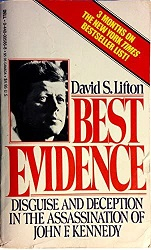
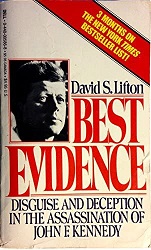
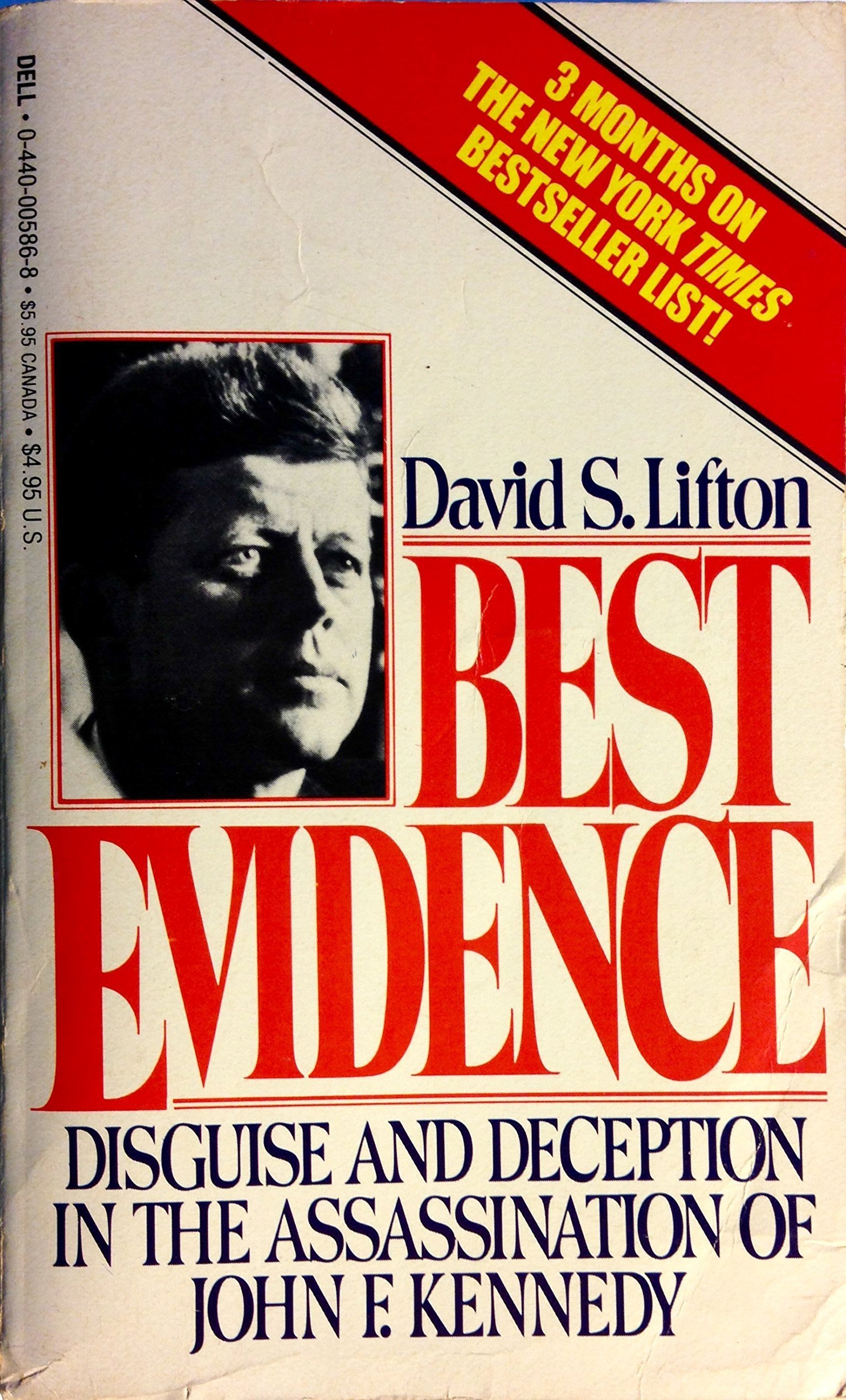
    As noted above, Best Evidence was backed by a large publishing house and was guided by a front rank agent, Peter Shepherd. It became a Book of the Month Club selection, and a national best seller. But it also created a rather large controversy both in the MSM—Dan Rather obviously did not buy it—but people like Sylvia Meagher and Harold Weisberg also disapproved. This is not the place to outline this rather rigorous debate, but just to note it.

    The book was quite long, and it went through more than one reprint by different publishers. Lifton also issued a video production based on his research for that book–Best Evidence: The Research Video–and that also sold well. (“Click here for that presentation.


    In his research for Best Evidence, Lifton stumbled across another nebulous and controversial area. This was the provenance and possible alteration of the Zapruder film. On page 555 of the Carroll and Graf version of Best Evidence, Lifton begins a very long on-page footnote in which he describes how he became interested in the subject. That note goes on for three pages. In brief he states that when he saw a very good copy of the film, he noted that he did not see a posterior skull cavity as was described by the Dallas doctors in the Parkland ER. He also discovered evidence that the film had been in the custody of the CIA. Finally, he notes that the doctors in Dallas did not see an exit wound in the upper right side of JFK’s head above and to the right of his ear. Yet, this was supposed to be the exit for the rear shot as depicted in the film.

    At the time of his death, Lifton had been working for a very long time—decades actually– on a biography of Lee Harvey Oswald. That book was entitled Final Charade. This was to be part of a trilogy of Best EvIdence, Final Charade and a volume on the Zapruder film. In the anthology The Great Zapruder Film Hoax, Lifton submitted an essay called “Pig on a Leash” about his theories of Z film alteration.

    We should all hope that the manuscript of Final Charade will eventually be published. LIfton spent so many years on it, so much money, and so much effort, that it needs to be printed. Only then can it be judged as part of the LIfton canon.


  • David Lifton Has Passed On

    David Lifton Has Passed On

    David Lifton passed away in Las Vegas at a hospice center on December 6, 2022. There was no official notice until a sister of his penned an obituary for the New York Times. He was 83.

    Lifton was born in New York and attended college at Cornell. At the time of JFK’s death, he was in a graduate program at UCLA. His major was engineering physics. He is known in the John Kennedy critical community for a long early essay on the JFK assassination, two books on the subject, and his belief that the Zapruder film had been altered.

    The long essay was printed in Ramparts magazine in June of 1966 and was called “The Case for Three Assassins”. Co-authored with David Welsh, it was a lengthy—22 pages of text—and profusely annotated essay on the medical and ballistics evidence in the assassination that indicated a hit team had taken Kennedy’s life in Dealey Plaza.

    The first book, published in 1968, was Document Addendum to the Warren Report. That volume is a compendium of important documents that were not printed by the Warren Commission. It contains the famous Liebeler Memorandum. This was named after Warren Commission lawyer Wesley Liebeler and it contains his Devil’s Advocate criticisms of an early draft of the Warren Report. This volume was limited in audience appeal since it was aimed at the critical community, but it was a valuable work.

    The above two contributions were made when Lifton was—more or less-considered as one of the first generation critics of the Kennedy case. In his book Best Evidence he owes his initial interest in the assassination to a trio of first generation critics, namely Mark Lane , Vince Salandria and Ray Marcus. (pp. 3-11).

    One can say the same about his approach during his confrontation with former CIA Director Allen Dulles. This meeting occurred in late 1965 on the UCLA campus. Dulles had been retired by President Kennedy from the Agency and was now taking a guest lecture spot at the college. Lifton termed it as being a Regents Scholar. As he explained, “He was paid a princely sum for giving a few speeches and meeting students, informally, in a coffee-klatch atmosphere.” (Best Evidence, p. 33) As Lifton noted, Dulles’ appointment to the Warren Commission by Lyndon Johnson was his first return to any kind of public service.

    Lifton first asked for a personal audience with the veteran spymaster. Dulles turned this request down but said he would be glad to answer his questions in front of a small audience. So Lifton joined a gathering of about 50 people in the Sierra Lounge of Hedrick Hall, a UCLA dormitory. Lifton brought a couple of volumes of the Warren Commission with him. This debate is described in Best Evidence on pages 34-37. But since John Kelin sent the author a copy of Lifton’s memorandum on the meeting, we will use that as a reference for this rather memorable confrontation.

    Lifton started off by challenging Dulles on the direction of the shots, with still frames he had enlarged from the Commission volumes of the Zapruder film. Dulles simply denied this evidence. When Lifton said there was smoke atop the Grassy Knoll, Dulles said, “Now what are you saying, that someone was smoking up there?” Lifton then quoted Harold Feldman who listed many witnesses hearing shots from two directions. When Dulles asked about Feldman Lifton said he wrote for The Nation. Dulles had a huge belly laugh and said, “The Nation, The Nation.” Dulles also shrugged off the testimony of Governor John Connally, by saying, ”Its utterly ridiculous! A man can’t tell in a situation like that which bullet hit him.” Dulles then said there was not an iota of evidence of a frontal shot. Lifton then argued that eye and ear witness testimony coupled with the Zapruder film indicated there was. Dulles insisted he could not see a thing in the blow up presentation. After Dulles left, many students huddled around Lifton to look at the pictures. This went on for two hours. The graduate student felt he had won the debate.

    But about this time, 1965-67, Lifton began to change his approach to the JFK case. In Best Evidence, he denotes the cause of this as being a phrase in the FBI report on the autopsy; a report made by agents Jim Sibert and Frank ONeill:. The phrase went like this: “…it was also apparent that a tracheotomy had been performed as well as surgery of the head area, namely in the top of the skull.” (Best Evidence, p. 172)

    In his book Lifton describes this phrase as being a defining moment in his research on the case. He says, “I was exhilarated, terrified. I wanted to vomit.” He then described himself as follows, “I arose on Sunday morning convinced I had discovered the darkest secret of the crime of the century.” (Best Evidence, p. 181) It was this feeling that now moved him out of the camp of Commission critics and into what he would later call a radical reconstruction of the Kennedy case. He came to call this “pre-autopsy surgery” He phrased it like this in Best Evidence:

    If someone had altered the head, the configuration of the wounds at Dallas was not the same as at Bethesda. The head was thrust backward by the impact of a bullet from the front, yet the autopsy performed at Bethesda showed an impact from behind. Someone had altered the head! (ibid, p. 172)

    He then concluded that, “Somewhere between Dallas and Bethesda the President’s body had been altered.” Lifton also used this to explain why there were no bullets in the body. (Best Evidence, p. 175) In his arguments with Commission lawyer Wesley Liebeler—a professor at UCLA at the time—he would ask Lifton: if there were other assassins, where are the other bullets? This would portend to be a reply to that query.

    From here, Lifton went on to assemble his whole complex theorem of the crime, based upon an alteration of Kennedy’s body somewhere between Dallas and the Bethesda morgue. And he now used this to explain in his view, “…how many different officials and investigative agencies…could be foiled.” In his concept,

    The secret removal of bullets before the body reached the autopsy room would have severed the ballistic connection between the shooting and the gun of other assassins—before the investigation began. The entire investigative apparatus of the U. S. government could have been misled. (ibid)

    As noted above, Best Evidence was backed by a large publishing house and was guided by a front rank agent, Peter Shepherd. It became a Book of the Month Club selection, and a national best seller. But it also created a rather large controversy both in the MSM—Dan Rather obviously did not buy it—but people like Sylvia Meagher and Harold Weisberg also disapproved. This is not the place to outline this rather rigorous debate, but just to note it.

    The book was quite long, and it went through more than one reprint by different publishers. Lifton also issued a video production based on his research for that book–Best Evidence: The Research Video–and that also sold well.

    In his research for Best Evidence, Lifton stumbled across another nebulous and controversial area. This was the provenance and possible alteration of the Zapruder film. On page 555 of the Carroll and Graf version of Best Evidence, Lifton begins a very long on-page footnote in which he describes how he became interested in the subject. That note goes on for three pages. In brief he states that when he saw a very good copy of the film, he noted that he did not see a posterior skull cavity as was described by the Dallas doctors in the Parkland ER. He also discovered evidence that the film had been in the custody of the CIA. Finally, he notes that the doctors in Dallas did not see an exit wound in the upper right side of JFK’s head above and to the right of his ear. Yet, this was supposed to be the exit for the rear shot as depicted in the film.

    At the time of his death, Lifton had been working for a very long time—decades actually– on a biography of Lee Harvey Oswald. That book was entitled Final Charade. This was to be part of a trilogy of Best Evidence, Final Charade and a volume on the Zapruder film. In the anthology The Great Zapruder Film Hoax, Lifton submitted an essay called “Pig on a Leash” about his theories of Z film alteration.

    We should all hope that the manuscript of Final Charade will eventually be published. Lifton spent so many years on it, so much money, and so much effort, that it needs to be printed. Only then can it be judged as part of the Lifton canon.


  • Book Review: The Oswalds: An Untold Account of Marina and Lee

    Book Review: The Oswalds: An Untold Account of Marina and Lee


    The Oswalds: An Untold Account of Marina and Lee (New York: Diversion Books, 2022), 286 pp.

    The lives of Paul Gregory, a research fellow at the Hoover Institution, and his late father Pete, a Russian émigré from Siberia, intersected with those of Lee Harvey Oswald and his wife Marina in 1962-63. In the summer of 1962, Marina gave lessons in the Russian language to the son Paul. Pete, the father, wrote a letter of recommendation for Lee. And, in the immediate aftermath of the assassination, Pete translated the words of Marina for the Secret Service in a hideaway motel. As both the son and the father conversed extensively in Russian with the Oswalds, and the father was a distinguished linguist, Paul Gregory’s new book may shed light on one of the most important questions about Lee Harvey Oswald: How did a high school dropout become so proficient in the Russian language?

    Gregory’s book is written in the form of memoir. However, his experiences with the Oswalds in the summer of 1962 were not sufficient for a book-length manuscript. Consequently, the author rounded out his coverage of Oswald with a more expansive biography. For his sources, Gregory relied primarily on the Warren Report. This is revealing; it is clear that he has not probed deeply into the work of independent researchers of Oswald and the JFK assassination. The author refers to the latter body of literature as “forensics,” stating that “I cannot consider the hundreds of theories that reject Lee Harvey Oswald as the sole gunman.”[i]; “I am not going to engage in forensic analysis of an extra bullet and shots fired, directives to kill from Castro or Khrushchev, right-wing-fanatics, or deep-state cabals.”[ii] Gregory is convinced that his first-hand experience of Oswald validates the findings of the Warren Commission and is sufficient to demonstrate the lone gunman theory.

    And yet when it comes to the matter of Oswald’s Russian language skills, Gregory cites my article “Oswald’s Proficiency in the Russian Language,”[iii] wherein I explore the evidence indicating that Oswald was already fluent in Russian prior to his departure for the Soviet Union in 1959. My contention was that Oswald was an asset of the United States government sent to the Soviet Union due to his ability to understand Russian, which he carefully concealed during his nearly three-year sojourn in Minsk. Gregory acknowledges that Russian is a difficult language to learn, yet he appears to dismiss my findings as conspiratorial thinking: “Some conspiracy theorists contend that Oswald’s Russian fluency constitutes proof of a conspiracy. They claim that he could not have picked up the language so quickly.”[iv] But Gregory does not explore how, when, and where Oswald did pick up the language so quickly. He only indicates that Oswald’s Russian language skills were “self-taught.”[v] But where did the self-instruction occur? It certainly was not at Arlington Heights High School in Fort Worth in which Oswald dropped out after completing the ninth grade. It was not at the Monterey Institute of Languages, as Oswald never resided in Northern California. There is a suggestion he was there, but no real proof. It did not occur during his stint in the Marines, where Oswald was observed by multiple eyewitnesses as already fully capable of reading Russian-language materials in print.

    As for his spoken Russian, prior to his departure to the Soviet Union, Oswald was commended by Rosaleen Quinn, the aunt of one of Oswald’s Marine buddies, who experienced first-hand Oswald’s Russian language abilities. Quinn had been learning the language for over a year from Berlitz for a future position in the State Department. She later said to author Edward Epstein that Oswald spoke better Russian then she did. Gregory chooses to ignore the evidence that Oswald was already fluent in Russian when he left the Marines. The author simply assumes that Oswald achieved a mastery of Russian while he was in Minsk.[vi] But, during his nearly three-year stay, Oswald was not working diligently with his tutors or practicing on his own; instead, he was remembered by his friends in Minsk as constantly struggling with Russian and primarily speaking to them in English! In an interview that Gregory did with Patrick Bet David on November 22nd of this year, Gregory said that Oswald spoke Russian, but his grammar was very bad. This is not what Quinn said. She told Epstein that Oswald could string entire sentences together without much hesitation.

    When Oswald returned from the Soviet Union, he and Marina received correspondence from their acquaintances in Minsk. Ernst Titovets wrote a letter in Russian addressed to both Lee and Marina, but he included a separate portion to Lee written in English.[vii] The same was true with Aleksandr (Alejandro) Zieger in a joint letter written to Marina and Lee. The undated letter was composed sometime after the Oswalds left Minsk in 1962. Mr. Zieger writes most of the letter in Russian, offering general news of the Zieger family. But at the end, he includes a personal message to “Alek” (Oswald’s nickname in Minsk) that is written in English: “Alek—my best wishes and a ton of good luck.”[viii] These letters demonstrate that his friends in the Soviet Union were under the impression that Oswald could not read Russian. Yet the correspondence was received by the Oswalds at a time when Lee visited the office of Pete Gregory in order to obtain a letter of recommendation that verified his Russian language competency. Pete gave him a test after pulling out Russian volumes from his bookshelves and asking Oswald to translate. Surprised by Oswald’s proficiency, Pete then wrote the brief letter that vouched for Oswald, whose aptitude in Russian was so good that Pete believed him “capable of being an interpreter and perhaps a translator.”[ix]

    In what is revealing information contained in Gregory’s book, the linguist father Pete concluded that, based on his spoken Russian, Oswald was “from a Baltic republic or even Poland with Russian as a second language.”[x] He also speculated that “Oswald’s Russian fluency was explained by immersion in daily life rather than attendance at some sinister Russian language school for spies.”[xi] Pete’s son Paul attested that “having spent hours with Lee speaking Russian, I can confirm that his command of the everyday language was excellent. He could express anything he wanted to say.”[xii] The lapses in grammar and mistakes in gender may be partially explained by the father’s contention that Oswald originally learned Russian as a second language, “possibly from a Baltic republic or even Poland.” This description would explain how Oswald had already become proficient in Russian at the time he departed for the Soviet Union in 1959. It also must give us pause as to what was the true background of this young, bilingual man. The real Lee Harvey Oswald was born in New Orleans and raised exclusively in the United States. But Pete Gregory was referring to a young man who was likely born in Eastern Europe and was speaking both Russian and English as second languages.

    Working under tremendous pressure, Pete Gregory translated the words of Marina in response to questions from the Secret Service shortly after the assassination. His translations were subsequently checked by other experts and judged “faultless without deviation.”[xiii] Previously, he had been selected to accompany President Eisenhower to Moscow to serve as translator during the summit that was eventually cancelled due to the Gary Powers U-2 spy plane incident. In describing his father as “one of the nation’s best Russian interpreters,”[xiv] Paul may not have been engaging in hyperbole. As a world-class linguist, Pete Gregory is an authority worth listening to as an eyewitness to Oswald’s Russian language skills. As it turns out, Pete’s characterization of Oswald having learned Russian as a second language somewhere in Eastern Europe, possibly “from a Baltic republic or even Poland,” merits some consideration.

    How may this lend a clue to our understanding of Oswald? The answer lies in the massive work Harvey and Lee by John Armstrong, along with his articles on the harveyandlee.com website, and his digital archive documenting his research, which is accessible online from Baylor University. Because of the evidence of two Oswald boys using the same name, growing up in different households, attending different schools, and training separately in the Marines, Pete Gregory’s revelation about Oswald’s Russian language abilities could be corroborative evidence of Armstrong’s “The Oswald Project”, which sought to place a Russian speaking American in the Soviet Union as an asset.

    The long-term project of planting a Russian-speaking spy in the Soviet Union must be examined in the context of the aftermath of World War II and the start of the Cold War. Immediately after the war, there was the forced relocation of enormous populations as the map was being redrawn in Eastern Europe. Thousands of “displaced persons” were interred in camps. The so-called Displaced Persons Commission made available to the CIA the names of potential assets. As a result, Eastern European refugees were brought to the United States under a program headed by Frank Wisner, the CIA’s director of clandestine operations. Wisner had become the State Department’s and the CIA’s expert on Eastern European war refugees during the late 1940s and early 1950s. Under Wisner’s program, the refugees were granted asylum in return for their cooperation in secret operations against the Soviets.

    Wisner gained approval from the National Security Council for the “systematic” use of the refugees as set forth in a top-secret intelligence directive, NSCID No. 14 (March 3, 1950). Both the FBI and the CIA were authorized to jointly exploit the knowledge, experience, and talents of over 200,000 Eastern European refugees who had resettled in the United States.[xv] Under Wisner, the CIA was running hundreds of covert projects for the purpose of what the NSCID directive called the “exploitation of aliens as sources of foreign intelligence information.”[xvi] The surviving evidence suggests one of those projects merged the identities of a Russian-speaking immigrant boy, who likely came from Eastern Europe, with an American-born boy named Lee Harvey Oswald.[xvii] 

    Many of the Eastern European children grew up bilingual with Russian as a second language. As observed by journalist Anne Applebaum in her book Iron Curtain: The Crushing of Eastern Europe, 1944-1956, Eastern European children would, as a matter of course, be sent to live with another family at an early age in order to learn a second language. The idea behind this CIA project was to groom the Russian-speaking boy as a spy who, when he reached adulthood, would “defect” to the Soviet Union. Because he had assumed the name and identity of an American, the Soviets would not suspect that he spoke fluent Russian. The result was that nearly a decade later, as an undercover agent who secretly understood Russian, the Eastern European immigrant posing as a disgruntled United States Marine named Lee Harvey Oswald defected and spent nearly three years in the Soviet Union. While there, he married a Soviet woman and returned to the United States with his wife and child.

    Upon his return to the United States, Oswald wrote a lengthy account of his experience working at the Minsk Radio and TV Factory, where he drew upon “his fairly wide circle of friends and acquaintances to gather the figures and descriptions of the inner workings of the Soviet system.”[xviii] In wondering how Oswald “was able to put together such an insightful picture of the Soviet enterprise,”[xix] Gregory notes that Oswald was “a surprisingly keen observer of Soviet reality.”[xx] But there should be no surprise if it had been Oswald’s principal purpose as a false defector to observe and to report on the realities of Soviet life during his stay. Dennis Offstein was a co-worker of Oswald at the graphic arts company of Jaggars, Chiles, Stovall in Dallas shortly after Oswald’s return in 1962. In his testimony to the Warren Commission, Offstein recalled that Oswald gave him a detailed account of Soviet military maneuvers during his residency. Specifically, Offstein remembered Oswald’s description of:

    …the disbursement of the [Soviet] military units, saying that they didn’t intermingle their armored divisions and infantry divisions and various units the way we do in the United States, that they would have all of their aircraft in one geographical location and their tanks in another geographical location, and their infantry in another, and he mentioned that in Minsk he never saw a vapor trail, indicating the lack of aircraft in the area.[xxi]

    This perceptive account of the Soviet military activities that includes being on the lookout for “vapor trails” squares with other detailed observations that Oswald brought back and recorded in detail. In the testimony of Offstein alone, there was enough cause to warrant an investigation of Oswald’s ties to intelligence and the possibility that he was sent to the Soviet Union in 1959 in the capacity of what Offstein called “an agent of the United States.”[xxii] But with the presence of Allen Dulles on the Warren Commission, Oswald’s records in the CIA were effectively pre-screened from the committee. 

    It was Allen Dulles who insisted that the Warren Commission publish a detailed biography of Oswald. As a result, Chapter VII (“Lee Harvey Oswald: Background and Possible Motives”) is a fifty-page narrative replete with inaccurate details and chronological errors. That “biography” may be a mélange of the lives of two young men, and it has misled researchers for nearly sixty years, the latest of which is Paul Gregory. The major premise that undergirds Gregory’s book is that Oswald was a genuine defector. Working closely to the Warren Report, Gregory believes that Oswald was a committed Marxist, that his distribution of pro-Castro leaflets in New Orleans was genuine, that his opening of a branch of the Fair Play for Cuba Committee in New Orleans was genuine (despite him being the only member), and his visits to the Russian and Cuban embassies in Mexico City were genuine (despite the absence of concrete evidence that Oswald himself paid those visits). In paraphrasing the Warren Report, Gregory identifies Oswald’s principal motivation for the assassination not out of animosity for John F. Kennedy, but his belief, shaped by his study of Marxism, that “he was destined for a place in history.”[xxiii]

    But if Oswald was not a genuine defector and was working for the United States government, the entire edifice of the Warren Report collapses like a house of cards. If Oswald really had delusions of grandeur, he had the perfect opportunity to proclaim his great deed to history as he was paraded through the halls of the Dallas police headquarters and was allowed to address the press. But instead, he protested his arrest and insisted on his innocence with the words, “I’m just a patsy!” In this crystalline moment, he may have realized that he was a mere pawn in the greater design of the Cold War.

    A fatal shortcoming of Gregory’s methodology is that he has not kept up with new evidentiary discoveries in the JFK assassination, particularly the findings of the Assassination Records Review Board (ARRB). The military historian John Newman has observed that “in the history of the KGB and the CIA, their wars are not actually shooting each other so much as trying to penetrate each other.”[xxiv] Oswald may be best understood in the context of a myriad number of CIA projects with the goal of “penetrating” the enemy, including the critical area of identifying moles from within. Newman recounts the time when one of the legendary CIA mole hunters and “probably our most celebrated and capable counterintelligence officer in the history of the Central Intelligence Agency,”[xxv] Tennent “Pete” Bagley, sat down with researcher Malcolm Blunt. Bagley and Blunt reviewed the collection of documents on Oswald from the CIA, the State Department, and Naval intelligence. As they assessed the evidence, the stunning revelation came to Bagley that Oswald “had to be witting” in his defection.[xxvi] In other words, this senior CIA officer recognized that the evidence demonstrated that “Lee Harvey Oswald was a witting false defector when he went to Moscow.”[xxvii] This revelation was made possible through the efforts of the tenacious researcher Elizabeth “Betsy” Wolf, who had prepared detailed notes during her time spent on the House Select Committee on Assassinations (HSCA) in the late 1970s. The implications of her notes were so explosive that they were hidden until their declassification on a time-delayed release following the termination of the ARRB in 1998. Salvaging the notes was made possible by Oliver Stone’s film JFK, which led to the JFK Records Act and the establishment of the ARRB. In turn, the indefatigable researcher Malcolm Blunt carefully assembled Wolf’s notes and assessed their implications with Bagley.

    Betsy Wolf had been troubled by the fact that a “201 file” had not been prepared on Oswald by the CIA at the time of his defection in 1959. This point was not addressed by the Warren Commission which paid little, if any, real attention to Oswald’s connections to the intelligence network. According to CIA protocol, 201 files were routinely opened for persons “of active operational interest.”[xxviii] But, inexplicably, after Oswald’s so-called defection, a 201 file was not opened until over a year later on December 8, 1960.[xxix] Wolf’s breakthrough discovery was that early CIA reports on Oswald were pigeonholed in the CIA’s Office of Security (OS), rather than to the SR (Soviet Russia) division. The OS would not refer a 201 file, while SR would. As recounted by researcher Vasilios Vazakas, “in the case of Oswald, his files bypassed the General Filing System and went straight into the Office of Security and its SRS [Security Research Service] component.”[xxx] One possible explanation entertained by Vazakas was that “Oswald was a special project for [James Jesus] Angleton, one he wanted no one else to know about.”[xxxi] In a crucial interview described in Wolf’s handwritten notes and discovered by Blunt, on July, 26, 1978, Wolf spoke with Robert Gambino, at that time, the current chief of the OS. Gambino informed her that a request for the special handling of Oswald’s documents had occurred prior to Oswald’s defection. In other words, CIA documentation on Lee Harvey Oswald predated his defection. With an understanding of that chronology—and the testimony of both Bagley and Gambino– it is clear that the CIA was fully aware of the phony defection in advance of the time it occurred in late October, 1959.[xxxii]

    Even Oswald’s Marine roommate in Santa Ana, California, James Botelho, recognized that Oswald was not a genuine defector when he told attorney Mark Lane that “Oswald was not a Communist or a Marxist. If he was I would have taken violent action against him and so would many of the other Marines in the unit.”[xxxiii] After Oswald’s defection was made public, Botelho told how an investigation at the Santa Ana Marine base was conducted purely for show:

    It was the most casual of investigations. It was a cover-investigation so that it could be said there had been an investigation….Oswald, it was said, was the only Marine ever to defect from his country to another country, a Communist country, during peacetime. That was a major event. When the Marine Corps and American intelligence decided not to probe the reasons for the “defection,” I knew then what I know now: Oswald was on an assignment in Russia for American intelligence.[xxxiv]

    Through a nearly miraculous chain of events starting with Oliver Stone’s film and leading to the ARRB’s preservation of the notes of Betsy Wolf, we have today documentary evidence supporting Botelho’s claims that Oswald was a false defector.

    Instead of following through on the implications of Oswald’s language proficiency in Russian and exploring whether or not he was a genuine defector, Gregory pivots to spend a large portion of his book recounting the stormy relationship of Lee and Marina. Gregory returns to his default mode of the Warren Report to cite the Commission’s alleged motivation for the killing of the President: “The relations between Lee and Marina Oswald are of great importance in any attempt to understand Oswald’s possible motivation.”[xxxv] The fact that the Warren Commission had to look to the marital relationship of the suspected assassin for motivation for the murder of the President demonstrates how flimsy the case was against Oswald. Gregory spends countless pages describing the abuse Lee heaped upon Marina, mainly relying on secondhand information from members of the small Russian émigré community in Dallas. Gregory’s narrative resembles the plot outline of Shakespeare’s The Taming of the Shrew, wherein Lee is the tyrannical overlord of Marina just as Petruchio seeks to keep Katharina on a short leash.

    In what he calls his own “amateur psychoanalysis,”[xxxvi] Gregory repeats on multiple occasions the tiresome refrain of Warren Commission apologists that Oswald was seeking to impress his wife by carving out his place in history. During his time spent with Oswald in the summer of 1962, Gregory “detected none of the trademarks of a future assassin.”[xxxvii] Yet in the back-reading of his own experience through the lens of the Warren Report, Gregory concludes that he had “witnessed firsthand this small man’s attempt to prove to the world and to his young wife that he was indeed exceptional.”[xxxviii] Through a tortured logic, Gregory posits the following in response to Marina’s belittling of her husband’s politics and his substandard performance in the bedroom: “What better way for Oswald to kill two birds with one stone than by the ‘manly’ act of killing the most powerful man on earth?”[xxxix] This psychoanalytical approach completely misses the point that the killing of President Kennedy was a politically driven act at the height of the Cold War, the effect of which was a compete reversal of America’s foreign policy in the 1960s. Many of which were detailed in Oliver Stone’s four-hour film JFK: Destiny Betrayed.

    In an interview given by Gregory shortly before the release of his book, the author indicated that he was motivated to write the memoir because his family was embarrassed at having an association with the alleged assassin of an American president. In Gregory’s words, it was “a black spot on the family.”[xl] The resulting book is not the impartial work of a scholar at the Hoover Institution. Rather, it is the biased opinion of an eyewitness with a personal agenda. Gregory considered Marina Oswald as a friend, as she helped him to prepare a paper on an obscure Russian play during the summer of 1962. But one looks in vain in the book for Marina’s corroboration of what Gregory has written about her and her first husband. The author sent Marina a draft of the manuscript, as well as a cordial letter. But she never replied. The last time Gregory saw Marina was on Thanksgiving Day in 1962. In a 1993 NBC interview, the feisty Marina went toe-to-toe with newscaster Tom Brokaw, as she took issue with the claims of Gerald Posner in his book Case Closed and said of her husband that “he definitely did not fire the shots.”[xli] In 1996, Marina told Oprah Winfrey that she came to the conclusion that her husband was innocent by studying the Warren Report’s supplementary volumes, which puts a damper on the entire hypothesis of Paul Gregory’s book: “And then comes the 26 volumes of the testimony, of the evidence, which does not support their conclusion.”[xlii] Drawing so heavily as he does on the Warren Report, Gregory has written a book that should take its place alongside Priscilla Johnson McMillan’s Marina and Lee, Robert Oswald’s Lee, and Jean Davison’s Oswald’s Game, all of which serve as posthumous daggers in the heart of Lee Harvey Oswald.


    Appendix

    The Media’s Response to The Oswalds and Reflections on the Cold War

    Following the release of Paul Gregory’s book, the media’s response has fixated on the lurid elements of alleged domestic abuse and the troubled marriage of the Oswalds. Writing in the Daily Mail on November 25, 2022, Daniel Bates offers the eye-popping title of “‘He feared he would be exposed as a loser.’ Lee Harvey Oswald assassinated JFK because he was ‘humiliated’ by wife Marina who mocked him as sexually inadequate and cheated with a businessman.”[1]

    Bates’s formal review then begins with the observation that “Lee Harvey Oswald assassinated John F. Kennedy because he feared being branded a ‘loser’ by his wife who ridiculed his pretensions of being a Marxist intellectual.”[2]

    Here the journalist is invoking guilt by association in an argument that goes as follows: If Oswald was belittled and shamed by his wife, it follows that he killed the President in retaliation. A Kirkus review succinctly summarized the book as “an informative view of a killer’s marriage and lethal motivations.”[3] Writing in the New York Post, Heather Robinson concludes her review by speculating that “it’s even possible that Oswald killed JFK because the young president was seen as the ultimate symbol of American masculinity and power — and because Marina liked him.”[4]  Some of this “writing” resembles postmodern literary criticism.

    In the alternative media, Gus Russo on Spy Talk introduces a litany of titillating incidents not even mentioned in Gregory’s book. At the same time, he completely ignores how Oswald attained a superior level of Russian language proficiency, as well as Peter Gregory’s analysis that Oswald spoke like an Eastern European who had learned Russian from daily exposure, as opposed to formal training in the classroom. As Paul’s father, Pete, testified to the Warren Commission, “I would say it would be rather unusual, rather unusual for a person who lived in the Soviet Union for 17 months that he would speak so well that a native Russian would not be sure whether he was born in that country or not.”[5] This linguist was attempting to reconcile what he had heard as the inflections of an Eastern European speaking Russian that conflicted with what he was told by Oswald about how he had learned to speak the language. Russo also makes no mention of Oswald’s “defection” in 1959 and Gregory’s blind acceptance of the Warren Commission’s profile of Oswald as a genuine Marxist.

    In their rush to paint Oswald as a domestic abuser of the most despicable variety, the reviewers fail to mention a very important evidentiary point: Paul Gregory relies extensively on secondhand reporting that he heard from members of the Dallas Russian émigré community. The reviewers give readers the impression that Gregory is offering startling, new revelations. But these individuals were called before the Warren Commission and were questioned about the alleged abuse. Robert Charles-Dunne has provided a valuable collation of their testimony in “Was Oswald a Serial Wife Batterer?” that would serve as an indispensable resource alongside Gregory’s book.

    In following the words of the witnesses, it is apparent that they were not really witnesses. That they too were invariably relying on second- and third- hand reporting of Oswald’s treatment of his wife. The testimony of nineteen witnesses reveals that no police report was ever filed and rarely was there an actual witness to verify Oswald’s displays of temper. Gregory himself never observed Oswald physically striking Marina during any of his forty-eight tutorial sessions. And yet, his allegations are the bedrock foundation for the motivation that Oswald killed President Kennedy.

    Any instance of spousal abuse is reprehensible, and Marina Oswald has acknowledged that she was an abused wife. Yet over time, she was able to separate the abuse from the question of whether or not her husband shot the President. By the 1990s, while continuing to acknowledge Oswald’s shabby treatment of her, she still concluded that Lee had been framed…primarily from her study of the supplementary volumes of the Warren Report!  Scholars who tackle this topic should have the same degree of objectivity as a victim like Marina.

    In investing so much time in writing about the connection between Oswald’s treatment of his wife and the murder of President Kennedy, Gregory has given short shrift to the climate of the Cold War that impacted the lives of everyone described in his book, including his own and especially his father’s. Pete Gregory entered the pressure cooker to translate for Marina in response to questions from the Secret Service over the stressful assassination weekend. His dedication movingly comes across in the memoir. This was an instance of a law-abiding citizen being sucked into the maelstrom of a national crisis. But what was not known until recently was that Pete Gregory was later a likely employee of the CIA. As uncovered by researcher Malcolm Blunt, a set of documents indicates that, in 1965, Pete applied for work in the CIA in the JPRS (Joint Publications Research Service).[6]  

    The recipient of his application was the Chief Officer of the Foreign Documents Division of the CIA. It is possible that Pete may have been applying for a position of translator of sensitive multi-lingual texts at the height of the Cold War. In addition to Pete’s completed application, another document verifies his CIA security clearance through a strict process of vetting that included the administration of a polygraph. By profession, Pete was an engineer working in the petroleum industry of Texas. More work lies ahead in understanding precisely what role Pete was playing in the CIA in a Cold War connection that is never mentioned in his son’s memoir.

    Indeed, discourse on the Cold War in general is conspicuously absent from Gregory’s book. Mark Kramer, who is Director of Cold War Studies at Harvard University, wrote a commendatory blurb that appears at the start of The Oswalds: “Gregory’s book offers a definitive personality sketch of Oswald and a great deal of evidence that should put an end, once and for all, to the notion that shadowy forces intent on murdering the president would have enlisted such an unreliable and tempestuous loser.” This astonishing perspective written by a scholar of the Cold War speaks volumes about what little time the so-called experts have invested in studying the JFK assassination. Historians, journalists, and bloggers should be following trails of reliable evidence and placing a historical event carefully in context. They should not be relying on hearsay, gossip, and psychoanalytical speculation. A seminal moment of the Cold War was the assassination of President Kennedy that shifted the nation’s foreign policy over the course of a weekend. The preponderance of evidence suggests that the scapegoat Lee Harvey Oswald was a creature of the Cold War and that President Kennedy’s death was the result of forces at work against his vision of peace in the period following the Cuban Missile Crisis. Both men were pawns on a chessboard that we can finally understand today if we only take the time to examine the evidence. Until that happens, our knowledge of the Cold War will remain incomplete.


    [i] Paul R. Gregory, The Oswalds: An Untold Account of Marina and Lee (New York: Diversion Books, 2022), 36.

    [ii] Gregory, 230.

    [iii] James Norwood, “Oswald’s Proficiency in the Russian Language,” http://harveyandlee.net/Russian.html.

    [iv] Gregory, 100.

    [v] Gregory, 245.

    [vi] Gregory, 88.

    [vii] Gregory, 124. Gregory describes Titovets’s letter as “jocular.” But if Oswald had achieved “mastery” of Russian while in Minsk, as Gregory suggests, then why would Titovets feel compelled to write a special portion of the letter addressed expressly to Oswald in English?

    [viii] Mr. Zieger’s letter was published in the Warren Commission Hearings, Vol. XVI, 156 (Exhibit 33).

    [ix] John Armstrong, Harvey and Lee (Quasar, Ltd., 2003), 399.

    [x] Gregory, 100.

    [xi] Gregory, 100.

    [xii] Gregory, 100.

    [xiii] Gregory, 202.

    [xiv] Gregory, 207.

    [xv] The first article of the directive reads as follows: “Exploitation of aliens within the U.S. for internal security purposes shall be the responsibility of the Federal Bureau of Investigation. Exploitation of aliens as sources of foreign intelligence information or for other foreign intelligence purposes shall be the responsibility of the Central Intelligence Agency. This allocation to the Federal Bureau of Investigation and to the Central Intelligence Agency of separate areas of alien exploitation responsibility does not preclude joint exploitation, which must be encouraged whenever feasible.”
    NSCID No. 14: https://cryptome.org/nscids-50-55.pdf

    [xvi] NSCID No. 14, article 1: https://cryptome.org/nscids-50-55.pdf

    [xvii] See my article “Lee Harvey Oswald: The Legend and the Truth,” which begins with discussion of the HSCA testimony of Jim Wilcott: http://harveyandlee.net/J_Norwood/Legend.html

    [xviii] Gregory, 59.

    [xix] Gregory, 59.

    [xx] Gregory, 49.

    [xxi] Warren Commission Hearings, Vol. 10, 202.

    [xxii] Warren Commission Hearings, Vol. 10, 200.

    [xxiii] Gregory, 36.

    [xxiv] James DiEugenio and Oliver Stone, JFK Revisited: Through the Looking Glass (New York: Skyhorse Publishing 2022), 193.

    [xxv] DiEugenio and Stone, 193.

    [xxvi] DiEugenio and Stone, 194.

    [xxvii] DiEugenio and Stone, 194.

    [xxviii] John Newman, Oswald and the CIA: The Documented Truth About the Unknown Relationship Between the U.S. Government and the Alleged Killer of JFK (New York: Skyhorse Publishing, 2008), 47.

    [xxix] For researcher Vasilios Vazakas, Betsy Wolf was puzzled because “there were two reasons to open the 201 file on Oswald over a year prior to when it happened. Neither one triggered the opening. Further, when Wolf looked at the 201 file, it only contained copies and the two Naval dispatches were gone…. What could be a more compelling reason for the counter-intelligence office opening a file on Oswald than his threatening to give secrets of the U-2 to the Soviets?” Vasilios Vazakas, “Creating the Oswald Legend—Part 4.” kennedysandking.com. August 15, 2020.

    [xxx] Vazakas.

    [xxxi] Vazakas.

    [xxxii] Historian James DiEugenio summarizes the remarkable discovery of Betsy Wolfe as follows: “Only toward the end of her search did Betsy find out what had happened. Betsy’s notes include an interview with the former OS chief Robert Gambino. According to Malcolm, her handwritten notes are the only place anyone can find anything about this particular interview. (Wolf notes of 7/26/78) Gambino told her that CIA Mail Logistics was in charge of disseminating incoming documents. In other words, someone made this request about the weird routing of Oswald’s files from OS’s Security Research Service. (p. 324) And this was done prior to Oswald’s defection. Malcolm concludes that with what Betsy unearthed, there should now be no question that the CIA knew Oswald was going to defect before it happened.” Book review by James DiEugenio, “The Devil Is in the Details: By Malcolm Blunt with Alan Dale. kennedysandking.com. March 20, 2021: https://www.kennedysandking.com/john-f-kennedy-reviews/the-devil-is-in-the-details-by-malcolm-blunt-with-alan-dale

    [xxxiii] James Douglass, JFK and the Unspeakable—Why He Died and Why It Matters (Ossining, N.Y.: Orbis Books, 2008), 40.

    [xxxiv] Douglass, 40.

    [xxxv] Gregory, 230.

    [xxxvi] Gregory, 229.

    [xxxvii] Gregory, 16.

    [xxxviii] Gregory, 240.

    [xxxix] Gregory, 243.

    [xl] The LBJ Library, “With the Bark Off: A Conversation with Paul Gregory About Lee Harvey Oswald” (October 27, 2022): https://www.youtube.com/watch?v=vJ595whXpdE

    [xli] Marina Porter interview, August 1993 (NBC): https://www.pinterest.com/pin/28640147609703189/

    [xlii] A complete transcript of Marina’s interview with Oprah Winfrey, which includes an appearance by Oliver Stone, may be read in the following transcription made by R.J. DellaRosa: https://www.tumblr.com/novemberdays1963/37177099041/marina-oswald-porter-on-oprah-1996


    [1] Daniel Bates, The Daily Mail (November 25, 2022): https://www.dailymail.co.uk/news/article-11458759/Lee-Harvey-Oswald-assassinated-President-JFK-humiliated-wife-Marina.html

    [2] Bates.

    [3] https://www.kirkusreviews.com/book-reviews/paul-r-gregory/the-oswalds/

    [4] Heather Robinson, “Pal Reveals Lee Harvey Oswald’s Weird, Paranoid Life One Year Before Killing JFK” New York Post (November 29, 2022): https://nypost.com/2022/11/19/pal-reveals-lee-harvey-oswalds-weird-paranoid-life-pre-jfk-killing/

    [5] Warren Commission Hearings, Vol. II, 347.

    [6] According to the Harvard University Library, “The United States Joint Publications Research Service is a government agency which translates foreign language books, newspapers, journals, unclassified foreign documents and research reports.  Approximately 80% of the documents translated are serial publications.  JPRS is the largest single producer of English language translations in the world.  More than 80,000 reports have been issued since 1957, and currently JPRS produces over 300,000 pages of translations per year.” https://guides.library.harvard.edu/jprs

     ________

    James Norwood taught for twenty-six years in the humanities and the performing arts at the University of Minnesota. The curriculum that he offered included a semester course on the JFK assassination. He is the author of “Lee Harvey Oswald: The Legend and the Truth” and “Oswald’s Proficiency in the Russian Language” published at harveyandlee.com. His article “Edmund Gullion, JFK, and the Shaping of a Foreign Policy in Vietnam” was published at kennedysandking.com.

  • JFK Assassination Records – A Watershed Moment?

    JFK Assassination Records – A Watershed Moment?


    On October 19, 2022, a lawsuit was filed by the Mary Ferrell Foundation against President Joseph R. Biden and the National Archives and Records Administration (“NARA”) to enforce the John F. Kennedy Assassination Records Collection Act of 1992. The lawsuit seeks to compel the President and NARA to finally perform their duties under the federal law that governs the final declassification of JFK assassination records.

    Some historical context is important. The John F. Kennedy Assassination Records Collection Act of 1992 (the “JFK Records Act”) was unanimously passed by Congress in 1992. President Biden, a Senator at the time, voted in favor of the JFK Records Act. The JFK Records Act was unanimously approved by Congress and signed into law by President George H.W. Bush. One can read the JFK Records Act in its entirety by searching “Public Law 102-526, 102d Congress, President John F. Kennedy Assassination Records Collection Act of 1992.”

    The JFK Records Act is extremely favorable to the American public in terms of transparency and declassification of assassination records. On reading the JFK Records Act one does not have to go past the first page of the statute to see what Congress intended and how strong of an impact it was meant to have. For example:

    Section 2(a)(2), JFK Records Act: “all Government records concerning the assassination of President John F. Kennedy should carry a presumption of immediate disclosure, and all records should be eventually disclosed to enable the public to become fully informed about the history surrounding the assassination.”   

    Section 2(a)(3), JFK Records Act: “legislation is necessary to create an enforceable, independent, and accountable process for the public disclosure of such records.”

    Section 2(a)(4), JFK Records Act: “legislation is necessary because congressional records related to the assassination of President John F. Kennedy would not otherwise be subject to public disclosure until at least the year 2029.”

    Section 2(a)(7): “most of the records related to the assassination of President John F. Kennedy are almost 30 years old, and only in the rarest cases is there any legitimate need for continued protection of such records.”

    This is what your Congress declared in 1992, 30 years ago, and with the strongest of language. Congress declared that records pertaining to the JFK assassination had already been unreasonably withheld from the public for 30 years. Even the CIA felt the JFK Records Act was a different breed of declassification law, that had the teeth to go much further than FOIA (Freedom of Information Act) or any previous effort to shed light on deep government secrets. In a 1998 internal CIA Memorandum titled JFK Records Review – Lessons Learned, the CIA stated that, “The level of evidence required by the Board [the Assassination Records Review Board or ARRB] to postpone what was generally considered protectable information was extremely high and usually required documentation of ‘current harm’. Defenses based on general principles such as official cover or sources and methods were not acceptable.”

    The Board closed down in 1998. In 2022, after another 30 years, and in spite of the strongest possible legislation, the President and responsible agencies are still withholding almost 15,000 records that are relevant to the JFK Assassination. Many records are still withheld in full. Others have been “released” with significant redactions. The point of this article is not to analyze which specific records have been withheld in full, which records still have significant redactions, or which records have not been turned over to NARA for inspection and preservation. The point of this article is to explain why legal action was necessary and also unfortunately for the American public, the last and only choice.

    The JFK Records Act established and created the Assassination Records Review Board (ARRB). Upon creation of the JFK Records Act, agencies and government offices were ordered to deliver all assassination records to NARA. An assassination record is defined as any record related to the assassination of President Kennedy that was “created or made available for use by, obtained by, otherwise came into the possession of” (i) the Warren Commission; (ii) the Rockefeller Commission; (iii) the Church Committee; (iv) the Pike Committee; (v) the House Select Committee on Assassinations (HSCA); (vi) any executive agency; and (vii) and other office of the Federal Government, or any state or local law enforcement office that performed work in connection with the federal inquiry in the Kennedy assassination. For anyone looking to understand the full scope of the JFK Records Act and the work of the ARRB, the ARRB’s Final Report is essential reading.

    The above-defined assassination records became known as the JFK Records Collection, or the “Collection”. It was then the job of the ARRB, an independent body, to review the Collection and make legal determinations on which records might still qualify for classification under the standards of the JFK Records Act. What are those standards? For an agency or government office to request continued classification, section 6 of the JFK Records Act put the burden of proof on the objecting agencies. The burden of proof is not on researchers and the American public to demonstrate why an assassination record(s) should be released. For agencies and government offices to make a proper legal case for continued classification and secrecy, they were required to provide the ARRB with clear and convincing evidence that:

    1. the threat to the military defense, intelligence operations, or conduct of foreign relations posed by the public disclosure of the assassination (record) is of such gravity that it outweighs the public interest, and such public disclosure would reveal (i) an intelligence agent whose identify currently requires protection; (ii) an intelligence source or method; or (iii) any other matter currently relating to the military defense or intelligence operations, the disclosure of which would demonstrably impair national security.
    2. the disclosure of the record would reveal the identity of a living person who provided confidential information to the United States;
    3. the disclosure of the record could constitute an unwarranted invasion of privacy;
    4. the disclosure of the record would compromise the existence of a confidentiality agreement between a U.S. government agent and a cooperating individual or foreign government; or
    5. the disclosure would reveal a security or protective procedure currently utilized by the Secret Service or other agency responsible for protecting government officials.[1]

    In other words, an agency still seeking classification (the CIA, FBI or Secret Service, to name a few) were required to provide the ARRB with demonstrably clear and convincing evidence based on the above standards from the JFK Records Act. If they did not, the ARRB had the legal authority to order the declassification of the assassination record. If there was some evidence warranting continued classification, the ARRB issued a final order recommending a date for final declassification. These Final Orders from the ARRB were contained in a form document called a “Final Determination Notification, under its statutory authority. These documents provided the unclassified reasons for postponement for each assassination record that disclosure was postponed in whole or in part, along with the ARRB’s recommended date or triggering event for the release of said record.

    To its credit, the ARRB did a tremendous amount of work from 1994 to 1998, releasing more than 2 million pages of assassination records. In 1998, however, the ARRB’s authority had run its course according to its Congressional mandate and the ARRB was dissolved in late September of that year. NARA, and the American public, were then left with a Collection that still contained tens of thousands of classified records, totaling hundreds of thousands of pages. Agencies were required under the JFK Records Act to perform periodic review pursuant to the recommendations and Final Determinations of the ARRB in order to ensure timely declassification and release of the assassination records.

    What happened after 1998? Virtually nothing. Without the independent ARRB to ensure that agencies and government offices continued their periodic review obligation, it was up to NARA to hope that agencies and government offices would finish the work on declassification. The intent of Congress is that maybe 1% (or less) of the Collection could plausibly still require classification as of 2017. Refer again to the declaration of Congress in the JFK Records Act: “most of the records related to the assassination of President John F. Kennedy are almost 30 years old, and only in the rarest cases is there any legitimate need for continued protection of such records.” That declaration was made in 1992! Reflect on that for a moment.

    October 26, 2017 was in fact the deadline for final declassification. Section 5(g)(2)(d) of the JFK Records Act required the President (Trump at the time) to take specific action to ensure that Congress’s mandate to release all assassination records by the deadline was completed. We are all aware of Trump’s tweets in which he committed to the final release of all assassination records on the eve of this deadline in 2017.

    The President only has power to authorize continued classification of an assassination record if he certifies that “each” specific record continues to pose an identifiable harm to the military defense, intelligence operations, law enforcement, or conduct of foreign relations, as required by the Act; and that such identifiable harm is of such gravity that it outweighs the public interest in disclosure. In other words, the President is required to make decisions with regard to each assassination record under the same constraints and authority as the ARRB. The President was therefore required to finish the ARRB’s job by October 26, 2017, or provide published unclassified reasons, based on clear and convincing evidence for each assassination record withheld under the criteria set out in section 6 of the JFK Records Act, as outlined in detail above.

    What happened instead? President Trump initially issued an order Executive Memorandum on October 26, 2017 delaying the release of assassination records. Plain and simple: This order was illegal and did not comply with the clear standards of the JFK Records Act. Trump’s first order in October 2017 authorized a 6-month delay for agencies and governments to continue their review of assassination records and make recommendations to Trump by April, 2018. Then it got worse. On April 26, 2018, President Trump issued another order Executive Memorandum authorizing another delay of over three (3) years.

    In October of 2021, President Biden declassified about ten per cent of the outstanding documents. He then continued the trend of his predecessor, which is extremely troubling. President Biden issued another order Executive Memorandum giving agencies and government offices until December 15, 2022 to make final decisions on the release of assassination records. Let me say that again. President Biden has now empowered agencies and government offices to make their own decisions on declassification. This is exactly the opposite of how the JFK Records Act was intended to work. Like both of President Trump’s Memoranda, President Biden’s Executive Memorandum is simply unlawful.

    Congress was abundantly clear that the purpose of the JFK Records Act was to publicly disclose all records related to the assassination of President Kennedy through an enforceable process of downgrading and declassification. In all but the “rarest of cases” was any assassination record to be kept secret beyond the final deadline for release on October 26, 2017. It therefore defies both reason and Congress that two Presidents, the Archivist, NARA, and a number of executive agencies have determined that the standards for continuing postponement of the withheld assassination records have somehow become less onerous now after that deadline for release and after 60 years have passed.

    There is no reasonable expectation that President Biden will take appropriate action by December 15, 2022. If anything, he has empowered agencies and government offices to act with more secrecy in regard to the withheld assassination records. Thus the necessity of the legal action.

    The government continues to operate under the findings of the Warren Commission, which is that Lee Harvey Oswald acted alone in the assassination and with no confederates. That Commission also concluded that Jack Ruby assassinated Oswald on his own and with no associates. The House Select Committee on Assassinations (“HSCA”) concluded in 1978 that there was a probable conspiracy in the Kennedy assassination and referred the matter to the U.S. Justice Department for further investigation. However, the Justice Department has done nothing to further investigate the murder of the 35th President of the United States. If Oswald did act alone, or even if he acted with other alleged “pro-Castro sympathizers”, why the continued secrecy? One can only assume that the thousands of withheld records will show a U.S. Intelligence connection to Oswald, which was covered up immediately after the assassination and is still being covered up. That is an article for another day, but it is the only logical conclusion at this time.

    Only time will tell, and hopefully a Court will finally declare that there is no reasonable or legal reason to continue the sixty years of government secrecy.

    _________


    [1] The term “current” is a prevailing theme in section 6 of the JFK Records Act. It is absurd to think that, after what happened to President Kennedy in Dallas, that a current security or protective procedure utilized by the Secret Service in 1963 could be compromised by the release of assassination records. Anyone who has studied this subject is aware that the Secret Service actively destroyed its records pertaining to presidential security in 1963, despite the mandate of the ARRB.

  • Mel Ayton’s The Kennedy Assassinations: A Review

    Mel Ayton’s The Kennedy Assassinations: A Review


    The Kennedy Assassinations: JFK and Bobby Kennedy

    By Mel Ayton

    Say this about Mel Ayton, he will not give up. Seven years ago, Martin Hay reviewed his book Beyond Reasonable Doubt—co-written with David Von Pein. Martin left the authors without a leg to stand on and made a mockery of their bombastic title. (Click here for that review)

    The subtitle of his new book is “Debunking the Conspiracy Theories.” In his preface, Ayton says that the bogus revelations in the John F. Kennedy case were put to rest by the late Vincent Bugliosi in Reclaiming History and the late John McAdams in JFK Assassination Logic.

    This author spent 458 pages of analysis and evaluation in taking apart Bugliosi’s mammoth book. There is no other way to say this: Bugliosi lied in his introduction when he said he would present the critics’ arguments the way they wanted them presented. He then doubled down on this by saying “I will not knowingly omit or distort anything.” (James DiEugenio, The JFK Assassination: The Evidence Today, pp XII-XIII)

    What was so shocking about the former prosecutor’s initial claim was how easy it was to show it was utterly and, in fact, knowingly false. For a prime example, see how Bugliosi dealt with Jack Ruby’s polygraph. (DiEugenio, pp. 267-70) It seemed to me that, with that book, Bugliosi was simply playing to the crowd. In this case, the MSM. A perfect example of this was his treatment of Doug Horne on the paradox of Kennedy’s brain, which had disappeared. Horne tried to prove that the surviving pictures of Kennedy’s brain cannot really be his. And in Oliver Stone’s documentary, JFK: Destiny Betrayed, we proved this along three evidentiary lines. Horne was on camera elucidating one of those lines: the testimony of autopsy photographer John Stringer. (DiEugenio, pp.160-65)

    The book by John McAdams was reviewed by four different authors: Pat Speer, Gary Aguilar, Frank Cassano and David Mantik. The last three were on this site. (Click here to read them.) The remarkable thing about those four critiques is that there is very little overlap between them. Which confirms there was a lot of objectionable material in the book.


    II

    This book is an anthology of essays Ayton has written and published, many of them updated. Before the five essays on the JFK case and six on the RFK case, Mel leads off with his Introduction, entitled “Conspiracy Thinking”. This is his way of branding any author who disagrees with him as a heretic who does not abide by the rules of evidence and logic. To any knowledgeable person, its quite the opposite. Let us just take a few examples.

    Ayton says that the guilt of James Earl Ray in the Martin Luther King case is overwhelming (p. 8). Then why did Bill Pepper win the very accurate and detailed mock trial for Ray? Why did he also win the civil suit in Memphis against Lloyd Jowers for his culpability in the conspiracy. (The Assassinations, Edited by James DiEugenio and Lisa Pease, pp. 492-509)

    He then adds this: “The post-Watergate United States became intensely susceptible to conspiracy arguments.” (p. 2) Well that would happen, if the American public was to finally see the evidence in the Zapruder film, as it was allowed to do in 1975—for the first time, after 12 years. The shocking sight of President Kennedy’s body rocketing backwards with terrific force, when Lee Harvey Oswald was supposed to be behind him—well that might do the trick Mel. Especially after trusted newsman Dan Rather misrepresented what happened in the film back in 1963.

    One last example: Ayton quotes historian Henry Steele Commager as saying in the new millennium, that ”There has come in recent years something that might be called a conspiracy psychology: a feeling that great events can’t be explained by ordinary processes.” (p. 11) That old Priscilla Johnson, recycled by Michael Shermer, chestnut. The idea that Oswald did not shoot Kennedy was propagated way back in 1967 by the first wave of Warren Commission critics: works by Mark Lane, Sylvia Meagher, Edward Epstein, and Harold Weisberg, among others. In December of 1967, Josiah Thompson’s book, Six Seconds in Dallas, actually made the cover of a large circulation magazine, Saturday Evening Post. Lane’s book Rush To Judgment was a number one bestseller.

    These books did what the MSM did not do. As Barry Ernest says in Oliver Stone’s documentary, they compared the Commission’s 26 volumes of evidence and testimony with the original 888 page Warren Report. They found, quite often, the evidence did not line up with the conclusions in that report. The Commisioners were banking on the premise that no one would ever read those 26 volumes. Not only did some intelligent people read them, they were so outraged they felt compelled to write about the difference, at length.

    But in spite of that, Ayton titles his first essay, originally published in 2004, “The Warren Commission Report: 40 Years later, it Still Stands Up.” Could anyone truly think such was the case? One of his opening sentences is that Oswald was a self-appointed champion of Castro. (p. 18) If there is one thing we know about Oswald today is that he was not in any way under the influence of Castro. As Jeff Morley has shown, that was simply the first cover story put out by the Cuban exiles in New Orleans, and paid for by the CIA. (Click here for more.) Ayton does not mention this important essay at any point in his book.

    On the next page, Ayton writes something even worse. He says that if the FBI and CIA had been more forthcoming with the HSCA, some of the mysteries about Oswald would have been cleared up. (p. 19) This is ridiculous. It was the CIA that would not allow the HSCA’s report on Oswald in Mexico City to be released to the public back in 1979. Commonly called the Lopez Report, Mr. Ed Lopez—a co-author–told this writer that the CIA made so many objections to the report that it took them 6 hours to get through the first two pages. That report strongly suggests that someone impersonated Oswald in Mexico City. (DiEugenio, pp.284-300) Also, the HSCA did not include, and the ARRB did not declassify during their active years, the work of Betsy Wolf. That work indicates that someone at CIA rigged Oswald’s file from the time he defected to Moscow in 1959.(Read more.) Why would that happen? And why would Oswald be impersonated in Mexico City? And did the Warren Commission report on these events? No, they did not. Further, as Jeff Morley has written-and stated in Oliver Stone’s film JFK Revisited— HSCA Chief Counsel Bob Blakey did not know the CIA lied to him about what George Johannides was doing in 1963 with the Cuban exiles in New Orleans. Blakey did not know that Johannides was supervising those exiles before he accepted him as a liaison to the committee. Why did the CIA lie about this?

    III

    His next essay tries to say that the mystery of the assassination can be solved by exploring the life of Lee Oswald. It would have been a breath of fresh air if Ayton had written something outside of the Warren Commission tripe. Nope. According to Mel, nothing new has been discovered about Oswald since 1964. He was a misfit, embraced by radical ideology and he took a shot at General Edwin Walker.

    I hate to tell Mel, but Oswald did not take a shot at Walker. (DiEugenio, pp. 100-102) Not unless bullets can change their color and caliber. And if Oswald wanted to be an important political figure, why did he never take credit for killing Kennedy? (Ayton, p. 43)

    Next up is an essay on Jack Ruby. More of the same. In this chapter there is no mention of Dr. Louis J. West and his treatment of Ruby in prison. If you don’t mention West then you do not have to reveal he worked for the CIA in their MK/Ultra program. (Tom O’Neill, Chaos, pp. 377-88)

    He also writes that Ruby left his apartment at 11 AM on Sunday morning and walked down the Main Street ramp. (Ayton, pp. 48-49) First, there is plentiful evidence that Ruby left his apartment earlier that morning and was seen at the DPD headquarters. In fact, he asked three witnesses, “Has Oswald been brought down yet?” (DiEugenio, p. 224) In addition a church minister said he was on an elevator with Ruby at 9:30 AM. Further, when his cleaning lady called Ruby early that morning, she did not think it was him who answered the phone. (Ibid)

    As per Ruby walking down the Main Street ramp as the Warren Commission held, that was seriously vitiated by the House Select Committee on Assassinations. Sgt. Don Flusche did not testify before the Commission. But he told the HSCA that he was in perfect position to view the ramp at that time. Because he had parked his car diagonally across the street and was leaning on it. Flusche knew Ruby and watched the entire episode; before and after the shooting. He said, “There was no doubt in his mind that Ruby did not walk down the ramp; and further, did not walk down Main Street anywhere near the ramp.” (DiEugenio, pp. 227-28). This is one of the reasons why the HSCA differed on this point with the Warren Commission. They thought it was more likely that Ruby came in through an unsecured door thought an alley. (HSCA Vol. 9, p. 139)

    Now that he has—unjustifiably– denied any kind of plot through Ruby, he goes after Mark Lane and the possibility of a CIA conspiracy. I wish I had a dollar for every time someone like Ayton says that the reason Lane prospered was because the public could not accept a misfit like Oswald could change the course of history alone. (Ayton, p. 66)

    Utter nonsense. The reason Lane was successful was because he mounted powerful arguments in his book Rush to Judgment, debated his opponents in public venues, and secured both radio and TV time since he was a cogent speaker who worked tirelessly to get his message out. (Click here for more.)

    Incredibly, in discussing Lane’s trial against Howard Hunt in Florida, he does not mention the Hunt memorandum. (Ayton, pp. 72-73) This was a document written by James Angleton which reporter Joseph Trento saw. Its intent was to provide a cover story for Hunt being in Dallas on the day JFK was assassinated. It was shown to Trento by Angleton himself. (DiEugenio and Pease, p. 195) Ayton implies that the whole story began with someone thinking Hunt was one of the 3 tramps. The legal proceedings began when former CIA officer Victor Marchetti wrote about the document, but he had not seen it, just heard of it. Angleton told Trento that Hunt was in Dallas that day. But further, Trento came to understand the following: “Angleton was trying to protect his own connections to Hunt’s being in Dallas.” And further, that, “It was Angleton himself who sent Hunt to Dallas because he didn’t want to use anybody from his own shop. Hunt was still considered a hand-holder for the Cuban exiles, sort of [Richard] Helms’ ‘unbroken pet.’” (ibid, p. 196). Can one imagine leaving all of the above out in any discussion of that civil trial?

    His last chapter in the JFK section is entitled, “Did Castro Kill JFK?” The premise is so goofy, its not worth reviewing this part. But I must point out a school boy whopper by Ayton. He writes that Joan Mellen relies on the testimony of Madeleine Brown in her book A Farewell to Justice. (Ayton, p. 77) If one checks the detailed index of Mellen’s book, Brown’s name does not appear. How can a writer rely on a witness that he or she does not mention?

    IV

    As bad as Ayton’s work on JFK is, his section on the Bobby Kennedy case might be worse. What can one say about a man who writes over 100 pages on that case and somehow leaves out the name of Dr. Thomas Noguchi? A man who, in those hundred pages, mentions the name of DeWayne Wolfer only in passing–and that is while he is quoting someone else. An author who does not describe the discoveries of Judge Robert Wenke’s Panel, which almost broke open the case. To anyone who knows the case, this is all simply inexcusable. There is no logical or evidentiary reason for these kinds of scholarly lacunae. Because those two men and that proceeding are central to the RFK case.

    What does Ayton give us instead? He uses authors like Godfrey Jansen, Robert Blair Kaiser, Ron Kessler, and men like Michael McCowan and LAPD Detective Chief Bob Houghton to both smear Sirhan’s character and simplistically skew the facts of the shooting. Back in 1970, Jansen wrote a book called Why Robert Kennedy was Killed: The Story of Two Victims. Anyone who picks up the book, as I did many years ago, can easily see what kind of volume it is. It is not in any way a study or examination of the assassination. It is, plain and simple, a political tract. Jansen had lived for years in the Middle East. He was pro-Arab and anti-Israel and he built the book around those two poles. Even the New York Times could not stomach the book. The late Anthony Lukas concluded that Jansen had turned “Sirhan’s act into an object lesson in Middle East politics. Perhaps that makes good politics; it makes a bad book.” (NY Times, May 2, 1971.) If an official story book will not pass muster for the NY Times, who will it satisfy? Well, maybe Mel Ayton?

    I thought no author in the RFK field would ever use McCowan again after I wrote a long review of Dan Moldea’s RFK book in the anthology The Assassinations. (Edited by James DiEugenio and Lisa Pease, pp. 610-31) Moldea did not inform the reader of very much about McCowan, except he was a member of Sirhan’s defense team. To describe that team as inept, does not begin to describe how bad they were. Suffice it to say that they never considered the possibility that their client was innocent. Which, in light of Noguchi’s autopsy—which we will get to later–is almost incredible. And for Moldea and Ayton to not sketch in the background of McCowen is, again, inexcusable.

    McCowan had been drawn up on charges of theft and mail fraud. According to a girlfriend of his, he was also possibly dealing in the black market of arms. Because of all this, he was suspended from LAPD. At the time of his entrance into the case he was on probation and had appealed his sentence. (DiEugenio and Pease, p. 629) A bit fishy perhaps? Important for the reader to know? Obviously.

    Then there was the fact that he offered to work without compensation. Plus the distinct possibility he had recruited an informant into the camp of leftist writer Don Freed when he was entrapped by the police on a phony explosives charge. (ibid) He tried once to categorize Sirhan as a communist. He told Sirhan he had to follow his lawyers’ disastrous trial strategy, or he was finished. This is the same McCowan who wrote a memo discouraging his legal team from calling Sandy Serrano as a witness for the defense. Serrano had seen a young woman and man running down the exterior stairs after the shooting; and the girl was shouting “We shot him! We shot him!” When asked by Serrano who they shot, the girl replied, “We shot Senator Kennedy.” (ibid, p. 586) Is this not a bit exculpatory? But McCowan’s reports were pretty much like this one: reliant on LAPD spin and lacking in insight and context. Despite all this, Moldea–and now Ayton—refuse to even consider the fact the man could have been a plant. And they do not want the reader to suspect that, so they dim the lights around him.

    It is easy to see why. Moldea wrote that SIrhan confessed to McCowan. He told him that as he was looking right at him, RFK turned his head. And that is when he shot him. Neither Moldea nor Ayton explain the problems with this scenario. Noguchi’s autopsy report states that all the projectiles that hit RFK came in at close range, from behind, and at extreme upward angles. The witness reports say that Sirhan’s arm was extended horizontally. Did Sirhan stoop down and then jump forward to shoot RFK? No one saw that. Also, what about the bullets that hit RFK in the back? After shooting him in the head, did Sirhan run around the senator and then fire his Iver Johnson 3 times into Robert Kennedy’s back? No one saw that either.

    V

    In backing McCowan and Moldea, Ayton does not disclose that Moldea broke an agreement which he prints in his book. He said that he would give everyone a chance to see what he would print about them beforehand. The McCowan exchange was not tendered to either Sirhan or his late brother Adel prior to publication. (ibid, p. 630) Ayton does not inform the reader about that important piece of information. Or that Moldea wrote a letter to RFK investigator Lynn Mangan saying he would take that quote out of the paperback version due to this problem. But he didn’t. Nor does he disclose that Sirhan vehemently denies the exchange ever took place. Or that the story McCowan told to Moldea about the shooting was at odds with what Moldea had earlier said in his book was his solution to how the crime actually happened. (ibid, p. 631) How and why Ayton could not detect this—it was quite obvious—is a bit surprising. And why, without revealing any of this, he would want to introduce new materials by McCowan, praised by Moldea, is a bit startling.

    Thomas Noguchi’s autopsy of Robert Kennedy has been praised by no less than Dr. Cyril Wecht as one of the finest medicolegal examinations he has read. As authors like Philip Melanson have written, that study states that all the bullets that came into Kennedy entered from behind, at very close range, and came in at rather extreme upward angles. Since Sirhan was in front of Kennedy, this has led witnesses like maître d Karl Uecker to declare that “There’s no way that the shots described in the autopsy could have come from Sirhan’s gun…Sirhan never got close enough for a point bank shot. Never!” (Philip Melanson, The Robert F. Kennedy Assassination, p. 33; see also Lisa Pease, A Lie too Big to Fail, pp. 275-76) In fact, before the grand jury, Noguchi said the fatal shot, behind the right ear, was at most no more than 2-3 inches from the skull. (Pease, p. 68)

    This creates a problem for Ayton, in both distance and direction. So he employs Vince DiPierro to say that, yes I saw Sirhan and he was that close to RFK. As this writer discovered years ago, there was pressure placed on DiPierro to amend his story. If one compares Vince’s early statements to those which Ayton uses, one can make that argument. (Pease,p. 49, pp. 72-74) Before the grand jury, Vince had said that Sirhan was somewhere between 4-6 feet in front of Kennedy. And he was behind Uecker, who was a large, thick man. Ayton also tries to use photographer Boris Yaro to deny this spatial fact. But as Pease wrote years earlier, Yaro was looking through a camera viewfinder in a foreshortened sightline, and told the FBI that Sirhan and Kennedy were “little more than silhouettes.” (LAPD Case Summary, p. 25).

    There are two other evidentiary arguments which Ayton either slights or simply avoids. Those deal with the number of bullet holes in the walls and ceiling of the Ambassador Hotel pantry—the crime scene—and the chain of custody issues dealing with both the handgun allegedly used and the bullets in evidence today. Concerning the former, Pease did a sterling job illustrating this serious problem, and she did it with documents and photos. She concluded there were 13 bullet holes. (Pease, pp. 257-64) As per DeWayne Wolfer’s handling of the gun and the projectiles, well the fact that, in 100 pages, Ayton pretty much avoids the man and this issue tells you all you need to know about Wolfer’s actions. (For the prurient reader I suggest Pease’s book pp. 81-84 and 91-97)

    Ayton goes beyond the norm in trying to discredit the idea of Sirhan as a programmed Manchurian Candidate. Yet he leaves out the name of Dr. Eduard Simson-Kallas. Kallas was one of Sirhan’s psychologists while imprisoned. He came to the conclusion that Sirhan was not mentally afflicted, but that he may have been hypnotized into committing the crime. And he attacked Sirhan’s defense team for their pleadings on this issue. He also criticized them by saying it was not possible for a person to hypnotize himself into such a deep trance. There must have been an external programmer. He was so disgusted with Sirhan’s defense that he called it the “psychiatric blunder of the century.” (Pease pp. 381-82)

    Ayton also tries to neutralize the famous Bjorn Neilson/Palle Hardrup Danish Manchurian Candidate case by saying that Hardrup later said that when the police suggested he may have been hypnotized, he used that excuse as a way of escaping liability for his crimes. (Ayton, p. 165) Again, this is dubious. Because all one has to do is read Wikipedia to see that Hardrup told several witnesses that Neilson hypnotized him several times in prison, before the crimes had been committed. (See also Pease, p. 392) Secondly, Lisa Pease traces a case in her book from Sebenico, Yugoslavia in 1923. A hypnotist placed a policeman in a trance and gave him a block of wood. He told him to fire into the crowd. Once the wood did not work, the cop pulled out his gun. He killed three people. The hypnotist was jailed, the policeman was placed in an asylum. (Pease, p. 394)

    In his endless attempt to discredit Sirhan, Ayton even uses Carmen Falzone. And he bills him as a friend of Sirhan’s at California’s Soledad Prison. (Ayton, pp. 196). Falzone said that Sirhan was in a waking state during the shooting of RFK and he killed Bobby Kennedy for the Arab cause. This one is really beyond the pale. As Lisa Pease and myself wrote, Falzone was first an informant on Sirhan and then was used by the DA’s office to spy on Sirhan’s family. (DiEugenio and Pease, p. 630) He was supposed to implicate Sirhan and his family in a plot that was allegedly being run by Muammar Qaddafi of Libya. But Falzone got details of his story screwed up, like the hand which SIrhan used to fire the gun. (For the whole tawdry episode about Falzone, see Melanson, pp. 116-26)

    This is an aspect of the story that Ayton wants to avoid. That is the extent which the authorities went to in order to smear, manipulate and convict Sirhan. For example, he leaves out the roles of Hank Hernandez and Manny Pena on the initial Special Unit Senator inquiry into the RFK murder. What Hernandez did to witness Sandy Serrano has become infamous in the RFK literature. She saw the Girl in the Polka Dot Dress running down the stairs after the shooting. DiPierro had seen that girl inside the pantry next to Sirhan. Serrano had to be negated since she told her story on TV with newsman Sandy Vanocur. I should not have to tell the reader how Hernandez broke every protocol in the book in conducting Serrano’s polygraph examination. (Pease, pp. 104-16). And as hostile as Hernandez was to witnesses who tended to exonerate SIrhan, he played softball with those people who should have been suspects in the case e.g. Michael Wayne. When Hernandez asked if he had been arrested, Wayne said yes. Hernandez said he could say not since he was a youth at the time.

    As I have seen for myself, Pena actually wrote on lead sheets about the Girl in the Polka Dot Dress, “Do not follow.” In my opinion, there was no more important lead to follow in the RFK case. The fact that it was not shows us that LAPD was not interested in solving the case. That this goes unreported and uncommented on in this book tells us all we need to know about it.

  • Worse Than I Thought: A Mother In History

    Worse Than I Thought: A Mother In History

    The literature on the JFK assassination is rife with dishonest books that endorse, defend, and/or excuse the findings of the Warren Commission. Nothing new about that: this has been true since publication of the Warren Report in 1964, and has carried on through a long line of apologist nonsense.

    One Commissioner and several WC attorneys cashed in on their experiences. A host of lesser, pseudo-serious WC advocates have contributed to this worthless tripe, and profitably. At the time of the assassination’s fiftieth anniversary, Vince Salandria called it a mountain of trash. All of this propaganda is meant to bury the obvious.

    Jean Stafford’s A Mother in History (Farrar, Strauss and Giroux, 1966) was an early entry into this disgraceful body of work. I have written about it before, most recently on this Kennedys and King site. What more could I possibly have to say? Do I have an unhealthy preoccupation with this slender book, ostensibly an unbiased profile of the mother of the alleged presidential assassin?

    If you Google “Jean Stafford A Mother In History” you are likely to find available copies on used book sites, along with reviews and reader opinions. Most of the opinions I found are favorable. All of them, it is safe to assume, are based solely on reading Jean Stafford’s published text. Almost certainly, none of the writers of these favorable judgments had access to some of the book’s raw material, in particular the tape-recorded Stafford-Oswald interviews. I did. Once it has been appraised, and contrasted with the published work, it is difficult to see A Mother in History as anything but a hatchet job intended to destroy Marguerite Oswald.

    The raw material to which I refer is in the Jean Stafford collection at the University of Colorado (CU) in Boulder, part of the Norlin Library’s Rare and Distinctive Collections.

    Stafford, who was from Boulder, left her papers to CU. Since she primarily wrote fiction, the source material for A Mother in History is only a small portion of that archive. This small portion includes typescripts, notes, and an interview transcript, all of which reside in one small box. Not included in the box are the interview tape recordings, which have long since been digitized.

    A Mother In History was published in three sections, simply titled I, II, and III (plus an Epilogue and appendices). A breathless jacket blurb touts Stafford’s “three incredible days” with Marguerite Oswald. That, and other indicators, clearly imply each of those three book sections correspond to one day of conversation between the author and her subject.

    There may have been three days of interviews, incredible or otherwise, but I am highly suspicious of the published chronology. An exchange on the book’s p. 36, as that purported first-day section nears its end, first got my attention. Here Stafford writes that she asked Mrs. Oswald if it would be okay to bring a tape recorder the next day. Marguerite agreed. Stafford does not say so explicitly, but the clear message is that the first day was not tape recorded.

    The audio at CU consists of six undated .mp3 files. A CU archivist told me last summer that the original reel-to-reel tapes were transferred to audio cassette in the 1970s. They were digitized sometime in the 1980s, or perhaps a little later.

    Nowhere, in the .mp3 audio, does Stafford say the day, date, or subject of her interviews. Interviewers often do; it could even be considered a best practice. It creates a record, and helps keep things in order.

    The .mp3 files at CU may be undated, but they do have sequential filenames. The first is stafford-interview-with-mrs.-oswald_-part-1-a.mp3. This particular audio begins with Stafford asking, “Tell me about your early life, Mrs. Oswald. You were born in New Orleans, weren’t you?” The transcript begins the same way. It’s an amiable first question, a likely starting point, and I’m going to go out on a limb and suggest this was, in fact, the very first of the interviews: that is, the first day, which Stafford implied was not recorded.

    As I described in my previous article, I had grown curious about a quote in the first section of the book – an unrecorded first day, readers are led to believe. Lee Harvey Oswald, Marguerite said, “spoke Russian, he wrote Russian, and he read Russian. Why? Because my boy was being trained as an agent, that’s why.”

    In Stafford’s book there was no follow-up question. This baffled me. Even an amateur journalist, like Stafford, should have enough sense to explore such an explosive statement. Surely the audio would clarify things. Instead, it revealed that Marguerite Oswald didn’t say what Stafford quoted her as saying. It is a manufactured quote.

    It’s a little complicated, so bear with me. Most of the words in that quote were, in fact, spoken by Marguerite Oswald. They were also tape recorded; I have heard the audio. But it’s a false quote, because Stafford pieced together several phrases – some of them separated by as much as three minutes. Placing it all within quotation marks implies it is verbatim – but it is not, and is thus a deception.

    I can only speculate on Stafford’s motives. That false quote does not support the lone gunman thesis. Given the magnitude of surrounding events, I cannot believe creating it was innocent. I think Stafford floated the idea of Oswald-as-agent – not a common view at the time – to characterize Marguerite Oswald as paranoid, and out of her mind.

    There are other false and manufactured quotes in A Mother In History. I have not itemized them all and don’t intend to; it would be a huge undertaking. The more I studied the source material, the more dishonesty I found.

    On page 23 of A Mother In History is the following statement, attributed to Marguerite:

    Lee purely loved animals! With his very first pay he bought a bird and a cage, and I have a picture of it. He bought this bird with a cage that had a planter for ivy, and he took care of that bird and he made the ivy grow. Now, you see, there could be many nice things written about this boy. But, oh, no, no, this boy is supposed to be the assassin of the President of the United States, so he has to be a louse. Sometimes I am very sad.

    This is a rather inconsequential matter, but it is still false. Marguerite Oswald didn’t really say it. Here is what she did say, in answer to Stafford’s question, “Did he ever have any pets?”

    Oh yes, Lee had a dog, and with his first pay he bought a bird and a cage – I have pictures of it, with ivy in it and all the food for the bird. Yes, sir. With his first pay. He had a collie shepherd dog that I had gotten for him when it was a little [bitty] puppy. And he had it all those years until we went to New York. And that dog had puppies. He gave one to his school teacher. She wrote a nice article for the newspaper saying Lee loving animals and giving her a pet.

    True, the published quote roughly parallels what she really said. But it is still false. “Lee purely loved animals” does not appear in any of the audio. There is no mention of dogs in the published quote, let alone puppies, or giving one to a school teacher.

    Nor does Marguerite say, “Sometimes I am very sad.” In fact, elsewhere in the recorded interviews, she said quite the opposite: “I’m not unhappy, Jean. You can see I’m not.”

    As I write these words, I feel like I’m in attack mode. I have listened to all the audio that is available. Can I be certain that every last recorded word from the Stafford-Oswald interviews wound up in the CU archive? Of course not. All that CU has is what Stafford gave them. She also wrote, in her book, that when Mrs. Oswald agreed to be tape recorded, she stipulated that there be two recorders so she could have a copy.

    The example about animals and pets is minor, compared to a false quote on pages 12-13 of A Mother In History. This one is presented as dialogue between interviewer and interviewee, and Jean Stafford goes in for the kill. It is intended, I am convinced, to make Marguerite Oswald appear nuts – to use a non-clinical term.

    Marguerite spoke first:

    “And as we all know, President Kennedy was a dying man. So I say it is possible that my son was chosen to shoot him in a mercy killing for the security of the country. And if this is true, it was a fine thing to do and my son is a hero.”

    “I had not heard that President Kennedy was dying,” I said, staggered by this cluster of fictions stated as irrefutable fact. Some mercy killing! The methods used in this instance must surely be unique in the annals of euthanasia.

    This exchange is not found anywhere in the interview audio or the transcript. Marguerite does not make the statement, and Jean Stafford does not make that stunned reply.

    There is something similar to this in the interviews. Unfortunately, the digitized version of the tape recording at CU ends partway through the quote. Did the original tape end there, too? No, because the corresponding transcript, which I have found to be consistently accurate, continues for several more pages. It is convoluted, but this is what Marguerite Oswald really said.

    That President Kennedy was killed by – a mercy killing – by some of his own men that thought it was the thing to do and this is not impossible and since I blame the secret service from what I saw and what I thought it could have been that my son and the secret service were all involved in a mercy killing.

    A minute or so before her “mercy killing” remark, Marguerite did say “a dying President,” but “As we all know” is an invention. She says JFK was dying because he had Addison’s disease, which he did. She also called it a kidney disorder, which it is not. Addison’s can be life-threatening, but Stafford correctly points out that it is a manageable adrenal condition. And Kennedy managed his.

    But Stafford can’t let this go without having some fun, falsely quoting Marguerite calling it Atkinson’s disease. In the audio, there is no doubt: Marguerite says Addison’s. It is rendered as Atkinson’s in the transcript. Maybe Stafford didn’t remember what Mrs. Oswald actually said, and later on trusted the error of the unknown transcriber. While accurate overall, the transcript does, in fact, garble certain words here and there; in places it reminds me of the sometimes-strange voicemail transcripts my Smartphone makes. The ethical thing would have been double-checking Marguerite’s presumed mistake, before putting it to print.

    But the point is that Marguerite Oswald did not say her son was chosen to shoot a terminally ill JFK in a mercy killing. Jean Stafford created that illusion.

    According to biographer David Roberts (Jean Stafford: A Biography, 1988) Jean Stafford later “held parties at which she played the Oswald tapes for her friends.” Roberts cites Stafford’s “fascination” with Marguerite Oswald’s voice.

    It sounds more like arrogance to me. One imagines a bunch of cocktail-quaffing intelligentsia howling with laughter over Marguerite’s unschooled chatter. But maybe not. Maybe Stafford just wanted to give some of her pals a front-row seat to history. Whatever: the image this conjures is, to me, thoroughly repulsive.

    The Stafford-Oswald interviews took place in May 1965. This is approximately ten months after Marguerite met with Harold Feldman and Vince Salandria, after which Feldman wrote “The Unsinkable Marguerite Oswald,” published in September 1964 (available online).

    If Jean Stafford had done her homework, she might have answered a question she puzzled over in her book’s Appendix III. How, she wondered, was an undereducated Marguerite Oswald able to paraphrase an obscure quote from Sigmund Freud? “Without persecution,” she told Stafford, “there would not be a persecution complex.”

    In his article Harold Feldman, a lay psychologist, said that the media consistently portrayed Marguerite Oswald “as a self-centered, domineering, paranoiac showoff with frequent delusions of persecution. It reminds me of Freud’s remark that there would be no such thing as a persecution complex if there were not real persecution.”

    Feldman, whose writing often appeared in psychoanalytic journals, wrote about Marguerite with the deference and sympathy Jean Stafford failed to summon. He observed:

    She has devoted every day since November 22, 1963, to uncovering what she believes and millions believe is a real conspiracy in which her youngest son was the fall guy. As a result, she is held up to scorn as a bitter old woman who sees snares and plots everywhere.

    And he added: “… if Ibsen is right and the strongest is the one who stands alone for integrity and honor, then Marguerite Oswald is the strongest woman in America.”

    Marguerite Oswald was an ordinary woman thrust, quite against her will, into extraordinary circumstances. In spite of tremendous obstacles, she defended her son against the Warren Commission and the mainstream media. She had few allies. Even family members, she told Jean Stafford, distanced themselves from her. “I’m alone in my fight, with no help.”

    Marguerite Oswald may have struck Stafford as eccentric, but who doesn’t have personality quirks? Jean Stafford exploited Marguerite’s to the hilt, and did so ruthlessly, in exchange for money. I could cite many more examples of the dishonesty in A Mother In History, but life is too short.

    Stafford shuffled the truth like a deck of cards, manufacturing quotes and manipulating chronology, all to create the false impression – the lie – that her subject was divorced from reality. Suffice it to say A Mother In History is even worse than I imagined when I visited the Jean Stafford archive at CU.

    But it’s been more than fifty years since publication, so the damage is done.


  • Dale Myers and his World of Illusion

    Dale Myers and his World of Illusion


    Dale Myers has made a career out of giving the MSM what it wants concerning the assassination of President John F. Kennedy. This includes proffering a truly dubious witness, Jack Tatum, to incriminate Lee Oswald as the murderer of J. D. Tippit. Jack Myers exposed the man Myers foisted on the public via PBS in 1993. (Click here for details).

    But that was not enough for Myers. Not by a long shot. On the 40th anniversary of JFK’s murder ABC’s Peter Jennings wanted to do a program supporting the Warren Report. Somehow, he knew where to go. Jennings hired Myers’ buddy Gus Russo as lead reporter. Russo turned to his PBS chum Dale. Myers went to work on two main areas. These were the acoustics evidence, and his Rube Goldberg “computer simulation” of the Zapruder film: an animation that is supposed to reveal the forensic truth about the last few seconds of Kennedy’s life as it was extinguished in Dealey Plaza.

    The problem with both of these is that they turned out to be about as reliable as Myers’ PBS work on the murder of Tippit. Concerning the acoustics evidence, Myers tried to proffer that by relating the movement of the DPD motorcycle driven by H. B McLain in the Hughes film, and then drawing a parallel with the same rider in the famous Zapruder film, he could discredit the acoustics evidence as being inaccurate about the shot sequence in Dealey Plaza. Myers attested that by his mathematical comparison, McLain would have had to have been riding at 200 mph to be in the correct spot to capture the sounds of the bullets in Dealey Plaza on his radio. (Donald Thomas, Hear No Evil, p. 676).

    The problem with Myer’s statement was that the general public only saw the computations it was based on three years later. When informed people finally did, it turned out that Dale had done some MSM like slicing and dicing in order to come out with that 200 mph number, e. g. the timing of the first shot, assuming the grassy knoll shot missed, the placement of Robert Hughes etc. (Thomas, pp 677-680). After a long and detailed analysis, Don Thomas concluded that not only was Myers wrong, but “The ABC documentary’s “concrete evidence” had feet of clay. The producers had relied on an expert whose only credential was a bias against conspiracy theories.” (ibid, p. 684; we will go into the Myers “simulation” shortly.)

    On July 24th, Myers wrote a piece that was his way of getting back at Oliver Stone’s two new documentaries JFK Revisited and JFK: Destiny Betrayed. He bases this critique on his viewing of the two films in the DVD package plus the release of the accompanying book JFK Revisited: Through the Looking Glass, which contains the annotated scripts, and interview excerpts.

    He starts off on the wrong foot by saying the DVD package contains almost ten hours of material. Since the long version of the film is four hours and the short version is two hours, and there is overlap between the two, I guess we will have to wait about another three years to figure out how Dale came to that number. (Even if one throws in the commentary track version, it is not ten hours.)

    Myers now slips up again. He wants to criticize the film for something that it does not include. Namely the murder of Tippit. He then acknowledges that some might think this is not fair, but he brushes this off with another of his patently bombastic pronouncements: “I think this is the heart of why the film comes off like a stacked-deck.”

    This is the guy who used Jack Tatum as his chief witness in the Tippit case, and who then based his 200 mph motorcycle speed on invisible calculations. He now works his way into the mind of Oliver Stone and his screenwriter—namely me—and says imperiously, ”Oliver Stone and James DiEugenio won’t deal with the Tippit murder because it is the snare that entrapped Lee Harvey Oswald. It was Tippit’s murder that made Oswald a prime suspect in the JFK assassination.” Now that is a rhetorical trick worthy of a card sharp. For the simple matter that the film shows that Oswald not only did not shoot Kennedy, he could not have shot Kennedy. Therefore why would he be involved in the Tippit murder? As Bob Tanenbaum, who Stone and I met with numerous times while planning the film, says on screen: With the Warren Report’s evidence you could not convict Oswald in any court in the country. As an Assistant New York County District Attorney in Manhattan Tanenbaum never lost a murder case in seven years. I think those credentials outdo Myers’. Don’t you?

    The book accompanying the DVD contains annotated scripts to both films: the short and long version. It also has excerpts from interviews that largely did not make it into the film due to time issues. Myers refers to that over four hundred page book as being “semi-annotated”. In reality, the pages dealing with the film scripts contain over 500 footnotes. Every statement of factual evidence is sourced.

    Interestingly, Stone’s lawyer actually started that process when, upon seeing the rough cut of the film, she wanted us to prove the things we were saying about the pathologists in the film. She thought they were quite startling and might be hard to comprehend to a general audience. Much of that evidence was produced by the Assassination Records Review Board (ARRB), and this is why we enlisted three members of the Board to appear on the program. The reader may want to ask Myers if, in any of the shows he has worked on, he talked about the existence of that body or revealed any of the new or declassified results of its work. One example: that autopsy photographer John Stringer denied he took the pictures of Kennedy’s brain in the National Archives. After all, JFK Revisited has ARRB employee Doug Horne relating this evidence. He was in the room when Stringer said it under oath. That disturbing testimony leaves us with these questions:

    • Who did take the pictures?
    • Why did someone else have to shoot them?

    This evidence, as presented in the film, is the kind of material that one could have taken into a court room to adjudicate an acquittal for Oswald. Because the presentation of fraudulent evidence in a felony case can be grounds for having the proceeding thrown out. Stone’s film actually has a practicing neurologist, Michael Chesser, talking about this evidentiary issue.

    JFK Revisited, the film and the book, attempted to gather professionals in the field of legal procedure and forensics. I have named two, Tanenbaum and Chesser, and I wish to introduce a third, namely Dr. Henry Lee. Why? Because Myers said that our film included an animated reconstruction of the shooting. No it does not. If we had done so, we would have had to include scale models of the figures in the car, close ups of where the bullets struck the two bodies, and some kind of time sequence also. We chose not to do that. And this is where Dr. Lee comes in to play.

    As screenwriter, I did a pre-interview with Lee when he was in Los Angeles testifying in a case. I asked him about this whole issue of doing computer reconstructions for trajectory analysis purposes in the JFK case. He said simply and pointedly: You cannot do that in the Kennedy case. He added that this is due to the basic reason that neither wound in the president was dissected. Therefore, any trajectory analysis amounts to guesswork. Unless a wound track is dissected, you cannot present a trajectory with any real authority. This from the man who many consider the best crime scene reconstruction professional in the business. I decided he was, in all probability, correct and we did not do that sort of thing.

    Why did I conclude that? Because Lee has worked on 8,000 felony cases, and about 1,000 of them have been death by gunshot. He has written over 30 books about true crime cases and some of those are used as textbooks in forensic science classes. He has been approved to testify in almost every state of the union, and also 42 countries. As with Bob Tanenbaum, I would like to ask Mr. Myers: “How many states have you been approved in to testify as a forensic crime scene reconstruction expert? How many countries?”

    Concerning Lee’s statement, in Myers’ ABC “simulation’ I don’t recall him telling the audience that there was no dissection of the back wound in President Kennedy. Or explaining why. He surely has to know that Kennedy pathologist Pierre Finck admitted under oath at the Clay Shaw trial that there was military brass in the morgue that night and they would not allow the wound to be tracked. (James DiEugenio, Destiny Betrayed, second edition, p. 302). This was rather important information. But I don’t think that Russo or Jennings would have allowed that in the show; for obvious reasons.

    Myers tries to neutralize the attacks on his “computer simulation” by saying the critiques I named of it, that somehow, he had crushed them all. This really makes me wonder about good ole Dale. According to Bob Harris, Myers asked You Tube to remove his critique of Myers’ simulation. To my knowledge, he never replied to Milicent Cranor. Myers said he called David Mantik, but Dave said he never got the call or any message. As for Pat Speer’s, well the reader can see how this exchange turned out himself.

    Anyone who watches JFK Revisited can see that what we did was to present evidence that 1.) It is highly unlikely that a bullet could do the damage that CE 399 did and emerge in such intact condition. 2.) The chain of custody of this bullet is rather suspect. For the former we had forensic pathologist Cyril Wecht on camera along with battlefield surgeon Dr. Joseph Dolce, who worked for the Warren Commission. For the latter we had Dr. Gary Aguilar, Dr. Henry Lee, and former police investigator Brian Edwards as witnesses. In the film, Aguilar proved that the FBI lied when they wrote that Bardwell Odum showed CE 399 to original Parkland identification witnesses O. P. Wright and Darrell Tomlinson. Odum said he never did any such thing. (The Assassinations, edited by James DIEugenio and Lisa Pease, pp.282-84) To repeat: this is the kind of fraud that can get a case thrown out of court. Again, I do not recall Myers discussing this for his ABC “reconstruction”. I think it would be relevant to that presentation. After all, if the bullet was not CE 399, what bullet trajectory was Dale “simulating”?

    Myers objects to my references to the Tippit case in the book, JFK Revisited. He says the essay I wrote and reference is a mélange of work by Bill Simpich, Farris Rookstool and John Armstrong. Anyone who reads that piece can see that there are about 7 references to those three in that profusely annotated work. (Click here.) The two most often used sources are, by far, the Warren Commission volumes and the book by Joe McBride, Into the Nightmare. Myers does not want to acknowledge this, perhaps because it indicates 1.) There is material in the volumes he chose not to use and 2.) McBride’s book showed that Myers’ work on the Tippit case was, to be kind, not as comprehensive as he tried to advertise it.

    For instance, it turns out that– in all the decades he says he worked on the Tippit case–he never interviewed the murdered policeman’s father. If Joe McBride found him, why couldn’t Dale? When McBride quoted Edgar Lee Tippit as stating things that would contradict the Myers/Warren Report version of the Tippit shooting, Dale did a funny thing. He now wrote that Edgar Lee was somehow mentally afflicted. As McBride points out, that information was garnered from a sister of J. D. ten days after Myers ordered McBride’s book. In other words, Myers somehow could not locate the man in some 35 years, but now—oh so conveniently– he finds out it did not matter.

    Anyone can read McBride’s reply to Myers. (Click here.) Myers wants to belatedly discredit Edgar because he brings out evidence that indicates Tippit, and another officer, “Had been assigned by the police to hunt down Oswald in Oak Cliff.” Edgar then added that the other policeman did not make it to the scene since he stopped for an accident. As McBride also reveals, former DA Henry Wade seemed to corroborate Edgar. He told Joe: “Somebody reported to me that the police already knew who he [Oswald] was, and they were looking for him.” McBride goes further and states, with convincing evidence, that the other officer, who did not get to the scene, was William Duane Mentzel.

    In sum, if Oliver Stone had decided to explore the Tippit case, I would have scripted that also. And I would have brought in the work of McBride, as well as authors like Henry Hurt, Jack Myers and myself. I would have chosen what I thought was the best from each of these sources and arranged it as astutely as I could. To put it mildly, it would not have comported with the Warren Report version.

    Myers closes his diatribe by making some of his usual sociologically absurd comments. He first says that there is a movement to silence in America. Really Dale? In the age of Donald Trump? He then gets to his point: Somehow Oliver Stone and myself were ignoring and obfuscating what happened on the day Kennedy was killed. No we were not. We were doing what he never did. We were analyzing the newest evidence in the case with persons who are, unlike him, credentialed professionals. That is why we used people like Dr. Cyril Wecht, criminalist Henry Lee, Dr. Gary Aguilar, physicist David Mantik, neurologist Mike Chesser, former police investigator Brian Edwards, journalist Barry Ernest, ARRB investigator Douglas Horne, surgeon Donald Miller and radiologist Randy Robertson. We easily had more accredited professionals on screen than appeared in all of the programs Myers has worked on combined. In fact, the comparison is so one sided as to be kind of laughable.

    This unprecedented gathering of authorities gave the public some new, evidence-backed insights into the actual circumstances concerning what happened to President Kennedy in Dallas. One example: Chesser, Mantik and Aguilar proffered a case– with House Select Committee on Assassinations advisor Larry Sturdivan’s own evidence—that a shot came from the front. Those same three, plus Horne, also showed that the brain photos, accepted by the HSCA as President Kennedy’s, cannot be his. And, as anyone can see—except Dale Myers—they did this on three evidentiary grounds. I could go on in this vein e.g. about demonstrating Oswald’s alibi, but the point is made. Questions like: What does the autopsy reveal about the true circumstances and the actual cause of death? Does the defendant have an alibi? These are what a criminal investigation of a gunshot homicide are about.

    But that is what Myers, Russo, the late PBS producer Mike Sullivan, and Peter Jennings, were not going to do. It was they who were the masters of silence about really happened to JFK. And this new work helps show Dale Myers for what he was and is: a designer of sand castles in the air.