Tag: JFK ASSASSINATION

  • Arun Starkey Strikes the first Blow for the Sixtieth

    Arun Starkey Strikes the first Blow for the Sixtieth


    As many of us noted a long time ago, the so called online revolution in journalism did not pan out the way we hoped. And we are being constantly reminded of that fact. The latest example is from an online culture ‘zine from London. Founded in 2010, Far Out is supposed to be a cultural journal: music, films and the arts. It was founded in 2010 by a then student Lee Thomas-Mason, who had been a sports reporter. Their contributing reporter, Arun Starkey, is also London based and according to his billing, he tries “to find the political angle in music or cinema whenever possible.”

    It is not very difficult to find a political angle with Oliver Stone’s 2021 documentary JFK Revisited. That film is generally about three things:

    1. John F. Kennedy’s foreign policy ideas and how they differed from those who came before him.
    2. The truly atrocious performance by the Warren Commission in investigating the murky circumstances of his assassination.
    3. The disastrous results of Kennedy’s assassination in both Africa, and Indochina.

    There are other areas one could note, like Kennedy’s showdowns with southern racist governors in Mississippi and Alabama. But for any objective writer looking for a “political angle” in the film, this was it. Those themes are presented with plentiful evidence both in the film and in the book accompanying the documentary, JFK Revisited: Through the Looking Glass. Evidently reporter Arun Starkey never bothered to read the book, which contains over 500 footnotes to the statements in the documentary.

    On March 4th he penned an article that, to this writer, looks forward to the upcoming 60th anniversary of JFK’s murder. Why do I say that? Because his ostensible subject, Oliver Stone’s film JFK Revisited, was released in 2021. We are much closer to the 60th anniversary than the release date of the film. And the documentary played in England on the Sky Network.

    Arun begins his piece by saying Oliver Stone has a way of dividing people due to conspiracy theories. He quite naturally mentions the 1991 film JFK, which Stone directed. Are we to really understand that Starkey does not know why JFK was divisive? It is because the entire Establishment jumped on board the Warren Report before it was even published. He then jumps to the 2021 documentary and mentions that Stone stated in that documentary that he was trying to find out what happened on November 22, 1963. What he leaves out is that the film shows how the media swallowed the Warren Report in advance.

    At this point, Starkey performs a neat sleight of hand trick. One would think any fair minded reporter would now go through some of the new evidence Stone presented in the 2021 documentary. For instance, on the Kennedy autopsy, or the ballistics evidence, or Oswald’s activities in New Orleans in the summer of 1963. And how this contradicted or was ignored by the Warren Commission.

    Starkey does not mention one single evidentiary point from the film. This is incredible, because that is what the film is about. It is clearly focused on the creation and the discoveries of the Assassination Records Review Board (ARRB). That body worked from 1994-98 declassifying a new database of information about the circumstances of a high-level plot which took Kennedy’s life and how several foreign policy reversals followed.

    Incredibly, Starkey never once mentions the ARRB: what it was, who was on it, or what it did. That is quite a negative achievement since the film features three prominent members of that body: Chairman John Tunheim, his deputy Tom Samoluk and Military Records analyst Doug Horne. Can one imagine covering a baseball game and never describing the pitching, hitting, scoring or who won the game?

    Like many who wish to avoid the matter of who killed President Kennedy and why, Starkey now leaps to a conclusion. And, while leaping, he jumps into the arms of the Rolling Stone’s Tim Weiner. Weiner wrote his non-review of the documentary back in November of 2021. So again, this is old news. But Starkey wants to deflect the contents of the documentary and onto why Stone wanted to film Jim Garrison’s book On the Trail of the Assassins back in 1991. This is so off kilter that its almost ludicrous. Why? Because JFK Revisited has next to nothing to do with Jim Garrison. There might be five minutes in the film about that aspect of the Kennedy case. So what is Starkey’s end game?

    He wants to play the same violin solo that Weiner did. But before he does that musical concerto, he admits that what Weiner wrote “has holes”. He has to admit that since both Oliver Stone and myself replied in no uncertain terms to Weiner’s piece of junk review. What Weiner tried to say is that somehow 1.) Oliver Stone fell for a disinformation story out of Moscow about Allen Dulles supporting an overthrow of French president Charles DeGaulle and 2.) Jim Garrison did the same in his indictment of Clay Shaw.

    As Stone and myself both stated, this is double barreled malarkey. On December 2, 2021 Stone posted his reply on his Facebook page. He noted that neither the film, nor its writer, namely me, referred to any such Moscow related sources—specifically the Italian newspaper Paese Sera—for the Dulles/DeGaulle accusations. Stone then listed the sources we did use, like author David Talbot, and The London Observer and the New York Times, among others. This was a grave error for Weiner to make back then. It is even worse for Starkey today because of the publication of the book. Our sources are described in detail on pages 99-100 of the book JFK Revisited: Through the Looking Glass. And we also note there how Weiner fell on his face by claiming we did something that we clearly did not. If Starkey can show how any of those 5 references were Moscow oriented stories or sources, please do. If he cannot then he, like Weiner, has committed a schoolboy howler. Weiner’s article, like Starkey’s, should have been fact checked.

    As Stone further replied, it’s just as ignorant to state that Jim Garrison based his case about the JFK murder on that same Italian newspaper. He based his inquiry on Oswald’s activities in New Orleans that summer, plus the people he discovered Oswald associated with. None of this key information was covered in the Warren Report. Stone’s film discusses this material through authors like John Newman and Jeff Morley. Starkey, like Weiner, does not mention these facts or those two men.

    Garrison had been investigating Clay Shaw since December of 1966! (William Davy, Let Justice be Done, p. 63). And this was because of his relationships with Lee Oswald and Dave Ferrie. Shaw was indicted before any story about him in Paese Sera appeared. I will wait for Starkey to prove that Garrison had a relationship with the reporters working on that story in Italy before that time. I will have a long wait, since none existed. So the idea that Garrison fell for some Russian disinformation to indict Shaw is simply wrong. In fact, in the longest and most widely read interview the DA gave, in Playboy in October of 1967, he never even brought that subject up. (Click here for that interview) Just like he never brought it up at Shaw’s trial.

    Starkey then does something utterly goofy. Relying on Weiner, he writes that Shaw was not a CIA operative. I have to wonder, did Starkey see the documentary? Or did he just blindly crib Weiner? We show the documents in the film that the ARRB declassified on Shaw. Shaw was a longstanding, well paid, contract agent, and he had a covert security clearance. Again, the accompanying book to the film goes into this at more length. But Starkey apparently thought that the referenced facts were irrelevant. (See JFK Revisited, pgs. 64-65; 197-98)

    Mr. Starkey then goes even further with this baloney. Neither he nor Weiner apparently knew that the book publisher who picked up Garrison’s On the Trail of the Assassins, Sheridan Square Press, did so because the managers—Bill Schaap, and especially Ellen Ray— were longtime friends of the DA. Even on these kinds of simple matters, Starkey slips on a couple of more banana peels. There is no cover up of how Oliver Stone got hold of the book. Ellen gave it to him at a film festival in Havana. That was revealed back in 1991. And it had nothing to do with Stone being an assassination freak, because-at the time— he was not. Ellen thought that since he made some political films, one about Vietnam—Platoon—that the subject would interest him.

    Starkey’s conclusion is absurd. Neither JFK nor JFK Revisited are based on Jim Garrison’s “delusions”. Stone hired a staff of researchers for the first film and they contributed new material that is not in Garrison’s book e.g. like all the Vietnam scenes. (See, 1992’s JFK: The Book of the Film.) As stated above, the 2021 film is not based at all on Garrison’s book. I should know since I wrote the script. It is based on the discoveries of the ARRB—which Starkey does not wish to discuss or even mention. If he had done so, he would not have been able to write his penultimate statement: namely that everything dealing with the JFK murder is “so oblique” and “blurred by subjective readings”.

    No they are not Mr. Starkey. Which is why you did not mention things like autopsy photographer John Stringer denying he took the pictures of JFK’s brain, and the denial by FBI agent Bardwell Odum that he ever showed CE 399—the Magic Bullet,— to the two men who found it at Parkland Hospital. There is nothing oblique or subjective about those facts. What is oblique is the inability and unwillingness of an alleged alternative journal to inform the public about them. If Starkey thinks I am kidding, I will gladly debate him about those facts he chose to avoid. I predict in advance that like James Kirchick and Gerald Posner he will not accept this offer.

  • Dave Emory’s 27-part series on JFK Revisited, with Jim DiEugenio

    Dave Emory’s 27-part series on JFK Revisited, with Jim DiEugenio


    jd emory jfkr


      For The Record #1262 Interview #1 with Jim DiEugenio
      For The Record #1263 Interview #2 with Jim DiEugenio
      For The Record #1264 Interview #3 with Jim DiEugenio
      For The Record #1265 Interview #4 with Jim DiEugenio
      For The Record #1266 Interview #5 with Jim DiEugenio
      For The Record #1267 Interview #6 with Jim DiEugenio
      For The Record #1268 Interview #7 with Jim DiEugenio
      For The Record #1269 Interview #8 with Jim DiEugenio
      For The Record #1270 Interview #9 with Jim DiEugenio
      For The Record #1271 Interview #10 with Jim DiEugenio
      For The Record #1272 Interview #11 with Jim DiEugenio
      For The Record #1273 Interview #12 with Jim DiEugenio and Dr. Gary Aguilar
      For The Record #1274 Interview #13 with Jim DiEugenio and Dr. Gary Aguilar
      For The Record #1275 Interview #14 with Jim DiEugenio and Paul Bleau
      For The Record #1276 Interview #15 with Jim DiEugenio and Paul Bleau
      For The Record #1279 Interview #16 with Jim DiEugenio and John Newman
      For The Record #1280 Interview #17 with Jim DiEugenio and John Newman
      For The Record #1281 Interview #18 with Jim DiEugenio and David Talbot
      For The Record #1282 Interview #19 with Jim DiEugenio and David Talbot
      For The Record #1283 Interview #20 with Jim DiEugenio
      For The Record #1284 Interview #21 with Jim DiEugenio
      For The Record #1285 Interview #22 with Jim DiEugenio
      For The Record #1286 Interview #23 with Jim DiEugenio
      For The Record #1287 Interview #24 with Jim DiEugenio
      For The Record #1288 Interview #25 with Jim DiEugenio
      For The Record #1289 Interview #26 with Jim DiEugenio and Lisa Pease
      For The Record #1290 Interview #27 with Jim DiEugenio and Lisa Pease

  • Oswald and the Shot at Walker: Redressing the Balance

    Oswald and the Shot at Walker: Redressing the Balance


    Many of those who believe that Lee Harvey Oswald assassinated President John F Kennedy, and then killed Dallas Police Officer JD Tippit on 22nd November 1963, also advocate the view that Oswald attempted to shoot and kill General Edwin Walker on 10th April 1963. In fact, it is often presented as a historical fact, and that Oswald used the same Mannlicher Carcano rifle seven months later to murder JFK.

    Oswald’s guilt in the Walker case was largely predicated on the testimony of his wife, photos of Walker’s house found amongst his belongings, an incriminating note attributed to Oswald that predicted an imminent event and, possibly, his own arrest or death arising from it.

    As we approach the 60th anniversary of the Walker shooting incident, this article seeks to summarize some of the key evidence and arguments that cast doubt on Oswald being the mystery shooter who tried to take the General’s life. As we shall find out, it was not a fait accompli by any stretch of the imagination. First though, let’s go back to the night in question and briefly recap the generally known facts.

    It was around 9pm on 10th April 1963. It had been a warm, sweltering Texas day and General Walker was sitting at his desk in the northwest ground floor room of his mansion in the Turtle Creek neighbourhood of Dallas completing his tax returns. This large house on Turtle Creek Boulevard also acted as an HQ for Walker’s political operations. He had, in fact, only just returned a few days earlier from a six-week speaking tour of the US with political sympathizer and evangelical preacher, Billy James Hargis. They controversially called their tour Operation Midnight Ride.

    Suddenly, Walker heard what he initially thought was perhaps a firecracker. He then saw a hole in the wall next to where he had been sitting and realized that someone had just taken a shot at him. The bullet had deflected off the wooden window frame. This changed its trajectory and probably saved Walker’s life. When he knew it had been a shot, Walker told police that he ran upstairs to get his pistol. He heard a car leave but saw no shooter. Walker was lucky. The only injuries he sustained were minor cuts to his lower right arm, possibly caused by fragments of the bullet. Walker reported the incident to the police around 9:10pm. When they arrived at the scene, a mangled bullet was soon found in the next room on stacks of paper.

    During the weeks and months that followed, the police were never able to positively identify who had taken the shot. A Scotsman by the name of William Duff, who was a former volunteer worker of Walker’s but left the house a month earlier, was arrested on 18th April 1963 and considered to be a suspect but this came to nothing (for more on William Duff, click here to see my presentation on him at the Dealey Plaza UK 2022 conference).

    The attempted murder was unsolved until shortly after the assassination of JFK when the finger of suspicion was pointed directly at Lee Harvey Oswald. This started in late November/early December 1963. Of course, by then Oswald was conveniently dead and could not defend himself.

    How did Oswald first become a suspect in the Walker shooting incident?

    It was a right-wing German newspaper called the Deutsche National-Zeitung und Soldaten-Zeitung that first highlighted Oswald’s possible involvement in the Walker shooting incident when they published an article on 29th November 1963. This was based on interviews General Walker had given to the newspaper in the days following JFK’s assassination. It was likely Walker who planted the seed with them about Oswald being the person who took the shot at him.

    We then have Ruth Paine visiting the Irving Police Department on 2nd December 1963 to hand over some of Marina Oswald’s belongings. Included was a Russian book called “Book of Useful Advice.” When the book was inspected by the Secret Service later that day, they found a two-page note inside written in Russian. This note was allegedly written by Oswald with instructions for his wife on what to do if he was killed or taken prisoner. Marina told law enforcement officials the day after the note was found that it was written by her husband, and she had first seen it on the night of the Walker shooting. She said that Lee had arrived home late that night and admitted to taking the shot and burying the rifle, which he would retrieve later.

    From then on, it was a slam dunk! Oswald had shot at Walker, displaying a propensity for political assassination that ultimately led to JFK’s death. That has been the popular narrative ever since.

    Did the note found in the book have another meaning?

    The conventional wisdom has been that Oswald did indeed write the note in advance of the Walker incident, as he was aware that he could have been arrested or killed at the scene, or shortly afterwards. This is the Warren Commission exhibit and English translation of the note originally written in Russian (see original note here).

    scott01

    It is clear that whoever wrote the note was planning a dangerous activity. But the note did not mention the specific event. There is no mention of General Walker, and the note is not signed or dated. If Walker had been killed, and Oswald arrested (or worse), it is fanciful to suggest that there would not have been anything about the shooter or the incident in the newspapers. Walker was a high-profile political figure at the time, and this would have been a major national news story.

    The reference to the Embassy probably means the Soviet Embassy. But would they have been quick to come to Marina’s assistance as the note suggests if Oswald had killed General Walker? Isn’t it more likely that they would not have wanted to associate themselves with such a violent and political act on American soil? However, maybe the note referred to a different event.

    It is also interesting that the FBI examined the note in early December 1963 and “seven latent fingerprints were developed thereon. Latent prints are not identical with fingerprints of Lee Harvey Oswald or Marina Nikolaevna Oswald.” This is an odd finding given that Oswald was the alleged author of the note and Marina had also probably handled it (click here to see the latent print memorandum dated 5th December 1963).

    Sylvia Meagher in her influential 1967 book, Accessories After The Fact suggests though on page 287 that “Oswald wrote the undated letter in relation to a project other than an attack on General Walker – one that also involved risk of arrest or death – and that Marina Oswald was informed about her husband’s plans in advance.”

    Could Oswald have been planning a different dangerous mission or project around the time of the Walker shooting that was completely unrelated, but also involved risk of arrest or death?

    The answer is that he was.

    Oswald, Dallas and the Fair Play for Cuba Committee

    Most people with an interest in the JFK assassination are aware of Lee Oswald’s activities in New Orleans on 9th August 1963 and 16th August 1963 when he handed out leaflets for the Fair Play for Cuba Committee (FPCC) on Canal Street and Camp Street. However, many do not know that it is likely that he had done something similar four months previously while still residing in Dallas.

    On or around 19th April 1963, Oswald wrote a letter to V.T. Lee in New York, who was essentially the head of the FPCC in America. Oswald wrote:

    I do not like to ask for something for nothing but I am unemployed. Since I am unemployed, I stood yesterday for the first time in my life with a placard around my neck, passing out Fair Play for Cuba pamphlets, etc. I only had 15 or so. In 40 minutes they were all gone. I was cursed as well as praised by some. My homemade placard said, “Hands OFF CUBA! VIVA Fidel.” I now ask for 40 or (50) more of the fine, basic pamphlets.

    The letter was signed Lee H. Oswald (click here to see the letter).

    This would indeed have been an extremely dangerous activity to be involved in. Since Dallas at that time was a political hotbed of right-wing extremism with the John Birch Society very active. The Dallas Morning News made no secret of its contempt for Castro’s Cuba and President Kennedy and, of course, General Walker made Dallas his home after he resigned from the Army and became active in politics. Lyndon and Lady Bird Johnson were accosted by a mob in the city in November 1960. Could the note found in the Russian book on 2nd December 1963 have been written with the FPCC leafleting in mind and the potential for harm to come to Oswald? It is not unreasonable to say so, especially as his letter to V.T. Lee was sent just around a week after the Walker assassination attempt, an event that would have greatly agitated his supporters. This is also a scenario where the Soviet Embassy would have been more likely to assist Marina if harm had come to Oswald.

    Corroboration of the leafleting in Dallas comes from two police officers. Dallas Chief of Police, Jesse Curry, wrote to J. Lee Rankin (General Counsel, Warren Commission) in May 1964 with two reports from Sergeant Harkness and Patrolman Finigan regarding a man passing out pro-Castro literature on the streets of Dallas in early 1963. Finigan wrote the following on 15th May 1964:

    On a day in late spring or early summer of 1963, which was approximately one year ago, I was on the northeast corner of Main and Ervay Streets and observed an unidentified white male on the northwest corner of Main and Ervay Streets. This white male was passing out some sort of literature, and had a sign on his back which read Viva Castro.

    I went to the phone in Dreyfuss & Son and called for Sgt. Harkness to meet me on the corner. While I was waiting for Sgt. Harkness, US Commissioner W. Madden Hill came across the street and said “Something should be done about that guy passing out literature.” Mr Hill seemed to be very angry.

    About this time, Sgt. Harkness drove up on his three-wheel motor-cycle and stopped on the northeast corner where I was standing. As we started to discuss the situation, the white male removed the “Viva Castro” sign and ran into H. L. Green Company. I started after him but was told by Sgt. Harkness to let him go. Another unknown white male told us that when Sgt. Harkness came up, this unidentified white male said “Oh, hell, here come the cops.”

    This unidentified white male was of medium weight and height and had on a white shirt and was bare headed. I can not identify this white male because he was across the street and I was waiting for Sgt. Harkness to make the initial contact with him.”

    (Click here to see Finigan’s statement)

    Sergeant Harkness tells the same story and that he “could not get a good description of the man because he ducked behind a post in the entrance to the store” but that he “appeared to be medium build and he had on a white shirt.”

    (Click here to see full statement from Harkness)

    I think it is fair to speculate that the man Finigan and Harkness saw was Lee Harvey Oswald.

    It’s also interesting to note that the H. L. Green store where the leafleting took place was the first store in downtown Dallas to desegregate their lunch counter. Civil rights protests took place outside the store during the 1960’s so it was probably felt to be a good place to hold the demonstration (see picture below).

    It is wrong to suggest therefore that the note found in the Russian book could only have referred to the Walker incident.

    scott05

    Marina’s Testimony

    It has been well documented over the years that much of Marina Oswald’s testimony against her husband was contradictory, controversial, and selective. It should be acknowledged that shortly after her husband was arrested on 22nd November 1963, and in the months that followed, she would have been under intense pressure and was threatened with deportation if she did not comply with investigating authorities. She was a mother of two young children in a strange land and who hardly spoke the language. She would likely have said anything to protect her children.

    The reader should be aware that the House Select Committee on Assassinations (HSCA) in the 1970’s produced a thirty page report called Marina Oswald Porter’s Statements Of A Contradictory Nature. This report included conflicting statements given by her about the Walker shooting, such as when she first found out Oswald had lost his job at Jaggars-Chiles-Stovall (just prior to 10th April 1963) and when she first saw photographs allegedly taken by her husband of Walker’s house.

    Even Warren Commission lawyers such as Norman Redlich had serious concerns about relying on Marina’s testimony. In February 1964, he wrote “Marina Oswald has repeatedly lied to the Service, the FBI, and this Commission on matters which are of vital concern to the people of this country and the world.” When being questioned by the House Select Committee on Assassinations, Redlich added that “she may not have told the truth in connection with the attempted killing of General Walker.”

    When Marina was first questioned about the note by Secret Service officials on the evening of 2nd December 1963, she denied any knowledge of it (Commission Exhibit 1785). However, the next day her story had completely changed, and she admitted to being aware of its existence and meaning.

    Marina had volunteered nothing to authorities about the note or the Walker shooting from the day of the JFK assassination (when she was first questioned) until the 3rd December 1963. She may have been protecting her husband, but it is surely reasonable to at least be skeptical about how and when she began to speak about the note, which was both convenient and suspicious.

    How the incriminating note found its way into the hands of the police, the FBI and Secret Service is also troubling. In her Warren Commission testimony, Ruth Paine advised that officers had come to her house with a search warrant. This was 23rd November 1963. She was about to go grocery shopping but allowed the search to go ahead in her absence. The last thing she saw before she left to go shopping was officers “leafing through books to see if anything fell out but that is all I saw.” Why didn’t the officers find the note during that search? Some have said that they were simply not as thorough as they should have been, but this explanation is hardly credible given the nature of the charges against Oswald at that time and they were specifically “leafing through books.”

    The note was eventually found nine days later on 2nd December 1963 when Ruth Paine took some of Marina’s personal belongings round to the police, including the book where the note was found. This was also only a few days after the German newspaper ran the article alleging a connection between Lee Oswald and the Walker shooting incident. Coincidence or something more sinister?

    Were there any eyewitnesses who saw Oswald shoot at General Walker?

    The answer is no. There were no eyewitnesses who came forward and said they saw Oswald shoot at General Walker. In fact, nobody even said they saw Oswald at the scene of the crime or in the vicinity.

    The best witness to the Walker shooting incident was fourteen-year-old, Walter Kirk Coleman. He lived on Newton, which was just north of Walker’s house and overlooked the Mormon Church and parking lot.

    On the evening of 10th April 1963, he was at home standing in the doorway which led from his bedroom to the outside of the house. He heard a loud noise which he first thought was a car backfire. He immediately ran outside and stepped on top of a bicycle propped up against the fence. This allowed him to look into the church parking lot. The journey from the doorway to the fence would only have taken him a few seconds.

    Coleman was first interviewed by the Dallas Police on 11th April 1963 (click here for Police report). He said he saw a man getting into a 1949 or 1950 Ford who “took off in a hurry.” He saw a second man further down the parking lot at another car, bending over the front seat as if he was putting something in the back.

    When Coleman was interviewed again in June 1964 (click here), he provided additional details. He added that the first man was hurrying towards the driver’s side of the Ford car. The motor was running, and the headlights were on. He saw nobody else in the car. The man glanced back towards him. This time Coleman said the car drove off at a normal speed. The second man was seen walking away from the alley entrance and towards a 1958 two door Chevrolet sedan. Coleman confirmed his initial report that this man was leaning through the open car door and into the back seat area. Was he placing something there? Coleman did not notice if this second man was carrying anything as his attention was mainly drawn to the first man, but it was possible.

    Coleman provided a detailed description of both men. By this time, he must have seen many pictures of Lee Harvey Oswald and stated that neither man he saw on the night of the Walker shooting incident resembled Oswald. It is possible that these two mystery men were leaving the scene because they also heard the shot and were naturally alarmed and concerned by it. The shooter could have gone down the alley in the opposite direction from them and the church parking lot towards Avondale Avenue.

    Sixty years later, the identities of the two men have yet to be uncovered. The attempted assassination of General Walker was big news so it should have been important for the police to follow up on Coleman’s firsthand testimony and try to find them. The men could even have come forward to eliminate themselves as suspects and help the police with their inquiries. They were there on the night and if not personally involved surely saw what was going on.

    Two unidentified men were also seen acting suspiciously around Walker’s house on 8th April 1963. Robert Surrey was a close associate of General Walker and had set up a publishing company with him. It was actually Surrey who was responsible for the Wanted for Treason leaflets distributed around Dallas at the time of JFK’s visit.

    Surrey told police and the FBI that around 9pm to 9:30pm on 8th April 1963, he had just arrived at Walker’s house and was planning to drive up the alley (where the shot was fired two nights later). He observed two men sitting in a 1963 Ford just off the alley. Surrey parked elsewhere and went back to see what these men were up to. He saw them get out of the car and walk up the alley. They went into the area at the rear of the property and looked in windows. Surrey took the opportunity to check their car. There was no license plate. He opened the glove compartment but saw nothing that would help identify the men. About 30 minutes later, the men returned to their car and Surrey followed them in his. He did not follow them long.

    Surrey confirmed that he had never seen the men before or after that night. Like Coleman, he also provided a description to police and confirmed to them in June 1964 that he was of the opinion that neither man was Lee Harvey Oswald (click here for FBI report on Surrey statement).

    Were these the two men that returned to the Walker house two days later and were they the same ones seen by Walter Kirk Coleman? Their identities will probably never be known now, which is just another mystery in this case that has so many.

    Further intrigue, as if we needed any, about the night of the Walker shooting is provided in Chapter Five of Gayle Nix Jackson’s interesting 2016 book, Pieces of the Puzzle: An Anthology. She tells the story of seeing a 2012 video interview with Robert Surrey’s eldest son, David. In the interview, David recalls being at Walker’s house with his father when the shot was fired. Father and son then went out in their car, looking for the shooter. After circling the area for a while, Surrey pulled up behind a car and got out to speak to a guy who got out of his car. Surrey asked the guy, “Did you get him?” The man replied that he missed.

    Coleman and Robert Surrey’s statements are important when assessing if Oswald was involved in the Walker incident or if more than one person was involved. Their statements are rarely told.

    The Bullet and the Photographs

    The bullet that narrowly missed General Walker’s head was retrieved by police on the night of the shooting. It was described in their contemporaneous report as appearing to come from a high-powered rifle and “was a steel jacket bullet.” Presumably, police officers are familiar with identifying different types of bullets. Early newspaper reports, including from the day after the shooting by the Dallas Morning News, also reported the bullet as of 30:06 caliber. They may have been passed this information from sources in the Dallas Police Department.

    Police officers also thoroughly searched the alley at the rear of the house from where the shot was fired with “negative results.” They found no spent cartridges or other evidence of value.

    If Oswald did take the shot at General Walker, he was obviously more careful about cleaning up the scene of the crime than he was when he allegedly shot President Kennedy and Officer Tippit. On those occasions, he left the rifle, cartridges, bullet casings and a wallet behind, even emptying his revolver of the rest of its contents at the Tippit scene. He may as well have left a calling card!

    The police did identify the spot from where they felt the shot at Walker was fired, a lattice fence at the rear of the house and in the alley. This was a distance of roughly 100 feet to the spot where Walker was sitting. Walker’s house was illuminated that night, so there is the obvious question of how the shooter could have missed, especially a so-called sharpshooter like Lee Harvey Oswald. According to the Warren Commission, Oswald successfully pulled off a far more difficult shot, and at a moving target, seven months later from the sixth floor of the Texas School Book Depository.

    And, in a way similar to how a German Mauser rifle morphed into an Italian Mannlicher Carcano in the hours following the JFK assassination, investigating authorities seemed to want to modify a 30:06 steel jacketed bullet into a 6.5mm copper jacketed bullet and then link it to Oswald. Remember that the bullet retrieved from the Walker house was very badly damaged and in a mangled state (see Commission exhibit CE 573 below).

    scott02

    In fact, during the HSCA investigation in the 1970’s, General Walker himself said that the bullet in evidence was not the same bullet that was found in his house on 10th April 1963. He wrote to the Attorney General in February 1979 and said that it was “a ridiculous substitute.” He went on to state that “I saw the hunk of lead, picked up by a policeman in my house, and I took it from him and I inspected it carefully. There is no mistake. There has been a substitution for the bullet fired by Oswald and taken out of my house.”

    We should exercise caution when reviewing statements made by Walker and not necessarily take them at face value. But it cannot be denied that he was there the night the bullet was found and had decades of experience in the military and in handling firearms.

    What we can say with confidence is that it has never been established beyond doubt that the bullet found at the Walker house on 10th April 1963 was fired from the same rifle allegedly used to assassinate President Kennedy. Even the Warren Commission, hardly the biggest defenders of Oswald, recognized that their experts were never “able to state that the bullet which missed General Walker was fired from Oswald’s rifle to the exclusion of all others.”

    The photographs of Walker’s house found among Oswald’s belonging are also presented as evidence of his involvement in the assassination attempt. We are told that he took these photos weeks before the shot was fired and as he was planning the event. At face value, it looks incriminating. Why would Oswald have pictures of the back of Walker’s house and the alley from where the shot was fired? I would respond initially by saying that just having such photographs in your possession does not prove you fired a shot.

    There has been very credible research carried out over the years that Oswald had assignments as a government agent and was an FBI informant. If Oswald did take these pictures, and it has not been established beyond all doubt that he did or even owned the camera that took them, maybe they were taken in such a capacity. Could Oswald have been keeping tabs on right-wing individuals and groups visiting the Walker house and reporting back to his superiors on all the comings and goings? Is it possible that he was trying to infiltrate such groups? In October 1963, Oswald is said to have attended the Walker inspired “US Day” at the Dallas Memorial Auditorium at which the General was a keynote speaker. He then attended a meeting of the John Birch Society shortly afterwards. Was he involved in such surveillance activities right up until the time of his own death?

    Another piece of vital information that cannot be ignored, is the photograph of the back of Walker’s house with the parked car, identified as a 1957 Chevrolet (see Commission Exhibit 5). The license number of the car has clearly been punched out. When police officers found this picture at Ruth Paine’s house in the days following the JFK assassination, they said that this was how the picture looked and that it had already been mutilated.

    scott03

    However, in 1969 when Dallas Police Chief Jesse Curry published his JFK Assassination File it showed on page 113 an exhibit of Oswald’s possessions that included this controversial photograph (see section of photograph below – red arrow added by me). The license number in this picture appeared to be intact. Certainly, the area punched out looks very different in the picture published in Curry’s book. Was evidence tampered with?

    scott04

    If Oswald was a lone gunman, what motivation would he have to punch out the license plate or even hold on to the photographs? Marina stated that he burned pages of a notebook that had plans included for the shooting of General Walker. It doesn’t make sense to retain evidence that would incriminate him, such as the photographs, when he was also burning other evidence that could possibly link him to the crime.

    In Conclusion

    What I have attempted to do in this article is briefly lay out some of the counter arguments to the popular belief that Lee Harvey Oswald definitely took the shot at General Edwin Walker. Anyone who can say this with absolute certainty is either being disingenuous or has information and knowledge about the night of 10th April 1963 that has not been shared yet.

    Even after researching and writing this article, I would not be so bold as to say that Oswald was definitely not involved, either as a lone gunman or as part of some conspiratorial plot. The truth is that nobody really knows who took the shot. It should not though be put exclusively at the door of Lee Oswald when there is so much information to doubt that conclusion. It is unlikely that he would have been convicted in a court of law.

    It has been speculated that the Walker shooting was even a staged event to highlight Walker’s political causes and portray him as a victim. Did the framing of Lee Oswald for the assassination of President Kennedy begin with the events of 10th April 1963?

    Much more reading, writing and research has been done, and can be done on the events referred to in this article. I have only scratched the surface. As always with the JFK assassination, there are more questions than answers, but we must keep asking and trying to answer them. Had Oswald not been murdered in police custody, perhaps many of these questions would already have been answered or would never have needed to be asked in the first place.

    Going back to the basketball analogy, rather than Oswald’s guilt in the Walker shooting incident being a “slam dunk,” perhaps we need a “time out” instead for further reflection on the evidence.

    It is time to redress the balance.

  • Mark Shaw’s Fighting for Justice

    Mark Shaw’s Fighting for Justice


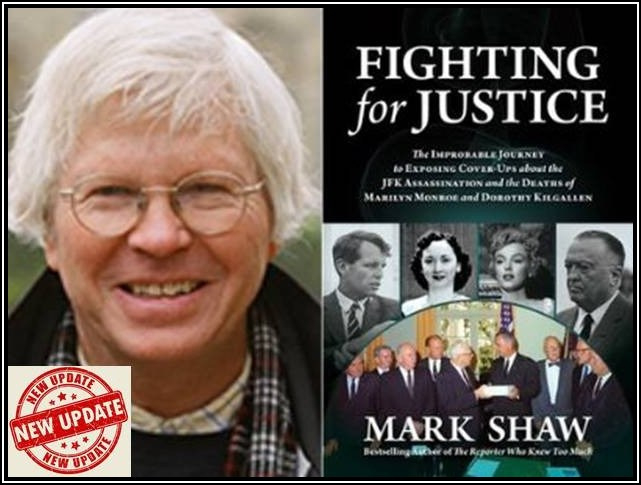
    Mark Shaw has (ostensibly) written six books about the assassination of John F. Kennedy. Four of those have been published in the last seven years. Which means his current output is one book on an average of less than two years. This reviewer has written, or co-written, four books on the case in thirty years. If Shaw wrote books based on the newly declassified documents that have been dripping out due to the strictures of the 1992 JFK Records Collection Act, then fine. But as we shall see, such is not the case.

    When I reviewed Shaw’s Denial of Justice, I noted that for all that was new in that book, Shaw could have simply written a long blog post on his website. (Click here for that review) To expand his parameters what Shaw has done is added another subject—which was hinted at in that book. So instead of Dorothy Kilgallen and John Kennedy, Shaw opened up a new area of inspection in his next book, Collateral Damage. That new area was Marilyn Monroe. As Don McGovern showed in his two part review, Shaw’s writing was remarkably unconvincing about the late film star. (Click here for that review) As Don demonstrated at length, not only did Shaw reveal a lack of analytical insight, he could not even interpret photographs accurately. His excuse for glomming on to Monroe was that she was allegedly a close friend of Kilgallen. As McGovern explained, among many others Shaw made, that statement was inaccurate.

    In his new book, inaptly named Fighting for Justice, Shaw now says he has gotten literally hundreds of letters asking if there was any connection between the deaths of JFK, Kilgallen and Monroe. (Shaw, p. 149) Which is an odd statement. For example, this reviewer has been researching the JFK case full time for the last three decades. I never got one such question, let alone a letter, asking me about that topic. I have attended literally dozens of conferences, and I never heard anyone from the audience ask anything like that. I have been a semi-regular on Len Osanic’s Black Op Radio program for over ten years, and have fielded hundreds of questions from the audience—but never that one. As we shall see—and as McGovern hinted—there appears to be another reason for Shaw’s insistence on now including the Monroe case in his writing.

    Some people like to hear themselves talk. Shaw apparently likes to type. But typing is not writing. About the first fifty pages of this book have little or nothing to do with the alleged subject matter. It is purely autobiographical. So if you want to hear about why Mark Shaw moved from Indiana to Colorado to California, this is your book. Since I was not interested, to me this was just filler.  

    The last part of the book, Chapters 20 and 21—where Shaw excerpts a long phone call between President Johnson and FBI Director J. Edgar Hoover—could have been cut at least in half. And that is not all that should have been cut. For Shaw repeats much of his prior biographical work on Dorothy Kilgallen. He also recycles his half-baked—if that—ideas on the JFK assassination. For instance, he praises the HSCA for examining every nuance of the Kennedy and Oswald killings. (p. 65) Many would disagree. He then writes that there were three shots fired, with the second and third bullets hitting Kennedy. (p. 66) Yet everyone knows the HSCA concluded there were four shots, based upon the acoustics evidence. He now repeats an allegation he made in Denial of Justice that the HSCA report said the Kennedys went after organized crime because mobsters impinged on the success of their father’s bootlegging.(p. 66) I read the HSCA volumes on organized crime, Books 5 and 9, and found no such thing. Let me quote myself:

    If one goes through those volumes, especially volumes 5 and 9, where this Mafia angle is explored, the reader will find no mention of Joe Kennedy’s alleged bootlegging. But in book five, it is noted that, by 1963, the Mafia was falling apart due to Bobby Kennedy’s unrelenting pressure tactics. (HSCA, Vol. 5, p. 455) And make no mistake, the House Select Committee pulled out all the stops in investigating this Mob-did-it angle. They used all kinds of official records, not just in Washington, but also from various local police departments. Again, did no one do any editing of this book?

    So Shaw wanted to write another book. And apparently it did not matter how he filled in the pages. So how does he do it? He prints and then replies to questions and comments from people who read his books, or watched his online presentations. And from what I could discern, the quality of the comments did not matter. There is a letter from a man whose father knew Joe Cody, a former police officer in Dallas. It turns out that Cody bought Jack Ruby the revolver he used to kill Oswald. After relating this information, Shaw pats himself on the back for uncovering “an historical piece of evidence”. (p. 125)

    It would have been natural of Shaw to have clicked his search bar. If so he would have found out that this “historical’ piece of evidence has been around since at least 2008. Since it was described in two obituaries for Cody, one in the Dallas Morning News of July 7th and one at the TV site for KTBS on July 3rd.

    I don’t even want to talk about another one which features Carlos Marcello, Mac Wallace, and Jack Ruby in the same restaurant in Dallas in the summer of 1963. It then gets better. A show girl with Marcello calls Shaw’s witness later in 1977. She says she has a picture of the real JFK assassin emerging from a sewer. Uh, OK. (pp. 119-20).

    But it’s not just stuff like this that Shaw uses to fill in pages of what is supposed to be a book. He now goes back to older books and describes them. One of them is from 1973 and is called The Kennedy Neurosis by Nancy Clinch. If a negative book on the Kennedys gets blasted by The New York Times well, that is notable. (See review by Robert Claiborne of 2/25/73) The book is what Clinch called psychohistory. As Claiborne wrote, this is tough to do even when one has the credentials to do so. Clinch majored in Political Science and did studies of housing in South Korea while in Army intelligence. She tried to explain the Bay of Pigs fiasco by saying it was due to “psychic dynamics” and “unconscious motivations” were “a typically American overconfidence and a typically American indifference toward the responses of the enemy.”

    Claiborne properly labels this as nonsense. But we know what happened with the Bay of Pigs today. It had nothing to do with a “Kennedy neurosis”. It had everything to do with the president being deliberately lied to by the CIA, namely Director Allen Dulles and Director of Plans Dick Bissell. (Destiny Betrayed, second edition, by James DiEugenio, pp. 34-56)

    But strangely, this is something that is almost off limits to Shaw. You will see very little, if anything, about Kennedy’s disputes with the Pentagon or the CIA in any of his books. Even though this particular deception by the CIA caused Kennedy to fire Dulles, Bissell and Charles Cabell, the Deputy Director. I would personally think that would be more important than an ancient story about Joe Cody. Especially when its combined with the fact that the CIA also betrayed Kennedy by assassinating Patrice Lumumba, and backing an overthrow of Charles DeGaulle in 1961. (See David Talbot, The Devil’s Chessboard, pp. 382-89; pp 412-24) This all gets the back of Shaw’s hand, rendered unimportant. Even though when Dulles was appointed to the Warren Commission, at their first executive session meeting, he passed out a book saying that all American presidential assassinations were the work of one man. (David Lifton, Document Addendum to the Warren Report, pp. 89-90)

    What is important to Shaw? Not the new documents. He sloughs those off in a couple of pages. And when I say slough, I mean it. He finds credible a CIA document saying that Sam Giancana was still running the Chicago outfit in December of 1977. Uh Mark, Giancana was killed in 1975. That is almost as bad as him buying into a CIA document from 1998 negating any connection of Oswald to the Agency’s “Office of Operations.” (pp. 106-07) Apparently Shaw is ignorant of what Malcolm Blount did with the papers of the HSCA’s Betsy Wolf. And how her work resulted in CIA officer Pete Bagley declaring that Oswald was a witting false defector in 1959. (Click here, and see John Newman’s speaking of Bagley in Oliver Stone’s JFK : Destiny Betrayed)

    As the reader can see, Shaw is not an astute or prolific researcher on the newly declassified documents. So what does he build his book around? Two things. First, what he broadcasts as an utterly momentous, earthquake type of discovery. It is this: he thinks that Warren Commissioner John Sherman Cooper gave Dorothy Kilgallen the Commission’s Ruby testimony in advance, which she printed in her newspaper. Shaw spends about a dozen pages on this toward the end. He has no direct source, its an inference and a circumstantial case through a man named Morris Wolff. He then uses this as some kind of springboard that Cooper did not buy the Warren Commission from the start.

    Mark we kind of knew that. And the work has been done through more than one person on Cooper’s cohort Senator Richard Russell. Russell, Cooper and Hale Boggs made up the southern wing of the Commission, as opposed to the Wall St./Washington troika of Dulles, Jerry Ford and John McCloy. I wrote about this at length many years ago. (DiEugenio, The JFK Assassination: The Evidence Today, pp. 315-320). This is why there was no stenographer at the last meeting of the Commission to record the southern wing’s dissent. And why Cooper said in a British documentary, way back in 1978, that he did not buy the Single Bullet Theory. Cooper as dissenter is not hot news. And I am still trying to figure out what the impact was of printing Ruby’s testimony early? As I am still trying to figure out how Kilgallen cracked the case if no one knows what she had in her files?

    Let us go to the other key point that Shaw insists on writing about. His new point of interest, which is really quite old: the alleged cover-up around the death of Marilyn Monroe. As Don McGovern showed in his review of Collateral Damage, Shaw went as far as misinterpreting photos implicating Bobby Kennedy in the death of Monroe. McGovern and Donna Morel pretty much wrecked Shaw’s new witness on the Monroe case: actor Gianni Russo. Russo had a hard time getting his age straight as to when he began his alleged relationship with Monroe—at first it was when he was about 12. This did not seem to bother Shaw. And neither did the problem of where Russo said Marilyn was living in 1959, Russo said it was the Waldorf Astoria. It was not.

    To put it mildly, Russo presented some problems for Collateral Damage. So now Shaw brings in writers like Sy Hersh and Frank Capell. But he does not give the reader the proper information about these two men. Hersh fell for a fraudulent legal document that was supposed to be signed by Marilyn and the Kennedys. More than one person said the signatures attached to the document were questionable. Hersh went forward with it anyway until it was shown that zip codes did not exist when the document was executed. (Click here)

    Frank Capell was brought up on charges, along with two other men, in a conspiracy to commit libel against Republican Senator Thomas Kuchel. Prior to that, Capell had been arrested twice for accepting bribes as a government employee. (Click here) I don’t recall Shaw writing about any of these compromising incidents in relation to Capell or Hersh. I find it hard to comprehend he would not know of them.

    But alas, Shaw uses the testimony of LAPD officer Jack Clemmons to say there was no drinking glass in Monroe’s room the night she overdosed. (Shaw, p. 156) As McGovern has proven there was such a glass in her room. (Click here for proof)

    Clemmons was an accomplice in the libel conspiracy charges that Capell was charged with and had to settle. As part of the settlement, Clemmons left the force. Again, this seems to me to be important information and Shaw should have revealed it before committing the factual error with the glass.

    But that is not all. Shaw continues to use a CIA memorandum allegedly signed off on by James Angleton concerning Marilyn, JFK and UFO’s. Many years ago, John Newman, a former intelligence officer, showed how that memo had to be a fake. (The Assassinations, edited by James DiEugenio and Lisa Pease, pp. 360-61). In his devastating critique of Collateral Damage, McGovern brought in another source, Nick Redfern, who also shows the document to be a forgery. So why is Shaw still using it? Or Russo for that matter?

    Another problem: Shaw says that years after Monroe’s death, when her dwelling was purchased by actress Veronica Hamel, it was discovered that the FBI had installed a listening system in the roof of the home. ( Shaw, p. 171) Don McGovern told me that Monroe’s home had no attic, so was the wiring in the walls? How could Marilyn have not known about it then? (Email of 2/24/23) I got in contact with Gary Vitacco Robles, one of the most credible biographers of Monroe. He informed me that in the third volume of his book Icon, which is coming out soon, he will show that this really was a rewiring of the home, due to the fact that the phone wires were antiquated. After all the house was built in the twenties. (Email communication with Gary, 2/24/23)

    I am not going into the scenario that Shaw puts together as to how Robert Kennedy was actually in Los Angeles the day Marilyn passed on. He was not, and this is provable. (Susan Bernard, Marilyn: Intimate Exposures, pp. 186-87) Neither will I critique his scenario about a rectal enema theory, which McGovern showed was simply not plausible. Or the accompanying “spillage” that Eunice Murray was busy machine washing when the police arrived. As McGovern showed, there was no washer/dryer in the home; Monroe sent everything out to be dry cleaned and pressed. (McGovern, Murder Orthodoxies, p. 550) When an author continually makes these kinds of factual errors, and then trusts unreliable sources and documents—I won’t even talk about the book by June DiMaggio that Shaw uses—one begins to wonder about what his true agenda is. Its pretty clear that Shaw has gone around the bend on the MM imbroglio. He has joined the ranks of Milo Speriglio, Robert Slatzer, and Jeanne Carmen.

    And for him to say that somehow Monroe would not have taken her life or not have died from an accidental overdose, this is more Slatzer-like fruitiness. (Shaw, pp. 280-83) As every serious biographer of Monroe has admitted, she tried to take her life at least four prior times. (McGovern, pp. 8-9) She was, plain and simple, a barbiturate abuser. In the less than 2 months before she died, she had gone through about 790 pills. (McGovern, p. 533) Including, among others, Seconal, Tuinal and Nembutal. Tuinal is not available in the USA today; and Nembutal is used for euthanasia by veterinarians. She had a blank check at Schwab’s so to speak. Monroe had been married and divorced three times before she was 35. She had been through three psychoanalysts in about five years. To put it mildly, she did not have an idyllic childhood: she never met her half-sister until she was 18, she likely never met her father, her mother was institutionalized. And she did not like Hollywood. Which is one reason she and her third husband, Arthur Miller, moved to the east coast. I fail to see how any of the above was due to Robert Kennedy.

    What one feels at the end of this book is not Shaw fighting for justice. If so, why did he leave out the above in lieu of a likely forged UFO document, Clemmons and Gianni Russo? An informed reader is disturbed at the almost boundless and unwarranted vitriol aimed at John and Robert Kennedy. Who cannot reply. But Shaw’s publisher at Post Hill, Anthony Ziccardi, was part of Newsmax Media. So Shaw has now found a home for his venom, and his all too frequent—and quite dubious—books.

    Update

    Mark Shaw’s latest is such a hapless effort that it made me go back and look at his career from the beginning. As we all know he has taken on the cause of Dorothy Kilgallen with all the fervor of a jihadic warrior. Exalting her to a degree so extreme that, at times, he seems just silly.

    But what is odd about all this sound and fury is this: Mark Shaw did nothing of the kind in his first two books, which, in their latest editions, amount to about 700 pages. In his first book, a biography of Melvin Belli, he hardly mentions her. (see page 148) What makes that unusual is that there, since Belli was his defense counsel, Shaw writes five chapters about the trial of Jack Ruby. Kilgallen attended that trial and met with Ruby twice privately. Yet Shaw could only muster 49 words on his (later) Joan of Arc journalist.

    In his next book on the case, there was a slight uptick. He devotes a bit more than two pages to Kilgallen—all of it from Lee Israel’s biography.

    This begs the question: What happened in Shaw’s writing career that made him, literally, alter course? The best and most logical answer I can come up with is this: the reprint of Sara Jordan’s long article on Kilgallen’s death in Midwest Today. That fine piece originally ran in 2007. But it was reprinted with a much more graphic, illustrative format in 2015 for the anniversary of Kilgallen’s death. (Click here for that essay) Jordan was assisted by investigator Kathryn Fauble in that version. By the end of the next year, Shaw began his four book series on the reporter. And in that first effort, The Reporter Who Knew Too Much, he gave Jordan and Fauble credit. As time has gone on, he does that less and less.

    With all this in mind, an incident of Shaw’s self-righteousness about Kilgallen stands out even more. Before his book came out, he appeared at a JFK Lancer Conference which I attended. I recall him saying how he thought Kilgallen had been ignored by the critics and he took a personal blast at Jim Douglass for not writing about her in his book. With what we know today, we could ask Mark: if not for Jordan and Fauble, would you have written books on Kilgallen? Your first two volumes do not indicate that.

    The problem with that subject though is this: Once you get outside the parameters of Kilgallen’s mysterious death, there just is not very much there. Shaw likes to say that when she went to New Orleans it was to investigate Carlos Marcello. This is just guesswork on his part. At the trial of Jack Ruby, Kilgallen wanted to know why there was so little being presented on Oswald. She complained about that in one of her columns. Since Oswald lived in New Orleans that summer of 1963, she could just have easily have been inquiring about what he was doing there.

    Realizing that he was at a cul de sac with Kilgallen, Shaw decided to add Marilyn Monroe to his mix. His excuse, that they were friends, has been undermined by Don McGovern and biographer Gary VItacco Robles. As McGovern noted at length, there are so many holes in Shaw’s work on Monroe that you could drive several 16 wheeled semis though it. (Click here) As I pointed out in my article on Sy Hersh, the whole Giancana election rigging scenario from Double Cross—which Shaw relies on– is so faulty that no one could keep their story straight about it. Plus it does not hold up by its own numbers.(Click here) If you add in what McGovern noted what was wrong about Monroe in that book—the Mob never owned her contract—Double Cross has been reduced to a novel.

    Between his reliance on that fairy tale book, his running out of gas on Kilgallen, and his appalling work on Monroe, what does Mark Shaw have to offer to the critical community? How can he say he is fighting for justice? That Coast to Coast maintains him as their semi regular guest on the JFK case is inexplicable. I, for one, think their 3 million listener audience deserves better. A lot better.

  • JFK Revisited: Through the Looking Glass – Book Review

    JFK Revisited: Through the Looking Glass – Book Review


    Since the start of the year I have read more books about the JFK assassination, including Uncovering Popov’s Mole by John Newman, which should be a subject of a future book review (for now let me say simply that it is a must read). But belatedly I read JFK Revisited: Through the Looking Glass by James DiEugenio, the subject of this review.

    I purchased this book half a year ago as part of a package that included three versions of the documentary, mostly because I participated in the film, which I have viewed a number of times. I was never in a rush to actually read it, because I assumed that it could not add much to what was revealed in the film.

    Boy was I wrong!!!

    From pages 15 to 220, we have transcripts of the actual documentaries (annotated 2-hour version and annotated 4-hour version). I did not read these. What I had underestimated, was the monumental importance of the last 200 pages which are excerpts from the interviews of some of the world’s top experts conducted over months of production by a legendary director Oliver Stone, guided by the leading authority of our times on the subject, Jim DiEugenio.

    Oliver Stone’s record of prize-winning movie and documentary production is unparalleled when it comes to historical, political and societal significance. Thanks to his movie JFK, Congress passed the President John F. Kennedy Assassination Record Collections Act of 1992. This led to the formation of the Assassination Records Review Board (ARRB). This in turn led to the declassification of millions of pages of documents that have helped researchers put together the pieces that paint a much better picture of what really took place in and around JFK’s assassination. What other movies have initiated so much change?

    Jim DiEugenio is arguably the most important expert on the assassination in our community. The landmark book and film JFK Revisited is a culmination of a lifetime of research, analysis, writing and networking he has performed during the last decades that has raised his stature to encyclopedic. Through his website Kennedysandking, as well as his groundbreaking books The Assassinations, Destiny Betrayed, The JFK Assassination: The Evidence Today, he has archived perhaps the most important collection of writings on the political assassinations of the sixties ever assembled.

    The documentary JFK Revisited: Through the Looking Glass, when all is said and done, will be regarded as a milestone by independent-minded historians, and will materialize memories of Jim, Oliver , producer Rob Wilson and the participants in this film– despite poison tipped arrows being shot at it by career-obfuscators. Through the Looking Glass is a documentary form bookend to 30 some years of revelations that took place since JFK was viewed by millions, and lays out what we have learned through declassification, rendering the tired old platitude of criticism: “There is nothing new here folks” the summum of ridiculousness. In fact, viewers, got to hear from some 30-world leading specialists dismantling the lone-nut Warren Commission fairy tale, point by point by point. It also buries forever the war-mongering/Vietnam instigator persona that ignorant historians have attempted to lamely paint JFK with.

    Among the contributors–through recent interviews or archive footage and references through articles–audiences got to hear from irreproachable investigation insiders who played leading roles in the various investigations including the Warren Commission (Commissioners Senators Cooper, Russell, and Congressmen Boggs and even Ford), the Church Committee (Senator Schweiker), the HSCA (Richard Sprague and Robert Tannenbaum) and the ARRB (Doug Horne, Judge John Tunheim, Thomas Samoluk) . These are the people who had subpoena power, questioned witnesses who were under oath, had access to classified documents, examined evidence and were hired to do exhaustive, independent work. Well they certainly did not help proponents of the impeached Warren Commission version of events.

    Added to these solid sources, we can add physicians, lawyers, historians, criminalists and others who provided solid arguments that proved beyond a shadow of a doubt for the audiences that there was in fact a conspiracy in the assassination, that JFK was going to desist from Vietnam and that there was a major cover-up. I can state this with confidence because I witnessed first hand reactions of nearly 1000 audience members who attended events during Oliver and Jim’s promotional tour in Quebec City last June.

    Now I ask, who comes across as more QAnonish? Those who prefer putting their confidence in some of the more vociferous nay-sayers like the late John McAdams and who deny the record put forth by people of the likes of Senator Schweiker? Or those who believe the documented affirmations of the leading investigators hired by the US Government. In other words, this documentary has turned the tables on those who are the real theorists and obfuscators by placing them squarely at the opposite end of official records!

    As I was reading the second half of the book, it began to dawn on me: I could not recall getting so much insight from a book at such a trailblazing speed. By the end I concluded that JFK Revisited: Through the Looking Glass is perhaps the most underrated book about the assassination I have ever read. In hindsight I should have known that what was in there is pure gold. Sort of a rare glimpse of the very best insights from some of the very best experts in the field within two hundred pages.

    Another way to look at this is that if about 30 researchers had been, like myself, interviewed for between 1 and 2 hours on average, in order to end up with 4 to 5 minutes on average of actual screen time, we can conclude that over 90% of the interview content had been left out so as to be able to produce 4 hours of content which also includes an introduction, narration, stock footage that are not interview-based. While reading my part and the others in the excerpt section, I estimate that the author added some 15% of the total interview content of that 90 %.. While I guess that many of the points in these interviews might be found in previous speeches or writings of the experts, the fact that one can find so much power-packed content coming from almost 30 different sources, all within 200 pages, is simply unheard of and certainly worth the ride.

    After pointing out some recommendations on how I would improve this tour de force, I will give readers samples of some of the statements that really should mark people who were unaware of these, including those who saw the documentary.

    JFK Revisited the Book: Its Weaknesses

    As a preface to this section, it is important to note what a monumental task it must have been to produce, with limited means, two versions of the documentary for broadcast, a third one with commentary by Oliver and Jim, create a kit with DVDs, a poster, and the book, all to be launched through a minefield of resistance orchestrated by the usual suspects of disinformation artists and saboteurs.

    I personally witnessed attempts to torpedo the Quebec City events first-hand. And most of us know the price Oliver Stone paid for his movie JFK. Anyone willing to invest three years of their lives into this project deserves two thumbs up for a job well done. Kudos to Jim, Oliver and producer Rob Wilson.

    That there are so few weaknesses is surprising in this critic’s view, but there are some over and above a small number of typos that made their way in the writings.

      1. One of the extremely persuasive demonstrations made in the documentary was of how the chain of custody around the magic bullet, the conflicting documentary timelines, how this missile simply could not have created the damage it is given credit for and how key witnesses deny the validating statements it was claimed they had made. This convinced audiences overwhelmingly that the CE399 flight trajectory was one the biggest shams by the Warren Commission. One of the claims made in the documentary, that Elmer Lee Todd of the Secret Service had not initialed the projectile when he handled it, seems to be false. This error is repeated in the book. This was graciously admitted to by the authors during the CAPA 2022 conference in Dallas. The significance of this is minimal in the overall picture painted in the documentary: There can be no doubt that CE399 would have been thrown out in a court proceeding, or even turned into an object of ridicule for the benefit of the defendant.
      2. Jim and Oliver were both asked why they chose to keep the Lopez report and Oswald in Mexico City out of the documentary. To most of us, the revelations around this highly suspicious episode represents one of the highlights of declassification. The answers were that tough choices had to be made in order to respect constraints and that Mexico City would have been simply too complex for less knowledgeable audiences. Still, what happened there is so explosive and informative, I feel an opportunity was missed to lob a Molotov cocktail into the discourse that no historian, journalist or lone-nut officiado can counter. The audience could have heard HSCA investigators Dan Hardway and Ed Lopez reveal how: Oswald was likely impersonated in order to make him look unhinged and under Castro’s control and in talks with Russia’s western hemisphere assassination tsar; investigators were forced to downplay and reverse this scheme; Intelligence agents Anne Goodpasture and David Atlee Phillips lied their heads off; how Hoover and others proved that the claim that recordings of an Oswald impersonator in Mexico City were routinely destroyed by the CIA was a boldfaced lie; how in fact Hoover confirmed that agents who questioned Oswald after his arrest stated that they had heard at least one recording and that the voice on the tape was not Oswald’s… and this is just the tip of the iceberg. Honestly, if I had to choose between this event, and the one I covered around prior plots, I would have tried to find a way to get this one in, at least in the four-hour version and in the book.
      3. The reason this book has not reached the star status level it deserves is perhaps due to what I would humbly describe as a tactical error. Almost half of the book is dedicated to providing the transcripts of the documentary. This may have created a perception, that it was a derived product: some sort of merchandising throw-in. In this writer’s view the full first half of the book is a buzz-killing rehash of the documentary without the star power, imagery, music or any added value. Contrary to serving the reader by providing entertainment, it detracts from both the film version and the second half of the book. Why read this if we can view the superior documentary? One of the effects of this is that it gave secondary status to the all the explosive information buried somewhat in the second half. The other is that it turned this book into a 450-page behemoth. Clearly this collector’s item, would have benefited marketing and content-wise by exposing even more the high-level information that did not make its way in the documentary: Including 10% more from each expert, the Mexico City episode, author and producer commentary and complementary add-ons. Why not have a chapter or two on the making of accompanied with wonderful anecdotes and pictures accumulated over the years of production and promoting: Jim in Washington, Oliver in Quebec City, participants in interviews.
      4. Finally, one of the great features of the film version, was the use of compelling visuals that supported the presentations every step of the way. The book Absolute Proof by Robert Groden gives us a clinic on how this can be effective. For instance, in the excerpts section, Doug Horne describes a sketch made by autopsist Dr. Boswell of JFK’s head wound that is so incriminating that it compelled me two look for it on the web:

    autopsy drawingCombined with Doug Horne’s description of the three-dimensional version Boswell drew, you will see later, that we are talking about smoking gun evidence that could have used the same level of graphics support the film production-team put together in the documentary.

    JFK Revisited: Through the Looking Glass – The New Reference for Assassination Expertise

    Decades from now, Jim DiEugenio’s scholarly accomplishment will serve as a time capsule benchmark for the evolution of the research in what is still a cold case. Today, it provides those of us who are clearly on the right side of history with the most up to date rebuttals to those who have fossilized their jargon in the 1963 cover story peddled by the Warren Commission. I would love to see a keen student of history challenge his or her brain-washed teacher with some of the material I will present in this section. The answers, if honestly replied, would be “I am sorry I was not aware of that”. I know this because I have researched history books and exchanged with the writers. Out of over twenty respondents to my questions, ninety percent were not aware of the HSCA investigation into the assassination. So, try and imagine how they would explain the following excerpt samples from the second half of Jim’s book.

    The following is just a miniscule part of what you may not be aware of if you have not read this book:

    Jefferson Morley (Veteran Journalist) on Oswald’s seemingly manufactured fight with DRE local leader Carlos Bringuier:

    Oswald goes public and the two organizations in New Orleans that give him his publicity are instruments of the CIA: The Cuban Student Directorate was paid $50,000 a month… and INCA which also publicized Oswald’s group, was also in league with the CIA.

    Aaron Good (PhD, Author, Editor) on Henry Luce:

    … It was implicit when he writes things like there’s a lot of money that’s going to be made in Asia… This was his big disagreement with Kennedy… What form should decolonization take?

    Barry Ernest (Journalist, author) on Victoria Adams (The Girl on the Stairs):

    When they interviewed her in February 1964, the Dallas Police were no longer involved in the investigation… And in that Dallas Police interview, that was the first time she mentioned seeing Billy Lovelady and William Shelley on the first floor, a comment that was repeated two months later in her Warren Commission testimony… she continually told me that she never made that statement… And that she actually felt those words were inserted in her testimony to specifically make her appear wrong.

    Professor Bradley Simpson (University of Connecticut professor of history, author) on US support to Indonesia regime changes under Eisenhower:

    Alan Pope was captured… It was later revealed that Alan Pope worked for the CIA. The revelation of the US support for these regional rebellions really helped to radicalize Sukarno and to convince many Indonesians that the United States was working to overthrow Sukarno.

    Brian Edwards (Instructor in Criminal Justice at Washburn University) on investigation anomalies:

    I confronted Jim Leavelle… I asked him point-blank, why didn’t you take notes of what this guy (Oswald) is saying? And you know what he told me? It wouldn’t have changed the outcome of the case. This is the day before Oswald got shot.

    And…

    There was a Dallas postmaster Harry Holmes who was an FBI informant… He was invited into the Dallas Police headquarters interrogation room to interview Oswald. Oswald is charged with murder. Why would a postal director have any business being in there? He doesn’t.

    Dr. Cyril Wecht (Forensic pathologist) on missing evidence and pathologist Jim Humes destroying his autopsy notes and his first draft:

    In addition to some photos and some X-Rays that are missing (at the National Archives), there’s a large metal box that obviously contained the brain listed in ‘65, no longer listed in ‘66… There were some microscopic tissue slides missing too. And by the way, tissue slides are important when you’re looking at gunshot wounds to try to differentiate entrance from exit…

    Humes did something that would undoubtedly lead to a murder case being thrown out.

    Dr. Wecht on JFK possible neuromuscular reaction:

    But the decerebrate and decorticate do not fit. You don’t see the features- an arched back? A protruding chest? And with decerebrate, the arms then out and flexed in, and decorticate, the arms extended outward. Neither of those are shown with Kennedy’s position in the car.

    Dr. David Mantik (Radiation oncologist, Ph.D. in physics) on the CE399 trajectory and the Harper fragment:

    But I personally spoke to John Ebersole, the radiologist (at Bethesda autopsy) … and he said it was probably T4 (entrance wound). So if that’s true, then the magic bullet is a total loss. It’s impossible…

    Either you run into the lung and the lung would be punctured, but we know that did not happen. Or the bullet runs into the cervical vertebrae… But we know from the X-Rays that did not happen either.

    Altogether three pathologists saw this Harper Fragment and they all agree that it was from the occipital area.

    David Talbot (Author of Brothers and the Devil’s Chessboard and founder of Salon) on Allen Dulles:

    In reality, Allen Dulles recovers very quickly (after being dismissed by Kennedy). He retreats to his home in Georgetown and he begins basically to set up a government in exile there…. So, people like Richard Helms, James Angleton still feel they are part of the Allen Dulles circle. Dulles is not only seeing his old CIA lieutenants, but generals, admirals, the national security network.

    Dr. Gary Aguilar (Ophthalmologist and college instructor at UC San Francisco) on the HSCA treatment of the back of the head wound, mainstream media bias and the CE399 stretcher:

    They said that all the witnesses at the autopsy, they all agreed to those autopsy photographs (showing no damage to the back of JFK’s head). But they suppressed the witness statements themselves. When the ARRB came along, and out come those witness statements, out comes the diagrams. And lo and behold, it turns out that the witnesses at the autopsy all agreed with the doctors at Dallas: That the defect involved the rear of the head. They basically lied about what was there…

    So here you have the New York Times assuring the public that all the documents have been released and no question remains unresolved. In the absence of having seen any of the 26 volumes of supplementary evidence… They admit they are working with the Warren Commission…

    To the great shame of my organization, the American Medical Association by the Journal of the American Medical Association. They published some articles that were laughably absurd and were ultimately repudiated even by members of the mainstream media.

    The stretcher that it (CE399) was supposed to be found on was almost certainly not John Connally’s stretcher.

    Dr. Michael Chesser (Neurologist) on the skull X-Rays:

    The fragment trail does not fit the conclusions of the Clark Panel or the HSCA… So, it’s impossible for a shot here, in the back of the skull, to result in all the tiniest bullet fragments in the frontal region…

    The bright object (supposed bullet part) suddenly shows up between the Bethesda autopsy and the Clark Panel. I think it was most likely… placed there shortly after the autopsy…

    Chesser explains later that it is not credible that this had been missed, and also that Ebersole (the radiologist) refused to talk about this.

    Doug Horne (Military Records Analyst for the ARRB, author of Inside the ARRB) on Bethesda autopsists Drs. Boswell and Humes, and on Oswald’s earnings:

    Horne also explained that, contrary to other depositions done of the autopsists during other investigations, the ARRB questioned Dr. Humes and Dr. Boswell separately. This yielded a stunning result: “While Humes contended under oath that there was no bone missing in the back of JFK’s skull, Boswell said there was bone missing in the rear skull and actually made a sketch on a three-dimensional skull model (now at the archives) showing missing bone skull from the top of the head, part of the right side, and the entire right rear of the cranium.”

    Boswell admitted that there was an “incised wound” in the forehead of JFK that Horne interpreted the following way: “Tells me there was an entrance wound right there, which other people saw in photographs. The photographs that did make it into the official record. There was a small entrance wound… removed with a scalpel before the autopsy started”… And also that he did not see the entrance wound (in the back of the skull) that they described so carefully in the autopsy report…. “So, the autopsy of John F. Kennedy is probably the evidentiary mess of the twentieth century….”

    But the FBI report says that the entrance wound has a steep downward trajectory of forty-five to sixty degrees. That is not in the autopsy report… This three-hit scenario [instead of two] is undoubtably the content of the first draft [destroyed by Humes] of the autopsy report…

    Oswald’s last quarter of earnings in the United States before he defected to the Soviet Union should have been paid by the Marine Corps. And they weren’t… That has serious implications to me because of the speculation that he was a fake defector.

    James Galbraith (University professor, author, essayist on Kennedy’s Vietnam withdrawal plan) on his father and JFK:

    He (his father) admitted many times… Kennedy knew what he wanted and he knew that my father would deliver what he did. Which was a detailed skeptical report about the deficiency of the South Vietnamese government. If … an army of a quarter of a million people could not prevail against less than 20,000 insurgents at that time, it was not a situation in which an outside force stood much chance of changing the outcome…

    Jim Gochenaur (Church Committee witness) on Elmer Moore’s feelings about JFK and Jack Ruby:

    He was giving away everything he could to the Russians… His father was an appeaser. Just like he was…

    Gochenaur also said that Moore showed him an autopsy photo of JFK. Moore also confirmed that he had to shut down Ruby when he began opening up about shooting Oswald, fearing it would imply premeditation.

    John Newman (University professor of history and respected author) on executive action, Northwoods:

    Eisenhower got very impatient with Allen Dulles. He had told him to get rid of Lumumba. And it wasn’t happening. So, he got very frustrated in the middle of an NSC meeting and just blurted out an order to kill.

    He (Lansdale) inserts the false flag operations to kill our own people: sink our ships, attack Miami, all that stuff was later Northwoods. Way back in January, Lansdale inserts it as a Mongoose thing because he is actually acting as a stalking horse for Lemnitzer, chairman of the Joint Chiefs. He is siding with them… and going against the orders of President Kennedy.

    Judge John Tunheim (Chief Judge of the US District of Minnesota, Chairman of the ARRB) on assassination records:

    I think it is pretty clear Angleton destroyed records before he was summarily dismissed from the CIA.

    He (Connick) was embarrassed because he said all the files (Garrison) had been preserved, and turned everything over to us. When in fact he had ordered the records to be destroyed. And they weren’t destroyed.

    We were misled by the CIA about Joannides as was the HSCA.

    Tuenheim also noted the destruction of autopsy records and Secret Service files, how the CIA and President Bush opposed the release of classified documents and how Trump did not respect the law by stalling declassification and finally how the CIA is resisting the release of the Joannides files.

    Lisa Pease (Co-editor of Probe magazine, author of A Lie Too Big to Fail) on the Church and Pike committees:

    The Church Committee and the Pike Committee, it’s really the only investigations the CIA had really ever had. The only in-depth ones where their operations were analyzed and really looked at. Both Pike and Church came to the conclusion that the CIA was a rogue elephant operating independently of the president. (She points out that these committees were kind of the end of Pike’s and Church’s respective careers).

    Under the JFK Act… they (the Church Committee) realize at no point did they (the CIA) ever have presidential authority. (To murder Castro) (This is according to the CIA’s own reports.)

    Henry Lee (Commissioner of Public Safety for the State of Connecticut-1998-2000, chair professor in Forensic Science University of New Haven) on the second Magic Bullet, the head shot, and the forensic research into the JFK assassination:

    Somehow the trajectory (head-shot) turned in a ninety-degree angle… The Third Shot, the most important shot, entered the back-right side of the head (according to the WC), and came out the front right. So, the bullet actually turned that angle…

    He also deplored that the brain was not sectioned to analyze trajectory, and that one could have no idea what happened based on the messy work.

    Paul Bleau (MBA, college professor, essayist KennedysandKing) on case linkage:

    For the excerpts selected from my interview with Oliver Stone, let me simply state that one should conclude that no case linkage analysis was performed by investigators and there was destruction of files around prior plots. But what we can piece together surely indicates that there was a template, contingencies, and a mission to remove JFK before the end of 1963. They also suggest an angle that should be used to build an offender profile in the assassination.

    Dr. Philip Muehlenbeck (George Washington University instructor, author). On JFK anti-colonization credo:

    He (diplomat Edmund Gullion) had told Kennedy that the French were actually losing the war. That the war was unwinnable and that, if the U.S. were to replace the French in the war, the US would also lose the war.

    After he (JFK) made his Algeria speech, the French were very upset with Kennedy…

    He took a full-page advertisement (promoting the book The Ugly American) in the New York Times. He bought a copy of the book to give to every member of the senate.

    Thomas Samoluk (Deputy Director and Press Officer of the ARRB) on intel resistance and Northwoods:

    … the intelligence agencies kind of adopt that approach, that they (the ARRB) will eventually go away. The Review Board will not last forever. We’ll still be here.

    The Northwoods records are really, I have to say, bizarre… the military creating situations that would make it look like Cuba had committed terrorist acts, had downed a US jet-liner as a pretense to invade Cuba.

    The records have not been released in total, and I don’t think any good reasons have been given.

    Dr. Robert Rakove (Professor of history at Stanford, author) On Nasser:

    Eisenhower and Dulles had edged onto a course of confrontation with Nasser… after he opened relations with China, they canceled a loan that Nasser depended on to build the Aswan Dam. This set the Suez crisis in motion as Nasser nationalized the Suez Canal.

    Kennedy discerned he was actually quite modern, quite rational, quite forward looking…. Open to Western investment in commerce. He saw religious fundamentalism as a step backward… They could kind of achieve mutual harmony together.

    Richard Mahoney (Professor at the School of Public and International Affairs at North Carolina State University, author) on UN Secretary Dag Hammarskjöld and on Kennedy being left in the dark:

    Hammarskjöld was appealing to Kennedy to basically get Lumumba out of a military base and into UN hands so he wouldn’t be killed. So, Kennedy agreed… What he did not know was that the Eisenhower administration had already decided that he should be assassinated.

    Mahoney shows how Kennedy was not even told about the murder by Dulles as he found out about 4 weeks after it occurred:

    They moved quickly to execute this man… they didn’t tell President Kennedy at all.… As soon as Mobutu takes power, the Belgian commercial and clandestine interests and the CIA are back in business big time. And for three decades, he brutalizes his country, murders wantonly, profits at an incredible rate and becomes one of the worst dictators in the world.

    Robert F. Kennedy, Jr. (author, chairman of the Children’s Health Defense group) on his father and uncle:

    My uncle and father knew that US policies towards Latin America were anti-democratic and US policy was especially driven by the economic interests of American corporations…

    My grandfather opposed World War I because he thought it would only benefit the bankers.

    My father was horrified at the US intervention in the Dominican Republic… Jack had an interest in Cuban history… Jack was very aware of the corruption of the Batista regime.

    It’s very clear from the autopsy reports and the police reports that Sirhan could not have killed my father.

    Edwin Lee McGehee (Possible last surviving witness of the Clinton Jackson incident) on Officer Frances Fruge, Oswald:

    Edwin McGehee did not appear in the documentary. By going over the excerpts in the book of Jim’s interview with him, the reader will understand why the HSCA found the connections between Oswald, Ferrie and Clay Shaw to be credible. He will also see why evidence was made to disappear… How DA Harry Connick became visibly upset when he met McGehee… and that it became common street knowledge that Oswald had been in Clinton-Jackson.

    Debra Conway (Owner of Lancer Productions and Publications) on the shells in the TSBD and Tom Alyea: the first reporter on the sixth floor:

    The shells looked like they were placed in some sort of pattern on the floor. They did not look like they were ejected from the rifle. They were very close together… Much later people started questioning, you know, I’ve shot a rifle and I couldn’t even find my shells… It became important because it looked like the scene was staged… I would say that he (Alyea) was a friend of the Dallas Police, he worked as a photographer on many crime scenes and he probably knew most of the officers that were there.

    Dr. Donald Miller (Professor emeritus University of Washington, Division of Cardiothoracic Surgery) on Malcolm Perry and George Burkley:

    He (Perry) said it (Kennedy’s throat wound) was an entrance wound, unquestionably an entrance wound… and then in front of the HSCA a year later, he once again said it was consistent with an exit wound… the main reason he changed his testimony (WC) and publicly agreed it was an exit wound is a Secret Service agent put the pressure on him, and that person was Elmer Moore.

    He (Burkley’s son and Miller’s friend) said his dad was a close hold on his professional life and he wouldn’t talk about the assassination. That the only thing he would say was that he couldn’t understand why the Warren Commission never asked him to testify…

    Burkley’s signature (on the face sheet) and his writing “verified” has been erased…

    Dr. Randy Robertson (Radiologist who testified before congress on the JFK case. Member of the Board of Directors of the Assassination Archives and Research Center in Washington) On the limousine bullet and James Young:

    He (Young) was a physician (White House) who ordered Chiefs Mills and Martinell, their assistants, to go to the White House and retrieve what they knew were skull fragments at that time… He was the first one at the autopsy to see these materials recovered from the limousine… He described a bullet (among the materials) brass-colored with a bent tip, he described as five millimeters in diameter… They said it was in the back seat…

    He thought he would go to Bethesda to relieve Dr. Burkley who was sixty-something at the time.

    He further reveals how Young was ignored by Gerald Ford, Arlen Specter and some at the ARRB, and how he was shunned because he mistakenly referred to the Limousine as the Queen Mary instead of the SX 100X presidential limousine.

    Conclusion

    In this review I have revealed only seven pages out of a total of over two hundred, less than five percent of the content. I can assure you that what was not included is just as revealing. In a way, researchers will find out a lot more in these pages than what documentary viewers did.

    I challenge anyone to suggest another book that included the quantity and quality of experts who spoke freely in this book. You cannot find better interviewers than Oliver and Jim. Compare the credentials of these highly educated lawyers, judges, criminalists, journalists, professors, doctors, investigation insiders with the Warren Commission apologists and tell me who you would most associate the word nutcase with… an insult spat up in the air by so many of the lone nutters who are now seeing it fall back on their faces. Not one of the participants got involved for the money… none was offered. No, they all share at least one trait… their pursuit of the truth.

    The other element that is clear is that there is a high-level of corroboration throughout the second half of the writings, and that the author did a lot of fact-checking before publishing. The experts clearly do something that most nay-sayers avoid. They get down and dirty in their research and analysis and base their affirmations on solid foundations. How many WC apologists actually questioned Young, McGehee, Moore, Sandy Spencer, John Stringer, Galbraith, Burkley’s son… Not one. Never has the contrast between the current crop of lone scenario defenders and the network of real researchers been so evident. The current cast of nay-sayers sound somewhat like Joe McCarthy when he was left babbling drunkenly after having been torn down decisively by attorney Joseph Welch… empty cans that make a lot of noise.

    The tables are now turned: To say that Lee, Tunheim, Samoluk, Horne, Morley, Sprague, Schweiker, Tanenbaum, Blakey, Russell, Cooper, Boggs, Robertson, Edwards etc… somehow are involved in a false flag operation, and are quacks, says more about those dishing out these mindless insults and turns the lights on who the real QAnonish conspiracy theorists are.

    JFK Revisited: Through the Looking Glass has already convinced the hundreds of thousands who have seen it that the JFK assassination was the result of a conspiracy. Abraham Bolden thanked Oliver Stone and Jim for the effect the documentary had on getting him a pardon. The jury is out: Jim, Oliver and Rob have prevailed already.

    And now mainstream media in the US, after yet more illegal delays in declassifying records, has even begun spreading doubt about the “official version”… Tucker Carlson comes to mind.

    This book on its own destroys both the lone-nut and JFK Cold Warrior myths that history books peddle to high school students. They now have both the sources and arguments to counter these mouthpieces… who have begun to come crashing down like a house of cards. What’s next… perhaps the release of the interviews in their entirety! Hopefully!

    Jim DiEugenio is known as one of the most knowledgeable researchers of the assassinations of the sixties. His real secret to success however is his ability to network with researchers, producers, podcasters… and now international media who have come to respect him, listen to him and recognize his accomplishments, which will echo down the halls for a very long time.

    Publisher’s Note: This review was not in any way initiated by the editor of the book, James DiEugenio. It was, as is stated, completely initiated by Paul Bleau. He was truly shocked by the sheer amount of information contained in the interviews that were left out of Stone’s two films. That is the reason he wrote it and asked to have it posted.

  • The JFK Assassination Decoded: Two Reviews

    The JFK Assassination Decoded: Two Reviews


    Review by Jerome Corsi

    On January 4, 2023, Dr. David Mantik, M.D., Ph.D., published The JFK Assassination Decoded: Criminal Forgery in the Autopsy Photographs and X-rays, a beautifully printed more than 500-page magnum opus complete with color illustrations compiling his decades-long investigation into the case. The JFK Assassination Decoded is not just another Kennedy assassination book.

    Mantik deserves an honored place in the pantheon of JFK researchers for his definitive forensic proof that JFK was shot from the front, hit by two shots from the right front, and one shot from the rear. Mantik’s book is a “must-read” JFK book that belongs in the library of every serious study of the assassination for its definitive treatment of the JFK headshots. Perhaps even more critical, Mantik allows us to see disinformation campaign parallels, suggesting both the JFK assassination and the removal of Donald Trump from the presidency were both Deep State planned and executed coup d’états.

    Mantik’s forensic analysis of the JFK autopsy X-rays proves Lee Harvey Oswald could not have been the assassin. Equally important, Mantik’s new book allows us to see the Deep State parallel between the JFK assassination and the DOJ/CIA conspiracy to remove President Trump from office. The Justice Department and the CIA conspired to infiltrate and control social media to conceal the Deep State’s role in fabricating the Russian collusion hoax to destroy Donald Trump’s presidency. So too, Allen Dulles penetrated the Warren Commission to cover the Justice Department and CIA’s complicity in the crossfire in Dealey Plaza that removed JFK from the White House.

    In nine separate trips to the National Archives over multiple years, armed with scientific apparatus including a Tobias optical densitometer, Mantik spent a record time examining the original JFK autopsy X-ray films. His brilliantly conducted optical density measurements proved that the autopsy X-rays had been altered to mask the frontal shots. Mantik traced and measured bullet fragments that transited Kennedy’s brain from the front to the back, establishing indisputable “case closed” proof that the official government narrative pinning Lee Harvey Oswald as the assassin was false. Mantik is eminently qualified to conduct this forensic analysis. He received a doctorate in physics from the University of Wisconsin and his M.D. from the University of Michigan. Mantik has spent some 40 years practicing as a board-certified radiation oncologist.

    Mantik bolsters his argument with his anatomical analysis of the Harper fragment, demonstrating that the bone fragment found on Elm Street was from the mid-occipital region, squarely in the back of JFK’s head, blown out of the back of JFK’s skull by an oblique shot from the right front. Mantik also demonstrated that at the extreme right edge of the Harper fragment is a metallic smear that evidenced a shot from the rear entering the back of JFK’s head from a low-angle shot to the rear of the limousine. The low angle of the rear-entry shot suggests a shooter may have been in the Dal-Tex building, not on the sixth floor of the Texas School Book Depository, where the Warren Commission positioned Oswald as the sole assassin.

    Mantik teamed with Douglas Horne, author of the five-volume Inside the Assassination Records Review Board, to conduct an equally rigorous examination of the front windshield of the presidential limousine. Through Doug Weldon, Mantik obtained first-hand testimony from George Whitaker, Sr., a Ford Motor Company supervisor, that he saw the JFK limousine in Dearborn, Michigan, on Monday, November 25, 1963, the day of JFK’s funeral. Whitaker and a second Dearborn witness (the father of Mantik’s Michigan Medical School roommate) saw a hole in the windshield from a frontal shot. Within minutes of the assassination, the Secret Service began cleaning the blood from the limousine, obviously destroying crime scene evidence. The Secret Service secreted the limousine, not allowing an inspection of the front window while it was yet in the limousine. In an August 1993 interview, Whitaker claimed to have replaced the windshield on Monday, November 25, at the River Rouge Assembly Plant, Building B, in Dearborn, Michigan. Whitaker recalled a hole in the windshield, 4-6 inches to the driver’s side of the rear-view mirror. He claimed the shot came from the front and the significant damage was on the inside of the windshield, as would be expected for standard contemporaneous safety glass. Mantik published in the book a photograph showing the JFK limousine stripped down to its frame at the Hess and Eisenhardt factory in Cincinnati in December 1963.

    Mantik established through photographic evidence several images where a bullet appears to hit the limousine’s front window at Z-255 [Zapruder Film, Frame 255, coincident with Altgen’s Photo #6], well ahead of the headshots that occurred after Z-300. Mantik documented that during the JFK autopsy, the pathologists recognized that the 5-centimeter contusion at the right lung apex was not caused by Dr. Malcolm Perry’s tracheotomy performed on JFK at Parkland Hospital in a desperate attempt to save his life. Mantik noted a bullet entered near the midline of JFK’s throat at about the third tracheal ring and traveled obliquely to the right lung apex, where it stopped. As further confirmation that the projectile causing the throat wound had a limited (non-exiting) trajectory, Mantik noted the pathologists conducting the autopsy found no deep penetration from JFK’s back wound. “They ignored this,” Mantik wrote, “and instead invented the single-bullet theory.”

    In a review of Mantik’s book, Douglas Horne notes that Mantik’s analysis of the JFK X-rays confirms Horne’s analysis in Chapter 13 of Inside the Assassinations Review Board. Both Horne and Mantik agree three headshots hit JFK:

    1. A shot low in the posterior skull, from the rear (probably fired from the second-floor window of the Dal-Tex building), blowing out the “head flap” on JFK that the Zapruder film shows prominently;
    2. An almost simultaneous shot from the right front (probably fired from well down the grassy knoll, near where the triple overpass meets the knoll); and
    3. A third almost simultaneous shot from the right front (fired from near the corner of the grassy knoll stockade fence), hitting JFK above and slightly behind the right ear.

    In his review of Mantik’s volume, Horne comments that Mantik’s book, “backstopped by extraordinary detail and footnoting, and by brilliant clarifying illustrations, is the “final word” on the JFK headshots. “Dr. Mantik brings his expertise as an M.D.—a radiation oncologist quite familiar with and qualified to read skull X-rays—and as a physicist to this extensive, illustrated monograph.” Horne added that equally important is that “Mantik’s conclusions about the three headshots, and the alteration of the extant skull X-rays, prove there was a massive U.S. government cover-up regarding how JFK was killed.”

    Editor’s Note: Via the late Robert Parry, we always thought the whole Russiagate caper was a mirage. And that is what it has turned out to be. Jerome was entangled in that ersatz imbroglio so we have allowed him to refer to it.

    Review by James DiEugenio

    David Mantik’s new book is really two books. First, it contains his ebook, JFK’s Head Wounds which includes what is probably the most extensive study of the Harper fragment in print. The rest of the 400 or so pages are a collection of what Mantik feels is his best prior writing on the case combined with some new work not seen before. Two of these latter essays were, for me, high points of the book. Namely a lengthy analytical critique of Josiah Thompson’s Last Second in Dallas; the other is an investigative essay on the possibility that the Kennedy limousine was struck by a bullet through the front windshield.

    Before we get started, let me make some descriptive comments about the book. First, it is in hard cover, which is kind of unusual in and of itself these days. Second, the book is an oversized volume. Which means that when I write that it is about 500 pages long, that is only numerical. In reality its more like 650 pages in length. Third, the reader will search far and wide to find a more extravagantly produced volume on the JFK case. What I mean by that is that the book is profusely illustrated with both pictures and graphics; there must be literally hundreds of these kinds of illustrations in the volume. And many of them are in color, which is another unusual trait in the modern publishing business. In that aspect, I cannot recall seeing a book like this in, quite literally, decades.

    Let me make one other preliminary observation. Dave Mantik is one of the most well-read Kennedy assassination critics there is. So when one reads the footnotes to his essays, one will find references to sources that one never heard of before. I know this will happen with the reader because it happened with me. And most people consider me one of the most well read and informed critics that there is. Well, Mantik sprung more than a few surprises on me.

    I

    The author begins his book by listing what he considers to be some of the major paradoxes in the JFK case. For instance, the mystery of Kennedy’s brain which is pretty much intact on the pictures. But which he and Cyril Wecht showed had to be missing a major amount of mass according to the x-rays. (pp. 4-6). This pungent observation is a summary of the essay those two men wrote for the book The Assassinations. (Edited by James DiEugenio and Lisa Pease, pp. 250-71) I am glad Mantik included this since that essay has been pretty much overlooked, and it should not be. Another paradox being the undetected presence of a 6.5 mm fragment on the Kennedy x-rays that was first noted by the Clark Panel in 1968. (pp. 6-8). A third being the plentiful dust like particles in the forehead area of JFK on the x-rays, which strongly indicate a shot from the front. (p. 10)

    There are seven others, but I think this gives the reader the drift of what the author is going after here. These are distinctly abnormal aspects in the medical record, ones that simply do not match up with the official conclusion of the Warren Report. That conclusion was that two full metal jacketed bullets, both from behind, went through Kennedy. One in the back and one in the head, the head shot being the kill shot. In other words, that verdict does not stand up under scrutiny from qualified experts like Mantik and Wecht. And these are aspects that are obvious in the official records themselves. Therefore, if one produced these records in court, the prosecution would be quickly placed on defense explaining these anomalies. Which would not be easy to explain. Because things like this do not happen in the normal course of a homicide inquiry. And if they did, the court would quickly suspect some kind of subterfuge or fraud.

    This lays the backdrop for what the book is about. For instance, the first chapter after this focuses on the saga of the 6.5 mm fragment near the back of the skull. To say the least, it is not easy to explain. Because it was not seen by any of the pathologists the night of the autopsy. As the author notes, you will not read about it in the Warren Report or the 26 volumes of evidence.(p. 20)

    What makes this even more odd is the fact that it happens to be the same size and caliber of the ammunition that Lee Oswald was allegedly using the day of the assassination. When the HSCA matched the Anterior posterior x-ray with lateral on this object it was revealed that the object had almost no thickness to it, it appears to be a slice of a fragment. (p. 21).

    The other peculiar characteristic is that when Mantik took optical densitometry readings on the object, it turned out to have a density to it that was off the charts. Far surpassing, for example, the 7 x 2 mm fragment. Warren Commission ballistics expert Larry Sturdivan believes this is an artifact. The question is what kind of artifact is it? Is it accidental or manmade. What argues for it being the latter is not just the caliber, but the position. The early critics, especially Josiah Thompson, did not think that a bullet coming in at a low part of the skull matched up with the position of Kennedy’s head at Zapruder frame 313. (Six Seconds in Dallas, p. 111) By raising the bullet strike four inches upward, it did something to solve that trajectory problem.

    II

    The next point of evidence the author will argue is a pet concern of the radiologist, namely the Zapruder film. This reviewer is an agnostic on the subject. But to be fair to him and Sydney Wilkinson–a film editor in the movie business–she and Mantik went to the Sixth Floor Museum and they saw transparencies produced by the MPI company, which produced a video and DVD version of the film. In 2009, they claim to have seen what is a black patch over the back of JFK’s head, with straight edges. Yet there is nothing like that on John Connally. Mantik says it is most obvious at Z-317. (p. 36).

    But when Sydney returned in 2010 the transparencies were larger but not as sharp and clear. The dark patch was gone, and looks more like a shadow. Mantik returned in 2012, and had the same reaction. But the Sixth Floor Museum insists there was no change from the material in 2009. The way to test this would be to find the original Time/Life transparencies from 1963-64. But the Sixth Floor says they do not have them and the searches done by Sydney and Mantik have been unable to turn them up. I have seen the third generation dupe that Wilkinson has and on that copy I did see that black spot. It is really an evidentiary shame that there is no locating the first generation transparencies.

    The next two chapters deal with Vincent Bugliosi. When I was reviewing Bugliosi’s mammoth Reclaiming HIstory, I called up Gary Aguilar and asked him if he was critiquing the book. He said yes he was. I asked: “Did you read the whole book?” Gary replied with, “Are you crazy!.”

    Well I did read the whole book, and so did Mantik. In addition to specifics, the doctor and former physics professor goes after Bugliosi on a general thematic charge. Namely that what suffices for truth for an attorney is not the same as what a scientist considers as truth. (pp. 48-49)

    From here, the doctor and scientist now lists 12 main points of factual evidence that the lawyer either denies in part, or simply ignores completely. The author writes about each of them over four pages. (pp. 53-57) Each point is not a matter of eyewitness observation or a circumstantial trial of evidence. Each deals with what most lawyers call “hard evidence”. Some of these I had not really heard of before or examined. For example, Commission Exhibit 843. This is a picture of lead fragments which came from Kennedy’s skull. As Mantik states it, the problem is they do not resemble their shapes or sizes on the x-rays. He then adds, “No interval testing should so have morphed its appearance.” (p. 54). Another example: stereoscopic viewing of the back of the head photos reveals “a flat, two dimensional image…” And this appears on the part of the image with “the shiny part of the hair that looks so freshly washed….” The author tried everything on this issue, “switching photos left to right, rotating them, and even looking at pairs of color prints and then pairs of color transparencies and then pairs in black and white.” In each instance the image was the same, two dimensional. (p. 55)

    It is a pretty impressive list which illustrates the author’s thematic point. As part of his summary, Mantik pens an insightful point. He writes that the aim of the book was to

    ….destroy every last scintilla of anti-WC evidence….That makes him all the less credible. And it certainly does not give him the air of a scientist. But he does not seem to care. He would prefer to appear omniscient. (p. 59)

    The author then reviews a later book by Bugliosi, Divinity of Doubt. Mantik, who has clearly studied the subjects of atheism, agnosticism and deism, gives the book a thorough thrashing. Concluding that Bugliosi should have never written about an area in which he had such poor mastery of the subject matter. (p. 66-67)

    III

    The next section of the book is composed of Mantik’s critiques of authors like the late Sherry Fiester, Randy Robertson and Fred Litwin. Although disagreeing with some of her points, he treats Fiester with respect. And, as we shall see, he seems to adapt one of her theorems—a shot from the south knoll.

    He has little or no respect for Fred Litwin. And, in my view, his critique of I Was a Teenage JFK Conspiracy Freak is a masterful polemic. It stands as a model of what negative criticism can and should be. Because not only does it destruct the subject, it educates the reader as to what the true facts are.

    He and Robertson have a fundamental disagreement about the evidence as a whole. Robertson thinks everything is genuine and on the up and up. Mantik does not. For instance, Robertson thinks the 6.5 mm fragment is genuine. He also believes that the ammunition was all uniform full metal jacketed (FMJ). Mantik asks how could a FMJ bullet produce the snowstorm effect of the dustlike particles in the forehead. (pp. 150, 155)

    Right after this comes another model of negative criticism. This time it is Mantik’s review of the late John McAdams’ book JFK Assassination Logic: How to Think about Claims of Conspiracy. The opening of this review shows the kinds of harpoons Mantik landed on the late Marquette professor. McAdams was attempting to show the reader how to think about the JFK case in a logical manner. Here is how Mantik leads off:

    Despite his pompous claim to teach all of us how to think critically, McAdams offers not a single reference to standard works on logical fallacies. Nor does he ever present his unique credentials for this task….In order to persuade the reader to vote for his dubious conclusions, he uses the standard tools of manipulation and commits a variety of crimes against logic-the straw man, the invalid analogy, begging the question, special pleading, the false dichotomy, and the moving goalpost. (p. 159)

    He spends most of the rest of this review exhibiting examples of this propagandistic type of writing.

    Mantik’s review of Josiah Thompson’s Last Second in Dallas is quite illuminating and thorough. Like Robertson, he questions the shot sequencing proposed by Thompson. He does this on what seems to me to be sound grounds. And it relates to his grand exposition of the Harper fragment which will come later in the book, but is introduced here. Mantik believes that the shot from the rear must have come before the frontal shot. (p. 263) If Thompson is proposing that the frontal shot dislodged Harper, then how did the outside smear get on the Harper fragment? This is a telling observation. Especially since Thompson is very familiar with the Harper fragment. (pp. 263-64)

    Mantik reminds us that Thompson wrote that Oswald shot TIppit and that the anterior neck wound was an ejection for a bone or a metal fragment. Mantik pretty much takes the book over the coals on the latter supposition. (pp. 268-69). Mantik’s disagreement with Thompson and James Barger and Rich Mullen—all of whom back the HSCA acoustics findings—is one of the most fascinating discussions one will read on that subject. This one review has ten appendixes to it. They include three comments by Michael O’Dell, who, in my opinion, is the single most knowledgeable person on the subject. If the reader ever wants to learn about the many sides to this argument, they are presented in this review.

    IV

    I wish to close my review of this valuable book by addressing the final essay and also the second book in the volume. You are not reading wrong: there is a second book with its own pagination. It’s a reprint of Mantik’s E book, JFK’s Head Wounds. But before we get to that let us discuss the subject of Mantik’s CAPA speech this past November. The doctor gave a compelling Powerpoint presentation on the mystery of the JFK windshield. I had never seen the issue reviewed this clearly and pointedly. And yes, I have seen the late Doug Weldon’s lectures on Youtube. The combination of Mantik’s lecture, and his essay in this book, caused me to go back and read two previous treatments of the topic. They would be Weldon’s long essay in Murder in Dealey Plaza, and Doug Horne’s much shorter review in Volume 5 of Inside the ARRB.

    But to place the problem in historical perspective, and to give proper credit, the late David Lifton actually wrote a rather fair precis of the imbroglio in Best Evidence. (pp. 370-71) There, in two pages, he gives the outlines of the apparent paradox. As he writes, there was credible eyewitness testimony that there was a hole in the front windshield when the limousine arrived at Parkland Hospital. For instance, two Dallas policemen, H. R. Freeman and Sgt. Stavis Ellis, both saw a hole. Ellis was certain about this, “It was a hole. You could put a pencil through it….” (Lifton, p. 370)

    Mantik’s list, quite naturally, is longer than Lifton’s. He lists nine witnesses. In addition to the policemen: medical student Evalea Glanges, Secret Service agents Joe Paolella, and Charles Taylor, reporters Richard Dudman and Frank Cormier, Ford Motor supervisor George Whitaker, and Secret Service agent Bill Greer, as told to Nick Prencipe of the US Park Police. (Mantik, p.321) The author finds this testimony credible. Further, he says the hole is most visible in the Altgens 6 photograph. (p. 323) He showed this in Dallas, and I had to say, it looked like a hole to me.

    Vaughn Ferguson was the go between for Ford Motor and the White House. He wrote a memo on December 18, 1963 that the author depicts as odd. Mantik spends the better part of two pages going through this memo and pointing out some problems. One of the massive ones is this: James Rowley, Chief of the Secret Service, wrote a letter to J. Lee Rankin of the Warren Commission on January 6, 1964. In that communication, Rowley declared the limousine was in the White House garage until December 20th. At that time Vaughn Ferguson drove the limo to Dearborn. Four days later it was driven to Hess and Eisenhardt in Cincinnati, a longstanding custom car company, for the installation of the bullet resistant bubble-top. (Mantik, pp.343-46)

    Even the rather somnolent House Select Committee on Assassinations (HSCA) had problems with the Rowley and Ferguson summary. As Weldon noted, the HSCA had four conflicts with the dates in the letter. A clear and obvious one is this: the limo was provably in Cincinnati on December 13th—a full ten days before Rowley said it was. (Weldon, Murder in Dealey Plaza, p. 133) In fact Willard Hess told Weldon that this December 20th journey would not and could not have happened. Hess was very disappointed that the Warren Commission only contacted him once, and then very briefly.

    As both Mantik and Weldon point out, there is another serious problem with Ferguson’s account. He wrote that the cracks in the windshield radiated from very close to the center and at a point right below the mirror. (Ibid, p. 134). This is simply false; so much so that one wonders if Ferguson really wrote the memo with the car in front of him.

    In 1993 Doug Weldon found a contradictory witness from Ford Motor Company. At that time he wished to remain anonymous, so Weldon used his information without naming him. Later it was revealed that his name was George Whitaker. Whitaker wrote that he worked at Ford and he got a call from the Vice President of the Division on November 25th. He was wanted in the glass plant immediately. (Horne, Inside the ARRB, p. 1446) The Lincoln was in the Rouge Plant of Ford Motor on the morning of that day. Called to report to the glass lab, he was let in a locked door. There were two engineers there and they had a car windshield that had a bullet hole in it. It was about 4—6 inches to the right of the mirror. From his forty years of experience with glass works, he knew the impact had come from the front. (Mantik, p. 370)

    As the author continues, Whitaker said they were to use the blasted windshield as a template, which had been taken out. When they were finished they were to take it to the B building. When they finished they placed it in the limousine, which had everything stripped out. It is worth quoting Whitaker as to his description of the hole: “…it was a good clean hole right straight through from the front.” (Horne, p. 1446)

    Mantik makes a circumstantial case that Rowley ordered the limo flown to Dearborn in either the late hours of the 24th or the early hours of the 25th. As no one could risk doing something like this in Washington at that time. (Mantik, pp. 328-29). The good doctor makes an extraordinary contribution to all this. He had an acquaintance from his days at the University of Michigan Medical School and this man’s father worked at Ford and had seen the limousine in Dearborn after the assassination. It turns out that this man, Robert D. Harrison, had seen the perforated windshield—and had been very upset by this. (Mantik, p. 347)

    I should add that Mantik, Horne and Weldon all make a rather trenchant observation about the original windshield. Roy Kellerman and Morgan Geis of the Secret Service both said they saw the damaged windshield and the outside was smooth, the damage was on the inside. But safety glass only shows damage on the other side from which its hit. Which means, what these observations show is that the impact was from the front. (Horne, p. 1449). Mantik takes this further and shows how someone realized this was a mistake and they tried to paper it over later. His demonstration continues with examples of how safety glass is supposed to shatter, and also in discrepancies as to comparisons between the supposed same windshield. (Mantik, pp. 332-34)

    Let me add that, Mantik concludes that if he is correct on this the shot likely came from the south knoll. And as he does throughout, he finds and recommends a good paper that argues for just such a shot, this one is from a gentleman named Anthony DeFiore.

    V

    I cannot hope to do justice to what Mantik has done with his analysis of what he thinks were the shots to President Kennedy’s head. But I should add that this 100 page mini-book does not just do that. In fact, the main reason Mantik wrote it was to advance his concept of the proper location of the so called Harper Fragment.

    As the author explained in Oliver Stone’s recent documentary, the Harper fragment was a piece of bone that was expelled from Kennedy’s skull in Dealey Plaza. No one really knows where it was originally located for the simple reason it was not found until more than a day later. (Mantik, p. 36). In fact, Mantik includes reports about this happening i.e. law enforcement officers picking up a piece of bone and moving it slightly before leaving it behind.

    After Billy Harper picked up the piece of bone he gave it to his father who was a pathologist. Jack Harper and two other pathologists at Methodist Hospital—Gerard Noteboom and A. B. Cairns– photographed it and examined it. (p. 1) They concluded it was from the occipital part of the skull. In talking to Noteboom, Mantik garnered that there was a metal smudge on the edge of the bone. (p. 2).

    From this point, Mantik argues against other placements of the Harper Fragment. He essentially takes on everybody. That means other critics and also the HSCA. His review of what the HSCA tried to do with the Harper Fragment—greatly aided by the late John Hunt—makes for quite insightful reading. (pgs. 5-8; 15-18) The HSCA’s Michael Baden said the Harper Fragment was from the parietal region. A judgment with which Mantik strongly disagrees.

    From here, the author proceeds to take on the arguments and placements of Dr. Joseph Riley (pgs. 23-30), Dr. Randy Robertson (pgs. 18-21), and Richard Tobias (pgs. 21-22). The remarkable thing about all of these debates is how Mantik’s investment in the book’s production values serves him quite well. One will search far and wide to find a book with as many technical and medical pictures and illustrations as this one. And this greatly aids the average reader in following the technical arguments Mantik lays out in front of him.

    That argument is going to end with two main concluding statements.

    The first is that Kennedy was hit with three shots in the head. One came from behind, two from in front. There was one in the high right forehead; the other was an oblique shot that hit adjacent to the right ear and exited the occiput while ejecting the Harper Fragment. (p. 58) He also argues that there was at least one shot fired after Z frame 313. For those who are enamored with this kind of discussion, the author includes a lengthy appendix—among several others—which explains in detail what he calls his Three Headshot Scenario. ( pp. 76-85) He even produces a new witness to a picture of the forehead shot. (pp. 86-88)

    The other concluding argument is this: the Harper Fragment was not part of the parietal bone, but part of the upper occipital bone. That description would denote the rear of the skull, in or about the center area. (p. 11). According to his orientation, the metal smudge connects with the bullet hole located by the pathologists at Bethesda that night around the External Occipital Protuberance.

    In the end I would have to agree with his 15 step argument.

    After the debut of Oliver Stone’s 1991 film JFK, a whole new wave of writer/researchers entered the debate over the true circumstances of President Kennedy’s death. Some of these were physicians who concentrated on the medical aspects of the assassination. It is difficult to name one who has achieved more than David Mantik. This book stands as a statement to that significant accomplishment.

  • Fred’s Flim-Flam

    Fred’s Flim-Flam


    Fred Litwin’s latest book is not really a book. This “book” is mainly just a copy and paste of his blog posts. So he actually didn’t write a book. But nonetheless, fundamentally, Fred Litwin still can’t debunk JFK Revisited and JFK: Destiny Betrayed. So he made up lone nut excuses…he transferred them from his blog to the pages of what he calls a book.

    JOHN STRINGER—“Which is more likely? A different brain, or a lack of memory for minor details after 32 years?” (11/24/21 blog; Chapter 17)

    BRAIN WEIGHT—“Here is an excerpt from Vincent Bugliosi’s book, Reclaiming History…” (11/30/21 blog; Chapter 15)

    BRAIN PHOTOS—“Which is more likely? That the powers that be switched out another brain to fool the pathologists, or that they just used a higher concentration of formaldehyde?” (12/1/21 blog; Chapter 16)

    JAMES GOCHENAUR—“How much he [Elmer Moore] pressured Perry is not exactly known.” (12/5/21 blog; Chapter 8)

    THROAT WOUND—“Dr. Perry…wasn’t performing an autopsy, he was frantically trying to save the life of President Kennedy…No forensic pathologist who has examined the autopsy X-rays and photographs believes the throat wound to be one of entrance.” (12/10/21 blog; Chapter 7)

    BACK WOUND—“Gerald Ford made a reasonable and purely editorial change.” (12/12/21 blog; Chapter 21)

    VALERY GISCARD D’ESTAING—“This all could have [just] been misinterpreted.” (12/15/21 blog; Chapter 34)

    AUTOPSY PHOTOGRAPHS—“JFK Revisited ignores the issue of memory.” (1/14/22 blog; Chapter 18) “One possibility, raised by Vincent Bugliosi…” (1/18/22 blog; Chapter 19)

    HEAD WOUND—“The doctors at Parkland Hospital were frantically trying to save the life of President Kennedy. They were extremely busy and no one had the time to examine his wounds in detail. Dr. Michael Baden explained this to Gerald Posner…” (3/22/22 blog; Chapter 14) “We are dealing with human beings and their imperfect memories.” (3/27/22 blog; Chapter 10)

    MISSING AUTOPSY PHOTOGRAPHS—“Memory is a tricky thing…Here is what Vincent Bugliosi wrote about this issue…” (4/8/22 blog; Chapter 20)

    JFK’S AUTOPSY—“Every single forensic pathologist who has examined JFK’s autopsy x-rays and photographs has come to the same conclusion: that JFK was hit from behind.” (5/12/22 blog; Chapter 22)

    The problem with doing such a thing is simple: a blog is not a book. And the above are just a series of excuses for the powerful evidence presented in Oliver Stone’s films, JFK Revisited and JFK: Destiny Betrayed.

    To show just how weak they are—and also how fundamentally flawed this cut and paste job is as a book—consider the first three. These all concern the forensic case of President Kennedy’s brain. Since the fatal shot was through JFK’s skull, this is quite important forensically. One of the strongest parts of Stone’s film is the case made for the pictures and illustrations of Kennedy’s brain not being genuine. In fact, the evidence dictates that they simply cannot represent Kennedy’s brain. In the film, this case is made on three different planes of evidence.

    1. The sworn testimony of the official autopsy photographer John Stringer made before the Assassination Records Review Board (ARRB).
    2. The Dutch medical study testing average weights for the human brain.
    3. The pictures and films of Kennedy’s skull exploding and the tissue, brain matter and blood deposited all over the car, into the air, and even on the cyclists riding behind and to his left.

    A fourth plane would be the eyewitness testimony of those who saw Kennedy’s brain after he was pronounced dead. Stringer denied the pictures at the Archives were his due to—among others—two major issues. He did not use the type of film these pictures were taken with, and the technical process that produced the film, a press pack, was not used by him.

    Now look back at what Litwin says about Stringer. Is he really saying what I think he is? That Stringer would have forgotten how he worked as a photographer over a period of decades, and on this the most important case of his life? One of the most compelling interviews the Assassination Records Review Board (ARRB) did was with Stringer, and it is described in Doug Horne’s book, Inside the ARRB. According to Horne, Stringer was both surprised and excited when he saw the pictures. So much so that he walked over to the holders to examine them closely, he actually held them in his hands. (Horne, p. 807). He then said this was not Ektachrome film and it was from a press pack, neither of which he used in this case. So as far as he knew he did not take the pictures. (ibid, p. 809)

    The second plane of evidence is the famous Dutch study that measured average brain weight—which came out to be about 1350 grams (The Assassinations, edited by James DiEugenio and Lisa Pease, p.253) Oddly, Kennedy’s brain was not weighed the night of the autopsy. About a week later, when it was weighed, it came in at 1500 grams. How could that be considering the massive head explosion depicted in the Zapruder film with a jet stream of blood and tissue exiting the top of the skull, with all the blood and tissue all over the back of the car, on Jackie Kennedy’s clothes, brain matter hurled with such force backwards that the cyclists thought they had been hit by a projectile. It was not a projectile; it turned out to be Kennedy’s brain and skull bone. (Josiah Thompson, Last Second in Dallas, pp. 56,57) We will never know how much of Kennedy’s brain was in the back seat of the car because it appears the Secret Service was sponging out the car while Kennedy was in the emergency room; there is a photo to denote this.

    The above matches up with the plentiful witness testimony, all attesting to see a brain that was severely damaged to the point that a large part of it was missing. After all, witness Marilyn Sitzman said, “I saw his head open up and brains coming out.” (David Mantik, JFK Assassination Paradoxes p. 265) In his book, The JFK Assassination: The Evidence Today, Jim DiEugenio collects 12 witnesses from both Parkland and Bethesda who recalled a large part of the brain being lacerated and missing. (p. 161) Which is not at all what one sees in the pictures, or the HSCA illustration drawn by artist Ida Dox.

    Litwin’s argument about using too much formaldehyde shows a shocking ignorance of what happened that night during the autopsy at Bethesda Medical Center. He might ask himself why Kennedy’s brain was not weighed that night at Bethesda. James Curtis Jenkins, a morgue assistant, said the brain was so vitiated it was difficult to induce needles into the blood vessels in order to perfuse the specimen with formalin solution. (DiEugenio and Pease, p. 251) Pathologist Thornton Boswell said the brain was so torn up it might not have even shown a bullet track. (ARRB Deposition, p. 193).

    Which leads to the final question: Why was the brain not dissected? As neurologist Mike Chesser said on camera during the filming of Oliver Stone’s documentary, this is necessary in order to determine the bullet path (paths) through the skull. (James DiEugenio, JFK Revisited, p. 298) As Cyril Wecht says in the film, the excuse given in the supplementary autopsy report for not doing it was “in the interest of preserving the specimen”. (Warren Report, p. 544) As Wecht declared: preserving the specimen for who and for what? Of course, Boswell’s description might explain why there was no dissection. It also explains why the photos and illustrations cannot be Kennedy’s.

    Taking all of this evidence into consideration, as Doug Horne says in the film, these pictures would not be admitted into court. But further, if a defense lawyer can prove fraud or bad faith—which one could—the attorney can move for a mistrial and also to have the charges dismissed. That is undoubtedly what would have happened here.

    This is Fred Litwin at work. Having demonstrated the (non-existent) quality of his labors in depth and at length, one can guess the value of the rest of those blog posts. And one would be correct; they are something less than zero.

    II

    Slip sliding along, Litwin actually claims that John Connally’s account of the shooting “is all consistent with the single bullet theory.” (11/21/21 blog) Oh really Fred? Connally stated, in the clearest terms, that the first bullet which hit Kennedy did not strike him. (Warren Commission Hearings, Vol. 4, pp. 135-36) His wife, sitting right next to him in front of JFK, completely agreed. She said that she turned at the sound of that shot and Kennedy “had both hands at his neck….very soon there was the second shot that hit John.” (ibid, p. 147) If one only allows for three shots, as Litwin has to do, then Connally does not agree with the centerpiece of the Commission, the single bullet theory. Because the other two shots consisted of one that missed the car completely, and the bullet that struck Kennedy in the skull. So if Connally is saying that he and JFK were hit by separate shots he contradicts the whole Magic Bullet concept: its four bullets. Moreover, he testified: “There were either two or three people involved or more in this or someone was shooting with an automatic rifle.” (Ibid, p. 133) He later went beyond that in private and said he never believed the findings of the Warren Commission for one second. (Joseph McBride, Into the Nightmare, p. 418). This is being consistent with the single bullet theory?

    Litwin got offended and hurt about the straight-talk in the film—“I must question whether there was any need for Dr. Cyril Wecht to add that comment in about Gerald Ford. It’s nasty.” (12/12/21 blog; Chapter 21) Wecht says in the film, “As I recall, they said about Gerald Ford that he could not chew gum and walk at the same time.”

    Why does Wecht say this? Because in the next sentence he decries the fact that it was Ford who moved the bullet wound in Kennedy’s back (its true location) up into his neck for the final draft of the Warren Report. So the forensic pathologist asked: on what professional grounds did Ford have the standing to do this? Was he a forensic pathologist? Was he an expert photographer? Was he a criminalist? If he had none of those skills then how did he know how and why to do such a thing?

    What makes Fred look all the worse is this. The man who originally made the unflattering remark about Ford was Lyndon Johnson. He actually said Ford could not fart and chew gum at the same time. And you can find the remark at Brainy Quote. So the real question Litwin will not ask is this: If LBJ thought so little about Ford’s mental acuity, why did he ask him to serve on the Warren Commission?

    Litwin exhibited the same faux outrage when the film “dissed” the Sixth Floor Museum. (3/13/22 blog). No objective person can deny that this institution is dedicated to preserving the myths in the Warren Report. In fact, while offering a prominent position there to a researcher, the management told him he would have to support the Warren Report in public. (See JFK: Inside the Target Car Pt. 3 by James DiEugenio)

    Litwin claimed Nurse Audrey Bell “did not see the wound in Kennedy’s throat despite being there for the tracheotomy.” (3/21/22 blog) This is incorrect! She made clear on NOVA in 1988 that she DID see it: “It looked small and round like an entry wound.”

    I don’t get angry easily, but I did when Litwin actually said Clint Hill “was rather busy trying to help Jackie Kennedy back to her seat, it seems clear that Hill didn’t have time to do a forensic examination.” (3/27/22 blog; Chapter 10) Which is another nonsensical argument. JFK was face down in the car and Hill could see the hole in the back of the head for several minutes until they reached the hospital. It has nothing to do with a “forensic examination”, it’s what the man saw. (See David Mantik, JFK Assassination Paradoxes, p. 281; Warren Commission Hearings, Vol. 2 p. 138)

    Litwin cherry-picked certain witness statements to try to put the skull defect solely on the right side of the head. (3/27/22 blog; Chapter 10) He uses John Stringer’s later 1996 words to the ARRB saying the wound was “in the right side of his head above his ear”—but ignored Stringer’s original 1972 account: “In the occipital part, in the back there, up above the neck.” (ARRB MD 84, p. 5) He uses Ed Reed’s later 1997 ARRB testimony saying he saw no wound on the back of the head—but ignored Reed’s original 1978 account: “Very large and located in the right hemisphere in the occipital region.” (ARRB MD 194, p. 2)

    Litwin uses an FBI report to say that Darrel Tomlinson and O. P. Wright seemed to identify the bullet, CE 399, to agent Bardwell Odum. (4/9/22 blog; Chapter 29) But as the film series plainly addressed—and which Litwin ignored—Odum was shown this report by Gary Aguilar, and he adamantly said that he never had or showed any bullet to anyone. In fact, he told Gary Aguilar that, “I didn’t show it to anybody at Parkland. I didn’t have any bullet. I don’t think I ever saw it, ever.” (Mantik, p. 192)

    Litwin next, and rather incredibly, states that Wright “never said or implied that CE 399 was not the bullet [he] found.” Yet again, the film series addressed that very point. Wright adamantly told Josiah Thompson way back in 1966 that the bullet he handled had a pointed tip. And Thompson has a dramatic photo comparison of the two bullets in his Six Seconds in Dallas on page 175. In fact, if one talks to Thompson, or reads Last Second in Dallas, Wright actually followed him out of his office and incredulously asked him this direct question: Was that exhibit the bullet they said I turned over? How could Litwin have missed all this?

    III

    Clearly, Litwin was unnerved by the two speeches that Dr. Henry Lee and Brian Edwards gave in Stone’s documentary about inadmissibility of evidence in court. This is why he brings up these above points about CE 399. No documentary had ever made this issue as strongly as those two men did, with as much backing as this documentary did. So, striking out with Odum and Wright, Litwin tries to extend this issue by saying that the so-called mystery of the 7:30 bullet in Robert Frazier’s notes is actually not that mysterious.

    Let us be clear, Litwin is obfuscatory.. Writer researcher John Hunt notes that there seems to be documents missing from ballistics technician Robert Frazier’s files from that day.

    But still, in two places in his work product, Frazier noted that he was in receipt of the stretcher bullet at 7:30 PM on the day of the assassination. (“The Mystery of the 7:30 Bullet” by John Hunt, at JFK Lancer.com) Which makes for a serious problem in chain of possession. Why? Because the stretcher bullet had not arrived at FBI HQ at 7:30 PM. In fact, the best estimate would be that it would not arrive until probably after 9:20 PM. And the FBI was waiting for this bullet from the Secret Service. (See Figures 6 and 7 in Hunt’s essay.) The FBI memo from Alan Belmont clearly denotes two bullets will be arriving, as he writes “and we are arranging to get both of these.” That memo was signed off on by seven men in the FBI hierarchy, including the number two man, Clyde Tolson.

    What does Litwin now manufacture to get around this information indicating two bullets? He actually writes that Frazier wrote down 7:30 because that was the time that O. P. Wright at Parkland Hospital gave the bullet to Secret Service agent Richard Johnsen! I am not kidding. Can you imagine the spectacle in court on this one? An FBI agent is making chain of possession notes for a private security officer (Wright) and a Secret Service agent (Johnsen)—while they were in Dallas! Which is over 1,300 miles away from where he is. Two men he had no direct contact with and likely did not even know!

    All of this nonsense to disguise the question: How could Frazier be getting the stretcher bullet from Todd when he already had the stretcher bullet?

    IV

    Litwin nonchalantly said the autopsy doctors “identified the entry and the exit wounds in JFK’s head and they saw the beveling that told them which wound was entry and which wound was exit. The evidence was pretty clear.” (5/12/22 blog; Chapter 22) No. As Dr. Boswell explained, a semicircle of one of the late arriving bone fragments kind of looked like an entry wound. And a notch in one of the other bone fragments might have been an exit. Nothing was for sure.

    Litiwn incredibly states about the back wound: “…the autopsy photographs that shows its exact location, which is totally consistent with the single-bullet theory.” (Chapter 21) Simply not true! The HSCA said that in order for it to work, JFK would have to be leaning WAY forward (HSCA Vol. 7, p.100)—which he was not. (Warren Commission Hearings Vol.18, p.26) The bullet also would’ve smashed the first rib had it traversed where the measurements place it.

    In relation to the testimony of the secretaries on the fourth floor i.e. Sandra Styles and Victoria Adams, the author says “Oswald just simply beat Adams and Styles down the stairs.” (Chapter 23) I simply respond to this presupposing statement with, “How do you know there was anyone running down the stairs from the 6th floor in that time frame?” Litwin might say, “The rifle seen in the window and the rifle being found!” To which I will say, “That just means there was a shooter up there. But again, how do you know there was anyone running down the stairs from the 6th floor in that time frame?” Crickets.

    Litwin parrots the lone nut talking point that “of course there was no evidence of the [palm] print being lifted, because the dusting powder on the print is totally lifted off.” (Chapter 27) But that’s impossible, because there was powder found “all over the gun.” (Warren Commission Hearings, Vol. 4 , p.81) Litwin says “Oliver Stone would have you believe that there is no evidence the print was even lifted.” (Chapter 27) Hmm…has Litwin not read this sentence from the Warren Report itself? “Nor was there any indication that the lift had been performed.” (WR, p. 123) Litwin also never gets to the real crux of the issue. That is this: the palm print didn’t appear for a week. (Warren Commission Hearings Vol. 4, pp. 24-25). And also, that the only person to see this alleged print said it was an old print. (Gary Savage, First Day Evidence, p. 108)

    Let us mention the Chicago Plot. Litwin says: “Now, of course memories fade over time…Might Bolden have been conflating the Vallee story with [a 1963] rumor?” (7/20/22 blog; Chapter 39) As Edwin Black (Chicago Independent, 11/75) and Jim Douglass (JFK and the Unspeakable, Chapter 5) have proven, at length and in depth, the Chicago plot was no rumor. But I will say this…when basically all you have left is the old shibboleth, “memories are unreliable” excuse—which is Litwin’s and many lone nutters’ constant M.O.—then you have no case.

    V

    As bad as Litwin is on the forensic side, he is just as bad on the historical angle. Which is a major part of JFK: Destiny Betrayed. He refuses to confront the fact that Kennedy was looking for a way to get out of Vietnam in 1961. In the 14 pages he devotes to the Indochina episode the reader will not detect the name of John Kenneth Galbraith. Which, for today, is astonishing. Because right after the White House debates over Vietnam in the fall of 1961, Kennedy sent Galbraith to Saigon.

    Why did he do so? Because, as his son told Oliver Stone, Kennedy did not like the advice he was getting from his rather hawkish advisors in Washington. In fact, as Jamie Galbraith told Stone about his father:

    He admitted many times in the years following, he said Kennedy sent me to Vietnam, because he knew I did not have an open mind. Kennedy knew what he wanted and he knew my father would deliver what he did. (James DiEugenio, JFK Revisited, p. 316)

    The second reason this is an inexcusable lacunae is this: Galbraith’s report was the beginning of Kennedy’s withdrawal program. This is another aspect which Litwin actually turns upside down and backwards. If one can comprehend it: Litwin tries to say the withdrawal plan was Secretary of Defense Robert McNamara’s idea! (p. 365) Which is pretty much impossible. For the simple reason that McNamara was a steady and strong proponent of inserting combat troops throughout 1961. He actually wanted to send anywhere from 6-8 divisions in late 1961. If you do the arithmetic that is about 120,000 men. (Gordon Goldstein, Lessons in Disaster, pp. 56-59)

    So how did McNamara get turned around on the issue? Through Kennedy and Galbraith, and in two steps. At the end of the debates of November 1961, Kennedy was extremely frustrated that he had to fight so hard to get his ‘no combat troops’ decree through his advisors. He called a meeting for November 27, 1961. He said words to the effect: Look, when policy is decided, those on the spot carry it out or they get out. He then asked: Now who is going to implement my Vietnam policy? McNamara said he would. (John Newman, JFK and Vietnam, Second edition, p. 146) That was step one.

    With that established, in April, Galbraith was in town. He and Kennedy discussed a neutralist solution—something Litwin says Kennedy would not do— through the India ambassador’s relations with Nehru. (Newman, pp. 234-36; Litwin p. 367) At this meeting, Kennedy said “he wished us to be prepared to seize upon any favorable moment to reduce our commitment.” Kennedy then sent the ambassador to see McNamara, and according to Galbraith, the defense secretary got the message. This point is double sourced since McNamara’s deputy, Roswell Gilpatric, said that his boss told him ”the withdrawal plan was part of a plan the president asked him to develop in order to unwind this whole thing.” (Virtual JFK, by James Blight, p. 129: p. 371).

    There is a third source for McNamara getting Kennedy’s drift. At the May, 1962 SecDef meeting in Saigon, McNamara asked the overall commander, General Harkins, to stay after. McNamara then asked him when he thought the army of South Vietnam would be able to take over the war effort completely. As someone who was there noted, “Harkin’s chin nearly hit the table.” (JFK and the Unspeakable, by James Douglass, p. 120) McNamara said the American effort would be dismantled and Harkins had responsibility to prepare a plan to do so.

    In the light of the above facts, for Litwin to say that the withdrawal plan was McNamara’s idea is utter malarkey.

    Stone’s film then supplies the two major pieces of evidence which show that Kennedy was getting out, without any questions about it. First, the declassified minutes of the May 1963 SecDef meeting in Hawaii where Harkins handed in all the withdrawal schedules for each department. McNamara leafed through them and said the overall plan was too slow, we were getting out faster.(Newman, p. 324-25) The second piece of clinching evidence was McNamara’s exit briefing which John Newman listened to. There, the Secretary said he and Kennedy had decided that America was getting out once the training mission was over. And this was unequivocal; it did not matter if they were winning or losing. (Vietnam: The Early Decisions, edited by Lloyd C. Gardner and Ted Gittinger,p. 166). It does not get any more clear than that. Which is probably why Litwin ignores not just those two instances, but everything else in the above.

    Fred Litwin is not an author. He is an agitprop artist.

    Afterword

    by James DiEugenio

    This will be the last article Kennedysandking will ever publish on Fred Litwin. As the reader can see from the above, Litwin has nothing to contribute to the subject that has any value or insight. On top of that, he has a penchant for the smear. For instance, he heads his chapter on Vietnam by labeling it as “politics”.

    JFK: Destiny Betrayed had the finest array of historians ever assembled in a documentary on the subject: Robert Rakove of Stanford, Philip Muehlenbeck of George Washington, Richard Mahoney of North Carolina State, John Newman of James Madison, Bradley Simpson of Connecticut. There was no better roster to review Kennedy’s policies in the Middle East, Africa, Indonesia, and Indochina. This rivaled the luminaries the film had on the forensic side. (For a demonstration of just how unique Kennedy’s foreign policy was, click here)

    Broadly speaking, history is the collection of the best sources with the most relevant information from the most reliable scholars. Politics should have nothing to do with it. And the viewer can read the works of these authors and they will see that they are not at all political in nature; they are factually based.

    Litwin quotes David Talbot from the film saying that there is a thread between 1963 and the horror show of American politics today. (Litwin, p. 363) That is not Talbot saying that about himself. This is what the American public feels. And one can check author Larry Sabato’s book, The Kennedy Half-Century to certify it. In the focus groups he conducted, adults of all ages agreed that the assassination “changed America.” An astonishing 61% said Kennedy’s murder “changed the nation “a great deal’. Sabato observed that those alive at the time, testified to the “deep depression that set in across the country. Because the optimism that prevailed since WW2 seemed to evaporate”. (Sabato, p. 416) Kevin Phillips revealed the same in his book Arrogant Capital. In his introductory chapter he depicted a chart which showed the collapse of the public’s belief in the government. The percentage went from over 70% in 1960 to the teens by the nineties. And the collapse began in 1964, the issuance of the Warren Report.

    So this is not, in any way, politics. This is simply social science. If Litwin wishes to deny it then he should speak to Sabato or Phillips. If he does not, then that proves it is Litwin who is being political. It seems to indicate that either psychologically or politically he cannot accept these facts. To be kind, maybe it is because he is Canadian and does not live here?

    The second reason we will now ignore Litwin is the fact that there is a real question of who is the Confidence Man here. Oliver Stone’s life has been laid out by biographers, and by himself in the first volume of an autobiography called Chasing the Light. He makes no bones about who he is.

    But this is not the case with Litwin or his soul brother Steve Roe. In his first book, I Was a Teenage JFK Conspiracy Freak, Litwin states that 1.) He used to be a strong believer in a conspiracy in the JFK case, and 2.) He had been a left winger who turned into a conservative. He has never been able to convincingly prove either one of these claims. Therefore it seems he may have adopted them to mimic his role model David Horowitz. As per Roe, no one has been able to certify a business entity known as “roeconsulting”, which is the rubric he used to post his criticisms of Stone’s film.

    If a writer cannot remove these kinds of fundamental doubts about who they are, why should anyone pay any attention to his work product?

  • A Personal Encounter with the Warren Commission

    A Personal Encounter with the Warren Commission


    The first time I saw the Zapruder Film in its entirety was late 2010. Surfing the net in my flat in Istanbul, site of the 8-mile “Kennedy Avenue” running out to Atatürk Airport, I came across the video on YouTube. Immediately I felt I must have seen excerpts or stills before but never the whole thing, not even the 1975 Geraldo Rivera broadcast. There I was in a foreign land, watching a momentous event as a “newbie” in my mid-forties, gripped with shock-horror at the vision of a dashing US head of state publicly executed on a downtown American street. I stayed up long into the night hunting for assassination material, arriving weary at the law office in the morning.

    Yet the primary emotion I felt on watching the Zapruder Film back then, much greater than shock or horror, was sadness. The vision of the President slammed backward and to his left like flotsam as his distraught wife attempts to retrieve debris from his shattered head is still among the saddest things I’ve ever seen. Of all the dehumanizing visions from history captured on film, somehow the moment of this man’s fatal wounding stands out even among tragedies encompassing many more victims at once. It resonates like a warning to all humanity never to get our hopes up too much.

    *********

    It was in the summer of 1999 that I made the acquaintance of Howard P. Willens, long before I knew who he was. Having recently received the news that I’d passed the bar exam, I needed a job for a couple of months, and as many have long done in Washington, I turned to a legal staffing agency, the name of which I now forget. One of the principals in this small, boutique firm said it would require me to work at the home of a senior, distinguished attorney and his wife, also a lawyer, helping them to finish research on a book they were jointly authoring.

    The interviewer cautioned me diplomatically that, while this client was highly accomplished and respected, he could be “difficult at times,” or words to that effect. The substance of it was that Mr. Willens tended to be overly exacting in his demands, exhibiting impatience that might disconcert some. No problem, I said. I was confident any of this gentleman’s idiosyncrasies would roll off my cocky shoulders with ease. Besides, I reasoned, it was only for a few weeks.

    That the next two months were among the most unpleasant of my professional life was not something I would normally have linked at the time to anything more than over-the-top fussiness on the part of the person I was trying – haplessly – to please. It was not a dull assignment overall, but Mr. Willens’ peculiar habit of becoming red-faced instantaneously, adopting a contemptuous tone of voice without ever raising it, was so effective in sending me into spirals of depression and disconsolation that eventually I couldn’t help but take it personally. No one, I thought, could be this disagreeable unless he had taken a serious, specific dislike to the person he was addressing.

    Since I almost never sensed any satisfaction on his part, I became desperate for days spent alone at the Library of Congress, locating precise content for footnotes and citations. Howard Willens struck me as unambiguously unhappy, and once I discovered who he was, fourteen years later, I would link his unhappiness inextricably to the sadness wrought in my mind by the Zapruder Film.

    I

    The two books that Howard Willens and Deanne Siemer (his wife) produced, and on which I worked in their final stages, are serious-looking academic histories. National Security and Self-Determination: United States Policy in Micronesia (1961-72) (Westport, CT: Praeger Publishers, 2000) and An Honorable Accord: The Covenant Between the Northern Mariana Islands and the United States (Honolulu: University of Hawai’i Press, 2002) tell an intricate story of law and diplomacy, how Washington handled Pacific territories that wound up under American control after World War Two.

    Even within the confines of “authorized history,” the authors are not unsuccessful in recounting a tale of twentieth-century American manifest destiny with a “happy ending.” Years of negotiations and interim agreements are related in impressive detail, and, it could be argued, as authoritatively as anyone could. Willens and Siemer were personally instrumental in many of the processes they describe. Mindful that some observers might perceive the formal attachment of the islands to the US as just another form of imperialism – or annexation – their main purpose, as perhaps expected with any authorized history, is to demonstrate that this was never the case.

    The authors cite National Security Action Memorandum 145, issued by President Kennedy in 1962, as encapsulating the guiding American principles for the political future of the Micronesian islands that ended up as a “Trust Territory” of the United Nations, with the US as “trustee.” JFK, sensitive to any colonialism on the part of the United States (or any other country for that matter), reflected that sensitivity in NSAM 145. As the authors note:

    [President Kennedy] identified education as the first priority and directed his cabinet secretaries to create a task force chaired by [the Department of the] Interior, that would develop and implement programs to improve education in the Trust Territory and to address the serious shortcomings in public services and economic development. [An Honorable Accord, p. 10]

    With NSAM 145, JFK transferred responsibility for the Northern Marianas to the Department of the Interior. Prior to 1962, all of the Trust Territory except Rota had been administered by the Department of the Navy, which wanted to maintain strict security controls, limiting outside access to the islands in a typically furtive military atmosphere. Kennedy opened the islands up to outside travel and trade, in his words, to “foster responsible political development, stimulate new economic activity, and enable the people of the Islands to participate fully in the world of today.” [Ibid.]

    Disillusioned with the task force’s slow pace in implementing NSAM 145, JFK appointed an outside expert, Anthony Solomon, to lead a mission investigating prospects for accelerated economic and social development. The mission predictably advised greater US investment but also reported on a lack of political consciousness among the native inhabitants. In the Northern Marianas, they “found no serious opposition to permanent affiliation with the United States” and recommended a plebiscite for 1967 or 1968, offering voters two choices: independence or US sovereignty. [Ibid, p. 11] JFK knew that the islanders had already experienced three colonial regimes – Spanish, German, and Japanese – and he wanted US administration to represent genuine emancipation.

    Balancing the goals of self-determination and non-fragmentation became a serious initial challenge for Washington in determining Micronesia’s destiny. The governments of Guam and the Caroline Islands, for example, initially rejected any arrangement that would make their people US citizens, while the Northern Marianas favored association with the US. The US government thus negotiated separately with the de facto indigenous authorities of the Northern Marianas to achieve a separate status for them. Guam would eventually become a US territory as well, and Guamanians US citizens.

    The authors touch on how, in the aftermath of JFK’s assassination, the culture of official secrecy and the national-security state took over the process of establishing the island chain’s political status:

    [T]here no longer was the level of presidential interest that demanded the attention of the National Security Council staff and the secretaries of interior, defense, and state. In December 1963 the National Security Council, at the request of State (without any consultation with Solomon), classified as Secret the first volume of the report dealing with its political findings and recommendations; it remained undisclosed officially for many years. [Ibid. p. 12-13]

    II

    In 1972, the Marianas Political Status Commission (MPSC) retained Willens as counsel, by which point the Pentagon had become more assertive about how much of the islands would be retained for basing and other military purposes. The Nixon administration began planning a vast increase in defense sector involvement, including acquisition of 27,000 acres and the entire island of Tinian. Washington became alarmed when a popular referendum was organized in the Northern Marianas on the issue of relocating a whole village to accommodate a new US military base. The US government informed the Northern Marianas authorities that it would not be bound by the results of such a poll, and it was reassured that the referendum’s results would not be dispositive.

    It took until the mid-1970s, with former Warren Commission member Gerald Ford as US president, for the Northern Marianas to finally formalize the status its representatives said they wanted. This was the “Covenant.” One can argue over how rosy and bucolic the US-administered Northern Marianas became as a result of a process involving the national-security state, but I never had too much trouble believing association with the United States was a more genuinely popular alternative at the time than independence, a scenario that may well have seemed highly daunting. Protection from “Big Brother” America may have been too enticing for a tiny island population to pass up.

    The history of the political status of Micronesia is a unique tale, intriguing for anyone interested in international law. While subject to sanitization in the volumes of Willens and Siemer, there are occasional human touches (in one anecdote, an American lawyer and economist for the MPSC drunkenly assaults a US Air Force colonel who has insulted him in a hotel bar). That said, An Honorable Accord and National Security and Self-Determination are conservative histories.

    A “progressive” analysis of the legacy of covenants between the US and Micronesia might focus on factors such as economic exploitation, corruption, clan-based patrimonialism, and a poor defense of workers’ rights, in addition to the adverse role and influence of the US national-security state in engineering political outcomes desired by Washington (the publisher of the first volume, Praeger, has a long history of CIA-commissioned works). Also, while the Northern Marianas and Guam are part of the United States, their residents have no voting representation in the US Congress, a dubious status shared with compatriots in American Samoa, Puerto Rico, the US Virgin Islands, and the District of Columbia. No official US history is likely to highlight such concerns at great length.

    As recently as 2019, Ms. Magazine published an update to Rebecca Clarren’s 2006 article entitled “Paradise Lost,” highlighting social degradation in the Commonwealth of the Northern Mariana Islands (CNMI) since the accord with the United States. The purpose of republication was, apparently, to double down on her central points in the face of a Saipan Tribune piece, “Article ignores the great strides we’ve made,” attacking Clarren’s analysis. As Clarren noted:

    [In 1975] the islands’ indigenous population of subsistence farmers and fishermen voted to become a commonwealth of the United States – a legal designation that made them U.S. citizens and subject to most U.S. laws. There were two critical exceptions, however: The U.S. agreed to exempt the islands from the minimum-wage requirements of the Fair Labor Standards Act (allowing the islands to set their own lower minimum wage, currently $3.05, compared to $5.15 in the U.S.) and from most provisions of the Immigration and Nationality Act. This has allowed garment manufacturers to import thousands of foreign contract guest workers who, ironically, stitch onto the garments they make the labels “Made in Saipan (USA),” “Made in Northern Marianas (USA)” or simply “Made in USA.”

    Former heavyweight DC lobbyist Jack Abramoff, prior to his conviction and imprisonment for fraud, bribery, and tax evasion, served as a lobbyist for the CNMI and blocked bipartisan reforms advanced by Congress to improve labor conditions and immigration abuses. As Clarren pointed out:

    In January 2005, the GATT treaty, which had regulated all global trade in textiles and apparel since 1974, expired, eliminating quotas on textile exports to the U.S. The Northern Marianas had been attractive to garment makers because of its exemption from such quotas and from tariffs on goods shipped to the U.S. marketplace. Without those advantages, manufacturers are increasingly moving to such places as China, Vietnam and Cambodia, where they can pay even lower wages. Since the treaty’s expiration, seven factories have closed in Saipan, reducing the value of garment exports to half its 1999 peak and putting thousands of guest workers out of jobs. Some observers expect almost all factories to close by 2008, when a temporary restriction on Chinese apparel exports to the U.S. ends.

    Given their alternatives, the people of the Northern Marianas could very well have legitimately voted decades ago to become a part of the US, a choice President Kennedy’s NSAM 145 extended to them and – as the authors tell it – the option favored by JFK. One might argue that such grim social developments are ever-present in any process of this kind, that the plunge into social tragedy was inevitable. It’s just that one can’t help but suspect that the Kennedy administration, had it lived, might have put the vulnerable people of Micronesia on a superior social and economic footing.

    III

    Though I never had any contact with Howard Willens or Deanne Siemer again, I hoped they felt I had made a reputable contribution to their authoritative history, that their acknowledgment was more than just politeness. On my last day, I remember sitting next to Willens outside – near the pool behind his attractive, fully detached home in a leafy neighborhood off the Rock Creek Parkway. I seem to recall his small grandchildren were visiting, playing in the background, and it was the first time I felt any sense of relaxation around him. Maybe he was looking forward to me leaving, or maybe he was simply “exhaling” after the laborious, nerve-wracking process of dotting all the i’s and crossing all the t’s in his upcoming tomes. But he was a significantly (if slightly) changed man, and at that point, finally, I no longer took his unfriendliness personally. (As I am duly mentioned in the acknowledgments among seven other research assistants, it occurred to me that others may have quit). He was around family, congenial, talking to me about what I wanted to do.

    As it happened, I was due to travel to the Caucasus region of the ex-USSR in a matter of days. Earlier in the year, my British colleagues and I had monitored an election in Armenia in which the US-sponsored political party – “Unity” – won big. We had found the “Unity” victory deeply flawed, and when the leaders of this new ruling faction were massacred in the parliament chamber in late October by nationalist gunmen claiming they only wanted the “people” to “live well,” US Deputy Secretary of State Strobe Talbott squirmed in public while expressing outrage at the slaughter of the Armenian politicians whom he and his Washington superiors had so enthusiastically backed. “Unity” had been amenable to compromise on the disputed, Armenian-controlled territory of Nagorno-Karabakh, something Washington desperately wanted settled to allow oil to flow more smoothly to the west from Azerbaijan, which claimed Nagorno-Karabakh as its own.

    In neighboring Georgia, President Eduard Shevardnadze – long a favorite of the US foreign policy establishment and winner of the “Enron Prize” in 1999 – was facing a stiff challenge from a regional leader in parliamentary elections at the end of October. In the pre-election period, Shevardnadze would bring out US-supplied helicopters to fly low over the capital, Tbilisi, in a deafening alert to his subjects that a “coup attempt” was under way. The putsch, declared Shevardnadze, was being orchestrated by the Russia-friendly head of the Autonomous Republic of Adjara, Aslan Abashidze, whom Western media consistently labeled a “warlord.” The US staunchly backed Shevardnadze in his electoral showdown with Abashidze, whose bloc was polling high.

    Within three years, Washington would turn against Shevardnadze after a poor evaluation of local elections in 2002, and by November 2003 the US would call for his ouster in the “Rose Revolution.” Abashidze would flee to Moscow within six months of the “revolution,” and top US officials like Dick Cheney and Donald Rumsfeld would celebrate a new generation of Georgian leaders as the US-led war in Iraq ramped up. By 2008, around the time of the five-day war with Russia over the separatist enclave of South Ossetia, Sen. John McCain would dance a “Georgian jig” on camera with US-backed strongman President Mikheil Saakashvili, a Shevardnadze protégé now transformed into the great hope for change in place of the stagnant old ways of the ex-Soviet Politburo member.

    All of this seemed far more exciting to me at the time than the history of Micronesia. Anticipating my impending mission on behalf of democracy and human rights, as I understood them then, I might have been distracted from my assignment. If so, I apologize herewith to the authors. I did try to be precise in my source-checking. In any case, in September 1999, Howard Willens and Deanne Siemer bid me semi-cheerful farewell and good luck as I drove out of their company forever.

    IV

    It was not until the year of the fiftieth anniversary of the assassination that I became aware I had once worked for a former member of the Warren Commission’s legal staff. Howard Willens had just published a book, History Will Prove Us Right (New York: The Overlook Press, 2013), to uphold and defend the Warren Report’s conclusions, and he and other surviving legal counsel appeared in panels to promote and celebrate the Warren Commission’s achievement in securing truth and justice for the people of the United States. By then convinced that the Commission had done nothing of the sort, I found it a dreadful spectacle to watch.

    What I felt most when watching Willens in 2013 was the old, familiar sense of his discontent. In a speech at Southern Methodist University in Dallas, he was animated, occasionally agitated in his broad-shouldered suit, clutching the lectern like a commissar laying down the law. But the stuttering “uhs” and “ahs” sounded symptomatic of over-rehearsal. Explaining the Single Bullet Theory as if it were fact, he looked to me not only despondent but also somewhat worried or under duress.

    At the 27:43 mark in the C-SPAN video, Willens can be seen and heard reciting the following:

    “So Single Bullet Theory of course has gone through the ages as a much, uh, uh, maligned, uh… uh, uh, uh, uh, lil’ shorthand for, uh, the Commission’s, uh, conclusion, which of course, it became a conclusion of fact, uh, uh, not… a theory, uh, because after a, a reenactment in-in Dallas in May of 1964, it seemed very evident that the bodies of the President and the Governor were, uh, positioned in the car in such a way… uh, that, that the bullet after it exited from the President… would, would hit the [sic] Connally and cause… the nature of the wounds… in-in his back, his-his-his wrist, and his thigh… that was uh, uh, uh, what he suffered. So it was… and furthermore, what people tend to forget is that the… uh… the… uh, uh, pathologists… and the Commission were not the only people that reached, uh, this view, that this particular conclusion was reviewed in 1968, experts in 1975, experts in 1976, and again in 1978. And out of twenty expertstwenty… let’s be precise… twenty-one… pathologistsexperts… in such matters examined the autopsy, uh… photographs and x-rays… they all, they all, all concluded, uh, the course of the bullet… and, uh, twenty out of twenty-one… concluded as did the Commission… that a single bullet… created the back, throat wounds of the President and the wounds suffered by Governor Connally. The dissenting pathologist, who will be in town two weeks from now featured at a conference, when asked what happened to the bullet, when it exited the President’s… throat, he said: ‘I don’t know.’ [Pause, feint audience titters] ‘I didn’t conduct the investigation.’ And unless one has a rational explanation… that, that can rival in terms consistent with the law of physics, and with the physical evidence available… I think there’s not a rational discussion that can be had… on the question of the Single Bullet uck-uck-uck conclusion.”

    The “dissenting pathologist” was, of course, Dr. Cyril H. Wecht, M.D., a member of the House Select Committee on Assassinations forensic panel and a distinguished university professor, who also had a law degree. Having listened to both men speak, I had little doubt which of the two I would prefer to represent me in a jury trial or testify as a witness. Of course, since there was never any genuine trial of Lee Harvey Oswald, the point was moot, but how dispiriting to see a fellow attorney such as Howard Willens – even as he referred to overwhelming majorities of “experts” in the 1960s and 1970s – nonchalantly cast aside the fact that the only “majority” that mattered when determining truth under US criminal law was a majority of jurors.

    In History Will Prove Us Right, Willens fleshes out Dr. Wecht’s “I don’t know” quotation by noting its setting: the mock trial of Lee Harvey Oswald in London in 1984, with Vincent Bugliosi as mock prosecutor. (Unsurprisingly, Bugliosi’s is the top review on the back of the book’s dustjacket.) But what makes the entire issue of the fate of the “Magic Bullet” so remarkable as a subject of Willens’ ridicule of Wecht is that both Willens and Bugliosi ignored the broken evidentiary chain. The same was true for President Kennedy’s body and limousine. Both were removed from Texas illegally, since the crime scene investigation and autopsy should have taken place in Dallas in accordance with prevailing law, and in a bit of forensic negligence best described as outrageous, Kennedy’s wounds were never even dissected. The presidential car was taken from Andrews Air Force Base to the White House garage, where even FBI investigators were denied access to it until after midnight.

    In short, whisking both corpse and vehicle out of sight of the duly constituted law enforcement authorities destroyed due process. Yet it is Dr. Wecht who is mocked? It is Willens and Bugliosi who should be derided as attorneys. Not only was Wecht speaking the truth, but it was precisely that truth – the “I don’t know” – that made bunk out of all Willens’ and Bugliosi’s so-called “evidence.” It is inconceivable that an attorney of Willens’ stature could accept this state of affairs as evidentiarily sound. It is insulting that he could expect the rest of us to do so.

    Again, Willens’ swagger in 2013 could not negate the deep-seated sense of dissatisfaction I had perceived in him in 1999, and it wasn’t just the stutter. Something still wasn’t right with the world, and as I watched I became aware of a strange “camaraderie” among the ex-Warren Commission lawyers, a “brotherhood” – not so much of joy as “circumstance.” It was as if someone (or something) had dragged these octogenarians out of retirement to go on a tiresome “national tour.” It was like a tedious exercise in going through the motions, but, hey, at least they had each other.

    At the 29:42 mark, Willens can be seen and heard reciting the following:

    Uh, we, we did have the problem, as you know, of dealing with, uh, conspiracy, uh… and the problem that sure you’ll hear about more from my colleagues, but the over… uh… whelming problem from the outset was that it is always impossible, analytically, to prove a negative. And here the task was to prove there was no conspiracy.

    The “task” was to prove there was no conspiracy? Since when did that become the duty of a diligent lawyer or investigator serious about his job? What happened to the truth?

    He continues:

    Now, the Commission was aware then… of all the possible, uh, interests, here in Texas, and nationally and internationally, who might have an interest in assassinating the President. But in order to prove a conspiracy, you have to prove there’s some rel… some relationship between the alleged conspirators and the people who actually… did the deed, whether it’s Lee Harvey Oswald or Jack Ruby. And the Commission staff and the members of the Commission conducted… a widespread investigation looking at the associations of both these individuals, intensely and comprehensively, and could not find any evidence that either of them had been aided in any way by one of the alleged, uh, suspects… [unintelligible]. And so, ah, ah, that, of course is a conclusion that one can never be… absolutely certain about, and what the Commission did in its findings was say, was to say, ‘We have found no credible evidence… of a conspiracy.’ They did not say there was no conspiracy. And they fully understood that with the decades to come, there might be additional evidence that would, uh, uh, persuade, uh, uh, impartial, knowledgeable people that there was a conspiracy. It’s been forty-nine years, and that evidence still has not materialized. And if I had had the courage of my convictions, the book would be entitled, ‘History Has Proved Us Right’ rather than ‘History Will… uh, uh, uh… Prove Us Right.’”

    Howard Willens has seen the inside of a courtroom many more times than I, and he no doubt received a much higher grade in evidence to boot. But to point out to your audience that, on the one hand, the Commission used the term “no credible evidence” as a way of qualifying the veracity of its findings, and then, on the other, say that no evidence had materialized in the previous half-century to undermine the Commission’s conclusion beggars belief. It’s akin to arguing with non-lawyer Warrenites online and being bombarded with: “You have no evidence!” You’re left with the option of either cutting the discussion off abruptly or trying to calmly reason with them that, indeed, there is a ton of “evidence.” It’s just a matter of whether one interprets it as “credible” or not.

    At the risk of digression, for example, Helen Markham stated in a sworn affidavit that she arrived at the intersection of East 10th Street and North Patton Avenue in Dallas at 1:06 PM on November 22, 1963, and immediately caught sight of Officer J. D. Tippit’s killer. A sworn affidavit is evidence, as any lawyer worth his or her salt will tell you. In a court of law, you can be certain any diligent defense attorney would not only have entered it into evidence but also held onto it like a pit bull with a fresh bone. Markham’s route to the bus stop was part of her daily routine, making her affidavit more credible than anything else she said. It rendered the accused killer’s arrival at the scene of Tippit’s slaying impossible, and a court of law would have taken due note of that. But the Warren Commission was not a court of law, so it ignored the evidentiary weight of the affidavit. It never proved anything because it didn’t have to. In 2013, Willens blurred the definition of “evidence” as a way of bolstering the hackneyed Warrenite stance.

    The phrase “courage of my convictions” also stands out as curious. If Willens had been brave enough to do the right thing, he would have called his book something else? One has to wonder whether such a statement betrays a sinister truth. Suppose, for instance, that Willens believed the Commission was “right,” as in the book’s title, but not “true.” What if leading Commissioners knew they were perpetrating a massive falsehood for the “right” reasons, because the American public didn’t need to know the truth, or worse (to paraphrase Jack Nicholson’s caricatured Marine colonel in A Few Good Men), couldn’t “handle the truth”? Personally, I suspect certain Commission insiders beyond Allen Dulles (including a few legal staffers) knew some terrible – even unspeakable – secret but set about constructing a fairy-tale narrative to “tranquilize the people.” This is how Senator Richard Schweiker of the Church Committee referred to the Commission. Could Willens have been one of them? Surely not, I hoped as I watched him in 2013.

    History Will Prove Us Right has been ably reviewed on this website, and I don’t feel a need to elaborate on that analysis. But I do think Willens’ Micronesia works qualify as “serious” (if formalistic) academic history, whatever one’s personal perspective on the fate of the Trust Territories. History Will Prove Us Right does not, and no serious scholar would say otherwise. One might speculate Willens was happier writing the Micronesian volumes than he was writing History Will Prove Us Right, but with the benefit of hindsight, I sadly cannot shake the impression that Willens, as he wrote his Micronesia works, was still carrying something abominable around with him decades after serving as a Warren Commission attorney. That is, the unhappiness endured then, as it may still.

    The manner of Howard P. Willens, Esq., struck me as severely unnatural not only in 1999, but forever thereafter in my mind’s eye. Something, I believe now, was desperately bothering him thirty-five years after the publication of the Warren Report, and the unpleasantness of that late summer in Washington was, I still feel, a consequence of that something. The enduring sadness of the assassination was described by John Newman in his seminal work, Oswald and the CIA, as an “unhealed wound.” That was the first place I saw it thus described, and that is still the most eloquent phrase I’ve heard as metaphor for that horrific event. But if the wound remains unhealed for a nation, how must it feel for any single individual still harboring some terrible truth about it?

    Again, as the title of his book indicates, Howard Willens may have convinced himself that posterity would honor the men of the Warren Commission and its staff. He may have rationalized somehow that, in the event this truth became public in their lifetime, the public would understand that he and his colleagues were only trying to be upstanding, to prevent a widespread loss of faith in our institutions of government, with potential resultant chaos and collapse. While this makes some sense, it is at the same time unthinkable to me that anyone could carry something as profoundly awful as that around with them to the end of his life. Yet countless others surely already have.

    The single sentence in History Will Prove Us Right about a phone call that Willens’ former Warren Commission colleague David Slawson received from James Jesus Angleton, ex-chief of the CIA’s Counterintelligence Staff, in 1975 (Angleton was no longer even a CIA employee) reads as follows:

    When CIA Counterintelligence chief James Angleton called David Slawson to check his reactions to the Church Committee’s disclosures, Slawson frankly told Angleton how disappointed he was with his agency’s failure to disclose this vital information, but assured him that Slawson would honor his commitment to preserve the confidentiality of other CIA secrets. [p. 317]

    This is a level of sanitization unequaled even in the Micronesian works. One wonders what Slawson himself thought of it. As the incident is recounted by David Talbot in The Devil’s Chessboard,

    In a frank interview with The New York Times in February 1975, Slawson suggested that the CIA had withheld important information from the Warren Commission, and he endorsed the growing campaign to reopen the Kennedy investigation. Slawson was the first Warren Commission attorney to publicly question whether the panel had been misled by the CIA and FBI (he would later be joined by Rankin himself) – and the new story caused a stir in Washington. Several days after the article ran, Slawson – who by then was teaching law at the University of Southern California – got a disturbing phone call from James Angleton. After some initial pleasantries, the spook got around to business. He wanted Slawson to know that he was friendly with the president of USC, and he wanted to make sure that Slawson was going to “remain a friend” of the CIA. [Talbot, 580-81]

    In the 1990s, Slawson infamously refused to answer an Assassination Records Review Board member who asked him whether he had listened to a tape recording supposedly made of Lee Harvey Oswald in Mexico City (Willens incidentally accompanied him on the trip to Mexico in 1964), remarking defiantly that he was “not at liberty to discuss that.” A federal statute passed unanimously by Congress in 1992 was supposed to afford Slawson just such a “liberty,” of course, but maybe the Ghost of Jim Angleton was still staring at him from somewhere in the room as he spoke.

    President Trump reportedly told Judge Andrew Napolitano over the phone that he had seen something in the remaining JFK files that Napolitano, had he also viewed them, would have understood required continued concealment. If Trump was speaking the truth (not a given), then perhaps there is a small community of Americans prepared to walk around harboring some unspeakably atrocious fact about our government and history, and they are fine with just continuing to carry on that way until the end of their days. I don’t get it, but then I’m not one of them.

    Recent breakthroughs in JFK research, including the watershed work of Jefferson Morley and the Mary Ferrell Foundation in pursuing still-concealed government files related to the assassination, offer hope that an era of great sadness and anguish in American history and life might finally come to an end. Looking back at the period of the Warren Commission and the ensuing several decades, one gains an unmistakable impression of widespread blackmail and intimidation holding sway over public officials, including those staffing official investigative panels. We know for instance, through Hale Boggs’ son Tommy, that J. Edgar Hoover maintained files on the Warren Commissioners. Well-meaning investigators operating in that milieu nearly sixty years ago no doubt experienced acute discomfort.

    The political culture of Angleton and J. Edgar Hoover endured long after their deaths, so that honorable men such as Cyril Wecht found themselves alone in opposing something as grotesquely insulting to human intelligence as the Single Bullet Theory. Unseen pressure and intimidation on those seeking the truth must have been very real, and a recent two-volume set, One Nation Under Blackmail: The sordid union between Intelligence and Organized Crime that gave rise to Jeffrey Epstein by Whitney Webb (Walterville, OR: Trine Day, 2022), while lamentably neglecting to touch on the potential for blackmail in steering the course of investigations into JFK’s murder, has made waves for publicizing what many have long felt but were no doubt afraid to say. The truth is slowly coming into view, whatever those protecting an old secret may still hope to hide. The nation is progressing into light.

    I cannot assume Howard Willens is among those hiding ghastly secrets about the nature of the assassination. It is of course possible that he genuinely believes in the Warren Report’s conclusions. After all, the notion that something was “possible” – however implausible – remains the primary debating stance of Warrenites in defending their bible today. But in the event Willens or any other living American encountered the sort of gangster-like tactics employed by Angleton against Slawson (or by Hoover against innumerable others), they would honor history and nation by unburdening themselves of that cloud of sorrow now. They should let America know of any torment experienced or learned of at the hands of the long dead “wise men” of America’s Cold War intelligence and security agencies. Real US “national security” demands freedom from that miserable past.

  • JFK Medical Betrayal: Where The Evidence Lies by Russell Kent

    JFK Medical Betrayal: Where The Evidence Lies by Russell Kent


    Russell Kent graduated from the University of London with a degree in physiology, which means he studied how anatomy and systems of the body function. He then went to work at a hospital laboratory started publishing. He has now written a book on the medical evidence in the assassination of President John F. Kennedy. It is called JFK Medical Betrayal. It approaches the subject in an unusual manner, one that ends up garnering some valuable insights into the case.

    I

    Kent begins his book by writing that the Warren Commission essentially discounted the Parkland doctors’ observations in lieu of the pathologists at Bethesda morgue, where Kennedy’s body ended up the night he was killed. There were two serious problems in doing this. First, the pathologists at Bethesda—Jim Humes, Thornton Boswell, and Pierre Finck—were not really qualified to be practicing forensic pathologists. And second, for whatever reason, they did not do a complete autopsy. If the law had not been broken, the autopsy would have been done in Dallas, by a respected medical examiner, Earl Rose. But as a result of these shortcomings—amazingly—no one really knows the specifics of how Kennedy was killed.

    From here, Kent focuses on what happened at Parkland after Kennedy’s body arrived. Dr. Charles Carrico directed the gurney be sent to Trauma Room One. (Kent, p. 19) There, Carrico discovered a very small wound in the anterior neck. He also observed a right posterior wound of the head, down low, “about 50-70 mm in diameter and with the skull sprung outwards.” Carrico saw both cerebrum and cerebellum. (p. 19) Malcolm Perry called for a tracheotomy tube. But by 1:00 PM, Dr. Kemp Clark, the team leader, pronounced Kennedy dead. (p. 20) Nurses Diana Bowron and Margaret Henchliffe undressed Kennedy and washed the body. Clark and Perry went on to write about this large, avulsive wound in the rear of Kennedy’s skull. (p. 21) In addition to Perry, Carrico also believed the anterior neck wound was one of entrance, as did Henchliffe. (p. 22)

    According to the author, since LBJ feared further attacks, the new president ordered everyone back to Washington. (pp. 24-25) This led to some rather poorly qualified doctors performing this very important autopsy. Jim Humes had taken a one week course in forensic pathology 10 years prior. (p. 26) But since 1960, Humes was essentially an administrative desk jockey. And he stayed one until his retirement. (pp. 26-27)

    Another indication of these doctors’ lack of experience is that on the autopsy face sheet, Thornton Boswell did not affix his name, or that of Kennedy as a patient. (pp. 27-28) Boswell described the back wound as measuring 7 x 4mm, but he located it in relation to two movable parts of the anatomy, the mastoid process and the right acromion. The proper manner is to measure down from the top of head and then left or right of the spine. (p. 29)

    Pierre Finck was also an administrative desk jockey who may never have performed a gunshot wound autopsy. He was not certified in forensic pathology until 1961, at which time he was not performing post-mortem examinations. The most logical time for Finck to have done a gunshot wound autopsy was when he was stationed in Frankfurt, Germany. But, at that time, he was not board certified. So its logical that he likely assisted in such exams. (p. 30) Finally, Finck got there well after the autopsy had begun.

    As many have noted, a lot of the facts in the autopsy report are not backed up by written data. Humes burned his notes and the first draft of his report. This happened around the time he heard Oswald had been killed. (p. 31). Further, the pathologists did not consult the photos in preparation of their report. According to the author, Humes did talk to Perry that night and learned of the anterior neck wound. (p. 32). And this was the basis for the idea that the back wound exited the neck wound.

    The author poses a cogent question at this time. Namely, why did Dr. George Burkley—who was Kennedy’s personal physician—not inform the pathologists about all that had happened at Parkland? After all, he was the only physician at both locations. (p. 33)

    II

    From here, Kent delves into the creation of the Single Bullet Theory. The FBI concluded that there were 3 shots, and 3 hits: one to Kennedy’s back, one to his head and one to Governor Connally’s back. They discounted the bullet strike to James Tague on Commerce Street and Kennedy’s anterior neck wound.(p. 39) J. Edgar Hoover never bought the Single Bullet Theory.

    The Warren Commission did not agree. With them, the hole in the front of Kennedy’s neck—which was smaller than the back wound—now became an exit wound. These Commissioners were supported by a team of alleged experts at Edgewood Arsenal testing grounds: including doctors Joseph Dolce, Alfred Olivier, Arthur Dziemian and Frederick Light. The Commission eventually concluded that the back wound, which was 7 x 4mm, was the entrance wound and its exit was the anterior throat wound which was about 3-5 mm wide. In other words, the exit was smaller than the entrance. (p. 45)

    As the author notes, there is no evidence that any tests were done on trajectory analysis of the bullet though the back, i.e. whether or not it would hit bones in the spinal cord. Even worse, Olivier stated that their experiments, “…disclosed that the type of head wounds that the president received could be done by this type of bullet.” (p. 51) As Kent notes, this is not accurate. Because their experiments showed that this type of skull wound would result in a blow out of the right side of the face. That is not what happened to Kennedy. Another point about these experiments: in wrist simulations, the entrance was always smaller than the exit. Yet the reverse was true about Connally’s wound. (p. 53)

    According to Kent, there was disagreement about the Magic Bullet concept. Some of it based on the fact that experimentation showed that such a projectile would not emerge so intact. But it was Arlen Specter who decided to ride out the storm. Beyond that, Light and Dolce thought Connally was hit by two bullets. (p. 55). Dr. Robert Shaw, who worked on Connally at Parkland, testified twice. He could not buy one bullet in Connally, he also was reluctant to accept CE 399, the Magic Bullet.(p. 57) Kent notes that Dolce did not testify before the Commission. One wonders if this was one of Specter’s censoring assignments, like Burkley and his death certificate and the two FBI agents at the autopsy.

    III

    By 1967, a strong undercurrent had developed opposing the Warren Commission. Several critical books and essays had gained popularity, and DA Jim Garrison had opened an inquiry in New Orleans. Therefore, the Department of Justice decided to begin a counter attack based on the medical evidence. (p. 68). They first gathered Humes, Boswell, autopsy photographer John Stringer, and radiologist John Ebersole in Washington to review the pictures and x-rays. They signed a false statement about the collection being intact, with nothing missing. (p. 69). A second review then took place by the three pathologists. They said the materials agreed with their original report. (p. 69)

    But this was just the beginning of the DOJ maneuver. Deputy Attorney General Carl Eardley now asked Thornton Boswell to write a letter sanctioning an independent panel. Eardley tried to create an illusion that this was Boswell’s idea, but the evidence indicates the letter was written by the DOJ and sent to Boswell to sign. (p. 70). This was the beginning of the creation of the Clark Panel: a panel of four men allegedly independently appointed from academia to review the autopsy at Bethesda. But as with the letter, Kent advances a case that this was not really accurate. That it was really Attorney General Ramsey Clark who appointed this panel.

    The four men chosen, likely by Ramsey Clark, were: Doctors William Carnes (pathologist), Russell Morgan (radiologist), Alan Moritz and, most importantly, Russell Fisher (the last two qualified as forensic pathologists). A high point of the book is Kent’s analysis of the backgrounds of these four men, indicating that Clark did not want an honest review, which is why he chose them. (pp. 72-76) This section seemed to me to be original and well-reasoned. For instance, Moritz taught Fisher at Harvard, Fisher was very reliant on government funding, and Fisher knew both Humes and Boswell. Also, Fisher had written a text book that was used by pathologists around the world. (To cavil on this section, I think it would have been helpful if Kent had mentioned Fisher’s role in the investigation of the alleged suicide of CIA officer John Paisley. Click here for that)

    The Clark Panel met for two days and the second day was not a whole day. (p. 77) Boswell and Humes appeared before the panel. Kent gives us a good summary of the materials they reviewed. He then mentions that the panel raised the rear skull wound upward by four inches and he supplies reasons for why they did so. Kent also adds that their report on damage to JFK’s brain differs from what the original autopsy report depicts. First, the panel reported significant damage on the left side of the brain which the original report did not, and second was that the corpus callosum was widely torn down the midline. (p. 83) As the author notes, were the pictures the Panel looking at not of Kennedy’s brain? In fact, eventually Fisher admitted that Kennedy’s brain was not sectioned, which he characterized was really a crucial step. (p. 84)

    In their description of the now infamous 6.5 mm fragment on the x-rays of the skull, there is no mention that this measurement matches the caliber of the alleged bullet fired at Kennedy. Neither do they say that the dust like particles in the front of Kennedy’s skull are above the posterior entrance wound. This would suggest an entrance wound. Further, the fact that the larger particles are located near the back of the skull would also suggest this origin, as Dr. Vincent DiMaio wrote. (p. 91)

    Another deception was that the report described “a track between two cutaneous wounds”, presumably between JFK’s back and neck. But as Kent notes this was an imputation: there was no proven track. (p. 92) The main reason being that this wound—as well as the skull wound—was not dissected.

    All four doctors signed by April 9, 1968. Yet, it was not released to the public until January 16, 1969. This was just before jury selection began in the trial of Clay Shaw. Kent’s discussion of the Clark Panel is one of the best—if not the best—I have seen in the literature.

    IV

    The next inquiry into the JFK autopsy was in 1975 under the Rockefeller Commission, headed by President Gerald Ford’s Vice-President, Nelson Rockefeller. Incredibly, Warren Commission lawyer David Belin was appointed the chief counsel to this body. He tried to neutralize the issue of bias by having Robert B. Olson run the JFK inquiry. But as Kent writes, Belin showed up during the medical review and took the testimony of two doctors.

    A large amount of evidence was made available to the doctors. It would take weeks to absorb the material. They were left alone with it for one day and then sent out to produce reports which Belin wanted in about 7-10 days. (p. 104) But Belin and Olsen also asked questions about the case that were clearly suggestive. Things like, “How many bullets struck the president?” And “From which direction did each bullet come?” Kent goes through these questions and gives us examples of what the replies were.

    For me the most revealing exchange was to a question that asked, if the sectioning of Kennedy’s brain was necessary to arrive at reliable information concerning the number of shots or angles that hit Kennedy? Anyone familiar with the process would have to reply in the affirmative. How else could one conclude how many bullets hit JFK’s head and what path they followed? Well, consider this answer:

    Although as a routine matter dissection of the brain in gunshot wounds of the head is desirable, it is not an essential element in this case. I do not believe that further examination of the brain would contribute significant additional information relating the angles from which the shots were fired. (p. 111)

    But yet Belin loaded up even more by adding questions about whether the skin tissue slides were necessary as were pictures of the chest. Of course, both were missing in the JFK case. But again, the good doctors tell us that, like the brain, they really were not necessary for additional information. Can one imagine a cross examination of that reply under oath in a courtroom? I certainly can.

    Making it worse was that one of the doctors, Richard Lindenberg, worked with Finck at the Armed Forces Institute of Pathology. He was also an odd choice in that most of his papers dealt with aviation accidents. Perhaps this was because he was in the medical corps for the Luftwaffe and came to the USA as part of Operation Paperclip. (p. 114) Needless to say, he later wrote a paper with Fisher. Werner Spitz was also on the panel, and he worked with Fisher for a number of years from the late fifties and during the sixties.(p. 123). Another dubious choice on the panel was Alfred G. Olivier, since he worked for the Warren Commission. As the author notes, all the doctors were from the DC/Baltimore area except for Spitz, who moved to Michigan after living in Baltimore for 13 years. (pp. 134-35)

    The Rockefeller Commission continued with the raised rear skull wound, 10 cm about the external occipital protuberance. But as Kent ably points out with photos, although one can make a (weak) case for a wound near that spot in the color photo, that case all but evaporates in the black and white shots. (pp. 120-21)

    Finally, the Rockefeller Commission misrepresented Dr. Cyril Wecht’s testimony. He was asked to testify and he did so for five hours in May of 1975. He was critical of the autopsy and the Magic Bullet. His testimony was reduced to three paragraphs in the report and one would never know how critical he was. Misrepresenting his testimony, it looked like Wecht supported the Rockefeller conclusions. This dispute reached the pages of the New York Times. Wecht asked to see his transcript. He was denied. (p. 135)

    V

    From the Rockefeller Commission, Kent quite naturally leads into the House Select Committee on Assassinations (HSCA). As the author notes, during the first phase of the HSCA, Deputy Chief Counsel Robert Tanenbaum only wanted two forensic pathologists: Cyril Wecht of Pittsburgh and Michael Baden of New York City. Attorney Tanenbaum had worked with the latter often since he was in the Manhattan DA’s office and was in charge of the Homicide division for about seven years.

    This approach was drastically altered under the second Chief Counsel, Robert Blakey. Blakey added seven doctors, and this now made for a nine person panel. Baden had just finished a book he co-wrote with Fisher and Charles Petty, who would be on the panel and was the new medical examiner in Dallas. In fact, Baden wanted Fisher on his panel, but he wisely declined the invitation. Petty had trained in Fisher’s facilities and said that Fisher was the best forensic pathologist he knew. (p. 153) Baden also chose Werner Spitz who had been on the Rockefeller Commission Panel and was a friend of Humes, and had been Fisher’s deputy in Baltimore.

    Kent, after describing briefly the other panelists—Davis, Coe, Weston, Loquvam and Rose—concludes that Wecht was the lone independent doctor. He had not published with any of the others and had no personal relationship with Fisher. Plus, he was familiar with other aspects of the JFK case.

    There was an overwhelming amount of material to learn and absorb, and again this could not be done in just the four days the panel met together. But yet, miraculously, at the end of the fourth day, “it became apparent that the members were in substantial agreement with respect to the interpretation of the evidence.” But further, for whatever reason, Wecht was in a sub group and therefore was not allowed to question two of the original autopsy doctors: Boswell and Finck. (pp. 156-57)

    Andy Purdy was the HSCA writer/researcher for the medical panel. He wrote that one of the panel’s functions was to override the idea that the original autopsy doctors’ views should be given greater weight.(p. 163) But Humes would not give in easily to the panel’s desire to raise the rear skull wound upward. In fact, this part of the HSCA discussion provoked Loquvam to say there should have been no recording made of it. The original radiologist, Ebersole, now admitted there were x-rays missing. (p. 165)

    The HSCA panel ended up supporting the Clark Panel on the elevated rear skull wound. Why? The author thinks this was for two reasons. First, in reverence to Fisher. The second was to escape any possibility of extensive damage to the cerebellum, which about seven witnesses saw at Parkland. (pp. 189-90) And Kent comments that the panel largely ignored the Parkland witnesses and their observations.

    In fact, Kent concludes that Baden misrepresented Dr. Robert Shaw’s reasons for doubting the Magic Bullet. Baden said it was because of John Connally’s testimony. But Shaw did not buy it because “he did not think the bullet was tumbling or had struck anything before hitting the governor.” (p. 191) He therefore doubted any bullet could have emerged like CE 399.

    Wecht ended up being the sole dissenter. He criticized the panel for seeming to accept the work of urologist Dr. John Lattimer and ignoring the pioneering work of pathologist Dr. John Nichols, who had testified at the Clay Shaw trial. When Wecht testified before the committee he raised some very cogent and consequential objections to the Single Bullet Theory. These were ignored by the medical panel. The committee then questioned Wecht in a hostile manner.

    The Single Bullet Theory was going to be honored again. But it would not live long as the Assassination Records Review Board (ARRB) did their own inquiry. Partly at the request of the final chairman of the HSCA, Louis Stokes. As Doug Horne related to this reviewer, Stokes told the ARRB that no one was satisfied with what the HSCA did with the medical evidence.

    In his chapter on the ARRB, Kent focuses on what their outside experts wrote after they were brought in to view the evidence. That is people like forensic radiologist John Fitzpatrick. He was an acquaintance of Executive Director David Marwell. But he specialized in broken bones in children, not bullet wounds. (p. 236). Forensic pathologist Robert Kirschner said the raised entrance in the skull was likely the proper head wound, but he could not match it to the x-rays. He asked to see CE 399 but was skeptical of it. He thought there should have been a large wound track and a gaping exit wound in JFK’s throat. Such was not the case. (p. 241)

    Kent concludes that a completely independent forensic pathology team should have been called in. One that was free of any establishment American influence. (p. 247) In fact he suggests a team from the United Kingdom’s Guy’s Hospital Medical School. He specifically names three men: Francis Camps, Donald Teure, and Keith Simpson. Together, they investigated many unlawful deaths in the London area. For instance, all three were involved in solving the Rillington Place murders. These men could and should have been brought in, for example, to the HSCA panel, but they were not. Whatever they would have concluded they would not have been accused—quite rightfully as was the case—of bias.

    This is an unusual book in its approach. To my knowledge, the medical evidence has never been studied in the new manner that Kent utilizes. It’s almost like a C. Wright Mills approach to the case. For just that he should be appreciated. But beyond that, he studied several medical archives to actually garner the connections between the men who were tasked with examining the forensic facts of Kennedy’s death. With a surfeit of evidence, he proves they were the wrong choices. Which is why their work has not stood the test of time.