“The evidence is overwhelming that the CIA was involved in the murder, and in the cover-up.” Read the rest of the news article here.
Tag: JFK ASSASSINATION
-

Case Closed 30 Years On: Even Worse – Part 4/5: The Acoustics and the Autopsy
The Acoustics in Dealey Plaza
Although these eyewitness accounts point us in the right direction, the most important piece of evidence establishing the presence of a gunman on the grassy knoll—aside from the autopsy materials, which we will come to shortly—is the Dallas police dicatbelt recording. This was a recording of police radio communications that first came to light during the HSCA investigation and compelled the committee to conclude that there was “a high probability that two gunmen fired at President John F. Kennedy.” (HSCA Report, p. 3) The HSCA had tasked the top acoustic scientists in the United States with analyzing the recording to see if a police motorcycle officer whose microphone was believed to have become stuck in the “on” position while travelling as part of the motorcade through Dealey Plaza, had inadvertently picked up the sounds of gunfire. After discovering several suspect impulses on the tape, the experts conducted test firings in the plaza, shooting rifle bullets into sandbags from both the Texas School Book Depository and the grassy knoll, and recording each one at a series of microphones placed along Houston and Elm streets. Comparing the test shots to the suspect impulses on the dictabelt recording, the experts found that five of the impulses showed the precise echo patterns of rifle shots fired in the specific environs of Dealey Plaza. (HSCA Vol. 8, p.101) One of them, the fourth in sequence, matched a shot fired from the grassy knoll. (Ibid, p. 10)
Posner’s attempt to shoot down this evidence is, like most other attempted critiques of the acoustics, laughably inept. He starts by saying that “there are no sounds of gunfire, or even what could be remotely construed as popping sounds, on the dictabelt recordings.” (p. 239) Whilst this is essentially true it is also the very reason that experts were utilised by the committee in the first place. If the sounds of gunfire were immediately obvious on the recording, we would not need acoustic scientists to tell us how many there were. Nonetheless, it is not technically correct to say, as Posner does, that the suspect impulses are “inaudible.” (Ibid) It is more accurate to say that they are mixed in with other white noises, making them indiscernible to the human ear. As the HSCA experts stated, “To the ear, these sounds resemble static, not gunshots.” (HSCA Vol. 8, p.11) This is an unfortunate by-product of the equipment used by the Dallas police to record its voice communications, which was low fidelity even by 1963 standards, and by a feature of the motorcycle microphones known as “automatic gain control” which decreased the amplitude of loud noises.
The conclusions of the HSCA’s experts were reliant on a police motorcycle with a stuck microphone having been approximately 141 feet behind the Presidential limousine at the time of the grassy knoll shot. When the committee’s photographic consultant Robert Groden searched all available footage of the motorcade, he found that there was no film or photograph that showed the acoustically required position for the motorcycle during the shooting. However, he found that one officer’s positions before and after the assassination were such that he could have been where the microphone was predicted to have been. When that officer, H.B. McClain, was called to testify for the HSCA, he identified himself in the relevant pictures and confirmed that the microphone on his bike did indeed have a history of becoming stuck in the “on” position. (HSCA Vol. 5 p.628, 637)
Unfortunately, shortly after he appeared before the committee, McClain began to distance himself from the acoustics evidence by making statements that contradicted his sworn testimony. For example, although he told the HSCA that he had followed the motorcade from Houston Street onto Elm and said that he did know whether his microphone had been switched to channel one or two, (Ibid p. 630), he later claimed to have stopped his motorcycle on Houston Street and insisted that he could not possibly have been tuned to channel one, which was the channel on which the shots were recorded. (Don Thomas, Hear No Evil, p. 669) Posner, of course, uses McClain’s latter-day claims to insist that the dictabelt recording is not consistent with his actions. But the reality is that it is McClain’s revised story that is not consistent with the evidence.
Posner writes that “the dictabelt recording reveals the engine on the cycle in question idling” when McClain “was speeding toward Parkland…” (p. 241) In fact, the sound of the motorcycle “idling” occurs at the same time a series of photographs show that McClain travelled slowly on Elm Street until motorcycle officer Jimmy Courson, who had been riding several car lengths behind him, caught up with McClain and the pair then sped off to Parkland together. Therefore, the motorcycle noise on the recording is entirely consistent with McClain’s actions. Furthermore, Courson recalled that he was making the turn from Houston onto Elm when he saw Jackie Kennedy climbing onto the trunk of the limousine to grab a piece of her husband’s skull. (Thomas, p. 683) If Courson’s recollection is correct then there is no question that McClain was further down Elm Street and, therefore, could not possibly have stopped on Houston as he later claimed he did.
Suggesting that the motorcycle with the open microphone was really at the Trade Mart and not in Dealey Plaza, Posner notes that the dictabelt recording contains “the single toll of a bell, which was nowhere near Dealey Plaza.” (p. 241) In point of fact, a recording made in Dealey Plaza by KXAS TV-News in 1964 captured the sound of a carillon bell, demonstrating that such a sound was audible in the plaza. But even if this was not the case, the HSCA reported that “the radio system used by the Dallas Police Department permitted more than one transmitter to operate at the same time, and this frequently occurred.” (HSCA Report, p. 78) Therefore a separate microphone could have picked up the sound of the bell from elsewhere and deposited it on the recording at the same time McClain’s bike was transmitting from Dealey Plaza. Posner also cites the lack of identifiable crowd noise as evidence that the motorcycle was not in the plaza. Yet this was likely another by-product of the microphone’s automatic gain control function.
Having tried and failed to establish that McClain’s bike was not in the acoustically required position, Posner alleges that the putative gunshots on the dictabelt recording appear “one minute after the actual assassination.” (p. 241) This, of course, was the conclusion of the Ramsey Panel, a panel of scientists commissioned by the Justice Department a few months after the publication of the HSCA report. The Ad Hoc Committee on Ballistic Acoustics, as it was formally known, acted under the auspices of the National Academy of Sciences and issued a report in 1982 concluding that the impulses identified by the HSCA’s experts were not, in fact, gunshots. The panel’s conclusion was based not on any meaningful analysis of its own but on the discovery of a 25-year-old musician from Ohio named Steve Barber. To understand Barber’s discovery, it is important to understand that on the day of the assassination, the Dallas police had used two radio channels that were recorded on antiquated equipment. Channel One, which was for routine police communications, was recorded on a Dictaphone belt recorder. Channel Two, which was reserved on November 22 for the president’s motorcycle escort, used a Gray Audograph disc recorder. Both were eccentric pieces of equipment that used a stylus cutting an acoustical groove into a soft vinyl surface to make recordings.
As Posner explains it, Barber had “purchased an adult magazine, Gallery, which included a plastic insert recording of the dictabelt evidence.” After repeated listening, “Barber heard the barely audible words ‘Hold everything secure…’ That matched with ‘Hold everything secure until the homicide and other investigators can get there…’―words spoken by Sheriff Bill Decker…on police Channel Two. The Decker transmission had crossed over to Channel One. But Decker spoke those words nearly one minute after the assassination, when he was instructing his officers what to do at Dealey Plaza.” (Ibid) When Barber brought this discovery to the attention of the Ramsey Panel, which was on a mission to shoot down the acoustics, the panel seized it with both hands. The Decker broadcast that Barber had found was, according to the Ramsey Panel, an instance of “crosstalk,” a phenomenon that occurred when an open police microphone came close enough to another police radio receiver to pick up and record its transmission. The only way the Decker broadcast could have been deposited on the Channel One recording, the panel claimed, was if the police motorcycle with the stuck microphone had been close enough to another police radio at the time the broadcast was made to pick it up. Therefore, the suspect impulses identified by the HSCA experts could not be the gunshots that killed Kennedy because they occurred one minute after the assassination. Although the Ramsey Panel’s report was still being touted as the “last word” on the acoustics evidence when Case Closed was first published in 1993, that position is untenable today.
The debate over the dictabelt was reignited in 2001 by a paper published in the British forensic journal Science & Justice. Its author, US federal government scientist Donald Thomas PhD, pointed out that the Ramsey Panel had overlooked a second instance of crosstalk, the “Bellah broadcast,” and that synchronizing the transmissions using this second broadcast placed the suspect impulses “at the exact instant that John F. Kennedy was assassinated.” [Thomas.pdf (jfklancer.com)] Dr Thomas also suggested that “the barely audible fragment of Decker’s broadcast could be an overdub; the result of the recording needle jumping backward in its track.” This overdub supposition was confirmed in 2021 with the publication of Josiah Thompson’s sublime work, Last Second in Dallas. Thompson had reached out to the HSCA’s lead acoustic scientist, James Barger, who had in turn put Thompson in contact with a veteran engineer and inventor name Richard Mullen. What Mullen did was to examine the various background hum frequencies on both the Channel One and Channel Two recordings.
Antique analogue recorders like the Dictaphone and Audograph produced a 60-Hz background hum, and since both machines could be played back at varying speeds, if they were played back to a tape recorder using anything other than the exact, original recording speed, this would generate a unique hum frequency which would remain on all subsequent copies. Furthermore, a tape recording made from this second-generation copy would contain a secondary hum frequency that would, in turn, appear on all future copies. Analyzing the background frequencies on both Dallas police channel recordings, Mullen found two different secondary hums on Channel Two that were of the precise same frequency as those found on Channel One, demonstrating that the tapes came from a second generation Audograph disc and proving that the Decker “crosstalk” was overdubbed onto Channel One. (Thompson, Last Second in Dallas, p. 346) And with that confirmation, the Ramsey Panel conclusion was entirely debunked.
Posner finishes off his attack on the acoustics evidence with an obviously phoney tale about a WFAA radio reporter named Travis Linn who, he says, heard a recording of the assassination that no one else heard. As we might expect, the alleged recording―which obviously contained only three shots―could not be produced because it had conveniently been accidently erased almost immediately before anyone else could listen to it. (p. 243-245) Posner wastes two pages on this fabricated nonsense yet can find no space anywhere in his book to present a discussion of the evidence that convinced the acoustic scientists that they had a genuine recording of the gunshots that killed Kennedy. Let us do that now.
As previously noted, when the dictabelt was brought to the attention of the HSCA in 1978, it sought out the top acoustics experts in the country to undertake an analysis. The Acoustical Society of America recommended the Cambridge, Massachusetts firm of Bolt, Baranek and Newman (BBN), headed by Dr. James Barger. It is fair to say that Dr. Barger is a giant in his field. After earning his PhD from Harvard University, he went on to pioneer some of the world’s most sophisticated acoustical and telecommunications technologies. Barger is recognised as an expert in sonar and underwater noise detection and has patents on numerous inventions related to the detection of shooter locations. Barger’s team at BBN designed and built the Boomerang anti-sniper defense system that enables the U.S. military to precisely locate a sniper’s position. For the HSCA, his work focused on comparing the unique and complex pattern of echoes produced by a test shot reflecting and refracting off the buildings in Dealey Plaza with the suspect impulses he had identified on the police recording. When his analysis revealed that not only were there more than the three shots Oswald was alleged to have fired from the Book Depository, but that one appeared to have been fired from the grassy knoll, the HSCA contracted a second team of experts to perform a more refined analysis of the alleged knoll shot.
The team of Queens College Professor Mark Weiss and his associate Ernest Aschkenasy also came recommended by the Acoustical Society of America. A few years earlier, Weiss had been called upon to examine the Watergate tapes, and his determination that they had been tampered with led to the resignation of President Richard Nixon. Weiss and Aschkenasy began by reviewing and confirming the work of BBN and then utilised what Weiss called “fundamental principles in acoustics” to further analyse the impulse BBN had matched to a test shot fired from the knoll. Taking into consideration every variable that they could think of from air temperature and humidity to the distortion of the microphone and the position of the motorcycle’s windshield, Weiss and Aschkenasy concluded that “with a probability of 95% or better, there was indeed a shot fired from the grassy knoll.” (HSCA Vol. 5, p.556) Aschkenasy testified to the committee that “the numbers could not be refuted…[they] just came back again and again the same way, pointing only in one direction as to what these findings were.” (Ibid, p. 593) Weiss added that:
if somebody were to tell me that the motorcycle was not at Dealey Plaza―and he was in fact somewhere else and he was transmitting from another location―my response to him at that time was that I would ask to be told where that location is, and once told where it is, I would go there, and one thing I would expect to find is a replica of Dealey Plaza at that location. That is the only way it can come out. (Ibid, p. 592)
The certainty of the acoustic scientists in their conclusions was not determined solely by the precise matching of the echo patterns. In fact, there was a secondary aspect to BBN’s analysis that added an extra level of confidence. While it is theoretically possible that some unknown, unidentifiable source created five static clusters that just so happened to coincide with the very moment that Kennedy was killed and coincidentally mimicked the precise echo patterns of gunshots fired from two separate locations in the specific acoustic environment of Dealey Plaza, the order in the acoustic data renders this unlikely notion virtually null and void.
As previously noted, BBN’s onsite testing involved placing 36 microphones along the Presidential parade route on Houston and Elm Streets, recording test shots from the Depository and the knoll at each of those microphones, and then comparing them to the suspect impulses on the dictabelt recording. Dr Barger understood that if the five sounds on the police tape were not, in fact, gunfire recorded by a motorcycle traveling as part of the motorcade, then any matches he achieved would be false positives that were as likely to occur at the first microphone as the last and could have fallen in any one of 125 different random sequences. But the matches did not fall in a random order, they fell in the only correct 1-2-3-4-5 order for a microphone travelling north on Houston Street and West on Elm Street [see below].
Furthermore, the spacing of the matching microphones was a remarkable fit with the times between the suspect impulses on the dicatbelt.The first impulse matched to a test shot recorded on a microphone on Houston Street near the intersection with Elm; the second to a microphone 18 ft north on Houston; the third to a microphone at the intersection; the fourth to a microphone on Elm; and the fifth to the next microphone to the west. The very same pattern was evident on the police tape.The first three impulses were clustered together, falling approximately 1.7 and 1.1 seconds apart. This was followed by a space of 4.8 seconds before the final two impulses arrived very close together, just 0.7 seconds apart.

As if the above was not compelling enough, BBN found that the distance from the first matching microphone to the last was 143 feet and the time between the first and last suspect impulse on the tape was 8.3 seconds. For McClain’s bike to have travelled 143 feet in 8.3 seconds, it would have needed to have been moving at a relatively slow pace of 11.7 mph. As it turned out, this fit almost precisely with the speed of the Presidential limousine as determined by the FBI from its analysis of the Zapruder film. During the assassination, the Bureau found, the limousine had been travelling at an average speed of 11.3 mph. (Warren Report, p. 49) In every conceivable way, then, the data validated the hypothesis that the dictabelt recording had indeed captured the sounds of gunfire recorded by a police motorcycle heading north on Houston Street and west on Elm as part of the Presidential motorcade.
For a scientist, the concordance of his results with other evidence is of prime importance. In that regard, the final confirmation of the validity of the acoustics evidence comes from its remarkable synchronization with the Zapruder film. Although interpretation of the events shown in Abraham Zapruder’s 8mm home movie contains a degree of subjectivity, most observers would agree that JFK was likely first hit from behind when partially or entirely hidden by the Stemmons Freeway sign between frames 204 and 224, and that Governor Connally was probably struck from the rear shortly before his right shoulder is seen to drop dramatically at frame 238. Correlation between the dictabelt and the film can only be approximate due to the estimated real-time characteristics of the recording and the average running time of the film, but when the grassy knoll shot on the dictabelt is synchronized with the vivid explosion of Kennedy’s head at frame 313, the preceding two shots―both fired from behind―fall at or very close to frames 205 and 224. It is worth noting here that Posner himself argues, based on what he claims is the flipping up of Connally’s jacket lapel as the result of a bullet’s passage, that the Zapruder film establishes frame 224 as the moment he was struck. (p. 329-330) If Posner is correct then it means that the exact same 4.8 second gap between a shot from the rear and a shot from the front occurs on both the audio and visual evidence.
There is a very good reason why authors like Posner and, indeed, virtually all other critics of the HSCA’s acoustic evidence do not disclose any of the above. And that is because it is almost impossible for anyone, no matter how impressive their credentials, to refute. Any suggestion that the precise matching of echoes, the remarkable order in the data, and the near-perfect concordance with the Zapruder film is all mere coincidence is, in my view, not worthy of serious consideration. As NASA scientist G. Paul Chambers has pointed out, the odds against it are astronomical. “Syncing the final head shot from the grassy knoll to frame 312…” Chambers explains,
The probability of finding the shot that hit Connally to within five frames…is about one in a hundred….Matching up the first shot to the frames before Kennedy reaches the Stemmons Freeway s sign and the second shot to a strike of Kennedy behind the sign is another one chance in a hundred times for a one in ten thousand chance for an accidental match.
Furthermore, multiplying all this by the probability of all shot origins falling in the correct order is another one chance in sixteen, “yielding a one-in-sixteen-million chance that the acoustic analysis could match up the timing and shot sequence in the Zapruder film by chance.” Going even further and multiplying the probability of both the order in the data and the synchronization of the audio and film being random together, “it is readily established that there is only one chance in eleven billion that both correlations could occur as the result of random noise.” (Chambers, Head Shot, pgs. 142-143)
Posner on JFK’s Autopsy
In cases of violent death, a thorough post-mortem examination of the victim is almost always crucial to figuring out precisely what happened. Yet, in many ways, President Kennedy’s autopsy raised more questions than it answered. This was the result of his body having been illegally removed from Dallas and taken to Bethesda Naval Hospital in Maryland where the autopsy was conducted under strict military control by two underqualified and inexperienced hospital pathologists.Neither Commander James J. Humes nor Colonel J. Thornton Boswell was an expert in gunshots wounds. And although they were joined over an hour into the autopsy by a third prosector, Army Colonel Pierre Finck, he too had never conducted an autopsy on a victim of gunshot wounds. To make matters worse, Jackie Kennedy was sitting upstairs in a seventeenth-floor suite with the President’s brother, Attorney General Robert Kennedy, refusing to leave the hospital without his body. Furthermore, the autopsy room was crowded with hospital administrators, orderlies, technicians, photographers, military brass, and agents of the FBI and Secret Service, some of whom, according to Dr. Boswell, “…were in such a high emotional state that they were running around like chickens with their heads off…” (Boswell ARRB deposition, p 101-102) Dr. Humes would later concede that the scene in the morgue was “somewhat like trying to do delicate neurosurgery in a three-ring circus.” (Journal of the American Medical Association, May 27, 1992) And as if the pressure the above conditions placed on the autopsy surgeons during their examination was not enough to ensure mistakes would be made, Humes was then forced to write his report without further access to body or to the autopsy photographs and x-rays.
The result of all this was an autopsy report that included blatant guesswork, as well as conclusions that were contradicted by the very evidence on which it was ostensibly based. For example, the report describes the wound in JFK’s throat as “presumably of exit.” Yet, as Posner admits, the doctors did not know about or personally observe this wound because it had been obscured by a tracheotomy performed during attempts to save Kennedy’s life at Parkland Hospital. At the close of the autopsy, Humes, Boswell and Finck were of the belief that a bullet had entered the back at a downward angle of 45 to 60 degrees and worked its way back out during external cardiac massage. It was not until after the body had been taken out of the morgue that Dr. Humes placed a phone call to Dr. Malcom Perry in Dallas and discovered that there had been a small, neat wound in the throat. At that point, Dr. Humes hastily revised his conclusion to account for the wound he had missed, now suggesting that the bullet which entered the back had, in fact, exited the throat. But this idea was flatly contradicted by attempts to physically probe the back wound during the autopsy which had led Dr. Finck to state, “There are no lanes for an outlet of this entry in this man’s shoulder.” (WC Vol. 2, p.93) The inability to probe the wound more than a finger’s length is precisely what led the doctors to conclude that the bullet had worked its way back out.
What other conclusions Dr. Humes may have revised we will likely never know because, as he testified to the Warren Commission, on the morning of November 24, 1963, he took the first draft of his report, and the notes on which it was based, and burned them in the fireplace of his recreation room. (WC Vol. 2 p.373) As unbelievable as this action was, Posner attempts to excuse it by stating that Humes “had gotten the President’s blood on his autopsy notes” and feared “the bloodstained notes might become part of a future public display.” (p. 308n) He does not, however, attempt to explain how this excuse applies to the first draft of the report which was written in Humes’s home and, therefore, could not have had Kennedy’s blood on it. Dr. Humes himself also failed to provide a reason for his action when he was questioned years later by the Assassination Records Review Board.
Unsurprisingly, Humes’s revised report and the post-mortem examination itself have been roundly criticised. Posner quotes world-renowned forensic pathologist Dr. Cyril Wecht as calling it one of the “worst and most botched autopsies ever―the autopsy work was a piece of crap.” (p. 303) However, Posner tries to mitigate this by suggesting that “subsequent panels of leading forensic specialists” have “found faults with the autopsy” but also “confirmed its findings, and held that JFK was struck only by two bullets from behind.” (p. 304) He also states that the autopsy photographs and x-rays “provide proof positive of the President’s wounds” and “support the conclusion that the President was shot by two bullets from the rear…” (p. 302) All of which is utter nonsense.
To begin with, it should come as little surprise that panels that were convened by the government reached government-friendly conclusions. As Don Thomas has written, “science is a social process and…scientific conclusions are in fact, social constructs. The consequences of the results, as much if not more than the empirical evidence itself, will often steer the scientist to one conclusion over the other.” (Thomas, p. 8) Indeed, the consequences of going against officially sanctioned conclusions related to the Kennedy assassination have undoubtedly weighed heavily upon those tasked with reviewing the facts years later. For example, when the results of the acoustical analysis showed that more than three shots were fired, Dr. Barger admitted to HSCA Chief Counsel Robert Blakey that he “felt sick to his stomach.” (Thompson, Last Second in Dallas, p. 152) In fact, Barger was so disturbed by the significance of what he had found that he would initially only attach a confidence level of 50% to his own findings. It was not until Weiss and Aschkensay confirmed the validity of his results that Dr. Barger was willing to admit to the strength of the evidence. That said, the fact that subsequent official reviews of the JFK autopsy evidence all supported the official story probably had less to do with historical significance than with financial interest, peer pressure, and the widespread influence that a certain forensic pathologist had amongst his colleagues.
In 1967, when Attorney General Ramsey Clark got his hands on the galley proofs to Josiah Thompson’s Six Seconds in Dallas, he was mightily disturbed by the serious questions it raised about the nature of Kennedy’s wounds. So much so that he turned to Baltimore’s Chief Medical Examiner, Dr Russell Fisher, and told him that he wanted Fisher to chair a panel that would, in Fisher’s own words, “refute some of the junk that was in [Thompson’s] book.” (Gary Aguilar and Kathy Cunningham, How Five Investigations into JFK’s Medical Evidence Got It Wrong, Part III) It should be obvious that an expert being told what he is expected to refute is not being tasked with making an honest and objective assessment. For that reason, Fisher’s mission was corrupt from the get-go.
In the singularly original and meticulously researched 2022 book JFK: Medical Betrayal, British physiologist Russell Kent points out that Dr Fisher was a well-known figure in Washington circles who could be relied upon to “tell the Government’s version of the truth because he was financed by them.” (Kent, p. 73) The same was true of Fisher’s colleagues on the Clark Panel, two of whom worked at John Hopkins University which “was then and is now a research university that constantly seeks funding.” (Ibid) For these medical professionals, biting the hand that feeds would obviously not have been considered a sensible course of action. And for Fisher, as Kent reveals, it was not just his “reliance on Government money that made him the perfect choice to hold the line on the JFK assassination…his motives for maintaining the status quo went deeper still. He was friends with Humes and Boswell.” (Ibid) Little wonder, then, that Fisher’s report, though containing some important revisions, did not stray from Humes’s central conclusion that JFK was hit solely by two bullets fired from above and behind.
The ramifications of Fisher’s rubber-stamping of the official story would be felt on the subsequent reviews of the medical evidence. Because, as Kent details, not only was Fisher considered to be a giant in his field―and his co-edited book Medicolegal Investigation of Death often called the bible of forensic pathology―but he had mentored and/or maintained close relationships with almost every expert who followed him. “A close look at the HSCA Forensic Pathology Panel,” writes Kent, “reveals a tangled web of subservience to Fisher. Seven of the nine doctors had either worked with or published with Fisher.” (Ibid, p. 264) Even the HSCA panel’s lone dissenting member, Dr Wecht, worked under Fisher in the Baltimore Medical Examiner’s Office, and his testimony to the committee suggests he well understood the loyalty his fellow panel members felt towards Dr Fisher, as well as to each other. Asked why he thought his colleagues had taken a position in support of the lone gunman theory Dr Wecht responded, “There are some things involving some present and former professional relationships and things between some of them, and some people who have served on previous panels.” (HSCA Vol. 1, p.354) Years later he added that “many of these same people had a long-standing involvement with the federal government—many had received federal grants for research and appointments to various influential government boards. To be highly critical of a government action could end that friendly relationship with Uncle Sam.” (Wecht, Cause of Death, p. 43-44)
Should one decide that none of the above considerations are important and choose to have faith in the ability of the government’s carefully selected experts to rise above all personal considerations, one is nonetheless stuck with the reality that by the time these reviews of the autopsy record took place, important materials had been removed from the archive, never to be seen again. An undeniably relevant point that Posner fails to reveal in Case Closed is that key photographs, X-rays, tissue slides, and even the President’s brain have all mysteriously disappeared and are no longer available for examination. Additionally, the photographs that remain were described by the HSCA forensic pathology panel as “generally of rather poor photographic quality…Some, particularly closeups, were taken in such a manner that it is nearly impossible to anatomically orient the direction of view…In many, scalar references are entirely lacking, or when present, were positioned in such a manner to make it difficult or impossible to obtain accurate measurements of critical features (such as the wound in the upper back) from anatomical landmarks.” (HSCA Vol. 7 p.46)
The X-rays have proven to be similarly flawed and open to interpretation. For example, the Clark Panel believed the X-rays of Kennedy’s neck showed bullet fragments “just to the right of the cervical spine immediately above the apex of the right lung…” (Clark Panel Report, p. 13) A consulting radiologist for the HSCA, however, believed these to be “screen artifacts.” (HSCA Vol. 7 p.225) The Clark Panel found “no evidence of fracture…of any of the cervical and thoracic vertebrae,” (Clark Panel report, p. 13) whereas another of the HSCA’s consultants saw “an undisplaced fracture” of the transverse process of the first thoracic vertebra (T1). (HSCA Vol. 7, p.219) On the other hand, an expert for the ARRB thought there might be a break in the transverse process of T2, (Kent, p. 239) while Posner quotes Dr John Lattimer as saying he saw injury to the transverse process of the sixth cervical vertebra, with “small splinters of bone at the point of trauma.” (p. 328) What these varying and mutually exclusive opinions do is highlight the deficiencies of the existing medical record. They also fly in the face of Posner’s assertion that the autopsy photographs and x-rays “provide proof positive of the President’s wounds…”
This is not to suggest that there is nothing meaningful to be drawn from the existing autopsy record. On the contrary, it can be confidently stated that the evidence as it stands does not support the conclusions of the autopsy surgeons, the Clark and HSCA panels, or indeed Gerald Posner. Simply put, the medical evidence cannot be honestly and accurately reconciled with a lone gunman firing from above and behind.
Let us start by looking at what Posner erroneously refers to as “the neck wound” but was, in reality, a wound to the upper back. This wound was described in the autopsy report as being “14cm below the tip of the right mastoid process” which is the small, boney bump behind the ear.

But as these photos show, depending on the position of the head, 14cm below the mastoid process can be close to the base of the neck or considerably further down the back.
The HSCA criticized the autopsy doctors for this very reason, stating that the mastoid process is a moveable point and “should not have been used.” (HSCA Vol. 7 p.17) They concluded that the bullet had entered at the approximate level of T1 based largely on the previously noted belief that the X-rays showed a fracture of the transverse process. And yet, not only is there much debate amongst the experts about the location, and even the very existence, of any such fracture but there is also reason to believe that the bullet entered even lower. The official death certificate signed by Kennedy’s personal physician, Dr. George Burkley―who was present at the autopsy―statesthat the wound of “the posterior back” was situated “at about the level of the third thoracic vertebra.” This lower position is seemingly corroborated by the holes in Kennedy’s shirt and coat which are approximately 5 ½ inches below the collar. That said, Burkely’s language, “about the level of,” is admittedly imprecise and the exact relationship of Kennedy’s clothing to his body at the time he was shot is unclear. Nonetheless, whether the wound was as high as T1 or as low as T3, it is clear from the autopsy face sheet, the photographs, and the holes in the clothing that it was in the back, not the neck.

In describing the wound as being “at the base of the President’s neck,” Posner is following the Warren Commission’s lead and attempting to create the impression that the back wound was higher than the hole in the throat so that readers will believe a bullet fired from the sixth-floor window could have struck JFK and followed a downward trajectory out of the throat. But it is abundantly clear from the evidence that the back wound
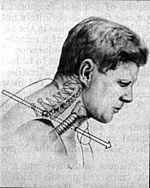 was the lower of the two. And as the HSCA forensic pathology panel made clear, this means that a downward trajectory through Kennedy was only possible if he was leaning markedly forward at the instant he was struck, which is something he is not seen to do in the Zapruder film.
A further problem for Posner is that exit wounds tend to be larger and more ragged than entrance wounds. Clearly understanding this general principle, he tries to create the impression that the appearance of Kennedy’s wounds was consistent with a back-to-front trajectory by writing that the hole in the front of Kennedy’s neck was 5mm to 8mm (p. 306) and that the one in his back was “even smaller…” (p. 305) But the back wound was described in the autopsy report as a “7 x 4 millimeter oval wound” and the throat wound was initially described by Dr Perry as approximately 3 to 5mm. (17H29) Furthermore, Perry confirmed in his testimony that the hole was “roughly spherical to oval in shape, not a punched-out wound, actually, nor was it particularly ragged. It was rather clean cut.” (6H9) This description does not comport well with the exit wounds created by Oswald’s rifle during tests performed on behalf of the Warren Commission. When the alleged murder weapon was fired from 180 feet―the approximate distance of the Book Depository to Kennedy’s back at Zapruder frame 224―exit holes measured 10 to 15mm, as much as five times the size of Kennedy’s throat wound. (5H77, 17H846)
To explain away the small size and remarkably neat appearance of the anterior wound, Posner cites experiments conducted by John Lattimer who found that exit wounds “remained small and tight if the bullet exited near the collar band of the shirt, where the buttoned collar and the knotted tie firmly pushed the neck muscles together.” (p. 306) He then asserts, supposedly based on an interview of Parkland’s Dr Charles Carrico, that “[Kennedy’s] neck wound was right at the collar band and tie knot.” (Ibid) What Posner is describing is what is usually referred to by experts as a “shored” exit wound. But suggesting this as an explanation for the appearance of JFK’s throat hole has two major problems: Firstly, and despite what Dr Carrico allegedly told Posner, the damage to JFK’s shirt is below the collar and the area where the shoring pressures would have been greatest. And secondly, shored exit wounds tend to have a large abrasion ring surrounding their margins. Yet not one doctor at Parkland Hospital saw any such bruising around JFK’s throat wound nor is one visible in the autopsy photos.

Of course, the fact that the throat wound did not have the typical appearance of an exit wound does not prove it was not one. Forensic pathologists do not determine entrance from exit based solely on size and shape. Nonetheless, there is clear reason for doubting such a conclusion, especially when the wound’s small, neat appearance is considered alongside the shallow probing of the back wound at autopsy.
Bethesda autopsy technician James Curtis Jenkins recalled from observing the postmortem that the back wound was “very shallow…it didn’t enter the peritoneal (chest) cavity.” He remembered that the doctors had extensively probed the wound with a metal probe, “approximately eight inches long”, and that it was only able to go in at a “…fairly drastic downward angle so as not to enter the cavity.” (ARRB MD65) Jenkins’s colleague Paul O’Connor said much the same thing, stating that “it did not seem” to him “that the doctors ever considered the possibility that the bullet had exited through the front of the neck.” (ARRB MD64) O’Connor told author William Law that “…we also realized [during the autopsy] that this bullet―that hit him in the back―is what we called in the military a ‘short shot,’ which means that the powder in the bullet was defective so it didn’t have the power to push the projectile―the bullet―clear through the body. If it had been a full shot at the angle he was shot, it would have come out through his heart and through his sternum.” (William Matson Law, In the Eye of History, p. 41)
Many critics believe, based on the above, that the wound in the throat was an entrance for a bullet fired from the front. But this would appear to be an equally if not less likely prospect than its having been an exit for a bullet fired from the rear. Not only because there was no bullet found in the body and no corresponding exit wound in the back, but also because no one at Bethesda recalled seeing any damage to the spine which there would almost certainly have had to have been had a missile entered Kennedy’s throat near the midline.
President Kennedy’s Head Wounds
Posner does all he can to hide it, but similar uncertainties exist about the nature of President Kennedy’s head wounds. He claims that “The evidence of the head wound was a textbook example of entrance and exit for a bullet” and describes a small entrance in the rear of the skull accompanied by a “nearly six-inch hole on the right side” which he presumes was a wound of exit. (p. 307) He then spends several pages arguing that the Parkland doctors were “mistaken” in their belief that they saw a “gaping wound in the rear of JFK’s head,” a position he is forced to take because, in Posner’s own words, if the Parkland physicians had been correct in their observations, “this not only contradicted the findings of the autopsy team but was evidence that the President was probably shot from the front, with a large exit hole in the rear of the head.” Thus, Posner reveals that he has no meaningful understanding of wound ballistics.
Over the last six decades, far too many words have been wasted arguing about the location of the large hole in Kennedy’s skull by those like Posner who mistakenly believe it was a wound of exit and, therefore, that its position tells us something about the direction in which the bullet was travelling. It was not and it does not. Larry Sturdivan, a ballistics expert whom Posner himself quotes, has explained that the question of “whether the explosion was more to the side or back is completely irrelevant.” This, he says, is because “the center of the blown-out area of the president’s skull was at the midpoint of the trajectory; not at the exit point.” (Sturdivan, The JFK Myths, p. 171) Indeed, the explosion of skull, blood, and brain matter seen so vividly in frame 313 of the Zapruder film, and the massive hole it left in the right side of Kennedy’s skull, was the result of a temporary cavity that was created not by the exiting of a missile but by the hydraulic pressure its passage applied to the inside of the cranium which caused it to burst open. As Sturdivan explains, a “similar explosion would have taken place” whichever direction the bullet was travelling. (Ibid, p. 171) This characteristic is sometimes referred to as cavitation.
Many critics of the official story will know Sturdivan as a vocal defender of the lone nut theory and, for that reason, may feel inclined to dismiss his writings on the assassination. But the phenomenon to which he is referring here is one that is firmly established in the forensic literature. In fact, Sturdivan himself is able to demonstrate it in his book using stills from films made at the Biophysics laboratory at Edgewood Arsenal in 1964. There, rifle bullets were fired into numerous rehydrated skulls filled with brain simulant and these experiments were filmed using a high-speed camera. Describing a typical example Sturdivan writes, “The bullet entered the back of the skull and exited in a small spray at the front in the space of one frame of the high-speed movie. Only after the bullet was far down-range did the internal pressure generated by its passage split open the skull and relieve the pressure inside by spewing the contents through the cracks.” (Ibid)
The proper way to assess the direction of travel of the bullet or bullets that struck the skull is through identification and careful examination of both the point of entrance and the point of exit. This, however, was not done by JFK’s autopsy surgeons. Dr. Humes told the Warren Commission that he and his colleagues had found a through-and-through hole, low down in the back of the skull, which exhibited the “coning effect” that established it as a wound of entrance. (WC Vol. 2 p.352) They did not, however, find the point of exit. As Humes told the Warren Commission, “…careful examination of the margins of the large bone defect at that point…failed to disclose a portion of the skull bearing again a wound of―a point of impact on the skull of this fragment of the missile, remembering, of course, that this area was devoid of any scalp or skull at this present time. We did not have the bone.” (Ibid, 353) Nonetheless, Dr Humes said that X-rays of the skull revealed multiple bullet fragments “traversing a line” from the wound he found in the rear to a point “just above the right eye.” This, then, laid out the alleged path of the bullet [see diagrams below, prepared at Dr. Humes’s direction].

Unfortunately for Dr Humes, his characterization of the head wound is contradicted by the very evidence on which it is supposedly based. When the Clark Panel reviewed the autopsy materials in 1968, it encountered a serious problem. The bullet fragments that Humes had spoken of were, in fact, located in the very top of the skull. As the panel no doubt understood, a bullet entering low down in the occipital bone―where Humes said the entry wound was―could not have left a trail of fragments along a path it never took in the top of the head and, therefore, the evidence indicated the skull had been struck by two separate missiles. Undeterred, the Clark Panel found a creative solution to this conundrum and simply moved the entrance wound four inches up the back of the head to bring it closer to, although still not in line with, the trail of metallic debris. A decade later, the HSCA forensic panel, in deference to Russell Fisher, accepted this revised location over the strenuous objections of the autopsy surgeons who, not unreasonably, believed that the first-hand observations of the physicians who had the actual body in front of them should take precedence over those of individuals looking at photos and X-rays years later.
Posner deals with this issue by ignoring their objections and writing in a footnote that Humes and Boswell had “misplaced” the entry wound “by four inches” because they had not had access to the photographs and X-rays “when making their autopsy report…” (p. 308n) But this argument ignores the fact that numerous other witnesses at the autopsy, including Secret Service Agent Roy Kellerman, FBI Agent Francis O’Neil, and Bethesda photographer John Stringer, all recalled that the wound was low down on the back of the head, not high up in the “cowlick” area where the Clark and HSCA experts claimed it was. In fact, not a single witness recalled seeing an entrance wound in the top of the head.
Several months after the initial publication of Case Closed, Posner told the House Committee on Government Operations that he had interviewed Humes and Boswell and that both now agreed they had been mistaken about the location of the entrance wound. When asked if he would be willing to hand over any notes or tape recordings of his interviews, Posner responded, “I would be happy, Mr Chairman, to ask Drs. Humes and Boswell if they would agree for their notes to be released to the National Archives.” (ARRB Report, p. 134) No such notes were ever rendered. Assassination researcher Dr. Gary Aguilar, who knew full well that both autopsy surgeons had vociferously objected to the revising of the wound’s location by the Clark and HSCA panels, then contacted Humes and Boswell to see if Posner’s declaration before Congress was accurate. But not only did they both deny telling Posner they had changed their minds, Boswell denied ever having spoken to Posner in the first place. Dr. Aguilar gave copies of his tape-recorded conversations with Humes and Boswell to the ARRB who then contacted Posner asking, once again, for substantiation of his allegation. As the Review Board later reported, it “never received a response to a second letter of request for the notes.” (Ibid)
Go to Part 1 of 5
Go to Part 2 of 5
Go to Part 3 of 5
Go to Part 5 of 5
-

Case Closed 30 Years On: Even Worse – Part 3/5: November 22, 1963: Posner’s Evidence
Oswald and the Paper Bag
As bad as Posner’s portrait of Oswald is, his chapters dealing with the assassination of President Kennedy and the evidence implicating Oswald are even worse. While it is probably not possible to make an honest case for the lone gunman theory and have it be in any way compelling, the fact is that Posner doesn’t even try. He continues to behave like an unscrupulous lawyer, carefully presenting only what suits his purposes and misrepresenting that which does not. He plays games with eyewitness testimony, creating consensus where there is none and hiding conflict where it exists. And in a failed attempt to make it appear possible that the assassination was the work of a single assassin he relies, as all Warren Commission apologists must, on the single bullet theory—a scientifically absurd hypothesis which was never in accordance with the evidence―and on a technique of comparative bullet lead analysis that has since been dropped by the forensic community because it has been demonstrated to be nothing more than “junk science.”
Posner begins his narrative of November 22, 1963, by telling readers that Lee Oswald left the Paine residence that morning and walked to the home of his co-worker, Buell Frazier. As Oswald approached the house he was noticed by Frazier’s sister, Linnie Mae Randle, “carrying a long package parallel to his body. He held one end of the brown-paper-wrapped object tucked under his armpit, and the other end did not quite touch the ground. Randle later recalled it appeared to contain something heavy. (p. 224) Randle watched as Oswald laid the package on the backseat of Frazier’s car then walked up to the house, which, Posner implies, was unusual because Frazier “always drove the one block to pick Oswald up at Ruth Paine’s home.” (Ibid) When Frazier joined Oswald at the car, he noticed the package on his backseat and asked what it was. Oswald told him it contained “curtain rods.” With no reason to doubt Oswald’s assertion, Frazier paid no more attention to the brown paper bag and drove to the Texas School Book Depository. Once they arrived, rather than walking into the building together as was their usual routine, “Oswald quickly left the car and walked ahead. Frazier watched him enter the Depository, carrying the package next to his body.” (Ibid)
With the above narrative, Posner creates the impression that Oswald was in an unusual haste that morning because he desperately wanted to sneak his rifle―disguised as curtain rods―into the Book Depository. However, the author is up to his usual trick of cherry-picking the details he likes and ignoring or misrepresenting the rest. Because not only do the testimonies of Frazier and Randle refute the notion that Oswald was in an unusual hurry that morning, but they also demonstrate that whatever was in the package he carried, it very likely could not have been the rifle.
To begin with, Randle did not say that Oswald carried the package with one end under his armpit and the other not quite touching the ground. What she really said was that he carried it down by his side, with his hand at the top,”and it almost touched the ground as he carried it.” (WC Vol. 2 p.248) Had the brown-paper-package contained the rifle it would have been impossible for Oswald to have carried it in this way because, even when broken down, the Mannlicher Carcano was 34.8 inches long. (WR p. 133) This is precisely why Posner threw in the idea that Randle saw one end of it “tucked under his armpit.” But she was clear in her testimony, not only about the way Oswald held the package, but also about its length. When the FBI presented Randle with a “replica” brown paper bag and asked her to fold it over until it reached “the proper length of the sack as seen by her on November 22, 1963,” her estimate was measured at 27 inches long. (WC Vol. 24 pp.407-8) Months later, when she appeared before the Warren Commission, she was asked to repeat the experiment. On that occasion, the resultant length was 28 ½ inches. (WC Vol. 2 pp. 248-50) It is entirely clear that Randle did not recall seeing a bag that was long enough to hold the rifle. Furthermore, she did not say, as Posner alleges, that the package “appeared to contain something heavy.” What she said was that the bag was made from “a heavy type of wrapping paper.” (WC Vol. 2 p. 249) Which makes a big difference.
Frazier also took part in experiments that helped establish that the bag Oswald had with him that day was between 27 and 28 inches in length. For example, on December 1, 1963, Frazier was asked by FBI agents to mark the point on the back seat of his car that the bag had reached when Oswald had put it there with one end against the door. The FBI “determined that this spot was 27 inches from the inside of the right rear door.” (WC Vol. 24, pp. 408-9) Frazier was also certainthat, when Oswald walked into the depository, he had carried the package with one end cupped in his hand and the other tucked under his arm. This was not possible with the Mannlicher Carcano. During his Warren Commission testimony, Frazier was presented with the disassembled rifle inside a paper bag and asked to demonstrate how Oswald had held the package. When he preceded to cup the bottom end in his hand, the top extended several inches above his shoulder, almost up to the level of his eye. But Frazier made clear that none of the bag he saw Oswald carrying had been sticking up above his shoulder and he was certain the bottom end had been cupped in his hand. “From what I seen, walking behind,” Frazier testified, “he had it under his arm and you couldn’t tell he had a package from the back.” (WC Vol. 2, p.243)
Posner alludes to the above in a footnote. Completely ignoring the experiments Frazier and Randle conducted for the FBI and the Commission, he writes that “Initially, Randle said the package was approximately 27 inches long, and Frazier estimated a little over two feet.” He then tries to nullify their fully corroborative testimonies by stating that “Frazier later admitted the package could have been longer than he originally thought.” Posner sources this assertion to a televised mock trial of Lee Harvey Oswald in which, he claims, Frazier said, “[Oswald] had the package parallel to his body, and it’s true it could have extended beyond his body and I wouldn’t have noticed it.” (p. 224-224n)
This is a blatant distortion of what Frazier said. For starters, what Posner presents as a direct quote from Frazier is no such thing. In fact, he is passing off the words used by lawyer Vincent Bugliosi in his questioning as if they were spoken by Frazier during his answers. More crucially, Frazier never agreed that the package was longer than he had previously said it was, he only agreed that it could have been “protruding out in front of [Oswald’s] body” without him seeing it. To this day, Frazier insists the package he saw was around two feet long and that Oswald carried it with one end cupped in his hand and the other tucked under his arm.
As to the implication in Case Closed that by turning up at Frazier’s house and then walking ahead of him into the Book Depository Oswald showed himself to have been in an unusual hurry that day, Frazier’s testimony puts the lie to this.
Firstly, despite Posner’s assertion, Frazier did not say that he “always drove the one block to pick Oswald up at Ruth Paine’s home.” He said, “I usually picked him up around the corner there,” but “once in a while I picked him up at the house and another time he was already coming down the sidewalk to the house when I was fixing to pick him up…” (WC Vol. 2, p.225) Furthermore, when Oswald’s face appeared at the window, Frazier looked at the clock and realised “I was the one who was running a little bit late…it was later than I thought it was.” (Ibid)
Secondly, when they arrived at the Book Depository, Frazier watched as Oswald “put the package he had…up under his arm” and got out of the car. Frazier himself stayed inside the car, “letting my engine run and getting to charge up my battery.” (Ibid, 227) When Oswald noticed that Frazier was not with him, he stopped and stood “at the end of the cyclone fence waiting for me to get out of the car.” (Ibid, 228) Once Frazier shut off the engine and exited the car, Oswald carried on walking and Frazier “followed him in.” (Ibid) Oswald gradually got further ahead of him, Frazier said, because he lagged behind to watch the nearby railroad tracks. “I just like to watch them switch the cars,” he testified, “…so I just took my time walking up there.” (Ibid) There is, then, no reason whatsoever to believe there was anything at all unusual about Oswald’s behaviour that morning.
The Sixth Floor
To lay the groundwork for his argument that Oswald was on the sixth floor of the Depository at 12:30 pm firing the shots that killed Kennedy, Posner claims that two employees saw him there shortly before noon. One of those workers, Bonnie Ray Williams, “spotted Oswald on the east side of that floor, near the windows overlooking Dealey Plaza” at 11:40 am. About five minutes later, Posner says, Charles Givens saw Oswald by the very window from which the shots were allegedly fired. (p. 225) Yet, as those who have studied the subject in detail know, the statements and testimonies of the Texas School Book Depository employees constitute a morass of confused and conflicting recollections that establish very little with certainty. In presenting Williams and Givens as placing Oswald on the sixth floor, Posner is not only cherry-picking from that overall morass, but he is cherry-picking from the variegating statements of those two witnesses.
When Williams gave his first statement to the FBI on November 23, 1963, he said that he saw Oswald on the first floor of the building at 8:00 am “filling orders.” The next time he saw Oswald was at approximately 11:30 when, Williams said, “he went down on an elevator from the sixth floor to the first floor…Charles Givens was on the other elevator, descending at the same time. As they were going down, he saw Lee [Oswald] on the fifth floor” Williams added that “while working on the sixth floor until 11:30 am on November 22, 1963, he did not see Lee or anyone else in the southeast corner of the building.” (Commission Document 5, p. 330) The next time he spoke to the Bureau, on March 19, 1964, he gave a completely different version of events. “The last time I saw Lee Harvey Oswald,” he said, “…was at about 11:40 am. At that time, Oswald was on the sixth floor on the east side of the building.” (WC Vol. 22 p.681)
Five days later, when he gave a deposition for the Warren Commission, Williams gave a third version, saying that, “The only time I saw [Oswald] that morning was a little after eight” on the first floor. (WC Vol. 3 p.164) When Commission lawyer Joseph Ball asked Williams if he saw Oswald on the sixth floor he replied, “I am not sure. I think I saw him once messing around with some cartons or something, back over on the east side of the building…as I said before, I am not sure that he really was on the sixth floor.” (Ibid 165-166) In any honest assessment, the best that can be said about Bonnie Ray Williams is that he was unsure of where and when he really saw Oswald that day.
Charles Givens is equally, if not more, unreliable. In his Dallas police affidavit of November 22, Givens made no mention of seeing Oswald at all. “I worked up on the sixth floor until about 11:30 am,” he said. “Then I went downstairs and into the bathroom. At twelve o’clock I took my lunch period.” (WC Vol. 24 p.210) The following day, Givens gave a statement to the FBI in which he repeated his previous assertion that he went to the first floor by elevator at 11:30, “where he used the rest room at about 11:35 am or 11:40 am” then “walked around on the first floor until 12 o’clock noon.” This time, however, he added that he had seen Oswald “working on the fifth floor during the morning filling orders. Lee was standing by the elevator in the building at 11:30 am when Givens went to the first floor.” Givens further stated that he had “observed Lee reading a newspaper in the [first floor] domino room where the employees eat lunch about 11:50 am.” (Commission Document 5, p. 329)
Several weeks later, on January 8, 1964, Givens told the Secret Service an entirely different story, claiming that he had seen Oswald “on the sixth floor at about 11:45 am…carrying a clipboard that appeared to have some orders on it…Shortly thereafter, Givens and the other employees working on the floor-laying project quit for lunch…” (Commission Document 87, p. 780)
Finally, on April 8, 1964, Givens told the Warren Commission he had left the sixth floor around 11:45 by elevator and seen Oswald “standing at the gate on the fifth floor.” When he got to the first floor, Givens claimed, he realised he had forgotten his cigarettes and so he went back up to the sixth floor to retrieve them. “When I got back upstairs, he [Oswald] was on the sixth floor” coming from “the window up front where the shots were fired from.” (WC Vol. 6 p.349)
Considering that the stories he told are mutually exclusive, it should be obvious that Charles Givens was a truly undependable witness. In fact, Lieutenant Jack Revill of the Dallas Police Special Service Bureau cautioned the FBI that, based on his office’s prior experience with Givens, he believed that Givens was the type of witness who would “change his story for money.” (Commission Document 735, p. 296) It is for that reason that I see little value in attempting to offer a judgement as to which of his conflicting accounts is most accurate. It is noteworthy, however, that Posner cautions elsewhere in Case Closed that “Testimony closer to the event must be given greater weight…” (p. 235). And yet he ignores his own advice entirely when it suits his purposes, as it does with Williams and Givens.
Posner writes that many critics have tried to prove Oswald was not on the sixth floor by “relying on his protestations, after his arrest and during his police interrogation, that he had been in the first-floor lunch room with ‘Junior’ Jarman, and gone to the second floor to buy a Coke near the time of the assassination.” (p. 227) Posner claims, however, that “contemporaneous statements of other workers who were in both lunch rooms say Oswald was in neither.” He goes on to state that Junior Jarman “denied ever seeing him during his lunch break” and “Troy West was inside the first-floor domino room eating lunch from 12:00 to nearly 12:30 and did not see Oswald during that half hour.”
To address the above it is important to note, as Posner does not, that the Dallas Police did not tape record a single word of Oswald’s numerous interrogations. As a result, critics and apologists alike have always been forced to rely upon the hearsay accounts of those who questioned him, rather than any verifiable, objective record. The officer who led the interrogations, Captain Will Fritz, told the Warren Commission that Oswald’s alibi was that he had had been eating lunch with two black employees, one known to him as “Junior” and another whose name Oswald did not remember. (WC Vol 4 p.224) Fritz claimed not to have kept any notes of the interrogations but this was proven to be false when a set of his brief, handwritten notes was donated to the National Archives a few years after the publication of Case Closed. What these notes revealed was that Fritz’s commission testimony was a somewhat distorted version of what Oswald told him. On page one of his notes, we find the following notation: “two negr, came in, one Jr.-+ short negro-.” These words appear to align much more closely with the report of FBI agent James Bookhout than they do with Fritz’s testimony.
Bookhout’s November 23, 1963, report of the first day of Oswald’s interrogations reveals that, rather than claiming to have eaten lunch with Junior, what Oswald really said was that,
…he had eaten lunch in the lunch room at the Texas School Book Depository alone, but recalled possibly two Negro employees walking through the room during this period. He stated possibly one of these employees was called ‘Junior’ and the other was a short individual whose name he could not recall… (R622)
What makes this doubly interesting is that both Junior Jarman and another, shorter, black employee named Harold Norman separately confirmed that they had indeed passed through the first-floor lunchroom around the time Oswald said he was there. (WC Vol. 3 p.201, p.189) And Norman further stated that he thought there had been someone else in the lunchroom while he was there but could not recall who it was. (WC Vol. 3 p.189) It is fair to say, then, that the testimony of Jarman and Norman tends to confirm rather than refute Oswald’s account of his whereabouts.
Posner treats readers to another of his own magic shows when he says that employee Troy West ate his own lunch in the first-floor lunchroom without seeing Oswald. West, who was a mail wrapper at the Depository, testified that he was in the habit of spending virtually his entire workday at his own workstation on the west side of the first floor, and November 22 was no different. He said he had quit for lunch “about 12 o’clock,” made himself some coffee “right there close to the wrapping mail table where I wrap mail,” and then “sat down to eat my lunch.” He was still there, eating his lunch, when police officers entered the building moments after the assassination. (WC Vol. 6 p.361) There is nothing in his testimony to even suggest that he spent his lunch break in the first-floor lunchroom. Posner’s retelling of West’s testimony is one more example of the author’s myth making.
Posner claims that “reliable testimony from the Depository places Oswald, alone, on the sixth floor by noon…” (p. 288) But he produces none. He goes on to allege that there was one witness with the “gift of super-eyesight” (p. 250) who saw Oswald in the sixth-floor window firing the shots and was able to positively identify him. The witness to whom he is referring is Howard Brennan, an obvious prevaricator upon whom no serious investigator would rely.
Quoting liberally from a book Brennan wrote decades after the assassination, Posner writes that he was “leaning against a four-foot-high retaining wall on the corner of Houston and Elm, directly across the street from the School Book Depository.” A few minutes before the assassination, Brennan “noticed a man in the southeast corner of the sixth floor…he was five feet eight to five feet ten inches tall, white, slender, with dark-brown hair, and between twenty-five and thirty-five years of age.” When the shooting began, Brennan looked up and saw “the same young man” with “a rifle in his hands, pointing toward the Presidential car.” (p. 247-248) Minutes later, he gave a description of this man to a uniformed police officer. Brennan was subsequently taken to police headquarters to view a line-up where he failed to identify Oswald as the man in the window.
How does Posner deal with the fact that Brennan did not identify Oswald on the evening of the assassination? He writes, “Brennan could have picked Oswald from the line-up, but did not do so because he feared others might be involved in the assassination, and if word leaked out that he was the only one who could identify the trigger man, his life would be in danger.” (p. 249) This is indeed the excuse Brennan later dreamed up. It is also nonsense. As Mark Lane pointed out in his penetrating, ground-breaking book Rush to Judgment, Brennan’s excuse is invalidated by the fact that he most certainly knew of at least one other eyewitness, Amos Euins, because Brennan himself had pointed him out to Secret Service Agent Forrest Sorrels. (WC Vol. 7, p.349) Furthermore, as Lane noted, “Brennan’s anxiety about himself and his family did not prevent him from speaking to reporters on November 22, when he gave not only his impressions as an eyewitness but also his name.” (Lane, Rush to Judgment, p. 92)
Brennan’s real reason for failing to identify Oswald on the evening of the assassination had nothing to do with fear of reprisal. As he admitted in a statement to the FBI on January 10, 1964,
…after his first interview at the Sheriff’s Office…he left and went home at about 2 P.M. While he was at home, and before he returned to view a line-up, which included the possible assassin of President Kennedy, he observed Lee Harvey Oswald’s picture on television. Mr. Brennan stated that this, of course, did not help him retain the original impression of the man in the window with the rifle…(WC Vol. 24 p.406)
Based on this admission alone, Brennan’s latter-day claims are completely worthless.
It is also very telling that Brennan refused to cooperate with the House Select Committee on Assassinations when it reinvestigated the assassination fifteen years later. In March 1978, Committee staff contacted Brennan hoping to talk quietly with him at his home in Texas, but Brennan stated that the only way he would talk to anyone was if he was subpoenaed. A month later the Committee asked him to reconsider but he refused and was subsequently informed that he would be subpoenaed to testify on May 2. According to a HSCA staff report, Brennan then said that he “would not come to Washington and that he would fight any subpoena.” And, in fact, Brennan was belligerent about not testifying. He stated that he would avoid any subpoena by getting his doctor to state that it would be bad for his health to testify about the assassination. He further told them that even if he was forced to come to Washington he would simply not testify if he didn’t want to. (HSCA contact report, 4/20/78, Record No. 180-10068-10381) Between May 15 and May 19, 1978, Committee staffers made eleven separate attempts to present Brennan with previous statements he had made to try to get him to simply sign a form asserting that these previous statements were accurate. He refused. Even after the committee took the extra step of granting Brennan immunity from prosecution he would not budge. Of course, none of this appears in Case Closed.
Posner and the Sniper’s Nest
In 1969, Dallas Police Chief Jesse Curry candidly admitted to the paucity of evidence placing Oswald in the so-called “sniper’s nest,” stating that “No one has ever been able to put him in the Texas School Book Depository with a rifle in his hand.” (Dallas Morning News, Nov 6, 1969) Despite much hyperbole, Posner does nothing to prove Curry wrong. He claims that Oswald was responsible for creating the sniper’s nest, a “three-sided shield” made from cartons of books that “protected the sniper from being observed by anyone who wandered onto the sixth floor.” (p. 226) Yet, as Posner himself admits, the boxes were piled up in front of the sixth-floor window by the workers who were laying a new floor. Furthermore, one of Posner’s own witnesses, Bonnie Ray Williams, was part of the floor-laying crew and his testimony indicates that the so-called “three-sided shield” was simply a result of the way they placed the boxes. “We moved these books kind of like in a row like that,” he said, “kind of winding them around.” (WC Vol. 3 p.166) As author Don Thomas has suggested, the fact that a pack of cigarettes was found in the corner suggests that what the floor crew had created was a hidden space to sneak a quick smoke without being observed by their supervisor. (Hear No Evil, p. 36)
Posner attempts to attach special significance to the fact that Oswald’s palmprint and fingerprints were found on two of the boxes in the window area. But given that his job involved handling those very boxes, the presence of his prints upon them is neither surprising nor particularly noteworthy. Posner also quotes Luke Mooney, the deputy sheriff who discovered the “sniper’s nest,” as stating that one of the boxes “looked to be a rest for the weapon” because it showed “a very slight crease…where the rifle could have lain―at the same angle that the shots were fired from.” (p. 269) This was refuted, however, by crime scene detective Carl Day who said that although he initially “thought the recoil of the gun had caused that” crease, he “later decided that it was in the wrong direction.” (WC Vol. 4, p.271) Indeed, crime scene photographs show that the crease points towards Houston Street, not Elm. (WC Vol. 21, p.643)
The Rifle and the Shells
The most incriminating evidence against Oswald is the fact that the 6.5 mm Mannlicher Carcano rifle he had allegedly ordered through his P.O. box, and three rifle shells fired from that weapon, were said to have been found on the sixth floor a little over forty-five minutes after the assassination. Posner admits in a footnote that the rifle was originally identified as a 7.65 Mauser and many critics have argued that this suggests the weapons were swapped in order to incriminate Oswald. But for the sake of argument, I will accept Posner’s assertion that the “initial misidentification” was a mistake that occurred as a result of the “considerable similarities between a bolt-action Mauser and a Carcano.” (p. 271n) In the end, the question that needs to be asked is what evidence is there that Oswald himself handled that rifle on the day of the assassination? The answer is none.
Posner writes that when Lieutenant Day inspected the Carcano at the Dallas police crime lab later that evening, he found Oswald’s right palmprint on the wooden stock. (p. 283) Yet when the rifle was turned over to the FBI and examined hours later by Supervisor of the Bureau’s Latent Fingerprint Section, Sebastian Latona, he found no trace of any such print. (WC Vol. 4, p. 24) And, in fact, the FBI was not informed of Day’s alleged lifting of the print until November 29―seven days after he allegedly discovered it and five days after Oswald was murdered in the basement of police headquarters. (Ibid 24-25) Neither Day nor anyone else ever offered an adequate explanation for this delay, leading to speculation that the print was obtained by some unscrupulous means after Oswald’s death. Posner tries to get around this by quoting from his own personal interview with Day in which the former police lieutenant claimed to have told FBI agent Vincent Drain of the print at the time he handed the rifle over on the night of November 22. But not only was this flatly disputed by Drain, Day made no such claim during his Warren Commission testimony. Nor in his written report of January 8, 1964. Again, Posner in ignoring his own rule about testimony near the time of the incident.
Putting these evidentiary issues aside for a moment, and again assuming Day’s account is accurate, what does the print tell us about Oswald’s guilt or innocence in the assassination? In truth, it is more suggestive of the former than the latter. Because even Lt. Day did not claim that the print, which was only visible in its entirety when the rifle was disassembled, could be said to place the Carcano in Oswald’s hands on November 22nd In fact, he described the palmprint as an “old dry print” that “had been on the gun several weeks or months.” (WC Vol. 26 p.831; Anthony Summers, Conspiracy, p. 54) So accepting the palmprint as genuine only places the disassembled rifle in Oswald’s hands “weeks or months” before the assassination.And this fact takes on added significance when considering Posner’s suggestion that Oswald reassembled the rifle while on the sixth floor, likely without the use of a screwdriver since none was found. It seems highly improbable that Oswald could have handled the weapon so heavily that day without leaving any new prints. Therefore, when considered alongside the fact that the rifle was known not to have been in his possession for at least two months before the assassination, and in conjunction with the firm belief of Frazier and Randle that whatever package Oswald may have carried that day it was too small to hold the rifle, the state’s own evidence strongly suggests that he did not touch the Mannlicher Carcano at all on November 22.
Turning our attention to the three bullet shells found in the sniper’s nest, their handling by the Dallas police is a prime example of why so much suspicion has been cast on the investigating authorities in this case. Posner claims that the hulls were first observed by deputy sheriff Mooney; that Lt. Day “photographed the three bullet shells in their original position;” (p. 269) and that the photographs show they were found “in a random pattern.” (p. 270n) This, however, is provably false. A news cameraman for WFAA-TV in Dallas named Tom Alyea told Gary Mack in 1985 that, before the crime scene unit arrived, Captain Fritz had picked up the shells and held them up for Alyea to see before throwing them back down on the floor. (Jim Marrs, Crossfire, p. 437-438) Alyea’s account may sound unbelievable, but it is, in fact, corroborated by the Warren Commission testimony of deputy sheriff Mooney. Mooney told the commission, “I stood and watched him [Fritz] go over and pick them up and look at them.” Additionally, when shown the crime scene photographs, Mooney noted that they showed the shells to be “further apart than they actually were.” (WC Vol. 3 p.286)
As if the above mishandling of the cartridge cases was not bad enough, Lt. Day testified that he picked the shells back up off the floor of the sniper’s nest, placed all three in an envelope, and handed the envelope to another detective. Then, at 10:00 that evening, the envelope was handed back to him with only two hulls in it. Unbelievably, as Day confessed, the envelope had not been sealed and neither himself nor anyone else had marked the shells found at the scene with their initials. (WC Vol. 4 pp.253-254) This failure to properly record the chain of evidence in accordance with standard police procedure left the evidence vulnerable to tampering. For that reason, it is hard to believe that the rifle shells could have been entered into evidence had Oswald lived to face trial. Any defence attorney worth his salt would have demanded they be thrown out for lack of proof and, assuming the law was followed, the judge would have had little choice but to comply. Of course, Posner mentions none of this in his “brilliant and meticulous,” Pulitzer Prize-nominated account.
Marrion Baker and The Girl on the Stairs
Oswald’s known whereabouts and his demeanour approximately ninety seconds after the assassination also provide compelling reason to believe he had not been on the sixth floor firing the rifle. As Posner details, a police motorcycle officer named Marrion Baker, who had been riding in the Presidential motorcade, had run into the Book Depository within seconds of the assassination, believing the shots may have been fired from the building’s roof. When he entered the building, he quickly made his way up the stairs accompanied by building manager Roy Truly. Catching sight of Oswald through the window in the second-floor lunchroom door, Baker halted his ascent, burst into the room with pistol in hand, and demanded Oswald identify himself. AfterTruly informed Baker that Oswald was an employee, the pair continued their dash up the stairs. Oswald, meanwhile, bought himself a Coke from the soda machine and strolled calmly through the offices and down to the first floor.
Baker later told the Warren Commission that Oswald appeared calm, collected, and “normal” during their encounter. (WC Vol. 3 p.252) Truly concurred, stating that Oswald “didn’t seem to be excited or overly afraid or anything. He might have been a bit startled, like I might have been if somebody confronted me. But I cannot recall any change in expression of any kind on his face.” (Ibid, 225) Is it likely that, having rapidly fired three shots at the President of the United States, hidden the murder weapon, weaved his way between stacks of boxes, and ran down four flights of stairs―all in less than ninety seconds―Oswald would have appeared cool, calm, and expressionless when confronted by a police officer with his pistol drawn? And having managed to escape arrest at that moment, is it reasonable to suggest his first thought was not to get out of the building as quickly as possible but to buy himself a Coca Cola? If I was on Oswald’s jury, these questions would weigh heavily on my mind.
Perhaps more important than Oswald’s calm demeanour is the fact that two other employees,Vicki Adams and her friend Sandra Styles-who had both watched the assassination from a fourth-floor window of the depository building–were very likely on the noisy, old, wooden steps at the same time Oswald was supposed to have run down them. And neither woman saw nor heard any sign of& him. Posner tries to dispose of this problem by following the Warren Commission’s lead in asserting that “although [Adams and Styles] thought they came down quickly, they actually did not arrive on the first floor until at least four to five minutes after the third shot.” (p. 264) The author may have just about gotten away with this argument in 1993, but it no longer appears to have any viability today.
In 2012, author Barry Ernest published a landmark book titled The Girl on the Stairs. In it, the author focussed primarily on his search for Vicki Adams and the evidence that would corroborate or refute her story. He tracked down Adams and her colleagues, asking questions that had never been asked before, and made trips to the National Archives looking for crucial documents. In 1999, Ernest discovered a bombshell document in the Archives in the form of a June 2, 1964, letter written by Assistant United States Attorney, Martha Joe Stroud, to Warren Commission Chief Counsel, J. Lee Rankin. This letter contains the only known reference in the Commission’s files to an interview with Dorothy Garner, Adams’s supervisor who had stood with her at the fourth-floor window when the shots were fired. The letter says, “Miss Garner…stated this morning that after Miss Adams went downstairs she (Miss Garner) saw Mr. Truly and the policeman come up.”
Recognizing the importance of this statement, Ernest tracked Garner down to see if her recollection would corroborate the Stroud letter. When he interviewed her, Garner confirmed that Adams and Styles had left the window immediately after the shots were fired, with her “right behind” them. She further stated that she had not descended the stairs with her colleagues but had gone to a storage area by the stairway. She stayed there long enough to see Baker and Truly coming up the stairs after their encounter with Oswald in the second-floor lunchroom. What she did not see in the intervening seconds was Oswald descending from the sixth floor. (Ernest, The Girl on the Stairs, pp. 267-268) This is hugely significant because Oswald could not possibly have got down those stairs ahead of Styles and Adams, and if he did not walk down them in between the time Adams and Styles went down and Baker came up, then he could not have been on the sixth floor at the time of the assassination. The corroborative accounts of Adams, Styles, and Garner are, therefore, much less consistent with Oswald being present on the sixth floor during the assassination than with his own claim to have been on the first floor eating lunch and making his way upstairs to buy a Coke.
The Murder of Kennedy
Ernest is careful not to overstate what his research reveals, admitting that “What puts Oswald in a place other than the sixth floor is indeed circumstantial.” Yet, as he also notes, “it is no more circumstantial than everything that has been used to put him on the sixth floor.” (Ernest, p. 282) Indeed, we cannot say for absolute certain where Oswald was during those crucial seconds and, at this late stage, it is unlikely that definitive proof will emerge either way. But the most important question is not whether Oswald was on the sixth floor firing a rifle, it is whether it was even possible for one, lone gunman to have accomplished the assassination. And the truth is that, despite Posner’s protestations, the evidence demonstrates overwhelmingly that the shooting had to have been the work of multiple gunmen.
Posner, of course, argues that only three shots were fired, all from the sixth floor of the Texas School Book Depository. In discussing the “ear-witnesses,” he notes that of the “nearly two hundred witnesses who expressed an opinion…over 88 percent heard three shots.” He also uses his own set of statistics to downplay the significant number of bystanders who thought the shots were fired from the general area of the “grassy knoll,” to the right front of the Presidential limousine, and claims that the “echo patterns in Dealey [Plaza] make locating the direction of the shots more difficult…” And finally, he makes much of the fact that only “2 percent” of witnesses “thought [shots] came from more than one direction.” This, he says, “is a critical blow to most conspiracy theories, since those who charge there was a second gunman usually place the additional shooter…on the grassy knoll. But even these writers acknowledge that most of the shots came from the rear.” (pp. 236-237)
Posner’s first point, the number of witnesses who reported hearing three shots is, to my mind, more curious than it is compelling. If one accepts Posner’s postulate that witnesses were confusing echoes with actual gunshots, then is it not reasonable to expect those witnesses to report hearing more than the three shots the author says were fired? Of course, Posner is―as all those who support the official story must―overstating the effect of echoes in Dealey Plaza to diminish the testimony of those who thought shots came from the knoll. The author quotes Dr. David Green, an acoustics expert hired by the House Select Committee on Assassinations (HSCA), as saying he found it “hard to believe a rifle was fired from the knoll.” (p. 237) But he does not reveal the fact that the HSCA retainedDr Green and two other psychoacoustic experts, Dr. Dennis McFadden and Professor Frederick Wightman, to be present in Dealey Plaza while three sequences of test shots were fired from the Book Depository and the knoll. These experts placed themselves at various locations in the plaza and recorded their impressions as to the origin of the sounds, and the results were unambiguous. Shots fired from the Depository sounded like they came from the Depository and shots from the knoll sounded like shots from the knoll. (HSCA Vol. 8, p.144)
There is no doubt that the spectators to President Kennedy’s brutal execution were caught by surprise and few if any were likely to have been counting the number of shots they heard. In Reclaiming History, Vincent Bugliosi cites the textbook Firearms Investigation, Identifications, and Evidence, which rightly cautions that “little credence…should be put in what anyone says about a shot or even the number of shots. These things coming upon him suddenly are generally inaccurately recorded in his memory.” (Bugliosi, p. 848) With this advice in mind, what is one to make of the apparent three-shot consensus to which Posner refers? The most likely answer is that the consensus is a result of a type of groupthink. As the Warren Commission reported, “Soon after the three empty cartridges were found, officials at the scene decided that three shots were fired, and that conclusion was widely circulated by the press. The eyewitness testimony may be subconsciously colored by the extensive publicity given the conclusion that three shots were fired.” (WR pp.110-111)
As to Posner’s point that only a tiny percentage of witnesses thought shots came from more than one direction, this is hardly the slam dunk the author thinks it is. The results of the HSCA’s psychoacoustic tests showed that shots from the Depository and shots from the knoll were distinct from one another. And yet, it is worth noting that the HSCA experts admitted that”The emotional condition of our observers during the test and the emotional condition of the people during the assassination were undoubtedly quite different.” (HSCA Vol. 8, p.146) Indeed, the surprising nature of the event, and the ensuing shock and confusion, should not be underestimated. A definitive answer as to why more witnesses did not report hearing shots from multiple directions remains elusive. However, it is certainly reasonable to suggest that, for many of the ear-witnesses, their impression as to the source of the shots was informed by only one of the shots they heard, and they naturally assumed that the other sounds were coming from the same direction.
One of the few witnesses who recalled hearing shots from two directions was also one of the most important, not just because of what he heard, but because of what he saw and did. S.M. Holland, who was standing on the railroad overpass facing the plaza when the shooting began, heard at least three shots from the corner of Houston and Elm streets and one from the grassy knoll. As he told the Warren Commission, when the sound of a “report” drew Holland’s gaze to the trees in front of the fence on the knoll, he saw “a puff of smoke come out from under those trees…” (WC Vol. 6, p.244) Holland was so sure of what he saw and heard that he “run around the end of the overpass, behind the fence to see if I could see anyone up there behind the fence.” (Ibid) James Simmons, who was not called to testify for the commission, told author Mark Lane in a filmed interview that he toohad heard a sound like a “loud firecracker or a gunshot” coming from behind the wooden fence, accompanied by “a puff of smoke that came underneath the trees on the embankment.” Simmons joined Holland in his dash to the area behind the wooden fence, but because it took them a minimum of two minutes to reach the area, they found no one there. As Holland noted, if there had been a gunman there, “They could have easily have gotten away before I got there”. (Mark Lane, Rush to Judgment, p. 35)Although they did not find an assassin, as Simmons recalled, they did find”footprints in the mud around the fence, and…on the wooden two-by-four railing on the fence” as well as “on a car bumper there, as if someone had stood up there looking over the fence”. (Ibid, p. 34)
Several other witnesses on the overpass such as Richard Dodd, Austin Miller, and Thomas Murphy saw the same as Holland and Simmons, a fact that is most inconvenient to Posner. He tries to nullify one of them, Austin Miller, by writing that Miller “thought the smoke he saw was ‘steam.’” (p. 256) But in the very statement Posner cites, Miller is quoted as saying that he saw “something which I thought was smoke or steam [my emphasis] coming from a group of trees north of Elm off the railroad tracks.” (WC Vol. 19, p.485) Posner being Posner simply excises the word “smoke” from his quotation. He tries the very same trick with Simmons, writing that Simmons saw “exhaust fumes” from the embankment. (p. 256) When, in fact, what Simmons’s affidavit really says is that “he thought he saw exhaust fumes of smoke near the embankment.” (WC Vol. 22 p.833)
To make these troublesome observations disappear, Posner resorts to claiming that “since modern ammunition is smokeless, it seldom creates even a wisp of smoke”. This assertion is easily disproven by visiting a rifle range or simply googling the words “rifle smoke.” In 2023, it is not difficult to find pictures like the one below.
As firearms expert Monty Lutz told the HSCA, “both ‘smokeless’ and smoke producing ammunition may leave a trace of smoke that would be visible to the eye in sunlight. That is because even with smokeless ammunition, when the weapon is fired, nitrocellulose bases in the powder which are impregnated with nitroglycerin may give off smoke, albeit less smoke than black or smoke-producing ammunition. In addition, residue remaining in the weapon from previous firings, as well as cleaning solution which might have been used on the weapon, could cause even more smoke to be discharged in subsequent firings of the weapon.”(HSCA Vol. 12, p. 24-25)
Posner makes a last-ditch attempt at nullifying the eyewitness evidence of smoke on the knoll by stating that “in 1963, there was a steam pipe along the wooden fence near the edge of the Triple Underpass…If there was smoke, it is most likely that Austin Miller was right, and it was from the pipe.” (p. 256) Why smoke would come from a steam pipe is something Posner never attempts to explain. Regardless, although he is correct that there was such a pipe near the underpass—it can be seen in the documentary film Rush to Judgment—what he fails to reveal is that this pipe was nowhere near the area in which the smoke was observed. In fact, it was over 100 feet away. Therefore, it cannot be said to account for the smoke observed by witnesses during the shooting.
An important witness to whom Posner omits any reference in his text is Joe Marshall Smith, a Dallas police officer who ran to the knoll area after the shooting because a bystander told him “They are shooting the President from the bushes.” (WC Vol. 7, p.535) When he got to the parking lot behind the fence, he spotted a man standing by a car and so pulled his pistol from its holster. “Just as I did,” Smith told the Warren Commission, “[the man] showed me that he was a Secret Service agent.” (Ibid) As a result, he let the stranger go and went about checking the cars in the parking lot. The problem here, as the Commission knew but did not tell Officer Smith, is that there were no genuine Secret Service agents in Dealey Plaza at that time because they had all accompanied the Presidential limousine in its race to Parkland Hospital. (HSCA Vol. 5, p.589)
Posner refers obliquely to allegations of a Secret Service impersonator, suggesting that witnesses to any such individual were “mistaken,” and claims that he “reviewed the 1963 badges” for the ATF, IRS, Army Intelligence, and other such organizations, and found that “several look alike.” (p. 269n) But Posner’s subjective assessment as to the similarity of these various badges does not address the fact that Smith specifically said that he had “seen those [Secret Service] credentials before” November 22, and that the identification he was shown by the man behind the fence “satisfied” both Smith and a deputy sheriff that accompanied him. (Summers, Conspiracy, p. 81) As he later admitted, Officer Smith came to deeply regret letting the man go, recalling that,
He looked like an auto mechanic. He had on a sports shirt and sports pants. But he had dirty fingernails, it looked like, and hands that looked like an auto mechanic’s hands. And afterwards it didn’t ring true for the Secret Service…I should have checked that man closer, but at the time I didn’t snap on it… (Ibid)
Go to Part 1 of 5
Go to Part 2 of 5
Go to Part 4 of 5
Go to Part 5 of 5
-
Case Closed 30 Years On: Even Worse – Part 2/5: Posner’s Portrait of Oswald Color Corrected
Oswald, the Weapons, and the Walker Shooting
In January 1963, according to Posner, Oswald mail-ordered a Smith & Wesson .38 special revolver from Seaport Traders, Los Angeles, to be delivered C.O.D. to a Dallas post office box that he had begun renting in the autumn of 1962. Two months later, according to Posner’s narrative, he ordered a 6.5mm Mannlicher-Carcano rifle from Klein’s Sporting Goods in Chicago. Both purchases were allegedly made using the alias “A.J. Hidell.” The author goes on to say that, on March 25, Oswald picked up the rifle from the post office, “and then travelled across town for the revolver that was sent to the offices of REA Express.” (Posner, p. 105) Of course, none of this is as cut and dried as Posner makes it out to be.
To begin with, when shipping the pistol, REA was required by law to obtain “a certificate of good character” for the individual who placed the order, but there is no evidence this ever happened. Additionally, a signed receipt for the cash-on-delivery and proof of identification on a 5024 form should have been obtained from “A.J. Hidell” before the pistol was released to him. And, since the post office would not handle packages for a private company, REA would have had to have sent a postcard to Oswald’s P.O. box, notifying him of the arrival of the pistol. Yet, as John Armstrong reports, “the REA office had no notification card, no receipt for the payment of C.O.D. charges, no signed receipt for the package, no form 5024 as required, and no identification of the person who picked it up. REA had nothing that showed either the identity of the individual who picked up the package or the date of the pickup.” (Armstrong, p. 483) In fact, there is not even any evidence that the FBI ever went to REA after the assassination.
There is a similar lack of evidence regarding the collection of the rifle. Dallas Postal Inspector Harry Holmes told the New York Times a few days after the assassination that “no person other than Oswald was authorized to receive mail” through his post office box. (Mark Lane, Rush to Judgment, p. 138) This was substantiated by the FBI who reported on July 27, 1964, that “Our investigation has revealed that Oswald did not indicate on his application that others, including an ‘A. Hidell,’ would receive mail through the box in question.” (See CE 2585, WC Vol. 25 p.859) Postal regulations in 1963 explicitly stated that “mail addressed to a person at a post office box, who is not authorized to receive mail, shall be endorsed ‘addressee unknown,’ and returned to sender where possible.” (Lane, p. 140-141) Therefore, since the name on the order to Klein’s was Hidell, the rifle should have been immediately returned to Klein’s Sporting Goods, with Oswald being none the wiser. Furthermore, postal regulations mandated that both the sender and recipient of firearms were to fill out and sign a 2162 form which was to be retained for four years. No such form has ever been produced, leaving open the question of who, if anyone, picked up and signed for the rifle.
In light of the above, Posner’s claim that Oswald collected both items on March 25, 1963, is without any supporting evidence. In fact, his source for this assertion, which is page 337 of Marina and Lee, only says that Oswald “probably” picked up his rifle on that date and “probably” picked up the pistol “on Monday or Friday evening of that week.” Author Priscilla McMillan then admits in a footnote that “the dates of arrival have to be guessed at.” So not only is Posner withholding from readers the curious lack of paperwork that should exist, but he is also misrepesenting his own source and presenting guesswork as established fact. And this is the book that historian Stephen Ambrose called a “model of historical research.”
Posner continues to toe the Warren Commission line by asserting that on April 10, 1963, Oswald used the Mannlicher-Carcano rifle to try to assassinate former Army General Edwin Walker, a prominent right-wing zealot. As Posner tells it, Oswald spent weeks locked in his study, compiling an “operations manual,” filled with photographs he had taken of Walker’s house, as well as plans on where to stash the rifle, and “maps of a carefully designed escape route.” (p. 105) Then on the evening of April 10, he left the house shortly after supper, leaving Marina to wonder where her husband had gone. After putting the baby to bed, she walked into Oswald’s study and found a note, instructing her on what to do should he fail to return home. He reappeared, however, at 11:30 pm, “pale and out of breath,” telling her he had taken a shot at Walker. The following morning, when Oswald switched on the radio, he was upset to discover that he had missed. Reports indicated that Walker had been sitting behind a desk in his dining room when a bullet had crashed through the window and into the wall behind him. Oswald was, according to Marina, “very sorry that he had not hit him.” (p. 113-117)
There are numerous issues with this story, the most important of which being that the bullet that was recovered from Walker’s home was described by police at the time as a steel-jacketed, 30.06 round, completely incompatible with “Oswald’s” rifle. Posner labels this identification a mistake and insists later in the book that when the bullet―dubbed CE 573 by the commission―was examined for the HSCA, it was identified “as a Western Cartridge Co. 6.5mm Carcano bullet, the same brand Oswald used in the presidential assassination.” (p. 341n) What Posner does not say is thatGeneral Walker himself wrote a letter on February 12, 1979, which said, “The bullet used and pictured on TV by the…Committee on Assassinations is a ridiculous substitute for a bullet completely mutilated…baring no resemblance to any unfired bullet in shape or form. I saw the hunk of lead, picked up by a policeman in my house, and took it from him and I inspected it very carefully. There is no mistake.” To those who say the HSCA used a whole bullet only as an example for the expired one, that does not explain the police report. The report referred to a steel-jacketed projectile not a copper jacketed one, which is what Oswald’s rifle fired. (General Offense Report of 4/10/63)
Without the bullet, the whole story rests on Marina’s testimony which, as previously noted, was often contradictory and unreliable. So much so, in fact, that staff for the HSCA complied a report totalling more than thirty pages titled “Marina Oswald Porter’s Statements of a Contradictory Nature.” To be fair to Marina, it must be remembered that almost immediately after her husband was murdered, she was whisked away to the Inn of Six Flags in Arlington, Texas, by the Secret Service. There, she was kept incommunicado for two months and repeatedly interrogated by the Secret Service and FBI, under threat of deportation. (Warren Commission Vol. 1, p. 79, p.410) During that time she went from insisting that she knew of no acts of violence perpetrated by Oswald to giving the most damning evidence against him. Twenty-five years later, Marina confessed that she had been led to paint the portrait she did. “I didn’t realise how they led me,” she said. “…I think the Warren Commission used me as a spokesman to advance their theory of a single gunman, because it comes out stronger; after all, the wife knows…I buried him. I was introduced as a witness, and I became his executioner.” (Ladies Home Journal, Nov 1988)
The only items of evidence offered in support of Marina’s story are a handwritten note that purports to be the one Marina found in his study the night of the attempted shooting, and a few photographs of Walker’s residence that were supposedly found among Oswald’s possession on the weekend of the assassination. Yet the note is not dated and makes no reference to General Walker or an attempt to kill him. Additionally, as researcher, Gil Jesus has astutely observed, the note instructs Marina that the “money from work” will be “sent to our post office box. Go to the bank and cash the check.” But the last job Oswald had before April 10, 1963, was at Jaggars-Chiles-Stovall and they did not mail his paychecks. This clearly suggests the note was not written around the time of the Walker attempt and was, therefore, written for some other reason.
As for the photographs, their very existence in November 1963 makes little sense. Posner himself states that Oswald had placed the photos he took inside the “operations manual” he allegedly created, detailing his Walker plans. Yet Marina said that she watched him burn the whole notebook a few days after April 10. (WC Vol. 11 p.292) She did not say she saw him pull out a few pictures to keep and it makes little sense to suggest that he did. Perhaps Posner believes that Oswald decided to keep a few of these incriminating pictures around so that one day he could gather the family together to share a laugh about the time Papa went crazy and tried to murder a fascist. But, to my mind, there is just no logically acceptable reason for Oswald not to have disposed of those pictures along with the rest of his alleged “operations manual”. Which, I believe, leaves open the possibility that they were planted among his possessions.
Oswald was never considered a suspect in the Walker shooting when it was originally investigated by Dallas police, whose files make clear that they thought it to be an attempted “burglary by firearms.” Furthermore, the eyewitness account of Walker’s neighbour, Walter Kirk Coleman, indicated that more than one person was involved. Posner attempts to muddy Coleman’s account by writing―without citation―that “Contrary to press reports that he saw two men get into separate cars and race away, he told the FBI that he only saw one car leave, and it moved at a normal rate of speed.” (p. 117n) But what Coleman told police at the time was that almost immediately after the shot was fired, he saw two men getting into two different cars in the nearby church parking lot. One of these men bent over the front seat of his car “as if putting something in the back floorboard.” The other man got into a light green or blue Ford and “took off in a hurry”. (WC Vol. 24, p.41) Oswald, it should be noted, could not drive and did not own a car. Later, when shown pictures by the FBI, Coleman said that “neither man resembled Oswald and that he had never seen anyone in or around the Walker residence or the church before or after April 10, 1963, who resembled Lee Harvey Oswald.” (WC Vol. 28, p.438)
General Walker was not the only political figure whom Marina claimed her husband had designs on killing. During her second appearance before the commission, she said that on April 22, 1963, Oswald had grabbed his pistol and headed for the door after learning that Richard Nixon was coming to Dallas. To thwart his plan, Marina called Lee into the bathroom and, after he entered, she jumped out of the room and kept the door shut until he calmed down. Even the Warren Commission struggled to swallow this whopper. Not only because records showed that Nixon did not visit Dallas that day but also because the bathroom door to the Oswald’s home, like most bathroom doors, closed and locked from the inside, requiring Marina to physically overpower her husband for several minutes.
None of this is a problem for Posner. He repeats the whole story as if it were written in stone. He quotes Marina as saying that Lee was “not a big man…and when I collect all my forces and want to do something very badly I am stronger than he is.” (p. 120) Of course, Posner does not question where this superior strength was during the numerous, savage beatings he described Oswald giving Marina over the preceding months. Nor does he consider it a problem that Nixon was not in Dallas that day. He solves this little issue by lamely suggesting that the supposedly dyslexic Oswald could have confused Nixon with Lyndon Johnson. (p. 120n) Which, quite frankly, is absurd. In the end, it must be said that if Marina’s story of Oswald attempting to shoot Walker is questionable, then the whole Nixon tale is downright ridiculous and entirely unworthy of belief.
Oswald in New Orleans
Two weeks after the Walker shooting, Oswald climbed aboard a bus headed for his hometown of New Orleans, ostensibly to look for work. While Marina and June went to stay in Irving, Texas, with a 31-year-old Quaker named Ruth Paine. The Oswalds had first met Ruth in February 1963 at a dinner party arranged by Volkmar Schmidt, a friend of George de Mohrenschildt. Ruth and her husband Michael would later emerge as persons of great interest to Kennedy assassination researchers, partly as a result of their intriguing connections to US intelligence agencies. Ruth’s sister, Sylvia Hyde Hoke, had been an employee of the CIA for eight years by 1963, and, shortly after the assassination, their father, William Avery Hyde, received a three-year government contract from the Agency for International Development, an organisation closely associated with the CIA.
Michael’s stepfather was Arthur Young, the inventor of the Bell Helicopter and his mother, Ruth Forbes Paine Young, was a lifelong friend of OSS spy Mary Bancroft, a girlfriend of CIA director Allen Dulles. It is interesting to note that Robert Oswald was immediately suspicious of the Paines when he met them on the day of the assassination, writing in his diary, “I still do not know why or how, but Mr. and Mrs. Paine are somehow involved in this affair.” (WC Vol. 1 p. 346) In fact, he quickly advised Marina to “sever all connections with Mr. and Mrs. Paine…I recommended that she did not talk to Mrs. Paine at all nor answer her letters…” (Ibid, pp.420–21) None of this is mentioned in Case Closed.
A couple of weeks after Oswald first arrived in New Orleans, he found himself a job at the William B. Reily Coffee Company. Reily Coffee was described in the Warren report as “an enterprise engaged in the roasting, grinding, bagging, canning, and sale of coffee.” (WR p. 726) More intriguingly, it was described in a formerly secret CIA memo as being “of interest” to the Agency as of April 1949. (William Davy, Let Justice be Done, p. 36) It’s owner, William Reily, was a prominent anti-communist who provided financial support to CIA-affiliated groups like the Information Council of Americas and Crusade to Free Cuba. Furthermore, according to author Joan Mellen, Reily “was the subject of two CIA files in the Office of Security, a ‘B’ file and a ‘C’ file, indicating he was both a covert and an overt CIA asset.” (Joan Mellen, A Farewell to Justice, p. 66)
Shortly after Oswald secured his job at Reily Co., he put down a deposit on a ground-floor apartment. Marina was then driven the 500 miles from Irving to New Orleans by Ruth Paine so that she could join her husband in their new home. Their reunion was not a particularly happy one, however, as Marina was decidedly unimpressed by the “dark and dirty” apartment he had found. (p. 125) Very soon thereafter, Lee apparently gave up trying to please her in favour of a new preoccupation: Castro’s Cuba. He would spend much of the summer of 1963 promoting an ersatz chapter of the pro-Castro organization, the Fair Play for Cuba Committee (FPCC). Predictably, Posner wants readers to believe that Oswald conducted his FPCC activities entirely alone and solely for his own amusement. The evidence suggests otherwise.
For example, on several occasions over the summer of 1963, Oswald took to the streets of New Orleans to hand out pro-Castro literature, ostensibly to gain membership and support for his FPCC chapter. On at least one occasion, the address for this fictitious local branch that he hand-stamped on his pamphlets was 544 Camp Street. As Jim Garrison discovered in 1966 when he began investigating Oswald’s New Orleans escapades, 544 Camp Street was the side entrance to 531 Lafayette Street, where the office of private detective agency, Guy Banister Associates, Inc., was located. Guy Banister was a former FBI agent and extreme right winger who appears to have operated his detective agency as little more than a cover for his own anti-communist crusade. A diehard segregationist who believed the civil rights movement was a communist plot against America, Banister was a member of both the John Birch Society and the Minutemen. He was also affiliated with numerous CIA-funded Cuban exile guerrilla groups who spent much time in and around his office. According to Joe Newbrough, a former Banister investigator, “Guy was a conduit of ‘Company’ money…he passed out money for the [Cuban exile] training camps.” (Davy, p. 15)
As Posner writes, “Another frequent Camp Street visitor was David Ferrie, a rabid anti-Communist who worked with Bannister, for some of the most radical anti-Cuban groups, and also for the attorney of [Carlos] Marcello.” (p. 137) It is fair to say that Ferrie cut a most unusual figure. As a sufferer from alopecia totalis, an affliction which caused him to lose all body hair, he wore a wig made from reddish-brown monkey fur and drew on makeshift eyebrows with greasepaint. A one-time pilot for Eastern Airlines who was investigated by U.S. Customs for gunrunning and ultimately fired for a “crime against nature” involving a 15-year-old boy, Ferrie once wrote, “There is nothing that I would enjoy better than blowing the hell out of every damn Russian, Communist, Red or what-have-you. We can cook up a crew that will really bomb them to hell…I want to train killers, however bad that sounds. It is what we need.” (Davy, p. 7) It perhaps goes without saying that Ferrie’s views made him an unlikely friend to an alleged Marxist and defector to the Soviet Union like Oswald. And yet, the pair had a relationship that went back to Oswald’s days in the Civil Air Patrol.
Shortly after the assassination, Garrison’s office was contacted by one of Banister’s private investigators, Jack Martin, who said that he believed Ferrie might have been Oswald’s superior officer in the CAP. (HSCA report, p. 143) Two days later the FBI interviewed Edward Voebel who confirmed that “he and Oswald were members of the Civil Air Patrol in New Orleans with Captain David Ferrie during the time they were in school.” (FBI 105-82555 Oswald HQ file, section 11, p. 34) By the time that Voebel appeared before the Warren commission, following repeated interrogations by the FBI, he appeared less certain in his recollection. However, both Garrison’s office and the HSCA located other cadets who confirmed Voebel’s original statement. One such cadet, Jerry Paradis, told the HSCA, “Oswald and Ferrie were in the unit together. I know they were because I was there…I’m not saying that they may have been there together, I’m saying it is a certainty.” (Davy, p. 5)
Posner, who makes no mention of Paradis―or any of the other cadets―writes that CAP records show Ferrie had been disciplined in 1954 for giving “unauthorized political lectures to cadets” and was not reinstated until 1958, three years after Oswald left. (p. 143) Shortly after Case Closed was first published, he said the same thing for the PBS Frontline TV special, Who Was Lee Harvey Oswald? Unfortunately for Posner, immediately after he made this assertion, Frontline cut to a then recently unearthed photograph that clearly showed Ferrie and Oswald together at a CAP cookout. As author Bill Davy later explained, an investigation by the Federal Aviation Administration revealed that Ferrie had run his own non-chartered CAP squadron at Moisant Airport in 1955 when Oswald was a member. (Davy, p. 6) Obviously there is no longer any debate about whether Oswald met Ferrie in the CAP. And Posner ended up with custard pie on his face.
Maintaining that there is “no credible evidence that Oswald knew either Guy Banister or David Ferrie” or had any connection to 544 Camp Street, (p. 148) Posner tries to discredit Banister’s secretary and mistress, Delphine Roberts, who told Anthony Summers that Oswald had walked into Banister’s office sometime in 1963 “seeking an application form” and then had a lengthy conversation behind closed doors with Banister himself. Thereafter, she said, “Oswald came back a number of times. He seemed to be on familiar terms with Banister and with the office. As I understand it he had the use of an office on the second floor, above the main office where we worked.” (Summers, p. 324) Posner points out, that Roberts’s story grew over time and suggests that she, therefore, is not to be believed. He further claims to have interviewed Roberts and says that she admitted to him that she “didn’t tell [Summers] the truth” but had fed him a story for money. (p. 140-141) Posner leaves out the facts that Roberts was worn to secrecy by Banister after the assassination. (DiEugenio, Destiny Betrayed, p. 110). And that when she told her story more completely, first to the HSCA in classified files and then to Anthony Summers, she was not being paid. (Summers, Not in Your Lifetime, p. 433) Further that when she denied what she said to Summers, she was suffering from dementia. (1997 Interview by Jim DiEugenio with Allen Campbell)
But further, Roberts’s account about Oswald’s presence at Camp Street and his relationship with Banister is corroborated by other witnesses. For example, Dan Campbell, who infiltrated left-wing college groups on Banister’s behalf, recalled being in Banister’s office one day when Oswald walked in and used the phone. Another Banister employee, George Higginbotham, recalled bringing one of Oswald’s leafleting campaigns to Banister’s attention and being told, “Cool it. One of them is one of mine.” (Davy, p. 40-41)
On top of ignoring witnesses like Campbell and Higginbotham, Posner completely fails to provide an adequate reason as to why Oswald would stamp his pamphlets with an address to which he had no access. The best he can come up with is to suggest that since the office had been used the previous year by an anti-Castro group known as the Cuban Revolutionary Council (CRC), Oswald had chosen the 544 Camp Street address to try to “embarrass his nemesis…” (p. 142) This fails a basic logic test. To begin with, if such was the case, then how would Oswald know the CRC had been there the year before? Having vacated the premises, the CRC would presumably be unaware of any FPCC inquiries coming in as a result of Oswald’s campaign. Moreover, if the entire purpose of his leafleting activity was to gather supporters to his cause, it strains credulity to suggest that Oswald would have them send their details where he would never see them, thus ensuring he lost potential members. Posner’s postulate is implausible even on its face.
One of the most famous events related to Oswald’s FPCC campaign occurred on Friday, August 9, when he got into a street scuffle with some anti-Castro Cubans which led to his being arrested and spending the night in jail. A few days before, he had walked into a Cuban-owned general store and spoken to manager Carlos Bringuier, allegedly telling Bringuier that he was “against Communism,” and offered his Marine Corps expertise “to train Cubans to fight against Castro.” (p. 150-151) Then, on August 9, according to Bringuier, a friend ran into the store to tell him that he had seen an American with a sign that said “Viva Fidel! Hands of Cuba!” handing out leaflets on Canal Street. When Bringuier and two friends ran to confront this man, they were shocked to find that the American was Oswald. Incensed, Bringuier began shouting at him, “Why, you are a Communist! You Traitor! What are you doing?” Bringuier removed his glasses ready to strike Oswald who calmly put his arms down by his side and said, “Hey, Carlos, if you want to hit me, hit me.” One of Bringuier’s companions grabbed Oswald’s leaflets and threw them into the air, causing Oswald to lose his cool. Soon thereafter, police arrived and all four were arrested for disturbing the peace.
What makes this incident noteworthy is that Oswald described the event five days before it occurred. On August 4, he wrote a letter to the FPCC stating, “Through the efforts of some exile ‘gusanos’ a street demonstration was attacked and we were officially cautioned by police.” (WC Vol. 20 p. 524) The existence of this letter has led many critics to believe that the entire incident was staged, something Posner attempts to counter by quoting arresting officer, Lt. Francis Martello, as telling him, “That fight was not set up. I didn’t believe it back then and I don’t believe it now―no way.” (p. 152n)
The problem for Posner is that Martello testified to the exact opposite for the Warren Commission, telling commission attorney Wesley Liebeler that Oswald “appeared to have set them up, so to speak, to create an incident, but when the incident occurred he remained absolutely peaceful and gentle.” (WC Vol. 10 p.61) Whether Oswald set up Bringuier and his companions, or whether they knowingly helped him to stage the event, is a point of contention. What is inarguable is that it led to a radio debate on Wednesday, August 21, between Oswald and Bringuier in which Bringuier―with the help of host Bill Stuckey―was able to “expose” Oswald as a defector to the Soviet Union, thus causing embarrassment to the FPCC by linking it to Russian Communism.
Anthony Summers speculated in his 1980 book, Conspiracy, that Oswald’s contacts with Bringuier may have been part of a “staged propaganda operation” against the FPCC. He further pointed out that, during the same timeframe, the FBI, CIA, and Army Intelligence “were engaged in clandestine operations against numerous left-wing organizations” including the FPCC. (Summers, Conspiracy, p. 304) Over a decade later in his ground-breaking work Oswald and the CIA, former Army Intelligence analyst John Newman revealed―based on documents released by the ARRB―that the CIA’s operation against the FPCC was originally run by two officers: James McCord and David Phillips. (Newman, p. 236) This information seems highly significant when considered alongside Cuban exile leader Antonio Veciana’s claim to have seen Phillips, whom he knew as “Maurice Bishop,” meeting with Oswald in Dallas in August or September of 1963. (Summers, p. 356) In other words, Oswald’s actions seem to fit in perfectly with what the CIA was doing to destroy the FPCC.
Bringuier, it should be noted, had his own undeniable connection to the CIA. Posner tries to dispel this notion by quoting Bringuier as saying that apart from a single interview with the Agency’s Domestic Contacts Division, “it is a lie to say I had any CIA contact.” (p. 152n) But this is nonsense. Bringuier was, by his own admission, the New Orleans delegate of the Directorio Revolucionario Estudiantil (DRE), a militant anti-Castro group that was, in the CIA’s own words, “conceived, created and funded by the Agency…” The DRE, which was also known by the CIA code name AMSPELL, was given $51,000 per month by the Agency. Furthermore, as John Newman reported, “The CIA AMSPELL mission during the summer of 1963 was for propaganda, instead of military, operations.” (Newman, p. 318) In other words, Bringuier’s CIA-funded group was engaged in the very same activities of which Oswald is suspected of being involved.
The morning after Oswald’s arrest, while he was being interviewed by Lt. Martello, he made what Posner terms a “seemingly unusual request;” he asked to speak to an agent of the FBI. (p. 153) Although he did not mention it in his Warren Commission testimony, Martello later said that Oswald had specifically asked for Special Agent Warren de Brueys. (Mellen, p. 59) Since it was a Saturday and de Brueys was supposedly busy attending a barbecue, however, Oswald had to make do with a Bureau agent named John Quigley. At that point, if Quigley’s report is to be believed, Oswald had nothing of significance to say and merely fed him a bunch of lies.
If Oswald asked specifically for de Brueys, this opens the possibility that he was informing to the FBI on his FPCC activities. And in fact, as Posner admits in a footnote, Cuban bar owner Orest Pena claimed to have seen Oswald and de Brueys together on more than one occasion. (p. 166n) Posner counters this by saying that Pena “recanted his story” to both the FBI and the Warren Commission and quotes de Brueys calling him a “propagating liar.” (p. 167n) Again, its what Posner leaves out that is so important. Posner fails to acknowledge that Pena was himself one of de Brueys’ informants and that his FBI interview had been conducted by none other than de Brueys himself! Furthermore, in sworn testimony for the HSCA that was not declassified in full until 2017, Pena said that de Brueys “told me before, about a week or ten days more or less before I went to testify to the Warren Commission that if I talk about him he will get rid of my ass.” (180-10075-10168: Sworn Testimony of Orest Pena, p. 11)
Posner is so desperate to convey the idea that Oswald worked entirely alone in his FPCC campaign that he misrepresents testimony related to another of his leafleting efforts. On this occasion, the accused assassin was filmed outside the New Orleans International Trade Mart handing out his literature, accompanied by two other individuals. Posner writes that, earlier that morning, Oswald had gone
…to the unemployment office, where he offered $2 to anybody who would help him distribute leaflets for half an hour. Two accepted his offer, and they walked to the Trade Mart…One of the youngsters who helped Oswald was later identified as Charles Hall Steele, Jr…The other unemployed helper was never identified, although Steele testified the man volunteered from the unemployment line, the same as he had.” (p. 158)
Here, once again, its what Posner leaves out that is so detrimental to his story.
Firstly, although Steele did indeed testify that Oswald had offered him $2 to hand out leaflets, he did not say he was on an unemployment line. Steele told the commission that he had driven a friend to the unemployment office so that she could take a test and, while he sat waiting for her to finish, Oswald approached him with the offer. Once Steele’s friend had finished her test, he drove her to where she needed to be and then made his own way to the Trade Mart. After he arrived, Steele said, “[Oswald] and another fellow came up, and he handed me these leaflets, so I just started passing them out.” (WC Vol. 10, p.65) There is no mention in Steele’s testimony of seeing this other man, whom he described as “sort of Cuban looking,” (ibid) volunteer from the unemployment line. In fact, he had no idea where he had come from. When Steele arrived at the Trade Mart, he said, Oswald was not there, but after he “waited for maybe a minute, or a few seconds” Oswald and his “Cuban looking” companion arrived together. (Ibid p.67) Steele’s account leaves open the possibility that this unidentified man was known to Oswald and was involved with him in his FPCC activities, something Posner does not want to admit.
Perhaps the most mysterious and intriguing of Oswald’s appearances during the summer of 1963 occurred not in New Orleans but in the nearby towns of Clinton and Jackson in early September. Numerous witnesses from these small, rural towns came forward during Jim Garrison’s investigation, with several of them swearing that they saw Oswald in the company of both David Ferrie and Clay Shaw―a CIA asset and director of the International Trade Mart. Posner stoops to cheap smear types of tactics in a failed attempt to discredit these witnesses. He claims that their original statements revealed “substantial confusion” and that “only after extensive coaching by the Garrison staff did the witnesses tell a cohesive and consistent story.” (p. 145) He then spends three and a half pages detailing what he calls “considerable contradictions” that invalidate the whole story. (p. 145-148) The problem, as even Posner’s fellow lone nut author Norman Mailer admits, is that Posner is taking descriptions of events that occurred in two different towns, fifteen miles apart, across two separate days, and “mixing them together as one.” (Mailer, p. 622)
Not content with misusing eyewitness accounts to create contradictions that don’t exist, Posner suggests that the weather as described by Jackson town barber Edward McGehee and state representative Reeves Morgan placed the event later in the year, when Oswald was no longer living in New Orleans. He quotes McGehee as saying it “was kind of cool” and writes, “He remembered the air conditioning was not on in his shop.” The author further notes that Morgan “recalled lighting the fireplace,” which he portrays as significant because weather records for September show “daily temperatures above 90 degrees, with only a few days dipping into the eighties, with high humidity.” (p. 145) But what Posner fails to note is that McGehee said Oswald walked into his barber shop “along toward the evening” and the very weather records Posner cites show that evening temperatures dipped into the low 70’s. This small drop in temperature had prompted McGehee to switch off his air conditioner simply to save money. As for Morgan, the reason he had lit his fireplace was not to keep himself warm but to burn some trash as there was no refuse collection service to his home. (Davy, p. 116) Once again, Posner’s attempt to discredit inconvenient witness testimony is undone by the details he consistently omits.
Oswald, Odio and Mexico City
On Friday, September 20, Ruth Paine arrived at the Oswald home and stayed for the weekend. Three days later she took Marina, June, and all the family belongings back with her to Irving, Texas. According to Ruth, Oswald “did virtually all the packing and all the loading of things into the car.” Although she thought at the time Oswald was being a gentleman, Posner writes, “she is now convinced that he probably packed his rifle in one of the bags and did not want anyone else handling it.” (p. 169) This, of course, makes very little sense given that Oswald was not planning to unload the car and someone else would have had to handle the rifle at the other end. Regardless, two days after Marina’s departure, according to Posner, Oswald boarded a bus on the first leg of a trip to Mexico City where, according to the official story, he would make several visits to both the Cuban and Soviet embassies in a desperate, failed attempt to gain a visa that would permit him to return to the USSR via Cuba. There are numerous reasons to doubt the official narrative of Oswald’s activities in Mexico City, and there are strong indications that he was impersonated there. While a full discussion of this subject is beyond the scope of this review, I will address a few of the more important issues as they are presented in Case Closed.
The claim that Oswald began a bus journey to Mexico on September 25 is contradicted by the account of Sylvia Odio, a twenty-six-year-old Cuban emigree who was active in the anti-Castro underground. Odio told the FBI and the Warren Commission that on or around the evening of September 26, she had been visited at her Dallas home by three men who claimed to be friends of the cause. Two of the men were Cuban or Mexican, one called himself “Leopoldo” and the other “something like Angelo.” (WC Vol p. 370) The third man was an American who was introduced to her as “Leon Oswald” but Odio would later identify him as Lee Harvey Oswald. The men told Odio that they had come from New Orleans and were in a hurry because they were “leaving for a trip.” The next day, Odio said, Leopoldo called her, asking what she thought about Leon and claiming that “He told us we don’t have any guts, you Cubans, because President Kennedy should have been assassinated after the Bay of Pigs…” (Ibid, p. 372) The Warren Commission admitted that Odio’s account raised the possibility that Oswald had companions on his way to Mexico City. (Warren Report, p. 324) But his being in the company of individuals discussing a desire to murder Kennedy two months before the assassination clearly has much larger implications. It is little surprise, therefore, that Posner tries hard to cast doubt on Odio’s testimony.
He begins by misrepresenting her testimony to make it appear as though she was unsure in her identification of Oswald, noting that she said she was “not too sure” about his appearance in one photograph she was shown. Of course, Posner makes no reference to the fact that she saw numerous other pictures and told the Commission she was “immediately” sure and did not have “any doubts” that the man who came to her home was Lee Harvey Oswald. (WC Vol. 11, p.382) Then, referring to Odio’s belief in her Commission testimony that the visit probably occurred on September 26 or 27, Posner writes that Oswald “began his twenty-hour bus journey from Houston to Mexico City” on September 26, therefore “It was physically impossible for Oswald to visit Odio in Dallas when she claims he did.” (p. 177) There are numerous problems with that statement.
Firstly, Odio was not certain about the date. Although she did tell the FBI that she considered September 26 to be “the most probable date,” she also conceded that it might have been September 25. (WC Vol. 26,p. 836) Secondly, although Posner says that on September 25 Oswald was on Continental Trailways bus No. 5121 from New Orleans to Houston, extensive investigation by the FBI failed to uncover any documentary or eyewitness evidence to place Oswald on that bus and the driver told Bureau agents that he did “not recall ever seeing Oswald in person at any time.” (WC Vol. 24 p.722) It is possible, then, that rather than travelling from New Orleans to Houston alone by bus, Oswald went to Dallas by car with “Leopoldo” and “Angelo.” Finally, despite Posner’s claim that Oswald could not have been at Odio’s on September 26 because he was on bus No. 5133 from Houston to Mexico, no proof of such has ever been offered. Although bus company records did show that one ticket from Houston to Laredo was sold that day, the ticket agent would only say that the purchaser “could have been” Oswald. (WR, p. 323) Yet the clothing he described the person who bought the ticket as wearing―brown and white sweater, white dungarees, and white canvass shoes―did not correspond to anything Oswald owned. Therefore, Posner is on shaky ground when he claims it was “physically impossible” for Oswald to have visited Odio on September 26.
Not content with misrepresenting Odio’s testimony and overstating the evidence of Oswald’s alleged travel arrangements, Posner performs his usual trick of trying to make a troublesome witness look mentally unstable; all the while failing to show that Odio’s struggle with anxiety had any relevance to her story. Posner completes his failed attempt at discrediting Odio by writing that one of the two people whom Odio said she thought she might have told of the visit before the assassination, Lucille Connell, told the FBI that “Odio only told her about Oswald after the assassination, and then she said she not only knew Oswald, but he had given talks to groups of Cuban refugees in Dallas.” (p. 179) This last part, however, was specifically denied by Connell when she was interviewed by an investigator for the HSCA. Connell said:
I really don’t recall her telling me that. I just recall that Oswald came to her apartment and wanted her to get involved some way. But as I recall Silvia herself didn’t tell me that, it was her sister who told me that…Frankly I was not impressed with these two FBI investigators. They were rather new on the job I think. (HSCA Doc. 180-10101-10283, Box 233)
In the end, Posner fails to lay a glove on Silvia Odio. And again, he is made to look all the worse by his failure to mention in the five and a half pages he dedicates to trashing her story, that her sister Annie fully corroborated Silvia’s identification of Oswald. So, despite Posner’s best efforts, Odio’s account remains every bit as compelling today as it did sixty years ago.
“While Odio thought she had been visited by Oswald in Texas,” Posner writes, “he was actually undergoing one of his most important encounters since he tried to renounce his American citizenship in Moscow in 1959.” (p. 180) This encounter, he explains, was in the Cuban embassy in Mexico City where he spoke to Cuban consul Eusebio Azcue and receptionist Silvia Duran to try to gain a transit visa that would allow him to stop in Cuba for a couple of weeks on his way to the USSR. But Oswald wound up becoming agitated and “protesting loudly” when he was informed that, unless he obtained Soviet permission to visit the USSR first, it could take up to three weeks to get the documentation he required. (p. 182) Oswald then made his way to the Russian embassy where he demanded to see “someone in charge” and ended up in a conference room with three KGB agents who were working undercover as consul officers. According to Posner, Oswald “demanded an immediate visa” and “told the KGB officers that he was desperate to return to Russia.” He further stated that it was urgent for him to get to Cuba, hinting that “he had information on American efforts to kill Castro.” Thinking him an “unstable personality,” the officers politely sent him away. (p. 183-184) The next day, Oswald returned to both embassies, becoming “furious” when the Soviets told him they had no intention of issuing a visa and then getting into another argument with Azcue before ultimately leaving emptyhanded. Two days later he telephoned the Soviet embassy, making one last, failed attempted to attain a visa. After being refused for the final time, and with nowhere else to go, Oswald got on a bus and made his way back to Dallas.
There is a myriad of problems with this story. To begin with, as Posner himself admits, Azcue told the HSCA that “the man he argued with for fifteen minutes at the Cuban embassy” did not look like Oswald and he described the man as older, thinner, and with dark blond hair. (p. 188) Posner tries to counter this by claiming that Duran and another embassy employee, Alfredo Mirabal Diaz, “positively identified the visitor as Oswald.” (p. 189) In reality, however, Mirabal told the HSCA that, whilst he did get a look at the visitor, “it was from my private office where I stuck my head over and had a look at him from that vantage point.” When shown a photo of Oswald and asked if he looked like the man who visited the consulate, Mirabal said “I believe the answer is yes” but qualified his remark by stating, “I really did not observe him with any great deal of interest.” (HSCA Vol. 3, p. 174) This hardly sounds like a positive identification.
As for Silvia Duran, she refused to identify the embassy visitor as Oswald until she was arrested by Mexican police at the behest of the CIA and thrown into solitary confinement. In her original statement of November 27, 1963, she described the man she saw as “blonde, short,” and “dressed unelegantly…” (Lopez Report, pp. 186-190) Fifteen years later, she repeated this description for the HSCA, saying he was “Short…about my size” (Duran was only 5’3”), with “blonde hair” and “blue or green eyes.” (HSCA Vol. 3, p. 69, p. 103) This is clearly not a description of Lee Harvey Oswald and Duran told Anthony Summers in 1979 that she “was not sure if it was Oswald or not…” (Summers, p. 376)
Posner writes that Oswald’s identity as the man who visited the Soviet embassy was confirmed in 1992 when KGB officer Oleg Nechiporenko “finally broke his silence” and said, “without hesitation,” that the man he spoke to was indeed “the same man who was arrested two months later for killing President Kennedy.” (p. 189) But it is fair to say that Nechiporenko is a decidedly dubious source. He was one of several KGB officers who began telling stories around the thirtieth anniversary of the assassination, all self-servingly aimed at clearing the KGB of any involvement with Oswald or his alleged crime. In 1993 Nechiporenko authored a book titled Passport to Assassination which promoted the infamous “Dear Mr Hunt” letter hoax. He also spiced up the story of Oswald’s visit to the embassy by suggesting that Oswald became “hysterical” at the mention of the FBI, “began to sob, and through his tears cried, ‘I am afraid…they’ll kill me. Let me in!’” At that point, according to Nechiporenko, Oswald “stuck his right hand into the left pocket of his jacket and pulled out a revolver, saying, ‘See? This is what I must now carry to protect my life,’ and placed the revolver on the desk” between them. (Nechiporenko, Passport to Assassination, p. 77) As John Armstrong wrote of this rather Chekovian tale, if Oswald had really pulled out a pistol,which was illegal for him to carry in Mexico, “it is reasonable to conclude he would have been immediately escorted out of the embassy by a Soviet guard and a report of his bizarre provocative behavior sent to Moscow.” (Armstrong, p. 648) Of course, he was not, and no such report has ever been produced.
On the weekend of Kennedy’s assassination, the CIA’s Mexico City station fed reports to the White House suggesting that Castro, with Soviet support, had paid Oswald to kill the president. The Agency claimed to have photographs and tape recordings of Oswald’s contacts with the Soviet embassy and shared them with the FBI. But as the Bureau quickly discovered, the photographs were not of Oswald. Furthermore, as FBI director J. Edgar Hoover wrote in a memo to Secret Service Chief James Rowley, the FBI agents who had interrogated Oswald in Dallas had listened to the tape and concluded that it was not his voice on the recording. (Lopez Report, Addendum to footnote #614)Hoover also phoned President Johnson, telling him:
We have up here the tape and the photograph of the man who was at the Soviet embassy using, Oswald’s name. That picture and the tape do not correspond to this man’s voice, nor to his appearance. In other words, it appears that there was a second person who was at the Soviet embassy down there. (Transcript of phone call, LBJ and Hoover, 11/23/63, p. 2)
Posner attempts to confuse the issue by quoting an anonymous, “retired Agency official” as saying that if there had been a tape of Oswald’s calls to the embassy:
It would have been routinely erased a week after it was made…since there isn’t a tape, no one is sure we recorded the right person. Just like we made an error in photographing the wrong man, there’s a good chance that we might have recorded the same man we photographed, thinking we had surveillance on Oswald. (pp. 187-188)
The problem for Posner is that the tapes were not erased, they were still in existence in April 1964 when WarrenCommission lawyers William Coleman and David Slawson went to Mexico City to “investigate” Oswald’s alleged activities there. Coleman and Slawson confirmed to Summers that they had listened to the tapes “mainly to check that they corresponded with the CIA transcripts.” (Summers, Not in Your Lifetime, p. 277) And the transcripts, which were finally released by the ARRB in 1993, revealed that the caller identified himself as Oswald. (Newman, p. 364) Of course, Coleman and Slawson did not take the tapes back to Washington to be entered into evidence for the commission, and what ultimately became of them is unknown. Apparently, evidence that somebody was impersonating Oswald in Mexico City was not something the commission wanted as part of its record.
Oswald Returns to Dallas
Whether the real Oswald had been in Mexico City in September 1963, or whether he had been somewhere else entirely, he arrived back in Dallas on October 3. Shortly thereafter, he found himself a room in a boarding house in the Oak Cliff area of Dallas while Marina continued to live with Ruth Paine in Irving. Posner suggests that before Ruth had allowed Marina to move in with her, she discussed it with her husband Michael and the couple were concerned that Oswald might be violent towards them. He quotes Michael as saying, “We assumed or felt that―if we handled him with a gentle or considerate manner that he wouldn’t be a danger to us…that he wasn’t going to stab Marina or Ruth.” (p. 199) This a good example of Posner misrepresenting a witness’s testimony in such a way as to alter its meaning. Commission lawyer Wesley Liebeler asked Michael, “…you concluded on the basis of these discussions and your knowledge of Oswald, your collective knowledge of Oswald, at that time that he was not a violent person; is that correct?” to which Michael replied, “That he wasn’t going to stab Ruth or Marina.” Whilst on its own this response sounds sinister, on the very same pages of testimony, Michael also stated that Oswald “didn’t seem to be dangerous” and “I didn’t [think Oswald to be a violent person]…I thought he was harmless.” (WC Vol. 2, pp 422-423)By taking a snippet of his testimony out of context, Posner falsely implies that Michael genuinely thought Oswald was so unhinged he might stab someone―an implication that is refuted by reading the rest of the testimony.
With the help of Ruth Paine, Oswald found a job as an order filler at the Texas School Book Depository in downtown Dallas. He then settled into a routine of sleeping at his Oak Cliff rooming house on weekdays, then hitching a ride to Irving with fellow depository worker Buell Wesley Frazier on Fridays, so that he could spend the weekend with Marina at the Paine home. Posner writes that this routine was broken when Oswald turned up at the Paine household on Thursday, November 21―the day before the assassination―but it was actually broken when he did not visit the previous weekend. The reason for the Thursday night visit, according to Marina, was that Oswald “was lonely because he hadn’t come the preceding weekend” and he “wanted to make peace” with her after the couple had quarrelled by telephone a few days before. (WC Vol. 1 p.65) Marina, however, was not interested in making up. Oswald requested her repeatedly to come live with him in an apartment in Dallas, but she refused. He tried appealing to Marina’s materialistic side by offering to buy her a washing machine, but she continued to give him the cold shoulder. In the end Oswald went to bed alone and upset. The next morning, when Marina awoke, she discovered that her husband had gone to work, leaving behind his wedding ring, $170, and a note telling her to buy shoes for June. The next time she saw him, several hours later, Oswald was in police custody as a suspect in the assassination of President Kennedy.
It is here, then, that Posner’s “biography” of Oswald comes to an end. What can most accurately be said about the preceding 200 pages of hackneyed rubbish is that no one who reads them will be any wiser about who Lee Harvey Oswald really was. This is because Posner does not behave like a biographer but like the lawyer he is, cobbling together any scrap of information that appears to support his case while ignoring, downplaying or misrepresenting anything which does not. He wants readers to believe that Oswald showed signs of dangerousness from a young age, so he promotes the false claims of a so-called “expert” who has less credibility than Posner himself. He wants to convey the notion that Oswald was disliked by virtually everyone who knew him so, even when discussing the accused assassin’s friends, he includes only the most derogatory sounding remarks that they made―and entirely omits the names of those with nothing bad to say. He wants to convince that Oswald was a vicious wife beater, so he quotes liberally from a book published fifteen years after the assassination and ignores every one of Marina’s earliest statements and testimonies which contradict the idea. (Click here for more evidence undermining this idea) And he desperately needs Oswald to have worked alone in his political activities, so he tries every trick, and I mean every single one, in the book to make contrary evidence disappear.
The one-dimensional portrait Posner paints of Oswald may bear little resemblance to the real man, who remains one of history’s most complex characters. Although he constantly claimed to be a Marxist, Oswald never joined any such organization, and his acquaintances were almost all of a right-wing persuasion―fanatically so in the case of men like Guy Banister and David Ferrie. What is one to make of this? It certainly seems possible that Oswald was feigning a passion for far-left politics. Perhaps he was, as many critics believe, an asset of U.S. intelligence. This would, on the surface, seem to explain his lenient treatment by the Marine Corps, his defection to the Soviet Union, and his activities in New Orleans.
And yet, his private writings strongly suggest that his passion for socialism and his self-expressed desire for a better, fairer society were genuine. Is there some relevance to the fact that he was an avid reader of spy novels and that, as a child, his favourite television show was I Led 3 Lives? Was he playing some game all his own, infiltrating “enemy” groups for his own amusement? In so doing, did he unwittingly put himself in a position to be used or manipulated by the CIA, the FBI or some other organisation? Did this ultimately lead to his being left holding the bag in the assassination of President Kennedy? Or was he always a willing participant?
Questions like these continue to perplex real researchers to this day. Meaningful answers are nowhere to be found in Case Closed.
Go to Part 1 of 5
Go to Part 3 of 5
Go to Part 4 of 5
Go to Part 5 of 5
-
Case Closed 30 Years On: Even Worse – Part 1/5: Gerald Posner’s Portrait of Lee Harvey Oswald
When Gerald Posner’s Case Closed was first published in August 1993, it was greeted with a level of acclaim that likely had never been enjoyed by any other work dealing with President Kennedy’s assassination. U.S. News and World Report devoted dozens of pages to promoting the book while Posner himself was featured on a variety of high-profile television shows including the Today show, 20/20, and NBC Nightly News with Tom Brokaw. Meanwhile, mainstream reviews of Case Closed were almost uniformly positive, with many commentators calling the book “definitive” and praising Posner for having “solved” the case. In fact, as award-winning columnist Rob Zaleski noted in The Capital Times, “…the response from critics has been so overwhelmingly positive that some historians are suggesting it’s time for many Americans to give up their obsession with the assassination and get on with their lives.” Not surprisingly, the book became a New York Times bestseller and was subsequently nominated for the 1994 Pulitzer Prize for History.
Following the release of Oliver Stone’s powerful conspiracy drama, JFK, in 1991, giving up its “obsession” with the JFK assassination was precisely what the MSM had been encouraging the American people to do. It is no exaggeration to say that the media’s response to Stone’s movie was the opposite of its uncritical embracing of Case Closed. In fact, the sheer volume of editorials, op-eds, letters, and articles that attacked JFK and its director was almost as staggering as the venom with which they were written. And, what’s more, the attacks began 7months before the movie was released and while principal photography was still in progress! Nonetheless, the emotional impact of Stone’s film, and the questions it raised about its subject, created a massive public outcry that ultimately led to the JFK Records Act of 1992 and the formation of the Assassination Records Review Board, an independent agency that was tasked with freeing the many documents related to the assassination that were still being hidden by Federal agencies.
To those who had followed the case and were familiar with the MSM’s complicity in covering up the full truth about Kennedy’s death, it came as little surprise that it rallied behind a book that seemed to exist for the sole purpose of convincing the public that they need not worry about what was in the soon-to-be released files because the Warren Commission had been right all along: Lee Harvey Oswald had acted in killing President John Kennedy. Political reporter Tom Wicker gushed on the jacket of the first edition of the book,
Case Closed is a deliberate, detailed, thoroughly documented, sometimes brutal, always conclusive destruction of one Kennedy assassination conspiracy theory after another…After this book, the case of JFK is indeed closed.
But unlike Wicker, those who had taken the time to learn a thing or two about the subject were decidedly less impressed by both Posner’s conclusions and his duplicitous methodology.
For example, Texas-based researcher Gary Mack, who served as curator of the Sixth Floor Museum in Dallas for more than twenty years, noted that Case Closed was “…unquestionably a prosecution case stacked against Lee Harvey Oswald and the research community, using false and misleading information in a biased attempt to prove the unprovable.” (The Fourth Decade, Vol. 1, issue 1, p. 15) University of Wisconsin history professor David Wrone―whom Posner himself quotes as an authority on the subject of the assassination―went even further in his criticism, writing that “…[Posner’s] book is so theory driven, so rife with speculation, and so frequently unable to conform his text with the factual content in his sources that it stands as one of the stellar instances of irresponsible publishing on the subject.” (The Journal of Southern History, February 1995, pp. 186-188) Even Vincent Bugliosi, in his own massive but failed attempt at propping up the official story, criticised Posner for “engaging in many of the same unfortunate tactics” for which he had condemned the conspiracy theorists. (Bugliosi, Reclaiming History, p. xxxvi)
Numerous detailed critiques were written of Case Closed, perhaps the most comprehensive of which was authored by esteemed first-generation Warren Commission critic Harold Weisberg and totalled more than 200,000 words in its original form. The result of all this work was that Posner was exposed, as Weisberg dryly opined, as a man “who has trouble telling the truth even by accident.” (Weisberg, Case Open, p. 172) And yet, despite these critiques, and despite the many thousands of pages of documents freed by the ARRB since its publication that change the calculus of the crime, Posner remains one the MSM’s go-to experts. For example, in February of 2021, journalist James Moore wrote a piece for the British online newspaper The Independent, weakly attempting to lump JFK research in with QAnon and Covid-denialism. He ended his ill-informed diatribe by writing, “Lee Harvey Oswald did it on his own, and as Gerald Posner said in his exhaustively researched book…: Case Closed.” A few months later, Variety critic Owen Gleiberman also made sure to namecheck Posner and his book in his shoddy review of JFK Revisited, noting that Case Closed was instrumental in his own thinking on the case.
It is precisely because Case Closed is still being touted by the media today that it seems appropriate for me to revisit the book now, on the thirtieth anniversary of its original publication. Not only to reemphasise the many flaws that were apparent to knowledgeable researchers at the time of its release, but also to highlight what we have learned in the intervening years and what the state of the evidence is today. Case Closed? That title is almost satirical.
Part One: Portrait of an Alleged Assassin
Posner spends approximately the first 215 pages of Case Closed giving his version of the life story of Lee Harvey Oswald. It is fair to say that this section of the book is key to Posner’s no-conspiracy argument and the author himself says as much when he writes that, “Understanding [Oswald] is the key to understanding what happened in Dallas…” (p. 5) Indeed, Posner clearly knows that if he is able to convince readers that Oswald was a dangerous, psychotic malcontent with delusions of grandeur, it will be much easier to get them to accept the notion that, in Posner’s words, “Lee Harvey Oswald, driven by his own twisted and impenetrable furies, was the only assassin at Dealey Plaza on November 22, 1963.” (p. 472) There is little doubt that this methodology is effective on those with no meaningful knowledge of the subject. Tom Wicker, for instance, suggested that “…the book’s most important contribution may be Posner’s thorough, dispassionate, yet rather sympathetic account of the warped and miserable life of Lee Harvey Oswald.” And yet, without even getting into the forensic evidence that flatly contradicts a lone gunman scenario, Posner’s portrait of Oswald fails to convince the well-informed because of its numerous misrepresentations and utter lack of completeness.
How Wicker was able to find any sympathy for Lee Oswald in Posner’s 215-page assault on the dead man’s character is beyond me. What Posner presents is in no way a true biography because the author obviously has no intention of discovering who Oswald really was. It is, instead, little more than a bloated and tedious compendium of every bad thing ever said about the accused assassin, with no regard whether it was true or accurate. As author Walt Brown noted, Posner portrays Oswald “as an individual far more demented than any previous human being on the planet. Perhaps Mr Posner forgot that he also authored a biography of Dr [Josef] Mengale.” (Brown, Treachery in Dallas, p. 40) Indeed, Posner makes so little effort to balance the proceedings, and is so careful to present only the very worst comments made about the deceased former Marine, that readers of Case Closed could be forgiven for thinking that no one ever said a kind word about him.
A prime example of this is found in Posner’s use of Oswald’s oldest brother, Robert. Posner happily quotes Robert when his words appear to support the contention that Oswald endured a troubled childhood or that he was in the habit of beating his wife. Yet he could find no room anywhere in his over 500-page book for Robert’s sworn testimony before the Warren Commission: he considered his brother to be a normal human being “in every way.” (WC Vol. 1, p. 311) Nor does Posner see fit to divulge that Robert said he had “never known [Oswald] to attempt or indicate to attempt to carry out any type of violence…” (Ibid, p. 394) or that he believed, until the media convinced him otherwise, that “…the Lee Harvey Oswald that I knew would not have killed anybody.” (Ibid, p. 314) Is it possible that Posner truly believes it relevant to the assassination that Robert described his mother as “rather quarrelsome” but not that he felt his brother incapable of murder?
Nonetheless, it is true to say, as Posner does, that Oswald’s childhood was far from ideal: that his mother Marguerite was at times neglectful and, at others, overbearing. It is also true that this led to Oswald becoming a chronic truant who missed out on a great deal of schooling. Yet these facts have marginal relevance to the assassination if, and only if, one already buys into the notion of Oswald as lone nut assassin. In reality, if playing hooky from school because of parental inattentiveness automatically led one to become a political assassin there would likely be very few leaders left in the world and every elected official would need to live life in a bullet proof bubble. But for Posner, Oswald’s truancy has significance because it landed him in a juvenile reformatory called Youth House where he was assessed by staff psychiatrist, Dr Renatus Hartogs. A decade after completing his evaluation, Dr Hartogs told the Warren Commission that he had seen “definite traits of dangerousness” in young Oswald and that he had “recommended this youngster should be committed to an institution.” (WC Vol. 8, pp. 217-218) So important is Hartogs’s assessment, according to Posner, that he takes the time to chastise many prominent critics for supposedly ignoring the good doctor’s testimony. (p.13n)
What Posner fails to tell his readers is that, during his Commission questioning, Hartogs was confronted with his original 1953 report and forced to concede that it did not reflect his testimony. It did not indicate he had found any potential for violence in Oswald, nor did it contain any recommendation that Oswald be institutionalised. (WC Vol. 8 p. 221) Posner tries to circumvent this by writing that Hartogs had not explicitly noted Oswald’s “potential for violence” in his report “since that would have mandated institutionalization,” (p. 13) thus ignoring the fact that Hartogs falsely claimed to have made that very recommendation! Furthermore, Posner withholds the fact that Hartogs’s professional credibility was shattered entirely in 1975 when he was found in court to have used his female patients for sexual purposes―claiming it was part of their therapy―and ordered to pay $350,000 in damages. (The New York Times, March 20, 1975) Some expert! Is it any wonder that no one besides Posner takes him seriously?
Posner so desperately wants to portray Oswald as prone to violence from a young age, that he exaggerates an incident that occurred a few months before Oswald found himself in Youth House, during which the then 12-year-old supposedly threatened the wife of his half-brother John Edward Pic with a knife. The incident occurred in August of 1952 when Oswald and his mother were staying temporarily with John, his wife Marge, and their new-born son in New York City. “One day,” as Posner tells it, “Marge asked Lee to lower the volume on the television, and instead he pulled out a knife and threatened her. When Marguerite rushed into the room and told him to put it away, he punched her in the face.” (p. 10) Posner cites the Warren Commission testimony of John Pic in support of his account but neglects to mention that there is another side to the story.
Pic testified that he had not witnessed the incident himself. Rather, he had been out of the house when an argument “about the TV set” erupted “between my wife and my mother…my mother antagonized Lee, being very hostile toward my wife, and he pulled out a pocketknife and said that if she made any attempt to do anything about it that he would use it on her, at the same time Lee struck his mother.” (WC Vol. 11 p.38) Not being present when it occurred, Pic was basing this account on what his wife told him when he arrived home. But as he also testified, his mother gave him a different version of events.
Marguerite’s side of the story, as she told the commission herself, was that Lee was holding “a little pocketknife, a child’s knife,” because “He was whittling…John Edward whittled ships and taught Lee to whittle ships.” According to Marguerite, Marge had “hit Lee…so when she attacked the child, he had the knife in hand. So, she made the statement to my son that we had to leave, that Lee tried to use the knife on her. Now, I say, that is not true, gentlemen.” (WC Vol. 1 pp. 226-227) Unlike Posner, I see no need to take sides in this petty family squabble, nor does it strike me as being in any way important to understanding Oswald. What is inarguable, however, is that Posner’s retelling of the incident demonstrates his monumental agenda for smearing Oswald. For neither John’s nor Marguerite’s account has young Lee punching his mother in the face as Posner contends without evidentiary support.
Continuing his skewed narrative, Posner writes of Oswald’s return to his New Orleans birthplace, in 1954, where he became friendly with a fellow student at Beauregard Junior High named Edward Voebel. He carefully selects a few words from the fifteen pages of Voebel’s testimony, making it appear as if Voebel had nothing at all nice to say about Oswald. “According to Voebel,” Posner writes, “Lee was ‘bitter’ and thought he had a raw deal out of life. ‘He didn’t like authority,’ he recalled.” Furthermore, as Posner tells it, “Voebel was startled when Oswald hatched a plan to steal a Smith & Wesson automatic from a local store.” (p. 16) Here, as with the rest of his “sympathetic account,” Posner misrepresents the testimony he cites and eschews every positive remark made so that he can avoid humanizing his subject.
In truth, Voebel made it clear that, although he had no personal knowledge of the man Lee had grown into, he had warm feelings for the boy he knew. “I liked Lee,” he said. “I felt that we had a lot in common at that time…He was the type of boy that I could like, and if he had not changed at all, I probably still would have the same feeling for Lee Oswald…” (WC Vol. 8 pp.4-5) Voebel fondly remembered going with Oswald to Exchange Alley to play darts and pool. In fact, “Lee’s the one taught me to play pool,” he recalled. (Ibid) And although Posner leads readers to believe that Voebel saw Oswald as “bitter” or acting like he had a “raw deal,” Voebel was clear that he did not feel that way “back in those days,” it was simply an assumption he had made about the man Oswald became after the assassination occurred.
…I don’t think I had that impression at that time,” he explained. “I’ll say this: most of the things about Lee I liked. I think I may have made a statement…about him being bitter toward the world and everything, but of course, that would have been my opinion since this happened. I wasn’t talking then about when we were going to Beauregard, to the same school. (WC Vol. 8 p. 13)
As for Oswald’s startling plan to steal a pistol, Posner is somehow much more certain of the make and model of the selected weapon than was Voebel. “I can’t remember the pistol, to tell you the truth,” Voebel testified. “…It might have been a Smith & Wesson. I think it was an automatic, but I don’t remember.” (WC Vol. 8 p.9) More importantly, Voebel suggested that the whole silly idea may have simply been concocted by the 14-year-old Oswald to “look big among the guys.” As he testified, “I don’t think he really wanted to go through with it, to tell you the truth…It was just some fantastic thing he got in his mind, and actually it never did amount to anything.” (Ibid. p. 10)
It was during the time that Oswald was hanging out with Voebel, according to Posner, that he began to manifest an interest in communism. Yet, for his part, Voebel did not believe this to be the case. “I have read things about Lee having developed ideas as to Marxism and communism way back when he was a child,” Voebel told the commission, “but I believe that’s a load of baloney.” (WC Vol. p. 10) On the other hand, Posner quotes two other acquaintances of young Lee who recalled his believing that “communism was the only way of life for the worker…” (Ibid p. 16) Assuming these witnesses to be correct in their recollection that Oswald was “looking for a communist cell in town to join,” it is remarkably odd that Oswald then proceeded to join the Civil Air Patrol, the official civilian auxiliary of the Unites States Air Force. Unsurprisingly, Posner has nothing to say about this strange dichotomy, but it would appear to be reflective of a pattern that emerges throughout Oswald’s adult life in which he was heard to say one thing and seen to do the opposite. Because although he would frequently profess a commitment to communism or Marxism, he never officially joined any such organisation, and all his contacts and acquaintanceships were with right wingers.
The Marxist Marine
If it is strange that a self-professed communist would join an organization like the Civil Air Patrol, then it is downright bizarre that he would enlist in the Marines– as Oswald did in the autumn of 1956. Posner quotes Oswald himself as saying that he joined the Marine Corps because his brother Robert had done so. Yet, perhaps recognizing the unsatisfactory nature of this explanation, he also quotes John Pic as saying, “He did it for the same reason that I did it and Robert did it…to get from out and under…[t]he yoke of oppression of my mother.” (Posner p. 19) Pic’s speculation, however, is obviously coloured by his own feelings toward his mother. And as Robert testified, “It appears as though Lee was able to put up with her more than I or my older brother John could.” (WC Vol. 1 p. 316)
Whatever Oswald’s real reasons for enlisting may have been, Posner suggests that he “did not easily adjust to the Corps” (p. 22) and writes of him being “unmercifully razzed” by his fellow Marines. (p. 21) But Oswald’s experience was far from unique, and it probably goes without saying that the ten weeks of boot camp he endured was not meant to be a walk in the park. Sherman Cooley, who was assigned to the same platoon in boot camp as Oswald, described the whole experience as “holy hell.” (Edward Epstein, Legend, p. 63) Additionally, Posner withholds the fact that one of the things for which Oswald was taunted by his Marine buddies was his lack of proficiency with a rifle. Cooley recalled that Oswald’s consistent inability to qualify on the rifle range earned him the rather unflattering nickname “shitbird.” “It was a disgrace not to qualify,” Cooley said, “and we gave him holy hell.” (Ibid) Cooley, who was an expert shot himself, told author Henry Hurt in 1977,
If I had to pick one man in the whole United States to shoot me, I’d pick Oswald. I saw that man shoot, and there’s no way he could have learned to shoot well enough to do what they accused him of. (Hurt, Reasonable Doubt, p. 99)
Hurt interviewed more than fifty of Oswald’s fellow Marines and found that they all agreed with Cooley. According to Hurt, “Many of the Marines mentioned that Oswald had a certain lack of coordination that, they felt, was responsible for the fact that he had difficulty learning to shoot.” (Hurt, pp. 99-100) Needless to say, Posner ignores these first-hand observations. For his theory to appear viable, he needs to give the impression that Oswald was a decent enough shot to be able to pull off the assassination. So, he writes that three weeks into training, Oswald “…shot 212, two points over the score required for a ‘sharpshooter’ qualification, the second highest in the Marine Corps.” (p. 20) What Posner fails to disclose, however, is that Oswald’s full scorebook was reviewed during the Warren Commission testimony of Lt. Col. Allison G. Folsom of the Marine Corps Records Branch and it showed that Oswald must have had a “good day” the day he qualified because his scores on every other day demonstrated that “he was not a particularly outstanding shot.” (WC Vol. 8 p. 311) In other words, if he genuinely achieved a score of 212, it was because he got lucky.
In June 1957, Oswald qualified as an aviation electronics operator and, three months later, was shipped to Atsugi, Japan―the home of the CIA’s super-secret U-2 spy plane operation―where he joined the Marine air control squadron known as MACS-1. Predictably, Posner selectively quotes the testimony of other Marines stationed at Atsugi to portray Oswald’s time there as mostly friendless and miserable. But in a slightly more balanced―if still rather flawed―portrait, author Edward Epstein wrote that “Oswald…found at Atsugi a camaraderie with a group of men that he had never experienced before.” (Epstein, p. 70) Epstein quotes Godfrey Jerome Daniels, known as “Gator” to his fellow Marines, who described Oswald as “just a good egg. He used to do me favours, like lend me money until payday…He was the sort of friend I could count on if I needed a pint of blood.” (ibid) Daniels was also impressed by Oswald’s intellect, stating, “He had the sort of intelligence where you could show him how to do something once and he’d know how to do it, even if it was complicated.” (ibid) Additionally, although Posner has Oswald shirking his duties and consistently bristling under authority, his supervisor in the radar hut, Captain Francis J. Gajewski, noted six months after Oswald arrived at Atsugi, “…[Oswald] has done good work for me. I would desire to have him work for me any time…he minds his business and he does his job well.” (ibid, p. 68)
None of this is meant to suggest that Oswald was a model Marine. Rather, it is intended to further illustrate the total lack of balance or objectivity in Posner’s account. You will not find the names of Gator Daniels or Francis Gajewski anywhere in Case Closed. You will, however, find the author relying on the testimony of Kerry Thornley, another of Oswald’s fellow Marines, whom Posner quotes as stating that Oswald was “emotionally unstable…got along with very few people” (p. 30) and “felt that the officers and the staff NCO’s at the Marine Corps were incompetent to give him orders.” (p. 22) Posner portrays Thornely as having special insights into Oswald’s psyche and claims he knew him “even better” than Nelson Delgado who worked in the same radar bubble and shared a barracks with Oswald when they were stationed together in Santa Ana, California. (p. 30) Posner never delves into how singular and strained Thornley’s testimony was. (See Kerry Thornley; A New Look) Nor does he mention that Thornley also claimed that both Oswald and he were the product of Nazi breeding experiments and that a bugging device had been implanted in him at birth so that he could be monitored by Nazi cultists! (Michael T. Griffith, Hasty Judgment: A Reply to Gerald Posner—Why the JFK Case is Not Closed)
One point on which Posner does not quote Thornley is the issue of Oswald’s security clearance. Posner writes that Oswald “had the lowest-level security clearance, ‘confidential.’” Thornley, on the other hand, testified that while he had only a confidential clearance himself, “Oswald, I believe had a higher clearance…I believe he at one time worked in the security files, it is the S & C files…I believe a ‘secret’ clearance would be required.” (WC Vol. 11 p. 84) Although he admitted this belief was “just based on rumor,” (ibid) in this instance there is reason to believe Thornley was correct. Nelson Delgado confirmed that both he and Oswald “had access to information, classified information. I believe it was classified ‘secret.’ We all had ‘secret’ clearances.” (WC Vol. 8 p. 232) And, in fact, there is further reason to believe that, at least for a time, Oswald’s clearance was much higher than “secret.”
In his 1967 book Oswald in New Orleans, Harold Weisberg told of receiving a phone call during a radio show appearance from a man who wished to remain anonymous but said he had served alongside Oswald in the Marine Corps. The caller went on to explain that in the unit in which he and Oswald had served, five men enjoyed a special clearance called “crypto” and Oswald was one of them. (Weisberg, p. 87) Weisberg later noted how odd it was that although Oswald had to have had a high security clearance for the work he did, none was mentioned in his Navy records. Nonetheless, when he obtained the Navy documents related to the death of Oswald’s fellow Marine, Martin Schrand, Weisberg discovered that Schrand had been guarding the “crypto van,” for which crypto clearance was a necessity. Oswald, it transpired, was one of the six individuals assigned to this van. (See Weisberg letter to Vincent Bugliosi, 7/20/99 and Gerald McKnight, Breach of Trust, p. 300) Needless to say, Weisberg concluded that his anonymous source had been telling the truth.
The subject of Oswald’s Marine Corps security clearance is directly tied to two larger questions: Was Oswald an intelligence asset? And, in October 1959 when he received an early discharge from the Marines and then “defected” to the Soviet Union, was he a traitor or was he acting on official instructions? James Anthony Botelho, who shared a room with Oswald in Santa Ana for approximately two months before his discharge, gave a sworn affidavit to the Warren Commission stating that he was surprised when he learned that Oswald had gone to the USSR. Having had the opportunity to discuss communism and Russia with Oswald, Botelho said, “my impression is that although he believed in pure Marxist theory, he did not believe in the way communism was practiced by the Russians.” (WC Vol 8 p. 315) Later, Botelho said that knowing as he did that Oswald was actually “anti-Soviet,” and seeing that no real investigation took place at the Marine base following his supposed defection, he had concluded that “Oswald was on an intelligence assignment in Russia.” (Jim Marrs, Crossfire, p. 110) As numerous researchers have suggested, there are compelling reasons to believe Botelho was correct.
For example, despite the fact that Oswald was openly flouting an interest in communism when stationed in California―subscribing to Russian newspapers, teaching himself the language, loudly playing Russian records, calling communism “the best religion” and encouraging his fellow Marines to call him “Oswaldskovich”―his behaviour did not land him in any trouble. Quite the contrary; he was given an Army Russian equivalency test. Posner, knowing he must address this oddity somehow, suggests that the Marine Corps tolerated the alleged communist in their midst because those around him “viewed Oswald as peculiar but harmless.” (Posner p. 32) Yet he has no explanation for why Oswald’s superiors felt it appropriate to test his Russian language skills.
World War II veteran and New Orleans District Attorney, Jim Garrison, was stunned when he learned that Oswald had been given such a test:
In all my years of military service… . I had never taken a test in Russian…In 1959, when Oswald was taking that exam, I was a staff officer in the National Guard in a battalion made up of hundreds of soldiers. None of them had been required to show how much Russian they knew.
Furthermore, Garrison quipped, a radar operator like Oswald “would have about as much use for Russian as a cat would have for pyjamas.” (Garrison, On the Trail of the Assassins, pp. 22-23)
Another indication that Oswald was treated with unusual leniency by the Marine Corps is the ease with which he obtained his early discharge. In March of 1959, Oswald applied to attend Albert Schweitzer College in Switzerland. As Jim DiEugenio has noted, it remains a mystery how Oswald had ever come to learn of this obscure little college, located high in the Swiss Alps. Even Swiss authorities seemed to know nothing about it. After the assassination, when the Swiss police were asked to find the college by the FBI, it took them two months to do so. (Jim DiEugenio, Destiny Betrayed, second edition, p. 133)
However he learned of it, Oswald’s application to Schweitzer was accepted and a few months later he applied for a dependency discharge, claiming that he needed to look after his mother because she had suffered an injury at work. The reality was, however, that Marguerite was fine. A candy jar had fallen on her nose months before, but X-rays had revealed no fractures or signs of serious damage. Nonetheless, Oswald’s discharge was approved without issue on September 4, 1959. It is important to note that it normally took three to six months for a dependency application to be approved, but in Oswald’s case it took just two weeks. (DiEugenio, p. 136) Furthermore, a week before his release, he applied for a passport, stating on his application that he intended to travel to numerous destinations including, England, France, Switzerland, Cuba and Russia. (22H78) Yet, even though this completely contradicted Oswald’s reason for obtaining an early discharge, it does not appear that the Marine Corps raised any objection.
Oswald in the USSR
A month after he was discharged, Oswald made his way to the USSR, arriving in Moscow on October 16, 1959. There are questions about this journey that remain unresolved to this day. For example, in 1979, the House Select Committee on Assassinations reported:
Oswald’s trip from London to Helsinki has been a point of controversy. His passport indicates he arrived in Finland on October 10, 1959. The Torni Hotel in Helsinki, however, had him registered as a guest on that date, although the only direct flight from London to Helsinki landed at 11:33 p.m., that day. According to a memorandum signed in 1964 by Richard Helms, ‘[I]f Oswald had taken this flight, he could not normally have cleared customs and landing formalities and reached the Torni Hotel by 2400 (midnight) on the same day.’ Further questions concerning this segment of Oswald’s trip have been raised because he had been able to obtain a Soviet entry visa within only 2 days of having applied for it on October 12, 1959. (HSCA report, p. 211)
After extensive investigation, the HSCA admitted it had been “unable to determine the circumstances surrounding Oswald’s trip from London to Helsinki,” (ibid) For Posner, this is not a problem. He simply ignores Oswald’s stop in London altogether and begins his account of Oswald’s trip with his arrival in Helsinki. (p. 47)
Oswald arrived in Moscow on October 16, claiming that his intention was to defect and become a Soviet citizen. Five days later, his request for citizenship was officially rejected and he was given two hours to leave. In response, Oswald went up to his hotel room and cut his left wrist in what Posner presents, because it suits his purposes, as a serious suicide attempt. Yet Dr Lydia Mikhailina, a psychiatrist who examined him at the Botkinskaya Hospital, insisted that it had been nothing more than “a ‘show suicide,’ since he was refused political asylum, which he was demanding.” (John Armstrong, Harvey & Lee, p. 264) Author Norman Mailer interviewed the hospital staff who attended Oswald for his own biography of the accused assassin and was told that the cut to Oswald’s wrist “was never a serious wound…he would not have been allowed to stay if he had been a Russian. In and out the same day for such a case. His cut was hardly more than a scratch; it never reached his vein.” (Mailer, Oswald’s Tale, p. 52)
Oswald’s gambit bought him some time, however, and so, three days after he was released from hospital he walked into the American embassy, forcefully proclaiming his desire to renounce his US citizenship. Posner writes that Oswald,
…declared he was a Marxist, tossed his passport across the consul’s desk, and said he intended to give the Soviets all the information he had acquired as a Marine radar operator. American consul Richard Snyder…put him off by claiming it was too late in the day and the paperwork could not be finished in time. Oswald left in a huff. Although Snyder told him to return Monday to finish his revocation, he did not. (p. 52-53)
Snyder would later describe Oswald’s attitude in the embassy as “cocksure” and suggested, “This was part of a scene he had rehearsed before coming to the embassy.” (John Newman, Oswald and the CIA, p. 5) His colleague John McVickar concurred. “It seemed to me to be a possibility that he was following a pattern of behaviour in which he had been tutored by person or persons unknown,” McVickar suggested, “…that he had been in contact with others before or during his Marine Corps tour who had guided him and encouraged him in his actions.” (Armstrong, p. 266) Furthermore, Snyder believed that Oswald “thought he was talking to a bug in the wall…talking as much to what he thought were his Soviet handlers as he was to me.” (Dick Russell, The Man Who Knew Too Much, p. 201) Clearly the above can be said to support the idea that Oswald was operating under someone else’s instruction which is probably why none of it appears in Case Closed. Regardless, Oswald’s actions appear to have yielded results as, on January 4, 1960, he was issued an identity document for stateless persons and relocated to the city of Minsk, where he would spend the next year of his life.
In telling his account of Oswald’s time in Russia Posner relies heavily on Yuri Nosenko, a KGB officer who sought permanent asylum in the United States in February 1964, two months after the assassination. Nosenko’s claim was that he had been tasked with investigating whether there had been any relationship between Oswald and the KGB after Oswald became the prime suspect in Kennedy’s murder. He told Posner in no uncertain terms that his investigation revealed that “The KGB was not at all interested in [Oswald]. I cannot emphasize that enough―absolutely no interest.” (p. 49) Furthermore, he claimed, it was of no significance to the KGB that Oswald had been a radar operator in the Marines with possible information about the CIA’s U-2 spy plane since “Our intelligence on the U-2 was good and had been for some time,” he said. (Ibid) By now I am sure readers will not be surprised to learn that Posner fails to reveal significant information that impacts on Nosenko’s credibility.
When he first arrived in the U.S., Nosenko was placed in a comfortable safe house. But on April 4, 1964, he was abruptly transferred to a new location where he was forced into an attic and subjected to a relentless program of degradation and mental torture. Nearly a year and a half later, he was moved to a new location where he was locked inside a specially constructed, ten-foot-square, windowless concrete bunker in which he would spend the next three years. Posner details some of the disgraceful methods the CIA used to torment Nosenko during this period. Yet he neglects to say what it was that precipitated the sudden and dramatic change in how the defector was handled.
The likely reason behind Nosenko’s ordeal was first revealed by Harold Weisberg in his 1975 book, Post Mortem. After obtaining hundreds of relevant pages of documents, Weisberg reported that “Nosenko told the CIA…and the FBI that the Russians actually believed Oswald was a ‘sleeper’ or ‘dormant’ American agent and had him and his mail under surveillance all the time he was in the USSR.” (Weisberg, Post Mortem, p. 627) Since the FBI did not have agents inside the Soviet Union, what Nosenko was saying was that the KGB had suspected Oswald of being CIA. It was after Nosenko revealed this fact in his interviews with the FBI―and the Bureau shared those interviews with the CIA―that the Agency began what Posner calls “extremely aggressive interrogations.”
Even after Nosenko was finally freed from his custom-made hell, he spent the rest of his days living under an assumed name, controlled and closely guarded by the CIA. It is, therefore, difficult to place much faith in Nosenko’s account of Oswald’s Russian sojourn. In fact, even without knowing the above, Nosenko’s word is rendered dubious by the fact that he made provably false statements. For example, Posner quotes Nosenko as saying that Oswald was examined by two Russian psychiatrists during his stay at Botkinskaya Hospital; that Nosenko read their reports himself; and that “both concluded [Oswald] was ‘mentally unstable.’” (p. 51) Yet as Posner must know, given that he claims to have re-indexed the Warren Commission volumes, the results of these Soviet psychiatric evaluations were published by the commission, and they contain no such conclusion. In fact, they state that Oswald was “not dangerous to other people…of clear mind” and displayed “no psychotic symptoms.” (WC Vol. 18 pp. 464-473) Once again, this unwanted information appears purposely left out of Posner’s “sympathetic account.” It should be noted: John Newman’s latest work in Uncovering Popov’s Mole, goes much further in an examination of Nosenko and contains even harsher conclusions about the man. Which, of course, makes Posner look even more gullible.
From all appearances, Oswald’s time in Minsk was largely uninteresting, which perhaps explains why he wrote to the U.S. embassy a year after he arrived in the city, stating that he wished to return to his home country. The most noteworthy thing to happen to him during this period was that he met and married a 19-year-old Russian native named Marina Prusakova. The couple met at a trade union dance in March 1961 and, Marina later recalled, “I liked Lee immediately. He was very polite and attentive…” According to a narrative Marina prepared for the Warren Commission, when Lee first invited her to dance, she did not know that he was American, “and when we started to talk, I decided he was from one of the Baltic countries, since he talked with an accent.” (WC Vol. 18 p. 600)
The fact that Oswald had learned to speak the notoriously difficult Russian language well enough for Marina to think he was from the Soviet Union is something Posner does not like. Because it suggests, once again, that he had received help or training. Consequently, Posner quotes Oswald’s closest friend in Minsk, Ernst Titovets, as saying his Russian was “rather inadequate…” (p. 64) Yet Titovets―who published his own book about Oswald in 2020―has since made it clear that Oswald spoke the language well and that Titovets had no problem whatsoever carrying on a conversation with him. (Jim DiEugenio, interview with Titovets, 2014 AARC Conference in Bethesda) Additionally, Posner omits any reference in his book to Rosaleen Quinn, an air stewardess from New Orleans who had dinner with Oswald shortly before his defection. Quinn recalled that they had conversed in Russian for approximately two hours and, although she had studied with a Berlitz tutor for over a year, Oswald spoke the language far more fluently than she did. (Epstein, p. 87) The omission of Quinn’s name from Case Closed is another example of Posner’s tendency to ignore that which contradicts his dubious narrative.
Just a few months after Lee met Marina, she became pregnant with their first child, and he applied for permission for her to join him in his return to America. It might be expected that a self-proclaimed defector who offered to give away military secrets would face some serious opposition from U.S. officials when he stated his intention to return home with a Russian wife and child in tow, but such was not the case. In fact, the State Department loaned him $435.71 to pay for his travel and Marina’s immigrant visa was approved a few months after her arrival in the U.S. The relative ease of Oswald’s return has raised many an eyebrow but, unsurprisingly, Posner’s is not one of them.
Oswald in Texas
The Oswalds arrived in Hoboken, New Jersey, on June 13, 1962, and immediately headed to Fort Worth, Texas, where they stayed temporarily with Lee’s brother Robert. According to Posner, approximately two weeks into their stay, Oswald “…hit Marina for the first time in one of their fights…He slapped her hard around the face and threatened to kill her if she spoke a word to Robert or [his wife] Vada.” (p. 80) In succeeding chapters, Posner paints a picture of Marina suffering horrendous abuse at her husband’s hands, with him screaming at, slapping, punching, and even choking her with little or no provocation. Yet the author fails to reveal that Marina mentioned no such abuse in her earliest interviews with the FBI or Secret Service, and that in her first appearance before the Warren Commission she detailed only one occasion on which Oswald had hit her. And this alleged incident did not occur during their stay with Robert but months later, after Marina had written a letter to an ex-boyfriend in Russia, saying she was sorry she had married Lee. (WC Vol. 1 p.33)
Over time, Marina’s depiction of Lee changed from that of a good family man who loved to help with the children to a vicious spousal abuser who forced himself on her sexually. Posner quotes liberally from her later claims whilst ignoring how they contradict her original statements. In fact, the very worst instances of abuse described in Case Closed are sourced not to any of the sworn statements or testimonies Marina gave shortly after the assassination but to the 1977 book Marina and Lee by Priscilla Johnson McMillan. Posner relies so heavily on McMillan’s book that he cites it approximately 75 times within just a few chapters. Yet Marina and Lee is not generally considered to be a reliable source. Although the book was ostensibly based on interviews McMillan conducted with Marina over a period of more than a decade, shortly after it was published, Marina appeared to distance herself from it, apparently going so far as to deem it a “pack of lies.” Furthermore, for many researchers, McMillan’s reliability is rendered dubious by the fact that she applied to work for the CIA in 1953 and was described in Agency files as a “witting collaborator” who could be “…encouraged to write pretty much the articles we want.” (The Assassinations, edited by Jim DiEugenio and Lisa Pease, p. 304-305)
Of course, it makes little difference whether McMillan accurately reported what Marina told her or not, because Oswald’s widow has made so many contradictory statements that basing anything on her word alone should be unthinkable to any writer who is possessed of even a degree of objectivity. In a once secret memo, Warren Commission lawyer Norman Redlich noted that, through her publicist, Marina had created an image of herself “…as a simple, devoted housewife who suffered at the hands of her husband…” And yet, Redlich suggested, “…there is a strong possibility that Marina Oswald is in fact a very different person―cold, calculating, avaricious, scornful of generosity, and capable of an extreme lack of sympathy in personal relationships.” (HSCA Vol. 11 p.126) Indeed, testimony from friends of the couple suggested that Marina delighted in openly taunting her husband about his lack of money and his inability to provide more material luxuries. Furthermore, even Posner admits that Marina was heard to complain about Lee’s sexual performance, telling friends, “He sleeps with me just once a month, and I never get any satisfaction out of it.” (p. 94) What Posner doesn’t make clear is that she made such comments right in front of him, an action that hardly suggests that she lived in constant fear of her spouse.
Shortly after arriving back in the States, Oswald became acquainted with a Russianémigré and petroleum engineer named Peter Gregory. Posner suggests that Oswald got in touch with Gregory “to obtain some feedback” on a memoir he had written of his time in the USSR. “…he visited Gregory twice at his office,” Posner writes, “not only to show his memoirs, but also to inquire about possible work as a translator.” (p. 78) This, however, is false.When Gregory testified to the Warren Commission, he made no mention of any memoirs. He was very clear that what Posner presents as a secondary concern was, in fact, the only reason Oswald sought him out. “He knew that I was teaching Russian at the library,” Gregory said, “…he was looking for a job as a translator or interpreter in the Russian languages” and he wanted Gregory “…to give him a letter testifying to that effect.” (WC Vol. 2 p. 338) Gregory said he had tested Oswald’s ability “by simply opening a book at random and asking him to read a paragraph or two and then translate it,” after which he was more than happy to provide a letter certifying Oswald’s ability. (Ibid) Posner throws in the memoir story for the same reason he withholds the fact that Gregory said Oswald translated the book “very well” and thought the ex-Marine might be “of Polish origin” ―because he wants to continue downplaying Oswald’s Russian proficiency.
Through Gregory, the Oswalds were introduced to the “White Russians,” a community of Eastern Europeanémigrés residing in the Dallas-Fort Worth area. As Posner tells it, the émigrés quickly took to Marina but were far less enamoured of Lee. This is, perhaps, an understandable situation. After all, the highly conservative White Russian community―which was closely aligned with an anti-Soviet movement known as the National Alliance of Russian Solidarists―would likely be ideologically predisposed to distrusting and shunning a self-professed Marxist like Oswald. Consequently, many of them did make quite negative remarks about Oswald after his death. For example, Posner quotes Anne Meller as saying Oswald was “absolutely sick” and “against everything.” He quotes Katya Ford as labelling him “unstable…a mental case” And he writes that the “most authoritative opinion” was that of George Bouhe who said that Oswald “had a mind of his own, and I think it was a diseased one.” (p. 84)
Yet, Posner fails to note that, despite their apparent contempt for him, some of these same individuals expressed their extreme surprise at learning that Oswald had been charged with assassinating the president. George Bouhe, for example, told the Warren Commission that although he saw Oswald as mixed up, “I did not go into the thinking…that he is potentially dangerous.” Asked if it had ever occurred to him that Oswald would have shot someone or committed an act like the assassination, Bouhe said, “Never.” (WC Vol. 8 p. 377) Similarly, Anne Meller said she thought Oswald was more “strange” and “ridiculous” than dangerous and recalled being “completely shocked” at learning of his alleged actions. “It was terrible shock,” she said. “…we could not believe at first at all…We could not believe he will do things like that.” (Ibid, p. 390)
The one member of the Russian émigré community to take kindly to Oswald was a petroleum geologist named George de Mohrenschildt, who would later write of his first meeting with Oswald, “Only someone who had never met Lee could have called him insignificant. ‘There is something outstanding about this man,’ I told myself:
One could detect immediately a very sincere and forward man…he showed in his conversation all the elements of concentration, thought and toughness. This man had the courage of his convictions and did not hesitate to discuss them. (HSCA Vol. 12 p. 76)
The admiration was apparently mutual and the two quickly became close friends. Yet to say they made an odd pairing is an understatement. Oswald came from a poor family and enjoyed only a ninth-grade education. De Mohrenschildt on the other hand was from an upper-class Russian family, was entitled to call himself “Baron,” held a master’s degree, and counted George H.W. Bush and Jackie Kennedy’s mother amongst his acquaintances.
For obvious reasons, Posner does not want readers to believe that someone like de Mohrenschildt could have held a high opinion of Oswald, so he quotes from de Mohrenschildt’s commission testimony in which he described Oswald as a “semi-educated hillbilly” and “an unstable individual…” (p. 89) Yet the author neglects to mention that de Mohrenschildt later admitted to feeling much regret over making such “unkind” remarks about his friend. Further, to try to explain why he said what he said to the commission, the baron suggested that just about anyone being confronted by Allen Dulles, Earl Warren, Gerald Ford, and “innumerable, hustling lawyers…would [be] impressed and intimidated to say almost anything about an insignificant, dead ex-Marine.” (HSCA Vol. 12 p.216)
In his unpublished manuscript, I am a Patsy! I am a Patsy!, de Mohrenschildt described Oswald as “an utterly sincere person…deprived of hatred,” (ibid, 90) and remarked that Lee was so fluent in Russian that, “He must have had some previous training…” (ibid, 118) He further described his deceased friend as “very bright” (ibid) and “socially motivated” (ibid, 97) with a genuine concern for racial equality. And he noted that although Oswald frequently criticised both the Soviet and U.S. systems, “he never complained” about his own situation. “…it was Marina who was constantly dissatisfied.” (ibid, 86) De Mohrenschildt described Marina as a “super-materialist” (ibid, 122) who liked to ridicule her husband and quoted Oswald as saying of her, “Man, that woman loves to fight.” (ibid, 130) He admitted to knowing that Oswald had hit Marina but also pointed out that, as Marina herself confessed in her own Warren Commission testimony, she had been violent towards him too. “Marina annoyed him, he beat her up,” de Mohrenschildt wrote, “but she scratched him back and hurt him worse. Lee regretted his acts but Marina did not.” (ibid, 150) Assuming it to be accurate, it is clear from de Mohrenschildt’s account that the Oswalds endured a destructive relationship in which neither party was entirely blameless. But in the end de Mohrenschildt said that, despite it all, “…I never considered Lee to be capable of a truly violent act.” (ibid)
Posner does not divulge any of the above but does reluctantly quote de Mohrenschildt as saying, “There was something charming about [Oswald], there was some―I don’t know. I just liked the guy―that is all.” (Posner, p. 86) Then, to explain how de Mohrenschildt could have seen “a side [of Oswald] no one else did,” he goes to work denigrating him, pulling together as many derogatory opinions of the Baron as he can find. Posner then suggests that their friendship was based upon a shared “outcast’s perspective on life.” (p. 88) But, as many writers and investigators more knowledgeable and objective than Posner have concluded, the relationship might be better explained in the context of de Mohrenschildt’s documented ties to the CIA. De Mohrenschildt was a regular contact for the Agency from at least 1957 and admitted that he had discussed Oswald with the head of the CIA’s Domestic Contacts Division in Dallas, J. Walton Moore, over lunch in late 1962. “I would never have contacted Oswald in a million years if Moore had not sanctioned it,” he said. (DiEugenio, p. 153)
Posner claims that the conversation between de Mohrenschildt and Moore “could not have happened, because Moore apparently did not see or speak to de Mohrenschildt after 1961, more than a year before Oswald even returned to the U.S.” (p. 87) His source for this assertion is pages 217 to 219 of the House Select Committee on Assassinations report. But if we check the cited pages, we find that Posner has once again cherrypicked the details he likes and ignored everything else. The HSCA report does note that Moore himself wrote a memorandum claiming to have met with de Mohrenschildt on only two occasions. But on the very same page it also states that “…documents in de Mohrenschildt’s CIA file…indicated more contact with Moore than was stated in the 1977 memorandum.” In other words, Moore was downplaying his relationship with de Mohrenschildt to cover his own butt.. De Mohrenschildt himself was more forthcoming, telling Edward Epstein that the CIA agent had dined at his Dallas home on several occasions. This friendship was confirmed by de Mohrenschildt’s wife, Jeanne, in an interview with TV personality Bill O’Reilly. (Mal Hyman, Burying the Lead, p. 270)
Go to Part 2 of 5
Go to Part 3 of 5
Go to Part 4 of 5
Go to Part 5 of 5
-
The Ripple Effect: An Introduction to Stanley J. Marks’ Three-act Play about the JFK Assassination
Barbara Garson’s MacBird!, a satire based on Macbeth that borrows lines from Shakespeare, was the first widely publicized play about the JFK assassination. Privately printed in 1966, the playscript was reissued by both Penguin and Grove the following year, eventually selling over 200,000 copies. After opening at Manhattan’s Village Gate in February 1967, it was produced in Los Angeles — the adopted home of Stanley Marks — and at the Committee Theater in San Francisco.
As a devoted assassination researcher and connoisseur of theater, it’s likely that Stan Marks witnessed at least one performance of MacBird! during its long run. We can also assume that he was outraged by its cynical, insipid treatment of the Kennedy legacy, which portrayed the most empathy-driven president as being “heartless.” Garson even has Robert Kennedy (as “Robert Ken O’Dunc”) declaim that this “heartless” state was deliberately arranged by his own father:
To free his sons from paralyzing scruples
And temper us for roles of world authority
Our pulpy human hearts were cut away. […]
And so, MacBird, that very man you fear,
Your heartless, bloodless foe now lifts his spear.[1]Thus, in a bizarre inversion of actual events, the scene portrays Robert as the murderer of President Johnson (“MacBird”) in a cold-blooded act that he tries to cover up. Garson also had the temerity to remark that if President Johnson had helped to assassinate JFK (a point of view that she didn’t necessarily advocate) it would have been “the least of his crimes.”[2]
Perhaps as a response to all this Marks decided to write his own play: one informed by far greater insight into the actual case. He never lost sight of the fact that the forces that reaped untold financial profits with Johnson at the helm were the same ones that had removed JFK and plunged the nation into a turmoil from which it has never recovered. But none of this is even hinted at in Garson’s drama, which soon received blessings from major media outlets, including approving reviews in the New York Times, the Washington Post, the New York Review of Books, and the Chicago Daily News.
While Garson and her reviewers were focused on the animosity flaring between Robert Kennedy and Lyndon Johnson (an example of what Joan Didion derisively refers to as the “sentimental narrative” that passes as American “journalism”), Marks was asking questions about the true nature of mass media and about its infiltration by embedded CIA agents. Such inquiries were rarely posed in 1967, the year that he published his first assassination inquiry, also titled Murder Most Foul! and subtitled The Conspiracy That Murdered President Kennedy: 975 Questions & Answers.
That text appeared in September 1967, five months before he copyrighted his play on February 19, 1968. The questions raised, the evidence gathered, and the jigsaw puzzle assembled in his first JFK book (MMF-1) were still fresh in his mind when he tackled his playscript, “A Murder Most Foul! Or, A Time to Cry; A Time to Die” (MMF-2). And so, it remains of interest to compare these two works and to see how, in the play, he focuses on several of the more salient points raised in his nonfiction, now lending them an alternate form of expression via the dialogue of various characters.
For example, in MMF-1, Stanley writes: “That the CIA controls many of the news columns in both the press and magazines is now known. What is not known, and what will never be known, is how many agents of the CIA now work for various organs in the mass communication media.”
In MMF-2 we witness the following dialogue that occurs between King (a leading backer of the plot) and his henchmen, Noslen and Prince, as they discuss Oswald in relationship to the assassination of Patrolman Tippit and the attempted murder of Major General Edwin Walker:
NOSLEN: From the television and other newspaper reports published last year, there seems to be no doubt that Patsy was the only one involved in those affairs.
KING: Let me say that those reports were made by organizations who know on what side their bread is buttered.And later in the play:
KING: And the owners of the press didn’t give a damn and they still don’t give a damn. In fact, I would venture a guess that ninety percent of them applauded his [JFK’s] murder.
Stanley continually reminds us that one of the greatest weapons at the disposal of the American Empire is a brainwashed populace. For how else can the Establishment continue to finance, without serious objection, its illegal wars of conquest, both economic and political?
Like the first MMF, the play also pokes fun at the absurdities put forth by the Warren Commission. For example, MMF-1 hosts a chapter titled “Rifles, Rifles, Everywhere,” referring to the fact that, shortly after the assassination, police discovered more than one firearm in the Texas School Book Depository, and the press published photos of more than one type ofMannlicher-Carcano rifle in the hands of police.(Besides that infamously dilapidated, rusty oldMannlicher-Carcano that FBI investigators initially refused to test, for fear it would explode in their faces, there was also a more sophisticated weapon: a7.65 German Mauser.) Marks explores this same set of facts inMMF-2 with a scene that’s also titled“Rifles, Rifles, Everywhere.” But this entire episode now occurs in silence, minus any dialogue, with only one character, who conducts a “dry run” of the murder using two rifles, each with telescopic sights. Fittingly enough, the weapons are hidden in golf bags.
Pause for a moment to linger over this potent symbol. For me, it calls to mind how President Eisenhower, who mollycoddled the CIA and allowed it to mushroom to gigantic proportions as it assumed autonomous powers in the 1950s (one of Kennedy’s aides even called it a “state within a state”),[3] was known as the president who “brought golf to the White House lawn.” During his tenure there, Eisenhower carded over eight-hundred rounds of this leisurely activity while the CIA was busy overthrowing democratically elected governments around the world. Thus, how fitting that King stuffs a box of bullets into a pouch on the bag that’s normally reserved for golf balls!
Marks may or may not have consciously drawn this connection to Eisenhower, but in his stage direction for this scene he includes an even more overt symbol: “On the mantelpiece, centered, is a large derrick, painted or glazed in gold. At the top of the derrick is a small Confederate flag.” This clearly alludes the Texas oil cabal that would have rejoiced over the president’s death, especially because JFK wanted to end the oil depletion allowance: the largest tax loophole in American history. But the derrick also points to that “bigger picture” perspective that Marks has always assumed: that, beyond the theatrical stage of Dealey Plaza, one must also investigate the money trail leading to corporate interests and their role in changing the course of history.
Later in the play, in a wonderful cross-pollination with nonfiction, King uses a slide projector to display Deputy Sheriff Weitzman’s affidavit, which testifies to the fact that Weitzman discovered a German Mauser inside the Texas School Book Depository. But of course, Weitzman was later compelled to alter his testimony to match a new “script,” now claiming that the rifle in question must have been an Italian Mannlicher-Carcano all along. This despite the fact that he was a firearms expert who would never have made such a foolish error. But just as a playwright wouldn’t hesitate to alter a first draft, the Warren Commission report was always a fictional “work in progress.” One of the classic lines in Stanley’s drama sums this up rather nicely:
Prince: At least the Commission was consistent; it started and finished with lies.
This is not the sort of thing that one would encounter in a mainstream media-endorsed drama about the assassination — especially back in 1968. And what other playwright from that era would include the following “Notes to producer and director”:
In Act II, Scene I, two false Oswalds are seen but not heard. There is more than sufficient evidence in the report and the hearings to prove that, in the conspiracy, a minimum of three Oswalds were used.
The scene that follows depicts “Executor,” the leader of a hit team, interacting with his ruthless subordinates Lion, Hawk, and Bulldog:
(LION walks to rear right door, opens it, and motions with hand. In walk two men, dressed in the identical clothes worn by Marine, hair combed the same way, and the same height and build. They walk only about ten feet into room, stop and face the others.)
CUBANS: It can’t be! Three of them! What’s up?
EXECUTOR: Yes, these two men look like Marine. They are decoys chosen to protect us and him. At no time will anyone of you speak to any one of them unless they speak to you first. That’s an order!
(EXECUTOR waves his hand to the two new actors who turn and walk out of door, closing it behind them.)Speaking of Oswald look-alikes,[4] this might be the place to examine Marks’ ideas about Oswald as seen through the evolution of his oeuvre. Marks has always maintained a fluid position regarding the two classic schools of thought about this former marine who, in the words of Senator Schweiker, “had the fingerprints of Intelligence all over him.”
On the one hand, we have the notion that Oswald was manipulated into assuming an active role in the assassination.
On the other hand, we have the possibility that he was simply chosen to be an unwitting patsy who could be tricked into shouldering the blame for the president’s murder.
Throughout his nonfiction Marks has always leaned more toward the patsy position, though he adds that, as an attorney, he cannot definitively discount the other possibility simply because we don’t have all the evidence at our disposal. Thus, I was surprised to learn that, in the drama, Marks inserts Marine directly into a group that plans and executes the assassination.
Marine / Oswald is told that he’s to serve as a “decoy,” and he plays no role in the shooting. But he’s referred to as “Patsy” behind his back, as the plotter’s have earmarked him to take the fall.
But a careful reading of the play opens up another possibility regarding Marine’s true role:
When Prince asks King if “Patsy” was either an FBI informant or a CIA agent, after carefully defining the term “agent” King confirms that Patsy served in both these roles:
Look at Patsy’s record. He was ordered to learn the Russian language while he was a Marine. He was trained at a Japanese airfield as an agent. He was ordered to Russia as an agent while he was still in the Inactive Reserve and retained his Class A Marine security clearance. He returned and again acted his part as a Red and Bearded One [Castro] sympathizer. He operated a one-man pro-Bearded One committee out of a room next door to an EIA-controlled agency [the CIA]. He was subject to arrest when he returned from Russia, yet no federal agency made the arrest. Why?
This represents a view that the author consistently held throughout his nonfiction work. As early as 1967, in MMF-1 Marks asks:“Who was Lee Harvey Oswald?” Answer: “Evidence is now accumulating that he was a minor cog in the CIA.” He continues: “Was Oswald any type of Agent for the CIA?” “The evidence is accumulating that the answer is ‘yes.’” “Was Oswald either an FBI agent or informer?” “Yes, as to being an informant, as distinguished from being an agent.” In his next nonfiction book, Two Days of Infamy: November 22, 1963; September 28, 1964 (1969), headds that even if Oswald was “part and parcel of the conspiracy” he represents no more than a “piece of string [tied] around the conspiracy package.” And in Coup d’État! Three Murders That Changed the Course of History. President Kennedy, Reverend King, Senator R. F. Kennedy(1970), he further refines this view:
… a conspiracy murdered President Kennedy; but whether Oswald was a part of the conspiracy cannot be ascertained. Under the “basic principles of American justice,” if a person enters into a conspiracy to commit murder, and the murder is committed, then the degree of the participation is of no consequence — that person is guilty of the full penalty. If, however, a person takes some action of which he has no knowledge that his action is part of a conspiracy, he cannot be guilty of any crime. There is evidence that Oswald was used as a “patsy”; that he executed a part of the conspiracy but he had no knowledge of what was to occur.
In the playscript we have a patsy who is fully cognizant of the upcoming assassination and who also serves as an FBI informant and CIA asset. This leads to the question: Is Marine reporting back to either bureau about the plan to murder the chief of state, perhaps trying to prevent it? And what sort of follow-up orders is he receiving from his handlers in these respective agencies? The author doesn’t tell us; and so, the mystery of Marine remains intact, lending the drama a more resonant, intentional ambiguity.
But we are offered a clue about Marine’s own execution. Executorhas decided that Marine must be eliminated, because he can’t be trusted to remain silent:
Do you think the Department has forgotten that he tried to commit suicide, and failed, while in Russia? He will crack wide open. You don’t think for a minute that we would let him go on trial? How asinine do you think we are? Oh, he will play his part to perfection, but to us he is nothing more than our great, big, beautiful patsy. And in this game, as you know, Lion, the only good patsy is a dead one.
The Oswald episode also features a droll exhibition of Marksian wit. In early radio broadcasts of Marine’s arrest, Stanley has police officials refer to Marine as “P. Patsy.” The solemn tone of these announcements, which otherwise read like actual transcripts from November twenty-second, make the reference to a “Mr. Patsy” seem all the more surreal. One can also imagine the playwright giving us a sly wink when we learn that a radio host even bears the same name as the author: “Stan.”
By comparingMarks’ nonfiction to his dramatic work we witness the power of dialogue, of the spoken word, to enunciate complex ideas in a highly condensed, direct fashion. Whether MMF-2 works as a successful play that will rivet an audience’s attention is another question entirely. Such a didactic scenario is faced with numerous challenges, as the presentation of ideas (rather than the dramatization of a character’s shifting emotions) serves as its primary spine. Stanley even alludes to this in his stage direction when he writes: “The play can thus deal only in fact and the characters are subordinate to the main theme of the play, which reveals the methods used to murder President John F. Kennedy; why he was murdered; and how his murder changed the course of history.” But as a text that presents the keynotes of the assassination, it remains fascinating.
The various characters also personify broader social tendencies. For instance, Noslen is appropriately named because he fails to see things that are right under his nose. In contrast, King possesses a sort of royal sagacity as well as an ability to wed logic to common sense. He’s even able to adduce evidence for a conspiracy merely by examining the daily press. And King is a “kingmaker” thanks to his leading role in the plot.
The characters also give voice to some of the principal notions of the author, who often speaks directly to us via King and Prince. (At one point, Prince even says that he’s an attorney, just like Stanley.)
PRINCE: My God, this is worse than Alice in Wonderland.
KING: No, more like Orwell’s 1984. The worst is yet to come.King is speaking about the revelations he’s about to unveil regarding the assassination and its cover-up, but he could just as easily be referring to what will happen after Kennedy’s demise: the resumption of a Cold War sensibility once this radical change of government arrives via coup d’état. And Marks would not have been surprised to learn that the cover-up continues to this day, with thousands of assassination-related documents still being illegally held under lock and key — not to mention files that are “missing,” illegible, or destroyed. But he holds out a sliver of hope that, eventually, at least part of the truth will emerge. This involves not only an understanding of Dealey Plaza events but also a macro view regarding the financial interests of transnational corporations:
KING: […] We may be able to keep the reasons why the chief was murdered from our generation. However, sometime in the future, students of the event will finally discover the fact that he was done away with because our group believed that the chief’s conduct of our national and international affairs was inimical to both us and the nation. Another man said it in another manner: What was good for GM was good for the nation. Just as he placed his interests first, so do we.
Executor voices similar concerns:
We have discovered that the chief has sent a secret agent to open negotiations with the Bearded One [Fidel Castro]. He is attempting a détente with the Reds. His feelers with the various Red nations to obtain some sort of peace, a “live and let live” attitude, does not appeal to us and to various sectors of our economy. Internally, there’s too damn much socialism. So, we believe he must go, and go he will.
As with Marks’ nonfiction, such statements transcend a microanalysis of the assassination (e.g., how many bullets were fired; where was Oswald when JFK was shot) and expand into a broader perspective of what was really behind it. Sometimes, this is rendered in a single sentence:
KING: […] Mr. Noslen, do you think we will ever get out of Vietnam?
We also have this startling remark made by King, shortly after Patsy’s assassination:
You know, when I organized this event, I never thought the ramifications would be so great … I found that a conspiracy is like throwing a stone in the water. From the center, the ripples keep getting larger and larger until it seems that the whole body of water is agitated. Everything those ripples touch reacts in a different manner. We murdered one man today, but a thousand, no, hundreds of thousands are going to die. No one on this earth will ever be the same.
This climactic statement captures the central concept of the play and transforms it into a highly condensed, potent simile. When we place this illuminating dialogue into the context of what will occur in places such as the Congo, Indonesia, and Vietnam as a result of a radical shift away from JFK’s anticolonialist policies, we realize that it can be read as an understatement. For, millions upon millions of were indeed killed in paramilitary operations that were essentially vast programs of extermination.[5] Thus, by fashioning such pithily rendered phrases, Marks is utilizing the full power of dialogue to condense and yet amplify such ideas, some of which are prescient.
Marks also extends the scope of the play by examining things not normally associated with a JFK assassination chronicle. For example, Ronald Reagan appears here, thinly disguised as “Hameger,”the“governor of Khalif” (California). King reminds us that
The governor of Khalif’s approach to Vietnam was to make a parking lot out of North Vietnam. In other words, his Christian approach was the complete extermination of approximately eight million men, women, and children. […]
The North Vietnam are all dead, and you have used their blood, bones, and muscles to mix with the cement that made the parking lot. Now, what do you use it for?
Indeed, Governor Reagan once infamously remarked: “It’s silly talking about how many years we will have to spend in the jungles of Vietnam when we could pave the whole country and put parking stripes on it and still be home for Christmas.” Marks rightfully equates this with a policy of extermination. Even after Reagan became president (an event that Marks predicts in this play, a dozen years before it occurred), Reagan never renounced such disturbing views.
The grim imagery of this scene in which “blood, bones, and muscles” are amalgamated with “the cement that made the parking lot” resonates with another set of dark images that appear later, in Act III. Although Marks doesn’t draw a direct line between these two points in the drama, the language employed connects them. In this latter scene, he portrays a chaplain addressing American troops in Vietnam from a pulpit on the battlefield:
Oh, Lord, our God, I summon your help for the mighty task you have imposed upon your soldiers. That task of crushing those who believe not in your words. […] May we have the strength to use our weapons of flame to burn, to ground into dust the bodies of all those who refuse our command that they give unto thee their loyalty and devotion. May our weapons make the soil unfertile; the women to cease childbearing; the blood, bones, and sinews of the men ground into the dust as your punishment for their defiance of your holy command.
The hypocrisy of praying to God for one’s success in committing barbaric atrocities has rarely been captured with such bitter, acerbic irony. And all this belongs in a play about the assassination, because what’s also being portrayed here is what will occur after Kennedy’s policies are reversed by President Johnson.[6]
* * *
Perhaps the most unusual tack that Marks takes in this dramatic journey is to introduce a buyer’s remorse into the mind of the main protagonist. By allowing King to question whether the assassins did more harm than good, Marks is able to shift the focus of the play to a new point: the snowballing of cynicism in the American psyche, the increasing distrust in government, and the incremental annulment of the American Dream, all of which are rooted in the events of November twenty-second. A debate over this topic that plays out between King, Prince, and Noslen reaches its culmination in Act III, and it foreshadows the final action in the drama.
But is King’s “character shift” artfully accomplished? It appears to arrive out of “left” field, and one might argue that the author has failed to convincingly foreshadow such a result. But setting this reservation aside for a moment, it’s certainly not unheard of for a person with radical beliefs to undergo a sea change that results in the assumption of a diametrically opposed viewpoint. The ancient Greeks even had a word for it, first coined by Joannes Stobaeus in the fifth century: enantiodromia. This concept is also foreshadowed in the philosophy of Heraclitus, a Greek from the late sixth century BCE, who writes: “It is the opposite that is good for you.”
In 1921 the psychologist Carl Jung theorized that enantiodromia is triggered by a mechanism in the unconscious that engenders a new equilibrium in consciousness. According to Jung, “when an extreme, one-sided tendency dominates conscious life, in time an equally powerful counterposition is built up,” resulting in the “emergence of the unconscious opposite.”[7] Jung was also drawing onPlato’s aphorism in the Phaedo: “Everything arises in this way, opposites from their opposites.”
But apart from the psychological dynamics that might be at work in such phenomena, this sort of vociferous political debate among “patriotic” right-wingers was not all that uncommon in the late 1960s. King is clearly an “old school” zealot: in his view, JFK veered too far to the left and needed to be removed to preserve the status quo business interests. But as a former soldier who fought against Hitler and Tojo on the battlefields of World War II, he has a problem with some of the neo-Fascist notions that are now being espoused by his murderous colleagues. King is also no fool, and he realizes that economic disparity sends some men off to war to die in the rice paddies of Vietnam while others escape a military draft by lingering in expensive Ivy League colleges. In other words, King gets his hands dirty in supporting Establishment interests, but he does so without deluding himself: he knows how things really work. In addition, he’s one of those right-wingers who don’t necessarily buy into the Vietnam War jingoism or the need to emulate Hitlerian solutions of racial extermination (in this case, the liquidation of
the Southeast Asian masses). He wonders: Isn’t that the sort of thing that he and his generation fought against — and a cause that so many died for?But Prince and Noslen are incapable of comprehending all this. To these neo-Fascists, the ends justify the means, no matter how vicious or inhuman. When this is revealed via a witty but bleak dialogue in the play’s concluding scenes, the author sets the stage for a final twist of fate; and the thickheaded Prince feels he has no other choice but to usurp the assassins’ throne.[8]
Besidescreating a drama that pivots upon King’s enantiodromian reaction, Marks is also implying that the forces that killed Kennedy (at first, symbolized by King) eventually metastasized into even more demonic elements (personified by Prince and Noslen), leading to the imperialist policies of Nixon to Reagan to George W. Bush — a presidential rogue’s gallery. And one that Marks not only witnessed firsthand, in real time, but that he continued to chronicle and critique until shortly before his death in 1999. He was one of the few who saw where all this was leading, and he tried to warn us through the vehicle of his self-published screeds — like a voice ringing out in the wilderness.
For example, one of the most percipient points raised in MMF-1 concerns what will happen in the aftermath of the Warren Commission. Marks boldly asserts that its lies will only serve to poison our collective national psyche:
It can now be said that the American people do not believe anything stated in the “Report.” Due to this lack of belief, a cynicism has now gathered among the Citizenry that bodes ill for the Nation. A Nation whose moral fiber has been torn and shattered cannot long live; for when the Nation’s spirit is destroyed, no Nation will live […]
As a result of this toxic brew of cynicism and despair, the nation’s youth will grow disaffected, the American Dream will invert into nightmare, and a sense of hopelessness and a loss of vision will escalate throughout the decades and well into the future.
This is precisely what we, as a nation, have inherited today.
The same theme is exploredin a final scenein the play,fittingly titled“Decay in the American Dream,” when King tells Prince: “A nation without vision can never progress toward the future.”In Marks’ next assassination text, Two Days of Infamy (March 1969), he writes:
Perhaps it was the cynicism, inherent in citizens of all nations, that convinced the American citizenry that the “Report” issued by the Warren Commission was supported by rotten timbers incapable of supporting the truth. The suspicion increased in the same ratio and in the same speed as smog increased with the density of automobiles on a Los Angeles freeway. The American people were becoming deeply convinced that the Commission had perpetrated a gigantic, gruesome hoax the like of which concealed a conspiracy that reached into the very gut of American government and society.
And in Coup d’État! (February 1970) he adds that the Commission’s misdeeds led to the public’s “erosion of faith” in governmental institutions.
In his play about the Sixties assassinations, A Time to Die, A Time to Cry, or, Murders Most Foul! (1979), Marks introduces a new character: Noslen’s brother Ramal. In one scene Ramal remarks: “The country is out of kilter. Nobody trusts anyone. Something’s cooking. I can’t see what’s in the pot.” Reflecting on the JFK assassination, he inquires: “But was it worth it? Look at our country today. Faith has been destroyed in the governing process.” To which Noslen concludes: “I guess this lack of trust started when the Warren Commission whitewashed the whole thing.”
In that version of the play, Marks is unequivocal about who was the mastermind behind the assassination, when he has Ramal add: “[CIA Director] Dulles marked him for death when he resigned.”
* * *
I have yet to come across a public notice or advertisement for Marks’ first play in any of the media archives covering this period. Other than the fact that it was copyrighted on February 19, 1968 almost nothing is known about its genesis or history. It was only due to a search of his work in the Copyright Office that I was made aware of its existence. With the help of Marks’ daughter, Roberta Marks, after filling out numerous forms and affidavits and responding to seemingly endless emails, on April 30, 2021 we finally managed to pry a copy of this eighty-one page manuscript from the labyrinthine Library of Congress.
Unlike Marks’ subsequent plays, this particular version is never listed as a published work on any of his book jackets. But later versions of the drama were issued under his “Bureau of International Affairs” imprint, and they appear to have been substantially altered and expanded. For example, in 1970 he published a playscript with the title A Time to Die, A Time to Cry and described it as “A three-act play concerning the three murders that changed the course of history: President Kennedy, Martin Luther King, and Senator Robert F. Kennedy.” And the 1979 version of A Time to Die, A Time to Cry is subtitled Murders Most Foul! (note the plural phrase: Murders).
Although we don’t know if this first playscript was ever given a public reading, one may infer that it was rehearsed or performed at least once. For, in his “Note to Producers and Directors,” Marks writes: “Originally the actors had played the scene ‘Who Speaks for God?’ as Scene I of Act III. Some people liked it in that place; others were outspoken in saying that it belonged in the […] final scene of Act III.”
I suspect that he refrained from publishing the manuscript because, less than two months after he registered it, Martin Luther King was assassinated, on April 4, 1968;and about two months later, on June 6, 1968 Robert Kennedy was also felled by assassins’ bullets. With such historic events rapidly unfolding, Marks probably felt obliged to catch up with them. However, he may have been overwhelmed; for the first version is far more successful than the 1979 playscript, which I also obtained from the Copyright Office. The latter treatment attempts to go in so many different directions that it becomes bloated and is difficult to follow with any degree of enthusiasm.
Marks continued to rework his play all the way through 1988, when a final version was deposited in the Copyright Office: one that’s since been reported as “lost.” All the more reason to be thankful that this first version managed to survive, tucked away in one of the dusty cardboard boxes of our nation’s disordered archives for fifty-three years.
Order your copy of Stanley Marks’ book A Murder Most Foul! A Three-Act Play About the JFK Assassination here.
NOTES:
[1] Barbara Garson, The Complete Text of MacBird!, New York: Grove Press, 1967, p. 107.
[2] And if anyone has any doubts about JFK’s remarkable empathy, this eloquent statement made by his wife four months after the assassination should put them to rest: “Just as an example of him having a heart — I can remember him being so disgusted, because once we had dinner with my mother and my stepfather, and there sat my stepfather putting a great slab of paté de foie gras on his toast and saying it was simply appalling to think that the minimum wage should be a dollar twenty-five. And Jack saying to me when we went home, ‘Do you realize that those laundrywomen in the South get sixty cents an hour?’ Or sixty cents a day, or whatever it was. And how horrified he was when he saw General Eisenhower — President Eisenhower, I guess — in their Camp David meeting before inauguration — and Eisenhower had said to him — they were talking about the Cuban refugees — and Eisenhower said, ‘Of course, they’d be so great if you could just ship a lot of them up in trucks from Miami and use ‘em as servants for twenty dollars a month, but I suppose somebody’d raise a fuss if you tried to do that.’ You know, again, so appalled at all these rich people just thinking of how you can live on — not thinking how you can live on just twenty dollars a month, but just to use these people like slaves. He was just so hurt for them, though he’d say it in a sentence [.…] And then, another time, when you were trying to raise money for the cultural center, and a Republican friend of my stepfather said, ‘Why don’t you get labor to do it? If you took a dollar a week out of all of labor’s wages, you could have the money raised in no time at all.’ And he was just really sickened by that and said, ‘Can you think what a dollar a week out of their wages would mean to all those people?’ So all those things show that he did have a heart, because he was really shocked by those things.” Interviewer Arthur M. Schlesinger, Jr. adds: “Of course, he had a heart, [but] it wasn’t on his sleeve … But he was deeply affected.” See Jacqueline Kennedy, Historic Conversations on Life with John F. Kennedy, New York: Hyperion, 2011, p. 66-67. Jacqueline also recalled a telling incident involving Robert Kennedy. When the CIA failed to protect Oleg Penkovsky, a secret agent in Moscow who was arrested and executed, RFK approached Jacqueline, “just looking so sad … and he said, ‘It’s just awful, they don’t have any heart at CIA. They just think of everyone there as a number. He’s Spy X-15.’ And he said that he’d said to them, you know, ‘Why? This man was just feeding you too many hot things. He was just bound to get caught. And they’d keep asking him for more. Why didn’t someone warn him? Why didn’t someone tell him to get out? He has a family. A wife or children or something.’ Bobby was just so wounded by them — just treating that man like a cipher.’” Ibid., pp. 192-93.
[3] After noting “the autonomy with which the agency has been permitted to operate,”Arthur Schlesinger, Jr. warned President Kennedy: “The contemporary CIA possesses many of the characteristics of a state within a state.”Arthur Schlesinger, Jr., “CIA Reorganization” memo to President Kennedy, June 30, 1961, p. 3. (For more on this memo, see my essay “On the Life and Times of Stanley J. Marks,” below.)
[4] Tenacious researchers have continued to plumb the depths of this mystery ever since the appearance of Richard Popkin’s The Second Oswald (New York: Avon Books, 1966), a text cited by Stanley in MMF-1.
[5] When I asked JFK historian James DiEugenio for a rough estimate of how many were killed as a result of Kennedy’s policies being reversed, he replied: Vietnam: 5.8 million, and this includes the Cambodian Holocaust. Indonesia: a low estimate is 500K; a high estimate would be 850K. Congo: usually given as 100K, but, after the overthrow of Mobutu, the number exploded to well over five million.” Private communication with DiEugenio, December 24, 2023. See also Greg Poulgrain, JFK vs Allen Dulles: Battleground Indonesia (2020) and Richard D. Mahoney, JFK: Ordeal in Africa (1983). There were also dire consequences in Latin America: “I believe that if President Kennedy had remained in office for eight years, he would have left a tradition of political unity between the two Americas, of working together. It did not happen that way. The fatal bullet did much harm to you, but greater harm to us.” Juan Bosch, former president of the Dominican Republic,interviewed by Lloyd Cutler, June 9, 1964, p. 15; John F. Kennedy Library Oral History Program. Cf. Robert F. Kennedy’s famous “Ripple of Hope” address at the University of Capetown, South Africa, on June 6, 1966: “Each time a man stands up for an ideal, or acts to improve the lot of others, or strikes out against injustice, he sends forth a tiny ripple of hope, and crossing each other from a million different centers of energy and daring those ripples build a current which can sweep down the mightiest walls of oppression and resistance.” The first half of the quote is engraved on RFK’s memorial at Arlington National Cemetery.
[6] In this regard, certain remarks made by Jacqueline Kennedy proved to be rather farsighted. As early as June 2, 1964, speaking about Laos and Vietnam, she said: “Jack always said the political thing there was more important than the military, and nobody’s thinking of that. And they don’t call the people who were in it before [back] in. And so that’s the way chaos starts. If you read the story of the Bay of Pigs in the papers now, I mean, the CIA just operating so in the dark, saying, ‘Even if you get an order from the president, go ahead with it.’ Well, that’s the kind of thing that’s going to happen again.” Jacqueline Kennedy, Historic Conversations on Life with John F. Kennedy, pp. 272-73.
[7] See Carl Jung, Psychological Types, first published in German in 1921.
[8] Regarding this passage in the play, my colleague Al Rossi adds this insightful remark: “I am impressed particularly by the sophistication of Marks’ characterization of the plotters as having different agendas. We should probably not forget the Brutus vs. Cassius paradigm here from Julius Caesar in this regard. Moreover, though not quite the same, it’s also reminiscent of the uneasy alliance between neoliberals (the financier / corporatist / rentier class) and neoconservatives (the crazy military brinkmanship imperialists) that has had its ups and downs over the years but continues to function. To see this dynamic as having emerged from the alignment of interests that resulted in the assassination of JFK is definitely vatic, whether realized by Marks in an accord with dramatic or psychological principles of verisimilitude or not. There’s also something of this in the screenplay of Executive Action, with differing viewpoints emerging from the characters played by Burt Lancaster, Robert Ryan, and Will Geer, but it certainly is not problematized in the same way in which Marks makes this a kind of linchpin for his denouement.” Al Rossi, private communication, December 26, 2022.
-

Sy Hersh Falls on his Face Again, Pt. 2
On March 29th, Sy Hersh was at it again. He wrote about a split between the CIA and the Kennedy White House over the plans to do away with Fidel Castro. In a reversal of the factual record, he makes the Agency out to be reluctant to do such a thing, while the Kennedys were urging the plots forward.
As I wrote in Part 1, this is utterly false. And both the Church Committee and the CIA’s own Inspector General Report proved it so. John Kennedy was so opposed to these kinds of plots that when Senator George Smathers proposed it to him, he literally broke a plate over a table and said he did not want to hear any of this anymore. (Alleged Assassination Plots, p. 124) Smathers also told the Church Committee that the Agency frequently did things Kennedy was not aware of and this troubled the president. He said that JFK thought that assassination was a stupid thing to do, and he wanted to get control of what the CIA was doing. (The Assassinations, edited by James DiEugenio and Lisa Pease, p. 329). When one combines this with the fact that the CIA’s own Inspector General Report—which is the most extensive study of the Castro plots—concluded that the Agency never had any presidential approval for the plots, that is the ultimate word. (See IG Report pgs. 132-33) Hersh can rattle on as much as he wants but it’s the equivalent of urinating into the wind.
That IG report was filed for Director Richard Helms at the request of President Johnson. (Click here for it) The Church Committee heard testimony from FBI official Cartha Deloach that, after Johnson read the IG report he concluded that the CIA was involved in the JFK assassination. (Washington Post 12/13/77) Until the Church Committee inquiry, Helms reportedly kept only one copy of this report stashed safely at CIA headquarters. Presumably because he did not want the word to get out that the Agency, under Dick Bissell and Allen Dulles, had sanctioned the plots and kept them secret from Presidents Eisenhower, Kennedy and Johnson. In an interview Helms did with Vincent Bugliosi for his book Reclaiming History, the former CIA director said that the Kennedys were not privy to the plots.
All of which vitiates Hersh’s latest piece of nonsense concerning the plots themselves. He says that Richard Helms understood there was no turning down the mission. Since there was no request from the White House to do so, that statement is malarkey. But further, Helms had the plots ongoing on the very day JFK was killed. In preparation for a meeting with a proposed assassin in Paris, Helms cleared a CIA officer to invoke Bobby Kennedy’s name in conduct of the plots, knowing that RFK never granted such permission to do so! (IG Report, pp. 89-93) This would indicate to any objective person that Helms knew Bobby would never allow it and he would have stopped the plots, since he knew how his brother felt about such things. And also, as we shall see, after the CIA told Bobby they had been stopped.
Further showing how wrong Hersh is, the plots did not stop with JFK’s death as he says they did. Helms full well knew they were continuing into 1966. That phase was called Project AM/LASH. And it is listed right in the Inspector General’s table of contents, dates and all. (See pp. 78-111) Therefore, the plots began in 1960, before JFK was president, and continued until 1966, encompassing three presidents who the CIA decided not to reveal them to. So everything that Hersh says in his first two paragraphs of his latest is wrong.
Hersh then goes from just being wrong, to being ridiculous. He actually says he did not really understand this CIA/Kennedy dispute until he talked to—please sit down—CIA officer Sam Halpern. Hersh undermines himself by explaining about Halpern: “…the only reason he ever talked to a reporter was to spread a lie.” Hersh, never noted for his humor, misses the self-parodic overtones here. As Lisa Pease notes in her book, A Lie too Big to Fail, Halpern made sure that his version of the plots reached the media: “In fact, nearly every author that has claimed Robert Kennedy was in on the Castro assassination plots sources Halpern.” (p. 479) As Lisa points out, Halpern once gave his game away. Sam worked for CIA Officer Bill Harvey. Harvey and Halpern complained that the White House only used pinpricks against Castro. Sam, I hate to tell you, assassinating Castro is not a pinprick. (ibid) Needless to add, if you read the IG report, Halpern was in on the AM/LASH plots. As was Nestor Sanchez, assistant to Helms. (IG Report, p. 92)
For any author today to use Sam Halpern in a discussion of this subject betrays a solipsistic bent. Because not only has Lisa Pease shown Halpern to be a liar, but so did David Talbot. (Brothers, pp. 105, 122-23). But beyond that, Halpern was demolished by John Newman with a completeness that was pretty much total. Let us review that demolition in order to understand just how bad Hersh is on this subject.
II
Newman published Into the Storm back in 2019, four years before Hersh penned his latest columns. I find it hard to comprehend that Hersh never heard of this book and never read it. For the simple reason that Newman, using declassified records, spent four chapters knocking the stuffings out of Hersh’s two sources on the Castro plots, namely Dick Bissell and Halpern.
Sam Halpern was the executive assistant to Harvey, who was a major Agency player in the Cuba operations. It is not news to anyone that—for reasons stated above—Bobby Kennedy and Harvey shared a mutual animus. It also needs to be stated that when Bobby Kennedy was told about these Castro assassination plots, the CIA lied to him about their being discontinued. They were ongoing at the time of his May 1962 briefing and the Agency briefers knew they were lying to the Attorney General. (Newman, pp. 231, 242; Pease pp.481-83) This new phase of the plots was being run by Harvey and gangster John Roselli.
Perhaps as early as 1967, but certainly by the time of the Church Committee, Halpern had created a cover story for the CIA. What is so odd about it is that Halpern’s phony story existed in a mythological netherworld, outside of what had really happened. Which the Church Committee revealed a good deal about.
Sam’s fairy tale was arranged around a deceased CIA officer who Halpern knew and knew well. His name was Charles Ford. To understand what Halpern and Hersh did to him, one must review how and why Ford met Robert Kennedy. This was over two calls that the Attorney General received in the spring of 1962 about goings on in and around Cuba. One dealt with an attorney interested in the legal proceedings against the Bay of Pigs prisoners. The other concerned a group that was encouraging an uprising on the island. RFK called CIA Deputy Director Marshall Carter for assistance and advice on both issues. (Newman, pp. 260-64)
Ford was chosen to consult with RFK on both assignments. On the former, Ford used the alias Charles Fiscalini, assigned by CIA; for the latter it was Don Barton, which was more or less chosen by him. Ford did a satisfactory job in investigating the two assignments. He concluded by telling the Attorney General that neither he, nor the CIA, should be involved in either endeavor. And here is where Newman exposed the Halpern mythology under stadium spotlights.
In his book, The Dark Side of Camelot, Hersh quotes Halpern as saying that Ford went to places like Chicago, San Francisco , Miami and one trip to Canada. But Hersh then adds that Ford never delivered any paperwork as to what he was doing to Harvey’s office. Hersh then quotes Halpern to hammer this point home: “We never got a single solitary piece of written information.” Hersh then concludes by saying these must be in classified files on the RFK papers at the John F. Kennedy Library. (Hersh, p. 287) Under the hocus pocus of Hersh and Halpern, ipso facto, Ford was working with mobsters under Bobby’s orders in order to murder Fidel Castro. And that dirty rat Ford kept it all hidden from the CIA.
Let us be plain: Everything in that above paragraph is false. As Newman discovered, for this assignment, Ford filed at least ten reports with CIA from March 30, 1962 to October 4, 1962. (Newman, pp. 258-260) Many of them went directly to Harvey’s office and Halpern signed off on at least one of them. Therefore, as Newman wrote, Halpern had to be aware of what Ford was actually doing. (Newman, p. 264) But further, Harvey wrote to the Attorney General twice about Ford’s negative conclusions. (ibid, p. 268). There was no secret since there was nothing to conceal.
To any normal thinking person, the above would be enough to show that Halpern was an immoral con artist. But it’s even worse than that. Charles Ford did two interviews with the Church Committee. The first one is lost. (Newman, p. 270). Which is unfortunate since Ford refers to the first interview in the second surviving transcript five times. But in the second interview, Ford says he often got assignments from Halpern. Which is something Halpern never revealed. But further, Ford says that he worked for RFK on just the two assignments as outlined above. And he specifically said he was never directed to make contacts with the underworld. Further, that he never talked to anyone about plans to assassinate Castro. Finally, he reported to Bill Harvey at this time and his title was special assistant. (Newman, pp. 274-75)
As Newman concluded, the idea that Hersh and Halpern were trying to convey—that Ford never told anyone about his work for RFK—is now exposed as simply wrong. Ford told everyone about his work for the Attorney General. As his reports were circulated to many inside the Agency. But because they did not say what Hersh and Halpern wanted them to say, they were useless to the con artist and his (rather easy) mark. Specifically, they would portray what was really happening and expose a fairy tale. And further and fatally: that Halpern knew the true facts all along.
Let us recite a recurring refrain with Hersh: How bad is bad?
III
What necessitated Bobby Kennedy’s briefing on the CIA/Mafia plots in May 1962? This occurred because Sam Giancana asked a favor from the man the CIA used to recruit the Mob into the plot. That was Robert Maheu. Maheu decided to help Giancana. He found a wiretapper for a hotel room since Sam thought his girlfriend, Phyllis McGuire, was sleeping with comedian Dan Rowan in Vegas. This scheme was foiled by local authorities and the FBI found out about it. When Kennedy was briefed, he asked why Maheu was so interested in pleasing Giancana. This is when he learned about the CIA’s plots for the first time. (Talbot, Brothers, pp 85-86) The rather logical deduction is that the CIA would never have had to brief him if he or his brother had been in on the plots already.
Since Giancana was a number one target for RFK as Attorney General, this made him even more angry at what the CIA had done. But unlike what Hersh suggegsts, Bobby did not stop pursuing Giancana. And Giancana eventually did go to jail for contempt in 1965. When he got out a year later, to avoid more prison time, he fled to Mexico.
This takes us to the next—and most bizarre—part of Hersh’s 3/29 pile of sludge. I had to read this section over twice to really understand it since it was like reading science fiction. As most of us who follow the career of Robert Kennedy know, the AG took a goodwill tour in February of 1962. Hersh distorts this journey also. He tries to convey that it was only to Italy. Not even close. This was a world wide goodwill tour that began in the Far East, went through the Middle East and ended up in Europe. The main point of this long tour was not Italy. Two of the stops were in Indonesia and the Netherlands. RFK was in Jakarta to negotiate the release of CIA pilot Alan Pope, shot down during the failed Agency coup of 1958. He was in Netherlands to talk the Dutch into surrendering West Irian to their former colony Indonesia, since JFK was backing their nationalist leader Sukarno. That mission, which you will not read a word of from Hersh, was successful. The other main spot for Europe was West Germany, where Bobby actually said “Ich bin ein Berliner” before JFK did.
From that mischaracterization, Hersh descends further into his own morass. He now says that RFK went to Italy in January—before the goodwill tour. This writer, and others, tried to find any notice of this January journey. I searched the following sources:
- New York Times index
- The Washington Post microfilm
- Newspapers.com
- RFK’s appointment book
The last was done for me by Abigail Malangone, the archivist at the JFK Library. (E mail message of 4/10/23) It eludes me as to how the Attorney General could go to Italy without a trace left behind. And, recall, back then the major newspapers and syndicates had reporters assigned to the Justice Department, as some of them do today. Bobby lived in Virginia at the time. But no reporter or anyone else saw him leave for Italy? And I could find no story about anyone who saw him in Italy either.
But Hersh now goes a step beyond. He says that Charley Ford was doing the same. John Newman got the records for what Ford was doing. There were none depicting any trip to Sicily. (Newman, pp. 258-60) Ford’s only trip out of the country was to Canada and that was not for RFK, but the CIA. If Hersh has evidence to counter this, I would like to see it. Because John was working with declassified files, the ones Hersh says are still hidden.
Now, why does Hersh say this stuff in the first place? Please allow me to indulge in some informed speculation. But it is based on Hersh’s past record in the field—which goes way back to his Marilyn Monroe baloney. Hersh wants to somehow depict RFK and Ford as fomenting the first Mafia War that broke out in Sicily in January and February of 1962. He actually says as much. But according to the NY Times, Bobby did not get to Rome until late in February. (NY Times, 2/21/1962) Which was after the war began in earnest. (See John Dickie’s book, Cosa Nostra: A History of the Sicilian Mafia, pp. 241-57) Hersh pulls another one when he writes that RFK had two days of private meetings in Rome. RFK was only there for two days total. And the second day he met with Pope John XXIII. According to extant CIA records, Ford did not get there at all. Did Hersh take a page out of Sam Halpern’s book of fairy tales? But in this case, going even further than his mentor?
On, lest I forget. Hersh always has sources on the inside. (David Talbot, Brothers, p. 123) We have seen how worthless those sources are in Bissell and Halpern. And we are also supposed to think that Hersh does not know how much the CIA did not like the Kennedys.
IV
To wrap up, on 3/29 Hersh again brings up the false info from the novel Double Cross about Joe Kennedy making a deal with Sam Giancana for the 1960 election. Again, this has been proven to be ersatz. (Click here)
But let me conclude with some questions readers relayed me about the Nord Stream explosions, Hersh’s latest ‘scoop’. Apparently, people did not click through to the links I posted. These were by Rene Tebel, Russ Baker and Oliver Alexander. As Tebel notes, Hersh is again relying on his “sources inside the system” who he takes at face value to write his story, without doing any apparent hard questioning or cross checking. (Geopolitical Monitor, story by Rene Tebel, 3/2/2023) Tebel notes that Hersh insists that the explosives were dropped during a BALTOPS exercise, more than three months before the explosions detonated. Thus ignoring more than one opportunity to do so later without such a long wait time.
For instance, during the Polish exercise Rekin-22 on September 16-18. But Tebel also notes that there were 25 ships passing in the direct or adjunct area of the explosions in the days preceding the detonations. Of those ships only two did not have transponders. These two ships were between 95 and 130 feet long and were within miles of the Nord Stream leak sites.
Russ Baker noted how thinly sourced Hersh’s story was, a recurrent theme in a lot of Hersh’s later work. He later added that news organizations rarely publish such stories. The error rate risk is too high. But yet Hersh wrote as if the story was completely sound. The questions then abound: 1.) How did the source come into all this info?, and 2.) If it is so sound why tell Hersh for Substack, why not reveal it to a writer with a major news organization? When Baker emailed Hersh about this, the reply by Hersh was “Russ…I wrote what I wrote..not much I can add…sy”. Well, same thing applies to much of the above Substack stuff, which I already exposed as dubious.
Baker went on to ask, the kind of high level source that actually knows about such things would likely not reveal it to anyone because of the huge penalties involved in being discovered. Finally, Russ pointed to how vapid the story really was. He quotes the following lines: “Nevertheless, in early 2022, the CIA working group reported back to [Jake] Sullivan’s interagency group: “We have a way to blow up the piplelines.” Russ writes that this sounds like inside info, but anyone could write such a thing not having any real knowledge. There was really very little detail, the kind of technical details that turn speculation into fact. (Russ Baker, “Nord Stream Explosion, Plenty of Gas, Not much Light” Who What Why, March 4, 2023)
Oliver Alexander showed that even those details are simply not very sound. As I previously noted, there was no need to add mine searching to BALTOPS, as it had been a part of the programs since 2019. Hersh could have easily checked that one.
Hersh said on a broadcast that the USA needed Norway in order to reveal the shallow part of the sea. So, the Pentagon had no such charts? Secondly, the Nord Stream 1 explosion was detonated in one of the deepest parts of the area.
Hersh now says that the divers deployed off a Norwegian Alta class mine hunter. Yet no Alta class mine sweepers took part in that particular BALTOPs exercise. Also, Hersh wrote that the charges would be detonated by a Norwegian Navy P8 surveillance plane with a sonar bouy. These planes were not active at that time. They were only in training usage in the northern part of Norway, many hundreds of kilometers away.
When Hersh was confronted with the information about the Alta, he reacted the same way he did when confronted with the forged signature of Janet DeRosiers on the phony Marilyn Monroe trust documents. He lashed out at the source and called it a stupid lie. The problem is that the last time that ship moved under its own power was about ten years ago. It was towed for scrap iron on June of 2022.
Even if Hersh made an error, not uncommon with him, ships close to that class were not in the area at the time or in a position to have planted the charges. (See Oliver Alexander’s “Blowing Holes in Seymour Hersh’s Pipe Dream”.)
Does all this mean that the USA had nothing to do with Nord Stream? No it does not. As I noted, Hersh would be a fine messenger for a faulty story. Since he has no pesky editor. Great way to distract from the real story. But I would also not rule out Ukraine or the Poles.
V
What I think Hersh is up to with his writings on Substack about the Kennedys is redemption. When The Dark Side of Camelot came out in 1997 it was roundly blasted by just about everyone. And this includes the LA Times, Newsweek, New York Review of Books etc. Most of the stories said that the book revealed more about the Dark Side of Hersh than Kennedy. Which is about the worst thing a critic can say about a book. What I think Hersh is trying to do is to appeal to the ignorance of a new generation of readers born in the Internet age. Whether it will work is up to those readers. And if they are willing to investigate beyond Substack, to see just how bad Sy Hersh is in that case, and some others.
In my view, Hersh was never the ace reporter he was alleged to be. And I wrote at length about the reasons why many years ago. (The Assassinations, edited by James DiEugenio and Lisa Pease, pp. 367-70) In my view, the stellar reporter of that time period was Robert Parry. Parry ended up leaving MSM journalism and started his own publication, Consortium News.
The problem with Substack is this: it’s too easy. There is no editor above you to check on the facts of your story. This is one reason that both Glenn Greenwald and Hersh are on it. Greenwald did not like being edited at The Intercept. Hersh could not get some of his stories through David Remnick at The New Yorker. As the reader can see, this article which you are reading—and which you do not pay for—is plentifully referenced with credible sources. I serve as my own editor, since I know from my graduate studies what the rules of scholarship are. This kind of work takes days, at times weeks, sometimes even months, to complete. It’s not something you can turn out every other day. This kind of writing means visiting certain libraries, placing books on Inter Library Loan, driving to distant research repositories—in this case the Young Library at UCLA. Which is about a 40 mile round trip. And I did it twice. I would like to send Hersh my invoice for all this, but I know he would never repay me. He would call me something like a Kennedy apologist, as he did Janet DeRosiers.
The problem with that is simple: DeRosiers was correct. The Marilyn Monroe trust was a fraud. Do those people on Substack know that? I hope so. But I doubt it.
ADDENDUM
When I emailed Hersh about his source for Bobby Kennedy’s Italy trip in January of 1962, he asked who I was. He then said he was doing so because it was obvious from the article. I asked him if it was so obvious why could I find no source for it anywhere? That was the last communication we had. I guess this is one of those Russ Baker, “I wrote what I wrote” matters.
Go to Part 1
-

Assume Nothing about Edward Epstein
To those who were curious about the career of Edward Epstein and how such a person ever advanced in the literary world, his memoir is revealing. It’s called Assume Nothing and although its kind of an uphill grind to read, I am glad I read it since I now understand a lot more about Epstein. And how he got to where he was and is.
Epstein’s father died at the age of 28. He left him some money he was entitled to at age 21. The author dropped out, or flunked out—its not clear which—from Cornell and decided to become a film producer. For his first film he was nothing if not ambitious. He was going to make a picture out of Homer’s Iliad. But there was a bit of a problem, actually more than one.
He did not have a completed script.
He did not have a director signed.
He did not have an actor to play Achilles.I think Epstein tries to play all of this off as a comedy of errors: youthful indiscretions. I did not take it that way. All I could think of is this: What kind of a moron goes to Europe and tries to make an epic movie under those conditions? And even puts up some of his own money to do so.
As anyone with any experience, or just common sense could have advised him, the whole effort turned out be a disaster.
Epstein wandered back to Cornell and he happened to be with Professor Andrew Hacker on the day Kennedy was assassinated. (p. 38. All footnotes to the E book version.) They were continually watching the news and Epstein writes about Oswald calling himself a patsy, except he puts that word in quotes. Hacker said that establishing the truth about the murder “would be a test of American democracy.”
Hacker helped get Epstein back into Cornell and Epstein suggested that he could write about the JFK case for his master’s thesis. (p. 40). Hacker agreed and said once Epstein read the Warren Report and the 26 volumes, he would write him letters of introduction for the seven commissioners. Epstein does not say if he read the 26 volumes. He just says he satisfied Hacker the he had done so. (p. 40) Hacker now writes the letters and all the commissioners agree to see him except Earl Warren. And its this part of the book that was for me the most interesting.
II
Instead of seeing Warren Epstein got to visit J. Lee Rankin, the chief counsel. Rankin tells him he was surprised that Warren chose him for the job. And that was that. I decided to go back and look at Epstein’s book about this issue, since it has become a seminal part of the literature about the Warren Commission. In Inquest, which became the book Epstein fashioned out of his thesis, this is how the episode is treated:
The next order of business was the selection of a general counsel. The first person suggested for this position was rejected because he was “too controversial.” Warren then proposed J. Lee Rankin, a former Solicitor General of the Unites States, and the Commission, “immediately and unanimously” agreed upon him. (Epstein, The Assassination Chronicles, p. 31)
And that was that? No it was not. Not by a long shot. Epstein deals with this key chapter in three sentences. Gerald McKnight spent three pages on it in his fine book Breach of Trust, and Warren did not propose Rankin. (pp. 41-44). J. Edgar Hoover was adamantly opposed to Warren Olney since he had been an FBI critic. Two days before this session where Warren tried to nominate Olney, Hoover learned through Nicolas Katzenbach of the Justice Department that Olney was in the cards. The FBI now went to work through Gerald Ford to detonate Olney. It was Ford and John McCloy who objected to Olney and it was McCloy, not Warren, who nominated Rankin. Rankin eventually got the job with the help of Allen Dulles.
This is an important episode and Epstein missed its significance, then and now. It showed that, first, Warren was pretty much a figurehead. Secondly, that the nexus of power inside the Commission was with Ford, McCloy and Dulles. Third, that the three southern commissioners—Richard Russell, John Sherman Cooper and Hale Boggs—were outside that nexus.
Later on, after visiting with Ford and Howard Willens—Katzenbach’s man on the Commission—Epstein writes that Ford had been absent from most hearings. (p. 50). That deduction completely collides with Walt Brown’s tabulation of which commissioners were at how many hearings. Ford’s attendance record was remarkable for a sitting congressman. By any method of accounting, Ford was in the top three for attendance and he was second in the number of questions asked. (Walt Brown, The Warren Omission, pp. 83-85) If he was going to be a spy for the FBI, he had to be there a lot.
But that is not all that is notable about how Epstein describes Ford. He says that Ford had a reputation for candor. This is almost ludicrous. But if he did, then why did Ford not tell Epstein that he changed the draft of the Warren Report. Namely that he moved Kennedy’s wound in the back up to his neck to make the Single Bullet Theory more tenable. (LA Times, July 3, 1997) In the face of that it is just plain goofy that Epstein kept that judgment in this book. Because in the light of that alteration, Epstein’s quote about Ford makes perfect sense, he says that he had a keen grasp of the Warren Report’s ramifications on the stability of America’s system and how he saw each issue in that context. He concludes with Ford by saying, “Indeed, it was from him that I first heard the term ‘political truth’, a concept in which facts may be tempered to fit political realities.” (Epstein, p. 52)
If Epstein had been a little bit more eager, penetrating, and curious researcher he might have found out something about just how political the Warren Commission really was. As Oliver Stone showed in his documentary JFK Revisited, Senator Richard Russell had serious doubts about the Commission from the start. He did not like how Katzenbach attended the first executive session meeting, how the FBI was largely going to be in charge, and how the conclusions seemed to be decided on well in advance of the inquiry.
Russell had two allies in his severe doubts: Senator John Cooper and congressman Hale Boggs. They cooperated together in the last days of the Commission to form a united front against the other four. This is how Epstein treated this subject in his book:
The Final Hearing. On September 7 Commissioners Russell, Cooper and Boggs went to Dallas to re-examine Marina Oswald. Under Senator Russell’s rigorous questioning, she changed major aspects of her story and altered her previous testimony. More rewriting was thus necessitated. Finally on September 24, the Report was submitted to President Johnson. (Epstein, p. 49)
To be fair to Epstein, he does describe a debate, which was at the last executive meeting—although he does not describe it as being there. That debate was over how much certainty would be placed on the Single Bullet Theory (SBT). (Epstein, pp. 156-57). But incredibly, Epstein missed the most important aspect of this whole debate. Namely that the commissioners who backed the SBT snookered those who did not. Russell had come to that final meeting prepped and loaded. At the prior hearing with Marina, Warren, Ford, Dulles and McCloy were not there. Rankin was. It is pretty obvious that Rankin was there to see what the three dissidents were up to. And this helped lay the trap.
That Epstein missed this—and that he does not even mention it in his memoir—this is kind of stunning. Because to many, it holds the key to the whole story behind the Warren Commission. That last executive session meeting, the one where Russell laid bare all his objections to the Magic Bullet, that meeting was not transcribed. Therefore we have no way to read about how this debate was enacted and who said what about which points. McKnight devoted the better part of an entire chapter of his book to this matter. (Breach of Trust, Chapter 11). He calls this betrayal, “one of the most disgraceful episodes in the history of the Kennedy assassination investigation.” (p. 284). It indicates that Rankin reported back to the Commission, and they then arranged a charade, complete with a woman there who Russell assumed was the stenographer. This is how desperate the Commission was to conceal the fact that they themselves did not think this was an open and shut case.
That Epstein did not discover this back in 1965-66, and he does not include it in his memoir today, that tells us a lot about the man. As does the fact that he says that Allen Dulles retired as CIA Director in 1961. (Epstein, p. 59). This characterization is as bad as how Sy Hersh described it in his putrid book The Dark Side of Camelot. Dulles was fired by President Kennedy. JFK allowed him leniency as to when he was leaving. Therefore Dulles departed when the new building for the CIA was ready in the late fall of 1961. Kennedy terminated him over his lies about the Bay of Pigs invasion. Again, this tells us something about Epstein. Because in the index to Inquest, as contained in his The Assassination Chronicles, you will not see a reference to the Bay of Pigs.
III
Perhaps the most interesting interviews that Epstein describes in his memoir are the ones he did with Arlen Specter and Francis Adams.
Adams did not last long on the Commission. He had been a former NYC Police Commissioner. Along with Specter, he was going to inquire into the facts of the case against Oswald as the sole assassin. In his memoir, Epstein now says that Adams left because he disagreed with running a compartmentalized investigation. He also disagreed with the delay in going to Dallas to investigate. Which Warren said could only occur later in March of 1964, after the Jack Ruby trial. (p. 67). In his book Inquest, Epstein did mention an investigative disagreement, but the main reason was his law firm needed Adams. (The Assassination Chronicles, p. 90)
Interestingly, Epstein wrote back then that Rankin kept Adams’ name on the report because if he did not, it would be a sign of dissension amid the Commission. Which, if we believe Epstein’s memoir, it was. So—including his role in the Richard Russell deception—this is how much of a cover up artist Rankin was. Which helps explain why Hoover and McCloy wanted him and not Olney.
But the really fascinating revelations are from the man Adams was going to be partners with, namely Arlen Specter. These are nothing less than bracing. First of all, Specter said that Warren briefed him about the problem with Dr. Malcolm Perry’s 11/22/63 press conference and his mention of the neck wound being one of entrance. Specter tells Epstein that he cleared up that problem. In his memoir, Epstein leaves it at that. Which again, is kind of inexplicable. Except that if you look back at his book, he swallowed this Specter story back then also. (The Assassination Chronicles, p. 92). I could find no indication that Epstein interviewed Perry.
With all we know about this today, we can pretty much say this is utter baloney. With the testimony of Dr. Donald Miller in Stone’s documentary, Perry always thought the throat wound was one of entrance. And with the work done on this issue by reporter Martin Steadman, we know that the pressure began on Perry to alter his story the might of the assassination, and it was from Washington. So again, Epstein missed the real story.
But then, Epstein reveals a couple of quotes which I never recalled from Specter. First, he asks Specter: When the Secret Service did a reconstruction on December 7, 1963, why did they not arrive at the magic bullet concept? Specter replies like this:
They had no idea at the time that unless one bullet had hit Kennedy and Connally, there had to be a second assassin. (p. 69)
In other words, Specter just confessed that the SBT was a matter of necessity not evidence. But then, Specter tops that one. Epstein asks him how he convinced the Commission about this concept. This is Specter’s reply:
I showed them the Zapruder film, frame by frame, and explained that they could either accept the single bullet theory or begin looking for a second assassin. (p. 70)
I don’t recall either of these being in Inquest. To me they are more or less confessions to the very worst thoughts the critics had about how the Commission decided on their conclusions. Why Epstein waited until now to reveal all this is rather puzzling.
IV
I figured that this was all too candid and that Epstein could not continue with it. I was correct. Right after this Specter tells Epstein he never saw the autopsy photos. This is not true and Epstein did not do his homework. In 2003, at a conference in Pittsburgh, Specter revealed that Secret Service agent Elmer Moore showed him an autopsy photograph.
What this does is blow up a story that Epstein is trying to propagate. That somehow the Commission did not have the autopsy materials, and that the reason no one saw them is that Robert Kennedy controlled them. (Epstein, p. 70). Obviously, if Elmer Moore had them, then the Secret Service had access to them. And if Moore was the assistant to Warren, which he was, then the Commission had them. The truth is that the Secret Service had control of these materials until 1965. And the Commission had them in a safe in their offices. (McKnight, p. 171)
One of the things the memoir shows is that in addition to Hacker, Epstein’s other initial career benefactor was Clay Felker. Felker was a prolific magazine editor of the sixties and seventies who, among other periodicals, founded New York magazine, was publisher of The Village Voice, bought Esquire and edited Manhattan Inc where Epstein had a column. Once the manuscript for Inquest was ready to be published, Felker was instrumental in getting it to Viking Press. (pp. 71-76). Felker held a book signing party in New York in which everyone who was anyone was invited: Tom Wolfe, Gloria Steinem, Saul Bellow, Norman Mailer, Peter Maas, David Frost, and Paul Newman among others. Epstein is an incontinent name dropper and we see that this was really the beginning of his entry into the New York/Washington power nexus. From here he would migrate to Harvard along with another mentor, Daniel Patrick Moynihan. And he would get a position at The New Yorker through William Shawn.
I think all this is apropos of relating a story that is not in the book. Before Felker’s big book signing for Inquest and before its sale to Viking, Epstein attended a gathering in New York City. Except this was not among the gliterati. It was a meeting of the JFK critical community at the time: Sylvia Meagher, Vince Salandria, Thomas Stamm and several more. At that gathering at Meagher’s New York apartment, Epstein revealed another story which I could not find in his book Inquest. He said that in the late summer, early fall of 1964, the Commission was in danger of collapse. That many of the counsel were about to give up since there was no case or real evidence against Oswald. These letters went to Howard Willens who had the job of sewing it together, which he did. (John Kelin, Praise from a Future Generation, p. 255).
There is more. Sylvia Meagher called him up later and asked him if he thought Lee Oswald was guilty. Epstein said he might be, he might not be. But he thought the murder was carried out by a group of conspirators. (Kelin, p. 259)
After his book came out, Epstein appeared on some TV shows. Meagher watched one of these and was shocked by how poorly Epstein did. He was taken over the coals by Commission counsel Wesley Liebeler. She called him and told him to not do these debates anymore, he was hurting both his book and the critical community. (Kelin, p. 319)
I think its safe to say that something happened to Epstein between when he finished his book and a bit after Felker’s party. I base that on two things. First, there was a debate in Boston in late fall of 1966. Vince Salandria was there to present the critical side, Jacob Cohen was among those to defend the Warren Report. Epstein was supposed to be there but declined the invite.
Once the debate began, Salandria was surprised to see Epstein was there, but not part of the debate. The following is reconstructed from notes Vince made that evening:
E: What are you doing in Boston?
V: I’m telling the truth to the American people. What are you doing Ed?
E: I’ve changed Vince.
V: You made a deal, that’s alright. That’s OK, Ed…But if you get up before a television camera again and pretend you’re a critic, I’ll tell all about you, Ed Epstein.
E: (Smiles, and says) You know what happened. (Kelin, pp. 334-35)The other thing that clearly denotes a sea change in Epstein was this. In January of 1967, Richard Warren Lewis and Larry Schiller wrote a book called The Scavengers and Critics of the Warren Report. It was an all-out smear of the Commission critics, and declassified files later revealed Schiller was a prolific informant for the FBI on the subject. Well, there was also an LP record album to accompany the book. Epstein is on the album ridiculing the critics. In the space of a few months, Epstein had apparently done a back flip.
V
I am not going to go into Epstein’s utterly horrendous article for The New Yorker on Jim Garrison.(You can read about that in the links below.) It was turned into a book called Counterplot. I will say this: that with all that was declassified about Garrison by the Assassination Records Review Board, Epstein’s book is pretty much an obsolete relic from ancient times. His last book on the JFK case was called Legend. That book was sponsored by the management of Readers’ Digest and James Angleton was an informal consultant on it.
Epstein devotes certain chapters, or parts of them, to other books he has written, like News from Nowhere, Deception and his book about Edward Snowden, How America Lost its Secrets. He tries to insinuate that somehow the first book is still a valuable look at the mass media, especially television. I have read several books on the subject and I do not recall it figuring prominently in any of those studies. He admits that Deception, dealing with how intel agencies try and deceive each other, was released around the same time the Berlin Wall fell. Which would mean that if the KGB deceived the USA, it was not very effective in the overall scheme. Finally, his book on Snowden is one he apparently is running away from. Since it was pretty much blasted in the formerly friendly confines of The Nation (2/14/17) and The New York Review of Books (4/6/2017).
I would like to close this critique with Epstein’s meetings with Richard Nixon and Henry Kissinger. Because I thought these episodes were revealing of who the man is, and what he is about. Epstein met Nixon through his friendship with the late James Goldsmith, who some would call a financier, others would call a corporate raider. After Goldsmith failed to take over Goodyear, he created a huge estate in Mexico called Cuixmala. Epstein would spend ten Christmases there. And Goldsmith allowed him to take a worldwide tour with him on his 737. (Epstein, pp. 257-60)
Since Goldsmith was so wealthy and Nixon did not want the government to run his library, RMN and his entourage visited him for a donation. (p. 263) Nixon arrived with Bill Simon, Bebe Rebozo and Robert Abplanap. To put it mildly, Epstein writes rather kindly about RMN. From his description one would never know that Nixon would have been imprisoned over Watergate if not for his VP Gerald Ford pardoning him.
For example, he praises Nixon’s comeback in 1968, without saying that it was Nixon’s undermining Lyndon Johnson’s Vietnam peace plan that allowed him to win the election. (Click here) And that does not even include the chaos of the Chicago Democratic convention due to the assassination of Senator Robert Kennedy.
He also praises Nixon for his effort to open up relations with China, saying that no other president thought of that. Not accurate. Kennedy was going to do it and he told his Far East diplomat Roger Hilsman about it.
Epstein then says that Nixon’s move toward China changed the politics and economics of the world. (p. 285). What is really surprising is how little was done with that opening back then, forget later. As scholar Jeff Kimball notes in his research at the Nixon Library, Nixon seems to have made the visits to the USSR and China to get them to cooperate with him on Vietnam. Which they did not do. We know what happened as of today: China and Russia and India are now a putting together a new world order. And it was not because of Nixon.
How did Epstein meet Kissinger? He was invited to a gathering at the home of former CIA Director Richard Helms and his wife. The other two guests were columnist Joe Alsop, and Arnaud de Borchgrave, the latter was a founding member of Newsmax Media. That guest list says a lot. And Epstein is even more fawning over Kissinger, who he says has ”spellbinding insights into past and present events.” (p. 291)
I wish I was kidding about the above but I am not. Some of the questions I would have had for these two men:
- For Nixon: Why did you steal the 1968 election in order to make the Vietnam War last five more years? Especially in light of the fact that, according to Jeff Kimball, as early as 1968, you knew it could not be won? (Kimball, Nixon’s Vietnam War, p. 52)
- For both of you: Do you think that the secret bombing and invasion of Cambodia was justified for whatever military advantage there was? According to William Shawcross’s book, Sideshow, this destabilization led to the deaths of about 2 million innocent civilians.
- For both of you: Was it worth the assassinations of both General Schneider and President Salvador Allende to install a brutal dictator in Chile like Pinochet? After all, at his death, Pinochet had been arrested twice and had 300 charges outstanding against him. Do you know how many people he killed after he rounded them up in that stadium?
- For Henry: How does it feel to be the world champion of genocides? I mean, 3 in the space of about 5 years. That’s no mean feat: East Pakistan, Cambodia, and East Timor.
But alas, Ed did not ask or say anything like this in his adulation of Nixon and Kissinger. Which is one reason why the documentary about him, Hall of Mirrors, did not go anywhere. In fact, the first time I heard of it was in this book. I think the fact that he felt so cozy with those two men tells us a lot about whatever success he has had.
ADDENDUM
For more on Epstein and his JFK writings, click here.
-
Ron Paul Says the CIA Killed President Kennedy
Namely that the CIA assassinated President John F. Kennedy in 1963. If the reader recalls, Paul had Oliver Stone on his own show a few years back after they both appeared at a JFK seminar in Virginia. Here is the transcript as posted by K. K. Lane at the Education Forum.
Ron Paul: But I do believe there has been a coup, and it’s been taken over, and if I can, I want to just put the date in my mind. Anybody could probably pick any date in the last hundred years. But I’ve picked November 22 1963.
Interviewer: What happened on that day?
Ron Paul: That was the day Kennedy was murdered by our government….by the CIA.
And at the time I was in… a matter of fact…Kennedy was killed in Dallas but he landed at Kelly Air Force Base and I was a flight surgeon there the day before, and I was aware of this trip. So this was a big thing.
Those early years which we talked about a lot—especially the first year or two: “Oh, Oswald did it. Oswald did it.” And then, you know the person they thought about most is…uh…Allen Dulles as being the instigator of all this. And he, guess what, LBJ met him immediately: “We have to investigate this.” The president has been assassinated. What, what is…they never used the word coup…so he’s been assassinated. So guess who he puts…there were 7 on the commission, and you know, Dulles was put on the commission to investigate it. So, but he was gonna make sure they told the truth. But that was a big day in history in my mind.
-

The Kennedy Withdrawal, by Marc Selverstone
Marc Selverstone begins his book The Kennedy Withdrawal with a curious, self-serving statement. He says that Kennedy’s withdrawal plan has not previously been treated in an extensively scholarly way. Is the author saying that somehow the works of John Newman, James Galbraith, David Kaiser, Jim Douglass, Gordon Goldstein, Howard Jones and James Blight do not matter? Its clear from his references that he has read virtually all of these works. But he barely refers, for example, to John Newman.
In 1992, the combination of John’s book, plus Oliver Stone’s film JFK—which utilized his data—had a powerful public impact, since much new information was conveyed to the audience. It eventually caused the formation of the Assassination Record Review Board which, among 60,000 documents, declassified hundreds of pages on Vietnam. John’s work, and those newly declassified pages, showed how, with very few exceptions, the prior work in this field had relied on false premises and ongoing empty cliches. Many of them owing to none other than Lyndon Johnson. This might be the reason Selverstone wants to ignore John.
II
The first thing that one notices about this book is that there is little background to the years under question: 1961-64. That is, there is not much detailed information about how America got caught in such a predicament in Indochina. And further, what Kennedy’s views on colonial matters were, as opposed to his predecessors: President Eisenhower, Vice President Nixon and the Dulles brothers, i.e. John Foster at State, and Allen at CIA. Not only is this dealt with rather briefly, the small portion offered is delivered in a sweeping, synoptic manner. But, even worse, Selverstone distorts the little he does offer.
For example, he tries to imply that somehow, Kennedy never considered a neutralist solution in Vietnam. (p. 18) Not only did Kennedy consider it, he even tried for one. But he was betrayed on this by Averill Harriman. (James Douglass, JFK and the Unspeakable, p. 119) In his comments on the general subject of neutralism, Selverstone uses Robert Rakove’s Kennedy, Johnson, and the Nonaligned World. But he uses it in an argument to turn Kennedy into a Cold Warrior. (Selverstone, p. 18)
Yet, the whole point of Rakove’s book is to demonstrate how JFK did battle with the Dulles brothers and Eisenhower in the fifties. And to show how, once in the White House, his policies broke with the Cold War ethos they had created. Rakove illustrates this in places like the Middle East and Africa. In fact, Kennedy was clear about this in conversations with Harris Wofford prior to the 1960 primary season. He said, “The key thing for the country is a new foreign policy that will break out of the confines of the Cold War.” He then continued by saying, if LBJ or Stu Symington won the 1960 nomination, “we might as well elect Dulles or Acheson, it would be the same cold war foreign policy all over again.” (Wofford, Of Kennedys and Kings, pp 36-37)
But that is not all Selverstone is up to. He is determined to portray Kennedy as not just a Cold Warrior, but something like a conservative Democrat. So he says that Kennedy had a halting pursuit of civil rights as president. (p. 52) Again, this is simply wrong. As I have proven, Kennedy did more for civil rights in 3 years than Roosevelt, Truman and Eisenhower did in three decades. That is simply a fact. (Click here) Yet, this is how comprehensive the author is in his attempt to caricature JFK.
Selverstone mentions, like others, that in 1961 Kennedy would break certain aspects of the 1954 Geneva Accords. (p. 48) I have always thought this to be patent nonsense. Those peace accords were shattered in 1956 when Eisenhower refused to conduct the national elections which were to unify Vietnam, after a division that was only temporary. But also, neither side was to form any foreign military alliances. Not only did Eisenhower and Foster Dulles do that, they placed in power a whole new government through Colonel Edward Lansdale. It was through Lansdale that South Vietnam had Ngo Dinh Diem installed as fiat leader. Further, in late 1955, France let America set up a Military Assistance Advisory Group in Saigon, superseding and dispelling their own. That cinched a new military alliance. For this, and other reasons—like Hanoi’s infiltrations into the south—the Accords were a dead letter as far back as 1955. Selverstone is using transparent camouflage.
For example, he writes that Kennedy set up a task force for Vietnam. He leaves out the fact that that this was part of Kennedy’s wholesale revision of Eisenhower’s approach. JFK also did this for other trouble spots like Congo and Laos. (Kaiser, American Tragedy, p. 38) It was done so he would not be imprisoned by prior Eisenhower and Dulles policies— to halt the bureaucratic momentum Ike had set in motion. Laos is a good example of this. The day before Kennedy was inaugurated, Eisenhower told him that Laos was the key to all Southeast Asia. If Laos fell, America would have to write off the entire area. (Newman, JFK and Vietnam, 2017 edition, p.9)
With respect to Laos it took about five months to bring the government around to JFK’s views. (Kaiser, p. 39). This included Paul Nitze, Dean Rusk and Walt Rostow. They agreed with Eisenhower, who favored intervention. As did the Pentagon who wanted to mass 60,000 men, use air power, and, atomic weapons in case China intervened. As David Kaiser wrote, the joint chiefs had “thoroughly absorbed the Eisenhower-Dulles doctrine of treating nuclear weapons as conventional weapons.” (Kaiser, p. 43) Kennedy disarmed the hawks by estimates of how many men the Chinese and Hanoi could get into Laos for a war. He also talked in private with Ambassador Winthrop Brown and steered him to a neutralist approach. (Kaiser, pp. 40-41) As Kennedy told Arthur Schlesinger, referring to the Joint Chiefs on the Bay of Pigs and Laos: “If it weren’t for Cuba, I might have taken this advice seriously.” (Mike Swanson, Why the Vietnam War? p. 284)
To most prior writers on the subject, Kennedy’s handling of Laos is an important precedent.
III
If Kennedy was a prototypical Cold Warrior on Southeast Asia, why was he promoting the book and film The Ugly American from 1958 through 1962? That book was one of the most trenchant, bitterest indictments of American Indochina foreign policy in all literature. It essentially says that if all America had to offer in the Third World was anti-communism, then she might as well close shop and go home. Kennedy bought a copy for all 100 senators and helped purchase a full page ad for the book in The New York Times. He then helped get the film made in Thailand. (See, the film JFK : Destiny Betrayed or click here) The imaginary country the action takes place in, Sarkhan, is meant to symbolize Vietnam.
Continuing in this vein, Selverstone also wants to display the image of JFK abiding by the Domino Theory. (See p. 148). Even if he has to use the unmitigated hawk Walt Rostow to do so. (p.230) Again, Selverstone is not telling the whole story. In 1961, Kennedy told journalist and family friend Arthur Krock that he had serious doubts about the Domino Theory, and did not think the USA should get into a land war in Asia. (Swanson, p. 335)
McGeorge Bundy also commented on this whole “falling dominoes” concept, which allegedly would have trapped Kennedy in Saigon. Bundy once said that, although Kennedy was not prepared to be an anti-domino theorist, “he certainly was not in the sort of straightforward way, ‘you lost this and all is gone’ kind of fellow….” (Goldstein, p. 230). Bundy then said something very important about Vietnam: “He was deeply aware of the fact that this place was in fact ‘X’ thousand miles away in terms both of American interest and American politics.” (ibid)
In short: Was Vietnam an inherent part of America’s national security? Kennedy famously asked General Lyman Lemnitzer in November of 1961, words to the effect: If we did not go into Cuba, which is so close, why should we go into Vietnam, which is so far away? Lemnitzer replied, that the Joint Chiefs still felt we should go into Cuba. (Newman, pp. 139-40). This crystalizes Kennedy’s dispute with the vast majority of his advisors. And it shows that Selverstone’s attempts at diminishing that dispute and foreshortening Kennedy’s attempts to break out of the Cold War paradigm are persiflage. As we shall see, those two traits did not apply to Lyndon Johnson.
The November 1961 epochal debates over combat troops and what we should do in Vietnam is given rather short shrift by Selverstone. More importantly, the mission given to John Kenneth Galbraith right after is also discounted. (Selverstone, pp. 43-45) To me, those two events, plus the November 27th meeting of Kennedy with his advisors, are crucial to understanding what happened in 1963 and how JFK’s policies were reversed by LBJ.
The November meetings are key since they show Kennedy disarming the hawks just as he did with Laos—by asking a series of probing questions. (Howard Jones, Death of a Generation, p. 126) Upon General Maxwell Taylor’s return from Saigon, Kennedy was shocked by his combat troops request. Because he had advised Taylor in advance not to do so. He was so taken aback “that he recalled copies of the final report.” Kennedy also planted stories in the press that Taylor had not really recommended combat troops. (Newman, pp. 137-38).
IV
One reason Kennedy was adamantly opposed was the simple reason that he had been in Vietnam during the imperial war in the early fifties and saw what had happened to France. Therefore, to Kennedy, the war was Saigon’s to win or lose. If it became a “white man’s war” America would be defeated, just as the French had been. (Jones, pp. 125-26). Selverstone leaves out that part of Kennedy’s quote and he (shockingly) writes that, whether Kennedy was going to make a 300,000 man combat troop deployment is unclear. (Selverstone, p. 42) As many have written—including Newman, Jones, Goldstein and James Galbraith—such a thing is pretty much unimaginable. Because the line Kennedy drew on the “no combat troops” issue in 1961 was indelible. In fact, U. Alexis Johnson, Dean Rusk’s Deputy, said for the record that “the line has clearly been drawn in Vietnam.” (Richard Parker, John Kenneth Galbraith, p. 371)
As per John Kenneth Galbraith’s journey to Saigon, Selverstone has this happening almost out of nowhere: somehow Galbraith decided to take a sight-seeing tour of Saigon on his way back to India. (p. 45) The record shows that Galbraith had been in Washington during a part of these November debates. He had stolen a copy of the Taylor/Rostow report off of Walt Rostow’s desk. He took it back to his hotel room and was horrified. (Parker, pp. 367-68) Kennedy asked him to write a memo to counter it, and JFK used some of these points in his warding off the hawks. On the day Galbraith was going to leave Washington, Kennedy gave his instructions to the Ambassador for India: he was to visit Saigon as quickly as possible and report back to him personally and to no one else. He wanted Galbraith’s advice as to what should be done next. (Parker, p. 372)
The third critical point, the November 27, 1961 meeting, is not even noted by Selverstone. Yet this event is of maximum importance. This White House meeting was attended by Secretary of State Dean Rusk, Defense Secretary Robert McNamara, National Security Advisor McGeorge Bundy, Joint Chiefs Chairman Lyman Lemnitzer and Max Taylor among others. Although he called the meeting, Kennedy was the last to arrive. After making a bit of small talk, the president forcefully unloaded on the reason for the meeting. He was clearly frustrated by how hard he had to fight to get NSAM 111 approved, which denied combat troops but raised aid and advisors to Saigon. Kennedy said as clearly as possible, “When policy is decided on, people on the spot must support it or get out.” He demanded whole hearted support for his decisions. He then asked: Who was going to implement his Vietnam policy. McNamara said he would. (Newman, p. 145-46)
Why is this so important? And why is it inexplicable that Selverstone left it out? Because, in April, Galbraith would be in Washington again. And what Selverstone does with this trip is once more, just strange. He seems to want to make Galbraith the MC running the whole agenda. But the record does not support that. Galbraith had written another report in early April arguing against any further involvement with the Ngo Dinh Diem regime. He even warned of the possibility of an escalation to a Korean War conflagration. (Letter to Kennedy of April 4, 1962). Kennedy was very taken by this communication. And he read it to diplomat Averill Harriman and NSC assistant Mike Forrestal. Galbraith was then directed by Kennedy to talk to McNamara about the memo. (Newman, p. 235) According to Galbraith McNamara got the message. (James Blight, Virtual JFK, p. 129; Pentagon Papers, Vol. 2, pp 669-671)
So in a very real way, after the November 27th meeting, Kennedy directed Galbraith to his man on Vietnam policy, McNamara, and this begat the origins of the withdrawal program. This is double sourced through McNamara’s deputy Roswell Gilpatric, who said the withdrawal “was part of a plan the president asked him [McNamara] to develop to unwind this whole thing.” He also added, that Kennedy:
…made it clear to McNamara and me that he wanted to not only hold the level of US military presence in Vietnam down, but he wanted to reverse the flow and that’s when this question of bringing back some of the US military personnel came up. But it was in keeping with his general reluctance to see us sucked in militarily to Southeast Asia. (Jones, pp. 381-82)
The reason I think that Selverstone does this curtailing is because he wants to suggest that somehow the withdrawal plan was really McNamara’s doing. (See p. 71 for an example)
But not only does the above record not indicate this, but to buy into it one has to explain how McNamara, on his own, did a 180 degree pirouette on the issue. During the November debates, he advised Kennedy to commit six combat divisions to Indochina. (Goldstein, p. 60) I have shown above how McNamara’s reversal was caused by JFK. The last certifying event is when McNamara attended the Sec/Def meeting of 5/8/62. He told Commanding General Harkins, along with General Lyman Lemnitzer, to stay after. Reciting Kennedy, McNamara said Vietnam was not America’s war. The American function was to help train the ARVN, the army of South Vietnam. He then asked Harkins when the ARVN could take over completely. After the shock wore off, the Defense Secretary said he wanted plans for how the American military structure was going to be dismantled. (Jim Douglass, JFK and the Unspeakable, p. 120)
It is clear how this May 1962 order came about; and it was not McNamara’s doing.
V
Before getting to Selverstone’s off the wall denouement, let me point out four other absurdities.
At times, the author actually tries to suggest that, somehow, the withdrawal was done to curry favor with the media. (p. 122, p. 135) I had to go back to Daniel Hallin’s book, The Uncensored War to look this one up. Hallin’s fine study concluded that up until the Tet offensive, the media embraced the war and had no strong objections to escalation. (Hallin, p. 174) The best example of this was what they did to Governor George Romney of Michigan. When Romney went against that grain on Vietnam in 1967, suggesting America should not be there, he was literally destroyed as a viable presidential candidate for 1968. In fact, as he often does, Selverstone later admits that the press supported a firm commitment to remain in Vietnam. So the author contradicts his thesis.(p. 149)
But JFK understood this. This is why he tried to keep his decision to begin the withdrawal low key. So low key that some historians had a problem locating it for decades on end. There was no political upside in withdrawal at that time. Kennedy was doing it since he felt it was the right thing to do. Newman notes in his book that it was Kennedy’s enemies—the military in Saigon— who actually publicized his decision and forced him to formulate it into NSAM 263. (Newman, p. 435)
Selverstone also tries to repeat a Chomskyite strophe which I thought was long ago obsolete. That somehow Kennedy’s withdrawal plan was based on the course of the war. (p. 128) Way back in 1997, the release of hundreds of pages of documents more or less put an end to that maneuver. (See Probe Vol. 5 No. 3, pp. 19-21) As I wrote back then, after reading these documents, everyone in the loop seemed aware that Kennedy would begin his pullout in December of 1963 and end it at the end of 1965. Even General Earle Wheeler observed that any proposal for overt action invited a negative presidential decision. And the specific transition plans are laid out in black and white.
As James Galbraith and Howard Jones wrote, Kennedy’s withdrawal was unconditional and did not rely on victory. (Boston Review, “Exit Strategy” September 1, 2003) Newman made this issue deader than a doornail when he listened to McNamara’s debrief from the Pentagon. McNamara said that once the training period was over, he and Kennedy had decided the effort was complete. They could not fight the war for Saigon. They were leaving. (Vietnam: The Early Decisions, edited by Lloyd C Gardner and Ted GIttinger, pp. 166-67)
Third, Selverstone has no mention of the circumstances of the writing of the Taylor/McNamara Report of October 1963. Once the plans for turning the war over to Saigon were handed in, Kennedy sent those two men to Saigon in order to pen a report that would certify his decision to begin his withdrawal. Realizing what Taylor had done back in 1961, he was taking no chances. It was written before the party departed. (Jones, p. 370) But still, on the return, people like William Sullivan forced the removal of the section on withdrawal. Selverstone has Taylor putting it back in. (p. 167) Newman writes that Kennedy called Taylor and McNamara into his office. When they emerged, McNamara had the section put back in the report. (Newman, p. 411) As the reader can see, as with the origins of the withdrawal plan, Selverstone is trying to keep Kennedy’s hands off its result.
The book moves toward the famous last words of Kennedy to Mike Forrestal before JFK went to Dallas. Forrestal said in 1971 that before the president departed Washington he told him that there would be a review of Indochina policy when he got back, Selverstone writes that, since in an earlier interview Forrestal did not mention that, then somehow Forrestal was embellishing. Since Forrestal had long passed, that is easy to say. He then writes that this typifies the ‘expansion of claims about Kennedy’s intentions” at a time when they seemed most laudable and prophetic. Meaning, by 1971, the war was a mess.
When I read that, I realized that this was what the book was really about. But, like any zealot, Selverstone is not aware that he has set himself up to have the plank sawed off beneath him. Because, as Peter Scott has noted, way back in 1967 Charles Bartlett and Edward Weintal wrote a book called Facing the Brink. It has a chapter dealing with the transition between Kennedy and Johnson on Vietnam. They confirmed what Forrestal said: That shortly before he was assassinated, JFK had ordered a complete review of American policy in Southeast Asia. (p. 71). That book was released in 1967, so it was likely being written in 1965-66. Which was before the war had gone south, before the media had altered course, and while Johnson was still rallying public opinion to save South Vietnam. Therefore, far from indicating any “expansion” of Kennedy’s intentions, what Selverstone has shown is his insistence on ignoring what the president was actually doing.
That insistence extends much further than Forrestal. In my review of Newman’s 2017 revision of JFK and Vietnam, I listed 19 people who Kennedy had revealed his intent to withdraw from Vietnam. This included senators, generals, ambassadors and journalists. Were all these people being deceitful? Or was Kennedy a pathological liar? If you do not deal with this evidence in any real way, then you can simply—and, as we have seen, wrongly—chalk it up as an “expansion of claims about Kennedy’s intentions”.
VI
The subtitle of Selverstone’s book is “Camelot and the Commitment to Vietnam”. The reader might ask himself, is not the full title somewhat of an oxymoron? The McNamara/Taylor report states three times that the American forces would be out by 1965. But agreeing with Howard Jones, Selverstone states that it allowed for a small amount of advisors to be left for further training. In either case, it would have been 1,500 at the most.
So here is my question: If that would have been the case—and Johnson had not first stopped and then reversed Kennedy’s policies—what would have happened? I can tell you what would have happened. The same thing that occurred in 1975, when Hanoi overran South Vietnam in two months. In 1965, Hanoi had a total armed force, including reservists, of about 750,000 men. (Some estimates go beyond that into seven figures.) That does not include about 80,000 Viet Cong in the south. That army was being supplied with munitions by both the USSR and China. The idea that a thousand or so American advisors, plus the ARVN, was going to stop that force from taking Saigon is so ridiculous that it almost seems satirical. To use another example, Hanoi’s Easter Offensive of 1972 would have succeeded except for extreme American bombing, some of it laser guided, by the Air Force and off of aircraft carriers of the Seventh Fleet. Hanoi had defeated France, but been robbed by the cancellation of the Geneva Accords. They understood that to unify their country they would need a military victory over Saigon and that is what they were prepared to do. And eventually did do. For Selverstone to compare this situation to Afghanistan is ridiculous.
As we all know, instead of America being out by the end of 1965, Johnson sent 170,000 combat troops to Vietnam. Thus breaking a line that Kennedy had drawn back in 1961. How does the author explain this? He says that the withdrawal plan was flexible and conditions changed. (Selverstone, p. 244) As John Newman explained to me, the only way it was flexible is that Kennedy did not want Saigon to fall before the election. So the outflow of advisors could be adjusted to prevent that. (2020 Interview for Oliver Stone’s film JFK Revisited)
But that is not at all what happened. And conditions do not change over a space of four days. Which was the space between Forrestal’s talk with JFK and the first meeting Johnson had on Vietnam. One example of the latter: Henry Cabot Lodge had been recalled to Washington for the purpose of Kennedy firing him. (Douglass, p. 374) Not only did that not happen, but the people at that meeting understood that a new martial tone was now being installed. How else does one explain this: “I am not going to lose Vietnam. I am not going to be the President who saw Southeast Asia go the way China went.” (ibid, p. 375)
As Scott wrote many years ago, this kind of talk in relation to Vietnam was pretty much not part of Kennedy’s lexicon. For New Year’s, a month later, Johnson wrote a letter to the new leader of Vietnam, Duong Van Minh. In that letter LBJ proclaimed “…the fullest measure of support…in achieving victory.” (NY Times, January 4, 1964) Achieving victory? Even the Times admitted that this communication appeared to cancel any deadline for removing American forces by 1965. Clearly, McNamara understood that Johnson was enacting a sea change in policy. For as Scott also adds, McNamara and CIA Director John McCone went to Saigon in mid-December and announced the change to Minh. McNamara told him that America was ready to help “as long as aid was needed.” How could the alteration of JFK’s policy be any more clear? (Government by Gunplay, edited by Sid Blumenthal and Harvey Yazijian, p. 183)
These almost immediate changes could not be due to a sudden reversal of military conditions. Which is what Selverstone wants us to think. This was simply the difference between Johnson and Kennedy. And Johnson was explicit about this: “…the only way to subdue the Viet Cong was to kill them and not to bring the New Frontier to South Vietnam.” (Ibid, p. 155). Again, can anyone imagine Kennedy saying this?
As delineated by Newman, Selverstone tries to get around Johnson’s alterations to NSAM 273. For instance, he says that any changes Johnson would have made to the draft of the document would likely have been made by Kennedy anyway. (p. 208) This ignores two key points: McGeorge Bundy drew up the draft in anticipation of what he thought JFK would want. Secondly, one of the major changes allowed the CIA and military to actually use US forces in hit and run raids in the north. Bundy knew Kennedy was against that from the start. Which is why he did not include it. LBJ had no such compunctions and altered it. (Newman, pp. 456-57)
In regards to that overall issue, Selverstone actually writes that “Johnson’s determination to prevail flowed in part from his understanding that it was Kennedy’s as well.” (Selverstone, pp. 205-06) The idea that Johnson did not know that Kennedy was withdrawing in a losing situation, and he was now reversing that policy is undermined by Johnson’s own communications with McNamara. In fact, one reason that, one by one, Kennedy’s advisors left was because they now felt that Johnson was blaming his escalation on JFK. (Blight pp. 306, 309-10)
The ultimate proof of that difference is NSAM 288. As most commentators agree, this was the beginning of planning for a total war against Hanoi, including massive air power and bombing. It had been urged on and commented on by the Joint Chiefs. (Kaiser, pp. 302-305) , Kennedy did not even want military men visiting Vietnam, let alone drawing up his policy. (America’s Last President, by Monika Wiesak, p. 133) But what JFK refused to countenance in three years, Johnson was now doing in three months.
For this book, that, and many other things, are not really difference makers. Marc Selverstone’s The Kennedy Withdrawal is so agenda driven, so littered with dubious assumptions, so averse to logic and common sense, that its less a book than a curiosity piece.