Tag: JFK ASSASSINATION

  • Retrospective Approval of JFK Rises to 90%; Trump at 46%


    John F. Kennedy remains the most highly rated former president when Gallup asks Americans whether, in retrospect, they approve or disapprove of the job each did as president. Ninety percent of U.S. adults now approve of the job Kennedy did, 21 percentage points higher than second-place Ronald Reagan’s rating.

    Read the rest of the article here. (Gallup)

  • The Mystery of Kennedy’s Brain Deepens

    The Mystery of Kennedy’s Brain Deepens


    The treasure trove of documents that Malcolm Blunt refers this writer to is almost never ending.

    A few months ago, Malcolm asked me if I knew about something called the Mastrovito interview by the Assassination Records Review Board (ARRB). I said no I did not. He said it was really interesting in relation to the Secret Service cover up. So he linked me to it. After I read it, I thought Oliver Stone should talk about it in his upcoming interview with Tucker Carlson. Carlson was fired by Fox before Stone could appear. But since the interview is so interesting, our readers should be informed about it.

    Let me preface this by saying that once I read it, I called up Dave Montague. He was the principal field investigator for the ARRB after Anne Buttimer left. I asked him how he found out about James M. Mastrovito. I had only seen him mentioned in the work of Vince Palamara, and there only briefly. (Honest Answers p. 129) Montague said that Joan Zimmerman originally told him he should try and find him. Zimmerman was the ARRB employee in charge of the Secret Service inquiry. She gave Dave some background on the man and he began looking for him. With the help of David Marwell, then executive director, the ARRB located him. Once they did, he was sent some materials and asked if he wished to talk. He consented to a phone interview with Joan and Dave. The date of the interview is April 1, 1997.

    Mastrovito was a 20-year veteran of the Secret Service: 1959 to 1979. He was on the White House detail from 1960 to 1962. After the murder of Kennedy, he was relocated from a field office to headquarters. Once the PRS—Protective Research Section — was reorganized into the Intelligence Division, he became a deputy there. He held this spot for about a decade. Then, for a few years before he retired, he became the Director of that division.

    We now come to the part of the interview that interested Joan Zimmerman into first digging up Mastrovito. According to him, Robert Bouck was moved out of the PRS after 1963. So at this time, he became in charge of the Kennedy file. Which was about 5-6 file cabinets worth of material. He was in charge of cutting down the volume of the file. After he was done cutting, miraculously, the collection was pared down to just one 5 drawer file cabinet. He said he thought this occurred in about 1970.

    He added that while the House Select Committee on Assassinations was in session, he was questioned on this issue by then Chief Counsel Robert Blakey. Blakey was quite curious about it and even threatened legal action. On the grounds that some Secret Service files he requested were not around at this time. Mastrovito replied by saying that Director James Rowley’s 1965 memo instructed him to remove “irrelevant materials”. But Zimmerman wrote in her memo that it was Mastrovito who decided what to keep and what to discard.

    Zimmerman then asked an important, probing, type of question: Did he view or obtain any artifacts while he was in charge of the JFK file? In an answer that none could have predicted, he replied that “…he had received a piece of President Kennedy’s brain.” He continued by saying it was contained in a vial with the identifying label on it. And here he offered a very intriguing further detail. The vial, about the size of a prescription bottle, was from the Armed Forces Institute of Pathology (AFIP). When Zimmerman asked him who handed him the vial he said that it was Walter Young, who was the first chief of the Intelligence Division. This was when Young retired and Mastrovito took over; he assumed it was given to Young from someone at AFIP. Unfortunately, Young had died a year before the interview. Incredibly, Mastrovito said he eliminated the content of the vial in a machine that destroys food.

    afipArmed Forces Institute of Pathology (AFIP)

    The reason I wanted Stone to talk about Mastrovito with Tucker Carlson is because his interview complemented, and complicated, the material Stone has in his films, JFK Revisited and JFK: Destiny Betrayed. One of the most compelling aspects of those films from a forensic view was the material dealing with the baffling evidentiary problems presented by Kennedy’s brain. Stone made this argument from differing planes of evidence. First, that the alleged weight of Kennedy’s brain as 1500 grams cannot be accurate. Since that is about 150 grams more than the average weight of a brain according to an extensive Dutch study. As Gary Aguilar notes in the film, how can this be so when we see all the blood, tissue and even bone dislodged by a shot to Kennedy’s head at frame 313 in the Zapruder film. When we also see photos of the back seat of the car covered with loads of blood and tissue? When we look at Jackie Kennedy’s dress? When we know that she handed a doctor at Parkland Hospital a piece of bone from Kennedy’s skull? When we know that two motorcycle policemen to Kennedy’s left recall being splattered with blood and brain tissue–so hard that one thought he was hit by a bullet. (James DiEugenio, The JFK Assassination: The Evidence Today, p. 161)

    Then there is the condition of the brain as witnessed by medical personnel at both Parkland and Bethesda. Multiple witnesses, over ten actually, said they saw a brain that was severely damaged. For instance, Dr. McClelland of Parkland said about a third of the brain was blasted out. Dr. Thornton Boswell at Bethesda, where the autopsy was conducted, said the same. Medical assistant James Jenkins said the brain was so damaged on the underside that it was hard to introduce needles for it to be formalin profused. (Ibid.)

    Yet this is not what the illustrations and pictures show. Not even close. They show a pretty much complete brain, one that is only disrupted on one side but with no real loss of volume. This paradox was brought to a boil when, as Stone shows in his film, the official autopsy photographer, John Stringer, denied he took these brain photos. He did so under oath during a deposition for the ARRB. There were two main reasons he could not accept the photos the Board showed him. First, he said he did not use the type of film these photos were taken with, which was the Ansco brand. Second, he did not utilize the photographic technique involved, called a press pack. This was betrayed by a series number for each photo. Stringer was pretty much stunned when he noticed these numbers. (Ibid, p. 164)

    Obviously, the autopsy itself was done the night of November 22nd at Bethesda Medical Center. There was an alleged supplementary autopsy report done. It was signed only by lead pathologist Jim Humes. There is a date at the top of the first page, December 6, but it is handwritten. Since the rest of the report is typed, this indicates it was added later.

    bethesdaBethesda Naval Hospital

    Now, if the autopsy was done at Bethesda and the official story has pathologist Jim Humes giving the medical exhibits, including the brain, to Admiral George Burkley—Kennedy’s private doctor– for the internment, then how did at least a part of Kennedy’s brain end up at the AFIP? And how and why was this kept hidden for literally decades? The inevitable question suggests itself: was this the destination of Kennedy’s real brain, the one that was blasted beyond recognition? According to Montague this information very much interested and troubled Chief Counsel Jeremy Gunn and Military Records analyst Doug Horne, the two leaders of the ARRB medical inquiry. One reason it did so was that it seemed to corroborate a previous interview the ARRB had done. This was one with a man named Ken Vrtacnik who also worked at AFIP. That interview was done on November 12, 1996, as his name had been provided by an outside, unnamed source.

    Vrtacnik had been stationed at AFIP during the years 1964-65. He was interviewed by Montague and Horne. In a remarkable piece of testimony, he corroborated Mastrovito. He said that he had seen Kennedy’s brain during the 1964-65 period, and he stated it had been kept in a locked room as part of the AFIP complex. Like Mastrovito, he said he knew it was Kennedy’s brain since it was labeled as such. He also added that it was under very tight control. But he said an AFIP employee, Joyce Manus, who ran the Pathology Data Division, could produce a data sheet which would show when the specimen was received, from whom, and its current status there. This writer has not been able to find any ARRB interview with Manus.

    The intrigue over what happened to Kennedy’s brain is now multiplied by these two pieces of testimony. Who would have thought that this aspect could get any worse? But it has. And again, it shows just how utterly incompetent and amateurish the Warren Commission was. They did not even touch this matter. Yet it now seems that the mystery of President Kennedy’s brain is something like a signal light from a watch tower cutting through the foggy night. Kennedy’s brain is now the key to the crime, providing guidance through the storm.

  • Old Wine in New Bottles: Fletcher Prouty’s New Critics Recycle the Past

    Old Wine in New Bottles: Fletcher Prouty’s New Critics Recycle the Past


    (Disclosure: the author is a friend and colleague of Len Osanic, who befriended and worked with Fletcher Prouty in his later years. Len continues to run the Fletcher Prouty online reference site www.prouty.org)

    Recent years have seen a resurgence in reputational criticism of the late Col. L Fletcher Prouty, the former Pentagon official responsible for numerous influential books and essays, and the real-life model for the fictional Mr X character in Oliver Stone’s 1991 film JFK. Curiously, these efforts – by a small but vocal faction – gathered momentum following the passing of John McAdams, a self-styled “debunker” of JFK assassination theories who had been a central source of reputational disparagement of Prouty dating back to the early 1990s.[1]The renewed efforts have added little to what had been previously articulated, but are notable for a distinctly strident tone and a smug certainty in presenting harsh conclusions which are not at all supported by the available record. By this, the new anti-Prouty crowd appear distinguished by being actually worse, or at least more irresponsible and reckless, than their late mentor.

    I

    A central focus for these critics has been Prouty’s 1996 appearance before a panel of ARRB staffers. While this event earned little more than a passing mention in the McAdams compendium, to contemporary debunkers it serves as the effective immolation of Prouty’s entire assassination-related oeuvre as, over the course of a long interview, he allegedly “could not substantiate any of his allegations.”

    Prouty’s Appearance at the ARRB 1996

    The Assassination Records Review Board was created by the US Congress in the wake of Oliver Stone’s JFK film and the resulting outcry over the continuing classification of much of the official record and subsequent investigations. The Board had the mandate to identify records and oversee the process by which they would be made public. In certain circumstances, the Board had the authority to interview persons whose input could assist with locating records or whose personal experiences might help clarify circumstances which were yet incomplete. An interview was arranged with Fletcher Prouty for September 1996, with the intention of both clarifying experiences and identifying records.

    The 9/10/96 letter from Chief Counsel Jeremy Gunn read as follows: “We will ask you to recount your personal experiences from around the time of the assassination of President Kennedy, as well as whatever information you have regarding military activities and procedures in effect. I would also like you to bring with you any relevant documents or notes related to these topics, especially any contemporaneous records (such as personal correspondence, telephone notes, daily diary entries, or the like) you might have.”

    A month previous to this communication, a memorandum had been distributed to Gunn from Tim Wray, a Pentagon veteran who was then running the ARRB’s Military Records Team. Wray understood a potential interview with Prouty would be assisting an effort known as the “112 Military Intelligence Project”, specifically interested in information previously published by Prouty concerning a possible “stand down” order directed to a Texas-based Military Intelligence unit related to presidential protection duties in Dallas 1963.[2]

    Wray’s 8/9/96 memo on Army Intelligence in Dallas read as follows: “We should eventually interview Prouty as well, though I frankly do not expect much from this—everything about his story that we’ve been able to check out so far appears to be untrue….Its only slightly more difficult to check the factual basis for the other elements of Prouty’s story….Prouty’s assertion to the contrary notwithstanding—it appears that military collaboration with the Secret Service was in fact, extremely limited, and that there certainly were no such thing as “military presidential protection units” per se.

    Wray would also later write, “Among other purposes, an important goal of this interview was to ask Prouty about three specific allegations he made in his book, “CIA etc”. These allegations were of particular significance to use because Prouty claimed they were based on his own firsthand knowledge.” (Wray Memo of 2/21/97)

    That there was an identified “important goal” for the interview was not shared with Prouty in the communication from September 10, 1996. Similarly, Wray’s Military Records Team assistant Christopher Barger composed a memo the following day, September 11,1996, identifying specific “allegations” appearing in Prouty’s 1992 book JFK: The CIA, Vietnam, and the Plot to Assassinate John F Kennedy, and proposing a line of questioning marked by an innate skepticism directed to Prouty’s “personal experiences”.[3] This doubting approach to his published work was also not shared with Prouty ahead of his appearance.

    The interview was conducted on September 24, 1996. According to some, referring to his performance, Prouty suffered severe damage to his reputation and the integrity of his rendering of the historic record.[4] This version of events relies on an interview “Summary”, produced by Military Records Team assistant Barger, which frames the exchange as a contentious deposition.[5] The integrity of this Summary relies on the assumption that the Team participating in this interview spoke from a position supported by the confirmed record.

    If It Walks Like A Duck…

    Wray wrote, about a month later:

    “…we should make (Prouty’s) interview with the ARRB easily available in written form so people can see for themselves what’s behind the fluff…There’s no way we can fairly represent the interview in summary form without it looking like a hatchet job.” – (Tim Wray, ARRB Memorandum October 23, 1996.)[6]

    1.TranscriptThe interview transcript was published along with the Summary so that, according to Wray, the process wouldn’t merely appear as a “hatchet job”.

    It might seem obvious that if one cannot “fairly” describe an interview process without it appearing as a “hatchet job”, then the proposition that the process was, in fact, a hatchet job is in play. Wray, to the contrary, asserts, literally, that “the emperor has no clothes” and declares therefore the ARRB Military Records Team is “not planning to do much of (Prouty’s) laundry.”[7] Beyond the strained analogy, Wray’s memorandum establishes the Team engaged the interview as an adversarial contest, tied to their own biases and skewed to a partisan acceptance of the JFK assassination’s Official Story. In a telling example, Barger opines: “Prouty also admits that he has never read or even seen the Warren Commission Report. No reputable historian would write a criticism of a source document without having read the source document first.”[8]

    Barger’s Summary begins by noting the panel’s interest in Prouty stemmed from “claims”, “theories” and “conclusions” often based on “special, firsthand knowledge that he gained through his own experiences” during his years at the Pentagon. The purpose of the interview is therefore, in part, to determine the extent to which his “various allegations or statements” were based on “personal knowledge or experience”, and, “should he disavow factual knowledge”, to determine if he is aware of other “factual data that could tend to prove or disprove his allegations.” The Summary proceeds to itemize ten supposed “allegations” Prouty had articulated or published in his work, and putting them to a test, such as locating reference in official documents or finding confirmation through the identification of other individuals. In conclusion, The Summary insists the Team “intended on hearing his story”, but found “in the face of numerous contradictions, unsupportable allegations, and assertions which we know to be incorrect, we have no choice but to conclude that there is nothing to be gained or added to the record from following up on anything he told us.”[9]

    While this Summary conclusion has apparently convinced some persons that Prouty should not be taken seriously, it represents a prejudiced interpretation reliant on a concept of allegation introduced solely by the Team’s own initiative. The concept of a “hatchet job” is confirmed by the notable reliance in the Summary on this term – allegation – a word never articulated in the communications with Prouty ahead of the interview, and used sparingly during the interview itself.[10] Within the Summary, however, its prominent use is naturalized by repetition, and contemporary endorsements of the Summary’s conclusions repeat the word liberally.

    Put another way, and considering the range of experiences across Prouty’s professional career, one might refer to his “observations” instead of the more obviously loaded preferred description. The difference between the two is quite sharp, particularly since the stated purpose of the interview, from the Team’s perspective, was to “prove or disprove” and “confirm or deny”:

    ob·ser·va·tion |(ə)n |

    a remark, statement, or comment based on something one has seen, heard, or noticed

    al·le·ga·tion |noun

    a claim or assertion that someone has done something illegal or wrong, typically one made without proof

    2.allegationThe Summary of the ARRB interview framed Prouty’s personal experiences as a series of “allegations”.

    There are ten separate “allegations” described in the Interview Summary, each with a “Result or Conclusion by ARRB” attached. Three “allegations” refer to content in the JFK film; one refers to Prouty’s work as a military liaison with the CIA; and six have to do with presidential protection, a field outside of his professional responsibility and of which he had no practical experience.

    The first “allegation” refers to Prouty’s trip to Antarctica in November 1963, noting, in the JFK movie, this trip was portrayed as “out of the ordinary or unusual in some way.”[11] Although, in a later publication, Prouty had surmised retrospectively if there was a hidden reason to being selected for the journey, he otherwise spoke consistently, including to the ARRB panel, of the trip as routine.[12] The assumed “sinister connotations”, portrayed by the ARRB panel as an “allegation”, is in fact a dramatic embellishment attributable to the JFK screenwriters, not to Prouty – who, regardless, is described as unable “to back up the suspicions he mentioned in the excerpt from his book.”[13] The second “allegation” concerns information appearing in wire service news reports and published in a New Zealand paper approximately 5-6 hours after the shots in Dallas.[14] While the Team’s “Result or conclusion” of this minor affair doesn’t refer to an actual result or conclusion, it does suggest “Prouty’s allegation of a ‘cover story’ will be weakened”. The point missed, however, is by his presence in New Zealand Prouty was outside and apart from the common shared experience stateside on that day, dominated by the visceral shock of the initial news followed by a steady drip of information which appeared to follow a sequential logic. Outside the simulacrum, Prouty could make the obvious, and correct, observation that there had quickly appeared a great deal of information about a suspect who had yet to be even arraigned on the JFK case, and in fact wouldn’t be for another 6-7 hours.[15] Having made this first observation, it is fair for him to point out the incorrect reports of “automatic weapons fire” – as others did as well.

    “Allegation” numbers three through five, and ten, concern Prouty’s information – published in his book JFK: The CIA, Vietnam and the Plot to Assassinate John F. Kennedy and in his Foreword to Mark Lane’s book Plausible Denial — regarding an apparent case of security stripping in Dallas involving a military intelligence outfit based in San Antonio.[16] Prouty had privately received information that the 112th Unit had been advised to stand down in Dallas by the Secret Service, This was referring to a Presidential protection capability within the military. According to internal memoranda, the ARRB Military Records Team was skeptical such units existed and was determined to “debunk” Prouty’s information. In the fullness of time, Prouty’s veracity regarding both the actual fact of military intelligence support for presidential protection, and the private communication he received, has been confirmed and the Team’s skepticism debunked.[17]

    Allegations six and seven refer to Prouty’s knowledge of Secret Service presidential protection protocols. When mentioning these, Prouty is referring to events specific to his military career, including several days in Mexico City, 1955, with a Secret Service advance team ahead of an Eisenhower visit. Prouty’s observations from these episodes inform his published statements and his statements during the ARRB interview. He qualifies his interactions as having “logistics purposes, not to learn all about the system.” The ARRB’s Summary characterizes the “allegations” as lacking corroborative documentation. This lack included failing to answer the question: “How many Secret Service agents would you have expected to be providing coverage in Dallas?”[18] Figurative speech is also interpreted literally, such as Prouty’s reference to the Secret Service working from a long-established “book” (he is asked if he has a copy of the “book”), or his impression that the Secret Service was deficient in Dallas stated as “they weren’t there” (he is asked if he meant they literally were not there).[19] This exchange is referred in the Summary as follows: “Prouty makes the very serious charge that the Secret Service was not even on duty in Dallas on November 22, then admits he has no experience upon which to base this statement.”[20] In truth, the deficiencies of the Secret Service during the Dallas motorcade have been well-catalogued, if not by the sources who appear to have influenced the Team.

    “Allegation #8” concerns whether some of Oswald’s activity during his Marine service in Asia – specifically with radar at Atsugi air base (where the U2s were based) and potentially in support of operations directed at Indonesia – could be described as part of CIA-directed programs. Although Prouty correctly describes the existence of the programs and Oswald’s proximity, the Panel jumps on his lack of specific documentation (“substantiating evidence”) as a means of dismissing the notion Oswald was involved. Even though Oswald himself specifically hinted at insider knowledge of U2 activity (at Atsugi) during his communications in Moscow related to his defection to the USSR, the Team presumes to consign this “allegation” as based merely on open-source rumors.

    “Allegation #9” refers to Prouty’s identification of Ed Lansdale in one of the well-known “Tramps” photos, which is portrayed in the JFK film. The Team acknowledges that a “search of travel records” might confirm or deny Lansdale’s presence in the Dallas region at the time, but factors such as the “small likelihood” of finding such records and their “relative unimportance” indicated that such effort was “not worth checking out.” (Summary ,p 11) In 1991, at the time of the JFK film, Lansdale could be traced to Fort Worth, Texas mid-November 1963. Subsequent information has placed Lansdale in Denton, a Dallas suburb, on the evening of November 21, 1963.[21]

    In sum, despite the brutal Summary composed in the aftermath of Prouty’s appearance before the ARRB’s Military Records Team, none of the ten points presuming to “debunk” his “allegations” actually hold up under scrutiny. That is, while the ARRB’s panel makes much of Prouty’s supposed failure to produce information outside his jurisdiction, such as Secret Service “manuals” (of which they aren’t even sure exist in the first place), and proceed to criticize his lived experiences, there is nothing actually incorrect or overstated in his observations. Latter-day critics lionize the Military Records Team’s Summary conclusions using a superficial reading based largely on the Team’s own predetermined finger-pointing, which was biased and subject to partial knowledge later superseded. However, there was one data point appearing in the Summary which has held up over the years as an accurate statement:

    “Fletcher Prouty was where he says he was during the period from 1955-1964. His position can be documented.” (P. 13)

    II

    Prior to the release of Oliver Stone’s JFK in late 1991, L. Fletcher Prouty was a relatively inconspicuous figure known to few outside of aging participants of early Cold War military/intelligence circles, or committed parapolitical researchers and their small followings. The backlash directed against the film – which began while it was still filming – attacked the intellectual foundation of the screenplay, as personified by director Oliver Stone (purportedly being “fooled” by Warren Commission critics), the film’s “compromised” protagonist (Jim Garrison) and, to a lesser extent, the insider Fletcher Prouty (known in the film as “Mister X”).
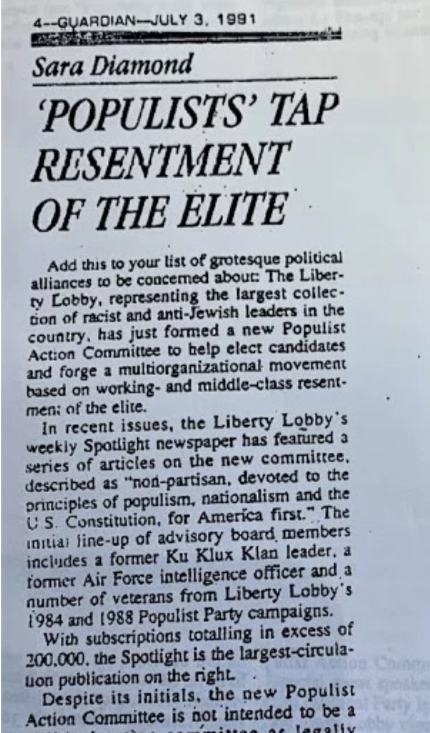
    3.NYC.Guardian.1991A photocopy of Diamond’s Guardian article was anonymously submitted to the JFK production office, along with several typewritten pages of “opposition research” directed at Prouty.

    All three were in the crosshairs of an article published in the November 1991 issue of Esquire Magazine. With the punning title “The Shooting of JFK”, author Robert Sam Anson put together one of the key contributions to the anti-JFK literature from the period, covering the film’s production. While bashing first Stone, then Garrison, and then turning to Prouty in a late-article segment which combined character assassination with an offhand revelation of why it was exactly the establishment had problems with the film.[22]

    Anson introduces Prouty as a genial grandfather type, at least as so impressing the JFK production office, but notes the whispers of “cautious buffs” who are “leery” and wary of Prouty’s background and “claims.”[23] Suddenly, in the production office, a “small thing” starts “the trouble”, and reporter Anson, despite the staff’s nondisclosure agreements, manages to be in the know and in the loop. Anson reports that some of the office’s research staff had been paging through “a tiny left-wing New York weekly” and, by chance, discovered an article identifying Fletcher Prouty “as a cause célèbre in the virulently anti-Semitic, racist Liberty Lobby.”[24]

    The article in question – ‘Populists’ Tap Resentment of the Elite – written by Sara Diamond and published in the July 3, 1991 issue of The Guardian (NYC) – was a legitimate investigative work, and the specific references to Prouty’s activities were accurate. While, to those who knew Prouty, the concept he was a racist fellow-traveler in step with the most virulent members of the Lobby, or even a “right-winger” as portrayed, appeared fringe and absurd, within Stone’s production office the general consensus was Prouty’s associations “looked bad” and could be a “public-relations time-bomb” for the JFK film.[25] The top researcher on staff told Stone: “Basically, there’s no way Fletcher could be unaware of the unsavory aspects of the Liberty Lobby.”[26]

    The Connections to the Liberty Lobby

    The finger-pointing directed at Prouty associating him with the Lobby was based on essentially four items: guest appearances on a syndicated radio program – Radio Free America – hosted by Tom Valentine and sponsored by The Spotlight, the Lobby’s weekly newspaper (numerous appearances 1988-94)[27];a speaking engagement at The Spotlight’s annual national convention (September 1990); the re-publication of Prouty’s The Secret Team by the Lobby’s imprint Noontide Press (autumn 1990)[28]; and Prouty’s being named to a national policy advisory board for the Lobby’s Populist Action Committee, (spring 1991).[29]
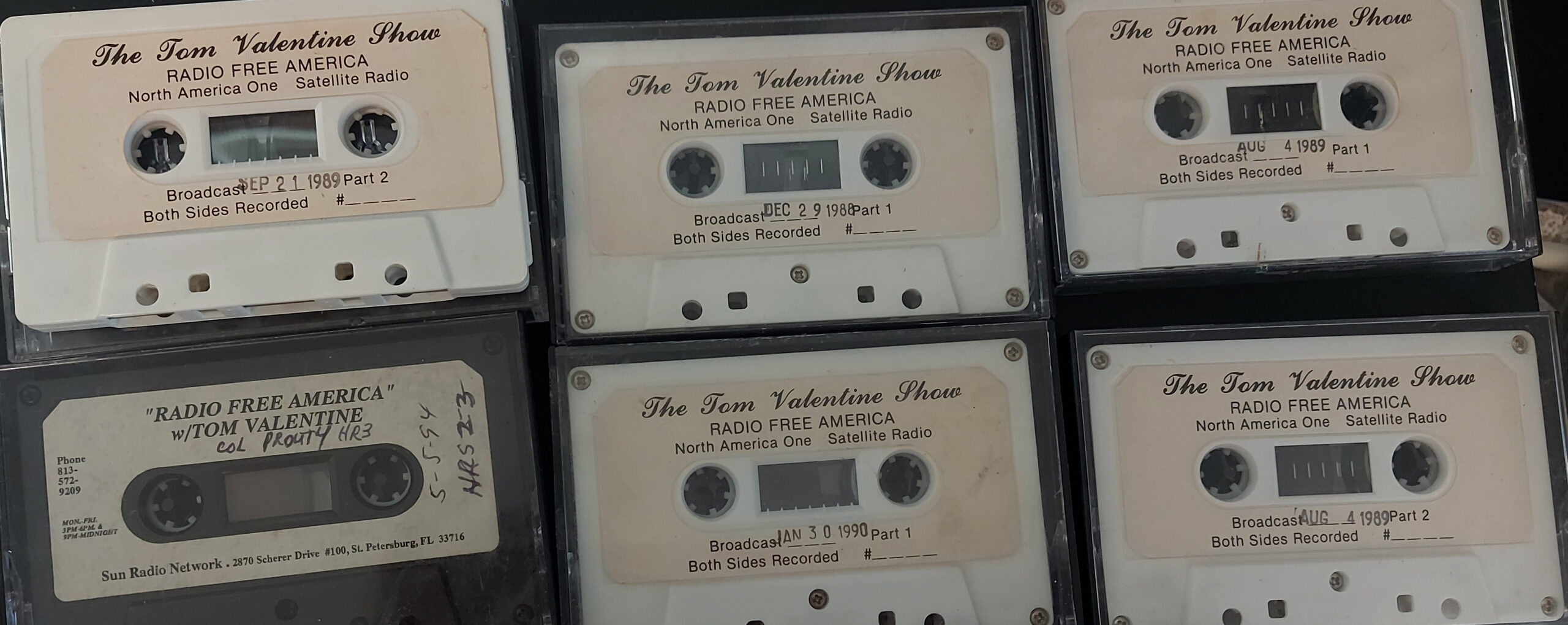
    4.Valentine.showCassettes from Radio Free America, Tom Valentine’s syndicated AM radio program. Prouty was a popular guest with both the host and the audience, appearing several times a year through 1994.

    Taken at face value, in addition to the radio program which he appeared several times a year from 1988-94 as a popular guest, the links may stem from the longer association of Prouty’s colleague Mark Lane with the Liberty Lobby, representing them across several lawsuits in the mid-to-late 1980s. The experiences would result in a book, Plausible Denial, published in 1991, for which Prouty wrote the Foreword. In his book, Lane describes how his interest in representing the Liberty Lobby was piqued by the convergence of the initial litigation, which involved E. Howard Hunt, with the JFK assassination. Lane felt it was an opportunity to litigate a facet of that lingering controversy, and potentially assist its eventual resolution.

    Prouty’s brief direct association with Lobby-related groups in late 1990 / early 1991 is coincident with the preparation of Plausible Denial.

    When You’re A Hammer, Everything Looks Like A Nail

    As it happened, there were at least three researcher/reporters working the far-right “beat” in 1990-91, observing activity sponsored by the Liberty Lobby. One was working for the Anti-Defamation League.[30] The second was Sara Diamond, the author of the piece published in the “tiny left-wing New York weekly”, and at the time working on a UC Berkeley sociology PhD, eventually producing a dissertation entitled “Right Wing Movements in the United States 1945-1992”. The third was activist Chip Berlet, concentrating on the influence of America’s political right with particular concern directed to overlap, or convergence, of the right with the left.[31] Both Berlet and Diamond were outspoken with their opinion that alliances between the extreme right and the Left, initiated through mutual disagreement with official policies such as the Gulf War, was a “bad idea” and perhaps part of a strategic plot by the right to co-opt or discredit Progressives.[32]

    Berlet was in attendance at the 1990 Spotlight conference, at which Prouty spoke, and at which both Mark Lane and Dick Gregory also appeared.[33]Acknowledging the conference’s attention to looming foreign policy controversies in the Middle East,Berlet wrote: “There was considerable antiwar sentiment expressed by speakers who tied the U.S. presence in Saudi Arabia to pressure from Israel and its intelligence agency, Mossad…No matter what actual political involvement, if any…the themes discussed at the Liberty Lobby conference tilted toward undocumented anti-Jewish propaganda rather than principled factual criticisms.”[34] However, rather than analyze the contrasts between the propaganda and the factual criticisms, Berlet is more interested in highlighting links between individuals and organizations, and connecting overarching thematic concepts between them. So the content of Prouty’s remarks, with the topic “The Secret Team”, is not discussed, but his acknowledgment during the presentation of Noontide Press for republishing his book is.[35] Similarly, the reader learns who followed Prouty to the podium, who participated in a panel Prouty moderated, how The Spotlight paraphrased the event, and even how persons “associated” with the Liberty Lobby later circulated antiwar literature “at several antiwar rallies.”

    Researcher Laird Wilcox, editor of the annual Guide To the American Right surveys, criticized in the 1990s what he termed an “anti-racist industry”, claiming anti-racist groups had consistently overstated the influence of what are in fact fringe movements, and named both the ADL and Political Research Associates as having engaged questionable tactics to support their conclusions.[36] “Mr. Wilcox says what most watchdog groups have in common is a tendency to use what he calls ‘links and ties’ to imply connections between individuals and groups.”[37]

    ‘Links and ties’ is certainly not an uncommon technique, particularly for political research. It does however produce a lot of “false positives”, and researchers are perhaps therefore best served exercising a degree of due diligence and establishing secondary sources before jumping to conclusions – such as Diamond’s linking Prouty to the “extreme right” or Berlet labelling him a “fascist”.[38]This can be compounded by a rhetorical strategy of using broad brush strokes to establish and portray monolithic racialist structures – a tendency which may be effective as a partisan effort to “sound the alarm”, but which can be misleading and reduce political complexity to simple and skewed dichotomies.[39]In this fashion, the Liberty Lobby’s weekly newspaper The Spotlight was assumed by the three researchers as necessarily a tool of the anti-Semitic foundation of the Lobby, and was therefore, in their perception, obviously engaged primarily in disseminating that message (although much of that effort may appear in code).[40] Other information portrays The Spotlight, at least during the time in question, as servicing a broader populist conservative community. The publication is described in Kevin Flynn’s 1989 investigative The Silent Brotherhood as “one of the right wing’s most widely read publications”, attracting “a huge diversity of readers, from survivalists and enthusiasts of unorthodox medical treatments to fundamentalist Christians and anti-Zionists.”[41]Daniel Brandt’s NameBase, a parapolitical research tool, described The Spotlight in 1991 as “anti-elitist, opposed to the Gulf War, wanted the JFK assassination reinvestigated, and felt that corruption and conspiracies could be found in high places.”[42]

    Prouty himself responded to the criticisms of his “links and ties” to the Liberty Lobby as follows:

    “I’ve never written for Liberty Lobby. I’ve spoken as a commercial speaker, they paid me to speak and then I left. They print a paragraph or two of my speech same as they would of anybody else, but I’ve never joined them. I don’t subscribe to their newspaper, I never go to their own meetings, but they had a national convention at which asked me to speak and they paid me very, very well. I took my money and went home and that’s it. I go to the meeting, I go home, I don’t join.”[43]

    III

    An honest review of the “hatchet-jobs” directed at Fletcher Prouty invariably sources to the time frame of 1991-1992, coinciding with the U.S. establishment’s attack on Oliver Stone’s JFK film, conducted through its legacy media. In light of that, a curious feature of Robert Sam Anson’s Esquire piece is its concluding section, following directly from the Liberty Lobby “cause célèbre” takedown of Prouty, which had in turn followed a concentrated bashing of Stone and then Jim Garrison. Rather than continuing with the overt criticism, the concluding section hastily endorses a new personage with a point of view said to gel with Stone’s general thesis of JFK’s intention to exit Vietnam, but with a non-conspiratorial spin.

    5.Prouty.with.JudgeProuty with John Judge in early 1992. Small circulation VHS interviews were among the limited options available for efforts to support and supplement Stone’s “JFK”.

    The new personage was John Newman, well-regarded these days with a solid thirty-year run of intensively detailed histories of the Kennedy administration’s national security challenges. Upon this introduction, Anson sets out immediately to contrast Newman with Prouty, utilizing complementary adjectives: Newman is described as “meticulous, low-key, methodical, highly experienced, characteristically cautious” while Prouty is “ever-voluble” and prone to jumping to conclusions. Anson strongly infers that Newman expresses what amounts to the “good” interpretation of events, while Prouty embodies the misshapen “buff” perspective.

    On the other hand, Newman’s perspective still confirms the previously fringe viewpoint that Kennedy had developed a Vietnam policy anticipating an eventual complete withdrawal of “military personnel”, which the JFK film had adopted. Anson opts to promote a presumed back-channel “secret operation” designed to “systematically deceive” the White House so to encourage expansion of the US effort in Vietnam. This secret operation is proposed to be “the real story” above and beyond Fletcher Prouty’s musings regarding the distinctions between National Security Action Memorandums 263 and 273. In the fullness of time, the “back-channel secret operation” never proved a viable hypothesis, while Prouty’s intuitive commentary on NSAM 263 and 273 has been effectively accepted even if debate over motivation continues.

    Therefore, the two express “hatchet-jobs” directed at Prouty in 1991 and 1996 – the Esquire piece and the ARRB interview – both promoting the pretension that Prouty was unstable and his concepts were easily “debunked” by the official record, have proved to be fundamentally in error, first over the NSAMs and second over the military intelligence units. To this day, Prouty’s detractors still cannot articulate where exactly he is wrong – about the assassination or about his experiences during his military career. This is why such criticisms invariably fade into a drab curtain of distraction, stained with reference to the Liberty Lobby, Scientology, Princess Diana, and other irrelevancies.

    Oliver Stone put it well in his published response to Anson’s Esquire piece: “(Prouty’s) revelations and his book The Secret Team have not been discredited in any serious way. I regret his involvement with Liberty Lobby, but what does that have to do with the Kennedy / Vietnam issue?…I have not, nor do I intend, to ‘distance’ myself in any way from Garrison’s or Colonel Prouty’s long efforts in this case. They may have made mistakes, but they fought battles that Anson could never dream of.”


    NOTES:

    [1] Mcadams’ Prouty entry on his JFK assassination website was an oft-cited compilation of disparaging talking points. Most if not all of this concerted “debunking” has in turn been debunked. Disputes over the factual record and Mcadams’ seeming influence over certain Wikipedia gatekeepers (editors) resulted in a classic essay discussing narrative management and the internet: Anatomy of an Online Atrocity: Wikipedia, Gamaliel, and the Fletcher Prouty Entry

    [2] See Fletcher Prouty vs the ARRB by Jim DiEugenio for the full story.

    [3]Memorandum dated Sept 11, 1996.

    [4]L. Fletcher Prouty Talks to the ARRB

    [5]Interview Summary, prepared October 23, 1996 by Christopher Barger

    [6]Memorandum is found on page 70 of this link.

    [7] Ibid

    [8] Interview Summary p11. In context, Prouty’s reference to the Warren Report is based on the understanding it was fully part of a cover-up operation and therefore wholly unreliable as a “historic” record and, in that regard, useless as a “source document.” Prouty’s work never had the pretension to specifically “criticize” the Report for this reason.

    [9] In some instances, the panel holds Prouty as “unreliable” due to his reluctance to identify individuals, despite his specific caution at the interview’s start that he will not identify individuals who are/were operational – “I never name a man who is operational. Never.” He was also labelled unreliable by being unable to produce particular documentation, although he had explained that the types of documents they sought either never existed or had been long destroyed.

    [10] The full transcript of the September 24, 1996 interview with Prouty can be accessed here.

    [11] Allegation #1: Trip to Antarctica may have had sinister connotations. Interview Summary p2

    [12] L. Fletcher Prouty, JFK: The CIA, Vietnam and the Plot to Assassinate John F. Kennedy, Introduction by Oliver Stone (New York: Citadel Press, 1992), p. 284. “I have always wondered, deep in my own heart, whether that strange invitation that removed me so far from Washington and from the center of all things clandestine that I knew so well might have been connected to the events that followed.”

    [13] “Result or conclusion by ARRB:…Prouty made no statements for the record to back up the suspicions he mentioned in the excerpt from his book cited above.” Interview Summary p3.

    [14] “it is alleged that the Christchurch Star, when running its first story about the assassination, included biographical information on Lee Harvey Oswald and named him as the accused before he had actually been arraigned for the crime in Dallas. The allegation is also made that the first reports from Dealey Plaza, which were not entirely accurate, were sent out as a part of a ‘cover story’ of some sort.” Interview Summary p3.

    [15] The rapid identification of Oswald as first the main and eventually the only suspect remains to be accounted for, particularly as the evidence was sparse and the suspect was denying everything. It is not known how or why the FBI concluded Oswald “did it” an hour after his arrest, or the process by which the wire services soon after were presumably signalled that Oswald’s identity and biography was newsworthy. There were other arrests made in connection with Dealey Plaza, but none other than Oswald featured names and personal biographies splashed across the evening news.

    [16] L. Fletcher Prouty, JFK: The CIA, Vietnam and the Plot to Assassinate John F. Kennedy, Introduction by Oliver Stone (New York: Citadel Press, 1992 p. 294. Plausible Denial p XV.

    [17] See: “Fletcher Prouty vs the ARRB” by Jim DiEugenio

    [18] interview transcript p36 Prouty’s tone in reply is noted: “(testily) See, we’re overdoing this. I went to Mexico City once, so I’d know the business…”. In the Summary, the descriptive “(testily”) is changed to “(Very agitatedly)” Summary Barger p8

    [19] Wray: “…When you say “the Secret Service was not in Dallas” do I understand you are speaking a little bit figuratively there? That they may have been there, but weren’t doing their job thoroughly? Or do you mean literally, that they were not there?” Interview transcript (P36).

    [20] Barger Summary p8. Prouty in fact discussed his experience, which was in 1955 in Mexico City

    [21] pp 261-262 Alan Dale with Malcolm Blunt, The Devil Is In The Details, self-published 2020. Prouty’s identification was confirmed by his Pentagon boss Victor Krulak in a personal letter written in the 1980s. There have been claims such letter never existed, but it is be found in the Prouty document archive maintained by Len Osanic.

    [22]Anson had previously written They’ve Killed the President, Bantam 1975, in which he first bashed Garrison and his truncated investigation.

    [23]According to Anson, the whispers suggested Prouty “had a tendency to see the CIA’s dark hand everywhere…Another liability was Prouty’s fondness for putting himself at the center of great events.” These suggestions seem to refer to Prouty’s military career, during which, most everyone agrees, he worked closely with CIA and “was where he says he was…his position can be documented.”

    [24]This may not be an accurate account of this discovery, as around the same time the research staff had been forwarded a photocopy of the article in question, along with several typewritten pages referring to complementary research by a researcher with the Anti Defamation League. Both sources supplied similar reference to associations between Prouty and groups linked with the Liberty Lobby. It is possible the chance “discovery” was more accurately described as the arrival of unsolicited opposition research forwarded to the Stone office. Exactly how Anson got word of this is not known.

    [25]Anson writes: “When questioned, Prouty, the intelligence expert, pleaded ignorance. He had not known of (Liberty Lobby founder) Carto’s Nazi leanings, he insisted…As for (Carto’s) assertion that the Holocaust was a lie, (Prouty)…would say only, ‘I’m no authority in that area.’ ‘My God,’ moaned a Stone assistant after listening to the rationalizations. ‘If this gets out, Oliver is going to look like the biggest dope of all time.’” This paragraph can be read as inferring Stone’s team confronted Prouty and were listening directly to his response. Anson’s sentence structure, however, is not exactly precise and leaves open the possibility, or likelihood, that someone else conducted this questioning of Prouty, under unknown circumstances, and that the staffers “listened” to the “rationalizations” second-hand.

    [26]This opinion is something of an extrapolation, also expressed by Anson i.e.: “When questioned, Prouty, the intelligence expert, pleaded ignorance.” This presumes Prouty’s attention to detail in his professional capacity necessarily carried over to other aspects of his life. Such presumption is not entirely accurate as, for example, at the time they first met, Prouty was entirely unfamiliar with Oliver Stone and had not seen any of his films, despite the publicity associated with Stone’s career momentum in the 1980s and his three Oscar wins.

    [27]Prouty’s appearances, across several years, were cited as a clear indication of his “being up to his neck in the racist right movement”. Len Osanic has copies of Prouty’s Radio Free America appearances on cassette, and says the claim, sourced to Anti Defamation League researchers, that the program engaged in routine anti-semitism and Holocaust Denial are “nothing”. Osanic says Prouty’s appearances were essentially similar to the contemporaneous Karl Loren Live broadcasts from Los Angeles which Prouty also appeared during this period. The author has reviewed several of Prouty’s interviews with Valentine and concurs with Osanic. The discussions cover ground exactly similar to most other interviews Prouty gave at the time, the content of which are entirely uncontroversial.

    [28]Prouty told Len Osanic the publication was a “one-time” commitment, a limited press run for which Prouty received a small amount of money. Prouty told Osanic that he understood Noontide as specializing in editions of books which had fallen out of circulation. Noontide, at the time, had also republished Leonard Lewin’s Report From Iron Mountain. The original edition of The Secret Team in 1973 was subject to distribution problems. Prouty discussed this in a note to the 1997 edition: “ After excellent early sales of The Secret Team during which Prentice-Hall printed three editions of the book, and it had received more than 100 favorable reviews, I was invited to meet Ian Ballantine, the founder of Ballantine Books. He told me that he liked the book and would publish 100,000 copies in paperback as soon as he could complete the deal with Prentice-Hall…Then one day a business associate in Seattle called to tell me that the bookstore next to his office building had had a window full of the books the day before, and none the day of his call. They claimed they had never had the book. I called other associates around the country. I got the same story from all over the country. The paperback had vanished. At the same time I learned that Mr. Ballantine had sold his company. I traveled to New York to visit the new “Ballantine Books” president. He professed to know nothing about me, and my book. That was the end of that surge of publication. For some unknown reason Prentice-Hall was out of my book also. It became an extinct species.” The Secret Team book, and its unavailability, was referred several times on the Valentine radio program ahead of the republication.

    [29]Prouty agreed to the use of his name, but said he had no other involvement with the Committee, i.e. he never provided advice or attended any meetings.

    [30]This may have been Kenneth McVay, whose work, later published online, corresponds to the cited information sent to Stone’s office; see this and this.

    [31]Berlet’s divisive rhetoric targeted “virtually every independent critic of the Imperial State that the reader can name”, which at the time in question (1990-91) included “the Christic Institute, Ramsay Clark, Mark Lane, Fletcher Prouty, David Emory, John Judge, Daniel Brandt” et al. Ace Hughes, Berlet for Beginners, Portland Free Press, July/August 1995.

    [32]Berlet, Chip. Right Woos Left: Populist Party, LaRouchite, and Other Neo-Fascist Overtures to Progressives, and Why They Must Be Rejected, 1999, Political Research Associates.

    [33]“Other conference speakers and moderators at the September 1990 Liberty Lobby convention included attorney Mark Lane, who has drifted into alliances with Liberty Lobby that far transcend his role as the group’s lawyer, and comedian and activist Dick Gregory, whose anti-government rhetoric finds fertile soil on the far right.” Berlet, Chip. Right Woos Left p40

    [34]ibid

    [35]A public expression of gratitude to the publishers is a routine dedication for authors.

    [36]Wilcox, Laird The Watchdogs 1997 self-published.

    [37]Researcher Says ‘Hate’ Fringe Isn’t As Crowded As Claimed, Washington Times, May 9, 2000. p.A2

    [38]NameBase is a cross-indexed database tool for “anti-Imperial” researchers, initiated by Daniel Brandt. Chip Berlet, along with Fletcher Prouty, was on the NameBase Board of Advisors in 1991 when Berlet, describing Prouty as a “Larouche-defender”, announced his refusal to remain on the same Board. Brandt encouraged Berlet to leave, saying “When it came to making a choice between Prouty and Berlet, it was a rather easy decision for me to make.” Berlet took three other Board members with him, and a lingering feud percolated for many years after. See this.

    [39]Via “links and ties”, it was common for right-wing rhetoric in the 1960s to label ideological opponents as literally Communist agents embedded within civil rights and other movements. Debates over methodology – such as links and ties – which were frequent in the 1990s, highlighted the expanding scope of identified political “enemies” (a debate again familiar in today’s polarized political and social landscape). This expansion resulted in erroneous claims such as that Prouty held right-wing, or even “extreme right-wing” political views, claims which are unfortunately being currently recycled by a small faction of researchers.Prouty never openly discussed his personal politics, other than to say “the only club I’ve joined is the Rotary Club.” Prouty, in the author’s opinion, could be fairly described as a “mid-century main-street Rotary Club American”.

    [40]Diamond is referred: “to understand where the Liberty Lobby and its supporters are coming from, you have to understand their code language, which seldom if ever attacks Jews directly, but instead refers to ‘the big medical establishment, the big legal establishment, the major international bankers’, all of them controlled by you know who.” The obvious problem with this proposition is that determining what is “code” and what is legitimate criticism is often a wholly subjective enterprise. Also, a “code” requires both the disseminators and the receivers to be “in” on the cipher interpretation.

    [41]The Spotlight “regularly featured articles on such topics as Bible analysis, taxes and fighting the IRS, bankers and how they bleed the middle class, and how the nation is manipulated by the dreaded Trilateral Commission and the Council on Foreign Relations.” p. 85. Flynn, Kevin and Gerhardt, Gary, The Silent Brotherhood: Inside America’s Racist Underground, The Free Press, 1989.

    [42]“we found only rare hints of international Jewish banking conspiracies or the like in The Spotlight.” See this.

    [43](Col. L. Fletcher Prouty Responds to Accusations of Involvement in Right Wing Extremist Groups Interview Date: April 3, 1996. – Col L. Fletcher Prouty Reference Site. There is no record of Prouty expressing extremist or racist views, as the researchers cited admit: “Diamond says that Prouty himself has, as far as she has been able to determine, made no public racist or anti-semitic utterances.” “Berlet states that Prouty himself has never made any overt anti-semitic or racist comments…” (typewritten document submitted to Oliver Stone’s production office) “Nothing here shows Prouty to have been a Nazi or an anti-Semite…” John Mcadams. This has not prevented a few contemporary critics from asserting that Prouty was, in fact, anti-semitic. This notion appears to be based on two items: an advance notice for a 1991 Liberty Lobby event which lists Prouty as a prospective speaker (Prouty did not in fact appear); and a 1981 private letter authored by Prouty in which, discussing the looming AWACS deal some months ahead of Reagan’s controversial public announcement, Prouty uses the phrase “Jewish Sgt” during a discussion of potential military logistic compromises associated with computerized systems relying on multiple inputs from different locations. The cherry-picked phrase, as presented, reveals essentially a lack of basic knowledge of the historic issue and perhaps a misunderstanding of the term “anti-semitic”. For a balanced perspective on the AWACS controversy see: Gutfeld, Arnon, The 1981 AWACS Deal: AIPAC and Israel Challenge Reagan, Begin-Sadat Center for Strategic Studies.
  • How Oswald Was Framed for the Murder of Tippit: Part 3

    How Oswald Was Framed for the Murder of Tippit: Part 3


    Part 3: The Manipulation of Oswald

    During his short adult life, Lee Oswald was a man who was always following orders.

    On his 17th birthday, when Oswald enlisted in the U.S. Marine Corps, the young Texan signed himself up for a lifetime of taking orders. Through Marine boot camp and while in training in Biloxi as a radar operator, Oswald took orders. This continued through his stint as a radar operator at the Atsugi, Japan air base, from which the CIA flew its U2 spy planes. While in Japan, Oswald also helped to infiltrate the Japanese Communist Party. He was treated for gonorrhea contracted, according to records, “in the line of duty” as a result.

    myers38While in the Marines, Oswald was following orders when he studied Russian and sat for Russian proficiency exams. When ready for his first big intelligence assignment, Oswald took a hardship discharge — ostensibly to take care of his mother in Fort Worth, TX — but left almost immediately for Europe to participate in the United States’ fake defector program. The Soviets never bought Oswald’s defector act. The KGB had Lee shipped him off to toil in a radio factory in Minsk where he could be kept under close surveillance, do little harm, and be used for propaganda purposes.

    In Minsk, Oswald met a young woman, married, had a child, and eventually applied to return to the United States. The U.S. State Department granted Oswald a loan so he could be repatriated and return to the Dallas-Fort Worth area with his new Russian bride and their child. Oswald would quickly repay this loan although he officially only ever worked at low-paying jobs, and never for very long. Was Oswald receiving cash from an off-the-books employer?

    During the first half of 1963, Oswald likely received new instructions to return to New Orleans, his original hometown and birthplace. There, Oswald took a cover job as an oiler greasing coffee machines. Most of the ex-Marine’s time in the Big Easy, however, was spent working under the auspices of ex-Chicago FBI agent and former Assistant Superintendent of the NOPD, Guy Banister. Oswald also collaborated with Banister’s associate David Ferrie, an ex-commercial airlines pilot and Oswald’s former commander in the Civil Air Patrol. While Banister and Ferrie were apparently running a training camp at Lake Pontchartrain for anti-Castro Cuban guerillas, Banister set up Oswald as the secretary and only member of the New Orleans chapter of the Fair Play for Cuba Committee. As an “agent provocateur” assigned to ferret out Castro sympathizers, Oswald handed out Fair Play for Cuba Committee flyers on the streets of downtown New Orleans.

    myers39To increase Oswald’s visibility and public reach, in all probability, a fake street fight was staged in early August with “pro-Castro” Oswald and some of Banister’s anti-Castro protégés. This got Oswald arrested for disturbing the peace, but also got him on the evening news. While in NOPD custody, Oswald asked to speak with an FBI agent. An FBI agent did arrive and conversed with Oswald in private for about an hour. Afterwards, at a public hearing, Oswald was fined $10 and released.
    A few days later, Oswald was asked to debate Cuban exile Carlos Bringuier, who had knocked Oswald’s leaflets to the ground during their filmed confrontation; along with Ed Butler, executive director of the anti-Castro group Information Council of the Americas (INCA). The debate took place on the WDSU radio show Latin Listening Post. During the discussion, Butler asked Oswald to admit it was true he had defected to the Soviet Union and denounced his U.S. citizenship. Oswald disagreed, explaining he was simply a foreigner who for a time was granted the okay to live and work in the Soviet Union — an unlikely occurrence during the Cold War.

    “I was at all times considered an American citizen, and at all times I was in contact with the American embassy,” Oswald explained. “The very fact that I am back in the United States shows that I did not renounce my citizenship. A person who renounces his citizenship becomes legally disqualified from returning to the United States.”

    The repatriation loan from the State Department backs up Oswald’s claim.

    As the summer of 1963 ended, Oswald was instructed to return to the Dallas-Fort Worth area and take another “killing time’ job — this time as an order filler at the Texas School Book Depository adjacent to Dealey Plaza. He also rented a cheap room at an Oak Cliff boarding house while his expectant wife Marina, and daughter, June, stayed with Ruth and Michael Paine in Fort Worth. Lee took the room, a short bus ride from work, under the assumed name O.H. Lee.

    Oswald had been willing to spy on and infiltrate Japanese Communists, Soviet Communists, American Communists, and pro-Castro types. He was probably not averse to ongoing plans for the assassination of Fidel Castro.

    myers40On November 2, 1963 — less than three weeks before the assassination in Dallas, President Kennedy was supposed to attend a football game at Chicago’s Soldier Field between Army and Air Force. The plan was for the President’s plane to touch down in the Windy City and for him to drive in an open motorcade to the stadium.
    However, three days before the President’s planned landing, the Washington, D.C. FBI received a note warning that an assassination team was arriving to shoot the President on his way to the game. The threat became even more real when a landlady reported to authorities that she had seen automatic rifles lying on the beds of a room rented by four men from out of town (supposedly Cubans) — as well as a map of the President’s route from the airport.

    Upon being alerted by the FBI, Secret Service personnel on duty in Chicago went into action and tracked down two of the men — who were subsequently interrogated concerning their activities. The detainees protested their innocence, and agents couldn’t connect them to any developing plot. They were released.

    Then, to make an already bad situation worse, authorities received word of a credible threat against the President made by a man at a Chicago area diner. The person making that threat was Thomas Arthur Vallee, an ex-Marine and member of the John Birch Society, Vallee boasted he had the weapons and ammo to do the job.

    The ex-Marine was put under surveillance, then arrested the morning of JFK’s scheduled visit, which was cancelled. Inside Vallee’s car authorities found a small arsenal of weapons and hundreds of rounds of ammunition. Valle, it was discovered, worked in an office building that overlooked Kennedy’s planned route.

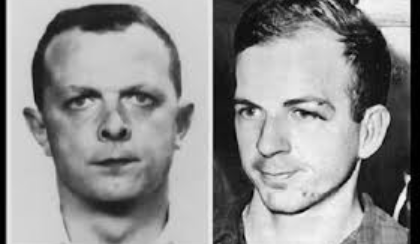
    The similarities between Oswald and Vallee were startling…too close to have been mere coincidence. Vallee would perhaps have made an even more convincing patsy, something akin to a Lee Oswald on steroids. Vallee was more outspoken, more violent, more erratic, and boasted a vastly superior arsenal of weaponry.

    Oswald and Vallee shared a lengthy list of items in common, including these:

    • were ex-Marines
    • had been assigned to U-2 spy plane bases in Japan
    • pledged themselves to extremist, radical causes
    • suffered from a history of emotional meltdowns
    • worked in buildings that overlooked the Presidential motorcade routes
    • associated with far-right, anti-Castro Cuban exiles
    • helped train anti-Castro Cubans for an armed invasion of their homeland
    • were openly critical of how the United States treated its citizens
    • were suspected of having ties to U.S. intelligence agencies.

    Even more startling, author Edwin Black who first exposed the Chicago Plot, would later reveal a show-stopping piece of intelligence. According to Black’s sources, the original tip forwarded to the FBI about the Chicago Plot had come from a man known only as Lee. Could that have been Lee Harvey Oswald, recently hired order-filler at the Texas School Book Depository? Or perhaps Mr. O.H. Lee, a boarder at Gladys Johnson’s Oak Cliff boarding house on North Beckley.

    Several days after Vallee’s arrest, a police informant sat in a Miami hotel room, wearing a wire to secretly record the following conversation with a wealthy political extremist named Joseph Milteer:myers41

    From an office building with a high-powered rifle. They will pick up somebody within hours afterwards…Just to throw the public off.

    Sometime just after noon on Friday, November 23rd, Lee Oswald sat in the second-floor lunchroom of the TSBD. Perhaps thinking he had helped save the president in Chicago. Within a few minutes, Lee could hear the noise from the crowds grow louder as the motorcade approached and turned onto Elm Street. A few moments later the fatal shots rang out, then all hell broke loose. According to the official story, a figure appeared in the doorway and barged in to the second floor lunchroom. A motorcycle cop pointed his gun at Lee’s belly and ordered him to come forward. But Mr. Truly came in right after and told the cop, “No, he’s okay. He works here.” The men continued on their way, racing up the stairs. Oswald got his jacket, walked out the front of the TSBD through the glass doors, and headed east on foot

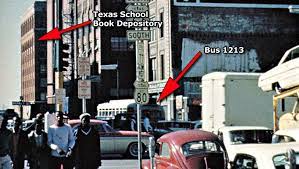
    Again, according to the official story, Oswald hopped on the first Oak Cliff bus he could hail…it was for the Marsalis Avenue route. However, as bus 1213 crept back towards Dealey Plaza, traffic became horribly snarled. Another passenger, frustrated at the lack of forward progress, stepped forward to ask the driver for a transfer. Oswald also got up and asked for a transfer, then departed the bus. The Warren Report tells us he walked south for a few blocks to the taxi stand near the Greyhound bus terminal. Lee directed the cab driver to take him to North Beckley in Oak Cliff, the street on which his rooming house was located.

    myers42One of the most mysterious people in the entire JFK saga was a Dallas cop named Harry Olsen. Olsen’s girlfriend and future wife was one of Jack Ruby’s strippers. On the night of the assassination, Olsen later admitted he had spent a couple of hours in Jack Ruby’s automobile with the volatile nightclub owner as well as Olsen’s girlfriend, stage named Kathy Kay. Olsen used the time to work Jack, aka Sparky, into a frenzy; repeatedly telling the Carousel Club “host” that somebody needed to get that SOB Oswald. It would be Ruby who would draw the short straw that weekend to do the deed.
    What Harry Olsen would not admit is exactly what he was doing during the time JFK and Tippit were shot. Olsen claimed he was off duty, nursing a broken leg that sported a cast, and earning some extra cash by doing a favor for the lawyer friend of another cop. Olsen said he was alone most of November 22nd guarding an “estate” that belonged to a deceased client of the lawyer. The property was located somewhere on 8th Avenue in Oak Cliff, just a couple blocks north of 10th Street where Tippit was gunned down. When pressed, Olsen could not remember the name of the cop who gave him the referral, could not remember the lawyer’s name, could not remember the dead property owner’s name, and could not remember the address of the property. He did remember someone phoned the dead owner to tell her JFK was just shot. Upon learning this news, Olsen said he walked a few blocks away to the apartment of his stripper girlfriend to watch the television coverage. We can venture a guess that Olsen also forgot his leg was supposed to be in a cast. Some weeks after the assassination, Chief Jesse Curry called Olsen into his office to inform the veteran cop he was being fired. When questioned later, Olsen couldn’t remember the reason why. Olsen’s testimony before the Warren Commission was frankly unbelievable and, at times, farcical. It was so suspicious it has led many JFK researchers to believe Olsen was either the cop who Lee’s housekeeper said tooted his horn outside Oswald’s rooming house, or one of the cops in the mystery car seen in the alleyway behind 10th Street when Tippit was murdered.

    Olsen would eventually marry the stripper, move to California, and drop out of sight. But before he did, Olsen was interviewed by Dallas researcher Michael Brownlow. Brownlow asked Olsen many questions, most of which he deftly avoided answering. But at one point, Olsen shook his head and said, “Listen, Big Mike. You need to understand something. A lot of people were following orders that day. Oswald was following orders…”

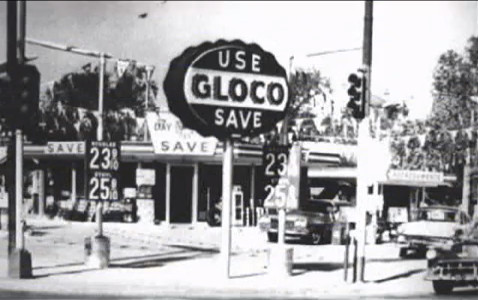
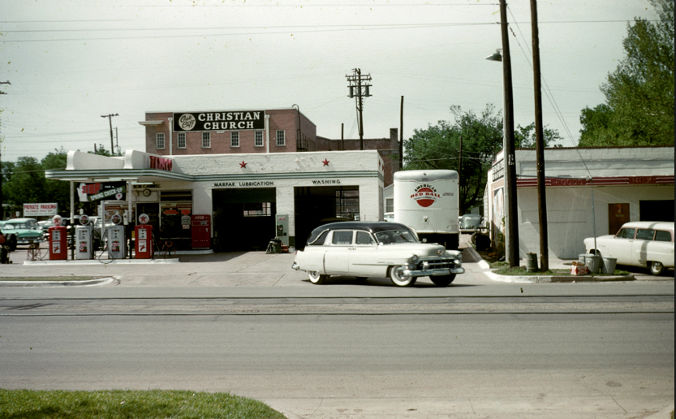
    myers43Another person who was likely following orders on November 22nd was 11-year Dallas police veteran J.D. Tippit. Tippit was sitting in his squad car #10 at Oak Cliff’s Gloco filling station at approximately 11:45 p.m., watching traffic as it came off the Houston Street viaduct from Dealey Plaza and downtown Dallas. Tippit, however, had just reported to his dispatcher he was several miles south at Keist and Bonnie View in his regularly assigned Cedarcrest patrol area. The dispatcher soon called back and ordered Tippit north to central Oak Cliff, since all units close to downtown were being directed to head to Dealey Plaza.
    Tippit was likely waiting for a city bus to come off the viaduct. He would follow that bus until an individual named Lee Oswald could get off alone at one of the early stops. Was Tippit’s assignment to pick up Oswald and drop him off at the Texas Theater? Tippit had met Oswald previously at Austin’s Barbeque joint down in his regular patrol area.

    The patrolman could see no busses coming. Gloco employees watched as Tippit’s car suddenly pulled out and headed south on Lancaster Avenue at a high rate of speed. At 12:54 p.m. the dispatcher again calls Tippit, who now reports his position — correctly — as Lancaster and Eighth. Despite being thrown a curve ball, Tippit cruises the neighborhood for several minutes, he parks his patrol car facing north next to the Top 10 Records store — barely a block from the theater. Tippit hurries inside and asks to use the store phone. Store employees see Tippit dial a number, listen, but he never speaks. After what must have been six or seven rings, Tippit hangs up and quickly goes back outside to his patrol car.

    Meanwhile, Oswald has paid his entrance fee and is seen by manager Butch Burroughs, who later recalled how Oswald slipped in between “1:00 and 1:07.” Patron Jack Davis watches curiously as Oswald keeps changing seats, sitting next to one person after the other in the mostly empty movie house. Davis corroborated Burroughs’ timeline as to when Oswald was in the theater. Davis described how Oswald had sat next to him, did not say a word, then got up after a few minutes to sit elsewhere. Oswald reportedly even sat next to an obviously pregnant woman — who soon got up, left, and never returned. In retrospect, Davis thought Oswald had been looking for someone — someone he didn’t personally know.

    After several futile minutes of searching, Oswald went to the lobby and purchased popcorn from Butch Burroughs — approaching the time when Officer Tippit would be killed blocks away.

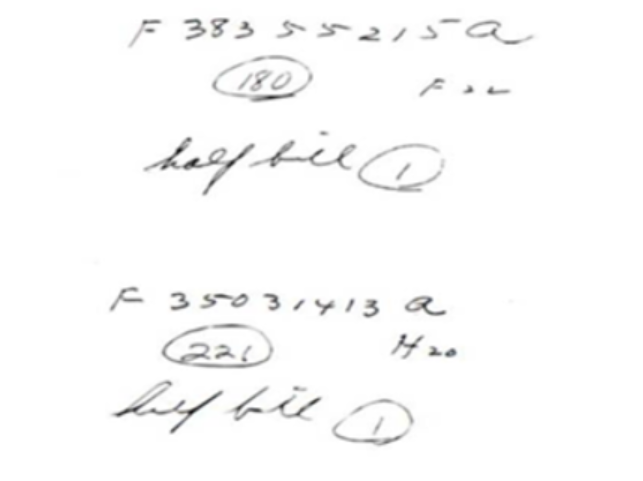
    myers44When Oswald’s wallet was emptied later that day, authorities would curiously discover the torn halves of two one-dollar bills. Both items later disappeared, but they were noted within the inventory paperwork concerning the suspect’s possessions. Many observers, including JFK researcher John Armstrong, have pointed out that the matching of torn half dollar bills is a tool used in spy craft for clandestine meetings.

    Over next to the Top 10 Records store, Officer Tippit sat in his patrol car listening to police radio traffic regarding the flurry of activity at Dealey Plaza and the Texas School Book Depository.

    Suddenly, Tippit’s dispatcher was hailing him. There were reports of a fight at 10th & Marsalis. One participant was said to have been stabbed and subsequently thrown into the back seat of a blue sedan, possibly a Mercury Monterey, which then immediately left the scene.

    myers45You won’t find any record in DPD files on this incident, but according to witnesses at the corner of 10th % Marsalis, it happened…and it happened very close to the time Tippit was killed.
    Tippit acknowledged he was responding, put the 1963 Ford Galaxie in gear, pulled out, checked traffic as he eased into the intersection at Jefferson, and stepped on the gas. Employees at Top Ten recall Tippit peeling out and rocketing across Jefferson, headed north towards Sunset and next 10th Street.

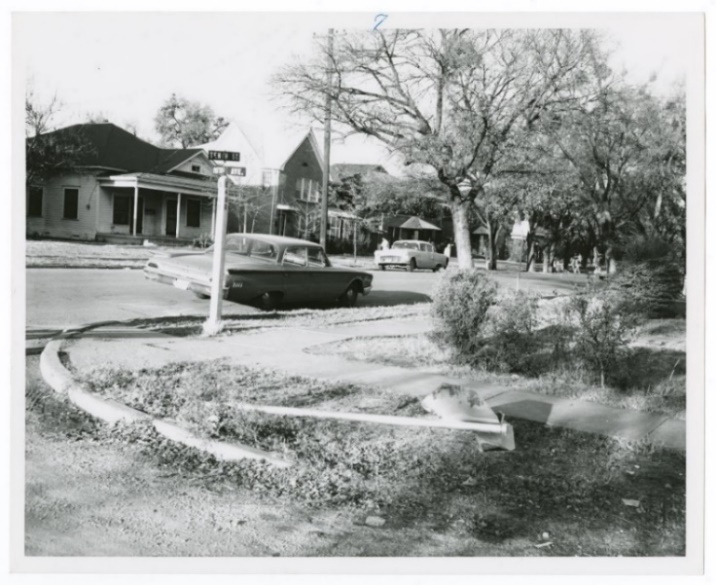
    The father of three was thinking how he had no partner that day, and not much in the way of back up except William Mentzel who was distracted by an accident. As J.D. blew through Sunset and arrived at W. 10th, he slowed to turn right heading east towards Marsalis. Tippit observed a car headed west towards him on 10th — and away from the scene of the disturbance. It matched, in general, the description of the car said to have left the fight with a stabbing victim in the back seat.

    As the suspect car passed S. Bishop, Tippit turned left and fell in behind the target vehicle. Without turning on his flashing lights and using standard police procedure, Tippit sped up, passed the sedan, then forced the car to the curb.

    Tippit jumped out, signaled the driver to stay put, and rushed to look into the auto’s back seat. Nothing, nobody there. He had just wasted precious moments stopping the wrong car. Without saying a word to the startled man behind the wheel, Tippit raced back to his patrol car, reversed course, and sped off to the east. The motorist, an insurance man named Andrews, would later describe how the patrolman–badge name TIPPIT–looked upset and was acting wild.

    Just after this incident the encounnter with whoever killed Tippit took place. J.D. eased over towards the sidewalk, followeing a man on foot, then tooted his horn. The pedestrian turned, acted surprised, and Tippit beckoned him over to the car. The man approached, bent over, and looked through the front passenger window. Only the car’s little vent window was open.

    Tippit opened his car door, slowly climbed out, and adjusted his cap. Tippit reached back and put his right hand on the butt of his service revolver, Western-style. As he slowly made his way to the front of DPD car #10, the young man paralleled him on the passenger-side of the vehicle, easing forward.

    Suddenly, out of the corner of his eye, Tippit caught the man’s sudden movement, reaching under his jacket to draw a gun. Tippit stepped back and began to turn awkwardly to his right, his own revolver clearing the holster. But with his right hand facing the gunman Tippit was like a left-handed ballplayer at shortstop. The gunman had the drop on Tippit as well as the better angle and position. The last thing J.D. saw were the muzzle flashes as his world faded into nothingness.

    As the gunman looked down the barrel of his .38, the patrolman dropped out of sight behind the front driver’s side fender. He jump-stepped back to the sidewalk, adrenalin pumping, and began to hustle away from the dead patrolman’s car.

    myers46Helen Markham screamed: “He shot him! He’s dead! Call the police!”
    The killer glanced at a woman standing catty corner across the intersection. Looking around, he saw no one else coming — yet. “Poor dumb cop,” the shooter muttered out loud. He jumped the hedges and kept on going, never noticing the crouching cab driver or even his cab.

    After purposefully disposing of the shells–and because of the pattern in which they were found, it is highly unlikely they were ejected at the same time. It is much more likely they were thrown down by the killer. The gunman now automatically cut diagonally across Patton from the east sidewalk to the west sidewalk, picking up his pace as he headed south towards Jefferson. He snapped shut the revolver’s cylinder and pointed the gun upwards but at the ready — in a raised pistol position. A stocky white man in a white shirt and tie, Ted Callaway, had come out from the car lot’s office and was just reaching the eastern sidewalk. “Hey, man!” the witness yelled. “What the hell’s goin’ on?” The killer did reply to this, but no one knows what he actually said.

    myers47Back at the murder scene on 10th Street a crowd was quickly forming. Reserve Sergeant Kenneth Croy was the first DPD officer to arrive on site. The ambulance was already there, and they were loading Tippit’s body for the race to Methodist Hospital. Someone in the crowd may have handed Croy a wallet at this time, or perhaps Croy arrived at 10th & Patton already in possession of the wallet. As the ambulance pulled out, Sgt. Croy started taking statements from witnesses. Including the nearly hysterical Mrs. Markham, who by this time had placed her shoes on top of Tippit’s car #10 to avoid getting them splashed in the fallen cop’s blood.
    An 8” x 10” crime scene photograph depicting J.D. Tippit’s patrol car was later autographed for the FBI historian Farris Rookstool. It was signed by Jim Leavelle, Bob Barrett, T.F. Bowley, Roy Nichols, and Kenneth H. Croy – who reportedly wrote: “First on the scene, recovered Oswald’s wallet there too.”

    Witness Domingo Benavides has secured an empty Winston cigarette pack in which he placed the first two shells discarded by the killer. Barbara and Virginia Davis recovered the last two shells along the Patton Avenue side of their rented apartments later in the afternoon.

    At 1:40 p.m. Captain Westbrook arrived, but first went immediately to the area behind Ballew’s Texaco where the gunman had last been spotted. Westbrook will involve himself in the discovery of the discarded Eisenhower jacket, then continue to the Tippit murder scene where Officer Croy will hand him “Oswald’s” wallet. Westbrook will show the wallet and its contents to FBI Agent Bob Barrett and several other law enforcement officials — all while being filmed for posterity. But before the end of November 22nd, the alleged 10th St. “Oswald” wallet will disappear for all eternity.

    Wallet, shells, jacket…all evidence pointing to a single person who must have represented one of the most incompetent criminals in the history of American law enforcement, Lee Harvey Oswald. Oswald will soon be arrested with the alleged murder weapon in his possession in a darkened neighborhood theater. All so very convenient and incriminating.

    As the minutes pass, more and more police units flood the central Oak Cliff area as news of a cop killing is broadcast. They arrive in force, racing up and down Jefferson Boulevard like a swarm of angry hornets darting around looking for someone or something to sting. They are about to be pointed directly at a likely suspect sitting in the Texas Theater with a loaded .38 concealed under his raggedy long-sleeved brown shirt.

    myers48Store manager Johnny Brewer couldn’t help but notice the man in the lobby of his store acting suspiciously. He called for store clerk Tommy Rowe to come out to the counter to look. As another police car whizzed by, siren wailing, the man ducked back out of the lobby and headed west down the sidewalk towards the Texas Theater.
    “That guy’s up to something,” Brewer remarked. “It might have to do with all these police cars racing around.”

    “Why don’t you go follow him,” the clerk suggested. “I’ll cover the store.”

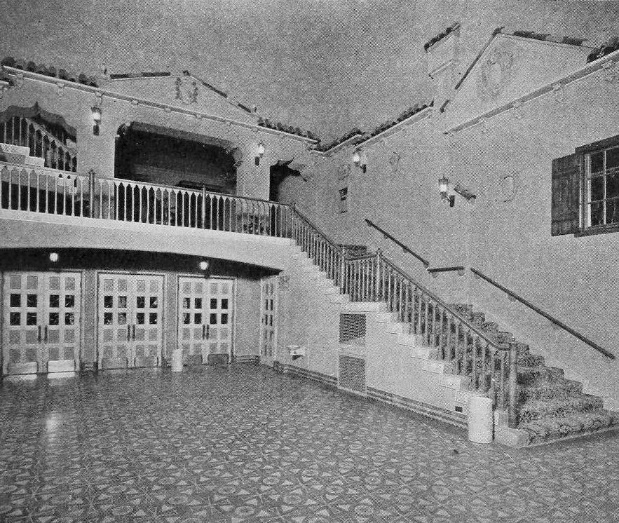
    Johnny Brewer opened the door and walked through the store lobby and out onto the sidewalk. He watched as the man hesitated in front of the theater, then hurried in. Brewer walked down to the enclosed ticket booth. A concerned Julia Postal was on duty listening to her radio for more news about the assassination.

    “Excuse me, but did you just sell some guy a ticket?”

    “No, not since about the time the movie started.”

    “So, you didn’t just see anybody go in with or without paying for a ticket?”

    “No.”

    “I think you should call the police.”

    Ms. Postal hesitates. She doesn’t want to cause a fuss over somebody sneaking into the movie for free. The police already have enough excitement going on this afternoon anyway. Butch the manager will see the guy, ask for his ticket, and send him back out if he doesn’t have one.

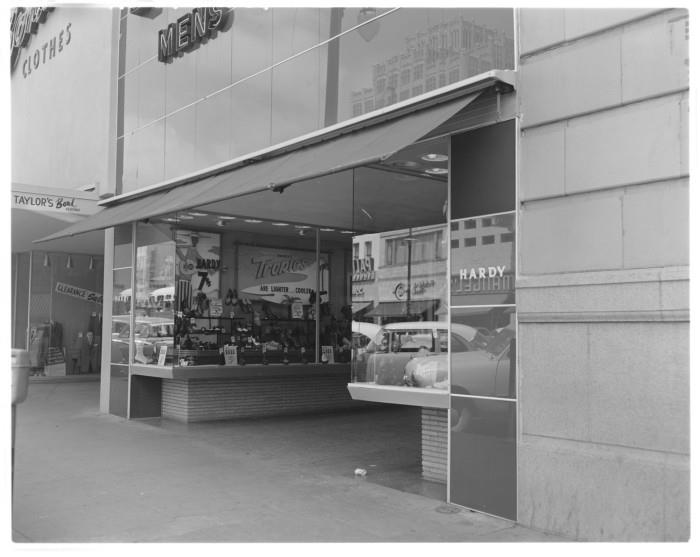
    Brewer insists, and after a few more moments of discussion, Ms. Postal acquiesces and makes the call to Dallas Police. Meanwhile, down at the Hardy Shoe Store, clerk Tommy Rowe, a good pal of nightclub owner Jack Ruby, is also putting through a call concerning a suspicious man seen entering the Texas Theater. Several additional mysterious calls will also be received by Dallas Police during this timeframe alerting them to a suspicious individual entering the theater.

    myers49Inside the movie house, manager Butch Burroughs is still working the concession stand where Lee Oswald had purchased popcorn some 15 minutes ago. Burroughs hears one of the swinging front doors opening and closing shut. However, he sees no one walking past him in the snack area. Burroughs would later explain the person almost assuredly must have climbed the stairs by the entrance to take a seat up in the balcony. Oswald, meanwhile, remains downstairs seated in the main or orchestra section of the theater.
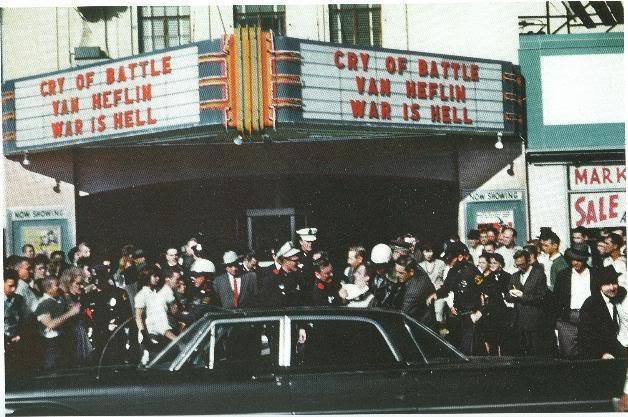
    Based on reports of a suspicious man observed at the Texas Theater, DPD will send at least 15 officers along with several vehicles to the scene. Capt. Westbrook was one of the first to arrive. “Pinky” Westbrook parked his blue unmarked police car directly out front — strange considering Westbrook told the Warren Commission someone had given him a ride out to Oak Cliff. Police will surround all theater exits while the lights are turned on and Johnny Brewer is reportedly escorted onstage by two policemen. Brewer pointed the cops to a man in the back of the theater he said was the individual he had just witnessed sneaking in without paying. Police begin to systematically work their way from front to back, asking each patron to stand up and provide ID. They are perhaps hoping the suspect might attempt to make a foolish dash for an exit. He didn’t, instead sitting coolly and calmly as the cops moved in.

    Years later, Tommy Rowe would tell family and friends that it was he who had pointed out Oswald to the officers, not Brewer. Tommy would also be the friend who moved into Jack Ruby’s apartment on Ewing after he was arrested for murdering Lee Oswald.

    When the officers get to Oswald’s row of seats, they ask the young man to stand up and show some ID. He appeared to be complying, stood up, but then yelled, “This is it!” and threw a punch at Office Nick MacDonald. MacDonald and Oswald scuffled as nearby cops jumped in. Oswald had allegedly made a move for the .38 Special S&W revolver tucked in his waistband. The cops pounded Oswald for a bit before subduing him, resulting in his infamous and much photographed swollen left eye.

    “I am not resisting arrest!” Oswald shouts as he suddenly wises up and realizes the immediate danger he might be in. “I protest this police brutality!” the suspect yells to any witnesses who might be standing nearby and watching the drama unfold.myers50

    myers51The police quickly hustled Oswald out the front doors of the old theater. A growing, unruly mob of local citizens greet them raucously under the marquee advertising the war flick matinee double feature. Detectives carry the slender suspect towards Captain Westbrook’s unmarked dark blue automobile — the one he later testifies he never drove to Oak Cliff. Curiously, Westbrook, the ranking officer in charge, instructed the detectives to throw an article of clothing over Oswald’s face to hide the ex-Marine’s identity. Why? What reason would the captain have for protecting the anonymity of a suspected cop-killer? The detectives pushed Oswald into the middle of the rear seat, piled in, and off the vehicle sped to downtown headquarters.

    Meanwhile, a far-less viewed minor drama was playing itself out upstairs in the balcony of the Texas Theater. A second young man was in the process of being arrested and brought downstairs — but this individual would be led instead out the rear exit and into the alley where additional police vehicles sat at the waiting.

    A very confused theater manager, Butch Burroughs, watched as officers now roughly escorted a second young man from the premises. That young white man, according to Burroughs, “looked almost like Oswald, like he was his brother or something.”

    Hobby store owner Bernard Haire operated Bernie’s Hobby House two doors east of the theater. When he heard the growing commotion out front, Haire went to investigate. However, Haire couldn’t see over the dense and unruly crowd, so he walked back through his store and peered into the back alley. Sure enough, the alleyway was filled with cop cars, but not much was happening there. Just when Haire was ready to return inside, one of the theater’s big rear-exit metal doors slammed open and out came some officers guiding a young white man into the back of a squad car. Haire described the man as being flushed, as if he’d just been in an altercation. The police car left, suspect securely inside. For decades, Mr. Haire believed he had witnessed the arrest of Lee Oswald.

    In 1987, when Haire accidentally learned the truth that Oswald had been taken out the front doors of the Texas Theater at the time of his arrest — photos convinced him it was true — the hobby store proprietor next asked the $64,000,000 question.

    “Well, if I didn’t see Oswald, then just who did I see?”

    We have no answer for Mr. Haire, except to mention one curious fact. No second Texas Theater arrest was ever documented. The official police report, however, describes the suspect being arrested in the balcony, while all witnesses clearly agree he was arrested downstairs in the main seating area and brought out front to Cpt. Westbrook’s waiting car.

    myers52Within two hours of the President’s death, J. Edgar Hoover already believed his FBI had the case solved. Hoover would go on the premise that JFK had been assassinated by Lee Oswald and Oswald alone, whom he called a “mean-minded individual…in the category of a nut.”
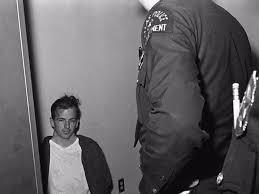
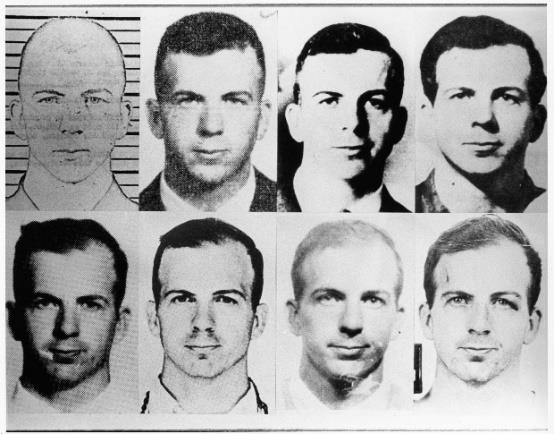
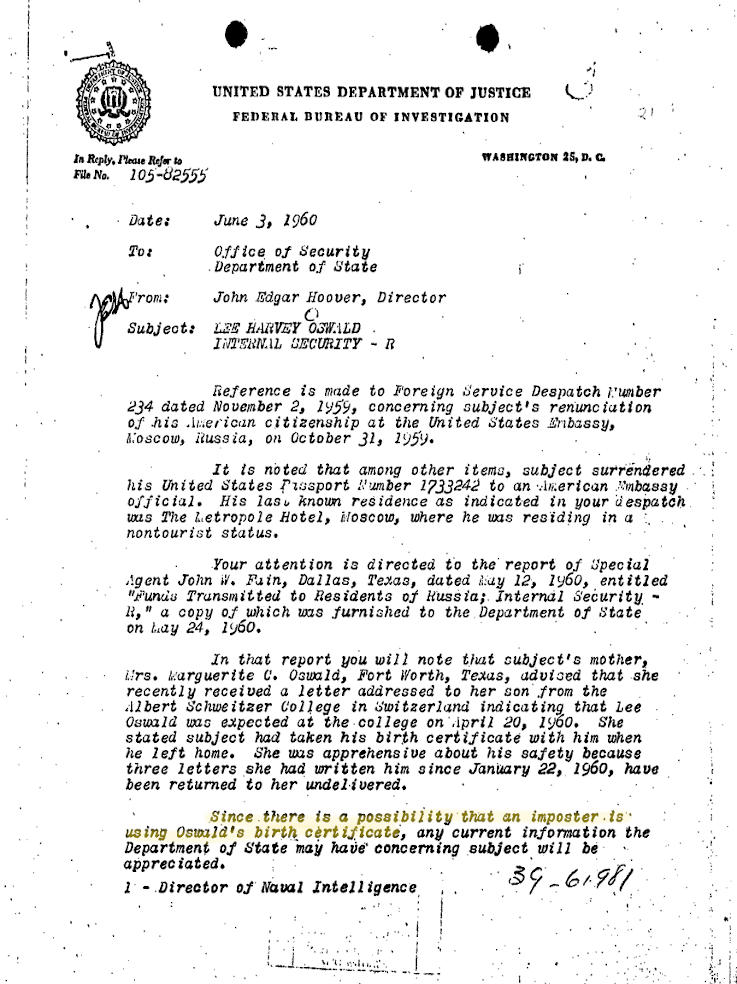
    Given the benefit of decades of hindsight, some Hoover critics might opine that the former FBI director had given a more accurate description of himself rather than the suspect in custody. Allowing for the fact that Hoover had in 1960 written a memo warning his agents that someone might be using the so-called Soviet defector’s identity back in the United States, how could Hoover have been so sure of Oswald’s guilt so quickly?

    When Oswald was killed less than 48 hours after his arrest, having never left Dallas Police Headquarters alive, Hoover dictated a memo that Sunday afternoon that read, “The thing I am so concerned about, and so is Mr. Katzenbach [Deputy Attorney General under RFK] is having something issued so we can convince the public that Oswald is the real assassin.”

    Nicholas Katzenbach wrote the following day, November 25 — as the President, Tippit, and Oswald were all being laid to rest — that “the public must be satisfied that Oswald was the assassin; that he did not have confederates who are still at large; and that evidence was such that he would have been convicted at trial.”

    President Johnson, now ensconced in the White House as the new Commander-in-Chief, was more than happy to see this “something” issued, and quickly. Thus, was born the Warren Commission and its resulting Warren Report, with its pre-determined outcome already decided before Day One of the proceedings. This is the sort of whitewash that would inevitably cook up such inconceivable nonsense such as the “magic” or single-bullet theory.

    The Warren Commission was never intended to be an investigation. Rather, it was a publicity stunt concocted to sell a bill of deceptive goods to a highly traumatized American public. The ruse succeeded, at least for a while. As they might say, it was good enough for government work.myers53

  • How Oswald Was Framed for the Murder of Tippit: Part 2

    How Oswald Was Framed for the Murder of Tippit: Part 2


    Part 2: Oswald Double and How the Weapon was Purchased

    myers20In the days, weeks, months, and perhaps even years leading up to November 22, 1963, there is no question that someone had been impersonating Lee Oswald. We have numerous instances on record of the real Oswald being in one place while many miles away a second “Oswald” was seen involved in strange and provocative behavior that would portray Oswald as being a highly dangerous and/or mentally unstable individual.

    Here is just a sampling of those inexplicable sightings of a “second” Oswald:

    • June 3, 1960 — F.B.I. Director J. Edgar Hoover wrote a memo stating that someone in the United States may be using defector Lee Oswald’s birth certificate and impersonating the ex-Marine while he is in the Soviet Union.
    • January 20, 1961 — Two men visited the Bolton Ford dealership in New Orleans and indicated their intent to purchase 10 Ford Econoline trucks for the Friends of Democratic Cuba. One of the men who identified himself as JOSEPH MOORE wrote out a bid form. Moore’s friend, who identified himself as LEE OSWALD, told the assistant manager that he would be responsible for payment.
    • November 1963 — “Oswald” walked into the Downtown Lincoln Mercury dealership to inquire about purchasing an automobile. A salesman accompanied Oswald for a test drive, during which Oswald drove at high speeds on the Stemmons Freeway, making the salesman very uneasy. Afterwards he told the salesman he wasn’t ready to buy, but would be coming into a considerable amount of money shortly. The salesman wrote down the man’s name, LEE OSWALD, for future reference.
    • November 16, 1963 — “Oswald” is seen at the Sportdrome Gun Range in Oak Cliff. He is boasting about his Italian-made carbine with its power scope to other patrons and firing at their targets, causing a scene.
    • November 20, 1963 — The real Lee Oswald was known to be a regular “coffee customer” at the Dobbs House Restaurant just a short walk from his rooming house. Lee would read a book while drinking his coffee. However, at 10 a.m. on the Wednesday before the assassination, and while the real Lee was working at the book depository, a man came in and ordered eggs. He soon began cursing at the waitress, and complaining loudly that his eggs were runny. Officer J.D. Tippit was said to have been in the restaurant at this time. The owner and several employees identified the unruly individual as Lee Harvey Oswald.myers21
    • November 22. 1963 —On the morning of the assassination, while Oswald had already reported for work at the book depository, a young man purchased two bottles of beer at the Jiffy Store on Industrial Boulevard. The store is located just a short walk from Dealey Plaza. When asked to present ID, the customer showed store clerk Fred Moore a Texas driver’s license for a Lee Oswald, birthdate October 1939. An hour later, the same individual returned to buy some peco brittle, which is a special peanut and coconut type brittle. Moore remembered the purchases because he thought the combination made for one very unusual breakfast.
    • November 22. 1963 — Just a few minutes after the assassination, Lee Oswald departed the TSBD, walked several blocks east, and boarded a city bus. A transfer issued by the driver of that bus would later be found on Oswald’s person. However, at about the same time Oswald was boarding the bus on Elm Street, more than one witness— including a deputy sheriff — saw another “Oswald” run down the Grassy Knoll next to the TSBD and jump into a light green Nash Rambler station wagon driven by a Latino man, possibly Cuban. The vehicle then headed west under the triple underpass.myers22

    Who Purchased Oswald’s .38 Revolver?

    myers23Authorities maintained that Lee Oswald had purchased the .38 Smith & Wesson pistol found in his possession when the suspect was arrested at the Texas Theater in Oak Cliff on November 22, 1963. However, there is scant proof that Oswald ever purchased that WWII-era handgun…and what measly proof offered is suspect.
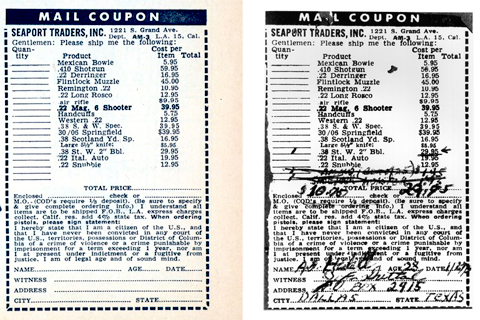
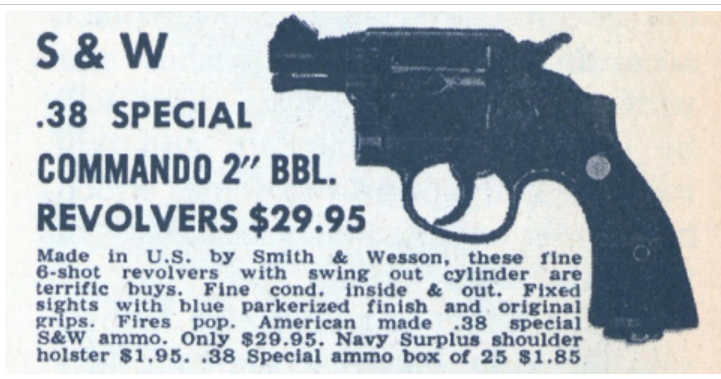
    First, if Lee Oswald had wanted to purchase a weapon for nefarious purposes, he could have simply walked into any sporting goods store or hardware store in Texas, paid cash, and walked out with an untraceable gun. In 1963 guns could even be purchased at flea markets and yard sales — no license was necessary to sell guns. The only time purchasing a gun in Texas required paperwork and left a trail of evidence was in the case of the sale of weapons though the mail. Naturally, safeguards had been put into place to prevent juveniles from ordering deadly weapons through magazines and comic books.

    Oswald allegedly ordered a .38 pistol through an advertisement placed in an April, 1963 men’s adventure magazine by Seaport Traders of Los Angeles. Oswald supposedly sent an order form and $10.00 in cash or money order to Seaport, requesting that a pistol be shipped via Railway Express Agency to Lee’s post office box registered to his name in Dallas, Box 2915. Inexplicably, the coupon order form was dated 1/27 even though the order form was not published in True Adventures until March.

    The U.S. Post Office would not handle private cargo for a private shipping company such as REA. The gun could not be shipped directly to a P.O. Box. Instead, the gun would be sent via Railway Express Agency–an early version of FedEx (Federal Express–to REA’s facility in downtown Dallas. The Dallas REA office would then send a notice by postcard to the buyer’s post office box that the package could be picked up at the REA facility.

    For this to happen, however, certain rules and regulations needed to be followed first:

    • The REA postcard had to be sent by REA to the buyer’s P.O. Box.
    • The buyer had to bring the postcard to REA’s office in Dallas.
    • The buyer had to present a certificate of good character to REA signed by a justice of the peace, county judge, or district judge from the buyer’s county of residence.
    • The buyer had to provide to REA proof of ID submitted on Form 5024 required for all pistols and small firearms.
    • The buyer had to pay the balance owed to REA.myers24

    However, is there any evidence that these rules were followed in the case of the Smith & Wesson .38 allegedly purchased by Lee Oswald? No. All that the Warren Commission provided was a copy of a receipt, not even the original. And that receipt was signed by neither Oswald nor A.J. Hidell, Oswald’s supposed alias.

    • There is no evidence REA ever sent a postcard to Oswald’s P.O. Box.
    • There is no evidence that Oswald or anyone else brought the postcard into REA.
    • There is no evidence of a certificate of good character.
    • There is no 5024 form with proof of ID.
    • There is no witness saying Oswald or anyone else picked up the pistol, or when.
    • There is no evidence of payment of the balance owed, $19.95.
    • There is no evidence of remittance of payment from REA to Seaport Traders.

    myers25Basically, there are no Department of Public Safety, police, or clerk records of Lee Oswald ever obtaining this handgun. We have no evidence of Oswald obtaining a certificate of good character from a judge or justice of the peace. Without the accused having followed any of the Texas laws on purchasing mail order firearms, how was he able to get this Smith & Wesson revolver? How is it possible nobody remembered seeing Oswald or anyone else pick up the handgun? Where’s the beef?
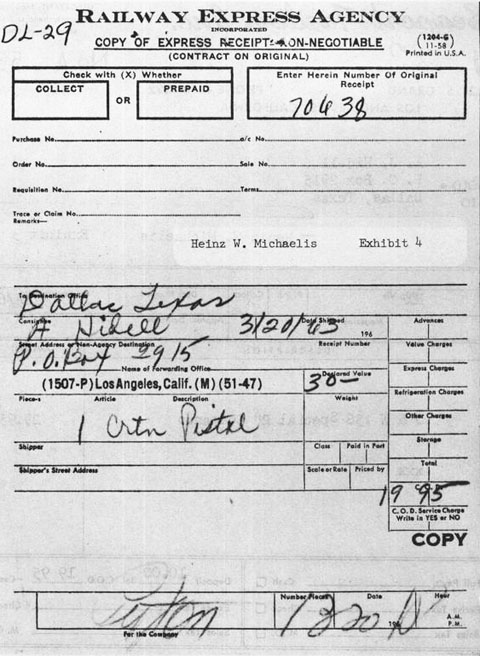
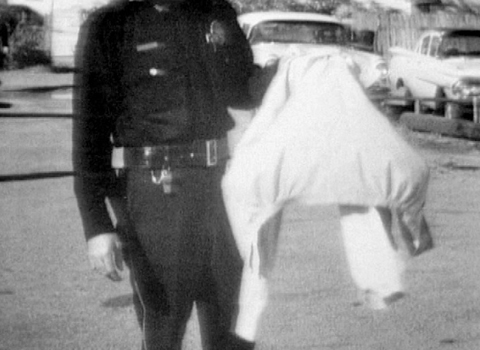
    We are supposed to believe that Oswald rented a P.O. box under his own name, sent in a coupon to Seaport Traders under the alias A.J. Hidell, had no ID or certificate of good character, and then signed the receipt using the name of Paxton or Patton ( see below). Then walked away with the gun with nobody witnessing this unlikeliest of transactions?

    It would seem rather that someone else ordered this weapon and created a paper chase to make it appear the “patsy” Lee Oswald ordered a mail order pistol through Seaport Traders.

    The evidence does not support that Lee Harvey Oswald ever purchased this gun from Seaport Traders, an accusation he denied before his untimely death at the hands of Jack Ruby in the basement parking garage of Dallas Police headquarters. The pistol apparently did wind up in his possession at the theater, but that is no proof he ordered the weapon. The origin of the S&W .38 Victory model pistol, serial number V510210, remains an unsolved mystery.myers26

    Who Stashed a Jacket Behind the Texaco?

    myers27The case against Lee Oswald having been the murderer of Officer Tippit rested partially on the notion that Oswald’s Eisenhower style light-grey jacket was found along the gunman’s escape route. However, not only did investigators fail to connect the jacket conclusively to Oswald, they also failed to connect the jacket conclusively to the individual who shot and killed Patrolman Tippit. The only piece of circumstantial evidence put forward was that Marina Oswald, Lee’s wife, said she recognized the jacket as belonging to Lee. Marina said, though, that both of Lee’s jackets had come from and were purchased in the Soviet Union. The jacket found two blocks from the Tippit crime scene was a brand that had been sold in clothing stores in Los Angeles and Philadelphia — it clearly had not originated in Russia.
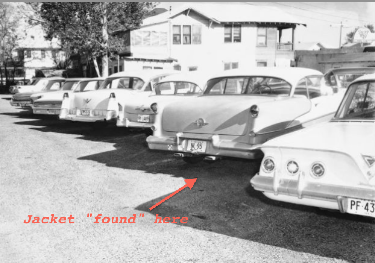
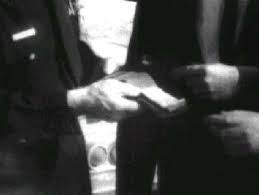
    In fact, the Eisenhower jacket is the weakest link in the government’s shaky chain of evidence against Oswald in the slaying of Officer Tippit.

    Warren Commission exhibit 162 was allegedly found partially hidden underneath a 1954 Oldsmobile in parking space 17 behind Ballew’s Texaco and service station at the corner of Jefferson Boulevard and Crawford Street. It was allegedly stashed there as the killer made good on his escape by foot. No one saw the killer put it there, however, and no one knows who found the jacket. Officially, DPD Captain William “Pinky” Westbrook was supposed to have found the jacket, but that’s not the story Westbrook told the Warren Commission in 1964. “Some officer, I feel sure it was an officer, I still can’t be positive, pointed this jacket out to me,” stated Captain Westbrook for the record. Dallas police radio logs indicate that an Officer 279 first mentions the jacket at about 1:25 p.m. — however Capt. Westbrook did not arrive on scene until 1:40 p.m. The identity of “Officer 279” remains a mystery, as does the origin of the jacket.

    The jacket was described as a light grey man’s jacket, size M (medium). Oswald weighed 130 pounds at the time of his death, and all his other clothes were men’s size small.

    Laundry marks and cleaning tags present in the jacket indicated the garment had been professionally cleaned on multiple occasions. Marina Oswald, however, claimed that she had always hand washed Lee’s jackets and other clothes. Despite their best efforts, investigators could not trace the laundry tags to any specific cleaning establishment. No evidence of professional cleaning was found on any of Lee Oswald’s other garments.

    Witnesses who saw the gunman fleeing from 10th & Patton generally disagreed the found jacket was the same as that worn by the killer. Some seven witnesses either failed to identify the jacket, or straight out said the found jacket did not match the jacket worn by Officer Tippit’s killer. Because the Tippit witness descriptions of the jacket worn by the killer were so wide-ranging, the Warren Commision was forced to officially state that “the eyewitnesses vary in their identification of the jacket.” This hardly supports a convincing identification of the garment allegedly discovered behind the Texaco station.myers28

    Authorities tried to connect the jacket to Oswald by saying some fibers found on the mystery jacket were “consistent” with the brown shirt Lee Oswald had been wearing when arrested at the Texas Theater. What those same authorities fail to mention, however, is that one of the few details the Tippit witnesses agree upon is that the gunman had been wearing a white shirt, not a brown one.

    Interestingly, the Warren Commission insisted on describing the found jacket as being light-grey, although descriptions from November 22, 1963 refer to the garment as being white. However, modern color photographs of the evidence reveal the jacket to be tan or beige.

    Effectively, the Eisenhower jacket found almost two blocks from 10th & Patton was a prosecutorial dead end. It was likely not related to the homicide. If it was, in fact, the killer’s jacket, the shooter almost certainly was not Lee Oswald. And if the jacket was Oswald’s, the possibility it was a throwdown or plant would have to be seriously considered — especially in light of a piece of astounding evidence that was revealed in 1996.

    Retired FBI agent James Hosty, the man once tasked with keeping tabs on Soviet “defector” Lee Oswald while he was in Dallas, published a book titled Assignment: Oswald. In Hosty’s retelling of events, he would release a tidbit of information that would impact the Tippit case like a bombshell. Hosty described how fellow FBI agent Bob Barrett had been present at 10th & Patton for the initial investigation of J.D. Tippit’s murder. While the scene was still being processed, Captain William Westbrook of the DPD showed Special Agent Barrett a man’s billfold and asked if he’d ever heard of a character named Alek Hidell. Agent Barrett had gone to 10th & Patton at the request of Dallas County Sheriff Bill Decker.

    Barrett told Westbrook no, he never heard of this Hidell person. And Lee Oswald? No, Barrett couldn’t remember anybody by that name either.

    Mention of this incident in Hosty’s book set off a firestorm in the JFK critical community. It had been well known that Dallas Police Detective Paul Bentley had removed a billfold from Oswald’s back pocket after the suspect’s arrest at the Texas Theater. While in custody and en route to police headquarters in the back seat of Westbrook’s unmarked police car, Oswald had famously refused to give detectives his name. Bentley, noticing that Oswald had a billfold bulging from his back pants’ pocket, reached over and removed it. Discovering ID for two separate individuals inside the billfold, Bentley asked the suspect if he was Alex Hidell or Lee Oswald.

    “You’re the detective,” Oswald had reportedly replied defiantly: “You figure it out.”

    Detective Gerald Hill later testified to the Warren Commission regarding this incident. Officially, Oswald’s wallet had been taken from his person after his arrest. So how could his wallet possibly have been found at the Tippit murder scene?

    myers29Dallas Police officials tried to explain the anomaly by saying that after the passage of so many years, Agent Barrett’s memory must have become muddled. Barrett saw the wallet at police headquarters, not at Oak Cliff. The retired FBI agent was simply mistaken. The official police report on Tippit’s murder made no mention of any billfold being discovered at 10th & Patton.
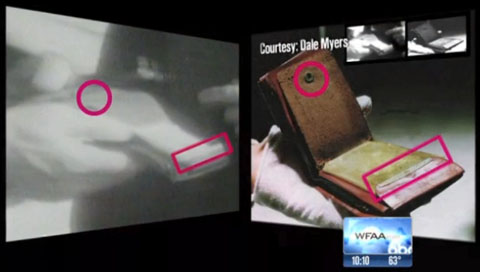
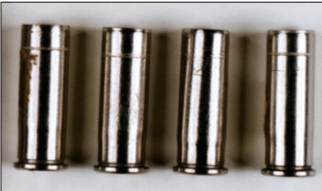
    ‘Why would they be asking me questions about Oswald and Hidell if it wasn’t in that wallet?’ an angry Bob Barrett observed. “They said they took the wallet out of his pocket in the car? That’s so much hogwash,” Barrett fumed. “That wallet was in [Captain] Westbrook’s hand.”

    A check of raw news footage from that day proved retired Agent Barrett’s version of events to have been accurate and truthful. There, in black & white, Westbrook could clearly be seen handling a man’s wallet and showing it to other law enforcement personnel. Could the wallet have been Officer Tippit’s wallet? Absolutely not. Tippit’s wallet was black, the wrong color, and was still on his person when the deceased’s body was transported to Methodist Hospital.

    Lieutenant Kenneth Croy, the reserve Dallas cop who had appeared so quickly on scene after Tippit’s slaying, was also still alive in 1996 when the wallet controversy first erupted. Asked about the alleged Oswald wallet, Croy explained that yes, someone in the growing crowd had handed him a wallet, which he later turned over to Captain Westbrook. Croy failed, however, to get the name of the individual who had supposedly discovered and handed him the wallet. Croy, in fact, had failed to record anything that day, for despite being the first policeman to have arrived on scene at the murder of a fellow officer, Croy neglected to even file a report.

    When testifying before the Warren Commission, Lt. Croy said he knew and recognized several of the officers who were present at the scene that afternoon — but he couldn’t remember the name of any of them, not one. The mystery wallet was never listed in Captain Westbrook’s report. After being shown to Agent Barrett and others at the Tippit scene, the billfold simply disappeared. Once Oswald’s wallet had been taken from his person upon arrest, the second Oswald wallet had to disappear. Two Oswald wallets that day were simply one too many.

    Before his death, Dallas Police Sergeant Leonard Jez was asked to comment on the presence of Oswald’s wallet at 10th & Patton. Jez had been one of several officers officially present at 10th & Patton, and whom Lt. Croy could not recall. Jez verified the existence of the wallet at the murder scene, he had seen it with his own eyes

    “Don’t let anybody bamboozle you,” stated Jez flatly. “That was Oswald’s wallet.”

    Photographic comparisons between the wallet in the news footage and Oswald’s wallet stored in the National Archives proves they are similar in style but in fact undoubtedly two separate wallets.

    So, if the second Oswald wallet that mysteriously appeared and then disappeared on E. 10th street was very likely a plant or thrown down, and if the dubious grey/white/tan Oswald jacket found by a person or persons unknown behind Ballew’s Texaco was possibly a throw down…is it possible any other evidence left at the Tippit murder scene was not what it appeared to be? To find out, dear reader, keep on reading…myers30

    Why Did the Killer Leave Four Empty Shells Behind?

    myers31Of all the pieces of evidence the authorities claimed to have against Lee Oswald in the murder of Officer Tippit, the four hulls or shells were by far the most probative. The forensic examination of the .38 caliber cartridge cases found at the scene of the shooting determined them to have been fired from the revolver in Oswald’s possession to the exclusion of all other weapons.
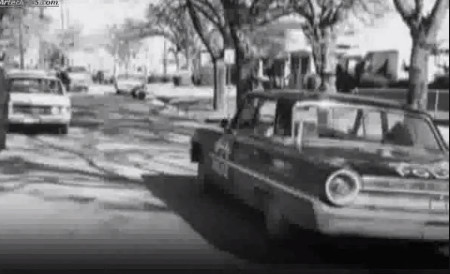
    Oswald had that pistol on his person in the darkness of the Texas Theater less than a mile from the Tippit murder. Had Lee Oswald lived to stand trial, how could any defense attorney possibly have explained that fact away? TO THE EXCLUSION OF ALL OTHER WEAPONS.

    Apologists for the Warren Commission Report who continue to believe that Lee Oswald committed these murders will often bend regarding the other points of evidence against the accused:

    • Yes, eyewitness testimony is often unreliable, especially if suspect Oswald had a so-called double.
    • Undoubtedly the paperwork linking Oswald to the .38 Smith & Wesson was flimsy and incomplete at best.
    • For sure the finding, chain of custody, and identification regarding the alleged Oswald jacket was dubious.

    But the shells, found at 10th & Patton, matching the pistol in Oswald’s possession to the exclusion of all other pistols? That sounds like slam dunk, case closed, throw the book at Oswald type of evidence.

    Maybe, but not so fast…

    Now, believers in Oswald’s innocence have offered several various scenarios to explain away the ballistics match to Oswald’s Smith & Wesson .38:

    • Tippit was killed by at least one, and possibly two killers armed with automatic pistol, not revolvers. This was why initial police reports described the suspect as being armed with an automatic, not a revolver.
    • The Dallas Police Department later switched the shells before handing them over to the FBI for closer inspection.
    • Captain Westbrook, once back at his desk at police headquarters, later switched the killer’s pistol for Oswald’s pistol.

    I don’t believe any of these things happened. Oswald was already framed for the Tippit murder by the time the killer disappeared somewhere behind Ballew’s Texaco. The wallet, the shells, the jacket…they all spelled game, set, and match for the blaming of the patsy.

    myers32The killer of J.D. Tippit and the conspirators who plotted to assassinate JFK framed Oswald. Oh yes, the four shells recovered from along the corner house at 10th & Patton were most definitely fired from Oswald’s gun…which at the time of Tippit’s slaying was in Oswald’s possession at the movie theater. The plan was ingenious and has gone undetected until now — nearly 60 years later. We might all agree that 60 years was more than good enough for government work. As it was, the patsy Oswald didn’t even last 60 hours.
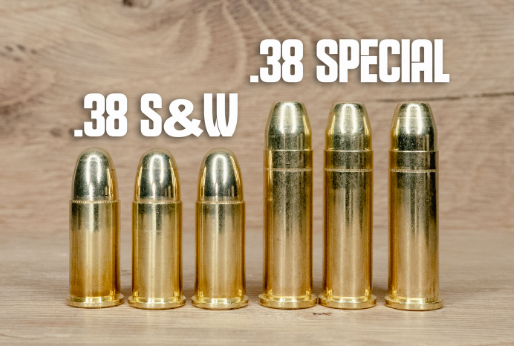
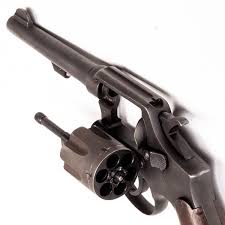
    The secret to the frameup lies in the special type of revolver given to patsy Oswald — and used by the professional assassin who ended Officer Tippit’s life, as Helen Markham so aptly described, “in the wink of your eye.” Oh, these guns were nothing outwardly special…World War II surplus models purchased for $29.95 apiece. But they featured one unusual characteristic that made the frameup work. These revolvers, actually the entire lot of some 500 of them, were modified and rechambered for sale back in the United States. It was the use of rechambered .38 revolvers that made the simple but effective Oak Cliff deception possible.

    The Smith & Wesson .38 “Victory” model was manufactured in the U.S. for homeland defense use during World War II. The handgun found on suspect Oswald was part of a shipment originally sent to Great Britain. Luckily, though the Nazis did considerable damage by dropping bombs and missiles on our island nation ally, they were never able to mount a troop invasion across the English Channel. So, the .38 Victory models remained in storage in Britain for the duration of the war. Many years later, an enterprising sporting goods company repurchased the war surplus weapons and reimported them back home to America.

    Post WWII a newer type of ammunition was becoming popular and in increasing demand for use with .38 revolvers. Known as the .38 special round, the new ammo had more proven stopping power than the traditional .38 S&W bullets. By comparison, the .38 specials were much longer than the .38 regular ammo (which became known as .38 shorts)…but the .38 special cartridges were also slightly thinner or smaller in diameter than the .38 S&W “short” ammo.

    As the .38 special ammo became more widely used by police and military units, civilian gun owners also started to favor the newer ammo that packed a bigger punch.myers33

    Therefore, to make these reimported old revolvers more marketable to the public, the seller had a gunsmith (L.M. Johnson of Van Nuys, CA) make certain modifications to the weapons. First, the barrels of these handguns were cut down from 5 inches to 2¼ inches, making them “snub nose” revolvers for easier concealment. Second, the revolvers were “rechambered” by having the old cylinders swapped out for new cylinders designed to accept the more popular .38 special ammo with more stopping power — but also with slightly different dimensions.

    However, since the .38 special bullets are only slightly narrower than the standard .38 S&W cartridges, the guns were never re-barreled. This left the barrels for these handguns slightly oversized for the new ammo being used. Again, close enough for government work!

    These modified guns functioned just fine and were well suited and modestly priced for someone looking for a handy, dependable self-defense weapon. But the slightly oversized and shortened barrel left the revolvers with one highly unusual characteristic — as the slugs were fired and traveled through the barrel, they each took an “erratic” passage. Basically, the slugs would wobble slightly and would not contact the barrel the same way each time the weapon was discharged. The result? The oversized barrel would impress upon the lead bullets inconsistent individual microscopic characteristics. This made identification of a specific revolver that fired a specific bullet impossible once the weapon had been rechambered in this way.

    In the words of the HSCA firearms panel tasked with examining the Oswald revolver against the four lead slugs taken from Officer Tippit’s body, the panel found that, “Due to the inconsistent markings on the recovered bullets and on all the test-fired bullets, the panel concluded that the CE 602 through CE 605 bullets (the slugs recovered from Tippit’s body) could not be conclusively identified or eliminated as having been fired from the CE 143 revolver (the handgun allegedly in Oswald’s possession at the Texas Theater).”

    Had Lee Oswald been carrying a revolver that had not been modified and rechambered, then the four bullets taken from J.D. Tippit’s body would likely have been either positively matched or positively eliminated as having been fired from the gun allegedly in Oswald’s possession.

    But wait…didn’t the killer so conveniently leave four shells at the scene of the murder? Why yes, he did! But wait again, only automatic pistols eject the empty shells as the weapon is fired. Shells from a revolver such as the S&W .38 special must be manually unloaded — which is exactly what witnesses at the scene said the killer did.

    When Detective Gerald Hill arrived at 10th & Patton and heard that several shells had been recovered by witnesses, he logically assumed the killer had been armed with an automatic which had ejected the shells. Had Hill personally inspected the shells, he would have seen they were labeled .38 SPL and had come instead from a revolver. But who murders a cop and then stops mid-flight to dispense highly incriminating shells? It made absolutely no sense.

    “Now there’s a dumb crook,” quipped Texas JFK researcher Jim Marrs.

    Was the killer just plain crazy…or crazy like a fox?

    At approximately 1:40 p.m. Hill radioed the following message…“The shell found out the scene (of the shooting) indicates that the suspect is armed with — an automatic .38 rather than a pistol.”myers34

    This incorrect broadcast has fueled speculation for years that Tippit was slain with an automatic pistol or pistols. But the slugs recovered from his body — and the shells dropped at the scene — indicate otherwise. Something else was afoot.

    Patrolman J.M. Poe caused a bit of a stir with his testimony before the Warren Commission when he stated he could not find the ID marks he had allegedly placed on two of the shells (hulls) recovered at 10th & Patton by witness Domingo Benavides. This led some critics to surmise that the shells had been switched. But under direct examination, Poe hesitated to definitively confirm that he had marked those two shells. “I couldn’t swear to it, no sir.” Later, in an interview granted to JFK researcher Joseph McBride, Detective Jim Leavelle, who headed up the Tippit investigation, scoffed at the idea Poe had ever marked the shells. “Actually, they never marked ‘em. There wasn’t no point in it. We don’t mark’em.”

    Leavelle, who was the homicide detective wearing the Stetson and handcuffed to Oswald when he was shot by Ruby, admitted the ballistics on the Tippit case were frankly “a mess.”

    Rep. Hale Boggs from Louisiana, the youngest member of the Warren Commission, became so frustrated with the ballistics in the Tippit case that he asked directly, “What proof do you have that these are the bullets?” Apparently, Boggs never received a satisfactory answer.

    Yes, Tippit’s killer and the conspirators behind him had been clever, but perhaps a tad too clever for their own good. You see, the cartridge cases — two Western-Winchester and two Remington–Peters — did not match up with the fatal bullets— which were three Western-Winchester and only one Remington-Peters. “The last time I looked,” noted Jim Garrison wryly, “the Remington–Peters Manufacturing Company was not in the habit of slipping Winchester bullets into its cartridges, nor was the Winchester–Western Manufacturing Company putting Remington bullets into its cartridges.”

    It is important to note that the HSCA firearms panel found the components (recovered shells and slugs) of these cartridges were all consistent withfactory loaded ammunition. There should have been no discrepancy (2-2 vs. 3-1) between the shells and the fatal lead slugs. This was not home-loaded ammo. Something was clearly wrong.

    The panel tried to explain this show-stopping mismatch by offering the following two solutions:

    1. One Western-Winchester cartridge case was not recovered or is missing, and one Remington-Peters lead bullet missed Officer Tippit and also was not recovered.
    2. One Western cartridge case was not recovered or is missing, and one fired Remington-Peters cartridge case was in the revolver prior to the Tippit shooting.

    Since the escape route of the gunman was witnessed by several people, it seems hard to believe that a shell would have gone unrecovered along such a narrow pathway. And as far as a possible fifth shot was concerned, that idea was largely unsupported by the earwitness testimony.

    The witnesses within direct earshot of the murder, along E. 10th Street, all heard between two and four shots. That the shots were fired in such quick succession probably meant that some witnesses perceived multiple adjacent loud reports as a single gunshot.

    myers35Warren Reynolds, located relatively far to the south of E 10th across Jefferson Boulevard, thought he heard maybe four, five, or possibly even six shots. Ted Callaway, located closer to E. 10th just off Patton Avenue, thought he heard five shots. These “earwitnesses” however, would have been blocked from directly hearing the gunshots by the houses situated at 400, 404, and 410 E. 10th. What Messrs. Callaway and Reynolds likely confused with additional shots were echoes bouncing off surrounding structures.
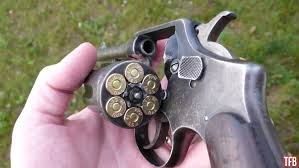
    Even the HSCA firearms panel agreed these two theories were speculation, not supported by the available evidence. The available evidence indicates four shots. If only four shots were fired, and the slugs and shells do not match, then Lee Oswald’s handgun did not kill Officer Tippit. Someone else with some other gun did.

    But the shells…they were proven to have been fired from “Oswald’s” gun to the exclusion of all other weapons!

    Yes, they were. But the shells weren’t fired at 10th & Patton, or from the handgun that killed Officer Tippit. They were fired sometime before November 22 — before the revolver was in all probability given to Oswald by those involved in the plot. Recall, there is no proof Oswald ever picked up that weapon. Which happens to correspond to the DPD issue.

    myers36The shells that held the bullets that killed J.D. Tippit remained in the handgun that the killer carried with him as he made his escape from 10th & Patton. That’s why the shells left on the ground didn’t match the bullets in Tippit’s body. The conspirators, in their zeal to frame Oswald with slam dunk evidence, decided to mix the ammo in an exotic blend of Remington-Peters and Western cartridges. They were going for a 360° windmill slam dunk. Only problem was, while the killer counted out the correct number of shells — four — in the excitement he got the exact brand mixture wrong.
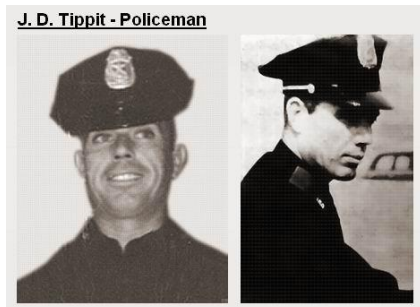
    There’s a time-tested adage concerning the successful completion of difficult tasks…KISS. Keep it simple, stupid. Had the conspirators stayed with all Western or all Remington-Peters cartridges, this colossal mistake would never have been made. Oswald had no ammo amongst his possessions, and no gun-cleaning paraphernalia. The idea of framing him with mixed ammo was really an overreach.

    The conspirators purchased at least two Smith & Wesson 38 Special Commando snub-nose revolvers from Seaport Traders and created a paper chase leading to the Oswald-Hidell P.O. Box for one of them. Same manufacturer, same lot, same modifications, same gunsmith. Wallet, shells, jacket…game, set, and match.

    Only rechambered revolvers would have filled the bill. Had it never been modified, the “Oswald” gun could have been excluded from firing the bullets that killed Tippit, based on the unique microscopic characteristics each gun barrel leaves on each bullet. But with a rechambered gun, the “Oswald” gun could neither be identified nor excluded as the murder weapon. It could only be characterized as being “consistent” with having fired the fatal shots.

    The shells, which contained unique breach face marks and firing pin marks, conclusively linked “Oswald’s” revolver to the shooting — even though the weapon was most of a mile away when Tippit was murdered, stuffed in Lee Oswald’s waistband as he ate popcorn purchased from Texas Theater manager Butch Burroughs.

    Knocking empty shells out of a Smith & Wesson revolver is not that difficult of a task. The killer basically overplayed his hand. Each cylinder comes with a hand ejector, a small rod which, when depressed, releases all the shells at once from the open cylinder. According to one write-up on the Victory model Smith & Wesson .38, you “press the cylinder release forward, swing out the cylinder and load six rounds of fun into the cylinder. When done, you again release the cylinder; tilt the gun to the rear, press the cylinder rod down and the extractor will do the rest.”

    The empty shells should all fall into your hand. Tippit’s killer made a show of “unloading and reloading” as the Tippit witnesses described. And instead of leaving a pile of empty shells, the killer tossed them one-by-one along a path like so many Reese’s Pieces candy in Steven Spielberg’s hit movie ET. The murder was scripted, and the witnesses (and later the investigators) entirely bought the killer’s deft but simple sleight-of-hand.

    • From witness Domingo Benavides: Then I seen the man turn and walk back to the sidewalk and go on the sidewalk and he walked maybe five foot and then kind of stalled. He didn’t exactly stop. And he threw one shell and must have took five or six more steps and threw the other shell up, and then he kind of stepped up to a pretty good trot going around the corner.
    • From witness Sam Guinyard: He came through there (the hedges at 400 E. 10th along Patton Ave.) running and knocking empty shells out of his pistol…he was rolling them with his hand — with his thumb…checking them, he had his pistol up like this [indicating].
    • From witness Virginia Davis:Oswald carefully left the shells for me to find.

    myers37When the Smith and Wesson .38 Special revolver allegedly in Oswald’s possession in the theater was checked, it contained four live .38 rounds — two Western-Winchester cartridges and two Remington-Peters cartridges. If Oswald had been the shooter at 10th & Patton, and had reloaded, shouldn’t the revolver have contained six cartridges, not four? And had Oswald been the shooter and hadn’t reloaded, shouldn’t the revolver have contained only two cartridges?
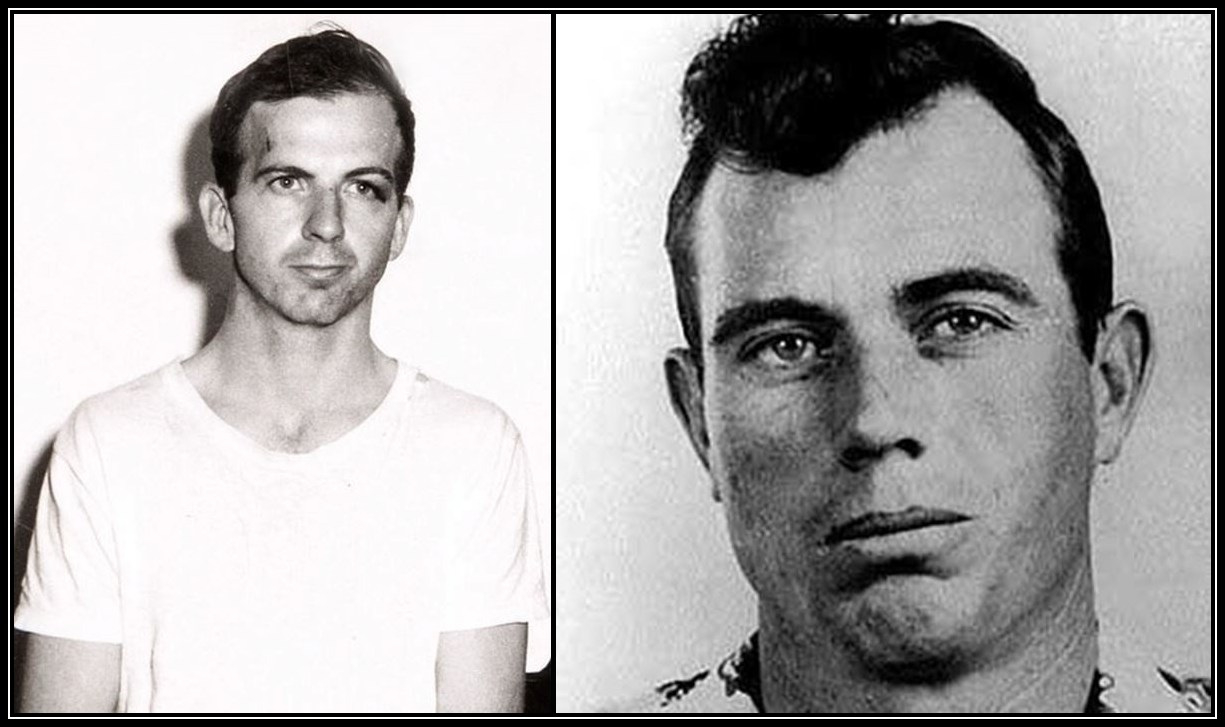
    The suspect was officially taken into custody at the Texas Theater at 1:51 p.m. and brought into police headquarters at about 2 p.m. Oswald was soon after ushered into Captain Will Fritz’s office for the first of several interrogations by Fritz and other law enforcement officials. Then, sometime after 4 p.m., suspect Oswald was brought down to the basement assembly room for his first lineup. It was at this time that Dallas officers supposedly searched Oswald and, surprise, surprise, found five additional Western-Winchester .38 Special live rounds in his trousers pocket.

    Not long ago I reached out to Frank Griffin, author of the book Touched by Fire. Griffin was a young man in 1963 who, from his vantage point at 10th & Denver, heard the shots nearly a block away that took Officer Tippit’s life. Griffin stepped quickly onto the sidewalk, glanced to the west, and spotted Tippit’s killer walking away from the patrol car and escaping south on Patton Avenue. Griffin maintains that he was able to identify Oswald as the shooter even though he was at least 300 feet away and Griffin never saw the killer from the front. “I had exceptional vision,” Griffin explained, and was a crack shot in the military. Well, at that same age, I was a fit, competitive runner who had completed the open mile at the Junior Olympics in just over 4 minutes and 20 seconds. Had I finished the mile in just over 2 minutes and 20 seconds, I would have not been human — I would have been a horse. And if Frank Griffin or anyone else can make a positive identification on a stranger at 300 feet or farther, they aren’t human either — they must be an eagle.

    Was Frank Griffin not telling the truth? No, not really. Not at all, in fact. That is how the human mind works. Our memory is not like some videotape that can be endlessly played back, over and over, such as the Zapruder film. Instead, our minds tend to edit and distort memories over time. Mr. Griffin’s mind, and other folks’ minds, have taken the repeated image of Lee Oswald and, over the months and years, superimposed it on the memory of the figure they saw for but a moment the day JFK and Officer Tippit were killed. It is called by some the power of suggestion, and it is a force that is wholly underestimated by most.

    I did ask Frank one more important question. While too far to have positively ID’d Tippit’s killer, Mr. Griffin was still standing in a direct line of sight (and sound) from the incident. So, I asked Griffin how many pistol shots he had heard.

    “Four,” was the witness’s reply. “I clearly heard four shots.”

    And if Franklin (Frank) Griffin is correct, and he heard four and only four pistol shots on E 10th Street that day, then Lee Oswald is very clearly innocent of the murder of Officer J.D. Tippit.

  • How Oswald Was Framed for the Murder of Tippit

    How Oswald Was Framed for the Murder of Tippit


    Introduction

    myers01On Friday November 22, 1963, a pair of mysterious murders were committed in the city of Dallas, Texas. At 12:30 p.m. President John F. Kennedy was assassinated as he rode in an open motorcade through Dealey Plaza on his way to give a speech at the Dallas Trade Mart. Some 35-45 minutes later, Dallas patrolman J.D. Tippit was fatally shot on a residential block of Oak Cliff, an inner ring suburb located just across the Trinity River from Dealey Plaza and the downtown area. Authorities would quickly charge 24-year-old Lee Harvey Oswald, an ex-Marine and employee of the Texas School Book Depository in Dealey Plaza, with both murders. After his arrest in Oak Cliff’s Texas Theater, Oswald would vociferously maintain his innocence until his own baffling homicide at the hands of nightclub owner Jack Ruby just two days later — nationally televised in the basement parking garage of the Dallas Police Headquarters.
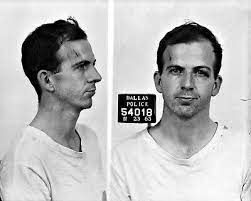
    The horrific events of that unforgettable weekend would shake our nation to its core and usher in the rest of what would arguably be the most tumultuous and pivotal decade in American history. Sixty years later, the festering, burning question remains…did Oswald do it? Dallas Police and the Dallas District Attorney’s office were fully preparing to try Lee Oswald and Oswald alone for the crimes. After the suspect’s murder while in police custody, the subsequent Warren Commission, empaneled by incoming President Lyndon Johnson, found in the following year that Lee Oswald alone had murdered both President Kennedy and Officer Tippit with no assistance from any accomplices…foreign or domestic.

    During the 1970s, as public doubts about the veracity of the so-called Warren Report grew, Congress decided to take a second look at the controversial, problem-filled case. After having been locked away in a vault for some 11+ years, a copy of the “Zapruder” home movie of the assassination was finally shown in 1975 on ABCs’ Good Night America to a shocked national audience. Rumors of shots being fired from the legendary “Grassy Knoll” to the front of the Presidential limousine had persisted since the day of the assassination. Now, as citizens watched the home movie footage on TV for the first time, they could clearly see for themselves the President’s head being thrown violently back and to the left. The Zapruder film seemed to plainly indicate that one or more of the shots had come from the front. Not solely from the rear and the Texas School Book Depository where Lee Oswald had allegedly fired a cheap, misaligned World War II surplus rifle from the sixth floor. As a result of the political pressure that ensued, the House Select Committee on Assassinations (HSCA) was convened in 1976 to study the JFK assassination…as well as the murder of Martin Luther King, Jr.

    The conclusion of the HSCA members and their investigation was that there had been a “probable conspiracy” in the JFK assassination. But they were unable to determine its nature or participants (other than that Oswald was still deemed to have fired all the successful shots). Regarding Tippit, the HSCA still believed that Lee Oswald had gunned down the officer near 10th & Patton in Oak Cliff. This was likely because of the appearance of a new Tippit witness, Jack Tatum, whose testimony helped to bolster the heavily damaged credibility of the Warren Commission’s star witness in the Tippit case, waitress Helen Markham.

    In the years immediately following the assassination, some 87% of the American public believed that Lee Oswald had acted alone. Today, over 60% believe that JFK and Officer Tippit were killed as part of a conspiracy. As more details and statements have been released in the new millennium, a growing number of citizens, though still a minority, have come to believe that Lee Oswald was being truthful when he claimed he hadn’t shot anyone that day — that the New Orleans-born young man was “just a patsy” in this unthinkable national nightmare.

    myers02So, what reasons did the government offer for naming Lee Oswald as the killer of Officer Tippit? The official case against Oswald rested on the following:
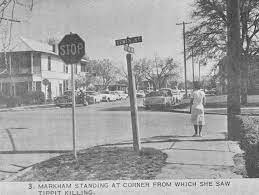
    1. Two eyewitnesses saw the Tippit shooting. Seven more witnesses heard the shots and saw the killer fleeing the Tippit murder scene with gun in hand. All nine witnesses positively identified Lee Harvey Oswald as the man they saw.
    2. A .38 Smith & Wesson revolver was purchased by Oswald and was in his possession at the time of the suspect’s arrest in the Texas Theater in Oak Cliff — less than a mile from the location where Tippit was slain.
    3. Lee Oswald’s “Eisenhower” style jacket was found along the path of the gunman’s flight.
    4. The four .38 caliber cartridge cases (shells) found at the scene of the Tippit shooting were fired from the revolver in Oswald’s possession to the exclusion of all other weapons.

    This article will deal with each accusation and show how the preponderance of evidence now points to the probable innocence of Lee Oswald in the murder of Officer Tippit.

    Part 1: The Witnesses

    The eyewitness testimony against Lee Oswald for the murder of JD Tippit was never as strong nor as solid as the authorities led the public to believe. As Tippit researcher and author Joseph McBride has so cogently stated, “the eyewitness evidence is so contradictory that it seems as though there were two sets of witnesses” at 10th & Patton in Oak Cliff on November 22. 1963. One set of witnesses, those who got to testify for the Warren Commission and later HSCA, said Lee Oswald was the man they saw at or near the Tippit murder scene with a gun. However, witnesses who were largely ignored by Dallas Police and the later subsequent federal investigations told an entirely different story. These individuals saw at least two suspicious men escaping the scene of the murder, with none of those persons being positively identified as Oswald.

    myers03To further complicate matters, there is a wealth of evidence to suggest that for weeks, perhaps even months prior to the murders of President Kennedy and Officer Tippit, an Oswald lookalike had been impersonating the ex-Marine in a concerted effort to draw attention to Oswald — to portray him as an unbalanced and highly dangerous individual. So, when witnesses claimed to have briefly seen suspect Oswald with a handgun in the vicinity of the Tippit murder, it is unclear whether they saw the real Lee Oswald, his well-documented and often-seen imposter, or someone else entirely.
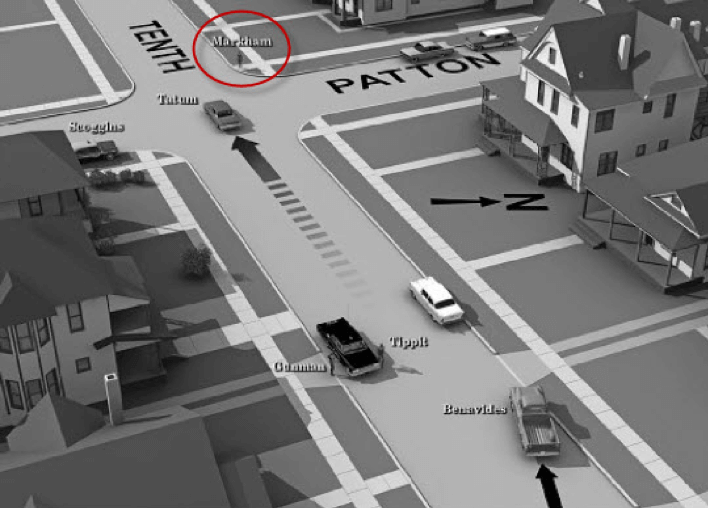
    New Orleans District Attorney Jim Garrison, one of Lee Oswald’s earliest and most vociferous defenders, had long believed that the plot to kill Kennedy had been hatched in his city during the summer of 1963, and investigated accordingly. In October 1967, Mr. Garrison granted an interview to Playboy Magazine, during which he noted, “The evidence we’ve uncovered leads us to suspect that two men, neither of whom was Oswald, were the real murderers of Tippit.”

    After DA Garrison’s interview hit the newsstands, the magazine received the following anonymous letter from Dallas:

    I read Playboy’s Garrison interview with perhaps more interest than most readers. I was an eyewitness to the shooting of policeman Tippit in Dallas on the afternoon President Kennedy was murdered. I saw two men, neither of them resembling the pictures I later saw of Lee Harvey Oswald, shoot Tippit and run off in opposite directions. There were at least half a dozen other people who witnessed this. My wife convinced me that I should say nothing, since there were other eyewitnesses. Her advice and my cowardice undoubtedly have prolonged my life — or at least allowed me now to tell the true story…”

    In my July 8, 2019 article Why Officer Tippit Stopped His Killer published on this web site I went into considerable detail in explaining the difficulties presented by the witness testimony in the Tippit case. For the sake of brevity, I will only summarize my findings here. The devil, of course, is often in the details, and so interested readers should go to this article.

    First, it should be realized that many misidentifications have contributed to reversals eyewitness misidentification overwhelming majority of wrongful convictions, later overturned by post-conviction DNA testing. According to one peer-reviewed scientific study cited by the Innocence Project,the ability to correctly identify a suspect in a crime drops off dramatically once the witness’s location is 25 or more feet from the subject. After 25 feet, facial perception diminishes, and diminishes rapidly.At about 150 feet, accurate face identification for people with normal vision drops to zero.myers04

    Domingo Benavides

    The only witness who was possibly within 25 feet of the Tippit shooting was Domingo Benavides, a young man driving west on E. 10th Street in a pickup truck. Benavides saw Tippit talking to a young man across the hood of his patrol car. As Benavides was almost even with the stopped police car and preparing to pass, he heard three close by gunshots. Benavides ducked down behind his dashboard, turned his truck into the far curb, and hid out of sight for several seconds. He did not actually see the shooting. When Benavides finally peeked over his dashboard, he observed the killer walking west towards Patton Avenue. Benavides waited until the killer was well out of view before exiting his vehicle and checking on Officer Tippit. Tippit appeared to be deceased. Benavides would retrieve two shells discarded by the killer who had cut across the lawn on the corner property and fled south on Patton Avenue. Benavides told police he could not identify the shooter because the witness basically only saw the suspect from behind as he escaped. Benavides did not participate in any of the downtown lineups. The witness did note, however, that the suspect had a squared off haircut that ended on the back of the neck above the “Eisenhower” jacket. Photographs from that day clearly show that Oswald’s hair was tapered in the back and would have extended below the neckline on a similar jacket as seen.

    Helen Markham

    Helen Markham was the so-called “star” witness in the Tippit case as she was the only witness on the day of the murder to claim having seen the actual shooting. Mrs. Markham is “legendary” in this case because her testimony and statements were so confused, contradictory, and downright bizarre. Markham had been walking south on Patton Avenue — on her way to catch a bus on Jefferson Boulevard that would take her to her waitressing job in downtown Dallas. The witness said she saw a man walking east on 10th Street who was soon stopped by a police officer in a patrol car. The two spoke briefly through the car window. Then the officer climbed slowly out of his car to question the man further. Just as Tippit neared the front of his car on the driver side, the killer pulled a handgun concealed under his jacket and shot the policeman several times across the car’s hood “in the wink of your eye.”

    Critics of Helen Markham, and there are many, have noted an abundance of blatant mistakes in her story. Markham was the only witness who saw the killer walking east, while the other people along 10th Street saw the killer walking west. Markham said the killer leaned into Tippit’s open passenger window, however only the vent window was cracked open. Most strangely, the witness says she was alone with the officer for a full 20 minutes before help came, and that Tippit had tried to hold a conversation with her while he lay dying. All other witness testimony and medical evidence indicates the policeman was likely dead before he hit the ground. As for the killer’s escape, only Markham saw him run down the alleyway between E. 10th and Jefferson Boulevard. All other witnesses clearly said the killer ran past the alley and fled west on Jefferson Boulevard.

    myers05Several of the Warren Commission’s lawyers told their bosses that it would be a mistake to use Markham’s confusing rendition of events.
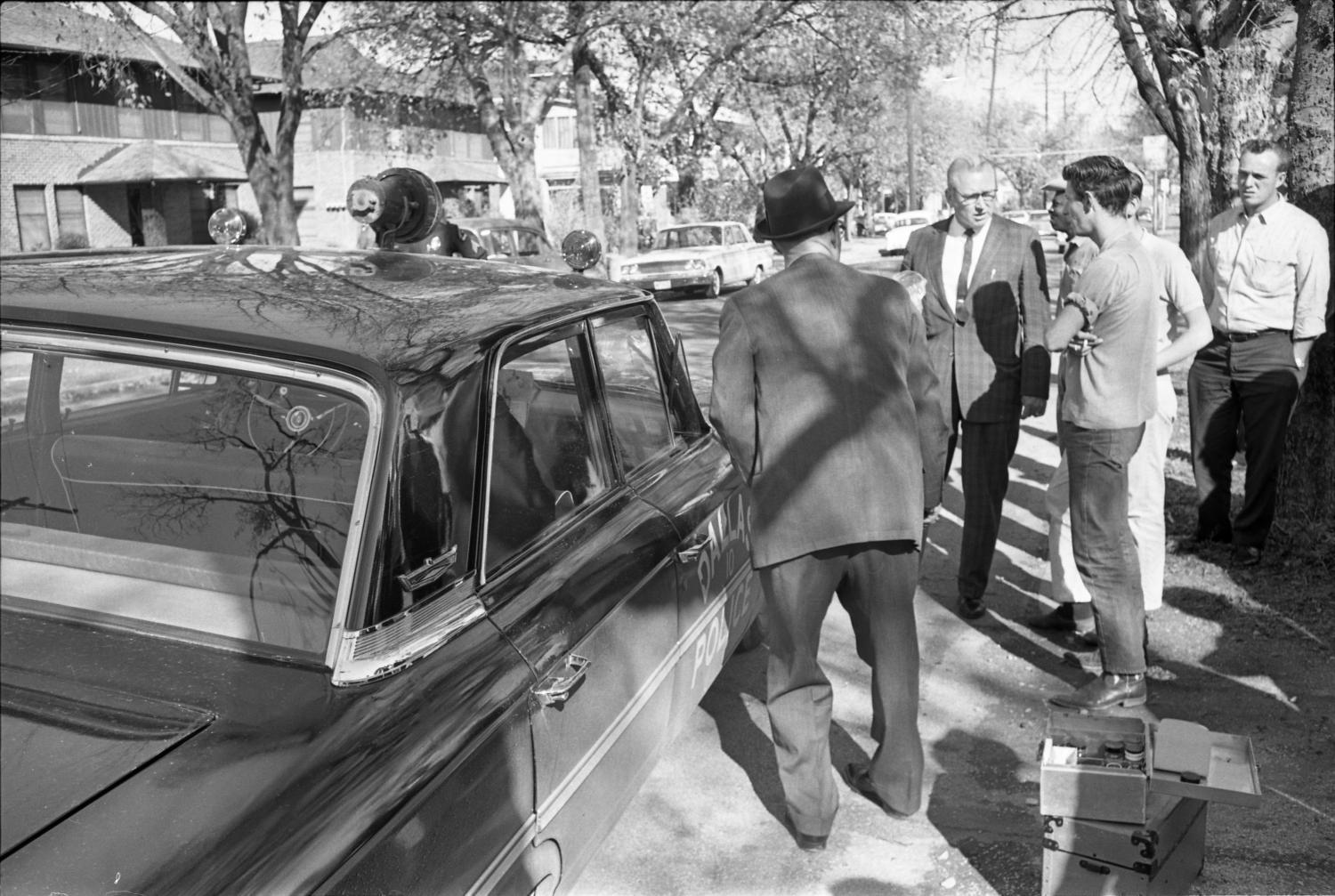
    “Contradictory and worthless” was the description given by Assistant Warren Counsel Wesley Libeler regarding Mrs. Markham’s testimony. “The Commission wants to believe Mrs. Markham and that’s all there is to it,” added staff member Norman Redlich.

    “She’s an utter screwball,” remarked Counsel Joseph Ball.

    Markham had fainted more than once at the scene, her behavior was described as hysterical, and she later was administered smelling salts by the police before viewing a four-man downtown lineup. Although Markham was said to have identified Oswald, her later testimony put that ID much in doubt. Before the Warren Commission Mrs. Markham repeatedly said she didn’t know anybody in the lineup and didn’t recognize anyone. She didn’t pick the “Number Two Man” by his face, but rather because the man’s looks gave her chills.

    “A rather mystifying identification,” quipped Warren Commission critic Mark Lane.

    myers06While talking to the press, Mrs. Markham had described the gunman as being short, a little chunky, and with bushy black hair. Suspect Oswald was 5’9”, noticeably underweight at 130 pounds, and had receding, thinning brown hair.

    Mrs. Markham was never closer than about 90 feet to the gunman.

    My own research has shown that Mrs. Markham’s story does not square with her stated timeline nor sightlines. The trim and fit waitress was hurrying to catch a bus, not standing idly on the northwest corner of 10th & Patton watching as this drama unfolded. Markham should’ve already been past that intersection and headed for her bus by the time the killer shot Tippit.

    Bill Scoggins

    Cab driver William Scoggins was sitting in his vehicle just before the stop sign at the southeast corner of 10th & Patton when the shots rang out. While eating his lunch, Scoggins had observed Tippit’s patrol car roll slowly through the intersection headed east. Some 100 feet from the corner, Tippit stopped and tooted his horn, beckoning a young pedestrian on the sidewalk to approach the car. Once the young man went to Tippit’s car, he disappeared from Scoggins’ view because of some hedges. Scoggins was positive that the young man had never passed in front of his cab, walking east. So, the pedestrian must have been walking west, although the witness thought he might have been in the process of turning around when beckoned by the policeman.

    Suddenly, several shots rang out in quick succession. “They was fast,” the witness would later recall. A surprised Mr. Scoggins dropped his lunch and watched as a young man carrying a pistol came striding across the corner property’s lawn, directly adjacent to his cab. Scoggins scrambled from his cab but saw no avenue of easy escape. Hunkering down behind his cab’s driver side fender, the WWII veteran watched as the young man jumped through the hedges, ignoring his taxi, and proceeded south on Patton.

    Scoggins thought he heard the gunman mutter either “Poor dumb cop” or “Poor damn cop.”

    At a Saturday police lineup, Scoggins picked Oswald as the man he saw crashing through the hedges and carrying a pistol. However, cab driver William Whaley, who attended the same lineup as Scoggins to identify Oswald as the man he drove to Oak Cliff shortly after the assassination, made an interesting observation about this hastily arranged police procedure. This is what Mr. Whaley told the Warren Commission:

    Then they took me down in their room where they have their showups, and all, and me and this other taxi driver (Scoggins) who was with me, sir, we sat in the room awhile and directly they brought in six men, young teenagers, and they all were handcuffed together. Well, they wanted me to pick out my passenger. At that time he had on a pair of black pants and white T-shirt, that is all he had on. But you could have picked him out without identifying him by just listening to him because he was bawling out the policeman, telling them it wasn’t right to put him in line with these teenagers…He showed no respect for the policemen, he told them what he thought about them. They knew what they were doing and they were trying to railroad him and he wanted his lawyer.myers07

    By Saturday November 23rd just about every functioning adult in the Dallas metro area knew that shots had allegedly been fired from the Texas School Book Depository. Lee Harvey Oswald had already been announced as the suspect, and his face had been shown on television. During the lineup, while police employees standing in had been allowed to give false names and occupations, Oswald stated his correct name and identified himself as an employee of the Texas School Book Depository.

    Worse yet, Scoggins later admitted to the Warren Commission he was not able to pick out Oswald during a separate photo lineup. Scoggins said that he was shown photos of different men by either an FBI or Secret Service agent.“ I think I picked the wrong one,” the cab driver testified. “He told me the other one was Oswald.”

    Jack Tatum

    Purported witness Jack Tatum never participated in a police lineup in 1963. That is because Mr. Tatum never came forward until almost 15 years later when the House Select Committee on Assassinations (HSCA) was convened in the late 1970s to reinvestigate the JFK case. By the time the HSCA was empaneled, the credibility of Mrs. Markham’s version of events had reached near zero — and Markham had been the only witness to say she saw the gunman shoot Tippit. Tatum told an incredible new story, how he had been driving west on E. 10th Street and saw a young white man, hands in jacket pockets, leaning over to speak with a Dallas police officer through the passenger side window or vent of the patrol car. As Tatum proceeded to drive past the squad car and into the intersection of 10th & Patton, he heard three loud bangs. Tatum hit the brakes and came to a stop in the intersection. Looking through his rearview mirror, Tatum saw the officer lying in the street, and watched as the gunman walked to the back of the police car, stepped into the street, and proceeded to walk around the trunk and up the driver’s side. When the gunman reached Tippit’s prone body near the front of the vehicle, he leaned over, took aim, and fired a fourth shot point-blank, execution style (supposedly the shot that went through the victim’s temple). The gunman then retraced his steps, stepped back onto the curb and onto the sidewalk, and then strode quickly west to make his escape.

    myers08Realizing the gunman was now moving in his direction, Tatum put his red Ford Galaxie in gear and eased forward into the 300 block of E. 10th, all the while keeping an eye on the approaching gunman in the rearview mirror. The witness continued to watch as the gunman cut across the lawn at the 400 E. 10th corner property and turned south onto Patton Ave. The killer soon disappeared from Tatum’s view. Tatum said he next exited his vehicle to speak to other witnesses, and to calm the seemingly inconsolable Mrs. Markham. However, upon hearing the general description of the shooter (average white guy in his mid-20s), Tatum realized he also fit the overall characteristics of the shooter, and therefore he decided not to wait around for the police to arrive. The authorities would already have plenty of witnesses anyway. So, Jack Tatum hopped back into his Ford Galaxie and drove away from the scene.

    Strangely, Tatum said that he later decided to drive back to 10th & Patton to help poor Mrs. Markham, and that he drove Markham to the police station to give her statement. Only problem is, Dallas Police records show that Officer George Hammer drove Helen Markham to DPD headquarters, not Tatum. Dallas Police were not about to let their “star” witness, and only witness to the shooting itself, out of their sight until she could give a statement and attend a lineup.

    myers09Later, Jack Tatum would grant an on-site interview to Frontline the PBS long running prime time documentary series on American television. Two of the lead researchers on this program were Gus Russo, and Dale Myers.
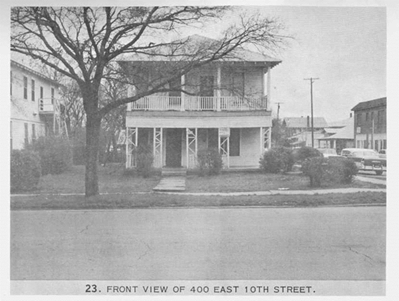
    While driving his car west on E 10th Street and re-creating his alleged view of the Tippit murder, Tatum told his interviewer how he passed the stopped police car, saw the pedestrian and policeman conversing, and then heard three gunshots as he entered the intersection at 10th & Patton. As Tatum, and Myers, continue his story, this is the capper: the gunman completely circled the police car to fire a fourth shot point-blank into Tippit’s skull.

    The problem with Tatum’s story is that while the other eyewitnesses disagreed as to exactly what they saw, no one else disagreed much as to what they heard. While the number of shots is in dispute, every “earwitness” agrees that the shots were fired in rapid succession. There was no final shot separated by seconds from the initial shots.

    Witness after witness described Tippit as being killed by a fusillade of shots. They all heard basically the same thing: Pow pow pow pow.

    “They was fast,” remarked cabdriver Bill Scoggins, describing how the shots were fired extremely close together, in rapid succession.

    What Jack Tatum said he saw, in all probability, never happened. Why he said it can be left to the reader’s imagination. But the HSCA bought it. Because they now had a new “eyewitness” to the actual shooting, and that person’s name was not the thoroughly discredited Mrs. Helen Markham.

    Next, Tatum said that the killer came within 10-15 feet of his Ford Galaxie, and that man was Lee Harvey Oswald. Tatum claimed he could tell because the corners of the man’s mouth turned up into a distinctive smile. Sounds convincing, right? But a quick check of the murder scene and known escape path of the gunman shows clearly that the gunman never came closer than 100 feet to Jack Tatum. Tatum was also well over 100 feet away from Officer Tippit — and according to Tatum himself he was watching everything through his rearview mirror.

    Why did PBS Frontline let Tatum get away with making such outrageous claims? How could Tatum possibly have seen the gunman’s lips curl up from that distance? The gunman came to within 10-15 feet of Tatum’s Ford Galaxie…seriously? That was your story, Mr. Tatum, and you were sticking to it?

    Witness Domingo Benavides seemed to remember a newer red car, possibly a red Ford Galaxie, traveling west several car lengths ahead of his pickup truck. But no one remembered having seen Jack Tatum at 10th & Patton. He was like a late arriving apparition: 15 years after the fact, telling a bizarre and likely false narrative. Yet it was accepted by the HSCA because it helped tie up many inconvenient loose ends left by the Warren Report. And PBS Frontline, a program that showcases documentary facts, didn’t bat an eye and never challenged a word.

    Barbara and Virginia Davis

    myers10Barbara (22) and Virginia (16) Davis were sisters-in-law who lived on the bottom floor of the house at the southeast corner of 10th & Patton. It was here, at 400 E 10th, that the gunman cut across the front lawn, jumped through the hedges by Bill Scoggins’ cab, then headed off down Patton Avenue. The killer also discarded the final two of four total spent shells on this property. The first two shells had been found closer to the shooting site by witness Domingo Benavides, who had watched the shooter discard them as he quickly walked west on 10th towards the corner at Patton Avenue. Barbara and Virginia would each respectively recover the third and fourth discarded shells at 400 E. 10th later that afternoon — on the Patton Avenue side of the house.
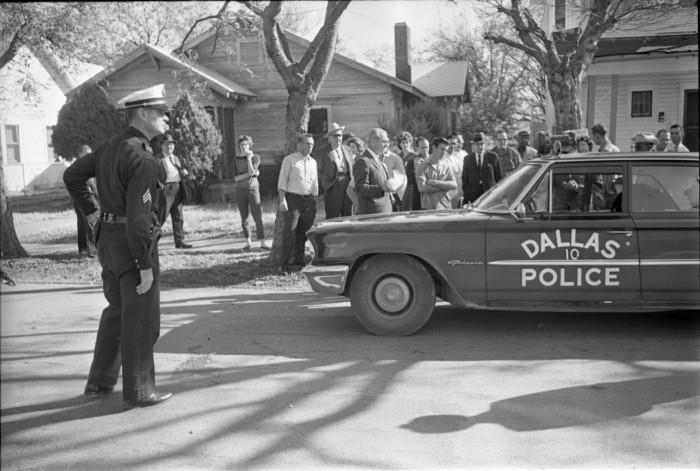
    The two testified they were awakened suddenly from a nap by what the women perceived to be at least two gunshots in quick succession. Barbara and Virginia, understandably confused, both ran to the front door that opens facing East 10th Street. Through the screen door they soon witnessed a young man cutting through their front yard, seemingly unloading a handgun held in his right hand. As the man continued walking past their door, the sisters heard a woman shouting and pointing farther east on 10th Street, “He’s dead, he’s dead, he’s shot!” They would identify the person as Helen Markham, with whom Barbara was acquainted. The woman yelled for someone to call police, and Barbara quickly made the call.

    myers11Virginia, only 16, seemed somewhat confused by the sequence of events. In her original statement to police the young woman said she had gone to the side door, the one that faces Patton Ave., and watched as the gunman walked by towards Jefferson Boulevard. But during her testimony before the Warren Commission Virginia corrected herself and said she had been at the front door, where she had stood behind her sister-in law. The 16-year-old said she could not remember the exact corner (it was the northwest corner) on which Markham had stood. “I don’t remember too good,” was Davis’s explanation. She also thought her sister-in-law had called police before the gunman had cut across their lawn, a near impossibility. Virginia admitted she only caught sight of the killer’s profile and had identified him at the lineup based upon her glimpse of the killer through the screen door and from behind where Barbara stood.

    The younger Davis woman said she could not have made a positive ID based on the images of the suspect she saw on television — only from the lineup, and only from the profile view. This, of course, had been one of the lineups where the disheveled and bruised Lee Oswald had chided the police for trying to “railroad” him and berated the cops in front of the witnesses.

    Virginia Davis testified to two very strange things. First, she said that Officer Tippit’s patrol car was, “…parked between the hedge that marks the apartment house where he lives in and the house next door.” Why did Davis think J.D. Tippit lived at the house two doors away? Why did other witnesses also mention seeing Tippit in the neighborhood regularly when that was not his usual beat? Also, when asked how quickly the police arrived at the murder scene, Mrs. Davis answered in an amazing way: “Yes, they was already there.” “By the time you got out there?” the lawyer for the commission asked. “Yes, sir. We stood out there until after the ambulance had come and picked him up.”

    myers12How could any policeman have gotten there so quickly? Sergeant Kenneth Croy, the first Dallas Police officer on the scene, had said he arrived just as Tippit’s body was being loaded into the ambulance — already suspiciously fast. Now Virginia Davis was testifying that Croy was already there before the ambulance had arrived? Which barely came from more than two blocks away at the Hughes Funeral Home. So, the Davis sisters waited until the gunman was gone and out of sight before stepping outside, yet Croy somehow was already there?
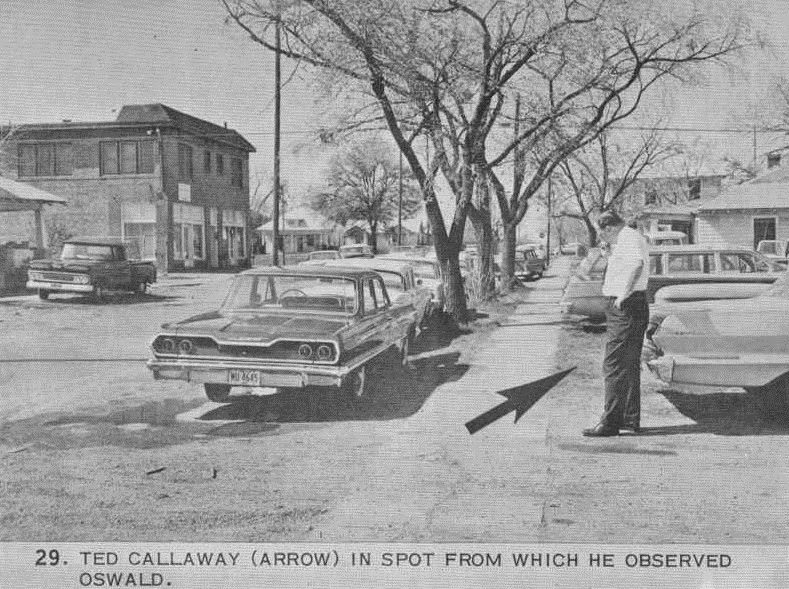
    Barbara Davis’s testimony was more succinct, as she seemed to get more of the basic details correct. However, Barbara testified that the shooter had worn a dark coat made of a rougher fabric, such as wool. This was in stark contrast to what all the other witnesses had described, including Barbara’s sister-in-law. She also remembered the killer’s shirt as being much lighter than Oswald’s shirt…which is interesting because Oswald wore his white undershirt at the lineup and not the brown, buttoned-down long-sleeve shirt he had been wearing all day since he left for work in Fort Worth with Wesley Buell Frazier. At one point Barbara says she was inside the house holding the screen door when she watched the suspect cut across her front lawn. Later she tells investigators she was standing on her front porch as the killer passed by. The older of the two Davis sisters-in-law also agreed that she had only seen the killer from the side, the profile view.

    Finally, Mrs. Davis described how she and Virginia each found one shell. It was later that afternoon on the side of their house that faces Patton Avenue. These would have been tossed after the gunman jumped through the hedges and had passed Bill Scoggins’s cab — but before he had reached the location of witnesses Ted Callaway and Sam Guinyard farther south on Patton.

    Ted Callaway and Sam Guinyard

    When shots were fired on E. 10th street, two of the employees of nearby Harris Motor Company, whose used car lot faced Patton Avenue north of Jefferson Boulevard, moved quickly to the sidewalk on Patton. Their attention turned north towards E. 10th Street. Callaway was the car lot’s manager, and Guinyard was a porter who washed and detailed cars.

    As Callaway and Guinyard watched, they observed Bill Scoggins hunched over and pressed against the driver’s side fender of his cab. Suddenly, a young white man carrying a pistol came crashing through the hedges. Paying no attention to the cab, the gunman headed south on the east sidewalk of Patton towards where Callaway and Guinyard were standing, wondering what the excitement was all about. Guinyard observed the young man toss what was the fourth of the four spent shells towards the side of Virginia Davis’s apartment.

    As the gunman realized Callaway and Guinyard had stepped out and were now blocking his escape route, the young man crossed the street and proceeded south on the west side of Patton.

    “Hey, man!” Callaway shouted to the killer as he was almost even with the two Harris Motors employees. “What the hell’s goin’ on?”

    myers13The gunman slowed almost to a stop, then mumbled something back to Callaway. However, the used car manager couldn’t make out what the man was saying. By this point the gunman was now carrying his handgun in what Callaway described as a raised pistol position, a technique Callaway had been taught in the military.
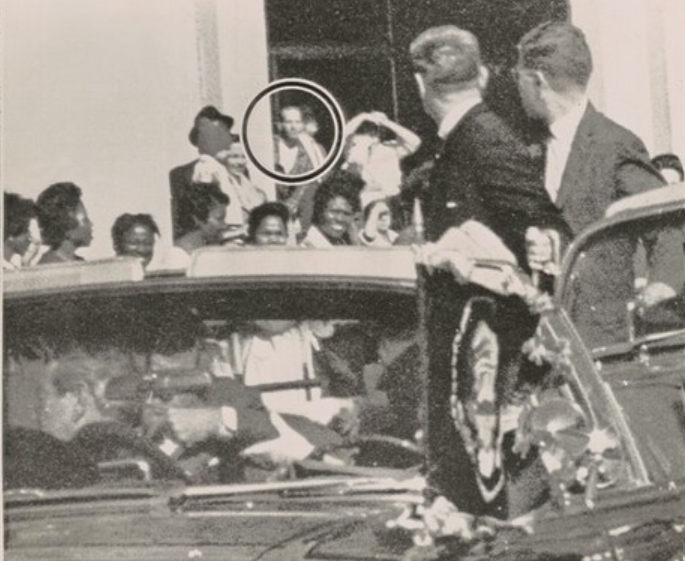
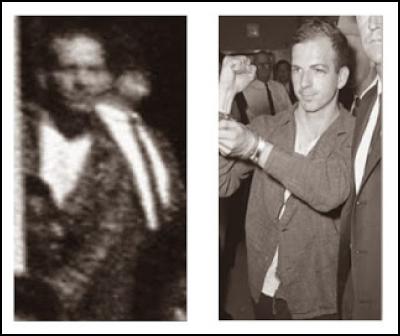
    Other people were beginning to come out. So the killer picked up his pace and trotted quickly towards the intersection of Patton and Jefferson.

    “Hey, somebody follow that guy!” Callaway called down the street. Callaway then turned and hurried in the opposite direction towards 10th Street. Once up at the corner, the Harris Motors manager could see Tippit lying motionless on the ground and a crowd starting to form. Callaway went to the patrol car and tried to summon help on the radio, but was unsuccessful. A motorist named T.F. Bowley, who knew how to work the radio, would stop seconds later and summon help. Meanwhile, someone had already picked up Tippit’s service revolver, which had been lying on the street partially beneath his body, and placed it up on the squad car. Domingo Benavides, who worked as a mechanic at Harris Motors, was telling Callaway what he had just witnessed from his pickup truck.

    Frustrated, ex-serviceman Callaway picked up Tippit’s revolver and told Bill Scoggins to quick get his taxi — he and Scoggins would drive off from 10th & Patton in search of the officer’s killer. It is then that Callaway would ask Harris Motors employee Benavides a question that would continue to puzzle JFK researchers to this day.

    “Which way did he go?”

    If Callaway and Guinyard had just observed the gunman run past their position on Patton Avenue and turn west onto Jefferson Boulevard, why would the car lot manager need to ask Benavides which way the killer had fled?

    Callaway and Scoggins did search the neighborhood, but failed to locate the gunman. They soon returned to the murder scene at 10th & Patton to surrender Tippit’s revolver to arriving Dallas police officers. Years later, Scoggins would confess to an interviewer that he had stashed a .32 caliber handgun in his glove box for protection, but had totally forgotten about the weapon during the entire harrowing ordeal.

    “I just couldn’t believe what I was seeing,” the cab driver remarked as way of explanation.

    The FBI later took measurements on Patton Avenue and determined that the gunman had passed by some 55 feet from Callaway and Guinyard at the closest. Both men would later identify Lee Oswald as the man they had seen carrying the pistol, Had Oswald stood trial for Tippit’s murder, Mr. Callaway would perhaps have made the most convincing witness for the prosecution. In later interviews, the loquacious and confident manager expressed no doubt about his ability to positively identify Oswald as the person who had murdered J.D. Tippit.

    However, during a 1986 televised mock trial held in London, England — The Trial of Lee Harvey Oswald —star defense lawyer Gerry Spence cross-examined Ted Callaway on the witness stand. As Spence tried to introduce doubt concerning the Harris Motors manager’s ability to positively ID a running gunman glimpsed from more than 50 feet away, Callaway scoffed at Oswald’s “counsel” and reiterated that the accused assassin was the man he saw running from the Tippit murder scene with gun in hand. Spence appeared to be ready to dismiss the witness, then asked Callaway if he would kindly answer one more question.

    “Can you identify the man in this picture?” Spence asked Callaway.

    Suddenly, a black & white photograph appeared on the courtroom screen for everyone to see. It was a blown-up copy of a photograph taken by a news photographer at the moment of the assassination of JFK in Dealey Plaza. In the background the Texas School Book Depository can be clearly seen, along with some onlookers standing in the entranceway.to the TSBD. The image of one of the onlookers is enlarged:myers14

    myers15

    myers16Clearly confused, witness Callaway hesitates for a brief moment, knowing the tricky defense lawyer is up to something…but he replies anyway.

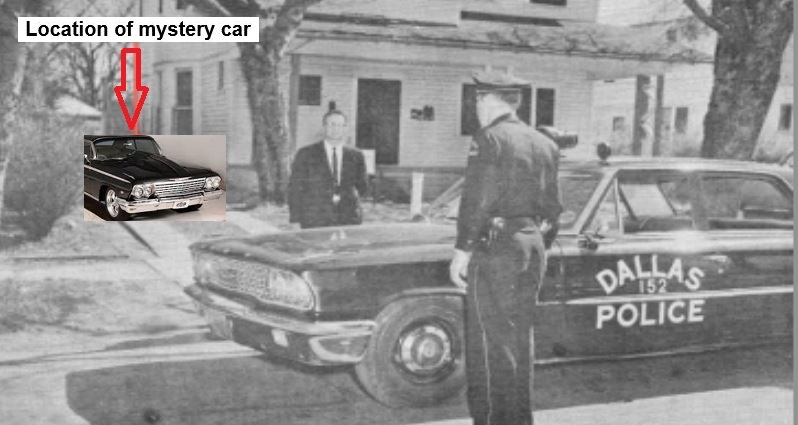
    “Why…why that’s a resemblance of Oswald!”

    “No further questions,” smiled Gerry Spence, knowing he had just elicited the exact response from the witness he had sought. Callaway had just confused the image of Oswald’s fellow TSBD co-worker Billy Lovelady for that of the accused assassin Lee Harvey Oswald.

    The implication of Ted Callaway’s misidentification of the so-called Altgen or “Door Man” photograph was obvious…

    Warren Reynolds

    Perhaps the most fascinating experience of any Tippit witness was that of car salesman Warren Reynolds. Reynolds sold automobiles for the lot across Jefferson Boulevard from Harris Motors where Domingo Benavides, Ted Callaway, and Sam Guinyard all worked. Like Callaway and Guinyard, Reynolds also heard the gunfire from up on 10th Street. He emerged from his office onto a second-floor balcony to see what the matter was. Reynolds observed a young, average-sized white man running down Patton Avenue with a gun in hand. Acting quickly, Reynolds hustled downstairs and onto the lot owned by Johnnie Reynolds Motor Company.

    As the suspect turned west onto Jefferson Boulevard, Reynolds (the owner’s brother) and some other employees from the used car lot followed the man by running down the south side (or opposite side) of the wide thoroughfare from the gunman. The gunman stuck his pistol in the waist band of his trousers and continued west. Reynolds said he and his fellow employees lost sight of the suspect when he appeared to duck behind some buildings.myers17

    Later that day, Warren Reynolds gave statements to both the news media and Dallas Police regarding what he had witnessed. It was Reynolds’ opinion that he had seen and followed Officer Tippit’s killer, but that Reynolds was never close enough to the gunman to have possibly made a positive identification. The car salesman was interviewed by the FBI in January 1964, at which time he told the FBI that he could simply not make a positive ID on Oswald. Two nights later, someone sneaked into the dealership’s basement with a rifle and waited for Reynolds to come downstairs to shut off the lights at closing. Despite suffering a gunshot wound to the head, Reynolds miraculously survived the vicious attack. In fact, his eyesight suddenly approved, as he now informed authorities that he could identify Oswald as the man he had seen across Jefferson Boulevard fleeing with a gun.

    Dallas PD’s main suspect in Reynolds’ near fatal shooting was a local hoodlum named Darrel Wayne Garner, aka Dago. Garner was a known associate of nightclub owner Jack Ruby, and his girlfriend danced at Ruby’s club. Garner’s girlfriend would soon die under mysterious circumstances in a Dallas jail cell, allegedly committing suicide by hanging herself with her pants.

    Dallas JFK researcher Michael Brownlow caught up with Warren Reynolds decades after the assassination and Tippit’s murder. The Warren Commission witness who identified Oswald as the man he had seen carrying a pistol on Jefferson Boulevard was asked why he had changed his story by the time he testified for the committee.

    “Because I wanted to live,” Reynolds replied.myers18

    Acquilla Clemons, Frank Wright, and Doris Holan

    Three witnesses who were ignored by Dallas Police and never testified before the Warren Commission were Acquilla Clemons, Frank Wright, and Doris Holan. These people told very different stories than the official Warren Report witnesses.

    Mrs. Clemons was taking care of an elderly client in a house on E. 10th Street just west of the intersection with Patton Avenue. Clemons saw the police car stop on the next block but said there were two persons in the vicinity of Tippit’s patrol car, not just the man who spoke with the officer.

    After Clemons had stepped back into her client’s home, she heard gunshots. Hurrying back outside, Clemons saw Officer Tippit lying on the ground next to his squad car and two suspicious people running away in opposite directions. One man was tall and slender, while the other man she described as short and chunky. The shorter man was reloading his pistol and escaping south on Patton Avenue. Clemons said this man was not Lee Harvey Oswald.

    Frank Wright lived at the corner of E 10th & Denver, just east of where Tippit was slain. Wright said he was standing in his living room near the front door when he heard the gunshots. Wright opened the door and stepped onto his porch, just in time to see Tippit’s body roll over and come to rest in the street. Next Mr. Wright observed a man running west from the police car. This man jumped into the driver’s seat of an old, grey coupe and drove away going west on E. 10th. A second man in a long-sleeved coat, possibly a trench coat, then stepped into the street. The man appeared to be standing over Tippit, looking down. This second individual then returned to the sidewalk and disappeared out of sight onto one of the properties on the south side of the block.

    Doris Holan lived in a second-floor apartment directly opposite the scene of Tippit’s murder. Her front window afforded the Dallas hotel employee a commanding view of the tragedy. Just after 1 o’clock Holan, who had been sitting in a chair smoking a cigarette, heard the gunshots. Startled, Holan dropped her cigarette but picked it up and put the cigarette on an ash tray. She then hustled to her front window and pulled back one side of the curtain. Holan saw a young man who looked similar to Oswald beginning to walk west away from Tippit’s police car. The movement of Holan’s curtain caught the attention of the suspect as he began to walk away, because he paused for a moment and looked up at Holan’s window, then turned again and began hurrying toward Patton. Holan next saw a police car roll forward from the alleyway behind 10th and move towards the street using a narrow driveway between the two houses. A man in a long coat got out, stepped into the street, looked down at Tippit’s body, then walked back up the driveway to the police car. The second police car then backed up out of sight into the rear alleyway. Holan knew this was a police vehicle because she could see the “cherry” on top. (Although Dale Myers has tried to discredit Holan, as Tom Gram has shown, he has not succeeded. Click here for that discussion)myers19

    Patton Avenue witness Sam Guinyard would later confide to researcher Michael Brownlow that he too had seen police activity in that alleyway at about the time Tippit was killed. The car lot where Guinyard worked sat adjacent to E 10th Street’s rear alleyway. The problem is, according to Dallas Police records, no other Dallas police were known to be in that immediate vicinity.

    Summary

    The witness testimony in the Tippit murder case is so confusing and contradictory that it tends to exonerate Lee Oswald as much as it implicates him. Most witnesses were either too far away or had only a fleeting glimpse of the killer to make a solid identification. Oswald was wearing a long-sleeved brown shirt that day, which no one in the vicinity of 10th & Patton remembered seeing. When we factor in the tainted police lineups as well as the seemingly impossible time element in getting Oswald to the crime scene in time to be the shooter, the case against the 24-year-old tends to fall apart. The Dallas Police Report had the killer walking west, not east, as did all that day’s witnesses except for the roundly discredited Mrs. Markham. Someone other than Lee Harvey Oswald almost assuredly killed Officer Tippit.

    There can be little doubt that a person or persons unknown impersonated Lee Oswald leading up to the murders on November 22, 1963. How can anyone be positive that Lee Oswald shot Tippit at just after 1 p.m. when so many factors argue against it?

    Meanwhile, two credible witnesses at the Texas Theater put the real Lee Oswald in the movie theater at the time J.D. Tippit was being slain several blocks to the east. We know the real Lee Oswald was in the movie theater because he was soon arrested there. Patron Jack Davis said Oswald was there at about the time the 1:15 movie began, and was oddly moving from seat to seat, as if looking for someone. He even briefly sat next to Davis. Theater manager and ticket-taker “Butch Burroughs” said Oswald came in between 1:00 and 1:07 p.m., and that he sold popcorn to Lee Oswald at nearly 1:15 p.m. If true, how could Lee Oswald have murdered J.D. Tippit?

  • Allen Dulles’ Weekend at The Farm

    Allen Dulles’ Weekend at The Farm


    Robert Morrow, a dedicated JFK researcher, has just relocated an important find at the Princeton Library in the Dulles Archives. It was first written about at length in book form by David Talbot in his biography of Alen Dulles, The Devil’s Chessboard. (See pp. 546-47) Lisa Pease first located it many years ago in their online collection. But it was then lost due to a reorganization of the Dulles files. That reorganization threw off the reference pages for location purposes. But Morrow requested the archivists find it, and they did in what was, according to Robert, ‘a big, complicated digital file.’

    Since it had been lost, it weakened the claim that this invaluable day-by-day calendar datebook clearly makes. According to Talbot, Dulles was in Washington that day but he did not spend the late afternoon or evening at his home in Georgetown. He was at the top secret CIA facility known officially as Camp Peary. It was unofficially known as The Farm. And according to the date book, Dulles was there from at least late Friday afternoon, through Saturday and Sunday of that dramatic weekend. In other words during the Kennedy autopsy, while Lee Oswald was in detention and after Jack Ruby shot the alleged assassin.

    This is odd since, at the time of the assassination of President Kennedy, Allen Dulles had no formal role in the government of the United States. He was what was called a “gray eminence” a figure from a storied past collecting his civil service pension and giving speeches promoting the Cold War. But The Farm, located in southeast Virginia’s, York County, was not a club for Agency veterans to swig bourbon and talk about the overthrow of Mossadegh. It was a busy, coordinated center for testing and experimenting clandestine activities. This huge, sprawling base—over 9000 acres—is partly used to train CIA employees in the Directorate of Operations, as well as their equivalent in the, at that time, new Defense Intelligence Agency (DIA). (An example would be the opening scene in David Mamet’s spy thriller Spartan.) Interestingly, according to Wikipedia, it is also available for off-site conferences and working groups. According to a CIA officer who visited there for three weeks, one thing they did was to stage mock executions. It was heavily guarded, but with a living legend like Dulles that stricture probably did not apply.

    As Talbot writes, prior to Dulles renovating it, Camp Peary was used by the Navy Seabees and then as a prisoner of war camp for captured German sailors. According to former CIA officers Phil Agee and Victor Marchetti, “among the well-trained professionals turned out by The Farm were skilled assassins.” (Talbot, p. 546). Dulles had built for himself a sort of second home at Camp Peary, one with a well-stocked library, including current CIA reports and intel estimates. Quoting Dan Hardway, former House Select Committee on Assassinations investigator, “The Farm was basically an alternative CIA headquarters, from where Dulles could direct ops.”

    And let us not forget another important point that Talbot elucidates in his book. Not only did Dulles continually meet with high CIA officials after he was fired by President Kennedy over the Bay of Pigs. He was also meeting with a mysterious but prominent Cuban exile leader named Paulino Sierra Martinez. (Talbot, p. 458). In fact, in the spring of 1963, Sierra met with both Dulles and General Lucius D. Clay. Both men had made a name by crosssing Kennedy. Dulles over, to name just one example, Cuba and the Bay of Pigs; Clay during the Berlin Crisis. Clay later said that Kennedy has lost his nerve during the Berlin confrontation; Dulles later exclaimed about JFK that: “He thought he was a God.” Sierra was largely based out of Chicago, the location of the famous Chicago Plot to kill JFK in early November, and the place where Homer Echeverria said his group would come into a lot of money as soon as they took care of Kennedy. Secret Service sources said that Echeverria’s weapon purchases were being financed by Sierra with mob money. (Talbot, p. 461)

    Thanks much to Morrow for retrieving this very revealing piece of evidence. One more strike against the travesty that was the Warren Commission.

    * * *

    Update: Attorney Dan Alcorn sent me what he feels to be contradictory evidence to the calendar notations about Dulles at the Farm. Lisa Pease replied to this evidence on the linked podcast below.

  • The Biden/CIA Attempt to Usurp Congress’ Authority Over JFK Records

    The Biden/CIA Attempt to Usurp Congress’ Authority Over JFK Records


    The Friday Night News Dump

    In the waning hours of the evening of Friday, June 30, 2023, long after the filing deadlines of the media elite in Washington D.C. and even longer after the most dedicated talking head had left to celebrate their July 4th independence from tyranny in the Hamptons, the Biden Administration issued an Executive Memorandum that is a flagrant and illegitimate attempt to terminate an Act of Congress and usurp congressional authority over its own processes and records. A copy of President Biden’s Executive Memorandum is here.

    It is unclear what truly prompted President Biden to take a flamethrower to an Act of Congress that he himself voted for in 1992 as a member of the Senate, due to bipartisan public pressure to release records related to the 1963 assassination of President John F. Kennedy. It is further perplexing that Biden has chosen to continue to deny the American public transparency into the death of a much admired predecessor since he has chosen to surround himself in the White House with artwork memorializing the Kennedys e.g. the bust of Robert F. Kennedy in the Oval Office and the famous portrait of JFK by Jamie Wyeth that President Biden specifically requested to be borrowed from the Museum of Fine Arts in Boston to hang in his private White House study.

    biden rfk(Stefani Reynolds for The New York Times)

    jfk portrait(Museum of Fine Arts, Boston)

    JFK Records Act Backgrounder

    What exactly is in Biden’s Executive Memorandum that is so egregious? Well, it would help to briefly go back to the 1990s, when Joe Biden was a U.S. Senator from Delaware and the Chair of the Senate Judiciary Committee.

    As a result of decades of significant controversy caused by the government withholding millions of pages of records related to the 1963 assassination of President Kennedy from the American public, Congress enacted the John F. Kennedy Assassination Records Collection Act of 1992 (JFK Records Act”). Congress was put under substantial public pressure to do something about the continuing secrecy around records related to Kennedy’s assassination, because 30 years after his murder, executive agencies were holding hundreds of thousands of assassination related files secret, based on unsubstantiated claims of “national security”. Freedom of Information Act requests were ineffective at penetrating a completely unaccountable lock that the U.S. security state had on these then 30-year-old records. Public outcry after Oliver Stone’s Oscar winning film JFK tipped the balance. So Congress passed the JFK Records Act in a rare, unanimous bi-partisan vote. The act was signed into law by the then President George H.W. Bush, and after numerous delays finally went into effect in 1994.

    The full John F. Kennedy Assassination Records Collection Act of 1992 can be found here. It is worth reading.

    The law mandates, among other things, that by no later than October 26, 2017, all records related to the 1963 assassination of President John F. Kennedy had to be publicly disclosed in full, unless for each record, the President certified that extremely stringent criteria for postponement were met. If such postponement criteria were satisfied based on the legal standard of clear and convincing evidence, the President’s unclassified reasons for postponing each individual record had to be published in the Federal Register. This way the public could at least understand exactly which specific records were being postponed and what the legal basis was for the postponement of each individual assassination record.

    It needs to be noted that in accordance with the provisions of both the JFK Records Act (particularly section 9(d)(1)) and the Constitution’s separation of powers, that the President’s authority to postpone the public disclosure of assassination records only applies to Executive Branch records (which are records created by agencies and offices controlled by the President e.g. CIA, FBI, Secret Service, DEA, NSA, DOD, etc…). The President does not have legal authority over “non-executive branch records”, which include records created by Congress and other sources not controlled by the executive branch. Congress was very careful when drafting the JFK Records Act to ensure that they did not grant the President authority to control their legislative branch records.

    Congress also required that for each assassination record, that all “Government Offices” (the JFK Records Act specifically includes the Executive Office of the President in the definition of “Government Office”) had to issue what is called an “Identification Aid” when any action was taken or decision made in respect to any record. These Identification Aids were tracking forms that attached to all assassination records and recorded a brief description of the record, including the date of the document, the originating agency or entity, the disposition of the record and any action taken with respect to the record, such as the particular section 6 criteria for postponement that provided the legal justification for continuing to hold the assassination record in secret from the public. 

    Further, Congress specifically mandated the Archivist of the United States to ensure that all Identification Aids for every postponed record form part of the Assassination Records Collection. Also, that a publicly accessible Directory of Identification Aids be created and maintained, so that there was full transparency for the public to understand exactly which assassination records were continuing to be held in secret in the Protected Collection and what the legal basis for postponement was under section 6 of the JFK Records Act for each record.

    Most importantly, Congress made it clear in the JFK Records Act that there was a “presumption of disclosure” and the legal burden was on an agency to prove that a specific assassination record met the legal standard for postponement required by the Act and that clear and convincing demonstrable evidence was required in order to deprive the public access to a record.

    In order to ensure that government agencies and offices complied with the JFK Records Act, Congress created the Assassination Records Review Board (“ARRB”). This 5 person citizens’ panel was tasked with collecting, cataloging and reviewing all assassination records, with the mandate to release all assassination records, unless a record met the exacting criteria set out in section 6 of the Act.

    The ARRB’s limited tenure ran fromOctober 1, 1994 to September 30, 1998.During the ARRB’s time in operation, the Board and staff reviewed and made “final determinations” about every single assassination record that was identified and submitted by government agencies and offices. In the mid-1990s when the ARRB was doing its work, the JFK Records Act mandated that only in the most rare and exceptional circumstances were assassination records to be postponed from public disclosure.

    The law also legally mandated that, based on “final determinations” and recommendations for release made by the ARRB, all postponed records had to be periodically reviewed under the same stringent and exacting standards of section 6 of the Act. The purpose of the Periodic Review process was to “downgrade and declassify” all of the records held secret in the Protected Collection. By legally mandating this downgrading and declassification periodic review process, the JFK Records Act makes it clear that as time passes it should become more difficult, not easier for executive agencies to keep assassination records secret and to deny the American people access all the facts about the circumstances surrounding President Kennedy’s murder.

    ARRB “Final Determinations” and the Periodic Review Process

    Every assassination record currently held in the secret Protected Collection is held as a result of an ARRB “final determination”.As the ARRB went about its business between October 1994 and September 1998, it created a form called the “ARRB Final Determination Form”. These forms are not widely published and not a lot of attention has been placed on them by anyone in the research community.

    In every case where the ARRB made a Final Determination to postpone the release of an assassination record, they filled out one of these Final Determination Forms. These included the specific section 6 criteria which formed the legal basis on which a record was legally permitted to continue to be held in secret. The Final Determination Form also provided unclassified written reasons for each postponed record, along with the ARRB’s recommendation for releasing the record (i.e. a covert agent’s death, or a source or method no longer requiring protection).

    “Final Determination Forms” are critically important.

    Judge John Tunheim, the Chair of the ARRB has confirmed that all postponement decisions made by the ARRB are “Final Determinations” under the Act.

    The work with respect to all of the records currently held in the Protected Collection at NARA has been completed for over 25 years. The ARRB did its job. The result is a catalog of Final Determination Forms that state the section 6 criteria for postponement and the ARRB’s recommended release date for each assassination record, based on the section 6 criteria.

    A serious problem that occurred from September 1998 until October 26, 2017, is that virtually no Periodic Review took place in accordance with sections 5 and 9 of the JFK Records Act. The Periodic Review was supposed to happen based on the information and recommendations that the ARRB recorded on their ARRB Final Determination Forms for each postponed record.

    The mandated purposes of Periodic Review were to provide a rolling review of the postponed assassination records in accordance with the criteria and recommendations issued by the ARRB in their ARRB Final Determination Forms. If this had occurred as Congress mandated in the JFK Act, by October 26, 2017, there should have been only a very small number of records still held in the Protected Collection when the October 26, 2017 deadline came up.

    Again, according to the Law, it’s legislative history, and legal commentary, by the time the October 26, 2017 statutory deadline rolled around, based on the statute’s mandated program of Periodic Review, there should have been virtually no records left in the “Protected Collection” held at the National Archives. Because the clear purposes of the Act were to create an accountable, transparent and enforceable process to downgrade, declassify and ultimately fully disclose every single assassination record to the public, so that the public itself could decide for itself what the facts were about what happened in Dallas on November 22, 1963. 

    In reality, despite the law’s clear mandate, when October 26, 2017 did come and go, there were still an undetermined number of assassination records being either fully or partially withheld. By some estimates, the number of withheld records totalled was quite voluminous. But an accurate number was impossible to calculate because of the broken down and functionally inoperable Identification Aid Program that NARA and the agencies have failed to adequately maintain pursuant to their legal mandate.

    President Biden’s Friday Night Memorandum

    Now back to President Biden’s June 30, 2023 Executive Memorandum that postponed an undetermined number of unidentified assassination records. Let that sink in for a moment…

    “Maximum Transparency”

    Despite the clear mandates imposed by the JFK Records Act to establish an “accountable” and “enforceable” process for the full disclosure of all assassination records; and the explicit requirement that each record be accounted for with an identification aid, the President’s June 30, 2023 Memorandum does not identify or account for a single assassination record. 

    President Biden stated in the opening paragraph of his memorandum that, “As I have reiterated throughout my Presidency, I fully support the Act’s aim to maximize transparency by disclosing all information in records concerning the assassination, except when the strongest possible reasons counsel otherwise.” There is an unavoidable divergence from reality in the President’s statement, that is Orwellian in magnitude. For the simple reason that without being able to track which assassination records were postponed from disclosure through the mandated identification aid program, and without providing the legally required reasons for each postponement, on a record-by-record basis (“as required by the Act”), where is the “transparency” and “accountability”?

    When the ARRB issued final determinations on a record-by-record basis in the mid-1990s, only the President could override such final determinations pursuant to his authority under section 9(d)(1) of the Act. In respect to any Presidential determination to postpone or release a record under his 9(d)(1) authority, the President was mandated by law to:

    1. apply the standard of proof and postponement criteria required by section 6 of the Act;
    2. Provide unclassified reasons for the postponement based on the section 6 standard of proof and postponement criteria;
    3. Have the reasons for the postponement published in the Federal Register; and 
    4. Issue an identification aid for each postponed assassination record.

    The above duties, mandated to the President are what are called statutory or “ministerial duties”. The President does not have any wiggle room or discretion with respect to these mandated ministerial duties. If a President does not comply with ministerial duties, the resulting decisions may be reviewed by the courts on an application for judicial review or mandamus. While suing the President is not made easy, there are very narrow pathways that can be found to ensure that a President complies with the law. In the case of the JFK Records Act, these pathways require a refined parsing of the language of the Act to determine what specifically Congress required for a President or other specifically named officials to do.

    Neither President Trump nor President Biden complied with any of the above ministerial duties imposed on them by section 9(d)(1) of the JFK Records Act. They did not apply the standard of proof in section 6 to any postponement. They did not apply the postponement criteria; they did not provide any unclassified reasons for postponement for each record, so that the public could understand the rationale for any of the postponements. They did not issue any identification aids for each postponed record. And there is no way for the public to understand which records the postponements apply to, because there was not even a list of the postponed records published in the Federal Register as is required under the Act.

    All of these violations of the JFK Records Act, make it difficult or impossible for the public to seek any accountability or transparency in respect to the President’s decision-making. Further any attempt to seek judicial review of any specific postponed record will be extremely difficult, because no reasons were given for the postponement of any particular record. One of the requisite elements of any final decision or order under the principles of administrative law is that adequate or sufficient reasons be provided to justify a decision, so that any impacted party would understand the basis for the decision, and so that aggrieved parties would be able to fairly appeal such decisions. These basic legal principles form part of the foundations of our system of law and prevent “Star Chamber” justice and abuses of authority.

    The Clear and Convincing Standard of Proof

    Another serious legal problem arising from President Biden’s opening platitudes is his attempt to modify by edict the legal standards for postponement that are the basis of the JFK Records Act. Nowhere in the JFK Records Act do the words “except when the strongest possible reasons counsel otherwise.”

    The standards and criteria for postponement are only found in section 6 of the JFK Act.

    jfk records act1

    In legal processes there are several different standards of proof. In most criminal proceedings, the standard of proof is the well-known “beyond a reasonable doubt”. Civil standards of proof may vary depending on the seriousness of the process and the range of potential consequences of a ruling. Common civil standards of proof include “balance of probabilities”, “preponderance of evidence”, and “clear and convincing evidence”. When a statute imposes a standard of proof, that is the standard that parties must meet in order to successfully make their case. 

    Parties cannot simply ignore or change a statutory standard of proof in order to better suit their case.

    Congress decided when they enacted the JFK Records Act that the law would impose the relatively high civil standard of proof of “clear and convincing evidence”. There is no other standard of proof when it comes to assessing the grounds for postponing assassination records. All government offices, agencies and the President of the United States must follow the law and comply with the clear and convincing standard of proof mandated by sections 6 and 9(d)(1) of the JFK Records Act.

    To be certain, “Except when the strongest possible reasons counsel otherwise.” is not the standard of proof imposed by the JFK Records Act. In fact…“Except when the strongest possible reasons counsel otherwise.” is not a standard of proof anywhere in the world.

    Final Certification???

    The opening paragraph of President Biden’s Memorandum presents another perplexing statement and completely non-compliant decision by the President. “With my final certification made in this memorandum -– the last required under the Act -– and definitive plans for future disclosures, my Administration is fulfilling the promise of transparency to the American people.” [Emphasis added.] From this statement, one can be left with no other understanding: that with his June 30, 2023 Executive Memorandum, the government and the President’s legal obligations under the JFK Records Act have been fulfilled and that the June 30, 2023 Memorandum will be the final and last word on the undetermined number of unidentified assassination records being held in secret by the government.

    The problem with this statement is that it runs smack into section 12(b) of the Act. That section of the JFK Act is titled, “Termination of Effect of Act”. Part (a) of the section deals with the termination of sections of the Act pertaining to appointments to the ARRB and the operation of the Board. Pursuant to section 12(a), all of the sections of the Act that cover matters dealing with appointments to and operations of the ARRB shall terminate when the ARRB’s mandate ended on September 30, 1998.

    In respect to the sections of the Act that do not deal with appointments to or the operations of the ARRB, all those sections remain in full force and effect until every last assassination record is fully publicly disclosed to the public and the National Archivist certifies that all assassination records are publicly available. Section 12(b) is set out immediately below.

    jfk records act2

    Section 6 of the Act does not pertain to appointments to the ARRB and it does not deal with any ARRB operations. In fact, section 6 of the Act does not even mention the ARRB at all. Section 6 is a part of the Act that is mandated to form the basis of any and all decisions to postpone the disclosure of an assassination record by any and all government offices (including the Executive Office of the President of the United States). Section 12(b) legally mandates that section 6 remains in full force and effect as operational law and is applicable to the President’s authority to postpone disclosure of records, “as required by this Act” pursuant to sections 5(g)(2)(D) and 9(d)(1).

    The JFK Records Act makes no mention or suggestion that the President’s legal duties under the Act come to an end prior to the full public release of every single assassination record. To the contrary, both sections 12(b) and 9(d) make it clear that the President’s duties continue until there are no more secret assassination records held in the Protected Collection at NARA.

    Further, pursuant to sections 5 and 9 of the Act, the President has an ongoing statutory role in the periodic review process. Section 5(g)(2)(D) of the Act, is the provision that contains the purported authority pursuant to which both Presidents Trump and Biden have postponed the release of the remaining secret assassination records. It cannot be ignored that the title of section 5(g) of the Act is, “PERIODIC REVIEW OF POSTPONED ASSASSINATION RECORDS”. 

    Section 9(d)(1) of the Act also specifically weighs in on the President’s ongoing ministerial duties with respect to postponement of assassination records. That section mandates that, after the ARRB has made a “final determination”, regarding the release or postponement of an assassination record, only the President has the sole and non-delegable authority to release or postpone the release of assassination records under the standards of section 6 of the Act. There will be more about section 9(d)(1) later in this article.

    It is therefore unclear what the legal basis is for President Biden’s dismissive assertion that the June 30, 2023 Memorandum is the “final certification” required by the Act. This makes no sense given the clear duties imposed by sections 5, 6, 9 and 12, as discussed above.

    “Each Assassination Record…As Required By This Act”

    In section 2 of the June 30, 2023 Executive Memorandum, President Biden states that, “The Act permits the continued postponement of public disclosure of information in records concerning President Kennedy’s assassination only when postponement remains necessary to protect against an identifiable harm to the military defense, intelligence operations, law enforcement, or the conduct of foreign relations that is of such gravity that it outweighs the public interest in disclosure.”

    It would appear that the process suggested above in the President’s Memorandum directly conflicts with the President’s claims that he supports the transparency and accountability provisions of the Act. Does the JFK Records Act actually authorize the President to certify the postponement of thousands of unidentified assassination records en masse and without providing any reasons for each record that he certifies for postponement?

    The President’s Memorandum seems to cherry-pick words and phrases out of section 5(g)(2)(D), and omits some critically important language from the section. The omissions drastically change the meaning and purposes of this section as purported by the President in his Memorandum. Let’s look at exactly what section 5(g)(2)(D) states.

    5(g)(2)(D) Each assassination record shall be publicly disclosed in full, and available in the Collection no later than the date that is 25 years after the date of enactment of this Act, unless the President certifies, as required by this Act, that—

    1. continued postponement is made necessary by an identifiable harm to the military defense, intelligence operations, law enforcement, or conduct of foreign relations; and
    2. the identifiable harm is of such gravity that it outweighs the public interest in disclosure.

    The words “Each” and “as required by this Act”, seem to be omitted from any reference to section 5(g)(2)(D) of the JFK Records Act made by the government. Including in all of the Presidential Memoranda of both President’s Trump and Biden. It seems that the government is afraid to fully quote section 5(g)(2)(D) in its complete entirety. And the government is particularly frightened by the words “eachand “as required by this Act”, 

    The rules of statutory interpretation impress on lawyers and judges that words printed into laws must be given meaning; and that legislators do not insert meaningless or superfluous words into statutes.

    So what do the words “each” and “as required by this Act” mean in relation to the President’s authority to postpone the public disclosure of assassination records? The answer to this question could consume the better part of a chapter in a book or an entire lawsuit. I will try to provide a brief explanation of the proper interpretation of these words in the context of section 5(g)(2)(D) and in relation to the JFK Records Act as a whole.

    When the word “each” is used at the beginning of section 5(g)(2)(D), the rules of statutory interpretation would strongly imply that the word modifies the following parts of the whole section. It follows that a proper reading of this section would reasonably determine that the word “each” acts to modify both the requirement for public disclosure of each assassination record by no later than the statutory deadline of October 26, 2017; and “each” modifies the alternative requirement for the certification for postponement of each assassination record, as required by this Act. This interpretation would militate against a holus bolus en masse certification of an undetermined number of unidentified assassination records. This interpretation is further supported by the purposes of the Act, as well as all of the other sections dealing with periodic review and Presidential authority to postpone records. It would create an absurdity of law to interpret section 5(g)(2)(D) to mean that prior to October 26, 2017, there were more stringent postponement criteria and public transparency requirements under the Act than after October 26, 2017.

    The words “as required by this Act” must also be given meaning in the context of the President’s authority to certify the postponement of assassination records. If Congress intended that section 5(g)(2)(D) be an isolated, stand-alone provision and the only provision dealing with Presidential postponements, Congress would not have included the additional words, “as required by this Act” in Section 5(g)(2)(D). The inclusion of the words “as required by this Act” must therefore be read consistently and in line with the other sections of the JFK Records Act that pertain to the postponement of assassination records. Namely section 6 (which mandates the standard of proof and the exclusive postponement criteria) and with section 9(d)(1). That is the authorizing provision that grants the President his sole and non-delegable authority under the law to postpone the release of Executive Branch assassination records after the ARRB has rendered a final determination about an assassination record. 

    Instead of addressing the words “each” and “as required by this Act”, President Biden’s Memorandum summarily omits these words and ignores the statutory/ministerial duties that the words legally impose on the President in respect to decisions to continue the postponement of public disclosure of the secret assassination records held in the Protected Collection.

    “Transparency Plans”

    Let’s be blunt. The President’s “Transparency Plans”—originated by the CIA– are the opposite of transparent. They might as well be called “Opacity Plans” if the truth is being told. The JFK Records Act is one big statutory transparency plan that mandates tracking forms (identification aids) and a directory of these aids to provide transparency for each and every document in the Records Collection, including those documents that are continuing to be held in the secret Protected Collection. President Biden’s Transparency Plan seeks to do away with the Identification Aid Program and the publicly accessible Directory of Identification Aids.

    Section 6 of the Act mandates that all government offices apply the clear and convincing standard of proof and the five exclusive criteria pursuant to which postponements are permitted by law. Section 12(b) states that section 6 of the Act remains in full force and effect until the Archivist certifies that every single last assassination record is fully publicly disclosed. The President’s Memorandum seeks to do away with all of these truly transparency driven standards, and replace them by edict with new, less onerous, less stringent, less accountable, and totally unenforceable standards. 

    What happened to the mandate to downgrade and declassify all of the records? How and why did it suddenly become easier for the government to keep these assassination records secret…. not more difficult?

    President Biden’s Attempt to Seize Authority Over Congressional Records

    One aspect of both President Trump and President Biden’s multiple memoranda that ought to have received far more resistance from both the public and Congress, is the Presidents’ assertions of authority over what are termed “non-executive branch records”. These records include House and Senate records, largely originating from the House Select Committee on Assassinations and the senate’s Church Committee. As briefly discussed above, Congress was very careful in drafting the JFK Records Act not to cede any authority over non-executive branch records to the President. Section 9(d)(1) takes particular aim at this issue by explicitly limiting the President’s authority over only executive branch records.

    What impact does this have on the current state of the records held secret in the Protected Collection? It means that any Presidential postponement of a non-executive branch record is unlawful and that by law, every single record that originated from the HSCA and the Church Committee should have been fully publicly disclosed on October 26, 2017. This did not happen because both President Trump and President Biden broke the law when they authorized those records to remain held in secret. Congress should have stepped in to protect their authority over their own records and processes, but to date, Congress has failed to schedule any oversight hearing or call any official to account for the undeniable non-compliance under the Act by NARA, the agencies and the Executive Office of the President. It seems that no branch of the government is interested in complying with the JFK Records Act on any level, in any meaningful way. Senate Majority Leader Chuck Schumer did however mention the JFK Assassination Records Act last week when he suggested that Congress ought to use the that act as a model for new legislation to provide public transparency on the urgent and pressing issue of UFO sightings!! Is our government trolling us?

    As this article goes to print, Judge Seeborg has just issued a decision in the case brought by the Mary Ferrell Organization in San Francisco court. An update on this important decision will be forthcoming next week.

  • Biden’s ‘Final’ Order on Kennedy Files Leaves Some Still Wanting More


    On June 22, 1962, an intelligence official drafted a memo summarizing a letter intercepted between Lee Harvey Oswald and his mother. The memo was made public long ago. But for 60 years, the name of the letter opener was kept secret.

    Now it can finally be told: According to an unredacted copy of the memo released recently by the government, the official who intercepted Oswald’s mail for the CIA in the months before President John F. Kennedy was assassinated was named Reuben Efron.

    Read the rest of the article here. (Yahoo! News)

  • Fact-Checking the Sixth Floor Museum

    Fact-Checking the Sixth Floor Museum


    To my surprise, I don’t think this has ever been done before. But it is imperative that it must be done, for millions of people visit the museum every year. It’s at the epicenter of the crime.

    In Episode 1 of Oliver Stone’s 4-part series JFK: Destiny Betrayed, the narrator says: “The Sixth Floor Museum, to this day, insists that Oswald shot Kennedy from that sixth floor window, and virtually everything in the museum is dedicated to that proposition.”

    I decided to, without bias, see if this was in fact true. In August 2021 I photographed every single exhibit and every single museum label in the museum to fact-check. The following are the results…

    * * *

    The museum correctly says “witnesses…believed gunfire had come from the grassy knoll…Dozens of people ran up the grassy knoll…Some witnesses said they saw a puff of smoke in the trees there, and one witness [Lee Bowers] observed unfamiliar automobiles in the rail yards and two men standing behind the fence just before the shooting.” However, they did a disservice by next writing: “Officials searched the area, but found only cigarette butts and footprints behind the fence.” What they failed to mention was the fact that those cigarette butts and footprints were FRESH and were found in the exact spot where that puff of smoke was seen. A flash of light was also seen there by Bowers, and an anomalous shape appears there in the Moorman photo that’s not there in later photos. So that was a person.

    Sliding along, the museum says “at least five witnesses said they had seen a rifle protruding from an upper window”—but only four did.

    We are told that “the easternmost window on the south wall was half open”—but as anyone can plainly see from the photos, the window was only a quarter open! “In the far east corner was a paper bag, later determined to have been used to bring the rifle into the building”—but the bag is not present in any of the crime scene photos! Moreover, any lucid person who reads the Warren Report subchapter “The Long and Bulky Package” (pp. 131-134) will come away convinced that a rifle couldn’t have been in Oswald’s bag.

    Next, the museum says “Oswald’s finger prints and palm prints were found on several of the cartons and on the paper bag.” This is so easy to debunk. This is one of those things where you can just go right to the Warren Report and it debunks itself. The Commission admitted that the key box at the window used as the gun rest, as well as the box below it, “contained no prints which could be identified as being those of Lee Harvey Oswald.” (WR 140) This is significant. One box and another nearby had Oswald’s prints. (R 138) Well, Oswald DID work in the building. In their own words: “…the Commission considered the possibility that Oswald handled these cartons as part of his normal duties.” (WR 141) And only one of these prints “was less than 3 days old.” (ibid) The Commission admitted the print “could have been placed on the carton at any time within this period.” (ibid.) And they ultimately said: “The prints do not establish the exact time he [Oswald] was there.” (ibid.) As for the paper bag, when FBI expert Sebastian Latona initially examined it on 11/23, he could find no latent prints on it. (WC Vol. 4, p. 3)

    Moving along to the Tippit murder, the museum label says “Tippit died before he reached the hospital”—but as anyone knows, Officer Tippit was killed instantly with a shot through the head and others through the chest.. The museum next said something absolutely astounding under a photo of Oswald’s revolver: “The bullets that killed Tippit came from this gun.” This is ABOMINABLY INCORRECT!

    Representative BOGGS: You cannot establish the fact that the bullets were fired in that gun?
    Mr. CUNNINGHAM: That is correct. (WC Vol. 3 p. 476)
    Mr. CUNNINGHAM: I could not identify those bullets as having been fired from that gun. (Ibid p.482)

    The museum tells the common mainstream talking point that “In a roll call of employees…he [Oswald] was discovered missing.” This implies Oswald was the only employee missing, but a check of all the FBI statements reveals that 17 were never in the building after 12:30. (WC Vol. 22, pgs. 632–686)

    Museum tourists are told that “Investigators learned that Oswald was a loner with strong leftist leanings.” They might have gotten away with this statement when the museum opened way back in 1989, but not today. We have learned so much since, e. g. that Oswald was almost certainly a double-agent. His former roommate James Botelho even spoke up: “I knew Oswald was not a communist and was, in fact, anti-Soviet…I knew then what I know now: Oswald was on an assignment in Russia for American intelligence.” (JFK and the Unspeakable, by James Douglass, p. 40) For this important point, see also John Newman’s updated version of Oswald and the CIA, James DiEugenio’s Destiny Betrayed, second edition (Chapters 6 and 7, and the extremely important declassified files of HSCA investigator Betsy Wolf) (Click here)

    The museum says Oswald “was rated a sharpshooter.” But this is a common cherry-pick, for that was an early test, and Oswald was officially designated as barely a marksman (the lowest of the low). The Warren Report itself said he was a “rather poor shot.” (WR, p. 191) The museum says “Oswald’s wife later testified that he admitted to her that he had tried to kill Maj. General Walker”—however, she might have been manipulated to make this claim. Plus, she is the most unreliable witness, for her stories constantly changed (see this) What the museum conspicuously omitted was that the alleged bullet recovered from Walker’s house could not be linked with Oswald’s rifle (WC Vol. 3 p. 439); and the two main witnesses said the perpetrator was not Oswald. ( WC. Vol.5 pp.446-447; WC Vol. 26 p. 438) They brought up the claim that “Oswald left a note in Russian for his wife with instructions if he did not return that night”—but Marina said she never saw the note! (WC Vol. 23, p. 393) And of course, as everyone knows, the note is undated and makes no reference to Walker. Researchers have concluded that, most likely, Oswald wrote this note in relation to a project other than an attack on General Walker.

    We are next told Oswald’s “latent palm print [was found] beneath the wooden stock of the gun.” However, this palm print didn’t appear for a week (4 H 23), and the only person to see this alleged print said it was an OLD print. (Gary Savage, First Day Evidence, p. 108) Beyond that, when the FBI got the rifle the night of the assassination, they could find no trace prints of value on it. (James DiEugenio, The JFK Assassination: The Evidence Today, p. 214) We are correctly informed that “During Oswald’s detention no witnesses were able to identify him as the gunman seen firing from the Depository window.”

    Continuing on, the museum claims “over two dozen people recorded” the assassination. This is not correct. There were actually 7 who were filming while the shooting was taking place. The museum correctly stated witnesses heard shots “coming from various locations in Dealey Plaza.” They next did a partial good job at listing 6 of the 58 grassy knoll earwitnesses. But they then listed 10 of the only 46 Depository earwitnesses. In other words, they made it seem like there were less knoll ear witnesses! They mentioned James Tague, but omitted that he believed the shots came from the knoll.

    Only towards the end of the museum tour do we get to the forensic and ballistics evidence. They incorrectly claim the Warren Report “agreed that Connally showed a reaction by [Zapruder] frame 224.” This wasn’t put forward until the 1970s. Connally said he was hit about ten frames later than this to Josiah Thompson. (Six Seconds in Dallas, pp. 69-70) The museum oddly says the autopsy doctors’ “probe of the back wound revealed no exit point; the tracheotomy had obscured it.” This is frighteningly inaccurate. How can an incision in the front of the NECK obscure an alleged bullet path in the BODY?! The simple fact is that the back wound was probed and found to not go anywhere. (CD 7, p. 284) The bullet lodged in the back and most likely fell out. It also would’ve smashed the first rib had it traversed where the measurements place it. The museum brings up how “The House Committee…concurred that one bullet could have wounded both Kennedy and Connally.” But in order for it to work, they said, JFK would have to be leaning WAY forward (Vol. 7 HSCA p. 100)—which he WAS NOT! (WC Vol. 18, p. 26) Everything else said on the topic of forensic and ballistics evidence lacks serious context and doesn’t tell the full story. More shockingly, the museum never informs its tourists the basic fact that JFK had a massive blowout in the right rear of his head—of course, all indicative of a shot from the front.

    The museum’s section on the acoustics evidence is bland and very outdated.

    Almost at the end of the tour, we are told that “Depository employee Charles Givens had seen Oswald at about 11:55…on the sixth floor”—but in his Dallas Police statement he made no mention of Oswald. (WC Vol. 24 p. 210) We are next told that “Tests for the Warren Commission showed that Oswald could have run down this staircase to the second floor lunchroom in less than two minutes.” This too is outdated. See here for everything you need to know about this subject.

    Finally, at the very end of the tour we come across a wall of big paragraph webs listing all the different theories of who could’ve done it. If anything, this leaves tourists to walk away with the “it will remain a mystery” view rather than “this is a conspiracy”.

    My conclusion is that the Sixth Floor Museum simply gave basic official story facts while omitting tons and tons of context. They, as someone once said, “did not take into account all of the available relevant evidence in the case of the assassination, and therefore violated a fundamental requirement of scientific reasoning, which is known as the Principle of Total Evidence.”

    While doing a final comb though of all the photographs I had taken, I did manage to find one tiny little museum label that read: “Arguments that Oswald was a patsy…and that gunmen shooting from other locations…have remained popular but unproven.” But those are the two main beliefs of the critics! If the museum is saying they are “unproven”, then they are, in effect, saying the official story is true.

    They haven’t shied completely away from conspiracy, though. Notable critics Dr. Cyril Wecht and Josiah Thompson have given presentations there in recent years. Thompson, at one point, even narrated the museum’s audio tour guide. Today, it is narrated by witness Pierce Allman, who was a staunch lone nutter.

    One thing people DO get wrong about the museum is the books it has. Robert Groden wrote that: “The Sixth Floor Museum book store is barred from carrying any book that honestly deals with the subject of the Kennedy conspiracy.” (JFK: Absolute Proof, p. 329) This is a not accurate. The museum bookstore does contain some conspiracy books. And their Reading Room contains EVERY SINGLE conspiracy book on the assassination, in addition to every book on the subject. The Reading Room also has thousands of vital Oral Histories with eyewitnesses and researchers, coupled with every newspaper and magazine story on the case. My advice would be to skip the $18 tour and just go straight to the Reading Room. As someone once said, “Study the evidence yourself and make up your own mind.”

    In the end, one thing does ring true more than anything. Outside on the Sixth Floor Museum’s historical plaque, it reads:

    “ON NOVEMBER 22,1963, THE BUILDING GAINED NATIONAL NOTORIETY WHEN LEE HARVEY OSWALD ALLEGEDLY SHOT AND KILLED PRESIDENT JOHN F. KENNEDY FROM A SIXTH FLOOR WINDOW AS THE PRESIDENTIAL MOTORCADE PASSED THE SITE.”

    That is something we can all agree on.