(Click here if your browser is having trouble loading the above.)
Tag: JAMES EARL RAY
-
New Trial for James Earl Ray, or New Judge for Shelby County?
On August 11th, Shelby County Criminal Court Judge Joe Brown stated that, due to the District Attorney’s reluctance, he may seek the appointment of a special prosecutor in the James Earl Ray case. In an order setting August 19th as the next hearing date, the judge wrote that the state seems opposed to discovering the “true facts” of the matter and because of this obstinacy, “The patience of this court has been very sorely tried.” Further, Judge Brown added, “The state appears singularly opposed to vigorously proceeding to ascertain the true facts of this case.” He characterized the prosecutors as being “further opposed to recognizing let alone protecting the interests of the family of the victim, the late Dr. Martin Luther King Jr.”
There seems to be enough evidence to indicate that Brown is correct about the reluctance of the Memphis DA’s office to vigorously pursue Brown’s evidentiary proceeding to its fullest. Brown has been trying to refine the process of testing the alleged rifle that James Earl Ray had in Memphis and which was supposedly used to kill King there in 1968. The first round of tests came back inconclusive in July. There was a marking on 12 of the 18 bullets test fired which was not on the 1968 death slug. But this may have been caused by either a build up of residue in the barrel from the test fires or from a metal defect in the rifle barrel itself. Brown suggested cleaning the barrel to determine the origin of the marking.
That state attorneys, led by John Campbell, objected to this procedure. Campbell argued that cleaning the rifle with brushes would alter the identifying markings left on any subsequent bullets fired. He then added: “All you’re going to do is increase the controversy in this case.” Ignoring that remark, Judge Brown also told attorneys to acquire the previously fired test bullets shot by the FBI in 1968 and the House Select Committee on Assassinations in 1978. On July 18th, prosecutors announced to the press that the FBI could not find the original 1968 test bullets. Lee Coffee, an assistant DA, said he had been told, “They have been able to locate copies of the lab notes only. They have not been able to find the bullets.” Later in the month, the Bureau said they had found the bullets. Campbell then told the Associated Press:
To think that now, all of a sudden, we’re going to be able to do something with these bullets is really pushing it. As much as people may want this gun to tell them something, there’s just a limit to how much you can expect it to do.
After Brown’s comments about a possible special prosecutor, Campbell again fired a shot at Brown: “This is going completely out of control. He basically wants to conduct his own Warren Commission [and] that’s going too far.”
It seems that the powers that be in Memphis are siding with Campbell. Brown’s colleague on the bench, John Colton, has ordered the transcripts from an April administrative hearing delivered to his office. That hearing and a subsequent appeal decided that Brown’s court (Division 9) could hear Ray’s appeal even though Ray’s original plea in 1969 was in Colton’s court (Division 3). This is an issue that the DA’s office has also raised in the press.
Campbell seems to have an ally in the local newspaper. The Memphis Commercial Appeal has tried to make an issue of who should be made to pay for the costs of the test firings done by Ray’s defense team. This issue made the top of the front page on July 18th. The next day, the Commercial Appeal ran an editorial which quoted the DA’s office and their witnesses calling the whole proceeding a waste of time. That editorial is typified by its opening statements: “More than one person may be milking the James Earl Ray case. Possible motives include these: publicity, money, and orneriness.” It ended with these comments: “What does Brown want? He may be a bigger mystery than the rifle.”
There is little doubt that what Brown is doing is not business as usual in the King case. When prosecutors challenged his actions in court by saying he had stepped over the line from being a judge to becoming an advocate, Brown retorted: “We’re trying to get the facts. Dr. King is in his grave, a national hero, a world hero. And I’m … getting to the facts.” Brown was also forceful on getting the original 1968 round of test results:
The federal government has impounded that evidence and sealed it for the next 50 years. The court thinks, among other things, that justice might be served if we were able to examine those bullets and the court feels the state of Tennessee has a claim on evidence that pertains to this case.
Brown seems to have recognized that other investigative bodies, including Ray’s first lawyers, have not exactly been vigorous in their pursuit of truth in the case. As a judge, Brown has never been afraid to try new and innovative methods when others have been shown to be ineffective. In regard to alternative sentencing, Brown has said:
What I do see is what’s been tried in the past has not worked. Otherwise, if it had of, the situation would not be as it is now. Something new needs to be tried.
We agree. We also find it a bit perverse that because Brown is actually intent on pursuing a fair hearing for Ray, and genuinely trying to get to the bottom of whether or not Ray fired the fatal bullet that killed King, people are getting edgy and uncomfortable.
In his August 11th announcement, Brown also seemed to be leaning toward another round of test firings. Brown suggested finding a way to clean the rifle without damaging the inside of the barrel. Brown signed an order that same day requiring the FBI to produce the bullets for the next hearing.
These new developments have continued to give the King case a high profile in the media. Readers will recall that in our last issue (p. 29) we mentioned a creditable piece written by Jim Lesar for the June 8th Washington Post. In an interview with Probe, Lesar provided us some insight into how major papers like the Post handle high profile cases like this one. Lesar told us the piece finally printed was his third effort. His original, much stronger, piece questioned the original guilty pleas by Ray. It minutely examined the questionable methods and ethics used by his original lawyers — Percy Foreman and Arthur Hanes — and author William Bradford Huie in coercing him into pleading guilty, an action Ray now regrets. Lesar backed this up with evidence discovered in proceedings against Foreman when he was acting as Ray’s lawyer in the seventies. All of this was cut out of the piece as run because, the Post editors told Lesar, Ray was “presumed guilty.” By who? The Post?
On the good side, Bob Scheer of the Los Angeles Times wrote a vigorous piece (7/15/97) questioning J. Edgar Hoover’s role in the death of King. But the real surprise was the New York Times. On July 6th, it ran an unsigned editorial titled “The Amnesty Option.” This was a response to the King family’s wish as expressed by Andrew Young on ABC’s Turning Point in June. The opening lines of the editorial read:
Crimes that tear the soul of a nation should not be left examined or obscured by mystery. South Africa has shown the healing power of truth as it looks back at the crimes of apartheid … But it is also true that contemporary American society is still haunted by some unresolved questions that nag at the national conscience. Such questions, if left unresolved, promise to provide fodder for conspiracy theorists for decades to come.
The editorial then noted two traumatic incidents that “have proved especially fertile for conspiracists,” namely the JFK and MLK murders. Although the Times had reservations about the process, it did say, “we see enough merit in the idea to recommend a broader national discussion.” It then recommended that the Clinton administration consider the concept. We have heard no response yet from the White House.
Significantly, the Times noted that the clock is running out on the window of opportunity: “The lifetime of unidentified witnesses and conspirators, if they exist, is fast running out.” To dramatize that thought, Frank Holloman, who was police and fire director in Memphis in 1968, died eleven days after the Times editorial appeared. Holloman would have been a prime witness either in a new trial for Ray or before a Truth Commission. Not only did he run those two important departments, but prior to that, he had been an FBI agent for 25 years. In seven of those years, he was in almost daily contact with Hoover as inspector in charge of the director’s office.
It seems a bit late in the day for the New York Times to change its tune. In fact, for them, it’s almost midnight. If the major media would have poured its resources into any of the major assassinations of the sixties when they occurred, time would not be “fast running out.” One thing the Times and other media could do while waiting for Clinton’s answer is push for the declassification of all the files on the King case. This would greatly aid Ray’s attorney Bill Pepper if Brown is allowed to reopen that case. It would also decrease the anxiety of conspiracy theorists like us. It may even show that we actually share a lot of the concerns of people like John McCloy and Gerald Ford (see page 3).
-
Martin Luther King’s Son Says: James Earl Ray Didn’t Kill MLK!
From the May-June, 1997 issue (Vol. 4 No. 4) of Probe
On Thursday, March 27, nearly 29 years after his father’s death, Dexter King met with James Earl Ray in a small room at the Lois DeBerry Special Needs Facility, Ray’s current home. Dexter faced Ray, and after several awkward minutes of small talk came to the question to which so many want the answer: “I just want to ask you for the record, did you kill my father?”
“No I didn’t,” came Ray’s reply. And in a display of the grace and compassion for which his family has long been known, Dexter King replied, “I just want you to know that I believe you, and my family believes you, and we are going to do everything in our power to try and make sure that justice will prevail.”
True to his word, Dexter, recently supported by his older brother Martin Luther King III, has continued to talk to the media at every turn, calling for a trial to answer the questions long buried in this case.
The week after this historic meeting, Dexter King appeared opposite David Garrow on NBC’s Today show. Garrow is the author of the book The FBI and Martin Luther King. He was also one of the ARRB’s guests at the “Experts Conference” held in 1995. At that appearance, Garrow was pushing the ARRB to investigate the FBI’s possible role in the assassination of President Kennedy.
On NBC, Garrow and King were clearly at cross purposes. King was calling for a new trial, and Garrow was there to convince all that Ray’s guilt was beyond question. Garrow made an astonishing, insulting attack on the King family by saying:
I think it’s very sad that the King family and the King children are so uninformed of the history that they could be open to believing that Mr. Ray was not involved in Dr. King’s assassination …
Unfortunately, the King family has not looked at the record that the House Assassination committee [HSCA] compiled 19 years ago. There’s really no dispute among people that know this history well about Mr. Ray’s guilt.”
King, besides wondering aloud how anyone could object to the family’s wanting to know who killed their loved one, pointed out:
The House Committee did not have all the information. If it was such an open-and-shut case, why today are we asking this question?
Just a few days after this exchange, King and Garrow met again on CNN’s Crossfire. On that show, King openly accused Garrow of being a spook:
Mr. Garrow, I’ve been told – and I am now more than ever convinced – is an agent for the national security and intelligence forces to distort the truth in this case.
Garrow responded by saying it was “very sad and very embarrassing for the King family to be in a position where it’s saying things like that.” But indeed, it is Garrow who should be embarrassed. Anyone who knows the history of the King assassination knows full well that the evidence shows conspiracy, and that Ray was most likely not the assassin.
Likewise, this would not be the first time someone accused media people of covering up for the government in this case. During the HSCA, Walter Fauntroy, one of the members studying the King assassination, charged that reporters covering the HSCA were linked to the CIA and suggested the HSCA might investigate them. A few days later, for reasons about which we can readily speculate, Fauntroy backed down, saying the HSCA had “no plans now or in the future” to seek testimony of journalists regarding their possible ties to the intelligence community.1
Fauntroy was most likely correct in his charge, if the history of this case means anything. One of the earliest books written on the James Earl Ray case was one by Gerold Frank. William Pepper, Ray’s current attorney, in his book Orders to Kill, quotes from an FBI memo from Assistant Director Cartha DeLoach to Hoover’s close confidant, Clyde Tolson:
Now that Ray has been convicted and is serving a 99-year sentence, I would like to suggest that the Director allow us to choose a friendly, capable author or the Reader’s Digest, and proceed with a book based on the case.
The next day, DeLoach followed up his own suggestion with this:
If the Director approves, we have in mind considering cooperating in the preparation of a book with either the Reader’s Digest or author Gerold Frank ….Frank is a well known author whose most recent book is The Boston Strangler. Frank is already working on a book on the Ray case and has asked the Bureau’s cooperation in the preparation of the book on a number of occasions. We have nothing derogatory on him in our files, and our relationship with him has been excellent.2 [Emphasis added.]
Another author favored by the intelligence community was George McMillan, whose book The Making of an Assassin was favorably reviewed by no less than Jeremiah O’Leary. Mark Lane tells us, “On November 30, 1973, it was revealed that the CIA had forty full-time news reporters on the CIA payroll as undercover informants, some of them as full-time agents.” Lane adds, “It seems clear than an agent-journalist is really an agent, not a journalist.” He then tells us:
In 1973, the American press was able to secure just two of the forty names in the CIA file of journalists. The Washington Star and the Washington Post reported that one of the two was Jeremiah O’Leary.3
On March 2 of this year, the Washington Post ran not one but two articles condemning Ray and the calls for a new trial, written by longtime CIA assets Richard Billings and Priscilla Johnson McMillan, wife of George McMillan. In another paper the same Sunday, G. Robert Blakey, the architect of the cover-up at the HSCA, also made his voice heard for the case against a new trial. And a week later, Ramsey Clark – the man who within days of the assassination was telling us there was no conspiracy in the King killing – has also recommended the formation of yet another government panel in lieu of a trial for Ray. The only voice missing was Gerald Posner. But his too will come. Posner’s next book will be about the Martin Luther King assassination, according to Time magazine.
Is the presence of such people commenting on the James Earl Ray case just coincidence? Or indicative of a continuing cover-up? Examine their backgrounds and decide for yourself.
Priscilla & George
It’s predictable, really, that Priscilla would be writing in defense of the official myths relating to the MLK case. “Scilla”, as her husband called her, has been doing the same in the John Kennedy assassination case for years. She just happened to be in the Soviet Union in time to snag an interview with the mysterious Lee Harvey Oswald. Later, she snuggled up to Marina long enough to write a book which Marina later said was full of lies, called Marina and Lee. Priscilla’s parents once housed one of the most famous and high-profile defectors the CIA ever had – Svetlana Alliluyeva, daughter of Josef Stalin. Evan Thomas – father of the current Newsweek mogul of the same name and the man who edited William Manchester’s defense of the Warren Report – assigned Priscilla to write the defector’s biography. Alliluyeva later returned to the Soviet Union in dismay, saying she was under the watch of the CIA at all times.
I think that Miss Johnson can be encouraged to write pretty much the articles we want.
– 1962 CIA Memo
Is Priscilla CIA? She applied for a job there in the fifties, and her 201 file lists her as a “witting collaborator,” meaning, not only was she working with the agency, she knew she was working with the agency. And how independent was she? In a memo from Donald Jameson, who was an experienced Soviet Russia Branch Chief and who in the same year handled Angleton’s prize (and the CIA’s bane) Anatoliy Golitsyn, wrote of Priscilla:
Priscilla Johnson was selected as a likely candidate to write an article on Yevtushenko in a major U. S. magazine for our campaign…I think that Miss Johnson can be encouraged to write pretty much the articles we want.4 [Emphasis added.]
Priscilla’s latest writing shows that either she never learned the truth about her husband’s book, or she is unabashedly willing to support the lies therein. For example: George McMillan has long since been taken to task by researchers for writing that Ray’s hatred of King came about as Ray watched King give speeches from Ray’s prison cell. But that prison had no TVs available to inmates, either in cells or cell blocks, until 1970 – two years after King had been killed! This has long since been exposed in print in numerous places. Yet Priscilla repeats this canard in the Washington Post, in 1997. Is this another assignment?
In addition, George McMillan relied heavily on James Earl Ray’s brother Jerry as a source. Yet Jerry and George both admit that Jerry lied to George. Jerry also alleged, and George did not deny when given the chance, that George made up quotes and attributed them to Jerry. Now, Priscilla writes uncritically of George’s version of events, without acknowledging to Post readers any of these serious challenges to the credibility of George’s description of events.5
George McMillan himself is also a very interesting character, who shows up in both the King and Kennedy assassination investigations. What is not well known is that George McMillan was one of the earliest post assassination interviewers of George de Mohrenschildt. As reported by Mark Lane on Ted Gandolfo’s Assassinations USA cable program, George McMillan had been in Dallas a few weeks after the assassination. He left his notebook in a hotel with Oswald’s name in it. When the notebook was found, it was reported to the FBI. In it were notes McMillan had taken from de Mohrenschildt. Later, George tried to get in on the Garrison investigation, according to a memo from Garrison’s files, but was rejected because he came on like “three bulls in a very small china shop.” And after de Mohrenschildt’s alleged suicide, McMillan wrote the following in the Washington Post:
I stayed with de Mohrenschildt and his wife in their lovely house which clutched the side of a steep hill overlooking Port-Au-Prince – and which was, not insignificantly, I suppose, within the compound where Papa Doc Duvalier then lived. We had to pass through heavily guarded gates as we came and went.
One can only imagine the kind of clearance needed to be able to live inside the dictator’s compound, and to gain access to it as a journalist.
….
The rest of this article in its original form is embedded below, and can also be found in The Assassinations, edited by Jim DiEugenio and Lisa Pease
Notes
1. Three Assassinations, Volume 2 (New York: Facts on File, 1978), p. 245. Fauntroy’s original charge was made 4/27/77.
2. William Pepper, Orders to Kill (New York: Carroll & Graf, 1995), pp. 53-54.
3. Mark Lane and Dick Gregory, Murder in Memphis (formerly Code Name: Zorro) (New York: Thunder’s Mouth Press, 1993), pp. 232-233.
4. CIA Memo from Donald Jameson, Chief SR/CA, dated December 11, 1962.
5. Lane and Gregory, pp. 230-251.
(Click here if your browser is having trouble loading the above.)
-
Is It Ever Too Late To Do The Right Thing?
From the March-April, 1997 issue (Vol. 4 No. 3) of Probe
In 1963, a popular political figure was shot in the back. The killer was not convicted. In his closing arguments to the jury, having laid out the evidence of the accused’s guilt, the Assistant District Attorney responsible for the case asked the jury:
Where justice is never fulfilled, that wound will never be cleansed ….Is it ever too late to do the right thing?
And the Hinds County jury rose to the call, and made a bridge across history to right an old wrong. On Saturday morning, February 5, 1994, the Hinds County, Mississippi jury, over 30 years after the crime, convicted Byron de la Beckwith with the murder of one of the earliest civil rights activists of the 1960’s: Medgar Evers.
The circumstances that brought this case from the dustbin of history back into the headlines and courtroom is an extraordinary one, detailed in the book Ghosts of Mississippi, by Maryanne Vollers (New York: Little, Brown & Company, 1995) and depicted in a movie made from the book. Were it not for a courageous, tenacious Assistant District Attorney named Bobby DeLaughter, and a set of fortuitous circumstances, aided by the widow Myrlie Evers, this crime might have gone forever unsolved, unpunished. Fortunately for the Evers family and for history, DeLaughter was determined to bring this to trial, saying “We would have been derelict in our duty if we had not proceeded.”
In 1987, DeLaughter’s boss, District Attorney Ed Peters, had said he didn’t think the case could be reopened. And most likely he would have been right, had it not been for a confluence of evidence that surfaced, such as a 1989 Jackson Clarion-Ledger article revealing the possibility of jury tampering in a previous trial; long-preserved court records from previous trials, held by the widow; and in a truly mystical twist of fate – the finding of the murder weapon in DeLaughter’s ex-father-in-law’s gun collection. And by the time of the trial, DeLaughter and his staff had found six people to whom Beckwith had bragged of his murder of Evers. No, in Mississippi, in 1994, it was not too late to see justice served.
But is it too late in Memphis? In an eerily preemptive comment made to USA Today in 1994, the NAACP’s Earl Shinhoster had warned that the Evers victory might be a unique case, saying that it “would take something of proportion or magnitude”of what had happened in the Evers case to right other old wrongs, “which we may not ever get”. On February 20, 1997, the family of Martin Luther King, together with William Pepper, lawyer for James Earl Ray, went before Shelby County Criminal Court Judge Joe Brown to plead for new scientific tests to be performed on the alleged murder weapon. No match has ever been made between the bullet found in King and the weapon associated with Ray. Sophisticated tests could conceivably rule out Ray as the assassin.
As the last chance for the truth is fading with Ray’s health, the family of Martin Luther King has stepped from the shadows of their own long-held doubts to call for a new hearing of evidence in the killing of the great leader. Spurred by the rapid deterioration of James Earl Ray, the man alleged to have been the assassin, Dexter King, the youngest son of Martin Luther King, spoke for his family in calling for a real trial. The King case was never tested in a court of law, since Ray immediately confessed, then recanted a couple of days later claiming his confession was coerced. “The lack of a satisfactory resolution to questions surrounding the assassination of Martin Luther King Jr. has been a source of continuing pain and hardship to our family. Every effort must be made to determine the truth…this can only be accomplished in a court of law,”said Dexter to reporters, adding that the family members “…are united today in calling for the trial that never occurred. We make our appeal at this time because of concerns that Mr. Ray’s illness may result in death, which will end the possibility of a trial ever to come.”
As reported in the last issue of Probe, Ray is deathly ill. In need of a liver transplant and in hospital care, this is his last chance to see the truth come out in his lifetime. His current lawyer, William Pepper, has written a book detailing much of the evidence that shows that Ray could not have committed such a crime without help, and that it is extremely unlikely that Ray committed the crime at all. In December of 1993, Lloyd Jowers, owner of the restaurant Jim’s Grill, (located in the basement of the rooming house from which the shots were allegedly fired,) went on ABC’s PrimeTime Live show to say that he been had asked to hire an assassin to kill King. The person he hired, he said, was not James Earl Ray. Jowers’ confession came on the heels of an HBO-sponsored mock trial in which Pepper and others laid out the facts of the case before a jury. The jury in the HBO trial found Ray not guilty, but the facts uncovered in the process caused Jowers to ask for immunity if he told more of what he knew. When promises of immunity were not forthcoming, Jowers went into hiding.
Dexter and the family have harbored suspicions of a high level conspiracy involving forces in the government for 29 years, but have kept silent. Now, Dexter is finding his voice. “It’s no secret that my father during that time was considered enemy No. 1 to the establishment. It’s no secret that he was not the most favorite person of J. Edgar Hoover, the head of the FBI.”Citing his father’s opposition to the Vietnam war, Dexter expanded upon this theme, suggesting that “There may have been individuals [in the government] who saw him as a major threat. The country was in turmoil at the time, I guess you could say civil unrest, and this frightened many people. So, certainly there would be adequate motive.”
….
The rest of this article can be found in The Assassinations, edited by Jim DiEugenio and Lisa Pease.
-

Is It Ever Too Late To Do The Right Thing?
From the March-April, 1997 issue (Vol. 4 No. 3) of Probe
(Click here if your browser is having trouble loading the above.)
-
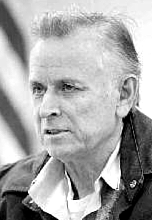
James Earl Ray Hospitalized Before Upcoming Hearing
From the January-February, 1997 issue (Vol. 4 No. 2) of Probe
The weekend before Christmas, James Earl Ray, the convicted, yet disputed, assassin of Martin Luther King, was transferred from the Riverbend State Prison in Nashville, Tenn. to the Columbia Nashville Memorial Hospital. By Christmas Eve, Ray had slipped into a coma.
Ray, 68, has been suffering from cirrhosis of the liver and kidney failure, which led to internal bleeding. Cirrhosis is most commonly associated with an abuse of alcohol (Click on this link for an explanation).
Ray wasn’t a drinker or a smoker.
“I think he’ll be gone in 24 hours. I really do,” said his brother Jerry. Ray’s brother, on Christmas Eve, signed a request that Ray not be given life-support if his condition should become critical. But on Christmas Day, Jerry changed his mind, attributing the change to calls from both Reverend James Lawson and William Pepper, Esq.
Reverend Lawson, now a Los Angeles pastor, was a supporter of Martin Luther King’s who was in Memphis during 1968. Lawson has been vocal in his defense of Ray over the years, claiming Ray could not have been a lone assassin, if an assassin at all.
William Pepper has become Ray’s lawyer. Pepper recently wrote a book detailing his own long study of the King assassination case, called Orders To Kill. The book details Pepper’s own search for the truth about King’s death, and concludes that Ray could not have been the one responsible. The finger of guilt is pointed instead toward an alliance between forces in the government and elements of organized crime. Both Lawson and Pepper convinced Jerry that he should make every effort to keep his brother alive, especially in light of an upcoming hearing.
For years, since the time of his confession, which he retracted a few days later, Ray has professed his innocence and filed barrages of appeals to get a new trial. Finally, in 1994, it seemed he might have a chance.
During the course of preparing a mock trial for an HBO telecast, much new evidence surfaced in the MLK case. The evidence was enough to frighten one person into coming forward to confess what he claimed was a small role he had played. Lloyd Jowers, who worked in the grill below the rooming house from which King was allegedly shot, confessed on TV in December of 1993 that he had been hired to find an assassin for King, and that he had not hired James Earl Ray. Jowers wanted immunity before telling more of what he knew. But Shelby County District Attorney General John Pierotti called Jowers’ story a hoax. According to Pepper, “Pierotti has had five witnesses under his nose…and he’s never even tried to talk to them to get their story.” Both Lawson and Pepper complained publicly that Pierotti had done little to investigate the case.
In January of 1994, New York City attorney Jack E. Robinson, having done his own five-year investigation into the Martin Luther King assassination, went public with his findings. He had reviewed the House Select Committee records and found their investigation “very disturbing. The House investigation was sloppy and incomplete, and its findings misleading. James Earl Ray, in my view, is innocent.”
Former HSCA Chairman Walter E. Fauntroy agreed. Referring to the HSCA’s conclusions that although there was likely a conspiracy in the MLK case, Ray was still a shooter, Fauntroy said, “both research by very competent people on the one hand and my review of my own basic data for that investigation have convinced me that we were in error on the second matter, namely that James Earl Ray, in fact, shot Dr. Martin Luther King. That, in my view, is not true.”
Although denied parole in May of 1994 at his first hearing in 25 years, by June Ray had cause to hope. Pepper had managed to convince Shelby County Criminal Court Judge Joseph Brown, Jr. to allow a test firing of the alleged assassination rifle to see if the rifle could have fired the bullet that struck MLK. Brown had ruled in April that under state law, there was no way that a defendant could benefit from new evidence long after having been convicted of a crime. Nonetheless, the Judge recognized the historical importance and unanswered questions surrounding the case, and said he would allow Ray’s attorneys to “get it all out on the record” so that an appeals court might be able to later consider the new evidence.
However, Pierotti got the Judge to delay the tests, saying he wanted experts of his own choosing present at the test-firing, which had been set for June 16, 1994. Pepper also wanted to conduct neutron activation tests on the rifle, but Pierotti claimed that FBI experts had said such tests were only useful with recently fired bullets. The day before the test firing was to take place, a state appeals court halted the proceedings, granting Pierotti’s request for a delay of the firing. It seemed the last chance to get at the truth was slipping away.
In 1995, Ray filed a FOIA for classified papers that he claimed would clear him of participation in the assassination. Officials denied his request priority treatment, claiming his case had not generated “widespread and exceptional” media interest. “The politicians have a vested interest in keeping me in prison,” Ray said at the time. “For instance, if I were out, I could personally appear in Federal Court petitioning for the release of the classified Martin Luther King records.” In response to questions of his own involvement in the shooting, Ray responded,
What I say is not worth two cents…What I’m trying to do is get these classified records released and let them make a judgment based on the records. I’ve testified to everything I know about the case. The prosecution presented certain versions of the case but they’ve kept the rest under seal.
Undaunted, Pepper and the rest of Ray’s defense team have stuck by him. In fact, there is a hearing scheduled for February 20th of this year, in which Judge Brown will again be petitioned for permission to test the murder weapon. This time, according to Jerry, “they’re going to have Court TV down there. There is going to be too much pressure on [Pierotti] not to give him a trial, because when it comes out, that the gun wasn’t the one that was used to kill King, then they’ll know James was a setup as the fall guy.”
Ray has come near death, just two months before this was to take place. Andrew Hall, one of Ray’s lawyers, told the press he had sued the state claiming prison officials refused to treat Ray for stomach troubles last summer. “He’s been asking for treatment for a year,” Hall lamented. “They’ve been refusing to give treatment or a diagnosis to see what is wrong.”
Ray did come out of the coma the day after Christmas, but his health is still tenuous. For those looking for a deathbed confession, Jerry offered this:
Let me tell you, anybody out there believes James did do it and going to give a death-bed confession, I hope they don’t hold their breath because if he wanted to confess to something he didn’t do, they offered to turn him loose in 1968 [presumably 1978]. House Assassinations Committee, Congress, and I was present when…Representative Sawyer and Stokes made the offer right in front of me and Mark Lane that they would turn him loose if he would confess to murder. He said he wouldn’t confess to anything he didn’t do….Same thing at the parole board….He told them he didn’t even want to go in front of the parole board. Because, he said, I’m not guilty. He said a parole would mean I am guilty. He don’t want no pardon, no parole, the only thing he wants is a trial to prove he didn’t kill King.”
As we start this New Year, we hope that Ray lives long enough for this hearing to happen. “If he dies before February 20th, then the hearing is off,” Jerry told the press. We all deserve to learn the truth about this case—and no one more than Ray himself.
– Lisa Pease