Tag: JACK RUBY

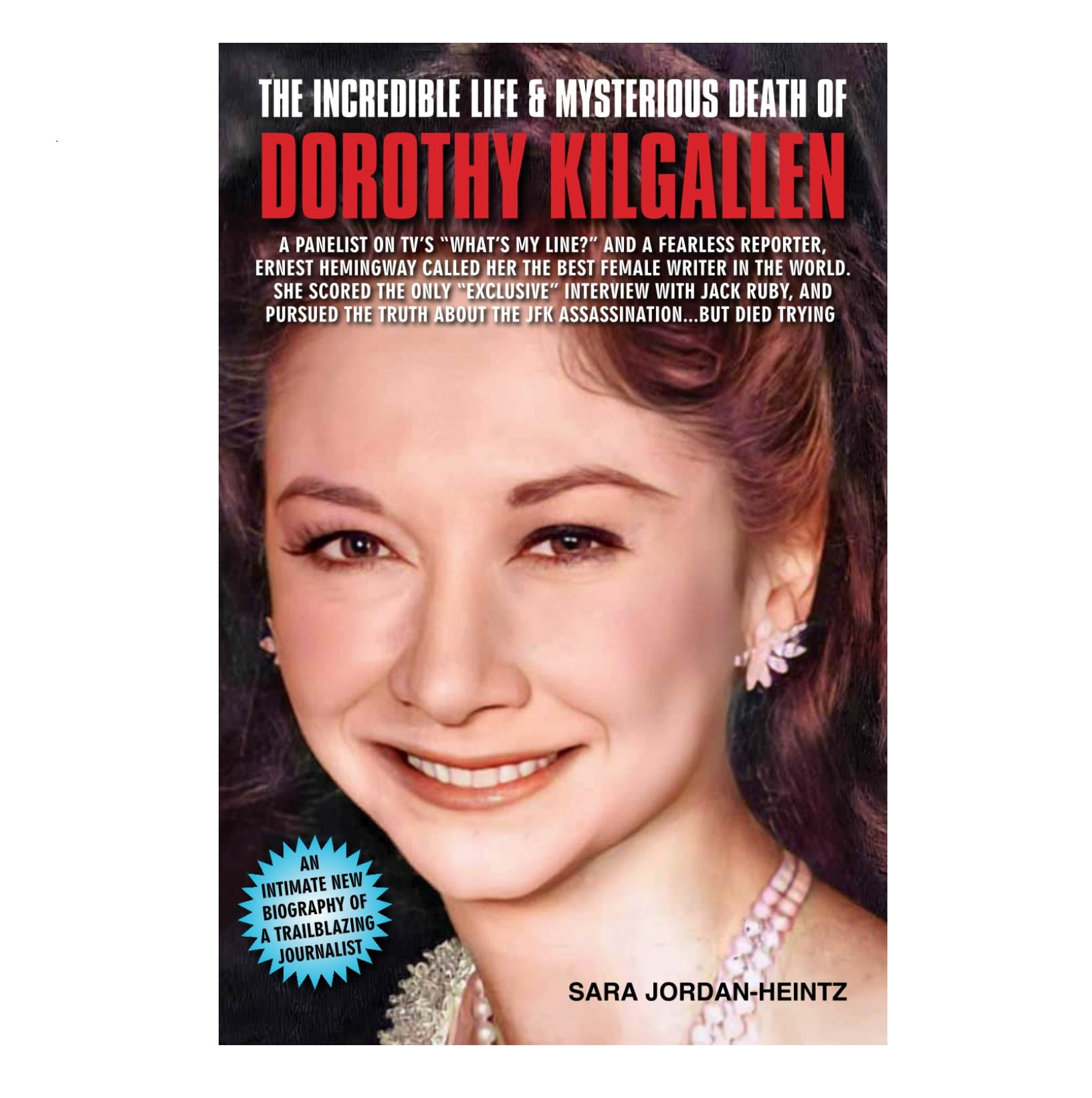
  • The Incredible Life and Mysterious Death of Dorothy Kilgallen

    The Incredible Life and Mysterious Death of Dorothy Kilgallen


    The Incredible Life and Mysterious Death of Dorothy Kilgallen

    by Sara Jordan-Heintz

    Let us first give the author her past due.  In 2007, Sara Jordan wrote a fine article about the demise of journalist and TV personality Dorothy Killgallen for Midwest Today. This was then reprinted in a color online version in 2015, at the 50th anniversary of Kilgallen’s death. (Click here for that version.) That original article was a milestone in the literature on this subject. In this new book, Jordan reveals that she was all of 17 years old when the article appeared (Jordan-Heintz, p. 384) Which makes it the most precocious piece of writing on the Kennedy case since Howard Roffman published his book Presumed Guilty at the age of 22.

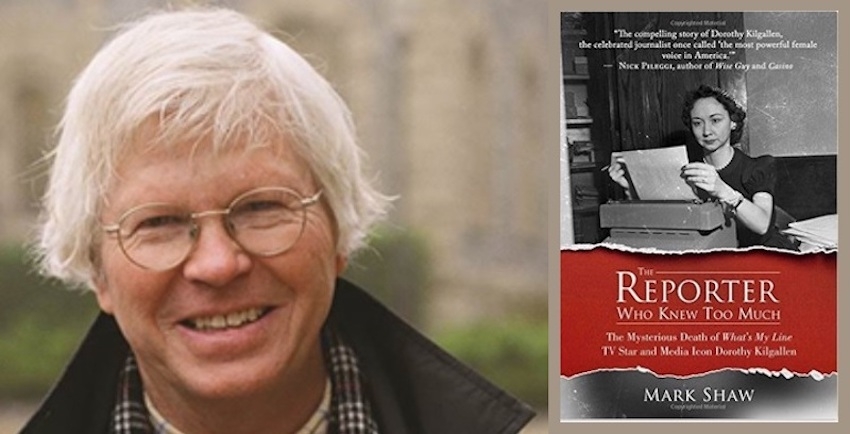
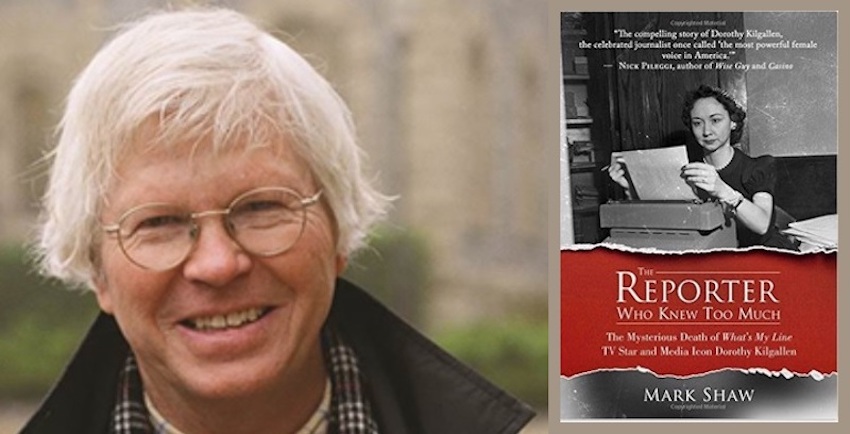
    The author has now expanded her distinguished essay into a book.  At the start, she tries to explain why she did so, strongly indicating the works of author Mark Shaw which followed. She says that although she was glad about the article’s popularity she was:

    …dismayed to see Dorothy’s story turn into a cottage industry for one author in particular, whose book, in my opinion, contains reams of repetition, wild theories  and self-aggrandizement.  Much of his original information came from my article, after he contacted me several years ago requesting an interview.  Not all of this is appropriately credited. (p. 1)

    If anything this is mild. As I noted in one of my reviews of Shaw’s “cottage industry” books, not only has Shaw tended to discount Jordan-Heintz’ work, but also the woman who Sara got in contact with for her essay, namely Kathryn Fauble.  But her (understandable) frustration with Shaw is one of the reasons she decided to write this book.

    II

    On the night of November 7, 1965 journalist Kilgallen performed as a panelist in her last What’s My Line program. In a belated revelation, her butler and maid, said she came home that night with a man, and they heard the back door closing. This is a bit hard to comprehend since in addition to the Clements couple, James and Evelyn, there were three other men at the townhouse: her husband Richard Kollmar, her son Kerry, and his tutor Ibne Hassan. (Ibid, pp. 4-5) The following morning she was found dead in her home, the cause was a drug and alcohol overdose. Complicating matters was this: her papers for a later book proposal on the JFK case were gone.  She had made at least one trip to New Orleans,  a second more secretive one, and one to Miami. Charles Simpson, one of her hairdressers—the other being Marc Sinclaire—quoted her as saying the following:

    I used to share things with you guys—but after I have found out now what I know, if the wrong people knew what I know, it would cost me my life.  And she was dead about nine months later. (Ibid, p. 5)

    In addition to a file, and her journeys, she had two interviews with Jack Ruby in person during his trial. She also was in receipt of Ruby’s Warren Commission testimony and she printed this in her newspaper, the Journal American. It was printed over three days and Kilgallen provided a critical commentary (pp. 223-25)

    Since this book is a biography, it details Kilgallen’s life from her birth in Chicago in 1913, and the influence of her journalist father in starting her in a career in the newspaper business.  A big career boost was the 1936 “race around the world” against fellow reporters Leo Kieran and H. R. Ekins. She lost to Ekins but—at age 23– it was a great publicity machine for her. She became the second woman, after Nellie Bly,  to circle the globe. (Ibid, p. 11) It gave her a brief visit to Hollywood, where she acted in a film and sold a concept picture based on the contest, it was entitled Fly Away Baby.

    In 1938 she started her famous column, “The Voice of Broadway”. Three years later, based on its success, CBS gave her a radio show of the same name.  She did another later radio show with her husband, Richard Kollmar, who was a Broadway producer and actor. After marrying Richard, Dorothy quickly had two children, Richard Jr in 1941 and Jill, in 1943. (ibid, pp. 16-19, she had a third child in 1964 named Kerry.) In 1950 she became a regular on the popular TV show What’s My Line? That game show was broadcast live on Sunday nights. Because she was a triple threat—radio, TV, newspapers– she made a lot of money each year.  In 1953 the couple purchased a 13,000 square foot townhouse at 46 E. 68th Street, a block away from Central Park. To demonstrate the kind of money she was making, that  townhouse sold for 17 million in 2021. (Ibid, p. 30)

    The story that really gave Kilgallen’s career a rocket boost was her coverage of the Sam Sheppard murder case (ibid, pp. 34-35). Sheppard was a doctor in Cleveland who was accused of killing his wife in the summer of 1954. Sheppard insisted he had fallen asleep downstairs and she was killed upstairs by an intruder who knocked him unconscious when he tried to rescue her. Due, in part, to a highly prejudiced press, he was convicted. Lee Bailey eventually took over the appeal process. In a first rate performance Bailey had the conviction overturned, partly because the judge had told Kilgallen, “Well, he’s guilty as hell.  There’s no question about it.” And also because the jury was not sequestered as it clearly should have been. The retrial took place in 1966, after Kilgallen’s death. Bailey represented Sheppard at trial and had him acquitted.

    Another famous murder she covered was the Tregoff/Finch case of 1959.  Dr. Raymond Finch was having an affair with a woman named Carole Tregoff.  He wanted to divorce his wife Barbara and marry Carole, but the California community property laws discouraged him from doing so—his wife would have taken too much money and property. Therefore, the couple plotted to kill Barbara. They first tried to hire someone to do it, but he backed out. So they then did the deed themselves at Finch’s West Covina home. Even though the evidence against them was very convincing, there was a mistrial. They were tried again, and inexplicably, there was another mistrial. On the third go round, they were finally convicted. (ibid, pp. 56-57)

    Both of these sensational cases are covered in Kilgallen’s posthumously published book, Murder One.

    III

    A serious difference between the Jordan-Heintz book and Mark Shaw’s first volume The Reporter Who Knew Too Much, is that this new book spends a lot more time and space on the actual assassination of President Kennedy than Shaw did. And that might be understating things. I would estimate that there is almost as much material on the death of JFK as there is on the mystery of Kilgallen’s demise. But further the author uses much material that is not from the Warren Commission volumes or the Warren Report.  It’s an open question as to how much of the 26 volumes that Kilgallen read.  But, of course, it would have been impossible for her to have read what did not surface until after her death in 1965.  And we can only speculate what she had filed away, since that disappeared after her demise.  And no one really knows about her two short interviews with Jack Ruby, since she never revealed to anyone what Oswald’s killer told her. 

    But, for whatever reason, Sara Jordan-Heintz has decided to place in her book a lot of JFK murder information that did not come out until many years, actually, decades later.  To me, it’s fine for her to detail things the doctors saw at Parkland Hospital about the baseball sized hole in the rear of Kennedy’s skull. (p. 90). It’s also fine to quote local reporters Mary Woodward and Connie Kritzberg as to how their work was altered or parts were pulled. (pp. 94-95)  Because these were things that happened right then and there, and Kilgallen could have at least theoretically found out about them.  But then when the writer states that photos were faked and “it also became shockingly clear there had been alterations to JFK’s corpse by the time the formal autopsy began at Bethesda Naval Hospital that night” we are now getting into areas that it is unlikely that Kilgallen could have even speculated about back in 1965.  And I beg to disagree but it is not “shockingly clear” that Kennedy’s body had been altered before the autopsy began. (p. 92). She even goes further than this—shades of Sean Fetter– suggesting that the body was transferred to another casket before Air Force One left Dallas. (p. 98)

    This ignores the interview that the late Harrison Livingstone did with Nurse Diana Bowron who actually helped place the corpse into the casket at Dallas. (See the end of the first part of my review of Fetter’s book https://www.kennedysandking.com/john-f-kennedy-articles/under-cover-of-night-by-sean-fetter) For her rather wild concept–and like Fetter–she also relies on the Boyajian Report, although she does not name it, for an early arrival of Kennedy’s casket at 6:35 PM at Bethesda Medical Center.

    I don’t know how many times I have to repeat this, but I will keep on doing so as long as I have to. Roger Boyajian and his so called report are not reliable evidence in this case. I have demonstrated this twice before and I now have to do it again. That report does not state that the casket picked up by Roger Boyajian’s detail was Kennedy’s casket.  It only refers to it as “the casket”.  The obvious question is this: if Boyajian knew it was Kennedy’s casket, would he not have acknowledged that?

    Secondly, the report was not signed by Boyajian, and there is no hint as to why he did not sign it. To make matters worse, there is a second page to the report that lists the 10 others in the detail—and none of them signed it either. But even that is not the end of it. For when the Assassination Records Review Board (ARRB) interviewed Boyajian about the matter, that is picking up Kennedy’s casket, he could not recall doing so. In fact, he could not recall much about that day–period. Finally, the document the Board had does not appear to be the original.  This makes one wonder if it was ever filed with the military. (Harrison Livingtsone,  Kaleidoscope pp. 140-46)

    To make it even worse she writes that:

    There is general agreement among most JFK assassination researchers that the two casket scenario took place and that Kennedy’s body was probed for bullets (which were presumably removed) and surgical procedures done to conceal that he was fired upon by more than one shooter.(ibid, p. 99)

    There was and is no such general agreement.  In fact, the late Cyril Wecht—a forensic pathologist—never thought such was the case.  Neither does Dr. Randy Robertson, neither does Pat Speer, or Dr. Gary Aguilar.  At no JFK seminar I have ever attended—from 1991 to 2023—have I ever seen any panel devoted to this subject. The writer who formulated this scenario and wrote a popular book about it —David Lifton—could never make any real headway with it inside the critical community, and he himself admitted that.  Its not that he didn’t try, he did. But these attempts failed with rancorous feelings between those involved.

    This angle is made worse when she brings in the tall tales about embalmer John Liggett that were first broadcast by the discredited  Nigel Turner. (p. 106) Liggett’s brother filed a legal action against The History Channel over these ersatz claims and forced a settlement. (South Florida Sun Sentinel, 3/19/2005) It appears that this  bizarre Liggett angle might have been turned up by Billy Sol Estes, a man who sold more baloney on the JFK case than the Hormel company. (See the 2004 book Billie Sol Estes, pp. 155-57)

    As I have said many times about the JFK case, we must follow the Sagan rule: Extraordinary claims demand extraordinary evidence. The above does not, in any way, constitute extraordinary evidence. Kilgallen could not have known about them and I doubt if she would have bought into any of them.

    IV

    I don’t wish to leave the impression that all the many pages Jordan-Heintz devotes to the JFK case itself should be dismissed.  That would not be fair or accurate. She does bring in credible evidence of extra bullets being discovered e.g. Randy Robertson’s evidence about Dr. James Young. (See the film  JFK: Destiny Betrayed.) She also notes that there are photographic images missing from the autopsy collection, which there are. And her use of FBI agents, Jim Sibert and Frank O’Neill is appropriate. (Jordan-Heintz, p. 119) As is the memo written by Deputy Attorney General Nick Katzenbach. (ibid, p. 121)  Her description of the murder of Oswald by Ruby with Captain Fritz breaking formation to allow it is apropos and she mentions the editing out of the horn sounds. (pp. 137-38)

    She adroitly shifts to a column written by Kilgallen after the shooting of Oswald. In that piece the reporter said that Kennedy’s assassination was bad enough but now, after the murder of Oswald, people who have never been there feel like they have just witnessed a Texas lynching. (p. 143) She assailed the fact that Ruby was allowed to walk in and out of the Dallas police headquarters, which was supposed to be keeping a security guard around Oswald. She poignantly wrote that the murder of the suspect prevented due process: “When that right is taken away  from any man by the incredible combination of Jack Ruby and insufficient security, we feel chilled.” She added, “That is why so many people are saying there is ‘something queer’ about the killing of Oswald, something strange about the way his case was handled, and a great deal ‘missing’ in the official account of his crime” (p. 144) In a mid-December 1963 article she said Ruby may have been allowed access since members of the police force “partied at Ruby’s strip club.” She added that “there were jam sessions at which Dallas cops joined in the fun, some playing musical instruments others doing turns as singers and comedians….” (pp. 164-65)

    About a week later, on December 23, she wrote about the upcoming film Seven Days in May.

    The producers of the forthcoming film Seven Days in May have every right to think that life imitates art in the most tragic way. Long before President Kennedy was assassinated in Dallas, they finished their picture about a military group hatching plans to overthrow the President of the United States.  In the movie, the ‘secret base” where the plot against the Chief Executive reaches its climax is a place in Texas.(p. 166)

    She gives coverage to the Parkland Hospital press conference on the day of the assassination with Malcolm Perry and Kemp Clark.  She adds that this conference, added to PR man Malcolm Kilduff’s gesture that the fatal bullet struck Kennedy in the right temple, these undermined the future cover up. She notes that Perry said the anterior neck wound appeared to be one of entrance. Which would eliminate Oswald. (p. 145). Then, apparently based on Barbara Shearer’s documentary, What the Doctors Saw, she writes “that after the news conference, the doctor was accosted by a man in a suit and tie who grabbed his arm and warned him menacingly, “Don’t you ever way that again!” She then adds that this agent was Elmer Moore of the Dallas Secret Service. (ibid)

    This appears to be incorrect.  From the information that several writers have accumulated—Gary Aguilar, and Pat Speer among them—Moore was on the West Coast on the day of the assassination. On the same day, he was then shifted to Washington for what appears to be a briefing.  He was then detailed to Dallas on November 29th. (James DiEugenio, The JFK Assassination: The Evidence Today, pp. 166-67) She is correct about Moore’s assignment being to get the Parkland doctors to change their accounts, and about Moore being a rabid Kennedy hater. She then reinforces this point with the belated revelation by journalist Martin Steadman, namely that Perry revealed to him that he was getting calls during the evening of the assassination to change his statement about a front shot to the neck.

    She notes that JFK was trying to forge a rapprochement with Fidel Castro in 1963. But she then adds that Bobby Kennedy had approved a partnership with the Mob to furnish assassins to murder Castro. (p. 151). The CIA Inspector General report on the plots to kill Castro was finally declassified by the Assassination Records Review Board in the mid -nineties. It remains the most definitive and complete accounting of those plots. Right in that report the authors declare that no administration had any knowledge of the plots from their inception to their ending.  Which means from 1959-65. (See CIA-IG Report, pp. 132-33) This is why Director Richard Helms kept exactly one copy, the ribbon copy, in his safe. And when President Johnson read it, he concluded that the CIA had a role in Kennedy’s assassination. (Washington Post, December 12, 1977)

    V

    After many, many pages on the JFK murder, Dorothy Kilgallen finally arrives in Dallas in February of 1964 to cover the trial of Jack Ruby. She wrote a column on February 22.It began like this:

    One of the best kept secrets of the Jack Ruby trial is the extent  to which  the federal government is cooperating with the defense.  The unprecedented alliance between Ruby’s lawyers and the Department of Justice in Washington may provide the case with the one dramatic element it has lacked: MYSTERY. (p. 189)

    She then adds a rhetorical question:  why has the government decided to supply Ruby’s defense with all sorts of information as long as they do not request anything on Oswald?  She continues in this vein:

    Why is Oswald being kept in the shadows, as dim a figure as they can make him, while the defense tries to rescue his killer with the help of information from the FBI?  Who was Oswald, anyway? (p. 191)  

    The book then goes into several pages of an Oswald biography. We then refer back to Kilgallen’s comments on his absence at the trial, which the reporter thought was unusual in her experience of criminal trials:

    It appears that Washington knows or suspects something about Oswald that it does not want Dallas and the rest of the world to know or suspect….That Lee Harvey Oswald has passed on not only to his  shuddery reward, but to the mysterious realm of classified persons whose whole story is known only to a few government agents. (p. 200)

    In returning to the trial itself, one of  Ruby’s lawyers, Joe Tonahill, told the reporter that Ruby wanted to speak to her. (p. 203) Therefore a brief exchange took place at the defense table.  About a month later, Kilgallen asked to speak to Ruby again without the court appointed bodyguards around.  The judge granted the request.  So Tonahill, Ruby and Kilgallen walked into a small office during the noon recess.  Although Tonahill was interviewed about this many years later, he did not offer any specifics, besides saying it was an agreeable conversation. (p. 205) Kilgallen never told anyone about this conversation either.

    At the end of the trial, with Ruby convicted, Kilgallen wrote that the whole truth was not told.  And that neither the state nor the defense placed all the evidence before the jury.  (p. 207). That verdict was later vacated and Jordan-Heintz describes how Ruby passed on before his retrial in Wichita Falls and she does a nice job describing the character and career of Louis J. West, a CIA affiliated doctor who was, inexplicably, allowed to visit Ruby before he passed away in January of 1967. (p. 208)

    In July of 1964 Kilgallen published Ruby’s testimony, four months before it would appear in the Commission volumes. Readers were struck by Ruby’s ignored pleas to go to Washington for the interview. She also asked in her commentary: how could Tippit not know Ruby? In another column published in August, she got hold of an internal Dallas Police report and used it to strongly criticize the performance of the police both in the immediate aftermath of the JFK murder and in the transfer of Oswald.(p. 228)

    VI

    The book closes with the death of Kilgallen.  Jordan-Heintz, like Mark Shaw, focuses on the strongest possible suspect, namely the late Ron Pataky, who died in 2022. Lee Israel, the reporter’s first biographer, revealed the affair Kilgallen was having with the much younger journalist from Ohio. Israel did not name him but referred to him as the “Out of Towner”. (p. 242) Jordan -Heintz was the first writer to name him in her Midwest Today article back in 2007.

    What follows in the book  is a concise biography of Pataky as a Naval ROTC officer at Stanford who was, either kicked out or dropped out, of the university in April of 1955. (p. 243) He was using fake ID cards and was arrested. He then transferred to Ohio State and graduated in 1958. He eventually got a job as an entertainment writer for the Scripps Howard chain, at the Columbus Citizen Journal until it folded in December of 1985. Pataky was also a poet and songwriter.

    By the time Pataky met Dorothy he was married and divorced. He appears to have been quite the ladies man.  The book features pictures of him with actresses Sandy Dennis and Alexis Smith.  He also had an affair with singer Anna Maria Alberghetti. He and Kilgallen met while on a film press junket to Europe. (pp. 247-48) Although Pataky maintained that their relationship was Platonic and not sexual, there is evidence that such was not the case. (p. 251) The author juxtaposes his budding relationship with Kilgallen and her doing more work on the JFK case. For instance, in late September of 1964, she revealed that witnesses who did not identify Oswald at the scene of the murder of Patrolman J. D. Tippit were told to be quiet.

    The author notes that Kilgallen did report on the kindly Quaker couple, Ruth and Michael Paine and their incriminating comments about Oswald.  She also notes a fascinating piece of information I had never encountered before. In commenting on the Roger Craig testimony about Oswald jumping into a Rambler station wagon after the assassination, she says that Ruth Paine’s station wagon was a Chevy. But that someone who did own a four door Rambler station wagon was New Orleans businessman/CIA agent Clay Shaw.

    He insured the Dallas-based vehicle (buying only the required liability policy) through an out-of-town agency for his “son” (though he didn’t have one), then canceled the policy after the assassination and presumably disposed of the vehicle.  Correspondence from the insurance agent confirms all this. (p. 261)

    Quite intriguing if its accurate.

    During the last year of her life, the reporter made few if any newspaper references to the JFK assassination. But according to more than one source, she was still at work on the Kennedy case. And she was arranging a second visit to New Orleans. She was going to meet with a source that she did not know, but would recognize. Ron Pataky said that the man she met with was Jim Garrison. (pp. 317-18) But further, Pataky said that he had met with Garrison, two weeks after he had previously met with Mark Lane. And, according to Pataky, he met with Lane before the reporter did. The author suggests that this shows that Pataky was likely on assignment during his days with Kilgallen.

    On the evening of her death, Kilgallen was seen at the Regency, her favorite hotel bar, after midnight with a male companion. Pataky says it was not him and that he only talked to her by phone in that 24 hour period. (p. 329) One of the weirdest dichotomies about her death is that the butler, James Clement, maintains that he found her body in the bathroom. (p. 333) But hairdresser Mark Sinclaire said he first found her body in the third floor bedroom, where she never slept. Jordan-Heintz tries to address this paradox in the evidence. She asks, just what happened between the hours when Clement says he saw the body and when Sinclaire discovered it in the bedroom. Clement also said that men in suits carted off her files. (p. 338)

    Lee Israel noted that the police did next to nothing about this case. They should have interviewed everyone she talked to the night before, but there is no evidence they did so. But Pataky said he actually was interviewed. (p. 339)

    The book closes with the very odd circumstances of Kilgallen’s autopsy. The official version was she died of “acute barbiturate and alcohol intoxication, circumstances undetermined.” (p. 350) But the man who did the autopsy, did not sign the death certificate.  And the person who signed was not even stationed in Manhattan, where she died, but in Brooklyn. It also turned out that there was evidence  of Nembutal on her drinking glass, a drug which she had not been prescribed (she had only been prescribed Seconal). There was also evidence of a third drug in her system: Tuinal. The chemist who did the drug testing said he was told by his superior to keep the case under his hat because it was big.(pp. 351-52)

    The book tries to place Pataky in New York on the night Kilgallen died. The author bases this on the fact that his paper ran his review of the film The Pawnbroker two days later.  But according to IMDB, that films was released in April, six months prior.  So although this is suggestive, it is not probative of Pataky being in New York at that time.

    The mystery of Kilgallen’s death continues. The incompetence, or indifference, of the authorities was simply astounding.
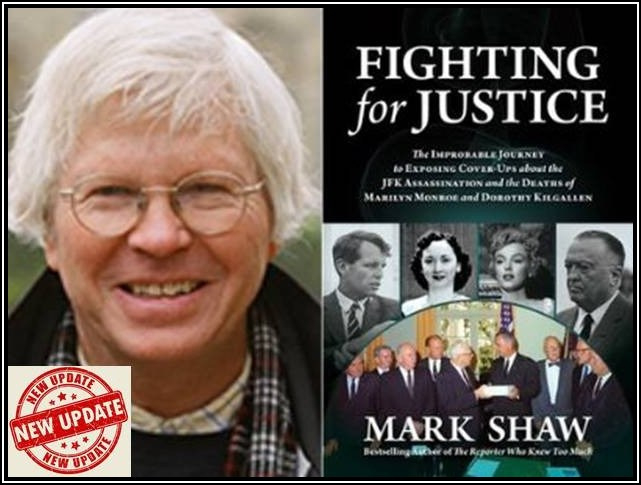
  • Mark Shaw’s Fighting for Justice

    Mark Shaw’s Fighting for Justice


    Mark Shaw has (ostensibly) written six books about the assassination of John F. Kennedy. Four of those have been published in the last seven years. Which means his current output is one book on an average of less than two years. This reviewer has written, or co-written, four books on the case in thirty years. If Shaw wrote books based on the newly declassified documents that have been dripping out due to the strictures of the 1992 JFK Records Collection Act, then fine. But as we shall see, such is not the case.

    When I reviewed Shaw’s Denial of Justice, I noted that for all that was new in that book, Shaw could have simply written a long blog post on his website. (Click here for that review) To expand his parameters what Shaw has done is added another subject—which was hinted at in that book. So instead of Dorothy Kilgallen and John Kennedy, Shaw opened up a new area of inspection in his next book, Collateral Damage. That new area was Marilyn Monroe. As Don McGovern showed in his two part review, Shaw’s writing was remarkably unconvincing about the late film star. (Click here for that review) As Don demonstrated at length, not only did Shaw reveal a lack of analytical insight, he could not even interpret photographs accurately. His excuse for glomming on to Monroe was that she was allegedly a close friend of Kilgallen. As McGovern explained, among many others Shaw made, that statement was inaccurate.

    In his new book, inaptly named Fighting for Justice, Shaw now says he has gotten literally hundreds of letters asking if there was any connection between the deaths of JFK, Kilgallen and Monroe. (Shaw, p. 149) Which is an odd statement. For example, this reviewer has been researching the JFK case full time for the last three decades. I never got one such question, let alone a letter, asking me about that topic. I have attended literally dozens of conferences, and I never heard anyone from the audience ask anything like that. I have been a semi-regular on Len Osanic’s Black Op Radio program for over ten years, and have fielded hundreds of questions from the audience—but never that one. As we shall see—and as McGovern hinted—there appears to be another reason for Shaw’s insistence on now including the Monroe case in his writing.

    Some people like to hear themselves talk. Shaw apparently likes to type. But typing is not writing. About the first fifty pages of this book have little or nothing to do with the alleged subject matter. It is purely autobiographical. So if you want to hear about why Mark Shaw moved from Indiana to Colorado to California, this is your book. Since I was not interested, to me this was just filler.  

    The last part of the book, Chapters 20 and 21—where Shaw excerpts a long phone call between President Johnson and FBI Director J. Edgar Hoover—could have been cut at least in half. And that is not all that should have been cut. For Shaw repeats much of his prior biographical work on Dorothy Kilgallen. He also recycles his half-baked—if that—ideas on the JFK assassination. For instance, he praises the HSCA for examining every nuance of the Kennedy and Oswald killings. (p. 65) Many would disagree. He then writes that there were three shots fired, with the second and third bullets hitting Kennedy. (p. 66) Yet everyone knows the HSCA concluded there were four shots, based upon the acoustics evidence. He now repeats an allegation he made in Denial of Justice that the HSCA report said the Kennedys went after organized crime because mobsters impinged on the success of their father’s bootlegging.(p. 66) I read the HSCA volumes on organized crime, Books 5 and 9, and found no such thing. Let me quote myself:

    If one goes through those volumes, especially volumes 5 and 9, where this Mafia angle is explored, the reader will find no mention of Joe Kennedy’s alleged bootlegging. But in book five, it is noted that, by 1963, the Mafia was falling apart due to Bobby Kennedy’s unrelenting pressure tactics. (HSCA, Vol. 5, p. 455) And make no mistake, the House Select Committee pulled out all the stops in investigating this Mob-did-it angle. They used all kinds of official records, not just in Washington, but also from various local police departments. Again, did no one do any editing of this book?

    So Shaw wanted to write another book. And apparently it did not matter how he filled in the pages. So how does he do it? He prints and then replies to questions and comments from people who read his books, or watched his online presentations. And from what I could discern, the quality of the comments did not matter. There is a letter from a man whose father knew Joe Cody, a former police officer in Dallas. It turns out that Cody bought Jack Ruby the revolver he used to kill Oswald. After relating this information, Shaw pats himself on the back for uncovering “an historical piece of evidence”. (p. 125)

    It would have been natural of Shaw to have clicked his search bar. If so he would have found out that this “historical’ piece of evidence has been around since at least 2008. Since it was described in two obituaries for Cody, one in the Dallas Morning News of July 7th and one at the TV site for KTBS on July 3rd.

    I don’t even want to talk about another one which features Carlos Marcello, Mac Wallace, and Jack Ruby in the same restaurant in Dallas in the summer of 1963. It then gets better. A show girl with Marcello calls Shaw’s witness later in 1977. She says she has a picture of the real JFK assassin emerging from a sewer. Uh, OK. (pp. 119-20).

    But it’s not just stuff like this that Shaw uses to fill in pages of what is supposed to be a book. He now goes back to older books and describes them. One of them is from 1973 and is called The Kennedy Neurosis by Nancy Clinch. If a negative book on the Kennedys gets blasted by The New York Times well, that is notable. (See review by Robert Claiborne of 2/25/73) The book is what Clinch called psychohistory. As Claiborne wrote, this is tough to do even when one has the credentials to do so. Clinch majored in Political Science and did studies of housing in South Korea while in Army intelligence. She tried to explain the Bay of Pigs fiasco by saying it was due to “psychic dynamics” and “unconscious motivations” were “a typically American overconfidence and a typically American indifference toward the responses of the enemy.”

    Claiborne properly labels this as nonsense. But we know what happened with the Bay of Pigs today. It had nothing to do with a “Kennedy neurosis”. It had everything to do with the president being deliberately lied to by the CIA, namely Director Allen Dulles and Director of Plans Dick Bissell. (Destiny Betrayed, second edition, by James DiEugenio, pp. 34-56)

    But strangely, this is something that is almost off limits to Shaw. You will see very little, if anything, about Kennedy’s disputes with the Pentagon or the CIA in any of his books. Even though this particular deception by the CIA caused Kennedy to fire Dulles, Bissell and Charles Cabell, the Deputy Director. I would personally think that would be more important than an ancient story about Joe Cody. Especially when its combined with the fact that the CIA also betrayed Kennedy by assassinating Patrice Lumumba, and backing an overthrow of Charles DeGaulle in 1961. (See David Talbot, The Devil’s Chessboard, pp. 382-89; pp 412-24) This all gets the back of Shaw’s hand, rendered unimportant. Even though when Dulles was appointed to the Warren Commission, at their first executive session meeting, he passed out a book saying that all American presidential assassinations were the work of one man. (David Lifton, Document Addendum to the Warren Report, pp. 89-90)

    What is important to Shaw? Not the new documents. He sloughs those off in a couple of pages. And when I say slough, I mean it. He finds credible a CIA document saying that Sam Giancana was still running the Chicago outfit in December of 1977. Uh Mark, Giancana was killed in 1975. That is almost as bad as him buying into a CIA document from 1998 negating any connection of Oswald to the Agency’s “Office of Operations.” (pp. 106-07) Apparently Shaw is ignorant of what Malcolm Blount did with the papers of the HSCA’s Betsy Wolf. And how her work resulted in CIA officer Pete Bagley declaring that Oswald was a witting false defector in 1959. (Click here, and see John Newman’s speaking of Bagley in Oliver Stone’s JFK : Destiny Betrayed)

    As the reader can see, Shaw is not an astute or prolific researcher on the newly declassified documents. So what does he build his book around? Two things. First, what he broadcasts as an utterly momentous, earthquake type of discovery. It is this: he thinks that Warren Commissioner John Sherman Cooper gave Dorothy Kilgallen the Commission’s Ruby testimony in advance, which she printed in her newspaper. Shaw spends about a dozen pages on this toward the end. He has no direct source, its an inference and a circumstantial case through a man named Morris Wolff. He then uses this as some kind of springboard that Cooper did not buy the Warren Commission from the start.

    Mark we kind of knew that. And the work has been done through more than one person on Cooper’s cohort Senator Richard Russell. Russell, Cooper and Hale Boggs made up the southern wing of the Commission, as opposed to the Wall St./Washington troika of Dulles, Jerry Ford and John McCloy. I wrote about this at length many years ago. (DiEugenio, The JFK Assassination: The Evidence Today, pp. 315-320). This is why there was no stenographer at the last meeting of the Commission to record the southern wing’s dissent. And why Cooper said in a British documentary, way back in 1978, that he did not buy the Single Bullet Theory. Cooper as dissenter is not hot news. And I am still trying to figure out what the impact was of printing Ruby’s testimony early? As I am still trying to figure out how Kilgallen cracked the case if no one knows what she had in her files?

    Let us go to the other key point that Shaw insists on writing about. His new point of interest, which is really quite old: the alleged cover-up around the death of Marilyn Monroe. As Don McGovern showed in his review of Collateral Damage, Shaw went as far as misinterpreting photos implicating Bobby Kennedy in the death of Monroe. McGovern and Donna Morel pretty much wrecked Shaw’s new witness on the Monroe case: actor Gianni Russo. Russo had a hard time getting his age straight as to when he began his alleged relationship with Monroe—at first it was when he was about 12. This did not seem to bother Shaw. And neither did the problem of where Russo said Marilyn was living in 1959, Russo said it was the Waldorf Astoria. It was not.

    To put it mildly, Russo presented some problems for Collateral Damage. So now Shaw brings in writers like Sy Hersh and Frank Capell. But he does not give the reader the proper information about these two men. Hersh fell for a fraudulent legal document that was supposed to be signed by Marilyn and the Kennedys. More than one person said the signatures attached to the document were questionable. Hersh went forward with it anyway until it was shown that zip codes did not exist when the document was executed. (Click here)

    Frank Capell was brought up on charges, along with two other men, in a conspiracy to commit libel against Republican Senator Thomas Kuchel. Prior to that, Capell had been arrested twice for accepting bribes as a government employee. (Click here) I don’t recall Shaw writing about any of these compromising incidents in relation to Capell or Hersh. I find it hard to comprehend he would not know of them.

    But alas, Shaw uses the testimony of LAPD officer Jack Clemmons to say there was no drinking glass in Monroe’s room the night she overdosed. (Shaw, p. 156) As McGovern has proven there was such a glass in her room. (Click here for proof)

    Clemmons was an accomplice in the libel conspiracy charges that Capell was charged with and had to settle. As part of the settlement, Clemmons left the force. Again, this seems to me to be important information and Shaw should have revealed it before committing the factual error with the glass.

    But that is not all. Shaw continues to use a CIA memorandum allegedly signed off on by James Angleton concerning Marilyn, JFK and UFO’s. Many years ago, John Newman, a former intelligence officer, showed how that memo had to be a fake. (The Assassinations, edited by James DiEugenio and Lisa Pease, pp. 360-61). In his devastating critique of Collateral Damage, McGovern brought in another source, Nick Redfern, who also shows the document to be a forgery. So why is Shaw still using it? Or Russo for that matter?

    Another problem: Shaw says that years after Monroe’s death, when her dwelling was purchased by actress Veronica Hamel, it was discovered that the FBI had installed a listening system in the roof of the home. ( Shaw, p. 171) Don McGovern told me that Monroe’s home had no attic, so was the wiring in the walls? How could Marilyn have not known about it then? (Email of 2/24/23) I got in contact with Gary Vitacco Robles, one of the most credible biographers of Monroe. He informed me that in the third volume of his book Icon, which is coming out soon, he will show that this really was a rewiring of the home, due to the fact that the phone wires were antiquated. After all the house was built in the twenties. (Email communication with Gary, 2/24/23)

    I am not going into the scenario that Shaw puts together as to how Robert Kennedy was actually in Los Angeles the day Marilyn passed on. He was not, and this is provable. (Susan Bernard, Marilyn: Intimate Exposures, pp. 186-87) Neither will I critique his scenario about a rectal enema theory, which McGovern showed was simply not plausible. Or the accompanying “spillage” that Eunice Murray was busy machine washing when the police arrived. As McGovern showed, there was no washer/dryer in the home; Monroe sent everything out to be dry cleaned and pressed. (McGovern, Murder Orthodoxies, p. 550) When an author continually makes these kinds of factual errors, and then trusts unreliable sources and documents—I won’t even talk about the book by June DiMaggio that Shaw uses—one begins to wonder about what his true agenda is. Its pretty clear that Shaw has gone around the bend on the MM imbroglio. He has joined the ranks of Milo Speriglio, Robert Slatzer, and Jeanne Carmen.

    And for him to say that somehow Monroe would not have taken her life or not have died from an accidental overdose, this is more Slatzer-like fruitiness. (Shaw, pp. 280-83) As every serious biographer of Monroe has admitted, she tried to take her life at least four prior times. (McGovern, pp. 8-9) She was, plain and simple, a barbiturate abuser. In the less than 2 months before she died, she had gone through about 790 pills. (McGovern, p. 533) Including, among others, Seconal, Tuinal and Nembutal. Tuinal is not available in the USA today; and Nembutal is used for euthanasia by veterinarians. She had a blank check at Schwab’s so to speak. Monroe had been married and divorced three times before she was 35. She had been through three psychoanalysts in about five years. To put it mildly, she did not have an idyllic childhood: she never met her half-sister until she was 18, she likely never met her father, her mother was institutionalized. And she did not like Hollywood. Which is one reason she and her third husband, Arthur Miller, moved to the east coast. I fail to see how any of the above was due to Robert Kennedy.

    What one feels at the end of this book is not Shaw fighting for justice. If so, why did he leave out the above in lieu of a likely forged UFO document, Clemmons and Gianni Russo? An informed reader is disturbed at the almost boundless and unwarranted vitriol aimed at John and Robert Kennedy. Who cannot reply. But Shaw’s publisher at Post Hill, Anthony Ziccardi, was part of Newsmax Media. So Shaw has now found a home for his venom, and his all too frequent—and quite dubious—books.

    Update

    Mark Shaw’s latest is such a hapless effort that it made me go back and look at his career from the beginning. As we all know he has taken on the cause of Dorothy Kilgallen with all the fervor of a jihadic warrior. Exalting her to a degree so extreme that, at times, he seems just silly.

    But what is odd about all this sound and fury is this: Mark Shaw did nothing of the kind in his first two books, which, in their latest editions, amount to about 700 pages. In his first book, a biography of Melvin Belli, he hardly mentions her. (see page 148) What makes that unusual is that there, since Belli was his defense counsel, Shaw writes five chapters about the trial of Jack Ruby. Kilgallen attended that trial and met with Ruby twice privately. Yet Shaw could only muster 49 words on his (later) Joan of Arc journalist.

    In his next book on the case, there was a slight uptick. He devotes a bit more than two pages to Kilgallen—all of it from Lee Israel’s biography.

    This begs the question: What happened in Shaw’s writing career that made him, literally, alter course? The best and most logical answer I can come up with is this: the reprint of Sara Jordan’s long article on Kilgallen’s death in Midwest Today. That fine piece originally ran in 2007. But it was reprinted with a much more graphic, illustrative format in 2015 for the anniversary of Kilgallen’s death. (Click here for that essay) Jordan was assisted by investigator Kathryn Fauble in that version. By the end of the next year, Shaw began his four book series on the reporter. And in that first effort, The Reporter Who Knew Too Much, he gave Jordan and Fauble credit. As time has gone on, he does that less and less.

    With all this in mind, an incident of Shaw’s self-righteousness about Kilgallen stands out even more. Before his book came out, he appeared at a JFK Lancer Conference which I attended. I recall him saying how he thought Kilgallen had been ignored by the critics and he took a personal blast at Jim Douglass for not writing about her in his book. With what we know today, we could ask Mark: if not for Jordan and Fauble, would you have written books on Kilgallen? Your first two volumes do not indicate that.

    The problem with that subject though is this: Once you get outside the parameters of Kilgallen’s mysterious death, there just is not very much there. Shaw likes to say that when she went to New Orleans it was to investigate Carlos Marcello. This is just guesswork on his part. At the trial of Jack Ruby, Kilgallen wanted to know why there was so little being presented on Oswald. She complained about that in one of her columns. Since Oswald lived in New Orleans that summer of 1963, she could just have easily have been inquiring about what he was doing there.

    Realizing that he was at a cul de sac with Kilgallen, Shaw decided to add Marilyn Monroe to his mix. His excuse, that they were friends, has been undermined by Don McGovern and biographer Gary VItacco Robles. As McGovern noted at length, there are so many holes in Shaw’s work on Monroe that you could drive several 16 wheeled semis though it. (Click here) As I pointed out in my article on Sy Hersh, the whole Giancana election rigging scenario from Double Cross—which Shaw relies on– is so faulty that no one could keep their story straight about it. Plus it does not hold up by its own numbers.(Click here) If you add in what McGovern noted what was wrong about Monroe in that book—the Mob never owned her contract—Double Cross has been reduced to a novel.

    Between his reliance on that fairy tale book, his running out of gas on Kilgallen, and his appalling work on Monroe, what does Mark Shaw have to offer to the critical community? How can he say he is fighting for justice? That Coast to Coast maintains him as their semi regular guest on the JFK case is inexplicable. I, for one, think their 3 million listener audience deserves better. A lot better.

  • Kennedy’s Avenger?

    Kennedy’s Avenger?


    Dan Abrams and his writing partner David Fisher have now written their fourth book. The first three were about trials involving Abraham Lincoln, Teddy Roosevelt, and John Adams. All three books dealt with cases that presidents participated in as either advocates or defendants. Kennedy’s Avenger is about the trial of Jack Ruby for murdering Lee Harvey Oswald. Since Oswald did not shoot President John Kennedy, I don’t quite get the connection to the previous books. But since Abrams is a dyed in the wool, enthusiastic upholder of the MSM, one comprehends why fairly soon.

    Kennedy’s Avenger is an all-out defense of the Warren Report. And it takes very little time or analysis to come to that conclusion. By page 22, the book says Oswald killed Kennedy in a Warren Report, three-shot scenario. Oswald then shot patrolman J. D. Tippit. The authors follow that up with the following:

    Although no one made the connection at that time, it was later proven that a bullet fired from the same rifle Oswald had used to assassinate Kennedy had ripped into General Walker’s home seven months earlier, barely missing Walker. (p. 23)

    Like the two other cases, the authors present this as a fact they do not have to prove to the reader. The problem is simple: it’s not a fact, because the rifle found in the Texas School Book Depository handled different ammunition than the bullet originally described in the Walker shooting. The original bullet at the Walker scene was described in both police and newspaper reports as 30.06 in caliber. (James DiEugenio, The JFK Assassination: The Evidence Today, p. 100) Further, the original police report described the projectile as being steel jacketed. The ammo for the alleged Oswald rifle was copper jacketed. In the nearly eight months that the Dallas Police investigated the Walker shooting, there was never any hint that Oswald was a suspect. In fact, the police thought that two men were involved. (ibid, pp. 102–03) This was largely based on the testimony of witness Kirk Coleman, who ran out of his nearby house the second he heard a shot being fired. He saw two men driving away in separate cars. According to the Commission, Oswald did not drive. Therefore, just from the above evidence, how could Oswald be involved? But if you don’t tell the reader how the FBI and the Commission made their phony case, then you do not have to explain how it contradicted the actual evidence.

    Considering what we know today, Abram’s coinciding description of Oswald is quite shallow. It lasts about a paragraph. (Abrams, p. 23) The shooting of Oswald takes up about a page. Recall, this is really the main topic of the book, and it gets all of one page! (Abrams, pp. 24–25) Right after this, the book devotes about another page to a cliched description of Ruby, as “one of those likable characters who always had a smile and a scheme.” (Abrams, p. 25) And then, about as fast as they can get it in, the authors recite the holy creed about Ruby’s shooting of Oswald: Ruby felt compelled to kill the assassin due to sympathy for Mrs. Kennedy; “he did not want her to go through the ordeal of returning to Dallas for the trial of Oswald.” (Abrams, p. 26)

    Everyone, except maybe Abrams and Fisher, knows that this was exposed as fraudulent way back in 1967 by Newsweek. (3/27/67 p. 21; HSCA Report, p. 158) The House Select Committee on Assassinations described this pretext as “a fabricated legal ploy.” And we know this from Ruby himself. Ruby passed a note to one of his lawyers, Joe Tonahill, at his murder trial and it exposes the title of this book as unsound. It read:

    Joe, you should know this. Tom Howard told me to say that I shot Oswald so that Caroline and Mrs. Kennedy wouldn’t have to come to Dallas to testify.

    Tom Howard was Ruby’s first lawyer. The night Ruby shot Oswald, Howard was at a meeting that took place at Ruby’s apartment with Ruby’s roommate George Senator and two reporters. (Michael Benson, Who’s Who in the JFK Assassination, pp. 200–201) But it’s even more interesting than that. Howard entered the basement of the Dallas Police Department a bit after 11:20 AM. After Oswald was brought into the basement, the attorney told a policeman, “That’s all I wanted to see.” Ruby then shot Oswald. (CE 2002, p. 73)

    As the reader can see, it’s what Abrams leaves out that is the real story. But before we expose much more of what is not there, let us deal with what the authors actually write.

    II

    Jack Ruby and his family decided they needed a higher profile attorney than Howard to deal with all the media coverage of the trial. They contacted some of the emerging superstars of the court room from that era (e.g. Percy Foreman and Jake Ehrlich). They finally decided on Melvin Belli. (Abrams, p. 32) Belli was surely one of the most accomplished lawyers of that time. In addition to his achievements in court, he had written 18 books. The silver haired, silver throated, exquisitely dressed Belli cut quite an impressive figure in court. Belli arrived in Dallas on December 10th. His local associates were to be Tonahill and Phil Burleson. The former would try some of the case and advise Belli about Texas law; Burleson was their appeals specialist.

    As the book notes, after Belli’s first meeting with his client, he decided that something was imbalanced with Ruby. (Abrams, p. 38) And it was probably this—plus Belli’s vast background in medical law—that caused him to bypass the defense Howard was going to use. That was murder without malice (i.e. Ruby was “overtaken by the passion of the moment”) and, if successful, this could have amounted to spending no more than five years in prison. (Abrams, p. 29)

    But at the second bail hearing, Belli introduced something that would eventually be the key to his defense. Ruby he said recalled going down the ramp and seeing Oswald, but he did not recall anything else until the officers subdued him. (Abrams, p. 49) Some doctors labeled this as being in a “fugue state.” Belli was going to show that Ruby “suffered from a rare form of epilepsy and had been legally insane when he killed Oswald.” (ibid) The epilepsy Ruby was afflicted with was a newly discovered form. It was called psychomotor epilepsy.

    Going with his high risk, Hail Mary type of defense, Belli understood that he had to get the trial moved out of town. He could never get a neutral enough jury in Dallas to give him a fair shake. And here Abrams and Fisher do a decent job, much better than Mark Shaw, in describing just how unfair Judge Joe Brown was to the defense.

    Brown clearly looked at this trial as being an opportunity for him to become at least a local, if not a state, celebrity. He hired Sam Bloom, probably the most famous PR man in Texas to represent him. (Abrams, p. 38) With that kind of conflict of interest, he was not going to let his golden moment get away from him. Therefore, when Belli moved for a change of venue—based on the prior Billy Sol Estes case—Brown looked askance on the perfectly justified motion. According to the authors, Brown ultimately decided the motion when he learned he could not move with the trial. (Abrams, pp. 55, 85) Even Henry Wade, the local DA, thought that the media frenzy made a fair trial unlikely. (Abrams, p. 61)

    But in his pursuit of a star turn, Brown ignored the obvious. For instance, the chair of the board of directors of the Dallas Crime Bar Association said the only way to vindicate Dallas was to convict Ruby. (Abrams, p. 71) Ruby’s neighbor told the court she knew Ruby could not get a fair trial, because the newspapers had run stories quoting her saying things she did not say. (Abrams, p. 79) When Judge Brown ordered Ruby to Parkland Hospital for psychiatric tests, the hospital refused to run them. Belli thought this was due to Wade and his assistant Bill Alexander. When he posed that direct question, Wade objected and Brown upheld the objection. (Abrams, p. 73) And this was a real problem with the trial. The prosecution made many, many objections, some of which were made before the defense even finished their questions. No matter what, Brown sustained almost all the objections by the DA. (Abrams, p. 78)

    Brown also denied bail for Ruby. (Abrams, p. 66) To try to counteract Brown’s rulings, Ruby’s lawyers and siblings published a two-part article entitled “My Story,” which was released in many newspapers. Ruby specifically denied he was a gangster or racketeer or any kind of underworld character. In reply to any other conspiracy charges, he said that he was not a communist and he did not know Oswald. He also wrote that he had not “been employed by anyone to ‘silence’ Oswald.” (Abrams, p. 67) Of course, if any of these suspicions were true, it would be highly unlikely that Ruby would admit to them. Just as it would not be likely that his lawyers or family would either.

    But Abrams agrees with what was in those columns. Ruby was none of those things. He writes that in order to deal with mushrooming rumors, “President Johnson announced the creation of a fact-finding commission, headed by Chief Justice Earl Warren, to investigate the assassination.” (Abrams, p. 68) He then says that Warren took the job because LBJ told him he had to in order to prevent divisions in the country.

    In light of the declassified record, neither of these statements is accurate. It was not Johnson’s idea to create the commission. It was pressed on him by outside forces, namely, Eugene Rostow of Yale and journalist Joseph Alsop. LBJ was quite reluctant to create a federal commission and actually thought it should remain a state matter, which, legally, was the correct procedure. But after Ruby shot Oswald, men like Rostow and Alsop thought things had spun out of control and Washington had to stop what appeared to be a modern version of Tombstone. (The Assassinations, edited by James DiEugenio and Lisa Pease, pp. 8–15) According to both Warren and LBJ, the clinching arguments the president used to convince a very reluctant Chief Justice to head the commission was that if he did not there would be an atomic war with the Russians that could kill 40 million people. LBJ based this nuclear scenario on reports he was getting from the CIA about what Oswald had allegedly been doing in Mexico City. (Washington Post, 9/23/93, article by Walter Pincus; HSCA Vol. 11 p. 7) By avoiding this kind of underlying data, Abrams saves himself from posing some intriguing questions like: Was Oswald even in Mexico City? And if he was not what was the point of the reports?

    III

    For all intents and purposes, with no change of venue, and Brown’s bias, there was no way the defense was going to get a fair shake. Belli’s all or nothing defense made it even more difficult. But as the authors note, Belli had made a strong case for appeal. (Abrams, p. 85)

    Abrams touches on another problem for the defense before the trial began. In the first jury call up of 500 people, there was not a single Catholic, Jew, or member of a union. (Abrams, p. 59) Considering there were about 700,000 people living in Dallas at the time, this seems improbable.

    This gave the authors a convenient opportunity to review the once hidden record of DA Henry Wade. Yet, in the entire book, there is no mention of Errol Morris’ The Thin Blue Line. It was that film, plus the Lenell Geter case which first revealed the horrible corruption of the Dallas DA’s office under Wade. (Click here for the former and here for the latter) In the Geter case, Wade convicted the defendant for armed robbery, even though nine witnesses placed him at work, fifty miles away, that day.(Washington Post, 2/3/87, story by James McBride) In the Morris film involving defendant Randall Adams, the appeals court overturned Wade’s conviction due to improper jury selection. Wade then asked the governor to commute Adams’ sentence so a new trial would not be granted. But there was a hearing anyway and the judge ruled that the DA withheld key evidence about witnesses and that the real killer had charges dropped against him in another county after he testified against Adams. The daughter of another witness also got this kind of deal: charges dropped against her for the mother’s testimony against Adams. (D Magazine, April of 1998, article by Sally Giddens)

    Those were by no means isolated incidents. No other county has had as many felony cases reversed on appeal due to DNA evidence than Dallas. (Click here for details) In fact, Dallas had more cases overturned than some states did. (James DiEugenio, The JFK Assassination: The Evidence Today, p. 196)

    But if the authors opened up this door, then the reader would have to question their assumptions about the Kennedy case and the Tippit case, because those two murders were solved by the DA in less than 24 hours. And Wade was pronouncing Oswald’s guilt in the JFK case to the world at that time, which, of course, all went up in smoke when Ruby shot Oswald on NBC TV.

    During the voir dire process, that is when the attorneys interviewed potential jurors to be impaneled, Brown allowed people who had seen Ruby’s shooting of Oswald live to be on the jury. Belli objected since Texas law disallowed a witness to a crime to be on a jury. (Abrams, p. 90) Belli, as he would be continuously, was overruled. The authors do note that Texas law allowed only married men and women who owned property to be on juries at this time. The very few African-Americans who qualified were treated as second class citizens by the prosecution: they were called by their first names. (Abrams, p. 94) Needless to say, Belli ran out of peremptory challenges. When he asked Brown to give him 15 more, Brown granted him three. In other words, after denying a change of venue, Brown failed to begin to even the scales against bias. (Abrams, p. 96) When jury selection was all over, the tally was 8 men, 4 women, all white Protestants, four college graduates, and 11 of them saw the shooting. (Abrams, p. 102)

    With the defense that Belli had chosen, in 1964, the M’Naghten rule applied. This meant that the defendant was acting under such a defect of reason that he did not know what he was doing and could not tell the difference between right and wrong. Therefore, the prosecution had to show that Ruby had acted with intent. The trial opened on March 4, 1964. Belli made several motions that day before the first witness was called. Every one of them was denied. (Abrams, p. 112) There were no opening statements.

    IV

    The prosecution attempted to establish Ruby at the offices of the Dallas Morning News at the time of Kennedy’s assassination. They called three witnesses, yet, through Belli’s skillful cross examination, none of them could place Ruby in their sights at the exact moment of the shooting. (pp. 115–118) This had to be done circumstantially. Wade then tried to trace Ruby’s movements the rest of the day. Two things are interesting about this part of the book, one the authors describe, one they leave out. It turns out that very late that night, reporter Bill Duncan got a call from Jack Ruby. Ruby wanted to know if the reporter wished to talk to Wade, he then put the DA on the line. Belli played this up for all if was worth on cross examination. Less than 48 hours before the defendant killed Oswald, he was in the office of the man now prosecuting him. (Abrams, p. 120) Later, in court, Wade actually said he had never seen Ruby before that night. (Abrams, p. 127)

    Using reporter Wes Wise, the future mayor, the prosecution then placed Ruby outside the county jail on Saturday afternoon. This was about an hour before the first announced transfer to that destination. (Abrams, p. 123) At this point in the trial, the authors write that Belli was doing a bit too well. Therefore, Wade decided to take over the lead in the trial. The book does not reveal that Wade let Alexander go in 1967. This was after Alexander stated that Warren should not be impeached, he should be executed, preferable by hanging. Alexander also once said about JFK’s murder: “And as far as anybody giving a particular rat’s ass about John Kennedy getting his ass wiped in Dallas, who cares?” (DiEugenio, p. 198)

    The prosecution then called parking lot attendant Garnett Claude Hallmark. Ruby had parked his car in his lot on Saturday afternoon. He then made a phone call which Hallmark overheard. He told the person on the other end that Oswald would be transferred soon, but he did not know when; but when he was, he would be there. (Abrams, p. 128) For the Commission, Hallmark clarified this as being Ruby’s phone call with disc jockey at KLIF radio, Ken Dowe. The witness said he was about two feet away from Ruby while he let him use his office phone. Ruby was referring to what he thought would be a transfer on that day, Saturday. (WC Vol. XV, pp. 488–89)

    Doyle Lane then placed Jack Ruby at Western Union on Sunday. Belli tried to explain that, since he was there at 11:17 and could not know when the transfer was going to occur, this eliminated premeditation and therefore malice. (Abrams, p. 130) The prosecution then brought Ray Brantley to the stand and he testified he sold the handgun to Ruby which the accused used to shoot Oswald.

    At this point, the prosecution wanted to insert the testimony of certain police officers as to what Ruby allegedly said after his shooting of Oswald. Belli and Tonahill vigorously objected on the doctrine of self- incrimination. At that time, in Texas, after the point the defendant was arrested, his words could not be used against him. (Abrams, p. 133) Brown overruled the objection and decided it was part of the Res gestae, or part of the felonious act.

    Let me add this point: Wade and Alexander had lined up more than one witness who was willing to state that Ruby made incriminating remarks right after he shot Oswald. And this may have had an influence on the defense that Belli decided to follow. In this instance, Jim Leavelle said that Ruby uttered the words “I hope the sonofabitch dies” after shooting him. But the defense ended up finding ways to either counter or discount this kind of testimony. For instance, Detective L. C. Graves said he never heard Ruby say what Leavelle said he did. And it was Graves who snatched the weapon from Ruby’s hand. (Abrams, pp. 145–46) Officer Don Archer also stated he heard these kinds of incriminating statements from Ruby, yet as Belli examined him, he admitted he did not mention these statements to the FBI. (Abrams, p. 153) Thomas McMillon, Archer’s partner, said that Ruby leaped forward and said, “You rat sonofabitch, you shot the president!” Ruby then shot Oswald. Belli later demonstrated that this was far-fetched, since McMillon was separated from Ruby by three people and was looking the wrong way when Ruby burst forth. (Abrams, p. 159)

    V

    A man who became a very controversial witness also took the stand to testify against Ruby. This was Sgt. Patrick Dean. The book designates that Dean was in charge of security that day for the basement transfer. (Abrams, p. 173) And if the reader can comprehend it, that is all the book says about this crucial subject—which we will discuss a bit later. Dean testified that Ruby told him, “He…had thought about this two nights prior, when he saw Harvey Oswald on the show up stand.” Belli objected wildly and asked for a mistrial on the grounds that Ruby had been arrested at least ten minutes earlier. (Abrams, p. 174) No surprise, Judge Brown allowed it.

    One of the most serious flaws in this book is that it takes place in a time warp. That is, Abrams and Fisher wrote the book as if nothing had happened on this case since. In fact, much had happened. For example, the HSCA concluded that Ruby likely had help getting into the basement and he likely did not come down the Main Street ramp. He came in through an unsecured door off an alley to the rear. (James DiEugenio, The JFK Assassination: The Evidence Today, pp. 227–228) If that door was not secured, it was very likely due to Dean’s negligence, or perhaps his cooperation.

    What retroactively sheds light on Dean is this: he failed his department polygraph—even though he wrote his own questions! When the HSCA tried to find Dean’s polygraph test, they could not locate it. For these reasons, the Committee concluded that Dean was very likely a key figure in Oswald’s shooting. In fact, while subduing Ruby, Dean reportedly said, “Man, you got me in one hell of a shape,” to which Ruby apologized at the time. Dean failed to arrange a deposition with the HSCA and would not reply to written questions. (DiEugenio, p. 229)

    But one does not even need to go that far forward in time. Commission counsel Burt Griffin, one of two men on the Ruby case, strongly suspected Dean was lying to his question about whether or not Ruby could have gotten into the basement through that door. Dean said he would have needed a key to get in. When the HSCA investigated this issue, they found three witnesses on the custodial staff who denied such was the case. Griffin finally lost all patience with Dean. He wrote a memo saying that:

    1. Dean was derelict in securing all doors to the basement.
    2. He had reason to think Ruby did not come down the ramp.
    3. He suspected Dean was part of a cover up and advised Ruby to say he came down the Main Street ramp even though he knew he did not. (DiEugenio, pp. 229–230)

    In fact, the authors must know all this. Since they have Seth Kantor’s biography of Ruby in their bibliography. The HSCA found a new witness, Don Flusche, who said he was leaning up against his car outside the Main Street ramp at the time of Oswald’s transfer. He watched the whole thing and he knew Ruby. He said Ruby was nowhere near the ramp, let alone walking down it, before the shooting. (DiEugenio, pp. 227–228). All this leaves the question: did Dean leave that door unsecured for Ruby to enter the building?

    There is one last point which should be made about this key issue. After he got into the basement, Ruby insisted that he was not hiding behind anyone prior to Oswald entering the foyer. This is a lie. (See the film Evidence of Revision, Part 7, nine minute mark) He is seen hiding behind Blackie Harrison and, when this was conveyed to him, Ruby exploded in rage. The day Harrison was scheduled to be polygraphed about Oswald’s murder, he was on tranquilizers to disguise his reactions. His test turned out inconclusive. (DiEugenio, p. 229) To put it mildly, all of this puts a different spin on what Dean said under oath. In fact, it reveals just how bad the DPD was and how dedicated Wade was to cover it all up. But somehow, the authors were not interested in any of it.

    VI

    Because of Belli’s defense, perhaps the most important part of the trial was the duel between each side’s authorities. Belli used Dr. Roy Schafer, Dr. Martin Towler, Dr. Manfred Guttmacher, and Dr. Fredrick Gibbs. The key witness was Gibbs, who was given credit for discovering the sickness and was an expert in reading EEG’s. Wade brought in his own experts, like Dr. Robert Schwab, Dr. Francis Forester, and Dr. Roland MacKay, but one of the problems with Belli’s case is that his star authority, Gibbs, would not say whether or not Ruby knew right from wrong when he shot Oswald. (Abrams, p. 321)

    Brown concluded his poor stewardship of the trial with his charge to the jury. Tonahill called it “a road map to a verdict of guilty of cold-blooded murder.” Burleson wrote up 36 pages of suggested corrections. It took seventeen minutes to read the charge to the jury. Very few of Burleson’s corrections made it. (Abrams, pp. 322–24)

    As the reader can understand by now, although Belli and Tonahill put up a valiant fight, it was pretty much doomed by Judge Brown, but the defense never let up. In his summation, Burleson asked: why were none of these incriminating statements by Ruby in the first day police reports? (Abrams, p. 331) Tonahill said the reason the prosecution was so hotly after Ruby is that they let Oswald be shot on national TV. And he hammered home the message that police witnesses were not trustworthy. He even hinted that perhaps the police were in cahoots with Ruby, to which Wade wildly objected. (Abrams, p. 334)

    The prosecution rebutted Tonahill by saying his was the oldest defense in the book, “If you can’t defend the defendant, prosecute the prosecutor.” (Abrams, p. 336) Belli stressed the learned knowledge of Gibbs and the instability of Ruby. Wade stressed to the jury that they had to put a price on the laws of the state. Ruby had to pay for shooting an unarmed, handcuffed man in the stomach. He then said Ruby did what he did to be in the limelight. He then asked the jury to show Ruby the same mercy Ruby showed Oswald. (Abrams, pp. 342–43)

    Needless to say, after Brown paved the way for them, the jury agreed with the prosecution. They gave Ruby the death penalty. Belli sensed this would occur and counseled Ruby that they had tried the case for an appeal and they would win on appeal. But even at that, Belli exploded when he heard the verdict and his incendiary remarks were squarely aimed at Brown. He told Brown he had blood on his hands.(Abrams, pp. 348–50)

    Burleson prepared a good appeal, which Brown denied. Brown then retired from the case. The Texas appellate court overturned the verdict on appeal in October of 1966. One of the issues they dealt with was the wrongful admittance of Dean’s testimony, which they asked to be struck from the record. A new trial was scheduled for Wichita Falls in February of 1967, but Ruby was admitted to Parkland Hospital in December of 1966 with cancer. He died on January 3, 1967.

    As per Ruby’s rather fast acting and late detected cancer, although the book says that Ruby’s psychiatrist said he had delusions and was paranoid, there is no mention of who he was. (Abrams, p. 355) His name was Louis Jolyon West. West had worked for and with the CIA in their MK ULTRA program, doing experiments in drug induced hypnoprogramming. (Tom O’Neill, Chaos, pp. 359–65) West even wrote a letter to Earl Warren saying that Ruby had acted in an irrational and unpremeditated manner in order to prove that Jews loved the president and were not cowards. West edited lines from another psychiatrist’s report about Ruby’s running guns into Cuba. (Abrams, p. 386)

    I think we all know why a CIA asset like West would do the last. And why the authors would simply ignore the fact. As Henry Hurt noted in his book Reasonable Doubt, Ruby was involved in these kinds of illegal weapons operations with a man named Thomas Eli Davis. (Hurt, pp. 400–05) In fact, Ruby even told his lawyers about this, since he feared it would surface in the papers. On the day of Kennedy’s assassination, Davis was in Algiers and was using the name ‘Oswald.’

    Let me conclude with two points that, again, although important, are not dealt with by Abrams. In Chapter 18, the book deals with the polygraph test that Ruby insisted on taking. The book agrees with the official verdict about that test revealing no area of deception. What the book does not say is that the HSCA commissioned a study of the records of that test. That three man expert panel concluded Ruby’s test broke about 10 different accepted protocols of polygraph technique. (DiEugenio, pp. 267–70) They deduced that, contrary to what the Commission wrote, Ruby had lied during the test. The report is blistering. It strongly suggests the test was so worthless it was probably rigged.

    If such was the case, the rigging was done through the FBI, which relates to the issue of why Ruby was at the Western Union station, across the street from the Dallas Police Department, right before the Oswald transfer. Belli and Ruby always insisted that Karen Bennett, one of Ruby’s strippers, had asked Ruby for a small advance on the weekend. After examining this issue with the help of Greg Parker, this reviewer came to a different conclusion. Both the FBI and Secret Service worked on Karen and her common law husband Bruce Carlin to massage them into saying that this Sunday morning call was from them to Ruby. This was after Ruby had advanced her five dollars through a third party the night before. The agents were so insistent on making the couple say it was their idea that they literally harassed Bruce at work to the extent he lost a job. The couple would get calls in the middle of the night. Karen had been interviewed seven times before she appeared before the Commission. They were one of the few Commission witnesses who brought a lawyer with them. (DiEugenio, pp. 225–27) The bottom line is this: Karen first stated that it was Ruby’s idea for the Sunday call, and even Leon Hubert, the Commission lawyer on the Ruby case, once agreed with her.

    If Ruby arranged for the call, if he came in through an unsecured door, if he was hiding behind Harrison before springing forward to shoot Oswald, this indicates a much different picture than either the defense, the prosecution, or Abrams presents. And this is what makes Kennedy’s Avenger a superfluous book.

  • Mark Shaw, Denial of Justice

    Mark Shaw, Denial of Justice

    A little more than two years ago Mark Shaw published his book about the life and mysterious death of reporter Dorothy Kilgallen. I wrote a review of The Reporter Who Knew too Much which—with reservations—considered it creditable, and worth reading.

    Shaw has now produced a sequel to that volume called Denial of Justice. From the minute I removed the book from its package I had trepidations. Why? Because this follow-up volume is actually about a hundred pages longer than the original. Yet, from the title, and from what I had read about Shaw’s attempt to get the Kilgallen case reopened and reviewed—which was unsuccessful—I thought this book would be much shorter. I mean, what could be so long and involved about his attempt to get the case before a grand jury?

    The answer to that question explains why the book is such a disappointment. Only a small percentage of the work is about the author’s dealings to reopen the Kilgallen case. I would estimate that this topic takes up about 10% of the 456 pages of text. So what is in the rest of the book?

    Well a lot of it is a recycling of the Kilgallen biographical materials from the previous book. I would say that about the first 85-90 pages is more or less taken from the first book. At that, it is quite adulatory. Shaw is so intent on making Kilgallen into a female Sherlock Holmes that he simply glides over such things as her agreement with the guilty verdict in the Bruno Richard Hauptmann case. (p. 18) This, of course, concerned the kidnapping and murder of the 20-month old infant child of Charles and Anne Morrow Lindbergh. That case was one of the most sensational American trials in the first half of the 20th century. Books by authors like Lloyd Gardner and the multi-volume set by Mike Melsky certainly put the idea that Hauptmann was guilty into limbo, if not to bed. (See this for one reason why.) Yet Shaw does not even hint that Kilgallen could have been wrong on this case.

    In another effort to inflate his subject, Shaw quotes from a story she wrote in the summer of 1959 about the new Castro regime in Cuba. From two rather terse paragraphs—five sentences total—Shaw concludes that Kilgallen was the first reporter to reveal that the Mafia was cooperating with the CIA to kill Castro. (p. 66) I have read and reread this passage four times. I disagree that this is what she was saying. And since those plots did not actually get underway until the summer of 1960, Shaw is doubly wrong. (See the CIA Inspector General Report, p. 3)

    Kilgallen did do a good job on the famous Sam Sheppard murder case. That case, which took place in Cleveland, dragged on for over a decade. Kilgallen was correct: Sheppard did not kill his wife. (p. 54) She also played a part in getting his case successfully appealed. It was his performance in this case that made F. Lee Bailey one of the most prominent criminal defense lawyers in America. It also helped Kilgallen get a publishing contract for her book called Murder One, which was issued posthumously.

    Early on in Denial of Justice, Shaw says that Kilgallen was good friends with President Kennedy. (pp. 1, 6) The problem is that he provides little or no evidence for that idea. The closest I could find is that she brought her son to visit the White House and Kennedy granted them a brief visit and gave him a couple of souvenirs. (p. 77) I fail to see how this establishes them as good friends.


    II

    Right after this, Shaw gives us a hint at what this book will really be about. He devotes a chapter to the alleged affair between Bobby Kennedy and Marilyn Monroe. He then tries to say that the FBI had investigated this and found it to be a fact. (p. 80) Not so. And in the memo he uses it is quite clear that the source is that frightful piece of rightwing fruitiness, Frank Capell’s pamphlet, “The Strange Death of Marilyn Monroe.” It is natural that the Bureau would do this, considering J. Edgar Hoover’s sour relationship with Bobby Kennedy. Further, as more than one author has noted, Hoover and Capell often shared information since they were both intent on continuing the legacy of the McCarthy era. (Probe Magazine, “The Posthumous Assassination of John F. Kennedy”, Vol. 5 No. 1, p. 8) But, beyond that, both men used entertainment reporter Walter Winchell as an outlet for distributing their slanders. FBI executive William Sullivan wrote that Hoover encouraged the Bureau to disseminate Capell’s smear. Sullivan then observed that it was a baseless libel. Hoover had agents tail RFK and they discovered he was both a social drinker, and a Puritan. (Sullivan, The Bureau, p. 56)

    Shaw then goes on and uses another discredited document, this time from the CIA. In this one, Monroe allegedly phoned Kilgallen and said that President Kennedy had discussed with her a visit to a secret air base designed for outer space creatures. The author tries to qualify this exhibit by saying it is open to conjecture. It’s worse than that. As intelligence analyst John Newman told me years ago, the document is a fraud. (“Posthumous Assassination,” Probe, p. 33) He explained to me that there are things in it that should be redacted and are not, while there are things that should not have been that were. Shaw should have never used it. For as writers like Seamus Coogan have shown, people in the UFO community have manufactured such CIA documents in the past. And like this one, they have used the name of James Angleton as a signatory.

    Right after this, Shaw describes J. Edgar Hoover phoning Bobby Kennedy about his brother’s assassination. He then writes that, on the day of the assassination, Kilgallen began to wonder why President Kennedy was killed. (p. 87) He adds that she watched the Dallas Police press conference with Oswald (which was on at after 1 AM on Saturday on the east coast where she lived). Now, I must note here that Shaw’s footnoting is quite skimpy and violates several tenets of academia. One of which is that the reader should be able to locate a literary reference from the footnote. In violation of that rule, Shaw often references information by just noting the book title, without any page number. He will also attribute information to a newspaper, without any date! (See p. 461 for examples of both.) In the incidents above, in describing Kilgallen’s thoughts and actions on the day of Kennedy’s murder, he goes beyond that: there is no footnoting at all. If there is no source for this information, then why did the author use it? If there is a source, then why not list it?

    This occurred again just a few pages later. (p. 95) Shaw writes that when Lyndon Johnson announced the members of the Warren Commission, Kilgallen “began background checks on each one.” Again, this is an important point that goes unreferenced. President Johnson’s announcement occurred on November 29, 1963. Was Kilgallen really that interested in the JFK case, and that suspicious, at this early a date? If Shaw thought it was important enough to include, then why did he not give the reader a source? In the same vein, Shaw also writes that Kilgallen was immediately suspicious of attorney Melvin Belli entering the case on behalf of Jack Ruby. (p. 93) Again, this is an important point. Again, it goes unreferenced. Several pages later, Shaw repeats the pattern. He writes that Kilgallen had a meeting on January 22, 1964 with her editor at the Journal-American. She told him that Ruby was the key to solving the case. (p. 104) Why be so specific about the date of the meeting and then leave it unsourced?

    The next major part of the book concerns the trial of Jack Ruby. In this section, Shaw decides to focus on Melvin Belli. For example, he says that Jack Ruby’s idol was west coast mobster Mickey Cohen. (p. 104) As anyone who has studied Ruby for any length of time understands, this is not accurate. Ruby idolized Lewis McWillie above any organized crime associate. (Michael Benson, Who’s Who in the JFK Assassination, p. 272; Jim Marrs, Crossfire, first edition, p. 393) The source for that information is Ruby himself. But since Shaw is going to try and somehow insinuate that Belli’s defense of Ruby was influenced by the Mafia, and since Belli represented Cohen, then Shaw prefers Cohen as Ruby’s idol. Even though Ruby is on record with McWillie.

    On the eve of Ruby’s trial, Kilgallen wrote an important story about an arrangement that the court had made which allowed the defense to get documents from Washington about Ruby, as long as they asked for nothing about Oswald. (p. 106)

    Kilgallen deserves credit for writing this story, but I think Shaw underplays its importance. After all, the reporter wrote, “It appears that Washington knows or suspects something about Lee Harvey Oswald that it does not want Dallas and the rest of the world to know or suspect.” She then added that it looked like Oswald had passed on to the status of a “classified” person, about whom only a few government agents know the whole truth. In and of itself it would appear that Washington had more on Oswald that it wanted to conceal than it had on Ruby. But the second reason this is important is that it appears that the goal was to prevent any connection between the two. Yet even the Warren Commission had suspicions that Ruby and Oswald could be connected. The two lawyers who worked on the Ruby angle—Burt Griffin and Leon Hubert—wrote memos in March and May of 1964 saying that if there was a connection between the pair it was through the anti-Castro netherworld of arms dealings. (James DiEugenio, The JFK Assassination: The Evidence Today, pp. 350-51) The exposure of that netherworld was something that Washington wanted to avoid. The Commission certainly did.

    Concerning the Ruby trial, Kilgallen was granted a five-minute interview with the defendant by co-counsel Joe Tonahill. Shaw labels this discussion as “secret information”. The reader has to ask: How does he know what the information is? Shaw writes that Kilgallen had pages of notes and she went into a nearby anteroom to check and recheck what she had written down. (pp. 112-13) Again, he gives no references for these actions. And since in The Reporter Who Knew Too Much he says her files disappeared, how can he call this “secret information” or know how many pages of notes she wrote about it? He also writes that “hour by hour, day by day, Kilgallen was on the prowl.” (p. 115) The unavoidable meaning of this is she was investigating the JFK case continuously. Again, Shaw supplies little or no evidence to show such was the case. Kilgallen was simply doing too many other things for her to be on the JFK case every day 24/7. As he describes, she was doing a TV show, a radio show, and a syndicated column. Plus she was covering other criminal cases. I think any knowledgeable, objective reader would have to say that—without the proper annotation—the author is indulging himself in too much dramatic license. If only that were the sole flaw in the book.

    But he then goes beyond even his previous hyperbole. He writes that her upcoming book, Murder One, would be “the dagger that would expose the conspirators.” (p. 115) Again, if Kilgallen’s files on the JFK case disappeared after her death, then how on earth does Shaw know what she thought about who killed Kennedy? And beyond that, what her evidence was to prove her case? In the space of two books, clocking in at over 800 pages of text, Shaw does not come near to adducing anything close to a case that Kilgallen could have brought forth in any criminal proceeding. Taking trips to New Orleans to meet with nameless, faceless people, of which there are no records in existence concerning what was discussed, does not amount to a case. I am not disparaging Kilgallen’s efforts. They were clearly singular and commendable for a member of the MSM. What I am questioning is why Shaw feels it necessary to aggrandize them to the extent he does.


    III

    Shaw is clearly in the “Mob killed Kennedy” camp. Therefore, he makes Melvin Belli—a man he wrote a book about—a supporting player in his volume. He spares little time or effort to insinuate that Belli was negatively influenced by underworld figures in his defense of Jack Ruby. Shaw notes that Belli was really a personal injury lawyer; so why did he take on a criminal case? Belli began his career as a criminal lawyer and did criminal cases, thereafter switching over to the civil side. Anyone can gather this by reading his autobiography. But every so often he would try a criminal case. (My Life on Trial, pp. 82-83) This is not at all uncommon. A lawyer friend I know is mainly a civil attorney. But he takes on one criminal case per year just to stay in practice. Both Robert Tanenbaum and Richard Sprague began as criminal attorneys. But later in life they took on civil cases. To further darken Belli, Shaw quotes what the San Francisco lawyer told an acquaintance. Belli said words to the effect that the Ruby case was rigged, and he was going through the motions. If Belli said this, it does not necessarily mean what Shaw implies it to mean. The reason why it does not is an important factor that the author minimizes.

    From the beginning, Belli felt that the whole court procedure in the Ruby case was stacked against him. And he saw this as a reflection of the city’s power structure working through the judicial system. It is a recurrent theme throughout Belli’s book on the Ruby trial Dallas Justice. In fact, Belli states this clearly on pages 2 and 3 of that book. There he writes that the fact that he was not granted a change of venue to San Antonio was a serious error by the judge, since he did not feel that he could find a fair jury in Dallas. He repeats this halfway through the book: “We of the defense were convinced that we had already lost the case—had lost it the moment our change of venue motion failed….” (p. 138) When the jury came in, Belli told Ruby not to be upset with the verdict. He told him he had tried the case for an appeals court and he would win there. (Belli, p. 256) This is what happened. Ruby’s verdict was overturned on appeal. Phil Burleson, Belli’s assistant, was part of the appellate team.

    Belli was so disturbed by the unfairness of the proceeding that he shouted and screamed about the verdict to the press. He refused to shake hands with the judge. He declared that his client had been railroaded, the trial had been a kangaroo court, and that the city had covered itself in shame. He got so angry and frustrated he was shouting through tears. (p. 257) Does this sound like a lawyer who threw a case?

    To go through the whole catalogue of unfairness in the proceedings would take another essay. But to point out just one angle: the reason Belli tried to secure a change of venue was because he was not going to find a fair jury in Dallas. In 1964, you could only serve on a Dallas jury if you were married and owned property. (Belli, p. 134) Of the first 162 jury candidates, there were 8 African Americans. Since he ran out of challenges, Belli had to accept a member of the Dallas police reserve. (Belli, p. 137) He also had to accept the aunt of the DPD public relations officer. (Belli, p. 143) When he requested extra challenges, the motion was denied. But even at that, Belli was convinced some candidates had lied to get on the jury. (Belli, p. 132) As we know today, through exposés of the Henry Wade regime—and as Belli had figured out back then—DA Henry Wade had an investigative team that screened jury candidates in advance. This helped him win a remarkable percentage of convictions, some of them returned in 5-7 minutes. (Belli, pp. 110-11)

    Belli tried to get his client off on a plea of psychomotor epilepsy. He had four doctors who would testify to this defense. (Belli, pp. 63-76) Belli did not believe that Ruby was a part of any conspiracy. To my knowledge he never changed his mind on this issue. Like many previous critics, Shaw states that Belli should have pleaded his client guilty and arranged a lower charge, like manslaughter. Belli notes in his book that the police would have countered that with 4 statements that would have undermined that defense by showing premeditated murder. The most damaging was Officer Patrick Dean’s claim that he overheard Ruby saying he wanted to kill Oswald since Friday night. (Belli, p. 167) Belli decided to gamble on what amounted to an insanity defense, which really technically was not insanity. As any psychiatrist will tell you, and unlike what Shaw states, epilepsy does not denote a state of insanity.

    Shaw quotes extensively from the transcript of the Jack Ruby trial. He makes much of a witness named Garnet Claude Hallmark. Hallmark testified that on November 23rd, he overheard Ruby using a phone at a private parking lot to call someone about the expected transfer of Oswald to the county jail and how it might be delayed. Ruby then added that he would be there for the transfer. This is interesting testimony. But Hallmark testified before the Warren Commission. So it was not available to Kilgallen simply because of her presence at the Ruby trial. And disagreeing with Shaw, Ruby was not using any kind of reporter “cover” at this time. (Shaw, p. 148) What he was doing was calling a reporter friend, Ken Dowe, at radio station KLIF. This is why he told Hallmark he was “making” like a reporter. Later on, Shaw admits that Hallmark’s testimony is in the Commission volumes, but he adds it is not part of the conclusions. (Shaw, p. 178) That is because, of course, the Commission concluded there were no conclusions to draw about a plot. Both Oswald and Ruby did what they did acting alone.

    A large part of this section of the book seems to me to be just a recycling of The Reporter Who Knew too Much. Shaw simply quotes witnesses like Bob Bach, and Carmen Gebbia, Marc Sinclaire, and Charles Simpson. This is about the New Orleans trip she was arranging and her comments on how important the JFK case seemed to her. When it comes to recording the date of her death, November 8, 1965, Shaw now raises his elegiac rhapsody to its zenith:

    As if to signal a distress from the heavens concerning the passing of one of the most remarkable women in history, what became known as the “Northeast blackout of 1965” happened the next day, the ninth. (p. 189)

    Are we now to shove aside the likes of Cleopatra, Queen Victoria, Catherine the Great, Eleanor Roosevelt, Indira Ghandi and Queen Elizabeth for…Dorothy Kilgallen? After all, her passing was symbolized in the heavens by a power blackout of 8 states plus parts of Ontario, Canada. This kind of silliness makes one ask the question: Did anyone edit this book?


    IV

    To be fair to Shaw, he does introduce a couple of new aspects in his research on Kilgallen’s death. Kilgallen’s daughter Jill said that she felt their phone was tapped. (p. 172) This information was gained through another writer, Susan Edelman, since Shaw did not talk to Jill. (pp. 282-85) Also new are a series of interviews Shaw conducted with a woman named Brenda DeJourdan, the daughter of Kilgallen’s deceased butler James Clement. According to the daughter, Clement was aware of Kilgallen’s writings and research on the JFK case and warned her to be cautious. He even discussed that topic with Marc Sinclaire, one of her hairdressers who also knew about these endeavors. Another rather curious note she brings up is that her father told her the FBI was also there after Kilgallen passed on. This is something that was not mentioned in the previous book. As Shaw acknowledges however we do not know how Clement was aware of this. (Shaw, p. 295)

    As I said earlier in regards to the whole Marilyn Monroe imbroglio, since there is not much new about the Kilgallen case in the book, Shaw now begins to inject materials not directly related to her to fill in the book. What he brings in is his own personal ideas about the assassination of President Kennedy. As noted above, Shaw is a devotee of the Mob did it school. Because he spends so many pages on this issue, I had to go back and read his previous book on the subject called The Poison Patriarch. To put it mildly, I am not a better person for that experience. That previous work relies upon two other books, Frank Ragano’s Mob Lawyer and Chuck Giancana’s Double Cross. Surprisingly, John Newman also used the latter in his book, Countdown to Darkness. Because of that carelessness, this might be a good place to discuss why no one should even read those books, let alone use them as references. And along the way, we will show the serious problems with The Poison Patriarch.

    Both the Ragano and Giancana books were published back in the nineties: the Giancana volume in 1992, the Ragano book in 1994. What apparently happened is that Chuck Giancana, Sam’s brother, decided to capitalize on the publicity surrounding the film JFK to unleash his “memoir” on the public. Because of its success, Ragano then thought he should do the same. (Attorney Ragano was also having personal problems since he had been charged and convicted for tax evasion in 1990.) This Mob literature postulates that Joseph Kennedy was in bed with organized crime via bootlegging. Without any analysis at all, Shaw adopts this idea as a given in The Poison Patriarch. Hence the title of that book. He then re-uses the thesis in his current volume.

    Before buying into this idea, Shaw should have done some research and field investigation on the subject. As both Daniel Okrent—in his history of Prohibition—and David Nasaw—in his biography of Joseph Kennedy—have shown, there is simply no evidence for this Joe Kennedy/Mob association at all from any credible source prior to 1960. Joseph Kennedy did get in the liquor sales business, but it was after Prohibition was repealed. (Okrent, Last Call, p. 367) As Okrent notes, there were numerous times when Joe Kennedy was under investigation, since he was being appointed to prominent federal positions. In fact, he was ultimately appointed to six offices, all the way into the fifties. Each time, he was subjected to inquiries by executive intelligence agencies, and Congress. He was also the subject of prying journalists like Drew Pearson, who had no affection for him or his family and wrote some negative articles about the man. As both Okrent and Nasaw write, not once in any of those six instances was there any word from any quarter about Joe Kennedy and his bootlegging activities. What is especially interesting is that in his first three positions—chair of the SEC, the Maritime Commission, and ambassador to England—these appointments all occurred in the thirties, which was right after Prohibition ended. Everyone’s memories were fresh, investigations were still under way, and people were still in prison. And no one registered a peep about this multimillionaire who was off scot-free and now working for FDR? Okrent actually looked at many of the investigative files and found nothing. (Okrent, p. 369)

    What makes the case even more spurious is the fact that the charge was first mentioned in October of 1960, in the St Louis Post Dispatch. (Okrent, p. 369) From the context it is pretty clear what happened. Coming into the home stretch of a very tight race, one of Richard Nixon’s hatchet men—of which he employed many—planted the story to spin the election. It was after this that the mythology was latched onto by rather unsavory characters like mobsters Frank Costello and Joe Bonanno. Costello’s book was published while Joe Kennedy was on his deathbed. And since the MSM is so lacking in journalistic standards, no one questioned it or did a cause-and-effect analysis. Nobody even said: Hey, this is a prime opportunity for all those mobsters to get back at Bobby Kennedy for making their lives so miserable for three years. How bad did it get? As Okrent notes, Al Capone’s 93-year-old piano tuner said that Joe Kennedy came to Capone’s house to trade a shipment of Irish whiskey for a load of Capone’s Canadian variety.

    What gave it all a gossamer thin cover was the fact that there was a Joseph Kennedy in the transcripts of the Royal Canadian Commission on Customs from 1927. But this was a different Kennedy, one based in Vancouver. That Kennedy, however, did not even own that liquor business. It was owned by Henry Reifel of British Columbia. (Okrent, p. 370) So even though there was no credible evidence to back the idea that Joe Kennedy was a bootlegger, and the people making the claim were murdering criminals who Bobby Kennedy had tried to put in jail, the idea gained currency. This is due to the non-existent standards of our publishing business and MSM. Mark Shaw jumps on the bandwagon. In fact, he goes beyond this. He actually says that this information is in the House Select Committee volumes. (Shaw, p. 50) If one goes through those volumes, especially volumes 5 and 9, where this Mafia angle is explored, the reader will find no mention of Joe Kennedy’s alleged bootlegging. But in book five, it is noted that, by 1963, the Mafia was falling apart due to Bobby Kennedy’s unrelenting pressure tactics. (HSCA, Vol. 5, p. 455) And make no mistake, the House Select Committee pulled out all the stops in investigating this Mob-did-it angle. They used all kinds of official records, not just in Washington, but also from various local police departments. Again, did no one do any editing of this book?

    As per Ragano, his book was exposed as a tall tale back in 1994 in the pages of Vanity Fair by Anthony and Robbyn Summers. Ragano wrote that before he died his client Santo Trafficante made a confession to him by calling him up from Tampa. Ragano picked him up and the Don told him that they should have killed Bobby Kennedy and not JFK. As the article notes, HSCA Chief Counsel Robert Blakey found this claim credible. But as the authors showed, Trafficante did not even live in Tampa at that time—March of 1987. He was living in Miami. He only visited Tampa at Christmas. The idea that he would have flown there is made ridiculous since he was on kidney dialysis and had a permanent colostomy bag. On top of all that, Summers and his wife came up with three witnesses to furnish an alibi for Trafficante. (“The Ghosts of November”, 12/94, Vanity Fair) In the face of this, it is shocking that Shaw is at pains to defend Ragano. But somehow he does not reference this essay.

    Now, how do Joe Kennedy’s fictional mob ties fit into Shaw’s dubious saga of JFK murdered by the Mob? Well, according to Chuck Giancana—brother of Sam—the Kennedys owed their fortune to their bootlegging. (Chuck Giancana, Double Cross, p. 268) In 1959 Joe Kennedy wanted some help to win next year’s primaries for his son. (Giancana, p. 270) But in addition to that, the Mafia had blackmail material on John Kennedy through Jimmy Hoffa. Hoffa had tapes and photographs of a sexual nature on JFK. (Giancana, p. 276) In a scene out of Saturday Night Live, everything is settled between Giancana and the Kennedys in advance of the election. Sam is brought down to Florida for a big conference at the Kennedy compound and they all agree to let bygones be bygones. (Giancana, p. 279) This is the man, Sam Giancana, who Bobby Kennedy had already grilled and humiliated on the stand while serving as chief counsel for the McClellan Committee. In the pages of this book, how close is Giancana to John Kennedy? He tells him he is working for the CIA. Except, there is a little problem here. The time frame on this farcical exchange is late 1959. The CIA/Mafia plots to kill Castro—which Sam Giancana was part of— did not begin until August of 1960. (CIA Inspector General Report, p. 3) Double Cross now goes further. Giancana now gloms onto the whole Judy Exner legend. Building on what People Weekly did in 1988, he now has Exner serving as a messenger between him and Jack Kennedy over the Castro plots—which have not started yet! (Giancana, p. 283)

    In the fanciful world of Double Cross, the Chicago Don met with JFK and his father four times during the 1960 primary season. As in many of these tales, the accent is on what the Mafia did to steal the Democratic primary election in West Virginia. In all of these renditions, West Virginia is somehow deemed key to the 1960 primary race. In fact, spread over two months, there had already been ten primaries up to the May 10th West Virginia contest. JFK had won seven of them. The only ones he did not win are the ones he did not run in. The ones he did run in, he won. The lowest percentage vote he gained was 56% in Wisconsin. Which many considered good, since it was right next to rival Hubert Humphrey’s home state of Minnesota. Many had favored Humphrey to win Wisconsin.

    Mark Shaw is all too eager accept the spins and inventions of people like Exner, Chuck Giancana, Sy Hersh, and Frank Ragano about West Virginia. When none of them were on the scene. (Shaw, p. 216) But there are much more reliable versions of what happened there. Predictably no one in the MSM has consulted them. Less predictably, no one in the research community has either. It seems time to do so.


    V

    There are two good books on the West Virginia primary. They are hard to get, but both are worth reading and referencing since they were both written by observers on the scene. Dan Fleming was a young man who lived in West Virginia before becoming a university professor. He then went back and did a lot of field investigation in digging up witnesses—80 of them—and supplemented that with archival research. He used this to publish his excellent book on the subject: Kennedy vs Humphrey, West Virginia, 1960.

    What John Kennedy wanted to do in West Virginia was to prove a Catholic could win in an overwhelmingly Protestant state. (Fleming, p. 1) In Wisconsin, there were actually large newspaper ads published urging Protestants not to vote for the Catholic Kennedy. (Fleming, p. 25) West Virginia was only 6% Catholic. In fact, egged on by the Klan, the religious factor was so strong that many in the media again predicted Humphrey would win. (Fleming, pp. 3-4) Bobby Kennedy realized that this Catholic factor would be hard to overcome. So, as campaign manager, he started organizing in West Virginia the year before. (Fleming, p. 7) RFK divided up the state into six regions with a chairman in each. That chairman would organize a “West Virginians for Kennedy” committee.   Bobby would have his brother call the chairman once this was established. Once they were up and running, JFK would actually go down and visit them—in 1959!

    Humphrey’s advantages were that he was a Protestant, he was backed by the Teamsters, and was friendly with the powerful Senator Harry Byrd. Bobby Kennedy was quite cognizant of all this and, in fact, he was not sure JFK should even run in the state. The problem was, he did not know what Humphrey was going to do. Bobby thought that if Humphrey ran then JFK had to run, or else it would look like he was running away from a contest he could not win. Therefore, RFK had to plan for that contingency. On the day Humphrey declared he was running, Kennedy did the same. (Fleming, p. 26)

    As Fleming makes clear, one of the benefits that JFK had was his brother’s organizational skills. The fact that RFK had spent one year in advance on planning and gathering information about how to win through his local chairmen was very important. Bobby decided on a dual level plan. On the micro level, he would have his chairmen enter into agreements with local Democratic Party leaders, like Ray Chafin. He would then go ahead and purchase slate mailers for them to either mail, print in newspapers, or pass out. At that time, this was a popular method of campaigning in the state. (Fleming, p. 13) The other angle RFK would pursue was a mass media campaign, with TV ads culminating in a final infomercial. (Fleming, p. 1)

    Another advantage that Bobby Kennedy had was that West Virginia was a strong union state back then. Many labor leaders believed that Humphrey could not beat Lyndon Johnson, but Kennedy could. LBJ was not perceived as being a friend of labor. (Fleming, p. 12) This idea was boosted by the fact that Kennedy had already won so many state primaries, while Humphrey had only won the local primary in Washington DC. In fact, some of the people in Kennedy’s campaign thought that Humphrey was hanging around in order to play the spoiler role for LBJ, Adlai Stevenson or Stu Symington. (Fleming, p. 31)

    The campaign lasted a month on the ground. From the start, JFK took on the religious issue in his speeches. The last ten days he brought in his family members and more staffers. This was supplemented by mailed literature and phone banking to an extent not seen before in the state. By April 13th, less than a month before the May 10th election, Bobby Kennedy had sent out 750,000 pieces of mail. (Fleming, p. 47) The infomercial that the campaign produced and broadcast the Sunday night before the election was described by Teddy White as “. . . the finest TV broadcast I have ever heard any political candidate make.” Again, it partly addressed the religious factor. (Fleming, p. 53) In fact, Bobby Kennedy had so assiduously taken on the religious issue that there began to be a backlash in his brother’s favor. West Virginians now did not want to be considered religious bigots.

    JFK won in a landslide, 61-39%. The press looked bad since many of them predicted Humphrey would win a close election. (pp. 66-67) There is no doubt that the Kennedy fortune played a role in all this. Fleming notes that the most credible figures he was able to find were from a Kennedy state campaign manager. Claude Ellis said that the Kennedys spent about 200-300 thousand dollars. (Fleming, p. 120) The media expenditures were not expensive, since back then mass media was very cheap. The more expensive aspect was for the local campaigning. This is where people like Democratic leader Ray Chafin came in.

    Chafin published a book in 1994 called Just Good Politics. He told the story at the micro-level. He had been involved in West Virginia politics since the thirties. He did an oral history for the JFK Library in 1964. He noted that, at the beginning, many local political leaders were for Humphrey. One reason for this was that John Kennedy’s Catholicism could sink the ticket in the fall. But, as time went on, many were impressed by the organization that Bobby Kennedy had created. Chafin was also impressed by the way JFK took on the Catholic issue. In his book, he quotes Kennedy as saying, “Nobody asked my brother if he was a Catholic or a Protestant before he climbed into an American bomber plane to fly his last mission.” (Chafin, p. 124) Chafin comments that it was these speeches that really turned the tide in the race—to an extent that few state leaders expected.

    Chafin was important in Logan County. And he had been for Humphrey. But as JFK picked up steam, he requested a meeting with Chafin. Kennedy told him that if he won and became president, he would arrange to meet with him in the White House. There they would discuss how to attack the problems in the southern part of the state. (Chafin, p. 129) This is what changed his mind. He returned the money that Humphrey had given him and went to a meeting with the Kennedy campaign. They agreed to support his local slate and he now began to advise them on an entire state strategy. He told them to spend their money on planning and executing a get-out-the-vote campaign: drivers, poll workers, slate cards with JFK’s name at the top. (Chafin, p. 136) He was asked how much that would cost in Logan County. He said, 35. Meaning 3,500 dollars. The last week of the campaign, he was sent by plane 35,000 dollars in cash. Due to this misunderstanding, Chafin got in contact with many other county leaders who did not have anything like this amount and he now mobilized their get-out-the-vote drives as well. (Chafin, pp. 143-46)

    But here is the coda to that individual testimony. Once Kennedy was in the White House, his secretary called Chafin. He was flown up to Washington. Ken O’Donnell escorted him into the Oval Office and said he had ten minutes with the president. Kennedy replied, “I called this man to see me. He has all the time he needs.” (Chafin, p. 153)

    As both Chafin and Fleming note, John Kennedy kept his promise. Logan County got a new courthouse. In addition, Kennedy increased the allotment of surplus food to the state. When Chafin complained about that–since it was not far-reaching enough and lacked certain elements of nutrition–Kennedy sent advisors to the state and they devised the origins of the food stamp program for the poor. Defense contracts were increased to bring West Virginia from 50th place to 25th in that category. Unemployment was cut in half by 1963. The I-79 turnpike was extended to West Virginia in 1961. More federal aid went to the state in three years under Kennedy than in 8 years under Eisenhower. (Fleming, pp. 167-68) As Chafin concludes, “With John F. Kennedy’s death, West Virginians lost just about the best friend they ever had.” (Chafin, p. 158)

    As Fleming demonstrates, no subsequent inquiry by the FBI or the state Attorney General ever showed any illegality performed in the election. Barry Goldwater then hired former FBI agent Walter Holloway to investigate. He came up empty also. (Fleming, pp. 107-112) Various publications, e.g., the Wall Street Journal, also tried to find illegalities. No one was ever convicted of any violation of the law. (Fleming, p. 116) As a Humphrey advisor told Fleming, Bobby Kennedy ran a very smart race. He did what he had to do, “and if we had the money they had, we would have spent it too.” (Fleming, p. 151) Humphrey himself later said that it was not just money that beat him. He said that Jack Kennedy was at his best in West Virginia and when he was at his best, he was simply not beatable. Humphrey continued that JFK overcame the conventional wisdom about his background and religion and proved the CW was wrong. (ibid)

    Chuck Giancana claims that his brother sent Skinny D’Amato to West Virginia to work with local sheriffs and officials. (Giancana, p. 284) Fleming did 80 interviews. No one recalled anyone named D’Amato. Fleming even went to some very shady underworld characters and still nobody recalled him. (Fleming, pp. 170-71)

    This is what actually happened in West Virginia. But the lie about mob assistance is worse than that. For, as John Binder has shown, there is not even evidence in the Chicago-mob-dominated wards that Giancana delivered any advantage to Kennedy in 1960. So when one listens to the late Gore Vidal droning on about Sam Giancana and Joe Kennedy and West Virginia, one can dismiss it as nothing but anti-Kennedy drivel. I might also add that this is one of the dangers of the Deep Politics approach. At times, there are no Deep Politics involved. And it just takes good old-fashioned research to figure that out. As biographer David Nasaw describes in detail, at the beginning of Prohibition Joe Kennedy was investing his money in the stock market and in real estate. He then decided to get into the movie business. He set up a distribution and exhibition company. He even purchased theaters in the northeast. (Nasaw, The Patriarch, pp. 59-76) Since he worked at Hayden/Stone, a high-level stock trading company, Kennedy made lots of money on a boom market and turned it over into the film business. Further, at that time, insider trading was legal. (Nasaw, p. 78)

    Joe Kennedy resigned Hayden/Stone in 1922 and opened his own banking business. By the time he was 36, he had a Rolls Royce and a chauffeur. (Nasaw, pp. 87-89) In the film business, he made even more money and moved to New York City where he hired a whole staff of servants for an estate. He then bought a second estate with a second staff of servants on Rodeo Drive in Beverly Hills. In one year, 1927, his company distributed 51 films. (Nasaw, p. 107) He also invested in the stocks of certain film companies. Utilizing his insider knowledge, he made millions more. At one time, in the twenties, he was running three film companies. In all of these situations, he received a huge salary—today in the millions—plus stock options, plus he would invest in certain film companies himself. (Nasaw, pp. 119-127) The idea that he would jeopardize all these legal millions to get into criminal bootlegging is simply ridiculous. It is rendered even more ridiculous by the fact that he wanted his children to have political careers. This is why he worked so hard to make money: so they would not have to spend time on that and could just concentrate on politics. As we can see, it worked out pretty well with John Kennedy in 1960.

    The last twist of Shaw’s theory about the Mafia and the murder of JFK is the old chestnut about Joe Kennedy insisting that Bobby Kennedy be Attorney General. In Shaw’s superheated cauldron of Deep Politics and Greek-style revenge, this is what triggers the death of JFK: Bobby prosecuting the Mafia, which broke the deal with Giancana. As I have noted previously, Bobby Kennedy was not even JFK’s first choice for Attorney General. Senator Abraham Ribicoff was. (Arthur Schlesinger, A Thousand Days, p. 141) So if Ribicoff had said yes, where would Shaw be? Add that to Joe Kennedy’s broken deal with the Chicago Mob, which we can now see is nothing more than pure moonshine. Because, plain and simple, Joe Kennedy was not a bootlegger. As we have also seen, the Mob did not win West Virginia for JFK. As noted above, they did not even do anything in Chicago. Please, no more Mark.

    With this information, we can flush this part of the book where it belongs: down the garbage disposal.                                                           


    VI

    The last part of the book gets back to Kilgallen. After assuming his sieve-like Mob-did-it theory is accurate, Shaw now makes a Bob Beamon-size leap and assumes it was Kilgallen’s belief that the Mafia had killed both JFK and Oswald, specifically Carlos Marcello. (Shaw, p. 310) He then outdoes Beamon and says that Kilgallen entered the final phase of her inquiry with the intention of connecting Oswald, Ruby and Marcello into her investigation. And this would be the centerpiece of the book she was writing, Murder One.

    How he knows Kilgallen’s evidentiary progression into the final phase of her inquiry, how he knows she thinks the Mafia killed Kennedy, how he knows she is visiting New Orleans to check out Carlos Marcello—these are all nothing but naked assumptions. What makes them even more questionable is that they are assumptions tinted by the author’s own beliefs—not his subject’s.

    Shaw now adds information gained through DeJourdan. The problem is, this new information seems to contradict what was in his first book. She tells Shaw that Kilgallen came home with someone the night she was killed. She then adds that her butler/father found her body in the bathroom. (Shaw, p. 325) Shaw then acknowledges that this is not where Marc Sinclaire said he found her, which was in a bedroom on the third floor.

    There are two questions this brings up: 1) If this is true, then who brought the body into the bedroom after James Clement discovered it? 2) If this is true, then why did Clement not tell Marc Sinclaire about it? In no other source of this story have I ever seen Sinclaire say that he did not discover the body. Consequently, Clement did not tell him that he had discovered it previously. Shaw adds another assumption: that Clement told Kilgallen’s sleeping husband Richard Kollmar about the dead body in the bathroom. (Shaw, p. 329) This would mean that Kollmar is the one who moved the body and arranged it in the bedroom and that is how Sinclaire found it in the odd position noted in the first book. Shaw then writes: why did Richard wait to inform the police about the discovery of the body hours after he did this? He then qualifies that by saying, we do not really know who alerted the police. But I would add another question: Why would he move the body around and rearrange it in the first place? If DeJourdan is telling the truth, then it would seem to minimize Kollmar as the killer. Why do something that, if discovered, would cast suspicion on you? In other words, if Clement would have talked, the police would have had to ask Kollmar those questions.

    Shaw says that it is possible Kilgallen woke her husband and asked for pills to sleep, and he accidentally poisoned her. The problem with this is the same problem as if her boyfriend at the time, Ron Pataky, killed her. Cyril Wecht told me that Nembutal—one of the three drugs found in her body– was so powerful that it was actually used in executions in several states. How Pataky could have drugged her with it without her knowing it is puzzling. (Shaw says it could have been disguised with tonic water; Wecht disagreed.) The idea that Kilgallen would have used all three at the same time in one night is hard to believe.

    The last part of the book deals with Ron Pataky, the chief suspect in the case. Shaw writes that two witnesses who knew Pataky attest to a sexual affair between him and Kilgallen—which Pataky had always denied. Further, that he was the last one to see Kilgallen alive. These two witnesses would not talk to Shaw. One of the witnesses was Pataky’s cousin. Shaw admits that this is hearsay removed since neither witness would talk to him and he is getting the info from another party. (Shaw p. 403) He also says that Pataky saw the completed manuscript of Kilgallen’s interview with Jack Ruby during his trial, which was to be a chapter in her book. When asked what it revealed, Pataky replied, “Nothing anybody should know about.” (Shaw p. 407) Again, this is something said to another party, in this case author Donald Wolfe. Shaw does not even say if he called Wolfe about this conversation. If not, why didn’t he? I mean just to see if Wolfe had it on tape.

    He now indulges himself in several pages of a scenario as to how Pataky could have killed Kilgallen. He then ends the book with what should have been the beginning: his attempt to re-open the case. That is, his contacts with the DA’s office in New York in August of 2017. He talked with a detective and an assistant DA. They said they would pursue his leads but ended up concluding there really was no new evidence with which to re-open the case. (p. 436)

    Does this end result justify a book? Everything that is new concerning the Kilgallen case—DeJourdan, the two hearsay interviews about Pataky and Kilgallen, his attempt to reopen the case and its termination—this could have all been dealt with on his web site. The rest of the book—which is the overwhelming majority of the text—was, for me, simply filler. It was largely a combination of recycling Kilgallen’s biographical material, his past writing about Melvin Belli, and trying to sell the reader on his remarkably unconvincing ideas about a Mob hit on JFK. Which he then unjustifiably transfers to his subject.

    As far as Dorothy Kilgallen goes, Mark Shaw should have quit while he was ahead.

  • Was Dorothy Kilgallen Murdered over the JFK Case?

    Was Dorothy Kilgallen Murdered over the JFK Case?


    leaderThe above question is posed by author Mark Shaw in his new book, The Reporter Who Knew too Much. But for anyone interested in the JFK case, the questions about Kilgallen’s death are not new. Investigators like Penn Jones and Mark Lane first surfaced them in fragmentary form decades ago. And according to more than one report, Lane was actually communicating with Kilgallen when the latter was doing her inquiry into the JFK case from 1963 to 1965. This reviewer briefly wrote about her death in a footnote to the first edition of Destiny Betrayed. (See page 365, note 15) With the rise of the Internet, various posters, like John Simkin, kept the Kilgallen questions popping up on Kennedy assassination forums.
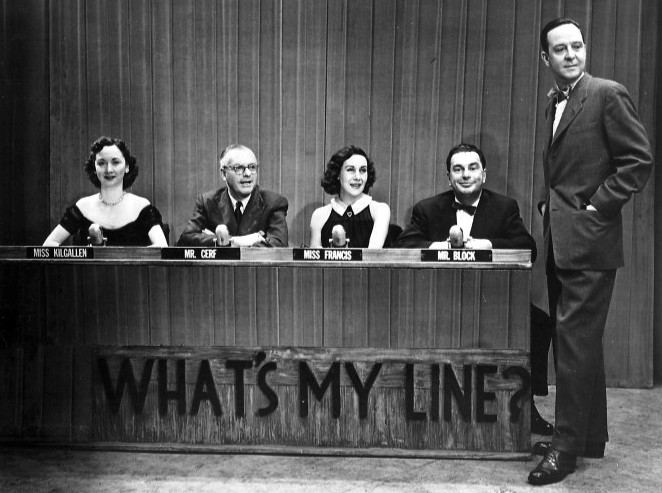
    Dorothy Kilgallen’s
    posthumous book

    Prior to Shaw’s book, there had been three major sources about Kilgallen’s life and (quite) puzzling death. The first was Lee Israel’s biography titled Kilgallen. Published in hardcover in 1979, it went on to be a New York Times bestseller in paperback. As we shall later see, although Israel raised some questions about Kilgallen’s death in regards to the JFK case, she held back on some important details she discovered. In 2007, Sara Jordan wrote a long, fascinating essay for the publication Midwest Today Magazine. Entitled “Who Killed Dorothy Kilgallen?”, Jordan built upon some of Israel’s work, but was much more explicit about certain sources, and much more descriptive about the very odd crime scene. For instance, the autopsy report on Kilgallen says she died of acute ethanol and barbiturate intoxication. But it also says that the circumstances of that intoxication were “undetermined”. Jordan appropriately adds, “for some reason the police never bothered to determine them. They closed the case without talking to crucial witnesses.” (Jordan, p. 22) A year later, in the fall of 2008, prolific author and journalist Paul Alexander had his book on the subject optioned for film rights. The manuscript was entitled Good Night, Dorothy Kilgallen. Reportedly, one focus of Alexander’s volume was how the JFK details Kilgallen wrote about in her upcoming book, Murder One, were cut from the version posthumously published by Random House. Neither Alexander’s book, nor the film, has yet to be produced. Which is a shame, since the available facts would produce an intriguing film.

    I

    Dorothy Kilgallen was born in Chicago in 1913. She graduated from Erasmus High School in 1930. At Erasmus she had been the associate editor of her high school newspaper. (Shaw, p. 3) Her father, James Kilgallen, was a newspaperman who worked for the Hearst syndicate in Illinois and Indiana. She spent a year in college in New York City. While there, her father got her a reporter tryout with the New York Evening Journal. She dropped out of college, and this became her lifelong career and position.

    While at the Evening Journal, she carved out a place for herself on the criminal courts beat. She especially liked reporting on murder trials, the more sensational the better. For example, one case involved a wife killing her husband by placing arsenic in his chocolate pudding. (ibid, p. 6) Another trial she covered was the notorious Anna Antonio murder for hire case, where the wife hired hit men to kill her husband for insurance money. (ibid, p. 7) In 1935, at the age of 22, she covered the most sensational case of the era: the trial of Bruno Hauptmann for the kidnapping of Charles Lindbergh’s infant son. (ibid) Shortly after this, Kilgallen entered a Race Around the World contest. That race generated tremendous publicity since it involved three reporters for major newspapers. In 24 days, she finished second to Bud Ekins. But, more importantly, she wrote a book about this experience that was then made into a movie. (Jordan, p. 17)

    The Original “What’s My Line?” Panel (1952)

    O. O. Corrigan passed away in 1938. For years, he had maintained a very successful column called The Voice of Broadway. Shortly after his death, Kilgallen was given his position. (Lee Israel, Kilgallen, p. 104) In that column she covered politics, crime and the theater scene in New York. In 1940 she married actor/singer and future Broadway producer Richard Kollmar. They had three children, Richard, Kerry and Jill. She became, in 1950, one of the regulars on the game show What’s My Line? The other regular panelists were actress Arlene Francis, and publisher Bennett Cerf; the host was John Daly.

    In 1954, Kilgallen covered another sensational legal proceeding. This was the murder trial of Dr. Sam Sheppard. In July of 1954, the doctor and his wife were entertaining guests at their lakefront home in suburban Cleveland. While watching a movie on TV, Sheppard fell asleep. His wife Marilyn escorted the guests out a bit after midnight. (Kilgallen, Murder One, p. 238) Just before dawn, Sheppard called the mayor of the town of Bay Village, the Cleveland suburb where he lived. The mayor and his wife came over. Sheppard was slumped over in the den with a medical kit open on the floor. He appeared to be in shock. He mumbled: “They killed Marilyn.” The couple went up the stairs and saw her bloodied body in the bedroom. (ibid, p. 239) Sheppard said he had been awakened by Marilyn’s screams. He ran upstairs to the bedroom and saw an intruder in the shadows. The assailant knocked him out with a blunt object. When he came to, he heard the intruder downstairs on the porch. He ran down, chased him off the property, and he struggled with him on the lakeshore—where he was bludgeoned unconscious again. (ibid, pp. 239-40)

    When she arrived in Cleveland, Kilgallen was struck by both the weakness of the prosecution’s case, and by the powerful bias of the media against Sheppard. But in the face of the latter, the judge failed to sequester the jury. In December, after four days of deliberations, the jury convicted Sheppard of murder. Kilgallen was shocked. In her view, the prosecution had not proven Shepard guilty any more than they had “proved there were pin-headed men on Mars.” (ibid, p. 300)

    Sam Sheppard & F. Lee Bailey

    Years later, after Sheppard’s original lawyer, William Corrigan, had passed away, F. Lee Bailey took on his appeal. At a book signing in New York, he had heard Kilgallen speak about her in-chambers interview with the judge in the Sheppard case. He contacted her about this and she gave Bailey a deposition. In that deposition, she revealed that, before the trial began, she was granted an interview with the judge. He asked her what she was doing in Cleveland. She said that she was there to report on the mystery and intrigue of the Sheppard case. The judge replied, “Mystery? It’s an open and shut case.” Kilgallen said she was taken aback by this remark. She told Bailey, “I have talked to many judges in their chambers—they don‘t give me an opinion on a case before it is over.” She continued that the judge then said Sheppard was “guilty as hell. There’s no question about it.” (ibid, pp. 301-02) This deposition was quoted in the final decision of the U. S. Supreme Court which, in 1966, granted Sheppard a new trial.

    At the 1966 trial, Sheppard was acquitted. Bailey’s criminologist, Dr. Paul L. Kirk, presented evidence that there was a third type of blood in Marilyn’s bedroom, not the doctor’s or the victim’s. Further, Kirk concluded the blows that killed Marilyn came from a left-handed person. Sheppard was right handed. (ibid, p. 304)

    The Sheppard case dragged on for so long, creating so much controversy, making so many headlines, that it reportedly became the basis for the TV series The Fugitive, starring David Janssen. For our purposes, the important thing to recall about it, and the reason I have spent some time on it, is that Kilgallen was correct about the verdict. And further, her role in the case helped set free an innocent man. Although that last act did not occur until after her own death in November of 1965.

    II

    The first real inquiry into Dorothy Kilgallen’s death was by the late author Lee Israel. This was done for her best-selling biography, titled Kilgallen, a book still worth reading today. Since that book was not published until 1979, this means that neither the NYPD, nor the House Select Committee on Assassinations did any kind of serious review of the case. This is odd since the circumstances surrounding Kilgallen’s demise clearly merited an inquest. But beyond that, and as we will see, there appears to have been an attempt to cover up the true circumstances of her death.

    Kilgallen, with Jack Ruby defense attorneys
    Joe Tonahill (center) & Melvin Belli (right),
    at the Ruby trial (February 19, 1964)

    Lee Israel did a good job in her book in describing just how much Kilgallen wrote about the failings of the Warren Commission. She also described some of Kilgallen’s extensive contacts with early researcher Mark Lane. It is safe to say that no other widely distributed columnist in America wrote as often, or as pointedly, about the JFK case as Kilgallen did. She flew to Dallas to cover the trial of Jack Ruby in early 1964. While there, she secured two private interviews with the accused. She never divulged what was revealed to her in those interviews. Instead, the notes from these meetings went into her ever expanding JFK assassination file—which more than one person saw since, at times, she actually would carry it around with her. (Israel, p. 401)

    From the contacts she attained in covering the Ruby trial, Kilgallen broke two significant JFK stories. First, someone smuggled her the testimony of Jack Ruby before the Commission. After convincing her editors to print the purloined hearing, her paper ran the story over three consecutive days. And they allowed her to append comments and questions to the colloquy. (Israel, p. 389) Her Dallas sources also secured her an early copy of the DPD radio log. With this she pointed out that Police Chief Jesse Curry had misrepresented to the public his real opinion as to what the origin point of the shots were. He had told the public he thought they came from the Texas School Book Depository, but on the log he said they came from the rail yards, behind the picket fence, atop the grassy knoll. (Israel, p. 390)

    When documents on Oswald were denied to Ruby’s defense team, again Kilgallen chimed in pungently:

    It appears that Washington knows or suspects something about Lee Harvey Oswald that it does not want Dallas and the rest of the world to know or suspect. . . Lee Harvey Oswald has passed on not only to his shuddery reward, but to the mysterious realm of “classified” persons whose whole story is known only to a few government agents.

    Why is Oswald being kept in the shadows, as dim a figure as they can make him, while the defense tries to rescue his alleged killer with the help of information from the FBI? Who was Oswald, anyway? (Israel, p. 366)

    She also ran a story suggesting that there were witnesses who saw Oswald inside Ruby’s Carousel Club. (Shaw, pp. 66, 67) Based upon that, she once said, “I don’t see why Dallas should feel guilty for what one man, or even 3 or 5 in a conspiracy have done.” (Shaw, p. 68)

    When the Ruby case was decided and he was found the sole guilty party—a verdict that would later be reconsidered—Kilgallen, again, wrote about it quite resonantly:

    The point to be remembered in this historic case in that the whole truth has not been told. Neither the state of Texas nor the defense put all of its evidence before the jury. Perhaps it was not necessary, but it would have been desirable from the viewpoint of all the American people. (Israel, p. 372)

    In fact, as Israel wrote, Kilgallen actually became a funnel for men like Lane and Dallas reporter Thayer Waldo to run information through, in order for it to garner a wider audience. (Israel, p. 373)

    She went even further. Kilgallen ran experiments with her husband holding a broomstick to replicate the alleged sighting by Warren Commission witness Howard Brennan. Brennan was the Commission’s chief witness as to a description of Oswald as the sixth floor assassin. She stood approximately where Brennan stood in front of her five-story townhouse. And she told her husband to go ahead and kneel, as the Warren Commission said Oswald was behind a box. She came to the conclusion that there was “no way in the world that such a description could have been accurately determined by Brennan.” (p. 391) She further came to the conclusion that there was a real question as to the type of weapon that was found in the building, a Mannlicher-Carcano or a Mauser. She was also tipped off as to the ignored testimony of witness Acquila Clemmons. Contrary to the Warren Report, Clemmons claimed to have seen two men involved in the murder of Officer J.D. Tippit, not one, and neither resembled Oswald. These stories were mentioned in her newspaper column in September of 1964. (Israel, p. 395)

    The FBI visited her to find out how she got Ruby’s testimony before the Warren Commission. She made them tea but told the two agents that she could never reveal how she got that exhibit or who gave it to her. And when the Warren Report was released in September of 1964, Kilgallen made it fairly evident how she felt about it:

    I would be inclined to believe that the Federal Bureau of Investigation might have been more profitably employed in probing the facts of the case rather than how I got them …. At any rate, the whole thing smells a bit fishy. It’s a mite too simple that a chap kills the President of the United States, escapes from that bother, kills a policeman, eventually is apprehended in a movie theater under circumstances that defy every law of police procedure, and subsequently is murdered under extraordinary circumstances. (Israel, p. 396)

    What she said and did in private on the JFK case was even more extreme than her public actions. After her experience with the FBI she concluded that Hoover had tapped her home phone line. She told Lane that, “Intelligence agencies will be watching us. We’ll have to be very careful.” She decided to communicate with Lane via pay phones and even then by using code names. She then added, “They’ve killed the president, the government is not prepared to tell us the truth, and I’m going to do everything in my power to find out what really happened.” (Israel, pp. 392-93) She told her friend Marlin Swing, a CBS TV producer and colleague of Walter Cronkite, “This has to be a conspiracy.” (ibid, p. 396) To attorney and talent manager Morton Farber, she characterized the Warren Commission Report as “laughable.” She then added, “I’m going to break the real story and have the biggest scoop of the century.” (Israel, p. 397) She made similar statements to another TV producer Bob Bach, and another talent manager, Bill Franklin. (Israel, p. 396) All this, of course, was contra what almost all of her professional colleagues were involved with at the time: namely praising and venerating the fraud of the Warren Report. For instance, in June of 1965, Kilgallen was invited to do an ABC news show called Nightlife with Les Crane. Since Bach had helped arrange the appearance she thought she would be speaking about the Warren Report, so she brought parts of her JFK file with her. But she was informed by one of the show’s producers, Nick Vanoff, that they did no want her to address that subject. He told her it was “too controversial”. (Israel, p. 401)

    Between the time of the release of the Warren Report—September of 1964—and her passing—November of 1965—she was in the process of taking and planning flights to both Dallas and New Orleans. (For the former, see Israel, p. 402; for the latter, see Jordan, p. 20) These do not appear to be job related. They appear to be for the purpose of advancing her own inquiry into Kennedy’s assassination. For instance, she told What’s My Line? makeup artist Carmen Gebbia that she was excited about an upcoming trip to New Orleans to meet a source she did not know. She said it was all cloak and daggerish. And she concluded that, “If it’s the last thing I do, I’m going to break this case.” (Jordan, p. 20)

    Marc Sinclaire

    Marc Sinclaire worked for Kilgallen as her major hairdresser. Many years after her death he revealed that he went to New Orleans with her in October of 1965. Sinclaire went down on a separate plane and stayed in a different hotel. They had dinner together the night he arrived. The next morning he was preparing to go to her place to work on her hair. She called him and said that was cancelled: she had purchased a ticket for him and he was to return to New York. Further, he was not to tell anyone he had been there with her. Her second hairdresser, Charles Simpson, said she used to tell him things about her work, but now things were different. She proclaimed “I used to share things with you … but after I have found out now what I know, if the wrong people knew what I know, it would cost me my life.” (ibid)

    III

    Two of the problems with the circumstances of Kilgallen’s death are that first, the cause was misreported by her own newspaper, and second, no one can pinpoint exactly when her body was first discovered. Using her father as a source, the Journal American reported that Dorothy Kilgallen had died of an apparent heart attack. (Israel, p. 410) As we shall see, that was not the case. But even more puzzling, there is a real mystery as to when the corpse was first discovered.

    The official police record states that the body was found between noon and 1 PM by Marie Eichler, Kilgallen’s personal maid. (Israel, p. 416) But Israel talked to an anonymous source who was a tutor to the Kilgallen children and was there on the morning of November 8, 1965. That source told Israel that the body was found much earlier, before ten o’clock. Sara Jordan later revealed the tutor was Ibne Hassan. Hassan’s information turned out to be correct. From the information on hand today, the first known person to discover Kilgallen’s body was Sinclaire. And his (unofficial) testimony has powerful relevance. He said that he was stunned when he found Kilgallen sleeping on the third floor. Because she always slept on the fifth floor. He found her sitting up in bed with the covers pulled up. He walked over to her, touched her, and knew she was dead. In addition to being on the wrong floor, she was wearing clothes that she simply did not wear when she went to bed. Further, she still had on her make up, false eyelashes, earrings, and her hairpiece. (Jordan, p. 21)

    A book was laid out on the bed. It was Robert Ruark’s recent volume The Honey Badger. Yet, according to more than one witness, Kilgallen had finished reading this book several weeks—perhaps months—prior. Also, she needed glasses to read; Sinclaire said there were none present. The room air conditioner was running, yet it was cold outside. Plus the reading lamp was still on. Sinclaire added, her body was neatly positioned in the middle of the bed, beyond the reach of the nightstand. (ibid)

    The questions raised by Sinclaire’s description are both obvious and myriad. The setting suggests that Kilgallen’s body was positioned both on a floor she did not sleep on and in a way that was completely artificial. In other words, it was posed. If this was done, it was performed by someone not familiar with her living routine and in a hurry to leave, probably for fear of awakening someone. But this is not all there is to it. Sinclaire said there was also a drink on the nightstand. (As we shall see, there more likely were two glasses there.) When Sinclaire called for the butler, he came running up the stairs, very flustered. Sinclaire then left through the front door. He said that there was a police car there, with two officers inside. They made no attempt to detain him. That morning, a movie magazine editor named Mary Branum received a phone call. The voice said, “Dorothy Kilgallen has been murdered”, and hung up. (ibid)

    Charles Simpson

    When Sinclaire got home he called his friend and colleague Charles Simpson. He told him that their client was dead. He then added, “And when I tell you the bed she was in and how I found her, you’re going to know she was murdered.” Simpson later said in an interview, “And I knew. The whole thing was just abnormal. The woman didn’t sleep in that bed, much less the room. It wasn’t her bed.” (ibid. These video taped interviews were done by researcher Kathryn Fauble. The Jordan article owed much to her research, and so does Shaw. See Shaw, p. 113)

    From Sinclaire’s description, there seems to have been a prior awareness of Kilgallen’s passing: e.g., the police car in front of the door. But as of today, Sinclaire is the best testimony as to when the body was actually found. About three hours later, two doctors arrived at the townhouse: James Luke and Saul Heller. The latter pronounced her dead. But the former did the medical examination, which as we shall see, was incomplete.

    About a week after her death, Luke determined that she was killed by “acute barbiturate and alcohol intoxication, circumstances undetermined.” (ibid, p. 22) Roughly speaking, this means she died of an overdose, but the examiners could not determine how the drugs were delivered. Usually, the examiner will write if the victim was killed by accident, suicide or homicide. That was not done in this case. The main reason it was not done is because there was no investigation of the crime scene, or of any witnesses who saw and had talked to her in the previous 24-48 hours. For example, phone calls were not traced, her home was not searched for drug containers, and there was no investigation as to how she arrived home that evening or if anyone was with her.

    Lee Israel was shocked when she discovered this fact. She was looking through the Kilgallen police file for reports labeled DD 5 and DD 15. The former is a supplementary complaint report that records activities pursuant to a complaint. The latter is a request to the Medical Examiner for a Cause of Death notice. Israel said that, although the investigating detective said he saw this, it was missing from the file. (p. 428) Therefore, there appears to have been no investigation done to determine how the drugs were administered. This was so bewildering to Israel that she wrote that there may have been another, unofficial channel, of communication between the police department and the medical examiner’s office on the Kilgallen case.

    There does seem to be cause for such speculation. In her book, Israel mentioned another anonymous source from the toxicology department of the medical examiner’s office. (Israel, pp. 440-41) This man was a chemist under Charles Umbarger, director of toxicology at the NYC Medical Examiner’s Office. This source met with Israel personally and told her that Umbarger believed that Kilgallen had been murdered. Umbarger had evidence that would indicate this was the case but he kept it from the pathology department as part of the factionalism in the office. The idea was to retain this secret evidence in reserve over chief Medical Examiner Milton Halpern and Luke. Jordan discovered this secret source was a man named John Broich. (Jordan, p. 22) Broich told Jordan, as he told Israel, that he did new tests on the glasses, and tissue samples, both of which Umbarger had retained. He found traces of Nembutal on one of the glasses. The new tests discovered traces of Seconal, Nembutal and Tuilan in her brain.

    This was an important discovery, for more than one reason. First, the police could not find any evidence of prescriptions for the last two drugs by Kilgallen. Her doctor only prescribed Seconal. Second, no doctor would prescribe all three to one patient at one time since the mix could very well be lethal. (Shaw, p. 116) Third, the prescription Kilgallen had for Seconal had run its course at the time of her death. Umbarger, of course, knew this. When Broich reported back to him about his new chemical discoveries, Umbarger had an unforgettable reaction. He grinned at his assistant, and then said the following: “Keep it under your hat. It was big.” (Jordan, p. 22)

    IV

    As we have seen, neither the New York Police Department nor the medical examiner’s office was forthcoming or professional in the Kilgallen case. The House Select Committee on Assassinations (HSCA) only performed a very cursory look at her death. But it appears it was the HSCA that got her autopsy report into the National Archives. (Shaw, p. 277) That cursory look seems odd for the simple reason that the HSCA’s chief pathologist, Dr. Michael Baden, was working in the Medical Examiner’s office at the time of Kilgallen’s passing. In fact, Baden’s name is listed as an observer for Luke’s autopsy report. (Shaw p. 102) Baden was also a source for Israel’s book. In 1978, while the HSCA was ongoing, he told Israel that, from what he could see, the evidence would indicate that Kilgallen had fifteen or twenty 100 mg capsules of Seconal in her system. (Israel, p. 413) Why Mark Shaw did not make more of this point in his book eludes this reviewer.  Because Baden’s opinion would seem to be incorrect, for the simple reason that, as stated above, Kilgallen likely would not have had that many Seconals left in her prescription at the time of her death. But a fewer number of Seconals, mixed with the two other drugs, would very likely have produced the fatal result.

    Because of the (screamingly) suspicious circumstances of her death, it does not at all seem logical to consider either of the other alternatives—that it was accidental, or she took her own life. How could she accidentally end up in the wrong bed on the wrong floor with the covers pulled up? As per the second option, as stated above, there seems to not have been enough left of her Seconal prescription for her to take her own life. According to her doctor, Kilgallen was prescribed 50 pills per month. There are two reports, one from the police, one from her doctor, but the estimates are that she took between 2-4 pills per night. (Israel, p. 425) Since the prescription was last filled on October 8th, how could there possibly be enough pills available for her to plan her death? The indications seem to suggest this was a homicide.

    Kilgallen, Richard Kollmar
    & their son, Kerry (1964)

    If that were the case—and Israel, Jordan, and Shaw certainly seem to agree it is the strongest alternative—then who was responsible? One possible suspect is her husband Richard Kollmar. As Israel and Shaw outline, neither spouse was faithful to the other at this stage of the marriage. Richard was involved in several one-night stands, and Dorothy had a love affair with singer Johnny Ray, which had concluded at around the time of Kennedy’s assassination.

    Further, Richard was not doing nearly as well financially as Dorothy was. Israel had direct access to their accountant, Anne Hamilton. And from that interview, it appears that Shaw overstates their wealth significantly. (See Israel, especially p. 356) But there can be little or no doubt that at the time of her death, Kilgallen was the major breadwinner in the family. Therefore, in case of her death, Richard would be in position to inherit a significant amount of money in cash and property, well over a million dollars today. Further, and another point I could not find in Shaw’s book, Richard had his own access to Tuinal. (Israel, p. 438)

    But still, there are serious problems with holding Richard as the prime suspect. First, if such were the case, then why would there be such an almost appallingly negligent investigation? Cases of spouses killing their partners must have appeared every week in a city as large as New York. And, if so, how would Richard have the influence to cause such a large system failure—one that took place in the police department, the DA’s chambers, and in the office of the medical examiner? Secondly, no one who knew Kollmar thought he was capable of doing such a thing. Both Israel and Shaw agree on this point. But third, if Kollmar had planned the whole thing, how could he possibly have left as many holes in his plot as he did— many of them wide enough to drive the proverbial tractor through? Could he really have not known where his own wife slept? What she wore when she retired? What book she was reading? That when she read, she wore glasses? And so on and so forth. The case does not appear to be an inside job. Because if Marc Sinclaire had not left that morning, he could have detonated it in about two minutes.

    Ron Pataky & Kilgallen

    Both Israel and Jordan seemed to center their suspicions on a man that the former referred to as the Out of Towner. Israel referred to him by that rubric because he lived and worked in Columbus, Ohio. His real name is Ron Pataky. In her Midwest Review essay, Sara Jordan was explicit about his name and printed a photo of him standing next to Kilgallen. There are several reasons why Ron Pataky’s presence creates suspicion in this case. One has to do with the closeness of his relationship with Kilgallen at the time. After she and Johnnie Ray decided to break up, it appears that Pataky became Kilgallen’s romantic interest. They called each other frequently, saw each other on occasion, and wrote letters and notes to each other. A very odd thing happened in late October on the set of What’s My Line? Before the show began taping, an announcement came on the public intercom. The voice said, “The keys to Ron Pataky’s room are waiting at the front desk of the Regency Hotel.” Quite naturally, this shook Dorothy up. Why didn’t someone just bring her a note? Pataky denied being in New York at that time. If so, was someone trying to tell the reporter that they knew something about her private life? (Jordan, p. 20) On the weekend of her death, Kilgallen had an hour-long call with Sinclaire. During this call, she said her life had been threatened (she later said she might have to purchase a gun). Sinclaire told her that the only new person in her life was Pataky. And she had shared her interest in, and information about, the JFK case with him. He suggested that she confront him with those facts. Two days later, Kilgallen was dead. (Shaw, p. 242)

    Both Israel and Shaw discuss interviews they had with Pataky. In more than one place it appears that the subject is being less than candid. For instance, he says that he was never at Kilgallen’s townhouse. But he says that he knew Kilgallen drank and popped pills. When asked how he knew that, he says he saw the pills in a medicine cabinet. Unless Dorothy carried a medicine cabinet with her, how did he know about it if he was never in her home? Pataky also said in 2014 that the New York police talked to him about Dorothy’s death based upon a note they discovered at the home. Yet there is no evidence of any such interview or note in any police file. (Shaw, pp. 239-40) Another example would be one of his alibi witnesses. Pataky has always maintained that he was in Columbus when he got the news of Dorothy Kilgallen’s death. He said fashion editor Jane Horrocks read the notice off the news wire to him. But researcher Kathryn Fauble later talked to Horrocks. She remembered Pataky vividly since they shared an office at the Columbus Citizen-Journal. She also recalled him getting calls from Kilgallen there. But she added on the day the news broke about Kilgallen’s death she wasn’t in the office, she was on assignment in California. (Shaw, p. 237)

    Perhaps the most interesting aspect of any interview with Pataky was the one Israel did with him about Kilgallen’s final hours. Sara Jordan, Israel and Shaw have attempted to reconstruct what Kilgallen did the evening before she was discovered dead by Sinclaire. After taping What’s My Line?, she and producer Bob Bach went to the restaurant/bar P. J. Clarke’s for a drink. (Jordan, p. 21) Both Bach and Sinclaire have stated that Kilgallen separately told them she was to meet with someone at the Regency Hotel later that evening. Therefore, after she left P. J. Clarke’s, she arrived at the Regency, which is about six blocks from her home. In a videotaped interview with an associate of Kathryn Fauble, it was revealed that Kilgallen was seen in the corner of the cocktail lounge by a woman named Katherine Stone. Stone had been a contestant on the show that night. (ibid) Press agent Harvey Daniels also recalled seeing Kilgallen with a man at the Regency that night. So did piano player Kurt Maier. (ibid) She left the Regency at about 2 AM. According to Israel, when the news of her death broke, several people working at the Regency discussed her presence there the night before. (Israel, p. 432)

    Pataky has always denied he was with her that evening. He has always denied he was in New York that night. The most he would say is that she called him that evening. But Pataky firmly declared that he was in Columbus that evening, not in New York. Israel had taped her call with him. She turned it over to former CIA officer George O’toole. O’toole was one of the leading Agency analysts for the Psychological Stress Evaluator, commonly known as the PSE. This device measures stress in the voice in response to questioning. That measurement may reveal the subject is lying about a sensitive point. O’toole wrote an interesting book on the subject in relation to the JFK case, The Assassination Tapes. In that book he explains in detail how the device works and its reputation for accuracy. An absence of stress in the voice would indicate that the subject is telling the truth. If the stress is high, it may reveal tension due to deception. When O’toole analyzed the part of the conversation in which Pataky denied being in New York that night, he wrote that the PSE hit level F and G gradients. These are the highest levels of stress the machine will measure. When Pataky discusses how he actually found out about Kilgallen’s death, again the machine hit the F level. (Israel, p. 435)

    Pataky had designs to be a songwriter. He had confided in Kilgallen about this. The verses of a song are, in many ways, like a poem. So years later, Pataky posted some of his poems online. Both Shaw and Jordan found them interesting. First there is one called “Never Trust a Stiff at a Typewriter”. It reads as follows:


    There’s a way to quench a gossip’s stench

    That never fails

    One cannot write if zippered “tight”

    Somebody who’s dead could “tell no tales.”


    As to its suggestiveness to the topic, this needs no comment. The second Pataky poem is called “Vodka Roulette Seen As Relief Possibility”.


    While I’m spilling my guts

    She’s driving me nuts

    Please fetch us two drinks

    On the run.


    Just skip all the nois’n

    Make one of them poison

    And don’t even tell me

    Which one!


    Shaw goes on for four paragraphs on this poem. But again, its suggestiveness needs little explication in relation to the subject at hand.

    Let us close the discussion of Pataky with another piece of information allegedly supplied by Israel, but which today is in dispute. John Simkin used to own and operate the JFK Assassination Debate forum at Spartacus Educational web site. He had an abiding interest in the Kilgallen case. In a discussion at Simkin’s site in 2005, he enlisted Israel to participate. During this discussion it was revealed that in 1993 a college student in Virginia did what Israel did not do in her book. He actually revealed Pataky’s name. And he further wrote that the management of the Regency Hotel had forbidden its employees to discuss Kilgallen’s presence there that night. But even more interesting, Israel said that she found out that Pataky dropped out of Stanford in 1951 and later enrolled in the School of the Americas in Panama. This, of course, is the infamous CIA training ground for many Central American security forces who were later involved in various kidnappings and assassinations in the fifties and sixties. In the Midwest Today article by Sara Jordan, Israel denied she made this statement. (But Jordan found out that Pataky did drop out of Stanford after one year. Jordan, p. 23) Yet to this day, that statement exists in black and white on that site. It’s kind of a reach to say Simkin invented it. And we know that Israel was sensitive about what she wrote about Pataky, or else she would have named him in her book.

    V

    After writing all the above I would like to say that Mark Shaw wrote an admirable and definitive volume about Kilgallen and her death. Unfortunately, I cannot do so. One reason is obvious from my references. A lot of the information in Shaw’s book can be found in either Israel’s tome or the Sara Jordan essay in Midwest Today. The interviews with Sinclaire and Simpson were done by the indefatigable Kathryn Fauble. Shaw does a nice job in reporting on the autopsy. And his interviews with Pataky are informative. But some of the book seems padded, consisting of chapters about four pages long. (See Chapter 34) Sometimes, the author repeats information, as with Sinclaire finding the body. And like writers who partake in biography, Shaw tends to exaggerate the achievements of his subject.

    This last is done in two ways. He tends to exaggerate Kilgallen’s stature as a journalist. For example, he calls her the first true female media icon. (p. 294) Did the author forget about Dorothy Thompson? Or Adela Rogers St. Johns? They certainly ranked with Kilgallen in popularity and as role models. And Thompson left behind a body of work at least equal in stature to Kilgallen’s and, by any rational measure, exceeding it. Shaw also quotes Ernest Hemingway as calling Kilgallen, “One of the greatest women writers in the world”. I could not find a source for this quote. But on what grounds would such an expansive judgment hold water? And why would Shaw want to use it? Kilgallen wrote two books. She actually co-wrote them. The first was about her trip around the world, which she wrote with Herb Shapiro in 1936. Murder One was published posthumously by an editor based on her notes. This plus her voluminous columns are the sum total of her literary output. Does that compare with the achievements of say Isak Dinesen, Katherine Anne Porter or Rebecca West?

    The second way Shaw inflates his subject is by discussing what her impact would have been on the JFK case. This is completely unwarranted and amounts to nothing but pure speculation. For the simple reason that no one is ever going to know what Kilgallen discovered, or what her talks with Ruby were about. Therefore, the database from which to measure her achievement is simply non-existent. But, to put it mildly, this does not hinder Shaw. In a perverse sort of way, it enables him. Near the end of the book he writes that, “If Kilgallen had lived … the course of history would have been altered.” (Shaw, p. 288) Since, as stated above, there is no database to support that statement with, this reviewer is puzzled as to how Shaw arrived at this outsized conclusion.

    Which leads to two other related problems with Shaw’s book. First, the author’s footnotes would not pass muster in a sophomore English class. Time after time he refers to newspapers without adding a date to them. Time after time, he refers to books without supplying a page number. This, of course, makes it difficult to crosscheck his work. Secondly, he repeatedly refers to the mystery of how Dorothy’s JFK file disappeared after her death. Yet in Sara Jordan’s essay, she quotes a conversation between the Bachs and Richard Kollmar after Dorothy’s death. They asked him, “Dick, what was all that stuff in the folder Dorothy carried around with her about the assassination?” Richard replied, “Robert, I’m afraid that will have to go to the grave with me.” (Jordan, p. 22) What this means is anyone’s guess. But it could mean that he somehow recovered it and destroyed it.

    One of the worst aspects of The Reporter who Knew Too Much is how Shaw’s inflation is somewhat self-serving. For instance, when I saw the author speak at last year’s JFK Lancer conference he made a couple of rather odd statements. He said that since Kilgallen had gone to New Orleans with Sinclaire, this meant that she was investigating Carlos Marcello for the JFK case. Again, for reasons stated above, there is no factual way that Shaw could know such a thing. But further, how does New Orleans automatically deduce Marcello? New Orleans is honeycombed with a multitude of leads on the JFK case. Lee Oswald spent about six months there from the spring to the fall of 1963, less than two months before he was killed. To say that what he did there would automatically lead to Marcello betrays an agenda that is not really dealing with Kilgallen.

    That agenda traces back to a book Shaw wrote in 2013. It was called The Poison Patriarch. This reviewer did not critique it since it was simply not worth discussing. But Shaw synopsizes it here in order to attribute what Kilgallen was going to do if she had lived. Shaw’s previous work is a feat of Procrustean carpentry that ranks with the likes of Peter Janney and Philip Nelson. And like those authors, Shaw used an array of dubious witnesses to achieve his feat of alchemy. In short, he said that JFK was killed because Joseph Kennedy insisted on Bobby Kennedy as Attorney General. The father had underworld ties, should have known that RFK was going to do battle with the Mafia, and this caused a revenge tragedy to be performed. To scaffold this utterly bizarre thesis, Shaw trotted out a virtual menagerie of dubious witnesses like Tina Sinatra, Frank Ragano, Toni Giancana, Sy Hersh and Chuck Giancana. The book was a recycling and revision of Chuck Giancana’s science fiction fable Double Cross. (See pages 179-180 of the present book.)

    Well, in The Reporter Who Knew Too Much, Shaw pens his imaginary conclusion to Kilgallen’s investigation. He writes that after she made her second trip to New Orleans, the reporter produced a series of articles connecting Oswald, Ruby and Marcello. This series triggered a grand jury inquiry. This culminated in indictments of Marcello for the murders of both Kennedy and Oswald. But Kilgallen’s evidence went further. It also managed to indict J. Edgar Hoover for obstruction of justice, and he resigned his position. As a result, Kilgallen’s disclosures changed the way that the JFK case was discussed in history books.

    I wish I could say that what I just described is an exaggeration or parody of what Shaw wrote in his book. Unfortunately it is not any such thing. If the reader turns to page 289, he can read it for himself. To say that such writing is a fantasy really does not do it justice. The idea that Kilgallen was going to take on the entire power structure of the USA and overturn it with a series of newspaper columns is almost too ridiculous to consider. As many authors have proven, the JFK cover-up was interwoven throughout the entire structure of the American government at that time: the White House, the Justice Department, the Secret Service, the CIA, and the FBI. The Power Elite was involved in it through organs like the New York Times, CBS, and Life magazine. The idea that Kilgallen was going to upend this whole colossal structure is a bit ludicrous. As mentioned, she could not even discus the JFK case on Les Crane’s talk show. Which was a harbinger of what was going to happen to Jim Garrison in 1968 on The Tonight Show. I hate to inform Mark Shaw, but the Sam Sheppard murder case is not the Kennedy assassination.

    If Shaw would have restrained himself, or if he had an editor who would have pointed out the problems with his design, then this would have been a good and valuable book. It would have been really about Dorothy Kilgallen: who she really was, what we know and do not know about her death. But as shown above, such was not the case. Thus I would actually recommend to the interested party Sara Jordan’s informative and objective essay instead.


    The recommended essay can be found here:

    Sara Jordan, “Who Killed Dorothy Kilgallen?” (2007)

  • Dorothy Kilgallen tried to expose the truth behind the JFK assassination


    Dorothy Kilgallen was one of the very few, if not the only, mainstream reporter who actively investigated the John Kennedy assassination, and she interviewed witnesses who contradicted the Warren Report. When she died in November of 1965, her JFK file went missing. Never to be recovered. In 1975, the FBI was still asking her son if he found it.

    ~Jim DiEugenio