Tag: J EDGAR HOOVER
-

MLK / FBI
Sam Pollard’s MLK / FBI is a new documentary addressing the extensive surveillance apparatus established by the FBI and directed at Dr. Martin Luther King Jr. and others in his organization during the 1960s. The film has been generally lauded by the mainstream press and therefore enjoys a higher profile in the cultural pecking order than may be enjoyed by other projects tackling controversial issues involving government wrongdoing. While mainstream endorsement might encourage skepticism, MLK / FBI generally supports positions long held by the critical community, despite a glaring tendency to hand the FBI the benefit of the doubt.
The film is based on historian David Garrow’s book The FBI and Martin Luther King, Jr: From ‘Solo’ To Memphis, but it seems to have been specifically generated by the 2017–18 release into the National Archives of a series of summaries of FBI surveillance transcripts. These summaries cast an extremely negative light on King’s character with their salacious, but unverified, detail. They were first publicized in 2019—by Garrow—in controversial fashion.[1] However, although these summaries are referred to specifically at both the beginning and end of the film—as well as obliquely at times between—they are not exactly representative of the documentary’s content. That overall subject matter is primarily concerned with the process by which the FBI would seriously violate King’s constitutional rights and, by extension, let a federal investigative agency intervene directly in domestic politics.
It’s important at this point to bring in more textural background on the issue than the film does. As the Bureau’s Director of Domestic Intelligence, William Sullivan, told the Church Committee, Hoover had secretly wiretapped King for years. (Harris Wofford, Of Kennedys and Kings, pp. 214–15) He had done this because he had suspected two close associates of King were communists: Stanley Levison and Jack O’Dell. His goal was to show that, somehow, King and the civil rights movement were Moscow inspired; his other surveillance goal was to show that King was embezzling large amounts of money. Either way, King would be discredited.
Despite the egregious nature of the FBI’s wiretapping of King, ostensibly begun in 1962, MLK / FBI delves into this history with a notable tendency to emphasize the FBI’s viewpoint, described at times as “seeing events through (the agency’s) eyes.” This leads to, for instance, something like an acceptance that the FBI had sound reason to determine that King’s advisor Stanley Levison was in fact a communist agent, even as one of the narrators (Garrow) lays out the weakness of such determination. This, in turn, serves to buttress the FBI’s later developing position that the wiretaps were justified because King had somehow “misled” President Kennedy when he supposedly agreed to sever his ties to Levison. A more astute review of the FBI’s position might see the King/Levison controversy as entirely a pretext, particularly as the ties between the two had lasted years without generating attention and that King’s presumed “dishonesty” to Kennedy was tied to an assessment of Levison which King knew to be incorrect.
This narrative strategy—allowing the FBI the benefit of the doubt (or even allowing the doubt in the first place)—leads the film to describe the unearthing of King’s extra-marital relationships, through wiretaps on his colleague Clarence Jones, as “accidental”. Again, a more realistic analysis might see—as noted above—that the FBI’s program was always specifically intended to “dig up dirt” on King, so as to compromise his leadership position should it become necessary. It is generally conceded that Hoover endorsed such practices and had amassed a fairly extensive collection of kompromat on dissidents and mainstream politicians alike. Although the film takes care to correctly portray the status quo of mid-century America as decidedly Caucasian and male, the film’s narrative strategies, at least through its first half, serves to avoid grappling in detail with the extensive active role of federal agencies in enforcing this status quo. This serves to reinforce a longstanding ideological consensus that deviations from constitutional norms are always best understood as “unfortunate mistakes.”[2]
Similarly, there are associative edits which serve to subtly undermine the good character of both RFK and King, a technique not similarly applied to FBI officials. In the first instance, the film’s coverage of Robert Kennedy’s decision, in his position as Attorney General, to support the FBI’s request to wiretap King is immediately followed by newsreel footage of RFK eloquently espousing his support for Black America’s aspirations. Later, after the reality of King’s extra-marital relationships are discussed, the films cuts immediately to an MLK appearance on a Merv Griffin television program where he describes himself as a “Baptist preacher” not interested in New York City’s “fun side.” While this may be considered an effective shorthand means to reflect the complexities of both men, the associations are manufactured by the editor, as there is no direct linking context of the newsreel/Griffin clips to the discussion they follow.
And again, there is an important context that is missing. By 1963, Bobby Kennedy was pressing Hoover to have the FBI take a stronger role in civil rights cases, especially against the Ku Klux Klan. (Wofford, p. 215) As Sullivan noted, as this pressure increased, Hoover incessantly badgered Kennedy to wiretap King. The implicit threat being that he would go to the press with his rumors of communist influence. As most commentators have concluded, since Hoover was already tapping and surveilling King, this was done simply as a pretext to get RFK on board. Hoover now had the potential to smear them both. (Wofford, p. 215) Finally, Bobby Kennedy gave in and the wiretapping was approved on October 21, 1963. (Ibid, p. 217) Kennedy applied a 30-day contingency to the plan. It would be reviewed at that time to see if anything substantive had been captured. We all know what happened a month later in Dallas. As many commentators have noted, with his brother gone, Bobby Kennedy lost control over the FBI. And when Hoover’s friend Lyndon Johnson came into office, the FBI campaign against King was greatly expanded. (Gerald McKnight, The Last Crusade, p. 2)
That said, and just as this reviewer was fearing the worst for this film, at about the halfway mark MLK / FBI moves on from its at-times muddled narrative strategies to find a clearer tone. A strong sequence associating notions of “Black deviancy” with long-standing racialist white conservative obsessions is followed by a deservedly harsh condemnation of the FBI’s so-called “suicide letter” (and related recording) which had been sent to King’s home. This was an alleged “sex tape” of King accompanied by a warning that unless he either resigned or ended his life, the tape would be given to the press.
This is followed by another strong sequence covering King’s political activities in 1967–68. Then, reversing the sequential linear exposition, the recently released summaries (dating from 1964), presumedly featuring MLK’s participation in coercive sexual acts, are reviewed. In this instance, Garrow’s certainty of the credibility of the transcript contents are effectively undermined by the other narrators.
In a concluding coda, anticipating the 2027 release of the controversial transcripts, much is made of personal “complexity” (while the FBI agent among the several narrators argues that the transcripts should not see the light of day at all). However, despite contradictory narrative threads and effective cancellations of firm constitutional principle—expressed with far more vigor and certainty when the FBI programs against King were revealed during the 1970s—this film does, in fact, open up a lot of space for receptive viewers to consider these events in ways outside of the revisionist establishment narrative the film toys with in its first half. Not many mainstream films have time for William Pepper’s 1967 Ramparts article “Children of Vietnam”, let alone allowing Andrew Young—who reflects a strong gravitas with his remarks throughout the film—opine “I don’t think James Earl Ray had anything to do with Dr King’s assassination.”
If anything, what the film is missing is a wider exploration of morality. While King’s “moral leadership” of the civil rights movement is frequently referred to and eventually contextualized through the lens of sexual infidelity (and found “complex”), morality is more accurately a broader conception of good/bad right/wrong against which the FBI’s unconstitutional programs in defense of an ossified status quo could be properly considered. For instance, the FBI did give the “sex tapes” to a reporter working for The Washington Post. Editor Ben Bradlee told Justice Department official Burke Marshall and Marshall complained to Johnson about it. Now, LBJ told Hoover that Bradlee could not be trusted and the Director then spread smears about Marshall being a liar. (Wofford, p. 220) As it stands, the film concludes that the FBI is also “complex,” as is the support for it by “mainstream society.”
That last observation is rather interesting and may help situate the position of the filmmakers. Assuming the intended audience is a largely (liberal) mainstream one—and given the general applause for the film by mainstream media—an adversarial position directed at the FBI from the film’s start might not be a wise strategy at the vantage of post-Trump America. The successful contemporary positioning of the FBI, and other agencies, as noble “whistle-blowers” who assisted the effort to blunt Trump’s presidency has led to a crest in the agency’s popular reputation (deserved or not). Further, the appellation of the dread term “conspiracy theory” has also risen to an effective peak in its ability to discredit or dismiss alternative or uncomfortable viewpoints.[3]
To what extent the filmmakers consciously decided to tap dance their way around this problem—by, for example, going out of their way to express the FBI’s presumed point-of-view in the film’s first half—this reviewer is not aware. But the issue cannot be ignored by those who strive to tackle controversial topics while maintaining a popular forum. Sometimes a prudent framing of the issues at hand allows the expression of viewpoints outside establishment consensus, without the gatekeepers even noticing. On the whole, a generous view of this film is warranted and the widest distribution to a mainstream audience should be encouraged in anticipation that to the receptive viewership will seek out more information.
[1] This was discussed by the reviewer in a 2019 article for Kennedys and King: “Garrow’s Interpretive Guesswork Presumes The Worst”.
[2] This point of view—i.e. “mistakes”—depends on the omission of uncomfortable facts, many of which appear only years after events in question. Recently released documents, for example, suggest Hoover’s FBI to have been a far more direct participant in the state-directed assassination of Chicago Black Panther Fred Hampton than has to date been understood. New Documents Suggest J. Edgar Hoover Was Involved in Fred Hampton’s Murder.
[3] The contemporary FBI, in context of potential “domestic terrorism”, warns of beliefs which “attempt to explain events or circumstances as the result of a group of actors working in secret to benefit themselves at the expense of others” and which are “usually at odds with official or prevailing explanations of events.” Note that the FBI, in this context, avows that it cannot “initiate an investigation based solely on First Amendment based activity”—as history shows, not least with Dr. King but also seen more recently with FISA abuses, pretexts can and will be manufactured in the interest of interrupting precisely activity subject to constitutional protections. The degree to which this has always been the case is one of the least acknowledged factors in American political history. “FBI Document Warns Conspiracy Theories Are A New Domestic Terrorism Threat”.
-

The Stanley Marks Revival: The Prophecies of Murder Most Foul! and Two Days of Infamy
Thanks to the help and encouragement of Stanley Marks’ daughter, Roberta, Murder Most Foul! and Two Days of Infamy are now coming back into print for the first time since the late 1960s. That is right: Fifty year later. The timing seems apt. Throughout his oeuvre, Marks warned time and again of the growing threat of fascism in America, pointing repeatedly to figures like Allen Dulles, J. Edgar Hoover, and Ronald Reagan: all handmaidens in the march toward the right wing that continued in the decades after the assassination.[1] And now, in the incarnation of the forty-fifth president of the United States, we have a figure who doesn’t even bother to disguise his naked grab for power, and the phrase “coup d’état” is being spoken openly, even in the mainstream media.

Stanley Marks circa 1934, Chicago. When he was only four years old, Stanley lost both his parents to the influenza pandemic of 1918, which infected a third of the world’s population. Stanley’s daughter, Roberta, recalls her father saying that “he never had enough food. When you see pictures of him as a youth, he was bone-thin and skinny. That is, until he married my mother, whose cooking he adored.” Stanley’s privations and experience with hunger on Chicago’s hardscrabble streets may have helped to open his eyes to a certain political awareness and helped to mold him into a lifelong FDR New Dealer. So much of where we are today is foreshadowed in the writing of Mr. Marks: in particular, the fueling of racism and xenophobia, the attempted erosion of civil rights, and the empowerment of the oligarchy and its principal tool of control, the police state. Speaking directly to the readers of a future generation, in 1969 Marks wrote:
The balance of this small volume now attempts to enter the “dark world” that is slowly, oh, so slowly, being lit, although full light may take until the year 2038—if the “basic principles of American justice” have the strength to remain as principles guiding this long-suffering nation.
This still remains a big “if”—as the nation continues to suffer while awaiting a firmer grounding in those “basic principles.”
II
Shortly after reading Murder Most Foul!, in his essay “The Kennedy / Dylan Sensation,” Jim DiEugenio wrote that Marks’ early “condemnation” of the Warren Report in 1967 “is a far cry from, say, Josiah Thompson, who at the end of his book [Six Seconds in Dallas; also published in 1967] said he was not really sure that the evidence he adduced justified a conspiracy.”
It wasn’t until many months later that either of us realized just how astute a remark that really was. For, in Stanley’s second JFK-assassination book, Two Days of Infamy: November 22, 1963; September 28, 1964 (which neither of us had read yet, due to its rarity), Stanley writes:
As will be shown, the Warren Commission proved the innocence of Lee Harvey Oswald, but his innocence can only be found if the person reading the “Report” will read the testimony in the “Hearings” or the evidence in the National Archives.
Thus, a defense lawyer on Oswald’s behalf, because of the prestige associated with the seven commissioners, would be reduced to assume the burden that his client, Oswald, was innocent “beyond a reasonable doubt.” The author of Six Seconds In Dallas fell into this trap, for he wrote that although he believed there was more than one assassin, Oswald had to be guilty because he could not prove he was innocent! Hence, the burden of proof, as they say in law, shifted from the prosecution––the Commission––to the shoulders of Oswald. This, of course, is contrary to every principle of Anglo-American jurisprudence upon which this nation is founded.
Now, more than fifty years after the publication of both Murder Most Foul! (September 1967) and Two Days of Infamy (March 1969), one is left to wonder to what extent Marks was aware of his own gift of prescience. And we should add that, in this March 1969 text, he was already using the term “conspirators” when referring to the assassins of the Kennedys and King. He states unequivocally: “All three were murdered as the end result of three interrelated conspiracies,” adding: “History has shown that an invisible coup d’état occurred when President Kennedy was murdered.” In 1972, after the author Joachim Joesten learned of Stanley’s work, he credited him with being one of the first Americans who dared to use the word “coup” in this context: “To my knowledge, nobody but Jim Garrison and an obscure West Coast writer named Stanley J. Marks has ever endorsed before my unswerving contention that the murder of John F. Kennedy was nothing short of a camouflaged coup d’état.”

Private Stan Marks at the army base library, circa 1945. By his late twenties Marks had accumulated a private collection of over 5,000 books. Stanley’s work was accomplished in the early days, well before the release of millions of pages of documents that were pried from government archives as a result of the President John F. Kennedy Assassination Records Collection Act (effective October 26, 1992). That legislative act led to the creation of the Assassination Records Review Board (ARRB). The ARRB made it possible for an author such as Gerald McKnight to create a classic tome on the Warren Commission deception, Breach of Trust (2005), with its in-depth look behind the scenes of the WC drama. But in reading through Stanley’s work, published decades earlier—although it lacks many of the details that would emerge only later—one is struck by how much in parallel his conclusions are with those of contemporary scholars such as McKnight, James Douglass (JFK and the Unspeakable; 2008), Jim DiEugenio (Destiny Betrayed, Second Edition; 2012), and Lisa Pease, whose book A Lie Too Big to Fail (2018) deals with the RFK case.
Marks followed Two Days of Infamy with Coup d’État! Three Murders That Changed the Course of History. President Kennedy, Reverend King, Senator R. F. Kennedy (February 1970). And then, perhaps inspired by the release of Oliver Stone’s film on JFK, in his seventieth-eight year, Marks released his last assassination-related title, Yes, Americans, A Conspiracy Murdered JFK! This appeared in June 1992: just a few months before the Assassination Records Collection Act became effective. Thus, the year 1992 marks a milestone not only in JFK research, thanks to the ARRB, but in the passing of an intellectual torch from the old guard to the new.[2] One also cannot help but wonder what conclusions Stanley may have drawn if he had access to such voluminous records earlier in his life. He died seven years later, in 1999.

Dust jacket of the first edition of Two Days of Infamy (March 1969). Marks inscribed the copy: “To my daughter Bobbie, the apple in my orchard and the filament in the bulb of her parent’s life. With Love, Daddy.” An ad for the book appeared in the July 11, 1969 edition of the Los Angeles Free Press (a popular Sixties counterculture newspaper) and included the caption: “Now available at bookstores with courage.” While Murder Most Foul! remains his most seminal work, as well as the most avant-garde in terms of stylistic approach, his subsequent texts continue to expand upon many of the points first raised in that book, as well as introducing fresh ideas and perspectives to the case. Therefore, it’s important to view Murder Most Foul! in the context of Marks’ complete oeuvre. For example, picking up on a theme first introduced in MMF—that is, the collective cynicism born as a result of the lies published in the Warren Commission Report, which would eventually accumulate like a growing poison in the national psyche—in Two Days of Infamy he writes:
Perhaps it was the cynicism, inherent in citizens of all nations, that convinced the American citizenry that the “Report” issued by the Warren Commission was supported by rotten timbers incapable of supporting the truth. The suspicion increased in the same ratio and in the same speed as smog increased with the density of automobiles on a Los Angeles freeway. The American people were becoming deeply convinced that the Commission had perpetrated a gigantic, gruesome hoax the like of which concealed a conspiracy that reached into the very gut of American government and society. Today, that hoax, that whitewash feared by the people has been exposed to the light of day, for the citizenry were, and are, absolutely right in their assessment of the Warren Commission. There now exists overwhelming evidence, provable in a court of law, that the Warren Commission, either willfully or negligently, concealed the conspiracy that murdered President John F. Kennedy. This deed was committed by the Commission in “the interests of national security.”
Later on, Marks returns to the subject of perfidy committed in the name of “national security.” And he adds that, even if Oswald was “part and parcel of the conspiracy,” he represents no more than a “piece of string [tied] around the conspiracy package.” He concludes:
The dilemma faced by the Commission resulted in a solution based not on fact or on law, but on a phrase: “in the interests of national security.” The Commission published a series of deliberate lies, not to protect the “national interests” of the American people, but to protect those interests that had interests contrary to the interests of the president of the United States, who had the interests of all the American people whom he represented.
That being the dilemma, it would have been far better for the Commission to have proclaimed the conspiracy even though it be directly connected to the right-wing fascist elements in the United States than have this nation live a lie.
Thus, it was “‘in the interests of national security’ that the Commission was under an obligation to destroy any testimony regarding the possibility of shots not coming from the Book Depository.”
This is just one example of a far-reaching, “bigger picture” perspective that Marks should be remembered for. And now, decades after these remarks first appeared, we have the latest personification of an attempt to overthrow an election in America in the figure of President Trump, whose circus-like legal actions are merely the endpoint of a line first drawn on November 22, 1963.
It’s also tempting to reinterpret Marks’ phrase “not to protect the ‘national interests’ of the American people, but to protect those interests that had interests contrary to the interests of the president of the United States”. Did Stanley mean that JFK’s interests included the fates of those nations that were struggling to reject the yoke of neocolonialist domination, much to the chagrin of multinational corporate, oligarchic interests that had billions of dollars to lose if Kennedy was allowed to live? As far as this reactionary group was concerned, it would be out of character to make an exception for John Kennedy, when far less threatening figures were being gunned down during the global war on the left that transpired, often in a clandestine manner from 1945 to 1990 and still continues—with far less fanfare—to this day.
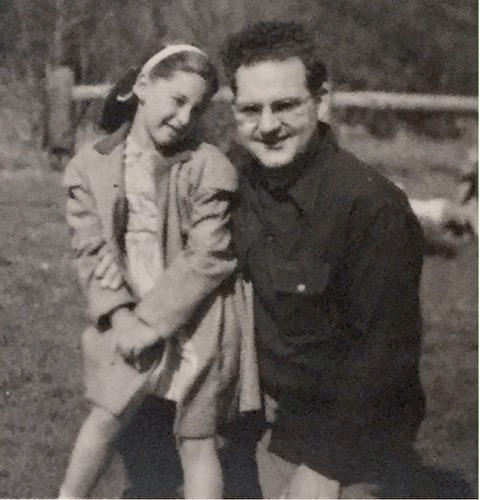
Stanley with his daughter Roberta at Union Pier, Michigan, circa 1950. Marks adds to cynicism another deadly poison: loss of faith in the media, because of its betrayal. Back in 1967, Marks was already noting that there was no way of knowing “how many agents of the CIA now work for various organizations in the mass communication media” (MMF). In Two Days of Infamy, he again picks up this theme, adding: “The investigators of the ‘Report’ have presented the result of their investigations to the public; but the silence of the press lords to further an investigation of the Commission’s allegations has led to a further decline of the general public’s faith in all forms of mass communication.”
Again, keep in mind that this statement was published in March of 1969. Since then, we have seen a snowballing––and then an avalanche––of mistrust in what we now refer to as the MSN; and this has occurred on both sides of the aisle, left and right. But Marks goes on to blame not only the MSN and the Warren Commission, but the critics themselves for what followed. He refers to the first generation of researchers when he says:
The critics’ primary failure was their repeated implication that the murder of President Kennedy could not be solved unless, at the same time, they proved a conspiracy. The critics have constantly proclaimed that unless the Zapruder film, the X-Rays, and other photographic evidence was released from the National Archives, no solution could be obtained. Their demands obscure the main issue: “Was Lee Harvey Oswald the ‘sole and exclusive assassin of President Kennedy’ as charged by the Warren Commission?”
The film, X-rays, and other photographic evidence is not the prime evidence in securing an affirmative or negative answer. That evidence is secondary.
The prosecution, in this case the Warren Commission, must affirmatively prove three elements: (1) Lee Harvey Oswald was at the 6th floor S.E. corner window at the time the shots were fired; (2) those bullets which caused the death of President Kennedy came from a weapon he used at that time and (3) the rifle allegedly used was a functional operating lethal weapon from which those bullets were discharged.
As we witness time and again in his assassination-related publications, no matter how far afield Marks goes to explore “bigger picture” implications, as a trained attorney, he always circles round and returns to the case at hand. Thus, two of his principal concerns are to show why Oswald could not have been convicted of being a “sole assassin” in any law court that followed the basic principles of American justice; and to prove this with specific facts, on a nuts-and-bolts legal level:
In a court of law those three elements must be proved beyond a reasonable doubt by the evidence in the possession of the Warren Commission. Each of the three must be proved; not just one, or two, but all three.
Thus, if Oswald was not at the S.E. corner window at the exact time those three bullets were fired, he could not be found “guilty” even though the remaining two elements be proved in the affirmative.
If element (2) be proved in the affirmative but element (1) in the negative, then a trial judge would rule Oswald “not guilty.” If element (3) was proved affirmatively, the trial judge would still rule Oswald “not guilty” if (1) or (2) not be proven by the evidence given in court. Further, if (2) be proven but (3) proves that the rifle could not discharge those bullets because it was defective and incapable of firing bullets through its barrel, then Oswald would be found “not guilty.” A consensus does not operate in a criminal courtroom.
Peppered throughout the text are examples of straightforward forensic evidence that any lawyer worth his salt would present to demonstrate his case against the WC conclusions. “Any attorney defending Oswald on the charge of being the ‘sole and exclusive assassin’ of President Kennedy would have an easy task to obtain a ‘not guilty’ verdict with the testimony of the physicians and federal agents that proved beyond a reasonable doubt that President Kennedy was struck in the back by a bullet striking him from an angle of fire between 45 and 60 degrees. This proved that such an angle of fire could only come from a window of the Dal-Tex Building or the County Building but not from the 6th floor of the Book Depository. Oswald was innocent.” And it is the presentation of such clear evidence that allows Marks to then expound on the risible nature of the Commission’s groundless theories:
In spite of the testimony of the physicians and the federal agencies, the Commission decided to confuse the people by outdoing Baron Munchhausen—a paragon among liars. The Commission therefore proceeded to “produce” a “Tale of Bullet No. 399.” This “bullet,” sayeth the Commission Barons, first entered the president’s back, hesitated a moment, reversed itself, flew up his back, made a 90 degree turn, turned downward into the back of his neck, went through his neck, made another angle turn, entered the governor’s body, “tumbled” through the wrist, entered his rib cage, and came to rest when the “tumbling” lacked inertia, in his thigh! The leading Baron aide was a man by the name of Specter.
Even after decades of rehashing the magic bullet fiasco in the voluminous assassination literature, Marks’s version leaves one with the impression of a fresh and lively spin.
III
Just as he does in Murder Most Foul!, by the end of Two Days of Infamy, Marks turns much of his ire on commissioner and former CIA Director Allen Dulles and for good reason. Like a prosecuting attorney delivering a summation through the use of rhetorical device, Marks’ refrain, echoed repeatedly in an imaginary courtroom, is the incredulous: “No conspiracy, Mr. Dulles?” And at one point, with a slight change in modulation, he adds: “The same Dallas police also testified that although Tippit’s clipboard was attached to his dashboard they never looked at it or read it! Do you believe that, Mr. Dulles?” (My italics.) Such passages also exemplify Marks’ lively, provocative, arch yet charming humor: a hallmark of the author’s writing that serves as a counterpoint to the sometimes strident, rage-fueled cadences that mark his discourse with an undertone of righteous indignation.
Marks’ disdain for Dulles may be traced back to an article that appeared in Look magazine in July 1966, in which Dulles remarks: “If they found another assassin, let them name names and produce their evidence.” Stanley first quotes this in MMF, where he follows it with the remark: “This contemptuous statement directed at the American citizenry revealed the attitude of the Commission.” In Two Days of Infamy, he further qualifies it as “The most contemptuous statement ever issued by a member of any governmental commission investigating the murder of the head of his government.” But Marks cites this quote not merely to inform us of its existence, but to take up Dulles’ challenge. Indeed, the deeper one reads into Marks’ work, the more easily one can imagine that the impetus to produce such tomes grew directly from the outrage spawned by this outrageous declaration. After citing one example after another in which the Commission is caught with its pants down––or, perhaps more fittingly, called out for being an Emperor without any clothing––Marks rests his case by stating:
The author has produced the evidence; it was the duty of Mr. Dulles and his commissioners to name the names of the assassins and the conspirators.
That failure is theirs, not the responsibility of the American citizen.
But Marks finds no solace in reaching this conclusion. Rather, he reminds us of a terrible truth:
History has proven that once assassination has become the weapon to change the government, that style and form of government preceding the assassination falls beneath the hard-nailed boots of the assassins. Both right and left favor no democratic spirit in the people. The cold of Siberia and the gas ovens of the concentration camps have proved it.
The tragedy of the Warren Commission is that they helped set those boots on the road to the destruction of American democracy.
And how could so many have fallen prey to such a deceit? In part, this turning of a blind eye to the possibility of a conspiracy occurred because the citizens of the United States are “living in a dream world concocted by the mass communication systems.”
One should also note that not all the ire falls upon Dulles. That other intractable head of so-called intelligence, J. Edgar Hoover, is the subject of so much justifiable vitriol that Marks was certain to have had a file opened on him by the FBI as a result. He lambasts Hoover for declaring just five months after the assassination of Bobby Kennedy that “Justice is incidental to law and order,” and adds:
Mr. Hoover’s belief in “law and order” is on the exact same level as Hitler’s “law and order”; Stalin’s “law and order”; Mussolini’s “law and order”; Tojo’s “law and order”; Batista’s “law and order”; the Greek Colonel’s “law and order, 1968 version”; and so forth. Mr. Hoover’s basic philosophy is identical with the philosophy of any other “police state” objective.

In 1943 Marks published a dozen essays in the Chicago Defender, one of the most celebrated African American newspapers in America. The illustration above features Marks’ weekly column, “War and Warfare.” The Defender played a key role in encouraging Blacks to leave the South and join “The Great Migration” North, to work in Chicago’s factories. During WWII it promoted the “Double V Campaign”: a proposed “Dual Victory” over both foreign and domestic “enemies” who remained opposed to racial equality and justice for all, thus incurring the wrath of J. Edgar Hoover, who tried to convince President Roosevelt to prosecute its editors for treason. Although Hoover was forced to back down, he opened files on the Defender and kept it under surveillance. Stanley’s publications eventually led to his blacklisting by the House Un-American Activities Committee. But Marks also views Hoover as something of a foxy figure. Since the Bureau’s memoranda and reports on the assassination were often as truthful as they were deceitful, and since the official FBI assassination report often contradicts the Warren Commission Report, Marks speculates that Hoover was attempting to have it both ways: protecting himself and the Bureau no matter what the final outcome. Indeed, Hoover’s performance was rather sly and of the type that only an attorney could truly appreciate. For example, speaking of the Mannlicher-Carcano rifle supposedly owned and used by Oswald for the assassination, Marks highlights Hoover’s brilliant use of legalese:
In the official FBI Reports, Vol. 1 to 5, there is no statement by the Bureau that that rifle given to them was ever “used” by any rifleman. The FBI constantly referred to this rifle as being “owned” by Lee Oswald; never did they state that he “used” it for any purpose. How can a rifle discharge three bullets when the rifle has never been used?
Note that fine line between truth and deceit: whether or not this rifle was really “owned” by Oswald, the Bureau nonetheless betrays the Commission by refusing to take that extra step of stating that it was “used” by him.
Marks attempts to summarize this paradox of the Bureau’s seemingly shifting, alternating allegiances in the following manner:
The federal agency that is the paradox, the Chinese puzzle, in the entire investigation is the Federal Bureau of Investigation. As has been stated in previous chapters, that Bureau overwhelmed the Commission with evidence that proved Oswald innocent in both murders. What is the puzzle is the fact although the Bureau time and time again warned the Commission that its “conclusions” would not stand the scrutiny of the light of day, that agency then turned right around and conducted itself in a manner implying they had something to hide––to conceal their possible involvement in the assassination. The Bureau was involved in suppressing the same evidence they had originally uncovered and exposed to the world! […]
The Bureau’s conduct can only lead to a conclusion that the Bureau was operating on both sides of the fence, in the slim hope that any investigation of the “Report” would not be undertaken by a serious investigator of that “Report.” “Heads or tails,” the FBI could prove that they had given evidence, or uncovered evidence, disproving the Commission’s accusation that Oswald was the “sole and exclusive killer of President Kennedy.” What is perplexing is Mr. Hoover’s defense of the Commission in the face of that evidence and his various statements, which were obtuse or contradictory, that did nothing to add to the honor of the FBI.

Appearing beside William Styron’s Confessions of Nat Turner, the #1 bestseller, and Rosemary’s Baby listed at #6, Murder Most Foul! somehow managed to get a brief mention in the mainstream press despite being a self-published text. The reviewer, Donald Stanley, ran a feature column with the San Francisco Examiner, and the review appeared in the December 24, 1967, edition, about three months after the publication of Murder Most Foul! This may have been the last time Marks was mentioned in any major media until recently. IV
Marks’ phrase “two days of infamy” refers to the date of JFK’s murder and, ten months later, to the release of the Warren Commission Report. By grafting FDR’s “infamy” term onto these more recent dates of iniquity, the author is reminding us of the rage and indignation that rise up within many who lived through both the attack on Pearl Harbor and the coup d’état of November 22, 1963. This outrage extends beyond the personal figure of JFK and the experience of his loss. For, as Marks warns in the first chapter of Two Days: “A nation can be destroyed if its leaders can be murdered with impunity.” As a result of the Warren Commission hoax perpetrated by those ignoble seven commissioners, “The truth was never ascertained; the evidence never evaluated; and the truth uncovered was covered. Never was so much done by so many that produced so little.” Later on, with typical Marksian aplomb and incisiveness, he adds:
The historical verdict of the Warren Commission is that the Commission proclaimed a precedent whereby it is now permissible for the president of the United States to be murdered by men who believe that the vice president, who becomes the president upon the death of the president, would be more amenable to the philosophies of the murderers.
* * *
As we were putting the final touches onto the new edition of Murder Most Foul!, Roberta Marks went through an old box in her garage that contained some of her father’s papers. Lo and behold, she unearthed a precious––and curious––document. Just a few years after Robert Kennedy’s death, Stanley Marks had received an unexpected request. On March 12, 1973, the JFK Library wrote Marks a letter requesting information on how to purchase a copy of Murder Most Foul! for their collection. And from this we may surmise that RFK’s trusted colleague, Dave Powers, who served as JFK’s personal assistant and whom RFK later placed in charge of assembling materials for the official JFK Library, would probably have been familiar with at least the title of Marks’ book.
How to explain such an interest in this little-known work?

The John F. Kennedy Library contacted Marks with a request to purchase a copy of Murder Most Foul! for their collection. Thanks to Vincent Palamara’s Survivor’s Guilt: The Secret Service and the Failure to Protect President Kennedy, I recently learned that Powers had long maintained a skeptic’s view of the Warren Commission Report. In discussing the possibility of Secret Service involvement in the conspiracy, in Survivor’s Guilt Vince writes that, in 1996, ARRB Director Tom Samoluk informed him that Dave Powers “agreed with your take on the Secret Service.” If Powers held this belief, it might explain why this unusual purchase of Murder Most Foul! was authorized for the JFK Library.
A photo of this letter addressed to Marks, composed on U.S. General Services Administration stationery, is reproduced here and in the new edition of MMF.
Purchase info for Two Days of Infamy here.
Purchase info for Murder Most Foul! here.
[1] In Two Days of Infamy, Stanley writes of Governor Ronald Reagan: “If it be morally correct for the Czech students to defy Stalinism, should not it be morally correct to defy Reaganism?”
[2] One could also argue that since Destiny Betrayed was first published in 1992 and then completely rewritten a decade later, it serves as a symbolic bridge between the Old World of JFK research and the New.
(Special thanks to Al Rossi.)
-

The FBI, JFK and Jim Garrison
{aridoc engine=”google” width=”700″ height=”400″}images/ppt/FBI-JFK-Garrison-2019.ppsx{/aridoc}
-

Garrow’s Interpretive Guesswork Presumes the Worst
As everyone who reads this web site knows, the attempt to smear the four people that it focuses on—JFK, RFK, Malcolm X and Martin Luther King—is an ongoing affair. The idea is to indulge in character assassination, and few organizations are better at it than the FBI and CIA. Occasionally a lower body like the Los Angeles Police Department will dip into the dirty waters. For instance, before he passed on LA assistant DA John Miner called a press conference to publicize tapes that were supposed to reveal a relationship between President Kennedy and Marilyn Monroe. This story was eagerly picked up domestically and universally misreported. Miner did not have tapes. He had notes on tapes and some observers have shown his notes turned out to be dubious (see this article).
Longtime Martin Luther King scholar David Garrow has written a new and controversial essay on King, informed by an interpretive analysis of recently released FBI documents. The documents, according to Garrow, reveal darker and more troubling character flaws to the revered civil-rights icon which require, according to Garrow, a harsh reevaluation of King’s personal legacy. By accepting the veracity of summaries of FBI surveillance transcriptions from the mid-1960s, Garrow is using material which cannot be verified to, in effect, publicize the ugliest features of the FBI’s acknowledged campaign to discredit King. This question of veracity led to the essay’s rejection by major mainstream news outlets such as, among others, The Guardian and Washington Post, to whom an apparently determined Garrow had been offering his essay since late last year. The essay has since been published by a lesser-known British online journal called Standpoint.
There is nothing, on the surface, factually incorrect in Garrow’s presentation, as links to the documents in question confirm the accuracy of his source quotations. The controversy, and an accompanying peer rejection, rests on Garrow’s stated belief that the material as presented represents an accurate objective rendering of the content of surveillance audio tapes and their transcriptions, currently stored under seal at the National Archives. These items are not scheduled for release until 2027 and Garrow himself did not have access to them. In context, as Yale historian Beverly Gage noted in response to Garrow’s claims: “This information was initially gathered as part of a deliberate and aggressive FBI campaign to discredit King. That doesn’t necessarily mean that the information is false. But it does mean that we should read the documents in that context, understanding that the FBI was looking for information that it could weaponize, and was viewing events through the lens of its own biases and agenda.”1
John Hopkins University professor Nathan Connolly struck a similar theme: “If the FBI had had information about King having been party to a sexual assault or observing a rape, that would be exactly the kind of information they would have used to bury him. The fact that this had not come to light and was not used for any previous campaign to discredit King gives me pause about considering it a credible accusation.”2
Garrow’s essay, as published by Standpoint, is titled “The Troubling Legacy of Martin Luther King”, with a sub-heading proclaiming “Newly-revealed FBI documents portray the great civil rights leader as a sexual libertine who ‘laughed’ as a forcible rape took place.”3 This alleged incident, supposedly occurring at Washington, D.C.’s Willard Hotel in January 1964, has been the most referenced “revelation” following publication. Other incidents highlighted by Garrow include supposed “orgies” at both the Willard and in Las Vegas, a possible illegitimate child, and references to numerous supposed liaisons with individual women in various locales. While the latter information has been generally known for some time, and has been understood in the context of severe violations of personal privacy by the FBI, Garrow now maintains that the number of alleged sexual partners, as revealed in the new documents, shocked him and has forced his reevaluation: “I always thought there were 10 to 12 other women. Not 40 to 45.”4 The FBI documents, however, appear to describe any female acquaintance of King as a “girlfriend”, and assume any private meeting as a sexual liaison.
King, it is apparent, did maintain intimate friendships outside of his marriage. This has been noted for decades, most recently in the three volume biography by Taylor Branch, who did not rely on FBI documents alone to present his case. These friendships were lasting and involved the mutual consent of adult persons. These friendships, in other words, were the private business of individuals and are largely none of anyone else’s business. If King had been publicly advocating against sexual activity or assumed a position of strict morality, then revelation of a core hypocrisy would be of public interest. That is not the case here, and the revelations over the years have been rightly seen as an attempt to discredit King and blunt his influence. Garrow’s new presentation of King as a selfish perverse “libertine” who would react indifferently or even encourage sexual assaults is an outlier, and it is worthwhile taking a closer look at the documentation he claims supports this position.
Willard Hotel
Garrow’s most explosive claim involves a sexual assault which allegedly occurred at the Willard Hotel in Washington D.C. in early January 1964. King and an accompanying party travelled to Washington to monitor a Supreme Court hearing which involved a large punitive fine directed by a state court against several colleagues. King and his party had reserved two rooms at the Willard, information which made its way to the FBI.
The Church Committee interviewed former Special Agent Wilfred Bergeron of the FBI’s Washington field office in June of 1975. Bergeron described being instructed by FBI Assistant Director William Sullivan to bug the King party’s rooms at the Willard Hotel: “(Bergeron) advised that he had placed a transmitter in each of two lamps and then through the hotel contact, it was arranged to have the housekeeper change the lamps in two rooms which had been set aside for King and his party.”5 Two nearby rooms held FBI agents, wireless receivers, and tape recorders. Bergeron told the Committee that, at the time, he only listened briefly to the transmissions to check that they were functioning properly. He was also asked if he ever reviewed logs or transcripts of these recordings, to which he replied he “probably” had, but could not recall any of the content.
Having described the King party as a “variety of ministerial friends”, Garrow then refers to the recently released documents’ description of the assault: “On January 5, 1964, King and several SCLC officials checked into the Willard Hotel in Washington, D.C. In a room nearby was a Baptist minister from Baltimore, Maryland, who had brought to Washington several women “parishioners” of his church. The group sat in his room and discussed which women among the parishioners would be suitable for natural or unnatural sex acts. When one of the women protested that she did not approve of this, the Baptist minister immediately and forcibly raped her.” A handwritten note next to the typewritten text states “King looked on, laughed, and offered advice.” An FBI file number is typed below (100-3-116-762).
Garrow identifies the Baltimore minister as King’s friend Logan Kearse, and also claims that Kearse was staying “in one of the two targeted rooms.” Garrow insists the alleged assault was therefore tape-recorded and the description of the event appearing in the document must have been derived from the transcription of the recording. This is by no means a sure thing, and it is not clear how Garrow could have arrived at such an assertion other than a series of assumptions. The FBI’s description quoted above differentiates “King and several SCLC officials” checking into the hotel, from Kearse who is said to be in a “room nearby”. Further, Bergeron “probably” reviewed transcripts from the two rooms, but could not recall a sexual assault, even as he knew King specifically was being targeted by senior FBI officials.
The description of the January 5 alleged incident also does not include any specific quotation of recorded dialogue, unlike a description of events the following evening (January 6) which the document turns to next. In this instance, according to the text, a dozen persons “nearly equally divided between men and women and including King, officers of the SCLC, and others bearing the title of ‘Reverend’—participated in a sex orgy. Excessive consumption of alcohol and the use of the vilest language imaginable served only as backdrop to acts of degeneracy and depravity … Many of those present engaged in sexual acts, natural as well as unnatural.” Dr King is directly quoted twice in reference to “unnatural” sexual acts. This event, then, may well have been recorded, but whether the activity constituted an “orgy” or is better described as a group of persons unwinding over drinks and bawdy discussion cannot be determined at this time. What specifically from the presumed audio recording led investigators to determine that “sexual acts, natural as well as unnatural” were occurring, may yet prove to be largely imaginative speculation.
Las Vegas
The document goes on to refer to an event which allegedly occurred several months later in Las Vegas, “the scene of another of King’s sex orgies.” Garrow details the supposed liaison over four prurient paragraphs, working from the original description presented in a letter delivered to the Las Vegas FBI office from a “confidential source” who worked for the Nevada Gaming Control Board.6 This official, having received information which “indicated” a local prostitute may have “been laying up” with King during his late April visit to the city, took on his own initiative to track the woman down and interview her as “it might shed an interesting side light to King’s extra curricular activities.” There is no indication the FBI tried to independently verify any of the story’s information, so it stands as a second-hand account which may or may not be accurate. Certainly the graphic detail may be more indicative of the subjective intent of the interviewer than the objective recollections of the interview subject. That is, a degree of coaching the witness or after-the-fact embellishment cannot be ruled out.
The bizarre tale involves the distinguished gospel singer Clara Ward, who, according to the story, acts as both procurer and participant in activity which gradually involves four persons. According to the report, the prostitute eventually became “scared” due to the inebriation and “vile language” of her clients, and she managed to make an exit, telling her interlocutor “that was the worst orgy I’ve ever gone through.” Skepticism regarding this report is warranted. The identification of King is hardly conclusive. Additionally, according to a biography written by her sister, Clara Ward had earlier in life been relentlessly driven by a domineering mother toward career success and away from romantic attachment and sexual expression. Her personal unhappiness, which led to alcoholism and poor health, was offset only by a long attachment to Reverend C.L. Franklin, whose daughter Aretha was mentored by Ward.7 Despite this background, the incident as described, which would have occurred about a week after Ward’s fortieth birthday, sees her as experienced and comfortable in group sex scenarios with famous civil rights leaders and strangers, including activity which even a Las Vegas prostitute would claim as “disgusting.”8
This is salacious gossip, or “opposition research” in current parlance, not meant to be fact-checked. The confidential source from the Nevada Gaming Control Board finishes his account with: “the good doctor (King) doesn’t exactly practice what he preaches, or does he?” The Las Vegas field office would retransmit the information in form of a secret document sent directly to Hoover, where it joined other collections of gossip and rumor, along with wiretap results, in the King file. As the FBI’s Alan Belmont once said, quoted by Garrow, referring to the Willard Hotel: “We do not contemplate dissemination of this information at this time but will utilize it, together with results of additional future coverage, in our plan to expose King for what he is.”
MeToo?
So is Garrow not, albeit decades later, assisting Hoover’s FBI in exposing King “for what he is”, or rather what the FBI says he is (was)?
Garrow explained to the Atlanta Journal-Constitution: “I felt a complete obligation to confront this stuff. I did not feel I had a choice. I have always felt spiritually informed by King and yes, this changed it. I have not heard his voice much this past year.”9
Referring to the alleged rape at the Willard Hotel and King’s alleged callous response, Garrow continued: “I think that this is very important in the whole #MeToo context. Not only is (King) witnessing this, but the FBI is in the next room and doesn’t do anything.” Garrow picked up on this during an interview with the Pittsburgh Post-Gazette, claiming the new material “is more about gender than about race”, and expressing his concern on having publicized this information that no one “has asked me about the woman who was raped.”10
This theme is picked up by the British publisher of the essay, who describes King as a “sexual predator.” An editorial justifying the publication of Garrow’s information states: “When the sexual mores of cardinals, presidents, writers, film directors and producers have all been exposed, why is it that questioning the behaviour of a civil rights icon is still beyond the pale? Is not the whole point of the #MeToo movement that no one, regardless of their stature or position, should be above examination of their personal behaviour?”11
The editorial’s author, Michael Mosbacher, continues: “The wiretaps reveal (King) to be the Harvey Weinstein of the civil rights movement. They show that he was sexually voracious, frequented orgies and was present when his friend, pastor Dr Logan Kearse, raped a woman in a hotel room.”
As detailed above, while wiretaps may reveal King as possessing “a very off-colored, obscene sense of humor”, as has long been acknowledged, as far as the major sexual allegations discussed by Garrow—that King witnessed and responded callously to a rape, that he participated in an orgy, and then a second orgy in Las Vegas—were, first, not in fact “wiretapped” or completely verified; second, may possibly be recorded but subject to imaginative interpretation and as yet unverified; and third, relies entirely on second-hand information, which may have been coached, was initiated by a non-objective source, and is unverified.
Unfortunately, the #MeToo movement has displayed at times a certain neo-Jacobin zeal whereby, in the rush to a better world, reputations have been destroyed with little regard to establishing fact or due process. Garrow’s appeal to such forces may be an effort to gain traction for his essay, but there is a danger that the reputational smearing of King’s character based on unverified information might snowball into unpredictable misunderstandings of civil rights history.
Garrow’s 1981 book on King and the FBI remains a solid account of the serial violations of MLK’s constitutional rights, including the obvious inference that King’s ties to Stanley Levinson were used as a pretext to justify surveillance and that the FBI was less concerned with supposed communist infiltration than they were with gaining the means to disrupt King’s influence through “weaponizing” information on his private life. There is a fair amount in Garrow’s new essay which updates information regarding these programs, and it is worth a look for that, at least. In context, the unverified salacious content which Garrow has unfortunately chosen to highlight was fully part of a policy to use official powers to gain advantage over those who would challenge the status quo.
Notes
1 “Historians Attack Pitt Professor David Garrow’s Martin Luther King Allegations”, Pittsburgh Post-Gazette, May 31, 2019, https://www.post-gazette.com/ae/books/2019/05/30/Historians-attack-David-Garrow-s-Martin-Luther-King-allegations-1/stories/201905300167
2 “Biographer Garrow Pens Explosive Report on Martin Luther King, Jr”, Atlanta Journal-Constitution May 30, 2019, https://www.ajc.com/news/breaking-news/biographer-garrow-pens-explosive-report-martin-luther-king/fqPKW1dndGA5g4oAkzRoIJ/
3 https://standpointmag.co.uk/issues/june-2019/the-troubling-legacy-of-martin-luther-king/
4 “Biographer Garrow Pens Explosive Report on Martin Luther King, Jr”, Atlanta Journal-Constitution, May 30, 2019
5 https://www.archives.gov/files/research/jfk/releases/docid-32989614.pdf#page=142
6 https://www.archives.gov/files/research/jfk/releases/docid-32989551.pdf#page=82
7 https://en.wikipedia.org/wiki/Clara_Ward
8 https://www.archives.gov/files/research/jfk/releases/docid-32989551.pdf#page=77. It is possible that Clara Ward did secure the services of a prostitute in Las Vegas, on or around the time described, coinciding with King’s presence in the city. It is possible that rumors grew from this, such that a local official initiated contact with the prostitute and managed to link whatever occurred with King. That doesn’t make the local official’s report in any way true, or worthy of contemplation decades later. Neither King or Ward are available to dismiss this tale, and so, by focusing on the graphic depictions over four entire paragraphs, Garrow seriously disrespects their memory and legacy.
9 “Biographer Garrow Pens Explosive Report on Martin Luther King Jr”, Atlanta Journal-Constitution, May 30, 2019
10 Note that “the woman who was raped” was never identified, and there is no verification that the incident ever happened in the first place. “Former Pitt Professor Reassessing View of MLK After He Uncovers New FBI Documents”, Pittsburgh Post-Gazette, June 1, 2019, https://www.post-gazette.com/local/region/2019/06/01/david-garrow-martin-luther-king-jr-fbi-files-bearing-the-cross-pulitzer-prize-pitt/stories/201905310145
11 Standpoint editorial by Michael Mosbacher, https://standpointmag.co.uk/telling-difficult-truths/
-
The Assassination of Fred Hampton: 47 Years Later
One of the lawyers in the Fred Hampton civil case reminds of just how bad the FBI Cointelpro program was under J. Edgar Hoover. It snuffed out the life of a young, charismatic Black Panther leader named Fred Hampton – one of the several assassinations of the sixties – and then went on to wipe out the Black Panther Party.
~Jim DiEugenio
-
The Assassination of Fred Hampton: 47 Years Later
One of the lawyers in the Fred Hampton civil case reminds of just how bad the FBI Cointelpro program was under J. Edgar Hoover. It snuffed out the life of a young, charismatic Black Panther leader named Fred Hampton – one of the several assassinations of the sixties – and then went on to wipe out the Black Panther Party.
~Jim DiEugenio
-

Howard Willens and The American Scholar
How far the Warren Report has fallen in public estimation is an almost humorous subject. When it was first issued in the fall of 1964, the report was met with almost universal acclaim as an historically unquestionable document. All branches of the media – the press, television, periodicals and radio – accepted it with almost no reservations. Perhaps because none of the commentators had read the nearly 15,000 pages of accompanying evidence, which was not published until a month later. To show just how strange this reception was, and how lacking in rigor the media examination was, CBS prepared a two-hour documentary on the Warren Report the day it was published! Clearly, this show was being prepared in advance of the release of the report. In other words, CBS had accepted the Warren Report without reading it. Or, someone in the government passed them a copy before anyone else had it.
Yet, this mass propaganda deployment did not hold. Within three years, the majority of Americans now doubted the main tenets of the Warren Report. And that figure has never dipped below a majority in the nearly fifty years since. Which is a tribute to both the work of the critical community and the good sense of the American people. Because the members of the Warren Commission have never let up in their attempts to reinculcate the public with their fallacious verdict based upon, at best, incomplete evidence.
For instance, when Oliver Stone’s film JFK was released, David Belin appeard at the National Press Club to criticize the film. (Click here for that appearance https://www.c-span.org/video/?25215-1/kennedy-assassination-controversy). When the late Dr. Charles Crenshaw, who was in residence at Parkland Hospital in 1963, published his book Conspiracy of Silence suggesting something was awry with the autopsy of President Kennedy, Belin appeared in the pages of the Dallas Morning News to denounce his book. Years earlier, Commission attorneys David Slawson and Wesley Liebeler communicated with the Justice Department to construct a limited medical examination that would hinder Jim Garrison’s investigation in New Orleans. And as Pat Speer has shown, in all probability, before Arlen Specter passed away, he got in contact with New York TImes journalist Phil Shenon to coax him into writing his limited hangout book, A Cruel and Shocking Act. (Click here for our review)
Wesley Liebeler, Arlen Specter and David Belin have all since passed away. So today, Commission counsel Howard Willens is the most active participant in sustaining the verdict of the Warren Commission into the new millennium. In 2013, he wrote an ill-titled volume called History Will Prove Us Right. The review at this site by Martin Hay was so scathing, Willens actually replied to it on his personal web site. (Click here for Hay’s review http://www.ctka.net/reviews/willens.html, and here for Willens’ reply http://howardwillens.com/jfk_history/conspiracy-communitys-response-book/) Willens’ reply was so weak and unfounded that Martin had little trouble demolishing it also. (Click here http://themysteriesofdealeyplaza.blogspot.com/2014/06/the-watchman-waketh-but-in-vain-howard.html) Apparently, Willens did not learn his lesson. Or he is a glutton for punishment. He has sallied forward again. This time he has joined forces with survivng member Richard Mosk.
Attorneys Willens’ and Richard Mosk’s latest defense appears in, of all places, The American Scholar. This essay on their work for the Warren Commission they served on is more notable for what they omit from the official record than what they include. “What the critics often forget or ignore,” they write, “is that since 1964, several government agencies have also looked at aspects of our work” (American Scholar, Summer, 2016, p. 59). As if the Church Committee and the House Select Committee on Assassinations (HSCA) had reviewed and applauded the commission’s work. Indeed, they did look at it. But rather than plaudits, they issued stinging rebukes, principally for the commission’s having been rolled by J. Edgar Hoover, and to a lesser extent, by the CIA and the Secret Service.
“It must be said that the FBI generally exhausted its resources in confirming its case against Oswald as the lone assassin,” the HSCA concluded, “a case that Director J. Edgar Hoover, at least, seemed determined to make within 24 hours of the of the assassination.”1 In essence, the experienced investigators concluded that Hoover had divined the solution to the crime before the investigation began, and then his agents confirmed the boss’s epiphany. The intimidated commission went right along. And with good reason, only part of which Mr. Willens tells.
He admits that the “FBI had originally opposed the creation of the Warren Commission,” and that Hoover “ordered investigations of commission staff members.” But he doesn’t reveal that Hoover deployed one of his favorite dirty tricks to deal not only with lowly support staffers, such as Mr. Willens, but also with the heralded commissioners themselves. “[D]erogatory information pertaining to both Commission members and staff was brought to Mr. Hoover’s attention,” the Church Committee reported.2 (emphasis added)
Willens and Mosk also forgot to mention that Hoover had a personal spy on the Warren Commission, then Rep. Gerald Ford, who tattled on Commissioners who were (justifiably) skeptical of the Bureau’s work. “Ford indicated he would keep me thoroughly advised as to the activities of the Commission,” FBI executive Cartha DeLoach wrote in a once secret memo. “He stated this would have to be done on a confidential basis, however he thought it should be done.”3 At the bottom of the memo, Hoover scrawled, “Well handled.”4 The success of Hoover’s machinations was obvious to subsequent government investigators.
The HSCA’s chief counsel, Notre Dame Law Professor Robert Blakey, an experienced criminal investigator and prosecutor, was impressed with neither the Commission’s vigor nor its independence. “What was significant,” Blakey wrote, “was the ability of the FBI to intimidate the Commission, in light of the Bureau’s predisposition on the questions of Oswald’s guilt and whether there had been a conspiracy. At a January 27 [1964] Commission meeting, there was another dialogue [among Warren Commissioners]:
“John McCloy: ‘… the time is almost overdue for us to have a better perspective of the FBI investigation than we now have … We are so dependent on them for our facts … .’
“Commission counsel J. Lee Rankin: ‘Part of our difficulty in regard to it is that they have no problem. They have decided that no one else is involved … .’
“Senator Richard Russell: ‘They have tried the case and reached a verdict on every aspect.’
“Senator Hale Boggs: ‘You have put your finger on it.’ (Closed Warren Commission meeting transcipt.)”5
Testifying before the HSCA, the Commission’s chief counsel J. Lee Rankin shamefully admitted, “Who could protest against what Mr. Hoover did back in those days?”6 Apparently not the President’s commissioners. The HSCA’s Blakey also reported that, “When asked if he was satisfied with the (Commission’s) investigation that led to the (no conspiracy) conclusion, Judge Burt Griffin said he was not.”7 Moreover, author Gus Russo reported that Griffin also admitted that, “We spent virtually no time investigating the possibility of conspiracy. I wish we had.”8
Thus, despite their clear misgivings, rather than truly investigate, the Commissioners bowed to the notoriously corrupt and imperious Bureau chief. This policy had serious repercussions when the Commission confronted two key issues: published claims that Lee Harvey Oswald had been an FBI informant, and the possibility Jack Ruby had a relationship with organized crime.
“The Commission did not investigate Hoover or the FBI, and managed to avoid the appearance of doing so,” HSCA investigators determined. “It ended up doing what the members had agreed they could not do: Rely mainly on the FBI’s denial of the allegations (that Oswald had been a Bureau informant).”9 Hoover merely sent the Commission his signed affidavit declaring that Oswald was not an informant, and he also “sent over 10 additional affidavits from each FBI agent who had had contact with Oswald.”10 And with those self-exonerating denials, the case was closed.
About Jack Ruby: in 1964 the FBI had his phone records, yet failed to spot Ruby’s obvious, and atypical, pattern of calls to known Mafiosi in the weeks leading up to the assassination. After performing the rudimentary task of actually analyzing those calls, the HSCA determined that, if not a sworn member of La Cosa Nostra, Ruby had close links to numerous Mafiosi.11 Thus the HSCA found that the Commission was wrong in concluding that, “the evidence does not establish a significant link between Ruby and organized crime.”12
The list of Commission shortcomings the HSCA assembled is not short. A brief summary of them runs some 47 pages in the Bantam Books version of the report (pp. 289-336), which outlines what required much of the 500 pages of HSCA volume XI to cover (available on-line).13 “The evidence indicates that facts which may have been relevant to, and would have substantially affected, the Warren Commission’s investigation were not provided by the agencies (FBI and the CIA). Hence, the Warren Commission’s findings may have been formulated without all of the relevant information.”14 The Church Committee said that the problem was that “… the Commission was perceived as an adversary by both Hoover and senior FBI officials.” “Such a relationship,” Committee observed, “was not conducive to the cooperation necessary for a thorough and exhaustive investigation.”15
But the FBI did more than just withhold evidence from the Commission. Although he mentions that the FBI destroyed a note Oswald wrote to Agent Hosty and withheld that information from the Commission, Mr. Willens doesn’t mention that Agent Hosty reported that his own personnel file, and other FBI files, had been falsified.16 Nor that author Curt Gentry learned from assistant FBI director William Sullivan that there were other JFK documents at the Bureau that had been destroyed.17
Although too numerous to explore here, American Scholar readers should understand that legitimate questions persist about issues Messrs. Willens and Mosk consider settled. These include the notorious Single Bullet Theory and JFK’s hapless autopsy,18 to name but two. But if the authors cannot even be completely honest with what the HSCA and Church Committee wrote about them, then should one trust them with those two radioactive issues?
Notes
1 House Select Committee on Assassinations Final Report, p. 128. On-line at: https://www.maryferrell.org/showDoc.html?docId=800#relPageId=158&tab=page.
2 In: Final Report of the Select Committee to Study Governmental Operations, Book V, p. 47, on-line at: https://www.maryferrell.org/showDoc.html?docId=1161#relPageId=53&tab=page. Also cited by: Curt Gentry. J. Edgar Hoover – The Man and His Secrets. New York: W. W. Norton & Co., 1991, p. 549.
3 “Ford Told FBI of Skeptics on Warren Commission”, By Joe Stephens, Washington Post Staff Writer, Friday, August 8, 2008. On-line at: http://www.washingtonpost.com/wp-dyn/content/article/2008/08/07/AR2008080702757_pf.html.
4 See copy of actual memo at Mary Ferrell: http://www.maryferrell.org/showDoc.html?docId=61488#relPageId=100.
5 In: R. Blakey and R. Billings. Fatal Hour – The Assassination of President Kennedy by Organized Crime. New York: Berkley Books, 1992, p. 29. This testimony was also published in: Mark North. Act of Treason. New York: Carroll and Graf, 1991, p. 515-516.
6 House Select Committee on Assassinations, Vol. XI, p. 49, on-line at: http://www.maryferrell.org/showDoc.html?docId=83#relPageId=55&tab=page.
7 Blakey and R. Billings. Fatal Hour – The Assassination of President Kennedy by Organized Crime. New York: Berkley Books, 1992, p. 94.
8 Gus Russo. Live by the Sword. Baltimore: Bancroft Press, 1998, p. 374.
9 HSCA, Vol IX, p. 41. On-line at: http://www.history-matters.com/archive/jfk/hsca/reportvols/vol11/pdf/HSCA_Vol11_WC_2_FBI_CIA.pdf.
10 HSCA, Vol IX, p. 41. On-line at: http://www.history-matters.com/archive/jfk/hsca/reportvols/vol11/pdf/HSCA_Vol11_WC_2_FBI_CIA.pdf.
11 See excellent discussion in: House Select Committee on Assassinations Final Report, p. 148-156, on-line at: http://www.maryferrell.org/showDoc.html?docId=800#relPageId=178&tab=page.
12 Warren Report, p. 801. On-line at: http://www.archives.gov/research/jfk/warren-commission-report/appendix-16.html.
13 http://www.history-matters.com/archive/contents/hsca/contents_hsca_vol11.htm.
14 HSCA, Vol. XI, p. 59. On-line at: http://www.history-matters.com/archive/jfk/hsca/reportvols/vol11/pdf/HSCA_Vol11_WC_2_FBI_CIA.pdf.
15 In: Final Report of the Select Committee to Study Governmental Operations (Church Committee), Book V, p. 47, on-line at: https://www.maryferrell.org/showDoc.html?docId=1161#relPageId=53&tab=page.
16 James P. Hosty, Jr. Assignment: Oswald. New York: Arcade Publishing, 1996, pp. 178-180, 184-185, 243-244.
17 Curt Gentry. J. Edgar Hoover – The Man and His Secrets. New York: W. W. Norton & Co., 1991, p. 546, footnote.
18 The Chairman of the Forensics Panel of the HSCA, former New York Coroner Michael Baden, MD, has written, “Where bungled autopsies are concerned, President Kennedy’s is the exemplar.” See Baden, Michael M., Unnatural Death: Confessions of a Medical Examiner. New York: Ivy Books, published by Ballantine Books, 1989, p. 5. See also, Larry Sturdivan, The JFK Myths, chapter 10, “Bungled Autopsy,” St. Paul, MN: Paragon House, pp. 185-220.
-
Stripping J. Edgar Hoover’s Name From the FBI Building
by Jonathan Rauch
At: The Atlantic
-

Is It Ever Too Late To Do The Right Thing?
From the March-April, 1997 issue (Vol. 4 No. 3) of Probe
(Click here if your browser is having trouble loading the above.)