Tag: INDIA

  • John Kenneth Galbraith:  A Hero in our Time

    John Kenneth Galbraith: A Hero in our Time


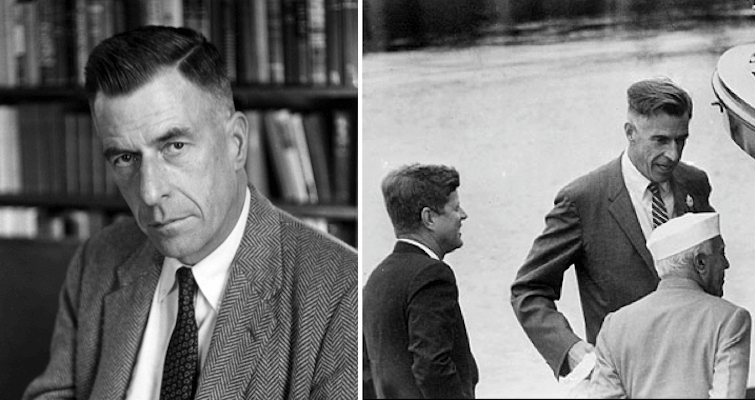
    As many who are interested in the JFK case know, John Kenneth Galbraith was truly A Man for All Seasons. There are few men in public life who pulled off the triple crown like he did: serving with distinction as a public figure, an academician, and as a man of letters. Specifically, Galbraith was an advisor to Presidents Franklin Roosevelt, Harry Truman, John Kennedy and Lyndon Johnson; he served as an instructor at Harvard for over 25 years; was a writer and editor at Fortune and, all told, wrote over forty books. Two of them are considered classics: The Great Crash and The Affluent Society. To have performed just one of those endeavors would make an individual a significant figure in American life. To have done all of them is a remarkable achievement. To have done them with the wit and style that Galbraith possessed makes what he did just about unique in modern American history.

    Galbraith was born in Ontario, Canada in 1908. He was granted an undergraduate degree at a branch of the University of Toronto in 1931. He then went to the University of California, Berkeley to attain his Masters and Ph. D. in agricultural economics. After graduation he taught at both Harvard and Princeton from 1934-40. He worked in the Office of Price Administration for Roosevelt, and then as one of the directors of the Strategic Bombing Survey under Truman. In the last position, he disagreed with his boss, the eternal hawk Paul Nitze, on the effectiveness of the bombing over Germany in reducing war production. After this he went to work at Henry Luce’s Fortune and then in 1949 he was appointed a full professor in economics at Harvard.

    Galbraith had a role in writing the summary reports for both the bombing survey of Germany and Japan. He concluded that war production had expanded during the bombing of Germany. Some strategic targets were impacted; others were not. But bombing had not decided the war in Europe. The air war cost America more than it did the Germans; it was just that the USA could afford it at the time. The real value of the bombing was in support of ground troops. They had won the war. (Richard Parker, John Kenneth Galbraith, p. 183)

    Galbraith’s input into the summary survey of the bombing of Japan was probably even more important at dispelling myths. He described the terrible fire bombings of Japanese cities that sometimes consumed as many as 16 square miles, causing massive numbers of civilian deaths, but barely touching industrial production. He then wrote that in all probability, Japan likely would have surrendered in December of 1945, or maybe even in November, without the two atomic bombs being dropped. (Summary Report, Pacific War, July of 1946, p. 26)

    These insights by a skilled economist like Galbraith seem to be quite valuable, especially in light of the later emphasis placed on bombing in both the Korean War and especially the war in Indochina. The tons of bombs dropped over Indochina exceeded the tonnage dropped over both Germany and Japan during World War II. In fact, it was not even close. Yet none of the countries in Indochina—Laos, Cambodia and Vietnam—had a real industrial base as did Japan and Germany. Most of the population made its living from agriculture. So Galbraith had a real perspective on this issue during his advisory years with President Kennedy.

    It was during his first stretch of employment at Harvard that he met young John Kennedy. From 1936-39, Galbraith tutored JFK at Winthrop House. (Parker, p. 324)

    It is difficult to overestimate how much Galbraith liked writing and being on the faculty at Harvard. For instance, in 1946, he turned down an offer from Nelson and David Rockefeller to become chief economist for the Rockefeller family. (Parker, p. 222) I should not have to inform our readers the kind of money and status that position would have offered him.

    In 1956, Senator Kennedy sought his advice on an agricultural issue. After that, Kennedy developed a rather close relationship with Galbraith as an unpaid advisor. The relationship deepened after the launch of Sputnik in 1957. The two would often meet in Cambridge when Kennedy was in Boston. Kennedy came to rely on Galbraith briefing him before his major appearances. (Parker, p. 325)

    In 1960, Galbraith was one of candidate Kennedy’s floor managers at the Los Angeles Democratic convention. He then wrote several speeches for the nominee during the campaign and prepped him for the third debate with Richard Nixon. He was at Kennedy’s campaign headquarters the night of the election. (Parker, p. 336)

    As most people who have studied Kennedy’s political career know, he had a genuine interest in the huge country of India. He felt that being the largest democracy in the world, and sitting in south Asia, it was of large strategic importance. In the late fifties, he wrote an article for The Progressive on the subject. With Senator John Sherman Cooper, he drew up an aid bill for the country. (Cooper had been President Dwight Eisenhower’s ambassador to India.)

    But another reason Kennedy viewed India to be of central importance is because of its proximity to Red China, and also to the former countries of French Indochina. If there were tensions in that area—as there were bound to be—then India could be both a counterweight, and also a nearby emissary. If such were the case, Kennedy would need a man whom he trusted implicitly to be the ambassador there. Which is why he chose Galbraith for the position.

    But with the kind of relationship the two men had, Galbraith was still advising Kennedy on a wide variety of subjects. On economics, Galbraith was a disciple of the great Englishman John Maynard Keynes. So he urged Kennedy to adapt an expansive economic policy in order to encourage growth. As almost any observer of the Kennedy presidency knows, the years 1961-66 were probably unmatched in post-war American economic history. Gross National Product averaged 5% growth each year, employment grew 2.5% each year, unemployment receded to 3.9%, poverty declined by a third and inflation was at a quite manageable 2 per cent. All of this was done with no significant budget deficits and a positive balance of payments.

    To show how in sync Galbraith was with Kennedy, during his confirmation hearings, the economist suggested that the USA recognize Red China. This created quite a stir on the committee. (Parker, p. 351) But as our readers know through the recently posted interviews with State Department official Roger Hilsman, this is what Kennedy had discussed with Hilsman as early as 1961.

    Galbraith tried to warn Kennedy about committing to the Bay of Pigs operation. He also warned about using American ground troops in Laos. (Parker, pp. 354-56) Kennedy agreed with this and told Richard Nixon, “I just don’t think we ought to get involved in Laos, particularly where we might find ourselves fighting millions of Chinese troops in the jungle.” (Galbraith, Ambassador’s Journal, pp. 45-48)

    And, of course, there was Vietnam. Kennedy had been advised by the likes of Edmund Gullion, Nehru of India, and General Douglas MacArthur on the subject. They all advised him not to send in combat troops. Galbraith agreed with them. Inside the Kennedy White House, he sided with Chester Bowles and George Ball for non-intervention. In prior treatments of precisely what Galbraith’s role was in these debates, the picture painted of it was, to say the least, a bit murky.

    For instance, in David Halberstam’s long book The Best and the Brightest, Galbraith is portrayed as being some kind of outsider, on the periphery of Kennedy’s circle. (Halberstam, p. 152) To state it kindly, Halberstam’s book has not aged well. To be unkind, today it seems quite misleading; so much so that this author would call it pernicious. In addition to getting the role of Robert McNamara wrong, the highly praised Halberstam also mischaracterized Galbraith’s part.

    John Newman came closer to what the true facts and characterizations were in his milestone book JFK and Vietnam, first published in 1992. There, Newman wrote that Galbraith had written Kennedy in March of 1962 after visiting Vietnam. He was quite derisive about America being involved there at all. He suggested a neutralist political solution, similar to what the administration was negotiating for in Laos. (Newman, p. 236) This is more accurate but is still unsatisfactory since it is incomplete.

    Galbraith’s role in all this began even before the famous two week long November, 1961 debate over committing combat troops to Saigon. In July of 1961, Galbraith wrote the president, warning him about the information he was getting about Indochina. He said that President Ngo Dinh Diem was not the right man to lead South Vietnam. He had alienated the public to a much further degree than the newspaper reporters have let on. (Galbraith, Letters to Kennedy, pp. 76-77) But it turns out that Galbraith was directly involved in the November debates.

    The ambassador was in Washington to accompany Prime Minister Jawaharlal Nehru on a state visit. Galbraith had already heard about the mission President Kennedy had sent General Max Taylor and Deputy National Security Advisor Walt Rostow on in October. The ambassador feared America’s entry into a war in Vietnam would be a disaster. It could endanger Kennedy’s domestic programs, tear the Democratic Party apart, and perhaps provide the opening for a new conservative era in American politics. (The Nation, February 24, 2005, “Galbraith and Vietnam”)

    Galbraith had arranged the luncheon to be at the Newport Rhode Island home of Jackie Kennedy’s mother, so no other State Department representative would be there. Kennedy and Galbraith asked the Indian leader to participate in a neutralist solution for Vietnam. They even asked him to talk to Ho Chi Minh about forming a UN observer team as a first step in that direction. Nehru was non-committal except for saying that America should not get into a shooting war in Indochina. (Galbraith, A Life in our Times, pp. 470-77)

    The next day in Washington, Galbraith made a beeline for Rostow’s office. He questioned Rostow about the actual contents of the report. Rostow said it was highly classified. Then the phone rang. With Rostow distracted, Galbraith stole a copy of the report from his desk and left. (The Nation, 2/24/2005)

    Reading it back at his hotel, the ambassador was stunned. He realized that this report and its recommendations would create the first commitment of combat troops to Saigon and that would then be the pretext for an open-ended conflict. The first group of 8,000 men were to go in under the guise of “flood relief workers”. The report recommended deepened cooperation between the CIA and Saigon’s intelligence, more covert operations and massive training of Vietnamese soldiers. Plus the use of a sprayed herbicide which Secretary of State Dean Rusk told Kennedy was really a weed killer. (At first this was called Agent Purple, it later turned into Agent Orange.)

    Kennedy had seen Galbraith the day before the Newport meeting. Realizing there was going to be a long debate over the Taylor-Rostow report, he had asked him to prepare a paper to contest direct American involvement. This now became the basis for his memo to the president. JFK read both documents and then postponed the meeting on Vietnam. Meanwhile, Galbraith did something that the president had already done. (Jim Douglass, JFK and the Unspeakable, p. 107) The ambassador started leaking stories to the press that Kennedy was opposed to the escalation his advisors were pressing on him. Before Galbraith left to return to India, he told Kennedy it would be a good idea if he stopped off in Saigon. JFK agreed and then instructed the ambassador to report back to him alone. (The Nation, 2/24/2005; Parker, p. 370-72)

    At the crucial meeting, which occurred on November 11, Galbraith’s biographer Richard Parker notes something that Newman did not mention, namely that Bobby Kennedy was in the room. Later, authors like David Kaiser and Gordon Goldstein did write about this information, based upon recovered notes. In what appears to be a mapped out plan, the Attorney General would repeatedly deny any suggestion of ground troops by saying flatly, “We are not sending combat troops. Not committing ourselves to combat troops.” (David Kaiser, American Tragedy, p. 113) Then the president would add that if there was ever going to be a troop detachment sent in it would be a multilateral mission, under the aegis of the UN or SEATO. (Parker, p. 371)

    As most of us know, this two week long debate ended with Kennedy issuing NSAM 111. That order significantly increased the number of American advisors to over 15,000 and it sent in more equipment, like helicopters. But this is as far as Kennedy was going to go. He was going to aid Saigon, but he was not going to fight their war for them. He never allowed combat troops into theater. In fact, there was not one more combat troop in Vietnam on the day Kennedy was killed than on the day he was inaugurated. The president even wanted to replace Frederick Nolting as ambassador to Saigon with George McGhee, who he knew was opposed to intervention. But Dean Rusk, who had been one of the leaders for troop insertion during the debate, nixed this idea by saying Nolting should stay since he had Diem’s confidence. (Parker, p. 376)

    It seems to this author that with the information about Bobby Kennedy’s role in the November, 1961 debates, the attempt by Kennedy to replace Nolting, and the now fully revealed role of Galbraith, this episode is even more clearly a demarcation line than before. Kennedy simply was opposed to transforming Vietnam into America’s war, and he knew that was what it would become if ground troops were placed in theater. As the president had told Arthur Schlesinger:

    They want a force of American troops. They say it’s necessary in order to restore confidence and maintain morale … The troops will march in; the bands will play, the crowds will cheer, and in four days everyone will have forgotten. Then we will be told we have to send in more troops. It’s like taking a drink. The effect wears off and you have to have another … The war in Vietnam could be won only so long as it was their war. If it were ever converted into a white man’s war, we would lose as the French had lost a decade earlier. (Gordon Goldstein, Lessons in Disaster, p. 63)

    Upon Galbraith’s return to Asia, he did file a report from Saigon. In fact, he eventually filed three of them. These all ended up being back channel cables, meaning they bypassed the usual State Department protocols. They were laced with Galbraith’s blend of impatience and sarcasm: “Who is the man in your administration who decides what countries are strategic? I would like to … ask him what is so important about this real estate in the Space Age.” (The Nation, 2/24/2005) And again, Halberstam was wrong about what happened as a result of these, just as he was wrong about how Kennedy regarded his advice in November of 1961. For Galbraith was not on the periphery, he was at the center of the story—in two ways.

    First, Kennedy attempted to follow up on the ambassador’s proposal to open negotiations for a neutralist Vietnam settlement through India. Unfortunately, he tasked the wrong person with the mission. Averill Harriman was Kennedy’s point man on the attempts to defuse the Laotian situation with a coalition government. Apparently he did not feel the same way about Vietnam. In December of 1961, Harriman had been appointed to Assistant Secretary of State for East Asian and Pacific Affairs. Kennedy asked Harriman to send instructions to Galbraith about pursuing a peace plan by having Indian and Russian diplomats approach Hanoi. Harriman suggested a delay, which the president agreed to. But Kennedy concluded “that instructions should nevertheless be sent to Galbraith, and that he would like to see such instructions.” Harriman said he would send them. (Douglass, p. 119) Harriman did send instructions, but “he struck the language on de-escalation from the message with a heavy pencil line.” The diplomat dictated a memo to his colleague Edward Rice which changed the de-escalation approach to a threat of escalation of the war unless Hanoi accepted American terms. When Rice tried to rewrite the memo with the original instructions, Harriman again struck Kennedy’s language. He then simply killed the telegram altogether. (Gareth Porter, Perils of Dominance, pp. 158-59)

    Galbraith’s other attempt at de-escalation was more successful. In early April of 1962, the ambassador was visiting the Kennedy family for a weekend at Glen Ora, their rented estate in the Virginia countryside. Jackie Kennedy had just made an official visit to India and they were watching a TV special about it. He then told the First Lady about his talk with the president about the situation in Saigon, his later visit to Defense Secretary Robert McNamara, and the memo he left behind. (Parker, p. 389)

    It turned out that Kennedy had been giving the Galbraith memos about Vietnam a lot of attention. He wanted the ambassador to put his thoughts in writing and give a copy to McNamara. In that memo, Galbraith stated American policy should keep the door open for a political solution. We should also measurably reduce our commitment to the present leadership of South Vietnam. He then added that the advisors who were already there should not be involved in combat and kept out of any combat commitment. Their roles should become as invisible as the situation allowed. (Newman, p. 236)

    As described in JFK and Vietnam, this memo was mightily resisted by the Pentagon, because, just five months after sending in advisors and equipment, Kennedy now had an alternative. Newman also notes that Kennedy had said at that time “he wished us to be prepared to seize upon any favorable moment to reduce our commitment, recognizing that the moment might yet be some time away.” (Newman, p. 236) In other words, Galbraith had just given Kennedy support for what he really wanted to do in Indochina. As both Douglass and Newman have written, Galbraith’s visit to Washington and the handing off of his memo to McNamara were the beginning of Kennedy’s withdrawal plan from Vietnam. (Newman, p. 237; Douglass, p. 119)

    The very next month, in May of 1962, Robert McNamara now delivered a surprising message to his subordinates in Vietnam. Arriving in Saigon for one of his so-called SecDef meetings, McNamara asked some of the higher-ups to stick around after the formal meeting ended. The defense secretary now echoed what the president had told Arthur Schlesinger: “It was not the job of the U.S. to assume responsibility for the war but to develop the South Vietnamese capability to do so.” (Douglass, p. 120) He then asked when they thought Saigon would be able to assume sole responsibility for all actions. The secretary got no satisfactory reply, since everyone was shocked by the question. So he proceeded to tell the commander in charge of the American advisory command, General Paul Harkins, “to devise a plan for turning full responsibility over to South Vietnam and reducing the size of our military command, and to submit this plan at the next conference.” As Jim Douglass notes, Kennedy and McNamara only wanted a plan for withdrawal at this time. For as he had told Galbraith in November of 1961, “You have to realize that I can only afford so many defeats in one year.” (Galbraith, A Life in Our Times, p. 469) The president was referring to the Bay of Pigs and Laos, the latter of which he knew the Pentagon would consider a defeat.

    It took quite a long time for the commanders of all departments in Vietnam to prepare their withdrawal schedules for McNamara. More than a year to be exact. But finally, in May of 1963, at a SecDef meeting in Hawaii, they were presented to McNamara. McNamara said they were not fast enough and requested they be accelerated “to speed up replacements of U.S. units by GVN units as fast as possible.” (Douglass, p. 126) This plan was then coordinated with Kennedy’s NSAM 263 order and its accompanying report, which dictated that a thousand men would be withdrawn from Vietnam by the end of 1963, and all American advisors would be removed by 1965. So much for Galbraith being at Halberstam’s “periphery”. In a very real sense, the ambassador had provided the rationale for Kennedy’s withdrawal plan.

    Galbraith always said that he would only serve under Kennedy for a bit more than two years since he had to get back to Harvard in order not to lose tenure. How badly did Kennedy want him to stay? He offered him the ambassadorship to the USSR. (Parker, p. 406) If Kennedy had lived, and Galbraith had taken that position, one can only imagine how relations between the two superpowers would have turned out. But the fact that JFK offered him the position shows what the president had in mind for the future. He saw how visionary Galbraith was on Vietnam, and he wanted to try more of that with Russia.

    Galbraith continued to be an advisor to the White House after Kennedy’s assassination. But he and President Johnson simply did not agree on Indochina policy, and Galbraith really did not like how the escalation of the Vietnam War began to downsize the War on Poverty. In January of 1966, he wrote a memo to Johnson saying that America had no national interest at stake in Vietnam. A few months later he tried again. He offered to write a speech that would set the stage for American withdrawal. Johnson did not appreciate the advice. And that was about it for their relationship. (Parker, p. 431)

    But about four months before that happened, and probably provoking the exchange, Galbraith had shared a dinner with Richard Goodwin, Carl Kaysen, Arthur Schlesinger, and Defense Secretary McNamara. By this time, January of 1966, each of these men, except for McNamara, had left the White House. Galbraith described the meeting as jarring. McNamara was extremely emotional as he described what was happening in Indochina and at the White House. The Defense Secretary said the war was spinning out of control. Rolling Thunder, the bombing campaign Johnson had banked on, was not effective. Johnson was getting depressed over the results. But he still seemed insistent on victory, even if it meant more escalation. If America did not find a way out soon, we would lose the war. (Kai Bird, The Color of Truth, p. 345; Galbraith, A Life in our Times, pp. 482-83) This is why he wrote to LBJ. Instead, Johnson escalated the war further. He then pushed McNamara out of office. But it was very likely that dinner which caused McNamara to begin the task of writing the Pentagon Papers.

    Galbraith now wrote a book entitled How to Get out of Vietnam. It sold 250,000 copies. Along with Schlesinger and Goodwin, he organized a protest group called Negotiations Now. He had concluded that if LBJ would not end the war, someone who would must run against him in 1968. Things go so bitter between the two men that Johnson told White House advisor John Roche to start attacking Galbraith in the press. (Parker, p. 432)

    Galbraith finally did find someone to run against Johnson. It was Senator Eugene McCarthy. When Bobby Kennedy later announced he was also in the race, Galbraith was in a sticky position. But he felt he should be loyal to his first choice, so he stuck with McCarthy, even though after Johnson made his shocking announcement not to run, it was apparent RFK was the stronger candidate with a better chance to defeat Richard Nixon in the fall.

    After Robert Kennedy was assassinated, McCarthy, for all intents and purposes, dropped out of the race. After Kennedy’s funeral, Galbraith visited him in Washington. He later wrote the following about that meeting:

    Gene was deeply depressed; the death of Robert Kennedy showed the hopelessness of the game. What had been real would now be pretense; what had been pleasure was now pain … I pleaded that he carry on. The banality of my argument still rings flatly in my ears. Gene remained sad and unmoved, but proposed another talk in Cambridge a few days later. This we had with Coretta King and a number of McCarthy’s local supporters present. His mood was better … but I don’t believe that Eugene McCarthy’s heart was ever again wholly in the battle. (Galbraith, A Life in our Times, p. 499)

    The Kennedy administration was responsible for being the first to bring some remarkable men into the White House, or promoting them to their highest positions. These individuals were not just outstanding civil servants; they were extraordinary men in their own right. People like Robert Kennedy, George Ball, Richard Goodwin, Harris Wofford, Ted Sorenson, Sargent Shriver, Arthur Schlesinger, Edmund Gullion, Adam Yarmolinsky and G. Mennen Williams were all distinguished individuals and personalities who have yet to be surpassed in talent and achievement by those who followed. As a group no other administration comes close.

    John Kenneth Galbraith is one of the most distinguished of them all.

  • Bruce Riedel, JFK’s Forgotten Crisis

    Bruce Riedel, JFK’s Forgotten Crisis


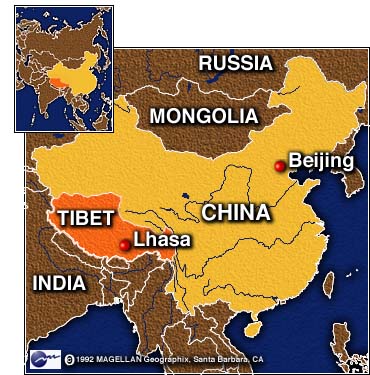
    As a young child back in Erie, Pennsylvania I remember spinning a globe at my grandmother’s house and seeing a purple shaded country west of China named Tibet. I thought that was a really ethereal, forbidding name for a nation. As time went on, and I proceeded onto junior high school, high school and college, I saw the name of Tibet less and less frequently on maps and globes. It then seemed to disappear. Instead we got occasional public appearances, usually with celebrities like Richard Gere, by the Dalai Lama, who was billed as the spiritual leader of Tibet. This was accompanied by vague pleas about the independent Tibet movement. Like millions of others, I was never able to put it all together.china tibet

    The full title of Bruce Riedel’s book is JFK’s Forgotten Crisis: Tibet, the CIA and the Sino-India War. After reading it, I was able to understand what this was all about—at least in a fundamental way. Also, my respect for President John F. Kennedy, which was already estimable, increased a bit more.

    To understand the book, one has to fill in some background about the history of Tibet, that is, why it once existed on maps, and why it does not today. After the collapse of the Tibetan Empire in the eighth century, both the Chinese and the Mongols would occupy parts of it. After the fall of the last Chinese dynasty, the Qings, Tibet expelled Chinese troops and then declared itself independent in 1913. Its capital was located at the city of Lhasa, which was recognized by the British Raj in India. The British also signed a formal treaty as to an India/Tibet border. But the Chinese did not recognize that claim. (Riedel, p. 21)

    After the communist takeover of China, and after the Chinese role in thwarting General Douglas MacArthur’s invasion of North Korea and his threat to cross the Yalu River, Mao Zedong decided to take a much more belligerent stance toward Tibet. (ibid, pgs. 14-19) As Riedel notes, at this time, Tibet was really not much more than an impoverished theocracy. It was landlocked, extremely mountainous, and run by Buddhist monks who had little access to the outside world.

    Realizing that Tibet posed little problem for the Chinese military to overcome, talks were arranged between the two sides in India, at Delhi. In September of 1950 China proposed a three-stage plan to re-incorporate Tibet into China. While these negotiations were in process, China crossed the Tibetan border with 20,000 troops. The Tibetans were soundly defeated at the Battle of Chamdo in October. India protested the use of force but did not send aid to Lhasa. (p. 23)

    dalailama
    The Dalai Lama in 1962

    In November, the 15-year-old Dalai Lama—the same man who holds that title today—had just ascended to power. He left for a sanctuary near India at a Buddhist monastery. The American Embassy in Calcutta now opened communications with the Tibetan resistance in Lhasa. The CIA transported the Dalai Lama’s brother to San Francisco to meet with a committee advocating Tibetan independence. But China succeeded in its military operation the next year, and Tibet signed a 17-point agreement making the former country a protectorate of China. (p. 24) The agreement preserved the institution of the Dalai Lama, which was both spiritual and temporal. Therefore, he returned to Lhasa to preside over what amounted to a puppet regime. Nehru, the leader of India, had to accept the arrangement. For China was now the military strongman of Asia, and India was in no position to challenge that supremacy. In a 1954 treaty, Nehru formally accepted China as her new northern neighbor. Nehru’s intelligence chief, B. N. Mullik, did not like the arrangement. The reason being that it replaced a weak and docile northeast neighbor with a strong and truculent one. But, like Nehru, he understood that it was the only solution that was militarily feasible. (ibid, p. 25)

    In 1956, the Dalai Lama visited New Delhi. Chinese foreign minister Zhou Enlai asked Nehru to send him back, promising respect for the 17-point agreement. Nehru and the Dalai Lama parted ways amicably. But the Chinese now made it obvious they intended to transform Tibet from a protectorate into a province. (Ibid, p. 26) A rebellion began in the Kham and Amdo regions. It would eventually spread to Lhasa.

    In 1957 CIA Director Allen Dulles decided to begin covert aid to the Tibetan resistance. (p. 31) He began to recruit some of the rebel force, train them in the USA, and then parachute them back into Tibet. In addition to that, the CIA dropped 18,000 pounds of supplies into Tibet that year.

    By 1958, Mao and Zhou became aware of this covert effort. They both assumed that Nehru and India were a part of it, which was incorrect. That year, China sent in tens of thousands of troops to halt the rebellion. Tibet asked India for help, but for reasons stated previously, Nehru declined. The Chinese army attacked Lhasa and killed over 4,000 Tibetans. (ibid, p. 32) The army now began to shell the city. Two artillery hits struck near the Dalai Lama’s residence. Suspecting the Chinese were going to imprison him, and with the help of the CIA, in March of 1959 he decided to leave Tibet for India. On the international scene, he now represented what was left of the nation of Tibet.

    II

    Complicating Dulles’ plan to lend aid to the rebels still fighting for their country was the fact Ayub Khan had taken over Pakistan in a bloodless coup in 1958. Eager to gain favor with America, he joined both SEATO and CENTO, treaty organizations set up by Secretary of State John Foster Dulles. He also allowed the CIA to set up an air base in Peshawar for U-2 flights throughout Eurasia. (ibid, p. 35)

    khan
    Ayub Khan

    Adding to this balancing of interests and aims, China had disputed the Sino/India border in the northeast, an area called Aksai Chin. Nehru considered it part of Indian Kashmir; Mao considered it part of China. Zhou suggested he would trade part of the Chinese Kashmir for Aksai Chin but Nehru declined the offer. Against this tense triangular backdrop, the Dalai Lama was allowed to set up an office and meet foreign dignitaries in the town of Dharamsala. (p. 38) There he met with representatives of the media and decried the Chinese occupation of Tibet.

    Nehru began to greatly expand his outposts on the northern border with China. At the same time, the U-2 was used to monitor Chinese military arrangements. In fact, the U-2 Gary Powers was shot down in flew out of Peshawar. Ayub Khan also allowed the CIA to use an airfield at Kurmitola in East Pakistan (now Bangladesh) as a staging point for infiltration into Tibet. (p. 41)

    The rivalry between Pakistan and India was almost inherent, since they both originated with the departure of the British from India. One became the Hindu state and the other the Moslem state. President Kennedy visited India in 1951. His former tutor at Harvard, John Kenneth Galbraith visited India twice in the decade. After the second visit, he briefed Kennedy about the country.

    In the 1960 presidential race, Richard Nixon favored Pakistan and disparaged Nehru. The reason for this was simplistic. Ayub Khan was doing all he could to curry favor with America. Whereas Nehru was a central player in the non-aligned movement— that is, the rather large delegation of nations that wished to stay out of the Cold War, wanting to be free to trade and negotiate with either side without any stigma attached by the other. As historian Robert Rakove noted, that formal organization began with the Bandung Conference in 1955 called by Achmed Sukarno of Indonesia. Along with Sukarno, both Nehru and Nasser of Egypt were there. As were Mao Zedong and Zhou Enlai. As many have noted, John Foster Dulles disdained this organization, which today includes 120 nations. Because, in his Manichean view, a Third World nation was either with the USA or against it. Kennedy had little problem with the movement or with Nehru since he understood that the health and future of their nations was the major preoccupation of these leaders. Kennedy felt that he could compete with the USSR in this arena by extending aid packages to these countries. Nixon, after his service with the Dulles brothers, thought otherwise. Riedel understands this point. To his credit, he elucidates it by referring to Kennedy’s great 1957 speech in the senate about Algeria. There, he specifically criticized Eisenhower and Nixon over their support for the French colonial empire against the desire of Algeria to be free. (pgs. 47-48)

    jfkgalbraithnehru
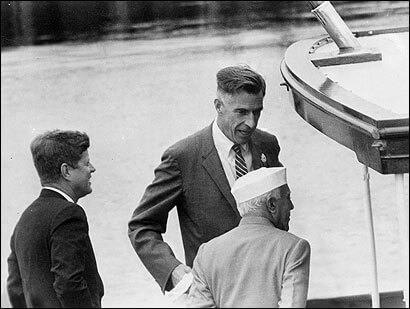
    Kennedy, Galbraith and Nehru

    Because of the influence of Galbraith, plus his tolerance of Nehru’s neutrality, Kennedy made a speech in 1959 about the tension between India and China in the Far East. (ibid, p. 50) Galbraith actually had a hand in writing an early draft. He said that China was ahead in this rivalry because of all the financial aid given to it by the USSR. This is why its economy was accelerating faster. He recommended more loans be given to India and also direct foreign investment in order to boost growth. During the speech, he did mention the unfortunate circumstances that had overtaken Tibet, which he referred to as part of the desire of men everywhere to be free. But he did not recommend any path for America to follow in that struggle.

    Once Kennedy became president, Dulles briefed him on the covert operations the CIA was running in Tibet. The president decided to continue the action. (p. 57) By 1961, the CIA had performed over 30 drops into Tibet, which amounted to 250 tons of equipment. The drops were getting so large that pilots now used C-130 cargo planes. But since the actual resistance movement was failing to gain traction, the CIA wanted to shift the infiltration point to Nepal. This area housed many more Tibetans who had fled the Chinese onslaught. After consulting with Senators Hubert Humphrey and William Fulbright, Kennedy OK’d the creation of the enclave, codenamed Mustang.

    III

    In March of 1961, Galbraith had been granted a two-year sabbatical from Harvard. Kennedy quickly appointed him as his ambassador to India. Once approved by the senate, he had to be briefed on the covert operation concerning Tibet. (p. 59) Galbraith did not like it at all. In his view, the aim was hopeless to achieve, and it endangered India. Kennedy kept the program up anyway.

    But then Kennedy’s pro-India policy rubbed Pakistan the wrong way. He and Galbraith proposed a billion dollar aid package for Nehru. (p. 62) Khan decided to shut down the East Pakistan part of the Tibetan operation. But after a visit to Washington and a weekend with Kennedy on an excursion arranged by Jackie Kennedy to Mount Vernon, Khan changed his mind. In December of 1961, Kennedy got a resolution through the United Nations in favor of self-determination for Tibet. ( p. 65)

    Once Galbraith got to India, he and Nehru became good friends. The ambassador even got India to commit troops to the Congo struggle in Africa. It was the ambassador who convinced Kennedy to propose the billion-dollar aid program Khan objected to. (ibid, p. 69)

    In November of 1961, both Nehru and Galbraith visited America. This was to hammer out the details of the aid package. Riedel mentions that during the visit, Galbraith mentioned his objection to the Max Taylor—Walt Rostow report recommending American ground troops being injected into Vietnam. The ambassador grabbed a copy of the report and took it to his hotel room where he penned a blistering rebuttal. (ibid, p. 72) Kennedy read the critique and instructed him to return to India via Honolulu and then Vietnam to prepare his own trip report on conditions in the war theater. Perhaps nothing shows just how confident Kennedy was in Galbraith’s judgment than this mission.

    During Nehru’s visit, Jackie Kennedy said she would journey to India the next year. She did so in March of 1962. She spent nine days in the country and then left for Pakistan. After this, and Riedel makes no claim to cause and effect, Nehru began his fateful Forward Policy. This was an attempt to move his border outposts beyond positions held by Chinese troops in the disputed areas. This was provocative, in the sense that violent outbursts now became frequent. But beyond that, Indian troops were outnumbered by a margin of 5-1 in Aksai Chin. And the Chinese had superior weaponry also. (pgs. 87-88)

    Riedel believes the Chinese invasion of India in October of 1962 was provoked by 1.) the issue of who controlled Tibet and 2.) Nehru’s Forward Policy. (p. 97) With the former, the Chinese greatly exaggerated Nehru’s aims in Tibet. They thought India wanted to create some kind of neutral buffer zone there. There is no evidence for that idea. But in July of 1962, Mao gave orders to forcefully resist the Forward Policy. The next month the Soviets sold India 12 MIG-21 jets. (p. 102)

    News paper headlines during 1962 Indo china war

    The invasion began on October 20th. Which places it just four days after the Cuban Missile Crisis began. Which means that for about nine days, President Kennedy was dealing with both of his major superpower opponents: one in his own backyard so to speak, and one on the other side of the world. Because of the very real fear of nuclear conflagration with Cuba, Kennedy gave Galbraith much leeway in handling the India crisis. Which again shows how much trust JFK had in the man versus the little trust he had with the majority of advisors guiding him on the Missile Crisis. China attacked India on both the west and east borders. At first the invasion was highly successful. After the first week, and with the Missile Crisis declining in tension, Kennedy wrote Nehru to assure him he would back India against China. And his support would be both moral and tangible. Nehru told the ambassador that he would need such support since Russia had backed out of the MIG-21 deal. (pgs. 119-20)

    When Kennedy heard this, he decided to get Great Britain to help also. Within a week of this decision, Kennedy was sending eight flights a day across the globe, each loaded with 20 tons of supplies and arms into Calcutta. These shipments got so great that they were eventually boarded on C-130 Hercules cargo planes. The British then got Australia, New Zealand and Canada to also send supplies and arms. (p. 121)

    Meanwhile, Kennedy and Galbraith busied themselves with making sure Pakistan did not enter the war on China’s behalf. Kennedy sent messages to Khan advising him to stay neutral during the attack. Nehru also kept much of his army on the Pakistan border to discourage another front from opening. (p. 130)

    nehru mao

    India tried a counterattack on November 14th. It was not successful. India took heavy casualties, especially along the Aksai Chin border. In addition to that, the Chinese were advancing the border outward by thousands of square miles. (p. 133) On November 19th, Nehru wrote Kennedy two letters. He requested air transport for his troops, and jet fighters with radar support. He feared that all of Eastern India would now collapse without the American aid. The ambassador asked Kennedy to instead send both the Seventh Fleet and an aircraft carrier convoy to the area. Kennedy agreed with Galbraith. He sent Nehru a message on November 20th that he would increase the airlift even further, send the Seventh Fleet into the Bay of Bengal and an aircraft carrier to Madras province. Both the ambassador and Kennedy felt this threat would check the Chinese advance.

    The next day the Chinese government announced a unilateral cease-fire along the Sino/India border. (p. 140) In the east, they would withdraw from conquered territory, but they would keep Aksai Chin. The Chinese also asked that Nehru stop his Forward Policy and withdraw his troops from the border. India lost over 3,000 men either dead or MIA. Almost 4,000 were captured. (p. 141)

    Why did Mao halt the advance? Riedel thinks that China had done enough to humiliate Nehru and teach him a lesson about his Forward Policy. But China did not want to risk bringing American military might into the conflict. (p. 142) Nehru later said that the truce was called because of Kennedy’s decisive action. China may have ended up fighting India, America and England.

    IV

    After the truce, both Kennedy and Harold McMillan of England sent delegations to India. This combined mission focused on three aims. The first was to increase modern military aid to India. The second was to encourage a solution to the territorial dispute about Kashmir, which was jointly occupied by India, China and Pakistan. The third was to increase the size and scope of the Tibet covert action. (pgs. 150-53)

    Kennedy had decided to massively increase military aid to Nehru. The president was so intent on this that he actually wrote out a National Security Action Memorandum. This included creation of six army divisions to guard the Himalayas, funding for increasing munitions creation, and a joint US/UK air defense program. The last included an American/British air exercise over India. (pgs. 151-52)

    Concerning the third aim, India now agreed to back the CIA’s Tibet project. In fact, India created its own special force of Tibetans. The CIA agreed to support this militia with its own air force. stationed in the eastern part of India. (p. 158) These rebels were trained by the CIA in Colorado and then shifted to a revitalized operation Mustang in Nepal. Finally, Nehru agreed to let America fly U-2 missions over Tibet. This garnered very good information about the Chinese army occupying the country. All in all, the mission was a boost for both America and India and created a high point for the Kennedy/Nehru relationship.

    Unfortunately, Galbraith left India in the summer of 1963. Kennedy did all he could to try and keep him in his administration. But Galbraith really preferred the freedom of tenured academic life over the hierarchical games of the State Department. In fact, he later wrote a satirical novel about his experiences at Foggy Bottom.

    jfk-bowles
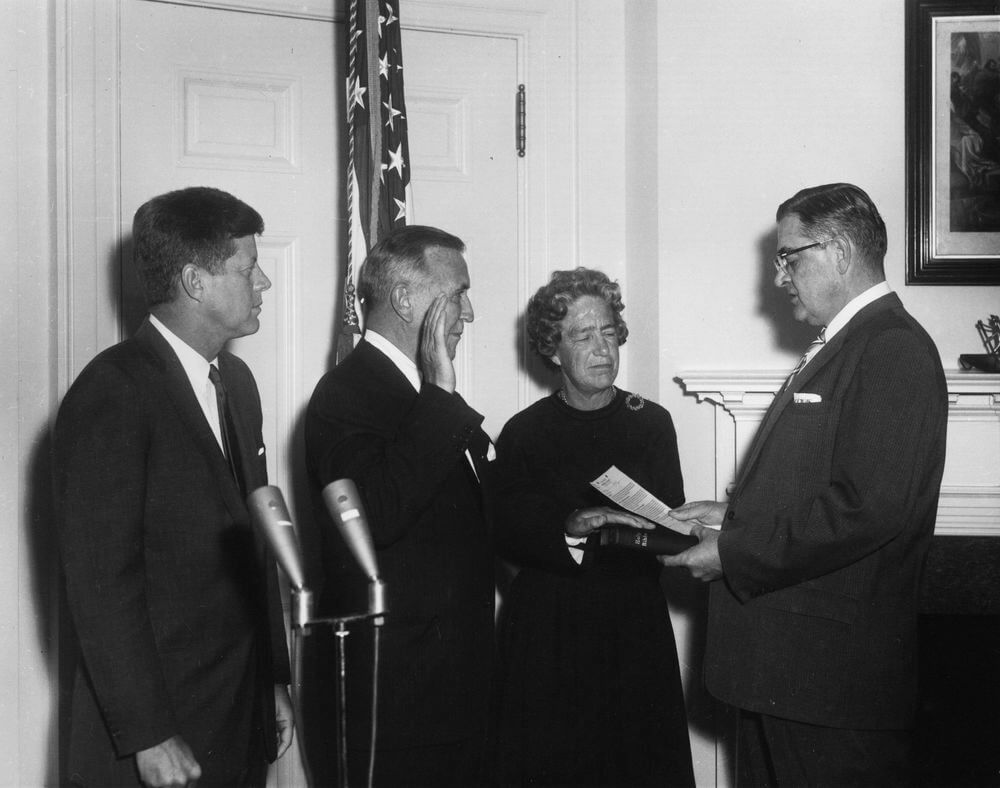
    Chester Bowles sworn in
    as JFK’s Special Adviser on African,
    Asian, and Latin-American Affairs

    Chester Bowles replaced Galbraith. As Riedel notes, after Kennedy’s death, the relationship between the two countries cooled. For instance, the massive arms deal Kennedy wanted was delayed twice. Nehru actually died waiting for it to go through. When it did not, his successor went to Moscow to arrange an arms deal. Many Indian officers were now trained in Russia. Bowles was upset about this lost opportunity. (pgs. 162-63)

    In 1965, another part of Kennedy’s program was short-circuited. Since there was no movement on the Kashmir problem, Pakistan attacked India over this issue. (p. 164) The largest tank battles since World War II now took place. China did not intervene. Russia negotiated a truce. In 1971, another war broke out between the two rivals. This time, Nixon and Kissinger tilted toward Pakistan. They even urged China to help Pakistan. Partly because they hated the new ruler of India, Indira Gandhi. (p. 169) Ted Kennedy assailed the Nixon/Kissinger favoring of Pakistan in public. India defeated Pakistan and, again, China did not intervene.

    Today, India is the largest arms purchaser in the world. China helped Pakistan develop atomic weapons and both India and Pakistan have them today. America’s natural tilt back toward India did not really begin until the presidency of Bill Clinton and then it was accelerated by Barack Obama. The Tibet operation never met with any real success. But since they would have tried it anyway, America decided to help them gain back their country.

    I conclude this review with a long quote from the author: “JFK proved to be the ultimate crisis manager in 1962. His deft handling of two global crises simultaneously involving the two great communist adversaries of the United States was a tour de force of policymaking at the highest level. America, India and the world were lucky to have JFK and Ken in 1962.”

  • Bruce Riedel, JFK’s Forgotten Crisis

    Bruce Riedel, JFK’s Forgotten Crisis


    As a young child back in Erie, Pennsylvania I remember spinning a globe at my grandmother’s house and seeing a purple shaded country west of China named Tibet. I thought that was a really ethereal, forbidding name for a nation. As time went on, and I proceeded onto junior high school, high school and college, I saw the name of Tibet less and less frequently on maps and globes. It then seemed to disappear. Instead we got occasional public appearances, usually with celebrities like Richard Gere, by the Dalai Lama, who was billed as the spiritual leader of Tibet. This was accompanied by vague pleas about the independent Tibet movement. Like millions of others, I was never able to put it all together.china tibet

    The full title of Bruce Riedel’s book is JFK’s Forgotten Crisis: Tibet, the CIA and the Sino-India War. After reading it, I was able to understand what this was all about—at least in a fundamental way. Also, my respect for President John F. Kennedy, which was already estimable, increased a bit more.

    To understand the book, one has to fill in some background about the history of Tibet, that is, why it once existed on maps, and why it does not today. After the collapse of the Tibetan Empire in the eighth century, both the Chinese and the Mongols would occupy parts of it. After the fall of the last Chinese dynasty, the Qings, Tibet expelled Chinese troops and then declared itself independent in 1913. Its capital was located at the city of Lhasa, which was recognized by the British Raj in India. The British also signed a formal treaty as to an India/Tibet border. But the Chinese did not recognize that claim. (Riedel, p. 21)

    After the communist takeover of China, and after the Chinese role in thwarting General Douglas MacArthur’s invasion of North Korea and his threat to cross the Yalu River, Mao Zedong decided to take a much more belligerent stance toward Tibet. (ibid, pgs. 14-19) As Riedel notes, at this time, Tibet was really not much more than an impoverished theocracy. It was landlocked, extremely mountainous, and run by Buddhist monks who had little access to the outside world.

    Realizing that Tibet posed little problem for the Chinese military to overcome, talks were arranged between the two sides in India, at Delhi. In September of 1950 China proposed a three-stage plan to re-incorporate Tibet into China. While these negotiations were in process, China crossed the Tibetan border with 20,000 troops. The Tibetans were soundly defeated at the Battle of Chamdo in October. India protested the use of force but did not send aid to Lhasa. (p. 23)

    dalailama
    The Dalai Lama in 1962

    In November, the 15-year-old Dalai Lama—the same man who holds that title today—had just ascended to power. He left for a sanctuary near India at a Buddhist monastery. The American Embassy in Calcutta now opened communications with the Tibetan resistance in Lhasa. The CIA transported the Dalai Lama’s brother to San Francisco to meet with a committee advocating Tibetan independence. But China succeeded in its military operation the next year, and Tibet signed a 17-point agreement making the former country a protectorate of China. (p. 24) The agreement preserved the institution of the Dalai Lama, which was both spiritual and temporal. Therefore, he returned to Lhasa to preside over what amounted to a puppet regime. Nehru, the leader of India, had to accept the arrangement. For China was now the military strongman of Asia, and India was in no position to challenge that supremacy. In a 1954 treaty, Nehru formally accepted China as her new northern neighbor. Nehru’s intelligence chief, B. N. Mullik, did not like the arrangement. The reason being that it replaced a weak and docile northeast neighbor with a strong and truculent one. But, like Nehru, he understood that it was the only solution that was militarily feasible. (ibid, p. 25)

    In 1956, the Dalai Lama visited New Delhi. Chinese foreign minister Zhou Enlai asked Nehru to send him back, promising respect for the 17-point agreement. Nehru and the Dalai Lama parted ways amicably. But the Chinese now made it obvious they intended to transform Tibet from a protectorate into a province. (Ibid, p. 26) A rebellion began in the Kham and Amdo regions. It would eventually spread to Lhasa.

    In 1957 CIA Director Allen Dulles decided to begin covert aid to the Tibetan resistance. (p. 31) He began to recruit some of the rebel force, train them in the USA, and then parachute them back into Tibet. In addition to that, the CIA dropped 18,000 pounds of supplies into Tibet that year.

    By 1958, Mao and Zhou became aware of this covert effort. They both assumed that Nehru and India were a part of it, which was incorrect. That year, China sent in tens of thousands of troops to halt the rebellion. Tibet asked India for help, but for reasons stated previously, Nehru declined. The Chinese army attacked Lhasa and killed over 4,000 Tibetans. (ibid, p. 32) The army now began to shell the city. Two artillery hits struck near the Dalai Lama’s residence. Suspecting the Chinese were going to imprison him, and with the help of the CIA, in March of 1959 he decided to leave Tibet for India. On the international scene, he now represented what was left of the nation of Tibet.

    II

    Complicating Dulles’ plan to lend aid to the rebels still fighting for their country was the fact Ayub Khan had taken over Pakistan in a bloodless coup in 1958. Eager to gain favor with America, he joined both SEATO and CENTO, treaty organizations set up by Secretary of State John Foster Dulles. He also allowed the CIA to set up an air base in Peshawar for U-2 flights throughout Eurasia. (ibid, p. 35)

    khan
    Ayub Khan

    Adding to this balancing of interests and aims, China had disputed the Sino/India border in the northeast, an area called Aksai Chin. Nehru considered it part of Indian Kashmir; Mao considered it part of China. Zhou suggested he would trade part of the Chinese Kashmir for Aksai Chin but Nehru declined the offer. Against this tense triangular backdrop, the Dalai Lama was allowed to set up an office and meet foreign dignitaries in the town of Dharamsala. (p. 38) There he met with representatives of the media and decried the Chinese occupation of Tibet.

    Nehru began to greatly expand his outposts on the northern border with China. At the same time, the U-2 was used to monitor Chinese military arrangements. In fact, the U-2 Gary Powers was shot down in flew out of Peshawar. Ayub Khan also allowed the CIA to use an airfield at Kurmitola in East Pakistan (now Bangladesh) as a staging point for infiltration into Tibet. (p. 41)

    The rivalry between Pakistan and India was almost inherent, since they both originated with the departure of the British from India. One became the Hindu state and the other the Moslem state. President Kennedy visited India in 1951. His former tutor at Harvard, John Kenneth Galbraith visited India twice in the decade. After the second visit, he briefed Kennedy about the country.

    In the 1960 presidential race, Richard Nixon favored Pakistan and disparaged Nehru. The reason for this was simplistic. Ayub Khan was doing all he could to curry favor with America. Whereas Nehru was a central player in the non-aligned movement— that is, the rather large delegation of nations that wished to stay out of the Cold War, wanting to be free to trade and negotiate with either side without any stigma attached by the other. As historian Robert Rakove noted, that formal organization began with the Bandung Conference in 1955 called by Achmed Sukarno of Indonesia. Along with Sukarno, both Nehru and Nasser of Egypt were there. As were Mao Zedong and Zhou Enlai. As many have noted, John Foster Dulles disdained this organization, which today includes 120 nations. Because, in his Manichean view, a Third World nation was either with the USA or against it. Kennedy had little problem with the movement or with Nehru since he understood that the health and future of their nations was the major preoccupation of these leaders. Kennedy felt that he could compete with the USSR in this arena by extending aid packages to these countries. Nixon, after his service with the Dulles brothers, thought otherwise. Riedel understands this point. To his credit, he elucidates it by referring to Kennedy’s great 1957 speech in the senate about Algeria. There, he specifically criticized Eisenhower and Nixon over their support for the French colonial empire against the desire of Algeria to be free. (pgs. 47-48)

    jfkgalbraithnehru
    Kennedy, Galbraith and Nehru

    Because of the influence of Galbraith, plus his tolerance of Nehru’s neutrality, Kennedy made a speech in 1959 about the tension between India and China in the Far East. (ibid, p. 50) Galbraith actually had a hand in writing an early draft. He said that China was ahead in this rivalry because of all the financial aid given to it by the USSR. This is why its economy was accelerating faster. He recommended more loans be given to India and also direct foreign investment in order to boost growth. During the speech, he did mention the unfortunate circumstances that had overtaken Tibet, which he referred to as part of the desire of men everywhere to be free. But he did not recommend any path for America to follow in that struggle.

    Once Kennedy became president, Dulles briefed him on the covert operations the CIA was running in Tibet. The president decided to continue the action. (p. 57) By 1961, the CIA had performed over 30 drops into Tibet, which amounted to 250 tons of equipment. The drops were getting so large that pilots now used C-130 cargo planes. But since the actual resistance movement was failing to gain traction, the CIA wanted to shift the infiltration point to Nepal. This area housed many more Tibetans who had fled the Chinese onslaught. After consulting with Senators Hubert Humphrey and William Fulbright, Kennedy OK’d the creation of the enclave, codenamed Mustang.

    III

    In March of 1961, Galbraith had been granted a two-year sabbatical from Harvard. Kennedy quickly appointed him as his ambassador to India. Once approved by the senate, he had to be briefed on the covert operation concerning Tibet. (p. 59) Galbraith did not like it at all. In his view, the aim was hopeless to achieve, and it endangered India. Kennedy kept the program up anyway.

    But then Kennedy’s pro-India policy rubbed Pakistan the wrong way. He and Galbraith proposed a billion dollar aid package for Nehru. (p. 62) Khan decided to shut down the East Pakistan part of the Tibetan operation. But after a visit to Washington and a weekend with Kennedy on an excursion arranged by Jackie Kennedy to Mount Vernon, Khan changed his mind. In December of 1961, Kennedy got a resolution through the United Nations in favor of self-determination for Tibet. ( p. 65)

    Once Galbraith got to India, he and Nehru became good friends. The ambassador even got India to commit troops to the Congo struggle in Africa. It was the ambassador who convinced Kennedy to propose the billion-dollar aid program Khan objected to. (ibid, p. 69)

    In November of 1961, both Nehru and Galbraith visited America. This was to hammer out the details of the aid package. Riedel mentions that during the visit, Galbraith mentioned his objection to the Max Taylor—Walt Rostow report recommending American ground troops being injected into Vietnam. The ambassador grabbed a copy of the report and took it to his hotel room where he penned a blistering rebuttal. (ibid, p. 72) Kennedy read the critique and instructed him to return to India via Honolulu and then Vietnam to prepare his own trip report on conditions in the war theater. Perhaps nothing shows just how confident Kennedy was in Galbraith’s judgment than this mission.

    During Nehru’s visit, Jackie Kennedy said she would journey to India the next year. She did so in March of 1962. She spent nine days in the country and then left for Pakistan. After this, and Riedel makes no claim to cause and effect, Nehru began his fateful Forward Policy. This was an attempt to move his border outposts beyond positions held by Chinese troops in the disputed areas. This was provocative, in the sense that violent outbursts now became frequent. But beyond that, Indian troops were outnumbered by a margin of 5-1 in Aksai Chin. And the Chinese had superior weaponry also. (pgs. 87-88)

    Riedel believes the Chinese invasion of India in October of 1962 was provoked by 1.) the issue of who controlled Tibet and 2.) Nehru’s Forward Policy. (p. 97) With the former, the Chinese greatly exaggerated Nehru’s aims in Tibet. They thought India wanted to create some kind of neutral buffer zone there. There is no evidence for that idea. But in July of 1962, Mao gave orders to forcefully resist the Forward Policy. The next month the Soviets sold India 12 MIG-21 jets. (p. 102)

    News paper headlines during 1962 Indo china war

    The invasion began on October 20th. Which places it just four days after the Cuban Missile Crisis began. Which means that for about nine days, President Kennedy was dealing with both of his major superpower opponents: one in his own backyard so to speak, and one on the other side of the world. Because of the very real fear of nuclear conflagration with Cuba, Kennedy gave Galbraith much leeway in handling the India crisis. Which again shows how much trust JFK had in the man versus the little trust he had with the majority of advisors guiding him on the Missile Crisis. China attacked India on both the west and east borders. At first the invasion was highly successful. After the first week, and with the Missile Crisis declining in tension, Kennedy wrote Nehru to assure him he would back India against China. And his support would be both moral and tangible. Nehru told the ambassador that he would need such support since Russia had backed out of the MIG-21 deal. (pgs. 119-20)

    When Kennedy heard this, he decided to get Great Britain to help also. Within a week of this decision, Kennedy was sending eight flights a day across the globe, each loaded with 20 tons of supplies and arms into Calcutta. These shipments got so great that they were eventually boarded on C-130 Hercules cargo planes. The British then got Australia, New Zealand and Canada to also send supplies and arms. (p. 121)

    Meanwhile, Kennedy and Galbraith busied themselves with making sure Pakistan did not enter the war on China’s behalf. Kennedy sent messages to Khan advising him to stay neutral during the attack. Nehru also kept much of his army on the Pakistan border to discourage another front from opening. (p. 130)

    nehru mao

    India tried a counterattack on November 14th. It was not successful. India took heavy casualties, especially along the Aksai Chin border. In addition to that, the Chinese were advancing the border outward by thousands of square miles. (p. 133) On November 19th, Nehru wrote Kennedy two letters. He requested air transport for his troops, and jet fighters with radar support. He feared that all of Eastern India would now collapse without the American aid. The ambassador asked Kennedy to instead send both the Seventh Fleet and an aircraft carrier convoy to the area. Kennedy agreed with Galbraith. He sent Nehru a message on November 20th that he would increase the airlift even further, send the Seventh Fleet into the Bay of Bengal and an aircraft carrier to Madras province. Both the ambassador and Kennedy felt this threat would check the Chinese advance.

    The next day the Chinese government announced a unilateral cease-fire along the Sino/India border. (p. 140) In the east, they would withdraw from conquered territory, but they would keep Aksai Chin. The Chinese also asked that Nehru stop his Forward Policy and withdraw his troops from the border. India lost over 3,000 men either dead or MIA. Almost 4,000 were captured. (p. 141)

    Why did Mao halt the advance? Riedel thinks that China had done enough to humiliate Nehru and teach him a lesson about his Forward Policy. But China did not want to risk bringing American military might into the conflict. (p. 142) Nehru later said that the truce was called because of Kennedy’s decisive action. China may have ended up fighting India, America and England.

    IV

    After the truce, both Kennedy and Harold McMillan of England sent delegations to India. This combined mission focused on three aims. The first was to increase modern military aid to India. The second was to encourage a solution to the territorial dispute about Kashmir, which was jointly occupied by India, China and Pakistan. The third was to increase the size and scope of the Tibet covert action. (pgs. 150-53)

    Kennedy had decided to massively increase military aid to Nehru. The president was so intent on this that he actually wrote out a National Security Action Memorandum. This included creation of six army divisions to guard the Himalayas, funding for increasing munitions creation, and a joint US/UK air defense program. The last included an American/British air exercise over India. (pgs. 151-52)

    Concerning the third aim, India now agreed to back the CIA’s Tibet project. In fact, India created its own special force of Tibetans. The CIA agreed to support this militia with its own air force. stationed in the eastern part of India. (p. 158) These rebels were trained by the CIA in Colorado and then shifted to a revitalized operation Mustang in Nepal. Finally, Nehru agreed to let America fly U-2 missions over Tibet. This garnered very good information about the Chinese army occupying the country. All in all, the mission was a boost for both America and India and created a high point for the Kennedy/Nehru relationship.

    Unfortunately, Galbraith left India in the summer of 1963. Kennedy did all he could to try and keep him in his administration. But Galbraith really preferred the freedom of tenured academic life over the hierarchical games of the State Department. In fact, he later wrote a satirical novel about his experiences at Foggy Bottom.

    jfk-bowles
    Chester Bowles sworn in
    as JFK’s Special Adviser on African,
    Asian, and Latin-American Affairs

    Chester Bowles replaced Galbraith. As Riedel notes, after Kennedy’s death, the relationship between the two countries cooled. For instance, the massive arms deal Kennedy wanted was delayed twice. Nehru actually died waiting for it to go through. When it did not, his successor went to Moscow to arrange an arms deal. Many Indian officers were now trained in Russia. Bowles was upset about this lost opportunity. (pgs. 162-63)

    In 1965, another part of Kennedy’s program was short-circuited. Since there was no movement on the Kashmir problem, Pakistan attacked India over this issue. (p. 164) The largest tank battles since World War II now took place. China did not intervene. Russia negotiated a truce. In 1971, another war broke out between the two rivals. This time, Nixon and Kissinger tilted toward Pakistan. They even urged China to help Pakistan. Partly because they hated the new ruler of India, Indira Gandhi. (p. 169) Ted Kennedy assailed the Nixon/Kissinger favoring of Pakistan in public. India defeated Pakistan and, again, China did not intervene.

    Today, India is the largest arms purchaser in the world. China helped Pakistan develop atomic weapons and both India and Pakistan have them today. America’s natural tilt back toward India did not really begin until the presidency of Bill Clinton and then it was accelerated by Barack Obama. The Tibet operation never met with any real success. But since they would have tried it anyway, America decided to help them gain back their country.

    I conclude this review with a long quote from the author: “JFK proved to be the ultimate crisis manager in 1962. His deft handling of two global crises simultaneously involving the two great communist adversaries of the United States was a tour de force of policymaking at the highest level. America, India and the world were lucky to have JFK and Ken in 1962.”