
(Click here to open the document in another page.)
So much time is spent in the JFK assassination debate arguing about shaky evidence that we have seen serious researchers sometimes turn on one another and lone-nut apologists then pounce and deliver their salvos portraying the research community as made up of quacks. This is even though the official HSCA conclusions, as well as the opinions of an overwhelming number of government inquiry insiders, clearly discredit the Warren Commission conclusion that Oswald and Jack Ruby both acted alone. Therefore, this author has steered clear of discussions around subjects such as Judyth Vary Baker, Madeleine Brown, James Files, the Badge Man photo, the Prayer Man photo, etc.
My focus has always been on smoking gun evidence. There are three levels of smoking guns:
There are a number that prove the first two points:
There are none at this point that prove beyond a shadow of a doubt who the conspirators were. Some do expose persons of extreme interest, these include:
In this article, we will look at another important piece of evidence and let the reader decide whether it rises to the level of a smoking gun: Oswald’s last letter!
Dueling Spins
On the very day that Kennedy was assassinated, forces that desperately wanted the overthrow of the Castro regime went into a press relations frenzy, most likely led by CIA propaganda whizz David Atlee Phillips. The tale they were peddling was that Cuba and Russia were Oswald’s backers.
Much has been written about the steps taken to sheep-dip Oswald in 1963, so that he could come out looking like an unbalanced Castro sympathizer: the famous backyard photos of him holding alleged murder weapons, as well as communist literature, his recruitment efforts for the Fair Play for Cuba Committee, his scapegoating in the General Walker murder attempt, and his interviews in New Orleans where he openly paints himself as a Castroite.
Some steps, however, went further. They were designed to make Oswald seem to be in league with Cuban and Russian agents, plotters, and assassins. They came out of the assassination play-book code-named ZR Rifle, authored by exiled, CIA super-agent William Harvey. It would have given the U.S. the excuse they needed to invade Cuba. But the new President Lyndon Johnson eventually nixed this stratagem.
Persons of interest like John Martino, Frank Sturgis, and Phillips-linked contacts (Carlos Bringuier, Ed Butler, and journalist Hal Hendrix) began a “Castro was behind it” spin to the assassination.
Carlos Bringuier of the DRE, who had gotten into what was likely a staged fight with Oswald on Canal Street in New Orleans in August of 1963, also wrote a press release that was published the day after the assassination to position Castro as being in cahoots with Oswald.
The DRE was actually set up under William Kent in 1960, working for David Phillips. David Morales was the group’s military case officer. Later, with Phillips in Mexico City, Kent was George Joannides supervisor. Kent’s daughter told Gaeton Fonzi that her father never mentioned Oswald except one time over dinner. He stated that Oswald was a “useful idiot”.
Through Ed Butler and the CIA-associated INCA, Oswald’s apparent charade and his televised interview went a long way in painting his leftist persona to the public at large. INCA had been used by Phillips for propaganda purposes during the period leading up to the Bay of Pigs. Butler was quick to send recordings to key people on the day of the assassination.
These frame-up tactics were the ones the cover-up artists wished had never occurred and worked hard to make disappear. The perpetrators of the framing of Castro offensive soon ran into stiff competition after Oswald was conveniently rubbed out. The White House and the FBI concluded, without even investigating, that both Oswald and Ruby were lone nuts. The pro-Cuba invasion forces were overmatched and their intel leaders had no choice but to fall in line.
But it was too late, there was too much spilled milk around plan A. In time, government inquiry investigators like Gaeton Fonzi, Dan Hardway, and Eddie Lopez, along with some very determined independent researchers, would uncover leads that all pointed in the same direction: Oswald was framed to appear to be in league with Cuban and Russian agents.
This can only lead to two possibilities. If Oswald was in cahoots with foreign agents, there was a foreign conspiracy to remove the president. In the more likely scenario that Oswald was being framed to look like he was cahoots with foreign agents, there was a domestic conspiracy to remove the president. In both cases, the lone-nut fairy-tale is obliterated.
Spilled Milk
Oswald and Kostikov
On September 27, 1963, Oswald allegedly travelled to Mexico City and visited both the Cuban consulate and the Russian embassy, in a failed attempt to obtain a visa to enter Cuba. FBI agents, who had listened to tapes of Oswald phone calls made while in the Cuban consulate, and Cuban consul Eusibio Azque, confirmed that there was an Oswald imposter.
In October 1963, the CIA produced five documents on Oswald that linked him to Valery Kostikov. One of the claims was that they had met in the Russian Embassy in Mexico City. Kostikov was later described as “an identified KGB officer … in an operation which is evidently sponsored by the KGB’s 13th Department (responsible for sabotage and assassination).” They also confirmed that they felt that there were either fake phone calls made by an Oswald impostor to Kostikov while he was allegedly in Mexico or at least faked transcripts.
In September 1964, the case against Kostikov took a bizarre turn, when a September 1, 1964, Hoover memo (105-124016) to the CIA seemed to indicate that the CIA (James Angleton’s department) in fact had no evidence to prove Kostikov was part of the infamous Department 13.
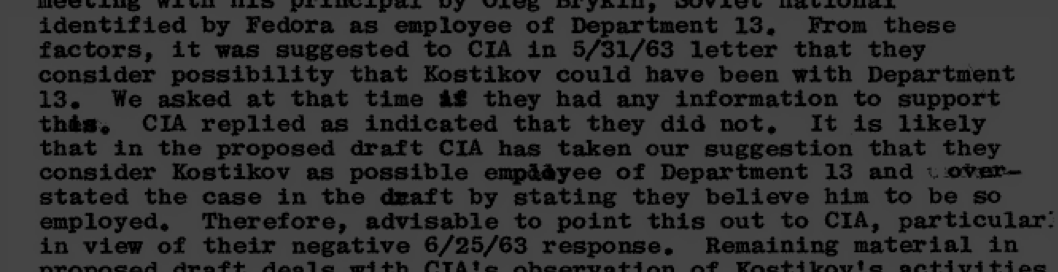
This means either one of two things:
David Atlee Phillips’ dirty tricks
HSCA investigator Dan Hardway hypothesizes that, because of compartmentalization, Phillips and Oswald may have found out on November 22, 1963, that Oswald was a patsy and Phillips received orders to tie the murder to Castro.
In a critique of Phil Shenon’s work written for the AARC in 2015, Hardway expresses the opinion that the CIA is heading to what he calls a limited hang-out by admitting that Oswald may have received guidance from Cuba and that the CIA director at the time, John McCone, was involved in a benign cover-up.
Following the assassination, it became obvious that Phillips was connected to several disinformation stories trying to link Oswald to Castro agents. HSCA investigator Hardway called him out on it:
Before our unexpurgated access was cut off by Joannides, I had been able to document links between David Phillips and most of the sources of the disinformation that came out immediately after the assassination about Oswald and his pro-Castro proclivities. I confronted Phillips with those in an interview at our offices on August 24, 1978. Phillips was extremely agitated by that line of questioning, but was forced to admit that many of the sources were not only former assets that he had managed, in the late 50’s and early 1960’s, but were also assets whom he was personally managing in the fall of 1963. Mr. Phillips was asked, but could not explain, why the information that came from anti-Castro Cuban groups and individuals pointing to Cuban connections, all seemed to come from assets that he handled personally, but acknowledged that that was the case.
One of these assets was Nicaraguan double agent Gilberto Alvarado who, on November 25, claimed to have witnessed Oswald being paid off to assassinate Kennedy when Oswald was in Mexico City. A tale that was quickly debunked.
While the HSCA hearings were going on, Phillips himself made the claim to a Washington Post reporter that he had heard a taped intercept of Oswald when he was in Mexico City talking to a Russian Embassy official offering to exchange money for information (Washington Post, November 26, 1976). Something he never repeated. Phillips also tried to get Alpha 66 operative Antonio Veciana to get one of his relatives in Mexico City to attest that Oswald accepted bribes from a Cuban agent.
Letters from Cuba to Oswald—proof of pre-knowledge of the assassination
For this obvious frame-up tactic, it is worth revisiting what was written in this author’s article The CIA and Mafia’s “Cuban American Mechanism”.
In JFK: the Cuba Files, a thorough analysis of five bizarre letters, that were written before the assassination in order to position Oswald as a Castro asset, is presented. It is difficult to sidestep them the way the FBI did. The FBI argued that they were all typed from the same typewriter, yet supposedly sent by different people. Which indicated to them that it was a hoax, perhaps perpetrated by Cubans wanting to encourage a U.S. invasion. However, the content of the letters and timeline prove something far more sinister according to Cuban intelligence. The following is how John Simkin summarizes the evidence:
The G-2 had a letter, signed by Jorge, that had been sent from Havana to Lee Harvey Oswald on November 14th, 1963. It had been found when a fire broke out on November 23rd in a sorting office. “After the fire, an employee who was checking the mail in order to offer, where possible, apologies to the addressees of destroyed mail, and to forward the rest, found an envelope addressed to Lee Harvey Oswald.” It is franked on the day Oswald was arrested and the writer refers to Oswald’s travels to Mexico, Houston and Florida …, which would have been impossible to know about at that time!
It incriminates Oswald in the following passage: “I am informing you that the matter you talked to me about the last time that I was in Mexico would be a perfect plan and would weaken the politics of that braggart Kennedy, although much discretion is needed because you know that there are counter-revolutionaries over there who are working for the CIA.”
Escalante informed the HSCA about this letter. When he did this, he discovered that they had four similar letters that had been sent to Oswald. Four of the letters were post-marked “Havana”. It could not be determined where the fifth letter was posted. Four of the letters were signed: Jorge, Pedro Charles, Miguel Galvan Lopez, and Mario del Rosario Molina. Two of the letters (Charles & Jorge) are dated before the assassination (10th and 14th November). A third, by Lopez, is dated November 27th, 1963. The other two are undated.
Cuba is linked to the assassination in all of the letters. In two of them, an alleged Cuban agent is clearly implicated in having planned the crime. However, the content of the letters, written before the assassination, suggested that the authors were either “a person linked to Oswald or involved in the conspiracy to execute the crime.”
This included knowledge about Oswald’s links to Dallas, Houston, Miami, and Mexico City. The text of the Jorge letter “shows a weak grasp of the Spanish language on the part of its author.” It would thus seem to have been written in English and then translated.
Escalante adds: “It is proven that Oswald was not maintaining correspondence, or any other kind of relations, with anyone in Cuba. Furthermore, those letters arrived at their destination at a precise moment and with a conveniently incriminating message, including that sent to his postal address in Dallas, Texas … The existence of the letters in 1963 was not publicized or duly investigated and the FBI argued before the Warren Commission to reject them.”
Escalante argues: “The letters were fabricated before the assassination occurred and by somebody who was aware of the development of the plot, who could ensure that they arrived at the opportune moment and who had a clandestine base in Cuba from which to undertake the action. Considering the history of the last 40 years, we suppose that only the CIA had such capabilities in Cuba.”
We will see that these letters are suspiciously similar to Oswald’s “last letter.”
Policarpo Lopez
Attempts to link foreign governments to the assassination were not just limited to the framing of Oswald. As reported in the article The Three Failed Plots to Kill JFK, eight alternate patsies were profiled and no fewer than five of these made strange trips to Mexico City and at least four had visited Cuba.
One who did escape authorities to Mexico and was reportedly the lone passenger on a plane to Cuba shortly after the assassination was Policarpo Lopez. Even the HSCA found this case egregious.
The HSCA described parts of what it called the “Lopez allegation”:
Lopez would have obtained a tourist card in Tampa on November 20, 1963, entered Mexico at Nuevo Laredo on November 23, and flew from Mexico City to Havana on November 27. Further, Lopez was alleged to have attended a meeting of the Tampa Chapter of the FPCC on November 17 … CIA files on Lopez reflect that in early December, 1963, they received a classified message requesting urgent traces on Lopez … Later the CIA headquarters received another classified message stating that a source stated that “Lopes” had been involved in the Kennedy assassination … had entered Mexico by foot from Laredo on November 13 … proceeded by bus to Mexico City where he entered the Cuban Embassy … and left for Cuba as the only passenger on flight 465 for Cuba. A CIA file on Lopez was classified as a counterintelligence case.
An FBI investigation on Lopez through an interview with his cousin and wife, as well as document research, revealed that … He was pro-Castro and he had once gotten involved in a fistfight over his Castro sympathies.
The FBI had previously documented that Lopez had actually been in contact with the FPCC and had attended a meeting in Tampa on November 20, 1963. In a March 1964 report, it recounted that at a November 17 meeting … Lopez said he had not been granted permission to return to Cuba, but was awaiting a phone call about his return to his homeland … A Tampa FPCC member was quoted as saying she called a friend in Cuba on December 8, 1963, and was told that he arrived safely. She also said that they (the FPCC) had given Lopez $190 for his return. The FBI confirmed the Mexico trip (Lopez’ wife confirmed that in a letter he sent her from Cuba in November 1963, he had received financial assistance for his trip to Cuba from an organization in Tampa) … information sent to the Warren Commission by the FBI on the Tampa chapter of the FPCC did not contain information on Lopez’ activities … nor apparently on Lopez himself. The Committee concurred with the Senate Select Committee that this omission was egregious, since the circumstances surrounding Lopez’ travel seemed “suspicious”. Moreover, in March 1964, when the WC’s investigation was in its most active stage, there were reports circulating that Lopez had been involved in the assassination … Lopez’ association with the FPCC, however, coupled with the fact that the dates of his travel to Mexico via Texas coincide with the assassination, plus the reports that Lopez’ activities were “suspicious” all amount to troublesome circumstances that the committee was unable to resolve with confidence.
Oswald’s Last Letter
On November 18, 4 days before JFK’s assassination, the Russian Embassy received a letter dated November 9 from “Oswald”, which was uncharacteristically typed and was in an envelope post-marked November 12. The letter, as was the case for all mail sent to the Russian embassy, had been intercepted by the FBI (Hoover phone call to Johnson November 23 10:01). The envelope is addressed to Tovarish Reznekohyenko, N. (note that Tovarish means Comrade).
Before this incriminating letter, there were at least 6 exchanges in writing between the Oswalds and the Russian Embassy between February and November 1963, where the Russian contact was Nikolai Reznichenko according a number of Warren Commission exhibits. We can assume he is also the recipient of the last letter, despite different spellings.
The FBI sent a briefing about the letter to the FBI Dallas office who received it on the day of the assassination. The Russians, sensing they could be blamed, handed over a copy of the letter to the Americans after noting correctly that it was the only one of all the letters from Oswald that was typed and that its tone differed from all previous correspondence. As the Soviet Ambassador pointed out at the time, the tone was also quite dissimilar to anything Oswald had communicated before; it gave “the impression we had close ties with Oswald and were using him for some purposes of our own.” Their opinion was that it was either a fake or dictated to him. Previous letters were more straight to the point dealing with visa applications.
This letter became a hot potato. One that posed problems for the Warren Commission and the HSCA, which were amplified by the different takes Ruth and Michael Paine, Marina Oswald, the CIA, and the Russians had on it and the incredible lack of depth in the Warren Commission probe.
With time, researchers like Peter Dale Scott, James Douglass, and Jerry D. Rose pointed out several troubling points, not only in the letter itself, but also with a Ruth Paine generated handwritten draft of the letter, as well as a Russian analysis of it.
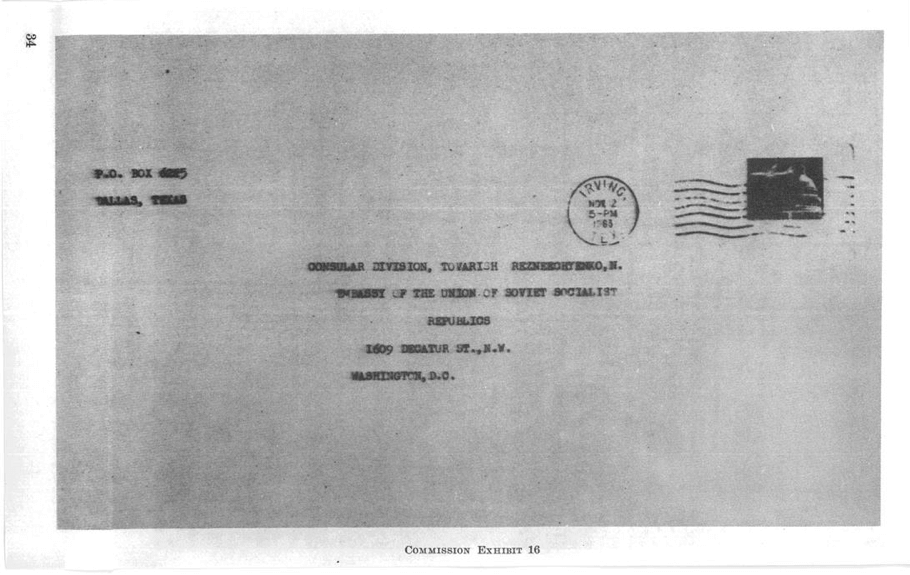
Warren Commission Volume 16 Exhibit 16
Letter from Lee Harvey Oswald to the Russian Embassy, dated November 9, 1963:
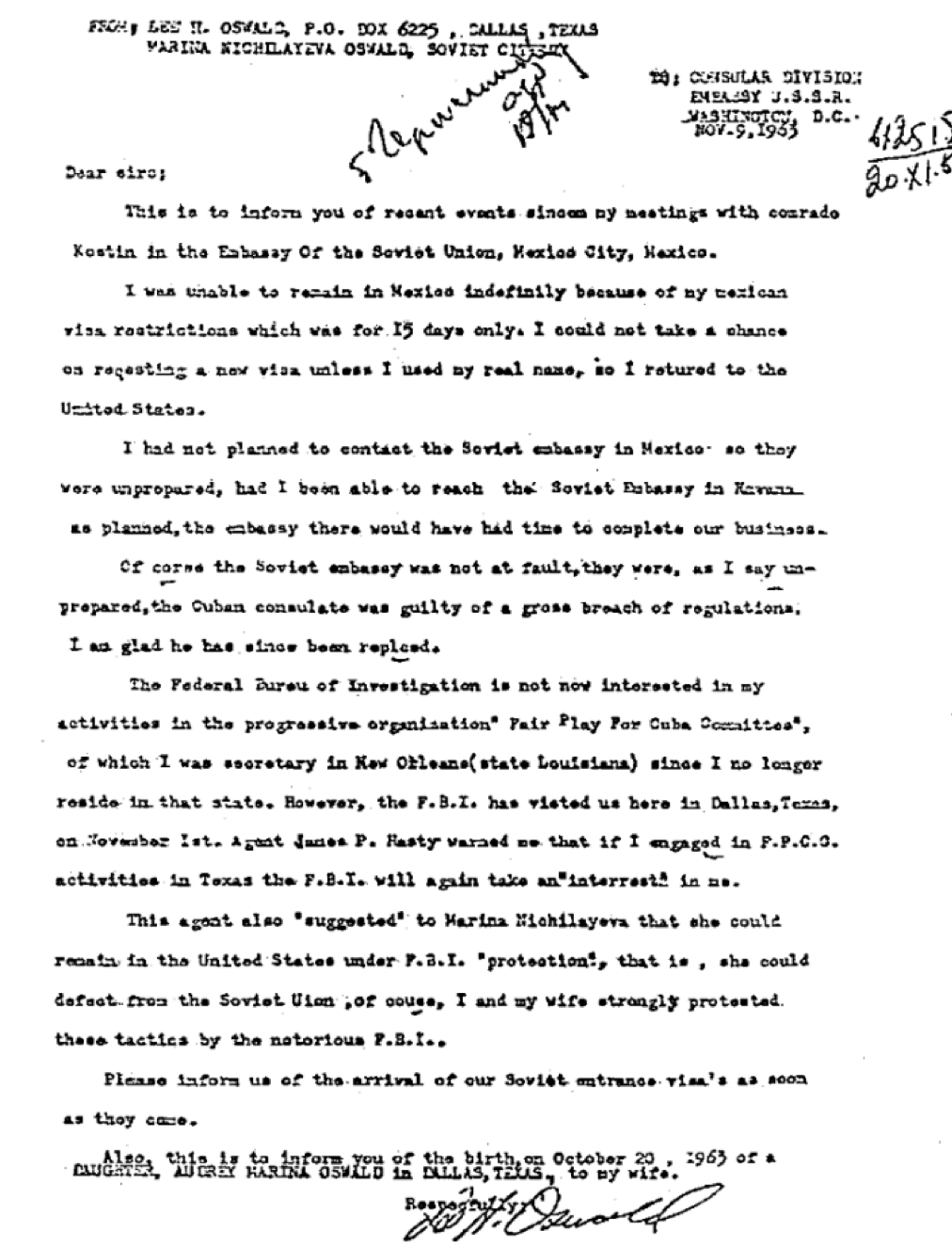
Warren Commission Volume 16 Exhibit 15
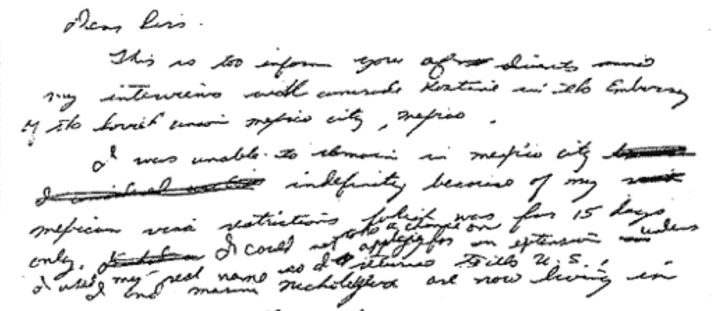
The mistake-riddled letter was linked to Ruth Paine’s typewriter. Ruth Paine and Marina Oswald testified that they had seen Oswald working on the letter shortly before it was sent and Ruth and Michael Paine both testified that they had seen a handwritten draft of the letter, which Ruth Paine handed over to an FBI official on November 23. Somehow, investigators who had combed through the Paine house had missed it. Handwriting analysis apparently confirmed it had been written by Oswald.
For some incredible reason, by April 1964, the Warren Commission had accepted a Ruth Paine request to have Oswald’s draft returned. However, when the Dallas FBI did return it to her, she decided to send it back to the Commission, because, finally, she felt it would be more proper for it to be kept in the public archives, but would take it in the event it would not be archived. Hoover said with finality that the Commission would not hold onto it and, by May 1964, had the original sent back to Ruth Paine, which escaped further examination as to its authenticity. (JFK and the Unspeakable, p.443)
Oswald’s draft of the letter found by Ruth Paine:
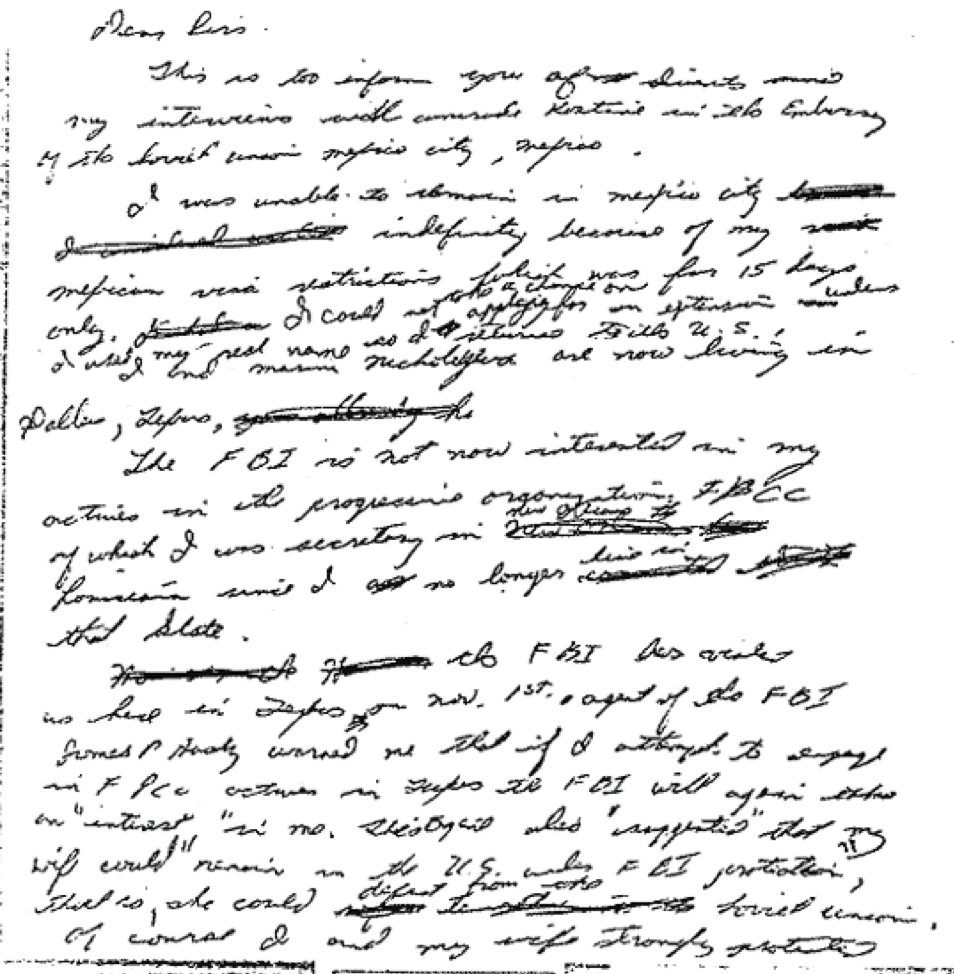

HSCA exhibit F 500/Warren Commission exhibit 103
The Warren Report’s descriptions of Oswald’s trip to Mexico City and his last letter are among the best examples of just how weak their investigation was and how misleading they were in their disclosures.
It seems the only thing that they found perplexing from the letter was how a “drifter” like Oswald could have known that a consul from the Cuban consulate in Mexico City could have been replaced. So, they asked the CIA to weigh in. The CIA surmised that the consul in question was Eusebio Azque and speculated that Silvia Duran or some Soviet official might have mentioned it if Oswald had complained about an altercation with Azque.
The Commission recognized that Kostin, who Oswald talks about, was KGB officer Valery Kostikov, but dilutes the meaning of this by stating “that it was common procedure for such KGB officers stationed in embassies to carry on normal duties along with undercover activities”.
Buried in the appendices of the Report, we can find a memo (Warren Commission Document 347 of January 31, 1964, p. 10) by the FBI’s Ray Rocca, sent to the Commission in January 1964:
Kostikov is believed to work for Department Thirteen of the First Chief Directorate of the KGB. It is the department responsible for executive action, including sabotage and assassination. These functions of the KGB are known within the Service itself as “Wet Affairs” (mokryye dela). The Thirteenth Department headquarters, according to very reliable information, conducts interviews or, as appropriate, file reviews on every foreign military defector to the USSR to study and to determine the possibility of using the defector in his country of origin.
Richard Helms, while heading the CIA, went on to confirm this very important detail. Kept hidden from the public was an allegation that Oswald had met Kostikov just a few weeks earlier in Mexico City and that a likely Oswald impostor had placed a call to Kostikov that was intercepted by the CIA! This makes the reference to “unfinished business” that we can read in the letter quite suggestive.
It is interesting to note that the letters from Cuba designed to incriminate Oswald and link him to Cuban agents use some of the same suggestive language. “Close the business”, “after the business, I will recommend you”, and “after the business I will send you your money” are some of the phrases that can be found in just one of the letters. Others talk about “the matter” or “the plan”.
A real investigation and transparent report would have revealed a lot more about Kostikov’s explosive background and would have blown the lid off what really happened in Mexico City. It would have also delved into who the recipient of the Washington letter was and its important significance, if Plan A (blaming foreign foes for the assassination) had been pursued. Something we will discuss later.
Instead, the report concludes its extremely hollow analysis on a whimper: “In the opinion of the Commission, based upon its knowledge of Oswald, the letter constitutes no more than a clumsy effort to ingratiate himself with the Soviet Embassy.” The truth was that, had plan A gone ahead, the letter would have been peddled as further proof of complicity between the president’s “murderer” and foreign adversaries.
The Warren Report on the letter
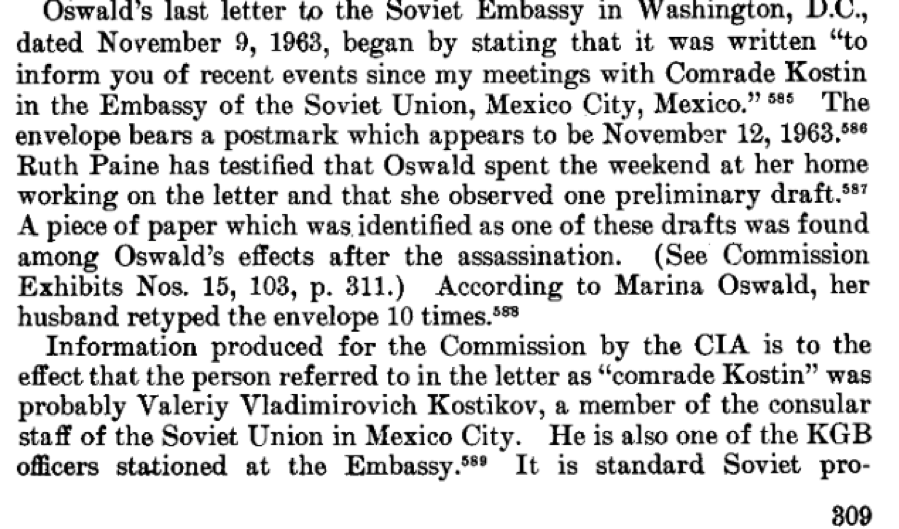
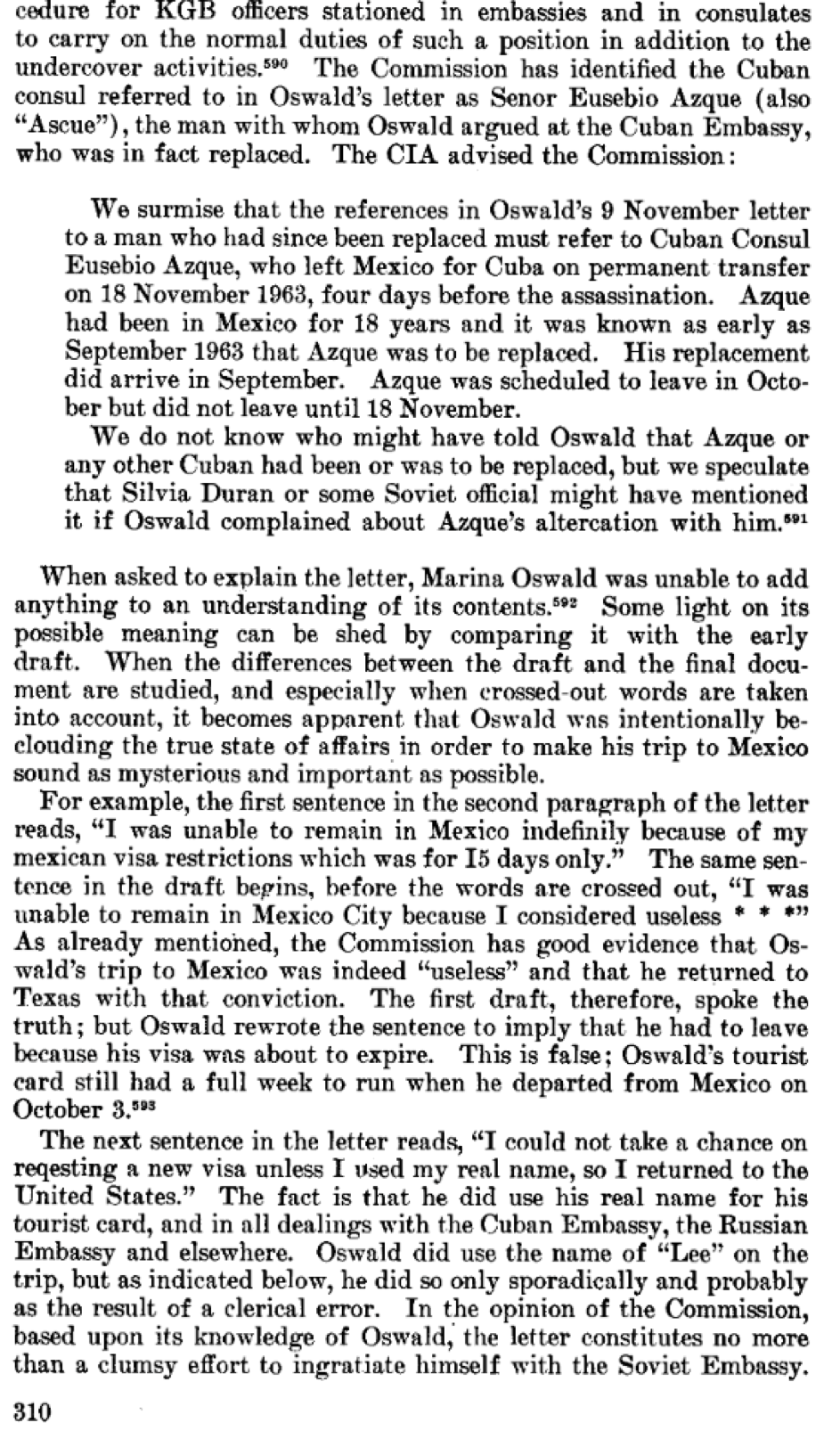
While Jim Garrison clearly suspected something unholy occurred in Mexico City, as well as with the letter, the public had to wait until 1970 to see some of the first clues about what the FBI really thought about this correspondence, when newsman Paul Scott revealed the following:
The F.B.I. discounts the C.I.A. suggestion to the Warren Commission that Silvia Duran, a pro-Castro Mexican employee of the Cuban Embassy, might have told Oswald about Azque being removed. In her statement to Mexican officials concerning her discussion with Oswald, Mrs. Duran made no mention of Azque. And, although she was questioned at the request of C.I.A., no attempt was made to quiz her about whether she knew of Azque’s recall. This makes the C.I.A. conclusion highly dubious, to say the least.
Although the F.B.I. still has not been able to resolve the key mystery of the Oswald letter, it has narrowed the sources of where he might have obtained information about Azque. These sources are: (1) An informant in the Cuban Embassy in Mexico City who contacted Oswald after he returned to the U.S. (2) The Central Intelligence Agency. Or (3), the Soviet Secret Police (K.G.B.) in Mexico City. Significantly, the F.B.I. probe discovered that the K.G.B. and the C.I.A. learned of Azque’s replacement at approximately the same time and not until after Oswald visited Mexico City. This finding has raised the possibility that whoever informed Oswald contacted him after he returned to Dallas from Mexico City.
According to Paul Scott’s son Jim, his father was wiretapped for over 50 years, because of his dogged investigations into the assassination.
The HSCA
Perhaps the biggest blow to the Lone Nut fabrication came when the Church Committee and the HSCA investigations deciphered one of the most important ruses, which would turn the tables on the frame-up artists who concocted the aborted Plan A stratagem. This had to be kept secret.
One thing the Lopez Report makes very clear is that an Oswald impostor made a phone call designed to lay down a trace that would be used as proof of Russian complicity in the assassination and would provide the types of motives and stratagems that were part of the ZR/RIFLE and the Joint Chiefs of Staffs Operation Northwoods play books, both which involved having adversaries blamed for their own covert acts of aggression. The letter served to authenticate the Oswald-Kostikov relationship and add a third player to the mix. The potato became scorching hot.
This analysis needed to be buried as much and as long as possible. The HSCA did not want to be the ones exposing this in the 1970s. The world had to wait nearly 25 years for the declassification of the explosive reports concerning Oswald’s trip to Mexico City and the mysterious letter and sometimes much later for their eventual release.
The HSCA’s conclusions about the letter were even more hypocritical than the Warren Commission’s. While they recognize that it is “disturbing”, they seem to ignore the fact that the letter had been intercepted by the FBI and do not factor in the explosive findings of their very own Lopez Report, nor the confirmations about Kostikov’s role as Russia’s head of assassinations for the Western Hemisphere. When we consider the proof that they were sitting on, that an Oswald impersonator was recorded talking to Kostikov, and that Oswald (or an impostor) was said to have actually met him, we can easily see that the context of the letter and its explosive meaning were completely sidestepped in the Report:
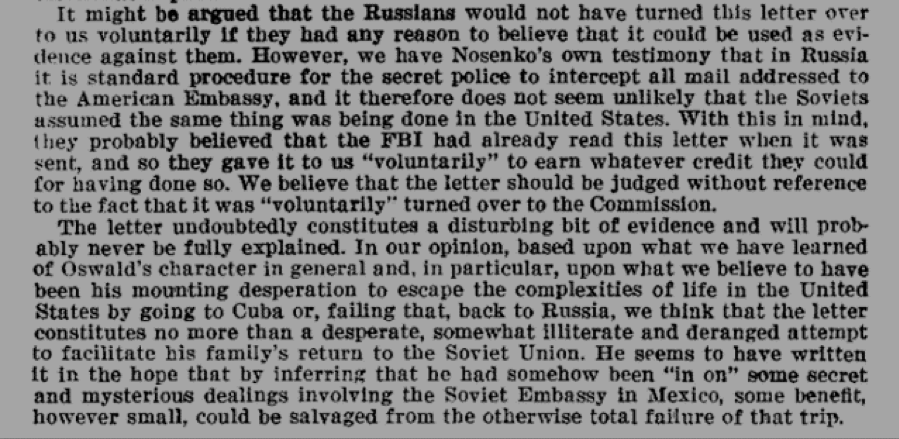
While the second paragraph represents a fake opinion designed to deviate from the real implication of the letter, the first one represents a blatant deception that can be proven outright by the transcript of Hoover’s call to President Johnson the day after the assassination:
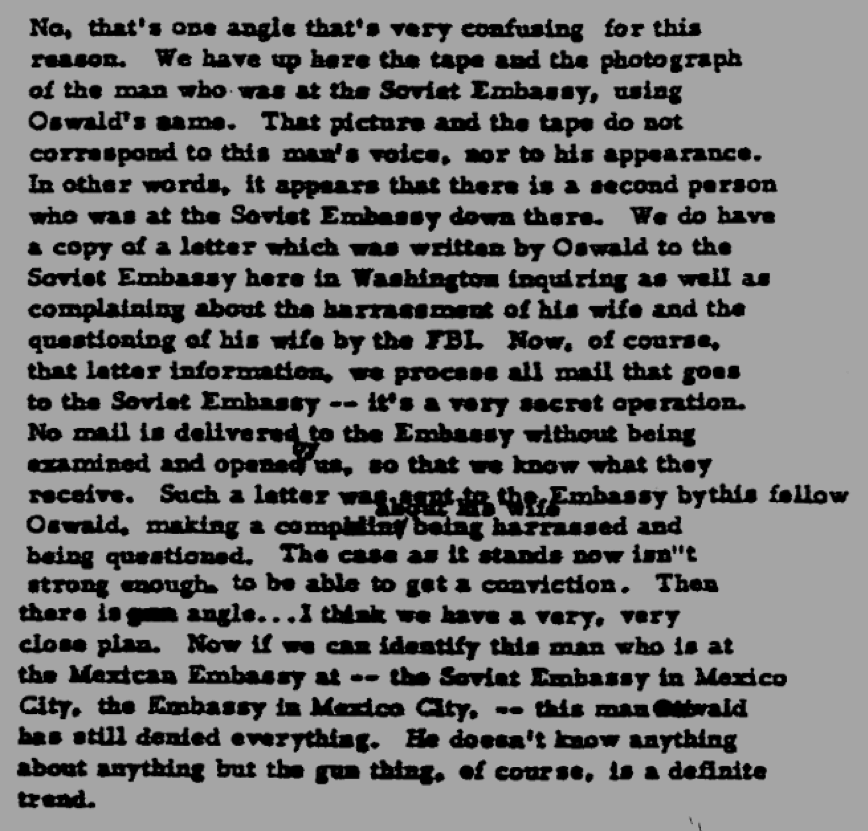
In short, the FBI did in fact examine all mail sent to the Soviet Embassy and had a copy of the letter all along.
The ARRB and Russians Weigh In
Thanks in large part to Oliver Stone and his landmark JFK movie classic, the ARRB was founded in 1992 and began declassifying files shortly after on the JFK assassination. In 1996, the Lopez Report was available. By 2003, a less redacted version was released. The explosive document shed light on Oswald impersonators, missing tapes, photos, and bold-faced lying by top CIA officials. The lone drifter was not alone!
As reported by Jerry Rose in the Fourth Decade, in 1999, Boris Yeltsin handed Bill Clinton some 80 files pertaining to Oswald and the JFK assassination. One of the memos reveals that, at the time of the assassination, Russian ambassador Anatoly Dobrynin had right away seen the letter as a “provocation” to frame Russia by the fabrication of complicity between Russia and Oswald, when none existed. “One gets the definite impression that the letter was concocted by those who, judging from everything, are involved in the president’s assassination,” Dobrynin wrote. “It is possible that Oswald himself wrote the letter as it was dictated to him, in return for some promises, and then, as we know, he was simply bumped off after his usefulness had ended.” In late November, the Russians sent the letter to U.S. Secretary of State Dean Rusk explaining why the letter was a fraud. By then, the White House was peddling the lone nut fable. Kept hidden was the fact that the FBI already had a copy of the letter.
In his article, Rose points out that the typed letter had many more spelling errors in it than the rough draft. Very odd indeed.
If you go back to how the Warren Commission fluffs off the alleged Kostikov/Oswald (and/or impostor) exchanges and compare it with what is written by Bagley in the CIA’s November 23rd 1963 memo (declassified in 1998), you will see a startling difference in Kostikov’s status:

Memo of 23 November 1963 from Acting Chief, SR Division, signed by Tennant Bagley, “Chief, SR/Cl.” CIA Document #34-538
Just one of the reasons the Warren Report was impeached! But wait, it gets worse.
The FBI’s Reaction to the Letter and the Mysterious Tovarish Reznkecnyen
Since the mid-1990s, there have been a few revealing writings about the letter, but very little about the FBI’s take on it.
Now, thanks to document declassification, we can see it through a wider scope that includes troubling dovetailing facts, such as the impersonation of Oswald in Mexico City and multiple hoaxes to tie him in unequivocally with sinister foreign agents and the chief assassination officer in Mexico—Kostikov. The analysis of tape recordings and transcripts, the mysteriously disappearing evidence, the fake letters from Cuba, and the full-fledged perjury of CIA officer David Atlee Phillips during the HSCA hearings prove there was subterfuge beyond a shadow of a doubt.
Hoover’s phone call to Johnson is already very revealing. The following FBI report (HSCA Record 180-10110-10104), released only in 2017, is nothing short of stunning. It was the one Scott wrote about in 1970. It is strongly urged that you follow the above link to understand the full implication of the report, which sheds light on the investigation mindset which preceded the whitewash. However, for this article, our attention will be on the following paragraph of the report which focuses on the letter Oswald sent to the Soviet Embassy in Washington.

Oswald’s letter deeply troubled the FBI for a number of reasons. Its tone was one of ongoing complicity referring to “unfinished business” and convenient reminders of the alarming exchange between Oswald and Kostikov. But the letter stretches the elastic to add yet another element that has so far gone under the radar.
The fact that the letter was sent to Tovarich Nikolai Reznichenko all of a sudden became alarming, even though the Oswalds corresponded with him several times in 1963. The FBI report clearly refers to him as “the man in the Soviet Embassy (Washington’s) in charge of assassinations.” In 1970, Scott had described him as “one of the top members of the Soviet Secret Police (K.G.B.) in the United States.”
The significance of this report leads to many conclusions and as many unanswered questions. Hoover had already decided that Oswald acted alone and they would not “muddy the waters internationally”. The HSCA, who possessed this document, in reports debates the authenticity of the same letter that was given to Dean Rusk by the Soviet ambassador, when they knew full well of its existence and FBI worries about its explosive implications. While this author has found little corroboration about Nikolai Reznichenko’s status, or perceived status, he believes it should not be dismissed as a mistake or confusion with Kostikov. This is an official FBI report that was written in 1963. There have not been any clarifications made about this very significant statement, despite the fact that Paul Scott exposed this in 1970 and its access to HSCA investigators.
The mere fact that he worked in the Russian embassy and that he often corresponded with a “defector” on a watch list and his Russian wife and that the last letter by Oswald addressed to him has a complicit tone while name dropping the Mexico-based KBG chief of assassinations and talking about unfinished business suggests that both the FBI and the CIA had files on him. Where are they? For him to be described by Hoover as the head of assassinations in Washington on the part of the Soviet government in an official FBI document is of utmost significance and requires an explanation.
This is one issue that deserves more debate in the research community.
Conclusion
The last letter on its own, perhaps, does not rise to the level of a smoking gun that proves there was conspiracy. It is another compelling piece of evidence that does prove that the Warren Commission and the HSCA shelved important evidence and information from the public that they found bothersome.
If one adds this letter to the other attempts to pin the blame on foreign agents, including the charade in Mexico City, false testimonies by CIA contacts, the perjury of CIA officials of interest in the case, the Policarpo Lopez incident, and the incriminating letters from Cuba, we have proof beyond a shadow of a doubt that there was conspiracy. The naysayers cannot have it both ways. Either these events were genuine, which proves an international conspiracy, or they were not, which proves a domestic conspiracy. There has been enough evidence to demonstrate that they were not genuine.
The letter has one attribute that can play an important role, actually proving who some of the conspirators were. It pre-dates the assassination. As it refers to happenings and ruses that took place in Mexico City two months earlier that few knew about, we can narrow the scope on who was involved. When we inspect the propaganda aspect of the operation, the case against David Atlee Phillips as a person of extreme interest is almost airtight. He had many touch points with Oswald and is easy to link to all of the ruses behind the sheep dipping activities, including the incriminating last letter.

The murder of Officer J.D. Tippit in Oak Cliff was famously cited by David Bellin, Assistant Counsel to the Warren Commission, as being the “Rosetta Stone to the solution” of the JFK assassination. (Jim Marrs, Crossfire, p. 340, all references are to the 1989 edition) “Once it is admitted that Oswald killed Patrolman J.D. Tippit,” the attorney for the commission observed, “there can be no doubt that the overall evidence shows that Lee Harvey Oswald was the assassin of John F. Kennedy.”
Following Mr. Belin’s questionable logic might also lead one to believe the opposite to be true. Once it is shown that Oswald likely did not kill Patrolman Tippit, the case for him having shot President Kennedy and Governor Connally is, therefore, demonstrably weakened.
“I emphatically deny these charges!” shouted Oswald to news reporters while in Dallas police custody. “I didn’t shoot anybody, no sir … I’m just a patsy!” Oswald denied his guilt in many ways and more than once. (Mark Lane, Rush to Judgment, p. 81)
Was the suspect telling the truth?
Sadly, within less than 48 hours, shadowy nightclub owner Jack Ruby would all but terminate the official Dallas Police investigation into the Tippit homicide when he gunned down suspect Lee Oswald in the basement of Dallas Police Headquarters. That unfathomable event, broadcast live on national television, occurred in the presence of more than 50 Dallas policemen. It was their job to ensure Oswald’s safety while he was in custody—so the suspect might be tried on charges of assassinating President Kennedy and murdering Officer Tippit.
“We never worked on any of his (Tippit’s) murder, because there was no use making a murder case (with the suspect dead),” admitted former District Attorney Henry Wade in an interview with veteran Tippit researcher Joseph McBride. “I think we had enough evidence that Oswald did it.”
And despite Belin’s “Rosetta Stone” reference, not only did Dallas authorities abandon the Tippit case, but the Warren Commission, according to McBride, showed “almost no real interest in solving the crime … the commission was deliberately stonewalling a serious investigation of Tippit.”
Any “serious” investigation into Tippit’s death must begin with one fundamental and all-important question: Why did Tippit stop Oswald?
Based on the persistence of several indefatigable private researchers and investigators who kept digging into the Tippit mystery for decades, I believe we can now attempt to answer that question. The answer, it would seem, had nothing to do with the man walking on 10th Street in Oak Cliff matching the Dealey Plaza suspect’s generic description of being a young white male of average height and weight—as was suggested by the Warren Commission.
In the words of Sylvia Meagher, writing in her 1967 book Accessories After the Fact, “The strangeness of Tippit’s actions,” suggests that “it was not probable, perhaps not even conceivable, that Tippit stopped the pedestrian who shot him because of the description broadcast on the police radio. The facts indicate that Tippit was up to something different which, if uncovered, might place his death and the other events of those three days in a completely new perspective.” (See Meagher, pp. 260-66)
What follows in this article is a “new perspective.”
12:00 P.M.
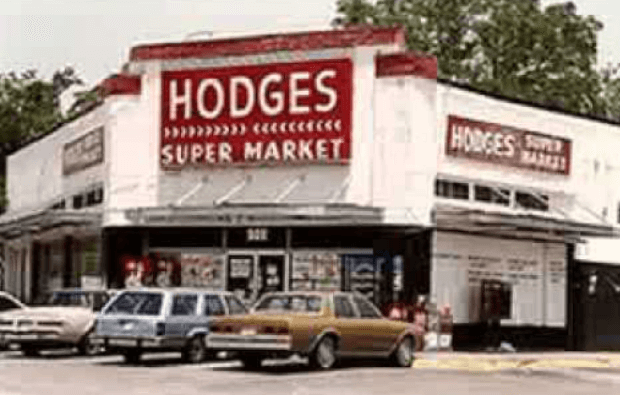
The “strangeness” of Tippit’s actions on 11/22/63 appear to have begun even before shots rang out in downtown Dallas. Tippit, whose normal area of patrol was in Cedar Crest, patrol area #78, was apparently called to a supermarket in the 4100 block of Bonnie View Road. Respected Tippit researcher Larry Ray Harris interviewed the Hodges Supermarket manager in 1978. As described in news reporter Bill Drenas’ oft-cited 1998 article Car #10 Where are You?, the manager told Harris he had caught a woman shoplifter on 11/22/63 and had phoned police.
It was Tippit who responded to that location at about noon, just a half hour before the assassination. The manager knew Tippit, because Tippit routinely came to the market on calls for shoplifters. The interviewee said Tippit placed the woman in his squad car and left. However, Tippit appears not to have brought the shoplifting suspect back to his nearby base of operations. No record of the woman’s arrest or information on who she was or what happened to her has ever surfaced.
12:30 p.m.
President Kennedy’s motorcade was scheduled to have arrived at the Dallas Trade Mart at 12:30. However, because the motorcade was running a few minutes late, President Kennedy was assassinated at 12:30, and Governor Connally was gravely injured, as the motorcade proceeded through Dealey Plaza on route to the Trade Mart. The Hodges Market in the 4100 block of Bonnie View in Tippit’s district was more than seven miles southwest of Dealey Plaza.
12:40 p.m.
The DPD Channel 1 dispatcher reports a shooting in the downtown area involving the President. By this time, Texas School Book Depository employee Lee Oswald has already grabbed his blue work jacket and has left the TSBD on foot. He will board a city bus, but when that bus gets stalled in traffic, Oswald will ask for a transfer, depart from the bus, and walk to a cab stand to catch a quicker ride (with cab driver William Whaley) out to nearby Oak Cliff where the young man resides.
The DPD Channel 1 dispatcher next orders “all downtown area squads” to Dealey Plaza, code 3 (lights and sirens). By 12:44, a general description of the Kennedy suspect (slender white male, 5’10” and 160 pounds) is broadcast over both Channels 1 and 2.
12:45 p.m.
Murray Jackson, the dispatcher, asks Tippit to report his location. Tippit replies, according to police radio logs, that “I am about Keist and Bonnie View,” which is still within Tippit’s regular patrol district down in Cedar Crest. (Joseph McBride, Into the Nightmare, p.441) However, this may not have been the case.
Beginning at approximately 12:45, when Officer Tippit reports he is still in his regular patrol area, Tippit will instead be seen sitting inside his squad car parked at the GLOCO gas station, strategically situated in northernmost Oak Cliff next to the Houston Street viaduct. The viaduct connects downtown Dallas and Dealey Plaza to Oswald’s neighborhood in Oak Cliff—some five miles north of Tippit’s reported position.
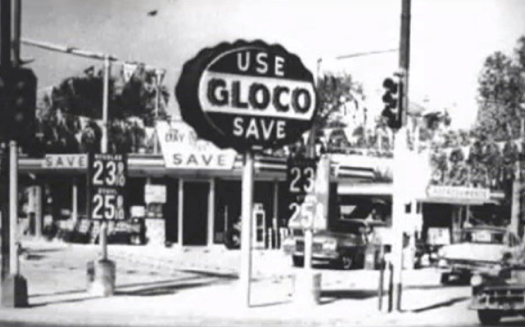
Researcher William Turner, in a 1966 article in the magazine Ramparts, claimed he located five witnesses who saw Tippit sitting in his patrol car at the gas station at this time while watching traffic coming across from downtown Dallas. (McBride, ibid) The location is only 1.5 miles from Dealey Plaza. Two of the witnesses, a husband and wife who knew the officer, say they waved at Tippit who waved back at them. The story was reportedly verified by three of the GLOCO station attendants. Dallas researchers Greg Lowrey and Bill Pulte also interviewed all five of these witnesses to confirm the story. Some said that Tippit arrived at the GLOCO as early as just “a few minutes” after the assassination.
Was Tippit watching for Oswald to come across the viaduct on a Dallas bus? Did he see Oswald instead in the front of William Whaley’s cab? What was Tippit doing?
12:46 p.m.
At this time, dispatcher Murray Jackson ordered Officers Tippit and R.C. Nelson into the Central Oak Cliff area, which was odd since an assigned officer (William Mentzel) was already patrolling Central Oak Cliff. (McBride, pp. 427-30) Tippit, according to witnesses, is of course already there in the northernmost part of Oak Cliff at the gas station. (This was probably unknown to Jackson, since Tippit had just responded to the dispatcher that he was in his assigned patrol area at Bonnie View & Keist some five miles to the south). Officer Nelson instead proceeded on to Dealey Plaza, possibly following the preceding 12:42 “code 3” order for all downtown area squads to report to Dealey Plaza. (Henry Hurt, Reasonable Doubt, pp. 161-63)
Meanwhile, Oswald will soon be crossing the Houston St. viaduct in William Whaley’s cab, heading for Oak Cliff.
The witnesses say that after some 10 minutes of sitting at the gas station, watching traffic crossing from the downtown area, Tippit suddenly pulled out and took off south on Lancaster Avenue “at a high rate of speed.”
12:52 or 12:53 p.m.
Cab driver William Whaley lets Oswald out at the corner of North Beckley and Neely Street, several blocks south of Oswald’s rooming house, which the cab has already passed. Whaley had marked Oswald’s intended location on his run sheet as the 500 block of N. Beckley, even farther south and in the wrong direction from the rooming house. The 500 block of N. Beckley was, in 1963, dominated by the side parking lot of the El Chico Restaurant.
12:54 p.m.
Dispatcher Murray Jackson contacts Tippit, who is now about a mile from the GLOCO Station on Lancaster Street. (McBride, p. 445) Oswald and Tippit are both apparently moving in the direction of the Texas Theater.
1:00 to 1:07 p.m.
Texas Theater manager Butch Burroughs said Oswald entered the theater during this timeframe and later bought popcorn from him at the concession stand at approximately 1:15. (McBride, p. 520) Other movie patrons will similarly report having seen Oswald in the mostly empty theater during the start of the movie, changing seats frequently and sometimes sitting directly next to other moviegoers. Is Oswald supposed to meet someone he doesn’t know personally, perhaps his intelligence contact to whom he is expected to give a briefing?
After 1:00 p.m.
 Employees of the Top Ten Records store, located a block and a half west of the Texas Theater on Jefferson Boulevard, later claim that Tippit parked his squad car on Bishop Street adjacent to the records store and came in hurriedly while asking to use the phone.
A Dallas Morning News reporter interviewed former Top 10 clerk Louis Cortinas in 1981. Cortinas recalled that, “Tippit said nothing over the phone, apparently not getting an answer. He stood there long enough for it to ring seven or eight times. Tippit hung up the phone and walked off fast, he was upset or worried about something.” (McBride, p. 451)
Had Tippit picked up Oswald near the El Chico Restaurant and then dropped him off at the Texas Theater? Had Tippit simply been watching the theater to confirm Oswald’s arrival? Or, was Tippit simply trying to contact someone to find out the latest news on the condition of President Kennedy and Governor Connally?
1:03 p.m.
Around this time, police dispatcher Murray Jackson tries to radio Tippit, but gets no answer. (Meagher, p. 266) Was this when Tippit was entering the Top 10 records store to place the phone call?
Approximately 1:04 p.m.
Several blocks east of Top 10 and the Texas Theater, an unknown young white male about 5’8” to 5’10” and 165 pounds wearing a white shirt and light tan Eisenhower jacket begins to quickly walk west on East 10th Street. The man is in such a hurry that he catches the attention of those inside of Clark’s Barber Shop at 620 E. 10th as he breezes by that establishment’s storefront window. A pedestrian, Mr. William Lawrence Smith, passes the same man as Smith walks east to lunch at the Town & Country Café just a few doors west of the barber shop. (John Armstrong, Harvey and Lee, p. 841)
Approximately 1:05 p.m.
As the unknown white male proceeds west and crosses the intersection of 10th and Marsalis, a major disturbance suddenly breaks out at that corner. Bill Drenas, author of the 1998 article Car #10 Where Are You?, mentioned that a person near the scene of the Tippit shooting told investigator Bill Pulte that, “If you are planning to do more research on Tippit, you should find out about the fight that took place at 12th & Marsalis a few minutes before Tippit was killed.” The interviewee spoke only on the condition of anonymity.
Harrison Livingstone, in his 2006 book The Radical Right and the Murder of John F. Kennedy, adds more crucial detail about this mysterious neighborhood altercation. “There are neighborhood reports of a disagreement at the intersection of 12th & Marsalis,” writes Livingstone, “a few minutes before Tippit was killed. Tippit was headed precisely toward 12th & Marsalis when he left Lancaster & 8th (the report of the 12th & Marsalis argument is from someone whose identity needs to be protected).
“The late Cecil Smith witnessed this fight which was actually at 10th & Marsalis (my emphasis). One of the two individuals was stabbed, but it was never investigated, apparently … just two blocks east from where Tippit was shortly murdered.” The fight also occurred, let it be known, at the same time and location the unknown gunman in the light jacket, white shirt, and dark trousers is passing on his way two blocks west to the fast approaching scene of the fatal Tippit shooting.
But it was not until Dallas researchers Michael Brownlow and Professor William Pulte made public their findings in a 2015 Youtube video that we get the full scoop on this most unusual so-called “fight.”
 Brownlow said it was actually three men and a woman who jumped on another man at the corner, who was then “violently” stabbed. The wounded man, bleeding profusely, was then inexplicably thrown into the back of a blue Mercury Monterey which sped away from the scene. Many people witnessed the assault. 10th & Marsalis was a commercial corner, with an auto parts store, a plumbing supply store, and other nearby businesses such as the barber shop and restaurant. It was Indian summer, pre-air conditioning days, and most of these businesses had telephones within easy reach. Neighbors and teens home from school also allegedly witnessed the noisy and bloody altercation. (See also, Joseph McBride, Into the Nightmare, pp. 447-48)
Emergency phones calls were obviously placed to the Dallas Police, although you won’t find any mention of this incident in the DPD call logs for 11/22/63. Why not?
Approximately 1:05:30
Officer Tippit, now sitting once again in his patrol car outside of the Top 10 Records store, suddenly hears his police radio crackle to life. There has been a reported fight and possible stabbing at the corner of 10th & Marsalis, several blocks east of where his patrol car now sits near the corner of West Jefferson Blvd. and Bishop Avenue. A man has supposedly been stabbed and thrown into the back of a blue car which drove away from the scene. Tippit puts Car #10 into gear and moves out in a big hurry.
 The employees at Top Ten (Lou Cortinas and Dub Stark) watch through their front window as Tippit’s car goes charging through the intersection and races north up to Sunset Street where Tippit blows through the stop sign and disappears from view. (McBride, pp. 451-550)
Approximately 1:06:00
Tippit quickly reaches 10th Street and is about to turn right, heading east towards the disturbance at the corner of 10th & Marsalis. But he instead observes a late model Chevrolet headed west on 10th. Could this be the car escaping from the scene of the fight? So instead of turning right, Tippit makes a quick decision and turns left, following the Chevy that has just passed in front of him. Within a block the officer speeds up, passes the Chevy, turns the wheel, and forces the surprised driver to come to a stop at the curb.
Mr. James Andrews, the motorist—who had been returning to work from his lunch hour—would later give Dallas researcher Greg Lowrey (as reported in Bill Drenas’ article Car #10 Where Are You?) the following description of this bizarre event:
Drenas writes that “The officer then jumped out of the patrol car, motioned for Andrews to remain stopped, ran back to Andrew’s car, and looked in the space between the front seat and the back seat (emphasis mine). Without saying a word, the policeman went back to the patrol car and drove off quickly. Andrews was perplexed by this strange behavior and looked at the officer’s nameplate which read ‘Tippit’ … Andrews remarked that Tippit seemed to be very upset and agitated and acting wild.” (McBride, pp. 448-49)
Much has been made of this incident, which apparently happened just a few short moments prior to Tippit’s death. Some have reasoned that Tippit was looking for Oswald, thought to be hiding in the back of an automobile on his way to Red Bird Airport to catch a flight out of town. Others have found the story so odd that they have tended to dismiss it altogether—couldn’t have happened.
But now that we have a report about a fight at 10th & Marsalis, a stabbing in which the victim was thrown into the back of a car which then sped away from the scene, Tippit’s “wild” actions perhaps make more sense. Tippit may have been looking for the injured stabbing victim in the back of an escaping vehicle—and he was doing so alone, with no backup. That is why he was agitated and acting upset. President Kennedy and Governor Connally have just been gunned down in Dealey Plaza and now Tippit is dealing with a violent, potentially life and death situation in adjoining Oak Cliff.
1:07:00 p.m.
Officer Tippit heads east on 10th Street, heading towards the scene of the reported disturbance at the corner of Marsalis. By now, according to Texas Theater Manager Butch Burroughs—as well as multiple paying customers—Lee Oswald is most definitely in the building for the start of the afternoon’s double war movie feature. (Marrs, Crossfire, pp. 352-53)
1:08:00 p.m.
As Officer Tippit travels east on 10th towards Marsalis, he spots a lone figure walking west just two blocks from the scene of the stabbing incident. Tippit slows Car #10 as he cruises through the intersection of 10th & Patton. Cab driver Bill Scoggins, parked near the corner in his cab while eating his lunch, notices Tippit pass in front of his cab, slow down, and suddenly pull to the curb about 100 feet past Patton Street. The officer apparently summons the young pedestrian, who is wearing the beige Eisenhower jacket, dark trousers, and white shirt, back to his patrol car.
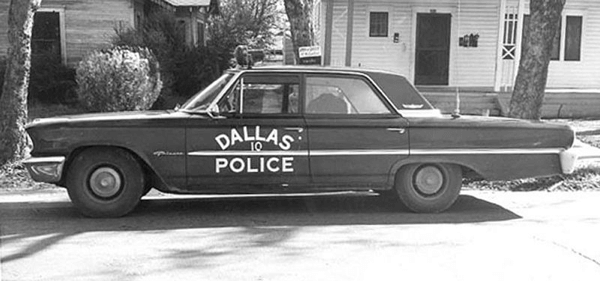 The young man does an about-face, turning around to approach Tippit’s car sitting at curbside. Could this young man have been a witness? A participant in the fight? He doesn’t appear to have any blood on his jacket that the officer can see. Tippit and the young man, who is now leaning over, have a brief conversation through the open vent on the passenger-side window.
1:08:30 p.m.
Officer Tippit, who probably does not fully believe the young man’s story about who he is and what business he has on 10th Street, decides to get out of his car to question the subject further. He adjusts his police cap, begins to walk slowly towards the front of Car #10. As he does, the man pulls a .38 revolver from under his jacket and begins to fire.
No one sees the actual shots. A passing motorist, Domingo Benavides, is startled by the gunfire as he approaches Car #10 while traveling west on 10th. In an act of instinct and self-preservation, Benavides turns his pickup to the curb and ducks down behind the dashboard. (Lane, pp. 177-78)
Cabbie Bill Scoggins sees Tippit fall into the street. A few seconds later, he observes the figure of the young man walking quickly towards his cab, cutting across the adjacent corner property on 10th Street. Scoggins steps out of his cab and hides behind the driver-side fender. The young man emerges from the lawn’s hedges and begins to trot south on Patton Street, still tossing the occasional empty shell to the ground. (Lane, pp. 191-93)
Hearing no further shots, Benavides pokes his head up in time to see the gunman heading for Patton Street, inexplicably tossing a couple of shells into the bushes. Benavides will later tell police he could not positively identify the gunman and will not be taken to any of the subsequent lineups.
1:10:00 p.m.
The gunman turns right on Jefferson Boulevard, as seen by multiple witnesses. He stuffs the pistol back into his pants, walks briskly west for a block before cutting through a service station and turning north on Crawford Street. At this point the young gunman disappears. (Armstrong, p. 855)
Approximately 1:25 p.m.
 “Someone” hands Captain William “Pinky” Westbrook a light tan Eisenhower jacket that was allegedly thrown under a parked car behind the Texaco service station at Jefferson & Crawford. This was supposedly the jacket worn by the fleeing gunman. Westbrook, however, can’t remember the name of the officer who turned over the jacket. (Lane, pp. 200-203)
Approximately 1:36 p.m.
As Dallas police cars continue swarming into Oak Cliff, the unidentified young man from 10th & Patton suddenly reappears again on Jefferson Blvd. near the Texas Theater. The man, who is wearing a white shirt, either purchases a ticket or simply ducks in without paying. The time is now approximately 1:37. Once inside, the new arrival goes upstairs to sit in the theater’s balcony section. (Armstrong, pp. 858-60)
Approximately 1:40-42 p.m.
Dallas police are tipped off to a suspicious person who has entered the Texas Theater.
Approximately 1:42 p.m.
 At 10th & Patton, Captain Westbrook of the DPD shows FBI special agent Bob Barrett a man’s wallet. The Dallas investigators are going through the wallet, and apparently find two pieces of ID. Westbrook asks Barrett if he knows who either Lee Harvey Oswald or Alex Hiddell are. Barrett says no. (Armstrong, p. 856) Years later, when the story about the wallet is revealed by FBI personnel, the DPD will say that Barrett’s memory is faulty, there was no wallet found at the Tippit crime scene. But a check of archived Dallas TV news footage proved the DPD wrong. Later, the story seems to change that some unidentified person in the crowd at Tippit’s murder scene must have handed the wallet to reserve cop Sgt. Kenneth Croy, the first officer on site. Only none of the many Tippit witnesses reported seeing a wallet on the ground. Croy, incredibly, never filed a written report on 11/22/63. And Croy, in his testimony before the Warren Commission, said he knew several of the officers who eventually responded to the shooting at 10th and Patton—but couldn’t remember a single name of any of them.
1:45:43 p.m.
The DPD Channel 1 dispatcher broadcasts a report of a suspect who “just went into the Texas Theater.” A fleet of police cars, marked and unmarked, arrive to surround the theater front and back. (Armstrong, p. 863)
1:50-1:51 p.m.
 Lee Oswald, still wearing his long-sleeved brown work shirt, is subdued in the main (downstairs) section of the theater by DPD officers and is whisked out the front door to a waiting unmarked police car.(Armstrong, p. 868) Meanwhile, a second slender young white male in a white t-shirt is arrested in the balcony and brought out the back door of the theater, as observed by Bernard Haire, the owner of the hobby store two doors east of the theater. The official Dallas arrest report will indicate that Oswald was arrested in the balcony, while in fact he was actually arrested downstairs in the theater’s ground-floor main section. (Armstrong, p. 871) What happened to the second man who was taken away?
Approximately 1:55 p.m.
While accompanied by four Dallas detectives in an unmarked car headed for DPD’s downtown headquarters, Oswald is asked to give his name. He ignores the request. Perturbed, Detective Paul Bentley pulls a billfold from Oswald’s hip pocket and begins to examine its contents. He finds ID cards for both a Lee Oswald and an A. Hidell. “Who are you?” asks Bentley again. “You’re the detective,” Oswald finally answers back. “You figure it out.” (Armstrong, p. 870)
But wait. They just found Oswald’s wallet at 10th & Patton, right? (Armstrong, p. 868) So Oswald carried two wallets, one of which he was good enough to leave at the Tippit murder scene? Along with four shell casings from a .38 caliber revolver?
In the words of an old Rockford Files TV episode: “that plant was so obvious someone should’ve watered it.” No wonder the 10th & Patton wallet disappeared after a billfold was found to have been in Oswald’s possession at the theater.
The Dallas Police knew who Oswald was before they descended on and surrounded the Texas Theater.
Approximately 2.p.m.
Oswald arrives at Dallas Police Headquarters to be interrogated and booked. He will be shot dead that very same weekend. To quote one bluntly sarcastic journalist: “Lee Oswald miraculously managed to survive nearly 48 hours in the custody of the Dallas Police Department.”
The DPD kept no known tapes or transcripts from the hours of interrogation undergone by their suspect. We have little idea what Oswald really said, only that he “emphatically denied these charges.” (Armstrong, p. 893)
Ballistics
 If anyone is looking for ballistics to provide a definitive answer in the Tippit case, they will be sorely disappointed. The ballistics evidence tends to exonerate Lee Oswald as much as it implicates him. (For lengthy discussions of the following, see Henry Hurt, Reasonable Doubt, pp. 151-56 and Joseph McBride, Into the Nightmare, pp. 252-57)
Four shells from a .38 caliber handgun were recovered spread along the ground leading from the crime scene. The DPD officers on site at first figured these were from an automatic pistol (which automatically ejects the spent shells), not a revolver, because who would purposely remove and leave such incriminating evidence at the scene (along with a wallet full of ID)?
The bullets found in Officer Tippit’s body at autopsy could not be matched to Oswald’s .38. And the shells so conveniently recovered at 10th & Patton could not be matched to the bullets. The shells were never properly marked by DPD, evidence was misfiled, and the chain of evidence for the ballistics was, unfortunately, suspect.
In the words of homicide detective Jim Leavelle, the very man tasked with nailing Oswald for the Tippit murder, the ballistics in this case were quite frankly “a mess.”
As Joe McBride notes in his book, Warren Commissioner and congressman Hale Boggs was one of the members of that body who had his doubts about their verdict. Boggs directly challenged the Tippit case ballistics when he said, “What proof do you have that these are the bullets?” (McBride, p. 258) Boggs apparently never received a satisfactory answer.
New Orleans District Attorney Jim Garrison, who took an active role in the JFK assassination investigation in the late 1960s, believed that the ballistics evidence pointed to two shooters at 10th & Patton. Said Garrison in his October 1967 Playboy interview, “The evidence we’ve uncovered leads us to suspect that two men, neither of whom was Oswald, were the real murderers of Tippit.”
Mr. Garrison added that, “… Revolvers don’t eject cartridges and the cartridges left so conveniently on the street didn’t match the bullets in Tippit’s body.”
The cartridge cases—two Western-Winchester and two Remington–Peters—simply didn’t match the bullets—three Western–Winchester, one Remington-Peters—recovered from Officer Tippit’s body.
“The last time I looked,” noted Garrison wryly, “the Remington–Peters Manufacturing Company was not in the habit of slipping Winchester bullets into its cartridges, nor was the Winchester–Western Manufacturing Company putting Remington bullets into its cartridges.”
Witnesses
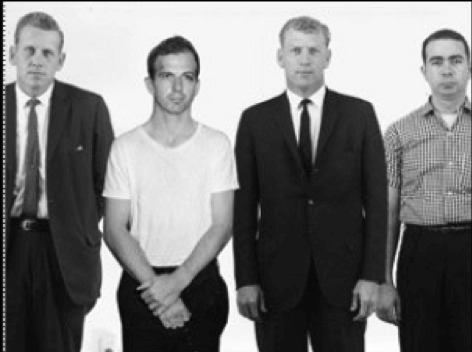 If the ballistics evidence in the Tippit case could rightly be characterized as messy, then the eyewitness testimony regarding the Tippit homicide would have to be labeled a toxic waste site by comparison.
Tippit authority Joseph McBride, author of Into the Nightmare, explained the bizarre situation succinctly when he stated, “The other physical evidence is also confused and contradictory—and the eyewitness evidence is so contradictory that it seems as though there were two sets of witnesses.” (McBride, pp. 460-61)
One set of witnesses identified Oswald as the sole murderer of Officer Tippit. The second set said they couldn’t positively identify Oswald, or could positively exclude Oswald, and saw two or more suspects acting suspiciously, and even saw one of those persons apparently involved in the shooting escape in an automobile.
Dallas authorities, and later the Warren Commission, focused almost exclusively on the first set of witnesses—while minimizing or completely ignoring the second set.
A good example of “witness neglect” was reported by 10th Street neighbor Frank Wright. Wright later told Tippit researchers that “I was the first person out. I saw a man standing in front of the car. He was looking toward the man on the ground (Tippit). The man who was standing in front of him was about medium height. He had on a long coat, it ended just above his hands. I didn’t see any gun. He ran around on the passenger side of the police car. He ran as fast as he could go, and he got into his car. … He got into that car and he drove away as fast as he could see. … After that a whole lot of police came up. I tried to tell two or three people (officers) what I saw. They didn’t pay any attention. I’ve seen what came out on television and in the newspaper but I know that’s not what happened. I know a man drove off in a grey car. Nothing in the world’s going to change my opinion.” (Hurt, pp. 148-49)
 Acquilla Clemons, a caregiver who worked on 10th Street, was not simply ignored the same as was Mr. Wright. Clemons, who saw two suspicious persons escape the Tippit murder scene in different directions, told investigator Mark Lane (during a taped interview) that a man she suspected was a Dallas detective or policeman visited her home on or about 11/24/63. He was carrying a sidearm. Mrs. Clemons reported that the visitor warned her “it’d be best if I didn’t say anything because I might get hurt … someone might hurt me.” (McBride, pp. 490-94)
 Warren Reynolds, a used car salesman who saw the gunman escaping west on Jefferson Boulevard, was indeed hurt—and very badly. Reynolds told news reporters the afternoon of the assassination that he had seen the fleeing gunman, but was simply too far away to have made a positive identification. The FBI finally got around to interviewing Reynolds in January, 1964, at which time the witness reiterated his original story that he had been located across Jefferson Boulevard and was simply too far from the gunman to have made a positive identification. Two nights later, someone sneaked into Reynolds’ place of business, hid in the basement, and shot Mr. Reynolds in the head with a .22 caliber rifle. Miraculously, Reynolds survived. Even more miraculously, the car salesman made such a dramatic recovery that he now found his eyesight had improved and he was able to identify Lee Oswald after all. (Hurt, pp. 147-48; McBride pp. 476-78)
Decades later, Dallas researcher Michael Brownlow tracked down Mr. Reynolds, who was still in the business of selling cars. At first, Reynolds would not admit who he was. But after Brownlow had gained his trust, the researcher asked Mr. Reynolds why he had suddenly changed his testimony regarding his identification of Oswald.
“Because I wanted to live,” Reynolds admitted bluntly.
When Mark Lane came to Dallas to make the documentary Rush to Judgment, his director, Emile de Antonio, made a rather interesting observation. “There was absolutely no tension at all on the scene of the assassination (Dealey Plaza),” commented de Antonio. “… All the tension is where Tippit was killed. That’s right and this (the Tippit slaying) is the key to it.” (McBride, pp. 460-61)
The director’s sense of what was going on in Oak Cliff was seemingly verified by an anonymous letter appearing in Playboy that was sent to the editor after Jim Garrison’s October 1967 Playboy magazine interview:
“I read Playboy’s Garrison interview with perhaps more interest than most readers. I was an eyewitness to the shooting of policeman Tippit in Dallas on the afternoon President Kennedy was murdered. I saw two men, neither of them resembling the pictures I later saw of Lee Harvey Oswald, shoot Tippit and run off in opposite directions. There were at least half a dozen other people who witnessed this. My wife convinced me that I should say nothing, since there were other eyewitnesses. Her advice and my cowardice undoubtedly have prolonged my life—or at least allowed me now to tell the true story…”
There were four main witnesses who gave testimony that Lee Oswald had in fact been guilty. Many who’ve studied the Tippit murder have long felt that competent defense counsel would have reduced the case against Lee Oswald to shambles. If Oswald had received a fair trial, they say, he would have been exonerated of the charge he killed Officer J.D. Tippit.
Of course, Oswald did not receive even the benefit of an unfair trial. The suspect received no trial whatsoever and was instead convicted in the court of public opinion based on government propaganda disseminated by a relentless disinformation campaign. In the words of FBI Director J. Edgar Hoover on the evening of the assassination, “The thing I am concerned about, and so is Mr. Katzenbach (Deputy U.S. Attorney General), is having something issued so we can convince the public that Oswald is the real assassin.” (McBride, p. 142)
That “thing” mentioned by Hoover would eventually, of course, be the pre-determined, hastily prepared whitewash known as the Warren Report … with the so-called “magic” bullet as its centerpiece.
The four crucial witnesses against Oswald in the fatal Tippit incident would be William Scoggins, Ted Calloway, Helen Markham, and—belatedly—Jack Ray Tatum.
Taxi Driver Bill Scoggins
 William “Bill” Scoggins was seated in his cab on Patton Street. (Warren Report, p. 166) He was facing the intersection with 10th Street, when he saw Officer Tippit’s patrol car pass by in front of him. (For discussions of Scoggins’ testimony, from which this material is drawn, see Meagher, pp. 256-57 and Lane, pp. 191-93) He saw no one walk by the front of his cab. The patrol car pulled to the curb on 10th Street approximately 100 feet east of the intersection. Mr. Scoggins’ vantage point was obscured by some bushes at the edge of the corner property on 10th. He suddenly noticed a pedestrian on the 10th Street sidewalk either turn around or walk over to the police car’s passenger side window. Scoggins resumed eating his lunch when, several seconds later, gunshots suddenly rang out. Scoggins, startled, looked up in time to see the officer fall into the street. Soon after the pedestrian, now brandishing a pistol, began walking in the direction of the cab. Scoggins exited his cab, thought about running away, but immediately realized he would be in the open and could not outrun any bullets. Instead, Scoggins opted to hide behind the driver-side fender of his cab. He saw the young man cut across the lawn on the corner property, squeezing through the bushes and stepping out onto the sidewalk very near the cab. Hunkered down by the fender, Scoggins heard the man mumble something like “Poor dumb cop.” He was afraid the gunman might try to steal the cab, but instead the young man proceeded on foot south on Patton towards Jefferson Blvd., crossing Patton at mid-block.
At the Saturday (next day) six-man police lineup, Mr. Scoggins picked Oswald as the individual he had briefly seen emerging from the bushes. However, fellow car driver William Whaley, who had driven Oswald from downtown Dallas to Oak Cliff the previous day, also attended the same lineup as Scoggins. Mr. Whaley made the following cogent observation regarding the nature of that DPD lineup. He testified before the Warren Commission that “… you could have picked him (Oswald) out without identifying him by just listening to him, because he was bawling out the policeman, telling them it wasn’t right to put him in line with these teenagers. … He showed no respect for the policemen, he told them what he thought about them. They knew what they were doing and they were trying to railroad him and he wanted his lawyer.”
Oswald, of course, had a visibly damaged eye, the result of his encounter with the DPD. Oswald was also asked to state his name and to tell where he worked. By Saturday, when Mr. Scoggins participated in this particular lineup, every functioning adult in Dallas and across the USA knew that the lead suspect in the assassination of JFK and the murder of Officer Tippit was a young man named Lee Harvey Oswald who worked at the Texas School Book Depository.
As Mr. Whaley duly noted, “you could have picked him out without identifying him.”
Mr. Scoggins, as it turns out, was actually not able to pick out Oswald during a separate photo lineup. In front of the Warren Commission, Scoggins said that he was shown photos of different men by either an FBI or Secret Service agent. “I think I picked the wrong one,” the cab driver testified. “He told me the other one was Oswald.”
It seems abundantly clear that Mr. Scoggins got only the briefest of glimpses of the gunman, while hiding in fear for his life on the opposite side of his cab. He was unable to identify Lee Oswald as the gunman in the absence of a highly tainted lineup.
And fellow cab driver William Whaley, who saw through the sham of these tainted DPD lineups and denounced them for what they were? Within two years of his Warren Commission testimony he would become the first Dallas taxi driver since 1937, while on duty, to fall victim to a fatal traffic accident.
Ted Calloway
 After the Tippit gunman passed Bill Scoggins’s cab on Patton Street, he soon encountered used car lot manager Ted Calloway. Calloway, a U.S. Marine Corps veteran, had heard the pistol shots and immediately began walking across the car lot towards Patton to investigate. (Warren Report, p. 169) He soon observed a young man heading south on Patton carrying a pistol in what Calloway would later describe as a “raised pistol position.” The young gunman, who noticed Calloway approach the east sidewalk on Patton, then crossed to the west side of the street to avoid the car salesman. (This following material is referenced in Meagher, p. 258 and Mc Bride, pp. 469-70)
“Hey, man!” yelled Calloway as the suspect passed Calloway’s position. “What the hell’s going on?” The man glanced at Calloway, said something unintelligible, then continued past Mr. Calloway and towards Jefferson Boulevard, where he turned west and was soon out of sight.
“Follow that guy,” Calloway instructed two nearby car lot employees. Calloway then hurried up to 10th Street where he saw a small crowd forming around Tippit’s prone body. Calloway next picked up the dead policeman’s handgun and told Bill Scoggins they would use Scoggins’ yellow cab to go hunt for the gunman.
“Which way did he go?” Calloway asked Domingo Benavides, who had stopped his pickup truck only 15-20 feet from Tippit’s patrol car when he heard the gunshots. Is this not a strange question to be asked by a witness who had purportedly just seen the gunman fleeing by him on Patton Street?
Calloway and Scoggins did indeed briefly search the neighborhood, although unsuccessfully, for Tippit’s killer. The FBI would later determine that Mr. Calloway had seen the gunman from a distance of 55-60 feet. Not nearly as close as Bill Scoggins, but Calloway had gotten a longer, clearer look.
Calloway, a thoroughly believable, extroverted, and likeable individual, would have made an excellent witness for the prosecution. Calloway positively identified Oswald at one of the tainted DPD lineups and later told the Warren Commission how he saw Lee Harvey Oswald escaping from the scene of the crime at 10th & Patton.
But a funny thing happened in 1986 when a television special was produced from London, On Trial: Lee Harvey Oswald. This was a mock trial featuring prosecutor Vince Bugliosi and high-profile defense attorney Gerry Spence. Spence had the difficult assignment of defending the man widely accepted to be JFK’s assassin, Lee Oswald. When Ted Calloway took the stand, he was his usual affable, loquacious self. He told the courtroom that he was 100% confident that the man he saw carrying a pistol that day was Lee Harvey Oswald.
When Spence asked Calloway whether it was fair that Oswald was in the lineup with a bruised eye and cuts on his face and was not dressed in a shirt and tie like others beside him, Mr. Calloway said he didn’t think it mattered.
When Spence asked Calloway whether Homicide Detective Jim Leavelle had prejudiced Oswald’s identification by telling Calloway that, “We want to try to wrap him up tight on the killing of this officer. We think he is the same one that shot the President. But if we can wrap him up real tight on killing this officer, we have got him.” Would that not be pressuring the witness?
Ted Calloway, however, did not believe Leavelle’s statement to have been prejudicial, because the car salesman said Leavelle also told Calloway and the others to “be sure to take your time.”
With Calloway refusing to admit he could have been mistaken or pressured in any way by police to make a positive ID, Spence had one final trick up his sleeve. The flamboyant defense attorney must have been a gambling man, because he was certainly gambling on his next move—but it worked.
 Spence’s final question for witness Ted Calloway was to ask him if he could identify someone in a particular photo. This was the infamous and controversial “Doorman” photo taken by a newsman the moment the shots rang out in Dealey Plaza. Some have speculated that the figure of this man in the doorway of the TSBD could have been Lee Oswald. It wasn’t. All evidence instead points to this man having been Billy Lovelady, a lookalike co-worker of Oswald’s at the depository.
Calloway, mildly confused by the question and suspecting Spence was laying some sort of trap, nevertheless replied that the image being shown on the courtroom screen was “a likeness of Oswald.”
But it wasn’t and that was just the point. At a distance of 55-60 feet, Ted Calloway could have easily mistaken Billy Lovelady (and a lot of other young, white males) for Lee Oswald. It is exactly this sort of testimony by a witness who is so “100% positive” that has led to innocent persons finding themselves on death row.
Waitress Helen Markham
Mrs. Helen Markham was the so-called “star” witness of the Warren Commission regarding the murder of J.D. Tippit. Mrs. Markham was the only witness in 1963 who claimed to have actually seen Lee Oswald shoot and kill Officer Tippit. Markham was hurrying to catch a bus downtown to her waitressing job when she, according to her version of events, came upon the scene of Oswald shooting Tippit from across the hood of Tippit’s patrol car. (Warren Report, pp. 167-68)
 The problem with Markham’s eyewitness testimony is that she maintained she saw many things that no other witnesses saw—things that not only did not happen, but that could not have happened.
Markham’s testimony was considered worthless by several of the lawyers who worked for the Warren Commission. Some even considered it downright dangerous and lobbied to have Markham excluded as a witness. (Edward Epstein, The Assassination Chronicles, pp. 142-44) But the higher-ups on the commission realized that without Markham, without at least one supposed eyewitness, the already glaringly weak case against Oswald for the murder of Officer Tippit would potentially collapse. The lawyers were stuck with her. The commission deemed Markham to be a “reliable” witness, despite all evidence to the contrary. “She is an utter screwball,” stated Joseph Ball, senior counsel to the Warren Commission. He characterized her testimony as being “full of mistakes” and that it was “utterly unreliable.” (Anthony Summers, Conspiracy, p. 87)
According to Mrs. Markham’s version of events, she was hurrying to catch a bus to work, walking south on Patton Street towards Jefferson Boulevard. (The major part of her testimony is located in Warren Commission Vol. III, pp. 306-22)
As she approached 10th Street and was waiting for traffic to pass, Markham observed a young man crossing Patton in front of her on the opposite side of 10th Street, As the man continued walking east on 10th, a police car approached from the same direction, rolling slowly through the intersection a few seconds later. The man kept walking, and the police car kept moving slowly forward. Eventually, the patrol car pulled curbside and the officer called or motioned to the young man to approach his patrol car. The man came over and leaned in the open window on the passenger side, talking to the officer. The conversation seemed “friendly” and Markham paid it “no mind.” After several seconds, the policeman got out of his car and began to walk towards the front of his car. The young man stepped back, put his hands to his sides, and also began walking towards the front of Officer Tippit’s patrol car.
When the policeman and the pedestrian passed the windshield and were opposite each other over the hood of the car, the man pulled out a pistol and shot Officer Tippit “in the wink of your eye.”
The gunman then turned and began walking west back to where he had come from. As he was reaching the corner of 10th & Patton again he looked across the intersection and saw Mrs. Markham. Their eyes locked. Mrs. Markham screamed and put her hands over her face. She did so for several seconds. When she began to pull her fingers down to peek, she watched the man escaping the scene by walking across a lot and then disappearing down the alleyway that runs between 10th Street and Jefferson Boulevard. Here is a graphic of the crime scene from Tippit author Dale Myers:
 I have taken the liberty of slightly altering this graphic by putting a circle around Mrs. Markham’s reported position. The graphic is from Mr.Myers’ book, With Malice: Lee Harvey Oswald and the Murder of Officer J. D. Tippit.
After the gunman had disappeared down the alley, Mrs. Markham went to the policeman’s side. The injured officer tried speaking to Mrs., Markham, but she could understand little if anything he said. Mrs. Markham stayed with the policeman, alone in the middle of 10th Street, for almost 20 minutes. Then some people finally came by, and eventually some police too, and then the ambulance. She spoke with the officer until they loaded him into the ambulance and left for the hospital.
The problems with Mrs. Markham’s story are many:
Mrs. Markham would describe the gunman as being a little bit chunky and with somewhat bushy hair. Lee Oswald had thinning hair—and at 5’9” and 130 pounds could hardly have been described as being even a “little” chunky.
At the downtown police lineup, Mrs. Markham became hysterical and there was some discussion about bringing her to the hospital for medical attention. She was able to continue with the lineup only after someone kindly administered some ammonia to revive her and settle the poor woman’s frazzled nerves.
Markham was able to pick Oswald out at the lineup … not because she recognized him as the gunman, but because she said that when she looked at the “number two man” in the lineup, his appearance gave her chills. Perhaps this may be explained by the fact that, while Oswald stood in that lineup next to well-dressed Dallas police detectives using fictitious names, his face looked as if he had done a few rounds with then reigning heavyweight boxing champion Sonny Liston.
“When I saw this man, I wasn’t sure but I had cold chills run all over me,” was Mrs. Markham’s description to the Warren Commission of her so-called “identification” of the suspect. This, mind you, from their “star” witness.
No less than a half dozen times did Mrs. Markham attempt to explain to the Warren Commission that she did not know any of the men in the lineup and did not recognize any of them either. But Assistant Counsel Joseph Ball refused to settle for this: “Was there a number two man in there?” Ball asked Markham, a rather leading question posed to this witness, one that would have been immediately objected to by any competent defense attorney at a jury trial. Finally, Mrs. Markham was forced to concede that “the number two man is the one I picked.” Not because she recognized the man, but because he gave her chills. (McBride, p. 479)
“Contradictory and worthless” was the description given by Assistant Warren Counsel Wesley Libeler regarding Mrs. Markham’s testimony. “The Commission wants to believe Mrs. Markham and that’s all there is to it,” added staff member Norman Redlich. (McBride, p. 479)
Remember, these were the folks putting their careers on the line and being paid to “wrap him up tight”—not to exonerate the apparent sole suspect of these monumental crimes.
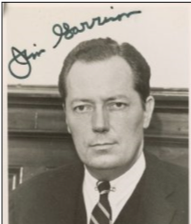 Jim Garrison, in On the Trail of the Assassins, commented dryly that, “As I read Markham’s testimony, it occurred to me that few prosecutors had ever found themselves with a witness at once so eager to serve their cause and simultaneously so destructive to it.” (Garrison, p. 195) Garrison may have been onto something here. What was causing this lady’s testimony to be so strangely bizarre and baffling?
Tippit researchers Joseph McBride, William Pulte, and Michael Brownlow have all hinted at a potential answer. At the time of the JFK assassination and J.D. Tippit’s death, Helen Markham’s son, Jimmy, was facing serious criminal charges in Dallas County. Markham, a single mother of very limited means, could do little in the way of protecting her troubled, at-risk boy. Then, suddenly, the Tippit incident occurred and Mrs. Markham was, in her words, “treated like a queen” by Dallas Police. It must have crossed Helen Markham’s mind that, if she helped the police and the Dallas authorities, her son might receive favorable treatment by the court. Worse, if she refused to help and did not identify Oswald as Tippit’s killer, it might be her son who paid the heavy, immediate price. (McBride, p. 479) But helping Dallas authorities, in this particular highest of profile cases, meant having to finger an innocent man, whether dead or not, for a crime he did not commit. Oswald was simply not the short, slightly heavy, bushy-haired cop-killer who disappeared behind Ballew’s Texaco.
So, it may have been Mrs. Markham’s solution to this conundrum to appear to be helping the authorities while she was actually rendering her testimony useless and therefore harmless to the defendant. Save son Jimmy, but also protect Lee, the young man who was in the Texas Theater as the fatal shots rang out at 10th & Patton.
Medical Photographer Jack Ray Tatum
 Witness Domingo Benavides, the closest passerby to the shooting of Officer Tippit, was unable to make a positive ID of the suspect, because Benavides had instinctively ducked down behind the dashboard of his pickup truck when he heard the shots. Benavides mostly saw the gunman as he was walking away, towards the corner of 10th & Patton, while tossing shell casings into bushes along the way. Benavides did report that the gunman had a haircut that was squared off in the back along the neckline of his Eisenhower jacket. Lee Oswald on that day clearly had hair that was tapered in back, not squared off. (WC, Vol 6, p. 451)
Benavides also noticed something else that would later prove significant—a red Ford Galaxie about six car lengths ahead of his pickup, going west, that pulled over same as Benavides when the shots occurred. (HSCA Vol 12, p. 40) The red Galaxie and its driver supposedly stopped and stayed at the scene for a time—and then left as a crowd quickly gathered. No one ever got the name of this potential important witness.
In September, 1976 the U.S. House of Representatives voted 280-65 to establish the Select Committee on Assassinations (HSCA), in order to investigate the assassinations of John F. Kennedy and Martin Luther King, Jr. This bold move was primarily caused by the first national airing in March of 1975 of the 8 mm film shot by Abraham Zapruder of the JFK assassination. Geraldo Rivera hosted the showing which took place on the ABC show Good Night America. When American citizens finally got to witness the shooting with their own eyes, their response was one of outrage, which in turn prompted the reopening of the investigation. The HSCA would not complete its work until late in 1978 and did not issue a final report and conclusion until the following year, 1979. The final conclusion of the HSCA was that President Kennedy had likely been assassinated as the result of a conspiracy.
A reopening of the JFK assassination necessarily meant the HSCA would also be taking a second look at the Tippit murder. The case against Lee Oswald in the murder of Officer Tippit had been a house of cards from the beginning and there were those in positions of power who apparently did not wish for any second inquiry of the murky, little-investigated events at 10th & Patton on the day of JFK’s assassination.
It was against this backdrop that a Dallas native, Jack Ray Tatum, stepped forward with the claim that he had been the driver behind the wheel of the mysterious red Ford Galaxie seen stopped near the intersection of 10th & Patton on 11/22/63.
Mr. Tatum would proceed to tell an amazing story—perhaps one even more unbelievable than that of the unfortunate Mrs. Markham. Yet unlike that of the much-maligned waitress, it has generally, and inexplicably, been accepted as fact for more than four decades. In a filmed interview with the PBS television show Frontline in 2003, Mr. Tatum re-created his alleged experience on that fateful day in Dallas, 1963.
While taking a detour through the neighborhood to circle back to a jewelry store on Jefferson Blvd. to buy his wife a gift, Tatum said he found himself driving north on Denver Street around 1 p.m. at which time he turned left to head west on 10th Street.
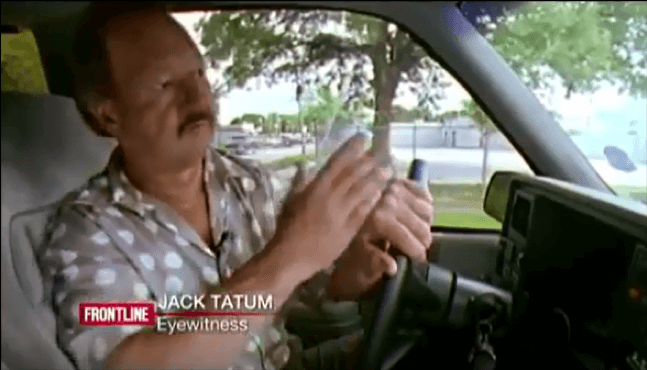 Tatum explained that after he made the turn and began driving west on 10th, he noticed an individual walking in his direction (walking east towards Tatum). A Dallas police car was just pulling over to the curb. As Tatum drove towards where the squad car was now parked he noticed the young man leaning over and talking to the officer. The man had both hands in the pockets of his light-colored tan jacket. Tatum continued on to the intersection of 10th & Patton. As he was about in the middle of that intersection he heard “three, maybe four shots.” Tatum continued through the intersection and then braked to a stop.
What Tatum describes next was seen by no other witnesses.
Tatum looked in his rearview mirror and saw the policeman laying in the street. The gunman, still on the passenger side of the squad car, walked to the rear of Tippit’s car, hesitated, came around the back of the car, then walked up along the driver’s side of the car … and shot Tippit one final time at close range. (McBride, p. 496)
The gunman, according to Tatum, then looked around, surveyed the situation, and started a slow run west in Tatum’s direction. Tatum put his car in gear, drove forward down 10th Street to avoid danger, and kept his eye on the gunman in the rearview mirror.
Tatum said he could see the gunman very clearly and that the corners of his mouth curled up, like in a smile, which was distinctive and made this individual stand out. Then, Tatum delivers his punch line, the big money words the PBS audience is waiting for:
“And I was within 10-15 feet of that individual and it was Lee Harvey Oswald.”
Now, to the casual viewer of this PBS documentary, Mr. Tatum has just laid to rest any and all the conspiracy theories surrounding the murder of J.D. Tippit—and has apparently put the final nail in the coffin of Lee Harvey Oswald. Tatum is so smooth in his delivery, so convincing, so sincere: 10-15 feet? How could he have not identified Oswald?
Frontline and PBS should be ashamed for having filmed this charade and then presenting it to the American public as fact. (The reader can see this interview at Youtube, under the title, “J. D. Tippit Murder Witness Jack Tatum”) Since the entire interview was shot from within Tatum’s vehicle, the viewer can’t see that, according to Tatum’s own description of events, the gunman was likely never closer than 100 feet of Mr. Tatum’s alleged position (in red). Here is the overhead satellite view of that intersection today, with the distance legend in the lower right corner (blue arrow points to 20 ft.):
 According to a study cited by the Innocence Project, after 25 feet face perception diminishes. At about 150 feet, accurate face identification for people with normal vision drops to zero.
 Could Jack Tatum, while watching a fleeing gunman in his rearview mirror from 100 feet or more away (and remember, Tatum said he drove forward again as the gunman approached), have been able to tell that the corners of the gunman’s mouth turned up? Positively ID him as Lee Harvey Oswald? A gunman in a rearview mirror who was ducking behind trees, bushes, Mr. Scoggins’ yellow cab, and all the while brandishing a pistol?
Was Jack Ray Tatum even there? Who says so besides Jack Ray Tatum? Tatum himself admitted that “When they were getting witnesses to go to the Warren Commission, I thought, they hadn’t missed me—no one had mentioned I was there.”
Tatum later claimed he didn’t want to get involved on 11/22/63, that they already had enough witnesses. (McBride, p. 498) And that Mrs. Markham—who Tatum said was there—(with her hands over her eyes) got a better look than he.
Oh, yes, Mrs. Markham. Tatum first said he simply drove away and left the scene of the Tippit slaying. Later he explained that he came back to help poor Mrs. Markham, eventually driving her to a police station to give her statement. A noble gesture to be sure. Only problem is, DPD records indicate that Mrs. Markham was taken to DPD headquarters by Office George Hammer, not Mr. Tatum.
Tatum’s assertion that “Oswald” came within 10-15 feet of him may be an exaggeration of colossal proportion. However, Tatum’s other claim that “Oswald” circled the squad car and then shot Tippit—basically point blank “execution style”—is as absurd as anything Mrs. Markham told the Warren Commission in 1964. Yes, the eyewitness testimony in general was both conflicting and contradictory. Yes, Benavides and Scoggins missed witnessing crucial pieces of the crime as they went ducking for cover. And we can only guess at what Mrs. Markham actually saw. But while the eyewitness testimony may have been difficult if not impossible to reconcile, the ear witness testimony remained extremely consistent.
Witness after witness described Tippit as being killed by a fusillade of shots. They all heard basically the same thing: Pow pow pow pow.
“They was fast,” remarked cabdriver Bill Scoggins, describing how the shots were fired extremely close together, in rapid succession.
“Pow pow, pow pow,” is how neighbor Doris Holan, whose second-floor apartment overlooked the scene, described the loud bangs to researcher Michael Brownlow.
“He shot him in the wink of your eye,” noted Mrs. Markham.
Domingo Benavides described hearing a loud boom followed quickly by two more fast booms.
“Bam bam – bam bam bam,” remarked Ted Calloway, likening the shot sequence to Morse code.
Yet Mr. Tatum insisted that “Oswald” fired 3-4 shots from the front passenger side, stopped, walked to the back of the patrol car, hesitated, then walked behind the squad car, turned, and walked up the driver’s side until he stood over Tippit and fired one last bullet up-close-and-personal.
Except, no one heard that. No one heard anything even remotely resembling that. Nobody heard shots—followed by a several second delay—followed by one final shot.
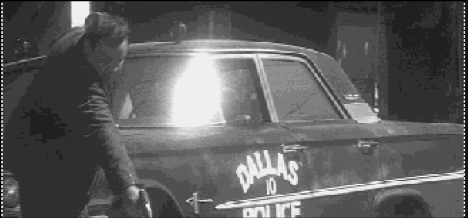 Yet today, if you watch a documentary, movie, or television show describing Tippit’s murder, Jack Tatum’s version of events is what you are almost sure to see. But it never happened that way, couldn’t have happened that way.
“That just didn’t happen,” Calloway told one researcher regarding Tatum’s scenario. “Boy, those shots are as clear in my ear today as the day it happened. Bam. Bam. Bam, bam, bam. Just like that.”
Problem is, the forensic evidence showed that one of the shots was likely fired from a steep downward angle, from above the officer, unlike the other three shots. The final shot was more accurate, more deadly, and apparently done from a much closer distance.
But the man in the light tan Eisenhower jacket didn’t have time to do what Mr. Tatum said he did. After the shots, he began almost immediately to walk in the direction of Bill Scoggins’ cab. That gunman never went around the car and stood over Tippit. Again, there was no time for that. And nobody heard that.
Someone else was there. Someone else who also shot Tippit but escaped before the man in the light tan Eisenhower jacket started dropping shells and walking towards Patton Street. Someone such as the man in the long coat seen by Mr. Wright. The man who looked down at Tippit in the street and then ran fast to a grey 1950 or 1951 coupe and sped away.
“Those are pistol shots!” exclaimed Mr. Calloway when the murder happened. With that the used car manager was on his feet and out the office door. “I could move,” he recalled, “and just as I got to the sidewalk—which is about thirty-feet away, I guess—I looked to my right and there’s Oswald jumping through the hedge.”
Calloway was asked, “If someone tried to convince you that there were four shots and a short pause and then another one fired, you wouldn’t believe that?” “No, I wouldn’t,” Calloway answered, repeating the cadence he recalled, “Bam–bam–bam, bam, bam.”
No time, no how, no way.
So what was accomplished by Jack Tatum’s strange, belated testimony before the HSCA?
Today, under analysis, his testimony has the quality of paper mache. Tatum saw things no one else saw and heard things no one else heard. And his identification of Oswald simply has little or no credibility from that distance. His alleged escorting of Markham is also dubious. It’s almost as if he was a salesman. The ruse, a highly pernicious one, has apparently succeeded—at least so far. Yet, in spite of all this—and because of late Frontline producer Mike Sullivan—his twist on critical events is continually presented as fact.
In the end, however, the HSCA still managed to “overturn” the 1964 pre-determined conclusion offered by the Warren Commission. The HSCA reported that President Kennedy was probably slain as the result of a conspiracy, and that there were likely at least two gunmen in Dealey Plaza—both in the Texas School Book Depository and behind the fence on the Grassy Knoll.
And so now at the end of this article, we have finally come full circle … back to Counsel David Bellin’s “Rosetta Stone” logic. For if President Kennedy was assassinated in downtown Dallas as a result of a conspiracy, then it follows that Officer Tippit was likely murdered in adjoining Oak Cliff in an attempt to further that same conspiracy. 10th and Patton was a setup, the disturbance at 10th was in all likelihood a ruse. The designated patsy sat in a darkened nearby movie theater as Officer Tippit, drawn into a trap, was shot down on a quiet residential street in a Dallas suburb. All went as planned—until the scheme to kill the patsy in the movie theater fell through. That’s when the conspirators, suddenly desperate, went into all-out damage control mode and brought in Mafia bag man Jack Ruby to silence the pasty once-and-for all—live and in front of a national television audience.
Messy, very messy.
And in the words of Tippit author Joseph McBride, America then took a turn and walked into the nightmare. Along the way, they turned a former Marine into a patsy.
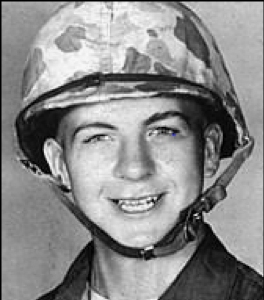

In 1963, PFC Eugene Barry Dinkin, Rose Cheramie, Richard Case Nagell, Joseph Milteer, U. S. Air Force Sergeant David Christensen, and some others had some kind of advance knowledge that a plot about President John F. Kennedy’s assassination was in the works. In this part 3 of my series entitled “The Saga of Eugene B. Dinkin”, I will show examples of some of the “psychological sets” that Dinkin retrieved and presented to the House Select Committee on Assassinations in 1977. Also, I will present info he found about an Air Force Captain named T.D. Smith III.
Here is a recap of some basic information about Dinkin’s attempt to alert the world to the plot that was in place to assassinate President Kennedy.
Regular Army Private First Class Dinkin was serving in Mannsweiler, Germany in the 529th Ordinance Group. He held a secret security clearance for his job in the crypto section of his unit. Prior to enlisting, he had attended the Champaign/Urbana campus of the University of Illinois. He and his family had lived in Chicago. His studies at the university included psychology. His duties would have included deciphering cable traffic from the European Commands, NATO, and so forth.
In the summer of 1963, Dinkin noticed material in the Army newspaper, Stars and Stripes, and other print publications that was negative toward Kennedy and his policies, implying that he was a weak president in dealing with the Russians. The examples that he found became more negative: the suggestion being that if Kennedy were removed as president it would be a good thing.
By October, Dinkin had found enough information—some of it subliminal—that he was convinced that a plot was in the works. One that was driven by some high-ranking members of the military, some right-wing economic groups, and with support by some national media outlets. (Dick Russell, The Man Who Knew too Much, p. 349)
He did not tell his superior officers about this information—given that he believed that the military was involved. He did tell quite a few Army friends and some others that I noted in my original article. This information probably got back to Army authorities, because Dinkin was transferred to the Army Depot in Metz, France, where his duties did not require a secret clearance.
Dinkin’s studies led him to conclude that the plot would happen around November 28, 1963 and that the assassination would be blamed on “a Communist or a Negro”. He then sent a registered letter to Attorney General Robert Kennedy. When he got no reply, he decided to resort to other options. (Russell, pp. 349-50)
In late October, 1963, Dinkin gathered up the material that he found in psychological sets—which Dinkin would be sensitive to because of his college studies. Psychological sets are a batch of information that is used to induce a particular state of mind in an individual being exposed to the mixture. The sets can be a series of pictures, events, written statements, or a combination of the aforementioned examples used by advertisers and others to implant ideas into the mind of the people that have been exposed to them. In advertising, of course, the goal would be to get you, the target audience, to be interested enough in the product or service that you would buy it.
In a letter written by his mother to Robert Kennedy on December 29, 1963, she said that DInkin had figured out the outlines of a plot against JFK through what she called semantics studies of various journals, especially the Stars and Stripes military magazine. He predicted the date of the murder to be November 28th. It should be noted that in his civil suit of 1975, DInkin wrote to CIA Director Bill Colby in July of that year. He requested all information that the Agency used for “subliminal and illusory distortion techniques in visual communications. Include also any psychological studies regarding the propaganda effectiveness of such techniques.” That letter was not declassified until 1998, the last year of the ARRB’s existence.
Dinkin took his material to Luxembourg, where he visited the American Embassy. There, he tried to see Ambassador William R. Rivkin, but Rivkin was out of the embassy at the time. The Charge d’Affaires, a Mr. Cunningham, refused to read or keep a copy of the data that Dinkin had with him. (Russell, p. 350) Dinkin did share some of the material with a U.S. Marine guard at the embassy.
Disappointed, Dinkin returned to his unit. Shortly after his return, he learned that he had been scheduled to take a psych exam. This caused him to believe that his superiors had learned about his visit to the American Embassy in Luxembourg. (Since CIA Stations in Europe are located at or near the embassies, it is likely that the CIA, also knew of his attempt to pass on his assassination material.)
Shortly after his return to his unit, Dinkin decided to try one more time to get his info to someone who could warn President Kennedy. He went AWOL to Switzerland to find some agency that would help. He visited a number of offices including the newspaper, the Geneva Diplomat, and Time/Life Europe. There, a stringer, Alex des Fontaines, and another female stringer took down the details of Dinkin’s story. (Letter from Richard Helms to the Warren Commission, of May 19, 1964.) As Noel Twyman has shown, the Helms letter to the Commission was not declassified until 1976. And at that time, Dinkin’s name was redacted. It was not released in full until 1992 by the Assassination Records Review Board (ARRB). (Twyman, Kennedy Assassination Chronicles, Vol. 4, No. 1)
There was another source which was used by Helms before he wrote his letter to the Commission. This was a teletype that was not declassified until 1995 by the ARRB. It was a report by John Whitten, who was the original CIA liaison to the Commission. In that source it was revealed that, about three weeks in advance, Dinkin had predicted the assassination of JFK would take place in Texas. That particular piece of information appears to be missing from the Helms letter. (See Twyman)
Dinkin also went to Germany, but could not find anyone to pass his info on to the White House. Even the editor of Overseas Weekly would not take his claim seriously. The editor told him to return to his base in order to avoid an AWOL charge.
When he returned to his unit at Metz, France, he was arrested and delivered to the stockade by the Army. This was on November 13, nine days before the assassination. He was then placed in a mental hospital in a closed ward. After the assassination, and while Dinkin was in custody, he was visited by a man who identified himself as a Defense Department official. This man questioned Dinkin about how he knew about the assassination. The official also asked Dinkin for his research material, saying that he would give Dinkin a receipt. Dinkin told him where the material was stored at his barracks. Later when he was able to go to the barracks, he discovered the data was gone and the official did not return to give him a receipt. Had the FBI and Secret Service wanted to identify the DOD official, they could have easily done so. Since Dinkin was in the stockade, anyone visiting him would have had to provide identification and then sign in. The FBI and Secret Service, working for the Warren Commission, did not interview the soldiers, embassy officials and others that Dinkin had shared his information with. The Paris Legation of the FBI inadvertently acknowledged the fact that Dinkin had told his story to several entities. Not long after his psych exam, Dinkin was ordered to report to Walter Reed Army Hospital in the Washington, D.C., area.
Here I will describe some of the examples of “psychological sets” that Dinkin found in various print media sources.
One psych-set demo Dinkin found that had an implied threat to the president was in the July 2, 1963, edition of Look Magazine. The title of an article inside was, “Why Kennedy’s in Trouble”. The title was inside a black border, but the print title was colored blood red.
The article inside the magazine referred to President Kennedy as a new Adam. The analogy would be that Kennedy, like Adam being kicked out of Eden, would be kicked out of his place, the White House. The inside title, “Why There’s Trouble in the New Frontier” is partly colored blood red.
A second example Dinkin deemed significant was from July 5, 1963 edition of Life Magazine. In it, there is a photo of President Kennedy riding in a motorcade in Germany. JFK is standing in the limousine looking back and to the side. There is a dark spot/defect on the back of his head that looks like a chunk of his scalp is missing.
Inside this edition there are pictures of the president’s visit to Ireland. In one of the photos, there is a gravestone with the name John Kennedy on it.
Another article was in the October 15th edition of Stars and Stripes, titled, “Prospective Bosses Fire Jack with Enthusiasm.” The men in both articles resemble Lee Oswald, they are both named pierce/peirce, which can mean putting a hole in something. President Kennedy was often referred to as “Jack.”
On the management staff of Life Magazine, during the time that Life bought the Zapruder film and kept it from the public for more than 10 years, was C. D. Jackson. Jackson was President Eisenhower’s psychological warfare expert. Jackson would have known executive staff in all of the print media where these psychological sets were found by Dinkin. If Jackson was instrumental in the handling of the purchase Zapruder film and subsequent unusual happenings to the film at that very powerful magazine. For instance, their refusal to depict the rearward head moment of the president as he was struck at Z frame 313. And their explanation of a frontal neck wound in Kennedy by saying he was turned around looking at the Texas School Book Depository when that bullet struck. As they must have known, Kennedy is never rotated like that in the film.
While her son Eugene was in the psych ward of Walter Reed Army Hospital, Mrs. Dinkin wrote to Robert Kennedy at the Justice Department. In the letter, she noted that Eugene had asked her to write to Robert Kennedy. Mrs. Dinkin said that Eugene knows through his semantic studies how the assassination was planned and that if you can send someone to talk to him some very important information may come of this. Her letter did not reach Robert Kennedy, but was intercepted by Assistant Attorney General Herbert “Jack” Miller. At this time, Jack Miller had been appointed liaison to the Warren Commission by Deputy Assistant General Nicholas Katzenbach. Miller coordinated the investigation in Dallas into the murder of the President.
Ironically, if the FBI had conducted an honest investigation, Miller as liaison would have been the perfect person for Mrs. Dinkin to have contacted. However, with Miller in control, the FBI hid much important information, did not interview witnesses that could have substantiated Dinkin’s foreknowledge of the plot, and kept many of the films and photos that were taken during the shooting in Dealey Plaza from the public.
Miller, in his answer to Mrs. Dinkin’s letter requesting that someone from the Justice Department go to Walter Reed Hospital to talk to Eugene, lied to her by saying that the Justice Department could not contact Eugene, because he was in the military. President Johnson’s Executive Order creating the Warren Commission gave the FBI, the investigative arm of the Justice Department, the power to find and collect all information about the assassination from any and all agencies.
(In 1967, as James DiEugenio details in Destiny Betrayed, Second Edition, during New Orleans District Attorney Jim Garrison’s re-investigation of the murder of the President, Miller attempted to sandbag Garrison’s probe.)
During the House Select Committee on Assassinations investigation into the murders of President Kennedy and Dr. Martin Luther King, Eugene contacted Jacqueline Hess, the Asst. Director of the committee. He offered to help the investigation by providing information that he had found. He was not called as a witness and his offer of information was rebuffed by a form letter from HSCA Director Robert Blakey.
There are significant differences between Dinkin’s military record and the information that the FBI supplied to the Warren Commission. I will cover that and some other series.
I hope eventually that Mr. Dinkin gets the posthumous recognition that he deserves.

I’ll say this for Fred Litwin: He knows where to go to advance his cause.
On Steve Paikan’s Ontario TV show The Agenda, Litwin stated that nothing in the declassified files of the ARRB indicated anything about a conspiracy in the JFK case. This is simply and utterly false. As I wrote about Litwin’s essay on Jim Garrison, this statement proves one of two things: 1.) He did not read any of the declassified files, or 2.) He did read them and is deliberately misrepresenting them. In my review I proved that such was the case with several specific examples. This exposure reduces Litwin to the level of Leslie Nielson as Lt. Frank Drebin in The Naked Gun: proclaiming to a gatheringcrowd there was nothing to see as, behind him, bombs explode a fireworks factory. But this is the kind of poseur that Litwin is, except he is not nearly as funny as Nielson.
In addition to his interview, Litwin has also done an article for an online journal. That online journal is something called Quillette, which I never knew existed until someone pointed out the Litwin article. I would have never found this journal on my own, and I would not have been missing anything.
Quillette is a libertarian inspired anti-PC, anti-liberal journal founded by one Claire Lehmann. Journalist Bari Weiss grouped Lehmann as a member of the Intellectual Dark Web, along with the likes of Jordan Peterson and Ben Shapiro. (See this article for info on Peterson) Shapiro is the snarky right-winger who went on MSNBC to defend gun rights by handing the host, Piers Morgan, a copy of the constitution. Unfortunately Morgan, a Brit, did not reply with, “Ben, do you also believe that African Americans should count as 3/5 of a person for census purposes? Because that is what this document says. Should they, and also women, be allowed to vote? Because under this document they were not.” As Alice Dreger wrote, opinions are not scholarship, and that is what the members of this group generally offer. (“Why I escaped the ‘Intellectual Dark Web’’’, Chronicle of Higher Education, 5/11/2018) She could have added that snark does not denote intelligence. As with the Shapiro exchange, it’s often just an excuse for being a smartass. Quillette published the so-called “Google memo” by James Damore, in which he accused that company of practicing reverse discrimination which somehow hurt Asians and whites and males. The right loves this kind of thing since it is a way to repudiate the affirmative action policies originated by President Kennedy. Except, by reading some of their articles concerning JFK, I would be willing to wager than no one at Quillette even knows that JFK started that policy. The Intellectual Dark Web is really the cover layer for the rise of the Trumpian alt-right. If the reader understands all that, then everything that follows is as natural as water running over a rock.
On September 27, 2018, Quillette published an article by Litwin based on his book I Was a Teenage JFK Conspiracy Freak. That article tried to make the case that somehow the KGB was involved in fostering JFK conspiracy thinking in the USA by planting disinformation stories. Litwin, not the most original researcher, largely based his piece on the work of Max Holland. He labels Holland an historian—which he is not. Two of the three pieces that Holland says are KGB produced disinformation are not disinfo at all. I dealt with them in my critique of Holland’s original article that The Daily Beast was dumb enough to print. As I noted there, the late Mark Lane did not get secret donations from the KGB. And he proved this in his book, The Last Word. (pp. 92-96) As I showed in my critique of Litwin’s essay on Jim Garrison, the last thing in the world that Permindex was was a creation of the KGB. And Shaw’s association with it was something he himself acknowledged. I demonstrated this, not just in my previous essay on Litwin, but also in my lengthy exposure of Holland.
The third piece of alleged KGB mischief that Litwin brings up is the famous “Dear Mr. Hunt letter”. In book form this was first produced in Henry Hurt’s volume Reasonable Doubt. It is a note dated November 8, 1963, and addressed to a Mr. Hunt. It is written in cursive and reads, “I would like information regarding my position. I am only asking for information. I am asking that we discuss the matter fully before any steps are taken by me or anyone else. Thank you.” Oswald’s signature follows. (See HSCA Vol. 4, p. 337) Again, Litwin says this was part of a Russian intelligence operation codenamed Arlington.
One of the problems with that pronouncement is that the Dallas Morning News ran a story saying they had three handwriting analysts look at the note: Mary Harrison, Allan R. Keon and Mary Duncan. They compared it to samples of Oswald’s writing. All three concluded it was genuine. (NY Times, April 4, 1977) The trio belonged to a professional organization called the Independent Association of Questioned Document Examiners. Harrison said she would be comfortable going into court and presenting her analysis. Litwin gets around this problem by saying that the NY Times wrote of the note’s possible authenticity. As the reader can see, that is not what the Times reported. The HSCA did not make a conclusive judgment about the note because it was a photocopy. (Henry Hurt, Reasonable Doubt, p. 236) On this point, Ms. Harrison stated that reproductions are often presented in court.
Most of the Litwin/Holland material was produced by KGB defector Vasili Mitrokhin. Making the Mitrokhin case look even worse on this matter is the work of researcher Greg Doudna. Doudna did his best to track down the evidence Mitrokhin had purloined from the KGB showing the note was a forgery. In Mitrokhin’s book, The Sword and the Shield, there is a footnote referencing some original papers at a British university. (Mitrokhin and Christopher Andrew, pp. 228-29) Greg got in contact with the curator at Churchill Archives Centre, Churchill College, and part of the University of Cambridge. To cut to the chase, there is no evidence for this forgery in the Mitrokin collection. All there exists to back up that footnote is a typed draft of the book. This is the kind of scholarship Litwin offered and Quillette accepted. (E-mail communication with Doudna, 11/28/2018)
Mitrokhin was a former KGB archivist who became a defector. Apparently, neither Litwin, nor anyone at Quillette, ever read Amy Knight’s coruscating review of his role in the wave of alleged Soviet defectors finding their home with Anglo-American publishers and newspapers owned by the likes of Rupert Murdoch. As she points out, when first drafts by these defecting authors were not sensational enough, they were spiced up. And presto! They now included information like, well, how about Niels Bohr, Enrico Fermi and Robert Oppenheimer were giving atomic secrets to the USSR? And Oppenheimer recruited Klaus Fuchs—who actually was a spy—to Los Alamos, the location of the Manhattan Project. Knight, a real scholar in the field of Soviet studies, had some fun with that one. (“The Selling of the KGB”, Wilson Quarterly, Winter 2000) She had more fun with the source for both Holland and Litwin. The idea that an archivist did not have access to a copier for 12 years and therefore had to scribble down notes from documents, instead of copying the documents themselves, this simply strains credulity. But if one sees this new field of exchange as a marketable continuation of the Cold War—with impoverished KGB agents finding a way to make mucho bucks from an American/British Establishment that has a lot invested in the justification of that Cold War—then it makes sense. Somehow, the anti-PC Quillette fails to acknowledge that angle. Which indicates what their political correctness is all about.
In fact, on the matter of the JFK case, Quillette is Establishment to the hilt—and beyond. On the 55th anniversary of the murder of President Kennedy, they gave Litwin an encore. They ran an echo to his book. One of the editors, Jamie Palmer, penned a piece called “My Misspent years of Conspiracism”. All I can say to Mr. Palmer is that if this was an audition for the big-time MSM, he should be getting a few calls from the Fox network in the near future.
In Litwin’s book, he says that what originally convinced him there was a conspiracy in the JFK case was ABC TV’s public showing of the Zapruder film in 1975. In Palmer’s Bildungsroman, it was his viewing of the film JFK. But even in describing that experience the reader can see why, as with Litwin, Palmer ended up being a Warren Commission shill. He writes that somehow the Mr. X character in that film turned out not to be credible. That character is based on Fletcher Prouty, and virtually everything he related from his own experience at the meeting in Washington with the Jim Garrison character has turned out to be accurate. That Mr. X/Garrison conversation on a park bench concerning Vietnam has revolutionized our thinking about that entire conflict. It inspired several books that have advanced the film’s thesis even further. Namely, that President Kennedy was not going to escalate the Vietnam quagmire any further, that no combat troops would be sent into theater, and the advisors America had there were going to be recalled. From what I have seen of Quillette, they would not print scholars like David Kaiser or Gordon Goldstein or James Blight. That’s not what they are about. Litwin is.
Palmer is unintentionally funny when he gets to the turning point of his personal saga. He says that his original beliefs about the case were reversed when he watched the 2003 program on the assassination that was produced by Peter Jennings at ABC and broadcast in England by the BBC. This site carries an entire section consisting of 16 critical articles demonstrating why Jennings’ show was a three-ring circus. From Jennings’ hiring of Gus Russo as his main consultant, to the “computer simulation” of the Magic Bullet, the program was a set up to revivify the corpse of the Warren Report. Our articles expose that agenda in gruesome detail. Somehow, Palmer swallowed it whole. In fact, he calls this program “a masterpiece of methodical argument”.
Palmer goes on to describe certain parts of that “methodical argument” for an entire section of his long essay. What is incredible about his recitation is that, with one exception, it is all recycled Warren Commission drivel used to convict Oswald in 1964. Are we to believe that in over ten years of his belief that Oswald was innocent Palmer never read any of this material? Not even in books critical of the Commission? For he now says that he sees that Stone was remiss by not including the shooting attempt at General Edwin Walker in his film. Palmer writes, “Oswald had tried to assassinate someone else in April 1963.” The case against Oswald in the Walker shooting has been well examined by, among others, Gerald McKnight in his fine book Breach of Trust. That book is 13 years old, so if Palmer wanted to check up on that incident, he could have.
First off, the Walker shooting was investigated by the Dallas Police for over seven months and Oswald was never a suspect. Why? For one, the best witness was Kirk Coleman. He ran out of his neighboring house right after hearing the shot. He saw two men escaping, in two separate cars. Further, when he was shown pictures of Oswald by the FBI, he failed to identify him as either man. (McKnight, p. 57) But beyond that, a cursory look at the Warren Report reveals that Oswald did not drive, or own a car. Another witness, Robert Surrey, told the police that two nights before the shooting he had seen two men casing Walker’s house. They left in a Ford. Again, he said that neither man looked like Oswald. (McKnight, p. 58) Tough to go into court when the two eyewitnesses deny the defendant was there.
But it’s worse than that. The bullet recovered from the scene of the crime, which missed Walker from about 25 feet away, was not the correct ammunition for the alleged Oswald rifle. In newspaper and police accounts it was reported as a 30.06 projectile, not 6.5 mm. Plus, it was steel jacketed, not copper jacketed as was the ammunition used for the Oswald rifle, and therefore was a different hue. (James DiEugenio, The JFK Assassination: The Evidence Today, p. 100) The reason the FBI and the Warren Commission had to pin the Walker shooting on Oswald was because there was next to nothing in his past to connect him to such an outburst of murderous violence as occurred in Dealey Plaza, and later, with the killing of Patrolman Tippit. In the Marines, Oswald accidentally injured himself when a derringer went off as he opened a locker. He then had a dispute with an officer and threw a drink in his face. (James DiEugenio, Destiny Betrayed, second edition, p. 130) What makes that sum total even weaker is that Oswald liked and admired President Kennedy. (Dick Russell, On the Trail of the JFK Assassins, p. 206)
The one exception to his warmed over Warren Commission refuse is contained in Palmer’s final and thunderous J’accuse against Stone. The author concludes his conversion story by praising the ABC-produced Dale Myers computer simulation of the Magic Bullet done for the Jennings program. That simulation was supposed to show the Warren Commission was correct in saying that one bullet went through both John Kennedy and Governor John Connally, making seven wounds, smashing two bones, and emerging from its journey in pretty much unscathed condition, missing only 3 grains of its original mass. There have been several devastating critiques of this simulation. All Palmer had to do was search the web and he would have found them. In our section on this site, we feature three full-scale dismantlings of Myers and his cartoon. The Single Bullet Theory, the sine qua non of the Warren Report, simply did not happen. And when one has to cut as many corners as Myers does in order to create a Rube Goldberg contraption to say it did, then such is the proof of the plot. That Mr. Palmer did not consult any of these critiques says a lot about his personal bias and also his honesty with his readers. He actually writes that he found Myers’ simulation “too convincing to dismiss”.
Robert Harris showed how easy it was to dismiss. He demonstrated that Myers deliberately misplaced the positions of Kennedy and Connally in the car for ABC. Harris proved this was the case by using actual images from the Zapruder film to demonstrate that Myers had jammed the two victims much closer together than they were, thereby foreshortening the firing trajectory. Myers also changed the position of the two men and altered the image of the car within the same traveling shot. He did this in order to conceal the fact that when placed in their proper perspective, the Magic Bullet comes in way too low to strike Connally in the right rear shoulder. In spite of all this, Palmer concludes this section of his essay by saying that if this same technique would have been used to demonstrate a frontal shot, he would have considered it “decisive and final”. I would like to inform Quillette that by using these techniques, one could simulate a sniper hitting Kennedy and Connally from the top of the Hertz sign in Dealey Plaza. But for Palmer and Quillette, in keeping with Mr. Litwin’s approach, it’s not the accuracy of the presentation that matters, it’s the result. Or to use an old realpolitik adage: the ends justify the means.
But Palmer has to maintain his whole “personal saga” pretense. So he now shifts gears into the New Orleans aspect of Stone’s film and also to Garrison’s book, On the Trail of the Assassins. But, like Litwin, Palmer refuses to acknowledge an important aspect of the overall calculus: the Assassination Records Review Board (ARRB). Litwin simply misrepresents the discoveries of that body. Palmer simply ignores them. As I noted in my review of Litwin, this tactic is convenient for Warren Report shills since so much of what Garrison was talking about back in 1967 has turned out to be accurate. In fact, because Garrison was correct on much of what he said, the FBI and CIA had to cover up the facts, and the CIA had to launch subversive operations against him.
Part of the subversion was to launch infiltrators into Garrison’s camp. As Garrison describes in his book, one of them was a man he called Bill Boxley, his real name being William Wood. In Stone’s film, he and co-screenwriter Zach Sklar named him Bill Broussard. Palmer actually calls the character, “a composite of various Garrison staffers” and “is allotted the role of the villain in Stone’s film”. Wrong again. From talking with co-screenwriter Zach Sklar, Broussard was based upon Boxley. And if anything, Stone and Sklar underplayed the damage Boxley did to Garrison. This author spent several pages dealing with the havoc the man unleashed, and also the investigative files he stole—some of which were never recovered. (DiEugenio, Destiny Betrayed, pp. 278-85) If you can believe it, Palmer actually tries to make the guy some kind of hero. What is even more bizarre is that Palmer also relies upon Tom Bethell, the man who was supposed to be in charge of Garrison’s archive. On the eve of the Shaw trial, Bethell turned over the DA’s trial brief to Shaw’s defense. Through research into the Garrison files declassified by the ARRB, Peter Vea discovered that, unlike what Bethell tried to imply years later, he did not admit this to Garrison. Lou Ivon, Garrison’s assistant, conducted an investigation and found out Bethell was the culprit. According to Peter’s work, Bethell broke down and wept upon discovery. Before Garrison could decide what to do with his case, he fled to Dallas. As stated to this author in a conversation he had with the late Mary Ferrell’s estranged son, for whatever reason, Bethell ended up at her doorstep. With touchstones like this, you can do a lot to downgrade Jim Garrison.
And Palmer cannot let go of Litwin’s false idea that somehow Garrison’s witness Perry Russo was drugged and fed leading questions to get him to identify Shaw as Bertrand. In my review of Litwin I showed this was not the case. It was a trick set up by Shaw’s lawyers with the aid of compromised journalist James Phelan. They rearranged the two sodium pentothal (truth serum) sessions to make it appear that this is what occurred. When read in their true order no such thing happens. Russo introduced the character of Bertrand on his own without being coached. The two best exposures of this charade are by Lisa Pease (Probe Magazine, Vol. 6 No. 5, p. 26), and Joe Biles in his book on Garrison entitled In History’s Shadow (pp. 43-47). Both have been available for over 15 years.
But Palmer goes beyond Litwin. He says that Perry Russo flunked his polygraph test according to the administrator. The administrator he is referring to is one Ed O’Donnell. O’Donnell was a policeman who Garrison had tried to draw up on charges for police brutality against African American suspects. Both he and Ray Jacob, another technician used by the DA, were intent on unsettling Russo in order to get the wrong indications on the test. (Joan Mellen, A Farewell to Justice, p. 147) When Russo complained to Garrison about these tactics, Garrison called O’Donnell into his office. He asked him if he had a tape of Russo denying that Shaw/Bertrand was at a gathering at Ferrie’s apartment. The policeman said no he did not. Yet he had told Russo he did. Garrison terminated his services upon hearing this. (Clay Shaw trial testimony of 2/26/69) The proof of who O’Donnell really was is that he ended up being an advisor to Shaw’s defense team at the trial. (Mellen, p. 309)
If you continually and falsely smear the DA’s investigation, and then assume that Oswald shot Kennedy—which we know today did not and could not have happened—then you can characterize Garrison’s inquiry as “inconsequential”. But you would have to add that the Richard Schweiker/Gary Hart investigation for the Church Committee was also meaningless, and the Richard Sprague/Robert Tanenbaum phase of the House Select Committee on Assassinations (HSCA) was also adrift. The problem with saying that is you are now dismissing two fine senators and two excellent prosecutors. Between them, Sprague and Tanenbaum prosecuted about two hundred homicide cases. The combined record was one loss in well over twenty years. Sprague was the lawyer who prosecuted the famous Jock Yablonski murder conspiracy case and convicted corrupt labor leader Tony Boyle. (DiEugenio, Destiny Betrayed, p. 326) According to Tanenbaum, when he was privately briefed on the Church Committee inquiry by Schweiker, the senator told him that, in his view, the CIA had killed Kennedy. He then handed him a research file compiled by his chief investigator Gaeton Fonzi. (Probe Magazine, Vol. 3 No. 5, p. 24) Need I add that this was the same conclusion that Garrison had come to a decade earlier? But Dale Myers and ABC have magically made this information “inconsequential”. And with a stroke of his pen, or keyboard, Palmer has made Schweiker, Hart, Sprague, Tanenbaum and Fonzi all disappear. In fact, from his perspective, they never existed.
Without that backdrop, and without the relevant discoveries of the ARRB about New Orleans, then you may as well be writing about Jim Garrison from the viewpoint of some MSM hack journalist in 1968. For instance, like Litwin, Palmer wants to discount the fact that we can now prove that the mysterious Clay Bertrand, who called Dean Andrews, was really Clay Shaw. (DiEugenio, Destiny Betrayed, pp. 385-86) He fails to mention that we know today that it was Shaw and his friend David Ferrie who were escorting Oswald around the villages of Clinton and Jackson 100 miles north of New Orleans in the late summer of 1963. They were trying to register Oswald to vote in a parish far away from where he lived so he could get a job at a mental hospital. (Bill Davy, Let Justice be Done, pp. 101-17) Shaw lied about all these matters: that he knew Ferrie, or Oswald, that he used the Bertrand alias, and that he was in Clinton-Jackson with those two men that summer. Shaw also knew Guy Banister. (Davy, pp. 93-94) Oswald spent many days of that fateful summer of 1963 in Banister’s office preparing his Fair Play for Cuba Committee flyers and pamphlets, with Banister’s address on the early copies. (Davy, pp. 37-42)
Somehow, Palmer does not understand that it was these activities in New Orleans that summer that were injected into the media within hours of President Kennedy’s murder and did much to convict Oswald in the public mind as the sociopathic communist who killed the president for ideological reasons. It thus makes sense that Shaw would call his acquaintance Andrews to go to Dallas to defend Oswald—not knowing Oswald was going to be killed within 48 hours of his apprehension. Shaw would know that Andrews could be compromised, or be used as an incompetent lawyer.
This is where, as they say, the plot thickens, and again, Palmer leaves it out. Through the ARRB, we know today that Oswald was not a sociopathic communist. He was very likely working through Banister as a CIA agent provocateur. The CIA had set up an anti-FPCC campaign under the tutelage of David Phillips, who was one of the men running that operation. (Davy, p. 286) Further, a man fitting the description of Phillips was in Banister’s office in 1961 trying to arrange a citywide telethon for the Cuban exile cause. (Davy, pp. 21-24) Phillips’ was also seen in film made of one of the nearby New Orleans CIA training camps, a film which the HSCA temporarily had in their possession. Along with Oswald and Banister, witnesses also identified him as being in the film. (Davy, pp. 30-31)
With this background now filled in a bit, Palmer may want to ask himself if it explains the curious provenance of Oswald’s pamphlet, “The Crime Against Cuba” by Corliss Lamont. Oswald stamped it with 544 Camp Street, Banister’s address. Oswald’s version of the pamphlet was printed in 1961. It had gone through at least four more printings by the time Oswald was leafleting with it in 1963. Yet his was from the first edition. The CIA purchased 45 copies of the original edition in 1961. Is this how Oswald got the outdated version, perhaps through Phillips who was running the subversive program against the FPCC? To make it all a bit more curious, Oswald wrote about his altercation with the Cuban exiles, which got him arrested and the pamphlet confiscated, before it happened. (Davy, p. 38)
As the reader can see, these are the provocative questions that Oswald’s activities in New Orleans pose when they are presented with the full information we have today. Much of it was available at the time of the Jennings special. Mr. Jennings was not going to touch it. We explain why in our special section reviewing that very poor and unethical documentary. In a nutshell, in 1984, ABC Nightly News did a report on the exposure of a CIA front company in Hawaii and the Agency’s involvement in a possible murder plot. It was a fascinating two-part installment. CIA Director William Casey was very upset by that reporting. So he arranged to have some of his friends and colleagues at Capital Cities buy the network. Jennings, the host of the program, got the message. After Casey and Cap Cities bought the network, Jennings, who had originally stood by the story, now said he had no problem with the CIA’s denial of it.
Palmer closes his essay with a reference to Litwin’s book, saying that somehow the technical panels set up by the HSCA on things like forensic pathology, photographic evidence and the rifle tests sealed the deal against Oswald. By now, one really wonders just what Palmer was doing in those ten years he doubted the Warren Commission. He certainly was not reading the journals on the subject. Because if he had been, he would have known that people like Dr. Gary Aguilar, Dr. David Mantik and this author completely took apart these very flawed tests made by the HSCA. And, in fact, the chair of the HSCA, Robert Blakey, also took one of them back, the one he relied upon as the lynchpin of his case against Oswald, namely the Comparative Bullet Lead Analysis (CBLT). He has now termed it junk science. (For a full scale, in-depth analysis, see The Assassinations, edited by James DiEugenio and Lisa Pease, pp. 69-85; pp. 250-91) Those 58 pages simply devastate the so-called findings that Litwin, in four pages, trumpets. And one will find evidence in those pages indicating that the HSCA simply and knowingly misrepresented some of their forensic findings.
At the end of Palmer’s article, he sourced a previous piece in Quillette from 2017. This was from one Craig Colgan. Colgan fits right in with Quillette’s agenda. He once wrote an article about the National Museum of African American History and Culture and complained that although there was an exhibit for Anita Hill there was none for Clarence Thomas. Anita Hill was the first woman who actually brought the issue of sexual harassment into national consciousness. The fact that she was an African American testifying against the Establishment-backed Thomas made what she did even more courageous. (See this article)
The title of Colgan’s November 25, 2017 piece was “Are the JFK Conspiracies Slowly Dying?” He begins his article with a reference to Dylan Avery and his film on 9-11 called Loose Change. He then says that since Avery has backed away from some of his more extreme statements, perhaps those who attack the Warren Report should also. Toward the end of the piece, he says he would allow a kind of Robert-Blakey-inspired Oswald-did-it-with-some help concept. And that is what the JFK critical community should be aiming for.
I don’t know very much about the 9-11 controversy. But I do know that the official investigating committee issued a report without an accompanying set of volumes of evidence. The Warren Commission issued an over-800-page report with 26 volumes of testimony and evidence. The incredible thing about the early critics is this: some of them actually read those volumes. They came to a clear conclusion: the evidence in the volumes did not support the tenets of the report. The late Maggie Field wrote an unpublished book in which she reproduced pages from the report”s conclusions, then juxtaposed to them extracts from the supporting volumes of evidence that directly contradicted them. One could similarly refer to Sylvia Meagher’s classic study Accessories After the Fact. Unlike with 9-11, then, in the case of President Kennedy’s murder, there is nothing to retreat from. In fact, as tens of thousands of declassified pages have later been released, Field’s book has not just been ratified; it has been shown to be too mild, for we know today certain agencies were concealing evidence that would have indicated how parts of the plot and, even moreso, the cover-up, worked. (For example, see section III of this essay and the discoveries about David Phillips and New Orleans.)
At this point, one must accentuate the fact that even though Quillette is known as a scientific and technically oriented journal, that is what is completely missing from any of its articles on the JFK case. For instance, Colgan mentions a conversation he had with Gary Aguilar about his critique—co-written with Cyril Wecht—of the PBS special Cold Case JFK which aired at the 50th anniversary of the JFK murder. But he does not devote a single sentence to the total demolition of that series that Aguilar and Wecht performed—in a peer review journal on ballistics! And he does not link to the two-part review. Nor does he note that, although Gary offered to pay for both their flight and hotel accommodations, the father and son team who were featured on that program refused to debate him in public.
Colgan also notes the decline in the public’s belief that there was a plot behind Kennedy’s murder. This is accurate. At the fiftieth anniversary of Kennedy’s death, Hart Associates did a poll for Larry Sabato’s book, the Kennedy Half Century. It statedthat 75% of the public did not believe the Commission’s lone gunman verdict. This was down from the over 90% during the time that Stone’s film JFK premiered. (Sabato, p. 416) The reason for this is simple to discern. Due to Stone’s film, for about one year—from 1991-92—there was actually an open discussion in the media about Kennedy’s murder. And there were actually programs and front-page stories in magazines that addressed it in an even-handed way. The Power Elite was quite upset by that hubbub. They did three things to counter it. Random House, through editor Bob Loomis and publisher Harold Evans, decided to recruit Gerald Posner and give his book one of the most massive publicity barrages in recent publishing history. We know this from the lawsuit the late Roger Feinman launched against Random House concerning that book.
Secondly, they decided that there would be no more open debate on the issue in the media—and there has not been. We know this from written communications between researcher Walt Brown and Loomis as well as from Alec Baldwin’s speech in Houston last year at a dinner during the JFK mock trial. Baldwin said he had approached NBC with a proposal for a documentary program on Kennedy for the 2013 anniversary. It was rejected without a hearing, with words to this effect: We have reconciled ourselves to the official version. Another example would be what happened in Dallas at the fiftieth anniversary. With the world’s media on hand, Mayor Mike Rawlings completely controlled and cordoned off Dealey Plaza so that no critic could be heard by them. (See our report on the subject as well as this one at jfkfacts.org)
Third, virtually every single program since—and there have been more than a few—has endorsed the Warren Report, specifically the Single Bullet Fantasy and the no-frontal-shot concept. The problem with these productions is that each one has falsified the facts of the case. (See this video or read this essay)
Judging from their articles, Quillette is really more of a politically oriented journal than a scientific or technical one. At that, they should have understood the politics of the Warren Commission. The policies of the most active member of that body, Allen Dulles, were opposed to those of President Kennedy. But from this review, the reader can see that both Litwin and Quillette were more in sympathy with Dulles than JFK.
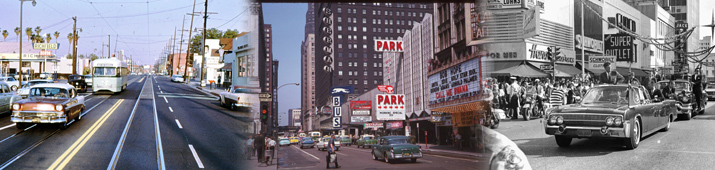
Case linkage, also called linkage analysis or comparative case analysis, is an offender profiling process that helps crime investigators determine whether a series of crimes were committed by the same offender.
The Warren Commission and the investigative agencies at their service never performed this type of standard research for the JFK assassination.
In The Three Failed Plots to Kill JFK: The Historians’ Guide on how to Research his Assassination published in 2016, I did some data mining from the works of reputable authors and original source documents (mostly from the Mary Ferrell Foundation) which centered on three previous plots (L.A., Chicago and Tampa) to assassinate JFK within the six months that preceded the murder and six potential patsies (Vaughn Marlowe, Richard Case Nagell, Thomas Arthur Vallee, Harry Power, Santiago Garriga and Policarpo Lopez). (Before reading this follow-up, it is strongly recommended that you read the original article by following the above hyperlink.)
What we can conclude from this analysis is that the peculiarities that one can find in their personas, associations and actions is hardly a haphazard collection of traits and behaviors. I have argued that there is a ZR/Rifle (CIA Executive Action) signature at play that points the finger straight at its signatories and the reliable executors of this regime-change M.O., namely: David Atlee Phillips, William Harvey, David Morales and their long established network of assassins and frame-up artists which includes Mafiosi and Cuban exiles.
Crucial to this line of inquiry will be the use of data visualization which will play a determining role in a summation phase of our quest to correct history book and mainstream media falsities in their accounts of November 22, 1963.
In this article, we will push the analysis even further by covering a fourth failed plot, add some information about one of the potential patsies already profiled, and add two more to our already impressive list. We will begin, however by discussing how the use of data visualization should be considered more often by authors in order to help synthesize this complex case.
Numerical data may be encoded using dots, lines, or bars, to visually communicate a quantitative message. Effective visualization helps users analyze and reason about data and evidence. It makes complex data more accessible, understandable and usable. (Wikipedia)
In Oswald’s Intelligence Connections: How Richard Schweiker clashes with Fake History, I chronicle some 64 characters (soon to be updated to over 75) that Oswald had touch points with that either certainly (over 30) or plausibly had intelligence connections. They were fluffed off by the Warren Commission instead of being mapped out in a diagram and analyzed for who they really were and who they linked up with—exactly what the Mueller Probe is doing for anyone with a direct or indirect relation with the Trump camp.
In my CIA and Mafia’s “Cuban-American mechanism” article, the chart below is used to showcase Santo Trafficante’s links with CIA, Mafia and Cuban exile persons of interest. Of particular interest are the persons with their names in red: No fewer than six for certain and two plausibly are directly involved in the Oswald set-up, murder or cover story and also are connected to Trafficante. The Trafficante, Roselli, Harvey, Morales, and Robertson links should also stimulate a lot of research:
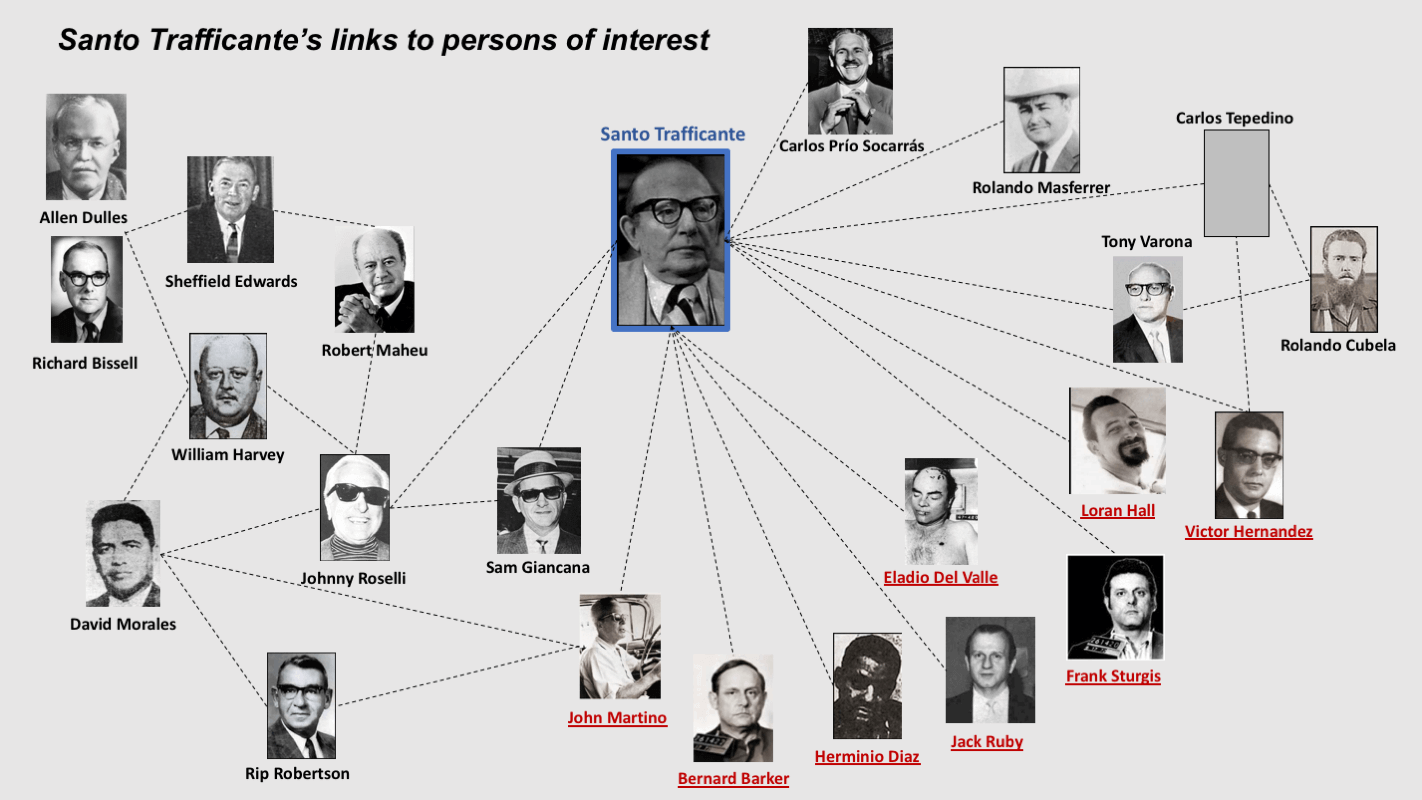
Also in this article, readers can inspect a table that singles out David Atlee Phillips as a person of extreme interest.
In all, Oswald and Phillips shared 23 touch points—20 of which took place within the year in and around the assassination. It is simply impossible to ignore this number of connections between a CIA officer and a lone drifter!
After reading the Previous Plots article, researcher Frank Cassano sent me information about another plot that failed in Nashville which had been covered by Bill Adams in 1993 for The Fourth Decade:
Synopsis of Assassination Attempt Against JFK, May 18, 1963, in Nashville TN
A few years ago I began looking into other assassination sites as well as other potential assassins and potential patsies. I was able to track a potential JFK assassin to the general area (Knoxville, TN) of a planned JFK motorcade in May of 1963. The trip was altered prior to the actual day of the trip and JFK instead made a visit to Nashville, TN. His visit, on May 18, 1963, included several motorcades.
In early 1992 I was shocked to see a tabloid print a story about an assassination attempt against JFK during the Nashville trip! Congressman Bob Clement of Tennessee had made a startling revelation. He said his father, the late Gov. Frank Clement (governor of Tennessee in 1963) told him of a strange incident while JFK awaited a helicopter after visiting the Governor. The tabloid quoted Congressman Bob Clement of Tennessee as stating, “While the President waited for the helicopter, a man approached with a gun hidden underneath a sack. Secret Service agents spotted him and grabbed him”.
I called and interviewed the congressman in the early summer of 1963. I also obtained actual Nashville news stories about the congressman’s revelation in January of 1992. As a result of reading the news stories and talking to Congressman Clement, I have been able to piece together the following story:
President Kennedy arrived in Nashville on May 18, 1963. He rode in a motorcade to Vanderbilt University where he gave a speech outside in the football stadium. JFK left the stadium in another motorcade and drove to the governor’s mansion. Somewhere between the Governor’s mansion and the helicopter landing site at Overton High School, a man approached JFK with a handgun under a sack. It is unclear whether JFK was in his limousine or not at the time. The governor witnessed this event and the subsequent capture of the suspect by the Secret Service. The man was held at the High School for some time. Nothing more is known about the man. The Secret Service asked the governor to keep the event out of the press for fear it would lead to more assassination attempts.
I have also found some writings about a gun found in a paper bag in the vicinity of Dealey Plaza, however the foundation for this aspect of the story is not solid.
While this failed plot is by far the thinnest of the four looked into, it is worth noting for the following reasons:
Over and above underscoring this pattern of secrecy, it may be worth pursuing whether or not there are still files or witnesses that could shed light on the incident and the suspect. Who were the arresting agents? Are they alive? What can we learn about this suspect? Was he also communist leaning? Was he linked to the FPCC? Did he have Cuban contacts? Why was he let go? Was he at least placed on an FBI watch list? Perhaps an FOIA request would be in order.
In the “Three Previous Plots” article, the alternate patsy that had the skimpiest profile was Harry Power. Other snippets of information about him have since surfaced.
Here is how Harry Power was originally covered:
San Antonio, November 21, 1963
Because of the code of omertà surrounding the JFK assassination, Harry Power’s story is perhaps the sketchiest of the potential scapegoat cases we will have discussed. But since no stone should be left unturned when investigating a murder, especially a president’s, it is worth identifying and earmarking for more analysis.
Harry Power was yet another ex-marine who checked in to a Terre Haute House Hotel room in Indiana on November 25, 1963 with a long package. When he checked out, he left behind a rifle … a Mannlicher-Carcanno, according to a retired Chief of Police Frank Riddle … a Mauser, according another unidentified source.
A United States Government Memo in 1967 describes the allegation. Riddle claimed San Antonio authorities informed him that Power was a member of the Young Communist League and an expert rifle marksman. An ex-co-worker described him as anti-Kennedy. He had held a job in San Antonio Texas in 1962.
Riddle stated that all information had been turned over to the Warren Commission and that the rifle was taken by Secret Service agents. The Secret Service claimed to have only found out about this incident in 1965. Their key source is none other than the head of the Washington Secret Service, Chief Rowley himself, who you will recall played a key role in keeping the Chicago plot as secret as possible. The FBI did confirm, however, that the Terre Haute Police department had in fact followed up on this lead around when Riddle claimed it happened … which would indicate further Secret Service and Warren Commission complacency.
According to Dick Russell, Richard Nagell told Jim Garrison that Power was a Trotskyite who had met Oswald.
Given that JFK motorcaded in San Antonio on November 21 and that Power could easily be linked to that city, it is not a major leap to see similarities between Power, Oswald and the other scapegoat candidates that seem to have been lined up before the assassination. [slightly edited]
The Indiana Rifle story had received little interest until journalist Sheldon Inkol researched it in 1993 (The Third Decade, Volume 9, Issue 5: “The Indiana Rifle,” by Sheldon Inkol) and updated his findings in 1995 for The Fourth Decade. From his research and FBI file 62-109060 JFK HQ, we can now add the following points:
According to Inkol, it is Dick Russell who first revealed the name of Harry Power in The Man Who Knew Too Much in 1992. There had been only small articles about the incident before this. Inkol credits veteran researcher Larry Haapanen, who interviewed Riddle, for having confirmed the name of Power after following up on an article in 1970.
Dick Russell provided the following to the Harry Power profile:
A National Archives document about the affair was declassified in 1970 … a file reports that Power had been investigated in connection with the shooting attempt on General Walker in Dallas, a shooting that the WC falsely claimed to have been by Oswald and his Mannlicher-Carcano. Other files associated with the Power rifle claim that it was a 7.65 Mauser. CIA agent Richard Nagell told Garrison investigators in 1967 that Power was a Maoist or Trotskyite and “had known Lee Harvey Oswald and had been seen with him …”
Inkol adds the following points, based on police investigations:
According to Inkol, Frank Riddle insisted that Power was a suspect in the attempt on General Walker’s life the previous April—something the Warren Commission tagged on Oswald. In 1964, Secret Service Chief James Rowley confirmed to Riddle that the FBI and the Secret Service had files on Power.
Inkol tempers Riddle as a source as he points out that some have qualified him as a “blow-hard”.
Inkol is not convinced that Power was even in the hotel. He argues that the description given (age, height and weight) of the person with the rifle in the hotel is very different from the San Antonio description of Power.
He believes that one possibility that merits further investigation is that he was being set up as an alternate patsy or part of a subversive pro-communist group intent on attacking the U.S. Government—who could have been pinned as the shooter from the knoll if a front shot had to be admitted to.
He also points out that had the assassination taken place in San Antonio where Kennedy motorcaded a day earlier, the patsy might have been Power instead of Oswald.
Inkol ends the first article with a fleeting comment about the Indiana rifle being perhaps linked to a seventh potential patsy according to David Lifton who twice interviewed the next subject we will discuss, but revealed very little to Inkol about him. I decided to contact Lifton to follow up on this tantalizing clue about yet another alternate scapegoat (not to be confused with the famous astronaut), who even without a link to the rifle is, in terms of his profile, an Oswald dead ringer!
Unlike most of the other potential fall guys that figure in this analysis, the case of John Glenn and his wife Marcia is quite well documented. This, however, has nothing to do with the FBI, CIA, or Warren Commission’s efforts to scrutinize this Oswald semi-replica.
According to the WC, Oswald opening an FPCC chapter in New Orleans was a demonstration of his ego trip … period! Fortunately for researchers, the FPCC was under intensive scrutiny by the Internal Security Subcommittee of the Senate Judiciary Committee and the House Un-American Activities Committee (HUAC).
Through their reports and the writings in 1993 of Jerry Rose (The Third Decade, “Red Summer of ‘63”), we can paint a better picture of Glenn and the role the FPCC came to play in making our cast of puppets easy to frame for the crime of the century.
The FPCC was characterised as “Castro’s Network in the USA” by the HUAC. Membership within this anti-U.S. organization was described during hearings as an effective door-opener to enter Cuba via the Cuban Embassy in Mexico City and Cubana Airlines.
Though the HUAC had been seriously rattled by the McCarthy era witch-hunts, Castro was breathing some new life into this outfit for political showcasing of American patriotism.
One area that got their attention was the travel to Cuba by American students despite a travel ban. On June 25, 1963, 58 students left New York and transited through Russia satellite Czechoslovakia on the way to Cuba where they were apparently well received by the Castro regime. This group had been infiltrated by an informant named Barry Hoffman who had gotten approval from agencies that were tied to the FBI, CIA, and State Department. During hearings in September of 1963, he painted the students as pro-Cuba and anti-U.S.A. and talked about rumors that Cuba had not dismantled the nuclear installations on the island.
Evidently, he was a poor spy who was not trusted by the other students. He was “number 3 on their fink list”. Numbers 1 and 2 were John Glenn and his wife Marcia.
On November 18, 1963—four days before JFK’s assassination, the Glenns’ testimony before the HUAC had the effect of smearing the FPCC. Transcripts of the hearings point out striking similarities with Oswald:
John Glenn joined the U.S. Air force in 1950.
While in the service, Glenn received training in the Russian language at Syracuse University and became a Russian linguist for Air Force Intelligence, with security clearance for secret, top secret, and cryptographic information. Meanwhile, he continued his regular college studies through night school and correspondence courses. Glenn, while still receiving regular military service pay, including food and housing allowances, returned to full-time studies at the Indiana University where he obtained a degree in business administration in January 1954.
He then resumed active duty with Air Force Intelligence for 2 more years, including 16 months overseas, before being discharged in January 1956, after reaching the rank of staff sergeant.
During the summer of 1958, he visited the Soviet Union, Czechoslovakia, and Poland for about 40 days as a guide for the Tom Maupintour Associates, an American travel agency. The next summer he toured the same countries, plus Yugoslavia and Rumania, in a similar capacity for another travel organization.
The witness confirmed information obtained through an investigation by the Committee on Un-American Activities that he had traveled to Mexico in the spring of 1962 in an attempt to get a Cuban visa. He was unsuccessful.
It was at about this time, the fall of 1962, Glenn told the subcommittee, that he joined the Fair Play for Cuba Committee. He had been a sympathizer of the group much earlier, he said. He admitted having written a letter printed in an Indiana University publication, dated February 10, 1962, in which he said that “the people in Fair Play are willing to argue to anyone who will listen that our government and our press are lying through their teeth [about Cuba].”
The witness admitted that, without having applied for U.S. validation, he traveled to Cuba with the group of alleged students who departed from New York on a BOAC plane on June 25, 1963. Glenn acknowledged the accuracy of the subcommittee’s information that on the return trip, after arriving in Spain with the main body of U.S. “students” on August 26, 1963, he left the group and traveled to Morocco. He said that after he and his wife had learned they could stay abroad for a while, they had decided to travel to Algeria to observe the political developments there, which were supposed to be similar to what they had witnessed in Cuba.
When the Glenns arrived in Morocco from Spain, the witness testified, they received an entry permit to Algeria from the Algerian Government. While hitchhiking their way to Algeria, however, they were arrested by the Moroccan police and ordered deported to Spain as undesirables. He said he learned from both the American consul in Rabat, Morocco, and the Moroccan police that the deportation was ordered by the United States Government.
On October 15, 1963, according to investigation by the Committee on Un-American Activities, Glenn reported to the American Embassy in Madrid, Spain, that he and his wife did not have a ticket for return transportation to the United States. The embassy purchased a ticket for them, and they were flown to the United States on an Iberian Air Lines plane.
Their landlord testified that the Glenns possessed communist literature, including The Militant, which Oswald also subscribed to, that connected them to the Socialist Worker Party and its affiliate YSA.
In his article, Jerry Rose speculates that “given the possibility that Glenn was connected somehow with a rifle in Indiana which was believed to be related to the assassination, it is possible as well that Glenn, like Oswald, was being groomed as pro-communist patsy if Oswald for any reason did not work out in the role.” Rose advances that Glenn’s forced return and appearance before the HUAC suggest (but do not prove) control from high places … an interpretation he felt at the time that was worth pursuing.
When I first reached out to David Lifton through some of my contacts who know him, I was a bit apprehensive. But after some email exchanges, David Lifton generously shared some of his observations.
Here are the preliminary questions I sent David:
Without going into details, David’s preamble to answering my questions deals with how the passage of time and moving his office unfortunately cloud his recollection of his meetings with Glenn. What follows here are his responses:
So… that having been said, and based on current recollection.
RESPONSE TO Q1-3: Glenn’s name came up in connection with my embarking on a comprehensive search of all print (i.e., newspaper) coverage of the JFK assassination, using a set of microfilms I purchased from University Microfilms in Ann Arbor, Michigan.
I believe that it was the San Antonio papers—either the San Antonio Light, or the News—Express (there were only two San Antonio papers) —that carried stories about what happened on 11/21/63. About a “mystery car” parked at a curb, and some remarks made by one of the occupants of that car, to the effect that “He’ll never get through this city.” Something like that. That led to the San Antonio Police dispatcher putting out a call for that vehicle to “call in to your headquarters” or some such thing. Then, 24-36 hours later, after JFK was assassinated in Dallas, this incident (call it the “San Antonio incident”) then resulted in significant “follow-up” coverage, and that led to the name John Glenn and the story of the San Antonio rifle, linked to the Indiana (Bloomington, IN, I think) rifle.
Anyway, I clipped those stories, then obtained the House (or Senate? not sure) hearings that took place on or about Nov 18, 1963, at which Glenn testified, as I recall.
With that as background, I then sought contact with Glenn, who—I somehow learned—lived in Venice, California.
My first meeting with Glenn was at the UCLA Student Union. What I remember is that it was dark outside, and the SU cafeteria was crowded, and that was how I met him.
I questioned him closely and established—to my satisfaction (again, “as I presently recall”) —that he did not fit the profile of an “alternate” patsy because there was no evidence whatsoever that there was any third party in his life influencing where he was living, or what he was doing, or asking him to do anything.
Of course, I was disappointed in the result, but that’s what I found.
Subsequently, when Robert Sam Anson (who I came to know) was writing about the JFK assassination (for Esquire, I think), he wanted to follow-up on this. Again, as I recall. And, again, as I recall, the two of us actually went to John Glenn’s Venice apartment and spoke with him.
I do not remember the details at all. What I do remember is being in John Glenn’s apartment, and having the sense that he was “just like Oswald,” something like that. I believe I had that sense because he had either a poster of, or paraphernalia connected with, The Militant. Again, I don’t remember. What I do remember is the UCLA Student Union “first meeting” and my sense of disappointment that my
hypothesis wasn’t panning out.
RESPONSE to Q4: See answer to Question 1. FYI: I kept a very imperfect “journal” of my daily work; and I would often write letters home, but I don’t believe they would have contained any relevant information.
Anyway, that material is stored “elsewhere.”
RESPONSE to Q5: I believe that the “primary source” for these “links” comes from the San Antonio newspaper coverage—again, I was using microfilmed records of the S A Light and/or News Express for the period 11/20 —11/25/1963.
RESPONSE to Q6: That was my hypothesis, but what I remember is being (very) disappointed that my questioning of him failed to unearth any supporting data. (Could he have been deceiving me? I suppose he “could have,” but I’m pretty confident that I was not being fooled, and that he was who he “appeared to be.”)
RESPONSE to Q7:
Also, and this may be of interest to you—or maybe not—I think that some of this “San Antonio” stuff may have been covered in the Dallas Morning News in the day or two after JFK was assassinated.
David followed up shortly after with this following point:
P.S. What I forgot to mention in my memo …
That the San Antonio newspaper (one of them) reported after the assassination of JFK on Friday 11/22/63, that the “mystery car” was a Secret Service vehicle.
And that’s what made the whole incident so very important.
Harry Dean is one of those characters I put into the category of unreliable witnesses who may have important knowledge, but that have made many statements that are easily contestable and that have had researchers chasing their tails. Unfortunately, in the JFK assassination soap opera—we are faced with a whole slew of personalities who mislead yet can sometimes be decoded to a certain degree. Frank Sturgis and Gerry Patrick Hemming come to mind, as they along with others tried to send HSCA investigator Gaeton Fonzi and other researchers on wild goose chases. They nevertheless give us a better picture of the decadent setting Oswald immersed himself in.
When dealing with such characters, without fully dismissing them, it is prudent not to waste much time on them and only go with what can be corroborated.
Before reading some of Dean’s forum posts, I looked at what other researchers had to say about him.
For over 50 years, Dean made claims in letters and forums that he had been recruited, selected, and led by American Intelligence forces to take on special missions such as spying on Castro while in Cuba, the John Birch Society, and the Fair Play for Cuba Committee. Only in 2017 would he finally admit that he was not an official FBI informant.
In a 2005 post on The Education Forum, he came up with the following claim:
But among the widespread ‘rightist’ movement were assassin-minded persons that would take action to aid in seizing control of the U.S. government if only given the word.
Even being tight-knit with the individuals involved, except for bits and pieces of confusing information I failed to timely detect a clearer picture of the real and more subtle plot to kill the president … the plan move relentlessly … but a ‘need-to-know’ method of secrecy was being applied among my radical associates.
When the name of a Fair Play For Cuba Committee communist was broadcast throughout the rightist circuit after the airing of an August, 1963 radio program from Station WDSU, New Orleans, Louisiana, Lee Oswald was ‘selected’ by another of our {JBS} associates, retired U.S. Army General E.A. Walker of Dallas, Texas.
The subject was chosen by ‘Guy” Gabaldon as ‘the fall guy’ in the secretive plot against Kennedy. None of us objected, and found it humorous to frame a communist. I quietly considered it as goofy as the weird, but hazy, arrangements to kill the president.
When Kennedy visited Mexico City in late June of 1962, Gabaldon, in league with some rightist Mexican Federal Police Officials, was set to shoot president Kennedy. Only a last minute escape problem aborted that assassination scheme … Two other of our associates … Lawrence John Howard—aka Alonzo Escruido, and Loran Eugene ‘Skip’ Hall—aka Lorenzo Pacillo, were dispatched by Gabaldon to enlist Oswald in {a phony CIA, Central Intelligence Agency set-up} at Gabaldon’s Mexico City area office.
General Walker did not orchestrate the assassination, nor the framing of Oswald! Nor did the Mafia, the Cuban exiles, Birchers, etc. Walker could not have organized the weakening of security, the botched autopsy, the Mexico City Oswald imposter episode, the Warren Commission failures, the propaganda offensives. The framing of Oswald began before he left Dallas for New Orleans.
This goes a long way in explaining why some have suggested that I not include Dean in a comparative analysis of potential patsies.
However, when researching the documentary trail about Harry Dean on the Mary Ferrell site, as well as on forums and websites (see: https://sites.google.com/site/xrt013/harrydean) that provide an in-depth analysis of Dean’s statements and pertinent documents—we can nevertheless find information about the FPCC, Dean himself and other characters that seem to be part of a model:
A 1962 Los Angeles FBI File reveals the following about Dean:
LAX advised Chicago FBI office about phone conversation which Harry had with SA William J. McCauley. During that phone conversation, Harry “confided that he had been an informant for the Chicago Office, having been a Secretary of the Chicago chapter of the FPCC, but that largely because his wife had become very upset over his activities on behalf of the FBI, he had discontinued his informant activities and had come to the LAX area about one year ago, and is now employed as a plasterer operating out of the Union Office on Vermont Avenue, Los Angeles. He added that he has, since his arrival in Los Angeles, had casual contact with Edgar and Marjorie Swabeck, whom he had previously known in the Chicago area, and from them has learned that Marjorie Swabeck is secretary of the LAX chapter of the FPCC at the present time. He said that he otherwise has taken no particular interest in the FPCC, and that while he himself is personally not averse to resuming informant activities in behalf of the FBI, he hesitates to do so because of his wife’s feeling in the matter. The Chicago Office is requested to verify and furnish a brief summary of the subject’s background, particularly his activities as an informant and his reliability while known to the Chicago office.”
Another L.A. 1962 FBI file goes on further:
SAC Chicago to SAC LAX
Dean first called the Chicago Office in August, 1960, to report that he had been elected Recording Secretary, Chicago Chapter, FPCC. He did not divulge his name and address at this time. Later in the same month he called this office, stating his name and advising he was residing at 1540 Central Avenue, Whiting, Indiana, and that he owned his own business, the Whiting Plastering Company. He told of his connections with the FPCC, furnished information concerning the leadership of this organization, and said he would be amenable to an interview with an agent of the FBI.
The Indianapolis Office conducted an inquiry in Whiting, Indiana, in September 1960. Detective Captain Edward Grabovac, Whiting, Indiana Police Department, advised that Dean, whose real name he believed to be Gordon Hunt and who had used the name George R. Baker, had skipped town and the Whiting PD had a warrant for his arrest on bad check charges. Grabovac said Dean was a self-employed plasterer.
The Whiting, Indiana PD procured an identification record from the Detroit, Michigan PD under FBI #4657880. This record revealed that Dean had been committed as a mental patient in Canada in 1948 and was sentenced at Chatham, Ontario, for breaking and entering to ‘one year indefinite’. At this time, Dean had one arrest by the Detroit PD for disturbing a religious meeting and two arrests for using indecent and obscene language.
He was also AWOL from Fort Knox, Kentucky in 1949. In December 1960, Dean again called this Office to report that he had been residing in Detroit for the past two months. At that time he said he was living in Chicago but he refused to divulge his local address. He continued to telephonically contact this office on several occasions until June 1961.
He furnished information concerning Cuban nationals connected with the 26th of July Movement and on local persons connected with the FPCC. He was last contacted by two agents of the Chicago Office on June 7, 1961, at which time he was told that this office did not desire his assistance. Former CG___-S advised in August 1960, that Dean was a white male, age about 25 (in 1960), stocky build and black hair. While Dean voluntarily furnished info to the Chicago Office over a period of nearly a year, he was never considered a PSI or informant by this Office.
Even though Dean does not seem like a highly prized asset for the FBI, the paper trail on Dean also confirms the following: Dean had been committed as a mental patient in Canada in 1948 and was sentenced at Chatham, Ontario.
An OSI file (NARA Record Number: 104-10404-10041) confirms that Harry Dean was in the U.S. Army in 1945 and then again in 1948 using the name George Robert Baker and that the Office of Naval Intelligence has three files on him. It also states that he had been arrested by the RCMP and the Detroit Police under the Registration Act.
In 1958 he became a member of the 26th of July Movement, a group led by Fidel Castro.
In late 1959 and early 1960 he received three letters from Juan A. Orta, the Director of the Prime Minister’s Office of Cuba.
He visited Cuba in June 1960.
In August, 1960, he had been elected Recording Secretary, Chicago Chapter, FPCC.
He soon after became a voluntary informant to the FBI (who nevertheless considered him a Fruitcake).
In 1961, he moved to Los Angeles, where he had casual contact with Edgar and Marjorie Swabeck, whom he had previously known in the Chicago area, and from them learned that Marjorie Swabeck is secretary of the LAX chapter of the FPCC at the present time. (Which perhaps brought him into the realm of Vaughn Marlowe and Richard Case Nagell).
In 1962 he joined the John Birch Society.
He also claims to have known Larry Howard and Loran Hall whose names come up with respect to the assassination, and he warned the Los Angeles FBI about a plot to murder JFK that emanated from General Walker which was discussed during a John Birch Society meeting where Oswald was identified as the patsy.
In one of his posts Dean states that the Swabecks may have been setting him up. The NARA documents do confirm a relationship that would have begun in 1960 when Harry met Edgar Swabeck during his travels to Cuba. According to Dean they played a role in getting him to set up the Chicago FPCC branch.
By 1961, the Swabecks were now part of an L.A. FPCC chapter when Dean reconnected with them. They tried once again to involve him in the FPCC. It would not be a great leap to conclude that the Swabecks probably knew Vaughn Marlowe.
Edgar Swabeck’s father seems to have been Arne Swabeck, one of the founding members of the Communist Party in the U.S. In the late 1920s, he was expelled from the party as a Trotskyist and worked together with James P. Cannon and other American Trotskyists to create the Socialist Workers Party. Swabeck visited Leon Trotsky in his exile in Turkey in 1933. He made a cameo appearance in the movie Reds. He was also reference person for The Militant, published by the SWP.
It is also worth asking: If the murder had taken place in L.A., would a link to the cast of FPCC characters have also caused the downfall of the SWP which was very close to the FPCC management in L.A.?
When I completed the first article, I felt we could deduce that the subjects discussed where being actively groomed to become patsies; in other words, that operatives maneuvered easily discarded freelance assets or other malleable figures into assuming weaponized, pro-Castro and/or communist, anti-Kennedy misfit personas, and placed them in the proximity of the kill zone with abundant incriminating evidence. The string-pullers were also fully prepared to pounce with propaganda initiatives to put the blame of the assassination on Castro! While this seems to fit well—admittedly to varying degrees—in the cases of the first seven subjects profiled, the analysis of our two latest characters suggests something similar but with certain caveats.
In the cases of Dean (pending more research) and Glenn, we can state that the credentials are also very suspicious, but that certain elements fit less well the claim that they were being groomed to take the fall: Their FPCC links predate when the winning stratagem was being mapped out, which arguably had its origins no earlier than when the ZR/Rifle (executive action) architect and disgraced CIA officer William Harvey met with mobster John Roselli in late Winter 1963. It was after these meetings that definite attempts on JFK’s life began multiplying and that the subsequent incriminating behavior and travels of Oswald, Nagell, Lopez, Vallee, Power and Garriga were too well timed to be considered mere coincidences.
So how we interpret the profiles of Dean, Glenn, Nagell, and Marlowe with respect to their FPCC links needs to be more nuanced. While we cannot state at this point that they were maneuvered into joining the FPCC in order to be groomed as patsies, their connections to this organization, which was being heavily infiltrated by intelligence, when combined with their other traits, are nevertheless very telling and more in line with the role of informants who had patsy credentials. Some of the other subjects required fine-tuning of their personas and logistical maneuvering in the months leading up to the hit. The analysis of all the candidates on the short list bolsters the case that a cash-strapped Oswald did not leave his young daughter and pregnant wife in the lurch so he could pursue his ideological dream of opening an FPCC chapter in one of the most hostile places imaginable towards this dwindling organization.
Senator Richard Schweiker of the Church Committee famously stated that the fingerprints of intelligence were all over Oswald. As we can see in the updated chart, Oswald has company!

In the original article, much was written to underscore just how unlikely it would be for the subjects analyzed to be involved in 1963 with a dying FPCC. The timing was not right, their profiles contrast with the students and intellectuals who were most ideologically attracted to this outfit before the missile crisis, and the opening of chapters in hostile locations like New Orleans and Miami in 1963 can simply be described as mindless … unless, of course, other stratagems were at play: perhaps its infiltration by informants, which was rampant by then, and patsy grooming ploys.
It stands to reason that the persons in a position to lead the infiltrators and monitor their movements deserve our utmost attention and that the FPCC should be turned upside down by the research community, because when Oswald joined the failing FPCC, he was most likely on a mission.
In this respect, John Newman’s research into the FPCC infiltration and David Atlee Phillips’ role is worth noting. From his 2013 countercoup article here are some key points:
Because of the Socialist Workers Party’s strong links to the FPCC and with at least four of the subjects we have profiled, and because it published The Militant, the newspaper being clutched by Oswald in his infamous backyard photo, it is worth researching this political outfit which was considered subversive by intelligence agencies.
In 2005, its national leader between the early 1960s to the mid 1980s, Barry Sheppard, wrote a political memoir about this organization.
The SWP had its roots in the 1930s and was officially founded in 1938. It quickly became an active supporter of leftist causes and the maligned Labor Movement—a target of Hoover’s FBI. Its existence was marked with volatility and controversy. It was a target of the McCarthy era witch-hunts in the fifties—these flared up again under the actions of the House Un-American Activities Committee in 1960s, when a certain Lee Harvey Oswald and at least three of the alternate patsies decided to join. The SWP also supported The Nation of Islam and later Malcolm X, The Freedom Riders, Algerian Independence, Peace movements—many of the issues Kennedy haters were boiling mad about!
It was an enthusiastic supporter of the Castro revolution:
Reflecting our own growing confidence in the revolutionary leadership, The Militant began to carry speeches by Castro and other Cuban leaders, which were among the best popular explanations of what the revolution was doing. In one of the first speeches we published, Fidel explained that the US-inspired counter-revolutionary fronts would fail because, unlike the guerrillas of the July 26 Movement, they could never build a base in the peasantry with their program of returning the land to the exploiters. Over the next years, others on the US left also came to support the Cuban revolution, but The Militant was always the best and most consistent US source providing truthful news about Cuba and publishing the ideas of the Cuban revolutionaries in their own words.
The SWP was very involved with the FPCC:
We came to be part of the leadership of the FPCC partly as the result of a crisis in the organization. The original FPCC leadership was somewhat timid, and shied away from forthright defense of the revolution as it radicalized. In response, Cuban members of the July 26 Movement living in the US blocked with the SWP and some other militants, and took over the leadership of the Committee. It was while he was staying at the Theresa that Castro met Malcolm X. A few years later, I would interview Malcolm for the Young Socialist in his office at the Theresa. The revolutionary Black nationalist was attracted to the Cuban Revolution from the start and supported it until he was murdered in 1965.
When Castro was refused lodging during his New York U.N. visit in 1960, he received support from the SWP:
Castro declared that the delegation would camp out in Central Park. Berta Green, a member of the SWP who was also the Executive Secretary of the Fair Play for Cuba Committee (FPCC), got in touch with the Hotel Theresa in Harlem, which agreed the Cubans could stay there.
Sheppard’s memoir shows that the SWP was much larger than the FPCC when he describes protest mobilization during the missile crisis in 1962:
We stood up to it. The PC discussed and approved the thrust of a statement to appear in the next issue of The Militant. It ran under the headline, “Stop the Crime Against Cuba!” We alerted SWP branches and YSA chapters that night to mobilize to support the broadest possible actions against the threat. In New York, there were two major demonstrations. One was called by Women Strike for Peace and other peace groups. We joined some 20,000 protesters at the United Nations on this demonstration. Then the Fair Play for Cuba Committee held its own action, more specifically pro-Cuba in tone, of over 1,000 people, also near the UN.
The following points concerning the July 1963 convention cast even more suspicion around the timing and motives of openings of FPCC chapters in the deep south by Santiago Garriga and Oswald and the continued involvement with the FPCC by the other subjects:
At the convention, a meeting of pro-Cuba activists discussed the situation in the Fair Play for Cuba Committee. Cubans living in the United States who supported the July 26 Movement had helped us build the FPCC. Now most of them had returned to Cuba. In most areas, the FPCC had dwindled down to supporters of the SWP and YSA. Since we did not want the FPCC to become a sectarian front group, the meeting decided to stop trying to build it. The FPCC then existed for a while as a paper organization, until the assassination of President John Kennedy dealt it a mortal blow.
Sheppard’s account of the SWP reaction when the Kennedy assassination was announced is noteworthy:
We were listening to the news when the announcement came. I said, “I hope it’s not that nut who tried to join the party, that guy who is a one-man Fair Play for Cuba Committee chapter in New Orleans.” Imagine how I felt when it turned out he was the one charged with the act. The SWP and YSA had received letters from a Lee Harvey Oswald, asking to join. His letters, as I remember them, were politically confused, and the photo that was sent with them was strange. In it, the person who was supposedly Oswald held copies of The Militant and the Communist Party’s Worker. He also sported two or more rifles and hand guns sticking out of his belt. A similar picture appeared on the cover of Life magazine after the assassination. Oswald, it turned out, had posed for similar photographs holding the Communist Party’s paper and the Workers’ World Party’s Workers’ World. One look at the picture and everyone in the leadership of the party and YSA thought we were dealing with a nut or a provocateur. Oswald purchased subscriptions to The Militant and Young Socialist. But no one in our leadership thought we should accept him as a member. In any case, our policy was not to accept at-large members in places where there was no party branch or YSA chapter, for the reason that there was no real way of evaluating the applicant. The press featured Oswald’s connection with the FPCC and speculated that Castro or some unspecified “reds” were behind the assassination. We were a potential target because we were well known as supporters of the Cuban revolution …
… The New York Daily News, attempting to fire up the atmosphere against the left, stated in an editorial: “The fact remains that Oswald was a Marxist and proud of it. The fact remains that the Communist Party continually preaches death to imperialism, capitalism, etc. It is only natural for lamebrains such as Oswald to conclude that this means killing your enemies wherever and whenever you can reach them defenseless. Ideas have consequences.” This was all a pack of lies. As The Militant pointed out a few days later, the editorial was also an attempt to cover up the fanatical hatred that the right wing had for Kennedy, particularly because of the concessions the government was being forced to make to the fight for Black rights. In Dallas during the days before the Kennedy visit, for example, the rightists had posted leaflets displaying a photo of Kennedy and the words: “Wanted for Treason.”
HSCA investigative attorneys Dan Hardway and Ed Lopez co-authored a section for the HSCA’s Final Report on the CIA and LHO in Mexico City which remained classified in full until 1996. The draft, after further declassification in 2003, was published by the Mary Ferrell Foundation Press as Oswald, The CIA, And Mexico City: The Lopez-Hardway Report, and shed light on missing/ destroyed tapes and photos, Oswald impersonations, lying CIA officials and peculiar behavior by Oswald or a frame-up artist—all completely fluffed over by the Warren Commission.
In 2016, Dan Hardway prepared a written declaration in a support of a Jefferson Morley Freedom of Information civil action which should really trouble historians who describe JFK conspiracy proponents as flakey opportunists. In his own words, here is who media and historians have chosen to snub:
From July of 1977 until December of 1978, I was employed as a researcher on the staff of the United States House of Representatives Select Committee on Assassinations (HSCA). In that capacity I had a top secret security clearance and, during a major portion of my employment, had access to un-redacted Central Intelligence Agency (CIA) records. My primary area of responsibility in research for the HSCA was the possibility of any relationship of any nature between the CIA and Lee Harvey Oswald (LHO), with special focus on the CIA’s awareness of, and reporting on, LHO’s activities in Mexico City. Implicit in that focus was the issue of whether the evidence from Mexico indicated any operational connection between LHO and the CIA.
My research for the HSCA also covered areas related to people of interest, including David Atlee Phillips and William Harvey, among others, and CIA assassination programs. I was also tasked with research and analysis of the response of the CIA’s Mexico City Station LHO’s trip to Mexico City and to the assassination.
The following are some of the most damning statements made in this very important affidavit:
Dan Hardway’s state of mind can be inferred by the open-ended questions he poses near the end of his declaration:
Hardway’s concluding remarks do not give the impression that he believes that Oswald was simply a drifting malcontent or a pro-Castro ideologue, and that Joannides and Phillips could be counted on for knowing what really happened:
Dan Hardway’s declaration is recent, blistering, and completely demolishes the history books’ stenographic claims that Oswald the Lone Nut killed JFK. Hardway underscores many disturbing observations that cannot be explained by mere happenstance. His position is nevertheless soft-pedalled compared to what Schweiker and Gaeton Fonzi have stated. It is now possible to go a lot farther in our deductions.
Case comparison analysis of the potential patsies and prior plots to assassinate JFK would bring investigators to study common traits, behavior patterns, entity links, chronological sequences in order to develop a profile of the offenders. The perpetrators in this case were able to:
Only a select few had the means to carry all this out.
They wrote up the technique in a playbook called “ZR/Rifle” and applied it, or versions of it, a number of times in foreign countries. Some of them hated Kennedy so much that it is quite plausible that they went rogue. A few of them even admitted the existence of a conspiracy, their involvement, or their knowledge of it.
William Harvey’s links with other CIA persons of interest, Johnny Roselli and Santo Trafficante and their network of Mafiosi, Jack Ruby and Cuban exiles who hovered around Oswald during the last months of his life, his links to the FPCC infiltration programs, travel to Dallas shortly before the assassination and role in ZR/Rifle tactics qualify him as a person of extreme interest in the coup.
Visual data shows how David Atlee Phillips’ universe overlaps with Oswald’s through over 20 common touch points involving Cuban exiles, propaganda tools, the FPCC, Mexico City, Oswald babysitters, etc. Case linkage shows that no fewer than six of the eight alternate patsies were also marked as pro-Castro with their bizarre FPCC links, the very organization Phillips was turning inside out in his plots to counter Castro sympathizers. Throw in his lies, quasi-confessions, and his being thrown under the bus by colleague E.H. Hunt, and we have a strong case to make about who some of the leading plotters were.
If we accept that these are some the fingerprints of intelligence that Richard Schweiker referred to, the offender profile suggests quite strongly that at least a few of the fingers the prints came from belonged to David Atlee Phillips and William Harvey! In the late 1970s, after the HSCA asked the Justice Department to re-open the case, these two suspects, and their networks of assassins, operatives and propaganda assets who have been discussed in previous articles, should have been rounded up, and would have been in a normal murder investigation. The fact that this one was presidential seems to have lowered the bar of diligence and motivation. It should still be done posthumously, for the sake of correcting what is related to unsuspecting high-school history students, and of preventing future attacks on a democracy.
The next question we can ask ourselves, is who provided the brains and handled upper management tasks for the Big Event? The entity link diagram and a chronology analysis point so far to a group of like-minded, discarded and/or disgruntled CIA officers who were all loyal to a disgraced Alan Dulles who, after being removed from his functions by the victim, remained committed to his worldviews, well connected and a man on a mission. Stay tuned!

Was there ever a person who was so hidden from public view in 1963, yet ended up being such a key character in the JFK case than James Angleton? Offhand, the only other character in the saga I can think of to rival him is David Phillips. Which puts Angleton in some rather select company. But what makes the Angelton instance even odder is that, unlike with Phillips, there have been at least three other books based upon Angleton’s career. To my knowledge there has been no biography of Phillips yet published.
The veil around Jim Angleton began to be dropped in December of 1974. At this time, CIA Director William Colby had decided that Angleton had to go. Since Angleton had been handed carte blanche powers first by CIA Director Allen Dulles, and then by Richard Helms, he was not willing to leave quietly. So Colby had to force him out. He first gave a speech about certain CIA abuses before the Council on Foreign Relations. He then directly leaked details about Angleton’s role in Operation MH Chaos to New York Times reporter Sy Hersh. MH Chaos was a massive program that spied on the political left in the United States for a number of years. Combined with the FBI’s COINTELPRO operations, they composed a lethal one two punch to dissident groups on issues like civil rights and anti-Vietnam war demonstrations.
Colby’s leaks to Hersh did the trick and Angleton was forced to resign at the end of 1974. That timing coincided with what some have called the “Season of Inquiry”. This refers to the series of investigations of the CIA, the FBI and the JFK assassination that took place after the exposures of the Watergate scandal. Specifically, these were the Rockefeller Commission, the Church Committee, and the House Select Committee on Assassinations (HSCA). The author of the book under discussion, Jefferson Morley, goes through these to show how Angleton became a star attraction for some public inquiries. Angleton did not handle these proceedings very well, with consequences for his own reputation. As we will see, in the wake of his exposure he made one enigmatic comment that would haunt the literature on the JFK case forever.
It was these appearances that likely led to the beginning of the literature on the legendary chief of counter-intelligence. Wilderness of Mirrors was a dual biography of both Angleton and William Harvey by newspaper reporter David Martin, published in 1980. Considering the problems with classification, it was a candid and acute portrait for that time period.
Several years later, two books on Angleton were published in rapid succession. In 1991, Tom Mangold published Cold Warrior. Mangold’s book was a milestone in the field and remains a valuable contribution not just on Angleton but on CIA studies to this day. Somehow, Mangold got several Agency insiders to cooperate with him in a devastating expose of the damage Angleton had wreaked on the Agency and its allies. This was done through his almost pathological allegiance to a man named Anatoliy Golitsyn. Golitsyn was a Russian KGB operative who had been working as a vice counsel in the Helsinki embassy when he decided to defect at Christmas, 1961. He warned that any other defectors who followed would be sent by the KGB to discredit him. He prophesied about the presence of a high-level mole in the American government. He then demanded audiences with the FBI, Attorney General Robert Kennedy, the president of the United States and intelligence chiefs of foreign countries; most of which he got.
In two ways, Golitsyn’s overall concept played into the nightmare fears of Western intelligence: first, as to the existence of high-level double agents in their midst; and secondly, regarding Western leaders who were already compromised, e.g., Prime Minister Harold Wilson of the Untied Kingdom. Due to the largesse of Angleton and British MI6, Golitsyn became a millionaire. As for the accuracy of his knowledge of Soviet affairs, he said the Sino-Soviet split was a mirage, that the coming of Gorbachev was really a deception strategy to isolate the USA, and that the whole Perestroika revolution was also a KGB phantasm. He forecast the last two in his books, New Lies for Old (1984) and The Perestroika Deception (1995). Needless to add, in order to buy Golitsyn one had to accept that the rise of Gorbachev, the collapse of the USSR, and Boris Yeltsin’s use of American economic advisors to administer Milton Friedman economic “shock doctrine” to decimate the Russian economy back to conditions worse than the Great Depression—all of this was somehow a colossal KGB Potemkin Village designed to deceive the West. The question being: Into believing what? That somehow the USSR had not really collapsed? This is how ultimately bereft Golitsyn was, and this was how craven our intelligence chiefs were. They did not just believe him, they made him into a wealthy retiree. Mangold’s book revealed almost all of this. It was shocking to behold.
A year after Mangold, David Wise published his book Molehunt. The Wise book was kind of a reverse imprint of Mangold. Wise did scores of interviews with the victims of what the folie à deux of Golitsyn/Angleton had done. That is, the careers that were ruined, the reputations that were sullied, the promotions that never came. It got so bad that Congress had to pass a bill to compensate certain victims for the damage done to their careers. In 2008, author Michael Holzman wrote another biography. James Jesus Angleton, the CIA and the Craft of Intelligence was a rather sympathetic look at the man and his career. And it attempted to rehabilitate both Angleton and Golitsyn, while trying to contravene William Colby’s dictum about Angleton that, to his knowledge, he had never caught a spy.
Holzman’s book was published about a decade after the Assassination Records Review Board (ARRB) had officially closed its doors, which makes it surprising how little information the author used concerning Angleton, the JFK case and Lee Harvey Oswald. After all, John Newman had published his milestone book on that subject, Oswald and the CIA, in 1995. He reissued that volume the same year that Holzman published his. Because he had been an intelligence analyst, Newman understood how to read and then blend together documents into a mural that made previously uncertain events understandable. He did this with the help of the releases of the ARRB.
There were two areas of Newman’s work that one would think any biographer of Angleton would find of the utmost interest. The first would be how the information on Oswald was entered into CIA files after his defection. The second would be the extraordinary work that was made possible about Oswald in Mexico City after the release of the HSCA’s legendary Lopez Report. Taking up where Holzman dropped the baton, the strength of Jefferson Morley’s book is that it does have a featured focus on this aspect: the Oswald file at CIA and its relation to Angleton. And this is the most valuable part of the book.
As Morley notes, James Angleton had suzerainty over the Oswald file at CIA for four years. (p. 86. All references are to the Kindle version) Contrary to what the late David Belin said on national television, the contents of that file were never fully revealed to the Warren Commission. And they were obfuscated for the HSCA. The file itself was personally handled by Birch O’Neal, one of the most trusted and most mysterious of the two hundred men and women who worked for Angleton in Counter Intelligence. From day one, O’Neal began to lie about what was in the Oswald file. He told the Bureau that there was nothing there that did not originate with the FBI and State Department. As Morley has noted on his website and in this book, that is simply not true. But further, the ARRB files on O’Neal have been released in heavily redacted form, and three are completely redacted.
As Morley further explains, the rule inside the Agency was that if three reports came in, a 201 file should be opened on the subject. Yet this rule was not followed with the Oswald file. This exception to protocol allowed the file to be limited in access when it was opened in December of 1959. (Morley, p. 88) It was only when Otto Otepka of the State Department sent the CIA a request on the recent wave of American defectors to the Soviet Union that a 201 file was opened on Oswald.
If the Warren Commission would actually have had full access to the file, the obvious question would have been: If Otepka had not sent the request, would a 201 file have been opened at all? Otepka’s request was about information on whether the defectors were real or ersatz. When Director of Plans Richard Bissell received it, he sent it to Angleton’s office. These circumstances strongly suggest that there was a false defector program being run by CIA, and that Angleton had a role in it.
To his credit, Morley also uses some information that was first introduced in the Lopez Report. This was the fact that there were two differing cables sent out of Angleton’s office once CIA got word of Oswald meeting with a man named Valeri Kostikov in Mexico City. One was sent to the Navy, State, and FBI. It had information about Oswald but a wrong physical description of him. The other cable was sent to Mexico City and had a correct description, but it did not include the most recent information that the CIA had on Oswald concerning his activities in New Orleans—for example, that he had been arrested, detained, tried and fined for his pro Castro activities there. (pp. 136-37) This clearly would have been important in evaluating whether or not he posed a potential threat. In other words, if Oswald had been meeting with a Russian diplomat in a nearby third country, and prior to that he had been protesting on the streets of a southern city in favor of Fidel Castro, and was trying to get an in-transit visa through Cuba to Russia, that would seem to be significant information one should pass to the FBI.
But this cable did not provide the correct description of the man. When the CIA sent up its request, it contained a picture of a man who was not Oswald. He has come to be known as the Mystery Man, although the Lopez Report identifies him as a Russian KGB agent under diplomatic cover. Consequently, that cable described Lee Oswald as a 35 year old with an athletic build and six feet tall. What makes this even more puzzling is that the CIA had accurate info on Oswald as being 24 and 5’ 9”. The other cable was sent to Mexico City and although it was allowed to be disseminated to the FBI there, it did not include the information on Oswald’s return to the USA or his New Orleans hijinks. The Warren Commission only saw one of these two cables and the HSCA only mentioned them in redacted form. (See “Two Misleading CIA Cables about Lee Harvey Oswald”)
As mentioned by the author, neither Jane Roman nor Bill Hood of the CIA could explain this paradox. (p. 137) As Morley offers: if what Oswald was doing in New Orleans—setting up an FPCC chapter with him as the only member, raising his profile via street theater— was part of an operation, then Mexico City station chief Winston Scott would not need to know about that. (p. 137)
One week before Kennedy’s murder, on November 15th, Angleton’s office received a full report from Warren DeBrueys of the New Orleans FBI office about Oswald’s activities there. As Morley writes, “If Angleton scanned the first page, he learned that Oswald had gone back to Texas after contacting the Cubans and Soviets in Mexico City. Angleton knew Oswald was in Dallas.” (p. 140) In other words, all the information that an intelligence officer needed in order to place Oswald on the Secret Service Security Index was available to Jim Angleton at that time. He did nothing with it.
But it is actually worse than that. As Morley notes,
Angleton always sought to give the impression that he knew very little about Oswald before November 22, 1963. … His staff had monitored Oswald’s movements for four years. As the former Marine moved from Moscow to Minsk to Fort Worth to New Orleans to Mexico City to Dallas, the Special Investigations Group received reports on him everywhere he went. (p. 140)
As Newman originally noted, Oswald’s files from Moscow and Minsk should not have gone into the Special Investigation Group (SIG). They should have gone into a file at the Soviet Russia division. (Newman, p. 27) The cumulative effect of Morley’s book is that it makes the case that the idea that Oswald was some kind of sociopath who no one knew anything about in Washington is simply not tenable today. The CIA has hidden its monitoring of Oswald for decades. And it took the JFK Act and its forcible declassification process to reveal its extent.
Morley quickly moves to some interesting developments that took place within just hours of the assassination. Oswald’s street theater antics in New Orleans now got played up in the media. Ed Butler turned over a tape of Oswald defending the FPCC on a local radio station. The CIA-backed Cuban exile organization, the DRE, were calling reporters to inform them of Oswald’s FPCC activities in the Crescent City. They even published a broadsheet saying Oswald and Castro were the presumed killers of Kennedy. (Morley, p. 145) Of course, Butler and the DRE’s intelligence connections were not exposed at this time, nor did the Warren Commission explore them. To accompany this there is a mysterious message that Richard Helms’ assistant Tom Karamessines wrote to Winston Scott in Mexico City. He told the station chief not to take any action that “could prejudice Cuban responsibility.” (Morley, p. 146)
Morley has an interesting observation about Kostikov and AM/LASH. Hoover asked Angleton in May of 1963 if Kostikov was part of Department 13, responsible for terrorist activities and murders in the Western Hemisphere. The reply was negative. (Morley, p. 149) Yet this would change six months later. (Newman, p. 419) It would change again, when Angleton testified to the Church Committee. There he said he was not sure. But Morley further reveals that Rolando Cubela, a prospective assassin tasked by the CIA to kill Castro, was also in touch with Kostikov. This was done through Des Fitzgerald who was in charge of Cuban operations in 1963. Fitzgerald probably thought that Cubela may have told Kostikov about the CIA using him. Kostikov then told the Cubans, and Castro may have decided to strike first, using Oswald as a pawn. This may be why Fitzgerald wept when Jack Ruby shot Oswald on television. He reportedly said, “Now, we’ll never know.” (Morley, p. 150)
The first liaison between the CIA and the Warren Commission was a man named John Whitten. But he was rather quickly moved out by Richard Helms and replaced with Angleton. The CIA now adapted a stance of waiting out the Commission. (p. 155) Here, Morley passed up a fine way to exemplify this fact. When Commission lawyer Burt Griffin testified before the HSCA, he revealed that he had sent a request to CIA to send him all the files they had on Jack Ruby and several related persons, like Barney Baker. Two months later, in May of 1964, they still had no reply. So they sent a reminder. They finally got their negative reply in mid-September, when the Commission volumes were in galley proofs. (HSCA Volume XI, p. 286) You can’t wait out a committee any better (or worse) than that can you?
Continuing with the JFK case, Morley makes a brief mention of the formation of the CIA’s Garrison Group. (p. 192) And he also adds that one of Angleton’s assistants, Raymond Rocca, was a key member. Rocca proclaimed at its first meeting that it appeared that Jim Garrison would be able to convict his indicted suspect Clay Shaw. I wish Morley had made more of this body, because as is evidenced from the declassified files of the ARRB, the CIA itself began to take offensive measures against Garrison at around this time. The convening of this intra-agency group was ordered by Richard Helms. Helms wanted the group to consider the possible implications of the Garrison case before, during, and after the trial of Clay Shaw. (James DiEugenio, Destiny Betrayed, Second Edition, p. 270) Which they did. For instance, Angleton ran name traces on the possible jurors in the Shaw trial. (p. 293)
As Morley noted in his previous book, Our Man in Mexico, when Winston Scott passed away in 1971, Angleton immediately hightailed it to Mexico City to confront the widow of the CIA station chief. (Morley, p. 213) By using some not so subtle threats about Scott’s death benefits, he essentially emptied the contents of Scott’s safe, which amounted to 3 large cartons and 4 suitcases full of materials. This included a manuscript Scott was laboring on at the time of his death. By all indications, this cache included at least one tape of Oswald in Mexico City.
The last time Angleton’s proximity to the JFK case came up was near the end of his career. Senator Howard Baker had been on Sam Ervin’s committee investigating Watergate. His minority counsel, Fred Thompson, had uncovered a lot of material about the CIA’s hidden role in that scandal. (See Thompson’s book, At That Point in Time.) This, along with the exposure of MH Chaos in the New York Times, provided much of the impetus for first the Rockefeller Commission, then the Senate Church Committee, and the Pike Committee in the House of Representatives.
Morley leaves an important point out when he introduces this crucial historical episode, about which there are still documents being withheld from the public. As Daniel Schorr noted, at a closed press briefing in Washington, President Ford was asked why he had stacked the Rockefeller Commission with such conservative stalwarts—e.g., General Lyman Lemnitzer and Governor Ronald Reagan—and appointed Warren Commission lawyer David Belin as chief counsel. Ford replied that there might be some dangerous discoveries ahead. Someone asked him, “Like what?” Ford blurted out, “Like assassinations!” There was no discussion of what assassinations were referred to. However, since the NY Times article was about domestic CIA spying, and both Ford and Belin served on the Warren Commission, Schorr assumed it was about domestic assassinations. But when Schorr went to Bill Colby at CIA, the director did a beautiful bit of ballet on the issue, one that has never been properly appreciated. He told Schorr that Ford must have been talking about foreign plots. (The Assassinations, edited by James DiEugenio and Lisa Pease, p. 194)
This was a masterful stroke by Colby. It was now the CIA plots against Patrice Lumumba, Rafael Trujillo, Achmed Sukarno, and first and foremost Fidel Castro, which took center stage. Because many felt the Rockefeller Commission would be a fig leaf, it was superseded by Senator Frank Church’s and Congressman Otis Pike’s now near-legendary efforts. (For anyone interested in reading up on this fascinating subject, this reviewer recommends Schorr’s Clearing the Air. Schorr ended up being fired by CBS due to the influence of then CIA Director George H. W. Bush.)
As Morley notes, Angleton made some rather startling comments both in the witness chair and to reporters outside. Some of them follow:
And, as alluded to above, there was the granddaddy of all Angleton quotes. In reply to a query about the JFK case, Angleton said, “A mansion has many rooms, I was not privy to who struck John.” (p. 249) That particular quote has sent many writers scurrying to understand what on earth Angleton meant by it. Perhaps the best effort in that regard was by Lisa Pease in her two-part essay on the spy chief. Her work benefits from the use of an episode that, for whatever reason, Morley ignored. This was the legal dispute between a periodical called The Spotlight and Howard Hunt, which was chronicled in Mark Lane’s book Plausible Denial. As Pease notes, Angleton did all he could to dodge questions about this incriminating episode. It originated over an article in Spotlight about a memo to Richard Helms. Angleton’s memo stated that they had to create an alibi for Howard Hunt being in Dallas on the day of the assassination. (Lane, p. 145)
Hunt denied that any such thing happened. And he won a lawsuit against Spotlight. But on appeal, that decision was reversed. In his book, Lane shows that, in fact, the CIA had tried to help Hunt in constructing his alibi. And contrary to skeptics, it turned out that Angleton himself had actually shown the memo to journalist Joe Trento. (DiEugenio and Pease, p. 195) What is remarkable about this is that the Trento meeting happened in 1978, while the HSCA was ongoing. And Angleton had called Trento to specifically show him the document. As Lisa Pease wrote, the HSCA—through researcher Betsy Wolf—was closing in on Angleton’s association with Oswald through CI/SIG. In her opinion, this memo was meant to send a warning shot across the bow of his cohorts: If I go down, you are coming with me.
To his credit, Morley spends quite a few pages on Angleton’s governance of the Israeli desk at CIA. There is little doubt that Angleton was a staunch Zionist who was not at all objective about the Arab-Israeli dispute. (Morley, p. 74) For instance, Angleton did not disseminate the information on the suspected construction of the Israeli atomic reactor at Dimona for U2 over-flights. (p. 92) Angleton leaned even further toward Israel because he suspected a growing alliance between Cairo and Moscow. Morley concluded this section with a good summary of how the Israelis betrayed America by stealing highly enriched uranium for their first bombs from a nuclear plant they purchased as a front near Pittsburgh, Pennsylvania. (See “How Israel Stole the Bomb”)
My complaint about this section is that Morley does not sketch in how Angleton’s near rabid devotion to Israel was in opposition to President Kennedy’s policy in the Middle East. There were two specific aspects he could have highlighted in this regard. First, once he became president, JFK did all he could to forge an alliance with Gamel Abdel Nasser of Egypt in order to reach out to the moderate Arab states. (Philip Muelhenbeck, Betting on the Africans, pp. 125-27) And he was doing this simply because he felt that what Secretary of State John Foster Dulles and President Eisenhower had done previously—asking Nasser to join the Baghdad Pact, and cutting off funds for the Aswan Dam—had helped usher Nasser into a relationship with Moscow. An extreme cold warrior like Angleton would not appreciate this kind of diplomatic strophe. The other point that is missing here is that, as Roger Mattson noted in his book Stealing the Atom Bomb, Kennedy was adamant about there being no atomic weapons in the Middle East. (Mattson, pp. 38-40, 256) This was an integral part of his overall policy there in which he tried to be fair and objective to both sides. It would thus appear that Angleton and Kennedy held differing views on this issue. And after Kennedy’s murder, Angleton’s views won out first under President Johnson and then further with Nixon.
That point branches off into President Kennedy’s foreign policy toward Cuba and the USSR at the time of his death. Morley does some work on Angleton’s influence on Cuba policy as late as May of 1963. But he does not sketch in Kennedy’s policy shift toward Castro that came after the Missile Crisis; nor his attempt at a rapprochement with Khrushchev at that time. Today, all of this seems important in light of the attempts by certain suspect characters—some he has mentioned—to blame the assassination on either Cuba or Russia.
Also relevant in this regard is the production of the Edward Epstein authored book Legend: The Secret World of Lee Harvey Oswald, which Morley deals with rather lightly. That book had one of the largest advances for any book ever in the JFK field. Today, in inflation-adjusted dollars, it would be well over a million, closer to two million. According to more than one source, including Carl Oglesby and Jerry Policoff, Angleton was a chief consultant on that project. Released during the proceedings of the HSCA, Epstein ignored all the evidence that showed Oswald was some kind of American intelligence operative. Instead, the book did all it could to insinuate that Oswald was really some kind of Russian agent, perhaps controlled by George DeMohrenschildt, and that Oswald did what he did for either the KGB or Cuban G-2. As Jim Marrs later discovered, Epstein employed a team of researchers. They were instructed to only look at any possible communist associations they could find. As Lisa Pease later discovered, in Epstein’s first edition of his previous book on the JFK case, Inquest, he acknowledged a Mr. R. Rocca, Who she suspected to be Ray Rocca, one of Angleton’s important assistants specializing on the JFK case.
To me, this area would seem at least as interesting and important as Mary Meyer, which Morley spends about ten pages on. To put it mildly, after doing a lot of research on this issue, I disagree with just about every tenet of his discussion of the matter. And I was more than a bit surprised when Morley even brought in the Tim Leary aspect of this mythology. As I showed, Leary manufactured his relationship with Meyer after the fact in order to sell his book Flashbacks. And if one reads the current scholarship on Kennedy’s foreign policy by authors like Phil Muehlenbeck and Robert Rakove, the idea that Kennedy needed Meyer to advise him on this is risible. (See my review of Mary’s Mosaic for the details)
Also disturbing in this respect is his use of Mimi Alford and her ludicrous, “Better red than dead” quote she attributed to JFK during the Missile Crisis. Greg Parker did a very nice exposé of Alford and the man who first surfaced her, Robert Dallek, back in 2012 that unfortunately is not online today. It showed just how dubious she was. But suffice it to say, anyone who reads, for example, The Armageddon Letters—the direct communications between the three leaders—can see how fast and hard Kennedy drew the line. (See the letter on pp. 72-73) The missiles, the bombers and submarines were all leaving and they would be checked as they left. In fact, as Parker pointed out, Kennedy had criticized the “better Red than dead school” less than a year before the crisis during a speech at the University of Washington. But he also criticized those who refuse to negotiate. Kennedy was not going to let the atomic armada stay in Cuba for one simple reason: he suspected that the Russians had done this to barter an exchange for West Berlin. Kennedy resisted that because he saw it as unraveling the Atlantic Alliance. Anyone who has read, for example, The Kennedy Tapes, will understand that. (See, for example, p. 518, where Kennedy himself makes the association.) What Kennedy conceded ultimately was very little, if anything. He made a pledge not to invade Cuba, which he was not going to do anyway; and he silently pulled missiles out of Turkey, which he thought were gone already. They were supposed to have been replaced by Polaris missiles, which they later were. So in his actions here, unlike with the Mimi Alford mythology, Kennedy simply lived up to his 1961 speech. Either Morley has little interest in Kennedy’s foreign policy or he has little knowledge of it.
The strength of the book lies in the tracing of the Oswald files through the CIA under Angleton’s dominion. No book on Angleton has done this before. And that is certainly a commendable achievement. Hopefully, this will become a staple of future Angleton scholarship, which I think the book is designed to do.

