Tag: HSCA

  • Last Second in Dallas by Josiah Thompson

    Last Second in Dallas by Josiah Thompson


    It has been quite some time since a new book about the assassination of President Kennedy has piqued my interest enough for me to want to even read it, let alone write a review. Over recent years, I have grown increasingly tired of what I have come to see as an endless, false debate over the existence or non-existence of a conspiracy. More to the point, I have lost all patience for the ever-growing list of ill-supported theories, baseless claims of fakery/alteration of evidence, and the apocryphal stories that sadly appear to be firmly planted in the bedrock of most conspiracy thinking. Nonetheless, when I saw that Josiah Thompson’s long-awaited Last Second in Dallas was finally making its way into print, I immediately placed my order.

    As most readers will no doubt be aware, Thompson is the author of one of the most influential books ever written about President Kennedy’s tragic murder, Six Seconds in Dallas. First published in 1967, Six Seconds in Dallas was a rare gem that managed to garner the respect of both Warren Commission zealots and critics alike. Even the late Vincent Bugliosi―who went to great lengths in his own tediously massive tome to denigrate virtually anyone and everyone who dared disagree with the Warren Commission’s conclusions―was compelled to refer to Thompson’s first book as a “serious and scholarly” work. (Reclaiming History, p. 484) In Six Seconds, Thompson presented readers with a meticulous study of the facts and evidence available to him at the time, leading to the almost inescapable conclusion that JFK had been shot by three different gunmen firing from three separate locations. While some of the precise details of his reconstruction of the shooting have since proven to be in error, Thompson’s overarching thesis has been entirely validated by later revelations and stands to this day as the most viable explanation of events.

    Based on both the quality of Six Seconds In Dallas and my own pleasant exchanges with Thompson―during one of which he was kind enough to state that he felt my critique of Lucien Haag had the “depth and scholarly backup” to appear in a peer-reviewed journal (private email)―I was hoping for and, indeed, expecting big things from his follow-up work. It gives me great pleasure to be able to report that I was not disappointed. Last Second in Dallas is an eminently worthwhile addition to the literature that includes some game changing new research into one of the Kennedy assassination’s key pieces of evidence.

    One remarkable facet of Last Second in Dallas is that it manages to present readers with a sizeable amount of detail while remaining, for the most part, eminently readable. This is perhaps largely due to the author’s decision to structure the book as a memoir of his time studying and investigating the case rather than as simply another dry recitation of facts. It is often said that anyone old enough to remember November 22, 1963, can tell you precisely where they were and what they were doing when they first learned that President Kennedy had been shot. In Thompson’s case, he recalls being at a street corner in New Haven, Connecticut, when he saw a woman run out of a record store yelling, “Kennedy’s been shot!” (p. 4) Like the rest of the nation, he then spent the hours that followed glued to news reports, feeling “strangely numb” as a bizarre sequence of events continued to unfold in Dallas, Texas.

    The following evening Thompson and his wife, Nancy, attended a dinner party at the home of a European friend who offered his belief that Lee Harvey Oswald, the alleged Marxist-sympathiser who had been arrested within an hour of the assassination, “will never live to stand trial.” (ibid) Thompson dismissed his dinner companion’s comments off hand, remarking to his wife, “That’s just Alex. Europeans see conspiracies everywhere.” (p. 5) Yet only a matter of hours later Thompson would see his friend’s prophecy fulfilled when Oswald was gunned down by local nightclub owner, Jack Ruby, in front of news cameras in the basement of Dallas police headquarters.

    A few days later, Thompson sat in his apartment studying the black-and-white Zapruder film frames published in the latest edition of LIFE magazine and noticed a curious discrepancy between the reports that had come from Parkland Hospital suggesting Kennedy had been shot from the front and the Zapruder stills showing that Oswald’s alleged sniper’s perch on the sixth floor of the Texas School Book Depository was located directly behind the President when he was hit. The sense of unease he felt at this discovery led Thompson to the local FBI office where he found himself trying to explain the conflict to a Bureau agent who, Thompson noted, “listened politely” then “probably had a good laugh” after the author walked away. (p. 6)

    Like most Americans, Thompson initially chose not to dwell on his suspicions. But in early 1965 his doubts about the official story were reignited by a series of articles appearing in left-wing periodicals Liberation and The Minority of One, written by a Philadelphia lawyer named Vincent Salandria. Salandria was an immediate skeptic of the near-instantaneous fingering of Oswald as the lone gunman. “I’m particularly sensitive to the possibilities of governments [sic] not being as diligent as they should in situations of this sort,” Salandria explained. “I guess it comes from my Italian peasant background which always disputes governmental action and is inherently skeptical.” (John Kelin, Praise from a Future Generation, p. 32) For The Minority of One, Salandria focused his attention on the Warren Commission’s infamous Single Bullet Theory and attempted “to establish finally and objectively that Kennedy and [Texas Governor, John] Connally were wounded by separate bullets.” (Ibid, p. 273) Thompson absorbed Salandria’s arguments, compared them to the evidence contained in the Commission’s twenty-six volumes of hearings and exhibits, and found that his criticisms were valid. “The more I read,” Thompson notes, “the more interested I became.” (Thompson, p. 7)

    In January 1966, Thompson and a friend were arrested for “littering” in Delaware County after handing out anti-Vietnam war pamphlets against the wishes of the local sheriff. The pair spent a couple of hours in a cell before an American Civil Liberties Union attorney arrived to represent them. As Thompson and his fellow arrestee were brought into a squad room to meet with him, the lawyer loudly announced that he had been in touch with the Attorney General. “When the FBI agents arrive,” he said whilst looking at his watch, “I want you to tell them that not only have your civil rights been violated but you are suing for false arrest…” “He did a masterful job of bluffing,” Thompson recalled. “We were released in less than two minutes.” Once they were back out on the street, the ACLU attorney introduced himself; it was Vincent Salandria. (pp. 7–8)

    This chance meeting was something of a turning point for Thompson. Salandria brought him into the small group of critics―figures now legendary among assassination scholars like Sylvia Meagher, Harold Weisberg, Penn Jones, Shirley Martin, Cyril Wecht, and Mary Ferrell―who were working hard to identify and publicise the myriad problems with the Warren Report. Then, in the summer of 1966, Thompson and Salandria began collaborating on what was intended to be a long magazine article. The pair began making trips to the National Archives in Washington and it was there that Thompson saw the Zapruder film for the first time. “I literally gasped aloud” Thompson writes, “as I watched the president’s head explode and snap backward as if his right temple had been struck by a baseball bat.” The author knew instinctively that what he was seeing had to be the result of a shot fired from the right front. And what is more, if the film were to be shown to the American public, he knew the majority would arrive at the same conclusion. (p. 10)

    Sadly, the Thompson/Salandria collaboration did not last the summer. Natural disagreements over the evidence came to a head in an argument over the nature of the wound in Kennedy’s throat. Salandria was thoroughly convinced, based on the descriptions given by Parkland Hospital physicians, that the small, neat hole had to be a wound of entry. Thompson, on the other hand, felt that “The spinal column was only a few short inches behind that hole. Any bullet entering there must have shattered the spinal column before blowing a hole out the back of Kennedy’s neck.” (p. 97) Since there was no damage to the spine, he reasoned, there must be some other explanation for the wound.

    As Salandria recalled in an interview for John Kelin’s wonderful book Praise from a Future Generation, “I immediately quit when Thompson tried to convince me that the Kennedy throat wound was a consequence of a bit of bone exiting from the throat which emanated from the head hit.” (Kelin, p. 340) According to Kelin, Salandria felt that Thompson’s postulate tended to exculpate the government and the attorney would go on to accuse Thompson of being a covert federal agent. In March 1968, Salandria wrote Thompson a letter stating, “I feel that you should know that I consider the data on whether you are a United States government agent incomplete, but that I entertain a suspicion at this time that you are.” According to Kelin, Thompson wrote back a short reply, telling Salandria he was “out of his goddam mind.” (ibid, p. 434)

    With Salandria taking himself out of the picture, Thompson chose to carry on alone. By late August 1966, he had written a sixty-page draft that he planned to show to the editor of Harper’s magazine. Before that could happen, however, he found himself invited to lunch with publisher, Bernard Geis. “At the end of the lunch,” Thomson writes, “Geis asked [executive editor, Don] Preston to write up a contract for me. ‘You’re going to write a book for us, Thompson.’”

    II

    In October 1966, while Thompson was working on the manuscript that would become Six Seconds in Dallas, his publisher reached out to LIFE magazine to see if there was any interest in what Thompson was doing. As it turned out, following the commercial success of the books Rush to Judgment by Mark Lane and Inquest by Edward Epstein, LIFE was considering its own reinvestigation of the assassination. Thompson soon found himself teaming up with two associate editors at the magazine, Ed Kern and Dick Billings. This turned out to be an invaluable development for Thompson as it gave him access to the impressive resources of LIFE, chief among them, the Zapruder film. After viewing LIFE’s own high-quality copies of the film for the first time, Thompson was bowled over by what he saw and rushed to a phone to call his publisher’s office. “The Zapruder film is glorious” he exclaimed at the time. “You can see all the details. Connally was hit later…You can see the impact of the bullet on him. The single-bullet theory is dead…LIFE is going to break this all within a month!” (p. 19) Sadly, this would turn out not to be the case.

    When the article appeared the following month, Thompson found that he was sorely disappointed. “Much of the material we had discovered had not made it into the article,” he writes, “and what had was watered down.” (p. 90) Nonetheless, teaming up with LIFE had not only given him access to the most important record of the assassination, but it had also taken him to Dallas to conduct interviews with some the most important witnesses to both the crime and its aftermath. This research would form the basis of his own book.

    Six Seconds in Dallas was published to significant media attention in late 1967. Among its many contributions to our understanding of the assassination was a tabulation of 190 witnesses, detailing the location of each witness at the time of the shooting, how many shots they heard, and from which direction those shots appeared to come. Of those who offered an opinion, 52% believed shots had been fired from the infamous “grassy knoll” to the right front of the president’s limousine. (Six Seconds in Dallas, p. 24)

    One of the most important of those witnesses was Union Terminal Railroad supervisor, Sam “Skinny” Holland. In Last Second in Dallas, Thompson presents some fascinating and, as far as I am aware, previously unpublished excerpts from the interview he and Ed Kern of LIFE magazine conducted with Holland in November of 1966. Holland, who had been standing on the railroad overpass overlooking Dealey Plaza during the assassination, recalled hearing at least four shots, one of which came from the grassy knoll and was accompanied by a puff of smoke that drifted between the trees in front of the stockade fence. When Kern told Holland that defenders of the Warren report had suggested that whatever Holland saw could not have been rifle smoke because “rifles no longer sent out puffs of white smoke” Holland, who had carried a gun for sixteen years as a special deputy to Sheriff Bill Decker, replied, “…you fire a gun, any gun, from a light underneath this shade you’ll see a puff of smoke that’ll linger there. It’ll be, just like I say, dim, like a cigarette or maybe a firecracker smoke, but mister, if it’s powder, it’s going to smoke.” (Last Second in Dallas, p. 75)

    Holland and two other witnesses who also saw the smoke were so convinced that a shot had been fired from the knoll that, immediately after the shooting, they ran around to the spot behind the fence from where they believed the smoke had come to look for empty shells “or some indication that there was a rifleman or someone was over there.” (p. 71) What they found, according to Holland, was numerous footprints giving the impression that someone had paced back and forth and mud on a car bumper, “Exactly like someone was standing up there looking over the fence.” (p. 76)

    As well as the lengthy analysis of eyewitness accounts in Six Seconds in Dallas, Thompson went into impressive detail concerning the conflicts in the medical evidence that existed at the time, many of which have still not been resolved today. One of those has to do with the question of whether the bullet which entered Kennedy’s back also exited his throat as the Warren Commission claimed it did. Thompson pointed to the testimony of Secret Service agents and the report of two FBI agents who were present at the autopsy as indicating that it did not. (Six Seconds in Dallas, pp. 42–51) Furthermore, as alluded to above, he used the testimony of the Parkland physicians, and the descriptions of Kennedy’s brain given by the autopsy doctors, to make a case for the throat wound being the result of a fragment of bullet or bone from the head shot. (ibid, pp. 52–56)

    In addressing the ballistics evidence, Thompson pointed out that one of the empty rifle shells found on the sixth floor of the depository building had a dented lip which appeared to show that it could not have held a projectile on November 22, thus suggesting that only two shots had been fired from Oswald’s rifle. (ibid, p. 144) More crucially, he made a compelling case that Commission Exhibit 399―the so-called “magic bullet” that was alleged to have produced seven wounds in JFK and Governor Connally without sustaining any significant damage―was not found at Parkland Hospital as the Commission claimed. And, in fact, the actual bullet found at Parkland was a different caliber round that came off a stretcher that was in no way related to the assassination. (ibid, pp. 161–164)

    Perhaps the most revelatory aspect of Six Seconds in Dallas was Thompson’s analysis of the Zapruder film. Because LIFE had refused the author permission to publish stills from the actual film, he was forced to use an artist’s renderings of the individual frames, something Thompson was understandably unhappy about. Yet it had surprisingly little impact on the effectiveness of his presentation. Thompson pointed out that a dramatic change in Connally’s demeanour occurred at Zapruder frame 238 when “his right shoulder collapses, his cheeks and face puff, and his hair becomes disarranged.” (ibid, p. 71) These involuntary responses appeared to pinpoint the very moment Connally was struck and seemingly occurred much too late to be associated with the bullet which had hit the president while he was hidden from view by the Stemmons freeway sign, sometime between frames 207 and 224. Together with CE399’s lack of provenance, this effectively destroyed the single bullet theory.

    Thompson’s most important discovery, however, was related to the movement of Kennedy’s head. As noted above, on his initial viewings of the Zapruder film Thompson was struck, as most viewers are, by the violent backward movement of Kennedy’s head following the shocking explosion of his skull at frame 313, but a frame-by-frame analysis of the film revealed something else. Between frames 312 and 313, Kennedy’s head appears to move forward by at least two inches in just 1/18 of a second. (ibid, pp. 87–89) Absent any other explanation, Thompson interpreted the double movement he was seeing as evidence of two shots striking the head almost simultaneously.

    Thompson’s discovery and measurement of this rapid forward movement was accepted by Warren Commission supporters and critics alike and this would have significant ramifications for our understanding of the assassination. Firstly, because it would become a fact that had to be assimilated in all future attempts to reconstruct the shooting. And secondly because, as we shall see later in this review, it was wrong.

    III

    In Last Second in Dallas, Thompson notes that media reaction to his first book was surprisingly positive. The Los Angeles Times, for example, called it “the most forceful, graphic, and well-organized argument for reopening the assassination investigation.” Similarly, Max Lerner of the New York Post was convinced enough by Thompson’s case for three assassins to write, “It was not until this book that I became clear in my mind about some kind of collaborative shooting.” (p. 110) But there was one notable figure who was not a fan of Thompson’s work: Nobel Prize-winning physicist, Luis Alvarez.

    Alvarez had already staked his reputation on the Warren Commission’s lone gunman theory with his so-called “jiggle analysis” of the Zapruder film―a woefully inadequate study which, he claimed, demonstrated that episodes of blurring on the film showed the Commission had been correct in saying that only three shots had been fired. After being handed a copy of Six Seconds in Dallas, Alvarez set out to find a “real explanation” for the backward snap of Kennedy’s head. (p. 123) What he came up with came to be known as the “jet effect theory.”

    In a nutshell, the jet effect theory holds that the explosive exiting of blood and brain matter from the right side of Kennedy’s skull pushed the head in the opposite direction. Although Alvarez apparently dreamed up this notion almost immediately, jotting down his calculations on the back on an envelope, he would not publish his theory until September 1976. At that time, in the pages of the American Journal of Physics, Alvarez claimed to have validated his hypothesis through a series of empirical tests that involved firing rifle bullets into melons. Towards the end of the paper, Alvarez stated that “a taped melon was our a priori best mock-up of a head, and it showed retrograde recoil in the first test.” (p. 129) His work could only be reasonably criticized, he said, had he used the “Edison technique” and shot at a large assortment of objects until he found one that behaved in accordance with his theory. Yet as Thompson discovered in the early 2000s when he got his hands on the raw data from Alvarez’s shooting experiments, that was precisely what the good doctor had done.

    As Thompson details, during three separate rounds of testing, Alvarez had his rifleman fire into taped and untaped green and white melons of varying sizes, coconuts filled with Jell-O, one-gallon plastic jugs filled with Jell-O and water, an eleven-pound watermelon, taped and untapped pineapples, plastic bottles filled with water, and rubber balls filled with gelatin. The majority of these items were unsurprisingly sent hurtling downrange. Only after Alvarez reduced the size of his melons from ones weighing 4 to 7 pounds to ones weighing just 1.1 to 3.5 pounds did he get six out of seven melons to exhibit some retrograde motion. (pp. 124–125)

    The melons he settled on may have behaved in the manner Alvarez wanted, but they were not, as he claimed, a “reasonable facsimile” of a human head. To begin with, melons weighing under 3.5 pounds are less than half the weight of the average human head, which usually weighs between 10 and 11 pounds. Furthermore, as Thompson writes, “Whether a melon is taped or not, a bullet will cut through its outside like butter. A human skull is completely different. Penetrating the thick skull bone requires considerable force, and that force is deposited in the skull as momentum.” (p. 125) If carefully selecting a poor facsimile of a human head because it produced the desired effect was not enough to nullify Alvarez’s test results on its own, the Nobel laureate also rigged his experiments at the other end by using 30.06, soft-nosed hunting bullets that struck their target at 1,000 feet per second faster than “Oswald’s” 6.5 mm, full metal jacket, Mannlicher Carcano rounds could have done.

    As an explanation for the backward snap of Kennedy’s head, Alvarez’s jet effect theory is, at best, dubious science and, at worst, a deliberate charade designed to pull the wool over the eyes of the American public. Yet, as Thompson notes, it has become “part of the case’s folklore” and is still promoted today by defenders of the official story. For that reason, Thompson has done critics an invaluable service by publishing the details that Alvarez carefully omitted. Strangely, however, though Thompson devotes an entire chapter in Last Second in Dallas to Alvarez and his reaction to Six Seconds in Dallas, he makes no mention whatsoever of the equally, if not more important response by Attorney General Ramsey Clark.

    Several years ago, in a superb online essay titled How Five Investigations into the JFK Medical Evidence Got It Wrong, Dr. Gary Aguilar revealed that Ramsey Clark had somehow come into possession of the galley proofs to Six Seconds in Dallas shortly before its publication. Clark was so disturbed by what he read that he ordered the formation of a panel of medical experts that, in the words of its chairman Russell Fisher, MD, was specifically intended to “refute some of the junk that was in [Thompson’s] book.”

    On the one hand, the Clark Panel did what it was formed to do and reaffirmed the Warren Commission’s conclusions by stating that the medical evidence was consistent with Kennedy having been “struck by two bullets fired from above and behind him…” (ARRB MD1, p. 16) On the other hand, the panel’s report cast serious doubt on the reliability of the autopsy by suggesting that Kennedy’s pathologists had completely mislocated the entrance wound in the skull. According to the Clark Panel, the actual location of the wound was some four inches higher than as described in the official autopsy report!
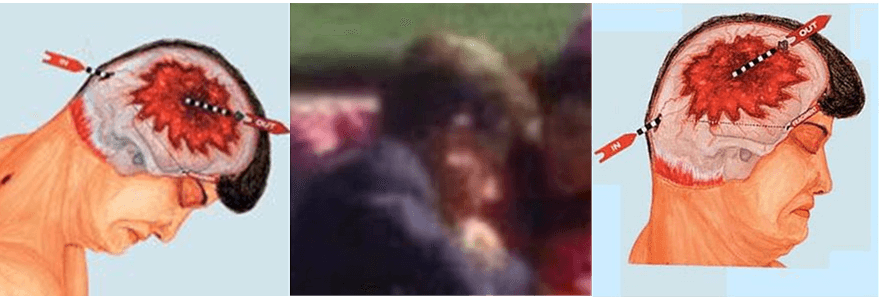
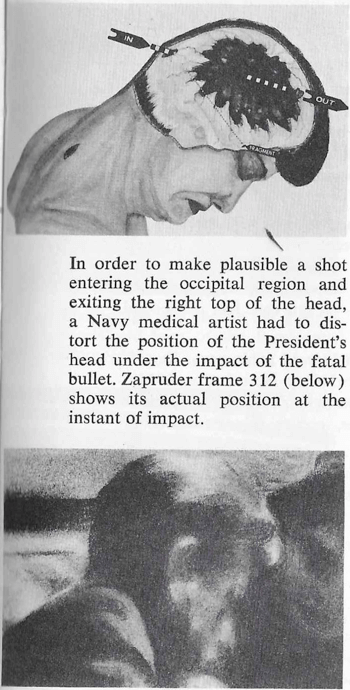
    The autopsy surgeons, James J. Humes, J. Thornton Boswell, and Pierre Finck, had concluded in their report that the bullet had entered the skull “2.5 centimeters to the right and slightly above the external occipital protuberance.” To illustrate the path this bullet took through the skull, the Commission chose not to utilise the autopsy photographs or X-rays and instead published a drawing prepared under the direction of Dr. Humes. The problem with this drawing, as Thompson had pointed out in Six Seconds in Dallas, is that it shows President Kennedy’s head tilted drastically forward in a manner that is quite different to its actual position as seen in the Zapruder film. Furthermore, correcting the head’s position created an upward trajectory (see above comparison).

    It may well be, as some critics believe, that Ramsey Clark expressed enough concern over this apparent trajectory problem that it prompted Fisher and his colleagues to move the wound up the skull to a position where, on the autopsy X-rays, the panel claimed it could see a “hole in profile” (an oxymoron if ever there was one!). This move would, of course, create a more downward trajectory, in line with Oswald’s alleged sniper’s perch on the sixth floor of the depository building. And yet the panel members were surely experienced enough to understand that the path of a bullet through the body after it strikes an object as dense as skull bone may well be significantly different to its trajectory prior to impact. Simply put, if a bullet strikes a hard surface, it is likely to deflect.

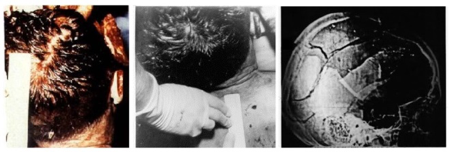
    What may have been of greater concern to the Clark Panel members was the location of bullet fragments in the cranium. The autopsy report describes a trail of metallic particles traversing a line from the entrance wound in the occiput to the presumed exit point in the right front of the head. What the X-rays revealed to Fisher and his fellow panel members, however, was that the bullet fragments are actually located in the very top of the skull. This fact tends to confirm rather than refute Thompson’s double head shot scenario because a bullet entering the EOP could not create a trail of fragments along a pathway several inches higher than the one it took. Therefore, the fragments had to have come from a different bullet. Moving the entrance wound up the head as the Clark Panel did brought it closer―though still not in line with―the fragment trail.

    Whichever of these considerations most plagued the Clark Panel, it seems clear that moving the entrance wound was done for reasons other than accuracy. Nearly three decades ago, experimental neuropathologist Joseph N. Riley, PhD―the only neuroscientist that I know of to have performed a serious study of Kennedy’s head wounds―concluded that “The original description of a rear entrance wound by Humes et al. …is most likely accurate” and that there was “little to support” the higher location. In support of this contention, Dr. Riley pointed out that the lateral X-ray shows an area of damaged skull that fully corresponds to the entrance location as described by Dr. Humes. (The Third Decade, vol 9 issue 3) In 2013, ballistics expert Larry Sturdivan and forensic pathologist Dr. Peter Cummings pointed to the very same area on the X-ray, noting that fractures clearly radiated from a point low down on the back of the skull. (NOVA Cold Case JFK)

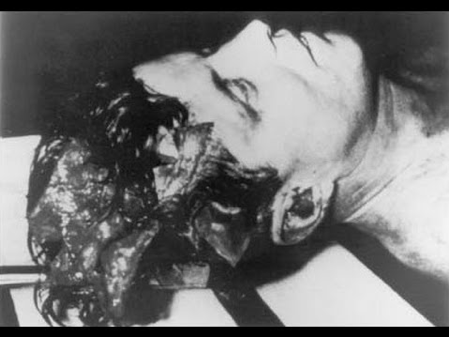
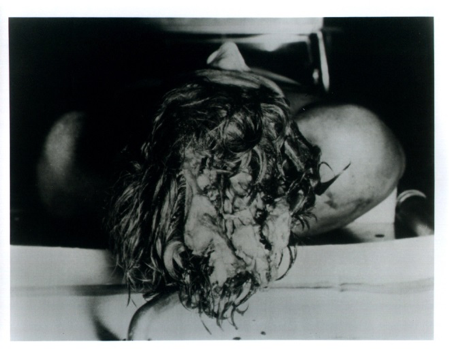
    For their part, the autopsy doctors always maintained that the wound was correctly located in their report. While it might seem obvious that few professionals are likely to relish the prospect of owning up to such a grievous error, it must nonetheless be borne in mind that the autopsy team had more than just the X-rays and photographs to work from; they had the actual body in front of them. As Dr. Finck argued, the observations of the autopsy doctors would, therefore, seem considerably more likely to be valid than those of individuals who might subsequently study the photos and x-rays. Perhaps more importantly, the entrance location identified by Humes et al. was corroborated by independent witnesses to the autopsy. For example, Richard Lipsey, aide to US Army General Wehle, told Andy Purdy of the HSCA that the wound was located “in the lower head…just inside the hairline.” Similarly, Secret Service Agent Roy Kellerman’s Warren Commission testimony placed it at the level of the lower third of the ear, “in the hairline.” (2H81) Both men executed drawings of their observations [see below].

    All of this makes it surprising to me that Thompson appears to favour the higher location and writes matter-of-factly that “various forensic experts who studied the autopsy photos and X-rays all agreed that the autopsy had mistakenly located the hole…The true location was found to be over four inches above where the autopsy placed it.” (Last Second in Dallas, p. 262) It would appear to me that Thompson is swayed by the fact that the nine-member forensic pathology panel for the HSCA fully endorsed the Clark Panel’s higher in-shoot location. What he might not be aware of is that the majority of the HSCA panel members had enjoyed a close professional relationship with Clark Panel chairman, Russell Fisher. For example, Dr. Charles Petty had spent nine years under Fisher at the Maryland Medical Examiner’s Office. Dr. Werner Spitz had co-authored a book with Fisher, and HSCA panel chairman Dr. Michael Baden had contributed to that book. So, the obvious question that needs to be asked is just how likely was it that these men would work to actively undermine their colleague and mentor on such a prominent issue?

    Ultimately, it may be said to be inconsequential which of the proposed entrance locations Thompson chooses to accept. After all, as Dr. Riley noted, and Thompson himself suggests, “the fundamental conclusion that John Kennedy’s head wounds could not have been caused by one bullet does not depend on which [in-shoot] description is more accurate.” Indeed, the fragments in the top of the skull, the two separate and disconnected areas of damage to the cortical and subcortical regions of the brain [as observed by Dr. Riley], the rear blowout documented by the Parkland physicians, the forward and rearward ejections of wound matter, and the backward snap of Kennedy’s head simply cannot all be explained by a single bullet fired from above and behind.

    Whatever Thompson’s opinion on the in-shoot location may be, and whatever his reasons for it, I nonetheless find it surprising that the author makes no mention of the manner in which his first book precipitated the creation of the Clark panel and its revision of President Kennedy’s head wounds.

    IV

    On March 6, 1975, Geraldo Rivera’s late-night ABC TV show, Good Night America, featured photographic researcher Robert Groden showing his enhanced, stabilized version of the Zapruder film to the American public for the very first time. Thompson, who had also been asked to take part in one of Rivera’s JFK assassination segments, describes the broadcast as “a bona fide shocker…The characteristic intake of breath when an audience sees the president’s head explode and his body slammed backward was heard from coast to coast.” (pp. 138–139) Indeed, the public outcry that resulted from seeing this long-withheld evidence of a frontal shooter was tremendous. In the weeks and months that followed, Thompson worked with Groden to lobby members of congress in the hopes of establishing a committee to reinvestigate the assassination. Almost a year later, after much work from like-minded individuals, the HSCA was formed.

    In the summer of 1977, Thompson was among a group of prominent critics who were invited to a two-day conference in Washington with HSCA Chief Counsel, Robert Blakey. In retrospect, it appears as if Blakey’s reason for arranging the conference was simply to make it appear as if he had given the critics a chance to have their say. The critics, of course, had numerous ideas on what should be the focus of the committee. Yet, as historian Jim DiEugenio writes, “In looking at the declassified summary of this meeting, what is striking about it is how few of the suggestions were actually pursued or how weakly they were pursued.” (The Assassinations, p. 67)

    For his part, Thompson―whose focus has always been solely on the facts of the shooting itself―found himself largely bored by the whole affair. “The discussion veered into various claims of conspiracy,” he writes, “of which I had little interest and even less knowledge. As the discussion droned on, I found my mind wandering. Little did I know that in attending the conference, I would be present at one of the pivotal moments in the history of the whole case.” (Last Second in Dallas, p. 142) That moment came when Mary Ferrell first brought the acoustics evidence to Blakey’s attention. It was this piece of evidence that forced a conclusion of “probable conspiracy” on the committee.

    The HSCA had begun promisingly enough under the leadership of Richard Sprague. From 1966 to 1974, he was the First Assistant District Attorney of Philadelphia County, during which time he had won convictions on 69 out of the 70 homicide cases he prosecuted. While a special prosecutor for Washington County, Pennsylvania, he had also exposed the conspiracy behind the brutal murders of American labor leader Joseph Yablonski and his family, who were shot to death by three gunmen as they slept in their home in Clarksville, Pennsylvania. On top of his impressive record, Sprague had no fixed opinion about who killed Kennedy and was determined to run an unbiased, independent investigation. As Dr. Cyril Wecht commented, “Dick Sprague was the ideal man for that job with the HSCA.” (The Assassinations, p. 56) Expectations in those early days were high and, as DiEugenio writes, “The feeling on the committee, and inside the research community, was that the JFK case was now going to get a really professional hearing.” (ibid)

    Almost inevitably, Sprague’s tenure was short-lived. When the CIA began stonewalling the committee’s requests for information about a trip to Mexico City Oswald had supposedly taken two months before the assassination, Sprague said he would subpoena the Agency for the materials. What followed was a smear campaign in the pages of the Los Angeles Times, the New York Times and the Washington Post that resulted in Congress refusing to reauthorize the committee until the chief counsel was removed. To save the committee, Sprague resigned and Blakey was appointed in his place.

    Former HSCA investigator Gaeton Fonzi noted in his highly-regarded book, The Last Investigation, that Blakey “was an experienced Capitol Hill man. He had worked not only at [the] Justice [Department] but on previous congressional committees as well. So, he knew exactly what the priorities of his job were by Washington standards, even before he stepped in.” Fonzi described those priorities thusly: “The first…was to produce a report within the time and budget restraints dictated by Congress. The second was to produce a report that looked good, one that appeared to be definitive and substantial.” Yet, as Fonzi notes, “There is substance and there is the illusion of substance. In Washington, it is often difficult to tell the difference.” (Fonzi, p. 8)

    If there was one thing the HSCA report had in abundance it was the illusion of substance. This was especially true of one of the most important aspects of the committee’s case: The Neutron Activation Analysis of Dr Vincent Guinn.

    NAA is a sophisticated technique involving a nuclear reactor that can be used to measure the “parts per million” of metal impurities in bullet lead. Guinn took the bullet fragments recovered from Kennedy’s head and Connally’s wrist, together with CE399 and the larger fragments found on the floor of the presidential limousine, and subjected them to this process. He then reported to the committee that Mannlicher Carcano bullets were virtually unique amongst unhardened lead bullets because they contained varying amounts of antimony. Furthermore, he claimed, the antimony levels in an individual bullet remained constant but were different from those in other bullets from the same box. This meant it was possible to trace a fragment to a specific bullet and even to distinguish it from other bullets of the same origin. Thus, Guinn testified, he had determined that the fragments from the floor of the limousine and the ones from Kennedy’s head had all come from one bullet, and the fragments from Connally’s wrist had come from CE399. In other words, only two bullets had struck President Kennedy and Governor Connally and they were both from Oswald’s rifle.

    In Last Second in Dallas, Thompson shows that time has not been kind to Guinn’s conclusions or to NAA and bullet lead examination in general. To put it bluntly, it is now widely regarded as junk science. Comparative Bullet Lead Analysis, as the FBI called it, was used to gain convictions in hundreds of criminal cases over a span of more than two decades. But in 2002, Erik Randich―a PhD metallurgist at Lawrence Livermore National Laboratory―and several colleagues who had begun to have grave concerns about CBLA, published a serious critique of the process in the Forensic Science International journal. “Not surprisingly,” Thompson writes, “as word of these findings spread, criminal defense attorneys facing CBLA-produced evidence sought [Randich] out as an expert witness.” (p. 191)

    At first, the FBI stubbornly refused to admit that there was reason for concern, issuing a statement that said, “We’ve been employing these methods and techniques for over 20 years in the FBI crime lab. They’ve been routinely subjected to vigorous defense scrutiny in the courts and we feel very confident that all of our methods are fully supported by scientific data.” (Los Angeles Times, Feb 3, 2003) However, continued challenges forced the Bureau to put the issue to the National Academy of Sciences and a team of experts was convened to review the issue. The NAS sided with Randich. Several months later, the FBI closed its CBLA lab, ordered agents not to testify on the issue in the future, and issued a statement to say CBLA was being discontinued. “With that announcement,” Thompson writes, “CBLA was formally thrown into the dust bin of junked theories and bogus methodologies.” (p. 191)

    In July 2006, Randich and a PhD chemist named Pat Grant specifically addressed Guinn’s NAA testing of the Kennedy ballistics in the pages of the Journal of Forensic Science. After a devastating and authoritative deconstruction, Randich and Grant stated that there was “no justification for concluding that two, and only two, bullets were represented by the evidence.” And contrary to Guinn’s claims, not only could it not be established that the recovered bullet fragments were from Carcano ammunition, those fragments “could be reflective of anywhere between two and five different rounds fired in Dealey Plaza that day.”

    Sadly, as Thompson points out, Guinn’s faulty analysis “prepared the ground for many of the committee’s conclusions…Because Guinn’s results were developed very early in the HSCA’s existence, their influence was felt throughout the committee’s work.” (pp. 168–170) Indeed, the committee’s forensic pathology panel admitted that it had considered Guinn’s NAA results when reaching its own conclusions. (7HSCA179) Even the panel’s lone dissenting member, Dr. Cyril Wecht, who had long believed that Kennedy may have been struck twice in the head, felt forced to admit after the NAA testing had been completed that “the possibility based on the existing evidence is extremely remote.” (1HSCA346) The NAA results, as Thompson articulates succinctly, “amounted to a gravitational pull towards the narrative put forward by the Warren Commission.” (ibid) It seems highly probable, therefore, that the HSCA would have issued a report stating that Oswald did it alone had it not been for the aforementioned acoustics evidence, first brought to the committee’s attention by Mary Ferrell.

    The evidence in question consisted of Dallas police radio transmissions recorded on the day of the assassination. Specifically, a five-and one-half minute segment recorded by a police motorcycle in the presidential motorcade after its microphone had become stuck in the on position. Warren Commission critic Gary Shaw explained to Blakey at the critics’ conference that he and radio broadcaster Gary Mack had studied the recordings and believed they had discovered as many as seven gunshots coinciding with the time of the assassination. With this suggestion now on record, Blakey had little choice but to have the tapes analysed by acoustical experts. On the suggestion of the Society of American Acoustics, Blakey engaged the services of the Cambridge, Massachusetts firm of Bolt, Beranek and Newman, expecting that they would report back that it contained no gunshots. That would prove not to be the case.

    After securing what were believed to be the original recordings, and conducting extensive analysis and on-site testing, BBN reported back that it had discovered five impulses that precisely matched the echo patterns of gunshots fired in Dealey Plaza. One of these impulses, the fourth in sequence, matched a gunshot fired from the grassy knoll. Shocked by the results, and afraid to stray too far from the Warren Commission’s conclusions, Blakey convinced the acoustic scientists to label one of these shots as a “false alarm.”

    There is little doubt that the results of the acoustical analysis, which was completed shortly before the committee was expected to wrap up its inquiry, represented a significant problem for Blakey. As he remarked to HSCA investigator Dan Hardway after BBN delivered its report, “My god, we’ve proven a conspiracy and we’ve not investigated the conspirators.” (see Dan Hardway, Passing the Torch conference video, approx. 58:10) Ultimately, the HSCA report concluded that Oswald had fired three shots from the sixth floor of the Texas School Book Depository, causing all the injuries to President Kennedy and Governor Connally. A fourth shot, fired from the grassy knoll, had probably missed the limousine and its occupants altogether.

    Upon reading the finished report in 1979, Thompson was struck by the schizophrenic nature of its conclusions. Specifically, by the way in which the NAA and the acoustics appeared to point to two entirely different solutions. Why, he asked himself, could it still not be determined what had really happened in Dealey Plaza? “There could be only one answer” he writes. “The evidence package was contaminated.” (p. 178) When asked to contribute to a book about the committee being compiled by Peter Dale Scott, Thompson wrote a 57-page chapter that reflected his confusion and then turned away from the subject. “I came to see that I was trying to put together a puzzle in which some of the pieces did not belong. Since I had no way of knowing which pieces these were, there was nothing I could do.” (p. 179)

    V

    Decades after the HSCA report was released, Thompson realized that Guinn’s Neutron Activation Analysis was not the only puzzle piece that did not belong. An equal, if not larger, impediment to making sense of the evidence was something that Thompson himself had introduced into the record in 1967. Namely, the 2.18-inch forward movement of Kennedy’s head between frames 312 and 313 of the Zapruder film. Thompson had been unable to reconcile this movement―and his own belief that this meant two shots had struck JFK’s head almost simultaneously―with the acoustics evidence, which dictated that only one shot had been fired at frame 313.

    In 1998, Arthur Snyder, a Stanford physicist with a long-standing interest in the assassination, suggested to Thompson that his measurement was most likely in error. Snyder had performed some calculations and deduced that, in order for the president’s head to move forward 2.18-inches in one-eighteenth of a second, it would have had to have absorbed 90% of the bullet’s kinetic energy. “This was not just wildly improbable,” Thompson writes, “but impossible.” (p. 197) Several years later, he discovered the work of David Wimp, an Oregon-based systems analyst who had published a study concerning the effects of motion blurring in the Zapruder film.

    What Wimp’s analysis highlighted was a basic principle of photography that Thompson had failed to consider. Simply put, if a camera is moved when the shutter is open, the brightest areas will intrude into the darkest areas. A perfect example of this can be seen in the Zapruder frames below which show how the very bright road intrudes into the much darker street light post, making it appear as if the post has gotten considerably thinner.

    In the case of Zapruder frames 312 and 313, frame 312 is clear while 313 is smeared horizontally due to Abraham Zapruder moving his camera. As a result, all points of light in frame 313 are elongated horizontally, including the bright strip behind Kennedy which then intrudes into the back of his head.

    What the above means is that the 2.18-inch forward movement Thompson believed he had measured in 1967 is, in reality, an optical illusion produced by the blur effect. It does not exist. Kennedy’s head does move forward between frames 312 and 313 but by a much smaller amount; approximately 0.95 inches according to Wimp’s measurements. This is roughly the same amount his head had moved forward between frames 310 and 312.

    Furthermore, something else that Thompson apparently missed in 1967 is the fact that the Zapruder film shows all the occupants of the limousine moving forward at almost the same instant as Kennedy and continuing to do so after he is hurled backwards by the shot that exploded the right side of his head. (see this gif: Photobucket | Z308-323R3NS.gif) This movement is most likely a result of the limousine decelerating from 11 mph to 8 mph as the driver turned to look behind him. Clearly then, prior to his being struck by a bullet from the knoll, any forward motion Kennedy exhibited was a result of the very same force which affected everyone else in the vehicle. What all of this means, as Thompson writes, is that “the movement of JFK’s head between 312 and 313 can no longer be taken as the impact of anything.” (p. 202) The explosion of blood, brain and skull seen in frame 313 can be ascribed solely to the knoll shot captured on the Dallas police dictabelt recording.

    This realization left Thompson with one important question: when was Kennedy’s head struck from behind? The answer came for him in 2005 through a New Hampshire manufacturer’s representative named Keith Fitzgerald. What Fitzgerald had noticed was that the most dramatic forward movement of Kennedy’s head occurred 0.8 seconds after the knoll shot struck. Between Zapruder frames 327 and 330, JFK’s head moved forward 6.44 inches. (p. 221) Furthermore, during the several frames succeeding frame 327, the appearance of the head wound can be seen to change significantly. There is no dramatic explosion comparable to the one seen in frame 313 because the pressure vessel of the skull has already been compromised. However, between frames 327 and 329, additional blood and matter is seen to be driven from the front of the head. By frame 337, as Thompson shows, the wound looks significantly different from how it appeared just ten frames earlier. (see frame comparison on p. 229)

    Coincidently, Robert Groden, the man most responsible for bringing the Zapruder film to the attention of the public, has made the very same observations as Fitzgerald. In 2013, during a presentation given at the Cyril H. Wecht Institute of Forensic Science and Law, Groden showed his audience the following slide, highlighting the forward gush of blood and matter described above (pay particular attention to the obscuring of Jackie Kennedy’s lapel):

    Not coincidentally, this visual evidence of a probable second head shot at frame 327 is mirrored by the Dallas police dictabelt recording which contains the sound of a gunshot fired from behind the limousine 0.8 seconds after the sound of a gunshot fired from the grassy knoll. In other words, the exact same spacing and sequence of shots is found on both the audio and visual evidence.

    VI

    This brings us nicely to what I believe is the most valuable facet of Last Second in Dallas: Thompson’s reaffirmation of the acoustics evidence through the complete debunking of the Ramsey Panel. For those unfamiliar with the history of the acoustics evidence, the Ramsey Panel was commissioned by the Justice Department within months of the HSCA issuing its report, specifically to address the committee’s conclusion that “Scientific acoustical evidence establishes a high probability that two gunmen fired at President John F. Kennedy.” (HSCA report, p. 3) The Ad Hoc Committee on Ballistic Acoustics, to use its formal name, acted under the auspices of the National Academy of Sciences and issued a report in 1982 concluding, predictably enough, that the impulses identified by BBN were not gunshots. (Thompson, p. 300)

    To understand that the panel was never meant to give the acoustics a fair assessment but was, in fact, formed specifically for the purpose of shooting down the HSCA’s historic findings, one need only learn that the Justice Department initially offered the chairmanship to Luis Alvarez. This, of course, is the same Luis Alvarez who had previously concocted the jet effect theory in support of the Warren Commission’s conclusions and hidden the results of his own tests. He had also, as Thompson points out, served on numerous government committees dealing with matters of “national security.” (p. 286) Perhaps more crucially, he had pooh-poohed the acoustics before getting anywhere near the evidence, telling the press he was “simply amazed that anyone would take such evidence seriously.” (ibid)

    Perhaps realising that his name being so overtly connected with the panel would invite closer scrutiny of its findings, Alvarez declined the chair. Instead, he recommended his friend and colleague, Harvard physicist Norman Ramsey for the position. Nonetheless, Alvarez stayed on as a member of the panel and was, by his own account, its most active participant. (Donald Thomas, Hear No Evil, p. 618) It is readily apparent that the conclusions of the panel, which did not include a single acoustics expert, were preordained. In fact, according to Dr Barger, when he met with the panel to discuss his work, Alvarez told him that “he didn’t care what I said, he would vote against me anyway.” (Thompson, p. 287)

    The Ramsey Panel spent a year intensely scrutinising BBN’s work, looking for serious flaws and finding none. Then, in January 1981, a gift horse arrived in the form of twenty-five-year-old department store worker, Steve Barber. To understand Barber’s contribution, it is important to understand that on the day of the assassination, the Dallas police were using two radio channels that were recorded on antiquated equipment. Channel 1, which was for routine police communications, was recorded on a Dictaphone belt recorder. Channel 2, which was reserved on November 22 for the president’s motorcycle escort, used a Gray Audograph disc recorder. Both were eccentric pieces of equipment that used a stylus cutting an acoustical groove into a soft vinyl surface to make recordings.

    Listening intently to a copy of the relevant portion of the Dallas police channel 1 recording that he got free with a copy of Gallery magazine, Barber noticed something that no one else had heard. At the very point on the recording that the shot sequence occurs, Barber heard a faint voice saying, “hold everything secure.” When he checked his discovery against a copy of the channel 2 recording that he had acquired from assassination researcher Robert Cutler, Barber heard the more distinct sound of Sheriff Decker saying “hold everything secure until homicide and other detectives can get there…” What made this discovery significant was that this broadcast by Decker appeared on the channel 2 recording around one minute after the assassination.

    The Ramsey Panel seized Barber’s discovery with both hands, stating that what he had found was an instance of “crosstalk.” As the panel explained it, crosstalk was something that occurred if an open police microphone came close enough to another police radio receiver to pick up and record its transmission. Accordingly, the panel suggested that the Decker broadcast could only have been deposited on the channel 1 recording because the police motorcycle with the stuck microphone had been close to another police radio at the time the broadcast was made to pick it up. Therefore, whatever the impulses BBN analysed were, they could not be the gunshots that killed Kennedy because they occurred one minute after the assassination.

    For nearly two decades following the publication of the Ramsey Panel’s report, the acoustics was essentially a dead issue. As Thompson writes, “Among the establishment cognoscenti…the acoustics evidence could now be viewed as a scientific aberration, a regrettable mistake exposed by the distinguished scientists of the Ramsey Panel.” (p. 301) However, in 2001, a paper published in the British forensic journal, Science & Justice, reignited the debate. Its author, US federal government scientist Donald Thomas PhD, pointed out that the Ramsey Panel had overlooked a second instance of crosstalk, the “Bellah broadcast,” and that using this second broadcast to synchronize the transmissions placed the impulses “at the exact instant that John F. Kennedy was assassinated.” (see full article here: Thomas.pdf (jfklancer.com)) Three years later, Ralph Linsker of the IBM Watson Research Center and the surviving members of the Ramsey Panel responded by denying that the Bellah broadcast was crosstalk, claiming that although the same words―”I’ll check it”―appeared on both channels, their own tests showed that “they were spoken separately, and at different times.” (Thompson, p. 319) Once again, an impasse of sorts had been reached.

    Thankfully, in Last Second in Dallas, Thompson has laid this entire matter to rest. As he details across two brilliant chapters near the end of the book, Thompson reached out in 2015 to BBN’s lead scientist, James Barger, asking if he could recommend someone to perform the necessary tests on the Bellah broadcast. As Thompson notes, Dr. Barger is a “towering figure” in the field of acoustics. The very reason he and his team were recommended to the HSCA in the first place is because their work on the Kent State shooting had helped establish that the National Guard had shot first. More recently, Barger and BBN designed the Boomerang anti-sniper devices that were used on US military vehicles in Iraq.

    One of the tests upon which Linsker et al. had placed great emphasis was a process called pattern cross-correlation (PCC). In audio signal processing, PCC is used to measure the similarity between two audio samples. Software runs the two samples at various speeds and, if there is a match, will produce an obvious peak, demonstrating the level of the match. The panel noted that it had performed the PCC test on the Decker and Bellah broadcasts, alongside another instance of crosstalk in which Dallas police chief Jesse Curry can be heard to say, “You want me…Stemmons?” However, although Linsker et al. provided PCC peaks for “Hold everything secure…” and “You want me…Stemmons?”, it failed to disclose the results for “I’ll check it.”

    To review the tests performed by Linsker and the Ramsey panel, Barger recommended a veteran BBN engineer named Richard Mullen, who began by noting that Linsker et al had made the mistake of using an inappropriate sampling window. As Thompson explains, “Apparently Linsker used the same 512 sampling window for all three crosstalks. This might make sense for ‘Hold everything secure’ (2.1 seconds) or for ‘You want me…Stemmons?’ (4.0 seconds), but it is much too long for ‘I’ll check it’ (0.6 seconds).” (p. 326) When Mullen performed the PCC test himself using a more appropriate window length, the results, as Thompson writes, “showed conclusively that ‘I’ll check it’ not only is crosstalk but has a higher net PCC peak than ‘Hold everything.’ With this finding, the Linsker et al. argument from 2005 imploded―and with it the whole house of cards constructed by the 1982 Ramsey Panel.” (p. 329) Don Thomas had been absolutely correct, the Bellah broadcast placed the suspect impulses on the dictabelt at the exact moment Kennedy was killed.

    This, of course, leaves open the question of why the Decker broadcast appears on the channel 1 recording, concurrent with the sounds of the rifle shots that killed Kennedy. The answer, Thompson reveals, is that it is an overdub. Barger himself had raised this possibility and asked Mullen to examine the various background hum frequencies on both the channel 1 and channel 2 recordings to confirm or refute it.

    To understand Barger’s request, it is necessary to understand that antique analogue recorders like the Dictaphone and Audograph produced a 60-Hz background hum. But because both machines could be played back at varying speeds, if they were played back to a tape recorder using anything other than the precise, original recording speed, this would generate a unique hum frequency which would remain on all subsequent copies. Furthermore, if a tape recorder were used to make a copy of this second-generation copy, it would contain a secondary hum frequency that would, in turn, appear on all future copies.

    When Mullen analysed the background frequencies on both Dallas police channel recordings, he found two different secondary hums on channel 2 that were of the same frequency as those found on channel 1. As Dr Barger explained, the two hum frequencies on channel 2 indicated that the tapes came from a second generation Audograph disc. The fact that the Decker broadcast on channel 1 contains both of these hum frequencies is, in Barger’s words, “proof that the HOLD family of crosstalk was overdubbed onto Channel 1.” (p. 346)

    With that, Thompson, Barger, and Mullen have delivered the deathblow to the Ramsey Panel report. There is no longer any significant reason for doubting the validity of the acoustics evidence, which now stands stronger than ever as scientific proof that President John F. Kennedy was killed by a conspiracy involving multiple assassins.

    VII

    This has been a fairly lengthy review and, it is fair to say, an overwhelmingly positive one. In the interests of balance, I have looked hard in Last Second in Dallas for faulty reasoning, misstatements of fact, or other reasons to be critical. The reality, however, is that aside from my disagreement with Thompson over the location of the entry wound in the back of Kennedy’s head, and my surprise that he made no mention of how his first book influenced the creation of the Clark Panel, any criticisms I could make would be extremely minor.

    I could perhaps take exception to his characterisation of the investigation of New Orleans District Attorney Jim Garrison as a “circus” and to his opinion that the case against Clay Shaw “seemed preposterous.” (p. 112) After all, through the numerous documents relating to Garrison’s probe that were released by the Assassination Records Review Board, we now know that Garrison was correct in many of his charges. There can no longer be any reasonable doubt that Shaw was a paid asset of the CIA or that he indeed went by the alias of Clay Bertrand. Furthermore, the government-led media campaign to destroy Garrison’s reputation and hamper his investigation is now exceedingly well documented. So much so that legendary Warren Commission critic Mary Ferrell, who had been a staunch critic of Garrison for decades, was forced to concede in her later years that “he was so close and they did everything in the world to destroy him.” (Joan Mellen, A Farewell to Justice, p. 383)

    However, the reality is that these are only passing references in Thompson’s book that are by no means germane to its central considerations. Thompson fully admits that “From the outset, I had no interest in the conspiracy theories making the rounds. People could argue these things forever, yet I doubted that any of them could be proven.” (p. 27) For that reason, I would be surprised if Thompson is even aware of, let alone familiar with, much of the documentation that has cast the Garrison probe in a different light.

    There are essentially two schools of thought when it comes to how best to approach the assassination. There are those, like journalist Anthony Summers, who believe that science can provide no certainties and, therefore, the answers must lie in close studies of Oswald’s background and associations, and of the assassination’s wider political context. Then there are those, like Dr Cyril Wecht, who feel that it is through establishing the way the shooting occurred that certainty can be obtained. I, for one, do not fault Thompson for belonging to the latter camp.

    Last Second in Dallas is likely to be criticised, or outright dismissed, by those who cling to outdated arguments or unfounded beliefs, such as the inexplicably popular theory that the Zapruder film is a forgery, or that the X-rays have been altered to hide a blowout in the back of the head. In some ways I would have liked to have seen Thompson pre-empt these arguments by providing the details that establish the authenticity of the evidence. But then, in so doing, not only would he have taken casual readers down the rabbit hole unnecessarily, but he would also have given such arguments a legitimacy they do not deserve.

    In my own two decades as a student of the Kennedy assassination I have heard many silly arguments, one of them being that the acoustics evidence was “designed to fall apart.” I am sure that there are readers out there who are familiar with the intricacies of the acoustic data and, like myself, are scratching their heads wondering how on earth such a feat could possibly be achieved. In any case, I do not doubt that the type of person capable of subscribing to such nonsensical ideas will have no problem disregarding Thompson’s impressive achievement in this area, or otherwise failing to grasp its significance. But I also do not doubt that history will thank him for his efforts.

    Just as I am sure history will thank him for owning up to and correcting his own error regarding the forward movement of Kennedy’s head and, in so doing, demonstrating how perfectly the audio and visual evidence fits together. It may well be, as Thompson suggests, that the gaps and contradictions that still exist in the evidence today preclude a definitive reconstruction of the entire assassination sequence. However, I do believe it can rightly be said that Last Second in Dallas lives up to the promise of its title and establishes to a high degree of probability exactly how that final second went down. Once again, I am confident that history will thank him for it.

    And that is precisely what I intend to do.

  • Fred Litwin, On the Trail of Delusion – Part Three

    Fred Litwin, On the Trail of Delusion – Part Three


    As I have noted throughout, Litwin’s continual reliance on some of the most dubious-in some cases, scurrilous-sources in the literature seems to indicate what his objective was. Hugh Aynesworth has admitted his goal has always been to deny a conspiracy in the JFK case. (Click here for details) As one can see from that linked article, he openly threatened the Warren Commission in order to intimidate them into a lone gunman conclusion. This was months before the Commission’s 26 volumes of evidence were published!

    Hugh wanted the Commission to portray Oswald as a homicidal maniac who was going to kill Richard Nixon. Through his friend and colleague Holland McCombs at Time-Life he learned about Garrison’s inquiry. As one can see, from the beginning, he secretly plotted to thwart the DA. He also became an FBI informant. We previously saw how he attempted to tamper with Clinton/Jackson witness John Manchester. Shaw’s lead lawyer, Irvin Dymond was very appreciative of the huge amount of work Aynesworth did for his client, which went as far as eliminating troublesome aspects to the point they did not surface at the trial.(Columbia Journalism Review, Spring 1969, pp. 38–41) In light of this sorry record, Litwin calls him a “great reporter”. That comment says much more about Litwin than it does the FBI informant who did not want his name revealed to the public.

    Another Litwin source is Harry Connick Sr. Litwin features a picture of Connick in the Introduction to his book and says he was a source for how Jim Garrison operated as a DA. That is as far as the description goes. As with Aynesworth, its what Litwin leaves out that covers both his and Connick’s tail.

    In 1973, in a close election, Harry Connick defeated Jim Garrison for DA. Over time, under Connick, New Orleans became “the city with the highest murder per capita ratio in the US.” (Probe Magazine Vol. 2 No. 5) But that’s not all. Gary Raymond, an investigator on his staff, was asked to check into the case of a local priest suspected of sodomizing children and young adults. Gary did so, and he accumulated evidence, including tapes and affidavits. The investigator recommended Connick prosecute the case. But nothing happened. Meanwhile Gary encountered one of the kids on the tapes. He asked him if he wanted to go on the record. The victim replied that his abuser had threatened his life. Raymond now wrote a three page memo outlining the case. This angered Connick because it created a paper trail. Raymond then encountered the DA at a St. Patrick’s day parade and asked him when the perpetrator would be indicted. Connick placed his finger in Gary’s chest and said, “He won’t be. Not as long as I am the DA. And you can’t do a thing about it.” Raymond had no choice but to go to the press. This began a series on what became the infamous Father Dino Cinel child abuse scandal. (Ibid, based on personal interview with Raymond)

    For obvious reasons, as mentioned throughout, one would think that this sorry episode would be mentioned by the author. As with John McCloy’s failure to intercede with the Nazi extermination program against the Jews of Eastern Europe, you will not find it in the book.

    But that’s not all. Connick was reproached by the US Supreme Court twice for violations of the Brady rule. (NY Times editorial of 2/16/2015; Slate, 4/1/2015, article by Dahia Lithwick) That rule maintains that the DA’s office must turn over any exculpatory materials it has to the defense. The cases were Connick vs. Thompson, and Smith vs Cain. (Click here for details) In the first case, the exculpatory material resulted in the defendant’s eventual acquittal. The ethical abuse in the second case was so bad that the conviction was reversed. Connick’s excuse for sending innocent people to prison for life was, “I stopped reading law books …when I became the DA.”

    This record, and the fact that Connick served as the Washington liaison to the Shaw trial, is rather consistent. Because once he was in office, he went to work setting aflame the evidence Garrison had left behind. That is not figurative language. He carted it to the incinerator. When someone protested, Connick’s reply was “Burn this sonofabitch and burn it today.” (Op. Cit, Probe Magazine) Make no mistake, Connick literally wanted every single file left on the Kennedy case torched. This reviewer is certain of that. For when he visited Connick in 1994, the DA was shown an index to a file cabinet in his office made by the HSCA. Connick called in an assistant to check if it was still there. When he was told it was, his face took on a look of surprise and he said, “We still have that stuff?” Harry Connick is a major reason we have such an incomplete record of the Jim Garrison investigation into the JFK assassination. The excision of these key factors is another instance of Litwin’s plastic surgery practices.

    I don’t know what is worse: if Litwin was ignorant of all the above, or if he knew it and decided not to tell the reader about it. In either case, Connick is in no position to tell any DA how to operate his office.


    II

    With that firmly established, the third part of the book deals with the HSCA, Oliver Stone, Permindex, and people like this reviewer. That is people who have written newer books on the Clay Shaw inquiry.

    Litwin’s chapter on the HSCA is so sketchy that its almost embarrassing. For instance, he writes that the HSCA forensic pathology panel wrote that Kennedy was shot from behind. (Litwin, p. 238) Gary Aguilar, among others, has shown that this was again achieved by the HSCA classifying key information that indicated the contrary. As he has written, “…the HSCA misrepresented the statements of its own Bethesda autopsy witnesses on the location of JFK’s skull defect.” (Trauma Room One, by Charles Crenshaw, p. 209) In other words, with the information now declassified, both sets of witnesses-those who saw Kennedy’s body in Dallas, and those who examined it at Bethesda-were on the record as depicting a rather large blown out hole in the rear of Kennedy’s skull, strongly indicating a shot from the front. What makes this worse is that when Gary did some questioning of who was responsible for writing the contrary in the HSCA report, no one would admit to it. (HSCA Vol. 7, p. 37) This would include Chief Counsel Robert Blakey, the lead medical investigator Andy Purdy, and the chair of the pathology panel Michael Baden. (Aguilar interview for the documentary, JFK: Destiny Betrayed)

    After slipping on this banana peel, Litwin now goes ahead and depicts the association of Garrison with the HSCA. He tries to impute this relationship as beginning under Blakey. Which shows he never interviewed Bob Tanenbaum, who was the first Kennedy Deputy Chief Counsel. Tanenbaum is still alive and talks to people on the phone about the JFK case. Apparently, Litwin did not think that step was historically important. This reviewer has talked to Tanenbaum many times. He was the one who approved the HSCA inquiry into New Orleans. It was he who assigned Jon Blackmer as the lead lawyer and Larry Delsa as the investigator. Delsa then recommended Bob Buras, another police detective, as his partner. They then decided to consult with Garrison, who shared what he had in his remaindered files with this team.

    In this chapter, Litwin trots out an old chestnut originated by Jim Phelan many years ago and repeated by Patricia Lambert. Namely that Bertrand’s name was implanted into Perry Russo under truth serum. What Shaw’s defense had done—and Phelan was a part of that team—was mislabel the order of the sodium pentothal sessions. As Lisa Pease noted, when read in their proper order, it’s very clear that it was Russo who brought up the name of Bertrand on his own. (Probe Magazine, Vol. 6 No. 5) This reviewer has shown these transcripts to other researchers from other fields, and once shown them, they agree. (See DiEugenio, p. 413, footnote, 116)

    Litwin concludes this chapter by using a book later written by Blakey and Billings to score Garrison. (Litwin p. 251) In other words, he passes over the origins of the HSCA New Orleans inquiry, skips over Tanenbaum, and then jumps to a “Mafia did it” book-without telling the reader it’s a Mafia did it book. Or that, in 1981, the original title of the volume was The Plot to Kill the President. If you talk to Blakey today he will tell you that there was a second shot from the front of Kennedy. This reviewer knows this since he was in email contact with him while proofreading American Values by Bobby Kennedy Jr.

    In the updated 1992 version of the 1981 book, renamed Fatal Hour, Billings refers to an episode Garrison described in On the Trail of the Assassins. This depicted Billings, the Life reporter who had gone on the famous Pawley/Bayo raid to Cuba, questioning the DA about an organized crime figure in Covington. (Garrison, pp. 163–64) Garrison questioned people in his office and they did not know who the man was. Billings used this lack of knowledge as an excuse to portray Garrison as a lax crimefighter. When Fatal Hour came out, this was now revised to say the name Billings gave Garrison was Carlos Marcello. We are to assume then that somehow Garrison had never heard of Marcello. In the files released by the ARRB, this reviewer found Garrison’s notes to this conversation. The name was not Marcello, not even close. (Personal files given to Bill Davy for an update to his book)

    What this points out is an utterly crucial issue: the sea change that took place with the HSCA after the first Chief Counsel, Dick Sprague, had been forced out. Litwin avoids this entire episode pretty much completely. Sprague and Tanenbaum were going to run a genuine homicide investigation. And both men were very experienced doing that: Sprague in Philadelphia and Tanenbaum in New York. As did Garrison, they both had quite positive records in court. (DiEugenio, pp. 173, 326) Respectively, neither the CIA, nor the FBI wanted this kind of real criminal inquiry into either the JFK case or the murder of Martin Luther King. (Personal interview with congressman Tom Downing, 1993, in Newport News) Therefore the MSM created a faux controversy over Sprague, and he was forced out in rather short order. Tanenbaum became the acting Chief Counsel.

    But the problem was, after what happened to Sprague, no one wanted the job. Sprague’s forced resignation was clearly meant as a warning shot. Or as HSCA photographic consultant Chris Sharrett said to me, “It was Garrison all over again.” (DiEugenio and Pease, p. 59) As Chief of Homicide in New York, Tanenbaum said he understood how false the Warren Report was; and he had been alerted to this first by Senator Richard Schweiker who had worked on the Church Committee. (Speech by Tanenbaum, at Chicago Midwest Symposium in 1993) The three leaders of the first phase of the Kennedy side of the HSCA-Sprague, Tanenbaum and Al Lewis-were all experienced criminal attorneys. None of them bought the Warren Report. With his background as a DA, when Lewis inspected the autopsy materials in the JFK case, he was shocked. (DiEugenio and Pease, p. 57)

    Dick Billings was not a criminal lawyer. Yet he helped write the Final Report of the HSCA concerning the JFK inquiry. In and of itself, that helps the reader understand what happened to that committee. This is the story that Litwin, almost by necessity, excludes from his book. Namely that Schweiker, Sprague, Tanenbaum, and Lewis were all on the same page. Garrison was correct, the JFK case was a conspiracy, we are now going to solve it. In fact, Schweiker told Tanenbaum that the CIA was involved in the assassination. (2019 interview with Tanenbaum by Oliver Stone and Jim DiEugenio) And, like Garrison, that effort was crushed. You won’t be able to unfold that rather sad saga if you don’t talk to anyone involved. And you certainly won’t find it in the papers of Sylvia Meagher or Patricia Lambert.


    III

    Litwin spends about 30 pages on the making of Oliver Stone’s film JFK. Again, I looked in his references for indications that he talked to anyone of importance in the making of the film. That is Oliver Stone, co-screenwriter Zach Sklar, any of the co-producers, or even an important consultant like John Newman. There was no evidence he did.

    Litwin begins with the writing of Garrison’s book, the early drafts that eventually became On the Trail of the Assassins. He tells the shopworn story of how Sylvia Meagher was hired by a major book publisher to proof Garrison’s original manuscript for publication. She thought it was a worthy effort, but she then objected to his tenet that the motorcade route was changed. This formed a big part of the rejection of Garrison’s book by that publisher. (Litwin, pp. 259–60) As her lifelong fan, the late Jerry Policoff said, due to her innate bias, Sylvia should have never been handed that assignment. But once handed it, she should have never accepted it. (Click here for details)

    Through the valuable work of Vince Palamara, we know today that Garrison was correct on this and Meagher was wrong. The motorcade route was altered. (Vince Palamara, Survivor’s Guilt, pp. 98–108) In fact, the Commission witness who Sylvia used to criticize Garrison, Forrest Sorrels, was one of the two men involved with the change—the other being Winston Lawson. It was then Lawson who stripped back the number of motorcycles riding in the motorcade, especially those bracketing either side. Further, the police were told to ride to the rear of the car. They were puzzled at this direction which was given to them at Love Field. (Palamara, pp. 131–38) As a result of Palamara’s work, the best one can say today about the Secret Service and their performance in Dallas is that it was extremely negligent. As time goes on, it more and more appears that Meagher’s expertise on the case was confined to the textual analysis of the Commission volumes

    Getting to Stone’s film itself, taking out his dog whistle, Litwin calls it a depiction of a homosexual conspiracy. (Litwin, p. 254) Which, again I think is a bizarre statement. Because, after watching the film several times, I don’t see it as that. The plot that I see is based on a military and Power Elite objection to Kennedy’s policies in Vietnam and Cuba, in that order. And, in everything I have seen or read, Shaw and Ferrie were not concerned about Indochina. In fact, this is what Garrison thought. He also believed that what he had uncovered, topped by Guy Banister, was only the local New Orleans level of the plot. In a documentary first broadcast on Pacifica radio in 1988, he said as much. He added that the character he thought was the main hand behind it all was Allen Dulles.

    Litwin must understand this because now he goes after the Stone/Garrison portrait of Kennedy not being a Cold Warrior. But not even that is enough. If the reader can believe it—and you sure as heck can by now—Litwin also says that Lyndon Johnson continued Kennedy’s policy in Vietnam! (Litwin, pp. 270–71) I didn’t know whether to laugh or cry at this. But, since it was Litwin, I chuckled. The idea that Kennedy was withdrawing from Vietnam at the time of his death was announced, not just by Oliver Stone, but back in 1997 by the New York Times and the Philadelphia Inquirer. Both papers had headlines on this ARRB created story: The former said “Kennedy Had a Plan for early exit in Vietnam.” The latter was “Papers support theory that Kennedy had plans for Vietnam pullout.” (Probe Magazine, Vol. 5, No. 3)

    The occasion for this confirmation of the thesis supplied to Oliver Stone by Fletcher Prouty and John Newman was the declassification of the records of the May 1963, SecDef conference. At this meeting in Hawaii, all arms of the American presence in Vietnam-military, CIA, State-offered their withdrawal schedules to Secretary of Defense Robert McNamara, who had previously requested them. When he had them in hand, he looked them over. He then looked up and said the schedules were too slow, they had to be speeded up. Kennedy had taken John Kenneth Galbraith’s advice and decided to leave Indochina. (Click here for details)

    But what we have today is even stronger than that. Because again, through the ARRB, we now have Johnson’s opposition to JFK and McNamara: In his own words on tape. (Tape of 2/20/64 phone call):

    I always thought it was foolish for you to make any statement about withdrawing. I thought it was bad psychologically. But you and the president thought otherwise, and I just sat silent.

    It then got worse for McNamara. Two weeks later, Johnson requested that McNamara take back what he said about a thousand man withdrawal plan in December of 1963 as being part of a complete withdrawal by the end of 1965. (Virtual JFK by James Blight, p. 310) I could go on, because it gets even worse. But the point is made. Not only did LBJ know he was breaking with Kennedy, he was trying to cover his tracks in doing so. That is, as lawyers term it, consciousness of guilt. Again, if Litwin did not know this, then he should not be writing about it. If he did know this and he deliberately concealed it then it points to the kind of writer he is and the quality of his book.

    But ignoring this new evidence on Indochina is not enough for Litwin. Again, in defiance of the new work on Kennedy, he tries to say JFK was a Cold Warrior. This is as untenable as there being no breakage in policy on Vietnam. What Kennedy was trying to do in his overall foreign policy was get back to FDR: a modus vivendi with the Soviets and a policy of neutralism in the Third World. The newest research on this subject, by Robert Rakove, Greg Poulgrain and Philip Muehlenbeck has redrawn the map on this point. It has been done so effectively that this reviewer is now convinced that the attempt to cloud that particular issue was done more deliberately than the actual cover up of Kennedy’s assassination. (Click here and here and here for details) The last instance, Johnson changing policies in Indonesia, was proclaimed by Roger Hilsman back in 1967. (To Move A Nation, p. 409) Hilsman resigned the State Department over that alteration and Johnson’s escalation of the Vietnam War. We are supposed to think that Litwin was unaware of all this.


    IV

    Taking his lead from the late Robert Sam Anson’s hoary article for Esquire, printed back in November of 1991, Litwin goes ahead and assails Fletcher Prouty on just about every score that Anson, and later Edward Epstein, could think of. Including the ridiculous accusation that Prouty did not know that Leonard Lewin’s The Report from Iron Mountain was meant as a satire. With the help of Len Osanic, I have addressed all of these goofy charges as made by Epstein. (Click here and go to the last section for details)

    Prouty was involved in the drafting of the McNamara/Taylor report in Washington. This was the plan that Kennedy was going to use to justify his withdrawal from Vietnam. Prouty’s revelations about this are bolstered by Howard Jones’ book, Death of a Generation. Except Jones states that this was done before the trip to Saigon. Jones writes that the departing party received large binders of material as they boarded the plane, “including a draft of the report they were to write afterward.” (Jones, p. 370) That material included the conclusions they were to present the president, along with statistics. This is a key piece of information. (My thanks to Paul Jolliffe for pointing this out to me.) Needless to say, Litwin does not list any of the new books about the issue of Kennedy, Johnson and Vietnam—either in his bibliography or his references. This makes sense since they rely on new documents and new interviews to further the case originally made by Prouty, Newman and Stone.

    Litwin also uses Fletcher’s interview with the ARRB against him. (Litwin, pp. 271-72) He could have easily called Len Osanic about this matter. Osanic is the web master of the best Prouty web site there is. He knew Fletcher as well as anyone. He visited him at his home in Alexandria, Virginia. When I asked him about the perceived problems the ARRB had with Prouty, he informed me of the full context. (Click here for details) Fletcher had been interviewed by both the Rockefeller Commission and the Church Committee. He was not happy with either experience. In his interview with the former, dated May 5, 1975, its odd that when Prouty started getting into matters dealing with the CIA, the interviewer wanted to go off the record. (See page four of the interview)

    When Fletcher went in for his pre-interview with the House Select Committee, he was rather surprised. The reason being that George Joannides was there. And it appeared that he was actually taking part in the investigation. Prouty was one of the few people who instantly understood what this meant. He decided he was only going to give a brief statement and not do the interview.

    Which brings us to the ARRB appearance that Litwin likes to use against the man. Prouty understood from the first couple of questions what the agenda was. So he decided to play along and give them what they wanted. He then called Len and informed him about it. Let us just discuss two issues. The first will be the whole trip to the South Pole as depicted in the film JFK. The unusual aspect about that was that Ed Lansdale was the officer who sent in his name for the mission. Lansdale was not his commanding officer. That was Victor Krulak. So why did Lansdale offer his name?

    The other point is about the lack of military protection for Kennedy in Dallas. When asked by the ARRB if he had any notes on this, Fletcher said he did not. (See page 6 of the ARRB summary of the interview) Fletcher did have the notes of the call. And Len Osanic has seen them. Prouty’s informant said that, as late as January 1964, when he reported to the 316th Field Detachment—which was very close to the 112th Military Intelligence Group in San Antonio—there were still arguments between the two commanders about why they were not detached to go to Dallas. (ARRB interview with Col. Bill McKinney 5/2/97) Especially since some of the officers there had been trained in presidential protection at Fort Holabird. McKinney called Prouty about it since Fletcher would likely have arranged the air transportation for the unit. After all, it’s a four drive from San Antonio to Dallas. Also, after the film was released, a daughter of one of the high level officers called Len. She told him that, over the assassination weekend, there was an argument at her home over this particular issue. Namely why there was no military protection forwarded to Dallas. (Interview with Osanic, 2/6/2021)

    Fletcher Prouty was vividly played by Donald Sutherland in the film JFK. During that walk he took from the Lincoln Memorial with Costner/Garrison, for the first time, the American public was given loads of information about what the CIA was doing for decades in the name of spreading democracy abroad. It turned out they were not spreading democracy. They were actually overthrowing democratically elected republics e.g. Iran, Guatemala and Congo. And in the case of Congo, planning assassination plots. This information was all communicated with exceptional cinematic skill. The Powers That Be did not like the fact that Fletcher-an inside the beltway officer-was partaking in such an exercise. And not only was he telling the public that he knew Kennedy was exiting Vietnam, but he had worked on the plans. All one has to know about how valuable he was to the disclosure of the secret government is that James McCord despised him.

    When Fletcher Prouty passed away, he was given full military honors. This included a band with a bugler playing Taps, a 21 gun salute, his body carried to chapel by caisson, and the flag folded up into a triangle and given to his widow. Like Kennedy, he was buried at Arlington. We are all lucky that a man with that standing gave so many insights to the general public. Because no one else at that level ever did.


    V

    Litwin’s book is designed to conceal who Clay Shaw really was. Therefore he does something I have never seen anyone do before; I don’t even recall Gerald Posner doing it. Right in front of the reader’s eyes he changes the spelling of a word—contract to contact—in a long hidden CIA document. He then alters the wording, concerning Shaw’s payments, to make it read as he wishes. (Litwin, p. 289) In other words, J. Kenneth McDonald, the Chief of the CIA’s History Staff, was writing a memo to CIA Director Robert Gates, and with the file in front of him, somehow he got it wrong—but Litwin got it right? (CIA Memorandum of 2/10/1992)

    But it’s worse than that. What Litwin does not tell the reader is that the CIA was so desperate to hide their association with Shaw that, as previously mentioned, they tampered with his file. Bill Davy first discovered this, and then Manuel Legaspi of the ARRB confirmed it and furthered it. (Legaspi to Jeremy Gunn, 11/14/1996; Davy, p. 200) So from what is left of the CIA records we know that Shaw was a highly paid contract agent and he had a covert security clearance for Project QKENCHANT. (For the latter, see Davy, p. 195) All of this discovery has been made possible by the ARRB. In a letter from Gordon Novel to Mary Ferrell in 1977, he revealed that the CIA had been trying to cover up their relationship with Shaw for well over a decade. (Personal Files sent to Bill Davy)

    Another of Shaw’s CIA associations is with the mysterious European entity, CMC/Permindex. This was first revealed back in the sixties, and Shaw actually admitted to it for his entry in Who’s Who in the Southwest for 1963–64. Yet, that was Shaw’s last entry in that rather illustrious series. For whatever reason, his name does not appear after the 1963-1964 edition.

    As most people know, when this organization was announced in 1956 in Switzerland, it was later booted out of the country due to a crescendo of negative newspaper articles. One of the reasons for the adverse reception was the attempt to conceal the main financial backing of the project. The State Department intervened and did some investigatory work. They found out that the true principal funding was through J. Henry Schroder’s, a bank that was closely associated with Allen Dulles and the CIA. In fact, Dulles had worked for the bank as General Counsel. (Davy, pp. 96–97) As Maurice Philipps has revealed, Ferenc Nagy, one of the key organizers of the enterprise, was a cleared CIA source and his file contained several references to his association with the World Trade Center, that is Centro Mondial Commerciale, the parent for Permindex. (Click here for details)

    The project stalled, but the State Department kept up its inquiry, now referring to it as the Permindex “scheme”. John Foster Dulles knew about the “scheme” and made no objections to it. (Michele Metta, CMC: The Italian Undercover CIA and Mossad Station, p. 114) In 1958, State now said that the model for the company was the New Orleans International Trade Mart. Further, that Shaw had shown interest in the project. (Cables of April 9, July 18, 1958) The enterprise then moved to Rome. Litwin makes reference to a 1959 CIA document saying that Nagy offered to place a CIA agent on the staff. He then says that since Shaw joined the board in 1958, the dates do not match. (Litwin, p. 293) First, placing someone on the staff is not the same as a member of the Board, and I have a hard time believing Litwin does not understand this. Secondly, we don’t know from the document when Nagy first wrote the CIA about the employment offer.

    Phillips made two groundbreaking discoveries. First, as already mentioned, about Nagy and the CIA. Secondly by going through the Louis Bloomfield archives in Canada, he found out that corporate lawyer Bloomfield served as a legal representative of the company and was soliciting funds for Permindex. What made that even more fascinating was, in doing so, he was in contact with the wealthiest families in the world at that time e.g. the Rockefellers and the Rothschilds. None of this had been previously disclosed.

    When one adds in the work of Michele Metta, then the mix gets more bracing. Let me say this upfront: in my opinion, Metta’s book is one of the finest pieces of work I have ever read in English on the Italian political scene of the sixties and seventies. Metta discovered that Gershon Peres was on the Board of Permindex from 1967-70. (Metta, p.114; see also article by Paz Marverde, at Medium, 12/12/17) Peres was the brother of Shimon Peres, on and off the Prime Minister of Israel for three years, and then president of Israel from 2007-14. In what is probably the only positive contribution by Litwin in his entire book, he appears to clear Permindex member George Mandel of being in the Jewish refugee racket. (Litwin, pp. 295–97) The problem with this is that Metta shows that Mandel was working with the Israeli spy service for years and years. (Metta, p. 114)

    I cannot begin to summarize all the quite relevant material in Metta’s book. But perhaps the most important, at least to me, is that another CMC member was instrumental in the rise of Licio Gelli, the infamous leader of the utterly fascist Propaganda Due (P2) lodge. But further, CMC and P2 shared the same office space! (Metta, p. 120, see also Marverde) Suffice it to say that with these kinds of revelations, Philip Willan, an expert on Operation Gladio, now entertains the possibility that P2 and Permindex may have been a part of that concealed “stay behind” NATO network. Which puts it above the level of the CIA.

    How does Litwin counter these powerful revelations? First, he barely mentions Metta’s book. Second, he uses Max Holland’s article in Daily Beast to say that, somehow, the Permindex story was all part of a KGB propaganda plot, issued through communist leaning papers in Italy. Holland’s article was published at the height of Russiagate mania, which has now been exposed as being, to put it mildly, a false alarm, to put it bluntly, a hoax. Holland swam right into that wave. Secondly, nothing I have referred to above relies on that material. Obviously, Phillips did not. Metta’s book is well documented and in his discoveries about CMC, are largely original research. Third, the underlying basis for Holland is the Mitrokhin archives. The well paid Russian defector has turned out to be, well, kind of unreliable. Especially on the JFK case. (Click here for details)

    The other way Litwin tries to distract from all of this is by picking up his second dog whistle. His first is homophobia; his second is anti-Semitism. Because Bloomfield was Jewish, he uses that to play the anti-Semite card. I was nauseated at Litwin’s shameless hypocrisy. As I noted in the very first part of this series, what John McCloy did on the Jewish/Nazi issue during and after World War II was unfathomable. Somehow, Litwin did not find any of that even notable. Just as Jim Garrison never said anything about Shaw being a homosexual during the two years of that being a live case, Garrison has never written anything about Bloomfield being Jewish. And although Litwin writes that Bloomfield was not in the OSS, John Kowalski, who has been through the Bloomfield archives, says he did see letters between the legendary World War II Canadian/British intelligence officer William Stephenson and Bloomfield.


    VI

    The last chapter of the book is entitled “Conclusion: The Attempt to Rehabilitate Jim Garrison”. Here, Litwin groups Bill Davy, Joan Mellen and myself under one rubric in order to belittle and attack respectively, Let Justice be Done (1995), A Farewell to Justice (2005) and Destiny Betrayed, Second Edition (2012).

    First he says the three books are incestuous. My book has over 2000 footnotes to it. Less than 2% of the references are to Bill Davy’s prior book. And even less than that are to Mellen’s A Farewell to Justice. The Davy book has about 650 references to it, evens less of his notes apply to my work in any form e.g. including essays I wrote for publication in various journals, particularly Probe Magazine. It’s preposterous to do that same comparison to Mellen’s book. For the simple reason that she employed the superb archives researcher Peter Vea, who was the Malcolm Blunt of his day. Therefore the figures for her are even smaller.

    What Litwin is trying to avoid is this: the three books are based on research, data and facts that became newly available through the ARRB. And how that unprecedented event led to more searches through phone and personal interviews, field investigation, and materials mining at other centers e.g. the AARC. This combined effort, by many more people than he lists, resulted in a plethora of new information on New Orleans. Enough to pen three books clocking in at about a thousand pages.

    Therefore, the idea of “rehabilitation” is demonstrably false. What these volumes do is redefine New Orleans, Garrison’s inquiry and its suspects. To the point that they have made books like Kirkwood’s look like a museum exhibit. And it’s not just those three works. For instance, my book uses John Newman’s Oswald and the CIA, which has important new material in it on New Orleans. It also uses Joe Biles’ work, In History’s Shadow, which did much to reopen the case of Kerry Thornley. In this particular review, I have utilized Michele Metta’s volume, which takes a quantum leap forward with Permindex/CMC. One of the main sources for my book was Probe Magazine, which I used far more than Bill Davy or Joan Mellen. That journal did many articles based upon new archival materials about New Orleans. I could go on, but my point is that Litwin’s attempt to narrow the field is simply not an accurate description as to how the database has been altered geometrically and exponentially on the subject.

    His attempt to characterize the three books as being similar in subject and theme is also inaccurate. Let Justice be Done is narrowly focused on New Orleans and Clay Shaw. So when Litwin writes that all three deal with ending the Cold War, withdrawing from Vietnam and Kennedy ushering in “a new era of peace and prosperity”, that simply does not apply to the text of Davy’s book. (Litwin, p. 311, not numbered) It only relates to the Afterword by a different author, Robert Spiegelman. It was not part of Davy’s research, themes or his ultimate aim. Mellen’s book only deals with the subject of JFK and his policies in one half of one chapter (See Chapter 11) My book is the only one that assays this topic at any length or detail. But the concept that Lyndon Johnson drastically altered Kennedy’s foreign policy is today an established fact. And Litwin can only deny it by not mentioning scholars like Robert Rakove, Greg Poulgrain, Philip Muehlenbeck, Richard Mahoney, Brad Simpson, Gordon Goldstein, David Kaiser, and James Blight—among others. Again, if he knew of this work and did not tell the reader about it, then he is not being forthright. If he didn’t know, then he should not be writing about it.

    In this final chapter, he also tries to deny, as he does throughout the book, that Shaw was Bertrand. As I have shown in the last installment, there is nothing to argue on this point anymore: Shaw was Bertrand. This is a fact. And in all probability Shaw’s defense team knew it. As we have seen, former FBI agent Aaron Kohn later made up one of his fables for the HSCA in order to disguise it. If the Bureau had been aiding Garrison, Shaw would have been decimated on the stand over this.

    In quoting Jon Blackmer’s memo on his interview with Garrison about Shaw being a part of the conspiracy or a “cut out” to the plot, he writes that I did not place it in its proper context. He then adds that it’s not a part of the HSCA Final Report. (Litwin, p. 318)

    This is another Litwin effort at a shell game. What I write about Blackmer’s memo is simple and straightforward, but it’s not part of Litwin’s agenda. And it explains why Blackmer’s work is not only absent from the Final Report, but why he was then absent from New Orleans. What I wrote is that Jon Blackmer did not matter once the leadership of the HSCA changed. (DiEugenio, p. 332) And anyone who knows this case understands that. As Gaeton Fonzi has written, once Sprague and Tanenbaum were gone, the focus shifted from the Cuban exiles and the CIA, to the Mafia. In fact, as Wallace Milam informed me back in the nineties, Blackmer was shifted out of New Orleans and his name was on a couple of autopsy memoranda. As Joan Mellen discovered when she approached him, Blackmer would not talk about his HSCA experience with her. Try and find any of this important material in Litwin’s book.

    Another part of the story that Litwin wants to eliminate in this chapter is the massive interference with Garrison’s inquiry. To show how desperate he is, in the part of my book that deals with Louis Gurvich and his work for the CIA, he says I was writing about his brother, William. He then says my source was a JFK critic and he talked to Gurvich’s niece. (Litwin, p. 318) Again, these are both wrong. My source was a military veteran and he did not say he talked to Gurvich’s niece, and neither do I. (DiEugenio, p. 331) He then says there is no evidence that Gordon Novel was being used by Allen Dulles to spy on Garrison’s office. Anyone can read the sources I use for this in my book. One of them is Novel’s own deposition for his lawsuit against Playboy magazine. There he mentioned his many and long conversations with Allen Dulles. In that sworn deposition he also admitted he communicated by telegram with Richard Helms. (DiEugenio, p. 429) In my footnotes, I also source a police interview in which Gordon admitted he stole pieces of evidence from Garrison’s office.

    Litwin also writes that the CIA did nothing to interfere with Garrison’s inquiry. (Litwin, p. 321) In my book I go into detail with declassified documents showing how the Agency planned and executed this interference. (DiEugenio, pp. 269–78)

    Litwin has to do this because this massive interference-which came on the instructions of no less than Richard Helms-would suggest the Agency was worried about what Garrison would turn up to incriminate them. (DiEugenio, p. 270) I describe how the CIA then prevented subpoenas from being honored; they directed witnesses against Shaw be talked out of their stories; and how Bob Tanenbaum saw documents from Helms’ office that directed Garrison’s witnesses be surveilled and harassed. Which they were. (DiEugenio, pp. 271–98, 294)

    Incredibly, Litwin tries to say that Shaw’s lawyers got no cooperation from either the CIA or the FBI. Perhaps Litwin did not know about the Angleton’s office “black tape” operation, revealed here for the first time. He he also leaves out the fact that Shaw’s lead lawyer, Irvin Dymond, met with the CIA station chief in New Orleans with approval from CIA HQ. (DiEugenio, p. 277) This was apparently done because in the fall of 1967 Ray Rocca, Jim Angleton’s point man on Garrison, predicted that Shaw would be convicted if all proceeded as it was. (DiEugenio, p. 270) After Dymond’s meeting, the CIA sent out memos about how they were now committed to this effort and task forces would be set up, including tasks to be done by the local New Orleans office. (DiEugenio, p. 277) The FBI joined in this by the aforementioned wiretapping of Garrison’s office. And on the eve of the Shaw trial they agreed to help the defense (DiEugenio, p.293) This covert aid is something that Shaw’s lawyers would not admit to. I know because Irvin Dymond lied to me about it in his office in 1994.

    The way that Litwin frantically dodges this issue reminded of the old adage: if a tree falls in the forest and no one hears it, did it fall? Yes it did. And Litwin can deny it all he wants. But its right there for anyone with eyes and ears to witness.

    At the end of this sorry book, if one knows what really happened in New Orleans, one has to ask: What kind of a mind and sensibility would go to such lengths to camouflage it all? Who today would trust people like Rosemary James or Shaw’s lawyers? What kind of a writer would go out of his way to use the political dog whistles of homophobia and anti-Semitism to the unprecedented extent Litwin does? When, in fact, Garrison never brought up the first, and there was no reason for him to bring up the second?

    Those questions can only be answered by reviewing Litwin’s first book, which is about his political conversion. Looming in the background of that psychic transformation is the figure of David Horowitz. With the dropping of that name, I now understood that Litwin’s work is not meant to be data or research based. It is fundamentally political. Fred Litwin is a culture warrior.

    Click here for Fred Litwin, On the Trail of Delusion – Part Two.

    Click here for Fred Litwin: Culture Warrior.

  • Fred Litwin, On the Trail of Delusion – Part Two

    Fred Litwin, On the Trail of Delusion – Part Two


    As noted at the end of Part 1, the excisions Litwin makes to whitewash David Ferrie from accusations of perjury and suspicion in the JFK case extends to key information that implicates the FBI in the JFK cover-up. In my view, what he does to exculpate Clay Shaw from any suspicion, and to eliminate his perjury, might be even worse.

    To show Litwin’s plastic surgery, let us take his treatment of Shaw’s trial. One would think that if anyone were to write about that proceeding today, two things would have to be paramount in the discussion. One would be the testimony of Pierre Finck. The prosecution’s medical expert, Dr. John Nichols, had done a good job using the Zapruder film to indicate a crossfire in Dealey Plaza. In fact, this part of the case was so effective that the defense decided to call in one of the three pathologists––Dr. Finck––who performed the very questionable autopsy on President Kennedy. The author quotes Sylvia Meagher as saying that Garrison was inept and ineffective in challenging the Warren Report at Shaw’s trial. (Litwin, p. 129) Which shows how out to lunch Meagher was on the subject of anything dealing with Jim Garrison. The reason he can include that embarrassing statement by Meagher is simple: in his entire chapter on Shaw’s trial there is no mention of Finck’s testimony. I wish I was kidding. I’m not.

    Finck’s testimony alone burst open the Warren Report. All one has to do to understand that is to read the reaction to his testimony in Washington. As Doug Horne and others on the ARRB revealed, Finck’s testimony was so devastating to the official story it rocked the Justice Department back on its heels. As revealed by the ARRB, the two men in the Justice Department who were supervising the disguise over Kennedy’s criminally bad autopsy were Carl Belcher and Carl Eardley. In 1966, under the direction of Attorney General Ramsey Clark, they were responding to requests by Warren Commission lawyers David Slawson and Wesley Liebeler. Those two Commission counsels requested aid in order to somehow, some way, do something to counter the mounting criticism of the Warren Report. (“How Five Investigations Got It Wrong”, Part 2) The Justice Department seemed amenable. For instance, in a photographic inventory review in that year, Belcher knew that certain autopsy pictures were missing. He got two of the pathologists and the official autopsy photographer to sign a document in which they knowingly lied about this fact. He then had his own role erased from the charade by taking his name off the document. (Horne, Inside the ARRB, Vol. 1, pp. 146-47)

    Realizing what the game was, upon hearing what Finck was saying on the stand in New Orleans, Eardley hit the panic button. In the second edition of Destiny Betrayed, I spend four pages describing some of Finck’s shocking disclosures at the Shaw trial. (pp. 300-03) One of the most compelling is that the pathologists were prohibited from dissecting President Kennedy’s back wound, since they were told by one of the many military higher ups in attendance not to. Because of that failure, no one will never know if that wound transited the body, or be certain what its trajectory was through Kennedy.

    According to Dr. Thornton Boswell, when Eardley heard that Finck was actually telling the truth about what happened the night of JFK’s autopsy, he was really agitated. He called another of Kennedy’s pathologists, Boswell, into his office and said, “Pierre is testifying and he’s really lousing everything up.” (DiEugenio, p. 304) The idea was to send Boswell to the Shaw trial and have him discredit Finck as “ a strange man.” Boswell actually did fly to New Orleans. When ARRB Chief Counsel Jeremy Gunn heard this testimony from Boswell, he asked: “What was the United States Department of Justice doing in relationship to a case between the district attorney of New Orleans and a resident of New Orleans?” Boswell replied that clearly, “the federal attorney was on the side of Clay Shaw against the district attorney.” (ibid) As the reader will understand by now, this crucial part of the story is missing from this book. In fact, as we shall later see, Litwin is buddies with a man, Harry Connick, who was part of the hidden political machinery that arranged it.

    Connick was the US Attorney in New Orleans at the time. At Eardley’s request, Connick reserved a hotel room for Boswell. Boswell was then escorted to Connick’s office and shown Finck’s disastrous two days of testimony. The doctor spent the evening studying it, but ultimately was not called. As Gary Aguilar has said, that was probably because Finck was better qualified in forensic pathology than Boswell, and Garrison would have pointed that out with both men under oath. (DiEugenio, p. 304)


    II

    The other point that is extremely relevant about Shaw’s trial today is the provable perjuries that Shaw recited under oath. Many of these corresponded to things he said to the press in the lead up to his trial. One was that he did not use the alias of Clay or Clem Bertrand. What Litwin does to help Shaw escape from this lie would be funny if it were not painful to read.

    As Bill Davy, Joan Mellen and I myself have enumerated, not only did Jim Garrison have witnesses to show Shaw was Bertrand; so did the FBI. When combined together, the number is in the teens. For Garrison, and others, the interest in this came through the issuance of the Warren Commission volumes and the testimony of New Orleans attorney Dean Andrews. Andrews said Oswald had been in his office with some gay mexicanos. The latter had been sent to him by a man named Clay Bertrand. (WC Vol. 11, p. 326) He was then called on 11/23/63 by Bertrand to go to Dallas to defend Oswald.

    Hoover and the FBI used every trick in the book to make this phone call go away. Even though these have been discredited, on cue, Litwin rolls them back out. As Bill Davy showed with hospital records, Andrews was not drugged at the time of the call. (Davy, p. 52). The call was also not imaginary, since three witnesses who Andrews talked to corroborated that he had told them about it. These witnesses not only said that Andrews seemed familiar with Bertrand, but Oswald had been in his office also. (Davy, pp. 51-52) Further, Andrews could not have been so familiar about details concerning Lee and Marina Oswald unless someone had told him about them. (Sylvia Meagher, Accessories After the Fact, pp. 375-76) It is true that Andrews changed his story about his description of Bertrand, once saying he was married with four kids, but this was clearly because of the pressure the FBI had placed on him, plus the fact his life had been threatened. (Mellen, A Farewell to Justice, p. 197) Andrews relayed that threat to both Mark Lane and Anthony Summers, in addition to Garrison. (Bill Turner, “The Inquest,” Ramparts 6/67: 24; Summers, Conspiracy, p. 340; Garrison, On the Trail of the Assassins, p. 82). I don’t see how that repeated threat can be discounted. Because Andrews obviously did not.

    But, beyond that, it appears the FBI was looking for Bertrand before their interview with Andrews. (Davy, p. 194) Further, in declassified FBI documents, the FBI has admitted that Shaw’s name came up in their original Kennedy inquiry back in December of 1963. That memo, written by Cartha DeLoach, said that several parties had furnished them information about Shaw at that time. (FBI Memorandum of March 2, 1967) Ricardo Davis, active in the Cuban exile community in New Orleans, told Harold Weisberg that the FBI had shown him a picture of Shaw the day after the assassination. (DiEugenio, p. 265) In a March 2, 1967 memo, the FBI admits that on February 24th, they had gotten information from two sources that Shaw is identical with Bertrand. Larry Schiller, an FBI informant on Mark Lane, told the Bureau that he had gay sources in two cities––San Francisco and New Orleans––who said that Shaw used aliases, one of them being Bertrand. (FBI memo of March 22, 1967)

    Harold Weisberg wrote an unpublished book in which he stated that Andrews told him that Shaw was Bertrand. But, consistent with the death threats, he swore him to secrecy about it. This is contained in the manuscript “Mailer’s Tales of the JFK Assassination.” (see Chapter 5, p. 13, available at the Hood College Weisberg archives) What Litwin does with this information is, even for him, bracing. He writes that Joan Mellen once wrote to Weisberg and the critic did not say this nearly as clearly as he wrote in his unpublished book. (Litwin, p. 313) What Litwin does not reveal is that one sentence later, Weisberg does make it clear. (Mellen, A Farewell to Justice, p. 197; see p. 551 for the separate references) Did Litwin stop reading before that one sentence? Mellen sources this to an interview she did with Weisberg on July 27, 2000, which Litwin ignores. I have not seen this kind of Rafael Nadal topspin since the days of Gerald Posner.

    But in the Kennedy case, things are always worse than you think they are. And thanks to Malcolm Blunt, we now know the depths of dreadfulness that Shaw’s legal team was steeped in. There has long been available an FBI memo of March 2, 1967, referred to above, issued the day after Shaw was arrested. But it had only been released in redacted form. The memo was from William Branigan to Bill Sullivan. It contained a brief biography of Shaw and said the Bureau had information in their files about Shaw’s sexual tendencies, including sadism and masochism. What had been redacted was the following information: Aaron Kohn knew that Shaw was Bertrand! In fact, in this unredacted version of the memo the FBI handprinted below the first paragraph that Shaw was also known as Clay Bertrand.

    This is startling in more than one way. First, as mentioned previously, the memo reveals that Kohn, along with another source, had told them Shaw was Bertrand on February 24, 1967. Did Kohn know that Shaw was going to be arrested? Secondly, this reveals that Shaw’s team had to know their client was lying. Because, as anyone who knows that case understands, Kohn was an integral part of that defense. It simply is not credible that he would not inform Shaw’s attorneys, the Wegmanns and Irvin Dymond, of this key fact. Third, this shows that, as I long suspected, Kohn created the whole Clem Sehrt mythology: that a lawyer Marguerite Oswald knew was known as Bertrand. He did this in consultation with the HSCA in order to detract from the fact that he himself knew Shaw was Bertrand. (see HSCA Vol. IX, pp. 99-101)

    In other words, today it is a fact that Shaw was Bertrand. The problem with the classification of the information, the lying about it, and the threats to Andrews was that Garrison could not ask Shaw the key question: Why did you call Andrews and ask him to defend Oswald? Because of this new revelation I have a question for Litwin: Did he think he was going to find this crucial information in Aaron Kohn’s files?


    III

    I am not going to go through all the perjury that Shaw committed under oath. But I want to point out another instance of the HSCA trying to conceal key information about Shaw in order to bring Garrison into question. In the HSCA Final Report, the authors vouch for the Clinton/Jackson witnesses––that is, the people who saw Oswald with Ferrie and Shaw in those two villages in the late summer of 1963 about 115 miles northwest of New Orleans. Oswald first visited two persons in the area, Edwin McGehee and Reeves Morgan. He then was seen by numerous people in line to register to vote. He was then witnessed by at least four people inside the hospital at Jackson applying for a job there. This has all been established beyond a shadow of a doubt by Garrison’s inquiry, the HSCA’s further investigation, and by private interviews done by Bill Davy, Joan Mellen and myself.

    But to show what the HSCA was up to, in that same report, a couple of pages later, out of the blue, they try and question whether it was really Shaw that was seen there. (HSCA Final Report, p. 145) That report was co-authored by Dick Billings, a man Litwin trusts and freely uses in his book. Originally, the HSCA secret files were classified until 2029. The furor around Oliver Stone’s film JFK opened them in the mid-nineties. What the HSCA report does not reveal is that the identification of Shaw was quite solid. And it is hard to comprehend how the authors of the report didn’t know it. This is due to a fact that, like other important evidentiary points, the HSCA decided to classify at the time. There was an HSCA executive session interview held with one of the key witnesses to the voter registration. Sheriff John Manchester testified that he approached the driver of the car and asked him to identify himself. The driver gave Manchester his license and told him he worked for the International Trade Mart. The license corresponded to the name the driver gave Manchester, which was Clay Shaw. (HSCA Executive Session of 3/14/78)

    Litwin’s pal, Hugh Aynesworth––who worked for Shaw’s lawyers for two years––understood just how credible these witnesses were. Through his plants in Garrison’s office, he had a copy of Manchester’s statement to the DA. Hugh drove up to Clinton with his partner, FBI informant Jim Phelan. (DiEugenio, pp. 244-45; Mellen, A Farewell to Justice, p. 235). They located Manchester. Litwin’s “great reporter” Mr. Aynesworth attempted to bribe the sheriff. He offered him a job as a CIA handler in Mexico for $38,000 per year, quite a ducal sum back then. That offer suggests who the “great reporter” was connected to. Manchester replied negatively in a rather terse and direct manner: “I advise you to leave the area. Otherwise I’ll cut you a new asshole.” (Mellen, p. 235)

    Because the HSCA found the Clinton/Jackson incident so credible, Litwin tries to say such was not the case. Like Lambert, he has to find a way to question the picture Garrison investigator Anne Dischler found. This depicted a car in proximity to the voter registration office with the New Orleans crew in it. Like Lambert, he says it could have been used as a “powerful brainwashing tool.” (Litwin, p. 121) This is ridiculous. First, that picture had to have been taken by one of the bystanders at the time of the voter registration. Under those circumstances, how could it be termed a brainwashing tool? Second, the Clinton/Jackson witnesses did not surface for Jim Garrison. They talked about the incident previously for congressman John Rarick and publisher Ned Touchstone of The Councilor. (Mellen, A Farewell to Justice, p. 227; Davy, p. 115) Reeves Morgan who, along with his two children, was the second witness to meet Oswald, called the FBI and informed them about it right after the assassination. The reply was that the Bureau was already aware of this incident. (Davy, pp. 102-03) There was clearly an agreement from the top down in the Bureau that they would deny the episode in order not to bolster Garrison and continue to hide their own negligence. But today there is little doubt that this guilty Bureau knowledge is how Oswald’s application at the hospital rather quickly disappeared. And we have this now from people in the FBI. (Mellen, A Farewell to Justice, pp. 232-34). No less than four people saw Oswald inside the hospital, directed him to the personnel office, saw him inside the office, and actually saw the employment application he filled out. (DiEugenio, p. 93)

    But for me, the capper that certifies this strange but powerful episode is this: Oswald knew the names of at least one, and more likely two, of the doctors who worked at the Jackson State Hospital. And again, the HSCA secret files proved such was the case. When Oswald was questioned by registrar of voters Henry Palmer, Palmer asked him if he had any associates or living quarters in the area. As a result of the JFK Act, amid all the documentation released on the incident, we know that Oswald replied with two names: Malcolm Pierson and Frank Silva. When the HSCA retrieved the 1963 roster of treating physicians at the hospital, both those names were on the list. (Davy, p. 107) How could Oswald have known this? One way would have been through Shaw’s well established relationship with CIA asset Dr. Alton Ochsner, who had a connection to the Jackson hospital. (Davy, p. 112)


    IV

    As I said above, I am not going to go through the entire litany of lies that Shaw uttered in order to mislead the public prior to his trial, and the jury in his testimony under oath. If the reader is interested in that aspect, he will not find the discussion in Litwin’s book. But you will be able to find it here.

    Please note that the majority of material used in that presentation was made available by the ARRB. In other words, the FBI and CIA were concealing much information which would have been valuable to Garrison. In fact, in the case of the FBI, they literally verified what Garrison was saying about both Ferrie and especially Shaw. So here is my question to Litwin: if the FBI confirmed what Garrison was investigating, then how could Garrison have been “deluded”? Was the FBI also “deluded”? Was the CIA also “deluded”? In fact, the CIA was so desperate to conceal their relationship with Shaw that they altered and destroyed much of his file. (Davy, p. 200; ARRB memo of 11/14/96 from Manuel Legaspi to Jeremy Gunn) Question: Did Litwin think he was going to find that kind of information in the files of Dick Billings or George Lardner? I think the readers can make up their own mind on that score.

    But let me pose the question in a more concrete manner. As we can see from above, Jeremy Gunn was surprised by the fact the Department of Justice was interfering with a local trial conducted by a DA. The reason being that such is usually not the case. Usually, when asked, the federal authorities will do what they can to aid a local investigation. Because of the cover-up instituted by the FBI and the CIA in the Kennedy case, that did not happen here. As the reader can see from that linked PowerPoint presentation, that cover-up applied to Shaw directly.

    Now, with all that in the record––which the author could not find in the papers of Irvin Dymond––here is my question to Fred: What if the circumstances had been normal? That is, what if Washington had been helping the DA instead of obstructing him? For example, consider Shaw saying he never used the alias of Bertrand. If Garrison had the FBI document referred to above and showed it to Shaw on the stand, can one imagine the reaction? Can one imagine the follow-up questions? “Mr. Shaw, would you say that Mr. Kohn has been aiding your defense?” And the follow up to that would be: “And he did so knowing you were lying?” The culminating question would have been: “Now that we know you are lying: Why did you call Andrews and tell him to go to Dallas to defend Oswald?” In this author’s measured and informed opinion, under those normal circumstances, Shaw would have been convicted. The problem with the JFK case is that the political circumstances around it make it so radioactive that it clouds the standard rules of evidence and procedure. In fact, as far as the normal rules of investigation and evidence go, the JFK case is the equivalent of the Bermuda Triangle.

    My interview with Phil Dyer certifies the defendant’s knowing perjury even further. After Shaw was safe, that is after the judge had thrown out Garrison’s subsequent perjury case against Shaw––which Garrison would have likely won––Shaw met up with an interior designer he knew early one Sunday afternoon in late 1972. Dyer went along with his designer pal to meet Shaw and a female friend. Phil knew a bit about the JFK case and recalled the Shaw trial. Realizing he was out of the woods, Shaw felt free to admit what had really happened. When Phil asked him if he knew Oswald, Shaw replied yes he knew him fairly well, and he was kind of quiet around him. When asked about Oswald’s culpability, and if he could have gotten those shots off as the Warren Commission said he did, Shaw replied that Oswald was just a patsy, and also a double agent. This alone demolishes Shaw’s entire defense at his trial. And Litwin’s book along with it.

    But the worst part of all of this Litwinian/Wegmann/Dymond mystification is that people in New Orleans understood it was such at the time. For example, Carlos Bringuier knew that Garrison was on to something big, and that high persons were involved in the assassination. He also knew something else. That Shaw felt confident because “he knew that these high persons would have to defend him.” (DiEugenio, p. 286) Which, as I have proven above, the FBI and CIA did. Here is the unfunny irony: Litwin uses Bringuier as a witness against Garrison in his book. (see Chapter 11: “A Tale of Three Cubans”)

    This is one reason why I fail to see the point of Litwin using early Commission critics like Paul Hoch, David Lifton and Sylvia Meagher to knock Garrison (one could add Josiah Thompson to this list). To my knowledge, at that time, none of them had access to Garrison’s files, none of them had visited New Orleans to do any field investigation, and none of them could have possibly had access to the secret FBI and CIA files that were valuable to Garrison’s case. To top it off, to my knowledge none of them later used the Freedom of Information Act to try and attain them. With those qualifications, their comments amount to sheer bombast. Therefore, what was or is the forensic value of Litwin using them in his book? Very early, actually in grade school, students learn the basic axioms of arithmetic. One of them is that since zero has no value, it does not matter how many of them you add to each other: The sum at the end of the addition is still zero. Adding Hoch to Meagher to Lifton, one still comes up with the forensic value of nothing.

    But in some ways, the use of these early critics is worse than that, because they not only bought into the MSM line on New Orleans, but with Meagher and Lifton, they contributed to it.


    V

    Which brings us to Litwin’s writings on Kerry Thornley. Litwin’s chapter on Thornley is one of the worst chapters I have read in recent years. And I don’t just mean about Thornley. It’s the worst about any subject in the recent JFK literature that I have read. The majority of his references here come from the writings of Thornley’s friend David Lifton, Adam Gorightly’s pathetic apologia for Thornley, Caught in the Crossfire, and the writings of Thornley himself. Again, what did Litwin think he was going to get from these sources? When you add in the author’s own massive bias, it makes it all the worse. For instance, Litwin tries to explain away Thornley’s extreme rightwing political views by calling him a libertarian. (p. 179) Calling Thornley a libertarian would be like calling Marjorie Taylor Greene a Republican. Thornley was so far right that an acquaintance of his in New Orleans, Bernard Goldsmith, refused to discuss politics with him. (Joe Biles, In History’s Shadow, p. 57)

    Litwin also does a neat job of downplaying Thornley’s testimony before the Commission. He doesn’t quote any of it. That’s a good way to make something of important evidentiary value disappear. No one who knew Oswald in the service supplied anywhere near the psychological/pathological/political disposition for Oswald to kill Kennedy as Thornley did––no one was even close. Thornley’s deposition in Volume 11 was 33 pages long and it was separated from the affidavits of those who knew Oswald in the service, both in Japan and at Santa Ana, California. In fact, Thornley’s highly pejorative testimony was grouped with that of New Orleans radio host Bill Stuckey, who––as we have seen––helped bushwhack Oswald in a radio debate; an affidavit by Ruth Paine, whose home produced so much incriminating evidence against Oswald; and another by Howard Brennan, the man the Commission used to place Oswald in the sixth story window of the Texas School Book Depository. That should tell the reader just how the Commission viewed Thornley––what with his depiction that Oswald wanted to die knowing he was a somebody, and Oswald wanted to go down in history books so people would know who he was 10,000 years from now. (Vol. 11, pp. 97, 98)

    This is what Kerry was there to do, and Commission lawyer Albert Jenner admitted it with Thornley right in front of him. (Vol. 11, p. 102) Jenner said he wanted Thornley to give them a motivation for Oswald. Which Kerry supplied in excelsis. To excise this is another example of Litwin’s plastic surgery. But in addition to milking Thornley to smear Oswald, the Commission also covered up areas that they should have investigated about the witness. This included topics like: did Thornley communicate with Oswald after they left each other in the service; did Thornley tell Oswald about Albert Schweitzer College in Europe, a place where Oswald was supposed to have applied to, but never attended; did Oswald meet with Thornley in New Orleans; and why did Thornley suggest that Oswald was about five inches shorter than he was when, in fact, they were approximately the same height? You will not find any of these key evidentiary points in Litwin’s chapter. But they help explain why Thornley was tracked down by both the FBI and Secret Service within about 36 hours of the assassination. Thornley himself said that the agencies had just cause to suspect he was involved in the assassination, though that line of inquiry was quickly dropped. But incriminating Oswald so thoroughly before the Commission gave him the opportunity to urinate on Kennedy’s grave at nearby Arlington Cemetery. (Garrison, On the Trail of the Assassins, p. 78)

    Litwin is so incontinent to smear Garrison that he recites the whole mildewed rigamarole about the DA suspecting that somehow John Rene Heindel––who talked to Oswald once at Atsugi air base in Japan––was lying to him and the DA was laying a perjury trap for the man through Thornley. (Litwin p. 177) This idea was furthered by Gorightly. If one reads the grand jury transcript of Heindel, it is exposed as pure bunk. What was really happening is that Thornley was so off in what he was saying about Heindel that it caused Garrison to suspect that Thornley was part of the cover-up––which he was. And Thornley did not just do his act before the Commission. In one of his many perjuries before Jenner, Thornley said that he had seen the Butler/Bringuier debate tape with Oswald while he just happened to be standing in a TV studio in New Orleans. (Volume 11, p. 100)

    Wisely, Jenner did not pursue that statement. Because it turned out to be a lie. Through the testimony of radio program director Cliff Hall, Garrison discovered that Thornley was not just loitering around WDSU TV in the wake of the assassination. He was doing the same thing his pals Bringuier and Butler were doing in the immediate aftermath of Kennedy’s murder. He was smearing Oswald as a communist in a TV interview at the station. Around this opportune time, Thornley made similar pejorative statements to the New Orleans States Item newspaper. He said Oswald was made a killer by the Marines and the accused assassin was also schizophrenic and a “little psychotic.” (New Orleans States Item, 11/27/63) This is months before his appearance before the Commission.

    But Cliff Hall said something that is probably even more relevant to the subject at hand, and it exposes Litwin’s avoidance even further. He said that he and Thornley went out for a drink after that TV interview. Before the Commission, Kerry told Jenner he had not seen Oswald in New Orleans in the summer of 1963. (WC Vol. 11, p. 109) He confessed to Hall that this was another lie. He had seen Oswald in New Orleans that summer. When Hall asked if he knew Oswald well, Thornley––like Clay Shaw––replied that he did. (Hall interview with Richard Burness, January 10, 1968)

    But in the Kennedy case, just when you think they can’t, things always get worse. And it reveals another perjury by Thornley. As I have indicated above, Thornley’s raison d’être for testifying before the Commission was to dutifully produce his portrait of Oswald as the dedicated Marxist. He came through in spades. Yet Thornley knew that this was also false. He told two witnesses that Oswald was not a communist. (see Biles, pp. 58, 59)

    As per the idea that Thornley could have been the model used in the infamous backyard photographs, no one will ever really know the truth about that aspect. But the idea that it could be Thornley was not just Garrison’s. Many years ago, in Las Vegas, it was told to a reporter for Probe magazine, Dave Manning. The information was supplied by none other than Jack Ruby’s acquaintance Breck Wall. Ruby called Wall––the local head of the American Guild of Variety Artists––four times in November of 1963. (Michael Benson, Who’s Who in the JFK Assassination, p. 469) As Bill Davy writes, “Ruby’s last long distance phone call during a weekend of frenzied phone call activity was to Breck Wall in Galveston.” (Davy, p. 46) Wall had arrived in Galveston just a few minutes after David Ferrie.

    The above points out one of the worst aspects of this book. To anyone who knows New Orleans, Litwin’s portraits of important personages are simply not realistic. They are in fact cheap caricatures. This is acceptable for someone like the late Steve Ditko, who drew Marvel comic books. It is not acceptable for someone who is passing his book off as a work in the non-fiction crime genre. This caricaturing also underlines that, as others have alerted me, Litwin likes to troll on certain forums. One message he left is that Garrison did not give his files to any archives since it would have exposed them as being empty. This is a doubly false statement. Garrison gave many of his files to Bud Fensterwald at the Assassination Archives and Research Center (AARC). Secondly, the materials used above to impeach Thornley came from Garrison’s files. Besides Hall, there are four other witnesses who saw Oswald with Thornley that summer in New Orleans. (For a further demolition of this chapter, with more of Garrison’s files, see this article)

    Thornley was lying about his association with Oswald. He was also lying about his association with those in the network around Oswald that summer in New Orleans. What is important from what I have demonstrated so far about Ferrie, Shaw and Thornley is this: When someone is lying under oath in order to exculpate themselves, those statements are not supposed to be set aside or ignored. Leaving the chimerical world of Litwin/Hoch behind, let us quote a real life colloquy from two experienced professionals on the subject:

    Q: False exculpatory statements are used for what?

    A: Well, either substantive prosecution or evidence of intent in a criminal prosecution.

    Q: Exactly. Intent and consciousness of guilt, right?

    A: That is right. (CNBC story by Arriana McLymore, 7/7/2016)

    That piece of dialogue was between two veteran prosecutors: the questioner was Trey Gowdy, the respondent was James Comey. Comey was a federal prosecutor for about 18 years and then Director of the FBI. Gowdy was a federal and state prosecutor for a combined 16 years. Through their provable lies, the consciousness of guilt was there in the cases of Thornley, Shaw and Ferrie. I don’t see how it gets worse than looking for evidence that places you with Oswald, or your own defense team covering up the truth about your alias. The point was that Garrison never got to show what the intent of the lies were. But that exchange reminds us all of what proper legal procedure is, and how it has been utterly lost in the JFK case. It was distorted beyond recognition by people with political agendas. And it began with J. Edgar Hoover and those on the Commission, like Thornley’s pal Mr. Jenner.

    After suffering through Litwin’s phantasmagoria with Thornley, I was ready to walk the book out to the trash bin behind my apartment. Instead, I decided to take a few days off. I had to in order to recover my damaged sensibilities. I gutted it up and got a second wind. I then managed to finish the book. I hope the reader appreciates that sacrificial effort.


    VI

    In the second part of the book, besides Thornley, the author deals with Carlos Bringuier, Sergio Arcacha Smith, Carlos Quiroga, Clyde Johnson, Edgar Eugene Bradley, Thomas Beckham and Robert Perrin.

    All one needs to know about the first three is this: I could detect no mention of Rose Cherami in the book. Why is that important? Because Arcacha Smith was later identified as being one of the two men in the car who disposed of Cherami near Eunice, Louisiana on the way to Dallas right before Kennedy was killed. As everyone knows, including Litwin, Cherami predicted the JFK assassination before it happened. That uncanny prognostication was based upon what Smith and his cohort, fellow Cuban exile Emilio Santana, were discussing in the car. (DiEugenio, p. 182) What made this even more fascinating was that the HSCA learned that the Dallas Police had found diagrams of the sewer system under Dealey Plaza in Arcacha Smith’s apartment after the assassination. (The Assassinations, edited by James DiEugenio and Lisa Pease, p. 237) In a 1998 Coalition on Political Assassinations conference, John Judge revealed that Penn Jones actually did crawl through that sewer system in the sixties. One should then add in the evidence that Ferrie had a map of Dealey Plaza in his desk drawer at work. (DiEugenio, p. 216) To most people, right there you have more evidence of a conspiracy. All of it made possible by Garrison’s investigation. Which leads to the question one has to ponder: Who the heck is deluded here? As we shall see, it’s not Garrison.

    Quiroga and Bringuier were associated with Oswald through the famous Canal Street confrontation between Oswald and Bringuier. The latter was the head of the DRE in New Orleans and Quiroga was his aide-de-camp. In early August, Oswald met Bringuier at his retail clothing store, insinuating he could help his anti-Castro organization. (John Newman, Oswald and the CIA, pp. 323-24) Later, when Bringuier heard Oswald was leafleting pro-Castro literature on Canal Street, he rode over and violently confronted him about this alleged betrayal. Oswald and Bringuier were arrested. Even though it was Bringuier who accosted Oswald, he posted bail, pleaded innocent and eventually walked. Oswald pleaded guilty, was booked and jailed, and was later fined in court. One of the flyers Oswald passed out on Canal was stamped with the address 544 Camp Street, Guy Banister’s office. Further, the DRE was conceived, created and funded by the CIA under the code name AMPSPELL. (Newman, pp. 325, 333)

    As indicated above, the episode is much more interesting, much more multi-layered, than what Litwin presents it as. First off, Oswald wrote about it on August 4th, five days before it happened. (Tony Summers, Conspiracy, p. 303) Second, Bringuier maintained that he had sent Quiroga over to Oswald’s apartment to return a couple of dropped leaflets and to infiltrate his group. Both Quiroga and Bringuier screwed up the timing of this mission to the Warren Commission. They said this event occurred after Oswald’s next street leafleting episode, on August 16th in front of the International Trade Mart. It happened before that. (Ray and Mary LaFontaine, Oswald Talked, p. 162) This is made more interesting by another misrepresentation. Oswald’s landlady said that when Quiroga arrived, he did not just have one or two leaflets. She described what he had as a stack perhaps 5 or 6 inches high. (LaFontaine, p. 162)

    As noted previously, things always get worse in the JFK case. When Richard Case Nagell, who tried to stop the assassination from happening, was first interviewed by Garrison’s office, he made a rather compelling revelation. He told Garrison’s representative, William Martin, that he had an audiotape of four men in New Orleans talking about an assassination plot against Kennedy. He named one of them as Arcacha; he would only describe another of the men as “Q”. Which would strongly denote Quiroga. (NODA Memo of 4/16/67 from William Martin to Garrison)

    Instead of the above, what does the author give us? More sludge from writers like Gus Russo, Shaw’s lawyers and Aaron Kohn. This includes nonsense like the claim Gordon Novel was hired by Walter Sheridan to introduce the TV producer to people in the city, and smears of Garrison’s inquiry by FBI informant Merriman Smith, who Litwin does not reveal is working with the Bureau against Garrison. (see the letter by Smith to Cartha DeLoach of 3/6/67) Or bizarre material about Garrison’s attempt to interview Arcacha Smith in Dallas, which leaves out the prime role of Aynesworth in protecting the suspect. (see LaFontaine, pp. 341-45) The capper to it all is that Litwin writes that Ferrie’s anti-Castro activities ended in 1961, when, in fact, Ferrie admitted he was involved with Operation Mongoose, which began in 1962. (NODA Interview with Herbert Wagner 12/6/67)

    As far as Clyde Johnson’s meeting with Shaw under the alias of Alton Bernard in Baton Rouge, Litwin relies on––I am not joking––Aynesworth to say Ruby was not in the city at the proper time. His other source for this, and again I am serious, is Ruby’s sister Eva Grant. (Litwin, p. 196) He also adds that there is no proper source for Johnson being beaten to a pulp on the eve of his taking the stand at the Shaw trial. In fact, the source for this is an unpublished manuscript by a former Garrison volunteer named Jim Brown. His manuscript, titled Central Intelligence Assassination, was full of inside information on the workings of Garrison’s office, including the fact that Garrison was so worried about Johnson being attacked before his appearance that he hid him outside the city at a college dormitory.

    The surveillance on Garrison’s office was so thorough that, even under those conditions, the witness was located and beaten. This may have been due to either the previously noted FBI wiretapping, or the CIA’s ultra-secret ‘black tape’ operation. This was a project originating from the office of counter-intelligence chief James Angleton. It began in September of 1967 and continued until March of 1969, at the trial’s completion. According to Malcolm Blunt, the heading ‘black tape’ indicates that it was very closely held at CIA HQ––on a need-to-know basis––and there was no field office access. The folders originally stated they would not be moved from counter-intelligence (CI) and, incredibly, not released to the public until 2017––and then only with CI approval. Which means, they were most likely deep-sixed. This is a sorry part of the story that Litwin avoids at all costs: namely the surveillance and assaults on Garrison’s witnesses before, during and immediately after the trial. This included Johnson, Nagell, police officer Aloysius Habighorst, two of the Clinton/Jackson witnesses and Dealey Plaza witness, Richard Randolph Carr. (DiEugenio, p. 294; Alex P. Serritella, Johnson Did It, p. 279)

    The cases of Perrin and Bradley were faux pas that were largely the result of another facet of the infiltration which permitted the harassment just described, and which again Litwin discounts. This would be the horrendous influence on Garrison by CIA infiltrator William Wood aka Bill Boxley. In fact, one can pretty much say that without Boxley those two episodes would not have occurred. There is little doubt today that Boxley was an agent. And in my review of his role in my book, where I included the Perrin and Bradley cases––along with other areas––I proffered substantial evidence that such was the case. (DiEugenio, pp. 278-85)

    As per Thomas Beckham and his cohort Fred Crisman, no one will ever know the truth about them. Larry Haapanen, who––surprisingly––wrote a blurb for Litwin, was not the only investigator of the duo. Former CIA pilot Jim Rose also did work on them, especially Crisman. The problem with this subject area is a common theme with the Garrison inquiry––those files, like many others, have largely disappeared. Garrison said that Boxley had taken them. (Litwin, p. 216). The DA also referred to this in the fine John Barbour documentary The Garrison Tapes. But the late JFK photo analyst Richard Sprague told this reviewer that this was not the end of their exit from the record. Sprague said that in the cache of documents the DA donated to Bud Fensterwald and the AARC, the Crisman records also managed to walk away. (1993 personal interview with Sprague in Virginia)

    I must add that I did get to see some of the late Jim Rose’s documents about Crisman and Beckham when Lisa Pease and I interviewed him in San Luis Obispo in 1996. To say the least, Crisman appeared to be an interesting character. I saw no indication in Litwin’s text describing Crisman, or in his related notes, that he ever saw these documents. Which means, to put it kindly, his analysis and conclusions in the area are incomplete. As we have seen, for Litwin, that is actually an improvement.

    Click here for Fred Litwin, On the Trail of Delusion – Part One.

    Click here for Fred Litwin, On the Trail of Delusion – Part Three.

  • Fred Litwin, On the Trail of Delusion – Part One

    Fred Litwin, On the Trail of Delusion – Part One


    “One of the many blessings of this project was getting to know Hugh Aynesworth … He’s one of the great reporters in America, and it’s been an honor to know him.” ~Fred Litwin


    Anybody who is familiar with the John Kennedy assassination should realize that a writer who could make the above statement has severe objectivity problems as far as the JFK case goes. Aynesworth is the man who once said that refusing a JFK conspiracy was his life’s work. Employing Aynesworth on the Kennedy case would be like using Donald Trump on the issue of where Barack Obama was born. Yet, the above statement is a quote from the Acknowledgements section of Fred Litwin’s book about the Jim Garrison inquiry. I would like to give that quote a page number but I can’t. The reason being that those pages––and some others which have text on them––do not contain numbers. Which, in my long reviewing career, is actually a first for me. But this is just the beginning of enumerating the bizarre features of this bizarre book.

    For every Breach of Trust or JFK and the Unspeakable, there are at least a dozen volumes in the JFK field that are just plain shabby––or worse. Back in 1999, Bill Davy and I reviewed Patricia Lambert’s volume about Jim Garrison, False Witness. That was a particularly unpleasant experience. In fact, the estimable Warren Commission critic Martin Hay (deservedly) placed that book on his list of the ten all-time worst on the JFK case. But in light of Fred Litwin’s latest, Martin may have to revise and replace Lambert’s entry with Litwin’s On the Trail of Delusion. For Litwin has done something I did not think was possible: he wrote a book that is even worse than Lambert’s.

    If the reader knows anything about New Orleans and the Jim Garrison inquiry, it is fairly easy to see what Litwin is up to. The problem is––and I cannot make this point forcefully enough––too many writers and interested parties think they know the Garrison inquiry and New Orleans, when they really do not. Many of these self-proclaimed “authorities” have never even been to the city. Many more have never even bothered to look at Jim Garrison’s files. But this never stopped them from voicing their biased and rather ignorant viewpoints: e.g., the late Sylvia Meagher. This was and is a serious problem among critics, and it has caused many people to be misled about the New Orleans aspects of the case. I will further elucidate this factor later in this review.

    The above warning is apropos to what Litwin has produced. If I had to compare his latest to another volume in a related field it would probably be Thomas Reeves’ book on John Kennedy, A Question of Character. In my two part article, “The Posthumous Assassination of John F Kennedy”, I wrote that what Reeves had actually done was to compile a collection of just about every negative Kennedy book and article that came before him. He then assembled it together by chapter headings. He never fact-checked or source-checked what was in those materials and, as far as I could see, he never talked to anyone in order to clarify, or qualify, what he wrote; for example, the case of the deceitful Judith Exner. This allowed him to go exponentially further than anyone had done up to that time in smearing Kennedy. Because I knew the field and understood the game he was playing, I called it out for being what it was: so godawful that it ended up being pretty much a humorless satire.

    The difference between the JFK field of biography and Jim Garrison and New Orleans is the time element. In my above mentioned JFK essay, I noted that the character assassination of Kennedy did not begin in any serious way until after the Church Committee hearings in 1975. This was not what happened with Jim Garrison. In his case it began very soon after the exposure of his investigation by local New Orleans reporter Rosemary James. As we shall see, in one way, it began with Aynesworth.

    In my book, the second edition of Destiny Betrayed, I portrayed the real manner in which Rosemary James exposed Garrison’s inquiry. Contrary to what James tried to imply, it is not at all what Garrison wanted to occur (pp. 221-23). In fact, it was a serious body blow to his efforts. Yet, to this day, she still attacks Garrison. But again, to anyone who knows New Orleans, the smears are transparent. For instance, on a show she did In New Orleans with film-maker Steve Tyler and historian Alecia Long, she said that as soon as Shaw was indicted by Garrison, the wealthy Stern family of New Orleans dropped him like a hot potato. This is provably wrong. The Stern family hosted dinner parties for reporters sympathetic to Shaw’s defense once they arrived in New Orleans. What is surprising about this howler is that the contrary information is available throughout the forerunner to Lambert and Litwin, namely James Kirkwood’s obsolete relic of a book American Grotesque (see pp. 47, 88, 111). That book was published back in 1970. 

    But beyond that hospitality function, the Sterns owned the local NBC television affiliate WDSU. Ric Townley, who labored on the infamous 1967 NBC hatchet job on Garrison, worked for WDSU. That show’s producer, Walter Sheridan, worked through that station while he was in New Orleans. (William Davy, Let Justice be Done, pp. 78, 156) In addition to that, the Stern family helped start the Metropolitan Crime Commission, a private local watchdog organization. They also lobbied to bring in former FBI agent Aaron Kohn to be its first manager. Kohn took a large and important role in the effort to undermine Garrison; working hand in hand with Sheridan, Townley and Shaw’s lawyers. (Davy, p. 156) As we shall see, Kohn covered up an important piece of information about Shaw that would have strengthened Garrison’s case and shown the defendant to be a perjurer. So here is my question: After all this, who could use Rosemary James as a credible source on either Shaw or Garrison? The answer is, Fred Litwin can. He uses her frequently in his book. And as Thomas Reeves did, he does so without any qualifications or reservations. In other words, he doesn’t prepare the readers by informing them of the above.

    What Litwin does is a bit more ingenious than what Reeves did. In addition to his secondary sources, like James and Kirkwood, he visited certain archives. What most of these archives have in common is that they house the papers of Garrison’s critics; for instance. Life reporter Dick Billings, Washington Post reporter George Lardner, and Shaw’s friend, author James Kirkwood. He then augments this by using the papers of Shaw’s legal team, Irvin Dymond and the Wegmann brothers, Ed and William. Some of these collections, like the Historic New Orleans Collection, were found by the Assassination Records Review Board (ARRB) to be highly sanitized. (ARRB memo from Laura Denk to Jeremy Gunn, 6/7/96) Which leads to another question: What did Fred think he was going to find in these places? Something objective? Something revelatory about Shaw’s secret intelligence background with the CIA? Something about Guy Banister’s career of covert infiltration of liberal groups in New Orleans? Nope.

    There is something to this cherry picking that makes Litwin look even worse. The Wegmanns did know about the Banister undercover aspect, because Bill Wegmann worked at the law firm which handled some of Banister’s projects. In fact, Bill Wegmann notarized the papers for the incorporation of Banister’s so-called detective agency. (DiEugenio, p. 390) And that piece of quite relevant information was declassified in the nineties by the CIA, under the direction of the ARRB, even though the document dated back to 1958––that is, it took well over 30 years for it to see the light of day. This shows that Shaw’s own lawyers knew that Garrison was correct about Guy Banister. But it’s even worse than that. Bud Fensterwald later discovered through a New Orleans attorney that Banister, Shaw and former ONI operative Guy Johnson made up the intelligence apparatus for New Orleans. (Davy, p. 41) In the fifties, Guy Johnson worked with Bill Wegmann at the above-referenced law firm. Therefore, not only did Shaw’s defense team know about Banister, they likely knew about Shaw. And they still let him deny in public, and on the stand, that he was ever associated with the CIA.

    In addition to James and Aynesworth, this leads to a third complaint to the reader: Try and find this rather important connection in Litwin’s book. Any objective person would understand that this declassified evidentiary point is important to Litwin’s subject matter. Both for what it says about Banister, and what it reveals about Shaw’s attorneys. Knowing that, anyone with an ounce of objectivity would realize that the Wegmanns would not have kept it in their archives.


    II

    Right after his acknowledgements to people like Aynesworth, and a listing of the archives the author will use, Litwin begins his narrative. He does so in a way that naturally follows from these prefatory matters. He describes a report from the military which eventually allowed Garrison to be discharged from the service on his second tour in 1951. Garrison had served on very dangerous air reconnaissance missions during World War II. At a very low altitude and speed, his team searched out enemy artillery sites. They flew so low, they could have been hit by rifle fire. And once they were sighted, they were attacked by much faster German fighter planes. (Joan Mellen, Jim Garrison: His Life and Times, pp. 18-19) They therefore sustained high fatality rates.

    When Garrison reenlisted during the Korean conflict, he reported for sick call at Fort Sill. It turned out that he suffered from what used to be called “battle fatigue”, what we today call PTSD. (DiEugenio, p. 168; Mellen, pp. 36-37). What Litwin does with this is again, bizarre, but telling. He brings it up in the first paragraph of his text (p. 3, another non-numbered page). Less than one page later, Garrison is the DA of New Orleans. Clearly, what the author is trying to indicate is that somehow a mentally disabled person is now in high office. One way he does this is by leaving out the fact that after he left the service Garrison was recruited by the mayor of New Orleans, Chep Morrison. He was assigned to run the Public Safety Commission which supervised Traffic Court. (Mellen, p. 41). To put it mildly, Garrison did a crackerjack job. Mellen spends three pages showing, with facts and figures, that Garrison was such an excellent administrator that he just about revolutionized that branch. He was so good that Morrison offered him a judgeship over that court, which Garrison turned down. He said he would rather be on the DA’s staff, which Morrison then appointed him to. (Mellen, p. 44) It would appear to most objective people that Garrison had overcome any functional disability from his PTSD. Litwin eliminates this remarkable performance. I leave it up to the reader to figure out why.

    At the DA’s office, Garrison handled a variety of criminal cases: burglary, lottery operations, prostitution, homicide and fraud. (Mellen, pp. 44-45) Again, this would indicate that Garrison had overcome his PTSD. Again, Litwin eliminates it.

    Once Garrison enters into the DA’s office, we begin to understand why Litwin began his book as he did. Again, ignoring all the reforms and tangible improvements he made in the office and the praise he received for doing so, Litwin is going to strike two major themes in order to smear Garrison and his tenure. Both of these have been used before, they are nothing original. But Litwin tries to amplify them to the point of using chapter subheads to trumpet them. They are: 1) That Garrison spent much time prosecuting homosexuals; and 2) That the DA was a paranoiac about surveillance over his investigation.

    Concerning the first, this motif was first utilized by Kirkwood in his aforementioned book. What Litwin does not reveal is that Clay Shaw commissioned that book. I discovered this through a friend of novelist James Leo Herlihy on a research trip down south. Lyle Bonge knew Herlihy from his college days. Shaw asked Herlihy to write a book about Garrison and the trial. Herlihy declined, but he suggested his young friend Kirkwood. All three men were gay, and that is not a coincidence. Shaw wanted a book that would portray Garrison as having no case against him. Therefore, the product was designed to suggest Garrison was simply out to prosecute Shaw because he was a homosexual. Anyone who reads Kirkwood’s useless relic will understand this was his mission: the denigration of Garrison, and the canonization of Shaw.

    To further this concept, Litwin quotes a passage from the book on Garrison’s case co-authored by Rosemary James. The passage says that Garrison charged someone for being in a place that served liquor because the person was a homosexual. And that Garrison did this in order to attain a string of homosexual informants. (Litwin, pp. 8, 21) One would think from the reference that this information originated with reports from a primary source. When one looks it up, that is not the case. The source is Bill Stuckey. (James and Jack Wardlaw, “Plot or Politics?” pp. 21-22) Litwin does not reveal this either in his text or his references, which frees him from telling the reader who Stuckey was.

    As Bill Simpich writes, Stuckey was both a CIA and FBI informant. He was the host for two interviews that Oswald did in the late summer of 1963 in New Orleans. These were originally arranged for by Carlos Bringuier of the CIA funded Cuban Student Directorate (DRE) branch in the Crescent City. The second debate featured Bringuier and CIA asset/propaganda expert Ed Butler facing off against Oswald.

    Prior to the second debate, Stuckey was in contact with the FBI and they read him parts of Oswald’s file, including the information about his defection to the USSR. It was that information which was used to ambush Oswald since he was supposed to be representing the Fair Play for Cuba Committee. The defection exposed him as being not a fair participant but a communist. Stuckey crowed about how the debate ruined the FPCC in New Orleans. (DiEugenio, p. 162) Within 24 hours of the assassination, the DRE produced a broadsheet connecting Oswald to Castro and blaming the latter for Kennedy’s murder. In light of all this, would anyone besides Fred Litwin call Stuckey a neutral observer of the Kennedy case? But the reader does not know this because of Litwin’s excision.


    III

    The Stuckey non-mention is by no means an outlier. At the beginning of Chapter 2, Litwin prints an FBI memo. It originates with someone in Louisiana state Attorney General Jack Gremillion’s office. It strikes the same chord that Stuckey does above: Garrison was somehow doing a shakedown operation with homosexuals in New Orleans. Gremillion’s office wanted the FBI to do something about it. 

    I had to giggle while reading this. For two reasons. First of all, back in 1967, who would go to J. Edgar Hoover and the FBI on such an issue? If the point was genuine one would go to an agency like the ACLU. Or, since the state AG was above the local DA in New Orleans, why not pursue the case oneself? Which leads to my second reason for chuckling. Jack Gremillion was one of the most reactionary state AG’s there was at the time. Considering the era, that is really saying something (go here and scroll down). If there was a Hall of Shame for state AG’s not standing up for minority groups, he would be in it.

    Again, to anyone who knows the New Orleans milieu of the period, this is clearly the residue left over from the famous James Dombrowksi case. Dombrowksi ran a pro-civil-rights group called the Southern Conference Educational Fund (SCEF). It operated out of New Orleans. The SCEF was clearly a left-leaning group, and Dombrowski was a communist sympathizer. There was nothing illegal or unconstitutional about what he did. So the rightwing forces in the area, including Banister, Gremillion and Mississippi Senator James Eastland––encouraged by Hoover––decided to create a law in order to prosecute Dombrowksi. It was called the Communist Control Law. The idea was to somehow show that groups advocating for civil rights emanated from Moscow. So Gremillion raided the SCEF and arrested Dombrowski and two assistants. Garrison decided to take over the case since the SCEF was in New Orleans and he did not want Gremillion to do so. As Garrison critic Milton Brener later said, Garrison did as little as possible in order to get the case to the Supreme Court where he knew it would be thrown out. Which it was. Gremilion and his ilk did not like it. Hence the retaliatory smear. (Mellen, pp. 162-69).

    This leads to more unintentional humor. Litwin is so desperate to do something with the homosexual angle that he displays a cover from the pulp magazine Confidential (p. 85). The cover depicts Shaw waving from a car, and the title denotes some kind of homosexual ring killed Kennedy. Litwin says the author of the article, Joel Palmer, worked for Garrison. Having gone through Garrison’s extant files, I can find no evidence for that statement. What the files reveal is that Palmer, a reporter who was planning a book on the case, worked with Bill Boxley, a CIA plant in Garrison’s office. (See Garrison blind memo of 2/21/70) And he worked on furthering certain leads with Boxley that ended up being ersatz, like Edgar Bradley. (DiEugenio, pp. 278-85)

    Litwin pushes the homosexual angle so hard and down so many cul de sacs that he ends up reminding one of the Keenan Wynn/Bat Guano character in the classic film Dr. Strangelove. If one recalls, Guano thought that the attack on the military base was ordered because the commanding general had learned about a mutiny of “preverts” under him. Wynn said this with a straight face. So does Litwin. (See the first part of this film clip)

    For the record, there is not one memo I have read that shows Garrison ever outlined such a homosexual-oriented plot. At the beginning of the inquiry, there is evidence that Garrison was suspecting a militant rightwing plot. And as Garrison developed cases against Shaw and Ferrie, he was checking out leads that would connect them in the gay underworld. But nothing that either Peter Vea or Malcolm Blunt ever uncovered shows what Litwin is trying to impute to Garrison. Those two men are the two best pure archival researchers ever on the JFK case. And Vea specialized in the Garrison files.

    Beyond that, I have had authors who have written about Kirkwood call me in utter bewilderment about his book. They have asked me where he got some of the stuff he wrote about, since they could not find any back-up for it. And I have patiently explained to them what Kirkwood was up to, and how he deliberately distorted things, with Clay Shaw pushing him along. In fact, Shaw was indirectly putting out stories about Garrison being a homosexual to the FBI as early as mid-March of 1967. (FBI memo of March 16, 1967) Was the idea behind this to impute that Shaw was charged over some homosexual rivalry or rejection? That is how nutty this angle gets. This is how far Shaw would go to escape suspicion and denigrate Garrison.

    In his further attempt to smear the DA, Litwin subheads a section of the book with the following: “The Paranoia of Jim Garrison”. This is largely based on Garrison’s belief that the FBI was monitoring his phone calls. Litwin tries to dismiss this charge through––try not to laugh––Hugh Aynesworth. (p. 32) The declassified record reveals that the FBI was monitoring Garrison’s phone. (DiEugenio, p. 264) As we shall see, so was the CIA. When I revealed the name, Chandler Josey, as one of the FBI agents involved, former FBI agent Bill Turner recognized it and said he had been directly infiltrated into certain phone companies to do the tapping. What makes this worse is that Shaw’s defense team knew this was happening early on. In a multi-layered scheme, their ally, former FBI agent Aaron Kohn, was privy to the transcripts. (DiEugenio, p. 265) The reason for this was simple: Hoover did not like what Garrison was discovering since it showed up his phony investigation of the JFK case.

    Gordon Novel, who was working for Allen Dulles, had also wired Garrison’s office. (DiEugenio, pp. 232-33) Novel had sold himself as a security expert to Garrison through their mutual friend, auto dealer Willard Robertson. In a sworn deposition, Novel revealed his close relationship with Dulles. But he also said that the FBI would be at his apartment every day in order to get a briefing on what was going on at Garrison’s office. This is how worried Hoover was at the exposure of his rigged investigation of the Kennedy case. (DiEugenio, p. 233). So, in light of the declassified record, just what is there that is fanciful about Garrison saying he was being surveilled by the FBI?

    There is also nothing fanciful about another statement Litwin utilizes to smear Garrison: namely, that many of the lawyers for the other side were being paid by the CIA. Again, this has turned out to be accurate. We know today that the CIA helmed a Cleared Attorneys Panel in major cities, and there was one in New Orleans. (Letter from attorney James Quaid to Richard Helms, 5/13/67) Quaid had heard about this easy employment from his law partner Ed Baldwin. Baldwin enlisted in the anti-Garrison campaign and was busy defending people like Walter Sheridan, Ric Townley and later Kerry Thornley. There is further evidence of this in another ARRB disclosure. This one was a CIA memo of 3/13/68 which reveals that Shaw’s former partner at the International Trade Mart, Lloyd Cobb, was on the panel. Corroborating this, under oath, Gordon Novel did not just admit his cooperation with Allen Dulles, he also admitted he had lawyers who were being “clandestinely renumerated” [sic]. (DiEugenio, p. 263) So again, what is the basis for implying this statement is fanciful? The CIA itself admitted it in declassified documents.

    But Litwin is not done with his character smears. Another one of his subheads reads: “Garrison the Irrational Leftist”. (p. 24) Again, anyone who studies this case and knows New Orleans understands that Garrison was in no way a leftist prior to his involvement with the Kennedy case. He was a moderate. For instance, he was anti-ACLU. He once said that it had “Drifted so far to the left it was now almost out of sight.” (Mellen, p. 217) Even more demonstrative, he favored the Cold War. He once said in a speech that the US had to counteract communist aggression in Korea and Vietnam. (Mellen, p. 208) This is an “irrational leftist”? What changed his view on these matters was his investigation of the Kennedy case.


    IV

    As we have seen, in a variety of ways, the initial part of Litwin’s book is a rather blatant and barren attempt at character assassination. For anyone who knows New Orleans, it does not stand up to scrutiny. Therefore, we can term it an attempt to confuse the uninformed reader. We will now get to Litwin’s description of Garrison’s stewardship of the Kennedy case and the evidence underlying it. But before we do, this reviewer should comment a bit more on the format of the book.

    Litwin has placed the overwhelming majority of his reference notes at the rear, with no numbers. The standard academic procedure is to link the note at the rear to the book’s pagination. Litwin does not do this. So one has to search for the proper note by the textual lead in the chapter. Because of this unusual sourcing method, I did something I found morally offensive: I bought the paperback version of the book, for it had become too time consuming to hunt for the textual references by shifting back and forth in the electronic book version. To top it off, the book has no index. Thus, for purposes of review, unless one takes notes, this makes it difficult to locate information.

    But it is even worse than that. Because in his reference notes, he will often refer to his source with a rubric like “The Papers of George Lardner, Library of Congress”; or “Papers of the Metropolitan Crime Commission”. Again, this is not acceptable. In these kinds of references, the proper method is to annotate the information to a box number and folder title at that archives. Does Litwin really expect the reviewer to search through the online listing to find the information and then check if it is available? In sum, without an index, it’s hard to locate information; with this kind of nebulous referencing, it’s even harder to check out the information. With that in mind, let us proceed.

    Litwin begins his assault on Garrison’s methods by writing that the DA stacked the grand jury with his friends and colleagues, many from the New Orleans Athletic Club. I expected to see some primary source back-up for this, like names and terms of service. When I looked up the reference it turned out to be David Chandler (see p. 345, not numbered). Again, because Litwin doesn’t, one has to explain why this is problematic.

    Chandler was a part of the whole journalistic New Orleans wolfpack, which included Jim Phelan, Aynesworth, Billings and Sheridan. After the James disclosure, they went to work almost immediately at defaming Garrison in the press, thereby handing a pretext for governors not to extradite witnesses to New Orleans. Chandler was one of the very worst at inflicting the whole phony Mafia label on Garrison. That was another smear which turned out to be completely false. (Davy, pp. 149-67). In fact, the infamous Life magazine story of September 8, 1967 implicating Garrison with the Mob was largely written by Billings and Chandler. Chandler was a close friend of Shaw. When Garrison wanted to call Chandler in for questioning about the sources for his article, Life magazine did something rather interesting. The editors called up the governor of the state. They told him to make Chandler a part of the state trooper force thus granting him immunity. There was an ultimatum attached to the demand: if he did not do it, they would write a similar article about him. He caved. (1997 interview with Mort Sahl)

    Again, for the record, urban grand juries in Louisiana are chosen similarly to the way trial juries are chosen. They are picked randomly from voting rolls. (Louisiana Law Review, vol. 17, no. 4, p. 682) Further, Garrison did not choose or run the grand juries. He assigned that function to his deputies who ran them on a rotating basis. (1994 interview with ADA William Alford)

    But Litwin is not done with Chandler. He uses him to say that Garrison started his Kennedy investigation out of boredom. (p. 12) As we should all know, Garrison began his inquiry back in 1963 over a lead about David Ferrie. Ferrie had driven to Texas with two friends on the day of the assassination. His excuse was he wanted to go duck hunting and ice skating. The problem was that after Garrison investigated the strange journey he found out that Ferrie did not bring shotguns, and he never put on skates at the rink. He stood by a public phone and waited for a call. This took two hours. (DiEugenio, p. 176) What made it all the more fascinating is that Ferrie had called the rink owner a week before. (Davy, p. 46). Suspicious about Ferrie’s story, he turned him over to the FBI. The FBI dismissed it all and let Ferrie go. Three years later, on a plane ride with Senator Russell Long, the subject of the assassination came up. Long expressed extreme doubts about the efficacy of the Warren Report. This provoked the DA to order the report and its accompanying 26 volumes of evidence. As any criminal lawyer would, the DA found gaping holes, along with many unanswered questions. (Davy, pp. 57-58) The same reaction was later duplicated by experienced criminal lawyers Richard Sprague, Al Lewis and Robert Tanenbaum when they helmed the first phase of the House Select Committee on Assassinations. (interview with Bob Tanenbaum; interview with Richard Sprague; 1996 Interview with Al Lewis) This is what caused Garrison now to reject the FBI dismissal of Ferrie and reopen his own inquiry. Which would eventually cost him his office. It was not out of Chandlerian boredom.


    V

    The above marks a good point at which to bring up another strange presentation by Litwin. As mentioned above, in reality, Garrison was only focused on David Ferrie in his aborted 1963 inquiry. He then passed him on to the FBI. The Bureau allowed Ferrie to depart.

    This is not how Litwin presents it in his book. On page 39 he writes that the FBI and Jim Garrison were trying to find Clay Bertrand in late 1963. He then repeats this on page 41. The obvious question is: How could Garrison be looking for Bertrand in 1963 if he did not know about him? As noted above, Garrison had not studied the Commission volumes at that time, for the good reason that they would not be published until a year later. The only way I could explain this Twilight Zone temporal confusion is that Litwin is so hellbent on trying to show that Garrison was bereft of any reason to suspect anything about either Shaw or Ferrie, that he mixed the two elements together. He then minimized what had really happened or just cut it out.

    For example, Litwin writes that after Garrison questioned him, Ferrie told the FBI that Oswald might have been in his CAP unit at the time, he just was not sure. (Litwin, p. 37) He leaves it at that. This is stunning because Ferrie repeatedly perjured himself in his statement to the FBI. He said he never owned a telescopic rifle, never used one, and would not know how to use one––a blatant lie, since we know Ferrie was a trainer for both the Bay of Pigs and Operation Mongoose. (DiEugenio, p. 177) He also said he had no relations to any Cuban exile group since 1961. For the same reason as just given, this was another lie.

    In the FBI report Ferrie––and Litwin––try to have it both ways about knowing Oswald. Let us quote the report:

    Ferrie stated that does not know LEE HARVEY OSWALD and to the best of his knowledge OSWALD was never a member of the CAP Squadron in New Orleans during the period he was with that group. Ferrie said that if OSWALD was a member of the squadron for only a few weeks, as had been claimed, he would have been considered a recruit and that he (FERRIE) would not have had any contact with him. (CD 75, p. 286)

    When someone says, “to the best of his knowledge,” most people would consider that a denial. Litwin doesn’t. And in his footnote he uses the work of the late Stephen Roy to say that, well, Ferrie had literally hundreds of CAP students and he might have just forgotten about Oswald. (Litwin, p. 346)

    For a moment, let us forget the people who saw Ferrie with Oswald that summer, and this includes two INS agents among others. (Mellen, A Farewell to Justice, p. 48) From the day of the assassination, Ferrie was looking for evidence that would link him to Oswald. In the wake of the assassination, this happened three times. On the day of the assassination, he went to Oswald’s former landlady, Jesse Garner. He wanted to know if anyone had been to her home referring to his library card being found on Oswald. (HSCA interview of 2/20/78) Within days of the assassination he repeated this question with a Mrs. Doris Eames. Again, he wanted to know if Oswald, who her husband had talked to at the library, had shown him Ferrie’s library card. (NODA memorandum of Sciambra to Garrison, 3/1/68) On November 27th, Ferrie was on the phone calling the home of his former CAP student Roy McCoy. He wanted to know if there were any photos at the house depicting Ferrie in the CAP. He also asked if the name “Oswald” rang a bell. Mr. McCoy called the FBI about this episode and he quite naturally told them he thought that Ferrie was looking for evidence that would depict him with Oswald. (FBI report of 11/27/63)

    Attorneys call this kind of behavior “consciousness of guilt”. But that does not just refer to Ferrie, it also refers to the FBI. With the report by Mr. McCoy they knew Ferrie was lying to them. It is a crime to lie to an FBI agent while you are under investigation. The fact that Ferrie committed perjury did not interest J. Edgar Hoover. If it had, with a little initiative, he would have discovered the other instances indicating the lie, and he would have found the picture revealing Ferrie with Oswald that PBS discovered in 1993. What this clearly shows is that Hoover was not interested in the Kennedy case. In other words, right after Kennedy was killed, Ferrie was lying on numerous material points, and the FBI was covering up for him.

    Try and find any of this in Litwin’s book. Let me know when you locate it.

    Click here for Litwin and the Warren Report.

    Click here for Fred Litwin, On the Trail of Delusion – Part Two.

  • Litwin and the Warren Report

    Litwin and the Warren Report


    It is not possible to understand Fred Litwin’s second book on the JFK case, dealing with Jim Garrison, without addressing his first book, which tried to uphold the Warren Commission. David Mantik did an excellent job in critiquing that first work. (Click here for details) But I Was a Teenage JFK Conspiracy Freak is such a shabby book that no one person could expose the scope and depth of its tawdriness.

    One of the most startling remarks Litwin makes in the first book—and one which shows how politically slanted his work is—appears relatively early. (Since this review is based on the e-book version, the pages I quote may differ slightly for the reader.) On page 51, Litwin writes: “The authors of the Warren Report were honorable men who conducted an honest investigation and reached the right answer.”

    In this day and age, for anyone to infer that Allen Dulles and John McCloy were honorable men indicates either:

    1. Staggering ignorance
    2. The writer lives in an alternative moral universe, one outside the bounds of a normal ethical system, or
    3. The writer does not care what he writes since he has an agenda a mile long.

    In reality, there were very few prominent Americans of the 20th Century who were more utterly dishonorable than Dulles and McCloy.

    While working in the War Department during World War II, John McCloy was one of the strongest advocates for the Japanese internment. This removal and detainment of mostly American citizens was so ethically indefensible that even J. Edgar Hoover opposed it. When his opponents argued that if American citizens were deprived of property and rights, they deserved due process, McCloy replied with one of the most shocking remarks an attorney could make:

    If it is a question of the safety of the country or the Constitution of the United States, why the constitution is just a scrap of paper to me. (Jacob Heilbrunn, The New Republic, “The Real McCloy”, May 11, 1992)

    Attorney McCloy was so determined to discard the Constitution that he used unethical means to keep the victims in detention. He deleted important evidence from the record in the appeals of the case. (Ibid) To any objective person, such behavior would be relevant to his performance on the Commission. Yet one will not read about it in Litwin’s book. And, make no mistake about this affair, the “honorable” John McCloy was also a racist. In a letter to a friend, he talked about how the internment was an opportunity to “study the Japanese in these camps.” The last part of this passage is a doozy in delineating McCloy:

    I am aware that such a suggestion may provoke a charge that we have no right to treat these people as guinea pigs. But I would rather treat them as guinea pigs and learn something useful, than merely to treat them…as they have been in the past with such unsuccessful results. (Kai Bird, The Chairman, pp. 165–66)

    Whatever McCloy meant by that last statement, I don’t think anyone could describe it, in Litwin’s phrase, as honorable and honest. I should add, McCloy never admitted he could have been wrong about this shameful exercise. In the seventies, with over twenty years to think about it, he objected to any monetary compensation to those who had their rights trampled, property confiscated, and lives detoured. He called even the consideration of compensation, “utterly unconscionable.” (Op. cit, Heilbrunn)

    McCloy’s bizarre sense of justice is further exemplified by his involvement in the other theater of World War II, in Europe. McCloy objected to the bombing of the Nazi concentration camps. He replied to this proposal with another of his jarring leaps of logic. He said that even if it were possible—which it was—it could lead the Germans to do something even more vindictive. (Heilbrunn, p. 42) As many have commented about that reply: What could be worse than the Holocaust?

    This lack of mercy for the Jews of Eastern Europe made an interesting contrast with McCloy’s sympathy for the Nazis responsible for slaughtering them. McCloy was involved with the escape of Klaus Barbie out of Germany to Bolivia after the war. There, the former Gestapo chief became a drug lord. (Bird, p. 346). Even for a Nazi, Barbie was sadistic. He liked torturing his victims before killing them. A favorite method was hanging them upside down by hooks. In the deportation of French Jews to Auschwitz, Barbie decided there should be no age barrier to an early exposure to poison gas. He emptied a French orphanage of 41 children ages three to thirteen and sent them to the gas chambers.

    But aiding Barbie wasn’t enough for the man who did not want to attack and liberate Auschwitz. After the war, McCloy became High Commissioner for Germany. He decided that many of the former Nazis who had been given prison sentences deserved to be set free early. In just six weeks, McCloy reviewed 93 cases. (Bird, p. 336) In 77 of those cases, McCloy’s board recommended reductions in sentencing. In some instances, this meant commutations of death sentences. That group included 20 former SS officers who served in the Einsatzgruppen. (Heilbrunn, p. 44) The Einsatzgruppen was Hitler’s first method of Jewish extermination. In this phase of the Holocaust, the SS troops, and, at times, the regular army, would round up the victims and herd them onto a bus. They would then drive them to a rural wooded area and, in this concealed area, they would machine gun them. Somehow, some way, McCloy thought the Allies had been too hard on these killers. After viewing this record, instead of calling McCloy honest and honorable, journalist Jacob Heilbrunn had a different opinion of the man. He called him a thoroughly despicable character. (Heilbrunn, p. 41)

    Again, none of the above is in Litwin’s book, which is doubly strange. Because, as we shall see, Litwin likes playing the anti-Semite card against Commission critics. But somehow, the Jewish Litwin is able to, not just stomach all of the above, he eliminates it from the record. Only in Fred Litwin’s moral universe does endorsing the Single Bullet Theory erase crimes of the magnitude of John McCloy’s.

    What I have done with McCloy, I could also do with Dulles and Commissioner Jerry Ford. And, in fact, I have done so. (James DiEugenio, The JFK Assassination: The Evidence Today, pp. 325–41). But further, by necessity, Litwin’s term “honest and honorable” extends to the man who provided the overwhelming majority of investigative materials to the Commission. Or else how could they have come up with the “right answer”? That would be the Director of the FBI, J. Edgar Hoover. (DiEugenio, pp. 237–40) But wisely, Litwin does not directly describe Hoover as honest and honorable. Probably because, with all that is now known today about the man, if he did, the reader would start laughing and throw the book into the trash can. But the key point to understand here is that Litwin is willing to censor or curtail important information, in order to disguise who the perpetrators of the cover up actually were—some of the worst Americans of that era. If you conceal that record, then you can hide from the reader the things they would be willing to do.

    II

    In any study of the Commission, the above information is crucial, because along with Dulles and Ford, McCloy dominated that body’s inner workings—from the beginning to the end. It is also important to know that McCloy and Dulles had a personal relationship that went back over thirty years. (Bird, pp. 76–77) As opposed to Commissioners Richard Russell, John Sherman Cooper, and Hale Boggs, the Dulles/Ford/McCloy trio attended the most meetings and asked, by far, the most questions. (Walt Brown, The Warren Omission, pp. 83–87)

    This might not have mattered if, as he was presumed to be, Supreme Court Justice Earl Warren had been the real chairman and arbiter of the Commission. But that was not the case. Warren never wanted the position. He only accepted it when President Lyndon Johnson told him that if he did not accept, thermonuclear annihilation threatened the world. Warren left the White house in tears after that meeting. (James Douglass, JFK and the Unspeakable, p. 83; Mark Lane, Plausible Denial, pp. 41–42) The atomic war threat was effective. When Commission attorney Wesley Liebeler interviewed witness Sylvia Odio in Dallas, he told her that Warren had given the lawyers instructions to avoid evidence indicating a conspiracy. (Church Committee interview, 1/16/76)

    In this regard, McCloy made two comments that recall his past cover up duties with the Nazis and the Japanese internment. He once said that the Commission had been “set up to lay the dust…not only in the United States but all over the world.” He then said he thought it was important to “show the world that America is not a banana republic, where a government can be changed by conspiracy.” (Bird, p. 549) Make no mistake, as with the internment, McCloy was firm in this belief for years afterward. In 1967, he secretly intervened in the production of the CBS four-night special on the Warren Report. His daughter was the secretary to network president Dick Salant. When it looked like producer Les Midgley might explore some sensitive areas of the case, and do so in a fair manner, McCloy stepped in to stop it. He wrote a long memorandum disputing Midgley’s approach. His view prevailed. Ellen McCloy became the back-channel through which her father was a secret consultant to the program. Like the veteran prevaricator and cover up artist he was, the “honorable and honest” McCloy lied about this clandestine and unethical journalistic role for the rest of his life. (Click here for details)

    As noted above, Earl Warren had been effectively neutered when Johnson conjured up images of millions of charred bodies amid a tableau of atomic annihilation. But that was not enough for Hoover and the three managing Commissioners. Once Ford and Hoover heard of Warren’s first choice for Chief Counsel, Warren Olney, they made it clear he was not acceptable. (Gerald McKnight, Breach of Trust, pp. 41–43) After a rump meeting including Dulles, McCloy, and Ford, McCloy came up with a list and their first choice was J. Lee Rankin. One of the initial things Rankin did was to deprive the accused, but deceased, Lee Oswald of any representation before the Commission. This was in January of 1964. (See Commission Exhibit 2033)

    Richard Russell wrote a letter of resignation in February, which he did not mail to Lyndon Johnson. (Gerald McKnight, Breach of Trust, p. 291) Why did he want to resign? As the reader can see from the above, Commissioners Russell, Cooper, and Boggs—who I have called elsewhere the Southern Wing—had been more or less marginalized. Very soon, Russell had lost faith in what the controlling faction was doing. He even accused the Commission of scheduling meetings behind his back. Like every other Commission zealot, Litwin conceals this split in the Commission ranks, which allows him to write about that body as if it were a monolith. This was not the case. And one only has to read the transcript of the September 6, 1964, examination of Marina Oswald to understand that.

    In a number of ways, this was an extraordinary session. It was held at a Naval Station in Dallas. (See WC Vol. V, p. 588) Very telling is this fact: Dulles, McCloy, and Ford were not there. But beyond that, Warren was not there. It was presided over by Russell, with Boggs, Cooper, and Rankin in attendance. It is important to note that Marina Oswald was a key witness for the Commission. She had been groomed and prepared by the FBI and Secret Service before she appeared as the first witness. She then appeared twice more, once in June and once in July. Many would call Marina—along with Ruth Paine, Kerry Thornley, Carlos Bringuier, and George DeMohrenschildt—a keystone witness for the prosecution. What is remarkable about this particular session is that it is pretty clear from the start that these three Commissioners do not buy Marina. Marina’s past statements figured strongly in the dialogue and the question of perjury hung in the air. Incredibly, Marina was even asked if she knew Clay Bertrand or Sylvia Odio. As Walt Brown notes, this hearing had all the earmarks of a hostile interrogation. (Brown, p. 238) In this reviewer’s opinion, this is where a real investigation should have begun, not ended. When one reads this record, one can understand why the others were not in attendance. As Warren told the staff, it would make little sense to impugn the testimony of their chief witness to the character of Oswald, which is what Russell was doing. (Edward Epstein, The Assassination Chronicles, p. 315)

    In practical terms, this might not have been the wisest step for Russell to take. Rankin clearly told the others—the people he was really working for—about what had happened. The final executive session of the Commission was held less than two weeks later. Rankin and Company had laid a trap for Russell. By this point, Russell simply did not buy the Single Bullet Theory, which was the ballistic underpinning of the Commission’s case against Oswald. This is the idea that one bullet hit both Kennedy and Governor Connally, created seven wounds in the two men and had emerged in almost pristine condition on someone’s stretcher at Parkland Hospital. (It was, in all probability, not Connally’s gurney: see Donald Byron Thomas’, Hear No Evil, pp. 392–99) But it became the working thesis of the Commission for a simple reason: if the two men were hit by separate bullets, it would be synonymous with saying there were two assassins. (Edward Epstein, Inquest, p. 46)

    The serious split in the Commission ranks is not a new revelation. It was first described by Edward Epstein back in 1966. It is quite clear from his rather skimpy rendition of what happened at the final meeting that Russell, Boggs, and Cooper were aligned against the four other Commissioners. But there is a key issue involved that Epstein did not write about. Russell thought that his objections, and the ensuing debate, were being recorded by a stenographer. He recalled there was a woman there and he thought she was taking notes. (McKnight, p. 295) But there is no stenographic record of this meeting on hand today. A six-page summary is what constitutes the record of this hours long meeting. (Click here for details)

    It is obvious to anyone what really happened. Rankin and his allies did not wish to record this debate over the Magic Bullet. They wanted to create the illusion that the Warren Report was a unanimous document which no one had any objections to. Therefore, the public should accept it without qualifications. To do this, they deceived three members of their own committee. Since, from their World War II experience, Dulles and McCloy were familiar with how an intelligence deception worked, they probably thought up the masquerade. Rankin and Warren went along with it.

    It later turned out that Russell, Cooper, and Boggs were the first Commissioners to openly denounce the Warren Report. (DiEugenio, p. 319) We also know today that Jerry Ford secretly agreed with their verdict. (Click here for details) In reality, the Warren Report was a minority report. And who knows what would have happened if LBJ had not scared the living daylights out of Warren?

    Is any of the above honorable and honest? Outside of Litwin’s world, it would appear to be purely Machiavellian. If you don’t tell the reader about it, then you can present it as otherwise. But that is just conducting a charade. As the Commission did at their final meeting.

    III

    The very title of Litwin’s book, I Was a Teenage JFK Conspiracy Freak, strikes this reviewer as being deliberately provocative, but at least a bit ersatz. The implication of that title would be that, at one time, the author really believed that a conspiracy killed President Kennedy. Litwin says this was so, yet somehow, he does not produce any evidence to demonstrate it was in his entire book. He notes articles and talks he gave which support the Warren Commission and ridicule the critics. (Litwin, p. 143)

    For instance, Litwin attended a talk given by Commission critic Rusty Rhodes in Montreal in 1975. He then wrote a piece for the student newspaper at Concordia University criticizing Rhodes as a sensationalist. (Litwin, p. 107) In 1976, he actually argued in a piece he did for People and the Pursuit of Truth that the bullet channel from Kennedy’s back out of his neck was genuine. (Litwin, p. 143) Another example in the nineties, he met with the Dallas ’63 group in UK. He again argued against conspiracy. (Litwin, p. 148) In August of 1994, he gave a talk for this group. He again argued for the Oswald did it side. (Litwin, p. 154) He then turned that talk into a paper called, “A Conspiracy too Big? Intellectual Dishonesty in the JFK Assassination.” This paper was not about anything the Warren Commission did that was dishonest—which I have outlined in detail above. It was about the critics of the Commission, who he says “have constructed a conspiracy so massive that it ultimately falls of its own weight.” Here, Litwin sounds indistinguishable to me from say, Dan Rather on a bad day. On this evidence, if there is anything freakish about Litwin, it is his refusal to accept any evidence that the Commission was wrong—at any time in his life.

    Early in 1994, Fred Litwin indirectly met his American soul brother, Paul Hoch. Someone brought Fred past issues of Hoch’s newsletter, Echoes of Conspiracy. Litwin describes Hoch as a man who wanted to follow the facts, no matter where they led. (Litwin, p. 147) Litwin then quotes Hoch as saying that pieces of physical evidence for a conspiracy in Dealey Plaza have gotten weaker over the years. That is not a misprint. Hoch then says that the House Select Committee did tests for the Magic Bullet which critics expected to negate the Single Bullet Theory—the NAA, trajectory analysis—but they did not. He then quotes Hoch as writing that, after the HSCA, the Magic Bullet was really not a joke anymore. It had to be taken seriously.

    As I was reading this, I had a hard time figuring out what was the worst part of this passage, that Hoch would write this stuff originally; or that Litwin would quote it; or that anyone could take it seriously. First of all, the very idea that Litwin would use Paul Hoch as a kind of model for the critical community is absurd in and of itself. If anyone can show me something that Hoch has written in the last thirty years that is a valuable contribution to any kind of criticism of the Commission, I would like to see it. Hoch finding evidence that a document about Jack Ruby’s alleged employment for the HUAC being a forgery is now rendered dubious. For the basis of his judgment, the premature use of zip codes, has turned out to be erroneous. (Click here for details) Frankly, I consider his journal Echoes of Conspiracy not worth reading today; but it was pretty much not worth reading when it was written. Hoch is a commentator who took Tony Summers’ book Goddess pretty much at face value. Hoch actually accepted Tim Leary’s nuttiness about Kennedy taking LSD tabs in the White House. Like the Ruby zip codes, these have both been discredited beyond repair today. (Click here and here for details) So how does any of this portray Hoch as a man possessed? As someone who was so incontinent in his search for truth that he would follow the facts wherever they led?

    Then, there is the following. In the early nineties at a Coalition on Political Assassinations conference, Lisa Pease met up with Hoch. He tried to recommend that she read Carlos Bringuier’s book, Red Friday. (Phone communication with Pease, 12/2/2020) With this, Hoch was vouching for a man who, within 24 hours of the assassination, helped put together a broadsheet, saying Oswald killed Kennedy for Castro. Bringuier’s group, the DRE, was being paid tens of thousands per month by the CIA. (Jeff Morley, Ghost, p. 145)

    This reviewer attended a JFK conference in Chicago in 1993, at which Hoch spoke. Also in attendance at this meeting were former Warren Commission counsel Burt Griffin and former Deputy Chief Counsel for the House Select Committee on Assassinations (HSCA), Robert Tanenbaum. Griffin, of course, defended the Commission and its conclusions. Tanenbaum attacked the Commission. After both men spoke, Hoch approached me and said he thought that Griffin’s speech was better, which would mean, by deduction, that he bought the Single Bullet Theory.

    Back in 1979, Harvey Yazijian and the late Carl Oglesby published a journal for the Assassination Information Bureau. Clandestine America was interested in chronicling the work of the HSCA. At the close of that committee in 1979, they surveyed a number of interested parties to get their opinion of what the HSCA had accomplished. Hoch was one of the very few, perhaps the only one, who preferred the work of the HSCA under Chief Counsel Robert Blakey than under Blakey’s predecessor Richard Sprague, which again would place Hoch in the Magic Bullet camp. This was in 1979.

    Just like he does not produce evidence of himself being a Commission critic, Litwin does not reveal any of this about Hoch. With that in mind, as referred above, just what HSCA tests are Hoch and Litwin referring to that actually endorsed the Single Bullet Theory and saved it from ridicule? The two tests were Vincent Guinn’s Neutron Activation Analysis, today called Comparative Bullet Lead Analysis (CBLA), and Tom Canning’s work on the trajectory of Commission Exhibit 399, the Magic Bullet. CBLA was used by the HSCA to say that only two bullets hit the limousine; that the fragments’ trace elements all showed that these specimens came from Western Cartridge Company—which made the ammo for the Mannlicher Carcano rifle allegedly used by Oswald—and fragments from Connally’s wrist matched the magic Bullet, CE 399, thereby showing the Single Bullet Theory was valid.

    The problem with what Hoch said then, and with Litwin quoting him today, is rather simple: Both “tests” have been demolished. A statistician/ metallurgist team, Pat Grant and Eric Randich, took Guinn’s claims apart and rendered them into rubbish in a milestone article for a peer reviewed publication. (Journal of Forensic Sciences, July 2006, pp. 717–28) For a less complicated explanation of how this test was destructed by Grant and Randich, read Gary Aguilar’s discussion of it (Click here for details) The demolition was so complete that the FBI will never use CBLA in court again. At a conference held by Aguilar in San Francisco, Randich said the judge in a case he testified in told the Bureau if they tried to do so, he would entertain charges of perjury from the defense. Does it get any worse than that? So just what is Litwin talking about?

    As per Canning, his work was a non-starter from the beginning. The HSCA had secured the autopsy photos and they had an artist do illustrations of them for the volumes. It is clear from these drawings that the posterior bullet wound that first hit Kennedy struck in his back. In Tom Canning’s drawings, that wound is moved upward where the Warren Commission had placed it—in the neck. (HSCA Volume 2, p. 170) In other words, the Commission had lied about this and Canning had repeated it for trajectory purposes. Secondly, the forensic panel of the HSCA said that the magic bullet went through Kennedy at a slight upward angle. (The Assassinations, edited by James DiEugenio and Lisa Pease, p. 79) Again, if one looks at Canning’s work, he flattened that angle to pure horizontal. (HSCA, op. cit.) This is important, because Canning admitted that if his calculations were off by just one inch, he would miss the firing point by 30–40 feet, which would mean that Canning missed the alleged sniper’s nest window by anywhere from three to four floors in the Texas School Book Depository. (HSCA Vol. 2, p. 196)

    But it’s worse than that, because in his calibrations for the fatal head shot, Canning used the revised position for that rear skull entry wound. (HSCA Vol. 2, p. 167) In other words, he raised it from the original autopsy, where it was in the lower skull, up into the cowlick area, a distance of about four inches. But here is the issue: if the doctors who actually saw and handled the body at the Bethesda morgue on the evening of 11/22/63 are correct, then Canning’s calculations are off by as much as 160 feet, which would likely place the assassin who killed Kennedy across the street in the Dal-Tex Building. And this is just the beginning of the problems with Canning. In his book, Hear No Evil, Don Thomas spends over 20 pages undoing Canning and his tests. (pp. 422–448). After reading that, if anyone needs any more proof that the HSCA trajectory analysis was pure bunk, please read what Pat Speer wrote about it. (Click here for details) The reader will see that Canning’s measurements, and his positioning of entrance and exit wounds, all changed over time. But what makes it all the worse is this: his illustrations—from side to front—do not match up with each other! Therefore, if one is thinking logically, with all the declassified information on the table, Hoch’s conclusion is ass backwards. The HSCA tried every piece of junk science available and they still could not make the Single Bullet Theory work.

    IV

    Let me add a rather important point to the above relationship between Hoch and Litwin. Although Randich and Grant applied the final kibosh to Vincent Guinn’s charade, Wallace Milam actually began to protest Guinn’s technique about a decade prior to that. The late Jerry Policoff pointed out the basic problem with Canning—that his underlying information was dubious—right after the HSCA closed shop. Milam was a high school teacher. Policoff was a journalist and TV/Radio advertising salesman. Paul Hoch has a PhD in physics. Neither Speer nor Thomas has such a degree. Further, Hoch had been studying this case since the sixties, much longer than either one of them. Yet, to my knowledge, physicist Hoch never raised a complaint about the scientific methods used in the above fraudulent tests, which, in light of what Litwin is up to, makes it natural for Fred to use him as some kind of authority. When, in fact—if one does not censor the material at hand—the question Litwin should have asked him is this: Paul, what has a physicist like you been doing for four decades?

    The answer to that question, as posed by the anecdotal evidence I listed above, would suggest some kind of innate bias, a bias that overrides the scientific skills and training Hoch acquired at university. The last thing in the world Litwin wants to do is to pose—or have the reader pose—this question: How could these unskilled and untrained people figure out the forensic hoaxes that physicist Hoch could not? To avoid that obvious question, Litwin does not go within a country mile of the area, because that, in turn, would pose this question: Why would Litwin use him as an expert?

    But, as David Mantik pointed out in his 44 questions for Litwin, this is all irrelevant anyway. The phony debate over CE 399, its trajectories, and chemical composition were always an example of a dog chasing its tail. We know today that CE 399 was worse than a joke: it was a smoke and mirrors illusion. The work of the ARRB—which Litwin avoids like CV-19—has made it superfluous. It was through that work that Gary Agular and Josiah Thompson proved that the FBI lied in its alleged identification process of CE 399. Bardwell Odum—the FBI agent who the Bureau said showed the bullet to witnesses for purposes of confirmation—admitted to both men that he never did any such thing. Yet, the fraudulent document saying he did—CE 2011—is in the Commission volumes. (DiEugenio and Pease, p. 284) The chain of custody for the Magic Bullet was therefore not confirmed by the witnesses who handled it. In other words, J. Edgar Hoover—implied by Litwin to be an honest and honorable man—played the Commission, also honest and honorable men, for suckers, which considering who McCloy and Dulles really were, was probably kind of easy.

    How bad is bad? The late John Hunt proved the worst about CE 399. To further certify the (phony) chain of custody, the FBI wrote that agent Elmer Lee Todd’s initials are on that bullet. As Hunt discovered at the National Archives, this is another lie. They are not. (Click here for details) But beyond that, there is another equally serious problem with the chain of custody. Todd was supposed to have delivered CE 399 to technician Robert Frazier at the FBI lab that night. Frazier’s notes say he was in receipt of the bullet at 7:30 PM. This presents a huge problem for the evidentiary record, because Todd did not obtain the bullet until 8:50 PM. How could he have given Frazier a bullet he did not have? (Click here for details)

    The fact that Todd’s initials are not on the bullet poses the gravest questions, but by avoiding all the evidence above, Litwin can say that it’s kind of ridiculous to insinuate that there was another bullet. (Litwin, p. 216) But if one analyzes the record above, that is what the evidence trail clearly suggests. Frazier already had a bullet at 7:30 PM. Todd was in receipt of another bullet at 8:50 PM. Therefore, one could likely have been switched out for the other. Recall, CE 399 is the only whole bullet in evidence. The bullet that missed the street entirely was not officially recovered. The bullet that struck Kennedy in the head was in fragments. Since there were only three shells discovered on the sixth floor, another bullet would indicate a second shooter.

    Further complicating this issue is the fact that when author Josiah Thompson first interviewed the head of security at Parkland, O. P. Wright, Wright denied that CE 399 was the bullet he turned over to the Secret Service on 11/22/63. He said the bullet he turned over was a sharp pointed bullet, not a round one like the Commission said it was. (DiEugenio and Pease, p. 283) Is that the bullet that was made to disappear? This is what the declassified records suggest, but J. Edgar Hoover was not going to confront such skullduggery, which is why he lied about this issue. He understood early that something was seriously wrong with the evidence. When asked if Oswald was the actual killer, he replied with, “If I told you what I really know, it would be very dangerous to this country. Our whole political system could be disrupted.” (James DiEugenio, Destiny Betrayed, Second Edition, p. 246) Therefore, Hoover did what Jerry Ford did, he covered up the facts and then lied to the public, which was natural for Jerry, since he was Hoover’s stoolie on the Commission. (DiEugenio, p. 336)

    In Litwin’s world, none of the above matters. (p. 216) In fact, he quotes John McAdams saying that even if CE 399 would not be admitted at trial, it would still be “absolutely dispositive where historical judgments are concerned.” Litwin is so monomaniacal, so freight train locomotive obsessed, that he does not understand how he has just undermined his own argument by having McAdams admit it would not be admitted at trial. That is the equivalent of saying there was no chain of custody.

    The chain of custody legal standard is designed to prevent the prosecution from either altering or exchanging an exhibit. Each step in the chain, from the crime scene, to the police HQ, to the lab, back to the evidence room, and into court must be accounted for. And the identification of the exhibit cannot change. With CE 399, any chain of custody pre-trial hearing would turn into a comedy show. (Click here for details) In fact, a defense lawyer would probably not call for a hearing. He would want to have it admitted at trial and watch the jury giggle as the evidence is presented. Can one imagine showing Todd the document saying he initialed the bullet and then asking him to find his initials on it? And that would just be for starters.

    In his attempt to revive the rather downtrodden HSCA, there is another story which Litwin has to bury. That is the sea change that overtook that committee once Richard Sprague was removed. That element of the story is integral to any honest evaluation of that committee. The first chief counsel, Sprague, was a career prosecutor in Philadelphia with an impeccable legal reputation and an excellent record in court. He had every intention of treating the Kennedy assassination as a homicide case and he hired attorneys and investigators who had this kind of criminal experience. For instance, Sprague’s choice for Deputy Counsel over the Kennedy case was Bob Tanenbaum. Tanenbaum was chief of homicide in New York. He had never lost a felony case. Sprague did not last long, because it became clear he was not going to accept any of the Warren Commission’s conclusions without testing them first. He was going to do a complete reinvestigation of the JFK case, from the bottom up. (DiEugenio and Pease, pp. 56–57) He was not going to use the FBI or Secret Service as his agents. He was going to hire a whole new independent team to do a fresh inquiry. With that kind of approach, it would be inevitable that, sooner or later, he would have uncovered what Hunt, Agular, and Thompson did years later. All one needs to know about what happened to the HSCA is that it took the ARRB to show us the depth of the fraud the Magic Bullet was mired in.

    With his homicide approach, I think Sprague also would have questioned the weapon in evidence. David Mantik did a fine job posing all the questions in the record that arise by the Commission’s acceptance of the Mannlicher Carcano, serial number C2766, as the rifle used in the assassination, but I would like to add one more evidentiary problem with the acceptance of that rifle. The Commission says that Oswald mailed a coupon and money order to Klein’s Sporting Goods in Chicago from a post office in Dallas. It was supposed to have been mailed on March 12, 1963. The Commission says it arrived in Chicago a day later. But not just that. It was also sorted at Klein’s and then walked over to their bank and deposited. All in about 24 hours. (Warren Report, p. 119)

    Needless to say, Litwin does not bat an eyelash at this transaction. But I think it’s important to add, this was in the days before zip codes. It is also in the days before computers and sensors. From Dallas to Chicago is nearly 1000 miles. This reviewer mails letters inside the city of Los Angeles that take more than one day to arrive at their destination. For his upcoming documentary, JFK: Destiny Betrayed, Oliver Stone decided to conduct an experiment. He had Debra Conway of JFK Lancer mail a letter from the same post office that Oswald allegedly mailed his payment for the rifle. She mailed it to Michael LeFlem, an author for this web site, who lives a mile from where Klein’s used to be located. The letter took five days to arrive. 

    V

    Towards the end of his book, Litwin mentions this reviewer specifically. (Litwin, p. 216) He writes that in my book The JFK Assassination: The Evidence Today, that I believe I have found “discrepancies” in the chain of possession of CE 399. Discrepancies? Can the man be real? Bardwell Odum denying he ever showed the bullet to O. P. Wright, or anyone else, is not a “discrepancy.” Frazier getting the bullet before Todd gave it to him is not a “discrepancy.” The FBI lying about Todd’s initials being on the bullet is not a “discrepancy.” His initials are not there. All of this constitutes fraud and evidence alteration.

    In this same passage, he then makes a leap—actually more like a Sergey Bubka pole vault. He says that I have written that all the evidence in the case is planted. (p. 216) In his references, he does not supply a footnote as a basis for that imputation to me. (See p. 270) I do not recall ever saying such a thing. For instance, I do not believe the David Lifton/Doug Horne body alteration concept. I am an agnostic on the Zapruder film being faked. I disagreed with just about everything in each of Nigel Turner’s The Men Who Killed Kennedy installments after the initial series was broadcast in America in 1991, e. g. the theories of the late Tom Wilson. I even disagreed with some of the original broadcast. I also have severe problems with writers like Robert Morningstar and Jim Fetzer and I consider most of their ideas to be outlandish. I have written about many of these disagreements and Litwin could have found them if he wanted to.

    What I do in The JFK Assassination: The Evidence Today is simply review the core evidence in the case in light of the revelations of the ARRB and the revisions in the record made after the Warren Report. The revelations and revisions in that record were both plentiful and disturbing. After distorting what I wrote, Litwin then applies another smear: he says I have no paperwork, witnesses, not anything to back up such a sensational claim. As noted above, I don’t recall making the claim he says I made. But each claim I do make is backed up with credible evidence. In that book, concerning the subject of evidence manipulation, I only go as far as the record establishes. And that record is not something I created or embellished. It’s there in the record for all to see. The JFK Assassination: The Evidence Today has over 1800 footnotes in it, many more than the book under review. Litwin does not want the reader to know that, so he air-brushes it out.

    But let me use one example to show just how untrustworthy Litwin is. On the subterfuges around CE 399, here is the evidence I outline.

    Witnesses:

    • O. P. Wright, security chief at Parkland Hospital who gave the bullet to the Secret Service
    • Bardwell Odum, FBI agent who allegedly showed the bullet in question to witnesses at Parkland Hospital
    • Josiah Thompson, who interviewed witnesses at the hospital in November of 1966
    • Gary Aguilar, who interviewed Odum in November, 2001
    • John Hunt, who examined Robert Frazier’s 11/22/63 work product

    Paperwork:

    • Interview of Wright in Six Seconds in Dallas
    • Interview of Odum in The Assassinations
    • Complete absence of FBI 302 reports on Odum’s alleged interviews about the bullet
    • Frazier’s work product as shown in Hunt’s essays
    • Receipt for transfer of Magic Bullet from Secret Service to FBI on 11/22/63
    • Blow up pictures of the Magic Bullet at the National Archives

    This is having no witnesses or paperwork? Most people would say it is a surfeit of witnesses and paperwork. I could do the same with other examples from my book. But an important point to understand is this: Litwin does make reference to my book, which means he had it in some form. I am not an attorney, but I do know the laws of libel in California. I will be making consultations about the issue. After that, I will do a cost-benefit analysis and then decide whether or not to file an action.

    VI

    Throughout his book, Litwin makes recurring references to the sanctity and the probative value of the medical evidence in the JFK case. (See p. 177) How does he do this? As David Mantik mentioned, Litwin does not specifically describe what the 1968 Ramsey Clark Panel did to the original autopsy. Yet, anyone can read that report. (Click here for details) Before we get to the radical revisions of that panel, we must mention two points. First, that panel did not exhume Kennedy’s body. Second, they did not call in the original autopsy team—the three pathologists, the official photographer, or the radiologist—to testify. Their review was largely based on the autopsy report in the Warren Report and the photographs and x rays. The following is what the Clark Panel concluded:

    1. They raised the entrance wound in the rear of Kennedy’s skull four inches upward, i.e. almost the entire height of the skull, into the cowlick area.
    2. The above conclusion was largely based on something that none of the original autopsy doctors saw on the x rays: a large 6.5 mm object in the rear of Kennedy’s skull.
    3. They denied any particle trail rising from low in the skull and connecting to a higher trail above.
    4. They saw particles in the neck area.

    Each one of these differed with the original autopsy report from 1963, although point 4 ended up being incorrect. (As Gary Aguilar and Milicent Cranor have pointed out, later inquiries concluded these were artifacts.) The Clark Panel smudged another point of difference with the Warren Report, but the HSCA did make this clear: the wound on the president’s body was definitively lowered from the neck to the back.

    Let us refer to my book for one of the original pathologist’s reaction to one of the differences in the record, specifically point 3. The following dialogue is between ARRB chief counsel Jeremy Gunn and James Humes. It was done with an x ray in front of the witness:

    Q: Do you recall having seen an X-ray previously that had fragments corresponding to a small occipital wound?

    A: Well, I reported that I did, so I must have. But I don’t see them. (DiEugenio, p. 152)

    In other words, the present X-ray differs from his autopsy report. Let us now go to point 2, the appearance of the 6.5 mm object in the rear of the skull. When Gunn asked Humes about it, he said, “The ones we retrieved I didn’t think were the same size as this….” He then added that they were:

    Smaller, considerably smaller…I don’t remember retrieving anything of this size.  Truthfully, I don’t remember anything that size when I looked at these films. (DiEugenio, p. 153)

    When Gunn asked another pathologist, Thornton Boswell about this issue, he replied “No. We did not find one that large. I’m sure of that.” (DiEugenio, p. 153) Why is this so important? Anyone can figure that out. In addition to its size in relation to the other fragments, the 6.5 mm dimensions of the object precisely fit the caliber ammunition that Oswald allegedly fired at Kennedy. Under those circumstances, are we really to believe that three pathologists, two FBI agents, the photographer, and the radiologist did not see it the night of the autopsy? When, in fact, this is what they were looking for: evidence of bullet remnants in the body.

    One might ask: Why does Litwin not precisely deal with the Clark Panel’s modifications of the autopsy? Specifically, their raising of the rear skull wound and the appearance of the 6.5 mm object? Perhaps because, as the leader of that panel, Maryland Medical Examiner Russell Fisher, later said: the panel was formed to counter what the critics had pointed out about the Commission’s version of the autopsy. (Maryland State Medical Journal, March 1977) One way the 1968 panel did this was to raise the rear skull wound, so it would not misalign so much with both Kennedy’s positioning in the Zapruder film at frame 313 and also with where the exit wound on JFK was supposed to be: above and to the right of his right ear. Josiah Thompson had shown that the Commission had misrepresented these matters in illustrations in the volumes. (Six Seconds in Dallas, p. 111)

    What the Clark Panel did was help solve the problem of how the bullet came in: at a low point on the rear skull, on a downward angle; but exited at a higher point and, by necessity, at a rising angle. But, as David Mantik later pointed out, the Clark Panel’s “solution” left another huge problem. The base and nose of the skull bullet were found in the front of the car. (See Clark Panel Report p. 6; WR, pp. 557–58) This meant the 6.5 mm object, still in the rear of the skull, had to come from somewhere in the middle of the bullet. How could such a thing happen? Should we call it the Second Magic Bullet? Litwin does not tell the reader about this problem, so he does not have to explain it.

    In spite of all the problems in the official record, which he sidesteps, there is still another HSCA shibboleth that—in his apparent allegiance to Paul Hoch—Litwin trots out to uphold the findings of that committee, namely that the autopsy photographs were authenticated. As with so many aspects of the HSCA, the ARRB declassification process has made this issue problematic. The HSCA wrote that, even though they had not found either the camera or lens used during the autopsy, the pictures were authenticated due to features on the photos that showed internal consistency. (HSCA Vol. 6, p. 226, reference 1) In itself, this seems questionable, since there was no comparison with the original apparatus utilized at Bethesda Medical Center on 11/22/63. But, as the ARRB found out, it’s worse than that. The Pentagon had found the only camera in use at Bethesda in 1963. But when the HSCA tested it, they found that the test results disagreed with its analysis. As Gary Aguilar notes, perhaps there was a different lens and shutter attached to the camera afterwards. But when the ARRB tried to search for the actual tests performed by the HSCA on the camera, the Board could not find them. Whatever the case, the statement made by the HSCA on this matter does not align with the declassified record. (The Assassinations, edited by James DiEugenio and Lisa Pease, pp. 279–80)

    Let us go to another huge problem with the medical record, one I wrote about in The JFK Assassination. ARRB Chief Counsel Jeremy Gunn examined the official autopsy photographer, John Stringer. When he showed him photos of Kennedy’s brain, the witness was visibly puzzled. The pictures Gunn showed him were shot with a different film than what Stringer used and were performed with a different technique. The latter was betrayed by a series of numbers on the film. Stringer also said that, on the brain photos he originally saw, the cerebellum was both damaged and cut. Here it was presented as intact. When asked directly by Gunn if he would say these were the photos he took of Kennedy’s brain, Stringer replied “No, I couldn’t say that they were President Kennedy’s.” (Doug Horne, Inside the ARRB, Vol. 3, pp. 806–10) Again, can one imagine the impact of such testimony during a legal proceeding? How could the HSCA not discover this very important revelation? This new ARRB evidence leads to these questions:

    1. Who really took those photos?
    2. Why was a second set needed?

    As I demonstrated above, every single modification of the evidence I have mentioned in this review, or in my book, exists in the official records of this case. They are all there for the interested party to see. There is nothing fanciful about it. Litwin’s postulation that I had no witnesses or paperwork to support what I wrote in that regard has been shown above to be utterly false. It can only exist in his cherry-picked world. The problem with his doing that is that he leaves out proof which alters the contours of the evidence and changes the forensic conclusions in the JFK case.

    Post Script: In looking through my notes, I see that I left one point out which I think Litwin is correct about. The author dedicates the book to John McAdams and Paul Hoch. Today, for reasons stated above and throughout, I would have to agree that such a pairing is appropriate. I will deal more with this later in the series.

    Click here for Fred Litwin, On the Trail of Delusion – Part One.

  • All in the Family: Charlotte and Jonathan Alter

    All in the Family: Charlotte and Jonathan Alter


    Charlotte Alter is a correspondent for Time magazine. She is the daughter of longtime MSM scion Jonathan Alter. Jonathan was one of the first to suggest after 9/11 that torture might have to be used since it works. He also worked on the Periscope column for Newsweek which defined what the Conventional Wisdom (CW) was on major issues. Charlotte also appears on Sirius/XM and sometimes writes for the New York Times. Here is a link to her article in Time which got her a spot on MSNBC with Chris Hayes.


    September 15, 2020

    Hi Charlotte:

    I read your recent Time article and caught your segment on the “All In with Chris Hayes” show. Please don’t lump JFK assassination researchers in with Q-Anon.

    Let me ask you some questions:

    Have you done any research into the JFK assassination?  Or are you “impenetrable” and “impervious” when it comes to facts regarding the assassinations of the 60’s?

    That “Conspiracy Theory” label is awfully convenient to throw around when you want to dismiss topics that are uncomfortable, that you know little about, or that may not be as beneficial to your career to address seriously and impartially, so:

    Which “official version” do you believe:

    1. The Warren Report from 1964 that said Oswald acted completely alone, or
    2. the findings of the US House Select Committee on Assassinations (HSCA) from 1979 which determined that there were multiple shooters (and yes, one from the Grassy Knoll)?

    Do you think that multiple shooters could be firing at the president at the same time, and that it could still not be a conspiracy? i.e., Are you a Coincidence Theorist?

    Have you read the Warren Report, or anything from its accompanying 26 volumes of hearings and evidence?

    Have you read the HSCA Report?

    Have you read any of the hundreds of books on the assassinations of the 60’s, either pro- or anti-conspiracy?

    Have you read any of the thousands of documents released by the Assassination Records Review Board (ARRB)?

    Do you know what the ARRB is or how it came into being?

    Are you aware that the ARRB was created by an Act of Congress, signed by the President?

    Can you explain why the Secret Service protection around JFK was uncharacteristically weak in Dallas, despite previous credible threats on his life during trips to Miami, Chicago, and LA?

    Certainly that could not have been an “inside job”, right?

    Do you think that conspiracies can ever exist?

    Are those who believe that Watergate was a conspiracy just “theorists”?

    Do you believe the entire King family are Q-Anon-style conspiracy nuts, because they unanimously believe that James Earl Ray was innocent of killing MLK Jr.?

    Do you believe that RFK Jr. is a Q-Anon-style conspiracy theorist because he believes that Sirhan Sirhan is innocent of killing his father? (I would guess that he’s looked into the facts of this case a bit more than you have.)

    I would expect that like most MSM’ers, you will handle these questions by not responding and tell yourself that you simply have no time for such nonsense. In that case, maybe you could try to answer them for yourself to prove that real journalists “do their research” before they spout off on TV.

    Maybe you might start to see where this “disdain for the mainstream media” comes from? Personally, I have to agree with Bob Dylan when he said If I want to find out anything I’m not going to read Time Magazine, I’m not going to read Newsweek, I’m not going to read any of these magazines, because they just got too much to lose by printing the truth, you know that.

    Regards,

    Wayne

  • The 3 Faces of Dr. Humes

    The 3 Faces of Dr. Humes


    Warren Commission

    The autopsy on President John F. Kennedy is certainly one of the most controversial aspects—if not THE most controversial aspect—of the assassination. It has spawned the most bizarre theories, some of which are beyond ridiculous, others are outright obscene, yet some researchers’ conclusions are probably closer to reality than the actual autopsy protocol. What I propose to do is to take a look at the record of Commander Dr. James Joseph Humes, the lead autopsy doctor on the evening of November 22, 1963. We will cover his testimony before the Warren Commission, House Select Committee on Assassinations, and the Assassination Records and Review Board.

    Dr. Humes testified before the Warren Commission in 1964, the House Select Committee on Assassinations in 1978, and the Assassination Records Review Board in 1996. These three different interrogations deserve examination. Many questions have loomed—and still remain—as to what really happened during the evening of November 22, 1963. Humes was the head autopsy doctor that night. To quote Al Smith, “Let’s take a look at the record.” Our decisions about believing him will rest largely on his testimony, correlated with other data we have assimilated over the years.

    On March 16, 1964, Dr. Humes appeared before the Warren Commission with Arlen Specter, the Commission’s designated medical attorney, handling most of the inquiry. Commander Humes stated that “the body [of President Kennedy] was received at 25 minutes before 8 and the autopsy began at approximately 8:00 p.m. on that evening” (2H 349). Early in the questioning, Dr. Humes mentions that all of the autopsy photos were not taken at the same time, but “were made as the need became apparent to make such” (2H 349).[1] This point will come up again during his ARRB deposition. The photos made before the proceedings began were, as Humes stated, “the face of the President, the massive head wound and the large defect associated with it. He mentions 15-20 being made before these proceedings finished. This number seems low, especially when there was litigation in 1993 to have 257 photos and x-rays released.[2] The point is that Humes indicated the autopsy photos were not all taken at once, but throughout the procedure as the need arose. Specter asked Dr. Humes to dilate on the neck wound, which really means the back wound, which was five and three-eighths inches down from the top of the shirt and coat collars.[3] There never was or will be a neck wound in the back. This needs to be settled once and for all. Whether you agree with Admiral Burkley’s assertion on the death certificate, or just look at the autopsy pictures, President Kennedy was shot in the back, not the neck. This is important for the sake of accuracy: the Gerald Ford revelation about changing the language in the Warren Report from “back” to “back of neck,” which he confessed to doing “for the sake of clarity,” was, in fact, a key element in salvaging the Single Bullet Theory, which is the foundational point for the government’s case against Oswald, and also for there being only one shooter firing that fateful day. Specter then asked if it would have helped to have the photos and x-rays, to which Humes responded that it might be helpful. Specter follows this up with a rather memorable observation: “Is taking photos and x-rays routine or something out of the ordinary?” (2H 350). Having Harold Rydberg execute medical illustrations for the Commission volumes because the autopsy photographs weren’t available, this was both unnecessary and absurd. Humes both relied on deceitful drawings in testifying before the Commission and he and fellow pathologist Thornton Boswell described those drawings for Rydberg, instead of using the actual photographs, which he did not see until November 1, 1966. That is two and a half years after the fact. Recall: the third pathologist, Pierre Finck, did not appear until the brain had been removed, late in the game.

    Simply compare the Rydberg drawings with the actual stills of the Zapruder film and you might conclude they are from two different crimes. JFK’s head is not in the slightest bit in the same position as Zapruder frame 312, when compared to the Rydberg drawings. Keep in mind, early in the history of this case, the only way you could compare frame 312 with the Rydberg drawings was to actually own a set of the 26 volumes of hearings and exhibits (and the frames only went up to 334 in the volumes).

    This is the death of the President of the United States![4] Humes went on to describe the posterior wounds. The back wound was 7 x 4 mm; it had a long axis roughly parallel to the long axis of the vertical column. The back-of-the-head wound was 2.5 cm to the right of midline and slightly above the external occipital protuberance. There was also a wound of exit, which created a huge defect over the right side of the skull, leaving fractures and fragments. Its greatest diameter was 13 cm. Humes stated that, after they reflected the scalp, they found a corresponding defect on both tables of the skull. After Humes described the head wound, Specter asked him if he was referring to the wound on the lower part of the neck! Specter, throughout his interrogation of the doctors, is always trying to divert, deflect, or ask them hypotheticals that are irrelevant to the evidence at hand. Does he have an agenda? Yes. If you doubt that assertion, then I ask you to please go back and read his questioning of any of the medical personnel.

    Humes went on to say that portions of JFK’s skull came apart when they reflected the scalp. This has led some to believe that the President’s head cracked like an eggshell, when it exploded due to the force of the missile entry. Humes said they received three portions of skull late in the evening or early morning hours of the 23rd.[5] They were roughly put together to account for the portion of the defect that Humes thought was the exit wound. It still left one-fourth of the defect unaccounted for. Again, fragments of scalp fell to the table as it was reflected.

    Humes then mentioned their attempt to locate non-movable points of reference. He mentions the mastoid process and the acromion process. Basically, the measurements are movable if the torso can swivel. When Humes measured the “back” wound at 14 cm below the mastoid process, he is measuring the back in terms of the ear. Was the body straight? Arched back? Arched forward? These factors would make a significant difference in determining the actual distance. The head wound, however, is 2.5 cm to the right of midline and slightly above the external occipital protuberance, which is fixed and not movable. An attempt to “take probes and have them satisfactorily fall through and definite path” proved unsuccessful. (2H 361) Robert Knudsen, White House photographer (HSCA Agency File Number 014028), when interviewed by Andrew Purdy, stated he saw at least two probes going through the body of President Kennedy; there may have been as many as three. This will come up again during Humes’ ARRB encounter. Another possibility, if they didn’t use probes, is that the back wound was not penetrable, because the doctors never bothered to rotate the musculature of JFK which could have loosened things up enough for them to correctly probe the wound.[6]

    Dr. Humes said he didn’t talk with Dr. Perry at Parkland until the next day, November 23rd. I find it hard to believe that anyone, including Dr. George Burkley—who was the only medical person to have been at both Parkland and Bethesda—wouldn’t have said something to the pathologists, especially if he saw the throat wound before the tracheotomy was performed, an assumption many have claimed, but have not proven. There has been a lot of controversy whether Dr. Humes made the customary Y-incision or some alternative, perhaps a U-incision. Humes stated to the Warren Commission, as well as putting it in the autopsy report, that he made the customary Y-incision, perhaps because someone did not want JFK’s adrenal glands examined. This will also come up during his ARRB discussion, where he repeats his claim that he made the Y-incision. Humes said he saw JFK’s clothing for the first time the day before his WC testimony. This implies many things; the most obvious being negligence on Humes’ part, assisted by the Secret Service. He addressed this issue again during his ARRB questioning.

    Humes stated that the missile traversed JFK’s neck from interior to exterior, due to an analysis of the fibers on the front side of the shirt. This also correlates with the left anterior tie defect. This depends on what is the cause of the cut shirt and tie nick. Some argue this is due to a scalpel cut when his clothing was removed. (Harold Weisberg argued this in a letter to the Washington Post of January 11, 1992) Humes went on to say that the wound in the anterior portion of the neck was physically lower than the posterior wound in the back. This has to be the party line for the Single Bullet Theory to survive. A mere look at the autopsy photo showing the back wound (Fox-3) warrants this as dubious. At the COPA conference of 1995, investigator Andy Purdy and both Dr. Cyril Wecht and Dr. Michael Baden agreed to this, the back wound entered at a slightly upward angle, 11 degrees, based on the abrasion collar around the entry wound. What the Forensic Pathology Panel did—in conjunction with the work of astrophysicist Thomas Canning—was have JFK leaning sufficiently forward so that a level of upward track through the body itself became a downward path. (HSCA Vol. VII, pp. 87, 100) Therefore JFK was leaning sharply forward, while behind the Stemmons Freeway sign. And he does this for precisely .9 seconds. But since JFK was sitting nearly upright while in the car, the photographic panel for the HSCA concluded that the back wound was even with or lower than the throat wound. But in a very odd reference the photographic panel said it would leave the final figures up to Tom Canning. (See footnote in Vol. VI, p. 33)

    Humes stated that he didn’t feel the X-rays would assist the Commission materially in specifying the nature of the wounds. This may make more sense when we get to his testimony before the ARRB. It seems an odd sort of reasoning for a medical doctor to say the x-rays wouldn’t help or assist the Commission in determining the nature of JFK’s wounds. A point of controversy in recent years was in respect to what Dr. Humes actually burned in his fireplace the weekend of the assassination. He stated before the Warren Commission that the draft of the autopsy report was “burned in the fireplace of my recreation room” (2H 373). There was a question as to whether he burned an autopsy draft or his autopsy notes—a significant difference. This will get cleared up when we get to his ARRB testimony. Dr. Humes concluded his testimony by declaring that CE-399 could not have inflicted the wound to Governor Connally’s wrist or left thigh, due to the fragments that were discarded while the jacket of the bullet remained intact. He implied that one bullet could have caused both wrist and thigh wounds, but not CE-399. He also suggested that one bullet could have penetrated President Kennedy and also Governor Connally, but not have caused any further damage. This is a key point that is very much underplayed.

    House Select Committee on Assassinations

    On September 7, 1978, Commander Humes, appearing before the HSCA, was asked a scant 44 questions by Gary Cornwell. This should not pose much of a surprise, since the Warren Commission asked all three autopsy doctors a total of only 304 questions (Humes was asked 215; Boswell and Finck essentially nodded their heads to what Humes had already replied to Specter). With little exaggeration, it could be stated that the testimony of Commander Humes could be the entire autopsy statement. To say, “Humes, Boswell, and Finck,” only means they were all in the same room together at the same time, which Specter allowed them to be while testifying, though you would think the opposite should have been done to avoid collusion. Specter asked Boswell if he agreed with Humes, which turned him into a bobblehead of agreement. Specter questioned Finck more than he did Boswell. This was odd, because a lot of cutting had been done before Finck entered the morgue. What is disturbing is that at least 92 other witnesses were asked more questions than the three pathologists combined. Thoroughness was not the aim of the Commission. But for the HSCA, the third question that Mr. Cornwell asked already makes you think Dr. Humes is being excused for his incompetence. Cornwell asked, “You had received special education and training in the field of pathology; is that correct?” Humes: “That is correct, yes, sir” (HSCA, Vol. I, p. 324).

    Humes then states the autopsy began “about 7:30 pm in the evening and after some preliminary examinations, about 8 or 8:15” (HSCA, Vol. I, p. 324). He said they noticed almost immediately the two wounds, one in the head and one in the back of the neck. Humes is rather liberal, as was Specter before him, with the use of “back of the neck,” since the photos, drawings, and clothing all show the wound in the upper back. Humes, responding to a question by Mr. Cornwell, said the autopsy ended around midnight, even though he said 11 pm to the Warren Commission.

    The questioning then turned to the subject of Dr. Humes being interviewed by the Forensic Pathology Panel in the Archives. When Mr. Cornwell said the panel disagreed with Dr. Humes about the location of the head wound, Humes—on the PBS videotaping of the proceedings—was visibly shaken. He attempted to jot down some notes, while at the same time steadying his hand to do so. He told the panel that the small droplet—which looks like a piece of tissue paper one applies to a cut after shaving—in the lower portion of Fox-3 (F-48 according to the HSCA exhibits) was a “wound of entry and that that was the only wound of entry” (HSCA, Vol. I, p. 325). Cornwell then proceeded to an observation by Dr. Petty about the supposed defect in the cowlick area (in looking closely at this, the supposed wound appears to be somewhat below JFK’s cowlick area, which was higher on his head). Yet, the alleged defect is much more apparent in the Ida Dox drawings than in the Fox-3 autopsy photograph. This is because Dox was given pictures of gunshot wounds, which she then superimposed in that area of the skull, highly exaggerating what was really there. Documents revealing this kind of alteration by Dox, urged on by Baden, were declassified years later, making it even more offensive. In fact, with Baden in his presence, Dr. Randy Robertson presented these at Cyril Wecht’s Duquesne Conference in 2003.

    Both the back of the head photograph and the Dox drawing are easily obtainable on the internet. Compare and prepare to be bedazzled! Humes replied to Petty:

    I don’t know what that is. No. 1, I can assure you that as we reflected the scalp to get to this point, there was no defect corresponding to this in the skull at any point. I don’t know what that is. It could be to me clotted blood. I don’t, I just don’t know what it is, but it certainly (my emphasis) was not any wound of entrance. (HSCA, Vol. I, p. 326)

    Humes then stated to Cornwell that he only had short notice to prepare and hoped they could straighten things out. Humes saw the wound on the night of the autopsy. He knew the HSCA location of the wound was too high. There are certainly valid reservations that the image in the cowlick area is even a wound at all. Maybe if we had both the back of the head photos, as inventoried in HSCA, Vol. VII (medical and firearms evidence), in stereo viewing it would help with the orientation. Cornwell continued verbal probing about the head wound: “If…you have a more well-considered or a different opinion or whether your opinion is still the same, as to where the point of entry is?” Humes then made a rather weird characterization as to his appearance before the pathology panel: “Yes, I think I do have a different opinion. No. 1, it was a casual kind of discussion that we were having with the panel members, as I recall it” (HSCA, Vol. I, p. 327). Humes then digressed about the photographs, saying that he first saw them on November 1, 1966, and again on January 27, 1967, when the three (he indicated Finck wasn’t there when talking to the ARRB) autopsy doctors went to the Archives to categorize and summarize their findings.[7]

    Humes then stunned everyone when he said that the alleged cowlick area wound would fit as being above and to the right of the external occipital protuberance, and:

    …is clearly in the location of where we said approximately where it was…therefore, I believe that is the wound of entry…By the same token, the object in the lower portion, which I apparently and I believe now erroneously previously identified…is far below the external occipital protuberance and would not fit with the original autopsy findings” (HSCA, Vol. I, p. 327).

    Dr. Humes seemed unaware of Baden’s hidden agenda. Michael Baden was determined to have the HSCA panel agree with the Ramsey Clark Panel of 1968. In that brief 48-hour medical affair, Dr. Russell Fisher and his three cohorts made five alterations to the original autopsy. (see more here)

    What is amazing about that feat of medical alchemy is that Fisher did it all without exhuming the body or consulting with the original pathologists, which is probably why Humes appeared surprised before the HSCA. One of the things Fisher did was to raise the rear skull wound 4 inches upward. Yet Cornwell probed no further! Is there any wonder that some critics have suggested the photos may have been tampered with, if the doctor who performed the autopsy can’t remember where the wound of entrance is located on the head of the President of the United States while looking directly at them? This will be even more evident during his ARRB testimony in regard to the X-rays. Mr. Cornwell then asked Humes to step to the easel to locate the wound of entrance on the lateral x-ray of the skull. It is obvious when you watch his testimony on video that Dr. Humes was very reluctant to address the easel. Humes agreed with Dr. Baden on the location of the wound to the skull at the point of a fracture line that juts out a bit. He concludes this tête-à-tête by saying they were presently engaged in semantics about the location of the wound of entrance to the head. After all that has preceded, with Humes admitting he was wrong about the head wound entrance, changing from slightly above the external occipital protuberance to the area of the cowlick, he then revealed something that is equally shocking. Cornwell: “The testimony today indicated that the panel places that (head wound entrance) at approximately 10 centimeters [c. 4 inches] above the external occipital protuberance. Would that discrepancy be explainable?” Humes: “Well, I have a little trouble with that; 10 centimeters is a significant—4 inches” (HSCA, Vol. I, p. 329). Cornwell again did not ask Humes to expand on the dilemma. The question is: What does Dr. James J. Humes believe about the wound of entrance to the head? He seemed to agree with the forensic panel and then turns right around and states that 4 inches is significant and that he has a little trouble with that. So, do a lot of other people. This issue was revisited during his ARRB testimony.

    When Humes and Boswell were behind closed doors talking with the medical panel, they were both quite vociferous that the entrance wound in the back of the head was below the external occipital protuberance. When the cowlick wound was then pointed out to him he says, “No, no. That is no wound.”

    Humes stated that he stayed with the morticians to help prepare the President’s body until about 5:00 a.m. He began to write the autopsy report about 11:00 pm the next evening. He finished about 3 or 4 o’clock the following morning, Sunday the 24th. Cornwell asked Humes: “was the distance between the wound and the external occipital protuberance noted on those notes?” Humes replied: “…not…in any greater detail than appears in the final report” (HSCA, Vol. I, p. 330). He thought the photographs and x-rays would suffice to accurately locate this wound. He will share that same notion with the ARRB. Is it Humes’ contention that this would be better than the body itself, which he had? How does this explain the ruler in the Fox-3 autopsy photograph? Was someone not measuring? This seems to have been the most opportune time to measure the exact location of the wound. He then continued about the autopsy notes, saying the original notes had the President’s blood on them and he didn’t want them to fall into potentially untrustworthy hands after the fact. He will give a more detailed account before the ARRB. Didn’t military procedure bind him to turn the notes over to his commanding officer, after he adapted the information from them into his report? He wouldn’t have been allowed to take them out of the building. What he took out and what his affidavit specifies are “draft notes.” In other words, a rough outline of notes for an autopsy report. He then wrote a more coherent draft the next day and burned the “draft notes” in his home fireplace. Given the circumstances under which they were written, they may have gotten blood on them, perhaps from the original notes, or from Humes’ gloves or clothing, that is if he wrote draft notes before changing out of his autopsy garb. Or it was the original notes that he burned and he did not want to admit that.

    Humes closed his testimony by restating he had no reason to change his opinion that only one bullet struck President Kennedy in the back of the head, without ever being asked. He doesn’t seem as sure, however, as to where that bullet struck. Cornwell closed the questioning and no one else raised one question to Dr. Humes. Odd, that the one man who may have the most vital information about the condition of the late President’s body isn’t probed more aggressively? You get the feeling the Committee is somewhat embarrassed for Dr. Humes, given his somewhat waffling testimony. They shouldn’t have been.

    Assassination Records Review Board

    On February 13, 1996, the Assassination Records Review Board questioned Dr. Humes for almost 7 hours. The examination was conducted by Jeremy Gunn, General Counsel of the ARRB. Early in the questioning, Gunn asked Humes about JFK’s adrenal glands. Humes seems irritated—as he does throughout the deposition—and said about his conversation with Dr. Burkley, “…the nature of that conversation I don’t think I should discuss with you people” (ARRB p. 29). I have never understood why Humes was so annoyed about JFK’s adrenal glands being discussed. The Parkland doctors spoke without hesitation of what they often called his “adrenal insufficiency.” Why he would feel so bound to what was by then a non-secret befuddles me. The Kennedys no doubt didn’t want JFK’s Addison’s Disease exposed, but today, as in 1996, it’s foolish to try and avoid it as some kind of taboo subject.

    Humes repeated that he called Dr. Perry the next morning about 8 or 9 o’clock—which gives us a time frame—and only then learned about the wound in JFK’s throat. Before the Warren Commission, he claimed that he “had to take one of my children to a religious function that morning, but then I returned and made some phone calls and got hold of the people in Dallas, which was unavailable to us during the course of the examination.” Is he serious? He tried, but couldn’t get in touch with any of the Parkland doctors, specifically Dr. Perry. So, let’s see if I get this right: the FBI could compile a complete dossier on Lee Harvey Oswald within hours of the assassination, but no one could seem to find the most important doctor in the world on that night, the one who had obliterated that anterior neck wound with his tracheotomy. Humes admitted to not knowing about standard autopsy protocol for gunshot wounds and autopsy of the neck. He stated early in this testimony that he had experience with gunshot wounds at Tripler Hospital in Hawaii and possibly in San Diego. In this part of his testimony, Dr. Humes still refers to the back wound as the back of the neck, which is amazing after the Clark Panel and the HSCA. He repeats there were some superficial attempts at probing, but the effort was aborted. He doesn’t deny probing—perhaps because of what Robert Knudsen told the HSCA—but only says it wasn’t effective. He also mentions he should have requested JFK’s clothing. He also remembers giving Dr. Burkley JFK’s brain in a pail after his interment. He said that Robert Kennedy, being the spokesperson for the family, wanted to inter it with the body. He stated he gave it to Dr. Burkley about ten days after the autopsy, after JFK had been interred. So, what was the point?

    Another oddity is that Dr. Humes claimed to have never even seen the autopsy manual produced by the Departments of the Army, Navy, and Air Force, dated July 1960. If this seems like topic hopping, it is because the ARRB did this periodically. Humes admitted the possibility of phone calls during the autopsy, but that he was not directly involved. There are witnesses who report calls between Parkland and Bethesda the evening of the autopsy. Humes said one of the biggest problems that night was the people in the autopsy room. He says he should have thrown them all out. He approximates 15-20 people were in the room that night.[8] He appeared frustrated, however, as to who was actually in the autopsy room.

    One of the reasons Humes had no idea who assistants like Jerrol Custer, John Stringer, and Paul O’Connor were is that he didn’t do autopsies. At this stage of his career, he was really an administrator. He initially said that Admiral Calvin Galloway wasn’t there, but then says he may have been, but played no role whatsoever. Yet Galloway was the commander at Bethesda Medical Center. He can’t recall Admiral Edward Kenney being there either, though he may have stuck his head in the door at some point. Kenney was the Surgeon General of the United States Navy, the highest medical officer in the corps. He says if General Philip Wehle was in there, he was unaware of it. This certainly doesn’t seem to line up with the Sibert-O’Neill report, which stated the presence of both Galloway and Wehle. When asked why he didn’t weigh the brain, thymus, or thyroid, Humes repeated, “I don’t know.” He went on to say that he didn’t understand why Dr. Burkley verified and signed the autopsy report. He didn’t recall him doing this.

    Dr. Humes stated that all of the photos, excluding Fox-8, were all taken before the head was cleaned. Fox-8 was taken, obviously, after the brain was removed, near the end of the autopsy. As a sidebar, he thought most of the x-rays were taken before the photographs. He also remarked they had all of the x-rays developed during the autopsy. As he stated to the Warren Commission, the skull fell apart when he reflected the scalp. When discussing the removal of the brain, he never mentions Paul O’Connor, though he is listed in the Sibert-O’Neill report. Humes stated that Dr. Boswell may have helped him remove the brain; he wasn’t sure. He felt the brain was disrupted by the “force of the blow rather than by the particular passage of any missile…” (ARRB, p. 103). He said the lacerations were in the mid-brain posteriorly. Keep in mind, when Humes testified before the Warren Commission, he said, “at the time of the post-mortem examination, we noted that clearly visible in the large skull defect and exuding from it was lacerated brain tissue which, on close inspection, proved to represent the major portion of the right cerebral hemisphere.” In other words, one of the two hemispheres was almost completely missing. Oddly, that same brain, when weighed at the supplementary examination, was assessed to weigh more than a normal human brain.

    On page 111 of his ARRB deposition, Dr. Humes said he spent 30-45 minutes examining the cranium after the brain was removed. How could you not remember exactly where the point of entry was in the rear of the head?

    He said they didn’t actually record the autopsy, because that procedure was relatively new and they had just begun doing that. But it had started recently and you would think that especially with the autopsy of the President of the United States you would want to record the proceedings for posterity—unless there were external forces that felt otherwise. Humes said: “I don’t think any real thought was given to it, to tell the truth” (ARRB p. 118). Apparently a lot of things weren’t given much thought that night.

    When the burning of his notes came up for discussion, he gave rationale as to why he did it. He remembered going to Greenfield Village, home of the Henry Ford museum, and seeing the chair Lincoln was sitting in when he was shot. He said the tour guide pointed out a drop of Lincoln’s blood on the back of the chair. He thought that was macabre and didn’t want anyone to ever get these documents, hence the burning of the notes. What follows is some quibbling as to whether he burned his autopsy notes or a draft of the report, Humes replied, “It was handwritten notes and the first draft that was burned” (ARRB, p. 134). Later, Humes goes further: “Everything that I personally prepared until I got to the status of the handwritten document that later was transcribed was destroyed” (ARRB, p. 134). He only wanted to hand Dr. Burkley a completed version…everything else was burned. He added that he may have burned a draft of the report due to spelling errors. “I don’t know. I can’t recall. I absolutely can’t recall” (ARRB, p. 138). So much for a good memory—an absolute pre-requisite for an individual whose work might well include courtroom testimony. When questioned about non-movable points for measurement, Humes got annoyed, he asked if he did anything wrong, and said that he didn’t want to get into a debate. When asked about Burkley placing the back wound at about the level of the third thoracic vertebra, Humes said he didn’t know if that was correct, since he didn’t measure from which vertebra it was. He went on to say, “I think that’s much lower than it actually was” (ARRB, pp. 141-142).

    Mr. Gunn then proceeded to have Dr. Humes comment on the Fox autopsy photographs. He begins with Fox-4, which is the left profile. The only comments by Humes are in regard to any incisions being made before the photo was taken. Humes denied this, with the exception of having to make a coronal incision to remove the brain.

    [Note: James Jenkins’ book, At the Cold Shoulder of History, has suggestions that this was NOT the Bethesda morgue, because of the phone placement, the tiles, and the metal head rest used, as Bethesda simply used a wood block.]

    The second photo was the right superior profile, sometimes referred to as G-1 (Groden-1). When asked about the triangular shaped object above the right ear—what the late Harry Livingstone referred to as the “devil ear”—Humes replied, “That’s a flap of skin turned back” (ARRB, p. 158). What Livingstone referred to as “bat wing configuration sutures,” Humes dismissed as a “piece of skull” (ARRB p. 159). The other sharp line that creates another V, Humes again said it’s another piece of skull. On the top of JFK’s head, there is matter that is extruding; Humes notes “that’s scalp reflected that way” (ARRB p. 160).

    The next photos were Fox-6 and Fox-7. The matter on the top of the head Humes says is simply scalp folded back. In reference to the object over where the right ear would be, Humes says it is a piece of bone.

    The fourth photos Humes looked at was Fox-5, which is the back-wound photo. Humes stated there may have been some slight cleaning in this photograph. When asked about the ruler, he said they may have been trying to record visually the size of the wound. Gunn then asked about the two marks, one at approximately the second-centimeter line and the other at the six-centimeter line. Humes said the one lower in the back may represent a drop of blood, when questioned directly about it, Humes then said, “I have no idea” (ARRB, p. 167). He did not think there were two wounds of entry in the picture. Gunn then digressed about the head wound and missing bone and Humes responded, “It was just a hole. Not a significant missing bone” (ibid, p. 171). During this same exchange, Humes says something that is significant. When Gunn asked him if there was any missing bone in the rear of the skull, Humes said, “There basically wasn’t any…not a significant missing bone.”

    The reader should understand a key issue at this point. According to the record, the Harper fragment was discovered the day after the assassination. It was given over to some medical experts in Dallas, photos were made, and then it transferred to the FBI. The Bureau flew it to Washington where it was given to Admiral Burkley. After that, it disappeared. Which means that Humes never saw it. It is certainly an important piece of evidence that represents a rather significant area of space—according to David Mantik—on the rear of Kennedy’s skull. (See the photos presented by Mantik in Murder In Dealey Plaza, pp. 226-27) Could Humes really not have been aware of any of this? And if so, why did Jeremy Gunn not bring it up in the questioning at this point?

    The discussion then went to Fox-1 and Fox-2, usually referred to as the “stare of death picture” in the photographic record. This showed Kennedy from the front, thus including the tracheotomy. Humes suggested there might be an exit wound in the inferior portion of the wound that was obliterated by that tracheotomy. (ibid, p. 175)

    Humes then proceeded on to Fox-3, the back-of-the-head photograph. When Dr. Humes was in closed session with the HSCA forensic panel, he picked the lower point, the little white droplet, as the entrance wound. And this is what the three autopsy doctors said was the entry point of the rear skull wound. Then before the HSCA in public session, he chose the higher point, near the cowlick area, as the point of entrance. Now, before the ARRB, he can’t pick either, while looking at the photograph. (See pp. 180-83) He was simply unable to identify the entrance wound in the back of the head. He then went on to say he isn’t aware of where the HSCA forensic panel placed the wound. He commented that it is possible the scalp is being pulled forward in Fox-3. He added that he cannot place the entry wound in the high mark, close to the cowlick area. He also doesn’t have the “foggiest idea” of what the marking is toward the bottom (white droplet), near the hairline (ARRB, p. 180). He says he has problems identifying the entry wound in the photos, but didn’t on the night of the autopsy. He also says he can’t see ANY wound in the upper area in the black and white copy of Fox-3. The flap above the ear was possibly dura, according to Humes. Despite what any of us might think, and for whatever it is worth, no matter what anyone thinks of the photos, the doctors at Parkland Hospital, the morticians, Mrs. Kennedy, and Clint Hill and almost all of the medical personnel place a wound in the back of the head. And although Humes was befuddled by the photos as presented to him by Gunn, the lead pathologist did revert back to his original work for the lower location of the skull wound in his 1992 interviews in the for the Journal of the American Medical Association. And with Gunn, as we shall see, Humes seemed to defer to that earlier opinion.

    Humes waffled once again, when asked about a reflected scalp photo of the posterior portion of the head. He now said he cannot recall it specifically. He can’t seem to identify Fox-8—the mystery autopsy photo—as either posterior, frontal, or parietal. He says the scalp is reflected downward in Fox-8. Humes seemed to imply that the large gaping hole is an exit wound, though you get the impression he thought he was looking at the temporal-parietal area of the head, not the occipital region. Humes also seemed troubled about not seeing a photo of the interior of the thorax. He regretted not having a photo of the posterior cranial fossa, where the defect was. On page 203 of the deposition, Humes stated that the right side of the brain, the cerebrum, appears to be intact. He says, “That’s not right, because it was not” (ARRB p. 203). He then realizes he was looking at the photo of the brain backwards! In his confusion, he suggested the left cerebrum was disrupted due to the explosion of the bullet striking the skull and the brain bouncing off the interior of the head. The discussion turned to the X-rays, with the anterior-posterior X-ray discussed initially. He said the large gap in the top right quadrant was the result of being removed by the path of the missile. The second x-ray, lateral, was then probed for any details Dr. Humes might be able to add to the record. He noticed fracture lines in the top of the parietal bone as well as into the occipital bone. He thought there were fragments towards the vertex in this picture. He also said he had previously seen fragments corresponding to a small occipital wound in the x-ray, but now doesn’t see it (ARRB p. 222).

    Again, this is a key evidentiary point that Gunn seemed to understand and was prepared for. In the autopsy report in the Warren Report, Humes described a line of particles in Kennedy’s skull that went from the low wound in the posterior up to a line of particles up higher. Gunn expressed it like this:

    Gunn: Do you recall having seen an X ray previously that had fragments corresponding to a small occipital wound?

    Humes: Well I reported that I did, so I must have. But I don’t see them now. (ibid)

    In other words, the way this lower wound connected to the particle lines in the upper skull was now gone. Did someone make them disappear? In other words was the X ray altered? Or as some people think: Did that lower to upper trail simply never exist? If it did not, then did the trail of fragments in the upper skull forensically reveal a shot from the front? At any trial of Oswald—like the Harper fragment—this would have been a significant issue for the defense. And it would pose a serious problem for the prosecution.

    Humes also said he didn’t understand the big, non-opaque area that takes up half the skull. He didn’t remember seeing this the night of the autopsy. He was then asked, rather awkwardly, about the existence of a photo or X-ray of a probe inserted into the posterior thorax. Humes responded, “No, absolutely not” (ARRB, p. 224). Yet, in his Warren Commission testimony, he talked about superficially attempting to insert a probe. He also mentioned taking X-rays of extremities in case a missile might have lodged there, but no serious pieces of metal were ever found.

    The interview concluded with Humes stating how confused he has been and how even more confused he was before the HSCA. The final page of the deposition, in a letter from Dr. Humes to Mr. Jeremy Gunn said:

    I experienced great difficulty in interpreting the location of the wound of entrance in the posterior scalp from the photograph. This may be because of the angle from which it was taken, or the position of the head, etc. It is obvious that the location of the external occipital protuberance cannot be ascertained from the photograph. I most firmly believe that the location of the wound was exactly where I measured it to be in relation to the external occipital protuberance and so recorded it in the autopsy report. After all that was my direct observation in the morgue and I believe it to be far more reliable than attempting to interpret what I believe to be a photograph which is subject to various interpretations. (ARRB, p. 248).

    Did Humes suffer from intellectual agnosia? He didn’t seem to remember the location of the alleged entrance wound into the back of the head of the President of the United States. From his different testimonies over the years, he couldn’t seem to recall a number of things. Dr. Humes seemed to want all of this to just go away, but as long as doubts, inconsistencies and subterfuge exist, hopefully there will be enough interest around to keep pouring over the record, trying to figure out what really happened. Dr. Humes passed away in May of 1999. I think we can agree that at a trial of Lee Harvey Oswald, the defense would have looked forward to cross examining Humes. That questioning would not have resembled the examination given to Humes by Arlen Specter for the Warren Commission.

    Addendum, from James Jenkins’ book: Earlier, it was noted that Humes was uncertain about Galloway and others; more to the point, he had no idea who James Jenkins or Paul O’Connor were. Jenkins stated for the record that he had never assisted in an autopsy performed by Humes, whom he characterized as “…more of an administrator.” So the autopsy of the murdered president was conducted by a man who knew none of the corpsmen involved. The second pathologist, Boswell, was a moonlighting lab pathologist, and the final addition to the lineup was supposed to be the guy to keep them informed by reviewing their work, an Army Lt. Colonel. The radiologist was not a pathology radiologist but a radiation oncologist. When Humes asked for an outside forensic pathologist to join them, the request was denied. Dr. Milton Halpern, the medical examiner in New York City, expected to be called in to oversee the autopsy. He was surprised when he was not called.


    [1] It goes without saying that it would be challenging if not impossible to take pictures of the body at the same time you take photos of the interior of the skull cavity, even though the latter group of exposures have vanished without a trace.

    [2] Part of that bizarre numerical inconsistency is due in part to the fact that some of the so-called “Fox” poses involved four exposures, multiplying Humes’ 15-20 estimate to 60-80, but still coming up short. Add to that the bizarre fact that three full sets of X-rays were taken, as they were going to X-ray until they found something, and the number grows again.

    [3] It has been argued that JFK’s coat was “bunched,” but although that could explain some discrepancy in the coat, it would not explain the shirt.

    [4] It should surprise no one that Rydberg, upon seeing the photos after he made the drawings, immediately impugned the accuracy of his own drawings. Dox, at best, admitted to having help with her tracings.

    [5] There is no tangible evidence as to the provenance of the skull pieces, or who delivered them.

    [6] James Jenkins, in his recent publication, insists that the lungs were not penetrated.

    [7] Finck was not present for the November, 1966 look-see; he was brought back to DC from Viet Nam for the 1967 event.

    [8] In the recent work by Jim Jenkins, At the Cold Shoulder of History, the number is suggested as 30 or 31.

  • The CIA and the Texas School Book Depository

    The CIA and the Texas School Book Depository


    According to former CIA finance officer James B. Wilcott’s testimony before the House Select Committee on Assassinations (HSCA), Lee Harvey Oswald “was a regular employee, receiving a full-time salary for agent work, for doing CIA operational work.”[1] A memorandum by Warren Commission general counsel J. Lee Rankin said that Oswald’s CIA payroll number was 110669.[2] As we shall see, there is evidence that Oswald worked with another CIA agent in Dallas. That would be William Shelley, who Oswald worked under for six weeks as an order filler for the Texas School Book Depository (TSBD). With perhaps two CIA agents on the same premises, a careful scrutiny of the company they worked for is needed to understand what happened the day President Kennedy was killed.

    The book depository was in a seven-story, red brick building located at 411 Elm Street. Also at this location were the office suites of eight schoolbook publishing companies, including Scott Foresman, Southwestern, Macmillan, and McGraw-Hill. These companies were part of a complex system involving:

    (a) the state legislature, which purchased textbooks through a process called adoption

    (b) the publishers, who were responsible for maintaining sufficient reserves

    (c) the book depositories, which received the books, stored them, and shipped them out as needed to schools around the state

    There were two depositories in the state of Texas. The other one was the Lone Star School Book Depository, also located in the city of Dallas.

    On November 22, 1963, there were sixty-nine people working in the building at 411 Elm Street—thirty-three for the TSBD and forty-six for the publishers. In the decades following that fateful day, former employees of these companies have been reluctant to answer questions. If they do agree to be interviewed, they are truthful in what they say, except on one particular point: the year when they moved into the building. Retired TSBD vice president Ochus Campbell said the move took place about five years prior to the assassination. Spaulding Jones, former branch manager of MacMillan, said they moved in around 1957 or 1958. Mary Lea Williams, a receptionist for Allyn & Bacon, said the move occurred two or three years before the assassination. Dorothy Ann Garner, former staff supervisor of Scott Foresman, thought the move occurred around 1960 or maybe a little later.[3]

    Actually, the move took place a few months before the assassination. According to an FBI report dated November 22, 1963, warehouse manager Roy Truly said, “The Texas School Book Depository has occupied the building at 411 Elm Street for only a few months. Prior to this time, the building was occupied by a wholesale grocery company engaged in supplying restaurants and institutions.”[4] The wholesale grocery company was the John Sexton Company. Two retired Sexton officials told me that they moved out of the building on November 14, 1961, and that it remained vacant for at least a year.[5] Examination of city directories and phone books in the Dallas Public Library shows that the book depository and the publishing companies did not have the 411 Elm Street address until 1963. (Their previous address was 501 Elm Street on the first floor of the Dal-Tex building.)

    Was there something more to this move than meets the eye? Occupation of the building during the summer of 1963 could be a first step in a planning stage. This would include things like:

    (1) determining lines of fire from upper story windows

    (2) planning the access and escape routes for the sniper team

    (3) positioning and controlling the designated patsy as a workman inside the building

    (4) fabricating evidence such as rifle, cartridges, and paper bag to implicate the patsy

    (5) selecting the so-called “sniper’s nest” where the ersatz evidence would be planted

    And perhaps even having people inside the TSBD as assets.

    As described to me by Joe Bergin, Jr., son of the regional manager of Scott Foresman, working conditions changed dramatically after the assassination. New security officers appeared.[6] They held a big meeting during which they warned everyone not to discuss the assassination with outsiders. All visits to the building must be strictly business-related. For example, Joe’s father had to clear visitors with Roy Truly, the building manager, even though they were top executives from the company headquarters in Chicago. Reminder warnings were given on an individual or a small group basis. The rationale for these restrictions was to prevent unscrupulous people cajoling them for information or committing hostile acts against them, because of the notoriety Dallas was suffering. As we shall see, this might have been designed to conceal the fact that some people working there were being harassed and bullied.

    The home of Joe Bergin, Sr. and his wife seemed to have been a target for persecution, perhaps because Mrs. Bergin was strongly pro-Kennedy and actively worked for his election in 1960. She enjoyed keeping up on the Kennedy family during their years in the White House.[7] The Bergins’ house appeared to be under surveillance and their telephone line seemed to have been tapped. They received threats over the telephone, even death threats. Ruffians driving by yelled derogatory things and threw objects at the house such as half-empty beer cans.

    Conditions at home and at work put a severe strain on Joe’s parents. His father lost weight and developed a stoop in the way he stood and walked; his hair and facial features aged prematurely. His mother was a strong, confident woman before the assassination, but afterwards she suffered a complete breakdown in her health and had to be hospitalized. She died in 1969. About a year or two after her death, while his father was away, someone broke into the house and set it on fire, creating a furious blaze. It was a total loss. Joe was unable to determine if the arson was assassination-related.

    Other people who worked at the book depository suffered as well. Jack Cason, the TSBD president, was a stocky, robust man before the assassination. Afterwards, Joe visited him in his office and could hardly believe the change that came over him. He was sickly looking, and, like his father, had lost weight. Unknown adversaries tormented Cason so much at his home on Druid Lane, that he was forced to relocate to another part of the city.

    Apparently, security measures to keep people from talking continued even after they went into retirement or found other occupations. Roy Truly was, up to the time of his death in 1985, continuously frightened by “federal authorities.” His wife Mildred refused to talk about the assassination even with members of her own family.[8] Carolyn Arnold, a secretary for Vice-president Ochus Campbell, told a friend in 1994 that she had been, and still was, terrified. She said that “there is a whole lot more to tell about the TSBD than what has been published—that the whole building should be suspected as more or less of a ‘safe base’ to operate from that day in November 1963.”[9]

    II

    This fear casting a shadow over the lives of former employees was also directed against journalists seeking to lift the veil of secrecy. Consider the following letter:

    June 2, 1989

    Doug Kellner and Frank Morrow

    The Alternative Information Network

    P.O. Box 7279

    Austin, Texas 78713

    Re: THE ASSASSINATION OF PRESIDENT JOHN F. KENNEDY

    Dear Mr. Kellner and Mr. Morrow,

    While working as a journalist in Dallas late in 1974 and early 1975, I met and spoke with Lee Harvey Oswald’s supervisor at the Texas School Book Depository in Dallas, Texas. (At this time the school book depository had been relocated to a warehouse near the intersection of Royal Lane and Interstate 35.)

    During this same time, I also met and spoke with relevant employees who later worked for Lee Harvey Oswald’s supervisor after the assassination of President Kennedy. One of said employees, her husband, and child, disappeared without a trace a few hours after granting me an interview.

    In addition, all of my interview notes and tapes inexplicably disappeared. Finally, under threats and intense harassment from Dallas Police, I was forced to flee Dallas in early 1975.

    In late 1977, while working as a reporter for the Avalanche-Journal newspaper in Lubbock, Texas, I submitted written testimony to the United States House of Representatives’ newly-formed Select Committee on Assassinations. Enclosed is a copy of the response from G. Robert Blakey, Chief Counsel and Director of the Select Committee on Assassinations. Copies of my written testimony have disappeared from my personal files.

    My testimony included numerous meetings with a man named Bill Shelly (I am no longer certain of the correct spelling of his last name.) Mr. Shelly was Lee Harvey Oswald’s supervisor at the time of the assassination of President Kennedy. Mr. Shelly claims to have been an intelligence officer during World War II and thereafter joined the CIA.

    Bill Shelly claims he was arrested by the Dallas Police and formally charged with the assassination of President Kennedy. He claims the charges were dropped, but he stated that he turned away several newspapers and magazines offering huge amounts of money for his personal account of the assassination. He refused to let me quote him or use his name in print.

    One of the aforementioned employees (whose name I cannot recall) stated that when she went to work for Bill Shelly at the school book depository in the early 1970’s she was interviewed for the job by some type of “government agents” who asked if she had been recruited by the F.B.I. or C.I.A. As you can well imagine, she was quite confused because the job was low-paying and involved minor duties.

    This employee said that fellow employees were subjected to similar job interviews by government agents. As mentioned, this woman, her husband, and young child disappeared within hours after my interview. Their apartment looked as if no one had ever lived in it. All I remember is that her husband was previously a member of the musical group “The Nitty Gritty Dirt Band.” She didn’t show up for work the next day and didn’t pick up her final paycheck. Their whereabouts are completely unknown.

    The day after their disappearance, an estimated 20 Dallas policemen pulled up on front of my apartment. They lingered in front of my apartment for nearly an hour, pointing their pistols at my window and shouting in a very threatening manner. As mentioned, I was forced to flee Dallas until another day.

    Insofar as I know, this information has never been made public. Feel free to use any part of it as you please. However, please contact me before mentioning my name to anyone. I will help any way—I just want to be forewarned. There is a very large spider guarding this web of secrecy. I have entered other webs, but this one is different because the spider leaves the web and stalks its prey—sometimes for many years.

    By the way, I am a Mr.—not a Ms.—as the letter from Mr. Blakey indicates.

    In Solidarity,

    (name inked out)

    Cc: My Will

    Below is the letter from Blakey:

    Dear Ms. Glaze,

    Thank you for your letter. It has been directed to the Deputy Chief Counsel in charge of the investigation for his review. Your interest in the work of our Committee is appreciated.

    Sincerely,

    G. Robert Blakey, Chief Counsel and Director

    Obviously, if Shelly had been arrested, someone with the police had that record expunged.

    The letters themselves came to me from Larry Ray Harris, a prominent researcher of the Kennedy assassination, who knew a lot about the shooting of Officer Tippit and was featured in the British television documentary The Men Who Killed Kennedy. During a phone conversation, he told me that he had a letter that mentioned Shelley joining the CIA. At my request, he sent me a copy. He also sent a copy of the letter from Blakey as well as a 1978 article from the Dallas Morning News concerning the aforementioned Carolyn Arnold, “who states she definitely saw Oswald in the second-floor lunchroom at 12:25 pm.” She told a reporter that the FBI falsified her statement to read that she “thought” she caught “a fleeting glimpse” of Oswald on the “first floor” at “12:15.”

    Below is an excerpt from Harris’s letter dated December 15, 1992:

    Dear Bill,

    Enclosed is the Bill Shelley document I read to you over the phone. I don’t recall its origins with clarity, but I think it was given to me by a professor at Southern Methodist University here in Dallas. Regardless, it ended up in my files around the time we opened the JFK Center in 1989. I don’t know that anyone has ever looked into it. It could be a hoax, but sounds sincere. It would be easy to verify:

    (1) if a reporter named Glaze has ever worked for the Lubbock newspaper

    (2) if a journalist named Glaze was living in Dallas in 1974/1975

    (3) if there is/was an ‘Alternative Information Network’ in Austin, or if Kellner and Morrow are real persons and remember receiving the letter.

    If it is true that Shelley was affiliated in some way with CIA or U.S. intelligence, that would be a disturbing and potentially significant development.[10]

    III

    My efforts to follow up on the leads suggested by Harris were initially unsuccessful. I called the number of the Avalanche Journal in Lubbock, Texas and got the personnel director. She said that no one by the name of Glaze was currently working for the newspaper, nor was that name among the files of past employees. She said that she had been in the personnel department since 1982, and she never knew anyone by that name. Years later, I found out that he moved to Austin, Texas, where he began working for the Austin American Statesman in 1979.

    My next call was to the Alternative Information Network founded by Doug Kellner and Frank Morrow. They were co-hosts of a program called “Alternative Views” featuring news, interviews, and opinion pieces from a progressive point of view. It was first broadcast in 1978 on a public access television channel in Austin, Texas. In 1984, they began sending tapes of their programs to public access channels in Dallas and San Antonio and then to other cities around the country, hence the name of the umbrella organization, the Alternative Information Network.

    When Doug Kellner answered the phone, I described to him the contents of the letter. He said he never saw it and said it was strange that I should possess a letter that was addressed to him. He asked that a copy of the letter be sent to his home—not to the business address—and after he read it, he would check into it. Two weeks later when I made a follow-up call, Kellner said that his partner Frank Morrow vaguely remembered the letter, but could not provide any additional information.

    I next called John Peets, the manager of the Nitty Gritty Dirt Band. The band started out in 1966 in Long Beach, California, and became known for its unique blend of country western and rock and roll. It achieved commercial success in 1970 with a hit song called “Mr. Bojangles.” In 1992, the band was still active, touring the country and recording albums. I asked Mr. Peets if he knew of any member of the band who disappeared in Dallas in the mid-1970s. He said there were two musicians who had been with the band since the beginning and he would speak to them. During a follow up call, he told me that the two musicians were not in contact with former members of the band and knew nothing of their whereabouts nor of their current activities. It was not until 1999 that I located and spoke with Leslie Thompson, one of the original members. Although he left in December 1973, he was certain that the musician who disappeared in Dallas was not among the core members of the band. Instead, he might have been one of the temporary musicians. In the mid-1970’s, the band employed a ten-piece orchestra to back them up.

    IV

    After failing to get anywhere, I let the matter sit for six years. In 1999, a friend and fellow researcher named Steve Gaal discovered among the listings of the JFK assassination section of the National Archives website a notice of a letter written by a Mr. Glaze to the HSCA. Upon request, the National Archives sent me a copy of the letter. It was dated December 12, 1977,[11] and, at the bottom, it had the author’s full name. I then proceeded to write an article called “The Glaze Letters” for the May 1999 issue of Jerry Rose’s JFK assassination research journal called The Fourth Decade. Below is Mr. Glaze’s letter:

    House of Re. Kennedy Assassination Committee

    Wash, D.C.

    Dear Persons,

    I have some information concerning the assassination of President John Kennedy that I wish to submit for your scrutiny.

    While working as a journalist in Dallas, Tx. In 1974, I met a person who says she was at that time working for Bill Schelly, who says he was Lee Harvey Oswald’s superior at the time of the assassination.

    According to this person, shortly after going to work for Bill Schelly, she & another new employee were subjected to some rather odd questioning when considering they were hired as clerks.

    Two men, who identified themselves (with I.D.) as members of the F.B.I., approached the two new employees at work & took them to an empty room inside the building. The two new employees were administered a written questionnaire asking about their opinions of current topics of the day, especially social issues. After completing the questionnaire, the two F.B.I. men asked the employees point blank if they were members of the C.I.A. The incident occurred in about 1969.

    The incident interested me enough to question the F.B.I. about it & possibly do a story on it. However, the woman became terrified at the mention of it & said she would deny she ever said it if I tried to publicize the incident.

    She & her husband left Dallas shortly afterward.

    I must admit that my own fear of getting involved in the investigation has prevented me from writing you earlier. I apologize.

    Please excuse this messy letter. Of all times to break down, my typewriter chose tonight to do it. Obviously, my handwriting has long been broken down.

    If you should need to contact me, you may do so in care of the Lubbock Avalanche Journal newspaper in Lubbock, Tx. I am a reporter there.

    God bless you all,

    Nervously yours,

    Elzie Dean Glaze

    Common to both the 1977 and 1989 letters are the strange men asking strange questions. They appear to be members of the security staff described by Joe Bergin, Jr. Glaze’s letters add a further detail that they were members of the FBI. It must have been puzzling to Glaze, as it is to us reading his letters, why a government agency would be providing security for a privately-owned company. Also puzzling is the manner by which they asked new employees “point-blank” if they were members of the CIA. Why would men who had just shown their FBI identification badges suspect that new employees were concealing the fact that they too were connected to an intelligence agency?

    The search for a solution to these riddles leads into the murky world of intrigue involving the FBI and CIA dirty work. CIA finance officer James Wilcott said, “Several different individuals or firms in Dallas had been involved in one way or another with acting as cut-outs for arms shipments to Cuban exiles for the invasion. This we concluded from putting various pieces of information together. I remember hearing about some CIA people who had somehow helped the right-wing Minute Men in Texas to get arms, originally intended for the invasion.” Among the Dallas individuals and companies engaged in supplying arms to Cuban exiles and the Minute Men might have been the ones occupying the building at 411 Elm Street.[12]

    A suggestion of smuggling activities within the TSBD comes in the form of boxes too large to be practical containers of books. Henry Hurt, author of Reasonable Doubt, discovered such boxes while investigating the claims of an alleged conspirator. This man said that a large wooden box, 36 x 48 x 60 inches, was used to import arms into the building, one with a false bottom. Hurt initially doubted that such a large container could be moved into the building inconspicuously. The largest typical box for books measured 12 x 14 x 18 inches, was made out of cardboard, and when filled with books weighed 55 pounds. However, while visiting the vacant building in 1983, Hurt saw seven large wooden boxes on the sixth floor, left behind by the TSBD when it moved to a new location in 1970. All seven boxes had the names of schoolbook publishers stamped on them. One label read Texas School Book Depository, 500 Red Pony books by John Steinbeck, from Bobbs-Merrill. Three of the seven boxes appear in a photograph in his book. By comparing the window next to them, which measured 14 inches off the floor, one box was about 15 x 30 x 60 inches, and thus had an estimated capacity of 15 cubic feet. Since a cubic foot of books is about 25 to 30 pounds, a box such as this, when loaded with books, would have weighed around 375 to 450 pounds—too heavy to manage with a handcart.[13]

    (As an aside, CIA officer William Harvey worked for Bobbs-Merrill in the last years of his life as a law editor.[14])

    Oversized boxes were also seen by Joe Bergin, Jr. when he visited his father at the 411 Elm Street building. He could not remember when this occurred, but it was before the assassination, but after extensive remodeling had been done on the third and fourth floors to add office suites for the publishing companies. This would put his visit in a period sometime during the summer or fall of 1963. When Joe entered the building, he took a recently installed passenger elevator to the fourth floor. Upon exiting the elevator, he saw a short hallway. To his left was a door that led into the office of Scott Foresman. At the end of the hallway to his right was another door. Out of curiosity, he opened this door and saw a large storage area that took over half of the square footage of the fourth floor. In this area were numerous cardboard boxes, four feet square by five feet high. Since the floors were not strong enough to accommodate forklifts, he wondered how the warehouse men could have moved such enormous boxes.

    Yet the mere existence of oversized boxes on the premises does not constitute proof of ongoing illegal activities. The significance of Glaze’s 1989 letter is that it provides a tantalizing piece of information which may indicate a covert side to the depository itself. Namely the mention that Shelley was a CIA operative, while at the same time he was an employee in the schoolbook business.

    At the time of the assassination, Shelley was in his sixteenth year of employment at the TSBD. His first day on the job was October 29, 1945. Earlier that year, he graduated from Crozier Technical School in Dallas. According to his testimony to the Warren Commission, after graduating from high school, he “worked in defense plants a little bit during the war and started working at the Texas School Book Depository.”[15] The short amount of time between his graduation in late May 1945 and the end of World War II on September 2 plus his employment in defense plants seems to conflict with his claim that he joined an intelligence service and became an officer. However, information on the Prayer-man.com website shows that Shelley was indeed an officer during the war, albeit as a lieutenant in the Reserve Officer Training Corps at Crozier Tech. Shelley’s claim that he was an “intelligence officer” would make sense if, as an ROTC lieutenant, he received intelligence training and perhaps even given some assignments in counterespionage. After leaving high school he might have continued as an intelligence operative working undercover in local “defense plants” (plural) during the last months of the war.

    Shelley’s second claim was that he joined the CIA. In 1947, the year when the CIA was formed, the Dallas city directory lists William Shelley as a clerk for the Hugh Perry Book Depository (the old name for the Texas School Book Depository), and that he had a room at 515 Martinique Avenue. The 1960 directory lists him as a department manager for the Texas School Book Depository, living in a house at 126 Tatum Avenue. He was still living on Tatum Avenue at the time of the assassination. If Shelley’s claim to Glaze about his association with the CIA is true, it indicates that he was leading a double life as a schoolbook man as well as an intelligence operative.

    Having a double life would not have made Shelley unique among the people who worked at the book depository. Roy Truly, who started working for the book depository in 1934, took a part-time job at the North American Aviation plant in Arlington, Texas during the war years.[16] At the same time, the president of the company, Jack Cason, spent five days a week, Monday through Friday, in uniform at Fort Wolters at Mineral Wells (80 miles west of Dallas). It was an infantry replacement center as well as a German POW camp.[17] Joe Bergin, Sr. became a Texas Ranger in 1934, while serving concurrently as a school superintendent in Greenville, Texas. In 1938, he became a salesman for Scott Foresman. That he continued to serve in a military, or semi-military, capacity at the same time he was working for a schoolbook company is indicated by his obituary, which said he was a veteran of World War II. Joe Molina, credit manager for the book depository since 1947, worked with FBI informer William Lowery in infiltrating leftist organizations. Apparently, work at the book depository was not so demanding as to preclude these forays into military, law enforcement, or intelligence organizations.

    Investigations of the CIA in the 1960s and 1970s shows that the agency had embedded agents in a wide variety of organizations and institutions, including labor unions, airlines, college student associations, foundations, law firms, banks, savings and loans, investment firms, travel agencies, police departments, post offices, publishing companies, newspapers, call girl services, and mental health institutions. Considering the far-reaching extent of control over so many occupations in American society, the CIA could very well have infiltrated the schoolbook depositories and their associated publishers. The owner of the establishment, rightwing oil man, D. H. Byrd would have had little problem approving that kind of clearance.

    Carolyn Walther, a street spectator waiting to see the president’s motorcade, observed a two-man sniper team at a window on the fifth floor on the far-right side of the building. One man had blonde or light-brown hair, wore a white shirt, and was armed with a rifle. Standing next to him was a man wearing a brown suitcoat. Walther was sure they were not as high as the sixth floor. Confirming these observations were two more spectators, Ronald Fischer and Robert Edwards, who saw a man with light-colored hair and a light-colored open-neck shirt at a window on the fifth floor.[18]

    Less than a minute after the assassination, two Scott Foresman employees, Victoria Adams and Sandra Styles, who were on the fourth floor, ran down the stairs to the first floor. Near the two freight elevators were Shelley and co-worker Billy Lovelady. Adams said, “I believe the President has been shot.” Neither Shelley nor Lovelady said anything in reply.[19] Immediately after Adams and Styles went out the back door, Officer Marion Baker came in through the front door and met Roy Truly. He saw two white men sitting by the stairs.[20] Before going up the stairs, Truly paused to tell Shelley to guard the stairs and elevators to make sure no one uses them.[21]

    There is an interesting paradox about this issue. For in Barry Ernest’s book, The Girl on the Stairs, the reader will read that both Vickie Adams and Sandy Styles told Barry that they did not see either Shelly or Lovelady when they descended from the fourth floor to the first. The Warren Commission did all they could to delay the arrival time on the first floor by Adams and Styles in order to remove the two girls from the stairs when Oswald would have likely been on them.[22] And this likely included coaxing Shelly and Lovelady into making an ersatz trip across the street to the railroad yards before their return to the TSBD, which is now when they said they saw Styles and Adams.

    About a minute or two later, NBC news reporter Robert MacNeil came in through the front door, amazed to see three calm men.

    I went immediately into the clear space on the ground floor and asked where there was a phone. There were, as I recall, three men there, all I think in shirt sleeves. What, on recollection, strikes me as possibly significant is that all three seemed to be exceedingly calm and relaxed, compared to the pandemonium which existed right outside their front door. I did not pay attention to this at the time. I asked the first man I saw—a man who was telephoning from a pillar in the middle of the room—where I could call from. He directed me to another man nearer the door, who pointed to an office. When I got to the phone, two of the lines were lit up. I made my call and left. …I was in too much of a hurry to remember what the three men looked like. But their manner was very relaxed.[23]

    The man using the pay phone was Shelley, for in an affidavit made out that same afternoon, he said, “I went back into the building [from outside where he viewed the shooting of the president] and went inside and called my wife and told her what happened.”[24] Lovelady must have been one of the other calm men, since, as previously noted, he made no response when Adams said that the president had been shot. The third calm man was probably Wesley Fraizer, who stuck close to Shelley and Lovelady. After standing on the front steps to see the shooting of the president, Frazier did something odd, about which he seemed to contradict himself about in an interview with the Sixth Floor Museum in 2013. He said he went back inside and went into the basement for ten minutes, supposedly eating his lunch.[25]

    There was a fourth calm man, perhaps unnoticed by MacNeil, who was getting a coke on the second floor. According to one of the FBI reports of the first interrogation of Oswald in the Dallas homicide office:

    OSWALD stated that he took this Coke down to the first floor and stood around and had lunch in the employees’ lunch room. He thereafter went outside and stood around for five or ten minutes with foreman BILL SHELLEY, and thereafter went home. He stated that he left work because, in his opinion, based upon remarks of BILL SHELLEY, he did not believe that there was going to be any more work that day due to the confusion in the building.[26]

    Pierce Allman, a local newsman, later said that after he approached the TSBD, a man he recalled as Oswald near the front of the building, directed him to a phone inside.[27]

    Considering the noise of gun blasts and the uproar going on outside, it is odd that Oswald continued to be unconcerned. Like Frazier, who was “eating lunch” in the basement, Oswald went to the first-floor lunchroom to eat his lunch. The fact that he went and got his gun afterwards and then walked to the Texas Theater, perhaps to meet with someone, this suggests that he had some kind of agenda to fulfill. What it was is hard to guess. Yet judging by the disgust in his voice when he said at the police station “I’m just a patsy,” he probably did not know that he would be the one accused of killing the president.

    V

    Not long after Oswald departed from the scene, Shelley told Truly that Oswald was missing.[28] A roll call of warehouse employees seemed to indicate that Oswald was indeed absent. Truly notified Police Captain Will Fritz, who immediately thought that it was “important to hold that man.”[29] What makes this even more interesting is the following new information. In the work that Oliver Stone has done for his upcoming four-part documentary series on the JFK case, he uncovered information that Truly was not being paid directly through the Texas School Book Depository in 1963. Which he was allegedly working for. We should not jump to conclusions, since we do not know the entity that was actually paying him. But in the light of the information in this essay, it seems interesting that it was Shelly and Truly who took the name of Oswald to the police. Fritz was on the sixth floor examining the scene when Truly told him of this. Which seems to be an odd premise, especially since, as Jerry Rose pointed out in his article, “Important to Hold that Man” there were at least 14 people missing from the building at the time; and they would not return until 1:30 PM. Charles Givens, like Oswald, had left the building after the assassination.[30] In that same article Rose writes that Shelly was one of the building employees who identified Oswald for the police when he was brought in to the station. As Rose points out, this is a bit odd also, since most of the building witnesses were taken to the sheriff’s office, which was much closer to the TSBD than police headquarters.

    Shelley told Glaze that he himself was arrested for the assassination. There are photos of him getting into a police car along with Bonnie Ray Williams and Daniel Arce. No doubt the police asked Shelley a lot of questions, and it is possible that they kept him in custody until he gave satisfactory answers. Admittedly, there is no record of Shelley’s arrest, but that does not necessarily mean Glaze was wrong. Missing evidence could be attributed to the systematic destruction of anything contrary to the official version.

    A puzzling aspect of Glaze’s 1989 letter was his reference to the book depository having moved to a location near the intersection of Royal Lane and Interstate 35. In 1970, the TSBD and the schoolbook publishers moved out of the old 411 Elm Street building. Yet their new location was seven miles south of the intersection of Royal Lane and Interstate 35 at 8301 Ambassador Row. Obviously, the distance to Ambassador Row was too great to serve as a useful guide to anyone seeking to verify Glaze’s account.

    It was not until 1999 that I spoke to someone who could solve this apparent discrepancy. Dorothy Ann Garner was a former office supervisor of Scott Foresman. She and three co-workers—Victoria Adams, Sandra Styles, and Elsie Dorman—viewed the shooting of the president from their fourth-floor office window. About four or five years after the assassination, she said, Scott Foresman and another publisher called Southwestern decided to sever ties with the Texas School Book Depository. They constructed a new building in the northwest part of Dallas, which both companies shared. I asked her if the new building was near the intersection of Royal Lane and Interstate 35, and she said yes, on Gemini Lane. (Its address, I later learned, was 11310 Gemini Lane.) Garner went on to say that at the same time, around 1969, William Shelley quit the book depository and began working for Scott Foresman. He was still there when Garner retired in 1986.

    Glaze’s meetings with Shelley were therefore not at the Ambassador Row facility, as I originally believed, but rather they occurred at the building on Gemini Lane. The incident involving two government agents asking new employees strange questions also occurred at this location.

    A fellow researcher named Eric Lee Jordan visited the site and took pictures of it. The building is a large, one-story, concrete tilt-up, ideal for storing and moving huge quantities of material goods with forklifts and palettes. Behind the building are five loading docks and an asphalt lot extensive enough to accommodate a number of trucks of any given size. Enclosing the back area is a high, chain-link fence with coils of barbed wire on top. At the time he visited the place, Scott Foresman was gone, and a carpet company was occupying the building.

    When the woman heard that Glaze was planning to go to the FBI, or had already been to the FBI, she was terrified and told him that she would deny everything. Afterwards, she, her husband, and their child quickly disappeared. This is an indication that the covert side of the schoolbook business had shifted to the Scott Foresman and Southwestern building, perhaps because the notoriety of the TSBD had hampered its ability to conduct smuggling operations and thus had to be discontinued.

    Just as in the case of Carolyn Arnold and Roy Truly, the strange menace that Glaze encountered in early 1975 continued to follow him through the course of his life. His desire to tell what he knew overcame his fear at least twice in his life. In the closing paragraphs of his 1977 letter, he wrote, “I must admit that my own fear of getting involved in the investigation has prevented me from writing you earlier. I apologize.” He closed his 1989 letter with a lurid metaphor: “I will help any way—I just want to be forewarned. There is a very large spider guarding this web of secrecy. I have entered other webs, but this one is different because the spider leaves the web and stalks its prey—sometimes for many years.”

    Through another researcher, I obtained Glaze’s mailing address. In my letter to him, I praised him for his courage and expressed the hope that someday he might fill in the gaps of his story for the sake of history. Two weeks later, he wrote back:

    July 14, 1999

    Dear Mr. Weston,

    Received your letter of July 7, 1999. Thank you for your kind words and interest. All that I know—and the attending dead ends—were passed along to a researcher and author in Dallas a few years ago. He is about to publish his book and, as you can understand, friendship and loyalty make me reluctant to discuss this matter with anyone else. It’s perhaps a moot point anyway, because based on what you’ve told me, you now know more than I do. Mine was a happenstance meeting and short, casual friendship with a man who appeared to have fallen through the cracks. Had the seemingly insignificant trail of bread crumbs I stumbled across had not been so he avidly guarded, I might never have given it a second thought. My actions were less courageous than they were the result of being naïve. I was up to my neck before I realized it. You may have noticed that at the end of my letter to “Alternative Views” I carbon-copied to “my will.” It was intended as a jab at myself lest I get too full of myself rereading it 50 years from now.

    “With that, I pass along my rather tiny candle, plus my best wishes and encouragement. Those generations who were there in 1963 are grateful that people like you are continuing the pursuit and taking another look at events which may have been too shocking for the rest of us to ever fully comprehend. Perhaps that is why I was so unprepared during that brief step into the looking glass.”

    Sincerely,

    Dean Glaze

    As far as I know, the unknown Dallas author who interviewed has not published his book.

    Elzie Dean Glaze passed away on November 15, 2019. Below is an obituary from the Austin American-Statesman published on Dec. 15, 2019.

    GLAZE, Elzie Dean Age 66, is celebrated by his family for his compassion, humor and willingness to help family, friends and the world at large. He was an accomplished journalist and author and had worked as a radio engineer in his early career. For many years he assisted organizations that helped veterans, monitored the nuclear power industry, and worked to ensure basic human rights. He had keen interests in history and weather, and much of his writing related to these. He followed environmental concerns and space exploration, and he enjoyed playing and watching sports. He was fortunate to have many travels, including celebration of his 60th birthday in Antarctica. Dean was the son of Elzie L. Glaze and Geneva I. Glaze and was born in Lubbock, Texas. He passed away on November 15, 2019, after a fall causing brain injury. He is loved and will always be remembered by his wife Sylvia Glaze, daughter Hailey Glaze, and sister, brothers, nieces, nephews and friends. He enjoyed giving to others, and loved the companionship of his four dogs. Many notes and gifts, often created by him, are left for us as a tribute to his kindness and love.


    [1] Testimony of James B. Wilcott, RIF 180-10116-10096, pp.25-26.

    [2] Midnight/Globe, February 14, 1978. The memo said that Oswald’s FBI informant number was S172 and that his CIA number was 110669. Mae Brussell showed copies of this document to the editors of Globe.

    [3] Telephone interviews of Campbell March 19, 1994; Jones, March 19, 1994; Williams, April 4, 1994; Garner, August 14, 1999.

    [4] FBI report of Roy Truly interview by Nat Pinkston, November 23, 1963, File No. DL 100-10461.

    [5] Interviews of Ted Leon and Thomas H. Butler. The November 14, 1961 date came from Leon, Sexton branch manager in Dallas from 1961 to 1964. He kept his pocket calendars from his years of employment, and he noted when the grocery company moved out of the building to a new facility in another part of Dallas. Butler took over as branch manager after Leon transferred to Los Angeles. Butler said that the 411 Elm Street building was vacant for at least a year after his company moved out.

    [6] Interviews of Joe Bergin, Jr. February 12 and 26, 1994 and August 7, 1999. When I interviewed him, he was living alone with his three cats, depending for his income on the charity of his father and disability checks. His father died on November 2, 1990. Joe died on August 29, 2001 at the age of 55.

    [7] Through some insider intrigue, a saleslady at Neiman Marcus found out what Jacqueline Kennedy was going to wear the day of her arrival in Dallas. She confided this information to Mrs. Bergin and told her that she had a copy of the First Lady’s dress, pink in color with the black velvet collar. Mrs. Bergin paid a great deal of money for that dress. She planned to wear it that Friday evening at a social gathering. Needless to say, she never did wear that dress.

    [8] Jim Marrs, Crossfire (Carroll & Graf. New York, 1989) p. 319.

    [9] Carolyn Arnold statement in “Byrd/TSBD Concerns” posted by Martin Barkley on May 24, 2000 on the JFK Today website.

    [10] Larry Ray Harris at the age of 44 died in an automobile accident on October 5, 1996. He was traveling from his mother’s house in Ohio to Georgia. Supposedly, he fell asleep at the wheel, or committed suicide, when he rammed into the back of a semi-truck. Since the CIA has the capability of engineering car crashes to look like accidents, Harris’s name should be added to the list of mysterious deaths, along with Warren Commission witness Lee Bowers, who died when his car ran off the road and ran into a freeway abutment.

    [11] Glaze misdated his letter as “12/12/74.”

    [12] Wilcott’s 3/22/78 HSCA deposition, pp. 25-26.

    [13] Henry Hurt, Reasonable Doubt (New York: Holt, Rinehart, and Winston, 1985), pp. 359-360, 386-387.

    [14] William Harvey obituary in The New York Times, June 14, 1976.

    [15] Shelley testimony, Volume 6 of the Warren Commission Hearings and Exhibits on page 327, hereafter to be cited as 6H327.

    [16] Roy Truly testimony, 3H213.

    [17] Gladys Cason, One Life, self-published book, 2004, pp. 66-67.

    [18] Carolyn Walther, 24H522; Edwards, 24H207; Fischer, 24H208.

    [19] Adams testimony, 6H388-390.

    [20] Baker testimony, 3H263.

    [21] Shelley testimony, 6H330.

    [22] Sylvia Meagher, Accessories After the Fact, p. 74.

    [23] William Weston, “Robert MacNeil and the Three Calm Men”, in the November 1994 issue of The Fourth Decade.

    [24] Shelley affidavit, 24H226.

    [25] Frazier testimony, 2H23.

    [26] FBI report of Oswald at the police station, Warren Report, p. 619.

    [27] Gerald McKnight, Breach of Trust p. 115.

    [28] The Third Decade, May of 1986.

    [29] Shelley affidavit, 24H226.

    [30] Fritz testimony, 4H206.

  • Gerald “Jerry” Policoff (Feb. 27, 1947—March 7, 2020)

    Gerald “Jerry” Policoff (Feb. 27, 1947—March 7, 2020)


    Longtime assassination researcher Gerald “Jerry” Policoff died in an automobile accident in Lancaster, Pa. on Saturday March 7. Jerry first became involved in the research community as a 19-year-old in 1966, when he was inspired to seek the truth after reading Mark Lane’s seminal work Rush To Judgement. The next year, he decided to buy the 26 volumes of the Warren Commission. His mother could not understand his growing obsession. When he tried to explain to her that illegitimate forces had taken power in a clandestine way, she did not understand what he meant. Then one day after he came home from one of his college classes, he noticed that she was putting away Josiah Thompson’s book Six Seconds in Dallas. She turned and said to him, “You’re right. And I don’t ever want to talk about it again.” Which, of course, explains the problem critics have with this case.

    Jerry made his living in broadcast advertising for more than 40 years, while pursuing his research and writing about the JFK assassination. His main area of interest was on the mainstream media’s inadequate and dishonest coverage of the assassination. The night Robert Groden and Dick Gregory showed the Zapruder film live on ABC TV, on Geraldo Rivera’s program Good Night America, Policoff was in the wings since he was a friend of Groden’s. Even though Rivera went to the mat with ABC in order to show it, Jerry often said that up until the moment it was screened, he, Groden, and Gregory all thought that management was going to call off the show. Thank God they did not.

    In 1975, shortly after that monumental event on Rivera’s show, Jerry was the first person to expose Life magazine’s changing the order of printed frames, and printed captions, in its October 2, 1964 issue, in order to conform to the Warren Report’s conclusions of only shots from the rear. Jerry’s subsequent article on this deception “The Media and the Murder of John Kennedy” appeared in the August 8, 1975 issue of New Times and was included in the anthology The Assassinations: Dallas and Beyond. One of his most famous and distinguished essays was called “How All The News About Political Assassinations Has Not Been Fit to Print In The New York Times”. That was published in the October, 1972 issue of The Realist. Another of his most accomplished and popular stories was “JFK: How The Media Assassinated The Real Story,” in the March 11, 1992 Village Voice, which also appeared as a chapter in JFK: The Book Of The Film. In that pungent article, Policoff became the first journalist to reveal the fact that CBS had used Warren Commissioner John McCloy as a consultant on their 1967 four-part series defending the Warren Commission. They did so without informing the audience of this fact. This had been done through the use of his daughter Ellen McCloy, who was the administrative assistant to Richard Salant, president of CBS News.

    Roger Feinman, a friend of Policoff’s, was a former CBS employee who pilfered the McCloy/Salant documents out of CBS. Roger had written several letters to CBS’ Standards and Practices division, complaining of the lapses in journalistic ethics CBS was taking to endorse the Warren Commission. In the seventies, after he was terminated, he tried to get Salant and John McCloy to admit to this illicit relationship. They both denied it, as did the CBS four-part series producer Les Midgley. But when Policoff confronted them with the actual memos—with their names on them—both Ellen McCloy and Salant were finally forced to admit what they had done.

    Although most people will remember Jerry as being the first to systematically focus on just how bad the media was in the JFK case, he had a good all-around background on the Kennedy assassination. This is why he was hired by editor Robert Sam Anson at New Times to cover the House Select Committee on Assassinations (HSCA). His contemporary reporting on that body was almost unrivaled in the field. Policoff knew how to cultivate sources who were unhappy with what the HSCA was becoming. They, therefore, confided in him, since they knew he would keep their identities secret.

    While covering the HSCA for New Times, Jerry broke the story that acoustics analysis proved that at least one shot was fired from the grassy knoll area to the right front of Kennedy and not from the Texas School Depository. As the HSCA was getting started, he appeared on the Feb. 24, 1977 episode of the PBS McNeil/Lehrer News Report to draw attention to the media’s “unwarranted deference to the official findings” on the JFK murder. He was one of very few assassination researchers afforded such opportunity by the mainstream media.

    In more recent years, Jerry served as the Executive Director of the Assassination Archives and Research Center( AARC) and, along with Jim Lesar, organized the 2014 Bethesda, Maryland conference entitled “The 50th Anniversary of the Warren Report”. He was instrumental in bringing 90-year-old Antonio Veciana to the conference to say publicly for the first time that the man he knew as Maurice Bishop, was indeed CIA officer David Atlee Phillips. Another famous guest he secured was Wesley Buell Frazier, who worked with Lee Oswald at the Texas School Book Depository.

    Jerry was an original board member of both the Coalition on Political Assassinations (COPA) and the Citizens Against Political Assassinations (CAPA). In 2013, through the group JFK Lancer, he was a recipient of the Mary Ferrell Pioneer Award, in appreciation of a lifetime searching for the truth in the assassination of President John F. Kennedy.

    Last year, Jerry became a Senior Editor at OpEd News, contributing articles and being the official screener of any submissions on the JFK, RFK, or MLK assassinations.

    After Jerry retired to Lancaster, Pa. in 2004, he became very active in progressive politics. In 2005, he formed “Progressives For Pennsylvania” which, for several years met bi-weekly at his apartment. As a fierce advocate for single-payer healthcare, in 2007 he became a Board Member and Chair of Research for “Healthcare For All PA.” He was driving to speak on Bernie Sanders’ Medicare For All proposal at the annual Keystone Progress conference in Philadelphia, when was killed.

    In 2010, he ran as the Democratic candidate for the 41st District of the PA. State House of Representatives. Despite unapologetically campaigning for single-payer healthcare, he still won 42% of the vote, which still stands as a record for any Democratic candidate in a very conservative district.

    Jerry Policoff will be remembered as being passionate in pursuit of the truth of the assassination of President Kennedy, as well as trying to make the United States a more just and equitable nation for all. He will be deeply missed.


    Articles by Jerry Policoff published by Kennedys And King:

    JFK: How the Media Assassinated the Real Story

    Specter’s Switch: an update

    For more remembrances of Jerry Policoff from Steve Jones, Gary Schoener, Lisa Pease, and Dawn Meredith, listen to the BlackOp Radio installment below:

  • Vince Foster, JFK and the Rise of Chris Ruddy

    Vince Foster, JFK and the Rise of Chris Ruddy


    One of the most nauseating characteristics of the New Right is its hypocrisy. For instance, the GOP has historically been the party of sound money and banking. Yet, in their devotion to supply-side/trickle-down economics, it was their party which ran up the national debt to heights no Democrat ever dreamed of doing. And it was a Republican administration which oversaw the worst banking/real estate crisis and economic downturn since 1929. Another example: for all of their pontificating about religion and family values, most of the GOP evangelist preachers endorse a president who had to pay off two former girlfriends to keep quiet during his election campaign.

    Which brings us to the subject of this article. On December 17th, a week before Christmas, a man named Paul F. deLespinasse wrote an article for the conservative website Newsmax. It was titled: “Conspiracy Theories Merit Only Undivided Suspicion”. Mr. deLespinasse began by saying that such theories are meant to confuse the public, “often for political purposes.” As most conservative shills do, he tried to belittle this kind of thinking with a ludicrous example. He said that Nicholas II of Russia faked his overthrow and ruled from the back room. Obviously, he concedes, he made that up out of whole cloth. But the author said since it made sense to his students, he went on and “concocted new conspiracy theories about the Kennedy assassination.” He goes on to mention two truly ridiculous ones about the JFK case. The first was that Joe Kennedy wanted to have Jackie killed so she would not divorce his son while in office. So the father hired Lee Oswald, but Oswald missed. He then writes, well maybe JFK learned that his medical problems would kill him within months. Therefore he staged his own assassination to become a martyr in order to increase the chance his brothers would follow him into office. (In both of these examples, it is still Oswald as the killer.)

    As was his intention, the author then goes on to ridicule any and all other kinds of alternate ways of thinking about certain momentous events: the 9-11 attacks, Pearl Harbor, the death of Franklin Roosevelt, the idea that America never went to the moon. Note the way he has deliberately mixed in events of genuine interest and scholarship with those that amount to piffling: JFK and the moon landings, for instance. Consequently, he concludes that the best way to remain of sound mind is just to ignore “conspiracy theories and regard their propagators as probable cranks.” Which, of course, is what the Power Elite would like the general public to think, so they can continue on their rampage, killing whatever hopes we have of recovering our democratic processes.

    The reason I mention this piece of claptrap is because it was run in Newsmax. For anyone who knows something about that business entity, the irony of the posting of this article is too rich to be ignored. It underscores the hypocrisy I just pointed out. How so? Because the CEO and founder of Newsmax is Chris Ruddy. And Newsmax would not exist if not for Ruddy’s propagation of one of the wildest and most rudderless conspiracy theories of recent decades––namely, that Vince Foster was murdered by sinister forces employed by Bill and Hillary Clinton. Why would the Clintons murder their close friend and legal colleague? Well, for any number of reasons. These would include that he was having an affair with Hillary Clinton or he was about to give away the secrets of the Whitewater scandal to Congress. But since there were no secrets to that manufactured scandal, then it must have been the first reason. Even though there was no credible evidence of that either. Note that deLespinasse did not mention the Foster case in his long listing, probably because he was aware that it was Ruddy’s hand that was feeding him.


    II

    Vince Foster was a legal and political colleague of Bill and Hillary Clinton in Arkansas. He worked with her there at the Rose Law Firm. By all accounts, he was an effective and successful lawyer. After the 1992 presidential election, the Clintons invited Foster to move to Washington and work for the Clinton administration. He did so, and this turned out to be a serious mistake on his part. Foster was a sensitive soul who was not cut out for what author James Stewart later termed the “blood sport” of Washington DC during the Clinton years.

    It is important to recall an ignored historical milestone at this point. Late in the presidency of Ronald Reagan, the Republicans had managed to achieve one of their longtime goals. They negated the Fairness Doctrine and the Equal Time provisions of FCC law. This was quickly followed by ABC moving Rush Limbaugh from Sacramento to New York and channeling him nationwide. Rupert Murdoch had now become an American citizen. His purchase of Metromedia TV and a share of 20th Century Fox around this time would be the kernel that would launch Fox TV. In other words, what David Brock termed “The Republican Noise Machine”—a huge propaganda network––was now in place, well-positioned to amplify and aggrandize the so-called Clinton Scandals.

    The first two out of the box were the Travel Office affair and the Whitewater real estate imbroglio. Foster worked as Deputy White House counsel. He was involved in the first, and tangentially in the second––which was even more of a pseudo-scandal than the first. Foster was also involved in vetting candidates for positions in the administration; for example, the Nannygate episode over the nomination of Zoe Baird for attorney general. Because of the controversy over these instances, in June and July of 1993 Foster came under political attack in the Wall Street Journal. By several different accounts, Foster was now suffering from depression and anxiety over these attacks. (Dan Moldea, A Washington Tragedy, pp. 203-12). His sister recommended he see a psychiatrist, and he called one to set up an appointment. In the meantime, his personal doctor gave him prescriptions for anti-depressants. Foster was so distraught that he thought of leaving Washington and going back to Little Rock. But he felt that this would be admitting defeat. (Moldea, p. 215). On July 20, 1993 Foster shot himself at Fort Marcy Park in Virginia with a handgun given to him by his father many years previous.

    The first investigation of his death was submitted by the U.S. Park Police on August 10, 1993. The police had been supplemented by the FBI and Justice Department. Relying on that investigation and the medical examiner’s findings, they concluded that Foster had taken his own life. But now something absolutely remarkable began to occur. And for this author, it was the first manifestation of the awesome power of the advancing rightwing media.

    To fully understand the spectacle, worthy of the Roman Colosseum, that was about to be unleashed on the national stage, one needs to outline the metamorphosis that the Republican Party had undergone. To do that, one must delve into a brief––but appropriate––historical synopsis.


    III

    Prior to the election of 1960, the two leaders of the Republican Party had been Senator Robert Taft and President Dwight Eisenhower. In 1952, those two had fought a close and bitter battle all the way to the convention for the Republican nomination for president. It was only through a questionable ploy at the convention that Eisenhower managed to win the nomination.

    There are two points that should be drawn about these men in order to understand the subject at hand. First, Taft was a non-interventionist in foreign policy, to the extent that he was opposed to American involvement in World War II, the Nuremburg Trials and the formation of NATO. Second, Eisenhower more than once said that he was not about to repeal FDR’s New Deal. When Eisenhower left office after eight years, the income tax rate was 91 per cent for the highest income earners.

    One last point needs to be made in order to delineate the dichotomy that was to come. Around this time—early to middle sixties––there was actually a moderate wing to the Republican Party. People like Senator Mark Hatfield, Governor George Romney, Senator Charles Percy, Senator Jacob Javits, Governor Raymond Shafer, Senator Charles Mathias, Governor William Scranton, Senator Margaret Chase Smith, Congressman Pete McCloskey, these and others constituted a minority, but an influential one, within the GOP. As many have noted, what began to alter the Republican Party, and eventually made its moderate wing extinct, was the Barry Goldwater campaign of 1964. That nomination brought to the forefront the extreme rightwing elements of the party—the John Birch Society types—who declared war on the moderate elements in the party. Although the Goldwater forces lost, they succeeded in establishing a beachhead in the GOP. Senator Goldwater had voted against the Civil Rights Act of 1964, was against the high taxation rate, and felt President Johnson was soft on communism. He became the first Republican nominee to consciously run on a Southern Strategy, one which was designed to break up the Democratic majority in the south by employing racist symbology. That strategy, plus the fact that Goldwater was from Arizona, began to rebuild the Republican party on a Southern/Western axis.

    This included California Governor Ronald Reagan. Reagan made a last-minute televised appeal for Goldwater in 1964. And that appeal first put him on the national political map. At that time, the highest political office Reagan had attained was president of the Screen Actors Guild.

    It was not just Reagan who supported Goldwater; it was also William F. Buckley Jr. Buckley’s Young Americans For Freedom supplied the shock troops for the Goldwater campaign. Goldwater was trounced, but Buckley and Reagan now started to pull the Republican party to the far right. In a blatant effort to exterminate them, Buckley began to defame and run against those from the moderate wing of the party: for instance, Charles Goodell and John Lindsay. The very threat of a Reagan run in 1976 provoked President Gerald Ford to perform the Halloween Massacre. That panic-stricken move, for all intents and purposes empowered the neoconservative movement and triggered the rise of Dick Cheney.

    Once Reagan won the White House in 1980, he began to meet with representatives of the Religious Right in order to incorporate them into the GOP. But as writers like Sidney Blumenthal have noted, this was really a kind of flirtation that never made it to the altar. Reagan never gave people like Jerry Falwell what they really wanted, things like prayer in school or a bill banning abortion. But allowing them tea time was enough incentive to make them attack dogs against the Democratic Party. They therefore were useful politically. (Salon, 10/24/15, article by Neil J. Young.)

    Because of all this, by the nineties, the Republican Party had undergone a stunning metamorphosis. Its philosophy had become the antithesis of Taft’s non-interventionism. The GOP now went looking for wars, such as against the Sandinistas in Nicaragua. Reagan assailed the War on Poverty by saying that the result of it was that poverty had won. This kind of talk eventually allowed his acolytes like Newt Gingrich and Paul Ryan to begin the effort to privatize Social Security. Reagan had called Medicare “socialism”. His success allowed the new GOP to do what Eisenhower said he would not: assault the New Deal. (LA Times, 12/8/2017, article by Michael Hiltzik) With the cooperation of Bill Clinton, they almost succeeded at this. (See US News and World Report, 5/29/2008, “The Pact Between Bill Clinton and Newt Gingrich”)

    The new Republican Party had cultivated a more reactionary base. Through Limbaugh-led talk radio, and people like Falwell, it traded on social conservatism, Christian fundamentalism, so-called family values, xenophobia, veiled racism and hostility toward immigrants (the anchor baby syndrome). The new GOP had no problem in depriving minority groups of their right to vote by scrubbing election rolls, which gave George W. Bush his win over Al Gore in the 2000 election heist in Florida. All of this was amplified and channeled into the Limbaugh/Fox sound machine. It was designed to appeal to what many have called “the angry white man vote.” This propaganda formula was so powerful that it managed to convince millions of working-class Americans that their interests coincided with those of billionaires like Richard Mellon Scaife and later the Koch brothers.


    IV

    The staggering force of this new apparatus broke dramatically into the open during the rightwing war against Bill Clinton.

    After the first verdict in the Foster case was rendered by the Park Police, unfounded rumors now began to circulate, like the claim Foster’s body had been moved while wrapped in a carpet and there was no exit wound, even though Foster had shot himself through the mouth. As we shall see, these were both false. In fact, the autopsy report described the exit wound at the rear of the skull. But at that time, Richard Mellon Scaife was also in the process of forming the so-called Arkansas Project—hiring people to dig up dirt on the Clintons from their Arkansas days—through the conservative magazine American Spectator, and Limbaugh was now pushing that journal on his radio show. The Foster case and Whitewater were an early instance of the powerful rightwing propaganda outlets bleeding over into the mainstream media. The first book on the Foster case was published in February of 1994, entitled, The Murder of Vince Foster. It concluded that the Clintons had Foster killed. (Moldea, p. 286)

    More importantly, Chris Ruddy was about to leave Murdoch’s New York Post, where he had already written some stories on the Foster case, for the Pittsburgh Tribune Review. That newspaper was owned by Scaife. With the creator of the Arkansas Project now his boss, Ruddy had free reign to go after the Clintons and the Foster case. After 12 years of Republicans in the White House, the conservative media barons were intent on bringing down the new Democratic president––and it did not matter how they did it. The incessant work of people like Ruddy resulted in enough buzz for the appointment of a special prosecutor. Attorney General Janet Reno appointed a respected Republican lawyer named Robert Fiske to helm that inquiry. Opening an office in Little Rock, Fiske employed 15 lawyers and 25 FBI agents. (New York Times, “Muddy Water”, March 24, 1996) After a careful inquiry, during which he interviewed 125 people, Fiske concluded that the Clintons had not wielded undue influence in the Whitewater matter and that the original police inquiry was correct about Vince Foster’s death.

    On the day that Fiske issued his report, President Clinton signed the reauthorization of the Independent Counsel law, with the difference that instead of being chosen by the Attorney General, a special prosecutor would now be picked by a panel of federal judges. The panel was led by Judge David Sentelle. Sentelle was elevated to the federal court upon the request of Senator Jesse Helms. Under the influence of Helms, Ronald Reagan duly appointed Sentelle in 1985. Reno requested Fiske be reappointed. Under the influence of Helms and fellow reactionary senator Lauch Faircloth, Sentelle and his two cohorts declined to do so. (Washington Post, 8/12/94, article by Howard Schneider). In August of 1994, they replaced Fiske with the even more conservative Ken Starr.

    The Foster case was one of the most bizarre and, at the same time, most assiduous instances of a national political paroxysm this writer can remember. The entire effort to manufacture the case was backed by the late Jerry Falwell, the late billionaire Scaife, with people like reporter Ruddy and west coast political hatchet-man Pat Matrisciana. Matrisciana produced the dubious videotape The Clinton Chronicles. That infamous video began the whole fairy tale about the “Clinton body count”. This quartet perfected a combination business/political model that rose to a grand scale, prefiguring the rise of Alex Jones. Falwell raised money for Matrisciana and Ruddy by selling their productions, which then helped produce more films. Scaife paid for the ad campaigns for Ruddy’s pamphlets on the Foster case. By 1997, Matrisciana and Ruddy had a shared bank account worth over 3 million dollars.

    Some of this massive haul was spent on paying off “witnesses” to talk about the alleged crimes of the Clintons. In other words, it was checkbook journalism. This included signing up Arkansas State Troopers Roger Perry and Larry Patterson. Their contract was designed to pay them to make statements saying that Vince Foster had not died in Fort Marcy Park in Virginia. Foster had actually died in the White House parking lot. This concoction quickly collapsed when the person who was supposed to have made a phone call revealing this––White House aide Helen Dickey––testified and proved that she did not learn of Foster’s death until late in the evening, not in the afternoon, which was when Foster’s body was discovered. As reported by Robert Parry, Starr concluded that Dickey was telling the truth and the troopers were not. (The Consortium, March 30, 1998; see also New York Review of Books, August 8, 1996, reply by Gene Lyons to Ambrose Evans Pritchard)

    Just how far would these deceptive practices go? During an infomercial, Falwell interviewed a witness in silhouetted background he labeled an investigative reporter. The mystery witness said that he knew his life was in danger because not one, but two insider witnesses had been killed before he got their stories. They both died in plane crashes. (Note, the idea of neutralized witnesses was apparently borrowed from the JFK case.) The silhouetted “investigative reporter” then asked: “Jerry, are these coincidences? I don’t think so.” It was later revealed by journalist Murray Waas that the mysterious investigative reporter was Matrisciana himself. When the scheme was later exposed, Matrisciana tried to blame the idea on Falwell. (See again Parry, cited above) With this in mind, again note the hypocrisy: the name of Matrisciana’s business outfit was Citizens for Honest Government.

    What troubled me about this outbreak of rightwing profiteering designed to increase political dementia was this: When I once mentioned it in Probe Magazine, I got a letter saying that somehow I was wrong to belittle the efforts of Ruddy and Matrisciana. The author then equated the death of Vince Foster to what had happened to President Kennedy. And that somehow, the “cover-up” around Foster’s death equated to what the Warren Commission did to JFK’s murder. I was disheartened by the letter. If one of our readers could not tell the difference between the political flackery around Foster’s death and the real criminality and cover-up around President Kennedy’s demise, then I was not doing a very good job as a writer or researcher. Either that, or the forces arrayed against me were simply too awesome to contemplate.


    V

    At around this time (1994-95), another Scaife-funded journalistic entity, Western Journalism Center (WJC), began to issue pamphlets based on Ruddy’s writings on the Foster case. These were supported by full-page ads in numerous newspapers throughout the nation, including the Washington Times, Chicago Tribune and New York Times. This writer was given one of Ruddy’s WJC reports by a friend. I immediately began to note even further that the techniques Ruddy was using were reminiscent of what the early critics of the Warren Commission had done. Ruddy was questioning the forensic basis of the prior pronouncements on the case by trying to find errors, misstatements or inconsistencies in those judgments. For example, Ruddy said that, although Foster’s body was found with the gun in his right hand, Foster was actually left-handed. Like so many other Scaife-sponsored “facts”, this turned out to be false. (Sixty Minutes, October 8, 1995). But this did remind me of the strange circumstances in the death of Gary Underhill, one of the earliest witnesses to proclaim a conspiracy in the death of President Kennedy. (Destiny Betrayed, Second Edition, p. 100) So Ruddy seemed to be imitating the early Warren Commission critics. The problem as I saw it was that there was simply no comparison between the circumstances of the two cases—in any manner. And by 1995, two more judgments had been rendered on the Foster case. One by the Senate Banking Committee and one by Congressman Bill Clinger of the Government Operations Committee. Both concluded that the original police investigation was correct. What I found striking about this was Clinger was a Republican and the Senate investigation was completed under the co-leadership of the highly partisan Republican Al D’Amato. (Starr Report on Foster, Section 2, part C)

    This point was rammed home when, once Starr replaced Fiske, Brett Kavanaugh found a way to reopen the Foster case. (See article by Charles Pierce, Esquire, August 3, 2018). As any objective observer can conclude, Ken Starr had a rather unethical reign as independent counsel. More plainly: Starr had an agenda. He also utilized questionable methods in order to fulfill that agenda. (For a rather harrowing look at those methods, see Susan McDougal’s book The Woman Who Wouldn’t Talk.) Yet, in spite of this, Starr came to the same conclusion everyone else did. (Although he delayed announcing it for well over a year to keep the controversy brewing.) But he did employ the man who many consider to be the finest criminalist in America, Henry Lee. Lee is noted for his independence. He has bucked the establishment in the OJ Simpson case and the JFK case. Lee teamed up with two other experts, Dr. Brain Blackbourne and Dr. Alan Berman, to certify that Starr agreed with Fiske.

    The beginning of Starr’s Report relies upon the work of two doctors: James Beyer and Donald Haut. Dr. Haut was at the crime scene and Dr. Beyer did the autopsy. Unlike with the JFK case, the doctors identified the wound path with no ambiguities. (Moldea, p. 30) And there was an alignment between the entrance and exit wounds. In other words, there was no impossible Single Bullet Theory to contend with. Nor, as with Kennedy’s head wound, did the bullet come in from one angle and then veer 90 degrees to the right for its exit. (Read it here)

    The Office of Independent Counsel traced the purchase of the .38 handgun as far back as 1913. Henry Lee actually determined how Foster carried the weapon that day. Lee also detected blood stains on nearby vegetation. These investigators, along with the FBI lab, also determined where the carpet fibers on Foster’s clothes came from, which was Foster’s home in Washington and the White House. These two evidentiary conclusions effectively countered Ruddy’s suppositions that, first, the weapon was not traceable, and therefore was not Foster’s; second, that Foster was killed elsewhere––or took his own life elsewhere––and then his body was transported to the park; and third, contrary to what Fiske’s critics reported, that there was a considerable amount of blood at the Fort Marcy Park scene (Moldea, p. 203), thus neutralizing reports saying there was not very much there and consequently Foster must have been killed elsewhere. (See section 6 of the report, part B; see also Moldea, pp. 312-17)

    The work of Henry Lee and forensic pathologist Brian Blackbourne was devastating to the likes of Ruddy and conservative media attack dog Reed Irvine. In addition to the above, Foster’s DNA was found on the barrel of the handgun. There was a bone chip on a nearby piece of brown paper, and through DNA testing it was proven that the chip was part of Foster’s skull. Contrary to another myth, Lee found that Foster’s shoes did contain soil materials and vegetative matter. (See again Moldea, cited above)

    The findings by Lee and Blackbourne were so compelling that when Ruddy issued his book on the Foster case—The Strange Death of Vincent Foster—even critics of conservative orientation, like Byron York and Jacob Cohen, panned the book. The American Spectator, home of the Arkansas Project, also filed a negative review of Ruddy’s volume. (Moldea, p. 320). When Scaife heard about the latter, he pulled his funding for the magazine, which indicated what the whole sorry episode was really about. Because of that, the journal went into a financial tailspin and was later sold to George Gilder. (Washington Post, May 2, 1999, “Arkansas Project Led to Turmoil and Rifts”)

    As the reader can see, the Foster case and Kennedy case are not at all forensically equivalent. Virtually every forensic aspect of the JFK case is genuinely susceptible to challenge. These are challenges that, when followed through on, prove the opposite of what the Warren Commission concluded; this is especially the case with the medical and ballistics evidence, including Oswald’s alleged possession of the rifle and handgun.

    Neither was there any credible evidence that the Foster autopsy was obstructed by officials on the scene. Or that notes were burned and the autopsy was rewritten once or twice. In the JFK case, both David Mantik and Doug Horne have argued that the autopsy we have in the JFK case is likely the third version. (See Doug Horne, Inside the ARRB, Volume 3, pp. 851-878) And this change occurred the morning of Sunday the 24th, when Jack Ruby killed Oswald, a murder which guaranteed there would be no trial for the defendant. I won’t even detail the wholesale revisions made in the Kennedy autopsy by the Ramsey Clark Panel in 1968. But the record shows there has never been a true official forensic inquiry into the JFK case. What Arlen Specter and the Warren Commission did was pretty much a pathetic disgrace. The forensic examination by the House Select Committee on Assassinations was flawed beyond recognition by its use of the junk science of Thomas Canning and the late Vincent Guinn. (The Assassinations, edited by James DiEugenio and Lisa Pease, pp. 76-82) On top of that, the HSCA concealed much of their evidence, and then misrepresented the evidence that was concealed. (Essay by Gary Aguilar in Trauma Room One, pp. 208-11) This is why, in the upcoming Oliver Stone documentary, JFK: Destiny Betrayed, the public will––for the first time, fifty-seven years after the fact––see a real forensic review of the evidence in the JFK case.


    VI

    I would like to close the crime detection part of this essay with a direct comparison of the findings of a so-called expert in forensics who participated in both the Foster and JFK cases. That man is the late Vincent Scalice. Like many who worked for the House Select Committee, Scalice came out of the New York City Police Department. He was hailed as a fingerprint expert.

    As both Sylvia Meagher and Henry Hurt have noted, there was a timing problem with the discovery of Lee Harvey Oswald’s palmprint on the barrel of the Mannlicher Carcano rifle found at the Texas School Book Depository. On the night of the assassination, there was no print announced by the Dallas Police. (Sylvia Meagher, Accessories After the Fact, p. 124) Their identification expert, Carl Day, was supposed to have been working on the rifle at the time it was taken from the police and sent to the FBI. Vincent Drain was the FBI agent who picked up the rifle from Day that evening and shipped it to Washington. Drain told author Henry Hurt that no such print was pointed out to him by Day when he picked up the rifle on the evening of the assassination. (Henry Hurt, Reasonable Doubt, p. 109)

    What makes Drain’s statement compelling is that when the rifle was examined by FBI expert Sebastian Latona, he said that there were no prints of value he could discern on the weapon. (Hurt, p. 107) Latona was probably the foremost authority on the subject at that time. In conversations with Chief of Homicide in New York, Robert Tanenbaum, he told this writer that every DA in America wanted Latona for his case, for the simple reason that his pamphlet on fingerprint analysis was used by most local police departments as an instruction guide.

    What happened after Latona came up with a negative verdict on the prints shows why the Dallas Police Department was later exposed as the single most corrupt police force in the country. (James DiEugenio, The JFK Assassination: The Evidence Today, pp. 196-98) After the rifle was returned to Dallas, DA Henry Wade announced that, presto, they now had a print on the rifle. What made the late arriving print even more suspect was this: After Oswald was killed by Jack Ruby on the 24th, his body was taken to Miller’s Funeral Home in Fort Worth. In 1978, agent Richard Harrison told Gary Mack that he had driven another agent to the funeral parlor with the alleged “Oswald rifle”. His understanding was that this other agent was to get a palm print off the corpse for “comparison purposes”. This makes no sense since Oswald had been fingerprinted three times while in detention. (Jim Marrs, Crossfire, 1989 edition, p. 444) The owner of the parlor, Paul Groody, later said it took a long time to remove all of the “black gook” from the hand of the corpse. And that convinced him the agents were there to retrieve a palm print. (Hurt, p. 107) When the Warren Commission wanted Day to sign an affidavit to the effect he had identified the print before the rifle was turned over to the FBI, Day refused to execute the document. (Marrs, p. 445) Because of these rather suspicious circumstances, no serious author on the JFK case believed the palmprint was legitimate.

    Then, in 1991, a man named Rusty Livingston entered the scene. Livingston had worked for the Dallas Police, and his nephew Gary Savage later produced a book, called First Day Evidence, based on his uncle’s remembrances and souvenirs. Livingston claimed that, in addition to the palm print, there was a fingerprint Day developed on the trigger guard. He had pictures to prove such was the case. When the late Mike Sullivan of PBS heard about this, he and his crew—which included Gus Russo and Scott Malone––hurried to talk to Rusty and Gary. And this new evidence turned out to be the final sequence for their (quite flatulent) 1993 Frontline special entitled Who Was Lee Harvey Oswald?

    Savage had tried to get a confirmation that the trigger guard prints were Oswald’s from an examiner named Jerry Powdrill. Powdrill’s examination was quite weak; he only said he could match three points. This number is four times less than the usual standard in US courts, and five times less than in British courts. (Savage, p. 109)

    Sullivan was undeterred. PBS then brought in a former FBI examiner, George Bonebrake. He said the prints were not clear enough for identification purposes. But that still did not discourage Sullivan and PBS. They now brought in Vincent Scalice. As Pat Speer notes in his fine article, “Un-smoking the Gun”, back in 1978, when working for the House Select Committee on Assassinations, Scalice said these trigger guard pictures were not defined enough for identification purposes (Volume 8, p. 248). But now, Mr. Scalice determined the prints were Oswald’s. He explained this switch by saying that he now had more and better pictures to work from.

    As Speer notes, Scalice and Savage were wrong about the new and better photos which allowed the new determination. After separating out blow-ups from originals, Speer determined that Scalice worked from all of two photos––not as PBS said, “a set”. Scalice was also wrong when he said he had only seen one photo of the trigger guard prints while with the HSCA. He had seen more than one while working for that committee. (HSCA Admin Folder M-3, pp. 5-6, at Mary Ferrell Foundation Archives.) PBS was also wrong when they said that the trigger guard prints had been ignored prior to 1993. They had been examined by the HSCA and the FBI. (See preceding link)

    But as Speer points out, although the misrepresentations above were pretty bad, they were not the worst part of the dog and pony show that Sullivan and PBS had produced. Sullivan realized PBS had a problem with the FBI work on the rifle which occurred the very evening of the assassination. So when PBS presented the program for the 40th anniversary of Kennedy’s murder in 2003, they wrote the following piece of narration: “The FBI says it never looked at the Dallas police photographs of the fingerprints ….” This statement strongly implies that when Latona examined the rifle for the Warren Commission, he did not have the DPD photos.

    Again, this is false. In his Warren Commission testimony, Latona is quite clear on this point. He states that he did examine photos of the trigger guard area that were sent by the Dallas Police. (WC Vol. IV, p. 21). And he went beyond that. He says that he examined the area with a magnifying glass. (WC Vol IV, p. 20). He then adds that he called in a photographer and took his own photos. He states that they tried everything, “highlighting, side-lighting, every type of lighting that we could conceivably think of ….” Latona also said that he then processed the entire rifle, to the point of dismantling the weapon and breaking down all its parts. He concluded that there were no prints of value on the rifle. (WC Vol IV, p. 23)

    It’s one thing to make a mistake. We all do that. But when you state as fact the opposite of what happened, then the audience has a right to suspect that the producer of the program––in this case Mr. Sullivan––has an agenda. I simply do not believe that every person involved with this program had failed to read Latona’s sworn testimony. Not when this issue was the concluding segment of the show. They had to have read it. But they were so eager to pronounce Oswald guilty that they ignored it. They did not want to explain why the best fingerprint expert the FBI had––using every technique he could muster––could not find a print on the weapon while Oswald was alive; but the most corrupt police department in America did find it after he was dead. If the case had been presented that way, then the audience would have been thinking: “Where did Day’s prints come from?” And they would have been justified in asking that question. As they would have been in asking these questions: What the heck is PBS up to? Didn’t this used to be a reputable network? And also this one: Why is Scalice going along with this cheap charade? (I strongly advise the reader to peruse the rest of Speer’s article, because, if you can believe it, the smelly evidentiary trail of this print gets even worse.)

    After retiring from the NYPD Scalice had become a forensic examiner in the private field. In other words, he was for hire. And, yes sir, after his work for PBS and Sullivan, he later took part in the Foster case. And he joined it with a vengeance. In April of 1995, he issued a report through the WJC agreeing with the idea that Foster’s body had been transported to Fort Marcy Park from an outside location. (Moldea, pp. 249-50). Part of this “analysis” was based on the phony tenet that there was not any soil found on Foster’s shoes. (Associated Press Report of 4/28/95) The problem with this, as we have seen, is that Henry Lee proved it was wrong.

    But Scalice now plunged further into the Foster mire. A few months later, he switched hats and became a document examiner, one specializing in handwriting analysis. Investment advisor James Davidson was friendly with both Ruddy and Republican stalwart Grover Norquist. He also later became a board member of Newsmax. In 1995, Davidson called a press conference. Vince Foster had written a note prior to his death. He had ripped it up and thrown it into his briefcase. It expressed his discouragement with the Washington scene and his disdain for the unfair attacks on him. It was found four days after his body was discovered. Both the Fiske and the Starr inquiries had employed authorities who determined the note was written in Foster’s hand. (See Final Report of Independent Counsel, Volume 3, Part 3, p. 278, published in 2001 and finalized by attorney Robert Ray)

    Well, to counter this, Davidson put Scalice on a panel with two other men, including one Reginald Alton from England. (Alton seems to have been a bit biased against the Clintons; see Moldea, p. 373.) Their analysis differed from the prior ones and said the note was a forgery. That analysis was vitiated by Marcel Matley in the Volume 21 No.1, Spring 1998 issue of the Journal of the National Association of Document Examiners.

    After reading the above analysis, this author is compelled to note that when Scalice offered up his confirmation statement of the Oswald fingerprint for PBS, he did not furnish any comparison charts. This would have been standard procedure for any legal proceeding. As Pat Speer wrote, this should have been easy for him to do, as exemplars of Oswald’s prints were in the record going all the way back to his Marine Corps days. Because of that, and the other points mentioned above, it is safe to suggest that, by the nineties, Scalice was pretty much planning for his retirement. Masquerading as a versatile forensic expert, he was the equivalent of a think-tank academic for hire. With the confirmation bias agreed upon during the signing.


    VII

    As the reader can see, unlike the first generation of critics in the JFK case, people like Chris Ruddy and Reed Irvine had a sugar daddy who was supplying them with bucketloads of cash. This patronage both furthered their endeavors and allowed them to be publicized via full page ads in large newspapers, thus ensuring their information would be available to millions of readers. This is almost the opposite of what happened with writers like Harold Weisberg, Mark Lane, Vincent Salandria and Sylvia Meagher. Weisberg was reduced to self-publishing his books after his first. The FBI stopped Lane from publishing Rush to Judgment in the USA, leading to its first being published in England. (Mark Lane, Citizen Lane, pp. 160-61) Whatever that first generation of critics achieved was largely due to the quality of their work, not to any promotion by wealthy rightwing backers.

    But it was that rightwing backing that kept on advancing further inquiries into the Foster case. And these further official inquiries were all done by those who would be politically in line with the likes of Ruddy and misaligned with the Clintons. Again, this is contrary to the Kennedy case. The Warren Commission was clearly politically biased from the start to attain a no-conspiracy verdict. (See James DiEugenio, The JFK Assassination: The Evidence Today, Chapter 11) Once Dick Sprague and Bob Tanenbaum left the the House Select Committee on Assassinations, Robert Blakey attempted to convict Oswald, using a lot of the same dubious evidence the Warren Commission did. (See The Assassinations, edited by James DiEugenio and Lisa Pease, pp. 63-89). Because of this innate bias, there has never been anywhere close to a real examination of the true circumstances of Kennedy’s death. This bias is furthermore why both of those inquiries proffered the ridiculous Single Bullet Fantasy as the sine qua non of their verdicts against Oswald.

    But forensics was not what the Foster case was about. It was a political crusade. So––as we have seen––facts were not important. When needed, they could simply be made up. (For some further examples of this, see the Salon 12/23/97 article by Gene Lyons.) The idea, as future Solicitor General Ted Olsen told his then ally David Brock, was to publish speculation that even they understood was false, so that it would preoccupy the White House until a new scandal came along. (Washington Monthly, article by Martin Longman, 5/24/16). Can anyone in their right senses say that this stands in any comparison to what authors and activists in the Kennedy case were doing? But the underlying results in the Clinton case seem fairly obvious: it was effective. And it clearly drove Bill Clinton to the right. Which is why he hired the likes of Dick Morris to run his political office and his 1996 campaign.

    The Clinton Wars brought some of the worst political hacks into the MSM. In addition to those I have mentioned, there were Ann Coulter, Laura Ingraham, Floyd Brown, and David Bossie. And it was these characters who further decimated the Republican Party of any political beliefs it previously held under Taft and Eisenhower. They are and were simply shock troops. As congressman Trey Gowdy recently said upon leaving congress, the GOP is about one thing: winning. And since that party has been reduced to the level of Coulter and Bossie, it is about winning through a scorched earth policy, as in the case of Donald Trump Jr. trying to revive the Foster case in 2017. (CNN Report of May 11, 2017 by Andrew Kaczynski) Along with this, there was the constant refrain from the Right that the MSM was too liberal. This, of course, was preposterous. The Power Elite, which has owned the media in America for eons, was never liberal––which is why they cooperated so completely with the cover-ups of the assassinations of the sixties. As Eric Alterman has noted, this refrain about being too liberal was the equivalent of “working the refs” in sports. You softened up the gatekeepers in order to get your message on the field. And it worked. It also caused writers who had formerly been on the left to move right in order to to gain access, one example being the late Christopher Hitchens.

    The Republican Party has become so bereft, so craven by this continuing devolution that it all but ignores the real scandals that have taken place in order to distract the public with these ersatz ones. The heist of the 2000 election, the probable stealing of the 2004 election, the Iran/Contra scandal, the importation of drugs into the USA by the CIA, these all are minimized or ignored by the GOP. In fact, during the Brett Kavanaugh confirmation hearings, Senator Lindsay Graham said the fact that the Senate allowed a sexual assault accuser to testify against Kavanaugh was one of the worst things he saw in his political career. Evidently, the Supreme Court and Roger Stone stealing the 2000 election––thus allowing the deaths of 600,000 Iraqis in a phony war––this did not count for anything to Graham. That is how bonkers that party has become. Their aim is to be constantly riling up the base, which does not really understand they are being used as lemmings to ensure policies that will make their lives worse.

    To be clear: I never voted for either of the Clintons. Since I live in the safe state of California, I could vote Green in the general election. I never voted for either one in the primaries. As Robert Reich later noted, the Clintons were really Eisenhower Republicans. I mean, can anyone imagine Bobby Kennedy attending H. L. Hunt’s funeral, like Bill Clinton did Scaife’s? (CBS News, August 3, 2014, report by Jake Miller) My point here is that the political antics that surrounded them was nothing but a cheap and tawdry circus, one which, without Scaife’s money, likely would have never existed. And when all the investigations were done, what real charges were there? Monica Lewinsky. Talk about hypocrisy, as Larry Flynt later showed: the GOP was full of similar instances. (See SF Weekly, 9/15/99, article entitled “Inside Flynt”) To take the hypocrisy of the Lewinsky matter even further: Scaife himself carried on a long affair with a call girl, one which his wife found out about and exposed. (Vanity Fair, 1/2/08, article by Michael Joseph Gross) There were two good books written on the stupidity of all this. First, there is Blood Sport by James Stewart from 1997; and then The Hunting of the President by Joe Conason and Gene Lyons, which came out in 2001. The latter was made into a documentary film in 2004.

    Chris Ruddy rode the tidal wave of ridiculousness. He was well rewarded by his backers for his incessant efforts to aggrandize nonsense and create an aura of mystery where none actually existed: to suggest there was some kind of kill squad employed by the Clintons; that Vince Foster had to have been murdered and then, James Angleton style, the murder was made to look like a suicide; and that this was all over the Whitewater real estate deal in which the Clintons lost money. Today he runs Newsmax, which employs people like Mr. deLespinasse, who ridicules all ideas about conspiracies, but conveniently passes over the Foster mythology in silence. But when Ruddy does run a story and documentary on a possible JFK conspiracy, who is it about? The poseur James Files. (Report on Newsmax by Jim Myers, August 29, 2016). Ruddy has us nailed both ways.

    Donald Trump has complained that he is the most attacked president in decades. Mr. Trump has a short memory. Bill Clinton was. Just ask Chris Ruddy how he did it. And how he benefited so much from it.