Tag: HSCA

  • Last Second in Dallas, part 2

    Last Second in Dallas, part 2


    Another dispute Thompson had with Vince Salandria was the author’s theory about the small hole in JFK’s throat. On the day of the assassination, Dr. Malcolm Perry said to the public that this appeared to be an entrance wound. Thompson’s idea is that it was a piece of either brain or metal ejected from Kennedy’s skull. And he includes a diagram of this on page 98. The trajectory of this projectile is hard to fathom, especially since it would be traveling through soft tissue. But also, once it went into the throat area, it would be entering into all kinds of small bones and thicker cartilage. So in addition to the trajectory, it found an exit path through that maze?

    Thompson takes Howard Brennan at his word. (pp. 98-99) Which he also did in his previous JFK book. I am not going to go into the myriad problems with Brennan as a witness. That would be redundant of too many good writers. Let me say this: today, the best one can say about Brennan is that he was looking at the wrong building. The worst one could say is that he was rehearsed and suborned. As Vince Palamara wrote in Honest Answers, Brennan refused to appear before the House Select Committee on Assassinations. Beyond that, he would not answer written questions. When they said they would have to subpoena him, he replied he would fight the subpoena. Does this sound like a straightforward, credible witness? (Palamara, pp. 186-89)

    To supplement the dubious Brennan, the author uses the testimony of the three workers underneath the sixth floor. Vincent Bugliosi used one of them in a mock trial of Lee Oswald in England in 1986. I addressed the serious problem with using these men––in Bugliosi’s case it was Harold Norman––in my book The JFK Assassination: The Evidence Today. (pp. 54-55) To make a long story short, after they were interviewed by the FBI, their stories were altered by the Secret Service. At that mock trial, Norman could have been taken apart and spat out if defense lawyer Gerry Spence had been prepared––which he was not. (For a long version of how and why this happened, see Secret Service Report 491)

    Let me add one key point about this. One of the Secret Service agents involved in this mutation was Elmer Moore, a man who––since the declassifications of the ARRB––has become infamous in the literature. There is little doubt today, in the wake of the declassified files, that Moore was an important part of the coverup. (DiEugenio, pp. 166-69) Therefore, in my view, Thompson missed another pattern––one which could have been indicated to him by Gary Aguilar or Pat Speer, in addition to myself.

    The middle part of the book narrates much of the case history from the early to late seventies. For Thompson, this means the first showings of the Zapruder film by Bob Groden at conferences, then the big national showing on ABC in 1975. This was one of the factors that spurred the creation of the HSCA in 1976. Thompson says that he was invited to the so called HSCA “critics conference.” He says this was where he first heard of the dictabelt tape of a motorcycle recording of the assassination. He takes the opportunity to tell us how the HSCA actually recovered the tape. He also explains how it worked and some of the technology behind it. (pp. 147-51) Keeping with his personal journey aspect, in this part of the book he also tells us how he decided to give up his professorship at Haverford and become a private investigator.

    From 1979 until 2006 the author tells us he was very little involved with the case. (pp. 182-83) This is kind of surprising when one thinks about it. Thompson all but leaves out the yearlong furor that took place over the release of Oliver Stone’s film JFK. Which is odd, since that was the largest period of focused attention the case got since 1975. All he says is that he was called to testify by the Assassination Records Review Board about their purchase of the Zapruder film. And he testified, properly I think, that once the Secret Service knew about the film it should have gone to Abraham Zapruder’s home and taken possession of it right there as a piece of evidence in a homicide case. (pp. 189-90) About any of the rather startling disclosures of the ARRB, I could detect little or nothing.

    He spends several pages on a conference organized by Gary Aguilar in San Francisco which featured Eric Randich and Pat Grant. It was these two men who broke open the whole mythology of Vincent Guinn’s Neutron Activation Analysis, today called Comparative Bullet Lead Analysis. I was at that conference and Thompson does a good enough job summing up their scientific findings. (pp. 190-96). As the author notes, this “junk science” had been important to the HSCA in its findings that somehow Oswald alone did the shooting, and the acoustical second shot from the front missed.


    II

    In the second half of the book Thompson more or less forsakes the personal journey motif. He concentrates on what he sees as three important pieces of evidence, which he figures are crucial to the case. I will deal with each of these as candidly and completely as I can.

    Thompson devotes Chapter 16, well over twenty pages, to the medical evidence in the JFK case. He begins this part of his book by declaring that the JFK autopsy was “botched,” in other words, whatever shortcomings there were in that procedure, they were not by design. I was rather surprised by this supposition, for the simple reason that Dr. Pierre Finck said under oath at the trial of Clay Shaw that the reason the back wound was not dissected is because the military brass in the room stopped them from doing so. He also said that James Humes, the chief pathologist, was not running the proceedings. They were being so obstructed that Humes literally had to shout out, “Who’s in charge here?” Finck testified that an Army general replied, “I am.” Finck summed up the situation like this:

    You must understand that in those circumstances, there were law enforcement officials, military people with various ranks, and you have to coordinate the operations according to directions. (James DiEugenio, Destiny Betrayed, p. 300, italics added)

    The Department of Justice––among other groups––was monitoring the Clay Shaw trial in close to real time. When Carl Eardley, the Justice Department specialist on the JFK case, heard this, he almost had a hernia. He called up another of the pathologists, Thornton Boswell, and sent him to New Orleans, since they now had to discredit Finck for revealing what had happened. Eardley later thought better of this, probably because by any standard measure, Finck had better qualifications as a forensic pathologist then Boswell did. (ibid, p. 304)

    One cannot overrate the importance of this testimony. To give just one indication of its importance: I did a pre-interview with Dr. Henry Lee for Oliver Stone’s new documentary on the JFK case. I asked him this specific question, directly related to Finck’s testimony: Can you figure out a firing trajectory without a tracking of the wound? He said that under those circumstances, it was very difficult to do. Here is a man who has worked about 8000 cases all over the world and is recognized as one of the best criminalists alive.

    The same situation applies to the skull wound, except in this case, the situation is more complex. If one talks to Lee or Cyril Wecht they will tell you there is no evidence of a brain sectioning. But the Review Board did an inquiry into this subject, and Jeremy Gunn and Doug Horne came up with some evidence that such an examination may have been done. Under the scope of this particular review, this is not the place to do an expansive analysis of their evidence. Suffice it to say I found Thompson’s excuse for this lack rather strained: the doctors did not have the time to do so such a thing. (Thompson, p. 259) Yet in the Commission’s volumes there is a brain examination, dated 12/6/63. (CE 391) And there is no mention of sectioning; two weeks was not long enough? Yet without sectioning, how can one determine the bullets’ paths? On this matter, Lee was quite animated. He put his right hand up in front of his face and said words to the effect: You have this bullet coming in at a right to left angle: it then reverses itself and goes left to right? The lack of dissection in this instance is even more perplexing because the head wounding was how Kennedy was killed. And this is why Lee’s hand was piercing the air in bewilderment.


    III

    Thompson wrote something later that stunned me. On page 258 he says that the first time the autopsy doctors learned of a tracheostomy over the anterior neck wound was when they read about it in the next day’s newspapers. That passage is undermined by Nurse Audrey Bell’s 1997 testimony to the Review Board. Bell told them that Dr. Malcolm Perry complained to her the next morning (on Saturday, November 23rd) that he had been virtually sleepless, “because unnamed persons at Bethesda had been pressuring him on the telephone all night long to get him to change his opinion about the nature of the bullet wound in the throat, and to redescribe it as an exit, rather than an entrance.” (See DiEugenio, The JFK Assassination: The Evidence Today, pp. 167-68; also this discussion)

    In a very late discovery by writer Rob Couteau, Bell’s testimony was both certified and expanded. In the days following the assassination, many reporters were milling around Dallas, and some found their way to Malcolm Perry’s home, for the reason that he and Dr. Kemp Clark had held a press conference on the day of the assassination where Clark said there was a large, gaping wound in the back of Kennedy’s skull, and Perry said the anterior neck wound appeared to be one of entrance. One of the reporters who migrated to Perry’s home was from the New York Herald Tribune and his name was Martin Steadman. He asked Perry about this issue and Perry was frank. He affirmed that it was an entrance wound. But beyond that he said he was getting calls through the night from Bethesda. They wanted him to change his story. He said that the autopsy doctors questioned his judgment about this and they also threatened to call him before a medical board to take away his license. (See further “The Ordeal of Malcolm Perry”) To put It mildly, I disagree with Thompson’s next day thesis on this point.

    Another surprising aspect of this chapter is that Thompson agrees with the Ramsey Clark Panel. That panel’s findings were released on the eve of the Clay Shaw trial. They upheld the original autopsy’s conclusions about two shots from behind; but they made about four major changes that were rather bracing. One of them was that they raised the entrance wound in the rear of Kennedy’s skull 10 mm upward, into the cowlick area. (Thompson, p. 248)

    The way Thompson mentions this in passing was, again, jarring to the reviewer, one reason being that, in all likelihood, it was Six Seconds in Dallas which caused both the Clark Panel to be formed and the rear skull wound to be raised to the cowlick area. (DiEugenio, The JFK Assassination, p. 150). As Russell Fisher, the panel’s chief pathologist later said, Attorney General Ramsey Clark got hold of an advance copy of Six Seconds in Dallas. On page 111 of that book, Thompson shows that Kennedy’s head––as depicted in the Warren Commission to illustrate the fatal wound––is not in the correct posture as shown in Zapruder frame 312. The Commission had the film; therefore, all the indications are that they fibbed about this key point.

    How did the Clark panel elevate that wound into the cowlick area? Since Thompson does not show the anterior/posterior X-ray, the reader is in the dark about this point. The answer is they largely based it on a disk-shaped white object in the rear of the skull that stands out plain as day on the X-ray. The problem with this piece of evidence is that none of the autopsy doctors, or the two FBI agents in attendance, saw it on the X-rays in the morgue the night of the autopsy; and it is not in the 1963 autopsy report. All of which is incredible, for two reasons. First, it is by far the largest fragment visible; and second, its dimensions of 6.5 mm precisely fit the caliber of ammunition Oswald was allegedly firing. (DiEugenio, The JFK Assassination, pp. 153-54)

    I could go on from there, but I won’t. As the reader can see, I did not find this chapter at all satisfactory.


    IV

    One of the key points Thompson wants to make in this book is something he has been talking about for a rather long time. It is the work of Dave Wimp on what the author calls “the blur illusion.” In fact, Thompson calls Chapter 14, “Breaking the Impasse: The Blur Illusion.” Since I took Thompson at his word about this, several years ago, at a JFK Lancer conference, I mentioned Wimp and his work. I said the forward bob by Kennedy preceding the rearward head snap did not really exist. Almost immediately after I finished my address, first Art Snyder and then John Costella disagreed with me. Snyder disagreed with me on the mathematical analysis Wimp had done. Costella disagreed on whether or not this was really an illusion. In other words: did Kennedy’s head really bob forward before jetting backward? The two disagreements gave me pause. Why? Because both men are physicists.

    Back in the sixties, Thompson first learned of this forward bob between Zapruder frames 312-313 from one of the earliest students of the film, Ray Marcus. (See page 112 of Six Seconds in Dallas, footnote 2) The author and Vince Salandria then studied this in combination with the more dramatic and lengthier rearward slam at the Archives. (Six Seconds, pp. 86-87) The issue is one of the most interesting aspects of Thompson’s first book. He goes through a few explanations of how this could have occurred. He then decides on a term that became rather famous in the critical community––the “double hit” or “double impact.” (pp. 94-95) In other words, two projectiles hit Kennedy’s skull almost instantaneously: one from behind and one from the front. The first moved him forward, the second rocked him backward. He then adds that S. M. Holland had told him the third and fourth shots sounded like they were fired almost simultaneously. He backs this up with other witnesses who heard the same thing. Thus the double impact was credible.

    Why did Thompson change his tune on this point? There seem to be three reasons for this. The first is that he felt his first thesis allowed for too precise a synchronization of the shots. No firing team could be that well trained. The second and third are complementary: Dave Wimp’s work coincided with his gravitation towards the acoustics evidence.

    Since Thompson decided to go with the acoustics, he had to dump the “double hit” he wrote about in his earlier book, because the acoustics evidence allows for only one shot from the front at Zapruder frame 312. The following shot comes from behind at Zapruder frame 328. Dave Wimp aided this new scenario by somehow making the forward bob disappear, being dismissed as an illusion.

    But if such was the case, then why did the two physicists disagree with my statement about the Wimp thesis? Snyder objected to it on mathematical grounds. He did not think that Wimp’s work had absolutely proved his thesis. He told me that there was about a 20% chance Wimp was wrong. Snyder turned out to be correct, because in a reply to Nick Nalli’s review of Last Second in Dallas, Wimp admitted his calculations were not correct. He wrote:

    That I have a blur illusion hypothesis is the result mostly of people failing to distinguish between what people are saying and what people are saying people are saying, which seems to be a pervasive problem. The issue is not about illusions but rather about bad methodology.

    Today, Wimp now seems to admit that Kennedy’s head did go forward by about an inch. Evidently, Thompson oversold this idea to at least one person: me. And since he still insists on it in his book, perhaps others.

    Costella explained why Wimp made an error in a more practical, applicable sense:

    Wimp has always made a valid observation about trying to measure the position of a single (rising or falling) edge, in the presence of blur. That is fraught, especially in the presence of unavoidable nonlinearities. What he never seems to have considered, as far as I can tell, is that if you have two opposite edges (rising then falling, or vice versa) of an object, then it is quite simple to align the center of mass of the object between any two frames, even if the edges are blurred. You can do this even if the two frames are blurred differently––that’s effectively what all stabilized versions of the film do (including his own!). It’s even simpler if you either deblur the blurred 313 to match 312 (like I did back in the day, per my animation on my website), or else blur 312 to match 313 …. What I never did is put an exact number of inches on the forward head movement. I have no idea if his smaller number is accurate or not, because I didn’t quantify. What is certain, just from the visuals, is that the head moves forward in the extant Z film. (Email of 6/15/21)

    How proficient is Costella in his study of the film? After he approached me at JFK Lancer, he took out his cell phone and showed me how he had deblurred Zapruder and the forward head bob was still there. Yes, John is a man who carries his work with him.

    G. Paul Chambers, another physicist, probably has the most sensible explanation for this aspect of the case. He has told Gary Aguilar that what likely happened is that the first shot through Kennedy’s back likely paralyzed him. When the car began to brake, his limp body then went forward. (Phone call with Gary Aguilar, 7/18/21)


    V

    “Jim, there is no motorcycle where the HSCA says there is.”

    The above quotation is taken from a phone conversation in 1994 between this reviewer and the late Dick Sprague. I chose to lead this part of my review with it because, as with the head bob, I once believed in the acoustics evidence. So when the famous photo analyst Dick Sprague said the above to me, I was surprised.

    Let me explain why I had that reaction. When I visited the now deceased HSCA attorney Al Lewis at his office in Lancaster Pennsylvania, he told me about something his former boss had done in the early days of that congressional committee. Chief Counsel Richard A. Sprague had arranged a day-long study of the photographic evidence in the JFK case. There were three presenters on hand: Bob Cutler, Robert Groden, and Dick Sprague. They went in that order. Before Cutler began, the chief counsel turned to those in attendance and said, “I don’t want anyone to leave unless I leave, and I don’t plan on leaving.” As Lewis related to me, Cutler’s presentation was about 35 minutes. Groden’s was over 90 minutes, close to two hours. Dick Sprague’s went on for four hours. By the end of Sprague’s demonstration, 12 of the 13 staff lawyers believed Kennedy had been killed by a conspiracy. (James DiEugenio and Lisa Pease, The Assassinations, p. 57)

    Such was the photographic mastery of Dick Sprague. At that time, no one had a more expansive collection of films and photos than he did. In that phone call, he told me that Robert Blakey, the second chief counsel, only called him once. It was to ask him if there was a motorcycle where the acoustics experts said there had to be one. Dick spent a lot of time going through his massive collection. He eventually replied that no, there was not. It was Groden who said that there was.

    To this day this issue has not been settled to any adequate degree. And there is simply no papering it over. Because the motorcycle has to be at a precise point near the intersection of Houston and Elm for the acoustics evidence to be genuine. Modern experts on the motorcade, like Mark Tyler, insist that Sprague was correct. And Mark argues that point effectively at the Education Forum. (See his post of June 9th) What I found severely disappointing about Thompson’s book is this: he barely deals with the issue at all. This is what he says about the highly controversial but crucial point: he writes that he and author Don Thomas found the correct motorcycle in the films of Gary Mack. Afterwards, they had a few beers and called it a night. (p. 304)

    I could hardly believe what I was reading. I actually wrote “WTF” in the margin of my notes. Somehow, this trio, not experts on the photo evidence, easily accomplished something that Dick Sprague––who was the leading authority in the field––could not do? The cavalier way Thompson deals with this important point––throwing in the phrase “having a few beers and calling it a night”––underscores just how unconvincing his treatment of it is. If it was this easy to locate and demonstrate, then why is there no picture of the proper motorcycle in proper context to accompany the “few beers and calling it a night”––straight out of Sam and Diane at Cheers––motif? I was so puzzled by this carelessness, leaning toward avoidance, that I went back and read up on the acoustics evidence.

    These sound recordings first entered the legal case during the days of the HSCA. They were offered up by Texas researchers Gary Mack and Mary Ferrell. Thompson does a good job in explaining the rather primitive technology which the Dallas police used in these recordings. There were two channels being recorded that day, simply labeled Channel 1 and Channel 2. The latter used a Gray Audograph powered by a worm gear which drives a needle into a vinyl disk. (Thompson, pp. 304-06). Channel 1 “was done by a Dictaphone that used a stylus inscribing a groove onto a blue plastic belt called a Dictabelt mounted on a rotating cylinder.” (Thompson, p. 148). Channel 1 was used for basic police operations. Channel 2 was for special events, like Kennedy’s motorcade. Back at headquarters, the dispatcher would announce each minute that passed, and each time the dispatcher spoke to a unit he would announce the time. (p. 149)

    The HSCA did two tests of the acoustics. The first was by a company called Bolt, Beranek, and Newman. The main scientist on this was James Barger, who supervised a reconstruction test in Dealey Plaza. After doing this, Barger said that there was about a 50% chance of a shot from the Grassy Knoll. The HSCA then gave those results to another team of acoustic experts: Mark Weiss and Ernest Aschkenasy . After examining this data they decided there was a much higher probability, 95%. The HSCA announced this in their final days.

    Because he is wedded to this evidence for the finale of his book, Thompson has nothing but scorn for what is today called the Ramsey Panel. The Department of Justice asked the National Academy of Sciences to review the work of the HSCA. They set up a committee named after Harvard physicist Norman Ramsey. Alvarez ended up serving on this committee. Alvarez told Barger that no matter what he said he would vote against him. (Thompson, p. 287) The panel was biased from the start and the author does a good job proving that point. For Thompson, this is why they ended up rejecting the HSCA result.

    But I want to note two things about the closing 80 or so pages of Last Second in Dallas and how an author making himself a character in his book is a double-edged sword. Thompson mentions a 2013 debate he did for CNN moderated by Erin Burnett; his opponent was Nick Ragone. (p. 276) If one can comprehend it, Ragone brought up Gerald Posner’s discredited book Case Closed. Thompson says he did not do well since he did not have any new evidence to reply with. I don’t want to toot my own horn, but if I had been there, I would have had a lot of new evidence to throw back. This is how I would have replied:

    Nick, that book came out in 1993. Which was one year before the ARRB was set up. They declassified 2 million pages of documents. Have you read them? I read a lot of them, and here is what they said.

    When asked the old chestnut, “Well why didn’t someone squeal?”, Thompson could have mentioned Larry Hancock’s book Someone Would Have Talked. He then could have said: “Larry shows that two people did talk, Richard Case Nagell and John Martino. If you don’t know about them, that is a failure of the MSM.” As a point of comparison, when Oliver Stone and I did an interview this past June with Fox, I brought about eight of these new ARRB documents with me. Fox filmed me showing them while I described what they said. They then had me send them in email form. Whether or not they will exhibit them on the show, I don’t know. But I had enough rocks in hand to play David with his slingshot.


    VI

    But the reason I think Thompson plays up the CNN experience is that he wants to show that if the acoustics evidence had been reexamined, he could have mentioned that. As noted, Thompson harshly critiques the Ramsey Panel, and much of this is warranted. But he only briefly mentions how the Weiss/Aschkenasy ––hereafter called WA––verdict was rather hastily granted a stamp of approval by the HSCA.

    What makes this kind of odd is that the author mentions Michael O’Dell more than once in the book. But he does not go into O’Dell’s rather bracing criticism of WA. O’Dell is a computer scientist and systems analyst. O’Dell wrote that the WA conclusion was based upon a motorcycle rider having his Channel 1 microphone button stuck open for a continuous five minute period. This was thought to be H. B. McLain, who first said it was and then said it was not him. What O’Dell was trying to do was to replicate what WA had done, except with much more powerful computer tools, not available back then. He wrote a report called “Replication of the HSCA Weiss and Aschkenasy Acoustic Analysis.” In his report, he found that:

    Numerous errors have been found with the data provided in the report, including basic errors involved in the measurement of delay times, waveform peaks and object position. Some of the errors are necessary to the finding of an echo correlation to the suspect Dictabelt pattern. The Weiss and Aschkenasy report does not stand up to even limited scrutiny, and the results it contains cannot be reproduced. (p. 2)

    O’Dell revealed that WA had relied on a millimeter ruler and string to map out their bullet paths on a map of Dealey Plaza. O’Dell used Adobe Photoshop to scan the same map as WA and transferred the measurements into pixels after lining them up in Excel. He found multiple critical errors in WA’s work, including those of distance measurement of buildings from other objects like the stockade fence. (See p. 3) O’Dell wrote that the microphone was positioned in the wrong place by WA. (p. 9) There were errors in the original paperwork independent of a transfer to a virtual model. For the buildings list in Dealey Plaza, items 16 and 20 were described as the same object. (p. 4) He also found out that one of the bullet paths was supposed to rebound off of object 23, yet there were only 22 structures WA had listed. (p. 5). There were objects listed in the WA table that O’Dell could not find on the map. (p. 8) But perhaps the most bracing criticism O’Dell made was that

    … the values presented in Table 4 for the Dictabelt pattern do not appear to be valid measurements of the peaks in the recording. A test that supposedly identifies a gunshot on the Dictabelt recording must, at a minimum, correctly measure the sound being tested on the Dictabelt. (p. 11)

    I could go on. But before anyone comes back at me by saying, “Why would you use something like this after what Dale Myers did with his phony cartoon based on the Zapruder film?” After all, Jim, Myers went on ABC TV and said the single bullet theory was really the single bullet fact. All I can do is reply with the following. I used O’Dell because Thompson used him. In communicating with the man I found out that Thompson had signed him to a non-disclosure agreement about his book. It ended when the work was published.

    Another series of problems with this evidence was written about by Charles Olsen and Lee Ann Maryeski in June of 2014 for Sonalysts, Inc. out of Waterford, Connecticut. They stated that although McLain had claimed he had opened up his cycle to a continuous high speed after the shooting, that is not what they determined by placing the sound on a graph: “What Figure 1 shows is a motorcycle that variously speeds up and slows down and idles during this latter period.” (6/6/2014, Olsen and Maryeski, pp. 3-4)

    Let me add one other comment. As both O’Dell, and especially Dave Mantik have pointed out, one of the virtues attributed to this evidence is the so called “order in the data.” Or as Don Thomas puts it in his book, the best test matches correspond to a topographic order in Dealey Plaza and with the dictabelt. (Hear No Evil, p. 583) But as Mantik informed me, if one looks at Thompson’s own table, if the HSCA had chosen the bullet sound at the 144.90 point in the tape, they would have had two matches to the School Book Depository that very closely matched the one to the knoll area. (Thompson, p. 155) The same thing occurred at 137.70; the TSBD could have been chosen over the knoll. (interview with Mantik, 6/26/21)

    In addition to all the above, Thompson essentially brushes over the issue of heterodyne tones. (p. 296) This is an important point that the Sonalyst report examined. It’s important because it can result in words being scrambled in pronunciation as one listens to them. Meaning that they can sound like one phrase to one person and another phrase to someone else. And this has happened. (Olsen and Maryeski, p. 9)

    Even his heralded discovery, that voices saying “Hold everything” and “I’ll check it,” occur around the assassination is odd. First, the object is to show whether or not the bullet echo correlation is real, not the voices. Also, to get a more distinct peak for “I’ll check it,” Richard Mullen, Barger’s protégé, used a narrower sampling PCC (Pattern cross correlation) window of 64. Therefore Thompson concludes this is what should have been used from the start. Yet for “Hold everything,” a wider sampling window of 512 yielded a larger net peak than did a smaller sampling window of 64. Thompson offers no explanation for this seeming paradox. (See Figures 22-6 and 22-7; 6/26/21 interview with Mantik)

    If the “Hold everything secure” phrase is at the time of the assassination, then the acoustics is invalid, since this is spoken after the assassination. “I’ll check it” would be around the time of the shots. So the two phrases are in conflict if both were valid. The first phrase is at the wrong time, the latter one is at the right time. So Thompson argues that the “Hold” phrase has been altered and is really an overdub. (Thompson, pp. 345-47)

    This has also been placed in doubt by O’Dell. (See Dictabelt Hums and the “hold everything secure” Crosstalk) The “Check” phrase, as has been argued by many, is not really crosstalk at all. The same sound does not appear on both channels. (Email communication with O’Dell, 7/25/21). And further, Sonalysts showed that the spectrograms of the phrase differ on Channel 1 and 2. (Olsen and Maryeski, p. 6)

    I could go on. But I think the point has been made. There are simply too many uncertain variables with the acoustics evidence to rely on it as having a 95% probability. Much of this is due to the innate poor quality of the recordings themselves.

    When we were making JFK Revisited, producer Rob Wilson asked me to incorporate a section on the acoustics evidence. I recommended against it. I simply noted that with all the above problems with that evidence we would be making ourselves into a bull’s eye on a target range; a whole gallery of persons would take out their bows and arrows and start unloading their quivers on us.

    As I said in Part 1, there are good things in Last Second in Dallas. And as a responsible critic I have described them. In my opinion, they are important and valuable and have stood the test of time. But it is also my opinion that there are a lot of things which seem to me to be liabilities, including what the author thinks is the culminating arc of his book––and I have described those deficits also. This is why Last Second in Dallas is a decidedly mixed bag.


    Return to Part 1

  • The Death of the Tumbling Magic-Bullet Theory: the Governor’s Shirt, the President’s Shirt, and the Overlooked Dr. Robert Shaw

    The Death of the Tumbling Magic-Bullet Theory: the Governor’s Shirt, the President’s Shirt, and the Overlooked Dr. Robert Shaw


    In the vast collection of JFKA literature and research, some of the simple truths have been buried, including veracities that refute that a lone gunman armed with single-shot rifle could have inflicted all the wounds, or fired as quickly, as seen Nov. 22 in Dallas.

    So, let us ponder anew the shirts worn that fateful day in Texas by President John F. Kennedy and Governor John B. Connally and then observations of Connally’s attending surgeon, Dr. Robert Shaw.

    And as we review, the tumbling single magic-bullet theory will die.

    First, consider the Texas State Libraries and Archives Commission. Though little noticed even in the JFKA community, back in 2013, the commission featured a display of John Connally’s suit and clothes worn on Nov. 22, and prepared an online photo exhibit.

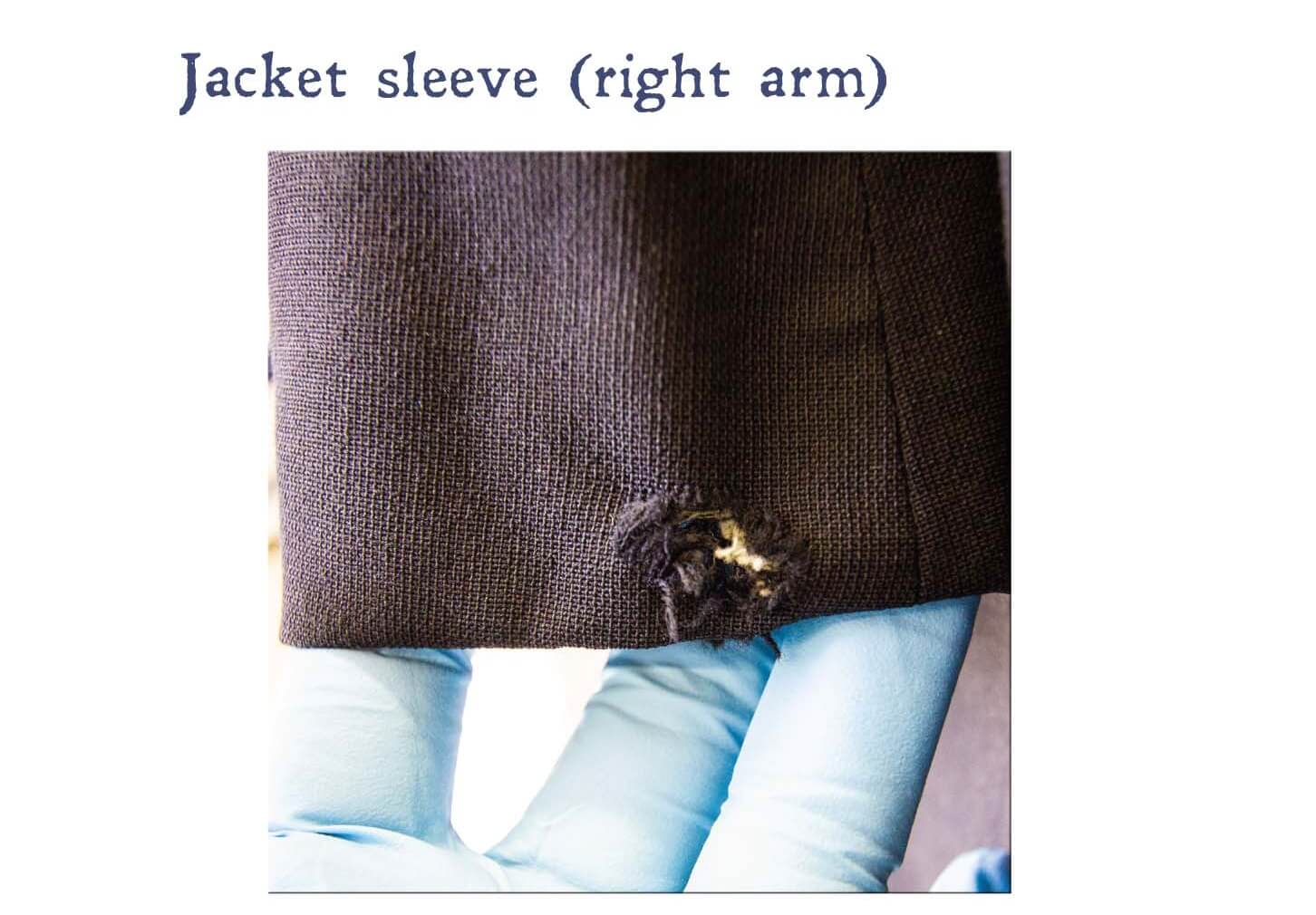
    And here is the photo of Connally’s shirt with a bullet hole in the back, described as 3/8ths by 3/8ths of an inch, and possibly torn along the thread lines adjacent to the spot where the bullet entered. More on the thread lines later.

    The Connally Shirt

    Of course, right away there is a problem—the Mannlicher-Carcano 6.5 rifle fires a large slug, actually 6.77 millimeters in diameter, or a little more than 1/4 inch in diameter and 1 and 1/4 inch in length.

    That size of the Mannlicher-Carcano slug, manufactured by Western ammo, means that the resulting hole in Connally’s shirt was but 1/8th of an inch larger than the diameter of the slug, or a mere 1/16th of an inch on all four sides, assuming the slug was centered in the hole.

    If the magic bullet that struck Connally was tumbling, that is, hit Connally sideways rather than nose-on, how did it make such a small hole, as in 3/8ths of an inch square?  And not a hole 1 and 1/4 inch long?

    Yet here is a depiction by researcher John Lattimer, positing the path and yaw of the “tumbling” bullet:

    Lattimer’s Tumbling Bullet

    But with the re-introduced evidence of Connally’s long-forgotten shirt, it is plainly impossible that the tumbling magic-bullet struck Connally sideways.

    (There are additional complications with Connally’s shirt, but all of which point to an even smaller original hole. The straight edges on the top and bottom of the bullet hole in Connally’s shirt may be the result of fabric removed for testing. Unbelievably, Connally’s shirt and other clothes were sent to a cleaning service directly from Parkland. The FBI indicated it was not able to find metallic traces around the bullet hole, due to the cleaning. It is not clear whether the FBI removed cloth from near the bullet hole, as they did with a hole in JFK’s shirt. In any event, the FBI lab work would have only enlarged the final hole in Connally’s shirt.

    Oddly, the House Select Committee on Assassinations (HSCA) chose to describe the Connally shirt rear bullet hole as “1.3 centimeters (1/2 inch) in transverse diameter.”  Transverse diameter meaning diagonally—and those who remember Pythagoras Theorem can compute that 1/2 inch is a diagonal of a square about 3/8ths by 3/8ths inch. It appears the HSCA was trying to make the Connally shirt hole, already possibly artificially enlarged by the FBI lab, as large as possible, in its report.)

    Also, in the evidence of the shirt President John F. Kennedy wore in the motorcade, the single-magic-bullet theorists posit JFK was actually leaning a bit forward when struck from behind, meaning that the shot from sixth-floor of the Texas School Book Depository struck him cleanly and nearly at a right angle to his body.

    But here is JFK’s shirt from that day:

    Kennedy’s Shirt (1964)
    Kennedy’s Shirt (1993)

    We quickly see a puzzle. The bullet hole in JFK’s shirt is about the same size as the hole in Connally’s shirt. Yet, there is also some uncertainty about this hole in JFK’s shirt. As stated, the squarish cuts on the top end of the hole also may have been made by FBI lab technicians removing cloth to be examined for metallic traces.

    There is a second image of JFK’s shirt, curiously showing an even larger, seemingly double hole.

    There are additional fudge-factors in the Connally shirt, such as possible wrinkles or bunches in material at moment of impact, but all of which would have made the resulting hole larger, rather than smaller.

    In any event, the rear hole in Connally’s does not indicate a sideways hit by a 1 and 1/4-inch long tumbling bullet and is similarly sized as the hole in JFK’s shirt.

    But there is more.

    Dr. Robert Shaw

    Dr. Robert Shaw was the surgeon who attended to the injured Connally on Nov. 22 at Parkland Hospital, and the Governor was immensely lucky in that regard.

    Not only did Shaw have superb credentials—a veteran practicing physician, a professor at the University of Texas—but during Shaw’s WWII service he had personally worked as a surgeon on more than 900 wartime patients who had suffered bullet and shrapnel wounds.

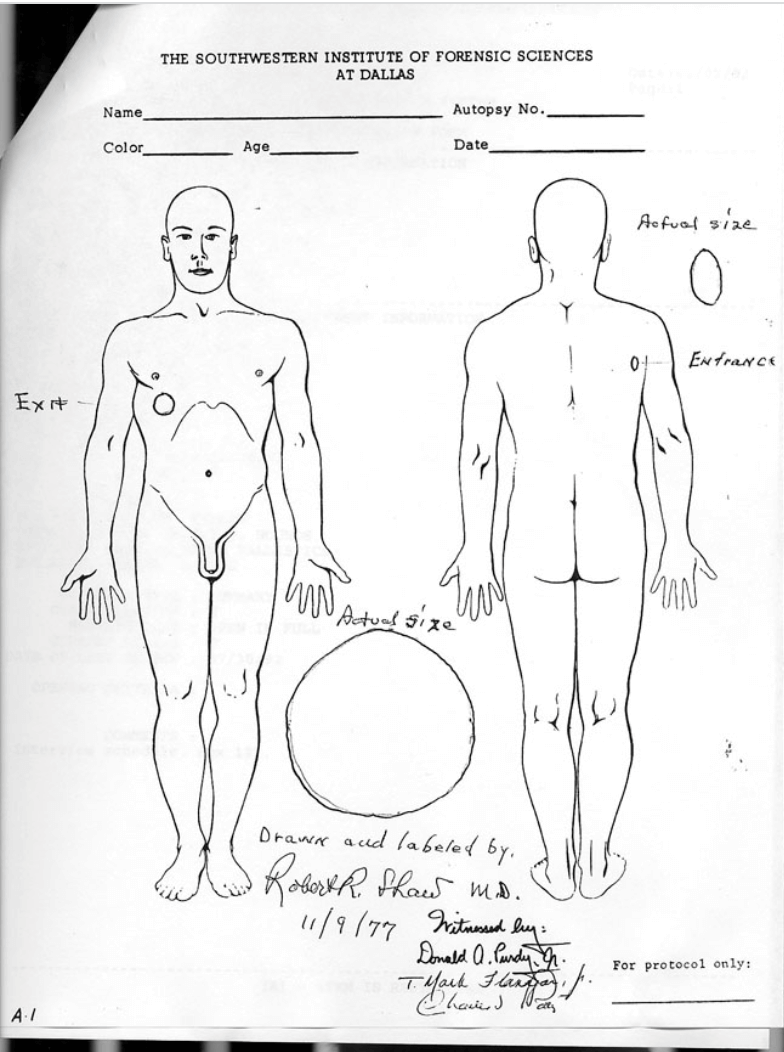
    Dr. Shaw, upon viewing Connally, “found that there was a small wound of entrance (in Connally’s back), roughly elliptical in shape, and approximately a centimeter and a half (5/8th of an inch) in its longest diameter.”

    Connally’s elliptical or oval wound, below his right shoulder, was 5/8ths of an inch along its vertical axis, that is, aligned with Connally’s body or pointing “north-south,” so to speak.

    The vertical elliptical or oval shape of the original wound is a tell, close to conclusive.

    From PathoilogyOutlines.com, in an article entirely unrelated to the JFKA: “Oval shape: suggests an acute angle of fire with respect to the skin.”

    A clean non-tumbling shot, entering Connally’s back from behind and above, such as from the Texas School Book Depository or the Dal-Tex building roof, would leave a vertical elliptical shape, which is precisely the original wound that Connally had.

    The length of ellipse would vary, depending on whether Connally was leaning forward or back at the moment of impact. Connally was almost certainly leaning back, as will be explained later, which would tend to lengthen the resulting elliptical wound.

    In contrast, a tumbling slug might make a ragged hole, as when the bullet’s butt-end struck the body sideways. Such a hole could be largely sideways to the body, or at a three-quarter angle, or oddly shaped in 100 different ways.

    In his testimony to the Warren Commission (WC), and to the House Select Committee on Assassinations (HSCA), Shaw said he thought the rear entrance wound on Connally likely resulted from an unobstructed shot from above, a conclusion bolstered upon his review of the Zapruder film and discussion with the Governor.

    Here is Dr. Shaw’s sketch indicating the vertical, elliptical shape of Connally’s wound—that is, up and down, not horizontal.

    Connally’s Back Wound

    There are other indications that Connally was struck by a non-tumbling bullet. For example, Shaw told the HSCA in 1977 that “there was a tunnel made by the missile in passing through (Connally’s) chest wall.”

    A “tunnel?” Do tumbling bullets make “tunnels”? Yes they do, but according to Dr. Shaw that is not what happened in this case.

    Connally’s Coat

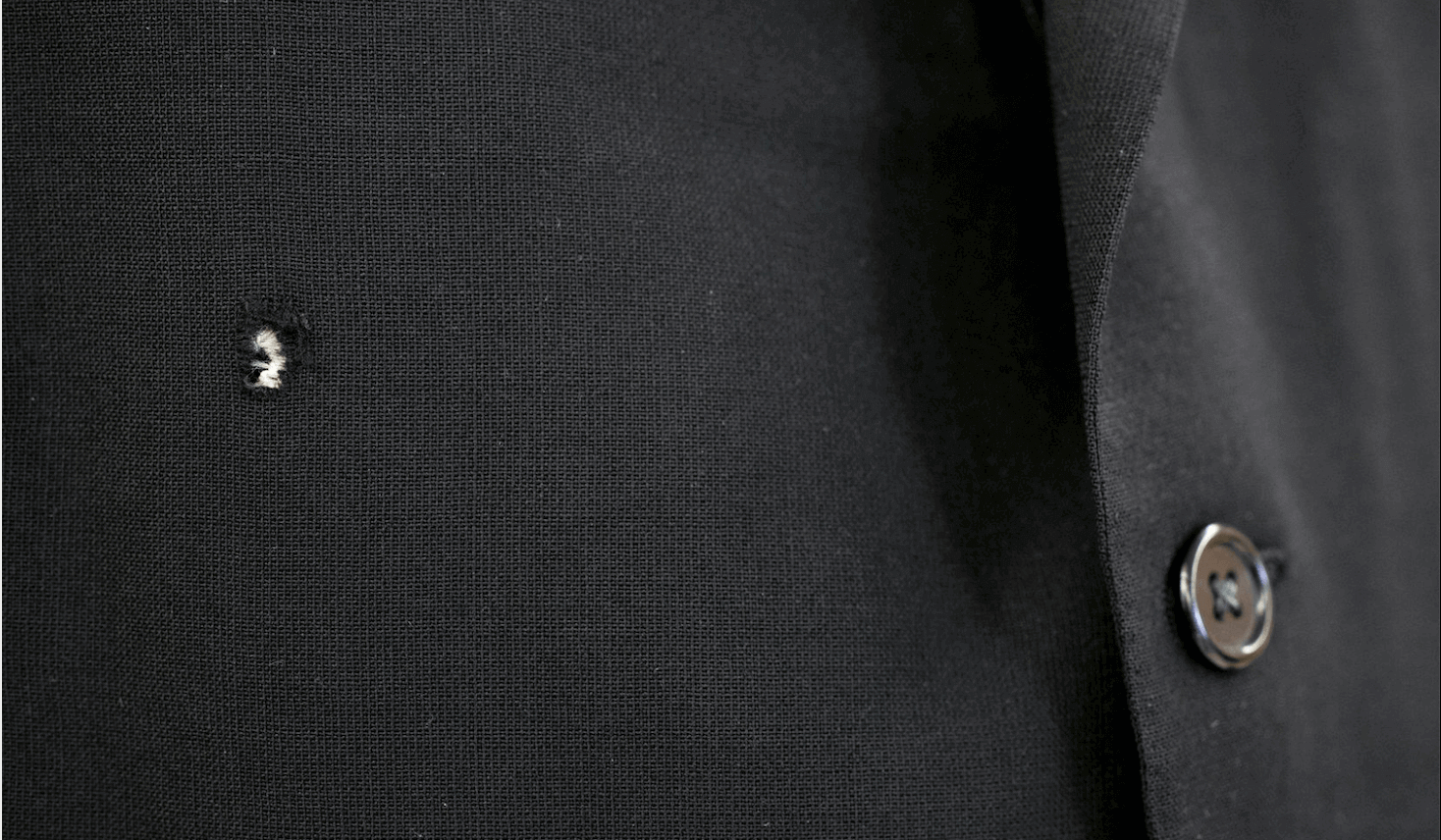
    But there is even more and Shaw was almost certainly correct in his assessment of the wound, for we have a photo Connally’s jacket from Nov. 22 featuring the exit hole the bullet made.

    Connally’s Coat Exit Hole

    And we see a small hole in the front of Connally’s jacket, exactly as if the bullet had cleanly exited. Note the size of the button, for reference.

    Thus, the tumbling single-bullet theory just gets deader and deader.

    To sum up: the tumbling-magic-bullet theorists posit the bullet struck JFK in the upper back, then exited Kennedy’s neck so straight and cleanly that it left a small hole below Kennedy’s Adam’s apple—a hole so small that attending doctors in Parkland Hospital thought it an entrance wound.

    Then (the magic-bullet theorists posit) the bullet tumbled after exiting Kennedy, although it somehow made a small hole in Connally’s shirt, and a small elliptical wound, and then stopped tumbling to tunnel through the Governor. And then the bullet exited exactly nose first, leaving a small hole in Connally’s coat.

    At the risk of piling on, there is even more evidence the shot Connally received that day in Dallas was not tumbling.

    Blundering Pathologists and Lawyers

    Proponents of the single-magic-bullet theory posit the bullet must have tumbled upon leaving President John Kennedy’s neck and then entering Connally. Why?

    That tumbling, proof that the magic bullet passed through JFK’s neck, is why the single magic bullet left a large wound on Connally’s back, the reasoning goes.

    However, the original wound on Connally’s back was not a large one, as is sometimes erroneously asserted, including, embarrassingly, by not only the HSCA’s top lawyer, but also by its top pathologist!

    As stated, Dr. Shaw clearly informed the WC and the HSCA that Connally’s original wound was a small vertical elliptical (or oval shape) injury 5/8ths of an inch long.

    Some of this ground has been covered previously in an excellent article by Millicent Cranor, “Trajectory of a Lie,” at History Matters.

    As noted by Cranor and in the record, Shaw explained to the WC and the HSCA that in order to clean and debride (cut away devitalized tissue) the wound, he enlarged the injury to twice its original size, to a final 3.0 centimeters long (1 1/4 quarter inch long).

    OK, so the final surgically enlarged wound is a one-a-one-quarter inch long, on Connally’s back.

    Here is how Michael Baden, who was chairman of the HSCA Forensic Pathology Panel, described Connally’s back wound in a book he authored: “He (Connally) removed his shirt. There it was—a two-inch long sideways entrance scar in his back. He had not been shot by a second shooter, but by the same flattened bullet that went through Kennedy.”

    Huh?

    So, the original wound, as described by the surgeon Shaw, was a vertical elliptical injury 5/8ths of an inch long.

    But the final scar is a “two-inch long sideways entrance scar,” according to the triumphant Baden, and that means the bullet that struck Connally in Dallas had been tumbling?

    How can Baden, a medical professional, bungle truth and common sense so badly? Had he never considered the small entrance hole in Connally’s shirt? Did he never read the reports by Dr. Shaw?

    And how did a one-and one-quarter-inch final, surgically enlarged wound, as explained by the surgeon Dr. Shaw, become “two-inch long sideways entrance scar” in Baden’s version?

    Even worse, Robert Blakey, chief counsel for the HSCA, fell into the same inexcusable misdiagnosis, also asking Connally to remove his shirt, and also describing the size of scar he had witnessed on the Governor’s back as proof of a tumbling bullet, and thus verifying the single-magic-bullet theory.

    Were the topic not so grave, Team Inspectors Clouseau comes to mind.

    But there is more.

    Dr. Shaw also believed the bullet that coursed through Connally could not have struck a body beforehand, or “it would not have had sufficient force to cause the remainder of the Governor’s wounds.” After tunneling through five inches of Connally’s rib, the bullet then struck and shattered Connally’s wrist before burrowing onto Connally’s left leg.

    But then, what did Shaw know? He had only worked on 900 bullet- and shrapnel-victims during WWII, and then another couple hundred such victims in Dallas.

    Nevertheless, Baden and Blakey would have the final wording of the HSCA report, a type of indelible excrement on the committee’s escutcheon.

    What the Connallys Said

    But there is even more.

    Governor Connally testified resolutely before the WC, and in many other forums (and has been recorded) that there were three shots that day in Dallas: The first shot struck JFK; the second shot struck the Governor in the back and immediately incapacitated him, and the third shot also struck JFK, with awful and fatal result. In other words, three shots, three hits, no tumbling.

    (There may have been and likely were more shots that day in Dallas, but the gunfire may not have been audible in the Presidential limousine, variously due to simultaneous fire, silencers, or use of a pneumatic weapon. In addition, non-simultaneous shots can be heard simultaneously if shooters are at different distances from ear witnesses.)

    Connally’s wife, at his side in the presidential limo, confirmed her husband’s account of the shot pattern many times. Secret Service agents Clint Hill and Sam Kinney, and presidential aide David Powers, all close at the scene on Nov. 22, also all say there were three separate shots that struck JFK and Connally that day, among many other witnesses.

    As Connally stated: “Beyond any question, and I’ll never change my opinion, the first bullet did not hit me. The second bullet did hit me. The third bullet did not hit me.”

    But Governor Connally, like Dr. Shaw—what does he know?

    Zapruder Film

    The Zapruder film almost certainly confirms the Connally’s version.

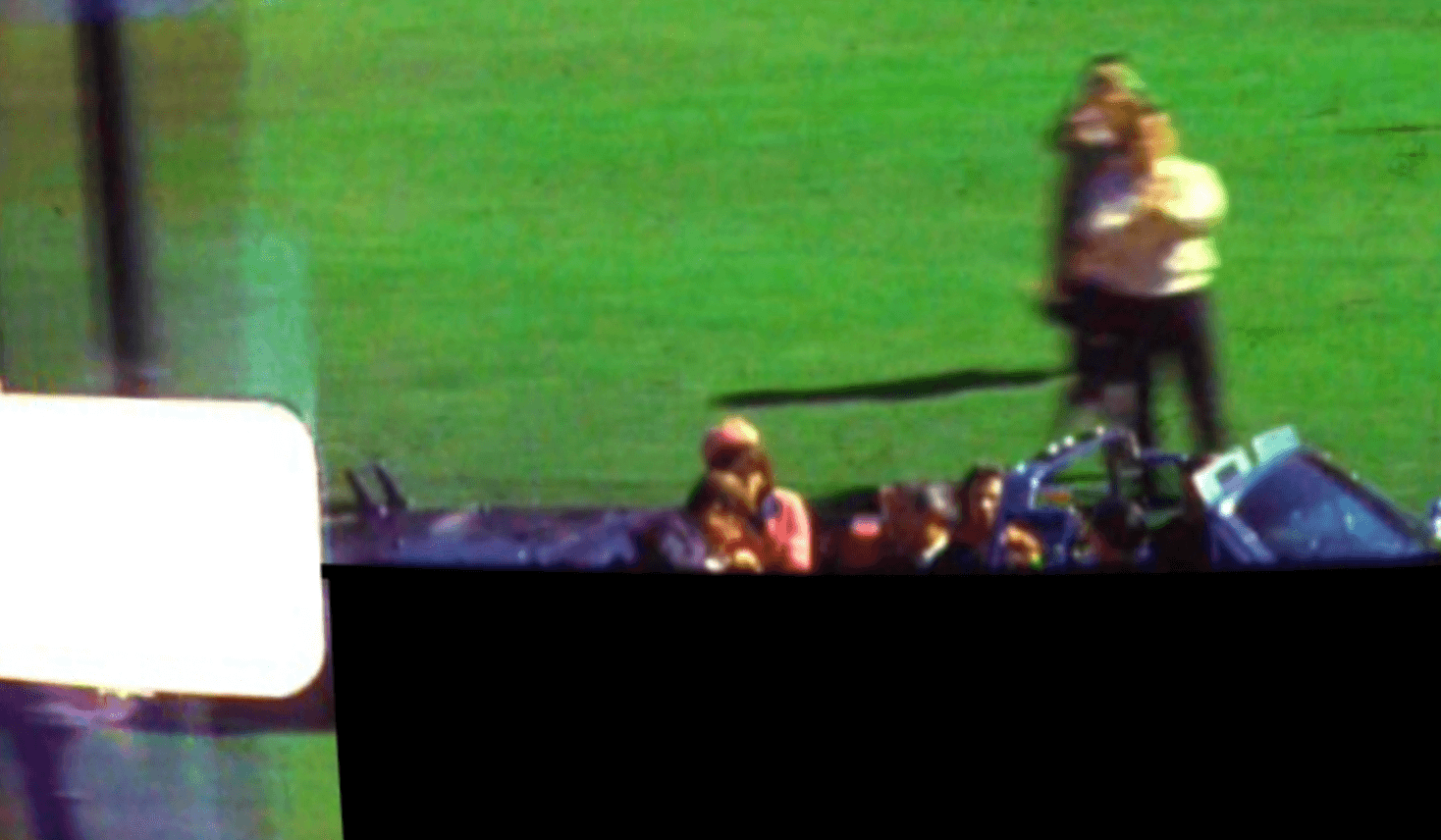
    Here is Zapruder film frame 226, as JFK emerges from behind the Stemmons Freeway sign. JFK appears to have been struck, perhaps just before or while he was behind the sign. Jackie Kennedy looks concerned. Connally is blurry, but sitting upright.

    Z-Film Frame 226. Kennedy is struck; Connally is upright.

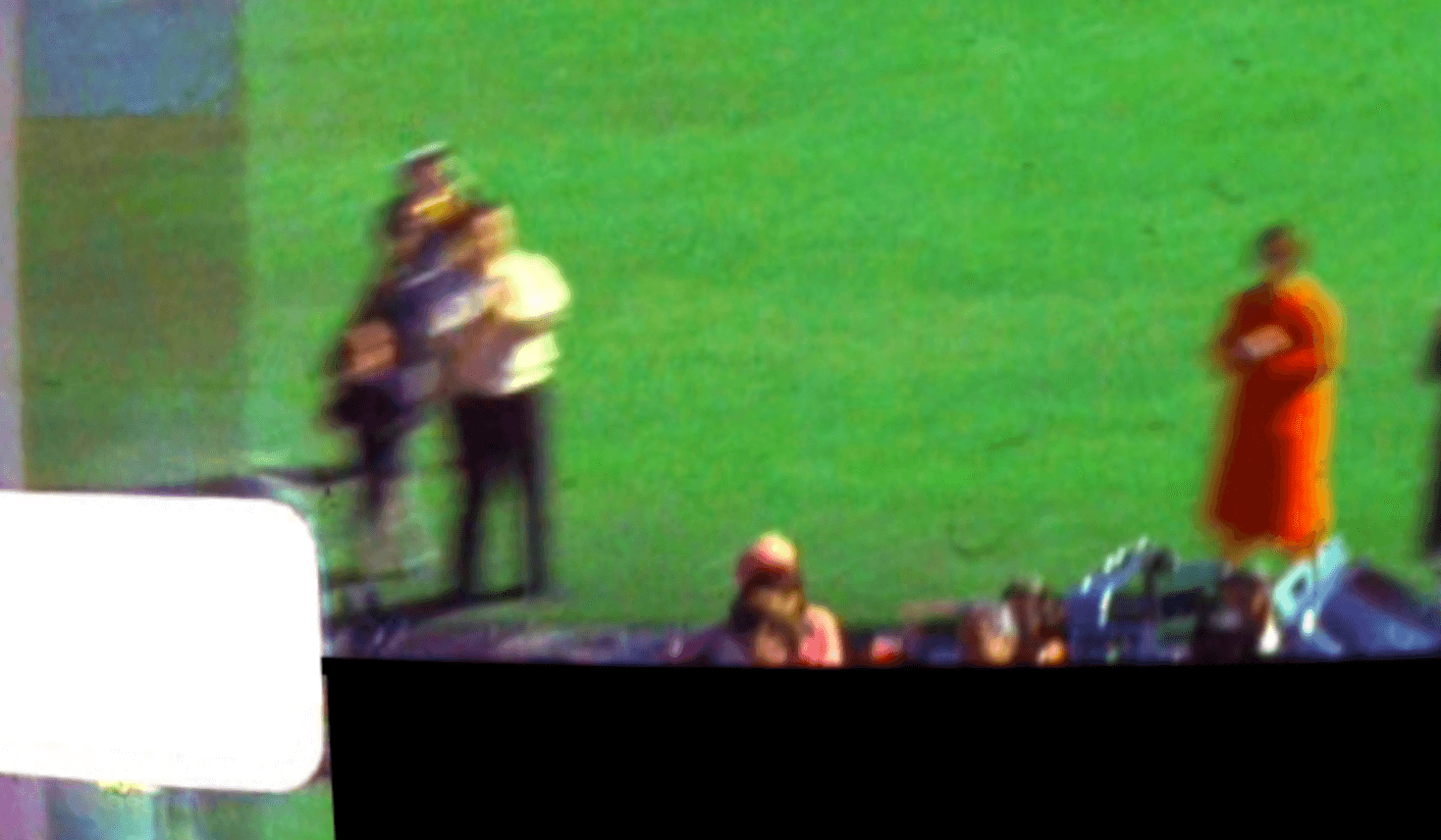
    Here is Z-film frame 245. Connally is halfway through a turn over his own right shoulder, just as he has recounted to the WC. Note, in order to turn around, Connally is leaning back. (Note: Try this yourself. Try to look over your own right shoulder at someone sitting behind you. Try leaning forward, and then leaning back, to look over your right shoulder.)

    Z-Film Frame 245. Connally is turning around.

    In the process of leaning back, Connally exposed his back at a more-acute angle to an elevated gunman, resulting in the original small elliptical wound described by Dr. Shaw.

    This is Z-film frame 280. Note Connally has made a near-180-degree turn in his chair. The WC and HSCA and magic-bullet theorists posit this about-face by Connally happened after he has been shot through the chest and suffered a fractured wrist.

    Connally and his wife said the Governor was trying to catch a glimpse of JFK, given commotion and gunfire, and this is before Connally has been shot. The Connally version appears to be true, beyond reasonable doubt.

    Z-Film Frame 280. Connally has made an 180-degree turn in his seat.

    This is Z-film frame 290. Unable to catch a view of JFK, who has slumped out of view, Connally is now returning to face forward.

    Z-Film Frame 290. Connally turns to face forward.

    And then Z-film frame 296. This appears to be when Connally was struck. Unfortunately, we cannot see Connally’s torso, but his face begins to grimace.

    Z-Film Frame 296. Connally is struck.

    And this is Z file frame 300. Connally appears to be in agony.

    Z-Film Frame 300. Connally is in pain.

    Z-film frame 313 follows, and shows a head shot to JFK.

    The elapsed time between frame 296 and frame 313 is less than eight-tenths of one second, and by all accounts, a single-shot bolt action rifle requires a bare minimum of two seconds to even operate between shots, let alone aim and fire.

    Conclusion

    The reasonable, indeed nearly inevitable and all but certain conclusion is that a bullet did not tumble before striking Connally, and that the timing between shots cannot be explained by a lone gunman operating a single-shot bolt-action rifle.

    The tumbling bullet theory was a desperate fiction invented to give support to the idea that single bullet caused all of Governor’s and the President’s neck wounds on Nov. 22. Otherwise there are too many shots to have been accomplished by a lone gunman with a single-shot bolt-action rifle.

    But from the too-small hole in the rear of Connally’s shirt, to the small elliptical wound in Connally’s back, to the Connally’s testimony, to the observations of Dr. Shaw, and from a review of the Z-film, it is abundantly clear that the Governor was struck by a clean and separate shot.

    Addendum

    Recently, in the oft-excellent pages of the Education Forum, the WC testimony of Dallas Sheriff Seymour Weitzman was reprised in an interesting post by John Butler.

    The relevant passage, in this context, regarding Nov. 22:

    (WC Attorney) Joe Ball: How many shots did you hear?

    Seymour Weitzman: Three distinct shots.

    Joe Ball: How were they spaced?

    Seymour Weitzman: First one, then the second two seemed to be simultaneously.

    But like Connally and Dr. Shaw, what did Weitzman Know?

    Second Addendum

    Interestingly, Dr. Shaw even suggested more than one bullet might have struck Connally. Why?

    The entrance wound on Connally’s wrist was on the side that most people wear the wristwatch, that is the non-palm side, also called the dorsal side. The bullet then exited through the palm side of the wrist.

    Dr. Shaw wondered how Connally could hold his arm so the bullet would pass through his chest and then through the wristwatch-side (or dorsal side) of his wrist. And indeed, try sitting down, and then try to touch the face of your wristwatch (worn on the right wrist) to your chest. You can’t do it. You can place the palm side of your wrist against your chest easily.

    One deduction is another bullet struck Connally’s wrist directly.

    And indeed, Connally testified before the WC that bullets were entering the Presidential limousine as if from “automatic” weapon fire.

    Yet the WC and HSCA posit the magic bullet passed through Connally’s chest, and then through dorsal, non-palm side of his wrist, a nearly impossible scenario, anatomically speaking.

  • Lee Harvey Oswald’s Cold War

    Lee Harvey Oswald’s Cold War


    Greg Parker’s Lee Harvey Oswald’s Cold War is quite appropriately titled. There have been many biographies of Oswald, some of them good, some adequate, and some downright poor. The dividing line, both temporally and in content, was Philip Melanson’s Spy Saga. Released in 1990, Spy Saga was the first work to make a book length case that Oswald was intimately tied up with the world of American intelligence—and most likely not in a casual way. Phil also did important work on the Martin Luther King and Bobby Kennedy cases. Unfortunately, he passed away in 2006. But when he appeared before the Assassination Records Review Board, he made a rather pithy and self-deprecating comment. He said he hoped when their mission was complete, the new database on Oswald would make Spy Saga look like a Cliff Notes pamphlet.

    There is no doubt that Melanson’s prognostication came true. For example, the declassified notes of HSCA researcher Betsy Wolf create an epiphany concerning the relationship between the CIA and Oswald before his defection to Russia. (Click here and go to Section 2) In his book, Parker has not gotten to that point yet. (This review is of the compilation Volumes 1 and 2.)

    Several books on Oswald track his character through the progress of the Cold War. But, quite naturally, the Soviet/American conflict is always in the background. The unusual thing about Parker’s book is that there really is no background. His volume blends so much of the Cold War into the story that background and foreground are almost indistinguishable. That is why I stated that the title is all too appropriate.

    To underline this point: the volume opens in a most unusual manner. Many books on the case, and some biographies of Oswald, discuss the overthrows of Arbenz in Guatemala, Mossadegh in Iran, and the killing of Patrice Lumumba in the Congo, not to mention the many attempts to assassinate Fidel Castro. This book begins with an assassination in Bogota, Colombia. It discusses the murder of Jorge Elicier Gaitan, who, quite frankly, I had never heard of before. (Parker, pp. 4ff) I sure as heck will not forget him now.

    Gaitan was a mayor of Bogota, a member of congress, Minister of Education, and Minister of Labor, Health, and Social Welfare. He was a lawyer who gradually shifted over to politics, especially after seeing the influence of the United Fruit company in his country, particularly after what is called the Cienega, or Santa Marta, massacre. (Parker, pp. 5–8) This event was more or less covered up for decades until Gabriel Garcia Marquez made it famous in his book One Hundred Years of Solitude. What enraged Gaitan about the event was that the American press and State Department tried to paint the massive machine gunning as a natural reaction to a communist plot. It was no such thing. United Fruit demanded the government intervene to halt a strike, since their policy was no negotiations. In fact, United Fruit’s influence may have extended up to having Frank Kellogg, the American Secretary of State, threaten to invade if United Fruit was not protected.

    Gaitan used this event to vault himself into the political arena. He was so effective as a speaker and organizer that he created a kind of rump group to the Liberal Party called the National Leftist Revolutionary Union, or UNIR. Gaitan was a combination Socialist and Populist. Land reform was very important to him. In 1946, he ran for president and lost, mainly because the Liberals ran two candidates, himself and Gabriel Turbay. As Parker makes clear, its odd how Turbay died a year later. (Parker, p. 26) And Gaitan was assassinated a year after that—on the verge of taking over the Liberal Party.

    Before reviewing Gaitan’s murder, the author discusses just how influential the American government was in Latin America. United Fruit’s law firm was the formidable Sullivan and Cromwell, which employed a young John Foster Dulles. Foster Dulles was a kind of roving ambassador for the company in that area. (Parker, p. 9) America was very powerful in Colombia due to the scheme used by Phillipe Bunau Varilla, William Nelson Cromwell, and Teddy Roosevelt to pretty much create the new country to the north in order to finish the Panama Canal. (Parker, pp. 10–13)

    Before the creation of the CIA, the FBI had domain in Latin America through its Special Intelligence Service or SIS. But by 1946, the SIS was on the way out due to the creation of the CIG, the Central Intelligence Group, and the CIA in the following year. Birch O’Neal was an SIS agent who joined the new group. He soon became one of James Angleton’s chief—and most secretive—assistants. (Parker, p. 20) Preceding both the SIS and CIA was the Office of Naval Intelligence. Founded in 1882, by 1929 it had widened its scope from just spying on the advancements of the navies of other nations. (Parker, p. 3)

    On April 9, 1948, Gaitan emerged from his office at about 1 PM. He was shot at four times with one bullet missing. The man apprehended for the crime was Juan Ros Sierra. He was immediately taken to a pharmacy by two policemen. But when they called for reinforcements, no one answered the phone at the station. When asked who put him up to the assassination the defendant only said, “Powerful things that I can’t tell you! Oh Virgin of Carmen! Save Me!” (Parker, p. 29)

    In a startling coincidence, both Gabriel Marquez and Fidel Castro were in direct proximity to the scene of the crime. Marquez later said that he saw a tall, well-dressed man urging the mob to break the police line and extract revenge by killing the suspect. Once this was successful, that man drove away in a new car. (ibid) What happened after must have clearly influenced Castro in his revolutionary career. It came to be called El Bogotazo: ten hours of violence, mayhem, and chaos that left four thousand dead and a large section of the city in ruins. (Parker, p. 30) In turn, that ignited La Violencia, a ten-year civil war that took the lives of about 200,000 people. This reveals not just how much Gaitan was a symbol of hope to the masses, but also how they collectively felt that the—now dead—accused was not working alone. (Parker, p. 30)

    They were correct. A man named John Espirito later made a confession to this effect. He said that the murder was timed for the meeting of the Latin American leftist group which Castro was there to attend. Although Espirito clearly implied that Roa performed the shooting, Parker disagrees. Roa was in the habit of performing mind control exercises that would place him in a trance state in front of a mirror. He then imagined someone emerging from the mirror. The author writes that it actually was a man and he was part of the set up. He corresponds to someone at the scene who had a trench coat draped over his arm. Parker writes that this was the main assassin and that Roa only fired the last shot, the one that missed. (Parker, p. 54)

    The chapter ends with a postulation: was this the CIA’s first assassination plot? If so, it certainly resembles the RFK scenario, not just in its intricacies, but because it stopped a liberal leader from taking power and produced years of chaos. In the American case, it prolonged the Vietnam War.

    II

    The Gaitan murder happened closely after the official opening of the Cold War, which is usually timed with George Kennan’s long telegram from Moscow. The author then jumps forward a few years to Korea. He focuses on two types of specialized warfare that emerged during the conflict. The first was what had been apparently used with Roa: mind control. The second was germ warfare. The United States coveted Japan’s so called “Devil Doctor,” Ishii Shiro and his infamous Unit 731. He was perhaps the most advanced microbiologist of his day and performed thousands of experiments on human guinea pigs, including American POW’s. Douglas MacArthur made sure he was not prosecuted and so he ended up at Fort Detrick, Maryland. (Parker, pp. 78–80) In other words, what happened with Operation Paper Clip in Europe also occurred in Asia, except in this instance it was not rocketry, but biological science. It was left to the Russians to expose Ishii for what he was and how he had experimented on American prisoners. This is how America developed the science for bacteria weapons in Korea and then, according to Parker, lied about its usage. (Parker, pp. 83–86) One way they did so was by saying the Chinese had brainwashed the men who said they did it.

    All of this clearly amped up domestic Cold War tensions. Ruth Paine started to attend Quaker meetings in 1947, but did not actually join the church until 1951. The author describes a kind of factionalism within the Quaker movement that gained traction over the forties and fifties. The Hicksites, a very pure and spiritual sect inside the church who had been strongly anti-slavery, now gave way to a more conservative evangelical strain. (Parker, pp. 94–95). This struggle was exemplified by a meeting of the Friends at Earlham College which Ruth attended. Earlham was a hotbed of this early kind of conservative evangelical movement. A future graduate of Earlham was Von Edwin Peacock. By the time of the FBI inquiry into Oswald’s alleged visit to Mexico City, Peacock was acting Director of the American Friends Service Committee (AFSC). The AFSC ran the Casa de los Amigos in Mexico City. A local Quaker said he saw Kennedy’s alleged assassin at that place while he was in Mexico City in 1963. (Parker, p. 96)

    What makes this interesting is that the latest work on this aspect indicates that Oswald was not in Mexico City. But yet, one of the things that Ruth Paine did complemented what the AFSC group did for the Warren Commission. She supplied articles that were allegedly returned to Dallas by Oswald from Mexico City. (James DiEugenio, Destiny Betrayed, second edition, p. 203)

    In an interesting piece of discovery, the book states that Marguerite Oswald once worked at a naval base in Algiers, Louisiana as a switchboard operator. (Parker, p. 104) This was during World War II, when Oswald was perhaps 2 years old. Parker believes this job involved some kind of research project through Pittsburgh Paint and Glass at that base. It was at this time, late 1941 or early 1942, that she met Edwin Ekdahl, an electrical engineer. Ekdahl would become her third husband and the step father to Lee since the child’s real father had died before he was born in October, 1939. Parker believes that Marguerite met Ekdahl while at the base and that the company he worked for, Ebasco, a division of GE, was also involved in that research project. (Parker, p. 106) You will not find this information in the Warren Commission report or that by the House Select Committee on Assassinations (HSCA).

    The two eventually married in 1945 and moved to Fort Worth, where Ekdahl was now working. The couple stayed together until 1948. Parker notes more oddities about Lee’s enrollment in 2 elementary schools: Ekdahl is listed as his father, but in the blank for mother, no one is listed. (Parker, pp. 117–18). Although the wife thought the husband was having an affair, it was the husband who filed for divorce first. The attorney he hired was Fred Korth, who had an office in close proximity to his own. (Parker, pp. 110, 118) Korth was a lawyer and a banker. He would eventually become Secretary of the Navy in 1962, succeeding John Connally. Both men served at Vice President Johnson’s request. Parker points out something about Korth here that may be more than just passing interest. Though Korth handled Ekdahl’s end of the divorce, the Warren Commission could not find any evidence that Ekdahl had legally divorced his first wife, Rasmina. What makes that even more odd is that Rasmina and Edwin ended up being buried together. (p. 119)

    III

    The scene now moves to New York City. As many have noted, it has never been entirely clear as to why Marguerite decided to move to the Big Apple. The ostensible reason is that her first son, John Pic, and his wife lived there. With Robert Oswald, Lee’s older brother, in the service, Marguerite said she did not want Lee to be alone while she was at work. (Warren Report, p. 675) But, as the author points out, Ekdahl was now living in New York and may have helped get Lee into Trinity Evangelical Lutheran School. (Parker, p. 128) And third, there is the mysterious issue of Lee’s “mental tests” that were likely done at Yeshiva University. This was discovered through an FBI interview with a house cleaner for Marguerite, Mrs. Louise Robertson.

    The living arrangement did not last long. Parker does a nice job in exposing the Warren Commission version of how it ended. In their attempt to show that somehow the 13 year old Oswald was already a sociopath, they wrote that Oswald threatened Pic’s wife with a knife and smacked his mother while this was going on. (Warren Report, p. 676) By going through the original sources, the author shows how the Commission completely distorted the whole affair. He shows that when first interviewed about it with the FBI, Pic said no one had ever informed him any such threatening incident. But by the time he testified before the Commission, his memory had been completely refreshed. Except for one telling point—he had to take out his notes to keep the details straight. (Parker, pp. 131–33) What likely happened is that Pic’s wife did not care for her mother-in-law and her son. And she completely exaggerated what had happened in order to get them out. The FBI and the Commission then did what they usually did. With Oswald having no attorney, they were allowed to turn the incident into something it wasn’t—as long as it was exaggerated to Oswald’s detriment.

    Parker does an equally adroit analysis with the famous Youth House report by Renatus Hartogs. Oswald was truant from his schooling and was referred to a kind of halfway house for three weeks in the spring of 1953. There he was examined by Dr. Hartogs. To this day, if one views the Wikipedia entry on Oswald, one will read about Oswald threatening Pic’s wife with a knife—which most likely did not occur. But also, various newspapers in 1963, like the New York Times and Charleston News and Courier, had written stories based on alleged reports Hartogs had made about Oswald back in 1953. According to those reports Hartogs had written that Oswald had “schizophrenic tendencies” and that Oswald was “potentially dangerous” and should be committed. (Parker, pp. 170, 179)

    Evidently, from reading the newspapers, Hartogs came to think that this was what he had written. And he never bothered to cross check this with his original reports. But Wesley Liebeler had the reports when he examined the doctor on April 16, 1964. It turned out that Hartogs made no such comment about having Oswald committed. He thought Oswald should be placed on probation. He also never wrote that he thought Oswald was capable of a possible violent outburst. As Liebeler also pointed out, there was no reference to Oswald as “incipient schizophrenic” or “potentially dangerous” in his report. Finally, there was no evidence that Oswald was suffering from either delusions or hallucinations. (Parker, pp. 174–78)

    Incredibly, in 1968, Hartogs was still claiming he had predicted Oswald was potentially dangerous. A few years later, he was successfully sued by one of his patients for sexual molestation. (Click here for details)  Some witness.

    IV

    Marguerite moved back to New Orleans in 1954. Although the HSCA tried to say that Uncle Dutz Murret served as a kind of surrogate father for Lee, that is in contradiction to what the man said to the Commission. He told them he did not take much interest in or pay much attention to the lad. (Parker, pp. 194–95) The author concludes that the only real father figure Oswald had was Ekdahl and he passed away in 1953.

    Another myth proposed by the HSCA regarding Oswald was that somehow Beauregard Junior High School had the reputation of being a spawning ground for future criminals. Yet again, this was contradicted by someone who should know, namely Marguerite’s sister, Lillian Murret, who lived in New Orleans her entire life. The reason that Marguerite used Lillian’s address was in order to register Lee for Beauregard, since “it had a good reputation as a good school.” Family friend Myrtle Evans said the same, that it was a good school and Marguerite had used Lillian’s address to get him in for that specific reason. (Parker, pp. 200–01)

    In 1955, Lee completed a personal history in class which said his career choices were the military and undecided. Two weeks later, his brother Robert Oswald returned from active duty. Two weeks after that, Oswald joined the Civil Air Patrol (CAP) with his friend Ed Voebel. As his mother tried to tell the Commission: Was it not odd that at the same time Lee was reading the Marine Corp Manual, he was also studying Karl Marx? (Parker, p. 216)

    In its original design, the CAP was designed to be, among other things, a kind of Loyalty Police. The author sources this to a NY Daily News story from 1948. To support this belief, he writes that the story was quickly withdrawn and then denied. But that story got a reaction from other papers who said that the CAP was “Fascism wrapped in the American flag.” (Parker, p. 221)

    From here, we shift to oil tycoon Harold Byrd and how he figured in both the creation of the CAP and the purchase of what would become the Texas School Book Depository (TSBD). Byrd was one of the founders of the group back in 1941. He then became commander of the Texas wing and then a Colonel in the patrol before he went off to the Department of War in 1943. He eventually ended up as Vice Chair and then Chair of the national organization in 1959. (Parker, p. 222) Byrd bought the building which became the TSBD in 1939 for a fire sale figure of $35,000. He go it since he had been a part of the original loan, which had been defaulted on for about ten times that price.

    Appropriately, the author now goes into the relationship between CAP leader David Ferrie and Oswald. For all his faults, which are well known, the author writes that Ferrie had the reputation of being a good trainer in the Cleveland CAP, which is where he was born. (Parker, p. 224) He describes how Ferrie was booted out of the CAP in New Orleans and then started his own renegade group. He focuses on the secret group that Ferrie had created inside his unit. Sometimes this was called the Omnipotents, at times it was given the longer rubric: Internal Mobile Security Unit. The members of this inner group were given special training and special assignments: like getting a passport so one could emigrate to Cuba through South America. (Parker, p. 227) This indicates the degree of control that Ferrie had over his cadets.

    In the fall of 1955, someone forged a letter in Marguerite’s name which stated that Oswald was leaving school for San Diego. Oswald attempted to drop out. But Marguerite fouled it up by enclosing his real birth certificate in a duffel bag. (Parker, p. 233) In fact, as is mentioned in passing, someone dressed and posing as a Marine recruiter showed up at the Oswald home to try and convince her to let him join, even though he was underage. In Bill Davy’s discussion of this episode, he suggested this may have been Ferrie. (Let Justice be Done, p. 6) As Parker notes once more, the Commission gravely distorted this episode by writing that Oswald was able to convince his mother to make a false statement about his age.

    V

    One of the highlights of the book is the discussion of Oswald’s employment at Gerald F. Tujague, Inc. The author brings in an aspect about this brief employment that I was not aware of. The founder of the company was A. E. Hegewisch and it was his name that was used in its original title. It was a freight forwarding business and it began in 1923. As a vociferous anti-communist, Hegewisch was plugged into the New Orleans higher circles. In fact, he was the second president of International House. (Parker, p. 236) It’s pretty easy to figure out why. He knew the CIA approved Dr. Alton Ochsner, CIA agent Clay Shaw, and CIA asset William Gaudet. He was also an early president of an Agency front, the Cordell Hull Foundation. That foundation originated in Nashville—Hull was born in Tennessee—but it moved to New Orleans in 1954 and was housed inside the International House. Ochsner took over the presidency in 1956.

    In 1953, Hegewisch turned over the company to five of his employees. This included Mr. Tujague, who became president, thus the name change. (Parker, p. 237) It appears that, as with Hegewisch, the Agency stayed in the background of the picture, because, later, Tujague was one of the founders of Friends of Democratic Cuba, which we know was associated with Ochsner and Shaw’s colleague, Guy Banister and also with the CIA associated Sergio Arcacha Smith. The author’s hypothesis is that Oswald was employed there in 1955, most likely through his acquaintance with Ferrie. His performance as a runner was a test of “Lee’s ability to deliver ‘goods’ and messages around the ports to the various networks of agents, informants and assets.” (Parker, p. 237) As Jim Garrison once noted, this is why New Orleans was so important to the CIA and FBI, because of its centrality as a portal to and from Latin America.

    After a bit over two months, Oswald went to JR Michels, Inc., which was located in the same building. His job there was “running Export Declaration forms to the Customs Office for authentication.” (Parker, p. 238) It required that a file with picture be kept of Lee at the Customs office. It was reportedly destroyed around 1958. As Joan Mellen later observed, that destruction was not solitary. Her research assistant Peter Vea later discovered that Oswald had meetings at Customs in 1963, yet those files were never recovered by the ARRB. (Mellen at Cyril Wecht’s Duquesne Conference of 2003)

    The author postulates that these temporary positions were more of less a dress rehearsal for Oswald’s ultimate enlistment, this time at a legal age. And he mentions programs like REDSOX, and REDCAP, and an ONI program which were supposedly designed for infiltration and false defectors. (Parker, pp. 230, 257) Parker notes that when Oswald wrote a letter to the Young Socialist League it was before he signed the Loyalty Certificate for Personnel of the Armed Forces. And that organization was listed on the certificate as being subversive. In the letter, he was asking to not just join, but perhaps start his own branch. There was no ambiguity about that. (Parker, p. 263) Yet this violation triggered no action against Oswald, even though an FBI check was done. Was this perhaps because, according to Ferrie’s friend Van Burns, Ferrie would meet with Oswald before his defection in 1959? Therefore, was everything cleared in advance?

    As we all know, in the Marines, Oswald was sent to Atsugi air base in Japan, one of the homes of the U2. An utterly fascinating revelation in the book is about Ruth Paine, more specifically about her sister Sylvia Hoke. It turns out that she was part of the FICON project, the precursor to the U2. In other words, Hoke was working under the guise of a civilian for the Air Force when, in fact, she was really employed by the CIA. She worked on that project through the auspices of George Washington University. (Parker, pp. 266–267). Is this why Ruth denied any knowledge of her sister’s employment when Jim Garrison questioned her before the New Orleans grand jury?

    Another provocative issue the author brings up is Oswald’s meeting with Rosaleen Quinn while in the service. Quinn worked for Pan Am Airlines, but she was taking a Berlitz class in Russian because she wanted to join the State Department. What is new here is that Pan Am had a close association with the CIA, “more specifically between the CIA and members of the flight crews.” (Parker, p. 276) But not just the CIA. Employees were participating with “State Department operations involved behind the scene mission in dangerous locations.” Parker is clearly postulating that the so called “Quinn date” was really another test, this time for Oswald’s ultimate mission to Moscow. If so, he passed, since Quinn said he spoke Russian better than she did. To amplify that opinion, the author notes that Quinn met with Oswald’s radar commander afterwards, John Donovan.

    Parker closes his book with the Albert Schweitzer College episode. Stephen Frichtman was the famous minister at the Unitarian church in Los Angeles. This was in easy driving distance to Santa Ana, where Oswald was stationed. Frichtman’s name was found in Oswald’s undercover cohort Richard Case Nagell’s notebook. (Parker, p. 287) The point being that Albert Schweitzer did very little advertising. And a person who was familiar with the college told the late George Michael Evica that recruitment was usually done through personal contact. The highest entry class was about 30 people and sometimes the place was near empty. As Evica found out, Hans Casparis and his wife—who were running the place—were both academic frauds. So in preparation for travel abroad, why and how did Oswald list this place on his passport itinerary and how did he find the application form? Parker seems to imply it was with the help of Frichtman and/or Kerry Thornley, his supposed friend at the base.

    Parker has written an unusual, provocative, and insightful work. I have some disagreements, but considering the overall quality, they are really too mild to bring up. He and Seamus Coogan and Frankie Vegas (real name) are all significant contributors to the case from down under (i.e. Australia and New Zealand). Parker has had some serious health problems of late. Let us wish him well. I would really like to see the concluding volumes of this intriguing series.

  • Morley v. CIA

    Morley v. CIA


    Jefferson Morley’s e-book Morley v. CIA is a brief tome, but if one is attuned to the scenario and the political times, it’s a work that is powerful in its overtones. On the surface, it tells the story of a journalist at the Washington Post who got interested in the JFK case. He decided to pursue a certain angle about Oswald’s activities in New Orleans with a certain Cuban exile group. He then filed a Freedom of Information Act request. The end result of that application had two long term results that were both negative for Morley and for the cause of open government and disclosure. They are really the heart of this story. But before we get to them, let us lay in some background.

    Morley was one of the very few MSM reporters who showed a real interest in the John Kennedy assassination. From his outpost at the Washington Post, he became acquainted with John Newman. He and Newman cooperated on what was one of the most fascinating and important discoveries in the early days of the Assassination Records Review Board. This was the interview those men did with CIA official Jane Roman in the fall of 1994. Morley had discovered that Roman had handled cables and communications about Oswald in the weeks before Kennedy’s assassination. Yet she had signed a communication to Mexico City saying that the latest information CIA had on Oswald was a State Department report from May of 1962. This was a key discovery in trying to comprehend what was going on in Mexico City, which the Warren Commission never came close to understanding. (For a fuller version of that incident click here)

    Morley actually got the Post to publish a few stories on the JFK case which were not cheerleading boilerplate for the Commission or slams against the critical community. This was a significant achievement. He has talked about the rather difficult process he had to go through to get the stories published. At times, it was almost a Catch 22 situation. His editors would ask him what theory he was trying to push. He would reply that he was not pushing any theory. They would then ask: “Well why do you want to run the story then?” Consider: Morley was a veteran reporter who had been with The New Republic and The Nation for a number of years prior to the Post. The fact he had to run this gauntlet shows how radioactive this issue was thirty years after Kennedy’s assassination.

    As he began to go through some of the declassified CIA documents, the reporter noted that, contrary to what the Agency had maintained for decades, they had a keen and continuing interest in Oswald. (Morley, p. 9). He was particularly struck by the fact that the Directorio Revolucionario Estudiantil—the DRE—had participated in a broadcast debate with Oswald. Afterwards, they had called for an inquiry into his group: the Fair Play for Cuba Committee. This was three months before the assassination. He was surprised when he discovered that not only did the CIA have a file on the DRE, they had three boxes of materials on that group. After going through the material, he concluded that the DRE was in reality a CIA front. (Morley, p. 10) They were getting a princely sum of $51,000/month to operate both domestically and abroad—the equivalent of nearly a half million today. (Morley, p. 11)

    He then went about tracking down some of the surviving DRE members. They all referred to a man named “Howard” as their contact with the CIA in 1963. In the boxes, there were lengthy monthly reports out of the Miami station on the DRE, yet these did not appear to exist in 1963. (Morley, p. 10) In 1998, the Review Board released a document which stated the case officer for the DRE in 1963 was not Howard Hunt, but George Joannides. (p. 14) The plot thickened when Morley learned that, in 1978, while he was recovering from a heart operation, Joannides was recruited by Scott Breckinridge. Breckinridge was the chief liaison for the CIA with the House Select Committee on Assassinations (HSCA). Unfortunately, when Morley unearthed all of this, he also found out that Joannides had passed on in March of 1991. The Post obituary had described him as a Defense Department attorney. (Morley, p. 15)

    Once he had this information in hand, the reporter contacted Robert Blakey, the Chief Counsel for the HSCA during its last two years of operation. He asked him if he knew what Joannides was doing in 1963. Blakey said he was not doing anything. He had a deal with the Agency that no one operative in 1963 would be working with the committee. In other words, the Chief Counsel had been snookered. (Morley, p. 15)

    Morley thought, quite naturally, that this all added up to an interesting story that the Post should run. Bob Woodward agreed. But the investigative reporting chief ended up vetoing the story. The author’s summary of this episode is notable:

    They just didn’t want to deal with a JFK assassination story, which amounted to prudent careerism manifested by a difference in news judgment. Nobody had ever gotten ahead in Washington by challenging the CIA’s account of JFK’s assassination…The truth was, I had a good story that didn’t serve the newsroom’s collective agenda. (Morley, p. 18)

    It then got worse. The Post, in the person of managing editor Steve Coll, denied his suggestion to file a Freedom of Information Act (FOIA) request to get more documents on Joannides. Therefore, Morley had to publish the story with the Miami New Times, an alternative weekly.

    Though he switched over to the online version of the Post, he did not lose interest in Joannides. Morley ended up joining forces with the very experienced Washington FOIA attorney Jim Lesar. Lesar agreed to take the case, because the precedent in the field was that if the CIA lost, the Agency would have to pay his fees. (Morley, p. 19)

    Prior to working with Breckinridge, since he spoke fluent Greek and French, Joannides had worked as an undercover agent at the Athens station. The author makes clear that Joannides was an operations man, not a desk jockey. (Morley, p. 21) But in 1962, he was sent to the Miami station. At around this time, Deputy Director Richard Helms decided to redo the Agency contract with the DRE. Whoever became their case officer would have full access to Helms. (p. 22) In some documents the CIA gave up, Morley discovered that Joannides took out a second home in New Orleans in 1964, while the Commission was holding hearings there. This may have been important, because Helms never disclosed that the DRE had a CIA code name, AMPSELL, to the Warren Commission. This was the case even though Helms was the key officer controlling CIA relations with that body.

    Lesar filed for the missing monthly reports and the reasons why Joannides was chosen as the HSCA liaison. (p. 26) Dan Hardway became co-counsel. Hardway had worked for the HSCA and had direct contact with Joannides. Recall, when Fletcher Prouty first went to the HSCA for a pre-interview, he saw Joannides there. He immediately realized what had happened. So, he chose to cooperate in only a perfunctory manner.

    In interviews this reviewer did with Hardway, and based on a speech Hardway’s partner Eddie Lopez gave in Chicago in 1993, Prouty was absolutely correct. Up until Joannides coming in, Danny and Ed worked out of the CIA offices in Langley. It was a relatively cooperative and informal arrangement. And the two made good progress on their studies of the CIA and Oswald, and the Oswald in Mexico City mystery. This changed under Joannides. As Lopez said in Chicago, now they were shifted out of Langley to offices at the HSCA headquarters. A huge safe was moved into the office. Ed and Dan had to file formal written requests that were now courier-delivered to a secretary. They then had to sign in and out and also for each batch of documents. They also had to hand in their notes. But further, according to Hardway, they now did not get completely unredacted documents or all the documents under request. This violated the agreement that the HSCA had made with CIA. In other words, Joannides acted as a hatchet man.

    Judge Richard Leon oversaw Morley’s case at the district level. To put it mildly, he did not look upon it with sympathetic eyes. And here, in addition to the struggle at the Post, comes a second sub theme to the book. That is, how the GOP has stacked the judiciary through The Federalist Society. Leon was appointed to the court by George W. Bush and, according to the late Robert Parry, that may have been an appreciative familial gesture. (Click here for details)

    Leon consistently ruled against Morley and Lesar, but, on appeal, Lesar got about 300 pages of newly declassified material. It should be revealed here that, in his interview with Oliver Stone for the director’s upcoming JFK documentary, ARRB chair John Tunheim stated that he was also deceived by the CIA about Joannides. The Agency told the Board that all they had on the former operator was his personnel file. That turned out to be, at the very least, an exaggeration. Tunheim felt that he also had been snookered. For example, Joannides told Blakey that the CIA cut off contact with the DRE in April of 1963. Not accurate. The CIA funding of the DRE went on all the way until late 1966. (Morley, p. 41)

    After the 300 pages—which declassified an award that included his domestic actions, which Morley thinks may have been his work with the DRE—Leon attempted to end the case. This was with about 100 documents still outstanding. (Morley, pp. 43–45). This time, the appeals court—with Brett Kavanaugh on it—agreed with Leon.

    This led to the second part of the suit, which was an attempt to have the CIA compensate Lesar for the work he had done on the filings, hearings, and other parts of the case. Here, Brett Kavanaugh proved crucial. Prior to the Morley case, there had been a four-part test over the issue of compensation. (Morley, p. 47) If the plaintiff prevailed, those four parts came into play. Clearly, Morley had prevailed, since he got hundreds of pages out which had been secret. These benefited the public, since he wrote many articles about it. Further, the JFK case was and is an issue of substantial interest.

    In the end, Kavanaugh reversed his initial vote on the fees. In 2013, he agreed with Lesar. In 2018, he did not. The main issue that changed was that he was now on the verge of attaining his life’s ambition as a member of the Federalist Society. (Morley, p. 55) As the author writes, Kavanaugh’s elevation to the Supreme Court was sealed with a “decision that can only be described as arbitrary, self-serving, and detrimental to the spirt of the Freedom of Information Act.” (Ibid)

    And that statement is not hyperbole and it is not sour grapes either. The author includes Kavanaugh’s decision along with Karen Henderson’s in his appendix to the book. Henderson dissented and her opinion pretty much takes apart Kavanaugh’s in every way. And make no mistake, this is an important issue, for the simple reason that it is difficult for a private individual to take on the FBI or CIA on his own. And the people who file these cases are usually not those of extreme wealth (e.g. the late Harold Weisberg). This is what keeps the scales a bit more even and what helps secure an open government. But once one gets a judge like Leon, who defers to the judgment of the CIA, and one like Kavanaugh, who saw his future beckoning, past precedents were forgotten. Henderson’s dissent is very much worth reading.

    Morley has written an unusual book. I don’t recall one like it dealing with the JFK case. It seems to me more than just a profile of a FOIA lawsuit. It tells us about problems with not just the JFK case, but through that with the press and our court system. Both of which weighed in on the side of secrecy.

    Joannides must be smiling.

  • The Woman who Predicted JFK’s Assassination

    The Woman who Predicted JFK’s Assassination


    As Joan Didion once said, the things that Jim Garrison dug up were, at times, miraculous. As the famous authoress noted to James Atlas, “The stones that were turned over. Fantastic characters kept emerging—this whole revealed world…” As Malcolm Blunt later added, considering what Washington threw at him, someone must have known that the DA was getting too close for comfort. (Click here for my review of Blunt’s interview book)

    To take some kind of measure of those two judgments, consider the following facts.

    The Warren Report, and its accompanying 26 volumes of testimony and exhibits, clocks in at over 17,000 pages. Yet in that endless forest of material, the assassination of President Kennedy is an event that appears like a bolt of lightning across a clear summer sky: completely unexpected and, therefore, shocking. There was no premonition or warning about it. Kennedy’s murder happened out of nowhere.

    That imputation was false. As the New Orleans DA found out, it was not even close to the truth. The fact that the Commission portrayed it that way says more about its investigatory failings than about the circumstances surrounding Kennedy’s assassination. As revealed in Secret Service agent Abraham Bolden’s book, the New Orleans DA learned about the prior (unsuccessful) plot to kill Kennedy in Chicago. Which occurred just three weeks before the successful one in Dallas. (Click here for details)

    Garrison also sent an investigator to interview Richard Case Nagell in prison. Nagell had been hired by the KGB to track down and prevent the assassination of JFK. The Russians had information that such a conspiracy was brewing. They did not want it to succeed, since they thought Kennedy’s murder would be blamed on them. Handed the assignment, Nagell was tracking the plot to kill Kennedy in advance of the assassination. He had determined such a plot was real and was going to happen. (James DiEugenio, Destiny Betrayed, second edition, pp. 93–98)

    Then there was the 1963 version of Shakespeare’s soothsayer in his play Julius Caesar, warning of impending doom.

    Garrison had been alerted to the case of a woman who—on the eve of the assassination—had been discarded by her cohorts on a drug run from Miami to Dallas. While hitchhiking on US Route 190 outside of Eunice Louisiana, she was struck by a car driven by one Frank Odom.

    Odom took her to Moosa Memorial Hospital in Eunice. The hospital administrator, Louise Guillory, recognized she was in some kind of drug withdrawal. Since he was experienced in these kinds of cases, she called State Trooper Francis Fruge. Because of the manifest withdrawal symptoms, Fruge called for a doctor to give her a sedative and then for an ambulance to transport her to Jackson State Hospital.

    It was on this drive, under routine questioning, that something stunning occurred. She gave her name as Rose Cherami, which was not her real name—it was one of the aliases she worked under in the drug and call girl trade. When asked what she was doing, she related the story of a heroin shipment she was working on. She also said she had been abandoned by the two Cubans whom she was working with on that assignment. But further, and most importantly, those two men had talked about how they were going to kill Kennedy when they got to Dallas. Even though Fruge told the House Select Committee on Assassinations that, under the influence of the sedative, Rose looked and sounded lucid to him, he did not take that statement seriously. (4/18/78 HSCA deposition of Fruge; parts of this are excerpted in Michael Marcades’ book Rose Cherami: Gathering Fallen Petals)

    When he dropped her off at the hospital, she said the same thing to the two doctors who first checked her in and then talked to her. These were Dr. Victor Weiss and intern Wayne Owen. (Marcades, p. 327; DiEugenio interview with Edwin McGehee, July of 2019 in Jackson, Louisiana) Even more startling is that Cherami mentioned the name of Jack Ruby before the assassination. She told Weiss that she had worked for Ruby. (Ibid, Marcades; DiEugenio, p. 78)

    Fruge was shocked when, as Rose predicted, Kennedy was assassinated in Dallas. He called up the hospital and told them not to release her to anyone until he picked her up. As a State Trooper, he understood just how important a witness she was. It turned out that Cherami predicted what was going to happen a fourth time. This was in the TV room after a news announcement that Kennedy was arriving in Dallas. (Memo from Frank Meloche to Lou Ivon, 5/22/67)

    On November 26th, Fruge flew Cherami into Houston. On the flight, she picked up a newspaper. She glanced at a story which denied any connection between Oswald and Ruby. She giggled when she read it. She said that was utter baloney; they knew each other for a long time. (Marcades, p. 256)

    Quite naturally, Fruge thought that Cherami was an important witness. But to show just how shabby the inquiry into Kennedy’s assassination was, the Dallas Police—in the person of Captain Will Fritz—did not, even though, in cooperation with Customs agents, Fruge discovered that what she had said about the heroin deal she was involved in checked out. (Marcades, p. 256) When Fruge tried to get her to call the FBI instead, she declined. Thus ended, to say the least, a potentially explosive lead in the JFK case.

    But what no one knew, including Fruge, was that this may have marked the end of Rose Cherami.

    Her real name was Melba Christine Youngblood. She was born in Texas and raised on a farm outside of the small village of Fairfield, about 90 miles from Dallas. (Marcades, p. 20) She had a brother who died quite young and two surviving sisters, Mozelle and Grace. At the age of 12, she was diagnosed with encephalitis. (Marcades, p. 23) Her son, Michael, believes this was responsible for many of her problems later in life. Encephalitis can cause personality changes, seizures, overall weakness, and other personality defects. She was in the hospital for one month at this time.

    The Youngbloods then moved to Aldine, near Houston, so her father Tom could work two jobs. (Marcades, p. 37) Melba ran away from home twice; the second time it was permanent. At age 18, she ended up with a waitress job in San Antonio. As Michael entitles one of his chapters, this started her down the road to Hades. In 1941, she began working for a man who dealt in alcohol, drugs, and liquor, since there were soldiers nearby on post in Texas and Louisiana. (Marcades, p. 69) Trying to escape an impending downward spiral, she stole her boss’s car. She was captured, arrested, and jailed. Since her boss had an official residence in Shreveport, she was extradited to Louisiana.

    Convicted for auto theft and drug dealing, she was sent to the infamous prison at Angola. She found a way off the onerous work detail by volunteering for the “party list.” That is she became one of the women who would entertain the guests who attended the catered gatherings at the main administration building. (Marcades, pp. 100–05) She was released in November of 1942.

    Upon her release, she went back to Aldine to become a switchboard operator. She married a man named Robert Rodman. For two years she managed to lead a straight life with no drugs or alcohol. But she left her husband and ended up in New Orleans working at a club called The Blue Angel. There she met the man who would become her second husband, Edward Joseph Marcades. (Marcades, p. 126) They were married in Metaire in 1952 and he was the father of her son, Michael, who was born the following year. But again, this marriage did not last very long, as Melba left Eddie. (Marcades, p. 167) Michael ended up being raised by his grandparents. The divorce officially took place in 1955, but they had been separated long before.

    At this phase in her life, the author brings up a rather interesting aspect. Off and on, until her death in 1965, Melba became a secret law enforcement informant. At first, this was for the Houston police, specifically for Detective Martin Billnitzer. (Marcades, pp. 172–76; email communication with the author 5/4/21) After Billnitzer’s death, which was termed a suicide—a judgment Marcades seriously questions—a journal of his was discovered and her name was listed as a part of his informant organization. Later on in the mid-sixties, before her death, she was an FBI informant in Montgomery, Alabama. (Marcades, pp. 384–85) Oddly, the HSCA knew about this and did not place it in their report about her. But the author does place this in his substantial document annex. (Marcades, pp. 384–85)

    When Jim Garrison reopened the Kennedy case, he managed to get Fruge assigned to his office so he could pursue what had happened to the woman he met as Rose Cherami. He found out she had passed on in September of 1965. As Joan Mellen notes in her book, A Farewell to Justice, Garrison had some suspicions about her death, to the point that he wanted her body exhumed, but the Texas authorities resisted. (Mellen, p. 208)

    It turned out that Garrison was most likely correct on this and the HSCA did not pursue this angle properly. The HSCA concluded there was no evidence of foul play in her death. Rose died as a result of being hit by a car while hitchhiking. (Vol. X, pp. 199) Marcades makes a good case that this was the wrong conclusion.

    It is unlikely that the driver who delivered Rose to Gladewater Hospital was the man responsible for her death. It is more likely that the woman was seriously injured prior to Jerry Don Moore encountering her. It was Moore who delivered her to a doctor in Hawkins and then the doctor called for an ambulance to take her to Gladewater Hospital. At both places, the physicians noted what is called a punctate stellate wound to the right temple. (Marcades, p. 376 using hospital records; see also Chris Mills’ online essay “Rambling Rose”) Although her death certificate says she was DOA at the hospital, this was not the case. She survived for about eight hours after her arrival. As Marcades notes, it is hard to comprehend why she would be hitchhiking in the middle of the night on a Farm to Market back road—specifically number 155—with her suitcases sprawled out in three directions and with some of their contents on the ground. The author makes a credible case that Cherami/Youngblood was killed by the punctate stellate wound. Whoever killed her then placed her body near the edge of the pavement and arrayed the suitcases so a driver would have to swerve and then run over, or just miss, her body, thus thinking that he had caused her death. (Marcades, pp. 293–94)

    When Garrison got hold of the Cherami case, he had Fruge track down the saloon where she was last seen with her two Cuban companions prior to being discarded by them near Eunice. Fruge walked into the Silver Slipper and talked to Mac Manual, the bartender who was on duty the November night that Rose was there. Fruge brought with him several photographs for Manual to look at and, perhaps, identify. Manual remembered the incident, because the men she was with had been there before. He identified photos of Sergio Arcacha Smith and Emilio Santana. (DiEugenio, p. 182) In other words, the Cherami lead traced back to New Orleans and two men Garrison had already been investigating. According to Garrison’s chief investigator Lou Ivon, Santana disappeared from New Orleans into the Miami underground. Garrison tried to extradite Arcacha Smith back to New Orleans from Dallas, where he had been living since about 1963. But Governor John Connally was reluctant to cooperate. (ibid)

    What makes the above information even more relevant is the following. As noted, Fruge was interviewed by the HSCA in 1978. Toward the end of his deposition, he said something rather startling. He asked attorney Jonathan Blackmer if they had found the diagrams of the sewer system under Dealey Plaza that Arcacha Smith had in his Dallas apartment. He was not sure, but he thought it was Captain Will Fritz who had told him about this. (The Assassinations, edited by James DiEugenio and Lisa Pease, p. 237) It is hard to comprehend, but this bombshell revelation is not in the HSCA report on Cherami.

    Garrison had corresponding evidence that made the Arcacha Smith information even more compelling. As mentioned previously, Richard Case Nagell was actually investigating an assassination plot before it occurred. One of the locales he was inquiring into was New Orleans. During his first interview with a representative from Garrison’s office, he told William Martin about a tape he had safely hidden and locked. Nagell told Martin that this tape would be the icing on the cake of Garrison’s investigation. Nagell said he had infiltrated the plot in New Orleans and had a recording of four men talking about it. The conversation was mostly in Spanish, but parts of it were in English. When Martin asked Nagell who the people were, he said one of them was Arcacha and the other he would only identify as “Q.” Sergio Arcacha Smith has to be one of the men, and the other is, in all likelihood, his sidekick Carlo Quiroga. (ibid, pp. 236–37) Nagell had placed his valuable belongings in foot lockers in Tucson. After his death, his son found them. The one with the JFK evidence in it was stolen. (Dick Russell, The Man Who Knew Too Much, pp. 451–52). Martin, an attorney who had volunteered for Garrison’s inquiry, quickly resigned and returned to private practice. His office was in Clay Shaw’s International Trade Mart. (DiEugenio, p. 184)

    Michael Marcades spent years researching his mother’s life. He then constructed a narrative out of the facts he unearthed. Occasionally, he will use a fictional device, like a false name, to help move the narrative along, but the research he did to find out who his mother was and what she was doing is salutary. The information just from 1963 to 1965 is extraordinary. The document annex, the list of sources, and the photos the author recovered are, to my knowledge, unprecedented in the literature. Michael’s mother was one of the most important witnesses in the Kennedy case. Her son makes the case that this might be the reason she was killed.

  • A final response to the rebuttal of my review of the book Last Second in Dallas

    A final response to the rebuttal of my review of the book Last Second in Dallas


    Recently a rebuttal to my review of the book Last Second in Dallas (LSD), authored by Gary Aguilar M.D., Doug Desalles M.D., and Bill Simpich, was posted on the AARC website. The errors and false claims were so egregious that I felt I had to respond. The authors selectively chose five points in my review to respond to, where they claim my conclusions are in error. They studiously avoided any of the mathematically based arguments which were contained in the review.


    Point #1. The location of the entry wound in the shirt sleeve which carried dark wool fibers into Connally’s wrist wound.

    This is a critical determination. The sine qua non for their theory is that the entry hole in the jacket sleeve and the entry hole in the shirt are in alignment at frame 328 when they claim a fragment of a bullet passed through both simultaneously. The unchallengeable photos show an entry hole in the jacket sleeve adjacent to the seam which runs on the thumb side opposite the buttons which are not seen. Another photo depicts a hole in the mid portion of the French cuff which is also on the thumb side opposite the cufflink holes which are not seen in this photo. These two holes are both located on the thumb side and I thought it would been clearly so obvious that I did not include a photo of the other hole in the jacket sleeve, which is enlightening. In the rebuttal, the authors have referenced this third photo with the claim that it depicts the actual entry hole in the shirt sleeve. It can easily be seen that this hole is immediately adjacent to the cufflink holes which are located ~ 180 degrees opposite the other two holes. Further, Dr. Gregory’s surgical report is corroborative. From HSCA Vol. VII p. 152, emphasis added, “Throughout the wound and especially in the superficial layers and to some extent in the tendon and tendon sheaths on the radial side of the arm are small fine bits of cloth consistent with fine bits of mohair.” Dr. Gregory’s diagram of the wounds clearly shows that the entry wound was on the radial, thumb side of the wrist. The sketch of the wound, albeit of the left hand, found in the postoperative notes shows that this wound was on the thumb side. If any questions persist the Texas State Library and Archives Commission webpages had the measurements of these wounds under each of the photographs. For their conjectured entry hole: “Distance of bullet hole to the right of the seam defining the cuff opening = 1 inch.” For the defect in the midportion of the French cuff: “Distance of bullet hole to the right of the seam defining the cuff opening = 5 1/4 inches; also 3 3/4 inches from the left of the cuff opening.”  With two coauthors being physicians, I would have expected the determination of radial, thumb versus ulnar to be elementary. Why did they make this ludicrous claim? Frankly, they had no other option, because they know at frame 328 the two holes on the thumb side were no longer in alignment. This misalignment at 328 destroys the sine qua non of their theory of a fragment carrying wool fibers simultaneously through these two holes. They had no other option and reflexively made the ill-formed argument that it was a hole on the other side of the wrist which was the one of entry.  As I stated in my review, this observation, in and of itself, negates the theory that a shot was fired from the Grassy Knoll to strike the head at frame 313. Having mislocated an entry wound to the wrong side of the wrist, the authors brazenly, with little style and no substance, claim that I have made a major error and that this somehow actually validates their theory when, in fact, the photographic evidence and findings at surgery do exactly the opposite and destroy their theory. While I would hope readers will continue on in reading my remarks on points 2 through 5, they need not do so. While there are numerous other errors on their part, the misalignment of the entry holes on 328 means that events could never have occurred in the sequence they claim.

    Point #2. The significance of the windshield flare at frame 314.

    It is correctly pointed out that the chrome windshield frame was already reflecting light both prior to and for several frames after 314, as a critical angle occurred for reflective surfaces. As the frames progress after 314 and the angles are changing, this maximum reflection can be seen moving up the chrome windshield frame causing previously reflecting surfaces to diminish in intensity back to baseline. At frame 314, there is the initial abrupt appearance of an increase in reflection in the lower corner of the windshield. This could only be due to a physical factor. The sun did not increase in intensity as the degree of reflection before and after this flare is the same. Some brief physical factor must have been responsible, a bullet cracking the windshield. Had it been actually due to a critical angle then this same focus of intensity should have been seen moving to other locations as the angle continuously changed. The small focus of increased reflectivity over adjacent areas was the result of a small degree of deformation of the windshield and/or frame that briefly increased the intensity over the previous and subsequent baselines. While there are qualitative differences in the flares at 314 and 328, both occur on the initial frame after known impacts at 313 and 328.  Where the author’s see an incredibly propitious timing of the angle to the sun, I see cause and effect. The refutation of point #1 means that a bullet went forward through JFK’s head with fragments simultaneously striking Connally’s aligned wrist wounds and cracking the windshield with a resultant flare over baseline at frame 314. Similarly, a bullet struck the windshield frame at 328 to cause a flare on the very next frame at 329. I see cause and effect.

    Point #3.  The significance of the forward movement of Connally’s right wrist after frame 313.

    Again, from the refutation provided on point #1, it can be concluded that a fragment from the head shot went forward at 313 to cause the wrist wound. Whether this fragment caused this movement or if it was voluntary or a combination of the both is immaterial. When he was struck at 313, the earliest voluntary motion we should see would be 4 frames later or 317. I believe I can see more of the French cuff at 317 versus 312. Connally was turning to his right and his hand was in motion prior to his wounding, which would indicate that both factors may have been at work in this forward movement. What is more important is that due this movement, from frame 323 onward, his French cuff was completely exposed and the both holes on the thumb side of the jacket sleeve and French cuff are no longer in alignment. Also immaterial is whether Connally kept holding his hat after being struck at 313. The late Senator Daniel Inouye of Hawaii had his arm blown off while fighting in WWII. Immediately afterwards he saw his disembodied hand still clutching the grenade he had been holding prior to this traumatic amputation. This is an example of decades old inconclusive claim which is pulled out when debating at what point his wrist was struck. It was 313. The alignment of the entry holes is the ultimate determinate.

    Point #4 The significance of the recovered bullet fragments.

    Two major bullet fragments were recovered from the limousine, CE 567 and 569, which are purported to ballistically match Oswald’s rifle based upon evaluations, which until recently, have been human and subjective in nature. The bias of AFTE members is well known to the authors. Direct verification of Dr. Young and Mill’s claims will most likely never occur and the veracity of their claims can only be deduced from other evidence. If an independent, nonbiased ballistic comparison is performed which shows with a high degree of confidence that CE 567 and 569 came from Oswald’s rifle, then Young and Mill’s claims are in error. If so, then the bullet which struck the windshield frame fragmented and the fragments of the bullet which went forward through JFK’s head were not recovered. Frazier’s comments on the damage done by a whole bullet’s impact are simply assumptions as he readily stated in his testimony. From numerous other avenues it is known that the bullet which went forward through JFK’s head at frame 313 was fired from a distance further than the TSBD and therefore from another rifle. I trust these many avenues which indicate a different rifle more than I trust the subjective opinions of biased examiners. The NIST scans of the bullets and fragments from the assassination provides the opportunity to subject them to nonbiased computer algorithmic comparisons. If the computer analysis demonstrates that previous biased human opinions were in error, then we should not be surprised. Such was the case when numerous governmental diagnostic radiologists interpreted the postmortem skull radiographs without recognizing Puppe’s law.

    Point #5. The significance of the acoustic data.

    The sole basis for a shot being fired from the knoll to strike JFK in the head is the supposed 95%+ probability given for this shot by the analysis of Weiss and Ashkenasy. That is blindly taken for granted in LSD and by the present authors. How can we go about verifying their conclusion? Dr. Barger cautioned the HSCA that any proposed shots on the tape needed to be compared with events on the film. Since the HSCA disbanded, impacts have been identified on the film at frame 223 and 328, in addition to the previously known head wound at frame 313. This allows a mathematical synchronization of the film and tape by various measurements which the authors and I agree upon. The authors and LSD have assiduously avoided providing calculations which would validate the conclusions of Weiss and Ashkenasy. I have done the calculations and a shot purportedly fired from the Grassy Knoll to be recorded at 144.90 seconds does not synchronize with the preceding and subsequent shots recorded at 140.32 and 145.61 seconds respectively. Should we be surprised then, when other avenues of validation fail for this shot as well? The blur at 313 is a horizontal panning error not the downward deviation seen on all other blurs. The timing is too soon to be an involuntary reaction by Zapruder. The head moves initially forward. The misalignment of the entry holes at 328 proves their scenario impossible just as does the lack of synchronization. Does this mean that the acoustic evidence is invalidated? Not at all, it just means Weiss and Ashkenasy’s echolocation was in error and that things need to be thought out over again. When I first approached the acoustic evidence, I was immediately struck by the final change in the timing of Barger’s muzzle blast at 145.15, which he has a 50/50 probability to 144.90 seconds. While only ¼ of a second difference, this seemed to be a huge change in a sequence that ran 6 seconds. After calculations, I saw that Weiss and Ashkenasy’s shot didn’t synchronize and I thought outside the box. Knowing that there was a rapid forward and backward motion of the head, I conjectured that these represented two separate muzzle blasts and impacts, the first fired from behind and the second from the front, where Barger had initially found one. When I performed these calculations, I found out that, when this is taken into account, the film and tape synchronize. I have no control over the laws of math or the timing of the shots or any of the other variables. Math is reproducible and anyone with a map of Dealey Plaza, a ruler, and a calculator can arrive at the common and nondebatable conclusion that their conjectured shot does not synchronize and did not happen. This math will be the same today as it was in 1963, as well as 100 years from now.

  • Fred Litwin on the Facts of the JFK Case

    Fred Litwin on the Facts of the JFK Case


    This is a relatively concise review of Fred Litwin’s first book on the John Kennedy assassination, I Was a Teenage JFK Conspiracy Freak. It will be by chapters—excepting Litwin’s discussion of the Jim Garrison inquiry. Jim DiEugenio has reviewed Litwin’s work on that issue at length and in depth. (Click here and here)

    Chapter 1

    Litwin says first generation critics “started finding small inconsistencies” in the case. But they were actually big inconsistencies (e.g. the dubious provenance of CE 399). (Click here for details) He also avows: “The motorcade had to turn onto Elm Street so it could take an exit to the Stemmons Freeway which would have taken them to the Dallas Trade Mart for Kennedy’s speech.”

    Like his previous statement, this one is also false. The motorcade could have taken Main St. to Industrial Blvd. What is so odd about this error is that the correct information is in the House Select Committee volumes, which, on other occasions, Litwin values highly. (HSCA Vol. 11, p. 522) He incorrectly says there are “20,000 pages” in the Warren Commission’s 26 volumes of testimony and evidence. There are really 17,816 pages. Shockingly, before even going into the actual evidence at all, Litwin casually says: “The authors of the Warren Report were honorable men who conducted an honest investigation and reached the right answer.” As many have pointed out, in this day and age, for anyone to call people like Allen Dulles, John McCloy, and Jerry Ford honorable men is wildly archaic. He incorrectly says John Connally’s “lapel” flipped as an indication of a bullet transit—yet his chest wound was not near the lapel! (Click here for details)

    The Canadian author then goes through the “overwhelming evidence” against Oswald. He claims Oswald had “a long…package”—but the two witnesses to it said it was not long. (WC Vol. 2, pp. 239–240, 249) Litwin claims that “after the assassination, Oswald was the only warehouseman missing”—but Charles Givens was also missing. (WC Vol. 3, pp.183, 208) Litwin nonchalantly says Oswald “killed police officer J.D. Tippit,” which, with the accumulation of evidence we have on that case today, is a quite dubious statement. (Click here for details)

    But Litwin marches on. He also claims that “many witnesses identified Oswald“—but those “identifications” were based on rigged lineups and some were made months after he was dead and nationally known. One of the best examinations of the line ups was made by the late British police inspector Ian Griggs. To name just two problems: Griggs noted that in the British model, there should be 7 other people in a line up and they should be of similar age, height and appearance. (Ian Griggs, No Case to Answer, p. 81) After a seventeen-page analysis, Griggs concluded that, to put it mildly, these guidelines were not adhered to with Oswald. For example, there were only three other people in the Oswald line ups. As per similar physical appearances, Homicide Detective Elmer Boyd said, well “Sometimes they do and sometimes they don’t.” (Griggs, p. 83) As per age, Oswald was 24. Two of the stand-ins were 18 years old. Further, Oswald was the only one with bruises on his face. And although the others made up their names and occupations, Oswald did not. Even though, by the time of most of the line ups, his name and place of work had been broadcast on radio and TV. (Ibid, pp. 85–86)

    But further, one of the witnesses, Helen Markham, was so weak and faint that the police had to administer her ammonia. Or as Captain Fritz testified to the Commission:

    We were trying to get that show up as soon as we could, because she was beginning to faint and getting sick. In fact, I had to leave the office and carry some ammonia across the hall, they were about to send her to the hospital or something and we needed that identification real quickly, and she got to feeling all right after using this ammonia. (WC Vol 4, p. 212)

    Line-up witness Cecil McWatters, a bus driver, later admitted that Oswald was not even the man he recalled from his bus ride. He was trying to identify Roy Milton Jones. (Griggs, p. 87) Then, of course, there was the testimony of cab driver Bill Whaley. Whaley said that anyone could have identified Oswald, because he was carrying on and yelling at the policemen. He said it was not right for him to be placed in a line-up with teenagers. If Litwin had been in Oswald’s place, would he not have done the same? (Griggs, p. 90)

    Litwin then says that “one expert concluded that one of the four bullets recovered from Tippit’s body matched the revolver found in Oswald’s possession”—but 8 other experts disagreed with him, and moreover that bullet did not appear for a quarter of a year! (WC Vol. 3, p.474) Litwin says “the expended [Tippit] cartridge cases matched Oswald’s gun to the exclusion of all other weapons”—but those cases did not appear for a week (WC Vol. 24, pp. 253, 332) and four officers’ initials disappeared from them. (WC Vol. 7, pp. 251, 275–276; Vol. 24, p. 415) They could not be identified by the three witnesses as the ones they found that day. (WC Vol. 24, pp. 414–415) And as most of us know, two of the cases were from Winchester Western and two were from Remington-Peters. While three bullets were from Winchester and one was from Remington. (Henry Hurt, Reasonable Doubt, p. 152)

    Litwin says “Oswald’s right palm print was found on the rifle barrel”—but the only person to see this print said it was an old print. (Gary Savage, First Day Evidence, p. 108) Litwin then says “his fingerprints were found on the bag used to carry the rifle to work.” Yet, when FBI expert Sebastian LaTona initially examined the bag on 11/23, he could find no latent prints on it. (WC Vol 4, p. 3) Litwin then declares: “Faced with this massive amount of incriminating evidence, the critics could only chip away at the margins.” But as the reader can clearly see above, this author did not “chip away at the margins.” I simply debunked Litwin’s claims with original evidence.

    Litwin then proceeds to speak in paragraphs to derail witness Lee Bowers’ account, but he never gets to the meat and potatoes. So I will spell it out here…Bowers told Mark Lane on camera on March 31, 1966:

    There were, at the time of the shooting, 2 men standing at the top of the incline. And one of them, from time-to-time as he walked back-and-forth, uh—disappeared behind a wooden fence, which also is—uh—slightly to the west of that. At the time of the shooting, in the vicinity of where the 2 men were, there was a flash of light. The area was sealed off by at least 50 police within 3 to 5 minutes. I was there only to tell ’em what they asked, and—uh—so that when they seemed to want to cut off the conversation. (Click here to watch the video)

    Litwin also apparently doesn’t know that subsequently two of Bowers’ friends independently came forward and confirmed that, yes, he did see more than he told the Warren Commission, but he was afraid. He didn’t want his life threatened or ruined, being one of the key witnesses against Lee Oswald as the lone shooter. (Josiah Thompson, Last Second in Dallas, pp. 66—67)

    Litwin avows that “Dealey Plaza was an echo chamber which made it hard for witnesses to determine the direction of the shots.” This is not accurate. As Josiah Thompson points out in Last Second in Dallas, “The knoll is covered with trees and grass and a wooden fence, all sound-absorbing materials.” (Thompson, p. 38) And further, the flash of light, smoke, fresh footprints, cigarette butts, and an anomalous shape in the Moorman photo all confirm the 58 grassy knoll ear witnesses! (See Thompson, Chapter 5) All of which are JFK 101 and never mentioned in Litwin’s book. Litwin declares “there were absolutely no witnesses to gunmen on the grassy knoll or behind the picket fence.” Well, of course, everyone was looking at the President, not at some random fence in the corner! Snipers are trained to not be seen. But, as we shall see, we do have physical and photographic evidence left behind which indicates such.

    Litwin claims “the Dallas doctors did not see the [rear skull] entrance wound because they didn’t turn Kennedy’s body over”—but they did lift the head up and this wound was seen by Drs. Jenkins and Grossman. Litwin says “Virginia and Barbara Davis saw Oswald run across their lawn after the [Tippit] murder.” But remember, they pointed him out of a rigged lineup. Also, the Davis sisters were really confused witnesses. For instance, Barbara claimed she saw the killer again “a few minutes later” after the shooting! (CD 630e, p. 1) And Virginia claimed she heard the second gunshot “a few minutes later” after the first one! (CD 630f, p. 1) So they were confused witnesses.

    Chapter 3

    Litwin incorrectly says the Zapruder film is “27 seconds” when, of course, it is 26 seconds. He says the parade route “never changed”—but Secret Service agent Gerald Behn confirmed to Vince Palamara the route was changed for the Dallas trip! (Survivor’s Guilt, p. 104) Palamara’s book is the best there is on this issue. He brings in not just Behn, but three other DPD witnesses to back him up.

    Litwin likes to make a big deal that in 1972 Drs. John Lattimer and Cyril Wecht, after viewing the autopsy materials, concluded JFK was only hit from the rear. But the fact is that we have come very far since 1972 and, because of this, Wecht has since changed his mind. But Litwin doesn’t explain this context. He cites Lattimer’s old myth of Connally having an “elongated wound in the back”—but Connally’s doctor testified it was elongated only after he removed damaged skin. (WC Vol. 6, p. 88) He says “Kennedy’s head moved forward before it moved back and to the left”—but this has since been shown to likely be an optional illusion due to camera movement. (Thompson, Last Second in Dallas, pp. 197–205) Litwin says the back and to the left “was probably caused by a neuromuscular spasm”—but as another reviewer has pointed out, “no expert in neuroscience has ever supported this hypothesis.” Moreover, neuromuscular spasms only occur when the nerve centers—at the bottom of the brain—are inflicted and JFK’s were not. Litwin also says “there might also have been some minor movement due to something called the ‘jet effect’”—but the fact of the matter is that this theory met a timely end in 2014 (Click here for details)

    Litwin: “The autopsy materials…totally refuted a shot from the front.” This is false. The lateral X-ray (assuming it’s authentic) clearly shows a trail of bullet fragments going from front to back. Due to the new work by Dr. Michael Chesser, we know it goes from front to back, because the largest fragments are in the back. That means a shot from the front. (Click here for a long version of Chesser’s work)

    Chapter 5

    Litwin touches a bit on the acoustics evidence, but ignored the recent work that has been done on it. His argument seems very dated. He avows that “the autopsy X-rays and photographs…showed a small wound in the back of Kennedy’s head”—this would be news to the autopsy doctor James Humes, who couldn’t find one when shown the materials during his ARRB deposition. Litwin says “the Zapruder film shows the back of Kennedy’s head to be intact after the fatal shot”—but (assuming the film is authentic) the back of the head is unfortunately in shadow in the Zapruder film. What Litwin also doesn’t say is that actually a few frames are not in shadow and they do in fact show the rear of the head blown out! (Frames 335, 337, 374)

    He says “you can see a visible exit wound in the right front”—but that is actually a flap of scalp hanging down. Litwin ignores the following facts: Press secretary Malcolm Kilduff indicated in public that a shot hit Kennedy in the right temple. Or that Chet Huntley of NBC News announced this same description on TV that day and gave as the source Dr. George Burkley, Kennedy’s physician. Finally, Bill and Gayle Newman, two of the closest witnesses to the shooting, both said the bullet came from behind them—i.e. the stockade fence—and hit Kennedy in the right temple. (Thompson, Last Second in Dallas, p. 32) Is it only a coincidence that the Newmans did not testify before the Commission and neither did Burkley?

    He says “his [Harrison Livingstone’s] witnesses all disagreed with each other.” I’m not sure what Litwin means here. All the witnesses Livingstone interviewed were unanimous that the back of the head was gone. Litwin (like Gerald Posner) misconstrues a 1990 quote by autopsy technician Paul O’Connor—“It has been so many years and so much has happened, I kind of doubt my own ability to remember fine details.”—Posner attributes this to O’Connor’s overall memory, but actually it was attributed to the specific question as to whether JFK was wrapped in a mattress cover! (High Treason 2, p. 272) This is simply literary hackery and Litwin just copied it from Posner’s book. (See Posner, Case Closed, p. 300)

    Litwin always makes a big deal that “every forensic pathologist who had viewed the autopsy evidence had concluded that Kennedy was shot from behind.” What Litwin leaves out is that these forensic pathologists—Ramsey Clark Panel, the HSCA—never had the body in front of them. And none of them ever saw Kennedy’s brain, since it disappeared from the National Archives. But here’s the thing, none of their reports ever mention the words “grassy knoll,” “knoll,” or “fence”. They didn’t even take that into consideration. So that talking point is simply not valid. But further, Litwin also ignores this: Dr. Michael Baden conservatively acknowledged a grassy knoll headshot was possible. (HSCA Final Report, pp. 80–81)

    Litwin incorrectly accuses critics of “ignoring the HSCA test results.” But these two tests—the NAA and Tom Canning’s trajectory analysis—have been through discredited by, for one, Don Thomas. (Hear No Evil, Chapters 12, 13 respectively.) He jumps on critics for using “faulty diagrams” of the single-bullet theory. He then shows a still from Dale Myers’ animation and declares: “They were in perfect alignment for a shot to hit both men.” But of course, Myers’ dishonest animation only works if you move JFK’s back wound up, stretch his neck, lean his neck way forward, shrink Connally, and slide his seat in 6 inches when it was actually 2.5 inches. (patspeer.com, Chapter 12c; click here for details) Litwin discusses the unreliable “Badgeman” image in the Moorman photo, but completely ignores the more reliable anomalous shape that Josiah Thompson points out in Six Seconds in Dallas. What is notable about this aspect of the Mary Moorman photo is that it contains two figures behind the stockade fence atop the grassy knoll. One is a fixed point, a signal tower. But the other figure disappears—it is not there in later photos, so that, very likely, was a person. (Six Seconds in Dallas, p. 127) Coincidently, the flash of light and smoke was seen there, and the fresh footprints and cigarette butts were found there. Again, none of this is mentioned in Litwin’s book. He incorrectly calls Robert Groden’s 1993 book The Death of a President—it’s actually The Killing of a President.

    Chapter 6

    Litwin nonchalantly mentioned Thomas Canning’s HSCA trajectory analysis—but none of the wound locations in Canning’s analysis are the same as the locations that were reported in the HSCA’s Forensic Pathology Report. Canning chose them. Yes, he chose his own wound locations! (HSCA Vol. 6, p. 33, see especially the footnote at bottom) All trying to confirm a bias—aka a lone assassin. Moreover, Canning’s trajectory analysis for the single-bullet theory is at Zapruder frame 190, and Litwin believes it happened at frame 224. (ibid, p. 34)

    Litwin says “Oswald qualified as a sharpshooter in the U.S. Marines,” but ignores Commission lawyer Wesley Liebeler’s own memorandum which states that the FBI could not duplicate the shooting feat that the Commission attributed to Oswald. But in addition, all of the FBI shots were high and to the right of the target “due to an uncorrectable mechanical deficiency in the telescopic sight.” (Edward Epstein, The Assassination Chronicles, p. 148) In his famous internal memorandum—famous to anyone but Litwin—Liebeler complained that it was “simply dishonest” for the Commission not to mention this serious problem with the rifle in their chapter on the subject. But further, the military test Litwin refers to was the first shooting test Oswald took. In his second test, later on in his service, he scored considerably lower and that score was considered a “rather poor shot.” (WR, p. 191) So by the time he left the Marine Corps, that was his status. As Liebeler went on to explain, there is no evidence that he improved while in the USSR. In 1962 and 1963, the only evidence of any “practice” was that he went hunting with his brother once.

    Liebeler said that the chapter glossed over the evidence that Oswald was a poor shot and had accomplished a difficult feat; and created a ‘fairy tale’ that Oswald was a good shot and had accomplished an ‘easy shot.’ (Epstein, p. 152)

    Litwin incorrectly claims “there were numerous witnesses who heard a shot before Kennedy was hit in the neck”—there were only three. (patspeer.com, Chapter 9) Litwin claims “four of the Dallas doctors involved in treating Kennedy went to the National Archives in Washington, D.C., in 1988 to view the autopsy X-Rays and photographs. They all went on the record to confirm the authenticity of the autopsy materials.” This is nonsense and sleight of hand. First of all, this goes directly against what these four doctors said in the past when originally shown the back of the head photo (showing it intact).

    Dr. Peters—“I don’t think it’s consistent with what I saw. There was a large hole in the back of the head through which one could see the brain. But that hole does not appear in the photograph.” (The Continuing Inquiry newsletter, 11/22/81)

    Dr. Dulany—”There’s a definite conflict. That’s not the way I remember it.” (“Dispute on JFK Assassination Evidence Persists”, The Boston Globe, 6/21/81)

    Dr. Jenkins—“No, not like that. Not like that…No…That picture doesn’t look like it from the back.” (The Continuing Inquiry newsletter, 10/22/80)

    Dr. McClelland—“He firmly rejected the autopsy photos.” (The Continuing Inquiry newsletter, 11/22/81)

    And likewise all the other Dallas treating staff have denounced the photo. Now, concerning what those four doctors said in 1988 to NOVA, they said that if the pathologist’s hand in the photo is holding up a flap of loose skin to cover the defect in the back of the head, then the photo would be accurate. But as Dr. Michael Baden has said: “There is no flap of skin there.” (Case Closed, p. 310) So therefore, the photo is in all probability inaccurate.

    Litwin mentions ARRB chairman John R. Tunheim telling Vincent Bugliosi that “there’s no smoking gun” in the remaining sealed files—as if conspirators would leave behind a trace for all the world to see! He incorrectly says Doug Horne “wrote a series of books”—it was actually one book with five volumes.

    Chapter 7

    Litwin avows: “Over the years, more and more documents and records have been released but no major revelation on the assassination has emerged.” This is simply not true. For instance, in 1993 the sealed HSCA testimony of JFK’s mortician Tom Robinson was declassified and it was a bombshell. For years, Warren Commission defenders have demanded to know, “Where’s the grassy knoll bullet?!” The answer came when Robinson’s testimony was released. He said:

    They were literally picked out, little pieces of this bullet from all over his head…They had the little pieces. They picked them out…I watched them pick the little pieces out. They had something like a test tube or a little vial or something that they put the pieces in…Fairly many pieces…They were all small that could be picked up with forceps…The largest piece that I saw [was] maybe a quarter of an inch. (RIF#180-10089-10178)

    Robinson said “that the total number would be close to 10 fragments.” (ARRB MD 180)

    These numerous fragments have to be from the knoll headshot (Z–313). Why? Because they disappeared. They were removed and disappeared. The FBI never examined them. (They would’ve had to have been removed from the head early in the autopsy, for the six autopsy technicians don’t remember them.) In the end, the only fragments from the autopsy turned over to the Warren Commission were two from the Depository headshot (Z–328) that matched Oswald’s rifle. (Thompson, pp. 222–28)

    When I asked Litwin if he knows who Tom Robinson is, his response to me was: “The terrific British rocker…I have several of his CDs.” (4/6/21 Facebook message)

    Litwin’s Postscript

    Litwin writes: “Oliver Stone is locked in for life his with conspiracy theories—there’s nothing that could ever change his mind.” I simply turn the question around on Litwin: is there anything that could ever change YOUR mind? He simply replied: “Evidence.” (ibid)

    Well, I’ve spent countless hours both in person and online TRYING to patiently tell Fred Litwin the evidence, but it’s always the same—excuses, arguments from authority, and stubbornness. I was (and am still) truly shocked by his blatant denial and ignorance. It’s actually mind-torturing. At this point, I can only shake my head. As someone once said, “You can pile up all the evidence in the world and they don’t wanna listen.”

    My Postscript

    Litwin relayed a story to me:

    It’s a story that should be in my Teenage Conspiracy Freak book, but isn’t. It goes like this. As I was slowly changing my opinion, I decided it was time to read Posner’s book. I bought it…but I couldn’t open it. It sat there for days…until I decided to read the medical evidence chapter. I thought it was a great chapter—in fact, I wish I had written it…and I knew then that there was no conspiracy…and I put the book down…a changed man. (1/15/21 Facebook message)

    I was taken aback by this. First of all, in his book, he says what turned him around on the JFK case was the House Select Committee on Assassinations in 1979. Now that is moved forward to 1993? And he still cannot provide any evidence of anything he wrote while he was in the critical community camp? Second, Gary Aguilar interviewed two Kennedy autopsy doctors, Dr. Boswell and Dr. Humes, who both denied the words Posner put in their mouths. Boswell went even further: he said he never talked to Posner. (Click here for details) The truth of the matter is that Gerald Posner’s book Case Closed has been debunked 7 ways to Sunday ever since it was first published in 1993. (Click here for details)

    I reminded Litwin of this and he just said: “It has not been debunked.” I then proposed, “If I could prove it has been debunked, what would you say?” Litwin retorted: “If you could prove the earth is flat, what would I say?” (ibid.) When I told him “Baden says it’s possible a shot from the knoll”, Litwin retorted: “It’s possible we are being visited by flying saucers; and it is possible that Bigfoot exists.” (4/5/21 Facebook message)

    Folks, that’s Fred Litwin for you.

  • The Devil is in the Details: By Malcolm Blunt with Alan Dale

    The Devil is in the Details: By Malcolm Blunt with Alan Dale


    This book is an oral history. The interviewer is Alan Dale and the interviewee is Malcolm Blunt—with minor appearances by authors Jefferson Morley and John Newman.

    Dale is the executive director of Jim Lesar’s Assassination Archives and Research Center (AARC). He has worked with authors like Newman and Joan Mellen. He is a close friend and admirer of Malcolm Blunt, who is, by far, the major personage in the book. Unfortunately, many people, even in the critical community, do not know who Malcolm is. Why is that?

    That is because every once in awhile there comes a character in the JFK case who isn’t interested in doing interviews, starting a blog, writing books or articles, or getting on the radio. This type of person essentially wants to dig into those 2 million pages that were declassified by the Assassination Records Review Board (ARRB). He or she wants to find out what is and is not in that treasure trove. I was lucky enough to know someone like this back in the nineties. His name was Peter Vea. He was an American living in Japan at the time the ARRB was forming. He said he was returning to the USA, relocating to Virginia and planned on visiting the National Archives to see what had been declassified. He asked if I would be interested in him sending me some of these documents. I said, of course I would. Many of the articles in Probe magazine were based upon the discoveries that Peter made in the archives. And Bill Davy’s fine book, Let Justice be Done, owes much to Peter’s work. But yet, Peter is virtually unknown today.

    Malcolm Blunt took up Peter’s baton. The extraordinary thing about Malcolm is this: he does not live in America. He lives across the pond in England. He travels to America to make long visits to the National Archives. Up to now, he has not written a book. He shares his discoveries with other researchers who he thinks would be interested in the particular subject matter. I know this because I have been the sometime recipient of his largesse.

    In this book, Alan Dale tried to elicit some of the discoveries Malcolm has made in his many visits to the Archives. In that regard, it is an unusual book, since I know of no prior attempt to do such a thing. The volume is made up of ten long interviews done from 2014–18. There is a lengthy back matter section, consisting of 8 appendixes and a penultimate 3-page section labeled as “Afterthought.”

    II

    A ways into the book, on page 321, Malcolm explains why he decided to take this route as his journey of discovery for the assassination of John F. Kennedy. He explains that he was disappointed in most of the books he was reading, which he thought were rather theory heavy but factually light. Plus, so many had different ideas as to what happened. He decided to go the alternative route: no theories, just as many facts as he could find in the documents. He started in Dallas at the police archives there and then moved to the National Archives in Washington. There he began with FBI files and then he went into everything else.

    One of the first discoveries he made was rather important. Contrary to what the official story had been, the FBI did not receive the assassination evidence out of Dallas after Lee Harvey Oswald was shot. They were in receipt of it over the weekend and then returned it to Dallas on Sunday. (p. 19) In his testimony before the Warren Commission, FBI employee James Cadigan gave away this information. Since the hearings were closed, Commissioner Allen Dulles had that part of his transcript excised from the record. (p. 20)

    Maybe one reason for doing that is because the Dallas inventory of exhibits differs from the FBI inventory list. One example being that the FBI had turned Oswald’s Minox camera into a light meter. Malcolm also notes that the Minox in the National Archives—there were two shown to Marina Oswald during her House Select Committee on Assassinations interview—is inoperable. It is sealed shut. (p. 23) Malcolm thinks the reason for this is that it would reveal police officer Gus Rose’s initials inside the camera. And that would prove the police picked up the camera on their weekend visit to Ruth Paine’s home. Resisting FBI pressure tactics, Rose always insisted he picked up a camera there and not a light meter. (John Armstrong, Harvey and Lee, p. 910) This chicanery would indicate that both Dulles and FBI Director J. Edgar Hoover wished to keep that camera out of Oswald’s hands. They wanted no indication in public that Oswald owned what was considered at that time a rare and expensive spy camera.

    With Jefferson Morley visiting, Malcolm and Alan review what they consider another landmark on the road to discovery about the JFK case. This was the Morley/Newman interview with Jane Roman. (p. 29) In 1963, Jane Roman was a senior liaison officer for the CIA’s Counter Intelligence staff, which meant—among other things—that she handled communications with other federal offices. Morley saw her name on a routing slip concerning documents about Oswald before the assassination. He located her in the Washington area and he and Newman talked to her in the autumn of 1994. Morley had fished out a document that Roman had signed and sent to Mexico City saying that, as of 10/10/63, the latest information CIA had on Oswald was a State Department report from May of 1962.

    Here was the problem: that Oswald cable was clearly false. Because—as was her position—she had read and signed-off on, at the minimum, two FBI reports on Oswald from 1963. They arrived on her desk just a week prior to October 10th and one described Oswald being arrested in New Orleans. Her signature was on both Bureau reports. When presented with this puzzle as to why she had been part of a false declaration to Mexico City, Roman replied that her only rationale would be that the Special Affairs Staff had all the data about Oswald under their tight control. She also added that she was not in on any sabotage aspect as far as Cuba went. She then said that the person in control of the cable to Mexico City would have been Tom Karamessines, who was the right hand man to Dick Helms. Helms was the Director Of Plans in 1963, in other words he was in charge of covert operations. (Jefferson Morley, ‘What Jane Roman Said”, at History Matters.com)

    When Newman pressed her on what this all meant, Roman replied with something that was probably a milestone at the time. She said, “To me it’s indicative of a keen interest in Oswald held very closely on a need to know basis.” She then added that there must have been a reason to withhold that information from Mexico City. (John Newman, Oswald and the CIA, p. 405) For the first time, someone had an oral declaration from a CIA employee that the Agency had a keen interest, on a need to know basis, about Oswald. This was just weeks before the assassination. And Richard Helms’ assistant was the principal officer on the cable. Later in the book, Malcolm will relate another conversation with a different CIA employee and it will echo this one, except it will be about Oswald back in 1959—before his defection to Russia.

    III

    Blunt now goes into areas that, as far as I know, no one has ever broached before. Everyone knows about the CIA and its 201 files, sometimes called personality files. This was a rather common file within the Agency that had about five different reasons to be opened. Yet I had never heard of a 301 file. These are corporate files held in Record Integration Division (RID) and also in the Office of Security (OS). They included companies, charities, churches, banks, and financial service companies. The CIA had interests in dropping people into these organizations for cover purposes. (p. 354) What makes this even more important is another disclosure Blunt made earlier. That is the CIA had something called an IDN system in place prior to 1964. That system named individuals who had been targeted at their organizations. (p. 289) I don’t have to tell the reader how helpful that combination should have been to any real inquiry into the JFK case e.g. with Reily Coffee Company. And why was IDN dismantled in 1964?

    Malcolm also points out two pieces of internal subterfuge that impacted the inquiry of the Warren Commission. As he was going through the FBI documents at the Archives, he noticed the code UACB on many of them. What that meant in FBI lingo was this: Do not follow this lead. The acronym literally stands for: Unless Authority Communicated from Bureau. (p. 264) Malcolm said that, within the first 48 hours, many of the FBI documents were marked like this in the bottom left hand corner. (p. 118)

    This perfectly jibes with what the late FBI agent Bill Turner once told this reviewer. Turner had been in the FBI for about ten years. He had left by the time of the Kennedy assassination. He had now become a journalist, but he still had ties within the Bureau. In 1964, he was writing a free-lance article on the JFK case. He asked a couple of active agents if he could see some of their reports. He then saw more of these later when the Commission volumes were issued. He immediately recognized something was wrong.

    As Turner told this reviewer, there were three steps in any FBI investigation:

    1. The gathering of all relevant leads
    2. The following out of those leads to their ultimate end, and
    3. The collation of all-important information into a report that did not come to a conclusion.

    He then said if you did not do step two—which clearly the agents had not done in the JFK case—then your report was worthless. But, in spite of that, the FBI had come to a conclusion about the Kennedy case anyway. To him, this was a dead giveaway that the fix was in from above. FBI agents simply did not act like that on their own. These two sources of information on the same key issue dovetail with each other. They help explain why the Warren Commission ended up being stillborn.

    Malcolm then expands on this point—and again in a way I had not seen before. The US Attorney’s office in Dallas had accumulated four boxes of witness statements and sent them to the National Archives in 1965. This included statements from people like Ruth Paine. According to Malcolm, the boxes contained statements that were “excised from testimony; it’d been cut out. It’s what the US attorneys down in Dallas called ‘No Good Testimony’.” (p. 256) When Blunt went looking for it, he found it has been reduced to two small gray boxes, he said there is “a little bit in the first box; not much in the second box.” (ibid)

    Again, one should relate to this something that Barry Ernest discovered. It is what is referred to today as the “Stroud letter.” Marcia Joe Stroud was an assistant US attorney in Dallas. In 1964, she was reviewing some witness depositions from the Texas School Book Depository. One was Victoria Adams and another was Dorothy Ann Garner, Adams’ supervisor at the Scott Foresman bookseller’s office in the Depository. While searching through the National Archives, Barry saw a cover letter dated June 2, 1964. In part, the letter read as follows:

    Mr. Belin was questioning Miss Adams about whether or not she saw anyone as she was running down the stairs. Miss Garner, Miss Adams’ supervisor, stated this morning that after Miss Adams’ went downstairs, she (Miss Garner) saw Mr. Truly and the policeman come up.” (The Girl on the Stairs, p. 215)

    As Barry writes in his book, the feeling he had when he read this was like getting punched in the stomach. In the entire 888 pages of the Warren Report, one will not see the name of Dorothy Garner. And she was not called as a witness before the Commission. Yet, Stroud had sent this cover letter over Adams’ testimony to the Commission early in June of 1964. The Commission took testimony until early September. (Walt Brown, The Warren Omission, p. 238) This letter certified that after Adams and Sandra Styles went down the stairs, Depository supervisor Truly and policeman Marrion Baker came up the stairs. In other words, the idea that Adams was on the stairs before or after Lee Oswald came up is highly improbable. One has to wonder, was this part of the “no good testimony” that the Dallas US attorneys took? Except this one survived. But it was not discovered until 1999.

    IV

    Malcolm was and is quite interested in Richard Snyder. Snyder was the State Department employee in Moscow who first greeted Oswald at the American embassy after his arrival there via Helsinki. The book certifies the fact that, as Greg Parker and Bill Simpich have also mentioned, Snyder worked for the CIA before he joined the State Department. He was a part of Operation REDSKIN. This was an attempt to recruit students studying Russian at places like Harvard. At this time, Snyder was being supervised by Nelson Brickham of the Soviet Russia Division of the CIA and one of the people he pitched was Zbigniew Brzezinski. Yet, Snyder denied he was working for the CIA at this time. (p. 107) As Parker wrote, when he went to Moscow, at the time Oswald was in his office, there was an assistant named Ned Keenan with Snyder and Ned had been part of the REDSKIN project. (p. 44)

    This circle closes after Snyder left the State Department; he applied for a position in the CIA. As Malcolm notes, they placed him at work for an agency called Joint Press Reading Service. His job there was to read and analyze foreign publications. (p. 280)

    The book also reminds us that Snyder’s colleague at the embassy, John McVickar, somehow knew that Oswald would be placed at work at a radio factory in Minsk. (p. 217) Once he got there, Moscow surrounded him with their agents. According to Malcolm, at one time, the KGB enlisted as many as 20 assets to surveil Oswald. (p. 220) And as Ernst Titovets revealed in his book, Oswald: Russian Episode, this included using spies on buses and also bugging his apartment. (Titovets, pp. 61, 115) In the light of this, the recent book co-authored by former CIA Director James Woolsey about the Russians recruiting Oswald as an assassin to kill President Kennedy is preposterous.

    This all coincides with another genuine find by Malcolm Blunt. He allowed Kennedys and King to use this hidden jewel in Vasilios Vazakas’ fine series, Creating the Oswald Legend, Part 4. (Click here for details) I am speaking here about the stunning discoveries by Betsy Wolf about the creation and routing of Oswald’s file at CIA after the defection.

    We have seen above how the Russians clearly suspected that Oswald was not a genuine defector, to the point that they used an extensive combination of human and electronic surveillance to monitor his every move. What happened at CIA would imply they were correct. There is no trace in the Warren Report or its 26 accompanying volumes of testimony and exhibits, that they had any hint of what Malcolm uncovered at the National Archives. It was not until over a decade later that the House Select Committee on Assassinations (HSCA) began to uncover this troubling but revealing mystery about Oswald. The person who did it was HSCA researcher Betsy Wolf. Yet most of the startling discoveries she made were not detailed or explained in the HSCA report or its accompanying volumes. In fact, as Malcolm found out, much of her work only exists in the form of her handwritten notes. He could not find where her original work product about the Oswald file had been typed into memorandum form. Further, her work was deemed so sensitive that much of it was delayed on a timed-release pattern (i.e. it was not declassified until after the Assassination Records Review Board closed its doors in 1998).

    Since much of what Malcolm discusses in the book is based on Wolf’s notes, I will source most of what follows from those notes as used by Vasilios in his first-rate article. Betsy Wolf was puzzled by the fact that the CIA had not set up a 201 file on Oswald after they knew he had defected to Moscow—in fact they did not do so until 13 months later. What further bewildered here was this: he had offered the Russians secrets of the U2 spy plane. Oswald was familiar with the U2 from his tour in the Far East at Atsugi air base in Japan where the high altitude aircraft was housed. In late October of 1959, the CIA was getting this kind of information through both the Navy and the State Department; the latter since Snyder was a diplomat. This data—plus the fact that there were more than five documents on Oswald at CIA—should have caused the opening of a 201, or “personality file.” In fact, Betsy discovered that four documents on Oswald arrived at CIA the first week after the defection. Yet, in apparent violation of CIA’s internal guidelines, no 201 file was opened.

    This leads to the second conundrum about the routing of Oswald’s original file: its destination. In an interview the HSCA did with CIA Officer William Larson, he said that the Oswald documents should have gone to the Soviet Russia (SR) Division. (HSCA interview of 6/27/78) They did not. These early files instead went to Office of Security (OS). What made that puzzling is that in this same interview, Larson said that OS did not set up 201 files. (Ibid) And Malcolm adds this: there was a bridge between OS and CI/SIG (Counter Intelligence/Special Investigations Group). This was James Angleton’s super-secret compartment which, quite literally, spied on the Agency’s spies. (p. 31)

    Just from the above, this is all rather fishy. Did someone not want a 201 file set up on Oswald? When Betsy interviewed Director of Central Reference H. C. Eisenbeiss, he said that the way documents were funneled into the Agency—called dissemination of files—was governed by written requests from customer offices. (Wolf notes of 9/18/78) This would indicate that someone from OS directed Oswald’s files bypass the general system and go only to OS instead. After all, as Malcolm notes, some of these early documents from State and Navy had multiple copies attached for expected distribution to various departments. In one case, as many as fifteen copies were included. (pp. 344–45)

    Only toward the end of her search did Betsy find out what had happened. Betsy’s notes include an interview with the former OS chief Robert Gambino. According to Malcolm, her handwritten notes are the only place anyone can find anything about this particular interview. (Wolf notes of 7/26/78) Gambino told her that CIA Mail Logistics was in charge of disseminating incoming documents. In other words, someone made this request about the weird routing of Oswald’s files from OS’s Security Research Service. (p. 324) And this was done prior to Oswald’s defection. Malcolm concludes that with what Betsy unearthed, there should now be no question that the CIA knew Oswald was going to defect before it happened.

    An important part of the book deals with Malcolm’s friendship with CIA officer Tennent ”Pete” Bagley. Bagley worked out of the Counterintelligence unit in the Soviet Russia division; he also worked in Europe at, among other stations, Bern and Brussels, where he was chief of station. Malcolm met him after he was retired and living in Brussels. In retirement, Bagley was writing books about his career. They largely focused on the CIA’s battles with the KGB, for example, on whether or not Yuri Nosenko was a plant or a real defector. Bagley thought he was the former.

    While putting together Betsy Wolf’s discoveries about the odd nature of the opening of Oswald’s files at CIA HQ, Malcolm decided to talk to Bagley about it. He told him how his old Soviet Russia division was zeroed out of information about Oswald’s defection for 13 months—even though, at times, the CIA was getting 15 copies of an Oswald document. (pp. 344–45) Malcolm then drew the routing scheme up as he had deciphered the entry path from Betsy’s work.


    Bagley looked at the illustration of the routing path. He then looked up at Malcolm and asked him something like: OK, was Oswald witting or unwitting? Malcolm did not want to answer the question, but Bagley badgered him. He blurted out, “Unwitting.” Bagley firmly replied: Nope. He had to be witting and knowledgeable about how the CIA was using him and, therefore, he was working for them in some capacity.

    In this reviewer’s opinion, what Malcolm Blunt did on this issue— excavating the heroic work of Betsy Wolf, piecing it together part by part, then showing it to Bagley—constitutes one of the keystone discoveries made possible by the ARRB. Its importance should not be understated. It is a hallmark achievement.

    V

    Malcom follows up on this discovery by commenting on it in two ways: one through a comparison, one by creating a parallel. He and Alan note that another defector’s files, Robert Webster, did not enter the system like this. They were normally distributed and went to the Soviet Russia Division. (p. 68) He then says that this almost incomprehensible CIA anomaly with Oswald in 1959 is then bookended by another attempt to rig the system (i.e. with Oswald in Mexico City in the fall of 1963). What are the odds of that happening to one person in four years? (p. 295) He also adds that, to him, the weaknesses in the Mexico City story are the tendentiousness of the alleged trip down and his return. Both David Josephs and John Armstrong agree with that analysis.

    Malcolm’s recovery of Betsy Wolf’s notes also contributed something else that was important about Mexico City. Something that, to my knowledge, no one knew before. Miraculously, Betsy got access to a chronology penned by Ray Rocca. As James Angleton’s first assistant, Rocca cabled Luis Echeverria on November 23rd. Echeverria was the Secretary of Interior in Mexico who would eventually take over the Mexico City inquiry—thereby foreclosing the Warren Commission and getting out ahead of the FBI. Rocca wired Luis about the relationship between Oswald and Sylvia Duran. How did Rocca know that Echeverria would eventually be running the inquiry about Oswald at that early date? At that time, James Angleton was not even in charge of the CIA investigation for the Warren Commission.

    Secondly, on that same day, a CIA agent escorted Elena Garro de Paz to the Vermont Hotel. This is the woman who would try to discredit Duran by saying that Duran was seen at a twist party with Oswald and had some kind of sexual affair with the alleged assassin. Since Duran worked at the Cuban embassy, this implied that somehow Castro was a part of the plot. (John Newman, Oswald and the CIA, pp. 379–85) How on earth did anyone know about the significance and the opposition of these two witnesses within 24 hours of the crime?

    In addition, there is this nugget of new information. The National Security Agency (NSA) had intercepts on Mexico City communications. The Warren Commission knew about this. So J. Lee Rankin sent a letter to Jack Blake of the NSA about this information, since he knew it was independent of the CIA coverage. (pp. 63–65) There is no evidence today that there was a reply.

    Malcolm explored the papers of a relatively unknown personage who I recently wrote about, Comptroller of the Currency James Saxon. While going through his papers at the Kennedy Library, he came to the same conclusion I did: Kennedy was using Saxon to challenge the suzerainty of the Federal Reserve Board. (Click here for details) In fact, he even goes further than I—and even author Donald Gibson—did in that regard. He tells Alan that Kennedy wanted Saxon to actually attempt to supersede the Federal Reserve as far as its control of the banking system. (p. 269) This was Kennedy’s way of loosening the money supply and injecting a Keynesian stimulus into the economy. (p. 270) This would serve as a complement to his tax cut and would precede his planned capital improvements program. Malcolm also adds that—because of this—the longtime chair of the Federal Reserve—hard money banker William McChesney Martin—was not a fan of Kennedy. (ibid) And for whatever reason, Lyndon Johnson agreed with Martin. The new president did not renew Saxon’s five year term when it expired in 1966.

    Because Malcolm has spent so much time in the National Archives, he is in a good position to alert us as to what is there and what is not—but should be. One of his most interesting discoveries is the fact that the Office of Security file series on Oswald has a rather large hole in it. Since Oswald’s file was originally opened by that department, they later put together a series on the alleged defector. Both CIA Directors, Robert Gates and George Tenet, called for the assembly of all CIA files on Oswald for the Review Board. Yet that series did not come forth until the Board called for it themselves. They did this based on the work that Betsy Wolf had done for the HSCA, this is how they proved it existed. (pp. 327–28) It was supposed to consist of seven volumes. Yet somehow today, it is missing Volume Five. That one does not exist today. Yet as Malcolm notes, Betsy Wolf took notes on it, so it did exist at one time.

    This is only the beginning of a very serious problem about these Kennedy assassination files. As Malcolm and John Newman note, somehow, some way, many of them have simply disappeared. (p. 240) And it’s not just from NARA. Malcolm found out that the papers of author Edward Epstein from his book Legend were housed at Georgetown. Reader’s Digest had financed the rather large budget for that book, which included payment for a fleet of researchers, including Henry Hurt. They then placed much of the documentation under the name of their since deceased editor, Fulton Oursler Jr., at Georgetown. One of the boxes contained many of the interviews done with the Marines who knew Oswald. Some of these subjects were not interviewed by the Warren Commission. These were made off limits to Malcolm and he told Pete Bagley about it. Bagley knew Oursler and got permission for Malcolm to see the interviews. Blunt flew over and requested the box. When he got it, the Marine interviews were gone. (p. 51)

    VI

    There are many other areas that I have not addressed, simply because this review would be twice as long if I did. But I would like to close this discussion of Blunt’s discoveries with the story of Cliff Shasteen. Shasteen was the 39-year-old proprietor of a barber shop who cut Oswald’s hair in Irving, where Ruth and Michael Paine lived. You will not find his name in the Warren Report and the reader will soon understand why. He said that he cut Oswald’s hair about every two weeks, a total of three or four times, while other barbers who worked for him also cut Oswald’s hair. (WC Vol. 10, p. 314) Oswald usually came in on a Friday night or on a Saturday morning. Cliff also recalled a youth, aged about 14, who came in with Oswald, and once by himself—and that was about four days before the assassination. (WC Vol. 10, p. 312) While there by himself, he began spouting Marxist philosophy, shocking the adults in his presence, including Shasteen. (Ibid; see also Michael Benson, Who’ Who in the JFK Assassination, p. 415) As Benson notes, even though Shasteen testified before the Commission, neither they nor the FBI ever found out who the sometime companion was. Shasteen greatly regretted not taking him out for dinner to find out where he got his philosophy from.

    Malcolm and Alan mention this intriguing incident and the testimony of grocery store owner Leonard Hutchison, where Shasteen said he also saw Oswald. (p. 265; see also Sylvia Meagher, Accessories After the Fact, pp. 364–65) But for many years, the identity of the companion who wanted to put on a show, minus Oswald, was unknown. Thanks to some fine work by Greg Parker, we now have a good idea who the “Marxist” was. His name very likely was Bill Hootkins. (p. 305; also, click here and scroll down) And this is where it all gets rather interesting. In fact, it may explain why the FBI never found out his identity.

    At this time, late in 1963, Hootkins was Ruth Paine’s private Russian language student. Ruth worked with the sons and daughters of the Dallas elite at a private school, St. Mark’s. She had an agreement to tutor them at that facility, so she would pick Hootkins up at his home, drive him to the school, and then return him to his house. What makes this even more intriguing is that Hootkins became a rather proficient and prolific actor, and his career may have started at this time. (Click here for details)

    According to Parker, FBI agent Jim Hosty knew about Ruth’s work at St. Mark’s and later learned about the Hootkins lessons. But as Parker notes, somehow, no one in the FBI put together Hootkins and Shasteen, even though Shasteen’s description fit Hootkins quite well. And Ruth Paine had Hootkin’s contact details in her address book—a point which Ruth tried to brush off. But as Shasteen also noted, he saw Oswald drive up to his shop with Hootkins in a car he described that matched one of the Paine automobiles. (John Armstrong, Harvey and Lee, p. 582)

    Parker incisively notes the manner in which Ruth answered questions to the FBI about the incident. When asked if she had any idea about who the kid was, she said she knew of no boy of 14 associated with Oswald from the neighborhood. As Greg notes, Hootkins was not from that neighborhood. She also denied ever letting Oswald drive her car alone. Yet, when Oswald drove to Shasteen’s, he was with Hootkins. The answer also leaves open the possibility that it may have been her husband Michael who allowed Oswald to take the car.

    Of the early critics, only Sylvia Meagher ever mentioned Shasteen and Hutchison. But this reviewer finds it interesting that one of the lead investigators on Shasteen was FBI agent Bardwell Odum. (WC Vol. 10, p. 318) As most of us know, Odum was quite friendly with the Paines. In fact, as Carol Hewett points out, Odum cooperated with the Paines to posthumously separate Oswald from his Minox camera. (The Assassinations, edited by James DiEugenio and Lisa Pease, pp. 238–49) According to Parker, the other two barbers working with Shasteen had their statements “fragrantly altered” by the FBI. “They were specifically told what to add—and what was added had the sole purpose of trying to distance Hootkins from the whole affair.” (3/19 email from Parker)

    Blunt takes this intriguing episode a bit further. It only seems that no one noticed this rather interesting episode. It appears that someone, somewhere actually did notice. During his talk with Shasteen, Oswald was asked where he picked up his yellow shoes. Oswald said he went down to Mexico every so often and that is how he got them. (p. 303) It turns out that Malcolm later discovered that this might be a case of file seeding, that is of an agency planting disinformation in another agency’s files, because it turned out that the CIA began sending materials over to the FBI about one Ramon Cortez. Cortez was in the import/export business and owned a company called Transcontinental, which sent black market vehicles from the USA into Cuba. Cortez owned a shoe factory in Tijuana called Clarice. The CIA began to push the Cortez/Transcontinental documents onto the FBI in, get this, December of 1963, when they had this information in 1961.

    As much file work as Malcolm has done, and for as long as he has done it, he still understands the Big Picture issues. Led by people like Paul Hoch, Tony Summers, and Peter Scott, he addresses what had been the conventional wisdom about Jim Garrison for many years. Namely that there was no there, there. And whatever was there was worthless. Blunt takes issue with that thunderous cliché. He says that Garrison was a patriotic man who was doing his best under the stress of a terrible attack by the CIA. When Malcolm reviewed his materials, he concluded that “the guy did miracles, really.” (p. 378) He then mentions the newest documents on Permindex, which John Newman used for Jacob Hornberger’s ongoing webinar. (Click here for details) About John Kennedy’s assassination, he states that considering who he was and where he was headed—for example in the Middle East—his loss was incalculable. (pp. 273, 384) He sums it up tersely with, “Jesus Christ! What we lost when we lost that man.”

    Let’s all hope we don’t lose Malcolm Blunt.

  • Truth Is the Only Client

    Truth Is the Only Client


    Mainstream media has abandoned the most important murder case in world history. A Hollywood producer has personally told me, “They just don’t want to touch it anymore.” With a plethora of famous crimes being re-discovered by avid Netflix viewers, one might think JFK would be picked up somewhere. It has not. In other words, you have to “do it yourself” now. An example of this is the 2019 self-produced documentary Truth Is the Only Client, which features the surviving Warren Commission staff members. Yes, mainstream media didn’t even pick this one up. It can be watched for free on Amazon Prime.

    The film starts off by resurrecting the late prosecutor Vincent Bugliosi, who says the assassination is “the most complex murder case by far in world history. Nothing even remotely comes close.” This is true. But he follows this by saying that “conspiracy theorists” are the reason it is complex. This is not true, not even close. As journalist Jefferson Morley has said, “Suspicions of a conspiracy originated in the circumstances of the crime…It was the facts of the crime that made people think it happened in a different way than the way the Warren Report set forth.” (Jacob Carter, Before History Dies, p. 8) Also, we are researchers, not “conspiracy theorists.”

    Warren Commission assistant counsel Samuel A. Stern then spewed the now common bit of it being “so hard to accept” that a nobody killed a somebody. Nice try, but not the case. Researchers have continually pointed out the holes in the evidence or, back in the sixties, the contextual chasms in the Warren Report. And much later, they began to fill in those chasms with new evidence supplied by the Assassination Records Review Board. For instance, if Kennedy was only hit from the rear, then why did over forty witnesses at both Parkland Hospital and Bethesda Naval Medical Center see a large avulsive hole in the rear of Kennedy’s skull? (See Dr. Gary Aguilar’s essay, “How 5 Investigations into JFK’s Medical/Autopsy evidence Got it Wrong,” Section Five) And as Aguilar discovered when the records were reviewed, the House Select Committee on Assassinations misrepresented this fact in its report. (See Volume 7, p. 37) As we shall see, the man who oversaw the writing of those volumes is later featured on this program.

    Assistant counsel Burt W. Griffin declared, “If we could find a conspiracy, we’d all be national heroes!” Well, they did have 58 eyewitnesses who reported a frontal shot—but they buried them in their tens of thousands of pages of appendices and commission documents. They had the Zapruder film showing JFK being thrown to the rear—but they somehow missed that in the Warren Report. And it’s almost certain they saw the Moorman photo that seems to depict the grassy knoll gunman behind the fence—but they never published it. Maybe because as soon as you have a frontal shot, there’s a conspiracy. The staff members buried or omitted this vital evidence and, therefore, were not national heroes. However, first generation researchers Josiah Thompson, Sylvia Meagher, Harold Weisberg, and Mark Lane brought all this evidence to light and did get some national acclaim for their toil.

    Bugliosi then outlines the Warren Commission’s supposed shooting scenario and does so rather nonchalantly, as if it’s absolute fact. What he doesn’t say is that this is not actually the Commission’s shooting scenario, but rather Gerald Posner’s shooting scenario. Assistant counsel Melvin A. Eisenberg claimed Oswald’s “prints” were found on the rifle—but there was only ONE print and the only person to see this print said it was an old print. (Gary Savage, First Day Evidence, p. 108) Assistant counsel Howard P. Willens claimed that “inside the [paper] package were found remnants of the carpet in which it was kept at the Paine garage”—but he apparently forgot that the FBI could not make a positive identification. (WC 4 H p. 81) And by the way, it was a blanket, not a carpet. Bugliosi touted the long-debunked myth that Oswald was “the only worker” missing from the Texas School Book Depository, when really 17 were never in the building after 12:30. (WC 22 H pp. 632–686) Bugliosi nonchalantly says Oswald killed Patrolman J. D. Tippit, but the late researcher Larry Ray Harris showed Oswald was most likely innocent of that crime. (“November 22, 1963: The Other Murder,” Dateline: Dallas, 11/22/93) Bugliosi says Oswald “told one provable lie after another, all of which, of course, show a consciousness of guilt”—but it only shows he was involved in some way and doesn’t mean he killed the President. Bugliosi also said that “six and a half months before,” Oswald attempted to murder Maj. Gen. Edwin Walker—but the alleged bullet could not be linked with the rifle (WC 3 H p. 439) and the two witnesses said the perpetrator was not Oswald. (WC 5 H pp. 446–447; 26 H p. 438) Also, it was actually seven months before, not six.

    The film did a segment on Oswald’s life. The exposition was very similar to the 2003 Peter Jennings program Beyond Conspiracy. Like the 2003 version, this one comes out à la the official portrayal of him as a nobody, which has long been debunked in so many ways. There’s quite a remarkable and emotional interview with Ruth Paine, which, to me at least, helped seal the deal that she was not involved in the plot to kill JFK. But what she did say was striking—“I’ll help these officers in whatever way they need.” That she did.

    The Commission’s Howard Willens (and later Bugliosi) spewed the usual “there was no way for the bullet to go after exiting from the President’s neck other than into Connally”—but of course it is highly unlikely that any bullet exited JFK’s neck. For at the autopsy the back wound was probed and found to not go anywhere. (CD 7, p. 284) The bullet lodged in the back and most likely fell out. (It also would’ve smashed the first rib had it traversed where the measurements place it.)

    Willens then said something incredible:

    Governor Connally insisted then, and until his death, that he had not been hit by the same bullet that hit the President. As I have said, he was the Governor of Texas, he wanted his own bullet.

    This is an absolutely outrageous straw-man argument. In fact, there’s no evidence whatsoever to support this claim. Willens simply made it up. The truth is that, as an experienced hunter, Connally understood from the sound pattern that the bullet that struck Kennedy could not have struck him. He deliberately hid his own conclusions about what had happened and this actually helped the Commission! In 1982, Connally was at a political function in Santa Fe. Reporter Doug Thompson asked him if he thought Lee Oswald fired the gun that killed Kennedy. Without batting an eyelash Connally replied with: “Absolutely not. I do not, for one second, believe the conclusions of the Warren Commission.” Thompson asked him why he then never spoke out against the Commission. This is how Connally responded: “Because I love this country and we needed closure at the time. I will never speak out publicly about what I believe.” (Joseph McBride, Into the Nightmare, p. 418)

    The film next turned to HSCA chief counsel G. Robert Blakey, who insisted Connally’s back wound was “oval…which is an indication that it hit something else”—but Connally’s doctor testified it was a neat entry wound and was oval only after he removed damaged skin. (WC 6 H p. 85, 88) In fact, just simply look at the holes in his suit coat and shirt and they are not oval. Blakey said that, since the left side of JFK’s brain was undamaged, there couldn’t have been a frontal shot—but this ignores the possibility of a tangential headshot. To explain the head snap to the rear, Blakey says this was a neuromuscular reaction—but that only occurs when the nerve centers (at the bottom of the brain) are inflicted and JFK’s were not. The film then flashes across the screen: “No witnesses saw a gunman shooting at the President from the Grassy Knoll.” Well, of course, everyone was looking at the President, not at some random fence in the corner! Snipers are trained to not be seen.

    The film next does something amazing. It shows the apparent forward head movement between Zapruder frames 312 and 313 and acts as if this is the first time it’s being discovered! The Travel Channel had done the same thing a year before. In reality, of course, it was discovered over half a century ago by Ray Marcus. It was first written about in print by author Josiah Thompson, who has since changed his mind and concluded it was actually an optical illusion due to camera movement. (See his new book Last Second in Dallas)

    The narrator tells us, “Clearly there is no evidence of anything striking the President from the front.” This is abominably incorrect. Kennedy was thrown to the rear, the blood went back and hit the motorcycle officers, and nearly 100 eyewitnesses felt the shot came from in front on the knoll. In a panic attack, Jackie Kennedy is seen retrieving a part of her husband’s skull off the rear of the limousine. A flash of light and smoke was seen on the knoll, fresh footprints and cigarette butts were found there—coincidently where a shape appears in the Moorman photo that’s not there in later photos. So that was a person. This is all JFK 101 and none of it is mentioned in the film.

    The film touched a bit on the acoustics evidence, but ignored all the recent work that’s been done on it. Their argument was very dated.

    The film did a segment on Jack Ruby and Blakey laid out what he saw as connections between Ruby, Oswald, and the Mob. But incredibly, the narrator dismissed it all by simply saying, “I disagree.” [!] The rest of the segment is again similar to the 2003 Peter Jennings program—à la the official portrayal of Ruby. There was also an interview with right-winger Bernard Weissman, but heavily downplayed his role all while having a cute fluffy dog in his lap!

    Bugliosi avows that Oswald would’ve been “one of the last people” the CIA or Mob would pick to kill Kennedy—but of course, critics do not believe this. Critics believe Oswald was involved in the plot as a double agent who was double-crossed. Bugliosi also tells us that Blakey and ARRB chairman John R. Tunheim assured him that there was “no smoking gun” in the remaining sealed files, as if conspirators would leave behind a trace for all the world to see! Bugliosi then makes an absolutely disgusting straw-man argument: Critics “love and revere JFK, and yet they’ve devoted a good part of their life desperately trying to exonerate Lee Harvey Oswald, the very person who brutally murdered their hero JFK.” I can’t think of anything more disgusting. Critics are simply in search of the truth, NOT solely “desperately trying to exonerate” Oswald. Warren Commission staff attorney Lloyd L. Weinreb then repeated the common talking point of it being “much more acceptable to believe that there’s a conspiracy.” Staff historian Alfred Goldberg took it even further: “Belief in conspiracies is exciting…That’s what feeds their paranoia.” Again, disgusting. I repeat, people simply point out the HOLES IN THE EVIDENCE.

    In sum, there is nothing new in Truth Is the Only Client. It just repeated the same old same old, while omitting so much more. It has essentially tried to take the modern and improved Oswald-did-it narrative from Vincent Bugliosi and Gerald Posner and then declare the Warren Commission way back in 1964 got it right after all. Sorry, but it does not work that way, folks.

    The film was also way too long and quite frankly very boring. Astonishingly, it has a 100% score on Rotten Tomatoes. Yes, you heard me correctly. 100%. To put that into perspective, here is a list of famous films that do NOT have 100% on Rotten Tomatoes:

    – Casablanca

    – The Godfather

    – Gone with the Wind

    – Lawrence of Arabia

    – The Wizard of Oz

    – The Graduate

    – On the Waterfront

    – Schindler’s List

    – It’s a Wonderful Life

    – Sunset Boulevard

    – The Bridge on the River Kwai

    – Some Like It Hot

    – Star Wars

    I think we all know what this is about.