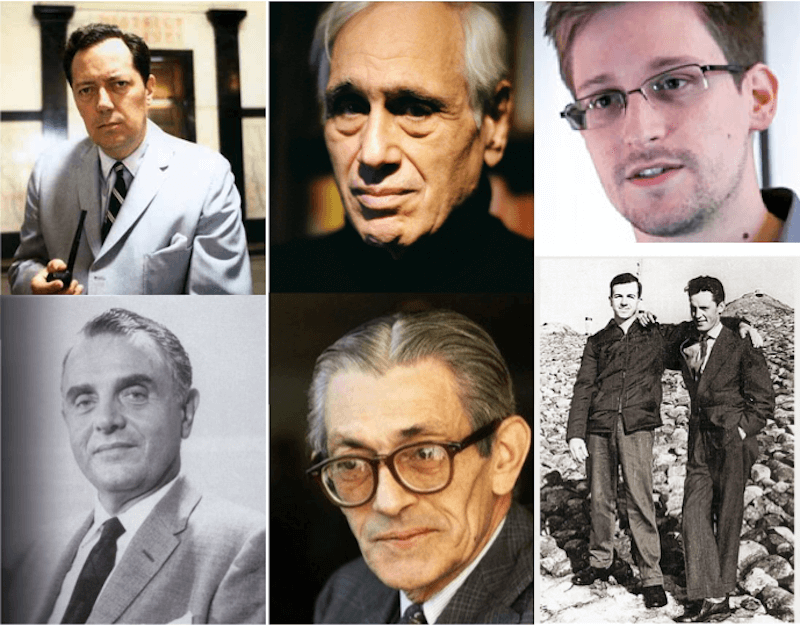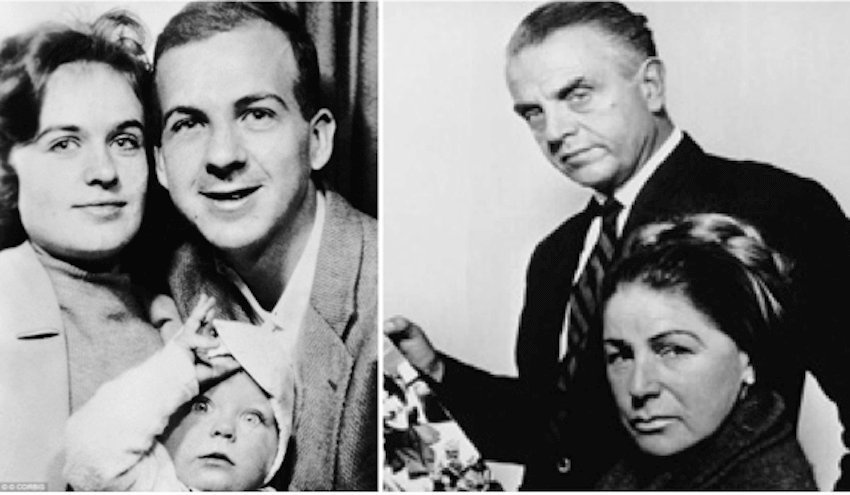
Tag: GEORGE DEMOHRENSCHILDT

  • The JFK Files Volume II: Pieces of the Assassination Puzzle

    The JFK Files Volume II: Pieces of the Assassination Puzzle

    The JFK Files Volume II: Pieces of the Assassination Puzzle

    By Jeffrey Meek

    Jeffrey Meek is the only writer I know who is allowed to pen a regular column on the JFK case. He writes for the Hot Springs Village Voice newspaper. He has now published his second collection of articles from that paper and added two long essays he wrote for the new version of George magazine. I have previously reviewed his first collection on this site. (Click here for that critique https://www.kennedysandking.com/john-f-kennedy-articles/the-jfk-files-pieces-of-the-assassination-puzzle)

    The main title of this anthology is The JFK Files, Part 2. This second collection leads off with an interview of the late Jim Gochenaur. People who have watched Oliver Stone’s JFK Revisited will know who Jim was. Jim was interviewed by the Church Committee. As the witness says here, and he said to Stone off-camera, that interview transcript went missing. When he arrived in Washington, he was first interviewed by staffers Paul Wallach and Dan Dwyer, and then by Senator Richard Schweiker himself. Schweiker, of course, made up half of the subcommittee running the inquiry into the JFK case for Senator Frank Church. The other half is Senator Gary Hart.

    What makes that loss even odder is that the man he was interviewed about, Secret Service agent Elmer Moore, was also brought in for an interview. The transcript of that interview is available. Jim met Moore back in early 1970 in Seattle when he was doing an academic assignment concerning the JFK case. The following year, he went to visit Moore in his office. Moore agreed to talk to him about his Secret Service inquiry into the JFK case, which began about 72 hours after Kennedy was killed. But he would only speak to him on condition that he took no notes or made no tapes, and he understood that if anything he said appeared in public, Moore would deny it. (p. 5)

    Since most of this site’s readers have seen Stone’s documentary, I will not repeat the things that Jim said on camera for this review. There are some things that Stone and I did not cover in that interview (we did that one jointly). For example, Jim told Jeff that Moore considered George DeMohrenschildt—nicknamed The Baron–a key player in the case. But unfortunately for Moore, he could not get access to him once President Johnson put the FBI in charge of the investigation. Moore also told Jim that he could not understand why Captain Will Fritz did not make a record of his questioning of Oswald, since he knew that there were two stenographers on hand for the Dallas Police. (p. 6). Moore also had a print copy of one of the infamous backyard photographs of Oswald with a rifle and handgun. Jim noted that one could easily see a line through Oswald’s chin. I don’t have to inform the reader why that is of central importance.

    Jim was also interviewed by the House Select Committee on Assassinations (HSCA). Strangely, that was only a phone interview. Even though the HSCA lasted much longer than the Church Committee and was a direct investigation of the JFK case, the Church Committee was chartered with only inquiring about the performance of the FBI and CIA for the Warren Commission. But further, Jim said they were more interested in another acquaintance he made in Seattle, namely, former FBI agent Carver Gayton. Gayton had told him that he knew James Hosty–whom he met after the assassination. The former Dallas agent told Carver that Oswald was an FBI informant. (p. 11) This action by the HSCA is odd since Jim always insisted that Moore was a more important witness than Gayton was. This two-part interview with Jim Gochenaur is one of the volume’s three or four high points. Made all the more important and poignant since Jim has passed.

    II

    Another interesting interview that Jeff did was with a man named Lee Sanders. Sanders was on the Dallas Police force at the time they were participating in a reconstruction of the assassination. This was for the acoustics testing that the HSCA did towards the end of their term. Sanders was involved with crowd and traffic control during a five-day assignment. Live ammunition was being used in these tests. (p. 49)

    Sanders said that the DPD’s best marksman, a man named Jerry Compton, took part in the tests. He and an FBI sharpshooter took their shots from the sixth floor of the Texas School Book Depository. Between test firings, Compton would come down out of the building. Sanders overheard Compton say that they were having problems repeating what the Warren Commission said Lee Oswald had done. As Meek writes, “The scuttlebutt from other officers was that there must have been other shooters.” (p. 49). Sanders then added, “We just didn’t think that one guy could have done this. We didn’t say that in public because it wouldn’t have been good for your career, not if you wanted to stay in good stature with the department.”

    Meek interviewed former Commission counsel Burt Griffin about his 2023 book, JFK, Oswald and Ruby: Politics, Prejudice and Truth. As an interviewing journalist, Meek is rather merciful with Griffin. His technique was to let him burn himself. Griffin tells Jeff that Jack Ruby shot Oswald out of anti-Semitism. He wanted to be seen as an avenger due to the infamous black bordered ‘Wanted for Treason’ ad in the papers. That was signed by a Bernard Weissman. This is Griffin’s money quote about Jack Ruby: “He was convinced at the time, and for the rest of his life, that antisemites were involved, with the goal being to blame the Jews for the president’s assassination.” (p. 56) Griffin properly labels this as his conclusion. He then adds that Jews were being blamed for the attack on General Walker in April of 1963. He then states, “So, antisemitism was an important factor in Dallas at the time.”

    Griffin then continues in this nonsensical vein by saying that there is no evidence that anyone else was involved in the JFK assassination except Oswald. He then adds the antique adage that the Commissioners always use: that the Commission’s goal was to locate a conspiracy. And if he could have done so he would have had an acclaimed political career. Meek does not say if he giggled during these comments. I assume he did not. His goal was to keep Griffin spouting these absurdities, which Griffin did by using Howard Brennan as a reliable eyewitness to the assassination.

    Something puzzling comes up next. It appears to be Griffin who surfaces the fact that the Commission has Jack Ruby entering the basement through the Main Street ramp. The book says that Sgt. Patrick Dean was the head of security, and Dean said no, Ruby did not come down that ramp. ( Meek, p. 57) But if one reads the Warren Commission volumes, one will see that it was Dean who was the first person to say that Ruby proclaimed he did come down the Main Street ramp. And this was right after the shooting. This information is also contained in Paul Abbott’s recent book about the shooting of Oswald by Ruby. (Death to Justice, pp. 226-27) In fact, Abbott implies that Dean might have manufactured this quote by Ruby since, initially at least, no one else heard it. It did not catch on as a cover story for the DPD until November 30th. (ibid) In fact, according to one disputed journalistic account, Dean even said he saw Ruby come down the ramp, which was not possible. (Abbott, p. 229).

    But here it states that Dean said that Ruby did not come down that ramp. It was then this dispute that caused a blow-up between Griffin and Dean. (Meek, p. 57). But yet in Seth Kantor’s book on Ruby he has excerpts from some of Griffin’s contemporaneous memos. This is what one of them says:

    If Dean is not telling the truth concerning the Ruby statement about coming down the Main Street ramp, it is important to determine why Dean decided to tell a falsehood about the Main Street ramp. (p. 288)

    In that memo, Griffin wrote that he thought Ruby came in some other way. And that Dean, who was responsible for security that day, “is trying to conceal his dereliction of duty.” In fact, Griffin even theorized that Dean “simply stated to Ruby he came down the Main Street ramp.” Evidently, through the intervening decades, something got lost in translation or dissipated down the memory hole.

    III

    One of the most fascinating tales in the book was not directly told to Meek. He relates it from an MSNBC show in 2013, an interview with HSCA staffer Christine Neidermeier. She said there was a lot of pressure for the committee to downplay any talk about conspiracy. It also became clear that it was going to be difficult getting straight answers from the CIA, and to a lesser extent, the FBI. (p. 69)

    She then related that she got a call from a man she thought was an FBI agent. Because he seemed to know everything she had told another agent. One of the things she said was that she leaned toward the conspiracy verdict since the HSCA could not duplicate what Oswald did in their rifle tests. The caller then revealed that he knew all about her classes at Georgetown, and also some of her friends. He then said that, with such a bright future ahead of her, maybe she should rethink her position. Niedermeier said this call rocked her back on her heels.

    Three other highlights of the book are interviews by Meek with Morris Wolff, Dan Hardway and Marie Fonzi.

    Wolff was a Yale Law School graduate who was employed by Attorney General Bobby Kennedy in his Office of Legal Counsel, where he worked on civil rights, and also contributed to the famous Peace Speech at American University. (Meek, pp 74-75) According to Morris, he was also a bicycle messenger between the AG and the president when Bobby wanted to get around J. Edgar Hoover. After JFK was killed, Bobby suggested that he go over to the staff of moderate Senate Republican John Sherman Cooper. According to Morris, when Cooper served on the Warren Commission, he was strongly opposed to the Single Bullet Theory. (p. 71)

    The interview with Dan Hardway was for a three-part review of the investigations of the JFK case by the federal government. HSCA staffer Dan tells Jeff that, at first, he and his partner Ed Lopez were stationed at CIA headquarters and allowed to have almost unrestricted access to requested files. That changed in 1978 when Scott Breckenridge, the main CIA liaison, told the HSCA that they were bringing in a new helper, namely George Joannides. George was coming out of retirement. And he assured the HSCA that he had nothing to do with the JFK case back in the sixties. (p. 150)

    As most everyone knows, this was false. Joannides was a CIA propaganda officer who was instrumental in running the Directorio Revolucionario Estudiantil (DRE) faction of anti-Castro Cubans in New Orleans. And they had many interactions with Oswald in the summer of 1963. It was around the arrival of Joannides that Dan and Ed were moved out of the CIA offices and into a new building with a safe, and then a safe inside the larger safe. They would now have to wait for files and would get them with missing sentences. They would then have to turn over both the files and their notes into the safe at night. This might indicate that the pair were getting too close to Oswald’s association with the CIA and what really happened in Mexico City, which were the subjects they were working on.

    IV

    The closing three-part essay is an exploration of the life and career of the late Gaeton Fonzi. It is greatly aided by the extensive cooperation Meek had with his widow, Marie. Gaeton Fonzi began as a journalist, first for the Delaware County Daily Times and then for Philadelphia magazine. It was his meetings in Philadelphia with first Vince Salandria and then Arlen Specter that got him interested in the JFK assassination. After consulting with Vince, he was prepared to ask Specter some difficult questions about the Single Bullet Theory, which was the backbone of the Warren Report. Fonzi was troubled by Specter’s halting replies to his pointed questions. (pp. 172-73). He then wrote an article about this for Philadelphia called “The Warren Commission, The Truth and Arlen Specter.”

    In 1972, Gaeton moved south to Florida. He began working for Miami Monthly and Gold Coast. In 1975, he got a phone call that would have a great impact on his life and career. Senator Richard Schweiker was from the Philadelphia area and had apparently heard about Fonzi’s article about Specter. He and Senator Gary Hart now made up a subcommittee of the Church Committee. Their function was to evaluate the performance of the CIA and FBI in aiding the Warren Commission. Schweiker was inviting Gaeton to join as chief investigator, which he did.

    In only one year, that committee made some compelling progress. The combination of their discoveries and the broadcast showing on ABC of the Zapruder film helped cause the HSCA to be formed. Fonzi continued his work there and was hot on the trail of CIA officer David Phillips. That pursuit actually began under Schweiker. And when the HSCA began, the first Deputy Counsel on the Kennedy side, Robert Tanenbaum, went to visit the senator. After a general discussion, Schweiker asked Tanenbaum’s assistant to leave the room. The senator then opened a drawer and pulled out a folder made up largely of Fonzi’s work. He handed it to Tanenbaum and said, “The CIA killed President Kennedy.” (click here https://www.kennedysandking.com/john-f-kennedy-articles/robert-tanenbaum-interviewed-by-probe) That file is what got Fonzi the job with the HSCA.

    As we all know, once Tanenbaum and Chief Counsel Richard Sprague were forced to resign, the writing was on the wall for that committee. And Fonzi did a very nice job outlining this in his memorable book, The Last Investigation. That book was presaged by a long article Fonzi did for Washingtonian magazine, which had a significant impact on the critical community. (p. 174) Fonzi clearly implied in both the article and the book that the findings in the HSCA report were not supported by the research that the committee conducted. When the Assassination Records Review Board ordered the HSCA files declassified, this was proven out in spades.

    A column that Meek apparently got a lot of reaction to involved an interview with this reviewer. It was about John Kennedy’s evolving foreign policy views from 1951 until his death. This included his visit to Saigon and his signal 1957 speech on the Senate floor about the French crisis in Algeria. (p. 103) No speech Kennedy made up to that time elicited such a nationwide reaction as the Algeria address. The Africans now looked to Kennedy as their unofficial ambassador. Meek follows through on this with the Congo crisis: how Kennedy favored Patrice Lumumba, while Belgium and the CIA opposed him. This was at least partly the cause of Lumumba’s death in January of 1961, about 72 hours before Kennedy was inaugurated.

    There are two essays that I find problematic. The first is with Antoinette Giancana, daughter of Chicago Mafia chieftain Sam Giancana. As I have been at pains to demonstrate, the Mob had nothing to do with either Kennedy’s primary win in West Virginia or the result in the general election in Illinois. Dan Fleming proved the former in his important book Kennedy vs Humphrey, West Virginia, 1960. He conducted extensive interviews and found no evidence of any Mafia influence on anyone. And he also outlines three official investigations of that election, on a state level, on a federal level, and one by Senator Barry Goldwater, which all came up empty. As per Illinois, Professor John Binder did a statistical study showing that, in the wards controlled by Giancana, not only did the results not show his support for Kennedy, they indicated the contrary: that he might have discouraged voting for candidate Kennedy. That essay first appeared in Public Choice, and it has been preserved at Research Gate.

    The second essay I find problematic is the one dealing with the whole Ricky White/Roscoe white imbroglio from the early nineties. In August of 1990, Ricky White was presented as the son of the Grassy Knoll shooter, namely Roscoe White. Roscoe was also supposed to have killed Patrolman J. D. Tippit. Meek bends over backwards to be fair to Ricky White. I will not take up space to deal with all the problems with this story. But for a contrary view, I include a link to Gary Cartwright’s 1990 article critiquing this concept. (https://www.degruyterbrill.com/document/doi/10.7560/711990-014/html?lang=en)

    All in all, Jeff Meek has done some good work. We are lucky to have him toiling in the vineyards of the JFK case oh so many years afterwards. I hope he keeps it up.

  • Edward Epstein:  The Critic who Flipped

    Edward Epstein: The Critic who Flipped


    The 88-year-old Edward Epstein was found dead in his apartment on Tuesday January 9th. His nephew, Richard Nessel , said the cause of death was complications from CV 19. (NY Times obituary by Sam Harris of January 11, 2024)

    The obituary notes the first of Epstein’s many books was entitled Inquest, published in 1966. As Epstein wrote in his memoir, Assume Nothing, he wrote this book after he flunked out of Cornell and was trying to get back into the college. The man trying to help him, Professor Andrew Hacker, was with him on campus when the news came in that President Kennedy had been killed. Hacker said that finding the truth about the assassination would be a test for American democracy. This gave Epstein the idea of writing a Master’s thesis on the subject. Hacker wrote letters for him in order to talk to the Commissioners, and all agreed except for Earl Warren.

    Inquest was published in 1966, and it helped form something of a wave effect, since it just preceded Mark Lane’s Rush to Judgment, Sylvia Meagher’s Accessories After the Fact and Josiah Thompson’s Six Seconds in Dallas. But, as Joseph McBride notes in his book on the media Political Truth, there was a difference between Epstein’s book and the others. McBride quotes from the ending of Inquest:

    If the Commission had made it clear that very substantial evidence indicated the presence of a second assassin, it would have opened a Pandora’s box of doubts and suspicions. In establishing its version of the truth, the Warren Commission acted to reassure the nation and protect the national interest. (McBride, pp. 192-93)

    In fact, the first part of the book is titled “Political Truth”. McBride comments on this by saying its pretty obvious that the author knew “full well that the assassination was covered up.” But it would seem that he was at least partly trying “to justify the reason for the cover-up.” Further, Warren Commissioner John McCloy told Epstein that the function of that body was to “show the world that America was not a banana republic, where a government can be changed by a conspiracy.” (McBride, p. 137)

    Epstein went even further in this regard in first his E-book, The JFK Assassination Diary, and then again in his printed memoir Assume Nothing. In those two places, both published in the 21st century, he revealed that when he asked Arlen Specter how he convinced the Commission about the Single Bullet Theory, he said he told them that it was either that or start looking for a second assassin. (Epstein E book, p. 24) Norman Redlich, one of the most powerful members of the Commission staff agreed with Specter. (Epstein, The Assassination Chronicles, p. 155). As anyone should know, even without being a lawyer, that path is not 1.) Following the evidence, or 2.) A viable standard of proof.

    There was also something else that Epstein knew, namely that the Commission was basing their case on unreliable witnesses. For instance, he knew that attorney Burt Griffin had told Dallas police officer Patrick Dean that he was a liar. Dean was in charge of security the day Jack Ruby entered city hall and gunned down Oswald on national TV. (The Assassination Chronicles, p. 110) The Commission also thought that Marina had fabricated a story about Oswald attempting to kill Richard Nixon. And Redlich had written this about her: “Marina Oswald has lied to the Secret Service, the FBI and this Commission on matters of vital concern.” Commission lawyer Joe Ball did not trust Helen Markham or Howard Brennan either. (ibid, pp. 142-44) In an interview Epstein did with Commission lawyer Wesley Liebeler, he referred to the Commission as Snow White and the Seven Dwarfs with Marina as Snow White and Earl Warren as Dopey. (E book, p. 17)

    In reviewing Epstein’s work on the Commission in his book and diary –the latter may have been created after the fact—what is puzzling is how many important things escaped him. To point out just two: he did not find out about Commissioner Jerry Ford changing the entering location of the Magic Bullet from the back to the neck in the final draft of the Warren Report. Even though he interviewed Chief Counsel J. Lee Rankin. Rankin had this evidence in his files, and his son turned it over to the Assassination Records Review Board in the nineties. Epstein interviewed J. Lee Rankin.

    Another important fact that escaped him is that there was no transcript made of the final executive session meeting of the Commission. Although he describes the debate that took place on this issue at that meeting, he relies on interviews he did for his information. (The Assassination Chronicles, pp. 154-56; p. 604) He could have gone to the National Archives and found out that no transcript of this meeting was made. That is what Harold Weisberg did. (Gerald McKnight, Breach of Trust, pp. 295-97)

    If Epstein would have done that, he could have informed people like Senator Richard Russell and Senator John Cooper that they had been hoodwinked about their objections being recorded. And that could have opened up just how deeply they were opposed to not just the Magic Bullet, but the way in which the Commission was being conducted. Author Gerald McKnight later revealed Russell’s disharmony in his book on the Commission, and Cooper assistant Morris Wolff did the same about Cooper. (Wolff, Lucky Conversations, pp.103-15)

    Something appears to have happened to Epstein shortly after he wrote Inquest. For instance, he appeared on the record album for the book Scavengers and Critics of the Warren Report. That book was published in January of 1967 and was clearly a cheap smear of the Commission critics, co-written by FBI informant Larry Schiller. There is further evidence for Epstein’s sudden switch in John Kelin’s fine book Praise from a Future Generation.

    On November 30, 1966 there was a debate on the Warren Report in Boston. Epstein had been invited to participate, but he declined. Vince Salandria was a participant. After the debate, Salandria was surprised to see Epstein in the audience walking toward him. They had a brief discussion during which Epstein said, “I’ve changed Vince.” Salandria replied with, “You mean you made a deal.” Epstein smiled and said, “You know what happened” and walked away. (Kelin, p. 335, E book version). In fact, years later, when he made an appearance on the Larry King Show he actually said he thought “the men who served on the Warren Commission served in good faith.” (Probe Vol. 7 No. 1, p. 14). Today we have two sources telling us that Jerry Ford knew the Commission was a sham: Morris Wolff and Valery d’Estaing. (See Interview with Wolff, Black Op Radio, 1/11/2024; the film JFK Revisited)

    To say that Epstein changed is an understatement. In his next two books, he now became an unrepentant defender of the official story. Because he wrote a book on the Warren Commission, he was invited by The New Yorker to go to New Orleans and write a long article on the JFK investigation being done by DA Jim Garrison. It’s pretty clear from the beginning of his “diary” entries that Epstein had a bias against any new inquiry into the Kennedy case that would lead elsewhere than where the Commission had. For instance, he distorts Garrison’s dispute with the local judges and also on how David Ferrie was initially released by the FBI in 1963. (Epstein, pp. 39-41). In fact, Epstein was accepting advice from the likes of Tom Bethell and Jones Harris on Garrison. Some people who encountered Harris, like the late Jerry Policoff, thought he was rather erratic in his beliefs on the JFK case. Tom Bethell had all the earmarks of being a plant in Garrison’s office. (Click here for that)

    But that was just the beginning of Epstein’s lack of fairness. Epstein also had many contacts with Shaw’s lawyers. Beyond that he was also in contact with a lawyer who represented both Gordon Novel and Jack Ruby, Elmer Gertz. Within one week of The New Yorker publishing Epstein’s article, the CIA was circulating it as an example of how they could counter critics of the Warren Report. (Op. cit. Probe, p. 15)

    To give just one example of Epstein’s objectivity: he believed Dean Andrews when Andrews said Clay Shaw was not Clay Bertrand. (Epstein’s diary, p. 46). Even though Epstein’s JFK diary was published in the new millennium, he avoids the fact that Dean Andrews was indicted and convicted for perjury on this point. But beyond that, Andrews secretly admitted to Harold Weisberg that Shaw was Bertrand. Weisberg kept that promise until after Andrews passed. And today, there are about a dozen witnesses to this fact. (See the book JFK Revisited, p. 65)

    Then there was Legend. With the Church Committee exposing the crimes of the CIA, and issuing a report showing how poorly the FBI had investigated the case, there was movement to reopen the Kennedy case. Clearly an establishment lion like the Reader’s Digest would want to get a jump on such a reopening. Knowing what they wanted, they called in Epstein to do a full scale biography of Lee Oswald. Ken Gilmore, a managing editor there, contacted the FBI and told them the book would put to rest recurring myths surrounding the Kennedy assassination. Gilmore requested that the Bureau allow Epstein to access their files on the case. Epstein did visit the FBI offices at their invitation. (Op. cit. Probe, pp. 15-16)

    John Barron, a senior editor, was also friendly with the CIA. Therefore, the Agency did something remarkable, they gave Epstein access to Soviet defector Yuri Nosenko. They also told him he would have access to the tapes made at the Mexico City station of Oswald at the Soviet and Cuban embassies. (ibid) The only other writer I know who had CIA assisted access to Nosenko was Gerald Posner. Before the ARRB I know of no writer who had access to those tapes. Finally, Epstein was in contact with James Angleton both by phone and in person. Epstein freely admits to this in his diary. And here is the capper in that regard. Jim Marrs interviewed a Legend researcher. He asked her why the book did not explore Oswald’s ties to the CIA, which were at least as obvious as those to the KGB, which the book accented. She replied that they were advised to avoid that area. (ibid, p. 24)

    According to Don Freed, the book was budgeted by Reader’s Digest for 2 million. Epstein got a $500,000 advance, over 2.5 million today. As noted above, they also furnished him with a fleet of researchers, including Pam Butler and Henry Hurt of Reader’s Digest. All this for a book that tries to convey the almost indefensible tenet that Oswald was first recruited by the Russians, and then upon his return was now pledged allegiance to Castro and this was why Oswald shot Kennedy. The Russians then sent Nosenko over to discourage any thought the KGB was involved, since he said Oswald was never recruited by Moscow.

    With all we know today, for Epstein to maintain these types of theses well into the 20th century is simply inexcusable. Because for example, today it appears that Oswald’s file at CIA was being rigged before he went to Russia. And we know that from the declassified work of HSCA researcher Betsy Wolf. And it appears that it was only Angleton who had access to all the files on Oswald at the Agency. (See this) Secondly, Clay Shaw had two CIA clearances and was employed by them as a highly paid contract agent. (JFK Revisited, p. 65). Finally, in a declassified file attained by Malcolm Blunt, it appears that Angleton was in charge of commandeering operations against Garrison. For that file, we only have the cover sheet, with several folders missing.

    Let me conclude with two interesting anecdotes about Epstein. Epstein was the last person to see George DeMohrenschildt alive. He was paying him about a thousand dollars a day for interviews down in Florida. On the second day, after the Baron left, he went to a friend’s house where he was staying and allegedly took his own life by shotgun blast. Dennis Bludworth was the DA investigating the case. He wanted to see the notes of the interviews. Epstein said he had no notes or tape recordings. Bludworth did not believe that, not with Epstein paying him that kind of money. Under further questioning Epstein told Bludworth that he was also paying for the Baron’s rented car and he added that:

    …he showed DeMohrenschildt a document which indicated he might be taken back to Parkland Hospital in Dallas and given more electroshock treatment. You know, DeMohrenschildt was deathly afraid of those treatments. They can wreck your mind… (Mark Lane, November 1977, Gallery)

    Finally, let us make one other note as to how plugged in Epstein was to the power elite on Legend. Billy Joe Lord was on the same ship that Oswald took to Europe in 1959 on his voyage to Russia. In fact, Lord was Oswald’s cabin mate. The pair spent about two weeks together crossing the Atlantic. For this reason Epstein wanted to interview him for the book. Lord did not want to talk to Epstein since he knew he was a critic of anyone who contested the Warren Report. Lord then related that he did meet with two of Epstein’s researchers. (FBI Report of March 15, 1977) One of them said that they may have to apply pressure to Lord. And they knew two people who could do so. One was James Allison, a local newspaper chain owner and a friend of the Bush family. The other was no less than future governor and president, George W. Bush.

    These are the perks you get with the equivalent of a $2.5 million advance—on a JFK assassination book.

    For more on the career of Epstein on the JFK case, please click here.

  • Focus on the Media:  Edward J. Epstein

    Focus on the Media: Edward J. Epstein


    epstein leaderEdward Epstein began his career with a graduate thesis that he then sold as a book. It was called Inquest. He then wrote a book called Counterplot. The first was about the inner workings of the Warren Commission. The second was about the Jim Garrison investigation. These two books are discussed at length in the ProbeMagazine article we have excerpted.

    The important thing to remember about the books is that in the first one, Epstein takes the stance of an outsider trying to understand how a governmental body worked and came to some rather unusual conclusions. In the second book, which was originally a long magazine article, the outsider stance was abandoned. Epstein was no longer a graduate student. He became an insider, a working member of the club. And The New Yorker became a longtime haven for him.

    His career largely centered on two areas: the intelligence community, and the JFK case. He wrote three books on the latter. He wrote four books on the former. In addition to his books, he has published many articles in magazines like The Atlantic and The New Republic. Incredibly, he has managed to convince some people, like Ron Rosenbaum, that he actually knows something about the world of national security and intelligence. After all, he once tried to argue that James Angleton was not really duped by Kim Philby, but that Angleton was playing Philby. For these kinds of errands, he was well compensated by business entities like Reader’s Digest, which excerpted his useless book about Oswald entitled Legend.

    His latest book about Edward Snowden is equally pitiful. (Please click here for a good review) As the reader can see, Epstein is up to his old tricks. What is hard to believe is that anyone still believes him or pays for his work. In reading these two pieces one will see that the last thing Epstein is is an investigative journalist. Spending hours on the phone with the late James Angleton does not constitute investigation. Most people would call it visiting a victim of early senility. But that is what Epstein did for his books Legend and Deception. Finally, in 1991 and 1992, Tom Mangold in Cold Warrior and David Wise in Mole Hunt exposed Angleton for what he was: a truly imbalanced and actually a dangerous man. A man whose paranoia wrecked several lives and paralyzed the Agency. A man who should never had been the CIA’s counterintelligence chief in the first place.

    Epstein didn’t learn from his previous error. And maybe it really wasn’t an error. But if more people had understood who he was, then he would not be allowed to keep on his giant misinformation campaign. In its latest incarnation, Edward Snowden is really a Soviet spy. Just like Oswald. Oh, my aching back.


    The following is a letter written by Jim DiEugenio to the editors of The New Yorker. It was a reply to a nearly 8,500 word essay by Edward J. Epstein entitled “Shots in the Dark.” Epstein’s article was published in the November 30, 1992 issue. DiEugenio wrote this letter on December 10, 1992. The editors refused to print it. It was published in the January/February issue of Gary Rowell’s The Investigator. It appears here in a slightly edited and expanded form.


    Jim Garrison died on October 21, 1992. On November 30th, The New Yorker carried a nearly 8,500 word article about the New Orleans DA and his investigation into the death of President Kennedy. Allowing for editing, lead time, press run and distribution schedule, Edward Epstein’s piece must have been submitted at least 8 to 10 days in advance. Considering its length, the question inevitably arises: was the article being prepared before Garrison died? The fact of his long and serious illness had been popularly known in wide circles. If this is so, why did The New Yorker rush the hit piece onto its pages so quickly and rather tastelessly?

    Epstein states that his motive was to counteract the impact of Oliver Stone’s acclaimed and popular 1991 film JFK. The film starred Kevin Costner as Garrison in a recreation of the only conspiracy inquiry and trial into the murder of President Kennedy. Epstein calls the film a fiction event, even though it is based on two non-fiction books, Garrison’s On the Trail of the Assassins, and Jim Marrs’ Crossfire. Epstein, a former Warren Commission critic, has seemed to have had an astringent reaction to the film. He debated Stone, among others, in New York in a symposium arranged by The Nation magazine about the merits of the film. In the new compilation of his books on the subject, he added an Epilogue attacking the picture. He is now preparing another attack on the film and Stone to appear in the Atlantic Monthly, apparently timed for the video release of the longer version of JFK in January. It should be added that Epstein complained to Stone at that New York symposium that a scene depicted in his film was not depicted in Garrison’s book. If Garrison had written about everything in his files, his book would have been several volumes long. Which shows how familiar Epstein was with this raw data. (This author was shown these files by Lyon Garrison and can vouch for their volume.)

    To dispense with the specious argument over the historical accuracy of Stone’s film. Any historical film will, of necessity, rearrange events, settings, circumstances, and also often collapse characters to convey a dramatic whole. Stone’s film does this, but much less than other popular films dealing with historic subjects: e.g., Mississippi Burning, The Untouchables, Bugsy. Often, Stone prefaces speculative scenes by having Costner say, “Let’s speculate”, or shooting a sequence in sepia. But to anyone familiar with the actual facts, when all is said and done, Stone’s picture actually ranks with films like Lawrence of Arabia in its relative allegiance to the adduced record. As we shall see, it is Epstein’s unfamiliarity with that record that seems to be the basis for his specious article.

    It is strange that Epstein should be so flummoxed by this film which during its climax, tears to pieces the Warren Report, just as Garrison’s assistant DA’s did in New Orleans in February of 1969 at the trial of Clay Shaw. What makes it even more ironic is that Epstein’s article contains more “fiction” or distortion in relative terms than JFK. This begins with his portrayal of Garrison as a flamboyant, egomaniacal publicity hound who pursued the Kennedy case for his private purposes. This does not correspond to anyone who observed Garrison in his last years or watched his last two interviews when he was still healthy. The former DA was a reserved, intellectual, literary man who carried the painful scars of his two-year battle against the Washington-New York power center in his prosecution of Clay Shaw. He ended up with a tarnished reputation, a pile of bills, $5,000 in the bank—he financed some of the expenses himself—and many leftover death threats. The Kennedy case was the reason he was voted out of office. In fact, it ruined a promising political career where many said he could have been the governor of the state. Garrison later stated that if he had it all to do over, he probably would not have done it because of the personal and emotional toll.

    Epstein writes that Garrison, “artfully managed to stretch out the interval between the charge and the trial … while he engaged in a wide range of diversionary actions.” Precisely the opposite is true and documented. It takes author Paris Flammonde almost 13 pages to chronicle the delay tactics of Shaw’s lawyers, who were consorting with both media allies and friends in Washington in order to torpedo Garrison. Epstein actually scores Garrison for bringing charges against the likes of “media “ people like Walter Sheridan, even though affidavits reveal that Sheridan threatened and bribed important witness in the case. I guess this is OK with Epstein. After all, it’s only the murder of the president.

    The photos Epstein describes Garrison showing on The Tonight Show were furnished by researcher Richard Sprague. Epstein sometimes wears glasses. Perhaps this is the reason he feels the object being picked up in Dealey Plaza is a pebble. Most people I have talked to think it is a large caliber bullet. Epstein also has not kept up with research in the field, since he derides Garrison for saying the man retrieving the object was a federal agent. It turns out he was just that, an FBI agent to be exact. And if Epstein really thinks that both J. Edgar Hoover and Lyndon Johnson were dedicated to uncovering the facts in this case, he has not read the Church Committee report or interviewed any former FBI agents, like, for example, William Turner. This may be the single most ludicrous declaration in the entire article, which is saying something.

    Epstein relies on the House Select Committee X-rays and photos as his sine qua non that only three shots were fired, and all came from the rear. What he does not say is that the HSCA altered the Warren Commission findings on the autopsy. They moved up the entry wound in Kennedy’s skull from the bottom of the heard to the top, and they moved down the back wound. Further, the pathologists never dissected the track of either wound in Kennedy’s body. Therefore, the directionality and the trajectory of the wounds is not known. At any murder trial, these materials would be mercilessly attacked. And it is questionable if they would have been admitted into court, since some of the exhibits do not correspond to what the witnesses at the autopsy saw.

    Epstein implies that Jim Garrison failed to reveal any “hidden associates” of Oswald’s in New Orleans. This is simply balderdash. As depicted in the Warren Report, Oswald was supposed to be a Marxist oriented, pro-Castro sympathizer. Yet, as Garrison showed, here was a communist who had no communist friends. On the contrary, he associated almost exclusively with anti-communist extremists, intelligence operatives, and/or anti-Castro Cuban exiles in both New Orleans and Dallas: George DeMohresnchildt, Guy Banister, David Ferrie, Clay Shaw, Richard Case Nagell, Orest Pena. Which is an odd group for a communist to be hanging out with. You will not see most of their names in the Warren Report. But you will see them in Garrison’s files. In fact, if not for him, you likely would not have heard of them at all.

    Epstein tries to trivialize Garrison’s complaints about the extreme secrecy involved in the JFK case. He writes that this was essentially grandstanding and it was not really important to the facts of the case. Garrison disagreed and stated that it undermined public confidence in their government. The Warren Commission had the equivalent of one day of public hearings. (And that was because witness Mark Lane insisted on his hearing being open to fellow citizens.) The House Select Committee on Assassinations had about three weeks of open hearings. The combined lifespan of both investigative bodies was a bit over three years. The former locked up over 365 cubic feet of materials. The second inquiry left almost 800 boxes of files. Today, the federal government has over 2 million pages of material classified on this case. Even though the murder is three decades old and the official story is that Oswald alone killed Kennedy. Is Epstein correct in saying that most of it is unimportant? How can he possibly deduce such a conclusion before the files are declassified? We know from previous declassifications that such was not the case at all. For instance, the declassification of the FBI report on the JFK case revealed that Director J. Edgar Hoover did not agree with the Single Bullet Theory. He believed that a separate shot hit Governor John Connally. To use another example: the government is today holding a 300-page report about Oswald’s alleged activities in Mexico City. The problem, as the authors of that report have stated, is that the CIA could not produce a photo of Oswald being there, and the voice on the audiotapes the CIA made of Oswald is not his. You will not find any of that information in the Warren Report. Which never questions any of his activities in Mexico.

    Epstein writes that many documents that were originally classified have since been released. Yes, and many have been released only in response to public revulsion with the classification process. Many others have been released through the efforts of private citizens who have had to sue the government to get them. Further, many of these released documents have not been released in full. That is, they contain what is termed “redactions”, that is, much of the wording has been blacked out. Plus, the fact that the information was released later dilutes the impact and effect the information has on the case and the public. In fact, this contributes to the whole “too-late-to-solve-it” syndrome that afflicts the Kennedy case. One has to wonder: was this the intent from the start? If so, it succeeded.

    Epstein is familiar with these problems, since they impact on the mystery surrounding the man he wrote about extensively in his last book on the JFK case, Legend. This was George DeMohrenschildt, sometimes termed “The Baron” due to his upper class White Russian standing. Epstein was reportedly the last person to interview DeMohrenschildt in Florida before he died of a shotgun blast. Although the official verdict in the case was that The Baron took his own life, others who have investigated his death still have questions about it. Mr. Epstein, whose early attack on Garrison in The New Yorker was circulated by the CIA to worldwide station chiefs, was in Florida at the time to interview DeMohrenschildt for Legend. Epstein received a large half million dollar advance for the book, the highest ever in the JFK field. The book’s backers also furnished him with a research staff. Epstein offered DeMohrenschildt large sums of money for interview sessions. Epstein himself was quoted as saying he was involved in a “very big project, which involves a lot money.”

    Previously, Epstein had been involved in a campaign to clear the FBI of charges that it had used clandestine and conspiratorial methods to destroy the Black Panthers. In regards to my previous point, later declassified documents revealed that the FBI had done just that. Epstein’s book Legend had an odd—some would say perverse—spin to it. The thesis was that the KGB had recruited Oswald while he was in Russia and he was acting as their agent when he killed Kennedy. Epstein tried to fog this framework, but the book’s last section—dealing with Oswald’s return to America—is titled “The Mission”. And the last chapter is called “Day of the Assassin”. In an appendix entitled “The Status of the Evidence”, Epstein backs every dubious claim of the Warren Commission. He deals with complex issues, like the dubious capability of Oswald’s rifle, in a less than cursory manner: in this case, all of two sentences. Epstein’s interview subjects, like Jim Botelho, a service buddy of Oswald, insist that he distorted their responses on his way to his offbeat conclusion, namely that the Russians, through the KGB, killed Kennedy.

    DeMohrenschildt was important to this scheme. For the simple reason that he and his family came from the Soviet Union. So, in the upside down world of Legend, one could argue that somehow The Baron was acting as Oswald’s handler in the USA, as some kind of deep cover KGB agent.

    But Epstein’s most questionable decision was the liberal use of CIA counter-intelligence chief James Angleton as a major source. This is the same Angleton whose Cold War paranoia paralyzed the CIA to the point that Director Bill Colby backed a press leak campaign to force him to step down. The same Angleton who, once retired, started a defense fund for agents caught in “black bag” operations, or robberies. The same Angleton who actively encouraged destabilizing governments, not in Guatemala or Iran, but in allied countries like Australia and England.

    Understandably, many have read Legend as Angleton’s outlet for the defense of his—and the CIA’s—conduct in relation to both Oswald and the assassination. More cynical observers see it as a detour away from both Oswald’s and DeMohrenschildt’s secret status as American intelligence agents.

    Epstein’s activities with The Baron toward the end are notable. As stated, an inquest ruled that DeMohrenschildt took his own life. But Mark Lane talked to the state attorney who interviewed Epstein about the day of DeMohrenschildt’s passing. Epstein told David Bloodworth that he had paid his subject three thousand dollars and let him go after a rather short session. Lane’s report, published in Gallery of November 1977, went on to say that Epstein told Bloodworth that even though he spent all this money, he kept no notes and had no tape recordings. Bloodworth told Lane that he did not believe that statement, not after Epstein spent that much money. Bloodworth then added that Epstein showed The Baron a document that indicated he might be taken back to Parkland Hospital in Dallas for some electroshock treatments. (DeMohrenschildt had been suffering from depression.) Bloodworth then looked at Lane and said, “You know, DeMohrenschildt was deathly afraid of those treatments … DeMohrenschildt was terrified of being sent back there. One hour later he was dead.”

    This is the man who now writes in reflection of Jim Garrison and his investigation of Kennedy’s murder. Is it too much to suggest that Epstein is jumping into a “spin control” mode? People like Howard Hunt and J. Edgar Hoover also did this in relation to the life and death of John Kennedy. But they had the sense to wait a while so their efforts would not be seen as transparently self-serving. Epstein exercised no such self-control. Which makes his work not just inaccurate but offensive. And The New Yorker acted as his accomplice in this defamatory exercise.


    Part 2: “The Abstract Reality of Edward Epstein”

    Part 3: “Edward Epstein: Warren Commission Critic?” (Probe vol 7 no 1, 1999)

  • Was Oswald a Serial Wife Batterer?

    Was Oswald a Serial Wife Batterer?


    dunne leaderOne of the main difficulties that the Warren Commission had in portraying Lee Harvey Oswald as the dual killer of President Kennedy and police officer J. D. Tippit was that, up until then, Oswald did not show any record of past violent acts. Therefore the Commission set to work to fill that lacuna. One obvious way they did so was by accusing him in the unsolved case of the April 10, 1963 shooting of General Edwin Walker. That was a case in which, during a time period of over seven months, Oswald had never even been considered a suspect. Author Gerald McKnight, in his fine book Breach of Trust, demonstrates that the indictment made against Oswald by the Warren Commission was genuinely dubious. (See pp. 48-59) Which explains why he was not a suspect in the shooting prior to November 22, 1963. The accusation rests largely on the questionable testimony of Marina Oswald.

    Another way in which this was done was through the accusation that Oswald was a chronic wife beater. This was achieved almost exclusively through the testimony of the members of the White Russian community in the Dallas-Fort Worth area. Upon their return from the Soviet Union, the Oswalds were introduced into this enclave by Russian translator Peter Gregory and the enigmatic George DeMohrenschildt. DeMohrenschildt and his family came from Russia and he was an active member of this community. He had also been in contact with the local Dallas CIA chief J. Walton Moore since at least 1957. The closeness of his relationship with DeMohrenschildt was a fact that Moore tried to cover up. (James DiEugenio, Destiny Betrayed, Second Edition, p. 153)   As the late Philip Melanson has written, many of the White Russians had been aided in their entry into the USA by the Tolstoy Foundation, an anti-communist lobby that received yearly stipends from the CIA. The Oswald biographer then added, “The Russian Orthodox Church, a centerpiece of the very conservative and religious White Russian community, also received Agency philanthropy.” (Spy Saga, p. 79)  One of the enduring contradictions about the allegedly communist Oswald is that upon his return from Russia in June of 1962 he associated so strongly with two distinctly anti-Communist groups: the anti-Castro Cubans in New Orleans and the White Russians in Dallas. The former wished to overthrow Fidel Castro and the latter wanted to overthrow the Communist dictatorship in the USSR.

    As noted, it was through the latter that the Warren Commission depicted the Oswald who showed violent tendencies toward his wife Marina. (Warren Report, p. 417) And many Warren Commission supporters have used this characterization to convict Oswald as a serial spouse abuser. And also to portray this White Russian community as a collection of avuncular guardians who tried to protect and shelter Marina from her brutal husband.

    Robert Charles-Dunne was a longtime poster at John Simkin’s Spartacus Educational web site, which has a JFK Assassination Debate forum. In May of 2013 he decided to go ahead and do a systematic analysis of this issue. He examined the testimony of 19 witnesses on the subject. With his usual acuteness, he managed to perform a tour de force of separating the wheat from the chaff on the issue. When the subject came up again recently, Tom Scully salvaged his post on the Wayback Machine. We present it here for the edification of our readers.

    ~ Jim DiEugenio


    First, let’s clear the decks of the obvious padding.

    Mahlon Tobias and his wife have already been dispatched to the remainder bin, as they both testified they personally neither saw nor heard anything except complaints from other tenants of their building. That leaves 18.


    Ilya Mamantov (IX: 107)


    Mr. Jenner.

    Have you ever seen Marina Oswald in your life prior to that moment (in the DPD HQ on November 22)? Knowingly?

    Mr. Mamantov.

    No; sir.

    Mr. Jenner.

    Had you ever met her prior to that time?

    Mr. Mamantov.

    No, sir; I met her after that, accidentally.

    Mr. Jenner.

    No; this is prior–up to that moment, you had had no contact, no acquaintance whatsoever with her?

    Mr. Mamantov.

    That’s correct.


    Needless to say, people who had never met either of the Oswalds are hardly in a position to testify to anything about them, no matter how many times Paul Trejo pads his list with their names. Now we’re down to 17.


    Igor Vladimir Voshinin (VIII: 466)


    Mr. Jenner.

    Did you ever meet either Lee or Marina Oswald?

    Mr. Voshinin.

    No, sir; thank God!


    Thank you, Igor. We are down to 16.


    John Ray Hall (VIII: 412)


    Mr. Liebeler.

    During that period of time that you knew Oswald, did you become aware of the fact that he and Marina were having difficulties with their marriage?

    Mr. Hall.

    We heard that she was living with someone else at one time, I don’t know who. My wife can probably tell you. And we also heard that he beat her up one time.

    Mr. Liebeler.

    Did you ever see any indication that be had beaten her up?

    Mr. Hall.

    I didn’t; no.

    Mr. Liebeler.

    Was it your impression that the Oswalds were having marital difficulties at the time Marina lived in your house or in Mrs. Hall’s house in Fort Worth?

    Mr. Hall.

    No.

    Mr. Liebeler.

    The only reason that Marina lived there at that time was because Oswald didn’t have an apartment in Dallas, is that correct?

    Mr. Hall.

    To give him a chance to get settled; yes.


    One notes Hall’s observation: “And we also heard that he beat her up one time.” We’ll stipulate that John Hall was a lesser witness, as he had less interaction with the Oswalds. Nonetheless, we are now down to 15.


    Mrs. Igor Vladimir Voshinin (VIII: 444)


    Mr. Jenner.

    Now, if you can remember any more, I wish you would tell us about De Mohrenschildt’s comments with respect to the Oswalds and the impressions that you gained of the Oswalds—as to how they got along whether he treated her well or poorly?

    Mrs. Voshinin.

    Oswalds—his wife?

    Mr. Jenner.

    Yes.

    Mrs. Voshinin.

    Treated very poorly. Because De Mohrenschildt told us that he was beating her. Then, she ran away from him and De Mohrenschildt tried to help her, you know, to settle down and to separate somehow, but then, they reconciliated (sic). And after the reconciliation, Jeanne mentioned twice that Marina had blue eyes–was beaten again, you know.

    Mr. Jenner.

    Black and blue eyes?

    Mrs. Voshinin.

    Yes.


    No doubt Mrs. Voshinin repeated accurately what she had been told. But she saw nothing with her own two eyes and could offer only hearsay testimony. Now we’re down to 14.


    Max E. Clark Vol. (VIII: 345-46)


    Mr. Liebeler.

    Did your wife have the impression that there had been marital difficulties between the Oswalds at that time?

    Mr. Clark.

    Yes.

    Mr. Liebeler.

    Can you tell us any specific reasons why your wife thought that?

    Mr. Clark.

    None other than the conversations and the fact that Marina, seemed quite happy with him gone, more than the fact that she did not seem to miss him and the fact that he wasn’t there.


    Mr. Clark saw nothing, nor could he cite his wife having seen anything, regarding battery of Marina Oswald. His testimony contained the fact that he had heard about such an incident, but knew nothing of it first-hand, or even second hand from his wife. Mr. Clark is now excused, and we’re down to 13.


    Gary E. Taylor (IX: 82-86)


    Mr. Jenner.

    It was, therefore, your impression, I take it, that your invitation was not tendered because of any difficulties between Marina and Lee, but rather to afford her a place to live temporarily until Lee became established elsewhere?

    Mr. Taylor.

    That’s right. In Dallas.

    Mr. Jenner.

    I mean, my statement is a fair statement of the then atmosphere?

    Mr. Taylor.

    Yes; I, at that time, was not aware that there was any marital disharmony.

    ……………………….

    Mr. Jenner.

    All right. Tell us about that.

    Mr. Taylor.

    As I remember it, shortly after they moved, Mrs. De Mohrenschildt—-

    Mr. Jenner.

    They moved where? Into your home or from your home?

    Mr. Taylor.

    Moved into their apartment here in Dallas–the first apartment they had, on Elsbeth.

    Mrs. De Mohrenschildt came by and told us that she had seen Marina and that she had a black eye, I believe, and was crying and said that she and Lee had had a fight over the lessons and they had been taken from her, and—-

    Mr. Jenner.

    Lee had struck her?

    Mr. Taylor.

    Yes; that Lee had struck her.

    Mr. Jenner.

    She said that to you?

    Mr. Taylor.

    Yes; this is Mrs. De Mohrenschildt now. This is not Marina that said that.


    Again, Mr. Taylor was unaware of “any marital disharmony” when Marina lived in his home, but later heard about Lee abusing Marina from his stepmother-in-law. Second-hand hearsay testimony is inadmissable. We’re now down to an even dozen.


    Mrs. Helen Leslie (IX: 163)


    Mr. Jenner.

    How did these people, Lee Oswald and Marina Oswald act toward each other on the occasion when you saw them?

    Mrs. Leslie.

    I will tell you something–I don’t know if Bouhe told you or others too. When she was out at a place–she had a black eye and she has her tooth out, one tooth was out, so a second, man it was raised a question how she had this black eye and so on, and she said, “Oh, I hit the kitchen door. The baby was crying and I didn’t want to make a light, the door was open and I hit it–the kitchen door.”

    And then, later, I heard from Mrs. Meller that he beat her, he was beating her, that he was always beating her and everybody was sympathetic with her. Frankly now, it is understandable. She was Russian, you know, it is some kind of a feeling of a Russian toward a Russian and they were mad at him and how he could beat his wife this is not proper–to beat his wife.

    Mr. Jenner.

    Well, now, we don’t approve of that in America.

    Mrs. Leslie.

    No. All I say now is what other people like Mellers and like Fords told me that once he beat her so hard and threw her out in the street, so she took her baby as a result in just a little blanket–she didn’t know where to go and she came to Mellers and she said, “I don’t know where to go,” that she wasn’t talking good English and he wanted to talk Russian at home, so she didn’t know what to do and the Mellers are very nice people, so they took her in their house and she stayed there a few days until they found a place for her. I don’t remember, but they said “Oh, the awful things,” and they took her–I think, you know, that she was staying with them.

    I didn’t know she was staying with Fords. I didn’t know when, because I lost trace of her and so that’s all I know about Oswalds. Actually, I didn’t see her until when she was on television.


    “…she had a black eye and she has her tooth out.” Marina seems to have given an explanation for her black eye—whether true or not—but it is troubling when a man beats a woman so hard she loses a tooth.

    Only, the missing tooth wasn’t the result of marital discord, but provides a sterling example of how groundless gossip gets amplified with each re-telling and morphs into something else entirely Here is what happened to that tooth, courtesy of the former Mrs. Gary Taylor, with whom Marina briefly stayed:


    Mrs. Donald Gibson (XI: 126-131)


    Mr. Jenner.

    You said that Marina was to receive some dental care?

    Mrs. Gibson.

    That is right.

    Mr. Jenner.

    Did she remain in the apartment all day after she arrived?

    Mrs. Gibson.

    After she came back from the dentist, she stayed there, I think she had a tooth, one or two pulled, and she stayed there that afternoon, after she came back from the dentist.


    Mrs. Leslie saw nothing with her own eyes and repeated gossip heard from the Fords and Mrs. Meller, part of which was demonstrably untrue. It will prove interesting when we get to their own testimony. In the meantime, Mrs. Leslie is excused and we’re down to eleven remaining witnesses. Let’s get right to Mr. Ford:


    Declan P. Ford (II: 325)


    Mr. Liebeler.

    Did Mrs. Oswald have any bruises on her at that time?

    Mr. Ford.

    Yes, she did. On her face.

    Mr. Liebeler.

    On her face. Was there any conversation about that?

    Mr. Ford.

    Not directly with me. My wife told me that Mrs. Oswald told her it was due to some accident of running into a door at nighttime while she was getting up to see what–the baby crying, something like that.


    Thank you, Declan. You’ve reduced the number of witnesses to 10. Let’s hear from your wife, Mrs. Ford:


    Katya Ford (II: 299-300)


    Mr. Liebeler.

    Tell us what Marina told you while she was staying there about her relations with Lee Oswald and particularly as to why she separated from him and what the difficulties were in their marriage?

    Mrs. Ford.

    I think mostly it was a mistreatment by him that she couldn’t stand any longer, she was saying.

    Mr. Liebeler.

    Mistreatment by him?

    Mrs. Ford.

    Mistreatment by him; yes. That is what she was saying.

    Mr. Liebeler.

    Did she tell you any more specifically than that what the problem was?

    Mrs. Ford.

    No; she didn’t really. She did not elaborate. She did not go into explanations of their living together.

    Mr. Liebeler.

    Did she mention that Lee Oswald was jealous of the Russian friends that Marina had?

    Mrs. Ford.

    Yes; she did. She told me that, that he was.

    Mr. Liebeler.

    Did they argue about that?

    Mrs. Ford.

    Well, I didn’t know if they were arguing about that. I know she said that he was very jealous of them helping Marina and jealous for the reason that he wasn’t able to provide her at the time with any of the things that they were giving Marina, clothes, and baby clothes, and I think that he was–it was making him rather mad because he said he was unable to buy the things for her at the time, and I know that he was not accepting things people were giving him. He was telling her not to take them but she was taking them because she needed them. I suppose they were arguing about that but I don’t remember the particulars.

    Mr. Liebeler.

    Did you form an impression at the time that Marina lived with you for that week as to what the cause of their difficulties might be?

    Mrs. Ford.

    She mentioned one time that soon after marriage he told her he didn’t love her any more in any way. So I don’t know what is the difficulty, I don’t know if that is what she mentioned. She did not explain and didn’t go into explanations of this.

    Mr. Libeler.

    Do you think, did you form an opinion as to whether this separation and the difficulties they were having was primarily the result of Oswald’s behavior or did you think Marina might have been partially responsible for it, what did you think?

    Mrs. Ford.

    My own opinion was that Marina was responsible for it. I think Marina was and I think now she is a rather immature girl.

    The Chairman.

    She is what?

    Mrs. Ford.

    I think she is rather immature in thinking.

    The Chairman.

    Oh, yes.

    Mrs. Ford.

    And a lot of times she agreed herself about provoking him in a way by arguing about his mother or things of some sort.


    Mrs. Ford could not elaborate on the problems in the Oswald’s marriage, despite Marina living with her, and despite the fact that others claimed Mrs. Ford had told them about Marina being beaten. Since that seems to have come from gossip, rather than her own first-hand experience, or even what she might have been told by Marina, we are once again dealing with hearsay. We have nine witnesses remaining, and Mrs. Meller should go next, given that she was also among those who told Mrs. Leslie and others about the beatings:


    Anna Meller (VIII: 390-91)


    Mr. Liebeler.

    Did you ever form an opinion as to who was responsible for these marital difficulties the Oswalds were having? Did you think it was mostly Lee Harvey’s fault or did you think it was partly her fault, or what?

    Mrs. Meller.

    It was not easy to judge but I think since we do not know them very close and very long, let’s say this way but it seems to me again that Lee Oswald was not normal because later I heard from somebody that he beat Marina and he did one time, I think even Marina told to me that when they moved in apartment the bulb is burned through and she has to put new lamp in it. He demanded when the master is home the bathtub supposed to be full with water so he can take bath before he sit down to eat and one time he come home and it was dark and she has to put lamp in the room, she did not have time to put water in the tub and he find tub was without water and he beat her.

    Mr. Liebeler.

    Marina told you that?

    Mrs. Meller.

    I think she told me that or somebody from our group; I do not recall who, but I remember that and I was shocked. I thought that something must be wrong with man if he is every time running to beat her.


    Yes, there is something wrong with a man who beats his wife all the time. There’s also something wrong with a witness who contends such a thing without having seen it, or even being able to remember who told her, second or third hand. Please re-read Mrs. Meller’s shocking testimony and see if you can definitively identify where she learned this. We’re down to eight witnesses. Hopefully, we’ll soon encounter somebody who actually saw something.


    Valentina Ray (VIII: 417)


    Mr. Liebeler.

    Did you talk to Mrs. Ford about the reasons for the Oswalds marital difficulties?

    Mrs. Ray.

    I asked her what was matter and she said he was mean to her; he beat her up and she left him because of that. I felt terrible sorry for her because Mrs. Ford described to me she could not speak English and didn’t know anybody there. That’s the only reason given to me that he struck her or beat her up.

    Mr. Liebeler.

    Mrs. Ford didn’t go into any greater detail as to what reason for beating her up?

    Mrs. Ray.

    No, no; when Marina came to my house I hated to butt in since she was only with me 1 day and 2 days and didn’t spend night. I don’t like to question somebody right away what is trouble, why did you leave–I am not that nosey.


    Interesting. In her own testimony, Mrs. Ford claimed that Marina hadn’t disclosed the nature of the difficulties between her and her husband, but here’s Mrs. Ray—among others listed and yet to come—who claim that Mrs. Ford was the source of gossip about her being beaten. Mrs. Ray chose not to make inquiries when Marina stayed with her, so didn’t even have second-hand information. Thank you, Valentina, you may now step down so we can hear from the remaining seven witnesses.


    Elena Hall (VIII: 395-396)


    Mr. Liebeler.

    About the time that Marina lived in your house, did you understand that the Oswalds were having any marital difficulties?

    Mrs. Hall.

    Well, I think she was stubborn, and he was just cruel to her, and they would argue for nothing, just nothing. And he would beat her all the time.

    Mr. Liebeler.

    Beat her?

    Mrs. Hall.

    Oh, yes. In fact, first time when she came to my house with George Bouhe, she had black and blue over half of her face and I didn’t ask at that time, but after she moved in my house, I said, Marina, what was on your face? And she told me that he beat her.

    Mr. Liebeler.

    The first time that Marina came to your house, can you remember exactly when that was?

    Mrs. Hall.

    In July. Sometime in July.

    Mr. Liebeler.

    And you noticed even in July that she had been bruised, is that correct?

    Mrs. Hall.

    Yes.

    Mr. Liebeler.

    But it wasn’t until October or November—-

    Mrs. Hall.

    October when she moved.

    Mr. Liebeler.

    That you learned that she had gotten those bruises as a result of her husband beating her, is that right?

    Mrs. Hall.

    Yes.

    Mr. Liebeler.

    At the time in October that Marina lived in your house, did she discuss with you her marital relations with Oswald?

    Mrs. Hall.

    Yes. Well, she is, I think she is very nice girl. And I told her, “Marina, you are in such a difficult financial situation, you’d better not have children for quite a while, and when you have a better financial situation, you can have them.” And she said, “Well, I don’t know.”

    And I told her, “If you want to, I have a lady doctor, Dr. Taylor. If you want me, I will take you there. She will give you some things.” And she said, “No; I don’t think so.”

    She said, “Our married life is so strange that I don’t think I ever will have any children any more,” because he was very cold to her.

    Mr. Liebeler.

    Did Marina indicate at that time that she and Oswald did not have normal sexual relations.

    Mrs. Hall.

    Very seldom. The thing that she told me, “Very seldom.”

    Mr. Liebeler.

    Tell me everything that you can remember about that subject that Marina told you.

    Mrs. Hall.

    That was the only thing that was worrying me, her to not have children, because they are in such bad shape, and that is the only thing she told me.

    And I said, “If you think you want any more.” So it is none of my business, you know.

    Mr. Liebeler.

    Is that all that Marina said about that subject?

    Mrs. Hall.

    We didn’t talk any more, because it was my suggestion to her to not have children, and she told me that, and that was all.

    Mr. Liebeler.

    Did she ever tell you that Oswald would–was not very much of a man in that sense?

    Mrs. Hall.

    Yes. That is what she told me.

    Mr. Liebeler.

    They very seldom had sexual relations?

    Mrs. Hall.

    Yes, sir.

    Mr. Liebeler.

    Did you ever discuss that question with her any other time?

    Mrs. Hall.

    No.

    Mr. Liebeler.

    Did you form an impression as to how Lee and Marina were getting along with each other at the time that Marina lived in your house, other than what we have already talked about?

    Mrs. Hall.

    No. Couple of times I told her, “Why do you argue with him about little things,” and she said, “Oh, because he is not a man.” That is what she told me. For instance, I like hot peppers and he didn’t like it. Well, is nothing wrong with a man who doesn’t like peppers. John doesn’t like it at all. And at the table they were eating, and I ate the peppers, and he wouldn’t touch, and she said, “He is afraid of everything, hot peppers.”

    And he said, he don’t like it, and they had argument about that. And after he left I said, Marina, you shouldn’t do that because, well, some people like them and some don’t.”

    Well, things like that, she would start with him and they had an argument. Probably if I wouldn’t be there, they would have a fight or something.

    Mr. Liebeler.

    Did you ever have the feeling that Marina was a good wife to Oswald, or did you have the feeling that she was not particularly a good wife?

    Mrs. Hall.

    Well, she is a little bit lazy one, and she can sleep 48 hours a day. That is the only thing. And maybe they had trouble because of this and little things, like I said about the peppers and so on.

    Mr. Liebeler.

    Did you ever see or hear of Marina making fun of Oswald in front of other people?

    Mrs. Hall.

    Who?

    Mr. Liebeler.

    Marina making fun of Lee?

    Mrs. Hall.

    Oh, yes; she would do it.

    Mr. Liebeler.

    Can you think of any specific examples?

    Mrs. Hall.

    She always was complaining about him. He was not a man. He is afraid. I don’t know, not complete, I guess, or something like that. Not complete man.

    Mr. Liebeler.

    This may not seem to be too important, but we are not just curious, it might have a bearing on the Commission’s determination of what kind of man Oswald was and what kind of person he was.

    Did Marina make fun of Oswald’s sexual inability in front of other people, or was it a more general thing?

    Mrs. Hall.

    Generally. I never heard sexual nothing; no. Only when I asked her about this, she told me. And that was, we don’t talk any more about this. I didn’t hear it. Maybe somebody else did. I didn’t.

    Mr. Liebeler.

    You had the feeling, I gather from what you said, that if there were difficulties in the Oswald marriage, they were not entirely Lee Oswald’s fault? It also would be some of the fault of Marina?

    Mrs. Hall.

    Yes.

    Mr. Liebeler.

    What is your opinion?

    Mrs. Hall.

    I think that she is stubborn, real stubborn, and she would pick up something little and go on and have an argument for nothing.


    So, Mrs. Hall noticed half of Marina’s face was bruised, but didn’t initially ask why, when Marina first visited with George Bouhe. Perhaps it’s because an explanation had already been proffered. George Bouhe, one of the remaining six witnesses, may provide us assistance:


    George A. Bouhe (VIII: 364-365)


    Mr. Liebeler.

    During the period in October and November of 1962, when, as I recall it, Marina and Lee Oswald were having a certain amount of marital trouble or difficulties, did you say that you gained Marina’s confidence about those matters?

    Mr. Bouhe.

    Not I.

    Mr. Liebeler.

    She didn’t tell you about her marital difficulties with Oswald?

    Mr. Bouhe.

    No; she talked to other people who told me.

    Mr. Liebeler.

    Who were these other women?

    Mr. Bouhe.

    Well, certainly to Anna Meller.

    Mr. Liebeler.

    Mrs. Ford?

    Mr. Bouhe.

    Mrs. Ford, undoubtedly.

    Mr. Liebeler.

    Do you think she confided in Anna Ray to any extent?

    Mr. Bouhe.

    Could have, although I was not present, but they had long sessions together, just girls.

    Mr. Liebeler.

    You spoke about these parties with Mrs. Ford and Anna Meller and Anna Ray.

    Mr. Bouhe.

    Well, the only time I have been bringing that up is when I saw or heard that she had a black eye.

    Mr. Liebeler.

    When did you see that?

    Mr. Bouhe.

    I would say within the first 2 weeks of September. One Saturday several of us arrived at their house.

    Mr. Liebeler.

    At Oswald’s house?

    Mr. Bouhe.

    Yes.

    Mr. Liebeler.

    Where was that house located at that time?

    Mr. Bouhe.

    On Mercedes Street.

    Mr. Liebeler.

    In Fort Worth?

    Mr. Bouhe.

    Yes; and she had a black eye. And not thinking about anything unfortunate, I said: “Well, did you run into a bathroom door?” Marina said, “Oh, no, he hit me.”

    Mr. Liebeler.

    Was Oswald there at that time?

    Mr. Bouhe.

    No.


    Perhaps sensing that he was peddling gossip, about which he only knew what he’d been told by “Mrs. Ford and Anna Meller and Anna Ray,” he stated “the only time I have been bringing that up is when I saw or heard that she had a black eye.”

    Which was it? Did he see it? Hear about it? Both? Neither? Same instance or different ones?

    The allusion to “running into the bathroom door” in Bouhe’s testimony closely parallels Marina’s own explanation “Oh, I hit the kitchen door,” given to Leslie and others. Are several instances being telescoped into a single one, or is a single instance being extrapolated into more?

    In any event, neither Hall nor Bouhe seemed overly disturbed in their testimony; Hall so little that she didn’t inquire what had happened to Marina, and in Bouhe’s account so little that he treated it as a joke and did not think it “anything unfortunate.” Certainly nobody called the police. Or suggested that Marina should do so.

    Neither having witnessed anything first-hand, we are down to our final five witnesses. Before we get to two of them, here is what Igor Vladimir Voshinin—previously cited, who had met neither Oswald—says about them:


    (Igor Vladimir Voshinin)


    Mr. Jenner.

    You had the impression, did you not–or did you–that the De Mohrenschildts saw the Oswalds frequently and were attempting to assist them?

    Mr. Voshinin.

    Yes; he was–only one time he was very bitter about Oswald when he beat up his wife.

    Mr. Jenner.

    Tell us about that.

    Mr. Voshinin.

    Well, once we saw De Mohrenschildt and his wife and he said, “Well, he doesn’t behave like he should. What does he think he is, beating his wife?” But Mrs. De Mohrenschildt said, “Well, don’t just judge people without knowing what’s behind them.” She said, “You always, George, you jump to conclusions. We don’t know what happened.”

    I understand that she liked Lee much more than he did.

    Mr. Jenner.

    That Mrs. De Mohrenschildt liked Lee much more than George did?

    Mr. Voshinin.

    Yes.


    Two counter-intuitive things shine through: Mrs. DeMohrenschildt told her husband he didn’t know what had actually happened, and that she was thought to favor Lee over Marina. Do either of these seem congruent with how a woman regards a known wife-beater? Hereafter, the relevant parts of the testimony:


    George S. De Mohrenschildt (IX: 231ff.)


    Mr. DE MOHRENSCHILDT.

    Well, George Bouhe, started telling me that “George, Lee is beating Marina. I saw her with a black eye and she was crying, and she tried to run away from the house. It is outrageous.”

    And he was really appalled by the fact that it actually happened. And Jeanne and I said, let’s go and see what is going on George Bouhe gave me their address, as far as I remember, there in Oak Cliff, because, I didn’t move them—it was my daughter who moved them, I think.

    So we drove up there to that apartment, which was on the ground floor, and indeed Marina had a black eye. And so either my wife or I told Lee, “Listen, you cannot do things like this.”

    Mr. Jenner.

    Was he home at this time?

    Mr. DE MOHRENSCHILDT.

    I think he was. Or maybe he wasn’t. I just am not so sure. Maybe he was, maybe he wasn’t. But anyway, he appeared a little later.

    Mr. Jenner.

    While you were still there, he appeared?

    Mr. DE MOHRENSCHILDT.

    Yes.

    Mr. Jenner.

    And when you entered that apartment on the first floor, you observed that she had a black eye?

    Mr. DE MOHRENSCHILDT.

    A black eye, and scratched face, and so on and so forth.

    Mr. Jenner.

    Did you inquire about it?

    Mr. DE MOHRENSCHILDT.

    Yes.

    Mr. Jenner.

    What did she say?

    Mr. DE MOHRENSCHILDT.

    She said, “He has been beating me.” As if it was normal–not particularly appalled by this fact, but “He has been beating me”, but she said “I fight him back also.”

    So I said, “You cannot stand for that. You shouldn’t let him beat you.”

    And she said, “Well, I guess I should get away from him.”

    Now, I do not recall what actually made me take her away from Lee.

    Mr. Jenner.

    Now, Mr. De Mohrenschildt. there has to be something.

    Mr. DE MOHRENSCHILDT.

    Yes, I know.

    I do not recall whether she called us in and asked us to take her away from him or George Bouhe suggested it. I just don’t recall how it happened. But it was because of his brutality to her. Possibly we had then in the house and discussed it, and I told him he should not do things like that, and he said, “It is my business”–that is one of the few times that he was a little bit uppity with me.

    And then again George Bouhe told me that he had beaten her again. This is a little bit vague in my memory, what exactly prompted me to do that. My wife probably maybe has a better recollection.


    Mr. DeMohrenschildt seems to recall very little with absolute certainty—down to conversations with Oswald that might not have happened because he might not have been there. He remembered taking Marina “away from Lee,” but not the reason why. Again, he had seen nothing with his own eyes, and knew only what he’d been told by George Bouhe, and even about that he was less than certain. He defers to his wife, one of four remaining names.


    Jeanne De Mohrenschildt (IX: 309)


    Mrs. DE MOHRENSCHILDT.

    Well, you see, he mistreated his wife physically. We saw her with a black eye once.

    Mr. Jenner.

    And did you talk to him and to her about it?

    Mrs. DE MOHRENSCHILDT.

    Yes; we did. I called him just like our own kids, and set them down, and I said, “Listen, you have to grow up, you cannot live like that. This is not a country that permits such things to happen. If you love each other, behave. If you cannot live with each other peacefully, without all this awful behavior, you should separate, and see, maybe you really don’t love each other.”

    Marina was, of course, afraid she will be left all alone, if she separate from Oswald–what is she going to do? She doesn’t know the language, she had nobody to turn to. I understand they didn’t get along with Oswald’s family.

    Mr. Jenner.

    Now, this is what you learned in talking with them?

    Mrs. DE MOHRENSCHILDT.

    Yes, yes; through them actually, by facing them.

    Mr. Jenner.

    I want you to identify your sources of information.

    Mrs. DE MOHRENSCHILDT.

    Yes, yes.

    Mr. Jenner.

    You learned through Marina and Oswald, also, that they didn’t get along well with their—-

    Mrs. DE MOHRENSCHILDT.

    I cannot say through them, because maybe people talked about it, you know. She couldn’t live in her sister-in-law’s home, they didn’t get along. And I understand that later on somebody mentioned that the reason was that she was just too lazy. She slept in the morning.


    Mrs. DeMohrenschildt speaks of what seems to be a single occasion, and it was the cause for her and her husband to separate Marina and Lee. An occasion on which Marina said either that it was a nighttime accident, or that she’d been beaten, depending on which version one credits as correct.

    The DeMohrenschildts each seemed eager to see Lee and Marina separate, first arranging for Marina to stay with a daughter, then various other friends in the White Russian community. It was through George DeMohrenschildt that the Oswalds met Ruth Paine, who would aid the continued separation of Oswald and wife.

    The DeMohrenschildts played upon the sympathies and generosity of the White Russian community in Dallas in Marina’s name and to her benefit. In the period that she guestroom-surfed in various homes, she was given small sums of money, two cribs, various household items and something approximating 100 dresses, according to sworn testimony. As the DeMohrenschildts played up Oswald’s purported abuse, the sympathy increased to Marina’s benefit. The testimony on this is clear, if one but bothers to read it. Visiting any of the pages of testimony I have cited above contributes to a keener sense of what was at play.

    It is also clear that several of the benefactors who took in Marina and her child, or provided money and material goods to her, later felt they’d had their generosity abused. Perhaps it was because she was just a lousy house-guest. Or perhaps they had come to realize their sympathies had been over-played upon by DeMohrenschildt for the specific purpose of keeping Marina and Oswald apart.

    Despite their hearsay testimony, neither DeMohrenscildt witnessed an actual instance of abuse of Marina by Lee. Now down to three witnesses, we come to the daughter with whom Marina initially stayed—also the former Mrs. Gary Taylor and by the time of her testimony she was Mrs. Donald Gibson. Perhaps she can offer some insight:


    Mrs. Donald Gibson (XI: 126-131)


    Mr. Jenner.

    Would you tell us about this lack of rapport between Marina and Lee Harvey Oswald?

    Mrs. Gibson.

    Well, they fought quite a bit. They fought in Russian, always verbally when I saw them, but when she was living with Mrs. Hall in Fort Worth, I was told that he beat her up on numerous occasions, physically assaulted her, and that Mrs. Hall and her, oh, I don’t know what you would call him, her fiancee, Alex–

    Mr. Jenner.

    Is that Alex, Alexander Kleinlerer?

    Mrs. Gibson.

    I guess so. I don’t know his name.

    Mr. Jenner.

    Describe him to us.

    Mrs. Gibson.

    Describe him?

    Mr. Jenner.

    Physically.

    Mrs. Gibson.

    He was short, very dark, moustache, black moustache, European dresser, an accent, very much the gangster type in his looks, very oily looking, very oily in personality, actually a rather creepy customer. He spoke Russian fluently. I think he spoke quite a few languages fluently. He, I believe, was born or originated in Paris. I have no idea what his occupation was. But he did not get along with Lee at all. He had numerous arguments with him over Marina and how he beat her.

    Mr. Jenner.

    Did any of this occur in your presence?

    Mrs. Gibson.

    One afternoon he was telling Lee off very, very–

    Mr. Jenner.

    Tell us where this occurred?

    Mrs. Gibson.

    This occurred in Mrs. Hall’s home in Fort Worth.

    Mr. Jenner.

    You were present?

    Mrs. Gibson.

    And my husband; we were both present.

    Mr. Jenner.

    And who else please?

    Mrs. Gibson.

    Mrs. Hall and Marina were in the other room. Lee and Alex, and he was telling Lee off in no uncertain terms about how he beat up Marina, and about his whole outlook on life. He was really giving him a tongue lashing.

    Mr. Jenner.

    And what response did he obtain from Lee?

    Mrs. Gibson.

    Very sullen, very sharp answers. In fact I thought there was going to be a fight there for a minute.

    Mr. Jenner.

    Did Lee deny at that time in your presence, these accusations being uttered by Alexander Kleinlerer?

    Mrs. Gibson.

    He said it was none of his business.

    Mr. Jenner.

    But he didn’t deny that he had done this?

    Mrs. Gibson.

    No.

    Mr. Jenner.

    He just said it was none of Kleinlerer’s business?

    Mrs. Gibson.

    That is right.

    Mr. Jenner.

    Had either you or your husband ever–did either you or your husband ever talk to Lee Oswald about his treatment of Marina?

    Mrs. Gibson.

    No; we never talked to him about beating his wife.


    And so it is that we finally come to the second last witness, the redoubtable Alexander Kleinlerer.

    It is to his credit that he forcefully came to Marina’s aid, thinking she’d been repeatedly beaten. And he is unique among all the witnesses, for he swore he had witnessed an instance wherein Oswald slapped his wife, the only one to do so. In the final affidavit used by the Warren Commission, the tale had expanded in key respects when compared to his original statement. But in both versions of his tale, he was the only one who witnessed an episode of violence by Lee toward Marina.

    He is also unique for another reason. The Commission deposed and took testimony—much of it hearsay—from each of the 19 “witnesses” with one exception: Kleinlerer. The Commission could not, for whatever reasons, manage to depose Kleinlerer in person. Perhaps there was a perfectly valid reason for their inability to obtain an audience with Kleinerer, but in the absence of such an explanation, one is left to assume that the single-most valuable witness to Oswald’s temper was not thought important enough to interview in person. This is doubly odd, for his affidavit was taken and sworn in Texas, while Commission counsel was in-state, thus making his inability to testify for said counsel more than a little mysterious.

    But there may be a reason for the Commission’s reticence. Kleinlerer’s affidavit contained something—a passing comment—that could have demolished the carefully constructed and nurtured depiction of the Oswalds’ tawdry relationship, had he inadvertently mentioned it during testimony as he did in his affidavit.

    It is in his affidavit—Vol. XI, p. 122—and clearly states a suspicion anathema to the Commission’s attempt to blacken Lee Oswald’s name, and certainly at polar extremes from Paul Trejo’s conjectures:

    “25. I expressed to Mrs. Hall and to my friend George Bouhe, and to others that I thought that they were only worsening things because the Oswalds did not appear appreciative of what was being done for them. He acted as though the world owed him a living. I had the impression from time to time that Marina was pretending and acting.”

    Consequently, even the one person who presumably—but not demonstrably—witnessed Oswald slap his wife “had the impression from time to time that Marina was pretending and acting.” And why shouldn’t she embellish her tale of woe? Every time she alleged she’d been abused, she was showered with more of the things she desired.

    Despite this fact, Kleinlerer thought both spouses were undeserving of the White Russians’ largesse due to a lack of appreciation for what had been provided to her: “because both Oswalds did not appear appreciative of what was being done for them.”


    We are now down to our final witness on the list of nineteen: Marina Oswald.

    I will be uncharacteristically brief and suggest only that one takes seriously what this witness has to say at one’s own peril. For in key respects, of all the Commission’s witnesses, nobody’s narrative has been more flexible, elastic, malleable, changeable, than Marina’s.

    Physical abuse of spouses is no laughing matter, irrespective of gender, class, religion, et al. It should be condemned at every turn.

    It is remarkable that so few of the above nineteen witnesses bothered themselves to do so.

    Equally remarkable is that not one of them, including the victim, thought to notify the police.

    It is conceivable that the entire group of them didn’t care enough, but that is belied by their generosity to and solicitude toward Marina.

    The alternative, needless to say, is that the issue was blown out of all proportion—for a specific purpose—when Oswald was alive, and magnified even further by the Commission for its own purpose after his death, in taking testimony of those who could only offer hearsay conjecture, while inexplicably giving the cold shoulder to the only puported witness to Oswald slapping his wife.

    That this fraud continues to be cited as probative today only illustrates the intellectual and moral bankruptcy of those who traffick in this fiction.


    Originally posted on the Education Forum, 12 May 2013, 07:13 PM

    [Reprinted here with slight corrections and reformatted for legibility.]

  • Shane O’Sullivan, Killing Oswald


    I. Introduction

    Shane O’Sullivan is an Irish writer and filmmaker best known for his book and documentary RFK Must Die where he examined the assassination of Robert Kennedy. O’Sullivan created a sensation and made headlines when he identified three mysterious looking persons at the Ambassador Hotel at the time of the Bobby Kennedy assassination, as CIA agents. He named them as David Morales, George Johannides and Gordon Campbell. Most researchers have disputed his claim and believe that O’Sullivan was mistaken. And to his credit, he himself has admitted his error.

    In his new film, he decided to take on the JFK assassination. He made a film to document the life of the alleged assassin, Lee Harvey Oswald. The title he chose was Killing Oswald and it gave me the impression that the theme of the film would have been an examination of Oswald’s murder by Jack Ruby. After watching it I realized that the title was not the best of choices. The film does not deal with his murder per se, but with his life and actions before the assassination. A more appropriate title would have been something like “Oswald the Patsy” or “The Life and Death of Oswald” or even “Was Oswald an Intelligence Agent?”

    The documentary consists of fourteen chapters beginning with Oswald’s days in Japan, his defection to Russia, his relationship to the CIA, his Cuban escapades in New Orleans, his bizarre trip to Mexico and finally the day of the assassination. Other chapters examine double agent Richard Case Nagell, the Odio incident and the attempt to kill General Walker. One the best features of the film is the rare historical footage, including that of Castro entering Havana with Che Guevara, interviews with George De Mohrenschildt and Antonio Venciana, the Bay of Pigs invasion, David Atlee Phillips in Mexico and Oswald in custody.

    Now let’s examine if the O’Sullivan produced film is what some claimed it is: the best documentary ever about the JFK assassination.

    II. Kaiser and the Theology of Conspiracy

    In the opening of the documentary we watch Oswald talking to the reporters and declaring himself a “Patsy” followed by Chief of Police Curry’s assurances that Oswald will not be in danger since the police have taken all the necessary precautions. Unfortunately for Curry history proved him wrong. As America watched Ruby assassinate Oswald while inside the Police station in front of Police officers. Marguerite, Oswald’s mother predicts what we now know with a degree of certainty: that Oswald was a patsy and that “history will absolve him of any involvement in the deaths attributed to him.” Then O’Sullivan proceeds with a clip from a Woody Allen movie where Woody is obsessed with the assassination and his girlfriend mocks him for using the conspiracies theories to avoid sex with her. Although the scene is humorous, I did not quite understand what purpose it was supposed to serve, other than ridicule JFK researchers as conspiracy theorists who will believe any whacky theory. I would expect this from someone like John McAdams, but not from someone who does a movie to help explain this complex case and this complicated figure.

    However this was nothing compared to the second blow, which hit me directly in the face. The first person to be interviewed, of all people, is David Kaiser, a man who firmly believes that the Mafia instigated the assassination. And he elaborated on this theorem in his book The Road to Dallas. One only needs to read Jim DiEugenio’s review of that book to understand Kaiser and his beliefs. An historian by trade has now decided to talk in theological terms to explain the various beliefs regarding the assassination. He informs us that there are three churches:

    1. The Lone Nut Church, whose high priests are Gerald Posner and Vincent Bugliosi and believe that Oswald and Ruby were lone nuts that acted of their own.
    2. The Grand Conspiracy Church whose founder was Mark Lane and has Oliver Stone as its high priest and who believe in a large conspiracy and a cover up.
    3. The Middle Church, which includes a few people like Robert Blakey and David Kaiser. They believe that Oswald was guilty but as a part of a conspiracy put together by Organized Crime.

    So there you have it. This is the “Divine Conspiracy” according to Kaiser, to paraphrase Dante’s “Divine Comedy.” In my view Kaiser’s beliefs constitute a “Conspiracy Comedy.”

    Now, if a church includes as its members Lane and Stone, I will proudly join that church. I am very wary of those middle ground researchers who are not sure of what really happened, who think that Oswald maybe did what the WC says or maybe he did not; that maybe, just maybe, there was a conspiracy. Kaiser puts himself in the same league with Robert Blakey, the Chairman of the House Select Committee on Assassinations who chose to not investigate the case in depth and surrendered to the CIA’s wishes. If one wants to learn more about the deeds of Blakey he can read Jim DiEugenio’s excellent piece called “The Sins of Robert Blakey” from the book The Assassinations, which he co-edited with Lisa Pease. Unfortunately for him, Kaiser’s theory is outdated and today, with the possible exception of Tony Summers, all serious researchers disagree with the idea that the Mafia was behind the assassination.

    If one reads DiEugenio’s books, like Reclaiming Parkland and Destiny Betrayed, one will find out that Oswald was never in the sniper’s nest during the assassination. Therefore, he did not fire the alleged weapon.

    I cannot comprehend why O’Sullivan invited Kaiser to be a part of his documentary. Even worse he was a, perhaps “the” central figure in the documentary, speaking more than the other three guests. I would agree that John Newman, Dick Russell and Joan Mellen were excellent choices but I cannot imagine what prompted him to pick Kaiser. If he wanted a historian or a researcher with a good grasp and knowledge of the case, there were plenty to choose from. Some that come to my mind are Gerald McKnight, Peter Dale Scott, Jim DiEugenio, Lisa Pease, James Douglass, Larry Hancock and Greg Burnham. These researchers have proved time and again that they have a superior knowledge of the case than Kaiser will ever have. However, this is something that only O’Sullivan can explain. In my opinion, it was a serious blunder that cast a shadow over his entire effort.

    III. Oswald’s Defection to the Soviet Union

    Luckily things get better when John Newman and Dick Russell talk about Oswald’s years in Japan, and his subsequent defection to the USSR. Newman tells us that there was a mole in the KGB who informed the CIA that there was a mole in the U-2 program. He obviously meant Colonel Pyotor Popov who revealed to the CIA the above information after overhearing a drunken Colonel bragging that the KGB had obtained technical information about the U-2 spy plane (see Peter Dale Scott’s article “In Search of Popov’s Mole”). Popov was arrested by the Russians for treason on October 16, 1959, the day Oswald arrived in Moscow. Dick Russell explains to us that Richard Case Nagell, who met Oswald in Japan “had a casual but purposeful acquaintanceship with Oswald”, related to Oswald’s feature defection to USSR with radar secrets. Newman continues that Oswald, while announcing to American Consul Richard Snyder that he wanted to renounce his citizenship, also threatened to reveal classified information of special interest to the Soviets. Newman says that it was not necessary to do that in order to renounce his citizenship, which could have resulted in his arrest. Because it was Saturday Oswald could not fill out the necessary paperwork so he did not renounce his citizenship officially. We also see an actor, Raymond Burns, as Oswald. He recites monologues from the historic diary regarding his defection.

    I believe that O’Sullivan wasted valuable time on the historic diary, which only helps to reveal Oswald’s bone fides as a false defector. Instead, he should have examined the defection in more depth to fully understand what happened.

    Snyder assumed Oswald was referring to the U-2. Snyder concluded that Oswald was assuming that the KGB had bugged the American Embassy, and “was speaking for Russian ears in my office. If he really wanted to give secret information to the Soviets he could have gone straight to them without the Americans ever knowing. Bill Simpich (State Secret, Ch.1, www.maryferrell.org) believes that if Snyder’s assumption was right, Oswald may have been wittingly or unwittingly prepped by someone from Bil Harvey’s Staff D, since they were responsible for signal intelligence.

    It is worth it to mention that Bill Harvey of Staff D worked on the U-2 related Project Rock. This documentary should have also examined the theory that Oswald somehow had something to do with the shootdown of the U-2 plane by the Soviets on May 1, 1960 which led to the abortion of the Soviet-American peace conference in Paris. The failure of that process ensured the continuation of the Cold War, which satisfied a treasonous cabal of hard-line US and Soviet Intelligence officers, whose masters were above Cold War differences as George Micahel Evica and Charles Drago believe. Among the Soviet hardliners were Leonid Brezhnev, Yuri Andropov and Yekaterina Furtseva who wanted to wrest power from Khrushchev (see Joe Trento, The Secret History of the CIA). Dick Russell wrote in his book (The Man Who Knew Too Much, p. 118) that Furtseva-who was the most powerful woman in Russia-urged that Oswald be allowed to stay in Russia, and then prevented KGB from recruiting him.

    I don’t think that Oswald gave the Soviets any important information with which to aid them in the shootdown the U-2. His role was a distraction to take the blame for this treasonous act, instead of those who were responsible. Bob Tanembaum wrote in his book Corruption of Blood that “every intelligence agency is plagued by volunteers and individuals who wish to become spies. Virtually all of them are useless for real intelligence work…but some of them can be used as pigeons, that is, as false members of a spy network who can distract attention of counterintelligence operatives…” I believe that Oswald played that pigeon role in USSR and later in New Orleans and Mexico City. Many believe that Oswald was some kind of CIA operative, but not directly. John Newman noted that since Oswald had defected to the USSR, it should have been the Soviet Russia Division that should have opened a file on him. Strangely enough, it was Jim Angleton’s CI/SIG that opened the file, a year after his defection. And simultaneously he was put in the mail intercept HT/LINGUAL program, which made Oswald quite unique. Newman told Jim Dieugenio that he suspected that Oswald was an off-the-books agent for Jim Angleton because Oswald’s first file was opened by CI/SIG, and he was on the super secret and exclusive mail intercept list. (Destiny Betrayed, p. 144).

    IV. New Orleans and Cuban Escapades

    Two of the great mysteries that surround Oswald’s life are his activities and associations in New Orleans and Mexico City. When in New Orleans Oswald contacted the Communist Party (CPUSA), The Socialist Workers Party (SWP) and he tried to open a local charter of the pro-Castro organization, Fair Play for Cuba Committee (FPPC). While there he was in the company of strange fellows, which on the surface, did not make sense. Private Detective Guy Banister a fanatical rightwinger, anti-Communist, anti-Castro and segregationist. Jim Garrison proved Oswald was also in contact with a weird character named David Ferrie, and also Clay Shaw, a local businessman employed by the International Trade Mart. Somehow, O’Sullivan does not mention Ferrie and Shaw while examining Oswald’s activities in New Orleans. I feel that he should have done so. He correctly shows Oswald’s contact with the anti-Castro organization DRE, his phony fight with Bringuier, and his TV and radio interviews that brought him in contact with Ed Butler of an anti-Communist and anti-Castro organization, named Information Council of the Americas (INCA).

    Kaiser came to the conclusion that Oswald was part of FBI’s COINTELPRO program, which had as its goal to disrupt subversives, and it targeted organizations like the FPCC, the CPUSA and the WSP. He also concluded that Oswald was not working directly for the FBI, but he was working for anti-Communist organizations like INCA that were given the assignment by Hoover. Peter Dale Scott had first suggested in his book Deep Politics that Oswald didn’t work directly for the FBI but for a private investigative firm that probably had contracts to many different intelligence agencies. Kaiser may be right about this conclusion, but not entirely. We have evidence that both Banister and Butler were in contact with the CIA and not just the FBI. As DiEugenio showed, Butler was in communication with people like Charles Cabell, Deputy Director of the CIA, and Ed Lansdale, the legendary psy-ops master within the Agency who was shifting his focus from Vietnam to Cuba. Gordon Novel, the CIA agent who spied against Garrison said that he had seen David Atlee Phillips, and Sergio Arcacha Smith in Banister’s office (DiEugenio, p. 105, Destiny Betrayed). It is also documented that the CIA, back in 1961 was planning to discredit the FPCC, and the officers involved in the operation were James McCord and David Atlee Phillips. Thankfully, John Newman and Joan Mellen remind us that Oswald’s actions in New Orleans were choreographed by the CIA and David Atlee Phillips. Antonio Venciana, a Cuban exile, said in his interview that he had seen in Dallas his case officer Maurice Bishop talking to Oswald in Dallas. Gaeton Fonzi believed that Phillips was Bishop but Veciana never confirmed it. Luckily, in November, during the 50th anniversary, Venciana sent a letter to Fonzi’s widow confirming that Phillips was indeed the officer he knew as Maurice Bishop.

    A key facet of information missing from the documentary is that George Johannides, a CIA officer, was the man handling Carlos Bringuier’s New Orleans DRE organization from Miami, something that was hidden from the HSCA when he was the CIA liaison with the Committee. Other key incidents missing are the Cliton-Jackson incident and the story of Rose Cheramie.

    O’Sullivan then takes on the famous Sylvia Odio incident, giving us three different versions as to what happened then, and who the Cubans were, known by their war names as Leopoldo and Angel. Dick Russell, correctly in this author’s opinion, said that we still don’t know their true identity. Mellen tell us her belief that Leopoldo was Bernardo DeTorres and Angel was Angel Murgado, a Cuban associated with Robert Kennedy. But many researchers have disputed her claim. Kaiser states that it was Loran Hall, Laurence Howard and William Seymour, the three visitors to Odio. This theory was promoted by Hoover but long discredited, and without merit (DiEugenio, Reclaiming Parkland, pp.239-242).

    I believe that, instead of trying to identify these persons, he should have concentrated on the fact that Odio was a member of JURE, a Cuban exile organization used by the CIA against Castro. Some CIA officers like E.H. Hunt and David Morales hated its leader Manolo Ray and considered him to be a communist, not much better than Castro. Leopoldo presented Oswald as a nut and expert marksman, which is exactly what the Warren Commission supported. So it was an effort to associate Oswald the nut, and the subsequent assassination of the President, with Manolo Ray and JURE, the group the CIA hated. None of this is included in the documentary.

    Oswald in Mexico

    Despite the time limitations of the documentary, O’Sullivan does a fairly decent job in describing Oswald’s alleged visits to the Cuban and Soviet embassies in Mexico City, what occurred there, and the impersonation of Oswald that linked him to Valeri Kostikov, a KGB officer who allegedly was a member of KGB’s Department 13, responsible for assassinations.

    John Newman, in trying to explain what occurred in Mexico, stated “My explanation is that the story reflects a failure in the primary mission which was that Oswald, or the Oswald character, was supposed to be able to get to Cuba, ostensibly on his way to the Soviet Union…to cement the story that Oswald was connected to Castro…When that failed, to get the visa from the Cubans and Soviets…they had to come up with a plan B, … the phone conversations, mentioning his name and Kostikov’s name…”

    I am a great admirer of John Newman and his work, and we owe him a great deal of gratitude for deciphering the Mexico City mystery. However I will have to respectfully disagree with him that the primary mission was to get Oswald to Cuba. I cannot believe that his handler-who Newman thinks was probably David Phillips-did not know that to get a Cuba visit, one had to arrange it via the CPUSA, or that the Cubans would have required a Soviet visa first. I think the whole operation was a ruse to make it appear that Oswald wanted to travel to Cuba and force the Cubans to call the Soviets to have on record that they were cooperating together in controlling Oswald. Kaiser is certain that Oswald did travel to Cuba, but I disagree with him. If Oswald was in Dallas visiting Odio he would not have been able to make it in time to Mexico. If one reads the Lopez report it is almost clear that someone had impersonated him all along and that Oswald never traveled to Mexico.

    Although Newman names Phillips as the man handling Oswald in Mexico, O’Sullivan for whatever reason, chose not to include Newman’s view regarding James Jesus Angleton, the Chief of CIA’s Counterintelligence. In the 2008 epilogue of his superb book Oswald and the CIA Newman names Angleton as the man who designed the Mexico City plot. In fact, the name of Angleton is not mentioned even once during the two hour duration of the documentary. The same goes with Anne Goodpasture, Win Scott’s assistant in the US Embassy in Mexico. The very person that produced the “Mystery Man” photograph, that was supposed to be Oswald entering the Cuban and Soviet Embassies. He is not a mystery man though, because the Lopez Report has settled the issue many years ago. “Since the time of the assassination, this man has been identified as Yuriy Ivanovich Moskalev, a Soviet KGB officer” Lopez Report (p.179). These should have been included, since it is by now fairly obvious that it was Angleton in Langley and Phillips with Goodpasture in the field who choreographed Oswald’s moves and set up the Mexico City charade.

    Two others facts that are very crucial in the case are not covered by this documentary. The first was a memo that the CIA sent to FBI the day before Oswald got his tourist visa to visit Mexico. There, the CIA proposed a counter-operation against the FPPC. According to the memo, the CIA was considering “planting deceptive information to embarrass the organization in areas where it had support” (Newman, Oswald and the CIA, pp. 622-623).

    The second fact had to do with CIA’s reply to Mexico Station that included the statement that they had no information on Oswald after May 1962, which was a lie. Jane Roman, Angleton’s subordinate who signed off on the bottom of the cable, admitted to John Newman in 1994 after seeing the cable that “I am signing off on something I know isn’t true.” She also told him that “the SAS group would have held all the information on Oswald under their tight control”, and that “it’s indicative of a keen interest in Oswald, held very closely on a need-to-know basis” (Newman, ibid).

    VI. DeMohrenschildt and Ruth Paine

    After Oswald returned from Russia, he settled with his family back in Dallas. O’Sullivan documents the fact that Oswald was befriended by a White Russian Baron, George DeMohrenschildt, with CIA connections. It was Dallas CIA station chief J. Walton Moore who asked DeMonhreschildt to get into contact with the ex-Marine. O’Sullivan includes some rare footage of the Baron being interviewed and one of its best moments is a very clever and witty remark by DeMohrenschildt: “As it stands now, Oswald was a lunatic who killed President Kennedy. Ruby was another lunatic who killed the lunatic who killed the President – and now we have the third lunatic, supposedly Garrison, who tries to investigate this whole case. I think it is extremely insulting to the United States, the assumption, that there are so many lunatics here.”

    When Oswald went to New Orleans, his wife Marina and his child moved to her friend’s Ruth Paine. After hearing some of the interviews that Ruth Paine gave and presented on this documentary, one would get the impression that she was a very compassionate and altruistic person, who helped her friend Marina out of kindness. You would certainly not assume that this woman had CIA connections, and had played an important role in the framing of Oswald. She seems joyful and smiling, a housewife clueless, about the assassination. However if O’Sullivan have done his homework, he would have known that she was more than a housewife.

    Most of the incriminating evidence against Oswald was found at Ruth Paine’s garage. Among them,

    1. The pictures of the outside of General Walker’s house, along with the backyards photographs, showing Oswald holding in his hands, communist literature, a rifle and a handgun (DiEugenio, Destiny Betrayed, p.202).
    2. The documents produced after JFK’s assassination that proved that Oswald had travelled to Mexico City, evidence that the Police couldn’t find after searching her house (DiEugenio, Reclaiming Parkland, p.284).
    3. Testimony that she had seen Oswald typing a letter referring to Kostin (another name for Kostikov), about their meeting in Mexico that was sent to the Soviet Embassy in Washington. This letter is considered to be a forgery.
    4. Ruth Paine was the one who found Oswald the job at the Texas School Book Depository. However he received a phone call on October 15, 1963 from the unemployment office which asked her to inform Oswald that they had found for him a job with Trans-Texans Airlines, as a baggage carrier. They were paying him $100 more than the Texas Book School Depository, yet Oswald chose the job at the library. The truth is that Ruth never told Oswald about the phone call. (John Armstrong, Harvey and Lee, p.725).

    I could have written a lot more about her, but this not in the scope of this review. But if you wish to learn more about her you can read DiEugenio’s Destiny Betrayed and Evica’s A Certain Arrogance.

    VI. Conclusions

    This is a good enough documentary for the novice, but it does not contain enough information that is vital to understanding this complex case. I also believe that there were plenty of good researchers to recruit instead of David Kaiser, who, with all due respect, is just a better version of Robert Blakey. I noted earlier on that the choice of the documentary’s title was not the most appropriate. But I bypass this issue since the film was one of the few antidotes to the 50th anniversary Lone Nut blitz of propaganda, e.g. the movie Parkland and the numerous books that supported the Warren Commission fraud. It was a brave act by O’Sullivan to produce a documentary that tried to present and unravel the mysteries surrounding Oswald’s life, almost all of which were ignored at the 50th. And I hope that more JFK researchers will take this as an example and produce similar work. It is a duty we all have that is long overdue.