Tag: FPCC

  • The Garrison Files and Exposing the FPCC, Part 3

    The Garrison Files and Exposing the FPCC, Part 3


    see Part 2

    Jim Garrison was not able to prove to a jury that Clay Shaw was part of a plot in the assassination of JFK. But according to Mark Lane, who polled the jury after the trial, he did convince that jury that there was a conspiracy to kill Kennedy.

    Garrison was up against too many forces from the government, intelligence community and the media. He was overmatched. Two of his top targets died within a day as he was closing in on some of the key perpetrators. David Ferrie, who was thick as thieves with both Oswald and Shaw, mysteriously died, leaving behind two unsigned suicide notes. His Cuban exile, mafia-linked colleague, Eladio Del Valle, was both shot and macheted to death. Garrison saw his offices bugged, his witnesses harassed and intimidated, his subpoenas turned down, and some of his inner circle turned on him. The press and the U.S. justice system gave him a difficult time; he was labelled as crooked, homophobic, ambitious and was harassed to no end before, during and after the trial.

    Garrison was so maliciously slandered by the press, no one would even take the time to look at what was in his files. This included two generations of the critical community. Thanks to Len Osanic, we now have those files in zip drive format. Today there can be little question that Garrison did have something. In fact, he had a lot of things

    The goal of this article is not to rehash this whole line of argumentation. Diligent researchers like Bill Davy, Joan Mellen and Jim DiEugenio have sealed the deal on this aspect through excellent work and eloquent writing. The goal is to show that there is still more to excavate in these files.

    I began reading these files 5 months ago. I am currently creating a lead file for myself. It has over 300 pages in it. I am quite certain that I have missed important clues that would double the size of this file so I hope others will comb through them.

    Sort of as a trial balloon, I have sent some interesting pieces to some of the best in the business. The reactions have been very positive from a savvy group.

    While I am not yet prepared to put a degree of certainty on the following affirmations, let me suggest the following:

    1. Oswald was assigned at least one Cuban escort

    2. David Ferrie admitted his part in the plot to a room-mate

    3. Clay Shaw was not only a well-paid CIA asset, he was likely known by, if not connected to, Allen Dulles

    4. There is an interesting continuum of Oswald babysitters who link Dallas to New Orleans

    5. The 1963 ITM is an organization of interest

    6. David Ferrie may have been a provider of young males for Shaw

    7. We can add another potential patsy to a fairly large list of candidates I discuss in my Prior Plots articles.

    8. The list of people who frequented 544 Camp Street is much better documented and incriminating

    9. We know more about INCA than ever before

    10. There is stronger evidence of Ruby`s links to New Orleans

    In this first article we will discuss Clay Shaw, the 544 Camp Street Network, and the FPCC front for Oswald.

    Case 1) Further evidence that Clem Bertrand is Clay Shaw

    Many witnesses have confirmed that Clem and Clay Bertrand were Clay Shaw aliases. He used this name in an airport lounge (Materials Clay Shaw 2 Page 20) and in a moment of absent-mindedness gave it away to policeman Aloysius A. Habighorst after he was arrested. (See line ten to the left in Alias box)
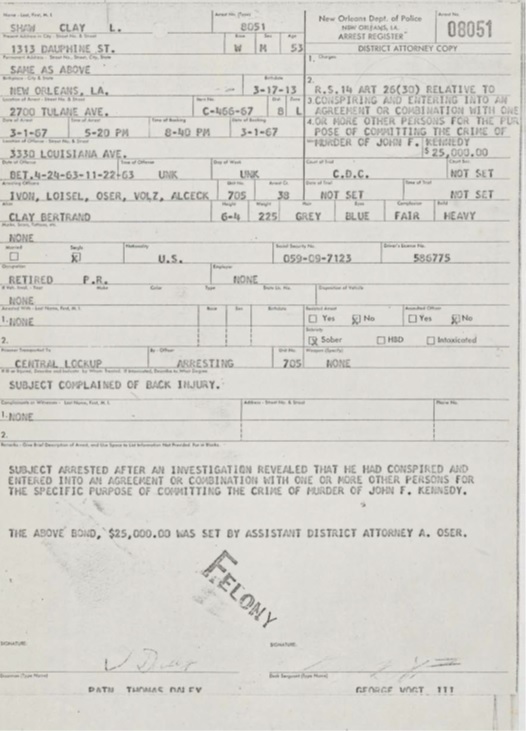
    Just for good measure, let us add the following signed statement, which speaks for itself:

    And how about this signed statement by a witness (key passages):

    Add to this Oswald’s lawyer Dean Andrews being backed by Clay Shaw under the alias Clay Bertrand, plus compelling declassified FBI witness testimony. But let’s have fun anyway. Hardly a slam-dunk on its own, the comparison of the Clay Shaw and Clem Bertrand signatures provides more primary data.

    Clay Shaw was involved in real estate and was the director of the International Trade Mart. His signatures can be found in the Garrison files. Here are a few taken from copies of documents he signed:
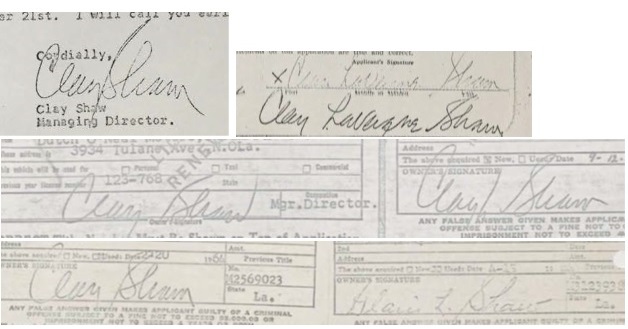
    We can also find this Library card made out to, and signed twice by, Clem Bertrand of the ITM:
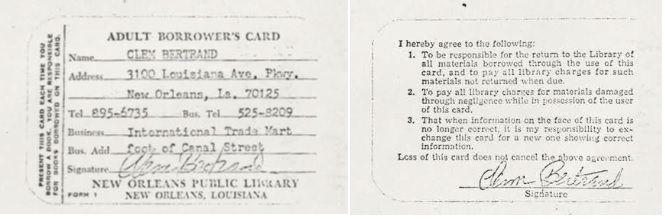
    At first this card was dismissed by the Garrison team because the phone numbers did not match the destinations. However, they decided to reconsider this piece of evidence:

    I wondered what a hand-writing expert might say about these signatures, one who had solid credentials, with no dog in the race, one who might like to weigh in simply to help out with no agenda, nor any fees. Luckily, I was able to find such a person. The following is just a small part of her pedigree:

    Here are the signatures I asked her to compare:

    Here is what she responded:

    “Hello Mr. Bleau, 

    I have reviewed the signatures you sent me. I must first tell you that these signatures are not of good quality. They are copies of copies of copies…. Ideally, I should examine originals or first-generation copies, i.e. made from the original. 

    Despite everything, I can tell you that there are several similarities between these signatures on several levels: 

    • Movement 

    • Tilt 

    • Proportions 

    • Spacing 

    • Continuity 

    • Graphic level 

    This makes it possible to retain the hypothesis (subject to) that they were executed by the same hand. 

    I am surprised to see the use of French names (Lavergne and Bertrand) in the signatures. 

    Sincerely,”                                                                                                

    This opinion concurs with that of the illustrious handwriting expert Elizabeth McCarthy who testified at the Clay Shaw trial: and she did have originals and first generation copies to work from. McCarthy stated that, in over three decades, she had been certified to testify in 28 states and three foreign countries. She worked on as many as two cases per day with about a quarter of them going to court. So the dissenting opinion about this subject is by a dyed in the wool FBI man and J. Edgar Hoover loyalist: Charles Appel. This article is not meant for those who would support the FBI in the Kennedy case.

    Today, it is well-nigh indisputable that Clay Shaw and Clay or Clem Bertrand are the same person and that this high-level intelligence asset was trying to get Dean Andrews to represent Oswald, someone he clearly knew. Why do I say this about Shaw’s intel status? Because Malcolm Blunt has just discovered that in CIA documents, contrary to what many had tried to say about Shaw, his expenses were being paid by the Agency while doing those many overseas reports. This is even more evidence that Shaw lied to the public and under oath at his trial about his association with the CIA.

    In a future article, this author will argue that Shaw, because of his links to the ITM and Permindex, must have been known to Allen Dulles. Thus adding a third Oswald babysitter to Ruth Paine and George DeMorenschildt as Dulles-linked persons of interest. The Old Man had his fingers in many pies.

    The 544 Camp Street network

    After writing a seventy-page, two-part article on Exposing the FPCC, I did not think that I could add very much to expose a charade of Oswald provocateur activity in New Orleans. I was wrong. The Garrison file sources, provided me with even more heavy artillery to fully dismantle this cover, and to shine light on Oswald’s network partners.

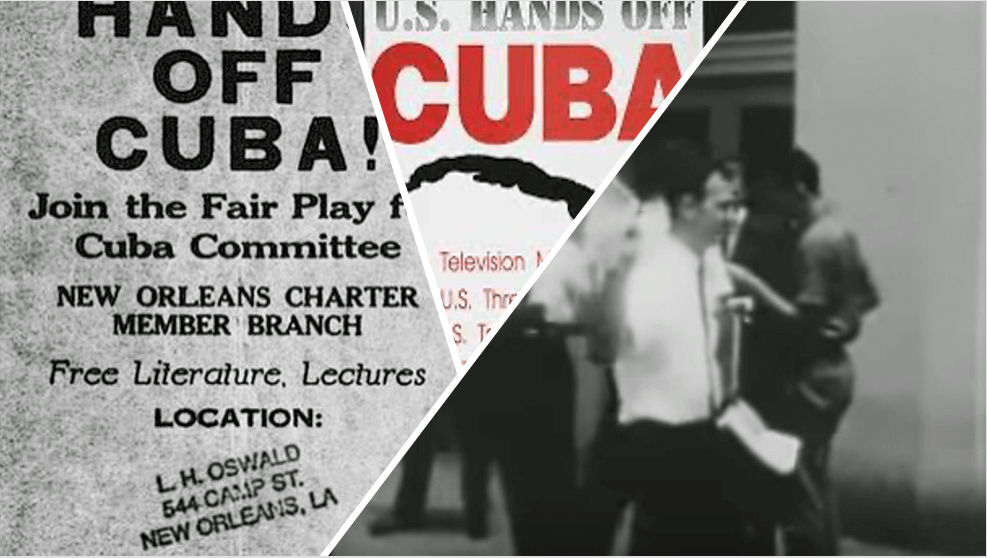
    The revelation of the 544 Camp Street address stamped on Oswald’s FPCC flyers caused lone-nutters fits. Because anti-Castro Cuban exiles, rabid right wingers, Guy Banister, David Ferrie and other people who revolved around Oswald during the Summer of 1963 were frequently seen in the same building. These flyers were a major problem which was admitted to by the HSCA. We also know that this address had housed another one of Banister’s anti-Castro partners in the name of the Cuban Revolutionary Council led by Sergio Arcacha Smith; who in late 1961 was part of a quasi-anti-FPCC riot in Tampa which came to be known as the Marti-Park incident.

    From Jim DiEugenio’s article there is not much more that we need to add to show that Oswald was a member of a network playing the role of a provocateur. As Jim DiEugenio points out in this reply to Alecia Long, at least seven witnesses either saw Oswald at 544 Camp Street, or with Guy Banister on the streets in New Orleans. This included three people who worked for Banister, and two INS agents. When one adds in the layer of intrigue placed over this by the ARRB, the logic becomes pretty ineluctable. For the declassified record has shown that the Board proved both the CIA and FBI had ongoing counter-intelligence campaigns against the Fair Play for Cuba Committee (FPCC). Oswald was the only member of the New Orleans contingent. And he stamped Banister’s address on one, or more, of his leaflets that summer. A fact which Banister was quite upset about. (HSCA interview with Delphine Roberts of 7/6/78). And then there was the ITM connection to Oswald’s leafleting activities. Let us quote from Jim DiEugenio’s reply to Alecia Long’s column in the Washington Post.

    Another important aspect of Oswald in New Orleans that Long discounts is Oswald’s leafleting in front of Shaw’s International Trade Mart in mid-August. This also had some interesting telltale points to it. First, [Carlos] Bringuier and his right-hand man Carlos Quiroga said that they went to see Oswald in an attempt to infiltrate his FPCC “group” after the ITM incident. The visit occurred before it happened. And Quiroga arrived with a stack of flyers about a half foot thick. In other words, the DRE appears to have been supplying Oswald with his leaflets in preparation for the incident. Secondly, the reason we have films of the event is that Shaw’s first assistant at the ITM, Jesse Core, had summoned the cameras. (Davy, Let Justice be Done, p. 38) Beyond that, it was this leafleting episode that caused George Higginbotham to alert Banister, and his reply was “One of them is one of mine.” (Oswald had hired two helpers from the unemployment office to aid him.) But there was something else to note. In addition to calling the cameras for the ITM incident, Jesse Core picked up a pamphlet from the prior Canal Street episode, the one which got Oswald arrested. He noted that it had Banister’s address on it. He mailed it from the Trade Mart to the FBI with a message attached: “note the inside back cover.” (John Armstrong, Harvey and Lee, p. 568) This would suggest that both Shaw and Core knew about Oswald’s mistake. How would they know unless they were aware of Banister’s operation? Which recalls the work done for Banister by Bill Wegmann and Guy Johnson. But further, the FBI then knew about Oswald at 544 Camp Street before the assassination.

    Wegmann and Johnson were part of Clay Shaw’s defense team.

    On August 27, 1978, Banister’s secretary Roberts was re-interviewed by HSCA Investigator Robert Buras. She said she

    believes that LEE OSWALD came into the office to be interviewed for a job, but doesn’t remember anything specific, because so many people came in for interviews. At a later date Banister introduced Marina and OSWALD to her in his office, but they walked right out and she did not talk to them. She could not recall hearing Marina speak, or how they were dressed. On several occasions LEE OSWALD would come in and go into Banister’s office and she could not hear any conversation from that room. She believed that OSWALD was either working, or attempting to work, for Banister. She does remember hearing Guy Banister holler at Jim Arthus and Sam Newman about letting OSWALD the second-floor room and about keeping the Fair Play for Cuba Committee literature from his office. Arthus used to come into the office and put leaflets on Banister’s leaflet table as a joke because all the other literature was anti-communist.

    Scott Malone reported: “Delphine is definitely a kook, but I found someone else to corroborate her story. She told Mary Brengel about having seen OSWALD in Banister’s office two weeks after the assassination. She did not mention Marina’s presence.”

    Even more telling, if we are to believe a 1979 Dallas Morning News article from the Garrison files, it is Banister who, according to his secretary and girlfriend Delphine Roberts, helped Oswald settle into his Camp Street locale:

    The list

    Lone-nut backers have used the tired tactic of trying to distance 544 Camp Street from Guy Banister and David Ferrie offices by shielding it with a wall and a floor or two. The other deflection is to insist on the separation in time between Oswald and the previous occupiers: The Cuban Revolutionary Council. As the above section demonstrated, there can be no doubt about Oswald’s links to Banister and Ferrie, and no architectural imagining can elide it. When analyzing the following lists made available in the Garrison files, we will see that the time argument to try and create separation between Oswald and the nest of anti-Castro militants holds no water… Something that both the HSCA and Richard Schweiker of the Church Committee fully understood.

    Their mission touched a hot button in New Orleans:

    This author is still analyzing the list of names that we can closely connect to this address. What he has found so far is quite incriminating.

    Consider the following profiles of some of the crusaders:

    William T. Walshe:

    One of Mr. Walshe’s important credentials was that he was secretary of the New Orleans based Mississippi Valley World Trade Center (MPWTC) which links him closely to its Secretary: None other than Clay Shaw according to the following listing.

    Mississippi Valley World Trade Conference Annual Award 1955

    Name: MISSISSIPPI VALLEY WORLD TRADE COUNCIL

    Type Entity: Non-Profit Corporation

    Status: Not Active (Action by Secretary of State)

    2006 Annual Report/Reinstatement form is required in order to reinstate Print Annual Report/Reinstatement Form for Filing

    Mailing Address: 124 CAMP ST., NEW ORLEANS, LA 70130

    Domicile Address: 124 CAMP ST., NEW ORLEANS, LA 70130

    File Date: 09/05/1956

    Registered Agent (Appointed 9/05/1956): C. C. WALTHER, 3524 GENTILLY BLVD., NEW ORLEANS, LA 70119

    Registered Agent (Appointed 9/05/1956): CLAY SHAW, 505 DAUPHINE ST., NEW ORLEANS, LA 70116

    President: C. C. WALTHER, 3524 GENTILLY BLVD., NEW ORLEANS, LA

    Vice President: WILLIAM T. WALSHE, 1208 WEBSTER ST., NEW ORLEANS, LA

    Secretary: CLAY SHAW, 505 DAUPHINE ST., NEW ORLEANS, LA

    To understand the status of this organization, one simply needs to note the following:

    From January 4th to January 20th, First Deputy Premier Anastas Mikoyan of the Soviet Union visited the U.S. During his stay, Mikoyan met Under Secretary of State Douglas Dillon, Secretary of State John Foster Dulles, and President Eisenhower and was profiled by Allen Dulles head of the CIA. One of the organizations that was debriefed by Dillon was this MPWTCA highlighting further the proximity between Dulles and Shaw. In 1961, President Kennedy, appointed Republican Dillon Treasury Secretary which put him in charge of the Secret Service.

    Walther himself was rather connected, with links to General Cabell: (New Orleans Times-Picayune May 10, 1961 S1-P3)

    CIA Must Keep Quiet — Cabell
    General Cites Strides of Reds in Science

    The Central Intelligence Agency, because of the sensitive nature of its activities, must maintain a policy of silence at all times in regard to its knowledge of the participation in United States affairs, the deputy director of the CIA said in New Orleans Tuesday [9th] night.

    Air Force Gen. C. P. Cabell said that he therefore could not “rise to the defense of the CIA” in regard to its reported connection with the recent Cuban invasion, a connection which has come under repeated fire from many quarters.

    Gen. Cabell arrived in New Orleans late Tuesday to address the International Relations Association of New Orleans, previously called the Foreign Policy Association of New Orleans. At a meeting held at the Sheraton-Charles Hotel, he discussed “Communism and Science.” He left shortly after the meeting to return to Washington.

    Interviewed at International House shortly before his talk, Gen. Cabell refused to comment on the Cuban invasion and the CIA’s role in the affair.

    “This is a sensitive subject, certainly, and one which should be discussed only by President Kennedy and Secretary of State Rusk,” he said. “The Central Intelligence Agency is not a policy making agency; we merely serve the policy makers.”

    Therefore, it would make matters only worse, he continued, if officials of the CIA and other like agencies continued to make comments concerning the Cuban situation.

    “It could very possibly occur that these comments would differ in meaning and suggestion from those made by the only two people who should be commenting on it – the President and the Secretary of State,” he said.

    Discussing the scientific accomplishments of the Communists in his talk before the International Relations Association, Gen. Cabell said that “there is no reason at all to belittle or magnify the accomplishments of scientists living under Communistic regimes, and there is no reason to draw invidious comparisons between our efforts and their efforts.

    “What we must realize is that the accomplishments are real,” he continued, “and that their successes so far have led them to place even more emphasis on scientific research and development in what Khruschev calls ‘the splendid years under Communism.”

    Cabell said that science is the servant of Communism and that, stripped of all its usual verbiage, “Communism is a future social order being constructed out of present-day socialism through the application of science.

    “We must recognize the vast scientific resources of the Soviet Union and the growing strength of China are being integrated with their political ambitions to reconstruct society in the Communist countries and eventually in the entire world.”

    He concluded that “we should stand forewarned that every resource available to being used by the Communists to advance their political ends.”

    The International Relations Association changed its name from the Foreign Policy Association Tuesday night because, according to its president, C. C. Walther, the group is no longer affiliated with its originator, the Foreign Policy Association of New York.

    It has been reported by eminent author Donald Gibson that Clay Shaw was present during Cabell’s speech. (Davy, p. 293)

    Harold K. Marshal and wife Mrs. Naomi Marshal has her own links to Clay Shaw according to excerpts from this 2013 notice written by her son. article in NoLaVie

    My mother, known to our neighbors to the south as “La Mujer del Norte” (the woman from the north), traveled extensively in Latin America on business during those heady days in the 1940s and ’50s, when New Orleans was dubbed “Gateway to the Americas” — long before Miami, Atlanta and Houston opened economic sluices to the south, effectively shutting New Orleans’ wrought-iron-laced gates for years to come.

    On her way to prominence in foreign trade, Mother shattered several glass ceilings, becoming the first woman officer of the New Orleans Board of Trade and a member of the city’s Export Managers Club. She was an avid supporter of the original International Trade Mart, a five-story modernist block of offices and displays of foreign government trade offices, spearheaded by Clay Shaw, its first director, which was demolished to make way for the New Orleans Sheraton hotel.

    Her life was full, including her idea to locate the ITM tower at the foot of Canal Street, rather than in the new Duncan Plaza (City Hall) complex.

    Clay Shaw moderated a panel that featured Gilbert Mellin

    On October 23, 1959 Clay Shaw moderated a panel discussion that included local business leader and CRC backer Gilbert Mellin; a gathering where anti-communist attitudes were in full view.

    Manuel Gil

    Was employed as Production Manager by INCA. Authorized to sign checks for “Cuban Revolutionary Council”, and a charter member of INCA.
    (WC Vol 26, p. 769; CE 3119; CD 87 SS 517 p. 3 DTR 00-381; CD 407, p. 15; Oswald in New Orleans, Weisberg, pp. 343, 345, 356, 362-363)

    INCA was run by Ed Butler who was friendly with Lloyd Cobb and Clay Shaw of the ITM, who in turn cooperated with him in his anti-communist endeavors. Ed Butler also contributed in the sheep-dipping of Oswald into his Warren Commission, pro-Castro persona. Of course, Gil was in close contact with Sergio Arcacha Smith.

    William Monteleone

    Monteleone’s hotel is where Shaw was the moderator for Anti-Communist panel discussion featuring Mellin.

    According to this CIA file, an informant of unknown reliability claimed that Shaw was linked to one of the Monteleone girls in situations of gross immorality with overtones of sexual deviancy. While this admittedly is of little worth in terms of evidence, it is interesting that this even exists in a CIA file. Is this CIA profiling of U.S. citizens even legal? Unless perhaps they were keeping an eye on one of their own.

    According to the manager of the Newman building, a “young Monteleone” ran the CRC (Garrison Files):

    Provosty Dayries

    The second name on the list should cast no doubt about Banister’s strong ties to the CRC (https://www.lib.lsu.edu/sites/default/files/sc/findaid/3320.pdf)

    In 1951 Provosty Arthur Dayries, who was working for the VA at the time, became assistant superintendent of police—a political appointment by New Orleans Mayor deLesseps “Chep” Morrison. This was after the retirement of Milton Durel, and aimed to bring internal crime within the police department to a stop. At the time, many police captains were part of an underground lottery, gambling, prostitution, and drinking network within the city, which was designated as a “vice” or “graft” investigation (the terms are used interchangeably throughout the materials). He was promoted to superintendent in 1954, following an investigation into the former superintendent of police, Joseph Scheuring, and his lack of leadership in working to end the police network.

    Prior to the hiring of Dayries as assistant superintendent, Mayor Morrison hired a former FBI agent from Chicago–though originally from Louisiana–named Guy Banister to handle the internal affairs investigation from within the mayor’s office. When Dayries was promoted to superintendent, he hired Banister to serve as his assistant. The two repeatedly came into conflict. Banister would often speak to the media before statements had been cleared by Dayries or Mayor Morrison. Additionally, Banister would routinely overstep his bounds within the police department regarding his leadership. At one point he attempted to take over Dayries’s job while he was in Florida speaking at a conference, before being reprimanded by the mayor.

    While Banister at one time did claim Dayries was corrupt, they certainly frequented the same personages.

    The Rodriguez clan

    According to this information in the Mary Ferrell files Arnesto Napoleon Rodriguez y Gonzalez worked with ONI in the 1930s. Father of Arnesto, Jr., an FBI informant who was in communication with Lee Oswald in New Orleans during the summer of 1963. AMJUTE-1 is named as Arnesto Napoleon Rodriguez y Gonzalez on a list of cryptonyms. Arnesto’s other son, Emilio Rodriguez was also a CIA asset based in Mexico City, after being a stay behind agent in Cuba.

    Arnesto Napoleon Rodriguez told an investigator for New Orleans District Attorney Jim Garrison that Oswald “came to the Berlitz School of Languages on one occasion and attempted to talk to him about the possibility of taking a language course, and about Cuba in general. He said he told OSWALD he was busy at the time; if he would return at a later date, they could discuss the situation. OSWALD, however, never returned.” He denied having any tapes of Oswald. [CIA 79, 166-78, 113-48, 72; Sciambra to Garrison 2.14.67 interview with ER Sr.] According to Larry Hancock Arnesto, father and son, were both in the court-room when Oswald got arrested for his fight during his leafletting activities, and Emilio was well connected to the JM. Wave crowd.

    Carlos Crimadier (or Grimader on the list)

    He was the auditor for the Crusade. Here is how the HSCA describes him:

    Richard D. Reily

    If the name Richard D. Reily rings a bell, it is because he is a family member of the same family who owned the Reily Coffee Company where Oswald worked for a few weeks during the summer of 1963 in the Crescent City.

    Ronnie Caire

    According to Ronnie Caire’s testimony to the HSCA, the Ronnie Caire advertising agency provided marketing services for the CRC. Caire also interviewed Oswald during the summer of 63 when he applied for work. (https://www.jfk-assassination.net/weberman/nodule11.htm) Caire says he had been approached by Sergio Arcacha Smith and that he knew both Banister and E. Howard Hunt. He stated that the CIA approached him through the CRC because he was politically connected. (https://www.jfk-online.com/jpsasfrd.html) (For more information, click here.) According to Arnesto Rodriguez Senior, Caire was the principal organizer of the Crusade and was very close to Smith. In fact, he said that Caire’s offices served as the HQs for the Crusade. If this is the case, then this places Oswald in offices occupied by the CRC and the Crusade. Hmmm.

    It is interesting to note that Oswald also applied for work at United Fruit (Garrison: Oswald Miscel. Files, Bercham Exhibit 1), and Michoud Assembly Facility (NASA) where Shaw tenant William Kloepfer worked. He also applied in photography for Jules Weiss who was close to Shaw and also Warren Bernados who also knew him. The funny thing is that Bernados and Weiss had been partners but split, yet Oswald put the partnership company on his unemployment job search report, and both claimed he had passed by to apply for work after they split up. (Garrison Files Shaw Leads 2) Was Oswald really looking for work? … or was he simply being fed names he could use for his unemployment insurance claims? He told Dean Andrews that he was being paid $20 a day to hand out FPCC leaflets. In the Garrison files, we can see all the names of the employers where Oswald supposedly applied. It would be interesting to see how many of these tie into the network we are describing.

    Arcacha Smith

    Smith was head of the CRC at this time and figures on this list in a major way. Sergio Arcacha Smith His links to David Ferrie, Guy Banister, Layton Martens, Carlos Quiroga, Carlos Marcello, Carlos Bringuier, Arnesto Rodriguez, Ronnie Caire, Warren DeBrueys of the FBI who monitored the FPCC in New Orleans, and a host of well-connected anti-Castro operatives (many of whom relate directly to Oswald and Clay Shaw) is well documented… So is his theft of fund-raising revenue, and his determination not to cooperate with Jim Garrison.

    Others known to have come into contact with Oswald and Newman Building occupants, include Cuban exiles of interest like Carlos Bringuier of the DRE who, according to his book, had met Bill Stuckey for the first time in August 1962 (Crime Without Punishment, page 101); and Celso Hernandez and Frank Bartes (who replaced Sergio Arcacha Smith in the CRC). These Cuban exiles all had touch points with Oswald. The FPCC and DRE were monitored by David Phillips (CIA) as well as Warren DeBrueys (FBI) and George Joannides (CIA). The CRC was under Howard Hunt’s watchful eye. Bringuier associate Miguel Cruz also came into contact with Oswald and is identified as informant T-2 as mentioned in DeBrueys’ FPCC file. (Blakey letter to Attorney General of U.S., October 16 1978)

    Joan Mellen’s research indicates that after his brawl on Canal Street with Bringuier, Hernandez and Cruz, Oswald, while under arrest, asked to meet DeBrueys. Warren was out of the office and his associate met Oswald for hours. Which sounds like overkill for a small disturbance. The following file (see bottom right) shows that a Ramon Hernandez complaint about Oswald hand-outs also reached the FBI’s top FPCC dog in New Orleans:

    If the picture one gets from this is that Shaw, Ferrie, Banister and Oswald’s multiple connections to this network of anti-Castro Cuban exiles, right-wing extremists and intelligence actors was not coincidental, then you are beginning to see quite clearly. If you are not quite there yet perhaps the story of one of the last well-connected Cubans to appear on this list will seal the deal. His name is Carlos Quiroga, co-chair of the youth wing of the Crusade to Free Cuba, second in command at the CRC, well-connected to Smith, Bringuier, Bartes, Ferrie, Banister… and Oswald.

    His testimony to Garrison was polygraphed… His lies were plentiful, blistering and confirmed by another polygraphed witness. Quiroga deserves a section of his own.

    Carlos Quiroga

    Oswald`s landlady Jesse Garner saw Quiroga meet Oswald at his apartment. Quiroga claimed that he was trying to infiltrate the FPCC. This could have been done by filling out one of the flyers that Oswald was distributing. According to Jesse Garner in her Warren Commission testimony, Quiroga seems to have brought way more than one application: Note how both lawyer Wesley Liebeler and Jim Garrison underscore the quantity of flyers Quiroga brought with him:

    Another false claim made by Quiroga was that this had been the only time that he had met Oswald.

    The following lie detector test results reveal that: Quiroga met Oswald a number of times. He also knew that Oswald`s association with the FPCC was but a front and that Oswald was part of an anti-Castro operation. That he knew that David Ferrie knew Guy Banister and he had seen Oswald with at least one other Latino subject.
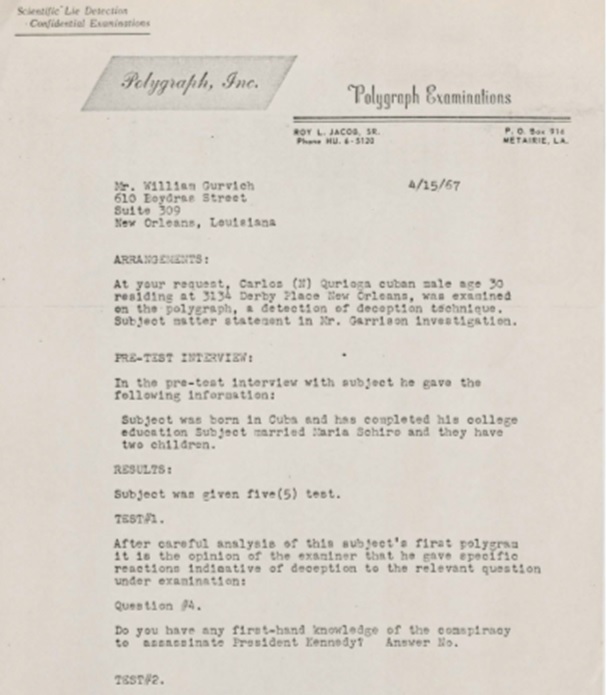
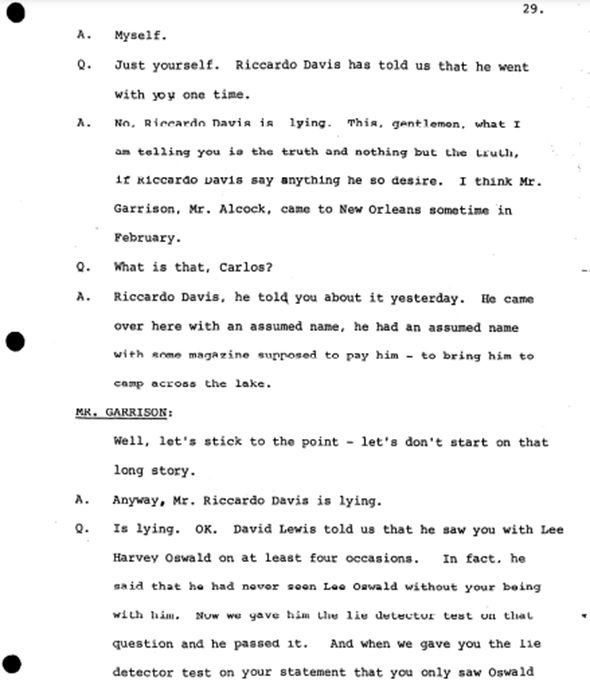
    The exchange below between Quiroga and Jim Garrison, provides corroboration to the damning test results, in that two witnesses–one who had also been polygraphed–contradicted Quiroga`s statements.

    David Lewis, a roommate of Banister employee Jack Martin, witnessed Quiroga with Oswald a number of times. While his testimony and character have been the subject of numerous attacks, there was no denying that his own polygraph results bolster the proof of deception brought forward by Quiroga’s polygraph. We can also add Ricardo Davis as one other witness who accompanied Quiroga when he was with Oswald on an occasion.

    (http://www.aarclibrary.org/publib/jfk/garr/grandjury/pdf/Quiroga.pdf page 29)
    More list member analysis

    The motive of Latinos to be involved in the Crusade is self-explanatory. The Anglo-Saxon members most likely had business motivations. New Orleans was the gateway for North South trade. The last thing they wanted was a Castro stimulated revolution of Central and South American states that would disrupt markets and supply chains. After discussing with a member of the research community from New Orleans, who briefly perused the list, he concluded that a number of multi-millionaires were represented and wanted Castro out.

    One example is Mrs. R. G. Robinson, who was likely the wife of Robert Gibson Robinson, son of the founder of Robinson Lumber Company (1893). Robert Gibson, was instrumental in the internationalization of this stellar family-run company. (See this link its website,

    Robert Gibson Robinson, his son, upon recognizing the declining supply of export quality Heart Pine, began the company’s first foreign manufacturing facility in Nicaragua in 1942 to supply Pitch Pine to Robinson’s customers around the world.

    After World War II, Jack, Charlie, and Sam, the third generation of Robinsons entered the business, expanded into hardwoods and began operations in Honduras and Brazil.

    Mexico was also an important supplier of product. Just like with United Fruit, a communist take-over in these areas would have been disastrous.

    Consider this about a Stockton B. Jefferson:

    If this is the CPA husband of Mrs. Stockton B. Jefferson from the list, we can link another member of the Crusade who saw Castro as an existential risk. Note the association with Avondale Shipyards. One of the founders of Avondale Shipyards was a newspaper owner and father of Fred Koch, founder of Koch Industries. Harry Koch

    Oswald letter to FPCC

    In one of my articles for Kennedysandking, Oswald’s Last Letter, I presented strong evidence that a letter to the Russian Embassy was a fake designed to paint Oswald in cahoots with Russia for the assassination. A very early researcher has convinced me that at least one of Oswald’s letters to the FPCC was done with close assistance. For this important clue, we need to go back to 1964 and quote directly from Harold Feldman, OSWALD and the FBI.

    After presenting arguments that Oswald was an FBI informant, Harold astutely makes the following points: “If the FBI did not employ Oswald or work with him, then who wrote the letters he addressed to the Fair Play for Cuba Committee in New York? Oswald alone certainly didn’t. Whoever wrote the letters to New York was coherent, commanded a good vocabulary, rarely misspelled a word, and punctuated decently. Oswald himself wrote English that a sixth-grader would blush to acknowledge. Here is a letter he wrote to his mother from Russia on June 28, 1963. I preserve the original spelling and punctuation:

    Dear Mother.

    Received your letter today in which you say you wish to pay me back the money you used last year, that, of course, is not nessicary however you can send me somethings from there every now and than.

    If you decide to send a package please send the following:

    One can Rise shaving cream (one razor (Gillet)

    Pocket novels westerns and scienace fiction — Time or Newsweek magazine

    Chewing Gum and chocolate bars.

    That’s about all. Ha-ha

    I very much miss sometime to read you should try and get me the pocket novel “1984” by Wells.

    I am working at the local Radio plant as a mettal worker. We live only five minutes from there so it is very conveinant.

    Well thats about all for now. I repeat you do not have to send me checks or money!

    Love XX

    Lee
    P.S. Marina sends a big Hello to you also

    Now compare this semi-literate effusion with the following addressed to the Fair Play for Cuba Committee about two years later. (A New York Times report on the letters to FPCC indicates that they were handwritten, so presumably no public stenographer improved their style.)

    Dear Mr. Lee:

    I was glad to receive your advice concerning my try at starting a New Orleans F.P.C.C. chapter.

    I hope you won’t be too disapproving at my innovations but I do think they are necessary for this area.

    As per your advice I have taken a P.O. Box (N.O. 30061).

    Against your advice I have decided to take an office from the very beginning.

    I u c [apparently meaning, as you see] from the circular I had jumped the gun on the charter business but I don’t think it’s too important. You may think the circular is too provocative, but I want it to attract attention even if it’s the attention of the lunatic fringe. I had 2,000 of them run off.

    The major change in tactics you can see from the small membership blanks, in that I will charge $1 a month dues for the new Orleans chapter only and I intend to issue N.O. F.P.C.C. membership cards also.

    This is without recourse to the $5 annual F.P.C.C. membership fee.

    However, you will lose nothing in the long run because I will forward $5 to the national F.P.C.C. for every New Orleans chapter member who remains a dues paying member for 5 months in any year. . . .

    And so on for several more well-integrated paragraphs. He now spells “receive” and “necessary” correctly. He has mastered the apostrophe. His ideas cohere. He tackles words like “innovations,” “provocative,” “recourse,” “disapproving,” “approaching,” and “application” with success, something that would have been clearly beyond the powers of the voluntary exile in Minsk.

    Until the authorship of the letters to the FPCC is settled, I think it reasonable to suppose that Oswald did not compose them, at least not without help. Who, and where, is the invisible scribe? No associate of his New Orleans period has been found, or even hinted at. If Oswald was employed by the FBI to operate in “Castro groups,” as the news report suggests, it is also reasonable to suppose that in the letters to FPCC his pen was guided by the FBI.”

    In the following you will see that the actual hand-written version indicates a few differences with the above typed version (example its vs it`s). In my view the analysis by Mr. Feldman remains valid and astute given what he had to work with. He is correct in saying that this letter is so much better in grammar, word selection and style than other Oswald correspondence.

    The FPCC in 1963

    In my first prior plots article, I based my research on author Van Gosse’s work to estimate maximum FPCC membership to be between 5 and 7 thousand in 1961 and argued that such a low number made it impossible for persons of interest like Richard Case Nagell, Oswald, Policarpo Lopez, Vaughn Marlowe, Harry Dean, John Glenn, Santiago Garriga–who were potential patsies to varying degrees–to all be coincidently linked to the FPCC; especially for those in the Deep South where the FPCC had much less activity. Based on recent data that I have obtained, the odds are astronomically worse than what I first thought.

    According to Malcolm Blunt, Vincent T. Lee, who was the last head of the organization, stated that the number of members had plummeted to about 1500 by mid-1963, finances were very poor and that the other FPCC officers were no longer even answering to him. Even the Treasury Department noted that the FPCC was almost inactive. Furthermore, members in the Deep South tended to be disproportionately African American, and the FPCC was riddled with informants.

    In other words, the statistical probability of seeing a white person in the Deep South genuinely involved with such a vegetative outfit was rather small… seeing seven of the subjects profiled… well, no comment.

    Framing Oswald

    Two persons both Garrison and Blunt included in their files are the Buchanan brothers, Jerry and Jim Buchanan. They appear to be part of the large number of frame-up artists (FBI Report of Joseph Boston). Jerry claimed he had a fight with Oswald in early 1963 while he was distributing FPCC flyers in Miami.

    Here is the capper: Both Jerry and Jim were officers of the International Anti Communist Brigade, where one of the Blame it on Castro Kings, Frank Sturgis, left his alpha male scent.

    Birds of a feather

    In article 2 of its formation documents, the International Trade Mart specifies one of its roles as “the development, promotion and maintenance of trade and commerce between the people of the United States of America and the people of the world, particularly the other American republics.”

    It goes without saying that a communist country like Cuba, that was nationalizing many of its industries, was not in tune with the ITM mission.

    In 1968, its president, the CIA connected Lloyd Cobb, went even further by stating: “the aims of the new International Trade Mart would be: to act as a catalyst to develop trade and not be just a display area for foreign goods; to encourage and stimulate U.S. investors into joint enterprises with Latin Americans; to counter Communist propaganda…” (The Story of the International Trade Mart, page 15).

    Since the assassination, the ITM has gone through a merger and a multitude of changes, moves and expansion– making it an entirely different post-Cold War entity today. It is safe to say that during the Red Scare and Missile Crisis, New Orleans and its captains of industry where a tight-knit bunch who worked in synch with one another to target communist threats. The omni-present intelligence network was a partner in this economic and national security danger. This is why Oswald set up an office in the heart of one of the major anti-communist blocs in North America at the time and played a provocateur role using the brain-dead FPCC as a front: to work with a network in rooting out communists. A network which included Guy Banister, Cuban exiles, David Ferrie, INCA, WSDU, the CRC, The Friends of Democratic Cuba, The DRE, the Anti-Communist League of the Caribbean, intelligence actors and Clay Shaw who was a well-paid CIA contract agent. This is why we have seen so much interaction between persons on the list with Oswald and Shaw. Given the role of the ITM, how could Shaw not be well connected and work in symbiosis with the apparatus countering communism as well as with the New Orleans power elite.

    Just how invested the ITM, or at least some of its governance members were, in controlling the environments capitalists dealt in is not known. The Garrison files do offer some clues which the research community should pour into. Let us look at some of the people who were involved in with the ITM some sixty years ago.

    We can begin with what Garrison himself observed when questioned on May 27, 1969 (Garrison Files: Crusade to Free Cuba, file 2, page 38)
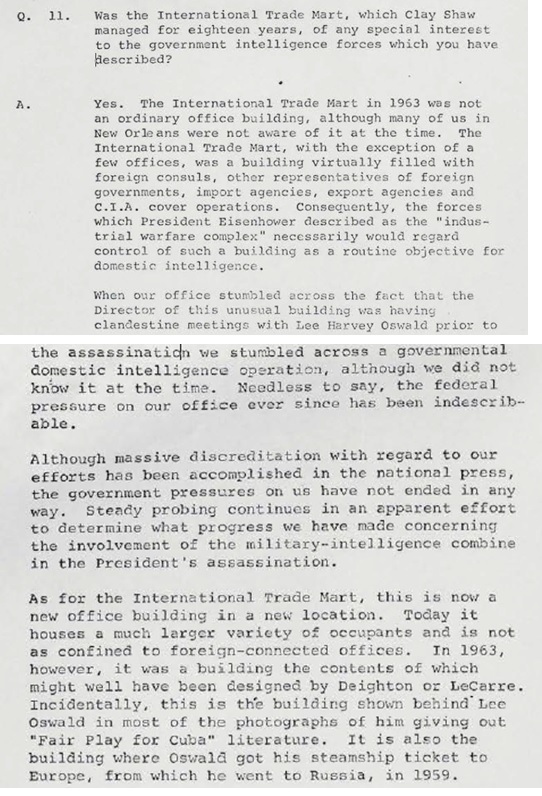
    Article 4 of the ITM foundation papers lists the original board directors in 1945. While a 1963 list would be worth analyzing, this one is already very revealing, especially when comparing with INCA members and operatives:

    And this list of INCA operatives from an INCA pamphlet:
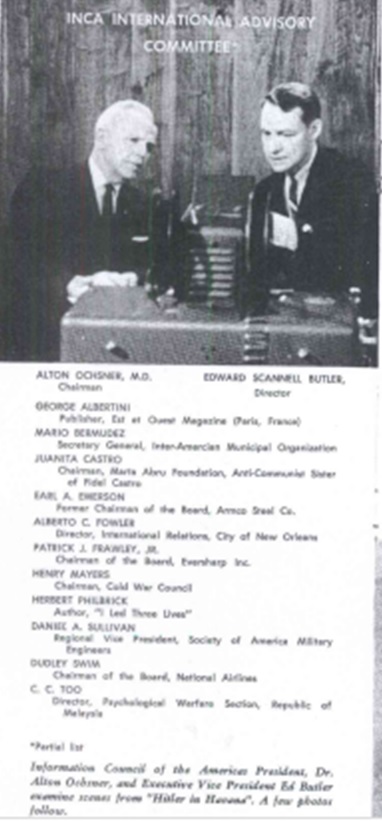
    We know Shaw was close to Butler and Ocshner of INCA and that Philbrick was Oswald’s idol. Garrison was obviously intrigued by certain names such as Eustis Reily on the INCA list. This author finds the Stern names (WDSU) interesting. Since William Stuckey had a weekly radio program at the station and they allowed Walter Sheridan to work out of their offices while doing his NBC hatchet job on Garrison in 1967.

    Declassified files prove that Lloyd Cobb, Theodore Brent (top dogs at the ITM) and Clay Shaw, who joined later, were intel connected . For instance, Cobb was on a panel of CIA cleared lawyers in New Orleans. (William Davy, Let Justice be Done, p. 182) According to Joan Mellen, Brent’s Mississippi Shipping Company ended up being a CIA proprietary. (Mellen, A Farewell to Justice, p. 131) Oliver Stone’s film, JFK: Destiny Betrayed, proves that Shaw was a highly valued contract agent and had a covert security clearance for the Agency. The last name on the ITM list William G. Zetzmann also figures on a partial list of INCA members almost 20 years later.

    A New Orleans based researcher sent me the following information: “I spoke with Paul Fabry, head of Radio Free Europe and other CIA organizations and later with his secretary, who told me that it was always their understanding that the ITM  was “an agency operation”. The bronze plaque in the lobby of the ITM listed Alton Ochsner, James Coleman and a guy named Wm. Norman (atty and spook).” 

    Now let us see what we can peace together in terms of ITM occupants, employees and visitors.

    According to the Story of the ITM: A list of first tenants included David Kattan, Otis McAllister Co., Hemisphere Trading Co. (of which Alonzo G. Ensenat was Manager), United China & Glass Co., W. R. Grace & Co , S. Jackson & Son, Inc., Dictaphone Corp., Lily-Tulip Co., and Lucky Tiger Co.

    It would be helpful if researchers could profile these occupants of the ITM and others who were there in and around the time of the assassination. For instance, J. Peter Grace presided over W.R. Grace & Company as of 1945 for many decades. He is profiled this way by Source-watch: The name J. Peter Grace (1913-1995) “is found in the Council for National Policy (CNP) Membership Directory for 1984-85 and 1988. Grace holds a Bachelor of Arts degree from Yale University (1936). Grace “started in 1936 as Assistant Secretary at W. R. Grace, in 1945 became President and CEO. Grace is a member of the Newcomen Society, Council on Foreign Relations (CFR), Knights of Malta: American Chapter of the Board of Founders, Knights of Malta President, 114 Avenue of the Americas [Who’s Who in America (1976-77, 1992-93)]. Grace was involved in Project Paperclip — a post-World War II CIA arrangement to remove classified information from dossiers so that former SS members and 900+ Nazi scientists could emigrate to the U. S. Hundreds of war criminals would find employment within government agencies and companies such as W.R. Grace chemical company whose president was J. Peter Grace.”

    Alonzo Ensenat certainly has strong ties to Clay Shaw. He was president of Hemisphere Trading Co. in New Orleans until founding Ensenat & Co., an import-export firm, in 1947. He was president of the company until retiring in 1980.

    Mr. Ensenat was a member of the committee that organized International House in New Orleans in 1943 and was on its first board of directors. This is where Shaw went to work on his return from World War II. The chain of International Houses was started by the Rockefellers and spread worldwide as part of their globalist, one world vision. The chairman of the Board of Trustees was John McCloy, a frequent Rockefeller lawyer. (James DiEugenio, Destiny Betrayed, second edition, p. 383) In 1945, Ensenat was an organizer of the International Trade Mart and was one of its first tenants when the building opened at 2 Canal St. in 1963. International House and the International Trade Mart later merged to form the World Trade Center of New Orleans. In 1946, Mr. Ensenat was an organizer of the Foreign Trade Zone, a duty-free zone that helped increase traffic through the Port of New Orleans after World War II.

    Ensenat was on the executive committee of the Mississippi Valley World Trade Council (Secretary, Clay Shaw), which sponsored annual conferences in New Orleans to promote American exports in the 1950s and ’60s. He was president and general chairman of the conference in 1960 when it received the U.S. Department of Commerce’s “E” Award for excellence in promoting exports. He also was a charter member and past president of the World Trade Club of New Orleans. As opposed to this globalist goal, as Professor Donald Gibson has shown, Kennedy was a nationalist, both for the United States and largely in the Third World. This was a distinct break in policy between him and Dwight Eisenhower. (See DiEugenio, Chapter 2)

    But beyond the uplinks to the Eastern Establishment, the ITM and Shaw had downlinks into the Crescent City. Aura Lee was a former secretary to Shaw at the ITM. After watching a press conference by Shaw where he denied knowing David Ferrie, she stated to Dr. Charles Moore, that she had seen Ferrie enter Shaw’s office at the Trade Mart several times. It happened so often the she thought Ferrie had privileged entry into his office. (DiEugenio, p. 209)

    Bill Gaudet had an office in the ITM. According to Harold Weisberg, it was adjacent to two vacant offices. He published the Latin American Reports. Weisberg described him as C.I.A affiliated. (Andrew Sciambra Assistant D.A., interview with Weisberg on 4/14/1969). According to Sciambra, Cuban exiles often reported that Gaudet was CIA or FBI. Gaudet witnessed Oswald talking to Banister. (DiEugenio, p. 112)

    On March 31, 1967, Betty Parrot told Garrison’s assistant DA Andy Sciambra, that Bill Dalzell lived in her home and that he was involved in a group called the Friends of Cuba with Sergio Arcacha Smith, BILL CRAIG, GRADY DURHAM, an individual named LOGAN who was also a member of the C.I.A., BILL KLINE, an attorney, REGIS KENNEDY, a member of the FBI, an individual named HOFFMAN and an individual named EASTERLING.

    She also stated that “this group later moved from their office in the Balter Building and moved into an office in the International Trade Mart and then operated under the name of The Voice of Cuba or The Friends of Democratic Cuba.”

    Layton Martens, listed as second in charge of the CFC after Arcacha Smith, knew David Ferrie through the Civil Air Patrol very well and also knew Clay Shaw but claimed Ferrie did not know Shaw. Here is what he told Garrison’s Assistant D.A. Alvin Oser when questioned on March 12, 1967, when asked: Have you ever been at the International Trade Mart?

    LM: Yes.

    AO: When was that?

    LM: Well, a couple of vacations, a girlfriend’s mother worked there and I used to stop in and see her. I used to tell her hello. I did some soliciting there for funds for the F.R.D. and I went once with CLAY to see the plans for the new building.

    Another ex-Civil Air Patrol cadet under Ferrie, Lawrence Fox, told assistant DA Jim Alcock (April 14, 1967) that he also solicited funds for the Crusade to Free Cuba at the ITM with David Ferrie. He said he was involved with Layton Martens and Arcacha Smith. (Garrison Files Miscellaneous reports 2 page 20)

    In a report (described as relatively accurate but unconfirmed) about CIA leads in New Orleans dated May 24, 1967 to Jim Garrison by Assistant D.A. William Martin, he describes a Dave Baldwin who was hired by Shaw:

    “(DAVE) BALDWIN) formerly of this City and a former newspaper reporter for the New Orleans States Item, was a covert member of the Central

    Intelligence Agency and operated in India during the years of 1950, 1951 and_l952. Subsequent to his service in India Mr. BALDWIN returned to this city and was employed by CLAY SHAW as Public Relations Director for the International Trade Mart from 1952 through 1955…

    …It was told to me that, during his employment at) the Trade Mart, DAVID BALDWIN succeeded in recruiting CLAY SHAW for C.I.A. operations, or, conversely, that CLAY SHAW had already been recruited by the C.I.A. by the time of BALDWIN’s employment, and that his employment of BALDWIN was suggested or sponsored by the C.I.A. During his operations in India. Mr. BALDWIN used as a cover his employment as a correspondent for North American Newspaper Alliance, the Louisville courier Journal, and the New Orleans Item.”

    And there was Jesse Core, who replaced Baldwin. Core became Clay Shaw’s aide-de-camp at ITM. Core happened to pick up a flyer while Oswald was leafleting on Canal Street. He brought it back to the ITM. From there, he mailed it to the FBI office. He noted the part of the flyer which had Guy Banister’s office listed on it. This would suggest that he and Shaw knew this was a problem for Oswald, Banister and the FBI. Further, it was Core who notified WDSU TV about Oswald’s leafleting event outside the ITM. (DiEugenio, p. 161)

    And we have this report that is so information-packed that I will share it intact:
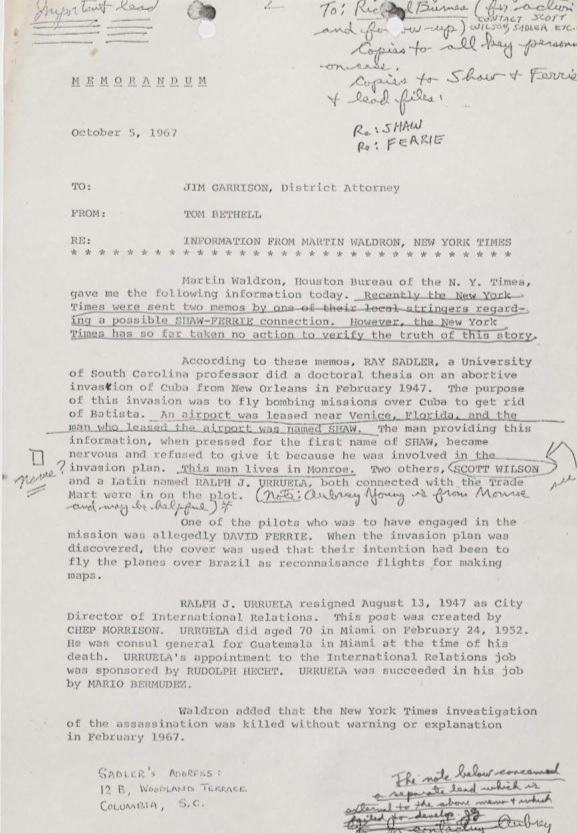
    In other words, at about the time Garrison’s inquiry was being exposed against his will by local reporter Rosemary James, The Times pulled the plug on their own inquiry.. When, in fact, they had leads in their files that backed up the DA. This parallels what Time-Life did through editor Holland McCombs, due to his friendship with Clay Shaw. (Click here for details https://www.kennedysandking.com/john-f-kennedy-reviews/last-second-in-dallas-part-1)

    Respected researcher David Boylan sent me this provocative piece of information about another interesting occupant: “I’m not sure if you guys have seen this. EAR’s (Emilo A. Rodriguez) statement just before he became a full-time employee. Page 6 is pretty interesting. He worked for the Berlitz School located at the ITM. His brother Arnesto would later run the Berlitz school and attempt to teach Oswald Spanish.”

    https://www.maryferrell.org/showDoc.html?docId=181877#relPageId=1.

    “The signature is still redacted but I’m sure it was signed by David Morales. Morales had been working with EAR and Sforza in Cuba and exfiltrated them both in June 1961.Szorza would get an office but Morales wanted to keep EAR away so that EAR could continue his deep cover work.”

    Summary

    In parts 1 and 2 of this series, it was demonstrated that when Oswald started an FPCC chapter in New Orleans, he did so to infiltrate it as an informant.  

    In part 3 of this series of articles we have not only sealed the deal on proving that Oswald’s FPCC activities were simply a role he was playing as part of city-wide anti-Castro offensive that had national backing. We also show how Oswald and Clay Shaw’s work environments overlap in terms of contacts, mission and activities.

    It was in the ITM’s DNA of that day to support anti-Castro efforts through propaganda, funding, organizing and networking as covertly as possible. Clay Shaw and Oswald’s intelligence fingerprints go back years before their appearances in New Orleans. Richard Schweiker of the Church Committee famously stated that everywhere you look with Oswald you find the fingerprints of intelligence. Shaw let his spook-slip show a number of times through his reckless socializing and hobnobbing with David Ferrie as well as through his anti-Communist support activities, network links and association with Permindex. Which in those day were not just a patriotic duty: in the New Orleans business community, it was part of people like Clay Shaw’s understood job description.

    There has been a lot of discussion about the close physical proximity of 544 Camp Street to Banister and right-wing activists. Thanks to the Garrison files, we can work on proximities within the networks Oswald and Shaw shared. It is within these associations–which in the mind of their members were noble and deemed essential–that a few key people on a need to know basis exchanged money, orders and words that contributed to the murder of a President who was not in tune with a national mission, and thus considered a national threat. There was also a need to cover up and create distance between network members and Oswald.

    One member of this network that has not been discussed yet was a muscular Latino who was often seen accompanying Oswald, or perhaps an Oswald double. He was considered so suspicious that the whole Garrison team was on the look-out for him. He was never identified. He was seen so often and described in corroborative terms that can leave no doubt that Oswald, the supposed lone-nut drifter, had at least one escort.

    Stay tuned!

  • Exposing the FPCC, Part 2

    Exposing the FPCC, Part 2


    see Part 1

    “Follow the money” is one of the things that the FBI and Warren Commission did not do in trying to understand how such a destitute person like Oswald could run an FPCC chapter, raise a family, and save money for Marina (at least $1600 in today’s money).[1] He was so poor that the White Russians paid for his YMCA fees.

    The FPCC added the following to this drifter’s cost of living: FPCC membership fees, renting of a space, hiring leafleteers, paying a fine for disturbing the peace, the purchase of rubber-stamping equipment, personal displacements, printing of up to five different pieces of literature, correspondence with the FPCC, and use of a Post Office Box…with not one single member to help absorb the costs.

    The following exchange between Oswald’s lawyer and Wesley Liebeler of the Warren Commission suggests something more plausible than Oswald giving away time and money for a passé organization rather than focusing on his growing family—he was paid $25 a day (Note that Oswald’s job at the Texas Schoolbook Depository paid $1.50 per hour):


    Oswald’s slip was showing

    Admitting his remuneration to Dean Andrews and stamping 544 Camp Street on his handouts were not Oswald’s only mistakes that would ultimately blow his cover.

    Shortly after launching the FPCC Chapter in New Orleans, Lee sent out two honorary membership cards to Gus Hall and Benjamin Davis, two senior members of the American Communist Party, even though after his return from Russia he wrote the following in his diary:

    The Communist Party of the United States has betrayed itself! It has turned itself into the traditional lever of a foreign power to overthrow the government of the United States; not in the name of freedom or high ideals, but in servile conformity to the wishes of the Soviet Union and in anticipation of Soviet Russia’s complete domination of the American continent.

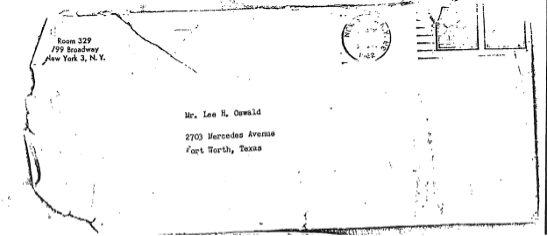
    In a letter dated August 1, 1963, postmarked August 4, Oswald wrote to Vincent T. Lee, head of the Fair Play for Cuba Committee in New York,

    In regards to my efforts to start a branch of the Fair Play for Cuba Committee in New Orleans…I rented an office as planned and was promptly closed 3 days later for some obsure [sic] reasons by the renters, they said something about remodeling, ect. [sic] I’m sure you understand after that I worked out of a post office box and by useing [sic] street demonstrations and some circular work have substained [sic] a great deal of interest but no new members. Through the efforts of some cuban-exial [sic] ‘gusanos’ a street demonstration was attacked and we were oficialy [sic] cautioned by the police.

    The problem with this letter was that the incident Oswald seems to be referring to occurred on August 9th, more than a week after he first wrote about it. Was Oswald describing a scenario for the upcoming theatrics on Canal Street over which he would be arrested and arraigned in court?

    When Oswald debated anti-Castro Cuban exile Carlos Bringuer, he was asked how he lived in Russia: “Did you have a government subsidy?” Oswald answered; “Well, I worked in Russia and, I was under the protection of the United States, Uh I was under the Uh that is to say, I was not under the protection of the United States Government. But, I was always considered a United States citizen.”

    It was not just Oswald who blew his own cover. Antonio Veciana, who was David Phillips’s go-to guy in the Cuban exile community for some thirteen years, told Gaeton Fonzi—and later the whole JFK research community—that he had seen Phillips talk to Oswald in Dallas in September 1963.

    Oswald’s participation in the training of anti-Cubans was caught on film according to Robert Tanenbaum, Chief Counsel of the HSCA, during his interview with Jim DiEugenio:

    JD: Was it really as you described in the book, with all the people in that film? Bishop was in the film?

    BT: Oh, yeah. Absolutely! They’re all in the film. They’re all there. But, the fact of the matter is the Committee began to balk at a series of events. The most significant one was when [David Atlee] Phillips came up before the Committee and then had to be recalled because it was clear that he hadn’t told the truth. That had to do with the phony commentary he made about Oswald going to Mexico City on or about October 1st, 1963. (Probe Magazine, Vol. 3 No. 5)

    John Newman shows how Dallas FBI claims that they lost track of Oswald, while he was setting up the FPCC in New Orleans all the way up to August 5, lack credibility, especially given his multiple FBI scrutinized correspondences—all occurring before June 6—with the Post Office, the Communist Party, the Soviet Embassy in Washington, and the FPCC, where his New Orleans address was easy to find.[2]

    Another astute observation by Newman is that before August 5th, Oswald’s FPCC recruitment activities were done quietly, almost undercover. They were likely done that way in order to help Banister and the CRC with their background investigations. As of August 5, when he meets Bringuier up until September 25 when he meets Silvia Odio, Oswald repeatedly acts overtly with anti-Castro Cubans while, at the same time, seeking media attention for his FPCC activities.[3]

    On September 16, 1963, the CIA informed the FBI that it was considering action to counter the activities of the Fair Play for Cuba Committee in foreign countries. In New Orleans, on September 17, 1963, Oswald applied for, and received, a Mexican travel visa.[4]

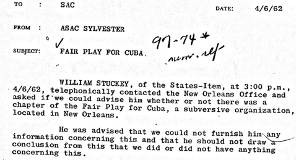
    Another indicator of Oswald’s informant role is what the FBI did not do: Infiltrate the New Orleans FPCC. The FBI did this with FPCC chapters throughout the country, often with multiple informants. And as we saw with Bill Stuckey, New Orleans was well prepared for an FPCC presence in their city. It would have been very easy to have informants answer Oswald’s leafleting by signing up to spy on him—as they did in Tampa, NY, Detroit, Chicago, L.A., Indiana, and elsewhere. But, for whatever reason, they chose not to.

    There seems to be a logical deduction from all this. Oswald was informing on both pro- and anti-Castro operations in New Orleans. But he was also creating a portfolio similar to other FPCC participants in the past to be able to eventually travel to Cuba by way of the Mexico City-Cubana Airlines route.

    Are we to believe that Oswald just stumbled into these right-wing fanatics, Cuban exiles, and old acquaintances who shared a hatred for Castro?

    The FPCC template of informants and/or potential patsies

    In this author’s article, The Three Failed Plots to Kill JFK eight subjects were profiled who shared similar traits to Oswald as represented in the ensuing chart:


    As we can see:

    • Eight of the nine subjects profiled are connected to cities visited by Kennedy during the six months that preceded his assassination.
    • Each of these cities was a territory exploited criminally by Mafiosi of interest in the assassination.
    • At least three moved to the cities and got employment in strategically located buildings along the motorcade route shortly before the planned presidential visit.
    • Seven were ex-military.
    • Eight of them exhibited behavior that can very plausibly be linked to intelligence gathering or Cuban exile interaction.
    • Seven were directly linked to the FPCC. Seven of them had visited Mexico City
    • Six attempted to visit Cuba, three of them successfully.
    • Seven had links to Cuban/Latino exiles.
    • Six were described as having psychological problems.
    • Seven exhibited anti-Kennedy behavior.
    • None were probed seriously by the Warren Commission.

    Intelligence services, notably the Secret Service, kept crucial information about these subjects, as well as the prior plots, totally secret from the Warren Commission.

    By reading the Failed Plots article, the reader will discover how many of the above characters were being potentially framed through linkage to prior plots attempts and their links to the FPCC and how some used their FPCC allegiance to spy on the organization or as a ruse to enter Cuba.

    Another ruse that became clearer with time was that the associations of many of the potential patsies/informants would have had the impact of tearing down the FPCC once and for all, while placing the blame on Castro and providing Psy-Ops propagandists with a storyline tainting the FPCC operations outside the U.S. borders, as well as organizations like the SWP, the U.S. Communist Party, CORE, and others seen as threats to U.S. security.

    Framing the FPCC – a coordinated effort by the usual suspects[5]

    In the Failed Plots article, we show how the FPCC-tainted Oswald, not only put the final nail in the Fair Play for Cuba Committee, he was used to frame Castro as well. A tactic straight out of the CIA’s ZR/Rifle executive action playbook written up by assassination guru William Harvey. Here were some of the P.R. tactics that were described:

    • Cuban exiles: Immediately after the assassination, Carlos Bringuier and John Martino, as well as Frank Sturgis—also a Watergate burglar—pushed the Castro was behind it story.
    • Castro frame-up stories were very quickly leaked to Hal Hendrix, a JM/WAVE friend, and other CIA media assets.
    • Antonio Veciana, leader of the Cuban exile group Alpha 66, confirmed that David Phillips—whom he had seen talking to Oswald shortly before the assassination—had asked him to bribe a cousin of his in Mexico City to say that Oswald was being paid by Castro agents to assassinate JFK.
    • HSCA investigator Dan Hardway confirmed that almost all of the Mexico City stories that incriminated Oswald and framed Castro were created by assets of Phillips.

    On the night of JFK’s assassination and Oswald’s arrest, Dallas District Attorney Henry Wade erroneously stated during a press conference that Oswald was a member of the Free Cuba Committee. Out of all the many onlookers present, it was nightclub owner and future patsy killer Jack Ruby who corrected the D.A.

    Let us now add a few more frame-up artists and their propaganda contributions:

    Ed Butler (INCA) and Bill Stuckey

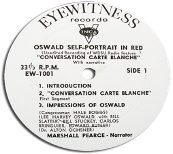
    Butler’s role in the post-assassination tale got quite interesting. For as Time magazine noted in its 11/29/63 issue, “Even before Lee Oswald was formally charged with the murder, CBS put on the air an Oswald interview taped by a New Orleans station last August.” That night, according to New Orleans Magazine, Butler and the INCA staff churned out news releases about Oswald in order to offset the “rightist” and “John Bircher” charges flying about. Then, Senator Thomas Dodd, who ran the Senate Internal Security Subcommittee, was called up by Butler.

    The Kennedy-hating Dodd invited his acquaintance Ed Butler to testify before his Senate Subcommittee. Apparently completing Butler’s public relations tour, the tape of the WDSU interview was forwarded by the CIA to Ted Shackley at the Miami station and used in the CIA’s broadcasts into Latin America, furthering the legend about Oswald the communist killing President Kennedy. Declassified files reveal that the label on the box with the tape says, “From DRE to Howard.” Howard signifies either Howard Hunt or George Joannides, whose codename was “Howard.” This means that Bringuier’s group (DRE) probably gave a copy to Howard Hunt who forwarded it to the CIA’s Shackley. The Agency in spite of later denials was still funding the DRE at the time of the assassination.[6]

    Ruth Paine (2 deliveries)

    Ruth was not only the Warren Commission’s busiest witness in making the case for the lone nut scenario, she was a prolific provider of timely evidence against Oswald coming straight out of her garage. One of her go-to guys was Irving Police Captain Frank Barger (FBI informant T-4). Barger also had informants who revealed to him a phone conversation between Michael and Ruth Paine on November 23, 1963, confirming their perceptions of a conspiracy when one said[7]:


    From Ruth Paine’s home came important evidence linking Oswald to the Fair Play for Cuba Committee:


    And then you have these strange FBI notes that are at NARA:

    Page 1
    Page 2

    These have, to my knowledge, never been fully analyzed, so I can only give a personal impression: Ruth seems to have asked Barger to send a Russian cookbook and toys to Marina. In the same breath, there are notes identifying two, if not three, FPCC members in Dallas including two Dalmans who, on Harlandale Street, are a stone’s throw away from an anti-Castro Cuban exile meeting place on that street where Oswald was said to have entered.

    We have long suspected that the Paines kept files on Communist sympathizers. Was this some of the fruit of their labor? Did Oswald help supply the names through his short-term Dallas activities?

    Al Lewis Los Angeles FPCC

    Oswald was not the only FPCC member who was slandered. According to Dick Russell,

    Al Lewis, executive director of the Los Angeles FPCC in 1963 and now a retired psychiatrist, remembered: ‘The FBI called me after Kennedy was assassinated, and apparently wanted to involve me in it some way. They tried to pin a relationship with Oswald on me, because apparently, I’d been in Mexico at the same time he was, on my way to Cuba. Well, that was the first I heard about it. And I never heard of Oswald and the New Orleans Fair Play for Cuba Committee in the movement. That whole thing to me was a setup of some kind by the intelligence services.[8]

    Johnny Rossen Chicago and National FPCC

    Johnny Rossen, who had been the head of the Chicago chapter and later became a National Chairman, was also the victim of wild rumors. An FBI report dated November 28, 1963, summarizes a slander campaign by an informant stating that he was a sex degenerate who slept with a Puerto Rican mistress named Carmen Osiokowski, who knew Oswald, who had sent money to him periodically and who hated Kennedy. His source was the mistress. When she was questioned, she denied everything. Upon re-questioning this informant’s story completely fell apart.

    Tony Perez, an informant in Chicago, qualified as a reliable source by the Chicago FBI. He was an anti-Castro Cuban and had provided dirt on Rossen.[9] In a November 30, 1963, TELETYPE from SAC Chicago to Director and SAC Dallas, the FBI is given the following information: That Johnny Rossen had held a number of late-night meetings in his Chicago Theater with FPCC subjects during the days leading up to the assassination. Some two years earlier, Perez a representative of the Chicago Council for a Democratic Cuba, had debated Rossen at Northwestern University in opposition of his FPCC activities.

    Like Oswald, Rossen was able to taint major organizations as he had always been an active pro-communist agitator having been the secretary of the U.S. Communist Party in St. Louis, where he ran for mayor for the party. Later, he would show Russian films in his Chicago Theater. He was active in the American Peace Crusade and Civil Rights Congress. He also used a number of aliases.

    Robert Beaty Fennell San Francisco FPCC

    On December 21, 1963, another Oswald-like character was arrested by the Secret Service in San Francisco for having on him notes containing threats to assassinate LBJ. Not much is known about Robert Beaty Fennell, but this article[10] reveals that he was said to be a member of the San Francisco FPCC, that he had mental problems, was involved in agitations and that he had received an honorable discharge from the Air Force five years earlier.

    Richard Taber National FPCC

    The framing of Oswald and even the FPCC as a group, were not the only lofty objectives of the anti-Castro forces. They planted the ridiculous story[11] that the inaugural head of the FPCC, while in refuge in Cuba, had actually met a Lieutenant Lee Harvey Oswald in 1961 when he himself had “accompanied Castro during the Bay of Pigs Invasion.”


    Given that Oswald was in Minsk at this time, along with Taber’s vehement denials,[12] we can chalk this one up as another red herring designed to stimulate the invasion of Cuba.

    Bringuier’s last gasp

    Even when it became clear that the U.S. was steering clear of any scenario implying a conspiracy and stratagems to attack Cuba, there was an ultimate Hail Mary thrown by a Cuban Freedom Fighter (most likely Carlos Bringuier) in the form of an open letter to the President in October 1964 which stated:


    Vincent T. Lee and Harrold Wilson National and Tampa FPCC

    Vincent Theodore Lee, actually Army veteran Vincent Tappin, was elected Head of the Tampa Chapter in June 1961. On the Board was treasurer Harrold Wilson, who eventually replaced Lee when Lee took over from Richard Gibson as the national Chapter Chairman in 1962.

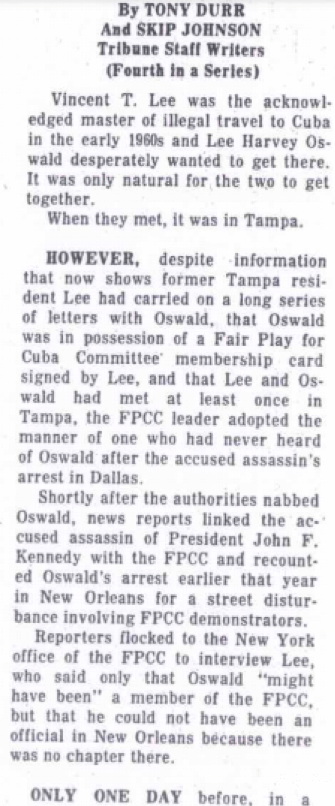
    Oswald’s actions in New Orleans parroted Lee’s. Lee was heavily involved in leafleting, media coverage, and direct confrontations with anti-Castro Cubans featuring a near riot in November of 1961 in Marti Park, where Sergio Arcacha Smith led CRC forces against the FPCC. Lee appeared on WBAI radio.

    On December 26, 1962, Vincent T. Lee flew from New York City to Mexico City. From there, on December 28, he flew to Havana via Cubana Airlines where he stayed for nearly one month. Oswald corresponded multiple times with Lee, reporting his FPCC agent provocateur coups. V. T. Lee, while providing him with advice, is the one who connected Oswald with Wilson so as to be better coached for his N.O. mission.

    Other than this, not that much is known about Lee, because as a witness during the Eastland Senate hearings, other than defending the FPCC and confirming his military record, he mostly took the Fifth Amendment. The Warren Commission did very little to go into his background during their typical probe light questioning.[13] Lee also lied his head off by claiming he did not know Oswald. The HSCA never got him in as a witness despite obvious interest.

    The following articles are fascinating because they also associate the FPCC with high-profile murderous activity in the U.S., taint Black Liberation Front activists and suggest that Lee and Wilson are informants.


    Here is the lead-in to the article on the Statue of Liberty bombing plot:

    On 16 February 1965 three Americans and one Canadian were arrested in connection with a plot to destroy three of the United States’ most treasured monuments: the statue of Liberty, Liberty Bell, and Washington Monument. The Americans—Robert Steele Collier, Walter Augustus Bowe, and Khaleel Sultran Sayyed—were part of a small extremist organization known as the Black Liberation Front (BLF). The Canadian, a white woman named Michelle Duclos, was a member of a Quebec separatist party.

    In the article, the reader will discover how some of the perpetrators visited Cuba, met Che Guevara who provided “technical information,” and became involved in yet another major incident that would have favored the blaming of Cuba while tarnishing a “subversive” group.[14] (Click here to read)

    Gilberto Policarpo Lopez

    Another extremely important detail in the first article is that the Tribune claims to have a source that places V. T. Lee in Tampa on November 17, 1963, with Gilberto Policarpo Lopez. The FBI would easily know this based on the important number of informants at every FPCC meeting.

    The HSCA described parts of what it called the Lopez allegation:[15]

    Lopez would have obtained a tourist card in Tampa on November 20, 1963, entered Mexico at Nuevo Laredo on November 23 and flew from Mexico City to Havana on November 27. Further, Lopez was alleged to have attended a meeting of the Tampa Chapter of the FPCC on November 17…CIA files on Lopez reflect that in early December 1963 they received a classified message requesting urgent traces on Lopez…Later the CIA headquarters received another classified message stating that a source stated that “Lopes” had been involved in the Kennedy assassination…had entered Mexico by foot from Laredo on November 13…proceeded by bus to Mexico City where he entered the Cuban embassy…and left for Cuba as the only passenger on flight 465 for Cuba. A CIA file on Lopez was classified as a counterintelligence case…

    An FBI investigation on Lopez through an interview with his cousin and wife as well as document research revealed that…He was pro-Castro and he had once gotten involved in a fistfight over his Castro sympathies.

    The FBI had previously documented that Lopez has actually been in contact with the FPCC and had attended a meeting in Tampa on November 20, 1963. In a March 1964 report, it recounted that at a November 17 meeting…Lopez said he had not been granted permission to return to Cuba, but was awaiting a phone call about his return to his homeland…A Tampa FPCC member was quoted as saying she called a friend in Cuba on December 8, 1963, and was told that he arrived safely. She also said that they (the FPCC) had given Lopez $190 for his return. The FBI confirmed the Mexico trip (Lopez’ wife confirmed that in a letter he sent her from Cuba in November 1963, he had received financial assistance for his trip to Cuba from an organization in Tampa) …information sent to the Warren Commission by the FBI on the Tampa chapter of the FPCC did not contain information on Lopez’ activities…nor apparently on Lopez himself. The Committee concurred with the Senate Select Committee that this omission was egregious, since the circumstances surrounding Lopez’ travel seemed “suspicious.” Moreover, in March 1964 when the WC’s investigation was in its most active stage, there were reports circulating that Lopez had been involved in the assassination…Lopez’ association with the FPCC, however, coupled with the fact that the dates of his travel to Mexico via Texas coincide with the assassination, plus the reports that Lopez’ activities were “suspicious” all amount to troublesome circumstances that the committee was unable to resolve with confidence.

    One can add this from DeBenedictis’ well-sourced thesis:[16]

    A Cuban national by the name of Gilberto Policarpo Lopez, attended the viewing of “Ted Lee in Cuba,” at Mary Quist’s home on November 17. Lopez was staying at the Quist residence, while waiting for a phone call with the “go ahead order” for him to leave the United States and go to Cuba. The day after the film showing, President Kennedy visited Tampa.

    One file showed that there were several teletypes and airtels regarding Lopez and Oswald and the possibility that they may have had contact. The airtel message told of Lopez’s travel to Mexico and later to Cuba. The airtel also told of post-assassination correspondence between FBI offices in Dallas, San Antonio, and Tampa. All intended to identify Lopez. Another part of this file, which was released later than other Tampa FPCC FBI files, told that the San Antonio FBI office was the source of the information in the post-assassination period regarding Lopez crossing the border at Laredo. From the 1964 Warren Commission to the 1976 House Select Committee on Assassinations, the change in time was more of a change in broadening of information rather than in a lessening of secrecy. Neither investigation showed a desire for opening assassination files until well into the Twenty-First Century. Since the FPCC was the subject of dossier compilation since its inception, there was much in the way of information. But in its post-assassination classification period, the secrecy surrounding the FPCC had more to do with the Kennedy assassination, and lack of cooperation from intelligence agencies, than from consideration of sensitive material due to the ongoing Cold War.

    Combining the article information and FBI intelligence, what we have is the FPCC National Chapter’s V.T. Lee possibly meeting, at Tampa FPCC’s Mary Quist’s home on November 17, with FPCC tainted assassination suspect Lopez, who, considering his Texas and Mexico travels, likely would also have been linked to Oswald had the pro-Castro conspiracy scenario not been deep-sixed. This also would have torn down the FPCC worldwide, if not the U.S. Communist Party, and could easily have stimulated the invasion of Cuba, given the direct link between Lee and Castro.

    There is a difference between a series of ads and an ad campaign. Ad campaigns have a coordinated rhythm, where there is a huge bang at the launch, followed by reminder advertising in a timely manner. They also have a central theme (called a USP) such as Castro was behind all of this. This P.R. push certainly has all the earmarks of being coordinated by propaganda specialists. Which brings us to the next two sections.

    George Joannides

    Towards the beginning of the HSCA investigation, much headway was being made in investigating CIA files. Things took a turn for the worse when George Bush senior, CIA Director since 1976, decided to clamp down on the scrutiny. A year later, George Joannides was brought in as a liaison between the CIA and HSCA investigators. The HSCA was lied to when they were told that Joannides was not involved in the areas of interest the HSCA was exploring. Quite the contrary.

    George had been the person in charge of overseeing anti-Castro operations in New Orleans. He was now obstructing the HSCA. Joannides had joined the Central Intelligence Agency in 1951 and later became chief of the Psychological Warfare branch of the CIA’s JM/WAVE station in Miami. In this role he worked closely with the Directorio Revolucionario Estudiantil (DRE), a militant right-wing, anti-Communist, anti-Castro, anti-Kennedy group. This was the group that Oswald was in direct contact and conflict with in New Orleans in August 1963.[17]

    Jefferson Morley is credited for much of what we know about Joannides and the fight for the release of files about him. He adroitly underscored the following about him: “Among his primary responsibilities were guiding, monitoring and financing the Revolutionary Cuban Student Directorate or DRE, one of the largest and most effective anti-Castro groups in the United States. CIA records show, and the group’s former leaders confirm, that Joannides provided them with up $18-25,000 per month, while insisting they submit to CIA discipline. Joannides, in his job evaluation of July 31, 1963, was credited with having established control over the group.” Morley also revealed Joannides travels from JM/WAVE to New Orleans in 1963.

    David Phillips

    In a previous article,[18] I have penned for Kennedys And King, I wrote a section on how this legendary disinformation artist for the CIA was a person of interest in the scenario plans around Lee Harvey Oswald in 1963. By reading it, you will discover how his background, role with Amsanta, motives, track record, omnipresence around Oswald, lies to the HSCA, his being outed by colleague E. Howard Hunt and asset Antonio Veciana all point to something sinister. Readers are encouraged to follow the above hyperlink to review the case against Phillips.

    The remarkable thing about Phillips and this story is that he was associated with both of these groups we have examined. In other words, he was at least partly involved with both sides of this pseudo-conflict and street theater. As we have seen, in Oswald and the CIA, John Newman showed that Phillips had a role in the CIA’s campaign to infiltrate and destabilize the Fair Play for Cuba Committee.[19]

    During his questioning by the HSCA, Howard Hunt was asked about his knowledge of the DRE. He replied that, “Dave Phillips ran that for us.” (Deposition of 11/3/78, p. 77) Phillips was in on the beginnings of the DRE. William Kent, a psy war officer out of JM/WAVE, signed-off on Joannides’ reports in 1963. Kent was very familiar with what the DRE was doing at this time. Later on, to private family members, he was asked about Oswald. He said that Lee Oswald was a useful idiot. When asked about the Kennedy assassination itself, he said, “Its better you don’t know.”[20] Any objective person would have to say that, based on this information, New Orleans was quite important to the Kennedy assassination. HSCA investigator Hardway also revealed in 2013 at Cyril Wecht’s Duquesne Conference that he and Ed Lopez had prepared a bill of indictment for perjury against Phillips specifically keyed around what he had said about Oswald’s alleged activities in Mexico City.

    James Phillips was the brother of David. He was a writer, a CIA pilot, and a member of the Flying Tigers. A former Marine, he later wrote for Leatherneck magazine. He was the father of Shawn Phillips.

    Shawn Phillips

    His recounting (email to Gary Buell) of his uncle David’s last conversation with his father represents one of a number of quasi confessions made by the high-level intelligence officer:

    The “Confession,” you refer to was not in so many words as such. I cannot remember the time frames involved, but this was what was told to me by my father, James Atlee Phillips, who is deceased. He said that David had called him with reference to his (David’s), invitation to a dinner, by a man who was purportedly writing a book on the CIA. At this dinner, was also present a man who was identified only as the “Driver.” David told Jim that he knew the man was there to identify him as Raul Salcedo, whose name you should be familiar with, if your research is accurate in this matter. David then told Jim that he had written a letter to the various media, as a “Preemptive Strike,” against any and all allegations about his involvement in the JFK assassination. Jim knew that David was the head of the “Retired Intelligence Officers of the CIA,” or some such organization, and that he was extremely critical of JFK, and his policies. Jim knew at that point that David was in some way, seriously involved in this matter and he and David argued rather vehemently, resulting in a silent hiatus between them that lasted almost six years according to Jim. Finally, as David was dying of irreversible lung cancer, he called Jim and there was apparently no reconciliation between them, as Jim asked David pointedly, “Were you in Dallas on that day?” David said, “Yes,” and Jim hung the phone up.

    If you add just how intertwined Phillips was with Oswald during the months in and around the assassination, there is simply too much to dismiss all of this as mere happenstance. Where there is still some debate is to what level, if any, Phillips was involved in the planning of the assassination. Where there is very little debate is in his involvement in the messaging and frame-up efforts.

    Summary

    Given Oswald’s adventure in Russia and the state the FPCC was in when Oswald opened a chapter in New Orleans—perhaps the most hostile city for such an endeavor—and at a time when the FPCC was in a downward spiral, the most plausible premise would be that it was also an intelligence operation. When he joined, the FPCC was infested with informants, the FBI and CIA were countering it through their respective COINTELPRO and Amsanta programs, and New Orleans intelligence was fully prepared for the arrival of the FPCC. In fact, Stuckey was on the prowl for the FPCC two years in advance.

    Oswald’s choices in terms of timing, location, networking, recruitment activities, as well as the budget constraints he overcame, along with the lack of infiltration of his chapter, these all point to his being an informant on pro-Castro and anti-Castro goings-on in New Orleans.

    The campaign to position Oswald as Castro-linked was clearly coordinated and performed by intelligence assets. Two persons of extreme interest linked to the operatives and the strategies used were Joannides and Phillips. By 1963, the FPCC appears to have been no more than a tool for intelligence gathering, creating a portfolio to enter Cuba and lying in wait to be a perfect platform on which to hoist a patsy, and through him, implicate Castro.

    If it is confirmed that both V.T. Lee and Harrold Wilson were Intel related, we have yet two more cut-out operatives who add themselves to the above cast of characters (e.g. Dave Ferrie, Ruth Paine, Frank Bartes, and Clay Shaw) who helped build the Oswald myth.

    The plot succeeded in removing JFK, but failed to stimulate an invasion of Cuba. It helped launch a new era of suspicion of government and media that has been exacerbated by other political murders, Vietnam, Watergate, Iran Contra, Weapons of Mass Destruction, and the list goes on! No wonder the U.S. cannot get its people vaccinated! No one can put their trust in faith, it has deserted the country.

    Conclusion

    Oswald’s adventure in Russia has been analyzed by many. Most serious researchers concur that it was an Intel mission and was part of a false defector program. Oswald’s dance with the FPCC is lesser understood, but perhaps even more important, as it brought him right into the realm of the plot.

    There has never been an all-defining write-up of the FPCC within the context of the assassination. This is somewhat normal, because as DeBenedictis noted, FPCC files have been kept under wraps. There should be hidden files on most of the potential patsies, informants, chapter leaders and a lot more… detailed ones. I have tried to make a start with this essay.

    If we understand who gave Oswald his orders, as well as those for the other ex-marine informants and potential patsies, we will understand the propaganda side of the assassination.

    Gaeton Fonzi opened incredible windows into the world of JM/WAVE, which led to an area of research taken up by authorities in this field including Larry Hancock, Bill Simpich, John Newman, and others who have figured out hierarchies, operational activities, and timelines through which these specialists focused on a number of assassination professionals who are leading suspects in the November 22nd ambush. Having recently read Tipping Point by Larry Hancock, we can see that much progress has been made in nailing down the players, the ambush preparations, and logistics around the hit.

    Jim Garrison paved the way for understanding the very important roles those who gravitated around Oswald in 1963 played in setting up the whole Castro did it scenario. The work done by contemporary researchers Joan Mellen, Jim DiEugenio, William Davy, and conclusions by the HSCA have all vindicated the New Orleans DA and shed light on many of the operatives working outside of Miami.

    Understanding organizations like the FPCC, the DRE, ALPHA-66, Operation 40, and persons like Joannides, Phillips, the Rodriguez family, and Sergio Arcacha Smith will help us merge the bodies of research Fonzi and Garrison began and gain a better comprehension of organizational structure and interrelations between the murder and propaganda divisions.

    While conducting the research for this document, I have seen some compelling arguments that many subversive organizations, including the FPCC, were intelligence vehicles from the outset. While I have not yet reached that conclusion, I am all ears.

    Acknowledgements

    I would like to thank Malcolm Blunt, Alan Dale, Bart Kamp, and Jim DiEugenio for their support in providing me with many of the files they have uncovered and archived. I also want to underscore the incredible efforts of the researchers, investigators and authors mentioned in this article plus other sources, who have paved the way to where we are now at…A case that, if I may say so, has been largely solved.

    see Part 3


    [1] Paul Bleau, “Marina’s Sponsor and Oswald’s Fifth Wallet,” Kennedys And King.

    [2] John Newman, Oswald and the CIA, Chapter 16.

    [3] John Newman, Oswald and the CIA, Chapter 17.

    [4] Dan Hardway, “Declaration,” Case 1:03-cv-02545-RJL Document 156-1, Civil Action No. 03-02545 (RJL).

    [5] Paul Bleau, “The Three Failed Plots to Kill JFK,” Kennedys And King.

    [6] James DiEugenio, “Ed Butler: Expert in Propaganda and Psychological Warfare,” Kennedys And King.

    [7] William A. Branigan, “Memorandum for Mr. Sullivan Re: Lee Harvey Oswald,” 105-82555, January 17, 1964.

    [8] Dick Russell, The Man who Knew Too Much, pp. 685–686.

    [9] Herbert Stallings, FBI report, 29/11/1963, File 62-6115.

    [10] Associated Press, “Threat to Kill LBJ is Charged,” December 21, 1963.

    [11] INFORMATION FBI HQ RECORD NUMBER 124-10008-10043 FILE NUMBER AGENCY 105-82555-194.

    [12] FBI report 2/12/64, File NY 105 38431.

    [13] Warren Commission, testimony of Vincent T. Lee.

    [14] The Journal of Counterterrorism, “The Monumental Plot,” Volume 16 -No. 04 2010.

    [15] House Select Committee on Assassinations Final Report.

    [16] Frank S. DeBenedictis, “Cold War comes to Ybor City: Tampa Bay’s chapter of the Fair Play for Cuba Committee,” Florida Atlantic University, December 2002.

    [17] James DiEugenio, Destiny Betrayed, 2nd edition, pp. 159–61.

    [18] Paul Bleau, “Oswald’s Intelligence Connections: How Richard Schweiker clashes with Fake History,” Kennedys And King.

    [19] John Newman, Oswald and the CIA, pp. 240–242.

    [20] Dan Hardway, “An Operation Sketch,” 2014.

  • Exposing the FPCC, Part 1

    Exposing the FPCC, Part 1


    Introduction

    In January 2019, a petition began circulating where, among other startling affirmations, the 2500 signatories, including prominent JFK assassination experts, agreed that, “As the House Select Committee on Assassinations concluded in 1979, President John F. Kennedy was probably killed as the result of a conspiracy. In the four decades since this congressional finding, a massive amount of evidence compiled by journalists, historians and independent researchers confirms this conclusion. This growing body of evidence strongly indicates that the conspiracy to assassinate President Kennedy was organized at high levels of the U.S. power structure, and was implemented by top elements of the U.S. national security apparatus using, among others, figures in the criminal underworld to help carry out the crime and cover-up.”

    The destruction of classified documents pertaining to the JFK assassination and the refusal to release others 58 years after the assassination only strengthens the perceptions of the conspiracy researchers.

    One of the premises that is key to this scenario is that when ex-marine Oswald entered the Soviet Union in 1959 and spent two and a half years there, he did so as a false defector within a program called REDSKIN.1

    Given the above, shouldn’t the most plausible premise for Oswald launching the Fair Play for Cuba Committee chapter in New Orleans, perhaps the most hostile city for such an endeavor at a time when the FPCC was in a downward spiral, be that it was also an intelligence operation?

    Oswald’s strange dance with the FPCC in the months leading up to the assassination is not scrutinized enough––as this quest put Oswald right in the realm of those who would later accuse him of being Kennedy’s killer.

    What do we really know about the Fair Play for Cuba Committee? It lacks scrutiny even though, like his adventure in Russia, the evidence of intelligence is everywhere. However, context and insight about the FPCC is lacking, even though it should have been turned inside out by the WC and the HSCA. But it was not, thanks largely to Allen Dulles, George Joannides and other spies who knew what to hide and were perfectly placed to obstruct real investigations.

    Research into the FPCC will help lay the groundwork for what should have been a leading hypothesis that should have guided the investigations:  that is, that Lee Harvey Oswald was again following orders when he penetrated the FPCC, thereby turning him into an ideal patsy for the assassination of the President.

    The FPCC: A Brief History

    In 1993, author Van Gosse wrote Where the Boys Are: Cuba, Cold War America and the Making of the New Left. It gives one of the more complete accounts of this odd association.

    The FPCC was founded in the spring of 1960 by Robert Taber and Richard Gibson––CBS newsmen who covered Castro’s ascent to power––as well as Alan Sagner, a New Jersey contractor. Its original mission was to correct distortions about the Cuba revolution. It was first supported by writers, philosophers, artists and intellectuals such as Norman Mailer, Truman Capote and Jean-Paul Sartre. It also touched a chord with university students. Some estimates place its African American membership at one third of its roster. In April 1960, Taber and Gibson ran a full-page ad in the New York Times.

    Around Christmas time 1960, it organized a huge tour to Cuba, which led to a travel ban to the country by early 1961. According to Gosse, its high point was after the failed Bay of Pigs invasion. There was no official membership headcount, but organizers claimed the FPCC had between 5 and 7 thousand members and 27 adult chapters, almost all in the Northeast, a few on the West Coast and only one in the Southeast in Tampa.

    When it became clear that the U.S. would not tolerate the revolution, it began dissipating. After a short-lived peace demonstration binge during the missile crisis in 1962, its spiral downwards was accelerated and the FPCC died not long after one of its members allegedly killed JFK.

    The FPCC was characterized as “Castro’s Network in the U.S.A.” by the HUAC. Membership within this anti-U.S. organization was described during hearings as an effective door opener to enter Cuba via the Cuban Embassy in Mexico City and Cubana Airlines. Though the HUAC had been seriously rattled by the McCarthy-era witch hunts, Castro was breathing some new life into this outfit for political showcasing of American patriotism. The FBI may even have bribed an FPCC insider to testify that a launch ad placed by the FPCC was financed by Cuba.

    The Senate Internal Security Subcommittee (also known as the Eastland Committee) questioned Dr. Charles Santos-Buch, a young Cuban physician, who was a self-described FPCC organizer. On January 6, 1961, Santos-Buch told chief prosecutor Julian Sourwine that he and Taber had received the needed money from “eight different people.” The documents reveal that Santos-Buch changed his story on January 9 at a subsequent executive session, and that he was also given a promise that the CIA would help get a number of family members out of Cuba. He changed his story, at least in part because of his desire to extricate his family from Cuba. On January 10, Santos-Buch publicly testified that he and Robert Taber obtained $3,500 from the Cuban government through the son of Cuba’s Foreign Minister Raul Roa. This money, along with $1,100 in funds from FPCC supporters, paid for the full-page FPCC ad in the April 6, 1960, edition of the New York Times. A week later, Jane Roman from James Angleton’s counterintelligence office in the CIA reported that security concerns made it too dangerous for the CIA to keep its promise to Santos-Buch.

    According to one of its national leaders, Barry Sheppard, the Socialist Workers Party (SWP) was very involved with the FPCC: “We came to be part of the leadership of the FPCC partly as the result of a crisis in the organization. The original FPCC leadership was somewhat timid, and shied away from forthright defense of the revolution as it radicalized. In response, Cuban members of the 26th of July Movement living in the U.S. aligned with the SWP and some other militants, and took over the leadership of the Committee.”

    Sheppard’s memoir shows that the SWP was much larger than the FPCC. He describes protest mobilization during the Missile Crisis in 19622 this way:

    We stood up to it. The PC discussed and approved the thrust of a statement to appear in the next issue of The Militant. It ran under the headline, “Stop the Crime Against Cuba!” We alerted SWP branches and YSA (Young Socialists of America) chapters that night to mobilize to support the broadest possible actions against the threat. In New York, there were two major demonstrations. One was called by Women Strike for Peace and other peace groups. We joined some 20,000 protesters at the United Nations on this demonstration. Then the Fair Play for Cuba Committee held its own action, more specifically pro-Cuba in tone, of over 1,000 people, also near the UN.

    The following points concerning the July 1963 SWP convention cast even more suspicion around the timing and motives of the already suspiciously late openings of FPCC chapters in the deep south by Santiago Garriga in Miami and Oswald in New Orleans and the continued involvement with the FPCC by other odd subjects:

    At the convention, a meeting of pro-Cuba activists discussed the situation in the Fair Play for Cuba Committee. Cubans living in the United States who supported the 26th of July Movement had helped us build the FPCC. Now most of them had returned to Cuba. In most areas, the FPCC had dwindled down to supporters of the SWP and YSA. Since we did not want the FPCC to become a sectarian front group, the meeting decided to stop trying to build it. The FPCC then existed for a while as a paper organization, until the assassination of President John Kennedy dealt it a mortal blow.3

    FBI reports confirm that FPCC National Chapter meetings plummeted from 25 meetings a year to 3 in its last year of existence.

    Red Scares, the HUAC and McCarthyism

    The first Red Scare in the U.S. took place in 1919-20 because of the Russian Revolution in 1917 and the fear of this movement spreading to the United States as well as the influx of immigrants that did include a small number of anarchists. In one case, a bomber blew himself up by accident in an attempt to assassinate John Rockefeller and J.P. Morgan. Because of this, the General Intelligence Division (the forerunner of the FBI) was formed and J. Edgar Hoover was chosen to lead it.

    In 1938, The House Committee on Un-American Activities (HCUA) was formed to investigate individuals, groups and organizations considered subversive or disloyal with a special focus on communist-leaning credos.

    The second Red Scare is considered to have begun shortly after World War II in 1947, when President Truman signed an order to screen government employees, and lasted 10 years. Through the propaganda and grandstanding of politicians, working in symbiosis with the press and the FBI, panic and hysteria was omnipresent. The HUAC went into overdrive, with Senator Joe McCarthy as its poster boy and with the Communist-hating Hoover eager to oblige.

    By 1956, after overstepping and ruining hundreds of lives, McCarthy was taken down by lawyer Joseph Nye Welchin his heroic “Have you no decency” retort during the Army-McCarthy hearings.

    This, however, did not stop the anti-communist fervor of the FBI and CIA. They just became even sneakier with no regard for the rule of law.

    COINTELPRO and AMSANTA

    The Church report,4 in its section “USING COVERT ACTION TO DISRUPT AND DISCREDIT DOMESTIC GROUPS,” describes the illegal activities of the FBI that were put in motion between 1956 and 1971 under the acronym COINTELPRO [Counter Intelligence Program], which claimed to have as a motive the protection of National Security.

    The FBI acted as a vigilante by not just breaking the laws but by taking the law into its own hands against both violent and nonviolent targets. Some of the targets were law-abiding citizens who were advocating change, but were labelled as domestic threats unilaterally by the FBI, e.g., Martin Luther King. Others were violent groups such as the Black Panthers and the Klan, where due process was ignored. Once the FBI started down this dangerous path, they not only targeted the kid with the bomb but also the kid with the bumper sticker!

    Organizational targets fell under five umbrella groups: The Communist Party; The SWP; White Hate groups; Black Hate groups; and the New Left. This opened the floodgates to investigate any group that had a potential for violence, including nonviolent groups such as The Southern Christian Leadership Conference, which was labelled as a Black Hate Group, as well as sponsors, civil-right leaders, students, protesters; and the list goes on …

    The FBI used five main methods during COINTELPRO: infiltration; psychological warfare; harassment via the legal system; illegal force; undermining of public opinion.5 

    These actions stepped up in the wake of the Communist takeover in Cuba. Church Committee members exposed the dimensions of the mail opening program, and discovered that the CIA and FBI had placed the names of 1.5 million Americans in the category of “potentially subversive.” Together, both agencies opened about 380,000 letters.6

    Larry Hancock, in Someone Would Have Talked, describes the FBI program called AMSANTA:

    The program was initiated by the FBI as part of its effort targeting the FPCC as a subversive group and involved the CIA in briefing, debriefing and possibly monitoring travel of assets through Mexico City to and from Cuba. The program began in late 1962, had one major success in 1963 and appears to have been abruptly terminated in fall 63.

    According to John Newman (Oswald and the CIA)7, the CIA, led by David Phillips and James McCord (of Watergate fame), began monitoring the FPCC in 1961. In December 1962, the CIA joined with the FBI in the AMSANTA project.  A September 1963 memo divulged an FBI/CIA plan to use FPCC fake materials to embarrass Cuba.

    There are strong indicators that the CIA efforts to penetrate and use the FPCC were local and illegal––such as spying on U.S. citizen/members of the FPCC. As a David Phillips asset stated, it was “At the request of Mr. David Phillips” that, “I spent the evening of January 6 with Court Wood, a student who has recently returned from a three-week stay in Cuba under the sponsorship of the Fair Play for Cuba Committee.”8

    The opening of a Miami FPCC chapter in 1963 by Santiago Garriga is more evidence of illegal domestic espionage on or through the FPCC by the CIA. According to Bill Simpich, author of State Secret, Garriga’s resumé was perfect for patsy recruiter/runners––interaction with Cuban associates in Mexico City; seemingly pro-Castro behavior; and his crowning achievement: like Oswald in 1963, he opened an FPCC chapter in a market deemed very hostile for such an enterprise.

    Garriga is the potential fall guy who is the most clearly linked with intelligence. Like Oswald, he could be portrayed as a double agent by those who packaged him. What makes Garriga so unique are, as Simpich writes, his pseudonym and close links with William Harvey’s (CIA Cuban Affairs) team. To cover this intriguing lead, it is best to cite a few excerpts from State Secret:

    During October 1963 Garriga worked with other pro-Castro Cubans to set up a new chapter of the Fair Play for Cuba Committee in Miami  … Although it appears that Garriga’s ultimate loyalty was with the Castro government, it’s likely that Garriga’s FPCC activity was designed by Anita Potocki (Harvey’s chief aide at the wiretap division known as Staff D) to set up a flytrap for people like Oswald.  Maybe even Garriga himself was considered as a possible fall guy.

    However, in the days before 11/22/63, the FBI ran an operation that investigated the Cuban espionage net that included Garriga and shared the take with the CIA. The CIA referred to this investigation as ZRKNICK. Bill Harvey had worked with ZRKNICK in the past … The memos that identify Garriga were written by Anita Potocki.

    Was there something sinister in this effort to set up FPCC Miami? It certainly looks ominous, given that AMKNOB-1 is the main organizer and that Anita Potocki is one of his handlers. The FPCC leadership recognized that it was dangerous to set up such a chapter in Miami due to the possibility of reprisals by Cuban exiles. For just these reasons, the FPCC leadership had discouraged Oswald from publicly opening an FPCC chapter in the Southern port town of New Orleans.

    The fingerprints of AMSANTA and COINTELPRO were also all over Oswald.

    Targeting the FPCC 

    By the time Oswald opened his Crescent City chapter of the FPCC, it was under the intense scrutiny which had started in 1960, the year of the national launch. An FBI report9 in response to NSAM 43 and 45 to the attorney general, dated April 24, 1961, outlines steps taken by then to counter pro-Castro organizations. It was already a full-court blitz.

    In this document, the FBI makes it clear that the Castro movement is a serious threat to the U.S. The FPCC is underlined as a key target pursuant to Executive Order 10450. The overall coverage of pro-Castro activities in the U.S. is described as having begun in November 1955 when Castro came to the U.S. looking for financial support for the rebel cause, and the 26th of July Movement started up in the U.S. When Castro took power in January 1959, the FBI had files on this organization as well as lists of members it shared with other intelligence agencies and sharply expanded its surveillance operations. Spying on Cuban diplomatic institutions, questioning defectors and the infiltration of pro- and anti-Castro groups with informants, are listed as key Intel tactics.

    By the time the report was written10, the FBI numbers the pending matters at 1000 and information sources at over 300. The FBI had by then identified 140 Castro supporters in the U.S. who constituted a threat to security. “We are maintaining close coverage of the various Cuban establishments as well as pro-Castro groups and their leaders,” which was shared generously with other intelligence groups. The FPCC is described as the most important such group, and received support from Cuba as well as the SWP and CP, according to the report.

    The FBI claimed that Cuban agents were receiving assistance from their surveillance targets and that Cubana Airlines was an important tool for their activities. The FBI was keeping close tabs on pro-Cuba propaganda. Covert informants were given a T symbol,11 preceded by a location identifier such as NY for New York, followed by a number. Also identified were the locations they could report on and the subject matter. Some informants were government employees, post-office workers, intelligence assets on assignment (June Cobb was assigned to spy on Richard Gibson and slander Oswald in Mexico City)12 and freelancers (as we will see later Ruth Paine quite possibly was a provider of FPCC intelligence), etc., who could oversee documentary movement around targets. Others infiltrated FPCC chapters and were present during meetings. These would report on who was present, who said what, and the materials shown and exchanged. License plates of parked cars of meeting attendees were recorded. In some cases, chapter officers were key sources: Thomas Vicente (National), Harry Dean (Detroit), Harrold Wilson (Tampa), John Glenn (Indiana) were all definite or likely snitches for the FBI.

    In April 1963, aided by Thomas Vicente, the FBI broke into FPCC NY offices for a black bag operation.  FBI files indicate that NY alone had over 25 covert informers who were being used along with other sources. Tampa had at least 11 informants carrying the TP-T code.

    The CIA also was all over the FPCC.  Two days after the FPCC ad in the NY Times, William K. Harvey, head of the CIA’s Cuban affairs, told FBI counterintelligence chief Sam Papich: “For your information, this Agency has derogatory information on all individuals listed in the attached advertisement.” Other files confirm that Jane Roman and James Angleton were also monitoring the FPCC.

    Recipients of intel included the Secret Service, the CIA, Customs Bureau, the Immigration and Naturalization Service, the Post Office Department, the Aviation Agency, the Federal Communications Commission, the Department of Health, Education and Welfare, the U.S. Information Agency, the Treasury Department, the U.S. Information Agency, the Bureau of Foreign Commerce. The report also stresses the importance of coordinated efforts with other intel agencies as well as local FBI offices.

    After the failed Bay of Pigs and the Missile Crisis, we can assume that when Oswald, already notorious for his Russian adventure, opened an FPCC chapter in, of all places, New Orleans by the middle of 1963, he was a known quantity.

    Frank S. DeBenedictis on the Tampa FPCC

    In 2002, Frank S. DeBenedictis submitted a thesis13 about the Cold War coming to Ybor City, and the Tampa FPCC, for his Master of Arts at Florida Atlantic University.  DeBenedictis adroitly points out that the reason FPCC files have been very difficult to access is that after the assassination of JFK, these files were categorized as classified JFK assassination files instead of Cold War files.

    The following represents some of the key information/passages from his thesis.  It is based largely on government and intelligence investigations of the FPCC, declassified JFK assassination documents, Van Gosse’s research, newspaper articles as well as FPCC propaganda and correspondence. Almost all of the FPCC chapters were situated in the North of the U.S. or along the West Coast. The reason Tampa was unique in hosting an important FPCC chapter was because it had a large Cuban exile population who were anti-fascist and had fled the brutal Marchado and Batista regimes. In 1955, Castro raised money there for his rebellion and had satellite followers to his 26th of July Movement. Ybor City (part of Tampa) was known for its Latino culture and its cigar industry.

    By 1961, Eisenhower cut all ties with Castro, and the 26th of July Movement ceased activity in the U.S. It was being replaced by the FPCC. As Frank writes, “It was somewhat different from the older pro-Castro groups, since it came about after Castro was already in power. When Cuba formed ties with the Soviet bloc, the FPCC and its defense of Castro increasingly became part of the Cold War. By late 1961 the very active Tampa chapter had established its own newsletter, and drew attention from both Castro supporters outside Florida, and anti-Castro Cuban exiles and a variety of government operatives.”

    The influx of anti-Castro Cuban exiles (including Batista followers as well as other Cubans who were disappointed by Castro’s political and economic systems as well as his strong-arm tactics) took refuge in large numbers in Florida and were ready to counter the FPCC on all fronts––with the support of intelligence forces. Violence among Cubans ensued: riots, intimidation, vandalism directed at FPCC sympathizers were the order of the day. Hosting chapters in the deep south became perilous, with strong anti-Castro sentiment coming from Latinos, business, government, intelligence and Americans from all walks of life.

    “An organization formed in rebellion at this time, against the Castro regime. It called itself the Cuban Front. The group was made up of Cuban exiles and residents, which at this early date of disaffection with Castro, was composed primarily of Batista supporters. Since Cuba and the United States had by early 1961 experienced two years of deteriorating diplomatic relations, the Cuban Front’s strategy was to raise the specter of communism coming to Cuba.” One violent confrontation called the Marti Park Incident featured CRC leader Sergio Arcacha Smith, who entered Oswald’s universe in 1963.

    The Bay of Pigs invasion commenced on April 17, 1961, and FPCC chapters organized protests against the U.S. action. Five days before the invasion, Tampa chapter leader V.T. Lee wrote a letter to the Tampa Tribune deriding both the Tampa daily and the Senate Internal Security Subcommittee, which was investigating the organization. His letter lambasted Senators Thomas Dodd and James 0. Eastland, whose strident anti-communism began accusations that the FPCC was run by a foreign government.

    On April 22, 1961, when FPCC-led public protests against the Bay of Pigs operation became prevalent on a daily basis, the Kennedy administration’s National Security Council passed National Security Action Memo [NSAM] 45. This memo ordered the Attorney General and the Director of Central Intelligence to “examine the possibility of stepping up coverage of Castro activities in the United States.” On April 27, 1961, J. Edgar Hoover issued a general order for FBI agents to report on pro-Castro agitation. Hoover noted that the Fair Play for Cuba Committee’s actions showed the capacity of a national group organization to mobilize its efforts.

    Florida Congressman William C. Cramer testified on April 3, 1963. A primary subject was, in the words of the Senate Committee, “the flow of subversives through the open door of subversion, the Cuban Embassy in Mexico City, by way of Cubana Airlines.’’

    For the Tampa FPCC, in large part this meant that the Florida Legislative Investigative Committee [aka––Florida Johns Committee] became involved in investigating the activities of the pro-Castro group. Its investigation of the pro-Castro 26th of July Movement and Fair Play for Cuba Committee began in 1959 and continued into 1964.

    Local police intelligence unit “red squads” and state investigative committees filled the anti-Communist void in the post-McCarthy era. Florida’s Johns Committee had a counterpart in Louisiana, which was the Louisiana Un-American Activities Committee [LUAC].

    The following passage by DeBenedictis explains the degree of FBI infiltration of an FPCC chapter, and the stunningly high number of informants per FPCC meeting attendee ratio.

    A January 30, 1964, FBI report told of meetings the pro-Castro group had at the Tampa residence of Christine and Manuel Amor. Information about this meeting came from October 13, 1963, reports by FBI Special Agents Charles C. Capehart and Fredrick A. Slight. This data was gathered by taking down automobile license plate numbers registered to individuals in attendance. Eight cars were at the Amor residence. An FBI informant inside reported that a meeting cancellation notice had been sent to members, but several still showed up. Slide presentations and a tape recording of V.T. Lee’s Cuba trip were planned on this October date. Background reports provided data on FPCC members past affiliations with the Communist and Proletarian Parties. Jose Alvarez, who in June 1962 was elected the organization’s financial secretary, was identified by TP T-7 as a Communist Party member in Tampa in 1943. Other members, at late 1963 FPCC meetings, were listed as protestors and supporters of radical causes. Among these causes were opposition to the McCarran Act, and support of Cuba’s right to have Soviet missile stations. In addition, these members had links to the Communist Party in northern cities. FPCC informants were given the cryptonyms TP T-1 through TP T-11. Among them was TP T-2, who was identified as M. Miller, Superintendent of Mails at Ybor City’s post office. The FBI’s mail surveillance program complemented the CIA’s HT/LINGUAL mail opening program. FBI agents relied extensively on informants in the Tampa FPCC.

    The key with Tampa is that it served as a model for Oswald’s agitation activities as well as FPCC countering strategies for many of the people Oswald would network with in New Orleans.

    The FPCC in New Orleans

    At least three city police intelligence units kept files and conducted surveillance on the Tampa FPCC. These included Miami, Tampa, and New Orleans. In addition, the police units also cooperated with each other and with the U.S. Senate Committee investigating the organization.14

    Perhaps the most interesting of the police intelligence correspondence is the one between the Tampa Police Intelligence Unit and its New Orleans counterpart. The NOPD Intelligence Unit collected data about the FPCC from March to September 1961 from newspaper articles. In 1962 this changed when the NOPIU initiated a chain of correspondence with the TPIU. Sgt. J.S. de Ia Llana, supervisor of the TPIU, replying to a December 1962 information request on the Tampa Fair Play for Cuba Committee chapter, informed P. J. Trosclair (NOPIU): “The Tampa Chapter (of the FPCC) is very active in Tampa, these members hold secret meetings and distribute various types of literature. Also, movies are shown. Enclosed are some of the circulars which are distributed. This unit maintains a current file on the local chapter and its members.” The Tampa PD Intelligence Unit enclosed several circulars for its NOPD counterpart, and promised them its full cooperation.15

    Early in 1963, the Tampa PD would write to New Orleans, giving them information about a Dr. James Dombrowski, a left-wing activist in New Orleans, claiming that he was an active FPCC member. The NOPD investigation of the FPCC collected a copy of Tampa Fair Play; a list of 202 travelers to Cuba, which can also be found in FBI files, and Florida Johns Committee files.  Also included are the pre-Kennedy assassination arrest records and post-assassination warnings on Lee Harvey Oswald.  For the NOPD, their late-1962-initiated correspondence to Tampa was odd since New Orleans had no known FPCC chapter in late 1962 and early 1963. Also unusual was the NOPD inquiry to Tampa about FPCC activity in New Orleans!

    Oswald and the FPCC in Dallas

    According to an FBI report, there is evidence that Oswald agitated for the FPCC in Dallas before moving to New Orleans. Dallas confidential informant T-2 advised that Lee H. Oswald of Dallas, Texas, was in contact with the Fair Play for Cuba Committee. According to T-2, Oswald had a placard around his neck reading, “Hands off Cuba Viva Fidel.”

    The following day (April 19), Oswald wrote to the FPCC in New York and said:

    I do not like to ask for something for nothing but I am unemployed. Since I am unemployed, I stood yesterday for the first time in my life. with a placard around my neck. passing out Fair Play for Cuba pamphlets, etc. I only had 15 or so. In 40 minutes they were all gone. I was cursed as well as praised by some. My homemake [sic] placard said: ‘Hands OFF CUBA! V IVA Fidel’ I now ask for 40 or (50) more of the fine, basic pamplets-14. Sincerely, Lee H. Oswald16

    The following lead merits investigation. One of the Cuban exiles who was cursing during the so-called skirmish involving Oswald and Carlos Bringuier was Celso Hernandez, who may have met Oswald before. According to Bill Simpich’s research, the CIA examined Celso Hernandez as a Castro penetration agent.  There is an intriguing report of FPCC member Oswald being arrested with Celso Hernandez in New Orleans in late 1962. The ID of Hernandez was made years later and is admittedly shaky. The ID of Oswald is more substantive, as he identified himself to the police as an FPCC member––but he was living in the Dallas area. The story is that the two men were picked up at the lakefront in Celso’s work truck, owned by an electronics firm that was Celso’s employer.17

    FBI agency file number 97-2229-7 even states that Oswald was the FPCC organizer and chairman in TEXAS!

    FBI agency file number 97-2229-7

    (Note: also explosive in this document is the statement that Oswald was being polygraphed on November 22––sounds like another offshoot, sigh!)

    Oswald’s first attempt at interacting with the FPCC may have been as early as late summer 1962, when the head of the FPCC at the time, Richard Gibson, responded to a request for information from a Lee Bowmont from Fort Worth, Texas. Gibson felt he may have been in a group of three Trotskyites he had met shortly after.18

    And then we have the following mind-boggling correspondence(s)  courtesy of Malcolm Blunt:

    Oswald FPCC envelope return address

    This envelope, with the FPCC return address, as it stands is difficult to analyze because of the unclear postmark and its content has not been revealed as far as I know (which would once again represent obstruction of justice if this were the case).  However, we do know Oswald lived at the above address from about July to October of 1962. This confirms that Oswald/FPCC relations began clearly before 1963. The following May 5, 1961 letter is food for thought:

    May 5, 1961 letter

    It was not only Oswald who was interested in the FPCC before he went to New Orleans; others from the Big Easy were gathering information. Guy Banister was also a member of the Scotch Rite19 which figures on the letterhead. What on earth is this organization doing corresponding with the FPCC in 1961?

    May 5, 1961 letter, letterhead close-up

    Oswald and FPCC Worst Practices

    Location, Location, Location!

    As we have seen by chronicling the demise of the FPCC, Oswald’s sense of timing was horrendous when he launched the New Orleans chapter in the summer of 1963. His choice for a location was even worse.

    The two most dangerous places to open chapters in the U.S. at the time were probably Miami and New Orleans. Dallas would not have been far behind. New Orleans perhaps stood out as the worst because of its dependence on North-South trade. Its proximity to Cuba caused many sleepless nights during the October 1962 missile crisis. V.T. Lee had urged Oswald to avoid New Orleans.

    When the HSCA published its completed Final Report in 1979, it showed two areas related to the FPCC that the Warren Commission failed to investigate adequately. One overlooked area was the identity of occupants at the address Oswald used for his FPCC literature distribution. The address 544 Camp Street appeared on materials that Oswald was handing out. This address was the New Orleans Newman Building. The Warren Report stated that, at an earlier date, the building was occupied by an anti-Castro group, but the name was not revealed in the final report. Later it was found to be the Cuban Revolutionary Council. Another resident of the Newman Building was the private detective agency of Guy Banister. He also was not mentioned in the Warren Report. Banister was the retired FBI Special Agent in Charge of the Chicago FBI field office. After his FBI retirement in the mid-1950s, he moved to New Orleans and helped set up that city’s police intelligence unit. Guy Banister, a staunch anti-communist, continued his anti-subversion work well after his official ties with the FBI were severed. The HSCA determined in their investigation that in 1961 Banister and Sergio Arcacha Smith of the CRC were working together in the anti-Castro cause.20

    The 544 Camp Street address, which Oswald foolishly stamped on some of his handouts, was also surrounded by intelligence organizations, including the ONI, CIA, Secret Service and the FBI.

    The HSCA did take a closer look at the Camp Street enigma. Here were some of the findings:

    (467) During the course of that investigation, however, the Secret Service received information that an office in the Newman Building had been rented to the Cuban Revolutionary Council from October 1961 through February 1962.

    (466) The investigation of a possible connection between Oswald and the 544 Camp Street address was closed. The Warren Commission findings concurred with the Secret Service report that no additional evidence had been found to indicate Oswald ever maintained an office at the 544 Camp Street address.

    (469) The committee investigated the possibility of a connection between Oswald and 544 Camp Street and developed evidence pointing to a different result.

    (482) The overall investigation of the 544 Camp Street issue at the time of the assassination was not thorough. It is not surprising, then, that significant links were never discovered during the original investigation. Banister was involved in anti-Communist activities after his separation from the FBI and testified before various investigating bodies about the dangers of communism. Early in 1961, Banister helped draw up a charter for the Friends of Democratic Cuba, an organization set up as the fundraising arm of Sergio Arcacha Smith’s branch of the Cuban Revolutionary Council.

    (489) The long-standing relationship of Ferrie and Banister is significant since Ferrie became a suspect soon after it occurred.

    (491) Witnesses interviewed by the committee indicate Banister was aware of Oswald and his Fair Play for Cuba Committee before the assassination. Banister’s brother, Ross Banister, who is employed by the Louisiana State Police, told the committee that his brother had mentioned seeing Oswald hand out Fair Play for Cuba literature on one occasion.

    (492) Ivan F. “Bill” Nitschke, a friend and business associate and former FBI agent, corroborates that Banister was cognizant of Oswald’s leaflet distributing.

    (494) Delphine Roberts, Banister’s long-time friend and secretary, stated to the committee that Banister had become extremely angry with James Arthus and Sam Newman over Oswald’s use of the 544 Camp Street address on his handbills.

    (495) The committee questioned Sam Newman regarding Roberts’ allegation. Newman could not recall ever seeing Oswald or renting space, to him … Newman theorized that if Oswald was using the 544 Camp Street address and had any link to the building, it would have been through a connection to the Cubans.

    Roberts claimed Banister had an extensive file on Communists and fellow travelers, including one on Lee Harvey Oswald, which was kept out of the original files because Banister “never got around to assigning a number to it.”

    (514) Significant to the argument that Oswald and Ferrie were associated in 1963 is evidence of prior association in 1955 when Ferrie was captain of a Civil Air Patrol squadron and Oswald a young cadet. This pupil-teacher relationship could have greatly facilitated their reacquaintance and Ferrie’s noted ability to influence others could have been used with Oswald.

    (515) D. Ferrie’s experience with the underground activities of the Cuban exile movement and as a private investigator for Carlos Marcello and Guy Banister might have made him a good candidate to participate in a conspiracy plot. He may not have known what was to be the outcome of his actions, but once the assassination had been successfully completed and his own name cleared, Ferrie would have had no reason to reveal his knowledge of the plot.

    On page 145 of its final report, the HSCA states that “it was inclined to believe that Oswald was in Clinton, August – early September 1963, and that he was in the company of David Ferrie, if not Clay Shaw. The Committee was puzzled by Oswald’s apparent association with David Ferrie, a person whose anti-Castro sentiments were so distant from those of Oswald, the Fair Play for Cuba Committee campaigner.”

    Research since this very accusatory report has only re-enforced this conclusion.  We now know for certain that Clay Shaw was a well-paid CIA asset, something that he vehemently denied during the Garrison inquiry. He was also using the alias Clay Bertrand and that he was seen in the company of Oswald in Clinton.

    Birds of a Feather

    If Oswald’s sense of timing and choice of location for opening an FPCC chapter were awful, his networking strategies were catastrophic … if you believe he was serious about promoting Fair Play for Cuba.

    Jim Garrison had already pointed out how Oswald’s hobnobbing with White Russians in Dallas was diametrically opposed to his supposed pro-Marxist credo. His universe of contacts in New Orleans was even worse––unless he was involved in something else, like infiltrating pro- and anti-Castro groups to help the FBI in their oversight objectives. Let us highlight a few (for a more in-depth coverage of Oswald’s contacts read this author’s article Oswald’s Intelligence Connections: How Richard Schweiker clashes with Fake History):

    David Ferrie

    David Ferrie
    David Ferrie

    Oswald’s first intel connection is one of the most important for confirming Schweiker’s assertion. David Ferrie plays an important role in Oswald’s fate during two phases of Oswald’s short life. In 1955, both Ferrie and Oswald were members of the Louisiana Civil Air Patrol where Ferrie taught, among other things, aviation. Ferrie later became a contract CIA agent flying bombing missions over Cuba. During the summer of 1963, Ferrie and Oswald linked up once again at 544 Camp Street. During this period, Ferrie was frequently seen in the building and elsewhere, in the company of Banister, CIA agent Clay Shaw, the CIA-connected Sergio Arcacha Smith, Oswald and others of this ilk who became key suspects in the Garrison investigation.


    Kerry Thornley

    Kerry Thornley
    Kerry Thornley

    When Oswald was stationed back to California in 1959, Thornley wrote a book about him before the assassination called The Idle Warriors, and then another in 1965. In the summer of 1963, Thornley popped backed into the picture in New Orleans where several witnesses saw him with Oswald either in public or at Oswald’s apartment. There is evidence that Thornley picked up Fair Play for Cuba flyers for Oswald. An FBI memo states that Thornley and Oswald went to Mexico together. And despite preliminary denials, he eventually admitted links to David Ferrie, Guy Banister, Carlos Bringuier and Ed Butler.


    Victor Thomas Vicente

    When Lee Oswald wrote his first letter to the Fair Play for Cuba Committee HQ in New York in April 1963, he asked for “forty to fifty” free copies of a 40-page pamphlet. The author of the pamphlets, Corliss Lamont, turned out to be holding a receipt for 45 of these pamphlets from the CIA Acquisitions Division. These pamphlets were mailed to Oswald by FPCC National Chapter worker Victor Thomas Vicente. Vicente was a key informant for both the CIA and the FBI’s New York office.

     John Martino

    John Martino
    John Martino

    Martino showed pre-knowledge of the assassination and also admitted observing Oswald during the summer of 1963. Martino certainly did have CIA connections in 1963, primarily to David Morales and Rip Robertson.

    William Monaghan and Dante Marichini

    During the summer of 1963 in New Orleans, Oswald gained employment at the Reilly Coffee Company, an organization of interest because of its links to Caribbean anti-communist politics. The Reilly brothers backed Ed Butler’s INCA (the CIA-linked Information Council of the Americas, which factors heavily in Oswald’s later Marxist PR activities) and the CRC (Cuban Revolutionary Council).

    Reilly Coffee Co
    Reilly Coffee Co

    William Monaghan was the V.P. of Finance there who ended up firing Oswald. He was also an ex-FBI agent. He was listed as a charter member of INCA in a 1962 bulletin. Other employees there of interest to researchers included four of Oswald’s co-workers who joined NASA during the summer of 1963. Dante Marichini, who was a friend of David Ferrie’s and the neighbor of Clay Shaw, was one of these.

    Guy Banister

    Guy Banister
    Guy Banister

    What emerges from all we know about 544 Camp Street is that Oswald was assisting Banister, a known communist hunter, in identifying Castro-sympathizers and that Banister was deeply involved in activities supplying weapons to anti-Castro groups like Alpha 66––a key organization of interest in the assassination.

    Clay Shaw

    Clay Shaw
    Clay Shaw

    Thanks to Jim Garrison, we were introduced to a key person of interest in Clay Shaw. The HSCA investigation concluded that New Orleans district attorney Jim Garrison and his office ”had established an association of an undetermined nature between Ferrie, a suspect in the assassination of President Kennedy, and Clay Shaw and Lee Harvey Oswald.”

    In Destiny Betrayed, Jim DiEugenio underscores other Shaw links with the CRC and with Banister, CIA-cleared doctor Alton Ochsner, and Ed Butler, who are all connected to the Information Council of the Americas, which appears to have played a role in the sheep-dipping of Oswald (see Ed Butler). He also shows that Shaw was cleared for a project called QK/ENCHANT during the Garrison investigation. Howard Hunt also belonged to this project, which was part of the CIA’s Domestic Operations Division, according to CIA insider Victor Marchetti.

    William Gaudet

    William Gaudet
    William Gaudet

    Gaudet had worked for the CIA before he crossed paths with Oswald. He most likely continued freelancing for it. He worked virtually rent-free out of Clay Shaw’s International Trade Mart. It seems plausible that Gaudet played a part in monitoring Oswald, perhaps for the benefit of Shaw.

    Dean Andrews

    Dean Andrews
    Dean Andrews

    Lawyer Dean Andrews was called by Shaw, under the pseudonym Clay Bertrand, and given instructions to represent Oswald, as told by Garrison in his famous interview with Playboy.


    Sergio Arcacha Smith

    Sergio Arcacha Smith
    Sergio Arcacha Smith

    The CIA selected him to be a key leader of Cuban exiles as a representative of the Cuban Revolutionary Council. That group was created by Howard Hunt as an umbrella organization of many Cuban exile groups such as Alpha 66 and the DRE. The FDC was allegedly organized for his benefit, and it  borrowed Oswald’s name when he was in Russia. It is in this role that he associated closely with Clay Shaw, Guy Banister, David Ferrie and Doctor Alton Ochsner. Gordon Novel claims that David Phillips participated in at least one meeting where Smith and Banister were in attendance.

    At the time of the working relationship between Banister and CRC leader Sergio Arcacha Smith, the CRC became involved in Tampa’s Marti Park demonstrations against the FPCC. (Frank S. DeBenedictis thesis).

    Carlos Bringuier, Carlos Quiroga, Celso Hernandez and Frank Bartes

    Carlos Bringuier
    Carlos Bringuier

    Bringuier was part of the DRE, a militant right-wing, anti-Communist, anti-Castro, anti-Kennedy group. Bringuier, based in New Orleans, was placed in charge of DRE publicity and propaganda. According to Bringuier, the following summarizes his strange encounters with Oswald:

    On August 9, 1963, Oswald, while leafleting FPCC flyers on Canal Street, drew the ire of Bringuier and his Cuban associates Celso Hernandez and Miguel Cruz. Bringuier did the swinging while Oswald tried to block his blows. Oswald was then interviewed on a Bill Stuckey show along with Bringuier where his Marxist and FPCC credentials were discussed for all to hear.

    According to E. Howard Hunt, the DRE was started by David Phillips, who is the CIA career employee with the most links with Oswald. The DRE was eventually overseen in 1963 by George Joannides, who helped sabotage the HSCA investigation.

    Smith, Gil and Quiroga
    Arcacha Smith, Manuel Gil,
    & Carlos Quiroga

    A Jim Garrison polygraphed interrogation of Quiroga, plus other research, proved that Quiroga knew Banister and Sergio Arcacha Smith, had met Oswald more than once, and had supplied Oswald with Fair Play for Cuba literature on the orders of Carlos Bringuier. One of the Cuban exiles arrested during the so-called skirmish was Celso Hernandez, who may have met Oswald before. According to Bill Simpich’s research, the CIA examined Celso Hernandez as a Castro penetration agent.

    While Oswald and Bringuier were in court after their altercation, a sympathizer and friend of Bringuier’s, Frank Bartes, showed up to offer moral support. This Cuban exile went on to conduct anti-Castro press relations. Bartes followed Smith as the CRC leader in New Orleans based in the Newman building with Banister. In 1993, the ARRB released files confirming that Bartes was an informant for the FBI agent who just happened to be monitoring Oswald: Warren DeBrueys.

    Jesse Core

    Core was Clay Shaw’s right-hand man who was present during the incident on Canal Street and Oswald’s leafleting in front of the Trade Mart. He contacted Shaw’s friends at WDSU TV. He also is the one who warned his team about Oswald’s blunder of placing Banister’s address on some of the literature he was handing out.  Jesse Core’s reports about Oswald made their way to intelligence outfits.

    John Quigley and Warren DeBrueys

    Warren DeBrueys
    Warren DeBrueys

    After the altercation with Bringuier, while under arrest, Oswald made a bizarre request. He asked to see an FBI agent. The FBI sent agent John Quigley, who spent somewhere between 90 minutes and three hours with Oswald. It’s safe to say that they were not discussing Bringuier simply being mean to the alleged communist. Quigley stated that Martello told him that Oswald wanted to pass on information about the FPCC to him. Joan Mellen’s research finds that Oswald actually asked specifically for Warren DeBrueys. DeBrueys, who ran Bartes as an informant, would further nail down the real reason Oswald started an FPCC chapter in a hostile place like New Orleans. William Walter, an employee at the New Orleans FBI office, claimed to have seen an FBI informant file on Oswald with DeBrueys’ name on it.

    Arnesto Rodriguez and family

    Before his approach to Bringuier, Oswald had contacted the head of a local language school, Arnesto Rodriguez Jr., expressing an interest in learning Spanish. One of Arnesto’s closest associates in New Orleans was Carlos Bringuier, and both men acted as sources for the FBI (Arnesto aka Ernesto was assigned FBI source number 1213 S).

    The father of the Rodriguez family, Arnesto Napoleon Rodriguez Gonzales, had his own intelligence connections, having worked for the Office of Naval Intelligence during World War II; he had also served as an on-island source for the CIA before leaving Cuba. In terms of Lee Oswald’s being known to JFK conspirators, the most important point is that Arnesto’s father and Arnesto Jr. were both in routine touch with a relative in Miami, a CIA officer deep within JM/WAVE intelligence operations. That individual (son to Arnesto Sr; brother to Arnesto Jr.) was Emilio Americo Rodriguez Casanova (crypt AMIRE-1). Emilio was a close friend to both David Morales and Tony Sforza as well as a number of other SAS and JM/WAVE officers. He had also worked with, and appears to have been in contact with, David Phillips in 1963.21

    Orestes Peña, Joseph Oster, David Smith, and Wendell Roache

    Orestes Peña
    Orestes Peña

    Curiously, the evidence that Oswald collaborated with Customs is stronger than with almost any other agency. Cuban exile Orestes Peña testified that he saw Oswald chatting on a regular basis with FBI Cuban specialist Warren DeBrueys, David Smith at Customs, and Wendell Roache at INS. Peña told the Church Committee that Oswald was employed by Customs. Informant Joseph Oster went farther, saying that Oswald’s handler was David Smith at Customs. Church Committee staff members knew that David Smith “was involved in CIA operations.” Orestes Peña’s handler Warren DeBrueys admitted he knew David Smith.

    Ed Butler and Bill Stuckey

    Butler & Bringuier
    Butler & Bringuier

    The Canal Street incident led to Oswald being part of a debate on WDSU reporter Bill Stuckey’s weekly radio program called Latin Listening Post. Later, Butler and Carlos Bringuier were also invited to debate Oswald about his Marxist views on a show called Conversation Carte Blanche.

    To fully comprehend the significance of Oswald’s media exposure during his debate with Carlos Bringuier on WSDU, it is critical to have some insights on Ed Butler and INCA as well as Bill Stuckey and WSDU. These were dissected by Jim DiEugenio22:

    INCA was, in essence, a propaganda mill that had as its targets Central and South America, and the Caribbean. It would create broadcasts, called Truth Tapes, which would be recycled through those areas and, domestically, stage rallies and fund raisers to both energize its base and collect funds to redouble its efforts. By this time, as Carpenter and others point out, Butler was now in communication with people like Charles Cabell, Deputy Director of the CIA, and Ed Lansdale, the legendary psy-ops master within the Agency who was shifting his focus from Vietnam to Cuba. These contacts helped him get access to Cuban refugees whom he featured on these tapes. Declassified documents reveal the Agency helped distribute the tapes to about 50 stations in South America by 1963. There is some evidence that the CIA furnished Butler with films of Cuban exile training camps and that he was in contact with E. Howard Hunt––under one of his aliases––who supervised these exiles in New Orleans. Some of the local elite who joined or helped INCA would later figure in the Oswald story e.g. Eustis Reilly of Reilly Coffee Company, where Oswald worked; Edgar Stern who owned the local NBC station WDSU where Oswald was to appear; and Alberto Fowler, a friend of Shaw’s; plus future Warren Commissioner Hale Boggs who helped INCA get tax-exempt status. Butler also began to befriend ground-level operators in the CIA’s anti-Castro effort like David Ferrie, Oswald’s friend in New Orleans; Sergio Arcacha Smith, one of Hunt’s prime agents in New Orleans; and Gordon Novel, who worked with Banister, Smith and apparently, David Phillips, on an aborted telethon for the exiles.

    Two other acquaintances of Butler were Bill Stuckey, a broadcast and print reporter, and Carlos Bringuier, a CIA operative in the Cuban exile community and leader of the DRE, one of its most important groups in New Orleans. 

    Stuckey claimed that his show helped destroy the FPCC in New Orleans. It is during this show that Oswald let slip that he was under the protection of the government while in Russia.

    So, as we can see, the arrival of Oswald in New Orleans, his behavior and his network were very closely linked to the demise of the FPCC and his own tragic fall, as well as a ploy to blame Castro.

    His short stint in the Big Easy was not only a godsend for right-wing fanatics; it was planned and welcomed. FBI files discovered by Malcolm Blunt, as well as Stuckey’s testimony to the Warren Commission, confirm that the radio host was making inquiries about whether or not the FPCC was present in New Orleans as early as 1961. In other words, Stuckey was not just a free-lance journalist.

    FBI-Stuckey

    INCA WDSU
    INCA WDSU
    “Conversation Carte Blanche”

    Both Butler and Stuckey were briefed in advance about Oswald’s defection to Russia: Stuckey by the FBI, Butler by the House Un-American Activities Committee (HUAC). Therefore, they were able to ambush Oswald and expose him as a Soviet defector, which compromised his debate position as one who desired “fair play” for Cuba. The records of this show were used immediately after the assassination (through Butler and Bringuier) to paint Oswald as the lone-nut Marxist. In fact, Butler was flown up to Washington within 24 hours to talk to the leaders of the HUAC.

    According to author Ed Haslam, Butler also became the secret custodian of Banister’s files years after his death.23

    see Part 2


    Notes

    1 AEBALCONY_0005.pdf (cia.gov).

    2 Barry Sheppard, The Party, p. 83.

    3 Sheppard, The Party, p. 103.

    4 Church Report, p. 211, Section: “Using Covert Action to Disrupt and Discredit Domestic Groups.”

    5 Brian Glick, War at Home.

    6 See n. 13 below.

    7 Newman, Oswald and the CIA, location 1329, Kindle.

    8 Newman, location 3122.

    9 FBI report (CR-109-12 210-2990).

    10 FBI report (CR-109-12 210-2990).

    11 FBI document James Kennedy Report 11/29/1963.

    12 FBI file 124-10324-10098.

    13 Frank S. DeBenedictis, Cold War comes to Ybor City: Tampa Bay’s chapter of the Fair Play for Cuba Committee (Ph.D. diss., Florida Atlantic University, 2002).

    14 DeBenedictis, Cold War comes to Ybor City.

    15 DeBenedictis, Cold War comes to Ybor City.

    16 John Armstrong, Harvey & Lee,  p. 542.

    17 https://www.opednews.com/populum/page.php?f=THE-JFK-CASE–THE-TWELVE-by-Bill-Simpich-120825-173.html.

    18 CIA file, NBR 89970 Dec 18, 1963.

    19 William Guy Banister (1901-1964) – Find A Grave Memorial.

    20 DeBenedictis, Cold War comes to Ybor City.

    21 Hancock, Tipping Point, part 4, “Oswald in Play.”

    22 James DiEugenio, “Ed Butler: Expert in Propaganda and Psychological Warfare“ (2004).

    23 Haslam, Dr. Mary’s Monkey, pp. 161-165.

  • Creating the Oswald Legend – Part 3

    Creating the Oswald Legend – Part 3


    I. Was Oswald a Government Agent?

    In part 3, we will try to answer the most important question regarding Oswald. Was he a secret agent of some U.S. intelligence service and, if so, who was controlling him? We will examine his actions in Dallas and New Orleans and, finally, his alleged trip to Mexico before the tragic events of 11/22/1963. We will show that what happened in Mexico has many similarities with his USSR defection and the U2 incident.

    The Warren Commission had examined the possibility that Oswald was some kind of a “government agent”. J. Lee Rankin, the Commission’s general counsel, during the January 27th, 1964 meeting, was trying to convince the other members that they should counter the “dirty rumor” that Oswald was a “government agent”. Three days earlier, the chair of the Commission, Chief Justice Earl Warren, and Rankin had met secretly with members of the Texas Court of Inquiry to discuss whether or not Oswald was a CIA informant. Henry Wade, the Dallas District Attorney, informed them that somehow he learned that Oswald’s CIA identity number was 110669 and that it was consistent with the CIA’s filing system. Rankin later found out from Oswald’s CIA 201 personality file that Oswald’s CIA number on the file was 289248. Rankin never shared the above information with other members of the Commission and instead told them that there was a rumor out there, saying that Oswald was an FBI informant with identity number S-172 and S-179, which were bogus.[1]

    It was Waggoner Carr, the Texas Attorney General, who had provided the information to Rankin that Oswald had an FBI badge with number 179 and he was being paid $200 a month.[2] If that was true, then there should have been records at FBI HQ and probably in Dallas and in New Orleans. He would not have a badge, but a number that would be consistent with the Dallas field office abbreviation (DL), a four-digit number and the letter S at the end to denote security (e.g. DL1268S).[3]

    As it was concluded in part 2 of this series, Oswald’s Pro-Soviet, Pro-Communist bona fides would have allowed him to infiltrate communist subversive and pro-Castro organizations targeted by both the CIA and FBI. It is doubtful that Oswald would have been directly employed by the CIA or the FBI, but he was most likely employed by a private investigating agency that had connections to both or one of these two agencies, most likely the CIA.

    Peter Scott believed that this particular investigating agency’s field was that of industrial security.[4] To answer if that was the case, we should examine the life of another Marine who, like Oswald, showed sympathy towards revolutionaries, communists, and subversives. His name was Robert C. Ronstadt and in 1946 he started selling subscriptions to the Communist Daily People’s World and in 1947 joined the Communist party. However, he later testified to the House Un-American Activities Committee that he was only pretending to be a Communist. In reality, he was working in the Los Angeles firm Allied Records and he was tasked to smoke out employees with Communist sympathies and affiliations. It was also revealed that his true employer was not Allied Records but the private investigative firm owned  by P. McCarthy and Joseph Dunn that was responsible for providing industrial security to Allied Records. Ronstadt was not an FBI agent, but his employers, McCarthy and Dunn, were reporting their work to the FBI. Later, Ronstadt left the security company and became a paid informant to the FBI.[5]

    During the Cold War, all defense contractors and oil companies were obliged by law to conduct industrial security investigation to make sure that no leftists and subversives were hired by them. It was Lee Pennington Jr., an FBI agent, who joined the private organization the American Legion and started collecting and storing information on subversives in a massive library. The infamous James McCord of the CIA contacted Pennington, when he was looking to expose subversives.[6] Later, Pennington became a CIA consultant and transferred his library files from the American Legion to the newly created American Security Council (ASC ), which was a joint FBI-CIA-military industrial complex organization. Among its benefactors were both right wing anti-communists and Wall Street Eastern Establishment members. Some of them were Bernard Baruch, Nelson Rockefeller, Eugene W. Rostow, Henry and Clare Luce, Senator Thomas Dodd, Averell Harriman, General Lyman Lemnitzer, General Edward Lansdale, General John Singlaub, Patrick Frawley, Ray Cline, and James Jesus Angleton.

    Angleton created the Security and Intelligence Fund (SIF) after his forced retirement. John M. Fischer, one of the ASC’s presidents, was a founding director of SIF. Two other members of the Council, Elbridge Durbrow and General Robert Richardson III, were also SIF’s President and secretary/treasurer respectively. Large defense contractors like U.S. Steel, General Dynamics, Lockheed, Motorola, and McDonnell-Douglas were consulting its industrial security database to check potential personnel who could pose threats to their security.[7] Other notable members of the ASC were Admiral Felix B. Stump, Air America’s board Chairman, Henry O’Melveny Duque, Nixon’s former law partner, and vice presidents from Atlantic-Richfield, Standard Oil of California, General Dynamics, and the National Security of Industrial Association.[8]

    Do we have any evidence that Oswald was doing industrial security to expose subversives?

    When Oswald returned to Dallas from the USSR, he contacted Peter Gregory who was a petroleum engineer in Fort Worth. In August 1962, Gregory invited Oswald to dinner, where he met George Bouhe, leader of the White Russian community. We can recall from part 2 that Oswald was probably receiving leaflet materials from a White Russian organization and not the Cuban Consulate, as it was first believed. Bouhe introduced Oswald to other members of the White Russian community, among them Max Clark and his wife Katya, born as Princess Sherbatov of the Russian Royal family.[9] Max Clark was a retired Air Force Colonel and he used to work at General Dynamics as industrial security officer. Clark had also received covert security clearance from the CIA for “Project Rock” while working for General Dynamics. A CIA document had linked “Project Rock” to Project Oarfish, a code for the manufacturing of the U-2 airplane.[10] Clark later denied that he was working for the CIA, but he probably had some connection to them through that project. Surprisingly, another infamous character, William Harvey of CIA’s staff D, also had security clearance for “Project Rock”. According to a CIA document, they re-evaluated Harvey’s file in respect for approval to get security clearance to the above mentioned project.[11]

    Max Clark was working closely with I.B. Hale, a former FBI agent and later head of General Dynamics industrial security. It was Virginia, wife of I.B. Hale, that had helped Oswald to get a job at Leslie Whiting on July 1962.[12]

    George DeMohrenschildt was encouraged by Max Clark and J. Walton Moore of the CIA to befriend Oswald and become his mentor.[13] It was George DeMohrenschildt who helped Oswald get a new job at Jaggars-Chiles-Stovall (JCS) after he quit his job at Leslie Welding. JCS was doing contract work for the U.S. Army Map Service and that work was related to U-2 flights over Cuba. Oswald got the job four days before President Kennedy was shown pictures of missiles in Cuban taken by the U-2.[14]

    When Oswald moved to New Orleans, it is possible that his job there was related to industrial security in search for subversives. He was employed by the Reily Coffee Company, but he also worked covertly for Guy Banister. William Monaghan, an ex-FBI agent, was the company’s Vice President and specialized in industrial security. Alfred Claude, the man who hired Oswald, left Reily and went to work in Chrysler’s aerospace division, which was based in NASA’s New Orleans facilities. Emmett Barbee, Oswald’s supervisor, and two other Reily employees, Dante Marachini and John Branyon, went on also to work for NASA[15], more likely in the industrial security division. Oswald was frequenting a New Orleans’s garage and had revealed to its owner, Adrian Alba, that he was going to work for NASA. Bill Nitschke, a Banister associate, confessed that Banister had given an offer to NASA to get a contract for industrial security in NASA’s New Orleans facilities.

    That Banister’s investigating agency was doing industrial security work can be indicated by the testimony of former Banister associate, Joseph Oster. He told L.J. Delsa, an HSCA investigator, that Banister was using two sources to seek out subversives and Communists, FIDELAFAX and the American Security Council.

    One of the people who Oswald met in New Orleans was Ed Butler, the founder of INCA, the Information Council of the Americas. After Kennedy’s assassination, Jim Garrison learned about Oswald’s activities in New Orleans and his contacts with Butler and INCA. Butler got so scared that he packed all the INCA files and parts of Banister’s files and moved to Los Angeles, where he found employment with Patrick J. Frawley, a prominent member of the American Security Council.[16]

    It will not then be a surprise to learn that, in the fall of 1962, Oswald subscribed to the Daily Worker newspaper of the American Communist Party USA, applied for membership in the Socialists Workers Party, and subscribed to that party’s newspaper The Militant.[17] Both parties were a hive of leftists, subversives, and Communists.

    One could conclude that Oswald was not on the direct payroll of the CIA or the FBI, but possibly through Max Clark he was employed by an unknown industrial security private agency with the purpose of reporting on subversives that were of interest to CIA, the FBI, and defence contractors.

    Had this agency been created and controlled by the CIA or the FBI? For Ed Butler was in contact with people like Charles Cabell, Deputy Director of the CIA, and CIA officer Ed Lansdale, a member of the ASC.[18]

    When Oswald was in New Orleans, he was in contact with Guy Banister, David Ferrie, and Clay Shaw.  When Oswald was fifteen, he met David Ferrie in the Civil Air Patrol (CAP), where Ferrie was a Captain. In 1961, Ferrie and an exiled Cuban, Sergio Arcacha Smith, were part of the CIA’s training and preparation for the Bay of Pigs invasion.[19] During the same period, Banister’s office was located in the Balter building in New Orleans. In the same building were located the offices of a Cuban exile organization, the Cuban Revolutionary Council (CRC), and Sergio Arcacha Smith was the New Orleans representative.[20] When Banister moved to 544 Camp Street, Arcacha Smith rented an office for CRC in the same building. It was CIA officer E. Howard Hunt who had helped create this organization.[21] Gordon Novel has said that he met Arcacha Smith in 1961 at Banister’s office upon Ed Butler’s recommendation and, at that meeting, was a person who fit the description of David Phillips.[22]

    In Part 2, we concluded that high-level CIA officer James Angleton had utilized Oswald for a Counter Intelligence operation. John Newman thought that Oswald was an off-the-books agent for Angleton. When Oswald returned from Russia, Angleton probably would not have used him as an official CIA agent, but he may have used his connection with the American Security Council and “hired” Oswald from the back door through an industrial security private firm. Angleton was very close to William Sullivan, the head of FBI’s Counterintelligence Division 5, and they had cooperated in the past against the KGB in search of a mole. Most of Sullivan’s men were in continuous cooperation with Angleton’s Counter Intelligence and his secret CI/SIG mole hunting unit. Don Moore of the FBI’s Soviet Counterintelligence interviewed Soviet defector Anatliy Golitsyn and he was the FBI’s representative to the joint CIA/FBI mole hunt task force that included Sullivan and Sam Papich. Papich was the FBI’s liaison to Angleton’s Counterintelligence staff and, as we shall see later on, he was part of a joint CIA/FBI effort to discredit the Fair Play for Cuba Committee in foreign countries where it had support.[23]

    Angleton and Sullivan also conspired to rehearse questions and answers for the Warren Commission. It can be logically concluded that Oswald’s mission against subversives was a joint CIA/FBI project orchestrated by Angleton.


    II. Oswald as Agent Provocateur

    Lee Harvey Oswald moved to New Orleans in April 1963 and visited his Uncle and Aunt, Dutz and Lillian Murret, where he stayed for a while until he could a find a job and settle down on his own. As it was shown earlier, Oswald got a job at Reily Coffee Company and then secured his own apartment.

    In part 2, we reported that Oswald was a frequent visitor to the First Unitarian Church of Los Angeles where the people that later founded the Fair Play for Cuba Committee (FPCC) were members. We have also concluded that Oswald’s Soviet bona fides were a part of his preparation to later infiltrate this particular organization. In New Orleans, he did so. On May 26, 1963, Oswald wrote to the central offices of the FPCC asking them to accept him as a formal member and informed them that he would open a small office to use as branch of the organization. He asked if the organization could provide him with a charter, leaflets, paperwork, and a photograph of Fidel Castro.[24]

    On May 29, 1963, the director of FPCC, Vincent Lee, informed Oswald that he was accepted as an official member of the organization. But he tried to discourage him from opening a chapter in an area which he knew would attract few members, since they would have to work hard just to put together a rudimentary apparatus. He also warned about a branch office provoking violent reaction of the city’s well known right-wing extremists, so he advised renting a postal box. [25]

    Oswald did rent a P.O. Box in his own name with number 30061, New Orleans, Louisiana. He added his wife’s name, Marina Oswald, and someone by the name of A. J. Hidell to also be able to receive mail. He then made an order to print 1000 leaflets and 500 applications using the name Lee Osborne. [26] On the leaflets, he had his name printed with A. J. Hidell as the chapter President.  He then informed the Worker and Militant of his new P.O. Box.[27]

    In May and June of 1963, Oswald was distributing FPCC leaflets in at least three New Orleans locations: Tulane University, Canal Street, and the port. Two university students had in their possession FPCC leaflets with “Hands off Cuba” and the name A. J. Hidell instead of Lee Harvey Oswald. A military intelligence officer reported to the FBI that he had found one such a leaflet at Tulane with the name A. J. Hidell, P.O. Box 30016. Oswald also distributed leaflets outside the aircraft carrier Wasp.[28] Although the correct P.O. Box address was 30061, for some peculiar reason on the above occasion, it was written 30016.

    On June 24, 1963, Oswald applied for a passport to travel to England, France, Germany, Holland, the Soviet Union, and Poland. He received it the next day with the warning that he was not allowed to travel to Cuba. On July 19, 1963, the Reily Company fired Oswald on the grounds that he was not working efficiently and he was absent from his post quite often. On July 27, 1963, his cousin Eugene Murret asked him to talk about his life in the Soviet Union at the Jesuit College in Mobile, Alabama, where he was a student.[29]

    During his speech, he said the Communist Party USA had betrayed itself. It had become a sidekick of the USSR against the American government, so the Soviet Union could become the absolute ruler of the American continent. This is strange since Oswald first joined the Communist party USA and now was accusing it of betrayal. It is also odd that he accused the Soviet Union while some days ago, he had applied to travel there. On August 1, 1963, Oswald wrote a letter to Vincent Lee informing him that he had opened the P.O. Box and distributed leaflets on the streets. Then he wrote something bizarre, but prophetic, saying to Vincent that some exiled Cubans attacked one of his demonstrations, the police intervened, and because of that he lost any support and was left alone.[30] We don’t know if Oswald possessed clairvoyant powers, but something similar happened four days later. On August 5, 1963, he visited the clothes shop of Carlos Bringuier, an Anti-Castro exiled Cuban and member of the Revolutionary Student Directorate (DRE), to offer him his skills that he had acquired as U.S. Marine. He appeared to be anti-Castro, but on the 9th of August his true face was revealed when Bringuier and two of his associates witnessed Oswald distributing FPCC “Hands off Cuba” leaflets while seeking support for Castro. This double-faced behavior of Oswald made Bringuier extremely angry and he accused Oswald of  being “a traitor and Communist”. Oswald didn’t seem to be very shaken and replied “OK Carlos, if you want to hit me, hit me”. The police intervened, like Oswald had foreseen, and arrested them all.[31]

    Oswald was locked in jail and he could have been immediately released if he had paid the $25 bail, but he chose not to and stayed in for the weekend. During that time, he was visited and questioned by Police officer Francis Martello and FBI agent John Quigley. What he said to both of them and how this impacted him on 11/22/1963 will be explained later on.

    The focus for the time being will be on the aftermath of his arrest and his subsequent radio interview about the Canal Street event. On the 12th, Oswald testified before the court that he was guilty of disturbing the peace and was sentenced to ten days. However, he paid the bail of $10 and was set free. The Cubans were not sentenced and were released.[32] Oswald continued his leafleting and Bringuier asked the help of Ed Butler of INCA to expose Oswald’s true colors.

    First, Oswald gave an interview to William K. Stuckey’s WDSU-radio program “Latin Listening Post” and talked about his FPCC organization, but he refused to reveal the names of its members. Oswald was questioned if he was a Communist and if Castro’s regime was a Soviet front in the western hemisphere. Oswald did not deny being a Communist, but he said that he was not member of the Communist Party. Stuckey asked Oswald if the FPCC activities promote Communism, which he denied saying that the organization is only concerned with Cuban matters. When asked if he had visited Latin America, he answered that he had been only to Mexico. It should be noted that Oswald never offered the information that he had lived in the Soviet Union. He said the American government and their anti-Cuba policies had forced Castro to seek help from the Soviet Union. Finally, he accused the CIA of mishandling Cuba and called the CIA defunct and Allen Dulles defunct, which might be something an anti-Castro exile would say who thought the Agency did not do a proper job in Cuba during the Bay of Pigs.[33]

    At the end of the interview, Stuckey asked Oswald if he could come again for a more detailed interview and he agreed. On August 21, 1963, Oswald appeared on Stuckey’s show “Conversation Carte Blanche” to debate Carlos Bringuier and Ed Butler of INCA.[34] Stuckey began the interview by asking Oswald if he had lived in the Soviet Union, a tip provided to him by Bringuier. Oswald was surprised by the question and replied that he had. Bringuier intervened and asked him if he represented the Fair Play for Cuba Committee or Fair Play for Russia Committee. Oswald replied that this was a provocative question that didn’t need answering.

    Stuckey then dropped the bomb and asked Oswald if he’d renounced his American citizenship and had become a Soviet citizen. Oswald replied that this had nothing to do with the topic of Cuban-American relations. But Stuckey insisted that it did, since Oswald had been proclaiming that Cuba is not a Russian puppet and now it was revealed that he had past relationship to Russia and maybe he was a Communist. Oswald did not answer if he was a Communist, but admitted that he was a Marxist.

    Stuckey wondered how he supported himself his three years in Russia and asked if he was given any government subsidy there. Stressed, Oswald almost revealed his true purposes when he said that:

    …I worked in Russia. I was under the protection, I was not under the protection of the American government, but I was at all times considered an American citizen. I did not lose my American citizenship…I am back in the United States. A person who renounces his citizenship becomes legally disqualified for returning to the United States.

    In the first interview, he denied that Cuba was under Russia’s control and insisted the FPCC’s concern was only Cuban independence and opposing intervention in Cuban affairs. In his second interview, he was exposed as a Marxist and possible Communist working for the Soviets and taking his orders from them, perhaps as a Soviet spy himself. Oswald, wittingly or unwittingly, had connected the FPCC to the Soviet Union and had hurt the organization’s reputation and credibility. After this debate, Oswald’s career as member of FPCC and Castro’s supporter had lost its purpose, value, and meaning.

    With his help, his interlocutors made the FPCC look like a Russian Trojan horse in America and a dangerous Communist spying niche. It is more likely that Oswald was acting as such as part of CIA’s anti-FPCC campaign which, as John Newman found out, had been orchestrated by James McCord and David Atlee Philips since 1961.[35] The CIA and FBI suspected that the FPCC back then was trying to infiltrate students that were travelling to Cuba. So Phillips decided to dangle an American student, Court Wood, into the FPCC by pretending to be pro-Castro interesting in starting a new FPCC chapter, something that Oswald tried to emulate two years later.[36]  Although the CIA was not allowed to run domestic operations, the FBI knew they did and turned a blind eye to them as FBI agent in New Orleans Warren DeBrueys told author Jim DiEugenio.[37] It would be very plausible that this CIA anti-FPCC campaign had been passed to CIA’s Domestic Operations Division (DOD), formed in 1962. 

    Researcher Peter Vea discovered a list of documents in the National Archives regarding Clay Shaw’s contacts with the Domestic Contact Service (DCS). One of these documents stated Clay Shaw had been granted covert security approval for project QK/ENCHANT.[38] Newly discovered documents revealed that the CIA was examining the prospect of using Banister’s agency as a cover company for project QK/ENCHANT. Based on ARRB investigation, QK/ENCHANT was a cryptonym for “permission to approach” and utilization for cleared contact purposes. These probably indicated the use of individuals and companies as contact cover for CIA proprietary organizations.[39]

    Author Bill Davy showed the above document to former CIA officer Victor Marchetti and, after examining it, he said to Davy, “That’s interesting…he was doing something there.” He added that Shaw would not need a covert security clearance for DCS. Marchetti then said he was likely doing something for Clandestine Services.  When Dave asked which one, Marchetti replied:

    The DOD (Domestic Operations Division). It was one of the most secret divisions within Clandestine Services. This was Tracey Barnes’s old outfit. They were getting into things…uh exactly what I don’t know. But they were getting into risky areas. And this is where E. Howard Hunt was working for at the time.”[40]

    The DOD offices were not located at Langley, but on Pennsylvania Avenue, in Washington. When Richard Helms was asked about the DOD behind closed doors in 1968, he described the DCS which was not a part of the Directorate of Plans.[41] Donald Freed wrote in his book Death in Washington that the DOD was involved in illegal domestic cover companies and operations against the FPCC.[42]


    III. Setting Up the Patsy

    In this section, we shall look into the events and incidents showing that Oswald was set up to take the fall for Kennedy’s murder. There were many such efforts, but we will concentrate on the most important, since it will be impossible to report in every detail the life of Oswald in this article.

    A. Senator Dodd, Hidell and the Mannlicher – Carcano

    The Warren Commission had a hard time proving that Oswald owned a Mannlicher-Carcano rifle, the weapon that allegedly was used to kill Kennedy. What is certain, though, is that Oswald was interested in how to purchase weapons by mail. When he was working at the Reily Company, Oswald was spending his time visiting Adrian Alba’s garage and engaging him in conversations about mail order weapons. Oswald would also study some magazines about guns in Alba’s office. He had asked Alba, “How many weapons had I ever ordered, and how long did it take to get them, and where had I ordered the guns from.”[43]

    The Dallas Police said they found an order page from the June 1963 American Rifleman magazine about a Manlicher–Carcano.[44] Oswald, however, had already ordered a Manlicher–Carcano from Klein Sporting Goods on March 12th, 1963, using a coupon from the February issue of the same magazine under the name A. Hidell. He also ordered a Smith & Wesson .38 gun from Seaport Traders of Los Angeles on January 27th, 1963, under the name A. J. Hidell. This was the same gun that Oswald allegedly used to kill Officer Tippit.[45] Was it a coincidence that these two weapons companies were under investigation by the Alcohol, Tobacco, and Firearms agency (ATF)?

    Besides ATF, there was another ongoing investigation about these two companies, conducted by Senator Thomas Dodd, another member of the powerful American Security Council. Dodd was the Chairman of the Senate Juvenile Delinquency Subcommittee trying to legislate the use of interstate mail orders for weapons.[46] Dodd’s subcommittee started its hearings two days after Hidell ordered the Smith & Wesson gun and the Manlicher–Carcano was also one of the weapons investigated.[47]

    Senator Dodd was also member of the Senate Internal Security Subcommittee—headed by the racist, right-wing Senator James Eastland of Mississippi—which was investigating the FPCC. Dodd called the FPCC “the chief public relations instrument of the Castro network in the United States” and believed that both the Socialist party and the Communist Party had infiltrated the committee. It might have been possible that Oswald, as a member of a private investigating firm, was contacted by Dodd’s committee to infiltrate these three organizations.[48]

    The son of one of Senator Dodd’s friends, who had been hired as an investigator to do work for the subcommittee, was involved in a strange incident in Mexico, causing a disturbance in a strip club. He was arrested by Mexican police for having a gun and posing as a police officer. The same man was arrested for carrying three weapons and ammunition in Hyannis Port, Massachusetts, on a weekend that President Kennedy was there.[49]

    As others have pointed out, it would have been stupid for Oswald to order a rifle via interstate mail intending to kill JFK, since it would leave a trail that would ensnare him. It would have been easier to buy a rifle from a gun shop in Dallas anonymously. When Oswald was arrested in New Orleans, he was interviewed by Lieutenant Francis Martello of the New Orleans Police Intelligence Division and New Orleans FBI Agent John Lester Quigley. He showed two FPCC cards, one signed by Vincent T. Lee and the other by A. J. Hidell, his alleged New Orleans FPCC officer. As a result, this information was related by Martello to the 112th Army Military Intelligence Group (MIG) at Fort Sam Houston and by Quigley to the Office of Naval Intelligence in Algiers, Louisiana.[50]

    After the assassination, Colonel Robert E. Jones of the 112th MIG informed the FBI that Oswald was carrying a fraudulent Hidell selective service card; therefore this information linked Oswald to Hidell and the weapon used to shoot the President.[51] This would trace back to the FPCC and, perhaps, Castro as a leading force behind the assassination.  One has to wonder why Oswald would order a weapon using an alias and then carry with him an identity card that would link him to the weapon on the day of the assassination.

    B. The Clinton-Jackson Incident

    Jim Garrison was the first official to present witnesses that had seen Oswald in the company of David Ferrie and Clay Shaw in the areas of Clinton and Jackson, ninety miles north of New Orleans.

    One day, during the late summer of 1963, Ed McGehee the owner of a barbershop in Jackson was visited by a stranger who he later identified as Lee Harvey Oswald. Oswald asked if he could find a job as an electrician in the area. McGehee told him to ask in the East Louisiana State hospital and informed him that it was a mental hospital, something that Oswald did not know and surprised him. He advised him to contact state representative Reeves Morgan.[52]

    Oswald visited Morgan, but he told him that he could not help him since he could not put him ahead of his own constituents. He advised him to register to vote and that might net him extra points in his search of work. Van Morgan, playing in the front yard, noted the black Cadillac parked outside the house; with a man with a shock of white hair in the driver’s seat.[53]

    The next day, Oswald and his two companions went to the neighboring village of Clinton to register. It happened to be the day when a drive to register black voters—organized by the Congress of Racial Equality (CORE)—was on. When the Cadillac appeared, most voters thought it might be the FBI, so they noticed the car and its occupants. Several witnesses, from simple voters, to the Registrar, and the local Sheriff, testified that they identified the three people as Lee Harvey Oswald, David Ferrie, and Clay Shaw. The Sheriff even approached the car and asked the tall grey haired driver for his license. It turned out to be Clay Shaw of the International Trade Mart of New Orleans. Oswald and another man were the only two white voters trying to register that day.[54] When Registrar Henry Palmer asked him for ID, Oswald showed him some Marine separation papers and offered two references, both doctors, Malcom Pierson and Frank Silva. Oswald said that he was living in the state hospital together with the above mentioned doctors. Then Palmer asked him why he wanted to register and Oswald replied that he was advised this would help him secure a job at the hospital. Palmer replied that this was not so, since he knew many people out of Mississippi that were working in Jackson. Hearing that, Oswald left the office, returned to the car and the trio departed.[55]

    Oswald then resurfaced at the East hospital trying to get a job, but he was making a spectacle of himself. Talking loudly and being obnoxious, he asked the hospital employees what it would take to take Castro down, since he was a Marine and he was involved in getting rid of Castro. Frank Silva, a Cuban doctor that Oswald had used as a reference, heard the conversation and took an immediate dislike to Oswald.[56]

    Maxine Kemp, the hospital secretary, remembered Oswald filling an application and a year later, after the assassination, looked for the file and found it. When Garrison investigators went there looking to find it, the file had disappeared.[57]

    Why did Shaw and Ferrie take Oswald to Jackson to seek a job at the hospital and register as a voter? If we could consider Oswald’s actions against leftists and subversives, it would make sense to try to register with the black voters so to link CORE through himself to FPCC, Castro, and the Soviet Union, something that would comprise the CORE movement for racial equality.  However, the most important aspect of this trip was his visit to a mental hospital acting as a troubled young man talking nonsense and behaving erratically. Garrison believed that if Oswald had secured a job at the hospital it would have been easy for someone to alter his file from employee to a mental patient, something that would fit with his later portrayal as the lone nut assassin.

    C. The Odio Incident

    Sylvia Odio was the daughter of the Cuban truck magnate Amador Odio, who was imprisoned back in Cuba along with his wife for actions against the Castro regime. She was living in a Dallas apartment with her two children and her sister Annie, who was helping Sylvia move to another apartment. In late September, Sylvia was visited by two men who presented themselves as Cuban exiles and an American. The exiles were introduced to Sylvia by their war names: Leopoldo and Angelo. They said they were members of JURE, Manolo Ray’s liberal exile organization of which Amador Odio was a founding member.[58] They had come from New Orleans and asked Sylvia to write them letters in proper English to be used to attract financial support for JURE. Sylvia declined since she did not know or trust these strangers and they then left. But the next day one of the Cubans, Leopoldo, called her and told her that the American accompanying them was named:

    Leon…he was an ex-Marine, an expert marksman…he could do anything, like getting underground in Cuba, like killing Castro. He says we Cubans don’t have any guts; we should have shot President Kennedy after the Bay of Pigs. He says we should a thing like that.[59]

    Sylvia never heard from them again and wrote her father about these strange visitors. After the assassination of President Kennedy, Sylvia and her sister Annie recognized Lee Harvey Oswald as “Leon,” the American that came to her house. Sylvia was certain that they visited her apartment on Thursday, the 26th of September or the next day. This created a huge problem for the Commission: Oswald was supposed to be on a bus to Mexico on the 26th of September. This incident is very similar to Oswald’s bragging to Doctor Silva about getting rid of Kennedy and showing radical, unpredictable, and bizarre behavior.

    JURE was considered by the CIA as a leftist organization that had infiltrated the JMWAVE station. At one point, CIA Officer Henry Hecksher had ordered Manuel Artime, E. Howard Hunt’s protégé, to fire on JURE vessels.[60] Hunt despised Ray and referred to his philosophy as Castroism without Castro.   It is plausible that this incident could have been an effort to connect JURE to Oswald and, subsequently, to Castro and the assassination of Kennedy.

    D. Castro’s Gun Dealer

    Either just before or right after visiting Sylvia Odio, two men visited Robert McKeown, a former gun dealer at his house in Bay Cliff near Houston. One of them introduced himself as Lee Oswald and his companion, a Cuban, as Hernandez. They explained that they wanted to buy a large number of guns to start a revolution in El Salvador. McKeown was skeptical and refused to sell them anything, since he was on probation for smuggling guns to Castro in Cuba on behalf of Prio Socarres. When he refused, Oswald tried to convince him to at least sell them four Savage automatic rifles with telescopic sights for $10,000. McKeown again refused and said to Oswald that he could buy these for a few hundred dollars from any Sears Roebuck store in Texas.[61] He thought that the whole deal was fishy and maybe someone wanted to get him in trouble if the guns were really for Castro; especially when he recognized Hernandez as a man he knew in Cuba years ago as a Castro supporter.[62]

    If McKeown had fallen for the trap and one of the rifles was proven to be used in the JFK assassination, then the gun could have been traced back to him and eventually to Castro and Cuba as the instigators of the crime.

    The most important event that took place to incriminate Oswald was the infamous Mexico City incident. Due to its complexity, it will be examined separately, in more detail than the above four.


    IV. Mexico Histrionics

    Oswald’s trip through Mexico and what occurred there is the most convoluted and enigmatic event regarding the assassination, one that could lead to the core of a momentous plot. Analysing it in all its aspects is not within the scope of this essay. One should read John Newman’s book Oswald and the CIA or the Lopez Report, to name just two sources, for a detailed and deep analysis. A summary of the incident will be presented here to note if any parallels can be drawn between the episode and the U-2 shoot down in the Soviet Union.

    Oswald visited the Cuban Consulate in Mexico City on a Friday, September 27, 1963, around 11 a.m. and asked Sylvia Duran—the consulate’s secretary—to grant him an in-transit visa to Cuba on his way to the Soviet Union. To make his case, he showed her his work papers from Russia, his marriage certificate, and his membership cards in the Communist Party USA (CPUSA) and in the FPCC. Duran found his behaviour odd, since he was a member of CPUSA, which was illegal in Mexico; and he had not gotten a visa from CPUSA which had a special agreement with Cuba’s Communist Party to get instant visas for its members. Duran asked him to get some passport photographs, Oswald left, and then returned with photographs, but Duran advised him that she could not issue him an in-transit visa to Cuba unless he first had obtained a visa to the Soviet Union.[63] So Oswald went to the Soviet Embassy. The Soviets refused him a visa, telling him that that he had to fill in an application form that would be sent to Washington and it could take months for a reply. Oswald returned to the Cuban Consulate and told Duran a bold lie, that the Soviets had issued him a visa. Duran, incredulous, called the Soviet Embassy to find out if they had. KGB operative under diplomatic cover Valery Kasimov told her that the reply from Washington could take months. As John Newman concluded, those who handled Oswald had advised him to lie because they wanted to force Duran to call Kostikov and the conversation would be recorded by CIA’s LI/ENVOY telephone tap secret operation in Mexico City. But neither of the two mentioned Oswald by name and instead referred to him as the American.[64]

    Duran would not issue Oswald a transit visa and told him to leave. Oswald got angry and displayed erratic and aggressive behaviour, making a bad impression on the Cubans. He had to be escorted out of the Consulate.

    The next day, Saturday 28, 1963, he returned to the Soviet Embassy, which was closed on weekends. But he managed to meet with Kostikov for a final desperate attempt to get a visa. According to the Russians, he had a revolver, which he said he needed to protect himself from the FBI. They denied his request and asked him to fill in an application for Washington’s Soviet Consulate. Oswald never filled in the form and gave up, leaving the premises.[65] He never again visited either the Cuban Consulate or the Soviet Embassy.

    What happened next is the beginning of the most enigmatic tangled web that surrounded Oswald: a man and a woman impersonating Duran and Oswald, called the Soviet Embassy asking for the visa application that Oswald had not filled in. The name of Oswald is not mentioned. Also, the man spoke poor Russian but good Spanish which was the opposite of Oswald’s case. The imposter told the Russian that he went back to the Cuban consulate to ask for his address in Mexico since they had it.[66] Newman believes that the impersonators wanted it recorded that Oswald had some special relationship with the Cubans. Duran later denied that she made the call as did the Soviets, so it is likely that the Russian recorded answering was also an impersonator.

    Because Oswald’s name was not mentioned, another call occurred on Tuesday, October 1, 1963. The imposter called the Soviet embassy and asked if there were any news on a cable to Washington. Those impersonating Oswald did not know the details of his visits to the Cuban Consulate and Soviet Embassy nor that he had declined to fill in the visa application. If they had known, they would have never asked such a pointless question. Again, the caller spoke poor Russian, which would later pose a problem to them. The imposter asked what was the name of the Soviet official he spoke to and the Russian replied “Kostikov.” Why was it so important to link Oswald to Kostikov? Because Kostikov, according to CIA was, part of KGB’s department 13, responsible for assassinations.

    Newman concluded that the impersonators wanted the names of both Oswald and Kostikov to be mentioned so it would be recorded by LI/ENVOY, planting a virus into the CIA’s records that would be activated on November 22, 1963. That virus would link KGB assassinations and the Soviet Union to the murder of President Kennedy. President Johnson would use the impersonation charade to convince Senator Russell and Chief Justice Warren into preventing a conflict “kicking us into a war that can kill forty million Americans in an hour.”[67] The WWIII virus made sure that the Warren Commission would never investigate what really happened in Mexico.

    It is undeniable that someone impersonated Oswald on these phone calls. But did they impersonate the historical Lee Harvey Oswald or another imposter? There are indications that the real Oswald never travelled to Mexico and there are testimonies by Duran, Cuban Consul Azcue, and a Cuban student that confirm he was not the real Oswald they saw in Mexico.

    Duran testified under interrogation that Oswald was blonde, short, dressed inelegantly, and his face turned red when angry.[68] When the CIA gave Duran’s testimony to the Warren Commission, they eliminated the above description. When Duran testified to the HSCA, she offered the following description: “as approximately five feet six, with sparse blonde hair, weighing about 125 pounds.”[69] Consul Azcue gave a similar description “a white male, between 5’6″ and 5’7″, over 30 years of age, very thin long face, with straight eye brows and a cold look in his eyes.”[70] A Cuban student, Oscar Contreras said that he met an American named Lee Harvey Oswald and he was blonde and short.[71] If these testimonies are true, the impersonator who made the calls had impersonated an already impersonated Oswald: which perplexes things even further.

    Two CIA assets working undercover inside the Cuban consulate told Lopez that the man they saw was not the man accused of assassinating the President.[72] This issue could have been resolved if photographs of Oswald going in and coming out of the embassies existed. The CIA has never been able to present any such photographs and thanks to the Lopez report we know why. Anne Goodpasture was a CIA officer from Staff D posted to the Mexico CIA station. She tried to disguise her role in retrieving photos each day. But Lopez and Hardway found out the man she named in this function only did the legwork for Goodpasture. They finally discovered that Goodpasture was responsible for photographic and electronic surveillance. The translating team said that they did not review all photographs from the Soviet Embassy, only what Goodpasture would allow them to see, and all such photographs were under her control. They also revealed that, although Goodpasture was an assistant to station chief Win Scott, she was a closer assistant to David Phillips, the Chief of Cuban Operations and Covert Action. During that same period, Phillips was also working for the SAS/CI.[73] Phillips was questioned by HSCA Chief Counsel Dick Sprague if he had any photographs of Oswald in Mexico. He replied that the camera was not working those days.[74] Hardway wrote a memo to HSCA Chairman Louis Stokes saying that about ten feet of film was taken from the camera that covered the Cuban Consulate on the 27th and 28th of September. These were developed and sent to CIA HQ, then lost and never seen again.[75]

    The CIA always maintained that the tapes had been erased and there were not any originals for Lopez and Hardway to compare with the existing transcripts. There was a missing conversation of September 30, 1963, that the translator, Mrs. Tarasoff, had transcribed. She remembered that it was a very lengthy call and Oswald had spoken in English and had requested financial aid from the Soviets. She had marked it as urgent and according to her recollection Phillips had also heard it.[76]

    On October 1, 1963, a diplomatic pouch was sent to CIA HQ addressed to a Michael Choaden. This was an alias for Phillips. Phillips had access to all information from Mexico to Washington and vice versa. He had the original tapes that Goodpasture had given him, plus the copies and transcripts at CIA HQ. Simply put: Phillips would have been able to alter the tapes or phony up the transcripts.[77]

    On October 8, 1963, the Mexico station sent a cable to CIA HQ to report an American citizen’s contact with Kostikov. This contact had been known for a week. Phillips tried to explain the delay to Lopez by saying the translators were too slow. But Lopez found out they had finished the translation after 24 hours. Phillips insisted that he was certain about this, since he signed the cable because it concerned Cuban matters. That was another lie, because he had left Mexico the 1st of October and the cable did not say anything about Cuban matters.[78]

    The cable had two separate sections. The first reported that an American male, Lee Oswald, who spoke broken Russian, talked with Soviet consul Kostikov. The second section informed that they had photos of someone entering and leaving the Soviet Embassy that was age 35, athletic build, 6 feet, receding hairline and balding top. The cable did not state that this “mystery man” photographed was the same as Lee Oswald, who was only recorded on the phone.[79]

    It should have been obvious that the mystery man was not Oswald. When Goodpasture was questioned about it, she replied that it was the only photograph of a non-Latin person taken on October 1, 1963. But Lopez and Hardway discovered that the photo was taken on October 2, 1963.[80] All of these falsehoods made Hardway and Lopez suspicious of Goodpasture and Phillips.


    V. A Sinister Mole Hunt Deja Vu

    The Mexico desk at CIA HQ received the Kostikov cable and John Whitten—alias John Scelso—then retrieved Oswald’s 201 file. He found out that it had been dormant for the previous eighteen months. This file had been kept by its custodian Ann Egerter of Angleton’s super secretive CI/SIG. What Whitten could not possibly have known was that the FBI report of Oswald’s debriefing in 1962 was missing. He also could not have known that the FBI reports concerning Oswald’s activities with Cubans and the FPCC in Dallas and New Orleans were not included in his 201 file. Around September 23, 1963, just before Oswald went to Mexico, all this crucial information had been bifurcated to file 100-300-011, entitled “Fair Play for Cuba Committee.”[81] There were no indications that the Cuban affairs office (SAS) read that file, but its Counterintelligence staff SAS/CI did.[82] More importantly, Whitten had no information about Kostikov and did not know that he was suspected of being a KGB officer responsible for assassinations.

    On October 10, 1963, CIA HQ sent a cable to State, FBI, and Navy connecting the mystery man to Oswald and informed them that Lee Oswald contacted the Soviet Embassy and spoke to consul Kostikov. It described Oswald as 35 years old, athletic build, six feet tall with receding hairline. It also reported that this Oswald might be identical to a Lee Henry Oswald that had defected to the Soviet Union and implied that he was still there with his family.[83]

    The same day, they sent another cable to the Mexico City station that included a different description of Oswald as five 5’ 10”, 165 pounds, light brown wavy hair and blue eyes.[84] This cable also identified Oswald with a Lee Henry Oswald that had defected to the Soviet Union and still living there according to latest HQ info dated may 1962; no word about his return to the States and his escapades in Dallas and New Orleans.[85] Most of the Counterintelligence officers in CI/SIG knew that the information included on these cables was not true, but rather deceptive.

    Jane Roman, one the counterintelligence officers who signed both of the cables was interviewed by John Newman and Jefferson Morley in 1994. Roman admitted to them that:

    I am signing off on something I know isn’t true…The only interpretation I could put on this would be that this SAS group would have held all the information on Oswald under their tight control…

    She added “Well, to me, its indicative of a keen interest in Oswald, held very closely on a need-to-know basis.”[86]

    On September 16, 1963, a day before Oswald obtained his tourist visa to Mexico, the CIA sent a memo to FBI for a joint operation to embarrass the FPCC in countries where it had support by planting deceptive information. It would have been a counterintelligence operation inspired by CI/OPS and carried out by SAS/CI.[87] As we have seen in the previous section, Oswald was probably under the control of the CIA’s Domestic Operations Division (DOD), but now that he was to be moved outside of U.S. soil, the SAS and David Phillips would have taken the reigns. Could this have been his mission in Mexico to discredit the FPCC, as he had in New Orleans?

    The CIA, and most likely Phillips, had already run an impersonation operation against an American named Eldon Hensen in Mexico. Hensen wanted to help provide useful information to the Cubans and requested a meeting. The CIA station in Mexico City had an agent pretend to be Cuban and meet Hensen. As a result, Hensen walked into a trap.[88]

    However, most clandestine operations have at least two purposes and an operation might be hidden inside another. It is possible that the SAS could have used Oswald or his legend in an operation designed to kill Castro, although no such evidence exists.  Bill Simpich, in his book State Secret, made the case that the disinformation and false data presented in the two cables were designed as a mole hunt to find out who had betrayed a CIA operation in Mexico by impersonating Oswald. I would agree with him up to a point, that there was a mole hunt but it was not benign, as he seems to think, but a sinister one. The name Lee Henry Oswald, the wrong descriptions of Oswald, Marina’s surname pronounced Pusakova instead of Prusakova were marked cards used in a mole hunt.

    This mole hunt had eerie similarities to the one we described in Part 2, which Angleton used as a cover for the U-2 shoot down. Simpich also believes that it was CIA officer from JM/WAVE, David Sanchez Morales, that had used his Cuban intelligence forces, called AMOTs, to impersonate Oswald and Duran. Morales was clever and knowledgeable of counterintelligence operations, but he was not in any way a CIA general. Would Morales be able to bifurcate information into two separate Oswald files? It was this bifurcation that kept his Cuban activities secret and lowered his profile so he would not be included on the Secret Service security index. These two files emerged after November 22, 1963, to complete Oswald’s profile and reveal that an ex defector to the USSR had been involved upon his return to the States in pro-Castro activities and had been in contact with a Soviet KGB assassinations officer in Mexico City. Further, could Morales have foreseen that the FBI would remove the flash warning from Oswald’s file on October 9th, the day before the CIA issued the two faulty memos? That warning had been intact since 1959. This also allowed Oswald’s threat profile to be lowered.  One last point, as we shall see, the probability remains that Oswald was not in Mexico City. Could Morales have known that the double operation was planned with a man who was not going to be there?  Who was a legend?  And would Morales know what specific legend it was? Was Morales really that far up the food chain?

    By excluding Oswald’s Cuban escapades from the two cables, only the Soviet Counterintelligence staff would be responsible for drafting and signing them, while the SAS was kept in the dark. Tennent Bagley, the Chief of Soviet Russia/CI, had nothing to say about Kostikov’s role as KGB assassination officer. Yet on November 23, 1963, submitted a memo describing Kostikov as “an identified KGB officer…in an operation which is evidently sponsored by the KGB’s 13th department responsible of assassinations.”[89] It is worth mentioning that Bagley was transferred in 1963 from the Bern station in Switzerland to Langley and promoted as Chief of SR/CI, just in time for the suppression of Kostikov’s KGB role. Could Morales have been able to transfer Bagley, an Angleton ally, back to CIA HQ and place him in the right place to ensure that everything would go as he planned and loose ends would be unexposed? Could Morales have anticipated with precision each of Angleton’s moves, all the way to the point that the FBI would remove Oswald from the security index, ensuring he would not  be picked up and removed from the motorcade route in advance?

    Putting it all together, we can try to synthesize the puzzle of what happened in Mexico City. Angleton, who John Neman believes was privy to the conspiracy to assassinate the President, had to design a foolproof plot. The idea was to make it appear that the Cubans and Soviets manipulated Oswald in Mexico City in such a way to use him in the assassination of Kennedy. Angleton knew that the exposure of this plot would plant a WWIII virus in Oswald’s files that would halt any real investigation in order to prevent a possible nuclear war. To achieve that, Oswald’s profile had to be lowered for the six weeks before the assassination. Angleton had to come up with a cover story so no one would ever question his role in the plot. As Newman revealed, he was the only person with access to all the Oswald files and information and he managed to manipulate and restrict his FPCC activities in Dallas and New Orleans. He knew the allegedly explosive information about Kostikov’s involvement in wet affairs and he was in a position to instigate a SAS counterintelligence operation against the FPCC in Mexico.

    Would Oswald have been asked to go to Mexico if only his legend was to be used? Or was he too important for the assassination plot’s success to place him in suspicious and dangerous situations in the Cuban and Soviet embassies, especially with someone as lethal as Kostikov in direct proximity? More importantly, if anyone had taken a photo of him and somehow his legend was exposed, it would have been extremely difficult to lower his profile. He would have been marked a potential threat and would have not have been allowed on the motorcade route. Therefore, it is logical to conclude that a short, blonde man was sent to Mexico to impersonate the real Oswald as part of an SAS counterintelligence operation.

    But we don’t really know how the impersonation was justified for this legitimate CIA operation. The plan was for Oswald to fail to get a transit visa to Cuba, thereby provoking Duran to call Kostikov and plant the WWIII virus. Even if Duran had mentioned Oswald by name to Kostikov, I believe that the telephone call impersonations on 9/28 and 10/1 would have still occurred. This necessitated the bifurcation and also the removal of the flash warning.

    Angleton used the impersonations as an excuse to start a mole hunt in a similar way he did back in 1960 when a mole had betrayed the U-2 secrets that led to its shoot down. Angleton did not find any mole. But he used the mole hunt as an alibi to cover his role in the U-2 incident, which resulted in the Paris Peace Summit cancellation.

    The mole had returned to action and now he had betrayed the CIA operations against Cuba in Mexico, even contacting the head of KGB assassinations before he himself tried to get to Cuba. Angleton had the excuse to manipulate information and to lower Oswald’s profile in a way that it would not raise suspicion until after November 22. Again Angleton would fail to catch a mole, but he had used the mole hunt to cover his true role that resulted in the murder of a U.S. President.

    Below a table would present the parallels between the two mole hunts, in the Soviet Union and in Mexico.

    Oswald in Soviet Union

    Oswald in Mexico

    Oswald defected to USSR

    Oswald claimed to return to USSR via Cuba

    Visited Embassy on a Saturday so he could not defect

    Visited Soviet Embassy in person and phone calls to the embassy on Saturday when closed

    Never returned to sign defection papers

    Never returned to complete visa application

    Impersonated to look like he was replaced by a Soviet Illegal

    Impersonated to look like a Cuban or Latin person had replaced him

    Angleton believed that the U2 was compromised possibly by a Soviet mole inside CIA

    SAS operation to embarrass FPCC
    A possible SAS operation to assassinate Castro and the CIA surveillance operations were all compromised possibly by a Soviet mole inside CIA

    Purpose to cancel Paris peace summit

    Purpose to show that the Cubans and the Soviets controlled Oswald in a plot to kill Kennedy to revenge CIA’s plan to kill Castro

    Oswald legend was used as part of staged mole hunt to find out the Soviet mole that betrayed the U2 secrets

    Oswald legend was used as part of staged mole hunt to find the Soviet mole that betrayed the SAS operation

    Mole hunt was used as a cover to hide Angleton’s true purpose

    Mole hunt was used as a cover to hide Angleton’s true purpose

    FACT: A mole was never uncovered but the Peace Summit was cancelled

    FACT: A mole was never uncovered and JFK was killed instead

    Angleton was the man pulling the strings from the CIA HQ and David Phillips and Anne Goodpasture were his foot soldiers covertly pulling strings down in Mexico City. It is more likely that Morales would have also taken orders from Angleton and not the other way around. This author remains incredulous to the theory that Morales was such a diabolical puppet master that he could organize such an evil plot from Miami, forcing CIA’s Counterintelligence and Angleton’s CI/SIG to unwittingly dance to his music resulting in the President’s assassination. And then get away with it.

    Go to Part 1

    Go to Part 2

    Go to Part 4

    Go to Part 5

    Go to Part 6

    Go to Conclusion

    Go to Appendix


    NOTES

    [1] Gerald McKnight, Breach of Trust, University Press of Kansas, 2005, p. 332.

    [2] Gerald McKnight, Breach of Trust, University Press of Kansas, 2005, p. 129.

    [3] Gerald McKnight, Breach of Trust, University Press of Kansas, 2005, p. 131.

    [4] Scott, Peter Dale, Deep Politics, University of California Press 1993, pp. 243-244.

    [5] Scott, Peter Dale, Deep Politics, University of California Press 1993, p. 244.

    [6] Scott, Peter Dale, Deep Politics, University of California Press 1993, pp. 244-245.

    [7] The American Security Council.

    [8] Scott, Peter Dale, The War Conspiracy, Mary Ferrell Foundation Press 2008, p. 235.

    [9] DiEugenio James, Destiny Betrayed, Skyhorse Publishing, 2012, p.152.

    [10] Weberman J.A., Coup d’etat in America, Nodule 15, p. 39.

    [11] CIA RIF#104-10106-10582, 17/9/1959.

    [12] Simpich Bill, The Twelve who built the Oswald legend, part 6.

    [13] DiEugenio James, Destiny Betrayed, Skyhorse Publishing, 2012, p.153.

    [14] DiEugenio James, Destiny Betrayed, Skyhorse Publishing, 2012, p.154.

    [15] DiEugenio James, Destiny Betrayed, Skyhorse Publishing, 2012, p.157.

    [16] Ed Butler: Expert in Propaganda and Psychological Warfare

    [17] Summers Antony, Not in your Lifetime, Open Road Integrated Media, 2013, p. 187.

    [18] Ed Butler: Expert in Propaganda and Psychological Warfare

    [19] DiEugenio James, Destiny Betrayed, Skyhorse Publishing, 2012, p.86.

    [20] DiEugenio James, Destiny Betrayed, Skyhorse Publishing, 2012, p.105.

    [21] DiEugenio James, Destiny Betrayed, Skyhorse Publishing, 2012, p.395.

    [22] DiEugenio James, Destiny Betrayed, Skyhorse Publishing, 2012, p.105.

    [23] Scott, Peter Dale, Dallas ‘63, Open Road Media, 2015, kindle version.

    [24] Weberman J.A., Coup d’etat in America, Nodule 18, p. 3.

    [25] Weberman J.A., Coup d’etat in America, Nodule 18, p. 4.

    [26] Newman John, Oswald and the CIA, Skyhorse Publishing Inc. 1995, p. 30.

    [27] NARA, JFK Files, RIF 124-10011-10133.

    [28] Newman John, Oswald and the CIA, Skyhorse Publishing Inc. 1995, pp. 310-311.

    [29] SAC Mobile, November 30, 1963, FBI 105-82555-383 1st NR.

    [30] Warren Commission Report, Vol. XX, pp. 524-525.

    [31] Gerald McKnight, Breach of Trust, University Press of Kansas, 2005, p. 315.

    [32] Kaiser David, The Road to Dallas, Belknap Press 2008, p. 219.

    [33] Weberman J.A., Coup d’etat in America, Nodule 19, pp. 60-74.

    [34] Gerald McKnight, Breach of Trust, University Press of Kansas, 2005, p. 321.

    [35] Newman John, Oswald and the CIA, Skyhorse Publishing Inc. 1995, p. 236.

    [36] Hancock Larry, Someone Would Have Talked, JFK Lancer Productions and Publications Inc. 2006, p. 165.

    [37] DiEugenio James, Destiny Betrayed, Skyhorse Publishing, 2012, p.158.

    [38] DiEugenio James, Destiny Betrayed, Skyhorse Publishing, 2012, p.385.

    [39] Hancock Larry, Someone Would Have Talked, JFK Lancer Productions and Publications Inc. 2006, p. 427.

    [40] DiEugenio James, Destiny Betrayed, Skyhorse Publishing, 2012, p.385.

    [41] Marchetti-Marks, The CIA and the Cult of Intelligence, Coronet Books, 1974, p. 257.

    [42] Hancock Larry, Someone Would Have Talked, JFK Lancer Productions and Publications Inc. 2006, p. 427.

    [43] Scott, Peter Dale, Deep Politics, University of California Press 1993, p. 248.

    [44] Scott, Peter Dale, Deep Politics, University of California Press 1993, p. 248.

    [45] Scott, Peter Dale, Deep Politics, University of California Press 1993, p. 249.

    [46] Scott, Peter Dale, Deep Politics, University of California Press 1993, p. 249.

    [47] Evica, George Michael, And We Are All Mortal, Hartford University, 1978, p. 253.

    [48] Evica, George Michael, And We Are All Mortal, Hartford University, 1978, p. 253.

    [49] Evica, George Michael, A Rifle Symposium, The Assassination Chronicles 1976.

    [50] Scott, Peter Dale, Deep Politics, University of California Press 1993, p. 258.

    [51] Scott, Peter Dale, Deep Politics, University of California Press 1993, pp. 259-260.

    [52] DiEugenio James, Reclaiming Parkland, Skyhorse Publishing, 2013, p.157.

    [53] DiEugenio James, Destiny Betrayed, Skyhorse Publishing, 2012, p.89.

    [54] DiEugenio James, Reclaiming Parkland, Skyhorse Publishing, 2013, p.158.

    [55] DiEugenio James, Destiny Betrayed, Skyhorse Publishing, 2012, p.92.

    [56] Mellen Joan, Farewell to Justice, Potomac Books, 2005, pp. 220-221.

    [57] DiEugenio James, The Assassinations, Feral House, 2003, p. 208.

    [58] Hancock Larry, Someone Would Have Talked, JFK Lancer Productions and Publications Inc. 2006, p. 20.

    [59] Hancock Larry, Someone Would Have Talked, JFK Lancer Productions and Publications Inc. 2006, p. 21.

    [60] Hancock Larry, Nexus, JFK Lancer Productions and Publications Inc. 20011, p. 156.

    [61] Hancock Larry, Someone Would Have Talked, JFK Lancer Productions and Publications Inc. 2006, pp. 26-27.

    [62] Russell Dick, The Man Who Knew too Much, Carroll & Graf, p. 280.

    [63] Lopez Report, p. 192.

    [64] Newman John, Oswald and the CIA, Skyhorse Publishing Inc. 1995, p. 616.

    [65] Newman John, Oswald and the CIA, Skyhorse Publishing Inc. 1995, pp. 616-617.

    [66] Hancock Larry, Nexus, JFK Lancer Productions and Publications Inc. 20011, p. 145.

    [67] Newman John, Oswald and the CIA, Skyhorse Publishing Inc. 1995, pp. 616-617.

    [68] Lopez Report, p. 186.

    [69] Lopez Report, p. 194.

    [70] Lopez Report, p. 205.

    [71] Fonzi Gaeton, The Last Investigation, Marry Ferrell Press, 1993, 2008, pp. 289-290.

    [72] Fonzi Gaeton, The Last Investigation, Marry Ferrell Press, 1993, 2008, pp. 293-294.

    [73] DiEugenio James, ch. 6, Chicago and Mexico, excised from Reclaiming Parkland pdf.

    [74] DiEugenio James, ch. 6, Chicago and Mexico, excised from Reclaiming Parkland pdf.

    [75] DiEugenio James, ch. 6, Chicago and Mexico, excised from Reclaiming Parkland pdf.

    [76] DiEugenio James, ch. 6, Chicago and Mexico, excised from Reclaiming Parkland pdf.

    [77] DiEugenio James, ch. 6, Chicago and Mexico, excised from Reclaiming Parkland pdf.

    [78] DiEugenio James, ch. 6, Chicago and Mexico, excised from Reclaiming Parkland pdf.

    [79] Newman John, Oswald and the CIA, Skyhorse Publishing Inc. 1995, p. 398.

    [80] DiEugenio James, ch. 6, Chicago and Mexico, excised from Reclaiming Parkland pdf.

    [81] Newman John, Oswald and the CIA, Skyhorse Publishing Inc. 1995, p. 619.

    [82] Newman John, Oswald and the CIA, Skyhorse Publishing Inc. 1995, p. 394.

    [83] Newman John, Oswald and the CIA, Skyhorse Publishing Inc. 1995, pp. 398-399.

    [84] Newman John, Oswald and the CIA, Skyhorse Publishing Inc. 1995, p. 399.

    [85] Newman John, Oswald and the CIA, Skyhorse Publishing Inc. 1995, pp. 400-401.

    [86] Newman John, Oswald and the CIA, Skyhorse Publishing Inc. 1995, p. 623.

    [87] Newman John, Oswald and the CIA, Skyhorse Publishing Inc. 1995, p. 623.

    [88] Newman John, Oswald and the CIA, Skyhorse Publishing Inc. 1995, p. 362.

    [89] Scott, Peter Dale, Deep Politics II, Mary Ferrell Foundation Press 2003, pp. 31-32.

  • Creating the Oswald Legend – Part 2

    Creating the Oswald Legend – Part 2


    I. Oswald’s Passport and Illegals

    In part 2 we will continue our journey into Oswald’s wondrous world and discover that his USSR defection was only a part of the larger picture. Moscow and Minsk were only stops, but not the destination of his journey. These stops were to become part of his resume, to create a “Legend” who will return home pretending to be a Soviet spy in order to infiltrate suspected communists, subversives, and supporters of Castro. From the beginning that destination was Cuba; it has always been about Cuba.

    Marguerite Oswald was in disbelief when she was informed that her son had defected to the Soviet Union. In September, her son visited his mother in Fort Worth after his discharge from the Marines and told her that he wanted to travel to Cuba. In February, an FBI agent, John Fain, interviewed Marguerite regarding the whereabouts of her missing son. He later stated in his report that “Mrs. Oswald stated he would not have been surprised to learn that Lee had gone to, say, South America or Cuba, but it never crossed her mind that he might go to Russia or that he might try to become a citizen there.”1

    When Oswald tried to defect to the USSR, a wire service noted that his sister-in-law said “that he wanted to travel a lot and talked about going to Cuba.”2 Similarly, when he returned back to the States, a 1962 Fort Worth newspaper recalled what Oswald said to his family: “He talked optimistically about the future. Some of his plans had included going to college, writing a book, or joining Castro’s Cuban army.”3

    Oswald’s travel destinations included Cuba, the Dominican Republic, England, Turku Finland, France, Germany, Russia and Switzerland. One has to wonder how the recently discharged Marine would have been able to fund a trip that involved so many countries that were far apart from each other, like Cuba and Russia. Before leaving the Marines, he applied for a passport on September 4, 1959 and received it on September 10, 1959. To apply for the passport he used for identification a Department of Defense (DOD) I.D. card, although he could have provided his birth certificate. As George Michael Evica noted, “Lee Harvey Oswald should never have had a DOD I.D. card on September 4, 1959, possibly on September 11th, but not on September 4th.”4 September 11 was the date that he was to be transferred to the Marine Corps Reserve, once his active duty was over.

    The Marine Corps confirmed that it had issued the card before he was discharged, but this kind of practice ended as of July 1959, so he was probably issued the DOD I.D. card because he was going to fill a civilian position overseas that required it.5

    Too many peculiarities surround the young ex-Marine, his DOD I.D. card, his passport application, the countries he was planning to visit and the expenses needed to support such a trip. All these were enough to sound the alarm bells in the intelligence community, but somehow this did not happen.

    Oswald had also stated in his passport application that he intended to study in Europe, and he named two institutions. One was the Albert Schweitzer College (ASC) in Churwalden, Switzerland, and the second was the University of Turku in Finland.

    Oswald sent his application to the ASC on March 19, 1959, informing them that he was going to attend the third (spring) term of the trimester schedule, from April 12, to June 27, 1960, followed by a registration fee payment of $25 on June 19. However, this time length posed a problem by itself. Oswald’s passport was valid for four months overseas, so if he wanted to attend its third trimester, then his passport should have been valid for nine months, an extra five months. According to his passport, he could have only made it to study the fall trimester of 1959, and then only if he was given an early discharge, which actually happened.6 Oswald was released from the Marines with a dependency discharge on September 11, 1959 to go to Fort Worth to take care of his injured mother. However, his mother had only a minor injury and Oswald left for New Orleans on September 17, 1959, to begin his trip to Europe. A year later, after his defection to the Soviet Union, he was given an undesirable discharge from the Marine Corps, something that was to haunt him to his final days.

    In 1995 the Assassinations Records Review Board (ARRB) revealed the communication between the FBI Legat at the Paris Embassy and FBI Director Hoover. The FBI Legat had sent Hoover five memoranda regarding Oswald’s intentions to study the ASC.

    The first memorandum was dated October 12, 1960. It was based on information from the Swiss Federal Police and stated that Oswald was planning to attend the fall trimester of 1959. The second memorandum was a strange one, since it stated that Oswald “had originally written a letter from Moscow indicating his intention to attend there (at Churwalden).”7

    This was an extraordinary turn of events, as the second memorandum implied that Oswald was planning to attend the third trimester, similar to his college application and the Warren Commission’s conclusion.

    The fourth and fifth memoranda were even more peculiar. They revealed that Oswald had not attended the course under a different name and that there is no record of a person possibly identical to Oswald attending the fall trimester.

    The above information should have sounded the alarms in FBI HQ because they suspected that since he did not attend the college he had brought with him his passport and his birth certificate to the Soviet Union. Even Marguerite Oswald, when asked by FBI agent Fain about her son’s whereabouts in Europe, replied that Lee has taken his birth certificate with him.

    The above information forced Hoover to send an enquiry to the Office of Security in the Department of State regarding the “missing” Lee: “Since there is a possibility that an impostor is using Oswald’s birth certificate, any current information … concerning subject (Oswald) … ”8

    Hoover, like his agent before him, suspected that Oswald had fallen victim to a Soviet spy ring that would have used his birth certificate to create a false identity which an “illegal” spy would adopt to enter the United States as a sleeper agent.

    The illegals were not under diplomatic protection like their legal counterparts that were usually connected to a Soviet embassy. They would resume the life of an American, probably one that has died, live a normal capitalistic life and would be activated when the need arose.

    Switzerland had been a center of espionage since WWII. Soviet illegals would never send or receive mail directly to/from the Soviet Union but would use neutral countries like Switzerland as a cover address to avoid detection. It is a surprise that the CIA counter-intelligence mole hunters did not open a 201 file on Oswald as soon as he defected. In fact, they did not do that for over a year. Instead, they put him on the HT/LINGUAL list of about three hundred Americans whose mail was secretly being opened.9 This would be an indication that Oswald was used to detect illegal networks in Switzerland by detecting their mails.

    The ASC was reputed to be a place where liberals, communists and Marxists would go to study, perhaps being a possible illegal passing point. By applying to this college, even if he never went there, it could appear that his birth certificate was used to create an illegal in Switzerland that would later use his identity and papers to travel to the States. Another scenario would have been that someone looking very similar to him, someone almost identical in appearance, could have taken his place, like a Soviet illegal. Alternatively, the US intelligence services would have looked suspiciously on Oswald upon his return to the States, wondering if he had been turned into a Soviet spy coming home on behalf of his new Soviet handlers.

    Regardless of the truth, Oswald—wittingly or unwittingly—had created a “Legend” for himself that could be used any time against various targets. Most importantly though, the US intelligence services would suspect that Oswald was probably impersonated by someone else for sinister purposes. This was to be the first time but it would not be the last.


    II. Albert Schweitzer College

    How did Oswald find out about this obscure college somewhere in Switzerland? It has been suggested by various authors that Kerry Thornley, one of Oswald’s Marine friends at Santa Ana, brought it to his attention and helped him with the application.

    Thornley was a New Age writer, satirist, mystic and crypto-fascist, and a native Californian who had studied at USC. He had been six months in active duty, following time in the reserves when he met Oswald at El Toro base near Santa Ana. Oswald even gave Thornley his copy of George Orwell’s 1984 to read.10 Thornley claimed that he met Oswald a week after Oswald applied to the ASC. As Greg Parker notes, it is possible that Thornley met and knew Oswald before his application to the college.11

    Thornley testified to the Warren Commission:

    I believe it was the First Unitarian Church in Los Angeles. I had mentioned earlier at the time I was talking to Oswald, and knew Oswald, I had been going to the First Unitarian Church in Los Angeles. This is a group of quite far to the left people politically for the most part, and mentioned in order to explain my political relationship with Oswald, at that moment, and he began to ask me questions about the First Unitarian Church and I answered, and then he realized or understood or asked what Oswald’s connection with the First Unitarian Church was and I explained to him that there was none.

    We do know that Oswald had visited Los Angeles, at least to get his passport, although he may have visited the Cuban Consulate as we shall see later on.

    The leader of this church was Minister Stephen Fritchman. He was a peace activist who had supported the Nuclear Test Ban Treaty, had been called by the Un-American Activities Committee and had attended the World Congress for Peace in Stockholm in May 1959.12

    Was there a connection between Oswald, Thornley, Fritchman and the ASC? The National Archives and Records Administration (NARA) included in its assassination files about Oswald a sixty-page report on Fritchman. Additionally, the Warren Commission and the FBI were interested and curious about Oswald and Thornley’s Unitarian Church link while trying to explain how Oswald obtained information about the ASC.13

    Evica believed that “Oswald’s mysterious source of information about Albert Schweitzer College could be explained by Thornley’s attendance at Fritchman’s First Unitarian Church in Los Angeles … the pastor may have possessed detailed information about the college and copies of the college’s registration forms. When Oswald visited LA, he could have picked up the materials at the church … Alternatively, Thornley … could have picked them up and passed them on to Oswald.”14

    The Liberal Religious Youth (LRY) was a group that cooperated with the ASC. Reverend Leon Hopper, one of its members, said to Evica in March 2003 that “student recruitment was almost always through personal contacts … also confirmed that Stephen Fritchman could have been an information source … Finally Hopper confirmed that the LRY concentrated on the summer sessions of ASC, reaching prospective students through personal contacts.”15

    The ASC was located in the small village of Churwalden, Switzerland, and there was something peculiar about it since it did not offer degrees. Even the Swiss authorities did not know it existed until the early 60s when there were accusations of a narcotics and fraud scandal involving the college. Soon the college was in debt, and closed only after an unknown entity from Liechtenstein paid off all of its debts.16 The peculiarities did not end there. Since the village was very small, it did not have a hospital, a library, a fire department or a police station. The village was many miles away from the nearest town of Chur, and one had to drive through poor roads and across mountains to reach the village.

    The college was housed in the village’s larger building, the hotel Krone with thirty rooms capacity.17 It opened in 1954, and the first list of students available revealed there were no Swiss students at all, which served to keep it unknown to the Swiss Government.18

    The ASC was created by the International Association for Religious Freedom (IARF). According to Richard Boeke, first President of the American chapter of IARF, it was the crown jewel of all the IARF’s associate religious centers and had initially been “good for Liberal Swiss Protestants.”19 The IARF originated in 1900 as the International Council of Unitarian and Other Liberal Religious Thinkers and workers on May 25, in Boston. The stated aim was “opening communications with those in all lands who are striving to unite Pure Religion and Perfect Liberty, and to increase fellowship and cooperation among them.”20 It would include religions like the Unitarian, Buddhist, Humanist, Muslim, Scientology and Theosophy.21

    The ASC was operated by the Albert Schweitzer College Association—a non- profit organization with its legal HQs in the village of Churwalden—and the Unitarian “American Friends of Albert Schweitzer College” which was also a non-profit organization. The “American Friends of Albert Schweitzer College” had its offices in Boston. It was incorporated in New York in 1953 with the purpose of receiving tax-deductible contributions from United States citizens and corporations.22 Its directors were John H. Lathrop (Brooklyn, NY), John Ritzenthaler (Montclair, NJ), and Percival F. Brundage (Montclair, NJ).23 Brundage was the most interesting individual out of the three directors, a true member of the “Power Elite”, with government and intelligence connections.


    III. Percival F. Brundage

    Who was Percival F. Brundage? Brundage was the son of a Unitarian Minister who graduated cum laude from Harvard University in 1914 and afterwards became a successful accountant, probably one of the best of his era. In 1916 he worked as a civilian in the Material Accounting Section of the War Department’s Quartermaster Depot Office in New York which involved record keeping of sensitive military procurement operations.24

    He became a senior partner in the accounting firm, Price-Waterhouse. He was director, and then president of the Federal Union that argued for the federation of the Atlantic democracies.25

    Brundage had a significant connection to the Unitarian Church and the ASC. He was a major Unitarian Church officer from 1942-1954 when the Unitarian Church was cooperating with, first, the OSS, and later the CIA.26 He was also president of the International Association for Religious Freedom (IARF) from 1952-1955 and president of the American Friends of Albert Schweitzer College from 1953-1958. Most importantly, Brundage became the most prominent member of the Bureau of Budget (BOB) during the Eisenhower presidency. He was its deputy director from 1954-1956, its president from 1956-1958 and he served it as consultant until 1960.27

    As the head of the BOB, Brundage was controlling the United States budget, and from that privileged position he would be familiar with the Pentagon’s and CIA’s secret black budgets but without ever exposing or surveying them. It seemed that Brundage would turn a blind eye and let them do their secret work without the government ever bothering them.

    One of Brundage’s closest friends was a fellow Unitarian, James R. Killian Jr., president of the Massachusetts Institute of Technology (MIT).28 Killian was appointed the chairmanship of president Eisenhower’s Technological Capabilities Panel in 1953 to measure the nation’s security and intelligence capabilities and also to study both military and intelligence applications of high-flight reconnaissance.29 Killian appointed Edward H. Land, inventor of the Polaroid land camera, as chief of the top-secret intelligence section of the Air Force Technological Capabilities Panel that helped create high-flight reconnaissance, like the U-2 and satellites. Land was also responsible for the CIA receiving the responsibility for the U-2 program.30 In 1957 he was appointed by Eisenhower as Special Assistant for Science and Technology, and in 1956 became Eisenhower’s chairman of the US Board of Consultants on Foreign Intelligence Activities, reporting to the president the activities of the intelligence community, especially the CIA.31 This board was supported by Brundage’s BOB. Later, Killian advised Eisenhower that the Air Force was incapable of developing photographic reconnaissance satellites. This allowed him to turn over that assignment to the CIA, which led to the CORONA satellite program32 that was discussed in part 1.

    Killian, Brundage and Nelson Rockefeller were the three men who transformed the national Committee of Aeronautics (NACA) into the civilian agency responsible for the US space program. It was renamed NASA. Brundage was responsible as the head of BOB for drafting the congressional legislation for the creation of NASA.33 Brundage was also involved in Operation Vanguard, which was “intended to establish freedom of space, and the right to overfly foreign territory for future intelligence satellites.”34

    In 1960, Brundage and one of his associates, E. Perkins McGuire, were asked to hold the majority of a new airline stock “in name only.”35 They both agreed to act on behalf of the CIA. The airline was none other than Southern Air Transport, which was used in paramilitary missions in the Congo, the Caribbean and Indochina. The Newsweek issue of May 19, 1975 linked Percival Brundage to Southern Air Transport, Double-Check Corp, the Robert Mullen Company and Zenith Technical Enterprises. The Double-Check Corp was a CIA front that was used to recruit pilots for covert missions against Cuba; Robert Mullen’s advertising company provided cover for CIA personnel abroad; and Zenith Technical Enterprises was the front that provided cover for CIA’s JM/WAVE station in Miami.36

    Southern Air Transport was created by Paul Helliwell, an originator of the CIA’s off-the-books accounting system and nicknamed Mister Black Bag. Helliwell was a member of the OSS and later of the CIA in the Far East; he was one of the most prominent members of the China Lobby. His mission was to assist Chang Kai-Shek and his Kuomintang (KMT) army in Burma to invade China. This army managed and controlled the opium traffic in the region. Helliwell created two front companies to help KMT to carry out its war and the drug trade. One was Sea Supply in Bangkok and the other was CAT Inc., later Air America in Taiwan.37 Helliwell had organized a drug trafficking network supported by banks to launder CIA’s drug profits in the Far East.

    Richard Bissell brought Helliwell back to the States to plan a similar network of front companies and banks to finance the Agency’s war against Castro. Similar to Sea Supply and Air America, he created Southern Air Transport in Miami to fly over drugs and guns to support not only the war on Cuba but also in Laos, Vietnam and Cambodia.

    In his book Prelude to Terror, Joseph Trento claimed that Helliwell’s main objective was to cement the CIA’s relationship with organized crime.38 Meyer Lansky and Santo Trafficante were both planning to invest in the Far East by bringing heroin back to the States. Helliwell established banks in Florida and became the owner of the Bank of Perrine in Key West, “a two-time laundromat for the Lansky mob and the CIA”, and its sister Bank of Cutler Ridge.39 Lansky would deposit money into the Bank of Perrine, reaching the US from the Bank of World Commerce in the Bahamas. Lansky also used the small Miami National Bank, where Helliwell was a legal counsel, to launder money from abroad and from his Las Vegas casinos.40 Peter Scott claimed that Helliwell worked with E. Howard Hunt, Mitch WerBell and Lucien Conein on developing relationships with drug dealing Cuban veterans of the Bay of Pigs invasion, and became CIA paymaster for JM/WAVE to finance Chief of Station Ted Shackley’s operations against Cuba.41 Sergio Arcacha-Smith, one of the New Orleans Cubans who knew Oswald and E. Howard Hunt, was involved in the lucrative business of contraband transportation from Florida to Texas, specializing in drugs, guns, and even prostitution.42

    In other words, Percival Brundage was no ordinary citizen. His BOB activities with the U-2, the satellite programs, the Pentagon, the CIA, and especially his involvement with the ASC, linked him indirectly to Lee Harvey Oswald. The young Marine had applied to the ASC to study in Switzerland and his defection to the Soviet Union was unwittingly connected to the U-2 and CORONA projects that brought an end to the Paris Peace talks and prolonged the Cold War. When Percival Brundage became a part of Southern Air Transport, he entered a nexus of CIA, Mafia, drug trafficking, money laundering and anti-Castro Cubans, one which later met and manipulated Oswald, and some of whose members were very likely involved in the assassination of John F. Kennedy. It is also very plausible that the assassination was financed by this drug trafficking and banking network instead of oil-men money as many believe.


    IV. Cuban Sympathizer or Agent Provocateur?

    Was Oswald a communist sympathizer from his early days, like the Warren Commission concluded? Had he been in contact with the Cuban Consulate in Los Angeles?

    Corporal Nelson Delgado was a Puerto Rican stationed at El Toro Marine Corps base who became close friends with Oswald. They were both loners but they had a common interest, and that was Cuba. Both admired Castro because he seemed to be a freedom fighter against Batista’s tyranny who could bring democracy to Cuba. They were dreaming that they could go there and become officers and free other islands like the Dominican Republic. Delgado could speak Spanish and Oswald would configure his ideas about how to run a government—so they kept dreaming.

    Things got a little strange when Oswald became serious about it and was trying to find ways to actually go to Cuba.43

    When interviewed by the Warren Commission, Delgado said he advised Oswald to go and see the Cubans at the Cuban Consulate in Los Angeles. Wesley Liebeler, a Warren Commission lawyer, took Delgado’s testimony and stretched it by the ears to make it look like Oswald was in contact with the Cubans all along. According to Australian researcher Greg Parker, “Liebeler, adroitly took a bunch of assumptions and leaps of logic by Delgado and magically recast them as proven fact leading to an inevitable conclusion.”44

    According to Delgado:45

    • Oswald told Delgado there was a Cuban consulate in Los Angeles;
    • Oswald started receiving letters with a seal on them that Delgado thought might be from Los Angeles because Oswald had said he was getting such mail from the Cuban Consulate;
    • Oswald took a trip by train to Los Angeles to “see some people”.

    Based on the above, Liebeler instructed Delgado to “tell me all that you can remember about Oswald’s contact with the Cuban Consulate.”46

    Delgado also noted that after Oswald allegedly visited the Cuban Consulate, he started receiving mail, pamphlets and a newspaper. Naturally, he assumed that they must have come from the Cuban Consulate and concluded the newspaper was communist, since it was written in Russian. He asked Oswald if it was a communist newspaper and he replied that it was White Russian and not communist. Still, Delgado, who did not know what White Russian meant, concluded it was a Soviet newspaper.47

    One of the pamphlets had a big impressive seal that looked like a Mexican eagle with different colors, red and white and a Latin script with the word “United” included. Parker believes that Delgado probably was describing the logo of a Russian Solidarist movement known as NTS (HTC in Russian), standing for Narodnyi Trudovoy Soyuz (National Labor Union) in English.48 Below we can see the NTS logo with something that looks like an eagle, and the colors white, blue and red in the background.

    nts logo
    NTS logo

    More information about NTS can be found in Stephen Dorill’s book MI6: Inside the Covert World of Her Majesty’s Secret Intelligence Service. According to Dorill, NTS was founded in Belgrade in July 1930 by Prince Anton Turkul and Claudius Voss, and it stood for National Labor Council. Prince Turkul was a member of the White Russian Armed Services Union (ROVS) and its purpose was to restore Tsarist Russia. Voss was the head of ROVS in the Balkans and “a British intelligence agent and ran ROVS’ MI6-friendly counter-intelligence service, the Inner Line, that sponsored NTS.”49

    Dorill also revealed that “the Russian émigré organizations were working overtime through bodies such as the NTS … to undermine the Soviet regime and to form a provisional government when the Soviets collapsed.”50 Dorill described NTS’ origins: “Initially a left-of-centre grouping, NTS soon moved to the right, promoting an anti-Marxist philosophy of national labor solidarity, based on three components: idealism, nationalism, and activism. It enjoyed the support of several European intelligence services, in particular MI6, and also attracted substantial funds from businessmen with interests in pre-revolutionary Russia, including Sir Henry Deterding, chair of Royal Dutch Shell, and the armaments manufacturer, Sir Basil Zaharooff.”51

    If Parker is right, and the pamphlets that Oswald was receiving were not communist but on the contrary from the NTS, then we can conclude that Oswald was in contact with fervent anti-communist White Russians. In that context, then, his trip to the Soviet Union could be viewed from a different perspective.

    Oswald received help to apply to the ASC and travel to the Soviet Union, most likely from a nexus that involved the CIA and anti-communist organizations with relations to the military-industrial complex. When Oswald applied to the ASC, he listed his favorite authors as Jack London, Charles Darwin and Norman V. Peale.52 Jack London was one of the founders of The League for Industrial Democracy (LID), whose purpose was to extend democracy in all aspects of American life. During the Cold War, it was renamed the Student League for Industrial Democracy (SLID), had close ties to the CIA and had become anti-communist.53 Jack London was a supporter of social Darwinism, eugenics, Nietzschean philosophy and Jungian psychology.54

    Darwin was a Unitarian and author of “Origins of the Species.” His cousin Francis Galton studied heredity based on Darwin’s work and as a result he coined the word “eugenics”, the theory that selective breeding will improve the human race.55

    Norman Vincent Peale was a minister of the Lutheran church, politically conservative, and opposed the liberal and Catholic Jack Kennedy. He believed that as a Roman Catholic President Kennedy would align with the Vatican with respect to US foreign policy.56 He headed a group, which included Billy Graham, that held a secret meeting to discuss how to derail Kennedy’s election bid.57 Some of Peale’s associates were supporters of lynching, while others were against the Eisenhower-Khrushchev Paris peace summit.58 He was also friends with the conservatives Nixon and Hoover.59

    If Oswald was, as he is alleged to be, a communist sympathizer, these interests and connections to the reactionary and elitist Right come as a surprise. Indeed, they would seem to indicate, on the contrary, that Oswald was actually instructed and guided by people who were anti-communist and probably tied to the CIA.

    Even Hans Casparis, the founder of the ASC, had probable CIA connections. Casparis claimed that he had graduated from three universities, studied at a fourth and was a full-time lecturer in German and philosophy at the ASC. There were no specific degrees listed on the ASC brochure presenting Casparis, while five other lecturers held doctorates, and another one, along with Casparis’ wife, Therese, held a BA.60 Casparis claimed that he was a lecturer in education at the School of European Studies at the University of Zürich, but when Professor Evica asked the university to confirm it, they replied that Casparis had never lectured there.61 Records indicated that Casparis had studied at the University of Chicago (1946-1947), and the University of Tübingen (1922-1923), but never received degrees from either of the two.62

    The same ASC brochure said that Therese Casparis, his wife, had a BA degree in education from the University of London. However, the university’s assistant archivist revealed that Therese had received a second-class honors degree in German and then enrolled to take a teacher’s diploma, but she left without taking an exam, so she never received a BA in education from that university. Therese gave birth to five children from 1934 to 1948, but Evica could not find any college in Europe or England which awarded a degree to Hans or Therese. 63 It was a mystery how they were able to raise five children without any higher degrees, yet were able to attract support from important Unitarians to establish a college in an unknown village somewhere in Switzerland. It is likely that Hans and Therese were employed by the CIA to infiltrate this liberal college. If we consider Evica’s findings that Allen Dulles had used religious organizations like the Unitarians to create humanitarian front organizations in order to conceal OSS and later CIA covert operations to destabilize Eastern Europe, South America and South East Asia, we can conclude, or strongly suspect, that ASC was such a front cover.

    When Oswald was arrested in New Orleans during the summer of 1963, he was asked by police officer Frank Martello how he came to be a member of the Fair Play for Cuba Committee (FPCC). To that he replied that “he became interested in that committee in Los Angeles … in 1958 while in the US Marine Corps.”64 Although he gave the wrong information, since the FPCC was established in April of 1960, he simultaneously revealed that when he was visiting Los Angeles he most likely met the pro-Castro people that had organized the FPCC’s Los Angeles branch at the first Unitarian Church of Robert Fritchman.65

    In 1963, Richard Case Nagell was investigating the FPCC branch in Los Angeles, leftists and Unitarians. In his notebook were written the names of: Helen Travis of the FPCC, Dorothy Healy of the Communist Party, USA, Reverend Robert Fritchman of the First Unitarian Church, and the officials of the Medical Aid for Cuba Committee.66

    Is it possible that all along Oswald was being groomed to penetrate the FPCC?

    A 1976 CIA internal memo stated, “In the late 1950’s, Hemming and Sturgis, both former US Marines, joined Fidel Castro in Cuba but returned shortly thereafter, claiming disillusionment with the Castro cause.”67 Delgado testified that a mysterious man visited Oswald at the gate of El Toro base. He had assumed that he was someone from the Los Angeles Cuban Consulate. However, Gerry Patrick Hemming revealed later on that he had met Oswald in the Cuban Consulate in Los Angeles and went to confront Oswald at the gate of El Toro base.

    There are indications that this actually happened. A CIA memo stated that “Henning (Hemming) returned to California in October 1958 … he left for Cuba by air via Miami on or about 18 February 1959, arriving in Havana on 19 February 1959. He claimed to have contacted the officials in the Cuban consul’s office in Los Angeles prior to his departure.”68 Another CIA Security Office memo from 1977 linked Oswald to Hemming: “The Office of Security file concerning Hemming which is replete with information possibly linking Hemming and his cohorts to Oswald … ”69

    Could it be possible that Oswald was being “put together” to penetrate pro-Castro organizations like the FPCC as Hemming had been associated with Castro and his allies before him?

    In a 1976 article in Argosy, it was stated that, “Hemming maintains that the US should utilize a number of Special Forces types … who could penetrate revolutionary movements at an early stage, gain influential positions, and then channel them into more favorable areas.70 It was during that period late 1959, early 1960, when Oswald defected to the Soviet Union that the US Government—and Hemming—had realized that Castro was pro-Soviet. He was a Communist who could pose a threat to the US interests and an option would have been to have him “eliminated.”71

    It is likely that Oswald was sent to the Soviet Union to build up a “Legend” as a pro-communist, pro-Soviet sympathizer. One who appeared to have provided secret information to help the Soviets shoot down the U-2—even if he did not—and then return home as a Soviet spy, or as someone who had helped create a Soviet illegal. His mission would have been to infiltrate leftist, subversive and pro-Castro organizations while pretending to be on their side.


    Summary of Parts 1 and 2:

    • The way Oswald received his passport was very peculiar.
    • In 1959 Oswald likely visited the Los Angeles Cuban Consulate, allegedly because he was a Red sympathizer.
    • His Marine mate Delgado thought he was receiving mail and leaflets from the Cuban Consulate, while the material was more likely White Russian, from an anti-communist solidarity organization called Narodnyi Trudovoy Soyuz
    • Oswald had applied to study at the Albert Schweitzer College (ASC), an obscure college in Switzerland.
    • There was confusion as to which trimester he was planning to attend ASC.
    • It is a mystery as to how Oswald found out about this college.
    • Kerry Thornley, another of Oswald’s Marine mates, was attending the First Unitarian Church in Los Angeles where Robert Fritchman was its Minister.
    • Either Thornley or Fritchman probably supplied Oswald with all the necessary information.
    • Oswald listed on his college application authors Jack London, Charles Darwin and Norman B. Peale, which indicated that Oswald had elitist, conservative and far right political views.
    • Hans Casparis the founder of the ASC falsely claimed that he had academic credentials he did not have.
    • Similarly with his wife Therese, also a lecturer at the ASC.
    • The ASC was created by the International Association for Religious Freedom (IARF) and was supported by the Unitarian American Friends of Albert Schweitzer College.
    • Percival Brundage was one of the Directors of the Unitarian American Friends of Albert Schweitzer College.
    • Brundage was Director of the Bureau of Budget (BOB) during the Eisenhower presidency.
    • Along with another Unitarian, James Killian, he was involved in the U-2 and CORONA satellite projects.
    • Brundage held major stocks of Southern Air Transport that Paul Helliwell had established.
    • Helliwell was a CIA man in the Far East who helped arrange drug trafficking to finance CIA operations.
    • This brought Brundage in contact with a network of drug-trafficking, money-laundering banks, anti-Castro Cubans and the CIA operations against Castro.
    • The ASC was to become a link between Oswald and Brundage.
    • Oswald’s mother thought it was strange that her son would go to the Soviet Union; she thought he was more likely to go to Cuba.
    • Oswald stated in 1963 that he first learned about the FPCC while visiting Los Angeles.
    • The people who established the Los Angeles FPCC branch were attending Fritchman’s First Unitarian Church.
    • It is probable that Oswald was prepared by some US intelligence service, probably the CIA, to penetrate pro-Castro organizations like the FPCC at a time that the US government began plans to eliminate Castro.
    • For that reason it had to appear that he defected to the Soviet Union.
    • His actions there created his bona fides that he had been turned into a communist spy.
    • CIA counter-intelligence chief James Angleton ran a second operation involving Oswald or his file to sabotage the peace summit.
    • Oswald was a fake defector and a US intelligence dangle.
    • He never intended to renounce his citizenship.
    • The FBI learned from his mother that he had his birth certificate with him.
    • Hoover feared that some impostor might be using his birth certificate and that a Soviet illegal might take his place if he returned to the States.
    • Oswald was put on the CIA’s illegal HT/LINGUAL mail-opening program designed to detect Soviet illegals.
    • This would have also strengthened his Soviet spy profile.
    • The U-2 had a finite operational life time.
    • It was scheduled to be replaced by the A-12 aircraft and the Corona satellites, so there were alternatives if something went wrong.
    • Oswald did not give information to the Soviets to help them shoot down the U-2, but it appeared that he did. This boosted his “Soviet Spy” legend.
    • Dulles admitted that it happened due to a malfunction.
    • Prouty believed that it was sabotaged from the inside.
    • The U-2 was sacrificed, since there were other alternatives to replace it, to disrupt the Paris peace summit and prolong the Cold War.
    • It was planned by a treasonous collaboration of American and Soviet hardliners who had invested in the Cold War.
    • Oswald was part of Angleton’s mole hunt to discover who betrayed Popov and the U-2 project.
    • However, Popov was not betrayed by a mole, so a mole hunt was not necessary.
    • Angleton used the mole hunt as a cover to accommodate the U-2 shoot down. Although it failed to discover the mole’s identity, that exercise gave him a usable alibi by which he could claim, in the case suspicions were raised that it was an inside job, that the U-2 incident was the work of a mole.


    In Part 3, we examine the Oswald legend in Dallas, New Orleans and Mexico City.

    Go to Part 1

    Go to Part 3

    Go to Part 4

    Go to Part 5

    Go to Part 6

    Go to Conclusion

    Go to Appendix


    Notes

    1 John Newman, Oswald and the CIA, Skyhorse Publishing Inc. 1995, p. 92.

    2 Newman, p. 92.

    3 Newman, p. 92.

    4 George Michael Evica, A Certain Arrogance, Trine Day 2011, p. 21.

    5 Evica, p. 22.

    6 Evica, pp. 25-26.

    7 Evica, pp. 68-69.

    8 Evica, p. 59.

    9 Newman, p. 423.

    10 Greg Parker, Lee Harvey’s Oswald Cold War, vols. 1 & 2, New Disease Press, 2015, p. 283.

    11 Parker, p. 285.

    12 Parker, p. 287.

    13 Evica, p. 35.

    14 Evica, pp. 35-36.

    15 Evica, p. 87.

    16 John Armstrong, Harvey and Lee, Quasar Press, 2003, p. 227.

    17 Armstrong, pp. 227-228.

    18 Armstrong, p. 228.

    19 Evica, p. 83

    20 Parker, pp. 287-288.

    21 Parker, p. 288.

    22 Evica, p. 86.

    23 Armstrong, p .228.

    24 Evica, p. 237.

    25 Evica, p. 238.

    26 Evica, p. 276.

    27 Evica, p. 238.

    28 Evica, p. 245.

    29 Evica, p. 247.

    30 Evica, p. 248.

    31 Evica, p. 248.

    32 Evica, p. 250.

    33 Evica, pp. 255-256.

    34 Parker, p. 290.

    35 Evica, p. 272.

    36 Armstrong, p. 229.

    37 Peter Dale Scott, The American Deep State, Rowman & Littlefield, 2015, p. 126.

    38 http://spartacus-educational.com/JFKhelliwell.htm.

    39 http://www.globalresearch.ca/deep-events-and-the-cia-s-global-drug-connection/10095.

    40 http://www.globalresearch.ca/deep-events-and-the-cia-s-global-drug-connection/10095.

    41 http://spartacus-educational.com/JFKhelliwell.htm.

    42 James DiEugenio, Destiny Betrayed, Skyhorse Publishing, 2012, p. 329.

    43 Newman, pp. 96-97.

    44 Parker, pp. 280-281.

    45 Parker, p. 281

    46 Parker, p. 281.

    47 Parker, p. 282.

    48 Parker, p. 282.

    49 Stephen Dorril, MI6: Inside the Covert World of Her Majesty’s Secret Intelligence Service, Harper Collins, 2002, p. 405.

    50 Dorril, p. 405.

    51 Dorril, p. 406.

    52 Parker, p. 296.

    53 Parker, p. 297.

    54 Parker, p. 297.

    55 Parker, p. 297.

    56 Parker, pp. 297-298.

    57 Parker, p. 300.

    58 Parker, p. 301.

    59 Parker, p. 302.

    60 Evica, pp. 95-96.

    61 Evica, p. 96.

    62 Evica, p. 96.

    63 Evica, pp. 100-101.

    64 Evica, p. 36.

    65 Evica, p. 36.

    66 Dick Russell, The Man Who Knew too Much, Carroll & Graf, p. 226.

    67 Newman, p. 101.

    68 Newman, p. 102.

    69 Newman, p. 103.

    70 Newman, p. 104.

    71 Newman, pp. 115-121.

  • The Three Failed Plots to Kill JFK, Part 2

    The Three Failed Plots to Kill JFK, Part 2


    Case linkage and patsy casting for regime change operations

    Case linkage, also called linkage analysis or comparative case analysis, is an offender profiling process that helps crime investigators determine whether a series of crimes were committed by the same offender.

    The Warren Commission and the investigative agencies at their service never performed this type of standard research for the JFK assassination.

    In The Three Failed Plots to Kill JFK: The Historians’ Guide on how to Research his Assassination published in 2016, I did some data mining from the works of reputable authors and original source documents (mostly from the Mary Ferrell Foundation) which centered on three previous plots (L.A., Chicago and Tampa) to assassinate JFK within the six months that preceded the murder and six potential patsies (Vaughn Marlowe, Richard Case Nagell, Thomas Arthur Vallee, Harry Power, Santiago Garriga and Policarpo Lopez). (Before reading this follow-up, it is strongly recommended that you read the original article by following the above hyperlink.)

    What we can conclude from this analysis is that the peculiarities that one can find in their personas, associations and actions is hardly a haphazard collection of traits and behaviors. I have argued that there is a ZR/Rifle (CIA Executive Action) signature at play that points the finger straight at its signatories and the reliable executors of this regime-change M.O., namely: David Atlee Phillips, William Harvey, David Morales and their long established network of assassins and frame-up artists which includes Mafiosi and Cuban exiles.

    Crucial to this line of inquiry will be the use of data visualization which will play a determining role in a summation phase of our quest to correct history book and mainstream media falsities in their accounts of November 22, 1963.

    In this article, we will push the analysis even further by covering a fourth failed plot, add some information about one of the potential patsies already profiled, and add two more to our already impressive list. We will begin, however by discussing how the use of data visualization should be considered more often by authors in order to help synthesize this complex case.

    Numerical data may be encoded using dots, lines, or bars, to visually communicate a quantitative message. Effective visualization helps users analyze and reason about data and evidence. It makes complex data more accessible, understandable and usable. (Wikipedia)

    In Oswald’s Intelligence Connections: How Richard Schweiker clashes with Fake History, I chronicle some 64 characters (soon to be updated to over 75) that Oswald had touch points with that either certainly (over 30) or plausibly had intelligence connections. They were fluffed off by the Warren Commission instead of being mapped out in a diagram and analyzed for who they really were and who they linked up with—exactly what the Mueller Probe is doing for anyone with a direct or indirect relation with the Trump camp.

    In my CIA and Mafia’s “Cuban-American mechanism” article, the chart below is used to showcase Santo Trafficante’s links with CIA, Mafia and Cuban exile persons of interest. Of particular interest are the persons with their names in red: No fewer than six for certain and two plausibly are directly involved in the Oswald set-up, murder or cover story and also are connected to Trafficante. The Trafficante, Roselli, Harvey, Morales, and Robertson links should also stimulate a lot of research:

    Also in this article, readers can inspect a table that singles out David Atlee Phillips as a person of extreme interest.

    In all, Oswald and Phillips shared 23 touch points—20 of which took place within the year in and around the assassination. It is simply impossible to ignore this number of connections between a CIA officer and a lone drifter!


    The Phantom Plot in Nashville, May 1963

    After reading the Previous Plots article, researcher Frank Cassano sent me information about another plot that failed in Nashville which had been covered by Bill Adams in 1993 for The Fourth Decade:

    Synopsis of Assassination Attempt Against JFK, May 18, 1963, in Nashville TN

    A few years ago I began looking into other assassination sites as well as other potential assassins and potential patsies. I was able to track a potential JFK assassin to the general area (Knoxville, TN) of a planned JFK motorcade in May of 1963. The trip was altered prior to the actual day of the trip and JFK instead made a visit to Nashville, TN. His visit, on May 18, 1963, included several motorcades.

    In early 1992 I was shocked to see a tabloid print a story about an assassination attempt against JFK during the Nashville trip! Congressman Bob Clement of Tennessee had made a startling revelation. He said his father, the late Gov. Frank Clement (governor of Tennessee in 1963) told him of a strange incident while JFK awaited a helicopter after visiting the Governor. The tabloid quoted Congressman Bob Clement of Tennessee as stating, “While the President waited for the helicopter, a man approached with a gun hidden underneath a sack. Secret Service agents spotted him and grabbed him”.

    I called and interviewed the congressman in the early summer of 1963. I also obtained actual Nashville news stories about the congressman’s revelation in January of 1992. As a result of reading the news stories and talking to Congressman Clement, I have been able to piece together the following story:

    President Kennedy arrived in Nashville on May 18, 1963. He rode in a motorcade to Vanderbilt University where he gave a speech outside in the football stadium. JFK left the stadium in another motorcade and drove to the governor’s mansion. Somewhere between the Governor’s mansion and the helicopter landing site at Overton High School, a man approached JFK with a handgun under a sack. It is unclear whether JFK was in his limousine or not at the time. The governor witnessed this event and the subsequent capture of the suspect by the Secret Service. The man was held at the High School for some time. Nothing more is known about the man. The Secret Service asked the governor to keep the event out of the press for fear it would lead to more assassination attempts.

    I have also found some writings about a gun found in a paper bag in the vicinity of Dealey Plaza, however the foundation for this aspect of the story is not solid.

    While this failed plot is by far the thinnest of the four looked into, it is worth noting for the following reasons:

    1. As with the Chicago plot, a suspect was picked up and released without any trace: no names, fingerprints, photos, reports, etc.
    2. The Nashville attempt, as was the case for all of the other failed plots, was revisited by neither the Secret Service nor the FBI after the JFK assassination.
    3. The Secret Service once again took steps to keep media from publicizing it.
    4. None of the four failed plots were known to the Warren Commission.

    Over and above underscoring this pattern of secrecy, it may be worth pursuing whether or not there are still files or witnesses that could shed light on the incident and the suspect. Who were the arresting agents? Are they alive? What can we learn about this suspect? Was he also communist leaning? Was he linked to the FPCC? Did he have Cuban contacts? Why was he let go? Was he at least placed on an FBI watch list? Perhaps an FOIA request would be in order.


    More on Harry Power

    In the “Three Previous Plots” article, the alternate patsy that had the skimpiest profile was Harry Power. Other snippets of information about him have since surfaced.

    Here is how Harry Power was originally covered:

    San Antonio, November 21, 1963

    Because of the code of omertà surrounding the JFK assassination, Harry Power’s story is perhaps the sketchiest of the potential scapegoat cases we will have discussed. But since no stone should be left unturned when investigating a murder, especially a president’s, it is worth identifying and earmarking for more analysis.

    Harry Power was yet another ex-marine who checked in to a Terre Haute House Hotel room in Indiana on November 25, 1963 with a long package. When he checked out, he left behind a rifle … a Mannlicher-Carcanno, according to a retired Chief of Police Frank Riddle … a Mauser, according another unidentified source.

    A United States Government Memo in 1967 describes the allegation. Riddle claimed San Antonio authorities informed him that Power was a member of the Young Communist League and an expert rifle marksman. An ex-co-worker described him as anti-Kennedy. He had held a job in San Antonio Texas in 1962.

    Riddle stated that all information had been turned over to the Warren Commission and that the rifle was taken by Secret Service agents. The Secret Service claimed to have only found out about this incident in 1965. Their key source is none other than the head of the Washington Secret Service, Chief Rowley himself, who you will recall played a key role in keeping the Chicago plot as secret as possible. The FBI did confirm, however, that the Terre Haute Police department had in fact followed up on this lead around when Riddle claimed it happened … which would indicate further Secret Service and Warren Commission complacency.

    According to Dick Russell, Richard Nagell told Jim Garrison that Power was a Trotskyite who had met Oswald.

    Given that JFK motorcaded in San Antonio on November 21 and that Power could easily be linked to that city, it is not a major leap to see similarities between Power, Oswald and the other scapegoat candidates that seem to have been lined up before the assassination. [slightly edited]

    The Indiana Rifle story had received little interest until journalist Sheldon Inkol researched it in 1993 (The Third Decade, Volume 9, Issue 5: “The Indiana Rifle,” by Sheldon Inkol) and updated his findings in 1995 for The Fourth Decade. From his research and FBI file 62-109060 JFK HQ, we can now add the following points:

    1. The rifle found in Indiana was most likely a Mauser and not a Mannlicher-Carcanno.
    2. Because of an NSF check written by Power, we know that at one time he was in New Orleans.
    3. An ex-co-worker of Power’s who was the witness Riddle referred to was Roger Dresch, who also stated that Power was a hunter who sighted a rifle with a scope at a shooting range, that he had been a paratrooper who complained about his father being an alcoholic, and who occasionally talked about becoming a hermit in the wilderness.

    According to Inkol, it is Dick Russell who first revealed the name of Harry Power in The Man Who Knew Too Much in 1992. There had been only small articles about the incident before this. Inkol credits veteran researcher Larry Haapanen, who interviewed Riddle, for having confirmed the name of Power after following up on an article in 1970.

    Dick Russell provided the following to the Harry Power profile:

    A National Archives document about the affair was declassified in 1970 … a file reports that Power had been investigated in connection with the shooting attempt on General Walker in Dallas, a shooting that the WC falsely claimed to have been by Oswald and his Mannlicher-Carcano. Other files associated with the Power rifle claim that it was a 7.65 Mauser. CIA agent Richard Nagell told Garrison investigators in 1967 that Power was a Maoist or Trotskyite and “had known Lee Harvey Oswald and had been seen with him …”

    Inkol adds the following points, based on police investigations:

    1. There were no fingerprints on the Mauser.
    2. Indiana Police indicated that the hotel where the rifle was found was right across from the Democratic and Republican headquarters.
    3. According to Riddle, the FBI tried to link Power’s presence to a political rally going on the night before in proximity to the Terre Haute hotel.
    4. The editor of the Indianapolis News and the NRA, who had found out about the incident, were asked to keep it silent by authorities.
    5. Power seemed to have a troubled marriage.
    6. He had financial difficulties.
    7. He was described as a “Smart Aleck”, “Trouble Maker” and person with a warped outlook on life.
    8. He had failed at one point to get a driver’s license.
    9. He may have been from Chicago.

    According to Inkol, Frank Riddle insisted that Power was a suspect in the attempt on General Walker’s life the previous April—something the Warren Commission tagged on Oswald. In 1964, Secret Service Chief James Rowley confirmed to Riddle that the FBI and the Secret Service had files on Power.

    Inkol tempers Riddle as a source as he points out that some have qualified him as a “blow-hard”.

    Inkol is not convinced that Power was even in the hotel. He argues that the description given (age, height and weight) of the person with the rifle in the hotel is very different from the San Antonio description of Power.

    He believes that one possibility that merits further investigation is that he was being set up as an alternate patsy or part of a subversive pro-communist group intent on attacking the U.S. Government—who could have been pinned as the shooter from the knoll if a front shot had to be admitted to.

    He also points out that had the assassination taken place in San Antonio where Kennedy motorcaded a day earlier, the patsy might have been Power instead of Oswald.

    Inkol ends the first article with a fleeting comment about the Indiana rifle being perhaps linked to a seventh potential patsy according to David Lifton who twice interviewed the next subject we will discuss, but revealed very little to Inkol about him. I decided to contact Lifton to follow up on this tantalizing clue about yet another alternate scapegoat (not to be confused with the famous astronaut), who even without a link to the rifle is, in terms of his profile, an Oswald dead ringer!


    John Glenn

    Unlike most of the other potential fall guys that figure in this analysis, the case of John Glenn and his wife Marcia is quite well documented. This, however, has nothing to do with the FBI, CIA, or Warren Commission’s efforts to scrutinize this Oswald semi-replica.

    According to the WC, Oswald opening an FPCC chapter in New Orleans was a demonstration of his ego trip … period! Fortunately for researchers, the FPCC was under intensive scrutiny by the Internal Security Subcommittee of the Senate Judiciary Committee and the House Un-American Activities Committee (HUAC).

    Through their reports and the writings in 1993 of Jerry Rose (The Third Decade, “Red Summer of ‘63”), we can paint a better picture of Glenn and the role the FPCC came to play in making our cast of puppets easy to frame for the crime of the century.

    The FPCC was characterised as “Castro’s Network in the USA” by the HUAC. Membership within this anti-U.S. organization was described during hearings as an effective door-opener to enter Cuba via the Cuban Embassy in Mexico City and Cubana Airlines.

    Though the HUAC had been seriously rattled by the McCarthy era witch-hunts, Castro was breathing some new life into this outfit for political showcasing of American patriotism.

    One area that got their attention was the travel to Cuba by American students despite a travel ban. On June 25, 1963, 58 students left New York and transited through Russia satellite Czechoslovakia on the way to Cuba where they were apparently well received by the Castro regime. This group had been infiltrated by an informant named Barry Hoffman who had gotten approval from agencies that were tied to the FBI, CIA, and State Department. During hearings in September of 1963, he painted the students as pro-Cuba and anti-U.S.A. and talked about rumors that Cuba had not dismantled the nuclear installations on the island.

    Evidently, he was a poor spy who was not trusted by the other students. He was “number 3 on their fink list”. Numbers 1 and 2 were John Glenn and his wife Marcia.

    On November 18, 1963—four days before JFK’s assassination, the Glenns’ testimony before the HUAC had the effect of smearing the FPCC. Transcripts of the hearings point out striking similarities with Oswald:

    John Glenn joined the U.S. Air force in 1950.

    While in the service, Glenn received training in the Russian language at Syracuse University and became a Russian linguist for Air Force Intelligence, with security clearance for secret, top secret, and cryptographic information. Meanwhile, he continued his regular college studies through night school and correspondence courses. Glenn, while still receiving regular military service pay, including food and housing allowances, returned to full-time studies at the Indiana University where he obtained a degree in business administration in January 1954.

    He then resumed active duty with Air Force Intelligence for 2 more years, including 16 months overseas, before being discharged in January 1956, after reaching the rank of staff sergeant.

    During the summer of 1958, he visited the Soviet Union, Czechoslovakia, and Poland for about 40 days as a guide for the Tom Maupintour Associates, an American travel agency. The next summer he toured the same countries, plus Yugoslavia and Rumania, in a similar capacity for another travel organization.

    The witness confirmed information obtained through an investigation by the Committee on Un-American Activities that he had traveled to Mexico in the spring of 1962 in an attempt to get a Cuban visa. He was unsuccessful.

    It was at about this time, the fall of 1962, Glenn told the subcommittee, that he joined the Fair Play for Cuba Committee. He had been a sympathizer of the group much earlier, he said. He admitted having written a letter printed in an Indiana University publication, dated February 10, 1962, in which he said that “the people in Fair Play are willing to argue to anyone who will listen that our government and our press are lying through their teeth [about Cuba].”

    The witness admitted that, without having applied for U.S. validation, he traveled to Cuba with the group of alleged students who departed from New York on a BOAC plane on June 25, 1963. Glenn acknowledged the accuracy of the subcommittee’s information that on the return trip, after arriving in Spain with the main body of U.S. “students” on August 26, 1963, he left the group and traveled to Morocco. He said that after he and his wife had learned they could stay abroad for a while, they had decided to travel to Algeria to observe the political developments there, which were supposed to be similar to what they had witnessed in Cuba.

    When the Glenns arrived in Morocco from Spain, the witness testified, they received an entry permit to Algeria from the Algerian Government. While hitchhiking their way to Algeria, however, they were arrested by the Moroccan police and ordered deported to Spain as undesirables. He said he learned from both the American consul in Rabat, Morocco, and the Moroccan police that the deportation was ordered by the United States Government.

    On October 15, 1963, according to investigation by the Committee on Un-American Activities, Glenn reported to the American Embassy in Madrid, Spain, that he and his wife did not have a ticket for return transportation to the United States. The embassy purchased a ticket for them, and they were flown to the United States on an Iberian Air Lines plane.

    Their landlord testified that the Glenns possessed communist literature, including The Militant, which Oswald also subscribed to, that connected them to the Socialist Worker Party and its affiliate YSA.

    In his article, Jerry Rose speculates that “given the possibility that Glenn was connected somehow with a rifle in Indiana which was believed to be related to the assassination, it is possible as well that Glenn, like Oswald, was being groomed as pro-communist patsy if Oswald for any reason did not work out in the role.” Rose advances that Glenn’s forced return and appearance before the HUAC suggest (but do not prove) control from high places … an interpretation he felt at the time that was worth pursuing.


    David Lifton

    When I first reached out to David Lifton through some of my contacts who know him, I was a bit apprehensive. But after some email exchanges, David Lifton generously shared some of his observations.

    Here are the preliminary questions I sent David:

    1. Can you summarize when the interviews took place, where, how long they lasted, who was present?
    2. What led you to want to interview Glenn in the first place and how did you set them up?
    3. What were the topics covered and what were the main things he had to say and that you observed?
    4. Glenn’s learning of the Russian language, links to the FPCC, the way he entered Morocco and came back. Some point out the similarities to Oswald and the fingerprints of intelligence—what did your interviews (and other research) bring out in this area?
    5. Inkol mentions that you said that Glenn had a link to the Indiana Rifle (which is the one that links to William Power I believe). Can you discuss this?
    6. Do you think Glenn was being set up as a potential patsy?—please explain.
    7. You mentioned you knew about William Power. How? and if you do read my article, you will see that what I have on him is quite thin (I have found a few more bits of information that I will add). If there is anything you can add I would be most grateful.

    Without going into details, David’s preamble to answering my questions deals with how the passage of time and moving his office unfortunately cloud his recollection of his meetings with Glenn. What follows here are his responses:

    So… that having been said, and based on current recollection.

    RESPONSE TO Q1-3: Glenn’s name came up in connection with my embarking on a comprehensive search of all print (i.e., newspaper) coverage of the JFK assassination, using a set of microfilms I purchased from University Microfilms in Ann Arbor, Michigan.

    I believe that it was the San Antonio papers—either the San Antonio Light, or the News—Express (there were only two San Antonio papers) —that carried stories about what happened on 11/21/63. About a “mystery car” parked at a curb, and some remarks made by one of the occupants of that car, to the effect that “He’ll never get through this city.” Something like that. That led to the San Antonio Police dispatcher putting out a call for that vehicle to “call in to your headquarters” or some such thing. Then, 24-36 hours later, after JFK was assassinated in Dallas, this incident (call it the “San Antonio incident”) then resulted in significant “follow-up” coverage, and that led to the name John Glenn and the story of the San Antonio rifle, linked to the Indiana (Bloomington, IN, I think) rifle.

    Anyway, I clipped those stories, then obtained the House (or Senate? not sure) hearings that took place on or about Nov 18, 1963, at which Glenn testified, as I recall.

    With that as background, I then sought contact with Glenn, who—I somehow learned—lived in Venice, California.

    My first meeting with Glenn was at the UCLA Student Union. What I remember is that it was dark outside, and the SU cafeteria was crowded, and that was how I met him.

    I questioned him closely and established—to my satisfaction (again, “as I presently recall”) —that he did not fit the profile of an “alternate” patsy because there was no evidence whatsoever that there was any third party in his life influencing where he was living, or what he was doing, or asking him to do anything.

    Of course, I was disappointed in the result, but that’s what I found.

    Subsequently, when Robert Sam Anson (who I came to know) was writing about the JFK assassination (for Esquire, I think), he wanted to follow-up on this. Again, as I recall. And, again, as I recall, the two of us actually went to John Glenn’s Venice apartment and spoke with him.

    I do not remember the details at all. What I do remember is being in John Glenn’s apartment, and having the sense that he was “just like Oswald,” something like that. I believe I had that sense because he had either a poster of, or paraphernalia connected with, The Militant. Again, I don’t remember. What I do remember is the UCLA Student Union “first meeting” and my sense of disappointment that my

    hypothesis wasn’t panning out.

    RESPONSE to Q4: See answer to Question 1. FYI: I kept a very imperfect “journal” of my daily work; and I would often write letters home, but I don’t believe they would have contained any relevant information.

    Anyway, that material is stored “elsewhere.”

    RESPONSE to Q5: I believe that the “primary source” for these “links” comes from the San Antonio newspaper coverage—again, I was using microfilmed records of the S A Light and/or News Express for the period 11/20 —11/25/1963.

    RESPONSE to Q6: That was my hypothesis, but what I remember is being (very) disappointed that my questioning of him failed to unearth any supporting data. (Could he have been deceiving me? I suppose he “could have,” but I’m pretty confident that I was not being fooled, and that he was who he “appeared to be.”)

    RESPONSE to Q7:

    1. Please send me the link to your article (or anything else you wish me to read) again. I’m not sufficiently “organized” to lay my hands on it at this moment.
    2. As I recall, it all stemmed from my work with the microfilmed records of the two San Antonio newspapers.

    Also, and this may be of interest to you—or maybe not—I think that some of this “San Antonio” stuff may have been covered in the Dallas Morning News in the day or two after JFK was assassinated.

    David followed up shortly after with this following point:

    P.S.  What I forgot to mention in my memo …

    That the San Antonio newspaper (one of them) reported after the assassination of JFK on Friday 11/22/63, that the “mystery car” was a Secret Service vehicle.

    And that’s what made the whole incident so very important.


    Harry Dean

    Harry Dean is one of those characters I put into the category of unreliable witnesses who may have important knowledge, but that have made many statements that are easily contestable and that have had researchers chasing their tails. Unfortunately, in the JFK assassination soap opera—we are faced with a whole slew of personalities who mislead yet can sometimes be decoded to a certain degree. Frank Sturgis and Gerry Patrick Hemming come to mind, as they along with others tried to send HSCA investigator Gaeton Fonzi and other researchers on wild goose chases. They nevertheless give us a better picture of the decadent setting Oswald immersed himself in.

    When dealing with such characters, without fully dismissing them, it is prudent not to waste much time on them and only go with what can be corroborated.

    Before reading some of Dean’s forum posts, I looked at what other researchers had to say about him.

    For over 50 years, Dean made claims in letters and forums that he had been recruited, selected, and led by American Intelligence forces to take on special missions such as spying on Castro while in Cuba, the John Birch Society, and the Fair Play for Cuba Committee. Only in 2017 would he finally admit that he was not an official FBI informant.

    In a 2005 post on The Education Forum, he came up with the following claim:

    But among the widespread ‘rightist’ movement were assassin-minded persons that would take action to aid in seizing control of the U.S. government if only given the word.

    Even being tight-knit with the individuals involved, except for bits and pieces of confusing information I failed to timely detect a clearer picture of the real and more subtle plot to kill the president … the plan move relentlessly … but a ‘need-to-know’ method of secrecy was being applied among my radical associates.

    When the name of a Fair Play For Cuba Committee communist was broadcast throughout the rightist circuit after the airing of an August, 1963 radio program from Station WDSU, New Orleans, Louisiana, Lee Oswald was ‘selected’ by another of our {JBS} associates, retired U.S. Army General E.A. Walker of Dallas, Texas.

    The subject was chosen by ‘Guy” Gabaldon as ‘the fall guy’ in the secretive plot against Kennedy. None of us objected, and found it humorous to frame a communist. I quietly considered it as goofy as the weird, but hazy, arrangements to kill the president.

    When Kennedy visited Mexico City in late June of 1962, Gabaldon, in league with some rightist Mexican Federal Police Officials, was set to shoot president Kennedy. Only a last minute escape problem aborted that assassination scheme … Two other of our associates … Lawrence John Howard—aka Alonzo Escruido, and Loran Eugene ‘Skip’ Hall—aka Lorenzo Pacillo, were dispatched by Gabaldon to enlist Oswald in {a phony CIA, Central Intelligence Agency set-up} at Gabaldon’s Mexico City area office.

    General Walker did not orchestrate the assassination, nor the framing of Oswald! Nor did the Mafia, the Cuban exiles, Birchers, etc. Walker could not have organized the weakening of security, the botched autopsy, the Mexico City Oswald imposter episode, the Warren Commission failures, the propaganda offensives. The framing of Oswald began before he left Dallas for New Orleans.

    This goes a long way in explaining why some have suggested that I not include Dean in a comparative analysis of potential patsies.

    However, when researching the documentary trail about Harry Dean on the Mary Ferrell site, as well as on forums and websites (see: https://sites.google.com/site/xrt013/harrydean) that provide an in-depth analysis of Dean’s statements and pertinent documents—we can nevertheless find information about the FPCC, Dean himself and other characters that seem to be part of a model:

    A 1962 Los Angeles FBI File reveals the following about Dean:

    LAX advised Chicago FBI office about phone conversation which Harry had with SA William J. McCauley.   During that phone conversation, Harry “confided that he had been an informant for the Chicago Office, having been a Secretary of the Chicago chapter of the FPCC, but that largely because his wife had become very upset over his activities on behalf of the FBI, he had discontinued his informant activities and had come to the LAX area about one year ago, and is now employed as a plasterer operating out of the Union Office on Vermont Avenue, Los Angeles. He added that he has, since his arrival in Los Angeles, had casual contact with Edgar and Marjorie Swabeck, whom he had previously known in the Chicago area, and from them has learned that Marjorie Swabeck is secretary of the LAX chapter of the FPCC at the present time. He said that he otherwise has taken no particular interest in the FPCC, and that while he himself is personally not averse to resuming informant activities in behalf of the FBI, he hesitates to do so because of his wife’s feeling in the matter. The Chicago Office is requested to verify and furnish a brief summary of the subject’s background, particularly his activities as an informant and his reliability while known to the Chicago office.”

    Another L.A. 1962 FBI file goes on further:

    SAC Chicago to SAC LAX

    Dean first called the Chicago Office in August, 1960, to report that he had been elected Recording Secretary, Chicago Chapter, FPCC. He did not divulge his name and address at this time. Later in the same month he called this office, stating his name and advising he was residing at 1540 Central Avenue, Whiting, Indiana, and that he owned his own business, the Whiting Plastering Company. He told of his connections with the FPCC, furnished information concerning the leadership of this organization, and said he would be amenable to an interview with an agent of the FBI.

    The Indianapolis Office conducted an inquiry in Whiting, Indiana, in September 1960. Detective Captain Edward Grabovac, Whiting, Indiana Police Department, advised that Dean, whose real name he believed to be Gordon Hunt and who had used the name George R. Baker, had skipped town and the Whiting PD had a warrant for his arrest on bad check charges. Grabovac said Dean was a self-employed plasterer.

    The Whiting, Indiana PD procured an identification record from the Detroit, Michigan PD under FBI #4657880. This record revealed that Dean had been committed as a mental patient in Canada in 1948 and was sentenced at Chatham, Ontario, for breaking and entering to ‘one year indefinite’. At this time, Dean had one arrest by the Detroit PD for disturbing a religious meeting and two arrests for using indecent and obscene language.

    He was also AWOL from Fort Knox, Kentucky in 1949. In December 1960, Dean again called this Office to report that he had been residing in Detroit for the past two months. At that time he said he was living in Chicago but he refused to divulge his local address. He continued to telephonically contact this office on several occasions until June 1961.

    He furnished information concerning Cuban nationals connected with the 26th of July Movement and on local persons connected with the FPCC. He was last contacted by two agents of the Chicago Office on June 7, 1961, at which time he was told that this office did not desire his assistance. Former CG___-S advised in August 1960, that Dean was a white male, age about 25 (in 1960), stocky build and black hair. While Dean voluntarily furnished info to the Chicago Office over a period of nearly a year, he was never considered a PSI or informant by this Office.

    Even though Dean does not seem like a highly prized asset for the FBI, the paper trail on Dean also confirms the following: Dean had been committed as a mental patient in Canada in 1948 and was sentenced at Chatham, Ontario.

    An OSI file (NARA Record Number: 104-10404-10041) confirms that Harry Dean was in the U.S. Army in 1945 and then again in 1948 using the name George Robert Baker and that the Office of Naval Intelligence has three files on him. It also states that he had been arrested by the RCMP and the Detroit Police under the Registration Act.

    In 1958 he became a member of the 26th of July Movement, a group led by Fidel Castro.

    In late 1959 and early 1960 he received three letters from Juan A. Orta, the Director of the Prime Minister’s Office of Cuba.

    He visited Cuba in June 1960.

    In August, 1960, he had been elected Recording Secretary, Chicago Chapter, FPCC.

    He soon after became a voluntary informant to the FBI (who nevertheless considered him a Fruitcake).

    In 1961, he moved to Los Angeles, where he had casual contact with Edgar and Marjorie Swabeck, whom he had previously known in the Chicago area, and from them learned that Marjorie Swabeck is secretary of the LAX chapter of the FPCC at the present time. (Which perhaps brought him into the realm of Vaughn Marlowe and Richard Case Nagell).

    In 1962 he joined the John Birch Society.

    He also claims to have known Larry Howard and Loran Hall whose names come up with respect to the assassination, and he warned the Los Angeles FBI about a plot to murder JFK that emanated from General Walker which was discussed during a John Birch Society meeting where Oswald was identified as the patsy.

    In one of his posts Dean states that the Swabecks may have been setting him up. The NARA documents do confirm a relationship that would have begun in 1960 when Harry met Edgar Swabeck during his travels to Cuba. According to Dean they played a role in getting him to set up the Chicago FPCC branch.

    By 1961, the Swabecks were now part of an L.A. FPCC chapter when Dean reconnected with them. They tried once again to involve him in the FPCC. It would not be a great leap to conclude that the Swabecks probably knew Vaughn Marlowe.

    Edgar Swabeck’s father seems to have been Arne Swabeck, one of the founding members of the Communist Party in the U.S. In the late 1920s, he was expelled from the party as a Trotskyist and worked together with James P. Cannon and other American Trotskyists to create the Socialist Workers Party. Swabeck visited Leon Trotsky in his exile in Turkey in 1933. He made a cameo appearance in the movie Reds. He was also reference person for The Militant, published by the SWP.

    It is also worth asking: If the murder had taken place in L.A., would a link to the cast of FPCC characters have also caused the downfall of the SWP which was very close to the FPCC management in L.A.?


    Potential patsy analysis: a new perspective

    When I completed the first article, I felt we could deduce that the subjects discussed where being actively groomed to become patsies; in other words, that operatives maneuvered easily discarded freelance assets or other malleable figures into assuming weaponized, pro-Castro and/or communist, anti-Kennedy misfit personas, and placed them in the proximity of the kill zone with abundant incriminating evidence. The string-pullers were also fully prepared to pounce with propaganda initiatives to put the blame of the assassination on Castro! While this seems to fit well—admittedly to varying degrees—in the cases of the first seven subjects profiled, the analysis of our two latest characters suggests something similar but with certain caveats.

    In the cases of Dean (pending more research) and Glenn, we can state that the credentials are also very suspicious, but that certain elements fit less well the claim that they were being groomed to take the fall: Their FPCC links predate when the winning stratagem was being mapped out, which arguably had its origins no earlier than when the ZR/Rifle (executive action) architect and disgraced CIA officer William Harvey met with mobster John Roselli in late Winter 1963. It was after these meetings that definite attempts on JFK’s life began multiplying and that the subsequent incriminating behavior and travels of Oswald, Nagell, Lopez, Vallee, Power and Garriga were too well timed to be considered mere coincidences.

    So how we interpret the profiles of Dean, Glenn, Nagell, and Marlowe with respect to their FPCC links needs to be more nuanced. While we cannot state at this point that they were maneuvered into joining the FPCC in order to be groomed as patsies, their connections to this organization, which was being heavily infiltrated by intelligence, when combined with their other traits, are nevertheless very telling and more in line with the role of informants who had patsy credentials. Some of the other subjects required fine-tuning of their personas and logistical maneuvering in the months leading up to the hit. The analysis of all the candidates on the short list bolsters the case that a cash-strapped Oswald did not leave his young daughter and pregnant wife in the lurch so he could pursue his ideological dream of opening an FPCC chapter in one of the most hostile places imaginable towards this dwindling organization.

    Senator Richard Schweiker of the Church Committee famously stated that the fingerprints of intelligence were all over Oswald. As we can see in the updated chart, Oswald has company!

    • Eight of the nine subjects profiled are connected to cities visited by Kennedy during the six months that preceded his assassination.
    • Each of these cities were territories exploited criminally by Mafiosi of interest in the assassination.
    • At least three moved to the cities and got employment in strategically located buildings along the motorcade route shortly before the planned presidential visit.
    • Seven were ex-military.
    • Eight of them exhibited behavior that can very plausibly be linked to intelligence gathering or Cuban exile interaction.
    • Seven were directly linked to the FPCC. Seven of them had visited Mexico City.
    • Six attempted to visit Cuba, three of them successfully.
    • Seven had links to Cuban/Latino exiles.
    • Six were described as having psychological problems.
    • Seven exhibited anti-Kennedy behavior.
    • None were probed seriously by the Warren Commission.
    • Intelligence services, notably the Secret Service, kept crucial information about these subjects as well as the prior plots totally secret from the Warren Commission.

    Potential alternative patsy comparison chart

    patsies


    More on the FPCC

    In the original article, much was written to underscore just how unlikely it would be for the subjects analyzed to be involved in 1963 with a dying FPCC. The timing was not right, their profiles contrast with the students and intellectuals who were most ideologically attracted to this outfit before the missile crisis, and the opening of chapters in hostile locations like New Orleans and Miami in 1963 can simply be described as mindless … unless, of course, other stratagems were at play: perhaps its infiltration by informants, which was rampant by then, and patsy grooming ploys.

    It stands to reason that the persons in a position to lead the infiltrators and monitor their movements deserve our utmost attention and that the FPCC should be turned upside down by the research community, because when Oswald joined the failing FPCC, he was most likely on a mission.

    In this respect, John Newman’s research into the FPCC infiltration and David Atlee Phillips’ role is worth noting. From his 2013 countercoup article here are some key points:

    • In early 1961, eleven weeks before the Bay of Pigs invasion, the CIA seized an opportunity to become more actively involved in running operations against the FPCC. CIA Security Office and Western Hemisphere elements identified an Agency employee who knew Court Wood, an American student just returned from Cuba under the sponsorship of the FPCC. This opportunity to surveil Court Wood, which developed at the end of January, was irresistible in the judgment of the person in the CIA’s Security Research Service (SRS) of the Security Office who conceived and authorized the operation. That person was James McCord, the same James McCord who would later become embroiled in the (Watergate) scandal during the Nixon Presidency.
    • It is fitting that one of the Agency’s legendary disinformation artists, David Atlee Phillips, should have been in charge of the CIA’s CI and propaganda effort against the FPCC. Phillips would reappear in Mexico City at the time Oswald visited there, taking over the anti-Castro operations of the CIA station in Mexico City during the very days that CIA headquarters and the CIA Mexico City station exchanged cables on Oswald’s visit to the Mexican capital.
    • “At the request of Mr. David Phillips” wrote the fortunate CIA employee picked to spy on his neighbor, “I spent the evening of January 6 with Court Wood, a student who has recently returned from a three-week stay in Cuba under the sponsorship of the Fair Play for Cuba Committee.” The employee said that Court and his father both were pro-Castro and “extremely critical” of American foreign policy. “I’ve been advised by Mr. Phillips to continue my relationship with Mr. Wood and I will keep your office informed of each subsequent visit.”
    • What the operation tells us is that, by 1960, CIA was sufficiently interested in countering the FPCC to engage in an illegal domestic operation. The fact that controversy would follow the two men in charge, McCord in connection with Watergate and Phillips in connection with the Kennedy assassination, cause this page in CIA’s anti-Castro operations to stand out in hindsight.
    • We have in the past utilized techniques with respect to countering activities of mentioned [FPCC] organization in the U.S. During December 1961, New York prepared an anonymous leaflet which was mailed to select FPCC members throughout the country for the purpose of disrupting FPCC and causing a split between FPCC and Socialist Workers Party (SWP) supporters, which technically was very effective.
    • These tactics dramatize the lengths to which the FBI was willing to go to discredit the FPCC, whose chapters in Chicago, Newark, and Miami were infiltrated early on by the Bureau. As we will see in Chapter Sixteen, during Oswald’s tenure with the FPCC, FBI break-ins to their offices were a regular occurrence.
    • According to FBI records, on April 21, 1963, Dallas confidential informant “T-2” reported this letter to the FPCC, in which Oswald said he had passed out FPCC pamphlets in Dallas with a placard around his neck reading HANDS OFF CUBA, VIVA FIDEL.
    • Whether Oswald had stood on a street corner or not, important undercover FBI assets in New York were in motion against the FPCC during the time or shortly after Oswald wrote the letter. As we already know, the Fair Play for Cuba Committee was the subject for intense FBI and CIA interest and counterintelligence operations. A major FBI Chicago office investigation of the FPCC appeared on March 8, four days before Oswald ordered the rifle from Chicago. This study was transmitted to the CIA.
    • By picking such an organization to correspond with and carrying out actions on its behalf, Oswald—by default or by design—had insinuated himself into the gray world of the watchers and the watched.

    The SWP

    Because of the Socialist Workers Party’s strong links to the FPCC and with at least four of the subjects we have profiled, and because it published The Militant, the newspaper being clutched by Oswald in his infamous backyard photo, it is worth researching this political outfit which was considered subversive by intelligence agencies.

    In 2005, its national leader between the early 1960s to the mid 1980s, Barry Sheppard, wrote a political memoir about this organization.

    The SWP had its roots in the 1930s and was officially founded in 1938. It quickly became an active supporter of leftist causes and the maligned Labor Movement—a target of Hoover’s FBI. Its existence was marked with volatility and controversy. It was a target of the McCarthy era witch-hunts in the fifties—these flared up again under the actions of the House Un-American Activities Committee in 1960s, when a certain Lee Harvey Oswald and at least three of the alternate patsies decided to join. The SWP also supported The Nation of Islam and later Malcolm X, The Freedom Riders, Algerian Independence, Peace movements—many of the issues Kennedy haters were boiling mad about!

    It was an enthusiastic supporter of the Castro revolution:

    Reflecting our own growing confidence in the revolutionary leadership, The Militant began to carry speeches by Castro and other Cuban leaders, which were among the best popular explanations of what the revolution was doing. In one of the first speeches we published, Fidel explained that the US-inspired counter-revolutionary fronts would fail because, unlike the guerrillas of the July 26 Movement, they could never build a base in the peasantry with their program of returning the land to the exploiters. Over the next years, others on the US left also came to support the Cuban revolution, but The Militant was always the best and most consistent US source providing truthful news about Cuba and publishing the ideas of the Cuban revolutionaries in their own words.

    The SWP was very involved with the FPCC:

    We came to be part of the leadership of the FPCC partly as the result of a crisis in the organization. The original FPCC leadership was somewhat timid, and shied away from forthright defense of the revolution as it radicalized. In response, Cuban members of the July 26 Movement living in the US blocked with the SWP and some other militants, and took over the leadership of the Committee. It was while he was staying at the Theresa that Castro met Malcolm X. A few years later, I would interview Malcolm for the Young Socialist in his office at the Theresa. The revolutionary Black nationalist was attracted to the Cuban Revolution from the start and supported it until he was murdered in 1965.

    When Castro was refused lodging during his New York U.N. visit in 1960, he received support from the SWP:

    Castro declared that the delegation would camp out in Central Park. Berta Green, a member of the SWP who was also the Executive Secretary of the Fair Play for Cuba Committee (FPCC), got in touch with the Hotel Theresa in Harlem, which agreed the Cubans could stay there.

    Sheppard’s memoir shows that the SWP was much larger than the FPCC when he describes protest mobilization during the missile crisis in 1962:

    We stood up to it. The PC discussed and approved the thrust of a statement to appear in the next issue of The Militant. It ran under the headline, “Stop the Crime Against Cuba!” We alerted SWP branches and YSA chapters that night to mobilize to support the broadest possible actions against the threat. In New York, there were two major demonstrations. One was called by Women Strike for Peace and other peace groups. We joined some 20,000 protesters at the United Nations on this demonstration. Then the Fair Play for Cuba Committee held its own action, more specifically pro-Cuba in tone, of over 1,000 people, also near the UN.

    The following points concerning the July 1963 convention cast even more suspicion around the timing and motives of openings of FPCC chapters in the deep south by Santiago Garriga and Oswald and the continued involvement with the FPCC by the other subjects:

    At the convention, a meeting of pro-Cuba activists discussed the situation in the Fair Play for Cuba Committee. Cubans living in the United States who supported the July 26 Movement had helped us build the FPCC. Now most of them had returned to Cuba. In most areas, the FPCC had dwindled down to supporters of the SWP and YSA. Since we did not want the FPCC to become a sectarian front group, the meeting decided to stop trying to build it. The FPCC then existed for a while as a paper organization, until the assassination of President John Kennedy dealt it a mortal blow.

    Sheppard’s account of the SWP reaction when the Kennedy assassination was announced is noteworthy:

    We were listening to the news when the announcement came. I said, “I hope it’s not that nut who tried to join the party, that guy who is a one-man Fair Play for Cuba Committee chapter in New Orleans.” Imagine how I felt when it turned out he was the one charged with the act. The SWP and YSA had received letters from a Lee Harvey Oswald, asking to join. His letters, as I remember them, were politically confused, and the photo that was sent with them was strange. In it, the person who was supposedly Oswald held copies of The Militant and the Communist Party’s Worker. He also sported two or more rifles and hand guns sticking out of his belt. A similar picture appeared on the cover of Life magazine after the assassination. Oswald, it turned out, had posed for similar photographs holding the Communist Party’s paper and the Workers’ World Party’s Workers’ World. One look at the picture and everyone in the leadership of the party and YSA thought we were dealing with a nut or a provocateur. Oswald purchased subscriptions to The Militant and Young Socialist. But no one in our leadership thought we should accept him as a member. In any case, our policy was not to accept at-large members in places where there was no party branch or YSA chapter, for the reason that there was no real way of evaluating the applicant. The press featured Oswald’s connection with the FPCC and speculated that Castro or some unspecified “reds” were behind the assassination. We were a potential target because we were well known as supporters of the Cuban revolution …

    The New York Daily News, attempting to fire up the atmosphere against the left, stated in an editorial: “The fact remains that Oswald was a Marxist and proud of it. The fact remains that the Communist Party continually preaches death to imperialism, capitalism, etc. It is only natural for lamebrains such as Oswald to conclude that this means killing your enemies wherever and whenever you can reach them defenseless. Ideas have consequences.” This was all a pack of lies. As The Militant pointed out a few days later, the editorial was also an attempt to cover up the fanatical hatred that the right wing had for Kennedy, particularly because of the concessions the government was being forced to make to the fight for Black rights. In Dallas during the days before the Kennedy visit, for example, the rightists had posted leaflets displaying a photo of Kennedy and the words: “Wanted for Treason.”


    Dan Hardway’s 2016 declaration

    HSCA investigative attorneys Dan Hardway and Ed Lopez co-authored a section for the HSCA’s Final Report on the CIA and LHO in Mexico City which remained classified in full until 1996. The draft, after further declassification in 2003, was published by the Mary Ferrell Foundation Press as Oswald, The CIA, And Mexico City: The Lopez-Hardway Report, and shed light on missing/ destroyed tapes and photos, Oswald impersonations, lying CIA officials and peculiar behavior by Oswald or a frame-up artist—all completely fluffed over by the Warren Commission.

    In 2016, Dan Hardway prepared a written declaration in a support of a Jefferson Morley Freedom of Information civil action which should really trouble historians who describe JFK conspiracy proponents as flakey opportunists. In his own words, here is who media and historians have chosen to snub:

    From July of 1977 until December of 1978, I was employed as a researcher on the staff of the United States House of Representatives Select Committee on Assassinations (HSCA). In that capacity I had a top secret security clearance and, during a major portion of my employment, had access to un-redacted Central Intelligence Agency (CIA) records. My primary area of responsibility in research for the HSCA was the possibility of any relationship of any nature between the CIA and Lee Harvey Oswald (LHO), with special focus on the CIA’s awareness of, and reporting on, LHO’s activities in Mexico City. Implicit in that focus was the issue of whether the evidence from Mexico indicated any operational connection between LHO and the CIA.

    My research for the HSCA also covered areas related to people of interest, including David Atlee Phillips and William Harvey, among others, and CIA assassination programs. I was also tasked with research and analysis of the response of the CIA’s Mexico City Station LHO’s trip to Mexico City and to the assassination.

    The following are some of the most damning statements made in this very important affidavit:

    • Beginning in May of 1978, the CIA assigned George Joannides to handle liaison with Edwin Lopez and me. In the summer of 1978, Mr. Joannides began to change the way file access was handled. We no longer received prompt responses to our requests for files and what we did receive no longer seemed to provide the same complete files that we had been seeing. The obstruction of our efforts by Mr. Joannides escalated over the summer, finally resulting in a refusal to provide unexpurgated access to files in violation of the Memorandum of Understanding previously agreed to by the HSCA and the CIA.
    • I did not do any research aimed at George Joannides, or his activities in 1963, because, while working for the HSCA in 1977-1978, I was not informed that he had had any involvement with any aspect of the Kennedy case and I had no basis to even suspect that he had. In researching possible connections between post-assassination stories about LHO and David Atlee Phillips, I did little, if any, research that I recall into the Directorio Revolucionario Estudantil (DRE) because, among other reasons, the CIA had firmly represented to the HSCA that all ties between the DRE and the CIA had been terminated prior to 1963.
    • … to review CIA 201 files on many of the individuals who had been sources for stories that appeared in the immediate aftermath of the assassination tying LHO to Castro or the Fair Play for Cuba Committee. I was able to establish that most of the sources of the stories were, or had been, agents or assets used at one time or another by David Atlee Phillips.
    • Before our unexpurgated access was cut off by Joannides, I had been able to document links between David Phillips and most of the sources of the disinformation that came out immediately after the assassination about Oswald and his pro-Castro proclivities. I confronted Phillips with those in an interview at our offices on August 24,1978. Phillips was extremely agitated by that line of questioning, but was forced to admit that many of the sources were not only former assets that he had managed, in the late 50’s and early 1960’s, but were also assets whom he was personally managing in the fall of 1963. Mr. Phillips was asked, but could not explain, why the information that came from anti-Castro Cuban groups and individuals pointing to Cuban connections all seemed to come from assets he handled personally, but acknowledged that was the case. Mr. Phillips also acknowledged that back-channel communication methods existed, but denied that any were used in Mexico City.
    • We have, since 1978, learned that George Joaimides was running the propaganda shop at the CIA’s Miami JMWAVE Station in 1963. It is extremely unlikely that Mr. Joannides could have occupied that position and not have known, and worked with, David Atlee Phillips. In addition, in 1963, as we now know, George Joannides was the case officer handling the DRE. In 1977 the CIA specifically denied that DRE had a case officer assigned when asked that question by the HSCA.
    • One possible inference from the known data, at this point, is that the CIA brought someone out of retirement who knew where to not let us look and he impeded and, eventually, shut down our research. His specific work in regard to my research was commended by his superior in his annual performance review from 1978.
    • In addition to being a primary source of stories about LHO in the days after the assassination, the DRE also had a highly visible encounter with LHO in New Orleans in September 1963. George Joannides’ s performance evaluation dated July 31,1963, reports that Joannides has “done an excellent job in the handling of a significant student exile group which hitherto had successfully resisted any important degree of control.”
    • David Phillips recruited a group of students in Havana to work against Castro while Phillips was serving under deep cover in Havana in the late 1950s. At the time, the group was known as the Directorio Revolucionario, or DR. Phillips was the DR’s first case officer. When the DR’s leadership fled Cuba in 1960, William Kent, who was very close to Phillips and worked with him, organized them into an effective organization in Florida, known as the Directorio Revolucionario Estudantil, or DRE.
    • In August, 1963, LEO had an encounter with DRE representatives in New Orleans. That encounter resulted not only in widespread publicity in New Orleans at the time, including newspaper articles, television coverage and radio interviews, it also resulted in the first reports trying to tie LEO to Castro after the assassination of John Kennedy. DRE released their information the day of the assassination and it was covered in both the Miami Herald and the Washington Post the next day.
    • The CIA never told the Warren Commission about their support of, and work with, the DRE in 1963. The CIA never told the Senate Select Committee to Study Governmental Operations with Respect to Intelligence Activities (the “Church Committee”) about it. The Assassinations Record Review Board (ARRB) asked the Agency about DRE. The CIA initially told the ARRB the same thing they told the HSCA: the Agency had no employee in contact with DRE in 1963. The ARRB, however, in examination of Joannides’s CIA personnel file, discovered its clear indication that Joannides was the DRE case officer in 1963.
    • In the early 1960’s, David Phillips was working at Headquarters where he, along with Cord Meyer, developed the first disinformation operations aimed at the Fair Play for Cuba Committee.
    • To summarize what we now know: the DRE originated as the DR under the tutelage of David Phillips in Havana in the late 1950’s. William Kent took over running the group, now known as the DRE, once they had fled from Havana to Miami. In his position, he was responsible to Phillips. Crozier came in to assist Kent with his workload. Kent and Crozier were not too successful with the hard-to-control group and Richard Helms gave the DRE an officer responsible directly to him, which officer was Joannides. But Joannides’s performance evaluations indicate that his immediate supervisor, prior to October 1963, was Kent. We do not know what working relationship Joannides had with Phillips either directly, or indirectly through Kent. It is unlikely that Phillips did not continue to be involved in, or at least kept apprised of, operations of a group that he had started and nurtured, both directly and indirectly, which continued to be directly active in his primary area of responsibility: anti-Castro propaganda. Indeed, it would be in keeping with what is known if he used that group in operations against the Fair Play for Cuba Committee, or that he continued to be involved in disinformation operations aimed at the group, having designed the first one.
    • After David Atlee Phillips testified a second time before the HSCA in Executive Session on April 25,1978, several staff members, myself included, sought to have the Chief Counsel recommend to the Committee that it refer Mr. Phillips to the Justice Department for prosecution for lying to Congress.
    • On September 16, 1963, the CIA informed the FBI that it was considering action to counter the activities of the Fair Play for Cuba Committee (FFCC) in foreign countries. In New Orleans, on September 17,1963, Oswald applied for, and received, a Mexican travel visa; on September 27, Oswald arrived in Mexico City. On that day, and the following day, Oswald, or someone impersonating him, may have visited the Cuban Consulate. On those same days, the Mexico City CIA Station was testing an impulse camera in their photo surveillance operation aimed at the door of the Cuban Consulate. Sometime in late September Phillips left Mexico City on a temporary duty assignment at CIA Headquarters. It is at this time that Phillips was promoted to chief of anti-Castro operations in Mexico City—the Cuba desk. On October 1, the Mexico City Station sent bulk materials to Headquarters.

    Dan Hardway’s state of mind can be inferred by the open-ended questions he poses near the end of his declaration:

    • Were the promotions rewards for a successful disinformation operation aimed at the FPCC in New Orleans, an operation that the Agency thought it could export to Mexico? While TDY, did Phillips meet with Kent at HQ? Did he meet with Joannides in Miami? Did they review the results of a disinformation and “dangle” operation they had just run in Mexico City?—their first attempt to export the successful domestic anti-FPCC disinformation operation? Did they review the production from the impulse camera? Was that camera’s production the “bulk material” in the pouch? We don’t know the answers because the questions were never asked; George Joannides shut down the HSCA investigation into this area before this level of detail could be discovered and connected. Given all this, a reasonable researcher has to ask whether the Oswald visit in Mexico City was part of an intelligence operation that had both counterintelligence and propaganda purposes? It also, in this context, becomes appropriate to ask whether there has been an active cover-up and whether George Joannides’ undercover assignment to work with the HSCA was part of that cover-up.

    Hardway’s concluding remarks do not give the impression that he believes that Oswald was simply a drifting malcontent or a pro-Castro ideologue, and that Joannides and Phillips could be counted on for knowing what really happened:

    • In regard to the issues of 1963 there would be great public benefit to knowing whether LHO had been involved, wittingly or unwittingly, in an intelligence operation. Even without settlement of that ultimate question, additional information about what George Joannides was doing in 1963, in particular with the DRE in New Orleans, would go a long way to providing insight into that ultimate question. Similarly, being able to explore the relationship between David Atlee Phillips and George Joannides would benefit the public by either confirming or disproving vital aspects of the events of 1963.

    Conclusion

    Dan Hardway’s declaration is recent, blistering, and completely demolishes the history books’ stenographic claims that Oswald the Lone Nut killed JFK. Hardway underscores many disturbing observations that cannot be explained by mere happenstance. His position is nevertheless soft-pedalled compared to what Schweiker and Gaeton Fonzi have stated. It is now possible to go a lot farther in our deductions.

    Case comparison analysis of the potential patsies and prior plots to assassinate JFK would bring investigators to study common traits, behavior patterns, entity links, chronological sequences in order to develop a profile of the offenders. The perpetrators in this case were able to:

    1. recruit dreamy, malleable ex-marines or Cuban exiles who were drawn to the world of espionage;
    2. have access to a network of Mafiosi and Cuban exiles who shared regime change objectives and could work in proximity with the potential patsies while providing layers of separation for the decision-makers;
    3. use propaganda to create pro-Castro, anti-Kennedy, misfit, violent, and dangerous personas;
    4. lead the subjects into joining left-wing, subversive organizations, visiting Mexico City, and trying to enter Cuba;
    5. move some of them near the kill zones and cause them to behave suspiciously in visible, controversial, and timely manners;
    6. ensure a weak investigation and keep incriminating evidence secret;
    7. place the blame on communists or Castro himself with the help from friends in the media.

    Only a select few had the means to carry all this out.

    They wrote up the technique in a playbook called “ZR/Rifle” and applied it, or versions of it, a number of times in foreign countries. Some of them hated Kennedy so much that it is quite plausible that they went rogue. A few of them even admitted the existence of a conspiracy, their involvement, or their knowledge of it.

    William Harvey’s links with other CIA persons of interest, Johnny Roselli and Santo Trafficante and their network of Mafiosi, Jack Ruby and Cuban exiles who hovered around Oswald during the last months of his life, his links to the FPCC infiltration programs, travel to Dallas shortly before the assassination and role in ZR/Rifle tactics qualify him as a person of extreme interest in the coup.

    Visual data shows how David Atlee Phillips’ universe overlaps with Oswald’s through over 20 common touch points involving Cuban exiles, propaganda tools, the FPCC, Mexico City, Oswald babysitters, etc. Case linkage shows that no fewer than six of the eight alternate patsies were also marked as pro-Castro with their bizarre FPCC links, the very organization Phillips was turning inside out in his plots to counter Castro sympathizers. Throw in his lies, quasi-confessions, and his being thrown under the bus by colleague E.H. Hunt, and we have a strong case to make about who some of the leading plotters were.

    If we accept that these are some the fingerprints of intelligence that Richard Schweiker referred to, the offender profile suggests quite strongly that at least a few of the fingers the prints came from belonged to David Atlee Phillips and William Harvey! In the late 1970s, after the HSCA asked the Justice Department to re-open the case, these two suspects, and their networks of assassins, operatives and propaganda assets who have been discussed in previous articles, should have been rounded up, and would have been in a normal murder investigation. The fact that this one was presidential seems to have lowered the bar of diligence and motivation. It should still be done posthumously, for the sake of correcting what is related to unsuspecting high-school history students, and of preventing future attacks on a democracy.

    The next question we can ask ourselves, is who provided the brains and handled upper management tasks for the Big Event? The entity link diagram and a chronology analysis point so far to a group of like-minded, discarded and/or disgruntled CIA officers who were all loyal to a disgraced Alan Dulles who, after being removed from his functions by the victim, remained committed to his worldviews, well connected and a man on a mission. Stay tuned!

    Go to Part 1