Tag: FORENSIC EVIDENCE

  • NOVA’s Cold Case: JFK – the Junk Science Behind PBS’s Recent Foray into the Crime of the Century

    NOVA’s Cold Case: JFK – the Junk Science Behind PBS’s Recent Foray into the Crime of the Century


    By Gary Aguilar and Cyril Wecht


    On August 7, 2013 The Los Angeles Times offered a preview of an upcoming, PBS NOVA program on the Kennedy assassination for which the David Koch Fund for Science provided major financial support.[i][ii] “Sorry, conspiracy theorists, modern forensic science shows that John F. Kennedy was likely killed by ‘one guy with a grudge and a gun,’” it reported, quoting one of the participants, John McAdams, during a panel discussion by those featured in Nova’s “Cold Case: JFK.”[iii] Sure enough, the broadcast offered seemingly impressive scientific support for the Warren Commission’s conclusion that Lee Harvey Oswald, alone, had done it. NOVA’s ballyhooed evidence came principally from three ballistics experts – the father and son team Messrs. Lucien and Michael Haag, and from Mr. Larry Sturdivan, all longstanding, ardent anti-conspiracists. CBS was so impressed that it featured Lucien and Michael Haag in on-air interviews.[iv] But because it was presented solely in video format (still available on-line[v]) students of the case were hard pressed to assess the quality of the scholarship. Things have changed.

    Apparently seeking to disseminate his findings among his professional colleagues (and to take pot shots at a fellow anti-conspiracist, Max Holland[vi]), Luke Haag got his material published in the “peer reviewed” AFTE Journal, the official outlet of The Association of Firearm and Toolmark Examiners, an organization he was once president of. If Luke Haag had expected his AFTE articles would be a kind of post NOVA victory lap, thanks to the courage and integrity of the journal’s editor, Mr. Cole Goater, his hopes have been rudely dashed.

    The editor gamely published two lengthy rebuttals Cyril Wecht, MD, JD and I wrote, 26 pages in all. In their wake, it’s likely Luke Haag rues the day he ever let his junk science see the light of day. For in answer to my request to republish his AFTE material verbatim, he emailed me, “I do not grant permission for you or Cyril Wecht to reproduce or republish any of my articles from the AFTE Journal … .”[vii] Haag clearly grasps he has a lot to hide. (Although he may have succeeded in preventing us from posting his material on-line, readers can access all of them behind a paywall at the AFTE Journal, and can download for free the first one that is as of this writing available on-line.[viii])

    We first heard of Haag’s material when a friend sent me (Aguilar) a copy of one of Haag’s articles in early 2015. A longstanding Warren skeptic, I could barely restrain my amusement and glee as I read it. My colleague and coauthor, Cyril Wecht, MD, JD had a similar reaction. The rest of the articles and letters proved to be no less entertaining, not least because most of the claims the Haags and Sturdivan made had long since been widely debunked and discredited. But perhaps what struck us most about this bounty of balderdash is not only how junk science continues to snooker the mainstream media, a phenomenon that’s been oft repeated since the release of the Warren Report,[ix] but also how this cornucopia of codswollop will warm the hearts of both Warren Commission loyalists and skeptics alike.

    Encomiums for the articles from the pro-Warren side came quickly. Dale Myers, a Haag fan and an indefatigable defender of the lone gunman scenario, crowed, “The AFTE Journal published … outstanding articles detailing Luke and Michael Haag’s investigation into the forensic aspects of the JFK murder … (that) are sobering, instructive, and a must read for anyone interested in the science behind bullet ballistics and in particular, the JFK case.”[x] (Lucien Haag and Myers are mutual admirers; in his first (of five) articles, Haag touts Myers’ pro-Warren animation work.[xi]) Not only will Warren loyalists appreciate having much of what was shown on TV available in on-line and print format, they’re certain also to welcome some riveting new fairytales that weren’t on TV.

    Especially striking among them is the fable that author Wecht, a celebrated forensic pathologist and a perennial Warren skeptic, had actually endorsed the official autopsy report in no less than the “peer-reviewed” Journal of Forensic Sciences. Another is Mr. Haag’s claim that Dr. Wecht had dismissed the Commission’s controversial “Single Bullet Theory” (SBT: the idea that one bullet caused all seven nonfatal wounds in both the President and Governor Connally) because, fabricated Haag, the forensic expert had publicly declared that “one bullet cannot go through two people.” But there’s so much more.

    To buck up the controversial SBT, Lucien Haag “proved” that the bullet that struck Governor Connally had passed through JFK first. His evidence? Haag said that the missile didn’t leave a small, puncture-type wound in the Governor’s back, like a typical entrance wound. Instead, it left an oval, 3-cm long, “yawed” entry wound, the full length of Commission Exhibit, #399, the so-called “magic bullet.” The ovality of that back wound was forensic proof, Haag asserted, that the bullet had been destabilized by passing through JFK and was traveling sideways, not point forward, when it hit Connally’s back. As we pointed out, this particular myth has long been debunked.[xii] Connally’s back wound was no more oval than JFK’s skull wound, and no one has ever argued JFK’s fatal missile had been destabilized and was yawing when it took the President’s life.

    Further, Mr. Haag and Mr. Sturdivan dredged up Dr. Vincent P. Guinn’s sunken Neutron Activation Analysis (NAA) ship, work that was once said to prove that all the recovered bullets and fragments came from Oswald’s rifle.[xiii] To the editor’s great credit, he allowed Dr. Wecht and I to point out in the letters pages the well-known fact that Guinn’s NAA metallurgy work had been repeatedly discredited in the “peer reviewed” scientific literature by authorities vastly better credentialed than those Haag cited. Among others, they include two Berkeley Lawrence Livermore Lab NAA metallurgy experts. In an emotional, splenetic riposte, the uncredentialed Sturdivan dismissed the credentialed scientists as mere “purported metallurgists” not real metallurgists, and that their anti-NAA work was nothing but an attempt “to trash the late Dr. Guinn’s reputation.”[xiv] In our response we pointed out what Sturdivan conveniently omitted: one of the metallurgists who he smeared, Pat Grant, Ph.D, studied under Vincent Guinn and is a credentialed NAA examiner who worked on NAA under Guinn at UC Irvine during graduate school.[xv]

    Haag offered additional baloney to buttress the lone gunman scenario, including claims that:

    • Duplication experiments in which human skulls were shot from above and behind with Oswald’s ammunition damaged the blasted skulls in a manner very like the damage JFK sustained. As has long been known,[xvi] and as we point out, they did no such thing. If anything, the test skulls prove that JFK was not shot in the manner the Warren Commission had alleged.
    • Haag said that JFK’s “back to the left” lunge after being struck in the head from behind had been validated scientifically as due to either, or both, a “jet effect,” as Nobel Laureate Luis Alvarez had demonstrated in test firings published in in 1976 in the American Journal of Physics (AJP), or to JFK’s neuromuscular reaction to the head injuries, as explicated by the inexpert and uncredentialed Mr. Larry Sturdivan. Neither explanation holds water.
    • Josiah Thompson, Ph.D. recently got the photo file of Alvarez’s shooting tests from a former Berkeley grad student who had participated in the tests, Paul Hoch, Ph.D. When he reviewed the images, Thompson discovered, as we describe, that the Nobel Laureate had misrepresented his own results: virtually all the objects he fired at flew away from the shooter, not toward him, except for the ones he reported in the AJP. Alvarez not only neglected to mention his inconvenient results, in the AJP he clearly implied there were none. (Paul Hoch never told anyone about his former professor’s contradictory results, despite having been asked about the tests for decades.)
    • Sturdivan’s claim JFK was rocked backward due to what Sturdivan has variously called a “decerebrate” or a “decorticate” neuromuscular” reaction is nonsense. As we lay out, from our own professional experiences as physicians and as described in the medical literature, JFK’s motions are neither; they’re best explained (as are the skull X-ray findings) as consequence of the impact of a shot from the right front.

    This is but a small sampling of the silliness that will send the spirits of both sides of the debate soaring. Neither Dr. Wecht nor I can think of a greater, single repository of nonsense, outright fabrications and junk science than what the Haags and Sturdivan have published in the AFTE journal. And but for the honesty and integrity of the editor, myriad JFK myths and falsehoods would embarrassingly have stood uncontested and uncorrected in the journal. To his everlasting credit, and AFTE’s benefit, Mr. Goater not only published an 8-page riposte Dr. Wecht and I wrote in the Summer 2015 issue in response to Haag’s first three articles, available here on-line, in the Spring 2016 issue he also published our 18-page rejoinder to the fact-challenged, choleric letters Haag and Sturdivan had put in the Journal. Included in our second riposte is the essay, “The Science Behind the Persistence of Skepticism in the Kennedy Case,” supported with over 100 citations to official and professional sources, most available on-line by clicking the provided links.[xvii]

    In Haag’s defense, it must be admitted that his forensic-ballistics work was not entirely useless. He demonstrated what had previously been demonstrated and not disputed:[xviii] that one bullet can go through two men and that penetrating bullets can cause heads to explode.[xix] If he had limited his remarks to these obvious, previously established conclusions Warren skeptics and serious students of the murder would have no quarrel. But instead, no doubt through an honest ignorance of the data, and a misguided loyalty to his collaborator, Larry Sturdivan, who’s book he cites, Haag elected to repeat long-debunked, pro-Warren Commission fairy tales. One suspects his work won’t disturb the principals of the David H. Koch Fund for Science, but Haag must hold his fellow AFTE members in low regard to believe he’d get away with publishing such rubbish in their journal.

    Haag’s cowardly refusal to permit our republishing his JFK material says it all. It can best be explained by his justified fear that a wider, informed public might see the shoddiness of his research and how poorly he grasps long established, fundamental facts in the Kennedy case. Although he demands his words be kept hidden behind AFTE’s paywall, his confections, falsehoods and severe limitations are clearly visible here on-line, in the two letters Dr. Wecht and I published in the AFTE Journal. For we did what mountebanks most fear: we quoted him accurately and in context.


    Aguilar & Wecht — Letter to the Editor: AFTE Volume 47 Number 3 — Summer 2015

    (Click here if your browser is having trouble loading the above.)


    Aguilar & Wecht — Letter to the Editor: AFTE Volume 48 Number 2 — Spring 2016

    (Click here if your browser is having trouble loading the above.)


    Footnotes:

    [i] “Major funding for NOVA is provided by the David H. Koch Fund for Science … .” http://www.pbs.org/wgbh/nova/tech/cold-case-jfk.html

    [ii] http://mediamatters.org/research/2014/08/27/myths-and-facts-about-the-koch-brothers/200570

    [iii] Gelt, Jessica, Television Critics Association Press Tour: PBS’ ‘Cold Case: JFK’ opposes conspiracy theories. Los Angeles Times, August 07, 2013 http://articles.latimes.com/print/2013/aug/07/entertainment/la-et-st-pbs-cold-case-jfk-conspiracy-theorists-20130807

    [iv] http://www.cbsnews.com/news/jfk-single-bullet-theory-probed-using-latest-forensics-tech/

    [v] https://www.youtube.com/watch?v=NzPCca1Deto

    [vi] See: Haag, L C. The Missing Bullet in the JFK Assassination. AFTE Journal, vol.47(2), Spring 2015, p. 70-74. See also, Dale Myers, “The Shot that Missed JFK: a New Forensic Study.” http://jfkfiles.blogspot.com/2015/05/the-shot-that-missed-jfk-new-forensic.html

    [vii] Personal email from Lucien Haag, June 10, 2016.

    [viii] N.E.D.I.A.I Journal, Vol.3 of 3, p. 6 ff. http://www.nediai.org/pdf_files/3of3-2014.pdf

    See also “Response from Lucien C. Haag. AFTE Journal — Volume 48 Number 2 — Spring 2016, p. 86-91.

    [ix] See Robert Hennelly and Jerry Policoff, “JFK: HOW THE MEDIA ASSASSINATED THE REAL STORY,” on-line at: http://www.assassinationresearch.com/v1n2/mediaassassination.html

    See also Russ Baker, Milicent Cranor, THE MYSTERY OF THE CONSTANT FLOW OF JFK DISINFORMATION, on-line at: http://whowhatwhy.org/2015/11/24/the-mystery-of-the-constant-flow-of-jfk-disinformation/

    [x] Dale Myers, “The Shot That Missed JFK: A New Forensic Study.”, 5.5.15, online at:

    http://jfkfiles.blogspot.com/2015/05/the-shot-that-missed-jfk-new-forensic.html

    In 2004 Myers received an Emmy Award[1] from the National Academy of Television Arts and Sciences for his computer animated recreation of the Kennedy assassination featured in ABC News’ 40th anniversary television special, Peter Jennings Reporting: The Kennedy Assassination — Beyond Conspiracy (2003). https://en.wikipedia.org/wiki/Dale_K._Myers

    [xi] Haag, Lucien C., Tracking the ‘Magic’ Bullet in the JFK Assassination. AFTE Journal, Vol. 46(2), Spring 2014, p. 110. Available on-line at: http://www.nediai.org/pdf_files/3of3-2014.pdf (see p. 15)

    [xii] See Milicent Cranor, “Trajectory of a Lie,” on-line at: http://www.history-matters.com/essays/jfkmed/BigLieSmallWound/BigLieSmallWound.htm

    [xiii] Haag, Lucien C., Tracking the ‘Magic’ Bullet in the JFK Assassination. AFTE Journal, Vol. 46(2), Spring 2014, p. 110. Available on-line at: http://www.nediai.org/pdf_files/3of3-2014.pdf (see p. 8-9)

    [xiv] Sturdivan, L. “Response from Larry Sturdivan” AFTE Journal — Volume 47 Number 3 — Summer 2015 143

    [xv] See essay by Lawrence Livermore Lab‘s Pat Grant, Ph.D., on-line at http://www.maryferrell.org/pages/Essay_-_Commentary_on_Dr_Ken_Rahns_Work_on_the_JFK_Assassination_Investigation.html

    [xvi] See Aguilar G, Cunningham K, HOW FIVE INVESTIGATIONS INTO JFK’S MEDICAL/AUTOPSY EVIDENCE GOT IT WRONG. On-line at: http://www.history-matters.com/essays/jfkmed/How5Investigations/How5InvestigationsGotItWrong_1b.htm

    [xvii] Aguilar G, Wecht, CH. AFTE Journal. Volume 48(2) Spring 2016, p. 68-85.

    [xviii] See Review of “Cold Case JFK” by David Mantik, MD, Ph.D.: http://www.ctka.net/2013/nova.html

    [xix] See testimony of Larry Sturdivan to the HSCA, Vol.1, p. 401-403, on-line at: http://www.history-matters.com/archive/jfk/hsca/reportvols/vol1/pdf/HSCA_Vol1_0908_3_Sturdivan.pdf

  • Why CBS Covered Up the JFK Assassination, Part 1

    Why CBS Covered Up the JFK Assassination, Part 1


    Part One

    When Warren Commission critic Roger Feinman passed away in the fall of 2011, he was freelancing as a computer programmer. That was not his original choice for a profession. Roger started out in life as a journalist. In fact, while in college, he actually submitted reports on campus anti-war disturbances to local radio stations. When he graduated, he got a job at the local New York City independent television station WPIX. In 1972, at the rather young age of 24, he began working for CBS News in New York. There, among other things, he assisted in producing “The CBS World News Roundup with Dallas Townsend.” Under normal circumstances, Roger could have expected a long career at CBS, a few promotions, a nice salary, a munificent benefits package, and a generous pension. He never got any of that. In fact, he was terminated by his employers in the fall of 1976.

    Roger Feinman

    Why? Because in 1975, Roger saw the CBS News Department preparing for another multi-part special defending the Warren Report. The reader should be aware that this was the third time in 11 years that CBS had used its immense media influence to propagandize the public into thinking all was right with the official version of President Kennedy’s assassination. Back in 1964, upon the Warren Report’s initial release—actually the evening of the day it was published—CBS preempted regular programming. Walter Cronkite, assisted by Dan Rather, devoted two commercial-free hours to endorsing the main tenets of that report.

    But something happened right after Cronkite and Rather did their public commemoration. Other people, who were not in the employ of the MSM, also looked at the report and the accompanying 26 volumes. Some of them were lawyers, some were professors, e.g., Vincent Salandria and Richard Popkin. They came to the conclusion that CBS had been less than rigorous in its review. By 1967, the analyses opposing the conclusions of both CBS and the Warren Report had become numerous and widespread. Books by Edward Epstein, Mark Lane, Sylvia Meagher and Josiah Thompson had now entered into public debate. Some of them became best sellers. Thompson’s book, Six Seconds in Dallas, was excerpted and placed on the cover of the wide circulation magazine Saturday Evening Post. Lane was actually appearing on popular talk shows. Jim Garrison had announced a reopening of the JFK case in New Orleans. The dam was threatening to break.

    Therefore, in the summer of 1967, CBS again came to the aid of the official story. They now prepared a four-hour, four night, extravaganza to, again, endorse the findings of the Warren Commission. As in 1964, Cronkite manned the anchor desk and Rather was the main field reporter. And again, CBS could find no serious problems with the Warren Report. The critics were misguided, CBS said. Walter and Dan had done a seven-month inquiry. At the time of broadcast, it was the most expensive documentary CBS ever had produced. And they found the following: Acting alone, Oswald killed President Kennedy and police officer J. D. Tippit. Acting alone, Jack Ruby killed Oswald. And Oswald and Ruby did not know each other. All the controversy was Much Ado about Nothing. Cronkite was going to “shed light” on these questions for those in the public who were confused.

    To show how much “light” Cronkite was going to shed, he began the first installment by saying that there was no question that Oswald ordered the rifle in evidence. Yet, as John Armstrong and others have shown, there are many doubts about whether or not Oswald ordered this rifle. Apparently, among other things, Walter and Dan didn’t notice that the money order allegedly used to pay for the rifle never went through the Federal Reserve system.

    Eight years after this broadcast, in 1975, two events occurred to raise interest in the JFK case again. First, the Church Committee was formed to explore the crimes of the CIA and FBI. The committee revealed that, way before Kennedy was killed, the CIA had farmed out the assassination of Fidel Castro to the Mafia. Yet, the Warren Commission was never told about this. Even though Allen Dulles—the CIA Director when these plots were formulated—was on the Commission. Secondly, in the summer of 1975, in primetime, ABC broadcast the Zapruder film. This was the first time that the American public had seen the shocking image of President Kennedy being hurled back and to the left by what appeared to be a shot from his front and right. A shot Oswald could not have fired. The confluence of these two events caused a furor in Washington. A congressional resolution was passed to form the House Select Committee on Assassinations (HSCA), a reopening of the JFK case.

    CBS decided they were going to try and influence the outcome of the HSCA in advance. So they now prepared still another special about the JFK case. (And since the congressional resolution forming the HSCA sanctioned an inquiry into the Martin Luther King case also, CBS was going to a do a special on that assassination too.)

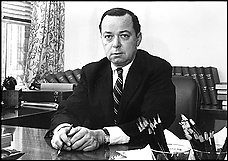
    Richard Salant, former president of CBS
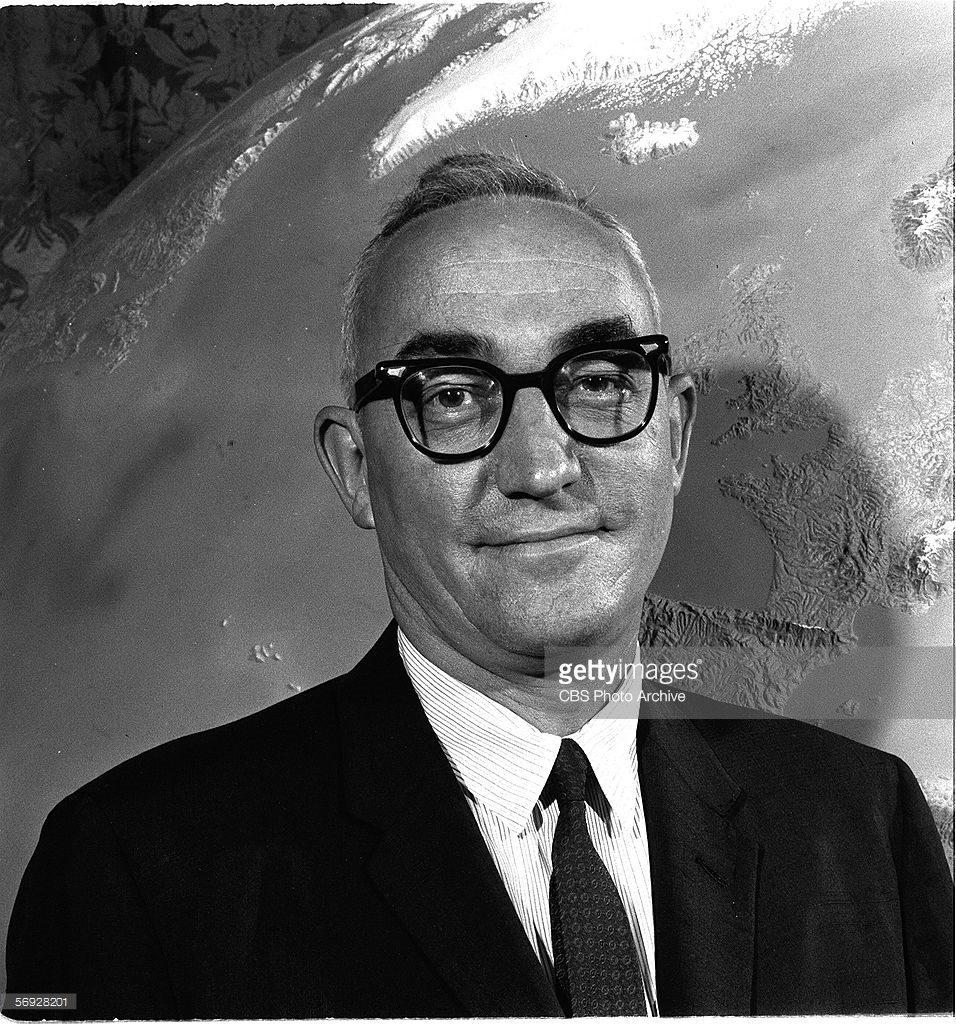
    William J. Small, former president of NBC News and executive with CBS for 17 years

    There was a small problem. Roger Feinman had become a friend and follower of the estimable Warren Commission critic Sylvia Meagher. Therefore, he knew that 1) The Warren Commission produced a deeply flawed report, and 2) CBS had employed some questionable methods in the 1967 special in order to conceal those flaws. Since Roger was working there in 1975, he began to write some memoranda to those in charge warning them that they had repeated their poor 1967 performance in November of 1975. His first memo went to CBS president Dick Salant. Many of the other memos were directed to the Office of Standards and Practices.

    In preparing these memos Roger had researched some of the rather odd methodologies that CBS used in 1967, and again in 1975. Since, in 1975, he had been there for three years, he got to know some of the people who had worked on that series. They supplied him with documents and information which revealed that what Cronkite and Rather were telling the audience had been arrived at through a process that was as flawed as the one the Warren Commission had used. Roger requested a formal review of the process by which CBS had arrived at its forensic conclusions. He felt the documentary had violated company guidelines in doing so.

    As Roger’s memos began to circulate through the executive and management suites—including Salant’s and Vice-President Bill Small’s—it was made clear to him that he should cease and desist from his one-man campaign. But he would not let up. CBS now moved to terminate their dissident employee.

    On September 7, 1976, CBS succeeded in terminating Roger Feinman. But the collection of documents he secured through his sources was, to my knowledge, absolutely unprecedented. This remarkable evidence allowed us, for the first time, to see how the 1967 series was conceived and executed. But further, it takes us into the group psychology of a large media corporation when it collides with controversial matters of national security.

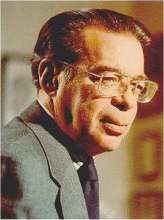
    Daniel Schorr

    One of the most remarkable discoveries Roger made was this: the initial proposal for the special was made from certain employees inside CBS. The proposal was originally sent to Salant by CBS Vice-President at the time, Gordon Manning. Two men who had relayed the idea to him were Daniel Schorr and Bill Small. Later on, Les Midgley would join the effort.

    Gordon Manning, executive at CBS, NBC and Newsweek

    Small was the CBS Washington Bureau Chief from 1962-74 who was now vice-president. Schorr had joined CBS in 1953 and worked under the legendary Edward R. Murrow as a reporter. Manning was hired away from Newsweek to CBS by executive Fred Friendly in 1964. By 1967 he had also become a vice-president. Midgley had also started in print media. But by 1963, he had become a top prime time news producer at CBS.

    The first proposal was sent to Salant by Manning in August of 1966. It was declined. Manning tried again in October. This time he suggested an open debate between the critics of the Warren Report and former Commission counsels. It would be moderated by a law school dean or the president of the ABA.

    One month after Manning’s debate proposal, Life Magazine published a front-page story in which they questioned the Warren Commission verdict with photographic evidence from the Zapruder film (which they owned). They also interviewed Texas Governor John Connally who disagreed that he and Kennedy had been hit by the same shot. That idea, the Single Bullet Theory, was the fulcrum of the Warren Report. Without it, the Commission’s verdict was rendered spurious. The story ended with a call to reopen the case. In fact, Life had actually put together a small journalistic team to do their own internal investigation.

    Les Midgley, CBS producer

    A few days after this issue appeared, Manning again pressed for a CBS special. This time he suggested the title, “The Trial of Lee Harvey Oswald”. Here, a panel of law school deans would review the evidence against Oswald in a mock trial setting. Including evidence that the Warren Commission had not included.

    At this time, Manning was joined by producer Les Midgley. Midgley had produced the two-hour 1964 CBS special. His suggestion differed from Manning’s. He wanted to title the show “The Warren Report on Trial”. Midgley suggested a three night, three-hour series. One night would be given over to the commission defenders, one night would include all the witnesses the commission overlooked or discounted. The last night would include a verdict conducted by legal experts. On December 1, 1966, Salant wrote a memo to John Schneider, president of CBS Broadcast Group. He told him that he might refer the proposal to the CNEC. That acronym stood for CBS News Executive Committee. According to information Roger gained through discovering secret memos, plus through secondary sources, CNEC was a secretive group that was created in the wake of Edward R. Murrow’s departure from CBS.

    Edward R. Murrow

    Murrow was a true investigative reporter who became famous through his reports on Senator Joe McCarthy and the treatment of migrant farm workers. The upper management at CBS did not like the controversy that these reports attracted from certain segments of the American power structure. After all, they were part of that structure. Salant went to Exeter Academy, Harvard, and then Harvard Law School. He had been handpicked from the network’s Manhattan legal firm by CBS President Frank Stanton to join his management team. From 1961-67, Stanton was chairman of Rand Corporation, a CIA associated think tank. During World War 2, Stanton worked in the Office of War Information, the psychological warfare branch. President Eisenhower had appointed Stanton to a small committee to organize how the USA would survive in case of nuclear attack. The other two members of CNEC were Sig Mickelson and founder Bill Paley. Mickelson had preceded Salant as president of CBS News. He then became director of Time-Life Broadcasting. Mickelson said nothing when founder Bill Paley—who had also served in the psywar branch of the Office of War Information, in World War 2—met with CIA Director Allen Dulles and agreed to have CBS overseas correspondents informally debriefed by the Agency.

    Frank Stanton, former CBS president and chairman of the Rand Corporation from 1961-67

    When Salant had reached his crossroads with CNEC, the writing was on the wall for any fair minded, objective treatment of the JFK case at CBS. For as Roger wrote, “The establishment of CNEC effectively curtailed the news division’s independence.” Further, Salant had no journalistic experience and was in almost daily communication with Stanton. As Roger further wrote, Salant “frequently exercised editorial supervision over CBS news broadcasts.” And further, his memoirs did not mention the supervision of CNEC. Or the Warren Commission documentaries made under his watch. These hidden facts “belied Salant’s frequent public assertions of CBS News’ independence from corporate influence.”

    Sig Mickelson, former president of CBS News and director of Time-Life Broadcasting

    The day after Salant informed the CNEC about the proposal, he told Manning that he was wavering on the mock trial concept. Salant’s next move was even more ominous. He sent both Manning and Midgley to California to talk to two lawyers about the project. One of the attorneys was Edwin Huddleson, a partner in the San Francisco firm of Cooley, Godward, Castro and Huddleson. Huddleson attended Harvard Law with Salant. Like Stanton he was on the board of Rand Corporation. The other lawyer the men saw was Bayless Manning, Dean of Stanford Law School. Both men told the CBS representatives that they were against the network undertaking the project on the grounds of “the national interest” and because of “political implications”. Gordon Manning reported that both attorneys advised them to ignore the critics of the Warren Commission, or to even appoint a panel to critique their books. Huddleson even recommended having scientist Luis Alvarez as a consultant to counter the critics. Which CBS actually did.

    On his return to CBS headquarters, Gordon Manning realized what was happening. He suggested a new title for the series, “In Defense of the Warren Report”. He now wrote that CBS should dismiss “the inane, irresponsible, and hare-brained challenges of Mark Lane and others of that stripe.” Gordon Manning’s defection left Midgley out on a limb. Salant, with the help of the White House, was about to cut it off.  (Bayless Manning had played a significant role in reversing the aim of the program.  It is perhaps of interest here to note that in 1971, David Rockefeller made Bayless Manning first president of the Council on Foreign Relations.)

    Unaware of what Salant was up to, on December 14, 1966, Midgley circulated a memo about how he planned on approaching the Warren Report project. He proposed running experiments that were more scientific than “the ridiculous ones run by the FBI.” He still wanted a mock trial to show how the operation of the Commission was “almost incredibly inadequate.”

    William S. Paley, creator of CBS television, and founder of CNEC

    In response, Salant now circulated an anonymous, undated, paragraph-by-paragraph rebuttal to Midgley’s attack. The secret author of that memo was none other than Warren Commissioner John McCloy—then Chairman of the Council on Foreign Relations. Ellen McCloy, his daughter, was Salant’s administrative assistant. In this memo, McCloy wrote that “the chief evidence that Oswald acted alone and shot alone is not to be found in the ballistics and pathology of the assassination, but in the fact of his loner life.” [emphasis added] As most Warren Commission critics had written, it was this approach—discounting or ignoring the medical and ballistics evidence, but concentrating on Oswald’s alleged social life—that was the fatal flaw of the Warren Report. From this point on, Ellen McCloy would be on the distribution list for almost all memos related to the Kennedy assassination project. She would now serve as the secret back channel between CBS and her father in regards to the production and substance of the project.

    John J. McCloy. His daughter, Ellen, who was Salant’s administrative assistant, admitted to acting as his clandestine liason with CBS during the production of the 1967 Warren Report special.

    Clearly, the tide had turned and Salant was now in McCloy’s corner. For Salant then asks producer Midgley, “Is the question whether Oswald was a CIA or FBI informant really so substantial that we have to deal with it?” Midgley, still alone out on the limb, replies, “Yes, we must treat it.”

    This clandestine relationship between Salant and McCloy was known to very few people in 1967. In fact, as Feinman later deduced, it was likely known only to the very small circle in the memo distribution chain. That Salant deliberately wished to keep it hidden is indicated by the fact that he allowed McCloy to write these early memos anonymously. For as Feinman also concluded, McCloy’s influence on the program was almost certainly a violation of the network’s own guidelines. Which is probably another reason Salant kept it hidden. In fact, as we will see, Salant was actually in denial about the relationship.

    After Feinman was terminated he briefly thought of publicizing the whole affair (which he eventually decided against doing). So he wrote McCloy in March of 1977 about the CFR chair’s clandestine role in the four night special. McCloy declined to be interviewed on the subject. He also added that he did not recall any contribution he made to the special.

    But Feinman persisted. About three weeks later, on April 4, 1977, he wrote McCloy again. This time he revealed that he had written evidence that McCloy had participated extensively in the production of the four night series. Very quickly, McCloy now got in contact with Salant. McCloy wrote that he did not recall any such back channel relationship. Salant then contacted Midgley. He told the producer to check his files to see if there was any evidence that would reveal the CBS secret collaboration with McCloy. Salant wrote back to McCloy saying that at no time did Ellen McCloy ever act as a conduit between CBS News and McCloy.

    This, of course, was false. And in 1992, in an article for The Village Voice, both Ellen McCloy and Salant were confronted with memos that revealed Salant was lying in 1977. McCloy’s daughter admitted to the clandestine courier relationship. Salant finally admitted it also, but he tried to say there was nothing unusual about it. Which leaves the obvious question: If that were the case then why was it kept secret from almost everyone? Including the public. (See further “JFK: How the Media Assassinated the Real Story”)

    Betty Furness doing a Westinghouse ad

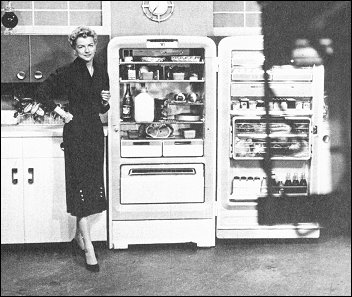
    As alluded to previously, there was still work to be done with the last holdout, producer Les Midgley. While the four-night special was in production, Midgley became engaged to one Betty Furness. Furness was a former actress turned television commercial spokesperson. At this time, President Lyndon Johnson now appointed her his special assistant for consumer affairs. Even though her only experience in the field had been selling Westinghouse appliances for eleven years on television. She was sworn in on April 27, 1967, about two months before the CBS production first aired. Two weeks after it was broadcast, Midgley and Furness were married. We should note here, as Kai Bird’s biography of McCloy, The Chairman, makes clear, Johnson and McCloy were both friends and colleagues.

    But there is another point to be made about how Midgley was convinced to go along with McCloy’s view of the Warren Commission. Around the same time he was married to Furness, he received a significant promotion. He was now made the executive editor of the network’s flagship news program, “The CBS Evening News with Walter Cronkite”. This made him, in essence, the number one news editor at CBS. Such a decision could not have been made without consultation between Salant, Cronkite and Stanton. And very likely the CNEC.

    We have now seen—in unprecedented detail—how the executive level of CBS completely altered a proposal to present a fair and balanced program about the murder of President Kennedy to the public, and at a very sensitive time in history. Consulting with their lawyers, they decided such a program would not be in “the national interest” and would have “political implications”. We have also seen how the president of CBS News secretly brought in a consultant, John McCloy, whose participation was a violation of the standards and practices of the network. We have seen how both McCloy and Salant then lied about this secret back channel, which was never revealed to the public. We have also seen how Gordon Manning and Les Midgley, through a combination of the carrot and stick treatment, were made to go along with the Salant/McCloy, CNEC agenda.

    We should now look at the impact this secret relationship would have on what CBS was going to broadcast to an unsuspecting public. For their widely trumpeted “examination” of the Warren Report was anything but.


    Go to Part 2

  • Why CBS Covered Up the JFK Assassination, Part 2

    Why CBS Covered Up the JFK Assassination, Part 2


    Part Two

    In the first part of this article we saw that, as the controversy over the JFK assassination rose in 1966, some employees at CBS News wanted to deal with the subject in a fair and objective way. Specifically, in either a debate or mock trial format, with both sides—both critics and advocates of the Warren Report—represented equally. But CBS President Richard Salant, in consultation with the CNEC—the secret executive committee at CBS—took control of this proposal, and more or less hijacked it. Salant and the CNEC brought in his own consultant to the proposal. One who would not abide by the critics being allowed a fair and equal voice in this debate. Former Warren Commissioner John McCloy would now have a powerful voice about the upcoming special. His back channel to the show would be through his daughter, Ellen McCloy, who worked for Salant. Not only would this be kept under wraps, but also when CBS moved to terminate Roger Feinman in 1975, Salant would deny any such relationship.

    Once McCloy was brought on board, the complexion of both CBS and their programs—both in 1967 and 1975—were altered. The amount of time given over to the critics of the Warren Report would be severely curtailed. But beyond that, CBS would now employ other consultants, besides McCloy, for both their 1967 and 1975 programs. Men who would be rabidly pro-Warren Report. Some of them would appear on the shows as guest speakers. Some would be hidden in the shadows. But in no case would CBS make clear just how biased these men were. In addition to the clandestine role of McCloy, some of these consultants included Dallas police officer Gerald Hill, reporter Lawrence Schiller, physicist Luis Alvarez, and urologist John Lattimer.

    Gerald Hill

    Gerald Hill was just about everywhere in Dallas on November 22, 1963. He was at the Texas School Book Depository, he was at the murder scene of Officer J. D. Tippit, and he was at the Texas Theater—the place where Lee Harvey Oswald was arrested. Hill appears on the 1967 show as a speaker. But Roger Feinman found out that Hill was paid for six weeks work on the 1967 show as a consultant. During his consulting, Hill revealed that the police did a “fast frisk” on Oswald while in the theater. They found nothing in his pockets at the time. Which poses the question as to where the bullets the police said they found in his pockets later at the station came from. That question did not arise during the program, since CBS never revealed that statement. (Click here and go to page 20 of the transcript.)
    John Lattimer

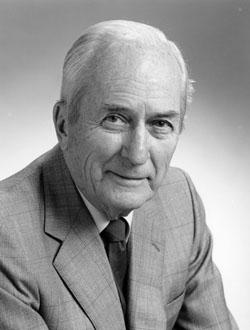
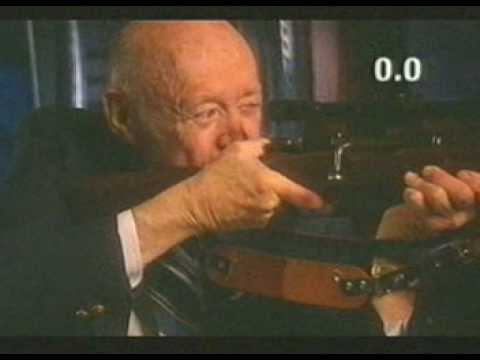
    During World War II, John Lattimer traveled with Patton’s Third Army across France. He treated the wounded during the D-Day invasion. At the end of the war, he was the court-appointed doctor for the Nazis accused of war crimes at Nuremburg. As researcher Milicent Cranor discovered, Lattimer was J. Edgar Hoover’s physician. Fittingly then, he had been defending the Commission since at least 1966 in the pages of the Journal of the American Medical Association. In 1972, he became the first doctor allowed to enter the National Archives and inspect the autopsy evidence in the JFK case. He reaffirmed the Warren Commission verdict without telling the public that Kennedy’s brain was missing from the archives. In 1975, Dr. James Weston was the on-camera witness for the medical evidence. Lattimer consulted with Weston and prepared some visual aids for him. Lattimer spent a large part of his career writing articles and performing dubious experiments propping up the Warren Report. (Click here, and here)

    Luis Alvarez

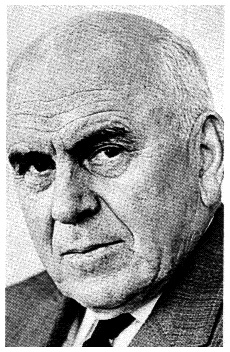
    Luis Alvarez worked on refinements in radar detection during World War II. He then had a role on the Manhattan Project. He actually witnessed the destruction of Hiroshima from an observation plane, the B-29 The Great Artiste. In 1953, Alvarez was on a CIA-appointed study group for UFO’s called the Robertson Panel. In the sixties, he was part of the JASON Advisory Group; this was a powerful organization of top-level scientists that advised the military on things like fighting the Vietnam War. Along with people like Henry Kissinger, Ronald Reagan and George Schultz, he was a member of the secretive and quite conservative Republican private club, the Bohemian Grove. Alvarez was part of the Ruina Panel, which was put together to conceal evidence of Israel exploding nuclear devices. (Click here) Like Lattimer, Alvarez spent a considerable amount of time lending his name to articles and questionable experiments supporting the Warren Report. In fact, as demonstrated by authors like Josiah Thompson (in 2013) and Gary Aguilar (in 2014), Alvarez actually misrepresented his data in some of his JFK experiments. (Click here and go to the 37:00 mark for Aguilar’s presentation.)

    Lawrence Schiller

    The same year of the 1967 CBS broadcast, Lawrence Schiller had co-written a book entitled The Scavengers and Critics of the Warren Report. This was a picaresque journey through America where Schiller interviewed some of the prominent—and not so prominent—critics of the report and caricatured them hideously. The book was simultaneously published in hardcover and softcover, and was also accompanied by an LP record album. But this constituted only Schiller’s overt actions on the JFK case. Secretly, he had been an informant for the FBI for many years on people like Mark Lane and Jim Garrison. These documents were not declassified until the Assassination Records and Reviews Board was set up in the nineties. (See Destiny Betrayed, Second Edition, by James DiEugenio, p. 388) How bad was Schiller? He attacked New Orleans DA Jim Garrison even though he himself had discovered witnesses who attested that Garrison’s suspect, Clay Shaw, actually used the alias of Clay Bertrand. Which was a major part of Garrison’s case against the man. (ibid)

    As the reader can see, with this cast of consultants, the 1967 CBS Special was wrongly titled as “A CBS News Inquiry: The Warren Report”. For the last thing these four men, plus McCloy, wanted to do was to unearth the methodology and process by which the Warren Commission had come to its conclusions. For if that had been done, the results would have shown just how superficial, how haphazard, how agenda-driven the Commission really was. What CBS was going to do was—come hell or high water—endorse the Warren Report. And this became obvious right at the start of the program in the summer of 1967.
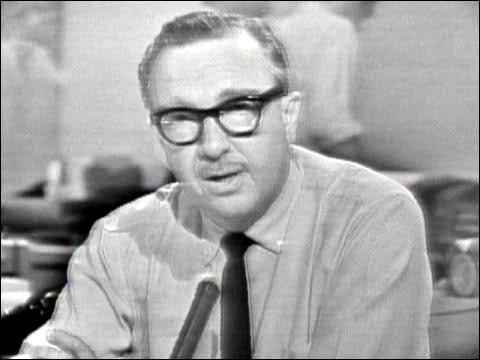
    Walter Cronkite

    For instance, Walter Cronkite intoned that, as a crowd of people rejoiced at the sight of President Kennedy approaching Dealey Plaza, “another waited”. Cronkite then said that, faced with dangerous conditions, President Johnson appointed the Warren Commission. Yet, Johnson never wanted a blue ribbon panel from Washington. He wanted a Texas-based investigation founded upon an FBI report. People outside the White House, like Yale Law School Dean Eugene Rostow and columnist Joseph Alsop, foisted the idea of the Warren Commission upon him. (see The Assassinations, edited by James DiEugenio and Lisa Pease, pp. 7-16) Cronkite then names the men on the Warren Commission while showing their pictures on screen, affirming that this inquiry would be made “by men of unimpeachable credentials”. Needless to say, Cronkite does not mention the fact that President Kennedy had fired Commissioner Allen Dulles in 1961 for lying to him about the Bay of Pigs.

    Cronkite then got to the crux of the program. After stating that the Warren Report assured the public the most searching investigation in history had taken place, he now began to show books and articles that were critical of the Commission. He then revealed certain polling results that demonstrated a majority of Americans had lost faith in the Warren Report. This signalled what the program had now become. It was the first network special that took aim at the work of those critical of the Warren Commission. Its raison d’être was to take on the work of the critics and reassure the public that these people could not be trusted. They had given the Warren Report a bum rap.

    Cronkite then went through a list of points that the critics had surfaced after reading the report and its 26 volumes of evidence. These were:

    1. Did Oswald own a rifle?
    2. Did Oswald take a rifle to the book depository building?
    3. Where was Oswald when the shots were fired?
    4. Was Oswald’s rifle fired from the building?
    5. How many shots were fired?
    6. How fast could Oswald’s rifle be fired?
    7. What was the time span of the shots?

    To shorten a four-hour story: CBS sided with the Warren Report on each point. Oswald fired three shots from the sixth floor with the rifle attributed to him by the Warren Commission. Two of three were direct hits—to the head and shoulder area—within six seconds. Not only that, but using men like Alvarez they came up with novel new ways to endorse the Warren Report. But as we shall see, and as Feinman discovered, CBS was not candid about these newly modified methods.

    One way that CBS fortified the case for just three shots was Alvarez’ examination of the Zapruder film—which the program did not actually show. This was Abraham Zapruder’s 26-second film of Kennedy’s assassination taken from his position in Dealey Plaza. Alvarez proclaimed for CBS that by doing something called a “jiggle analysis”, he computed that there were three shots fired during the film. What this amounted to was a blurring of frames on the film.
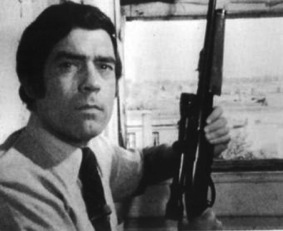
    Dan Rather

    Dan Rather took this Alvarez idea to a Mr. Charles Wyckoff, a professional photo analyst in Massachusetts. Agreeing with Alvarez, at least on camera, Wyckoff mapped out the three areas of “jiggles”. The Alvarez/Wyckoff formula was simple: three jiggles, three shots. But as Feinman found out through unearthed memos, there was a big problem with this declaration. Wyckoff had actually discovered four jiggles, not three. Therefore, by the Alvarez formula, there was a second gunman, and a conspiracy. But as the entire executive management level of CBS had committed to McCloy and the Warren Report, this could not be disclosed to the public. Therefore Wyckoff’s on-camera discussion of this was cut out and not included in the official transcript. It is interesting to note just how committed Wyckoff was to the CBS agenda, for he tried to explain the fourth jiggle as Zapruder’s reaction to a siren. As Feinman noted, how Wyckoff could determine this from a silent 8 mm film is rather puzzling. Even more damning is the fact that, as Life Magazine had deduced, there were actually six “jiggles” in the Zapruder film, and they only allotted one to a “startle reaction”. (See Josiah Thompson, Six Seconds in Dallas, Appendix F) But the point is, this (censored) analysis did not actually support the Commission. It undermined it.

    And in more than one way. For Wyckoff and Alvarez placed the first jiggle at around Zapruder frame 190, or a few frames previous to that. As most people who have studied the case know, this would have meant that Oswald would have had to be firing through the branches of an oak tree—which is why the Commission moved this shot up to frame 210. But CBS left themselves an out here. They actually said there was an opening in the tree branches at frame 186, and Oswald could have fired at that point. This is patently ridiculous. The opening at frame 186 lasted for 1/18th of a second. To say that Oswald anticipated a less than split second opening, and then steeled himself in a flash to align the target, aim, and fire—this is all stuff from the realm of comic-book super heroes. Yet, in its blind obeisance to the Warren Report, this is what CBS had reduced itself to.

    Another way that CBS tried to aid the Commission was through Wyckoff purchasing five other Bell and Howell movie cameras. (CBS was not allowed to handle the actual Zapruder camera.) The aim was to cast doubt on the accepted speed of the Zapruder camera, and suggest it might have been running slow (so that there would have been more time to get off three shots). The problem was that both the FBI and Bell and Howell had tested the speed of Zapruder’s actual camera, and they both decreed it ran at 18.3 frames per second. Wyckoff proceeded to time these other cameras using the same process that Lyndal Shaneyfelt and Bell and Howell did: by aiming the cameras at a large clock with a second sweep hand, and running them for a determinate number of frames. Wycoff announced the results for these timings as 6.90, 7.30, 6.70, 8.35, and 6.16 seconds. Rather concludes this interview by asking, “So, under this theory, the shooter, or shooters, of the shots could have had up to how many seconds to fire?” And Wyckoff replies, “They could have had, according to this, up [to] as much as eight and thirty-five hundreds [sic] of a second–which is a pretty long time.” (CBS Transcript, Part 1, p. 19) Thompson points out that CBS did not clarify here that they had computed these timings from a run of 128 frames, not 103. In other words, they begged the question concerning frame 186. If they had not played fast and loose with the public, they would have told them that at 18.3 fps, Zapruder’s camera would have run through 128 frames in 6.9 seconds (as opposed to 5.6 for 103 frames), thus making the difference between Zapruder’s camera and the slowest running of the other five considerably less remarkable with respect to the total running time for the supposed three-shot sequence. In fact, Zapruder’s camera seems to be running at an average speed, if one combines the other cameras’ running speeds and divides by five (op. cit., pp. 293-294). As Thompson states, the whole experiment really proves nothing about whether the camera was running slow. Even Dick Salant commented that it was “logically inconclusive and unpersuasive.” But it stayed in the program.

    Why did Rather and Wyckoff have to stoop this low? Because of the results of their rifle firing tests. As the critics of the Warren Report had pointed out, the Commission had used two tests to see if Oswald could have gotten off three shots in the allotted 5.6 seconds revealed in the Warren Commission, through the indications on the Zapruder film. These tests ended up failing to prove Oswald could have performed this feat of marksmanship. What made it worse is that the Commission had used very proficient rifleman to try to duplicate what the Commission said Oswald had done. (See Sylvia Meagher, Accessories After the Fact, p. 108)

    So CBS tried again. This time they set up a track with a sled on it to simulate the back of Kennedy’s head. They then elevated a firing point to simulate the sixth floor “sniper’s nest”, released the target on its sled and had a marksman fire his three shots.

    In watching the program, a question most naturally arises. CBS had permission to enter the depository building for a significant length of time, because Rather was running around on the sixth floor and down the stairs. In the exterior shots of Rather, it appears that the traffic in Dealey Plaza was roped off. So why didn’t CBS just do the tests right then and there under the exact same circumstances? It would appear to be for two reasons. First, the oak tree would have created an initial obstruction for the first shot. Second, there was a rise on Elm Street that curved the pavement. This was not simulated by CBS.

    CBS first tried their experiment in January of 1967. They used a man named Ed Crossman. Crossman had written several books on the subject and many articles. He had a considerable reputation in the field. But his results were not up to snuff—even though CBS had enlarged the target size! And even though they gave him a week to practice with their version of the Mannlicher Carcano rifle. (Again, CBS could not get the actual rifle the Warren Report said was used by Oswald.) In a report filed by Midgley, he related that Crossman never broke 6.25 seconds, and even with the enlarged target, he only got 2 of 3 hits in about 50% of his attempts. Crossman stated that the rifle had a sticky bolt action, and a faulty viewing scope. What the professional sniper did not know is that the actual rifle in evidence was even harder to work. Crossman said that to perform such a feat on the first time out would require a lot of luck.

    Since this did not fit the show’s agenda, it was discarded: both the test and the comments. To solve the problem, CBS now decided to call upon an actual football team full of expert riflemen—that is, 11 professional marksmen—who were first allowed to go to an indoor firing range and practice to their heart’s content. Again, this was a major discrepancy with the Warren Report, since there is no such practice time that the Commission could find for Oswald.

    The eleven men then took 37 runs at duplicating what Oswald was supposed to have done. There were three instances where 2 out of 3 hits were recorded in 5.6 seconds. The best time was achieved by Howard Donahue—on his third attempt. His first two attempts were complete failures. It is hard to believe, but CBS claimed that their average recorded time was 5.6 seconds. But this did not include the 17 attempts CBS had to throw out because of mechanical failure. And they did not tell the public the surviving average was 1.2 hits out of 3, and with an enlarged target. The truly striking characteristic of these trials was the number of instances where the shooter could not get any result at all. More often than not, once the clip was loaded, the bolt action jammed. The sniper had to realign the target and fire again. According to the Warren Report, that could not have happened with Oswald.

    There is one more point about this experiment. Neither at this stage, nor any other, was there any mention of the hit to James Tague. On his one miss, the Warren Commission said that Oswald’s shot hit the curb beneath bystander James Tague. This then bounced up off his face, drawing blood. Perhaps they avoided this because Tague was on a different street than Kennedy and about 260 feet away from the limousine. How could Oswald have missed by that much if he was so accurate on his other two shots? Further, the FBI found no copper on the curb where Tague was hit. This defies credulity, because the ammunition used in the alleged rifle is copper coated. (James DiEugenio, Reclaiming Parkland, pp. 228-29) Again, this was surgical-style censorship by CBS.

    Related to the ballistics evidence is what CBS did with the medical evidence. The two chief medical witnesses on the program were Dr. Malcolm Perry from Parkland Hospital in Dallas, where Kennedy was taken after he was hit; and James Humes, the chief pathologist at the autopsy examination at Bethesda Medical Center that evening.

    In their research for the series, CBS had discovered a document that the Warren Commission did not have. The afternoon of the assassination, Perry had given a press conference along with Dr. Kemp Clark. Although it was filmed, when the Commission asked for a copy or a transcript, the Secret Service said they could not locate either. (Doug Horne, Inside the ARRB, Vol. 2, p. 647) This was a lie. The Secret Service did have such a transcript. It was delivered to them on November 26, 1963. The ARRB found the time-stamped envelope.

    Robert Pierpont

    But Feinman discovered that CBS had found a copy of this transcript years before. White House correspondent Robert Pierpont found a transcript through the White House press office. One reason it was hard to find was that it should not have been at the White House; it should have been at the Kennedy Library. But as Roger Feinman found out, it had been relabeled. It was not a Kennedy administration press conference anymore; but the first press conference of the Johnson administration. So it ended up at the Johnson Library.

    None of this was revealed on the program by either Cronkite or Rather. And neither the tape nor transcript was presented during the series. In fact, Cronkite did his best to camouflage what Perry said during this November 22nd press conference, specifically about the anterior neck wound. Perry clearly said that it had the appearance to him of being an entrance wound. And he said this three times. Cronkite tried to characterize the conference as Perry being rushed out to the press and badgered. Not true, since the press conference was about two hours after Perry had done a tracheotomy over the front neck wound. The performance of that incision had given Perry the closest and most deliberate look at that wound. Perry therefore had the time to recover from the pressure of the operation. And there was no badgering of Perry. Newsmen were simply asking Perry and Clark questions about the wounds they saw. Perry had the opportunity to answer the questions on his own terms. Again, CBS seemed intent on concealing evidence of a second assassin. For Oswald could not have fired at Kennedy from the front.

    Commander James Humes did not want to appear on the program. He actually turned down the original CBS request to be interviewed. But Attorney General Ramsey Clark pressured him to appear on the show. (This may have been done with McCloy’s assistance.) As Feinman discovered, the preliminary talks with Humes were done through a friend of his at the church he attended. There were two things that Humes said in these early discussions that were bracing. First, he said that he recalled an x-ray of the president which showed a malleable probe connecting the rear back wound with the front neck wound. Second, he said that he had orders not to do a complete autopsy. He would not reveal who gave him these orders, except to say that it was not Robert Kennedy. (Charles Crenshaw, Trauma Room One, p. 182)

    Like the Perry transcript, this was exceedingly interesting information. Concerning the malleable probe, the problem is that no such x-ray depiction exists today. As CBS stated, Humes had been allowed to visit the National Archives and look at the x-rays and photos prior to his appearance. Needless to say, the fact that this x-ray was missing is not mentioned on the program. Because of that, the pubic would have to wait almost 30 years—until the creation of the Assassination Records Review Board—to find out that other witnesses also saw a malleable probe go through Kennedy’s back. But neither pictures nor x-rays of this are in the National Archives today. The difference is that these other witnesses said that the probe did not go through the body, since the wounds did not connect. This may be the reason they are missing today. (DiEugenio, Reclaiming Parkland, pp. 116-18)

    On camera, Humes also said that the posterior body wound was at the base of the neck. Dan Rather then showed Humes the drawings made of the wound in the back as depicted by medical illustrator Harold Rydberg for the Warren Commission. This also depicts that wound as being in the neck. Humes agreed with this on camera. And he added that they had reviewed the photos and referred to measurements and this all indicated the wound was in the neck.

    Even for CBS, and John McCloy, this is surprising. In the first place, the autopsy photos do not reveal the wound to be at the base of the neck. It is clearly in the back. (Click here and scroll down) The best that one can say for CBS is that, apparently, they did not send anyone with Humes to visit the archives. Which is kind of puzzling, since good journalistic practice would necessitate two witnesses to such an important assertion. And beyond that, CBS should have sent its own independent expert, because Humes clearly had a vested interest in seeing his autopsy report bolstered, especially since it was under attack by more than one critic.

    The second point that makes Humes’ interview surprising is his comments on the Rydberg drawings’ accuracy. These do not coincide with what Mr. Rydberg said later. To this day, Rydberg does not understand why he was chosen to make these drawings for the Commission. Rydberg was only 22 at the time, and had been drawing for only one year. There were many other veteran illustrators in the area whom the Commission could have called upon. But Rydberg came to believe that it was his very inexperience that caused the Commission to direct the doctors to him. For when Humes and Dr. Thornton Boswell appeared before him, they had nothing with them: no photos, no x-rays, no official measurements. Everything they told him was from memory. And this was nearly four months after the autopsy. (DiEugenio, Reclaiming Parkland, pp. 119-22) The Rydberg drawings have become almost infamous for not corresponding to the pictures, measurements, or the Zapruder film. For Humes to endorse these on national television, and for CBS to allow this without any fact checking—this shows what a National Security project the special had become. In fact, the Justice Department had scripted the Humes/Rather interview in advance. (ibid, pp. 125-26)

    As noted, CBS also knew that Humes said that he had been limited in his autopsy pathology for the Kennedy autopsy. This would have been another powerful scoop if CBS had followed it up. Since they did not, the public had to wait another two years for the story to surface. This time it was at the trial of Clay Shaw in New Orleans, when autopsy doctor Pierre Finck took the stand in Shaw’s defense. Finck said the same thing: that Dr. Humes was limited in what autopsy procedures he was permitted to follow on Kennedy (ibid, p. 115). This story would have had much more exposure and vibrancy if CBS had broken it, because the press bias against Garrison was very restrictive and controlling. But, as we have seen, the Justice Department control over Humes and CBS was also restrictive—the difference being that CBS was a much more powerful institutional entity than the rather small DA’s office of a medium sized city.

    What CBS did with the Humes/RFK story should be followed up on to show just how badly CBS was willing to mangle the truth.

    In early 1975, when the JFK case was heating up again, Sixty Minutes decided to do a story on whether or not Jack Ruby and Lee Oswald knew each other. After several months of research, Salant killed the project. Those investigative files were turned over to Les Midgley, and became the basis for the 1975 CBS special, which was entitled The American Assassins. Originally this was planned as a four-night special: one night each on the JFK, RFK, Martin Luther King and the George Wallace shootings. But at the last moment, in a very late press release, CBS announced that the first two nights would be devoted to the JFK case. Midgley was the producer, but this time Cronkite was absent. Rather took his place behind the desk.

    Franklin Lindsay

    In general terms, it was more of the same. The photographic consultant was Itek Corporation, a company that was very close to the CIA. In fact, they helped build the CORONA spy satellite system. Their CEO in the mid-Sixties, Franklin Lindsay, was actually a former CIA officer. With Itek’s help, CBS did everything they could to move up their Magic Bullet shot from about frame 190 to about frames 223-226. Yet Josiah Thompson, who appeared on the show, had written there was no evidence Governor Connally was hit before frames 230-236. Moreover, there are indications that President Kennedy is clearly hit as he disappears behind the Stemmons Freeway sign at about frame 190: his head seems to collapse both sideways and forward in a buckling motion. But with Itek in hand, this now became the scenario for the CBS version of the Single Bullet Theory. It differed from the Warren Commission’s in that it did not rely upon a “delayed reaction” on Connally’s part to the same bullet.

    Milton Helpern

    CBS also employed Alfred Olivier. Olivier was a research veterinarian who worked for the Army wound ballistics branch and did tests with the alleged rifle used in the assassination. He was a chief witness for junior counsel Arlen Specter before the Warren Commission. (See Warren Commission, Volume V, pp. 74ff.) For CBS in 1975, Olivier said that the Magic Bullet, CE399 was not actually “pristine”. For CBS and Dan Rather, this makes the Single Bullet Theory not impossible but just hard to believe. Therefore, it could have happened. Apparently, no one explained to Rather that the only deformation on the bullet is a slight flattening at the base, which would occur as the bullet is blasted through the barrel of a rifle. There is no deformation at its tip. And there is only a tiny amount of mass missing from the bullet. In other words, as more than one author has written, it has all the indications of being fired into a carton of water or a bale of cotton. And if CBS had interviewed the legendary medical examiner Milton Helpern of New York, that is pretty much what they would have heard. (Henry Hurt, Reasonable Doubt, p. 69) It is odd they did not do so, since CBS Headquarters is in New York, and Helpern was still alive in 1975.

    James Weston

    As we have seen, Dr. James Weston would be the on camera medical witness in 1975. Both Weston and Lattimer had seen the medical exhibits before the show was filmed. Taking that into consideration, what they said is not surprising; it is what they left out that is. Predictably, Weston said that there were only two shots, both from the rear. Yet Weston makes no mention of the brain being missing, a fact that both he and Lattimer had to know. Without that exhibit, there was no proof of the brain being sectioned, which is the standard procedure for tracking bullets inside the skull. If this was not done, there is no proof of directionality. Further, there was no mention of the new feature to the x-rays that was found in a Justice Department review in 1968: this was a disk-shaped 6.5 mm fragment in the rear of the skull. Its size fits perfectly the ammunition caliber of the Mannlicher Carcano rifle. It was not seen the night of the autopsy by any of the pathologists. Third, in that same Justice Department review, particle fragments Humes described in his report as going upward from the entry wound, low in the back of the skull, had disappeared on the x-ray. Weston mentioned none of these changes in the evidence. One wonders if he actually read the autopsy report, or just relied on his briefing by Lattimer.
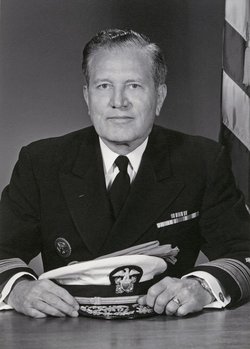
    George Burkley

    Finally, Rather realizes, without being explicit, that something was wrong with Kennedy’s autopsy. He actually said to the audience that the autopsy was below par. And he also reversed field on his opinion of Humes. After praising his experience in 1967, Rather now says that neither Humes nor Boswell were actually qualified to perform Kennedy’s autopsy, and that certain things were actually botched. In other words, what Humes told CBS through a third party in 1967 was accurate. But, in contradiction to Humes’ denial that it was Bobby Kennedy who did so, Rather claims that it was Kennedy physician George Burkley who actually controlled the autopsy. Burkley could not have done any such thing unless it was approved by RFK. And Robert Kennedy had given orders to do a full autopsy. That same order was co-signed by Burkley. (Crenshaw, ibid, p. 182) In this author’s opinion, this piece of disinformation sounds like it was created by Lattimer.

    In its perniciousness, in its “blame the victims” theme, Rather’s comment echoes what John McCloy said to Cronkite on camera in 1967. McCloy said that if the Commission made a mistake, it was in not demanding the autopsy materials for their examination, adding that these were under the control of the Kennedy family. If anything shows how “in the tank” CBS and Cronkite were to McCloy, this exchange does. First of all, the medical exhibits were not in control of the Kennedys in 1964. They were under control of the Secret Service that year. Secondly, the Commission did have these exhibits. And McCloy had to have known that. (Gerald McKnight, Breach of Trust, p. 171)

    Let us make no mistake about what CBS was up to here. The entire corporate upper structure—Salant, Stanton, Paley—had completely overrun the lower management types like Midgley, Manning and Schorr. And the lower managers decided not to utter a peep to the outside world about what had happened. There was only one recorded instance where CBS let on to how they had fixed their proceedings. In 1993, CBS did another special endorsing the Warren Report. This time, as in 1975, Rather was the host. He called both Bob Tanenbaum of the HSCA, and David Belin of the Warren Commission, to Dealey Plaza. They both discussed their differing views of the case. But Tanenbaum stated that, unlike, Belin, he had tried well over a hundred felony cases through to verdict. Evidently, Rather was impressed with Tanenbaum’s honesty and experience. When the camera was off, Rather stated quietly to the former prosecutor: “We really blew it on the JFK case.”

    Not only Cronkite and Rather participated in this appalling exercise; so too did Eric Sevareid. He appeared at the end of the last show and said that there are always those who believe in conspiracies, whether it be about Yalta, China, or Pearl Harbor. He then poured it on and said some of these people still think Hitler is alive. He concluded by sneering that, anyway, it would be utterly impossible to cover up such a thing. (Watch it here)

    No it would not Eric. You, your network, and your cohorts just gave us an object lesson in how to do it. Only Roger Feinman, who was not at the top, or anywhere near it, had the guts to try and get to the bottom of the whole internal scandal. And he got thrown under the bus for trying. In that valiant but doomed effort, he showed what hypocrites the top dogs at CBS were, how easily they were cowed and cajoled by their bosses. Everyone then took the Mafia vow of silence about what they had done. Which is despicable, but considering the magnitude of the crime they committed, also understandable.


    (This essay is largely based on the script for the documentary film Roger Feinman was in the process of re-editing at the time of his death in 2011. The reader can view that here)


    Addenda

    A.  The CBS rifle tests

    The author has been informed by Josiah Thompson that the deception by CBS went even further than Roger Feinman knew. CBS line producer Bob Richter revealed some fascinating information to author Thompson after the 1967 special was broadcast.  CBS stated for the internal record that many of their rifle attempts were faulty since the weapon jammed or malfunctioned. Thus was not the case.  This misreporting deliberately concealed the fact that in the majority of those instances, the marksman just could not duplicate what the Commission said Oswald did. CBS simply did not want to admit those failures, and add them to the ones they did admit to.  (04/26/2017)


    B.  Documents

    Thanks to the efforts of Pat Speer, some of Roger’s documentation can again be examined. The hard-to-find reproductions can be found at Pat’s’ website. These are screenshots taken from a copy of Roger’s original PowerPoint presentation. For this reason, a few of them are unfortunately legible only with difficulty. But the reader will see that they represent in substance the story recounted here. We are grateful to Pat for making these available.


    Back to Part 1

  • U.S. Postal Money Orders

    U.S. Postal Money Orders


    U.S. POSTAL MONEY ORDERS

    (An addendum to Mail Order Rifle)

    Postal money orders have traditionally been manufactured at a printing facility in Washington, DC. On July 1, 1951 the post office announced the introduction of a new style money order (blue tinted color), to be issued on tabulating (punch) cards that can be processed by electronic machinery. During production the new money orders were imprinted with sequential serial numbers and rows of punched rectangular holes (Hollerith computer code) that identified the serial number. With the computer-coded punch holes the new money orders could be sorted with electronic machinery and, according to the post office, handled “like checks.” After being deposited or redeeemed for cash at a bank or post office, these “pre-punched” money orders were sent to a Federal Reserve Bank (or Branches) and then sent (returned) to one of 12 postal accounting offices throughout the US.

                                                              
    According to the Postal Department, “The new type of orders, whether cashed at post offices or cashed at or deposited with banks, will ultimately be deposited with a Federal Reserve Bank or branch which, after processing the orders, will charge them to the account of the Treasurer of the United States and turn them over to the regional accounting office of the Post Office Department in the Federal Reserve city of the district.” (July 1, 1951)                                                                         

    According to the post office, “Changes in the new system will make it possible to have a money order cashed at any of the nation’s post offices or it may be collected through any bank in the the same manner as the depositing or cashing of a check.” (July 2, 1951)

    New Postal Money order, with rectangular holes (to identify serial
    number by code); first used in July 1951


    IBM 808 PROOF MACHINES

    Special punch-proof machines were developed and installed at each of the 12 Federal Reserve Banks and branches for handling the new money orders. Researchers should remember that during the 1950’s and early 1960’s (prior to April, 1962) the only punched holes that appeared on postal money orders, at the time of purchase, were those that identified the serial number of the money order  (by computer code). After a postal money order (or check, bank draft, etc.) was deposited to a bank, it was date stamped by the bank and credited to the customer’s account. The endorsed money order (check, draft, etc.), stamped with the bank’s ABA number, was then sent to a Federal Reserve Bank (or Branch) within the deposit bank’s district. All postal money orders had to be date stamped/endorsed by the bank receiving the deposit. Without the endorsement, the Federal Reserve would have no way of knowing to which bank the money order was to be credited. At the Federal Reserve Bank a second set of punched holes was stamped into each Postal Money order. In one operation the new machines (IBM 808 proof machines) would list the amount of the money order on paper tapes, punch (by machine code) the ink-printed/stamped amount paid for the money order as shown on the front side, and automatically sort the money orders according to the twelve Post Office regional accounting offices. After crediting each bank within their district for the money orders presented, the Federal Reserve bank returned the money order(s) to the regional postal accounting office (there were 12 offices nationwide). For this service (machine punching all US Postal Money orders), the Postal Department paid the Federal Reserve banks $600,000 yearly.

    Old IBM Proof Machine, from July 1, 1951 thru July, 1962. Used to
    manually  punch holes in money orders (Hollerith code) to
    identify the monetary amount of each money order.
    Federal Reserve Bank of Dallas, 2001 N. Pearl St., Dallas, TX


    Money orders, like checks, are routed thru the federal banking system by first depositing them to a financial institution (bank, savings and loan, credit union, etc.). The depositing bank “validates” money orders by date stamping the item for deposit to a customer’s account, and then imprints the bank’s name and A.B.A. routing number on the back side. (This imprint was required on both sides for a period of time, including the 1960s.) “Validated” money orders are then sent to regional Federal Reserve Banks (12 districts throughout the US) where they are processed. During the punch-card era, they were punched/read to identify the amount of the money order.

    NOTE: Bank endorsements of postal money orders have always been required. In the early 20th century, postal money orders were used locally and could be deposited at many local banks. The 1925 edition of the United States Official Postal Guide, page 95, states the following: “Payments to Banks — When an [money] order purporting to have been properly receipted by the payee, or indorsee, is deposited in a bank for collection, the postmaster at the office drawn upon may effect payment to the bank, provided there be a guarantee on the part of the bank that the latter will refund the amount if it afterwards appear that the depositor was not the owner of the order. An order thus paid should bear upon its back the impression of the stamp of the bank.” CLICK TO VIEW 1925 POSTAL HANDBOOK

    By the mid 20th century, the use of postal money orders had become commonplace. They could be deposited at virtually any bank nationwide and were routinely processed by Federal Reserve Banks. Regulations regarding bank endorsements on postal money orders were the same as those for checks, and were located in the Federal Reserve’s Regulation J. Banks were informed of these regulations through Federal Reserve Bank Operating Circulars. The Operating Circular 4928 of 1960, states: “The endorsement of the sending bank should be dated and should show the American Bankers Association transit number of the sending bank in prominent type on both sides.” CLICK TO VIEW OPERATING CIRCULAR 4928

    In 1987 Congress passed the Expedited Funds Availability Act, in which the Uniform Endorsement Standard was defined. The purpose of the endorsement standard was to help expedite the processing of checks, postal money orders, and other deposited items. At that time, regulations regarding deposited items were made a part of Federal Reserve Regulation CC. The definitions section of Regulation CC (part 229.2), states that the word “check” as used in the regulation means, among other things, US Postal Service money orders. Appendix D (Indorsement Standards) states, “The depositary bank shall indorse a check according to the following specifications: The indorsement shall contain the bank’s nine-digit routing number, set off by arrows at each end of the number and pointing toward the number; the bank’s name/location; and the indorsement date. …. The indorsement shall be written in dark purple or black ink. The indorsement shall be placed on the back of the check so that the routing number is wholly contained in the area 3.0 inches from the leading edge of the check to 1.5 inches from the trailing edge of the check.” CLICK TO VIEW 2001 REGULATION CC  (Courtesy of Sanford Larsen)

    Postal money orders and checks may have to be sent to more than one Federal Reserve Bank (FRB) for clearing. A postal money order (or check) sent to a regional FRB is often forwarded to a FRB in a different region. For example, if a postal money order was purchased in Dallas, TX (circa 1963) and sent to a merchant in Chicago, it could be deposited to the First National Bank of Chicago (FNBC). The FNBC would endorse and stamp the money order and then send it to the FRB of Chicago (see #7 below) where it would again be stamped. In 1963 the postal money order would then be sent to the FRB of Richmond (see #5 below), where it would again be stamped, and then be returned to the postal accounting office in Washington, DC.

    The FRB system “clears” a postal money order by debiting the amount shown on the money order from the account of the US Treasurer, and simultaneously crediting the sending bank, identified by the A.B.A. number stamped on the money order. After “clearing,” the FRB sends the money orders to a postal accounting office (prior to 1955 there were twelve regional postal accounting offices).  The flow of a money order, or check, can be seen in the following diagram.  In the case of postal money orders, the U.S. Treasury is National Bank A in this diagram.

                     
    In the case of the $21.45 postal money order, allegedly purchased by LHO….

    The Drawer is an individual or entity with a bank account. In our example the Drawer is the US Post Office which sells postal money orders against their account with the US Treasury. Oswald, who did not have a bank account, allegedly purchased a postal money order from the Dallas post office; the  Payee is Klein’s, who allegedly received the postal money order in payment for a rifle; the postal money order is then deposited into bank “B” (FNB of Chicago) and is “validated”;  the postal money order is then sent to the Federal Reserve Bank of Chicago for “clearing” (and forwarded to the FRB of Richmond). The FRB debits the account of “A,” the US Treasury (Postal Department), and simultaneously credits bank “B” (FNB Chicago) for the amount of the postal money order. The FRB then returns the “cleared” money order to the postal accounting office (Washington, DC). The “clearing” process is dependent upon each bank “validating” items of deposit (checks, money orders, drafts, etc.) with their ABA routing number on the front and back side of each item. Without an ABA routing number, a Federal Reserve Bank is unable to issue credit for the item, and the item will not “clear” their system.

    This is really a very simple procedure. The Federal Reserve Bank (FRB) acts as a “middle man” and simply takes money from bank “A” and gives it to bank “B.” To accomplish this with hundreds of thousands of money orders/checks daily, it is absolutely essential that checks and money orders be accurately “validated” by the depositing bank. Validation occurs first when the check is presented for deposit and endorsed by the bank (banks name and date imprinted on the check or money order and on the customer’s deposit receipt). Validation is complete when the depositing bank prints/stamps their name and A.B.A. (American Bankers Association) on each and every check or money order. The validated check or money order is sent to the FRB, where it is “cleared” by crediting the depositing bank (“B”) according to the ABA number stamped/printed on the money order or check, and simultaneously debiting the bank on which the check was drawn or, in the case of a postal money order, the US Treasurer/Postal Dept.

    Federal Reserve Bank of Chicago
    Federal Reserve Bank of Richmond


    Prior to 1955 there were twelve regional postal accounting offices. In 1955 these accounting offices were replaced with a new postal facility in Kansas City, Missouri. The new facility, complete with automated sorting machines, was designed to receive all postal money orders, nationwide, directly from all 12 Federal Reserve Banks and Branches. The pre-punched computer-coded holes in each money order made it possible for large volumes of money orders (in 1955, 1.5 million per day) to be electronically sorted and arranged in a systematic way after being returned to a US Postal repository by Federal Reserve Banks.

    NEW MACHINES FOR ALL POST OFFICES

    In April, 1962 the Post Office announced that it had awarded a contract for the purchase of 59,000 business machines to the Friden Corporation, of San Leandro, CA. The new machines, to be installed in every US Post Office nationwide, allowed postal clerks to simultaneously ink-print and punch the amount of purchase on each money order with 5 rows of holes (Hollerith computer code). The 5 rows of round holes were punched simultaneously on the money order, a receipt stub for the purchaser and a receipt stub for the post office.  In June, 1962 the new machines, and new yellow-tinted money orders, were tried out in 9 states (Florida, Georgia, North Carolina, South Carolina–all in the Atlanta Postal Region; and 5 states in the Denver Region). On November 29, 1962, a postal bulletin advised, “Money orders issued on yellow forms are audited at Washington, DC, rather than the Money Order Center at Kansas City, MO.”

    New machines for all US post offices Machine both prints and punches holes in code

    On January 5, 1963 the blue-tinted money orders were discontinued and replaced by light yellow-tinted money orders. Serial numbers on the new money orders, like the former blue-tinted money orders, were pre-printed/ink-stamped (front side) and computer coded with rectangular holes when manufactured. But the round set of computer-coded holes, representing the amount and formerly “punched” by Federal Reserve Banks, were now punched with the new machines at post offices. Postal clerks used the new machines to simultaneously ink-stamp and punch-code the money orders when they were purchased by customers. The General Post Office (GPO) in Dallas received a batch of the new yellow-tinted money orders on January 5, 1963, probably beginning with serial # 2,202,000,000 (see below).

    Yellow-tinted postal money order stubs (for customer), with
    round holes punched by the post office. First introduced in 1962;
    used exclusively after January 5, 1963. A similar stub was kept
    by the post office.
  • Are the JFK X-rays fraudulent?

    The analysis of Dr. Michael Chesser

    by Greg Burnham

    At:  AssassinationOfJFK.net

  • The Pistol


    (Click here if your browser is having trouble loading the above.)


    The Evidence IS the Conspiracy, Table of Contents


  • The Backyard Photographs


    (Click here if your browser is having trouble loading the above.)


    The Evidence IS the Conspiracy, Table of Contents