Tag: FORENSIC EVIDENCE

  • Silencers, Sniper Rifles & the CIA


    From the November-December, 1995 issue (Vol. 3 No. 1) of Probe


    “It’s curious that no one seems to have mentioned this characteristic in connection with the John F. Kennedy assassination, in which both the number and direction of shots fired are still debated. If a silencer was used in combination with another, unsilenced rifle, witnesses located in different parts of the caravan and Dealey Plaza would have heard the shots coming from different directions. Unanimity would have been impossible on the subject of the gunfire’s origin.” 

    Jim Hougan, Spooks (New York: William Morrow and Company, 1978.)


    There has been no consideration given by the research community over the past 30 years regarding the possible use of silencers in the JFK assassination. This article hopes to remedy that intriguing possibility. Both conspiracy theorists and lone gun proponents at least agree on one point: that there are differing opinions amongst Dealey Plaza witnesses as to just how many shots were fired on November 22, 1963. All witnesses presumed that having “heard” a given number of shots, then there must have been an equal number of actual shots so as to coincide with what they heard, whether it be 2, 3 or 4 sounds or even more than 4 as some witnesses have claimed.

    If there were 4 or more shots, then it follows that there was more than one gun for even the lone assassin proponents agree that Oswald could not have fired off 4 shots within the given time frame generally accepted. Consequently, a great deal of effort has been expended pinpointing the location of the witnesses in order to determine which ones may have had a better vantage point for discerning the “real” number of shots. For a brief time it was hoped that the dictabelt evidence would settle the matter once and for all. The HSCA spent a significant amount of time and money grappling with this acoustical evidence but to no avail.

    Considering Possibilities

    Three gunshots, of course, is in keeping with a lone assassin theory – or is it? If there exists the possibility that silencers could have been utilized by one or two additional gunmen, then the earwitness testimony may very well become irrelevant no matter how many shots were “heard.” Acting on the assumption that a multi-gunmen crossfire, if one existed, would have to be carefully planned and executed, this researcher considered the means by which ballistic evidence could be manipulated. I tried to imagine how a triangulated gunfire could succeed while implicating one lone shooter in the Texas School Book Depository. My research led to the consideration of silencers and the characteristics of typical sniper weapons available in the year 1963. The results of this research should give pause for thought and cause us to re-examine the ballistics evidence and the medical evidence from a different perspective.

    Manipulating Reality

    It is possible for a shooter to manipulate or eradicate reliable ballistic evidence through a variety of techniques. These include, but are not limited to, the use of barrel inserts, sabots, undersized ammunition, expanding or exploding ammunition, and cartridge conversions. These techniques will impact upon the science of ballistic markings and render matchmaking to a particular weapon impossible. Manipulating the sound of a gun shot can be accomplished in varying degrees through the use of sub-sonic ammunition, suppressors, muzzle flash protectors and silencers. These techniques manipulate the perception of any earwitnesses to a shooting. This article will focus solely on silencers as a manipulative technique.

    Firing a gun results in several distinct and separate noises of various intensity. First there is the detonation itself, followed by the muzzle blast of expanding gases, which is then followed by the shock wave-or sonic boom-created by the bullet’s velocity. Add to this the echo effect created by natural or man-made canyons, i.e Dealey Plaza, and it is hardly surprising that there would be disagreement amongst ear witnesses as to the precise number of shots, as well as the disagreement over the perceived direction of shots. Since one’s position in relationship to the direction of the shot also serves to complicate perceptions, earwitness testimony, especially that coming from Dealey Plaza, is inherently problematic.

    Rifle Silencers?

    Generally, people associate silencers with handguns rather than rifles. This is because the sonic boom of a high velocity weapon such as a rifle, is very difficult to silence and thus handgun silencers have been more prevalent in the past. Even if the muzzle blast sounds from the rifle itself were silenced, that still leaves the sound of the shock wave created by the high velocity bullet as it passes through the air. Silencers are nothing more than bafflers that muffle the sound, much like a muffler on a car. The greater the report or noise generated by a weapon, the larger the silencer needs to be. Silencers can thus be large bulky devices and difficult to conceal. Silencers have been and continue to be illegal for civilian use, although legal for military use. Despite the engineering difficulties in devising silencers for rifles, the utility of silenced weapons was not lost on the U.S. military; a silenced rifle would serve as a most useful instrument for shooting a sentry or guard from a distance.

    Patented Silencer

    designs for rifles appear as early as 1901. But it was not until WWII that our military devoted serious attention to engineering silencers for rifles after observing the Germans making effective use of them. Two silenced sniper rifles emerged from these war efforts: 1) a modified version of the M-1 .30 caliber carbine, standard issue for the U.S. military, and a modified version of the .30 caliber 1903 30.06 Springfield rifle, also standard issue.

    Figure 1: Silenced M-1 .30 Caliber Carbine (top)
    compared to the regular G. I. issue (bottom)

    The silenced M-1 .30 caliber carbine was developed in England for the United States in 1945. It came equipped with an integral non-detachable silencer which had been developed by Bell Laboratory. Its barrel had a 6 groove, right-hand twist rifling pattern. This weapon is pictured in figure 1.

    The modified Springfield rifle was a variation of the standard bolt action which was originally developed in 1903. The silenced sniper version is designated as a Springfield M1903A4 and was developed in the United States in 1947 under a special contract with the Remington Arms Company arsenal in Ilion, New York. This .30 caliber rifle came equipped with a detachable Maxim silencer and had a 4 groove, right-hand twist rifling pattern. See figure 2 (below).

    Figure 2: Silenced Springfield M1903A4

    The M-1 .30 caliber carbine had an effective range of 100 yards while the Springfield M19103A4 rifle had an effective range of 300 yards. Thus both weapons would have readily found their prey in the kill zone of Dealey Plaza. Our Army was nevertheless disappointed in these weapons because neither weapon succeeded in producing a completely silenced shot. The firing of the M-1 carbine, for instance, sounded like a sharp handclap followed by a distinctive hissing sound. Accordingly, the weapons were not manufactured on a large scale basis and it is believed that only 1000 trial weapons were ever manufactured.

    CIA Acquires Silenced Rifles

    Because of their acoustical shortcomings, these silenced weapons were turned over to the CIA. The precise date is unknown, and some gun authorities believe that the English produced M-1 carbine had been developed in the first place for the CIA’s predecessor, the OSS. Whatever the origin, it is clear that by 1963 the CIA possessed these silenced sniper weapons. The rifles added to the CIA’s existing arsenal of silenced handguns. Still highly reliable in 1963 was the High Standard .22 caliber silenced pistol which was standard issue for the OSS during WWII. This silenced handgun was amongst the personal items recovered by the Russians when Gary Powers, a CIA contract agent, was shot down over Russia in 1960 while flying the CIA’s secret U-2 spy plane. (See page 15, figure 3.)

    Figure 3: High Standard .22 Caliber Silenced Pistol

    As of 1963, the best available silenced rifles were still the modified vintage WWII weapons described above. Silencer technology remained at a virtual standstill throughout the Korean War and into the 1960’s. We know this from the results of a 1968 Army study which concluded that the best silenced rifles continued to be the M-1 .30 caliber carbine and especially the Springfield M1903A4. It was after this report that the quest for better silencers developed in earnest. During the late 1960’s and 1970’s, Mitchell Livingston Werbell III, a gun dealer whose name surfaces frequently in assassination research, would become the preeminent designer of the modern day silencer for military weapons and is credited with enabling widespread and effective use of silenced sniper rifles in the Vietnam War.

    The inherent limitations to completely silencing a high velocity weapon means that some measure of sound will remain depending upon where the earwitness is positioned in relationship to the direction of the shot. This is best illustrated by figure 4 (see page 15) which is borrowed from schematics used by Werbell’s arms company, the Military Armaments Corporation.
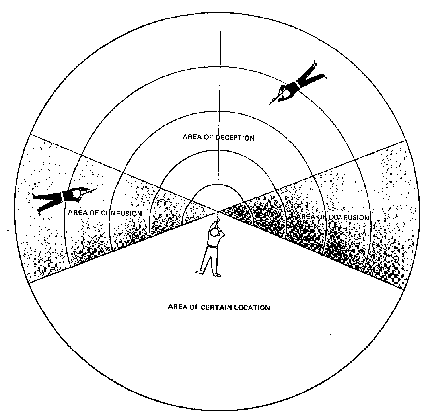
    Figure 4: Chart from Military Armament Corporation.
    The muzzle blast spread from a suppressed weapon
    shows deception and confusion resulting from
    attempts to locate sound origina from
    weak fixed source at various angles
    from the source.

    Other Evidence of Multiple Guns

    Silencers may explain why different witnesses reported hearing differing numbers of gun shots. But what other evidence is there for more than one gunman? At least four pieces of tangible firearm evidence have surfaced since the Warren Commission’s Report which suggest the presence of gunshots in Dealey Plaza on November 22nd from a weapon other than Oswald’s Mannlicher-Carcano. This evidence consists of two bullets, one bullet fragment and one shellcasing. Each of these items of evidence are consistent with one or the other general characteristics of the two CIA sniper weapons discussed above.

    1. The Barbee Specimen: This intact bullet was found imbedded in the roof of a building located at 1615 Stemmons Free-way by William Barbee in the summer of 1966. The building, which was located about a 1/4 mile from the TSBD, happened to be in the line of fire from where Oswald allegedly shot. Mr. Barbee turned the bullet over to the FBI for analysis in December, 1967, when current publicity about the assassination caused him to wonder if this bullet might be relevant evidence. The FBI lab determined the bullet to be a .30 caliber full metal jacketed military bullet. Its rifling pattern of 4 grooves, right hand twist was the same as that produced by the U.S. government .30 carbine. The FBI took little interest in this bullet once having determined that it came from a weapon other than Oswald’s rifle. Apparently, the thought of a second gunmen was never entertained. Yet this bullet is consistent with that which could be shot from the CIA’s silenced M-1 .30 caliber carbine. One can speculate that this bullet was shot out in the suburbs by a hunter engaged in target practice. Consider, however, that M-1 .30 caliber carbines were not prevalent amongst the civilian population as they had only been released by the government for civilian use in mid-1963. Furthermore, it was and continues to be illegal to use full metal jacketed military ammunition for hunting purposes.
    2. The Haythorne Specimen: The second piece of evidence was a bullet found in 1967 on top of the Massey building by Rich Haythorne, a roofer doing work on the building. The Massey Building was located about 8 blocks away from the TSBD in the 1200 block of Elm Street. It has since been torn down. The bullet remained in the possession of Haythorne’s attorney, until it was delivered to the HSCA for examination. The HSCA utilized the services of the Washington, D.C. police department, where it was determined that the bullet was a jacketed, soft-point .30 caliber bullet, weighing 149 grains which was consistent with the .30 caliber ammunition produced by Remington-Peters. Such ammunition was a popular hunting load and many gun manufacturers chambered their rifles to accommodate this ammunition. The 6 groove, right hand twist rifling marks on the bullet indicated that the bullet was not shot from Oswald’s Mannlicher-Cacano.
    3. The Lester Specimen: The third specimen was a bullet fragment found in Dealey Plaza by Richard Lester in 1974. Its precise location was reported to be 500 yards from the TSBD and 61 paces east of the triple overpass abutment. Mr. Lester turned the fragment over to the FBI for analysis in December, 1976. The FBI reported its findings in July, 1977, and concluded that the fragment, which consisted of the base portion of a bullet and weighed 52.7 grains, was consistent with the diameter of a 6.5 mm bullet. It was also determined that the fragment came from a metal jacketed soft point or hollow point sporting bullet. The rifling characteristics did not match those of a Mannlicher-Carcano. Even though the bullet exhibited the same 4 grooves, right hand twist pattern as Oswald’s Mannlicher-Cacano, the lands between the grooves were spaced further apart than his Carcano. Once again, no one ventured to suggest that the fragment might represent the work of a second gunman.
    4. The Dal-Tex Specimen: The fourth piece of firearm evidence consists of a rusted shell casing found on the rooftop of the Dal-Tex Building in 1977 by an air-conditioning repair man. The Dal-Tex Building is just east of the TSBD, across Houston Street. Assassination researchers have long speculated that a second gunman was positioned at that building. Judging by the rusted condition of the shell case, it had been there for quite some time. What was unique about this case was the crimped edges along the neck suggesting that either the shell had been handloaded or had been used in conjunction with a sabot. Specimens 1), 2) and 3) could conceivably have been shot from locations other than Dealey Plaza by some careless hunter. However, this shell casing meant that the rifle was shot where the shell was expended and it is unlikely that deer hunters ever had occasion to position themselves on a rooftop in downtown Dallas.

    One cannot rule out the possibility of a hoax or freakish accident to explain the presence of these specimens. Yet the unresolved questions surrounding the nature of the wounds, trajectory disputes and debate over the number of gunshots require that any evidence of other missiles be taken seriously.

    The ballistic evidence, thus far, falls short of proving beyond a reasonable doubt that Oswald’s Mannlicher-Carcano fired bullets on November 22nd that wounded Governor Connally and killed President Kennedy. The limousine fragments and magic bullet #399 appear to have come from Oswald’s Mannlicher-Carcano. Yet they had no residue of blood or tissue and thus cannot be linked to human wounds. The HSCA’s neutron activation analysis links the wound fragments only to the limousine fragments and to bullet #399 – not to the weapon. The major gap in the chain of evidence, then, is the inability to link the wound fragments to the weapon. Moreover, when one considers the testimony of the HSCA firearms expert Vincent P. Guinn that at least four other types of ammunition shared the same composition of trace elements as the 6.5 Mannlicher-Carcano ammunition, the neutron activation analysis leaves the door open to other realistic possibilities.

    One such possibility is that an expanding bullet with the same composition of trace elements as the 6.5 Mannlicher-Carcano ammunition was shot from a different weapon, perhaps a silenced weapon. Another possibility is that the 6.5 ammunition was fired and recovered from Oswald’s Mannlicher-Cacano and then shot out of another larger bore weapon with the aid of sabots, barrel inserts or cartridge conversions. Yet another possibility is that bullets or fragments from other weapons were in fact recovered from Kennedy’s body but were suppressed following the autopsy. Consider, for instance, the report from a top FBI administrator, Alan Belmont, to Clyde Tolson, Hoover’s second in command, in which Belmont on the night of November 22nd advises that a bullet has been found lodged behind the President’s ear.

    The existence of silenced rifles and the belated discovery of other ballistic evidence in and around Dealey Plaza still does not prove conclusively that more than one gunman was involved in the Kennedy assassination. The point of this article, however, is to encourage researchers to think about other possibilities that are not only realistic and but fall within the capability of the military and intelligence apparatus in the fall of 1963.

    Sources:

    1. Truby, Silencers, Snipers and Assassins: An Overview of Whispering Death (1972)
    2. Minnery, Firearm Silencers, Vol II (1981)
    3. U. S. Department of Army, “Silencers: Principles and Evaluations, Report #R-1896” (August 1968)
    4. War Department Technical Manual, Ordnance Maintenance, U.S. Rifles, Caliber .30, M1. M1C (Sniper’s), and M1D (Sniper’s)
    5. War Department Technical Manual, Ordnance Maintenance, The Springfield Rifle, M1903, M1903A1, M1903A3, M1903A4
    6. Nonte, Firearms Encyclopedia (1973)
    7. Hearings before the U.S. House Select Committee on Assassinations, (1978):
      a) Volume 1, p. 495 et seq re: neutron activation analysis (incredibly the HSCA never asked the firearms expert Vincent P. Guinn to identify the four other types of ammunition that matched Oswald’s 6.5 Western Cartridge bullets.)
      b) Volume 7, p. 357 et seq re: the Lester and Haythorne specimens (The HSCA makes passing reference to the “Walder” bullet that was also submitted for testing; the author could find no other mention of this particular item of evidence. Is it possible that the HSCA was referring to the bullet which Deputy Walthers was rumored to have found in Dealey Plaza?)
    8. The Dal-Tex specimen: The author has never seen a document substantiating this claim and has also heard that the shell casing was discovered on the rooftop of the book depository, not the Dal-Tex building; she would welcome information from other researchers concerning this evidence
    9. FBI Document #62-109060-5898 (12/13/67) re: the Barbee specimen
    10. FBI Document #62-109060-1431 (11/22/63) re: the statement “I told Shanklin FBI has one of the bullets, the other is stuck behind his ear” is consistent with the writing on the Sibert/O’Neill evidence envelope enclosing a “missile” that had been removed from JFK’s body. It is inconceivable that these FBI agents would mistakenly use the word missile or bullet if what in fact was recovered was merely a small fragment.
  • The Magician’s Tools


    From the November-December, 1995 issue (Vol. 3 No. 1) of Probe


    “The most important tools of the magician are diversion and timing.”
    ~ Anonymous Victorian conman, inspiring his class of beginning pickpockets with the secrets of a loftier trade.


    Seriously Out of Synch

    Three shells, three shots. When was shot #2? According to the government, Kennedy and Connally, hit by shot #2, are wounded five seconds before the head shot. Yet, shots #2 and #3 have been called “close together.” Shots fired five seconds apart might be called “close together” but never a “flurry.”

    The vast majority of witneses said they heard only one shot before the two or more “close together” shots. Many of these witnesses were not only explicit about what they meant by close together (“simultaneous”), they were also clear about when the flurry occurred – during the time the head exploded. Before that, they heard only one shot, apparently the one that struck Kennedy in the throat. What happened in between?

    By all accounts, the first shot was fired before the limousine disappeared behind the Stemmons Sign (from Zapruder’s viewpoint). Most of us believe he reacts to the throat wound at this time. Kennedy emerges from behind the sign and, as others have noted, he goes forward a few inches – violently. This little movement, obscured by his suddenly rising arms, may indicate a separate shot to the back. Soon after, Connally is hit. Kellerman said he heard only one shot, then no more until the time of the “flurry.” Clint Hill said he heard one shot before the “double sound” he associates with the head wound, and nothing in between. (In the Altgens photo, the equivalent of Z-255, Hill has not yet reacted.) Samuel A. Kinney heard one shot, then a second, and “the second shot was fired and I observed hair flying from the right side of his head.” I’m assuming this second shot was a head shot because of the similarity between his testimony and George Hickey’s: “I heard a loud report…[then] I heard two reports which … appeared to me completely different in sound than the first report and were in such rapid succession there seemed to be no time element between them. The first shot of the second two seemed as if it missed because the hair on the right side of his head flew forward and there didn’t seem to be any impact against his head. The last shot seemed to hit his head…” Again, a second shot associated with disturbing Kennedy’s head. Rather than “hair” flying forward, I think what they saw was the bone flap that appears seven frames before the acknowledged head shot on the Nix film (I describe corroborating evidence for this in “The Magic Skull,” The Fourth Decade, July, 1995).

    Some witnesses seemed unaware of even the first shot. Mary Moorman, for example. She took two Polaroid photos of Kennedy. By the time she took the second picture (the head shot), at least two shots had already been fired. Yet, she said she heard a shot for the first time as she took this second picture. Charles Brehm is another witness who seemed unaware of the shots at first. As noted by David Lifton, Brehm is clapping his hands as the car passes him, a time when at least two shots had been fired.

    An Apparent Contradiction

    Governor Connally said he did not hear the shot that hit him. Neither, apparently, did Mrs. Connally. She said she heard a shot, turned around, saw Kennedy in distress, and kept her eyes on him until her husband was hit.

    “I never again looked in the back seat of the car after my husband was shot. My concern was for him…” The strange thing is, except for a quick glance at Connally as he changes posture, Mrs. Connally continuously stares at Kennedy – for two full seconds of surviving film after her husband has been hit. Another oddity: Governor Connally said he cried out, “Oh, no,no,no,” after he was hit. Mrs. Connally claimed he said it before he was hit.

    I think they were both right.

    Mrs Connally could have meant that before she heard the second shot, Connally cried out. What she really heard was probably the first of the flurry that struck Kennedy’s head.

    Evidence of Subsonic Bullets

    Robert Shaw, MD described the hole through Connally as a “small tunneling wound,” noting the “neat way in which it stripped the rib out without doing much damage to the muscles that lay on either side of it.” Kennedy’s back wound was apparently even less. A supersonic bullet would have done much more damage. One thing that would render a supersonic bullet subsonic is a silencer.

    Perception of Gunfire

    There is usually variation among witnesses in the perception of anything, especially gunfire. Variation in hearing ability, attention span, the location of witnesses compared with the location of the marksmen, all could create apparent inconsistencies. A shot fired from 100 yards away is 20 decibels softer than one fired 10 yards away [20xlogarithm (base 10) of the ratio of the distances], all other factors being equal. Furthermore, loud noises are deafening, just as bright lights are blinding, temporarily. The pupil contracts in bright sunlight and takes time to adjust to a dark room, and muscles supporting the eardrum contract in self defense following a loud noise, making the ear deaf to quieter sounds. Thus, two shots could sound like one, depending on the witness’s location. And one shot can sound like two if the location is conducive to echo. Three shots from the same place, fired five seconds apart, would produce either three echoes, or no echo. That sound follows impact isn’t a factor here because of the distances involved. How to know which sounds go with which wounds? Will Greer said the last two shots were fired “simultaneously,” and that Connally moved at that time. Hit earlier, Connally was probably only flinching, or reacting to yet another shot. Greer’s assumption is probably “witness confusion,” a real phenomenon, but it could mean any testimony that does not agree with your theory.

    Prying Apart the Last Two Shots

    “Close together” could mean “closer together,” if the time between shots #1 and #2 could be lengthened, which may be why some claim shot #1 came as early as Z-160. But another solution to the problem is this hypothetical statement:

    “You only heard an echo. Look at this map. There were only three shots, and witnesses say the car was clear over here near this sign, when Connally fell. That was shot #2. And the car was down here several feet away when the head opened up. That was shot #3. You couldn’t have heard a flurry, the car didn’t move that fast. We even have it on film.”

    Zapruder was on his perch well before the motorcade arrived, and he could have been removed “for security reasons.” And surely they knew in advance that people film such motorcades. Did they want a record of it, one they could edit? One that would record the “second” shot? Bang……..Bang…….Bang?

    BANG…………..BANG-BANG

    The following people heard only one shot before the flurry, which occurred at the time the head exploded:


    Jack Bell (AP): “in quick succession” (NYT 11/23/63, p.5)
    George Hickey: “in rapid succession…no time element between” (18H762)
    Roy Kellerman: “flurry…plane breaking the sound barrier…bang, bang”; (2H76)
    Clinton Hill: “The second shot had “an echo…double sound” (2H144)
    Mary Woodward: “The second two shots were immediate…as if one were an echo of the other… with the second and third shot…I saw the head explode” (A∓E,II )
    Will Greer: “simultaneously” (2H118)
    Glenn Bennett: “A second shot followed immediately and hit the right rear high of the President’s head.” (18H760)
    Rufus Youngblood: “in rapid succession.” Rufus Youngblood (Robert MacNeil’s The Way We Were, 1988, Carroll ∓ Graf)
    Warren Taylor: “in the instant that my left foot touched the ground, I heard two more bangs” (CE1024)
    Seymour Weitzman: “simultaneous” (7H106)
    Linda Kay Wills: “two real fast bullets together” (7H498)
    Lee Bowers: Rapped his knuckles on a table showing the near simultaneity of the last two. (Mark Lane 1966 Tape)
    Junior Jarman: “third shot was fired right behind the second” (3H204)
    Carolyn Walther: “almost at the same time” (C.E.2086)
    Toney Henderson: “in rapid succession” (C.E.208)
    Mrs. Lyndon Johnson: “in rapid succession.” (H565)


    Mr. and Mrs. William Newman who stood on the curb slightly to the left of Zapruder describe the opposite pattern, BANG-BANG, nothing, then BANG. This may be related to location.

    Conclusion

    The purpose of silently creating wounds between audible shots #1 and #2 may not have been to disprove the closeness of shot #2 to shot #3, but one thing seems certain: what did the majority of witnesses hear when Connally was shot? Nothing.

  • The FBI’s Fib about the Mannlicher Carcano


    From the July-August, 1995 issue (Vol. 2 No. 5) of Probe


    FBI firearms expert Robert Frazier, testifying before the Warren Commission, described the results of tests by FBI marksmen with Oswald’s Mannlicher Carcano at 15, 25 and 100 yards. Their shots consistently landed close to each other, within an area “the size of a dime,” but not close to the target, demonstrating the rifle’s precision, but lack of accuracy due to the misalignment of the telescopic sight. (Accuracy and precision have separate meanings in ballistics.) Their results:

    At 15 yards:

    2.5 to 4 inches too high;

    1 inch too far to the right

    At 25 yards:

    4 to 5 inches too high;

    1 to 2 inches too far to the right

    At 100 yards:

    2.5 to 5 inches too high;

    2 to 5 inches too far to the right

    If the bullet struck 2.5 – 4 inches too high at 15 yards, how could it be a mere 2.5 to 5 inches too high at 100 yards?

    Deviation is in direct proportion to the distance of the gun from the target. Earlier in his testimony, in a very different context, Frazier made an offhand remark that illustrates this principle: He said he fired three shots at 25 yards with “approximately a 3-inch spread…the equivalent of a 12-inch spread at a hundred yards.” Twelve inches, not 5 inches?

    Would bullet drop (effect of gravity) compensate for the rifle’s poor vertical alignment at 100 yards? I got a precise answer from the editor of a leading ballistics publication who, because of the “sensitive” subject matter, wishes to remain anonymous. Using Barnes’ Ballistics computer program, he determined that, at 120 yards, a 6.5mm, 160-grain bullet, muzzle velocity of 2,200 feet per second, would have dropped only 0.7 inches below “flat firing” level. (In a different context, Frazier claimed more bullet drop than my expert, 1.2 inches at 100 yards. Not enough to explain the results obtained.) So much for gravity explaining the disproportionately small degree of deviation at 100 yards.

    I then posed another question for his computer: if the telescopic sight of the rifle places the same bullet 3 inches above the target at 25 yards, how far above the target would the bullet strike if the rifle was zeroed in at 100 yards? He came up with 14 inches. If the bullet is 4 inches off at 25 yards, it would be 18 inches off at 100 yards. (These figures are conservative; even at 15 yards, when firing for accuracy and not speed, two of the FBI marksmen were off by 4 inches.)

    How did the FBI manage to fire “only” 5 inches too high at 100 yards (assuming they were telling the truth)? It is reasonable to conclude that, having become familiar with the gun by the time of the last series of tests, they compensated for the misalignment of the telescopic sight – and did not say so. Commissioner Eisenberg appears to have guessed it:

    “Mr. Frazier, when you were running, let’s say, the last test, could you have compensated for this defect?”

    “Yes; you could take an aiming point low and to the left and have the shots strike a predetermined point…”

     Or, was it his point that Oswald compensated for the defect? Eisenberg also appears to have known, in advance, what might solve the problem, as acknowledged:

    “[I]f the elevation crosshair was defective at the time of the assassination…and no compensation was made for this defect, how would this have interacted with the amount of lead which needed to be given to the target?”

    Frazier answered, perhaps as predicted, that no lead would have been necessary: The misaligned scope “accomplished the lead” for him. Earlier, Frazier had testified that Oswald would have had to lead (aim ahead of the target because it would have moved by the time the bullet arrived) the target by 4 to 6 inches. (If Oswald were as good a shot as claimed, would he not have aimed ahead of the target, assuming he didn’t know the sight was off?) The sight was well stabilized when received in Dallas, as shown by the shots landing so close together, but it was misaligned. Why? Frazier could not answer, but suggested it had been bumped, as evidenced by a “severe scrape on the scope tube” that occurred at some unknown time. And he said “It may be the that the mount has been bent or the crosshair ring shifted.” (Wouldn’t it be have been clear whether, if not when, the mount was bent?) Did the FBI or the Commission inquire if the scrape had been on the gun when found in the Depository? If the scrape was “severe,” wouldn’t it have been seen in Dallas? If not, the Commission could have claimed the gun was damaged in transit, and was fine at the time of the assassination. Was this basic, obvious question ever asked?

    Frazier minimized the problem, claiming it wasn’t really defective, that “only the adjusting mechanism does not have enough tolerance to bring the crosshair to the point of impact of the bullet,” simple to fix by slipping a “shim” under the sight. But, the defect is apparently inherent with that brand, and was there before the hypothetical bump. When, for his experiments, John Lattimer bought four Carcanos – “a favorite among European riflemen” – and four telescopic sights identical to Oswald’s, he found that all four needed shims, and hinted that Oswald had used one. No shim was ever found on or near Oswald’s gun.

    We may never know the truth about that gun. But we do know the FBI told what amounts to a lie. When they made the statement that, at 100 yards, the rifle’s aim was off by only 5 inches, they knew it would be understood to mean that the last series of tests was performed under the conditions of the first two tests, that is, without compensating for the misalignment of the sight. How would the public have responded to the information that, when firing the last shot, the bullet would have gone at least 14 inches above the point of aim on Kennedy’s head? The gun seems to have been more of a threat to the pigeons above. How would the public have responded to the information that the FBI rigged the last test?

  • Canning’s Letter to Blakey


    From the July-August, 1995 issue (Vol. 2 No. 5) of Probe


    This “not altogether complimentary letter” may prove to outline the reasons that the HSCA failed so miserably in their investigation of the John F. Kennedy assassination. Following his shocking revelation that the photo evidence and the conclusions of the Warren Commission are not mutually supportive, Thomas Canning, author of the HSCA’s trajectory analysis, offers us a brilliant outline of why the HSCA’s investigation was doomed to fail. His allegations of evidence left compartmentalized, accusations of staff infighting, along with his assertion that the medical panel gave him conflicting data, confirm what many in our research community have suspected all along. For these reasons many have proposed that a special prosecutor someday be appointed to explore the assassination.


    January 5, 1978

    Professor Robert Blakely [sic]

    Chief Counsel,

    House Select Committee on Assassinations

    U.S. House of Representatives

    House Office Bldg.

    Annex No. 2

    Washington D.C. 20515


    Dear Professor Blakely: [sic]

    When I was asked to participate in analysis of the physical evidence regarding the assassination of John Kennedy, I welcomed the opportunity to help set the record straight. I did not anticipate that study of the photographic record of itself would reveal major discrepancies in the Warren Commission findings. Such has turned out to be the case.

    I have not set out to write this note to comment on results; my report does that. What I do wish to convey is my judgement [sic] of how the parts of the overall investigation which I could observe were conducted. The compartmentalization which you either fostered or permitted to develop in the technical investigations made it nearly impossible to do good work in reasonable time and at reasonable cost.

    The staff lawyers clearly were working in the tradition of adversaries; this would be acceptable if the adversary were ignorance or deception. The adversaries I perceive were the staff lawyers themselves. Each seemed to “protect” his own assigned group at the expense of getting to the heart of the matter by encouraging — or even demanding cooperation with the other participants. The most frustrating problem for me was to get quantitative data — and even consistent descriptions — from the forensic pathologists.

    Of somewhat less importance in gaining overall acceptance of what I consider to be a quite impressive improvement in understanding, was the manner in which the results of the investigation were conveyed in hearings. I don’t propose to alter the trial-like atmosphere, but when long-winded engineers and Congressmen are allowed to waste literally hours on utter trivia, I do object.

    I needn’t remind you of the importance of managing time when many expensive people are participating and particularly when millions are watching. To allow staff and witnesses to overrun their planned allotments to the detriment of the whole planned presentation indicates that either the plan or its execution has been weak.

    Clearly the participation of the Congressmen in subsequent questioning, though necessary, uses time somewhat inefficiently; even here enough experience must have accumulated to anticipate the problem and lead you and Chairman Stokes to deal with it.

    Much of this rather negative reaction to the hearings themselves stems from my being strongly persuaded to rush through a difficult analysis at the last minute, abandon my regular pursuits for two days, try to boil down forty-five minutes of testimony to thirty, and then listen and watch while two hours’ excellent testimony is allowed to dribble out over most of a day.

    Permit me to end my not altogether complimentary letter by saying that it was for the most part an interesting and enjoyable experience. On balance, the entire effort would be justified solely by the strong indication of conspiracy at the Plaza. I particularly enjoyed working with Jane Downey and Mickey Goldsmith. Their help in piercing some of the partitions and their remarkably quick, intelligent response to my needs was exemplary. They also proved to be good critics in helping me make my results clear.


    Sincerely,


    Thomas N. Canning

  • Ted Charach’s Press Conference: Thane Eugene Cesar’s Gun Found

    Ted Charach’s Press Conference: Thane Eugene Cesar’s Gun Found


    From the July-August, 1995 issue (Vol. 2 No. 5) of Probe


    In truth, heretics are more despised than infidels. In practice, it is never more true than in the attitude of the political elite and the wags who sing their praises, toward the assassination research community. The most recent case in point was the non-coverage of the press conference held by RFK assassination researcher, Ted Charach. Charach used the occasion of the 27th anniversary of RFK’s death to reveal the latest findings in the case. Surprisingly or not so surprisingly, not one reporter from any news organization showed up!

    It is no small coincidence that author Dan Moldea also called a press conference at exactly 11:00 a.m. on Monday, June 5th, ostensibly to hype his latest book The Killing of Robert F. Kennedy. Since the book concludes that Sirhan acting alone shot and killed Robert Kennedy, we wonder if any news organization covered Moldea’s press conference. We certainly did not see, hear or read anything about the press conference, so we’re left to conclude one of two things; either Moldea had nothing very compelling to say or the press coverage in this town is a lot worse than anyone realized.

    In the course of recapping that which is known from the release of his book, articles, video and film presentations, Charach revealed several new pieces of evidence which substantiate the charges of obstruction of justice, subornation of perjury and a cover-up in this case. He also revealed a new wrinkle in his second gun theory. He now believes that not only did Thane Eugene Cesar fatally shoot RFK in the head, but like Sirhan, as discussed in the book The Assassination of Robert F. Kennedy, by Jon Christian and William Turner, Cesar was a programmed assassin and has no memory of the acts he committed that night.

    charach

    Photo by Thomas Smith, showing Ted Charach holding a picture of Coroner Thomas Noguchi indicating the point of entry to the bullet that struck Robert Kennedy at point blank range in the back of the head. Sirhan was shooting from, according to eyewitnesses, no closer than one and a half feet in front of Kennedy.

    Charach displayed copies of documents recovered from state archives which bolstered the 1970 testimony of criminalist William Harper. Harper testified that LAPD criminalist DeWayne Wolfer had falsified the results of the test-firing of the gun used by Sirhan. The documents clearly show the serial number of the gun test-fired by Wolfer as H-18602. Yet, the serial number of Sirhan’s gun is actually H-53725. Wolfer has always stated (even under oath) this discrepancy was merely a “clerical error.”

    Charach also revealed that last year he made a trip to the Middle East. During that trip he met with members of the Israeli Mossad who, Charach implied, had been aware of the CIA’s use of Sirhan Bishara Sirhan as a mind-control subject and a programmed assassin. He offered up a film he had made of these discussions with the Mossad agents to any legitimate news service organization for airing and analysis on American television.

    Another film he offered to any news service organization was that of an interview of shooting eyewitness Donald Schulman who that night told Jerry Dunphy of KNXT news (now KCBS) that a security guard had fired his gun back at Sirhan and had accidentally shot RFK. Jerry Dunphy and KCBS have denied that this interview ever took place. Of course, since no news organization was represented at the press conference, nobody took Charach up on his offer to air either of these films.

    Finally, Ted Charach, who refers to himself as the “Father of the Second Gun Theory” in the assassination of Robert F. Kennedy, has teamed up with feature film producers, Beaux Carson and Tim Gibbons to tell the story of the search for the second gun and the lives who have been affected by the search.

    The project is titled, “Operation Tinker Toy” – Phase I and Phase II. It’s the story of how the gun turned up in the possession of certain residents of a little town in Arkansas, and how their lives took rather dramatic turns for the worse under possession of this gun. Their story is told within the backdrop of Charach’s 25 year search for it.

    At one point during the press conference, Beaux Carson brought in a man toting a metal briefcase and a handcuff attached to his wrist. Inside the briefcase was the nine-shot, .22 caliber revolver, serial number Y-13332, salvaged from a muddy pond in Arkansas after 25 years. This is the gun which was owned by Thane Eugene Cesar and which Charach believes is the second gun used in the assassination. Sirhan’s gun was an eight-shot, Iver-Johnson Cadet, .22 caliber revolver, serial number H-53725.

    This was the first public display of the gun since its recovery in 1993. Carson announced that tests on the gun and test-firings will be made sometime this year by independent forensic labs. He stated he had also been approached by law enforcement agencies who expressed interest in test-firing the gun using their own forensic experts. He hesitated to identify which law enforcement agencies were interested.

    We came away from the press conference believing ourselves more blessed for the cursed heretic and despising evermore the beloved infidel.

  • Thomas Canning’s Letter to Robert Blakey (1978)


    From Probe, Vol. 2, No. 5 (July 22, 1995)


    (Click here if your browser is having trouble loading the above.)